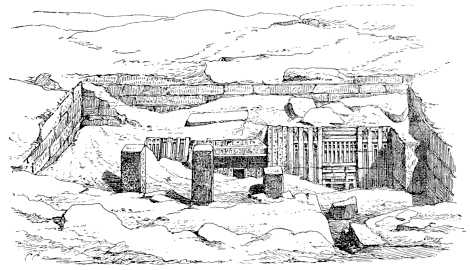
Sepulchral Architecture.
The most ancient monuments which have yet been discovered in Egypt are
the tombs; they have therefore a right to the first place in our
sketch of Egyptian architecture.
In every country the forms and characteristics of the sepulchre are
determined by the ideas of the natives as to the fate of their bodies
and souls after life is over. In order to understand the Egyptian
arrangements, we must begin then by inquiring into their notions upon
death and its consequences; we must ask whether they believed in
another life, and in what kind of life. We shall find a complete
answer to our question in the collation of written texts with figured
monuments.
In the first period of his intellectual development, man is unable to
comprehend any life but that which he experiences in his own person.
He is as yet unable to observe, to analyse or to generalize. He does
not perceive the characteristics which distinguish him from things
about him, and he sees nothing in nature but a repetition of himself.
He is therefore incapable of distinguishing between life such as he
leads it and mere existence. He dreams of no other way of being than
his own. As such is the tendency of his intellect, nothing could be
more natural or more logical than the conception to which it leads him
in presence of the problem offered to him every time that a corpse
descends into the grave. M. Maspero has so thoroughly understood the
originality of the solution adopted by the Egyptians that we cannot do
better, in attempting to explain the hypothesis, at once gross and
subtle, to which they had recourse for consolation, than borrow his
rendering of the texts which throw light upon this subject,
together with some of the reflections which those texts suggested to
him.[114]
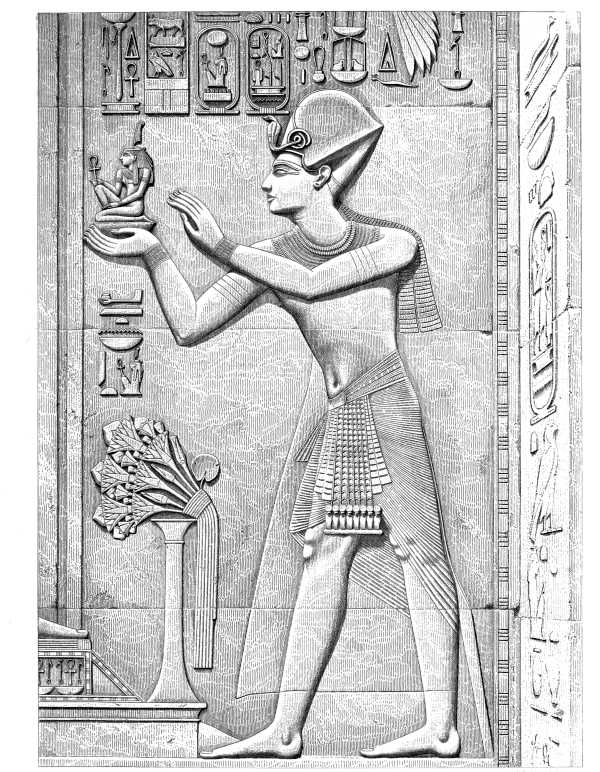
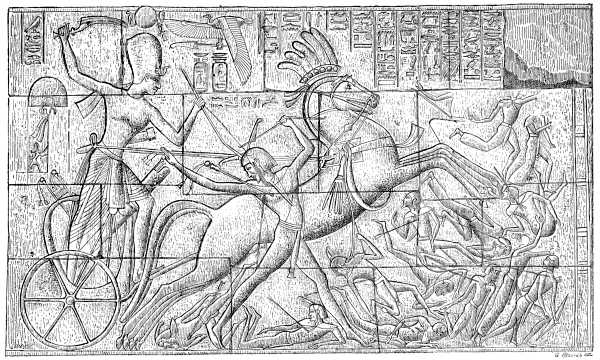
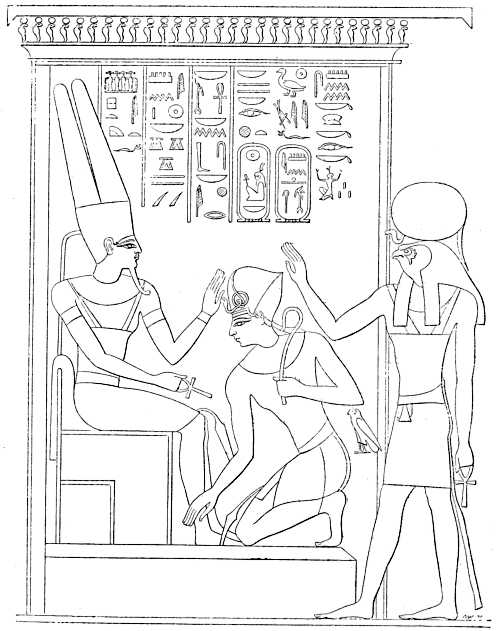
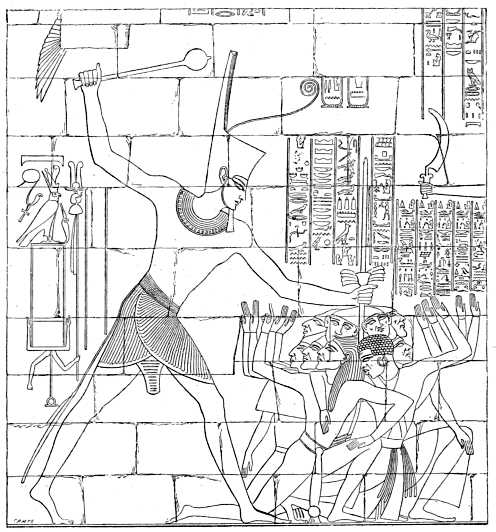
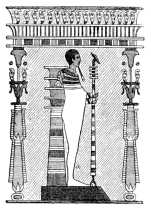
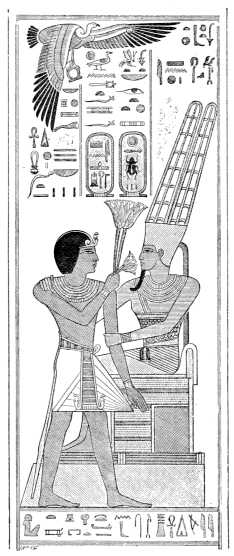
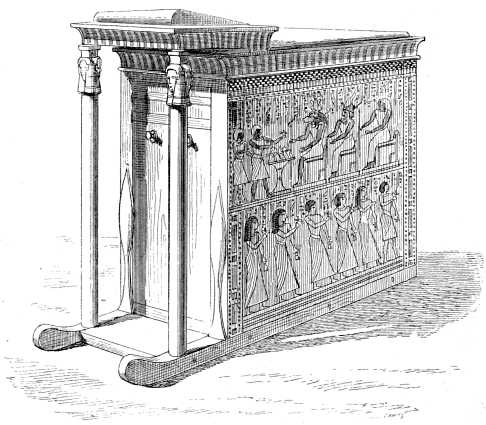
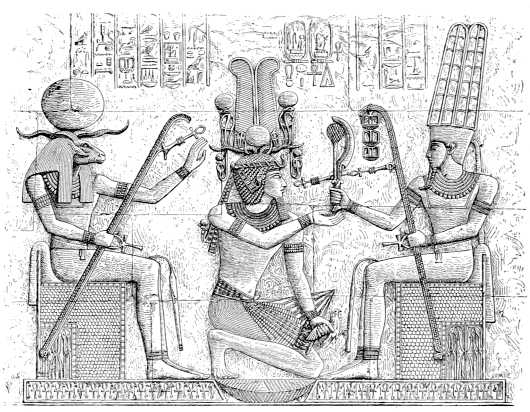
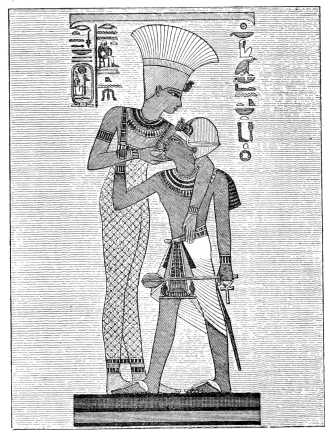
J. Sulpis del. et sc.
SETI I
BAS-RELIEF AT ABYDOS
Were we to affirm that during thousands of years no change took place
in the ideas of the Egyptians upon a future life, we should not be
believed, and, as a fact, those ideas underwent a continual process of
refinement. Under the eighteenth and nineteenth dynasties, during
those centuries when the limits of Egyptian empire and Egyptian
thought were carried farthest afield, we find traces of doctrines
which offer notable variations, and even, when closely examined,
actual contradictions. These are successive answers made during a long
course of time to the eternal and never-changing enigma. As they
became more capable of philosophic speculation the Egyptians modified
their definition of the soul, and, by a necessary consequence, of the
manner in which its persistence after death must be understood, and as
always happens in such a case, these successive conceptions are
super-imposed one upon another; the last comer did not dethrone its
predecessor but became inextricably blended with it in the popular
imagination.
We refer all those who wish to follow minutely this curious
development of the Egyptian intellect to the subtle analysis of M.
Maspero. That historian has applied himself to the apprehension of
every delicate shade of meaning in a system of thought which has to be
grasped through the veil thrown around it by extreme difficulties of
language and written character, but at the same time he has never
attempted to endow it with a precision or logical completeness to
which it had no claim. By well chosen comparisons and illustrations he
enables us to understand how the Egyptian contented himself with vague
notions, and how he managed to harmonize ideas which seem to us
inconsistent.
We shall not enter into those details. We shall not seek to determine
the sense which the Egyptians attached, after a certain period, to the
word bâi,[115] which has been translated soul, nor the
distinction between it and khou, luminousness, which the soul seems
to have enveloped like a garment. We shall not follow the soul and its
internal light in its subterranean journey across Ament, the
Egyptian Hades, to which it entered by a cleft, Pega, to the west of
Abydos, which was the only portal to the kingdom of the shades; nor
shall we accompany them in the successive transformations which made
them acquainted with every corner of the earth and sky in the infinite
series of their becomes (to use the Egyptian expression); what we
have to do is to trace out the most ancient of their religious
conceptions, the conception which, like the first teachings of
infancy, was so deeply engraved upon the soul and intellect of the
race as to exercise a much stronger influence than the later more
abstract and more philosophical theories, which were superimposed upon
it. In this primitive conception we ought to find the determining
cause of the Egyptian form of tomb. Its constitution was already
settled in the time of the ancient Empire, and, from the Memphite
dynasties until the end, it remained unchanged in principle. In this
constitution we shall find embodied the essential idea adopted by the
Egyptians when they first attempted to find some eternal element in
man, or, at least, some element which should resist the annihilation
of death for a period much longer than the few days which make up our
mortal life.
The Egyptians called that which does not perish as the dying man draws
his last sigh, the ka, a term which M. Maspero has rendered as the
double. "This double was a duplicate of the body in a matter less
dense than that of the body, a projection, coloured but aërial, of the
individual, reproducing him feature for feature, a child if coming
from a child, a woman if from a woman, and a man if from a man."[116]
This double had to be installed in a lodging suitable to its
existence, had to be surrounded by objects which it had used in its
former state, had to be supplied with the food which was necessary for
the sustenance of its life. And all these things it obtained from the
piety of its relations, who, on fixed days, brought them to the
threshold of the good dwelling or the eternal dwelling, which were
the phrases used by the Egyptians.[117] By these offerings alone could
the hungry and thirsty phantom which had replaced the living man be
kept alive. The first duty of the survivors was to take care that this
dependent existence should not be extinguished by their neglect, to
provide food and drink for the support, if we may use such a phrase,
of the precarious life of the dead, who would otherwise be irritated
against them and use the almost godlike power attributed to his
mysterious condition for the punishment of his ungrateful
posterity.[118]
This conception is not peculiar to Egypt. The double of the Egyptian
sepulchral records corresponds exactly to the
εἴδωλον[119]
of the Greeks and the umbra of the Latins. Both Greeks and Latins
believed that when the funeral rites had been duly accomplished, this
image or shadow entered upon the possession of a subterranean dwelling
and began a life which was no more than the continuation of that in
the light.[120] The dead thus remained in close relation with the
living, on the one hand by the nourishment which they received, on the
other by the protection which they afforded; even in the funeral
repast they took their parts, in the strictest sense of the word, in
the eating and drinking.[121] They looked impatiently forward to these
supplies because, for a moment, they awoke their dormant thoughts and
feelings and gave them glimpses of the true life, the life above
ground and in the sunshine.[122] If they were kept waiting too long
they became angry and revenged themselves upon those who had caused
their sufferings. Woe to the family or city which was not careful to
interest the dead in its stability and thus to associate them with its
prosperity![123]
These beliefs seem to have been common to all ancient peoples during
that period of their existence which is lost in the shadow of
prehistoric times. From India to Italy all the primitive forms of
public and private rights betray their presence. For this fact and its
consequences we may refer our readers to the fine work of M. Fustel de
Coulange, La Cité antique.[124]
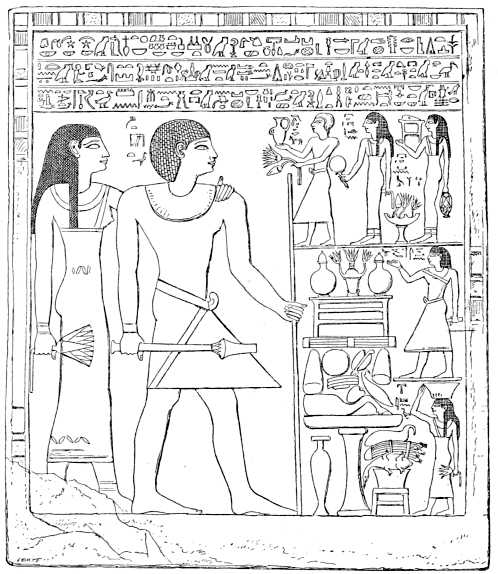
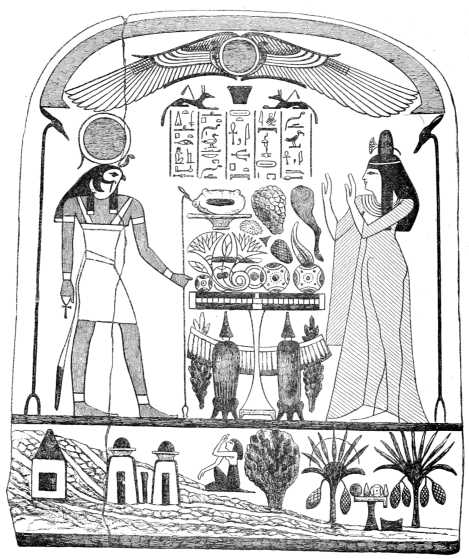
Fig. 86.—Stele of the 11th dynasty. Boulak. Drawn by Bourgoin.
With the progress of centuries and the development of religious
thought, more elevated ideas prevailed. The growth of the scientific
spirit tended to make the notion of a being suspended between life and
death ever more strange and inadmissible. Experience accumulated its
results and it became daily more evident that death not only put an
end to the activity of the organs, but that, immediately upon its
occurrence, it began to dissolve and decompose their tissues. As time
rolled on men must have found it very difficult to believe in a shadow
thus placed outside the normal conditions of life, in a something
which was not a spirit and yet survived the destruction of its organs.
It would seem then that observation and logical reflection should soon
have led to the abandonment of a theory which now appears so puerile;
but, even in these scientific times, those whose intellects demand
well defined ideas are few indeed.[125] At a period when the diffusion
of intellectual culture and the perfection of scientific methods add
daily to our accumulations of positive knowledge, most men allow their
souls to be stirred and their actions to be prompted by the vaguest
words and notions; how much greater then must the influence of those
confused beliefs and baseless images have been in antiquity when but a
few rare minds, and those ill provided with means of research and
analysis, attempted to think with originality, clearness and freedom.
The prestige of this illusion was increased and perpetuated by its
intimate connection with several of those sentiments which are most
honourable to human nature. Such a worship of the dead surprises and
even scandalizes us by its frank materialism, but if we seek for the
source of its inspiration and its primitive meaning, we find them in
the remembrance of lost objects of affection, in feelings broken by
the supreme separation, in the gratitude of children to the parents
who gave them birth and nourished their infancy, in the recognition by
the living of the blessings which they enjoy through the long and
laborious efforts of their ancestors. There was no doubt a perishable
element in the funerary ideas of Egypt, an element which the progress
of reason was sure to destroy, and we may be tempted to smile when we
think of the Greek or Egyptian giving himself the trouble to feed his
departed ancestors with blood, milk, or honey, but with all their
simplicity, both one and the other were alive to a truth which the
revolutionary spirit of our days, with its childish and brutal
contempt for the past, is often unable to grasp. They realized the
complete solidarity of one human generation with another. Guided by
their hearts alone they anticipated the results at which modern
thought has arrived by close and attentive study of history. From a
reasoned out conviction of this truth and its consequences, philosophy
now draws the principles of a high morality! but long before our days
this idea and the tender, grateful, sentiments which it provoked had
been a powerful instrument in the moral improvement of the first-born
of civilization and a bond of union for their civil and domestic life.
We have thought it right to dwell upon this worship of the dead and to
describe its character at some length, because the beliefs upon which
it was based are not to be found so clearly set forth in the art of
any other people. Their most complete, clear, and eloquent expression,
in a plastic form, is to be seen in the tombs which border the Nile.
And why is this so? It is because the Egyptian industries were already
in full possession of their resources at the period when those beliefs
had their strongest hold over the minds and feelings of the people. In
the case of Greece, art did not arrive at its full development until
the worship of the dead had lost its high place in the national
conscience. When the Greek genius had arrived, after much striving, at
its complete power of plastic expression, the gods of Olympus had been
created for several centuries, and art was called upon to interpret
the brilliant polytheism of Homer and Hesiod, to give outward image to
those gods, and to construct worthy dwellings for their habitation.
Sculptors, painters, and architects still worked indeed, at the
decoration of the tomb. They strove to give it beauty of shape and
arrangement, and to adorn its walls with bas-reliefs and pictures;
they designed for it those vases and terra cottas which, in our own
day, have been found in thousands in the cemeteries of Greece and
Italy, but all this was only a subordinate use of their talent. Their
ambition was to build temples, to model statues of Zeus, Pallas, and
Apollo. On the other hand, those distant ages in which primitive and
childish ideas of religion prevailed, had no art in which to manifest
their beliefs with clearness and precision.
It was otherwise in the valley of the Nile. A well provided industry
and an experienced art laid themselves out to interpret the popular
beliefs and to defend the dead against final dissolution, or the
agonies of hunger and thirst. Egypt did not differ from other nations
in its opinions upon the mystery of death. In the infancy of every
race the same notions on this matter are to be found, and in this
respect the only difference between the Egyptians and the rest of the
world is very much to the credit of the former; they rapidly attained
to a degree of civilization which was only reached by other races
after their religious development was comparatively mature. Thanks to
this advantage, they were enabled to push their ideas to consequences
which were not to be attained by tribes which were little less than
barbarous, and they had no difficulty in expressing them with
sufficient force and precision.
It remains for us to show the use which the Egyptians made of their
superiority in doing more honour to their dead, in guarding them more
safely against the chances which might shorten the duration or destroy
the happiness of their life in the tomb. The fulfilment of this duty
was, as the Greek travellers rightly affirmed, their chief
pre-occupation. Their sepulchral architecture was, of all their
creations, the most original and the most characteristic of their
genius, especially in the forms which we find in the cemeteries of the
Ancient Empire. In the time of the New Empire, at Thebes, it is less
complete and homogeneous. In the latter the arrangement and decoration
do not spring, as a whole, from a unique conception; we find traces in
it of new hypotheses and novel forms of belief. These do not supersede
the primitive ideas; they are added to them, and they bear witness to
the restless efforts made by human thought to solve the problem of
human destiny. These apparent contradictions and hesitations are of
great interest to the student of the Egyptian religion, but from the
art point of view the Memphite tombs are more curious and important
than those of later date. They have the great merit of being complete
in their unity both of artistic form and of intellectual conception.
They are the offspring of a single growth, and are perfect in their
clear logical expression. And again, they are the type of all the
later tombs, of those at Abydos, at Beni-Hassan, and at Thebes.
Certain details, indeed, are modified, but the general disposition
remains the same to the end. We shall, therefore, find the ruling
principle of Egyptian sepulchral architecture most clearly laid down
in the cemeteries of Gizeh and Sakkarah.
The first and most obvious necessity for the obscure form of life
which was supposed to commence as soon as the tomb had received its
inmate, was the body. No pains, therefore, were spared which could
retard its dissolution and preserve the organs to which the double
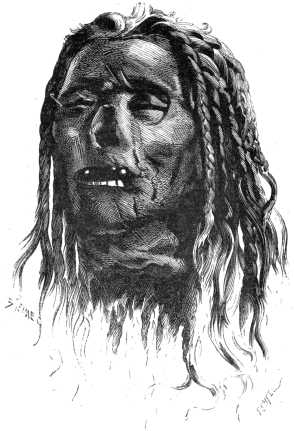
and the soul might one day return.[126] Embalming, practised as it was
by the Egyptians, rendered a mummy almost indestructible, so long, at
least, as it remained in the dry soil of Egypt. On the warm sands of
Sakkarah and close to the excavations from which the fellahs of the
corvée were returning at the end of their day's labour, we—my
travelling companions and myself—stripped a great lady of the time of
Ramses of the linen cloths and bandages in which she was closely
enveloped, and found her body much in the same condition as it must
have been when it left the workshop of the Memphite embalmer! Her
black hair was plaited into fine tresses; all her teeth were in place
between the slightly contracted lips; the almond-shaped nails of her
feet and hands were stained with henna. The limbs were flexible and
the graceful shapes but little altered under the still firm and smooth
skin, which, moreover, seemed to be still supported by flesh in some
parts. Had it not been for its colour of tarred linen or scorched
paper, and the smell of naphtha which arose from the body and from the
numberless bandages which were strewn about, we might have shared the
sentiment attributed to Lord Evandale in Theophile Gautier's brilliant
Roman de la Momie; with an effort of good-will we could almost
sympathise with those emotions of tenderness and admiration which were
excited in the breast of the young Englishman at the sight of the
unveiled charms of that daughter of Egypt whose perfect beauty had
once troubled the heart of the proudest of the Pharaohs.[127]
In order that all the expense of embalming should not be thrown away,
the mummy had to be so placed that it could not be reached by the
highest inundations of the river. The cemeteries were therefore
established either upon a plateau surrounded by the desert, as in the
case of Memphis and Abydos, or in the sides of the mountain ranges and
in the ravines by which they were pierced, as at Thebes and Beni-Hassan.
In the whole valley of the Nile, no ancient tomb has been
discovered which was within reach of the inundation at its
highest.[128]
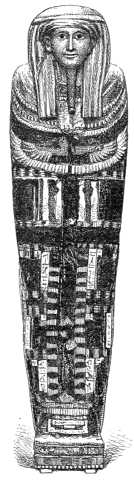
Fig. 87.—Mummy case
from the 18th dynasty.
Boulak.
The corpse was thus preserved from destruction, first by careful and
scientific embalming, secondly by placing its dwelling above the
highest "Nile." Besides this we shall see that the Egyptian architects
made use of many curious artifices of construction in order to conceal
the entrance to the tomb, and to prevent the intrusion of any one
coming with evil intentions. All kinds of obstacles and pitfalls are
accumulated in the path of the unbidden visitor, with a fertility and
patient ingenuity of invention which has often carried despair into
the minds of modern explorers, especially in the case of the pyramids.
Mariette was fond of saying that there are mummies in Egypt which will
never, in the strictest sense of the word, be brought to light.
But in spite of all this pious and subtle foresight, it sometimes
happened that private hate or, more often, the greed of gain, upset
every calculation. Enemies might succeed in penetrating to the
sepulchres of the dead, in destroying their bodies, and thus
inflicting a second death worse than the first; or a thief might drag
the corpse from its resting place, and leave it naked and dishonoured
upon the sands, that he might, with the greater ease, possess himself
of the gold and jewels with which it had been adorned.
The liability of the mummy to accident had to be provided against. The
idea of the unhappy condition in which the double would find itself
when its mummy had been destroyed, led to the provision of an
artificial support for it in the shape of a statue. Art was
sufficiently advanced not only to reproduce the costume and ordinary
attitude of the defunct and to mark his age and sex, but even to
render the individual characteristics of his physiognomy. It aspired
to portraiture; and the development of writing allowed the name and
qualities of the deceased to be inscribed upon his statue. Thus
identified by its resemblance and its inscriptions it served to
perpetuate the life of the double, which was in continual danger of
dissolution or evaporation in the absence of a material support.
The statues were more solid than the mummy, and nothing stood in the
way of their multiplication. The body gave but one chance of duration
to the double; twenty statues represented twenty chances more. Hence
the astonishing number of statues which are sometimes found in a
single tomb. The images of the dead were multiplied by the piety of
surviving relations, and consequently the double was assured a
duration which practically amounted to immortality.[129]
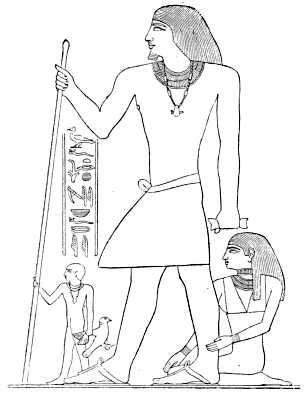
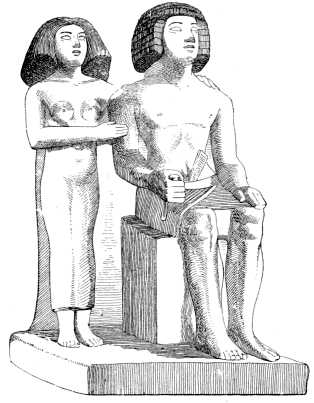
Fig. 88.—Man and his wife in the style of the 5th dynasty.
Calcareous stone. From the Louvre.
We shall see that a special recess was prepared in the thickness of
the built up portion of the tomb for the reception of wooden or stone
statues, so that they might be kept out of sight and safe from all
indiscreet curiosity. Other effigies were placed in the chambers of
the tomb or the courts in front of it. Finally, we know that persons
of consideration obtained from the king permission to erect statues in
the temples, where they were protected by the sanctity of the place
and the vigilance of the priests.[130]
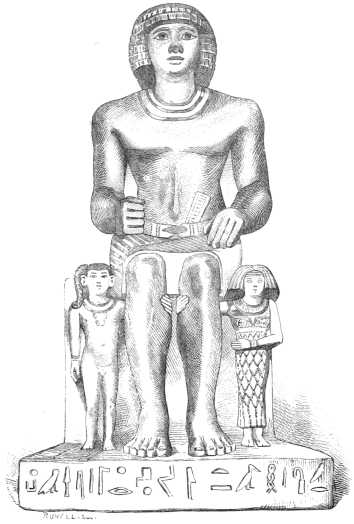
Fig. 89.—Sekhem-ka, his wife Ata, and his son Khnem,
in the style of the 5th dynasty.
Limestone. From the Louvre.
From the point of view of the ancient Egyptians such precautions were
by no means futile. Many of these effigies have come down to us safely
through fifty or sixty centuries and have found an asylum in our
museums where they have nothing to fear but the slow effects of
climate and time. Those which remain intact may therefore count upon
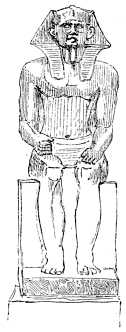
immortality. If the double required nothing to preserve it from
annihilation but the continued existence of the image, that of
Chephren, the builder of the second great pyramid, would be still
alive, preserved by the magnificent statue of diorite which is the
glory of Boulak, and thanks to the durability of its material, it
would have every chance of lasting as long as the world itself. But,
unhappily for the shade of Pharaoh, this posthumous existence which is
so difficult of comprehension to us, was only to be prolonged by
attention to conditions most of which could not long continue to be
observed.
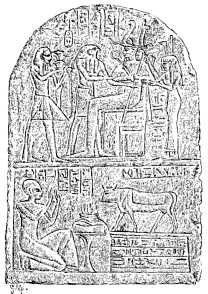
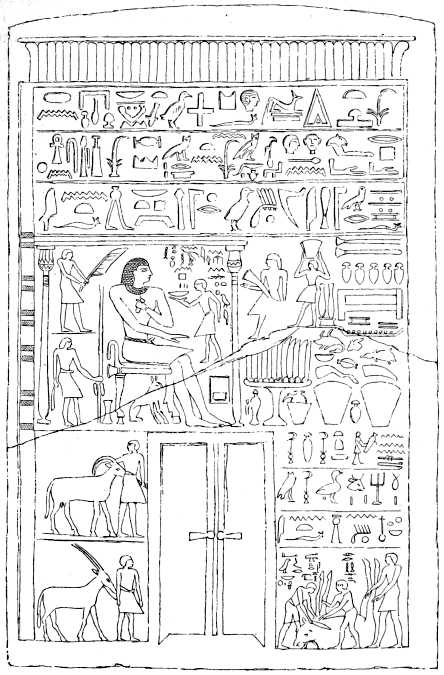
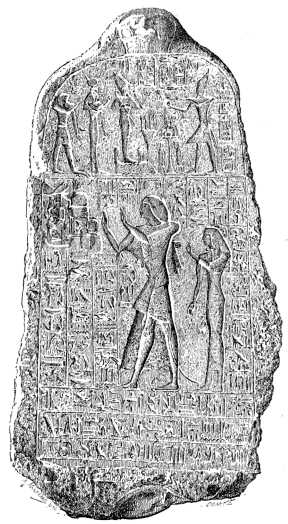
Fig. 90.—Stele of Nefer-oun. Boulak.
It was entirely a material life. The dead-alive had need of food and
drink, which he obtained from supplies placed beside him in the
tomb,[131] and afterwards, when these were consumed, by the repasts
which took place periodically in the tomb, of which he had his share.
The first of these feasts was given upon the conclusion of the funeral
ceremonies,[132] and they were repeated from year to year on days
fixed by tradition and sometimes by the expressed wish of the
deceased.[133] An open and public chamber was contrived in the tomb
for the celebration of these anniversaries. It was a kind of chapel,
or, perhaps, to speak more accurately, a saloon in which all the
relations and friends of the deceased could find room. At the foot of
the stele upon which the dead man was represented sacrificing to
Osiris, the god of the dead, was placed a table for offerings, upon
which the share intended for the double was deposited and the
libations poured. A conduit was reserved in the thickness of the wall
by which the odour of the roast meats and perfumed fruits and the
smoke of the incense might reach the concealed statues.[134]
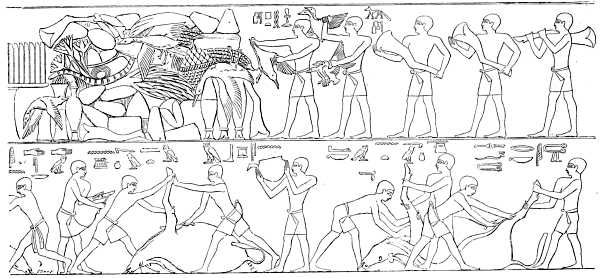
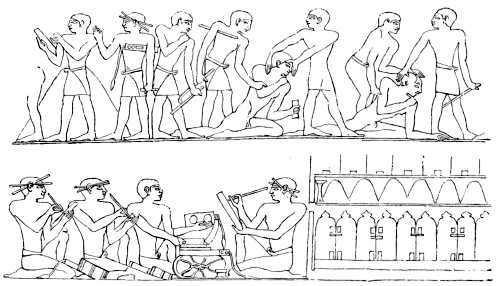
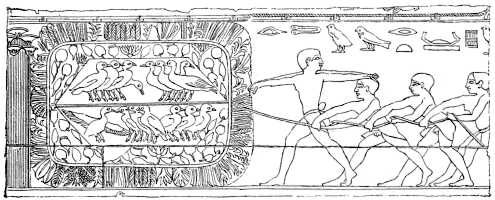
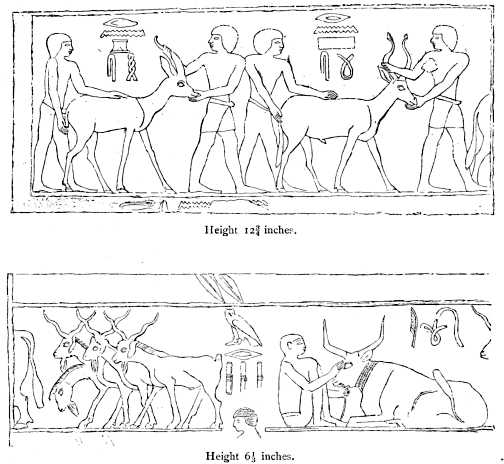
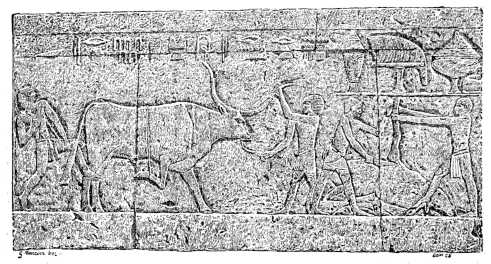
Fig. 91.—Preparation of the victims and arrival of funeral gifts, 5th dynasty.
Height of each band, 13-1/2 inches. Boulak. Drawn by Bourgoin.
The Egyptians did not trust only to the piety of their descendants to
preserve them from a final death by inanition in their neglected
tombs. At the end of a few generations that piety might grow cold and
relax its care; besides, a family might become extinct. All those who
could afford it provided against such contingencies as these by giving
their tombs what we now call a perpetual foundation. They devoted to
the purpose the revenues of some part of their property, which was
also charged with the maintenance of the priest or priests who had to
perform the ceremonial rites which we have described.[135] We find
that, even under the Ptolemies, special ministers were attached to the
sepulchral chapel of Cheops, the builder of the great pyramid.[136] It
may seem difficult to believe that a "foundation" of the ancient
empire should have survived so many changes of régime, but the
honours paid to the early kings had become one of the national
institutions of Egypt. Each restoring sovereign made it a point of
duty to give renewed life to the worship of those remote princes who
represented the first glories of the national history.
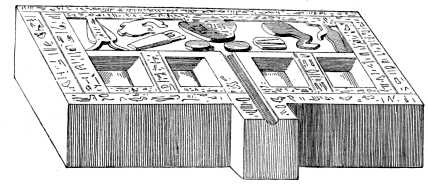
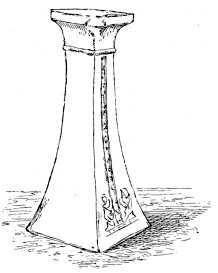
Fig. 92.—Table for offerings. Louvre.
Besides which there were priests attached to each necropolis, who,
for certain fees, officiated at each tomb in turn. They were
identified by Mariette upon some of the bas-reliefs at Sakkarah. Their
services were retained much in the same way as masses are bought in
our days.[137]
Fig. 93.—Another form
of the table for offerings.
Boulak.
The same sentiment led to the burial with the dead of all arms,
clothes, jewels, and other objects of which they might have need in
the next life. We know what treasures of this kind have been obtained
from the Egyptian tombs and how they fill the cases of our museums.
But neither was this habit peculiar to Egypt. It was common to all
ancient people whether civilized or barbarous. Traces are to be found
even in the early traditions of the Hellenic race of a time when, like
those Scythians described by Herodotus,[138] the Greeks sacrificed, at
the death of a chief, his wives and servants that they might accompany
him to the next world. When she began to reveal herself in the arts
Egypt was already too far civilized for such practices as these;
thanks to the simultaneous development of science, art and religion,
she found means to give the same advantages to her dead without
permitting Scythian cruelties. Those personal attendants and domestic
officers whose services would be so necessary in another life, were
secured to them at a small expense; instead of slaying them at the
door of the tomb, they were represented upon its walls in all the
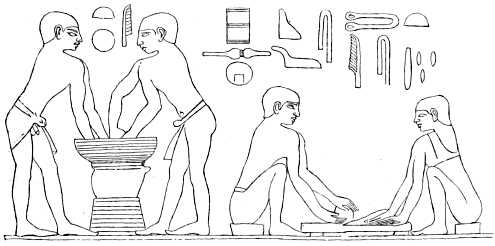
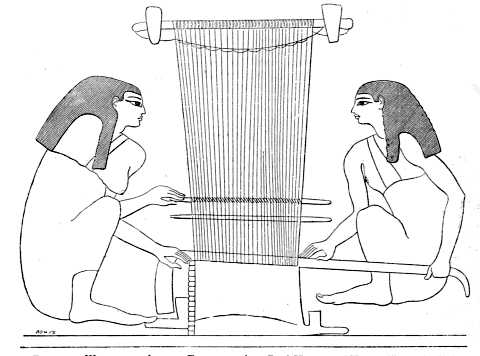
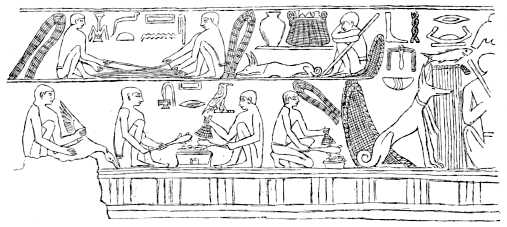
variety of their occupations and in the actual moment of labour. So
too with all objects of luxury or necessity which the double would
wish to have at hand, as for instance his food and drink.[139]
A custom which would seem to have established itself a little later
may be referred to the same desire; we mean the habit of placing in
the tomb those statuettes which we meet with in such vast numbers
after the commencement of the second Theban Empire.[140] Mariette
obtained some from tombs of the twelfth dynasty, and the sixth
chapter of the Book of the Dead, which is engraved upon them, seems
to be one of the most ancient. Egyptologists are now inclined to
believe that the essential parts of this ritual date back as far as
the Memphite period.
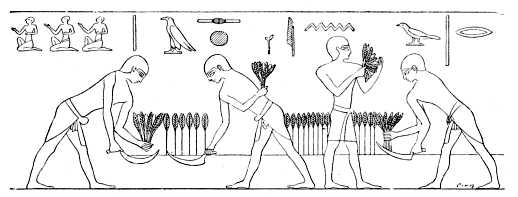
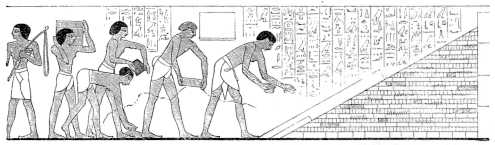
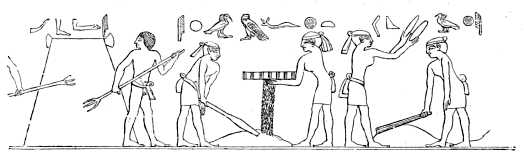
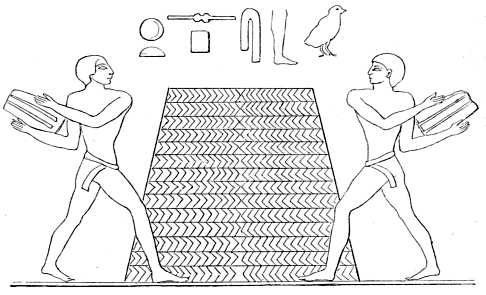
Fig. 94.—Labourers heaping up ears of corn, from a tomb at Gizeh.
(Description de l'Égypte.)
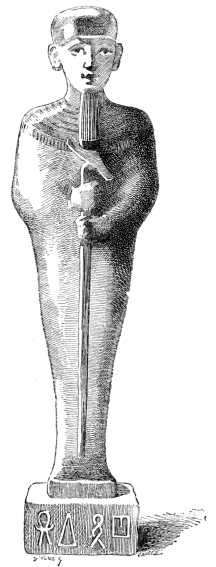
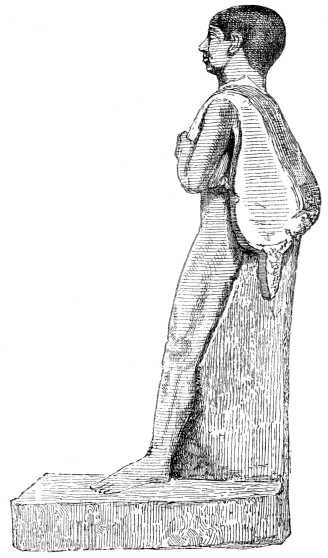
These statuettes are of different sizes and materials. As a rule they
do not exceed from eight to twelve inches, but there are a few which
are three feet or more in height. Some are in wood, some in limestone,
and some in granite, but as a rule they are made of that kind of terra
cotta which, when covered with green or blue enamel, has been called
Egyptian porcelain. They are like a mummy in appearance; their hands
are crossed upon the breast and hold instruments of agriculture such
as hoes and picks, and a sack meant for grain hangs from their
shoulders. The meaning of all this is to be sought in the Egyptian
notions of a future life; it is also explained by the picture in
chapter XC. of the Ritual, which shows us the dead tilling, sowing
and harvesting in the fields of the other world. The texts of the
Ritual and of certain inscriptions call these little figures
oushebti or answerers from the verb ousheb, to answer. It is
therefore easy to divine the part attributed to them by the popular
imagination. They answered to the name traced upon the tomb and acted
as substitute for its tenant in the cultivation of the subterranean
regions.[141] With the help of the attendants painted and sculptured
upon the walls they saved him from fatigue and from the chance of
want. This is another branch of the same old idea. In his desire to
take every precaution against the misery and final annihilation which
would result from abandonment, the Egyptian thought he could never go
too far in furnishing, provisioning and peopling his tomb.
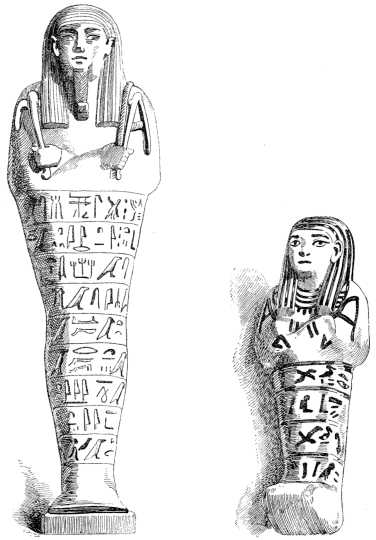
Figs. 95, 96.—Sepulchral statuettes, from the Louvre.
The ingenuity of their contrivances is extraordinary. Food in its
natural state would not keep, and various accidents, might, as we have
shown, lead to the death of the double by inanition. It was the same
with furniture and clothes; the narrow dimensions of the tomb,
moreover, would forbid the accumulation there of everything which its
sombre tenant might desire. On the other hand the funerary statuettes
were made of the most indestructible materials and the bas-reliefs and
paintings were one with the thick walls of stone or living rock. These
have survived practically unaltered until our day. We visited the tomb
of Ti a short time after its chambers had been opened and cleared. It
was marvellous to see how form and colour had been preserved intact
and fresh under the sand, and this work which was four or five
thousand years old seemed to be but lately finished. By the brightness
of their colours and the sharp precision of their contours these
charming reliefs had the effect of a newly struck medal. Such scenes
from the daily life of the people continued to be figured upon
Egyptian tombs from the old empire to the new. When their study and
comparison were first begun different explanations were put forward.
Some believed that they were an illustrated biography of the deceased,
a representation of his achievements or of those over which he had
presided during the course of his mortal life; others saw in them an
illustration of his future life, a setting forth of the joys and
pleasures of the Egyptian Elysium.
Both these interpretations have had to give way before the critical
examination of the pictures themselves and the decipherment of their
accompanying inscriptions. It was soon perceived, through comparisons
easily made, that these scenes were not anecdotic. On a few very rare
occasions they seem to be connected with circumstances peculiar to the
inhabitant of the tomb. There are a few steles and tombs upon which
the dead man seems to have caused his services to be described, with
the object, no doubt, of continuing in the next world his career of
honour and success in this. Such an inscription is so far
biographical, and a similar spirit may extend to the decorations of
the stele and walls of the tomb. As an example of such narrative
epigraphs we may cite the long inscription of Ouna, which gives us
the life of a sort of grand-vizier to the two first Kings of the sixth
dynasty;[142] also the inscriptions upon the tombs of those feudal
princes who were buried at Beni-Hassan. In the latter there are
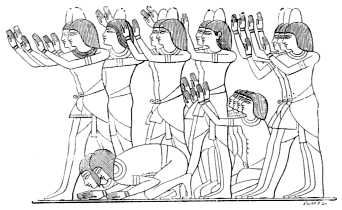
historical representations as commentaries upon the text. Among these
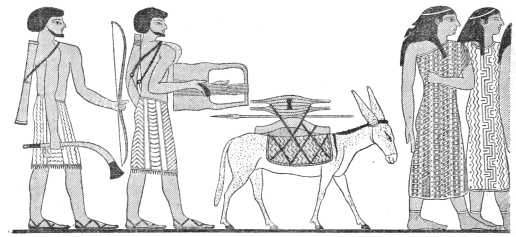
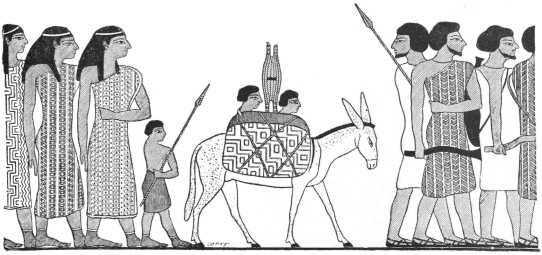
is the often reproduced painting of a band of Asiatic emigrants
bringing presents to the prince and demanding, perhaps, a supply of
wheat in return, like the Hebrews in the time of Jacob.
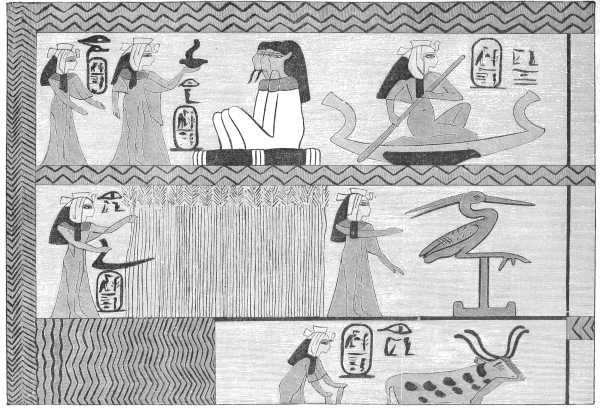
Fig. 97.—Vignette from a Ritual upon papyrus,
in the Louvre. Chap. XC., 20th dynasty.
But all this is exceptional. As a rule the same subjects occur upon
the tombs again and again, in the persistent fashion which
characterizes traditional themes. The figures by which the flocks and
herds and other possessions of the deceased were numbered are too
great for literal truth.[143] On the other hand the pictured tradesmen
and artificers, from the labourer, the baker, and the butcher up to
the sculptor, seem to apply themselves to their work with an energy
which excludes the notion of ideal felicity. They, one and all, labour
conscientiously, and we feel that they are carrying out a task which
has been imposed upon them as a duty.
For whose benefit do they take all this trouble? If we attempt to
enter into the minds of the people who traced these images and compare
the pictured representations with the texts which accompany them, we
shall be enabled to answer that question. Let us take by chance any
one of the inscriptions which accompany the scenes figured upon the
famous tomb of Ti, and here is what we find. "To see the picking and
pressing of the grape and all the labours of the country." Again, "To
see the picking of the flax, the reaping of the corn, the transport
upon donkeys, the stacking of the crops of the tomb." Again, "Ti sees
the stalls of the oxen and of the small animals, the gutters and
water-channels of the tomb."
It is for the dead that the vintage takes place, that the flax is
picked, that the wheat is threshed, that oxen are driven into the
fields, that the soil is ploughed and irrigated. It is for the supply
of his wants that all these sturdy arms are employed.
We shall leave M. Maspero to sum up the ideas which presided at the
construction of the Egyptian tomb, but first we must draw our
readers' notice to the fact that he, more than once, alludes to a
conception of the future life which differs somewhat from the early
Egyptian notions, and belongs rather to the Second Theban Empire and
its successors.
Fig. 98.—Arrival in Egypt of a company of Asiatic emigrants
(Champollion, pls. 362, 393).
Fig. 98, Continued.—Arrival in Egypt of a company of Asiatic emigrants
(Champollion, pls. 362, 393).
"The scenes chosen for the decoration of tomb walls had a magic
intention; whether drawn from civil life in the world or from that of
Hades, they were meant to preserve the dead from danger and to insure
him a happy existence beyond the tomb.... Their reproduction upon the
walls of the sepulchre guaranteed the performance of the acts
represented. The double shut up in his
σύριγξ[144]
saw himself going to the chase upon the surrounding walls and he went to
the chase; eating and drinking with his wife, and he ate and drank
with her; crossing in safety the terrible gulfs of the lower world in
the barque of the gods, and he crossed them in safety. The tilling,
reaping, and housing on his walls were for him real tilling, reaping,
and housing. So, too, the statuettes placed in his tomb carried out
for him under magic influence all the work of the fields, and, like
the sorcerer's pestle in Goethe's ballad, drew water for him and
carried grain. The workmen painted in his papyri made shoes for him
and cooked his food; they carried him to hunt in the deserts or to
fish in the marshes. And, after all, the world of vassals upon the
sides of the sepulchre was as real as the double for which they
laboured; the picture of a slave might well satisfy the shadow of a
master. The Egyptian thought that by filling his tomb with pictures he
insured the reality of all the objects, people, and scenes represented
in another world, and he was thus encouraged to construct his tomb
while he was yet alive. Relations, too, thought that they were doing a
service to the deceased when they carried out all the mysterious
ceremonies which accompanied his burial. The certainty that they had
been the cause of some benefit to him consoled and supported them on
their return from the cemetery where they had left their regretted
dead in possession of his imaginary domain."[145]
Such a belief is astonishing to us; it demands an effort of the
imagination to which we moderns are in no way equal. We have great
difficulty in realising a state of mind so different from what ours
has become after centuries of progress and thought. Those early races
had neither a long enough experience of things, nor a sufficiently
capable power of reflection to enable them to distinguish the possible
from the impossible. They did not appreciate the difference between
living things and those which we call inanimate. They endowed all
things about them with souls like their own. They found no more
difficulty in giving life to their carved and painted domestics, than
to the mummy or statue of the deceased, or to the phantom which they
called the double. Is it not natural to the child to take revenge upon
the table against which he hurts himself, or to speak tenderly to the
doll which he holds in his arms?
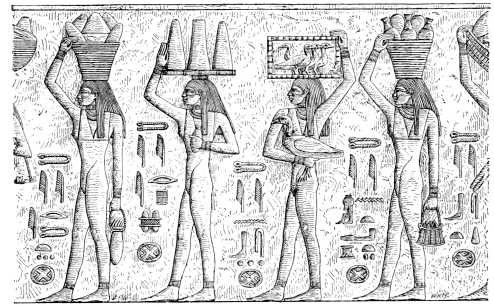
Fig. 99.—The tomb of Ti;
women, representing the lands of the deceased,
carrying the funeral gifts.
This power to endow all things with life and personality is now
reserved for the poet and the infant, but in the primitive days of
civilization it belonged to all people alike. Imagination had then a
power over a whole race which in our days is the gift of great poets
alone. In the efforts which they made to forestall the wants of the
helpless dead, they were not content with providing the food and
furniture which we find upon the walls. They had a secret impression
that these might be insufficient for wants renewed through eternity,
and they made another step upon the way upon which they had embarked.
By a still more curious and still bolder fiction than those which had
gone before, they attributed to prayer the power of multiplying, by
the use of a few magic sentences, all objects of the first necessity
to the inhabitants of the tomb.
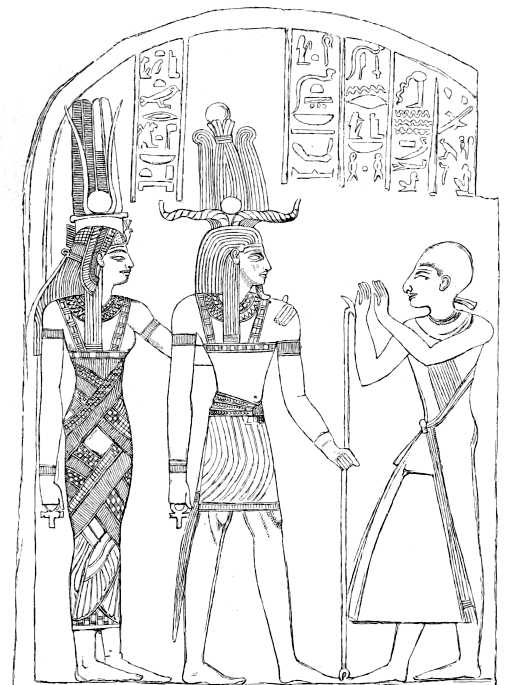
Every sepulchre has a stele, that is to say, an upright stone tablet
which varied in form and place in different epochs, but always served
the same purpose and had the same general character. Most of these
steles were adorned with painting and sculpture; all of them had more
or less complicated inscriptions.[146] In the semicircle which forms
the upper part of most of these inscribed slabs, the dead person,
accompanied by his family, presents offerings to a god, who is usually
Osiris. Under this an inscription is carved after an unchanging
formula: "Offering to Osiris (or to some other deity, as the case may
be) in order that he may give provision of bread, liquid, beef, geese,
milk, wine, beer, clothes, perfumes, and all good and pure things upon
which the god subsists, to the ka of N..., son of M...." Below this
the defunct is often shown in the act of himself receiving the
offerings of his family. In both divisions the objects figured are
looked upon as real, as in the wall decorations. In the lower division
they are offered directly to him who is to profit by them; in the
upper, the god is charged to see that they are delivered to the right
address. The provisions which the god is asked to pass on to the
defunct are first presented to him; by the intervention of Osiris the
doubles of bread, meat and drink pass into the other world to
nourish the double of man. But it was not essential for the gift to be
effective that it should be real, or even quasi-real; that its image
should even be given in paint or stone. The first-comer could procure
all things necessary for the deceased by their enumeration in the
proper form. We find therefore that many Egyptians caused the
following invocation to passing strangers, to be engraved upon their
tombs:
"Oh you who still exist upon the earth, whether you be private
individuals, priests, scribes, or ministers entering into this tomb,
if you love life and do not know death, if you wish to be in favour
with the gods of your cities and to avoid the terrors of the other
world, if you wish to be entombed in your own sepulchres and to
transmit your dignities to your children, you must if you be scribes,
recite the words inscribed upon this stone, or, if not, you must
listen to their recital: say, offering to Amen, master of Karnak, that
he may give thousands of loaves of bread, thousands of jars of drink,
thousands of oxen, thousands of geese, thousands of garments,
thousands of all good and pure things to the ka, or double, of the
prince Entef."[147]
Thanks to all these subtle precautions, and to the goodwill with which
the Egyptian intellect lent itself to their bold fictions, the tomb
deserved the name it received, the house of the double. The
double, when thus installed in a dwelling furnished for his use,
received the visits and offerings of his friends and relations; "he
had priests retained and paid to offer sacrifices to him; he had
slaves, beasts of burden, and estates charged with his support. He was
like a great lord sojourning in a strange country and having his wants
attended to by intermediary officials assigned to his service."[148]
This analogy between the house and the tomb is so complete that it
embraces details which do not seem very congruous. Like the house of
the living, the tomb was strictly oriented, but after a mystic
principle of its own.
As soon as the Egyptian began to think he perceived the most obvious
of the similarities between the sun's career and that of man. Man has
his dawn and his setting. Man grows from the early glimmerings of
infancy to the apogee of his wisdom and strength; he then begins to
decline and, like the magnified evening sun, ends by disappearing
after his death into the depths of the soil.
In Egypt the sun sets every evening behind the Libyan chain; thence he
penetrates into those subterranean regions of Ament across which he
has to make his way before the dawn of the next day. The Egyptian
cemeteries were therefore placed on the left bank of the Nile, that
is, in the west of the country. All the known pyramids were built in
the west, and there we find all the more important "cities of the
dead," the necropolis of Memphis and those of Abydos and Thebes. A few
unimportant groups of tombs have indeed been found upon the eastern
bank; but these exceptions to a general rule are doubtless to be
explained by a question of distance. For any city placed near the
eastern border of the wider parts of the Nile valley, a burying-place
in the Libyan chain would be very inconvenient both for the transport
of the dead, and for the sepulchral duties of the survivors.[149]
Each morning sees the sun rise as youthful and ardent as the morning
before. Why then should not man, after completing his subterranean
journey and triumphing over the terrors of Ament, cast off the
darkness of the tomb and again see the light of day? This undying hope
was revivified at each dawn as by a new promise, and the Egyptians
followed out the analogy by the way in which they disposed their
sepulchres. They were placed in the west of their country, towards the
setting sun, but their doors, the openings through which their inmates
would one day regain the light, were turned to the east. In the
necropolis of Memphis, the door of nearly every tomb is turned to the
east,[150] and there is not a single stele which does not face in that
direction.[151] In the necropolis of Abydos, both door and stele are
more often turned towards the south, that is towards the sun at its
zenith.[152] But neither at Memphis, at Abydos, nor at Thebes is there
a tomb which is lighted from the west or presents its inscription to
the setting sun.[153] Thus, from the shadowy depths where they dwell,
the dead have their eyes turned to that quarter of the heavens where
the life-giving flame is each day rekindled, and seem to be waiting
for the ray which is to destroy their night and to rouse them from
their long repose.[154]
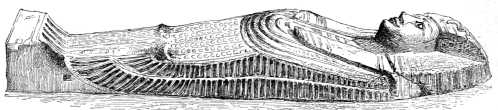
Fig. 100.—Lid of the coffin of Entef, 11th dynasty. Louvre.
The ideas and beliefs which we have described were common to all
Egyptians, irrespective of class. When he felt his last hour
approaching, the humble peasant or boatman on the Nile was as anxious
as Pharaoh himself to insure the survival of his double and to guard
against the terrors of annihilation:
. . . .
Mais, jusqu'en son trépas,
Le riche a des honneurs que le pauvre n'a pas.
Those who, when alive, had to be content with a hut of earth or of
reeds, could not, when dead, expect to have a tomb of stone or brick,
a habitation for eternity; they could not look for joys in the other
world which they had been unable to procure in this. So that such
tombs as those which most fully embodied the ideas we have described
must always have remained the exclusive privilege more or less of the
governing classes. These consisted of the king, the princes and
nobles, the priests, the military chiefs, and functionaries of every
kind down to the humblest of the scribes attached to the
administration. As for those Egyptians who did not belong to this
aristocracy, they had to be content with less expensive arrangements.
The less poor among them at least took measures to be embalmed and to
be placed in a coffin of wood or papier-mâché, accompanied by
scarabs and other charms to protect them against malignant spirits.
The painted figures upon the coffin also helped to keep off evil
influences. If they could afford it they purchased places in a common
tomb, where the mummies were heaped one upon the other and confided to
the care of priests who performed the funerary rites for a whole
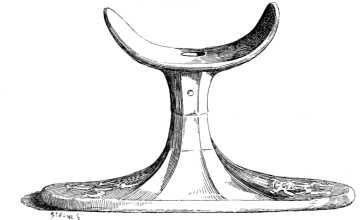
chamber at once.[155] It was the frequent custom to put with the dead
those pillows of wood or alabaster which the Egyptians seem to have
used from the most ancient times for the support of their heads in
sleep. This contrivance, which does away with the necessity for
continually rearranging their complicated head-dress, is still used by
the Nubians and Abyssinians.
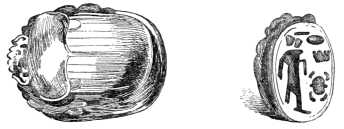
Figs. 101, 102.—Scarabs. Louvre.
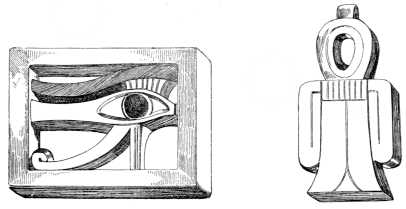
Figs. 103, 104.—Funerary amulets. Oudja and ta. Louvre.
But those who could procure even these slight advantages were still
among the favourites of fortune. Many were unable to obtain even this
minimum of funeral honours. On the confines of all the great
cemeteries, at Thebes as well as at Memphis, corpses are found
deposited in the loose sand two or three feet from the surface. Some
of these are packed in the leaves of the palm, others are roughly
enveloped in a few morsels of linen. They have been hastily dipped in
a bath of natron, which has dirtied rather than embalmed them.[156]
Sometimes even these slender precautions have been omitted. Bodies
have been found in the earth without vestige of either coffin or linen
swathes. The sand seems to have been intrusted with the work of drying
them, and they have been found in our days in the condition of
skeletons.
Fig. 105.—Pillow, Louvre.
On the other hand, the fortunate ones of the world, those who were so
easy in their circumstances in this life that they could place
themselves in the same happy condition in the next, spared no expense
in anything connected with their burial. They never allowed themselves
to be surprised by death, as we so often do. Whether kings or private
individuals, they made their preparations while they were still alive,
and caused their tombs to be constructed under their own eyes.[157]
Their forethought when living and the piety of relations spared
nothing that could add to the beauty and convenience of dwellings
which were to be the eternal resting places of their inmates. The
palaces of the princes and rich men of Egypt were so lightly built
that they have left no traces upon the soil; but many of their tombs
have subsisted uninjured to our day, and it is from them that we have
obtained our treasures of Egyptian art. All the other nations of the
ancient world followed the good example thus set, or rather, to speak
more accurately, being all penetrated with similar ideas, they took
similar courses without borrowing one from the other. Whenever we
moderns have opened any of those ancient tombs which have happily
remained intact, we have been met by the same discoveries. Whether it
be in Egypt or Phœnicia, in Asia Minor, Cyprus or Greece, in
Etruria or Campania, the same astonishing sight meets our eyes. The
tombs are filled with precious objects and chefs d'œuvres of art
which their depositors had intended never again to see the light of
day.
In modern times, when piety or pride stimulates to the decoration of a
tomb, all the care of the architect, the sculptor and the painter is
given to the outside, to the edifice which surmounts the actual grave.
The grave or other receptacle for the coffin is as plain and simple in
the most sumptuous monuments of our cemeteries as in the most humble.
Our funerary architecture is based upon our belief that the tomb is
empty; that the vital part of the deposit confided to it has escaped
to rejoin the current of eternal life. Under such conditions the tomb
becomes above all things a commemorative structure, a more or less
sincere manifestation of the grief of a family or of society at large
for the loss of one of its members. As for the narrow pit into which
the "mortal coil" is lowered, all that we demand of it is that it
should be deep enough and properly closed. Art makes no attempt to
illumine its darkness. She leaves to workmen the task of excavation
and of building its walls and confines herself to the visible parts of
the tomb. The dead within furnishes the pretext for her activity, but
it is the admiration of the living that is her real incentive.
The ideas of the ancients on this matter were, as we have seen, very
different. They looked upon the tomb as an inhabited house; as a house
in which the dead was to lead some kind of existence. Rich men wished
their tombs to look well outside, even to the distant spectator, but
it was to the inside that their chief attention was turned. They
wished to find there all the necessaries, the comforts, the luxuries,
to which they had been accustomed during life. So we find that the
Egyptians, the Greeks or the Etruscans, were willing enough, when they
built their own tombs or those of their relations, to throw a
tumulus of earth above it, or, later, a constructed building which
was conspicuous at a distance. In those sepulchres which were cut out
of the side of a mountain, the fronts were carved with frieze,
pediment and columns into the shape of a regularly constructed
portico; but the chief object of solicitude to the proud possessor of
such a tomb, was its internal furnishing and disposition. For him
there was no removal should he be discontented with his lodging. When
a man is condemned by illness or accident to keep his room, he takes
care to surround himself with everything that he may want. He gathers
immediately about him all the comforts and luxuries which he can
afford; and death is an illness from which there is no recovery.
Impelled by such ideas as these, the ancients filled their tombs with
precious objects and decorated them with sumptuous art, all the more
that they seemed well guarded against intrusion for the sake of gain.
Thus the Achæans of Mycenæ (if that be the proper name of those
mysterious people) buried, in the sepulchres discovered by Dr.
Schliemann, the innumerable objects of gold and silver which now fill
the museum of Athens; thus the tombs of Bœotia were filled with
those marvels of grace and delicate workmanship, the terra cottas of
Tanagra; and those of Etruria and Campania with the most beautiful
painted vases ever produced by Greek taste.
Identity of religious conception thus led, from end to end of the
antique world, to funerary arrangements which bore a curious
resemblance one to another, so that sepulchral architecture among the
ancients had, as a whole, a very different character from that of the
moderns. This character is more strongly marked in Egypt than anywhere
else, and therefore we have studied it in detail. The general
observations to which it has given rise have been made once for all,
and we shall not have to repeat them when we describe the funeral
customs of other ancient peoples. We shall then confine ourselves to
pointing out the slight differences which naturally spring up in the
several interpretations of a common belief.
We have still to show how the varying circumstances of time and place
caused the Egyptian tomb to pass through certain modifications of form
and decoration, which, however, were never of so radical a nature as
to affect its general appearance and arrangement. Until Egypt became a
mere geographical expression and her venerable civilization lost its
independence and originality, these latter remained practically
unchanged.
Among the tombs which date from the time of the ancient empire, the
most interesting to the traveller are, of course, the Pyramids. Long
before his arrival at Cairo he sees the summits of those artificial
mountains rising into the air above the vapours raised by the sun, and
above the dust thrown up by the teeming population of the city. At
that distance their peaks seem light and slender from their height
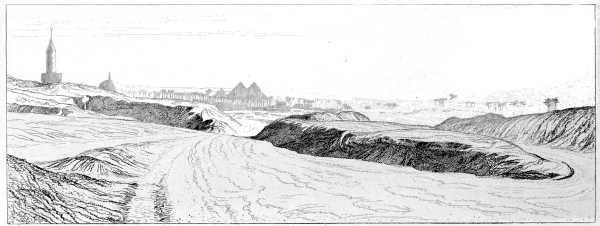
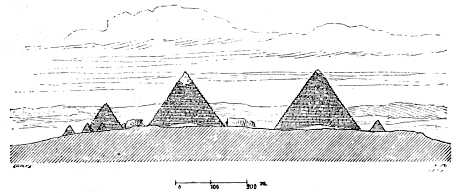
above the horizon (Plate I. 2).
The tourist's first visit is paid to the Pyramids, and many an
European leaves Egypt without seeing any other ancient building. He
thinks that he has qualified himself to discourse upon Egyptian
architecture because a few shouting Arabs have landed him, exhausted,
upon the topmost stone of the pyramid of Cheops, and have painfully
dragged and thrust him along those passages of the interior which will
ever be among his most disagreeable recollections. During all this his
eyes and thoughts are entirely given to the preservation of his own
equilibrium, and he sees nothing of the real constitution of the
structure he has come to visit.
In spite of the wonderful panorama which repays the fatigues of the
ascent, and of the overpowering impression made upon the mind by their
colossal mass, the Pyramids, as we see them to-day are far from being
the most complete and interesting of the sepulchral monuments left to
us by the early dynasties. The largest and best preserved are not so
old as some of the tombs in the necropolis of Memphis, and, royal
burying-places as they are, their arrangement and ornamentation are
less rich and expressive than those of many sepulchres built by
private individuals. Many of the latter, in their comparatively
restricted dimensions, answer better to the definition of a tomb
suggested to us by our study of the national beliefs.
We shall, therefore, reserve the Pyramids for future treatment, and in
our review of the successive forms taken by sepulchral architecture,
we shall assign the first place to those private tombs, dating from
the Ancient Empire, which are to be found in the necropolis of
Memphis. Notwithstanding a few differences, to which we shall refer
hereafter, these tombs, as a whole, can be traced to a single type, of
which Lepsius was the first to perceive the interest.[158] This type,
which was first clearly brought to light by the many and deep
excavations carried out by Mariette, has been known for some years
past by the Arab term mastaba,[159] which means literally a bench,
a bench of stone or wood. This name was given by the labourers
employed upon the excavations, and seemed well adapted to their long
and low shapes, which bear some resemblance to those divans, or
ottomans, which are found in every room of an oriental dwelling.
Mariette was struck by the fitness of the expression, and used it ever
after to designate that particular kind of tomb.
Mariette will be our constant guide in this part of our study. After
having opened many hundreds of these monuments, he published in
the Revue archéologique, what we may call a theory of the
mastaba.[160] In all essential matters we shall allow his words to
speak for themselves; when he enters into more detail than is
necessary for our purpose, we shall content ourselves with epitomizing
his descriptions.
The space over which the monuments which we propose to describe are
spread, is on the left bank of the Nile, and extends from Abou-Roash
to Dashour; it is thus, in all probability, the largest cemetery in
the world, being more than fifteen miles in length, and of an average
width of from two to two and a half miles.[161] It was, in a word, the
burial-place for Memphis and its suburbs, and Memphis seems to have
been the largest city of Egypt, and to have boasted an antiquity which
only Thinis could rival. Excavations have failed, apparently, to
confirm the assertion of Strabo, who describes the early capital of
Egypt as reaching to the foot of the Libyan chain. On the contrary, it
seems to have been confined between the canal which is called the
Bahr Yussef and the Nile. It would thus have formed a very long and
rather narrow city, close upon the river, of which the site may still
be traced by the more or less barren hillocks strewn with blocks of
granite and fragments of walls, which crop up from the plain between
Gizeh and Chinbab. For forty centuries there was a continual
procession of corpses from Memphis itself, and probably from towns on
the other side of the Nile, such as Heliopolis, to the plateau which
lies along the foot of the Libyan chain. The formation of this plateau
makes it peculiarly well adapted for the purpose to which it was put.
It consists of a thick bed of soft limestone, covered by a layer of
sand which varies in depth from many yards to a few feet according to
the inequalities of the ground beneath it.
It was easy, therefore, either to lay bare the rock and to construct
the tomb upon it, or to dig the mummy pits in its substance, and the
winds might be trusted to quickly cover the grave with sand which
would protect it when made. The same sand covered the coffinless
corpse of the pauper with its kindly particles. Age after age the dead
were interred by millions in this great haven of rest. At first there
was plenty of room, and the corpses were strewn somewhat thinly in the
sand,[162] but with time economy of space had to be practised, until
at last bodies were squeezed into the narrowest spaces between older
inhabitants. Sometimes these new comers even intruded into the tombs
of those who had gone before them, and that without always troubling
themselves to conceal their usurpation by effacing the name of the
rightful owner.[163]
The number of tombs was increased to a prodigious extent by the
non-employment of those family tombs which, as we shall see, were made
use of by the Phœnicians, the Greeks, and the Etruscans. The
Egyptian sepulchre was a personal appanage. The husband and father of
a family admitted into it only his wife and such of their children as
died young. The son, when he in turn became the head of a family,
built a tomb for himself. Each generation, each human couple marked
their passage through the world by the erection of a new tomb.
All the mastabas belong to the period of the Memphite empire. Those
who built them were able to give free play to their fancies, and to
develop the structure, both above and below ground, both in
arrangement and in decoration, to any extent they pleased. We may
therefore look upon them as the freest, the most spontaneous, and the
most complete expression of the ideas formed by the men of that remote
age concerning death and the life beyond the grave.
The mastabas of Sakkarah will receive most of our attention, and in
describing them we shall often have occasion to quote the words of
Mariette.[164] Those which are to be found in the more northern part
of the necropolis, in the neighbourhood of the Great Pyramid, differ
only in unimportant details from those at Sakkarah. The general
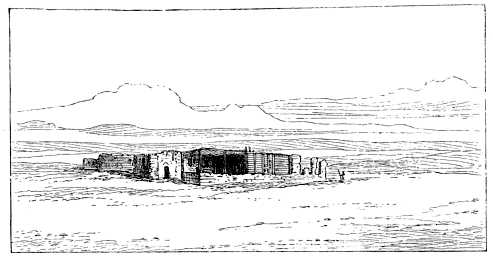
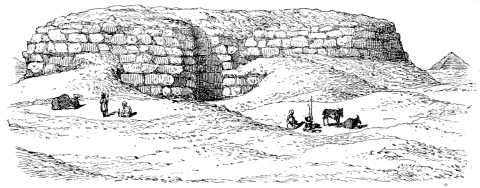
appearance now presented by these monuments may be guessed from the
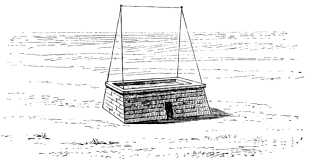
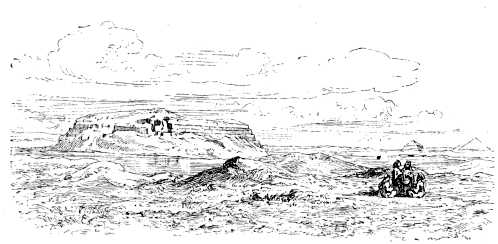
sketch which M. Bourgoin has sent us of the tomb of Sabou (Fig. 106).
The other mastabas figured by us have all been more or less restored.
"The mastaba is a massive structure, rectangular on plan, with four
faces of plain walling, each being inclined at a stated angle towards
their common centre. This inclination has led some people to assert
that it is nothing more than an unfinished pyramid. Such an idea is
refuted, however, by the fact that the divergence from the
perpendicular is in some cases so slight that, were the walls
prolonged upwards, their ridges, or arêtes, would not meet for some
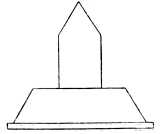
eight or nine hundred yards. The mastaba might be more justly compared
to the space comprised between two horizontal sections of an obelisk,
supposing the obelisk to have an oblong base.
Fig. 106.—Actual condition of a mastaba.
The tomb of Sabou. Drawn by Bourgoin.
"The major axis of the rectangle upon which these structures are
planned, always runs due north and south, and at the pyramids of
Gizeh, the necropolis of the west, they are arranged upon a
symmetrical plan so as to resemble a chess board on which all the
squares are strictly oriented.[165] The more carefully built mastabas
are oriented according to the true astronomical north. All the others
show the same intention, and, in those instances where an error of a
few degrees is to be discovered, it is to be clearly attributed to
carelessness on the part of the builder, a common fault in these
tombs, and not to a difference of intention. We often find that the
northern face is not strictly parallel to the southern, nor that on
the west to that on the east.
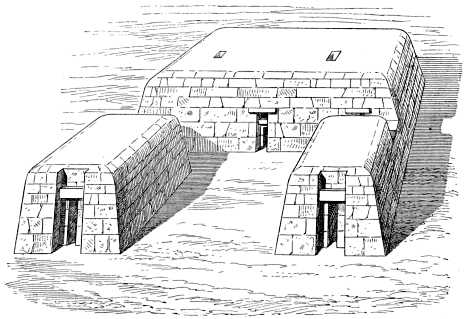
Fig. 107.—Three mastabas at Gizeh.
Perspective view, after the plan of Lepsius.
(Denkmæler, vol. i. pl. 24.)
"Although not varying much from true orientation, the mastabas of
Sakkarah are not arranged with the symmetry which distinguishes those
on the south and west of the Great Pyramid.[166] They are sprinkled
about in a rather haphazard fashion. Here we find them well
interspaced and there actually placed one upon another. It follows
that the chess-board arrangement which is so conspicuous at Gizeh is
not here to be noticed. Even at Sakkarah there were streets between
the rows of tombs, but they are so irregularly placed, and they are
often so narrow, many of them being nothing more than blind alleys,
that the inexperienced visitor may well fancy himself in a maze.
"The Sakkarah mastabas are built either of stone or brick.
"The mastabas of stone are of two kinds: those of a very hard blue
siliceous limestone and those of a softer chalky limestone which is
found upon the spot. This latter stone was used for the Stepped
Pyramid. The tombs upon which it was used seem to be much the oldest
in the necropolis; they are also the least rich and important.
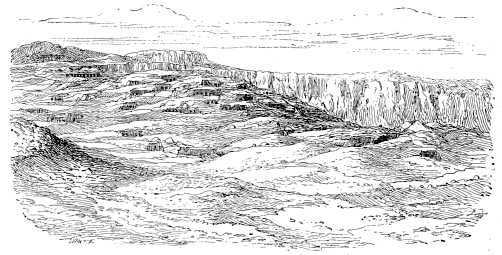
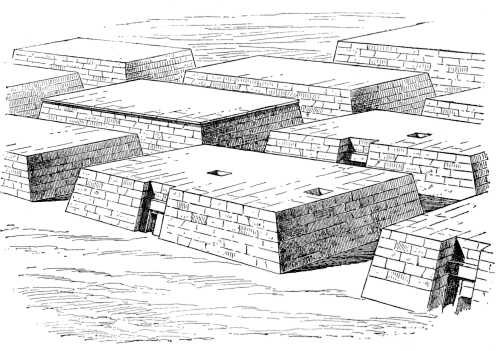
Fig. 108.—Restoration of part of the Necropolis of Gizeh.
"Our general notion of Egyptian architecture would lead us to look for
the use of huge stones in these mastabas, and, in fact, certain
important monuments, such as the Mastabat-el-Faraoun, and parts of
important monuments, such as the Temple of the Sphinx and the passages
and chambers of the greater pyramids, were constructed of very large
blocks. But the Sakkarah architects were more modest. Apart from the
ceilings, architraves and other places where big stones were
necessary, the blocks are of an average height of about half a yard,
with a proportionate length and thickness.
"The brick-built sepulchres are of two kinds also. The more elaborate
are of black brick, while a yellowish brick is used for the others.
The yellow bricks are a mixture of sand and pebbles with a little
clay; the black bricks are of earth and straw. The former are always
small (8·8 in. x 4·4 in. x 2·8 in.); the latter are comparatively
large (15·2 in. x 7·2 in. x 5·6 in.). Both kinds are dried simply in
the sun. The yellow bricks seem to be the more ancient. Their
employment begins and ends with the Ancient Empire. The black bricks,
on the other hand, appear for the first time about midway through the
fourth dynasty. At first they were rarely employed, but under the
eighteenth dynasty and those which followed it, they came to be
exclusively used."
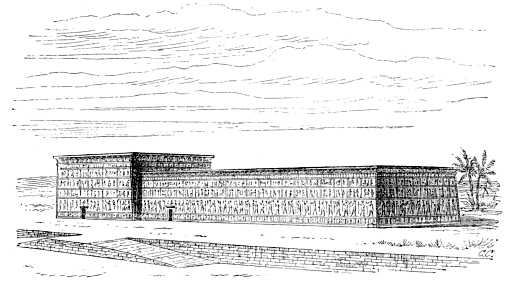
Fig. 109.—The Mastabat-el-Faraoun.
All these mastabas, whether of brick or stone, betray an amount of
negligence in their construction which is astonishing. Considering the
ideas which the Egyptians had formed of a future life, the chief
preoccupation of their architects should have been to give a stability
to their sepulchres which would have insured their perpetuity, and,
with it, that of the deposit committed to their charge. The whole of
our description will be pervaded by accounts of the minute precautions
devised to that end. "Now these mastabas are constructed with care on
their outsides alone. The core of their walls is composed of sand, of
rubbish, of blocks of stone mingled with the flakes struck off by the
masons, and all this in most cases without any cement to give it
coherence. The mastabas of Sakkarah are not homogeneous constructions
of masonry and cement, like the pyramids and most of the mastabas of
Gizeh. They are confused heaps of ill assorted materials, which would
collapse but for the retaining strength of their covering of solid
stone.
"At Sakkarah the outward faces of the mastaba are not smooth. Each
successive course is slightly set back from the one below it. At Gizeh
the walls form a smooth plane gently inclined from the perpendicular.
"There are mastabas of all sizes. That of Sabou measures 172 feet by
84; that of Ha-ar, 149 by 74; that of Ra-en-ma 169 by 81, and that of
Hapi no more than 25 ft. 6 in. by 19 ft. 6 in. In height they vary
less. The highest are not more than from 26 to 30 ft. high, the
smallest about 12."
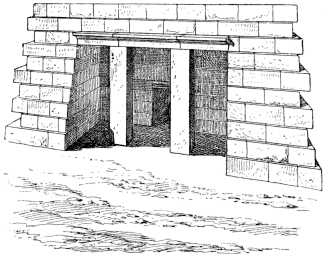
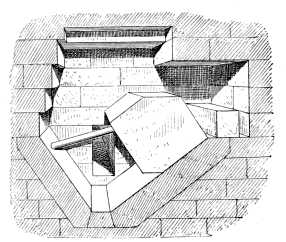
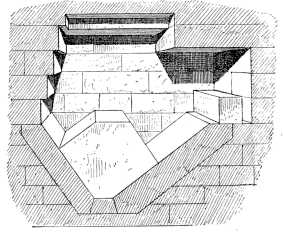
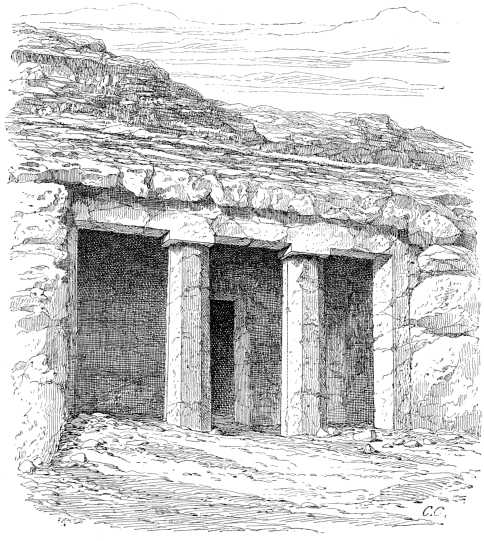
Fig. 110.—Entrance to a Mastaba at Sakkarah. Mariette.
The roof of the mastaba is a plain surface without irregularity of any
kind; but the soil above it is sprinkled with vases buried at a slight
depth. These vases are pretty evenly distributed, but they are rather
more numerous in that part of the soil which covers the ceilings of
the chambers, a circumstance of which Mariette often made use to guide
him in his excavations. Like all the vases of this epoch, those which
are found upon the roof of the mastabas are roughly made, pointed at
the bottom and without handles. They each contain a thin film of
yellow clay deposited by the water with which they were filled. They
were placed in their curious position under the notion that the water
which they contained would quench the thirst of the dead man below.
The mouths of the jars were covered with flat stones, and the water
would last long enough to satisfy at least the immediate necessities
of the inhabitant of the tomb.
"The principal face of the mastaba is turned to the east. In four
cases out of five the entrance to its chambers, when there is one, is
found upon this face. The general arrangement is, almost always, as
follows: 1. At a few metres distance from the north-eastern angle we
come upon a quadrangular niche or recess, very high and very narrow,
in the depths of which those long vertical grooves which distinguish
the steles of this epoch are carved upon the actual masonry of the
tomb. For this recess an unimportant stele, with or without
inscription, is occasionally substituted, or (2) we find, at a few
metres distance from the south-eastern angle, either a deeper,
larger, and more carefully built recess, in the depths of which a
monolithic stele of white limestone covered with hieroglyphs is
placed; or a regular architectural façade in miniature with a door in
the centre. When the recess is found near the southern angle of the
eastern face, the tomb begins and ends there. It has no internal
chamber, or rather, the recess acts as substitute for one. But when,
instead of the niche or recess, we meet with a door, we then know that
we have come upon a regularly completed tomb. The name of its
proprietor is often carved upon the lintel. Several of these lintels,
of a peculiar shape, are to be seen in the Louvre.
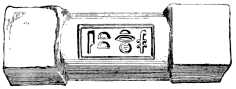
Fig. 111.—Lintel of the tomb of Teta, 6th dynasty. Louvre.
"Next after the eastern face, in relative importance, comes that which
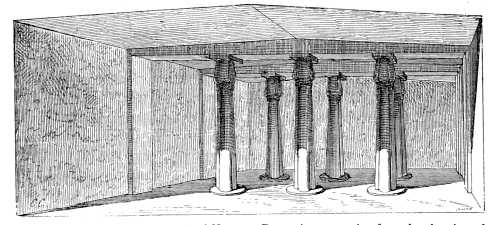
is turned to the north. When the entrance is in the northern wall the
door is invariably at the back of a kind of vestibule, in front of
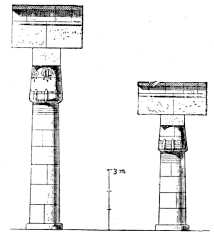
which are two monolithic columns, without base or capital, supporting
the architrave which, in turn, supports the roof.
"Still more seldom than in the northern face, the entrance is
occasionally found upon that which is turned to the south. This
exceptional arrangement is, in most instances, caused by some local
circumstance which may readily be perceived. When the entrance is on
the south its arrangement is sometimes the one, sometimes the other,
of the two which we have described.
"As for the western face, we have no evidence that it ever played any
more ambitious rôle than that of completing the inclosure. It is
always destitute of both openings and ornaments."
We have thus explored, with Mariette, the outside of the mastaba. We
have described its form and general aspect, we have noticed the
materials of which it was constructed, the principles upon which it
was oriented, and its average size. We have explained, too, how this
single type of sepulchre was repeated many thousands of times with but
slight variations, until, upon the plateau between Memphis and the
desert there gradually arose a metropolis of the dead more populous
than that of the living. It remains to describe the contents of those
huge blocks of masonry. We shall begin by visiting the chambers
planned by the architect in the building itself; we shall afterwards
penetrate, by the paths which modern curiosity has established through
the débris of ages and the depths of the soil, to those recesses of
the tomb which were meant to be for ever inaccessible.
The interior of a mastaba is composed of three parts—the chamber, the
serdab, and the well. The last-named of the three is the only part
which is never wanting. Many of the mastabas are, in fact, solid. In
them the chamber is in a very rudimentary condition, being represented
merely by one of those external niches which Mariette has described.
This arrangement was the earliest, and, as long as the mastaba
continued to be built, the less ambitious tenants of the necropolis
were contented to reproduce it. But in these pages, as in a natural
history, it is important to study the species when fully developed and
provided with all its organs. When we have clearly established a
general type nothing is more easy than to recognise and point out its
variations. It suffices to say here that some tombs are wanting in
one, some in another of those constituent parts whose meaning and uses
we shall attempt to determine, and that, in a few, they are of an
unaccustomed importance.
It is natural that we should first turn our attention to the chamber.
This was a kind of neutral ground upon which the quick and the dead
could meet, the former to present, the latter to receive the funeral
offerings.
"The interior of a mastaba may be divided into several 'chambers'
(there are three in the tomb of Ti), but generally there is only one.
It is entered by the door in the middle of the façade.
"These chambers have, as a rule, to depend upon the door for light,
but there are a few instances in which they are lighted from openings
in the roof. A remarkable example of the latter arrangement is to be
seen in the tomb of Ti, where the innermost chamber, which otherwise
would be in complete darkness, is lighted from the roof.
"The chamber is sometimes quite bare, sometimes covered with
sculptures and paintings such as those whose character and meaning we
have already pointed out. At its further end, and always facing
eastwards, stands the inscribed tablet or stele. There are some
chambers in which the walls are bare and the stele engraved, but there
are none where the walls are carved and the stele plain."
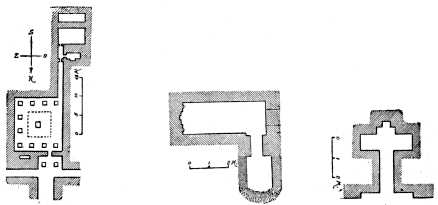
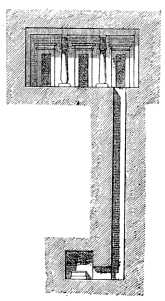
Fig. 112.—Plan of the tomb of Ti.
Figs. 113, 114.—Mastaba at Sakkarah, from Prisse.
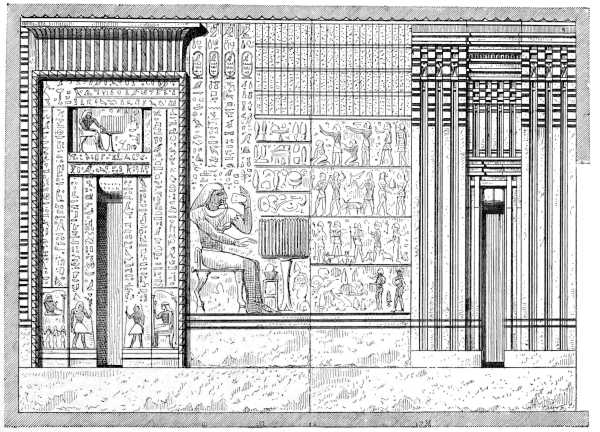
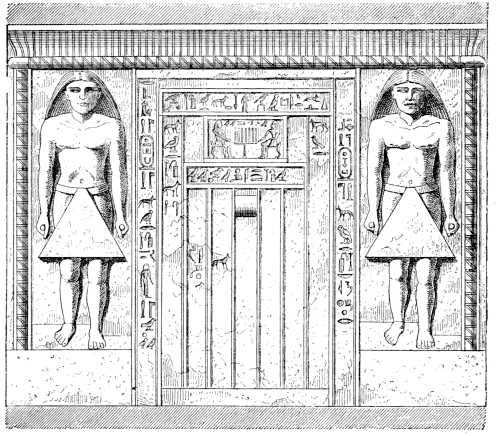
In the tomb of Ptah-Hotep, of which we reproduce the principal side,
the stele proper is on the left, but the figures and the funerary
inscriptions cover all the central part of the richly decorated wall
(Fig. 115).
We see, then, that the stele is the one indispensable part of this
complicated whole. It was, in fact, upon the formula with which it was
inscribed, that the Egyptians depended for those magical agencies by
which Osiris became the active medium of transmission between the
living and the dead.
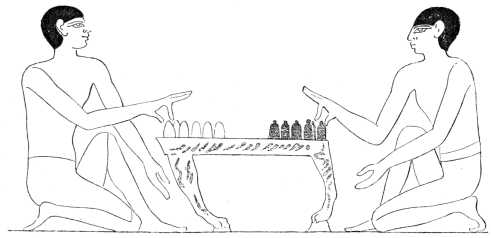
"At the foot of the stele there was often a table for offerings,
in granite, alabaster, or limestone. This was laid flat upon the
ground (Fig. 92).
Fig. 115.—Western wall in the chamber of the tomb of Ptah-Hotep,
5th dynasty.
Drawn by Bourgoin.
"As a rule this was the only piece of furniture in the chamber; but
occasionally we find, on each side of the stele and always placed upon
the ground, either two small limestone obelisks, or two objects in
that material resembling table legs hollowed out at the top for the
reception of offerings."
This chamber was left open to every comer. The entrance was in fact
left without a door. To this rule Mariette found but two exceptions in
the many hundreds of tombs which he examined.[167]
"Not far from the chamber, oftener on the south than the north, and
oftener on the north than the west, a passage in the masonry, high,
narrow, and built of very large stones, is found. The workmen employed
upon the excavations christened it the serdab, or corridor, and
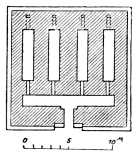
their name has been generally adopted."[168] In Figs. 116-119 we give
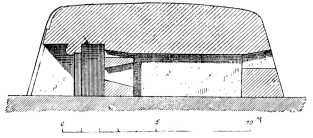
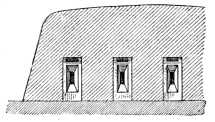
the plan and three sections of a mastaba at Gizeh which has four
serdabs.
"Sometimes the serdab has no communication with the other parts of the
mastaba, it is entirely walled in, but in other instances there is a
narrow quadrangular opening, a sort of pipe or conduit, which unites
the serdab with the chamber. It is so small that the hand can only be
introduced into it with difficulty.[169]
"The use of the serdab is revealed by the objects which have been
found in it; it was to hold one or more statues of the deceased. The
Egyptians believed these statues to be the most certain guarantees,
always with the exception of the mummy itself, of a future life for
the dead. Hidden from sight in their dark prison, they were protected
from all violence, while they were separated only by a few stones from
the chamber where the friends and relations met together, and the
conduit by which the intervening wall was often pierced, allowed the
smell of fruit and incense and the smoke of burnt fat to come to their
nostrils.[170]
Fig. 116.—Plan of a mastaba with four Serdabs. (Lepsius, i., pl. 24.)
Fig. 117.—Longitudinal section of the same mastaba.
"No inscriptions have been found in a serdab except those upon the
statues. And no objects other than statues have ever been found in a
serdab." So that the function of the serdab was to afford a safe and
final asylum to the statues. These were, no doubt, to be found in
other situations also, because, not to mention the numerous
bas-reliefs upon which the figure of the deceased appeared in the
chamber or in the niche which sometimes took its place, he was
sometimes portrayed in high relief, and of full life size, in the
public hall of the tomb.[171] Sometimes, also, we find a statue in one
of those front courts which, especially at the time of the fourth
dynasty, seem to have been in great favour. But this court, as well as
the chamber, was open to every chance passer by, and the statues
which they both contained were in continual danger from careless or
malicious hands. It was to guard against such chances as these that
the inventive architects of Egypt contrived a safe retreat in the
heart of the massive structure which should provide a reserve of
statues against every contingency. When all those which were exposed
to accident should have perished, these would still survive and would
furnish to the double the material support, the tangible body, to
which that phantom was obliged to attach himself unless he wished to
perish entirely.
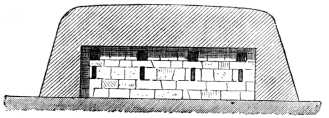
Fig. 118.—Transverse section through the chamber.
These precautions were not ill conceived. The serdab kept efficient
guard over its deposit; the museum of Boulak contains at least a
hundred statues from the ancient empire which were found at Sakkarah,
and nine-tenths of them were found in the serdabs.
Fig. 119.—Transverse section through the serdabs.
We have now described all those parts of the tomb which were above
ground. We have not been content with visiting the chamber only, which
was freely left open, we have penetrated into the farthest recesses,
and have discovered those secrets of the massive walls which their
constructor thought to hide for ever from the eye of man. But even yet
we have not arrived at the actual place of burial; we shall reach it,
however, through our third internal division, the well or pit.
"The well is an artificial excavation, square or rectangular in plan,
never round, at the bottom of which is the chamber in which the mummy
is deposited.
"To arrive at the opening of the well, we must mount to the platform,
or roof, of the mastaba (Fig. 122). As there was never any staircase
to a mastaba either within or without, it will be seen that the well
must have been a very inaccessible part of the tomb." In one single
instance, namely, in the tomb of Ti, the well is sunk from the floor
of the largest of the internal chambers, but whether it opened upon
the roof or upon the floor of the chamber, it was always closed with
the utmost care by means of a large flat stone.
Fig. 120.—Figures in high relief, from a mastaba at Gizeh,
5th dynasty (from Lepsius).
"The well is generally situated upon the major axis of the mastaba,
and, as a rule, nearer to the north than to the south. Its depth
varies, but, on an average, it is about forty feet. Now and then,
however, it has a depth of sixty-five or even eighty feet. As the well
begins at the platform and ends in the rock-carved mummy chamber, it
follows that it passes vertically first through the mastaba, secondly
through the rock upon which the mastaba is founded. The built part of
the well is carefully constructed of large and perfect stones, and in
this we find one of the distinguishing characteristics of the tombs of
the ancient empire." In the tomb of Ti the well takes the form of an
inclined plain like a passage in the pyramids. In the common form of
well the mummy pit could only be reached by means of ropes.
"When the bottom of the well is reached a gaping passage is seen in
the rock which forms its southern wall. This passage, which is not
high enough to allow one to walk upright, does not run quite parallel
to the axis of the mastaba. It is directed obliquely towards the
south-east, like the chamber above. Suddenly it becomes enlarged into
a small cavern, which is the mortuary chamber properly speaking, that
is to say, the room with a view to which the whole structure has been
planned and to which all its other parts are but accessories.
"This mortuary chamber is vertically under the public hall above, so
that the survivors who came together in the latter for the funeral
ceremonies had the corpse of the deceased under their feet, at a
distance which varied according to the depth of the well."
Fig. 121.—The upper chamber,
well, and mummy chamber.[172]
The mortuary chambers are large and carefully built, but generally
without ornament or inscription. Of all those explored by him Mariette
found but one which had its walls ornamented; in the middle of its
decorations, which he does not describe, he contrived to make out a
few phrases which seemed to belong to the Ritual of the Dead.
The sarcophagus was placed in one corner of the chamber. It was
generally of fine limestone, sometimes of red granite, and on a few
occasions of opaque black basalt. It was rectangular on plan with a
round-topped lid squared at the angles.
Mariette found none at Sakkarah with inscriptions. On the other hand
we find them upon the sarcophagus at Khoo-foo-Ankh, which was
discovered at Gizeh and belongs to the fourth dynasty
(Figs. 123, 124).
"The Egyptians did not always trust to the mere size and weight of the
lid for the secure closing of the sarcophagus. The under-side of the
cover is made with a rebate at its edge which fits into a
corresponding groove on the upper edge of the sarcophagus, and the two
edges were bound still more tightly together by a very hard cement.
Finally, as if all these precautions were not enough, wooden bolts
were affixed to the under-side of the lid which fitted into slots in
the sarcophagus and helped to render the two inseparable."
Fig. 122.—Double mastaba at Gizeh, transverse section
(from Lepsius, t. i., pl. 22).
So far as we can judge from the few human remains which have been
gathered from these ancient tombs, the process of embalmment was then
carried on in simple and elementary fashion, and it was this
imperfection that the Egyptians attempted to neutralize, by the
innumerable and complicated precautions which they took to insure that
the corpse should not be disturbed in its envelope of stone. In later
times, when the preparation of the mummy was better understood, they
were not so careful to seal up the sarcophagus from the outer air.
"The furniture of the mummy chamber comprised neither statues, nor
funerary statuettes, nor amulets of any kind. Sometimes a few ox bones
bestrew the ground. Two or three large and pointed red vases,
containing nothing but a thin deposit of clay, rest against the walls.
Within the sarcophagus we find the same sobriety of sepulchral
furniture. Beyond a wooden or alabaster pillow (Fig. 105) and half a
dozen little drinking cups of alabaster, nothing has been found there
but the mummy itself."
Fig. 123.—Sarcophagus of Khoo-foo-Ankh. Perspective after Bourgoin.
Red granite. Height 1·33 metres. Boulak.
These beef bones must be the remains of the quarters of meat which
were placed in the tomb for the nourishment of the dead. No scene is
more frequently represented upon the walls of the public chamber of
the mastaba than the killing and flaying of victims for the funeral
ceremonies (Fig. 125). Like those which are found upon the roof, the
vases must have held water for the double. The pillow was placed under
the head of the mummy, it was the one he had used during his life. As
for the drinking cups, their use has not yet been determined, so far
as we know.
"As soon as the mummy was in the sarcophagus, the sarcophagus sealed,
and the various objects which we have described in place, the opening
at the bottom of the well was walled up; the well itself was filled
with stones, earth, and sand, and the dead was left to his eternal
sleep."[173] These precautions make it no easy thing to reach the
mummy chamber. To find the entrance to the well is the first
difficulty, and when it is found, many hands and no little time are
required to remove the rubbish with which it is filled. The only
mechanical helps which the Egyptians have ever used in such work are
those which we ourselves have seen in the hands of Mariette's
labourers, namely, the wooden shovel and the little rush basket which
is filled with a few handfuls of sand and pebbles, and then carried on
the head to be emptied at a convenient distance. It may be guessed how
many journeys to and fro have to be made before a few cubic yards of
débris are cleared by such means as this!
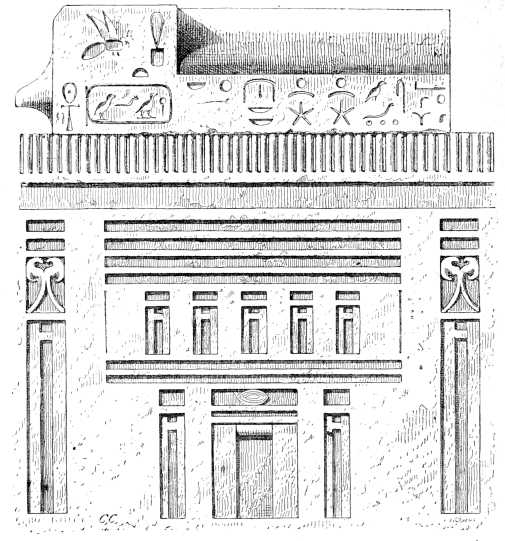
Fig. 124.—Details of the Sarcophagus of Khoo-foo-Ankh.
We have so far followed Mariette, and have frequently had to make use
of his ipsissima verba. To his pages and to the plates of the great
work of Lepsius, we must refer those readers who are not contented
with being told general rules but wish to know the exceptions also. We
shall not go into all the changes which variety of taste and the
progress of art introduced into the arrangement and decoration of
Egyptian buildings; they do not affect the general statements which we
have made. We shall not re-state the evidence which enabled Mariette
to apportion the 142 painted and sculptured mastabas explored by him
in 1869, to the first six dynasties. It is certain that those
monuments form a chronological series extending over a space of from
twelve to fifteen centuries, and that during the whole of that long
period, the general character of Egyptian sepulchral architecture
remained unchanged.
Fig. 125.—Bas-relief from Sakkarah. Boulak.
We should here, perhaps, in order to make our description complete,
attempt to convey a true idea of the reliefs which cover the sides of
the chamber, and of the statues which fill the serdab. We should,
perhaps, by a judicious choice of examples, endeavour to estimate
their style and composition; but we shall postpone all such
examination until we come to treat of sculpture, and of the way in
which the earliest Egyptian artists treated the human form. A didactic
and analytic method is so far despotic that it compels us, in order to
marshal our facts and to make them easily understood, to separate
phenomena which are intimately connected, and to destroy the unity of
natural groups. We have thus been driven to separate the figured
decorations of the tomb from the architectural arrangements which
enframe and support them; with the latter, alone, are we now
concerned.
We may sum up the foregoing details by the following general
description of the Egyptian tomb as it was established in the early
ages of the national life, in those years when the national
civilization put on the form and colour which it retained until the
last days of antiquity.
This tomb, when complete, included (1) a built up part which, being
raised well above the surface of the soil, was a conspicuous object in
the landscape; and (2) a subterranean part cut in the living rock
which was never more than a few feet below the surface of the sand.
The constructed part inclosed a chamber which was sometimes internal
and sometimes external, a chamber in which the relations of the
deceased deposited the funeral offerings, and in which the priests
officiated before the stele, to which the most conspicuous place was
always given. Sometimes this chamber is nothing more than a recess in
the façade, a mere frame for the stele. The structure also contains
a retreat in its thickness where the statues of the deceased were
walled up. The subterranean part is composed of the well and the mummy
chamber. The well is sunk from different parts of the building;
usually traversing its whole depth; it leads to the mummy chamber
which is found at varying depths in the bowels of the earth.
Such are the constituent elements of the mastaba, that is to say, of
those private tombs which were contemporary with the Pyramids. All
over Egypt, in every one of the cemeteries, no matter where they are
situated or what their date, the same elements are to be found,
modified in certain particulars by the rank of the deceased, by the
nature of the soil, by the size of the tomb, and by the changes of
fashion, but always to be easily recognized. Of all these elements
there is but one which does not persistently reappear in monuments
other than the mastaba, and that is the serdab. This retreat for
statues has not, as yet, been found in any of the royal tombs of the
first six dynasties, neither has it been met with in the tombs of the
two Theban empires, or of later epochs. And yet it was connected with
one of the most vital hopes of the Egyptian religion. It fulfilled in
the happiest manner, one of the conditions imposed upon the Egyptian
architect by the strange conceptions of a future life which we have
described. Why then do we, as a rule, find the serdab only in the
mastabas of the Memphite necropolis? Its absence under the Theban
princes is, perhaps to be explained by the progress made in the
science of embalming. The heads of more than one mummy have now been
exhibited in the cases of European museums for many years, and, in
spite of the dampness of our climates, they still preserve their skin,
their teeth and their hair (Fig. 126). When they had learnt the secret
of preserving the body from corruption, so that after a long series of
centuries it should be pretty much in the same condition as on the day
after death, they did not indeed, cease to make those images which
were supposed to guard the double from annihilation, but they
attached less importance to their safety, and took less trouble to
hide them. They considered that they had done enough for their
preservation by putting them in the precincts of their tombs and
temples, and so under the guardianship of their venerated religion.
As for the other parts of the tomb, a little attention will always
suffice for their identification even in those sepulchres which differ
most from the mastaba. In some instances we shall find the mummy
chamber contrived in the upper structure, in others the whole tomb is
cut in the living rock. Sometimes we find the chapel, as we may call
the public chamber in which the miraculous nourishment of the double
took place, more or less distantly separated from the mummy chamber;
sometimes the well almost disappears, sometimes it ceases to be
vertical and becomes a long corridor with but a gentle slope. As a
rule all these variations are easily explained, and may be connected
without difficulty with that primitive type which we have attempted to
define by its most wide-spread and constant features.
Fig. 126.—Head of a Mummy. Louvre.
Another method of sepulture was made use of in the Ancient Empire, a
method which afterwards came into general use in Egypt, we mean the
hypogeum, or subterranean tomb. The Egyptian Commission has
described several rock-cut tombs in the neighbourhood of the Pyramids,
especially some which face the western slope of the Second Pyramid.
Similar tombs are to be found near the pyramid of Mycerinus. Some of
these sepulchral grottos declare their extreme antiquity by their
imitations of wooden architecture;[174] others by their inscriptions
dating from the fourth and fifth dynasties. We shall not dwell long
upon these rock-cut tombs. They are generally composed of one or two
small sculptured chambers, upon one of which the well opens which
leads to the mummy chamber. We shall postpone their study to a later
chapter, as the time of the Middle Empire affords us richer and more
complete examples of them than the earlier period; but, indeed, the
New Empire has left us the most important examples of this kind of
sepulchre. We shall here content ourselves with pointing out that the
architects of Memphis did not ignore the facilities offered by the
easily cut limestone rocks, not only for construction of well and
mummy chamber, but also for those open parts of the tomb where the
funeral rites and the ceremonies of the Ritual of the Dead were
performed. In the whole course of her long vitality Egypt did little
more, either in art or religion, than develop, with variations, the
themes presented to her by the generations which were ruled by her
first six dynasties.
The mastaba was the private tomb of the great lord or rich citizen
of primitive Egypt; the pyramid was the royal tomb for the same
epoch, the tomb of that son of the gods, almost a god himself, before
whom all foreheads were bowed into the dust. As his head towered over
those of his prostrate subjects during life, so, after death, should
his sepulchre rise high above the comparatively humble tombs of his
proudest servants. The most imposing mastabas, before the sand had
buried them to the summit, must have looked small enough beside those
prodigious masses. They were ant-hills at the foot of a palace.
It may seem that in considering the mastaba before the pyramid we have
reversed the natural order. We were led to do so by the fact that the
enormous mass of the pyramids and their peculiarities of construction
compelled their architects to separate elements which are found
closely allied in the mastaba. In consequence of this separation the
elements in question have not all had the same fate. In the case of
the mastaba all survived or perished together, but, in the pyramids,
some are in a marvellous state of preservation, while others have
disappeared and left hardly a trace behind. We are therefore obliged
to make use of the private tomb in our restoration of that which was
peculiar to the king.
Philologists have attempted to trace back the etymology of the word
πυραμίς
to the ancient language of Egypt. The term was first
employed by the Greeks, and from their language it has been adopted
into that of every civilized nation, with a meaning which is
scientifically exact. Its origin has been sought for in the coptic
term pi-rama, height, and in the term pir-aa, which occurs
continually in Exodus, and was used by Moses to signify the reigning
Pharaoh. But egyptologists now seem to be unanimous in rejecting both
these derivations. They are, we are told, refuted by the fact that the
terms which are supposed to have meant a pyramid are never used in
that sense in any of the texts. 'The words which mean a royal tomb or
a tomb of any kind, have not the remotest likeness,' says Herr
Brugsch,[175] 'to the term
πυραμίς.
Each royal pyramid had
its own name, a composite epithet which was peculiar to itself.' Thus
the largest of them all was called "the brilliant dwelling of
Choufou;" the second, "the great;" the third, "that which is on high."
The word pyramid appears therefore to be a purely Greek term,
derived from
πῦρ, fire, and suggested by the similarity
between its shape and that of a tongue of flame.
We shall not waste our time in noticing and refuting those fantastic
explanations of the pyramids which have been given in modern times. We
shall not trouble ourselves to prove that they were not observatories.
Those sloping tunnels, at the bottom of which some modern writers
would set unlucky astronomers to watch the passage of stars across the
meridian, were hermetically sealed, and minute precautions were taken
with the sole object of obstructing and concealing their entrance. The
four slopes of the pyramid faced to the cardinal points, simply
because the orientation of the tomb was habitual with the Egyptians;
we have already explained its meaning. Still less need we occupy
ourselves with the theory, which made, however, some stir in its time,
that the pyramids were bulwarks by which the ancient Egyptians
attempted to keep back the sand from the fertile valley of the Nile.
The science of M. de Persigny was well worthy of his policy. There was
in both, the same turn for fantastic invention, the same want of
reflection and common sense. If such a costly barrier had been either
useful or necessary it should at least have been prolonged from one
end of Egypt to the other, and all the pyramids would not have been
found assembled, with but few exceptions, in the neighbourhood of
Memphis.[176]
No one in our day thinks of either starting or discussing such
theories as these. There are, of course, several obscure points in the
history of the pyramids, several details of their construction, which
stimulate to fresh research and lend themselves to many different
explanations; but there can be no doubt as to their general character.
Their exploration and the interpretations of the Egyptian texts have
confirmed the assertions of those Greek writers who were most familiar
with Egypt, such as Herodotus,[177] Diodorus Siculus,[178] and
Strabo.[179] The Pyramids are sepulchres. "They are massive, simply
conceived, carefully sealed up tombs. All entrance is forbidden even
to their most carefully built corridors. They are tombs without
windows, without doors, without exterior openings of any kind. They
are the gigantic and impregnable dwellings of the mummy; ... their
colossal dimensions have been invoked to bear out the arguments of
those who would attribute to them some other destination, but they are
in fact to be found of all sizes, some being no more than twenty feet
high. Besides this, it must be remembered that in all Egypt no
pyramid, or rather group of pyramids, is to be found, which is not the
centre of a necropolis, a fact which is enough by itself to indicate
their funerary character."[180] It is proved still more definitely, if
that be possible, by the sarcophagi which have been found in the
internal chambers, empty in most cases, because those chambers had
been entered and despoiled, either in the days of antiquity or in
those of the middle ages, but sometimes intact, as in the pyramid of
Mycerinus. The pyramids were hermetically sealed. Even without direct
evidence we might assert that it was so, knowing as we do the
precautions which the Egyptians took elsewhere to guard their tombs
against intrusion; but direct proof of the fact is not wanting. When
in the ninth century the Kaliph Al-Mamoun wished to penetrate into the
Great Pyramid he was only enabled to do so by breaking into it
violently, near the centre of its northern face, and thus stumbling
accidentally upon the descending passage at some distance from its
mouth. That he was reduced to employ this method at the risk of
meeting with nothing but the solid masonry shows that no external
indication had been left of the opening through which the mummy had
been carried in. The casing seems to have been then complete and
consequently the four sides of the Pyramid must have been free from
débris and generally uniform. That the Arabs should have chosen the
right side for their attack was perhaps owing to the survival of some
ancient tradition indicating the northern side to be that of the
entrance, which, as a fact, it has been found to be in all the
pyramids as yet explored. Perhaps too the Arabs may have been guided
by the traces of previous attempts made either in the time of the
Persians or in that of the Romans.[181] However this may be it is very
certain that had they perceived any signs of an original doorway, they
would have directed their attentions to it. Those who seek for
treasure do not, like archæologists, strike out lines of exploration
in all directions for the satisfaction of their curiosity, they go
straight to their point.
The pyramid includes two of those four parts into which we have
divided the typical Egyptian tomb; it contains the well and the mummy
chamber. As for the funerary chapel, there were obvious difficulties
in the way of including it in the thickness of the monument itself. It
would have been difficult to preserve it from being crushed by the
immense weight above it, and as it would have had to be lighted from
the door alone, it must always have been of the most restricted
dimensions. A different arrangement had therefore to be devised from
that adopted in the case of the mastaba. The open part of the monument
was separated from that which was destined to be sealed up from the
outer world. The chapel or temple, in which the successors of the
prince buried in the pyramid and the priests told off for its service
performed the prescribed rites, was erected at some distance from the
eastern face. The remains of such buildings have been found to the
east of both the second and third pyramids. That of Cheops has not
been discovered, but we may assert with confidence that it has either
been destroyed by the hand of man, or that it still lies under the
veil of sand. Were there any serdabs concealed in the thickness of
the temple walls? That question cannot be answered. The remains of
those buildings are in such a condition that all traces of such an
arrangement would have vanished had there been any. The walls have
disappeared. The lower courses of masonry are still in place, and
allow us to follow the very simple plan upon which these chapels were
erected; and that is all. It is possible, however, that the Egyptians
depended solely upon the profound respect which was felt for the royal
person, combined with the sacredness of the spot and the vigilance of
the established priesthood of the necropolis, to preserve the august
images of the sovereign from insult or destruction. The seven or eight
statues of Chephren which were found at the bottom of a pit in what is
called the Temple of the Sphinx, were all more or less mutilated,
proving that this want of precaution was sometimes disastrous. In the
course of so many centuries, during which the Hyksos, the Ethiopians,
the Assyrians, and the Persians overran the country by turns, such
statues as were not sheltered in some well dissembled retreat must
more than once have been struck off their pedestals and broken, or,
like those of the unlucky Chephren, thrown head-foremost into the
depths of the earth.
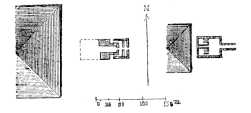
Fig. 127.—Plans of the temples belonging to the second and third pyramids;
from Perring.
As such vast importance was attached to the preservation of the
portrait statues upon which the prolongation of life after death was
made so largely to depend, is it not probable that the idea of hiding
some of them in the innermost recesses of the pyramids themselves may
have occurred to those who caused those monuments to be built? It is
obvious that no hiding-place could be more secure. No such retreats
have yet been discovered in any of the galleries which have been
explored by modern curiosity, but it does not follow that they do not
exist in some corner which has not yet been reached, which will
perhaps never be reached by the most persevering explorer. Quite
lately M. Maspero believed that he recognized a serdab in a
subterranean chamber with three niches which he found near the mummy
chamber in the Pyramid of Ounas, the last king of the fifth
dynasty.[182] Before we could say that such an arrangement does not
exist elsewhere, we should have to take some pyramid to pieces from
the first stone to the last. It might, however, be asserted that the
images of the deceased would, if hidden in the pyramid, be too far
removed from that public hall to which his relations brought their
offerings and their pious homage. At such a distance they would not
have heard the friendly voices or the magic chants; nor would the
scent of the incense have reached their nostrils. In a word, they
would have been ill placed for the fulfilment of the office assigned
to them by the Egyptian faith.
We have hitherto spoken only of the social purposes of the pyramid, of
its office as the sepulchre of the ancient kings of Egypt, or rather
as the part of that sepulchre that corresponded to the least
interesting parts of private tombs. In the plants of our gardens and
orchards, we see cultivation develop certain organs at the expense of
others. We find stamens changed into petals, giving us double flowers,
and the envelope of the seeds thickened and made to shed perfume. We
see the same process of development in the tombs of the early Egyptian
monarchs. Under the influence of their pride of station, and as a
consequence of the effort which they made to perpetuate their rank
even after death, the stone hiding-place which protected the mummy
took a size which is oppressive to the imagination, while the funerary
chapel remained of modest dimensions. This disproportion is to be
easily explained. The simple method of construction which
distinguishes the pyramid permitted almost indefinite extension,
while architecture, properly speaking, was not yet sufficiently
advanced to make use of those grandiose orders which distinguish the
porticos and hypostyle temples of the Theban period.
We have now to consider the pyramids from another point of view, from
that of their probable origin, of their variety of form, and of the
materials of which they are composed. Descriptions of these monuments,
such as those contained in the great works of Vyse[183] and
Perring[184], works which gave to the world the accumulated results of
long and costly explorations, must not be looked for in these volumes.
We do not think it necessary that we should give even a succinct
account of the more important pyramids, such as that given by Bædeker
or Isambert. Such a proceeding would be a mere duplication of those
excellent manuals, and would moreover, be foreign to the purpose which
we have before us. We take the pyramids as known. The two books just
mentioned are within the reach of all. Thanks to the precise
information and the numerous figures which they contain, we may
content ourselves with making a few general observations. Some of
these observations will refer to the pyramids as a whole, some to the
peculiarities of construction which distinguish a few, peculiarities
which do not affect that general type which seems to be as old as the
Egyptian monarchy itself.
As soon as a society had sprung up on the banks of the Nile which
attempted to organize itself under the directing lead of chiefs or
headmen, the latter seem to have been stung by the desire to make
known their final resting-place by some conspicuous sign. The most
simple way of arriving at the desired result was to heap up the earth
over the corpse, so as to form an artificial hillock which should be
visible from a distance over the level plain. This was the origin of
that funerary mound which modern archæologists call a tumulus. The
tumulus is to be found in most districts of the ancient as well as of
the modern world. But to confine ourselves to our own province, it is
to be found in pre-Christian times among the Scythians of Herodotus
and our ancestors the Gauls, as well as among the Greeks of the heroic
age. We all know the frequent expression of Homer,
σῆμα χεύειν,
which is literally to display a signal, that is to say, to
accumulate over the corpse of a warrior a sufficient number of
spadefuls of earth to signalize it, for the worship and admiration
of posterity. Tradition ascribes those tumuli which are yet to be seen
on the plain of Troy to the observance of this custom.
The funerary architecture of Egypt commenced in the same fashion, in
those distant ages which were called by the Egyptians themselves the
times of Hor-schesou or slaves of Horus. We cannot doubt that the
pyramid sprang from the mound. Its birth must have taken place after
Menes had, by uniting the various tribes under his own sceptre, caused
the whole race to take a distinct step onwards in civilization. The
pyramid is but a built mound. It is a tumulus in which brick and stone
take the place of earth. This substitution adds very greatly to its
chances of duration, and makes it a much safer place of deposit and a
much more lasting monument for the body committed to its charge. The
Nile mud, when moulded and dried in the sun, gave bricks which still
remain good; their manufacture and their constructive use seem to have
been understood by the Egyptians as soon as they emerged from
primitive barbarism. Thanks to the facilities thus afforded, they were
enabled to build monuments upon the graves of their rulers which could
offer a better resistance to injuries of time and human enemies than a
few handfuls of earth and grass. They began, perhaps, by placing a few
blocks of stone upon their mounds, so as to fix them more securely, or
by covering them with a thin coat of brickwork. But, after a few
experiments in that direction, they found it better to construct the
whole body of the tumulus in the harder material. Its size increased
with the constructive skill and material appliances of its builders,
until it became first a hillock and finally a mountain of stone, with
the impenetrable rock for its base and flanks of solid masonry.
The built-up tumulus of masonry took a form very different, in its
definite lines, from the rounded slopes of the mound. The squared
forms of brick or cut stone infallibly give to the edifice upon which
they are employed one of those more or less rigid forms which are
defined by geometry. When they leave the hands of the builder they are
either cubes or parallelopipeds, pyramids or prisms, cylinders or
cones. They present the general appearance, they possess the essential
properties, of one of those forms. We may say that architecture was
born on the day when man began to use the unyielding materials by
which definite geometrical forms can alone be given. As soon as this
early development was reached he set to work to combine those
elementary forms in different proportions and to add to their effect
by elegance and richness of decoration, and so in the end to form
national architectures.
When the first pyramid was built upon the borders of the desert man
was on the threshold of the movement to which we have referred. The
form adopted for the royal tomb was one of the most simple which could
be chosen for a building. The most simple of all would have been the
tetrahedron, or pyramid built upon a triangular base. But not a
single pyramid of that kind has been discovered in Egypt. The whole of
the pyramids, large or small, are built upon a right-angled base, and
in most instances upon one with sides practically equal.[185] Mystic
reasons for this shape have been given. It has been said that each
face was dedicated to one of the four powers of Amen, which
corresponded to the cardinal points of heaven.[186] We are not yet
sufficiently well acquainted with the genesis of the Egyptian religion
to be able to decide how far into the past the four powers of Amen may
be traced: but it is quite possible that they were derived from the
four faces of the strictly oriented pyramids. Were we inclined to
enter into this discussion we should rather, perhaps, attribute the
shape of the pyramid to the prevailing Egyptian desire to turn one
face of their tombs towards the west, the abode of the dead, and
another to the east, whence the hoped-for resurrection was to come.
The three-sided pyramid would not have lent itself to such an
arrangement.
There is also something unpleasant to the eye in the sharp angles
which form the three arêtes of the tetrahedron; it looks as if there
had been a lack of material, and as if the structure would suffer in
consequence. The four-sided pyramid has more dignity and more
amplitude; its four faces, placed back to back in pairs, seem to
counterpoise and sustain each other in a fashion which is impossible
in the case of the tetrahedron.
Fig. 128.—Plan of the Pyramid of Cheops.
The one characteristic possessed in common by those relics of the
Ancient Empire which we call pyramids, is their four-sidedness. To an
attentive observer these buildings offer more diversities than would
at first sight be believed. From Meidoum in the south to Abou-Roash in
the north is a distance of 43-1/2 miles as the crow flies. Between
these two points, which may be called the northern and southern
boundaries of the pyramid field, about one hundred have been
discovered, sixty-seven of which have been examined by Lepsius. Now,
in this whole number there are not two which resemble each other in
all particulars, or which seem to be copies of one model. We do not
refer only to their height, which differs in an extreme degree. The
three large pyramids at Gizeh are 482, 454, and 218 feet high
respectively, while at their feet are several little pyramids which
hardly exceed from 50 to 70 feet of vertical height. Between these two
extremes many of intermediate sizes may be inserted. The Stepped
Pyramid, near Sakkarah, is about 190 feet high; the largest of those
at Abousir is about 165; one of those at Dashour is not quite 100
feet. These differences in height are easily explained by one of those
national habits to which we have already alluded. Every Egyptian, as
soon as he arrived at years of discretion, set about building his own
tomb. He dug the well and the mummy chamber, he caused the sarcophagus
to be carved and the funerary chapel to be built. It often happened
that those who had ordered such works died long before they were
finished, and it would seem that their heirs were content with doing
no more than was strictly necessary. They placed the mummy in its
grave with the prescribed ceremonies, they filled up the well and
sealed the private parts of the tomb; but being occupied with the
preparations for their own funeral, they did not continue the
decoration of the chapel, which thenceforward remained in statu quo.
Thus only can we explain the state in which several important tombs
have been discovered both at Memphis and at Thebes. On one wall we
find paintings and sculptures carried out with the greatest care and
finish, while on another nothing is to be seen but the first rough
outline, in red paint, by the artist charged with the undertaking. The
completion of the work must have been suddenly arrested by the death
of the destined inhabitant of the tomb.
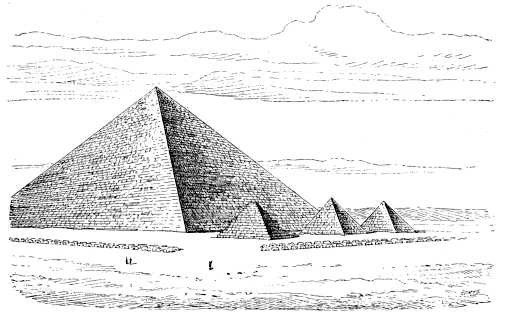
Fig. 129.—The great pyramid and the small pyramids at its foot; from Perring.
It was the same with the sepulchres of the kings. Each sovereign began
the construction of his pyramid as soon as he found himself upon the
throne. But, in case his life and his reign should be cut short, he
began with those constituents of the tomb which were absolutely
necessary. He pressed on the work until he had raised a pyramid of
moderate size with its mummy chamber. When this point had been
reached, his immediate anxiety came to an end; but that was no reason
for interrupting the course of the work. The higher and wider his
pyramid, the more efficient a guardian of his body would it be, and
the more impressive would be the message carried down by it to
posterity as to the power of its builder. Year after year, therefore,
he employed crowds of impressed workmen to clothe it in layer after
layer of dressed stone or brick, so that the edifice raised in
comparative haste at the beginning of his reign, became in time
nothing but the nucleus or kernel of one many times its size.[187] The
construction was thus begun in the centre and was developed outwards,
like the timber of a tree in successive years. As the pyramid grew in
extent and height, each successive coat, so to speak, required more
hands and more time. We have no reason to believe that each coat had
to be finished within a certain period, and so it would be futile to
attempt to found any calculation as to the duration of the different
reigns upon the number of these concentric layers; but we may assert
in a general way that the highest pyramids correspond to the longest
reigns. We know, by the witness of ancient authors, that the kings who
built the three great pyramids at Gizeh, namely, Cheops, Chephren, and
Mycerinus, each reigned about sixty years. History thus confirms the
truth of the induction which arises from the study of those monuments
and from a comparison of the constructive processes made use of by the
architects of the pyramids.[188]
The author of Bædeker's Guide has not been content with believing,
like Perring, Lepsius, and Mariette, that the pyramid grew by the
application of successive envelopes of stone round the central mass,
either in horizontal courses or in courses sloping towards the axis of
the building. He has brought forward an elaborate theory of
construction, which, though very ingenious, encounters several grave
objections. We shall point out those objections while we endeavour to
explain the system itself by the help of special illustrations drawn
for us by the author of the Guide in question.[189]
Fig. 130.—The three great pyramids; from the south.
When Cheops first began to think about building his tomb, he could not
have counted upon giving it the colossal dimensions which it presents
even in its actual injured condition. The area of the great pyramid is
more than double that of Saint Peter's at Rome. If we deduct from its
total volume the core of rock which it incloses[190] and the openings
which it contains, the masonry in its primitive integrity must have
amounted to a total of 3,479,600 cubic yards. Even now, when so much
of its substances has been detached and carried away, there still
remains the enormous mass of 3,246,600 cubic yards. Supposing that,
two or three years after the commencement of a work upon this colossal
scale, death had carried off its projector, can we believe that any
successor, even a son who was sincerely devoted to the memory of his
father, would have burthened himself with the continuation and
completion of such an enterprise? The new sovereign would have enough
to do in commencing and carrying on the erection of his own tomb, and,
moreover, would be irresistibly tempted to make use, for its
construction, of the accumulated material and collected labour of his
predecessor.
Even four or five thousand years before our era, men were too
sagacious to reckon upon the piety or gratitude of an heir. For the
closing and final sealing up of the pyramid, its builder and destined
inhabitant was obliged to depend upon his survivors, he could not do
it himself. Moreover, the external completion, which, in the case of
the greater monuments, must have been a long and costly matter, had to
be entrusted to the same hands. The reigning king, so long as he was
not too sternly reminded of the end by disease or the infirmities of
age, must have felt great reluctance to order the cessation of the
work which had gone on under his own eye for so many years, or to
arrest that course of development which, after being a continual
source of pride and pleasure to himself, might end in giving him a
monument surpassing those of his famous predecessors. He was,
therefore, very likely to be surprised by death with his tomb still
unfinished, with the final cope-stone still upon the ground, or, even
when that had been put in place so as to show the total height, with
the casing of polished stone which was destined to hide the inner
courses of the masonry and the entrances, still incomplete. Upon
two-thirds or three-quarters of each face, his pyramid would still
present the aspect which necessarily belonged to it during the period
of its construction; an aspect which has again distinguished the great
pyramid since it was despoiled of its casing. As each course was set
back from that upon which it was placed, the final ensemble looked
like an enormous staircase with steps gradually diminishing in length
as they neared the summit.
There were many of the Egyptian princes who from want of patience or
zeal, or from some other motive, failed to carry on the enterprise of
their predecessors to its destined conclusion. We are ignorant as to
the condition of the three great pyramids of Gizeh at the death of
their projectors. But they appear to have been finished in most of
their details with a care which would seem to indicate that Cheops,
Chephren, and Mycerinus, must have been there to overlook the smallest
details of their execution. Other pyramids, on the other hand, seem to
have been left in a comparatively imperfect state.
These observations furnish us with an initial objection to the theory
to which we have referred. Some may refuse to believe that Cheops
intended from the beginning that his pyramid should have the
dimensions and the internal arrangements which we now see. But why
should he not have done so? If he had died at the end of a few years,
his pyramid would, perhaps, have presented to us a shape like that of
some other edifices of the same kind, a large base which had never
received either its cope-stone or its casing. So too with those of
Mycerinus and Chephren. Have not absolute monarchs existed at all
times, whose infinite power seems to have made them forget the eternal
limits of time and space? Sometimes Fortune has been cruel to them:
but often she seems to have placed herself entirely at their disposal.
Among the causes which combine to make the royal tombs of the first
six dynasties so unequal in height and appearance, the very unequal
length of the reigns is the most important. If we were better
acquainted with the condition of Egypt in those remote epochs, we
should, no doubt, be enabled to give other reasons for their want of
uniformity. The chances of completion and even of preservation in its
complete state enjoyed by a pyramid must have greatly depended upon
the descent of the crown. When king succeeded king in one family those
chances were much better than when dynasty succeeded dynasty, whether
the break were due to internal revolution or to the failure of the
legitimate line. It is even possible that some of those pyramids which
are now to outward appearance mere heaps of débris never received
the mummy for whose reception they were designed and built.
The pyramids differ also in the materials employed. The great pyramids
at Gizeh are built of fine limestone from Mokattam and Toura; the
chief one at Sakkarah of a bad clayish limestone from the neighbouring
rocks; at Dashour and Abou-Roash there are pyramids of unburnt brick.
Finally there are pyramids built chiefly of stone which is kept in
place by a carefully constructed skeleton, so to speak, of brick. This
construction is to be found in the pyramid of Illahoun, at the
entrance to the Fayoum (Fig. 131).
There is the same variety in the position of the mummy chamber.
Sometimes this is within the sides of the pyramid itself, as in that
of Cheops; sometimes, after the example of the mastaba, it is cut out
of the living rock upon which the pyramid stands. This arrangement is
to be found, for instance, in the pyramid of Mycerinus, where the roof
of the mummy chamber is about 33 feet below the lowest course of the
pyramid itself. So too in the Stepped Pyramid, where the whole
complicated system of corridors and cells, which distinguishes that
edifice, is cut in the rock, so that the building itself is absolutely
solid. Most of the pyramids have no more than one or two entrances,
giving access to narrow galleries, sometimes ascending, sometimes
descending, which lead to one or two chambers of very small dimensions
when compared to the enormous mass which rises above and around them
(Fig. 132). In the subterranean part of the Stepped Pyramid the
proportion of voids to solids is far less insignificant. This pyramid,
which is not nearly so carefully oriented as the others, has four
entrances and a series of internal passages, horizontal galleries,
staircases and cells, which make it little else than a subterranean
labyrinth. It is singular also in having, upon its central axis and at
the point upon which, at various heights, all its galleries converge,
a sort of large well, a chamber about twenty feet square and eighty
feet high, in the pavement of which a huge block of granite cut into
the shape of a cork or plug was so placed as to open at will[191] and
leave a free passage for the descent into a second chamber, the
purpose of which is more than obscure, as it is too small even to have
contained a sarcophagus.[192] The end of the long passage which leads
to the thirty chambers which have been counted beneath this pyramid
has been found in the neighbouring sands (Fig. 134).
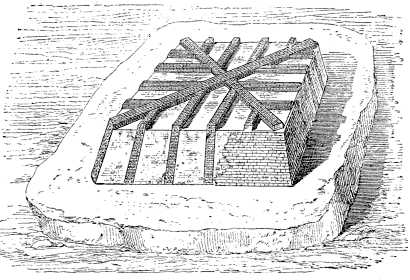
Fig. 131.—The pyramid of Illahoun, horizontal section in perspective;
from the plan of Perring.
Another point of difference: most of the pyramids are built round a
core of living rock, which is embraced by the lower courses of their
masonry. But the pyramid of Mycerinus is just the reverse of this. It
is built over a hollow in the rock which is filled up with masonry.
The inequalities of the surface were usually taken advantage of so as
to economize material, and make a greater show with less labour.
Mycerinus, however, did not fear to increase his task by rearing his
pyramid over a depression in the plateau.
Fig. 132.—Section of the pyramid of Cheops; from Perring.
There is no less diversity in the external aspects of the pyramids. We
are most familiar with the shapes of the great pyramids at Gizeh
(Fig. 130 and Pl. 1, 2); their images have been multiplied to infinity by
engraving and photography, but we make a great mistake when we imagine
all the royal tombs at Memphis to be built upon this one model. They
do not all present the same simplicity of form, the same regular slope
from summit to base, or the smooth and polished casing which
distinguished those great monuments when they were in complete
preservation. The southern pyramid of Dashour offers us one of the
most curious variations upon the original theme (Fig. 133). Its
angle-ridges are not unbroken straight lines from base to summit. The
slope of its faces becomes less steep at about half their height. The
lower part of its sides make angles of 54° 41' with the horizon, while
above they suddenly fall back to an angle of 42° 59'. This latter
slope does not greatly differ from the 43° 36' of the other pyramid in
the same neighbourhood. No indication has yet been discovered as to
the builder of this pyramid.
A second variation, still more unlike the Gizeh type, is to be found
in the great pyramid of Sakkarah, the Stepped Pyramid, which was
considered by Mariette as the oldest of them all. Taking a passage
from Manetho as his authority, he thought himself justified in
attributing it to the fourth king of the first dynasty, Ouenephes or
Ata, and he was inclined to see in it the Serapeum, or Apis tomb, of
the Ancient Empire. Its present elevation is about 190 feet. Each of
its sides is divided horizontally into six large steps with inclined
faces. The height of these steps decreases progressively, from the
base to the summit, from 38 feet 2 inches to 29 feet 6 inches. The
width of each step is nearly 7 feet. It will be seen, therefore, that
this building rather tends to the pyramidal form than achieves it; it
is a rough sketch for a pyramid.
Fig. 133.—The southern pyramid of Dashour; from the measurements of Perring.
Fig. 134.—Section of the Stepped Pyramid; from Perring.
Does this want of completion result from accidental causes, or must
it be referred to ignorance of the full beauties of the pyramidal form
on the part of its builders? If the conjecture of Mariette is well
founded, the Stepped Pyramid is not only the most ancient building in
Egypt but in the whole world; and in the remote century which
witnessed its construction men may not yet have learnt to fill up the
angles left in their masonry, they may have been quite satisfied to
leave their work in a condition which to us seems imperfect.
Fig. 135.—The Stepped Pyramid; restored from the measurements of Perring.
The Germans have evolved a complicated system of construction from
notes made by Lepsius upon the details of the masonry in different
pyramids. In order that this system may be more easily understood, we
give, on the opposite page, a series of representations of such a
pyramid in different stages of completion (Figs. 136 to 142). A
commencement was made by erecting a very narrow and perpendicular
pyramid crowned by a pyramidion, like a stumpy obelisk (Fig. 136).
This finished, sloping masses were erected against it so as to form,
with the pyramidion of the first mass, a second pyramid. The apex of
this pyramid, a pyramidion of a single stone, might be put in place
and the work considered finished (Fig. 137); or, if the builder were
sanguine as to time, he might seek to push on still farther. Then, at
the line where the slopes of the pyramid left the earth, four
perpendicular walls were erected to the height of the pyramidion. The
space between the sides of the pyramid and the inner faces of these
walls was filled in, and thus a kind of terrace, or huge rectangular
block, was obtained (Fig. 138), which served as the core for a new
pyramid (Fig. 139). This again disappeared under a pyramid of larger
section and gentler slope (Fig. 140), whose sides reached the ground
far beyond the foundations of the terrace. In the case of a long reign
this operation might be repeated over and over again
(Figs. 140 and 142). A large pyramid would thus be composed of a series of pyramidal
envelopes placed one upon another. The mummy-chamber was either cut in
the rock before the laying of the first course of stone, or it was
contrived in the thickness of the masonry itself; as the casing of
stone went on increasing in thickness, galleries were left for
ventilation and for the introduction of the sarcophagus and the
mummy. The mummy-chamber is always found either upon the axis of the
pyramid, or in its immediate neighbourhood, and always nearer the base
than the summit.
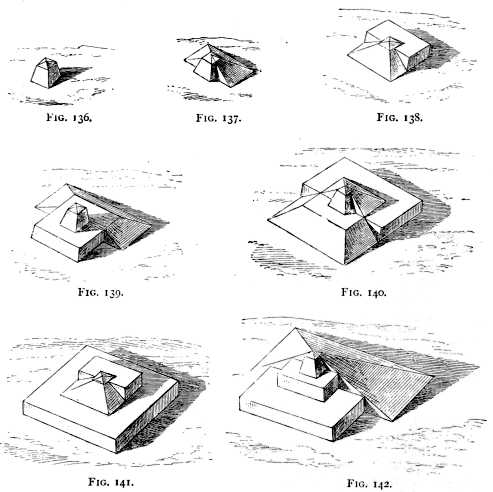
Figs. 136-142.—Successive states of a pyramid,
according to the system advocated in Bædeker's Guide.
We are told that the system of construction here set forth is rendered
almost certain by the fact that "the deeper we penetrate into the
pyramid the more careful do we find the construction, which becomes
more and more careless as the exterior is approached. In fact, as each
new envelope was commenced, the chances of its being completed became
less." The mass of stone to be worked and placed was greater, while
the king, upon whose life the whole operation depended, was older and
nearer his death. The builders became less sure of the morrow; they
pressed on so as to increase, at all hazards, the size of the
monument, and trusted to the final casing to conceal all defects of
workmanship.
This system of pyramid building would explain the curious shapes which
we have noticed in the Stepped Pyramid and the southern pyramid of
Dashour.[193] Both of those erections would thus be unfinished
pyramids. At Sakkarah, the angles left by the successive stages would
be waiting for their filling in; at Dashour, the upper part of a
pyramid of gentle slope would have been constructed upon the nucleus
which was first erected, but the continuation of the slope to the
ground would have been prevented by the stoppage of the works at the
point of intersection of the upper pyramid and its provisional
substructure. Hence the broken slope which has such a strange effect,
an effect which could not have entered into the original calculations
of the architect.
But although this theory seems satisfactorily to explain some puzzling
appearances, it also, when tested by facts, encounters some very grave
objections. The explorers of the pyramids have more than once, in
their search for lost galleries and hidden chambers, cut for
themselves a passage through the masonry, but neither in these
breaches made by violence, nor in the ancient and carefully
constructed passages to which they were the means of giving access,
have any signs been, discovered, or at least, reported, of the
junctions of different surfaces and slopes which must have existed
according to the theory which we are noticing. We should expect, at
least, to find the nearly upright sides of the cubic mass with which
the pyramid began, contrasting with the comparatively gentle slopes
which were built against it. These different parts of the pyramid, we
are told, were built and finished separately, a proceeding which, if
the later parts were to be properly fitted to the earlier and the
final stability of the monument assured, would have demanded a minute
and scrupulous care which was not common with Egyptian workmen. How,
without numerous through bonding-stones, could those slides and
settlements be prevented to which the want of homogeneity in the
structure would otherwise be sure to lead? But we are not told that
any such junctions of old and new work are to be found even in those
points where they would be most conspicuous, namely, in the galleries
leading to the internal chambers, where a practised eye could hardly
fail to note the transition. We do not say that there are no such
transitions, but we think the advocates of the new theory should have
begun by pointing them out if they exist.
There is another difficulty in their way. How is their system to
explain the position of the mummy-chamber in certain pyramids? Let us
take that of Cheops as an example. If its internal arrangements had
been fixed from the beginning, if the intention had been from the
first to place the mummy-chamber where we now find it, at about
one-third of the whole height, why should the builders have
complicated their task by imposing upon themselves these ever
difficult junctions? Would it not have been far better to build the
pyramid at once to the required height, leaving in its thickness the
necessary galleries? The same observation applies to the discharging
chambers above the mummy-chamber. The whole of these arrangements, the
high vestibule with its wonderful masonry, the chambers and the
structural voids above them, appear to have been conceived and carried
out at one time, and by the same brains and hands. Not a sign is to be
found of those more or less well-veiled transitions which are never
absent when the work of one time and one set of hands has to be united
with that of another. Or are we to believe that they commenced by
building a hill of stone composed of those different pyramids one
within another, and that they afterwards carved the necessary chambers
and corridors out of its mass? One of the heroes of Hoffmann, the
fantastic Crespel, made use indeed of some such method in giving doors
and windows to his newly-built house, but we may be sure that no
architect, either in Egypt or elsewhere, ever thought of employing it.
The disintegration to which it would lead may easily be imagined.
We may here call attention to a circumstance which justifies all our
reserves. There is but one pyramid which seems to have been built upon
a system which, though much less complicated, resembled that which we
are noticing in some degree, we mean the Stepped Pyramid of Sakkarah.
Now we find that the whole of the complicated net-work of chambers and
passages in that pyramid is cut out of the living rock beneath its
base, and that they are approached from without by subterranean
passages. The difficulty of deciding upon the position of the chambers
in advance, and of constructing the galleries through the various
slopes of the concentric masses which were to form the pyramid, was
thus avoided, and the builder was able to devote all his attention to
increasing the size of the monument, by multiplying those parallel
wedges disposed around a central core of which it is composed.
The observations made by Lepsius in the Stepped Pyramid and in one at
Abousir seem to prove that some pyramids were constructed in this
manner. In both of those buildings all necessary precautions were
taken to guard against the weaknesses of such a system. It is
difficult to understand how separate slices of masonry, placed one
upon the other in the fashion shown by the section which we have
borrowed from Perring's work (Fig. 134), could have had sufficient
adherence one to another. Lepsius made a breach in the southern face
of this pyramid, and the examination which he was thus enabled to
institute led him to suggest a rather more probable system of
construction. Upon the external sloping face of each step he found two
casing-walls, but these did not extend from the ground to the apex of
the monument, they reached no higher than the single step, so that
they found a true resisting base in the flat mass (see Fig. 143) upon
which they rested. Moreover, the architect provided for the lateral
tying of the different sections of his work, as Lepsius proves to us
by a partial section of the pyramid of Abousir. Two walls of fine
limestone blocks inclose a filling in of rubble, to which they are
bound by perpend stones which penetrate its substance. This method of
construction has its faults, but it is so rapid that its employment is
not to be wondered at.
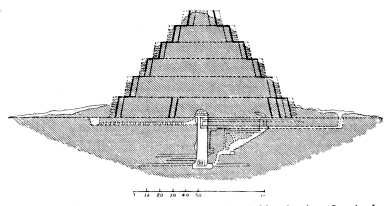
Fig. 143.—Section of the Stepped Pyramid at Sakkarah; from Lepsius.[194]
Fig. 144.—Construction of the Pyramid of Abousir in parallel layers;
transverse section in perspective
from the geometrical section of Lepsius.[195]
Do these parallel walls reach from top to bottom? A detail discovered
by Minutoli would seem to indicate that a base was first constructed
of sufficient extent for the whole monument. In the lower part of the
Stepped Pyramid Minutoli[196] shows concave courses of stone laid out
to the segment of a circle. These courses formed a kind of inverted
vault, abutting, at its edges, upon the rock. This curious
arrangement should be studied upon the spot by some competent
observer. As we do not know whether these curves exist upon each face
or not, or whether they meet each other and penetrate deeply into the
structure or not, we cannot say what their purpose may have been. But
however this may be, they afford another argument against the notion
that all the great pyramids were built round such a pyramidoid core as
that represented by our Fig. 136. We fear that this system must be
regarded merely as an intellectual plaything. The views of Lepsius as
to the enlargement of the pyramid by the addition of parallel slices
are worthy of more respect, and their truth seems to be demonstrated
in the case of some pyramids. But these all belong to that category of
monuments which have subterranean chambers only. We have yet to learn
that they were ever made use of in those pyramids which inclose the
mummy-chamber and its avenues in their own substance. Variety is
universal in that Egypt which has so often been described as the land
of uniformity and immobility—no two of the pyramids resemble each
other exactly.
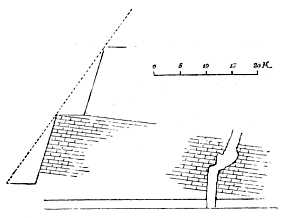
Fig. 145.—Partial section of the Stepped Pyramid; from Minutoli.
We have yet to speak of two ancient monuments in which some would
recognize unfinished pyramids, namely, the Pyramid of Meidoum and the
Mastabat-el-Faraoun. We do not agree with this opinion, which has,
however, been lately put forward, so far, at least, as the former
monument is concerned.[197] These two sepulchres seem to us to
represent a different type of funerary architecture, a type created by
the ancient empire, and meriting special notice at our hands.
The monument which rises so conspicuously from the plain near the
village of Meidoum on the road to the Fayoum, is called by Arabs the
Haram-el-Kabbab, or "the false pyramid." It is, in fact, not so much a
pyramid, strictly speaking, as a mass formed of three square towers
with slightly inclined sides superimposed one upon the other, the
second being less in area than the first, and the third than the
second. The remains of a fourth story may be distinguished on the
summit of the third; some see in them the remains of a small pyramid;
others those of a cone. Judging from the names found in the
neighbouring mastabas, which were opened and examined by Mariette,
this is the tomb of Snefrou I., one of the greatest kings of the third
dynasty.[198]
Fig. 146.—The Pyramid of Meidoum; from Perring.
The Mastabat-el-Faraoun or "Seat of Pharaoh," as the Arabs call it, is
a huge rectangular mass with sloping sides; it is about 66 feet high,
340 long, and 240 deep. It is oriented like the pyramids. It is a
royal tomb with internal arrangements which resemble those in the
pyramid of Mycerinus; the same sloping galleries, the same chambers,
the same great lateral niches. Upon a block lying at the foot of the
structure of which it had once formed a part, Mariette found a
quarry-mark traced in red ochre which seemed to him to form part of
the name of Ounas, one of the last kings of the fifth dynasty
(Figs. 109 and 147).
Fig. 147.—The Mastabat-el-Faraoun; from Lepsius.
Upon the platform of the Mastabat-el-Faraoun certain blocks are to be
found which, from their position, must have been bonding-stones. They
seem to hint, therefore, either that the structure was never finished,
or that it has lost its former crown. The latter hypothesis is the
more probable. Among the titles of people buried in the necropolis at
Sakkarah, we often come upon those of priests attached to the service
of some monument with a form similar to that represented by our Fig. 148.
Who can say asks Mariette, that it is not the Mastabat-el-Faraoun
itself?[199]
Fig. 148.—Funerary monument represented in the inscriptions.
M. Mariette cites, in support of this conjecture, certain other
structures of a similar character, such as the large tomb situated
near the south-eastern angle of the second pyramid at Gizeh, and the
little monument which is called the Pyramid of Righa. From these he
concludes that the principles of the mastaba and the pyramid were
sometimes combined under the ancient empire. The royal tombs in the
Memphite region were not always pyramids, they were sometimes composed
of a mastaba and of one or more high square tower-like erections upon
it, the whole ending in one of those small pyramids which we call
pyramidions. This type allowed of numerous combinations, many of
which are to be discovered in the monuments of a later period.
The pyramid was employed as a terminal form throughout the whole of
Egyptian history. Both Thebes and Abydos offer us many examples of its
use, either in those sepulchral edifices which are still extant, or in
the representations of them upon bas-reliefs. But the pyramid properly
speaking was confined to the Memphite period. The princes of the
twelfth dynasty seem to have constructed some in the Fayoum. The
pyramids of Hawara and Illahoon correspond to those which, we are
told, were built in connection with the labyrinth and upon the islands
of Lake Mœris respectively. These, so far as we can judge, were the
last of the pyramids. There are, indeed, in the necropolis of Thebes,
upon the rocks of Drah-abou'l-neggah, a few pyramids of crude brick,
some of which seem to belong to Entefs of the eleventh dynasty; but
they are small and carelessly constructed.[200] When the art of Egypt
had arrived at its full development, such purely geometrical forms
would seem unworthy of its powers, as they did not allow of those
varied beauties of construction and decoration which its architects
had gradually mastered.
The pyramids have never failed to impress the imaginations of those
foreign travellers who have visited Egypt. Their venerable antiquity;
the memories, partly fable, partly history, which were attached to
them by popular tradition; their colossal mass and the vast space of
ground which they covered, at the very gates of the capital and upon
the boundary between the desert and the cultivated land, all combined
to heighten their effect. Those nations who came under the living
influence of Egypt could hardly, then, escape from the desire to
imitate her pyramids in their own manner. We shall find the pyramidal
form employed to crown buildings in Phœnicia, Judæa, and elsewhere.
But the kingdom of Ethiopia, the southern annexe of Egypt and the
copyist of her civilization, was the chief reproducer of the Egyptian
pyramid as it was created by the kings of the ancient empire. Napata,
Meroe, and other places have pyramids which may be counted by dozens.
Like those in Egypt, they are the tombs of the native monarchs.
We shall not attempt any study of these remains. Like all the other
products of Ethiopian art, they are neither original nor interesting.
The people who inhabited the region which we now call by the names of
Nubia and the Soudan, had, indeed, reconquered their political
independence a thousand years before our era, but they were not gifted
by nature with power to assimilate the lessons of their former
masters. Even during the short period when the Ethiopian monarchs
reigned over a divided and weakened Egypt, Ethiopia remained the
clumsy pupil and imitator of the northern people. She never learnt to
give to her royal pyramids the air of grandeur which distinguishes the
great structures of Memphis. The Ethiopian pyramids were generally so
narrow and steep in slope that their whole character was different
from those of Egypt. In Egypt the base line was always greater than
the vertical height, upon the Upper Nile the proportions were
reversed.[201] The latter edifices thus lost some of that appearance
of indestructible solidity which is their natural expression. They
remind one at once of the obelisk and the pyramid. Add to this that an
unintelligent taste overspread them with ill-devised decoration. Thus
the upper part of their eastern faces, for they are oriented,
generally bears a false window surmounted by a cornice, about as
incongruous an ornament as could well be conceived, and one which
expresses nothing either to the eye or the mind.
We shall, therefore, take no further notice of these more or less
ill-designed variations upon the type which was created by the
Egyptians in the early days of their civilization and fully understood
by themselves alone.
We must return, however, to that type for a moment, in order to show,
in as few words as possible, how far the art of working and fixing
stone had advanced even at the time of the first dynasties.
The Great Pyramid affords us a curious example of the elaborate
precautions taken against the violation of the royal tomb (Fig. 132).
At the point where the ascending gallery branched off from that
descending corridor which was the only entrance to the pyramid, the
mouth of the former was closed by a block of granite which exactly
fitted it. This block was so heavy and so well adjusted, that entrance
could only be obtained by cutting a passage through the surrounding
masonry, which, being of limestone, did not offer such an unyielding
resistance to the tools brought against it. Formerly the mouth of a
gallery, which seemed to be the continuation of the entrance corridor,
remained open, and, when followed to the end, led to an unfinished
chamber cut in the rock at about the level of the Nile. If this had
been finished the waters would perhaps have invaded it by
infiltration. This seems to have been intended by the constructor,
because Herodotus, who no doubt thought the work had been completed,
tells us of a subterranean conduit which admitted the waters of the
Nile.[202] The violaters of the tomb would believe the corpse to be in
this unsuspected reservoir, and would search no farther, or if they
guessed the deception and persevered till they found the entrance to
the ascending gallery, they would find another obstacle to their
success which would be likely to arrest them longer than the first.
The upper extremity of the great gallery, at which we suppose them
arrived, opens upon a small vestibule which would still separate them
from the sarcophagus-chamber itself. Four flat blocks of granite,
sliding in grooves, masked the entrance to the latter; Figs. 150 and
151 show the arrangement of these portcullis stones. The narrow
passage leading to the discharging chambers above the mummy-chamber,
would be likely to lead our supposed robbers into the upper part of
the pyramid. The entrance to this passage is high up in the end wall
of the grand gallery; it was left open. The unbidden visitors would
thus have explored the interior of the pyramid high and low without
result, and even supposing that they expended considerable time and
trouble in the search, they might easily have failed to penetrate into
the mummy-chamber itself.[203]
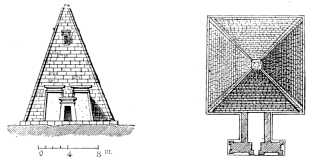
Fig. 149.—Plan and elevation of a pyramid at Meroe: from Prisse.
Fig. 150.—Method of closing a gallery by a stone portcullis;
from the southern pyramid of Dashour.
Drawn in perspective from the plans and elevations of Perring.
Fig. 151.—Portcullis closed.
Another ingenious arrangement which demands our notice is that of
those discharging chambers to which we have already alluded. These
chambers were explored, not without trouble, by Colonel Howard Vyse
and J. L. Perring, who at once comprehended their use. The roof of the
sarcophagus-chamber consists of nine slabs of fine red granite, like
those which form the walls of the same chamber. They are 18 feet 9
inches long and their ends rest upon the side walls of the chamber. In
spite of their thickness and of the hard nature of the rock of which
they are composed, it was feared that they might give way under the
enormous weight of the masonry above, for the floor of the chamber is
still nearly 340 feet below the actual apex of the pyramid. This
danger was met in the fashion figured above.
Fig. 152.—Transverse section, in perspective,
through the sarcophagus-chamber and the discharging chambers;
from the elevation of Perring.
As the structure grew above the roof of the mummy-chamber, five small
chambers were left, one above the other, to a total height of 56 feet,
which would relieve the flat ceiling of the mummy-chamber of the
weight to be placed above it. The first four of these chambers were of
similar shape and had flat roofs, but the roof of the fifth was formed
of sloping slabs, meeting in a ridge, and giving the chamber a
triangular section (see Fig. 152). Thanks to this succession of voids
immediately over the main chamber, and to the pointed arch which
surmounts them, the vertical pressure of the superstructure is
discharged from the chamber itself and distributed over the lateral
parts of the pyramid. These precautions have been quite effectual. Not
a stone has been stirred either by the inward thrust or by the
crushing of their substance; not a block is out of place but those
which have been disturbed by the violence of man; and, moreover, the
whole structure is so well bonded and so well balanced that even his
violent attacks have led neither to disruption nor settlement in the
apartment of Cheops or in the galleries which lead to it.[204]
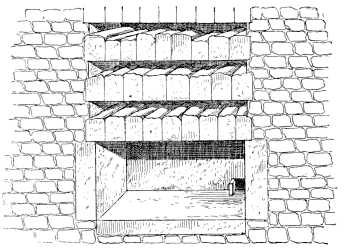
Fig. 153.—Longitudinal section through the lower chambers;
perspective after Perring.
The glory of the workmen who built the Great Pyramid is the masonry of
the Grand Gallery, the gallery which opens immediately into the
vestibule of the King's Chamber. As this corridor is 28 feet high and
7 feet wide, the visitor can breathe more freely than in the low and
narrow passages which lead to it, and can examine at his ease the
beautiful blocks of limestone from Mokattam of which its polished
walls are composed. The faces of these blocks have been dressed with a
care which is not to be surpassed even by the most perfect examples of
Hellenic architecture on the Acropolis at Athens. The internal faces
must have been worked with equal care. No cement has been employed in
the fixing, and the adherence is so perfect that, in the words of
Abd-ul-Latif "not a needle, not even a hair, can be introduced into
the joints."[205] These joints are not even to be distinguished
without careful examination. The roof of this gallery is built with no
less care.[206] Each of the upper courses is slightly set off from the
one below it, so that in time they come so near together that the
opening may be closed by a single stone, or rather, row of stones.
These, being held between the two upper courses of a quasi vault, play
the part of key stones. This method of vaulting has been employed in
other parts of the pyramid, especially in what is called the Queen's
Chamber, which is almost directly beneath the king's, or
sarcophagus-chamber. The same care is conspicuous in those linings of
red granite which form the walls of the two chambers. Even the fine
limestone used for the walls of the Grand Gallery was not considered
rich and solid enough for the walls of the apartment in which the
prince in whose honour the whole of the colossal edifice was reared
would repose; and it was determined to use the richest and most costly
material of which the Egyptian architect could dispose.[207] The plain
sarcophagus, without either inscription or ornament, which is still in
the King's Chamber, is also of red granite.
The external casing of the pyramid has entirely disappeared, as we
have already said. On account of their moderate size the stones of
which it was composed would seem to be especially well fitted for use
in building those great cities which, after the collapse of the
ancient civilization, succeeded each other, under different names, in
the neighbourhood of the Memphite necropolis. This casing seems to
have been made of more than one kind of stone, if we may believe an
ancient text which has been interpreted by Letronne with the skill and
sagacity of which he has given so many proofs.[208]
The author, named Philo, of a treatise upon the Seven Wonders of the
World, tells us that the Egyptians employed upon this work "the most
brilliant and varied stones, which were carefully fixed." He mentions
as contributing to the splendid result white marble, basalt, porphyry,
and a green breccia from Arabia, which must have been what is called
verde antique. And as for his white marble, it must have been the
white limestone from Mokattam, which, in its best strata, is almost as
white and fine in grain as marble. Marble, properly speaking, was only
introduced into Egypt by the Greeks, and that in very small
quantities, for the use of sculptors. Philo says nothing of granite,
but its use was so general that it must have found a place in the
scheme of decoration.[209]
The various kinds of stone must have been so placed as to form zones,
and perhaps patterns, of different colours, white, red, black, rose,
green, and so on. To form an idea of the effect we must think of
Giotto's campanile at Florence and various other Italian buildings of
the same kind.
It has been questioned whether the testimony of this Philo is to be
depended upon, as few of those who have busied themselves with the
pyramids seem to have laid much stress upon it. It seems to us to be
worthy of great respect. We do not know when Philo lived, but we know
that the casing of the pyramid was still in place, at least in part,
during the Middle Ages, because in the time of Abd-ul-Latif it had
almost its original height, and its ascent was still very
difficult.[210] On the other hand we have proofs that, although the
author of the Seven Wonders of the World may have written more in the
tone of a rhetorician than of an eyewitness of the wonders which he
describes, he took some of his information from excellent sources. In
fact with the exception of Pliny, he is the only ancient writer who
gives us an approximately true statement of the length of the base
line of Cheops' Pyramid. While the measurements of other writers are
very far from accurate, the figure given by Philo is only 16 feet 6
inches in excess of the truth. The idea of decorating such an expanse
of surface with varied colour was quite in accordance with Egyptian
taste. They loved polychromatic ornaments; they covered every
available surface with the gayest hues; they delighted in the
juxtaposition of the most brilliant tones. They could hardly think of
covering such an immense surface with paint, and as it was necessary,
in any case, to cover it with a smooth casing, it would be no more
difficult to employ many kinds of stone than one. They would thus
obtain a kind of gigantic mosaic which may perhaps have been
heightened in effect by the use of gold. We know that the pyramidion
of an obelisk was frequently gilded, and it is probable enough that
similar means were sometimes taken, in the case of the more
magnificent and carefully finished pyramids, to draw the eye to their
topmost stone and thus to add to the impression made by their height.
No more fitting adornment could be imagined for the sharp peak of a
pyramid rising nearly five hundred feet into the pure blue of an
Egyptian sky.
But this is a conjecture which can never be verified. Even if the
topmost stone were still in place upon any of the pyramids it would,
after all these ages, have lost all traces of gilding; but the whole
of those edifices have their apex more or less truncated. Even before
our era, Diodorus[211] found the Great Pyramid crowned by a plateau
six cubits square.
It has sometimes been supposed that the pyramids, when complete, were
terminated by such a plateau as that described by Diodorus, and that
it bore a statue of the king whose mummy rested below. This hypothesis
is founded upon the passage of Herodotus which treats of the Lake
Mœris. "There are," he says, "in the middle of the lake, two
pyramids, each fifty fathoms high (309 feet) ... each of them is
surmounted by a colossal stone statue seated upon a throne."[212]
Herodotus insists so often upon having seen the Labyrinth and Lake
Mœris with his own eyes, that we cannot affect to doubt his
assertions; we shall therefore confine ourselves to a few observations
upon them.
In the descriptions which he gives of the three great pyramids, and
among his comments upon the methods employed in their construction,
Herodotus does not say a word which can be construed into the most
distant allusion to statues upon their summits. If he had seen colossi
perched upon those lofty pedestals, or if he had heard from his
dragomans—whose exaggerations he has elsewhere so naïvely
reproduced—that they had formerly existed, would he not have made
some allusion to them in that passage, at least, where he explains how
they raised such huge stones to so great a height, and describes the
successive stages in the construction of a pyramid?[213] Would he not
have found room, in the elaborate antithetical passage in which he
contrasts the virtues of Mycerinus with the imaginary wickedness of
Cheops and Chephren, for moral and critical reflections called up by
the sight of their statues upon their respective pyramids; still more
if one of them had happened to be missing? Would he not have
attempted, through some popular tradition, to have accounted for the
presence of one statue and the absence of another? It is evident,
therefore, that Herodotus neither saw any statues upon the Pyramids of
Memphis nor had he any reason to suppose those structures had ever
been crowned in such a fashion. He lays stress upon the seated statues
of the pyramids in Lake Mœris because they were new to him, because
he had seen nothing of the same kind in the neighbourhood of the
ancient capital.
Unless we are very much mistaken, this superposition of a colossus
upon a pyramid was a novelty devised by the architects of the middle
empire, when, under the Ousourtesens and Amenemhats, it was proposed
to revive the pyramidal form of tomb with which the early Pharaohs had
obtained such imposing results. Although most conservative on the
whole, the art of Egypt attempted, at each period of renascence, to
introduce new combinations into the details, at least, of the ancient
forms, and this was one of the number.
Another innovation of the same kind is to be found in the decoration
which covered, again according to Herodotus,[214] another pyramid
constructed at about the same time, namely, that which formed one side
of the Labyrinth. "It had," says the historian, "forty fathoms, and it
was sculptured with animals of large size. The entrance was by a
subterranean passage." From the Greek word used
(ἐγγέγλυπται)
we see that Herodotus means that the faces, or perhaps only the
principal face, of this pyramid about two hundred and fifty feet high,
were covered with bas-reliefs. There is in Egypt no other example of a
pyramid so decorated. The architectural works of this period have
almost entirely vanished, but we may, perhaps, look upon it as one of
their characteristics that the bareness which they had inherited from
the early creators of Egyptian art, was relieved and adorned by the
intervention of the sculptor.
It was the desire for such ornament that made them convert their
pyramids into gigantic pedestals for statues. According to all the
analogies afforded by later ages, these statues must have been those
of the princes who built the pyramids in question. We have no reason
to suppose that any of the kings of the first six dynasties erected
any colossal figures like those which were set up in such numbers by
the Theban dynasties; with the single exception of the Sphinx, none of
the statues left to us by the ancient empire greatly exceed the
natural size. But it is evident that such figures as would be fit to
crown the pyramids of Cheops and Chephren would have to be of
extravagant size even if no more than their general outlines were to
be visible from below. Seen from a point nearly 500 feet below, and in
consequence of the inclination of the pyramid faces, at some
considerable distance laterally, even a statue fifty feet high, like
the two colossi of Amenophis III. on the plain of Thebes, would appear
small enough to a spectator. Its artistic results would be very
slender, and yet its erection would require prodigious mechanical
efforts. It would have required all the multitudes of labourers, the
patience, and the time, which the Egyptians alone dared to expend upon
their monuments. But perhaps it may be said that these colossi were
statues built-up of comparatively small stones. To this we must answer
that every colossus as yet discovered in Egypt is a monolith. A
statue, of whatever size, made in different pieces would form an
exception to the whole practice of Egyptian sculpture as we know it.
Until such works are proved to exist we decline to believe in them.
The problem was a much simpler one in the cases of the pyramids in
Lake Mœris. They were not nearly so lofty. According to Herodotus
they were about 309 feet high, doubtless including their statues.
Situated as they were in the middle of the lake, Herodotus could not
himself have measured them, and his statement that they sank as far
below the level of the water as they rose above it is an obvious
exaggeration. When the bed of the lake was formed, two masses of rock
were no doubt reserved, as in the cases of the other pyramids, to form
the core of the projected edifices, and therefore it is likely enough
that the lowest courses of the constructions themselves dipped but
little below the surface of the lake.[215] In his amazement at the
scale upon which the Egyptian buildings were conceived, Herodotus has
too often attributed excessive dimensions to them; thus he says that
the height of the Great Pyramid was eight plethra, or about 820 feet,
nearly 340 feet in excess of the truth. It is therefore probable that
the figures which he gives for the lake pyramids are also exaggerated.
These pyramids were, on account of their comparatively modest
dimensions, much better adapted to the ideas of the Ousourtesens and
Amenemhats than the gigantic piles of Cheops, Chephren, and Mycerinus.
Finally there is not a text to be found, outside the pages of
Herodotus, which mentions pyramids surmounted by statues, and upon
none of those monuments which in one way or another bear
representations of the pyramids are they shown in any other way than
with pointed summits. Thus do we find them in the papyri, upon those
steles of the Memphite necropolis which commemorate the priests
devoted to their service, and in those tombs at Memphis, Abydos, and
Thebes where the pyramid, placed upon rectangular figures of various
heights, is used as a terminal element. Neither in the small number of
pyramids which have come down to us comparatively intact, nor in those
which are represented in reliefs, is there the smallest sign of a
truncated summit or of any platform which could by any possibility
have borne a statue.
Fig. 154.—Pyramidion: Louvre.
We may say the same of those small pyramidions which have been found
in such great numbers in tombs and which fill our museums. It is well
known that these are votive offerings in connection with the worship
of the sun. "The principal figure," says M. de Rougé, "is generally
shown in a posture of adoration, with his face turned to the sun. On
his left hand is the invocation to the rising, and on his right that
to the setting sun. These arrangements are modified in various ways,
but they are always upon the same genera lines as the orientation of
the tombs themselves."[216] These minute pyramids also end in a point
whether they be of basalt, granite, or calcareous stone, and it is
natural that we should look upon them as the faithful reproductions
upon a small scale of those great funerary monuments which furnished
a type, consecrated by the most venerable of the national traditions,
of that structure facing the four cardinal points which we may call
the normal Egyptian tomb.
We may believe, then, that the pyramid of the ancient empire
terminated in a pyramidion. This apex once fixed in place, the workmen
charged with the final completion of the edifice worked downwards from
one course to another, covering the immense steps which each face
displayed five or six thousand years ago and now displays again, with
the final casing which protected them for so many centuries. Even
Herodotus saw that this must have been the method of completion.[217]
Any other way of proceeding would have been too dangerous after the
slope of the sides had been made smooth and continuous by the
completion of the casing of polished granite. Workmen could only have
kept their footing upon such a surface, with its 51 or 52 degrees of
elevation, by means of a complicated arrangement of ropes and ladders.
And again, points of resistance could not have been obtained for the
elevation of the materials to ever increasing heights without cutting
or leaving holes in the casing, which would afterwards have to be
filled up. These difficulties would have unnecessarily complicated an
operation which was a simple matter when begun from the top. The
masons could then make use of the steps for their own locomotion, and
when the stones were too large to be lifted from hand to hand, nothing
could be easier than to fix windlasses by which the largest blocks
could be raised with facility.
Dummy Footnote Text Greek: Exepoiêthê d'ôn ta aiôtata autês prôta,
meta de ta hepomena toutôn exepoieun ... (ii. 125).
As the workmen approached the base they left above them an ever
increasing extent of polished surface, sloping at such an angle that
no foot could rest upon it, and forming the only safeguard against the
degradation of the pyramid by removing its copestone or its violation
by breaking into the passages which led to the mummy-chamber. The
casing gave to the pyramid those continuous lines which were necessary
to make its beauty complete, and, if the materials employed were
varied in the way suggested, it furnished colour effects which had
their beauty also. But, above all, it was a protection, a defensive
armour. So long as the pyramid preserved its cuirass intact, it was
difficult for those who meditated violence to know where to begin
their attack. But this obstacle once pierced it was comparatively easy
to learn all the secrets of the building. The inner mass was much less
carefully built than the casing; the joints were comparatively open,
and the stones were soft and easily cut. Hence we see that some
pyramids, especially those which were built of bricks, have been
reduced by the action of time into heaps of débris, in which the
pyramidal form is hardly to be recognised.
Philo, who seems to be so well informed, tells us with what extreme
care the casing was put in place. "The whole work," he says, "is so
well adjusted, and so thoroughly polished, that the whole envelope
seems but one block of stone."[218] The pyramid of Cheops has been
entirely despoiled of its outer covering, and it is to that of
Mycerinus that we must now turn if we wish to have some idea of the
care with which the work was done. The lower part of this pyramid is
still covered with long blocks of the finest granite, fixed and
polished in the most perfect manner. At the foot of the Great Pyramid
several blocks have been found which seem to have formed part of the
casing of that edifice.[219] They are trapezoidal in form, and they
show, as Letronne[220] long ago remarked, that the casing stones were
placed one upon another, and adjusted by their external faces. They
were not, as was at first supposed, sunk into the upper face of the
course below by mortices which would correspond to the trench in the
living rock in which the first course was fixed. As to whether the
external faces of these blocks were dressed to the required angle
before they left the quarry, or whether the work were done after they
were in place we cannot say with any certainty, but it is most likely
that the methods of proceeding changed with the progress of time and
the succession of architects. In such a matter we should find, if we
entered into details, diversity similar to that which we have already
shown to have characterized the forms of the pyramids, their internal
arrangements, and the materials of which they were composed.
Thus some triangular prisms of granite have been found at the foot of
the pyramid of Chephren, which seem to have formed part of its lower
casing.[221] Such a section seems, upon paper, the simplest that could
be adopted for the filling in of the angle between two of the steps,
but it is far inferior in solidity to the trapezoidal section. The
prisms had no alliance one with another; they had to depend for their
security entirely upon their adherence to the faces of the graded
core, so that they could easily be carried off, or become dislocated
from natural causes. This system, unlike the first described, did not
give a homogeneous envelope with a thickness of its own, and partly
independent of the monument which it protected.[222]
Fig. 155.—The casing of the pyramids; drawn in perspective from the elevation of Perring.
The casing of the Second Pyramid, moreover, does not seem to have been
carried out on the same principle from top to bottom. The upper part,
which still remains in place, is composed of a hard cement formed of
chalk, gypsum, and pieces of burnt brick. They may have wished to
obtain the parti-coloured effect of which Philo speaks, by making
simultaneous use of granite and concrete, and it is quite possible
that yet other materials entered into the composition of the
casing.[223]
In other pyramids we find different combinations again. In the
double-sloped erection at Dashour, the courses of casing stones are
vertical instead of horizontal,[224] while a brick pyramid—the most
northern—in the same locality, was covered with slabs of limestone,
fixed, no doubt, with mortar.
Sometimes we find the revetment in a state of semi-completion; the
blocks in place, and cut to the proper angle, but without their final
polish. Such is the case with the Second Pyramid, upon which blocks of
granite are to be found which are still rough in face. It would seem
that the patience required for the minute completion of such a
terribly long and tedious piece of work was not forthcoming. But we
ought in fact to be surprised, not so much at the unfinished state of
a pyramid here and there, but rather that they should ever have been
completed.
The variety which is so conspicuous in the architectural construction
of the pyramids is also to be found in their epigraphy. The first
explorers of the Pyramids of Gizeh were surprised at the absence of
all inscriptions beyond the masons' marks; the silence of those
enormous structures seemed amazing; but soon Colonel Vyse discovered
in the pyramid of Mycerinus the sarcophagus of that king, and the
mummy case, now in the British Museum, which bears an inscription of
some length. Recent discoveries, too, of which full details are yet
wanting, prove that some of the pyramids contained long texts, which
contain the names of kings and other information which is of great
importance to the historian of the Egyptian religion. In 1879 and
1880, Mariette caused three pyramids at Sakkarah to be opened, which
until then had remained unexplored. One of them was silent and empty,
but in the others the inscriptions and sarcophagi of two kings of the
sixth dynasty, Papi and his son Merenzi, were found. Fragments of a
Ritual of the Dead were recognized among them. Pleasure at this
discovery, the last which he was destined to make in the soil of
Egypt, brightened the last days of Mariette.[225]
In March 1881, M. Maspero, the successor of M. Mariette as director of
the excavations, opened a pyramid belonging to a different group,
which turned out to be the tomb of Ounas, the last Pharaoh of the
fifth dynasty. In this pyramid, portcullis stones similar to those
which have already been figured were found. When these obstacles were
passed "the continuation of the passage was found, the first part of
polished granite, the second of the close-grained limestone of Tourah.
The side walls are covered with fine hieroglyphs painted green, the
roof sprinkled with stars of the same hue. The passage finally opens
into a chamber half filled with débris, upon the walls of which the
inscription is continued.... The mummy-chamber, like that which
precedes it, is covered with hieroglyphs, with the exception of the
wall opposite to the entrance. This wall is of the finest alabaster,
and is effectively decorated with painted ornaments. The sarcophagus
is of black basalt, without inscription.... The text of the
inscription which covers the walls is almost identical with that in
the tomb of Papi, but it has the advantage of being complete. M.
Maspero, whom Mariette had previously entrusted with taking squeezes
from the inscription in the tomb of Papi, recognised certain formulæ
and phrases which had already struck him in another place.... These
texts make up a composition analogous to one which covers the walls of
certain little known Theban tombs. Without presenting any very
considerable difficulties, they demand careful examination from those
who would comprehend their meaning.
"M. Maspero, encouraged by this first success, ordered a second
pyramid to be opened. He wished to verify, upon the spot, a theory
which he had long upheld in spite of the adverse opinions of the
majority of egyptologists. It is well known that between the sixth and
the tenth dynasties a great gap exists, so far as monumental remains
are concerned. M. Maspero has always believed that there is no such
gap. He has observed that the pyramids are, so to speak, grouped
chronologically from north to south; those of the fourth dynasty at
Gizeh, those of the fifth at Abooseer, those of the twelfth in the
Fayoum. The excavations of Mariette as well as his own showed the
tombs of the fifth and sixth dynasties to have been at Sakkarah. Hence
M. Maspero thinks that the pyramids erected by the sovereigns of the
seventh, eighth, ninth, and tenth dynasties are those between Sakkarah
and the Fayoum. The future will show whether he is right or wrong. In
any case science will profit by the new excavations which he is about
to undertake."[226]
When cross-examined by such questioners as M. Maspero the pyramids
will tell us much. Hitherto they have attracted but little of that
examination which discovers the most curious secrets, but their size
and the beauty of their masonry will ever make the three great
pyramids of Gizeh the most striking objects to the traveller and to
the historian of art.
Considering their age, these three pyramids are wonderfully well
preserved. In their presence, even in their actual state of partial
ruin, the oriental hyperbolism of Abd-ul-Latif, an Arab writer of the
thirteenth century, seems no more than natural. "All things fear
Time," he cries, "but Time fears the Pyramids!" And yet time has done
its work during the last few hundreds of years. The summits of the
great structures have been slightly lowered; the gaping breaches in
their flanks have been gradually widened; and although in spite of
their stripped flanks and open wounds they still rear their heads
proudly into the Egyptian sky, all those accessory structures which
surrounded them, and fulfilled their own well-defined offices in the
general monumental ensemble, have either been destroyed by the
violence of man or engulfed by the encroaching sand. Where, for
example, are those wide and substantial causeways, whose large and
carefully adjusted blocks excited the wonder of Herodotus.[227] After
having afforded an unyielding roadway for the transport of so many
heavy materials, they formed truly regal avenues by which the funeral
processions of the Egyptians reached the centre of the necropolis as
long as their civilization lasted. In the plain they were above the
level of the highest inundations, and their gentle slope gave easy
access to the western plateau. The great Sphinx, the image of
Harmachis, or the Rising Sun, was placed at the threshold of the
plateau. Immovable among the dead of the vast cemetery, he personified
the idea of the resurrection, of that eternal life which, like the
morning sun, is ever destined to triumph over darkness and death. His
head alone now rises above the sand, but in the days of Herodotus his
vast bulk, cut from a rock nearly 70 feet high, was well calculated to
prepare the eye of the traveller for the still more colossal masses of
the pyramids. His features have now been disfigured by all kinds of
outrage, but in the thirteenth century, although even then he had been
mutilated, Abd-ul-Latif was able to admire his serene smile, his head
enframed in a richly carved wig which added to its size and dignity.
His body was never more than roughly blocked out, but a painted
decoration, of which traces may still be found, compensated in some
degree for the deficiencies in the modelling.
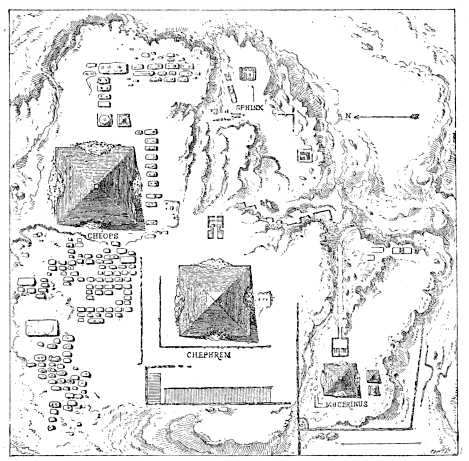
Fig. 156.—Plan of the Pyramids of Gizeh and of that part of the necropolis which immediately surrounds them.
The soil around each pyramid was carefully levelled and paved with
dressed limestone slabs. Upon this pavement rested the foundations of
the stylobate surrounding the pyramid. Both stylobate and pavement are
now in almost every case concealed by sand and débris, but at the
pyramid of Chephren, which is less banked up than the others, traces
of them have been proved to exist. They added somewhat to the imposing
effect of those monuments upon the eye, and gave additional definition
to their bases.[228] The area thus paved was inclosed with a wall,
which had an opening towards the east, in front of which the temple,
or funerary chapel of the pyramid, was raised. The latter, no doubt,
was magnificently decorated. At the foot of the mountains of stone
under which reposed the ashes of the Pharaohs themselves, smaller
pyramids were raised for their wives and children. Of these some half
dozen still exist upon the plateau of Gizeh. One of them has been
recognized as the tomb of that daughter of Cheops, about whom
Herodotus tells one of those absurd stories invented by the Egyptians
of the decadence, with which his dragomans took such delight in
imposing upon his simple faith.[229] Around the space which was thus
consecrated to the adoration of the dead monarch, the long rows of
mastabas stretched away for miles through the vast necropolis.
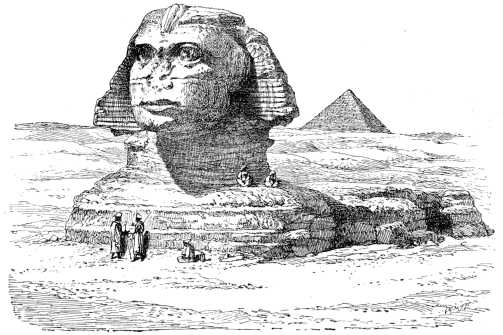
Fig. 157.—The Sphinx.
The great ones of Egypt, all those who had been near the Pharaoh and
had received some of his reflected glory, grouped their tombs as
closely as possible about his. Distributed thus by reigns, the private
tombs were erected in close juxtaposition one with another, each being
provided with a stele, or sepulchral tablet upon which the name of the
deceased was inscribed, most of them being adorned with painted
bas-reliefs, and a few with statues placed upon their façades. Upon
the causeways which connected Memphis with the necropolis, upon the
esplanades erected by the Pharaohs to the memory and for the adoration
of their ancestors, in the countless streets, lanes, and blind alleys
which gave access to the private tombs, advanced endless processions
of mourners, driving before them the bleating and lowing victims for
the funeral rites. Priests in white linen, friends and relations of
the dead with their hands full of fruit and flowers, flitted hither
and thither. On the days appointed for the commemoration of the dead,
all this must have afforded a curiously animated scene. The city of
the dead had its peculiar life, we might almost say its festivals,
like that of the living. But amid the coming and going, amid all the
bustle of the Egyptian jour des morts, it was the giant forms of
the pyramids, with their polished slopes[230] and their long shadows
turning with the sun, that gave the scene a peculiar solemnity and a
character of its own. Morning and evening this shadow passed over
hundreds of tombs, and thus, in a fashion, symbolized the royal
dignity and the almost superhuman majesty of the kingly office.
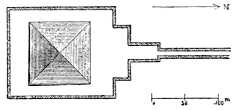
Fig. 158.—Pyramid with its inclosure, Abousir; from Perring.
Of all this harmonious conception but a few fragments remain. The
necropolis is almost as empty and deserted as the desert which it
adjoins. The silence is only broken by the cry of the jackal, by the
footsteps of a few casual visitors hurrying along its deserted
avenues, and by the harsh voices of the Bedouins who have taken
possession of the Pyramid of Cheops, and, in their own fashion, do its
honours to the curious visitor. But despoiled though they be of their
ornaments and of their proper surroundings, the pyramids are yet among
those monuments of the world which are sure to impress all who possess
sensibility or powers of reflection. In a remarkable passage in the
Description générale de Memphis et des Pyramides, Jomard has well
defined the effect which they produce upon the traveller and the
impressions which they leave behind: "The general effect produced by
the pyramids is very curious. Their summits, when seen from a
distance, look like those of high mountains standing out against the
sky. As we approach them this effect diminishes; but when we arrive
within a very short distance of their sides a totally different
impression succeeds; we begin to be amazed, to be oppressed, almost to
be stupefied by their size. When quite close to them their summits and
angles can no longer be seen. The wonder which they cause is not like
that caused by a great work of art. It is the sense of their simple
grandeur of form and of the disproportion between the individual power
and stature of man and these colossal creations of his hands. The eye
can hardly embrace them, nor the imagination grasp their mass. We then
begin to form some idea of the prodigious quantity of dressed stone
which goes to make up their height. We see hundreds of stones each
containing two hundred cubic feet and weighing some thirty tons, and
thousands of others which are but little less. We touch them with our
hands and endeavour to realize the power which must have been
required to quarry, dress, carry, and fix such a number of colossal
blocks, how many men must have been employed on the work, what
machines they used, and how many years it must have taken; and the
less we are able to understand all these things, the greater is our
admiration for the patience and power which overcame such
obstacles."[231]
We have shown how the mastaba, that is to say, the most ancient form
of tomb in the necropolis of Memphis, was an expression, both in
arrangement and in decoration, of the ideas of the Egyptians as to a
future life. In literature and in art the works created by a people in
its infancy, or at least in its youth, are the most interesting to the
historian, because they are the results of the sincere and unfettered
expansion of vital forces; this is especially the case when there is
no possibility of a desire to imitate foreign models. The mastaba
deserved therefore to be very carefully studied. No other race has
given birth in its funerary architecture, to a type so pure, a type
which may be explained in every detail by a master-idea at once
original and well defined. We therefore dwelt upon it at some length
and described it with the care which it demanded. We found it again in
the pyramids, the royal tombs of the Ancient Empire, which though
sensibly modified by the great change in proportion, by the colossal
dimensions which the pride of the Pharaohs gave to one part of their
tomb, are yet penetrated by the same spirit. We have yet to follow the
development of the same idea through the later years of Egyptian
civilization, and in localities more or less removed from that in
which she gave her first tokens of power. In one place we shall find
it modified by the nature of the soil to which the corpse had to be
committed, in another by the inevitable progress of ideas, by the
development of art, and by the caprices of fashion, which was no more
stationary in Egypt than elsewhere.
The most important necropolis of the First Theban Empire was that of
Abydos in Upper Egypt, upon the left bank of the river. The great
number of sepultures which took place in it, from the first years of
the monarchy until the end of the ancient civilization, is to be
explained by the peculiarly sacred character of the city of Abydos,
and by the great popularity, from one end of the Nile valley to the
other, of the myths which centred in it. According to the Egyptian
belief, the opening through which the setting sun sank into the bowels
of the earth for its nightly transit, was situated to the west of
Abydos. We know how the Egyptian intellect had established an analogy
between the career of the sun and that of man; we may therefore
conclude that in choosing a final resting-place as near as possible to
the spot where the great luminary seemed to make its nightly plunge,
they believed they were making more completely sure of triumphing,
like him, over darkness and death.
The sun is not extinguished, he is but hidden for a moment from the
eyes of man. This sun of the infernal regions is Osiris, who, of all
the Egyptian gods, was most universally adored. Although many Egyptian
towns could show tombs in which the members of Osiris, which had been
dispersed by Set, were re-united by Isis and Nephthys, none of them
were so famous, or the object of such deep devotion, as that at
Abydos. It was, if we may be permitted to use such a phrase, the Holy
Sepulchre of Egypt. As, in the early centuries of Christianity, the
faithful laid great stress upon burial in the neighbourhood of some
holy martyr, "The richest and most influential Egyptians," says a well
informed Greek writer, "were ambitious of a common tomb with
Osiris."[232]
Under such conditions it may readily be understood why Mariette should
have concentrated so much of his attention upon Abydos. In spite of
all his researches he did not succeed in discovering the tomb of
Osiris itself, but yet his digging campaigns afforded results which
are most interesting and important from every point of view.[233]
Fig. 159.—The river transport of the Mummy. (Champollion, pl. 173.)
One district of this necropolis is made up by a vast number of tombs
dating from the time of the ancient empire, and particularly from the
sixth dynasty. Arrangements similar to those of the mastabas at
Sakkarah are found, but on a smaller scale—the same funerary
chambers, the same wells, sometimes vertical, sometimes horizontal as
in the tomb of Ti and the pyramids, the same materials. The situation
of this tomb-district, which Mariette calls the central cemetery, has
allowed arrangements to be adopted similar to those on the plateau of
Memphis, where the sand is the only covering to a stratum of living
rock in which it was easy to cut the well and the mummy-chamber.
In the remainder of the space occupied by the tombs the subsoil is of
a very different nature. "The hard and impenetrable rock is there
covered with a sandstone in course of formation; this is friable at
some points, at others so soft that but few mummies have been
entrusted to it."[234] This formation extends over nearly the whole of
the ground upon which the tombs of the eleventh, twelfth, and
especially of the thirteenth, dynasties, are packed closely together.
This Mariette calls the northern cemetery. The tombs of Abydos have
no subterranean story, properly speaking. Well, mummy-chamber, and
funerary chapel are all constructed, not dug. In the few instances in
which the ground has been excavated down to the friable sandstone
which over-lies the hard rock, the opening has been lined with rubble.
Fig. 160.—Tomb at Abydos;
drawn in perspective from the elevation of Mariette.
Fig. 161.—Section of the above tomb.
"Hence the peculiar aspect which the necropolis of Abydos must have
presented when intact. Imagine a multitude of small pyramids five or
six metres high, carelessly oriented or not at all, and uniformly
built of crude brick. These pyramids always stand upon a plinth, they
are hollow, and within they are formed into a clumsy cupola by means
of roughly built off-sets. The pyramid stands directly over a chamber
in its foundations which shelters the mummy. As soon as the latter was
in place, the door of its chamber was closed by masonry."[235] An
exterior chamber was often built in front of the pyramid, and being
always left open, served for the performance of the sepulchral rites;
but sometimes this chamber was absent and then those rites were
carried through in the open air, before the stele of the deceased.
This latter was sometimes erected upon the plinth, sometimes let into
its face. A little cube of masonry is sometimes found at the foot of
the stele, destined, no doubt, for funeral offerings. Sometimes the
tomb had a surrounding wall of the same height as its plinth; this
served to mark out the ground which belonged to it, and when the
friends of the deceased met to do him honour, the entrance could be
closed, and comparative privacy assured even in the absence of a
funerary chapel.
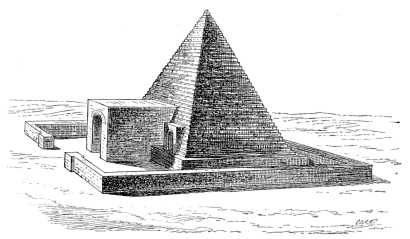
Fig. 162.—Tomb at Abydos;
drawn in perspective from the elevation of Mariette.
Fig. 163.—Section of the above tomb.
These tombs, which were generally constructed with no great care, were
for the most part without casing. The pyramidal form was given by
setting each course of bricks slightly back from the one below it.
When this part of the work was finished, each face was covered, as a
rule, with a coat of rough concrete, which, in its turn, was hidden
under a layer of white stucco. This multitude of little monuments, all
of the same shape and of much the same size, must, when complete, have
looked like the tents of an encamped army.
Fig. 164.—Stele of the eleventh dynasty, Abydos.
Drawn by Bourgoin. (Boulak.)
As these tombs were all upon the surface of the ground they have
suffered more than any others from the attacks of man. Those which are
reproduced among these lines of text were only recovered by Mariette
by dint of patient excavation. And although these ill constructed
edifices, so far as their materials are concerned, are still standing,
they will soon follow the many thousands which once stood in serried
ranks round the sepulchre of Osiris. The only remains of this
necropolis which are likely to be preserved are the numberless
steles which Mariette rescued from its débris. They form about
four-fifths of the total number of those monuments now preserved in
the museum at Boulak.[236] We figure two of them, one belonging to the
Middle, the other to the New Empire (Figs. 164 and 165).
Fig. 165.—Stele of Pinahsi, priest of Ma: Abydos. New Empire.
Drawn by Bourgoin. (Boulak.)
Whenever religious motives did not affect their choice, the Egyptians
preferred, during the period we are now considering, to cut their
tombs horizontally out of some rocky eminence. Such a tomb was called
a
σπέος
by the Greeks. The most interesting examples of these
constructions are offered by the tombs of the twelfth dynasty at
Beni-Hassan and at Siout, both situated between Memphis and Abydos.
Champollion was the first to appreciate the importance of the grottos
of Beni-Hassan. Ever since his time they have received, for various
reasons, much of the attention of egyptologists. We have already
referred to their inscriptions, which are as interesting to the
historian of ideas as to the student of political and social
organizations. We have alluded above to the varied scenes which cover
the walls of their chambers, the most important of which have been
reproduced by Champollion, Lepsius, and Prisse d'Avennes; we have
finally to speak of those famous protodoric columns, as they are
called, in which some have thought they saw the original model of the
oldest and most beautiful of the Grecian orders. We are at present
concerned, however, with the arrangement of the tombs themselves.
These are the same, with but slight variations, for the smallest and
most simple tombs as for those which are largest and most elaborately
decorated.
These façades are cut into the cliff-like sides of the hills of the
Arab Chain, about half-way up their total height. They are, therefore,
high above the surface of the river. When the cutting was made, two or
three columns were left to form a portico, the deep shadows of which
stand out strongly against the whiteness of the rock. This portico
leads to a chamber which is lighted only from the door. Its ceiling is
often cut into the form of a vault. A deep square niche is cut,
sometimes opposite to the door, sometimes in one of the angles. It
once contained the statue of the deceased. Most of the tombs have but
one chamber, but a few have two or three. In a corner either of the
only chamber or of that which is farthest from the door, the opening
of a square well is found; this leads to the mummy-chamber, which is
excavated at a lower level.
Fig. 166.—Façade of a tomb at Beni-Hassan.
The chamber upon which the portico opens is the funerary chapel, the
place of reunion for the friends and relations of the dead. As
Mariette very truly remarks, from the first step which the traveller
makes in the tomb of Numhotep at Beni-Hassan, he perceives that, in
spite of all differences of situation, the traditions of the Ancient
Empire are still full of vitality. "The spirit which governed the
decorators of the tomb of Ti at Sakkarah still inspired the painters
who covered the walls of the tomb of Numhotep at Beni-Hassan. The
defunct is at home among his own possessions; he fishes and hunts, his
cattle defile before him, his people build boats, cut down trees,
cultivate the vine and gather the grapes, till the earth, or give
themselves up to gymnastics or to games of skill and chance, and among
them the figure of the dead is carried hither and thither in a
palanquin. We have already found pictures like these in the mastabas
of the Ancient Empire, and here we find them again. But at
Beni-Hassan this painted decoration becomes more personal to the
occupant of the tomb, the inscriptions enter into precise and copious
biographical details, which are never found elsewhere."[237]
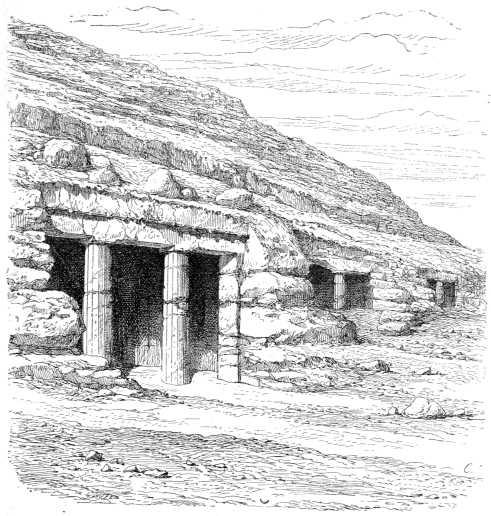
Fig. 167.—Façade of a tomb at Beni-Hassan,
showing some of the adjoining tombs.
The necropolis of Siout, in the Libyan chain, offers the same general
characteristics. The tomb of Hapi-Tefa, a feudal prince of the twelfth
dynasty, and consequently a contemporary of those princes of the nome
of Meh who are buried at Beni-Hassan, is the most remarkable. It is
composed of three large chambers communicating one with another, and
with the external air by a wide portico. The mummy-pit is reached from
the innermost of these chambers.
Fig. 168.—Interior of a tomb at Beni-Hassan.
Drawn in perspective from the elevation of Lepsius (i. pl. 60).
Neither statues, mummies, nor any other movable objects have been
found in these grottos. When their accessible situation and their
conspicuous appearance is remembered, this should not cause surprise.
Many centuries ago the acacia doors, which are mentioned in one of the
texts at Beni-Hassan, disappeared, and, in spite of the accumulation
of sand, the mouths of the wells could be found so easily, and could
so readily be cleared, that all objects of value and interest must
have been abstracted from the mummy-chambers in very remote times,
perhaps before the fall of the antique civilization. The inscriptions
and the painted walls alone remained practically intact down to the
commencement of the present century. The dryness of the climate, and
the difficulty of detaching them from the wall contributed to their
preservation, which was nowhere more complete than at Beni-Hassan. But
since travelling in Egypt became the fashion their sufferings have
begun. The mania for carving names upon every surface, and for
preserving souvenirs of all places of interest, has destroyed the
whole of one wall. The smoke of torches has also done its work in
reducing the brilliant tones and blunting the delicate contours.
Happily, the more interesting examples are all reproduced in those
great works to which we have already had such frequent occasion to
refer.
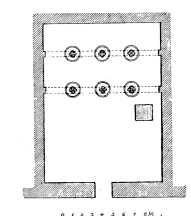
Fig. 169.—Plan of the above tomb.
The rich necropolis of Thebes has not preserved any monuments from
this period in such good condition as those of Abydos, Beni-Hassan, or
Siout. M. Maspero has discovered, however, in the district known as
the Drah-Aboul-Neggah, some remains of the royal tombs of the
eleventh dynasty. Several of these tombs resemble in their general
arrangements those of the feudal princes of Meh and Siout. Thus the
sepulchre of the King Ra-Anoub-Khoper-Entef is what the Greeks
called a hemi-speos, that is, it was partly built and partly
hollowed out of the living rock. Before the façade thus built against
the mountain, two obelisks were reared. The tombs of the other princes
belonging to the family of Entef were built upon the open plain. They
were structures in masonry, and seem at one time to have been crowned
by pyramids. Some idea of their shape may be obtained from our
illustrations of the tombs at Abydos.[238]
Fig. 170.—Chess players, Beni-Hassan. (Champollion, pl. 369.)
To complete our observations upon the tombs of the first Theban
Empire, it will be sufficient to recall what we have already said
about the pyramids in the Fayoum, which were the work of the
thirteenth dynasty. It is difficult to form an accurate idea of the
appearance of those monuments when complete. Time has treated them
with great severity, and in their present state it is impossible to
verify the assertions of Herodotus as to the peculiarities of their
casing and crowning ornaments. But it is quite certain that the Middle
Empire made no original inventions in the matter of sepulchral
architecture. It appears to have discontinued some of the ancient
arrangements, but in those which it preserved its efforts were
confined to putting old elements together in a new fashion and with
new proportions. It made frequent use of one mode of sepulture which
had previously been quite exceptional. No mastaba is known which dates
from this epoch, but the kings had not ceased to confide their mummies
and the perpetuation of their glory to pyramids, but these were no
longer of such colossal dimensions as under the Ancient Empire, while
their character was complicated, to some extent, by the colossi with
which they are said to have been surmounted, and the figured
decoration of their walls. Finally, they were often employed, not as
self-contained monuments in themselves, but merely as the culminating
points in a more complex ensemble. They were built upon a
rectangular platform or tower with walls slightly inclined from the
perpendicular.
It would seem that the idea of this arrangement had occurred to the
primitive Egyptians. So, too, had that of the speos or rock-cut
tomb; but the Memphite architects have left nothing which at all
resembles the grottos in the mountain sides of Beni-Hassan and Siout.
Neither in the neighbourhood of the pyramids nor in any other district
where the tombs of the early epoch are found, has any sepulchre been
discovered which shows the monumental façades, the large internal
development, and the simple and dignified lines of the artificial
chambers in the Arab and Libyan chains.
The subterranean tombs for which the first Theban Empire had shown so
marked a preference, became firmly seated in public favour during the
succeeding centuries. We do not know what the funeral customs may have
been during those centuries when the Hyksos, or shepherd kings, were
masters of Egypt; but, after their expulsion, the great Theban
dynasties, the eighteenth, the nineteenth, and the twentieth, by whom
the glory of Egyptian arms and culture was spread so widely, hardly
made use of any sepulchre but the chamber hollowed laboriously in the
rocky sides of that part of the Libyan chain which lies to the west of
Thebes. Every traveller visits the royal tombs which lie in the gloomy
ravine called the Bab-el-Molouk, or the Gate of the Kings. The
valley is about three miles in length and has a mean width of about
eleven hundred yards; its sides are riddled with galleries penetrating
more or less deeply into the mountains, and starting sometimes from
the slopes, sometimes from the base of the cliffs, which here and
there attain a height of 400 feet. The word speos seeming to the
Greeks to give an inadequate idea of the depth of these excavations
and of their narrow proportions, they called them
συρίγγες
or pipes; and modern archæologists have often employed the same
picturesque term in speaking of the Theban tombs. Five-and-twenty of
these tombs are royal; the rest belong to wealthy subjects, priests,
warriors, and high officers of state. In extent and richness of
ornament some of the latter are in no way inferior to the tombs of the
sovereigns.
Our studies must first, however, be directed to the royal tombs,
because in them we find the most original types, the most important
variations upon those which have gone before. In them the art of the
New Empire gives a clearer indication of all the changes which the
progress of ideas had brought about in the Egyptian conception of a
future life. In them, too, the Egyptian taste for ample dimensions and
luxuriant decoration is more freely indulged. The architects of Seti
and Rameses had resources at command far beyond those of which their
early rivals could dispose. They were, therefore, enabled to indulge
their employers' tastes for magnificence, and to give to certain
parts of the tomb a splendour which had been previously unknown. And
such parts were never those upon which the pyramid builders had
lavished most of their attention.
Nothing could be more simple than the course of proceeding of the
earlier architects, whose services and high social position are
indicated for us by more than one stele from the Ancient Empire. They
had to distinguish the royal from the private tomb, and no means to
such an end could be more obvious than to make use of a form of
construction which allowed the height and extent to be added to ad
infinitum without compromising the stability of the monument. Their
one idea, therefore, was to push the apex of the pyramid as far up
into the sky as they could. The height grew as the flanks swelled, so
that it became, by one process of accretion, ever more imposing and
better fitted to safeguard the precious deposit hidden within it. In
such a system the important point was this envelope of the
mummy-chamber, an envelope composed of thousands of the most carefully
dressed and fixed blocks of stone, which, in their turn, were covered
with a cuirass of still harder and more durable materials. In order
that all access to the sarcophagus might be more safely guarded
against, the funerary chapel was separated from the mountain of hewn
stone which inclosed the mummy-chamber. Supposing the latter to be
decorated with all the taste and richness which we find in the tomb of
Ti, it would still be comparatively small and unimportant beside the
colossal mass which overshadowed it, and to which it belonged. The
disproportion is easily explained. When the pyramids were built, the
workman, the actual mason, had little more to learn. He was a thorough
master of the dressing and fixing of stone and other materials; but,
on the other hand, the art of architecture was yet in its infancy. It
had no suspicion of those rich and varied effects which the later
Egyptians were to obtain by the majesty of their orders and the
variety of their capitals. It was not till much later that it learnt
to raise the pylon before the sacred inclosures, to throw solemn
colonnades about their courts, and to greet the visitor to the temples
with long naves clothed in all the glory of colour.
Two periods of national renascence, in the thirteenth and eighteenth
dynasties, had to intervene before these marvels could be realized.
The earlier of these two periods is only known to us by a few works
of sculpture in our museums. We are forced to guess at its
architecture, as we have nothing but descriptions, which are at once
incomplete and exaggerated, to guide our imaginations.
Fig. 171.—General plan of Thebes.
The second Theban Empire may be studied under very different
conditions. The architects of that epoch excelled all their
predecessors in the skill with which they used their materials, and
the artistic ability with which they laid their plans. In a word, they
realized the ideal towards which Egyptian builders had been tending
for many centuries, and their genius is still to be seen in buildings
which, even in their ruin, charm by the grandeur of their conception
and the finish of their execution.
In the century which saw the construction of the great temples of
Abydos, of Karnak, and of Luxor, the architect who was charged with
the building of the royal tombs could dispose of all the resources of
an empire which stretched from the southern boundaries of Ethiopia to
Damascus and Nineveh. He would have fulfilled the wishes of neither
prince nor people had he not found means to give an amplitude and a
beauty to those tombs which should stand a comparison with the
sumptuous edifices which the same kings had erected, in another part
of the city, in honour of the great deities of the country.
The simple and massive forms of the pyramid did not lend themselves to
success in such an enterprise. They afforded no opportunity for the
happy combinations of horizontal and vertical lines, for the contrasts
of light and shadow and splendour of decoration which distinguished
the epoch. The experience of the Middle Empire proved that it was
better to make a fresh departure than to attempt to foist upon the
pyramid a class of ornament which was destructive to the simplicity in
which so much of its grandeur consisted. The highest expression of the
new form of art was in the temple, the development of which was rather
in a horizontal than in a vertical direction; in the long avenues of
sphinxes, in the pylons and colossal statues of the kings, in
porticoes and forests of columns. The problem, therefore, was to
embody some of these elements in the design of the tomb. For this
purpose it was necessary to give increased dimensions and greater
importance to a part of the royal sepulchre which had been hitherto
comparatively neglected. The funerary chapel had to be expanded into a
temple in miniature, into a temple where the king, who had rejoined
the deities from whom he was descended, could receive the homage and
worship of his people.
The exploits of these princes, which were greater than anything of
which Egypt had to boast in the whole of its glorious past, must have
helped to suggest the temple form of their tombs. To this form the
general movement of the national art also pointed, and to give it
effect nothing more was required than the separation of the chapel
from the tomb proper, to which previous tradition had so closely
allied it. The situation of the sepulchre, after Thebes had become a
populous city and the real capital of Egypt, was no longer a matter of
question. It was in the rocky flanks of the Libyan chain that all its
inhabitants sought that asylum for their dead which the inhabitants of
Memphis found upon the eastern edge of the desert. The Libyan chain to
the west of Thebes offers no platform like that of the necropolis of
Memphis. Its cliffs and intersecting ravines offer no sites for
constructed works; hence the ordinary form of Theban tomb is the
speos, or the pipe, which is but an exaggerated form of the
speos.
Like the chief men among his subjects, the sovereign loved to take his
last repose in the immediate neighbourhood of the city in which he had
dwelt during his life, in which the streets had so often resounded to
the cries of triumph which greeted his return from some successful
campaign, or had seen him pass in some of those long processions which
are figured upon the walls of Medinet-Abou (Fig. 172).[239] His tomb
was a cavern like that of his subjects. Fashion and the physical
conditions of the country governed him as well as his inferiors in
rank. From the reign of Seti I. onwards, the kings chose for their
place of sepulture the wild and deserted valley in which Belzoni found
the tomb of that conqueror. In the time of the Ptolemies it contained
the bones of no less than forty Egyptian monarchs. It would be
difficult to imagine any site better calculated for the isolation and
concealment of the mummy than this valley, where the rocks split and
crumble under the sun, and the sand blown hither and thither by the
winds from the desert fills up every crevice in the cliffs.
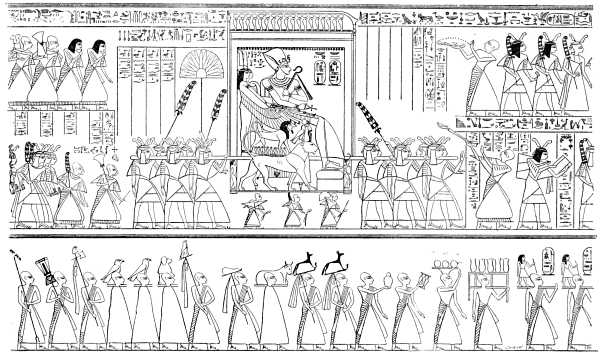
Fig. 172.—Rameses III. conducting a religious procession,
at Medinet-Abou. (Wilkinson, iii., pl. 50.)
Nothing could be easier than to mask the entrance in such a place,
but, on the other hand, no constructed building of any importance was
possible except at a great expenditure of time and labour.[240]
But the plain at the foot of the range offered all that the architect
could wish. It was still within the district consecrated to the dead,
and yet its level surface presented no obstacles to an unlimited
extension of any buildings which might be placed upon it.
We have here then the facts which determined the course of the
Egyptian architects.
In the space inclosed between the left bank of the river and the first
slopes of the Libyan chain, certain edifices were raised which are
still, in great part, extant. Their funerary signification was never
completely understood, in spite of the confused hints to that effect
given by the Greek writers, until within the last few years. To
Mariette belongs the credit of having at last removed all doubt on the
subject. It is probable enough that the number of these buildings was
formerly much greater than it is at present, but those which have come
down to us are still in sufficiently good preservation to enable us to
discern and define their true character, a character which was
doubtless common to all the temples on the left bank of the Nile.
They were certainly temples. Their general arrangements do not differ
from those of other religious edifices, both in Thebes itself, and
elsewhere in Egypt. There is, however, a difference which was not
perceived until the texts which contained the history of each temple
and of the prince who claimed the credit of its erection were
deciphered. The famous buildings at Luxor and Karnak may be taken as
typical examples of the temple, properly speaking, in its richest and
most complete development. The translation of the inscriptions and
royal ovals which cover their walls has sufficed to show that they
were national monuments, public sanctuaries consecrated by the king,
as the representative of the people, to the worship of those great
deities who were at once the principles of life and the faithful
protectors of the Egyptian race. Century after century they never
ceased to found such temples, to increase and to embellish them. From
the princes of the twelfth dynasty down to the Ptolemies, and even to
the Roman emperors, every successive family which occupied the throne
held it a point of honour to add to the creations of its predecessors.
One prince built a hypostyle hall, or a court surrounded by a
colonnade; another added to the long rows of human or ram-headed
sphinxes which lined the approaches; a third added a pylon, and a
fourth a laboriously chiselled obelisk. Some kings, who reigned in
periods of recuperation after civil war or barbaric invasion, set
themselves to repair the damage caused by time and the violence of
man. They strengthened foundations, they lifted fallen columns, they
restored the faded colours of the painted decorations. The foreign
conquerors themselves, whether Ethiopians, Persians, or Greeks, as
soon as they believed themselves to have a firm hold upon the country,
set themselves with zeal to obliterate the traces of their own
violence. Each of these sovereigns, whether his contribution to any
work had been great or small, took care to inscribe his own name upon
it, and thus to call upon both posterity and his own contemporaries to
bear witness to his piety.
The temple as we see it at Karnak and Luxor is the collective and
successive work of many generations. Such, too, was the character of
the great buildings at Memphis which were consecrated to Ptah and
Neith.
But on the left bank of the Nile, and in the neighbourhood of the
Theban necropolis, we find a group of temples whose physiognomy is
peculiar to themselves. Nothing exactly like them is to be found
elsewhere;[241] and they all belong to one period, that of the three
great Theban dynasties, the eighteenth, nineteenth, and
twentieth.[242] "These temples are monuments raised by the kings
themselves to their own glory. They are not, like the temples at
Karnak and Luxor, the accumulated results of several generations.
Each temple was begun and finished by the king who planned it, so far
at least as construction was concerned. In those cases where the
decoration was left incomplete at the death of the royal builder, his
successor finished it in his name. In these decorations the founder of
the temple was represented either worshipping the gods, or in the
eventful moments of his military career, or in his great hunts; and
thus, while yet alive, he laid the foundations of an edifice destined
to carry the memory of his glory and piety down to the latest
posterity."[243]
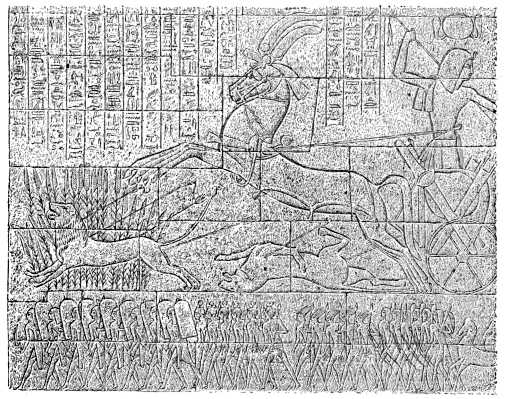
Fig. 173.—Rameses III. hunting; from Medinet-Abou.
Surrounded on all sides by tombs and packed into a comparatively
narrow space, these temples are separated from the Bab-el-Molouk only
by the slopes of the surrounding El-Assassif. The oldest of them is
that at Dayr-el-Bahari. It was built by the regent Hatasu, of whose
career we know enough to strongly excite, but too little to satisfy,
our curiosity. We know that Hatasu, the wife and sister of Thothmes
II., governed Egypt with skill and energy for seventeen years, in
trust for her brother, Thothmes III. Where does her mummy repose? Is
it in that ravine on the south-west of the Bab-el-Molouk which is
called the Valley of the Queens, because the tombs of many Theban
princesses have been found in it? Or is it in the slopes of the
mountain behind the temple itself? Numerous sepulchral excavations
have been found there, and many mummies have been drawn from their
recesses. The artists to whom the decoration of the temple was
committed, were charged to represent the chief actions of Hatasu as
regent, and, although their works do not give us a detailed history of
her eminently successful administration, they deal at length with the
enterprise of which the regent herself seems to have been most proud,
namely, the maritime expedition against Punt, a distant region which
must have been either southern Arabia, the country of the Somalis, or
the eastern coast of Africa.
Next in point of age to the building of Queen Hatasu is that which is
called the Ramesseum; this is no other, as the members of the
Institut d'Égypte have clearly proved, than the so-called Tomb of
Osymandias which is described at such length by Diodorus.[244]
Erroneous though it be, this latter designation is by no means without
interest, as it proves that, at the time of Diodorus, persistent
tradition ascribed a funerary origin to the edifice. The whole temple,
inside and out, recalled Rameses II.; the great conqueror seemed to
live and breathe on every stone; here majestic and calm, like force in
repose, there menacing and terrible, with his threatening hand raised
over the heads of his conquered enemies. His seated statue, fifty-six
feet in height, was raised in the courtyard; to-day it lies broken
upon the ground. Battle scenes are to be distinguished upon the
remains of the walls. An episode of the war against the Khetas may be
recognized, which seems to have made a great impression upon the king
and his comrades in arms. It deals with that battle fought upon the
bank of the Orontes, in which Rameses, when surrounded by the enemy,
won safety for himself by his own personal valour and presence of
mind. His prowess was celebrated by Pentaour, a contemporary poet, in
an epic canto which has survived to our day. Rameses is there made to
ascribe his safety and all the honour of his victory to his father
Amen, who heard his appeal for help and, precipitating himself into
the mêlée, snatched him from the very hands of his enemies.
Medinet-Abou, which might be called The Second Ramesseum, is to
Rameses III. what the pretended tomb of Osymandias is to Rameses II.
His presence pervades both the temple itself and its adjoining
pavilion. Its bas-reliefs represent one of the greatest events in
Egyptian, we might almost say, in ancient, history, namely, the
victory won by Rameses over a confederation of the nations of the
north and west, of those who were called the maritime races. This
victory was mainly instrumental in driving westwards certain peoples
who were destined, in more recent times, to play a great part in the
politics of the Mediterranean.
Each of the buildings which we have just noticed had but a single
proprietor. They were each dedicated to the memory of some one
individual; but there was nothing to prevent the association in a
single temple of two sovereigns who might happen to be united by
strong ties of blood, and this course was taken in the temple of
Gournah, situated in the same district of Thebes. It was commenced by
Rameses I., the founder of the nineteenth dynasty, continued by his
son, Seti I., and finished by his grandson, Rameses II. The first
Rameses and Seti figure in it with the attributes of Osiris. The
inscriptions enumerate the sources of revenue set aside by the king,
in each nome, for the service of the annual sacrificial celebrations;
and thus the building reveals itself as a temple to the perpetual
honour of the two first princes of a race which did so much to add to
the greatness and prosperity of Egypt.
The famous colossi of Amenophis III., known to the ancients as the
Statues of Memnon, no doubt formed part of a similar building (fig.
18 and pl. vi). The temple built by this prince near the site of the
Ramesseum has almost entirely disappeared, but the slight traces which
still exist cover a vast space, and suggest that the building must
have been one of rare magnificence.[245]
Only one of those Theban temples which rise upon the left bank of the
river is free from all trace of a funerary or commemorative purpose,
namely, the temple at Medinet-Abou which bears the ovals of Thothmes
II. and Thothmes III. It shows signs, moreover, of having been
frequently enlarged and added to, some of the additions having been
made as recently as in the time of the Roman Emperors. In this respect
it resembles, in spite of its comparatively small size, the great
temples upon the right bank of the river. Like them, its creation was
a gradual and impersonal matter. Every century added its stone, and
each successive king engraved his name upon its walls. How to account
for its exceptional situation we do not know. It is possible that
those funerary temples of which we have spoken were an original
invention of the successors of Thothmes; perhaps that constructed by
Hatasu at Dayr-el-Bahari was the first of the series.
However this may have been, the new type became a success as soon as
it was invented; all the other temples in the district may be more or
less immediately referred to it. The great deities of Egypt, and more
particularly those of Thebes, are never forgotten in them. They
contain numerous representations of the princes in whose honour they
were erected performing acts of worship before Amen-Ra, the Theban god
par excellence, who is often accompanied by Mout and Khons, the
other two members of the Theban triad. These temples were therefore
consecrated, like almost all the other sacred buildings of Thebes, to
those local deities which, after the establishment of that city as the
capital of the whole country, became the supreme national gods. Those
gods were as much at home in the temples of which we are speaking as
in their own peculiar sanctuaries on the right bank of the river. In
both places they received the same homage and sacrifices, but in the
funerary temples of the left bank they found themselves associated,
paredral as the Greeks would say, with the princes to whose memory
the temples were raised. These princes were represented with the
attributes of Osiris, both in the statues which were placed against
the piers in the courtyard and in the bas-reliefs upon the long flat
surfaces of the walls. By these attributes they became more closely
allied with the great deity who was the common protector of the dead
and the guarantor of their future resurrection. In this capacity the
deceased prince was worshipped as a god by his own family. Thus, in
the temple of Gournah, we find Rameses I. seated in a naos and
receiving the homage of his grandson, Rameses II.; and, again, the
latter worshipping Amen-Ra, Khons, and Rameses I. at one and the same
time. This presentation of offerings to the deified king, as
represented in the chambers of these temples, recalls the scene which
is carved upon almost all the steles, and with greater variety and
more detail, in the bas-reliefs on the internal walls of the mastabas.
The analogy which we are endeavouring to establish between the western
temples at Thebes and the funerary chambers of the private tombs, is
completed by the biographical nature of the pictures which form almost
the sole decoration of those temples. The images presented to our gaze
by the chamber walls of the mastaba are not, indeed, so personal and
anecdotical as those of the temples, but they contain an epitomized
representation of the every-day life, of the pleasures and the more
serious occupations of a rich Egyptian. It is easy to understand how,
with the progress of civilization, the more historic incidents in the
life of an individual, and especially when that individual was a king,
came to be figured in preference to those which were more general in
their application. To embellish the tomb of a conqueror with pictures
of his battles and victories was to surround him after death with the
images, at least, of those things which made his happiness or his
honour while alive. Pictures of some famous feat of arms would give
joy to the double of him who had performed them, and would help to
relieve the ennui of the monotonous life after death. Hence the
tendency which is so marked in the bas-reliefs of the first Theban
Empire, especially in those at Beni-Hassan. The constant and universal
themes which sufficed for the early centuries of the Egyptian monarchy
were not abandoned; scenes similar to those of the mastabas, are,
indeed, frequently met with in the Theban tombs; but it is evident
that in many cases scenes were sought out for reproduction which would
have a more particular application; there is an evident desire to hand
down to future generations concrete presentments of any political or
other events which might appear worthy of remembrance. History and
biography thus came in time to play an important part in sepulchral
decoration, especially when kings or other royal personages were
concerned.
Similar pictures are to be met with here and there in temples proper,
as may be seen by a glance at the bas-relief figured upon the opposite
page (Fig. 174), but in such cases they are invariably on the outer
walls. At Luxor, for instance, the campaigns of Rameses II. against
the peoples of Syria are thus displayed; and at Karnak it is upon the
external walls of the hypostyle hall that the victories of Seti I. and
Rameses II. are sculptured. In the interiors of all these courts and
halls we hardly find any subjects treated but those which are purely
religious; such as female deities assisting at the birth of a king, or
taking him upon their knees and nourishing him from their breasts, a
theme which is also found in royal tombs (Fig. 175); or one god
presenting the king to another (Fig. 33); or the king paying homage to
sometimes one, sometimes another, of his divine protectors (Figs. 14 and 176). We find such religious motives as these continually
repeated, upon wall and column alike, from the first Theban kings to
the epoch of the Ptolemies. On the right bank of the river pictures of
a mystically religious character are universal; on the left bank those
with an historical aim are more frequent.
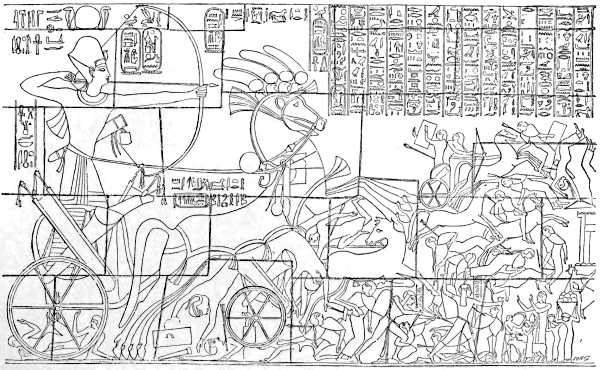
Fig. 174.—Rameses II. in battle; Luxor. (Champollion, pl. 331.)
It will be seen that the difference between the two kinds of temple,
between that of the necropolis and that of the city, is not so
striking and conspicuous as to be readily perceived by the first comer
who crosses from the one bank of the river to the other; but the
variations are quite sufficiently marked to justify the distinction
propounded by Mariette. According to him the temples in the necropolis
are funerary chapels which owe their increased size and the
richness of their decoration to the general magnificence and highly
developed taste of the century in which they were built. But it is
enough for our present purpose to have indicated the places which they
occupied in the vast architectural compositions which formed the tombs
of a Seti or a Rameses. They had each a double function to fulfil.
They were foundations made to the perpetual honour of a deceased king,
chapels in which his fête-day could be kept and the memory of his
achievements renewed; but they were at the same time temples in which
the national gods were worshipped by himself and his descendants, in
which those gods were perpetually adored for the services which they
had done him while alive and for those which they might still do him
when dead. In their latter capacity these buildings have a right to be
considered temples, and we shall defer the consideration of their
architectural arrangements, which differ only in details from those of
the purely religious buildings, until we come to speak of the
religious architecture of Egypt.
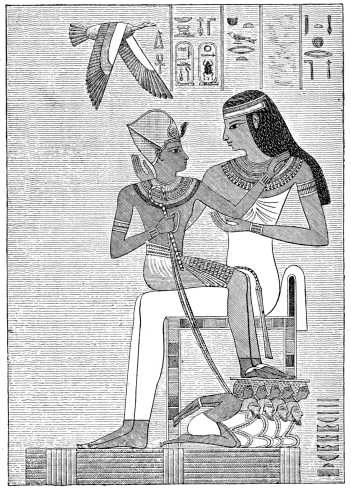
Fig. 175.—Painting in a royal tomb at Gournah. Amenophis II.
upon the lap of a goddess. (Champollion, pl. 160.)
We shall here content ourselves with remarking that the separation of
the tomb and the funerary chapel by some mile or mile and a half was a
novelty in Egypt. The different parts of the royal tomb were closely
connected under the Memphite Empire, and the change in arrangement
must have been a consequence of some modification in the Egyptian
notions as to a second life.
Fig. 176.—Amenophis III.
presenting an offering to Amen.
Decoration of a pier at Thebes;
from Prisse.
In the mastaba the double had everything within reach of his hand.
Without trouble to himself he could make use of all of the matters
which had been provided for the support of his precarious existence:
the corpse in the mummy pit, the statues in the serdab, the
portraits in bas-relief upon the walls of the public chamber. Through
the chinks between the pieces of stone by which the well was filled
up, and through the conduits contrived in the thickness of the walls,
the magic formulæ of the funerary prayers, the grateful scent of the
incense, and of the burnt fat of the victims (Fig. 177), reached his
attentive senses. Brought thus into juxtaposition one with another,
the elements of the tomb were mutually helpful. They lent themselves
to that intermittent act of condensation, so to speak, which from time
to time gave renewed substance and consistency to the phantom upon
which the future life of the deceased depended. This concentration of
all the acts and objects, which had for their aim the preservation of
the deceased for a second term of life, was obviously destroyed as
soon as the division of the tomb into two parts took place. The mummy,
hidden away in the depths of those horizontal wells in the flank of
the Western Range of which we have spoken, would seem to be in danger
of losing the benefit of the services held in its honour upon the
Theban plain. At such a distance it would neither hear the prayers nor
catch the scent of the offerings. And the double? Is it to be
supposed that he oscillated between the colossi in the temple where
the funerary sites were celebrated, and the chamber in which the
corpse reposed?
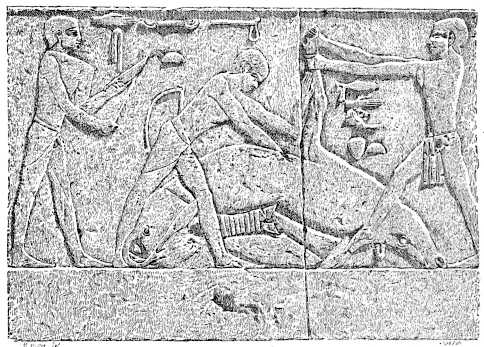
Fig. 177.—Flaying the funerary victim.
From a tomb of the 5th dynasty at Sakkarah. (Boulak.)
Before they could have accepted this division of the tomb into two
parts the Egyptians must have arrived at some less childish conception
of the future life than that of their early civilization. That
primitive conception was not entirely banished from their minds;
evidence of its persistency is, indeed plentiful, but a more
intelligent and less material notion gradually superimposed itself
upon the ancient belief. The indescribable being which was the
representative of the deceased after death became gradually less
material and more spiritual; in time it escaped from its enforced
sojourn in the tomb and approached more nearly to that which we call
the soul. This soul, like the nocturnal sun, passed a period of
probation and purgation in the under world, and, thanks to the
protection of Osiris and the other deities of the shades, was at last
enabled to return to earth and rejoin the body which it had formerly
inhabited. The problem of death and a future life was resolved in much
the same way by the Greeks and by all other races who drew much of
their inspiration from the Egyptians. They all looked upon the corpse
as still alive when they expressed their hopes that the earth upon
which they poured out wine and milk would like lie lightly upon it.
After a time they added Tartarus and the Elysian Fields to their
beliefs, they introduced the heroic fathers of their race into the
councils of the gods, and they described and figured the joys which
awaited the just upon the Happy Islands.
These various hypotheses are contradictory enough from a logical point
of view; they exclude and destroy one another. But when it is a
question of notions which are essentially incapable of being strictly
defined, the human intelligence is singularly content to rest in vague
generalities. Contradictions do not embarrass it; its adaptability is
practically infinite.
The beliefs which we have just described tended for many centuries to
become more and more general. They were taught in that Ritual of the
Dead which, although certain of its parts date from the most ancient
times, did not take its complete and definite form until the Theban
epoch. Being more spiritual and less material, they were less opposed
to the subdivision of the sepulchre than the more primitive idea; and
this subdivision was necessary if the public and commemorative part of
the tomb were to receive a splendour and amplitude befitting the
exploits of a Thothmes, a Seti, or a Rameses. Dayr-el-Bahari proves
that the change had already been made under the eighteenth dynasty,
but it was not until the nineteenth that it became definitely adopted.
The progress of ideas and of art had then advanced so far, that more
ambitious desires could be satisfied, and the country filled with
magnificent edifices, which, like the temples of the two Rameses, were
original in so far as they belonged at one and the same time to
religious and funerary architecture. We should call them cenotaphs,
were it not that the Egyptians, like all the other races of antiquity,
believed in the real presence of their dead in the buildings erected
in their honour.
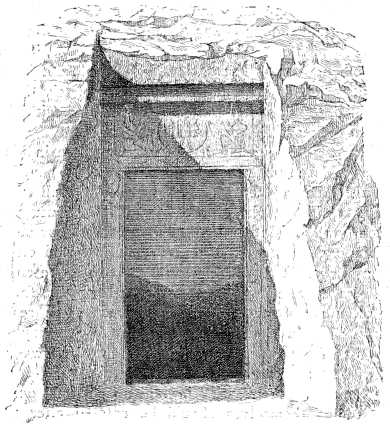
Fig. 178.—Entrance to a royal tomb. (Description de l'Égypte, ii., pl. 79.)
The other division of the tomb is that which contains the well and the
mummy-chamber, the eternal dwelling-place of the illustrious dead. The
second half of the royal sepulchre had to be as sumptuous and
luxurious in its way as the first, but the problem placed before the
architect was diametrically opposed to that which he had to solve in
the other part of his task. In constructing and decorating the
funerary temple upon the plain, he was working before the eyes of the
public, for their benefit and for that of the remotest posterity.
But the task of hewing out the tomb was a very different one. For long
years together he pursued his enterprise in the mystery and shadow of
a subterranean workshop, to which all access was no doubt forbidden to
the curious. He and his assistants cut and carved the living rock by
the light of torches, and his best ingenuity was taxed to devise means
for preserving from the sight of all future generations those works of
the best artists of Egypt with which the walls were to be covered.
Those prodigies of patience and skill were executed for the benefit of
the deceased alone. Important though it was that the sepulchre of a
great man should be ornamented to the greatest extent possible, it was
of still greater moment that his last resting-place should not be
troubled by the visits of the living; and the more completely the
mummy was concealed, the greater were the deserts of the faithful
servant upon whom the task had been placed.
In order that this blessing of undisturbed peace in his eternal
dwelling should be secured, the royal tomb seems to have been
constructed without any such external show as would call attention to
its situation. The tombs of private individuals usually had a walled
courtyard in front of them to which access was obtained by a kind of
porch, or tower, with inclined sides and crowned by a small pyramid.
But the explorers, Belzoni, Bruce and others, who disengaged the
entrances to the royal tombs, found them without propylæa of any
kind.[246] The doorway, cut vertically in the rock, is of the utmost
simplicity, and we have every reason to suppose that, after the
introduction of the mummy, it was carefully masked with sand and rocky
débris.[247]
The existence of the temples in the plain made it unnecessary that the
tombs themselves should be entered after that final operation had
been performed. Some words of Diodorus are significant in this
direction. "The priests say that their registers attest the existence
of forty-seven royal tombs, but that at the time of Ptolemy the son of
Lagus, only seventeen remained."[248] This assertion cannot be
accepted literally, because twenty-one tombs have already been
discovered in the Bab-el-Molouk, some of them in a state of
semi-completion, besides four in the ravine which is called the
Valley of the West, which makes twenty-five in all. What the priests
meant when they spoke to Diodorus was no doubt, that at the time of
the Ptolemies, no more than seventeen of their entrances had been
discovered. If through the plans made for their construction and
preserved in the national archives there were some who knew their
situation, they preserved the secret. We know, by the inscriptions
upon their walls, that fifteen of the tombs which are now accessible,
were open in the time of the Ptolemies; several of them seem to have
been shown, to the Roman and other travellers who visited Egypt, as
national objects of interest.[249]
The precautions taken to hide and obstruct the openings of the royal
tombs were thus successful in many cases. Some of these have only been
discovered in our own times, through the ardour and patience which
characterize modern research, and we have still good reason to suppose
that there are others which yet remain to be found. In 1872 Professor
Ebers discovered a beautiful private tomb, that of Anemenheb, which,
although situated close to one of the most frequented paths in the
necropolis, had been previously unknown. It was open, but the opening
had been carefully concealed with rough pieces of rock and general
rubbish by the fellahs, who used the tomb as a hiding-place from the
recruiting officers of the viceroy. They would remain concealed in it
for weeks at a time until the officers had left their village. The
royal cemetery of the Ramessides has possibly much more to tell us
before its secrets are exhausted.
The entrance to the tomb always ran a certain chance of being
discovered and freed from its obstacles. It was difficult, of course,
to prevent the survival of some tradition as to the whereabouts of
the burial-places of those great sovereigns whose memory was a
consolation to Egyptian pride in the days of national abasement and
decay. Provision had to be made, as in the case of the pyramids,
against a forced entry into the gallery either by an enemy or by some
robber in search of treasure, and we find that the precautions adopted
were similar to those which we have described in noticing the royal
tombs at Memphis. Let us take as an example the finest and most
complete of all the tombs of the Ramessides, that of Seti I. After
descending two flights of steps, and traversing two long and richly
decorated corridors, Belzoni arrived, without discovering either
sarcophagus or anything that looked like the site of a sarcophagus, at
an oblong chamber 13 feet 6 inches by 12 feet. A wide and deep well,
which here barred the passage, seemed to indicate that the extremity
of the excavation had been reached. Belzoni caused himself to be
lowered into the well. The walls were everywhere hard and firm, and
without resonance, and there was no sign of a passage, either open or
concealed, by which access to a lateral chamber, or to a second series
of galleries might be obtained. But Belzoni was too old an explorer to
be deceived by such appearances. On his first arrival at the edge of
the well he had perceived in the wall on the farther side of it a
small opening, about two feet wide, and two feet and a half high. This
had been made, at some unknown period, in a wall covered with stucco
and painted decorations. Across the well a beam was still lying, which
had served the purpose of some previous visitor to the tomb. A cord
hung from this beam, and it was after discovering that the well ended
in nothing that the screen of masonry on the other side had been
pierced. Belzoni had therefore only to follow the road opened for him
by earlier explorers. A plank bridge was thrown across the well, the
opening was enlarged, and a new series of galleries and chambers was
reached, which led at last to the sarcophagus-chamber itself.[250]
Belzoni remarked that throughout the whole course of the excavation
the doors of the chambers showed evidence of having been walled up,
and that upon the first steps of one of the staircases a heap of stone
rubbish had been collected, as if to discourage any one who might
penetrate beyond the well and pierce the barrier beyond its gaping
mouth. It seems likely that the first violator of the tomb knew the
secret of all these arrangements, and consequently that its first
opening took place in very ancient times, and was the work of some
native Egyptian robber.
In the sarcophagus-chamber Belzoni discovered a contrivance of the
same kind as that which had failed to stop him almost upon the
threshold of the tomb. The sarcophagus of oriental alabaster was in
place, but empty; the lid had been raised and broken.[251] From the
sound given out by the floor when struck the explorer perceived that
there must be a hollow space under the base of the sarcophagus. He cut
a hole and brought to light the first steps of a staircase, which led
to an inclined plane by which the interior of the mountain was deeply
penetrated. A wall had been raised at the foot of these steps, beyond
which a settlement of the superincumbent rock put an end to all
advance after a distance of fifty-one yards had been traversed. Is it
not possible that Belzoni only discovered a false sarcophagus, placed
to deceive unbidden visitors like himself, and that the mummy was
deposited, and still lies, in a chamber at the end of this corridor?
The point at which the fallen rock arrested his progress is four
hundred and eighty-three feet from the external opening, and about one
hundred and eighty below the level of the valley. At such a depth, in
these narrow and heated galleries, where there is no ventilation and
where the smoke of the torches rapidly becomes stifling, it is not
astonishing that, in spite of his admirable perseverance, Belzoni held
his hand before completing the exploration.[252]
These subterranean tombs are hardly less astonishing than the colossal
masses of the pyramids for the sustained effort which they imply; if
we take the trouble to reflect upon the peculiarly difficult
conditions under which they were constructed, they may even impress
our imaginations more profoundly than the artificial mountains of
Cheops and Chephren. We have already mentioned a figure which gives
some idea of the surprising length of their passages; and although no
one of the other tombs quite equals that of Seti, many approach it in
dimensions. The tomb of Rameses III. is 416 feet long, that of Siptah
370 feet, and others varied between 200 and 270 feet. For the
construction of such places an enormous number of cubic yards of rocky
débris had to be cut from the interior of the mountain, and carried
up by narrow and steep corridors to be "shot" in the open air. Still
more surprising is the elegance and completeness of the decoration. In
the tombs of Seti and of Rameses III. there is not a single surface,
whether of walls, piers, or ceilings, which is not covered with the
work of the chisel and the brush, with ornamental designs, with the
figures of gods and genii, of men and animals. These figures are far
too numerous to count. They swarm like ants in an anthill; a single
chamber often contains many hundreds. Colour is everywhere; here it is
used to give salience to the delicate contours of the figures in
relief, there it is laid flat upon the carefully-prepared surfaces of
white stucco. In these sealed-up caverns, in which the air is
constantly warm and dry, the pictures have preserved their freshness
of tint in the most startling fashion. And to obtain all this
harmonious effect no light but an artificial one was available. It was
by the smoky glare of torches, or by the flickering flame of little
terra-cotta lamps, suspended from the roof by metal threads, that the
patient artists of Egypt drew these masterly contours, and elaborated
the exquisite harmony of their colour compositions. Egyptian art never
reached greater perfection than in these characteristic productions of
its genius, and yet no human eye was to enjoy them after that day upon
which the final touch was to be given to their beauties, upon which
they were to be inclosed in a night which, it was hoped, would be
eternal.
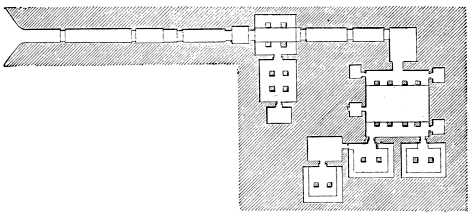
Fig. 179.—Plan of the tomb of Rameses II.; from Prisse.
Fig. 180.—Horizontal section of the same tomb; from Prisse.[253]
But yet all this work was not labour lost. These pictures, in which
the details change continually from one tomb to another, were all
inspired by a single desire, and all tended to the same end. Like
those which we have found in the tombs of the Ancient Empire, they had
a sort of magic virtue, a sovereign power to save and redeem. The
personages and articles of food represented on the mastabas were
shadows of people and shadows of material sustenance, destined for the
service and the food of a shadow, the double of the defunct
proprietor of the tomb. The all-powerful influence of prayer and
faith, working through Osiris, turned these shadows into realities.
Fig. 181.—The smaller sarcophagus-chamber
in the tomb of Rameses VI.
(From Horeau, pl. 21.)[254]
Representations of this kind are common enough in the royal tombs of
Thebes. It will suffice if we notice those which are still to be seen
in the sepulchre of Rameses III., in the series of small chambers in
the first two passages. Like the hunting scene which we take from the
walls of a private tomb (Fig. 183), these pictures have, beyond a
doubt, the same meaning and value as those in the mastaba. But in the
Theban tombs their significance is only secondary. Ideas had
progressed to some purpose since the days of the Memphite kings. Both
in its general arrangement and in the details of its ornamentation,
the sepulchres in the Bab-el-Molouk gave expression to the new, more
philosophical, and more moral conception which had come to overlie the
primitive beliefs.
Fig. 182.—Entrance to the tomb of Rameses III. (From Horeau, pl. 21.)
The first conception was that of the double, inhabiting the tomb, and
kept alive in it by sacrifice and prayer. But in time the Egyptians
would appear to have realized that the double was not the only thing
that remained after the death of a human unit. Their powers of
apprehension were quickened, in all probability, by that high moral
instinct of which the oldest pages of their literature give evidence.
Good or bad, every man had a double, the continuance and prosperity of
which depended in no way upon his merits or demerits. Unless the just
and the unjust were to come to one and the same end, something more
was wanting. This something was the soul (ba). Instead of vegetating
in the interior of the tomb, this soul had to perform a long and
difficult subterranean journey—in imitation of the sun and almost
upon his footsteps—during which it had to undergo certain tests and
penances. From this period of trial it would emerge with more or less
honour, according to its conduct during the few short years passed by
it on earth and in company with the body to which it had belonged. It
had to appear before the tribunal of Osiris-Khent-Ament, the Sun of
Night, around whose seat the forty-two members of the infernal jury
were assembled.[255]
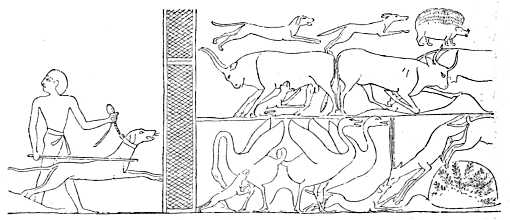
Fig. 183.—Hunting scene upon a tomb at Gournah.
(Champollion, pl. 171.)
There, before the "Lords of truth and justice," the soul had to plead
its cause, and there it had to repeat, with an amount of assurance and
success which would depend upon its conduct in the light, that
negative confession which we read in chapter cxxv. of the "Book of
the Dead," which contains an epitome of Egyptian morality.[256] But
those incorruptible judges were not guided solely by the testimony of
the ba in its own favour. They weighed its actions in a pair of
scales and gave judgment according to their weight.[257] The impious
soul was flogged, was delivered to storm and tempest, and, after
centuries of suffering, underwent a second death, the death of
annihilation. The just soul, on the other hand, had to conquer in many
a combat before it was admitted to contemplate the supreme verities.
During its transit across the infernal regions, hideous forms of evil
sprang up before it and did their best to arrest its progress by
terrifying threats. Thanks to the help of Osiris and of other
soul-protecting gods, such as Anubis, it triumphed in the end over all
obstacles, and, as the sun reappears each morning upon the eastern
horizon, it arrived surely at last at those celestial dwellings where
it became incorporated among the gods.
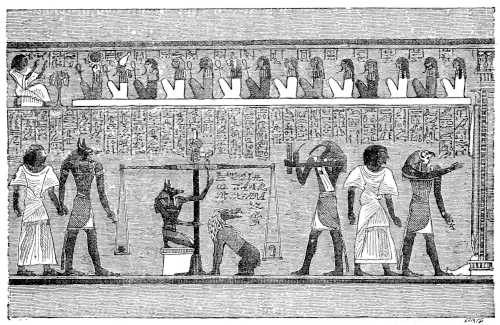
Fig. 184.—The weighing of actions.
(From an illustrated Ritual of the Dead in the British Museum.)
The Egyptian imagination spared no effort to represent with the
greatest possible precision those mysterious regions where the soul
had to undergo its appointed tests. Such beliefs afforded a wide scope
for the individual influence of the artist and the poet, and
accordingly we find that they were modified with a rapidity which is
unique in Egyptian art. But the Egyptians were accustomed, from such
early times, to give a concrete form to all their ideas, that they
were sure to clothe the plastic expression of this theme in a richness
and brilliancy of colour which we do not find to the same degree in
any other people of antiquity. On the other hand, although they did
not escape the operation of the eternal law of change, their
temperament was sufficiently conservative to give to each of their
creations a peculiar fixity and consistency. Their Hades, if we may
call it so, took on a very definite form, and features which varied
but little through a long course of centuries; and this form is
practically that which we find in the sepulchres of the great Theban
kings and in some belonging to private individuals.
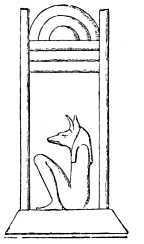
Fig. 185.—Anubis,
in a funerary pavilion;
from a bas-relief.
(Description de l'Égypte, i., pl. 74.)
It was through long and gloomy galleries, like those of the
σύριγξ,
that the perilous voyage of the soul had to be undertaken. A
boat carried it over the subterranean river, for in a country which
had the Nile for its principal highway, every journey, even that of
the sun through space, was looked upon as a navigation. Spacious
saloons were imagined to exist among those galleries, chambers where
the infernal gods and their acolytes sat enthroned in all the majesty
of their office; and so the passages of the tomb were expanded here
and there into oblong or square chambers, their roofs supported by
pillars left in the living rock. On either side of the audience
chambers the imagination placed narrow passes and defiles, in which
the walls seemed to close in upon the soul and bar its progress;
tortuous corridors and gloomy gulfs were fixed in these defiles, in
which the terrible ministers of divine vengeance held themselves in
ambush, prepared to harass the march of souls not yet absolved, and to
overwhelm with frightful tortures those against whom sentence had
already been pronounced. The tomb, therefore, had its snares and
narrow passages, its gaping depths and the mazes of its intersecting
and twisting corridors. To complete the resemblance nothing more was
required than to paint and chisel upon the walls the figures of those
gods, genii, and monsters who peopled the regions below. On one side
the pious king may be seen, escorted by Amen-Ra and the other
divinities whom he had worshipped during life, advancing to plead his
cause before Osiris; on the other, the punishment of the wicked helps
to give éclat to the royal apotheosis by the contrasts which it
affords.
Thus the tombs of the Theban period embody the Egyptian solution of
the problem which has always exercised mankind. Their subterranean
corridors were a reproduction upon a small scale of the leading
characteristics of the under world, and we should commit a great
mistake were we to look upon the series of pictures which decorate its
walls as mere ornament resulting from a desire for luxury and display.
Between the ideal models of these pictures and the pictures themselves
the Egyptians established one of those mutual confusions which have
always been readily accepted by the faithful. Nothing seemed more
natural to the Egyptian, or to the Ethiopian who was his pupil, than
to ascribe the power of speech and movement to the images of the gods,
even when they had painted or carved them with their own hands. This
M. Maspero has shown by an ingenious collation of various texts.[258]
The chisel which created such tangible deities gave them something
more than the appearance of life. Each god exercised his own proper
function in that tomb which was a reproduction in small of the regions
of the other world. His gestures and the written formulæ which
appeared beside him on the walls, each had their protective
or liberating power. To represent the king in his act of
self-justification before Osiris was in some measure to anticipate
that justification. The reality and the image were so intimately
commingled in the mind of the believer that he was unable to separate
one from the other.
Did the royal tombs contain statues of the defunct? None have been
found in any of those already opened, and yet there is a chamber in
the tomb of Rameses IV. which appears from its inscriptions to have
been called the Statue chamber, while another apartment in its
neighbourhood is reserved for the funerary statuettes. The tombs of
private individuals contained statues; why then should none have been
put in those of the sovereigns? The commemorative sanctuary, the
external funerary temple, was adorned with his image often repeated,
which in order that it might be in better keeping with the
magnificence of its surroundings, and should have a better chance of
duration, was colossal in its proportions. In the inclosures of the
temples of the two Rameses and upon the site of the Amenophium, the
remains of these huge figures are to be counted by dozens, most of
them are of rose granite from Syene; the smallest are from 24 to 28
feet high, and some, with their pedestals, are as much as from 55 to
more than 60 feet. The two colossi of Amenophis III., the Pharaoh
whom the Greeks called Memnon, reached the latter height. Flayed,
mutilated, dishonoured as they have been, these gigantic statues are
still in place. They should be seen in autumn and from a little
distance as they raise their solitary and imposing masses above the
inundated plain, when their size and the simplicity of their lines
will have an effect upon the traveller which he will never forget
(Fig. 20, and Plate vi.).
In the royal tombs at Thebes, as in those at Memphis, the approach to
the mummy-chamber is not by a well, but by an inclined plane. The only
wells which have been discovered in the tombs of the Bab-el-Molouk
are, if we may use the term, false wells, ingeniously contrived to
throw any would-be violator off the right scent. We have already
mentioned one of these false wells as existing in the tomb of Seti. In
the pyramids the corridor which leads to the mummy-chamber is
sometimes an ascending plane, but in the Theban tomb it is always
descending. At the end of the long descent the mummy-chamber is
reached with its sarcophagus, generally a very simple one of red
granite, which has hitherto, in every instance, been found empty.
It is doubtful whether the sarcophagus-chamber was closed by a door or
not. It is known that tombs were sometimes thus closed; some of the
doors have been found in place,[259] and in a few of the texts mention
is made of doors,[260] but not the slightest vestige of one has yet
been discovered in the royal sepulchres at Thebes. "All the doorways
have sills and grooved jambs, as if they had been closed, but no trace
of hinges or of the leaves of a door itself have been found."[261] It
is possible that they were never put in place. The exact and accurate
spirit which marks all the work of Egyptian artists would lead them to
prepare for the placing of a door at the entrance to each chamber; but
at the same time it is obvious that a few panels of sycamore would do
little to stop the progress of any one who should attempt to violate
the royal sepulchre. This latter consideration may have caused them
to abstain from expending time and trouble upon a futile precaution.
These tombs seem to have varied greatly in size from reasons similar
to those which determined the dimensions of the pyramids, namely, the
length of reign enjoyed by their respective makers. Cheops, Chephren,
and Mycerinus continually added to the height and mass of their tombs
until death put an end to the work. In the same way, Seti and Rameses
never ceased while they lived to prolong the quarried galleries in the
Bab-el-Molouk. As these galleries were meant to be sealed from the
sight of man, this prolongation was caused, no doubt, by the desire to
develop to the utmost possible extent those pictures which were to be
so powerful for good over the fortunes of the defunct in the under
world.
Apart from the question of duration, reigns which were glorious would
give us larger and more beautiful tombs than those which were obscure
and marked by weakness in the sovereign. The three great Theban
dynasties included several of those monarchs who have been called the
Louis the Fourteenths and the Napoleons of Egypt,[262] and it was but
natural that they should employ the crowd of artificers and artists
which their enterprises gathered about them, for the excavation and
decoration of their own tombs. Either for this reason or for some
other, there is an extraordinary difference between king and king in
the matter of their tombs. Even when we admit that a certain number of
royal sepulchres have so far escaped discovery, it is difficult to
find place for all the sovereigns of the nineteenth and twentieth
dynasties in the two Valleys of the Kings. Many things lead us to
believe that several of those princes were content with very simple
tombs; some of them may have been merely buried in the sand. Thus
Mariette discovered, at Drah-Abou'l-Neggah, the mummy of Queen
Aah-hotep, of the nineteenth dynasty, some few feet beneath the
surface. The mummy chamber consisted of a few ill-adjusted stone
slabs. Like other mummies found on the same place, it seemed never to
have been disturbed since it had been placed beneath the soil. It was
gilt all over, and was decorated with jewels which now form some of
the most priceless treasures of the Boulak Museum.
The private tombs in the Theban necropolis, which are much more
numerous than those of kings, do not, like the latter, belong to a
single period in the national history. The most ancient among them
date back to the eleventh dynasty. There are some also of the Sait
period, and a few contemporary with the Ptolemies and the Roman
emperors. But by far the greater number belong to that epoch which saw
Thebes promoted to be the capital of the whole country, to the
centuries, namely, between Amosis, the conqueror of the Hyksos, and
the last of the Ramessides.
Fig. 186.—Plan and section of a royal tomb.
(Description de l'Égypte, vol. ii., pl. 79.)
These tombs are distinguished by great variety, but, before noticing
the principal types to which they may be referred, the points which
distinguish them from the royal burying-places should be indicated.
The private sepulchre is never subdivided like those of the kings.
This subdivision is to be explained by the exceptional position of the
sovereign mid-way between his subjects and the national deities. A
funerary chapel cut in the sides of the mountain would obviously be
too small for the purposes to which the commemorative part of the tomb
of a Rameses or a Seti would be put. On the other hand, no private
individual could hope to receive royal honours nor to associate his
memory with the worship of the great Egyptian gods. We find that for
him the chapel always remains closely connected with the mummy
chamber. Sometimes it is in front of it, sometimes above it, but in
neither case does it ever fail to form an integral part of the tomb,
so that the latter preserves at once its traditional divisions and its
indissoluble unity.
We may say the same of the well, which plays the same part in the
private tombs of the New Empire as in the Mastaba and the Speos of
the Ancient and Middle Empires. In almost every instance the mummy
chamber is reached by a well, whether the tomb be constructed in the
plain or in the side of the mountains. It is seldom so deep as those
of Gizeh or Sakkarah; its depth hardly exceeds from 20 to 30 feet; but
its arrangement is similar to those in the early necropolis. The mummy
chamber opens directly upon it. Sometimes there are two chambers
facing each other at the foot of the well, and of unequal
heights.[263] After the introduction of the corpse, which was
facilitated by notches cut in two faces of the well, the door of the
mummy chamber was built up—the well filled in. In a few exceptional
instances, the tombs of private individuals seem to have had no well,
and the innermost chamber, as in the case of royal tombs, received the
mummy.[264] In such cases it is very necessary to make sure that
explorers have not been deceived by appearances. In these dusty
interiors the carefully sealed opening might easily escape any but the
most careful research; and as for a sarcophagus, when one is found in
such a chamber, it may have been placed there long after the making of
the tomb. Such usurpations are by no means unknown.[265] In the time
of the Ptolemies, influential people, such as priests and military
functionaries, made them without scruple. The venerable mummies,
dating from the time of Rameses, were thrown into a corner; their
cases were made use of, sometimes for the mummy of the usurper,
sometimes for more ignoble purposes. In more than one of these
usurpations the new comer has been placed in a chamber constructed for
some other object.
The well and mummy chamber in the rock are, then, found almost
universally, but the form of the rest of the tomb varies according to
its date and site. Those in the plain are arranged differently to
those in the hill sides. But it must be understood that when we speak
of the plain in connection with the Theban tombs, we do not mean the
space over which spread the waters of the Nile. We mean the gentle
sandy slopes which lie between the foot of the cliffs and the
cultivated fields, a narrow band which widens a little between the
long spurs which the mountains throw out towards the river. In these
land-gulfs the rock crops up here and there, and nowhere is it covered
by more than a thin layer of sand. Such a soil, being above the reach
of the annual inundation, was marvellously well-fitted both for the
construction of the tomb and for the preservation of the mummy.
Figs. 187, 188.—Theban tombs from the bas-reliefs.
(From Wilkinson, ch. xvi.)
In this, which may be called the level part of the necropolis, the
tombs have left but slight and ill-defined traces. Their
superstructures have almost entirely disappeared, and yet some which
have now completely vanished were seen by travellers to Thebes in the
first half of the present century. By comparing what they tell us with
the figured representations in bas-relief and manuscript, we may form
some idea of the aspect which this part of the cemetery must formerly
have presented. The tombs which it contained were built upon the same
principles as those of Abydos; a square or rectangular structure with
slightly sloping walls was surmounted by a small pyramid. There was,
however, an essential difference between the two. At Abydos the nature
of the subsoil compelled the architect to contrive the mummy chamber
in the interior of his own structure; at Thebes, on the other hand,
there was nothing to prevent him from being faithful to a tradition
which had manifest advantages, and to intrust the corpse to the
keeping of the earth, at a depth below the surface which would ensure
it greater safety both from violence and from natural causes of decay.
At Thebes the rock was soft enough to be cut with sufficient ease, and
yet firm enough to be free from all danger of settlement or
disintegration. The soil of all this region is honeycombed with mummy
pits, which have long ago been pillaged and are now filled up with
sand. The superstructure was built above the well and inclosed the
funerary chapel. Sometimes it was surmounted by a small pyramid;
sometimes it was a quadrangular mass standing upon a surbase, with a
pilaster at each angle and a boldly projecting cornice at the top. The
oldest of the known tombs of Apis may be taken as specimens of this
latter class, which must also have been represented at Thebes. These
are contemporary with the eighteenth dynasty, and were discovered by
M. Mariette at Sakkarah.[266]
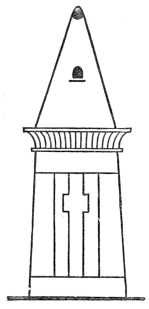
Fig. 189.—Theban tomb
from a bas-relief.
(From Wilkinson, ch. xvi.)
These little monuments have either been destroyed since 1851 or
covered by the sand (see Fig. 190).
The other type is that of the Speos. We have here seen that it dates
from the Ancient Empire, but came into general employment and obtained
its full development under the First and Second Theban Empires. We
have already given some idea of the architectural character and of the
decoration of the royal sepulchres, we must now indicate the
peculiarities which in these respects distinguish the tombs of the
kings from those of their subjects.
One of the points of difference has already been noticed; the
employment of vertical wells instead of inclined planes as approaches
to the mummy chamber. The most extensive of all the Theban catacombs
is that of a private individual, the priest Petamounoph (Fig. 191).[267]
In this the galleries have not less than 895 feet of total
length, besides which there are a large number of chambers, the whole
being covered with painted reliefs. But this tomb is quite
exceptional. The great majority, those of Rekhmara, for instance, and
others excavated in the hill of Sheikh-Abd-el-Gournah, are composed
of two or three chambers at most, united by corridors. The mummy pit
opens sometimes upon the corridor between two of the chambers,
sometimes upon the innermost chamber, sometimes upon a corridor
opening out of the latter. Rhind tells us that he followed one of
these corridors for about 300 feet beyond the chamber without arriving
at the mummy pit, the air then became too bad for further
progress.[268]
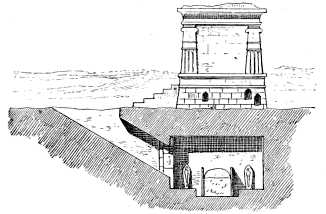
Fig. 190.—A tomb of Apis. From Mariette.
The chamber for the funerary celebration is easily recognized by its
decorations. It is sometimes the first, but more often the second in
order, in which case the first acts as a sort of vestibule. A
considerable number of tombs are very simple in arrangement. The door
gives access to a rectangular chamber, from 6 to 10 feet high and 10
to 12 wide, which extends, in a direction parallel to the wall, for
from 12 to 24 feet. This chamber is the funerary chapel. From its
posterior wall a passage opens which is nearly equal in height and
width to the chamber. It has a gentle slope and penetrates into the
rock to a distance of some 25 to 35 feet, terminating, in some cases,
in the mummy chamber itself, but more frequently in a small apartment
containing the opening of a mummy pit.[269]
Fig. 191.—The tomb of Petamounoph.
Drawn in perspective from the plans and elevations of Prisse.
It must not be imagined that all the tombs were decorated; there are
many which have received neither painted nor carved ornament, and in
others the ornament has never been carried beyond the first sketch.
But even in those which are quite bare, the walls are, in nearly every
instance, covered with a coat of white stucco.
Fig. 192.—The most simple form of Theban tomb; from Rhind.
Fig. 193.—Tomb as represented upon a bas-relief; from Rhind.
As the funerary chapel was contained in the tomb itself, no effort
could be made to mask or conceal the entrance, which accordingly was
taken advantage of for the display of ornament. But no attempt was
made to cut architectural façades in the cliffs like those at
Beni-Hassan; not more than one or two sepulchres have yet been
discovered which have façades made up of those columns which have been
called protodoric. The makers of these tombs were usually content
with dressing the surface of the rock above and around the entrance.
The latter, with its sloping lintel above a cornice, stands in the
centre of an almost perpendicular wall which acts as its frame or
background. In the uninjured state of the sepulchre this wall was more
or less concealed by a construction similar to those which we have
described in speaking of the tombs in the plain. According to all
appearances, one of these little buildings, a cube of masonry crowned
by a pyramidion, was placed before the doorway of every tomb. It is
difficult to say whether it was of sufficient size to contain a
funerary chamber or not. It may have been no more than a solid
erection of small size, meant only to mask the entrance and to
indicate its situation to those concerned. The wealthy, indeed, may
have been only too pleased to thus call public attention to the
position of their gorgeously decorated sepulchres.
The little pyramids of crude brick which we find upon the irregular
rocky slopes of the Kournet-el-Mourrayi, above the little
window-shaped openings with which the rock is honeycombed, probably
answered a similar purpose. Of these some are still standing, and
others have left unmistakable traces upon, the slope. They seem to
have existed in great numbers in this part of the necropolis, which
seems to have been set apart, about the time of the eighteenth
dynasty, for the priests.
Fig. 194.—Stele in the Boulak Museum,
showing tombs with gardens about them. From Maspero.
Although they hardly varied from the two or three types consecrated by
custom, these little buildings could easily have been made to present
slight differences one from another. When they existed in their
entirety, they must have given a very different aspect to the cemetery
from that which it presents with its rocky slopes burnt by the sun
into one harsh and monotonous tint, varied only by the black and
gaping mouths of the countless tombs. The sides which they turned to
the city and the river were adorned with those brilliant colours of
which the Egyptian architects were so fond, and, spaced irregularly
but never very far apart, they were sprinkled over the ground from the
edge of the plain to the topmost ridges of the hills. Nearly all of
them ended in a pyramid, but the varying dimensions of their bases and
their different levels above the plain, gave diversity to the
prospect, while here and there the slender apex of an obelisk rose
above the private tombs and signalized the sleeping-place of a king.
It has been very justly remarked, that the best idea of an Egyptian
cemetery in its best time is to be gained by a visit to one of those
Italian Campo-Santos, that of Naples, for example, where the tombs
of many generations lie closely together under a blazing sun.[270]
There, too, many sepulchral façades rise one above another upon the
abrupt slope of a hill into which the graves are sunk. A comparison
with the cemetery of Père-Lachaise, or with that at Constantinople,
would not be just because no trees could flourish in the Theban
rocks, at least in the higher part of the necropolis. In those
districts which border closely upon the irrigation channels, the tombs
seem to have had their gardens and fountains. Palms and sycamores
appear to have been planted about them, and here and there, perhaps,
the care of survivors succeeded in rearing flowers which would shed
their perfumes for the consolation of the dead.[271]
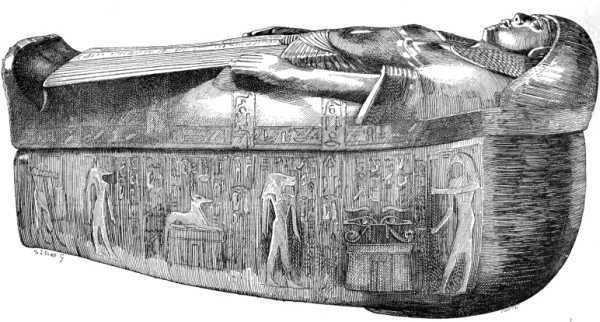
Fig. 195.—The sarcophagus of a royal scribe, 19th dynasty. Louvre.
Were there statues in the courtyards by which many of these tombs were
surrounded? There is no doubt that such statues were placed in the
rock-cut sepulchres; all the museums of Europe have specimens which
come from the Theban tombs. The latter were opened and despoiled,
however, at such an early period that very few of these figures have
been found in place by those who have visited the ruins of Egypt for
legitimate motives. We have, however, the evidence of explorers who
have penetrated into tombs which were practically intact. They tell us
that the statue of the deceased, accompanied often by that of his wife
and children, was placed against the further wall of the innermost
chamber.[272] In some tombs, a niche is cut in the wall for this
purpose,[273] in others a dais is raised three or four steps above the
floor of the chamber.[274] Here, too, is found the sarcophagus, in
basalt when the defunct was able to afford such a luxury, and the
canopic vases, which were sometimes of stone, especially alabaster,
sometimes of terra cotta, and now and then of wood, and were used to
hold the viscera of the deceased. These vases were four in number,
protected respectively by the goddesses Isis, Nephtys, Neith, and Selk
(Fig. 196).
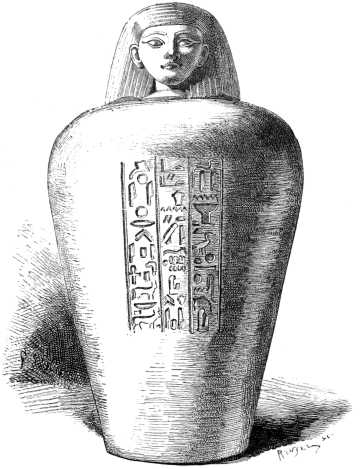
Fig. 196.—Canopic vase of alabaster. Louvre.
During the period of which we have just been treating, the taste for
these huge rock-cut tombs was not confined to Thebes and its
immediate vicinity; we find obvious traces of them in the city which
then held the second place in Egypt, namely, in Memphis, where a son
of the sovereign resided as viceroy. It was in the reign of Rameses
II., that the fourth of his hundred and seventy children began what is
now called the little Sérapeum, in the neighbourhood of the Great
Pyramids.[275] Until then each Apis bull had had a tomb apart, a
tomb in which everything was of small dimensions. This royal prince
was especially vowed to the worship of Ptah and Apis, for whom he
inaugurated new rites. He began the excavation of a grand gallery, and
lined it on each side with small chambers which were increased in
number as each successive Apis died and required a sepulchre. This
gallery and its chambers served for 700 years (see Figs. 197 and 198).
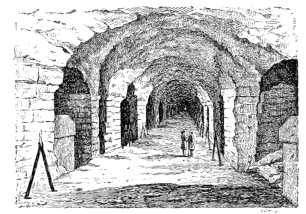
Fig. 197.—View of the grand gallery in the Apis Mausoleum; from Mariette.
The funerary architecture of the Sait epoch seems to have had an
originality of its own, but we are unable to form an opinion from any
existing remains. Not a trace is extant of those tombs in which the
princes of the twenty-sixth dynasty were, according to Herodotus,
placed one after another. Here are the words of the Greek historian:
ὁί δέ
(the Egyptians),
μιν
(Apries)
ἀπέπνιξαν, καὶ ἔπειτα ἔθαψαν ἐν
τῇσι πατρῴῃσι ταφῇσι--αἱ δέ εἰσι ἐν τῷ ἱρῷ τῆς Ἀθηναίης, ἀγχοτάτω
τοῦ μεγάρου ἐσιόντι ἀριστερῆς χερός--ἔθαψαν δὲ Σαΐται πάντας τοὺς ἐκ
νομοῦ τούτου γενομένους βασιλέας ἔσω ἐν τῷ ἱρῷ. καὶ γὰρ τὸ τοῦ
Ἀμάσιος σῆμα ἑκαστέρω μέν ἐστὶ τοῦ μεγάρου ἢ τὸ τοῦ Ἀπρίεω καὶ τῶν
τούτου προπατόρων· ἔστι μέντοι καὶ τοῦτο ἐν τῇ αὐλῇ τοῦ ἱροῦ, παστὰς
λιθίνη μεγάλη, καὶ ἠσκημένη στύλοισί τε φοίνικας τὰ δένδρεα
μεμιμημένοισι, καὶ τῇ ἄλλῃ δαπάνῃ. ἔσω δὲ ἐν τῇ παστάδι διξὰ
θυρώματα ἕστηκε· ἐν δὲ τοῖσι θυρώμασι ἡ θήκη ἐστὶ.[276]
Preceding centuries afford no example of a tomb placed within a temple
like this.[277]
First of all the royal mummy was entombed in the bowels of an
artificial mountain, secondly, under the Theban dynasties, in those of
a real one; but at Sais, it rests above the soil, in the precincts of
a temple, where curious visitors come and go at their will, and
nothing but a pair of wooden doors protects it from disturbance. Such
an arrangement seems inconsistent with all that we know of the
passionate desire of the Egyptians to give an eternal duration to
their mummies. We have every reason to believe that this desire had
shown no diminution at the time of the twenty-sixth dynasty, and we
can hardly admit that Psemethek and his successors were less impelled
by it than the meanest of their subjects.
The explanation of the apparent anomaly is to be found, we believe, in
the peculiar nature of the soil of Lower Egypt. The Sait princes were
determined to leave their mummies in the city which they had filled
with magnificent buildings and had turned into the capital of all
Egypt. Both speos and mummy pit, however, were out of the question.
Sais was built in the Delta; upon an alluvial soil which was wetted
through and through, as each autumn came round, by the water of the
Nile. Neither hill nor rock existed for many miles in every direction.
It was, therefore, absolutely necessary that the tomb should be a
constructed one upon the surface of this soil. It would seem that the
pyramid would have been the best form of tomb to ensure the continued
existence of the mummy, but, to say nothing of the difficulty of
finding a satisfactory foundation for such a structure upon a soft and
yielding soil, the pyramid had, for many ages, been completely out of
fashion. Egyptian art was entirely occupied with richer and more
varied forms, forms which admitted of the play of light and shade, and
of all the splendour of carved and painted decoration. The pyramid
being rejected, no type remained but that of a building which should
inclose both mummy chamber and funerary chapel under one roof, or, at
least, within one bounding wall. There was also, it is true, the
Abydos type of sepulchre, with its mummy chamber hidden in the
thickness of its base; but it was too heavy and too plain, it was too
nearly related to the pyramid, and it did not lend itself readily to
those brilliant compositions which distinguish the last renascence of
Egyptian art. But the hypostyle hall, the fairest creation of the
national genius, was thoroughly fitted to be the medium of such
picturesque conceptions as were then required, and it was adopted as
the nucleus of the tombs at Sais. A hall divided, perhaps, into three
aisles by tall shafts covered with figures and inscriptions, afforded
a meeting-place and a place of worship for the living. The mummy
chamber was replaced by a niche, placed, doubtless, in the wall which
faced the entrance, and the well, the one essential constituent of an
early Egyptian tomb, was suppressed. Such arrangements as these
afforded much less security to the mummy than those of Memphis or
Thebes, and to compensate in some measure for their manifest
disadvantages, the tomb was placed within the precincts of the most
venerable temple in the city, and the security of the corpse was made
to depend upon the awe inspired by the sanctuary of Neith. As the
event proved, this was but a slight protection against the fury of a
victorious enemy. Less than a year after the death of Amasis, Cambyses
tore his body from its resting-place, and burnt it to ashes after
outraging it in a childish fashion.[278]
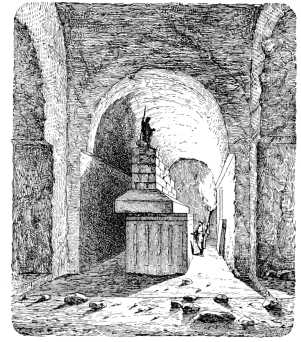
Fig. 198.—Sepulchral chamber of an Apis bull; from Mariette.
The tombs of these Sait kings, consisting of so many comparatively
small buildings in one sacred inclosure, remind us of what are called,
in the modern East, turbehs, those sepulchres of Mohammedan saints
or priests which are found in the immediate neighbourhood of the
mosques. Vast differences exist, of course, between the Saracenic and
Byzantine styles and that of Ancient Egypt, but yet the principle is
the same. At Sais, as in modern Cairo or Constantinople, iron or
wooden gratings must have barred the entrance to the persons while
they admitted the glances of visitors; rich stuffs were hung before
the niche, as the finest shawls from India and Persia veil the coffins
which lie beneath the domes of the modern burial-places. Perhaps, too,
sycamores and palm-trees cast their shadows over the external
walls.[279] The most hasty visitor to the Bosphorus and the Golden
Horn can hardly fail to remember the suburb of Eyoub, where the
turbehs of the Ottoman princes stand half hidden among the cypresses
and plane trees.
The material condition which compelled the Sait princes to break with
the customs of their ancestors, affected the tombs of private
individuals also. Throughout the existence of the Egyptian monarchy
the inhabitants of the Delta were obliged to set about the
preservation of their dead in a different fashion to that followed by
their neighbours in Upper Egypt; their mummies had to be kept out of
reach of the inundation. Isolated monuments, like those of Abydos,
would soon have filled all the available space upon artificial mounds,
such as those upon which the cities of the Delta were built. The
problem to be solved was, however, a simple one. Since there could be
no question of a lateral development, like that of the Theban tombs,
or of a downward one, like that of the Memphite mummy pits, it was
obvious that the development must be upwards. A beginning was made by
constructing, at some distance from a town, a platform of crude brick,
upon which, after its surface had been raised above the level of the
highest floods, the mummies were placed in small chambers closely
packed one against another. As soon as the whole platform was
occupied, another layer of chambers was commenced above it.
Champollion discovered the remains of two such cemeteries in the
immediate neighbourhood of Sais. The larger of the two was not less
than 1,400 feet long, 500 feet wide, and 80 feet high; an enormous
mass "which resembled," he said, "a huge rock torn by lightning or
earthquake."[280] No doubt was possible as to the character of the
mass; Champollion found among the débris both canopic vases and
funerary statuettes. Within a few years of his death Mariette
undertook some fresh excavations in the same neighbourhood; they led
to no very important results, but they confirmed the justice of the
views enunciated by Champollion. Most of the objects recovered were in
a very bad state of preservation; the materials had been too soft, and
in time the dampness, which had impregnated the base of the whole
structure, had crept upwards through the porous brick, and turned the
whole mass into a gigantic sponge.
These tombs resemble those of the kings in having no well; and as for
the funerary chapel we do not as yet know whether it existed at all,
how it was arranged, or what took its place. Perhaps each of the more
carefully constructed tombs was divided into two parts, a chamber more
or less decorated and a niche contrived in the masonry, like the
rock-cut ovens of the Phœnician catacombs. As soon as the mummy was
introduced, the niche was walled up, while the chamber would remain
open for the funerary celebrations. In order that the tombs situated
at some height above the level of the soil, and in the middle of the
block of buildings, should be reached, a complicated system of
staircases and inclined planes was necessary. In the course of
centuries the tombs of the first layer and especially those in the
centre of the mass, were overwhelmed and buried from sight and access
by the continual aggregation above and around them. The families to
which they belonged, perhaps, became extinct, and no one was left to
watch over their preservation. Had it not been for the infiltration of
the Nile water, these lower strata of tombs would no doubt have
furnished many interesting objects to explorers. In any case it would
seem likely that, if deep trenches were driven through the heart of
these vast agglomerations of unbaked brick, many valuable discoveries
would be made.[281] Such a system left slight scope to individual
caprice; space must have been carefully parcelled out to each
claimant, and the architect had much less elbow room than when he was
cutting into the sides of a mountain or building upon the dry soil of
the desert. In the royal tombs alone, if time had left any for our
inspection, could we have found materials for judging of the funerary
architecture of Sais, but, as the matter stands, we are obliged to be
content with what we can gather from Theban and Memphite remains as to
the prevailing taste of the epoch.
Upon the plateau of Gizeh, to the south of the Great Pyramid, Colonel
Vyse discovered and cleared, in 1837, an important tomb to which he
gave the name of Colonel Campbell, then British Consul-General in
Egypt. The external part of the tomb had entirely disappeared, but we
may conclude that it was in keeping with the subterranean portion. The
maker of the tomb had taken the trouble to define its extent by a
trench cut around it in the rock. The external measurements of this
trench are 89 feet by 74. A passage had been contrived from one of its
faces to the well, which had been covered in all probability by an
external structure. The well opens upon a point nearer to the north
than the south, and its dimensions are quite exceptional. It is 54
feet 4 inches deep, and 31 feet by 26 feet 8 inches in horizontal
section; it terminates in a chamber which is covered by a vault 11
feet 2 inches thick. It was not however in this chamber, but in small
lateral grottos that several sarcophagi in granite, basalt, white
quartz, &c., were found. The remains of two other wells were traced.
This tomb dates from the time of Psemethek I.
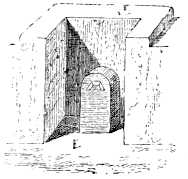
Fig. 199.—Section in perspective of "Campbell's tomb,"
from the plans and elevations of Perring.
Fig. 200.—Vertical section in perspective of the sarcophagus chamber of the above tomb; compiled from Perring.
In the necropolis of Thebes there is a whole district, that of the
hill El Assassif, where most of the tombs belong to the twenty-sixth
dynasty. Their external aspect is very different from that of the
Theban sepulchres. The entrance to the subterranean galleries is
preceded by a spacious rectangular courtyard, excavated in the rock to
a depth of 10 or 12 feet. This court was from 80 to 100 feet long and
from 40 to 80 feet wide; it was surrounded by a stone or brick wall,
and reached by a flight of steps. A pylon-shaped doorway gave access
to the courtyard from the side next the rock, another door of similar
shape opened upon the plain; "but some tombs are entirely closed (see
Fig. 201) except towards the mountain, from which side they may be
entered by one or two openings."
Fig. 201.—A Tomb on El-Assassif
(drawn in perspective from the plans and elevations of Prisse).
The subterranean part of these tombs varies in size. In some of them a
gallery of medium length leads to a single chamber. In others, and
these form the majority, there is a suite of rooms connected by a
continuous gallery. To this latter group belongs the largest of all
the subterranean Theban tombs, that of Petamounoph (Fig. 191). We have
already noticed the extraordinary dimensions of its galleries; there
are also two wells which lead to lower sets of chambers. All the walls
of this tomb are covered with sculptured reliefs. In the first
chambers these are in very bad condition, but they improve as we
advance, and in the farthest rooms are remarkable for their finish and
good preservation. The exterior of this sepulchre is worthy of the
interior. The open court, which acts as vestibule, is 100 feet long by
80 wide. An entrance, looking towards the plain, rises between two
massive walls of crude brick, and, to all appearance, was once crowned
by an arcade; within it a flight of steps leads down into the court.
Another door, pierced through the limestone rock, leads to a second
and smaller court which is surrounded by a portico. From this
peristyle a sculptured portal leads to the first subterranean chamber,
which is 53 feet by 23, and once had its roof supported by a double
range of columns. The next chamber is 33 feet square. With a double
vestibule and these two great saloons there was no lack of space for
gatherings of the friends and relations of the deceased.
Neither at Memphis nor at Thebes do the tombs of this late period
contain any novel elements, but they are distinguished by their size
and the luxury of their decoration. In some, the wells are much wider
than usual; in others it is upon the external courts and upon those
double gateways which play a part similar to that of the successive
pylons before a Theban temple, that extra care is bestowed. Vaults are
frequently employed and help to give variety of effect. Private tombs
become as large as those of sovereigns, and similar tendencies are to
be found in the sculpture. The Egyptian genius was becoming exhausted,
and it endeavoured to compensate for its want of invention and
creative imagination by an increase in richness and elegance.
A chronological classification is only possible in the cases of those
tombs which bear inscriptions and figures upon their walls. At
Memphis, as at Thebes, the remains of thousands of tombs are to be
found which give no indication of their date. Sometimes they are deep
mummy pits, slightly expanding at the bottom; sometimes, as at Thebes,
the rock is honeycombed with graves between the border of the
cultivated land and the foot of the Libyan chain. In the mountains
themselves there are hundreds of small chambers, with bare walls and
often extremely minute in size, cut in the sides of the cliffs.
Finally, there are the vast catacombs, in each chamber of which the
mummies of labourers and artisans were crowded, often with the
instruments of their trade by their sides.[282] Pits full of mummified
animals are also found among the human graves. Rhind saw some hundreds
of the mummies of hawks and ibises taken from a tomb at the foot of
the Drah-Abou'l-Neggah. They were each enveloped in bandages of mummy
cloth, and beside them numerous small boxes, each with a carefully
embalmed mouse inside it, were found. The lids of these boxes had
each a wooden mouse upon it, sometimes gilt.[283]
We have endeavoured to notice all that is of importance in the
funerary architecture of Egypt, because the Egyptian civilization, as
we know it through the still existing monuments, carries us much
farther back than any other towards the first awakening of individual
thought and consciousness in mankind. The primitive conceptions of
those early periods were, of course, different enough from those to
which mankind was brought by later reflection, but nevertheless they
were the premises, they contained the germ of all the development that
has followed; and to thoroughly understand the origin and constitution
of this development it was necessary to follow it up to its source, to
the clearness and transparency of its springs.
The art of Egypt is the oldest of all the national arts, and the
oldest monuments of Egypt are its tombs. By these alone is that
earliest epoch in its history which we call the Ancient Empire known
to us.
In later ages the country was covered with magnificent temples and
sumptuous palaces, but, even then, the tomb did not lose its
pre-eminent importance. The chief care of the Egyptian in all ages was
his place of rest after death. Rich or poor, as soon as he arrived at
full age he directed all his spare resources towards the construction
and decoration of his tomb, his happy, his eternal "dwelling," with
which his thoughts were far more preoccupied than with that home in
the light, upon which, whether it were a miserable mud hut or a vast
edifice of brick or wood, he looked with comparative indifference,
regarding it as an encampment for a day or a mere hotel for a passing
traveller. The tombs, when not hollowed from the living rock, were
built with such solidity and care that they have survived in
thousands, while the palaces of great sovereigns have perished and
left no trace, and the temples which have been preserved are very few
in number.
Being mostly subterranean and hidden from the eye of man, sepulchres
preserved the deposits entrusted to them much better than buildings
upon the surface. Those among the latter which were not completely
destroyed, were, in very remote times, damaged, pillaged, stripped,
and mutilated in a thousand ways. All that subsists of their
decoration—shattered colossi and bas-reliefs often broken and
disfigured—tells us nothing beyond the pomps and triumphs of official
history. The tombs have suffered much less severely. The statues,
bas-reliefs, and paintings which have been found in them, seem, in
many instances, to have been the work of the very men whose footprints
were found in the sand which covered their floors when they were
opened.[284] The pictures offered to our eyes by the walls of the
private tombs are very different from those which we find in the
temples. All classes of the people appear in them in their every-day
occupations and customary attitudes. The whole national life is
displayed before us in a long series of scenes which comment upon and
explain each other. Almost all that we know concerning the industrial
arts of Egypt has been derived from a study of her tomb-houses. In
every hundred of such objects which our museums contain at least
ninety-nine come from those safe depositories.
In order to give a true idea of the national character of the
Egyptians and to enable the originality of their civilization to be
thoroughly understood, it was necessary to show the place occupied in
their thoughts by the anticipation of death; it was necessary to
explain what the tomb meant to them, to what sentiments and beliefs
its general arrangements and its principal details responded; it was
necessary to follow out the various modifications which were brought
about by the development of religious conceptions, from the time of
the first six dynasties to that of the Theban Empire.
The brilliant architectural revival which distinguished the first and
second Theban Empires was mainly due to this development of religious
thought. Almost all the peculiarities of the Memphite tomb are to be
explained by the hypotheses with which primitive man is content. But
when mature reflection evolved higher types for the national gods,
when polytheism came to be superimposed upon fetishism, the hour
arrived for the temple to take its proper place in the national life,
for majestic colonnades and massive pylons to be erected on the banks
of the life-giving river. The temple was later than the tomb, but it
followed closely upon its footsteps, and the two were, in a fashion,
united by those erections on the left bank of the Nile, under the
Theban necropolis, which partook of the character of both. The temple
is the highest outcome of the native genius during those centuries
which saw Egypt supreme over all the races of the East, supreme partly
by force of arms, but mainly by the superiority of her civilization.