So far, the stories of the development of flight are either
legendary or of more or less doubtful authenticity,
even including that of Danti, who, although a man of
remarkable attainments in more directions than that
of attempted flight, suffers—so far as reputation is
concerned—from the inexactitudes of his chroniclers;
he may have soared over Thrasimene, as stated, or a
mere hop with an ineffectual glider may have grown
with the years to a legend of gliding flight. So far,
too, there is no evidence of the study that the conquest
of the air demanded; such men as made experiments
either launched themselves in the air from some height
with made-up wings or other apparatus, and paid the
penalty, or else constructed some form of machine
which would not leave the earth, and then gave up.
Each man followed his own way, and there was no
attempt—without the printing press and the dissemination
of knowledge there was little possibility of attempt—on
the part of any one to benefit by the failures of
others.
Legend and doubtful history carries up to the
fifteenth century, and then came Leonardo da Vinci,
first student of flight whose work endures to the present
day. The world knows da Vinci as artist; his age
knew him as architect, engineer, artist, and scientist
in an age when science was a single study, comprising all
knowledge from mathematics to medicine. He was,
of course, in league with the devil, for in no other way
could his range of knowledge and observation be
explained by his contemporaries; he left a Treatise on
the Flight of Birds in which are statements and deductions
that had to be rediscovered when the Treatise had been
forgotten—da Vinci anticipated modern knowledge
as Plato anticipated modern thought, and blazed the
first broad trail toward flight.
One Cuperus, who wrote a Treatise on the Excellence
of Man, asserted that da Vinci translated his theories
into practice, and actually flew, but the statement is
unsupported. That he made models, especially on the
helicopter principle, is past question; these were made
of paper and wire, and actuated by springs of steel wire,
which caused them to lift themselves in the air. It is,
however, in the theories which he put forward that
da Vinci’s investigations are of greatest interest; these
prove him a patient as well as a keen student of the
principles of flight, and show that his manifold activities
did not prevent him from devoting some lengthy
periods to observations of bird flight.
‘A bird,’ he says in his Treatise, ‘is an instrument
working according to mathematical law, which instrument
it is within the capacity of man to reproduce
with all its movements, but not with a corresponding
degree of strength, though it is deficient only in power
of maintaining equilibrium. We may say, therefore,
that such an instrument constructed by man is lacking
in nothing except the life of the bird, and this life must
needs be supplied from that of man. The life which
resides in the bird’s members will, without doubt,
better conform to their needs than will that of a
man which is separated from them, and especially in
the almost imperceptible movements which produce
equilibrium. But since we see that the bird is equipped
for many apparent varieties of movement, we are able
from this experience to deduce that the most rudimentary
of these movements will be capable of being comprehended
by man’s understanding, and that he will to a
great extent be able to provide against the destruction
of that instrument of which he himself has become the
living principle and the propeller.’
In this is the definite belief of da Vinci that man is
capable of flight, together with a far more definite
statement of the principles by which flight is to be
achieved than any which had preceded it—and for
that matter, than many that have succeeded it. Two
further extracts from his work will show the exactness
of his observations:—
‘When a bird which is in equilibrium throws the
centre of resistance of the wings behind the centre of
gravity, then such a bird will descend with its head
downward. This bird which finds itself in equilibrium
shall have the centre of resistance of the wings more
forward than the bird’s centre of gravity; then such a
bird will fall with its tail turned toward the earth.’
And again: ‘A man, when flying, shall be free
from the waist up, that he may be able to keep himself
in equilibrium as he does in a boat, so that the centre
of his gravity and of the instrument may set itself in
equilibrium and change when necessity requires it to
the changing of the centre of its resistance.’
Here, in this last quotation, are the first beginnings
of the inherent stability which proved so great an
advance in design, in this twentieth century. But the
extracts given do not begin to exhaust the range of
da Vinci’s observations and deductions. With regard to
bird flight, he observed that so long as a bird keeps its
wings outspread it cannot fall directly to earth, but
must glide down at an angle to alight—a small thing,
now that the principle of the plane in opposition to the
air is generally grasped, but da Vinci had to find it out.
From observation he gathered how a bird checks its
own speed by opposing tail and wing surface to the
direction of flight, and thus alights at the proper
‘landing speed.’ He proved the existence of upward
air currents by noting how a bird takes off from level
earth with wings outstretched and motionless, and,
in order to get an efficient substitute for the natural
wing, he recommended that there be used something
similar to the membrane of the wing of a bat—from
this to the doped fabric of an aeroplane wing is but
a small step, for both are equally impervious to air.
Again, da Vinci recommended that experiments in
flight be conducted at a good height from the ground,
since, if equilibrium be lost through any cause, the
height gives time to regain it. This recommendation,
by the way, received ample support in the training
areas of war pilots.
Man’s muscles, said da Vinci, are fully sufficient
to enable him to fly, for the larger birds, he noted,
employ but a small part of their strength in keeping
themselves afloat in the air—by this theory he attempted
to encourage experiment, just as, when his time came,
Borelli reached the opposite conclusion and discouraged
it. That Borelli was right—so far—and da Vinci
wrong, detracts not at all from the repute of the earlier
investigator, who had but the resources of his age to
support investigations conducted in the spirit of ages
after.
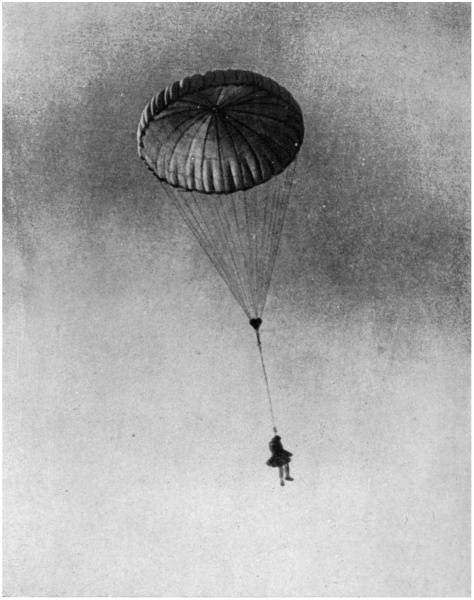
His chief practical contributions to the science of
flight—apart from numerous drawings which have
still a value—are the helicopter or lifting screw, and the
parachute. The former, as already noted, he made
and proved effective in model form, and the principle
which he demonstrated is that of the helicopter of
to-day, on which sundry experimenters work spasmodically,
in spite of the success of the plane with its driving
propeller. As to the parachute, the idea was doubtless
inspired by observation of the effect a bird produced by
pressure of its wings against the direction of flight.
Da Vinci’s conclusions, and his experiments, were
forgotten easily by most of his contemporaries; his
Treatise lay forgotten for nearly four centuries, overshadowed,
mayhap, by his other work. There was,
however, a certain Paolo Guidotti of Lucca, who lived
in the latter half of the sixteenth century, and who
attempted to carry da Vinci’s theories—one of them,
at least, into practice. For this Guidotti, who was by
profession an artist and by inclination an investigator,
made for himself wings, of which the framework was
of whalebone; these he covered with feathers, and
with them made a number of gliding flights, attaining
considerable proficiency. He is said in the end to have
made a flight of about four hundred yards, but this
attempt at solving the problem ended on a house roof,
where Guidotti broke his thigh bone. After that,
apparently, he gave up the idea of flight, and went
back to painting.
One other, a Venetian architect named Veranzio,
studied da Vinci’s theory of the parachute, and found it
correct, if contemporary records and even pictorial
presentment are correct. Da Vinci showed his conception
of a parachute as a sort of inverted square bag;
Veranzio modified this to a ‘sort of square sail extended
by four rods of equal size and having four cords attached
at the corners,’ by means of which ‘a man could without
danger throw himself from the top of a tower or any
high place. For though at the moment there may be
no wind, yet the effort of his falling will carry up the
wind, which the sail will hold, by which means he does
not fall suddenly but descends little by little. The size
of the sail should be measured to the man.’ By this
last, evidently, Veranzio intended to convey that the
sheet must be of such content as would enclose sufficient
air to support the weight of the parachutist.
Veranzio made his experiments about 1617–1618,
but, naturally, they carried him no farther than the
mere descent to earth, and since a descent is merely a
descent, it is to be conjectured that he soon got tired
of dropping from high roofs, and took to designing
architecture instead of putting it to such a use. With
the end of his experiments the work of da Vinci in
relation to flying became neglected for nearly four
centuries.
Apart from these two experimenters, there is little
to record in the matter either of experiment or study
until the seventeenth century. Francis Bacon, it is
true, wrote about flying in his Sylva Sylvarum, and
mentioned the subject in the New Atlantis, but, except
for the insight that he showed even in superficial mention
of any specific subject, he does not appear to have
made attempt at serious investigation. ‘Spreading of
Feathers, thin and close and in great breadth will
likewise bear up a great Weight,’ says Francis, ‘being
even laid without Tilting upon the sides.’ But a lesser
genius could have told as much, even in that age, and
though the great Sir Francis is sometimes adduced as
one of the early students of the problems of flight, his
writings will not sustain the reputation.
The seventeenth century, however, gives us three
names, those of Borelli, Lana, and Robert Hooke, all
of which take definite place in the history of flight.
Borelli ranks as one of the great figures in the study of
aeronautical problems, in spite of erroneous deductions
through which he arrived at a purely negative conclusion
with regard to the possibility of human flight.
Borelli was a versatile genius. Born in 1608, he
was practically contemporary with Francesco Lana,
and there is evidence that he either knew or was in
correspondence with many prominent members of the
Royal Society of Great Britain, more especially with
John Collins, Dr Wallis, and Henry Oldenburgh, the
then Secretary of the Society. He was author of a long
list of scientific essays, two of which only are responsible
for his fame, viz., Theorice Medicæarum Planetarum,
published in Florence, and the better known posthumous
De Motu Animalium. The first of these two is an
astronomical study in which Borelli gives evidence of
an instinctive knowledge of gravitation, though no
definite expression is given of this. The second work,
De Motu Animalium, deals with the mechanical action
of the limbs of birds and animals and with a theory of
the action of the internal organs. A section of the first
part of this work, called De Volatu, is a study of bird
flight; it is quite independent of Da Vinci’s earlier
work, which had been forgotten and remained unnoticed
until near on the beginning of practical flight.
Marey, in his work, La Machine Animale, credits
Borelli with the first correct idea of the mechanism of
flight. He says: ‘Therefore we must be allowed to
render to the genius of Borelli the justice which is due
to him, and only claim for ourselves the merit of having
furnished the experimental demonstration of a truth
already suspected.’ In fact, all subsequent studies on
this subject concur in making Borelli the first investigator
who illustrated the purely mechanical theory of the
action of a bird’s wings.
Borelli’s study is divided into a series of propositions
in which he traces the principles of flight, and the
mechanical actions of the wings of birds. The most
interesting of these are the propositions in which he
sets forth the method in which birds move their wings
during flight and the manner in which the air offers
resistance to the stroke of the wing. With regard to
the first of these two points he says: ‘When birds in
repose rest on the earth their wings are folded up close
against their flanks, but when wishing to start on their
flight they first bend their legs and leap into the air.
Whereupon the joints of their wings are straightened
out to form a straight line at right angles to the lateral
surface of the breast, so that the two wings, outstretched,
are placed, as it were, like the arms of a cross to the body
of the bird. Next, since the wings with their feathers
attached form almost a plane surface, they are raised
slightly above the horizontal, and with a most quick
impulse beat down in a direction almost perpendicular
to the wing-plane, upon the underlying air; and to so
intense a beat the air, notwithstanding it to be fluid,
offers resistance, partly by reason of its natural inertia,
which seeks to retain it at rest, and partly because the
particles of the air, compressed by the swiftness of the
stroke, resist this compression by their elasticity, just
like the hard ground. Hence the whole mass of the
bird rebounds, making a fresh leap through the air;
whence it follows that flight is simply a motion composed
of successive leaps accomplished through the air. And
I remark that a wing can easily beat the air in a direction
almost perpendicular to its plane surface, although
only a single one of the corners of the humerus bone
is attached to the scapula, the whole extent of its base
remaining free and loose, while the greater transverse
feathers are joined to the lateral skin of the thorax.
Nevertheless the wing can easily revolve about its base
like unto a fan. Nor are there lacking tendon ligaments
which restrain the feathers and prevent them from
opening farther, in the same fashion that sheets hold
in the sails of ships. No less admirable is nature’s
cunning in unfolding and folding the wings upwards,
for she folds them not laterally, but by moving upwards
edgewise the osseous parts wherein the roots of the
feathers are inserted; for thus, without encountering
the air’s resistance the upward motion of the wing
surface is made as with a sword, hence they can be
uplifted with but small force. But thereafter when the
wings are twisted by being drawn transversely and by
the resistance of the air, they are flattened as has been
declared and will be made manifest hereafter.’
Then with reference to the resistance to the air of
the wings he explains: ‘The air when struck offers
resistance by its elastic virtue through which the particles
of the air compressed by the wing-beat strive to expand
again. Through these two causes of resistance the
downward beat of the wing is not only opposed, but
even caused to recoil with a reflex movement; and these
two causes of resistance ever increase the more the
down stroke of the wing is maintained and accelerated.
On the other hand, the impulse of the wing is continuously
diminished and weakened by the growing resistance.
Hereby the force of the wing and the resistance become
balanced; so that, manifestly, the air is beaten by the
wing with the same force as the resistance to the
stroke.’
He concerns himself also with the most difficult
problem that confronts the flying man of to-day, namely,
landing effectively, and his remarks on this subject
would be instructive even to an air pilot of these days:
‘Now the ways and means by which the speed is slackened
at the end of a flight are these. The bird spreads its
wings and tail so that their concave surfaces are perpendicular
to the direction of motion; in this way,
the spreading feathers, like a ship’s sail, strike against
the still air, check the speed, and so that most of the
impetus may be stopped, the wings are flapped quickly
and strongly forward, inducing a contrary motion, so
that the bird absolutely or very nearly stops.’
At the end of his study Borelli came to a conclusion
which militated greatly against experiment with any
heavier-than-air apparatus, until well on into the nineteenth
century, for having gone thoroughly into the
subject of bird flight he states distinctly in his last
proposition on the subject that ‘It is impossible that
men should be able to fly craftily by their own strength.’
This statement, of course, remains true up to the present
day, for no man has yet devised the means by which
he can raise himself in the air and maintain himself
there by mere muscular effort.
From the time of Borelli up to the development of
the steam engine it may be said that flight by means of
any heavier-than-air apparatus was generally regarded
as impossible, and apart from certain deductions which
a little experiment would have shown to be doomed to
failure, this method of flight was not followed up. It
is not to be wondered at, when Borelli’s exaggerated
estimate of the strength expended by birds in proportion
to their weight is borne in mind; he alleged that
the motive force in birds’ wings is 10,000 times greater
than the resistance of their weight, and with regard to
human flight he remarks:—
‘When, therefore, it is asked whether men may be
able to fly by their own strength, it must be seen whether
the motive power of the pectoral muscles (the strength
of which is indicated and measured by their size) is
proportionately great, as it is evident that it must exceed
the resistance of the weight of the whole human body
10,000 times, together with the weight of enormous
wings which should be attached to the arms. And it
is clear that the motive power of the pectoral muscles
in men is much less than is necessary for flight, for in
birds the bulk and weight of the muscles for flapping
the wings are not less than a sixth part of the entire
weight of the body. Therefore, it would be necessary
that the pectoral muscles of a man should weigh more
than a sixth part of the entire weight of his body; so
also the arms, by flapping with the wings attached,
should be able to exert a power 10,000 times greater
than the weight of the human body itself. But they
are far below such excess, for the aforesaid pectoral
muscles do not equal a hundredth part of the entire
weight of a man. Wherefore either the strength of
the muscles ought to be increased or the weight of the
human body must be decreased, so that the same proportion
obtains in it as exists in birds. Hence it is
deducted that the Icarian invention is entirely mythical
because impossible, for it is not possible either to increase
a man’s pectoral muscles or to diminish the weight of
the human body; and whatever apparatus is used,
although it is possible to increase the momentum, the
velocity or the power employed can never equal the
resistance; and therefore wing flapping by the contraction
of muscles cannot give out enough power to carry up
the heavy body of a man.’
It may be said that practically all the conclusions
which Borelli reached in his study were negative.
Although contemporary with Lana, he perceived the
one factor which rendered Lana’s project for flight by
means of vacuum globes an impossibility—he saw that
no globe could be constructed sufficiently light for
flight, and at the same time sufficiently strong to withstand
the pressure of the outside atmosphere. He does
not appear to have made any experiments in flying on
his own account, having, as he asserts most definitely,
no faith in any invention designed to lift man from
the surface of the earth. But his work, from which
only the foregoing short quotations can be given, is,
nevertheless, of indisputable value, for he settled the
mechanics of bird flight, and paved the way for those
later investigators who had, first, the steam engine, and
later the internal combustion engine—two factors in
mechanical flight which would have seemed as impossible
to Borelli as would wireless telegraphy to a student of
Napoleonic times. On such foundations as his age
afforded Borelli built solidly and well, so that he ranks
as one of the greatest—if not actually the greatest—of
the investigators into this subject before the age of
steam.
The conclusion, that ‘the motive force in birds’
wings is apparently ten thousand times greater than
the resistance of their weight,’ is erroneous, of course,
but study of the translation from which the foregoing
excerpt is taken will show that the error detracts very
little from the value of the work itself. Borelli sets out
very definitely the mechanism of flight, in such fashion
that he who runs may read. His reference to ‘the use
of a large vessel,’ etc., concerns the suggestion made
by Francesco Lana, who antedated Borelli’s publication
of De Motu Animalium by some ten years with his
suggestion for an ‘aerial ship,’ as he called it. Lana’s
mind shows, as regards flight, a more imaginative
twist; Borelli dived down into first causes, and reached
mathematical conclusions; Lana conceived a theory
and upheld it—theoretically, since the manner of his
life precluded experiment.
Francesco Lana, son of a noble family, was born
in 1631; in 1647 he was received as a novice into the
Society of Jesus at Rome, and remained a pious member
of the Jesuit society until the end of his life. He was
greatly handicapped in his scientific investigations by
the vows of poverty which the rules of the Order imposed
on him. He was more scientist than priest all his life;
for two years he held the post of Professor of Mathematics
at Ferrara, and up to the time of his death, in 1687, he
spent by far the greater part of his time in scientific
research. He had the dubious advantage of living in
an age when one man could cover the whole range of
science, and this he seems to have done very thoroughly.
There survives an immense work of his entitled,
Magisterium Naturæ et Artis, which embraces the whole
field of scientific knowledge as that was developed in
the period in which Lana lived. In an earlier work of
his, published in Brescia in 1670, appears his famous
treatise on the aerial ship, a problem which Lana worked
out with thoroughness. He was unable to make practical
experiments, and thus failed to perceive the one insuperable
drawback to his project—of which more anon.
Only extracts from the translation of Lana’s work
can be given here, but sufficient can be given to show
fully the means by which he designed to achieve the
conquest of the air. He begins by mention of the
celebrated pigeon of Archytas the Philosopher, and
advances one or two theories with regard to the way in
which this mechanical bird was constructed, and then
he recites, apparently with full belief in it, the fable of
Regiomontanus and the eagle that he is said to have
constructed to accompany Charles V. on his entry into
Nuremberg. In fact, Lana starts his work with a study
of the pioneers of mechanical flying up to his own time,
and then outlines his own devices for the construction
of mechanical birds before proceeding to detail the
construction of the aerial ship. Concerning primary
experiments for this he says:—
‘I will, first of all, presuppose that air has weight
owing to the vapours and halations which ascend from
the earth and seas to a height of many miles and surround
the whole of our terraqueous globe; and this fact will
not be denied by philosophers, even by those who may
have but a superficial knowledge, because it can be
proven by exhausting, if not all, at any rate the greater
part of, the air contained in a glass vessel, which, if
weighed before and after the air has been exhausted,
will be found materially reduced in weight. Then I
found out how much the air weighed in itself in the
following manner. I procured a large vessel of glass,
whose neck could be closed or opened by means of a
tap, and holding it open I warmed it over a fire, so that
the air inside it becoming rarified, the major part was
forced out; then quickly shutting the tap to prevent
the re-entry I weighed it; which done, I plunged its
neck in water, resting the whole of the vessel on the
surface of the water, then on opening the tap the water
rose in the vessel and filled the greater part of it. I lifted
the neck out of the water, released the water contained
in the vessel, and measured and weighed its quantity
and density, by which I inferred that a certain quantity
of air had come out of the vessel equal in bulk to the
quantity of water which had entered to refill the portion
abandoned by the air. I again weighed the vessel, after
I had first of all well dried it free of all moisture, and found
it weighed one ounce more whilst it was full of air than
when it was exhausted of the greater part, so that what
it weighed more was a quantity of air equal in volume
to the water which took its place. The water weighed
640 ounces, so I concluded that the weight of air compared
with that of water was 1 to 640—that is to say,
as the water which filled the vessel weighed 640 ounces,
so the air which filled the same vessel weighed one
ounce.’
Having thus detailed the method of exhausting
air from a vessel, Lana goes on to assume that any large
vessel can be entirely exhausted of nearly all the air
contained therein. Then he takes Euclid’s proposition
to the effect that the superficial area of globes increases
in the proportion of the square of the diameter, whilst
the volume increases in the proportion of the cube of
the same diameter, and he considers that if one only
constructs the globe of thin metal, of sufficient size,
and exhausts the air in the manner that he suggests,
such a globe will be so far lighter than the surrounding
atmosphere that it will not only rise, but will be capable
of lifting weights. Here is Lana’s own way of putting
it:—
‘But so that it may be enabled to raise heavier
weights and to lift men in the air, let us take double the
quantity of copper, 1,232 square feet, equal to 308 lbs.
of copper; with this double quantity of copper we could
construct a vessel of not only double the capacity, but
of four times the capacity of the first, for the reason
shown by my fourth supposition. Consequently the
air contained in such a vessel will be 718 lbs. 4⅔ ounces,
so that if the air be drawn out of the vessel it will be 410
lbs. 4⅔ ounces lighter than the same volume of air,
and, consequently, will be enabled to lift three men, or
at least two, should they weigh more than eight pesi
each. It is thus manifest that the larger the ball or
vessel is made, the thicker and more solid can the sheets
of copper be made, because, although the weight will
increase, the capacity of the vessel will increase to a
greater extent and with it the weight of the air therein,
so that it will always be capable to lift a heavier weight.
From this it can be easily seen how it is possible to
construct a machine which, fashioned like unto a ship,
will float on the air.’
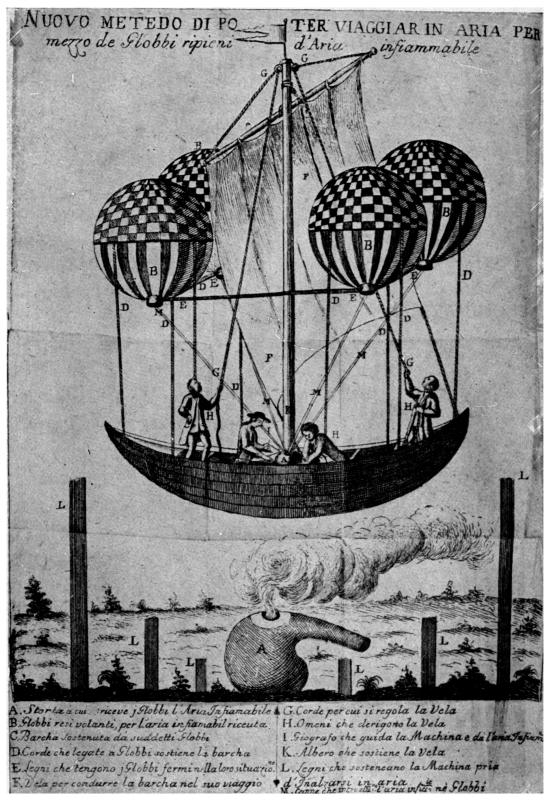
A suggestion for applying hydrogen gas to Lana’s
‘Aerial Ship.’ Rome, 1784.
With four globes of these dimensions Lana proposed
to make an aerial ship of the fashion shown in his quaint
illustration. He is careful to point out a method by
which the supporting globes for the aerial ship may be
entirely emptied of air; this is to be done by connecting
to each globe a tube of copper which is ‘at least a length
of 47 modern Roman palmi.’ A small tap is to close
this tube at the end nearest the globe, and then vessel
and tube are to be filled with water, after which the
tube is to be immersed in water and the tap opened,
allowing the water to run out of the vessel, while no
air enters. The tap is then closed before the lower end
of the tube is removed from the water, leaving no air
at all in the globe or sphere. Propulsion of this airship
was to be accomplished by means of sails, and also by
oars.
Lana antedated the modern propeller, and realised
that the air would offer enough resistance to oars or
paddle to impart motion to any vessel floating in it and
propelled by these means, although he did not realise
the amount of pressure on the air which would be
necessary to accomplish propulsion. As a matter of
fact, he foresaw and provided against practically all the
difficulties that would be encountered in the working,
as well as the making, of the aerial ship, finally coming
up against what his religious training made an insuperable
objection. This, again, is best told in his own words:—
‘Other difficulties I do not foresee that could prevail
against this invention, save one only, which to me seems
the greatest of them all, and that is that God would
surely never allow such a machine to be successful,
since it would create many disturbances in the civil and
political governments of mankind.’
He ends by saying that no city would be proof
against surprise, while the aerial ship could set fire to
vessels at sea, and destroy houses, fortresses, and cities
by fire balls and bombs. In fact, at the end of his
treatise on the subject, he furnishes a pretty complete
résumé of the activities of German Zeppelins.
As already noted, Lana himself, owing to his vows
of poverty, was unable to do more than put his suggestions
on paper, which he did with a thoroughness that has
procured him a place among the really great pioneers
of flying.
It was nearly 200 years before any attempt was
made to realise his project; then, in 1843, M. Marey
Monge set out to make the globes and the ship as Lana
detailed them. Monge’s experiments cost him the sum
of 25,000 francs 75 centimes, which he expended purely
from love of scientific investigation. He chose to make
his globes of brass, about .004 in thickness, and weighing
1.465 lbs. to the square yard. Having made his sphere
of this metal, he lined it with two thicknesses of tissue
paper, varnished it with oil, and set to work to empty it
of air. This, however, he never achieved, for such
metal is incapable of sustaining the pressure of the outside
air, as Lana, had he had the means to carry out experiments,
would have ascertained. M. Monge’s sphere
could never be emptied of air sufficiently to rise from the
earth; it ended in the melting-pot, ignominiously
enough, and all that Monge got from his experiment
was the value of the scrap metal and the satisfaction
of knowing that Lana’s theory could never be translated
into practice.
Robert Hooke is less conspicuous than either Borelli
or Lana; his work, which came into the middle of the
seventeenth century, consisted of various experiments
with regard to flight, from which emerged ‘a Module,
which by the help of Springs and Wings, raised and
sustained itself in the air.’ This must be reckoned as
the first model flying machine which actually flew,
except for da Vinci’s helicopters; Hooke’s model
appears to have been of the flapping-wing type—he
attempted to copy the motion of birds, but found from
study and experiment that human muscles were not
sufficient to the task of lifting the human body. For
that reason, he says, ‘I applied my mind to contrive a
way to make artificial muscles,’ but in this he was, as
he expresses it, ‘frustrated of my expectations.’ Hooke’s
claim to fame rests mainly on his successful model; the
rest of his work is of too scrappy a nature to rank as a
serious contribution to the study of flight.
Contemporary with Hooke was one Allard, who,
in France, undertook to emulate the Saracen of Constantinople
to a certain extent. Allard was a tight-rope
dancer who either did or was said to have done short
gliding flights—the matter is open to question—and
finally stated that he would, at St Germains, fly from the
terrace in the king’s presence. He made the attempt,
but merely fell, as did the Saracen some centuries before,
causing himself serious injury. Allard cannot be
regarded as a contributor to the development of aeronautics
in any way, and is only mentioned as typical of
the way in which, up to the time of the Wright brothers,
flying was regarded. Even unto this day there are
many who still believe that, with a pair of wings, man
ought to be able to fly, and that the mathematical data
necessary to effective construction simply do not exist.
This attitude was reasonable enough in an unlearned
age, and Allard was one—a little more conspicuous
than the majority—among many who made experiment
in ignorance, with more or less danger to themselves
and without practical result of any kind.
Besnier’s Flying Apparatus.
The seventeenth century was not to end, however,
without practical experiment of a noteworthy kind in
gliding flight. Among the recruits to the ranks of
pioneers was a certain Besnier, a locksmith of Sablé,
who somewhere between 1675 and 1680 constructed
a glider of which a crude picture has come down to
modern times. The apparatus, as will be seen, consisted
of two rods with hinged flaps, and the original designer
of the picture seems to have had but a small space in
which to draw, since obviously the flaps must have
been much larger than those shown. Besnier placed
the rods on his shoulders, and worked the flaps by
cords attached to his hands and feet—the flaps opened
as they fell, and closed as they rose, so the device as a
whole must be regarded as a sort of flapping glider.
Having by experiment proved his apparatus successful,
Besnier promptly sold it to a travelling showman of
the period, and forthwith set about constructing a
second set, with which he made gliding flights of
considerable height and distance. Like Lilienthal,
Besnier projected himself into space from some height,
and then, according to the contemporary records, he
was able to cross a river of considerable size before
coming to earth. It does not appear that he had any
imitators, or that any advantage whatever was taken
of his experiments; the age was one in which he would
be regarded rather as a freak exhibitor than as a serious
student, and possibly, considering his origin and the
sale of his first apparatus to such a client, he regarded
the matter himself as more in the nature of an amusement
than as a discovery.
Borelli, coming at the end of the century, proved
to his own satisfaction and that of his fellows that
flapping wing flight was an impossibility; the capabilities
of the plane were as yet undreamed, and the prime
mover that should make the plane available for flight
was deep in the womb of time. Da Vinci’s work was
forgotten—flight was an impossibility, or at best such
a useless show as Besnier was able to give.
The eighteenth century was almost barren of
experiment. Emanuel Swedenborg, having invented
a new religion, set about inventing a flying machine,
and succeeded theoretically, publishing the result of
his investigations as follows:—
‘Let a car or boat or some like object be made of
light material such as cork or bark, with a room within
it for the operator. Secondly, in front as well as behind,
or all round, set a widely-stretched sail parallel to the
machine, forming within a hollow or bend, which could
be reefed like the sails of a ship. Thirdly, place wings
on the sides, to be worked up and down by a spiral
spring, these wings also to be hollow below in order to
increase the force and velocity, take in the air, and make
the resistance as great as may be required. These, too,
should be of light material and of sufficient size; they
should be in the shape of birds’ wings, or the sails of
a windmill, or some such shape, and should be tilted
obliquely upwards, and made so as to collapse on the
upward stroke and expand on the downward. Fourth,
place a balance or beam below, hanging down perpendicularly
for some distance with a small weight attached
to its end, pendent exactly in line with the centre of
gravity; the longer this beam is, the lighter must it be,
for it must have the same proportion as the well-known
vectis or steel-yard. This would serve to restore the
balance of the machine if it should lean over to any of
the four sides. Fifthly, the wings would perhaps have
greater force, so as to increase the resistance and make
the flight easier, if a hood or shield were placed over
them, as is the case with certain insects. Sixthly, when
the sails are expanded so as to occupy a great surface
and much air, with a balance keeping them horizontal,
only a small force would be needed to move the machine
back and forth in a circle, and up and down. And,
after it has gained momentum to move slowly upwards,
a slight movement and an even bearing would keep it
balanced in the air and would determine its direction
at will.’
The only point in this worthy of any note is the
first device for maintaining stability automatically—Swedenborg
certainly scored a point there. For the
rest, his theory was but theory, incapable of being put
to practice—he does not appear to have made any
attempt at advance beyond the mere suggestion.
Some ten years before his time the state of knowledge
with regard to flying in Europe was demonstrated by
an order granted by the King of Portugal to Friar
Lourenzo de Guzman, who claimed to have invented
a flying machine capable of actual flight. The order
stated that ‘In order to encourage the suppliant to
apply himself with zeal toward the improvement of the
new machine, which is capable of producing the effects
mentioned by him, I grant unto him the first vacant
place in my College of Barcelos or Santarem, and the
first professorship of mathematics in my University
of Coimbra, with the annual pension of 600,000 reis
during his life.—Lisbon, 17th of March, 1709.’
What happened to Guzman when the non-existence
of the machine was discovered is one of the things that
is well outside the province of aeronautics. He was
charlatan pure and simple, as far as actual flight was
concerned, though he had some ideas respecting the
design of hot-air balloons, according to Tissandier.
(La Navigation Aerienne.) His flying machine was to
contain, among other devices, bellows to produce
artificial wind when the real article failed, and also
magnets in globes to draw the vessel in an upward
direction and maintain its buoyancy. Some draughtsman,
apparently gifted with as vivid imagination as
Guzman himself, has given to the world an illustration
of the hypothetical vessel; it bears some resemblance
to Lana’s aerial ship, from which fact one draws obvious
conclusions.
A rather amusing claim to solving the problem of
flight was made in the middle of the eighteenth century
by one Grimaldi, a ‘famous and unique Engineer’
who, as a matter of actual fact, spent twenty years in
missionary work in India, and employed the spare time
that missionary work left him in bringing his invention
to a workable state. The invention is described as a
‘box which with the aid of clockwork rises in the air,
and goes with such lightness and strong rapidity that
it succeeds in flying a journey of seven leagues in an
hour. It is made in the fashion of a bird; the wings
from end to end are 25 feet in extent. The body is
composed of cork, artistically joined together and well
fastened with metal wire, covered with parchment and
feathers. The wings are made of catgut and whalebone,
and covered also with the same parchment and feathers,
and each wing is folded in three seams. In the body
of the machine are contained thirty wheels of unique
work, with two brass globes and little chains which
alternately wind up a counterpoise; with the aid of
six brass vases, full of a certain quantity of quicksilver,
which run in some pulleys, the machine is kept by the
artist in due equilibrium and balance. By means,
then, of the friction between a steel wheel adequately
tempered and a very heavy and surprising piece of
lodestone, the whole is kept in a regulated forward
movement, given, however, a right state of the winds,
since the machine cannot fly so much in totally calm
weather as in stormy. This prodigious machine is
directed and guided by a tail seven palmi long, which is
attached to the knees and ankles of the inventor by
leather straps; by stretching out his legs, either to the
right or to the left, he moves the machine in whichever
direction he pleases.... The machine’s flight lasts
only three hours, after which the wings gradually close
themselves, when the inventor, perceiving this, goes
down gently, so as to get on his own feet, and then
winds up the clockwork and gets himself ready again
upon the wings for the continuation of a new flight.
He himself told us that if by chance one of the wheels
came off or if one of the wings broke, it is certain he
would inevitably fall rapidly to the ground, and, therefore,
he does not rise more than the height of a tree or two,
as also he only once put himself in the risk of crossing
the sea, and that was from Calais to Dover, and the
same morning he arrived in London.’
And yet there are still quite a number of people who
persist in stating that Bleriot was the first man to fly
across the Channel!
A study of the development of the helicopter
principle was published in France in 1868, when the
great French engineer Paucton produced his Théorie
de la Vis d’Archiméde. For some inexplicable reason,
Paucton was not satisfied with the term ‘helicopter,’
but preferred to call it a ‘ptérophore,’ a name which,
so far as can be ascertained, has not been adopted by
any other writer or investigator. Paucton stated that,
since a man is capable of sufficient force to overcome
the weight of his own body, it is only necessary to give
him a machine which acts on the air ‘with all the force
of which it is capable and at its utmost speed,’ and he
will then be able to lift himself in the air, just as by the
exertion of all his strength he is able to lift himself in
water. ‘It would seem,’ says Paucton, ‘that in the
ptérophore, attached vertically to a carriage, the whole
built lightly and carefully assembled, he has found
something that will give him this result in all perfection.
In construction, one would be careful that the machine
produced the least friction possible, and naturally it
ought to produce little, as it would not be at all complicated.
The new Dædalus, sitting comfortably in his
carriage, would by means of a crank give to the
ptérophore a suitable circular (or revolving) speed.
This single ptérophore would lift him vertically, but
in order to move horizontally he should be supplied
with a tail in the shape of another ptérophore. When
he wished to stop for a little time, valves fixed firmly
across the end of the space between the blades would
automatically close the openings through which the
air flows, and change the ptérophore into an unbroken
surface which would resist the flow of air and
retard the fall of the machine to a considerable
degree.’
The doctrine thus set forth might appear plausible,
but it is based on the common misconception that all
the force which might be put into the helicopter or
‘ptérophore’ would be utilised for lifting or propelling
the vehicle through the air, just as a propeller uses all
its power to drive a ship through water. But, in applying
such a propelling force to the air, most of the force is
utilised in maintaining aerodynamic support—as a
matter of fact, more force is needed to maintain this
support than the muscle of man could possibly furnish
to a lifting screw, and even if the helicopter were
applied to a full-sized, engine-driven air vehicle, the
rate of ascent would depend on the amount of surplus
power that could be carried. For example, an upward
lift of 1,000 pounds from a propeller 15 feet in diameter
would demand an expenditure of 50 horse-power under
the best possible conditions, and in order to lift this load
vertically through such atmospheric pressure as exists
at sea-level or thereabouts, an additional 20 horse-power
would be required to attain a rate of 11 feet per
second—50 horse-power must be continually provided
for the mere support of the load, and the additional
20 horse-power must be continually provided in
order to lift it. Although, in model form, there is
nothing quite so strikingly successful as the helicopter
in the range of flying machines, yet the essential weight
increases so disproportionately to the effective area that
it is necessary to go but very little beyond model
dimensions for the helicopter to become quite ineffective.
That is not to say that the lifting screw must be
totally ruled out so far as the construction of aircraft is
concerned. Much is still empirical, so far as this branch
of aeronautics is concerned, and consideration of the
structural features of a propeller goes to show that the
relations of essential weight and effective area do not
altogether apply in practice as they stand in theory.
Paucton’s dream, in some modified form, may yet
become reality—it is only so short a time ago as 1896
that Lord Kelvin stated he had not the smallest molecule
of faith in aerial navigation, and since the whole
history of flight consists in proving the impossible
possible, the helicopter may yet challenge the propelled
plane surface for aerial supremacy.
It does not appear that Paucton went beyond theory,
nor is there in his theory any advance toward practical
flight—da Vinci could have told him as much as he
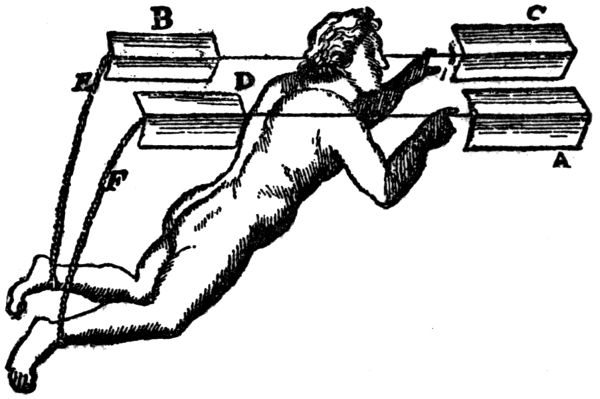
knew. He was followed by Meerwein, who invented
an apparatus apparently something between a flapping
wing machine and a glider, consisting of two wings,
which were to be operated by means of a rod; the
venturesome one who would fly by means of this
apparatus had to lie in a horizontal position beneath
the wings to work the rod. Meerwein deserves a place
of mention, however, by reason of his investigations
into the amount of surface necessary to support a given
weight. Taking that weight at 200 pounds—which
would allow for the weight of a man and a very light
apparatus—he estimated that 126 square feet would
be necessary for support. His pamphlet, published at
Basle in 1784, shows him to have been a painstaking
student of the potentialities of flight.
Jean-Pierre Blanchard, later to acquire fame in
connection with balloon flight, conceived and described
a curious vehicle, of which he even announced trials as
impending. His trials were postponed time after time,
and it appears that he became convinced in the end of
the futility of his device, being assisted to such a conclusion
by Lalande, the astronomer, who repeated
Borelli’s statement that it was impossible for man ever
to fly by his own strength. This was in the closing
days of the French monarchy, and the ascent of the
Mongolfiers’ first hot-air balloon in 1783—which shall
be told more fully in its place—put an end to all French
experiments with heavier-than-air apparatus, though
in England the genius of Cayley was about to bud, and
even in France there were those who understood that
ballooning was not true flight.