Copyright, 1903 By Dana Estes & Company All rights reserved
A HERMIT'S WILD FRIENDS
Published October, 1903
Colonial Press
Electrotyped and Printed by C. H. Simonds & Co.
Boston, Mass., U. S. A.
To the
Lovers of Nature,
everywhere,
this volume is fraternally dedicated.
NOTE
During my eighteen years of hermit life,
I claim to have discovered several new features
in natural history, namely:
That the cow-bunting watches over its
young, assists the foster parents in providing
food, and gradually assumes full care of the
young bird, and takes it to the pasture to
associate with its kind; that the white-footed
mouse is dumb, and communicates with its
species by drumming with its toes; that the
wood-thrush conducts a singing-school for
the purpose of teaching its young how to
sing; that the chickadee can count; that
the shadbush on Cape Ann assumes a dwarf
form, and grows in patches like the low-bush
blueberry, fruiting when less than a foot in
height; that the red squirrel owns a farm or
fruit garden, and locates his male children
on territory which he preempts for the purpose.
I am aware that my claims will be
vigorously assailed, but I have verified these
discoveries by years of patient observation,
and would say to my critics: "You would
better investigate carefully before denying
the probability of any one of these claims."
Thanks are due the publishers of Forest
and Stream and Youth's Companion for
permission to republish articles which have
appeared in these respective journals.
A Hermit's Wild Friends — I. NATURE versus MEDICINE
OR
Eighteen Years in the Woods
Eighteen years ago I was in sore straits.
Ill health had reduced my flesh until I resembled
the living skeleton of a dime show. I
realized that a few months more of city life
would take me beyond the living stage, and
that the world would have no further use for
me except to adorn some scientific laboratory.
A diagnosis of my case would read as follows:
Dyspepsia, aggravated, medicine could
give but slight relief. Catarrh, malignant,
persistent. A douche was necessary every
morning to relieve the severe facial pain. A
cough that had worried me by day and by
night, and thrived on all kinds of cough medicine.
Also, my lungs were sore and the palms
of my hands were hot and dry. I thought
that I was fading away with consumption, but
the doctors said my lungs were sound. I was
advised to go into the woods and try life in
a pine grove. As there was no money for the
doctors in this advice, I looked upon it as kind
and disinterested, but my mind ran in another
direction.
When I was young and full of notions, the
idea entered my head that I should like a
change from fresh to salt water. It resulted
in a two months' trip on a fishing schooner.
During the trip I had been free from seasickness,
and had gained flesh rapidly. The
memory of that sea voyage haunted me, now
that I had become sick and discouraged. It
seemed to me that a few weeks on salt water
would save my life.
With high hopes, I boarded the little
steamer that plied between Boston and
Gloucester. I thought it would be an easy
matter to secure board on one of the many
vessels that made short trips after mackerel.
For three days I haunted the wharves in vain.
The "skippers," one and all, gave the same
reason for refusing my offers. "We are going
after fish," said they, "and cannot be
bothered with a sick man." At last one
"skipper" discouraged me completely. He
said to me: "I once took a sick man on
board, and because we did not strike fish, the
fishermen called the passenger a Jonah, and
made his life miserable. Three days after
we returned he died, and I swore then that
I never would take another sick man to sea."
This "skipper's" story, and my fruitless
efforts caused me to abandon the salt water
cure. I turned now to the hills around
Gloucester. In the end I selected Bond's Hill,
because it was surrounded by pine groves.
I found the hill covered with blueberry
and huckleberry bushes, the latter loaded with
fruit. On the brow of the hill the soil had
been washed away, leaving great masses of
bed rock (granite) towering above the cottages
that clung to the base of the cliff. On
the extreme brow of the hill I found a spot
where the soil had gathered and maintained
a grass-plot. Here I pitched my little tent.
Here I lived from August to December. I
called the spot the Eyrie, because it reminded
me of the regions inhabited by eagles. A
visit to the spot will disclose the fitness of
the name.
On this spot my eighteen years of hermit
life begun. At first I made it a practice to
go to the city every day for one meal, bringing
back food enough to last until another
day. I found the huckleberries good wholesome
food that did not aggravate my chronic
dyspepsia.
Two weeks of outdoor life had brought a
little color to my cheeks and had made me
feel like a new man. About this time I awoke
in the morning to remember that I had not
coughed during the night. The cough that
had harassed me night and day for two years,
left me then and there, never to return.
Nature was performing wonders where
medicine had failed.
Before the month of September had ended,
my catarrh disappeared, and I no longer had
use for the douche. From that time to this,
I have been free from catarrh. I do not have
even the symptoms, known as hay-fever.
The dull, heavy pain that I had experienced
constantly from dyspepsia, gradually sub
sided and eventually ceased. Since that time
I have been able to eat any kind of food,
at any time, day or night, without the depressing
pains of indigestion.
During my first experience, climbing
Bond's Hill, on my return from the city,
had been almost beyond my strength. I had
to rest three times before reaching my tent.
By the middle of November my strength
had returned nearly to the old standard, and
I mounted the hill without a thought of weariness.
Standing one day on a massive spur of
bed rock, near my tent, my thoughts went
back to the statement of the doctors in relation
to my lungs. I had just ascended the
hill, without a long breath, and a hale,
hearty feeling pervaded every fibre of my
system. I knew, then, that my lungs were
all right, and thanks to Nature, I had recovered
my health and stood there comparatively
a well man.
While I was yet weak, I passed many
hours at the Eyrie, entranced by the magnificent
panorama spread before me. I could
see the larger part of the city of Gloucester,
which extended, in a semicircle, from Riverdale
to Eastern Point.
Later in the season I watched the ebb and
flow of the tide on the marshes that border
Annisquam River.
The Outer Harbor, with Ten Pound Island
near the entrance of the Inner Harbor, lay
in plain view, and the shifting scenes on its
restless waters possessed a fascination which
I could seldom resist.
Day after day I watched the vessels of the
fishing fleet as they rounded Eastern Point,
bound outward or inward. These vessels were
models of beauty, and looked as if they were
built for racing instead of fishing. I often
compared them with the clumsy coasters that
rode at anchor in the Outer Harbor.
Now and then a vessel, homeward bound,
rounded Eastern Point with her flag half-mast.
Mute reminder of the hardships and
perils of a fisherman's life.
Every morning soon after it had become
light enough to see, several boats could be
seen rowing shoreward. Usually there was
only one man to a boat. It did not take me
long to find out that these lone rowers coming
in out of the night were fishermen that pulled
their lobster-pots after one o'clock in the
morning. I saw another lone fisherman sail
out of the harbor every morning when there
was wind enough to fill a dory sail. Day
after day he sailed or rowed out to sea to
fish for shore codfish. He supported a large
family from the proceeds of his labor, but
the life was lonely and perilous. I watched
his return once when the wind was blowing
a fierce gale. The little boat would careen
until the sail trailed in the water and it
seemed to me that she must capsize. At the
last moment she would come up into the wind
and right. In this slow, dangerous manner
she was worked to the mouth of Annisquam
River and tied up above the Cut Bridge.
The next day I asked the fisherman how he
had managed to keep his boat right side up.
"Oh, that was easy. When she heeled too
much, I shook her up, and kept her from
taking in water." "Shook her up," was a
new phrase to me.
Below my Eyrie lay the little hamlet called
the Cut. Some of its cottages had straggled
up to the base of the cliff just below the tent.
I could look down on a long stretch of
Western Avenue beginning at the Cut and
ending in Ward Five, beyond the Cut Bridge.
The latter was a drawbridge, and when open
the city of Gloucester was on an island, with
the exception of Ward Eight, which lies on
the west side of Annisquam River.
I had located in Ward Eight, but at the
time did not know anything in relation to its
size, as compared with the other wards of the
city. A glance at the map in the city directory
showed me that Ward Eight was larger
in area than all the other wards combined.
I also found that it comprised within its limits
the Cut, Fresh Water Cove, West Gloucester,
and Magnolia. It pleased me much to find
that it contained about twelve thousand acres
of shrub land and forest.
Two-thirds of the way from the Cut to
the drawbridge, Essex Avenue connects with
Western Avenue. Essex Avenue crosses the
marsh to West Gloucester, and is the highway
into the city for Essex and other distant
towns. There is a constant stream of travel
over this highway, divided among farmers,
icemen, and pleasure-seekers. The travel on
Western Avenue is now, and was then, made
up largely from the summer colonies at Magnolia
and Manchester. Showy turnouts
passed and repassed, so that I had enough to
attract my attention from sunrise to sunset.
When facing the harbor, I could turn to the
left and look across the marsh to Dogtown
Common. I had to look above and beyond
a straggling portion of the city. Dogtown
Common, in Revolutionary days, contained
forty dwellings; now it was houseless. I saw
only a boulder-covered region of pasture-land,
choked by huckleberry and blueberry bushes,
with here and there large tangles of catbrier.
Some of the sunsets seen from the Eyrie
were beautiful beyond description. Whenever
a massive bank of clouds hung above the
western horizon, the setting sun illuminated
the city from Riverdale to Eastern Point,
and every window in sight glowed like burnished
gold.
Until the middle of November the weather
continued mild and balmy, with but a few
stormy days. I recall, with pleasure and
satisfaction, the evenings passed at the Eyrie.
Perched on the brow of the cliff, I studied
the city by moonlight, lamplight, and gas-light.
On dark nights the lights of the city
took on the shape of a huge monster, half-coiled,
and extended from Riverdale to Eastern
Point Light. The latter is a revolving
red light, and it gave the semblance of life
to the one-eyed monster which constantly
blinked its great red eye. It pleased me to
call this imaginary monster the sea-serpent.
Gloucester owes her growth to the sea, and
she might well take on the shape of the sea-serpent.
When the danger-signals were up, the
Outer Harbor was crowded with craft of all
kinds. At night time the tossing lights on
the vessels contrasted strangely with the fixed
lights on shore.
The twin lights on Thatcher's Island could
be seen from the Eyrie, and I often wondered
if these lights were necessary. To the middle
of November I had seen the sea only in comparatively
fair weather, when it was on its
good behavior. Afterward a storm that
wrecked my tent, and brought in its wake huge
waves that thundered against the headlands
of Cape Ann, caused me to wonder in another
direction. It seems incredible, but it is a
fact, that I could feel the solid rock tremble
beneath my tent from the shock of wave
against headland, one fourth of a mile distant.
The storm died out, but it left an impression
on my mind that caused me to look for a
locality less exposed to the wind. I found
an ideal spot on the "Old Salem Road." The
spot was surrounded by wooded hills, where
a little brook crept out of a swamp and crossed
to the south side of the old highway. After
crossing the highway, the waters of the brook
went tumbling and singing down to another
swamp, where they were lost in a tangle of
moss, ferns, and marsh-marigolds.
The Old Salem Road had been deserted
more than one hundred years, save as a wood
road in winter. At one time it was the connecting
link between Salem and Gloucester.
Seven ruined cellars indicate the spots where
dwelling-houses once stood.
I moved my tent from the Eyrie, and put
it up within the limits of the old highway,
and begun to build a little log cabin in which
to spend the winter.
While in the tent I experienced zero
weather, and it may be of interest to know
how I managed to keep warm. I had picked
up two discarded milk-cans, and these I filled
with hard wood coals from a fire which I
maintained near the tent. By closing the
flaps of the tent the heat from the cans would
keep up an even temperature through the
night. If it happened to get cold toward
morning I would burn a newspaper now and
then, which would warm the tent until light
enough to start an outdoor fire. I baked
beans in a hole in the ground, in true Maine
camp style. There would be coals enough
under the bean-pot, in the morning, to cook
coffee, and hot coffee and baked beans seemed
to go to the right spot when the thermometer
was hanging around zero, and one was living
in a cotton tent.
I did my cooking on a bed of red hot coals,
thus avoiding smoked food and the loss of
coffee-pot handle or spout. Hemlock bark
from a dead tree will give the best coals in
the shortest time.
By the middle of December I had moved
into my log cabin. I put in a second-hand
range, which proved to be an excellent baker
and warmed the cabin in the coldest weather.
The remainder of the winter "I was as snug
as a bug in a rug," to use an old familiar
adage.
Before the winter months had passed, chickadees,
black snow-birds, and tree-sparrows
found their way into the cabin dooryard.
I fed lard to the chickadees on a chip, and the
birds would eat this clear fat, at short intervals,
all day, and come around the next morning
none the worse for the strange diet. Certainly
such food would kill any other bird.
The snow-birds and sparrows were fed on
different kinds of bird-seed. When I mention
sparrows I do not refer to the English sparrow.
I am pleased to state that this undesirable
alien does not come to my dooryard.
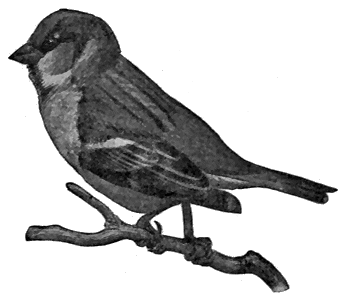
The tree-sparrow is a native bird, and here
on the Cape, is seen only in winter. It comes
to us in October, and leaves by the first of
April. The tree-sparrow is an interesting
bird to know. It comes to us in the winter
when the most of our birds are in the South.
It is a handsome bird from a sparrow standpoint.
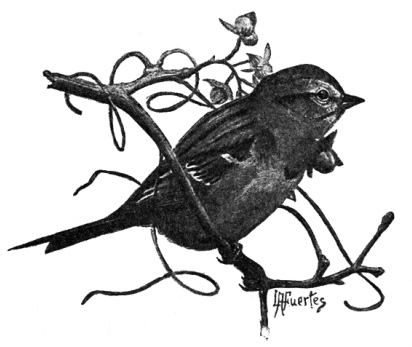
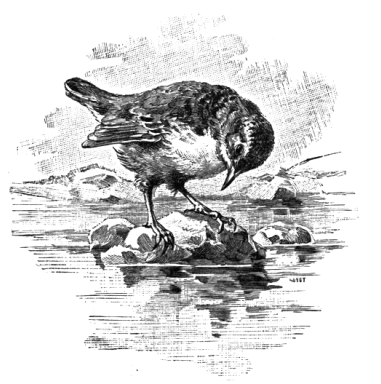
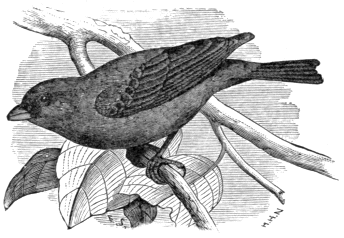
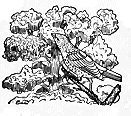
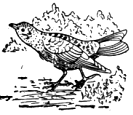
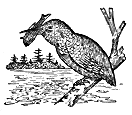
TREE SPARROW.
The crown is a bright chestnut, and there
are chestnut markings on the side of the head
and on the bend of the wing. The back is
boldly streaked with black, bay, and light
gray. There is much white edging to the
feathers of the tail and wings in winter. A
few of these birds stopped about the cabin
all winter; but a flock numbering hundreds
wintered on Bond's Hill. On warm days they
roamed over the hill, far and near, always
flying low and keeping well down in the
shrubby growth. But when the weather was
cold I would find them in a sheltered spot,
where meadowsweet, bayberry, hardhack,
blueberry, huckleberry, and sweet-fern shrubs
crowded each other until their interwoven
branches held a mantle of snow. Beneath this
shelter the birds seemed to find food, for
they were busy at all hours of the day. I
passed many hours watching them while they
were thus secluded. Invariably I found them
chirping to each other, and by listening closely
I could catch snatches of song low and sweet.
The last of March their low song could be
heard in the shrub-lands. Later, when the
song-sparrows and bluebirds swelled the
chorus, the tree-sparrows silently disappeared.
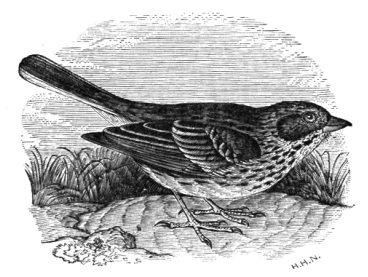
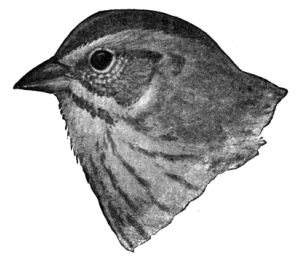
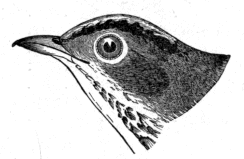
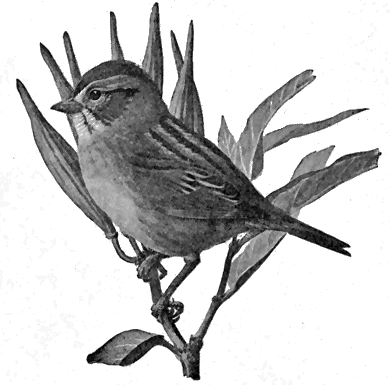
FOX SPARROW.
April 3d, in the morning, I found a large
flock of fox-sparrows in the dooryard. It
is somewhat singular that for three years
they appeared on the same day of the month.
One year, April 3, 1887, I awoke in the
morning to find three feet of snow in the dooryard,
and I was obliged to shovel the snow
away in order to feed the sparrows on bare
ground. The fox-sparrow is two-thirds as
large as a robin, and may be classed with the
beautiful birds both in form and coloration.
The sexes are alike. The color above is a
rich rusty red, deepest and brightest on the
wings, tail, and rump. The head, neck, and
shoulders are a dark ash-color, more or less
streaked with rusty red. Below the groundwork
is snow-white, also thickly spotted with
rust red. It could be called a wood-thrush
by a careless observer. These birds are migrants
with us, and pass through the State
to their breeding-grounds in April, to return
in October. It is usually six weeks from the
time the first flock appears before the loiterers
are all gone. The flock that called on me was
a very large one, numbering over one hundred
birds. Mornings they made the woods
ring with their delightful music.
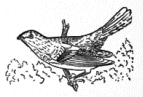
BAY-WINGED BUNTING.
When the birds returned in April and May,
I found that I was a trespasser on the nesting-ground
of many a woodland bird. Catbirds,
towhee-buntings, robins, thrushes, and
numerous warblers nested around my cabin.
By this time I had settled down to hermit-life
in earnest. I had tried the experiment
of "Nature versus Medicine," and Nature had
triumphed. With good health, with strange
birds and flowers to study and identify, I
was content to spend a portion of my rescued
life in Dame Nature's company.
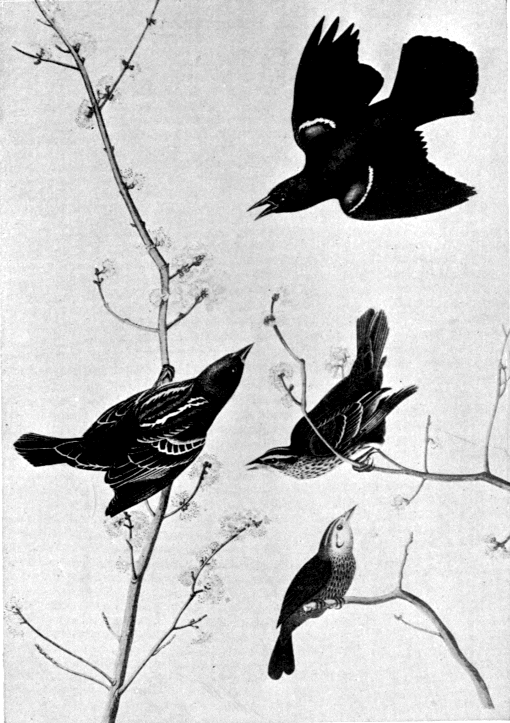
BLACKBIRD.
II. SATAN THE RACCOON
During the early years of my hermit-life,
I had caged many small animals, such as
deer-mice, raccoons, woodchucks, chipmunks,
flying-squirrels,
stoats, mink, and
red and gray squirrels.
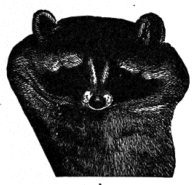
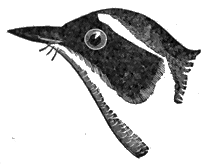
RACCOON'S HEAD.
My first captive
was an artful old
coon. I caught
him in a small steel
trap, the jaws of
which had been wound with cloth as a protection
to the foot. The den was under a
boulder near the cabin. I set the trap at
the mouth of the den and covered it with
leaves. The next morning the trap, with clog
attached, was missing. There was a trail
in the dead leaves easily followed. While
following the zigzag trail I was in plain sight
of the coon, but he remained quiet until he
found that he was discovered, then made frantic
efforts to escape. The clog had anchored
him securely to some witch-hazel shrubs. He
was full of fight, and I had to look out for
his teeth and claws. I had brought along
a stout piece of duck, which I wrapped around
the raccoon, trap and all; thus secure from
his wicked teeth and claws, I toted him to
the cabin.
It took me two hours to put a strap on his
neck. The struggle was a desperate one.
Without the duck it would have been a victory
for the raccoon. When I had the strap
securely fastened and a dog-chain attached,
I removed the trap from his foot, then staked
him out near the cabin. For two weeks he
tried night and day to free himself from
collar and chain, then suddenly appeared to
be contented.
Instinct plays no part in coon lore. A
coon can reason as well as the average human
being. My captive proved to be as artful
and wicked as Beelzebub himself.
Whenever my back was turned he would
be up to all sorts of mischief. When caught
red-handed he could put on a look of innocence
too comical for anything. By the end
of the first month he had got all of my ways
of life down fine. If I went into the woods
with my gun, on my return he would tear
around in his cage anxious for the squirrel
he had not seen, but was sure to get. When
I went away without the gun, he paid no
attention on my return. I do not think he
was guided by scent, for sometimes the wind
would not be right. Without doubt he connected
the gun and squirrel in his mind, and
perhaps knew more about a gun than I
thought.
He did not take kindly to cage-life, although
his cage was under a small pine-tree,
so when I was about the cabin I chained him
to the tree and let him run outside. I put
him into the cage every day before going
to the city for my mail. He resented this,
and would run up the pine-tree when he saw
me lock the cabin-door. One day I pulled
him down and whipped him while he lay prone
on the ground, with his eyes covered. I took
away his food and water. He must have been
downright hungry before I fed him. He never
forgot the lesson. After that, when he saw
me lock up he would sneak into his cage, fearful,
I suppose, that if found outside he would
be whipped and starved. He preferred food
in the order herein named: insects, eggs, birds
or poultry, frogs, nuts, red squirrel, rabbit,
gray squirrel, and fish. This, without doubt,
was the bill of fare of his wild state. He
would not touch green corn or milk until I
had crushed the former into his mouth, and
had dipped his nose into the latter. Afterward
he would leave everything for milk.
The first rabbit I fed to him was about
two-thirds grown. It was one which a mink
had chased into my dooryard and killed. It
was evident from the first that the coon was
no stranger to this kind of food. He opened
the rabbit's mouth with his fore paws and ate
out the tongue, after which he skinned the
head, turning the skin back over the neck.
He crushed the bones of the head and lapped
out the brains. On the third day he had finished
the rabbit, and the skin was turned inside
out, even to the ends of the toes. Squirrels
were skinned in the same manner.
This coon decided for me a disputed question.
I refer to the whimper or cry of the
coon. Night after night, in the nutting season,
he would call to his comrades, and they
would answer from the surrounding woods.
When the sweet acorns were ripe, Satan
was unusually active early in the evening.
At this early hour the coons were abroad in
search for food, and Satan scented them, and
did his best to attract their attention. One
coon passed near the cabin every night and
answered Satan's cries, so I imagined that
it was his mate.
Many writers claim that the tremulous cry
attributed to the coon is made by the little
screech-owl (Scops asio). It is true, doubtless,
that people that do not know both cries may
make such a mistake.
The little owls appear to resent my intrusion
on their vested rights, so from early
spring to late fall they haunt my sleeping-quarters,
and divide their time between snapping
their beaks and uttering their monotonous
notes. As I sleep in the open air nine
months out of the twelve, I have a good chance
to study both cries, and could not mistake one
for the other.
The coon is a ventriloquist. His cry seems
to come down from the sky. A friend came
in from the city one night to hear the coon
cry. It was a moonlight night, and the coon
was staked out in the dooryard. My friend
was not looking when the first cry was uttered,
but claimed that the sound came from the trees
overhead. Afterward he saw the coon in the
act, and could not make a mistake.
When Satan uttered the cry, he was always
sitting on his haunches. He would throw his
head up until his nose pointed skyward, then
blow the sound out between his half-closed
lips.
My friend had brought in a blanket and
hammock, and was prepared to spend the night
in the open air. He slung his hammock near
mine, and we turned in about ten o'clock. He
was nervous and restless, and said he could
not sleep with the little owls about him. Every
fifteen or twenty minutes he would call to
me to ask about some noise of the night, common
enough, but which appeared strange and
startling to him in the strained condition of
his nerves. Soon after midnight a small animal,
doubtless a stoat looking for an owl
supper, dropped on to my friend's blanket.
There was a smothered cry, full of fear, and a
flying figure that did not stop until my hammock
was reached. Nothing that I could
say would induce the frightened man to go
back to that hammock. He suggested at last
that he would sleep in the cabin. I assented,
and we soon had a bed arranged in a bunk.
The cabin was overrun with white-footed mice,
and I looked for more trouble.
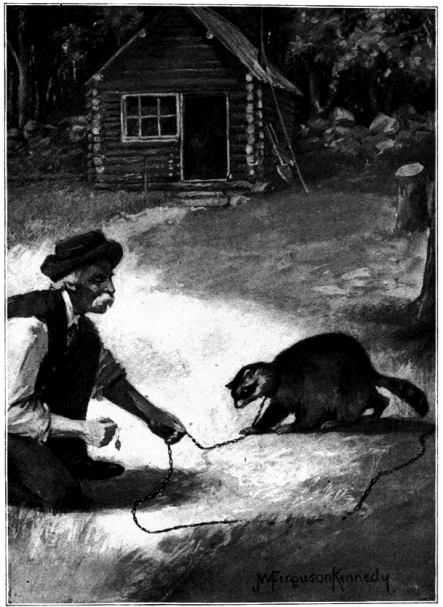
"I BEGUN BY TYING ON A NUT."
Twenty minutes later I heard several war-whoops, and I
saw my friend tumble out of the cabin into
the dooryard. "Are you awake?" cried he.
"Certainly," I answered, "you don't think
there is any one asleep in this county after the
racket you have made, do you?" "Oh, let up
with your fooling," said he, "this is a serious
thing. I sleep with my mouth open; suppose
one of those mice had run down my throat
and choked me to death? I am going home."
And home he did go. I accompanied him
through the woods to Western Avenue, and
returned in time to get three hours' sleep.
My friend was like hundreds of other nervous
people that I had known in a lifetime,
who were too sensitive to enjoy a night in
the open air. To be in full accord with
nature one should get accustomed to the presence
of a snake now and then, in the open-air
bed.
Satan was an apt scholar. I taught him
to pull in his chain, hand over hand, sailor-fashion.
The chain was twelve feet in length.
I begun by tying on a nut about two feet
from the coon. He pulled in the chain with
his fore feet, which he used as hands. I would
say to him, "Pull in the chain. Pull in the
chain," and inside of a week he would obey
the order without the use of food. I think
he enjoyed the sport.
The boys that visited my cabin thought
it great fun to play with Satan. They would
pull the chain out and watch the coon pull
it in. When Satan got tired he would coil
the chain and lay on it, and the play was
ended for the time being. After he had rested
awhile he would go on with the play. When
he was resting, if a boy offered to reach the
chain he would lay back his ears, growl, and
show his teeth. When he was ready to play
he would sit up on his hind feet, prick his
ears forward and look clever; then the boys
could reach under him and pull out the chain
without danger.
One day, while the coon was chained to a
stake in the dooryard, he killed a pet bird
in a manner so cruel and crafty, that it caused
me to name him Satan then and there. I had
placed a piece of matting by the stake to
which the coon was chained. He understood
that the matting was for his use, and he would
cry to be fed while chained out. He used
the matting as a dining-table and bed combined.
The pet bird that was killed was a
male catbird. Satan had left a piece of cookie
on the matting, and the catbird thought to
appropriate it. I was writing, not thirty feet
away, and looked up just in time to see the
flash of Satan's paw. I shouted, and rushed
to the rescue. When I reached the coon the
bird had disappeared. Satan looked so innocent
and surprised that I was led to believe
that the bird had escaped. I returned to
my writing, and the coon settled down for a
nap. An hour later a visitor from the city
called to get the loan of a book on birds. I
went to the cabin for the book, and when I
returned Satan was patting down the edge of
the mat. He saw me, and put on his innocent
look. He coiled up as if he were about to try
to sleep in a new spot. My suspicion was
aroused. I pulled away the coon and under
the mat found the dead bird. He had killed
the bird and placed it under him so swiftly
that I did not detect the trick when I went
to the rescue. For a full hour he simulated
sleep while he had the dead bird under him
all the time. When I went to the cabin he
hid the dead body under the mat. I gave
him a severe whipping and placed the dead
bird on his mat. The next day I buried the
body, so Satan did not profit by his crafty
deed. He remembered the whipping, and ever
after did not molest the birds. I once saw
a young towhee-bunting sit on his hind foot
and eat from a cookie that the coon had tried
to hide. How it would have fared with the
bird, if I had been absent, is a question.
I don't think Satan had any respect for
the Sabbath, but he knew the day, nevertheless.
On week-days, I returned from city about
nine o'clock A. M. Soon after, I would stake
Satan in the dooryard, and he would seem
much pleased with the change. I got up
every morning at daybreak. My first duty
was to feed the birds and Satan, then get
my breakfast. At first I did not let Satan
out of his cage on Sundays, on account of
the dogs that my visitors brought along.
Every Sunday morning I would feed Satan
as soon as I was out of my hammock, as I
did on week-day mornings, but he would not
eat or drink, and constantly tried to open the
door of the cage. He certainly knew, thus
early in the morning, that it was Sunday, and
he would have to remain hived up in his cage
all day. It seemed to me, that if Satan was
intelligent enough to keep run of the days
of the week, he ought to know about the dogs,
and was willing to fight them rather than be
cooped up all day. I knew all about the
fighting ability of the raccoon. It had been
my good fortune to observe the evolution of
a young coon, from a helpless, sprawling
bunch of fat and fur, to an old coon, with
a bristling battery of claws and teeth operated
by chain-lightning. After due consideration
I concluded to let Satan take chances with
the dogs. The next Sunday I staked him
in the dooryard and awaited developments.
A big Newfoundland dog was the first to
appear. The moment he saw the coon he made
a fierce rush, but Satan sprang lightly into
the air and landed on the dog's back. Swiftly
and savagely he delivered two blows on the
dog's eyes. The big brute tore himself away
from the coon and frantically rubbed his eyes
with his fore paws. When he could see a
little, he "dusted" for home, a sadder but
wiser dog.
The next dog was a small one, and Satan
gave him a slap under the ear that landed him
outside of the ring, or beyond the length of
the coon's chain. This dog did not go home,
but went to his master for sympathy. He
could not be induced afterward to look at the
coon.
Dog number three proved to be a yelping
cur. He did not attack the coon, but danced
around him, yelping all the time. He distracted
the visitors with his incessant yelping.
His master could not call him off. Satan
set a trap for the cur, and caught him, too.
He went to the stake, pulled in the chain,
and then pretended to sleep. The dog was
deceived, and got bolder and bolder until he
was near enough for Satan to reach him. The
coon made a swift rush and caught the yelping
cur, and handled him so roughly that I
was obliged to rescue him. It is needless to
say that the cur was cured of yelping.
Satan whipped two other dogs before night,
then for several weeks had no trouble worth
mentioning. Now and then, through the
summer, a strange dog would attack Satan
and get whipped.
There is a class of writers that claim that
the lower animals cannot reason. That such
animals are controlled by instinct. I have
ever found the lower animals as intelligent
in relation to the needs of their lives as we
are to ours. Satan proved to me and to others
that he could reason, also that he could take
advantage of new circumstances. Visitors
often gave Satan a dirty nut, which he would
clean by rubbing it between his paws. This
trick was played on the coon constantly.
Satan invented a new way to clean a nut. He
would take it to the mat and roll it under
his fore paw. How did he find out that he
could clean a nut on the mat? There was
no instinct, as I afterward proved. When
visitors were feeding nuts to him I dusted
his mat with ashes. Satan would take a nut
and start for the mat, but his keen sight
would detect the ashes, and he would stop,
sit up, and clean the nut in the old way.
In November I trapped another coon, a
young male. Doubtless he was the son of
Satan, for he was from the same den. I
knew, too, that he was born after Satan was
captured, so they could have no knowledge
of each other. I thought I would put the
young coon in Satan's cage and see if the
old fellow would recognize his own flesh and
blood. If he did, I would have to admit that
it was a case of instinct. When I put them
together a desperate fight took place. The
young coon was soon whipped and tried to
hide. Satan followed him up, but suddenly
began to sniff. He dropped his nose on to
the young coon's ears, sniffing all the time.
Instantly his savage look changed for one
of pleasure. His ears, that just now were
flat on his head, pricked up, and the lips,
which were drawn back, showing the cruel
teeth, fell into place. He put his arms around
the young coon's neck and dragged him into
the nest. Then he licked his ears and head,
purring all the time like a big cat. Satan
had recognized his son. I had noticed that
the sense employed was of smell, and not of
sight. I readily understood the meaning.
The young coon carried the scent of his
mother, and Satan had recognized it, and with
subtle reasoning had concluded that he had
found his own offspring. Afterward I
trapped five coons. One was an adult. I
put the four young coons, one at a time, into
Satan's cage. Two of these were from the
old den, and Satan recognized them at once
after sniffing them. The other two were from
a distant den, and as soon as Satan put his
nose on their ears he fell to mauling them,
and I was obliged to take them out to save
their lives.
I could handle Satan whenever or however
I pleased, and he would not lose his temper.
It would be dangerous for a stranger to put
a hand on him. One could almost step on
him and he would not take offence, but he
drew the line at touch. During the nine
months that he was in my possession he attacked
but one person. I met the gentleman
in question at Barnum's Show, on Stage Fort.
After the people had entered the main tent
I stopped some time in the animal tent. I
noticed a dudish-looking fellow acting in a
peculiar manner before a cage containing two
lions. I was interested, and strolled over to
the cage. The fellow was a dude beyond a
doubt. He wore a cowboy hat, a checkered
coat, a crimson vest, and lavender colored
trousers. He was trying to look the lions out
of countenance. The big African lion, the
male, seemed to feel uneasy under the fixed
gaze of the dude, and at last crowded behind
his mate. "See him cower and hide," cried
the fellow, addressing me. "The human eye,
intelligently used, can subdue the most ferocious
brute living. I could enter that cage
and handle those lions as I would kittens."
I did not dispute his assertion, and he asked
if the woods about Gloucester harbored wild
animals. I told him about my raccoon. He
suggested that it would please him to tame the
coon for me, and offered to accompany me
home.
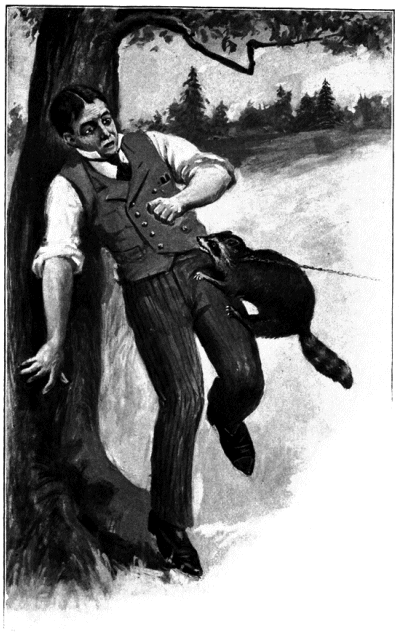
"WITH A SAVAGE SNARL HE SPRANG ON TO THE DUDE."
When the show was over I missed the lion-tamer,
but the next day he came down the
hill to the cabin, resplendent in his checkered
coat, crimson vest, and lavender trousers. As
soon as he had said good morning he threw off
his hat and coat and started the circus. He
fixed his gaze on the coon and slowly approached
him, stamping his feet while he
cried, in a commanding tone, "Down, sir,
down, sir!" Satan looked at the dude, then
looked toward me. This was something new,
and he wanted my opinion. When he found
that I remained quiet, he concluded to act
for himself. With a savage snarl he sprang
on to the dude and fastened his claws in the
lavender trousers. The dude, half-frightened
to death, jumped backward beyond the length
of Satan's chain. Satan held on, and the
trousers were stripped from the hips to the
knees. Fortunately, the coon's claws did not
reach the flesh.
The dude put on a pair of my trousers,
and with needle and silk I essayed to mend
the lavender wreck. My work was rather
clumsy. I should starve to death if I depended
on the needle. I toiled and wrestled
for two hours with that piece of work. It
was a warm day, and I was nearly drowned
in my own perspiration.
The dude put on the mended trousers and
left me without saying so much as "thank
you." Thus was Hood's "Song of the Shirt"
verified.
On the approach of cold weather I made
arrangements to winter Satan in the cabin.
I placed a box inside, and the cage outside,
and connected the two by a passage made
of boards. The passage was eight inches
square, and near the end that entered the
cage I had hung a swinging door to keep
the cold air from the nest inside. I expected
Satan would have to be taught the use of
the swinging door. After everything was
arranged I put Satan into the cage, and at
once he saw the change that had been made.
He investigated the passage with his handy
paws, and when he found he could move the
swinging door he passed through into the
box inside. After he had satisfied himself
that the nest was all right, he came out.
To tell the truth, I was somewhat surprised
by the ingenuity displayed. Satan's
comprehension was equal to that of a human
being. I removed the chain and collar, and
the coon and I settled down for the winter.
I had arranged a cover to Satan's nest-box,
and evenings I would give him the freedom of
the cabin. Inside of a week he knew the
contents of the cabin better than I did. The
light puzzled him. Once, and once only, he
touched the lamp-chimney. He would look
on gravely while I would blow out the lamp
and relight it again.
One night I forgot to fasten the cover in
his nest-box. That night something touched
me on the face and awoke me. I remained
quiet, and soon I felt a cold, soft touch on
my cheek. A swift clutch and I had Satan
by one paw. I held him until I had lighted
the lamp. He looked innocent and grieved,
and tried to show me that he did not mean
any wrong. He wanted to know if I were
asleep or dead. When I released him he
went to his box and raised the cover so quickly
and neatly that it seemed a slight-of-hand
performance.
One morning I neglected to secure the door
to Satan's cage. When I returned that night
the door was open and the coon was missing.
The next day I took some food to the den
under the boulder, but Satan did not care
for food. He was fat enough to go into
hibernation, and had probably entered upon
the sleep that would last till spring. The
next spring Satan would come to the mouth
of the den and take food from my hand, but
he was so crafty that I could not get hold
of his neck. I thought to arrange a box-trap
in which to catch him, when I could get
time. One day I missed him, and when I
heard that a farmer had caught a coon in his
poultry-house, and had killed him, I knew that
Satan had sacrificed his life to his appetite
for poultry. The reckless act did not indicate
a lack of reason.
Human beings sacrifice their lives to appetite,
so which of us will throw the first stone
at Satan?
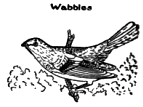
III. WABBLES
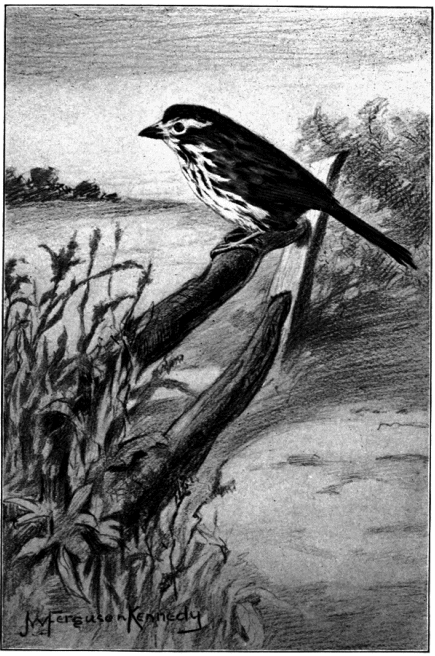
Wabbles is the name of a wild bird. Not a
book name, for the bird is known to naturalists
as the song-sparrow (Melospiza fasciata).
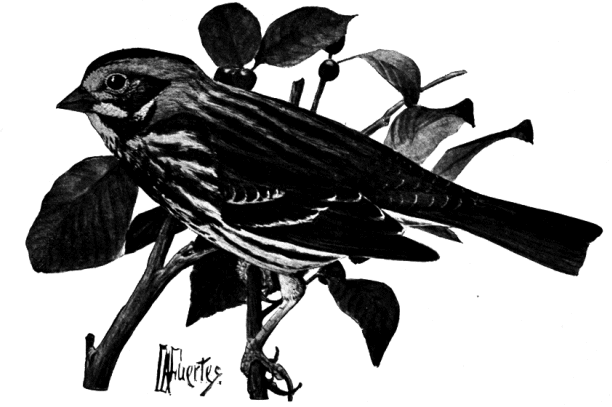
SONG-SPARROW.
I made Wabbles's acquaintance some years
ago. On returning to my log cabin one afternoon,
I had found him in the dooryard,
wounded, bleeding, and exhausted. An examination
disclosed a number four shot bedded
in the muscle of the wing-joint. While I
was removing the lead Wabbles struggled
violently, and when released, hopped into the
bushes and hid himself. I think he held a
poor opinion of my surgical skill. The next
day he was about the dooryard with other
sparrows, but for many days his flight was
a peculiar wabble, hence his name.
Wabbles was left behind when, on the approach
of cold weather, the song-sparrows
migrated southward. He seemed contented,
and I thought he would stop with me through
the winter, but one cold day he was missing.
Early in the following March, I looked out
upon the snow-banks one blustering morning,
and saw Wabbles in the dooryard. He had
returned in the night, two weeks ahead of his
mates. I do not know how far south he had
wintered, but doubtless he had remembered
the little log cabin in the woods, and all the
time had understood that food and a welcome
awaited his return.
That spring the sparrows lingered about
my dooryard three weeks or more, and then
dispersed to the neighboring fields and pastures,
for the song-sparrow does not nest in
the woods. Wabbles did not leave with the
rest, and when spring merged into summer
and he yet remained, I understood the reason.
The male song-sparrow is obliged to do battle
for the possession of a mate, and Wabbles,
with his tender wing, wisely forbore to enter
the lists. He preferred the cool woods and
free food to the sun-scorched fields and a mate-less
life.
Wabbles and I became fast friends. He was
constantly hopping about the dooryard, and
was always on hand to greet me whenever I
returned from town.
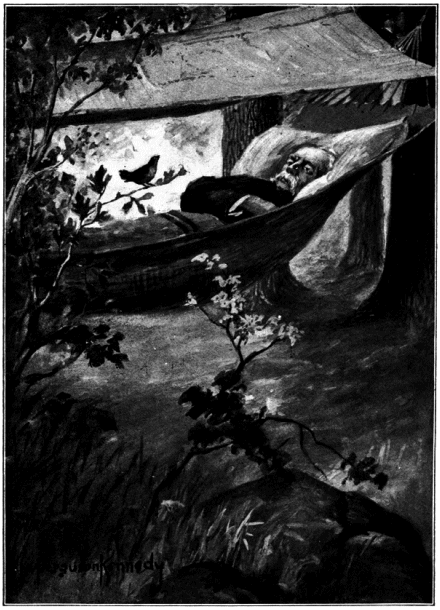
"WABBLES MADE IT HIS BUSINESS TO AWAKE ME AT
DAYLIGHT."
I slept in the open air in a hammock, with
only a canvas roof to keep off the rain, and
Wabbles made it his business to awake me at
daylight. The little rogue pursued the same
method each morning. He would hop about
in the bushes near the hammock, and chirp to
me in the loud, sharp call-note peculiar to the
sparrow family. If I remained quiet he would
break into song. He confined his singing
usually to the morning and evening hours.
But on my return after a long absence, he
would sing for a short time, regardless of
the time of day. It was a bird's method of
expressing joy. I thought that he prized my
companionship and disliked to be left alone.
That fall Wabbles migrated with his mates,
but the next spring he returned as before, two
weeks ahead of the main flock. He lingered
about the cabin until the mating season approached,
when he disappeared for five days.
On his return he brought with him a mate—a
shy, demure little wife.
Wabbles wanted to set up housekeeping in
the woods, so he showed Mrs. Wabbles all the
nooks, sly corners, and sheltered spots, but it
was useless; she positively refused to build
a nest beneath the trees. She flew away to the
fields, and Wabbles followed her.
Three weeks later, when returning from
town, I heard his familiar call by the roadside.
He came hurriedly through the bushes
and fluttered to my feet. He appeared overjoyed
to see me, and greedily ate the cracker-crumbs
I gave him. When he flew away, I
followed him. He led me a long distance to
a field, where I found Mrs. Wabbles sitting
on four dainty, speckled eggs. The nest was
in the open field, beneath a tuft of grass.
Three baby sparrows were reared from this
nest. When they were big enough to fly,
I expected that Wabbles would move his whole
family to the woods, provided Mrs. Wabbles
would consent, which I much doubted. Sure
enough, early in autumn Wabbles returned,
but he was alone. I fancied that he had deserted
his family for my companionship and
a life in the woods. But not so. His visit
was a matter of business. He wanted to know
how the supplies of food held out. After he
had satisfied himself he flew away, but the next
day returned with one of the baby birds.
Wabbles fussed over this bird all day long.
He called the little one into the dooryard and
stuffed it with crumbs, then into the garden
and stuffed it with insects. He kept up a
constant chirping meanwhile, and I thought
he made much of the fuss and bustle to keep
the baby from being homesick. That night
he flew away with his charge, and the next
day did not appear. Undoubtedly Mrs. Wabbles
had given him a piece of her mind for
taking her baby to the woods.
Three days later, however, Wabbles returned,
and brought with him two of the
babies. This day, for fuss and bustle, was
like the first, but that night, instead of taking
the birds out to the fields, he put them to
bed in a hemlock-tree near my hammock, after
which he flew away. The next day he brought
in the other baby, leaving Mrs. Wabbles childless
and alone. That night Wabbles put the
three little ones to bed in the same hemlock-tree,
and then flew back to his deserted mate.
Before dark I looked for the young birds,
and found them on a twig about a man's
height from the ground, sitting side by side
and cunningly concealed by hemlock spray.
When I approached, three little heads turned
and six bright eyes looked on me, but not
with fear. I suppose Wabbles had told them
all about the hermit, and they knew I would
not harm them.
The next morning Wabbles returned, and
Mrs. Wabbles was with him. She at once
took charge of her babies, and tried to entice
them away. But Wabbles, the sly rogue,
hopped into the dooryard, and I heard him
calling, "Tsp, tsp," and the little fellows
heard him, too, and, remembering the food,
flew to him. Mrs. Wabbles was obliged to
give in.
Wabbles is not wholly unknown to notoriety.
Many of the summer residents that
visited my cabin had made his acquaintance,
and the story of the little bird that would
desert the fields for a hermit-life in the woods
has doubtless often been told in many a distant
home.
Before the birds had departed in migration,
Wabbles's little wife had become contented
and happy in the cabin dooryard.
She was of a confiding nature, and in a remarkably
short time would take food from my
hand. Wabbles and his family lingered about
the cabin until the thermometer registered ten
above. The fifteenth of March Wabbles returned
to my dooryard. His wife and family
appeared a week later.
For some reason, known only to bird-life,
the male birds of most species return from
the south about a week before the females and
young birds.
When the nesting-season approached Wabbles
and his wife located their family in a
less wooded growth, on the road to the city.
The old birds returned to the dooryard, and
Mrs. Wabbles made a nest where a little patch
of grass had sprung up between the ledges.
Wabbles and I, during the summer, renewed
the friendly relations that had existed
when he led the life of a bachelor. He would
come to me for food at all hours of the day.
When I gave him his favorite food, cookie,
he would reward me with a song. He would
fly to a limb about four feet above my head
and sing one song, and then fly away to his
mate. Sometimes I could coax him to repeat
the song by talking to him earnestly and
rapidly. My visitors thought that the song
was strange, and often it was suggested that
it was on account of the nearness of the
singer. But the song was not the one with
which they were familiar. It was a new song,
low, sweet, and tender, with nothing in it
to remind one of the loud, joyous carol heard
in the springtime.
Wabbles called me at daybreak every morning.
He was jealous of the other birds, and
drove them away, when he thought they were
too friendly with me. A catbird and a veery
hopped about my hammock mornings, and
Wabbles attacked them so furiously that it
made me wonder why they did not keep away
for good. Wabbles did not allow other birds
to eat in the dooryard until he had satisfied
his appetite. Visitors asserted that he was
a tyrant, but I did not look at his warlike
actions in that light. He thought that he
owned the dooryard, and other birds were
trespassers.
Near my cabin there is a notice posted forbidding
trespass, and it alludes sarcastically
to "wood-cutting thieves." This sign was put
up because sometimes dead, worthless wood
was carried away from the lot. Wabbles is
willing that the birds may enjoy the things
in the dooryard after he is satisfied, but the
human fellow preferred to let the wood rot on
the ground.
The feathered biped's humanity contrasts
sharply with the human biped's brutality.
Mrs. Wabbles soon had four little mouths
to feed, and she worked early and late. The
heat was so intense that every little while she
would seek the shade, and rest with her wings
drooping and her bill open. Notwithstanding
the strain on her limited strength, she never
showed impatience, but was always the same
confiding little bird.
The Wabbles family enjoyed life in the
woods. Through the summer and fall months,
Wabbles set up a singing-school and trained
his boys to sing the mating-song of his
species.
Late in the fall death entered the family
circle. A boy from the city mistook poor
Mrs. Wabbles for an English sparrow and
shot her to death. Wabbles mourned for his
little wife, and he was not the only mourner.
I had become attached to the gentle bird, and
I was grievously pained by her tragic death.
Wabbles lost his joyous manner. He
watched over his motherless babies with gentle
care, but not a song did I hear after the
tragedy. Later, he conducted the young
birds to a warmer climate, and was lost to me
until the next March.
When Wabbles returned in the spring he
was alone, and his children did not appear
later. I suppose some motherly bird had
adopted the bereaved family, to take them
into the fields or pastures.
In April, Wabbles deserted me for three
days, then returned with another wife. This
was an old bird, probably a widow. It was
evident from the first that she thought Wabbles's
first wife had spoiled him. She bossed
him around in grand style. I tried to get
acquainted with her, but, with a lordly air,
she gave me to understand that she did not
associate with hermits. After two days she
ordered Wabbles out to the fields, and I did
not see him again till October. He came in
twice before migration. That was all. Wabbles,
the warrior, was henpecked.
The next spring Wabbles returned from
the South early in March. I think he was
glad to escape from his wife, but three weeks
later she swooped down on him, and packed
him off to the pastures.
For eleven years Wabbles has lived with
his second wife. Every spring he comes to
the cabin for a long visit, but I seldom see
much of him in the fall. Once I did not see
him at all, and reported that probably he was
dead, but the next spring he turned up as
usual.
It is now fourteen years since I removed
the shot from Wabbles's wing. He does not
grow old in looks and is yet good for many
years, if his wife does not worry him to death.
Dear old Wabbles. He has blessed me with
a friendship as sincere and lasting as any that
can spring from the human heart. As the
years go by, I am more and more impressed
with the little bird's individuality. Long ago
he proved to me that he possessed a moral
sense.
When Wabbles finds birds in the dooryard
he threatens them for a short time, then darts
at the nearest, and the feathers fly. After
he has satisfied his appetite he will let the
other birds return to glean the dooryard. He
does not want to deprive them of food, but
insists that they shall await his pleasure.
Sometimes he will sing while the birds are
eating. He firmly believes that he holds a
mortgage on the dooryard, or, perhaps, that
he is a joint owner with me; but he insists
that his property rights must be respected.
WABBLES.
One afternoon I found a wounded chickadee
in the dooryard. Some wretch had shot away
one leg and had injured a wing besides. I
thought Wabbles would make short work of
the helpless bird, but instead he hopped
around him and talked to him in a low tone.
There was no threat in his notes such as he
uttered when angry. Up to the time that
Wabbles left in migration the chickadee was
allowed the freedom of the cabin dooryard.
When Wabbles's first wife was alive, he returned
one spring the tenth day of March,
and brought with him a male linnet. I was
surprised, for it was peculiar that a linnet
should return in migration three weeks before
the usual time. A week later Mrs. Wabbles
returned, and with her was the mate to the
linnet. This incident opened up a wide field
for reflection. It proved that two species of
the bird family could communicate ideas to
each other.
These birds must have met in the South.
In the course of bird gossip either the linnets
or sparrows had announced that the summer
home was on Cape Ann. "That is where we
live," is the glad reply, so the birds, having
come from the same locality, associate together.
Wabbles tells them about the hermit
and the dooryard crowded with food. In some
way he induced the male linnet to accompany
him, three weeks out of season, with the understanding
that Mrs. Wabbles, a week later,
would pilot the female linnet to her husband.
It must be remembered that linnets do not
inhabit the woods. Wabbles gave the freedom
of the dooryard to the linnets. They
were invited guests, and were treated as such.
It all goes to show that Wabbles knows what
belongs to good breeding and possesses a moral
sense.
IV. BISMARCK, THE RED SQUIRREL
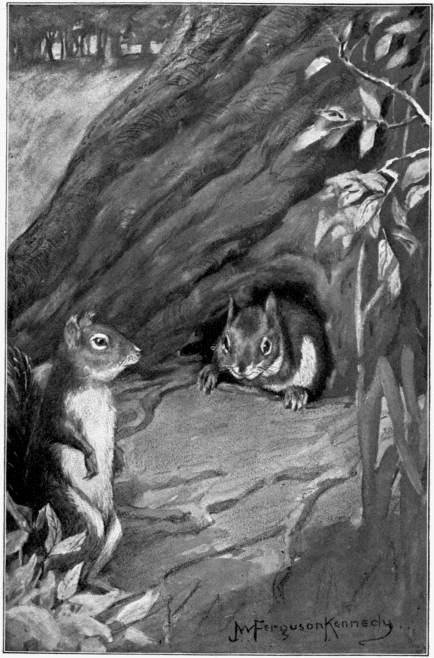
The red squirrel, or chickaree, leads all the
wild things in the woodlands of Cape Ann for
intelligence and the ability to maintain an
existence under adverse circumstances.
His life during the spring and summer
months is a grand hurrah, but in the fall he
sobers down and plods and toils in his harvest-fields
like a thrifty farmer.
Right or wrong, it is a fact that the red
squirrel bears a disreputable character. He
is called a thief because he takes the farmers'
corn, and a bloodthirsty wretch for robbing
birds' nests. From my experience with the
chickaree I am led to believe that he is not
so black as painted. I used to think that
he spared neither eggs nor young, but savagely
robbed every bird's nest which he
chanced to find. I certainly got this idea
from books, for I cannot recall an instance
where a bird's nest was robbed by a red squirrel.
For years I thought a squirrel was seeking
food when he chased the birds in my dooryard.
Now my eyes are open, and I am
heartily ashamed of myself. I awoke from
my trance to find that the red squirrel was
simply chasing the birds out of the dooryard
and away from the food, which he claimed as
his own.
Twice last summer I saw a red squirrel
pounce on a young towhee-bunting, but both
times he let the bird go without the loss of
a feather. It was evident that he did not intend
to injure the bird, but merely desired
to frighten it away. The intention was so
evident that I could not ignore it, and it led
me to do a lot of thinking.
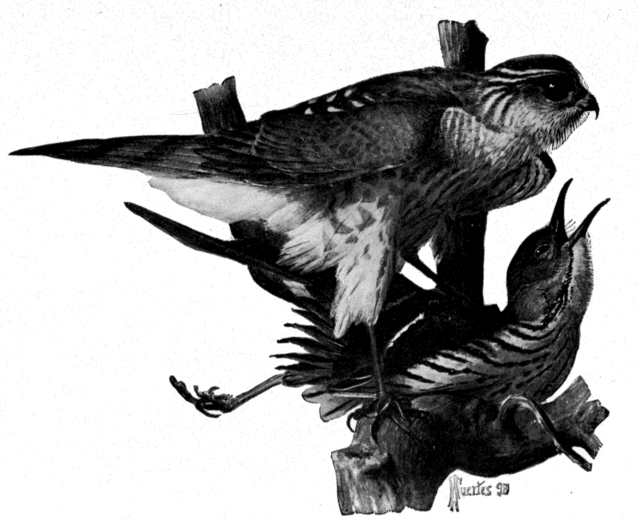
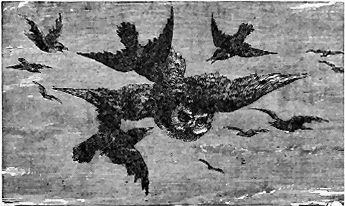
PIGEON HAWK.
I carefully examined my notes for proof of
the squirrel's guilt, and found no record
against him. The guilty ones were the hawk,
the owl, the snake, the stoat, the crow, the cat,
the irrepressible boy, and the white-footed
mouse. For fifteen years birds have nested
around my cabin unmolested by the red squirrel.
It was always a mystery to me why the
birds were not afraid of the red squirrel. Let
a hawk, an owl, a weasel, a cat, a snake, or
any of the animals known to prey on birds,
enter my dooryard while birds were rearing
their young, and the wildest alarm would prevail
so long as the intruder was in sight. The
red squirrel can come and go without a protest,
which proves that the birds do not regard him
as an enemy.
Whenever I have detected a squirrel investigating
a bird's nest it has turned out that
curiosity was the motive.
A pair of chickadees nested in a box that
I had placed in an oak-tree, and a squirrel
that spent the most of his time in the dooryard
made it a duty to investigate the nest
several times a day. He did not harm the
young birds, and the old birds did not fear
him.
While I was watching a red-eyed vireo's
nest last season, I saw a red squirrel run out
to the nest, stretch his full length on the limb
(it was a very warm day), and look down on
to the young birds that were squirming about
in their confined quarters. I counted ninety-six
before he left, and I did not begin at
first. I think he was on the limb fully two
minutes. These young vireos were not molested,
for I saw them leave the nest when full
fledged.
I have a record of an oven-bird that nested
at the foot of a pine-tree which contained a
red squirrel's nest. Four young squirrels
were reared in a leafy nest in the top of the
pine, and three young oven-birds in a domed
nest on the ground.
My experience with the red squirrel has
caused me to change my mind, and hereafter
I shall hold him innocent until he is proved
guilty.
The red squirrel in this locality is about
seven and a half inches in length, measuring
from the nose to the base of the tail. The
tail is about six and a half inches in length,
and is carried in a number of ways to suit
the convenience of its owner. As to color, it
seems as if there are two species, but it is only
the difference between the young and the very
old. Young squirrels are bright red on the
back and sides, with the under parts usually
a pure white. Old squirrels are red along the
back bone, gray on the sides, and a dirty
white below. Some specimens are shot that
are nearly all gray. Gunners claim that such
squirrels are a cross between the red and the
gray, but they are simply old red squirrels.
Dame Nature has been unusually kind to
the red squirrel. She has provided him with
powerful weapons of offence and defence.
She has set in his muscular jaws long, cruel
teeth, which are whet to a keen edge on the
hard-shelled nuts. She has conferred upon
him claws sharp as needles, and a muscular
system which seemingly is controlled by an
electric current. There is a wicked wild fire
in his bright eye that stamps him the bravest
wild thing of the forest. He will fight to the
death. He whips his great cousin, the gray
squirrel, without effort, and is a match for
the large stoat.
When pursued by a dog he makes a dash
for the nearest tree, which he mounts, calling
out "chickaree" as soon as he is out of danger.
He does not, like the gray squirrel,
seek a hiding-place in the top of the tree.
No, he is far too bold to hide from a dog.
He stops on a low limb, just out of reach,
and fairly boils over with rage and fury. He
barks, spits, and sputters; he makes furious
rushes, as if he intended to come right down
the tree, and "whip that dog." He violently
jerks his tail, and pounds the limb with his
hind feet, a picture of impudent, fiery energy.
Every movement of this little squirrel is
accomplished without apparent muscular energy.
He seems to float up a tree. If you
are near enough you may hear the pricking
of his claws on the bark, but you cannot detect
a muscular effort. He flashes along the
limbs in some mysterious way, never stopping,
like the gray squirrel, to measure distances
before a leap. If he misses and falls, he usually
catches by a claw to some twig, thus
saving himself. If he falls to the ground,
it does not harm or disconcert him. He is
up the tree in a jiffy, spitefully saying things
that sound to the listener very much like
swearing.
From the middle of April to the first of
September the male squirrel leads a jolly,
rollicking life. He is as restless and noisy
as a schoolboy, and as full of fun. He will
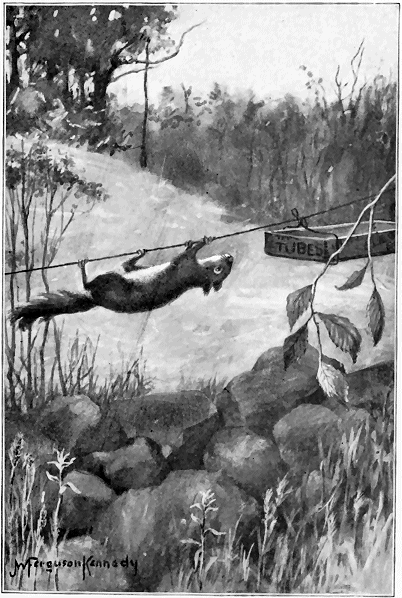
hang head down, holding on by his hind
claws, just for the fun of the thing. In the
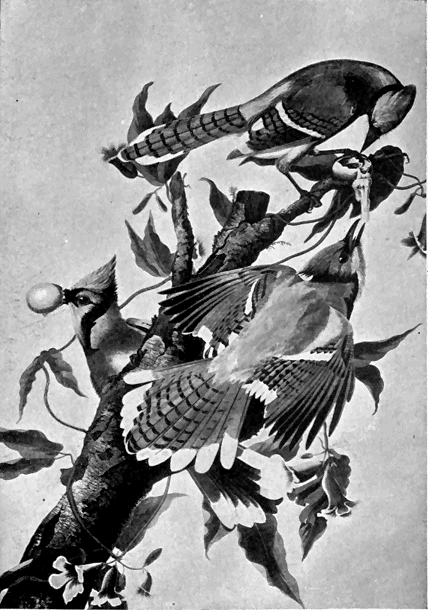
tree-tops he is king. He rules the blue jays
and crows, and races them out of the pine-trees
whenever he feels disposed. He hazes the
gray squirrel, but does not unsex him as alleged.
This silly tale is on a par with snakes'
stingers and hoop snakes. Any one that has
had the opportunity to observe squirrels the
year round, knows that chipmunks, red squirrels,
and gray squirrels show the same appearance
of being unsexed, except in the mating
season.
The gray is no match for the red in a tree-top
in a trial of speed. He usually keeps to
the ground, where his long leaps give him the
advantage over his fiery little foe. Many a
sprinting match of this kind takes place in
my dooryard. If a red surprises a gray
squirrel stealing food, he sounds his war-cry,
and in a mad rush is on to the gray before
he can make off with the bit of food which
he has appropriated. The gray, finding that
he is hard pressed, runs around the cabin with
the red hot at his heels. Round and round
they go, the gray silent, the red yelling like
a little demon. When the gray has had
several narrow escapes, he drops the food
and retreats unmolested. The red picks up
the food and takes it to a favorite limb, where
he devours it, talking to himself, meanwhile,
about "that gray thief."
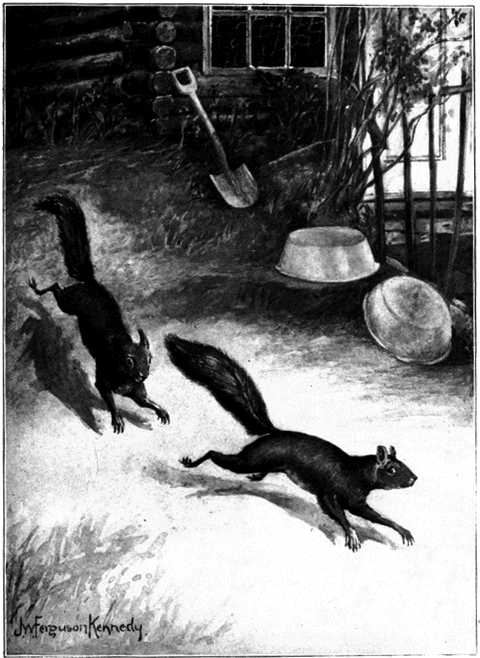
"MANY A SPRINTING MATCH OF THIS KIND TAKES PLACE
IN MY DOORYARD."
In all my years of observation, once only
have I known a gray squirrel to fight a red. I
think it was hunger and desperation that induced
the gray to fight. The gray was an old
male, certainly three times as large as the red.
The latter was an old male, and had held the
dooryard for several years against all comers.
He was a sagacious, grizzled old warrior, and
I named him Bismarck. The fight took place
in my dooryard. It was a bloody battle for
bread on a cold, drizzly day in midwinter.
The gray was whipped inside of three minutes.
The snow was crimsoned with his blood,
and when he fled he left a bloody trail behind.
At no time was there a ghost of a chance for
him to win. The muscular energy of the
red was astounding. His movements were too
quick for the eye. While the fight lasted, all
I could see was a bounding mass of red and
gray. The red squirrel did not appear to be
severely wounded, anyway he remained out
in the cold and rain to lick his wounds. Perhaps
it was squirrel surgery to prefer the
cold to a warm nest.
From my observations I find that the reds
seldom chase the grays, unless the latter enter
territory which the reds claim the right to
hold and protect.
Four-footed wild animals, with a few exceptions,
own farms, gardens, or house-lots. That
is, they hold exclusive control over a limited
area around their nesting sites. You seldom
see two woodchuck holes near each other, or
two rabbit burrows. The red squirrel runs
a fruit farm. He owns and controls trees
that bear nuts or cones, and other reds respect
his rights, and do not invade his territory
unless there is a famine. A red squirrel will
fight savagely for his home and property,
and usually drives all intruders from his
domain.
Young squirrels remain with their parents
through the first winter, but in April the
female turns the family over to the male, and
makes another nest of moss, leaves, and dry
grass in the top of a tall pine or hemlock-tree.
While she is engaged by new duties, the male
looks after the young squirrels that are now
full grown. He finishes their education, and
locates the young males on territory which
they ever after hold. The young females,
later on, are mated, and remove to the locality
inhabited by their mates. Whether the parents
have anything to do in selecting sons-in-law
is beyond my knowledge. I have known
an old male to fly into a passion when a smart
young red tried to flirt with his daughter.
The flirtation was cut short by the angry
father, who run the young dandy off his territory.
Kicked him out-of-doors, so to speak.
Another young red that courted the daughter
was tolerated, if not welcomed, by the father.
He was the choice of the old fellow beyond
doubt, but I do not know how the young lady
decided the matter. Perhaps she eloped with
the smart young red.
Bismarck, the grizzled old warrior, held
my dooryard for several years. One winter,
when there was a famine in the land because
the nut crop had failed, a muscular young
red thought he could drive Bismarck away.
A fierce battle was the consequence, and Bismarck
killed his antagonist, but was disfigured
for life by the loss of the end of his tail.
While Bismarck reigned, the only squirrel
that gained a foothold in the dooryard without
his consent was his wife. He chased her
away time after time, but like some human
wives, she persisted, and won the day. Bismarck
gave in when, instead of running away,
his wife adopted the plan of running spirally
up and down the tree-trunks. Mrs. Bismarck's
favorite tree was a large hemlock,
which was about eighteen inches in diameter.
The trunk of the tree was very short, not
over eight feet in length from the ground to
the lower limbs. The squirrels made two turns
in either going up or down the tree, and their
speed was too swift for the human eye. A
brown band seemed for a moment wound about
the tree, shifting as the squirrels ascended or
descended. It was two weeks before Bismarck
would allow his mate to remain in the dooryard.
When peace was declared the two
would eat side by side, but with Bismarck
always scolding and growling, while his wife
discreetly remained silent.
Bismarck was my schoolmaster. He taught
me that squirrels think, plan, and reason just
as human beings do. Every time I threw to
him a nut or bit of bread, I would see him do
the thinking act. He would take the food
to a boulder, where he would stop, hold up one
foot ready to start again, and think out a
good hiding-place. When he had thought
out a spot, he would run directly to it and
conceal the food under leaves or pine-needles,
and return to the dooryard for more. No two
nuts or bits of bread were concealed in the
same place. Several times I experimented to
find out how many trips Bismarck would make.
The greatest number was fifty-one. While
the experiment was going on, I noted each
hiding-place, as well as I could, and afterward
saw the squirrel go to many. He certainly
remembered each spot, and his keen
scent did the rest.
Bismarck was a thrifty squirrel. He did
not disturb his hidden store while the food
held out in the dooryard. He would call
around early in the morning, and if he found
me eating breakfast under the trees, he would
run to a limb just over my head and look down
in a cute way that meant "breakfast for two."
If I did not respond he would probably say
to himself, "The hermit don't mean to feed me
to-day. I must fall back on the food that I
hid away yesterday. Let me see, that first
nut is under the edge of a boulder just back
of the cabin." Off he goes straight to the
spot. He noses out the nut, which he eats on
the limb over my head, scattering the bits of
shell on to the breakfast-table. He is very
sociable while eating, for he stops now and
then to say something to me. I do not understand
his exact language, but I know by the
tone that he means to be friendly.
Bismarck did not always hide bread beneath
pine-needles or leaves. At a certain season
of the year the trees about my cabin were made
into storehouses. This season was governed
by the blue jays. When they were nesting
they did not come to the cabin and Bismarck
could store food in the trees without fear of
being robbed.
My attention was called early to the fact
that a gale of wind did not dislodge the pieces
of bread which the squirrel had stored on the
limbs of a hemlock-tree. I found that each
piece was held in place by a small twig. Scores
of times afterward I saw Bismarck lift up a
twig with his hands and then push the piece
of bread with his nose to the junction of twig
and limb. Of course the natural spring of the
twig held the bread in place.
Bismarck always stored mushrooms in the
trees, for he knew that the blue jays did not
eat such food. He would drop the stem of the
mushroom between the prongs of a forked
limb, if there was cap enough left to hold the
same in place, otherwise he treated it just as
he would a piece of bread.
How Bismarck acquired a knowledge of the
edible mushrooms is a mystery beyond my
powers. Doubtless, when he attended the
Chickaree College, he studied natural history
instead of the dead languages. He knew how
to harvest mushrooms. He gathered them
soon after they appeared above the ground.
Gathered thus, they would keep several days,
while a few hours' growth would spoil them
if left in the ground.
Bismarck knew how to eat mushrooms. He
did not begin on the freshly gathered ones;
he knew they would keep, and he selected those
that would decay shortly. Human beings eat
the specked apples from motives of economy,
and the same impulse controls the squirrel.
In the woods about my cabin grow many
varieties of the poisonous mushrooms. One
deadly variety—the "Destroying Angel"—possesses
a form most pleasing to the eye.
Its symmetrical shape and pearly white color
give it a look of innocence that has lured many
a human being to an early grave. I have never
seen a tooth-mark by a squirrel, mouse, or mole
in one of these deadly mushrooms, which goes
to prove that the wild things know more than
some human beings.
A few years ago, while out on a walk with
the Appalachian Mountain Club, I told a professor,
who was an expert on mushrooms, that
I used the mushrooms which were approved by
the squirrels, and no others. He said that I
was risking my life, for he claimed that squirrels
could eat poisonous varieties that might
kill human beings. I thought that the professor
knew more about mushrooms than he did
about squirrels, so his warning was wasted on
me. Up to date I have found the squirrels all
right, and I feel no fear when eating what
they eat.
For years I attended a squirrels' school, and
Bismarck was the schoolmaster. He taught
me many things relating to squirrel life.
Much of the knowledge acquired was wholly
unknown to me before.
When Bismarck first introduced himself to
me I think he was an old bachelor or a
widower. Three years later he excavated a
storehouse in a bank, beneath a boulder, and
made a sleeping-nest in a pine-tree, both in
the dooryard. The storehouse was used but
little after the first winter. The next spring
he took to himself a mate, but did not introduce
her to the dooryard. Some distance
from the cabin, in a swamp, Bismarck's mate
made a neat little nest in a hemlock-tree.
Here she reared two baby squirrels. Bismarck
did not take much interest in his family
through the summer. He spent most of the
time in the dooryard, sleeping in his own nest
by night. By day his time was occupied in
fighting the crows, and in driving squirrels
and birds from the dooryard.
There was always a good lot of food for
Bismarck to choose from, and I thought he
would give up hard work and lead a life of
ease. But I did not know the thrifty ways
of the red squirrel. When the harvest season
for hazelnuts drew near, Bismarck buckled
down to hard work. He began his new life
by calling often on his family in the hemlock-tree.
One day I found Bismarck and his wife
digging beneath a pine-tree that grew on the
high land just out of the swamp. They
brought out a great quantity of pine rootlets
during the next two days. There was not
much soil, which indicated that the squirrels
had discovered a natural cavity, partly filled
with pine rootlets. The third day, about four
o'clock in the afternoon, the work stopped.
"THE WINTER STOREHOUSE WAS COMPLETED."
Mrs. Bismarck ran to a pine-root, sat up
straight, folded her hands, and said something.
Mr. Bismarck ran to her side, folded
his hands, and made a reply. Both squirrels
looked toward the hole beneath the tree by
turning half-way round. Then they looked
at each other, and Mrs. Bismarck ran into
the hole, and immediately appeared and said
something that sounded very much like "It is
well." Then both squirrels scampered away.
The winter storehouse was completed.
When the hazelnuts were ripe Bismarck
and his mate began to fill the storehouse. Bismarck
gathered the hazelnuts about the cabin,
while his mate gathered those around the
home nest. Bismarck did a lot of running,
for he carried but one nut at a time. He
always worked under high pressure, running
to and fro at the top of his speed.
I noticed that he left many nuts on the
bushes, but when I investigated I found a
worm in each nut—a good reason for rejecting
them; but as the husks seemed perfect,
how did Bismarck know the worms were there?
I think his keen scent was the secret. By the
sense of smell he could tell a wormy from a
sound nut. So could I after the nut was
smashed, but not before.
After the hazelnuts, beechnuts were gathered.
But right here competition was too
great for the squirrels. The blue jays haunted
the beech groves, and could load up with from
twelve to eighteen nuts, then could use their
wings against the squirrels' legs, so the latter
were usually short on beechnuts.
The acorn followed the beechnut crop, and
as the woods of Cape Ann are made up mostly
of oak-trees, there were usually nuts enough
for Bismarck's family and to spare.
Besides being a hard worker, Bismarck
proved to me, in many ways, that he was
quick-witted and resourceful. A sweet acorn-tree
near my cabin was loaded with nuts.
Beneath the limbs on the south side was a
carpet of pine-needles, while under the limbs
on the north side grew a dense mass of brambles
and catbriers. Bismarck did not drop
a nut into the mass of briers, but carried
each nut—one at a time—to the clear side
before dropping it. Could human intelligence
do more?
When Bismarck and his mate had stowed
away food enough for winter, they made a
winter nest in the pine-tree that grew above
the storehouse. In the new nest the whole
family passed the winter after the manner
of red squirrels.
The two baby squirrels for the most of the
harvest-time remained in the nest or on the
hemlock-tree in which the nest was located.
Now and then they followed the mother to
a nut-tree, but were so noisy that I imagine
the fear of enemies caused the discreet mother
to drive them home.
When the family storehouse was well filled,
Bismarck stored a few nuts in the hole at the
cabin. I think he would have stored more if
it had not been for the alert wood-mice. He
hid a great many nuts around boulders and
trees. These nuts were used in the winter,
and often lasted until late in the spring. In
the spring, when the nuts started to grow,
Bismarck dug them up, bit off the sprouts,
and buried them again.
When the nut crop is a failure, the squirrels
are face to face with a famine. Long
before the nut season approaches the squirrels
know that they must depend on other
food for the winter's supply. During one
year of failure I carefully noted how Bismarck
conducted himself, knowing that he
would teach me how the red squirrel provides
food when his main supply is cut off. When
September warned the squirrels that the season
for providing food for winter was on,
Bismarck turned his attention to the corn in
the dooryard. Years before he had stored
corn, when he was obliged to compete with
the blue jays and chipmunks. The latter could
carry away from fourteen to nineteen grains,
while Bismarck's load was but two grains. He
soon evened things up by hiding corn in the
dooryard, or near it. When the supply was
exhausted, and the blue jays and chipmunks
had disappeared, Bismarck would dig up his
corn and carry it home. It was sharp practice,
but the squirrel was justified, when we
consider the circumstances. For several years
prior to the famine, Bismarck had dropped
the habit of storing corn, and only gnawed
out the germ, leaving the mutilated grain for
the blue jays and chipmunks. Now Bismarck
undertook to store corn, hiding it as of old,
but I vetoed the act, by withholding the corn.
The squirrel then turned his attention to a
black cherry-tree, and with the aid of a chipmunk,
soon stripped it of fruit. I think the
chipmunk gathered the fruit for the stone.
He gathered an enormous quantity, and surely
could not make use of the soft part. The red
squirrel may have gathered for immediate use
and also for a winter supply.
Bismarck's next move was a great surprise.
I caught him carrying bones to his storehouse.
One summer I saw Bismarck sitting on a
stone wall, apparently eating a bone. After
he got through he hid the bone in the wall.
I found that the bone was old and partly decayed.
I smashed up similar bones, and Bismarck
seemed to relish a meal three or four
times a week, but I never knew him to store
bones for winter use before. His next move
was to attack the pine-cones. These were
gathered while quite green. They were left
on the ground three or four days and then
carried, whole, to the family storehouse—a
great quantity was stored under stumps,
trees, and boulders. The hemlock-cones were
gathered later, but were husked at the foot
of the tree on which they grew.
During the following winter Bismarck
looked to me for food. A loaf of bread was
wired to a post near the cabin door, from
which he could eat, while he could not carry
it away. One cold, rainy day, he sat by the
bread without eating, and whimpered like a
little child. He was telling me in squirrel
language that it was cold, rainy, and almost
night, and that I ought to give him some
bread to take home to his family. I understood
his appeal, and passed him a biscuit.
He scampered away chuckling over his good
luck. After that, fair or foul, all through
the winter days, he would beg for bread to
take home, and always chuckled when he got
it. Perhaps he was laughing at me for being
an easy mark, or it may have been squirrel
for "I thank you a thousand times." However
that may be, he was welcome, for I
thought of the baby squirrels starving along
on a cone-seed diet.
Bismarck would eat all kinds of meat—even
fat pork—but he preferred cooked meat
to raw. While the famine was on he turned
his attention to many kinds of food found in
the woods. I made a record of each variety,
and religiously tasted of everything he used.
Frozen barberries and chokeberries were preferred
to all others. I found the barberries
had lost much of their usual sourness; the
chokeberries were sweet and palatable. While
the former remained on the bushes through
the winter, the latter were soon exhausted, for
they were food for quail, grouse, blue jays,
and mice. The berries of the greenbrier, staghorn
sumach, and rosehips were used sparingly.
The greenbrier berries had a sweetish
taste; the staghorn sumachs were sour and
puckery, while the rosehips had a pleasant
flavor at first, ending in a most disagreeable
bitter. Many mushrooms were caught by an
early frost, and remained frozen through the
winter. These were food for Bismarck. He
would gnaw out the under part, or gills, rejecting
the rest. I tasted the food, but cannot
say that I care for frozen mushroom.
In the spring pussy-willow buds formed a
part of Bismarck's food. I found the buds
nearly tasteless, but they crunched between
the teeth like a crisp cucumber. As spring
advanced, creeping wintergreen and partridge-berries
appeared here and there where
the sun had melted the snow, and Bismarck
greedily devoured the bright red berries.
Later berries formed the greater part of his
food until the hazelnuts were ripe. Wild
apple-trees abound on Cape Ann, and Bismarck
attacked the fruit early in the fall.
He destroyed great quantities for the seed,
which was the only part stored for winter
use. However, he seemed to relish an apple,
if it was not too sour, and all through the
winter he would eat a Baldwin apple, even
to the seeds, at one sitting.
The history of Bismarck through a year
of famine is the history of other red squirrels
on Cape Ann. It is evident that the red squirrel
is famine proof. If the nut crop is a
failure, chickaree turns his attention to other
food sources, and by perseverance and hard
work is able to keep the wolf from the door.
For years Bismarck and the blue jays have
matched wits. After nesting, the blue jays
would flock to the cabin and impudently appropriate
all the food found in the trees. Bismarck
seemed to know that it was useless to
store food longer in this way, so he would
bury it beneath the pine-needles. The jays
were soon on to this trick. When I threw a
piece of bread to the squirrel he would start
at once to hide it, while the jays would follow
him, keeping in the trees, just out of reach.
The moment he left, the jays would fly down,
dig out the bread and carry it away. It often
happened that Bismarck would fool the robbers
by pretending to bury the bread. He
would dig a hole, cover it over, pat down the
pine-needles, but would run away with the
bread in his mouth. While the jays were
scratching the pine-needles right and left, in
a useless search, Bismarck would hide the bit
of bread, and return to the dooryard for
more. He was not so particular if the food
was wheat bread, but if it was his favorite
food—doughnut—the jays were fooled
every time.
Every spring Bismarck taps the trees
around the cabin. He begins on the maples
and ends later on the birches. If the tree is
small, he taps the trunk; if large, he works
on the limbs. He gnaws through the bark
and into the wood, then clings to the limb or
trunk, below the wound, while he laps the
sweet sap. If there is a hollow in the bark
into which the sap flows, Bismarck is sure to
find it.
Did the red squirrel learn how to tap trees
from the American Indian, or did the Indian
learn from the squirrel?
The habits of the red squirrel are rapidly
changing in this locality on account of a
foolish State law. The story is quickly told.
Ward 8 (city of Gloucester), where my cabin
is located, contains over eleven thousand
square acres. Its area is greater than that
of the other seven wards combined. The bulk
of the territory of Ward 8 is made up of
woodland and shrubland, the city proper
being in the other seven wards. Ward 8
contains the delightful summer resort known
as Magnolia. This resort derives its name
from Magnolia Swamp, the only spot in New
England where magnolia glauca is found in
a wild state. The famous Coffin's Beach is
also in this ward.
The General Court four years ago placed
a close time of five years on small game in
the territory east of Ward 8. This protects
the seven wards of the city and the town of
Rockport. Two years ago the town of
Essex, which joins Ward 8 on the west, was
protected, so that the gunners from a population
of about forty thousand are turned
loose in Ward 8. The extermination of nearly
all the game, and of great numbers of song-birds,
has been the result of this peculiar
legislation.
INDIGO-BIRD.
All the wild things are desperately wild.
The red squirrel if he hears the report of a
gun instantly rushes to a hiding-place. Well
he knows the deadly meaning of the report.
He has turned day into night, and now harvests
his nut crop in the night-time. I sleep
in the open air, and during the harvest season
I listen for hours to the sound of dropping
nuts which the industrious but wary squirrels
are cutting from the oak-trees around my
cabin.
Bismarck is still in the land of the living,
although ten years have passed since he first
introduced himself, and requested me to
book him for table board. He has cost me
many dollars, while he has not paid a cent
in the coin of the realm. However, I owe him
for teaching and am ready to balance the
books and exchange receipts.
OVEN-BIRD.
I know that my position in relation to the
red squirrel's destruction of song-birds will
be sharply criticized by those who believe in
the squirrel's total depravity. But the truth
is that I describe wild life just as I find it,
not as some books say I ought to find it. If
the red squirrel was as destructive as reported,
there would not be a young bird reared around
my cabin. My notes show that last year the
following named birds nested near my cabin,
and probably every nest was known and visited
by the red squirrel:
Number of nests.
Chestnut-sided warbler
3
Black-throated green warbler
1
Oven-bird
2
Vireo
4
Canada fly-catching warbler
1
Robin
2
Towhee-bunting
2
Catbird
1
Wilson's thrush
2
Indigo-bird
1
Total
19
A ruffed grouse nest was looted by the
crows when it contained but four eggs, after
which the bird resorted to a swamp, and
reared a brood.
Several of the nests named were destroyed,
but none by the squirrel. In the light of my
observations I cannot consistently denounce
the red squirrel.
BLACK-THROATED GREEN WARBLER.
V. CHANGES IN HERMIT-LIFE
For several years I had slept in a hammock
without a roof to keep off the night air. I
had found this method inconvenient on account
of stormy nights, when I was obliged
to seek the shelter of the cabin. I overcame
the difficulty by putting a tent roof over my
hammock. The sides and ends were open so
that I was practically exposed to the night
air. The tent roof protected me on stormy
nights, and with this slight shelter I slept
out-doors from April 1st until Christmas, unless
there was a heavy, fall of snow, meantime.
I found it inconvenient to cook my breakfast,
and then, after eating it, go to the city.
Why I did so was on account of my coffee
habit. I had tried to find a good cup of
coffee in the city and had failed, so had depended
on my own brewing.
One morning I dropped into the little store
at the head of Pavilion Beach, and the proprietor
asked me to have a cup of coffee.
He piloted me into a back shop, where he
told me that he served a light lunch with
coffee, to the farmers. The coffee was just
to my taste, and for twelve years I patronized
the coffee trade in that little back shop.
My note-book shows that during the twelve
years I had missed only eighty mornings.
I had paid six hundred and forty-five dollars,
during that time, for my lunch and coffee,
and had walked, on account of my breakfast,
seventeen thousand two hundred miles. Whew!
It makes me feel poor and tired to recall it.
I do not remember that I remained at home
to breakfast on account of a storm. The
eighty mornings which I missed in the twelve
years were accounted for by absence from
the city.
I would leave my cabin, summer or winter,
at half-past five o'clock, so I could sit down
to breakfast in the back shop about six.
In the winter months it was dark at half-past
five in the morning, but that did not disturb
me. I did not use a lantern because I
would not be bothered with it, and for another
reason. It made one a bright and shining
object for early ghouls or tramps.
For some years past I have discontinued
my early morning tramps, but I love to recall
the persistence with which I clung to habit.
Those early walks afforded me much pleasure
and some hardships. During the spring
months the frogs and birds enlivened my
morning walk with music. The bird-music
along the route to the city was divided according
to locality. Before leaving the cabin,
from early daylight, there would be a variety
of bird-songs. In numbers the veery led
all the rest. Then followed the red-eyed vireo.
After these, I could hear only one song each
of the following species:
Catbird, towhee-bunting, chestnut-sided
warbler, robin, black-throated green warbler,
oven-bird, wood-thrush, and warbling-vireo.
Indigo-birds and cedar-birds some years could
be added to the list, but they are erratic
birds, and cannot be depended upon.
CEDAR-BIRD.
THE NEW CABIN.
My route to the city was along the deserted
old highway. When I had climbed the first
hill (where my new cabin now stands), I could
overlook a rugged territory where the fire
and axe had exterminated the large trees,
leaving a low, shrubby growth, just suited to
the needs of the birds. The songs of the
catbird, towhee-bunting, and robin were heard
here, and, strange to tell, in a distant corner
of the territory, could be heard the loud carol
of the song-sparrow. A few pairs of these
birds had changed their nesting site from
pasture to shrub-land. I knew that these
sparrows were descendants of my pet birds,
Wabbles and his first wife. They were born
in the woods, and so reared their children in
the same surroundings.
The frog-pond was just beyond the hill,
and when the toads and frogs did not drown
their music, birds could be heard singing from
morning till night during the nesting season.
There was a colony of Maryland yellowthroats
near this spot, and the sprightly song
could be heard from May 1st to the middle of
July. I have heard the song in September.
MARYLAND YELLOWTHROAT.
A short distance from the frog-pond, on
the left, there is another pond, or shoal bog,
where frogs and red-winged blackbirds appear
to own the earth or water. Still farther along
the old highway, on the right, there is a
walled-in territory, called the "Sheep Pasture."
I think I could carry the grass in
this so-called pasture in my hands. A mass
of boulders and bed-rock, set off by barberry-bushes,
comprises the view, but this rugged
pasture (?) is the home of the field-sparrow
(Spizella agrestis). This sparrow is not so
common as the song-sparrow and bay-winged bunting.
RED-WINGED BLACKBIRDS.
I consider it a rare treat
to listen to this sweet singer. I made it a
practice, during the season of song, to stop
by this old pasture, not only to hear the
sparrow, but a brown thrush as well. The
thrush occupied the other side of the old
highway, and when he saw me coming, he
would mount to the top of a small tree and
sing so long as I remained to listen.
Farther along on the old road, a pair of
redstarts could be found every spring. The
male did his singing in a wild apple-tree.
From this spot, down "Slaughter-house Hill,"
to Western Avenue, I found song-sparrows
to be the prevailing bird. There were a few
chestnut-sided warblers, robins, and catbirds.
The birds I have mentioned, that nest
along the old road, look upon me with
friendly eyes as I pass. When they return
in the spring, they give a greeting which
I understand, because the notes are in a higher
key, and are never repeated through the summer.
While passing daily over the road I
have made it a practice to talk to the birds,
so many of them, not all, greet me as before
mentioned.
SWAMP SONG-SPARROW.
BROWN THRUSH
The brown thrush is usually more demonstrative
than other birds. His greeting is
almost like the shrill cry of a small boy. Two
years ago, when rounding a turn in the old
road, I saw four thrushes before me. I stopped
to observe them, when I heard behind me the
laugh of a boy. I glanced back, but saw
no one. Again I heard the laugh, and this
time I located the sound over the wall, and
started to call, when a male thrush flew to
the top of a small cherry-tree, and, after
laughing as before, gave me a song. This
thrush was my old friend just returned from
the South, and when he saw me looking at
his mates, he called out to let me know where
to find him.
BALTIMORE ORIOLE.
Along Western Avenue the tall elms harbored
many singers. The Baltimore orioles'
loud notes could be heard above other bird-songs.
Linnets, chipping-sparrows, bluebirds,
and bay-winged-buntings were scattered along
the route to the city. When I had reached the
sea-wall, the gulls were the birds to attract
my attention. Some were seen skimming the
surface of the water, while others were anchored
in large rafts. The gulls appeared to
be fearless, and swung to and fro near the
beach, but, just the same, the crafty birds
did not approach near enough for a shot.
They knew how far the modern gun could
shoot, and gauged their flight accordingly.
Whenever one desired to cross the highway
to the marshes beyond, it would rise above
gunshot before making the attempt. Besides
the keen sense which the gulls possess, they
carry themselves with true dignity.
From the first of April to the middle of
November I looked every morning for my
"lone fisherman." There was a stake near
the drawbridge which a belted kingfisher had
preempted. For six years this feathered fisherman
held that stake, while he had to face
almost all the travel in and out of the city.
The nest was in a clay-bank that overhung
the beach near Stage Fort.
It is needless for me to tell that I derived
great pleasure from my daily association with
the birds that nested along my route to the
city.
BELTED KINGFISHER, WATCHING.
KINGFISHER, STRIKING.
The hardships which I have mentioned were
encountered in the winter months, when storms
prevailed. Cold starlight mornings were my
delight. If there was snow on the ground it
added a new pleasure. I always enjoyed the
keen, cutting air. Sometimes there were
storms in the morning with rain or snow. At
times, the wind would blow such a furious
gale on the Cut, that it
would make it nearly impossible
to reach my haven.
When safely housed at last,
I always felt satisfied with
myself, because of my victory
over the elements.
One storm forced me to remain
in the city overnight.
The storm had died out,
but had created a sea such
as is seldom seen even on
the Cape. I went over to
Bass Rocks, to see the
waves break, and did not
get back to Western Avenue until near night.
I found the street full of snow and sea-water.
I waded nearly to the drawbridge and then
mounted the sea-wall. I soon found that the
large waves broke over the wall, and with
force enough to wash me overboard, so I
turned back. The street was closed to travel
afterward, by the city officials.
KINGFISHER LIFTING HIS CATCH.
During the summer weather I saw many
strange sights when taking my morning walk.
One morning, a pasture-rabbit tore along the
old road as if he were racing for life. He
passed me without turning his head, and was
out of sight around a turn in the path before
I had recovered from my surprise. While
I was looking, he came back, jumping high
and long; after he had got by the turn, and
nearly to my feet, he gave a great jump sideways,
and landed in a clump of weeds. Just
then a stoat came in sight on the rabbit's
trail. His leaps were not expended in the
air, but were swift, long, and near the ground.
It was evident that the poor rabbit had no
chance to escape from such a supple, bloodthirsty
foe without help. When the stoat was
out of sight, the rabbit again took to the
road. He passed me, then turned into the
woods. Whether he knew it or not, it was
the best thing to do. It left the hermit to
face his relentless foe. Perhaps the birds had
told the rabbit that the hermit was a friend.
The stoat came back, hunting both sides of
the road. He understood just how he had
been tricked. When he found the trail in the
weeds, he circled around until satisfied that the
rabbit had returned to the road. When we
met, he seemed surprised, but he tried to pass,
spitting spitefully to frighten me. I drove
him back, and managed to keep him from the
rabbit's trail until it was too cold to follow.
I expect that this rescue established my
reputation with the rabbits, for from time to
time they came into my dooryard when chased
by a mink or stoat. Whenever it occurs on
Sunday there are visitors present, who are invariably
excited for the welfare of the rabbit.
The stoat is the large weasel. It turns
white in the winter, and is then the ermine.
Of all the incidents that happened during
my morning walks, there is one that I cannot
explain without resorting to a belief in hypnotism.
I was on the way to the city when
a turn in the path brought into sight a large
mink, apparently coal-black. His peculiar
actions caught my attention first, but soon
I saw a ruffed grouse about twelve feet beyond
the mink. Every feather on the grouse
stood up, causing the bird to look as large
as a small turkey. The mink was making
figure eights, moving from side to side of the
grassy path, which was over five feet in width.
His movements were so rapid the eye could
see only a black streak. While I could
not see the mink move toward the grouse, I saw
that the distance between them grew less quite
rapidly. Feeling sure that the grouse was
doomed, for it seemed unable to do anything
but follow the rapid motion of the mink, I
stepped forward and gave a shout. The
grouse flew away, and the mink turned on me
and let out a yell that was fierce and loud
enough for a tiger. He acted as if he meant
to attack me, but thought better of it, and
ran into a stone wall. From this safe retreat
he yelled while I was in sight. This case
puzzled me. It appeared almost impossible
that such a wary, muscular bird as the grouse
could be hypnotized. The mink was surely
but slowly nearing the grouse when I interfered.
I am sorry I did not remain quiet, and
so find out if the grouse was able to fly away
before the danger-point was reached. As it is,
I remain in doubt.
"THE DISTANCE BETWEEN THEM GREW LESS QUITE RAPIDLY."
Returning from the city one morning in
October, I turned off the old highway into
the woods. I thought that some of the wood-folk
would notice my visit and reward me with
gossip for my note-book. I stopped to rest
near a red squirrel's nest. The nest was in
the top of a tall hemlock-tree and I was on
the ground, but the proprietor knew I could
climb, and so was eager to drive me away.
He did not dare to attack me, for I suppose
that sometime in his life he had worked the
idea through his little head that man was too
big and powerful to be whipped by a red
squirrel, but he did the next thing. He flew
into a passion and abused me in the expressive
and vehement language common to this squirrel.
He would run out on the limbs over my
head and dance himself into a frenzy, and
chatter and bark and shriek as if that would
drive me away. He was wound up for a half-hour.
After he had run down, he stretched
out on a limb and silently watched me. Soon
after, I heard a slight rustling of leaves, and
a gray squirrel appeared from the underbrush
with an acorn in his mouth. The red saw
the gray, but remained silent. The gray
squirrel selected a spot and proceeded to bury
the nut. When he had finished and was patting
the dirt down, the red set up a great
laugh. The gray cast one look aloft, and
instantly his little paws were making the dirt
fly. In less time than it takes me to write it,
he had dug up the nut and had disappeared.
I don't think the red squirrel thought to appropriate
the nut. I think he enjoyed the
joke which was on the gray. I know that I
did.
A thaw in the winter made trouble for me
outside of the sloppy walking. It brought
out the skunk family, and each individual
skunk thought he owned the old highway, and
he did, when I met him. Many and many
times I have had to climb through snow, or
over ledges, to give the right of way to some
sleepy old fraud, that did not know enough
about man to be afraid of him.
"'HERMIT, YOU ARE OUT.'"
One evening I went to the well for water,
and left the cabin door open. When I returned,
I saw a big skunk climbing over the
door-sill. I shouted, in hopes to make him
turn back, but he looked at me as much as
to say, "Hermit, you are out," and so I was.
It was a cold, drizzly evening, and I was in
my shirt-sleeves. It was a good half-hour
before the scamp had satisfied himself that
my stores were locked up. I was glad that
he did not try his teeth on my cupboard. In
that case I should have had to stop out all
night.
VI. THE WHITE-FOOTED MOUSE
The white-footed mouse, unlike the house
mouse, is a handsome fellow. He sports a
chestnut coat, a white vest, reddish brown
trousers, and white stockings. His eyes and
ears are uncommonly large, causing his head
to resemble a deer's in miniature. This resemblance
has bestowed upon him the name of
"deer-mouse." He is also called "wood-mouse,"
but is known to science as Hesperomys
leucopus.
My object in writing about these mice is
to call attention to their peculiar method of
communication. I have summered and wintered
them over fifteen years, and never have
I heard one of them utter a vocal sound. They
communicate with each other by drumming
with their fore feet, or, rather, they drum with
their toes, for the foot in the act is held rigid
while the toes move.
If any writer has called attention to this
peculiar method of communication, it has escaped
my reading. I am well satisfied that
the habit has never been published before, so
it must prove interesting to those who pry
into the secrets of Dame Nature.
The white-footed mouse has taken possession
of my cabin. Until a year ago the mice were
kept in check by stoats, but for some reason
the stoats have failed to appear, and the mice
are increasing rapidly. I find their nests in
every nook and corner. I go bareheaded the
most of the time, so it happens that when I
do need a hat I find it occupied by an enterprising
mouse and her family. Now a few
mice for company in the winter evenings would
not be objectionable, but I draw the line when
they become so numerous that I am forced
to eat and sleep with them. They are too
cunning and intelligent to be kept in check by
traps. I have tried all kinds of traps, only to
find them useless. Last winter I bought a
wire rat-trap—the kind with a trencher that
tips and slides the rat into the space below.
The trap was a failure. The mice were highly
delighted with the contrivance, and from the
first used the trencher as a door leading into
and out of the trap.
How does it happen that these shy inhabitants
of the woods are more intelligent than
the cunning citrat?
Some writers tell us that the lower animals
cannot reason. In such case it ought to be
an easy matter for man to outwit a lot of
foolish little mice. I tried the experiment by
fixing a wire to the trencher in such a way as
to give me full control. When the mice were
engaged on the food in the trap I pulled my
wire and made it fast. The next morning my
prisoners numbered twenty-eight. I was
about to drown the lot, when several pets clung
to the upper wires of the trap, and the mute
appeal in their great wild eyes softened my
foolish heart, and I thought it would be more
humane to lose them in the woods. I carried
them nearly a mile from the cabin, and turned
them out near some big boulders. I left a
supply of food, and promised myself to feed
them from time to time. Two nights later
they were all back in the cabin. Upon investigation
I found that they had followed my
footsteps. I could see their tracks in the snow
where they had trooped along in short journeys.
At the end of each journey the tracks
would disappear under a boulder or a tree,
only to appear again, but always heading for
the cabin.
I baited and fixed the trap, while the mice
scampered about, evidently celebrating their
return. I told them plainly that this was
their last night on earth; that I had outwitted
them once and would now outwit them
again. But all my boasting came to naught.
Not a mouse would enter that trap while the
wire was on the trencher. The third night
I removed the wire, and the mice entered the
trap without fear.
Vainglorious man had pitted his wit against
the wit of these little rodents, and the rodents
had triumphed. Every sportsman knows how
it is. He finds the wild things just as intelligent
and crafty as man with all his boasted
superiority.
I desire to emphasize what I have already
stated as to the peculiar method employed
by these mice when communicating with each
other.
If any one has been fortunate enough to
have heard a vocal sound uttered by a white-footed
mouse, I shall greatly like to hear of
the fact. A daily and nightly knowledge of
these little mice for more than fifteen years
has led me to believe that they are completely
dumb. They talk with their toes just as deaf
and dumb people talk with their fingers, only
they are guided by the ear instead of the eye.
Proof that they are talking together is found
in the fact that they go on with the drumming
when in full view of each other. When calling
to attract attention, they drum a long roll
which corresponds to the halloo of the telephone.
The answer is the same; afterward
the rolls are variously interrupted. Through
the winter months the mice about my cabin
look to me for food. By catering to their
wants I have mastered their calls for food and
water. I keep a loaf of bread on the floor,
and it is no unusual thing to see a dozen mice
eating and fighting around the food. Whenever
I forget to supply the bread, the mice
come out of their nests and drum the long
roll, the call over their telephone, to attract
my attention. If I am reading or writing
and do not heed the call, they continue the
long roll, drumming on books, tinware, papers,
and on the wooden shelves. The moment I
look up or speak, all hands drum the food-call,
a long followed by a short roll.
The call for water is two short rolls. The
danger-call is two long rolls drummed rapidly
and vigorously. The young mice learn to
drum when nearly full-grown, but understand
and answer the drumming of the mother-mouse
when quite young. I have had proof
of this more times than I can remember.
An old mouse, a pet of long standing, on
cool nights takes her family to the roof of the
cabin. The roof is warm and makes an ideal
playground for the little ones. Here they
race and romp until daylight, when the
mother-mouse puts them to bed for the day.
Soon after I hear the mice on the roof, early
in the evening, the old mouse comes down to
see if food and water are on hand. If she
finds things all right, she takes a drink and
then calls her family down. As near as I
can make it out, she drums three rolls, a
long roll between two short rolls. Anyhow,
the young mice understand, and scamper down
and drink and eat, after a harum-scarum
fashion. The old mouse drums to me if there
is no water in the dish. The young mice must
hear this drumming, but pay no attention to
it, which proves that they understand the
different calls. The old mouse drums on the
tin wash-dish, and her claws make a sound
that rings out loud and clear. She drums
first the long roll to attract my attention, and
then drums the water-call. If food is wanted,
she drums the food-call after attracting attention.
"IT CARRIES ITS VICTIM BY THE MIDDLE."
The white-footed mouse has a deadly enemy
in the weasel family, the stoat, or ermine,
which pursues its defenceless victims every
month in the year. I seldom see a small weasel,
but the stoat is common in this vicinity.
While a stoat is rearing its young, the life
of the white-footed mouse is made miserable.
By day and by night its bloodthirsty foe
is on the trail. It is no unusual thing to
see a stoat running along the wall back of
the cabin with a mouse in its mouth. It carries
its victim by the middle, and always reminds
me of the picture of a tiger carrying off
a Hottentot. Some of the old mice are quick-witted
and full of resource, and escape danger,
otherwise the species would soon be exterminated.
There is an auger-hole in one of
the logs inside the cabin that affords a mouse
a safe retreat. Several times I have seen a
stoat thrust its paw into the hole, only to
jerk it out in hot haste. A drop of blood on
the log would show that the mouse had defended
itself with its sharp teeth.
There are three mice about my cabin that
for years have managed to escape the stoats.
Time after time I have saved the lives of these
mice. The three are pets, and intelligent
enough to know that I will protect them from
their fierce and relentless foe. In the night-time,
if hard pressed, they dive into my bed,
while by day they sound the danger-call,
knowing full well that I will come to the
rescue and drive away their enemy.
To a stranger these mice look as much alike
as peas in a pod, but for me they possess
individualities as marked and distinct as could
be found in three human beings. One of the
three, the mouse that uses the roof for a playground,
always nests under a stone wall just
back of the cabin. Number two nests in the
cabin summer and winter. When the weather
is warm she makes a nest on a high shelf, but
in cold weather her nest is on the floor under
a pile of newspapers. Number three nests
where I nest. When I sleep in the cabin, the
nest of this mouse is always there. When I
sleep in the open air, under a roof to keep off
the rain, the mouse follows me, nesting under
newspapers or in a box which I supply. If
she has a family when I move, it does not
prevent her from following me. She makes
ready a nest, and then takes her family to the
new quarters.
For keen intelligence mouse number two
takes the lead. All through the summer
months she makes a nest on a high shelf in
the cabin. When there is a fire in the stove
the heat becomes oppressive in the top of the
cabin, and the young mice would perish if
it were not for the intelligence of the old
mouse.
When I fill the stove with wood the old
mouse understands just what will take place.
She knows that I am about to kindle a fire,
and she rushes to a shelf near the stove and
frantically drums the danger-signal. She
also does a lot of drumming which I do not
understand. She tries to tell me in her dumb
language that a fire will destroy her little
family. When the mouse finds that I do not
heed her appeal, she knows that her family
will be destroyed, and can be saved only by
her own hasty efforts. The one thing to do
is to remove her babies to a place far away
from the death-dealing heat. If the young
mice are small, in some mysterious way the
mother-mouse induces each youngster to cling
to a teat, when the whole family is removed
in this novel manner to a safe retreat beneath
the cabin. It is a comical sight to see the
old mouse crawling along a log with eight
or ten raw, shapeless things clinging to her
like grim death. The hole in the wall that
leads outside is small, and the old mouse has
a long struggle to get her load safely through.
Now and then a young mouse drops off and
remains squirming where it chances to fall.
The mother invariably returns and gathers
in the missing.
When the young mice are half-grown, they
are removed in a different manner. They are
now too large to be dragged as before. They
are also too large to be carried by the neck.
The mother overcomes this difficulty by doubling
up the young mouse and then grasping
it by the crossed legs. The young mouse
turns its head inward and holds it in place by
biting on to one of its own legs. In this way
a young mouse is made up into a round, compact
bundle. When the hole in the wall is
reached it often happens that the mother cannot
push her load through. After several
unsuccessful efforts she turns about and backs
through the hole, dragging the load after
her.
All in all, the white-footed mouse has
afforded me much pleasure, but at times it
becomes a nuisance. At one time my cabin
was haunted by a strange sound. The sound
was simple enough, only a sharp click repeated
over and over. Sometimes, however,
the performance would change to a succession
of clicks. For six weeks I vainly tried to
solve the mystery. At last the clicking became
downright annoying. It would break up
my line of thought when writing. It would
confuse my mind when reading, and I often
jokingly asserted that this mysterious ghostly
click, click would send me to the insane asylum.
At last I traced the sound to a shelf where
I had placed an empty cigar-box. I investigated,
and the mystery was solved. A dozen
mice occupied the box as a safe retreat from
their enemy, the stoat. Whenever a mouse
entered or left the box the cover was raised,
and, falling into its place again, made the
click that had so annoyed me.
The box-cover was heavy enough to severely
pinch a mouse's tail, but the cunning mice
had provided for this danger. A hole about
the size of a lead-pencil had been gnawed in
the side of the box, just below the cover, and
afforded a channel for the tail, while it was
too small to attract the attention of a stoat.
A more cunningly contrived retreat from
an enemy could not be invented. It shows
that this wild mouse of the woods possesses
intelligence which passes far beyond the
powers of instinct.
It would take a volume to record the incidents
that have transpired in connection with
these mice during the fifteen years of my hermit
life.
MOLE.
Some of these incidents are comical, others
pathetic, and, alas! others are tragic. One
in the comical line happened to a young man
from the city who thirsted for more knowledge
of the wild things. He stayed one moonlight
evening to see the mice eat. It often happened,
when the mice were gathered about a loaf
of bread, that a star-nosed mole would appear
and scatter them in all directions. If I chanced
to be sitting near, it was no unusual thing for
a mouse to run up my trousers-leg. I kindly
allowed the young man the post of honor
near the bread. Just what I expected took
place. The mole appeared, and a frightened
mouse rushed up the young man's trousers-leg.
With a war-whoop that would have frightened
an Indian, he bounded into the dooryard. The
mouse escaped from beneath his coat-collar before
he got out of the cabin. The young fellow
danced around like a crazy man. Whenever
his clothes touched him he thought the
mouse was getting in its deadly work, and
administered slaps that must have raised blisters.
When I could control my laughter I
told him that the mouse had escaped. I could
not induce him to enter the cabin again.
The nests of these mice are globular, but are
varied to fit the surroundings. Near the cabin
they are made of bits of paper matted with
cotton-batting and a soft wool manufactured
by the mice from my old clothes.
The nests remote from the cabin are made
of bits of dried leaves, grasses, and plant-down.
These last are usually placed in a
tangle of catbrier. Many of these nests are
occupied through the winter. I examined one
last week. It was about five inches in diameter,
and was composed of bits of leaves and milk-weed
silk. It was rain and frost proof.
I sometimes find nests in tin cans. Once
I found a nest in a paper bag. The paper
bag was in a tangle of catbrier. It was
nearly three feet from the ground, and doubtless
was lodged where found by the wind.
The mother-mouse is devoted to the welfare
of her little family, which may number anywhere
from four to ten. When the young
mice are small they are raw-looking things,
but are tough, wiry, and tenacious of life.
At this stage, full-grown moles would destroy
a family in a few seconds, if it were not for
the watchful care of the mother.
As the young mice grow they change their
coats to a dark lead color, which they retain
until the first moult.
The white-footed mouse will eat about
everything edible found in the woods. It is
fond of mushrooms, and never, like human
beings, eats of the poisonous varieties. I am
sorry to state that it will eat young birds if
small and helpless. It eats insects, berries,
seeds, nuts, bread, cheese, and all kinds of
meat.
It stores up food for winter in holes in the
ground and in hollow trees and logs. The
mice about my cabin store food in anything
that comes handy. I sometimes find a shoe
half-full of nuts and corn.
The white-footed mouse makes an interesting
pet when caged. One that reared a family
in captivity afforded me many proofs of intelligence.
When the cabin was too cold for the little
ones she made them warm and cozy in a globular
nest. If the temperature went up she
removed the top of the nest, and if the heat
from the stove fell directly into the cage she
piled up the surplus nesting material on the
side to protect her young.
The mole that I mentioned before, the one
that scatters the mice, is a singing mole. He
zigzags about the cabin floor, picking up
crumbs, while he sings birdlike notes that are
as sweet and distinct as the canary's low
twitter. I see other moles, but I have never
heard but this one sing.
VII. THREE YEARS LATER
The next spring, after my attempt to thin
out the white-footed mice, the stoats returned.
I did not molest them, and they reduced the
number of mice in short order. Mouse number
two had a little family in a nest on a
shelf. They were mice-babies, helpless and
sprawling. They were dragged out of the
nest by one of the stoats, and were killed one
at a time. The stoat was obliged to make
three trips to remove the pile of dead mice.
The mother had escaped by way of the stone
wall at the rear of the cabin. After the
slaughter was over, she returned and did a
lot of drumming. I think she was reproaching
me because I did not drive the stoat away.
It made me feel guilty, but I had hardened
my heart, on account of a valuable manuscript
which this mouse had purloined and reduced
to scraps, with which to decorate her last
nest.
The following morning I saw the mother
come into the cabin with a baby mouse in her
mouth. I thought it might be one of her
own dropped by the stoat. But I was soon undeceived.
The mouse left, and soon returned
with another little one. This time I examined
the young mice. They did not belong to
my mouse family. They were strangers to
me. The old mouse cared for these babies
as if they were her own. I expect that the
stoats had killed the mother, and my mouse
had adopted the orphans.
The young mice increased in size rapidly,
and soon took on the adult form and color.
Then I recognized them. They were the gray
Hesperomys, while my mice were the fulvous
Hesperomys. The first is found in deep
woods, the latter near farm-buildings and in
the neighboring woodlands.
I don't know where their foster-parent
found the little imps, but it was a sorry find
for her. As they increased in strength, it
was evident that they conspired to take possession
of the cabin. They worked in concert
and fought in concert. While they were yet
small the two would attack a full-grown
mouse. If it chanced to be an old male, the
little imps were sure to get mauled, until
they would flee to their mother for protection.
When full grown, they proved to be a match,
single-handed, for any mouse in the cabin.
Together, they were invincible.
The cabin became a battle-field every night.
After a few weeks the white-foots were completely
vanquished, and left. The two warriors
drove their foster-mother out-doors, then
for three months held undisputed possession
of the food supply.
The white-foots are destructive gnawers,
but the new mice could do more damage in
one night than all the others could in a week.
I had made a poor exchange. The two
scamps were on friendly terms with me, and
did not allow me to eat a meal without their
company. They would come at my call,
and would have proved desirable pets, if it
had not been for the gnawing habit.
I had made up my mind to kill them, for
I knew it would be only a matter of time
when they would destroy every book and paper
in the cabin. I got rid of them, however,
without resorting to violence. A young married
couple from the city saw and admired
the mice, and when I offered to give them
away, gladly accepted the offer. I do not
know what became of them, and do not care
to meet any of their race.
In a short time the white-foots returned
to the cabin, and are with me now. The foster-mother
that was turned out-doors did not return.
She was one of the missing, and so
sacrificed her life, after all her care of two
ungrateful imps.
VIII. THE CROW
The intelligence of the crow is admitted by
those who deny reason to the lower animals.
This bird is so large and is so meddlesome in
human affairs that he has forced mankind to
acknowledge his intelligence.
While I admire his ability to look out for
number one, I do not believe that he is in
any way beneficial to the farmer. In my
opinion, he is a great deal blacker than he
is painted by our wise men at Washington.
After a lifetime knowledge of the crow, with
ten years' close observation of his habits, I
have nothing to say in his favor.
KINGBIRD.
While farming in Maine I was a sworn
enemy of the crow. Not because he pulled
up my corn, thinned out my barley, and carried
off my chickens; these things I could
provide against; I was his enemy because
he robbed birds' nests by the wholesale. It
did not take me long to find out that this black
imp prevented the increase of song-birds in
cultivated fields and the adjoining woodlands.
I brought with me my hatred of the crow
when I dropped into the woods of Cape Ann,
and for several years I made life miserable
for his kind with trap and shotgun.
Ten years ago, influenced by the articles in
Forest and Stream on game protection, I laid
aside my gun and devoted more time to the
study of the wild things. The crows got the
benefit of this change. I should have continued
my warfare if the crows had plundered
the birds' nests in my vicinity. King-birds
nested near my cabin, and during the nesting-season
crows and hawks were very careful to
give the locality a wide berth. At other times
the king-birds did not go far from home to
attack the crows, and the latter made themselves
at home in my dooryard, after I had
ceased to persecute them.
Crows possess a language which enables
them to communicate to each other anything
that relates to crow-life. They can hold long
confabs, and then act intelligently from evident
conclusions.
In the years when I lived happily with my
shotgun, before a divorce was decreed, I
planted a bushel of potatoes in the woods
on the west side of Magnolia Swamp. Fire
had cleared the side-hill, and the prospect of
a crop was good.
The crows gathered in some dead trees,
out of gunshot, to criticize my work, and
seemed to be highly elated. Raw potatoes are
not down on the crow bill of fare, so I thought
there would be a great disappointment when
they investigated my work. The second day
after I had finished planting I visited the
spot, and found that the crows had dug up
every hill on the south half of the field. There
were three pieces of potato beside each hill,
so the crows did not dig them up for food.
Why they did so much hard work for nothing
was beyond my knowledge of crow-life. I
nearly surrounded the other half of the field
with white cotton string, and retired to the
swamp to await the crows. Twenty minutes
later a sentinel crow winged his way to a dead
tree on the hill, and, after looking for enemies,
called out, "Caw, caw, caw." Immediately
eight crows appeared. They held a consultation,
and it seems they decided that it was a
good time to dig up the rest of my potatoes,
for they started for the spot where they had
left off. As this part of the field was under
a high ledge, the crows could not see the
string until they had passed the brow of the
hill. The first crow over saw the string, and
nearly turned a somersault in trying to stop
his speed. He called out, "Cur-cur-cur. Cur-cur-cur,"
and instantly every crow returned
to the tree. For ten minutes a great confab
took place. The crow that had discovered
the string was eagerly questioned by the
others, and replied in a hasty and excited
manner. After talking it over, a crow flew
to the south end of the field, where he could
look to the north and see the string. He
turned and reported. Another crow flew to
the north end of the field and stationed himself
in a tall pine-tree. This crow soon discovered
that the string did not surround the
whole field; there was a wide gap in front
of the pine-tree. He called "Caw-caw-caw-caw-caw,"
and the crows flew down to the
tree. They were told about the gap, and one
crow boldly flew through and acted as sentinel
from a tree in the potato-field. The other
crows soon followed, and began digging up
the seed-potatoes. I think they tasted of every
piece, with the idea that somewhere I had
planted something good to eat. I shot two
of the crows and hung them in the potato-field,
but a week later I found the seeds dug
up, with the exception of a few hills beneath
the string.
The few hills left made quite a show two
years later. They had produced a crop each
year without being discovered by hunters.
But when the weeds and shrubs made a rabbit-cover,
"wild potatoes" were discovered on
that side-hill, and I was soon informed of the
fact that the potato was growing in a wild
state "away back in the woods."
RUFFED GROUSE.
I believe that crows destroy fully one-half
the quail and grouse on Cape Ann. A woods
fire south of my cabin burned the nest of a
ruffed grouse late in the season. The grouse
made a new nest north of my cabin, and one
day I found four eggs in it. The next morning
I heard a strange cry in the direction of
the nest, and started to investigate. I took
to the path at the rear of my cabin, and when
I had reached the top of the hill I saw the
grouse running toward me. She held one
wing close to her side, but with the other she
was striking savagely at two crows that hazed
her as they flew above and around her. Just
as I came in sight of the trio, the grouse
dropped an egg from under the closed wing,
and one of the crows seized it and flew so
near me that I could see the egg in his bill.
The thing that impressed me most was the
silence of the crows. Not a sound did they
utter. The scamps knew that I was near by,
and would be warned of crow mischief if I
heard their cries. The cry made by the
grouse was new to me. It was a wild cry in
every sense of the word. The grouse, when
she fled with her eggs, took the path to the
cabin, and I think she did it for protection.
Last spring I saw something that added
to my knowledge of crow intelligence.
Fuller Brook runs past my cabin, and after
losing itself in a swamp, takes up its course
again between high granite hills, until it falls
into the sea at Fresh Water Cove. In the
valley along the brook tall pine and hemlock
trees make an ideal nesting-site for crows and
hawks. Last spring I was much interested
in a red-shouldered hawk's-nest which was in
this valley. There were two crow's nests some
twenty rods farther down the valley. One
of my visits found the male hawk at home, and
when he discovered me he flew in circles above
the trees, uttering the loud scream that can be
heard for a mile or more. Soon two crows
came sneaking through the tree-tops to find
out what was disturbing the hawk. The
hawk flew to a tall pine, but continued his
cries after he had alighted. The crows flew
to the same pine, and, taking a position near
the hawk, began to talk to him in a low tone.
It was evident that they were telling him that
his loud screams would bring all the hunters
of Cape Ann to the spot. The hawk continued
to scream, and one crow, in a loud
tone, called out, "Caw-caw-caw-caw-caw."
Immediately five other crows appeared, and all
attacked the hawk, striking at him with their
wings until he ceased to scream.
The crafty crows did not care about the
hawk's nest, but they did not intend to have
the hawk publish the fact. Well they knew
that a search would expose the two nests down
the valley.
The red-shouldered hawk seems to be too
slow and clumsy to wage war on crows, and
the birds nest near each other, without trouble,
only as I have related.
The crows in my locality have named me
in the crow language. Two caws is the way
the sentinel announces my approach to his
mates.
Several years ago I had occasion to pass
every night a spot in the woods where dead
horses are buried. The crows would gather
there nightly, but always had a sentinel out.
The sentinel took up a position in a tall oak
on a hill where he could overlook all the approaches.
When everything was quiet the
sentinel called out, "Caw-caw-caw," which
means "All is well." If a man approaches,
the danger-signal is, "Cur-cur-cur," sometimes
repeated, and it means "Look out
there." It is uttered rapidly.
I noticed one night that the crow in the tree,
as soon as he saw me, called out, "Caw-caw,"
and in a short time repeated the call. He had
told his mates that the hermit was coming.
My path passed within fifty feet of the crows,
but they did not fly away. They had long
ago found that I was not to be feared. Sometimes
I had company, and the sentinel would
then give the danger-call, "Cur-cur-cur," and
the crows would fly away before we got in
sight. I had this experience throughout the
summer, so there could be no mistake.
This fall a young crow became quite familiar.
He would call to me in the woods,
"Caw-caw," and often fly near me. The old
crows seemed to think he was in danger, or
they thought he was departing from the ways
of the fathers, and they always drove him
away. They would beat him with their wings
until he was forced into flight to save himself.
This young crow had found food in my dooryard,
and had heard the older crows say that
"Caw-caw" was harmless, so he wanted to be
friendly, no doubt with an eye to the food
supply. I experimented with this fellow, in
hopes that I could tame him, and learn from
him and his mates something of the crow language.
As added to my knowledge of the young
crow he proved to be a failure. I am now
convinced that this youngster is not of sound
mind. He utters the cry of a young crow,
when calling for food, which shows that he has
not acquired the crow language. The only
exception to this rule is when he calls to me.
Somehow he has been taught by other crows
that my name is "Caw-caw," and whenever he
sees me he calls out in an eager manner.
Sometimes he steals away from his mates and comes
to my dooryard. The crows hear him when
he calls to me, and rush in, and with loud
cries drive him into the woods.
There is another crow that "gobbles," and
I have made up my mind that he is unable to
utter the common cries of other crows.
A few years ago I followed this crow for
two days. Not a sound escaped him other
than the loud gobble. After this, I saw many
things that convinced me that the crow was
deaf and dumb.
There is another deaf and dumb crow about
four miles away. He is located on the line
between Gloucester and Essex.
Five years ago a Mr. Clark, a resident of
Gloucester, told me about the last-named crow.
Mr. Clark was ninety years of age. He was
as straight and vigorous as a young man, and
possessed a fund of amusing stories. He told
how, when he went to his farm and found the
crows pulling up his grain, the sentinel would
call out, "Clark, Clark, Clark," and then
another crow would cry, "Bother-the-luck,
bother-the-luck."
"THE NEXT SENTINEL TAKES UP THE CALL."
In the winter months the crows visit the
clam-flats for food. A sentinel is sent down
to the woods, overlooking the flats, and when
the tide goes out, this sentinel returns, and,
flying in a circle above the pines, calls out
"Caw-caw-caw," continuing the cry until he
has completed the circuit.
This cry can be translated into "Come-come-come,"
or, "Clams-clams-clams." Anyhow,
the crows understand, and a sentinel flies
to a pine-tree just south of my cabin. Another
drops into a large oak-tree on the hill
looking to the east. Two more sentinels seek
trees for observation, one near the clam-flats.
The crow near the flats calls out "Caw-caw-caw,"
which means "All is well." The next
sentinel takes up the call, and thus it is carried
to crows in the woods. The latter fly to
the sentinel-trees, if there is nothing to create
fear. If a man should approach either sentinel
with or without a gun, the danger-cry
would be rapidly uttered. This cry "Cur-cur-cur,"
is usually quickly repeated, and the
crows rush to the shelter of the pines.
Like human beings, crows have courts of
justice. The jury, however, tries, convicts,
and punishes the criminal. Sometimes I have
witnessed these trials. Once, while sitting
under a sentinel-tree, I saw six crows flying
across the swamp, headed for the tree. Five
of the crows were striking at one crow that
was evidently trying to escape. When the
crows reached the tree, the criminal was surrounded
by the others. This was not to his
liking, and he flew to an upper limb. One of
the crows said something to him, and he answered
in a loud, defiant tone. For ten minutes
the trial went on. Each crow had something
to say, while the criminal replied in the
most aggressive style. At last the criminal
seemed to be convicted, when he flew away
with a string of caws that doubtless, in crow
language, meant, "Go to hades, the whole
blooming lot of you." One old crow shouted
"Car-r-r-r-r," as much as to say, "I told you
so," The crows followed the criminal, and
as they disappeared in the deep woods beyond
the swamp, they were making it extremely
warm for him. I do not know how the matter
ended, but I am satisfied that the bad crow
received severe punishment.
I have read in books relating to natural
history, that crows are in the habit of playing
games. I can only say from my observation
that crows take life very seriously. I
have seen nothing like play in a lifetime of
careful watching.
Courting is a serious business. The male
rushes at his intended, mauling her, while he
utters loud cries, in which he rolls his r's in
the most approved stage style. When he has
forced the young lady to say "yes," they
are mated for life. Then he becomes tender
in his attentions. He will sit for a half-hour
or more, singing the crow love-song. It is
not much of a song, but it is the best he can
do. He draws his beak down to his breast
while he utters liquid notes that remind one
of the suction of a wooden pump.
This spring the king-birds returned to
Bond's Hill, and I hope they will nest near
by. If they do, the crows and hawks will have
to walk Spanish. Last season the crows destroyed
many birds'-nests in the woods in the
immediate vicinity of my cabin. One pair of
robins had four nests looted. Only two towhee-buntings
were reared, and two nests of the
chestnut-sided warbler escaped. The destruction
in so small an area shows how fearful
the havoc must be on a large territory.
If the king-birds do not nest near by, I shall
continue the study of the crow at the muzzle
of the shotgun, in defence of the song-birds
that inhabit the woods around me.
Those that praise the crow can have but
little knowledge of his destructive habits.
I sleep in the open air eight months of the
twelve, and the crows awake me each morning
before it is fairly light. For a half-hour or
more they keep up a conversation in the crow
language. They seem to be debating and
laying out a programme for the day.
They must have a crow almanac, for they
know all about the tides. If the tide is out
in the morning they seek the clam-flats without
a report from a scout. At this early hour
they make the flight without posting sentinels.
If it is high water they go down to the seashore
to see what the tide has brought in.
It is generally supposed that crows utter
but one note, or cry, a loud caw. The fact
is the crow language is not confined to one
note, for "ker" is heard as frequently as
"caw."
The cries of the crow can be modulated to
express many of the feelings common to the
human voice.
In the old times, when I killed crows right
and left, I often threw dead birds into my
cabin dooryard. If a crow passed over, his
sharp eyes always discovered his dead comrades,
and he would immediately circle above
the bodies, repeating several times a cry,
"ker-r-r-r," which most vividly expressed
horror and indignation.
IX. LIFE IN THE WOODS
The first years of my hermit life were
passed rambling the woods of Ward Eight,
Rockport, Essex, and Manchester. I bought a
double-barrel shotgun, not on account of the
game to be found in the woods, but because
I was told of the wonderful duck shooting in
Ipswich Bay.
For three years there was a great supply
of acorns, and gray squirrels swarmed in the
woods of the Cape. The next four years
were years of famine to all animal life that
depended on acorns. The gray squirrels died
off by hundreds, and the second year the
most of the survivors migrated. Two years
ago there was a great crop of sweet acorns,
and some of the gray squirrels returned. As
last year was a nut year for bitter acorns, the
squirrels would have become plentiful if it
had not been for the gunners.
Ward Eight has been cursed by a State
law. Rockport and the seven wards of
Gloucester, on the east side of Annisquam
River, and the town of Essex on the west,
were given a close time on all kinds of land
game for five years. Ward Eight was the
only outlet for the gunners in a population
of forty-five thousand. Every living thing
wearing fur or feathers was shot at, song and
insectivorous birds as well as lawful game.
Almost total extermination has been the result
of this unwise legislation.
One of my first ventures was a flower garden.
I had trailed a few vines over the cabin,
and had planted a small bed of favorite
garden flowers. The summer visitors offered
to buy the flowers, and I saw an opening for
another year. I cleared away a small spot
for a garden, and made me a hotbed, so the
next year, and for the seven following years,
I drove a thriving trade in cut flowers. This
flower business did not leave me much time
for gadding the woods.
The care and sale of flowers, and my last
trip to Ipswich Bay, decided me to discard
my gun. The study of the wild things at
the muzzle of a shotgun did not give me the
satisfaction I thought I could obtain in some
other way. I found the Bay shooting was
expensive, and the birds, which were mostly
coots, were not edible so far as I was concerned.
My last trip to Ipswich Bay convinced me
that I did not care for such unsatisfactory
dangerous sport. I had engaged a young
man, and he had hired a gunning boat and
decoys for one day. We embarked at the
Cut Bridge about midnight. We rowed
down the stream, and at daylight crossed the
bar at the mouth of the river. While we were
crossing the bar I saw several boats returning.
I hailed the nearest to find out why
they were coming back. "Too much wind,"
was the answer.
"I SHOT TWO DUCKS."
I should have turned back with the crowd,
but like most any other tenderfoot, I did
not understand the danger. We anchored
in the Bay, and put out our decoys. I was
pleased to see that we had the shooting to
ourselves. Not a boat was in sight. I shot
two ducks, and we slipped our anchor and
picked them up inside of five minutes. When
we essayed to return to our decoys, I found
that the wind was kicking up a rough sea.
I think we were over an hour getting back
to the decoys. After this the wind increased,
and the choppy sea begun to look ugly. The
boat took in water, and we realized that we
were in danger of being swamped at any
moment. The young man wanted to leave
the anchor and decoys, and make for the
bar. I was ready to go, but refused to leave
the decoys. I knew that I would have them
to pay for, and there was a good reason for
taking them on board: they would help to
keep the boat afloat. The young fellow
bailed the boat, while I pulled in the decoys.
We got under way, and for two hours we had
all we could do to keep our boat from going
ashore on the rocks. We did not get to the
bar. At the end of two hours there came a
lull in the wind, and we gradually worked the
boat toward the bar. When we saw a big
wave coming, we swung the boat bow on, and
thus kept from being swamped. After a terrible
struggle, we crossed the bar and made
fast to a boat-landing in the river just in
time to escape from a fierce tornado. If we
had encountered such wind while in the bay,
some other fellow would have told this story.
I did not get home until after dark.
Supper over, I turned to my note-book, and
the record made was a sorry one. Expense
three dollars, without a pound of meat that
I could eat, or the memory of sport enjoyed,
to offset, and besides, I had barely escaped
with my life.
This I thought was due to my love of the
gun. There was another waste of time which
I laid to the door of the gun. I would feel
uneasy mornings, until at last I would compromise
with myself, by thinking that I would
go out for two hours, and then certainly return
and put away the gun. I am sorry
to have to admit that it was usually the gloom
of night that sent me back to the cabin. I
hardly think that the gun should be held
wholly guilty. My love for nature, and the
keen enjoyment of finding wild flowers, little
wayward brooks, or huge masses of bed rock
hid away in the deep recesses of the woods,
accounted for much of the time spent. However,
I sold my gun, and did my hunting with
note-book and pencil.
The pupils from the High School botanical
class flocked to the woods about my cabin
in search for flowers to identify and mount.
I was employed by the parents of some
of these pupils to gather specimens and tag
them with their Latin names. This method
saved the pupil a lot of trouble, but it did
not tend to advance the knowledge of botany.
It occupied some of my time in the spring
months, and gave me the pleasure of searching
the woods without thinking that I was wasting
my time.
It must be remembered that during my
eighteen years of hermit life, I have been
obliged to earn my living expenses, and to
feed the wild things that come to my cabin
dooryard as well. Referring to my note-book,
I find that the last item foots up nearly four
hundred dollars, but there are some rebates.
I mounted one raccoon, many birds and
squirrels, the receipts for which lessened the
debtor side of the ledger.
I find that my note-book is filled with notes
on flowers and other things besides birds.
Early in the spring, or at other times, when
the frost was coming out of the ground, I
noticed that the stones, or small rocks, in the
grassy highway did not fit their beds. There
would be a space around each stone; the width
of the space would be gauged by the shape
of the stone. If the stone was conical, the
space would be quite noticeable. If round,
the space was much smaller. I suppose the
cause was expansion, owing to the freezing
of the ground. It was the water in the
ground that expanded, carrying the dirt and
rocks with it. Under the influence of a thaw,
the rocks dropped back to their beds, leaving
a space because the part of the rock above the
ground is almost always smaller than the
part underground. That is, a rock stands
on its base and not on its apex.
Another thing that has puzzled me is the
behavior of dead pine-limbs. One would suppose
a dead limb ought to remain decently
quiet and not move about like some living
thing. I had occasion to make a path through
a thick growth of small pines. The dead limbs
extended on each tree from the ground to
a height of ten feet. I broke off the limbs
so I could pass under them without trouble.
After the path was completed, it turned cold
for two days. When I undertook to pass
that way during the cold spell, the dead limbs
were so much depressed that I was obliged to
break the path anew.
I experimented on dead limbs at different
times, and found it was a fact that lifeless
pine-limbs will fall in cold and rise in warm
weather. I am unable to give a reason for
this movement.
On my way to the city, the first wild flower
to greet me in the spring is the snowy white
bloom of the shadbush, or June-berry, as it is
called here. It grows in great masses all along
the old highway. Bond's Hill is pretty well
covered with a variety unknown to any botany.
I have referred this variety of the Amelanchier
to some of our professors in botany. I
suppose in time it will find its place in the
botanical works. It grows like the dwarf
blueberry, fruiting when less than a foot in
height. Some patches of this low variety
cover two square rods or more.
After the shadbush is in full bloom, the
other early wild flowers, that grow beside the
old road, come into bloom in rapid succession.
As I pass along to or from the city, I see
in the distance patches of white which, if I
did not know better, would lead me to think
that I had discovered some beautiful low white
flower. When I reach the spot I find it is
spring everlasting (Antennaria plantaginifolia).
I give the scientific name of this insignificant
flower, because every spring scores
of woodland ramblers bring it to me and ask
its name. Early in the spring the flower is
a very good white, but as the season advances,
it becomes a dirty greenish white. The stem
is cottony and the leaves, when young, are
covered with a silky wool. With age, the
leaves become green above and grayish below.
One should make its acquaintance early in the
spring, before other and better flowers become
plentiful.
There is a clump of bushes near the brook
that attracts my attention early. It is the
fly honeysuckle. The pale green leaves appear
while other shrubs can boast only swelling
buds. Later, its slender branches are covered
with honey-colored bell-shaped flowers. The
flowers hang in pairs, and are airy and graceful.
On a hillside, near the road, the slender but
wiry wild columbine swings its Chinese lanterns
above its humble neighbors, the star-flower
and the windflower. Near Western
Avenue, where the bed rock overlooks the
harbor, the cliffs are white with saxifrage.
Scattered along the old highway may be found
the common cinquefoil. Its yellow flower
looks like a strawberry blossom, and strawberry
blossom it is to most persons. If one
is in doubt let him or her place the two side
by side. The strawberry leaves are in three
divisions, while the cinquefoil is in five. The
stems of the strawberry are hairy, while the
stems of cinquefoil are clean, brown, and wiry.
The silvery cinquefoil grows all along the
roadsides of Western Avenue, from the Cut
to the drawbridge.
In late spring and early summer the viburnums
afford a mass of bloom that makes the
old road look like a cultivated shrub garden.
Here the wild roses are a blaze of color. I
do not believe that there is another spot on
earth where the wild roses can compete with
those on Cape Ann.
The city end of the old highway in mid-summer
is white with the fragrant bloom of
the sweet pepperbush. Then, too, the wild
orange-red lily takes possession of the roadsides
and waste places.
It is marvellous, that for one hundred and
fifty years, this deserted old highway has
maintained an existence.
Brave Old Road! You are gullied by
frost and flood; you are worried by catbrier
and choked by brambles. You are cursed by
poison-ivy, and blessed by climbing woodbine.
By night, yours is the highway of the
skunk, the weasel, the raccoon, the fox, the
mink, the woodchuck, and the rabbit. By
day, the grouse and quail seek your grassy
spots for food, and your tiny brooks for
water. Birds of all kinds nest and sing in
the shrubby growth that borders your roadsides.
May you never lose the wildness, which,
for one hundred and fifty years, you have rescued
from civilization.
I have mentioned poison-ivy and woodbine.
It is easy to tell one from the other.
Poison-ivy has three leaflets, and the woodbine
has five. When leafless, examine the
method of climbing. The stem of the poison-ivy
is covered thickly with fine rootlets, while
the stem of the woodbine is sparingly supplied
with tendrils by which it clings and climbs.
Thoreau writes: "It takes a savage or
wild taste to appreciate a wild apple." Again,
"What is sour in the house, a bracing walk
makes sweet. Some of these apples might be
labelled 'to be eaten in the wind.'"
I suppose my taste must be "savage or
wild," for I do appreciate wild apples. I
don't know the wild apple that Thoreau
describes, but those that grow lavishly in the
woods of Cape Ann are not to be despised. I
think I am safe in claiming that one-half of
the wild trees bear sweet fruit. Many of the
other half bear cooking-apples as good, or
better, than can be found in most cultivated
orchards. I know of several trees that bear
fruit resembling the Baldwin in color and
taste, and not much inferior in size. In a
secluded spot, where a ledge on one side and
a dense mass of catbrier on all other sides
hides it from prying eyes, stands a wild apple-tree.
Its fruit has no peer in woods or orchard.
It is large, with a thin skin greenish-yellow
in color. To the taste it is slightly
acid, with a rich spicy flavor. Only three
wood-folk know the secret of this wild apple-tree.
A grouse, a rabbit, and a hermit. The
grouse nests just over the ledge, the rabbit
has a burrow underneath the mass of catbrier,
and the hermit nests in the open air, and lives
close to Nature, too.
Sometimes farmers with orchards offer to
load me with windfalls, and are incredulous
when I tell them that I have an abundant
supply of apples, as good as those on their
best trees. I am the proud owner of an orchard
as well as the farmer, and my orchard
gives greater enjoyment. The farmer visits
his orchard to see how the fruit is setting.
It is a humdrum affair. He walks down this
row and up that, so the inspection is soon
over. It takes me several days to inspect my
orchard, while each night I return loaded
with wild flowers and experience. There are
no stiff rows to follow. My orchard is laid
out without regard to quadrangles or triangles.
It is Nature's plan, engineered on
a grand scale, to supply the wants of the
greatest number of her wild children, the
mice, rabbits, grouse, robins, quail, squirrels,
and woodchucks.
Where cattle are pastured in the woods,
the evolution of an apple-tree, as described
by Thoreau, is going on now as it did in his
day. During the eighteen years of my hermit
life some of the trees have emancipated themselves,
and now toss their branches above their
old enemies. The cattle, however, coolly appropriate
the fruit of the trees they had so
persistently tried to browse to death.
X. MR. AND MRS. CHEWINK
It was a May morning, clear and warm, the
time was half-past five. It was my breakfast-hour
and a pert chickadee had just whistled
"Tea's ready," to the other birds, when I
heard in the bushes near by a bird voice call
out "Chewink," in answer to the chickadee.
My breakfast-table was a dry-goods box and
this morning it was under a pine-tree. A
newspaper served for a table-cloth. Breakfast
under the pines was a grand affair, and
I was sorry when a year later I had dropped
the custom for a breakfast in the city. When
I sat down to breakfast my woodland orchestra
was in full swing. The musicians numbered
one song sparrow, one robin, one chewink,
or towhee-bunting, one catbird, three
veeries, two wood-thrushes, and a chestnut-sided
warbler. While I was sipping my
coffee, and reading in Thoreau's "Maine
Woods" how to make tea from wild stuff, I
again heard the bird voice call out "Chewink."
I looked up and saw a female chewink
on the end of the plank seat, not ten
feet away. She had hopped into sight and had
introduced herself by announcing her name.
In some way, this little wild bird had discovered
that I supplied free food to the wild
things, and she had called on me to establish
friendly relations. I threw a bit of cookie
to her and it rolled to the ground. She hopped
down, found the food, and ate it on the spot,
then looked up for more. I gave her another
piece which she carried to the bushes.
My dinner hour was three o'clock P. M., two
meals instead of the usual three. Miss Chewink
was on hand and she was not alone. She
had brought along two young gentlemen,
who cared more about showing their fine
clothes than they did about eating. They
strutted around with their tails spread out like
fans, and I was soon convinced that they were
rivals. The little lady ignored them completely,
while she dined with me as freely as if
she was not a self-invited guest.
I suppose it would be the proper thing to
describe my guests. The chewink, or towhee-bunting
is nearly two-thirds the size of a
robin. The male has a coal-black head, black
wings and tail. Below he is white with orange
sides. His eyes are red like the dove's. The
tail when spread is bordered with white. The
female is a warm brown where the male is
black, otherwise the sexes are alike.
"I THREW A BIT OF COOKIE TO HER."
After dinner my guests departed. Later
I looked them up. The female was perched
on a horizontal limb, while about ten feet
away the two dudes strutted and spread their
wings and tails, in an effort to affect the
choice of the demure maiden. For three days
the rivals showed off before the little lady in
brown and orange. The morning of the
fourth day only two of the birds came to
breakfast. The little lady had made her
choice, and was now a bride. The other
suitor had disappeared, perhaps to look up a
second choice. Housekeeping was a failure
with the newly wedded pair for two years.
Nest after nest was looted by snakes until
the third year. That year the birds reared
a family of four. Mrs. Chewink was very
industrious, and worked early and late gathering
straws, rootlets, and bits of weed-stalk
for a nest. Mr. Chewink turned out
to be a lazy, good-for-nothing, shiftless fellow.
Not even a feather did he carry to the
new home. However, he had one redeeming
quality, he could sing. Somehow, his song
seemed to fit into the glorious spring mornings,
and the listener felt that it was in perfect
harmony with wild flowers, with the
drowsy hum of insect life and the tinkling
notes of the woodland brook. When the
little ones were out of the shell, Mrs. Chewink
had all she could do to supply their
wants. She carried bread from the dooryard,
and gleaned bugs and beetles in the flower
garden.
I was deeply interested in the food selected
by Mrs. Chewink. As for herself, she would
never eat bread when she could get cup-cake.
I expected that she would feed this favorite
food to her babies, and that the sweet food
would kill them, or make them sick, if no
more. I watched carefully, intending to remove
the cake before the little ones were injured.
The morning, on which I had pitched
to try the experiment, proved to be rainy.
The wet grass and foliage made it difficult
for the little mother to collect food, and I
thought that that would cause her to fall
back on the cup-cake. As soon as she found
the cake, she stuffed herself and carried a
load to her babies. I followed, and when I
had reached the nest she was feeding the last
of the cake. From what I saw, it was evident
that she had divided the food fairly. I returned
to the dooryard, and Mrs. Chewink
followed me. She passed by the cake to load
up with bread. The next trip was made up
of bread. The fourth and fifth trips were
gleaned from the flower garden. The sixth
trip was again made up of cup-cake. The
next trip she carried bread, and then I removed
the bread. When Mrs. Chewink returned,
she looked for bread, but did not offer
to take cup-cake in its place. She flew to the
garden and hunted up insects. I tried a great
many experiments with this bird, and I found
that she would not feed enough cup-cake to
injure her babies. When they were older and
stronger, she fed more cake to them.
Here was a little wild mother that knew
better than to feed to her babies food that
she dearly loved herself. How did she know
that such food would hurt them? Well
we know that the wild things manage
their domestic affairs in a way best suited
to their needs and natures. But it is only
here and there that a human being can gain
the confidence of the wild things so far as
to share the secrets o their lives.
Mrs. Chewink, like many human mothers,
was overworked during the warm weather.
Often she would seek the shade for a few
seconds' rest. Her open bill and drooping
wings gave evidence of how much she was
suffering from the heat. All this time Mr.
Chewink haunted the cool, shady spots, and
left his clamorous family to the care of his
overworked wife. The little ones increased in
size very fast, and soon were as large as the
old ones. One morning Mrs. Chewink brought
the brood into the dooryard. I think she
wanted to be near the food supply. Certainly
it lessened her labors. She had another
object in view, which appeared later.
Two weeks passed, and one morning Mr.
Chewink brought the young birds to the dooryard.
I was much worried, for I thought that
my little pet had been killed. I searched the
shrub-land on the hill, and was delighted to
hear her call. She was gathering material
for a new nest. Then I understood why she
had brought her family to the dooryard.
She had contemplated putting them under
the care of her lazy husband, and she thought
that he would not be overworked where food
was so plentiful.
The young birds did not take kindly to
Mr. Chewink's care. When they found that
he was their sole dependence, they made his
life miserable. They followed him with open
bills and fluttering wings, clamoring for food.
Mr. Chewink acted like a crazy bird. He
would fly round and gather food and jab it
into an open bill, often, in his reckless haste,
knocking a little one off its feet. I pitied
the poor birds, but there was a ludicrous side
to the whole affair. It proved that bird nature
and human nature are much alike.
A little miss, who had come from the city
with her parents, was much interested when
I told her that the birds were Mr. Chewink's
babies. She looked on while the babies clamored
for food, and when Mr. Chewink knocked
one of the little ones over in his rough, impatient
way, the sympathetic miss cried out:
"Oh, mamma, how cross he is! He is just like
papa when the baby cries."
After awhile Mr. Chewink changed his tactics.
I think he had grumbled to his wife,
and had threatened to let the hawks get the
little beggars, so she told him how to induce
them to pick up their food. Mr. Chewink
took the hint, and dropped food before each
bird, and probably said, "Help yourself or
starve." The poor things did get right down
hungry before they found out that they could
feed themselves. Another feature of bird life
was brought to my attention two days before
the second brood was hatched out. Mr. Chewink
enticed the young birds away to a bird
resort. This resort is a place where there is
food and water, and many birds that rear
two broods take the first brood to the spot,
so the mother-bird can feed the second family
unmolested. Mr. Chewink visited the banished
birds several times each day. The bird
resort was near a little pond on my road to
the city. One of the young birds was bright
enough to remember me, and intelligent
enough to follow me to the cabin. His father
found him in the dooryard, and pecked and
beat him and drove him into the bushes. But
the plucky little fellow insisted, and remained
in spite of the whippings he got from his
father. I returned from the city one afternoon,
and found a black snake had swallowed
the second brood, and was sleeping it off on
a sunny patch of bed-rock. I killed the snake.
The next day the banished birds were brought
back.
Mrs. Chewink remained about the dooryard
most of the time. She would go after berries
with the rest of the family, but her stay was
short. At meal-time she would hop on the
table and look the food over. If she discovered
cup-cake, she helped herself without ceremony.
After dinner, she would preen her
feathers standing on a rock near where my
writing-table stood. I liked to have her round,
for she seemed to be more like a human being
than a bird. After the breeding season was
over, the old birds shed their feathers, and
sorry-looking objects they were. Mr. Chewink
appeared to hate the sight of his wife,
and he abused her most unmercifully. He
pecked her, and would not let her eat until
he had satisfied his own appetite. At one
time, I threw a bit of cookie to Mrs. Chewink,
and it chanced to fall behind a box. While
she was eating it, I heard the male calling
from the bushes, "Towhee, Chewink," and
soon he came flying into the yard, to see,
perhaps, if any dainty morsels were about.
Mrs. Chewink left her cookie and sauntered
from behind the box, as if there was nothing
to eat in that spot. She made a great pretence
of eating dry corn and flour bread, but
I don't believe the artful thing swallowed a
morsel. Mr. Chewink was just a bit suspicious,
and hopped toward the box, but seeing
his wife eating, he turned back to investigate.
When he found she had only common food,
he flew at her, pecked her severely, and then
flew away. Mrs. Chewink returned at once
to her cookie. I saw then that this wild bird
could reason. She had exercised thought to
control action, with a definite object in view.
The first of November turned clear and cold.
There was a hint of winter in the air by day,
and the nights were frosty. The chewinks
lingered awhile, but the cold was too severe
for them, and at last it drove them south.
The next spring Mrs. Chewink did not return.
Mr. Chewink soon found a second wife. I
do not know what became of my pet. The
chewinks are shot in the Southern rice-fields,
and it is always uncertain about a particular
bird coming back in the spring. Association
with my little bird for three seasons had led
me to become so attached to her that her loss
really gave me a heartache.
Mr. Chewink did not return the next year,
and I was not a mourner. He was tame enough
to take food from my hand, although he
would not hop on to the table, but his disposition
made him distasteful to me. He
abused his wives and children, and was as
selfish as a hog.
Last year the chewinks did not rear a family,
owing to the crows. The year before
they were successful in rearing three babies
from the first brood. The crows got the
second brood. The intelligence of the young
birds have caused me much surprise. I have
made it a practice, while writing out-doors, to
be well supplied with bird-food. Usually
there is a loaf of bread wired down in the
dooryard, but the birds will not eat from it
if I will throw to them bits of cookie, cup-cake,
or doughnut. The old birds hop out
of the bushes, twenty feet away, and make
a peculiar chuckling note, down in the throat,
to attract my attention. If I throw food, they
scramble for it. They will come to my feet
for the food. When the three babies, mentioned
before, were full-grown, they were
brought by the old birds to the bushes near
the dooryard. The parents, both male and
female, carried bread, and the food that I
supplied, to the young birds. When all were
satisfied, the whole family flew away to the
patches of huckleberry-bushes. While writing
one morning, I was surprised to see one of the
young birds hop out of the bushes to eat
from the loaf of bread. He soon tired of the
bread, and hopped toward me. When he had
approached within ten feet, he stopped, and
made the same notes in his throat common to
the old birds when attracting my attention.
I threw to him a piece of doughnut, which he
took to the bushes. Three times he returned
for food. That day the other two went
through the same performance. Did these
birds learn the trick by watching from the
bushes the manner in which their parents
got the sweet food from me? Or, did their
parents tell them what to do? We must remember
that these little wild things were only
a few weeks old, and however we decide, it
appeals to us as an exhibition of intelligence
that would be wholly impossible to a human
being of the same age.
ENGLISH SPARROW.
The English sparrow has not found its
way to my cabin. I suppose it is too far in
the woods for these city dwellers. Some boys,
of a Sunday, brought to me a young English
sparrow which they had rescued from a cat.
They found the bird near the old barn on the
hill just above Western Avenue. The bird
was injured in both wings, with body wounds
beside. I thought the bird was dead, and
placed it on a seat near a tree. Shortly, a
lady visitor said, "Your bird is coming to
life." Sure enough, he had got on to his
feet, but was sadly crippled. I gave him
some crumbs, and he ate a hearty meal. It
was evident that he did not intend to starve
to death if he could get food. That night
he hopped over to the cabin and climbed the
banking to where he could get into a barberry-bush.
He could not move his wings, but his
feet were all right. The next day he hopped
to me for food and water. I fed him, then
put him on a rock where he could find water
for himself. He did not forget the spot. For
three days he followed the same methods, sleeping
in the barberry-bush every night. The
fourth day, while I was feeding him, an old
chewink hopped to the loaf of bread and
called the sparrow. The sparrow did not
respond at first, but after awhile hopped over
to find out what the chewink wanted. He
seemed surprised to find the bread, and began
at once to help himself.
SPARROW.
The chewink called
him into the bushes. I suppose he intended
to give him an introduction to his family.
The next day the sparrow came into the dooryard
alone. He made for the bread and did
not look at me. I tried to catch him, but
he hopped into the bushes, apparently filled
with terror. I think that old chewink had
told the sparrow that I was a very bad man.
The old fellow might have been jealous, and
had frightened the young sparrow, so that
he would fly from me in wild alarm. The next
time the sparrow visited the yard the chewink
was with him. They departed together, and
three days later I saw the sparrow near the
old barn. He was with other sparrows, but
he knew me, and, more than that, he had lost
his wildness. He would eat from my hand.
It was evident that the chewink had piloted
him three-fourths of a mile to his friends.
The sparrow had to hop all the way. The old
chewink must have exercised much patience
to have accompanied the sparrow in such a
slow way. How did the chewink know where
to take the sparrow? Did he do a deed of
charity by restoring the lost one to his friends,
or did he entice him away for selfish purposes?
It is barely possible that he might think that
the sparrow would recover his wing power, and
would go out and bring in his uncles and his
aunts, so took him out by devious ways that
could not be held in the memory.
XI. SOME OF THE WILD THINGS
On Sunday, May 30, 1897, while the
church bells were calling saint and sinner to
worship in the city of Gloucester, and a catbird's
blithe music, supplemented by the silvery
bells of a veery, was calling me to worship
in my cabin dooryard, I turned to the
path that leads to Magnolia Swamp.
Two years before, on the west side of the
swamp, I had discovered a woodpecker's sap
orchard. For two seasons I had carefully
noted the work of the woodpeckers in their
curious method of tapping trees, and I desired
now to add to my knowledge by a few
hours of observation.
"FOUND HIS OWLSHIP ON A LOW LIMB."
It was a glorious morning, bright with sunshine,
tempered by a crisp air. It was one
of the few sunshiny days rescued from a cold,
rainy spring month. The trees were forward,
and for the most part covered with full-grown
leaves. The white oaks were late, as usual,
their leaves were tiny, and at a distance looked
to be a silvery gray in the sunshine. The
hillsides west of Magnolia Swamp were lighted
up by this immature gray foliage, while here
and there the dark green of the pines afforded
a pleasing contrast.
I found the sap orchard deserted. The
trees, red maples and canoe-birches, were dead
or dying. The sapsuckers and their self-invited
guests, the humming-birds, had drained
the life-blood of their helpless victims. All
of the maples were still standing, but many
of the gray birches had been broken off by
the wind just below the belt of punctures.
While I was searching for another sap orchard,
I saw a barred owl, with something in
his bill, fly to a grove of small hemlocks. I
followed on my hands and knees, and found
his owlship on a low limb. Evidently this was
his breakfast-hour. The thing in his bill
proved to be a leopard frog. He was preparing
to swallow the frog by crushing the bones
of the legs and joints. He did not see me,
or, if he did, he ignored my presence, and
continued leisurely to prepare and swallow his
breakfast. Afterward he spent several minutes
preening his feathers before settling down
for a Sunday nap. A pair of saucy chickadees,
scouring the woods for a Sunday breakfast,
discovered the owl and gave the alarm.
Inside of two minutes I counted thirty-six
birds, all called together by the cries of the
chickadees. These birds included cuckoos,
warblers, blue jays, thrushes, vireos, flycatchers,
and buntings. How they did jeer and
abuse the owl, but all were careful to keep at
a safe distance. The blue jays seemed to be
filled with fury, and if birds can swear, doubtless
that owl listened to some very emphatic
language.
For twenty minutes that patch of young
hemlocks contained noise and life enough to
stock a first-class aviary. The owl seemed
bored, but was apparently fearless.
OWL CHASED.
Thirty-two minutes after the first alarm,
all the birds had disappeared, excepting two
red-eyed vireos. The vireos continued to scold
vigorously. The owl had intruded on their
nesting-ground. Not twenty feet away a
vireo's nest swung lightly from the horizontal
limb of a red beech. It seemed to me that the
owl suspected the presence of the nest, for he
thrust out his head and swung it from side
to side as if searching for something. After
awhile he discovered the nest, and flew to the
beech limb. When he had commenced to approach
the nest by short hitches along the
limb, the vireos changed their scolding to cries
of alarm. Immediately all the birds returned.
Again the owl was told that he was a robber
and a great rascal by every bird in the grove.
As he continued to approach the nest, I
thought it time to interfere. "Hold, there!"
I shouted, and the effect on the owl was instantaneous.
He stopped short, crouched on
the limb, then twisted his impish face directly
into the back of his neck, and glared at me
with a frightened look in his wide-open eyes.
After a brief inspection he tumbled forward
off the limb, caught himself on his wings,
and floated as noiseless as a feather into the
dark shadows of Magnolia Swamp. I examined
the vireo-nest and found it empty—in
fact, it was not yet completed.
It was evident, from what took place, that
birds of different species can communicate
with each other.
First, the chickadees call other birds to the
spot by cries that certainly are understood
to mean danger.
Afterward, the vireos did the same thing.
While the latter were scolding the owl, other
birds paid no attention, but responded at once
to their cries for help.
After the owl had disappeared, the birds
scattered as before. The blue jays and two
thrushes stopped back to interview me, and
find out if my intentions were friendly.
When all the birds had disappeared except
the vireos, I went in search of a new sap orchard.
I soon found a clump of red maples
containing two trees that had been tapped
by woodpeckers. The belt of punctures on
both trees was nearly a foot in width, but
the woodpeckers did not show up during my
three hours' tarry.
This woodpecker, the yellow-bellied (Sphyropicus
varius), does not nest on the Cape,
so had doubtless departed in migration, but
three humming-birds were fighting for the
sap-buckets, and a red squirrel settled matters
by driving the hummers from one tree to the
other.
YELLOW-BELLIED WOODPECKER.
The red squirrel was a new feature in a
woodpecker's sap orchard. He did not cling
to one spot, as squirrels do when tapping for
themselves, but instead moved rapidly around
the tree, thrusting his tongue into the drills
for the sweet sap. I suppose the squirrel
owned the territory where the maple-trees
grew, and was more than willing that the
woodpeckers should tap the trees for his benefit.
The drills made by the woodpecker extended
through the outside bark and into the cambium
layer. From my observation with a good
glass, during several seasons, I found that the
woodpeckers were after the elaborated sap
that descends from the leaves, through the
inner bark, and did not extend the drills into
the wood where they would reach the crude
sap flowing up from the roots. The wisdom
of this procedure was evident. The elaborated
sap is far richer in nutriment than the crude
sap, and the woodpeckers knew more about
the growth of trees than many human beings,
so worked understandingly.
Each drill is made deep enough to hold
about two drops of sap. The upper drills
are the only ones to afford sap, which proves
that it is certainly the elaborated sap flowing
down from the leaves that the birds get.
I had read in works on ornithology that the
woodpeckers tapped trees so that the sap
would attract insects upon which they could
feed. Also that the birds were after the soft
bark, or cambium layer, for food.
While the woodpeckers do catch a fly now
and then, it is evident, even to a careless observer,
that it is the sap that is sought. I
have seen them eat small pieces of the cambium
layer, but I think they did so because the soft
bark was soaked with sweet sap.
The three humming-birds made that little
sunny glade in the forest as lively as a Mexican
fandango. The two males were jealous
of each other, and both birds seemed desperately
in love with the demure maid. She
attended strictly to business by drinking from
the sap-buckets left unguarded by the red
squirrel. The male hummers spent most of
the time dancing in the air. They took turns
in madly pursuing each other; the pursued
never turned tail, but flew backward with a
swiftness that was marvellous. The buzzing
of their wings and their shrill cries furnished
the music for the wild dance.
The humming-birds drink from the drills
while poised in the air, but often alight and
cling to the bark while drinking, the wings
closed and silent.
Flies and hornets were in evidence, crawling
on the bark of the maples, or flying around
the drills. A hornet stung the squirrel on
the ear. When I left, the latter was shaking
his head and telling the hornets what he
thought of them.
When I returned to the cabin, I found a
pair of catbirds in trouble. They nested in
a dense mass of shrubbery about eighty feet
from the dooryard. The male catbird met
me some distance from the nest, and by his
excited cries I knew that some bird enemy
was near at hand. When I came in sight of
the nest I discovered the trouble. A black
snake was making his way through the bushes
toward the nest, and the mother-bird was
waging a fierce but fruitless battle.
I killed the snake, which was over five feet
in length. The nest contained four eggs.
For the time being they were safe.
In due time the nest contained four baby
catbirds. One moonlight night, about ten
o'clock, there was a great outcry from the
old catbirds. I had gone to bed, in my hammock,
in the open air, with but a roof over me
to keep off the rain, so I could hear the birds
and knew that they were fighting to save their
little ones. Before I could go to the rescue,
one of the catbirds flew to the bushes within
three feet of my head, and frantically called
to me for help. When I came in sight of the
nest I saw a snake drop to the ground. One
of the young catbirds was missing. A hurried
search beneath the bushes in the dim light
was unsuccessful. The snake had silently and
swiftly disappeared with his victim.
The old catbirds were pets of mine of several
years' standing, and the tragic fate of the
baby-bird caused me to try to save the other
three. I removed the nest and placed it in
a covered box in the cabin. The catbirds
followed me to the cabin door, but made no
protest. The next morning before sunrise
the birds awoke me by their cries. When I
was dressing they spent the time flying to and
fro, from cabin to hammock, calling to me to
hurry up and bring out their babies. Both
birds had insects in their bills. I did not
take the nest to the old spot, but instead placed
it in a clump of bushes near the cabin. When
I had secured the nest, the old birds gave the
three babies their breakfast. This programme
was followed day after day, until the young
birds were old enough to fly.
About two hundred visitors one Sunday inspected
the nest, and the old birds did not
make a protest or show fear. They knew that
I would protect their little ones. A clear case
of bird intelligence.
Returning from the city, while the catbirds
were rearing their young, I heard a great
outcry from a number of birds in the cabin
dooryard. At first I thought some bird enemy
had destroyed the young catbirds, but I found
them all right. Just over the wall in the
bushes was a nest of the veery. This nest
was in ruins. That morning it had contained
four newly hatched birds. While I was examining
the nest, one of the catbirds flew to
a bush near me, and raised an outcry to
attract my attention. I spoke to the bird,
and immediately it flew to the old wall on
the opposite side of the road. I went over, and
saw the tail of a black snake hanging from the
Hunting wall. I firmly grasped the tail, but could
not pull the snake from between the rocks.
I thought of a plan to get the reptile out.
I pushed the tail into the wall, and when the
snake had loosened his hold, by a strong pull
I could gain a few inches. Twenty minutes'
hard work brought the snake out so I could
grasp him by the neck. He coiled around my
arm with such power as to stop the circulation.
It reminded me of a wire rope tightened by
machinery. I unwound the coils and took
my captive to a large dry-goods box. I made
a cage out of another box by putting wire
netting over the top. I placed the box on its
side on some stakes, and introduced the snake.
He tried every inch of that box and netting
for means of escape. Two hours later he
settled down for a good long sleep, and when
he awoke he appeared contented. I offered
him food, but he would not eat. For a month
he did not eat or drink. I noticed that his
skin was loose in patches.
"HE COILED AROUND MY ARM."
It was a month before the regular time for the black snake
to shed its skin, but it was evident that this
interesting event was about to take place. I
put some rough rocks in the cage, and the
snake pulled himself between them in such
a way as to pull off the old skin. Before this,
the snake was totally blind. He shed the skin
over his eyes, and his sight was restored.
Shortly after he had shed his skin he glided
to the front of the cage and opened his mouth.
I took this to mean food, and gave him a
frog, which he swallowed. After this, whenever
he was hungry, he would look at me with
his mouth open. This snake was six feet and
two inches in length, and large accordingly.
His muscular power I had tested, and had
found it to correspond to his size.
It is singular how many persons there are
that think a snake's tongue is a stinger. My
snake would run his tongue through the wire
mesh, and sometimes I would touch it with
a finger. At such times, the most of the
visitors present would cry: "Look out, he'll
sting you!"
My snake proved to be fond of music.
Evenings I would play on the flute, while he
would come to the front of his cage and listen.
Some tunes would excite him so he would
glide about the cage. The Swiss Waltz would
always set him a-going. Shrill, discordant
notes would send him to the darkest spot in his
cage, where he would coil and remain so quiet
as to appear lifeless. On the approach of
cold weather the snake became torpid, and he
was killed.
Some years, snakes, of all kinds indigenous
to this climate, are numerous enough to destroy
the nests of the small birds. Therefore
I kill the snakes that are bird-hunters, because
I prefer birds to snakes. I have found that
some snakes, that come to my dooryard for my
pets, are so crafty as to make it nearly impossible
to kill them. A big black snake often
came down the hill to the cabin, and when he
had reached a boulder he would look around
to see if I was there writing. This snake had
a saucy, independent way of looking at me,
as much as to say, "Are you the hermit?"
A movement on my part toward a club sent
the snake into the bushes. Throughout one
season I tried my best to kill that black snake
without success. The next year he did not
appear. Very few snakes came out of winter
quarters that spring.
Another black snake had determined to
swallow a pet toad. The toad was a monster,
and had escaped several times, but his hind
legs were badly scarred. The toad would
come to me for protection. Usually he would
hop on to my feet when pursued. The snake
was too crafty, to come near enough for me to
use my snake-club. I was telling some visitors
from the city about the toad and snake, when
one young lady expressed a strong desire to
see a live snake. While we were talking, I
heard the toad cry out, and I knew that the
snake was after him. I told my visitors to
keep quiet and they would see the toad come
to me for protection. The young lady that
wanted to see a live snake gathered up her
skirts and fled down the old highway. The
toad came in sight, dragging the snake, which
was clinging to a hind leg. When the snake
saw us, he dropped his hold but did not retreat.
The toad hopped on to my feet, nearly
exhausted. The snake must have been made
bold by hunger, for he made a rush for the
toad. My snake-club was near at hand, and
he was soon killed. The young lady that fled
would not return until fully convinced that the
snake was dead. She did not see the snake
when he was alive, for she fled when I said
one was coming.
A garter-snake made a home beneath my
cabin. He was too small to injure birds, so
I did not disturb him. He became very tame
during the summer. His hole was under the
door of my cabin. I could sit in the doorway,
and when he was passing in or out, he
would stop for me to rub his head. The second
year he had increased in size. There was a
chestnut-sided warbler's nest near the cabin,
containing young birds. I heard cries of distress
from the old birds, and when I investigated,
found the garter-snake trying to get
at the nest. I struck him with a small stick,
and he hid in the weeds. That blow severed
his friendship for me. If he returned to the
cabin and saw me in the doorway, he would
retreat until the coast was clear. Twice more
I caught him at the birds' nest. He escaped
each time. He must have come to the conclusion
that I was protecting the birds for
my own eating, for he left them after that.
The next year he ate a pet frog and robbed
several bird's nests. He had moved to an old
stone wall, and did most of his hunting by
night. He tried to loot a catbird's nest, but
the birds gave the alarm, and the moon helped
me to find the marauder. One blow and it
was all over. It would have been pleasant to
study this snake, but I could not allow my
pet birds to be so cruelly persecuted.
XII. THE INSTINCT OF THE COWBIRD
The books on ornithology tell us that the
cowbird (Molothrus ater) is a common summer
resident of New England, without regard to
locality. However true this may be as to other
parts, it is a fact that the bird was unknown
to me in Penobscot County, Maine.
Cowbirds are summer residents of Cape
Ann, and I have studied their habits for years.
I commenced by requiring answers to the following
questions:
Why do birds, when victimized, rear the
young cowbird?
Why does the young cowbird desert its foster
parents to associate with its own kind?
Why do young cowbirds lay eggs in other
birds' nests, instead of building nests for
themselves?
How did the cowbird acquire this unnatural
habit?
Writers on the subject usually answer the
first question by the term "stupidity," and the
other three by the word "instinct."
In all my life I have never found the birds
stupid. They are as intelligent as to the requirements
of bird life as man is as to the
requirements of human life.
The theory of instinct is only a dream of
the uninitiated. Nature's children are never
troubled by such nightmares.
The most of our bird books have the earmarks
of the library. An author may be
familiar with a few birds studied afield, but
the greater number are studied in the library.
Take the cowbird as an example. One author
after another rings in the same old chestnut
about the disreputable bird that lays its eggs
in other birds' nests and deserts its offspring.
These authors wind up by calling attention
to the wonderful instinct that causes the young
cowbird to desert its foster-parents to associate
with its kind. I will say now, that long before
I had the opportunity to study the bird,
I did not believe it possible for a young bird,
by its own knowledge, to hunt up and associate
with birds of its kind. That would be a
miracle, and the days of miracles are passed.
In my study of birds I have found that old
birds educate the young, and I knew that the
young cowbird was piloted by its mother, or
the foster-parents turned it over to its kind
to be rid of incumbrances. Few writers
have studied the cowbird through the nesting
season. Mr. John Burroughs writes that he
found small eggs in the path that had two
pricks in the shell. Afterward he detected
the cowbird removing an egg from a bird's
nest. Mr. Burroughs intimates that the cowbird
did this to deceive the owners of the nest.
They, finding the proper number of eggs,
would not detect the fraud. I was sincerely
grieved that a delightful writer on natural
history should make such a break. His interpretation
would endow the cowbird with a
keen reasoning power, and would make chumps
of the others; too senseless to know their own
eggs. In my observations, when the victimized
birds return and find the alien egg, they
exhibit great distress.
BLUE-WINGED YELLOW WARBLER.
My first study of the cowbird happened
in an unexpected manner. I was watching
the nest of a pair of yellow warblers (Dendroica
æstiva) that contained two eggs. While
the owners were absent I saw a cowbird flutter
on to the nest and add her parasite egg to
its contents. When the yellowbirds returned
they at once discovered what had taken place,
and acted as if wild with alarm and distress.
For a half-hour the birds flew wildly about,
uttering plaintive cries, after which they settled
down on a twig, where they could overlook
the nest. They now seemed less excited,
and were evidently holding a consultation.
After awhile they seemed to agree on a course
of action, for the female went on to the nest
and the male bird tried to sing away the
trouble, but I thought his song less earnest
than usual.
No more eggs were laid, which was somewhat
remarkable, as the yellowbird's number is
usually four.
I found the young cowbird hatched out
just twelve days after the egg was laid. The
next morning I found the two yellowbirds
out of the shell. When the cowbird was two
days old he crowded both the little birds out of
the nest. When I found them, one was dead
and the other gasping as if fatally hurt.
While I was watching the latter, the mother-bird
appeared with an insect. She offered the
food to the dying bird, and appeared greatly
troubled when it was not received. After
awhile she seemed to comprehend that the little
one could not eat, and she fed the insect to
the cowbird. Before flying away, she returned
to the gasping bird, and looked at it by turning
her head from side to side, while she uttered
a succession of low, plaintive notes.
After this, both yellowbirds had all they
could do to supply the black giant with food.
When he was old enough to fly, or, at least,
was completely feathered, his foster-parents
coaxed him out of the nest after the manner
of all bird-kind. Birds know when their
young are old enough to leave the nest, and
withhold food until the little ones are downright
hungry, and then tempt them out with
a dainty morsel. While tempting the young
cowbird from the nest, the yellowbirds made
as much effort and appeared as joyous when
successful as if the labor had been performed
for their own bright-eyed, pretty birdlings.
The young cowbird, when once out, did not
return to the nest for shelter. His growing
appetite taxed the strength of both birds to
the utmost. Every moment of daylight was
occupied in catering to his wants. One day
I missed the female yellowbird, and, after a
long search, found her engaged in building a
new nest. She had forsaken her former
charge.
Heretofore I have neglected to state that
I often saw the mother cowbird. I think she
visited the nest several times a day after the
egg was laid. Her frequent visits had accustomed
the young bird to her presence, thus
making possible what followed.
After discovering the new nest, I looked up
the young cowbird, and found the male yellowbird
feeding him as usual, but not alone. The
old cowbird was acting as assistant, as if just
aroused to the responsibility of maternal
duties. For several days both birds fed the
young cowbird, after which the yellowbird
spent much of his time with his mate, gradually
deserting his charge, to return no more
when the second brood was out.
Thus my observations had answered two
questions; my first and second. My first
question, "Why the victimized birds rear the
parasite?" was answered to my belief in this
way: I believe that the yellowbirds had had
experience with cowbirds before, and intelligently
understood that they must sacrifice
their first brood in order to raise a second
brood unmolested. The actions of the birds
when they discovered the parasite egg, their
great distress, their consultation and prompt
action, their neglect to lay the usual number
of eggs can be construed in no other light. It
is far beyond the province of instinct.
My second question, "Why the young cowbird
deserts its foster-parents?" is already intelligently
answered. It is no desertion. The
foster parents turn over the parasite to its own
mother, in a matter-of-fact way, and then go
about their own affairs in peace.
My third question, "Why do young cowbirds
lay eggs in other birds' nests instead
of building nests for themselves?"
When the cowbird was out of the shell, it
was big and black. It was my first young
cowbird, and I thought it was a male. I
made it a male in my note-book. While the
bird was in the nest I fastened a bit of copper
wire to its leg, and the next spring, when it
returned, I found that the bird was a female.
I saw her with another female, I think it was
the mother, visiting birds' nests. So the young
cowbird was educated to lay its eggs in other
birds' nests. Nest-building is educational and
not instinctive.
My fourth question could not be answered
by observation.
How did the cowbird acquire this unnatural
habit?
The answer to this question is not within
the province of proof. It is fair to assume
that the cowbird, in the distant past, reared
its young in a nest of its own. It may have
happened that some tragedy had deprived
a family of young cowbirds of their parents.
Other birds may have reared the young ones
until they were capable of providing for themselves.
In migration all would remain together,
but when nesting begun the young
cowbirds would not be tolerated near a nest.
Not educated in nest building, the female
would fly to other nests to drop her eggs.
Other cowbirds may have adopted the same
method, finding it pleasant to have the care
of their babies shouldered on to servants, like
some human mothers.
However, the whole thing is mere speculation,
and it is not worth while to follow it
further.
A few years ago a cowbird laid an egg in
a chewink's nest. The chewink visited my
dooryard. I did not remove the egg, but
watched for the cowbird. Before the egg was
hatched I shot the mother. I wanted to see
if a young cowbird, reared without his own
mother, would go out to the cow-pasture where
there was a flock of old cowbirds. The chewinks
reared the cowbird and three of their
own babies. This was the first brood. When
the mother chewink made a new nest, the
father took care of the four little ones. Before
his mate hatched the second brood, he
took his charge to a bird resort near a pond.
This was near the cow-pasture, and the flock
of cowbirds resorted to the pond for water.
It gave the young cowbird a good chance to
go with its kind. Several times I saw cowbirds
approach the youngster, but he always
fled as if he thought that his life was in danger.
He acted just as young tame crows do
when they see other crows near them. That
fall all the chewinks, that is, the old ones and
the first brood, with the cowbird, remained
about the dooryard until migration. The
second brood of chewinks was destroyed by
a snake, after which the first family was
brought back. The next spring the cowbird
did not return with the chewinks. As a matter
of fact, only two of the five chewinks returned.
I suppose the others were killed in the rice-fields.
I had wired the cowbird with copper
wire, so looked for him in the different flocks
in my locality. He was not to be found, and
was probably shot because he was with the
chewinks in the rice-fields.
Two years ago I found a cowbird's egg in
the nest of a Maryland yellowthroat. This
nest was under a tussock of cut grass, just
over a stone wall that enclosed the cow-pasture.
As usual, it was the first nest of the
Maryland yellowthroats. The young birds,
three besides the cowbird, were crowded out
of the nest, but as luck would have it they
fell into a cavity on one side of the nest, and
'were fed by the parents. I saw the mother
cowbird feed her baby before he was out of the
nest, and when he could hop about, his mother
led him to the cow-pasture. Afterward I
saw her carry flies from the cows to her baby,
which was in the bushes near the wall. I think
the Maryland yellowthroats covered their own
little ones from the night air. Perhaps one of
them protected the cowbird. I did not see the
foster-parents feed the young cowbird after
he was able to leave the nest. I watched one
morning for two hours, and saw the birds make
many trips with insects, which they fed to
their own birds. The cowbird was near at
hand, over the wall, but the birds did not
go near him.
From my observations I am convinced that
the cowbird does not desert its offspring, but;
instead, keeps an eye to its welfare, and ends
by assuming the whole care of its food, and
leads it to associate with its kind after it is
large, or old enough to fly.
I have a little bird friend, a chestnut-sided
warbler, that nests near my cabin. Three
springs running I found a cowbird's egg in
my little friend's nest. The first two eggs
I threw out, but the third year I thought to
try an experiment, the same that was afterward
tried on the chewinks, and shot the
mother cowbird. The cowbird was out of the
shell before the other eggs had hatched.
There were three eggs in the nest, and the
young cowbird managed to break them. The
chestnut-sided warblers had begun to feed the
alien, but when they found the broken eggs,
they deserted the nest and left the young
cowbird to starve. They made a new nest
not over three rods from the old one. I was
sorry that I had shot the mother cowbird.
It would have proved whether a cowbird would
leave her offspring to starve, if deserted by
the foster-parents.
I have mentioned putting copper wire on
the young cowbird's leg. This artifice was
used on other birds as well. I could easily
identify my birds when they returned in migration.
I put two turns of wire around a
young robin's leg one spring. This robin
was brought up by catbirds, with my assistance.
I had removed a catbird's egg to a
robin's nest, and a robin's egg to a catbird's
nest. The crows destroyed the robin's nest,
but the catbirds reared their family. The
young robin proved to be a male. He associated
with the catbirds, and went South with
them. He returned in the spring with the
male catbirds. The females and young returned
together about a week later. The
young robin remained about the cabin and
the little brook where the catbirds nested until
the last of June. He had a favorite tree, an
oak, where he would perch in the morning and
attempt to sing. His song was made up from
that of the robin and catbird. A curious
medley. The last of June I missed the bird,
and looked for him in his favorite oak. I
found his body lodged in a small hemlock
beneath the oak. He had been shot while
singing in his favorite tree.
XIII. BEE HUNTING
I have made my title Bee Hunting, while
I remember well that down in Maine we used
the term "lining bees." I was enthusiastic
over the sport when farming in Maine, and
when I had located on Cape Ann, I searched
the wild flowers for bees. I found bees enough,
so made the attempt to find a wild swarm.
All my efforts were unsuccessful the first year.
My bees all lined to tame swarms in hives. The
second and third years I found swarms, but
they did not have much honey. These wild
bees were in ledges, and the ants had found
the honey and had appropriated the lion's
share. In Maine the bees resorted to hollow
trees, mostly pine; and in the old days many
farmers lost swarms, which helped to stock
the woods. In any locality where there are
large trees bees can be found, because some
of the trees are sure to be hollow. The amount
of honey made by a wild swarm will run from
a few pounds to two hundred pounds. The
size of the hollow in the tree regulates the
amount of honey. If the hollow is large
enough to hold the young bees, no swarm will
be sent out, so a large quantity of honey will
be stored.
Bee hunting is a sport that can be followed
by any number of persons, without regard to
sex. For pure enjoyment it is far ahead of
golf. It can be followed without fatigue,
and it allows plenty of time for social chats.
A party could go out at ten o'clock, provided
with a lunch, and could return in time for the
six-o'clock dinner. The discovery of new
birds or flowers might add much to the pleasure,
and the uncertainty of the honey hunt
would give zest to the sport.
I will briefly give the method adopted by
the best bee hunters. First, as to tools to
work with. A compass and a hatchet will be
necessary. The hatchet is used in blazing
trees. The most important thing is the bee-box.
This can be made from a wooden candy
or lozenge box, with a slide. Split the box
half-way between top and bottom. Place the
top half on the bottom half with the slide
down. Connect the two with hinges. Now
you have a double box, hinged in the middle,
with the upper part open. For a cover, set
in a piece of glass just the right size, or you
can nail on a wooden cover with a piece of
glass inserted over a hole left for that purpose.
It will be a good plan to make a new
slide. It should be long enough to project
four or five inches when closed. You will need
two or three pieces of breeding comb, empty
of course. You should take along a bottle
containing honey and water. One-third
water. About two ounces of the mixture is
enough to mix at one time, as it will sour in
two days. If you use clear honey the bees
will take up much time cleaning their legs
and wings; it is too thick and sticky for good
work. A light staff five feet in length, sharp
at one end and with a piece of thin board,
say eight inches square, nailed to the other
end, comprises your working outfit, except
a good glass.
You are now ready for the field. A hilly
pasture is an ideal place for bee hunting,
when it is surrounded by woodland. Waste
lands, where fire has killed the trees, and
goldenrod grows abundantly, will be found
to be the best location of all. When you get
to the spot selected, set your staff into the
ground ready for the bee-box. Old bee hunters
seldom use a staff, but depend on finding
a stump or boulder for a box-holder. The
staff is handy, for you may not find a stump
or boulder near shade, or a spot where one can
be seated in comfort. Your box should be
empty. Pull the slide out, and open the box.
When you find a bee on a goldenrod or other
flower, quickly place the box over him, and
close it. The bee will seek the glass. Shove
in the slide, and you have your first prisoner.
Now you must leave the slide closed while
catching your second bee.
BEE HUNTING.
When you have him in the lower part of your box, pull out
the slide, and he will seek the glass with your
first prisoner. Push in the slide, and you
are ready for the third bee. When you have
caught five you would better stop, for if you
carry bees too long in the box they will refuse
to work. Take the box to the staff.
Put a piece of comb in the lower half. Turn
on some of the mixture, then close the box.
Pull out the slide, and cover the glass with
coat, hat, or hand. Look every minute to
see if the bees have gone down to the honey.
When they are down, open the box gently,
and stand back. As soon as a bee is full he
will drop off the box and swing to and fro,
until he thinks that he has fastened the spot
in his memory. Then he will begin to circle,
to find landmarks, to guide him to the hive.
His circles will increase in size and height,
and he will soon be lost to the eye. It is not
worth while to try to follow the bee's flight
at this stage. After he has made two or
three trips he will drop off the box, and go
directly to the hive. He has got his landmarks
now. Other bees from the hive will soon be
hunting along the line, for the first bees tell
their mates of the find. If there is only a
small amount of honey a few bees will seek
it. Enough bees will come to remove the
honey in two days. If there is a large amount
Bee Hunting of honey about all the working bees in a
swarm will turn out. I have taken a basket
of comb from strained honey on to a bee-line,
and have had two quarts or more of
bees on the comb at a time. I could walk
slowly along the line, and the bees would
come and go as readily as if I was stationary.
It is a good plan to hang up a newspaper, or
a flag of some kind, near the box. Some
hunters claim that the bees will find the box
by scent, so use the anise bag.
We will now return to the bee-box. There
is a lot said about a bee-line, which is supposed
to be a straight line, but the fact is,
the bee flies in a wavy line. He drops off
the box and starts for the hive, swinging from
side to side of an imaginary straight line.
The swings will cover about thirty feet, but
it is an easy matter to strike a centre. A
bee can be seen for a long distance after he
leaves the box. Suppose you are on a hill,
overlooking, to the westward, a valley covered
with trees, and your bees go into, or over,
the woodland. Take out the honeycomb and
leave it on the staff. If the box is sticky
with honey, clean it with moss or leaves. Now
catch five bees as before. Take them north
sixty rods or more on a right angle line if
possible. Place your box on a boulder or
stump, and let the bees go as before. Before
leaving the staff, take a good look along
the line the bees are following. If you can
locate a tall tree on the west side of the swamp
so you may know it again, you will find it
useful. When the bees get to work on the new
line look for your tall tree. If the bees go to
the right of the tree, the hive is not in the
valley. The only thing to do now is to move
to the other side of the valley if there is open
land, and proceed just as you did at first.
If the hills beyond the valley are wooded, you
will have to follow your first line. If you
can find the tall tree, it would be a good plan
to go to it and set the compass, and begin
to bush a path along the line. As you progress
on the line, hunt all the trees on each
side. If you can find an open spot anywhere,
set up your staff and box. You might find
that the bees were returning on the line, then
you would know that you had passed the
hive. If bees enter a piece of woods, and
there is an open spot beyond, they can be
started from the open spot to decide if they
turn back or go on. It is unnecessary for me
to go further into the details of lining. It
is a poor hunter that cannot overcome obstacles
that spring up in his way.
When the
tree is located, trouble begins. There are
two ways of taking up the honey. One way
is to plug the hole where the bees enter the
tree, and then cut or bore a hole near the
ground and insert the nose of an old tea-kettle
filled with burning brimstone. The
next day the bees will be dead, and the honey
will be cool to handle. This is the method
pursued by market hunters. I never took
kindly to the method. Another method followed
is to put on gloves, and for the head
a straw hat with wide brim. Cover the hat
with mosquito-netting long enough to be
buttoned under the coat. This will prove a
good protection against stinging. Tie the
trousers legs at the ankles, and you are ready
to begin. While cutting down the tree you
will have no trouble if the tree is large and
the hole high up. After the tree is down,
you will have to cut into the honey and split
off the outside wood. The moment a blow
is struck over the honey the bees will pile on
to you. You will have to brush them off,
or you cannot see to chop. When the store
is fully exposed, the bees will give up, and
will begin to load with honey. Then they are
harmless, and will not sting unless jammed.
As soon as the bees give up, you may remove
your protection, roll your sleeves up, sit on
the tree and help yourself to the choice bits.
You need not feel nervous if bees are flying
all about you. The fight is all out of them
as soon as the honey is exposed.
I forgot to say that when the first blow of
the ax falls, after the tree is down, the fierce
roar which the bees make would frighten a
nervous person out of his senses. I have seen
strong men cringe, and I can remember cases
where fright led to flight.
Some persons are so nervous that they will
not face the bees without protection. A
friend that lived near my farm in Maine,
came to me one morning with the story of a
wild swarm of bees, which he had not been
able to find, although he had at one time a
line to the hive. We started out to find this
swarm the twelfth day of September. The
eighth was noted for wind, and thousands
of forest trees had been turned up by the
roots. We found some bees near a highway.
They went due west into or over a bad swamp.
The swamp was nearly two miles wide, with
a bog on the west. The bog bordered Pickerel
Pond on the south. We took some bees
around the swamp to the open bog. We
found that the bees kept on to the westward to
a pine ridge. After hunting two hours, I
found the hive. The tree was a pine, two feet
through near the ground. The gale had broken
it where the bees entered and so the part
with the honey in it was on the ground. About
a peck of bees had clung to the top of the stub.
The ground around the tree was black with
bees. The tree had split open and honey was
slowly running out and dropping on to the
pine needles. There were over two hundred
pounds of honey in that tree when standing.
The bees that were carrying away honey were
mostly from tame swarms, but the woods were
full of bees hunting for the store. I called
my friend, and while he was coming I chopped
out the honey. I did not disturb the comb,
only to break off some to eat. The next day
we returned in a team which we left in a clearing
to the north and about one and a half miles
from the honey. My friend was mortally
afraid of bees. He swore that they would
follow him into the house and sting him. I
worked on the honey, filling buckets without
protection. As it was a warm day, I worked
bare-armed. The bees were completely harmless.
My friend had on a close veil and two
pairs of gloves, and all I could say had no
effect. He swore the bees would sting him
to death if he should remove his veil. He could
not eat honey, and he was a great honey fiend.
I would eat the best I could find before him,
and chaff him all the time. At last he could
stand it no longer. He took a sheet of well-filled
comb and started up the hill. It was
his idea to get away from the bees, where he
could remove his gloves and veil and enjoy a
feast.
Inside of five minutes I was startled by a
succession of yells that appeared to extend in
a line from the top of the hill to the swamp.
Shortly a doleful voice called to me from the
swamp. I went down and found my friend up
to his hips in water. He wanted me to go up
the hill and find his gloves and veil. I tried
to have him come out, but he claimed that the
bees had stung him until he was nearly blind.
He told such a pitiable story that I believed
him and hunted up his lost property. When
he came to the edge of the swamp, I could
not see anything that looked like stings on his
face, and told him so. He had got his gloves
and veil, so he simply grinned. When he undertook
to eat his honey on the hill, bees that
were hunting for honey had found him, and
buzzed about his ears until he was completely
demoralized with fear. They would not
sting any one. My friend could have worked
unprotected, just as I did, but his nerves
would not permit it.
There is another method of bee hunting
which I must describe, or my article would
be incomplete. This method is pursued late
in the season, when bees cannot be found on
flowers. Pressed comb is burned to attract
the bees. Take some of this comb to the
woods, where there is likely to be a swarm,
and make a fire. Heat two or three flat rocks,
and use one at a time, sizzling the comb.
Have honey handy so the bees will find it
when they follow the scent of the burning
comb to the spot. This method is successful
early in the season some years.
XIV. TINY
In the series of nature studies, published
in Forest and Stream's natural history columns,
Tiny was briefly introduced to the
public. Tiny is a red squirrel, the son of
Bismarck. The latter was a grizzled old
warrior, the hero of many a fierce battle.
Why he gave the cabin dooryard to Tiny is
one of the mysteries of squirrel life. He had
held it against all squirrels, red or gray, for
ten years, and now gave it over to Tiny to
have and to hold, without reserve.
A return to Bismarck's life history may
throw some light on this peculiar transaction.
Bismarck's family, April, 1900, consisted
of a wife and four children. Mrs. Bismarck,
at that time, left her children to the care of
her husband, while she made a new nest in
which to rear another family. It was Bismarck's
duty to finish the education of the
young squirrels and to marry off the daughters
to young males of another family, and
to locate his sons on territory which they
would ever after own, and for which they
would fight to the death.
Tiny was not half so big as his only
brother. Perhaps that was the reason why
Bismarck favored him, and brought him to
the dooryard. It was an unusual act, for
Bismarck insisted that his sons should remain
on the territory upon which he had located
them.
When Tiny had acquired full possession,
he proved to be a "chip of the old block."
His motto, "No trespass," was impartially
enforced. He raced his brother, sisters,
father, mother, as well as strangers, out of
the dooryard, and fiercely attacked any squirrel
that did not depart after the first warning.
It was laughable to see Bismarck, the
grizzled old warrior, run as if for life when
caught trespassing by Tiny. When Tiny
approaches through the tree-tops and finds
a Squirrel in the dooryard, he stops and
sounds his war-cry. This cry is long drawn
out, and is something like the buzzing of an
old wooden clock when running down and
striking the hours. After this warning, he
makes a rush for the interloper, and if he
catches him the fur flies.
Tiny had a lively experience with a wharf-rat.
The rat was a monster. What caused
him to take to the woods is a mystery. Probably
he was a rat Christopher Columbus, and
had started out to discover a new world.
When he found my dooryard he seemed
satisfied. From a rat's standpoint it proved
to be "a land flowing with milk and honey."
Wheat, corn, meat, bird-seeds, with no
bloodthirsty human being to make life miserable.
After two days of feasting the big
fellow disappeared, to appear again three
days later with a mate. Doubtless the sly
old rogue thought that he was able to support
a family on the fortune he had discovered
in the woods.
I trapped the small rat, but found the big
one too crafty to enter a trap.
At first the rat did his foraging in the
night-time, so Tiny had no chance to make
his acquaintance. Later he became bold
enough to feed in the daytime, which, in the
end, brought him in contact with Tiny. I
was talking to some visitors from one of the
big summer hotels, telling them the history
of the rat, while he was eating from a loaf
of bread in the dooryard, when I heard Tiny's
war-cry. I told my visitors to look out for a
hot time. Tiny ran out on a limb about six
feet above the rat, and told him in vigorous
squirrel language that he was a thief and a
robber. The rat looked up, wondering what
the angry little animal could be, that was
talking in an unknown tongue, and pounding
the pine-limb with his hind feet. It never entered
his head to be afraid of such an insignificant
foe. Tiny ran down the tree-trunk,
landing on the ground not four feet from
the rat. The latter stood on his hind feet
and squealed a warning.
A lady visitor urged me to drive the rat
away. "Rats are great fighters," said she.
"The poor little squirrel will be killed." I
offered to bet on the squirrel, but before she
could answer, the fight was on. Tiny caught
the rat by the neck. For a few seconds all
that could be seen was something brown
whirling in a cloud of pine-needles. The rat
soon found that his little foe was a cyclonic
fighter, and he made desperate efforts to escape.
He dragged Tiny to a stone wall,
leaving a trail of blood behind. When he
entered the wall, Tiny let go and returned
to the bread and coolly proceeded to eat his
dinner, none the worse for his fierce battle.
The rat did not return. He either died
from the effects of Tiny's savage bites, or,
if he survived, left in disgust.
"AGAIN THE PLUCKY LITTLE BUNTING SET ITS WINGS
AND LOWERED ITS HEAD."
Tiny was not always full of fight. He
formed a friendship for a young towhee-bunting
after a singular encounter. The
bunting was eating from a loaf of bread,
which was staked down in the dooryard, when
Tiny appeared. The squirrel thought that
the bird would run away, but instead, the
latter set its wings and lowered its head in
preparation for battle. Tiny was astonished.
He sat up, folded his forepaws on his breast,
and looked on the gamy little bunting with
wide-eyed wonder. The bunting soon turned
to the bread. Tiny brought his forepaws
down hard on the ground, evidently to
frighten the bird. Again the plucky little
bunting set its wings and lowered its head.
Again Tiny sat up and looked the little
fellow over. This time there was a comical
expression on the face of the squirrel that
said as plain as words could tell that he appreciated
the situation. That he admired the
pluck of the bunting was evident by his
action. He crept quietly to the opposite side
of the loaf of bread, and allowed the bunting
to eat unmolested. After this the two would
eat together whenever they chanced to be in
the dooryard at the same time.
Tiny did not allow other buntings near
his food, and I thought he would forget his
bird friend when the buntings returned in
the spring migration, but not so. He knew
his friend at once, and chuckled some kind
of a greeting, while the bunting said something
in bird language that seemed to my ears
to express joy.
The red squirrel is quick-witted and full
of resources. If new and unusual conditions
confront him he is equal to the occasion. I
have had proof of this hundreds of times.
I will relate one instance: I feed hemp-seed
to the birds. The red squirrels and
chipmunks are fond of the seed, and unless
I stand guard, will manage to get the lion's
share. The chipmunks stuff their pouched
cheeks, and would carry away a bushel every
day if it was fed to them.
When Tiny is present, no squirrel or chipmunk
dares to meddle with the food. He
does not molest the birds, and I really think
that he knows that the seeds belong to them.
Last fall I placed a wire netting over a
shallow box, so the birds could pick out seeds,
while the squirrels could not get their noses
through the mesh. The chipmunks were puzzled,
and one after another gave up in disgust,
to fall back on bread and corn. When
Tiny found the box he got mad all through.
He crowded his nose against the wire netting,
biting savagely meanwhile. I laughed, and
Tiny instantly stopped his efforts and looked
in my direction. All at once he got the idea
into his head that I had blocked his game, and
had caused the trouble. In three bounds he
landed on the trunk of a pine-tree, and running
to a limb just over my head, he told me
in wicked squirrel language just what he
thought of me. In his anger he pounded
the limb with his hind feet, stopping now
and then to charge down the tree-trunk, as
if he were about to attack me.
After ten minutes of this hot work he became
quiet, except a sob, which he uttered
from time to time. Finding that I would not
help him, he returned to the box. He tried
the wire a short time, then sat up and folded
his paws across his breast and fell into a
brown study. Like a flash he came out of his
trance, grasped the box, and turned it completely
over, then he began to eat, saying
something to me, while he jerked his tail in
a defiant manner. After this, whenever he
found seed in the box, he quickly turned them
out. For a week or more I allowed him to
have his way. I wanted my visitors to see
how cute the little scamp could be on a pinch.
Later I drove stakes across the box to hold
it down. I returned one day to find that
Tiny had managed to dig a hole beneath
the box, and had gnawed through the bottom.
I tried another scheme for the purpose of
testing the intelligence of the squirrel. I
stretched a cord between two trees, and half-way
suspended a box open at the top. Tiny
saw the birds eating from the box, and he
quickly understood that it was another device
of mine to outwit him. He ran up one of the
trees, and tried the limbs that hung over the
box. He soon found a slender limb that would
bend under his weight and let him into the
box. After he had used this highway several
days I cut the limb away.
"MADE HIS WAY TO THE BOX, HAND OVER HAND."
When Tiny found a fresh stub instead of a limb, he understood
what it meant. He knew that I was the guilty
one, and he swore at me, if a squirrel can
swear, for twenty minutes. His next move
was to investigate the line where it was attached
to the trees. He thought he could
reach the box over the line, and started out.
When about a foot from the tree, the line
turned, and Tiny jumped to the ground.
He tried this three times, and met with failure.
The fourth time, when the line turned, he
clung to it and made his way to the box, hand
over hand. I thought he deserved a reward
for his continued effort and intelligence, so
since then I allow him to eat from the box
whenever he feels like it.
Tiny made a cozy nest in November, of
moss, leaves, and grass. It was in the top
of a pine-tree that hangs over the cabin dooryard.
Some wretch shot this nest to pieces
when I was absent. I returned to find empty
shells in the dooryard, and fragments of the
nest hanging to the tree. Tiny made another
nest in a near-by pine, and lives in it at this
time. The past two winters Tiny made his
nest in my summer house. Why he did not
occupy the house this winter is a mystery.
Perhaps he heard me say that I should take
down this house and put it into a new log-cabin
that I had in contemplation.
Tiny is a widower, and childless. His wife
and children were shot to death by the gunners
that swarm through the magnolia woods.
I think Bismarck is dead. In cold weather
he made it a practice to sly up to the cabin,
just at dusk, for a doughnut or a bit of
bread. For some time I have missed him.
I went to his nest, to find it shot to pieces.
Still farther away I found Mrs. Bismarck's
nest in ruins, and silence reigned in that part
of the woods.
Tiny is now an orphan, a widower, and is
also childless. He occupies in squirrel life
the same relative position that the hermit
occupies in human life. Tiny's misfortune
has brought the man and squirrel a little
nearer together.
With few exceptions, writers on outdoor
life make it a point to denounce the red
squirrel. They claim that he is a nest-robber
of the worst kind. The most of this abuse
bears the earmarks of the library. One author
copies after another, without knowledge of
the real life of one of the most interesting
wild things of the woods.
Reliable observers have related isolated
cases of nest-robbing, by the squirrel, which
we have no reason to doubt. I believe the
thing is most unusual, and happens only when
the food supply is cut off. If a squirrel in
the spring is face to face with a famine, he
might be tempted to kill and eat young birds.
I have no record against the red squirrel, after
eighteen years' observation here on the Cape.
In Maine for fifteen years I saw squirrels
plentiful enough on my farm. A small fruit
orchard, near the farm buildings, usually harbored
several squirrels. Birds nested in the
trees and reared their young unless a coon
cat got them before they could fly. I never
knew a squirrel to molest a birds' nest, and the
farmers of that town never complained of
them, so far as I know. When we farmers
compared notes on bird destroyers we invariably
agreed upon crows, snakes, and weasels.
I have before me a book on nature, which
contains an account of the red squirrel. The
author tells in a delightful way about
the wild things, but some of his statements
are based on imagination instead of observation.
He bitterly assails the red squirrel
as a nest-robber, but some things in his story
lead me to think he has culled the library for
his statements. This story may fit a chipmunk:
"that the squirrel brought six chest-nuts
to his store, which he emptied from his
'cheek pockets.'" I venture to say, that no
man living ever saw a red squirrel carry six
nuts at one mouthful. This squirrel has no
cheek pouches like the chipmunk, and usually
carries one nut, seldom two at a time. The
author has his very bad squirrel come to a bad
end. He was killed by five or six robins while
he was carrying off one of their fledgelings.
It is an excellent representation of swift
retribution, but to any one who knows the
fighting ability of the little red whirlwind it
can be taken with a grain of salt. It would
be impossible for robins enough to gather
around a red squirrel to kill him. In my
cabin dooryard, while I have been writing
this article, a desperate fight has taken place.
Ten crows, made bold by hunger, attacked
Tiny and tried to take possession of a loaf of
bread. The squirrel never flinched, but stood
over the bread, and whenever a crow got over
the dead-line, filled the dooryard with feathers.
I did not interfere, but saw the fight from
the cabin window. The black rogues were
obliged to retreat when Tiny got downright
mad. When the fight began Tiny did not
try to hurt the crows. He would run at one
and allow him to hop into the air and take
wing. It appeared to me that Tiny was just
scaring the crows away. When he found that
they were in earnest, he got mad and made
the feathers fly, and the crows had to leave
to save their lives.
I am writing natural history just as I find
it, from observation of the wild things. To
some of these wild things I am caterer, protector,
and friend. They do not object to
my presence when engaged in domestic affairs,
so my ability to pry into their secrets is increased
in ratio to the confidence accorded me.
The red squirrel is one of the wild things
which I have thoroughly studied because I
have had the opportunity to do so. When
a writer asserts that the red squirrel is a poor
provider, and without family ties, I know
that his observations have been haphazard,
and that he does not understand the life history
of the little animal of which he writes.
The male squirrel assists his mate to fill a
storehouse for family use and then hides
stores for himself on territory which he owns.
Most observers see the squirrel hiding nuts
here and there, and jump to the conclusion
that he is improvident. When there are nuts
the red squirrel lays up a store for his family
and for himself, so that he and his family
are well fed through the winter. There are
no emaciated red squirrels in the spring,
which tells the story of careful provision. The
young squirrels do not provide for themselves,
as soon as big enough, as stated by
some writers. The young born in April remain
with the female through the winter.
The male has a nest of his own, but if the
weather is very cold he stays in the home nest
with his family. The nest is intelligently constructed
and the materials used are selected
from supplies near at hand. Tiny's nest is
made largely from moss that I use for packing.
The nest is thatched with oak leaves so
no rain can enter. Sometimes it happens that
wood-choppers cut a tree that contains a
squirrel's nest. J have examined such nests.
The inside is lined with milk-weed silk and
fine shreds of yellow birch bark. There is
always a surplus of this soft material, which
is used to stuff into the entrance to the
nest. The squirrels shut the outside door to
keep out the cold. I once investigated a nest
in the top of a pine-tree, when the thermometer
registered zero, and found the entrance
packed with soft material. The squirrels
knew all about cold weather, and had made
arrangements to keep the nest warm, by
laying one side material to close the entrance
when necessary.
When I see an unfinished dwelling-house
and know that the family therein must suffer
in cold weather, I think of the cozy dwelling
that the red squirrel provides for his little ones,
and I ask myself if the human being is the
only intelligent animal in nature's catalogue?
XV. THE CHESTNUT-SIDED WARBLER
Thursday morning, May 27, 1886, a small
bird hopped out of the bushes into my dooryard.
The bird was a female chestnut-sided
warbler. She was collecting dry grass blades
for a nest.
May 27, 1897, the same little bird was in
my dooryard engaged as before, collecting
nesting material.
Eleven years had been credited to the past
for man and bird. The man had not escaped
the weight of the added years. Deeper
wrinkles and gray hair told the story, but the
little bird, strange to tell, was apparently as
blithe and young as on that Thursday morning
eleven years before.
I provide an abundance of nesting material
for all birds that frequent my cabin dooryard.
The chestnut-sided warbler seemed to appreciate
my motive and gave me her confidence
in return. After the first year I could sit by
her nest from the hour the first straw was laid
to the day when the young were large enough
to take wing, and she would go on with her
domestic affairs without fear.
CHESTNUT-SIDED WARBLER.
During eleven years the bird has constructed
thirteen nests. Two nests were
robbed by snakes and were replaced. No two
of these nests were alike. All were loosely
built, and with the exception of the last were
saddled on the forks of small bushes. The
nest of 1897 was suspended between two shoots
of a currant bush, about twenty inches from
the ground. This was a new departure, and
led me to have a picture made of the nest.
There was a bunch of currants in the way and
the bird fastened it to the side of the nest with
spiders-web. The currants show in the picture.
The book informs us that the nest of this
warbler is never pensile, but if the nest in my
currant bush was not pensile, what may we call
it? It was fastened at the brim to two upright
currant stems without support at the
bottom. The brim was fashioned first.
It was composed of straws, shreds of cedar
bark, and dry grass blades. The same
material was fastened to the brim and
arranged to cross, thus forming the bottom
and sides. The tying material used was
spiders-web and silken threads from some
cocoon unknown to me. The nest was lined
with fine straw and horsehair. All the nests
previously made by this bird contained a liberal
amount of plant down on the outside.
This last nest was nearly wanting in plant
down, although a good supply was in the dooryard.
Several years ago the bird saddled into the
fork of a bayberry bush a bunch of cotton
nearly as large as a baseball, and on this
foundation erected a nest.
I have records of four nests, including the
last—the one in the currant bush. This
1897 nest was three and one half inches in
diameter by two inches in depth inside, and
three and one half inches outside. The foundation
was laid May 27th, and the nest was
completed June 3d. It was then deserted
for three days. The first egg was deposited
June 6th, and thereafter one each day until
the 9th, when four eggs made up the set. The
fourth egg was pure white; the other three
were white with a ring of reddish-brown
blotches around the larger end.
After the fourth egg was laid the bird remained
on the nest nights, but during the
daytime for three days spent the most of the
time gadding about. June 20th, I found
one bird out of the shell and the next day
all were out. The young birds are not fed
until they are one day old. They are not
great feeders like young robins, and the
mother bird has an easy task to provide food.
The birds grow rapidly. At first the mother
can cover her brood while half hid below the
brim of the nest, but before the young birds
leave the nest she must stand with a foot on
each side of the brim.
July 2d the young birds were induced to
leave the nest. On that day the mother bird
did not feed the young birds, and I think they
must have been downright hungry. Later
she tempted them with a plump insect, while
the male fluttered about with cries of encouragement.
Soon one hopped out of the
nest on to a twig and was quickly fed. The
others took the hint, and all were soon out of
the nest. Most birds pursue the same method,
and it reminds one of teaching baby how to
walk.
My little friend has had two mates since
we became acquainted. She was made a widow
by a prowling cat during the summer of 1896.
The next spring she returned with a second
husband. This newcomer resented any familiarity
on my part. He seemed to think that
I was too inquisitive, and made a great fuss
every time he found me near the nest. Frequently
my little friend would fly at him and
drive him away. She tried to make him understand
that I was a welcome guest, but he
never took kindly to my presence. In return
I thought him most ungrateful, for I had
killed one cat and two snakes to protect his
family.
My little friend holds my dooryard and
immediate vicinity against all other chestnut-sided
warblers. If some other bird of the same
species starts a nest, the little squatter tyrant
drives the interloper away. She claims sway
over a circle about 200 feet in diameter,
with my cabin for a centre. Catbirds, towhee-buntings
and oven-birds and two ruffed grouse
have nested on this claim, but for eleven
years no chestnut-sided warbler has succeeded
in preempting the claim.
The chestnut-sided warbler is so conspicuously
marked that a mere tyro in bird study
cannot mistake it for any other member of
the warbler family. The bright yellow crown,
pure white under parts, and chestnut sides of
the old birds are marks not to be mistaken.
The young birds are yellowish green above
and silky white below.
An amusing thing happened here some
years ago over a bird of this species. A lady
caller, a summer resident, asked me for the
name of a bird which often visited a tree over
her sitting-room window. She claimed that
the bird was pure white with red wings. I
could not make her understand that there was
no such bird in New England. "Seeing is
believing," she exclaimed, and I was invited
to investigate for myself. While looking
from the sitting-room window I saw the bird
above my head on a twig. Sure enough, he
was a white bird with red wings. It was a
chestnut-sided warbler. From a distance the
effect was enough like a white bird with red
wings to deceive any one not well acquainted
with bird life. Looking up to the bird the
chestnut sides resembled red wings.
I sent the lady into an upper room, where
she could look down on her white bird, and
she soon returned, and laughingly said, "I
always knew that there were two sides to a
story, and now I have just learned that there
are two sides to a bird."
May 27, 1902, five years after the foregoing
history was published, the same little
bird hopped to my feet for nesting material.
I gave her some cotton twine, cut to eight-inch
lengths, and she carried away two pieces.
She flew to a small hollow about twenty feet
south of my spring. I followed, and seated
on a small boulder, watched the nest building
for the next two hours. I could reach out
and touch the bush that contained the nesting
material, but the little mother paid no attention
to my presence, only to turn a bright
eye on me, after she had coiled a piece of
string or blade of grass in the bottom of the
nest. I think she wanted me to criticise her
work. I usually told her that it was well
done, and so it was. The bush was a sweet
pepper bush, and the nest was saddled between
the main stem and two twigs. When
I first saw the nest it was but just begun.
The bottom was a small wad of some gray
material, which I found afterward was shreds
of wool from an old gray coat that I had discarded.
I placed grass and string on my
knee and the bird's keen sight discovered it
at once. She fearlessly hopped from a twig
to my knee and examined the material. She
was satisfied with the inspection and took
three blades of grass to the nest. When she
had coiled them, one stiff blade insisted on
standing out straight. She put this in place
three times, but it would straighten out each
time. She flew away and returned immediately
with some spider-web with which she
fastened the blade of grass to one of the
twigs. The male warbler swung from a twig
over the nest and inspected the work. Once
he pulled out a piece of string and his wife
caught him in the act, and flew at him in
a great rage. I put my hand on the nest
and she pecked my finger and scolded me
roundly. After two hours' hard work, she
was coaxed away by her mate and I returned
to my writing. Day by day I watched the
nest building until it was finished, seven days
after it was begun. It was lined with horsehair.
The little bird spent most of the
seventh day in shaping the nest. She would
turn about, pressing the sides of the nest with
her breast, until the whole nest was made
firm and as round as an apple. The nest was
deserted for three days before the first egg was
laid. Four eggs, the usual number, were
laid, and then I found the mother bird on the
nest toward sunset. For the next three days
she did what all chestnut-sided warblers do,
sit on the nest nights and roam about through
the day. After this I always found her on
the nest until the little ones were out.
I made up my mind to tame these young birds
so they would come at my call. I bred some
meal worms and began to feed them to the
baby birds. The mother objected at first,
but after awhile she appeared to know that
I would not harm them, and she would look on
while I was passing the worms to the birds.
After the young birds were out of the nest,
and flying around in the shrubbery, I would
hunt them up. One bird would come to my
finger to eat, but the others were shy and as
they grew older they would not remain for
the proffered worm. They all drifted away
to the huckleberry fields and I lost them until
nearly time for migration. Then they came
to the water in the dooryard to bathe. My
tame bird would take flies and green worms
from my hand as of old, but the three others
preferred to feed themselves. When the
birds returned in migration the next spring,
I hunted high and low for my tame warbler
but did not find him. The warblers that nest
along the old road are quite tame for wild
birds. They will come within four feet of an
observer. They have attracted the attention
of visitors by this trait. I think many of
these tame birds are the descendants of my
little bird friend that for sixteen years has
consecrated my cabin dooryard.
BLUE JAYS.
XVI. INSTINCT
Instinct is the overworked and much
abused word of many writers. As applied
to the wild things, we often stumble on to
the terms, instinct of direction, instinct of
migration, instinct of song, instinct of nest
building, and so on. Webster gives several
definitions as to the meaning of instinct. The
following covers the ground:
"An instinct is an agent which performs
blindly and ignorantly a work of intelligence
and knowledge."
To gather acorns in the balmy days of
October and store them for the cold of winter,
is a work of intelligence and knowledge.
Can we believe that the blue jays and squirrels
perform this work blindly and ignorantly?
If they do, then the storing of a single nut
would be a miracle. Watch a red squirrel
while gathering acorns and note carefully
his intelligent acts. If there is a clear spot
beneath the oak he drops the acorns on to it,
even if he has to carry each nut from one
side to the other of the tree. Note how carefully
he selects the fruit: no wormy nuts are
wanted. In fact, he exercises the same
thoughtful care that a human being would
exercise under like conditions. Does he do
the work blindly?
Instinct, as applied to the lives of wild
animals, is such an elusive and meaningless
term, that it is a pity it should be used so
often by writers on natural history. The
word "instinct" savors of the supernatural,
and was invented in ancient times to separate
man from the brute, when the lower animals
were supposed to lack reason. The word
"heredity" is a far better word, for it renders
intelligible all of fact that the word
"instinct" implies, without resort to imagination
and the supernatural.
It is claimed by some writers that the sense
of direction is an instinct which guides birds
in migration. As one writer states it:
"They may be frightened and become confused,
as by being frequently shot at, but
once beyond the danger-line, their instinct
regains control, and they will resume their
journey in a direct line for their ultimate
destination, and that, too, without stopping
to think which way is the right way."
If this were true, if birds could launch
themselves into the air and go South without
thought, and, if turned aside, miraculously
regain their course without a thought as to
the right way, then indeed would I be forced
to admit the supernatural, to acknowledge
that the days of miracles were not past, but it
would upset all my preconceived ideas of
Dame Nature and her laws.
Really, before we resort to miracles to explain
migration, would it not be well to turn
to natural laws—laws that are explained
by intelligent thought after careful observation?
I have ever found the birds as intelligent
in relation to the needs of their lives as we
are to our lives. Migration is not an exception
to the rule.
If man migrates he does so intelligently.
Why not grant to birds the same faculty?
For the sake of illustration we will take
the swallows, birds known to all, and describe
their method of migration. Remember,
that the old birds have been South, that they
know the way and do not doubt their ability
to pilot the young birds to the new home.
They also know, from experience, the perils
and hardships of a long flight while battling
with wind and weather. Full well they know
that young birds, just out of the nest, would
not last a day's flight if raw and untrained.
So they intelligently proceed to train the
young birds into a suitable condition. Early
in the morning, after the young are fed, they
are marshalled along the wires and fences
and drilled in the art of flying. At first they
fly in small squads, just a family group,
but later they gather into companies and
practise until the companies are massed in
one grand army corps. When the young
birds are thoroughly drilled, that is, are hard
of muscle and capable of keeping their place
in the ranks, to touch elbows, as it were, the
old birds are ready to lead the way South.
To avoid straggling the departure is made
in the night.
Up to this point we see no indications of
instinct. The acts of the swallows are as
intelligent as would be the acts of human
beings under like circumstances. If a general
had raw recruits to deal with he would
drill them just as the swallows drill their
raw recruits.
Perhaps the manœuvres of swallows gave
mankind the idea of military tactics.
When we consider the journey of these
birds South, why should we claim that their
acts are guided by a supernatural power?
Why not allow intelligence in flight as well
as in preparing for flight?
We can readily understand how the old
birds, that have made several journeys and
must be familiar with all the landmarks, may
make the journey without the aid of a supernatural
power.
We must remember that the sense of sight
in birds is developed to a degree unknown
to mankind. It often happens that I startle
a ruffed grouse from its perch in the night.
In such case it hurls itself through the shrubbery
with amazing speed. When I think of
the keenness of sight that enables this bird
to avoid twigs and limbs, I know that my
sight is nothing but blindness in comparison.
Some birds fly high, and the earth is like
a map beneath them, with a well-defined line
between land and water. Birds that are
familiar with the route ought to experience
no difficulty in finding the way. Even the
limited sight of man would serve unless handicapped
by a dark, stormy night.
Young birds left to themselves will not
go South. Young robins often get left in
this vicinity. They are birds of the last
brood usually; the parent birds are killed
before the young learn to associate with the
flocks in the neighborhood. They stay
through the winter because they have no
knowledge of the South and no guide to lead
the way. Ducks hatched under hens from
wild eggs will not go South. I once lived
near a farmer that hatched out six black
ducks. The farmer did not feed them, and
they lived through the summer on a trout
brook. In winter they huddled into a fence
corner under some shrubbery. They had no
instinct to send them South, although their
flight feathers were perfect; but they possessed
intelligence enough to seek the cattle
tie-up for warmth whenever they found the
door open.
It is assumed that the bee, the pigeon, and
some variety of ducks, rise and circle in the
air to leave landmarks "out of sight," so
that this remarkable instinct may work more
freely. Would it not be well to apply natural
laws to these cases? Suppose we infer that
these animals rise and circle to find familiar
landmarks, just as a human being would act
if he had the power of flight and had lost
his way. Human beings climb trees, when
lost, to look for landmarks. Why should we
deny to bees and birds the very methods we
make use of whenever the occasion requires?
As to bees, I do know that they circle to find
landmarks. After years spent in hunting,
or "lining bees," as we call the sport in
Maine, I can speak with no uncertain knowledge.
The power to circle in search of landmarks
is limited. If a bee is carried too far
from its hive, beyond its power to circle and
find landmarks, it is lost and never returns
to the hive. I have proved this time after
time. The carrier-pigeon's power to circle
is a most remarkable feature, but nevertheless
it has its limit. Pigeons that are used for
long-distance flight are trained over the whole
distance in short flights, so the bird may become
familiar with landmarks.
Our dogs and cats that return to us when
carried sightless to a distance, may return
through the sense of smell. Cape Ann fishermen
tell me that dogs scent the land fifty miles
at sea. If we grant to animals the power
of observation which we possess, and then take
into consideration their keen sense of smell,
we can account for many things that seem
mysterious. However, dogs and cats are lost
every day in the week.
Nest building is said to be instinctive, but
I shall have to take exceptions to the statement.
I do not deny that the art is hereditary,
and that a young bird confined might
essay to build something for a nest, but I do
deny that the selection of straws is under
the influence of instinct. I believe young
birds examine the nest in which they are
reared intelligently, and are educated by
their parents in part in the selection of material.
I once saw an old catbird give her
young daughter a lesson in nest building.
The young catbird had carried a large quantity
of rootlets from my garden to a patch
of catbrier. She had placed it so loosely
that a good breeze would have upset the
whole affair. While I was looking on wondering
what the bird would do if the wind
should rise, the old catbird, the young
bird's mother, happened along to inspect the
work.
The moment she saw the shaky structure
she tumbled it on to the ground. Then
she laid a foundation that no breeze could
dislodge. Her selection of rootlets long
enough to bridge the spaces was something
wonderful. I did not see her make a mistake.
If she picked up a rootlet a hair's breadth
short, she dropped it for another of the right
length. After she had laid a secure foundation,
she left the young bird to her own skill
and judgment. When the bird had completed
the nest, it was as large as a four-quart
measure. It was made up of varied materials.
Newspaper and cloth afforded the
larger amount. A departure was the skin
of a garter snake woven into the brim. A
few years ago I found a catbird's nest ornamented
with a snake-skin, and the two instances
are the only ones of all my observations.
WOOD THRUSH.
To read some of our books on ornithology,
would lead one to suppose that birds of the
same species constructed nests exactly alike,
but the fact is, that no two nests are alike.
A bird will improve in nest building, usually,
with age. I have a little friend, a chestnut-sided
warbler, that has constructed twenty-three
nests since I made her acquaintance.
As I remember them the last nest is the neatest
and most substantial. Some have been
made almost wholly of rags. Chickadees
have adopted cotton-batting, and call for it
if I neglect to keep it in the dooryard. It
often happens that birds select new material,
if handy, instead of hunting the usual nest
building material. If birds were guided by
instinct and did not exercise reason, they
would select the same nesting material year
after year. The habit would be so securely
fixed that the bird would not be tempted to
use new material, no matter how plentiful or
handy it might be. The fact that birds readily
accommodate themselves to new surroundings,
is proof positive that they possess the
power to reason. I found a nest, last season,
of the wood-thrush, which was a complete departure
from the usual nest. The bulk of the
nest was composed of moss, sphagnum. It was
placed on some bushes of the black-alder which
the snow had bent down. Instead of mud the
bird had used a black soil, and the nest was
lined with horsehair. The horsehair, moss,
and black mold were all near the nest. If I
had found the nest after the young had left
it, it would have proved a puzzle for me. As
it was, the old bird was on the nest when I
found it and so gave me the clue.
Young birds are taught to sing by the old
males. This is true of the birds that have
come under my observation. Even the grouse
teaches the young to drum. This is done
soon after dark in the fall of the year. From
my hammock I often hear these lessons. The
old grouse makes the woods ring with his
drumming. Then he rests while the young
grouse try a hand. Their efforts are not a
success, and the old bird again shows them
how to do it. Some nights this will go on
for two hours.
There is a test that any one can try, to
prove that song is educational and not instinctive.
Go into the woods inhabited by the wood-thrush,
and sit down and listen. It will soon
be evident that you have invited yourself to
a bird's singing school.
In a party of summer residents from Magnolia,
there was one lady who told me she
had no patience with my views on song. That
a bird would sing, anyway, because it had
a throat adapted to song. She said that when
I heard birds sing out of season, I would claim
that they were teaching their young, when in
fact they were only exercising their voices
without a thought of teaching. When they
were ready to return to Magnolia, I offered
to show them a path through the woods, a
new way to them. When I had reached a spot
where I knew there was a family of wood-thrushes,
I ordered a rest. When we had
become quiet the old thrush tuned up and
gave us the song. It is a short song, but
loud, clear, and flute-like. There was no
wind, and the song appeared to be sweeter and
louder than usual. When the old thrush had
ceased, one young bird after another took up
the strain. Some would give one note, others
two or three notes. Some notes would be
hoarse, others would be shrill. After awhile
the birds would forget the lesson and drop
out one after the other. When all were silent,
the old thrush would again give them the right
pitch and tone, and again the young thrushes
tried to imitate the singer. For two hours we
sat there and listened. The lady had to admit
that the old bird was giving the young birds
a lesson. Yet she claimed that the thrush
was an exception. I was glad that she was
ready to admit that one bird of a species was
intelligent. I told her that when she had
devoted two hours to all the other birds she
would be converted to my faith.
THE HERMIT THRUSH.
Of all the thrushes the Hermit is my favorite.
Not because he is a namesake, but
for the reason that his is one of the beautiful
bird-songs woven into the memory of my boyhood
days. I see him here only in migration.
The last of March or first of April, I see
the bird, and hear the sweet "Tu-le, tu-li-le."
A beautiful strain, but only the prelude to
the true song, which is seldom heard away
from their summer home. Years ago I wrote
the following description of the song of the
hermit-thrush :
"To me the song of the hermit-thrush is
the sweetest sound in nature. It is not a plaintive,
pensive, or tender strain, but satisfies the
senses and clings to the memory like the
recollection of some great joy.
"I shall never forget a song I once heard
in the woods of northern Maine. I was in a
bark-peeling camp at the time. A rainy
day had sent the crew to their homes in the
settlement until the next morning; and I
was left alone.
"The rain poured down in torrents. The
wind howled and roared through the tree-tops,
flinging great sheets of water on to the bark
roof of the camp. My spirits were depressed
and gloomy. Financial troubles, the loss of a
cherished home, had disheartened me, and life
seemed hardly worth living.
"Just before night the rain suddenly
ceased. The sun burst through the clouds,
and the wind completely died out. Save for
the sound of dropping water, the forest was
silent and solemn. A glowing sunset, painting
all the clouds of the western sky, aroused
me from my miserable thoughts. Just then
the song of the hermit-thrush floated up from
a neighboring swamp. Clear and pure the
flute-like notes slowly echoed through the silent
woods. The moist and hollow atmosphere
magnified the slightest sound, and I could
distinguish the fine trills which form a part
of this famous song. 'O, phee-re-al, phee-re-al!'
represents the strain as near as I can
give it in words.
"I would that I were able to express in
fitting language the feelings with which I am
inspired when I listen to the song of the
hermit-thrush. It satisfies my sense of the
beautiful as no other song can. And yet I
am never quite satisfied. There is something
I do not understand. Something beyond me,
a shadowy mystery. After I have listened to
the strain, and while its memory still lingers,
I find myself longing to know the whole
secret of its charm. However, years ago I
settled the matter in my mind and note-book,
as the following entry will show: 'The song
of the hermit-thrush is the Spirit of Nature
chanting the mystery of life. When the mystery
is solved we shall understand the song.'
"Day faded into twilight, and twilight into
night, and still that exalted anthem solemnly
pealed through the forest. It was after ten
o'clock when the strain died out in a few
broken notes.
"Thanks to the hermit-thrush, my thoughts
were turned into a new and healthy channel.
I fell asleep that night on my fragrant bed
of fir-boughs, at peace with the whole world."
XVII. THE CHICKADEES
The chickadees are with me the year
through. In winter they collect into a flock
and remain near the cabin, but when the snow
departs, they drift away in pairs, in search
of a good nesting site. From this time, until
the young birds are large enough to fly, the
chickadees come to my cabin in pairs. The
domestic life of the chickadee overflows with
love, joy, and devotion. These little birds
when once mated are mated for life. There
is no divorce in the bird family, from eagles
down to humming-birds. It is a rare treat
to watch a pair of chickadees in the nesting
season. I was walking along the old highway
last season, when I heard one of my chickadees
calling to me. This bird had a way of
calling "Dee, dee, dee" whenever she met me
in the woods. I usually carry food along,
and she would come to my hand and help
herself. After she had satisfied her appetite,
she flew down the side-hill to Magnolia Swamp.
I followed her, and found her mate excavating
a nest in a small dead paper-birch. I expect
that his wife told him that I was coming, but
he did not quit work for five minutes. When
I had approached, he bobbed his head out
of the entrance, but instantly returned to his
work. When he did come out, he appeared
hungry, and attacked a doughnut with vigor,
winding up with hemp-seed. From the way
the birds attacked food, it was evident that
they would have had to seek the cabin soon,
if I had not happened along.
I talk to the chickadees as I would to human
beings, so when I had seated myself on a
boulder, within four feet of the nest, I told
my friends that I was making them a friendly
call, and begged them to keep right on with
their work. The chickadees said something
to me in reply, and may have understood
what I said to them, for they returned at once
to enlarging the hole in the birch. The hole
in the paper-birch, which formed the entrance,
was one inch and one eighth in diameter, and
round as it could well be. The depth was six
inches, and the birds were at work in the
bottom making the hole deeper. While the
husband was eating his breakfast, the little
wife was down in the hole, and I could hear
the blows of her sharp bill. After breakfast,
the husband flew to the entrance and called
to his wife. She bobbed out and he bobbed
in. Instead of resting, she occupied the time
with eating hemp-seed. At the end of three
minutes, the mate appeared with a piece of
dead wood in his bill. He flung the wood one
side, and disappeared calling his mate. She
flew to the entrance, and, clinging to the edge
of the hole, she reached down inside and
brought up a bill-full of chippings, which she
dropped outside. This was followed up until
the chippings were exhausted. Then the male
hammered away, while the female ate some
more hemp-seed. Three minutes later he came
out for a rest, and the female took his place.
The birds appeared to work under a regular
system, for the little wife came to the mouth
of the hole and called her husband; he
clung to the edge and reached inside for chippings,
just as his wife did. The bird inside
must have passed the chippings up to the bird
outside. Quite a scheme to save labor.
From time to time I visited this nest to
inspect the work. When the hole was about
nine inches in depth, the birds put in the nesting
material. If these birds had not become
partly domesticated, the foundation of the
nest would have been moss (Sphagnum),
with a lining of fur or grouse feathers. My
chickadees have changed the nesting habit,
using nothing but cotton-batting for foundation
and lining. Eight eggs were laid in this
nest, and every one hatched.
The flock of chickadees that have gathered
at my cabin this winter for food will number
about fifty. They are so tame that they enter
the cabin and eat from the table. One bird
has demonstrated to me that she possesses
a keen memory and an intelligence that is
phenomenal. For four winters she has made
it a practice to rap on the window when she
is hungry, or desires to come in the cabin.
Her method, followed each day, is peculiar.
She raps if I am inside, and not otherwise.
If I am sitting outside, she never approaches
the window. It is evident that she raps to
attract my attention. After rapping, she
goes to the door and waits for me. If I do
not respond, she returns to the window and
raps again, louder than before. She waits
at the door a short time, and if I do not come,
she returns to the window and stays right
there, and raps vigorously all the time. Not
only is it peculiar that she is intelligent enough
to know that she can attract my attention,
but it is also peculiar that she can remember
from one winter to another how to go through
the intelligent act.
One of my bird-loving friends, the late
"Frank Bolles," for many years the secretary
of Harvard College, was telling me of
the intelligence of the chickadees around
Chocorua. I told him that my chickadees
could count four. Mr. Bolles laughed, and
said: "I am quite a bird crank, but I think
I will have to draw the line at counting.
What have you for proof?" I called his
attention to the method employed by the
chickadees when eating hemp-seed. Not having
the stout cone bill of the finch family, a
chickadee was obliged to hold a seed between
its toes and beat off the hull, to get at the
meat. A chickadee would fly into the dooryard
after a hemp-seed, then fly to a small
twig, and, holding the seed between its toes,
hammer away until the meat was threshed out.
Some of the old birds would carry away as
many as four seeds. These birds let their
brains save their wings. When a bird carried
away four seeds, three were usually placed
in the rough bark of a limb until wanted.
I fed the chickadees, and a dozen or more
were soon busy taking seed from the dooryard.
A pet bird, of long standing, was
pointed out to Mr. Bolles as one that could
count four. The bird picked up four seeds,
and flew to a limb over my head. Near the
bole of the tree she deposited three seeds, and
took the fourth one to a small twig, about
eight feet away. Before she got through with
the first seed, I pushed one of the three off
the limb. Mr. Bolles scouted the idea that the
bird would miss the seed on the ground. After
the bird had disposed of three seeds, it hunted
in the bark of the limb at first, and then
dropped to the ground and found the missing
seed. If two seeds were pushed off, the
chickadee would hunt for both. Mr. Bolles
admitted that the bird could count four, and
possibly more than that number if it was
necessary.
Mr. Bolles was the author of several books
on outdoor life. He possessed a delightful
style, reminding one of John Burroughs.
I will quote from his book, "From Blomidon
to Smoky," a record of a visit to my cabin:
"I have a friend who lives alone, summer
and winter, in a tiny hut amid the woods.
The doctors told him he must die, so he escaped
from them to Nature, made his peace
with her, and regained his health. To the
wild creatures of the pasture, the oak woods,
and the swamps he is no longer a man, but
a faun; he is one of their own kind,—shy,
alert, silent. They, having learned to trust
him, have come a little nearer to men. I once
went to his hut when he was absent, and
stretched myself in the sunlight by his tiny
doorstep. Presently, two chickadees came to
a box of bird-seed, swinging from the pine-limb
overhead, and fed there, cracking the
seeds one by one with their bills. Then from
the swamp, a pair of catbirds appeared, and
fed upon crumbs scattered over the ground
just at my feet. A chipmunk ran back and
forth past them, coming almost within reach
of my hand; soon after a song-sparrow
(Wabbles) drove away the catbirds, and then
sung a little sotto voce song to me before helping
itself to the crumbs. When my friend
returned, he told me the story of this song-sparrow;
how he saved its life, and had been
rewarded by three years of gratitude, confidence,
and affection on the part of the brave
little bird. He seemed fearful lest I should
think him overimaginative in recital, so he
gave me details about the sparrow and its
ways which would have convinced a jury of
the bird's identity and strong individuality.
The secret of my friend's friendship with
these birds was that, by living together, each
had, by degrees, learned to know the other."
The chickadees are great bird-wags. In
various ways they play tricks on other birds.
When there is hemp-seed in the box, the
chickadees are like a lot of children turned
out of school. If a tree-sparrow happens
along, he takes possession by driving the other
birds away. A saucy chickadee will give the
danger-call, which sounds to me like "butcher
bird, butcher bird." The tree-sparrow darts
into the bushes and the chickadees pile onto
the seed-box. The sparrow finding that there
is no enemy about soon returns to the seed-box.
Inside of three minutes the same, or
another chickadee, gives the alarm and away
goes the sparrow into the bushes. This time
he knows that he has been fooled, so when he
comes back he chases the chickadee through
the trees around the dooryard. The chickadee
is too quick for the sparrow; he darts
this way and that, laughing and shouting
at the top of his voice. The other chickadees
do a lot of laughing and shouting too, at the
same time they attend to the seed-box. The
sparrow always flies away when he hears the
danger-call. I suppose he thinks it better
to be safe than to be sorry.
Several years ago I placed a box in the
top of an oak-tree, thinking that bluebirds
might be induced to nest therein. While I
was nailing the box to a limb, a pair of chickadees
had overlooked the work. These chickadees
were old friends, and naturally thought
that I was making a nest for their benefit.
The next day when I had returned from the
city, I found the birds engaged in carrying
cotton batting into the box. These chickadees
were old and had made four nests,
so the selection of a box and cotton batting
was a marked departure from the regular
nesting habit. While the little lady was sitting
I made it a practice every day to climb
the tree and offer her food. When I had
turned the cover back the bird would flutter
her wings as young birds do when begging
food. But the little wife would take no food
from me if her husband was present. She
would call to him "chip, chip," and he would
hop to me for food. When he got it, he would
feed his wife, while she fluttered her wings
and acted like a young bird. When eight
little chicks thrust up their open bills for
food, the parents appeared brimful of joy
and happiness. They rushed around in
search of food, calling to each other all the
time. I climbed the tree one day at noontime.
The young birds were full grown. I took
one in my hand and the mother said something
to me in her language. I thought
that she asked me if the bird was old enough
to leave the nest. I told her it was, and the
sooner they got out the better, for the nest
was too small and was hot besides. That
noon I went over to Cedar Swamp, and did
not return until after sunset. When I had
reached the cabin the chickadees hopped to
my shoulder and in heartrending bird language
tried to tell me that something had
happened to their babies. I climbed the tree
and found the nest empty. On a boulder I
had placed a pair of rubber boots to dry One
of the boots was missing. Two boys had
robbed the chickadees and had carried away
the young birds in the rubber boot. The
bereaved birds remained near the cabin all
night, and I did not sleep, because they talked
to me in the most pitiful language I had ever
heard from a bird. The next day I traced the
wretched thieves, but the little birds were dead.
Before leaving the chickadees, I wish to
mention something that has impressed itself
upon my mind, during the last eighteen years.
That is, that the chackadees would make desirable
park-birds. Compare these busy
little birds with the English sparrow, and one
can but feel sorry that we imported the alien,
when we already possessed the native.
A flock of my chickadees, if removed to
Boston Common, would thrive and increase
rapidly, and from a small beginning all the
parks of the country could be stocked. The
chickadees rear two broods in a season, usually
eight in a brood. These birds hunt the trees
for insect life, while the undesirable alien
hunts the streets for indigested food. Contrast
the quarrelsome "chirps" of the one,
with the cheery "chickadee, chickadee" of
the other. Then the mating-song. How it
would fit into the glorious spring mornings.
This song is called the "phœbe note of the
chickadee" by many writers. The only reason
that explains why this name clings to the
chickadee's song, is that some early writer
adopted it, and later writers followed suit
without taking pains to investigate. There
is as great difference between the two as there
is between black and white. The song of the
phœbe-bird is in two notes, delivered in a
querulous, plaintive tone, while that of the
chickadee is in three notes, as loud and cheery
as the whistle of Whittier's "Barefoot boy."
"Tea's ready," it seems to say, with the
accent on the first syllable.
XVIII. TRIPLEFOOT
I opened up my cabin one winter morning,
at daylight, to find the dooryard covered with
two inches of light snow. A mass of fox
tracks centred about a piece of meat, which
was nailed to the trunk of a pine-tree. When
the fox left, about daylight, it went down
the old highway, and this is the trail it made:
ooo ooo ooo ooo ooo
Two tracks started from a cluster near
the meat, followed by a space, then three
tracks followed by another space, and so on,
in regular order, three tracks and a space.
I had no difficulty in solving the mystery.
The fox had been trapped sometime in the
past, and had regained its liberty by the
loss of a foot. The space in the trail represented
the missing foot. This fox was no
stranger to my dooryard, and months before
I had named her Triplefoot, because she travelled
on three feet. She had a charmed life,
for the fox-hunters had failed in their efforts
to shoot her, so far, although for over
a year she was the only fox in this locality,
and the hounds hazed her night and day.
After breakfast I started on Triplefoot's
trail. There was a good tracking snow, and
I was determined to trail the fox to her den.
The trail led down the old highway, but
turned off to visit Solomon's Orchard. This
was a spot containing two ruined cellars, a
large clump of barberry-bushes, and some
wild apple-trees, descendants of a cultivated
orchard. The fox did some foraging under
the barberry bushes, and a drop or two of
blood on the snow indicated that she was
successful in capturing a wood-mouse. While
I was looking for the trail out of the orchard,
I heard two hounds give tongue, and the tone
told me that they were hot on the trail. These
hounds had come up the old highway, and
had struck the fox's trail just south of Solomon's
Orchard. Triplefoot had scented the
hounds, and turned to the west, into Magnolia
Swamp. I pushed my way through the
dense shrubbery, the tracks of two dogs and
a fox making a well-defined trail. The trail
led through the swamp and over the ridge
to Wallace's Pond. The trail crossed on the
ice, and led me over Magnolia Avenue, just
below the lily-pond. I had come to the conclusion
that Triplefoot was hunting water,
so as to throw the hounds of the scent. The
cold weather was against her. All the brooks
and ponds were covered with ice. The trail,
after it crossed the road, led along the ridges
to Mount Ann. From this point the fox
had shaped her course to Coffin's Beach. It
was a long, weary tramp, but I had enlisted
and was bound to see it through.
When I had reached the sand-dunes of
Coffin's Beach, I found the snow had melted
under the combined influence of sun and sand.
Here Triplefoot had thrown the hounds off,
and had left me out of the hunt, too. Not
a track could be seen in the shifting white
sand. It was an old trick of the foxes, to
resort to the sand-dunes, when there was a
dearth of water. There was one of two things
for me to do; give up the hunt and go
home, or skirt the woods for Triplefoot's trail,
where she had left the beach. I decided on
the latter course, and, as luck was with me,
found the trail in less than ten minutes. The
fox returned by way of Mount Ann and
Dyke's Meadow, crossing Magnolia Swamp
south of Solomon's Orchard, and took to the
ridges near the old quarry. The den was
under a big boulder, and, strange to tell, was
only eight minutes' walk from my cabin. It
was dark when I found the den, so I had
thrown away a whole day looking for a thing
that was in my own dooryard, so to speak.
Triplefoot reared a family during the season.
In April she stored two hens and a grouse
in her den, so she would not have to hunt
when her cubs were born. I saw the feathers
of the fowls, and knew that the wise creature
was putting food in cold storage for a day
of need.
TRIPLEFOOT'S DEN.
When the fox cubs were old enough to come
outside and play, I put in many hours watching
them with a good glass. There was no
time that I saw more than three, and I think
that was the size of the family. There was
a flat boulder over the den, which sloped from
the ground upward. I was standing on this
boulder one eve, when one of the cubs came
out of the den, and was in the act of climbing
the ledge when he saw me. He stopped, with
his forepaws on the edge of the ledge, and
coolly looked me over. After he had satisfied
his curiosity he went into the den, and immediately
returned with one of his mates.
The little imp had probably asked his brother
to come out and name the comical two-legged
beast. The two cubs placed their feet on the
ledge and looked at me for two minutes. They
were not over six feet from me, and looked
as fat and stocky as two young pigs.
Triplefoot's life was one of worry and care,
to say nothing about the danger from mankind
and the hounds. She had to find food
for her hungry cubs, and whichever way she
turned, danger lurked on her trail. If she
hunted for wood-mice, the hounds were there
to pick up her trail. Then she had to seek
water to throw them off. It would not do
to go to the den, where the hounds would soon
dig out her little cubs, and shake the life from
their tender bodies. If she turned to some
poultry-yard, the chances were that she would
find herself looking into the muzzle of the
farmer's shotgun. She was desperately wild,
and so were the little cubs when she was with
them. A warning note from the mother
worked like magic. The little ones would
crouch and creep to the mouth of the den,
and disappear as silently as three ghosts.
I saw Triplefoot return to the den one
Sunday morning, empty-handed. The cubs
came out and whined pitifully when they
missed the Sunday breakfast. The old fox
ordered them into the den, and then took the
path for Fresh Water Cove. I knew that a
large flock of hens ran in the bushes, near the
highway, and Triplefoot knew it, too. In
twenty minutes she was back to the den with a
large hen over her neck. She called her cubs,
and tore the hen to pieces, giving each cub
a piece, but reserving something for herself.
The dining-room was about thirty feet west
of the den. It was under some small hemlocks,
and the ground was level and smooth.
When all the foxes had had enough, there
was a small piece left. Triplefoot buried this
piece under the oak leaves.
There was one thing that puzzled me in
Triplefoot's way of hunting. I could not
understand why she did not go after poultry
every day. East, west, north, and south, there
were flocks of fowls running at large, and it
would be a trifling exertion to snatch one
from the bushes at any hour of the day.
Triplefoot may have reasoned that a fowl
now and then would not be missed, while a
wholesale slaughter would attract attention,
and send the farmer to hunting for the den.
Triplefoot's cubs were killed that fall and
winter, and she was left childless. Her mate
did not den in this locality, and without
doubt was shot, for Triplefoot did not rear
a family the next spring. It happened during
my tramps in the woods that I often met
Triplefoot. She soon understood that I did
not covet her glossy pelt, and she separated
me from mankind in general. I have known
her to remain at the den when she knew I
was looking at her through a glass. She
often led the hounds through my dooryard,
and, if I was about, the hounds got turned
off the trail.
"SHE STOPPED TO LOOK AROUND, AND SAW ME."
I saw Triplefoot fool the hounds one fall.
I was resting in the woods when I heard the
hounds in Magnolia Swamp. I understood
what was going on. Triplefoot was trying
to throw them off, but the dogs had a good
scent, and all her efforts were useless. Near
where I was sitting there was a pine-tree
turned up by the roots. The trunk of the
tree was about two feet from the ground, near
the roots, but the ground fell off rapidly, so
the top, with the foliage, was over ten feet
in the air. While I was listening to the
hounds, Triplefoot came in sight. She passed
close to the leaning pine, and kept on over the
hill. There was a small pond in the valley,
below, and I thought Triplefoot was going
to the water to throw off the dogs. But I
had erred. In a few minutes she returned,
doubling on her trail. When she had reached
the pine, she jumped to the tree, where it was
four feet from the ground. She stopped to
look around, and saw me. The wind was
against her, so she had to be guided by sight.
She seemed satisfied that the man was the
hermit, for she went into the thick foliage
of the pine top and awaited the hounds. The
hounds passed by the tree without stopping,
but returned after following the trail to water.
Both hounds passed by the tree, to return in
a few minutes. One hound had a suspicion
that the tree might harbor the fox. He put
his paws on the tree-trunk, and smelt along
as far as he could reach, then gave it up.
Triplefoot had been wise when she jumped
to the tree beyond the dog's reach. After
the hounds left, Triplefoot came out of the
tree and circled around me. She wanted to
make sure that I was the hermit. I examined
the pine-tree and found the bark much
scratched, where Triplefoot had jumped on
to it. The evidence showed that she had frequently
resorted to the trick, to throw off
the hounds. I wish I might end the story
of this little three-footed fox in some happy
way, but truth has ordered it otherwise. She
was shot when running before the hounds,
but was not immediately killed. I found her
dead body while skirting Magnolia Swamp.
She had crawled under a boulder, and had
slowly died from her wounds and exhaustion.
I buried her, and was glad that her beautiful
robe and her mutilated body would not be
separated in death.
THE END.
Transcriber Note
Minor typos corrected. Paragraphs split by illustrations were rejoined.