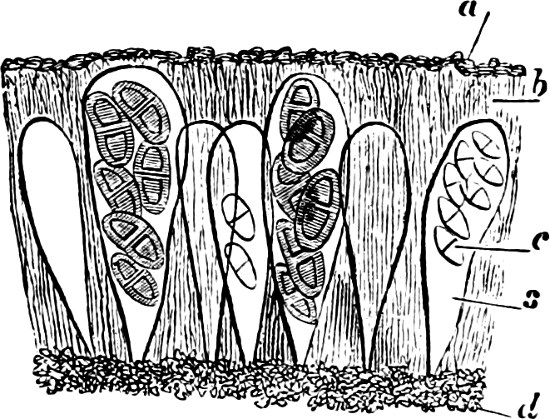
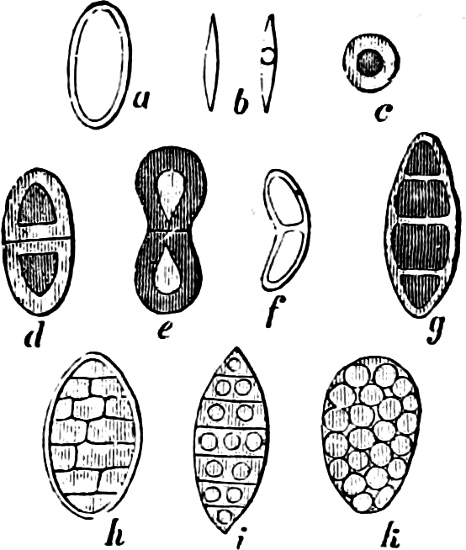
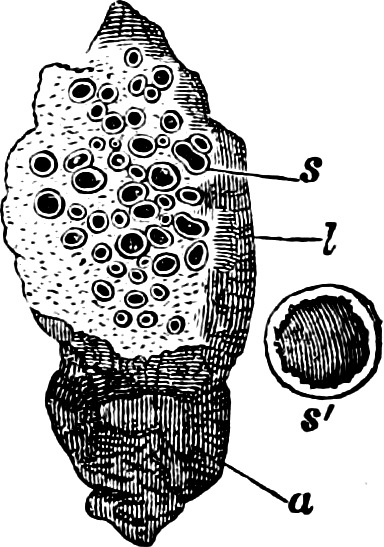
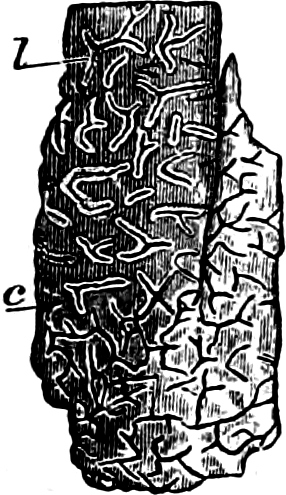
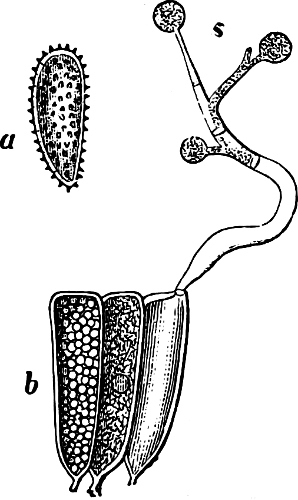
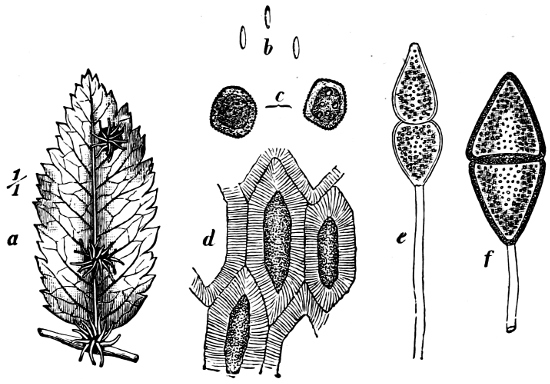
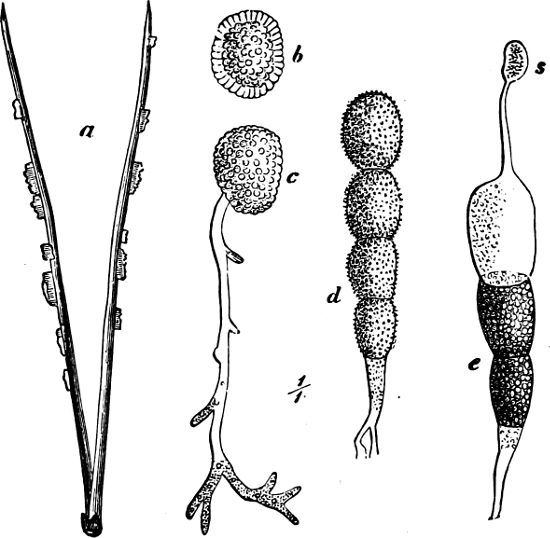
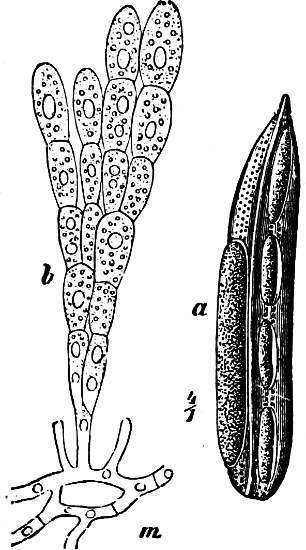
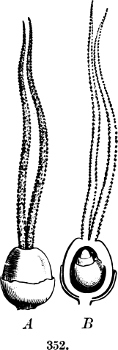
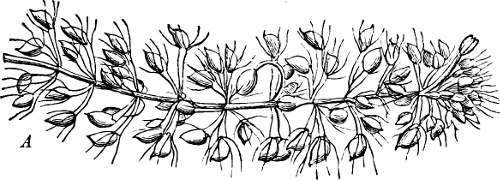
DIVISION I. THALLOPHYTA. — Sub-Division I. — MYXOMYCETES, SLIME-FUNGI. — Sub-Division II.— ALGÆ . — Class 1. Syngeneticæ. — Class 2. Dinoflagellata. — Class 3. Diatomeæ. — Class 4. Schizophyta, Fission-Algæ. — Family 1. Schizophyceæ, [5] Blue-Green Algæ. — Family 2. Bacteria. [6] — Class 5. Conjugatæ. — Class 6. Chlorophyceæ (Green Algæ). — Family 1. Protococcoideæ. — Family 2. Confervoideæ. — Family 3. Siphoneæ. — Class 7. Characeæ. — Class 8. Phæophyceæ (Olive-Brown Seaweeds). — Family 1. Phæosporeæ. — Family 2. Cyclosporeæ. — Class 9. Dictyotales. — Class 10. Rhodophyceæ (Red Seaweeds). — Family 1. Bangioideæ. — Family 2. Florideæ.
The thallus in the simplest forms is unicellular; in the majority,
however, it is built up of many cells, which in a few instances are
exactly similar; but generally there is a division of labour, so
that certain cells undertake certain functions and are constructed
accordingly, while others have different work and corresponding
structure. Vessels or similar high anatomical structures are seldom
formed, and the markings on the cell-wall are with few exceptions very
simple. The Myxomycetes occupy quite an isolated position; their organs
of nourishment are naked masses of protoplasm (plasmodia).
As regards the external form, the thallus may be entirely without
special prominences (such as branches, members), but when such are
present they are all essentially alike in their origin and growth,
that is, disregarding the hair-structures which may be developed. A
shoot of a Seaweed or of a Lichen, etc., is essentially the same as any
other part of the plant; only among the highest Algæ (Characeæ, certain
Siphoneæ, Sargassum, and certain Red Seaweeds) do we find the
same differences between the various external organs of the plant body
as between stem and leaf, so that they must be distinguished by these
names.
Roots of the same structure and development as in the
Seed-plants are not found, but organs of attachment (rhizoids
and haptera) serve partly the biological functions of the root.
Systematic division of the Thallophytes. To the Thallophytes
belong three sub-divisions—Slime-Fungi, Algæ, and Fungi. Formerly
the Thallophytes were divided into Algæ, Fungi, and Lichens. But this
last group must be placed among the Fungi, since they are really
Fungi, which live symbiotically with Algæ. The Slime-Fungi
must be separated from the true Fungi as a distinct subdivision. The
Algæ possess a colouring substance, which is generally green,
brown, or red, and by means of which they are able to build up organic
compounds from carbonic acid and water. The Bacteria, especially,
form an exception to the Algæ in this respect; like the Fungi and
Slime-Fungi they have as a rule no such colouring material, but must
have organic carbonaceous food; these plants form no starch, and
need no light for their vegetation (most Fungi require light for
fructification). The Myxomycetes, Bacteria, and Fungi derive their
nourishment either as saprophytes from dead animal or vegetable
matter, or as parasites from living animals or plants (hosts),
in which they very often cause disease.
A remark, however, must be made with regard to this division.
Among the higher plants so much stress is not laid upon the
biological relations as to divide them into “green” and
“non-green”; Cuscuta (Dodder), a parasite, is placed
among the Convolvulaceæ, Neottia and Corallorhiza,
saprophytes, belong to the Orchidacere, although they live
like Fungi, yet their relations live as Algæ. In the same
manner there are some colourless parasitic or saprophytic
forms among the Algæ, and stress must be laid upon the fact
that not only the Blue-green Algæ, but also the Bacteria,
which cannot assimilate carbonic-acid, belong to the Algæ
group, Schizophyceæ. The reason for this is that systematic
classifications must be based upon the relationship of form,
development, and reproduction, and from this point of view we
must regard the Bacteria as being the nearer relatives of the
Blue-green Algæ. All the Thallophytes, which are designated
Fungi (when the entire group of Slime-Fungi is left out), form
in some measure a connected series of development which only
in the lower forms (Phycomycetes) is related to the Algæ, and
probably through them has taken its origin from the Algæ;
the higher Fungi have then developed independently from this
beginning. The distinction of colour referred to is therefore
not the only one which separates the Algæ from the Fungi, but it
is almost the only characteristic mark by which we can at once
distinguish the two great sub-divisions of the Thallophytes.
The first forms of life on earth were probably “Protistæ,”
which had assimilating colour material, or in other words, they
were Algæ because they could assimilate purely inorganic food
substances, and there are some among these which belong to the
simplest forms of all plants. Fungi and Slime-Fungi must have
appeared later, because they are dependent on other plants which
assimilate carbon.[2]
The Slime-Fungi occupy quite an isolated position in the Vegetable
Kingdom, and are perhaps the most nearly related to the group of
Rhizopods in the Animal Kingdom. They live in and on organic remains,
especially rotten wood or leaves, etc., on the surface of which their
sporangia may be found.
They are organisms without chlorophyll, and in their vegetative
condition are masses of protoplasm without cell-wall
(plasmodia). They multiply by means of spores, which
in the true Slime-Fungi[3] are produced in sporangia, but in some
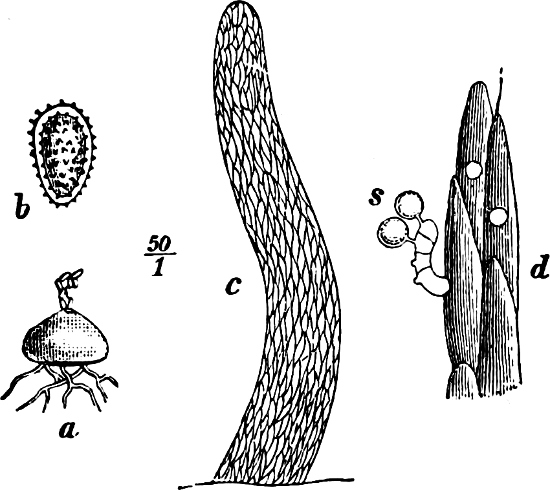
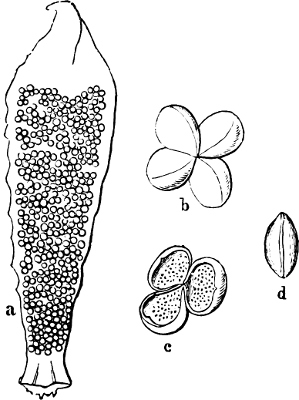
others[4] free. The spores are round cells (Fig. 1 a) which
in all the true Slime-Fungi are surrounded by a cell-wall. The wall
bursts on germination, and the contents float out in the water which
is necessary for germination. They move about with swimming and
hopping motions like swarmspores (e, f), having a cilia
at the front end and provided with a cell-nucleus and a pulsating
vacuole. Later on they become a little less active, and creep about
more slowly, while they continue to alter their form, shooting out
arms in various places and drawing them in again (g, h,
i, k, l, m); in this stage they are called
Myxamœbæ.
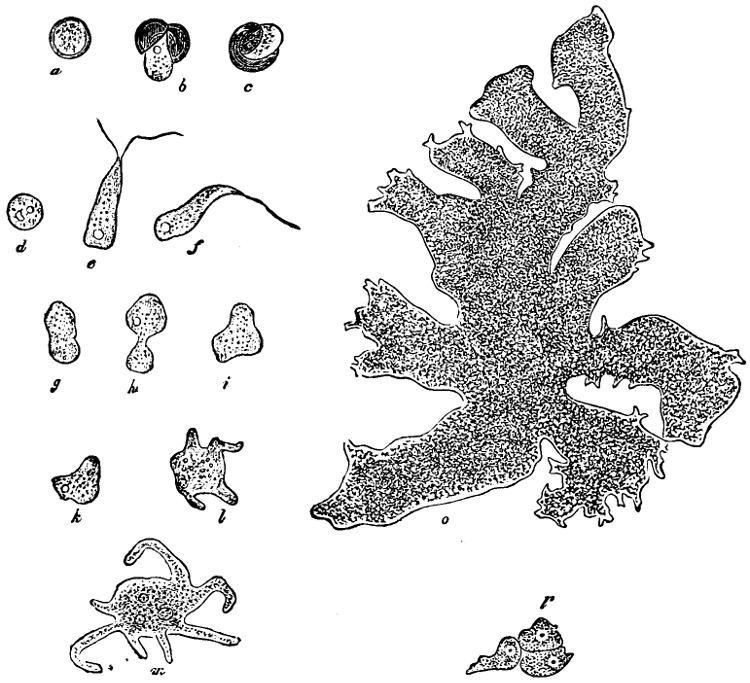
Fig. 1.—a-l Development of
“Fuligo” from spore to Myxamœba; a-m are magnified 300
times; m is a Myxamœba of Lycogala epidendron; l´
three Myxamœbæ of Physarum album about to unite; o, a
small portion of plasmodium, magnified 90 times.
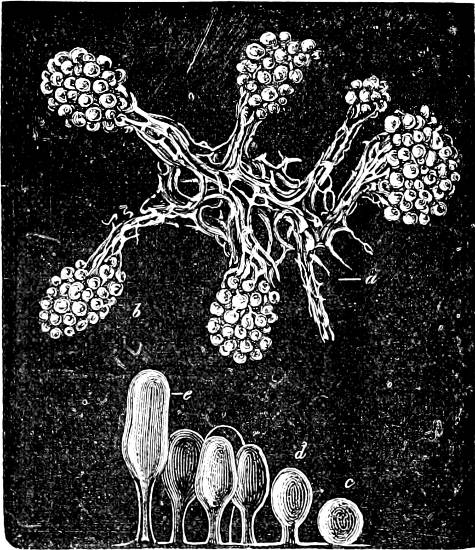
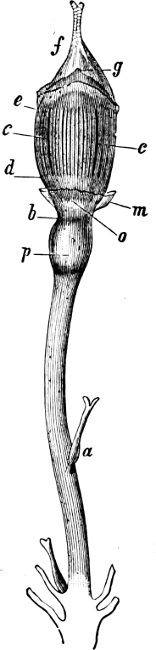
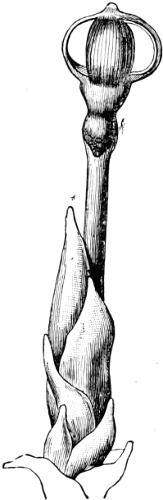
Fig. 2.—The plasmodium (a) of
Stemonitis fusca, commencing to form into sporangia (b);
drawn on July 9. The dark-brown sporangia were completely formed by the
next morning; c-e shows the development of their external form.
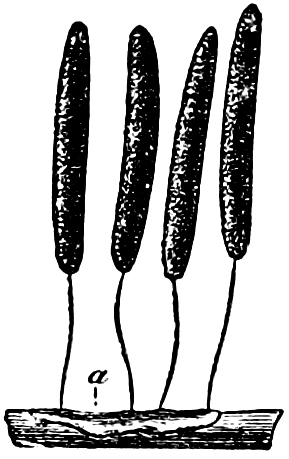
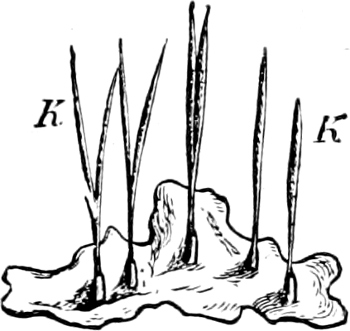
Fig. 3.—Four sporangia of Stemonitis
fusca, fixed on a branch. a The plasmodium.
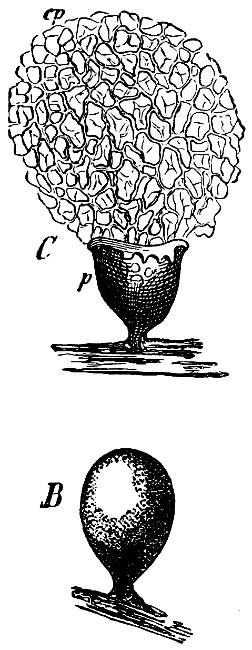
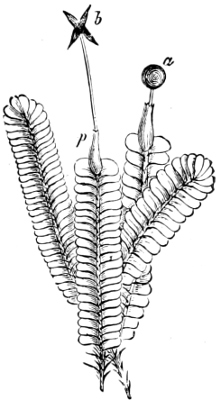
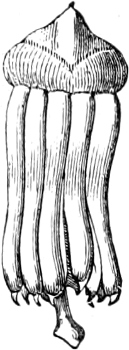
Fig. 4.—Sporangium of Arcyria
incarnata. B closed; C open; p wall of
sporangium; cp capilitium.
The Myxamœba grows whilst taking up nourishment from the material in
which it lives, and multiplies by division. At a later stage a larger
or smaller number of Myxamœbæ may be seen to coalesce and form large
masses of protoplasm, plasmodia, which in the “Flowers of Tan”
may attain the size of the palm of a hand, or even larger, but in most
others are smaller. The plasmodia are independent, cream-like masses of
protoplasm, often containing grains of carbonate of lime and colouring
matter (the latter yellow in the Flowers of Tan). They creep about in
the decaying matter in which they live, by means of amœboid movements,
internal streamings of the protoplasm continually taking place; finally
they creep out to the surface, and very often attach themselves to
other objects, such as Mosses, and form sporangia (Fig. 2). These are
stalked or sessile and are generally cylindrical (Fig. 3), spherical
or pear-shaped (Fig. 4); they rarely attain a larger size than that of
a pin’s head, and are red, brown, white, blue, yellow, etc., with a
very delicate wall. In some genera may be found a “Capillitium” (Fig.
4 cp), or network of branched fine strands between the spores.
Flowers of Tan (Fuligo septica) has a fruit-body composed
of many sporangia (an Æthalium), which has the appearance of flat,
irregular, brown cakes, inside the fragile external layer of which a
loose powder, the spores, is found. It generally occurs on heaps of
tanners’ bark, and appears sometimes in hot-beds in which that material
is used, and is destructive by spreading itself over the young plants
and choking them.
All the motile stages may pass into resting stages, the small
forms only surrounding themselves with a wall, but the large ones at
the same time divide in addition into polyhedral cells. When favourable
conditions arise, the walls dissolve and the whole appears again as a
naked (free-moving) mass of protoplasm.
To the genuine Slime-Fungi belong: Arcyria, Trichia,
Didymium, Physarum, Stemonitis, Lycogala,
Fuligo, Spumaria, Reticularia.
Some genera wanting a sporangium-wall belong to the Slime-Fungi:
Ceratiomyxa, whose fruit-body consists of polygonal plates, each
bearing stalked spores; Dictyostelium, in which the swarm-stage
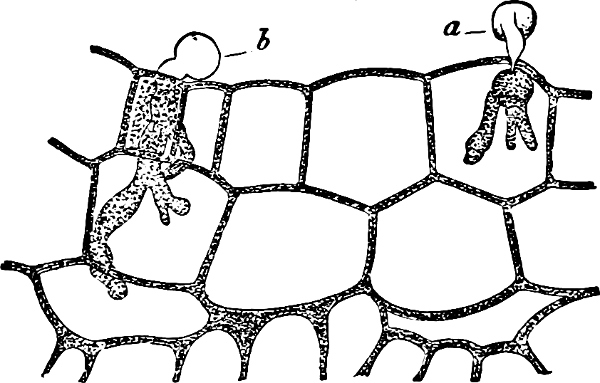
is wanting and which has stalked spores. Plasmodiophora brassicæ
preys upon the roots of cabbages and other cruciferous plants, causing
large swellings. Pl. alni causes coral-shaped outgrowths on the
roots of the Alder (Alnus). Phytomyxa leguminosarum may
be found in small knobs (tubercles) on the roots of leguminous plants.
It is still uncertain whether it is this Fungus or Bacteria which is
the cause of the formation of these tubercles.
Mode of Life. The Algæ (except most of the Bacteria) are
themselves able to form their organic material by the splitting up of
the carbonic acid contained in the water, or air in some cases, and for
this purpose need light. The majority live in water, fresh or salt, but
many are present on damp soil, stones, bark of trees, etc.
With the exception of the Bacteria, no saprophytes have actually been
determined to belong to this group, and only very few true parasites
(for instance, Phyllosiphon arisari, Mycoidea, etc.),
but a good many are found epiphytic or endophytic on other Algæ, or
water plants, and on animals (for instance, certain Schizophyceæ
and Protococcoideæ; Trichophilus welckeri in the hairs
of Bradypus, the Sloth), and several species in symbiotic
relation to various Fungi (species of Lichen), to Sponges (e.g.
Trentepohlia spongiophila, Struvea delicatula), and to
sundry Infusoria and other lower animals as Radiolarias, Hydra,
etc. (the so-called Zoochlorella and Zooxantella, which
are perhaps partly stages in development of various Green and Brown
Algæ).
Vegetative Organs. The cells in all the Algæ (excepting certain
reproductive cells) are surrounded by a membrane which (with the
exception of the Bacteria) consists of pure or altered cellulose,
sometimes forming a gelatinous covering, at other times a harder one,
with deposits of chalk or silica formed in it. The cell-nucleus,
which in the Schizophyta is less differentiated, may be one or more
(e.g. Hydrodictyon, Siphoneæ) in each cell.
Excepting in the majority of the Bacteria, colour materials (of
which chlorophyll, or modifications of it, always seems to be
found) occur, which either permeate the whole cytoplasm surrounding
the cell-nucleus, as in most of the coloured Schizophyta, or are
contained in certain specially formed small portions of protoplasm
(chromatophores).
The individual at a certain stage of development consists nearly always
of only one cell; by its division multicellular individuals may arise,
or, if the daughter-cells separate immediately after the division, as
in many of the simplest forms, the individual will, during the whole
course of its existence, consist of only a single cell (unicellular
Algæ). In multicellular individuals the cells may be more or less
firmly connected, and all the cells of the individual may be exactly
alike, or a division of labour may take place, so that certain cells
undertake certain functions, and are constructed accordingly; this
may also occur in parts of the cell in the large unicellular and
multinuclear Algæ (Siphoneæ, p. 62).
The cells in most of the Algæ belong to the parenchymatous
form; these, however, in the course of their growth, may very often
become somewhat oblong; in many Algæ (particularly Fucoideæ and
Florideæ) occur, moreover, hyphæ-like threads, which are very
long, often branched, and are either formed of a single cell, or,
more frequently, of a row of cells, having a well-pronounced apical
growth. The parenchymatous as well as the hyphæ-like cells may, in the
higher Algæ (especially in certain Fucoideæ and Florideæ), be further
differentiated, so that they form well-defined anatomico-physiological
systems of tissue, i.e. assimilating, conducting, storing, and
mechanical.
With regard to the external form, the thallus may present no
differentiation, as in many unicellular Algæ, or in multicellular Algæ
of the lower order, which are then either equally developed in all
directions (e.g. Pleurococcus, Fig. 47), or form flat
cell-plates (Merismopedium) or threads (Oscillaria,
Fig. 21). The first step in the way of differentiation appears as a
difference between apex and base (Rivularia, Porphyra);
but the division of labour may proceed so that differences may arise
between vegetative and reproductive cells (Œdogonium, Fig.
54); hairs and organs of attachment (rhizoids and haptera), which
biologically serve as roots, are developed, and even leaves in certain
forms of high order, belonging to different classes (e.g.
Caulerpa, Fig. 59; Characeæ, Fig. 61; Sargassum,
Fig. 72; and many Florideæ).
The non-sexual reproduction takes place vegetatively, in
many instances, simply by division into two, and more or less complete
separation of the divisional products (Diatomaceæ, Desmidiaceæ (Fig.
36), many Fission-plants, etc.), or by detached portions of the thallus
(e.g. Caulerpa, Ulva lactuca, etc.; among many
Schizophyceæ, small filaments known as hormogonia are set free),
or asexually by special reproductive cells (spores)
set free from the thallus; these may be either stationary
or motile. The stationary reproductive cells (spores) may
either be devoid of cell-wall (tetraspores of the Florideæ), or may
possess a cell-wall; in the latter case they may be formed directly
from the vegetative cells, generally by the thickening of the walls
(akinetes), or only after a process of re-juvenescence
(aplanospores). Aplanospores, as well as akinetes, may either
germinate immediately or may become resting-cells, which germinate only
after a period of rest.
The motile asexual reproductive cells are spherical, egg- or
pear-shaped, naked, swarmspores (zoospores), which have
arisen in other cells (zoosporangia), and propel themselves
through the water by means of cilia; or they are Phyto-Amœbæ,
which have no cilia and creep on a substratum by means of pseudopodia.
The cilia, which are formed from the protoplasm (in the Bacteria,
however, from the membrane), are mostly situated at the pointed and
colourless end, which is directed forwards when in motion, and are
1, 2 (Fig. 5 B), 4 or more. Both the cilia in the Brown Algæ
are attached to one side (Fig. 65); they are occasionally situated
in a circle round the front end (Œdogonium, Fig. 6 a,
and Derbesia), or are very numerous and situated in pairs
distributed over a large part or nearly the whole of the zoospore
(Vaucheria). Besides being provided with one or more nuclei
(Vaucheria), they may also have a red “eye spot” and vacuoles,
which are sometimes pulsating, i.e. they appear and reappear
at certain intervals. The swarmspores move about in the water in
irregular paths, and apparently quite voluntarily, revolving round
their longer axes; but they come to the surface of the water in great
numbers either because of their dependence on light, or driven by
warm currents in the water, or attracted by some passing mass of food
material. The swarmspores germinate, each forming a new plant, as their
movement ceases they surround themselves with a cell-wall, grow, and
then divide; in Fig. 6 b, two may be seen in the condition of
germination, and about to attach themselves by means of the front end,
which has been developed into haptera (see also Fig. 5 B, lowest
figure).
The sexual reproduction here, probably in all cases, consists in
the coalescence of two masses of protoplasm, that is, in the fusion of
their nuclei.
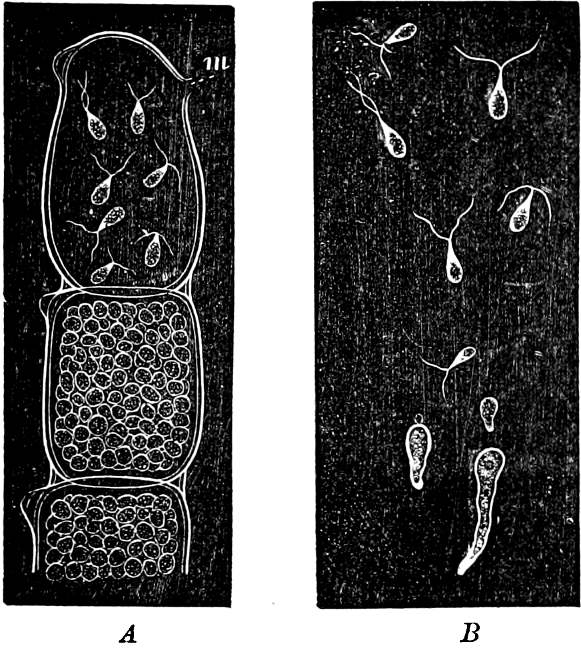
Fig. 5.—Cladophora glomerata. A
The lower cells are full of swarmspores, whilst from the upper one the
greater part have escaped through the aperture m. B Free
and germinating swarmspores.
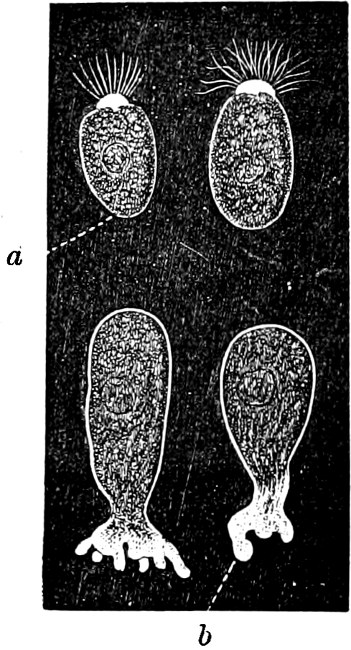
Fig. 6.—Œdogonium: a (free),
b germinating swarmspores.
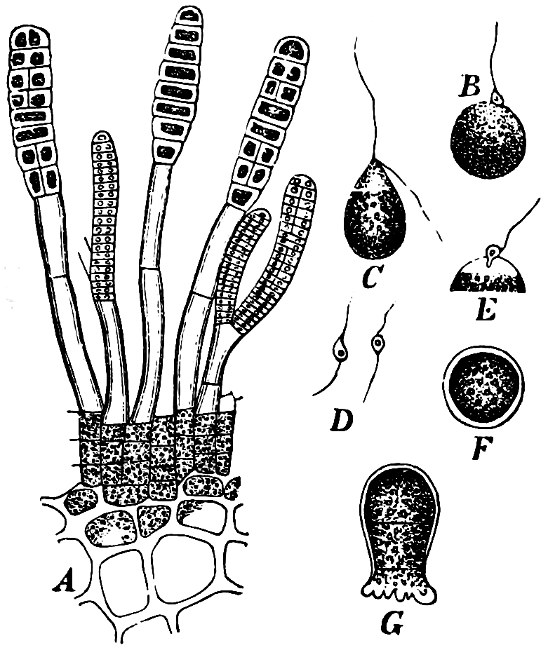
Fig. 7.—Zanardinia collaris.
A Male gametangia (the small-celled) and female gametangia
(large-celled). C Female gamete. D Male gamete. B
E Fertilisation. F Zygote. G Germinating zygote.
The simplest and lowest form is termed conjugation, or
isogamous fertilisation, and is characterized by the fact
that the two coalescing cells (termed gametes) are equal, or almost
equal, in shape and size (the female gamete in the Cutleriaceæ,
e.g. Zanardinia collaris, Fig. 7, is considerably
larger than the male gamete). The cell in which the gametes
are developed is called a gametaugium, and the reproductive
cell formed by their union—which generally has a thick wall and only
germinates after a short period of rest—is termed a zygote or
zygospore. The conjugation takes place in two ways:—
(a) In the one way the gametes are motile cells
(planogametes, zoogametes, Fig. 8), which unite in pairs
during their swarming hither and thither in the water; during this
process they lie side by side (Fig. 8 d), generally at first
touching at the clear anterior end, and after a time they coalesce
and become a motionless zygote, which surrounds itself with
a cell-wall (Fig. 8 e). This form of conjugation is found in
Ulothrix (Fig. 8 d), Acetabularia, and other Algæ
(Figs. 45, 56, 66).
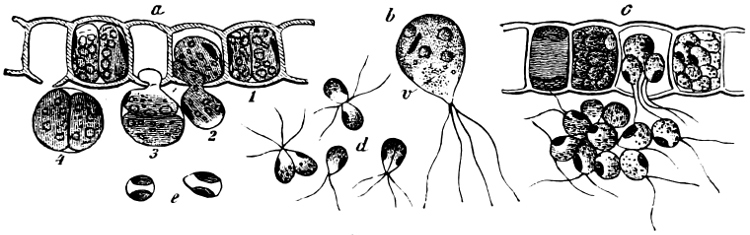
Fig. 8.—Ulothrix zonata: a portion
of a thread with zoospores, of which two are formed in each cell
(zoosporangium), the dark spots upon them are the “red eye-spots”; 1,
2, 3, 4 depict successive stages in the development of the zoospores;
b a single zoospore, at v the pulsating vacuole; c
portion of a thread with gametes, of which sixteen are formed in
each gametangium; d gametes free and in conjugation; e
conjugation has been effected, and the formed zygotes are in the
resting condition.
(b) Among other Algæ (e.g. Diatomaceæ and
Conjugatæ), the conjugating cells continue to be surrounded
by the cell-wall of the mother-cell (aplanogametes in an
aplanogametangium); the aplanogametangia generally grow out
into short branches, which lie close together and touch one another,
the wall at the point of contact is then dissolved (Fig. 39). Through
the aperture thus formed, the aplanogametes unite, as in the first
instance, and form a rounded zygote, which immediately surrounds itself
with a cell-wall. Various modifications occur; compare Figs. 37, 39,
41, 43.
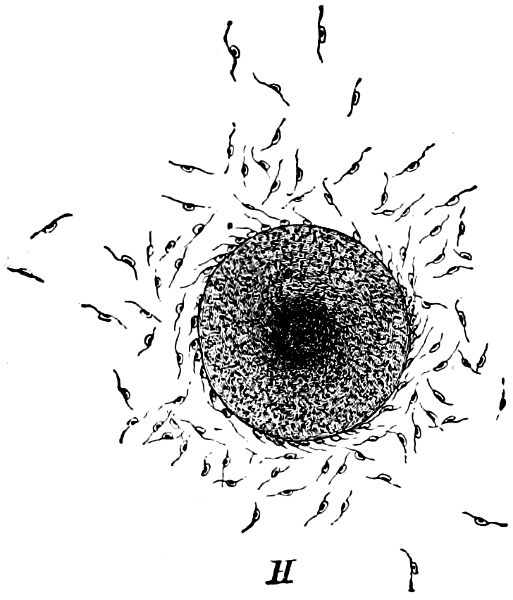
Fig. 9.—Fertilisation in the Bladder-wrack
(Fucus vesiculosus).
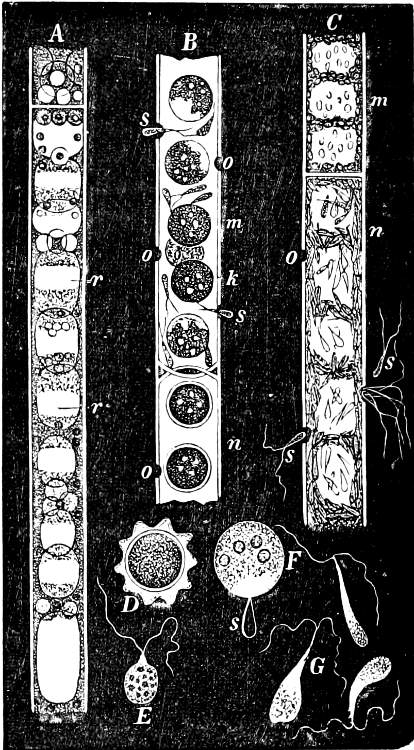
Fig. 10.—Sphæroplea annulina.
The highest form of the sexual reproduction is the Egg- or
Oogamous fertilisation. The two coalescing cells are in the
main unlike each other in form as well as size. The one which is
considered as the male, and is known as the spermatozoid
(antherozoid), developes as a rule in large numbers in each
mother-cell (antheridium); they are often self-motile (except
in the Florideæ, where they are named spermatia), and are
many times smaller than the other kind, the female, which is known
as the egg-cell, (oosphere). The egg-cell is always a
motionless, spherical, primordial cell which can either float about
freely in the water, as in the Fucaceæ (Fig. 9), or is surrounded by a
cell-wall (oogonium); generally only one oosphere is to be found
in each oogonium, but several occur in Sphæroplea (Fig. 10). The
result of the spermatozoid coalescing with the egg-cell is, as in this
case, the formation of a oospore, which generally undergoes a period of
rest before germination (the Florideæ are an exception, a fruit-body,
cystocarp, being produced as the result of coalescence).
An example of fertilisation is afforded by the Alga,
Sphæroplea annulina (Fig. 10). The filamentous thallus
is formed of cylindrical cells with many vacuoles (r in
A); some cells develope egg-cells (B), others
spermatozoids (C), the latter in a particularly large
number. The egg-cells are spherical, the spermatozoids of a
club- or elongated pear-shape with two cilia at the front end
(G; E is however a swarmspore). The spermatozoids
escape from their cells through apertures in the wall (o
in C) and enter through similar apertures (o in
B) to the egg-cells. The colourless front end of the
spermatozoid is united at first with the “receptive spot” of the
egg-cell (see F), and afterwards completely coalesces
with it. The result is the formation of a oospore with wart-like
excrescences (D).
The female (parthenogenesis) or male (androgenesis)
sexual cell may, sometimes without any preceding fertilisation,
form a new individual (e.g. Ulothrix zonata,
Cylindrocapsa, etc.).
Systematic division of the Algæ. The Algæ are divided into the
following ten classes:
1. Syngeneticæ; 2. Dinoflagellata, or
Peridinea; 3. Diatomaceæ; 4. Schizophyta,
Fission-algæ; 5. Conjugatæ; 6. Chlorophyceæ,
Green-algæ; 7. Characeæ, Stone-worts;
8. Phæophyceæ; 9. Dictyotales; 10.
Rhodophyceæ.
Among the lowest forms of the Algæ, the Syngeneticæ, the
Dinoflagellata, and the unicellular Volvocaceæ (Chlamydomoneæ),
distinct transitional forms are found approaching the animal kingdom,
which can be grouped as animals or plants according to their method of
taking food or other characteristics. Only an artificial boundary can
therefore be drawn between the animal and vegetable kingdoms. In the
following pages only those forms which possess chromatophores,
and have no mouth, will be considered as Algæ.
The individuals are uni- or multicellular, free-swimming or motionless.
The cells (which in the multicellular forms are loosely connected
together, often only by mucilaginous envelopes) are naked or surrounded
by a mucilaginous cell-wall, in which silica is never embedded. They
contain one cell-nucleus, one or more pulsating vacuoles, and one to
two band- or plate-like chromatophores with a brown or yellow colour,
and sometimes a pyrenoid.
Reproduction takes place by vegetative division, or asexually by
zoospores, akinetes (or aplanospores?). Sexual reproduction is unknown.
They are all fresh water forms.
To this class may perhaps be assigned the recently arranged
and very little known orders of Calcocytaceæ,
Murracytaceæ, Xanthellaceæ, and
Dictyochaceæ, which partly occur in the free condition in
the sea, in the so-called “Plankton,” and partly symbiotic in
various lower marine animals.
The Syngeneticæ are closely related to certain forms in the
animal kingdom, as the Flagellatæ.
Order 1. Chrysomonadinaceæ. Individuals, uni- or
multicellular, swimming in free condition, naked or surrounded
by a mucilaginous covering. The cells are generally oval or
elongated, with 2 (rarely only 1) cilia, almost of the same
length, and generally with a red “eye-spot” at their base, and
with 2 (rarely 1 only) band-shaped chromatophores. Reproduction
by the longitudinal division of the individual cells either
during the swarming, or during a resting stage; in the
multicellular forms also by the liberation of one or more cells,
which in the latter case are connected together.
A. Unicellular: Chromulina, Cryptoglena,
Microglena, Nephroselmis.
B. Multicellular: Uroglena, Syncrypta (Fig. 11),
Synura.
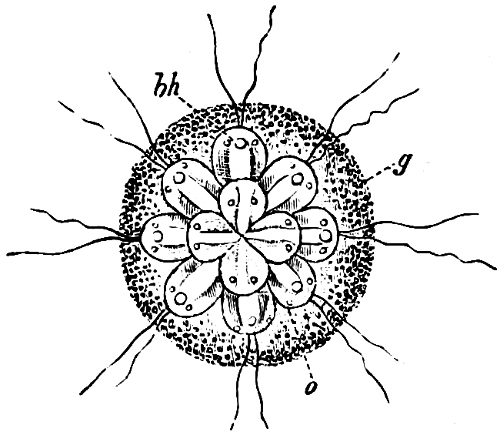
Fig. 11.—Syncrypta volvox: the
multicellular individual is surrounded by a mucilaginous granular
envelope.
Among the unicellular Chrysomonadinaceæ are probably classed
some forms which are only stages in the development of the
multicellular, or of other Syngeneticæ.
Order 2. Chrysopyxaceæ are unicellular, and differ
mainly from the preceding in being attached either on a
slime-thread (Stylochrysalis), or enclosed in an
envelope (Chrysopyxis, Fig. 12). They have two cilia,
and multiply by longitudinal (Chrysopyxis) or transverse
division, and the swarming of one of the daughter-individuals
(zoospore). Division may also take place in a motionless stage
(palmella-stage).
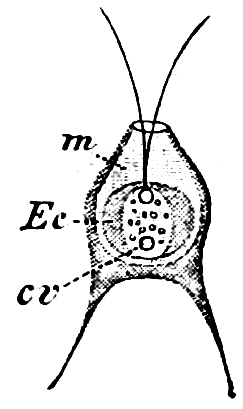
Fig. 12.—Chrsopyxis bipes: m
envelope, Ec chromatophore, cv contractile vacuole.
Order 3. Dinobryinaceæ. The individuals are originally
attached, uni- or multicellular; each individual cell is
distinctly contractile, and fixed at the bottom of a cup-shaped,
open envelope. Cilia 2, but of unequal length. Asexual
reproduction by zoospores, which are formed by straight or
oblique longitudinal division of the mother-cell, during a
palmella-stage which is produced in the winter aplanospores.
Epipyxis, Dinobryon.
Order 4. Hydruraceæ. The individuals are attached,
without cilia, multicellular, branched, and with apical
growth. The cells are spherical, but in the final stage almost
spindle-shaped, and embedded in large masses of mucilage.
Asexual reproduction by zoospores which are tetrahedric, with 1
cilia, and by resting akinetes. Hydrurus is most common
in mountain brooks.
The individuals are of a very variable form, but always unicellular,
and floating about in free condition. The cell is dorsiventral,
bilateral, asymmetric and generally surrounded by a
colourless membrane, which has no silica embedded in it, but
is formed of a substance allied to cellulose. The membrane,
which externally is provided with pores and raised borders, easily
breaks up into irregularly-shaped pieces. In the forms which have
longitudinal and cross furrows, two cilia are fixed where these
cross each other, and project through a cleft in the membrane; one of
these cilia projects freely and is directed longitudinally to
the front or to the rear, the other one stretches crosswise
and lies close to the cell, often in a furrow (cross furrow). The
chromatophores are coloured brown or green and may either be two
parallel (Exuviella), or several radially placed, discs, which
sometimes may coalesce and become a star-shaped chromatophore. The
coloring material (pyrrophyl) consists, in addition to a modification
of chlorophyl, also of phycopyrrin and peridinin;
this colour is sometimes more or less masked by the products of
assimilation which consist of yellow, red or colourless oil (?)
and starch. Cell-nucleus one: in Polydinida several nuclei
are found; contractile vacuoles many, which partly open in the
cilia-cleft (Fig. 13 gs). In some an eye-spot, coloured red by
hæmatochrome, is found. Pyrenoids occur perhaps in Exuviella and
Amphidinium.
The reproduction takes place as far as is known at present,
only by division. This, in many salt water forms, may take place in
the swarming condition, and, in that case, is always parallel to the
longitudinal axis. The daughter-individuals, each of which retains half
of the original shell, sometimes do not separate at once from each
other, and thus chains (e.g. in Ceratium) of several
connected individuals may be formed. In others, the division occurs
after the cilia have been thrown off and the cell-contents rounded. The
daughter-cells then adopt entirely new cell-walls. A palmella-stage
(motionless division-stage) sometimes appears to take place, and also
aplanospores (?) with one or two horn-like elongations (e.g. in
Peridinium cinctum and P. tabulatum); at germination one,
or after division, two or more, new individuals may be formed.
Sexual reproduction has not been observed with certainty.
The Dinoflagellata move forward or backward, turning round their
longitudinal axes; in their motion they are influenced by the action
of light. The motion possibly may be produced only by the transverse
cilium, which vibrates rapidly; whilst the longitudinal cilium moves
slowly, and is supposed to serve mainly as a steering apparatus. They
live principally in salt water, but also in fresh.
Besides the coloured forms, which are able to make their own organic
compounds by the splitting up of the carbonic acid contained
in the water, there are a few colourless forms (e.g.
Gymnodinium spirale), or such as do not possess chromatophores
(Polykrikos); these appear to live saprophytically, and may be
able to absorb solid bodies with which they come in contact.
Dinoflagellata occur in the “Plankton” of the open sea, where they form
together with Diatomaceæ the basis for the animal life. It is known
with certainty that some salt water forms (like the Noctiluca,
which belongs to the animal kingdom and to which they are perhaps
related) produce light, known as phosphorescence.
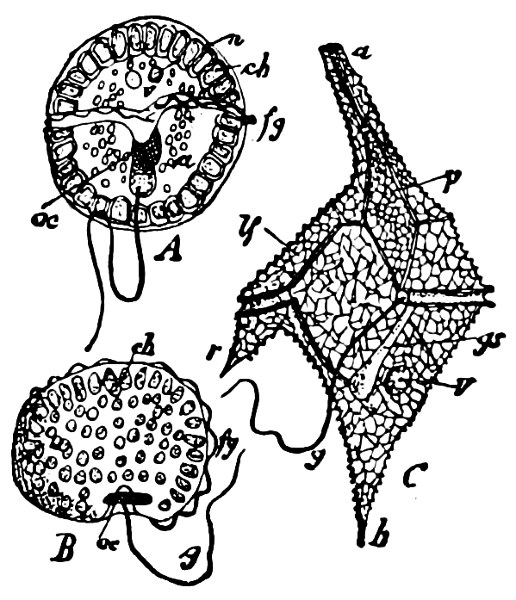
Fig. 13.—A and B Glenodinium
cinctum. A seen from the ventral side, B from behind;
fg transverse cilium; g longitudinal cilium; ch
chromatophores; a starch; n cell-nucleus; v
vacuole; oc eye-spot; C Ceratium tetraceros
from the ventral side; r the right, b the posterior
horn; lf longitudinal furrow; gs cilium-cleft; v
vacuole; g longitudinal cilium. (A and B mag. 450
times, C 337 times.)
Dinoflagellata (Peridinea, Cilioflagellata)
are allied through their lowest form (Exuviella) to the
Syngeneticæ and especially to the order Chrysomonadinaceæ. They
may be divided into three orders.
Order 1. Adinida. Without transverse or longitudinal
furrows, but enclosed in two shells, and with two
parallel chromatophores in each cell. Exuviella,
Prorocentrum.
Order 2. Dinifera. With tranverse and generally
longitudinal furrow. Many radially-placed, disc-formed
chromatophores. The most common genera are—Ceratium
(Fig. 13), Peridinium, Glenodinium (Fig. 13),
Gymnodinium, Dinophysis.
Order 3. Polydinida. With several transverse furrows,
no chromatophores, and several cell-nuclei. Only one
genus—Polykrikos.
The order Polydinida deviates in a high degree from the
other Dinoflagellata, not only by its many tranverse furrows,
each with its own transverse cilium, and by the absence of
chromatophores, but also in having several cell-nuclei and a
kind of stinging capsule, which otherwise does not occur within
the whole class. It may therefore be questionable whether this
order should really be placed in the vegetable kingdom.
The individuals—each known as a frustule—assume very
various forms and may be unicellular or multicellular, but present
no differentiation; many similar cells may be connected in chains,
embedded in mucilaginous masses, or attached to mucilaginous
stalks. The cells are bilateral or centric, often asymmetrical,
slightly dorsiventral and have no cilia; those living in the free
condition have the power of sliding upon a firm substratum. The cell
contains 1 cell-nucleus and 1–2 plate-shaped or several disc-shaped
chromatophores. The colouring material “Melinophyl” contains,
in addition to a modification of chlorophyl, a brown colouring matter,
diatomin. 1 or 2 pyrenoids sometimes occur. Starch is wanting
and the first product of assimilation appears to be a kind of oil (?).
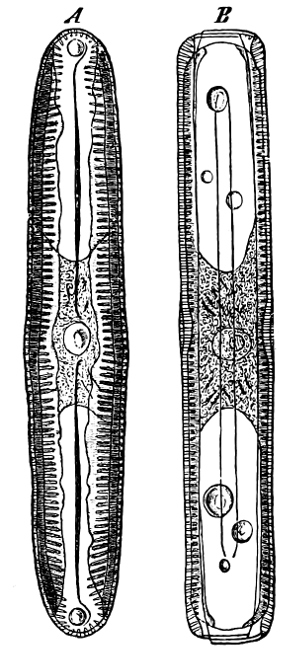
Fig. 14.—Pinnularia: B, from the
edge, shows the valves fitting together; A, a valve.
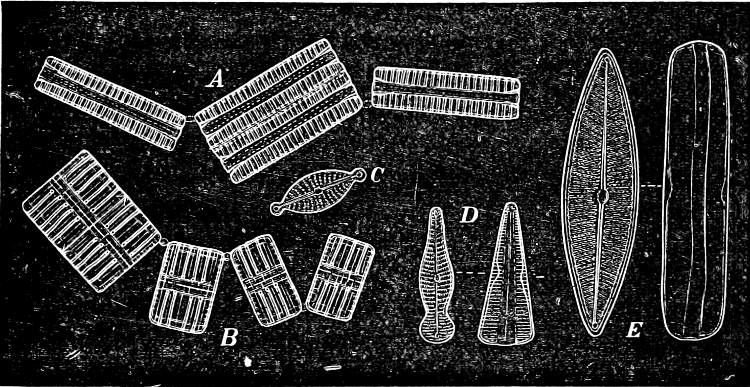
Fig. 15.—Various Diatomaceæ. A Diatoma
vulgare. B Tabellaria flocculosa. C Navicula tumida
(lateral views). D Gomphonema constrictum (lateral views). E
Navicula west[=i][=i] (lateral views).
The cell-walls are impregnated with silica to such a degree that
they are imperishable and are therefore able to contribute in a great
measure to the formation of the earth’s crust. The structure of their
cell-wall is most peculiar and differs from all other plants
(except certain Desmidiaceæ); it does not consist of a single piece
but is made up of two—the “shells”—(compare Exuviella and
Prorocentrum among the Dinoflagellata) which are fitted into
each other, one being a little larger than the other and embracing its
edge, like a box with its lid (Fig. 14 B). The two parts which
correspond to the bottom and lid of the box are known as valves.
Along the central line of the valves a longitudinal rib may
often be found, interrupted at its centre by a small cleft (perhaps
homologous with the cilia-cleft of the Dinoflagellata), through which
the protoplasm is enabled to communicate with the exterior (Fig. 14
A). It is principally by reason of the valves, which bear
numerous fine, transverse ribs, striæ or warts, etc. (Figs. 14, 15,
17), that the Diatomeæ have become so well known and employed as test
objects in microscopical science. When the division takes place, the
two shells are separated a little from each other, and after the
cell-contents have divided into two masses, two new shells are formed,
one fitting into the larger valve, the other one into the smaller
valve of the original frustule. The latter cell (frustule) is thus,
upon the whole, smaller than the mother-cell, and as the cells do not
increase in size, some frustules are smaller than the ones from which
they are derived, and thus, by repeated divisions, it follows that
smaller and smaller frustules are produced. This continued diminution
in size is, however, compensated for by the formation, when the cells
have been reduced to a certain minimum, of auxospores, 2–3 times
larger. These may either be formed asexually by the protoplasm
of a cell increasing, rounding off and surrounding itself with a
new wall (e.g. Melosira) or after conjugation,
which may take place with various modifications: 1. Two individuals
unite after the secretion of a quantity of mucilage, and the valves
then commence to separate from each other, on the side which the two
individuals turn towards each other. The protoplasmic bodies now
release themselves from their cell-wall, and each rounds off to form
an ellipsoidal mass; these two protoplasmic masses (gametes) coalesce
to form a zygote, the cell-nuclei and chromatophores also fusing
together. The zygote increases in size, and surrounds itself with a
firm, smooth, siliceous wall—the perizonium. The auxospores,
whichever way they arise, are not resting stages. The germination of
the zygote commences by the protoplasm withdrawing itself slightly from
the cell-wall and constructing first the larger valve, and later on the
smaller one; finally the membrane of the zygote bursts (e.g.
Himantidium). 2. The conjugation occurs in a similar manner, but
the protoplasm of the cells divides transversely before conjugation
into two daughter-cells. Those lying opposite one another conjugate
(Fig. 16) and form two zygotes. The formation of the perizonium, and
germination take place as in the preceding instance (e.g.
Epithemia). 3. Two cells place themselves parallel to each
other, and each of the two cell-contents, without coalescing, becomes
an auxospore. The formation of the wall takes place as in the preceding
case. This is found in the Naviculeæ, Cymbelleæ, the Gomphonemeæ
(e.g. Frustulia, Cocconema).
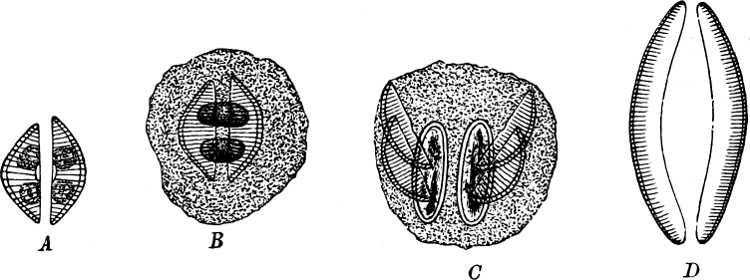
Fig. 16.—Conjugation of Cymbella
variabilis. A, The protoplasm in the two cells has divided
into two masses; B these masses coalesce in pairs; the cells
(B C) enclosed in a mucilaginous matrix. C
D Auxospores and their formation.
The Diatomaceæ may be found in salt as well as in fresh water
(often in such masses that the colour of the water or mud becomes
yellow or brown; in the same manner the genera Chætoceros,
Rhizosolenia, Coscinodiscus, and several others, form
large slime-masses, “Plankton” on the surface of the sea), on damp soil
and in dust blown by the wind. They occur as fossils in the recent
formations, often in large deposits (siliceous earth, mountain meal),
as in the cement lime in Jutland, the alluvial deposits beneath Berlin,
in clay strata beneath peat bogs, in guano, etc. These accumulations
of fossilized diatoms are used in the manufacture of dynamite and in
various manufactures.
The Diatomaceæ appear nearest to, and must be placed as a group
co-ordinate with the Dinoflagellata, as they doubtless may be supposed
to derive their origin from forms resembling Exuviella, and to
have lost the cilia. The resemblances to the Desmidiaceæ which are
striking in many respects, can only be conceived as analogies, and
cannot be founded upon homologies, and it is therefore impossible to
regard them as proof of genetic relationship. The family contains only
one order.
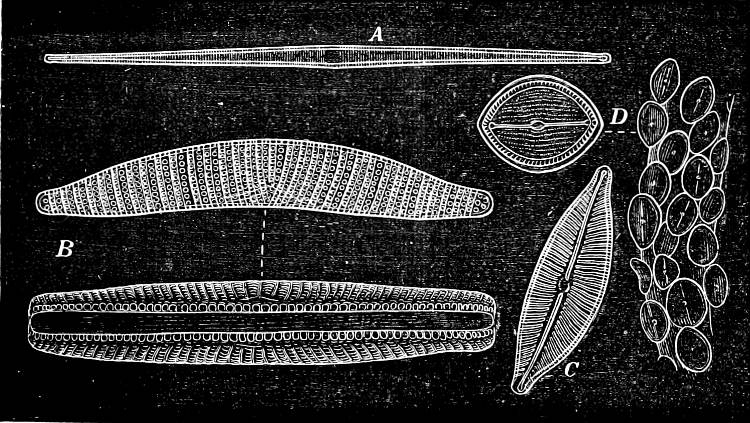
Fig. 17.—Various Diatomeæ. A Synedra
radians. B Epithemia turgida (from the two different sides).
C Cymbella cuspidata. D Cocconeis pediculus (on the right
several situated on a portion of a plant, on the left a single one more
highly magnified).
Order 1. Diatomaceæ. This order may be divided into two
sub-orders, viz.—
Sub-Order 1. Placochromaticæ. The chromatophores are discoid,
large, 1 or 2 in each cell; the structure of the valves is bilateral
and always without reticulate markings. The following groups belong to
this sub-order: Gomphonemeæ, Cymbelleæ, Amphoreæ,
Achnantheæ, Cocconeideæ, Naviculeæ,
Amphipleureæ, Plagiotropideæ, Amphitropideæ,
Nitzchieæ, Surirayeæ, and Eunotieæ.
Sub-Order 2. Coccochromaticæ. The chromatophores are granular,
small and many in each cell. The structure of the cells is zygomorphic
or centric, often with reticulate markings. The following groups
belong to this sub-order: Fragilarieæ, Meridieæ,
Tabellarieæ, Licmophoreæ, Biddulphieæ,
Anguliferæ, Eupodisceæ, Coscinodisceæ, and
Melosireæ.
The individuals are 1—many celled; the thallus consists in many of a
single cell, in others of chains of cells, the cells dividing in only
one definite direction (Figs. 18, 21). In certain Fission-Algæ the
cell-chain branches (Fig. 30) and a difference between the anterior
and the posterior ends of the chain is marked; in some, the cells may
be united into the form of flat plates by the cell-division taking
place in two directions; and in others into somewhat cubical masses, or
rounded lumps of a less decided form, by the divisions taking place in
three directions; or less defined masses may be formed by the divisions
taking place in all possible directions.
The cell-walls rarely contain cellulose, they often swell considerably
(Figs. 20, 22), and show distinct stratifications, or they are almost
completely changed into a mucilaginous mass in which the protoplasts
are embedded, e.g. in Nostoc (Fig. 22), and in the
“Zooglœa” stage of the Bacteria (Fig. 27). Sexual reproduction is
wanting. Vegetative reproduction by division and the separation of
the divisional products by the splitting of the cell-wall or its
becoming mucilaginous; among the Nostocaceæ, Lyngbyaceæ, Scytonemaceæ,
etc., “Hormogonia” are found; in Chamæsiphon and others single
reproductive akinetes are formed. Many Fission-Algæ conclude the
growing period by the formation of resting akinetes or aplanospores.
The Schizophyta may be divided into 2 families:
1. Schizophyceæ.
2. Bacteria.
All the Blue-green Algæ are able to assimilate carbon by means of
a colouring material containing chlorophyll (cyanophyll); but the
chlorophyll in this substance is masked by a blue (phycocyan), or
red (phycoerythrin, e.g. in Trichodesmium erythræum
in the Red Sea) colouring matter which may be extracted from them
in cold water after death. The colouring matter, in most of them,
permeates the whole of the protoplasm (excepting the cell-nucleus),
but in a few (e.g. Glaucocystis, Phragmonema),
slightly developed chromatophores are to be found. Where the cells are
united into filaments (cell-chains) a differentiation into apex and
base (Rivulariaceæ) may take place, and also between ordinary
vegetative cells and heterocysts; these latter cannot divide, and are
distinguished from the ordinary vegetative cells (Fig. 22 h) by
their larger size, yellow colour, and poverty of contents. Branching
sometimes occurs and is either true or spurious.

Fig. 18.—Microcoleus lyngbyanus:
a portion of a filament, the thick sheath encloses only one
cell-chain; in one place a cell is drawn out by the movement of
the cell-chain; b the cell-chain has divided into two parts
(“hormongonia”) which commence to separate from each other.
The cell-chain in the spurious branching divides into two parts, of
which either one or both grow beyond the place of division (Fig.
18) and often out to both sides (e.g. Scytonema), the
divisions however, always take place transversely to the longitudinal
direction of the cell-chain. In the true branching a cell elongates
in the direction transverse to the cell-chain, and the division
then takes place nearly at right angles to the former direction
(Sirosiphoniaceæ).
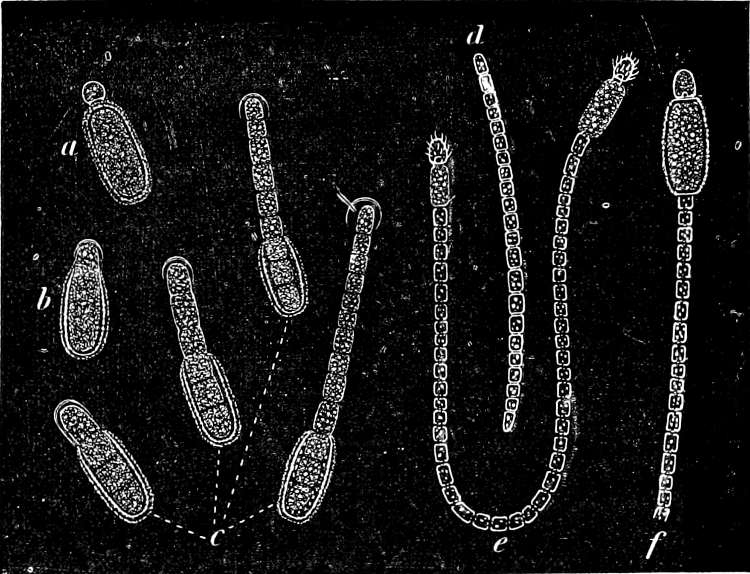
Fig. 19.—Cylindrospermum majus:
a resting akinete with heterocyst; b-d germinating
stages of a resting akinete; e filament with two heterocysts
and the formation of new akinetes; f part of a filament with a
heterocyst, and mature resting akinete.
Cilia are wanting, but the filaments are sometimes self-motile
(e.g. hormogonia in Nostoc) and many partly turn round
their axes, partly slide forward or backward (Oscillaria).
Reproduction takes place by spores and hormogonia in addition to
simple cell-division. Hormogonia are peculiar fragments of a cell-chain
capable of motion, and often exhibit a vigorous motion in the sheath,
until at last they escape and grow into a new individual (Fig. 18).
The spores are reproductive akinetes (Chamæsiphon, etc.) or
resting akinetes; these latter arise by the vegetative cells enlarging
and constructing a thick cell-wall (Fig. 19 e f). On
germination, this cell-wall bursts and the new cell-chain elongates in
the same longitudinal direction as before (Fig. 19 b c).
Many (e.g. Oscillaria) may however winter in their
ordinary vegetative stage. Aplanospores are wanting.
The Fission-Algæ are very prevalent in fresh water and on damp soil,
less so in salt water; they also often occur in water which abounds in
decaying matter. Some are found in warm springs with a temperature as
high as 50° C.
The Family may be divided into 2 sub-families:
1. Homocysteæ (heterocysts are wanting): Chroococcaceæ,
Lyngbyaceæ and Chamœsiphonaceæ.
2. Heterocysteæ (heterocysts present): Nostocaceæ,
Rivulariaceæ, Scytonemaceæ and Sirosiphoniaceæ.
Order 1. Chroococcaceæ. The individuals are 1—many-celled,
but all the cells are uniform, united to form plates or irregular
masses, often surrounded by a mucilaginous cell-wall, but never forming
cell-chains. Multiplication by division and sometimes by resting
akinetes, but reproductive akinetes are wanting. Chroococcus,
Aphanocapsa, Glœocapsa (Fig. 20), Cœlosphærium,
Merismopedium, Glaucocystis, Oncobyrsa,
Polycystis, Gomphosphæria.
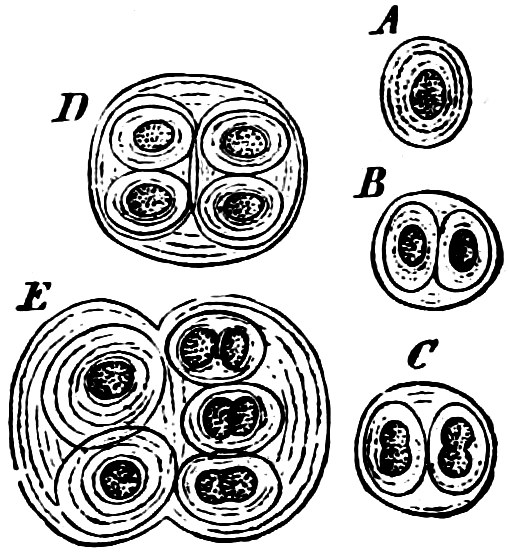
Fig. 20.—Glœocapsa atrata: A,
B, C, D, E various stages of development.
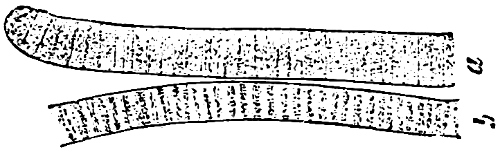
Fig. 21.—Oscillaria; a terminal, b
central portion of a filament.
Order 2. Lyngbyaceæ (Oscillariaceæ). The cells are discoid (Fig.
21), united to straight or spirally twisted, free filaments, which are
unbranched, or with spurious branching. The ends of the cell-chains
are similar. Heterocysts absent. Reproduction by synakinetes, resting
akinetes are wanting. Oscillaria (Fig. 21), Spirulina,
Lyngbya, Microcoleus, Symploca, Plectonema.
Order 3. Chamæsiphonaceæ. The individuals are 1—many-celled,
attached, unbranched filaments with differentiation into apex and
base, without heterocysts. Multiplication by reproductive akinetes;
resting akinetes are wanting. Dermocarpa, Clastidium,
Chamæsiphon, Godlewskia, Phragmonema.
Order 4. Nostocaceæ. The individuals are formed of
multicellular, unbranched filaments, without differentiation into apex
and base; heterocysts present. Reproduction by synakinetes and resting
akinetes.
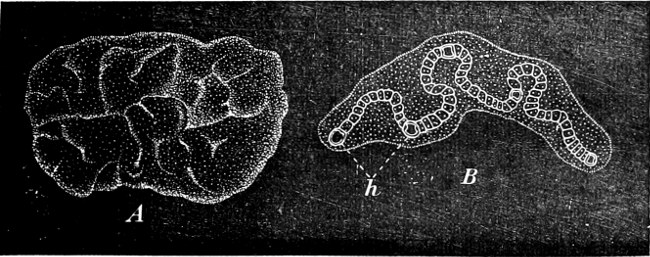
Fig. 22.—Nostoc verrucosum. A
The plant in its natural size; an irregularly folded jelly-like
mass. B One of the cell-chains enlarged, with its heterocysts
(h), embedded in its mucilaginous sheath.
Some genera are not mucilaginous, e.g. Cylindrospermum
(Fig. 19). The cell-chains in others, e.g. Nostoc,
wind in between one another and are embedded in large structureless
jelly-like masses, which may attain the size of a plum or even larger
(Fig. 22); sometimes they are found floating in the water, sometimes
attached to other bodies. Other genera as follows: Aphanizomenon
and Anabæna (in lakes and smaller pieces of water);
Nodularia is partly pelagic. Some occur in the intercellular
spaces of higher plants, thus Nostoc-forms are found in
Anthoceros, Blasia, Sphagnum, Lemna, and
in the roots of Cycas and Gunnera; Anabæna in
Azolla.
Order 5. Rivulariaceæ. The individuals are multicellular
filaments, with differentiation into apex and base; spurious branching,
and a heterocyst at the base of each filament, reproduction by
synakinetes and resting akinetes, rarely by simple reproductive
akinetes. Rivularia, Glœotrichia, Isactis,
Calothrix.
Order 6. Scytonemaceæ. The individuals are formed
of multicellular filaments with no longitudinal division;
differentiation into apex and base very slight or altogether
absent; branching spurious; heterocysts present. Reproduction by
synakinetes, rarely by resting akinetes and ordinary reproductive
akinetes. Tolypothrix, Scytonema, Hassalia,
Microchæte.
Order 7. Sirosiphoniaceæ. The individuals are formed of
multicellular threads with longitudinal divisions; true branching
and heterocysts, and often distinct differentiation into apex and
base. Reproduction by synakinetes, rarely by resting akinetes and
ordinary reproductive akinetes. Hapalosiphon, Stigonema,
Capsosira, Nostocopsis, Mastigocoleus.
The Bacteria (also known as Schizomycetes, and Fission-Fungi) are the
smallest known organisms, and form a parallel group to the Blue-green
Algæ, but separated from these Algæ by the absence of their colouring
material; chlorophyll is only found in a few Bacteria.
The various forms under which the vegetative condition of the Bacteria
appear, are termed as follows:
1. Globular forms, cocci (Figs. 27, 30 c): spherical or
ellipsoidal, single cells, which, however, are usually loosely massed
together and generally termed “Micrococci.”
2. Rod-like forms: more or less elongated bodies; the shorter
forms have been styled “Bacterium” (in the narrower sense of the
word), and the term “Bacillus” has been applied to longer forms
which are straight and cylindrical (Figs. 28, 29, 30 E).
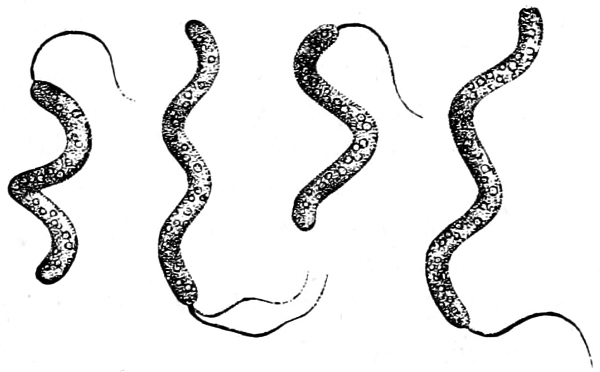
Fig. 23.—Spirillum sanguineum. Four
specimens. One has two cilia at the same end, the sulphur grains are
seen internally.
3. Thread-like forms: unbranched, long, round filaments,
resembling those of Oscillaria, are possessed by
Leptothrix (very thin, non-granular filaments; Fig. 30 A,
the small filaments) and Beggiatoa (thicker filaments, with
strong, refractile grains or drops of sulphur (Fig. 31); often
self-motile). Branched filaments, with false branching like many
Scytonemaceæ, are found in Cladothrix (Fig. 30 B,
G).
4. Spiral forms: Rod-like or filamentous bodies, which more or
less strongly resemble a corkscrew with a spiral rising to the left.
In general these are termed Spirilla (Fig. 23); very attenuated
spirals, Vibriones (standing next to Fig. 30 M); if
the filaments are slender and flexible with a closely wound spiral,
Spirochætæ (Fig. 24).
5. The Merismopedium-form, consisting of rounded cells
arranged in one plane, generally in groups of four, and produced by
divisions perpendicular to each other.
6. The Sarcina-form, consisting of roundish cells which are
produced by cellular division in all the three directions of space,
united into globular or ovoid masses (“parcels”) e.g. Sarcina
ventriculi (Figs. 25, 26).
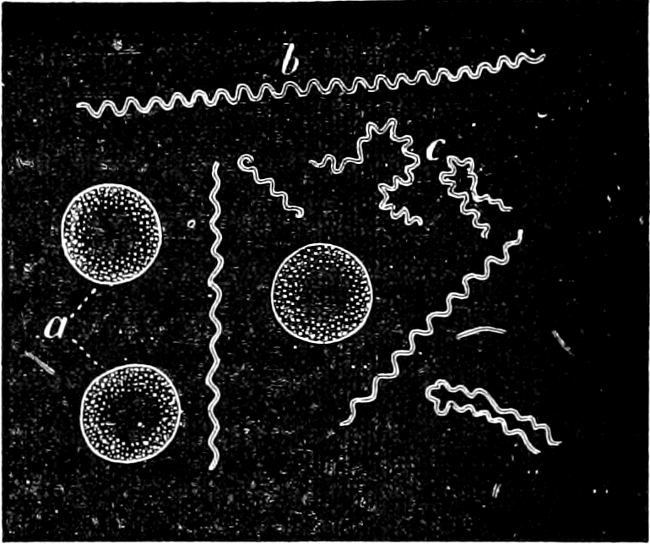
Fig. 24.—Spirochæte obermeieri, in
active motion (b) and shortly before the termination of the
fever (c); a blood corpuscles.
All Bacteria are unicellular. In the case of the micrococci this is
self-evident, but in the “rod,” “thread,” and “spiral” Bacteria, very
often numerous cells remain united together and their individual
elements can only be recognised by the use of special reagents.
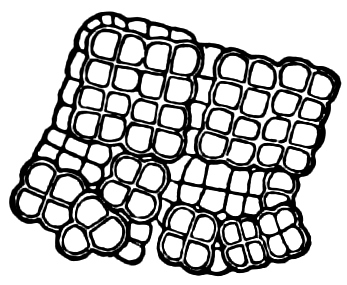
Fig. 25.—Sarcina ventriculi. One
surface only is generally seen. Those cells which are drawn with double
contour are seen with the correct focus, and more distinctly than those
cells lying deeper drawn with single contour.
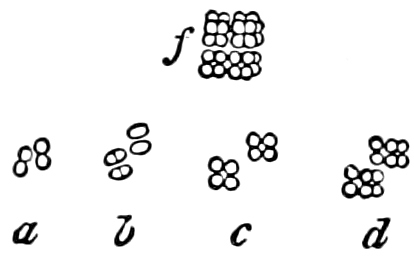
Fig. 26.—Sarcina minuta: a-d
successive stages of one individual (from 4–10 p.m.); f an
individual of 32 cells.
The condition termed “Zooglœa,” which reminds us of Nostoc,
is produced by the cells becoming strongly mucilaginous. A number
of individuals in active division are found embedded in a mass of
mucilage, which either contains only one, or sometimes more, of
the above-named forms. The individuals may eventually swarm out and
continue their development in an isolated condition. Such mucilaginous
masses occur especially upon moist vegetables (potatoes, etc.), on
the surface of fluids with decaying raw or cooked materials, etc. The
mucilaginous envelope is thrown into folds when the Bacteria, with
their mucilaginous cell-walls, multiply so rapidly that there is no
more room on the surface of the fluid.
The cells of the Bacteria are constructed like other plant-cells in
so far as their diminutive size has allowed us to observe them. The
cell-wall only exceptionally shows the reactions of cellulose (in
Sarcina, Leuconostoc; also in a Vinegar-bacterium,
Bacterium xylinum); a mucilaginous external layer is always
present. The body of the cell mostly appears to be an uniform
or finely granulated protoplasm. Very few species (e.g.
Bacillus virens) contain chlorophyll; others are coloured red
(purple sulphur Bacteria); the majority are colourless. Bacillus
amylobacter shows a reaction of a starch-like material when
treated with iodine before the spore-formation. Some Bacteria
contain sulphur (see p. 37). The body, which has been described as a
cell-nucleus, is still of a doubtful nature.
Artificial colourings with aniline dyes (especially methyl-violet,
gentian-violet, methylene-blue, fuchsin, Bismarck-brown and Vesuvin)
play an important part in the investigations of Bacteria.
Movement. Many Bacteria are self-motile; the long
filaments of Beggiatoa exhibit movements resembling those
of Oscillaria. In many motile forms the presence of cilia
or flagella has been proved by the use of stains; many forms have
one, others several cilia attached at one or both ends (Fig. 23) or
distributed irregularly over the whole body; the cilia are apparently
elongations of the mucilaginous covering and not, as in the other Algæ
of the protoplasm. In Spirochæte the movement is produced by
the flexibility of the cell itself. Generally speaking, the motion
resembles that of swarm-cells (i.e. rotation round the long axis
and movement in irregular paths); but either end has an equal power of
proceeding forwards.
The swarming motion must not be confounded with the hopping
motion of the very minute particles under the microscope
(Brownian movement).
Vegetative reproduction takes place by continued transverse
division; hence the name “Fission-Fungi” or “Fission-Algæ,” has been
applied to the Bacteria.
Spores. The spores are probably developed in two ways. In
the ENDOSPOROUS species (Figs. 28, 29), the spore arises
as a new cell inside the mother-cell. The spores are strongly
refractile, smaller than the mother-cell, and may be compared to
the aplanospores of other Algæ. In addition to these there are
the ARTHROSPOROUS species in which the cells, just as in
Nostoc and other Blue-green Algæ, assume the properties of
spores without previously undergoing an endogenous new construction,
and are able to germinate and form new vegetative generations (Fig.
27). The formation of spores very often commences when the vegetative
development begins to be restricted.
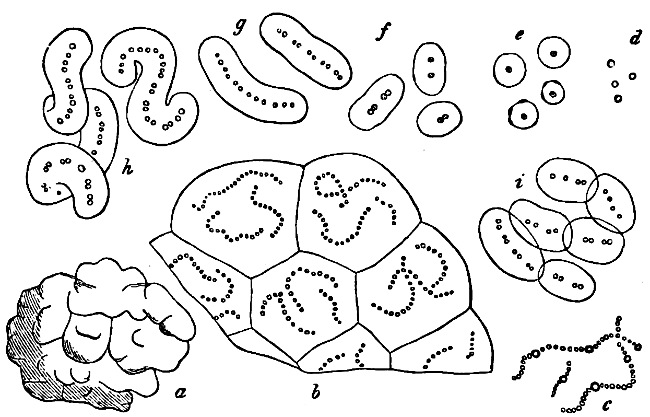
Fig. 27.—Leuconostoc mesenterioides:
a a zooglœa, natural size; b cross section of zooglœa;
c filaments with spores; d mature spores; e-i
successive stages of germination; in e portions of the ruptured
spore-wall are seen on the external side of the mucilaginous covering.
(b-i magnified 520.)
The spores germinate as in Nostoc by the bursting of the
external layer of the cell-wall, either by a transverse or longitudinal
cleft, but always in the same way, in the same species (Fig. 28,
example of transverse cleft).
Distribution. Bacteria and their germs capable of development,
are found everywhere, in the air (dust), in surface water, and in
the superficial layers of the soil. The number varies very much in
accordance with the nature of the place, season, etc. They enter,
together with air and food, into healthy animals and occur always in
their alimentary tract.
Growth and reproduction depend upon the conditions of
temperature. There is a certain minimum, optimum and maximum for each
species; for instance (in degrees Centigrade)—
|
Minim. |
Opt. |
Maxim. |
|
| Bacillus subtilis |
+ 6 |
c. 30 |
+ 50 |
|
| B. anthracis |
15 |
20–25 |
43 |
|
| Spirillum choleræ asiaticæ |
8 |
37 |
40 |
(but grows only feebly if under 16°). |
| Bacterium tuberculosis |
28 |
37–38 |
42 |
|
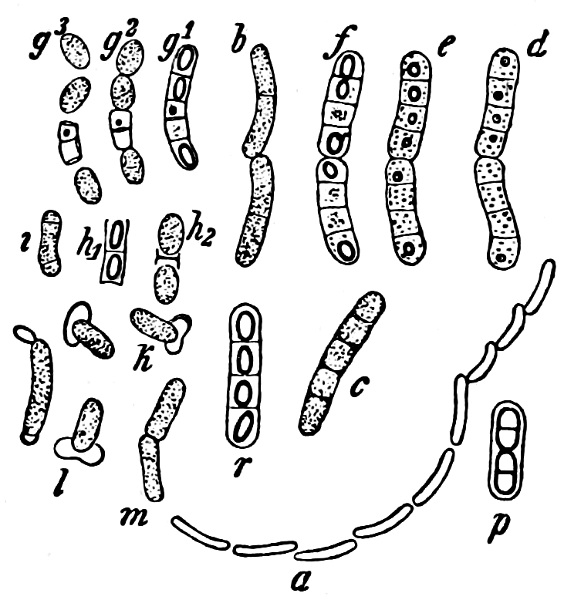
Fig. 28.—Bacillus megaterium: a
outline of a living, vegetative cell-rod; b a living, motile,
pair of rods; p a similar 4-celled rod after the effects
of iodine alcohol; c a 5-celled rod in the first stages of
spore-formation; d-f successive stages of spore-formation in one
and the same pair of rods (in the course of an afternoon); r
a rod with mature spores; g1–g3 three stages of a 5-celled
rod, with spores sown in nutritive solution; h1–h2, i,
k, l stages of germination; m a rod in the act of
transverse division, grown out from a spore which had been sown eight
hours previously. (After de Bary; a mag. 250, the other figures
600 times).
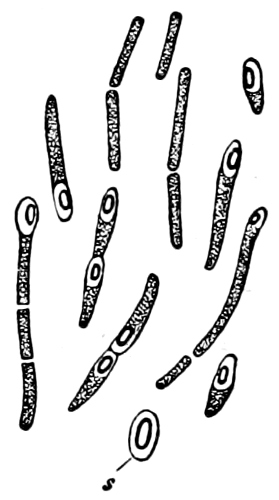
Fig. 29.—Bacillus amylobacter. Motile
rods, partly cylindrical and without spores, partly swollen into
various special shapes and with spore-formation in the swelling.
s Mature spore, with thick mucilaginous envelope. (After de
Bary; mag. 600 times, with the exception of s, which is more
highly magnified.)
The functions of life cease on a slight excess of the maximum or
minimum temperature, numbness setting in when either of these limits is
passed. Crenothrix-threads provided with mucilaginous envelopes
may, according to Zopf, sustain a temperature of-10°. Some Bacteria are
said to be able to resist the exposure to as low a temperature as-110°
for a short time. It is not known at what degree of cold the death of
the Bacteria occurs: the greatest degree of heat which the vegetative
cells can withstand is about the same as that for other vegetative
plant-cells, namely, about 50–60° C. Certain Bacteria, e.g.
B. thermophilus, grow and thrive vigorously at 70° C. Many
spores, on the contrary, are able to bear far higher temperatures (in
several species a temperature for some duration of above 100°, those
of Bacillus subtilis, for instance, can withstand for hours a
temperature of 100° in nutrient solutions; the spores remain capable of
development after exposure to a dry heat of 123° C.).
The Desiccation of the air, if prolonged, kills many forms when
in the vegetative condition. The spores however can bear a much longer
period of dryness, some even several years.
Oxygen. Some species cannot live without a supply of free
oxygen (Aerobic), e.g. the Vinegar-bacteria, the
Hay-bacilli, the Anthrax-bacilli, the Cholera-Microspira.
Other species again thrive vigorously without supply of free
oxygen, and are even checked in their development by the admission
of air (Anaerobic), e.g. the butyric acid Bacterium
(Clostridium butyricium = Bacillus amylobacter). A
distinction may be drawn between obligate and facultative aerobics
and obligate and facultative anaerobics. Several Bacteria, producing
fermentation, may grow without the aid of oxygen when they are living
in a solution in which they can produce fermentation; but, if this is
not the case, they can only grow when a supply of oxygen is available.
A great number of the pathogenic Bacteria belong to the facultative
anaerobics.
A luminous Bacterium (Bacillus phosphorescens) which in the
presence of a supply of oxygen gives a bluish-white light, has been
found in sea-water. Phosphorescent Bacteria have frequently been
observed upon decaying sea-fish, as well as on the flesh of other
animals; by transferring the Bacteria from cod fish to beef, etc., the
latter may be made luminous.
Organic carbon compounds are indispensable for all Bacteria,
(except, as it appears, for the nitrifying organisms), as they can
only obtain the necessary supplies of carbon from this source.
The supplies of nitrogen, which also they cannot do without,
can be obtained equally as well from organic compounds as from
inorganic salts, such as saltpetre or ammonia-compounds. The various
“ash-constituents” are also essential for their nourishment.
While Moulds and Yeast-Fungi grow best in an acid substratum, the
Bacteria, on the other hand, generally thrive best in a
neutral or slightly alkaline one.
In sterilization, disinfection, and antisepsis,
means are employed by which the Bacteria are killed, or checked in
their development, for instance, by heat (ignition, cooking, hot
vapours, hot air, etc.), or poisons (acids, corrosive sublimate). The
process of preserving articles of food, in which they are boiled and
then hermetically sealed, aims at destroying the Bacteria, or the
spores of those which already may be present in them, and excluding all
others.
As the Bacteria are unable to assimilate carbon from the carbonic acid
of the air, but must obtain it from the carbon-compounds already in
existence in the organic world, they are either saprophytes or
parasites. Some are exclusively either the one or the other,
obligate saprophytes or parasites. But there are transitional
forms among them, some of which are at ordinary times saprophytes,
but may, when occasion offers, complete their development wholly
or partly as parasites—facultative parasites; others are
generally parasitic, but may also pass certain stages of development as
saprophytes—facultative saprophytes.
All chlorophyll-free organisms act in a transforming and disturbing
manner on the organic compounds from which they obtain their
nourishment, and while they themselves grow and multiply, they produce,
each after its kind, compounds of a less degree of complexity,
i.e. they produce fermentation, putrefaction,
sometimes the formation of poisons, and in living beings often
disease.
Those organisms which produce fermentation are called ferments;
this word, however, is also employed for similar transformations in
purely chemical materials (inorganic ferments or enzymes). Many organic
(“living”) ferments, among which are Yeast-cells and Bacteria, give
off during their development certain inorganic and soluble ferments
(enzymes) which may produce other transformations without themselves
being changed. Different organisms may produce in the same substratum
different kinds of transformation; alcoholic fermentation may for
instance be produced by different species of Fungi, but in different
proportions, and the same species produces in different substrata,
different transformations (e.g. the Vinegar-bacteria oxydize
diluted alcohol to vinegar, and eventually to carbonic acid and water).
In the study of Bacteria it is absolutely necessary to sterilize
the vessels employed in cultivation, the apparatus, and nutrient
solutions, i.e. to free them from Bacteria germs and
also to preserve the cultures from the intrusion of any foreign
germs (“pure-cultures”). A firm, transparent, nutritive medium
is frequently employed. This may be prepared by adding to
the nutrient solutions (broth) either gelatine, or—when the
Bacteria are to be cultivated at blood-heat—serum of sheep’s or
calf’s blood, agar-agar or carragen; serum alone may in itself
serve as a nutrient medium. The so-called “plate-cultures” are
frequently employed, i.e. the germs are isolated by
shaking them with the melted liquid nutrient gelatine, which
is then spread on a glass plate and allowed to coagulate; when
later on the individual germs grow into colonies, these remain
separate in the solid substratum and it is easy to pursue
their further development. Similar plate-cultures may also be
cultivated in test-tubes and on microscopic slides. The slides
and glass plates must be placed in “moist chambers” free from
Bacteria. By sowing a few cells (if possible one) using a fine
platinum wire, pure cultures for further investigation may be
obtained.
In order to prove the relationship between pathogenic Bacteria
and certain diseases, the experimental production of pathogenic
Bacteria by the inoculation of Bacteria from pure cultures into
healthy animals, is very important.
It has not so far been possible to establish a classification
of the Bacteria, as the life-history of many species, has not yet
been sufficiently investigated.[7] The opinions of botanists are at
variance, in many cases, about the forms of growth of a particular
kind. Some species are pleomorphic (many-formed) while others possess
only one form.
The following Bacteria are Saprophytes:—
Cladothrix dichotoma is common in stagnant and running water
which is impregnated with organic matter; the cell-chains have false
branching. According to Zopf, Leptothrix ochracea is one of
the forms of this species which, in water containing ferrous iron
(e.g. as FeCO3), regularly embeds ferric-oxide in its sheath
by means of the activity of the protoplasm. Leptothrix ochracea
and other Iron-bacteria, according to Winogradsky (1888), do not
continue their growth in water free from protoxide of iron; while
they multiply enormously in water which contains this salt of iron.
The large masses of ochre-coloured slime, found in meadows, bogs, and
lakes, are probably due to the activity of the Iron-bacteria.
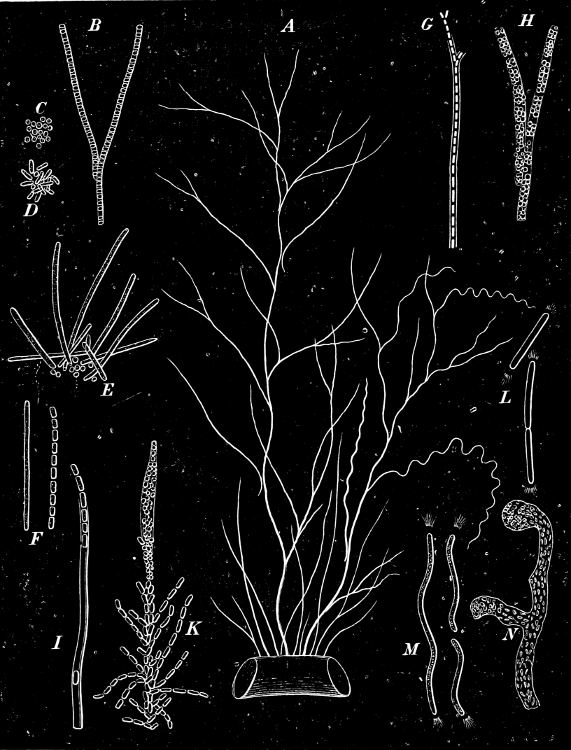
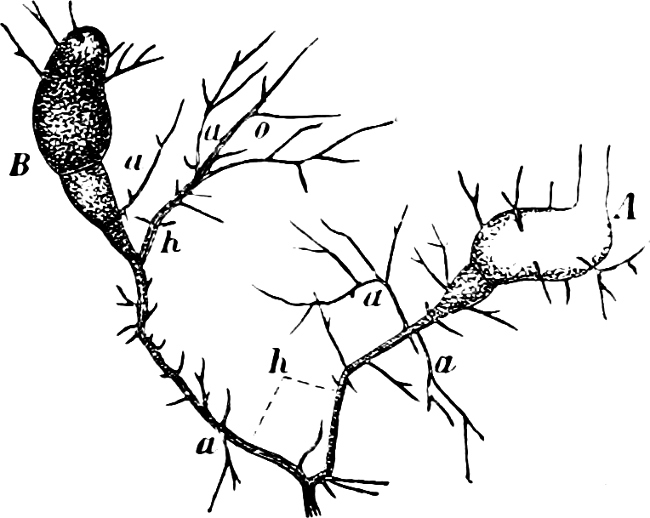
Fig. 30.—Cladothrix dichotoma.
Those forms which, according to Zopf’s views, represent the forms of
development of Cladothrix dichotoma are placed together in
Fig. 30. A represents a group of plants, seventy times magnified,
attached to a Vaucheria. The largest one is branched like a tree,
with branches of ordinary form; a specimen with spirally twisted
branches is seen to the right of the figure, at the lower part some
small Leptothrix-like forms. B shows the manner of
branching and an incipient Coccus-formation. C a
Coccus-mass whose exit from the sheath has been observed.
D the same mass as C after the course of a day, the
Cocci having turned into rods. E a group of Cocci in
which some have developed into shorter or longer rods. F one of
these rods before and after treatment with picric acid, which causes
the chain-like structure to become apparent. G a portion of a
plant with conspicuous sheath, two lateral branches are being formed.
H part of a plant, whose cells have divided and form Cocci.
The original form of the cells in which the Cocci are embedded may
still be recognised. I. Leptothrix-filaments with conspicuous
mucilaginous sheath, from which a series of rods is about to emerge;
the rod near the bottom is dead, and has remained lying in the sheath.
K part of a plant which is forming Cocci, those at the top are
in the zooglœa-stage, at the base they are elongating to form rods
and Leptothrix-filaments. L a portion of a branched
Cladothrix, which divides into motile Bacillus-forms; the
rays at the free ends indicate the currents which the cilia produce
in the water. M a spirally-twisted, swarming filament, before
and after division into halves. N part of a tree-like zooglœa
with Cocci and short rods.—All of these spirilla, zooglœa, etc.,
which Zopf has connected with Clad. dichotoma, are according to
Winogradsky, independent organisms.
Micrococcus ureæ produces urinal fermentation
(transformation of urinal matter into ammonium carbonate); aerobic;
round cells generally united to form bent chains or a zooglœa.—Several
other kinds of Bacteria have the same action as this one: in damp soil
containing ammonia-compounds, saltpetre-formations are produced
by M. nitrificans and several different kinds of Bacteria.
Micrococcus prodigiosus is found on articles of food containing
starch; “bleeding bread” is caused by this Bacterium, which has the
power of forming a red pigment; it also occurs in milk, and produces
lactic acid.
Leuconostoc mesenterioides is the frog-spawn Bacterium (Fig. 27)
which is found in sugar manufactories, and has the power of producing
a viscous fermentation in saccharine solutions which have been derived
from plants, e.g. in beetroot-sugar manufactories, where large
accumulations of mucilage are formed at the expense of the sugar, with
an evolution of carbonic acid. The cell-rows, resembling somewhat a
pearl necklace, have thick mucilaginous cell-walls, and form white
“Nostoc”-lumps. The mucilage eventually deliquesces and the cells
separate from each other; arthrospores?—Similar viscous deteriorations
occur in beer and wine, which may then be drawn out into long, string
like filaments—“ropiness.”
Bacterium aceti, the Vinegar-bacterium, oxidizes alcohol into
acetic acid (acetous-fermentation) and forms a greyish covering of
Bacteria (“Vinegar-mother”) on the surface of the liquid; the acetic
acid formed, becomes by continued oxidization by B. aceti, again
transformed into carbonic acid and water. Aerobic; short cylindrical
cells, often united into chains, or to form a zooglœa; sometimes also
rod-and spindle-shaped. The Vinegar-bacteria and other kinds with
ball- or rod-forms sometimes become swollen, spindle-shaped, or oval
links; they are supposed to be diseased forms[8] (“Involution-forms”).
Bacillus lacticus (Bacterium acidi lactici, Zopf) is
always found in milk which has stood for some time, and in sour foods
(cabbage, cucumbers, etc.); it turns the milk sour by producing lactic
acid fermentation in the sugar contained in the milk; the lactic acid
formed, eventually causes the coagulation of the casein. It resembles
the Vinegar-bacteria, occurring as small cylindrical cells, rarely in
short rows; not self-motile.—Several other Bacteria appear to act in
the same way, some occurring in the mouth of human beings; some of
these Bacteria give to butter its taste and flavour.
The kefir-grains which are added to milk for the preparation of
kefir, contain in large numbers a Bacterium (Dispora caucasica)
in the zooglœa-form, a Yeast-fungus, and Bacillus lacticus.
Kefir is a somewhat alcoholic sour milk, rich in carbonic acid; it is
a beverage manufactured by the inhabitants of the Caucasus, from the
milk of cows, goats, or sheep, and is sometimes used as a medicine. In
the production of kefir, lactic acid fermentation takes place in one
part of the sugar contained in the milk, and alcoholic fermentation
in another part, and the casein which had become curdled is partially
liquefied (peptonised) by an enzyme of a Zooglœa-bacterium.
Bacillus amylobacter (Bacillus butyricus), the
Butyric-acid-bacterium (Fig. 29), is a very common anaerobic which
produces fermentation in sugar and lactic-acid salts, and whose
principal product is butyric acid. It destroys articles of
food and (together with other species) plays a part in the butyric
acid fermentation which is necessary in the making of cheese; it is
very active wherever portions of plants are decaying, in destroying
the cellulose in the cell-walls of herbaceous plants, and is thus
useful in the preparation of flax and hemp. The cells are self-motile,
generally cylindrical, sometimes united into short rows; endosporous;
the spore-forming cells swell, assume very different forms, and show
granulose reaction. The germ-tube grows out in the direction of the
long axis of the spore.
Bacillus subtilis, the Hay-bacillus, is developed in all
decoctions of hay; a slender, aerobic, self-motile Bacillus;
endosporous (aplanospores); the spore-wall ruptures transversely on
germination.
Crenothrix kuehniana occurs in the springs of many baths, in
wells, in water or drain-pipes.
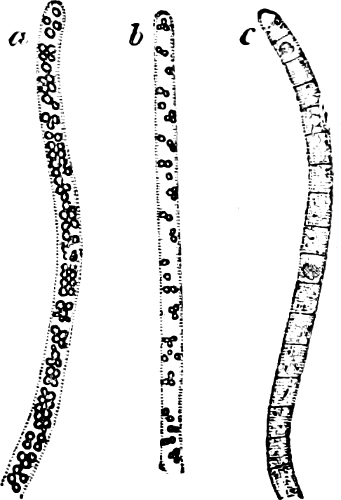
Fig. 31.—Beggiatoa alba: a from
a fluid containing abundance of sulphuretted hydrogen; b after
lying 24 hours in a solution devoid of sulphuretted hydrogen; c
after lying an additional 48 hours in a solution devoid of sulphuretted
hydrogen, by this means the transverse walls and vacuoles have become
visible.
Beggiatoa (parallel with the Blue-green Alga Oscillaria).
Long filaments formed of cylindrical cells which are attached by
one of the ends, but which are nearly always free when observed.
The filaments, like those of Oscillaria, describe conical
figures in their revolutions, the free filaments slide upwards and
parallel with one another; sheaths are wanting; strongly refractive
sulphur drops are found in the interior. The Beggiatoas are the most
prevalent Sulphur-bacteria. They occur, very commonly in large
numbers, wherever plant or animal remains are decaying in water in
which sulphuretted hydrogen is being formed; thus, for example, B.
alba (Fig. 31) occurs frequently as a white covering or slimy
film on mud containing organic remains. B. mirabilis is
remarkable for its size and its strong peristaltic movements. The
Sulphur-bacteria oxidize the sulphuretted hydrogen, and accumulate
sulphur in the shape of small granules of soft amorphic sulphur, which
in the living cell never passes over into the crystalline state. They
next oxidize this sulphur into sulphuric acid, which is immediately
rendered neutral by absorbed salts of calcium, and is given off in
the form of a sulphate, thus CaCO3 is principally changed into
CaSO4. In the absence of sulphur the nutritive processes are
suspended, and consequently death occurs either sooner or later. The
Sulphur-bacteria may exist and multiply in a fluid which only contains
traces of organic matter, in which organisms devoid of chlorophyll are
not able to exist. The Beggiatoas very frequently form white, bulky
masses in sulphur wells and in salt water, the traces of organic
material which the sulphur water contains proving sufficient for them.
The cellulose-fermentation, to which the sulphur wells in all
probability owe their origin, mainly procures them suitable conditions
for existence. The CaCO3 and H2S, formed during the cellulose
fermentation by the reduction of CaSO4 is again changed into
CaSO4 and CO2 by the Sulphur-bacteria (Winogradsky, 1887).—Other
Sulphur-bacteria, the so-called purple Sulphur-bacteria, e.g.
B. roseo-persicina, Spirillum sanguineum (Fig. 23),
Bacterium sulfuratum, etc., have their protoplasm mixed with a
red colouring matter (bacterio-purpurin) which, like chlorophyll, has
the power, in the presence of light, of giving off oxygen (as proved
by T. W. Englemann, 1888, in oxygen-sensitive Bacteria). The three
purple Sulphur-bacteria mentioned, are, according to Winogradsky, not
pleomorphic kinds but embrace numerous species.
Many Spirilli (Spirillum tenue, S. undula, S.
plicatile, and others) are found prevalent in decaying liquids.
Bacteria (especially Bacilli) are the cause of many substances emitting
a foul odour, and of various changes in milk.
Parasitic Bacteria live in other living organisms; but the
relation between “host” and parasite may vary in considerable
degree. Some parasites do no injury to their host, others produce
dangerous contagious diseases; some choose only a special kind as
host, others again live equally well in many different ones. There
are further specific and individual differences with regard to the
predisposition of the host, and every individual has not the
same receptivity at all times.
The harmless parasites of human beings. Several of the above
mentioned saprophytes may also occur in the alimentary canal of human
beings; e.g., the Hay-bacillus, the Butyric-acid-bacillus,
etc.; but the gastric juice prevents the development of others, at
all events in their vegetative condition. Sarcina ventriculi,
“packet-bacterium,” is only known to occur in the stomach and
intestines of human beings, and makes its appearance in certain
diseases of the stomach (dilation of the stomach, etc.) in great
numbers, without, however, being the cause of the disease. It occurs in
somewhat cubical masses of roundish cells (Fig. 25).
Less dangerous parasites. In the mouth, especially between
and on the teeth, a great many Bacteria are to be found (more than
fifty species are known), e.g. Leptothrix buccalis (long,
brittle, very thin filaments which are united into bundles), Micrococci
in large lumps, Spirochæte cohnii, etc. Some of them are known
to be injurious, as they contribute in various ways to the decay of
the teeth (caries dentium); a Micrococcus, for instance,
forms lactic acid in materials containing sugar and starch, and the
acid dissolves the lime salts in the external layers of the teeth:
those parts of the teeth thus deprived of lime are attacked by other
Bacteria, and become dissolved. Inflammation in the tissues at the root
of a tooth, is probably produced by septic materials which have been
formed by Bacteria in the root-canal.
Dangerous Parasites. In a large number of the infectious
diseases of human beings and animals, it has been possible to prove
that parasitic Bacteria have been the cause of the disease. Various
pathogenic Bacteria of this nature, belonging to the coccus, rod, and
spiral Bacteria groups, are mentioned in the following:—
Pathogenic Micrococci. Staphylococcus pyogenes aureus
produces abscesses of various natures (boils, suppurative processes in
internal organs). The same effects are produced by—
Streptococcus pyogenes, which is the most frequent cause of
malignant puerperal fever; it is perhaps identical with—
Streptococcus erysipelatis, which is the cause of erysipelas in
human beings.
Diplococcus pneumoniæ (A. Fränkel) is the cause of pneumonia,
and of the epidemic cerebro-spinal meningitis.
Gonococcus (Neisser) is the cause of gonorrhea and inflammation
of the eyes.
Pathogenic Rod-Bacteria. Bacterium choleræ gallinarum,
an aerobic, facultative parasite which produces fowl-cholera among
poultry; it is easily cultivated on various substrata as a saprophyte.
The disease may be conveyed both through wounds and by food, and may
also be communicated to mammals.
Bacillus anthracis, the Anthrax bacillus (Fig. 32),
chiefly attacks mammals, especially herbivorous animals (house mice,
guinea-pigs, rabbits, sheep, cattle), in a less degree omnivorous
animals (including human beings), and in a still less degree the
Carnivores. Aerobic. Cylindrical cells, 3–4 times as long as broad,
united into long rod-like bodies, which may elongate into long, bent,
and twisted filaments. Not self-motile. Endosporous. Germination
takes place without the throwing off of any spore-membrane (compare
Hay-bacillus p. 37 which resembles it). Contagion may take place
both by introduction into wounds, and from the mucous membrane of
the intestines or lungs, both by vegetative cells and by spores; in
intestinal anthrax, however, only by spores. The Bacillus multiplies as
soon as it has entered the blood, and the anthrax disease commences.
The Bacilli not only give off poison, but also deprive the blood
of its oxygen. Vegetative cells only occur in living animals. This
species is a facultative parasite which in the first stage is a
saprophyte, and only in this condition forms spores.
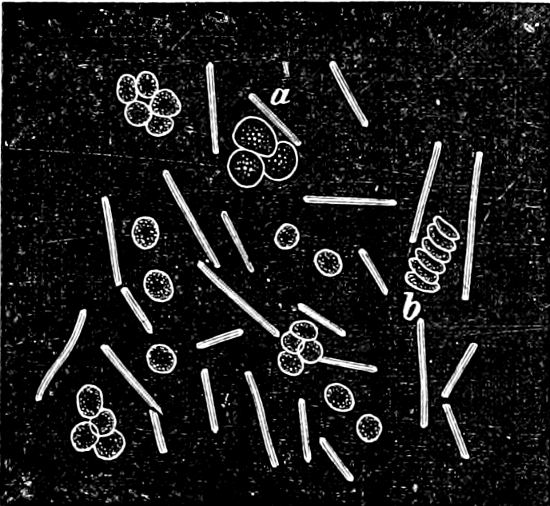
Fig. 32.—Anthrax bacillus
(Bacillus anthracis) with red (b) and white (a)
blood-corpuscles.
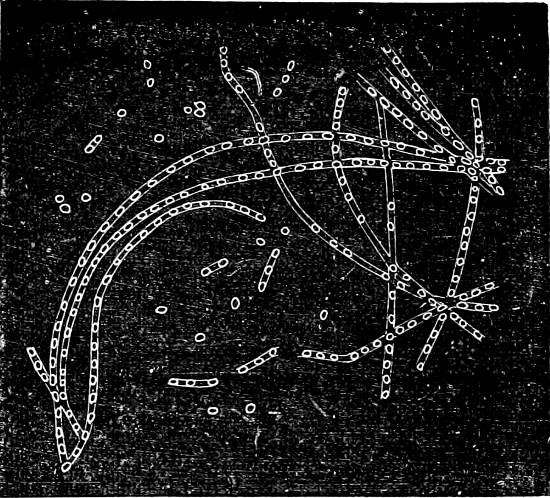
Fig. 33.—Anthrax bacillus. The
formation of the spores; magnified 450 times.
Bacillus tuberculosis produces tuberculosis in human beings,
also in domestic animals (perlsucht). It is a distinct parasite,
but may also live saprophytically. It is rod-formed, often slightly
bent, and is recognised principally by its action with stains (when
stained with an alkaline solution of methyl-blue or carbolic fuchsin,
it retains the colour for a long time even in solutions of mineral
acids, in contrast with the majority of well-known Bacteria): it
probably forms spores which are able to resist heat, dryness, etc.
Bacillus lepræ produces leprosy; Bacillus mallei
produces glanders; Bacillus tetani, tetanus (the tetanus
bacillus is very common in soil; anaerobic); Bacillus
diphtheriæ, diphtheria; Bacillus typhosus, typhoid
fever, etc.
Pathogenic Spiral Bacteria. Spirochæte obermeieri (Fig.
24) produces intermittent fever (febris recurrens); it makes its
appearance in the blood during the attacks of fever, but it is not to
be found during intervals when there is no fever. Obligate parasite.
Spirillum choleræ asiaticæ (Microspira comma) without
doubt produces Asiatic cholera; an exceedingly motile spirillum, which
is also found in short, bent rods (known as the “Comma-bacillus”), it
lives in the intestines of those attacked by the disease, and gives off
a strong poison which enters the body. It is easily cultivated as a
saprophyte.
A great many circumstances seem to show that a number of other
infectious diseases (syphilis, small-pox, scarlet-fever, measles,
yellow-fever, etc.) owe their origin to parasitic Bacteria, but this
has not been proved with certainty in all cases.
It has been possible by means of special cultivations (ample supply
of oxygen, high temperature, antiseptic materials) to produce from
the parasitic Bacteria described above (e.g. the fowl-cholera
and the anthrax Bacteria) physiological varieties which are
distinct from those appearing in nature and possess a less degree of
“virulence,” i.e. produce fever and less dangerous symptoms
in those animals which are inoculated with them. The production
of such physiological varieties has come to be of great practical
importance from the fact that they are used as vaccines, i.e.
these harmless species produce in the animals inoculated with them
immunity from the malignant infectious Bacteria from which
they were derived. This immunity is effected by the change of the
products of one or more of the Bacteria, but we do not yet know
anything about the way in which they act on the animal organism. The
white blood corpuscles, according to the Metschnikoff, play the part
of “Phagocytes” by absorbing and destroying the less virulent Bacteria
which have entered the blood, and by so doing they are gradually
enabled to overcome those of a more virulent nature.

Fig. 34.—a and b The
same blood-cell of a Frog: a in the act of engulfing an
anthrax-bacillus; b after an interval of a few minutes when the
bacillus has been absorbed.
The Algæ belonging to this class have chlorophyll, and pyrenoids
round which starch is formed. The cells divide only in one direction,
they live solitarily, or united to form filaments which generally
float freely (seldom attached). Swarm-cells are wanting. The
fertilisation is isogamous (conjugation) and takes place by means
of aplanogametes. The zygote, after a period of rest, produces,
immediately on germination, one or more new vegetative individuals;
sometimes akinetes or aplanospores are formed in addition. They only
occur in fresh or slightly brackish water.
Order 1. Desmidiaceæ. The cells generally present markings on
the outer wall, and are mostly divided into two symmetrical halves by a
constriction in the middle, or there is at least a symmetrical division
of the protoplasmic cell-contents. The cell-wall consists nearly always
of two layers, the one overlapping the other (Fig. 35 C). The
cells either live solitarily or are united into unbranched filaments.
The mass of protoplasm formed by the fusion of the two conjugating
cells becomes the zygote, which on germination produces one (or after
division 2, 4 or 8) new vegetative individual. The chromatophores are
either star-, plate-, or band-shaped, and regularly arranged round the
long axis of the cell.
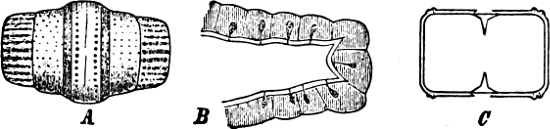
Fig. 35.—A Cell of Gymnozyga
brebissonii, external view showing the distribution of the pores.
B A portion of the membrane of Staurastrum bicorne
with pores containing protoplasmic projections. C Cell-wall of
Hyalotheca mucosa during cell-division: the central part, being
already formed, shows the connection with the divisional wall.
The Desmidiaceæ are not able to swim independently, many species,
however, show movements of different kinds by rising and sliding
forward on the substratum. These movements, which are partly dependent
upon, and partly independent of light and the force of gravitation, are
connected with the protrusion of a mucilaginous stalk. The mucilage,
which sometimes surrounds the whole individual, may acquire a prismatic
structure, it is secreted by the protoplasmic threads which project
through certain pores definitely situated in the walls (Fig. 35
A, B).
Vegetative multiplication takes places by division. A good
example of this is found in Cosmarium botrytis (Fig. 36
A-D). The nucleus and chromatophores divide, and simultaneously
the central indentation becomes deeper, the outer wall is then ruptured
making a circular aperture through which the inner wall protrudes
forming a short, cylindrical canal between the two halves to which it
is attached (Fig. 36 C). After elongation the canal is divided
by a central transverse wall, which commences as a ring round its
inner surface and gradually forms a complete septum. The dividing wall
gradually splits, and the two individuals separate from each other,
each one having an old and a new half. The two daughter-cells bulge
out, receive a supply of contents from the parent-cells, and gradually
attain their mature size and development (Fig. 36 B-D).
Exceptions to this occur in some forms.
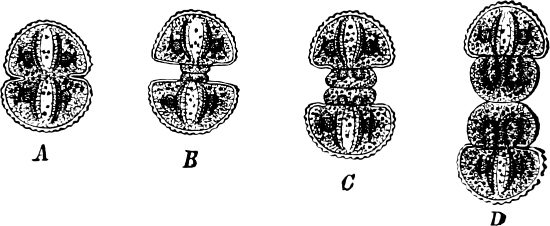
Fig. 36.—Cosmarium botrytis. A-D
Different stages of cell-division.
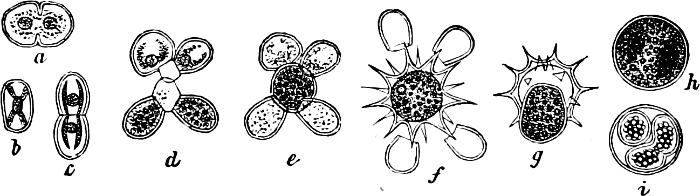
Fig. 37.—Cosmarium meneghinii:
a-c same individual seen from the side, from the end, and from
the edge; d-f stages of conjugation; g-i germination of
the zygote.
Conjugation takes place in the simplest way in
Mesotænium, where the two conjugating cells unite by a short
tube (conjugation-canal), which is not developed at any particular
point. The aplanogametes merge together after the dissolution of the
dividing wall, like two drops of water, almost without any trace of
preceding contraction, so that the cell-wall of the zygote generally
lies in close contact with the conjugating cells. The conjugating cells
in the others lie either transversely (e.g. Cosmarium,
Fig. 37 d; Staurastrum, etc.), or parallel to one
another (e.g. Penium, Closterium, etc.), and
emit a short conjugation-canal (Fig. 37 d) from the centre of
that side of each cell which is turned towards the other one. These
canals touch, become spherical, and on the absorption of the dividing
wall the aplanogametes coalesce in the swollen conjugation-canal
(Fig. 37 e), which is often surrounded by a mucilaginous
envelope. The zygote, which is often spherical, is surrounded by a
thick cell-wall, consisting of three layers; the outermost of these
sometimes bears thorn-like projections, which in some species are
simple (Fig. 37 f), in others branched or variously marked; in
some, however, it remains always smooth (e.g. Tetmemorus,
Desmidium). Deviation from this mode of conjugation may occur
within certain genera (e.g. Closterium, Penium).
Upon germination the contents of the zygote emerge, surrounded by
the innermost layers of the wall (Fig. 37 g, h) and
generally divide into two parts which develop into two new individuals,
placed transversely to each other (Fig. 37 i); these may have a
somewhat more simple marking than is generally possessed by the species.

Fig. 38.—Desmidiaceæ. A Closterium
moniliferum; B Penium crassiusculum; C
Micrasterias truncata (front and end view); D Euastrum
elegans; E Staurastrum muticum (end view).
The most frequent genera are:—
A. Solitary cells: Mesotænium, Penium
(Fig. 38 B), Cylindrocystis, Euastrum
(Fig. 38 D), Micrasterias (Fig. 38 C),
Cosmarium (Fig. 36, 37), Xanthidium,
Staurastrum (Fig. 38 E), Pleurotænium,
Docidium, Tetmemorus, Closterium
(Fig. 38 A), Spirotænia.
B. Cells united into filaments: Sphærozosma,
Desmidium, Hyalotheca, Gymnozyga,
Ancylonema, Gonatozygon.
Order 2. Zygnemaceæ. Cell-wall without markings. The cells are
cylindrical, not constricted in the centre, and (generally) united into
simple, unbranched filaments. The whole contents of the conjugating
cells take part in the formation of the zygote, which on germination
grows out directly into a new filament.
Spirogyra is easily recognised by its spiral chlorophyll band;
Zygnema has two star-like chromatophores in each cell (Fig. 40);
both these genera are very common Algæ in ponds and ditches.
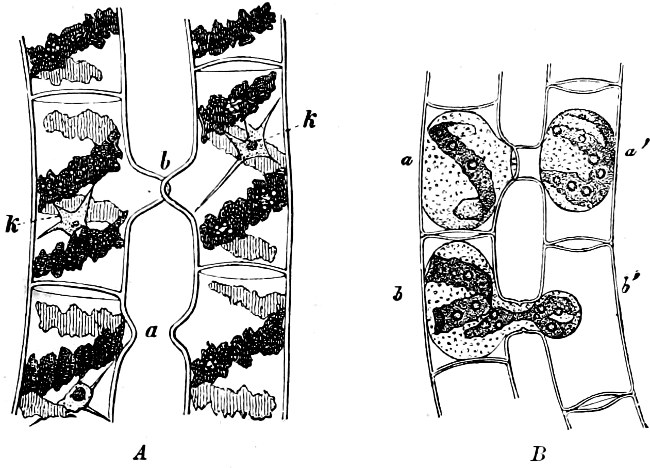
Fig. 39.—Spirogyra longata. A
At the commencement of conjugation, the conjugation-canals begin to
protrude at a and touch one another at b; the spiral
chlorophyll band and cell-nuclei (k) are shown. B A more
advanced stage of conjugation; a, a’ the rounded female
and male aplanogametes: in b’ the male aplanogamete is going
over to and uniting with the female aplanogamete (b).
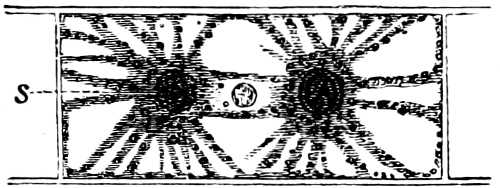
Fig. 40.—A cell of Zygnema. S
Pyrenoid.
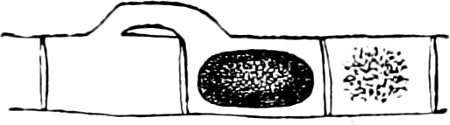
Fig. 41.—Zygnema insigne, with zygote.
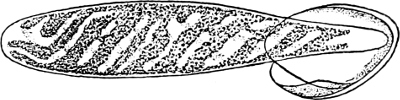
Fig. 42.—Germinating zygote of Spirogyra
jugalis: the young plant is still unicellular; the end which
is still in the wall of the zygote is elongated and root-like; the
chromatophore divides and forms the spiral band.
The conjugation among the Zygnemaceæ takes place in the following
manner: the cells of two filaments, lying side by side, or two cells,
the one being situated above the other in the same filament (Fig. 41),
push out small protuberances opposite each other (Fig. 39 A,
a, b); these finally meet, and the dividing wall is
absorbed so that a tube is formed connecting one cell with the other;
the protoplasmic contents round off, and the whole of these contents
of one of the cells glides through the conjugation-tube and coalesces
with that of the other (Fig. 39 B), the aggregate mass then
rounds off, surrounds itself with a cell-wall, and becomes a zygote.
A distinct difference may be found between the cells in the two
filaments, those in the one whose protoplasmic contents pass over being
cylindrical, while those of the recipient one are more barrel-shaped,
and of a larger diameter. The former may be regarded as a male, the
latter as a female plant. The zygote germinates after a period of rest,
and grows out into a new filament (Fig. 42).
Order 3. Mesocarpaceæ. The cell-walls are glabrous,
unconstricted in the centre, and united into simple unbranched
filaments. The chromatophore consists of an axial chlorophyll-plate,
with several pyrenoids. The zygote is formed by the coalescence
of two cells (Fig. 43) (sometimes three or four), but the whole
protoplasmic contents of the cells do not take part in this process,
a portion always remaining behind; the aplanogametes coalesce in
the conjugation-canal. The zygote thus formed appears incapable of
germination until after 3–5 divisions. Of the cells so formed, only one
is fertile, the sterile cells, according to Pringsheim, constituting
a rudimentary sporocarp. The germinating cells grow out into a new
filament. In this order, conjugation has been observed between two
cells of the same filament. The Mesocarpaceæ thrive best in water which
contains lime.
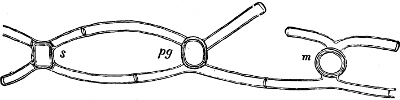
Fig. 43.—Mougeotia calcarea. Cells showing
various modes of conjugation: at m tripartition; pg
quadripartition; s quinquipartilion of the zygote.
These Algæ are coloured green by chlorophyll, seldom in combination
with other colouring matter, and then especially with red. The product
of assimilation is frequently starch, which generally accumulates round
certain specially formed portions of protoplasm termed pyrenoids.
The thallus is uni- or multicellular; in the higher forms (certain
Siphoneæ) the organs of vegetation attain differentiation into stem
and leaf. The asexual reproduction takes place in various ways; the
sexual reproduction is effected by conjugation of motile gametes, or
by oogamous fertilisation. The swarm-cells (zoospores, gametes, and
spermatozoids) are constructed symetrically, and have true protoplasmic
cilia, these generally being attached to the front end of the
swarm-cells. Most of these Algæ live in water (fresh or salt); some are
found upon damp soil, stones, or tree-stems, and some live enclosed in
other plants.
The Class is divided into three families:—
1. Protococcoideæ: Volvocaceæ, Tetrasporaceæ, Chlorosphæraceæ,
Pleurococcaceæ, Protococcaceæ, Hydrodictyaceæ.
2. Confervoideæ: Ulvaceæ, Ulothricaceæ, Chætophoraceæ,
Mycoideaceæ, Cylindrocapsaceæ, Œdogoniaceæ, Coleochætaceæ,
Cladophoraceæ, Gomontiaceæ, Sphæropleaceæ.
3. Siphoneæ: Botrydiaceæ, Bryopsidaceæ, Derbesiaceæ,
Vaucheriaceæ, Phyllosiphonaceæ, Caulerpaceæ, Codiaceæ, Valoniaceæ,
Dasycladaceæ.
The Algæ which belong to this group are uni- or multicellular with
the cells more or less firmly connected, sometimes in a definite,
sometimes in an indefinite form (Fig. 47). Colonies are formed either
by division or by small unicellular individuals becoming united in a
definite manner; the colonies formed in this latter way are termed
Cœnobia. Apical cells and branching are absent. Multiplication
by division; asexual reproduction by zoospores, rarely by akinetes.
Sexual reproduction may be wanting, or it takes place by isogamous,
rarely by oogamous fertilisation.
Some are attached by means of a stalk to other objects
(Characium, Fig. 49), others occur as “Endophytes” in the
tissues of certain Mosses or Phanerogams, e.g. Chlorochytrium
lemnæ, in Lemna trisulca; Endosphæra, in the
leaves of Potamogeton, Mentha aquatica, and Peplis
portula; Phyllobium, in the leaves of Lysimachia
nummularia, Ajuga, Chlora, and species of Grasses;
Scotinosphæra in the leaves of Hypnum and Lemna
trisulca; the majority, however, live free in water and in damp
places. Many species which were formerly considered to belong to this
family have been proved to be higher Algæ in stages of development.
Order 1. Volvocaceæ. The individuals in this order are either
uni- or multicellular, and during the essential part of their life are
free-swimming organisms. They are generally encased in a mucilaginous
envelope, through which 2–6 cilia project from every cell. The
vegetative reproduction takes place by the division of all, or a few,
of the cells of the individual; in some a palmella-stage is found in
addition. The sexual reproduction takes place by isogamous or oogamous
fertilisation.
The Volvocaceæ may be considered to include the original forms
of the Chlorophyceæ, because, among other reasons, the motile
stage is here the most prominent; they also form the connecting
link between the animal Flagellata, and forms intermediate to
the Syngeneticæ may perhaps be found amongst them. Three
series of green Algæ may be supposed to have taken their origin
from the Volvocaceæ: Conjugateæ (Desmidiaceæ)
which have lost the swarming stage, but whose conjugation
is the nearest to the fertilisation in Chlamydomonas
pulvisculus: the Protococcaceæ in which the
vegetative divisions have disappeared, while the swarming
stage continues to be present, though of shorter duration; and
Tetrasporaceæ, in which the vegetative divisions are
more prominent, whilst the swarming stage is less so.
A. Unicellular Individuals. The principle genera are:
Chlamydomonas, Sphærella, Phacotus.—Sphærella
nivalis is the Alga which produces the phenomenon of “Red Snow,”
well known on high mountains and on ice and snow fields in the polar
regions. The red colouring matter which appears in this and other green
Algæ, especially in the resting cells, is produced by the alteration of
the chlorophyll.
Phacotus lenticularis has an outer covering incrusted with
lime, which, at death, or after division, opens out into two halves.
Species may be found among Chlamydomonas, in which conjugation
takes place between gametes of similar size without cell-wall, but in
C. pulvisculus conjugation takes place between male and female
aplanogametes which are surrounded by a mucilaginous envelope.
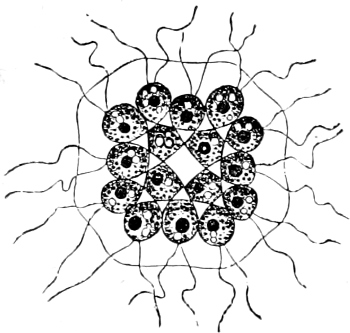
Fig. 44.—Gonium pectorale.
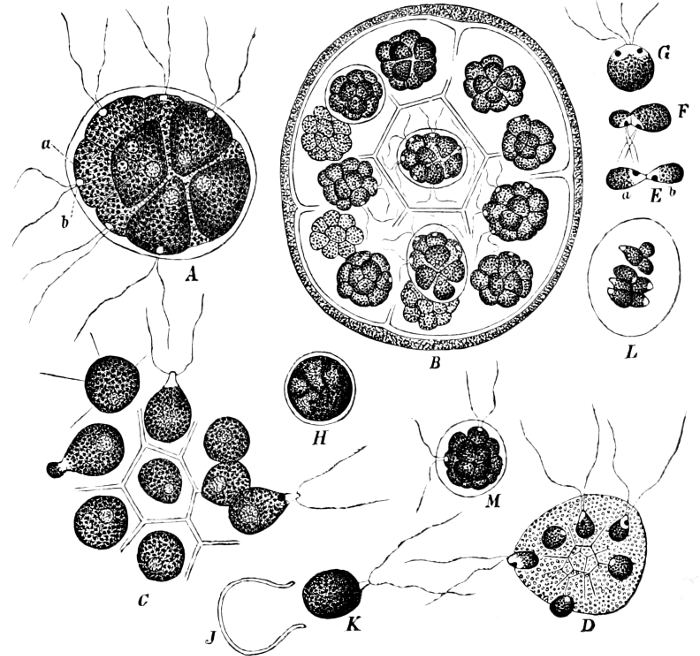
Fig. 45.—Pandorina morum.
B. Multicellular Individuals. The most important genera
are Gonium, Stephanosphæra, Pandorina,
Eudorina, Volvox.—Gonium has 4 or 16
cells arranged in a definite pattern in a flat plate (Fig. 44).
Pandorina (Fig. 45), has 16 cells arranged in a sphere (Fig. 45
A). The vegetative reproduction takes place in this way: each
cell, after having rounded off, and after the withdrawal of the cilia,
divides itself into 16 new ones (Fig. 45 B), each forming a
new individual, which soon grows to the size of the mother-individual.
It was in this Alga that the conjugation of self-motile gametes was
first discovered by Pringsheim, 1869. When conjugation is about to take
place, each cell divides into sixteen, as in vegetative reproduction,
but the 16 × 16 cells all separate from one another (Fig. 45 C,
female gametes, and D, male gametes), and swarm solitarily in
the water. The male are, most frequently, smaller than the female, but
otherwise they are exactly alike; they are more or less pear-shaped,
with a colourless anterior end, 2 cilia, a red “eye-spot,” etc. After
swarming for some time they approach each other, two and two, generally
a large and a smaller one, and come into contact at their colourless
end; in a few moments they coalesce and become one cell (Fig. 45
E, F), this has at first a large colourless anterior
end, 4 cilia, and 2 “eye-spots” (Fig. 45 G), but these soon
disappear and the cell becomes uniformly dark-green and spherical, and
surrounds itself with a thick cell-wall, losing at the same time its
power of motion: the zygote (Fig. 45 H) is formed, and becomes
later on a deep red colour. On the germination of the zygote, the
protoplasmic cell-contents burst open the wall (Fig. 45 J), and
emerge as a large swarmspore (Fig. 45 K) which divides into 16
cells, and the first small individual is formed (Fig. 45 L,
M).
Eudorina is like Pandorina in structure, but stands
somewhat higher, since the contrast between the conjugating sexual
cells is greater, the female one being a motionless oosphere.
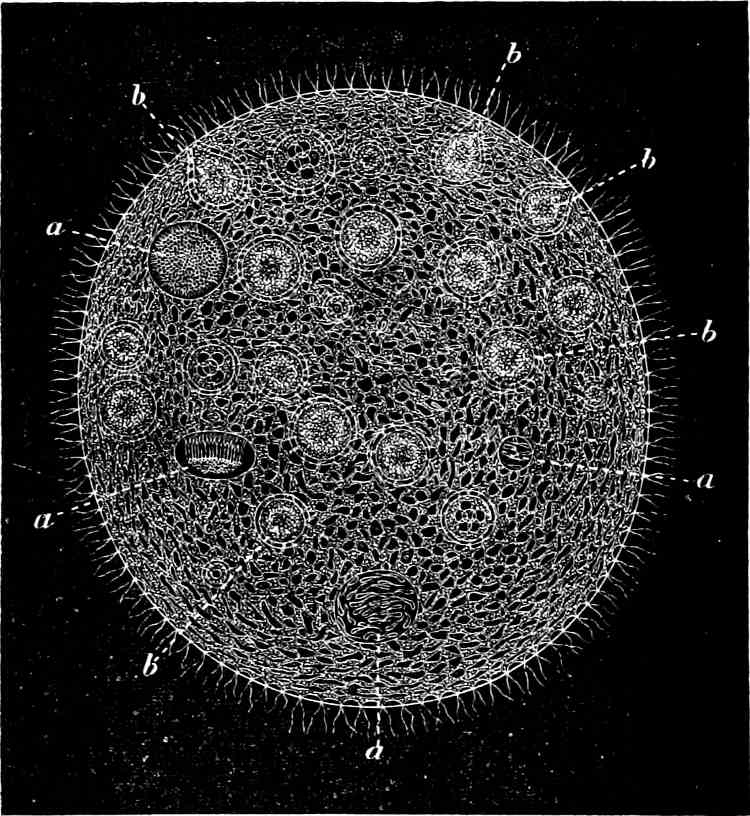
Fig. 46.—Volvox globator, sexual
individual: a antheridia which have formed spermatozoids;
b oogonia.
The highest stage of development is found in Volvox (Fig. 46).
The cells are here arranged on the circumference of a sphere, and
enclose a cavity filled with mucilage. The number of these cells may
vary from 200–22,000, of which the majority are vegetative and not
reproductive, but some become large, motionless oospheres (Fig. 46
b); others, which may appear as solitary individuals, divide
and form disc-shaped masses of from 8–256 small spermatozoids (Fig.
46 a). After the oosphere has been fertilised by these, the
oospore surrounds itself by a thick, sometimes thorny cell-wall, and
on germination becomes a new individual of few cells. A few cells
conspicuous by their larger size may be found (1–9, but generally 8)
in certain individuals, and these provide the vegetative reproduction,
each forming by division a new individual.
Order 2. Tetrasporaceæ reproduce both by vegetative
divisions and swarmspores, some have also gamete-conjugation.
The principal genera are: Tetraspora, Apiocystis,
Dactylococcus, Dictyosphærium, Chlorangium.
Order 3. Chlorosphæraceæ. Chlorosphæra.
Order 4. Pleurococcaceæ. In this order the swarm-stages and
sexual reproduction are entirely absent. Vegetative reproduction
by division. The principal genera are: Pleurococcus
(Fig. 47), Scenedesmus (Fig. 48), Raphidium,
Oocystis, Schizochlamys, Crucigenia,
Selenastrum.—Pleurococcus vulgaris (Fig. 47) is one of
the most common Algæ throughout the world, occurring as green coverings
on tree-stems, and damp walls, and it is one of the most common
lichen-gonidia.
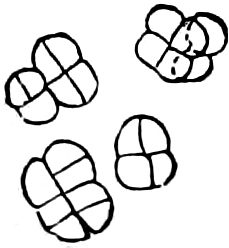
Fig. 47.—Pleurococcus vulgaris.
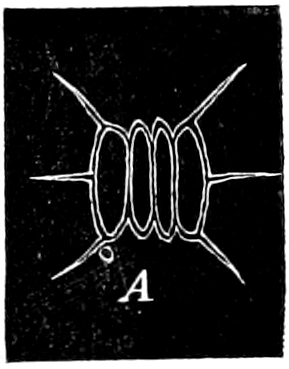
Fig. 48.—Scenedesmus quadricauda.
Order 5. Protococcaceæ. The cells are motionless, free or
affixed on a stalk (e.g. Characium, Fig. 49), either
separate or loosely bound to one another; they never form multicellular
individuals. Multiplication by division is nearly always wanting.
Reproduction takes place by swarmspores, which have 1 or 2 cilia, and
sexual reproduction in some by gamete-conjugation. The principal genera
are: Chlorococcum, Chlorochytrium, Chlorocystis,
Scotinosphæra, Endosphæra, Phyllobium,
Characium, Ophiocytium, Sciadium.
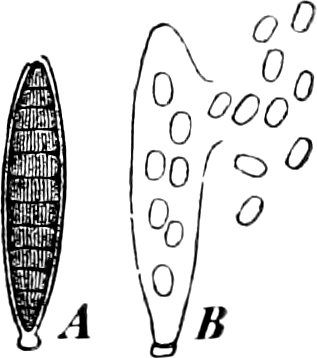
Fig. 49.—Characium strictum. A
The cell-contents have divided into many swarmspores. B
Swarmspores escaping.
Order 6. Hydrodictyaceæ. The individuals are unicellular but
several unite after the zoospore-stage into definitely formed families
(cœnobia). Ordinary vegetative division is wanting, but asexual
reproduction takes place by zoospores (or by motionless cells without
cilia), which unite and form a family similar to the mother-family,
inside the mother-cell, or in a mucilaginous envelope. Where sexual
reproduction is found it takes place by gamete-conjugation. The
principal genera are: Pediastrum (Fig. 50), Cœlastrum,
Hydrodictyon (Fig. 51).
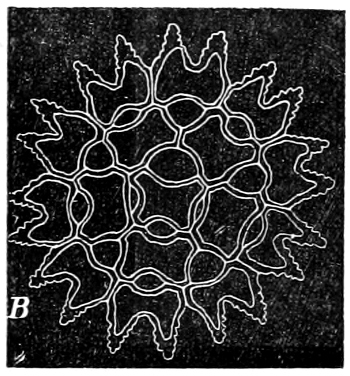
Fig. 5O.—Pediastrum asperum.
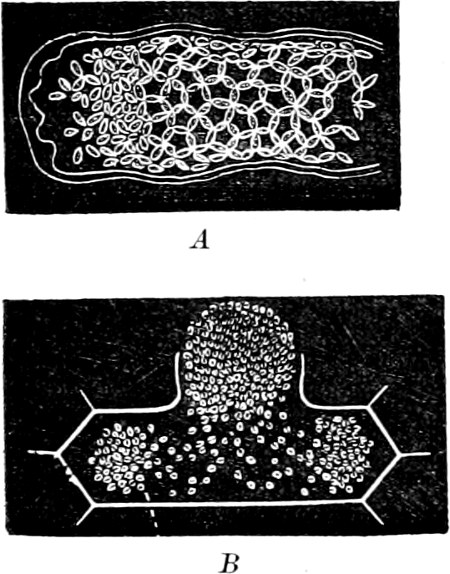
Fig. 51.—Hydrodictyou reticulatum.
A A cell where the zoospores are on the point of arranging
themselves to form a net. B A cell with gametes swarming out.
The cœnobium of Hydrodictyon reticulatum (Water-net) is formed
of a large number of cells which are cylindrical, and attached to one
another by the ends (Fig. 51). The asexual reproduction takes place by
zoospores, which are formed in large numbers (7,000–20,000) in each
mother-cell, within which they move about for a time, and then come to
rest and arrange themselves into a new net (Fig. 51 A) which
is set free by the dissolution of the wall of the mother-cell, grows,
and becomes a new cœnobium. The sexual reproduction takes place by
gamete-conjugation. The gametes are formed in the same manner as the
zoospores, but in larger numbers (30,000–100,000), and swarm out of
the mother-cell (Fig. 51 B). The zygote forms, on germination,
2–5 large zoospores, each with one or two cilia, these generally
swarm about for a time, and after a period of rest become irregular
thorny bodies (polyhedra); their contents again divide into zoospores,
the thorny external coating of the polyhedra is cast off, and the
zoospores, surrounded by the dilated internal coating, unite to form a
small family, which produces several others in the manner described.
The individuals are always multicellular, the cells firmly bound
together and united into unbranched or branched filaments, expansions,
or masses of cells which grow by intercallary divisions or have
apical growth. In the first seven orders the cells are uninuclear,
but the cells of the remaining three orders contain several nuclei.
Asexual reproduction by zoospores, akinetes or aplanospores. Sexual
reproduction by isogamous or oogamous fertilisation.
The Confervoideæ, through the Ulvaceæ, are connected with the
Tetrasporaceæ, and from the Coleochætaceæ, which is
the most highly developed order, there are the best reasons
for supposing that the Mosses have taken their origin.
The Cladophoraceæ show the nearest approach to the
Siphoneæ.
Order 1. Ulvaceæ. The thallus consists of one or two layers
of parenchymatous cells, connected together to form either a
flat membrane (Monostroma, Ulva) or a hollow tube
(Enteromorpha), and may be either simple, lobed, or branched.
Reproduction takes place by detached portions of the thallus; or
asexually by zoospores or akinetes. Gamete-conjugation is known to take
place in some members of this order, the zygote germinating without any
resting-stage. The majority are found in salt or brackish water.
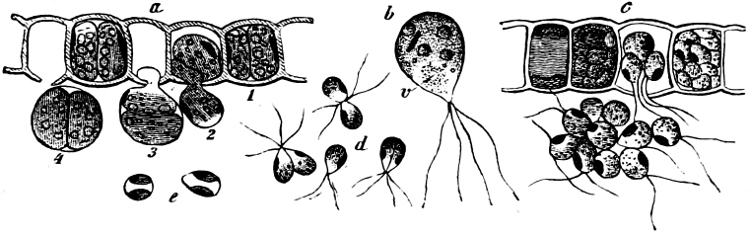
Fig. 52.—Ulothrix zonata: a portion
of a filament with zoospores, which are formed two in each cell
(zoosporangium); the dark spots are the red “eye-spots”; 1, 2, 3, 4,
denote successive stages in the development of the zoospores; b
a single zoospore, v the pulsating vacuole; c portion
of a filament with gametes, sixteen are produced in each gametangium;
d free gametes, solitary or in the act of conjugation; e
the conjugation is completed, and the formed zygote has assumed the
resting-stage.
Order 2. Ulothricaceæ. The thallus consists normally of a simple
unbranched filament (sometimes a small expansion consisting of one
layer of cells is formed, as in Schizomeris and Prasiola
which were formerly described as separate genera). Asexual reproduction
takes place by means of zoospores (with 1, 2, or 4 cilia), akinetes or
aplanospores; the last named may germinate immediately, or only after
a period of rest. Sexual reproduction takes place by the conjugation
of gametes of about the same size, each having two cilia (Fig. 52
d). The zygote of Ulothrix, on germination, produces a
brood of zoospores which swarm for a time and then elongate to become
Ulothrix-filaments (alternation of generations). The gametes
may also germinate without conjugation in the same manner as the
zoospores. The principal genera are: Ulothrix, Hormidium,
Conferva, Microspora.—Ulothrix zonata is
very common in running fresh water. Nearly all the species of
Hormidium occur on damp soil, tree-stems and stones.
Order 3. Chætophoraceæ. The thallus consists of a single,
branched, erect or creeping filament of cells, often surrounded by
mucilage. The cells have only one nucleus. Asexual reproduction
by zoospores with 2 or 4 cilia, by akinetes, or aplanospores. In
many, conjugation between gametes with 2 cilia may be found. They
approach on one side, Ulothricaceæ, and on the other, Mycoideaceæ.
The principal genera are: Stigeoclonium, Draparnaldia,
Chætophora, Entoderma, Aphanochæte,
Herposteiron, Phæothamnion, Chlorotylium,
Trichophilus, Gongrosira, Trentepohlia. Most of
the species of Trentepohlia are coloured red by the presence of
a red colouring material, which occurs in addition to the chlorophyll.
They are aerial Algæ which live on stones (T. jolithus, “violet
stone,” so named on account of its violet-like odour in rainy weather),
on bark and old wood (T. umbrina), or on damp rocks (T.
aurea). Trichophilus welckeri lives in the hair of Bradypus.
Order 4. Mycoideaceæ. The thallus is discoid, consisting
of one or more cell-layers, and is always attached. Asexual
reproduction by zoospores with 2 or 4 cilia. Sexual reproduction
in some species by the conjugation of gametes with 2 cilia. This
order forms the connecting link between Chætophoraceæ
and Coleochætaceæ. The species occur in fresh water
(Chætopeltis) as well as in salt (Pringsheimia),
on the carapace of tortoises (Dermatophyton =
Epiclemmydia), or endophytic between the cuticle and the
epidermal cells of the leaves of tropical plants, destroying the
leaf-tissue (Mycoidea).
Order 5. Cylindrocapsaceæ. The thallus consists of a simple
(rarely, in parts, formed of many rows) unbranched filament, attached
in the young condition, which has short cells with a single nucleus,
and is enveloped in a thick envelope with a laminated structure.
Asexual reproduction by zoospores with 2 cilia, which are formed 1,
2, or 4 in each vegetative cell. The antheridia are produced by a
single cell, or a group of cells, in a filament, dividing several times
without increasing in size. Two egg-shaped spermatozoids, each with 2
cilia (Fig. 53 D), are formed in each antheridium, and escape
through an aperture in the side; in the first stages they are enclosed
in a bladder-like membrane (Fig. 53 B, C). Other cells
of the filament swell out and form oogonia (Fig. 53 A), which
resemble those of Œdogonium. After fertilisation, the oospore
surrounds itself with a thick wall, and assumes a reddish colour. The
germination is unknown. The unfertilised oospheres remain green, divide
often into 2–4 daughter-cells, and grow into new filaments.
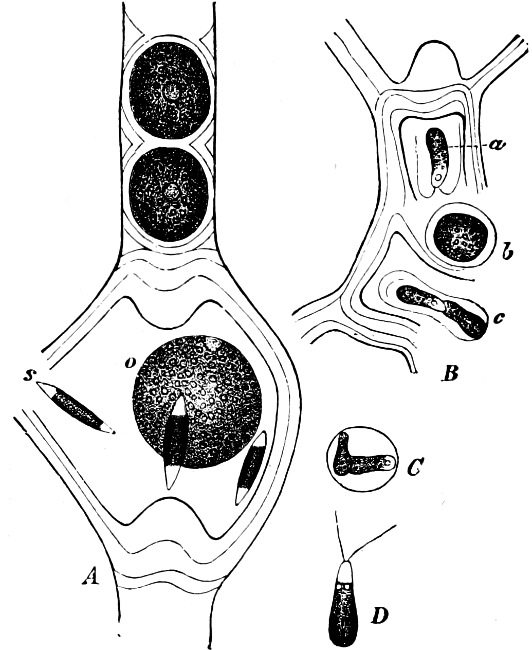
Fig. 53.—Cylindrocopsa involuta.
A Oogonium with oosphere (o) surrounded by spermatozoids
(s). B Two antheridia, each with two spermatozoids.
C Spermatozoids surrounded by their bladder-like membrane.
D Free spermatozoid.
This order, which only includes one genus, Cylindrocapsa, forms
the connecting link between Ulothricaceæ and Œdogoniaceæ.
The few species (4) occur only in fresh water.
Order 6. Œdogoniaceæ. The thallus consists of branched
(Bulbochæte) or unbranched (Œdogonium) filaments,
attached in the early stages. The cells may be longer or shorter,
and have one nucleus. Asexual reproduction by zoospores, which have
a chaplet of cilia round the base of the colourless end (Fig. 6
a). Sexual reproduction takes place by oogamous fertilisation.
On the germination of the oospore, 4 zoospores are formed (Fig. 54
F). They occur only in fresh or slightly brackish water. The
division of the cells takes place in quite a peculiar and unusual
manner. At the upper end of the cell which is about to divide, a
ring-shaped thickening of soft cellulose is formed transversely round
the wall; the cell-nucleus of the mother-cell and the protoplasm then
divide by a transverse wall into two portions of similar size, and the
cell-wall bursts transversely along the central line of the thickened
ring. The cell-wall thus divides into two parts—the upper one short,
the “cap,” and the lower one much longer, the “sheath.” The portions
of the original cell-wall now separate from each other, the cellulose
ring extending, and supplying an additional length of cell-wall between
them. The cap and sheath will project a little in front of the piece
thus inserted. The dividing wall between the two new cells is formed
near to the uppermost edge of the sheath, and gradually becomes thicker
and firmer. The inserted piece of wall forms the larger part of the
wall of the upper cell: the remainder is formed by the cap. This mode
of division is repeated exactly in the same way, and new caps are
formed close below the first one, one for every division.

Fig. 54.—A Œdogonium ciliatum.
A Female plant with three oogonia (og) and dwarf-males
(m). B An oogonium with spermatozoid (z) seen
entering the oosphere (o) having passed through an aperture
near the summit of the oogonium; m dwarf-male. C Ripe
oospore. D Œdogonium gemelliparum. F Portion of
a male filament from which spermatozoids (z) are emerging.
E Portion of filament of Bulbochæte; the upper oogonium
still encloses the oospore, in the central one the oospore is escaping
while the lower one is empty. F Four zoospores developed from an
oospore. G Zoospore germinating.
Fertilisation takes place in the following way. The oogonium is a
large ellipsoidal, swollen cell (og, in Fig. 54 A),
whose contents are rounded off into an oosphere with a colourless
receptive-spot (see B); an aperture is formed in the wall of
the oogonium, through which the spermatozoids are enabled to enter
(B). The spermatozoids are produced either directly, as in
D (in pairs), in basal cells of the filament, or indirectly.
In the latter case a swarmspore (androspore) is formed which
comes to rest, attaches itself to an oogonium, germinates, and gives
rise to a filament of a very few cells—dwarf-male (A,
B, m). The spermatozoids are formed in the upper cell
of the dwarf-male (m), and are set free by the summit of the
antheridium lifting off like a lid. On the germination of the oospore
(C), which takes place in the following spring, 4 zoospores are
produced (F) (i.e. the sexual generation); these swarm
about for a time, and ultimately grow into new filaments.
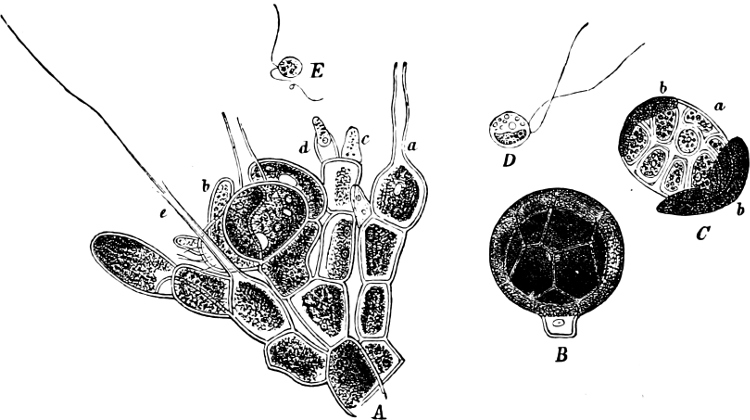
Fig. 55.—Coleochæte pulvinata. A
A portion of a thallus with organs of reproduction; a oogonium
before, b after fertilisation; c an antheridium, closed;
d open, with emerging spermatozoid. B Ripe oogonium,
with envelope. C Germination of the oospore. D Zoospore.
E Spermatozoid.
Order 7. Coleochætaceæ. The thallus is always attached, and of a
disc- or cushion-shape, formed by the dichotomous branching of filaments
of cells united in a pseudo-parenchymatous manner. Each cell has only
one nucleus. Asexual reproduction by zoospores with 2 cilia (Fig. 55
D), which may arise in all the cells. Sexual reproduction by
oogamous fertilisation. The spermatozoids resemble the swarmspores,
but are smaller (E), and originate singly (in the species
figured) in small conical cells (c, d in A). The
oogonia are developed at the extremities of certain branches: they are
bottle-shaped cells with very long and thin necks (trichogyne),
open at the end (a in A); at the base of each oogonium
is a spherical oosphere. The spermatozoids reach the oosphere through
the trichogyne, or through an aperture in the wall when the trichogyne
is absent, and fertilisation having taken place, the oogonium becomes
surrounded by a cell-layer (envelope), which grows out from the cells
near its base (b in A), and in this way a kind of fruit
is formed (B) (spermocarp, cystocarp).
The oospore, next spring, divides and forms a parenchymatous
tissue (homologous with the Moss-sporophyte); this bursts open the
envelope (C), and a zoospore (homologous with the spores of
the Moss-capsule) arises in each of the cells, and produces a new
Coleochæte. We have then, in this case, a still more distinct
alternation of generations than in Œdogonium. Only one genus,
Coleochæte, is known, but it contains several species, all
living in fresh water.
Order 8. Cladophoraceæ. This order is probably derived from
the Ulothricaceæ. The thallus consists of a single, unbranched or
branched filament, generally with an apical cell. The cells have each
2 or more nuclei. Asexual reproduction by zoospores with 2 or 4 cilia,
and by akinetes. Conjugation of gametes with 2 cilia is found in some
genera. They occur in salt as well as in fresh water. The principal
genera are: Urospora, Chætomorpha, Rhizoclonium,
Cladophora; of the last named genus the species C. lanosa
and C. rupestris are common in salt water; C. fracta and
C. glomerata in fresh water.
Order 9. Gomontiaceæ. Gomontia polyrrhiza, the
only species hitherto known, is found on old calcareous shells
of certain salt water Molluscs.
Order 10. Sphæropleaceæ. The thallus consists of free,
unbranched filaments, with very elongated multinuclear cells. The
vegetative cells form no zoospores. Sexual reproduction by oogamous
fertilisation (see page 13, Fig. 10 B). The oospore has a thick
wall (Fig. 10 D) studded with warts, and assumes a colour
resembling red lead. It germinates only in the following spring, and
produces 1–8 zoospores, each with 2 cilia (Fig. 10 E), which
grow into new filaments. Only one species, Sphæroplea annulina,
is known.
The thallus has apical growth, and in the vegetative condition
consists generally of one single (in the Valoniaceæ most frequently
of more) multinuclear cell, which may be much branched, and whose
separate parts in the higher forms (e.g. Bryopsis,
Fig. 57; Caulerpa, Fig. 59, etc.) may be differentiated to
perform the various physiological functions (as root, stem and leaf).
Vegetative multiplication by detached portions of the thallus (gemmæ);
asexual reproduction by zoospores, akinetes, or aplanospores. Sexual
reproduction by gamete-conjugation, rarely by oogamous fertilisation.
The zygote or oospore germinates as a rule without any resting-stage.
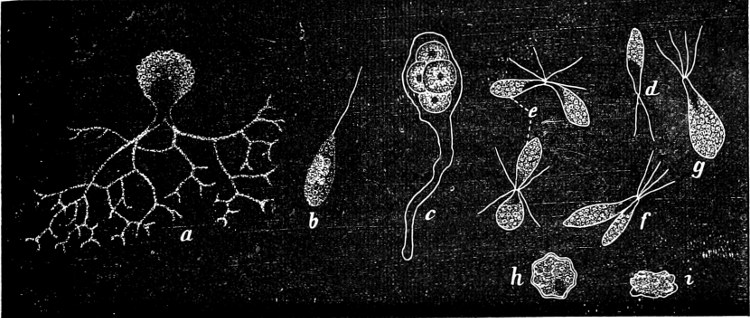
Fig. 56.—Botrydium granulatum: a
an entire plant forming swarmspores; b swamspores; c
an individual with gametangia; d, gamete; e, f,
g conjugation; h zygote seen from above; i the
same in a lateral view.
Most of the Siphoneæ occur in salt water or on damp soil. Many
(e.g. Dasycladaceæ) are very much incrusted with lime,
and occur, in the fossilized condition, in the deposits from the
Cretaceous period to the present time. The Siphoneæ are connected
by their lowest forms (Botrydiaceæ or Valonia) with
the Protococcaceæ, but show also, through the Valoniaceæ, points of
relationship to the Cladophoraceæ.
Order 1. Botrydiaceæ. The thallus in the vegetative condition
is unicellular, club-shaped, with a small single (Codiolum)
or repeatedly dichotomously branched system of colourless rhizoids
(Botrydium, Fig. 56 a), by which it is attached to
objects immersed in salt water (Codiolum) or to damp clay
soil (Botrydium). Asexual reproduction by zoospores with one
(Botrydium) or two cilia, and by aplanospores. The sexual
reproduction is only known in Botrydium, and takes place in the
following manner: in the part of the thallus which is above ground
and in an active vegetative condition, several round cells (Fig. 56
c) are formed, which may be green or red according as they
grow under water, or exposed to the strong light of the sun. These
cells must be considered as “gametangia” as they produce many gametes
(d) provided with two cilia. The zygote (h, i)
formed by the conjugation (e, f, g) may either
germinate immediately, or become a thick-walled resting-cell of an
irregular, angular form.
Order 2. Bryopsidaceæ. The thallus in the vegetative
condition is unicellular, and consists at the lower extremity of
branched rhizoids, while the upper portion is prolonged into a
stem-like structure of unlimited growth, producing, acropetally,
branches and leaf-like structures. The latter have limited
growth, and are separated by a cross wall from the stem, and
become gametangia, or drop off. The gametes have two cilia, and
are of two kinds: the female, which are green and large and the
male, which are of brownish colour and smaller. Zoospores or
any other method of asexual reproduction are unknown. Only one
genus, Bryopsis, living in salt water.
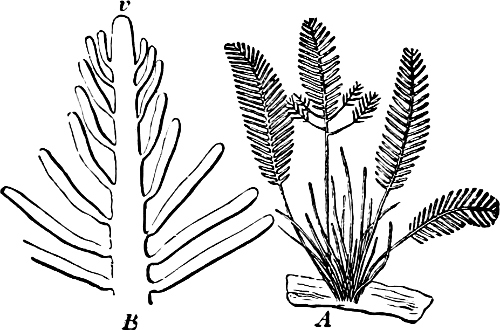
Fig. 57.—Bryopsis plumosa. A the plant,
natural size. B A portion (enlarged) which shows the growing point (v),
and the leaves derived from it in acropetal succession.
Order 3. Derbesiaceæ. Only one genus, Derbesia,
living in saltwater. The zoospores, which are formed in a few
lateral, swollen zoosporangia, possess one nucleus which has
arisen through the coalescence of several, and they resemble
the zoospores of Œdogonium by having a circle of cilia
attached at the base of the colourless spot.
Order 4. Vaucheriaceæ. The thallus consists, in the vegetative
condition, of a single irregularly or dichotomously branched cell,
without differentiation into stem or leaf; root-like organs of
attachment may however occur. Asexual reproduction by zoospores, which
are formed singly in the extremity of a branch cut off by a transverse
wall. They contain many nuclei, and bear small cilia situated in pairs,
which give the appearance of a fine “pile” covering the whole or a
great part of the surface. Akinetes, aplanospores, and phytoamœbæ
(naked masses of protoplasm, without cilia, which creep like an amœba
on a substratum) may occur under certain conditions.
The sexual reproductive organs are formed on short lateral branches,
and are separated from the vegetative cell (Fig. 58 A) by
cell-walls. Numerous spermatozoids, each with two cilia, are developed
in the coiled antheridium (A, b). The oogonium is a
thick, egg-shaped, often oblique cell, with its protoplasm rounded into
an oosphere, which has a hyaline “receptive-spot” (A, a)
immediately beneath the aperture formed in the wall of the oogonium.
A slimy mass, which serves to receive the spermatozoids, is formed
in some species in this aperture. The spermatozoids when liberated
swim towards and enter the oosphere, which then immediately surrounds
itself with a thick cell-wall. The mature oospore (B) contains
a large quantity of oil. At germination the outer cell-wall bursts and
a new plant is formed. There is only one genus, Vaucheria, with
species living in salt as well as in fresh water and on damp soil.
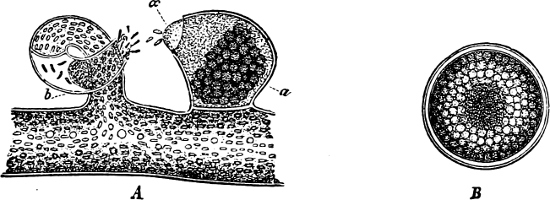
Fig. 58.—Vaucheria sessilis. A
Fertilisation; b the antheridia; a the oogonia; a
the receptive spot. B Oospore.
Order 5. Phyllosiphonaceæ are parasites in the leaves and
stalks of Flowering-plants.
Order 6. Caulerpaceæ. The thallus has distinct differentiation
into root, stem and leaf-like members (Fig. 59); it is unicellular.
Within the cell, strong, branched threads of cellulose extend from one
side to the other serving as stays to support the thallus. Reproduction
takes place by detached portions of the thallus; no other modes of
reproduction are known. This order may most approximately be classed
with the Bryopsidaceæ. The genus Caulerpa consists of
more than seventy species which inhabit the tropical seas.
Order 7. Codiaceæ. The thallus has various forms, but without
distinct differentiation in stem- or leaf-structures, sometimes
(e.g. Halimeda) it is very much incrusted with lime.
In the early stages it is unicellular (later, often multicellular),
very much branched, with the branches, at any rate partly, so
united or grown in amongst one another (Fig. 60) that an apparently
parenchymatous cellular body is formed. Akinetes or aplanospores are
wanting; zoospores (or gametes?) may be developed in some species,
however, in special swollen sporangia. Fertilisation similar to that
in Bryopsis occurs perhaps in Codium. They are all salt
water forms.
Order 8. Valoniaceæ. The thallus is generally
multicellular, without differentation into stem- or
leaf-structures, but the cells are sometimes united together
and form a leaf-like reticulate expansion (e.g.
Anadyomene). Zoospores are known in some, and they
are then formed directly in the vegetative cells. In others
(e.g. Valonia), a mass of protoplasm, which
maybe separated through the damaging of a cell, can surround
itself with a cell-wall, and grow into a new plant. No other
modes of reproduction are known. The most important genera
are: Valonia, Siphonocladus, Chamædoris,
Struvea, Microdictyon, Anadyomene. They are
all salt water forms.
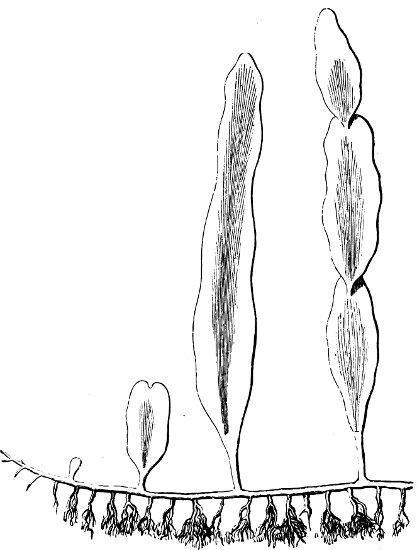
Fig. 59.—Caulerpa prolifera (natural size).
As already pointed out, the Valoniaceæ occupy a
somewhat central position among the Siphoneæ, and present
points of similarity and contrast with the Botrydiaceæ
and the Bryopsidaceæ through Valonia, with the
Dasycladaceæ through Chamædoris, and also with
the Cladophoraceæ through Siphonocladus, and
Struvea.
Order 9. Dasycladaceæ. The thallus consists of an axile
longitudinal cell, destitute of transverse walls, attached at the base
by root-like organs of attachment, and producing acropetally whorls of
united, single or branched, leaf-like structures with limited growth.
Asexual reproduction is wanting. Sexual reproduction by conjugation
of gametes which arise in separate, fertile leaves, either directly
or from aplanospores, which develope into gametangia. The principal
genera are: Acetabularia, Dasycladus, Neomeris,
Cymopolia. All marine.
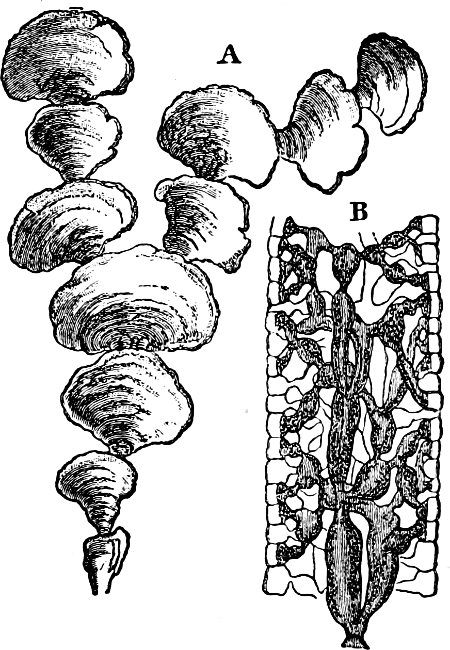
Fig. 60.—Halimeda opuntia. Plant
(natural size). B Part of a longitudinal section.
The curiously shaped Acetabularia mediterranea grows
gregariously on limestone rocks, and shells of mussels in the
Mediterranean; it resembles a minute umbrella with a small stem,
sometimes as much as nine centimetres in height, and a shade which
may be more than one centimetre in diameter. The cell-membrane is
thick, and incrusted with carbonate and oxalate of lime. Only the
lower, root-like part of the thallus, which penetrates the calcareous
substratum survives the winter, and may grow up into a new plant. The
sterile leaves, which drop off early, are dichotomously branched and
formed of cylindrical cells separated from each other by cross-walls,
but they are not grown together. The shade is formed by a circle of
70–100 club-shaped rays (fertile leaves) grown together, in each
ray 40–80 aplanospores are formed, which become liberated at the
breaking of the shade, and later on are changed to gametangia (compare
Botrydium) which open by a lid and allow a large number of
egg-shaped gametes with two cilia to escape. Gametes from various
gametangia conjugate with one another; the product of the conjugation
swarms about for some time, rounds off, and then surrounds itself with
a cell-wall. The zygote germinates after a period of rest and then
produces a sexual plant. The aplanospores (gametangia) thus represent
the sexual generation.
The thallus has a stem with nodes and internodes; and whorls of leaves,
on which may be developed the antheridia and oogonia, are borne at
the nodes. Vegetative reproduction by bulbils and accessory shoots.
Zoospores are wanting. The antheridia are spherical, and contain a
number of filaments in which the spirally coiled spermatozoids, each
with two cilia, are formed. The oogonium is situated terminally, and
is at first naked, but becomes later on surrounded by an investment,
and forms after fertilisation the so-called “fruit.” The oospore, after
a period of rest, germinates by producing a “proembryo,” from which
the young sexual plant arises as a lateral branch. The Characeæ are
distinguished by the structure of their vegetative system as well as by
the spirally-coiled spermatozoids, and stand as an isolated group among
the Thallophytes, of which, however, the Siphoneæ appear to be their
nearest relations. They were formerly, but wrongly, placed near the
Mosses. The class contains only one order, the Characeæ.
Order 1. Characeæ. Algæ with a peculiar odour, often incrusted
with lime, and of a brittle nature. They generally grow gregariously
in large masses at the bottom of fresh and brackish water, and are
from a few inches to more than a foot in height. The stem has long
internodes which in Nitella are formed of one cylindrical cell;
in Chara of a similar cell, but closely surrounded by a cortical
layer of smaller ones. The protoplasm in contact with the cell-wall
exhibits in a well-marked degree the movement of rotation (cyclosis),
carrying the chlorophyll corpuscles along with it. The internodes are
separated from each other by a layer of small cells (nodal cells)
from which the leaves are produced. The leaves are borne in whorls of
from 5–12 which regularly alternate with one another as in the higher
verticillate plants; a branch is borne in the axil of the first formed
leaf of each whorl (Fig. 61 A, n).
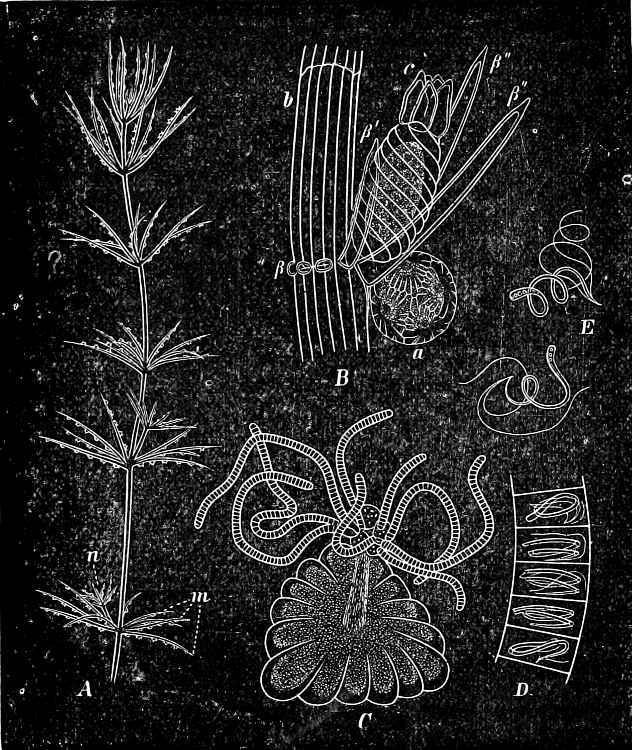
Fig. 61.—Chara fragilis. A
Portion of a plant, natural size. B Portion of a leaf b,
with leaflets β′-β′′; a antheridium; c oogonium. C
A shield.—Nitella flexilis. D Filament from antheridium
with spermatozoids. E Free spermatozoids.
The leaves are constructed in the same manner as the stem; they are
divided into a series of joints, but have only a limited power of
growth; their terminal cell, too, is not enclosed by a cortex. Leaflets
are borne at their nodes. The growth of the stem is unlimited, and
proceeds by means of an apical cell (Fig. 62 s). The apical cell
divides into a segment-cell and a new apical cell. The segment-cell
then divides by a transverse wall into two cells, one lying above the
other; the lower one, without any further division, becomes one of the
long, cylindrical, internodal cells (Fig. 62 in), and the upper
one (Fig. 62 n) divides by vertical walls to form the nodal
cells. The cortical cells (Fig. 62 r) which surround the long
internodal cells of Chara, are derived from the divisions of the
nodal cells; the cells covering the upper portion of an internodal cell
being derived from the node immediately above it, and those in the
lower part of the internode from the node below it.
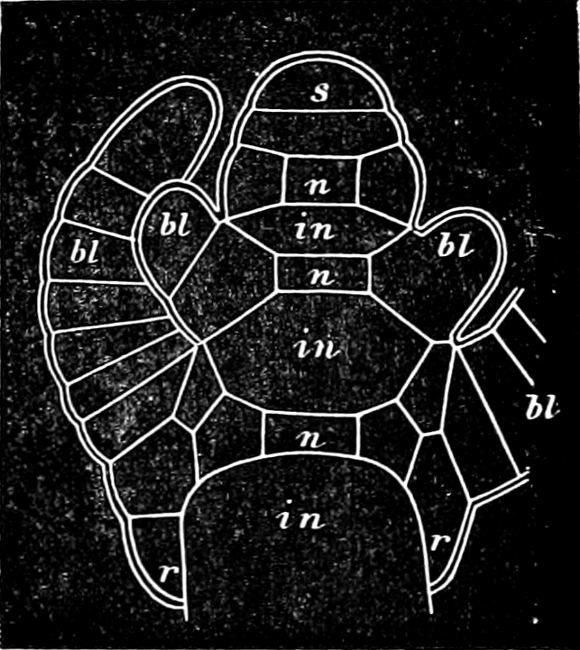
Fig. 62.—Chara fragilis: s
apical cell; n, n nodal cells; in internodal
cells; bl, bl leaves; r, r the cortical
cells.
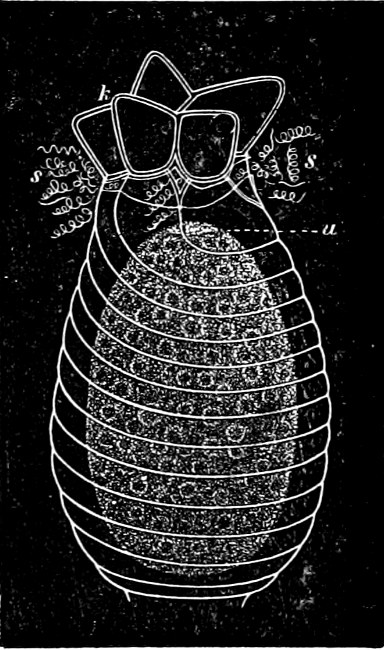
Fig. 63.—Oogonium of Chara: k
“crown”; u receptive spot; s spermatozoids.
The organs of reproduction are very conspicuous by their colour and
form. They are always situated on the leaves, the plants being very
frequently monœcious. The antheridia (Fig. 61 B, a) are
modified leaflets or the terminal cell of a leaf; they are spherical
and become red when mature. Their wall consists of 8 “shields,”
i.e. of plate-like cells, 4 of which cover the upper half, and
are triangular; the 4 round the lower half, to which the stalk of the
antheridia is attached, being quadrilateral, with sides of unequal
length. The shields (Fig. 61 C) have dentated edges, with the
teeth fitting into one another, and their faces ornamented with ridges.
From the centre of the internal face of each shield (C) a
cylindrical cell, the manubrium, projects nearly as far as the
centre of the antheridium; at the inner end of each of the manubria a
spherical cell, the capitulum, is situated. Each capitulum bears
six secondary capitula, from each of which four long coiled filaments
(C, D) project into the cavity of the antheridium. These
filaments are divided by transverse walls into from 100–200 discoid
cells, in each of which a biciliated, coiled spermatozoid is developed
(D, E) from the nucleus. The spermatozoids escape from
their mother-cell and are set free by the shields separating from one
other.
The female organ of reproduction (Fig. 61 B, 63) is a small
modified shoot, whose apical cell functions as an oogonium, its
protoplasm forming the oosphere, which has a colourless receptive-spot
at the summit (Fig. 63 u). The oogonium is situated on a nodal
cell, from which 5 cells grow out in a circle and coil round the
oogonium, covering it with a close investment. These cells divide
once or twice at the top, so that 5 or 10 small cells are cut off,
which project above the oogonium and form the so-called “crown”
(Fig. 63 k). The crown either drops off at fertilisation, or
its cells separate to form a central canal for the passage of the
spermatozoids. The wall of the oosphere[9] above the receptive spot
becomes mucilaginous, and allows the spermatozoid to fuse with the
oosphere. The oospore, on germination (Fig. 64 sp), becomes a
small filamentous plant of limited growth (Fig. 64 i, d,
q, pl)—the proembryo—and from this, as a lateral
outgrowth, the sexual generation is produced.
The order is divided into two sub-orders:—
A. Nitelleæ. The crown consists of 10 cells; cortex absent:
Nitella, Tolypella.
B. Chareæ. The crown consists of 5 cells; cortex present:
Tolypellopsis, Lamprothamnus, Lychnothamnus,
Chara.
Chara crinita is parthenogenetic; in large districts of Europe
only female plants are found, yet oospheres are formed capable of
germination.
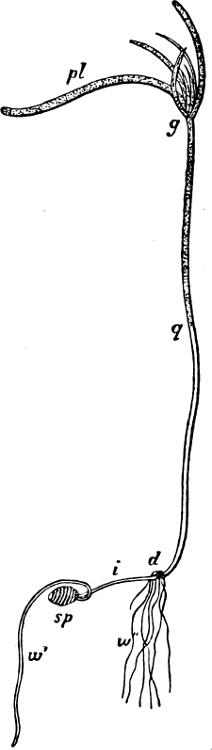
Fig. 64.—Chara fragilis. Germinating
oospore (sp); i, d, g, pl, form
together the proembryo rhizoids (w′) are formed at d;
w′ the so-called tap-root; at g are the first leaves of
the sexual plant, which appears as a lateral bud.
About 40 species of fossilized Chara, determined by their
carpogonia, are known in the geological formations from the Trias up to
the present day.
The Phæophyceæ are Algæ, with chromatophores in which the chlorophyll
is masked by a brown colour (phycophæin). The product of assimilation
is a carbohydrate (fucosan), never true starch. In the highest
forms (Fucaceæ), the thallus presents differentiation into
stem, leaf, and root-like structures. The asexual reproduction takes
place by means of zoospores. The sexual reproduction is effected by
the coalescence of motile gametes, or by oogamous fertilisation. The
swarm-cells are monosymmetric, each moved by two cilia which are
true protoplasmic structures, and generally attached laterally
(Fig. 65). The Phæophyceæ are almost entirely saltwater forms; a few
species of Lithoderma live in fresh water.
The class is divided into two families:—
1. Phæosporeæ: 1 Sub-Family, Zoogonicæ; 2 Sub-Family, Acinetæ.
2. Cyclosporeæ: Fucaceæ.
The family consists of multicellular plants, whose cells are firmly
united together to form a thallus; this, in the simplest cases, may be
a branched filament of cells (Ectocarpus), or, in the highest,
may resemble a stem with leaves (Laminariaceæ), while all
transitional forms may be found between these two. The thallus grows by
intercalary divisions (e.g. Ectocarpus), or by an apical
cell (e.g. Sphacelaria); pseudo-parenchymatous tissue may
sometimes be formed by cells, which were originally distinct, becoming
united together. The size of the thallus varies; in some species it is
quite small—almost microscopical,—while in the largest it is many
metres in length.
The vegetative cells in the lower forms are nearly uniform, but
in those which are more highly developed (Laminariaceæ and
Fucaceæ), they are sometimes so highly differentiated that
mechanical, assimilating, storing and conducting systems may be found;
the last named systems are formed of long cells with perforated,
transverse walls, which bear a strong resemblance to the sieve-tubes in
the higher plants.
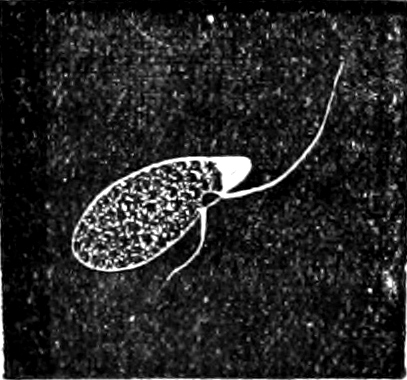
Fig. 65.—Swarmspore of Cutleria
multifida.
The colouring matter in the living cells (“phæophyl”) contains
chlorophyll; but this is concealed by a brown (“phycophæin”), and a
yellow (“phycoxanthin”) colouring material, and hence all these Algæ
are a lighter or darker yellow-brown. Starch is not formed.
Asexual reproduction takes place, (1) by zoospores which arise in
unilocular zoosporangia, and are monosymmetric, with two cilia attached
laterally at the base of the colourless anterior end (Fig. 65), the
longer one being directed forwards and the shorter backwards; or (2) by
aplanospores (?).
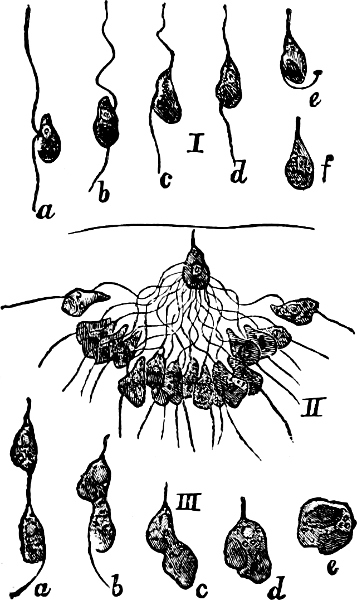
Fig. 66.—Ectocarpus siliculosus. I
a-f A female gamete in the various stages of coming to rest.
II A motionless female gamete surrounded by male gametes. III
a-e Stages in the coalescence of male and female gametes.
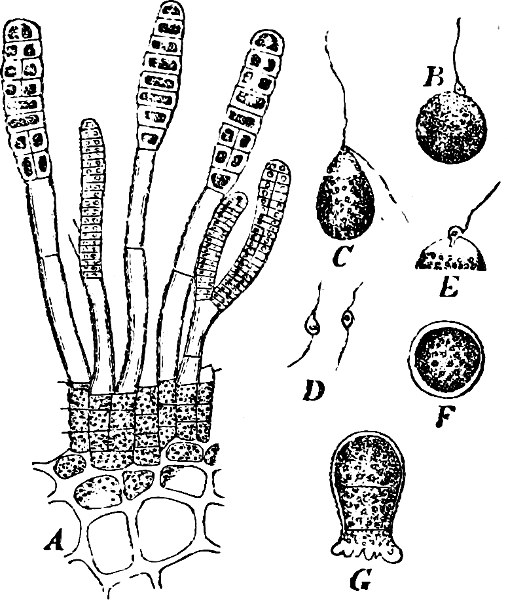
Fig. 67.—Zanardinia collaris. A
Male gametangia (the smaller celled) and female gametangia (the larger
celled). C Female gamete. D Male gamete. B,
E Fertilisation. F Zygote. G Germinating zygote.
Sexual reproduction has only been discovered in a few cases, and takes
place by means of gametes (oogamous fertilisation perhaps occurs in the
Tilopteridæ). The gametes have the same structure as the zoospores,
and arise in multilocular gametangia; these, like the zoosporangia,
are outgrowths from the external surface, or arise as modifications
from it. The conjugating gametes may be similar (e.g. Ectocarpus
pusillus), or there may be a more or less pronounced difference of
sex, an indication of which is found in Ectocarpus siliculosus
(Fig. 66). When the gametes in this species have swarmed for a time,
some, which are generally larger, are seen to attach themselves
by one of the cilia, which by degrees is shortened to form a kind
of stalk (compare the upper gamete in Fig. 66 II); these
are the female gametes, which now become surrounded by a number of
males endeavouring to conjugate with them, but only one succeeds in
effecting fertilisation. The protoplasm of the two gametes coalesces
(Fig. 66 III), and a zygote (e) is formed. The male
gametes which do not conjugate may germinate, but the plants derived
from them are much weaker than those produced by the zygotes. Strongly
pronounced sexual differences are found in the Cutleriaceæ, in which
order the male and female gametes arise in separate gametangia (Fig.
67 A). The male gametes (Fig. 67 D) are much smaller
than the female gamete (Fig. 67 C); the latter, after swarming
for a short time, withdraws the cilia, and is then ready to become
fertilised (Fig. 67 B, E), thus we have here a distinct
transition to the oogamous fertilisation which is found in the Fucaceæ.
Alternation of generations is rarely found.
1. Sub-Family. Zoogonicæ.
Reproduction by means of gametes and zoospores.
Order 1. Ectocarpaceæ. The thallus consists of single or
branched filaments with intercalary growth, extending vertically from a
horizontal, branched filament or a disc, but sometimes it is reduced to
this basal portion only. Zoosporangia and gametangia (for fertilisation
see Fig. 66) are either outgrowths or arise by the transformation of
one or several of the ordinary cells. The most common genera are:
Ectocarpus and Pylaiella.
Order 2. Choristocarpaceæ. Choristocarpus,
Discosporangium.
Order 3. Sphacelariaceæ. The thallus consists of small,
parenchymatous, more or less ramified shoots, presenting a feather-like
appearance. In the shoots, which grow by means of an apical cell (Fig.
68 S), a cortical layer, surrounding a row of central cells, is
present. Sporangia and gametangia are outgrowths from the main stem or
its branches. Sphacelaria, Chætopteris are common forms.
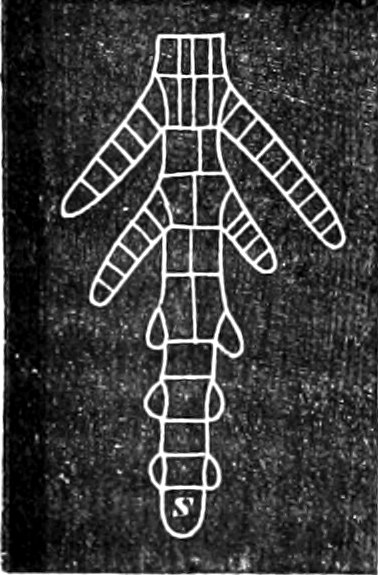
Fig. 68.—Apex of the thallus of Chætopteris
plumosa. S Apical cell.
Order 4. Encoeliaceæ. Punctaria,
Asperococcus, Phyllitis fascia.
Order 5. Striariaceæ. Striaria, Phlœospora.
Order 6. Dictyosiphonaceæ. Dictyosiphon.
Order 7. Desmarestiaceæ. Desmarestia aculeata is
common.
Order 8. Myriotrichiaceæ. Myriotrichia.
Order 9. Elachistaceæ. Elachista fucicola is a
common epiphyte on species of Fucus.
Order 10. Chordariaceæ. The shoot-systems are often
surrounded by mucilage. Chordaria; Leathesia
difformis occurs as rounded, brown-green masses of the size
of a nut, generally attached to other Seaweeds.
Order 11. Stilophoraceæ. Stilophora rhizodes is
common.
Order 12. Spermatochnaceæ. Spermatochnus paradoxus
is common.
Order 13. Sporochnaceæ. Sporochnus.
Order 14. Ralfsiaceæ. Ralfsia verrucosa is common
as a red-brown incrustation on stones and rocks at the water’s
edge.
Order 15. Lithodermataceæ. Some species of the genus
Lithoderma occur in fresh water.
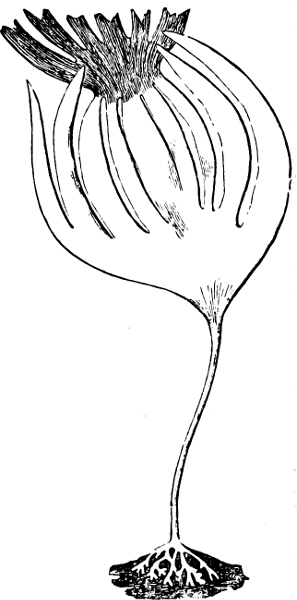
Fig. 69.—Laminaria digitata (much
reduced in size).
Order 16. Laminariaceæ. The thallus is more or less leathery,
and has generally a root-like lower part (Fig. 69) which serves to
attach it, and a stalk or stem-like part, terminated by a large
leaf-like expansion. Meristematic cells are situated at the base of
the leaf, and from these the new leaves are derived. The older leaf
thus pushed away by the intercalary formation of the younger ones, soon
withers (Fig. 69). Gametes are wanting. Zoosporangia are developed from
the lower part of a simple, few-celled sporangiophore, which is an
outgrowth from a surface-cell and has a large club-formed apical cell.
The sporangia are aggregated into closely packed sori, which cover
the lower part of the terminal leaf, or occur on special, smaller,
lateral, fertile fronds (Alaria). Most of the species belonging
to this order live in seas of moderate or cold temperature and occur
in the most northern regions that have yet been explored, forming
their organs of reproduction during the cold and darkness of the
arctic night. Laminaria is destitute of a midrib and has only
one terminal leaf. L. digitata has a broad leaf, which, by the
violence of the waves, is torn into a number of palmate strips (Fig.
69). L. saccharina has a small, undivided leaf. Alaria
has a midrib and special fertile fronds. A. esculenta occurs
plentifully on the west coast of Norway and on the shores of Great
Britain. Chorda filum, a common seaweed, is thick, unbranched,
and attains a length of several metres, without any strong demarcation
between stalk and leaf. Some attain quite a gigantic size, e.g.
Macrocystis pyrifera, whose thallus is said sometimes to be more
than 300 metres in length. The Lessonia-species, like the above,
form submarine forests of seaweed on the south and south-west coasts
of South America, the Cape, and other localities in the Southern
Hemisphere.
Uses. The large Laminarias, where they occur in great
numbers, are, like the Fuci, used for various purposes, for
example, in the production of iodine and soda, and as an article
of food (Laminaria saccharina, Alaria esculenta,
etc.). Laminaria saccharina contains a large quantity of
sugar (mannit) and is in some districts used in the preparation
of a kind of syrup; in surgical operations it is employed for
the distension of apertures and passages, as for instance the
ear-passage. It is by reason of the anatomical peculiarities
and structure of the cell-walls, that they are employed for
this purpose. The cell-walls are divided into two layers, an
inner one which has very little power of swelling, and an
outer one, well developed and almost gelatinous—the so-called
“intercellular substance”—which shrivels up when dried, but can
absorb water and swell to about five times its size. The stalks
of Laminaria clustoni are officinal.
Order 17. Cutleriaceæ. The thallus is formed by the union of the
originally free, band-shaped shoots. The growth is intercalary. Sexual
reproduction by the conjugation of male and female gametes. An asexual
generation of different appearance, which produces zoospores, arises
from the germination of the zygote. Cutleria, Zanardinia.
Sub-Family 2. Acinetæ.
Branched, simple cell-rows with intercalary growth. The organs
of reproduction are partly uni-and partly multicellular; in the
unicellular ones a cell without cilia is formed, which may be destitute
of a cell-wall, but has one nucleus (oosphere?), or which has a
cell-wall and contains several (generally four) nuclei (aplanospores?);
in the multicellular, monosymmetric swarm-cells with two cilia
(spermatozoids?) are formed. The fertilisation has not been observed.
Order 1. Tilopteridaceæ. Haplospora, Tilopteris.
The individuals are multicellular, with growth by an apical cell.
The thallus—often bilateral—is differentiated into a root-like
structure (attachment-disc), and stem, sometimes also into leaves
(Sargassum). Sometimes a differentiation occurs into various
tissue-systems, viz. an external assimilating tissue, a storing tissue,
a mechanical tissue of thickened, longitudinal, parenchymatous,
strengthening cells, and a conducting tissue of sieve-cells, or of
short sieve-tubes with perforated walls. Colouring material, as in
Phæosporeæ. Vegetative reproduction can only take place by means of
detached portions of the thallus (Sargassum), which are kept
floating by means of bladders (Fig. 70 A, a, Fig. 72).
Zoospores are wanting.
The sexual reproduction takes place by oogamous fertilisation. The
oogonia and antheridia are formed inside special organs (conceptacles),
and are surrounded by paraphyses. The conceptacles (Fig. 70 B,
Fig. 71 b) are small, pear-shaped or spherical depressions,
produced by a special ingrowth of the surface cells of the thallus,
and their mouths (ostioles) project like small warts; they are
either situated near the end of the ordinary branches of the thallus
(Fucus serratus, Fig. 71 a) which may be swollen on this
account (Fucus vesiculosus, Fig. 70 A, b), or on
special short branches (Ascophyllum, Sargassum). The
vertical section of a conceptacle is seen in Fig. 70 B (see also
Fig. 71 b) where, in addition to the paraphyses, oogonia only
are seen (F. vesiculosus is diœcious—male plant, yellow-brown;
female plant, olive-brown); but in some species antheridia, together
with oogonia, are produced in the same conceptacle. The oogonia are
large, almost spherical cells, situated on a short stalk, in each of
which are formed from 1–8 (in Fucus, 8; in Ascophyllum,
4; in Halidrys, 1; in Pelvetia, 2) rounded, immotile
oospheres. The wall of the oogonium ruptures, and the oospheres,
still enclosed in the inner membrane, are ejected through the mouth
of the conceptacle, and float about in the water, being finally set
free by the bursting of the inner membrane. The antheridia are oblong
cells (Fig. 70 C, a), many of which are produced on
the same branched antheridiophore (Fig. 70 C); the numerous
spermatozoids are provided with 2 cilia and are very small (Fig.
70 D, two antheridia surrounded by spermatozoids, one being
open). The spermatozoids, still enclosed by the inner membrane of the
antheridium, are similarly set free, and fertilisation takes place in
the water, numerous spermatozoids collecting round the oosphere (Fig.
70 E), which is many times larger, and by their own motion
causing it to rotate. After fertilisation, the oospore surrounds itself
with a cell-wall and germinates immediately, attaching itself (Fig. 70
F) to some object, and by cell-division grows into a new plant.
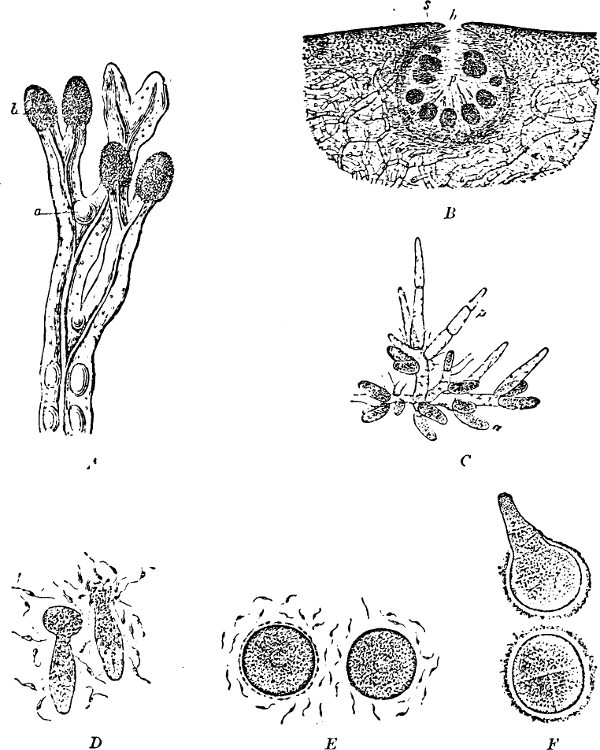
Fig. 70.—Fucus vesiculosus. A
Portion of thallus with swimming bladders (a) and conceptacles
(b). B Section of a female conceptacle; h
the mouth; p the inner cavity; s oogonia. C
Antheridiophore; a antheridium; p sterile cells. D
Antheridia out of which the spermatozoids are escaping. E
Fertilisation. F Germinating oospore.

Fig. 71.—Fucus serratus. a
Portion of a male plant which has been exposed to the action of the
open air for some time; small orange-yellow masses, formed by the
antheridia, are seen outside the mouths of the male conceptacles (nat.
size). b Cross section through the end of a branch of a female
plant, showing the female conceptacles (× 4).
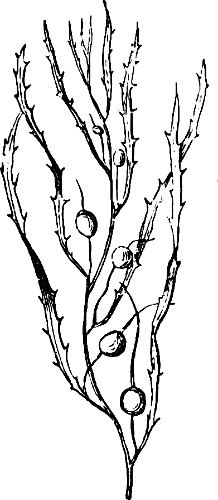
Fig. 72.—Sargassum bacciferum. A
portion of the thallus, natural size.
Order 1. Fucaceæ. The following species are common on our
coasts: Fucus vesiculosus (Fig. 70) has a thallus with an
entire margin, and with bladders arranged in pairs; F. serratus
(Fig. 71) without bladders, but with serrated margin; Ascophyllum
nodosum has strap-like shoots, which here and there are swollen
to form bladders; Halidrys siliquosa has its swimming bladders
divided by transverse walls; Himanthalia lorea, which is found
on the west coast of Norway, and the south coast of England, has a
small perennial, button-shaped part, from the centre of which proceeds
the long and sparsely branched, strap-like, annual shoot, which bears
the conceptacles. The Gulf-weed (Sargassum bacciferum, Fig. 72)
is well known historically from the voyage of Columbus; it is met with
in large, floating, detached masses in all oceans, and is found most
abundantly in the Atlantic, off the Canary Islands and the Azores,
and towards the Bermudas. The stalked, spherical air-bladders are
the characteristic feature of this genus. The thallus is more highly
developed than in Fucus, and there is a contrast between the
stem and leaf-like parts. The portions which are found floating are
always barren, only those attached are fertile.
Uses. The Fucaceæ, like the Laminariaceæ, are used
as manure (the best kinds being Fucus vesiculosus and
Ascophyllum nodosum), for burning to produce kelp, and
as food for domestic animals (Ascophyllum nodosum is
especially used for this purpose).
The plants in this class are multicellular, and brown, with apical
growth, new cells being derived either from a flat apical cell, or from
a border of apical cells. The thallus is flat, leaf- or strap-shaped,
attached by haptera, which are either found only at the base, or
on the whole of the lower expansion of the thallus. The cells are
differentiated into the following systems of tissues: an external,
small-celled layer of assimilating cells, generally one cell in
thickness, and an internal, large-celled layer of one or only a few
cells in thickness, forming the mechanical and conducting tissues.
All the reproductive cells are motionless. Asexual reproduction by
naked, motionless spores (tetraspores) which are formed 1–4 in each
tetrasporangium, the latter being outgrowths from the surface cells
of special, sexless individuals. Zoospores are wanting. The sexual
organs are of two kinds, oogonia and antheridia, which are formed from
the surface cells, either on the same or different individuals. The
oogonia are spherical or oval, and are generally placed close together;
each contains one oosphere, which on maturity is ejected into the
surrounding water, and is then naked and motionless. The antheridia
are formed of longitudinal cells, united in groups, whose contents
by repeated divisions—transverse and longitudinal—are divided into
a large number of small, colourless, motionless spermatia—round or
elongated—which are set free by the dissolution of the wall of the
antheridium. The process of fertilisation has not yet been observed.
The Dictyotales, in having tetraspores and spermatia, deviate
considerably from the Phæophyceæ, but may be classed near to the
Tilopteridæ, in which there are asexual spores with 4 cell-nuclei,
which may be considered as an indication of the formation of
tetraspores.
Order 1. Dictyotaceæ. Dictyota dichotoma which has
a thin, regularly dichotomously divided thallus, occurs on the
coasts of the British Isles. Padina is found on the south
coast.
The plants comprised in this class are multicellular; they are
simple or branched filaments, or expansions consisting of 1 to
several layers of cells; the thallus may be differentiated (as in
many Florideæ), to resemble stem, root, and leaf. The cells
contain a distinctly differentiated nucleus (sometimes several), and
distinct chromatophores, coloured by rhodophyll. The chlorophyll of
the chromatophores is generally masked by a red colouring matter
(phycoerythrin), which may be extracted in cold, fresh water; or rarely
by phycocyan. Pyrenoids occur in some. Starch is never formed in the
chromatophores themselves, but a modification—Florideæ starch—may
be found in the colourless protoplasm. Asexual reproduction by motile
or motionless spores (tetraspores) which are devoid of cilia and of
cell-wall. Swarmspores are never found.
Sexual reproduction is wanting, or takes place by the coalescence of
a spermatium and a more or less developed female cell. The spermatia
are naked masses of protoplasm, devoid of cilia and chromatophores.
The female cell (carpogonium) is enclosed by a cell-wall, and after
fertilisation forms a number of spores, either with or without
cell-walls (carpospores), which grow into new individuals.
The Rhodophyceæ may be divided into two families:
1. Bangioideæ.
2. Florideæ.
The thallus consists of a branched or unbranched cell-filament, formed
of a single row or of many rows of cells, or of an expansion, one or
two layers of cells in thickness, but without conspicuous pores for the
intercommunication of the cells. The growth of the thallus is chiefly
intercalary. The star-like chromatophores contain chlorophyll and are
coloured blue-green with phycocyan, or reddish with phycoerythrin;
all these colouring matters are occasionally found in the same cell
(Bangia-species). Asexual reproduction by tetraspores, without
cilia, but capable of amœboid movements.
Sexual reproduction is wanting, or takes place by the coalescence of a
spermatium with a carpogonium, which is only slightly differentiated
from the vegetative cells, and is devoid of a trichogyne. The
carpospores are destitute of cell-wall and arise directly by the
division of the fertilised oosphere. The Bangioideæ occur chiefly in
salt water.
Order 1. Goniotrichaceæ.—The thallus consists of a
branched cell-filament without rhizoids. Tetraspores are
formed directly from the entire contents of the mother-cell,
without any preceding division. Fertilisation unknown.
Asterocystis, Goniotrichum.
The Goniotrichaceæ, through the blue-green
Asterocystis, are allied to the Myxophyceæ, and through
Goniotrichum to the Porphyraceæ.
Order 2. Porphyraceæ.—The thallus is formed of an
expansion consisting of a layer of 1–2 cells, which, at the
base, are attached to the substratum by means of a special
form of haptera (Porphyra, Diploderma); or of
unbranched (very rarely slightly branched) filaments, attached
at the base by haptera (Bangia): or it extends from a
prostrate cell-disc (various species of Erythrotrichia).
Tetraspores are formed after one or more divisions of the
mother-cell, either from the whole or only a part of its
contents; they possess amœboid movements, or have a jerky,
sliding-forward motion. The antheridia have the same appearance
as the vegetative cells, but divide several times, and several
spermatia are formed, either simultaneously from the whole
contents (Porphyra, Bangia), or the spermatia
are successively formed from a part of the contents of the
antheridium (Erythrotrichia). The carpogonium is without
a trichogyne, but the oosphere has a colourless spot which may
sometimes rise a little above the surface of the thallus, and
may be considered as an early stage in the development of the
trichogyne. The spermatia form a canal through the membrane of
the carpogonium, and their contents coalesce with the oosphere
at its colourless spot. The fertilised oosphere divides on
germination into a number of carpospores, which are set free as
naked, motionless masses of protoplasm, which grow and give rise
to new individuals (alternation of generations).
The thallus has one or more apical cells, grows principally by apical
growth, and may be differentiated into root, stem, and leaf. The
chromatophores vary in form, but have a red or brownish colour, due
to chlorophyll and phycoerythrin. Asexual reproduction by motionless
tetraspores, which generally arise by the division into four of the
contents of the tetrasporangium. The carpogonium has a trichogyne,
and the carpospores, which are formed indirectly from the fertilised
oosphere, possess a cell-wall.
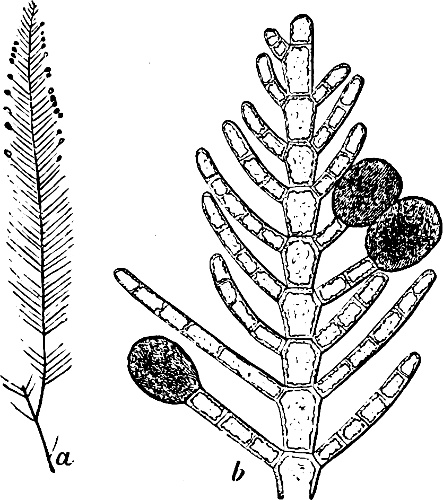
Fig. 73.—Callithamnion elegans:
a a plant with tetraspores (× 20); b apex of a branch
with tetraspores(× 250).
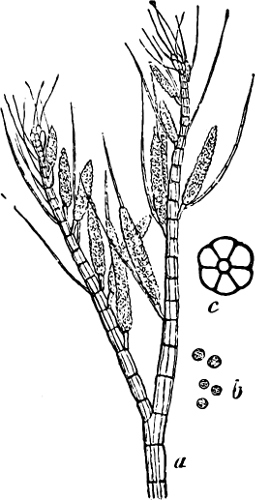
Fig. 74.—Polysiphonia variegata:
a a portion of a male plant with antheridia; b spermatia;
c transverse section of thallus.
The thallus may assume very different forms. In the simplest
species it is filamentous and formed of single, branched rows of
cells (Callithamnion, etc., Fig. 73). Ceramium has a
filamentous thallus, generally dichotomously forked (Fig. 75), or
sometimes pinnately branched, which, at the nodes, or throughout
its entire length, is covered by a layer of small cortical cells.
Polysiphonia (Fig. 74) has a filamentous, much branched thallus,
made up of a central cylindrical cell, surrounded by a layer of
other cells, cortical cells, which in length and position correspond
to the central ones. In many of the Red Algæ the vegetative organs
are differentiated into stems and leaves, the former having, as in
Chara, unlimited growth in length, whilst the latter soon attain
their full development. Chondrus has a fleshy, gelatinous
thallus, without nodes; it is repeatedly forked into flat branches
of varying thickness. Furcellaria has a forked thallus with
thick branches and without nodes. The thallus of Delesseria
(Fig. 76) consists of branches, often bearing leaf-like structures,
with a midrib and lateral ribs springing from it. These ribs persist
through the winter, and at the commencement of the succeeding period of
vegetation the lateral ribs become the starting points for new leaves.
In Corallina the thallus is pinnately branched, and divided
into nodes and internodes. The name has been given to this genus from
the fact that the thallus is incrusted with carbonate of lime to such
a degree that it becomes very hard, and the whole plant adopts a
coral-like appearance. Other genera which are similarly incrusted, and
have a leaf-like or even crustaceous thallus (such as Melobesia,
Lithothamnion), are included in this family.
In some instances the cells of the thallus may be found
differentiated into more or less well defined tissues, so that
it is possible to find special assimilating, mechanical, and conducting
tissues, the last named in some cases having the double function of
conducting and of serving as a reservoir in which starch is found as a
reserve material. The cells of the Florideæ, which are formed by the
division of a mother-cell into two daughter-cells of unequal size, have
always larger or smaller pits in the cell-walls, and the thin cell-wall
separating two pits from each other is perforated by a number of small
holes. These pits are particularly developed in the conducting tissues,
but sieve-tubes are very rarely to be found.
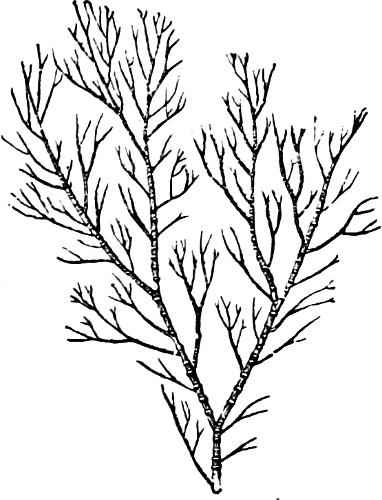
Fig. 75.—Ceramium diaphanum (nat.
size).
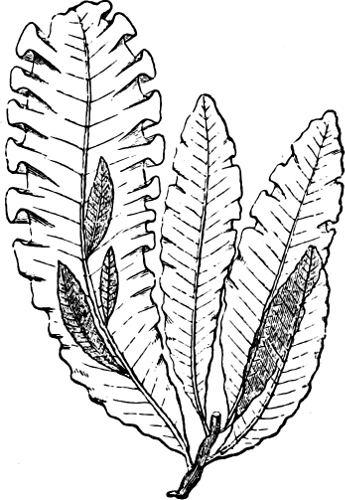
Fig. 76.—Delesseria sanguinea (about ⅓).
Tetraspores may be wanting (e.g. Lemanea) or may
often arise on special, non-sexual individuals. In some (e.g.
Batrachospermum) only one tetraspore is formed in each
tetrasporangium, but the number is generally four, which may be formed
tetrahedrally (Fig. 73) or by divisional walls perpendicular to each
other, or even in a single row. The tetrasporangia in some species are
free (Fig. 73), but in the majority they are embedded in the thallus.
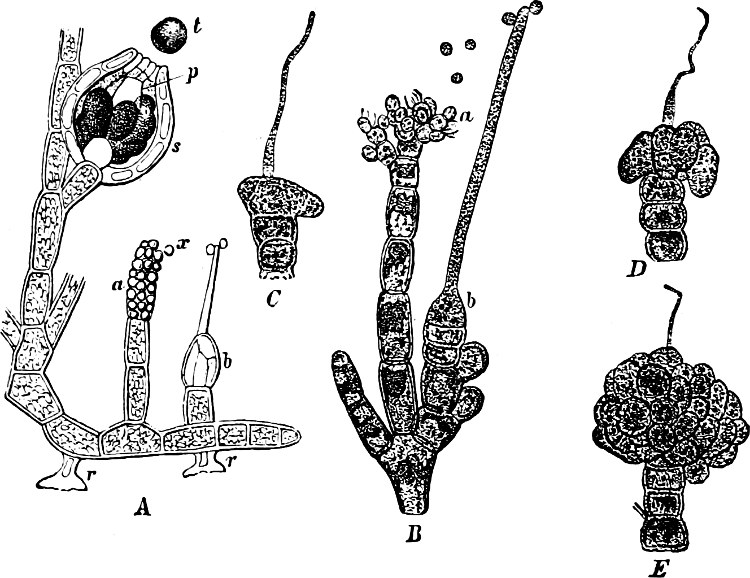
Fig. 77.—A Lejolisia
mediterranea: r haptera; s longitudinal section
through a cystocarp; p the empty space left by the liberated
spore (t). B-E Nemalion multifidum: a
antheridia; b procarpium with trichogyne, to which two spermatia
are adhering.
The sexual reproduction (discovered by Thuret and Bornet, 1867)
differs in the essential points from that of all other plants,
and approaches most nearly to the sexual reproduction of the
Bangioideæ. The sexual cells are developed from the
terminal cells (never nodal cells) of the branched cell-filaments,
which constitute the thallus. The mother-cells of the spermatia
(spermatangia) are generally arranged in a group, in the
so-called antheridia (Figs. 74, 77 A, a). On
becoming ripe the membrane of the spermatangium ruptures and the
spermatia emerge as spherical or ovoid, naked (a little later
they may possess a cell-wall) masses of protoplasm which are not
endowed with the power of motion, and hence are carried passively by
the current of the water in which they may happen to be, to the female
cell. This latter is analogous with the oogonium of the Green Algæ. The
female reproductive organ is termed the procarpium, and consists
of two parts, a lower swollen portion—the carpogonium (Fig. 77
b in A and B)—which contains the cell-nucleus,
and an upper filamentous prolongation—the trichogyne (Fig. 77
B)—which is homologous with the colourless receptive spot of
the oosphere of the Green Algæ, and the Porphyraceæ. In the
sexual reproduction of the majority of the Florideæ, a very important
part is played by certain special cells, rich in cell-contents—the
auxiliary cells. These are either dispersed in the interior of
the thallus, or are arranged together in pairs with the cell-filament
which bears the carpogonium, and are generally united with this to
form an independent multicellular procarpium. The spermatia
attach themselves firmly to the trichogyne and surround themselves
with a cell-wall. The dividing wall at the point of contact is
perforated, and the nucleus of the spermatium probably travels
through the trichogyne to the swollen part of the procarpium—the
carpogonium—and fuses with its nucleus. After fertilisation the
trichogyne withers (Fig. 77 C), but the lower portion of the
procarpium, constituting the fertilised oosphere, grows out and
forms in various ways, first a tuft of spore-forming filaments known as
gonimoblasts, and finally the carpospores. These latter
form a new asexual generation (compare the germination of the oospore
of Œdogonium and Coleochæte).
The gonimoblasts may arise in three ways:—
1. In the Nemalionales, branched filaments grow out from
the oosphere and form an upright, compressed or expanded tuft of
spore-forming filaments.
2. In the Cryptonemiales, several branched or unbranched
filaments (ooblastema-filaments) grow out from the
oosphere, and conjugate in various ways with the auxiliary
cells. The gonimoblasts are then formed from the single cells
produced by the conjugation.
3. In the Gigartinales and Rhodymeniales the
oosphere conjugates with an auxiliary cell by means of a short
ooblastema-filament, and from this auxiliary cell a gonimoblast
is produced.
The motionless carpospores, which sometimes in the early
stages are naked, and afterwards invested with a cell-wall,
are developed from the terminal cells (and perhaps also from
some of the other cells) of the branches of the gonimoblast.
The gonimoblasts constitute sharply defined parts of the
plant in which the carpospores arise. These parts are called
cystocarps and are either naked (Fig. 77 E),
or surrounded by a covering (pericarp or involucre, Fig.
77 A) formed in different ways. On this account the
Florideæ were formerly divided into Gymnosporeæ
(Batrachospermum, Nemalion, Ceramium, etc.)
and Angiosporeæ (Farcellaria, Lejolisia,
Delesseria, Melobesia, etc.).
The Florideæ are divided into four sub-families:—
Sub-Family 1. Nemalionales. The fertilised oosphere
produces directly the gonimoblast.
Order 1. Lemaneaceæ. Algæ of brownish colour and living
in fresh water. They lack tetraspores, and the very sparingly
branched fertile filaments, composed of many rows of cells, grow
out from a proembryo, which consists of a single row of cells
bearing branches. Lemanea fluviatilis, often found on
rocks and stones in quickly flowing streams.
Order 2. Helminthocladiaceæ. Tetraspores are generally
wanting (e.g. in Nemalion) or arise one in each
tetrasporangium (e.g. Batrachospermum) and it
is only in Liagora that four cruciate tetraspores are
formed. Chantransia corymbifera consists of simple,
branched cell-rows, and is an independent species. Several
other Chantransia-forms, living in fresh water, are
“proembryos” of species of the genus Batrachospermum.
The germinating carpospore grows out into filaments and forms
a so-called proembryo which, if not shaded, attains only a
small size, but when growing in shady situations presents a
much greater development. These highly developed proembryos
have been described as species of Chantransia. The
proembryo can reproduce by division, or by tetraspores which
are developed singly in the sporangia; in B. vagum and
B. sporulans which do not possess fully developed female
reproductive organs, the proembryos serve almost entirely to
reproduce the species. The young Batrachospermum-plant
arises from the end of an upright filament of the proembryo.
The proembryo is generally persistent, and continually produces
new Batrachospermums. These latter bear the sexual
reproductive organs and also whorls of branches: the central
row of cells is enclosed by cells growing from the base of the
whorls of branches, and from these cortical cells secondary
proembryos are developed. In this alternation of shoots there is
really no alternation of generations, since the proembryo and
the shoots with the sexual reproductive organs are parts of the
same thallus.
Several species of Batrachospermum have a bluish green
or verdigris colour. Nemalion multifidum has a brown-red
thallus, slightly branched, which is attached to rocks near the
water’s edge.
Order 3. Chætangiaceæ. Galaxaura has a thallus
thickly incrusted with lime.
Order 4. Gelidiaceæ. Naccaria, Gelidium.
Sub-Family 2. Gigartinales. The fertilised auxiliary
cell grows towards the thallus, to produce the gonimoblasts.
Procarpia generally present.
Order 5. Acrotylaceæ. Acrotylus.
Order 6. Gigartinaceæ. Gigartina,
Phyllophora, Ahnfeltia; Chondrus crispus,
with dark red, dichotomously branched thallus, is common on the
coasts of Scandinavia and Great Britain.
Order 7. Rhodophyllidaceæ. Rhodophyllis,
Euthora; Cystoclonium purpurascens is common,
and sometimes the ends of its branches may be modified into
tendril-like haptera.
Sub-Family 3. Rhodymeniales. The fertilised auxiliary
cell forms the gonimoblast on the side away from the thallus.
Procarpia are abundantly produced.
Order 8. Sphærococcaceæ. Gracilaria.
Order 9. Rhodymeniaceæ. Rhodymenia palmata is
a common species. Lomentaria, Chylocladia,
Plocamium.
Order 10. Delesseriaceæ. Delesseria sanguinea;
D. alata and D. sinuosa are handsome forms which
are not uncommon.
Order 11. Bonnemaisoniaceæ. Bonnemaisonia.
Order 12. Rhodomelaceæ. Rhodomela,
Odonthalia; Polysiphonia, of which many species
are to be found on the coasts of Great Britain, has a
filamentous, richly branched thallus consisting of a central row
of cells surrounded by a varying number of cortical cells of
similar size—the so-called “siphons.”
Order 13. Ceramiaceæ. Pretty Algæ, often branched
dichotomously, or unilaterally pinnate. Spermothamnion,
Griffithsia, Callithamnion, Ceramium, Ptilota.
Sub-Family 4. Cryptonemiales. The cells formed by the
coalescence of the auxiliary cells and the ooblastema-filaments,
produce the gonimoblasts. The carpogonium-filaments and
the auxiliary cells are scattered singly in the thallus.
Order 14. Gloiosiphoniaceæ. Gloiopeltis.
Order 15. Grateloupiaceæ. Halymenia, Cryptonemia.
Order 16. Dumontiaceæ. Dumontia, Dudresnaya.
Order 17. Nemastomaceæ. Furcellaria, which has
dichotomously branched, round shoots, is common on the coasts of
Great Britain.
Order 18. Rhizophyllidaceæ. Polyides, Rhizophyllis.
Order 19. Squamariaceæ. The Algæ belonging to this order
form crust-like coverings on stones, mussel-shells, and on other
Algæ, but are not themselves incrustated: Petrocelis,
Cruoria, Peyssonellia.
Order 20. Corallinaceæ. Partly crustaceous, partly
erect, branched Algæ, thickly incrusted with lime, so that a
few species (Lithothamnia, also called Nullipora)
occur in fossilized condition from Jurassic to Tertiary periods.
Melobesia, Lithophyllum, Lithothamnion, Corallina.
Uses. “Carragen” is the thallus of Chondrus crispus
(Irish Moss) and Gigartina mamillosa. It is a common article of
food on the coasts of Ireland, and swells to a jelly when cooked. It
is officinal. Rhodymenia palmata is generally eaten as food in
Ireland and in some places on the west coast of Norway; it is also used
as food for sheep and hence is termed “Sheep-seaweed.” Agar-Agar is the
jelly obtained from species of Gelidium and Gigartina
growing in China and Japan.
DIVISION V. ANGIOSPERMÆ. — Class 1. Monocotyledones. — Family 1. Helobieæ. — Family 2. Glumifloræ. — Family 3. Spadicifloræ. — Family 4. Enantioblastæ. — Family 5. Liliifloræ. — Family 7. Gynandræ. — Class II. Dicotyledones. — Sub-Class 1. Choripetalæ. Petals free. — Family 1. Salicifloræ. — Family 2. Casuarinifloræ. — Family 3. Quercifloræ. — Family 4. Juglandifloræ. — Family 5. Urticifloræ. — Family 6. Polygonifloræ. — Family 7. Curvembryæ. — Family 8. Cactifloræ. — Family 9. Polycarpicæ. — Family 10. Rhœadinæ. — Family 11. Cistifloræ. — Family 12. Gruinales. — Family 13. Columniferæ. — Family 14. Tricoccæ. — Family 15. Terebinthinæ. — Family 16. Aesculinæ. — Family 17. Frangulinæ. — Family 18. Thymelæinæ. — Family 19. Saxifraginæ. — Family 20. Rosifloræ. — Family 21. Leguminosæ. — Family 22. Passiflorinæ. — Family 23. Myrtifloræ. — Family 24. Umbellifloræ. — Sub-Class 2. Sympetalæ. — A. Pentacyclicæ . — Family 26. Bicornes. — Family 27. Diospyrinæ. — Family 28. Primulinæ. — B. Tetracyclicæ. — a. Tetracyclicæ with hypogynous flowers. — Family 29. Tubifloræ. — Family 30. Personatæ. — Family 31. Nuculiferæ. — Family 32. Contortæ. — b. Tetracyclicæ with epigynous flowers. — Family 33. Rubiales. — Family 34. Dipsacales. — Family 35. Campanulinæ. — Family 36. Aggregatæ.
See pages 3 and 224. To this Division belong the majority of the
Flowering-plants. They are divided into two parallel classes, the
Monocotyledons and the Dicotyledons, which differ from each other not
only in the number of cotyledons, which, with a few exceptions, is one
in the former, two in the latter, but also in the internal structure
of the stem, the venation of the leaves, the number of the parts of
the flower, etc. Assuming that these two
classes have sprang from a common origin, it is amongst the Helobieæ
in the first, and amongst the Polycarpicæ in the second class that
we might expect to find closely allied forms, which might reasonably
be supposed to have varied less from this original type. As for the
rest, they seem to stand quite parallel, without exhibiting any close
relationship. It is scarcely proved that the Monocotyledons are the
older class.
[Our knowledge of the forms included under the Angiosperms has
recently been considerably increased by Treub (Ann. d. Jar. Bot.
d. Buitenzorg, 1891), who has shown that the Casuarinas differ
in many important points from the typical Angiosperms. Among other
characters the pollen-tube is found to enter the ovule near the chalaza
and therefore at the opposite end to the micropyle, and Treub therefore
suggests that these plants should be placed in a subdivision termed
Chalazogams.
According to this view the principal divisions of the Angiosperms would
be represented thus:—
Angiospermæ.
| Sub-division. |
Sub-division. |
| Chalazogames. |
Porogames. |
| Class. |
Classes. |
| Chalazogames. |
Monocotyledones, Dicotyledones. |
More recently Nawaschin (Bull. Acad. Imp. Sci. St. Petersb.,
ser. iii., xxxv.) has shown that Betula, and Miss Benson
(Trans. Linn. Soc., 1894) that Alnus, Corylus, and
Carpinus also belong to the Chalazogams.
Our knowledge, however, is still so incomplete that one would hesitate
to accord the full systematic value which Dr. Treub attaches to his
discovery until the limits of the Chalazogamic group are better
defined; and it would hardly be justifiable to include the Casuarinas
and the above-noted genera in one family.]
The embryo has only one cotyledon; the leaves are as a rule
scattered, with parallel venation; the vascular bundles of the stem
are closed, there is no increase of thickness. The flower is typically
constructed of five 3-merous whorls, placed alternately.
The embryo is generally small in proportion to the abundant
endosperm (exceptions, see Helobieæ), and its single cotyledon
is often sheath-like, and very large. On the germination of the seed
either the entire cotyledon, or its apex only, most generally remains
in the seed and absorbs the nutritive-tissue, while the lower portion
elongates and pushes out the plumule and radicle, which then proceed
with their further growth. The primary root in most cases soon ceases
to grow, but at the same time, however, numerous lateral roots break
out from the stem, and become as vigorous as the primary root, or even
more so. Increase in thickness does not take place in these roots; they
branch very little or not at all, and generally die after a longer or
shorter time.
The stem is frequently a corm, bulb, or other variety of
underground stem, as the majority of the Monocotyledons are perennial,
herbaceous plants; it has scattered, closed vascular bundles (Fig.
276), and no cambium by which a continuous thickening may take
place. The stem of the Palms, however, attains a very considerable
thickness, which is due to the meristem of its growing-point
continually increasing in diameter for a lengthened period (often for
many years), until it has reached a certain size. In this condition
the growing-point has the form of an inverted cone, and it is only
when this cone has attained its requisite size that the formation of
a vertical cylindrical stem commences. Certain tree-like Liliaceæ,
as Dracæna, Aloe, etc., have a continuous increase in
thickness; this is due to a meristematic layer, which arises in the
cortex, outside the original vascular bundles, which were formed at the
growing-point of the stem. This meristem continues to form thick-walled
parenchyma and new, scattered vascular bundles. The primary vascular
bundles, in the Palms and others, run in a curved line from their
entrance into the stem at the base of the leaf, towards the centre of
the stem, and then bend outwards and proceed downwards in a direction
more parallel to the sides of the stem (Fig. 277). The bundles formed
later, in those stems which increase in thickness, are not continued
into the leaves.
The branching as a rule is very slight, the axillary buds of
the majority of the leaves never attaining development, e.g. in
the Palms, bulbous plants and others. As the cotyledon arises singly,
the succeeding leaves also must be scattered, but they are frequently
arranged in two rows (Grasses, Iris, etc). The first leaf borne
on a branch (the “Fore-leaf,”[24]—the bracteole, if on a floral
shoot) has generally, in the Monocotyledons, a characteristic form and
position, being situated on the posterior side of its own shoot, and
hence turned towards the main axis; it is sometimes provided with two
laterally-placed keels (Figs. 279 f, 290 øi), but the
midrib is often absent. It arises in some cases from two primordia,
which at the beginning are quite distinct, and thus has been regarded
as formed by two leaves. It is, however, only one leaf, a fact which is
evident from several circumstances, one being that it never supports
more than one shoot, and this stands in the median plane (Fig. 279).
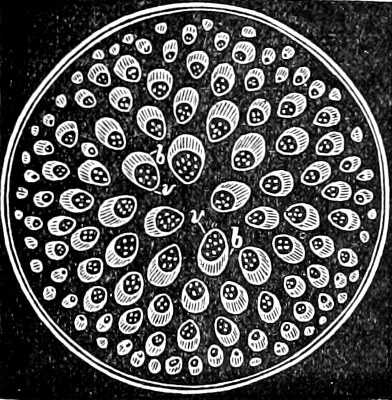
Fig. 276.—Transverse section of the stem of a
Palm: v v is the wood portion, b b the bast
portion of the vascular bundled.
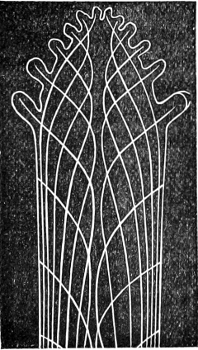
Fig. 277.—Diagrammatic representation of the
course of the vascular bundles, from the stem into the leaves in a
Monocotyledon.
The leaves are amplexicaul, and have a large sheath
but no stipules; the blade is most frequently long, ligulate, or
linear, entire, with parallel venation, the veins being straight or
curved (Figs. 300, 309). Connecting the large number of veins which
run longitudinally, there are as a rule only weak transverse ones. It
is very rarely that other forms of leaves are found, such as cordate
(Figs. 302, 312), or that the blade is branched, or the venation is,
for example, pinnate or palmate (Figs. 225, 298); these deviations are
especially found in the Araceæ, the Palms, the Scitamineæ (Fig. 308),
the Dioscoreaceæ, and in several aquatic plants. The incisions in the
Palm-leaf are derived by the splitting of an originally entire leaf.
The structure of the flower is generally as follows: Pr3 +
3, A3 + 3, G3, rarely S3 + P3 with the other members unchanged.[25]
Instead of 3, the numbers 2 and 4 may occur; rarely others. In all
these instances there are 5 whorls, which regularly alternate with one
another, most frequently in the 3-merous flower, as in the diagram
(Fig. 278). This diagram is found in the following orders: Liliaceæ,
Convallariaceæ, Juncaceæ, Bromeliaceæ, Amaryllidaceæ, Dioscoreaceæ,
Palmæ, some Araceæ, and in some small orders, and may be considered as
the typical structure and also the starting point for the exceptional
orders. The ovary in many Monocotyledons has many ovules, and the fruit
becomes a many-seeded berry or capsule; this form is no doubt the
oldest. In others the number of seeds becomes reduced to 1, and the
fruit then becomes a cypsela, or a drupe (e.g. Gramineæ,
Cyperaceæ, Palmæ, etc).
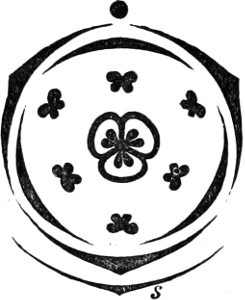
Fig. 278.—Diagram of the ordinary, regular
flower in the Monocotyledons: s is the bract.
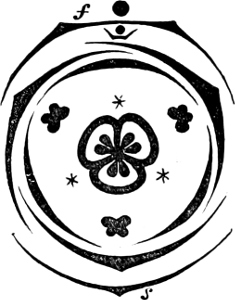
Fig. 279.—Diagram of Iris: f the
bracteole; in its axil is a shoot with its bracteole.
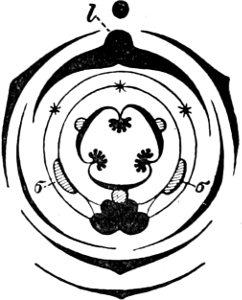
Fig. 280.—Diagram of Orchis: l
the lip; σ σ the two staminodes.
Deviations from this typical floral structure in some instances may
be traced to suppression, very rarely to a splitting of
certain members, the typical relative positions not being changed.
Thus, the Iridaceæ, the Cyperaceæ, most of the Gramineæ and some
Juncaceæ deviate in having only 3 stamens (Fig. 279), the inner whorl
(indicated by *) not becoming developed. The Musaceæ differ in the
posterior stamen not being developed; Zingiberaceæ (Fig. 314),
Marantaceæ, and Cannaceæ, in the fact that only 1 of
all the stamens bears an anther, and the others are either suppressed
or developed into petaloid staminodes, with some perhaps cleft in
addition. The Orchideæ deviate in having, generally, only the anterior
stamen of all the 6 developed (Fig. 280). In this, as in other
instances, the suppression of certain parts of the flower is often
connected with zygomorphy (i.e. symmetry in one
plane), chiefly in the inner perianth-whorl, but also in the other
whorls. In the Orchids, the perianth-leaf (the labellum, Fig. 280
l) which is directly opposite the fertile stamen, is larger and
altogether different from the others. The perianth-leaves may also be
suppressed; see, for example, the two diagrams of the Cyperaceæ (Fig.
284). In some orders the suppression of these leaves, which form the
basis of the diagram, is so complete that it is hard to reduce the
actual structure of the flower to the theoretical type, e.g. the
Grasses (Fig. 290) and Lemna (Fig. 303). In the first family,
which especially comprises water-plants, a somewhat different structure
is found; thus Fig. 282 differs somewhat from the ordinary type, and
other flowers much more so; but the floral diagrams which occur in this
family may perhaps be considered as the most probable representatives
of an older type, from which the ordinary pentacyclic forms have taken
their origin. In favour of this theory we have the larger number of
whorls, the spiral arrangement of some of these in the flower, with
a large and indefinite number of stamens and carpels, the perfectly
apocarpous gynœceum which sometimes occurs, etc., etc.
The Monocotyledons are divided into 7 Families:—
1. Helobieæ. This family forms a group complete in
itself. It commences with hypogynous, perfect flowers, whose
gynœcium is apocarpous and terminates in epigynous and more or
less reduced forms.
2. Glumifloræ. These have as a starting point the
same diagram as the following families, but otherwise develope
independently.
3. Spadicifloræ. Also an independent branch, or perhaps
two different ones which terminate in much reduced forms.
4. Enantioblastæ. These ought perhaps to be amalgamated
with the following family.
5. Liliifloræ. These advance from forms with the
typical diagram and hypogynous flower, to epigynous and reduced
forms.
6. Scitamineæ and
7. Gynandræ. Two isolated families, which probably have
taken their origin from Liliifloræ, and have epigynous, mostly
zygomorphic, and much reduced forms.
To this family belong only water- or marsh-plants; the
endosperm is wanting, and they possess an embryo with a very
large hypocotyl prolonged downwards and often club-like. The
perianth is often differentiated into calyx and corolla; the flower
is regular, and in the first orders to be considered, may be reduced
to the ordinary Monocotyledonous type; there are, however, usually
found two 3-merous whorls of carpels (Fig. 282), and thus in
all 6 whorls, or again, the number of carpels may be indefinite;
the number of stamens also may be increased, either by the division
of the members of a whorl, or by the development of additional
whorls. Syncarps,[26] with nut or follicular fruitlets, are
very common, for example, in the first orders; in the last
(Hydrocharitaceæ) the carpels are not only united, but the ovary is
even inferior.
The primitive type appears to be a hypogynous flower, similar
to that of the Juncaginaceæ or Alismaceæ, with several 3-merous
whorls, and free carpels, each with many ovules; the green
perianth in this instance being no doubt older than the coloured
ones. If we take a flower with this structure as the starting
point, then the family developes partly into epigynous forms,
partly into others which are so strongly reduced and exceptional
that it is scarcely possible to refer them to the ordinary
type. The family, through the peculiar Zostereæ, appears
to approach the Araceæ, in which Potamogetonaceæ and
Najadaceæ are included by some authorities. However, the
inclusion of Potamogeton, and with it Ruppia and
Zannichellia, in the Juncaginaceæ appears quite correct.
It would scarcely be right to separate Zostereæ from
these. Great stress has often been laid upon the similarity with
the Ranunculaceæ which is found in the Alismaceæ, but it is
scarcely more than an analogous resemblance.
Order 1. Juncaginaceæ. The ☿, regular, hypogynous
flowers have the perianth 3 + 3, sepaloid, stamens 3
+ 3 (with extrorse anthers), and carpels 3 + 3 (free or united), of
which last, however, one whorl may be suppressed (in Triglochin
maritima all 6 carpels are developed, in T. palustris
the inner whorl is unfertile). Inflorescence long spikes.
Embryo straight.—Marsh-plants with radical, rush-like
leaves, arranged in two rows, and often sheathing and ligulate
(“squamulæ intravaginales”); the inflorescence is a spike or
raceme.—Scheuchzeria. Carpels almost free; in each at least
two ovules. Follicles.—Triglochin has long, fine racemes
without bracts or bracteoles; one ovule in each carpel. The carpels
in the two native species are united, but separate when ripe as a
schizocarp, loosening from below; they open along the ventral suture or
remain closed; a linear central column remains. The most reduced is
Lilæa (1–2 sp. Am.)—Protogynous. About 10 species. Temp. Fossils in
Tertiary.
Order 2. Potamogetonaceæ. The aquatic plants belonging to this
order are perennial, living entirely submerged, or with floating
leaves, and preferring still water. The leaves are alternate, in some
linear and grass-like, in others there is an elliptical floating blade,
supported by a linear submerged petiole. Axillary scales. The fruit is
generally a syncarp with nuts or drupes; the embryo is
curved, of very various forms.
Potamogeton (Pond-weed). The rhizome is creeping, sympodial
(with two internodes in each shoot-generation); the inflorescence
is a terminal, many-flowered spike, without floral-leaves; below it
are found 2 foliage-leaves placed nearly at the same height, from
whose axils the branching is continued cymosely. The flowers are
☿, 4-merous, naked, and consist only of 4 stamens,
with the connectives, broadly developed at the back of the
anthers, resembling a perianth, and of 4 free, sessile
carpels. They are common plants in fresh water. The spike,
during the flowering, is raised above the water. Wind-pollinated and
protogynous.—Closely allied is Ruppia (Tassel Pond-weed), in
salt or brackish water. The spike has only two naked flowers, each
consisting of 2 stamens and 4 carpels. The stalks of the individual
carpels are considerably prolonged.—Zannichellia (Horned
Pond-weed) is monœcious; the ♀-flower consists of 4 (2–9) carpels, with
membranous, bell-shaped perianth; long styles; the ♂-flower has 1 (-2)
stamens. Althenia.
Zostera (Grass-wrack) is an entirely submerged, marine plant
with creeping rhizome (with displacement of buds) and strap-shaped
leaves. The flowering shoots are sympodia with displacement of the
axes (Fig. 281). The inflorescence is a peculiar, flatly-compressed
spike, on one side of which the flowers are borne (Fig. 281).
This inflorescence may be considered, no doubt correctly, to be
derived from the symmetrical spike of Potamogeton by strongly
dorsiventral development, and by a strong suppression of the floral
parts taking place simultaneously. Two rows of flowers are developed,
but of these one is so pressed into the other that apparently only one
is present. Each flower consists of only 1 stamen and 1 carpel
situated at the same height (Fig. 281); the unilocular ovary encloses
1 pendulous ovule and bears a bifid style. As regards the perianth
(?) one leaf may be present (Z. nana, Fig. 281 D). The
pollen-grains are filamentous. Pollination takes place under water.
Posidonia and Cymodocea are allied to these. About 70
species.
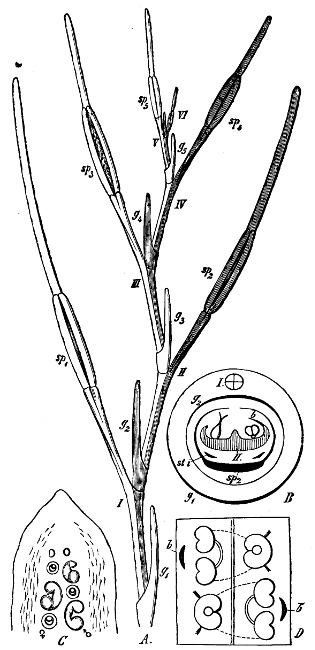
Fig. 281.—Zostera. A Diagram of
the branching of the floral shoots: I, II ... are
the successive shoot-generations, every other one being shaded;
g1 g2 ... fore-leaves; sp1 sp2
... spathes for the successive spikes. Each shoot is united for
some distance with the parent axis (indicated by the half-shaded
internodes). Each shoot commences with a fore-leaf turning towards the
parent axis, g; succeeding this is the spathe, sp; and
then the inflorescence. The fore-leaf supports a new lateral shoot.
B Diagram of a shoot, II, which is borne laterally
in the axil of the fore-leaf g1, on the shoot I,
g2 its fore-leaf; sp2 its spathe; sti
squamulæ intravaginales. II Is the spadix with stamens and
carpels; b a perianth-leaf (or connective expansion, similar to
those which occur in Potamogeton). C The upper portion of
a young spadix with development of flowers. D Part of a spadix
with 2 flowers; the parts which theoretically belong to one another are
connected by a dotted line.
Order 3. Aponogetonaceæ. Aquatic plants with tuberous
stem. They have a single, petaloid perianth (3–2–1–leaved),
most frequently 6 stamens and 3(-6) carpels. Straight
embryo.—About 15 species (Africa, Madagascar, Tropical
Asia and Australia).—Aponogeton distachyos and
A. (Ouvirandra) fenestralis are grown in
conservatories; the latter has lattice-like, perforated leaves.
Order 4. Najadaceæ. Only one genus Najas (about
10 species); annual fresh water plants with leaves in pairs
and solitary, unisexual flowers. The ♂ flower is remarkable in
having a terminal stamen, which has either 4 longitudinal loculi
or 1 central one; on this account the stamen of Najas
is considered by some authorities to be a stem and not a
leaf-structure. The unilocular gynœceum and the single, erect,
anatropous ovule are also terminal. Pollination takes place
under the water.
Order 5. Alismaceæ. The regular, hypogynous flowers
are in some species unisexual by the suppression of either andrœcium
or gynœceum; they have a 6-merous perianth, generally
differentiated into 3 sepals and 3 petals; generally 6 stamens
in the outer whorl (by the division of the 3; Fig. 282) and
often several 3-merous whorls inside these, and 6–∞ free
carpels arranged cyclically or spirally. Fruit a syncarp.—Marsh- or
water-plants with radical leaves and long-stalked inflorescences.
A. Butomeæ. Follicles with many seeds, which are borne
on nearly the whole of the inner surface of the cyclic carpels (as
in Nymphæaceæ). Embryo straight.—Butomus (Flowering
Rush, Fig. 282), has an umbel (generally composed of 3 helicoid cymes).
S 3, P 3, stamens 9 (6 + 3, i.e. the outer whorl
doubled), G 3 + 3. B. umbellatus; creeping rhizome
with triangular Iris-like leaves.—Hydrocleis. Limnocharis.
Fig. 282.—Diagram of Butomus: f
bracteole.
B. Alismeæ. Fruit achenes. Latex common (in the
intercellular spaces). The flowers are arranged most frequently
in single or compound whorls. Embryo curved, horse-shoe
shaped.—Alisma has S 3, P 3, A 6 (in 1
whorl, grouped in pairs, i.e. doubled in front of the sepals),
and 1 whorl of 1-seeded achenes on a flat receptacle. The
leaves are most frequently radicle, long-stalked; the lamina have
curved longitudinal veins, and a richly branched venation. A.
plantago.—Elisma (E. natans) has epitropous (turned
inwards) ovules, whilst the ovules of Alisma, Sagittaria
and others are apotropous (turned outwards).—Echinodorus (E.
ranunculoides) has a convex receptacle, carpels many, united
and capitate. Damasonium.—Sagittaria (Arrow-head)
has monœcious flowers, several whorls of stamens and
spirally-arranged achenes on a very convex receptacle. S.
sagittifolia reproduces by tuberous buds formed at the end of long,
submerged branches. The leaves, in deep and rapidly running water, are
long and strap-shaped, but in the air arrow-shaped.
Honey is secreted in the flower and pollination effected
by insects. Alisma plantago has 12 nectaries. The
submerged flowers of Elisma natans remain closed and
are self-pollinated. Butomus has protandrous flowers.
There are about 50 species, which mostly grow outside the
Tropics.—Uses insignificant. The rhizome of some is farinaceous.
Order 6. Hydrocharitaceæ. This order differs chiefly from
the preceding in its epigynous flowers. These are in general
unisexual (diœcious), and surrounded by a 2-leaved or bipartite
spathe; they are 3-merous in all whorls, but the number of
whorls is generally greater than 5, sometimes even indefinite. The
perianth is divided into calyx and corolla. The ovary
is unilocular with parietal placentation, or more or less
incompletely plurilocular. The fruit is berry-like, but usually
ruptures irregularly when ripe. Embryo straight.—Most often submerged
water-plants, leaves seldom floating on the surface. Axillary scales
(squamulæ intravaginales).
Hydrocharis. Floating water-plants with round cordate leaves;
S3, P3 (folded in the bud); ♂-flowers: 3 (-more) flowers inside each
spathe; stamens 9–15, the most internal sterile. ♀-flowers solitary;
three staminodes; ovary 6-locular, with many ovules attached to
the septa; styles 6, short, bifid. [The petals of the ♀-flowers
bear nectaries at the base. In this and the following genus the
pollination is without doubt effected by insects.] H. morsus
ranæ (Frog-bit) has runners; it hibernates by means of special
winter-buds.—Stratiotes; floating plants with a rosette of
linear, thick, stiff leaves with spiny margin, springing from a short
stem, from which numerous roots descend into the mud. Inflorescence,
perianth, and ovary nearly the same as in Hydrocharis, but
the ♂-flower has 12 stamens in 3 whorls, of which the outer 6 are
in 1 whorl (dédoublement), and inside the perianth in both flowers
there are numerous (15–30) nectaries (staminodes?). S. aloides
(Water-soldier); in N. Eur. only ♀-plants.—Vallisneria
spiralis is a tropical or sub-tropical plant, growing gregariously
on the mud in fresh water. The leaves are grass-like, and the plants
diœcious; the ♂-flowers are detached from the plant, and rise to
the surface of the water, where they pollinate the ♀-flowers. These
are borne on long, spirally-twisted peduncles which contract after
pollination, so that the ♀-flower is again drawn under the water, and
the fruits ripen deeply submerged.—Elodea canadensis is also
an entirely submerged plant. The leaves are arranged in whorls on a
well-developed stem. Only ♀-plants in Europe (introduced about 1836
from N. Am). This plant spreads with great rapidity throughout the
country, the reproduction being entirely vegetative. Hydrilla,
Halophila, Thalassia, Enhalus.—In many of these
genera the number of whorls in the flower is remarkably reduced; for
example, in Vallisneria, in the ♂-flowers to 2: Pr 3, A (1-) 3,
in the ♀ to 3: Pr 3, Staminodes 3, G 3.—About 40 species; Temp. and
Trop.
The hypogynous flowers in the Juncaceæ are completely developed
on the pentacyclic, trimerous type, with dry, scarious
perianth. Even in these the interior whorl of stamens becomes
suppressed, and the ovary, which in Juncus is trilocular with
many ovules, becomes in Luzula almost unilocular, but still
with 3 ovules. The perianth in the Cyperaceæ and Gramineæ is reduced
from hairs, in the first of these, to nothing, the flowers at the same
time collecting more closely on the inflorescence (spike) supported
by dry bracts (chaff); the number of stamens is almost
constantly 3; stigmas linear; the ovary has only 1 loculus with 1
ovule, and the fruit, which is a capsule in the Juncaceæ, becomes a
nut or caryopsis.—The endosperm is large and floury, the embryo being
placed at its lower extremity (Figs. 286 B, 291).—The plants
belonging to this order, with the exception of a few tropical species,
are annual or perennial herbs. The stems above ground are thin, and for
the most part have long internodes, with linear, parallel-veined leaves
which have long sheaths, and often a ligule, i.e.
a membranous projection, arising transversely from the leaf at the
junction of the sheath and blade. The underground stems are short or
creeping rhizomes. The flowers are small and insignificant. Wind- or
self-pollination.
Order 1. Juncaceæ (Rushes). The regular, hermaphrodite,
hypogynous flowers have 3 + 3 brown, dry, free perianth-leaves
projecting like a star during the opening of the flower; stamens 3 +
3 (seldom 3 + 0) and 3 carpels united into one gynœceum (Fig. 283);
the ovary is 3- or 1-locular; there is as a rule 1 style, which becomes
divided at the summit into 3 stigmas, often bearing branches twisted
to the right (Fig. 283). Fruit a capsule with loculicidal
dehiscence. The embryo is an extremely small, ellipsoidal, cellular
mass, without differentiation into the external organs.
Fig. 283.—Flower of Luzula.
Juncus (Rush) has glabrous foliage-leaves, generally
cylindrical, rarely flat; the edges of the leaf-sheath are free
(“open” leaf-sheaths) and cover one another. The capsule, 1- or
3-locular, with many seeds—Luzula (Wood-Rush) has flat,
grass-like leaves with ciliated edges; the edges of the leaf-sheath
are united (“closed” leaf-sheath). The capsule unilocular
and 3-seeded.—Prionium: S. Africa; resembling a
Tacona.
The interior whorl of stamens, in some species,
disappears partially or entirely (J. supinus,
capitatus, conglomerates, etc.)
Some of the numerous Juncus-species (e.g.
J. effusus, glaucus, conglomeratus,
etc.), have false, lateral inflorescences, the axis of the
inflorescence being pushed to one side by its subtending
leaf, which apparently forms a direct continuation of
the stem, and resembles it both in external and internal
structure. The foliage-leaves of this genus were formerly
described as “unfertile stems,” because they are cylindrical,
erect, and resemble stems, and consequently the stem was
said to be “leafless”: J. effusus, glaucus,
conglomeratus. Stellate parenchynatous cells are found
in the pith of these stems and in the leaves. Other species
have distinct terminal inflorescences and grooved leaves;
J. bufonius (Toad-rush), compressus, and others.
The inflorescences most often present the peculiarity
of having the lateral axes protruding above the main axis.
Their composition is as follows:—The flowers have either no
bracteoles, and the inflorescences are then capitulate; or
they have 1–several bracteoles. Each branch has then, first,
a 2-keeled fore-leaf placed posteriorly (“basal-leaf”), and
succeeding this are generally several leaves borne alternately
and in the same plane as the basal-leaf, the two uppermost
(the “spathe-leaves”) being always barren; those which lie
between the basal-leaves and the spathe-leaves are termed
“intermediate-leaves.” If only branches occur in the axils
of the basal-leaves, then the succeeding branches are always
borne on the posterior side of the axis, and form a fan[27];
if the basal-leaf is barren, and if there is only one fertile
intermediate-leaf, then the lateral axes are always on the upper
side, and a sickle[27]-like inflorescence occurs; if there are 2
fertile intermediate-leaves, then a dichasium is formed, and in
the case of there being several, then a raceme, or spike.
Juncaceæ are, by several authors, classed among the
Liliifloræ, but there are so many morphological and partly
anatomical features agreeing with the two following orders, that
they may, no doubt, most properly be regarded as the starting
point of these, especially of the Cyperaceæ, which they
resemble in the type of flowers, the inflorescence, the type of
mechanical system, and the stomata.
Pollination by means of the wind. Cross-pollination
is often established by protogyny. J. bufonius has
partly triandrous and cleistogamic, partly hexandrous, open
flowers.—Distribution. The 200 species are spread
over the entire globe, but especially in cold and temperate
countries; they are seldom found in the Tropics.—Uses.
Very slight; plaiting, for instance.
Order 2. Cyperaceæ. The majority are perennial (seldom
annual) herbs living in damp situations, with a sympodial
rhizome and grass-like appearance. The stems are seldom hollow, or
have swollen nodes, but generally triangular, with the upper
internode just below the inflorescence generally very long. The leaves
are often arranged in 3 rows, the leaf-sheath is closed
(very seldom split), and the ligule is absent or insignificant. The
flowers are arranged in spikes (spikelets) which may be
united into other forms of inflorescences (chiefly spikes or racemes).
The flowers are supported by a bract, but have no bracteoles.
In some genera the perianth is distinctly represented by six bristles
corresponding to six leaves (Figs. 284 A, 286 A); in
others it is represented by an indefinite number of hairs (Fig. 284
B), and very frequently it is altogether wanting. The inner
whorl of stamens is absent, and the flower has therefore 3 stamens
(rarely more or less than 3), the anthers are attached by their
bases to the filament (innate) and are not bifid (Figs. 286).
Gynœceum simple, formed of 3 or 2 carpels; 1 style, which is divided at
the extremity, as in the Juncaceæ, into 3 or 2 arms; the single loculus
of the ovary contains one basal, erect, anatropous ovule; the stigmas
are not feather-like. Fruit a nut, whose seed is generally not
united with the pericarp. The embryo is small, and lies at the base
of the seed in the central line, surrounded on the inner side by
the endosperm (Fig. 286 B). On germination the cotyledon does
not remain in the seed.
Fig. 284.—Diagram of structure of: A
Scirpus silvaticus; B Eriophorum angustifolium.
A regular perianth, with 6 scale-like perianth-leaves in
2 whorls, is found in Oreobolus. In Scirpus
littoralis the perianth-leaves are spreading at the apex,
and divided pinnately.
The branching of the inflorescence is often the same as in the
Juncaceæ, and supports the theory that these two orders are
related. In Rhynchospora and others, the “spikelets” are
really only “spike-like” and to some extent compound.
A. Scirpeæ. Hermaphrodite Flowers.
1. Spikelets cylindrical, the bracts arranged spirally (in many
rows). The lower ones are often barren, each of the others supports a
flower.—Scirpus (Club-rush). The spikelets are many-flowered;
the perianth is bristle-like or absent, and does not continue to grow
during the ripening of the fruit (Fig. 286 A). Closely allied to
this is Heleocharis, with terminal spikes.—Eriophorum
(Cotton-grass) differs chiefly in having the perianth-hairs prolonged,
and forming a bunch of white, woolly hairs (Fig. 284 B).
Cladium and Rhynchospora (Beak-rush) differs
especially in the few-flowered, compound spikelets which
are collected into small bunches; the latter has received its
name from the fact that the lowermost portion of the style
remains attached to the fruit as a beak.
2. Spikelets compressed, the bracts arranged only in two rows;
the other characters as in the first-mentioned. Cyperus
(spikelets many-flowered); Schœnus (Bog-rush); spikelets
few-flowered; S. nigricans has an open sheath.
Fig. 285.—Carex: A diagram of
a male flower; B of a female flower with 3 stigmas; C
of a female flower with 2 stigmas; D diagrammatic figure of a
female flower; E similar one of the androgynous (false) spikelet
of Elyna. The ♂ is here represented placed laterally; it is
terminal, according to Pax.
Fig. 286.—A Flower of Scirpus
lacustris. B Seed of Carex in longitudinal section.
B. Cariceæ. Unisexual Flowers.
In the ♂-flowers there is no trace of a carpel, and in the ♀ no trace
of a stamen. Floral-leaves in many rows. In some (Scleria,
certain Carex-species), ♂-and ♀-flowers are borne in the same
spikelet, the latter at the base or the reverse; in the majority each
spikelet is unisexual.
Carex (Fig. 285) has naked, most frequently monœcious
flowers. The ♂-spikes, which are generally placed at the summit
of the whole compound inflorescence, are not compound; in the
axil of each floral-leaf (bract) a flower is borne, consisting
only of a short axis with three stamens (Fig. 285 A). The
♀-spikes are compound; in the axil of each floral-leaf is borne
a very small branch (Fig. 285 D, a) which bears only
one leaf, namely, a 2-keeled fore-leaf (utriculus,
utr. in the figures) which is turned posteriorly (as the
fore-leaves of the other Monocotyledons), and being obliquely
sheath-like, envelopes the branch (in the same manner as the sheath of
the vegetative leaves), and forms a pitcher-like body. In the axil of
this leaf the ♀-flower is situated as a branch of the 3rd order,
bearing only the 2–3 carpels, which are united into one gynœceum. The
style protrudes through the mouth of the utriculus. The axis of
the 2nd order (a in Fig. 285 D) may sometimes elongate
as a bristle-like projection (normally in Uncinia, in which
it ends as a hook, hence the name); this projection is in most
cases barren, but it sometimes bears 1–several bracts which support
male-flowers; this is normal in Elyna (or Kobresia) and
Schœnoxiphium; the axis (a in 285 E) bears at
its base a female-flower supported by the utriculus, and above it a
male-flower supported by its bract.
Pollination by means of the wind. Protogynous.
Sometimes self-pollinated. The order embraces nearly
3,000 species, found all over the world. Carex and
Scirpus are most numerous in cold and temperate climates,
and become less numerous towards the equator. The reverse is
the case with Cyperus and other tropical genera. They
generally confine themselves to sour, swampy districts; some,
on the other hand, are characteristic of sand-dunes, such as
Sand-star (Carex arenaria). There are about 70 native
species of Carex.
Uses. In spite of their large number, the Cyperaceæ
are of no importance as fodder-grasses, as they are dry and
contain a large amount of silica; hence the edges of many of the
triangular stems or leaves are exceedingly sharp and cutting.
Cyperus esculentus has tuberous rhizomes, which contain
a large amount of fatty oil and are edible (earth-almonds); it
has its home in the countries of the Mediterranean, where it is
cultivated.
Cyperus papyrus (W. Asia, Egypt, Sicily) attains a
height of several metres, and has stems of the thickness of an
arm which were used by the ancient Egyptians for making paper
(papyrus). Some serve for plaiting, mats, etc. (Scirpus
lacustris, etc.). Isolepis is an ornamental plant.
Fig. 287.—Triticum: A axis
(rachis) of ear showing the notches where the spikelets were inserted;
B an entire spikelet; C a flower with the pales; D
a flower without the pales, showing the lodicules at the base; E
glume; F outer pale; G inner pale; H fruit;
I longitudinal section of fruit.
Order 3. Gramineæ (Grasses). The stems are cylindrical,
generally hollow with swollen nodes, that is, a swelling
is found at the base of each leaf which apparently belongs to the
stem, but in reality it is the swollen base of the leaf. The leaves
are exactly alternate; the sheath is split (excep.
Bromus-species, Poa pratensis, P. trivialis,
Melica, Dactylis, etc., in which the sheath is not
split), and the edges overlap alternately, the right over the left,
and vice versâ; the ligule is nearly always well
developed. In general, the flowers are hermaphrodite; they are borne in
spikelets with alternate floral-leaves, and the spikelets
themselves are borne in either spikes or panicles. The
two (seldom more) lowest floral-leaves in each spikelet (Fig.
289 øY, nY) are barren (as the covering-leaves
in many umbels and capitula); these are termed the glumes.
The succeeding floral-leaves, each of which supports one flower
as its bract, are called the outer pales (nI); these
sometimes each bear an “awn” (a bristle-like body which projects in
the median line either from the apex or the back); sometimes the upper
ones are barren. Each flower has a bracteole, which is placed
on the inside opposite the main axis; it is thin, binerved or
two-keeled, and never has an awn; it is known as the inner
pale (øI). Immediately succeeding the bracteole are:
(a) some small, delicate scales (lodicules,
Figs. 287 D, 288 C, 290 L); (b) three
stamens with anthers versatile, so as to be easily moved,
and usually notched at each end (Fig. 287 C); and (c)
a simple gynœceum formed of one carpel with two styles
having generally spirally-branched stigmas (Figs. 287
D, 288 C). The ovary is unilocular, and contains
one ascending or pendulous, anatropous ovule. Fruit a nut,
whose seed is always firmly united with the thin pericarp
(“caryopsis”). The embryo is larger than in the Cyperaceæ and is placed
at the base of the seed, but on the outer convex surface of
the pericarp (Figs. 287 I, 288 288 D, 291), outside
the endosperm; plumule large with several leaf-primordia. On
germination the cotyledon remains in the seed.
The majority of Grasses are annual or perennial herbs; tree-like forms
being only found in the Tropics, for example, the Bamboos; they branch
(in tufts), especially from the axils of the basal-leaves, while those
which are borne higher on the stem are separated by longer internodes
and have no vegetative branches in their axils, though a few forms,
like Bambusa and Calamagrostis lanceolata, produce
branches in these axils.

Fig. 288.—Bromus mollis: A
inflorescence; B the uppermost flower of a spikelet, with
its axis turned forward; in front is seen the two-keeled inner pale
(bracteole) and the stamens protrude between this and the outer pale
(bract); C an ovary with the 2 stigmas on its anterior side, the
2 lodicules, and the 3 stamens; D the fruit seen from the dorsal
side; E the same from the ventral side.
Fig. 289.—Diagrammatic outline of a spikelet:
n Y lower glume; ø Y upper glume; n I upper pale;
ø I the inner pale; l-l lodicules; st
stamens; I-I main axes; II lateral axes.
Fig. 290.—Diagram of the Grass-flower:
ni outer pale; øi inner pale; l-l lodicules.

Fig. 291.—Longitudinal section of an
Oat-grain: a the skin (pericarp and testa); b the
endosperm; c the cotyledon; d the plumule.
Only a few Grasses have a solid stem, such as Maize,
Sugar-cane, and Andropogon. The blade is
flat in the meadow-grasses, but the Grasses which live on
dry places (“prairie-grass”) exposed to the sun, often
have the blade tightly rolled up and almost filiform
or bristle-like, with anomalous anatomical structure. A
closed tubular sheath is found in Melica
uniflora, Bromus-species, Poa pratensis and
trivialis, Briza and some Glyceria-species.
The sheath is developed for the purpose of supporting the young
internodes while their growth is proceeding at the base. The
“nodes” (the swollen joints which are seen on stems of Grasses)
are not really part of the stem but are formed by the base
of the leaf-sheath. They play a part in assisting the haulms
to regain a vertical position when laid prostrate by wind or
rain. The awn on the pale is homologous with the blade
of the Grass-leaf, and the pale itself is the sheath. The
arrangement of the leaves in the spikelet is similar to
that in Cyperus and other Cyperaceæ, their floral-leaves
being borne in several rows in Streptochæta. More
than two barren “glumes” are found in Streptochæta,
several Phalarideæ and others. The spikelets, too, are again
arranged in two rows in the axils of suppressed floral-leaves.
The inflorescence becomes a “compound spike” (ear) when the
spikelets are sessile. In the majority of instances the
spikelets are borne on long stalks; when these branch, then
the secondary branches, and similarly all branches of higher
order, are placed so far down upon the mother-axis that they
all appear to be of equal value and to arise in a semicircle
from the mother-axis itself, though in reality they arise from
each other (Panicle, Fig. 288 A). Sometimes the
main axis and branches of different orders unite together as
in Alopecurus, Phleum, and some other Grasses,
and hence the single (short-stalked) spikelets appear to arise
singly and spirally, or without any definite order, directly
from the main axis, with the production of a cylindrical
inflorescence bearing “spikes” on all sides, that
is, a “spike-like panicle.”—Many inflorescences are
somewhat dorsiventral. The flower is rarely unisexual
(Zea mais) or barren. Considerable difficulty is
experienced in reducing the Grass-flower to the ordinary
3-merous Monocotyledonous type. Some authorities consider the
lodicules, which are present in all Grasses but absent
in the Cyperaceæ, to be homologous with a perianth. According
to a more recent theory they are bracteoles, and hence the
Gramineæ, like many of the Juncaceæ, have 2–3 bracteoles placed
in two rows in the median plane. If this theory be correct, the
flower is naked. The lodicules expand quickly and cause
the opening of the flower (i.e. the two pales become
separated from each other). Generally only 3 stamens
belonging to the outer whorl are present (Fig. 290), as in
Iris (Fig. 279), certain Juncaceæ and Cyperaceæ (Fig.
284), but in some, such as the Rice and certain species of
Bamboos, all 6 are found. Pariana has more than 6. Only
1 of the carpels is present, namely, the anterior (of
those in Fig. 284), so that the ventral suture and the place
of attachment of the ovule are situated at the back of the
ovary. The number of styles does not correspond with the number
of carpels, and the styles may therefore be supposed to arise
from the edges of the leaf to the right and left—a position
which is not without analogy. In addition, a stylar projection
is sometimes found on the anterior side and in the median line
(e.g. in Phragmites), and the solitary style in
Nardus has exactly this position; a similar arrangement
is found in some species of Bambusa which have only one
style; other species of Bambusa have three styles. A
tripartite style is found in Pharus.
[The Grass-flower may be reduced to the ordinary
Monocotyledonous type thus:—The outer pale is the bract of the
flower since it bears in its axil the floral shoot; the inner
pale occupies the customary position of the bracteole. The fact
that it is binerved can be explained by its having been pressed
against the main-axis during development. Similar binerved
bracteoles are found in Iris (Fig. 279). These bracteoles
in both Grass and Iris arise from single primordia, and are not
produced by the coalescence of two leaves. The lodicules are the
only parts of the perianth remaining, the outer whorl having
been suppressed, and also the posterior leaf of the inner whorl;
a posterior lodicule, however, is found in the Rice and some
species of Bamboo. The outer whorl of stamens is usually absent,
though this again is present in the Rice and Bamboo. The three
carpels are reduced to one with two or sometimes three stigmas.]
The Flowering. In the panicles the flowers open in
basipetal order; the flowers in the spikes situated somewhat
above the middle, commence to open first, and the flowering
proceeds upwards and downwards. A few Grass-flowers never open
(cleistogamic); Leersia oryzoides, Stipa-species,
and e.g. Wheat and Rye in cold damp weather; some open
their pales so wide that the anthers and stigmas may protrude
at the top; most frequently the lodicules expand and force
the pales suddenly and widely apart. The filaments elongate
considerably, so that the anthers are pendulous and the stigmas
unfold. In some Grasses e.g. Wheat, the blooming of
each flower only lasts a short time. Pollination
is generally effected by the wind. The Rye separates
the pales very widely in the morning, and allows the anthers
and stigmas to appear; it is almost entirely sterile when
self-pollinated. The Wheat flowers at any time of the
day, each flower lasting only a quarter of an hour. The pales
open suddenly, but only half way, and the anthers scatter
one-third of the pollen in their own flower and two-thirds
outside. Self-pollination is effectual, but crossing gives
better results. In Hordeum vulgare (all flowers ☿)
the flowers of the 4 outer rows behave as in the Wheat,
but those in the two central rows always remain closed. The
☿-flowers in the two central rows of H. distichum remain
closed and fertilise themselves; they open exceptionally, and
may be pollinated by the ♂-flowers in the 4 lateral rows.
H. hexastichum is cleistogamic. Oats pollinate
themselves.

Fig. 292.—Barley grain: A section
through the skin (a-d) and the most external part of the
endosperm; Gl the “aleurone layer”; st starch-containing
cells; B starch grains.
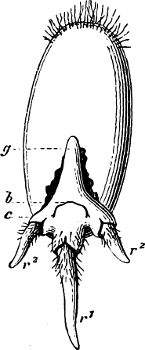
Fig. 293.—Wheat-grain germinating: g
the plumule; b the first leaf succeeding the cotyledon;
r1 the primary root; r2 lateral root.
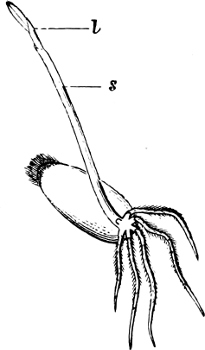
Fig. 294.—Older seedling of the Wheat:
s the second sheathing-leaf; l first foliage-leaf.
The ripe Grass-fruit, in some species of Bamboo, is a
berry; in some other Grasses a nut with loosely lying
seed, in some even a capsule, but otherwise a “caryopsis.” In
some instances it is loosely enveloped by the pales (Oat),
in others firmly attached to these (Barley), and finally, in
others, “naked,” i.e. it is entirely free from the pales
(Wheat and Rye). On the ventral side there is a groove (Fig. 288
E); on the anterior side (dorsal suture), which is turned
towards the inner pale, it is convex, and at the base on this
side, inside the testa, lies the embryo (Fig. 288 D). The
apex of the fruit is often hairy (Fig. 293). The skin
(Fig. 291, a) is formed by the pericarp and testa, and
in some cases (Barley) the pales also form the outer portion.
The endosperm (b) is large, and formed of parenchymatous,
starch-containing cells: aleurone (proteid) grains may also be
found among them. When the starch-grains and the aleurone-grains
adhere together the endosperm becomes “horny,” but is “floury”
when the starch-grains lie loosely with air between them. In
the most external region, just beneath the skin, 1–several
layers of nearly cubical cells (filled principally with
aleurone-grains and fat) are found, the aleurone-layer
(Fig. 292). The embryo (Fig. 291 c-d) contains large
quantities of fatty oil; the large shield-like structure,
attached to the embryo and turned inwards towards the endosperm
(c), is the cotyledon (scutellum); it remains enclosed
in the seed during germination, and dissolves the endosperm by
means of the peculiar epithelial cells developed on the dorsal
surface. The radicle, on germination, is obliged to perforate
a mass of cells derived from the suspensor and which form the
“root-sheath” (coleorhiza, Fig. 293) round its base. In addition
to the tap-root, lateral roots are frequently developed before
germination; these quickly break through, and later on are
followed by others which appear at the base of the leaf (Figs.
293, 294).
The DISTRIBUTION OF THE FRUIT is most frequently
effected by the wind. The spirally-twisted and hygroscopic awn
which persists on the fruits of some species (Avena,
Stipa, etc.) assists in their dissemination, and even
helps to bury them in the ground.
The two preceding orders are more closely related to each other
than they are to the Gramineæ.
The generic differences are chiefly founded on the form of
the inflorescence, the number and sex of the flowers in the
spikelets, the shape and relative length of the pales, awns,
etc. In addition to these the structure of the fruit and
seed presents a great many differences; some have compound
starch-grains, while in others they are single; some have 1
layer of aleurone-cells, others have several (Fig. 292), etc.
1. Bambuseæ. Tall Grasses with woody, very siliceous
stems which bear many branches in the axils of the leaves. 6 stamens.
Bambusa (Bamboo).
2. Oryzeæ. Oryza sativa (Rice) is a herbaceous
marsh-plant, with panicle and small, 1-flowered spikelets, with two
small glumes and two large, boat-shaped, strongly siliceous pales. 6
stamens.—Leersia. Lygeum. Pharus. Zizania
aquatica.
3. Maydeæ. Zea mais (Indian-corn, Maize); the
spikelets are unisexual; the ♂-spikelets in a terminal panicle; the
♀-spikelets closely crowded and arranged in many rows in a thick,
axillary spike, enclosed by large sheathing-leaves. The ♀-spikelets are
1-(2-) flowered; the ovary bears one, long, filamentous style, with
bifid stigma.—Euchlæna; Coix.
4. Andropogoneæ. Saccharum (Sugar-cane); the
spikelets are exceptionally small, 1-flowered, and borne in pairs in
many-flowered, long-haired panicles. Tall grasses with solid, sappy
stem.—Andropogon.
5. Festuceæ. Grasses with panicle (or spike-like
panicle) and 2–several-flowered spikelets. Glumes small, in each case
shorter than the spikelet.—Festuca (Fescue) and Bromus
(Brome, Fig. 288) have the awn placed at the apex of the pale,
or slightly below it. Festuca has perennial species, with
only a sparsely-branched panicle with branches solitary or in pairs,
and round spikelets; the leaf-sheath is widely open. Bromus
has the branches borne in half whorls, and the leaf-sheath scarcely
half open. Brachypodium has very short-stalked spikelets in
a raceme.—Poa (Meadow-grass), Briza (Quaking-grass)
and Glyceria have awnless spikelets; these in Poa are
ovoid, compressed, and with sharply-keeled glumes; in Briza
they are broad, cordate and drooping, with boat-shaped glumes; in
Glyceria round, long, many-flowered, linear or lanceolate; some
species of Glyceria have closed leaf-sheaths.—Dactylis
(Cock’s-foot) differs from all others in the somewhat crowded and
unilateral (subsecund) spikelets, which are compressed and oblique
(i.e. one side more convex than the other).—Phragmites
(P. communis, Reed); the lowermost flowers of the spikelet are
♂; its axis is covered with long, silky hairs; pales without awns,
but acuminate. Perennial marsh-plants.—Melica; panicle small,
sparsely-branched with round, awnless, few-flowered, usually drooping
spikelets. The upper pales, with arrested flowers, are generally
united into a club-like mass.—Molinia, Eragrostis,
Koeleria, Catabrosa.—Cynosurus (Dog’s-tail)
has a small, spicate panicle with unilateral spikelets, some of
which are fertile, some barren, each supported by a pectinate scale.
Arundo. Sesleria. Gynerium. Triodia.
6. Aveneæ. Panicles with 2–many-flowered
spikelets; at least one of the glumes is quite as long as the
entire spikelet.—Avena (Oat). The pale is boat-shaped,
often bifid, and at about the middle of the back has a twisted,
bent awn.—Aira (Hair-grass) has a long-branched panicle
with small, 2-flowered spikelets; the pale has a dentate
apex and bears an awn on the posterior side close to the
base.—Weingærtneria.—Holcus (Yorkshire-fog); a soft,
hairy Grass with an open panicle, keeled glumes; 2 flowers in the
spikelet, of which the lower one is ☿, the upper ♂; the pale which
supports the ☿-flower has no awn, but that which supports the ♂-flower,
on the contrary, is awned.
7. Agrostideæ. Panicles or spike-like panicles with
1-flowered spikelets. Generally 2 glumes and only 1 pale.—The
following have PANICLES: Milium with square
panicle-branches and round spikelets; Agrostis (Fiorin), with
compressed, glabrous spikelets, whose glumes are longer than the pales.
Calamagrostis differs in having a chaplet of long hairs at the
base of the pale.—Stipa (Feather-grass) has a long, twisted
awn.—The following have SPIKELIKE PANICLES: Phleum
(Cat’s-tail, Timothy-grass) has sharply pointed, entirely free glumes,
which are much longer than the awnless pales. Alopecurus
(Fox-tail); glumes united below; pale with awn. Ammophila
(Psamma). A. arundinacea; pales hairy at base; perennial,
stiff-leaved, glaucous sand-grass with creeping rhizome. Aristida.
Sporobolus.
8. Phalarideæ. Panicles and spike-like panicles.
The spikelet has in the upper part a single fertile flower; below
it are placed 4 pales, of which the upper 1–2 sometimes support
♂-flowers. On the whole, 6 floral-leaves of the first order are
present.—Phalaris (P. canariensis, Canary-grass)
has an ovate, spike-like panicle, the spikelets are compressed,
convex on the outer side, concave on the inner. The large glumes are
winged on the back.—Digraphis (D. arundinacea) is
closely allied to Phalaris, but the keel of the glumes is not
winged.—Anthoxanthum (A. odoratum, Sweet-vernal) has a
small, lanceolate, open, spike-like panicle; the spikelets have below 2
barren flowers, and above these an ☿-flower with 2 stamens. The upper
glume is longer than the flower.—Hierochloa.
9. Chlorideæ. The spikelets are
arranged in the form of a spike in two rows on one side
of an often flatly-compressed axis; they are mostly
1-flowered.—Chloris; Ctenium; Cynodon;
Eleusine; Microchloa.
10. Paniceæ. The spikelets are borne in panicles
or spikes, which may be arranged like fingers or in a raceme.
There is a centrally-placed ☿-flower; below it is sometimes a
♂-flower.—Panicum; Paspalum; Oplismenus;
Setaria has an almost cylindrical spike-like panicle
with several barren branchlets, which project as stiff, rough
bristles.—Cenchrus; Pennisetum.
11. Hordeæ. Spikes compound; spikelets sessile in the
notches of a toothed axis.
A. Spikelets solitary.—Triticum (Wheat, Fig. 287) has in
each tooth of the main axis, a several-flowered spikelet which turns
its flat side towards the central axis. The cultivated species
(true Wheat) are 1-2-annual, the wild ones (T. repens, Couch,
also as an independent genus, Agropyrum) are perennial, with
creeping rhizome and lanceolate glumes.—Lolium (Rye-grass) has
in each tooth of the main axis a many-flowered, compressed spikelet,
which is placed edgewise towards it and (with the exception
of L. perenne) has only one outwardly-turned glume (L.
temulentum has a rudiment of the inwardly-turned lower glume); the
terminal spikelet has two glumes.—Secale (Rye). A two-flowered
spikelet in each tooth; small, lanceolate, acuminate glumes.
Nardus and Lepturus have very narrow spikes, the former
with unilateral spikelets.
B. In each notch of the axis 2 or more spikelets are placed
close together.—Hordeum (Barley). In each tooth three
1-flowered spikelets. H. hexastichum (6-rowed Barley), has
6 rows of fruits, since all the spikelets are fertile, and H.
distichum (2-rowed Barley) 2 rows, since the lateral spikelets are
(♂, and barren (p. 292).—Elymus has 2–6 many-flowered spikelets
in each joint of the main axis. Ægilops has awns upon the glumes.
Distribution. 315 genera with 3,500 species. The order
is distributed over the whole world, and as regards number of
individuals is perhaps the richest. In the Tropics, large,
broad-leaved, tree-like forms are found (Bambuseæ,
Olyreæ, Andropogoneæ, etc.; in S. Europe,
Arundo donax); in England, next to the Compositæ, it is
the order most rich in species (about 134).—The origin of some
of the cultivated Grasses is lost in obscurity. The Maize, no
doubt, was indigenous to America, where its nearest relatives
are found, and where it has also been discovered in ancient
Indian graves; Durra or Guinea-corn, Millet and Sugar-cane are
South Asiatic plants, and our own cereals no doubt have sprung
primarily from Western Asia and South-Eastern Europe (Barley
from Armenia and Persia, where a very closely related wild
species is found; Wheat from the same districts; Rye from the
perennial species S. montanum). Panicum altissimum
and Rice have come from Africa.
Uses. The Grasses play a very important part as
cereals and fodder plants. The following are the most important
of the cultivated ones: Triticum vulgare (common
Wheat), turgidum, amyleum, polonicum,
spelta, durum, etc.; Secale cereale (Rye);
Barley (Hordeum-species, see under the genus); Maize;
Oats (Avena sativa, orientalis, nuda);
Millet (Panicum miliaceum); Durra (Turkish Millet,
or Guinea-corn, Sorghum vulgare, cernuum and
saccharatum); Manna-grass (Glyceria fluitans). As
fodder-plants especially: Rye-grass (Lolium perenne);
Oat-grass (Avena elatior); Timothy (Phleum
pratense); Fox-tail (Alopecurus pratensis); Cock’s
foot (Dactylis glomerata); Dog’s tail (Cynosurus
cristatus); Sweet-vernal (Anthoxanthum odoratum);
Soft grass, or Yorkshire-fog (Holcus lanatus and
mollis); Quaking-grass (Briza media); species of
Meadow-grass (Poa); Fescue (Festuca) and Brome
(Bromus).—Several cultivated species of Grass are also
used in the preparation of fermented liquors, the starch
in the seeds being transformed to sugar (beer from
“Malt,” i.e. the germinated Barley; arrack from Rice);
or the stem becomes specially saccharine before flowering: the
Sugar-cane, Sorghum saccharatum.
Officinal. The rhizome of Triticum repens,
Oat-grain, flour of Barley, and the starch of Wheat, also sugar.
The seeds of Lolium temulentum are considered
poisonous.—The stems of many species (including
our common grains) are used in the manufacture of paper,
especially “Esparto grass” (Stipa tenacissima) from
Spain and N. Africa, and the sheathing-leaves of the ♀-spike
of Maize. Sand Lyme-grass (Elymus arenarius),
and especially Psamma arenaria, are important.—But
few Grass-species are sweet-scented: Anthoxanthum
odoratum and Hierochloa odorata contain coumarin;
Andropogon-species have essential oils (“Citronella
oil”).—Ornamental plants are: the “Ribbon-grass” (a
variety of Digraphis arundinacea), Stipa pennata
(whose awn is exceedingly long and feathery), Gynerium
argenteum (Pampas-grass), Lagurus ovatus, Hordeum
jubatum, Bromus briziformis.
The primitive form resembles that of the preceding family. In it
we find the typical, perfectly developed, Monocotyledonous flower,
sometimes even with free carpels and with a dry or somewhat fleshy,
but never petaloid perianth; and this passes over into very different
forms by the suppression of the floral-leaves, perianth and sporophylls
(unisexual flowers are common), and by the close aggregation of the
flowers in the inflorescence. The flower is hypogynous in every
case. The inflorescence is a spike which may be either single or
branched, and has often a thick and fleshy axis (a spadix). In
Palms and Araceæ it is enveloped, at any rate prior to the opening of
the flowers, by a very large floral-leaf, the spathe, which may
be petaloid (Figs. 297, 301).
The fruit is most frequently fleshy (berry, drupe) or a
nut, never a capsule. The embryo is small, with large, fleshy
endosperm (Fig. 299 C); very rarely the endosperm is wanting.
Fig. 295.—Piassava (Attalea funifera).
Fig. 296.—A portion of the stem of Attalea
funifera with persistent leaf-bases.
The numerous plants belonging to this family are large, herbaceous or
tree-like, and the leaves seldom have the usual Monocotyledonous form,
i.e. linear with parallel venation, but most frequently have
pinnate or palmate venation.
Order 1. Palmæ (Palms). The majority are trees with an
unbranched, cylindrical stem, having short internodes
and covered with leaf-scars or the bases of the leaf-stalks (Fig.
296), and at the summit a rosette of large leaves closely packed
together (Fig. 295). An exception to this is found in Calamus
(Cane, “Rotang”), whose thin, creeping or climbing stems have long
internodes; sparsely[28] branched is, e.g. the African Doum-palm
(Hyphæne). Notwithstanding their often enormous stems the
Palms have fibrous roots, like the bulbous Monocotyledons. The leaves
are pinnate (Feather-palms, Fig. 298) or palmate (Fan-palms, Fig.
295) and often very large; they have a well-developed petiole with
an amplexicaul sheath, which is often more or less separated
into a large number of fibres. In the bud the blade is entire
but folded, as the leaf expands the lines of folding are torn,
either those which are turned upwards (thus ∨ ∨ ∨ ∨, e.g.
Pritchardia, Livistona, Phœnix, Chamærops)
or those turned downwards (thus ∧ ∧ ∧ ∧, e.g. Cocos,
Chamædorea, Calamus). The inflorescence is usually
lateral; when, as in Sago-palm (Metroxylon rumphii) or Talipot
(Corypha umbraculifera) it is terminal, the plant is monocarpic,
and dies after flowering; it is often a very large and
branched spadix with numerous flowers either borne externally
or embedded in it, and enclosed either in one woody, boat-shaped
spathe (Fig. 297) or several spathes, in the latter case one
for each branch. The flowers are sessile or even embedded, regular,
generally unisexual (monœcious or diœcious) with the usual
diagram (Fig. 278); the perianth is inconspicuous, green or yellow,
persistent, and more or less leathery or fleshy. 6, rarely 3 or many
stamens. The 3 carpels remain either distinct or form one,
generally 3-locular, ovary. The style is short. There is one ovule
in each carpel. Often during ripening 2 carpels with their ovules
are aborted. The fruit is a berry, drupe or nut,
generally one-seeded, with a large horny or bony endosperm with hard
thick-walled cells (e.g. Date-palm). In some (e.g.
Cocoanut) it is thin-walled, soft, and oily; in several “ruminate.”
When germination commences in the Cocoanut, Date, etc.,
the apex of the cotyledon remains in the seed and developes
into a spongy mass to withdraw the endosperm; in the Cocoanut
it attains a considerable size (Fig. 299 C) and assumes
the form of the fruit. The endosperm in the Cocoanut is hollow
and the interior is filled with “milk.” In the Date-palm and the
Vegetable-ivory (Phytelephas) the cell-walls of the hard
endosperm serve as reserve material.
1. Phœniceæ. Phœnix (Date-palm) has pinnate
leaves with channeled leaflets and diœcious flowers with 8 free
carpels, of which usually only one developes into a berry with
membranous endocarp; the large seed has a deep furrow on the inner
side, and horny endosperm.
Fig. 297.—Inflorescence of a Palm with spathe.
At the top ♂-, at the base ♀-flowers.
Fig. 298.—Livistona australis.
2. Sabaleæ. These have fan-like leaves with channeled
segments; flowers ☿ or polygamous, rarely diœcious, with 3 separate
or only slightly united carpels, all of which are sometimes developed
into fruits (berry or drupe, with thin stone).—Chamærops,
the Dwarf-palm. The pericarp is externally fleshy, internally more
fibrous, and provided with a membranous inner layer. The endosperm is
ruminate (that is, the testa is several times deeply folded into the
endosperm).—Sabal, Copernicia, Livistona (Fig.
298), Thrinax, Corypha, Brahea, and others.

Fig. 299.—A Longitudinal section of
a Cocoanut (diminished), the inner layer only (the stone) not being
divided B End view of the stone, showing the sutures for the 3
carpels (a), and the 3 germ-pores; the embryo emerges from the
lowest one when germination begins. C Germinating; inside the
stone is seen the hollow endosperm and the enlarging cotyledon.
3. Cocoineæ. With pinnate leaves. Monœcious
inflorescence. The carpels are united into a 3-locular ovary. The
fruit is most frequently 1-locular, only 1 of the loculi becoming
developed, rarely 3-locular; it is a drupe with a large, fibrous,
external layer (mesocarp) and most frequently a very hard inner
layer (endocarp, stone) which has 3 germ-pores, the 2 of these,
however, which correspond to the suppressed loculi are closed; internal
to the third lies the small embryo (Fig. 299). Endosperm containing
abundance of oil. Cocos (the Cocoanut-palm), Attalea,
Elæis, Acrocomia, Bactris.
4. Lepidocaryinæ. The floral-leaves and flowers
are borne in 2 rows on the spadix. The carpels are united into one
3-locular ovary; the fruit is coated by a layer of hard, shining,
imbricate scales. The majority of the species are thorny, and climb
by means of the thorny leaves. Some have fan-like (Mauritia),
others pinnate leaves (Raphia, Calamus,
Eugeissonia, Metroxylon; the stems of the latter die
after the first flowering).
5. Borassinæ. Large Fan-palms without thorns,
with 3-locular ovary. Drupe with separate stones. Latania
and Lodoicea have many stamens; Hyphæne;
Borassus (Palmyra-palm).
6. Arecineæ. The most numerous group.
Feather-palms. Berry. Areca, Euterpe,
Oreodoxa, Ceroxylon, Chamædorea,
Geonoma, Caryota with bipinnate leaves.
7. Phytelephantinæ. Flowers with rudimentary
perianth united in close capitula. Phytelephas
(Vegetable-ivory). Nipa.
Distribution. About 1,100 species are known. In
Europe only the Dwarf-palm (Chamærops humilis) is
wild (Western Mediterranean). The Date palm (Phœnix
dactylifera) belongs to North Africa and West Asia. Other
African genera are Hyphæne (Doum-palm) and Elæis
(E. guineensis, Oil-palm). A large majority of the
genera are found in South America and in the East Indies.
The following are American:—Mauritia,
Acrocomia, Bactris, Chamædorea,
Oreodoxa, Euterpe, Attalea, etc.
Asiatic:—Metroxylon, Calamus,
Areca, Borassus, Lodoicea
(“Double-cocoanuts,” Seychelles) and others. The Cocoanut-palm
has perhaps an American origin; all the other species of the
same genus being endemic in America; it is the only Palm found
on the coral islands of the Pacific Ocean, and is also the only
one which is common to both hemispheres.
Uses. Palms belong to the most useful plants; they
contain no poison, and are of little medicinal interest,
but are largely employed in the arts and manufactures, the
hard timber being adapted for many purposes on account of
the hard tissue in which the vascular bundles are embedded.
“Cane” is the stem of Calamus-species (from India).
Sago is obtained from the pith of Metroxylon
rumphii (Sago-palm, Sunda-Is., Moluccas), Mauritia
flexuosa, etc. Sugar-containing sap (“palm wine”) is
obtained from the American Mauritia vinifera and
flexuosa, Borassus flabelliformis (Asiatic
Palmyra-palm), Arenga saccharifera, etc., by cutting off
the young inflorescences, or by perforating the stem before the
flowering (arrack is distilled from this). Vascular
strands for the manufacture of mats and brushes, etc., are
obtained from the outer covering (mesocarp) of the Cocoanut,
and from the detached leaf-sheaths of Attalea funifera
(Brazil) (Fig. 296). Wax is yielded by the leaves
of Copernicia cerifera (carnaueba-wax, Amazon region),
and by the stem of Ceroxylon andicola (palm-wax,
Andes); East Indian Dragon’s blood is from the fruit of
Calamus draco; the young buds of many species, especially
Euterpe, Cocos, Attalea, etc., are used
as “cabbage.” Palm-oil is obtained from the oily mesocarp of
the plum-like fruits of Elæis guineensis (W. Africa),
and from the seeds, when it is largely used in the manufacture
of soap. Edible Fruits from the Date-palm (Phœnix
dactylifera, Arabia, Egypt, W. Africa), and the endosperm of
the Cocoanut (Cocos nucifera). The seeds and the unripe
fruits of the Areca-palm (Areca catechu) are chewed with
the leaves of the Betelpeper, principally in Asia. Vegetable
Ivory from the hard endosperm of Phytelephas
macrocarpa (S. America.)—Many species are cultivated in
the tropics as ornamental plants, but in this country only
Chamærops humilis, Livistona australis and
chinensis are generally grown. In addition to the few
just mentioned, many others are of importance, but these are
much the most useful.
Order 2. Cyclanthaceæ. This is a small order related to
the Palms (44 species from Tropical America), with fan-like,
folded leaves. The flowers are unisexual and arranged in whorls
or close spirals on an unbranched spadix. Ovary unilocular,
ovules numerous. To this belongs Carludovica palmata,
whose leaves are used for Panama hats.
Order 3. Pandanaceæ (Screw-pines) is another small order,
forming a transition to the Araceæ. The woody, (apparently)
dichotomous stem is supported by a large number of aerial roots,
which sometimes entirely support it when the lower portion of
the stem has decayed. The leaves are closely crowded together,
and arranged on the branches in three rows, which are often
obliquely displaced, with the formation of three spiral lines;
they are, as in the Bromeliaceæ, amplexicaul, long, linear,
the edge and lower midrib often provided with thorns. The
♂-flowers are borne in branched, the ♀ in unbranched spadices or
capitula, which resemble those of Sparganium, but have no
floral-leaves. Perianth absent. The drupes or berries unite into
multiple fruits.—About 80 species in the islands of the Indian
Ocean.—Pandanus, Freycinetia.—Fossils perhaps in
the chalk of the Harz.
Order 4. Typhaceæ. The flowers are unisexual, monœcious, and
borne on a cylindrical spike or globose capitulum; ♂ inflorescences
above, the ♀ below. The perianth consists of a definite number
of scales (Sparganium), or in its place numerous
irregularly-arranged hairs are found (Typha); in the ♂-flower
there are generally three stamens; the gynœceum is formed of 1–2
carpels with 1 prolonged style; 1 pendulous ovule. The seeds are
furnished with a seed-cover, which is cast off on germination.—The few
species (about 20) which belong to this order are marsh plants with
creeping rhizome (and hence grow in clusters); the leaves on the aerial
shoots are borne in two rows, entire, very long and linear.
Sparganium (Bur-reed). The flowers are borne in globose
capitula; the perianth distinct, generally consisting of 3 small
scales; pistil bicarpellate. Drupe, dry and woody. The stalk
of the lower ♀ capitula is sometimes united with the main axis,
and consequently the capitula are situated high above their
subtending-leaf.
Typha (Bulrush, Reed-mace) has a long, cylindrical, brown
spike, the lower portion bearing ♀-flowers, and the upper ♂-flowers,
which is divided into joints by alternate leaves. The ♀-flowers have
1 carpel. The perianth is wanting, represented by a number of fine,
irregularly-placed hairs; pistil unicarpellate. Fruit a nut.
The two genera, according to some, are related to the 2nd
order. In both genera native species are found. The pollination
is effected by the wind, and consequently the anthers project
considerably, and the stigma is large and hairy. Typha
is protandrous, Sparganium protogynous. The small,
fine hairs surrounding the nut of Typha assist in its
distribution by the wind.—Fossil Typhas in the Tertiary.
Order 5. Araceæ (Arums). The flowers are small,
and always borne without bracts or bracteoles on an
unbranched, often very fleshy spike, which is enclosed by a spathe,
often petaloid and coloured (Fig. 301). The fruit is a berry.
Outer integument of the seed fleshy.—The leaves have generally sheath,
stalk, and blade with distinctly reticulate venation; they are
chiefly cordate or sagittate (Fig. 302), seldom long with parallel
venation as in the other Monocotyledons (Acorus, Fig. 300). The
Araceæ are quite glabrous, generally perennial herbs
with tubers or rhizomes. Many have latex.—For the rest the structure
of these plants varies; for example, while some have a perianth, in
others it is wanting; in some the perianth-leaves are free, in others
united; some have hermaphrodite flowers, but the majority unisexual
(monœcious); some have free, others united stamens; the ovules are
orthotropous, anatropous, or campylotropous, erect or pendulous;
the ovary is 1–many-locular; some have seeds with endosperm, others
without. In habit there are great differences. While some,
e.g. Colocasia (Fig. 302), have a thick, more or less
upright stem, with leaf-scars, but not woody, others are climbers,
epiphytic, and maintain themselves firmly by means of adventitious
roots, on the stems and branches of trees, or even on steep rocks,
e.g. Philodendron; the cordate, penninerved leaf is the
most common (Fig. 302), but various branched forms appear; the pedate
leaves of Helicophyllum, Dracunculus, etc., are cymosely
branched; the leaves of Monstera deliciosa, perforated by
tearing, should be noticed (the vascular bundles while in the bud grow
faster than the tissue between them, causing the latter to be torn,
and the leaf perforated). With regard to the anatomical structure,
the presence or absence of latex, raphides, resin-passages, groups of
mucilage-cells should be noted. Engler makes use of these anatomical
peculiarities for a scientific arrangement of the order.
A. Orontieæ, Calamus-group. ☿, hypogynous flowers of
a completely formed monocotyledonous type (number in the whorls 2, 3,
or 4).—Acorus (A. calamus, Sweet-flag) has a regular,
3-merous, pentacyclic flower (Fig. 300 C, D). They
are marsh-plants, with creeping rhizome, triangular stem, and long,
sword-like leaves (Fig. 300 A); the inflorescence is terminal,
apparently lateral, being pushed to one side by the upright, sword-like
spathe (Fig. 300 B).—Anthurium (Pr2+2, A2+2, G2);
Pothos; Orontium (unilocular ovary with one ovule),
etc.
Fig. 300.—Acorus calamus: A
habit (much reduced); B inflorescence; C a flower;
D diagram; E longitudinal section of an ovary; F an ovule.
Fig. 301.—Arum maculatum. The spathe
(h) in B is longitudinally divided.
B. Calleæ. Flowers hypogynous, naked, ☿.—Calla
(C. palustris). All flowers in the spike are fertile, or
the upper ones are ♂; 6–9 stamens; ovary unilocular with many
basal ovules. Marsh-plants with creeping rhizome and cordate
leaves.—Monstera, Rhaphidophora, etc.
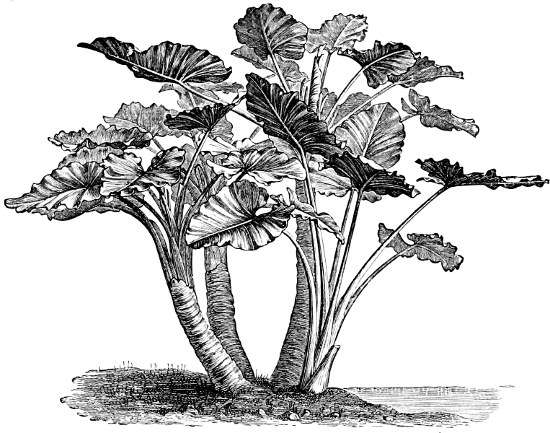
Fig. 302.—Colocasia Boryi.
C. Arineæ. Flowers monœcious, naked, ♂-flowers on the
upper, ♀ on the lower part of the spadix.—Arum (Fig. 301).
The spadix terminates in a naked, club-like portion (k); below
this is a number of sessile bodies (rudimentary flowers), with broad
bases and prolonged, pointed tips (b); underneath these are the
♂-flowers (m), each consisting only of 3–4 short stamens, which
eject vermiform pollen-masses through the terminal pores; then follow,
last of all, ♀-flowers (f), each of which consists of one
unilocular ovary, with several ovules. Perennial herbs, tuberous, with
cordate leaves.—Dracunculus; Biarum; Arisarum;
Pinellia (Atherurus) ternata with leaves bearing 1–2 buds.
Zantedeschia æthiopica (Richardia, Nile-lily); ♂, 2–3
stamens; ♀ with 3 staminodes, 1–5-locular ovary (S. Africa.)—In some
genera sterile flowers are present between the ♂ and ♀ portions of
the spadix (e.g. in Philodendron); in Ambrosinia
a lateral, wing-like broadening of the axis of the spadix divides
the cavity of the spathe into two chambers, the anterior containing
one ♀, and the posterior 8–10 ♂-flowers in two series; in some
the stamens in the single ♂-flowers unite and form a columnar
“synandrium” (e.g. in Dieffenbachia, Colocasia,
Alocasia, Caladium, Taccarum, Syngonium).
A remarkable spadix is found in Spathicarpa; it is united for
its entire length, on one side, with the spathe, and the flowers are
arranged upon it in rows, the ♀ to the outside, and the ♂ in the middle
(Zostera has a similar one).—Pistia similarly deviates
considerably, it is a floating water-plant, with hairy, round rosettes
of leaves; in it also the spathe and spadix are united; at the base a
♀-flower is borne, which consists of one unilocular ovary, and above
several ♂-flowers, each composed of two united stamens.
Biology. The inflorescences are adapted for
insect-pollination; they are protogynous, since the viscous,
almost sessile stigmas come to maturity and wither before the pollen,
which is generally dehisced by apical pores, is shed; some pollinate
themselves freely by the pollen from the higher ♂-flowers falling
upon the ♀-flowers below them, and in some it is conjectured that the
pollination is effected by snails. The coloured spathe, and the naked
end of the spadix (often coloured) of certain genera function as the
coloured perianth in other orders; during flowering a very powerful
smell is often emitted. Arum maculatum is worthy of notice;
small flies and midges creep down into the spathe, between the sterile
flowers (Fig. 301 b), which are situated where the spathe is
constricted, and pointing obliquely downwards prevent the escape of the
insects; in the meantime, the stigmas are in a condition to receive any
pollen they may have brought with them; after pollination the stigmas
wither, and exude small drops of honey as a compensation to the flies
for their imprisonment; after this the anthers (m) open and shed
their pollen, the sterile flowers wither, and the insects are then able
to escape, and enter and pollinate other inflorescences.—In many, a
rise of temperature and evolution of carbonic acid takes place
during flowering; a spadix may be raised as much as 30°C. above the
temperature of the surrounding air.—Again, under certain conditions,
many species absorb such large quantities of water by their roots that
water is forced out in drops from the tip of the leaf; this may often
be observed in Zantedeschia.
About 900 species in 100 genera. Home, the Tropics, especially S.
America, India, and the Indian Islands, preferably in shady, damp
forests growing as epiphytes upon trees, and on the banks of streams.
Outside the Tropics few are found. Acorus calamus was introduced
into Europe from Asia about 300 years ago; it, however, never sets any
fruit, as the pollen is unfertile. In England Arum maculatum
is a very common plant; this and A. italicum are the only
native species. Colocasia antiquorum comes from Polynesia and
the Indian Islands, and also Alocasia macrorrhiza. Fossils in
Cretaceous and Tertiary.
Uses. Many species have pungent, and even poisonous
properties (e.g. Dieffenbachia, Lagenandra,
Arum), which are easily removed by boiling or roasting; the
rhizomes of many species of Caladium, Colocasia
(C. antiquorum, esculenta, etc.), are very rich in
starch, and in the Tropics form an important source of food. An
uncommon occurrence in the order is the highly aromatic rhizome
of Acorus calamus; this contains calamus-oil and acorin
which are used in perfumery. Many are ornamental plants, e.g.
Zantedeschia æthiopica (South Africa), generally known as “Calla,”
and Monstera deliciosa; many other species are grown in
greenhouses.
Order 6. Lemnaceæ (Duck-weeds). These are the most reduced
form of the Spadicifloræ. They are very small, free-swimming
water-plants. The vegetative system resembles a small, leaf-like
body (Fig. 303 f-f), from which roots hang downwards; this
branches by producing a new, similar leaf-like body, which springs
from a pocket-like hollow (indicated by a dotted line in the figure)
on each side of the older one, at its base (or only on one side).
The branching is thus dichasial or helicoid (Fig. 303 A,
where f, f′, f″, f″′ indicate shoots of 1st, 2nd, 3rd, 4th
generations respectively). The leaf-like bodies are, according to
Hegelmaier, leaf-like stems, and thus Lemna has no other leaves
than the spathe and the sporophylls; according to the investigations
of Engler they are stems whose upper portion (above the “pocket”) is a
leaf, which is not sharply separated from the underlying stem-portion.
The inflorescence is a very much reduced Araceous-spadix, consisting
in Lemna of 1 or 2 stamens of unequal length (1-stamened
♂-flowers), 1 unilocular carpel (♀-flower), and 1 thin spathe
(B). [The same is found in Spirodela polyrrhiza, etc.,
whose daughter-shoots begin in addition with 1 basal-leaf. Wolffia
arrhiza, etc., have no roots, no spathe, and only 1 ♂-flower in
the inflorescence (Engler).]—On the germination of the seed a portion
of the testa is thrown off as a lid, so that an exit is opened for
the radicle.—19 species. In stagnant fresh water, both Temp. and
Tropical.—In Europe the species are Lemna minor, trisulca, gibba;
Spirodela polyrrhiza, and Wolffia arrhiza, the smallest
Flowering-plant.
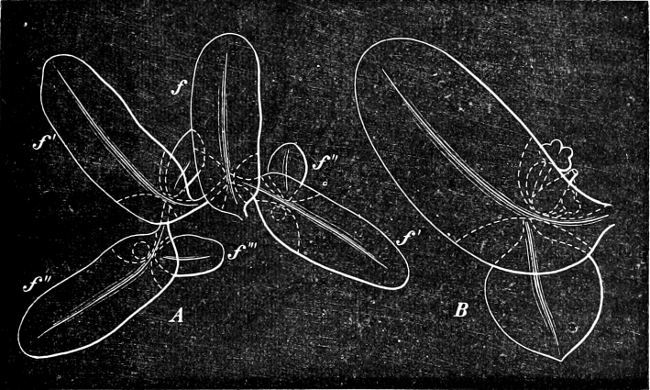
Fig. 303.—Lemna: A vegetative
system; B portion of a plant with flowers; one stamen and tip
of the carpel project; the remaining portions being indicated by the
dotted line.
The flowers in this family are hypogynous and have in part
the general monocotyledonous type with 5 trimerous whorls completely
developed in a regular hermaphrodite flower, and in part the flowers
so much reduced that the type is very difficult to trace. On the one
hand the family is well developed and has capitate inflorescences
(Eriocaulaceæ) and on the other hand it is distinctly reduced
(Centrolepidaceceæ). This family has taken its name from the
fact that the ovule is not, as in the Liliifloræ and nearly all other
Monocotyledons, anatropous, but orthotropous, so that the
embryo (βλάστη) becomes placed at the end of the seed opposite
(ἐναντίος) to the hilum. Large, mealy endosperm.—The orders
belonging to this family are by certain authors grouped with the
Bromeliaceæ and Pontederiaceæ, etc., into one family,
Farinoseæ, so named on account of the mealy endosperm,
the distinguishing character of the Liliifloræ then being that the
endosperm is fleshy and horny.
Order 1. Commelinaceæ. The complete Liliaceous structure
without great reductions in the number of whorls, but with
generally few ovules in each loculus of the ovary, is found in
the Commelinaceæ, an almost exclusively tropical order with
about 317 species; herbs, some of which are introduced into
our gardens and greenhouses. The stems are nodose; the leaves
often clasping; the flowers are arranged in unipared
scorpioid cymes, often so that they form a zig-zag series
falling in the median line of the bracts, and after flowering
they bend regularly to the right or left, outwards or inwards.
They are more or less zygomorphic, particularly in the
stamens, which in the same flower are of different forms or
partially suppressed. The outer series of the perianth
is sepaloid, the inner petaloid, generally violet or blue; the
filaments are sometimes clothed with hairs formed of rows of
bead-like cells (well known for showing protoplasmic movements).
Fruit a trilocular capsule with loculicidal dehiscence
(generally few-seeded); in some a nut. The radicle is covered
by an external, warty, projecting covering which is cast off on
germination.—The abundant raphides lie in elongated cells whose
transverse walls they perforate.—Commelina, Tradescantia,
Tinantia, Cyanotis, Dichorisandra.
Order 2. Mayacaceæ. This order is closely allied to the
Commelinaceæ. 7 species. American marsh- or water-plants.
In many of the following orders of this family the flowers are
united into compound inflorescences, with which is accompanied a
reduction in the flower.
Order 3. Xyridaceæ (50 species). Marsh-plants with
radical, often equitant leaves arranged in 2 rows, and short
spikes on long (twisted) stalks. The flowers, as in the
Commelinaceæ, have sepals (which however are more chaffy) and
petals, but the outer series of stamens is wanting. Capsule
(generally many-seeded).
Order 4. Rapateaceæ. Marsh-plants with radical leaves,
usually in two rows, and several spikelets on the summit of the
main axis, clustered into a capitulum or unilateral spike. Each
spikelet has numerous imbricate floral-leaves and one flower. 24
species. South America.
Order 5. Eriocaulaceæ. The “Compositæ among
Monocotyledons,” a tropical order. The flowers are borne in
a capitulum surrounded by an involucre, very
similar to that of the Compositæ. The flowers are very small,
unisexual, ♂ and ♀ often mixed indiscriminately in the same
capitulum; they have the usual pentacyclic structure; the leaves
of the inner perianth are often connate and more membranous
than the outer; in some the outer series of stamens are
suppressed; in each of the 3 loculi is one pendulous ovule.
Capsule. The leaves are generally radical and grass-like.—335
species; Eriocaulon, Paepalanthus, etc., E.
septangulare on the west coast of Scotland, and Ireland, and
in North America.
Order 6. Restiaceæ. A small, especially S. African and
S. Australian, xerophilous order (about 235 species), which is
quite similar in habit to the Juncaceæ and Cyperaceæ. The leaves
are often reduced to sheaths. The flowers are diœcious, the
perianth as in Juncus, but the outer series of stamens
suppressed. The ovary and fruit as in Eriocaulaceæ; the ovary,
however, may be unilocular, and the fruit a nut. Restio,
etc.
Order 7. Centrolepidaceæ. These are the most reduced
plants in the family; small grass- or rush-like herbs. The
flowers are very small, naked. Stamens 1–2, carpels 1–∞. 32
species. Australia.—Centrolepis (flowers generally ☿
with 1 stamen and 2–∞ carpels).
The flower is constructed on the general monocotyledonous type, with 5
alternating, 3-merous whorls (Fig. 278), but exceptions are found as in
the Iridaceæ (Fig. 279) by the suppression of the inner whorl of
stamens; in a few the position in relation to the bract differs from
that represented in Fig. 278, and in some instead of the trimerous,
di- or tetramerous flowers are found (e.g. Majanthemum,
Paris). Flowers generally regular, hermaphrodite, with
simple, petaloid, coloured perianth (except, for example,
Bromeliaceæ); ovary trilocular, generally with 2 ovules or 2 rows
of ovules in the inner angle of each loculus (Fig. 304 C,
D). Endosperm always present.—A very natural family,
of which some divisions in part overlap each other. The habit varies;
the leaves are however long, entire, with parallel venation, except in
Dioscoreaceæ (Fig. 313).
In the first orders of this family the flowers are hypogynous,
and in the first of all the styles are free, and the capsule
dehisces septicidally; in the following the flowers are
epigynous and in some reduced in number or unisexual; capsule
with loculicidal dehiscence, or a berry.
Hypogynous flowers: Colchicaceæ, Liliaceæ,
Convallariaceæ, Bromeliaceæ (in part).
Epigynous flowers: Amaryllidaceæ, Iridaceæ, Bromeliaceæ
(in part), Dioscoreaceæ.
Order 1. Colchicaceæ. The flower (Fig. 304 A) is
☿, regular, hypogynous, trimerous in all five whorls (6
stamens); anthers usually extrorse. Gynœceum with 3
free styles (A, D); fruit a capsule with septicidal
dehiscence (E); embryo very small (F). The
underground stem is generally a corm or rhizome, seldom a bulb.
A. Veratreæ.—Veratrum; perennial herbs,
stem tall with long internodes and broad, folded leaves; the
flowers andromonœcious, with free, widely opening perianth-leaves
(Fig. 304 A), and globular anthers; inflorescence a
panicle.—Zygadenus, Melanthium, Schœnocaulon, Uvularia,
Tricyrtis.
B. Tofieldieæ.—Narthecium and Tofieldia
have leaves alternate (arranged in two rows), sword-like and borne
in rosettes; racemes or spikes. Narthecium forms an exception
to the order by having a simple style and fruit with loculicidal
dehiscence; Tofieldia by the introrse anthers. In this they are
related to the Liliaceæ. Narthecium has poisonous properties,
like many other Colchicaceæ.
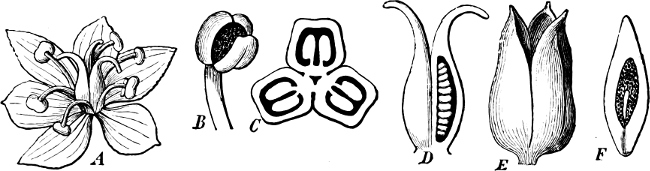
Fig. 304.—Veratrum: A flower;
B stamen; C transverse section of ovary; D
gynœceum, with one carpel bisected longitudinally, and the third
removed; E fruit after dehiscence; F longitudinal section
of a seed.
C. Colchiceæ.—Colchicum (Autumn Crocus);
perennial herbs, with a long, funnel-shaped, gamophyllous
perianth, and introrse anthers. The flowers of C. autumnale
spring up immediately from the underground stem, which is in reality
a corm formed of one internode. Colchicum autumnale
flowers in autumn without leaves; in spring the radical foliage-leaves
appear simultaneously with the fruit. The flower is protogynous, and
is pollinated by insects (humble-bees, etc.) which seek the honey
secreted by the free part of the stamen a little way down the tube.
The length of the tube protects the fruit, and not, as in other cases,
the nectary.—Bulbocodium and Merendera have unguiculate
perianth-leaves, free, but closing together like a tube.
175 species; chiefly in North America and South Africa.
Tofieldia is an Arctic plant. The order is rich in
pungent, poisonous alkaloids (veratrin, colchicin, etc.).
Officinal; the seeds of Colchicum autumnale
(Europe) and Schœnocaulon officinale (Mexico), and the
rhizome of Veratrum album (mountains of Central Europe).
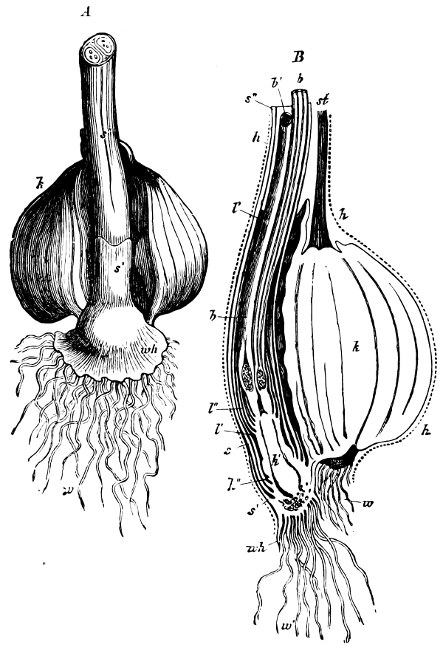
Fig. 305.—Colchicum autumnale. A
Corm seen from the front: k corm; s′ s″ scale-leaves
embracing the flower-stalk; wh base of flower-stalk with roots
(w). B Longitudinal section of corm and flower-stalk:
hh brown membrane surrounding the underground portion of the
plant; st flower-and leaf-stalk of previous year, the swollen
basal portion forming the reservoir of reserve material. The new plant
is a lateral shoot from the base of the corm (k) and has the
following parts: the base bearing the roots (w), the central
part (k’) which becomes the corm in the next year, the axis
bearing the scale-leaves (s’, s″), the foliage-leaves (l,
l′″), and the flowers (b, b’) which are borne in the axils
of the uppermost foliage-leaves.
Order 2. Liliaceæ (Lilies). Flowers as in the Colchicaceæ but
with introrse anthers; ovary free, 3-locular, with single
style; capsule 3-locular with loculicidal dehiscence.—The
majority are herbs with bulbs; the inflorescence is
terminal. In many species reproduction takes place by means
of bulbils (small bulbs) formed in the axils of the foliage-leaves
(e.g. Lilium bulbiferum, lancifolium, etc.,
Gagea lancifolia, etc.), or in the bracts of the inflorescence
(many species of Allium); in many species several buds are
developed as bulbs in the axils of the bulb-scales themselves
(accessory buds arising close together), and in some the formation of
buds is common on the leaves.
A. Tulipeæ, Tulip Group. Bulbs. The aerial, elongated
stem bears the foliage-leaves. Flowers few but generally large,
with free perianth-leaves. Tulipa; style absent, no honey;
flowers generally solitary, erect.—Fritillaria perianth
campanulate with a round or oblong nectary at the base of each
perianth-leaf.—Lilium; perianth widely open, generally turned
back with a covered nectary-groove in the centre of each segment.
Anthers versatile.—Lloydia; Erythronium.
B. Hyacintheæ, Hyacinth Group. Bulbs. Leaves
radical; aerial stem leafless with raceme or spike. In some
the perianth-segments are free, in others united. Honey is
produced often in glands or in the septa of the ovary (septal
glands).—Ornithogalum has a leafy stem; Scilla;
Eucomis has a tuft of floral-leaves above the raceme;
Agraphis; Hyacinthus; Puschkinia;
Chionodoxa; Muscari; Veltheimia; Urginea.
C. Allieæ, Onion Group. Generally bulbs. Leaves
radical. Stem leafless with a compound umbellate or capitate
inflorescence of unipared helicoid cymes, which before flowering
are surrounded by two broad involucral leaves.—Allium.
Filaments often petaloid and bidentate; in many species bulbils are
found in the inflorescence.—Some species have flat leaves: A.
sativum, Garlic; A. porrum, Leek; A. ursinum;
others have round, hollow leaves: A. cepa, Onion; A.
fistulosum, Winter Onion; A. ascalonicum, Eschalot;
A. schænoprasum, Chive.—Gagea; honey is secreted
at the base of the perianth, no special nectary; inflorescence
few-flowered.—Agapanthus; Triteleia.
D. Anthericeæ. Rhizome; raceme; the leaves
not fleshy and thick.—Anthericum; Asphodelus;
Bulbine; Chlorophytum; Bowiea has an almost
leafless stem with curved, climbing branches.
E. Aloineæ, Aloes. Stem generally aerial
and tree-like, bearing on its summit thick, fleshy leaves,
often with a thorny edge (Fig. 306). Raceme branched or
unbranched.—Aloë; Gasteria; Yucca (has
secondary thickening, p. 274).
F. Hemerocallideæ. Phormium, (Ph.
tenax. New Zealand Flax); Funckia (Hosta);
Hemerocallis.
At this point the following are best placed: Aphyllanthes
(A. monspeliensis); Xanthorrhæa (Black-boy);
Xerotes; Lomandra; Kingia; the very
membranous, dry perianth of the last resembles that of the
Juncaceæ, and also there are only 1–few ovules in the loculi.
Pollination by insects. Honey in some is produced
on the perianth (see Tulipeæ), in others by glands on the
carpels (in the septa and parietal placentæ, septal glands):
Hyacinthus, Allium, Anthericum,
Asphodelus, Yucca, Funckia,
Hemerocallis, etc. Some Allium-species are
protandrous. Fritillaria is visited by bees, Lilium
martagon by moths, L. bulbiferum by butterflies,
Phormium (New Zealand) by honey-birds.
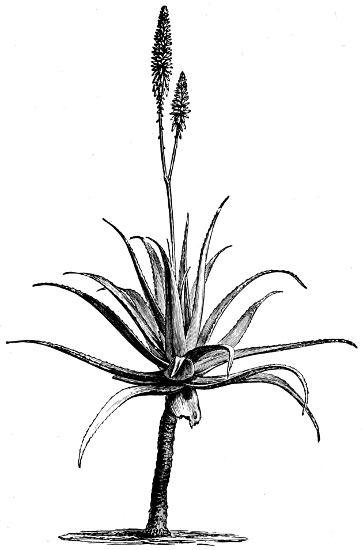
Fig. 306.—Aloë.
About 1,580 species; rare in cold climates; their home is in
sunny plains with firm, hard soil, and warm or mild climate,
particularly in the Old World (S. Africa; As. Steppes;
Mediterranean); at the commencement of spring the flowers
appear in great profusion, and after the course of a few weeks
disappear; during the hot season their life lies dormant in the
bulb, hidden underground. The woody species are tropical.—The
majority of the introduced Liliaceæ (Fritillaria
imperialis, Crown-imperial; Lilium candidum;
Tulipa gesneriana; Hyacinth; Muscari-species;
Scilla-species; Ornithogalum nutans;
Hemerocallis fulva and flava; Asphodelus
luteus and albus) come from the Mediterranean and
W. Asia; Funckia from China and Japan; several Lilies
from Japan and the Himalayas; Agapanthus from the Cape;
Allium sativum is a native of the Kerghis-Steppes; A.
cepa from Persia (?); A. ascalonicum is not known
wild (according to others a native of Asia Minor), perhaps a
form of A. cepa; A. schænoprasum from the N. temp.
region.
Many bulbs have pungent properties; many Onions are used as
culinary plants. The bast fibres of Phormium tenax (New
Zealand Flax) are used technically. Dyes are obtained from the
Aloe; gum for varnish from the stem of Xanthorrhæa
hostile and australe. Officinal; “Aloes,”
the dried sap of S. African species of Aloe (A.
Africana, A. ferox, etc.); the bulb known as
“Squills” from Urginea (Scilla) maritima
(Mediterranean).
Order 3. Convallariaceæ. This order differs from the Liliaceæ
in having the fruit a berry (Fig. 308) and in never being
bulbous; the seeds are less numerous.
A. Convallarieæ, Lily of the Valley Group. Rhizome
(Fig. 307) and normal foliage-leaves.—Polygonatum: rhizome
creeping; aerial shoot leafy, bearing the flowers in racemes in the
axils of the foliage-leaves; perianth tubular. P. multiflorum
(Solomon’s seal), P. officinale, etc.—Majanthemum:
flower 2-merous; perianth almost polyphyllous, spreading.
Smilacina. Streptopus (S. amplexifolius;
the flowers or inflorescence unite with the entire succeeding
internode).—Convallaria (1 species C. majalis, Lily
of the valley); flowers in terminal racemes; 2 basal foliage-leaves;
perianth globose, bell-shaped. Reineckea carnea (Japan, China)
in gardens.—Paris (P. quadrifolia, Herb-Paris); flowers
solitary, terminal, 4-merous, polyphyllous; styles 4, free (approaching
the Colchicaceæ; it is also poisonous); a whorl of 4 (-more) 3-nerved,
reticulate leaves on each shoot.—Ornamental plants: species of
Trillium, Aspidistra elatior (Japan).
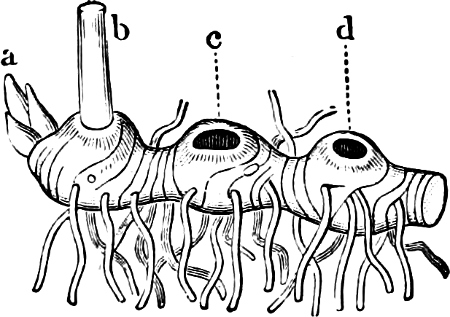
Fig. 307.—Rhizome of Polygonatum
multiflorum: a bud; b shoot; c d scars
left by shoots of previous years.
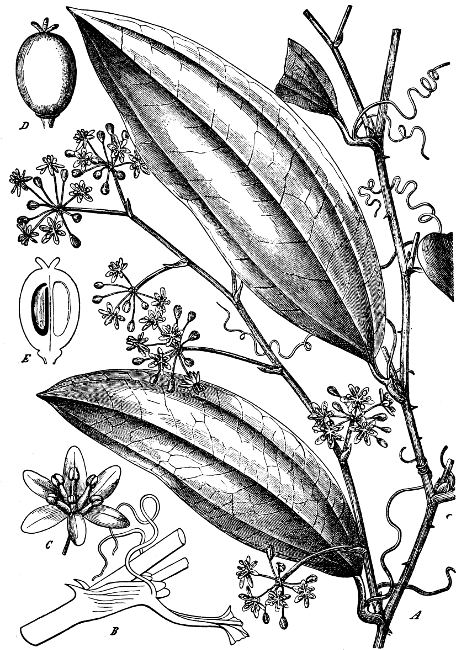
Fig. 308.—Smilax pseudosyphilitica:
A shoot of male plant; C ♂-flower; D berry, almost
ripe; E the same in longitudinal section. B Smilax
syphilitica: portion of branch with base of leaf and tendrils.
B. Asparageæ, Asparagus Group. Scale-like leaves and
green assimilating branches.—Asparagus: horizontal rhizome. The
aerial shoots are very richly branched; the numerous needle-like bodies
upon the plant are leafless shoots, which are crowded together
in double scorpioid cymes in the axils of the scale-leaves; the two
first lateral axes, placed outside to the left and right, generally
bear flowers. Polygamous.—Ruscus (Butcher’s broom) is a S.
European shrub with leaf-like, ovoid or elliptical shoots
(phylloclades) which are borne in the axils of scale-like leaves, and
bear flowers on the central line. Diœcious. Stamens 3, united, anthers
extrorse. Semele androgyna bears its flowers on the edge of the
flat shoot.
C. Smilaceæ. Smilax (Sarsaparilla) (Fig. 308);
climbing shrubs with the leaf-sheath produced into tendrils.
The leaves have 3–5 strong nerves proceeding from the base, and are
reticulate. Orthotropous or semi-anatropous ovules. Diœcious (Fig. 308
C, E).
D. Dracæneæ. Fruit in some a berry, in others
a capsule. The stem of Dracæna, when old, has the
appearance of being dichotomously branched; it has the power
of increase in thickness, and may become enormously thick. The
Dragon-tree of Teneriffe, measured by Humboldt, attained a
circumference of 14 m. and a height of 22 m.; the leaves are
large, linear or linear-lanceolate.—Cordyline (East
Asia), various species in gardens and greenhouses (Yucca
is closely allied). Astelia.
Pollination. Paris quadrifolia and
Convallaria majalis have no honey, and are chiefly
visited by pollen-collecting bees (in the absence of insect
visits self-pollination takes place); Polygonatum
multiflorum has honey secreted by septal glands and
protected by the base of the tubular perianth; it is pollinated
by humble-bees, etc. Asparagus officinalis has small,
polygamous, greenish, honey-bearing flowers; the ♂-flower is
almost twice as large as the ♀; both have rudiments of the
opposite sex.
About 555 species; especially from N. America, Europe, and
Central Asia.
Officinal: “Dragons’-blood,” a red resinous juice
from the stem of Dracæna and the roots of some Central
American species of Smilax. The tuberous stems of
the Eastern Asiatic Smilax glabra are officinal. The
flowers of Convallaria majalis have been lately used
as a substitute for Digitalis. Pungent, poisonous
properties are possessed by Paris. None of the species
are used as food, except the young annual shoots of Asparagus
officinalis, a shore-plant which is used as a vegetable.
Order 4. Pontederiaceæ. Flowers generally zygomorphic,
hypogynous, ☿, with handsome, white or violet, petaloid perianth
which forms a tube at its base. The stamens are inserted at
different heights in the perianth-tube, and are reduced to
three (in Heteranthera seldom to one). In some the ovary
is trilocular with ∞ ovules (Eichhornia), in others
reduced to one loculus with one ovule (Pontederia).
Fruit a capsule or nut. Embryo as long as the abundant, mealy
endosperm.—Tropical water-plants (22 species) with peculiar
sympodial branching, nearly the same as in Zostera.
Spikes without floral-leaves. Many intercellular spaces in the
stem and leaf.—In greenhouses: Eichhornia azurea, E.
crassipes (both from tropical and sub-tropical S. America);
the latter has swollen petioles which serve as floats and
enable it to float freely on the water, sending down its roots
into the mud. Heteranthera reniformis, H. zosterifolia.
Pontederia cordata.
Order 5. Amaryllidaceæ (Narcissi). The flower is
epigynous, otherwise exactly the same as in the Liliaceæ (6
stamens). The majority, like these, are also perennial herbs
with bulbs and scapes. The fruit and the other characters as in the
Liliaceæ. The external appearance is, however, very different.
A. Amarylleæ have bulbs and the leaves generally
arranged in two rows; the flowers are borne singly or in umbel-like
inflorescences on lateral scapes, while the main axis of the bulb is
unlimited. Beneath the inflorescence is an involucre (Fig.
309).—Galanthus, Snowdrop, has a polyphyllous perianth without
corona; the three inner perianth-leaves are emarginate and shorter than
the outer; the anthers dehisce apically. Leucojum differs in
having the perianth-leaves equal in length.—Amaryllis has a
funnel-shaped perianth, entirely or nearly polyphyllous, but somewhat
zygomorphic. Crinum; Hæmanthus; Clivia.—Narcissus
has a tubular corona, a ligular structure arising from the
perianth-tube exterior to the outer stamens. In Pancratium
(Fig. 309) the corona is united with the filaments which appear to
spring from its edge. Eucharis amazonica.
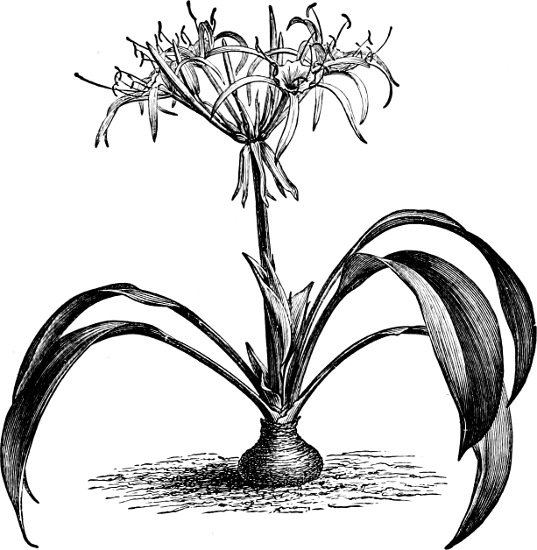
Fig. 309.—Pancratium caribæum.
B. Hypoxideæ. The leaves, which are grass-like,
dry, folded, and in some hairy, spring from a rhizome, generally
with a divergence of 1/3. Flowers small, perianth polyphyllous,
persistent, on which account perhaps the Hypoxideæ may be
considered as the least altered type. The chief characteristic
is that the embryo is separated from the hilum. Hypoxis;
Curculigo (C. recurvata, a favourite ornamental
plant; S.E. Asia).
C. Alstrœmerieæ. (Alstrœmeria,
Bomarea); stems long, leafy, often climbing.
D. Vellosieæ (Vellosia,
Barbacenia); stem woody, usually dichotomously branched,
with terminal, single flowers; it bears numerous aerial roots
which pierce the leaves and surround the stem. Stamens often (by
splitting) 6–18. High table-lands of S. America and S. Africa.
E. Agaveæ. Very similar to the Bromeliaceæ both
in their distribution (nearly all American) and in external
appearance. They appear as gigantic bulbous plants with
perennial, aerial, generally short stem, and perennial, large,
lanceolate or linear, stiff, thick, and often thorny leaves,
which form a large rosette; after the course of several (8–20)
years the terminal inflorescence is developed, which is 10–12 m.
high, paniculate, and freely branched. Before the inflorescence
expands, a large quantity of sugar-containing sap is collected
from A. americana by removing the terminal bud; this on
distillation yields “pulque,” the national drink of Mexico.
After flowering the entire shoot dies, but the subterranean
lateral shoots survive and reproduce the plant.—Agave
americana, etc.; Fourcroya; Polianthes
tuberosa (Tuberose; Central America).
Distribution. The 650 species are chiefly natives of
S. Africa and S. America. Clivia, Hæmanthus,
Amaryllis are from the Cape; Narcissus from
S. Europe, whence many species have been introduced;
Galanthus and Leucojum are especially from S. and
Central Europe, and from the Caucasus.
Uses, few, except as ornamental plants: Galanthus
nivalis; Leucojum; Narcissus pseudonarcissus,
N. poeticus, N. jonquilla, N. tazetta,
etc.; Amaryllis, Alstrœmeria, Eucharis,
Crinum, Vallota, etc. The vascular bundles of
the various species of Agave (Agave rigida, var.
sisalana, sisal hemp,) are used for cordage, etc.
Order 6. Bromeliaceæ. The flowers are hypogynous, epigynous
or semi-epigynous; the perianth is divided into calyx and
corolla; stamens 6. The fruit is a capsule or berry with many
seeds. Endosperm mealy, embryo small, at the edge of the
endosperm, but not enclosed by it.
Fig. 310.—Aechmea miniata.
Fig. 311.—Multiple-fruit of Ananassa
sativa.
Perennial herbs with a very characteristic appearance
(Fig. 310); the stem is most often short, thick, and crowned by a
rosette of many leaves, which are long, often very narrow,
leathery, stiff, and with a spiny edge; they are
usually channeled, completely closing round each other, with their
edges forming a tightly closed hollow, in which generally water is
collected (this among other things insulates the inflorescence and thus
prevents the access of creeping insects, such as ants). The presence
of numerous stellate, water-containing hairs often gives the leaves a
grey appearance, and the layers of cells beneath the upper epidermis
of the lamina form an “aqueous tissue,” which serves as a protection
against the rays of the sun and regulates the evaporation. The stomata
are often situated in furrows on the underside of the leaf, and hence
cause a striped appearance. They are all American (525 species),
especially from S. America, where they live partly as epiphytes on
trees, partly in the clefts of rocks, often on the steepest
slopes, to which they firmly attach themselves by aerial roots; some
are terrestrial. The stem is seldom tree-like or many metres in
height (Puya, in Chili; Hechtia, in Mexico). The
inflorescence is a terminal spike, raceme, or panicle, often with
large and brightly-coloured floral-leaves. The flowers are without
scent. The seeds, in the species whose fruit is a capsule, are often
provided with wings (hairs, expansions, etc).—Ananassa sativa,
Pine-apple (W. Indies, Central America) is cultivated for the sake of
its juicy, aromatic fruits, which coalesce with their fleshy bracts
and form a large spike-like fruit-cluster (multiple-fruits,[29] Fig.
311) bearing on its apex a leafy shoot, which may be used as a cutting.
Seeds very rarely developed.—Tillandsia (T. usneoides
is a filamentous, richly branched, rootless epiphyte hanging in
masses from trees; Trop. Am.), Aechmea, Billbergia,
Pitcairnia, etc.
Uses. The leaves of the Pine-apple, in its native
country, are used for the manufacture of cloth.
Order 7. Hæmodoraceæ. 120 species; in all parts of the
world except Europe; perennial, often tomentose and resembling
the Bromeliaceæ, Iridaceæ and Amaryllidaceæ. Hæmodorum
(Australia).—To this order belong Ophiopogon,
Peliosanthes, Sanseviera, and others.
Order 8. The Iridaceæ have epigynous, hermaphrodite
flowers with petaloid perianth as in the Amaryllidaceæ, but the
interior whorl of stamens is entirely suppressed, and the 3
developed outer stamens have extrorse anthers (Fig.
279); there is 1 style with 3 large, generally more or less
leaf-like branches bearing the stigmas. Ovary and capsule as
in the Amaryllidaceæ and Liliaceæ.—Perennial herbs; bulbs are
rarely found, but horizontal rhizomes, corms, etc., take their
place. The leaves are (except Crocus) as in the Iris,
two-rowed, equitant and sword-like. Flowers or
inflorescences terminal.
The Iris (Flag) has a horizontal rhizome. The flowers are
borne in the leaf-axils in fan-like inflorescences (rhipidium). The
branches of the style are large and petaloid; on their under
surface may be seen a small projecting shelf (Fig. 312 a)
having on its upper surface the stigmatic hairs. Beneath the branches
of the style are 3 well protected stamens, and immediately outside
these the external perianth-leaves. The honey is secreted in the
perianth-tube, and the insects, endeavouring to obtain it through the
narrow passages at the base of the stamens, settle upon the outer
perianth-leaves, which are bent backwards and often very hairy along
their central line. The insects then rub their backs on the anthers
just above them, beneath the branches of the style; they readily
deposit the pollen on the stigma of another flower as they enter it,
but cannot do so in withdrawing, since the stigma is pushed back, and
self-fertilisation is thus avoided. The stylar branches lie close to
the outer perianth-leaves, which are just beneath them, or separated
by a distance of only 6–10 mm.; the first form of flower is adapted
for Rhingia rostrata, the latter for bees.—Crocus
has vertical, tuberous, underground stems surrounded by the
leaf-sheaths (corms), and terminal flowers; the linear leaves are
not equitant, but have two longitudinal furrows on the under
side. The perianth is gamophyllous and funnel-shaped. The stylar
branches (stigmas) are fleshy, rolled together in the shape of a
horn, and split along the edge.—Gladiolus has corms like
the Crocus; spikes with slightly zygomorphic, almost bilabiate
flowers, most frequently turning to one side. Position of the leaves as
in the Iris.—Diplarrhena has 2 fertile and 1 barren stamen;
Hermodactylus has a unilocular ovary with 3 parietal placentæ.
Cypella and Tigridia have bulbs.
Fig. 312.—Iris pseudacorus.
One external and two internal perianth-leaves, and one of the
stylar-branches have been removed, y The outer, i the
inner perianth-leaves; g stylar-branch; a stigma;
s anther. The ovary is seen in longitudinal section.
770 species; chiefly in the countries round the Mediterranean,
and in Africa, especially the Cape (Gladiolus,
Ferraria, Moræa, Galaxia, Sparaxis,
Antholyza, Tritonia, Ixia, etc.), Australia
and Tropical America (Sisyrinchium, Tigridia,
Cipura, Cypella, etc). A great number are
ornamental plants: the cultivated Crocus-species are from
the South of Europe and Asia; Gladiolus communis from S.
Europe; the other species principally from S. Africa. The native
species of Iris are I. pseudacorus (yellow) and
I. fœtidissima.
Officinal: the stigmas of Crocus sativus
(Oriental, cultivated in France, Spain, Italy, and Austria),
used as a colouring matter, saffron; the rhizomes of the
S. European Iris florentina, pallida, and
germanica (“Orris-root”).
Fig. 313.—Dioscorea batatas: A
♂-plant; B ♂-flower; C ♀-plant (nat. size); D,
E ♀-flowers (mag.); F seed; G embryo.
Order 9. Dioscoreaceæ. Perennial herbs with fleshy, often very
large tuberous rhizomes (or roots); twining stems;
leaves stalked, often arrow- or heart-shaped, lobed, palminerved
and finely reticulate as in the Dicotyledons (Fig. 313). The
flower is diclinous (most frequently diœcious), regular,
epigynous, small, and of a greenish colour, but
otherwise typical (Pr3 + 3, and A3 + 3, or G3); in most instances
2 ovules are placed one above the other in each loculus. The
inflorescence is a spike or raceme, sometimes richly
branched and paniculate.—The order approaches most nearly to the
Amaryllidaceæ.
Tamus (Bryony) has a berry, Dioscorea (Yam) a
thin-walled, 3-edged or 3-winged capsule (Fig. 313). Both have
subterranean or aerial tubers; the Yam very often also developes
tubers in the axils of the foliage-leaves; tuberous roots are said to
occur in D. batatas. The tubers of many species of Yams (D.
batatas from China and Japan, D. alata, South Sea Islands
and India, D. bulbifera) are a very important source of food
in the Tropics, especially the first-named.—Testudinaria;
Rajania.—The tuberous stem of Tamus communis and
Testudinaria elephantipes, and some species of Dioscorea
is formed from one single internode (epicotyl), and the aerial shoots
are developed from adventitious buds; in T. elephantipes the
stem is aerial, and covered with thick scales of cork, regularly
arranged, and separated by grooves.
Tropical order (167 species); 2 species (Tamus communis
and Borderea pyrenaica) in Europe.
Family 6. Scitamineæ.
The flowers belong to the ordinary monocotyledonous type. They are
hermaphrodite, epigynous, and have either a petaloid perianth,
or calyx and corolla; they are, however, zygomorphic or
unsymmetrical, and of the stamens most frequently only one is
completely developed, the others being generally represented
by petaloid staminodes. The ovary has 3 loculi, more rarely it is
unilocular with the suppression of 2 loculi. Endosperm is absent
(except Zingiberaceæ); but, on the other hand, there is a
large perisperm. To this family belong large, glabrous,
especially perennial herbs with rhizomes; leaves large,
distinctly divided into sheath, stalk, and blade, the latter being more
or less elliptical or lanceolate, entire, with pinnate venation, and
always with a very well-pronounced midrib, gradually tapering
towards the apex, and giving off numerous branches, which run outwards,
towards the margin, at a larger or smaller angle; these lateral
veins are closely packed, and parallel, but with only weak,
connecting branches between them; the leaves, therefore, are easily
torn pinnately (Figs. 314, 317). The leaf-sheaths close tightly round
each other and form a false stem.
This very natural family comprises orders closely connected with each
other, but is not itself nearly allied to any other family. First in
the series stands:—
Order 1. Musaceæ. The petaloid perianth is strongly
zygomorphic, the anterior leaf being very large (a kind of “labellum”),
the posterior one small; only the posterior stamen is wanting, or is
rudimentary, the other five are developed, and have quadrilocular
anthers; ovary, 3-locular. Seed with straight embryo in mealy perisperm.
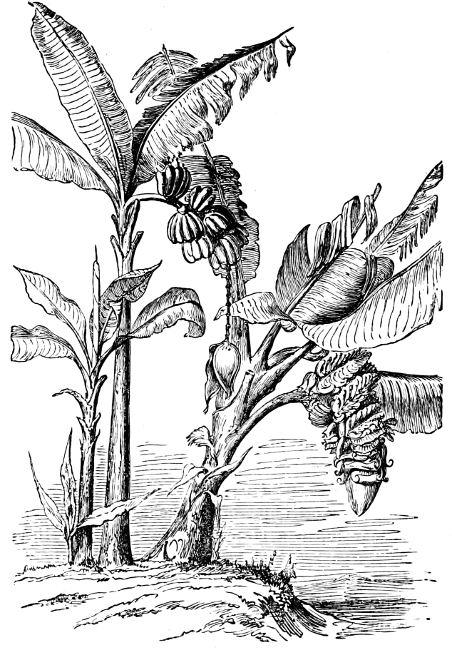
Fig. 314.—Two Musa-species.
The best-known genus is Musa, the Banana (Fig. 314). From the
short rhizome arise enormously large, spirally-placed leaves, whose
sheaths envelope one another, and form an apparently aerial stem,
several metres in height. The inflorescence is a terminal spike
with floral-leaves placed spirally, and sometimes magnificently
coloured; in the axils of each of these several flowers are situated
in two transverse rows (accessory buds); the lowest flowers in the
inflorescence are ♀, the central ones ☿, the upper ones ♂, so that
fruits are only found in the lower region of the inflorescence, the
remaining portion persisting as a naked axis after the floral-leaves
and flowers have fallen off; the inflorescence terminates in an ovoid
bud formed by the flowers which have not yet opened (Fig. 314, the
left-hand figure). The perianth-leaves are united (except the posterior
one). The fruit (known as a “Banana”) is a berry, having the
form of a smooth, short, three-cornered Cucumber (as much as 30 cm.
in length); inside the tough skin is found a farinaceous, aromatic
pulp. No seed is developed in the cultivated species.—Several
Musa-species are cultivated in the Tropics for the sake of
the fruit (M. paradisiaca, M. sapientum); for the
fibrovascular bundles, M. textilis (Manilla Hemp).—Their home
is, no doubt, the Tropics of the Old World; they were introduced into
America before the arrival of Europeans. Musa ensete has dry,
leathery fruits; an ornamental plant.
In Musa the barren, posterior stamen belongs to the inner
whorl; and also in Strelitzia and Ravenala; the
latter may have all 6 stamens developed. In Heliconia, on
the contrary, it belongs to the outer whorl; in Heliconia
the perianth-leaves are differently arranged, and there is only
one ovule in each loculus. The three latter genera have dry
fruits and leaves arranged in two rows. In the “Travellers’
Palm” (Ravenala madagascariensis) the foliage-leaves form
an enormous fan.—Tropical; about 50 species.
The order may be divided as follows:—1. Museæ: Musa,
Ravenala, Strelitzia in the Old World. 2. Heliconiæ:
Heliconia in the New World.
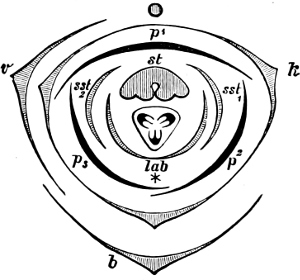
Fig. 315.—Diagram of a Zingiberaceous
flower (Kæmpferia ovalifolia): b bract; v
bracteole; k calyx; p1, p2, p3 the
petals; sst, lateral staminodes (“wings”); lab labellum
(formed of two staminodes); st the fertile stamen; * position of
suppressed stamen. The ovary is in the centre of the diagram.]
Order 2. Zingiberaceæ. Perianth most frequently divided into
calyx and corolla. Calyx gamosepalous. Only 1 fertile
stamen (the posterior, Fig. 315, belonging to the inner whorl)
with quadrilocular anther, which encloses the style in a furrow; the
2 stamens in the outer whorl are staminodes, the median one (the
anterior) is wanting. The 2 lateral staminodes of the inner whorl form
the “labellum” (Fig. 315 lab), which usually is the largest
segment of the flower, and is often bilobed. Ovules many. The fruit in
some is a leathery, 3-valved capsule, with loculicidal dehiscence; in
others it is more or less berry-like and indehiscent, or irregularly
dehiscent. Straight embryo.—The aerial stem is seldom developed to
any extent, and the inflorescences, which are (compound) spikes or
racemes, often with coloured floral-leaves, spring in some (e.g.
Zingiber officinale) directly from the rhizome. The leaves are
arranged in two rows.—The ovary in a few instances (Globba and
others) is unilocular, with 3 parietal placentæ.
They are perennial herbs with fleshy and tuberous rhizomes,
which are used as condiments and in medicine on account of
their pungent and aromatic properties and also for starch,
dyes, etc. Officinal: rhizomes of Zingiber
officinale (Ginger, unknown wild, but cultivated generally
in the Tropics), of Curcuma longa (Turmeric, a dye, E.
India) and C. zedoaria, of C. angustifolia and
others (as E. India Arrowroot), of Alpinia officinarum,
China (galangal). “Preserved Ginger” from Alpinia
galanga. Similar aromatic materials (volatile oils) are
present also, for example, in the fruits; Cardamom fruits
and seeds (from Elettaria cardamomum, China, seldom from
E. major).
315 species; Tropics, preponderating in the Eastern Hemisphere,
India, and especially S. Asia, whence all the aromatic species
originate; they are now commonly cultivated in the Tropics.
Some are ornamental plants in greenhouses, e.g.
Hedychium, Costus, etc. Globba (with
axillary buds in the inflorescence, as in Ficaria),
Renealmia, Kæmpferia.
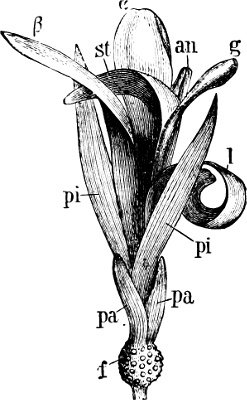
Fig. 316.—Flower of Canna: f
ovary; pa calyx; pi corolla; l labellum; st
stamens; an anther; g stigma; α and β staminodes.
Order 3. Cannaceæ. American herbs without aromatic properties.
Flowers asymmetric (Fig. 316). Calyx polysepalous. The stamens are
petaloid (Fig. 316 st) and barren with the exception of
one (the posterior), which bears on one of its edges a bilocular
anther; another, which is especially large and coloured, is termed the
labellum. The style is compressed and leaf-like, with a small
stigma at the apex. Ovules numerous in the 3 loculi. The capsule is
furnished with warts or soft prickles. Embryo straight.
Canna (30 species; Trop. Am.). The inflorescence is a terminal
spike with 2-flowered unipared scorpioid cymes in the axils of the
floral-leaves. Ornamental plants: Canna indica, etc.
The diagram of the andrœcium of the Cannaceæ and Marantaceæ may be
represented in the following manner (calyx, corolla and gynœceum being
omitted):—
| Cannaceæ. |
Marantaceæ. |
| w w |
w w |
| st |
st |
| w lab |
wi c |
| * |
* |
w The lateral staminodes, “wings;” st fertile stamen;
* the suppressed stamen; lab labellum; c hood; wi
inner-wing.
The labellum of the Cannaceæ corresponds with the hood of the
Marantaceæ and not with the labellum of the Zingiberaceæ.
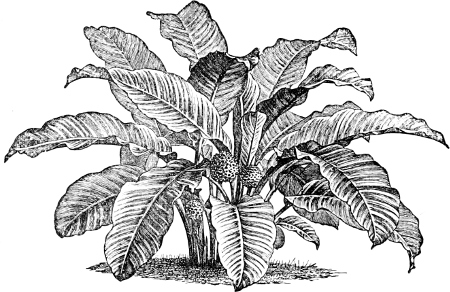
Fig. 317.—Calathea zebrina.
Order 4. Marantaceæ. The flower is asymmetrical. Only 1 or
2 of the 3 stamens in the outer whorl are present as staminodes;
in the inner whorl 2 are petaloid and of the sixth stamen one-half
is developed as a staminode and the other half bears a bilocular
anther. One ovule only in each loculus. The style is strongly
curved and at first enclosed in one of the staminodes (hood) of
the inner whorl; later on it springs elastically forward towards
the other staminode (inner-wing) of the same whorl. The stigma is
very oblique or 2-lipped. Two of the three loculi of the ovary,
in some (Maranta, Thalia) become small and empty.
Embryo curved. Leaves in two rows, with sheath, stalk, and
blade (Fig. 317); at the base of the last is a characteristic
swelling (articulus).—Phrynium, Calathea,
Stromanthe, Ctenanthe, Saranthe, etc. About 150
species; tropical, especially America. The starch of the rhizome
of Maranta arundinacea is OFFICINAL, “West Indian
Arrowroot.”
The flowers are hermaphrodite and constructed on the ordinary 3-merous,
pentacyclic type with petaloid, epigynous, strongly zygomorphic
perianth, and generally one-stamened by the suppression of the
other 5 stamens. The family has derived its name from the fact that the
stamen is united with the style into a “stylar column” (except
Burmanniaceæ). All are herbs; many grow as epiphytes on other
plants.
This family and the Scitamineæ occupy correspondingly high
positions among the Monocotyledons; these two families may
therefore be placed close together, although one cannot be
derived from the other. The first of the two orders is very
small, but the second is very rich in species. The Apostasieæ
are best classed with the Orchidaceæ and have no independent
place.
Order 1. Burmanniaceæ. This order forms a transitional
link between the Gynandræ and the epigynous Liliifloræ
(Amaryllidaceæ), in having a 6-leaved perianth, and 6–8
stamens; but some have a labiate perianth (the median perianth-leaf
of the outer whorl being very large). The ovary is most
frequently unilocular with three parietal placentæ; but in some
it is 3-locular with axile placentation. Capsule. Seeds ∞, small,
with endosperm. The relationship to the Orchidaceæ is shown
especially in the very imperfectly developed embryo and in the ovary.
Small, tropical herbs (59 species); some are saprophytes.
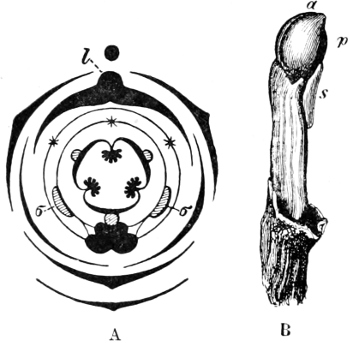
Fig. 318.—A Diagram of an
Orchid-flower. B, Cephalanthera. Stylar-column: a
anther; s stigma; at the foot are seen scars indicating the
position of the parts which have been removed.
Order 2. Orchidaceæ. The epigynous, petaloid perianth is
strongly zygomorphic in having the posterior leaf of the
interior whorl, the lip (labellum), differing from all the
other leaves in form, size, and colour (except Apostasieæ); the
position of the labellum is very frequently reversed, being turned
forwards and downwards by the twisting of the ovary (Fig. 318
A). Only 1 of the stamens—the anterior of the external
whorl—is developed and bears an anther (by the twisting of the ovary
it is turned posteriorly and upwards); the others are entirely wanting
(indicated by * in Fig. 318 A) or present as staminodes (Fig.
318 A, δ δ) (except Apostasieæ, Cypripedileæ);
the filaments are united with the style to form a column (Fig. 318
B), the stylar-column[30] (gynostemium), and the
anther (a) is thus placed on its apex and exactly behind or
over the stigma (s). The anther is 4-locular; the pollen-grains
do not separate (except Apostasieæ, Cypripedileæ) but
remain united either in tetrads or in masses, which correspond to a
pollen-mother-cell (Fig. 320 C, D, E); or the
pollen-grains, formed in each of the two anther-halves, remain united
and form one or a few wax-like masses (pollen-masses, pollinia). The 3
carpels form a unilocular ovary with 3 parietal, deeply bifid
placentæ (except Apostasieæ, Selenipedilum). Only the
two lateral carpels are prolonged and developed into the stigma (Fig.
318 B, s), while the one lying in the median line, which
is situated just within the anther (Fig. 318 A), becomes either
rudimentary or developed into the “rostellum” (“a small beak”),
on which the sticky bodies (glandulæ) arise; by aid of these the
heavy, connected pollen-masses may be glued to the insects which visit
the flower, and pollination is thus secured (in Apostasieæ and
Cypripedileæ the 3 carpels each contribute to the formation of
the stigma). The fruit is a capsule which most often dehisces
by 6 valves, 3 of which are broader and bear the placentæ, and 3
alternating with them are narrower and barren (except Vanilla).
The very numerous and exceedingly small seeds have no endosperm,
and have a somewhat spherical embryo without any trace of external
organs. The testa is membranous and loose.
The Orchids are all perennial herbs with diverse habits and
varying morphological structure (see the genera); the leaves are
scattered, of the usual Liliaceous form, and the inflorescences in
all cases are racemes or spikes (sometimes branched), with
subtending bracts, but without bracteoles.
The forms which are the least modified are described first.
1. Apostasieæ. The perianth-leaves are almost alike
and free. The column is straight, with 3 equally-developed stigmas.
Neuwiedia has 3 perfect stamens (1 median of the outer whorl,
and 2 lateral of the inner whorl); Apostasia has only 2 perfect
(inner lateral) and one barren (the median of the outer whorl), which
however may be entirely wanting. The 3 posterior stamens are
entirely suppressed. The pollen is powdery. The ovary is 3-locular with
axile placenta. 7 species (Tropical East India, Australia).
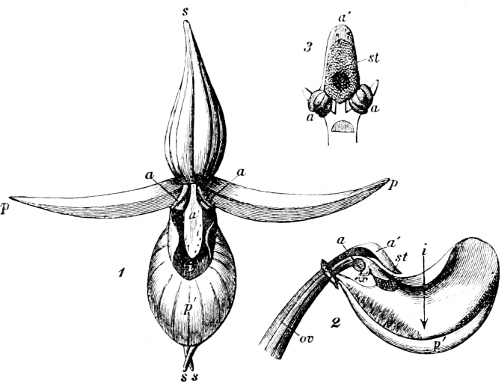
Fig. 319.—Cypripedilum calceolus: 1
front view of the flower; 2 lateral view, after the removal of all
the perianth-leaves with the exception of the labellum, which has
been divided longitudinally; 3 the stylar-column; ov ovary;
s-s exterior, p interior perianth; p’ the
labellum; a the two fertile stamens; a’ the staminode;
st the stigma; i entrance for the insects; ex
exit.
2. Cypripedileæ.[31] The flower is strongly zygomorphic
with a large boat-shaped labellum. There are two perfect stamens
belonging to the inner whorl, and the median anterior (later
on the posterior) stamen of the outer whorl is transformed into a
large, barren, shield-shaped body (Fig. 319). Selenipedilum has
a 3-locular ovary, but Cypripedilum (Ladies’-slipper) has a
unilocular ovary with 3 parietal placentæ—the typical structure for
the Orchids. The pollen-grains are separate (not in tetrads)
and all the 3 lobes of the stigma are constructed to receive them.
This group is therefore, next to the Apostasieæ, the least modified
among the Orchids; in all the following groups, one of the lobes of
the stigma is differently developed from the others, and there is
only one stamen.—Terrestial Orchids.—The pollination of C.
calceolus is effected by the forcible entrance of insects into the
boat-shaped labellum (Fig. 319 p’) at i, and their escape
at ex (in 2) where the anthers are situated; in this way the
stigmas will first be touched and then the anthers. The pollen-grains
are surrounded by a sticky mass in order that they may adhere to the
insects.
3. Neottieæ. The majority are terrestrial Orchids
with creeping, sympodial rhizomes; the blades of the leaves are not
detached from the stem at joints, and have convolute vernation. The
anthers do not drop off, but persist in the withered condition; their
apex is brought in contact with the rostellum (acrotonous
Orchids). The pollen-grains are united in tetrads, which,
however, often hang loosely together in pollinia, attached to a sticky
part of the rostellum (“adhesive disc”), so that they adhere to the
insects, and are by them transferred to the stigmas. Spiranthes.
Listera; Neottia. N. nidus-avis
(Bird’s-nest) is brown (it has little chlorophyll) in colour, has
no foliage-leaves, and lives mainly as a saprophyte; the rhizome is
studded with unbranched, fleshy roots which may form buds at their
extremities.—Vanilla climbs by aerial roots. The fruit is
fleshy and hardly opens, or does so irregularly.—Epipactis,
Cephalanthera.—Epipogon and Limodorum are
saprophytes without chlorophyll.
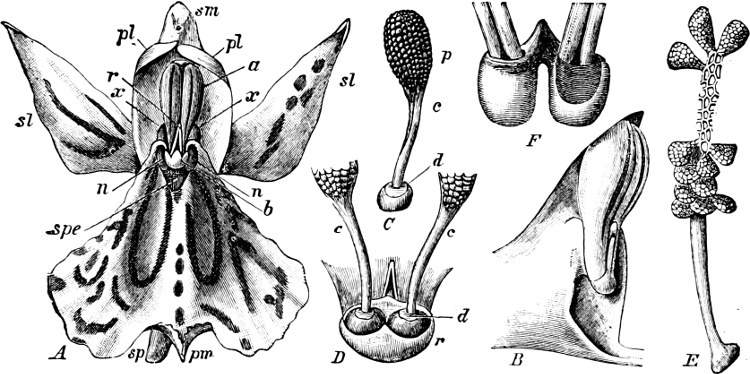
Fig. 320.—A Flower of Orchis maculata
(front view): a stamen; b the cup; n the stigmas;
x staminodes; sp the spur; spe the entrance to it;
sm-sl-sl exterior perianth-leaves; pm the
labellum, and pl-pl the other 2 interior perianth-leaves.
B-E Orchis mascula: B lateral view of the column;
C a pollinium with massulæ (p), caudicle (c) and
adhesive disc (d); D caudicles with the cup (r),
front view; the latter is depressed so that the adhesive disc is seen
lying inside it; E a pollinium, more highly magnified; some
massulæ are removed. F Ophrys aranifera: rostellum and
the base of the anther-loculus; an adhesive disc is seen on the right.
4. Ophrydeæ. Anthers 2-locular, not falling off,
on a very short column. The anther is united at its base
with the rostellum (basitonous Orchids, Fig. 320 A,
B), while in all other Orchids it is connected at the apex
(acrotonous Orchids). The pollen-grains in each loculus are united
into small “masses” (massulæ), each of which corresponds to a
pollen-mother-cell in the anther, and which hang together by elastic
threads (Fig. 320 C, E). Each pollinium is attached at
the base by a stalk (caudicle) to an adhesive disc, formed by the
modified stigma (rostellum), and is easily liberated from it (Fig.
320 C, D, F). The pollinium, which is formed in
an anther-loculus, together with its caudicle and adhesive disc, is
termed “pollinarium” (Fig. 320 C).—All Ophrydeæ are terrestrial
with tuberous roots, two of which are present in the flowering
period, an older one (from the preceding year) containing the
nourishment for the flowering-shoot of the year, and a young one which
is intended to contain the reserve material for the following year.
Inflorescence terminal.
Orchis. The lip has a spur; each of the club-like
pollinia is attached to its own adhesive disc, the discs being
enclosed in a common pouch formed by the rostellum (Fig.
320 C, D). Tubers ovate, undivided: O.
morio, mascula; tubers palmate: O. incarnata,
maculata, majalis.—Ophrys; no spur, the
two adhesive discs are each enclosed in a separate pouch (Fig. 320
F).—Anacamptis and Serapias have one adhesive
disc.—Habenaria, Gymnadenia, Platanthera,
Herminium, Nigritella, Cœloglossum, etc., have
naked adhesive discs (no rostellum).
5. Epidendreæ. Acrotonous Orchids with deciduous
anthers (except Malaxis); 2-8 wax-like pollinia,
with or without caudicles; generally no adhesive discs.
Malaxis (the flower is twisted through a complete circle,
causing the labellum to be turned upwards), Sturmia
and Corallorhiza[32] (Coral-root); the latter has a
creeping, coral-like rhizome without roots, and is destitute
of chlorophyll except in the ovary. The other two somewhat
resemble the tropical Orchids in having the lower internodes
of the axis of the inflorescence tuberous. Liparis;
Calypso. Most of the genera are tropical epiphytes
and many have aerial, green tubers formed from one or more
stem-internodes; Dendrobium, Eria, Phaius,
Bletia, Epidendrum, Cattleya, Lælia,
Pleurothallis, Restrepia, Masdevallia,
Bulbophyllum, etc.
6. Vandeæ. These resemble the preceding but have
only 2 wax-like pollinia in each anther, which are attached by
a caudicle to the adhesive disc of the rostellum. Nearly all
are tropical epiphytes. Stanhopea, Catasetum,
Maxillaria, Oncidium, Vanda,
Polystachya, etc.
6,000 (10,000?) species. The majority live in the Tropics and
occur, especially, as epiphytes on trees or in the crevices
of rocks, to which they are attached by aerial roots. These
aerial roots, like those of Araceæ, are covered by
several layers of spirally-thickened cells (tracheides) which
contain air and form the velamen—an apparatus to absorb
moisture from the air. The roots have a white appearance when
the cells are filled with air, which changes to a greenish hue
when they are filled with water, the chlorophyll then shining
through. They generally have horizontal rhizomes; the ascending
shoots, which bear the foliage-leaves, may vary, but they very
often swell and assume the form of a tuber, which persists for
several years fresh and green after the leaves have fallen off
(Fig. 321). Vanilla is an exception (see above). Our
Orchids are all terrestrial (or marsh-plants); the largest
number of species is found in calcareous soils.
Pollination takes place principally by means of
insects, but self-pollination occurs in some. The lip serves as
a landing-stage for the insect visitors, which, on sucking the
honey, cause the adhesive discs, with the pollinia attached to
them, to adhere to their bodies (generally to the probosces)
and so carry them away to other flowers. In some species parts
of the flower are sensitive or irritable, which has some
connection with the pollination. Without doubt there are a great
many biological differences which are closely connected with
the infinite multiplicity of forms; Darwin (1862) has already
shown an enormous variety, never even dreamt of before, in
the European species. The genus Catasetum has ♂-♀-and
☿-plants with flowers of such different appearances that
they have been classed in various genera (Myanthus,
Monacanthus). Platanthera is pollinated by
hawk-moths; Ophrys, by flies; Epipactis latifolia,
by wasps; Orchis, by bees, especially humble-bees, etc.
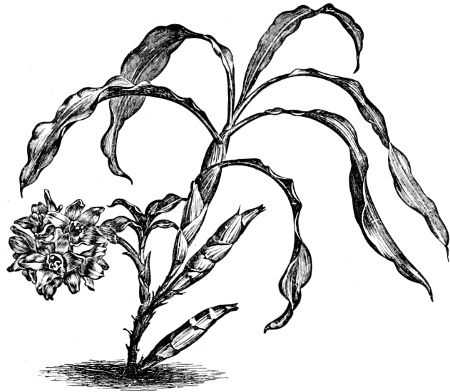
Fig. 321.—Chysis bractescens.
The DISTRIBUTION OF SEEDS is effected by the wind,
the seeds being so exceedingly small and light. Many species
moreover have peculiar, elater-like, fine, hygroscopic hairs
in the ovary, which eject the seeds in a manner similar to the
elaters of the Liverworts.
The USES are few, mostly as ornamental plants in
conservatories. The tubers of several Orchis-species are
OFFICINAL; they contain starch and mucilage and are
used us “salep.” The fruits of Vanilla planifolia are
used as condiments and differ from other Orchid-fruits in
being rather fleshy and in dehiscing irregularly; the seeds are
very small, shining and black.
In this class THE EMBRYO has 2 seed-leaves, a rule from which
there are few exceptions (e.g. Ficaria, Cyclamen,
Pinguicula, certain species of Corydalis, with only
1; and a few, mostly parasitic forms, e.g. Monotropa,
Orobanche, Pyrola, entirely without cotyledons). On
germination the cotyledons nearly always raise themselves above the
ground as green, assimilating leaves and are then termed aerial or
epigean, in contradistinction to the underground or hypogean which
are always buried. The structure of the seed varies (endospermous
or exendospermous); the embryo may be straight or curved. In many
instances the primary root grows as a vigorous tap-root, with weaker
branches arising acropetally (in annuals, biennials, many perennials,
especially woody plants); but in a large number of herbaceous
perennials, which have rhizomes, the root behaves very much as in the
Monocotyledons. The roots generally increase in thickness by means of a
cambium.
The stem, when seen in transverse section, has its vascular
bundles arranged in a ring; in reality, however, they form a kind
of cylindrical network in the stem; the bundles are open, and
thickening takes place by means of a cambium; annual rings are formed
in the perennial stems. There is a rich and very varied form of
branching. The two first leaves of a shoot (fore-leaves) are
placed nearly always to the right and to the left; the same arrangement
is found in the two first leaves developed on the flower-stalk, and
these are, as a rule, the only two; they are found below the calyx and
are usually termed the “bracteoles.” It has become customary
to indicate the bracteoles by the letters α and β, according to their
sequence of growth, and in that sense these letters will be employed in
the following diagrams.
The arrangement of the leaves varies very much; there is
also a great variety of shapes in the leaves and their venation,
but the linear leaves, with parallel venation, so frequent in the
Monocotyledons, are seldom met with, as also the large sheaths (though
the sheath is well developed in the Umbelliferous plants); stipules
occur much more frequently.
The flower is most commonly cyclic, but acyclic or hemicyclic
forms also occur. The type which may be taken as a basis consists in
the majority of instances, as in the Monocotyledons, of 5 whorls, of
which the 4 outer ones (calyx, corolla, and the 2 whorls of stamens)
are most frequently 4 or 5 in number and placed in regular alternation,
whilst the innermost one (the carpels) has generally fewer members,
probably on account of space (Figs. 360, 361, 421, 429, 487, etc.).
Trimerous (Figs. 384, 387, etc.) flowers, or those in which the members
of the flower are in threes or a multiple of three, also occur, as well
as dimerous flowers; other numbers are rare. It is of the greatest
importance in connection with the relative position of the members of
the flower to the axis and bract (orientation), whether the bracteoles
are typically present (even though they may not be developed), or
are typically absent. If there are 2 bracteoles present, then their
position in a pentamerous flower is often as follows: the first sepal
turns obliquely forward, the second is posterior and median, the
third obliquely forward, the fourth and fifth obliquely backward;
quincuncial æstivation is often found in these buds (Figs. 360, 429,
471, 475, 584). The first and third leaves, in the following chapters,
are most frequently alluded to as the “anterior,” the fourth and fifth
as the “lateral” leaves. The reversed arrangement, with the
median sepal in the front, occurs for instance in Papilionaceæ
(Fig. 511), Lobeliaceæ (Fig. 594), Rhodoracecæ. If any
bracteoles are present below a tetramerous flower, the relation is
generally that 2 sepals (the first ones) stand in the median plane,
the two next ones transversely (Fig. 393), and the corolla then adopts
a diagonal position (Fig. 397); but a diagonal position of the calyx
generally shows that the flower is not, strictly speaking, tetramerous,
as in Plantago (Fig. 567), Veronica (Fig. 559 C)
and others.
If the bracteoles are not typically present, then the position
of the sepals is changed accordingly, and the two outer sepals
endeavour to assume the position which the bracteoles would otherwise
have occupied, e.g. in Primula (Fig. 547). Other
positions are also found when the number of bracteoles is more or less
than two.
The leaves which follow the sepals occupy definite positions with
regard to them, which we may consider later. An arrangement must,
however, be mentioned here; when the flower is “diplostemonous”
that is, has two whorls of stamens (thus, Sn, Pn, An + n), these may be
arranged in two ways. Either the first-formed whorl of stamens,
which are termed the “calyx-stamens,” stands directly in front of the
sepals (that is “episepalous”), and is the outermost whorl,
and in this case a regular alternation takes place between sepals,
petals and the two whorls of stamens, which is also continued into
the carpels if their number is the same as that of the other whorls:
the carpels are then placed opposite the sepals (Fig. 278) and the
flower is isomerous and Gn should be added to the formula
above. Or, the calyx-stamens form the innermost whorl,
and the corolla-stamens, which are subsequently formed (“epipetalous”
stamens), stand outside these (Figs. 360, 429); if the number
of carpels is the same as that of the preceding whorls, they are often
placed right in front of the petals and the corolla-stamens.
The first-mentioned arrangement is termed Diplostemonous, and
the second Obdiplostemonous. Both arrangements may be found
in one and the same order, e.g. Caryophyllaceæ. The size and
relation of the members of the flowers, and also the contact with other
members in the early stages of their development, play an important
part in determining the arrangement.
The great number of structural arrangements found in this enormously
large class, may, as is the case in the Monocotyledons, be further
varied by suppression and division of certain leaves (especially
the stamens). Instances of this will occur in the following (Figs. 559,
568.—426, 441, 445, etc.).
The Dicotyledons were formerly divided into 3 sub-classes: Apetalæ
(those without corolla), Sympetalæ or Gamopetalæ (those with the petals
united), and Choripetalæ or Polypetalæ (the petals not united). This
division has now been abandoned because it has been proved that the
Apetalæ were merely reduced or incomplete forms of the Choripetalæ, and
they have therefore been distributed among the various families of the
latter sub-class.
With regard to the Sympetalæ (or Gamopetalæ) it may be stated that
they form to a very great extent a closely connected and natural
group, having in common not only the character that the corolla is
gamopetalous and the stamens united with it (this being also found in
the Choripetalæ), but also a great many others (such as persistent
calyx, cyclic flowers with the formula S5, P5, A5 and as a rule G2,
the two carpels being united to form the ovary; seeds with a thick
integument and a very small nucellus). They are therefore considered
as an independent sub-class, and must be placed at the close of the
system of classification as the forms which presumably have arisen the
latest. In the future systems of classification this arrangement will
very probably be changed, and the first families of the Sympetalæ, the
Bicornes and others will for instance be to a certain extent united
with the families or orders of the Choripetalæ. The Sympetalæ may
certainly be considered as the youngest types, the strongly pronounced
metamorphosis supporting this theory, as also the formation of the
integument of the ovule, the one thick integument being undoubtedly
derived from the coalescence of two—a holochlamydeous ovule, etc.
The Apetalæ and Choripetalæ are united into one sub-class. The leaves
of the perianth in this case are, as a rule, free from each other, the
structure of the flowers presents many differences, and the ovules have
as a rule 2 integuments and a large nucellus. Considerable uncertainty
still prevails regarding the arrangement and the relationship of the
individual families of the Choripetalæ, and some of the following
families are hardly quite natural; but the best arrangement arrived at
so far has been adopted here.
At the beginning of the book a review of the orders of the Dicotyledons
will be found.
Trees and shrubs, which, in the structure of the vegetative shoot
and the catkin-like inflorescences, resemble the Quercifloræ, but
the structure of the flower differs so much from them, that the only
order brought under this heading—Salicaceæ—well deserves to
be separated and to form a family of its own, the nearest relatives
of which are still doubtful. As Juglandaceæ and Myricaceæ also
deserve to be placed in a special family, the name Amentaceæ
(Catkin-bearers), hitherto applied to all of these plants,
cannot be retained as the name of a family.
Fig. 322.—Male and female catkins of Salix
caprea.
There is only one order.
Order. Salicaceæ (Willows). Trees with simple, scattered,
stipulate leaves. Diœcious. The flowers are arranged
in simple inflorescences (spikes or racemes) which are termed
catkins, and which fall off as a whole after flowering (♂) or after
the ripening of the fruit (♀) (Fig. 322). The perianth is very
imperfect[33] or wanting, particularly in Salix (Fig. 323
o); the ♂-flower with 2–several stamens and without any trace
of a carpel (a, b, c): the ♀-flower has a free
bicarpellate ovary, unilocular, and formed from 2 lateral
carpels with 2 parietal (median) placentæ and
generally ∞ ovules; the style divides into two stigmas (d,
e, f). The fruit is a two-valved capsule and the
very small seeds bear a tuft of hairs at the base. Endosperm
absent.—The catkins are situated on dwarf-branches, which in
some species often develop before the leaves and bear at their base
only scale-leaves; in others foliage-leaves are borne beneath the
catkins. The vegetative bud commences with 2 bud-scales which are
united on the anterior side into a scale. The capsule opens by the
dorsal suture. The seed-hairs spring from the funicle.
Fig. 323.—Salix: male flowers of S.
pentandra (a), S. aurita (b), S. rubra
(c), female flowers of S. aurita (d), S.
nigricans (e), S. mollissima (f).
Salix (Willow) has short-stalked, most frequently lanceolate
leaves and erect catkins with undivided bracts (Fig. 322). The flowers
are naked; 1 (o in a-f) or 2 yellowish glands situated
in the median line. In the ♂-flower generally two stamens, situated
laterally like the carpels in the ♀-flower. Various forms are seen
in Fig. 323.—The terminal bud of the branches often aborts regularly,
the uppermost lateral bud taking its place.
Populus (Aspen, Poplar) has long-stalked, more or less round or
cordate leaves with drawn-out apex; catkin pendulous; lobed bracts;
perianth cup-like with oblique edge; stamens usually numerous; stigmas
often divided.—P. tremula (Aspen) has received its name from
the tremor of the leaves: cf. “to shake like an aspen leaf.”
Pollination. The Poplars are wind-pollinated. The
Willows have sticky pollen and are pollinated by insects. The
catkins of the Willows, especially the ♂, are more conspicuous,
from the numerous, closely-packed, yellow flowers, rich in honey
and pollen. The catkins often appear before the foliage and so
are much more easily seen, whilst at this time of the year the
number of competing honey-flowers is smaller, and the insect
visits consequently more numerous. On many catkins of the Willow
the flowers open earliest on the side which is turned towards
the sun and in descending order, i.e. the upper flowers
develop before the lower ones. Hybrids frequently appear.
There are about 180 species existing in the northern, cold and
temperate latitudes. Some in the Polar regions are scarcely more
than an inch in height, and have a creeping rhizome (Salix
herbacea, polaris, reticulata). Fossil
forms are found in the Tertiary and perhaps also in the Upper
Cretaceous.
Uses. Principally for ornamental trees, as they grow
very quickly and are easily propagated by cuttings, S.
babylonica, Weeping Willow; S. purpurea; Populus
alba, Silver Poplar; P. pyramidalis, Pyramid
Poplar—a form of P. nigra; P. monilifera,
Canadian Poplar. The wood is very poor and little used; the
branches of many Willows are cultivated for basket-making,
etc. The wood of the Aspen is used for matches. The bark
contains tannin and, in many Willows, a very bitter extract,
Salicin (S. pentandra, fragilis). Salicylic
acid (officinal) is obtained from Salix. Balsam is
extracted from the buds of many Poplars, especially when the
leaves are shooting.
Trees with verticillate, scale-like leaves forming sheaths at the
nodes. Monœcious. Flowers unisexual. ♂-flowers in catkins; ♀ in short
spikes. Pollen-tube entering the ovule at the chalaza, and not
through the micropyle. Ovary 1-seeded, unilocular. Carpels uniting into
a multiple fruit. Only one order.
Order. Casuarinaceæ. Trees (30 species), from Australia and
certain parts of S.E. Asia, with peculiar, equisetum-like appearance.
The leaves are verticillate, scale-like and united into sheaths. The
internodes are furrowed. Branching verticillate. The unisexual flowers
are situated in catkins or short spikes. The ♂-flower has a central
stamen, surrounded by 2 median, scale-like perianth-leaves and 2
lateral bracteoles. The ♀-flower has a 1-chambered ovary (2 ascending,
orthotropous ovules), no perianth, but 2 large, lateral bracteoles
which finally become woody and form two valves, between which the
nut-like fruit is situated. The multiple-fruits therefore resemble
small cones.—Casuarina equisetifolia, cultivated, gives
“iron-wood.”
[The Casuarinas differ from the ordinary Dicotyledons in many
important respects which may be briefly summarised thus:—The
bicarpellate ♀-flower has a well-pronounced stylar-cylinder
terminated by two stigmas, but the cavity of the ovary closes
very soon after its formation, and in it are developed two
parietal ovules; these are united by a bridge of cellulose to
the stylar-cylinder or summit of the ovary, and hence the ovules
are connected with the walls of the ovary by the bridge (above),
as well as by the funicle (below). The archespore is developed
from the hypodermal cells at the summit of the nucellus,
two primordial mother-cells are first formed and from these
by tangential divisions a central cylindrical mass of cells
(sporogenous-tissue) is produced which is surrounded by tapetal
cells. The cells of the sporogenous tissue correspond to the
mother-cells of the embryo-sac of other Angiosperms; they divide
transversely and from 16–20 macrospores are formed together with
inactive cells which are not crushed together as in the case
of other Phanerogams. The sexual apparatus is developed from a
single cell, but the number of cells composing this apparatus
is subject to variation, the oosphere being accompanied by one
or two neighbouring cells which resemble canal-cells rather
than synergidæ. The sexual apparatus is found in the majority
of the macrospores, but in most of these it remains as a number
of naked cells; while in the fertile macrospores the cells
are invested by walls of cellulose (usually only one fertile
macrospore is found in each ovule). Antipodal cells are never
developed. The macrospores elongate considerably towards the
chalaza, into which some penetrate. The pollen-tube traverses
the stylar-cylinder and enters the ovules at the chalaza, its
passage through the tissue of the nucellus being assisted by
the prolongation of the macrospores. About the centre of the
nucellus the pollen-tube is ruptured; the apical portion which
alone takes part in the fertilisation being firmly attached to
the macrospore. Although the actual impregnation has not been
observed, Treub considers that the endosperm begins to be formed
before fertilisation.]
Trees and shrubs with small, unisexual, monœcious
flowers, having no perianth or a simple inconspicuous one. The ♂
and ♀ flowers are very different and generally placed in separate
inflorescences. The ♂-flowers are most often adnate to the bracts.
The stamens are placed opposite the perianth-leaves, when
they are present in equal numbers. The ♀-flower is naked,
or has a superior perianth. The ovary at the base is 2- or
3-(-6) locular with 1 or 2 pendulous ovules in each loculus, only
one of which is developed; the fruit is a one-seeded nut;
endosperm absent; embryo straight. The inflorescences, which
are either compound and mixed (small dichasia in spikes) or simple,
are here also termed catkins; but, strictly speaking, this
term is applied to the ♂-inflorescences only. In all Quercifloræ the
leaves are scattered (usually in 2 rows) simple, and
penninerved, and with deciduous stipules.
It is worthy of remark that in Betulaceæ,
Corylaceæ and Quercus the ovules, and to some
extent the loculi of the ovary are not developed till after
pollination, so that the development of the pollen-tube proceeds
very slowly. The smallness of the flowers, the absence of
honey, the dryness and lightness of the pollen, the size of the
stigma and the abundance of hairs found on many stigmas are all
adaptations for wind-pollination. It is also an advantage that
the flowers are generally pollinated before the foliage-leaves
are developed, thus preventing the pollen being entangled by the
leaves.
The two orders Betulaceæ and Corylaceæ mentioned
here are by other authors united into one order. [It is doubtful
whether these two should be retained in the family Quercifloræ,
as recent researches (p. 273) have shown that they differ from
the Cupuliferæ in many important points, and agree with the
Casuarinas in the fact that the pollen-tube enters the ovule
through the chalaza.]
Order 1. Betulaceæ (Birches). Monœcious, with thick,
cylindrical, compound ♂ and ♀ inflorescences (2- or 3-flowered
dichasia in a spike with spirally-placed floral-leaves) (Figs. 324,
326, 328). When the perianth in the ♂-flower is completely developed,
it is composed of 4 somewhat united leaves, which are placed
opposite the 4 stamens (Figs. 325, 326 A). The female flowers
are naked; the ovary is bilocular, with two styles and one
pendulous ovule in each loculus. The subtending floral-leaves
unite with the bracteoles and form a 3–5-lobed cover-scale, which is
not attached to the fruit (Figs. 325 D, 326 B). Fruit a
nut without cupule (see Corylaceæ and Cupuliferæ).
In the bud the leaves are flat. The stipules are deciduous. On
germination the cotyledons are raised above the ground. Terminal buds
are only found on old Alder trees; the Birch has sympodial branches.
Fig. 324.—Alnus glutinosus. Branch
of Alder with ♂-(n) and ♀-(m) catkins: k bud;
b fruit-bearing catkin (“cone.”)
Alnus (Alder) (Figs. 324–326). In the majority of species the
♂-and ♀-catkins are both developed in the year previous to their
flowering, and pass the winter naked and bloom before the leaves
expand. ♂-flower: 4 stamens. ♀-flower: the 5-lobed cover-scales of
the ♀-catkin are woody and remain attached to the axis, so that the
entire catkin when ripe resembles a small cone (Fig. 324 b).
Each cover-scale supports two winged or wingless nuts. In the
native species of Alder the buds are stalked (Fig. 324 k). The
bud-scales are formed by the stipules of the lowest leaves.
Betula (Birch). The ♂-catkins, in the native species, appear
in autumn, the ♀-catkins in the flowering year on leaf-bearing,
short-lived shoots. ♂-flowers: 2 stamens, divided (Fig. 328 A).
The 3-lobed cover-scales (Fig. 327 a) of the ♀-catkin are
detached from the axis; each cover-scale supports 3 broadly winged nuts
(b). The stem has cork with annual rings. The young twigs and
leaves have aromatic resin glands.

Fig. 325.—Alnus glutinosa: A
dichasium of ♂-flowers seen from the front; B the same from
inside; C the same from the back; D dichasium of
♀-flowers with subtending-leaf and four bracteoles. The letters
b, α, β, β′, β are the same as in Fig. 326 A.
Fig. 326.—Alnus glutinosa: diagram
of dichasia of ♂ (A) and ♀ (C) catkins; B a
cone-scale. All the bracteoles in A and C are slightly
pressed from their normal position.
The Inflorescences of the Alder.—In the axil of
each cover-scale [b in the Figs] is situated, in the
♂-catkins (Figs. 326 A, 325 A-C) a 3-flowered
dichasium, the flowers of which have a 4-partite perianth, the
posterior perianth-segments being sometimes almost suppressed,
and 4 stamens with undivided filaments. In the ♀-catkin (Figs.
325 D, 326 C) a 2-flowered dichasium is found,
the middle flower being suppressed (indicated by a star in
C). In both instances the inflorescences have two
bracteoles (α-β) and the flowers borne in their axils have each
one bracteole (β′), the other one (α′) being suppressed and
therefore in 326 A and C only represented by a
dotted line; these four bracteoles unite with the cover-scale
(b) which supports the entire dichasium, to form the
5-lobed “cone-scale” (Fig. 326 B) which in the ♀-catkin
eventually becomes woody.
The Inflorescences of the Birch.—A 3-flowered
dichasium is situated in the axil of the cover-scale in both
♂-and ♀-catkins (Fig. 328 A, B); only the central
flower has bracteoles (α-β) (the lateral flowers having no
bracteoles), and these bracteoles unite, as in the Alder, with
the supporting cover-scale (b), and form a three-lobed
cone-scale (Fig. 327 a).
While the ♀-flower exactly resembles that of the Alder, the
reduction of the ♂-flower, already described in the Alder, is
carried further, so that often only the 2 median perianth-leaves
are developed (Fig. 328 A); there are also only
2 stamens, these being deeply cleft, while the other 2 are
suppressed.
About 50 species; N. Temp.—Fossil-forms certainly occur in the
Oligocene. During the Glacial period the Dwarf-birch (B.
nana) extended over Europe; at the present time it is
confined to the moors and mountains of N. Europe and N. America
and Asia. Wind-pollinated.
Uses.—Important forest trees. The bark contains tannic
acid. The tar of the Birch is used in the preparation of Russia
leather; whilst its spring sap is very saccharine, and is used
in some places for making a fermented drink. Its external bark
is used for roofing, for baskets, etc.
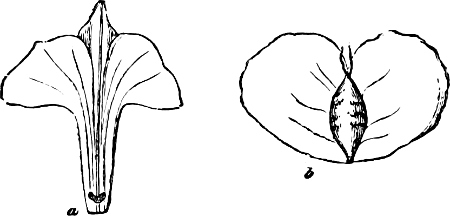
Fig. 327.—Betula verrucosa: a
cone-scale; b fruit.

Fig. 328.—Diagrams of dichasia in the
♂-(A) and ♀-(B) catkins of Birch.
Order 2. Corylaceæ (Hazel-nuts). Monœcious. The ♂-catkins
are long and cylindrical; the ♂-flowers are placed singly in the axil
of the subtending-leaf (cover-scale); they are naked and formed
of a number of divided stamens, which are partly united with
the cover-scale, 4 in the Hazel, apparently 8 (Figs. 330 A,
329 B, C), more on the Hornbeam. The ♀-flowers have a
very small, superior perianth; in the axil of each cover-scale
a 2-flowered dichasium (Fig. 329 D) is present, of which the
central flower (* in Fig. 330 B) is suppressed. The gynœceum
is bicarpellary as in the Birches; the ovary is bilocular, with two
long styles (Fig. 329 D-F); the loculi have 1 (-2) ovules (Fig.
330 B). Each single ♀-flower and fruit is surrounded by a
leaf-like covering, the cupule (husk), which is formed
of three floral-leaves (namely, the bract of a lateral flower,
and its own bracteoles; thus in Fig. 330 B, α, α′, β’ form the
cupule for the left-hand flower, and β, α1, β1, the cupule
for the right-hand).
Corylus (Hazel-nut, Fig. 329). The long, cylindrical ♂-catkins
pass the winter naked, 2–3 together, on short branches. The very small
♀-catkins are enclosed in buds, in which they pass the winter; these
buds are situated in the axils of the fallen foliage-leaves, and it
is only by their larger size that they may be distinguished from the
ordinary foliage-buds. In spring the ♀-catkins are easily recognised
by their red, projecting stigmas (Fig. 329 A). The cupule—the
“husk”—is tubular, fringed, and envelopes the nut. The leaves
are alternate and unsymmetrical, the external side being larger than
the internal; this is connected with the vernation, the blade being
conduplicate in the bud; the stipules are deciduous. The bud-scales are
formed of stipules, the most internal having a leaf-blade attached to
them which is suppressed in the external ones. The cotyledons remain
underground on germination.
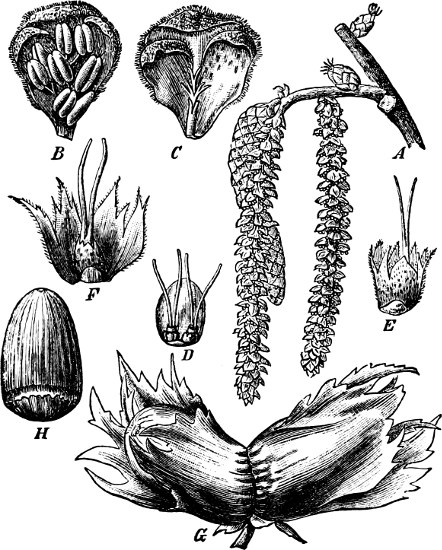
Fig. 329.—Corylus avellana: A
branch at the time of flowering with ♂-and ♀-catkins; B ♂-flower
with subtending-leaf (bract) and two bracteoles; C the same
without the anthers; D view of interior of ♀-dichasium shortly
after fertilisation; E young fruit with cupule; F similar
one with the cupule opened; G mature ♀-fruits; H nut.
Carpinus (C. betulus, Hornbeam). The ♂-and ♀-catkins do
not appear till the leaves are shooting. The ♀-catkin in this instance
is also long and cylindrical. The cupule in C. betulus is
3-lobed, and to a slight extent only embraces the base of the ribbed
nut (Fig. 331); each lobe corresponds to a floral-leaf. Whilst the
carpels are placed medianly in Corylus, in Carpinus,
on the other hand, they are situated transversely, as in the case of
the Betulaceæ. The lamina of the leaf is not conduplicate in
the bud, but flat, and folded only along the lateral veins, which are
also indicated in the form of the fully-developed leaf; otherwise the
vegetative characters are essentially the same as in the Hazel. The
cotyledons are aerial.—Ostrya resembles the Hornbeam, but the
cupule completely envelopes the nut, as a sac open at the apex (Eur.,
N. Am., Japan).
N. Am., Asia, and Europe; 25 species.—Fossil forms in
the Oligocene. Wind-pollinated. Uses. As timber
(Carpinus betulus) and firewood. The fruits of C.
avellana (ordinary Hazel-nut), C. tubulosa (Lambert’s
nut) and C. colurna (Turkish Filbert) are edible.
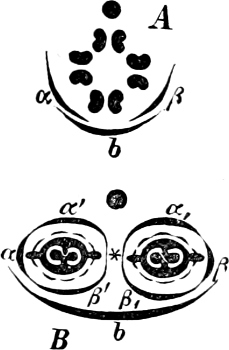
Fig. 330.—Diagrams of the ♂-flower (A)
of Corylus and the dichasium of the ♀-flowers (B).
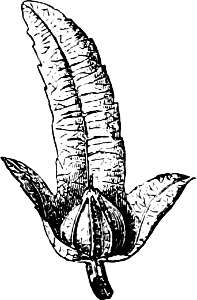
Fig. 331.—Nut of the Hornbeam with cupule.
Order 3. Cupuliferæ. Monœcious. The inflorescences make their
appearance with the leaves, arising in the axils of the leaves of the
same year. A woody cupule furnished externally with scales or
spines is common, and surrounds 1-several flowers (the cupule
in the Corylaceæ never encloses more than a single flower or
fruit). The ♂-flower has a united perianth, which is, however, 4–6
partite, and encloses an indefinite number of undivided stamens. The
♀-flower has a superior, 6-merous perianth (3 + 3, compare Figs.
332 D, 334); the gynœceum is formed of 3 (or in Castanea
4–6) carpels with a corresponding number of stigmas (Figs. 332
D, H; 334, 335); and the ovary has at the base 3 (-6)
loculi (Fig. 333), each of which has 2 pendulous anatropous ovules; the
fruit is a one-seeded nut (Figs. 332 H, 336).
The cupule of the Cupuliferæ, according to the opinion of Eichler, is
formed by united bracteoles, (compare Fig. 333, where the four valves
in the cupule of Castanea are considered as bracteoles of the lateral
flowers of the dichasium); according to another view (see Prantl, in
Engler’s Bot. Jahrb., viii., 1889), it is a ring-like axial
outgrowth independent of the bracteoles of the flower, whose scales
and spines are floral-leaves. The cupule in the Oak only encloses the
base of the fruit, but in the Eating-chestnut and Beech the fruit is
completely enclosed, and consequently the cupule must divide into a
number of valves (generally 4) to allow the fruit to escape. In the
3-flowered dichasia of Pasania, Sect. Eupasania (Trop. Ind.),
each individual flower has its own cupule of the same structure and
development as in Quercus; and, moreover, each group of flowers
has externally the typical six bracteoles.
Fig. 332.—Castanea vesca: A
branch with inflorescences; B ♂-flower; C young
cupule with three ♀-flowers; D ♀-flower; E the same
in longitudinal section; F cupule with 3 nuts (diminished);
G, H nuts (G in longitudinal section to show
embryo).
Castanea (Eating-chestnut, Fig. 332). The catkins are erect
(A), cylindrical, with the ♀ at the base and the ♂ at the
top, or some are entirely ♂ and composed of small dichasia.
The cupule (C, F) is 4-valved, provided
with spines, and entirely envelops the 3 nuts; it is already
developed at the time of flowering.—♂-flowers are most frequently
borne in 7-flowered dichasia, and have a well developed perianth, most
frequently consisting of 6 leaves in two whorls (Fig. 332 B),
and a large number of stamens. ♀-flowers are most frequently borne in
3-flowered dichasia (Figs. 332 C, 333); the letters in Fig.
333 indicate the older theory, according to which the 4 bracteoles
(α′-β′) of the two lateral flowers are thick and united into a single
4-valved, woody cupule, which surrounds the 3 nuts, and is
furnished externally with spines; the spines are well developed
hair-structures.—6 carpels in two whorls.—The leaves in the vertical
shoots have a divergence of 2/5, 3/8, 5/13; on the horizontal
shoots they are alternate. The cotyledons remain underground on
germination.

Fig. 333.—Diagram of the cupule of
Castanea.
Fig. 334.—Female flower of Fagus (mag.)
Fagus (Beech). The ♂-catkins are pendulous, capitate; the
♂-flowers have an obliquely bell-shaped, fringed perianth, with 6–20
stamens. ♀-catkins erect, 2-flowered, borne singly in the axil of
foliage-leaves of the same year; the ♀-flower has a gynœceum formed of
3 carpels, bearing an epigynous, 6-leaved perianth (Fig. 334). In this
genus the dichasium has only 2 flowers, the central one being
suppressed. The cupule contains, therefore, only 2 triangular
nuts (“mast”). All the shoots have the leaves arranged in two rows;
the rows are on the underside, being only about 90° distant from each
other; the buds on the other hand approach each other towards the upper
side. The bud-scales are stipules without laminæ; in vernation the
laminæ are folded along the lateral ribs, the upper lateral portion
being the largest (as in Hornbeam and Chestnut). The cotyledons are
folded, and at germination are aerial, large, and reniform. 4 species
(Europe, Japan, N. Am.)—Nothofagus (S. Am., New Zealand, S.
Austr.)
Quercus (Oak, Fig. 335). Catkins simple. ♂-catkins long,
thin, pendulous, few-flowered. ♀-catkins erect; the cupule is
cup-like, entire, and encloses only the base of the
solitary nut (“acorn”).—The ♂-flower has a similar construction
to that of the Chestnut. The ♀-catkin has not more than 5 flowers
(single-flowered dichasia, in which only the central flower is
developed). The scales on the cupules are no doubt leaf-structures
in this case also. According to another theory, the scales are
hair-structures; they arise on the internal face of the young cupule
apparently in descending, but really in ascending order. The rim of
the cupule gradually expands. In the ♀-flower (Fig. 335) the
loculi of the gynœceum, together with the ovules, are not developed
until after pollination.—The leaves in all cases have a
divergence of 2/5; the lowermost leaves on the shoots are reduced
to stipules which serve as the bud-scales (5 rows). The laminæ are
conduplicate, as in Corylus, and the external side is the
broadest. The cotyledons are fleshy and remain underground. 200
species.—Pasania (100 species).
Fig. 335.—Quercus: A
♀-flower in its cupule (mag.); B longitudinal section
through A, showing cupule, perianth, and inferior ovary.
Fig. 336.—Fruit of Quercus.
368 species, in temperate climates, especially in Europe and N.
America. Authenticated forests have been found in the Oligocene.
The Beech has one species, Fagus sylvatica, in Europe; it is
a most important forest tree (in Denmark the most important) and
reaches its most northern limit near Alvesund in Norway (60° N.L.),
its northern boundary line passing from Alvesund in a zig-zag line
through Ludwigsort, south of Königsberg, in Prussia, towards the
Crimea. According to Steenstrup and Vaupell, the Beech did not make
its appearance in Denmark until a comparatively recent time, the Oak
then being partially supplanted. Other species of Beech are found
in N. America and Japan. Several species of Nothofagus occur
in the South West of S. America, and in the colder regions of the
southern hemisphere. The Oaks grow especially in temperate regions,
e.g. in Western Asia, N. America, and the mountains of Mexico.
Evergreen species are found in Tropical Asia, Himalaya, Japan and
the Mediterranean region. In this country there is one species of
Oak (Q. robur), of which there are three varieties (Q.
pedunculata, intermedia, sessiliflora). The Eating-chestnut is
found in the South of Europe, but is cultivated in the midland and
southern counties of England.—Uses. The wood of these
trees is very useful as timber. The wood of Q. tinctoria has
a yellow colouring matter (Quercitron-wood). The bark of the Oak
contains a large quantity of tannic acid, and is used for tanning; for
this purpose also the cupules of Q. vallonea, ægilops,
græca, and others from the Eastern Mediterranean, are used under
the name of “Valloons.” The Cork-oak (Q. suber; S.W. Europe) is
the most important tree from which cork is obtained,
its bark being very largely developed and stripped for cork.
Gall-nuts are found on many species; those of Q. lusitanica,
var. infectoria (Eastern Mediterranean) are officinal, and
likewise the fruits (acorns) and the bark of Quercus pedunculata
and sessiliflora. Oil is obtained from the Beech “mast.” The
nuts of the Chestnut tree are edible.
This family resembles the Quercifloræ in the catkin-like
inflorescences, the imperfect, unisexual flowers, the epigynous
perianth and the woody shoots with scattered leaves, etc., though
it is in other respects very dissimilar; one point of difference
is the presence of aromatic compounds, but a more important
divergence is found in the structure of the gynœceum, which is formed
of two carpels with one loculus and has one basal,
orthotropous and erect ovule, which, as in the Quercifloræ, does
not become developed until after pollination; the fruit too is very
different, being generally a drupe. Endosperm absent.
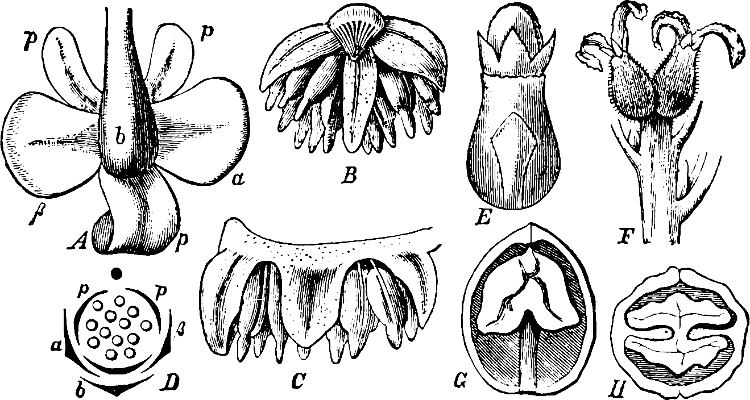
Fig. 337.—Juglans regia: A
♂-flower seen from below with bract (cover-scale) (b),
bracteoles (α and β), perianth-leaves (p); B the same
from the front; C lateral view of the same; D diagram
of A; E ♀-flower with bract, the bracteoles are united
with the ovary, their edge being visible as an indented line below the
perianth; F 2 ♀-flowers at the end of a foliage-shoot; G
fruit (without the fleshy covering) in longitudinal section; H
transverse section of the same.
Order 1. Juglandaceæ (Walnuts). Leaves scattered,
imparipinnate, rich in aromatic compounds. Stipules
absent. Flowers unisexual. Monœcious. The ♂-catkins
are lateral, generally on naked branches of the previous year,
cylindrical, pendulous, many-flowered; the two bracteoles and the
2–4-leaved perianth of the ♂-flower unite with the subtending bract;
the ♂-flower has indefinite stamens (6–20 in Juglans, Fig. 337
A-D). The ♀-catkins are terminal, generally on branches of
the same year, few-flowered (Fig. 337 F); the ♀-flowers have
a superior, 4-leaved perianth, a bicarpellate gynœceum, two
styles with stigmas on the internal surface. The ovary, bracteoles and
bract all unite together (Fig. 337 E). The fruit is generally a
green or black drupe,[34] whose flesh (outer soft portion) in
Carya and Juglans ruptures more or less irregularly, and
frees the stone (“Walnut”).—The stone in Juglans is divided
internally by one true (Fig. 337 H) and by several false, low
partition walls into several incomplete compartments, so that
the two large cotyledons become lobed and incised to fit like
a cast into the irregularities of the inner surface of the stone; the
embryo is exendospermous and covered with a thin testa.—The leaf
scars are large and cordate with 3 groups of vascular bundles.
The PITH in Juglans and Pterocarya is divided
into chambers. The stone ruptures, on germination, along the dorsal
suture into 2 valves; the cotyledons remain underground. In Juglans
regia a long row of accessory buds is found on the lowest
internode (epicotyl) above the axils of the cotyledons. Pollination
by the wind. Both protogynous and protandrous examples of
Juglans regia occur.—33 species, mostly in temperate North
America.—Uses. Walnuts are obtained from J. nigra and
regia; Hickory from North American species of Carya. The
oil-containing seeds of several species are edible. Pterocarya
and others are cultivated as ornamental plants.
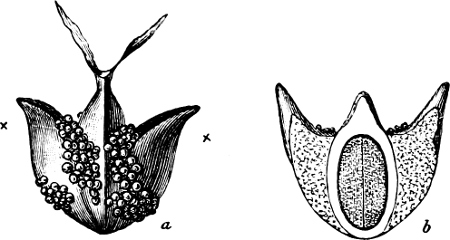
Fig. 338.—Myrica gale: a young
fruit; × the bracteoles with numerous glands; b longitudinal
section of fruit.
Order 2. Myricaceæ. To this order belong shrubs or trees which
have penninerved, simple, at most lobed or pinnatifid leaves, with or
without stipules, and with yellow, aromatic, resin glands (Fig. 338
a). The flowers, situated in catkin-like spikes, are unisexual
and naked, and supported by scale-like floral-leaves. ♂-flower:
4–6 (–16) stamens with short filaments; ♀: generally situated singly.
The gynœceum has a short style with 2 long stigmas, and unites with
the bracteoles, which form wing-like outgrowths on the ripe drupe as
in Pterocarya in the Juglandaceæ (Fig. 338). Cotyledons fleshy
(Fig. 338 b).—Myrica; Comptonia.
40 species; Temperate.—Myrica gale (Sweet-gale,
Bog-myrtle) has been used in the preparation of beer
(Sweet-willow beer) on account of its resinous essential oil.
M. cerifera (N. America) and species from the Cape, M.
quercifolia and others, form wax on the fruit which is used
in the preparation of candles.
The flowers are regular, hypogynous, nearly always
unisexual, small and insignificant, with single,
green perianth of 4–5 leaves. Stamens 4–5, placed opposite
the leaves of the perianth. Ovary formed of 1 or 2 carpels, most
frequently unilocular, with one ovule (Fig. 340). The fruit
is a nut, more rarely a drupe, with one seed, generally
endospermous. The Nettles are the sole order in the family
which has only one carpel (1 stigma); this turns the posterior side
to the front (Fig. 340). The others have two carpels (2 stigmas) but
the anterior only is fertile (Fig. 346) except in a few Ulmaceæ and
Moraceæ.
The majority are trees or shrubs with petiolated leaves,
stipulate; rough hairs are very frequently developed
upon the leaves. The flowers are very often crowded together in the
inflorescence, which is rarely catkin-like. Peculiar aggregations of
fruits are found in some orders. Latex and tough bast,
which is used technically, are also frequently found. Cystoliths are
found in the epidermis of many species of Ficus, Urtica,
and others. Wind- or self-pollination is most common,
as in the Quercifloræ and Juglandifloræ. In the Urticaceæ,
Morus and some others, the stamens lie incurved in the bud, and
when ripe straighten themselves suddenly and elastically, and thus
small clouds of pollen-grains are ejected with considerable violence on
to the stigmas, which are often provided with brush-like hairs (Fig.
341). The formation of honey does not take place.
Order 1. Ulmaceæ (Elms).—Trees or shrubs without latex.
Leaves simple, arranged in two rows (divergence 1/2), oblique (the
inner side, nearer the axis, being the larger), strongly penninerved,
dentate, hispid; stipules deciduous. In opposition to the other
Nettle-like plants the flowers are often ☿ with a united cup- or
saucer-like, generally 4–(5)–6-divided perianth, and a corresponding
or larger number of opposite erect stamens. The gynœceum has
two carpels (2 stigmas), generally one loculus with one pendulous,
anatropous or amphitropous ovule,[35] seldom two loculi and 2 ovules.
Fruit one-seeded (nut or drupe). Embryo without endosperm.
A. Ulmeæ. The fruit is a winged nut (Fig. 339),
the embryo straight, without endosperm. Anthers extrorse.—Ulmus
(Elm). The flowers are situated in inflorescences which develop from
the lower buds of the shoot of the preceding year. The lowermost
bud-scales are empty, the uppermost support either solitary flowers,
or small, dichasial or unipared scorpioid inflorescences. The terminal
bud on the vegetative shoot quickly falls off, and the upper lateral
bud continues the growth sympodially. Flowering takes place before the
leaf-buds open. The flowers are wind-pollinated and have no honey.
Fossil species have been found in the Oligocene.
20 species; North Temp. (2 species in this country). Important
as timber. The Cork-elm (U. suberosa) has a rather thick
cork, which, however, is of no technical use. The bast is used
as Lime-bast.
B. Celtideæ. The fruit is a drupe, the embryo
curved, with folded or rolled up cotyledons, with or without
endosperm. The anthers are introrse. The flowers are borne
on a shoot of the same year. Planera (N. America);
Zelkova.—About 114 species; especially N. Temp., Trop.
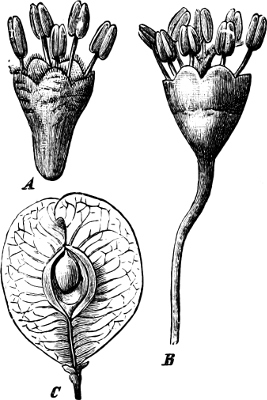
Fig. 339.—A Ulmus campestris,
flower with exceptionally aborted gynœceum; B, U. effusa,
flower with 8 stamens; C, U. campestris, fruit opened
in front to show the seed pendulous from the apex of the loculus; one
loculus is aborted.
Order 2. Urticaceæ (Nettles).—The majority of
species are herbs with simple, stipulate leaves; they have no
latex; stinging hairs abundant. The flowers (Fig. 340) are
unisexual, generally 2-merous and arranged in clusters,
which are united into catkin-like inflorescences. The perianth is
composed very often of 4 (2 + 2) free, or in the ♀-flowers generally
united, green leaves; the 4 (2 + 2) stamens are opposite the
perianth-leaves, the filaments are bent inwards in the bud
and throw themselves elastically towards the outside. The gynœceum
has one style and one stigma (capitate or brush-like,
Fig. 341); the ovary is unilocular, with one orthotropous,
erect ovule (all other orders of this family have inverted or
curved ovules). Fruit, a nut or drupe. Endosperm present (in
Urtica very little), oily. Embryo straight. The STINGING
HAIRS are club-shaped, very turgid, and provided with a siliceous,
brittle apex, which breaks off in an oblique direction and allows the
poisonous cell-sap to be forced out. In many tropical Nettles this is
so strong that it may produce partial paralysis. There is no rudiment
of an ovary in the ♂-flowers (Fig. 340 A). The PERIANTH in the
♀-flower differs from that of the ♂ in having the two internal leaves
generally much larger and enveloping the fruit (Fig. 340 B);
it often happens that all the perianth-leaves are united to form a
gamophyllous envelope. ☿-flowers may occur among the others.—The
inflorescences among our native species are dichasia, which become
transformed into unilateral scorpioid cymes by the development of the
bud of the 2nd bracteole. In Parietaria they are more pressed
together, and the floral-leaves at the same time are also raised on
their axillary shoots to just beneath the flower. As a rule, not only
in this order but also in those related to it, a small vegetative
branch is situated in the axil of the foliage-leaf, and this bears an
inflorescence on each side at its base.
Urtica (Nettle) has opposite leaves with distinct stipules and
stinging hairs. The perianth-leaves of the ♀-flower are free (Fig.
340).—Parietaria (Pellitory) has scattered leaves without large
stipules, and stinging hairs are absent. The ♀-perianth is 4-toothed,
flask- or bell-shaped.—Pilea is a tropical genus with
trimerous, zygomorphic ♀-flowers, the posterior perianth-leaf being
much larger than the two others, and more or less hood shaped.—The
flower of Forskohlea is the most reduced; the ♂-flower has only
one stamen, and the ♀-as well as the ♂-flowers have a one-sided, tongue
like perianth (?). Pouzolzia.
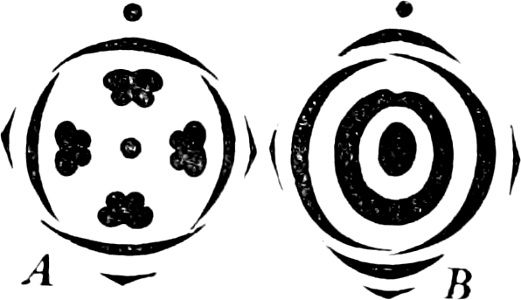
Fig. 340.—Diagram of ♂-and ♀-flowers of
Urtica dioica.
Fig. 341.—Parietaria diffusa;
hermaphrodite flower: a in the female, b at the
commencement of the male stage; the stigma has fallen off, but the
anthers have not yet dehisced.
Wind-Pollinated. The pollen is shot out of the anthers,
when they spring forward, and is caught by long stigmatic hairs.
Parietaria diffusa is protogynous (Fig. 341).
500 species; chiefly in the Tropics, although the few species
which occur in Europe are represented by a much larger number
of individuals.—Uses. The bast of the native species
Urtica dioica and urens, of U. cannabina
(Siberia), etc.; of Boehmeria nivea “Ramié” and
“China-grass” (from Sunda Is., China), and others, is used in
the manufacture of muslin.
Order 3. Moraceæ (Mulberries). Nearly all trees or
shrubs, seldom herbs, generally with latex. The leaves are scattered,
and not infrequently lobed. The flowers are unisexual (monœcious
or diœcious) and arranged in catkin- or capitulum-like, compound
inflorescences. Perianth-leaves 2–6, generally 4, with an equal number
of stamens opposite to them, as in the Nettles. The ovary is 1–seldom
2-locular, and has 2 stigmas (it is thus formed from 2 carpels) seldom
only one style with one stigma. One ovule in each loculus, more or
less curved, and pendulous; micropyle directed upwards. Fruit
usually a drupe. The embryo is generally curved inside the fleshy
endosperm, or it is exendospermous.
Fig. 342.—Morus alba ♂ flower (6/1).
Fig. 343.-Morus alba ♀ inflorescence.
Fig. 344.—Morus nigra fruits.
A. Moreæ. The filaments are incurved in the bud.
Leaves folded in the bud—Morus (Mulberry) (Figs. 342–344).
Monœcious. The inflorescences are catkin-like in appearance, but in
reality composed of many small dichasia. The flowers are similar to
those of the Nettle, but with 2 carpels: in the ♂ with perianth 2 + 2,
and stamens 2 + 2 (Fig. 342), in the ♀, perianth 2 + 2, and 2 carpels
in regular alternation. The small drupes are enveloped by the
perianth, which eventually becomes fleshy, and as all the flowers
on the axis very accurately fit together, the collection of fruits is
formed, which we call a Mulberry (Fig. 344). The leaves are folded
in the buds, and have small stipules. The following are allied to
Morus:—Maclura, Broussonetia (the Paper-mulberry
tree) which has spheroid ♀ inflorescences (made up of dichasia),
etc.
Dorstenia presents an interesting transitional form
to the Fig in its flat, open, and, in some instances, lobed
inflorescence on which the ♂ and ♀ flowers are sunk in grooves.
Indications of a somewhat similar structure are found in certain
Nettles, the sympodial axes of the dichasia becoming flatly
expanded. The fruits are 1-seeded, but, nevertheless, spring
open and eject their seeds.
B. Artocarpeæ. Filaments straight in the bud;
foliage-leaves with convolute vernation. An interpetiolar leaf-sheath
(ocrea) formed in the axil of each leaf by the connate stipules, covers
the younger leaves as a hood. It falls off as the leaf expands, and
leaves a ring-like scar on the stem.—Ficus (the Fig). The
inflorescence (the so-called syconus) has a pear-shaped, fleshy, but
hollow axis, on the interior surface of which the flowers are situated
(Fig. 345). It is a kind of capitulum, with a hollow receptacle,
whose “involucral” leaves close over the entrance to the interior;
it is not, however, a simple capitulum, but a coalescence of cymose
inflorescences. The edible parts are the fleshy stem-portion and
perianth-leaves. The ♂-flower has a 2–6 divided perianth, 1–2 (–6)
stamens; the ♀-flower has an oblique ovary. The fruits are drupes,
with thin flesh.—Many species have aerial roots, and some live
as epiphytes on trees. Pollination, in the edible Fig, is
effected by a small Gall-wasp (Cynips psenes L.), which lays
its eggs in the Fig, and hence carries the pollen away. Even in very
ancient times it was customary to hang infected wild Figs on the
branches of cultivated ones, so that the young Gall-wasps, as they
emerged, could immediately effect the pollination (caprification).
Ficus carica, and other species, have two kinds of ♀-flowers,
besides the ♂-flowers. One kind has a short style and no stigmatic
hairs, and it is only in the ovaries of these that the wasps lay their
eggs (gall-flowers); the other kind has a long style and well-developed
stigmatic-hairs, but the wasps cannot reach their ovaries—these are
“seed-flowers.” There are, moreover, two kinds of plants of Ficus
carica; ♀-plants, which have only seed-flowers, and bear the edible
Figs, and ♂-plants (called “Caprificus”), which bear inedible fruits,
and have ♂-flowers at the upper part of the Fig, but gall-flowers at
the base. [The Caprificus, at Naples, bears three crops of inedible
Figs each year, viz. Mamme (April), Profichi (June),
Mamnoni (August). The ♂-flowers are produced especially in
June, the first Figs being almost entirely ♀, and the last having but
few ♂-flowers. Each crop produces a new generation of Fig-wasps. The
female wasp enters the Figs on the Caprificus, and lays one egg in
each flower, with the result that the flower developes into a kind of
gall. The mother-wasp dies within the Fig. The male wasp is wingless;
it bites a small passage into the ovaries containing the female wasps,
and impregnates them; the female wasps then escape from the Fig, those
in the Profichi carrying pollen away with them as they pass
out. They then enter another Fig, lay their eggs, and die. The edible
Fig-tree similarly has three crops in the year, Fiori di fico,
Pedagnuoli, Cimaruoli. The wasps, entering these Figs,
are unable to lay their eggs in the ovary, but, nevertheless, they
effect cross-pollination on entering the Pedagnuoli, which bear
fertile seeds.]

Fig. 345.—A Fig in longitudinal section.
The flowers of Brosimum are the most reduced. The
perianth is wanting, and the ♂-flower has only 1 stamen.
Cecropia (Trumpet-tree), in S. Am., has its pith divided
into chambers; these are inhabited by ants, which feed upon
small food-bodies formed on the swollen base of the petioles.
The leaves are petiolated, often shield-like, fringed or lobed,
and sometimes with white felted hairs. They serve as food for
Bradypus (the Sloth). Sorocea; Castilloa.
About 300 species exclusively in the warmer climates. The
white Mulberry (M. alba, from China, India, Mongolia)
is cultivated for the sake of its leaves, which are the
indispensable food for silkworms. The black Mulberry (M.
nigra, W. Asia) is cultivated for its fruits, which are
used for the officinal Mulberry juice. The ordinary Fig-tree
(Ficus carica) is from the Mediterranean. The fruit
of the well-known Oriental Sycamore (F. sycomorus) is
edible. The Bread-fruit tree (Artocarpus incisa) and
the Jack (A. integrifolia) have their home in the South
Sea Islands, and are cultivated in tropical countries. The
Bread-fruit is morphologically the same as the Mulberry. It
has a very large, spheroid inflorescence, whose floral-leaves
and perianth become fleshy and united into one nutritious
mass, together with the axis, which is also fleshy. The milky
juice of the India-rubber tree (Ficus elastica, East
Indies, a common house-plant), and of Castilloa elastica
(Am.) is the raw material of India-rubber. The milky juice of
Galactodendron utile (Cow-tree, S. Am.) is saccharine and
nutritious, but in Antiaris toxicaria (the Upas-tree,
of Java) it is a strong poison. The bast of the Paper-Mulberry
tree (Br. papyrifera, Eastern Asia); is used in Japan for
paper. Shellac is obtained from a small, hemipterous insect
(Coccus lacca), which lives upon Ficus laccifera
and F. religiosa (the Bo-tree, sacred to Buddha), E.
India. The wood of Maclura aurantica (Am.) has a yellow
colour, and is known as yellow Brazilian wood.
Order 4. Cannabaceæ. The plants which belong to this order
are aromatic herbs, either annuals or perennials, without
latex. Leaves palminerved, and more or less divided, hispid,
and with free, persistent stipules. Flowers always diœcious;
♂-flowers in panicles, formed of dichasia, passing over into uniparous
scorpioid cymes. They differ from the Nettles, particularly in the
5-leaved perianth of the ♂-flower, the 5 stamens (Fig. 346–351) with
filaments erect in the bud, and in the ♀-flower by the small,
entire, cup-like perianth, which surrounds the base of the ovary (Fig.
346, p. 352). The ovary has two styles, or one divided into two, with
two stigmas and a pendulous, curved ovule (Fig. 346 B, 352
B); the fruit is a nut; the embryo is curved
(Hemp, Fig. 353), or rolled (Hop, Fig. 349), without endosperm.
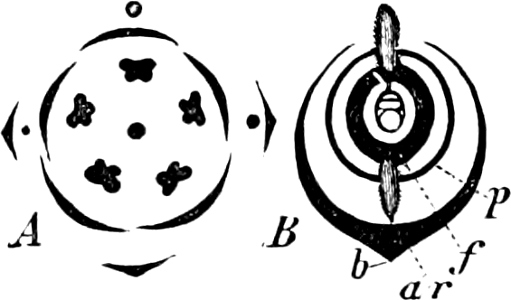
Fig. 346.—Diagram of male and female flowers
of the Hop and Hemp: b the bract, p the perianth. The
position of the embryo is indicated.
Only 2 genera with 3 species (Asiatic), of which two are
cultivated.—Humulus lupulus (Hop, Figs. 347–349) is a twining,
perennial plant, twisting to the right, with opposite, palmilobed,
rough leaves, and large, interpetiolar stipules. The ♀-flowers are
situated in closely-flowered, cone-like, compound inflorescences, with
ultimately large, thin, imbricate floral-leaves (Fig. 348) which bear
the yellow, glandular hairs, containing lupulin. This inflorescence
is made up as follows:—The most external floral-leaves are situated in
pairs, and are the persistent stipules of a leaf, the blade of which
has become suppressed, or in any case is rudimentary. Such a pair of
stipules supports 4 (2–6) flowers in a double uniparous cyme, whose
central axis does not develope into a flower. The bracts of these
flowers (bracteoles of the partial inflorescence) become, at maturity,
very large, spathe-like, and, together with the stipules, produce a
cone-like appearance.
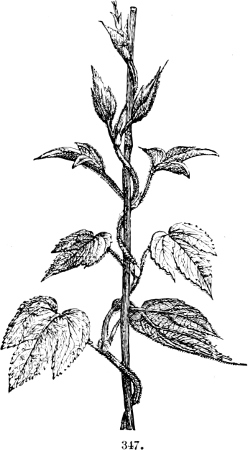
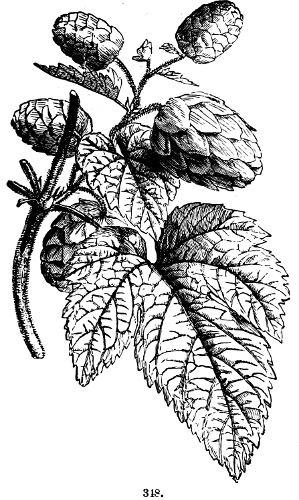
Fig. 347–348.—Humulus lupulus: 347,
twining stem; 348, branch with strobiles.
Cannabis sativa (Hemp, Figs. 350–353) is an East Indian herb,
with palmilobed leaves, and differs from the Hop in being annual,
erect, and in having its leaves opposite at the base and scattered
above. The ♀-inflorescence is not cone-like as in the Hop, but the
flowers are similar in construction. The main difference is to be
found in the axillary shoot, which was suppressed in the Hop, and is in
the Hemp developed into a leaf-bearing shoot which on each side bears
only one ♀-flower, and in the fact that the bracts are not so strongly
developed.
The “Hops” (the female inflorescences) are used in brewing,
and medicinally on account of the yellow glands which contain
lupulin. The Indian variety of Cannabis sativa contains
an abundance of glandular hairs and resin. The withered
inflorescences are used in medicine and are officinal. The bast
of the stems of the Hemp is also used and the fat oil of the
seeds. In Oriental countries the entire plant is used in the
preparation of an intoxicating drink (haschisch), the narcotic
material being found in the glandular hairs.
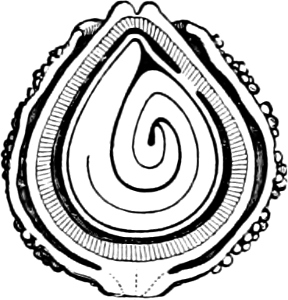
Fig. 349.—Humulus lupulus: fruit in
longitudinal section.
Figs. 350–353.—Cannabis sativa: 350,
♂-plant; 351, ♂-flower; 352, ♀-flower, entire and in longitudinal
section; 353, fruit in longitudinal section.
This family is on one side closely allied to the Urticaceæ
by its solitary, basal, vertical, and straight
ovule, and by the conical ocrea which envelopes the younger leaves
in the bud, similar characters being present in the Urticaceæ. On
the other side it is related to the Curvembryæ. The flowers are
small, often trimerous, regular and slightly perigynous (in
Chloranthaceæ, if they properly belong to this family, and
Houttuynia, more or less epigynous). Syncarps are present in
some Piperaceæ, but the fruit is generally a single fruit, one-seeded
berry, nut or drupe. The leaves are generally scattered.
Order 1. Polygonaceæ. The majority are herbaceous plants with
round, often jointed stems, scattered leaves and ocrea, that
is a membranous, tubular, ligular or stipular structure inside
the base of the leaf, which clasps the stem and axillary bud; the
edges of the lamina are rolled backwards in the bud. The flowers are
regular, small, generally ☿, slightly perigynous, with inconspicuous,
simple, green or white perianth of 5–6 free segments; stamens 5–9 (Fig.
354) sometimes arranged in two series; gynœceum 2–3 carpels, ovary
unilocular with one basal, straight (orthotropous)
ovule, 2–3 free styles. The fruit is a 2–3-angular nut;
the embryo, with mealy endosperm, is straight or curved (Fig. 355
H), often unsymmetrical.—The inflorescences are compound,
and generally branch from the axils of the bracteoles, so that the last
partial-inflorescences become coiled, uniparous scorpioid cymes; in
Polygonum the two bracteoles unite into a membranous tube; in
Rheum and Rumex there is only one bracteole.
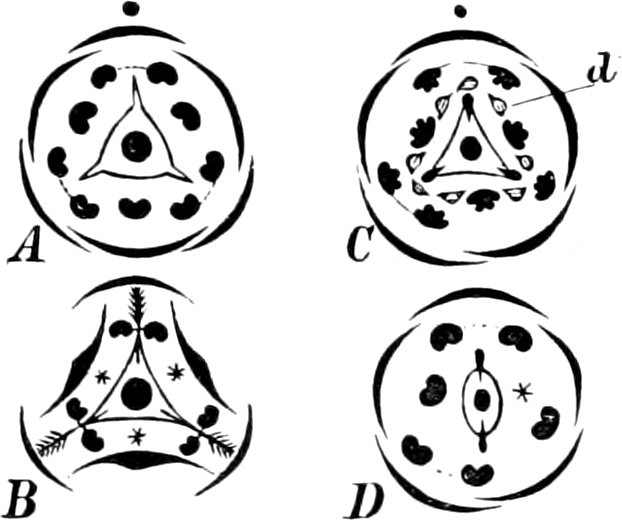
Fig. 354.—A Diagram of Rheum;
B of Rumex; C of Polygonum fagopyrum;
D of P. lapathifolium. The ovules are indicated inside
the ovaries; bracts and bracteoles are not shown.
Rheum (Rhubarb, Fig. 354 A) has a 6-leaved,
petaloid perianth (Pn 3 + 3) and 9 stamens (A 32 + 3). The
3-winged nut is not enclosed by the perianth.
Rumex (Dock, Fig. 354 B) has 6 stamens (A 32 + 0); the
perianth is 6-leaved (Pr 3 + 3), green or red, and the triangular nut
is enveloped by the 3 interior perianth-leaves, which point upwards
and continue to grow after flowering. These perianth-leaves often have
warts on their outer surface. The following are monœcious: R.
acetosa and R. acetosella.
Polygonum (Knot-grass, Figs. 354 C, D; 355). The
petaloid perianth is most frequently 5-merous (2/5 spiral); 5–8
stamens. The nut is triangular (Fig. 354 C, 355), or lenticular
(Fig. 354 D). There are two whorls of stamens, the external
with introrse, and the internal with extrorse anthers. The gynœceum is
often bicarpellate (Fig. 354 D).
The flowers may be considered as constructed upon the
monocotyledonous type. Pterostegia has a perfectly
monocotyledonous flower with 5 trimerous whorls. Rheum
likewise, but here the external staminal whorl is doubled (Fig.
254 A). Oxyria has a dimerous Rheum-flower
(4-leaved perianth, 6 stamens, 2 stigmas). Rumex has a
Rheum-flower with the suppression of the internal whorl
of stamens (Fig. 354 B); Emex is a dimerous
Rumex. Polygonum, to which Coccoloba,
Muehlenbeckia and others are related, differs from
Rheum chiefly in having one of the leaves, which in the
latter takes part in the formation of the perianth, developed
in this case into a bracteole (so that the perianth is reduced
to five members), and several or all the stamens in the inner
whorl become suppressed.—The perianth in Coccoloba and
Muehlenbeckia is more or less perigynous and becomes
fleshy, enclosing the fruit. Muehlenbeckia platyclada has
flat branches with rudimentary leaves; sometimes branches with
normal, arrow-shaped leaves are found. Atraphaxis.
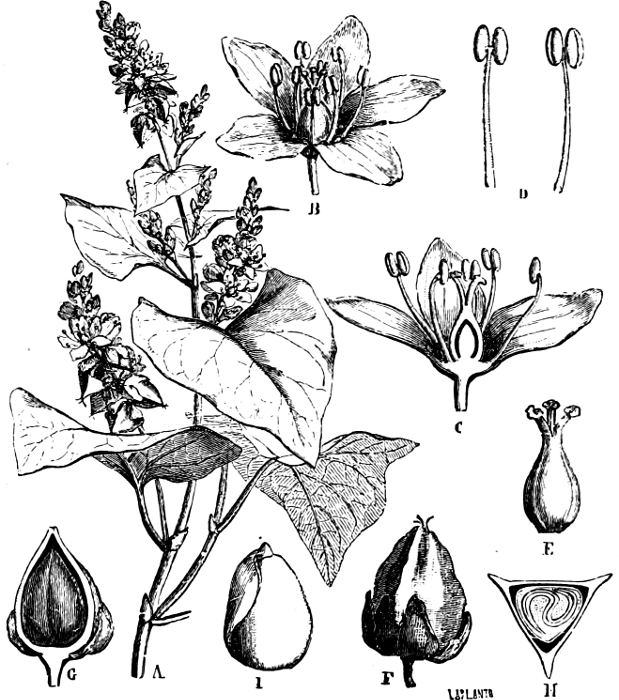
Fig. 355.—Polygonum fagopyrum: A
branch with flower and fruits (nat. size); B flower; C
the same in longitudinal section; D anterior and posterior view
of stamen; E gynœceum; F fruit (mag.); G fruit in
longitudinal section; H transverse section, showing the curved
cotyledons embedded in the endosperm; I the embryo.
Pollination. Rumex is wind-pollinated, the
stigmas are therefore large and brush-like (indicated in
Fig. 354 B). Rheum and Polygonum are
insect-pollinated and have therefore capitate stigmas, etc.;
honey-glands are situated at the base of the stamens (d,
in Fig. 354 C, and n in Fig. 356); a few
small-flowered Polygonum species are self-pollinated;
Buckwheat (P. fagopyrum) is dimorphic and has long-styled
and short-styled flowers (Fig. 356). Pol. bistorta is
protandrous and homostyled.
About 750 species, most of which are found in the temperate
regions of the Northern Hemisphere, some reaching as far as
the snow line or into the Arctic regions (Oxyria,
Kœnigia). Trees and shrubs are found in the Tropics:
Coccoloba, Triplaris. Rheum is Central
Asiatic.—The thick rhizomes of R. officinale
(Rhubarb) are officinal. The rhizomes of the
ordinarily cultivated species, R. undulatum and
rhaponticum, are used in veterinary medicine. The
following are cultivated as culinary plants for the sake
of their leaves:—Rumex acetosa (Sorrel), R.
patientia, R. scutatus, and Rheum undulatum
(petioles). Several species of Polygonum (P.
hydropiper and others) have a sharp, pungent taste.
“Buckwheat” is the mealy fruit of Polygonum fagopyrum
(Central Asia) and is of value as a farinaceous food. P.
cuspidatum (P. sieboldi, Japan) is an ornamental
plant.—Calligonum in sandy and stony deserts.
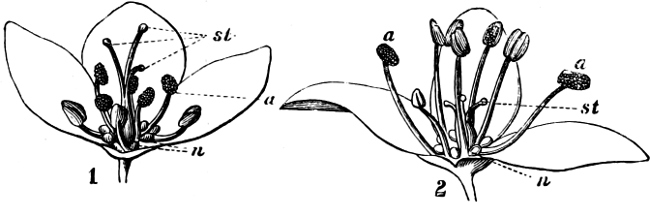
Fig. 356.—Flower of Polygonum fagopyrum
in longitudinal section: 1, long-styled; 2, short-styled; a the
anthers; st the stigmas; n nectary.
Order 2. Piperaceæ (Peppers). Shrubs or herbs, often with
nodose, jointed stem; leaves simple, entire, often with curved veins;
stipules wanting (Peperomia) or intrapetiolar and cap-like,
often enclosing the terminal buds (Piper). The flowers in the
group Pipereæ (Piper, Fig. 357, and Peperomia) are
borne in spikes with fleshy axes (club-like), seldom in racemes,
the outer ones are crowded and are ☿ or unisexual, always small,
naked and without bracteoles; generally stamens 3 + 3, and
gynœceum 3, but the number of the stamens may be reduced by suppression
to 2, and the carpels to 1. The flowers are situated in the axils
of the small, generally shield-like floral-leaves. The ovary is always
unilocular and has one upright, orthotropous ovule. Fruit
a berry or drupe. Both endosperm and perisperm are present, the
latter being especially well developed (Fig. 359).
Piper; generally shrubs with scattered leaves, and terminal
inflorescences which are crowded to one side by the development of the
highest lateral bud, so that they are situated opposite the leaves
(Fig. 357). Many species have stems with an abnormal anatomical
structure.—Peperomia; chiefly succulent herbs, often epiphytes,
with opposite or verticillate leaves having aqueous tissue on the upper
side.
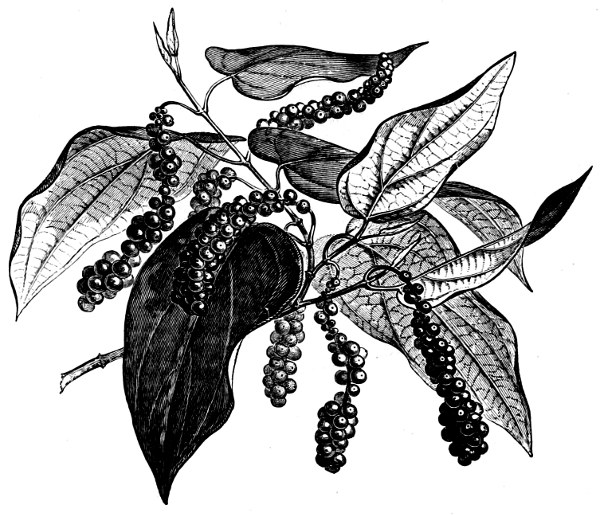
Fig. 357.—Piper nigrum: branch with
fruit (½)
The group Saurureæ (considered by some as an order, and
perhaps representing a more original type) has 3–4 carpels with
many ovules. Lactoris stands the highest with regular
3-merous perianth, 3 + 3 stamens and 3 carpels, which are united
at the base. Fruit a capsule with several seeds. (It has one
species from the island of Juan Fernandez, and is also placed in
an order of its own, Lactoridaceæ, allied to the Magnoliaceæ,
through Drimys).—Saururus has naked flowers;
most frequently 6 stamens, and 4 carpels, free or united at
the base, each with 2-4 orthotropous ovules. Fruit, small
berries.—Houttuynia; stamens situated a little upward on
the ovaries; placentation parietal; capsule many-seeded.
About 1,000 species; entirely tropical, especially from
South America and East India. They are found chiefly among
the underwood in damp, shady places; some, which are fleshy
(Peperomia), live as epiphytes on trees; a few climb by
roots.—Uses. Several Piperaceæ are used medicinally
and for spices on account of their pungent properties and the
essential oils found in nearly all parts of the plant. The
following are officinal: “Black-pepper” (the unripe,
dried fruits) and “White-pepper” (the seeds of the ripe fruits)
of Piper nigrum (climbing shrub, East Indian); “Cubeb”
berries of P. cubeba (climbing shrub, Java). “Long-pepper”
is the unripe inflorescence of P. longum, East India. The
leaves of P. angustifolia (Matico) are officinal. The
leaves of the Betelpepper (East India) are used together with
the nuts of the Areca-palm to form the well-known East Indian
intoxicating compound “Betel.” A good many others are also used.
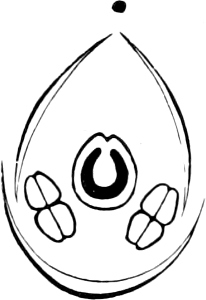
Fig. 358.—Piper nigrum (Diagram). In
addition to the bract there are two structures resembling bracteoles.

Fig. 359.—Piper nigrum: Fruit in
longitudinal section, showing the endosperm, perisperm, and pericarp.
Order 3. Chloranthaceæ. (Chloranthus,
Hedyosmum) have opposite leaves, with stipules more
or less united at the base, and inferior “drupes.” Ovules
pendulous. Only endosperm. About 33 species, Tropical.
The plants in this family have a curved ovule, and most
frequently a kidney-shaped seed (generally provided with fine,
cuticular, projecting warts, Fig. 362 B), with a curved,
peripheral embryo enclosing the endosperm which is most frequently
floury (Figs. 362 C, 365 H; for exceptions, see Fig.
366); the seeds in all cases are borne on a centrally-placed,
and in most cases free, placenta (they are “basal” when there
is only 1 ovule in the ovary, Fig. 364). The flower is regular,
hypogynous or perigynous (Fig. 364) (only rarely epigynous) and
usually 5-merous. The flower which is most complete has 5
whorls (S5, P5, A5+5, G2-3–5), as in some genera of the Caryophyllaceæ
(Figs. 360, 361); but from this type it becomes reduced, the petals
and stamens being suppressed, so that finally 5 perianth-leaves,
5 stamens (opposite the perianth-leaves), and 2 carpels (Fig. 361
F) only are present; for example, in certain genera of the
Caryophyllaceæ, in the Chenopodiaceæ, Amarantaceæ,
and others. When the number of stamens is increased to more than 5
in the whorl, it is always possible to show that some of the stamens
have been divided. The number of the carpels and ovules also becomes
reduced; in the highest there is a central placenta, not free in its
early stages, with a large number of ovules; in those which are most
reduced there is only a single ovule, which is placed centrally at
the base of the ovary [Fig. 364]. Somewhat corresponding changes are
found in the fruit, which is a many-seeded capsule in those
which have many ovules, but a one-seeded nut where there
is one ovule. In the most reduced forms the flowers are generally
unisexual.—Similar features are also present in the vegetative parts.
Almost all the species are herbaceous, the leaves are simple and most
frequently without stipules. The structure of the stem, especially
in Chenopodiaceæ, Amarantaceæ, Nyctaginiaceæ and others, often differs
from that of the ordinary Dicotyledon. In the woody portion of the stem
and root several rings are sometimes formed which resemble annual rings
but which are formed by new cambium-rings arising outside the old ones
which then cease to divide.
Order 1. Caryophyllaceæ. Herbaceous plants, with round, nodose
stem; leaves opposite, slightly amplexicaul, simple, with
sessile, undivided, entire lamina; stipules nearly always absent;
the inflorescences are dichasia passing over into unipared
scorpioid cymes. The flowers are regular, ☿ or unisexual, hypogynous or
perigynous, 5-(or 4-) merous with 2–3–4–5 carpels; calyx persistent;
corolla polypetalous. The ovary is unilocular (or originally, and
sometimes also in the later stages, plurilocular below, e.g.
Viscaria), with free styles and 1–several curved ovules
on a central, free placenta. The fruit is a nut or a capsule
opening apically with long or short valves (teeth, Fig. 362), equal
to or double the carpels. For the seeds refer to the family. In
Dianthus the embryo is straight.
The flowers which are most complete have Sn, Pn,
An + n (obdiplostemonous), Gn where
n = 5 (Figs. 360, 361 A) or 4 (Fig. 361 B);
the carpels may be placed opposite to the sepals (Fig. 360) or
opposite to the petals (Fig. 361 A, B). Without
any change taking place in the position of the other whorls, the
carpels are next found reduced to 2–3–4 (see the genera); their
number may easily be recognised by that of the styles. This is
the construction in the majority of the genera in the two first
groups. Stellaria media differs considerably. It may
have (a) the flower as described above, with G3;
(b), the corolla only absent, or (c) only the
petal-stamens (A5 + 0, Fig. 361 C), or (d) all
these as well as some of the sepal-stamens. The same applies
to Sagina, Alsine, Cerastium, and others,
and, finally, a series of genera are formed, with certain
conditions of reduction which have become constant, and by a
gradual series of steps lead to the most reduced form, which has
only 5 sepals and 5 (or even as far as only 1) sepal-stamens
(Fig. 361 D, E, F).—The PETALS
in the Alsineæ are often deeply bifid. The sepal-stamens
are most frequently the longest, and bear nectaries at the base
(Fig. 363 st). In the most complete forms the ovary has
partition-walls in the lower portion (Fig. 360); these do not,
however, reach to the top, and generally soon disappear. The
ovules, when numerous, are situated on the placenta in as many
double rows as there are carpels. In the number of ovules a
reduction from many to 1 takes place (Fig. 361). A comparison
proves that the “free, centrally placed” placenta is formed by
the ventral portion of the carpels. The single basal ovule in
Herniaria (Fig. 364), Scleranthus, and others, is
also borne on the carpels.
The vegetative branching is characteristic. One of
the leaves in a pair is formed before the other, and has a
more vigorous axillary bud; these stronger leaves stand in a
¼-spiral, the fifth above the first one, and the branches are
consequently arranged in the same manner. In the inflorescence,
however, it is the upper or second bracteole (β) whose axillary
bud (w in Fig. 361) is most advanced. The bud of the
first bracteole (α) becomes sometimes entirely suppressed, or in
some this bracteole itself is suppressed.
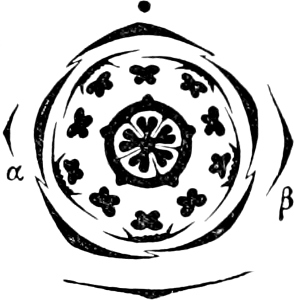
Fig. 360.—Diagram of Lychnis: α, β
bracteoles.
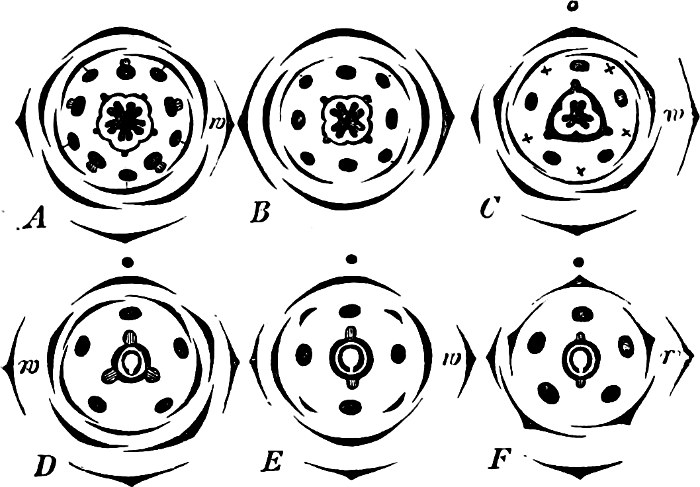
Fig. 361.—A-F Diagrams of flowers of
the Caryophyllaceæ: A Agrostemma; B Sagina;
C Stellaria; D Corrigiola; E
Paronychia; F Herniaria.
The most original type appears to be represented by the Alsineæ.
From this form on one side the Sileneæ, adapted in a higher
degree for insect-pollination, are developed, and on the other
side the Paronychieæ, with various reductions.
1. Alsineæ, Stitchwort Group. Sepals free, and
connected with them stellately expanded, slightly unguiculate (white or
inodorous) petals; these, however, often become suppressed (Fig. 363).
The fruit is a capsule.
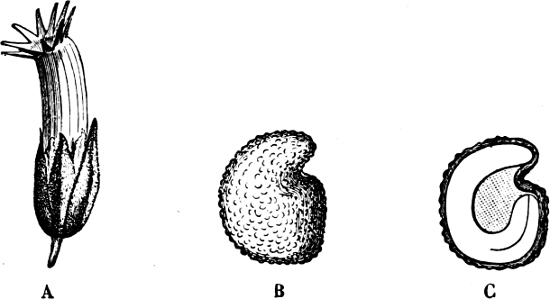
Fig. 362.—Cerastium arvense: A
fruit; B seed; C section of seed.
a. As many carpels as sepals (4 or 5). Cerastium
(Chickweed). The petals are bifid. Capsule cylindrical, frequently
curved at the top, and opening by 10 teeth (Fig.
362).—Malachium differs only in the 5-toothed capsule with
bifid teeth.—Spergula (Spurry). The petals are not bifid,
capsule 5-valved; seeds winged. The leaves are linear, and appear as if
placed in large numbers in a whorl, a branch being situated in the axil
of each with leaves placed very close together at its base; stipules
membranous.—Sagina has Sn, Pn, An + n, or An, Gn, where n = 4
or 5. The corolla is often wanting.
b. 3 (rarely 2) carpels (Fig. 361 C). Stellaria
(Stitchwort) has deeply cleft petals. The number of stamens varies
(see above).—Arenaria has entire petals. (To this
group belong Alsine, Moehringia, Halianthus,
or Honckenya (Fig. 363), which differ from each other,
especially in the form of the seed and number of the capsular
valves.) Spergularia has membranous stipules, as in
Spergula.—Holosteum.
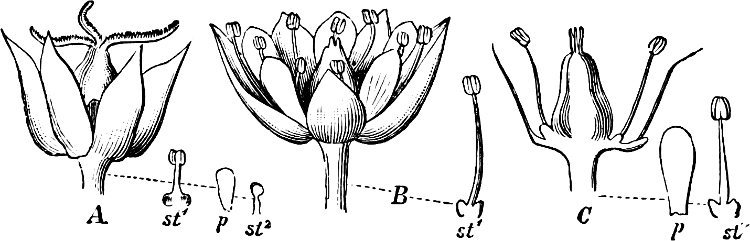
Fig. 363.—Arenaria (Halianthus)
peploides: ♀-(A) and ♂-flower (B, C).
2. Paronychieæ (Figs. 361 D, E,
F; 364). Small, greenish plants. The leaves, in the majority,
are opposite, with membranous stipules. The flowers are most
frequently arranged in small dichasia; they are small and
insignificant, perigynous (Fig. 364) or hypogynous. The corolla is in
most cases wanting, and when present is very small; in general the
calyx-stamens are developed, but the corolla-stamens may be represented
by small scales (Fig. 364). Ovary most frequently with 1 ovule.
Fruit, a nut, rarely a capsule; it is enclosed by the strongly
perigynous floral axis (torus).
Scleranthus (Knapwell) is perigynous with bell-shaped torus;
no corolla; corolla-stamens are wanting or rudimentary; some
calyx-stamens may also be absent.—Corrigiola (Fig. 361
D); Illecebrum; Paronychia (Fig. 361 E);
Herniaria (Figs. 361 F, 364).
3. Sileneæ, Pink or Carnation Group. This has a
gamosepalous calyx and unguiculate, white or red, petals, with
outgrowths (ligule, corona, paracorolla) at
the throat of the corolla. These structures are not found in the other
groups, and are merely outgrowths at the junction of the limb and claw.
The corolla, stamens and ovary are frequently raised above the calyx,
upon a lengthened internode (gynophore). The flower has S5, P5,
A5 + 5; fruit a capsule with many seeds.
a. 5-(rarely 3–4) carpellate ovary.—Lychnis (Campion,
Fig. 360). The corolla is longer than the calyx; corona present. The
capsule is 10- or 5-toothed, completely 1-chambered or 5-chambered at
the base,—the genus has been divided accordingly into several genera:
Melandrium, Lychnis, Viscaria. Some species are
unisexual by the abortion of stamens or carpels (L. vespertina,
diurna). Agrostemma (A. githago, Corn-cockle,
Fig. 361 A) has a long-toothed calyx, the teeth exceeding the
corolla; corona absent; 5-toothed capsule.

Fig. 364.—Herniaria glabra: a1
flower; b1 longitudinal section through the flower; c1
stigma with two pollen-grains.
b. Tricarpellate.—Silene (Catch-fly). Six-toothed
capsule; corona present in the majority.—Cucubalus has
berry-like fruits which finally become dry but do not dehisce.
c. Bicarpellate (2 styles, 4-toothed capsule).—Dianthus
(Pink); at the base of the calyx 1–several pairs of floral-leaves are
situated; corona absent. The straight embryo is a peculiar
exception.—Gypsophila has a campanulate, open calyx, 5-nerved,
membranous between the nerves; corona absent; the flowers are generally
small and numerous, in a large, paniculate dichasia.—Saponaria
(Soapwort) has corona.
Pollination. Alsineæ has ordinary nectaries at
the base of the calyx-stamens (Fig. 336): they are frequently
protandrous but may often, in the absence of cross-pollination
(in the less conspicuous species) pollinate themselves.
Their open flowers are accessible to many kinds of insects
(particularly flies and bees). Gynodiœcious flowers are
found in several species, and the ☿-flowers are then generally
more conspicuous than the ♀-flowers. That the ♀-flowers have
descended from ☿-flowers is seen by the large staminodes found
in them (Fig. 363). Arenaria peploides is diœcious (Fig.
363). The Sileneæ are as a rule adapted for pollination
by insects with long probosces—especially butterflies,—and
they are frequently protandrous, so that at first the
calyx-stamens open, later on the corolla-stamens, then the
stigmas expand. The honey is secreted by a ring-like nectary
round the base of the ovary or by nectaries at the base of
the stamens. Some only blossom and emit scent at night or in
the evening (Lychnis vespertina, Silene nutans,
Saponaria officinalis) and, like other night-flowers, are
of a white or pale colour.
Distribution. 1,100 species, especially in temperate
climates, fewer in the colder zone, less still in the Tropics.
The Paronychieæ are especially found in dry, sandy fields.
Uses. “Soap-root” (with Saponin, forming
a lather in water) from Saponaria officinalis was
formerly officinal, and Gypsophila struthium. The seeds
of Agrostemma githago are said to be poisonous.—The
following are ornamental plants: species of Pinks (D.
caryophyllus, garden Pink, often with double flowers; D.
barbatus, plumarius, etc.). Lychnis,
Gypsophila, Silene, Cerastium (C.
tomentosum as edging for borders), Saponaria
officinalis (often coronate).—Spergula arvensis is
sometimes cultivated.
Order 2. Amarantaceæ. The flowers are essentially
the same as in the Chenopodiaceæ and the extremely
reduced Caryophyllaceæ (Fig. 361 F); they are regular,
hypogynous, generally ☿, have 5 free (rarely slightly united)
perianth-leaves; in front of these 5 stamens, which are often
united at their base into a shorter or longer tube and have
stipule-like teeth between them (the division Gomphreneæ
has 2-locular anthers, each of which opens longitudinally); and
a 2–3 carpellate gynœceum with one loculus and most frequently
one, more rarely several ovules; the fruit is a nut, more
rarely (in Celosia, Amarantus, Gomphrena)
a capsule, dehiscing irregularly, or like a pyxidium. The
characters which especially separate them from the allied orders
are found in the perianth. The perianth-leaves are not green and
herbaceous, but membranous, dry, and often coloured; they
are frequently produced into a bristle or awn; they have also
both subtending floral-leaves and 2 large bracteoles similar
to the perianth; all these dry leaves persist without
alteration after the withering of the flower.—The flowers are
without scent. They are arranged in spike- or capitulum-like
inflorescences; sometimes placed singly, sometimes aggregated
in the panicle-like inflorescences; in others, on the contrary,
in dichasia. The majority are herbs, some are shrubs. The
leaves are scattered, or opposite, but always simple and without
stipules; some are smooth, others hairy.
450 species; especially in the Tropics, principally S. Am. and
E. Ind.: few are found outside these countries.—Only a few
are used; some, chiefly E. Indian species, are cultivated as
ornamental plants: Amaranthus (Fox-tail); Gomphrena
globosa; Celosia cristata (Cock’s-comb) remarkable
for its fasciated inflorescence; Alternanthera. Some are
employed as culinary plants in the Tropics, and in a few of the
E. Indian species the seeds are farinaceous, and used for food.
Order 3. Chenopodiaceæ. Generally herbaceous plants like
the Caryophyllaceæ, but the leaves are arranged spirally (except
Salicornia), and are simple, exstipulate; they are generally
fleshy and like the stem “mealy,” that is, covered with small hairs,
whose large spherical terminal cell readily falls away; otherwise they
are seldom hairy. The inflorescences are generally flower-clusters
borne in panicles. Bracteoles generally absent. Flowers generally
unisexual: with the single exception of Beta the
flowers are hypogynous; they are regular, small and inconspicuous,
with single, green, 5-leaved, but more or less united
perianth; 5 stamens opposite the perianth, and a 2–5-carpellate,
unilocular ovary with 1 basal, curved ovule; but in some genera the
number of the perianth-leaves and stamens is reduced to 3–2–1–0. The
fruit is generally a nut,—thus this flower and fruit are the
same as in the reduced Caryophyllaceæ (Fig. 361 F). The seed is
similar to that generally found in the family (for exceptions see the
genera).
The floral diagram most frequently present is the same as
in Fig. 361 F. There is no indication of corolla or
of corolla-stamens, which may be supposed to have belonged
to the plant, but which are now entirely and completely
suppressed. This order appears to have been an offshoot from
the Caryophyllaceæ.—The perianth persists after the withering
of the flower, and envelopes the nut; it is very variable, and,
together with the position of the seed, the form of the embryo,
the sex of the flowers, etc., gives the characters of the genera.
1. Chenopodieæ, Goosefoot Group (Fig.
365), has ☿ (or polygamous) flowers, with regular 5-parted perianth
(C); the embryo is ring-like (H). The leaves have the
ordinary flat forms.—Chenopodium (Goosefoot). The flower
is hypogynous, and the fruit (which is compressed) perfectly free;
Mulberry-like collections of fruits are formed in some species
(sub-genus Blitum) by the perianth becoming finally fleshy
and coloured.—Beta (Beet, Mangold, Fig. 365) differs from
all genera in the perianth, which finally becomes cartilaginous,
being epigynous (D). Small, most frequently 2–3-flowered
clusters without bracteoles, situated in a long, interrupted
axis (A, B); the flowers and fruits in each cluster
are more or less united individually, and fall off together—they
are commonly known as seeds (E, F). The seed lies
horizontally.—Hablitzia (H. tamnoides).

Fig. 365.—Beta vulgaris.
Fig. 366.—Salsola soda: embryo.
2. Salsoleæ, Saltwort Group, has cylindrical
or semi-cylindrical leaves. Perianth as in the preceding group;
the fruit is most frequently compressed. The two first mentioned
genera differ from most of the others in the order in having a
spirally-coiled, and not a ring-like embryo, so that the endosperm
is slight or wanting (Fig. 366). These plants are sometimes placed
as a group by themselves, Spirolobeæ—in contradistinction
to which the others are termed Cyclolobeæ.—Salsola
(Saltwort); leaves subulate, with spiny tips; the flowers have
2 spinous bracteoles: during the ripening of the fruit a tough
leathery wing is developed transversely to the back of the
perianth.—Chenopodina deviates from Chenopodium
chiefly in the embryo and want of endosperm.—Kochia has a
somewhat similar perianth to Salsola, but a ring-like embryo; it
differs from the others in being hairy.
3. Salicornieæ, Glasswort Group.
Salicornia (Glasswort) has a very different appearance. The
stems are succulent, jointed, and almost leafless; the leaves opposite,
very small, sheath-like and connate; there is a depression in the axil
of each leaf, in which a small 3-flowered dichasium without bracteoles
is sunk; the flowers have a trimerous perianth, 1–2 stamens and 1
carpel. No endosperm. S. herbacea on clayey beaches.
4. Atripliceæ. This group has most frequently
unisexual flowers; the ♂-flower has a 4–5 partite perianth, but the
♀-flower differs from it. Atriplex is monœcious or polygamous,
the ♀-flower is naked, but has 2 large, herbaceous bracteoles which
expand during the ripening of the fruit, and often become warted
and fringed, enveloping the compressed nut. The section
Dichospermum has two kinds of ♀-flowers, one like those just
described, the other similar to the Chenopodium-flowers,
which have been deprived of their stamens, and the fruits of which
are depressed, not pressed together from the sides; some
(e.g. A. hortensis) have even three kinds of nuts. All
the flowers of Atriplex, which present vertical fruits, are
accessory shoots, which stand beneath the ordinary flower-clusters, a
rather singular relation.—Spinacia (Spinach) is diœcious;
♂-flower: perianth, 4 (-5); stamens, 4 (-5); ♀-flower: tubular,
2–4-partite perianth, hardening during the ripening of the fruit,
and uniting with the compressed nut; in S. oleracea, it also
forms thorns; 4 long stigmas.—Halimus has the 2 long
bracteoles almost entirely united and ultimately adhering firmly to the
fruit.
5. Baselleæ. A somewhat exceptional group
with more or less perigynous flowers and 2 bracteoles.
Basella, Boussingaultia, Ullucus. The
perianth is sepaloid; ovary 1-ovuled. In Basella the
perianth is fleshy, enveloping the nut, and the cotyledons are
so rolled together that a tranverse cut divides them in two
places (as in Spirolobeæ). Herbaceous climbing plants.
Pollination. Wind-and self-pollination, as far as
is known; the insignificant flowers, devoid of honey, appear
to exclude insect-pollination.—520 species. Most of them
are annual (out of 26 native species only 5 are perennial);
inhabiting salt-marshes and salt-steppes, and growing as weeds
(most frequently on garden or field soil containing manure)
in this country, especially species of Chenopodium and
Atriplex. The majority are found outside the Tropics,
and play a very important part, for example, in the Asiatic
salt-steppes. They grow gregariously in large masses.
Uses. Comparatively few. The only important one is
Beta vulgaris (from the Mediterranean basin), with its
different varieties, viz. Beet-root, Cattle-beet or Red-beet,
Sugar-beet, and others. These are biennial, making in the first
year a root which acts as a reservoir of reserve material, with
a rosette of leaves, and in the second year using this material
in the production of a long stem, leaves and flowers. The
primary root has been developed by cultivation into a very thick
and fleshy tap-root; its mode of increase in thickness deviates
from that of other roots, concentric rings of vascular bundles
being formed from a cambial ring developed outside the previous
ring. In this way several rings of vascular bundles separated
by medullary rays, alternating with rings of parenchyma, may be
found in the root of a Beet. Besides Beta vulgaris, var.
hortensis (Beet-root), the following are also cultivated:
var. cicla (Leaf-beet, “Mangold,” or “Roman Spinach
”), Spinacia oleracea and Atriplex hortensis
as Spinach; a form of the latter and of Spinach are grown as
ornamental plants. The tubers of Ullucus tuberosus are
used as potatoes; Chenopodium quinoa, in Chili and Peru,
is an important farinaceous plant. Soda is made from some
(Salsola kali, Chenopodina maritima and others).
Aromatic properties are rare: Chenopodium ambrosioides
and botrys.
Order 4. Batidaceæ. Batis maritima, a bushy West
Indian maritime plant.
Order 5. Phytolaccaceæ. The ☿ (sometimes unisexual),
regular, sometimes slightly perigynous flowers are inconspicuous
and have a single sepaloid or coloured 4–5-leaved perianth
(generally united at the base); stamens either in 1 whorl in
the spaces between the perianth-leaves or in 1 whorl opposite
the perianth-leaves, or in 2, one of which alternates with
these; but the number may be increased by the splitting
of one or of both the whorls to as many as 10–15–20–25.
Carpels sometimes only one, sometimes many
(4–10) placed in a whorl, either free or united into a
gynœceum with a corresponding number of loculi in the ovary;
but in all cases each carpel bears only its own style and
1 ovule. The fruit is a berry (or nut, capsule,
or schizocarp).—Mostly herbs or herbaceous shrubs, with
scattered, simple leaves without stipules (Petiverieæ;
have stipules). Inflorescences, most frequently racemes
or spikes, which in some instances are apparently placed
opposite to a leaf, being displaced by a more vigorous growth
of the axillary bud. Embryo always bent.—Petiveria has
a straight embryo with rolled cotyledons.—Phytolacca,
Pircunia, Microtea, Seguieria,
Rivina (Pr4, A4, G1; berry), and others.
The following plant is, with some doubt, placed near this order:
Thelygonum cynocrambe; monœcious. ♂-flowers: perianth,
2-leaved; stamens indefinite. ♀-flowers: perianth-leaves united,
3-toothed; G1, style gynobasic. Fruit a drupe. An annual plant;
Mediterranean. Branching anomalous.
About 90 species; in tropical and temperate countries,
principally America and Africa.—The red juice in the fruits,
especially of Phytol. decandra, is used for colouring
wine.
Order 6. Portulacaceæ (Portulacas). The flowers are
regular (except Montia), hypogynous (except Portulaca)
and ☿. The diagram which applies to the majority of genera is that
in Fig. 367, but with all the 5 stamens completely developed: it may
be considered as the Chenopodiaceous diagram with the addition of 2
bracteoles in the median line (m-n, these by some are
considered as sepals), and with a petaloid perianth (usually designated
“corolla”). The “petals” fall off very quickly, and are sometimes
wanting. Most frequently 5 stamens, situated opposite the “petals,”
but in other genera the number varies; Montia has only 3
stamens (by suppression of the two anterior and lateral, Fig. 367),
others again have more than 5, some a large and indefinite number.
This may be explained partly by the appearance of a second whorl
of stamens alternating with the first, and partly by the splitting
(dédoublement) of the stamens. Gynœceum most frequently tricarpellate,
ovary unilocular with 1–several basal ovules (sometimes on a branched
placenta, as in certain Caryophyllaceæ). The fruit is a
capsule, more rarely a nut.—The majority are annual herbaceous
plants with scattered, entire leaves, often fleshy and smooth, with or
without rudimentary stipules (dry, membranous, modified into hairs).
Inflorescence cymose.
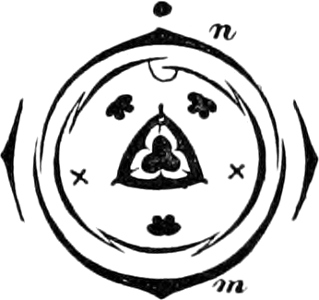
Fig. 367.—Montia.
Diagram of flower.
Portulaca (Portulaca): flower, epigynous or semi-epigynous;
fruit, a pyxidium. The stamens vary in number, and are most
frequently placed in groups (in consequence of splitting) opposite
the petals.—Montia: the corolla is slightly gamopetalous,
but cleft on the posterior side (Fig. 367), and as a consequence
of the larger size of the lateral petals, slightly zygomorphic; 3
stamens.—Calandrinia; Talinum; Anacampseros;
Claytonia.
125 species; mostly in warm and temperate countries, especially
the arid parts of S. Am. and the Cape. Montia fontana
(Blinks) is a native plant. Portulaca oleracea is
cultivated as a pot-herb in the south of Europe. A few species
of Portulaca and Calandrinia are ornamental plants.
Order 7. Nyctaginiaceæ. The characteristic feature of this
order is the single, regular, united, and often petaloid
perianth, the lower part of which generally persists after flowering
and embraces the fruit as a false pericarp. The upper portion is most
frequently valvate and folded, or simply valvate in æstivation.
The number of stamens varies. The free gynœceum is unicarpellate
and has 1 ovule. The fruit is a nut, but becomes a false
drupe, since the lower persistent portion of the perianth becomes
fleshy (as in Neea, where this fleshy part is almost always
crowned by the upper persistent part of the perianth. In the majority
of the Mirabileæ the lower part becomes the dry anthocarp,
while the upper petaloid part falls away after flowering). Finally,
a peculiar involucre is formed around the flowers by free or united
floral-leaves.—The majority are herbs, some are trees (Pisonia,
etc.); Bougainvillea is a liane. The stems are often nodose and
swollen at the nodes; the leaves are simple, penninerved, scattered,
or opposite, without stipules. In some, the vascular bundles are
scattered; stem anomalous.
Mirabilis; the structure of the stem is abnormal. Dichasial
branching with continuation from the second bracteole, thus forming
unipared scorpioid cymes. The perianth is petaloid, funnel-shaped,
and has a folded and twisted æstivation resembling that of the
corolla of the Convolvulaceæ; the upper coloured portion
falls off after the flowering. Outside, and alternating with
it, is a 5-partite, sepaloid involucre of 5 spirally-placed
floral-leaves.—Oxybaphus; the involucre envelops 1–3 dichasial
flowers.—Bougainvillea; the involucre is rose-coloured,
3-leaved, and envelops 3 flowers (placed laterally; the terminal
flower wanting). The leaves of the involucre in Boerhaavia,
Pisonia, Neea, and others are reduced to teeth or scales.
157 species; mostly in tropical countries, and especially S. Am.
Species of Mirabilis (Am.) are ornamental plants. Theïn
is found in Neea theïfera Oersted (discovered by Lund in
Lagoa Santa, Brazil), which may be used as a tea-plant.
Order 8. Aizoaceæ. Only 3 whorls are found in
the flower, which alternate with one another when their
leaves are equal in number. The first is sepaloid, the third one
the carpels, and the intervening one is either uncleft, in which
case it is developed as stamens, or it is divided into a large
number of members which then all become stamens (arranged in
groups), or the outermost ones become developed as petals. The
fruit is most frequently a capsule with several loculi. Most of
the species are herbs with thick, fleshy stems, and exstipulate
leaves. The structure of the stem is usually anomalous.
1. Aizoideæ have hypogynous or perigynous
flowers with (4–) 5 perianth-leaves; stamens single, or
(by splitting) in groups of 2–3, alternating with the
perianth-leaves. The gynœceum (with 3–5 carpels) has 3–5 loculi
in the ovary, and most frequently numerous ovules in each
loculus, borne on the central placenta formed by the edges
of the carpels. The fruit is a capsule. The inflorescences
are dichasia and unipared scorpioid cymes.—Aizoon,
Mollugo, Sesuvium, and others are herbs or bushes,
most frequently hairy.
2. Mesembrianthemeæ have semi- or
wholly-epigynous flowers.—Tetragonia. The perianth is 4
(more rarely 3–5–6)-merous. Stamens single, or (by splitting)
in groups alternating with the perianth-leaves. There is an
indefinite number of carpels, and each loculus of the ovary
contains only 1 pendulous ovule. Fruit a nut or drupe.
The flowers arise singly in the leaf-axils, with an accessory
foliage-bud below them; in some instances there is also an
accessory flower between this bud and the flower. Southern
hemisphere, especially at the Cape; T. expansa, New
Zealand Spinach, is a fleshy plant which is cultivated as a
pot-herb (Japan, Austr., S. Am.).—Mesembrianthemum:
the flowers are 5-merous; the numerous linear petals and the
still more numerous stamens all arise by the splitting of 5
or 4 protuberances (primordia) alternating with the sepals.
The ovary presents another characteristic peculiarity: the
carpels alternating with the 5–4 stamens form an ovary (with
several loculi) with the ovules at first borne, as in other
cases, on the inner corner of the inwardly-turned
carpels; but during the subsequent development the whole ovary
is so turned round that the placentæ become parietal and the
ovules assume, apparently, a position very rarely met with in
the vegetable kingdom: on the dorsal suture of the carpels.
Shrubs or under-shrubs, more rarely herbs with fleshy stems and
simple, entire, more frequently thick or triangular leaves,
containing a quantity of water. The flowers open about noon,
and are brightly coloured, generally red or red-violet, but
odourless. The capsules dehisce in rainy weather. 300 species,
mostly found at the Cape. Some are ornamental plants. M.
crystallinum (the Ice-plant) and others are covered with
peculiar, bladder-like, sparkling hairs, the cell-sap of which
contains salt—these serve as reservoirs of water.
The position of this family is very doubtful; but it seems in many
respects to approach Mesembrianthemum. Some botanists place it
near to the Ribesiaceæ; others, again, to the Passifloraceæ. Only 1
order.
Fig. 368.—A Echinocactus:
a position of a leaf-lamina; b a lateral shoot on the
displaced axillary bud. B Pereskia: b a foliage-leaf on
a small thorny branch which is subtended by a foliage-leaf which has
fallen off and left a scar(a).
Fig. 369.—Echinopsis.
Order Cactaceæ (The Cacti). The flower is epigynous,
☿, regular, and remarkable for its acyclic structure; there
are, for instance, a large number of spirally-placed sepals and
petals, which gradually pass over into one another, and which in
some species, to a certain extent, arise from the walls of the ovary
as in Nymphæa (Fig. 383 A, B). The petals are
free; rotate, opening widely in Opuntia, Pereskia, and
Rhipsalis; erect and united at their base into a shorter or
longer tube in Cereus, Epiphyllum, Mammillaria,
Echinocactus, Melocactus, and others (Fig. 369).
Stamens numerous, attached to the base of the corolla; gynœceum
formed of many carpels, with one style, dividing into a number
of branches corresponding to the number of carpels; the ovary has
one loculus with many parietal placentæ; the ovules
are anatropous, on long and curved funicles. Fruit a berry with
exendospermous seeds. The fruit-pulp is mainly derived from the
funicles.—The external appearance of the Cactaceæ is very peculiar;
Pereskia, which has thick and fleshy leaves (Fig. 368), deviates
the least; foliage-leaves of the usual form are wanting in the other
genera, or are usually very small, and quickly fall off and disappear
(Opuntia), or are modified into thorns; the stem, without normal
foliage-leaves,—so characteristic a feature in this order,—makes
its appearance after the two normally developed cotyledons. The stems
are fleshy, perennial, and may finally become woody. In some they are
elongated, globose, pointed, and more or less dichotomously branched,
e.g. in several of the Rhipsalis species, which live
mostly as epiphytes on trees; in others, elongated, branched, globose,
or, most frequently, more or less angular (prismatic) or grooved
and provided with wings, and either columnar and erect (as much as
about 20 metres in height and 1 metre in circumference, as in C.
giganteus in New Mexico) or climbing by roots (Cereus and
Rhipsalis-species); in others again, compressed, more or less
leaf-like, often with a ridge in the centre (winged), branched and
jointed: Epiphyllum, Phyllocactus, Opuntia, some
species of Rhipsalis; others are thick, short, spherical or
ovoid, unbranched or only slightly branched, and either studded with
prominent warts (mammillæ) each of which supports a tuft of
thorns (Fig. 368 A; Mammillaria and others) or with
vertical ridges, separated by furrows (rows of mammillæ which have
coalesced) in Melocactus, Echinocactus, Echinopsis
(Fig. 369); at the same time the ovary in some is embedded in the stem
so that leaves or leaf-scars, with tufts of thorns in their axils, may
be observed on the ovary just as on the stem.—The flattened shoots of
the Cactaceæ are formed in various ways, either by the compression of
cylindrical axes (Opuntia) or, as in Melocactus, etc.,
from winged stems in which all the wings are suppressed except two.
The thorns are produced directly from the growing points of
the axillary buds, and are modified leaves. The axillary
bud is united at its base with its subtending leaf, which
as a rule is extremely rudimentary; and these together
form a kind of leaf-cushion, larger in some genera than in
others. This leaf-cushion attains its highest development in
Mammillaria, in which it is a large, conical wart (see
Fig. 368 A), bearing on its apex the tuft of thorns and
rudimentary lamina.—The seedlings have normal cotyledons
and a fleshy hypocotyl.
All the species (1,000?) are American (one epiphytic species
of Rhipsalis is indigenous in S. Africa, Mauritius and
Ceylon), especially from the tropical table-lands (Mexico,
etc.). Some species, especially those without thorns, as
Rhipsalis, are epiphytes. Opuntia vulgaris, the
fruits of which are edible, is naturalized in the Mediterranean.
The cochineal insect (Coccus cacti) lives on this and
some closely allied species (O. coccinellifera, etc.),
particularly in Mexico and the Canary Islands. Several are
ornamental plants.
The flowers as a rule are ☿, regular and
hypogynous; however in some orders they are unisexual,
e.g. in the Myristicaceæ, or zygomorphic (in Monkshood and
Larkspur in the Ranunculaceæ); in the Lauraceæ, (Fig. 386) for example,
perigynous, and in Nymphæa (Fig. 383) even partially epigynous
flowers are typical.—The flowers are acyclic in very many of the
genera of the two first orders, if not completely so, at any rate in
the numerous stamens and carpels, thus denoting an old type. It is a
remarkable characteristic that in the majority of the orders the number
3 prevails in the calyx and corolla; the number 5 also occurs, but
the number 2 is seldom met with. Most orders have a double perianth;
chorisis does not occur, suppression is rare, and the parts of the
flower are developed in acropetal succession. The most characteristic
feature in the order is the free, one-leaved, as a rule
numerous carpels (apocarpous gynœceum). The number of carpels
in some of the last mentioned orders dwindles down to 1 (e.g.
the Berberideæ and Myristicaceæ). The carpels in
Nymphæaceæ become united into one pistil (syncarpous), a
condition which we also find distributed among the other orders.
Endosperm occurs in almost all the orders (except e.g.
Lauraceæ). The nutritive tissue in Cabombeæ and
Nymphæeæ is chiefly perisperm.
Fig. 370.—Diagram of Aquilegia
vulgaris: sp spur. A cyclic flower.
Fig. 371.—Diagram of a dichasium of
Ranunculus acer: α1, α1, and β1, β1, bracteoles
(the buds in the axils of the bracteoles, α and α1, are continued
antidromously). The flower has cyclic calyx and corolla, bub acyclic
(8/21) stamens.
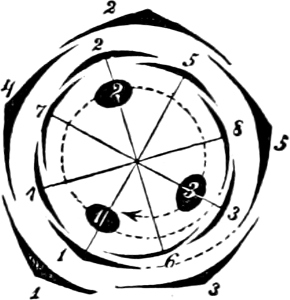
Fig. 372.—Diagram of an acyclic Ranunculaceous
flower (only 3 stamens are indicated). The spiral of the sepals has a
divergence of 3/5; that of the corolla and subsequent leaves 3/8.
Order 1. Ranunculaceæ. Nearly all are herbs (except
Clematis). The leaves are scattered (except Clematideæ),
they have a large sheath with broad base (no stipules), and are
most frequently palminerved with palmate lobes. The flowers are
hypogynous, with most frequently a well pronounced convex receptacle
(Figs. 374 B, 380), ☿, regular (except Delphinium and
Aconitum); their structure varies very much; in some the leaves
are verticillate, in others arranged spirally; in others, again,
both modes of arrangement are found. It is a characteristic feature
that the various series of leaves (especially calyx and corolla) are
not so distinct or so sharply divided as is usual. The leaves of the
perianth are free, imbricate (except Clematideæ); stamens
numerous, with most frequently extrorse anthers; gynœceum
free, apocarpous (except Nigella and partly
Helleborus), with 1 or several ovules (Figs. 373, 378, 379)
borne on the ventral suture. The fruit is either a nut or a follicle
(Actæa has berries). The seed has a large, oil-containing
endosperm and a small embryo (Fig. 374).
The main axis generally terminates in a flower, and the
lateral axes branch in a cymose manner (Fig. 371). The
flowers show the following differences in construction:
VERTICILLATE (EUCYCLIC), i.e.
constructed all through of alternating whorls: Aquilegia
(Fig. 370), Xanthorhiza, and sometimes Eranthis.
Semiverticillate (HEMICYCLIC) i.e. with
sepals and petals in alternate whorls, and the others arranged
spirally: Ranunculus (Fig. 371), Myosurus,
Pæonia and several other genera entirely, or in certain
species only. Spiral-flowered (ACYCLIC)
i.e. all the leaves are arranged spirally, so that
sepals and petals do not alternate the one with the other,
even though they are the same in number: Adonis
(Fig. 372), Aconitum, Delphinium-species,
Nigella-species, Helleborus. The leaves of the
calyx are in this instance arranged on a spiral of 2/5; those of
the corolla on 2/5, 3/8, 5/13 or 8/21, and stamens and carpels
likewise on higher fractions of the same series.
The genera Caltha, Anemone, Thalictrum
and Clematis have a single perianth, which
is most frequently petaloid; it is thus apparent that the
sepals are petaloid, and the leaves, which in other genera
have developed as petals, are in these instances stamens. The
calyx is similarly petaloid in the genera Helleborus,
Eranthis, Nigella, Delphinium and
Aconitum; but the petals are present in these instances
in unusual (horn-like) forms, and almost entirely given up to
the function of nectaries, a function they already possess
in Ranunculus. According to a more recent theory the
“honey-leaves” are transformed stamens, which have lost the
function of reproduction; the perianth is then single, and
most frequently petaloid. [Those leaves in the flowers of
many Ranunculaceæ which bear nectaries are termed by Prantl
honey-leaves, and comprise those leaf-structures of the flower
whose essential function lies in the production of nectar,
and which, independent of the differentiation of the perianth
into calyx and corolla, are derived from the stamens by the
loss of their reproductive functions. Clear transitional forms
are found between the two series of the perianth (e.g.
between the sepaloid and petaloid perianth-leaves of Anemone
japonica, A. decapetala, Trollius-species)
while transitional forms are never found between perianth-and
honey-leaves (with the exception of Aquilegia vulgaris,
var. stellata). In Anemone and Clematis
the honey-leaves pass gradually into the stamens, and
agree with the stamens in the other Ranunculaceæ in their
arrangement, development, and scant system of veins (except
Nigella). In Delphinium, sect. Consolida,
the two honey-leaves placed in front of the unpaired
perianth-leaf are united into one, as shown by the veins
(twice three veins arranged symmetrically). The honey-leaves
of Aquilegia, Callianthemum, and the majority of
the Ranunculus-species serve by reason of their large
circumference, as organs of attraction, and on this account
are considered as petals by other authors.—The same position
in the flower which the honey-leaves assume is found occupied
by staminodes, without nectar, in some Coptis-species,
in Anemonopsis, Actæa sect. Euactæa,
(e.g. A. racemosa), Clematis sect.
Atragene; in the last-named they closely surround the
stamens, in Actæa they are petaloid.—A perianth,
sharply differentiated into calyx and corolla, and destitute
of honey-leaves, is found in Anemone, sect.
Knowltonia (Cape),
Adonis, Pæonia.—The perianth of the Ranunculaceæ
is considered by Prantl to be usually petaloid.—The nectaries
arise in the Ranunculaceæ (1) on normal stamens (Clematis
sect. Viorna), (2) on the honey-leaves (this is generally
the case), and (3) on the carpels (Caltha and the
majority of Trollius-species).—As the result of his
researches upon the Ranunculaceæ, Prantl does not agree with the
view advanced by Drude (Schenk, Hand. d. Bot. iii.) that
the petals in general have proceeded from the metamorphosis of
the stamens (K)].
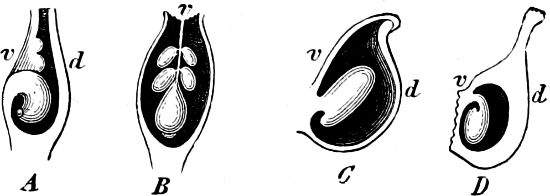
Fig. 373.—Ovaries in longitudinal section:
v the ventral suture; d the dorsal suture: A,
B Clematis; C Ranunculus; D
Myosurus.
The most primitive form of fruit is undoubtedly the pod formed
by one carpel, on the edges of which (along the ventral suture)
two rows of ovules are situated: Pæonieæ, Helleboreæ, Delphinieæ
(Fig. 379). In a great many genera the number of ovules has
been limited to one perfect one, which is placed in the
central plane under the united leaf-edges, and sometimes also
some barren ovules above it (Fig. 373). The fruitlets in this
case become achenes, and are present in much larger numbers than
when there are follicles.
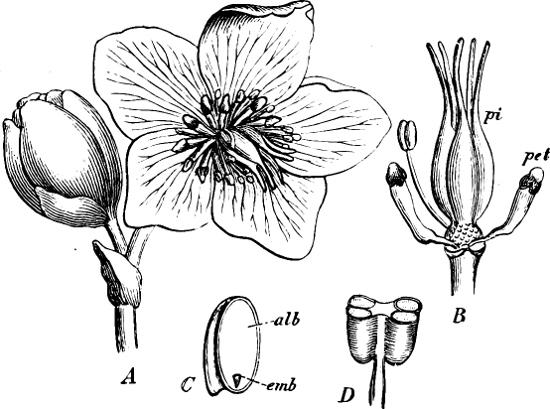
Fig. 374.—Helleborus niger: A
flower; B receptacle; pet petals (honey-leaves);
pi stamens and carpels; C seed; D anther (cross
section); alb endosperm.
Fig. 375.—Caltha palustris: fruit.
The following have Follicles: Pæonieæ,
Helleboreæ (except Actæa) and Delphinieæ;
Achenes: Ranunculeæ, Anemoneæ and
Clematideæ.
A. Follicles (Figs. 375, 379), with many ovules, situated
in two rows along the ventral suture. Actæa has berries,
Nigella has capsules of several loculi.
1. Pæonieæ, Peony Group. This has regular, acyclic
flowers with a normal, most frequently 5-leaved, imbricate calyx;
large, coloured petals, and introrse anthers. Slightly perigynous.
Surrounding the base of the carpels a ring-like swelling of the
receptacle (“disc”) is present, which is largest in P. moutan.
The follicles are more or less fleshy or leathery. Mostly herbs,
with pinnatisect or decompound leaves and large, solitary flowers; a
gradual transition may be traced from the foliage-leaves to the petals.
Pæonia; Hydrastis.
Fig. 376.—Aquilegia vulgaris.
Fig. 377.—Caltha palustris (nat. size).
Fig. 378.—Nigella: A, B
fruit of N. damascena, entire, and cut transversely. C
Petal (honey-leaf) of N. arvensis. D Petal of N.
damascena.
2. Helleboreæ, Hellebore Group. This has regular
flowers with most frequently a coloured calyx. The petals
(honey-leaves) are modified into nectaries; they may be horn-like,
provided with a spur, or of a similarly unusual form, or they
may be entirely absent. Anthers often extrorse.—Trollius
(Globe-flower[36]). The flower is acyclic: many petaloid sepals,
succeeding these, most frequently, several linear,
dark yellow petals, which bear a naked nectary at the base;
finally, many stamens and carpels arranged in a spiral (3/8,
8/21).—Caltha (Marsh-marigold, Figs. 375, 377); 5 (-7) yellow
sepals, no petals. The foliage-leaves have a large amplexicaul
sheath.—Helleborous (Hellebore) has pedate leaves. The
flower is acyclic, with 5 large, regular, persistent, often
petaloid sepals (2/5); small, horn-like petals (honey-leaves;
most frequently 13, divergence 8/13) and generally few carpels (Fig.
374).—Coptis.—Isopyrum.—Eranthis (Winter
Aconite), like Anemone, has a 3-leaved involucre and most
frequently trimerous flowers, 6 large petaloid sepals, 6 petals
(tubular honey-leaves), 6 oblique rows of stamens, 3–6 carpels.
Aquilegia (Columbine, Fig. 376); the flower is entirely
cyclic and has large spurs on all the 5 petals (funnel-shaped
honey-leaves); S5 coloured, P5, A5 × (8–12), G5 in regular alternation
(Figs. 376, 370); the innermost stamens are often staminodes (Fig.
370).—Nigella (Love-in-the-mist, Fig. 378) has 5 sepals and
8 small, two-lipped petals cleft at the apex (the nectary
is covered by the under-lip; Fig. 378 C, D). The 5
carpels are more or less completely united; and a many-carpellate
ovary with free styles is formed in some. Large air-chambers in the
external wall of the ovary are formed in N. damascena (Fig.
378).—Actæa (Baneberry) has coloured sepals, either no petals
or an indefinite number, and only 1 carpel. The fruit is a berry (or
follicle).—Cimicifuga, Garidella, Xanthorhiza
(S5, P5, A5 + 5, G5).
3. Delphinieæ, Larkspur Group. Zygomorphic flowers
with coloured calyx; the 2 posterior petals (honey-leaves) are
transformed into nectaries, the others are small or absent
altogether.—Aconitum (Monkshood); 5 sepals, of which the
posterior one (Fig. 379 A) is helmet-shaped; most
frequently 8 petals (as in Fig. 372), of which the two posterior ones
(honey-leaves) are developed into long-clawed nectaries (Fig. 379
A, k) enveloped by the helmet-like sepal; the others are
small, or are to some extent suppressed. Stamens on a spiral of
3/8–5/13; generally 3 carpels. Perennial herbs.—Delphinium
(Larkspur); very closely allied to Aconitum, but the anterior 4
petals are most frequently wanting, and the 2 posterior ones have each
a spur, which is enclosed by the posterior sepal, the latter
being also provided with a membranous spur. Stamens and
carpels arranged on a spiral of 3/8, 5/13, 8/21. In D. ajacis
and consolida there is apparently only 1 petal (by the fusion of
4) and 1 carpel.
Fig. 379.—Aconitum napellus. A
Flower in longitudinal section, below are the 2 bracteoles; a
half of helmet-like sepal; b and c other sepals; k
nectary; f carpels. B Ovary in longitudinal section;
C the same transversely; d dorsal suture; v
ventral suture.
B. Fruit achenes. Many carpels, each with only 1 ascending (Fig.
373 C), or pendulous (Fig. 373 D), perfect ovule; often
also rudimentary ovules above it (Fig. 373 A, B). Fruit
achenes.
4. Ranunculeæ, Buttercup Group, has double perianth.
Myosurus and Adonis have pendulous ovules as in Anemoneæ
(Fig. 373 D); Ranunculus, with Batrachium and
Ficaria, erect ovules (Fig. 373 C) and downwardly-turned
radicle.—Ranunculus. Most frequently S5, P5, many
spirally-placed stamens and carpels (Figs. 371, 380). The petals
(honey-leaves) have a nectary at the base, covered by a small scale.
Batrachium, Water Ranunculus, deviates by the achenes being
transversely wrinkled; dimorphic leaves. Ficaria has 3 sepals
and 7–8 petals arranged in 2/5–3/8. F. ranunculoides (the only
species) has tuberous roots, which spring from the base of the axillary
buds, and together with these, serve as organs of reproduction. The
embryo has only 1 cotyledon.—Myosurus (Mouse-tail) has
small prolongations from the 5 sepals; 5 narrow petals which bear the
nectaries near the apex; sometimes only 5 stamens, and an ultimately
very long receptacle, with numerous spirally-arranged achenes (Fig.
381).—Adonis is acyclic (Fig. 372); most frequently 5 sepals
with a divergence of 2/5, 8 petals of 3/8, indefinite stamens and
carpels of 3/8 or 5/13. The corolla has no nectary.

Fig. 380.—Flower of Ranunculus
sceleratus in longitudinal section.
Fig. 381.—Myosurus minimus: c
cotyledons; m the foliage-leaves; f the floral axis with
the carpels, and g the same without; y insertion of
perianth.]
5. Anemoneæ, Anemone Group, has a single perianth.
(Pendulous ovules (Fig. 373 D), radicle turned
upward).—Anemone has a single, petaloid, most frequently
5–6-leaved perianth, and beneath the flower most frequently an
involucre of 3 leaves, placed close together in the form of
a whorl. In A. nemorosa, ranunculoides, etc., the
involucral leaves resemble foliage-leaves; in A. hepatica they
are situated close under the perianth, and resemble sepals, and in
the sub-genus Pulsatilla they stand between the foliage-leaves
and floral-leaves. The style of Pulsatilla finally grows out
in the form of a feather. The main axis of A. hepatica has
unlimited growth (it is biaxial), and the flowers are borne laterally
in the axils of the scale-leaves; in the others (uniaxial) the flower
is terminal, and the rhizome becomes a sympodium after the first
flowering.—Thalictrum (Meadow Rue) has no involucre;
4–5-leaved, greenish perianth. The receptacle is flat. The stamens
are brightly-coloured and have long filaments; 1–5 accessory flowers
may occur in the leaf-axils of the panicle-like inflorescence.
6. Clematideæ, Clematis Group. This differs from all
the others in the valvate æstivation of the calyx and its
opposite leaves. There are 4 (-several) petaloid sepals; petals are
absent, or linear (Atragene). Ovule 1, pendulous. Achenes, often
with prolonged, feathery style. The majority of the genera are shrubs,
and climb by their sensitive, twining leaf-stalks.—Clematis;
Atragene.
Pollination. The flowers are conspicuous either
by coloured petals (honey-leaves) (Ranunculus,
Pæonia) or coloured sepals (Helleborus,
Anemone, Caltha, etc.), or by both
(Aquilegia, Delphinium), or by the
coloured stamens (Thalictrum). Some have no honey
(Clematis, Anemone, Thalictrum),
and are generally visited by insects for the sake of
their pollen. Others have nectaries on the corolla
(Ranunculus, Trollius, Helleborus,
Nigella, Aconitum, etc.), more rarely on the
stamens (Pulsatilla, Clematis-species), or the
carpels (Caltha), or the calyx (certain species of
Pæonia). The honey is readily accessible in the flat,
open flowers, and these flowers also may easily pollinate
themselves. There is marked protandry where the honey lies
deeply hidden, as in Aquilegia, Delphinium,
and Aconitum. Helleborus and some
Ranunculus-species are protogynous.
About 680 species; especially in northern temperate climates,
and extending to the Polar and Alpine regions. Only the
Clematideæ are tropical.
The order has an abundance of acrid, vesicant properties
(R. acer, sceleratus, etc.), and poisonous
alkaloids (Helleborus niger is poisonous).
Officinal: Aconitum napellus (aconitine; leaves
and tuberous roots); the rhizome of Hydrastis canadensis
from N. Am. (the alkaloid hydrastine). The order, however, is
best known for its ornamental plants; almost all the genera have
species which are cultivated for their beauty. Sweet-scented
flowers are absent.
Order 2. Nymphæaceæ (Water Lilies). Water Plants;
generally with large, floating leaves, and large solitary flowers;
sepals 3–5, petals 3–∞, stamens 6–∞, carpels 3–∞. The flower is
hypogynous, but in the Nymphæeæ different degrees of epigyny
are found, and from this fact, as well as from the carpels being
united into one pistil, the family forms a lateral offshoot from the
Ranunculaceæ, with much greater modification. The seed often has an
aril, and, in the majority, a farinaceous nutritive tissue, partly
endosperm, partly perisperm (Fig. 383 C). The embryo has 2 thick
cotyledons and a small hypocotyl; the plumule is well developed, with
2–4 leaves.
1. Cabombeæ. 3–4 species (Tropical S. Am.), resembling
the Water Ranunculus, with two kinds of leaves, the submerged
being dissected and the aerial peltate. The flowers are
eucyclic, trimerous, with 2–3 free, epigynous carpels. The
ovules are situated on the central line of the carpel—an
almost unique circumstance. Endosperm and perisperm. Cabomba;
Brasenia.
2. Nelumboneæ. The leaves are peltate, raised on
long stalks high above the water. Large, hypogynous flowers
(Fig. 382); sepals 4–5; petals numerous; stamens numerous; carpels
several, distinct. The receptacle is very remarkable, being
raised above the stamens, and developed into an inverted conical
body on the apex of which the nut-like fruits are embedded in
pits. Endosperm is wanting, but the embryo is large and
has well developed cotyledons.—Nelumbo, 2 species. N.
lutea (N. Am.); N. speciosa (E. Ind.) was sacred amongst the
ancient Hindoos and Egyptians, (the Lotus flower); its seeds are used
as food.
3. Nymphæeæ, Water Lily Group. The carpels are united into
one, many-locular ovary, whose numerous ovules are
situated on the surface of the partition walls (as in the Poppies);
the stigma is sessile and radiating, the number of rays corresponding
to the number of carpels (Fig. 383). The fruit is a spongy berry
with many seeds, which have a large perisperm in addition to the
endosperm (Fig. 383 C).
Fig. 382.—Nelumbo nucifera: vertical
section through the receptacle.
Sepals, petals, and stamens often pass gradually over the one into
the other, the petals becoming narrower by degrees, and bearing
anthers on each side of the apex, which gradually become larger
anthers in proportion to the filament, until the perfect stamen is
developed. The long-stalked leaves are floating, and most frequently
cordate, elliptical, leathery, with a shiny surface, sometimes (as
in Victoria regia and Euryale ferox) with strongly
projecting thorny ribs on the lower surface. In the intercellular
passages of the leaves are some peculiar, stellate cells.
Nuphar has 5 sepals, and an hypogynous flower. The
petals, which are small, have a nectary on the back; the coloured inner
side of the sepals functions as petals; the ovate gynœceum is quite
free.—N. luteum is a native plant (Yellow Water-Lily), with,
most frequently, 13 petals and 10–16 loculi in the ovary. The rhizome
is horizontal, as much as 5–6 cm. in thickness, and bears on its under
surface a number of roots, which on dying-off leave deep scars; the
leaves are borne in spiral lines, and the flowers are solitary in
certain leaf-axils. The construction of the rhizome is very peculiar;
the vascular bundles are scattered and closed as in a monocotyledonous
stem.
Fig. 383.—Nymphæa: A flower in
longitudinal section, the most external leaves being removed; B
fruit; C seed of Nuphar (longitudinal section); the
perisperm at the base, the endosperm at the top surrounding the embryo.
Nymphæa has 4 sepals, and the flower is more or less
epigynous. Petals and stamens are inserted at different heights
on the ovary to just beneath the stigma (Fig. 383). Nymphæa
alba (White Water-Lily). Victoria regia from the Amazon,
and Euryale ferox from Asia, have entirely epigynous flowers.
The shield-like leaves of Victoria are as much as 2 metres
in diameter, and the edge is bent up to a height of 5–14 cm.; the
flowers are 20–40 cm. in diameter, and change in twenty-four hours from
white to rose-red. A development of heat, as much as 14°C. above the
temperature of the air, together with a strong formation of carbonic
acid, has been observed during flowering.
Pollination. Nymphæa alba and other species
of the sub-genus Symphytopleura are self-pollinated;
the sub-genus Leptopleura is insect-pollinated.
Nuphar and Victoria can effect self-fertilisation;
Euryale is self-fertilised, often in entirely closed and
submerged flowers.—The dissemination of the seeds in Nuphar
luteum is effected by the fruit, which rests on the water,
becoming detached from its stalk, and dehiscing from the base
upwards so that the seeds are set free; while in Nymphæa
alba the spirally-twisted stalk draws the fruit under water,
and it dehisces by its upper part being thrown off as a hood,
and the seeds which are enclosed in air-tight sacs rise to the
surface of the water. In this condition they are able to float
and can only sink to the bottom when the air has disappeared.
53 species; in fresh water in all parts of the world, but
especially in the Tropics.—The rhizomes and seeds of some
may be used as food; Euryale ferox is even cultivated.
Nymphæa cœrulea and Lotus were sacred among the
Egyptians.
Order 3. Ceratophyllaceæ. About 3 species. Aquatic plants,
submerged, rootless; leaves cartilaginous, verticillate, dissected
into repeatedly dichotomous branches which are finely toothed; only
one of the leaves in a whorl supports a vegetative branch. The flowers
are monœcious, axillary. Inside the 6–12 perianth-leaves are
situated in the ♂-flower 10–20 stamens with thick connective, and in
the ♀-flower a gynœceum formed by one carpel, with one orthotropous and
pendulous ovule, which has only one integument. Fruit a nut, which,
in some species, bears on each side a pointed horn, and at the apex
a similar one, formed by the persistent style.—The embryo has an
unusually well developed plumule with several whorls of leaves. The
plant is rootless throughout its whole life.—Ceratophyllum
(Horn-wort).
Order 4. Annonaceæ. Sepals 3; petals 3+3 (most
frequently valvate); succeeding these (as in the
Ranunculaceæ) are numerous acyclic stamens and
an apocarpous gynœceum; the flowers are hypogynous,
regular and ☿, generally very large (2–3 cm. in diameter), and
the leaves of the perianth are more or less fleshy or leathery.
The majority have syncarps with berry-like fruitlets, but in
Annona and some others the carpels fuse together into a
large, head-like fruit—a kind of composite berry. The seeds
have ruminate endosperm as in Myristica.—Trees or
shrubs with alternate, simple, entire, penninerved leaves
without stipules. 450 (700?) species; especially tropical. The
best known are Anona cherimolia, squamosa and
reticulata (all from America) cultivated on account of
their large, delicious fruits. Some have acrid and aromatic
properties (Xylopia, Cananga—the flowers of the
latter yield Ylang-ylang); Artabotrys odoratissimus;
Asimina (N. Am.).
Order 5. Magnoliaceæ. Trees or shrubs with scattered,
often leathery, entire leaves, generally with stipules,
which (as in Ficus) are rolled together and form a hood
round the younger internodes above them, and are cast off by
the unfolding of the next leaf, leaving a ring-like scar. The
endosperm is not ruminate. Corolla imbricate. Fruit a
syncarp.
A. Magnolieæ. The flowers are borne singly, and
before opening are enveloped in an ochrea-like spathe which
corresponds to the stipules of the foliage-leaves. The perianth
generally consists of 3 trimerous whorls, the external one
of which is sometimes sepaloid (Liriodendron, and the
majority of Magnoliaspecies), sometimes coloured like
the others; the perianth is sometimes many-seriate. Numerous
spirally-placed stamens and carpels. The latter are situated
on the elongated, cylindrical receptacle, and are
individually more or less united, except in Liriodendron,
where they are free. This last genus has winged achenes; the
fruitlets in Magnolia open along the dorsal and ventral
sutures, and the seeds then hang out, suspended by elastic
threads formed from the vascular bundles of the funicle and
raphe; they are red and drupaceous, the external layer of the
shell being fleshy—a very rare occurrence.
B. Illicieæ has no stipules. The carpels
are situated in a whorl on a short receptacle. Follicles,
one-seeded. The leaves are dotted by glands containing essential
oil. Illicium; Drimys.
70 species; in tropical or temperate climates; none in Europe
or Africa. They are chiefly used as ornamental plants,
e.g. the Tulip-tree (Liriodendron tulipifera, N.
Am.), Magnolia grandiflora (N. Am.), M. yulan
and fuscata (China), and others. The remains of
Liriodendron occur as fossils in the Cretaceous and
Tertiary periods.—The fruits of Illicium anisatum
(Star-aniseed from Eastern Asia) are OFFICINAL. The
bark of Drimys winteri (S. Am.) is also strongly aromatic.
Order 6. Calycanthaceæ. These are very closely related
to the Magnoliaceæ, but differ in having perigynous
flowers with many perianth-leaves, stamens and (about 20)
carpels in a continuous spiral, seeds almost devoid of
endosperm with rolled up, leaf-like cotyledons, and leaves
opposite on a square stem.—There are some species in N. America
(Calycanthus florida, occidentalis, etc.) and 1 in
Japan (Chimonanthus præcox), all strongly aromatic.
Order 7. Monimiaceæ. Aromatic shrubs with opposite
leaves. Perigynous flowers. The anthers dehisce by valves like
those of the Lauraceæ, and the Monimiaceæ may thus
be considered as an apocarpous form of this order. They are
also closely related to Calycanthaceæ. 150 species,
tropical.—Hedycarya, Mollinedia, Monimia.
Fig. 384.—Diagram of Berberis.
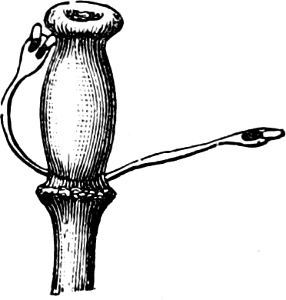
Fig. 385.—Berberis: carpel with 2
stamens.
Order 8. Berberidaceæ (Barberries).—The regular, ☿, hypogynous
flowers are dimerous or trimerous and have regularly alternating
whorls of free sepals, petals, and stamens and 1 unilocular carpel;
the corolla and stamens have each 2 whorls, the calyx at least 2. The
anthers open, as in Lauraceæ, by (2) valves, but are always
introrse (Fig. 384). The pistil has a large, disc-like, almost
sessile stigma (Fig. 385), and in the ovary several erect
ovules are placed close to the base of the ventral suture. The fruit is
most frequently a berry. Seeds endospermous.—Shrubs or herbs
with scattered, most frequently compound leaves (without stipules), and
racemose inflorescences.—They show a relationship to the Lauraceæ
in the number of the parts of the flower and the dehiscence of the
anthers.
Berberis is a shrub; it has sepals 3 + 3, petals 3 + 3, stamens
3 + 3 (Fig. 384). The petals (honey-leaves) bear internally at the base
2 darkish-yellow nectaries. The filaments are sensitive at the base,
and suddenly bend inwards if touched at that spot (Fig. 385). The
racemes often have a terminal, 5-merous flower; they are borne on
dwarf-branches. The leaves on the long-branches develope into thorns,
but the buds in their axils, in the same year as themselves, develope
as the short-branches with simple foliage-leaves, articulated
at the base, from which fact some authorities have considered that the
leaf is compound with a single, terminal leaflet.—Mahonia
has imparipinnate leaves. The flower has 3 whorls of sepals.
Otherwise as in Berberis.—Epimedium; herbs with
spurred petals; the flowers dimerous; 4–5 whorls of sepals, 2 of
petals and stamens. Fruit a capsule. Leontice, fruit dry. The
anthers of Podophyllum dehisce longitudinally.—Nandina.
Aceranthus.
100 species; North temp., especially Asia: fossils in Tertiary.
Berberis vulgaris is a native of Europe. This and other
species, together with Mahonia aquifolium (N. Am.),
Epimedium alpinum, etc., are cultivated as ornamental
plants. Several have a yellow colouring matter in the root
and stem. Officinal: the rhizome of Podophyllum
peltatum (from N. Am.) yields podophyllin.
Order 9. Menispermaceæ. This order has derived its
name from the more or less crescent-like fruits and seeds.
Diœcious. The flowers are 2–3-merous, most frequently as in
Berberis (S3 + 3, P3 + 3, A3 + 3), with the difference
that there are 3 free carpels, each with 1 ovule;
in some genera, however, the number is different. Stamens
often united into a bundle (as in Myristica); anthers
dehiscing longitudinally; fruit a drupe.—The plants (with
herbaceous or woody stems) belonging to this order are nearly
all twining or climbing plants, and have
scattered, palmate or peltate, sometimes lobed leaves without
stipules. Structure of stem anomalous. Cocculus, Menispermum,
Cissampelos, Anamirta.
150 species; Tropical; very rich in bitter and poisonous
properties. Officinal: Calumba-root from Jateorhiza
columba (E. Africa). The following are cultivated as
ornamental plants:—Menispermum canadense (N. Am.)
and M. dahuricum (Asia). The fruits of Anamirta
cocculus (E. Ind.) are very poisonous (“Grains-of-Paradise”;
the poisonous matter is picrotoxine).
Order 10. Lardizabalaceæ. This order, by the free,
apocarpous carpels, belongs to a more primitive type, and by
the united stamens to a more developed one. Akebia;
Holbœllia; principally climbing or twining shrubs. About
7 species in S.E. Asia and S. Am.
Order 11. Lauraceæ (True Laurels). Trees or shrubs; the
leaves, always without stipules, are simple, most frequently scattered,
lanceolate or elliptical, entire, penninerved, finely reticulate
(except Cinnamomum with 3–5-veined leaf), leathery and evergreen
(except, e.g. Cinnamomum); they are frequently studded
with clear glands containing volatile oil. The flowers are
borne in panicles and are small and of a greenish or whitish colour.
They are regular, perigynous, with most frequently a bowl or
cup-shaped receptacle (Fig. 386), usually ☿, and trimerous
(rarely dimerous) through all (most frequently 6–7) whorls; viz. most
frequently, perianth 2 whorls, stamens 3–4 and carpels 1 (P3 + 3, A3 +
3 + 3 + 3, G3) in regular alternation (Fig. 387). Each of the 2 or 4
loculi of the anthers open by an upwardly directed valve (Fig.
386); of the stamens, the 2 outermost whorls are generally introrse,
the others extrorse, or 1–3 whorls are developed as staminodes (Fig.
387 g). The gynœceum has 1 loculus with 1 style and 1 pendulous
ovule (Fig. 386), and may be considered as formed of 3 carpels. The
fruit is a berry (Fig. 388) or drupe, which often is
surrounded at its base by the persistent receptacle (as an acorn by
its cupule), which becomes fleshy and sometimes coloured during the
ripening of the fruit. The embryo has 2 thick cotyledons, but no
endosperm (Fig. 388).
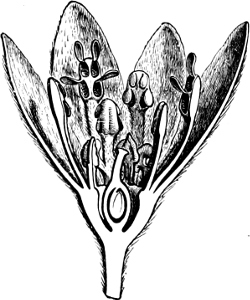
Fig. 386.—Flower of the Cinnamon-tree
(Cinnamomum zeylanicum) (longitudinal section).

Fig. 387.—Typical diagram of the Lauraceæ:
g staminodes.
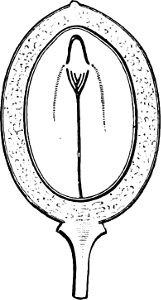
Fig. 388.—Laurus nobilis: longitudinal
section of fruit.
The Lauraceæ present affinities with the Polygonaceæ, in which
there is found perigyny, as well as a similar number of parts
in the flower and a similar gynœceum, but with erect and
orthotropous ovule. From their general characters they should
be classed among the Polycarpicæ, but stand, however, isolated
by the syncarpous gynœceum, if it is in reality formed
by 3 carpels and not by 1 only. Hernandia, which has
epigynous monœcious flowers, deviates most.—Cassytha
is a Cuscuta-like, herbaceous, slightly green parasite
with twining, almost leafless stems. The flower however agrees
with the diagram in Fig. 387. Some Lauraceæ have curved veins or
palminerved and lobed leaves (often together with entire ones)
e.g. Sassafras.
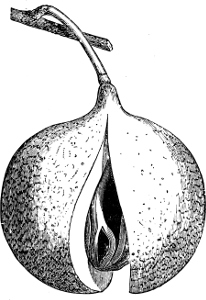
Fig. 389.—Myristica: fruit.]
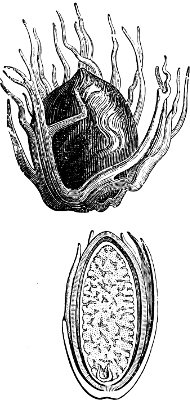
Fig. 390.—Seed with aril entire and in
longitudinal section.
There are 1000 species; especially in the forests of tropical S.
America and Asia, of which they form the principal part. Only
Laurus nobilis is found in Europe, and there is little
doubt that its proper home is in Western Asia. They are rare
in Africa.—On account of the volatile oil found in all
parts of the plant, they are used as spices, e.g.
the false Cinnamon-tree (Dicypellium caryophyllatum, in
the Brazils). The OFFICINAL ones are—the Cinnamon-tree
(Cinnamomum zeylanicum from Ceylon, E. India, Eastern
Asia), which is also cultivated; the Camphor-tree (Cinnamomum
camphora, Eastern Asia). The Laurel-tree (Laurus
nobilis, Mediterranean), the berries and leaves of which
give laurel oil, is medicinal.—Scented wood for furniture,
etc., is obtained from Sassafras officinalis (from N.
Am.). The wood from its roots is officinal. Pichurim “beans” are
the large cotyledons of Nectandra pichury, whilst the
famous “Greenheart” wood of Demarara is the wood of Nectandra
rodiæi. The pulp and seeds contain a fatty oil.
The pear-like fruit of Persea gratissima (Mexico, also
cultivated) is very delicious. Lindera benzoin is a
garden shrub; Laurus nobilis likewise.
Order 12. Myristicaceæ (Nutmegs). In this order
there is only 1 genus, Myristica. Trees or shrubs.
The leaves agree closely with those of the Lauraceæ, with
which this order has many points in common. The majority of
the species are aromatic, having in their vegetative parts
pellucid glands with volatile oils. The flowers are regular,
diœcious, trimerous, and have a single gamophyllous (cupular or
campanulate) 3-toothed, fleshy perianth. In the ♂-flowers the
anthers vary in number (3–15), and they are extrorse and borne
on a centrally-placed column; in the ♀-flower the gynœceum is
unilocular, unicarpellary, with 1 ovule. The FRUIT
(Fig. 389) has the form of a pear; it is a fleshy, yellow
capsule, which opens along the ventral and dorsal sutures,
exposing the large seed. This seed has a large, red, irregularly
branched aril—the so-called “mace”; the “nutmeg,” on the other
hand, is the seed itself with the inner thin portion of the
testa, which has pushed its way irregularly into the endosperm,
and causes the marbled appearance of the cut seed (Fig. 390);
the external, dark brown, hard, and brittle part of the
seed-shell is however removed. Mace and nutmeg contain volatile
and fatty oils in abundance.—80 species. Tropical. The majority
are used on account of their aromatic seeds and aril, the most
important being M. fragrans (moschata), from the
Moluccas. This is cultivated in special plantations, not only in
its native home, but in other tropical countries also. Nutmegs
were known as commodities in Europe in very ancient times
(e.g. by the Romans), but it was not until the year 1500
that the tree itself was known. The seed is OFFICINAL.
The plants belonging to this family are almost exclusively herbaceous,
with scattered, exstipulate leaves. The flowers are eucyclic di- or
tetramerous, with the calyx and corolla deciduous, hypogynous,
☿, regular, the gynœceum with 2–several carpels (generally
2, transversely placed) (Figs. 391, 392, 393, 397). The ovary is
unilocular with parietal placentæ, but in Cruciferæ and a
few others it becomes bilocular by the development of a false,
membranous wall between the placentæ. The stigmas in the majority
of cases are commissural, i.e. they stand above the
placentæ, and not above the dorsal line of the carpels. The fruit is
nearly always a capsule, which opens by the middle portions
of the carpels detaching themselves as valves, bearing no seed,
whilst the placentæ persist as the seed-bearing frame. Endosperm is
found in Papaveraceæ and Fumariaceæ, but is absent in
Cruciferæ and Capparidaceæ.—This family through the
Papaveraceæ is related to the Polycarpicæ (the Nymphæaceæ), through the
Capparidaceæ to the Resedaceæ in the next family.
Exceptions to the above are: Eschscholtzia,
Subularia (Fig. 403) and a few Capparidaceæ, in
which perigynous flowers are found. A few Papaveraceæ and
Fumariaceæ have trimerous flowers. In Fumaria and certain
Cruciferæ, the fruit is a nut. The Fumariaceæ have zygomorphic
flowers. Trees and shrubs are almost entirely confined to the
Capparidaceæ, in which order stipules also are found.
Order 1. Papaveraceæ (Poppies). Herbaceous plants with
stiff hairs and latex; flowers regular (Fig. 391)
with generally 2 (-3) sepals (which fall off as the flower
opens), 2 + 2 petals (imbricate and crumpled in the bud) without
spur, numerous stamens in several alternating whorls (generally
a multiple of 2); carpels 2–several, united into a unilocular
gynœceum. Trimerous flowers also occur. Capsule with very numerous
seeds on the parietal placentæ; embryo small, with large, oleaginous
endosperm (Fig. 392).—The leaves have no stipules and are
generally pinnately lobed.
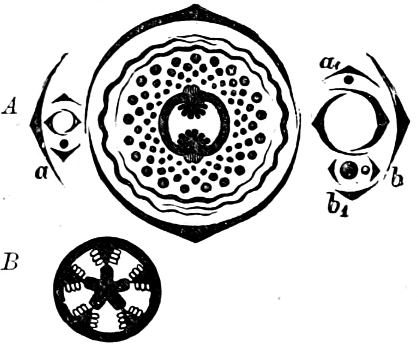
Fig. 391.—A Diagram of the flower of
Glaucium and the dichasium (which becomes transformed into a
scorpioid cyme). B Papaver argemone, transverse section
of the ovary with indication of the position of the stigmas.

Fig. 392.—Papaver somniferum: A
capsule; st the stigma; v valves; h pores;
B seed in longitudinal section; alb endosperm; emb
embryo.
Papaver (Poppy) has large, solitary, terminal flowers; petals
firmly and irregularly folded in æstivation; gynœceum formed by many
(4–15) carpels; stigmas velvety, sessile and stellate
(the rays stand above the placentæ) (Fig. 391 B). The edges
of the carpels project deeply into the ovary, but do not meet in the
centre, so that it remains unilocular. The capsule opens by pores
placed close beneath the stigma, and formed of small valves alternating
with the placentæ and the rays of the stigma (Fig. 391). P.
dubium, P. argemone, P. rhœas.—Chelidonium
(Greater Celandine) has yellow latex, flowers in umbellate
cymes (the terminal, central flower opening first) and only 2
carpels; the fruit resembles the siliqua of the Cruciferæ in having
two barren valves, which are detached from the base upwards,
and a seed-bearing frame, but there is no partition wall
formed between the placentæ. Ch. majus.—The majority
of the other genera have, like Chelidonium, 2 carpels
(lateral and alternating with the sepals: Fig. 391 A) and
siliqua-like fruit, thus: Eschscholtzia (perigynous) with
a linear, stigma-bearing prolongation extending as far above the
placentæ as above the dorsal suture of the carpels; Glaucium
(Horn-Poppy); G. luteum, whose extremely long, thin capsule
differs from that of Chelidonium by the formation, during
ripening, of a thick, spongy (false) replum, which persists
when the valves are detached; Sanguinaria with red latex, the
2 petals divided into 8–12 small petals (perhaps by dédoublement);
Macleya and Bocconia (1-seeded capsule) with 2 sepals
and no petals.—Trimerous flowers are found in Argemone
and Platystemon (with a curious fruit, carpels free, and
transversely divided and constricted into joints which separate as
nut-like portions).—Meconopsis.—Hypecoum (Fig. 393
C) has tri-lobed and three cleft petals, 4 free stamens with
4-locular anthers and a jointed siliqua; it presents a transitional
form to the Fumariaceæ, with which order it is sometimes included.
Pollination. Papaver and Chelidonium have
no honey, and are without doubt only visited by insects for the
sake of the pollen. The anthers and stigmas mature about the
same time.—There are 80 species; especially from warm climates.
Officinal: Papaver somniferum (Opium-Poppy);
the latex of its unripe capsules is obtained by incisions, and
dried (opium); it contains many alkaloids: morphine,
papaverine, narcotine, thebaine, etc. The oleaginous seeds are
also used in the manufacture of oil. Its home is in the East,
where it is extensively cultivated. The petals of the Corn-poppy
(P. rhœas) are also officinal. Several species are
cultivated as ornamental plants.
Order 2. Fumariacæ (Fumitories). This order differs
from the closely allied Papaveraceæ in the absence of latex, a poorer
flower, generally transversely zygomorphic (Fig. 393 B),
in which case one or both of the outer lateral petals are gibbous, or
prolonged into a spur; the stamens are especially anomalous. Sepals
2, caducous; petals 2 + 2; stamens 2, tripartite; each
lateral anther is bilocular (Figs. 393 A, B;
395); gynœceum bicarpellate. The fruit is a nut or siliqua-like
capsule. Endosperm.—Herbs with scattered, repeatedly
pinnately-divided leaves without stipules, generally quite glabrous and
glaucous; the flowers are arranged in racemes with subtending bracts,
but the bracteoles are sometimes suppressed.
Dicentra (syn. Dielytra) and Adlumia have a
doubly symmetrical flower, with a spur or gibbous swelling at the base
of each of the laterally-placed petals (Figs. 393 A,
394). Corydalis has a zygomorphic flower, only one of
the lateral petals having a spur, and consequently there is
only one nectary at the base of the bundle of stamens, which stands
right in front of the spur (Fig. 393 B, 395, 396). The fruit
is a many-seeded siliqua-like capsule. A peculiarity of the flower
is that the plane of symmetry passes transversely through the
flowers, whilst in nearly all other zygomorphic flowers it lies in
the median line. Moreover, the flower is turned, so that the plane of
symmetry ultimately becomes nearly vertical, and the spur is directed
backwards.—Many species have subterranean tubers; in these the
embryo germinates with one cotyledon, which is lanceolate and
resembles a foliage-leaf. The tuber is in some the swollen hypocotyl
(C. cava), in others a swollen root (C. fabacea, etc.),
which grows down through the precisely similar swollen root of the
mother-plant. The sub-genus Ceratocapnos has dimorphic fruits
(nuts and capsules) in the same raceme. Fumaria differs from
Corydalis only by its almost drupaceous, one-seeded nut (Fig.
395).

Fig. 393.—Diagram of Dicentra
(A), Corydalis (B), and Hypecoum
(C).]
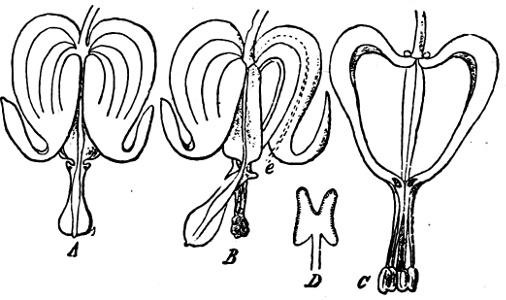
Fig. 394.—Dicentra spectabilis:
A flower (2/5); B the same, after removal of half of one
outer petal; the cap, formed by the inner petals, is moved away from
the anthers and stigma; the insect does this with the lower side of its
abdomen, and thus rubs the stigma on the hairs of its ventral surface;
the dotted line at e indicates the direction of the proboscis;
C andrœcium and gynœceum; D stigma.
The structure of the flower. Hypecoum among the
Papaveraceæ is the connecting link with the Fumariaceæ. The
diagram (Fig. 393 C) corresponds both in number and in
the relative position of its members with that of most of the
other Papaveraceæ (Fig. 391), except that there are only four
stamens (with extrorse anthers). In Dicentra (Fig. 393
A), the two central (uppermost) stamens are absent, but
each of the two lateral ones are divided into three filaments,
of which the central one bears a four-locular anther, and each
of the others a two-locular (half) anther. Corydalis
and Fumaria stand alone in the symmetry of the flower,
differing from Dicentra in having only one of the
lateral petals (Fig. 393 B, sp) prolonged into
a spur, while in Dicentra both the petals are spurred.
This structure has been interpreted in various ways. According
to Asa Gray the median stamens are absent in the last-named
genera, and the lateral ones are split in a similar manner to
the petals of Hypecoum. Another, and no doubt the most
reasonable theory (adduced by De Candolle), is: that two median
stamens are split, the two parts move laterally, each to their
respective sides and become united with the two lateral stamens;
this affords a natural explanation of the two half-anthers,
and establishes a close relationship to the Cruciferæ. A third
interpretation, held by Eichler and others, is as follows: the
median stamens are always wanting; when they appear to be
present, as in Hypecoum, it is due to the fact that the
side portions of the lateral stamens approach each other
(as interpetiolar stipules) and coalesce into an apparently
single stamen.
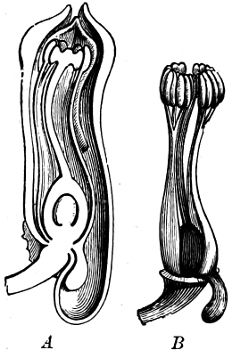
Fig. 395.—Fumaria officinalis: A
the flower in longitudinal section; B the andrœcium and
gynœceum; nectary to the right.

Fig. 396.—Corydalis cava: a a
flower (lateral view); b the anthers lying round the stigma;
c the anthers shortly before the opening of the flower; d
the head of the stigma; e relative position of the parts of the
flower during the visit of an insect.
130 species; mostly from the northern temperatures.
Pollination. Fumaria, with its inconspicuous
flowers, has to a great extent to resort to self-pollination.
Corydalis, on the other hand, is dependent on
cross-pollination; C. cava is even absolutely sterile
with its own pollen. Corydalis is pollinated by insects
with long probosces (humble-bees, bees), which are able to reach
the honey secreted in the spur; as they alight on the flowers
they press the exterior petals on one side (Fig. 396 e),
so that the stigma, surrounded by the anthers, projects forward;
the proboscis is introduced in the direction of the arrow
in the figure, and during this act the under-surface of the
insect is covered with pollen, which is transferred by similar
movements to the stigma of another (older) flower.—Ornamental
plants; Dicentra (spectabilis and eximia),
Adlumia, Corydalis.
Order 3. Cruciferæ (Crucifers). The flowers are regular,
☿; sepals 4, free (2 + 2), deciduous; petals 4, free, deciduous,
unguiculate, placed diagonally in one whorl, and alternating
with the sepals; stamens 6; the 2 outer are short,
the 4 inner (in reality the two median split to the base)
longer, placed in pairs (tetradynamia of Linnæus); gynœceum
syncarpous formed by 2 (as in the previous order, lateral) carpels,
with 2 parietal placentæ, but divided into two loculi by a
spurious membranous dissepiment (replum) (Fig. 397).
Style single, with a capitate, usually two-lobed stigma, generally
commisural, that is, placed above the parietal placentæ (Fig.
397), but it may also be placed above the dorsal suture, or remain
undivided. Ovules curved. The fruit is generally a bivalvular
siliqua (Fig. 398 B, C), the valves separating
from below upwards, and leaving the placentæ attached to the replum;
other forms of fruits are described below. The oily seeds have no
endosperm (endosperm is present in the two previous orders); the
embryo is curved (Figs. 398 E, F; 399, 400).—In
general they are herbaceous plants, without latex, with
scattered, penninerved leaves, without stipules; the inflorescence
is very characteristic, namely, a raceme with the flowers aggregated
together at the time of flowering into a corymb, and destitute of
both bracts and bracteoles.
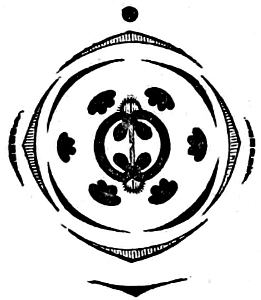
Fig. 397.—Diagram of a Cruciferous flower.
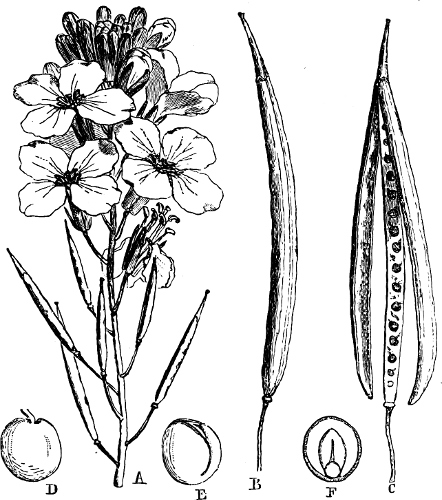
Fig. 398.—Brassica oleracea: A
raceme; B, C siliqua; D seed; E embryo;
F transverse section of seed.
Fig. 399.—Transverse section of seed and
embryo of Cheiranthus cheiri.
Fig. 400.—Transverse section of seed of
Sisymbrium alliaria.
Many are biennial, forming in the first year a close
leaf-rosette. By cultivation the tap-root can readily be induced
to swell out into the form of a tuber (Turnips, Swedes, etc.).
Stipules are found indicated by small glands on the very
young leaves; in Cochlearia armoracia they are fairly
large triangular scales. Stellate hairs often occur.
Floral-leaves are occasionally developed. Terminal
flowers are never found in the inflorescences. Iberis
and Teesdalia have zygomorphic flowers.
Subularia (Fig. 403) is perigynous. The 2 external
sepals (Fig. 397) stand in the median plane; it may therefore
be supposed that there are two bracteoles outside these which,
however, are suppressed, and can only in a few instances be
traced in the young flower; the two lateral sepals are often
gibbous at the base, and serve as reservoirs for the nectar
secreted by the glands placed above them; they correspond in
position to the external petals of the Fumariaceæ. The 4 petals
which follow next arise simultaneously, and alternate with the
4 sepals; if it could be shown that these are merely 2 median
petals, which have been deeply cleft and the two parts separated
from each other and displaced to the diagonal position, there
would be a perfect correspondence with the Fumariaceous flower;
then the petals would be followed in regular alternation by
the 2 lateral small stamens, the 2 median long stamens, which
it has been proved are split into 4 and placed in couples, and
the 2 laterally-placed carpels,—in all 6 dimerous whorls.
But the formation of the corolla by the splitting of 2 petals
does not agree with the development of the flower or bear
comparison, and hence the only fact in favour of this theory is
the otherwise prevailing correspondence with the Fumariaceæ.
Yet it may be observed that in special cases each pair of long
stamens clearly enough arises from one protuberance and even
later on may be considerably united or entirely undivided
(e.g. Vella); in other instances they are quite
distinct from the beginning, and it is possible that this latter
condition has become constant in the corolla. Lepidium
ruderale and others have no corolla. Senebiera didyma
has only 2 median stamens. Megacarpæa has several
stamens, no doubt by dédoublement, as in Capparidaceæ.—The
number of carpels may also be abnormally increased;
Tetrapoma barbareifolium has normally 4 carpels with
an equal number of placentæ and repla. It is supposed to be a
variety of Nasturtium palustre.—The 2–4–8–10 greenish
glands, which are found at the base of the stamens, are
nectaries, morphologically emergences, and not rudimentary
stamens. The forms of fruits are of great systematic
significance, see the genera. In some species dimorphic fruits
are present, e.g. Cardamine chenopodiifolia
which has both ordinary Cardamine-siliquas and 1-seeded
siliculas.
The curved embryo appears in five forms, which have
systematic importance: 1. To the Pleurorhizæ
belong those genera whose radicle (with the hypocotyl)
lies bent upwards along the edge of the flat
cotyledons (Fig. 399); to this group belong Cardamine,
Nasturtium, Cheiranthus, Matthiola,
Cochlearia, Draba, Iberis, Thlaspi,
etc.; diagrammatic transverse section: ◯=.—2. To
Notorhizæ belong those whose radicle lies in an upward
direction along the back of one of the flat
cotyledons (Figs. 400, 413); e.g. Hesperis,
Sisymbrium, Lepidium, Capsella,
Camelina: ◯‖.—3. Orthoploceæ differ from the
Notorhizeæ in having the cotyledons folded (not flat) (Fig.
398 E, F); to this belong Brassica,
Sinapis, Raphanus, Crambe, etc.: ◯>>.—4.
Spirolobeæ: the radicle lies as in the Notorhizæ,
but the cotyledons are so rolled together that a transverse
section of the seed cuts them twice; Bunias: ◯‖‖.—5.
Diplecolobeæ: the cotyledons are folded forward and
backward so that a transverse section cuts them several times;
Subularia, Senebiera: ◯‖‖‖.
On germination the cotyledons appear above the ground
as green leaves; in the Orthoploceæ they are bilobed, in the
Lepidium-species divided.
1. Silicula, broad replum (Siliculosæ latiseptæ), valves flat or
slightly vaulted, and the replum extends through the greatest width of
the silicula (Fig. 404). The seeds are situated in two rows.
◯=: Cochlearia (Horse-radish): the siliqua is nearly spheroid;
glabrous herbs, generally with fleshy, stalked leaves, and white
flowers.—Draba has an oblong, lanceolate, somewhat compressed
silicula; herbs with small rosettes of leaves, most frequently with
stellate and long-stalked racemes.—Alyssum and Berteroa
are whitish, on account of the stellate hairs; they have a more
compressed and round or elliptical silicula. Vesicaria;
Aubrietia. Lunaria (Honesty, Fig. 401): very broad and
flat silicula with long stalk (the receptacle as in Capparidaceæ).
◯‖: Camelina (Gold-of-pleasure) has a spheroid, pear-shaped
siliqua with a small rim passing right round (Fig. 402).
Subularia (Awlwort), an aquatic plant with perigynous
flower (Fig. 403) and folded cotyledons.
2. Silicula, narrow replum (Siliculosæ angustiseptæ),
i.e. the replum is much shorter than the arched, more or less
boat-shaped valves (Figs. 405, 406, 407).
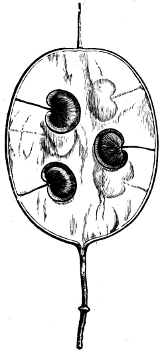
Fig. 401.—Lunaria biennis. Fruit, the
valves of which have fallen off.
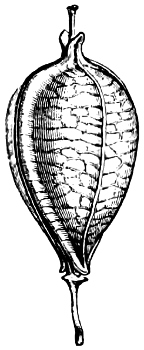
Fig. 402.—Camelina sativa. Fruit.
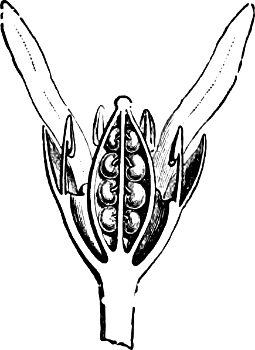
Fig. 403.—Subularia aquatica.
Longitudinal section through the flower.
◯=: Thlaspi (Penny-Cress) has a flat, almost circular silicula,
emarginate or cordate, with a well-developed wing round the edge (Fig.
406). Iberis and Teesdalia: the racemes during flowering
are especially corymbose, and the most external petals of the outer
flowers project radially and are much larger than the other two (the
flower is zygomorphic).—Biscutella, Megacarpæa.
◯‖: Capsella (Shepherd’s-Purse) has a wingless, obcordate or
triangular silicula (Fig. 407). Lepidium (Pepperwort) has a
few–(2–4) seeded, slightly winged, oval silicula. Senebiera has
a silicula splitting longitudinally into two nut-like portions; its
cotyledons are folded.—Anastatica hierochuntica (“Rose of
Jericho”) is an annual, silicula-fruited, desert plant (Arabia, Syria,
N. Africa). After the flowering all its then leafless branches bend
together upwards, forming a kind of ball; this spreads out again on
coming in contact with water, and the fruits then disseminate their
seeds, which germinate very quickly, often in the fruit.
3. Siliqua (Siliquosæ). The fruit is a true siliqua, several
times longer than broad. The seeds in most are borne apparently in one
row.
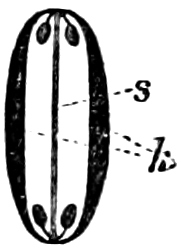
Fig. 404.—Transverse section of a silicula
with broad replum: s replum; k the valves.
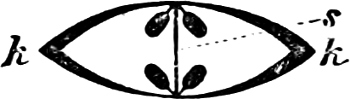
Fig. 405.—Transverse section of a silicula
with narrow replum.
◯>>: Brassica (Cabbage). The seeds are placed apparently in one
row in each loculus (Fig. 398 C); the style is long and round;
the valves have only 1 strong, longitudinal rib.—Melanosinapis
(M. nigra, Black-mustard); the style is compressed, two-edged;
the valves of the siliqua are one ribbed.—Sinapis (Mustard);
quadrangular or flat style (in which in most cases there is a seed) and
3–5 strong, longitudinal ribs on the valves.—Eruca differs from
Brassica by the shorter siliqua, broad, sword-like “beak” and
seeds in two rows.
◯= (Fig. 399): Cardamine (Bitter Cress) has a long,
linear siliqua, with flat, unribbed, elastic valves.
The leaves are most frequently pinnatifid or pinnate. C.
pratensis reproduces by buds formed in the axils of the
leaves.—Arabis (Rock Cress); Matthiola (Stock);
Cheiranthus cheiri (Wallflower); Barbarea (Winter
Cress) (double-edged, quadrangular siliqua); Nasturtium (N.
officinale, Water-cress); the siliqua of the latter genus is in
some species short, in others long.
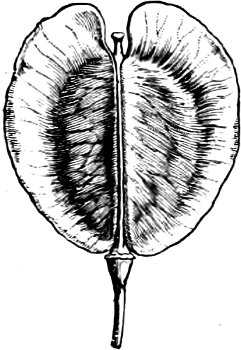
Fig. 406.—Thlaspi arvense.
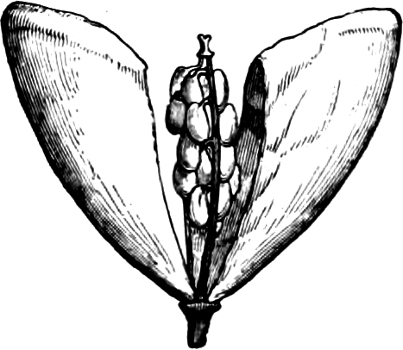
Fig. 407.—Silicula of Capsella
bursa-pastoris.
◯‖ (Fig.400): Sisymbrium (Hedge Mustard) the valves of
the siliqua are 3-ribbed.—Erysimum; Hesperis;
Schizopetalum (with fimbriate petals).
4. Fruit jointed (Lomentaceæ). The fruit is divided by
transverse walls into as many spaces as there are seeds, and dehisces
at maturity, generally transversely, into a corresponding number
of nut-like joints (“articulate-siliqua.”)
◯=: Crambe (Kale, Fig. 408). The fruit has only 2 joints. The
lower one resembles a short, thick stalk, and is barren, the upper
one is spherical, and has 1 seed.—Cakile (C. maritima,
Sea-kale); the lower node is triangular, 1-locular, the upper one more
ensiform, 1-locular (Fig. 409).

Fig. 408.—Fruit of Crambe maritima.
Fig. 409.—Cakile maritima. Fruit (2/1).

Fig. 410.—Raphanus raphanistrum.

Fig. 411.—Raphanus sativus.
◯>>: Raphanus has a long siliqua, which, in the garden Radish
(R. sativus), is spongy and slightly abstricted (Fig. 411), but
neither opens nor divides transversely (a kind of dry berry), and which
in the Wild Radish (R. raphanistrum) (Fig. 410) is abstricted
in the form of a string of pearls, and separates into many joints.
R. sativus; the “Radish” is formed by the hypocotyl, after
the bursting of its external, cortical portions (of which there are
generally two patches at the top of the Radish).
5. Siliqua indehiscent (Nucumentaceæ). The fruit is a short,
unjointed, unilocular and 1-seeded nut, and the fruit-stalks
are often long, slender, and drooping. (Sometimes a thin endosperm
is present).—Isatis (Woad) has most frequently an oblong,
small-winged nut; ◯‖ (Figs. 412, 413).—Bunias; Neslia.
[The systematic division of this order given
above is founded upon that of A. P. de Candolle. Prantl
(Engler and Prantl, Nat. Fam.), 1891, adopts a somewhat
different system, which may briefly be summarised as follows:—
- A. Hairs unbranched or absent; no glandular hairs.
- 1. Thelypodieæ. Stigma equally developed on all sides;
style undivided or prolonged above the middle of the carpels, or
turned back.—Stanleyinæ; Heliophilinæ.
- 2. Sinapeæ. Stigma strongly developed above the
placenta; style beaked or two-lobed.
- a. Cotyledons arising behind the bend of the
embryo.—Lepidiinæ.
- b. Cotyledons arising at the bend of the embryo.
- α. Only lateral nectaries. Generally a silicula or indehiscent
fruit.—Cochleariinæ.
- β. Generally a siliqua, more rarely a silicula or
transversely-divided or indehiscent fruit. Nectaries generally
lateral and median.—Alliariinæ; Sisymbriinæ;
Vellinæ; Brassicinæ; Cardamininæ.
- B. Hairs collectively or partially branched, very rarely
entirely absent; glandular hairs are sometimes also present.
- 1. Schizopetaleæ.
- 2. Hesperideæ. Stigma strongly developed above the
placenta; style undivided or prolonged above the placentæ into
shorter or longer lobes.
- a. Surface cells of the replum, not divided
diagonally.—Capsellinæ; Turritinæ;
Erysiminæ; Alyssinæ.
- b. Surface cells of the replum divided
diagonally.—Malcolmiinæ; Hesperidinæ;
Moricandiinæ.
Fig. 412.—Isatis tinctoria. Fruit (Fig.
412); and in longitudinal section (Fig. 413). (Mag.)
Pollination. Honey is secreted by the nectaries
mentioned above; but the position of the stamens is not always
the most favourable for pollination by insects (in these flowers
the honey-seeking insect must touch the anthers with one of its
sides and the stigma with the other), and self-fertilisation is
common. In some species (Cardamine pratensis) the long
stamens turn their anthers outwards towards the small stamens,
so that 3 anthers surround each of the two large entrances to
the nectaries.
1200 species (180 genera), especially in the cold and temperate
parts of the Old World (Europe, W. Asia). Many are weeds
in this country, e.g. Wild Cabbage (Brassica
campestris), Charlock (Sinapis arvensis), Wild
Radish (Raphanus raphanistrum) and others.—The order
is acrid and oleaginous. Oil is obtained from many of the
oil-containing seeds, especially of the Rape (Brassica
napus), Summer-Rape (the oil-yielding cultivated form of the
Field-Cabbage) and Camelina. Several are pot-herbs or
fodder plants, e.g. Cabbage
(Brassica oleracea) with its numerous varieties:
Cauliflower (var. botrytis; the entire inflorescence
is abnormally branched and fleshy), Kohlrabi (var.
gongylodes, with swollen, tuberous stem), Kale,
Red-Cabbage, White-Cabbage, etc.; B. campestris, var.
rapifera (Turnip); B. napus, var. rapifera
(Swede); Raphanus sativus (Radish from W. Asia), R.
caudatus (long Radish); Nasturtium officinale (Water
Cress), Lepidium sativum (Garden Cress), and Barbarea
præcox (Early Cress); Crambe maritima (Sea-Kkale).
The seeds of the following are especially used as spices: (the
flour of) Melanosinapis (Black-mustard), and Sinapis
alba (White-mustard), which are officinal like the
root of Cochlearia armoracia (Horse-radish, E. Eur[**.]).
The herbaceous parts of Cochlearia officinalis and
danica are medicinal.—A blue dye (woad) is extracted
from Isatis.—Ornamental plants: Cheiranthus
cheiri (Wallflower), Matthiola (Stock),
Iberis, Hesperis, Lunaria, and others
(especially from S. Eur.). Sweet-scented flowers are rare.
Fig. 414.—Gynandropsis pentaphylla.
Fig. 415.—Capparis spinosa.
Order 4. Capparidaceæ (Capers). The relationship
with the Cruciferæ is so close that certain forms are with
difficulty distinguished from them. The diagram of the flower
is the same in the number and position of its parts, but it
differs in the modifications which occur in the development of
the stamens. In some genera all 4 stamens are undivided; in
others both the 2 median ones are divided as in the Cruciferæ
(6 stamens, but not tetradynamous) (Fig. 414); in other
genera only 1 of these; in other instances again they are
divided into more than 2; and finally the 2 lateral ones also
may be found divided, so that indefinite stamens occur
(Fig. 415). The bicarpellate gynœceum is unilocular
(without replum), but more than 2 carpels may occur. The ovary
is elevated on a stalk (sometimes as much as 1 foot
in length); also between the stamens and corolla a similar
stalk may be found (Fig. 414). The fruit is long and siliquose
(Cleome, Polanisia, Gynandropsis), or a
berry (Capparis). Endosperm absent. Some have zygomorphic
flowers. Gamosepalous calyx and perigynous flowers also
occur.—350 species; especially in the Tropics. The majority are
trees and shrubs, and they differ also from the Cruciferæ in
having distinct stipules present in some species.
“Capers” are the flower buds of the climbing, thorny shrub,
Capparis spinosa (Fig. 415), which grows in the
Mediterranean.
The flowers in this family are perfect, regular (except Resedaceæ,
Violaceæ), hypogynous, the perianth-leaves free (a few have them
slightly united), æstivation most frequently imbricate; they are
eucyclic in the andrœcium, and most frequently in the other parts, and
generally 5-merous with S5, P5, A5 + 5, G3, but other numbers also
occur; several have indefinite stamens, but the stamens arise
(where the development is known) in centrifugal order and are
arranged, often very distinctly, in bundles; in other words,
the large number of stamens is formed by the splitting of a small
number (most frequently 5); a true spiral arrangement is never found.
Gynœceum syncarpous, multicarpellary (Dilleniaceæ and a few
Resedaceæ are apocarpous), most frequently the number of carpels
is 3, forming a unilocular ovary with parietal placentæ,
but parallel with this, multilocular ovaries, with the ovules placed
in the inner angle of the loculi, are also found, and a few genera
have a free, centrally-placed placenta. The fruit is most frequently
a capsule. The dehiscence is never with a “replum,” i.e. the
persistent frame of the placenta, as in the family Rhœadinæ. One
half of the orders has endosperm (Violaceæ, Cistaceæ,
Droseraceæ, Bixaceæ, Ternstrœmiaceæ, etc.),
the other has no endosperm (Resedaceæ, Hypericaceæ,
Elatinaceæ, Tamaricaceæ, etc.); some have a curved, the
majority a straight embryo. The family is scarcely quite natural; in
the future the orders will probably be arranged differently.
Order 1. Resedaceæ (Mignonettes).—Herbs or small shrubs with
spirally-placed leaves and very small, gland-like stipules (as in
Cruciferæ); the ☿, hypogynous flowers are zygomorphic, and
arranged in racemes or spikes typically without bracteoles. The
zygomorphic structure is produced by the greater development of the
posterior side of the flower, especially the petals and the nectary
(“disc,” in Fig. 416 d) which is situated between the petals
and stamens; in general there are 5–8 free sepals and petals, the
latter consisting of a large scale-like sheath with a fimbriated
blade (see Fig. 416); stamens numerous; carpels 6–2 united together;
ovary unilocular with parietal placentæ, but the cavity of the
ovary is not closed at the top. In Astrocarpus the gynœceum
is apocarpous. The fruit is most frequently a capsule; the seeds are
reniform, without endosperm, and the embryo is curved.
This order connects the Rhœadinæ with the Cistifloræ. It is
closely allied to the Rhœadinæ by its external appearance, even
by the smell and taste, the parietal placentation, structure of
the seeds, the inflorescences, etc., whilst by the irregular
flowers and the disc placed at the posterior side of the
flower, it is allied to Capparidaceæ, but differs from
this order in not having its characteristic number (2–4) and
by the very different mode of dehiscence of the fruit, etc. It
differs from the other orders of this family chiefly in the
fact that the number of the perianth-leaves is not constantly
5. In Reseda luteola both the calyx and corolla appear
to be 4-leaved, because the posterior sepal is suppressed, and
the 2 posterior petals are united. Where there are 10 stamens,
they stand in 2 whorls, i.e. in front of the sepals and
petals; if there are several, their position depends upon the
splitting.—Astrocarpus is remarkable for its apocarpous
fruit and the position of the ovules on the dorsal suture
of the carpel.
The yellow, flat disc at the back of the flower serves as a
nectary, the honey being protected by the lobes of the petals.
If pollination by insects is not effected, then self-pollination
may take place, at all events in R. odorata.
45 species; the majority in the Mediterranean and in Persia.
Reseda odorata (from Egypt) is cultivated on account of
its sweet scent; R. luteola (“Dyer’s Weed”) yields a
yellow dye.
Fig. 416.—Diagram of Reseda odorata.
Order 2. Droseraceæ (Sundews). Herbs, chiefly living on moors
or in water, and whose leaves are adapted to catch and digest small
animals. With regard to the flower, they are closely allied to the
Violaceæ, especially to those with regular flowers. Drosera
(Sundew) has a long-stalked scorpioid cyme with regular, ☿, hypogynous
flowers, 5-merous as in Viola. S5, P5, A5, G3 (in a syncarpous
gynœceum, with free, bifid styles and basal or parietally-placed ovules
in the unilocular ovaries). The capsule opens also as in Viola,
but, among other differences, the styles are free, the seeds very
small, and surrounded by a loosely lying, thin shell. Drosera
has radical, long-stalked leaves with the blade (Fig. 417) covered by
numerous strong glandular hairs, placed on the edge and in the middle;
when small animals are caught by these hairs, the latter and the
entire blade close slowly over them dissolving and absorbing all the
digestible matter as nourishment.
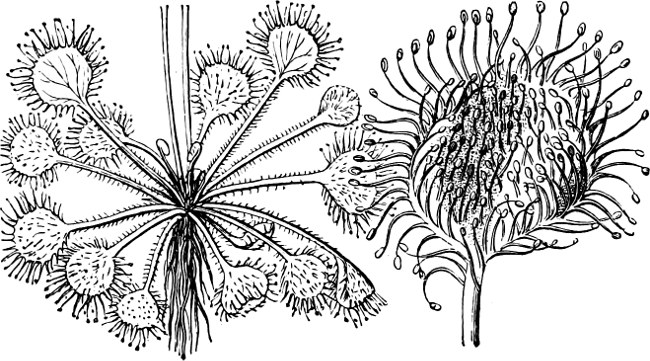
Fig. 417.—Leaf-rosette of Drosera
rotundifolia (nat. size), and a leaf (magnified).
Dionæa muscipula (Fly-trap; N. Am.) has the same
appearance as Drosera, but the leaves are constructed
as in Fig. 418. The stalk is flat and winged, the blade small,
circular, with powerful, pointed teeth along the edge, and on
its surface are 6 small bristles (A), which are very
sensitive. When these are touched the blade quickly closes,
folding along the midrib (B, C) and imprisoning
the irritating object, the teeth round the edges fitting like
the teeth of a trap. If it happens to be an insect or similar
body, a digestive fluid is secreted which, like the gastric
juice, dissolves the digestible portions. Aldrovandia
vesiculosa (Central and S. Europe) captures small aquatic
animals in a similar manner; it is a floating, aquatic plant,
the two halves of its leaves also close together when irritated
(Fig. 419).—Drosophyllum.
About 110 species; most of them in the temperate regions.
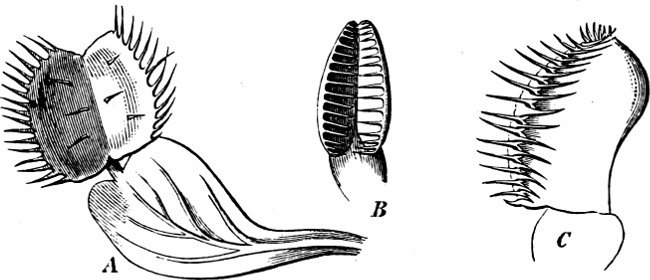
Fig. 418.—Dionæa muscipula. Leaves
(nat. size).
Orders 3 and 4. Sarraceniaceæ and Nepenthaceæ. These
two orders are perhaps most closely allied to the Droseraceæ
and agree with these, among other things, in the manner of
taking nourishment. Like the Droseraceæ they absorb nitrogenous
food from dissolved animal matter by means of their leaves,
which are specially constructed both to catch, to retain,
and to digest any small animals which may be caught. The
Sarraceniaceæ are North American marsh-plants (10
species) which have pitcher-like leaf-stalks, in the cavity of
which a fluid (with properties approaching those of gastric
juice) is secreted, and which bear at the apex a small, lid-like
blade; these leaf-stalks are the catching and digestive
organs.—Sarracenia, Darlingtonia.

Fig. 419.—Aldrovandia vesiculosa:
A a plant (nat. size). B Leaf (mag.); the blade is
closed; the winged stalk is prolonged into 4–6 irritable bristles.
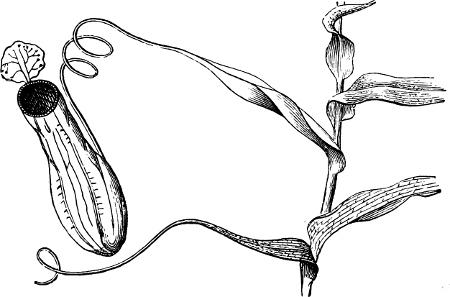
Fig. 420.—Nepenthes (reduced).
Nepenthaceæ has only 1 genus, Nepenthes (the
Pitcher-plant; about 35 species), especially found in tropical
E. Asia; the majority are climbing shrubs. The leaf-stalks are
twining organs, and terminate either simply in a tendril, or
in addition to this, with a pitcher-shaped body (which in some
species may be as much as a foot in length) on whose upper edge
a lid-like structure is found (Fig. 420). In this pitcher, as
among the Sarraceniaceæ, a fluid is secreted which is able to
digest the animals captured (sometimes rather large) and which
corresponds in some degree to the gastric juice.
Order 5. Violaceæ (Violets). The flowers are ☿, and generally
zygomorphic, hypogynous, with S5, P5, A5, G3 (Fig. 421). The stamens
are closely applied to the ovary, they have a very short filament,
and at their summit generally a membranous appendage formed by
the prolongation of the connective (Fig. 422 g). The ovary
is unilocular with 3 parietal placentæ; style undivided (Fig. 422
B). The fruit is usually a 3-valved capsule, opening along the
dorsal sutures (Fig. 423). Embryo straight; endosperm fleshy (Fig.
425).—Many are herbaceous plants (e.g. Viola), but in
the Tropics shrubs are also found (e.g. Ionidium); a few
are lianes; the leaves are scattered, with stipules, and involute in
the bud.

Fig. 421.—Diagram of Viola.

Fig. 422.—The large-flowered form of Viola
tricolor: A the flower in median longitudinal section;
B the gynœceum.
Viola. The sepals are prolonged backwards beyond the point of
insertion (appendiculate); the corolla is polypetalous, descending
imbricate, and zygomorphic, its anterior petal being larger than the
others and provided with a spur (Fig. 421). The 2 anterior of the 5
almost sessile stamens are provided with a spur-like nectary, which
protrudes a considerable distance into the petaloid spur (Figs. 421,
422 n, sp). The style is club-like, and bears the
stigma in a groove on the anterior side (Fig. 422 st). Herbs
with rhizomes, or annuals; flowers solitary. V. odorata,
canina, etc., have cleistogamic flowers which produce fruit in
addition to the large, coloured (violet) flowers. The Pansy (V.
tricolor) has large flowers adapted for insect-pollination, and
also smaller, less conspicuous ones designed for self-pollination. The
stigma, as in Fig. 422 A, st, and B, is situated
on the anterior side of the stylar-head, immediately in front of the
channel leading down to the spur (sp); below it is situated
a valve, easily covered with pollen when the proboscis of an insect
is introduced into the spur, but which closes upon its withdrawal;
cross-pollination is thus secured.—The sweet-scented V. odorata
is visited by the honey-bee, which insures cross-pollination, and
in the absence of insect visits it effects self-fertilisation by
cleistogamic flowers. The conspicuous but scentless V. tricolor,
var. vulgaris, is less frequently visited by insects
(humble-bees). In V. silvatica and V. canina the pollen
is carried on the head or proboscis of the honey-sucking bee.—The
fruits of V. odorata bury themselves slightly in the soil. In
the others the fruits are raised above the ground; the 3 boat-shaped
valves close together along the central line, and eject the seeds,
one by one, with much violence, so that they are thrown to a great
distance.
Figs. 423–425.—Viola Tricolor.
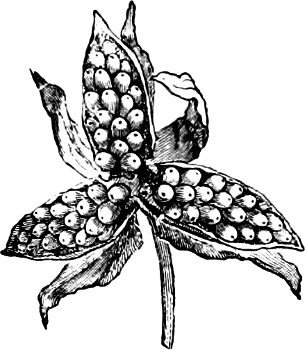
Fig. 423.—Capsule after dehiscence (nat.
size).]
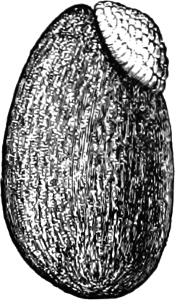
Fig. 424.—External view of the seed.
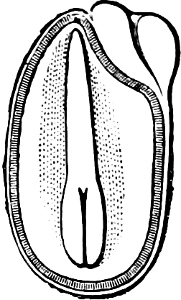
Fig. 425.—Seed in longitudinal section.
The Alsodeia-group has regular or almost regular
flowers. Gamopetalous corollas are found in Paypayroleæ.
Sauvagesieæ differs the most by its regular corolla, and
5–∞ free or united staminodes.
250 species; especially in the Tropics.—The
Ionidium-species are used as ipecacuanha. A number of
Viola-species are cultivated as garden plants, especially
V. odorata (sweet-scented Violet) and V. tricolor,
which have a large number of varieties.
Order 6. Frankeniaceæ. A small order with doubtful
relationships. Perennial herbs or shrubs; beach plants with
nodose stem. Sepals united, petals free. Unilocular ovary,
with 3–4 parietal placentæ. Fruit a capsule. Embryo straight,
endospermous. Especially in S. Europe, Africa, on the shores of
the Mediterranean and Atlantic.
Order 7. Tamaricaceæ (Tamarisks). To this order belong
only Tamarix and Myricaria. They are shrubs of a
cypress- or heather-like appearance, as the scattered leaves
are very small, sessile, scale-like or linear, adpressed,
entire, and usually glaucous, and the branches are slender and
whip-like. The flowers are borne in small spikes or racemes,
and are small, reddish or whitish, regular, ☿, hypogynous and
polypetalous; formula S5, P5, A5 + 0 (Tamarix, which
often has stipular teeth at the base of the filaments), or
A5 + 5 (Myricaria, in which the stamens are united
at the base); the number 4 may appear instead of 5, but
in either case there is usually a tricarpellate gynœceum,
which is unilocular and has either parietal placentæ
(Myricaria) or a small basal placenta (Tamarix);
1 trifid style, or 3 styles. Capsule dehiscing along the dorsal
suture, and resembling the Willows in having a unilocular ovary
with numerous woolly seeds; but the seed-wool in this
case is borne on the chalaza, and may be attached to a long
stalk.—Some Tamarix-species shed part of their branches
in the winter.—40 species; North Temperate, on the sea-shores
or steppes, especially in Asia. Ornamental shrubs: Myricaria
germanica, and Tamarix gallica.
Order 8. Cistaceæ. Shrubs or herbs, natives especially of the
Mediterranean region. Flowers generally in raceme-like scorpioid cymes,
regular, ☿, hypogynous; sepals 5, free, twisted in the bud, of
which the two outer are generally much smaller than the others; petals
5, free, twisted in the bud (in the direction opposite to
the sepals), fugacious; stamens numerous; gynœceum syncarpous,
carpels usually 3–5, style simple, ovary unilocular, with parietal
placentation (seldom divided into loculi, with axile placentation).
The ovules are orthotropous in opposition to some of the other
orders of this family. The capsule dehisces along the dorsal sutures;
embyro curved. The leaves are simple, undivided, generally
opposite and stipulate.—They are Violaceæ with regular flowers,
numerous stamens, and curved embryo. The numerous stamens are in
reality only one or two 5-merous whorls, divided into a large number
of stamens; these are formed, therefore, in descending order, like the
lobes of many compound foliage-leaves.
Helianthemum (Rock-Rose), has 3 carpels.—Cistus has 5
(-10) carpels.
About 70 species; temperate climates, especially about the
Mediterranean. The resin of the Cistus-species has been
used medicinally (ladanum).
Order 9. Bixaceæ. This order is closely allied to
the Cistaceæ and Ternstrœmiaceæ; like these it has regular,
5-merous, hypogynous flowers with numerous stamens, unilocular
ovary and parietal placentæ; sometimes unisexual flowers;
it differs in having anatropous ovules, in the æstivation of
the sepals, etc. All species (about 180) are trees or shrubs,
with scattered, simple leaves, which usually have stipules,
and are occasionally dotted with pellucid oil-glands.—Bixa
orellana (Trop. Am.) is the best known species; it has a
2-valved capsule; the seeds are enclosed in a shiny red,
fleshy testa, which contains the well-known orange or yellow
dye, annatto.
Order 10. Dilleniaceæ. Gynœceum usually apocarpous,
seed arillate. The flower has most frequently S5, P5, and
compound stamens (one or more bundles); sometimes irregular. 200
species; Tropical; woody plants, many lianes.—Dillenia,
Candollea, Pleurandra, Davilla, etc.
Order 11. Elatinaceæ (Water-worts). About 25
species belong to this order; especially in temperate climates.
They are small, creeping, rooted, aquatic plants, with opposite
or verticillate leaves and stipules. The flowers are
solitary or situated in small dichasia in the leaf-axils,
they are small, regular, ☿, hypogynous, with free petals, the
same number in all 5 whorls (Sn, Pn, An + n, Gn), 3-merous
(e.g. Elatine hexandra), 4-merous (e.g.
E. hydropiper), or 5-merous (Bergia); the
corolla-stamens are sometimes suppressed; petals imbricate
without being twisted; the ovary is 3–4–5-locular, with 3–4–5
free styles; the capsule dehisces septicidally. The seeds
are orthotropous or curved, often transversely ribbed, endosperm
wanting. The order is most nearly allied to Hypericaceæ, whose
primitive form it appears to represent.
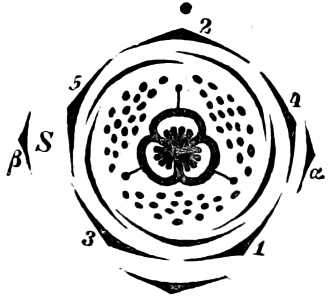
Fig. 426.—Diagram of Hypericum
quadrangulum: S indicates the bud of the helicoid cyme in
the axil of the bracteole β.
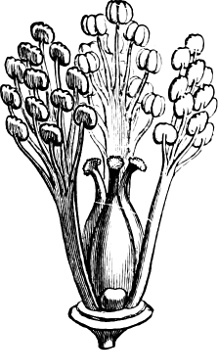
Fig. 427.—Hypericum. Flower with three
bundles of stamens.
Order 12. Hypericaceæ (St. John’s-worts). This order
is recognised by its always opposite or verticillate,
simple, and entire, penninerved leaves, without stipules, and
usually dotted with pellucid glands; by the always ☿, regular,
hypogynous flowers in a cymose inflorescence; the generally 5-merous
calyx and corolla, with sepals and petals free; the stamens 3–5,
numerously branched (Figs. 426, 427); and the gynœceum, 3–5-carpellate,
styles usually free. The ovary is 3–5-locular, or unilocular
with 3–5 parietal placentæ. Fruit a capsule (dehiscing septicidally) or
berry. Endosperm absent.
The inflorescence is a dichasium or helicoid cyme.
The structure of the flowers is the same as that of the
foregoing orders: S5, P5; succeeding these in some cases are two
5-merous whorls of stamens in regular alternation, of which the
inner is epipetalous; but the outer whorl is only represented by
5 small scales (Fig. 427), or is altogether absent (Hypericum
calycinum, H. hircinum), and the inner divided
into numerous stamens, that is, these 5 stamens are so deeply
divided that 5 epipetalous groups bearing anthers are
found (as in the Cistaceæ); in other cases the flower becomes
3-merous after the petals, stamens 3 + 3 following in
regular alternation (Figs. 426, 427), the outer whorl of stamens
in these cases is also present as staminodes (Fig. 427), or may
be altogether suppressed. Carpels 3–5. The petals are often
twisted in the bud, and are then oblique.
Hypericum. Some species have a square stem; in these cases the
leaves are placed opposite the edges. Fruit a capsule.—Vismia
has a berry.—The flowers of Hypericum have no honey, and
supply only pollen; self-pollination often takes place.
About 240 species; the tropical ones being often shrubs or
trees; the others generally perennial shrubs.—Hypericum,
St. John’s-wort, contains a resinous, red matter, which can be
extracted with alcohol. The American gamboge is the dried sap of
species of Vismia.
Order 13. Guttiferæ, or Clusiaceæ. Closely allied
to the Hypericaceæ and Ternstrœmiaceæ. Leaves opposite or
verticillate. The flowers are often unisexual; stamens united;
the gynœceum has most frequently a sessile, radiating or
shield-like stigma.
370 species; chiefly in the Tropics (Am.). They are principally
woody plants and their bark contains a yellow gum resin,
“gamboge,” which is extracted from Garcinia morella
(E. Ind.) and others. Mangosteen (Garcinia mangostana
S.E. Asia), and Mammea americana (W. Ind.), have very
delicious fruits. To this order also belong Platonia
insignis, Pentadesma butyracea (the Butter-tree),
Clusia, Calophyllum, Cataba, etc.
Order 14. Ternstrœmiaceæ. Trees and shrubs with scattered,
simple, and often more or less leathery, evergreen, penninerved
leaves, without stipules (Fig. 428). The two most important genera
are: Camellia and the closely allied Thea (by some
authorities these are united into one genus). The flowers are regular,
hypogynous, and situated singly on very short stalks. A number of green
floral-leaves are placed below the calyx and gradually pass over into
the sepals, and the leaves (5–6) of the calyx again gradually pass over
into the corolla (this being especially marked in Camellia),
of which the number of leaves varies (5, 6, 7 and upwards); the calyx
and the corolla are acyclic or eucyclic; the petals are
slightly united at the base; stamens numerous in many whorls,
the external ones are arranged in bundles and united with the petals
as in the Columniferæ; gynœceum syncarpous; styles often free
nearly to the base; ovary 3–5-locular, ovules numerous in each loculus.
The fruit is a woody capsule.—Other genera show more distinctly
than these the same structure as in the preceding orders, namely: S5,
P5, A5 + 5, of which the calyx-stamens are often suppressed, and the
petal-stamens divided into numerous stamens.—Kielmeyera (S.
Am.)
260 species; especially in the Tropics (E. Asia, Am.) The leaves
of Thea chinensis (or Camellia thea), the Tea-tree
(E. Asia), are cultivated for the well-known “tea,” and contain
theine: the best are the young, still hairy leaves, of greyish
colour; there are many varieties. Ornamental plants, Camellia
japonica and Actinidia.
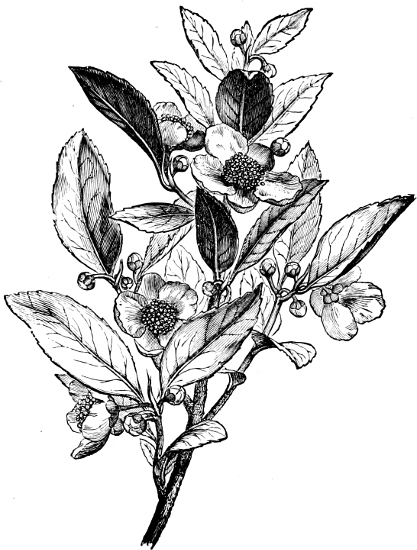
Fig. 428.—Thea chinensis (reduced).
Closely allied to this order are: Order 15. Rhizoboleæ
(with enormously large hypocotyl—hence the name), and Order 16.
Marcgraviaceæ (partly epiphytes, with dimorphic leaves
and cup- or helmet-like, coloured, honey-secreting floral-leaves,
which serve to attract insects).
Order 17. Dipterocarpaceæ. This order has taken
its name from the large wings attached to the fruits in
Dipterocarpus (the wings being largely developed sepals);
trees and shrubs from Trop. Asia. 180 species. Camphor ready
prepared is found in the stem of Dryobalanops camphora.
Hopea; Vateria.
The flowers are hypogynous, ☿, polypetalous, usually
regular (except Pelargonium, Tropæolaceæ,
Balsaminaceæ) and throughout 5-merous: S5, P5, A5
+ 5, or 5 + 0, G5 (epipetalous). The stamens soon fall
off and are obdiplostemonous, often united at the base
(monadelphous); the corolla-stamens are in some completely
suppressed (e.g. Balsaminaceæ, Fig. 438), in others
reduced to teeth (Linum, Fig. 431; Erodium). The
Tropæolaceæ have 3 carpels and only 8 stamens (Fig. 437).
Ring-like nectaries are not present, but at most only glandular bodies,
borne outside the base of the stamens. Ovaries many-locular. The
ovules as a rule are pendulous, with the micropyle directed outwards
(Fig. 431, B), and the radicle therefore also points outwards. Usually
herbs. Related to the Columniferæ.
Order 1. Oxalidaceæ. Most of the species are herbs with
rhizomes; the leaves are stalked, compound, with entire leaflets
which are folded and bent backwards in the bud (and in the sleep
position), exstipulate; some species have sensitive leaves. The flowers
(Fig. 429) are regular, and have S5, P5, which are twisted
to the left or right in æstivation, A5 + 5, all united at the base
(monadelphous), gynœceum 5-carpellate, styles 5 free, stigmas
capitate, ovary 5-locular, ovules numerous. The fruit is a capsule
opening with clefts on the dorsal sutures through which the
seeds are ejected, while the fleshy, external layer of the testa
springs off elastically. Embryo straight. Endosperm.

Fig. 429.—Diagram of Oxal’s acetosella.
Oxalis (Wood-Sorrel). Leaves digitate. Species also
occur with phyllodia, i.e. leaf-like petioles placed
vertically without lamina; a few have pinnate leaves. The
flowers are situated singly or in dichasia, and unipared
scorpioid cymes. The pollination is effected by insects. Some
species are trimorphic (long-, short-, medium-styled flowers)
and some, e.g. O. acetosella, have cleistogamic
flowers in addition to the ordinary ones. Glands are found on
the outer side of the corolla-stamens or of all the stamens.
O. tetraphylla and others have adventitious edible roots,
resembling tap-roots.—Averrhoa is a tropical tree, with
berries and pinnate leaves.
235 species (205 belong to Oxalis); chiefly in S. Africa
and Trop. America.—Oxalate of potash is contained in the leaves
of Oxalis.
Order 2. Linaceæ. Herbs with scattered or opposite, sessile,
simple, small, entire leaves, without (rarely with small)
stipules. The flowers (Fig. 430) are regular, 5- or 4-merous. Petals
are free, twisted, quickly falling off. Stamens united at the
base; the petal-stamens are either reduced to teeth (Fig. 431
A, m) or entirely suppressed. Styles free.
The (5–4) epipetalous loculi of the ovary are incompletely halved by
false divisional walls, each half contains one ovule (Fig. 431
C). The fruit is a spherical capsule, dehiscing along the
divisional wall (Fig. 432); the 10 (-8) seeds have a straight
embryo and very slight endosperm (Fig. 433).
Figs. 430–433.—Linum usitatissimum.
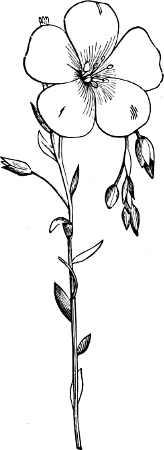
Fig. 430.—The Flax plant.
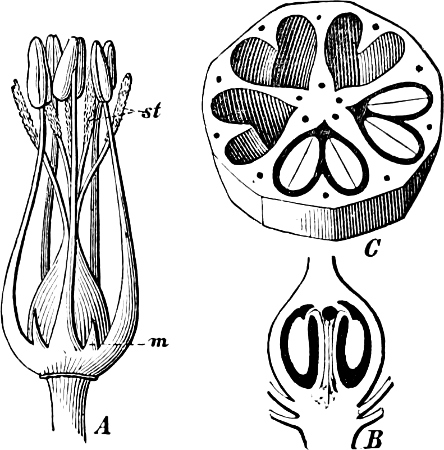
Fig. 431.—A Flower after removal of
sepals and petals; m petal-stamens reduced to teeth. B
Longitudinal section of ovary. C Transverse section of capsule.

Fig. 432.—Capsule (nat. size).
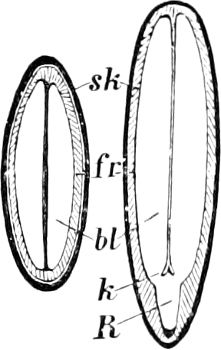
Fig. 433.—Transverse and longitudinal section
of seed: bl the cotyledons; k the plumule; R the
radicle; fr the endosperm; sk the testa.
Linum (Flax) has 5-merous flowers. The main axis terminates
in a flower; and the succeeding branching is cymose, or unipared
scorpioid branching by unilateral development, and the flowers in
consequence of the vigorous sympodial development of the lateral axis
(and also by the leaves being displaced and pushed aside), assume a
position apparently lateral (i.e. racemose) without bracts;
each branch of the sympodium generally has 2 leaves. The testa is
shining and smooth when dry, but its external cellular layer becomes
mucilaginous in water.—Radiola has a 4-merous flower. It is
a small herb with opposite leaves, and regular, dichasial branching.
The anthers and stigmas in L. catharticum and
usitatissimum develop simultaneously, and
cross-pollination as well as self-pollination takes place. L.
grandiflorum, perenne, and others, are dimorphic
(short-and long-styled). There are 5 nectaries outside the
stamens.
130 species; Linum and Radiola are native
genera.—L. usitatissimum is extensively cultivated
in Europe (especially in Russia and Belgium), N. America and
elsewhere (its home no doubt being Asia), partly on account
of the oil (linseed oil) which is extracted from the seeds,
and partly on account of the bast of the stem, which has very
thick-walled cells. The seeds and oil are OFFICINAL.
The species cultivated in ancient times was L.
angustifolium. Several species are cultivated as ornamental
plants.
Order 3. Geraniaceæ. The majority are herbs with dichasial
branching, and scattered or opposite, stalked, palminerved
(rarely penninerved) leaves with small stipules. The flowers are
regular (except Pelargonium) and 5-merous, with 10 or 5 stamens,
which are slightly united at the base. Nectaries alternate with the
corolla-stamens. The ovary is most frequently 5-locular, deeply
5-grooved, and bears 1 well developed style (“beak”), which
towards the apex divides into 5 branches bearing stigmas; ovules 1 in
each loculus, pendulous or ascending. The 5 carpels become detached
from one another when ripe, and bend or roll back (Fig. 434)
or become spirally twisted in the upper “beak-like” part (Figs.
435, 436), whilst a central column (septal column) persists;
each carpel, in consequence, remains either closed, and the fruit is a
5-merous schizocarp whose nut-like lower portion, containing the
seed, is forced into the ground, thus burying the seed by the movements
of the spirally-twisted, hygroscopic “beak” (Figs. 435, 436); or it
opens along the ventral suture, so that the seeds may fall out, and it
is then a 5-valved capsule, with septicidal dehiscence (Fig.
434) and the rolling up often takes place so suddenly and violently
that the seeds are shot out to considerable distances. The embryo is
usually green and curved, and the cotyledons are folded;
endosperm is wanting.
Geranium (Crane’s-bill) has 5 + 5 stamens,and a septicidal
capsule; the carpels most frequently remain suspended from the apex of
the column (Fig. 434). The leaves are most frequently palminerved. The
flowers are situated solitarily or 2 together (2-flowered scorpioid
cyme).—Erodium (Stork’s-bill); inflorescence a many-flowered
unipared scorpioid cyme, stamens 5 + 0 (petal-stamens are wanting),
and fruit a schizocarp whose carpels become detached; their beaks are
hairy on the internal surface and twist themselves spirally
(Fig. 436). The umbellate inflorescences are composed of multiflowered
scorpioid cymes. The leaves are often penninerved.—The most
primitive type is represented by Biebersteinia: S5, P5, A5
+ 5, G5 (ovaries free, and styles united above); fruit 5
small nuts. The most advanced type is Pelargonium, which has
zygomorphic flowers, the posterior sepal being prolonged into a
spur which becomes adnate to the peduncle; the petals are unequal in
size; some of the petal-stamens are often wanting. (Erodium may
be slightly zygomorphic).
Fig. 434.—Geranium sanguineum. Fruit (3/1).
Fig. 435.—Pelargonium.

Fig. 436.—Erodium cicutarium, detached
carpel.
Pollination. The large-flowered Geranium-species
are protandrous, e.g. G. pratense (one whorl
of stamens opens first, and then the other, and succeeding
these the stigmas, after shedding the pollen the stamens
bend outwards); the small-flowered are also adapted, with
various modifications, for self-pollination.—470 species;
moderately hot climates, especially S. Africa.—Several
Pelargonium-species, with numerous varieties, are
ornamental plants (from S. Africa).
Order 4. Tropæolaceæ. Herbaceous, juicy plants which have
scattered, long-stalked, peltate leaves without stipules, and
often climb by their sensitive petioles. The flowers are situated
singly in the axils of the foliage-leaves on long stalks, and are
zygomorphic, the receptacle under the posterior sepal being
prolonged into a spur; there are also differences between the
posterior and anterior petals, the 2 posterior petals situated on
the border of the spur being perigynous, and the edge of the
anterior petals adjoining the claw fringed. After the 5 sepals (which
are more or less coloured) and the 5 petals, follow 8 stamens
(as the 2 median ones are suppressed, one from each whorl) and a
gynœceum formed of 3 carpels; in each of the 3 loculi of the 3-grooved
ovary is 1 ovule. The fruit is a schizocarp and divides into
3 1-seeded, drupe-like fruitlets, which do not (as in the
Geraniaceæ) leave any pronounced column between them. Endosperm is
wanting. The cotyledons are thick and sometimes slightly coalescent.
Tubers often occur.
Fig. 437.—Diagram of Tropæolum:
sp, spur.
Tropæolum.—About 40 species; all from America.
Pollination.—The spur is the receptacle for the
nectar; the flowers are protandrous; the anthers open first,
and one by one take up a position in front of the entrance to
the spur, resuming their original position when the pollen is
shed; the stigma finally takes their place after the filaments
have bent backwards.—These plants have an acrid taste (hence
the name “Nasturtium,” “Indian Cress”), on which account the
flower-buds and young fruits of T. majus are used as
capers. Some species are ornamental plants.
Order 5. Balsaminaceæ. Herbaceous, chiefly annual plants with
juicy, brittle stems, so transparent that the vascular bundles may be
distinctly seen. The leaves are simple, usually scattered, penninerved
and dentate; stipules are wanting, but sometimes large glands are
present in their place at the base of the petioles. The flowers are
strongly zygomorphic; of their five 5-merous whorls the petal-stamens
are suppressed (S5, P5, A5 + 0, G5); the sepals are coloured,
the 2 anterior ones (Fig. 438 3, 5) are very
small or entirely suppressed, the posterior one is very
large and elongated into a spur, and the 2 lateral ones pushed
forward; sometimes the weight of the spur turns the flower completely
round, so that the posterior leaves assume an anterior position;
apparently only 3 petals, since the lateral and the posterior petals
become united in pairs, and the anterior is larger and differently
shaped; the 5 stamens have very short and thick filaments united at
the base, and their anthers finally adhere together and remain in
this condition, covering over the gynœceum; the filaments ultimately
rupture at the base, and the entire anthers are raised on the apex of
the gynœceum as it grows up. The gynœceum has a sessile stigma
and a 5-locular ovary. The fruit is a capsule which, on maturity, opens
suddenly when irritated, dividing into valves from the base upwards,
and as the 5 valves roll up elastically, the seeds are shot out on all
sides to considerable distances; a central column persists (Fig. 439).
The embryo is straight, and without endosperm.
Fig. 438.—Diagram of Impatiens
glanduligera.
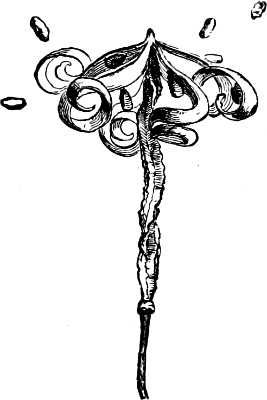
Fig. 439.—Fruit of Impatiens.
Impatiens; in Europe only I. noli-me-tangere. 225
species; especially from Asia. Several species have two kinds of
flowers: small, cleistogamic, but fertile; and large, coloured
flowers, which in I. balsamine (ornamental plant, E.
Ind.) are protandrous and pollinated by hive-and humble-bees, as
they suck the honey from the spur.
Order 6. Limnanthaceæ. The flowers are regular and differ
from all the other orders in the family by having the carpels
not in front of the petals, but in front of the sepals
(which are valvate), and further, the loculi are nearly
free individually, but with a common gynobasic
style; the ovules are ascending and apotropous
(anatropous with ventral raphe). The fruit is a schizocarp, with
nut-like cocci.—Limnanthes (4 species; N. Am.) perhaps
belongs to another family.
Order 7. Humiriaceæ. Trees and shrubs; about 20 species;
Trop. Am.
The chief characteristics of the orders belonging to this family
are the ☿, regular, generally 5-merous, hypogynous flowers
with 5-merous calyx, sepals united and valvate in
the bud; petals 5, free (often twisted in the bud); stamens
∞ e.g.: 10, in two whorls, but one of these is more or less
suppressed, often altogether wanting, or replaced by 5 staminodes,
while the other (inner whorl) is generally divided more
or less deeply into a large number of anther-bearing filaments.
The filaments too (except Tiliaceæ) are united into a
tube, which, especially in the Malvaceæ, forms a long
column in the centre of the flower, surrounding the gynœceum (Figs.
445, 448); in this case, which is the most pronounced, the filaments
are united into one bundle (monadelphous), in other instances,
polyadelphous. The number of carpels varies greatly (2 to
about 50), but they are nearly always united and form a syncarpous
multilocular gynœceum.—The vegetative characters also closely agree,
the leaves are always scattered and generally stipulate; all
the green portions very often bear stellate hairs, and the
bark in all the 3 orders is rich in tough bast. Mucilage is
often present in cells or passages.—This family is connected with the
Ternstrœmiaceæ, from which it is very hard to draw a sharp line
of demarcation, and it is also allied to the Cistaceæ and to the
Gruinales.
Order 1. Sterculiaceæ (including Buettneriaceæ). This is,
no doubt, the least modified order, and one in which the stamens
occur undivided. Obdiplostemonous. The 10 stamens in two whorls
are most frequently united at the base into a short tube, and have
4-locular, extrorse anthers. The calyx-stamens are nearly always
simple, tooth-like staminodes, situated on the edge of the tube, or
are entirely suppressed. The same relation is found, for instance,
in the Ampelidaceæ and Rhamnaceæ, namely 5 stamens in front of
the 5 petals; not infrequently the 5 stamens are doubled (Fig.
441). Unisexual flowers are found in Sterculia, Cola,
Heritiera. The corolla is often wanting, or developed in an
unusual manner. Each loculus of the ovary (generally 5) always contains
more than one ovule. Fruit a capsule. Androgynophore often present
(Helicteres; Sterculia, etc.).
Hermannia, Mahernia, Melochia,
etc., have flat petals with twisted æstivation; 5
undivided stamens, which usually are but slightly united
at the base, and most frequently, without staminodes.
Thomasia; Helicteres; Sterculia
(free follicles).—Theobroma, Rulingia,
Buettneria, Commersonia, Guazuma, etc., have
petals concave at the base, and terminating in a limb abruptly
bent back, and at the boundary between them most frequently
ligular outgrowths, as in certain genera of the Caryophyllaceæ;
stamens 5–15–∞, anthers at the edge of a short tube and 5 linear
staminodes (Fig. 441).—The Cocoa-tree (Theobroma), (Fig.
440) bears large, reddish-yellow, berry-like fruits, resembling
short cucumbers, but ultimately becoming leathery to woody;
in each of the 5 loculi are 2 (apparently only 1) rows of
horizontal, oily seeds, as large as almonds. Cotyledons large,
thick, and irregularly folded. Endosperm absent (Fig. 442).
49 genera, with about 750 species; almost entirely confined to
the Tropics; none in Europe or in N. Asia.—The seeds of the
Cocoa-tree (T. cacao, bicolor, glaucum,
etc., natives of Trop. Am., especially north of the Equator) are
used for chocolate and are also officinal (“Cocoa-beans,”
“Cocoa-butter,” “Oil of Theobroma”). Theobromine. Cola
acuminata, Africa.
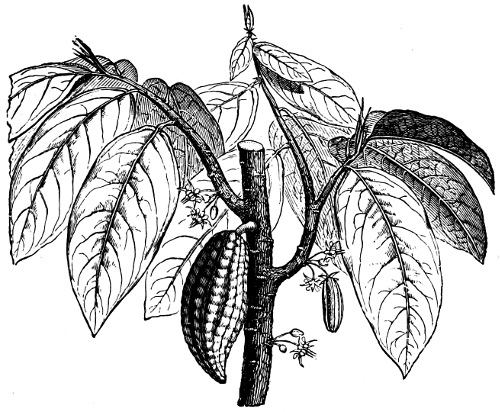
Fig. 440.—Theobroma cacao. Branch with
flowers and fruits (⅙).
Figs. 441–442.—Theobroma cacao.
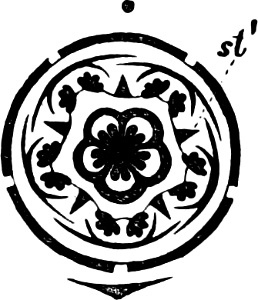
Fig. 441.—Diagram of the flower: st barren stamens.
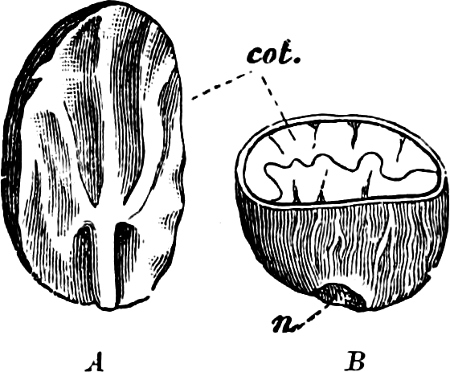
Fig. 442.—B Seed in transverse section: n
hilum. A Embryo after the removal of one of the cotyledons.
Order 2. Tiliaceæ. This differs from the other orders of the
Columniferæ chiefly in the stamens being entirely free from each
other, and also divided into many filaments, as far as the
base, or at all events very far down, so that the flower appears
to have numerous stamens or to be slightly polyadelphous
(Fig. 443); in addition to this, it may be observed that the anthers
are 4-locular and introrse. In Luehea the groups of
stamens alternate with the petals. In a few genera (Corchorus,
Triumfetta) 10 free and single stamens are found in 2 whorls;
but, in the majority, groups of free stamens in separate bundles. The
stamens are more or less united in Apeiba, Luehea. Style simple.
Ovary 2-locular. The ovules are pendulous; raphe turned inwards. The
calyx readily falls off; the æstivation of the entirely free petals is
slightly imbricate (not twisted).
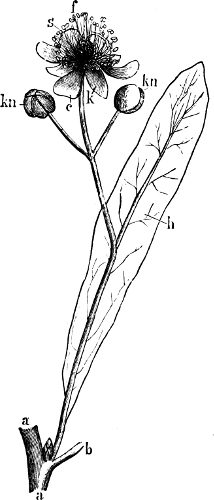
Fig. 443.—Inflorescence of Tilia, with
its winged bracteole (h); a, a axis of the shoot;
the vegetative bud is seen between the inflorescence and the axis of
the shoot; b petiole of foliage-leaf.
Tilia (Figs. 443, 444). Calyx and corolla 5-merous; the 5
staminal leaves (opposite the petals) divided as far as the base into a
large number of stamens which are free or united into groups; gynœceum
with 5 loculi in the ovary (opposite the sepals); there are 2 ovules
in each loculus, though the ovary ripens into a 1-seeded nut, which
is not detached from the axis of the inflorescence, but is carried
away by the wind, whirling round and round, its large-winged bracteole
serving as a parachute (Fig. 443).—Only trees, with alternate,
obliquely heart-shaped and dentate leaves; stellate hairs, as in the
other Columniferæ, are often present. The terminal bud of the branch
always fails to develop, and the growth is then continued sympodially
by the uppermost axillary buds. The INFLORESCENCE (Figs.
443, 444) is a 3–7-flowered dichasium (Fig. 444 t, d,
e), which is developed in the axil of a foliage-leaf (Fig. 444).
The first of its 2 bracteoles (a) is large, thin, leaf-like,
and united with the inflorescence, the lower portion of which forms a
broad wing, its so-called “bract”; the second bracteole (b), on
the other hand, remains scale-like, and supports a winter foliage-bud
covered with bud-scales which thus is situated at the base of the
inflorescence, and is a bud of the 2nd order, in relation to the
vegetative shoot. This bud is always found beneath the inflorescence
on the branch placed horizontally, and the winged bracteole is always
found above it, a relation which is connected with the fact that the
2 rows of shoots on the sides of a branch are antidromous with
regard to each other.—The dichasium itself (Fig. 444) terminates with
the flower (t); it has 3 floral-leaves (c, d,
e), which soon fall off; c is barren: the other two
bear flowers, or few-flowered dichasia, or unipared scorpioid cymes
(indicated in the figure).—The foliage-leaves are folded in the bud
upon the median line (1, 2, 3 in Fig. 444 are foliage-leaves with
their 2 stipules), the inner half is broader than the outer, and after
unfolding is turned away from the mother-axis (the position of the new
inflorescences and vegetative buds is indicated in their axils on the
figure).—The cotyledons on germination appear above the ground as
large, lobed leaves.
Of the other genera some have a bell-shaped, gamosepalous calyx,
some have no corolla, the anthers of some open at the apex
(Aristotelia, Elæocarpus, etc.), the majority
have a capsule, some have berries, or drupes, some separate
into fruitlets, etc.—Corchorus, Triumfetta
(nut, with hooked bristles), Luehea, Apeiba, etc.
Sparmannia is an African genus; 4-merous flowers; fruit
a warted capsule; filaments numerous and sensitive to touch,
the external ones are without anthers and moniliform above. The
plant is covered with numerous soft and stellate hairs, and at
the apex of the branches bears several cymose umbels.
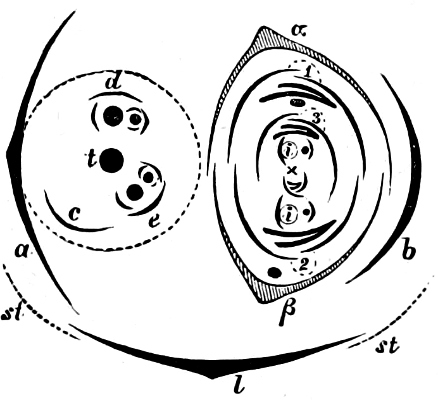
Fig. 444.—Diagram of the inflorescence of
Tilia and the vegetative bud; the position of the leaves is
indicated, and also the position of the inflorescences, which develop
from their axils in the following year.
Pollination in Tilia is effected by insects,
especially bees and Diptera, which swarm round the tree tops,
allured by the numerous strongly-scented flowers and the
easily accessible honey (formed in the hollow sepals). As the
flowers are pendulous, the nectar is protected from ruin;
and, in addition, the inflorescence is more or less concealed
beneath the foliage-leaf. Self-pollination is impossible, on
account of protandry.—About 470 species (nearly all trees
and shrubs); especially in the Tropics, only a few being
found in the temperate, none in the polar regions, or in
high mountainous districts.—The inflorescence of the native
species of Tilia is medicinal. The wood is used for
charcoal.—The majority are used for timber, and for the sake of
the bast (“Bast,” “Jute,” the bast of Corchorus textilis,
Luehea, and others).
Order 3. Malvaceæ (Mallows). The plants are easily
recognised by the scattered, simple, palminerved, most
frequently lobed, stipulate leaves, folded in the bud; the
perfect, regular, hypogynous flowers, with gamosepalous,
persistent, 5-merous calyx with valvate æstivation; the 5
petals twisted in the bud and united with one another at the
base, and by the 5 apparently numerous stamens (Figs. 445,
448), with the filaments united into a tube, with reniform
bilocular anthers opening by a crescentic slit (in 2 valves).
Carpels 3–∞ united into one gynœceum; the embryo is curved and the
cotyledons are folded (Figs. 447, 451); endosperm scanty, often
mucilaginous.—Most of the plants belonging to this order are herbs,
often closely studded with stellate hairs. The leaves are most
frequently palmatifid or palmatisect.
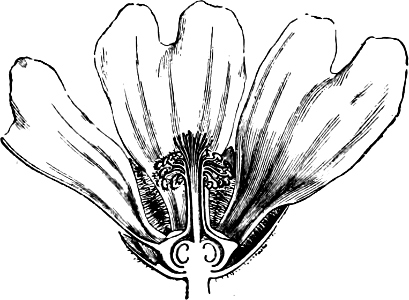
Fig. 445.—Longitudinal section through the
flower of Malva silvestris.

Fig. 446.—Diagram of Althæa rosea:
i the epicalyx.
An epicalyx is often found formed by floral-leaves
placed close beneath the calyx, in some 3, in others several.
The median sepal is posterior in the species without epicalyx,
often anterior in those which have an epicalyx.—The petals are
twisted either to the right or to the left in accordance
with the spiral of the calyx; they are most frequently oblique,
as in the other plants with twisted corollas, so that the
portion covered in the æstivation is the most developed.
The corolla drops off as a whole, united with the staminal
tube.—Only the 5 petal-stamens are developed, but they are
divided into a number of stamens, placed in 2 rows, and provided
only with half-anthers (leaf-segments, see Fig. 446;
the sepal-stamens are completely suppressed); these 5 staminal
leaves are then united into a tube, frequently 5-dentate at
the top, and bearing the anthers on its external side. The
pollen-grains are specially large, spherical and spiny. There
are from 3 to about 50 carpels united into one gynœceum and
placed round the summit of the axis which most frequently
projects between them. There is only 1 style, which is generally
divided into as many stigma-bearing branches as there are
carpels (Figs. 445, 448). The fruit is a schizocarp or capsule.
Endosperm (Figs. 447 A, 451) scanty, often mucilaginous round
the embryo, which is rich in oil.
The order is the most advanced type of Columniferæ; it stands
especially near to the Sterculiaceæ, but is separated from these
and from the Tiliaceæ, among other characters, by its 2-locular
(ultimately 1-chambered) anthers.
The sub-orders may be arranged as follows:—
I. Carpels in one whorl.
A. The fruit a capsule, most frequently with
loculicidal dehiscence, and many seeds in each loculus.
1. Gossypieæ. The staminal-column is naked at the apex,
blunted, or 5-dentate.—Gossypium (the Cotton plant) has an
epicalyx of 3 large ovate-cordate leaves, an almost entire, low and
compressed calyx. Solitary flowers. Large, most frequently yellow,
corollas. A 3–5-valved capsule with many spherical seeds. “Cotton” is
the seed-hairs developed upon the entire surface of the seeds (Fig.
447), and consists of long, 1-cellular hairs, filled with air (and
therefore white); these are thin-walled, with a large lumen, and during
drying twist spirally, and come together more or less in the form of
bands. They consist of cellulose, and have a cuticle.—Hibiscus
has several, most frequently narrow, epicalyx-leaves, a distinct
5-toothed or 5-partite calyx.—Abutilon; Modiola.
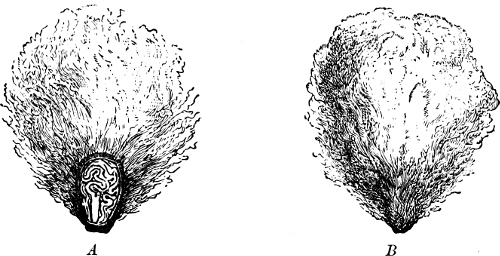
Fig. 447.—A Seed of Gossypium
with hairs; B the same in longitudinal section.
2. Bombaceæ. The staminal tube is more or
less deeply cleft into bundles, sometimes almost to the base;
pollen smooth, style simple with capitate, lobed stigma. Almost
all plants belonging to this group are trees, and in many
instances have large barrel-shaped stems, that is, swollen in
the centre, and sometimes covered with large warts. The wood is
exceptionally light and soft. The flowers are often enormously
large, and have beautiful petals; in some they unfold before
the leaves. The capsule-wall is sometimes closely covered on
its inner service with long, silky, woolly hairs, while the
seeds themselves are generally without hairs. These hairs,
however, on account of their brittle nature, cannot be used
like those of the Cotton-plant. Digitate leaves are found in
the Baobab-tree (Adansonia) from Africa, noted
for its enormously thick, but short stem, and in the American
Silk-cotton trees (Bombax, Eriodendron,
Chorisia). Ochroma, Cheirostemon,
Durio, and others also belong to this group. Durio
is noted for its delicious fruits, which have a most unpleasant
smell.
[Bombax malabaricum is diplostemonous; the five
sepal-stamens repeatedly branch, and the filaments bear
unilocular anthers; the five petal-stamens bear bilocular
anthers.]
B. Schizocarps, with 1-seeded fruitlets, most frequently
nut-like and reniform (Figs. 449, 451).
3. Malveæ, Mallow Group. The carpels are arranged in
one whorl (Fig. 449); the number of stylar-branches equals that of
the carpels; fruitlets 1-seeded, reniform, indehiscent, but detaching
themselves from one another and from the persistent central column
(Figs. 450, 451).—Malva has an epicalyx of 3 free
leaves. A flower with 2 suppressed bracteoles is situated in
the axil of the foliage-leaves; one of these supports a homodromous
foliage-shoot which forms a repetition of the main axis, the other
an antidromous flower which continues the branching as a unipared
scorpioid cyme.—Althæa, Rose Mallow, has an epicalyx of
6–9 leaves united at the base.—Lavatera, Sida,
Anoda, Bastardia, etc., have no epicalyx.
Figs. 448–451.—Malva silvestris.
Fig. 448.—The flower after removal of the
perianth (5/1).]
Fig. 449.—The fruit (5/1).

Fig. 450.—A fruitlet (5/1).
Fig. 451.—The same in longitudinal section.
4. Ureneæ, have always only 5 carpels arranged
in 1 whorl, with 1 ovule in each loculus, and the fruit
a schizocarp, generally with nut-like fruitlets provided
with warts and hooks; but in some they dehisce by 2 valves
(capsule). They differ principally from the other groups in
having twice as many stylar-branches as carpels; the
staminal tube is naked at the point, blunt or 5 toothed.—The
genera Urena, Pavonia, Malachra,
Malvaviscus (with berry-like fruits) belong to
this group.
II. Carpels arranged in a spherical head in five groups opposite to the
petals.
5. Malopeæ, differ from all the others in
having a large number of fruitlets arranged irregularly in a
round head, and separating considerably from each other even
before maturity; there is, however, only 1 style, divided into
a corresponding number of branches (this condition may be
considered to have arisen from the branching [dédoublement]
of 5 carpels). Malope has 3 large, heart-shaped
(Kitaibelia 6–9) epicalyx-leaves, united at the base.
Palava has no epicalyx.
Pollination. The majority have protandrous flowers,
and are pollinated by insects. Between the basal portions of
the 5 petals, there are 5 nectaries, protected from the rain
by hairs, e.g. in Malva silvestris. When the
flower first opens the numerous anthers occupy the centre of the
flower, and the still undeveloped stigmas are concealed in the
staminal tube; in the next stage the anthers are withered and
empty, and the stigmas protrude and assume their places (Fig.
452). The large-flowered forms, it appears, are pollinated only
by insects; but self-pollination takes place in small-flowered
forms, as, for example, in Malva rotundifolia, in which
the stylar-branches, twisting themselves, place the stigmas in
between the undeveloped anthers.
Fig. 452.—Anoda hastata: a the
bud just opened, the stigmas are concealed by the anthers; b
fully opened flower in ♂-stage; the upper stamens are developed first,
and then the others in descending order; the stylar-branches are
now visible, and lie bent back on the staminal column; c all
the stamens project upwards, and all the anthers are open, but the
stylar-branches are still bent back; d the anthers are emptied and
the filaments shrunk together, but the styles have now straightened
themselves upwards, and the stigmas are in the receptive condition.
Distribution. 800 species (63 genera), most of which
are natives of the Tropics, especially America. Althæa
and some of the species of Malva are natives of the
temperate regions of the Old World, the latter is also found in
North America. Gossypium is tropical, no doubt especially
Asiatic (G. herbaceum from India; G. arboreum from
Upper Egypt). Cotton was introduced into Greece in the time of
Herodotus, and was cultivated in America before the arrival of
the Europeans.
Uses. Pungent and poisonous properties are entirely
wanting; mucilage, on the other hand, is found
in abundance in all parts of the plant. Medicinal: the
root of Althæa officinalis, leaves and flowers of
Malva-species (M. silvestris vulgaris and
borealis) and Gossypium.—The seeds contain a
large quantity of fatty oil, which is in some cases
extracted (Cotton-seeds and others). The seed-hairs of the
Cotton plant are the most important product of the order.
The cultivated forms of Cotton belong to several species:
G. barbadense, herbaceum, religiosum,
arboreum (Nankin), hirsutum, and others. According
to other botanists, there are only 3 species. Bast
is obtained from e.g. Hibiscus cannabinus
(Gambo-hemp, Africa), Paritium tiliaceum and Sida
retusa. The fruits of certain species of Hibiscus
(e.g. H. esculentus, from Tropical Africa)
are used in tropical countries as a vegetable before they
are ripe.—The colouring matter in the flowers of
Althæa rosea, var. nigra, is used for colouring
wines, and hence is extensively cultivated in certain parts
of Europe.—Ethereal oils and sweet-scented flowers
are rare; but several species possess a peculiar musk-like
odour (Malva moschata, Hibiscus abelmoschus,
and others).—Many are cultivated as ornamental plants
on account of the large flowers, e.g. Hollyhock (A.
rosea, etc.), Lavatera trimestris, Malope
grandiflora and trifida, Malva-species,
Hibiscus rosa sinensis, syriaca;
Sphæralcea, etc.
The very large order Euphorbiaceæ and three smaller ones belong
to this family. They have in common: unisexual, hypogynous,
frequently regular flowers, the perianth most frequently single, rarely
double, or entirely wanting; there is such a great variety in the
structure and parts of the flower that one only can be cited as the
rule: viz. the simple gynœceum composed of 3 carpels forming a
3-locular ovary, which is frequently more or less deeply grooved (hence
the name, Tricoccæ); in the inner angles of the loculi are found
1 or 2 (never several) pendulous (except Empetraceæ), anatropous
ovules, with upward and outwardly turned, frequently swollen, micropyle
(Fig. 455). The seed most frequently has a large endosperm and a
straight embryo (Figs. 455 B, 464).—The family approaches
the nearest to the Gruinales and Columniferæ; it may perhaps be
regarded as an offshoot from the Sterculiaceæ.
Order 1. Euphorbiaceæ. Flowers unisexual. In each of the loculi
of the ovary, generally 3, there are 1 or 2 pendulous ovules with
upward and outwardly turned micropyle. The placenta protrudes above the
ovules (Figs. 454, 461 B). On the ripening of the capsule the 3
carpels separate septicidally, frequently with great violence, ejecting
the seeds and leaving a central column. Endosperm copious.—For the
rest, the flowers present all stages, from genera with calyx and
corolla, to those which are the most reduced in Nature, namely the
naked, 1-stamened flowers of Euphorbia.
The same variety which is found in the flower is also present in the
vegetative parts. Some are herbs, as our Spurges, others are shrubs and
trees; some African Euphorbia-species even resemble the habit
of a Cactus. Leaf-like branches with rudimentary leaves are found in
Phyllanthus (sub-genus Xylophylla) (Fig. 456). The leaves
are scattered or opposite, often stipulate; they are nearly always
simple. Large, highly-branched cells containing a great quantity of
pungent latex are found in many, and watery juice in others. Glands and
glandular hairs are general.—Only a few genera can be considered in
this book.
As an example of the most perfect flowers (which partly reproduce the
Geraniaceous type) may be mentioned, Croton, Manihot, and
Jatropha; 5 sepals, 5 petals, sometimes gamopetalous, andrœcium
diplostemonous, or many-stamened, often monodelphous.
Figs. 453–455.—Ricinus communis.

Fig. 453.—♂-flower (magnified).
Fig. 454.—♀-flower in longitudinal section.
Fig. 455.—A seed entire;
B in longitudinal section.
Ricinus (Castor-oil) (Figs. 453–455); monœcious; the
♂-flowers, situated in the lower portion of the inflorescence, have 5
perianth-leaves and a large number of branched stamens; the ♀-flower
has 3–5 perianth-leaves; 3 bifid styles. Leaves peltate, palmately
lobed. The seeds (Fig. 455) contain an abundance of fatty oil and large
aleurone grains.—Mercurialis (Mercury): the perianth is most
frequently 3-merous; in the ♂-flowers 9–12 stamens; in the ♀-flowers
most frequently a 2-locular gynœceum.—Phyllanthus: Pr3 +
3, A3, united in some and forming a column in the centre of the flower
(Figs. 457, 458); Xylophylla is a section of this genus.—
Hura crepitans (Sand-box tree) has a many-carpellate gynœceum,
which separates with great violence when ripe.—A drupe is found in
Hippomane mancinella (the Mancinil-tree, W. Ind.)—Alchornea
(Coelebogyne) ilicifolia is well known on account of its
“parthenogenesis”; only the ♀-plant has been introduced into Europe,
but it nevertheless produces seeds capable of germination; these have
generally several embryos.
Figs. 456–458.—Phyllanthus (Xylophylla)
angustifolius.
Fig. 456.—Leaf-like branch with flowers (nat. size).
Fig. 457.—♂-flower; and
Fig. 458, ♀-flower (mag.).
Euphorbia (Spurge) has the most reduced flowers, which are
borne in a very complicated inflorescence. Each ♂-flower (Fig. 460
B) is naked, and consists of one stamen only (terminal on the
axis). In the closely allied genus Anthostema, a small perianth
is situated at the place where, in Euphorbia, there is a joint
in the “filament,” (Fig. 461 A). The ♀-flowers (Fig. 460) are
naked, with a 3-locular ovary and 3 bifid styles. (Anthostema
has a distinct perianth (Fig. 461 B); in a few Euphorbias traces
of a perianth are present). In Euphorbia the ♂-and ♀-flowers are
grouped into flower-like inflorescences termed “cyathia.” Each cyathium
consists of a centrally placed ♀-flower which is first developed,
surrounded by 5 groups of ♂-flowers (stamens) placed in a zig-zag, with
a centrifugal order of development (Figs. 459, 460 B), that
is, in unipared scorpioid cymes; these flowers are surrounded by an
involucre of 5 leaves united into a bell-shaped structure
(Fig. 459, 1–5) (resembling a calyx); on its edge are placed 4,
generally crescent-like, yellow glands, one in each of the intervals,
except one, between the lobes of the involucre (shaded in Fig. 459; see
also Fig. 460 A). Scale-like thin structures (floral-leaves?)
are situated between the ♂-flowers. The ♀-flower has a long stalk, and
finally bends down on one side, namely to the place on the edge of the
involucre where the gland is not developed. These cyathia are again
arranged in an inflorescence which commences as a 3–5-rayed umbellate
cyme (pleiochasium), the branches of which ramify dichasially and
finally as scorpioid cymes.—Latex, with peculiar-shaped starch-grains,
is found in laticiferous cells (especially in the Cactus-like,
leafless species.)
Fig. 459.—Diagram of an inflorescence
(cyathium) of Euphorbia with 3 floral-leaves, m,
n, o, supporting other cyathia which are subtended by 2
floral-leaves (bracteoles; m, n). 1–5, the involucral
leaves in their order of development; the shaded portions are the
crescentic glands.

Fig. 460.—Euphorbia lathyris: A
an (entire) inflorescence (cyathium); B the same after the
removal of the involucre.
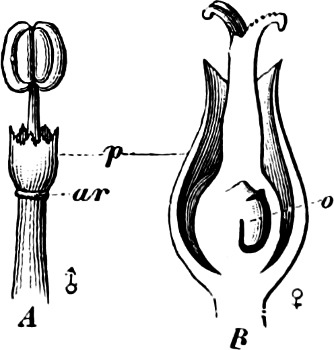
Fig. 461.—Anthostema: ♂- (A)
and ♀-(B) flowers; p the perianth; ar the node;
o the ovule.
205 genera; more than 3,000 species; especially in the
Tropics.—Many are used on account of the oil, and of
the pungent (aperient, poisonous, anthelmintic, etc.)
properties in the latex or the seeds. Officinal:
“Cascarilla-bark” of Croton eluteria; the fatty oil
of the seeds of Croton tiglium (Trop. Asia); “Castor
oil” from Ricinus communis (Africa, and cultivated
in all warm climates throughout the world); the glandular
hairs of Mallotus philippinensis (“Kamala”); this also
yields a red dye. Gum “Euphorbium” is the hardened (resinous)
latex of the Cactus-like Euphorbia resinifera
(Morocco).—Nutritive plants: Manihot utilissima
and other species (Maniok, Am.). Their large, farinaceous
roots form a very important article of food in the Tropics
(Cassava-flour, Tapioca or Brazilian arrowroot). The fresh
latex of the root in some species is a powerful poison; but the
poisonous properties are diminished by roasting or cooking.
Caoutchouc is obtained from Siphonia elastica
(Trop. S. Am.). The vegetable tallow of the Chinese tallow-tree
(Stillingia sebifera) is used in large quantities in
soap factories. An indigo-like dye is obtained from
Crozophora tinctoria, and is also found in Mercurialis
perennis. Shellac is obtained from Aleurites
laccifera. Ornamental plants: Acalypha,
Croton, Dalechampia.—Hippomane is
poisonous.
Order 2. Buxaceæ. This order differs from the
Euphorbiaceæ in having the micropyle turned inwards; the
♂-flower has a 4-partite perianth and 4 stamens; the ♀-flower
a 6-partite perianth and 3 carpels. Capsule with loculicidal
dehiscence, the inner layer being detached elastically from the
outer.—30 species. Shrubs without latex and with evergreen
leaves.—Buxus sempervirens (Box) is an ornamental shrub
(poisonous); it has a very hard and valuable wood which is used
for wood-engraving and carving.
Figs. 462–464. Callitriche stagnalis.
Fig. 462.—♂-flower with the 2 bracteoles and the solitary
stamen.
Fig. 463.—♀-flower.
Fig. 464.—Longitudinal
section of the ripe fruit.
Order 3. Callitrichaceæ. Aquatic plants, growing at the
bottom of shallow water, with opposite, simple, undivided,
entire, exstipulate leaves, which are generally crowded and
form a rosette in the apex of the branches. The flowers are
unisexual (monœcious) and borne singly in the leaf-axils; they
have no perianth, but are provided with two delicate bracteoles;
the ♂-flowers consist of only 1 terminal stamen (Fig.
462); the ♀-flowers of a bicarpellate gynœceum (Fig. 463) which
is originally 2-locular, but later on becomes 4-locular, as in
the case of the gynœceum of the Labiatæ, by the formation of
a false partition-wall; in each loculus there is 1 pendulous
ovule with the micropyle turned outwards. Fruit a 4-partite
schizocarp (Fig. 464). 25 species.—Callitriche.
Order 4 (?). Empetraceæ. 4 species. Empetrum;
E. nigrum (Crowberry) is a heather-like, moorland,
evergreen undershrub with linear leaves, having a deep groove
closed with hairs, on the under side. The erect ovules
show the greatest deviation from the Euphorbiaceæ. Diœcious
(and ☿); S3, P3; in the ♂-flower, 3 stamens; in the ♀-flower, a
6–9-locular ovary. Fruit a drupe.
The diagram of the flower (Figs. 465–467) is the same as in the
Gruinales, namely S, P, A2 and G in whorls of 5 (less frequently 3,
4, 6, 8), and the same modifications also occur with the suppression
of the petal-stamens, etc. But a ring or sometimes cup-like
glandular structure (disc) is found between the
andrœcium and the gynœceum (Figs. 465, 466). The flowers similarly
are regular, hypogynous, ☿ and polypetalous, though exceptions
are found to all these characters: thus, for example, united sepals
and petals frequently occur, and, in some orders, unisexual flowers
by the suppression of one sex. In most cases the flowers are small,
greenish-yellow, and arranged in paniculate inflorescences. The
carpels (most frequently 5) are free in a few, but generally united
into a multilocular gynœceum; rarely more than 1 or 2 ovules in each
loculus. The gynœceum in the Anacardiaceæ is so reduced that it has
only 1 fertile loculus with 1 ovule.—The ovules are epitropous,
i.e. anatropous with outward-turned raphe (except the
Anacardiaceæ).—The majority of the species are trees and shrubs with
scattered, often compound (pinnate) leaves without stipules,
and as in addition they frequently contain aromatic, especially
turpentine-like substances, they assume a certain resemblance to
the Walnut trees, and were formerly classed with them mainly on this
account. In a series of genera the volatile, scented oils are found in
special glands in the bark of the branches and in the leaves, in the
latter case appearing as pellucid dots. This family includes
several orders which are somewhat difficult to distinguish from each
other.
Order 1. Connaraceæ. This order forms the connecting
link between Terebinthinæ and Rosifloræ (Spiræa) as
well as Leguminosæ, with which they are sometimes classed.
The flowers have 5 5-merous whorls; 2 ovules in each loculus;
micropyle turned upwards. Fruit a follicle, rarely a
collection of follicles. Seed with aril. Shrubs with scattered
(most frequently pinnate) leaves, without stipules. 170 species.
Tropical.
Order 2. Meliaceæ. Trees and shrubs with scattered,
often pinnate leaves without pellucid dots and exstipulate; the
leaflets are nearly always entire. Flowers small in paniculate
inflorescences. Calyx and corolla 4–5-merous; 2 whorls of
stamens; 3–5 carpels in the gynœceum. A very characteristic
feature is the union of the filaments into a tube, on the
edge of which stipule-like teeth are often found. There are
most frequently 2 ovules in the loculi; fruit a capsule with
many winged seeds in Swietenia (Mahogany tree; Trop.
Am.), Cedrela, etc.; berries in others. The wood of
Cedrela is used for making cigar boxes. 550 species;
tropical.
Order 3. Rutaceæ. Leaves glandular with pellucid dots. The type
is the same as that of the family. Flowers 4–5-merous. The ovary is
most frequently 4–5-grooved. Disc well pronounced, often appearing as
a “gynophore.” The majority are shrubs with alternate or opposite,
compound, more rarely simple, leaves.
A. The ovary is deeply 2–5-cleft with basal styles which are
more or less united; the carpels in some genera are entirely free
(groups 1, 2). The fruit is capsular and most frequently dehisces like
follicles along the ventral suture or septicidally, so that a horn-like
internal layer (endocarp) separates elastically from the external layer.
1. Zanthoxyleæ. Zanthoxylum;
Choisya; Evodia.
2. Boronieæ. Australia.—Correa.
3. Diosmeæ. Heather-like shrubs;
Africa.—Diosma, Coleonema, Empleurum and
Barosma. Officinal: Barosma crenulata and
betulina, “broad Buchu leaves” (B. serratifolia
and Empleurum serrulatum, “narrow Buchu-leaves”).
Fig. 465.—Ruta. Flower (mag.).
Fig. 466.—Ruta. Longitudinal section of
flower.
Fig. 467.—Ruta. Floral diagram.
4. Ruteæ. Ruta (Figs. 465–467) graveolens
is an herbaceous, glaucous, strongly smelling plant with bipinnate
leaves and yellow flowers; the terminal flower is 5-merous, the others
4-merous (S. Eur.).—Dictamnus; zygomorphic flower. The
individual carpels of the fruit separate from each other, and dehisce
like follicles, upon which the internal layer is detached elastically
and springs out, carrying the seeds with it. Several species are
ornamental plants.
5. Cusparieæ. American. Flowers
often zygomorphic with gamopetalous corolla; stamens
5.—Ticorea; Galipea (G. officinalis; S.
Am.; “Cortex angosturæ”); Cusparia; Almeidea.
B. The ovary is entire or only slightly grooved; the style is
terminal, undivided. The fruit is most frequently a drupe or berry.
6. Toddalieæ. Ptelea; winged fruit.
The buds are enclosed in the leaf-sheath. Skimmia;
Phellodendron.
Figs. 468–470.—Citrus vulgaris.
Fig. 468.—Branch with compound leaves.
Fig. 469.—Transverse section of fruit.
Fig. 470.—Flowers (after the removal of the petals).
7. Aurantieæ, Orange Group. Fruit a berry
with a leathery external layer.—The most typical flower is found for
example in Limonia: S5, P5, A5 + 5, G5 (2–5).—Citrus
has 4–5–8-merous flowers, a gamosepalous, dentate calyx, free petals,
one whorl of stamens which are split irregularly into several bundles
(Fig. 470). The fruit is a multilocular berry provided with a
thick, tough, outer layer. The juicy pulp, which fills up the loculi
and envelopes the seeds, is formed from many large-celled, juicy
hair-structures which arise on the inner side of the walls of the
loculi and by degrees entirely fill them up; the dissepiments remain
thin, and form the partitions so easily separating from each other
(Fig. 469). The seeds in many instances are remarkable for containing
several embryos. The blade of the leaf is separated from the frequently
winged stalk by a node (and hence is a compound leaf with only
the terminal leaflet developed?) (Fig. 468); in other genera, as
Triphasia, there is a fully developed trifoliate leaf. Thorns
are frequently developed.—The species of this genus, which is a
native of the warmer parts of S. E. Asia, are very hard to separate.
The differences are found in the forms of the fruit, the leaves and
the leaf-stalks, and in the number of stamens. Citrus medica,
“Cedrat” (Ind.); C. limonum, “Citron,” “Lemon” (introduced
into Italy in the 3rd to 4th century). Officinal: the fruits
and essential oil of Lemon. C. aurantium from E. Asia, the
Orange (introduced into Italy in the 14th century). C. vulgaris
(Fig. 468), Bitter Orange (introduced into Europe at the time of the
Crusades); the unripe Bitter Oranges, and peel of the Bitter Orange
is officinal; it is from the flowers of this species especially that
the essence of Neroli is made. C. limetta, C. bergamia,
Bergamot; essence of Bergamot is officinal. C. decumana, Pomalo,
a native of the Islands of the Pacific. About 780 species; chiefly
tropical.
Order 4. Burseraceæ. Fruit a drupe; 1–5 stones. The bark,
as well as the other parts, contain strong aromatic resins and
balsams, and hence several species are used: the Myrrh tree,
Commiphora (Balsamodendron) from Arabia and
Africa; Officinal: Myrrha (Commiphora myrrha).
Mecca-balsam from C. opobalsamum, Arabia; E. Africa. The
Incense-tree (Boswellia) from the same parts of the globe
and E. India. The incense of B. carteri is medicinal
(Frankincense). The resin (Elemi) of Protium-species
is officinal, and is used technically for varnish (S. Am.).
Takamahaka-resin from Elaphrium (S. Am.) Protium
(Icica); Amyris (1 carpel). 270 species; tropical.
Order 5. Zygophyllaceæ. The majority have opposite,
pinnate leaves with stipules. Leaves without pellucid
dots. The filaments have a scale on the inner side. The most
important is Guaiacum officinale (West India), the wood
(Lignum Vitæ) of which is very hard and heavy, this wood and
Gum-guaiacum are officinal. Others have a peculiar repulsive
smell and taste: the Creosote shrub (Larrea mexicana)
and Zygophyllum simplex. Tribulus terrester is a
common weed in S. Europe. Fagonia. Peganum harmala
(South of Russia) yields a red dye.—110 species; especially in
the Tropics; several species in sandy deserts. Nitraria.
Order 6. Simarubaceæ. This order is distinguished by
the abundance of bitter substances which it contains
(Quassine) especially in the bark and the wood. The wood
of Quassia amara (Guiana, Antilles) is officinal;
Picraena excelsa yields Jamaica Quassia; the bark of
Simaruba, Simaba-species and others is used.
Ailanthus glandulosa is a garden plant (pinnate leaves,
winged fruit).—110 species. Tropical.
Order 7. Ochnaceæ. Flowers diplostemonous, 5-merous.
The unilocular ovaries, which are individually free, project
considerably into the air around the gynobasic style; 1 ovule
in each loculus; the fruitlets are drupes. Shrubs; leaves
alternate, with stipules. Ochna; Ouratea.—160
species; tropical; especially American.
Order 8. Anacardiaceæ. The ovary rarely contains more
than 1 ovule, even though there be several loculi and several
carpels; in Anacardium all the 10 stamens except one
become suppressed. Resin passages.—Anacardium. The
most peculiar feature is the development of the flower-stalk
into a fleshy body about the form and size of a pear (A.
occidentale from Trop. Am. and A. orientale from
E. Ind.) which bears the kidney-shaped nut (the so-called
“Cashew-nut”) on its apex. Mangifera indica (the
Mango-tree, from E. Ind.) is cultivated in several tropical
countries on account of its delicious drupe. Similarly, species
of Spondias (S. dulcis, Pacific Islands, S.
lutea). Several species of Rhus are ornamental shrubs
in this country, for instance, R. typhina (N. Am.), R.
cotinus (the Wig-tree, the barren flower-stalks
of the panicles being feather-like and hairy); R.
toxicodendron (Poisonous Sumach, from N. Am.) is poisonous.
Chinese galls are produced by the sting of a leaf-louse
(Aphis chinensis) on R. semialata (China), and
Japanese wax is from the seeds of R. succedanea (Japan).
Considerable quantities of Sumach (R. coriaria) are used
in tanning and as a black dye. Officinal: the mastic
resin of Pistacia lentiscus (the Mastic-tree, from the
Mediterranean). The fruits of Pistacia vera (Syria) are
edible; P. terebinthus and others yield turpentine.—450
species; tropical.
Order 9. Icacinaceæ. Flowers 4–5-merous; haplostemonous;
receptacle convex or cup-like surrounding the gynœceum; in
the (single) loculus of the ovary, 2 anatropous, pendulous
ovules.—200 species; tropical.
The essential characters of this family are in the main the same as
those of the Terebinthinæ and Gruinales. The flowers are hypogynous,
perfect, with free petals, 5-merous (S5, P5, typically A5 + 5, all of
which, however, are not generally developed; in our native orders there
are only 7–8 stamens), and most frequently a 3-merous, 3-locular
gynœceum (less frequently 2 or 5 carpels with as many loculi). In
each loculus there are usually only 1–2 ovules. A deviation from the
preceding families is the frequent zygomorphy of the flower,
with, as a rule an oblique plane of symmetry (Fig. 471). When a
disc is developed it is placed outside the stamens. The
majority have no endosperm (Fig. 473).—The members of the family are
nearly all trees.
The family is closely allied to the Terebinthinæ, but unlike
this it never has aromatic properties, and differs also
in the position of the nectary, in the flowers, which are
often irregular with a reduction in the number of stamens,
and in the ovule which is usually ascending with micropyle
pointing downwards (the Terebinthinæ having the micropyle
turned upwards), etc. It is also related to Frangulinæ, the
Staphyleaceæ being the chief connecting link; but the Æsculinæ
generally have compound leaves.
Order 1. Staphyleaceæ. Leaves opposite, often compound.
Flowers regular, ☿, 5-merous in calyx and corolla, 5-stamened.
The stamens are placed outside the nectary. Ovary
syncarpous or 2–3-partite with free styles. The capsule is
thin, bladder-like, 2–3-locular, opening at the apex, and
has several very hard seeds with a shining testa without
aril. Endosperm. Staphylea pinnata (S. Europe) and
trifoliata (N. Am.) are cultivated in gardens; they have
white flowers in pendulous, axillary racemes or panicles.—16
species.—Staphylea is found in the Tertiary of N.
America.
Order 2. Melianthaceæ. Glaucous shrubs with scattered,
pinnate leaves, and large stipules. Melianthus.—8
species; S. Africa.
Order 3. Sapindaceæ. Trees or shrubs, often climbing by tendrils
(lianes with anomalous structure of the stem) and with compound leaves.
The flowers, in most cases, are small, insignificant, and without
scent, and in some polygamous and zygomorphic. S4–5, P4–5, A8 (less
frequently 5–10) inside the nectary (disc); ovary generally 3-locular,
with 1–2 ovules in each loculus (raphe ventral, micropyle turned
downwards). Seed without endosperm, often with an aril. The embryo is
often thick and curved (Fig. 473).
Figs. 471–473.—Æsculus hippocastanum.
Fig. 471.—Diagram of the flower and of a scorpioid cyme.
Fig. 472.—Flower in longitudinal section.
Fig. 473.—Seed in longitudinal section.
Æsculus (Horse-Chestnut). Trees with opposite, digitate,
dentate leaves without stipules; the inflorescence is composed of
unipared scorpioid cymes arranged in a pyramidal panicle (termed a
thyrsus). The flowers are irregular, with an oblique plane of
symmetry (through the 4th sepal, Fig. 471); there are 5 sepals,
5 free petals, of which the one lying between S3 and S5 is the
smallest (see Fig. 471) and may be absent; stamens 7 (5 + 2), three
being suppressed; gynœceum simple, 3-carpellary and 3-locular, with
single style; of the two ovules one is ascending, the other descending
(Fig. 472).—The fruit is a 3-valvate, sometimes spiny, capsule,
with loculicidal dehiscence, the seed having a large hilum, a curved
embryo without endosperm and united cotyledons (the radicle lies in
a fold of the testa, Fig. 473). Æ. hippocastanum (Greece,
Asia), introduced into cultivation about 300 years ago; the majority
of the other species, e.g. Æ. pavia, etc., several of
which are frequently cultivated in gardens, are from N. America.
The flower of the Horse-Chestnut is adapted for bees, whose abdomen
touches the anthers or style when visiting the flower. The flowers are
protogynous.
The other Sapindaceæ have most frequently 4 sepals, 8 stamens,
various fruits (septicidal capsule, nuts with or without wings,
schizocarp), etc. Serjania, Cardiospermum,
Sapindus, Koelreuteria, etc. (about 118 genera,
970 species). The seeds of Paullinia sorbilis contain
caffeine, and are used as “Pasta guaranà,” in the North Western
Brazils in the manufacture of a common drink. Nephelium
(or Euphoria) litchi (with edible aril), and other
species, from Asia.

Fig. 474.—Samara of Acer platanoides.
Order 4. Aceraceæ. This order is so closely allied to the
Sapindaceæ, that some authorities have classed it with them. The
main difference is in the regularity of the flowers, and
the 2-merous gynœceum (in abnormal cases several carpels
occur).—They are trees, and, like the Horse-Chestnuts, have opposite
leaves without stipules; in Acer the leaves are palminerved,
but imparipinnate in Negundo, a plant frequently cultivated in
gardens. The flowers are often unisexual, polygamous (some species
have ☿-, ♂-and ♀-flowers); sepals 5, petals 5 free, stamens 8
(that is, 5 + 5, but the two median ones are absent) inside a large
disc. Fruit a samara (schizocarp) with 2 winged, nut-like
fruitlets (Fig. 474). In each of the 2 loculi of the ovary are 2
ovules. Embryo curved, with thin, folded cotyledons.
Endosperm absent.—The inflorescences are racemes with a more or
less elongated main axis and terminal flower (which sometimes has 10
stamens); when the lateral branches are developed they are similar
to the main axis. In some species both corolla and petal-stamens are
suppressed. Acer is pollinated by insects, Negundo by the
wind.—88 species; North Temperate zone. Acer in the Tertiary
from the Oligocene. The following are native plants: Maple (Acer
campestre), Sycamore (A. pseudoplatanus, doubtful native).
Important as avenue trees and timber. Sugar is obtained from the spring
sap of the Sugar Maple (N. Am.).
Order 5. Malpighiaceæ. A tropical (especially American)
order closely related to the Aceraceæ, having often the same
form of fruit (but 3-partite). Some species are lianes with
anomalous stem-structure. Leaves opposite. The flowers are
regular or obliquely zygomorphic (the plane of symmetry passing
through sepal 3), with S5, P5, A5 + 5, G3; 1 pendulous ovule
in each loculus. Important characteristics for identification
are the numerous grandular structures on the sepals.
Peculiar 2-spined hairs are found in some. Malpighia,
Bunchosia, Galphimia, Tetrapterys,
Heteropterys, etc.—About 600 species.
Order 6. Erythroxylaceæ. Sepals 5, petals 5 (with a
ligular corona), 10 stamens in one bundle. Gynœceum 3-locular.
Fruit a drupe. Tropical (especially American) trees and shrubs,
the Coca-plant (Erythroxylon coca) being best
known. Its leaves are considered by the inhabitants of Chile and
Peru to be one of the indispensable necessaries of life; they
are chewed, and possess intoxicating, exhilarating properties,
and contain the alkaloid cocaine, which is frequently employed
as a local anæsthetic.—103 species; chiefly in America.
Order 7. Vochysiaceæ. Trees; Trop. Am. 1 stamen.—140
species.
Order 8. Trigoniaceæ. Shrubs; Trop. Am.—30 species.
Order 9. Tremandraceæ. Polygalaceæ with regular
flowers.—27 species. Australia.
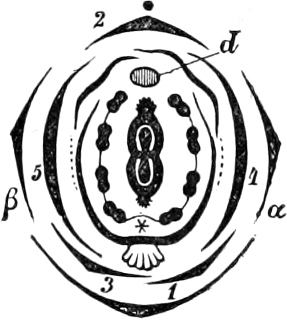
Fig. 475.—Diagram of Polygala: d
a gland in the posterior side of the flower; α and β the two caducous
bracteoles.
Order 10. Polygalaceæ. Herbs or shrubs (some tropical
species are lianes) with scattered (rarely opposite), simple and
most frequently quite entire leaves, without stipules. The flowers
are usually borne in terminal spikes or racemes, and are strongly
zygomorphic (the plane of symmetry being median); they have
5 free sepals, the 2 lateral ones of which (4 and 5 in Figs.
475, 476) are very large, petaloid, and frequently project on
each side like the “wings” of a Pea-flower; petals 5, of which the
two lateral ones are wanting or rudimentary (dotted on Fig. 475), and
the anterior “the keel” (Fig. 476 c) is large,
hollow and boat-shaped, and frequently with a lobed or fimbriated
edge (Fig. 476 A and B, c); stamens 8, the two
median ones being absent, all united into a tube split along the
back, which is also slightly united to the keel (the anthers, often
2 locular, open by pores, Fig. 476 B, st); the
2 median carpels form a bilocular ovary. 1 pendulous ovule in each
loculus (Figs. 476 C, 475); capsule compressed with loculicidal
dehiscence, rarely a nut. Polygala (Milk-wort).
470 species; distributed over the whole globe (none Arctic).
Officinal: the root of P. senega, from N. Am.
Some are used as ornamental plants.
Pollination. The flowers of Polygala are
pollinated by insects (chiefly bees). The fimbriated processes
of the anterior petal support the insect when it alights. The
anthers lie on each side of the stigma in the pouch of the
anterior petal; the apex of the style is spoon-shaped, and
immediately behind it is a viscid stigmatic lobe. In reaching
the honey the proboscis of the insect must come in contact
with the pollen and the viscid stigma, by which it is rendered
sticky; this ensures the pollen adhering to the proboscis and so
being carried to other flowers.
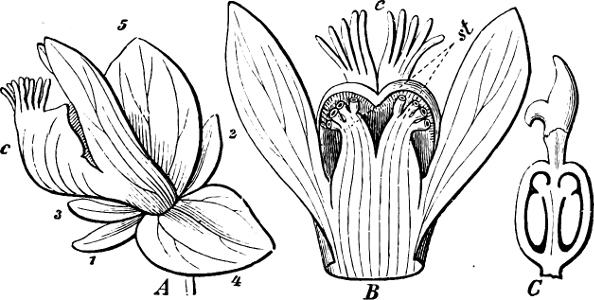
Fig. 476.—Polygala amara. Parts of
the flower (mag.) A Flower from side, 1-5 sepals: c
keel; B flower from above spread out: st the 8 stamens;
c fimbriated edge of “keel”; C ovary with style and
stigma.
The plants belonging to this family, with very few exceptions,
are trees or shrubs. The leaves are usually simple; stipules may
be absent or present. The flowers in almost all the orders are
small, green or whitish; they are always regular,
4-or 5-merous with 2–5 carpels, but never have
more than 1 whorl of stamens, which in Rhamnaceæ and
Ampelidaceæ are placed opposite the petals (typically 5
+ 5 or 4 + 4 stamens, of which however either the external or internal
whorl is always wanting); hypogynous or slightly perigynous, in
Rhamnaceæ only strongly perigynous or epigynous; generally ☿;
the calyx is inconspicuous; petals free or slightly united. Gynœceum
simple; ovary generally multilocular; style short or entirely
wanting. A disc is nearly always developed in the flower, but
is found sometimes inside the staminal whorl, sometimes outside it or
between the stamens. The ovules are apotropous (anatropous with dorsal
or ventral raphe).
Order 1. Celastraceæ. Euonymus europæa (Spindle-tree)
may be chosen as a type. It is a shrub with simple, opposite leaves
and small caducous stipules. The small, greenish-yellow flowers, borne
in regularly-branched dichasia, are regular, ☿, with 4 whorls, 4-(or
5-) merous in regular alternation. There is a thick disc upon
which the polypetalous corolla (imbricate in the bud) and the stamens
are borne, with a slightly perigynous insertion. The style is short and
thick; the ovary has 2 erect ovules in each loculus. The fruit
is a red, 4-valvate capsule with loculicidal dehiscence; the seeds are
few in number, and have a large, red-yellow aril (developed from
the micropyle). Embryo green, in a large, fleshy, white endosperm.
The dingy yellow flowers are generally visited only by flies and
ants for the sake of the honey secreted by the disc, and while they
run about on the flowers they touch the anthers and stigmas, now with
one part of the body, now with another. The flower is protandrous. The
stigmas are not developed till several days after the opening of the
anthers.—Celastrus, Cassine, Catha, etc.
38 genera; 300 species. Distributed over the entire globe, with
the exception of the colder districts, and especially in the
Tropics. Some are ornamental bushes (Euonymus japonica).
The leaves of Catha edulis are used by the Arabs and
Abyssinians in the same way as those of Coca by the
Peruvians.
Order 2. Hippocrateaceæ. 150 species; tropical; chiefly
lianes. S5, P5, A3, G3. Anthers extrorse.
Fig. 477.—Ilex aquifolium: magnified
flower.
Order 3. Aquifoliaceæ (Hollies). The genus Ilex forms
almost the entire order. (175 species out of 180; especially from S.
Am.) They are shrubs or trees with scattered, leathery, simple leaves
(in Ilex aquifolium, spiny) with very small stipules. The
flowers are small, white, and borne in few-flowered inflorescences in
the axils of the foliage-leaves; they are most frequently unisexual
and diœcious. There are 4–5 sepals, petals, stamens and carpels in
regular alternation; the calyx and corolla have their leaves
slightly connate; stamens slightly adnate to the corolla; the
ovary is generally almost spherical with a thick, sessile stigma (Fig.
477). This order deviates especially from Celastraceæ in the
absence of the disc and in having only 1 (pendulous)
ovule in each of the 4 loculi of the ovary, and in having a
drupe with generally 4 stones. Embryo extremely small, at the
apex of the large endosperm, with the radicle directed upwards.—3
genera.—I. aquifolium (Holly) principally on the coasts of
European countries; from Norway to W. Denmark, and further westward.
It is a common garden shrub with stiff, shining leaves and red fruits.
Several South American species contain so much caffeine
that they may be used as a beverage in the place of tea (I.
paraguayensis, Paraguay tea, or Maté). The Holly does not contain
caffeine.
Order 4. Ampelidaceæ (Vines). Shrubs with the stem swollen
at the insertion of the petioles and climbing by tendrils borne
opposite the leaves (Figs. 478, 479). The leaves are scattered
(generally 1/2), stalked, stipulate, frequently palminerved and
lobed, divided or compound. The small, greenish flowers are generally
borne in paniculate inflorescences, whose position is the same as
that of the tendrils (Fig. 478); they are hypogynous or slightly
perigynous, ☿, with 4–5 sepals, petals, stamens (which, as in the
Rhamneæ, are opposite the petals; Fig. 480 A, B)
and 2 carpels. The calyx is very small, entire, or slightly dentate;
corolla valvate, and in some falling off as a hood, since the
individual parts remain united at the summit (Fig. 480 A).
Between the stamens and gynœceum is situated an hypogynous disc,
with 5 lobes alternating with the stamens (Fig. 480 A,
B, E). In each loculus of the 2-locular ovary there are
2 erect ovules (E); the style is short or wanting. The
fruit is a berry. The embryo is small and lies in a horny,
sometimes slightly folded (ruminate) endosperm (Fig. 480 C,
D).
Figs. 478–481.—Vitis vinifera.
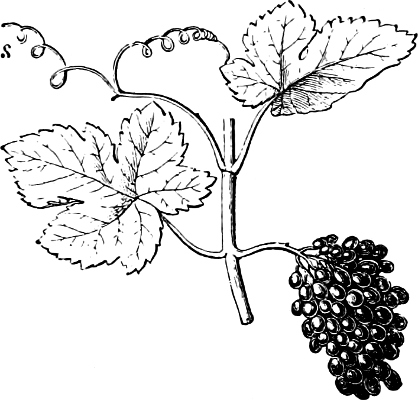
Fig. 478.—Branch with bunch of grapes.
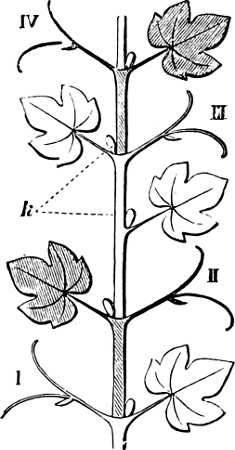
Fig. 479.—Diagram of the position of leaf and tendrils. The
branch is divided into sections on the sympodial theory (the successive
generations, I, II, III, IV, are alternately white and shaded);
k buds.
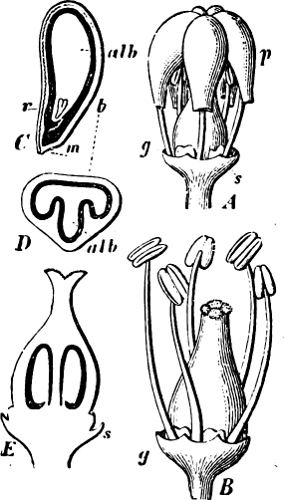
Fig. 480.—A Flower throwing off the corolla; B flower
after the removal of the corolla; C, D longitudinal and
transverse section of seed; E longitudinal section of gynœceum;
s calyx.
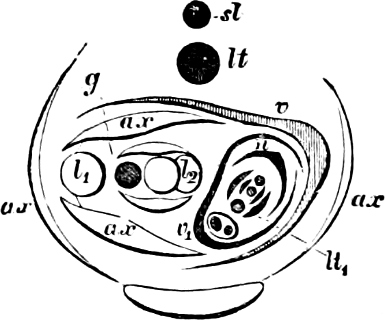
Fig. 481.—Diagram of branch and position of leaves;
sl tendril; lt the main axis; ax stipules of the
foliage-leaf shown below; g axillary-bud (the dwarf-branch);
v its fore-leaf; l1 l2 its first two
foliage-leaves with their stipules; lt1 long-branch in the
axil of v (everything appertaining to this branch is entirely
black); v1 the first leaf of this branch.
Vitis and Ampelopsis (5-merous flowers);
Cissus (4-merous flower); Leea (without stipules,
corolla gamopetalous). The inflorescence in Pterisanthes
(E. Ind.) has a peculiar, flat, leaf-like axis, on the edges of
which ♂-flowers are borne, and on the surface ♀-flowers.
The TENDRILS in Ampelidaceæ are modified branches,
since they bear leaves and may be abnormally developed as
branches with foliage-leaves, and finally the inflorescences
are borne in the position of the tendrils, and tendrils are met
with which are partly inflorescences. The explanation of the
position of the tendril, namely, right opposite the foliage-leaf
but without a subtending-leaf, has been much disputed. The
relative positions are as follows: in Vitis vinifera
the following two kinds of shoots and relative positions are
found (the other species deviate in one or other particular),
(a) Long-branches, which have 2 scale-leaves
and a large number of foliage-leaves with a divergence of
1/2; opposite the lowest 3–5 foliage-leaves no tendrils are
found, then follow: 2 foliage-leaves with tendrils, 1 without a
tendril, 2 with and 1 without, etc., with great regularity. Buds
are developed in the axils of the foliage-leaves (Fig. 479):
these develop into (b) DWARF-BRANCHES, which
commence with 1 laterally-placed scale-leaf (fore-leaf; Fig. 481
v) succeeded by several foliage-leaves with a divergence
of 1/2 (in a plane at right angles to that of the mother-shoot),
but the whole shoot is extremely small, and often dries up
and drops off in the autumn, so that only the scale-leaf,
v, with the bud (Fig. 481 lt1) in its axil
remains. This bud in the following year developes into a new
long-branch, and since its leaves lie in a plane at right angles
to that of the dwarf-branch, their plane coincides with that
of the long-branch from which it is developed (the grandmother
axis).—The tendrils no doubt may most correctly be regarded as
the modified main axis which has been pushed aside by a lateral
branch. The branches are then sympodia, whose successive shoots
bear alternately 1 and 2 foliage-leaves: thus, on the figure
there are portions altogether of 5 shoots (I.-V.), the 1-leaved
ones are shaded, the 2-leaved ones are white. The following
facts however are adverse to this theory: (1) the first leaf on
an axillary bud is then situated 180° from the subtending leaf
(e.g. the lowermost shaded leaf, Fig. 479, 180° from the
lowermost white leaf), whilst the rule in the Dicotyledons is
that it is placed only about 90° to one side. (2) The buds (Fig.
479 K) from which the dwarf-branches develop, must then
be accessory and sister-buds to the sympodial shoots, but their
first leaves have a different relative position to this, which
is very peculiar, and a still more remarkable fact is that the
buds, K, etc. are similar in structure and present in
all the axils; thus we only find accessory buds
in the cases where no tendrils are opposite to the leaves, and
the main bud must then be considered to be suppressed. (3) The
development proves that the tendrils arise on the side of a
vigorous growing-point of the stem or by its division, and do
not develop, as might be expected, from the apex of the shoot.
But these relations however, find their analogues and are all
capable of explanation, whereas other less natural modes of
explanation are opposed to them.
435 species; especially in the Tropics; they are rarer in
America. In N. Am. some Vitis-species and Ampelopsis
quinquefolia are found. Vitis vinifera is supposed to
have originated in the districts East and South of the Caspian
Sea. Wine is obtained from Vitis-species, especially
V. vinifera, and “raisins,”—(the name “currants,” given
to a special variety with small, seedless fruits, is derived
from Corinth).—The species of Ampelopsis (Virginian
Creeper) are cultivated as ornamental plants.
Order 5. Rhamnaceæ. The stamens are placed opposite the
petals as in the Ampelidaceæ (Fig. 482), but the flowers are
much more perigynous or entirely epigynous. The trees and shrubs
belonging to this order have simple, most frequently penninerved leaves
with stipules; frequently thorny (modified branches). The flowers
are inconspicuous, sometimes unisexual (Fig. 482), and have 5 (-4)
sepals, petals, stamens, and generally 3 (2–5) carpels. The calyx has
valvate æstivation. The petals are very small (generally
less than the sepals), often spoon-like, hollow, and embracing the
stamens; a disc covers the inner surface of the thalamus or the
base of the style in the epigynous flower; gynœceum simple, with one
style and one erect ovule in each loculus. The fruit is most
frequently a drupe. The embryo is large, often green or yellow,
with endosperm.
Rhamnus (Buckthorn) has a juicy drupe with 3 (2–4) stones,
surrounded at the base by the persistent portion of the receptacle; the
disc is thin. R. cathartica (common Buckthorn): diœcious, with
opposite, serrate leaves. R. frangula (Alder Buckthorn): flowers
☿, with scattered, entire leaves.—Ceanothus (N. Am., with
richly-flowered inflorescences and a fruit closely resembling that of
the Euphorbias). Phylica, Pomaderris (Austr., fruit a
capsule). Zizyphus, Paliurus, Colletia (S. Am.)
are thorny shrubs; C. spinosa has thorny shoots with small,
caducous leaves; the seedling has normal foliage-leaves. Others climb
by tendrils as in the Ampelidaceæ, e.g. Gouania.
Fig. 482.—Rhamnus cathartica: A
long-styled ♂-flower; pet petals; B short-styled
♂-flower; C long-styled ♀-flower; D short-styled ♀-flower
(after Darwin).
475 species, 40 genera; chiefly in temperate and tropical
climes. Some are medicinal plants, the bark and fruit having
purgative properties (the bark of Rhamnus frangula
and “Cascara Sagrada” from the bark of R. purshiana
are officinal). The fruits and seeds of others are edible,
for example, the fruits of Zizyphus lotus, Z.
vulgaris, Z. spina Christi, etc. Green and yellow
dyes are obtained from the fruit of R. cathartica,
infectoria and others (Avignon grain). Ceanothus-,
Rhamnus- and evergreen Phylica-species are
ornamental shrubs.
Exclusively trees or shrubs with simple, entire, scattered leaves
without stipules. They have a strongly perigynous, regular,
4-merous flower. The receptacle (often coloured) envelopes
a simple gynœceum formed of 1 carpel and with, in
most cases, 1 ovule, bearing on its edge 4 (or 5) petaloid
sepals and, but rarely at the same time, small, scale-like petals.
The corolla is most frequently entirely wanting (and hence these
plants were formerly reckoned among the Monochlamydeæ); frequently
only one of the 2 whorls of stamens, which are situated on the inner
side of the edge of the receptacle, is developed. The fruit is most
frequently a 1-seeded berry or drupe, or a nut which may be
falsely berry-like, the partly persistent receptacle being fleshy and
enveloping it.
This family appears the most nearly allied to the Frangulinæ,
especially the Rhamnaceæ, and may be considered as a further
development of these in the direction of the petaloid
development of the receptacle and reduction of the corolla and
gynœceum, which in this instance only consists of one carpel.
Another deviation is that both the whorls of stamens are
present, while one of these is always wanting in Frangulinæ.
They also appear to be related to the Lauraceæ (see page 391).
Order 1. Thymelæaceæ. The flowers are most frequently ☿ (Fig.
483). The receptacle is high, generally tubular, coloured, and bears
on its edge the 4-(or 5)-merous calyx, with imbricate æstivation. The
corolla is wanting or is represented by small scales. The stamens are
situated on the inside of the receptacle, and number 4 + 4 (or 5 + 5);
stigma capitate. 1 pendulous ovule (Fig. 483 B), the
radicle pointing upwards. The fruit is most frequently a berry.
A disc is sometimes developed. Endosperm wanting or very slight.
Fig. 483.—Daphne mezereum: A
flower; B longitudinal section of pistil.
Daphne (Spurge-Laurel, Fig. 483) has a deciduous
receptacle, often coloured; sepals 4; petals absent; stamens 4 +
4. Berry.—Gnidia (corolla); Pimelea (2 stamens);
Thymelæa; Passerina and others.
400 species; chiefly in the warm, sub-tropical zone, especially
the Cape and Australia. Only Daphne and Thymelæa
in Europe. In the fruit and bark of some, for example
Daphne, pungent, burning and poisonous properties are
found. The bark of D. mezereum (native and cultivated)
and D. laureola is officinal. A specially tough bast is
found in some species, for example Lagetta lintearia
(Lace-tree, Jamaica), which is used in weaving. Some are
cultivated in gardens as ornamental shrubs, especially species
of Daphne.
Order 2. Elæagnaceæ. Shrubs or trees, which are easily
recognised by the covering of peltate hairs found upon almost
all parts of the plant, causing them to assume a silvery
or rusty-brown appearance. Stipules are absent; the leaves are
simple, most frequently scattered. Flowers (Figs. 484, 485)
frequently unisexual. The sepals are valvate, 2-4; the corolla
is wanting; stamens 4 + 4 or 0 + 4. The ovule is
erect and the radicle turned downwards (Fig. 486).
The fruit is a nut, but becomes a false fruit, being
surrounded by the persistent receptacle or the lower part of it,
and thus assuming a berry- or drupe-like appearance (Fig. 486).
Endosperm insignificant.—Shepherdia (opposite leaves) has 4
sepals, 4+4 stamens, as in Daphne. Diœcious.—Elæagnus
(Silver-leaf) is ☿, has 4–6 sepals, and 4–6 stamens alternating with
them. Hippophaë is diœcious; it has 2 sepals and 4 stamens
in the ♂-flower (perhaps properly speaking 2+2 stamens); thorny
(stem-structures).
16 species; especially ornamental shrubs, e.g.
Elæagnus argentea, angustifolia; Hippophaë
rhamnoides and Shepherdia canadensis. Northern Temp.
Figs. 484–486.—Elæagnus angustifolia.
Fig. 484.—Floral diagram.
Fig. 485.—Longitudinal section through the flower.
Fig. 486.—Longitudinal section
through the fruit.
Order 3 (?). Proteaceæ. This order has its chief centre
in the dry regions of Australia (6/10–7/10 of about 1,000
species), a smaller number in S. Africa (2/10–3/10). a few
species in S. Am. Trees or shrubs, leaves generally scattered,
without stipules, and more or less dry, leathery, evergreen,
and often of very different forms on the same plant (undivided,
compound, etc.) The flowers are ☿ (rarely unisexual), and
4-merous in the single, petaloid perianth and in
the staminal whorl; 1 carpel; sometimes zygomorphic. The
perianth-leaves are generally almost free, with valvate,
æstivation, often leathery. Small scales alternating with the
perianth are often found at the base of the ovary. The stamens
generally have extremely short filaments, and are situated
opposite, sometimes quite on the tip of the perianth-leaves, in
a spoon-like groove. The gynœceum is 1-locular, has 1–several
ovules, and is often raised on a stalk-like internode. The fruit
is a follicle or nut. The seeds, most frequently winged, have
no endosperm.—Protea, Manglesia, Hakea,
Banksia, Grevillea, etc. 50 genera; about 1,000
species. Several species are cultivated in our conservatories
for the sake of the flowers, which are beautifully coloured and
arranged in crowded inflorescences. Protandrous. It is doubtful
whether they were existent in Europe in the Tertiary Period.
The true systematic position of the order is doubtful. They are
related to the Leguminosæ and Rosifloræ, but more closely no
doubt to the two preceding orders.
The flower is generally perfect, regular and polypetalous, usually
perigynous or epigynous, eucyclic and 5-merous;
most frequently S5, P5, A5 + 5 or 5 + 0 and G2-5, but other
numbers are found, especially 4; the flowers are very frequently
obdiplostemonous. The calyx is sometimes large and the corolla small;
the carpels in some are entirely free, in others more or less united.
Endosperm is found in the majority. The hypogynous forms approach
the Cistifloræ, the others the following families, especially the
Rosifloræ. This family is not, upon the whole, so well defined and
natural as most of the others. The Saxifragaceæ proper, approach very
near to the Rosaceæ, especially Spiræa, and form a transition
to it. The forms with opposite leaves, as Philadelphus, etc.,
approach the Myrtifloræ, just as the Escalloniæ appear to be closely
allied to Bicornes, especially Vacciniaceæ. Finally through
Pittosporaceæ, they pass over to the Frangulinæ. The family
terminates in very reduced forms, on the one hand in the arborescent
orders with crowded inflorescences, on the other perhaps in the very
remarkable order Podostemaceæ.

Fig. 487.—Diagram of a 6-merous flower
(Sedum hispanicum): w branch of scorpioid cyme in the
axil of the bracteole β.
Order 1. Crassulaceæ. Nearly all are herbs or small shrubs with
round, succulent branches and scattered, fleshy, often more
or less round leaves, which are very rarely incised, and never have
stipules. The flowers are generally borne in dichasia or unipared
scorpioid cymes, which again may be arranged in racemes, umbels, etc.;
they are regular, ☿, hypogynous or perigynous, and most frequently have
free sepals and petals (gamopetalous corollas with sessile stamens are
found in Cotyledon, Bryophyllum, Echeveria, and
others); the floral formula is Sn, Pn, An + n, Gn, where n may have
very different values, partly depending upon the size of the flower
(e.g. 4–7 in Sedum, Fig. 487; 6–30 in Sempervivum;
4 in Rhodiola, Bryophyllum, and Kalanchoë; 5 in
Echeveria, Umbilicus, Cotyledon). The carpels
are free and are placed opposite the petals (Fig.
487). Fruit a syncarp composed of follicles containing many,
small seeds without endosperm. Outside each carpel is found a small,
nectariferous scale (Fig. 487). The northern genus, Rhodiola,
is diœcious. The petal-stamens are wanting in some (Crassula,
Bulliarda, and others). The floral-leaves are very often
displaced upon their axillary branches. A multicarpellary gynœceum also
occurs.
Sedum (Stonecrop) is generally 5-merous with 10 stamens;
Sempervivum tectorum (House-leek), 12-merous, and with 24
stamens. The leaves of Bryophyllum calycinum very readily
form buds, and also frequently exude water from the edges.
485 species; especially Temp. (Cape, Europe). Principally used
as ornamental plants.
Order 2. Saxifragaceæ. The flowers are 4–5-merous with 2
(-3) carpels, most frequently: S5, P5, A5 + 5 (obdiplostemonous), G2.
They are regular, ☿, polypetalous, hypogynous, perigynous or most
frequently more or less epigynous (Fig. 488). The carpels may
be individually quite free, but are more frequently united at the
base, or the entire portion enclosing the ovules is united into a
1- or 2-locular ovary, the styles, however, are always free. Fruit
a capsule with many seeds; endosperm present.—They are herbs,
most frequently with scattered leaves without stipules; but the
leaf-base is broad. The inflorescences are most frequently cymose,
and a displacement of the floral-leaves is frequent (e.g.
Chrysosplenium).—Some Saxifraga-species, e.g.
S. sarmentosa, have irregular flower with an oblique
plane of symmetry. The petal-stamens in some may be wanting:
Heuchera, species of Saxifraga and Mitella. The
corolla is wanting in others.
Saxifraga (Saxifrage): S5, P5, A5 + 5, G2 (Fig. 488); capsule
bilocular, opening along the ventral suture between the 2 persistent
styles. S. granulata has small tubers at the base of the
stem.—Chrysosplenium (Golden Saxifrage): 4 sepals, no
corolla, 4 + 4 stamens; 1-locular capsule.
Protandry is most frequently found in Saxifraga,
with the stamens successively bending towards the gynœceum;
protogyny is more rare. In other genera there is protogyny
without any movement of the stamens; Chrysosplenium is
homogamous.—About 300 species; mostly in temperate climates.
Saxifraga is especially Alpine. S. crassifolia and
other species, Hoteia japonica, Tellima, etc., are
ornamental plants.
Fig. 488.—Saxifraga granulata.
Longitudinal section of flower.
The following genera are allied to the Saxifragaceæ:—
1. Parnassia (about 14 species; P. palustris,
Grass of Parnassus). The flower is slightly perigynous, and has
S5, P5, 5 fertile sepal-stamens, and 5 petal-stamens, which are
developed as barren staminodes, palmately-lobed, and (3–) 4
carpels united in a 1-locular ovary with (3–) 4 parietal placentæ.
Capsule.—Protandrous. The flower has a slightly oblique plane of
symmetry, which is especially shown during its development and in the
order of sequence in which the anthers dehisce: originally they lie
closely round the gynœceum; the anthers dehisce extrorsely, first
the one which is placed opposite the most external sepal (the 2/5
arrangement is very distinct in the calyx), the filament elongating so
that the anther lies over the ovary, and this is followed successively
by the 4 others in a zig-zag line; the filaments bend backwards after
the pollen is shed and the anthers drop off, and the stigmas are not
developed until this is completed. The barren stamens are palmately
divided into an uneven number (7, 9, 11) of lobes, tapering from the
centre towards the edge, and bearing apparently glandular tips; their
gland-like appearance is supposed to allure flies to visit the flower,
or they may act as a kind of fence which compels the insects to enter
the flower in a certain way, and thus effect pollination; the honey is
secreted on their inner side, and not by the gland-like tips.
Fig. 489.—Portion of Cephalotus
follicularis: k pitcher-like leaf with thick corrugated edge
(m) and lid (l); b foliage-leaf of the ordinary
form.]
2. Adoxa moschatellina (Moschatel). This is a perennial,
creeping herb; the horizontal rhizome has an unlimited growth, and
bears, in a scattered arrangement, both foliage-leaves,
and white, fleshy scale-leaves. The aerial stem bears 2 opposite
foliage-leaves and a capitate inflorescence of 5 flowers, 4 placed
laterally (in opposite pairs) and 1 terminally. The flower is
semi-epigynous, the calyx gamosepalous, corolla absent. The stamens
are divided to the base, so that each filament bears a bilocular
anther. The style is free, deeply cleft. The terminal flower has
2 bracteoles, 4 sepals, 4 stamens, cleft to the base, and a 4-locular
ovary. The bracts of the lateral flowers are displaced on
the flower-stalk, as in Chrysosplenium, and united with the
2 bracteoles into a kind of 3-leaved involucre; these flowers have
5 sepals, 5 split stamens with 2-locular anthers, and a 5-locular
ovary. 1 pendulous ovule in each loculus. Fruit a drupe,
green-coloured, with 1–5 stones.—This plant, which would perhaps
be best placed in a special order, has also been classed with the
Araliaceæ and Caprifoliaceæ.
The following are also allied to this order:
Escalloniaceæ (arborescent plants with simple, scattered,
leathery leaves), Cunoniaceæ (arborescent with opposite
leaves), Cephalotaceæ (with pitcher-like, insect-catching
leaves; Australia; Fig. 489) and Francoaceæ. These have
respectively 85, 107, 1 and 3 species.
Figs. 490–492.—Ribes rubrum.
Fig. 490.—Floral diagram.
Fig. 491.—Flower in longitudinal section.

Fig. 492.—Seeds in longitudinal section.
Order 3. Ribesiaceæ (Currants). 5-stamened Saxifragaceæ
with epigynous flowers.—Moderately sized shrubs with scattered,
stalked and palminerved, and generally palmilobed leaves, with a large
leaf-sheath. The flowers (Figs. 490, 491), most frequently borne in
racemes, are regular, epigynous, and have often, above
the ovary, a cup- or bell-shaped, or tubular prolongation of the
receptacle, on which the sepals, petals and stamens are situated; they
have 5 sepals (often large, coloured), 5 small, free petals,
only 5 stamens (opposite the sepals) and a 2-carpellate
gynœceum with a unilocular ovary and 2 parietal placentæ
bearing many ovules. The fruit is a berry, whose seeds have a
fleshy and juicy outer covering (Fig. 492). In some species, for
example Ribes grossularia, there is found an unbranched, or a
3–5-branched spine, very closely resembling the spiny leaves of the
Berberis, but which, however, are emergences springing from
the base of the petiole. Ribes has two kinds of branches:
long-branches and dwarf-branches, the latter alone bearing the
flowers.—Ribes (Figs. 490–492). The blades of the leaf are
folded or rolled together in vernation. R. alpinum is diœcious.
75 species; especially from the N. Temp. regions (especially
N. Am.).—The receptacle secretes honey on its inner surface.
The Gooseberry-flower is slightly protandrous, others are
homogamous; insect-and self-pollination are found. The
following are FRUIT BUSHES: R. nigrum (Black
Currant), R. rubrum (Red Currant), R. grossularia
(Gooseberry), originating in Northern Europe and Asia.
Ornamental bushes: the North American R. aureum
(Golden Currant) and R. sanguineum (Blood-red Currant),
etc.
Fig. 493.—Deutzia crenata. Longitudinal
section of flower.
Order 4. Hydrangeaceæ. Shrubs, with simple, opposite
leaves, without stipules; flowers generally epigynous,
4–5-merous (Fig. 493).—Hydrangea (H. hortensia,
etc.). Shrubs from N. Am. and E. Asia; corolla often valvate.
The inflorescence, as in the case of the inflorescence of
Viburnum opulus (Guelder Rose), has often irregular,
large, but barren flowers at the circumference, whilst the
others are much smaller, regular and ☿; the barren flowers are
mostly 4-merous; in these cases it is the calyx which is large
and petaloid, while the other parts of the flower are more or
less suppressed. The branches of the inflorescence appear to
be partially devoid of floral-leaves, since they are displaced
upon the main axis.—Philadelphus; racemes (with terminal
flower), sepals 4 (valvate), petals 4 (twisted), stamens many,
and carpels 4 (opposite the petals), forming a 4-locular
ovary. The numerous stamens (20–30) occur by the splitting of
the sepal-stamens and are often therefore placed in distinct
bundles. Fruit a capsule. Ph. coronaria (Syringa, Mock
Orange-blossom), from S. Eur., is a common ornamental shrub, as
also is Deutzia (Fig. 493) from N. Am. and E. Asia. The
latter has S5, P5, A5 + 5, G3.—About 70 species.
Order 5 (?). Pittosporaceæ. This order has its home
especially in Australia (90 species). The flower has S5, P5,
A5 (episepalous), G2 (3–5), most frequently a unilocular ovary
with many ovules in 2 rows, borne on 2 parietal placentæ,
or a bilocular ovary. Some have berries, others capsules.
Pittosporum, Citriobatus, Sollya, Billardiera.
Order 6. Hamamelidaceæ. Flowers more or less epigynous,
with S4, P0 or 4, 4 fertile sepal-stamens, and 4 barren
petal-stamens, bilocular ovary with 1–2 ovules in each loculus.
Fruit a capsule. Hamamelis: one species in Japan and one
in N. Am. Fothergilla. Liquidambar: monœcious;
flowers in capitula or spikes; ♂-flowers without perianth,
stamens indefinite; ♀-flower: slight perianth, 2-locular ovary
with many ovules. Officinal: “Styrax-balsam,” which is
obtained by boiling the bark of Liq. orientalis, from
Asia Minor. Liquidambar and Parrotia are found as
fossils in the Upper Oligocene; Hamamelis perhaps in the
Chalk.
Finally two orders with very reduced flowers are included in
this family.
Order 7. Platanaceæ. Trees, with large, scattered,
palminerved and lobed leaves, and ochreate stipules; the buds
are concealed in a hollow at the base of the petiole. The
bark falls off in large scales. ♂-and ♀-flowers (monœcious)
in crowded, spherical inflorescences which are placed at
wide intervals on a terminal, thin, and pendulous axis. The
flowers have an insignificant calyx and corolla; the ♂-flower
has few stamens; ♀-flower, perigynous, with 4 free carpels, 1
pendulous, orthotropous ovule in each. Fruit a
nut; endosperm absent. 5 species; frequently grown in avenues
and parks. P. occidentalis (N. Am.); P. orientalis
(W. Asia.).
Order 8. Podostemaceæ. Aquatic plants, especially in
swiftly running water, with somewhat of an Alga-like, Moss-like,
or thalloid appearance; they show themselves in many ways to
be adapted to their mode of life and situations (having a
dorsiventral creeping stem, the flowers sunk in hollows, a
formation of haptera upon the roots, and thalloid assimilating
roots and thalloid stems, etc.). Tropical; 100 species.
The leaves are scattered, stipulate, or have at least a well developed
sheath, which is generally prolonged on each side into a free portion
(“adnate stipules”). The flowers are regular, perigynous or
epigynous. Calyx and corolla 5 (-4)-merous with the usual
position. The corolla is always polypetalous. The stamens are present
in very varying numbers (5–∞) and position, but always placed
in 5-or 10-merous whorls; they are frequently 20
in 3 whorls (10 + 5 + 5; see Figs. 494, 502, 505); the nearer they are
placed to the circumference, the longer they are; they are generally
incurved in the bud, or even rolled up. The number of the
carpels is from 1–∞; in most cases all are individually free
(syncarp), and when they are united it is in every case with the
ovaries only, whilst the styles remain more or less free
(Pomaceæ, species of Spiræa). The seeds have a
straight embryo, and usually no endosperm.
The perianth and stamens are most frequently perigynous
on the edge of the widened receptacle; its form varies between
a flat cupule and a long tube or a cup (Figs. 495, 496, 498,
499, 500); the carpels are situated on its base or inner
surface, in some instances on a central conical elongation of
the floral axis (Fig. 496). The carpels in Pomaceæ also
unite more or less with the hollow receptacle, or this grows
in and fills up the space between the carpels, so that a more
or less epigynous flower is formed (Fig. 504).—The following
numbers of stamens occur: 5, 10 (in 1 whorl), 15 (10
+ 5), 20 (10 + 5 + 5), 25 (10 + 10 + 5), 30-50 (in 10-merous
whorls)—compare the diagrams. The theoretical explanation of
this relation of the 10-merous whorls and their alternation with
the 5-merous whorls is not definitely determined; a splitting
of the members of the 5-merous whorls may be supposed, but the
development shows no indication of this, and it is not supported
in any other way. Several genera have “gynobasic” styles,
that is, the style springs from the base of the ovary (Fig. 497
A, B).
The Rosifloræ are on one side closely related to the
Saxifragaceæ (especially through Spiræa) from which it
is difficult to separate them, and to the Myrtifloræ; on the
other side they are allied, through the Mimosaceæ with the large
number of stamens, and through the Amygdalaceæ with its single
carpel, to the Leguminosæ. The family begins with forms which
have many-seeded follicles, and passes on the one side to forms
with nuts and drupes in perigynous flowers, and on the other
side to the Pomaceæ.
Order 1. Rosaceæ. Herbs or shrubs, generally with compound
leaves and persistent (adnate) stipules, flower perigynous,
gynœceum formed of many free (therefore oblique) carpels,
syncarps with fruitlets of various kinds. The exceptions are noted
under the genera.

Fig. 494.—Diagram of Comarum palustre.
Fig. 495.—Flower of Spiræa lanceolata.
1. Spiræeæ (Fig. 495) has 2–many ovules in each ovary,
while in the other groups there is generally only 1, and never more
than 2 ovules in each loculus. There are generally 5 cyclic
carpels and the fruit is 5 follicles, which are not enclosed
by the receptacle. The majority are shrubs. Stipules are often
wanting.—Spiræa (Meadow-Sweet). The flowers are generally borne
in richly flowered inflorescences of various forms. The carpels, in
some species, unite together and form a simple gynœceum with
free styles (an approach to the Pomaceæ).—Closely allied
to Spiræa are the East Asiatic shrubs: Kerria japonica,
which has solitary flowers, in this country nearly always double (the
fruit a nut), and Rhodotypos kerrioides which has opposite
leaves, a remarkable feature among the Rosifloræ; it has a 4-merous
flower, a well developed disc inside the andrœcium, and a drupe.
Closely allied also is Gillenia (N. Am.) differing chiefly in
the ascending ovules, Spiræa having pendulous ovules, and a more
tubular receptacle.
The groups Quillajeæ and Neuradeæ form a
transition from Spiræa to Pomaceæ. In the first
group, which contains only trees or shrubs with generally simple
leaves, the carpels are either free or united (into a capsule);
in the second the receptacle unites with the carpels, which are
themselves often united together; in this case, too, the fruit
is a capsule. Quillaja (S. Am.); Exochorda (China).
2. Potentilleæ (Figs. 494, 496, 497). The flower has
an “epicalyx” (Fig. 494 C) alternating with the sepals
and formed by their stipules which are united in pairs, and hence
its leaves are often more or less deeply bifid. The receptacle is
cupular and often quite insignificant. The sepals are valvate in the
bud. The large number of fruitlets are achenes, borne on a
well-developed convex portion of the receptacle (the Ranunculeæ
resemble the Potentilleæ, but have no epicalyx, no enlarged receptacle,
and spirally-placed stamens). Most of the species are herbs with
dichasial inflorescences, often arranged in racemes.—Potentilla
(Cinquefoil). The achenes are borne on a dry, hairy receptacle;
the style is situated towards the apex of the ovary, and is not
prolonged after flowering. Herbs with digitate, in some, however,
pinnate leaves, and generally yellow flowers.—Comarum (Fig.
494) (Marsh Cinquefoil) forms, by its fleshy-spongy receptacle, a
transition to the next genus.—Fragaria (Strawberry) (Fig.
496). The receptacle becomes finally fleshy, coloured, and falls
off (biologically it is a berry); the numerous fruitlets (drupes
with thin pericarp) have basal styles (Fig. 497); leaves trifoliate;
long, creeping runners.—Geum (Avens) has a terminal style
which after flowering elongates into a long beak, with the apex
(after the uppermost part has been thrown off) bent back into a
hook, thus furnishing a means of distribution for the fruits. Leaves
pinnate.—Dryas comprises 3 Arctic or Alpine species with
simple leaves and solitary flowers, the calyx and corolla 8–9-merous,
the fruit resembles that of Geum, but the styles become still
longer and feather-like (a flying apparatus).
Figs. 496, 497.—Fragaria vesca.

Fig. 496.—Longitudinal section of flower.
Fig. 497.—A carpel, entire, and in longitudinal section.
3. Rubeæ. Rubus (Bramble) has the same form of
receptacle as the Potentilleæ, but no epicalyx; the
fruitlets are drupes, not enclosed by the persistent calyx. Most
frequently shrubs or undershrubs with prickles (emergences), glandular
bristles and compound leaves. In the Raspberry (R. idæus) the
fruitlets unite together and detach themselves from the receptacle.
4. Roseæ. Rosa; the receptacle is hollow,
ovoid and contracted beneath the insertion of the calyx (Fig. 498),
ultimately fleshy and coloured; it encloses a large
number of fruitlets which are achenes as hard as stones (“hip,”
biologically a berry).—Shrubs with imparipinnate leaves and adnate
stipules. The sepals show clearly the order of their development (a
divergence of 2/5), the two outer ones on both sides are lobed, the
third one on one side only, and the two last, whose edges are covered
by the others, are not lobed at all. Prickles (emergences) are
generally present and in some species are placed in regular order,
being found immediately below each leaf (usually two) although at
somewhat varying heights.
Fig. 498.—Longitudinal section of flower of
Rosa.
Figs. 499, 500.—Agrimonia eupatoria.
Fig. 499.—Flower in longitudinal section.

Fig. 500.—Fruit and receptacle in longitudinal section.
5. Agrimonieæ. The receptacle is more or less cup- or
bell-shaped, and almost closed at the mouth; it is persistent and
envelopes the nut-like fruitlets, but is dry, and
in some species hard, the fruitlets being firmly attached to it.
In biological connection with this the number of the carpels is
generally only 1 or 2, and the whole becomes a false nut
(Fig. 500). Herbs.—Agrimonia (Agrimony; Figs. 499, 500);
the perianth is 5-merous, stamens 5–20. The receptacle bears
externally, on the upper surface, a number of hooked bristles
which serve as a means of distribution for the 1–2 achenes which
are enclosed in it, and hence the entire flower finally falls off.
The inflorescence is a long upright raceme. These bristles are
arranged in whorls of 5 and 10, of which the uppermost alternate
with the sepals.—Alchemilla (Ladies-mantle; Fig. 501)
has 8 green perianth-leaves in two whorls (some authorities consider
the four outer as an epicalyx, and the flower therefore apetalous),
and 4 stamens alternating with the innermost whorl. There is
only one carpel with a basal style and capitate stigma. The
flowers are small and greenish, the filaments jointed. The anthers
open by one extrorse cleft. The leaf-sheath entirely envelops the
stem; the leaves are palminerved. A. aphanes has often only
1–2 stamens. The following genera, with 4-merous flowers borne in
short spikes or capitula, are allied to this group. Sanguisorba
has entomophilous, ☿-flowers with 4(-20) stamens, 1 carpel; stigma
papillose.—Poterium; spike or capitulum, the uppermost flowers
are ♀, the lowermost ♂, and some intermediate ones ☿ (the order of
opening is not always centripetal); S4, P0, A20–30, G2, the long styles
having brush-like stigmas (wind-pollination). Leaves imparipinnate.
Fig. 501.—Flower of Alchemilla in
longitudinal section.
Pollination. A yellow ring on the inner side of the
receptacle, inside the stamens, serves as a nectary when any
honey is formed; this, for instance, is not the case in Rosa,
Agrimonia, Spiræa ulmaria, S. filipendula,
S. aruncus, etc., to which the insects (especially
flies and bees) are allured by the quantity of pollen.
Homogamy and slight protogyny are frequent, in many instances
self-pollination also is finally possible. Poterium, with
the long-haired stigma, is wind-pollinated.—About 550 (1100?)
species, especially in northern temperate regions.—Uses.
Officinal: the petals of Rosa centifolia and
gallica, the fruits of the Raspberry (Rubus
idæus), the rhizome of Geum urbanum, the flowers
of the Koso-tree (Hagenia abyssinica or Brayera
anthelmintica).—The bark of Quillaja saponaria
(Chili) is used as soap and contains saponin. “Attar of
Roses” from Rosa damascena, centifolia and other
species, especially from the southern slopes of the Balkans.
Many species and varieties of Roses are ORNAMENTAL
plants: from S. Europe, Rosa lutea (the Yellow Rose),
R. gallica (the French Rose) and R. rubrifolia;
from W. Asia, R. centifolia, of which the Moss Roses
(R. muscosa and cristata) are varieties, and R.
damascena; from India and N. Africa, R. moschata
(the Musk Rose); from China, R. indica (Tea Rose)
etc., besides the native species and the varieties which have
been derived from them. In addition, Kerria japonica,
species of Potentilla, Rubus odoratus from N.
Am., and many species of Spiræa from South-eastern
Europe and N. Am. Esculent: the “hips” of R.
mollissima, R. pomifera, etc.; the fruits of
Rubus-species: Raspberry (R. idæus), Cloudberry
(R. chamæmorus), Blackberry (R. fruticosus), etc.;
of Fragaria-species (F. vesca, collina,
grandiflora, etc).
Order 2. Amygdalaceæ. Trees or shrubs with rosaceous flowers;
leaves simple with caducous stipules; a regular, perigynous
flower, the receptacle being partly thrown off by a circular slit;
sepals 5, petals 5, stamens 20–30; gynœceum simple, formed of
1 carpel (hence oblique, Fig. 502), with terminal style and 2
pendulous ovules, ripening into a drupe (Fig. 503).—The leaves
are penninerved and frequently have glands on the stalks and
edges; thorns (modified branches) often occur, i.e.
dwarf-branches, which, after producing a few leaves, terminate their
growth in a thorn (e.g. Prunus spinosa). The vernation
of the foliage-leaves varies in the different genera; in the
Almond, Peach, Cherry, and Bird-Cherry they are folded; in the Apricot,
Plum, Sloe and Bullace, rolled together. In some the flowers unfold
before the leaves (Amygdalus, Armeniaca). That the
gynœceum is formed of 1 carpel is evident in this as in other instances
(e.g. in the Leguminosæ, which are closely related to this
order), from the fact that the carpel is oblique, and has only one
plane of symmetry, and similarly in the fruit there is a longitudinal
groove on one side which indicates the ventral suture. It is only
exceptionally that both ovules are developed. In abnormal instances
more than 1 carpel is developed.
Fig. 502.—Diagram of Prunus virginiana.
A. Fruit hairy: Amygdalus (A. communis,
Almond-tree) has a dry pulp which is detached irregularly, when
ripe, from the wrinkled, grooved, ovoid and somewhat compressed
stone.—Persica (P. vulgaris, Peach-tree) differs from
the Almond in having a juicy pulp, not detachable from the stone, which
is deeply grooved and has pits in the grooves (Fig. 503). (The
name of the genus is derived from Persia, though it is a native of
China.).—Armeniaca (A. vulgaris, Apricot) has a
hairy, velvety fruit, but the stone is smooth and has two ribs along
one of the edges; the pulp is juicy. (The generic name has been
given on the incorrect assumption that it was a native of Armenia; its
home is China.)
Fig. 503.—Fruit of the Peach. The pulp is cut
through so that the stone is visible.
B. Fruit glabrous (i.e. without hairs):
Prunus (Plum) has a glabrous fruit with bluish bloom; the stone
is compressed, smooth or wrinkled. The flowers are borne solitarily or
in couples, and open before or at the same time as the leaves; they
are borne on shoots without foliage-leaves.—Cerasus (Cherry)
has a glabrous, spherical fruit, without bloom, and a spherical
stone. The flowers are situated in 2–many-flowered umbels or racemes,
and open at the same time as the leaves or a little before them.
Long-stalked flowers in umbels are found in C.
avium (Wild Cherry), C. vulgaris (the cultivated Cherry,
from Western Asia); racemes at the apex of leaf-bearing branches
and small spherical fruits are found in C. padus (Bird Cherry),
C. virginiana, C. laurocerasus (Cherry-laurel), C.
mahaleb.
Pollination. Prunus spinosa (Sloe, Blackthorn)
is protogynous, but the stamens are developed before the stigma
withers. Honey is secreted by the receptacle. Cerasus
padus (Bird-Cherry) agrees in some measure with P.
spinosa. In the flowers of the Plum and Cherry the stamens
and stigma are developed simultaneously and self pollination
seems general; the stigma, however, overtops the inner stamens
and thus promotes cross-pollination.—Distribution.
114 species in the N. Temp, zone; few in the warmer regions;
the majority from W. Asia. C. vulgaris, from the regions
of the Caspian; Prunus spinosa, insititia
(Bullace), domestica (Plum, from the Caucasus,
Persia).—Uses, principally as fruit-trees: Cherry,
Plum, Apricot, etc.; “Almonds” are the seeds of Amygdalus
communis (W. Mediterranean), “bitter,” “sweet,” and
“shell” almonds are from different varieties, the latter being
remarkable for the thin, brittle stone. In the majority of
species and in almost all parts of the plant (especially the
bark, seed and leaves) is found the glycoside, amygdalin,
which forms prussic acid. Many form gum, and the seeds
have fatty oils (“Almond oil”). Officinal:
the seeds and oil of Amygdalus communis, and the fruit
of the Cherry; in other countries also the leaves of C.
laurocerasus.—The stems of Cerasus mahaleb are used
for pipes. Ornamental Shrubs: Amygdalus nana, Cerasus
laurocerasus.
Order 3. Chrysobalanaceæ. Tropical Amygdalaceæ with
zygomorphic flower and gynobasic style. 200 species; especially
Am. and Asia. Chrysobalanus icaco (Cocoa-plum) is
cultivated on account of its fruit (Am.)
Order 4. Pomaceæ. Trees and shrubs, most frequently with simple
leaves and caducous stipules. The flowers (Fig. 505) have 5 sepals, 5
petals and generally 20 stamens (10 + 5 + 5, or 10 + 10 + 5). There are
from 1–5 carpels, which unite entirely or to some extent with
each other, and with the hollow, fleshy receptacle (the flower
becoming epigynous), (Figs. 505, 506, 507). The carpels are
nearly always free on the ventral sutures, rarely free at the sides
also. The whole outer portion of the fruit becomes fleshy, but the
portions of the pericarp surrounding the loculi (endocarp) are most
frequently formed of sclerenchymatous cells, and are more or less
firm (the “core”). The nature of the fruit varies, according to the
thickness and hardness of the endocarp, being either a “berry” or a
“drupe” (see A and B). When the endocarp is thin and
parchment-like, the fruit has the characteristics of a berry, each
of the 5 loculi generally present containing several seeds; but when
this is hard the fruit resembles a drupe, only one seed is developed
in each loculus, and the number of the loculi is reduced to one or
two. There are nearly always 2 ovules in the loculi of the ovary, but
in Cydonia there are a large number in 2 rows. In the genera
which have stones, only one seed is developed in each stone. The genera
are distinguished mainly in accordance with the kind of fruit and the
number of ovules and seeds.

Fig. 504.—Longitudinal and transverse
section through the flowers of A, B Cotoneaster;
C Cydonia; D Malus communis; E
Raphiolepis; F Cydonia; G Mespilus.
Fig. 505.—Floral diagram of Mespilus
germanica.
A. Sorbeæ. The endocarp is parchment-like or
papery (drupe, with thin stone or berry).
1. Pyrus and Cydonia; carpels completely embedded in the
cup-like receptacle, styles always free.—Pyrus: the fruit is
glabrous, and has only a small calyx, withering or deciduous, and a
5-locular ovary with at most 2 ascending ovules in each loculus (Fig.
504 D). The large flowers are situated in few-flowered umbels
or corymbs. P. communis (Pear; free styles, Fig. 507; it has
the well-known pear-shaped fruit; the core is reduced to several groups
of sclerenchymatous cells embedded in the pulp, the leaf-stalk is as
long as the blade).—Cydonia (Quince) has a hairy fruit with
many seeds in 2 rows in each loculus of the endocarp (Figs. 504
C, F; 506); the testa of these seeds is mucilaginous.
C. vulgaris, large, terminal flowers on lateral branches, and
large leaf-like, persistent sepals.
Fig. 506.—Cydonia vulgaris.
Longitudinal section of fruit.
Fig. 507.—Longitudinal section of Pear flower.
2. Malus and Amelanchier (Aronia); carpels free
on the ventral edge; styles united. Malus communis (Apple)
the fruit is “umbilicate” at the base; no sclerenchymatous cells in
the pulp; styles united at the base (Fig. 504 D); leaf-stalk
shorter than the blade. Sorbus (Mountain-ash) differs only
in having a 2–3-locular fruit with extremely thin endocarp. Cymose
inflorescences in umbellate cymes. S. aucuparia has pinnate
leaves, S. aria (White-beam) and other species have simple
leaves.—Amelanchier (the Service-tree) has a false divisional
wall springing from the dorsal suture, and more or less projecting into
each of the loculi of the ovary; Raphiolepis (Fig. 504 E)
has racemes and a juicy berry; Eriobotrya japonica (Loquat).
B. Cratægeæ. The endocarp is hard and bony
(“drupes,” generally with several, sometimes, however, with only
1–2 stones, rarely one multilocular stone; only 1 seed in each of
the loculi).—Cratægus (Hawthorn, May). There are 1–5 stones
in the spherical or ovoid fruit. The disc, found on the apex of the
fruit, inside the small, withered calyx, is small (much less than the
transverse section of the fruit). Shrubs with thorns (branches) and
moderately large flowers borne in corymbs.—Mespilus (Medlar)
differs from the last-named only in having a large disc at
the apex of the fruit, inside the large, leaf-like sepals,
i.e. almost equal to the greatest diameter of the fruit. The
flowers are solitary and terminal.—Cotoneaster is chiefly
distinguished from the others by its syncarps, the 2–5 carpels (and
stones) being free from one another, and only united to the receptacle
by a larger or smaller portion of their dorsal surface (Figs. 504
A, B). Small shrubs with leathery leaves, generally
covered with white, felted hairs on the lower surface, and with small
flowers; the fruit is red or black.
Pear, Apple, Mountain Ash and Hawthorn have protogynous
flowers which secrete honey, and are conspicuous to ensure
insect pollination.—180 species; in the northern temperate
regions.—Pear and Apple are especially cultivated as fruit
trees in a number of varieties; the Paradise Apple (Pyrus
baccata); especially in southern countries also the Quince
(from N. Persia and the Caucasian districts), Medlar and
Amelanchier vulgaris. Malus pumila (Caucasus,
Altai) and M. dasyphylla (Orient, S. Eur.) are regarded
as primitive forms of the Apple-tree; M. sylvestris,
which grows wild in European forests, appears to have been less
used. The early Lake-dwellers in Switzerland had the apple-tree
both wild and cultivated.—The original form of the Pear is
supposed to be Pyrus achras (Central Asia).—Many of
the species of Cratægus, some with double flowers, and
Pyrus (Chænomeles) japonica, with brilliant red flowers,
are cultivated as ornamental shrubs. Officinal: Quince
pips, on account of the mucilaginous testa.—The fruits contain
free organic acids and sugar; prussic acid may be obtained from
the seeds. The wood of the Pear-tree is used in manufactures.
The most characteristic feature is, that the gynœceum is
1-locular and formed of 1 carpel, the ventral suture of which is
turned posteriorly. The fruit, in most instances, is a pod
(legume), which opens generally along both sutures, the two valves
twisting more or less in opposite directions. In other instances it
opens along one suture only, or as a pyxidium (Red Clover), or it is
indehiscent, in which case it is more or less berry-like (e.g.
the Tamarind, Carob-bean), or it is a drupe (e.g. the
Tonquin-bean), or a 1–few-seeded nut (e.g. Melilotus), or
a lomentum, which divides transversely into as many joints as there are
seeds (Ornithopus, see Fig. 513).
The inflorescences belong to the centripetal type (i.e.
indefinite); cymes do not occur. The flowers are zygomorphic,
with vertical plane of symmetry, seldom regular; 5-merous
with but a few exceptions, ☿, and slightly perigynous. The
following diagram is the most general (Fig. 511): 5 sepals, with the
unpaired sepal median and anterior, 5 petals, 5 + 5 stamens,
all in alternating whorls, 1 carpel. The calyx is most frequently
gamosepalous, the gynœceum is narrowed down at the base to a short
stalk and, in the majority, is more or less bent. The seed is most
frequently kidney-shaped, with a smooth, hard and shining testa,
the hilum being very distinct. Endosperm is wanting, or is
reduced to a thin layer, which is of service when the seed swells
during germination. The vegetative parts have these features in
common, namely, the leaves are scattered, stipulate, and
almost always compound. Peculiar sleep-movements and
sensitiveness are found in some, chiefly in the Mimosas.
Many, probably all, Leguminosæ have small tubercles on their
roots which are produced by a kind of bacterium, and assist in the
assimilation of free nitrogen. Spontaneous movements are exhibited by
Desmodium gyrans (Telegraph-plant).
This family is closely allied to the Rosifloræ, with which
it agrees in the scattered leaves, the presence of stipules,
the generally 5-merous and most frequently perigynous
flowers with eucyclic stamens, and the absence of endosperm.
Amygdalaceæ and Chrysobalanaceæ, with solitary
carpels, approach on one side to the Leguminosæ, among which
genera with drupes are also found; Mimosaceæ, with their
many stamens, form a connecting link on the other side. In this
respect the Mimosa-genus Affonsea, and certain Cæsalpineæ
and Swartzieæ, are of special interest in having more than
one carpel (syncarp), a condition which is sometimes met with
abnormally in other Leguminosæ, as well as in Amygdalaceæ. About
7,000 species of the Leguminosæ are known.
Order 1. Cæsalpiniaceæ. These are leguminous plants with
straight embryo and a flower which is not papilionaceous and has not
the same æstivation (Figs. 508–510); but in reality there is not
a single characteristic which absolutely distinguishes them from the
Papilionaceæ.—The majority are arborescent; the leaves as a rule
are pinnate or bipinnate. The flower is 5-merous, most frequently
perigynous and slightly zygomorphic; the calyx is free or gamosepalous,
the corolla polypetalous with ascending imbricate æstivation
(i.e. the two lowest petals envelop the lateral ones, and these
again the posterior; Fig. 508); 10 free stamens; fruit various.
Figs. 508–510.—Cassia floribunda.

Fig. 508.—Floral diagram.
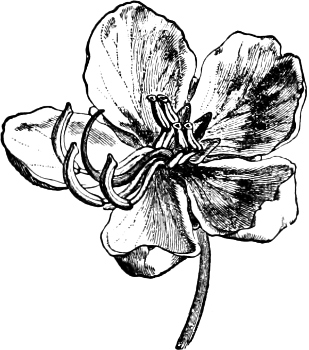
Fig. 509.—Flower.
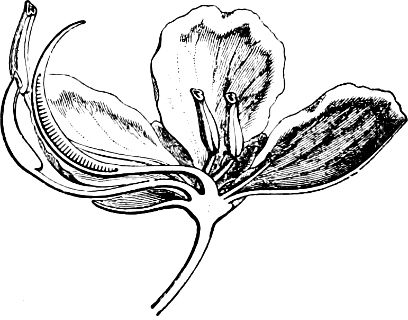
Fig. 510.—The same in long. sect.
Cassia (Figs. 508–510) is the largest genus (about 200
species); it has an almost hypogynous, zygomorphic flower with 5 free
sepals and petals; of the 10 stamens the 3 posterior are generally
barren, the others are of very unequal length and open at the apex by
pores (Fig. 509). In some (the Senna group) the fruit is
a flat, short, thin, dehiscing pod; in others (Cathartocarpus)
it is round, long, woody or fleshy, indehiscent, and divided
internally by more or less fleshy transverse walls into as many
cells as there are seeds.—The following also have DEHISCENT
FRUITS: Bauhinia (often lianes, tropical climbers with
tendrils [stem-structures] and anomalous stems), Copaifera,
Hæmatoxylon (whose pod does not dehisce along the suture,
but laterally), Cercis (simple leaves; the corolla resembles
that of the Papilionaceæ, but the posterior petal is the smallest,
and is enveloped by the 2 lateral ones, which are enveloped in their
turn by the 2 anterior).—Fruit Indehiscent: Tamarindus
indica; the pod is almost round, often a little abstricted between
the seeds; the wall is formed by a thin, brittle external layer,
enclosing an acid pulp; well-developed septa are present, between
the seeds; the most internal layer is parchment-like. Calyx 4-merous
by the coalescence of 2 sepals. Only 3 fertile stamens.—Ceratonia
siliqua (Carob-bean, Locusts); the pod is long, compressed, with
thick sutures, and has a wall, the central part of which is more or
less leathery, fleshy and sweet; there are transverse septa between the
seeds, as in the Tamarind. Embryo greenish in endosperm. The flower
is without a corolla, 5 stamens.—Pterogyne (winged fruit),
etc.—Kramerieæ with Krameria is an anomalous group.
Distribution. 80 genera, with 740 species; almost
exclusively in the Tropics. The Carob-tree and Cercis
grow in the Mediterranean basin. The largest and most widely
distributed genus is Cassia, which is found as trees,
shrubs, and weeds in all tropical countries. The order has
many important uses to mankind. Medicinal: the leaves
and pods of Cassia acutifolia and angustifolia
(officinal, Senna-leaves), the fruit-pulp of the
Cassia-sub-genus, Cathartocarpus. Rhatany root
from Krameria triandra (Peru, officinal). Balsam
is extracted from a number of Copaifera-species (Balsam
of Copaiba) from S. Am. (officinal), and from Hymenæa
(Copal balsam), Trachylobium and others. Edible
fruits are obtained especially from the Carob-tree (from the
East) and the Tamarind (officinal). The heart-wood of several
species of Cæsalpinia, such as C. brasiliensis
(the Pernambuco-tree), echinata (Red-tree), and
sappan, yield dyes; Hæmatoxylon (H.
campechianum, Logwood), Copaifera bracteata
(Amarant-tree).—Timber is obtained from many
(Melanoxylon and others). In Europe they are of
little importance as ornamental plants, these being confined
principally to the species of Gleditschia (G.
triacantha, from N. Am.) and Cercis (the Judas-tree,
C. siliquastrum, S. Eur.), which are cultivated in
gardens; but in tropical gardens beautiful flowering species,
e.g. of Cassia, Poinciana, Brownea,
are found, and the most beautiful of all ornamental plants, the
Indian Amherstia nobilis.

Fig. 511.—Diagram of Faba vulgaris:
f the standard; v the wings; k the keel.
Order 2. Papilionaceæ. The flower (Figs. 511, 512) is
strongly zygomorphic and somewhat perigynous (Fig. 512
B; most frequently more on one side than the other). The calyx
is gamosepalous and persistent. The polypetalous corolla has
descending imbricate æstivation, the posterior, large leaf,
the standard (Figs. 511 f; 512 B’, e),
covering in the bud the two lateral ones, the wings
(Figs. 511 v; 512 B’, a), which again cover the
two anterior; these are united in the form of a boat, the keel
(k and c); the wings and the two petals of the keel are
very unsymmetrical. That the keel is formed of two petals is seen by
its position (in front of one sepal) and by the two often more or less
free claws. The 10 (5 + 5) stamens (monadelphous) are either
all united into one bundle, or into two bundles (diadelphous),
the posterior one being free (Fig. 512 C). The ovules are
curved and also the embryo (Fig. 512 G),
especially the hypocotyl, so that the radicle assumes a position close
to the edge of the thick, fleshy cotyledons. Endosperm wanting; the
cotyledons are very rich in proteid reserve material. The forms of the
fruit and exceptions are described under the genera.
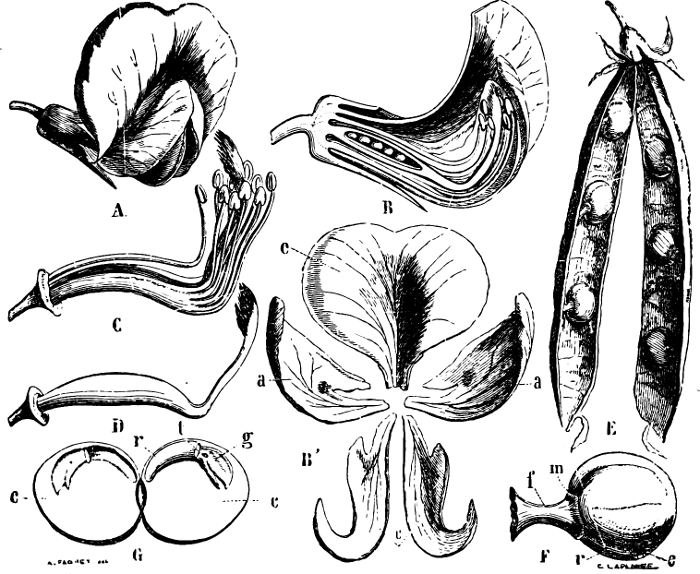
Fig. 512.—Pisum sativum: A
entire flower; B in longitudinal section; C gynœceum
and stamens; D gynœceum; B’ corolla dissected, e
standard, a, a wings, c keel; D seed opened
to show the cotyledons (c), the radicle (r), the plumule
(g); E fruit (legume); F seed.
Geocarpic fruits, i.e. those which penetrate
the soil during their development and ripen underground, are
found in e.g. Arachis hypogæa (see page 472),
Trifolium subterraneum, Vicia amphicarpæa.
Germination takes place in various ways. In the
majority the cotyledons are raised above the ground as green,
leaf-like bodies; in the Vicieæ they remain thick and white,
and are always enclosed in the testa, and are therefore never
able to take part in the work of assimilation; in species of
Phaseolus, on the other hand, they are raised well above
the ground and become green, but remain however thick and fleshy.
1, 2. The two groups Podalyrieæ (the
majority of the genera are Australian) and Sophoreæ
(Sophora, Edwardsia, etc.), represent the oldest
type, as they have 10 free stamens and so form the
transition to the Cæsalpiniaceæ. Nearly all are trees and shrubs.
3. Astragaleæ. Herbs or shrubs, less frequently
trees, with imparipinnate leaves (without tendrils). The
flowers are generally borne in racemes or spikes. Stamens monadelphous
or diadelphous.—Astragalus (Milk-Vetch) has the legume
incompletely divided longitudinally into 2 loculi by a septum formed
by the incurved dorsal suture. Diadelphous.—Glycyrrhiza
(Liquorice); Colutea (Bladder-Senna) from S. Europe;
Robinia (the false Acacia) with thorny stipules;
Indigofera (the Indigo plant); Amorpha (which has only
one petal, namely the standard, and the fruit a nut), Caragana,
Wistaria (a climbing shrub), Galega. Carmichælia
australis, when old, produces flat branches with scale-like leaves.
4. Vicieæ. Climbing herbs with
paripinnate leaves, the midrib ending in a point or frequently
in a tendril, which generally is branched, representing lateral
veins without mesophyll; stamens diadelphous; the cotyledons remain
underground on germination.—Vicia (Vetch) has a filamentous
style, hairy towards the tip, and a pod with many seeds; climbing
by means of tendrils; the leaves have many leaflets.—Faba
(F. vulgaris, Horse-bean) is erect, without tendrils; its pod
is thick with spongy septa between the seeds.—Ervum (Lentil)
has a pod with only 1–2 seeds, and sweeping hairs (stylar-brush) on
the inner side of the style.—Pisum (Pea; Fig. 512) has very
large stipules, the bent style has a hollow groove on the anterior
side. P. sativum (Common Pea), P. arvense (Grey
Pea).—Lathyrus (Sweet Pea) generally has an angular, winged
stem and most frequently only a few pairs of leaflets. The style is
flattened, with sweeping hairs on the back. In L. aphaca
the stipules alone are developed into foliage-leaves, while the
remainder of the leaf is modified into a tendril.—Cicer
has a nearly straight embryo and imparipinnate leaves with dentate or
incised leaflets. C. arietinus (Chick-pea).—Abrus
(precatorius, etc.); the seeds (“Crab’s eyes,” “Paternoster
peas,” “Jequirity”) are scarlet with a black spot round the hilum.
5. Phaseoleæ. Herbs, twining or erect, but not climbing
by tendrils; the leaves are imparipinnate, generally ternate,
and bear small, linear bodies resembling stipules at the base of
the stalks of the leaflets. The inflorescences are most frequently
compound, groups of few flowers being situated on short, nodose,
lateral axes borne on a longer stem. On germination the cotyledons
are raised a considerable distance above the ground, and become
greenish, but do not become leaf-like; in P. multiflorus they
remain underground. Stamens as in the Vetches.—Phaseolus
(Kidney-bean): the keel with the stamen and style is spirally
twisted (to the right). Herbs, twining to the left.—The
“Calabar-bean” (Physostigma venenosum), Erythrina,
Clitoria, Glycine, Soja, Mucuna,
Apios, Canavalia, Vigna, Dolichos,
Cajanus, Rhynchosia, etc.
6. Trifolieæ (Clovers). Herbs with
ternate leaves, the leaflets are often dentate with the veins
prolonged into the teeth; stamens diadelphous; fruit 1-locular,
1–few-seeded, pyxidium-like, irregularly dehiscent, or more frequently
a nut. The flowers are generally borne in capitula, racemes,
or spikes.—Trifolium (Clover). The corolla is gamopetalous.
The calyx persists, together with the corolla, round the ripe fruit.
The inflorescence is a spike, capitulum or capitate umbel; the leaves
are ternate, and have adnate stipules.—Medicago (Medick).
The corolla falls off after flowering; fruit curved like a sickle
or spirally twisted; it is a nut, and opens with difficulty. Leaves
ternate.—Melilotus (Melilot) has a small, spherical or
lanceolate, thick and wrinkled fruit, which as a rule is indehiscent.
The inflorescence is a raceme, often long, or a spike, sometimes a
capitulum. Leaves ternate.—Ononis (Rest-harrow) differs in
having monadelphous stamens and in being more shrub-like and bushy, and
in having a normal, 2-valved pod, by which characteristic it approaches
the Genisteæ. The flowers are generally rose-coloured, solitary, or in
few-flowered racemes in the leaf-axils. Thorns (branches) are often
present; the leaves are compound with only one small leaflet (the
terminal one), or ternate with adnate stipules.
7. Loteæ. Herbs with ternate or imparipinnate leaves,
with entire leaflets. In the latter case, when the lowest pair of
leaflets is placed quite close to the sheath, the stalk is wanting,
and apparently a trifoliate leaf with large stipules is developed.
Flowers in an umbel or capitulum. Stamens monadelphous or diadelphous,
the filaments (either all of them, or only the 5 sepal-stamens) are
widened at the top.—Lotus (Bird’s-foot-trefoil) has a long,
round pod.—Tetragonolobus.—Anthyllis (Lady’s-finger);
the fruit is a nut, which is distributed by the wind by means of the
membranous, bladder-like calyx, which completely encloses and falls off
with it.
8. Genisteæ. The majority are shrubs or trees with
apparently simple leaves, i.e. compound leaves with only one
leaflet (the terminal leaflet), or ternate leaves; the stipules in
most instances are very small or are entirely wanting; stamens
monadelphous.—Genista (Dyer’s-weed) has apparently simple
leaves; the branches often terminate in a thorn. The strongly-winged
stems in G. sagittalis are its most important organs of
assimilation. Bossiæa rufa has flat branches, its leaves
being reduced to small, pointed stipules.—Sarothamnus
(Broom) has switch-like, angular branches and often both the
apparently simple and ternate leaves on the same shoot; style spirally
rolled.—Cytisus (Laburnum). Ulex (Furze; in U.
europæus, the seedlings bear a few foliage leaves, but the leaves
succeeding these are modified into thorns); Spartium;
Crotalaria, etc.—Lupinus (Lupin) is allied to this
group; it has a thick, often somewhat fleshy pod, and digitate leaves
with adnate stipules.—Retama.
9. Hedysareæ are especially recognised by having
the ovary divided by transverse septa into as many cells as there
are seeds, the fruit thus becomes a lomentum, dehiscing
transversely into nut-like joints (Fig. 513).—Ornithopus
(Bird’s-foot); Coronilla; Hippocrepis; Onobrychis
(Sainfoin) has a fruit with only 1 joint (i.e. a 1-seeded nut);
Desmodium; Alhagi; Hedysarum, etc.—Arachis
hypogæa (Earth-nut) has a pod which is abstricted between the
seeds, and is indehiscent, but is not multilocular nor a true lomentum;
it is reticulately wrinkled externally, and ripens underground; the
basal part of the ovary is prolonged after flowering, attaining a
length of several inches, and buries the young fruit in the soil. The
embryo is straight.—Desmodium gyrans is well-known for its
motile leaflets.

Fig. 513.—Hedysarum coronarium.
10. Dalbergieæ. 25 genera; especially in
Tropical America; the majority are trees, a few shrubs or
lianes; the leaves are simple or imparipinnate. The fruit is
indehiscent in all; in some it is a winged, in others
a wingless nut (Machærium, Dalbergia,
Centrolobium, etc.), in others, again, a drupe,
e.g. in Dipteryx (Tonquin-bean) and Andira.
In some genera the embryo is straight.
Pollination. Especially effected by Bees. The nectar
is secreted by a ring or disc-like portion round the base
of the gynœceum or the inner surface of the receptacle. The
flower is constructed with a peculiar mechanism to ensure
cross-pollination by insects. The pollen is shed just before
the flower opens, and is retained in a pouch formed by the
keel. An insect visiting the flower uses the wings and keel
for a landing-stage, and in attempting to reach the honey
presses down the wings and the keel which are locked together
near the standard; the stylar-brush by this means is forced
through the apical opening of the keel and a little pollen is
thus swept out and deposited upon the abdomen of the visiting
insect as it presses against the apex of the keel; the insect
thus carries away pollen and may effect cross-pollination. In
the different flowers this arrangement is modified in various
ways to promote pollination. 5000 species (319 genera);
especially in the Tropics, where many are important forest
trees.—The following plants are used FOR FOOD:
Pisum sativum (W. Asia?) and arvense (Italy);
Phaseolus vulgaris (Kidney-bean, American; Dolichos
sinensis was known to the Greeks and Romans under the name
“φασηλος,” “phaseolus”), P. compressus (French-bean),
etc.; Faba vulgaris (Field-bean, Horse-bean;
from the Old World); Ervum lens (Lentil, Eastern
Mediterranean); in tropical countries the oil-containing seeds
of Arachis hypogæa.—The following are FODDER
plants: Vicia sativa, Faba vulgaris, Onobrychis
sativa (Sainfoin), Medicago sativa (Lucerne),
and lupulina (Medick), species of Trifolium,
Hedysarum coronarium. Officinal: “Liquorice
root,” from Glycyrrhiza glabra (S. Europe); “Red
Sandalwood,” from Pterocarpus santalinus (Tropical
E. Asia); Gum Tragacanth, from Astragalus-species
(E. Mediterranean); Balsam of Peru, from Toluifera
pereiræ, and Balsam of Tolu, from Toluifera balsamum.
Calabar-beans, from Physostigma venenosum; Kino,
from Pterocarpus marsupium; the pith of Andira
araroba is used under the name of “Chrysarobin.”—Of use
TECHNICALLY: Genista tinctoria (yellow dye) and
Indigofera-species (Indigo), the bast of Crotalaria
juncea (Sunn Hemp); the seeds of Dipteryx,
which contain Coumarin, and are highly scented, and Balsam
of Myroxylon. Poisonous: the seeds of
Laburnum (Cytisus laburnum), various species
of Lathyrus, and Abrus precatorius; the latter
contain two poisonous proteids, paraglobulin and albumose,
which resemble snake-poison in their effects. The following
are ORNAMENTAL plants: Phaseolus multiflorus
(Scarlet runner, from America), Robinia pseudacacia,
Amorpha, Colutea, Coronilla, Indigofera
dosua, Wistaria polystachya, Cytisus laburnum
(Laburnum, S. Europe, Orient.) and other species.
Order 3. Mimosaceæ. The flowers are most frequently hypogynous
and regular, the æstivation of the corolla is valvate
and, in the majority of instances, that of the calyx also. The flower
is 4-merous, less frequently 5- or 3-merous.—The flowers are generally
small, but are always borne in compact, round capitula or spikes
(Fig. 514); they are hypogynous or perigynous. The calyx is generally
gamosepalous and the corolla gamopetalous, the latter
being frequently wanting. The stamens are equal or double the number
of the petals (Mimosa, etc., in M. pudica, e.g.
S4, P4, A4, G1) or (in Acacia, Inga, etc.) in a large,
indefinite number, free or monadelphous, often united to the corolla
(Fig. 514 b). The colour of the flower in most cases is due to
the long and numerous stamens. The fruit is various. The embryo
is straight as in the Cæsalpiniaceæ. Entada and many
species of Mimosa have a flat, straight, or somewhat sickle-like
pod, which resembles the siliqua of the Cruciferæ in that the sutures
(in this instance, however, dorsal and ventral suture) persist as a
frame, but the intermediate portion divides, as in the transversely
divided siliqua, into as many nut-like portions as there are seeds.
Some species have a pod of enormous dimensions. The seeds of Entada
gigalobium are often carried from the West Indies to the N. W.
coasts of Europe by the Gulf Stream.—The fruit of Acacia
in some species is an ordinary pod, in others it is transversely
divided, or remains an undivided fruit, a nut.—This order includes
both trees and herbaceous plants, which are often thorny; the leaves
are usually bipinnate (Fig. 514) and are sensitive, and also possess
sleep-movements.—Many Australian Acacias have compound leaves only
when young, but when old have phyllodia, i.e. leaf-like
petioles without blades, placed vertically. A large number have thorny
stipules, which in some (Acacia sphærocephala) attain an
enormous size, and serve as a home for ants, which in return protect
their host-plant against the attacks of other, leaf-cutting ants.

Fig. 514.—Acacia farnesiana: a
inflorescence; b flower.
Other genera besides those mentioned are: Adenanthera,
Desmanthus, Parkia, Inga (with rather fleshy,
indehiscent fruit), Calliandra, etc.
1350 species (30 genera); none natives of Europe, their
home being the Tropics and sub-tropical regions, especially
Australia and Africa.—Fossils in Tertiary.—Gums are found
in many species of Acacia, especially the African (Gum
arabic) and Australian, of which some are officinal. The
bark, and also the fruits, contain a large amount of tannic
acid and are used as astringents and in tanning (“Bablah” is
the fruits of several species of Acacia). Catechu is a
valuable tanning material extracted from the wood of Acacia
catechu (E. Ind). The flowers of Acacia farnesiana
(Fig. 514) are used in the manufacture of perfumes. With us
they are cultivated as ornamental plants, e.g. A.
lophantha and many others, in conservatories.
The flowers are most frequently regular, 5-merous in the three
most external whorls, eucyclic and perigynous or epigynous, less
frequently hypogynous. A characteristic feature is that the
ovary is tricarpellary, unilocular, and with 3
parietal placentæ which sometimes meet in the central line
(Cucurbitaceæ). The styles are generally free and bifid.
To all these characteristics, however, there are exceptions. The
Cucurbitaceæ are sometimes placed among the Sympetalæ, close to the
Campanulinæ, but they are not allied to the Sympetalæ, from which they
differ especially, for instance, in the structure of the ovule. The
position of the Begoniaceæ in this family is also open to doubt.
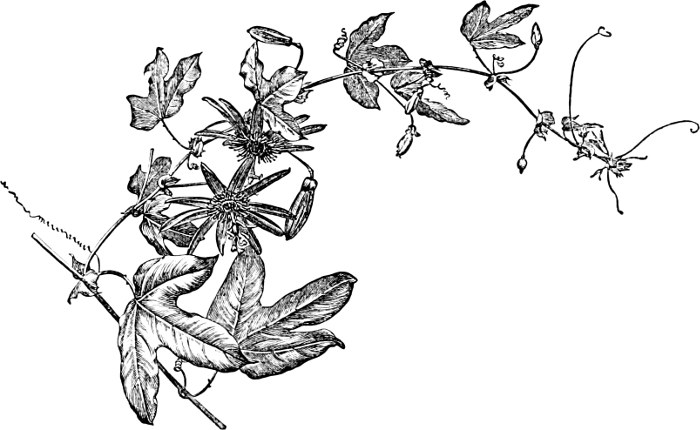
Fig. 515.—Passiflora cœrulea
(reduced).
Order 1. Passifloraceæ (Passion-flowers). The majority
are herbs which climb by means of tendrils (modified branches) and
have scattered, stipulate leaves, often palminerved and lobed (Fig.
515). The flowers, which are often large and beautiful, are regular, ☿,
with S5, P5, A5, G3; the calyx and corolla are perigynous, and
immediately inside the corolla is the “corona,” consisting of numerous,
tapering, filamentous bodies, or sometimes united in rings, most
frequently petaloid and coloured; the stamens are raised on a long,
round internode above the cup-like receptacle; immediately above
these is the gynœceum with its 3 free styles and capitate stigmas; the
ovary is unilocular with 3 parietal placentæ. Fruit most frequently a
berry. The seeds have an aril.
210 species; especially in Tropical America. Several
Passiflora-species are ornamental plants, and the fruits
of some species are edible.
Order 2. Papayaceæ. The best known representative is the
Papaw (Carica papaya), a Tropical American tree whose stem is
usually unbranched, and bears at its summit several large, palmilobed
leaves on long stalks. The stem and leaves have latex. The large,
Melon-like berries are edible, and for this reason it is cultivated
in the Tropics. Flowers unisexual, with slightly different structure
in the ♂-and ♀-flowers, besides intermediate forms. The ♂-flower has
a gamopetalous, the ♀-flower a polypetalous corolla.—The milky juice
contains a substance with similar action to pepsine. 10 stamens. 5
carpels.
Order 3. Turneraceæ. 85 species; especially in America.
Order 4. Samydaceæ. 160 species; tropical.
Order 5. Loasaceæ. Herbaceous plants seldom shrubs, sometimes
climbing, and nearly always studded with stiff hairs, in some
instances stinging or hooked. The leaves are most frequently palmilobed
and without stipules. The flowers are regular, ☿, polypetalous,
entirely epigynous, with 4–5 sepals, petals and stamens, or more
frequently (by splitting) many stamens, those which are placed before
the sepals being generally barren and more or less petaloid; carpels
most frequently 3, united into an inferior, unilocular ovary with 3
parietal placentæ, above which the receptacle is generally more or less
prolonged. Fruit a capsule; in Gronovia an ovary with 1 ovule
and fruit a nut.
115 species; principally from S. Am. A number of annuals are
often grown in our gardens: Bartonia aurea (California);
Mentzelia; Cajophora; Gronovia.
Order 6. Datiscaceæ. 4 species, especially in the
Tropics.—Datisca cannabina (Asia Minor) resembles the Hemp
in external appearance. The flowers are diœcious, insignificant;
♂-flowers: a low, gamosepalous calyx, no corolla, and an indefinite
number of stamens; ♀-flowers; epigynous; ovary unilocular with
free, mostly bifid, styles, and generally 3 parietal placentæ. In most
cases the ovary is not entirely closed at the top (as in Reseda).

Fig. 516.—Begonia rex (reduced).
Order 7. Begoniaceæ. This order principally comprises herbs or
under-shrubs with succulent stems (having scattered vascular bundles in
the pith); the leaves are arranged in two rows (a divergence of 1/2)
and are asymmetrical, as a rule more or less obliquely cordate,
or ovate with cordate base (Fig. 516); large, caducous stipules are
present. Inflorescences dichasial, or unipared scorpioid cymes; the
flowers are unisexual; the first ones (the oldest) are ♂-flowers, while
♀-flowers are found especially on the younger axes. The ♂-flowers
have most frequently 2 + 2 coloured perianth-leaves, and many stamens
collected into a head in the centre of the flower; the ♀-flowers are
epigynous with 5 coloured perianth-leaves (placed spirally with
a divergence of 2/5) and a trilocular ovary, bearing 3 bifid styles
and 3 wings (the wings usually of unequal size); in the inner angle of
each loculus there is one large projecting placenta, or two plate-like
placentæ (the bent back edges of the carpels) studded with ovules.
Fruit a capsule, with many extremely small seeds.—Begonia.
420 species; almost all from the Tropics (Am., Asia).—Many
species, with varieties and hybrids, are ornamental plants in
houses and conservatories, chiefly on account of the form,
colour and markings of their leaves; but also for their very
beautiful flowers. They reproduce easily by adventitious buds
from leaves and portions of leaves placed on damp soil; some
have bulbils. Like the Oxalideæ they contain an acid sap.
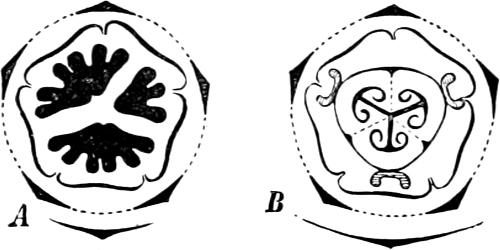
Fig. 517.—Ecballium agreste. Diagram of
a ♂-and a ♀-flower.
Order 8. Cucurbitaceæ. The flower is epigynous, and,
as a rule, is also provided with a leaf-like, cup- or bell-shaped
receptacle above the ovary, to which the perianth and stamens are
attached; the flowers are regular, unisexual, with rudiments of
the other sex, and 5-merous: sepals 5, narrow and pointed, with the
median sepal posterior (Fig. 517), petals 5, stamens 5, and carpels
3 (rarely 4–5); the corolla is gamopetalous in the majority,
polypetalous in some; generally plicate-valvate in the bud. The
anthers in the ♂-flowers are extrorse, and monothecious, i.e. only
one half of each of the anthers of the 5 stamens is developed,
the pollen-sac having frequently a peculiar [**rtilde]-shaped
curve (Fig. 518 A, B); the stamens are either all
united into a column (e.g. in Cucurbita), or they
are united in pairs, so that only one remains free (Figs. 517
A; 518 A); in the latter case there appears to be one
small stamen with a ~-shaped, curved pollen-sac and two larger
ones, each with two curved pollen-sacs placed as in Fig. 517 A.
The original form appears to be Fevillea with free petals and
5 free stamens. Sometimes the rudiment of a gynœceum is present. The
carpels are united into an ovary with 3 (4–5) placentæ formed by
their united edges. These are thick, fleshy, and bifid, bearing
a number of ovules on each side (Figs. 517 B; 518 C,
D); in general the placentæ are so large that they not only
meet in the centre, but also fill up the ovary as far as the wall of
the pericarp. The whole interior of the fruit thus becomes a juicy mass
in which three lines may be seen, meeting in the centre (the boundaries
of the individual placentæ), and near the circumference 6 groups of
seeds (Fig. 518 D). When the carpels are equal in number to
the petals they alternate with them. The style is short and
thick, and generally divided into 3 (4–5) branches, with a horse-shoe
shaped stigma on each branch (Fig. 518 C). The fruit
is most frequently a many-seeded berry; in some it attains a
considerable size and has a firm external layer (Cucurbita,
Lagenaria, etc.). The embryo is straight, has no
endosperm, but contains a large quantity of oil. The
exceptions to the above characters will be found under the genera.
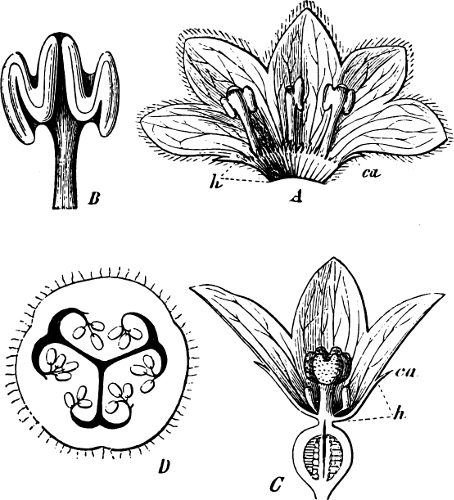
Fig. 518.—Citrullus colocynthis:
A ♂-flower, cut open and spread out; B stamen; C
♀-flower in long section; h receptacle; ca calyx;
D transverse section of ovary.
Exclusively herbs, generally with stiff hairs and yellow flowers. Many
species are annuals, others are perennial, having tuberous roots or
hypocotyls. The leaves are scattered, long-stalked, in most cases more
or less heart-shaped, palminerved, palmilobed, and exstipulate; in
their axils are found both flowers (singly, or in an inflorescence)
and a vegetative bud, and outside the axil, on the anodic[37] side
of the leaf, a simple or branched tendril, by which the plant
climbs (exceptions: e.g. Ecballium).
The position of the flowers, branches and tendrils situated
in and near the leaf-axils is as follows. In the leaf-axils,
a flower is borne (as a branch of the first order), ♂ or ♀,
according to the conditions of the various genera. This branch
is not situated in the centre of the axil, but is removed
slightly towards the anodic side of the leaf. Of its two
bracteoles as a rule only the one lying on the anodic side is
developed, namely as a tendril, which is displaced to a position
outside the axil. The branch of the first order bears on its
catodic side an inflorescence (in the axil of the suppressed
bracteole), on the anodic side a vegetative bud which grows out
into a branch like the main axis. The subtending leaf of this
branch is thus the tendril; but when it has several arms the
condition is complicated by the appearance of an accessory bud
which unites with its subtending leaf, the tendril, its leaves
also becoming tendrils (situated on an undeveloped internode);
the many-branched tendril is thus a branch, and the tendril-arms
are its leaves, except the main arm which is its subtending
leaf. Other explanations of these difficult relations have been
given.—The germination is somewhat peculiar, owing to
the fact that a heel-like prolongation is formed at the base
of the hypocotyl to assist in separating the two halves of the
testa from each other, and to facilitate the unfolding of the
cotyledons.
Cucurbita (Pumpkin, Marrow) has branched tendrils; the flowers
are monœcious, and are borne singly; the corolla is bell-shaped, and
divided almost as far as the middle. The stamens are all united into a
tube; the compressed seeds have a thick, blunt edge.—Cucumis
has (generally) unbranched tendrils; the ♀-flowers are borne singly,
whilst the ♂-flowers are borne in groups: the corolla is divided
nearly as far as the base, and the stamens are united 2-2-1.
The connective is elongated above the anthers. The seeds have a
sharp edge.—Citrullus (Fig. 518) has a corolla similar to
Cucumis, but ☿-and ♂-flowers are borne singly; the stigma is
only 3-lobed, the fruit most frequently spherical.—Ecballium
(Squirting Cucumber, only 1 species, E. elaterium) has no
tendrils, and is therefore not a climber. The oblong fruit is pendulous
from the apex of its stalk, and when ripe is distended with an acrid,
watery fluid; on being touched the fruit is detached, and the seeds,
together with the watery fluid, are violently ejected through the
aperture formed at the base of the fruit. The ♂-flowers are borne in
racemes near the solitary ♀-flowers (Fig. 517).—Bryonia (White
Bryony) has chiefly unbranched tendrils and small, greenish-yellow,
usually diœcious flowers with rotate corolla, in many-flowered
inflorescences; the small, spherical berry has no specially firm outer
layer, and generally only few seeds. The tap-root and a few of the
other roots are tuberous. B. alba (berry black; monœcious) and
dioica (berry red; diœcious). Among other genera may be
mentioned: Lagenaria (Gourd); the fruit has a woody external
layer which, after the removal of the pulpy integument, may be used as
a gourd. Luffa has a polypetalous corolla; the fruit is dry,
and consists internally of a network of vascular bundles; it opens by
an aperture at the summit. Benincasa; the fruit has a close,
bluish coating of wax. Trichosanthes (Snake Cucumber) has a
thin, round, long and curved fruit. Momordica; the fleshy fruit
opens and ejects the seeds. Cyclanthera takes its name from the
staminal column which is found in the centre of the ♂-flower, bearing
a bilocular, ring-like anther which opens by a horizontal cleft. The
fruit is unilocular by suppression, has 1 placenta, and when touched
opens and ejects the seeds. Sicyos and Sechium have
only unilocular ovaries with one pendulous ovule. Sechium
has, moreover, 5 free stamens, of which only one is halved, the
other 4 having both halves of the anther. Fevillea and
Thladiantha also have 5 free stamens. Dimorphochlamys has
dimorphic flowers.
Pollination is effected by insects, chiefly bees
or wasps, the nectar being secreted by the inner, yellow
portion of the receptacle; in the ♂-flower access is gained
to the nectar through the slits between the stamens, which
arch over the nectary.—85 genera; about 637 species;
especially in the Tropics. Only two are found in the whole
of N. Europe, Bryonia alba and dioica; in S.
Europe, Ecballium also. Most of the cultivated species
have been obtained from Asia, such as the Cucumber, Melon,
Colocynth, several Luffa-species (the “Gourds” mentioned
in Scripture are Cucumis chate); from Africa, the
Water-melon, Cucurbita maxima, and others; from S. Am.,
no doubt, the Pumpkin (C. pepo and melopepo).
Uses. Many species are used in medicine or for
domestic purposes. Bitter, poisonous properties
are found; the fruits of the two officinal ones are
purgative: Citrullus colocynthis (Mediterranean, E.
India, Ceylon) and Ecballium elaterium, as well as
various tropical species, the roots of Bryonia, etc.—The
following are cultivated AS ARTICLES OF FOOD:
Pumpkin (Cucurbita pepo, etc.), Cucumber (Cucumis
sativus), Melon (Cucumis melo), the Water-melon
(Citrullus vulgaris), Sechium edule (Chocho),
certain species of Luffa (the young fruit). The Bottle
Gourd is cultivated in tropical countries for the sake of its
hard pericarp, which is useful for bowls, bottles, etc. The
fruits of Luffa have a number of reticulately felted,
tolerably firm vascular bundles, which render them serviceable
in various ways (as a kind of “sponge”). The Cucurbits are of no
use in the manufactures. Only a few are cultivated as ornamental
plants, chiefly as curiosities.
The leaves are most frequently opposite, simple,
entire (rarely dentate), and exstipulate. The flowers are
regular and epigynous (perigynous in Lythraceæ
and a few others), ☿, polypetalous; the number of members in a
whorl is generally 4 or 5 (S, P, A, or most frequently A 2, G), but
sometimes it becomes (e.g. Myrtles and Lythraceæ) very
large in the andrœcium by splitting, and in the gynœceum also is
often different. (When suppression takes place it is principally in
the corolla and petal-stamens.) In nearly all instances the calyx
is valvate. Gyncœceum multicarpellary, multilocular, with
only one style (except Haloragidaceæ). In the majority
the ovules are situated on an axile placenta in the multilocular
ovary. Endosperm is wanting in the majority.—Less
important exceptions: Rhizophoraceæ and Gunnera have
stipules. Haloragidaceæ have several styles and endosperm.
Rhizophora also has endosperm.
Order 1. Lythraceæ. Hermaphrodite, perigynous
flowers which are most frequently 6-merous, viz. S 6
(often with a commissural “epicalyx,” Fig. 519 c),
one segment posterior, P 6, A 6 + 6 or 6 + 0 and G 2–6, forming
a 2–6-locular ovary with many ovules in the loculi, style single,
and capitate stigma. The gynœceum is free at the base of the
tubular, or bell-shaped, thin, strongly veined receptacle,
which bears the other leaf-whorls on its edge and inner side. Fruit
a capsule. No endosperm.—To this order belong both herbs, shrubs
and trees. The branches are frequently square, the leaves always
undivided, entire, and without stipules, or with several
very small stipules, and often opposite. The calyx is valvate. The
flower is regular (except Cuphea) and frequently large and
beautiful. The stamens are generally incurved in the bud, and the
petals irregularly folded.

Fig. 519.—Lythrum salicaria. c
the “epicalyx.”
Lythrum (Loose-strife). The flower is diplostemonous and
6-merous, with a long, tubular receptacle with epicalyx-teeth (Fig.
519 c). The 12 stamens are arranged in two tiers on the
inner side of the receptacle. The gynœceum is bicarpellary. The
flowers are borne in small dichasia in the leaf-axils, and their
number is increased by accessory inflorescences beneath the main
inflorescence.—The native species, L. salicaria, is trimorphic
(long-styled, mid-and short-styled forms, Fig. 520). Cross-pollination
is chiefly effected by humble-bees and bees, which seek the nectar
formed at the bottom of the receptacle. Other species are only
dimorphic, or even monomorphic.—Closely allied are, Nesæa,
Diplusodon, Lagerstrœmia, and Cuphea, whose flower
resembles that of Lythrum, but is zygomorphic. In Cuphea
the receptacle is oblique and at the back prolonged into a spur,
in which the nectar, secreted by a gland situated behind the ovary,
is collected; the calyx and corolla gradually become reduced in size
toward the anterior side of the flower; the reverse, however, is the
case with the 11 stamens (the posterior one is absent); the posterior
loculus in the bilocular ovary is sometimes barren; the fruit, when
ripe, dehisces along the posterior side, the ovary as well as the wall
of the receptacle being ruptured by the placenta, which expands and
projects freely. The flowers stand singly in the centre of the stem,
between the pairs of leaves. This may be explained as follows: of the
two foliage-leaves in each pair, one supports a foliage-shoot, the
other a flower; the foliage-shoot remains in the axil, but the flower
is displaced through the length of an entire internode to the next pair
of leaves, and then assumes a position between these two leaves. All
foliage-shoots stand in two rows, the flowers in two other rows.

Fig. 520.—Lythrum salicaria. One
side of the perianth is removed from all three flowers. A
is long-styled, B mid-styled, and C short-styled.
The direction of the arrows and dotted lines indicates the best
(legitimate) methods of crossing.
Peplis (Water-purslane), a small, annual plant, with
thin, bell-shaped receptacle without projecting nerves. The
small flowers have no petal-stamens, and often also no corolla;
fruit indehiscent.—Ammannia is closely allied to it.
365 species; 30 genera; mostly in the Tropics, and more
especially S. Am.—Some yield dyes, e.g.
Lawsonia inermis (cultivated in Africa and Asia) and
Lagerstrœmeria indica; some contain tannin; others are
ornamental plants, especially in gardens in warm countries.
Order 2. Blattiaceæ. 12 species. Tropical Asia and
Africa. Trees. Formerly included with Punica, but best
placed as an independent order.
Order 3. Melastomaceæ. A very natural and very large
order (150 genera; 2,500 species), its home being chiefly in
tropical S. America, especially the Brazils (termed by Schouw
“The kingdom of Palms and Melastomaceæ”). There are both
herbaceous and arborescent species, which are easily recognized
by the opposite or verticillate, simple leaves which have (with
the exception of a few heather-like species) 3–5–7–9 curved
veins proceeding from the base of the leaf, and connected very
regularly by closely parallel, transverse veins. The flower
is perigynous or epigynous; its type is that of the Onagraceæ
(4–5-merous; 1 whorl of sepals, petals and carpels, 2 of
stamens); the calyx is valvate, the corolla is twisted (to
the left) in æstivation; the stamens are very characteristic;
in the bud they are geniculate; the anther opens in the often
long, beak-like, prolonged point, with 1, less frequently with
2 pores, and has generally ear-like appendages at its base.
The fruit is a berry or capsule. These large and beautiful
flowering-plants play a very important part in South American
landscapes; otherwise they are of slight importance (a few are
cultivated in conservatories, e.g. Centradenia,
Medinilla, Lasiandra, Tibouchina,
Miconia, etc.).
Order 4. Œnotheraceæ (or Onagraceæ). The flowers are
arranged in racemes or spikes, ☿, epigynous, regular, polypetalous,
4-merous in all 5 whorls (1 whorl of sepals, petals and
carpels, 2 of stamens); 2–3–5–6-merous flowers are less frequent;
the calyx is valvate, the corolla twisted in æstivation
(the left edge being covered). Gynœceum simple with multilocular
ovary; the style is undivided, filiform, and bears a capitate
or 4-partite stigma; endosperm wanting; embryo straight.—The majority
are herbs, especially water- and marsh-plants; several are shrubs. No
essential oils. The leaves are alternate or opposite, always single,
and without (or with very small) stipules. The odourless flowers
sometimes have a coloured calyx. In some instances (e.g.
Œnothera, Fuchsia) the receptacle is prolonged more or
less beyond the inferior ovary, and finally falls off. The stamens are
obdiplostemonous (carpels epipetalous); the petal-stamens are sometimes
suppressed. The anthers in some genera are divided into storeys. The
well-pronounced, triangular pollen-grains are connected together by
viscous threads. Small stipules are sometimes found, e.g.
Fuchsia, Lopezia.

Fig. 521.—Flower of Lopezia.
A. Fruit a capsule. Œnothera (Evening Primrose)
is 4-merous, has 8 stamens, a tubular receptacle, and an oblong
capsule with loculicidal dehiscence leaving a centrally placed
column, bearing the seeds.—Epilobium (Willow-herb) deviates
from Œnothera especially in the seeds being hairy (at the
chalazal end of the seed).—Chamænerium is a Willow-herb
with zygomorphic flowers.—The following may be included here:
Clarkia, Eucharidium (an Œnothera with 4
stamens and 3-lobed petals), Godetia and Boisduvalia,
Jussiæa (dehiscence septicidal), Isnardia (petal-stamens
absent, sometimes the petals also).—Lopezia has a peculiar,
zygomorphic flower (Fig. 521); one of the four sepals is bent forwards
and the other 3 backwards; the posterior petals are narrower than
the 2 anterior ones which are turned obliquely backwards and bent
like a knee, with a greenish nectary at the bend; 2 stamens, one only
fertile (the posterior), while the anterior is barren, petaloid, and
spoon-shaped; both are sensitive, which is essential for pollination.
In Fig. 521, a represents an early stage, in which the stamen
and style lie concealed in the staminode; b is the ♂ stage, the
stamen projects from the centre of the flower; c, the ♀ stage,
the style occupies the place of the stamen.
B. Fruit a berry. Fuchsia generally has a coloured
calyx and tubular receptacle; the corolla may be wanting.
C. Fruit a nut. Circæa (Enchanter’s Nightshade)
has a 2-merous flower (S2, P2, A2 + 0 [petal-stamens are wanting], G2).
The flowers are borne in racemes without bracts.—Gaura.
D. Fruit a drupe. Trapa (Horn-nut); a peculiar
aquatic plant; the submerged stem has long internodes and lanceolate
leaves, falling off at an early period, but at each node are found 4
long roots with thin, lateral roots (sometimes erroneously regarded as
leaves) borne pinnately; the stem reaching the surface of the water,
bears a rosette of rhombic foliage-leaves, with large, inflated stalks
containing air, and forming the floating apparatus of the plants.
In the axils of the leaves (as in Gunnera) 8 small, stipular
structures are present. The flowers are solitary in the axils of the
foliage-leaves (S4, P4, A4 + 0, G2), semi-epigynous. There is
an 8-lobed, crenate disc on the free portion of the ovary; one ovule
in each loculus. The fruit is a drupe with 4 (or 2) prominent
horns (the persistent sepals), which after the pulp has decayed away
bear a series of hooks turned downwards on each side, i.e.
sclerenchymatous bundles which formerly lay concealed in the pulp of
the sepals. The germination is peculiar: one of the cotyledons is
large, and its thick extremity remains in the fruit, the other however
is small and is pushed out at the apex of the fruit together with the
radicle and plumule; the development of the root soon ceases, and the
plumule usually grows into a stem entirely without branches, similar
to the one described above, only that 1–2 precisely similar shoots
arise in the axil of each cotyledon, so that each embryo produces 3–5
shoots.—Trapa, by its mode of life, its 1-seeded fruit, etc.,
forms a transition to Haloragidaceæ.
The large-flowered forms are adapted for insect-pollination and
are often protandrous, the small-flowered ones are homogamous
and may pollinate themselves. Œnothera is adapted for
hawk-moths and bees.—330 species; especially in temperate
climates, chiefly in the Northern Hemisphere. Epilobium,
Circæa are natives of this country; Trapa is
extinct in this country, it has been found in a semi-fossilized
condition near Cromer and in bogs in Denmark, and existed
in Sweden until a few years ago; Œnothera has been
introduced from N. Am.—A number of N. Am. species are grown
as ornamental plants in our gardens. The seeds of Trapa
natans are edible, and used as food in China.
Order 5. Haloragidaceæ. This is a reduced form of the
Œnotheraceæ, and principally differs from these in the presence
of endosperm and free styles. Only 1 ovule in
each loculus.—84 species distributed over the entire globe;
the majority are aquatic plants. The most advanced type is
Myriophyllum (Water-Milfoil), with a regular, epigynous
flower (S4, P4, A4 + 4, G4), most frequently diclinous
(monœcious); the fruit is a 2–4-partite schizocarp.
Aquatic plants, most frequently with pectinate, pinnate
leaves.—Haloragis.—Gunnera (a dozen species from
the Southern Hemisphere) forms the next step in the reduction. Large,
scattered, rough-haired, and softly-spined leaves, with small flowers
in crowded inflorescences. The flower, when most complete, has S2, P2,
A2 (petal-stamens) and G2, forming an inferior, unilocular ovary with
1 ovule. It is remarkable for the great number of stipules placed in
transverse rows in the leaf-axils, for the peculiar glandular organs,
and for the colonies of Nostoc, which are found embedded in the
cortex as a kind of parasite.—The simplest form is Hippuris
(Mare’s-tail) with an extremely small, crenate or entire calyx, without
corolla, and with only one stamen and one carpel, forming an inferior,
unilocular ovary with only one ovule. Fruit a drupe with thin pulp.
It is an aquatic plant with creeping, sympodial rhizome, and erect
unbranched shoots, bearing numerous small, verticillate leaves. The
small flowers are situated singly in the leaf-axils.
Order 6. Rhizophoraceæ. Tropical trees or shrubs (50
species, the best known being Rhizophora mangle,
Mangrove) which grow gregariously, especially along the banks of
rivers and by sea-coasts, where the water is quiet and brackish,
and where they form the so-called Mangrove-swamps. Aerial roots
are formed on the stems and branches (Fig. 522 A). The
seeds germinate in the fruit, which by arrest contains only one
seed (Fig. 522 B), before it is detached from the tree.
The radicle projects considerably from the seed, and hangs down
freely in the air; when the embryo is finally detached from
the mother-plant, the separation is effected by the hood-like
cotyledon, which entirely envelops the plumule, becoming
detached from the rest of the embryo, which falls down, while
the hood-like cotyledon remains enclosed in the fruit. The
embryo, after it has fallen, strikes root, and continues growing
in the undisturbed mud under the trees, or perhaps it may first
be drifted about by the water, being well adapted for this by
its peculiar, tough nature, and large, intercellular spaces.—It
may also further be remarked that the anther is divided into a
number of small loculi. The leaves are stipulate. The endosperm
projects from the micropyle, growing out from the base of the
seed, and thus serves as an organ of suction to convey nutriment
to the embryo from the mother-plant.
Order 7. Combretaceæ. Trees and shrubs, partly lianes.
An inferior, unilocular ovary with few pendulous ovules.
Conocarpus and Laguncularia form, in conjunction
with the species of Rhizophoraceæ, the tropical Mangrove-swamps.
Terminalia.—280 species; Tropics.
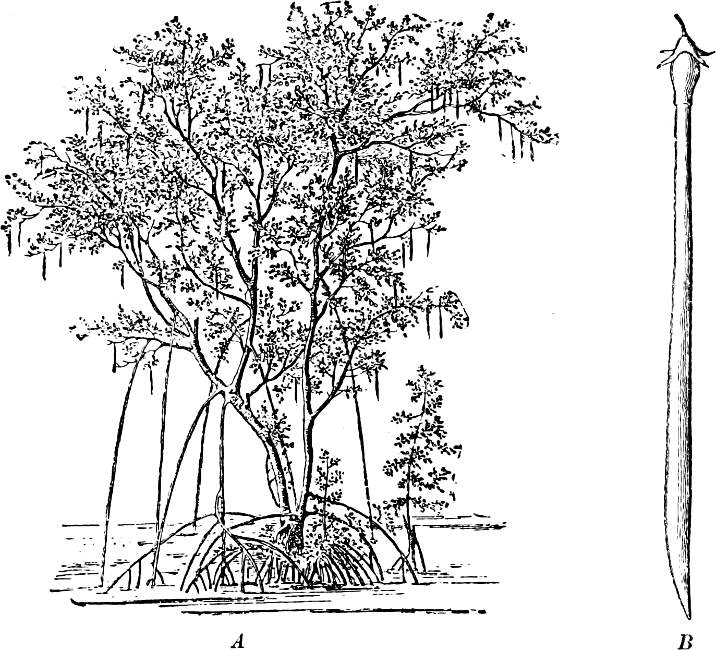
Fig. 522.—Rhizophora mangle with the germinating fruit
(much reduced).
Order 8. Myrtaceæ (Myrtles). The plants belonging to this order
are shrubs or trees, the majority being easily recognised by the
vegetative characters. The leaves, for instance, are most frequently
opposite, without stipules, undivided and entire, parchment-like or
leathery, evergreen, aromatic, finely dotted by pellucid
glands containing essential oils; the venation is penninerved
with a nerve just inside and running parallel to the edge of the
leaf. The flowers are regular, epigynous (Figs. 523, 524, 525) and ☿,
most frequently 4- or 5-merous in the calyx and corolla, with
many stamens (by splitting, so that they are often in several
distinct bundles) and an ovary with one style, formed of 2–5–many
carpels; the receptacle is most frequently united for its entire
length with the ovary. The fruit varies, but is most frequently a
berry. The embryo is thick, often curved, with united cotyledons;
no endosperm.
1. Myrteæ, Myrtle Group. Chiefly American, though some
are found also in Africa and Asia. The fruit is a berry
with generally 2–5 loculi in the ovary, and many ovules in
each.—Myrtus; Eugenia (the petals fall off together
as a hood in the Clove, E. caryophyllata, Figs. 523, 524);
Myrcia; Jambosa; Amomis; Psidium, etc.
2. Puniceæ, Pomegranate Group. Only 2 species (Punica
granatum; from Persia, Afghanistan), differing in several respects
from the typical form of the Myrtaceæ. The leaves are generally
opposite, without glands and marginal veins. The receptacle,
calyx and corolla are red; the latter 5–8–(generally 6-) merous. Calyx
valvate and corolla folded as in Lythraceæ, stamens also and epicalyx
as in this order. The most characteristic feature is the inferior,
spherical berry, with dry pericarp, formed from two whorls of carpels
in two tiers (Fig. 525); the interior whorl, which is also the lower,
has 3 carpels, and the placentæ are situated in the inner angles of
the 3 loculi; the external whorl is 5-merous, and the placentæ have
originally the same position in the inner angles of the loculi, but
their position is changed to the outer side of the loculi owing to the
growth of the wall of the ovary, which takes place early, causing the
carpels to become, as it were, turned inside out, so that the part
which was turned downwards is turned upwards, and the part which was
turned inwards becomes turned outwards (as in Mesembrianthemum).
The edible part of the fruit is the fleshy testa, as in
Ribes. The cotyledons are rolled together spirally.
Figs. 523, 524.—Eugenia caryophyllata.
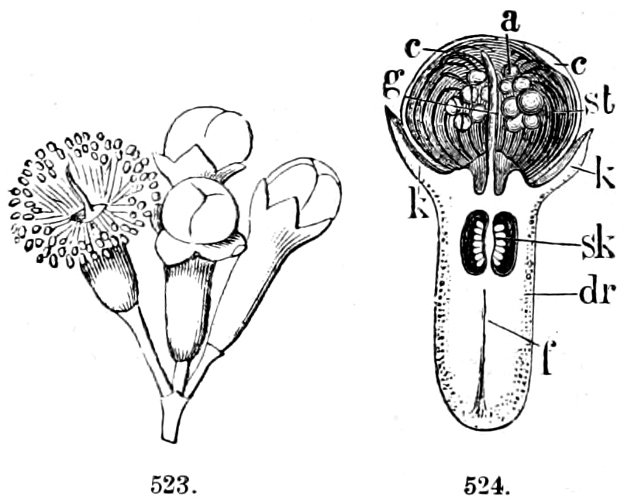
Fig. 523.—Flowers (nat. size).
Fig. 524.—A bud (“clove”), long. sec. (mag.).

Fig. 525.—Punica granatum. Flower,
long. sec. (nat. size).
3. Lecythideæ. The majority are South American.
The leaves are scattered, without pellucid glands, and
frequently dentate. The flowers are zygomorphic. The woody
fruits are either indehiscent, or open by a lid. To this belong:
Bertholletia (B. excelsa), the seeds well known
as “Brazil-nuts,” Lecythis (Sapucaia-nuts from L.
ollaria), Barringtonia.
4. Leptospermeæ. Almost entirely from Australia
and the East Asian and Pacific Islands. The fruit is a
capsule. The leaves are scattered, and in some placed
edgewise by the twisting of the leaf-stalks.—Eucalyptus,
the Australian Gum-tree; the calyx falls off like a lid (Figs.
526, 527). Some of the species attain gigantic heights, E.
amygdalina 140–150 m. with a diameter of 8 m. The leaves
in E. globulus are opposite and dorsiventral on the
young plant; on the older scattered, placed edgewise by the
twisting of the leaf-stalk, and isolateral; Metrosideros,
Calothamnus (stamens distinctly polyadelphous),
Melaleuca, Leptospermum, Callistemon (the
flowers are borne in spikes whose axis continues to grow after
flowering, thus several zones of fruits may be seen on the same
branch).
Figs. 526, 527.—Eucalyptus globulus.

Fig. 526.—Long. sect. of flower.
Fig. 527.—Flower opening.
5. Chamælaucieæ. Australian shrubs with
heath-like appearance; they differ from the other Myrtaceæ in
having a unilocular ovary with few, basal ovules, and a 1-seeded
nut. The sepals are often pappus-like, and divided into
many bristles.—Chamælaucium, Darwinia, etc.
This large order (2,100 species) is confined almost entirely to
the Tropics, being found principally in America and Australia.
In Europe, only Myrtus communis.—Several are useful
on account of the large quantity of volatile oils
(contained in internal glands): the flower-buds (“Cloves”) of
Eugenia caryophyllata (the Moluccas, cultivated in the
Tropics, Figs. 523, 524); the unripe, dry berries (“Pimento”)
of Myrtus pimenta (Pimenta officinalis, W.
Indies); Cajeput oil is extracted from Melaleuca minor
and leucadendron (East Asian Islands). Eucalyptus
globulus (Australia) has of late years become well known
on account of its rapid growth, its hard wood, and its
antipyretic qualities; it is cultivated on swampy soils, which
it helps to drain.—Officinal: “Cloves,” and the
cork of both stem and root of Punica granatum. Several
have EDIBLE FRUITS, such as Psidium guyava
(Guava, var. pomiferum and pyriferum, Am.),
Eugenia cauliflora and others, E. jambosa,
Punica granatum (the Pomegranate), etc. Edible
seeds (with abundance of fatty oil): “Brazil nuts”
from Bertholletia excelsa (Trop. S. Am.). “Bay-rum” is
extracted from the leaves and fruits of the Bayberry-tree
(Pimenta acris, W. Ind.); Guava-rum from the berries
of Eugenia floribunda. Tannin is found in large
quantities e.g. in Punica. Gum is formed
by many Australian Eucalypti (“Gum-trees”). Ornamental
plants cultivated in this country are: Myrtus
communis (Mediterranean), several in conservatories,
especially the Australian Leptospermeæ, Eucalyptæ and others.
The flower is regular, ☿, and completely epigynous, 5- or
4-merous, with 1 whorl of stamens and 5–2 carpels. Sepals
very small, tooth-like. The corolla is polypetalous, most
frequently valvate in æstivation (least pronounced in the
Umbelliferous plants). Round the base of the styles, which are
generally free, there is an epigynous (undivided, or divided)
nectar-disc (“stylar-foot”: Figs. 528 B, C,
D; 539); the number of loculi in the ovary equals that of
the carpels; only 1 pendulous (anatropous) ovule
(Fig. 528 C) in each loculus. Endosperm copious (Fig.
528 D). To this must be added that the inflorescence in the
majority of cases is an umbel or a capitulum, especially in the
Umbelliferæ and Araliaceæ. Stipules are absent, but most
frequently the base of the petiole forms a large sheath.
The Umbellifloræ are on one side so closely allied to the
Frangulinæ, especially Rhamnaceæ, that they may perhaps be
regarded as the epigynous continuation of this family. On
the other hand, the similarities to the Rubiales, especially
those between Cornaceæ and Sambuceæ, are so great that there
is scarcely any character to distinguish them except the
polypetalous corolla of the former and the gamopetalous corolla
of the latter. Whether this is more than a merely analogous
resemblance, and if not, whether the Cornaceæ at least should
not be included in the Rubiales, must be left in abeyance.—The
sepals are very small, as is generally the case in epigynous
flowers.
Order 1. Cornaceæ. The majority of the species are shrubs
with solid internodes, opposite (rarely scattered)
leaves, which are simple, entire (rarely incised),
penninerved, without stipules or large sheaths; flowers
4-merous (most frequently S4, P4, A4, G2), borne
in dichasia which are either collected into corymbs (e.g.
Cornus sanguinea), or in closely crowded umbels or capitula
(Cornus mas, C. suecica), in which latter case there is
often a large, leafy, or coloured, most frequently 4-leaved
involucre round the base of the inflorescence; the style is
undivided, with lobed stigma; the raphe of the ovule is turned
outwards. The fruit is a berry or a drupe, with a
1–4-locular stone or 2 free stones.
Cornus (Dogwood, Cornel) has S4, P4, A4, G2. Leaves opposite.
Drupe with a bilocular, 2-seeded stone.—Aucuba,
diœcious; unilocular ovary; 1 ovule; 1-seeded
berry.—Garrya.—Helwingia.
80 species; N. Temp. The fruits of Cornus mas are edible;
the wood is very hard; gum is found in some. Several species of
Cornus and Aucuba japonica (Japan) are cultivated
as ornamental shrubs.
Order 2. Araliaceæ (Ivies). Principally trees or
shrubs with solid stems. The leaves are scattered,
simple or compound, with a sheath more or less developed. The flowers
are most frequently situated in umbels or capitula which are either
borne singly or in racemes, or in paniculate inflorescences. The small,
most frequently yellowish-green flowers are 5-merous, in
the calyx, corolla, and andrœcium; the gynœceum may be 5-merous or may
have some other number (2-∞). The styles are most frequently
several, free; the raphe of the ovules is turned inwards
as in the Umbelliferous plants. The fruit is a drupe or
berry.—Stellate hairs often occur. The petals generally
have a broad base, and a thick apex which is slightly incurved, and a
distinctly valvate æstivation.
Hedera helix (Ivy) climbs by adventitious roots. The leaves are
palminerved and lobed on the sterile branches, but often ovate and not
lobed on the flowering branches. The flowers are yellowish-green
and open in the autumn; they are slightly protandrous, and are visited
by flies and wasps. Berries black. Endosperm ruminate.—Panax.
Aralia (with Dimorphanthus).
375 species, 51 genera; especially in the Tropics (E.
Asia).—The Ivy, several species of Aralia, e.g.
A. japonica (Fatsia), Gastonia palmata, are
cultivated as ornamental plants. Paper is manufactured from the
pith of Aralia papyrifera (China).
Order 3. Umbelliferæ. The stem is herbaceous with
hollow internodes; the leaves are scattered, and have
a broad, amplexicaul base, a large, most frequently inflated
sheath, and generally a pinnate (often very much dissected)
blade. Entire leaves are found in Hydrocotyle vulgaris;
Bupleurum.
The flowers are ☿, regular, small, but collected in compound
umbels, that is, in “simple umbels,” which again are borne in
umbels (for exceptions see Hydrocotyleæ); the external flowers
in the simple umbel have often subtending bracts, which surround
the base as an involucre, and may be termed the small
involucre; the internal ones have no bracts; when involucral leaves
are present at the base of the compound umbel, they may be termed the
large involucre.
Fig. 528.—Daucus carota with flower and
fruit.
The flower has 5 sepals (the median, as usual,
posterior), 5 petals, 5 stamens and 2 carpels (in
the median line) (Fig. 528). The calyx is often scarcely indicated.
The petals have a short claw are most frequently obcordate, or have
an incurved apex (Fig. 528 B, C), being incurved in the
bud; they are white, rarely yellow (Fennel and Parsnips), blue or
red. The flowers are sometimes zygomorphic, especially those on the
circumference of the umbel, and in that case it is the petal which
is directed outside (anterior) which is the largest, and the two
posterior are the smallest (e.g. Heracleum). The stamens are
incurved in the bud. The 2 free styles unite at the base
into the “stylar-foot” (stylopod), a swollen nectary (Fig. 528
B, C); the ovary is bilocular, the raphe of the ovules
being directed inwards. The fruit is a schizocarp, dividing
into two mericarps; the plane in which these separate coincides
with that of the union of the carpels, and the two nut-like
mericarps are in most genera kept together for awhile at the top
of a thin, bifid, or undivided stalk (carpophore) which is in
direct continuation with the flower-stalk (Fig. 537). Each mericarp
has most frequently 5 more or less strongly projecting ridges, the
primary ridges (Figs. 530, 532, 534, 535, etc.), of which 3
lie on the back of the mericarp, the dorsal ridges, and 2 on
its edge near the plane of division, the marginal ridges; five
of these (10 ridges in all in the entire fruit) are placed opposite
the calyx-teeth and the others between them. In some genera there are
in addition 4 secondary ridges to each mericarp between the
primary ones (Fig. 528 E: the secondary ridges bear the long
bristles). Inside these secondary ridges, or inside the grooves between
the primary ridges, when the secondary ridges are absent, oil
ducts (vittæ, schizogenous ducts) are found in the pericarp, most
frequently one in each groove; two are also often found on the ventral
side of each mericarp (Figs. 528 E, 530 ol, etc.). The
seed is most frequently united with the pericarp. The embryo
is small and lies high up in the large, most frequently horny
endosperm (Fig. 528 D).—The endosperm does not contain
starch, but oil, and presents three different forms, of important
systematic value: (a) those which are quite flat on the ventral
side (i.e. the side turned towards the plane of splitting)
(Figs. 528 E, 530, 531, 534, etc.): the majority of the genera,
Orthospermeæ (e.g. Carum, Pastinaca);
(b) those in which the endosperm on the ventral side is provided
with a longitudinal groove, often deep: Campylospermeæ
(e.g. Anthriscus); the transverse section is nearly
a crescent (Fig. 532); (c) those in which the endosperm is
concave on the ventral side (hollow in both longitudinal and transverse
sections): Cœlospermeæ (e.g. Coriandrum) (Fig.
538).
The genera are distinguished first of all by the endosperm and
forms of fruit, the ridges and oil-ducts; then by the form of
the umbel, the calyx and corolla, by the absence or presence of
an involucre, etc.

Fig. 529.—Hydrocotyle vulgaris.
Transverse section of fruit.
1. Hydrocotyleæ, Penny-wort Group. Capitula or
simple umbels (all the other groups have compound umbels). No
oil-ducts. Orthospermous.—Hydrocotyle (Penny-wort). The fruit
is considerably compressed laterally (Fig. 529). The calyx-teeth
are small. The leaves are peltate.—Didiscus.—Sanicula
(Sannicle). The umbels are small, capitate, generally collected
in a raceme; calyx-teeth distinct. ♂-and ♀-flowers in the same
umbel. The fruits are round, studded with hooked bristles. No
carpophore.—Astrantia has an umbel surrounded by a large,
often coloured involucre, with this exception it is the same as the
preceding, but the fruit is slightly compressed, with 5 equal ridges.
Hacquetia (Dondia).—Eryngium (Sea Holly): leaves
often thorny. The flowers are all sessile, the inflorescence
is thus a capitulum; each flower is often subtended by a bract, which
is thorny like the involucre, resembling the burrs of the Teasel. The
sepals are large.—Lagœcia: one of the loculi of the ovary is
suppressed.
Fig. 530.—Fruit of Carum petroselinum:
fr endosperm; ol oil-ducts.
Fig. 531.—Pimpinella. Transverse
section of fruit.
2. Ammieæ, Caraway Group (Figs. 530–532).
The fruit has only the 10 primary ridges; it is usually short,
almost spherical or broadly ovate and distinctly compressed
laterally. Oil-canals are most frequently present. Orthospermous
(except Conium).—Cicuta (Cow-bane). Pointed
calyx-teeth. Glabrous herbs with pinnate or bipinnate leaves. C.
virosa has a thick, vertical rhizome, divided by transverse
septa into many compartments; the leaflets are narrow, lanceolate,
and dentate; the large involucre is wanting.—Apium
(Celery). No calyx-teeth. A. graveolens, a maritime plant,
has neither large nor small involucre; the umbels are short-stalked
or sessile.—Carum (Caraway). Calyx-teeth small; the large
involucre is wanting or is only few-leaved. C. carvi (Caraway).
C. petroselinum, (Parsley) (Fig. 530). Falcaria;
Ammi; Helosciadium; Bupleurum (Hare’s-ear) with
simple leaves and yellow corolla; Pimpinella (Fig. 531);
Sium; Ægopodium (A. podagraria, Gout-weed) has
bi- or tri-ternate leaves, with ovate, dentate leaflets; the large
involucre is wanting.—Conium is campylospermous (Fig. 532);
the short, broadly ovate fruit has distinctly projecting, often wavy
crenulate ridges. C. maculatum (Hemlock) has a round, smooth
stem with purplish spots.
Fig. 532.—Conium maculatum. Fruit
entire and in transverse section.
3. Scandiceæ. This group has a distinctly oblong
or linear fruit which is slightly compressed laterally,
and generally prolonged upwards into a “beak”; wings absent.
Campylospermous. Otherwise as in the Ammieæ.—Anthriscus
(Beaked Parsley) has a lanceolate fruit, round on the dorsal
side, without ridges, but with a ten-ridged beak.—Scandix
(Shepherd’s-needle).—Chærophyllum (Chervil): fruit lanceolate
or linear with low, blunt ridges; beak absent or very short. C.
temulum has a red-spotted, hairy stem.—Myrrhis (Cicely) has
a short beak and sharp, almost winged ridges. M. odorata (Sweet
Cicely) has very long fruits.

Fig. 533.—Œnanthe phellandrium. Fruit
entire and in transverse section. emb The embryo; ol the
oil-ducts; fr endosperm.

Fig. 534.—Fœniculum vulgare. Fruit in
transverse section.
4. Seselineæ, Fennel Group (Figs. 533, 534).
The fruit is slightly elliptical or oblong, in transverse section
circular or nearly so, without grooves in the dividing plane; only
primary ridges are present. Orthospermous.—Fœniculum (Fennel)
has yellow petals; both involucres are wanting; the fruit is oblong.
The ridges are thick, all equally developed, or the lateral ridges are
slightly larger (Fig. 534).—Æthusa (A. cynapium, Fool’s
Parsley); the large involucre is wanting or is reduced to one leaf, the
small involucre is composed of three linear leaves which hang downwards
on the outer side of the umbels. The fruit is spherical-ovate,
with thick, sharp, keeled ridges, the lateral ones of which are
the broadest.—Œnanthe (Dropwort); the fruit (Fig. 533) has
usually an ovate, lanceolate form, with distinct, pointed sepals and
long, erect styles; the ridges are very blunt, the marginal ones a
trifle broader than the others.—Seseli, Libanotis,
Cnidium, Silex, Silaus, Meum, etc.
5. Peucedaneæ, Parsnip Group (Figs. 535–537).
The fruit is most frequently very strongly compressed dorsally,
with broad, mostly winged, lateral ridges. Only primary ridges.
The dorsal ridges may project considerably, but are not winged.
Orthospermous.
Fig. 535.—Archangelica officinalis.
Transverse section of fruit.

Fig. 536.—Scorodosma fœtidum.
Transverse section of fruit.
a. The winged lateral ridges stand out from each other,
so that the fruit appears to be 4-winged (Fig. 535).—Angelica;
Archangelica (Fig. 535); Levisticum (Lovage).
Fig. 537.—Heracleum sphondylium. Fruit.
b. The winged lateral ridges lie close together, and
form one wing on each side of the fruit (Fig. 536).—Pastinaca
(Parsnip). Corolla yellow. The dorsal ridges are very weak; the
oil-ducts do not reach quite as far as the base of the fruit.
Both large and small involucres are wanting; leaflets ovate.
Anethum (Dill) is a Parsnip with more distinct dorsal
ridges and filamentous leaflets. Peucedanum (Hog’s-fennel);
Ferula (with Scorodosma, Fig. 536, and Narthex);
Dorema.—Heracleum (Cow-parsnip); the flowers in the
margin of the umbels are often very large, zygomorphic, and project
like rays, e.g. in H. sibiricum. The fruit is very flat,
with very small dorsal ridges; the oil-ducts are more or less club-like
and do not reach as far as the base of the fruit (Fig. 537).
Imperatoria; Tordylium.
6. Dauceæ, Carrot Group (Fig. 528). The fruit
has 18 ridges, i.e. each fruitlet has 5 primary and 4 secondary
ridges, the latter being often more prominent and projecting further
than the primary ones. The oil-ducts are situated under the secondary
ridges (Fig. 528).
a. Orthospermous: Daucus (Carrot). The secondary
ridges project much further than the primary, and bear on their crests
a series of hooked spines (Fig. 528 D, E); these are
much longer than the small bristles on the primary ridges. The
involucral leaves of D. carota (Carrot) are numerous and deeply
pinnate; the inflorescence contracts during the ripening of the fruit,
and since the external umbels have longer stalks than the central ones,
they arch over them, and the inflorescence becomes hollow. For the
terminal flower, see below.—Cuminum; Laserpitium;
Melanoselinum.
b. Campylospermous: Torilis (Hedge Parsley).
The primary ridges are covered with bristles; the secondary ridges are
not. very distinct on account of the spines, which entirely fill up the
grooves. Caucalis (Bur Parsley).
Fig. 538.—Coriandrum sativum: b
secondary ridges; d primary ridges; f endosperm; l
embryo.
c. Cœlospermous: Coriandrum (Coriander) has a
smooth, spherical fruit (Fig. 538) with a distinct, 5-dentate calyx,
the two anterior (i.e. turned outward) teeth being generally
longer than the others; the two fruitlets scarcely separate from each
other naturally; all the ridges project only very slightly, the curved
primary ones least, the secondary ridges most.
Pollination. The flowers are adapted for
insect-pollination; they secrete nectar at the base of the
styles; individually they are rather small and insignificant,
but yet are rendered conspicuous by being always crowded in
many-flowered inflorescences. Protandry is common,
sometimes to such an extent that the stamens have already fallen
off before the styles begin to develop (Fig 539, 2). Insect
visits are more frequent and numerous as the inflorescences are
more conspicuous. The flowers as a rule are ☿, but ♂-flowers
are often found interspersed among the others (Fig. 539), and
the number of these becomes greater on the umbels developed at
the latest period. A terminal flower, which differs from the
others in form, and in Daucus carota often in colour also
(purple), is sometimes found in the umbel. The nectar lies so
exposed and flat that the flowers are principally visited by
insects with short probosces, especially Diptera; bees are less
frequent visitors, and butterflies rare.—1400 species (175
genera); especially from temperate climates in Europe, Asia, N.
Am. About 68 species in this country.
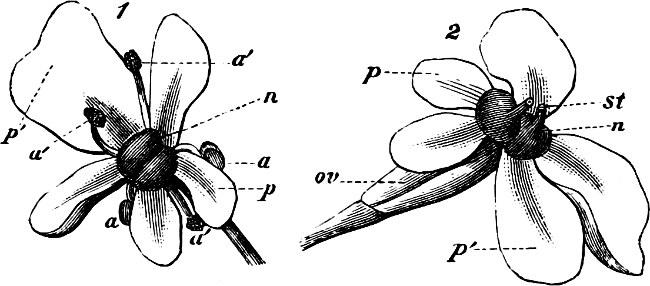
Fig. 539.—Anthriscus silvester: 1
♂-flower; 2 ☿-flower.
Uses. A few are cultivated as ornamental plants.
They are, however, useful in medicine,[38] and for culinary
purposes on account of the essential oils and
gum-resins which in many are formed in root, stem,
and fruit. The FRUITS of the following are used:
Carum carvi [+] (Caraway), Carum petroselinum
(Parsley; also the leaves and root; its home is the Eastern
Mediterranean); Fœniculum capillaceum [+] (Fennel; S.
Europe); Pimpinella anisum [+] (Anise; E. Mediterranean);
Coriandrum sativum [+] (Coriander; S. Eur.); Œnanthe
phellandrium (Water Dropwort); Cuminum cyminum
(Point Caraway; Africa; cultivated in S. Europe); Anethum
graveolens (Dill). The LEAVES of the following
are used as pot-herbs: Anthriscus cerefolium (Chervil);
Myrrhis odorata (Sweet Cicely; Orient.); Conium
maculatum [+] (the green portions; Hemlock). Besides
Parsley, the ROOTS of the following are used:
Carrot, Parsnip, Sium sisarum (Sugar-root; E. Asia);
Chærophyllum bulbosum (Chervil-root); Levisticum
officinale (foliage-shoots; S. Europe); Imperatoria
ostruthium; Apium graveolens (Celery, the root in
conjunction with the internodes); Pimpinella saxifraga
and magna (Pimpinell); Archangelica (Angelica,
the root of A. norvegica was formerly an article of
food in Norway). Poisonous alkaloids are found in a
few, such as Fool’s Parsley (Æthusa cynapium), Hemlock
(Conium maculatum), Cow-bane (Cicuta virosa) and
species of Œnanthe.—Gum-resin is extracted from
various species: “Galbanum” from Ferula galbaniflua [+]
and rubricalis [+] (Persia); Asafœtida from Ferula
scorodosma [+] and F. narthex [+]; Ammoniac-gum from
Dorema ammoniacum [+], all from Central and S. W. Asia.
“Silphium” was an Umbelliferous plant which grew in
ancient times in Cyrene, and from which the Romans extracted a
valued condiment.
Family 25. Hysterophyta.
This family (with the exception of Aristolochiaceæ) includes only
parasitic plants. Partly on this ground, and partly because they all
have epigynous flowers, they are considered to belong to the
youngest type (which is expressed in the name ὕστερος, the one that
comes after). It is not certain to which of the preceding families they
are most nearly allied. Again, it is a matter of doubt whether the
Aristolochiaceæ are related to the others; they are by Engler united
with Rafflesiaceæ into one family, Aristolochiales.
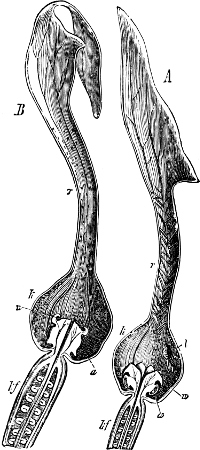
Fig. 540.—Flower of Aristolochia
clematitis (long. sect.). A Before pollination, and B
after: n stigma; a anthers; t an insect; kf
ovary.
Order 1. Aristolochiaceæ. The majority are perennial herbs or
twining shrubs, whose stalked, simple, and generally more or less
cordate or reniform leaves are borne in 2 rows and are exstipulate.
The flowers are hermaphrodite, epigynous, regular or
zygomorphic; perianth-leaves united, simple but most frequently
petaloid and 3-merous; 6 or 12 (in Thottea as many as
36) stamens with extrorse anthers. The ovary is more or less
completely 4–6-locular with ovules attached in the inner angles of
the loculi (Fig. 540 kf). The style is short, and has a large,
radiating stigma (Fig. 540 n). Fruit a capsule. Seeds rich in
endosperm.
Asarum europæum. Each shoot has 2 reniform foliage-leaves,
between which the terminal flower is borne (the rhizome becomes
a sympodium by development of the bud in the axil of the upper
foliage-leaf). The flower is regular and has a bell-shaped
perianth with 3 outer valvate, and 3 inner small segments (which
may be wanting). 12 (2 × 6) free, extrorse stamens, 6
carpels.—Aristolochia clematitis (Birth-wort) has an erect,
unbranched stem, bearing many flowers in the leaf-axils, in a zig-zag
row (accessory buds in a unipared scorpioid cyme). The flowers are
zygomorphic (Fig. 540), formed by 3 alternating, 6-merous whorls. The
perianth has a lower, much-distended part (k), succeeded by a
narrow, bent tube (r), which passes over into an oblique, almost
tongue-like projection (6 vascular bundles indicate that the number
6 is prevalent here, as in Asarum); 6 stamens (Fig. 540
a), with the dorsal portion turned upwards, are united with
the short style to form a stylar column; they are placed quite
beneath the 6 commissural stigmatic rays, which arch over them as
short, thick lobes. Protogynous; Pollination is effected
in Arist. clematitis by small flies; these enter the erect
unfertilised flower through the tube (Fig. 540 A, l)
without being prevented by the stiff, downwardly-turned hairs which
line the tube and prevent their escape; they find the stigma (n)
fully developed, and may pollinate it with the pollen they have brought
with them. The stigmas then straighten and wither (B, n),
the anthers open, and the flies may again be covered with pollen; but
the hairs which blocked up the tube do not wither until the anthers
have shed their pollen, and only then allow the imprisoned flies to
escape and effect cross-pollination. Prior to pollination, the flowers
stand erect, but after this has taken place they become pendulous, and
the perianth soon withers.—A. sipho (Pipe-flower), another
species, is a climber, and often grown in gardens; it has only one row
of accessory buds in the leaf-axils.—200 species; chiefly in S. Am.
Officinal: the rhizome of Aristolochia serpentaria (N.
Am.).
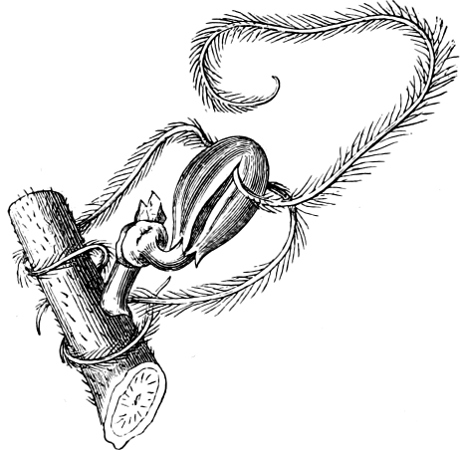
Fig. 541.—A fruit of Myzodendron
brachystachyum (slightly mag.) germinating on a branch.
Order 2. Santalaceæ. Parasites containing chlorophyll,
which, by the help of peculiar organs of suction (haustoria)
on their roots, live principally on the roots of other
plants. Some are herbs, others under-shrubs. The regular,
most frequently ☿-flowers have a simple perianth, which is
gamophyllous, 3- or 5 partite with the segments valvate in
the bud, and a corresponding number of stamens opposite the
perianth-leaves. In the inferior ovary there is a free,
centrally placed, often long and curved placenta
with three ovules (one opposite each carpel); these are naked,
or in any case have an extremely insignificant integument.
Fruit a nut or drupe. Seed without testa. Endosperm fleshy. 225
species; chiefly in the Tropics.—Thesium, a native,
is a herb with scattered, linear leaves and small 5-merous
flowers (P5, A5, G3) in erect racemes; the subtending bracts
are displaced on the flower-stalks. Fruit a nut.—Osyris
(diœcious shrub; 3-merous flowers) is another European
genus.—Santalum album, which grows in E. Ind., yields
the valuable, scented Sandalwood, the oil of which is used
medicinally.—Quinchamalium.
Myzodendron is a reduced form of the Santalaceæ; the
♂-flowers are without perianth; the perianth of the ♀-flower
is 3-merous. About 7 species; S. Am.; parasitic on a Beech
(Nothofagus). The fruit has 3 feathery brushes,
alternating with the lobes of the stigma, which serve as flying
organs and to attach the fruits to a branch (Fig. 541), the
brushes twining round as soon as they come in contact with it.
There is only 1 seed in the fruit, which germinates by a long,
negatively heliotropic hypocotyl, and is attached by a radicle
modified into an haustorium.
Order 3. Loranthaceæ (Mistletoes). Plants containing
chlorophyll which are parasites on trees, and most frequently have
opposite, simple, entire leaves and regular, epigynous, often
unisexual, 2- or 3-merous flowers, with single or double perianth.
Stamens equal in number and opposite to the perianth-leaves, free,
or in varying degrees united to one another. The inferior ovary is
constructed as in the Santalaceæ, the ovules being situated on a low,
free, centrally-placed placenta, but the placenta and ovules unite with
the wall of the ovary into one connected, parenchymatous mass,
in which the embryo-sacs are imbedded. Only 1 (less frequently
2–3) of the 1–6 embryo-sacs is fertile. The number of the carpels
however varies. The fruit is a 1-seeded berry, whose inner layer
is changed into a tough slimy mass (bird-lime), which serves to
attach the fruits to other plants.
The two groups, Loranthoideæ and Viscoideæ,
are distinguished by the fact that the former has a distinct
“calyculus,” i.e. an entire or lobed, or dentate swelling
on the receptacle below the perianth. The majority of the
Loranthoideæ have a petaloid perianth; in all the Viscoideæ, on
the other hand, it is sepaloid.

Fig. 542.—Viscum album: A
branch with leaves and berries: a scale-leaves; b
foliage-leaves; n m n flowers; B seedling,
the bark of the branch being removed; C an older embryo which
still retains the cotyledons.
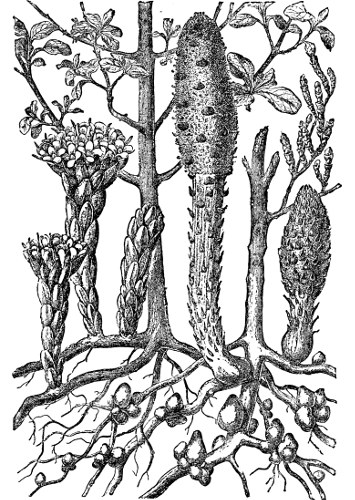
Fig. 543.—To the left the Rafflesiaceous
Cytinus hypocistus, parasitic on the roots of Cistus. To
the right the Balanophoraceous Cynomorium coccineum, parasitic
on the roots of Salicornia.
The Mistletoe (Viscum album, Fig. 542) is a native, evergreen
plant which may be found growing on almost any of our trees (sometimes
on the Oak), and, like other Loranthaceæ, it produces swellings of
the affected branches. Its spherical white berries (Fig. 542
A) enclose (1–) 2–3 green embryos; they are eaten by birds
(especially Thrushes), and are partly sown with their excrement,
partly struck or brushed off the branches of the trees, the seed
being enclosed, at maturity, by viscin, i.e. “bird-lime.”
The seeds may also germinate on the branches, without having first
passed through the alimentary canal of the birds. On germination,
the hypocotyl-axis first appears, as in Fig. 541, and bends towards
the branch; the apex of the root then broadens, and forms at the
end a disc-like haustorium, from the centre of which a root-like
body grows through the bark into the wood, and ramifies between the
bark and wood. Suckers are developed on the root like strands which
are formed in this manner, without, however, having a rootcap; they
are green, and penetrate the wood by the medullary rays (Fig. 542
C). Adventitious buds may also be developed from the root-like
strands which break through the bark and emerge as young plants.
The young stem quickly ceases its longitudinal growth, and lateral
shoots are developed from the axils of its foliage-leaves. These and
all following shoots have a similar structure; each of them bears
a pair of scale-leaves (Fig. 542 A, a) and a pair of
foliage-leaves (Fig. 542 A, b), and then terminates its
growth, if it does not produce an inflorescence; new lateral shoots
proceed from the axils of the foliage-leaves, and the branching, in
consequence, is extremely regular and falsely dichotomous. Only one
internode (shoot-generation) is formed each year, so that each fork
indicates one year. The foliage-leaves fall off in the second year.
The inflorescence is a 3(-5)-flowered dichasium (Fig. 542 A,
m is the central flower, n the lateral). The plants are
diœcious; the ♂-flower as a rule is 2-merous: perianth 2 + 2,
each leaf of which bears on its inner side 6–20 pollen-sacs, each of
which opens by a pore; this relationship may be considered to have
arisen from the union of the perianth-leaves with the multilocular
stamens (2 + 2) placed opposite them. The ♀-flowers always have
Pr 2 + 2, G2.—Loranthus is also found in Europe (it has
a 3-merous flower), especially in the central and south-eastern
districts, on Quercus cerris and Q. pubescens; but
the great majority of the 520 species grow in the Tropics on trees
which they ornament with their often brightly-coloured flowers, and
ultimately kill when present in too great numbers. The pollination in
the numerous Loranthaceæ with unisexual flowers, is effected by the
wind. In Viscum album this takes place in autumn, the actual
fertilisation in the following spring, and the maturity in November
or December; in the succeeding month of May the berry is ready to
germinate, and falls off.
Uses. Birdlime from Viscum album.
Order 4. Rafflesiaceæ and Order 5. Balanophoraceæ.
These orders comprise root-parasites, almost entirely
devoid of chlorophyll; they are reddish or yellow, without
foliage-leaves (Fig. 543). As far as our knowledge of these
rare tropical plants extends, they have thalloid organs of
vegetation resembling the root-like strands of Viscum,
or they are filamentous and branched like Fungus-hyphæ; they
live in and on the tissues of the host-plant, from which their
flowering-shoots, often of mushroom-like form, are subsequently
developed (Fig. 543). In order to unfold they must often break
through the tissues of the host-plant.
Of the Rafflesiaceæ, Cytinus hypocistus is
found in S. Europe living on roots of Cistus-plants
and to some extent resembling Monotropa (Fig. 543).
Rafflesia is the best known; it lives on roots of
Cissus-species (belonging to the Ampelidaceæ) in Java;
its yellowish-red, stinking flowers attain a gigantic size (one
metre or more in diameter), and are borne almost directly on the
roots of the host-plant. Besides these there are other genera:
Brugmansia, Pilostyles, Hydnora.—To
Balanophoraceæ (Fig. 543) belong: Balanophora,
Langsdorffia, Scybalium, Sarcophyte,
Helosis, etc., and in S. Europe, Cynomorium
coccineum.
The characters which separate this from the first Sub-class, the
Choripetalæ, have been described on page 336. They consist in the
following: the flower is always verticillate, generally with 5
sepals, 5 petals, 5 stamens, and 2 carpels (in the
median plane), the calyx is generally persistent and gamosepalous, the
corolla is gamopetalous and united to the stamens, which are therefore
adnate to it, the ovules have only one thick integument and a
small nucellus. (The exceptions are noted later.)
This Sub-class is no doubt more recent than the Choripetalæ; it
is also peculiar in including fewer trees and shrubby forms than
the latter.
The Sympetalæ may be separated into 2 sections:—
A. Pentacyclicæ (five-whorled). The flowers in this
section have 5 whorls equal in number, namely, 2 staminal whorls
in addition to the calyx, corolla, and carpels; in some instances,
one of the staminal whorls is rudimentary or entirely suppressed, but
in this case it is frequently the sepal-stamens which are suppressed,
and the whorl which is present stands opposite the petals. The flowers
are regular. The number of carpels equals that of the sepals,
but in one of the orders (Bicornes) they are opposite the
petals (the flower being obdiplostemonous); in the other two orders
(Primulinæ and Diospyrinæ) they are placed opposite the
sepals (the flower being diplostemonous). This section is the most
closely allied to the Choripetalæ, since the petals may sometimes
be found entirely free, and the stamens inserted directly on the
receptacle (Ericaceæ); ovules with two integuments are also found.
It is very doubtful, whether the orders included under this head
have any relationship with the other Sympetalæ. They appear in any case
to represent older types.
B. Tetracyclicæ (four-whorled). The flowers have only
4 whorls, namely, beside sepals, petals, and carpels, only one whorl
of stamens, which alternates with the petals; there is no trace of
the second staminal whorl, and when the number of carpels is the same
as that of the preceding whorls (“isomerous”) they alternate with
the stamens; but in most cases there are 2 carpels placed in the
median plane (see the diagrams, e.g. Figs. 559, 567, 583,
590, etc.). This section is the largest, and the one which shows the
characteristics of the Sympetalæ best. Very irregular flowers are met
with.
The following families belong to the Pentacyclicæ: 26,
Bicornes; 27, Diospyrinæ; 28, Primulinæ.
The remaining families belonging to the Tetracyclicæ are:—
a. Hypogynous flowers (with a few exceptions): 29,
Tubifloræ; 30, Personatæ; 31, Nuculiferæ; 32,
Contortæ.
b. Epigynous flowers: 33, Rubiales; 34,
Dipsacales; 35, Campanulinæ; 36, Aggregatæ. The
ovaries and ovules in the last family are always reduced to one; and at
the same time the fruits become nuts, and the flowers are united into
crowded inflorescences.
This family is chiefly composed of shrubs, less frequently of small
trees, or perennial herbs; their leaves are undivided, most frequently
evergreen, stiff and leathery, and always without stipules. The flowers
are ☿ and regular, rarely slightly zygomorphic, most frequently
obdiplostemonous, and 4- or 5-merous through all the 5 whorls. The
stamens are attached to the receptacle, and as a rule are quite
free from the petals, an attachment which is very rare among the
Gamopetalæ. They have a simple gynœceum with one undivided
style, a commissural stigma, and a multilocular ovary, whose
axile placentæ project considerably into the loculi, and bear a large
number of ovules. The placentæ are sometimes not united, and in
consequence, the ovary is 1-locular with incomplete partition-walls,
e.g. Pyrola, Monotropa. Embryo straight, with
endosperm. The carpels are placed opposite the petals.
The diagram is generally Sn, Pn, An + n, Gn, in which n is
4 or 5. To this may be added, that the corolla is in most cases
gamopetalous, but in some (especially Pyrolaceæ) perfectly
polypetalous; and that the anthers usually open by pores, and
often have two horn-like appendages (hence the name “Bicornes”)
(Figs. 545, 546); frequently the two halves of the anther are also
widely separated from each other at the upper end, so that the pores
are placed each one at the end of its own tube (Fig. 546); the
pollen-grains in the majority are united into tetrads (Fig. 542
D).—The flowers, as a rule, are pendulous and borne in racemes,
coloured (red or white), but odourless. When the fruit is a capsule,
the placenta with the seeds attached persists as a central column. A
mycorhiza occurs on many.
The majority of plants belonging to this family inhabit cold and
temperate countries, or high mountains in tropical regions; they prefer
cold and dry or damp places (bogs, heaths, etc.). Plentiful in N.
America.
Order 1. Pyrolaceæ. Perennial herbs; petals most
frequently quite free from each other, and falling off singly
after flowering; the anthers are without appendages, and open
by pores (Fig. 544), or by a transverse slit. The placentæ are thick.
The seeds in the capsule-like fruit (loculicidal dehiscence)
are exceedingly small and light, they have a sac-like testa which
loosely envelops them, an oily endosperm, and an extremely simple
embryo, which consists only of an ellipsoidal, cellular mass,
without cotyledons or differentiation into plumule and radicle.
Pyrola (Winter-green) is green, and has also large evergreen
foliage-leaves. The flowers, 5-merous, are most frequently borne in
racemes without a terminal flower; the anthers are extrorse in the
bud with the pores in the lower portion (Fig. 544 A), but they
become inverted at a later period, so that the pores open at the top
(Fig. 544 C). P. uniflora has a single, terminal
flower; it winters by its roots, producing from these in the spring
aerial, quite unbranched shoots. Chimaphila umbellata.
Fig. 544.—Pyrola minor: A
portions of a young flower; B the stigma; C portions of
an older flower (longitudinal section).
Monotropa (Yellow Bird’s-nest) is very pale yellow, without
chlorophyll, succulent, and has only scale-like leaves closely pressed
upon the stem; it is a saprophyte. The raceme has a terminal flower,
and is pendulous before flowering. The anthers open by a semicircular,
transverse cleft. M. hypopitys reproduces chiefly by
root-shoots.
About 30 species, especially N. Europe, N. America, and N. Asia.
Order 2. Ericaceæ. The flower (Fig. 545) is hypogynous,
the median sepal posterior; corolla, gamopetalous; the stamens
are generally 2-horned, and the fruit is a capsule,
less frequently a berry or drupe. At the base of the ovary is a
nectar-secreting disc (Fig. 545 B). This order comprises shrubs
or undershrubs (rarely small trees), which are evergreen, and as a rule
have densely crowded leaves.
1. Ericeæ, Heath Group. Flowers most frequently
4-merous (S4, P4, A4 + 4, G4, united in a 4-locular gynœceum),
rarely 5-merous. The withered corolla persists after flowering.
The leaves are most frequently acicular, opposite or verticillate; the
buds are without scales. The fruit is a capsule.—Calluna (C.
vulgaris, Ling) has a deeply 4-cleft corolla, which is less than
the coloured calyx; capsule with septicidal dehiscence.—Erica
(about 420 species; E. tetralix, Cross-leaved Heath) has a
tubular or bell-shaped, 4-dentate corolla, which is much longer than
the calyx. Capsule with loculicidal dehiscence.—Pentapera.
2. Andromedeæ. The flowers are 5-merous (S5, P5, A5
+ 5, G5), with deciduous corolla. Capsule with loculicidal
dehiscence. The leaves are scattered, and incline more to the ordinary
broad-leaved forms.—Andromeda; Gaultheria; Cassandra
(Lyonia); Cassiope.
Fig. 545.—Arctostaphylos uva-ursi.
3. Arbuteæ. The flowers as in the preceding group
(Fig. 545), but the fruit is a berry or drupe. Arctostaphylos
(A. uva-ursi, Bear-berry) has a drupe with 5 stones in a dry,
farinaceous pulp; in other species there is 1 stone with several
loculi. Arbutus (A. unedo, Strawberry-tree) has a
spherical berry.
Pollination is effected by means of insects, especially
by bees. The pollen is light and dry, and is shaken out
through the pores of the anthers when the insects agitate the
horn-like appendages during their visits. Self-pollination
takes place, no doubt, in many cases.—800 species; the very
large genus, Erica, especially in S. Africa (the
Cape).—Officinal: the leaves of Arctostaphylos
uva ursi. Arbutus unedo (S. Europe) has an
edible, peculiarly warted (strawberry-like) fruit. Many
Erica-species are cultivated as ornamental plants.
Order 3. Rhodoraceæ (Rhododendrons). This differs from
the preceding order in the median sepal being anterior, and
hence the position of the other floral whorls is also reversed. The
flower is hypogynous, in most cases 5-merous; the corolla is
most frequently deeply cleft or polypetalous, and falls off after
flowering; the anthers open by pores, and have no horn-like
appendages. Capsule with septicidal dehiscence.—The
shrubs or small trees belonging to this order have, like the Vaccineæ,
ordinary foliage-leaves, and the buds are generally provided with
large bud-scales.
Rhododendron has 10 stamens, and a slightly zygomorphic
flower with deeply 5-cleft corolla (the section Azalea has
frequently only 5 stamens, the petal-stamens being absent). They
are Alpine plants (200 species) in the mountains of Asia, especially
the Himalayas; some in S. Europe.—Menziesia.—Ledum;
small, rusty-brown, hairy shrubs with polypetalous, expanded, star-like
corolla.—Kalmia (N. Am.) has a cupular corolla, with 10 small,
pocket-like depressions in which the anthers are concealed until the
arched, elastic filaments are freed from this position by means of
the insects, when they quickly straighten themselves in the centre
of the flower.—Phyllodoce; Loiseleuria (5 stamens);
(Clethra (?); also placed among the Ternstrœmiaceæ).
About 270 species. Several species are ornamental plants.
Several plants of the order are more or less narcotic.
Ledum palustre has been used as a substitute for hops.
Order 4. Diapensiaceæ. Hypogynous flower. 3 floral-leaves
beneath the flower (S5, P5, A5 + 0, G3). Stamens on the throat
of the corolla. Pollen-grains single. Disc absent. Capsule
loculicidal.—9 species from the Arctic regions. It is doubtful
whether this order should be included in the Bicornes; perhaps
it would be more correctly assigned to the Polemoniaceæ.
Order 5. Epacridaceæ. This order comprises those species
of the family which are confined to Australia and the South Sea
Islands. They are shrub-like plants, resembling the Ericaceæ in
habit, in the inflorescence, and in the structure, form, and
colour of the flower. They differ especially in having only 1
whorl of stamens (placed opposite the sepals) and in the
anthers having only 2 loculi, and opening by a longitudinal
slit. Fruit most frequently a drupe (or loculicidal capsule).
Epacris-and Styphelia-species are ornamental
plants. About 325 species.
Order 6. Vacciniaceæ (Bilberries). The flower
(Fig. 546) is epigynous, the corolla gamopetalous, and the
fruit a berry. The latter is most frequently spherical, and bears
on its apex the calyx, which is generally very low, almost entire, and
with a disc-like expansion inside. The flower is 4- or 5-merous
(Fig. 546 B, D). The anthers have 2 pores, and are most
frequently 2-horned (Fig. 546 F, G). Small shrubs; the
leaves are scattered, not needle-like.
Vaccinium (Bilberry, Whortleberry) has an urceolate,
gamopetalous, only slightly dentate corolla, and horn-like appendages
to the anthers (Fig. 546). V. vitis idæa (Cowberry)
is evergreen, with flowers in racemes, and bright red berries;
V. myrtillus (Bilberry) and V. uliginosum (Bog
Whortleberry) both have black berries with a blue bloom, leaves
deciduous.—Oxycoccus has a polypetalous corolla
with the petals projecting backwards. Anthers without appendages.
O. palustris (Cranberry) has a slender, creeping stem, and is
evergreen. Dark red berry.
Pollination essentially the same as the preceding order.—320
species; especially in N. Am. Some are useful on account of
their edible fruits, especially Vaccinium myrtillus and
V. vitis-idæa, and in a less degree Oxycoccus,
etc. The fruits of V. myrtillus are officinal.
Fig. 546.—Vaccinium uliginosum (var.
microphyllum). The parts of the flower A-E are enlarged
5–6 times; C and E are longitudinal sections; B
and D the flower seen from above; F and G a stamen
seen from the back and front; H the style and stigma.
The flowers are regular, gamopetalous, typically diplostemonous,
with the same number throughout all 5 whorls, thus: Sn, Pn, An + n,
Gn, where n most frequently =5 (4–6), rarely 3, 7 or 8. Of the two
whorls of stamens the one opposite the sepals is often present only
as rudiments or is entirely suppressed, and the completely developed
stamens are thus placed opposite the petals. The carpels are
generally placed opposite the sepals. The ovary is multilocular
with the ovules attached in the inner angles. The fruit is most
frequently a berry. The seeds are large, generally solitary,
or a few in each loculus.—All plants belonging to this family are
trees or shrubs with scattered, single, most
frequently entire, penninerved and leathery leaves
without stipules; the majority are tropical (America, Asia), some are
found in N. Am. and the Mediterranean.
Order 1. Sapotaceæ. Plants with latex; anthers extrorse,
1 erect ovule in each loculus; fruit a berry; the
seeds with bony, shiny brown testa have a large, lateral
hilum. The leaves are frequently covered with silky hairs.—A
useful order in several respects (400 tropical species).
The wood of some genera, such as Sideroxylon (Iron
wood) and Bumelia, is as hard as iron. The latex of
Palaquium (P. oblongifolium, P. gutta, and
other species), Mimusops and Payena (Sumatra, E.
Ind.), is the raw material of gutta percha. The following
have very delicious fruits: Lucuma mammosa, Achras
sapota, Chrysophyllum cainito (Star-apple), etc. The
seeds of Bassia (E. Ind.) contain a large quantity of a
fatty oil. Isonandra, Mimusops schimperi are often
found in the Egyptian royal tombs.
Order 2. Ebenaceæ. Plants without latex, often diœcious;
flowers with a more or less leathery perianth. The number of
stamens is sometimes increased (by splitting?); ovules 1–2,
pendulous in each loculus. Fruit a berry.—250 species;
chiefly tropical. Some are well known on account of their hard
and black-coloured heart-wood, e.g. Maba ebenus
(the Moluccas) and Diospyros ebenum (Ebony-wood, from
Tropical Asia) and others.—The fruits are edible e.g.
of Diospyros lotus (Date-plum, Asia), which is also
cultivated as an ornamental shrub, together with several other
species.
Order 3. Styracaceæ. The flower is more or less
epigynous, and the corolla is almost polypetalous.
The stamens (by splitting?) are more than double the number
of the petals, and often united at the base. Stellate hairs
are frequent.—235 species; Tropical Asia and America, a few
for example in the East.—Officinal: Gum-benzoin from
Styrax benzoin and perhaps other species (Sumatra and
Siam). Halesia tetraptera (N. Am.) is an ornamental shrub
with 4-winged fruits.
Fig. 547.—Diagram of Primula.
The flowers are regular, ☿, hypogynous, and gamopetalous.
The stamens are equal in number to the petals (Fig. 547)
and are placed opposite to them. The ovary is unilocular,
with a free, central placenta with 1–many ovules.—The flower
is a further development of the Diospyrinæ; the suppression of the
calyx-stamens, which commenced in this family, is carried further
in the Primulinæ, so that in the majority of cases no trace of them
is present, but in certain species and genera (Samolus,
Lysimachia thyrsiflora, Soldanella, certain Myrsineæ)
some small bodies (scales, teeth, etc.) are found in the position of
the suppressed stamens. Again, the lateral portions of the carpels
are suppressed, so that the ventral placentæ with the ovules
are separated from the dorsal portions, and are united into a
free central placenta; this theory is supported by the branching
of the vascular bundles, the development, and various comparative
considerations.—Sn, Pn, A0 + n, Gn; where n = 4–8, generally 5. The
carpels are placed opposite the sepals (Fig. 547).
Order 1. Primulaceæ (Primroses). This order has many
ovules attached to a thick, free, central placenta (Fig.
547); style undivided with a capitate stigma; ovules
semi-anatropous; fruit a capsule with many seeds.
All the plants belonging to this order are herbs; stipules
wanting; the flower is most frequently 5-merous (S5, P5, A0 + 5, G5;
except Centunculus and Trientalis). The corolla and
capsule have various forms, but the capsule generally opens by teeth at
the apex. The ovules are semi-anatropous (in Hottonia they are
anatropous), and the seeds are therefore peltate, with the hilum
situated in the centre of one side. The endosperm is fleshy or horny.
The flowers are borne either in racemes or in umbels; as bracteoles
are typically absent (Fig. 547), cymose branching does not occur.
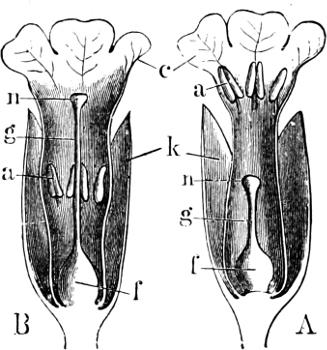
Fig. 548.—Primula: dimorphic flowers.
A short-styled; B long-styled.
Fig. 549.—Cyclamen persicum.
Primula (Primrose) has most frequently a vertical rhizome,
bearing a rosette of leaves at its summit, and long-stalked umbels;
corolla rotate or slightly funnel-shaped; the capsule opens
at the apex by 5 teeth. The flowers in some species are
heterostyled (long-styled or short-styled; Fig. 548). Closely allied
are Androsace (with ovate, cup-shaped corolla-tube and ligular
scales, alternating with the corolla-lobes) and Soldanella
(funnel-shaped corolla with laciniate lobes and most frequently
ligular scales).—Hottonia (Water-Violet) is an aquatic plant
with pectinate leaves and heterostyled flowers.—Cortusa.
Dodecatheon. Cyclamen (Fig. 549) has solitary,
long-stalked flowers, and a rotate corolla with the lobes reflexed; the
stalk of the capsule rolls up spirally; the tuberous rhizome is formed
by the hypocotyledonary internode. Only 1 cotyledon.—Lysimachia
(Money-wort); stem-internodes well developed, leaves opposite or
verticillate, calyx almost polysepalous, corolla deeply 5-partite
(Fig. 550). The flowers are solitary or in racemes.—Anagallis
(Pimpernel), leaves opposite, flowers solitary; the fruit a
pyxidium (Fig. 551); similarly in Centunculus, which is
4-merous.—Trientalis, the flowers are most frequently
7-merous.—Glaux (Sea Milk-wort) is a creeping maritime plant
with opposite leaves; flowers solitary in the leaf-axils, corolla
absent, but with coloured calyx. The petals are usually
developed later than the stamens in the Primulaceæ; but in this
instance they are entirely suppressed.—Samolus (Brookweed)
differs from all the others in having an epigynous flower;
barren sepal-stamens are also present. The bracts in the racemose
inflorescences are displaced along the flower-stalks.
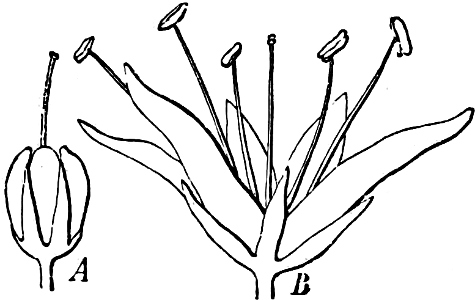
Fig. 550.—Lysimachia thyrsiflora.
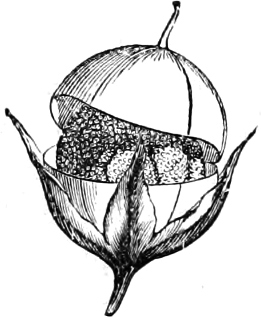
Fig. 551.—Anagallis arvensis. Fruit
dehiscing.
Pollination. Insect-pollination in the majority;
cross-pollination is promoted in some by heterostyly (Fig.
548).—300 species; especially in northern temperate zones; the
majority on mountains (Soldanella, Androsace,
etc.); almost absent in the Tropics. A large number are
ORNAMENTAL PLANTS, e.g. Primula auricula
(from the Alps), P. sinensis (China), P. elatior
(Oxslip, a native) and grandiflora, etc. Cyclamen
europæum (Alpine Violet); the tubers are poisonous.
Order 2. Myrsinaceæ. Trees or shrubs; evergreen, tropical
Primulaceæ with fleshy fruits and few seeds, embedded in the
placenta. The leaves are nearly always dotted with yellow glands
(schizogenous resin-receptacles).—550 species; especially
Am.—Ornamental plants: Ardisia crenulata
(W. Ind.); other genera: Clavija, Maesa,
Theophrasta (barren sepal-stamens), Myrsine,
Jacquinia (barren sepal-stamens), etc.—Ægiceras,
allied to this order, comprises arborescent plants, often
growing with Rhizophora in tropical forests, along the
shore. The embryo germinates while still in the fruit.
Order 3. Plumbaginaceæ. This order has a position of the stamens
similar to that in Primulaceæ (S5, P5, A0 + 5, G5), but it differs from
these in the flower, which has generally a membranous, dry,
thin, coloured, folded, almost entire calyx and an almost entirely
polypetalous corolla, which, as a rule, has twisted æstivation
and is only united with the stamens at its base; but
more especially it differs in the ovary, which bears 5 free
or almost free styles and only 1 basal ovule with a
long, twisted funicle (the placenta of the Primulaceæ is here so
much reduced that it bears only 1 ovule). The fruit is a nut or
capsule. The radicle is turned outwards. Endosperm mealy.—To
this order belong herbs or under-shrubs, which are especially natives
of the sea-coast and of salt-steppes; they also resemble the Primulaceæ
in the scattered, undivided, entire leaves (without stipules), often in
rosettes, and the inflorescence borne on a long stalk. In opposition to
the Primulaceæ, the bracteoles are typically present, and hence the
branching is generally cymose (scorpioid).
Armeria (Thrift) has a round capitulum, composed of
closely-packed dichasia, surrounded at its base by an involucre with
peculiar prolongations, directed downwards, and united into a sheath
protecting the intercalary zone of growth. The pericarp is finally
ruptured at the base, and drops off like a hood.—In Statice
(Sea-lavender), the unipared scorpioid cymes are prolonged and
collected into panicle-like inflorescences.—Plumbago is
the genus which approaches nearest to the Primulaceæ, and differs
most from the characters given above. It has capitate or spike-like
inflorescences, a salver-shaped corolla, and the stamens are not
attached to the corolla. The style is only divided at the extremity;
the calyx is not membranous, but is covered with sticky, glandular
hairs.
250 species; chiefly in the Mediterranean and about the Caspian
Sea, on salt-steppes and beaches. Some are Tropical; a few are
ornamental plants.
The flower is regular, ☿, and hypogynous. The gamopetalous type
is present in this family with great uniformity, without suppression
or splitting; S5, P5, A5, G2 (3–5). The stamens are all fertile,
alternating with the lobes of the corolla. Gynœceum with 2, more
seldom 3–5 syncarpous carpels. Style nearly always simple; 2 dorsal
stigmas. In each carpel 2–∞ ovules. At the base of the ovary is
found a yellowish ring-like nectary (Fig. 552 C), sometimes 5-sinuate
or 5-partite.—The leaves are nearly always scattered; stipules are
absent.—The Solanaceæ, which formerly were classed here, are so
closely allied to the Personatæ, that it would be unnatural not to
place them first in this family; and the Boraginaceæ (which were also
placed in the Tubifloræ) appear to be best united, with the Labiatæ and
others, into one family Nuculiferæ.
Order 1. Polemoniaceæ. The flowers are regular; S5, P5,
A5, G3. The calyx and corolla have united leaves, the petals
twisted to the right in æstivation (all the left
edges being covered). The ovary is 3-locular with 2–∞ ovules
in each loculus; the style is trifid at the apex; the fruit
is a 3-valved capsule. Embryo straight; endosperm fleshy. The
inflorescences are dichasia passing over into unipared helicoid
cymes (the shoot of the lower bracteole being the
more strongly developed).—Herbs without latex. 150 species;
especially Western N. Am.—Phlox (salver-shaped corolla;
entire, opposite leaves), Polemonium (campanulate
or almost rotate corolla; scattered, pinnate leaves),
Leptosiphon, Gilia, Collomia, Cobæa
(climbing, like the Vetches, by tendrils at the ends of the
leaves), etc. They are frequently ornamental plants.
Order 2. Hydrophyllaceæ. This order approaches very
closely to the Boraginaceæ. Herbs with pinnate or palmate
leaves; S5, P5, A5, G2. The lobes of the corolla are imbricate
in æstivation. Generally 2 median carpels. The ovary is
most frequently unilocular, and the seeds are situated
on 2 parietal placentæ; capsule 2-valved; embryo
straight; endosperm fleshy. In the corolla-tube, opposite the
corolla-lobes, there are frequently appendages of various forms,
which resemble those of Cuscuta. The inflorescences
correspond exactly with those of the Boraginaceæ, being
unipared scorpioid cymes, which, prior to opening,
are tightly rolled up.—130 species, especially in N.
Am. (California, etc.). Many annual species of Phacelia,
Nemophila, Whitlavia, Eutoca,
Cosmanthus, etc., are cultivated in gardens as ornamental
plants. Hydrolea (has a bilocular ovary, and two free
styles).
Order 3. Convolvulaceæ (Bindweeds). The flower
is regular, hypogynous, with 5 almost free sepals (quincuncial
æstivation), P5, A5, G2 (rarely 3–5). The corolla is very
characteristic; it is (with various forms) almost entire, or slightly
5-lobed, and folded longitudinally in the bud in such
a way that 5 projecting, flat portions, tapering towards the top and
frequently differing in colour and hairiness from the rest, are visible
externally and applied close together, while the remainder of the
corolla is folded inwards (Fig. 552 A); and hence the whole corolla
is strongly twisted to the right in the bud. The gynœceum most
frequently has a bilocular ovary; in each loculus there are
only 2 (erect) anatropous ovules on the placenta, which
is not especially thickened (Fig. 552 D, E); each loculus
is sometimes divided into two by a false septum (a relationship with
the Boraginaceæ, etc.); style simple with most frequently a
bilobed stigma, or a bipartite style. The fruit is nearly spherical,
most frequently a capsule. The seeds are erect, and have a large
hilum at the base. The embryo is curved, with leaf-like, thin,
bilobed, most frequently folded cotyledons; endosperm absent or
mucilaginous.
1. Convolvuleæ, Bindweed Group. The majority are
twining (to the left) herbs, with latex. The
leaves are scattered, without stipules, often long stalked, and
nearly always with cordate base; some are palmately lobed. The
flowers are most frequently solitary in the leaf-axils, large,
quickly withering.—Convolvulus (Fig. 552), Calystegia
(unilocular ovary, 2 large bracteoles), Ipomœa, Batatas,
Evolvulus (with a doubly bifid style), Calonyction,
Pharbitis, etc.
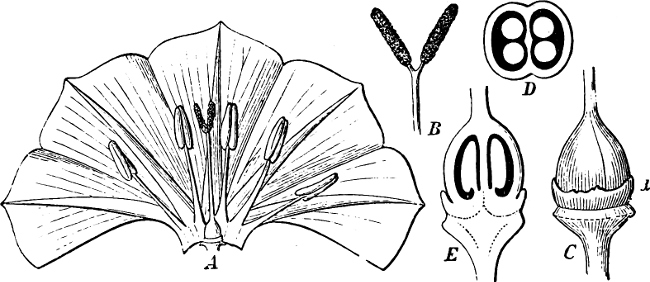
Fig. 552.—Convolvulus scammonia.
2. Dichondreæ. This group is a more primitive
form, not twining, and without latex. It has 2 free
carpels with basal style (as in Boraginaceæ) and valvate corolla.
3. Cuscuteæ, Dodder Group (Fig. 553). Parasites, with
round, filamentous stems, bearing only scale-like leaves and almost
destitute of chlorophyll (they are reddish or yellowish); they are
parasitic upon other plants, around which they twine, first with
narrow, compact coils from which haustoria (Fig. 553 A) are
developed which enter the host-plant, and then with wider coils by
which they raise themselves to other portions of their host or try
to reach other plants. On germination a very temporary primary root
is developed, which bears root-hairs as far as the tip (rootcap is
wanting); it only serves as a kind of reservoir for water, and perishes
very soon after the seedling has fastened on to a host. The embryo
is filamentous and rolled up spirally (Fig. 553 C),
and is sometimes destitute of cotyledons. The flowers are crowded
into capitulate inflorescences, complicated by accessory shoots (Fig.
553 A); they have S5, P5 (imbricate æstivation), A5
(and beneath the stamens 5 scales on the corolla-tube), G2. Fruit a
capsule opening by a lid.—Cuscuta europœa, C. epilinum
(Flax-Dodder), C. epithymum (Lesser-Dodder), C. trifolii
(Clover-Dodder), etc., are parasitic on different hosts, or parasitic
each on its own particular host.
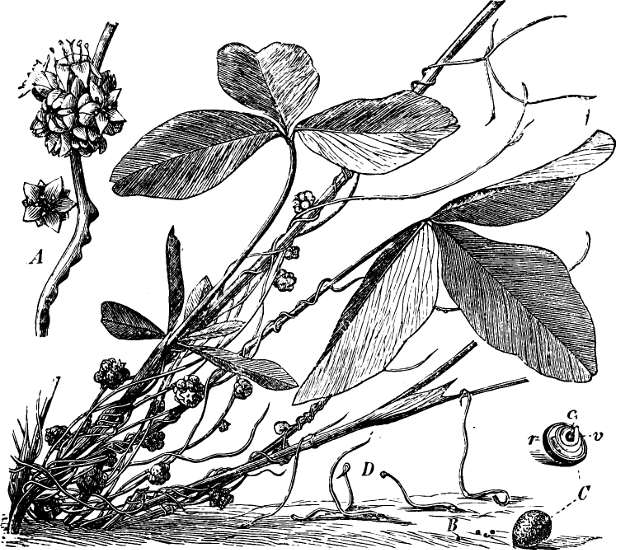
Fig. 553.—Cuscuta trifolii, parasitic
on Red Clover. A A portion of the stem with an inflorescence
and haustoria (mag.); B seed (nat. size); C seed (mag.);
D embryo (nat. size).
840 species; the majority in the Tropics, especially Am. Many
are ornamental plants. Officinal: some on account of
their purgative properties: the tuberous roots of Ipomæa
purga (Jalap, from Mexico) and the dried latex (“Scammony”)
of Convolvulus scammonia (from the East). The tuberous
roots of Batatas edulis (Trop. S. Am.) are used as a
common vegetable (Sweet Potato) in the Tropics.
The type of the flower is: S5, P5, A5 (of which one, or in some cases
several, are suppressed), and G2. The flowers are hypogynous,
☿, perfect with gamopetalous corolla, but most frequently irregular
(medianly zygomorphic, except Solanaceæ), the corolla
being bilabiate (divided into a posterior part of two lobes
and an anterior part of three lobes), and the stamens 4,
didynamous (the posterior being suppressed). The ovary has
2 loculi (only 1 in Utriculariaceæ, Gesneriaceæ,
Orobanche); the placenta in the first-named orders (1–7) is most
frequently very thick, and bears a great many ovules (Figs.
554, 555, 557, 562); the number of ovules in the last orders (8–9) is
considerably reduced (Fig. 570).
Special mention may be made of the apparently 4-merous flower which
is found, e.g. in Veronica and Plantago (Figs.
567, 562 C, 570, 571), and which arises from the typical
5-merous flower by the suppression of the posterior sepal and the
posterior stamen, and by the union of the two posterior petals into
one.—Terminal flowers very seldom occur on the main axis, and would
not harmonise well with the very irregular form of the flower. When
they do occur, they are, as a rule, “peloric,” i.e. regular (in
Linaria vulgaris two kinds of peloric flowers occur,—one with
5 spurs, and one without spurs). The halves of the anthers are often
divided as far as the base, and laterally so widely separated from each
other as to assume an almost straight line (Figs. 563, 564). There is
generally a nectary (“disc”) round the base of the ovary, often 5-lobed
(or divided into free glands).—A common vegetative characteristic is
the absence of stipules.
The 9 orders of the Personatæ are: 1, Solanaceæ; 2, Nolanaceæ;
3, Scrophulariaceæ; 4, Utriculariaceæ; 5, Gesneriaceæ; 6,
Bignoniaceæ; 7, Pedaliaceæ; 8, Acanthaceæ; 9, Plantaginaceæ.
Fig. 554.—Diagram of Petunia.
Order 1. Solanaceæ. The flower (Figs. 554, 555, 559) is
hypogynous, regular (zygomorphic in Hyoscyamus), ☿, and
gamopetalous, with S5, P5 (most frequently imbricate or
valvate), A5, G2, the 2 carpels being placed obliquely (Fig.
554); the bilocular ovary has a very thick axile placenta (Figs.
554, 555 H, 557), which extends almost as far as the wall of
the ovary. The fruit is a capsule or berry; the seeds are more or less
reniform, and the embryo is curved (rarely straight), in a
fleshy endosperm (Figs. 555 F, G; 561).—Both arborescent
and herbaceous forms are found in the order; leaves scattered without
stipules, but with variously formed laminæ (always penninerved). A
peculiar leaf-arrangement is found in many species, viz. the leaves
are borne in pairs, a large and a smaller one together; these
pairs stand in 2 rows, and the flowers are then situated between
the individual leaves in each pair, apparently not in a leaf
axil. The inflorescences are frequently unipared scorpioid cymes
without floral-leaves.
Fig. 555.—Atropa belladonna: A
is reduced.]
Zygomorphic flowers occur, and thus form a transition to the
closely allied Scrophulariaceæ; the zygomorphy sometimes shows
itself only in the relative length of the stamens, sometimes
also in the corolla (Hyoscyamus).—Nicandra is
5-merous throughout all the whorls.—The peculiar relative
leaf-arrangement in this order occurs from sympodial
branching and displacement. The most simple is, e.g.
Datura (Fig. 556 A); each shoot-generation
in the floral parts of the plant has only 2 foliage-leaves
(f1 and f2), and then terminates in a flower;
the axillary buds of both the foliage-leaves are developed
and form a dichasium, but since the leaves are displaced on
their axillary-shoots as far, or almost as far, as the first
leaf of these axillary-shoots, the flowers are borne singly
on the dichasial branches, and all the branches appear to be
without subtending leaves (Shoot I is white, II shaded, III
white, etc., diagram A). Scopolia and others
(Fig. 556 B) differ in that the lowest and smallest
(f1) of the two leaves on each shoot is barren, and
is therefore not displaced; but the upper one (the second
bracteole, f2) is displaced as in the first instance,
and consequently it assumes a position near the first leaf
(the shaded leaf f2 of shoot I being placed near the
white leaf f1 of shoot II, etc.,) of the next youngest
shoot-generation, and hence the leaves are borne in pairs; the
flower placed between the two leaves of a pair is therefore the
terminal flower of the shoot to which the smaller of the two
leaves belongs, and the larger leaf is the subtending leaf for
the floral shoot itself.
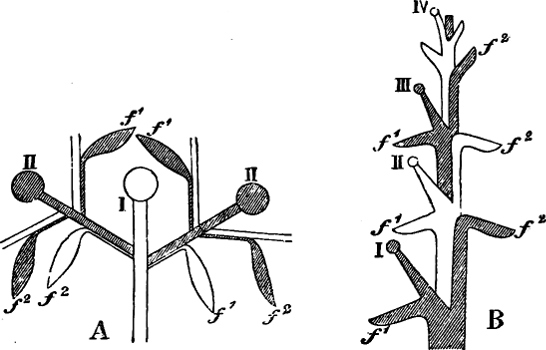
Fig. 556.—Diagrammatic representation of the
branching in Solanaceæ. The various shoot-generations are white or
shaded.
Fig. 557.—Fruit of Hyoscyamus niger
after removal of calyx.
Fig. 558.—Fruit of Datura stramonium.
A. Fruit a capsule. Nicotiana (Tobacco) has
a 2-valved capsule with septifragal dehiscence; the valves separate
at the apex; the corolla is funnel-shaped, tubular, salver-shaped
or campanulate. The flowers in panicles.—Datura (D.
stramonium, Thorn-apple) has a (frequently spiny) capsule (Fig.
558), which is falsely 4-locular (at the top, bilocular)
and opens septifragally with 4 valves. The lower part of the
calyx persists as a thick collar (see Fig. 558). The corolla is
funnel-shaped. The flowers are solitary, large.—Hyoscyamus
(H. niger, Henbane) has a pyxidium (Fig. 557) enclosed in the
campanulate, completely persistent, thick-walled calyx. The flowers
are slightly zygomorphic, and borne in unipared scorpioid
cymes. Scopolia (pyxidium); Fabiana (Heather-like
shrub); Petunia (slightly zygomorphic flower; funnel-shaped
corolla); Nierembergia; Brunfelsia (almost a drupe);
Franciscea; Browallia.—Among those with capsular
fruits are found the most anomalous forms, which by their zygomorphic
flowers and often didynamous stamens present the transition to the
Scrophulariaceæ: Salpiglossis; Schizanthus (lobed petals;
2 perfect, and 3 rudimentary stamens).
Figs. 559–561.—Solanum tuberosum.
Fig. 559.—Flower (1/1).
Fig. 560.—Stamen, ejecting pollen.
Fig. 561.—Longitudinal section of seed.
B. Fruit a berry. Solanum (Nightshade); rotate
corolla (Fig. 559). The stamens have short filaments, the anthers
stand erect, close together round the style, like a cone in the centre
of the flower, and open by pores at the apex (Fig. 560). S.
tuberosum (the Potato-plant); the Potato-tuber is a swollen,
underground stem; the “eyes” are buds, situated in the axils of
its scale-like, quickly-perishing leaves.—Lycopersicum
resembles Solanum in the flower, but the united anthers open
by longitudinal clefts and have an apical appendage. The cultivated
species, L. esculentum (Tomato), has often a higher number
than 5 in the flower, and in the fruit several loculi of unequal
size.—Physalis (Winter Cherry); the calyx ultimately swells
out in the form of a bladder, becomes coloured, and loosely envelopes
the spherical berry.—Capsicum (Guinea Pepper-plant); some
species have very large, irregular, rather dry (red, yellow, black)
berries, which are unilocular in the upper part.—Lycium (false
Tea-plant); the corolla is salver- or funnel-shaped; shrubs; often
thorny.—Atropa (A. belladonna, Deadly Nightshade, Fig.
555); corolla campanulate; the calyx projects beneath the spherical,
black berry. The flowers are borne singly.—Mandragora;
(Mandrake); Nicandra (ovary often 5-locular).—A small
tropical group: Cestreæ (Cestrum, Habrothamnus,
etc.) has an almost straight embryo, which may also be
found e.g. in species of Nicotiana. Related to the
Scrophulariaceæ.
About 1,500 species; the majority within the Tropics, outside
these limits especially in America. Solanum nigrum
is a common weed.—The Potato-plant (Solanum
tuberosum), from Peru and Chili, was introduced into
Europe in 1584 by Sir Walter Raleigh. (Potatoes = Batatos).
The fruits of several serve as condiments: Chilies or
Pod-pepper (Capsicum annuum and longum), and the
Cayenne-pepper (C. baccatum and others), whose fruits
also are officinal, were brought to Europe from S. America by
Columbus, and are commonly cultivated in Tropical America;
Lycopersicum esculentum (Tomato) and others from Peru;
Solanum ovigerum (Egg-plant); Solanum melongena,
etc. Poisonous, acrid, narcotic properties
(alkaloids, etc., solanine, nicotine, atropine, hyoscyamine)
are found in many: Atropa belladonna (from S. Europe;
the roots and leaves are officinal); Solanum dulcamara
(Bitter-sweet; formerly officinal), S. toxicarium
(Guiana); Datura stramonium from Asia (leaves and seeds
officinal), D. sanguinea, metel, tatula,
and others; Hyoscyamus (officinal: the leaves and seeds
of H. niger); Nicotiana tabacum (Virginian
tobacco, officinal: the leaves), N. rustica and others
from Trop. America (Tobacco was introduced into Europe
in 1560); Cestrum-species. Duboisia myoporoides
(Australia); the leaves contain hyoscyamine and are used
in medicine. A number of species of these genera are ornamental
plants.
Order 2. Nolanaceæ. These most resemble the Convolvulaceæ
in the corolla, but the Solanaceæ in their branching, and
leaf-arrangement (in pairs, etc.). The diagram is the same as
in Nicandra with 5 carpels, but the fruits of this order
most frequently form, by invaginations in various directions,
an ovary (with 1 style) consisting of numerous and irregularly
grouped, 1-ovuled cells; the fruit is a schizocarp with many
1-seeded fruitlets.—Nolana (Western S. America): a few
are ornamental plants.
Order 3. Scrophulariaceæ. The flower is hypogynous, ☿,
zygomorphic, with the usual type: S5, P5, A5, and G2, the
latter placed in the median plane; some genera have all 5
stamens developed (Fig. 562 A), but most frequently the
posterior one is suppressed and the flower becomes didynamous
(Fig. 562 B). The fruit, as in the capsular-fruited Solanaceæ,
is a bilocular, 2-valved capsule, with a thick, axile
placenta, and most often septicidal dehiscence (Fig. 563 C).
The numerous seeds are not reniform as in many Solanaceæ, and
have a straight, or only slightly curved embryo, with abundant
endosperm (Fig. 563 D).—The majority are herbs; some are
arborescent; the leaves are opposite or scattered, but stipules are
wanting as in the whole family.
The Scrophulariaceæ are closely allied to the Solanaceæ, and
there is, properly speaking, no characteristic feature which
absolutely separates them. The somewhat irregular corolla,
with five stamens of unequal length in Verbascum, is
also found in Hyoscyamus; curved and straight embryos
are found in both orders. The activation of the corolla in the
Scrophulariaceæ is simple imbricate, in the Solanaceæ
most frequently folded imbricate (in Atropa and
those allied to it, imbricate without folding). The genera
(about 164) are distinguished according to the form of the
corolla, number of stamens, inflorescence, arrangement of the
leaves, etc. Verbascum belongs to the most primitive
5-stamened forms, and from it proceed a long series down to
Veronica, with only two stamens and most frequently the
posterior sepal suppressed.
Fig. 562.—Diagrams. A Verbascum;
B Linaria; C Veronica.
1. Antirrhineæ, Snapdragon Group. This has most
frequently a descending æstivation of the petals (the posterior petals
are outside the lateral ones, which again enclose the anterior; Fig.
562 A, B). The plants belonging to this group are not
parasites.
a. 5-stamened.—Verbascum (Mullein, Fig. 563
A) has a slightly irregular, rotate corolla; five stamens
(frequently covered with woolly hairs), of which the two anterior
ones are the longer and differ often also in other respects. The
inflorescences are racemose, often with several series of accessory
dichasia in the axil of each primary floral-leaf. The leaves are
scattered and, together with the stems, are often covered with a grey
felt of branched hairs.
Fig. 563.—Verbascum thapsiforme.
Fig. 564.—Antirrhinum majus. A flower,
and the upper lip of a flower with the stamens.
Fig. 565.—Scrophularia nodosa.
Protogynous flower in various stages: A ♀ stage; g the
stigma projecting from the throat of the corolla; B the same in
longitudinal section; C ♂ stage, the stigma is bent down and its
former position occupied by the stamens; s staminode; g
stigma; d nectary.

Fig. 566.—Digitalis purpurea.
b. 4-stamened, didynamous (Fig.
564).—Scrophularia (Fig-wort, Fig. 565) has cymose
inflorescences in a panicle; the corolla (Fig. 565) is urceolate,
short two-lipped; the posterior stamens are present as a scale below
the upper lip of the corolla (Fig 565 s). S. nodosa
has a tuberous rhizome.—Pentstemon; the posterior stamen
is barren and very long.—Antirrhinum (Snapdragon). The
corolla (Fig. 564) is personate, i.e. bilabiate, but with
the under lip arched to such an extent that it meets the upper lip,
closes the corolla throat, and entirely conceals the stamens and
style; the corolla-tube is produced into a short pouch at the base
on the anterior side. The capsule is oblique and opens by 2–3 pores,
formed by small, dentate valves. In Linaria (Toad-flax) the
pouch is produced into a spur. Sometimes there are traces of the
posterior stamens. The capsule opens by large pores (one for each
loculus), produced by large, many-partite valves. L. vulgaris
reproduces by suckers.—Digitalis (Foxglove, Fig. 566) has
long racemes with drooping flowers; the posterior sepal is small
(a step towards complete suppression, as in Veronica); the
corolla is obliquely campanulate, and generally nearly 4-lobed, the
two posterior petals coalescing.—Alonsoa; Nemesia;
Chelone; Herpestis; Mimulus; Torenia;
Vandellia; Limosella (L. aquatica, Mud-wort,
native); Scoparia; Capraria; Erinus (found on
the Roman Camp at Chesters, Northumberland, and supposed to have
been introduced from Spain by the Roman soldiers); Celsia
(near Verbascum); Maurandia; Lophospermum;
Rhodochiton; Collinsia; Nycterinia, etc.

Fig. 567.-Flower of Veronica.
c. 2-stamened.—Gratiola (Water-hyssop). 5-partite
calyx. The upper lip of the corolla is undivided or slightly bifid;
the two anterior stamens are either entirely absent or are reduced
to staminodes (a transition to Veronica).—Veronica
(Speedwell), most frequently 4-partite calyx; 4-lobed, rotate,
zygomorphic corolla with 2 perfect stamens and no trace of the others
(Figs. 567, 562 c); capsule with loculicidal dehiscence.
Calceolaria; the corolla has two slipper-like lips.
2. Rhinantheæ, Yellow-rattle Group. Herbs, all of which
(with the exception of Lathræa) are annual parasites
with green foliage-leaves. They attach themselves by haustoria to the
roots of other plants and draw nourishment from them. The majority
turn black when dried. Racemose inflorescences. In many the calyx
is 4-partite, the posterior sepal being absent, or very small. The
corolla is distinctly bilabiate (Fig. 568), with most frequently
ascending æstiration; in the majority it does not become detached
at the base, but by means of a ring-like cut some distance up the
tube; 4 didynamous stamens; pollen-grains dry, easily falling out;
the anthers are often furnished at the base with bristles or hairs
(Fig. 568) which play a part in the pollination, the probosces
of the insects, being forcibly pushed against them, agitate the
anthers and shake out the pollen-grains. Capsule with loculicidal
dehiscence.—Euphrasia (Eye-bright), Melampyrum
(Cow-wheat), Rhinanthus (Yellow-rattle), Odontites
(Bartsia), Pedicularis (Louse-wort), and Lathrœa
(Tooth-wort) all have native species. The last named is pale yellow,
or reddish (without chlorophyll); it is a parasite on the roots
of the Hazel, Beech and other shrubs, having an aerial stem, and an
underground, perennial rhizome, covered with opposite, scale-like, more
or less fleshy leaves with a number of internal glandular, labyrinthine
cavities. The inflorescence is a unilateral raceme. It approaches
Gesneriaceæ in having a unilocular ovary with two
parietal placentæ.
Fig. 568.—Euphrasia officinalis. Flower
of the large and the small-flowered forms; showing the anthers and
stigmas.
The mechanical contrivances for POLLINATION are so
numerous that no general principle can be laid down. Personate
flowers, like those of Antirrhinum are only accessible to
strong insects, such as humble-bees, which can force themselves
between the two lips, and so become dusted with pollen on
the back. In Euphrasia and other Rhinantheæ
the insects become covered with smooth, powdery pollen when
they shake the anther-apparatus in touching the hairs and
bristles mentioned above. Scrophularia nodosa is
protogynous (Fig. 565). Digitalis purpurea, however,
is protandrous. Mimulus luteus and some others have
sensitive stigmatic lobes, which shut up on being touched. The
Veronica-species constitute a series, from large-flowered
down to small-flowered forms, and parallel with them are found
various gradations from insect-to self-pollination. In some (as
Euphrasia officinalis, Rhinanthus crista galli)
there are two kinds of flowers: large, which are pollinated
by insects, and small, which are self-pollinated (Fig. 568).
Lathræa squamaria (Tooth-wort) is a protogynous
spring-flowering plant, largely visited by humble-bees. Others
have cleistogamic flowers. Nycterinia capensis opens its
flowers at night.
2,000 species; chiefly from the Temp. Officinal:
Digitalis purpurea (the leaves; Europe), a poisonous
plant. Verbascum thapsus and thapsiforme,
Veronica officinalis (“Herba V.”), Gratiola
officinalis (“Herba”) have medicinal uses. The whole
of the Scrophulariaceæ are more or less suspicious, if
not actually poisonous, and none serve as food. Many are
ORNAMENTAL PLANTS: Mimulus luteus (N. America),
Paulownia imperialis (the only species; in Japan; a
tree), Antirrhinum vulgare (S. Eur.), Linaria,
Pentstemon, Veronica, Calceolaria (Peru,
Chili, etc.).
Fig. 569.—Leaf of Utricularia vulgaris,
with bladder. Median longitudinal section through a bladder containing
a Cyclops. At a a hair of the upper-lip, at i 2 bristles
of the under-lip of the entrance (a, b); in the latter
are placed 4 bristles h; k stalk of the bladder, in which
is seen a vascular bundle. (After Cohn.)
Order 4. Utriculariaceæ. To this order belong only perennial,
insectivorous, aquatic, and marsh-plants (200
species) with a more or less characteristic appearance. They differ
from the Scrophulariaceæ, especially in having 2 stamens
(the anterior) and a unilocular ovary, with free, central
placenta (like that of the Primulaceæ). For the rest the flower
is distinctly bilabiate, both in the calyx and corolla. Two-valved
capsule; no endosperm.
Pinguicula (Butter-wort) has a rosette of leaves close to the
ground; these are sticky, covered with glandular hairs, and roll round
any small insects which may be caught upon them; flowers solitary,
terminal on a long scape; calyx, 5-partite; corolla with spur. The
embryo germinates with 1 cotyledon.—Utricularia (Bladder-wort).
Our native species are floating, without roots, with hair-like,
divided leaves, studded with peculiar bladders (in the Tropics there
are terrestrial species, with ordinary foliage). The bladders (Fig.
569) have an aperture, closed by a valve opening inwards, so that small
aquatic animals are allowed to enter, but are not able to escape; they
are thus entrapped in the bladders, and are probably used as food.
Calyx bipartite; corolla personate with spur.
The embryo of Utricularia is very imperfect,
scarcely more than a spherical, cellular mass, with a few slight
leaf-rudiments. On the germination of U. vulgaris,
several bristle-like leaves develop into a compact rosette; the
stem then develops, and also the finely-divided, bladder-bearing
leaves. A primary root is not developed. The stems branch
copiously and in a very peculiar manner. The growing-point of
the stem is rolled spirally.—The stigmatic lobes are sensitive
and close on being touched; self-pollination often takes place,
however, in Pinguicula.
Order 5. Gesneriaceæ. The flower in this order may be
both epigynous (Gesnerieæ) and hypogynous
(Cyrtandreæ), but otherwise is nearly the same as in
Scrophulariaceæ, only that the ovary is unilocular,
with 2 parietal, often bifid, placentæ. Of the
5 stamens the posterior is rudimentary, or (more rarely)
entirely wanting, and the others are didynamous (Cyrtandreæ
have often only 2 stamens); their anthers are generally
glued into a quadrangular mass. The majority are herbs with
juicy stems, opposite, verticillate or scattered leaves
without stipules, often, like the stems, thick and juicy,
soft-haired or glabrous. The corollas are often highly-coloured
(scarlet, red-yellow, etc., and spotted internally), large
and magnificent, so that many species are ornamental plants.
Gesnerieæ (often epigynous) have endosperm; S.
Am.—Cyrtandreæ, hypogynous, without endosperm; Asia,
S. Africa.—Streptocarpus, neither the primary root nor
primary shoot attains development; one of the cotyledons dies,
while the other grows and becomes a very large foliage-leaf,
from which spring adventitious roots and adventitious
inflorescences.
500 species. Gloxinia, Achimenes, Gesneria,
Alloplectus, Tydæa, Columnea,
Nægelia, Æschynanthus, and others, especially in
the forests of tropical America. Some are epiphytes on trees,
others prefer the leaf-mould of the forest and crevices of
cliffs. Several genera have peculiar, catkin-like, underground
shoots, with scale-like compact leaves; others have tubers.
Orobanche (Broom-rape) is allied to this order as a
parasitic form. It is a parasite on the roots of other
plants, not like Lathræa by means of thin rootbranches
with haustoria, but growing with the base of its stem in close
contact with its host, and probably even often protruding a kind
of thallus into it, in a manner similar to the Loranthaceæ. Its
aerial shoots are not entirely destitute of chlorophyll, but are
not green; they only bear scale-leaves and terminate in a raceme
or spike-like inflorescence.—Some Orobanche-species
are detrimental to various cultivated plants (Hemp, Lucerne,
Tobacco, etc.). The flowers are strongly zygomorphic; the
posterior sepal is often wanting, and the anterior are united to
the two lateral ones. Ovary unilocular, as in Gesneraceæ, with 2
or 4 parietal placentæ.—The exceedingly small seeds have a very
rudimentary embryo, formed of an ellipsoidal, cellular mass,
without indication of cotyledons or other organs.—About 100
species; especially in the Mediterranean region.
Order 6. Bignoniaceæ. 500 species; nearly all trees and
shrubs, and to a great extent lianes, climbing by tendrils
(modified leaves), which are sometimes terminated by a
special clasping apparatus. These lianes have, as a rule, an
anomalous stem structure, the wood being either divided
into four wedges at right angles to each other, separated
by four grooves filled with secondary wood-parenchyma, or a
greater number of wedges occur, by the cambium ceasing to
form wood in several places. The leaves are most frequently
opposite and compound; the flowers in the main are similar to
the didynamous Scrophulariaceæ, and especially resemble those
of Digitalis purpurea; they are bilabiate, large, and
beautiful, campanulate or trumpet-shaped, many of the prettiest
ornamental plants in the Tropics belonging to this order. The
fruit is most frequently a large, woody, 2-valved, siliqua-like,
septifragal capsule, whose valves separate from the flat and
broad partition-wall, which bears the large, generally winged
seeds: Tecoma; Bignonia.—In gardens: Catalpa
syringæfolia (Trumpet-wood); Tecoma radicans (from
S. Am.).—“Palisander”-wood is from Jacaranda (S.
Am.).—Eccremocarpus (N. Am.) forms, by its unilocular
capsule, a transition to the Gesneriaceæ (E. scaber;
herbaceous).
Crescentia is allied to this order; C. cujete
(Calabash) is its best known species. The fruit (unilocular with
2 parietal placentæ) is a very large, spherical or ellipsoidal
berry, with a firm, finally woody outer layer. After the removal
of the juicy interior, these are commonly used as drinking
vessels in Tropical America.
Order 7. Pedaliaceæ. Sesamum (orientale and
indicum); very important oil-plants, which from olden
times have been cultivated in tropical Asia and Africa for food
and as medicinal plants, and are now cultivated in America
also. The seeds are used as a raw material in the manufacture
of soap in Europe.—To this order also belong Martynia
and Craniolaria, which have a long horned capsule and
sensitive stigmas.—46 species.
Order 8. Acanthaceæ. 1,500 species; mostly erect,
slender, branched herbs or shrubs, rarely arborescent,
especially in S. Am. and Ind. The branches frequently have
swollen nodes; the leaves are opposite, penninerved,
undivided, more or less lanceolate or elliptical, and generally
leave a distinct scar when they fall off. Stipules are wanting.
The flowers are solitary or in dichasia, which are arranged
in 4-rowed spikes or racemes, each flower with its subtending
bract, which may be brightly coloured, and most frequently
also with two bracteoles. With regard to the corolla (which is
often labiate, in any case irregular, and frequently prettily
coloured), the 2 or 4 didynamous stamens (of whose anthers one
half is inserted lower than the other, or suppressed) and the
gynœceum, the Acanthaceæ are true Personatæ, approaching most
nearly to the Scrophulariaceæ: they differ from the other orders
especially in the fruit, which is a bilocular, 2-valved,
often elastically dehiscing capsule, which never has more than
2 rows, and in some only 2 seeds in each loculus, the seeds
being often compressed and borne on strong, curved
or hook-like funicles (retinacula) which persist
after dehiscence. Embryo curved without endosperm;
radicle pointed downwards.—Cleistogamic flowers are found in
several species. Cystoliths are common.
The following grow wild in Europe: Acanthus
(spinosus and mollis, whose pinnatifid leaves
served as models for the capitals of the Corinthian columns).
The posterior sepal is the largest of all the leaves of the
flower, and covers the other parts like a helmet; the 2 anterior
sepals are united, and the two lateral ones are small and
greenish; the corolla has no upper-lip, but only a 3-lobed
under-lip. The anthers are bilocular; the filaments ultimately
become very firm.—Justicia, Eranthemum,
Goldfussia, Thunbergia (a twiner), Ruellia,
Dicliptera, etc.—Ornamental plants in conservatories.
Order 9. Plantaginaceæ (Plantains). The flowers (Figs.
570, 571) are regular, ☿, hypogynous, with a 4-partite,
persistent calyx, a gamopetalous, scarious corolla with 4
projecting lobes, 4 stamens, incurved in the bud, later on
projecting considerably, about equal in length, and a bilocular ovary
with one long, filamentous, undivided, feathery,
papillose style (see Fig. 571). The ovary is most frequently bilocular
with 1–few ovules in each loculus. An hypogynous disc is wanting. The
fruit is a pyxidium with 1–few peltate seeds attached in each
loculus (Littorella is in several respects an exception). All
species are herbs, the majority with leaf-rosettes near the ground, and
the flowers in spikes or capitula.
The labiate-like flowers are in this case entirely
concealed under a regular, apparently 4-merous exterior.
The structure of the flower, however, is the same as in the
Scrophulariaceæ, only the reduction, which is found in
Veronica (compare Figs. 562 C, 567 with 570,
571), is also present in this instance and the lobes are also
more equally developed; the posterior petal corresponds to
the bilobed upper-lip; the posterior stamen and the posterior
sepal also are entirely wanting. In the development of the
flower there is no trace of posterior sepal or stamen, and the
posterior petal arises from one primordium, but the two anterior
sepals arise before the lateral ones. The position of sepals and
petals does not agree with that of a true 4-merous flower, which
is represented in Fig. 361 E. The bracteoles are always
suppressed in Plantago.
Plantago (Plantain, Rib-grass). The foliage-leaves are most
frequently scattered, entire, with curved veins, arranged in a
rosette close to the ground on an unlimited rhizome; the spike-like
inflorescence is borne on a long scape; in some (P. psyllium)
the leaves are opposite on a stem with well-developed internodes, and
the inflorescences are borne in their axils. The order also presents
a transition from insect-pollinated to wind-pollinated flowers.
The flowers are protogynous, wind-pollinated in P. major
and P. lanceolata, partly also in the other species, but
insect pollination also occurs, and P. media has three kinds
of flowers, some of which are adapted for wind-pollination (Fig.
571), others, with short filaments, for insects. Littorella
lacustris (Shore-weed) is the most reduced of the Plantaginaceæ:
an aquatic plant with rosettes of round, awl-like leaves and diclinous
(monœcious) flowers. In the axils of the foliage-leaves is a very
short 3-flowered spike, formed by 2 sessile ♀-flowers, and above them
a long-stalked ♂-flower; all the flowers are lateral, the terminal one
being absent, as in Plantago. The ♂-flower is essentially the
same as in Plantago, but the ♀-flower has a scarious corolla,
with a narrow, 3–4-dentate mouth, which closes tightly round the
nut-like fruit.
Figs. 570, 571.—Plantago media.
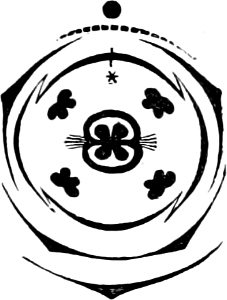
Fig. 570.—Diagram of Plantago media.
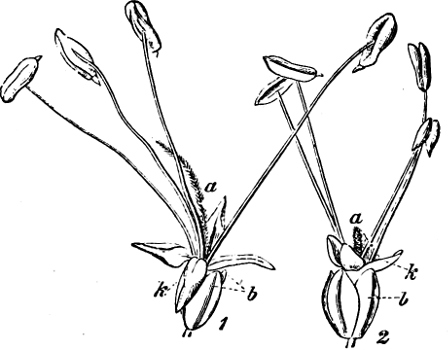
Fig. 571.—Two different forms of the flower (magnified): 1, chiefly
adapted for pollination by wind; 2, for insect-pollination. a
The stigma; b the calyx; k the corolla.
The genus Plantago constitutes nearly the entire
order (200 species). Some are widely distributed weeds
(e.g. P. major, “The white man’s footstep”). In
P. psyllium (S. Eur.) the integument of the seeds is
mucilaginous, and swells considerably in water.
The flowers are hypogynous and zygomorphic (in
Boraginaceæ and Cordiaceæ, however, they are regular,
except Echium and Anchusa arvensis). The calyx is
gamosepalous, the corolla bilabiate (except in the two orders
mentioned), mostly after 2/3, i.e. divided into a 2-leaved
posterior portion, and a 3-leaved anterior portion. The æstivation
of the corolla is nearly always descending.—In Boraginaceæ
and Cordiaceæ there are 5 stamens of equal length; in the
other orders 4 didynamous ones, or only 2 fertile; the posterior
stamen is sometimes developed as a staminode, sometimes fertile (in
Stilbaceæ). The ovary is formed of 2 median carpels (except
some Verbenaceæ), with (1-) 2 ovules on each carpel;
in the majority of the orders it is, however, divided by a false
partition-wall between the dorsal and ventral sutures, into 4
loculi, each of which is often raised independently, causing
the style to be situated in the depression between the four lobes
(“gynobasic” style, Figs. 572, 573, 575, 579). The fruit in these
orders most frequently becomes a 4-partite schizocarp with
nut-like fruitlets. The other orders have a 1(-2)-locular
ovary.—The leaves are simple, without stipules.
The family is related to (and proceeds from) the
Tubifloræ, especially Convolvulaceæ, which has an
almost similar construction of the ovary. It is doubtful whether
the Cordiaceæ and Boraginaceæ should be classed
with the others.
The orders are: 1, Cordiaceæ; 2. Boraginaceæ; 3, Verbenaceæ; 4,
Labiatæ; 5, Selaginaceæ; 6. Globulariaceæ; 7, Stilbaceæ.
Order 1. Cordiaceæ unites Convolvulaceæ and Boraginaceæ.
Tree-like plants with 5-(4–10) merous flowers, doubly bifid
style, and drupe with 4 or less loculi. No endosperm; cotyledons
folded.—185 species; tropical.
Order 2. Boraginaceæ. The vegetative parts are very
characteristic: herbs with cylindrical stems and
scattered, undivided, nearly always sessile, entire leaves,
without stipules, and generally, together with the other green portions
of the plant, covered with stiff hairs, consequently rough and often
even stinging (hence the other name for the order Asperifoliæ).
The inflorescences are unipared scorpioid cymes with the
branches coiled spirally (“helicoid,” Fig. 573) before the flowers
open. The flower is perfect, regular (obliquely zygomorphic in
Echium and Anchusa arvensis), hypogynous, gamopetalous:
S5, P5 (often with ligular outgrowths), A5, G2, but each of the two
loculi of the ovary becomes divided by a false partition-wall into two,
each of which contains one pendulous anatropous ovule with the
micropyle turned upwards; the four loculi arch upwards, so that the
ovary becomes 4-lobed, and the style is then, as in the Borageæ,
placed at the base (“gynobasic”) between the four projections
(Figs. 572, 573). The fruit is a 4-partite schizocarp with four
nut-like fruitlets (Fig. 572).—Endosperm is wanting (except in
Heliotropium); the radicle is turned upwards.
The INFLORESCENCES are often double unipared scorpioid
cymes; the bud of the second bracteole is developed, that of
the first suppressed; in some cases both the bracteoles are
suppressed (Myosotis, Omphalodes, etc.), but
in other instances all the first bracteoles (a) only
are suppressed, and the others are then situated in two rows
towards the under side of the coiled axis, while the flowers are
situated on the upper side. Displacement of the branches or of
the floral-leaves sometimes takes place. The flowers are often
red at first, and later on become blue or violet; they hardly
ever have any smell. The fruit entirely resembles that of the
Labiatæ, but the radicle of the latter is turned downwards.
The fruitlets present small differences which have systematic
importance; they are hollow or flat at the base, attached to a
flat or columnar receptacle, etc.
1. Heliotropieæ. This group deviates from the
characteristics mentioned above in the undivided ovary and terminal
(“apical”) style. In this, as well as in the fact that in some genera
(Tournefortia, Ehretia, etc.) the fruit is a drupe,
it connects this order with the Cordiaceæ. Heliotropium,
Tiaridium, and others have schizocarps.
2. Borageæ, Borage Group. Style gynobasic; fruit a
schizocarp.
A. The throat of the corolla is without ligules, or with very
small ones.—Pulmonaria (Lung-wort); funnel-shaped corolla; a
whorl of hairs in the corolla-throat.—Echium (Viper’s-bugloss)
has zygomorphic flowers, the plane of symmetry almost coinciding
with that of the very well-developed inflorescence (through the
fourth sepal); the corolla is obliquely funnel-shaped, the style is
more deeply cleft at the apex than in the others; stamens 2 longer,
2 shorter, and 1 still shorter.—Cerinthe has a tubular
corolla with five small teeth and two bilocular fruitlets. The
bracts are large and leafy, and, like all the rest of the plant, are
almost glabrous.—A few Lithospermum-species have a
naked corolla-throat; others have small hairy ligules, which do not
close the corolla-throat. The fruitlets are as hard as stone, owing
to the presence of carbonate of lime and silica.—Mertensia
(Steenhammera); Arnebia; Nonnea (small ligules).
B. The corolla-throat is closed by, or in any case provided
with ligules, i.e. scale-like bodies or small
protuberances, situated in the throat of the corolla opposite
the petals, and which are invaginations or internal spurs
of the petals (Fig. 572 D).—The nuts in Cynoglossum
(Hound’s-tongue) bear hooked bristles over the entire surface,
or, in Echinospermum, only on the edge. The following have
smooth nuts:—Symphytum (Comfrey) has a cylindrical, campanulate
corolla, and prolonged-triangular, pointed ligules.—Borago
(Borage) has a rotate corolla with projecting, emarginate ligules;
the stamens have a horn-like appendage, projecting upwards from the
back of the filament. The fruitlets are hollow below.—Anchusa
(Alkanet, Fig. 572). The corolla is salver-shaped; the ligules small,
hairy protuberances. A. (Lycopsis) arvensis has an S-curved
corolla-tube.—Myosotis (Forget-me-not, Fig. 573); rotate
corolla with small (yellow) protuberances in the throat; scorpioid
cyme without floral-leaves; fruitlets flat.—Omphalodes;
fruitlets hollow at the back, with a scarious, turned-in, toothed
edge.—Asperugo (Mad-wort); the calyx grows after flowering,
becoming large, compressed, and deeply bifid.
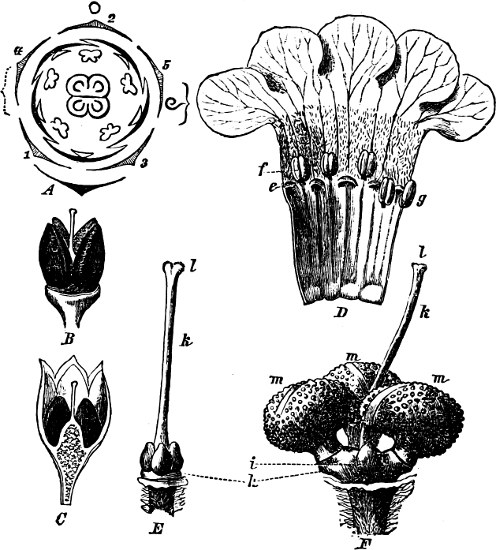
Fig. 572.—Anchusa officinalis: A
diagram; the brocteole a is suppressed (dotted); β supports
a flower. B, C Myosotis, the fruit, entire and
with the calyx in longitudinal section. D, F Alkanna
tinctoria: D the corolla opened (4/1); e the ligule;
f, g the anthers; E gyncœceum (3/1); F
fruit, with three fruitlets; i an aborted loculus; h
disc.
Cross-pollination is most commonly effected by
insects (especially bees). There are a great many contrivances
for pollination; some flowers are protandrous (Echium
vulgare, Borago officin.), others are heterostylous
(long-and short-styled: Pulmonaria officin.); the corona
(ligules) is a protection against rain, and excludes certain
insects. Some are barren when self-pollinated (Pulmonaria
officinalis, Echium vulgare); others which have
but little honey, may, failing insect-pollination, fertilise
themselves, and in Myosotis versicolor this regularly
occurs by the growth of the corolla during flowering, so
that the anthers are brought into contact with the stigma.
Honey is secreted on the hypogynous disc.—About 1,150
species, growing especially in the northern temperate zone,
Mucilage is found (e.g. in the officinal
root of Cynoglossum officinale, in the root of
Symphytum): red dyes are found in some roots
(e.g. Alkanet-root, the root of Alkanna tinctoria,
which is also medicinal; S. E. Europe, Asia Minor); some
are poisonous: Cynoglossum, Echium,
Anchusa, etc. Several species are ornamental plants.
Heliotropium (Peru) is cultivated chiefly on account of
its pleasant scent; essential oils are otherwise very rare.
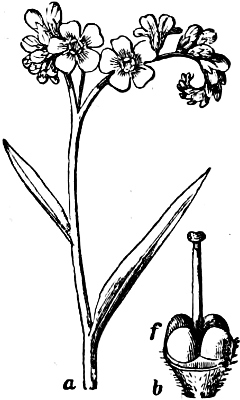
Fig. 573.-Myosotis. Inflorescence and
gynœceum.
Order 3. Verbenaceæ. The majority are shrubs; a few are
herbs or trees (Teak-tree); some are lianes. The branches are
often square. The leaves are opposite or verticillate, without
stipules; in some compound. The inflorescences are racemes,
spikes, capitula, or dichasia. Five sepals; five petals in a
gamopetalous, zygomorphic corolla, which is often bilabiate, but
rarely to such an extent as in the Labiatæ, and the upper lip
in some is larger than the under, in others smaller; stamens
four didynamous, or two; the ovary is entire (not grooved or
divided), 1- or 2-locular, or, as in the Labiatæ, divided into
four loculi with an erect ovule in each, but in some the
anterior carpel is suppressed. One terminal style. The
fruit is, e.g. in Verbena, a 4 partite schizocarp
with nut-like fruitlets; in Vitex (digitate leaves) a
drupe with a 4-locular stone; in Clerodendron a similar
fruit, with four free stones; in Lantana a bilocular
stone, or two unilocular stones. The radicle is turned
downwards. Endosperm small or absent.—Lippia,
Stachytarpheta, Bouchea, Priva,
Citharexylon, Callicarpa, etc.—The Verbenaceæ are
closely allied to the Labiatæ; they differ especially in the
ovary not being 4-lobed with gynobasic style, but undivided,
almost spherical or ovoid with a terminal style. Again, the
leaves are not so constantly opposite, and the inflorescences
are various.
730 species; especially in the Tropics; there are several
in America, especially Lantana-species; shrubby
weeds.—Many of those mentioned are ORNAMENTAL PLANTS,
especially Verbena; Vitex agnus castus is a S.
European shrub. Lippia citriodora (S. Am.) etc., have
strongly-scented leaves; the Teak tree (Tectona grandis)
is one of the largest trees in East India, and has a very hard
wood.
Avicennia is allied to this order; it inhabits the
Mangrove swamps on tropical coasts. The endosperm emerges from
the ovule, carrying the embryo with it; the embryo ultimately
bursts the endosperm and lies free in the loculus of the
fruit; this is then filled by the embryo with its large, green
cotyledons, which are borne on an already hairy or rooted stem.
The seedling thus developed falls from the tree, together with
the fruit, and strikes root in the mud. One special cell of
the endosperm at an earlier period becomes a highly-developed
organ of suction, growing into a much-branched sac, very rich in
protoplasm.
Order 4. Labiatæ. The special characteristics are: the
square stem, the opposite leaves (without stipules), the
inflorescences which are formed by two double unipared scorpioid
cymes, the labiate corolla, the 4 didynamous
stamens (the posterior being entirely suppressed) (Fig. 574), and the
4-partite schizocarp with nut-like fruitlets. The floral
formula is S5, P5, A5 (the posterior stamen is generally absent), G2.
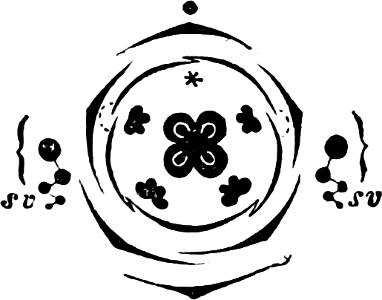
Fig. 574.—Diagram of Lamium album:
sv dichasia.
They are chiefly aromatic plants (herbs, shrubs, e.g. Lavender,
or trees), volatile oil being formed in internal cells or in the
glandular hairs, which cover all green parts. The stem is always more
or less markedly square; the leaves are borne upon the flat sides,
and are simple and penninerved, but vary in the other characters.
The inflorescences are double unipared scorpioid cymes, which may
be situated at some distance from one another in the axils of the
foliage-leaves (Fig. 575 A), but frequently when the subtending
leaves are bract-like, they are crowded into spike-like inflorescences
(Lavandula, Mentha, Salvia, etc.), each of
the so-called “whorls” (verticillaster, glomerulus) being a double
unipared scorpioid cyme (Fig. 574). (Solitary flowers are found in
e.g. Scutellaria, and Origanum). The calyx is
strongly gamosepalous, 5-toothed, often bilabiate (Fig. 575 B).
The corolla is strongly bilabiate (Figs. 575, 576, etc.), with 2
lobes in the upper lip and 3 lobes in the under lip (an approach to
regularity occurs only when the upper lip is small, and thus resembles
one lobe, as in Mentha (Fig. 578) and Lycopus, so
that the corolla approaches the 4-merous corolla of Veronica
and Plantago). The posterior stamen in the diagram (Fig. 574*) is entirely suppressed; in most of the genera the posterior
lateral stamens are the smaller (Fig. 575 D), and are entirely
suppressed in some (see below); in others, e.g. Nepeta,
they are the longer. 2 stamens are found in Salvia,
Rosmarinus, Lycopus, etc. The two halves of the anthers
are often separated from one another, and are placed at an angle with
each other. The gynœceum has 1 style with a bifid extremity (Fig. 575
C) bearing the stigma; the true bilocular ovary is divided by a
false partition-wall into 4 loculi, each with 1 erect ovule (Fig. 575
H). These 4 loculi project so strongly that the ovary becomes
deeply 4-lobed with the style situated in the centre of the lobes
and at their base, “gynobasic” (Figs. 575, 579). A ring-like, often
crenate, nectary surrounds the base of the ovary (Fig. 575 G,
H). The embryo in this order, as in the Verbenaceæ, is
directed downwards (Fig. 575 J) (it is directed upwards in the
Boraginaceæ, which have an entirely similar fruit). Endosperm
absent.
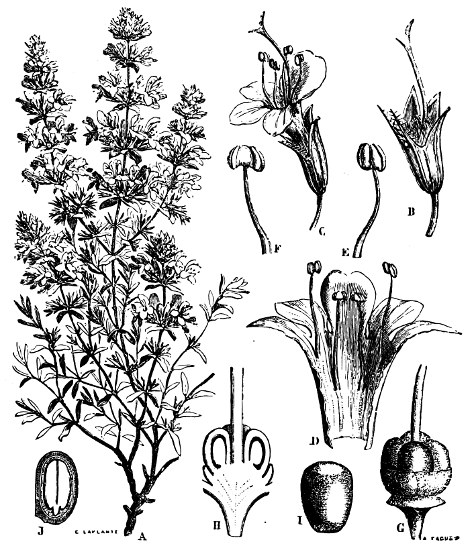
Fig. 575.—Thymus vulgaris.
The 142 genera are mainly distinguished according to the form of
the calyx and corolla, the number, direction, and length of the
stamens, the forms of the nuts, etc.
1. Ajugeæ, Bugle Group. Calyx 10-nerved; the upper
lip is small; 4 stamens. The ovary is not so strongly lobed as
in the following group, so that it is most nearly allied to the
Verbenaceæ. The nuts are reticulately wrinkled. Ajuga
(Bugle) has a very small upper lip. The upper lip of Teucrium
(Germander) is deeply cleft, and the two lobes are bent on their
respective sides towards the under lip, which in consequence appears to
be 5-lobed, and the upper lip to be wanting.
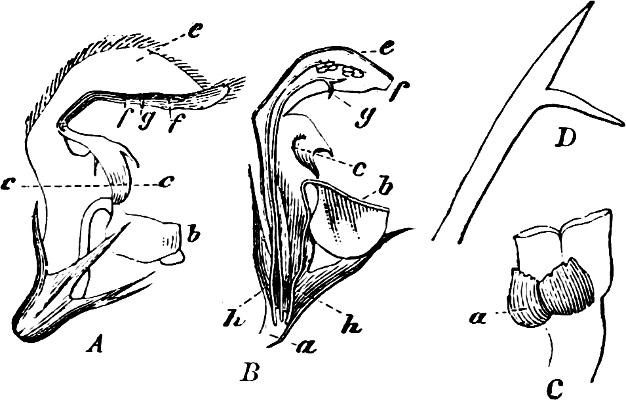
Fig. 576.—Lamium album: A
lateral view of flower; B longitudinal section; C ovary
with nectaries (a); D the apex of the style; e,
upper lip of corolla; c, b, c the three petals of
the lower lip; f anthers; g stigma.
2. Stachydeæ, Betony Group. The calyx is 5- or
10-nerved. The upper lip of the corolla is most frequently strongly
arched or helmet-shaped; 4 stamens, the anterior pair the
longer (Fig. 576).
a. A somewhat regular and 5–10-dentate calyx with
projecting stamens.—Stachys (Betony, Woundwort); the
lobes of the under lip are rounded off. The anterior filaments, after
pollination, bend outwards. Betonica—Ballota
(Horehound); the calyx is funnel-shaped, and has triangular, long,
pointed, awn-like teeth.—Galeopsis (Hemp-nettle) has two
conical protuberances on the under lip between the lateral and
the central lobes. The anthers open by 2 unequal valves.
Lamium (Dead-nettle, Fig. 576) has dentate, lateral lobes on the
under lip. L. album (White Dead-nettle), L. rubrum, etc.
Galeobdolon.—Leonurus; Phlomis.
b. Tubular, regular, often 10-toothed calyx and concealed
stamens.—Marrubium vulgare (Fig. 577); 10 calyx-teeth,
hooked at the apex; many almost spherical whorls of flowers
in the axils of the foliage-leaves, at some distance from one
another.—Sideritis.
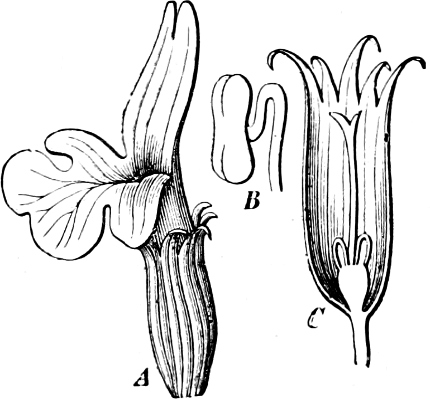
Fig. 577.—Marrubium vulgare.
c. Strongly bilabiate calyx, the lips closing together
after flowering.—Scutellaria (Skull-cap); the two lips of the
calyx are entire, the upper lip has a large spur, and drops off on the
ripening of the fruit. The flowers are generally solitary and turned to
one side.—Prunella (Heal-all); the calyx is compressed, its two
lips are strongly dentate, the upper lips closing slightly round the
under. The stamens have a tooth-like projection beneath the anthers.
3. Nepeteæ, Catmint Group. 13–15 nerves in the calyx;
this deviates from the other groups in the posterior stamens being
the longer. The upper lip is slightly arched. Nepeta
(Catmint), also Glechoma (Ground Ivy), with regular, and
Dracocephalum with irregular calyx.
Fig. 578.—Mentha aquatica, var.
crispa.
4. Satureieæ, Mint Group. The upper lip is flat,
most frequently ovate, or almost spherical, and emarginate (Fig.
578). The calyx is most frequently 5–10-nerved. 4 stamens, the
anterior being the longer; rarely, 2 stamens only.—Mentha
(Mint, Fig. 578) has a regular, 5-dentate calyx, a small, almost
regular, 4-partite corolla, and 4 erect stamens of nearly equal size.
The verticillasters are many-flowered, and are often collected into
cylindrical inflorescences. Herbs.—Lycopus (Gipsy-wort);
corolla almost regular. 2 stamens, the posterior lateral ones are
wanting. Preslia: 4-dentate calyx, 4-partite, regular corolla; 4
stamens of equal size.—Thymus (Thyme, Fig. 575) has a strongly
bilabiate calyx, the throat being closed by a whorl of hairs (Fig. 575
B). The corolla is distinctly labiate. Under-shrubs, with small entire
leaves; verticillasters few-flowered and separate.—Origanum
(Marjoram); spike or capitate inflorescences with the flowers solitary
in the axils of the rather large and distinctly 4-rowed (often
slightly coloured) floral-leaves. Melissa. Calamintha.
Clinopodium (Wild Basil). Satureia. Hyssopus
(Hyssop); small, entire leaves; the verticillasters are situated
unilaterally in a slender, spike-like inflorescence. Lavandula
(Lavender); shrubs with verticillasters collected in cylindrical,
long-stalked inflorescences; the calyx is tubular, has 13–15 nerves,
the posterior tooth is much larger than the others. Stamens and
style do not project. Coleus differs, among other
characters, in having united filaments; the stamens and style are bent
down and concealed in the boat-shaped under lip.
Fig. 579.—Salvia officinalis.
5. Monardeæ, Salvia Group. Only the 2 anterior
stamens are developed.—Salvia (Fig. 579); calyx deeply
bilabiate; the upper lip of the corolla is generally strongly
compressed. Rudiments of the two lateral stamens are present. The
connective in the two fertile stamens is long and filamentous, and
bears at the upper end a normal half-anther, but at the lower one a
barren, often broader portion, against which the insect is obliged
to push its proboscis during its visits to the flowers, causing the
pollen-bearing half-anther to be pressed down against its back.
Floral-leaves often coloured.—Rosmarinus (Rosemary); a shrub
with leathery linear leaves, with rolled back edge. A small tooth on
the filament represents the barren half of the anther. Monarda.
The POLLINATION is generally effected by insects,
especially bees; the under-lip is the landing-stage and the
pollen is deposited on their backs. Cross-fertilisation is
promoted by dichogamy; honey is secreted by an hypogynous disc
and collected in the corolla-tube. Some genera are homogamous
(Lamium, Galeopsis, etc.); others are dichogamous
(protandrous); a few are gynodiœcious: ♀-and ☿-flowers
in various relative sizes (Glechoma hederaceum,
Thymus, Salvia pratensis, and others). The
entrance of uninvited guests to the honey is often rendered
difficult by whorls of hairs, etc. In numerous instances the
upper lip protects the pollen from rain. Cleistogamy is
found e.g. in Lamium amplexicaule.
2,700 species; distributed over the entire globe, but the
greater number in Mediterranean countries (especially in the
Eastern regions), where many are shrub-like.—Poisonous and
acrid properties are absent. On account of their volatile
oils they are principally used as condiments,
for perfumery and in medicine (the officinal
parts are therefore nearly always “folia” and “herba,”
in Lavandula the flowers, and the volatile oils
extracted from them). Such are:[39]Mentha piperita
[+] (Peppermint)—menthol is obtained from this species and
from M. arvensis—M. viridis [+] (Spearmint),
M. crispa (Curly-mint), Thymus vulgaris (Garden
Thyme), Melissa officinalis (S. Eur.), Hyssopus
officinalis (Hyssop, S. Eur.), Origanum majorana
(Marjoram, from the Mediterranean), O. vulgare (Wild
Marjoram), creticum, smyrnæum, etc., Salvia
officinalis (S. Eur.), Rosmarinus officinalis
(oil of Rosemary, S. Eur.), Lavandula vera [+] (oil
of Lavender, S. Eur.). Also: Satureia hortensis (S.
Eur.), Ocimum basilicum (E. India), Pogostemon
patchouli (E. India), etc.—As ornamental
plants, e.g. Monarda, Plectranthus,
and Coleus (foliage-plants, often with red stems and
leaves), Stachys lanata (white, woolly), Phlomis,
Salvia-species, Perilla, etc.
Order 5. Selaginaceæ. 130 species; small, most
frequently heath-like shrubs or herbs, mainly from S. Africa.
They differ from the other Nuculiferæ especially in the
bilocular, transversely-placed anthers of the 4 stamens (2
stamens divided as far as the base (?)). The ovary has 2, or by
suppression only 1 loculus, each with 1 ovule, and the fruit is
a schizocarp dividing into two, or is a 1-seeded nut. Radicle
turned upwards.—A few are ornamental plants (Selago,
Hebenstreitia).
Order 6. Globulariaceæ. 12 species; especially in the
Mediterranean. They form an analogy to the Compositæ, and in
the main resemble Jasione montana in appearance, the
flowers being crowded into a spherical head (hence their name)
and supported by bracts, but without involucre; the ovary
is unilocular with 1 pendulous ovule. The 1-seeded
nut is enveloped by the persistent calyx. The corolla is
more or less labiate, the upper-lip is often absent as in the
ligulate corollas of the Astereæ; stamens 4, didynamous, with
transversely placed anthers opening by one transverse cleft.
The leaves are scattered, simple, entire, and generally form a
rosette. Globularia.
Order 7. Stilbaceæ. Heath-like shrubs. The ovary is
bilocular; 1 erect seed in each loculus, or the posterior cell
is empty. Stilbe. 7 species. S. Africa.
Hypogynous, regular, ☿, gamopetalous flowers (Figs. 581,
582), which are generally 5- or 4-merous, with 5 or 4 stamens (with
the exception of Oleaceæ and Jasminaceæ which have
only 2 stamens, alternating with the carpels). The gynœceum
is formed of 2 (nearly always median) carpels. The corolla very
frequently has twisted æstivation (the upper edges of the petals
being free; Fig. 581 A), and hence the individual lobes of
the corolla are oblique, but the flower as a whole is regularly
actinomorphic. A nectary, in the form of a honey-secreting ring or
glands, is often found round the base of the ovary.—The leaves, with
a few exceptions, are opposite and without stipules.
Endosperm large (Fig. 581 C), except in Jasminaceæ and
Asclepiadaceæ.
The Apocynaceæ and the Asclepiadaceæ, on account of the free
ovaries, without doubt represent a more primitive form, but the
Asclepiadaceæ on the other hand form an offshoot on account of
their peculiar pollen-masses. The Loganiaceæ form a transition
to the Rubiaceæ.
The orders are:—
A. Stamens 5. 1, Gentianaceæ; 2, Apocynaceæ; 3,
Asclepiadaceæ; 4, Loganiaceæ.
B. Stamens 2. 5, Oleaceæ; 6, Jasminaceæ; 7,
Salvadoraceæ.
Order 1. Gentianaceæ (Gentians). Glabrous herbs,
without latex; the opposite, undivided and entire leaves are
often slightly united at the base; many have rosette-like radical
leaves. Stipules absent. The flowers are generally borne in
regular, dichotomously-branched dichasia (Figs. 580, 581
A), which finally become transformed into unipared scorpioid
cymes; the parts of the flower are 4–5-merous as far as the gynœceum,
which is 2-merous; the calyx frequently is almost polysepalous; the
corolla has distinctly twisted æstivation (the upper edges being
free) (Fig. 581 A), except Menyantheæ. The carpels are
entirely united, and most frequently form a 1-locular
ovary with 2 parietal placentæ bearing many ovules (often in
several rows, Fig. 581 D, F). Capsule, 2-valved,
with septicidal dehiscence, the incurved edges bearing the seeds (Fig.
581 D, F).
Fig. 580.—Erythræa. Inflorescence. 1,
2, 3, etc., the successive shoot-generations.
1. Gentianeæ.—Gentiana (Gentian) has
most frequently a tubular, campanulate or funnel-shaped corolla,
sometimes with teeth between the corolla-lobes and fringed in
the throat of the corolla; G. lutea has a rotate, yellow
corolla.—Swertia: rotate corolla; each lobe has at its base
1–2 nectaries, with fringed edges.
Erythræa (Centaury, Fig. 581); corolla most frequently
salver-shaped. The anthers ultimately become spirally twisted
(E). The style prolonged, deciduous. The flower has the
Lobelia-arrangement, i.e. the median sepal is anterior;
the corolla is rose-coloured (in the native species). The capsule is
semi-bilocular (Fig. 581 F, G).—Cicendia has
a low creeping stem, fine as a thread, and small, yellow flowers,
4-merous (without twisted anther).—Chlora (Yellow-wort)
6–8-merous.
Fig. 581.—Erythræa centaurium.
Inflorescence, flower and fruit: br1, br2 floral-leaves
of the 1st and 2nd order; G a valve of the capsule separated
from its fellow.
2. Menyantheæ. Menyanthes (Buck-bean)
deviates in several respects from the type of the order. The leaves
are scattered and, in M. trifoliata, trifoliate;
the corolla has valvate æstivation; the testa is also very
hard (thin in the true Gentians). They are aquatic plants with
creeping rhizome; the flowers borne in racemes, with terminal
flower, heterostylous. The corolla is funnel-shaped with a very
hairy throat.—Limnanthemum with floating leaves, like the
Water-lilies.
575 species; distributed over the entire globe, but most
numerous in Alpine districts. Neither poisonous nor
nutritive plants are found, but several are used in medicine on
account of the bitter properties so prevalent amongst
them. Officinal: the roots of Gentiana lutea.
The roots of other species, e.g. G. purpurea,
punctata and pannonica (Europe) and the leaves
of Menyanthes trifoliata are medicinal. Some are grown
as ornamental plants on account of the pure (often deep blue)
colour of the flowers.
Order 2. Apocynaceæ (Periwinkles). Trees and shrubs (also
lianes), less frequently herbs, generally with latex. The leaves
are opposite, simple, entire, without stipules; the flowers are
regular; corolla-lobes oblique, æstivation twisted. The stamens are
individually free, and the pollen-grains are free or at most
united in fours (see Asclepiadaceæ). The two carpels have 2–∞ ovules,
in all cases there is only 1 style and a capitate stigma, which towards
the base is widened out into a disc-like table (stigma-disc) abstricted
in the centre; but the carpels in most of the genera (e.g. those
mentioned below) are entirely separate, and the fruit consists of two
follicles, the seeds of which often have a tuft of woolly
hairs projecting from the micropyle, less frequently of two drupes.
In some other genera there is a 1-locular (provided with 2 parietal
placentæ) or a 2-locular ovary becoming a 2-valved capsule or a berry.
Endosperm abundant.
Vinca (Periwinkle) has a salver-shaped corolla, which is twisted
to the left in æstivation (i.e. the left edge of the petals is
free); nectaries 2, alternating with the carpels; the summit of the
style is hairy. Follicles; seeds without hairs. Mostly creeping,
perennial, evergreen plants, whose large flowers are apparently
axillary; in reality they are terminal, but by the development of the
bud in the axil of one of the two uppermost leaves, they are thus
displaced over the other leaf of the pair (a helicoid sympodium being
formed).—Plumeria, Tabernæmontana, Cerbera
(drupe). Aspidosperma.
Nerium (Oleander). The leaves are in whorls of 3. Corolla
funnel-shaped, in æstivation twisted to the right, and with a corona
resembling that of Lychnis. The anthers are prolonged at the
base and each also bears at the apex a long, linear, hairy appendage;
these finally become spirally twisted. Follicles; seeds hairy.
Apocynum, Echites, etc. Epigynum is epigynous.
124 genera, 1,000 species; principally in the Tropics. Only
2 species of Vinca are natives of this country; the
following are cultivated as ornamental plants:—Vinca
minor, V. major, V. (Lochnera) rosea,
Amsonia salicifolia, Nerium oleander (Eastern
Mediterranean). The latex of some is poisonous
(Tanghinia venenifera, Cerbera). Caoutchouc is
obtained from others (Hankornia, Landolphia,
Vahea, etc.). Tough bast is frequently developed.
The bark of Aspidosperma quebracho and the seeds of
Strophanthus hispidus are used in medicine (also for
African arrow-poison), the latter is officinal.
Order 3. Asclepiadaceæ. A natural and easily recognised order,
closely allied to the Apocynaceæ, having, like it, frequently a
poisonous latex, opposite, single, entire leaves and fundamentally
the same floral diagram and floral structure (S5, P5, A5, G2); but in
some the æstivation of the corolla is valvate. The carpels here also
have free ovaries, but are united for some distance above into
a large, shield-like, 5-angular head, having on its underside
the true stigmas, and the fruit always consists of 2 follicles;
seeds most frequently numerous and hairy at the micropyle
(“vegetable silk”); endosperm scanty.—The order is distinguished from
the Apocynaceæ and from all other plants also, except the Orchids, by
having all the pollen-grains in each of the 2 loculi of the
anthers (true 2-locular anthers) united into one waxy, club-shaped
pollen-mass (“pollinium”), for the purpose of pollination by
insects. These heavy masses, in order to secure pollination (as in the
case of the Orchids), must be attached to sticky discs (corpuscula);
there are 5 corpuscula, one at each of the corners of the 5-angular
stylar-head (alternating with the anthers), and to each of these are
attached 2 pollinia, one from each of the anthers situated on either
side (thus each anther gives its right pollinium to one corpusculum and
its left to another). The stamens are frequently united at the base,
and each bears on the back a variously formed, petaloid appendage,
termed a “cucullus.”
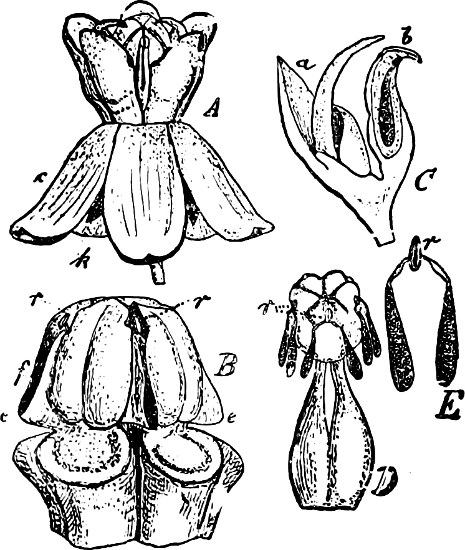
Fig. 582.—Asclepias cornuti. A
An open flower with the calyx (k) and corolla (c) turned
down; the stamens are bent together and surround the gynœceum. B
The andrœcium after removal of the sterile part (cucullus) of the
anther, which functions as a nectary: e the lateral expansions
of the fertile portion of the anthers; f the slit between the
expansions of two contiguous anthers, through which the insect’s foot,
and later a pollinium which is caught by it, is dragged, and behind
which the only receptive part (stigma) is hidden; above the slit
f is the gland (r), which secretes the horny corpusculum,
which is split at its base and joined on either side with a pollinium
(this is more distinctly seen in D and E). When the foot
of the insect is caught in the slit (f) and is drawn upwards,
it becomes entrapped in the slit of the corpusculum, which is then
pulled out together with the pollinia firmly attached to it. In walking
over the flowers the insect will draw its foot through other slits
(f) and so leave the pollinia on the stigmas. C, D
The gynœceum with the pollinia hanging freely. E A corpusculum
and two pollinia.
A peculiar relative position (and therefore a good, distinctive
characteristic) is often found in the inflorescence, which is
cymose; it is placed between the two leaves of a whorl, nearer
to one than to the other. The leaf-pairs are placed obliquely in the
floral region, at acute and obtuse angles, and not at right angles (as
in the purely vegetative parts); the inflorescences are placed in two
rows only which are nearly 90° from each other, and the two contiguous
to one another are antidromous; they are in reality terminal, each
on its own axis, and the entire floral portion of the shoot is a
unipared scorpioid cymose sympodium; in addition, complications also
arise through individual parts becoming united.—Herbs and shrubs, some
twining or climbing.
In Asclepias the corolla is bent back and there is a cup-like
cucullus, from the base of which protrudes a horn-shaped body, bent
inwards.—Vincetoxicum has a rotate corolla and a ring-like,
5-lobed cucullus, without internal prominences.—Stapelia
(especially from S. Africa) is remarkable on account of its
Cactus-like, leafless stems and large, brownish flowers, often with
carrion-like smell. Periploca has more powdery pollinia
(S. Eur., etc.); Hoya carnosa (Wax-flower; Trop. Asia) is
a climber, and has small, annual, flower-bearing dwarf-branches.
Ceropegia.
201 genera with 1700 species, distributed over all tropical
countries; few outside these limits: no native species. Several
are used in medicine on account of the pungent properties of
the latex. Condurango-bark of Gonolobus condurango
is medicinal. Caoutchouc is obtained from the latex of some
(e.g. from Cynanchum). The seed-hairs, which
are most frequently shining, silk-like, and white, are not
sufficiently pliant to be of much value. Ornamental plants in
our gardens: Asclepias-species, etc.
Order 4. Loganiaceæ. Ovary single, with two loculi, in
structure resembling the Rubiaceæ, but superior. 360 species are
included in this order; the majority are tree-like, some lianes
which climb by tendril-like branches. The interpetiolar
stipules of some species are very characteristic (as in
Rubiaceæ, to which they maybe considered to be closely related).
The fruit is a capsule or berry. The most familiar genus is
Strychnos, which has spherical berries with an often
firm external layer, and compressed seeds with shield-like
attachments; endosperm abundant. The leaves have 3–5 strong,
curved nerves proceeding from the base.—Spigelia.—They
have no latex, as in the two preceding orders, but many
are very poisonous (containing the alkaloid “strychnine,”
etc.); the South American arrow-poison, urare or curare, is made
from various species of Strychnos, also an arrow-poison
in the East Indian Islands (Java, etc.). Officinal, the
seeds of Strychnos nux vomica (“Vomic nut,” Ind.). The
seeds of Strychnos ignatii (Ignatius-beans, medicinal),
and others are poisonous.
Order 5. Oleaceæ. The leaves are always opposite. The
inflorescences are racemes or panicles. The calyx and corolla are
4-merous, more or less united, free in some species; the
corolla has most frequently valvate æstivation. All four forms
of fruit occur (see the genera). Ovules pendulous, 2 in each
loculus (Fig. 583 C). Endosperm oily.—Syringa (Lilac)
and Forsythia (anthers somewhat extrose) have capsules
with loculicidal dehiscence and winged seeds.—Fraxinus (Ash)
has winged nuts (samara) (Fig. 583 D); trees with
most frequently imparipinnate leaves; the flowers are naked
and sometimes unisexual (polygamous), the Manna Ash (F.
ornus) has however a double perianth with 4 free petals (Fig.
583 a); in the native species, F. excelsior, the
flowers open before the foliage appears.—Ligustrum (Privet)
has berries.—Olea (O. europæa; Olive) has
drupes; the pulp and seeds of the ellipsoidal fruits are rich
in oil. The lanceolate leaves are grey on the under surface, being
covered with stellate hairs. In the wild state it is thorny (modified
branches).—Phillyrea; Chionanthus.—Few species of
Linociera have 4 stamens.
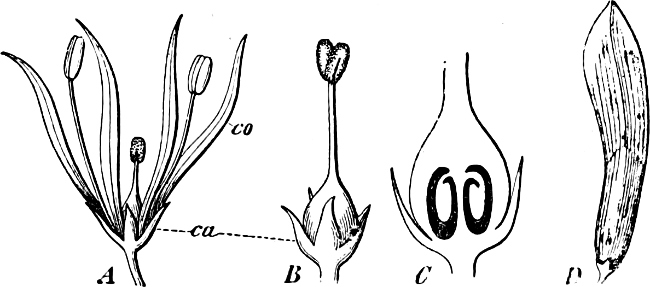
Fig. 583.—Fraxinus ornus: A
flower; ca calyx; co corolla; B gynœceum and calyx;
C longitudinal median section of gynœceum; D fruit.
180 species; chiefly in the northern temperate zone. The
Olive-tree (Olea europæa) has been an important
cultivated plant from ancient times (Olive oil, Provence
oil, “Sweet oil”). The best oil is extracted from the
fruit-pulp. The fruits are edible. Home: Western Asia, Eastern
Mediterranean. Timber: the Ash (Fr. excelsior).
Officinal: the Manna Ash (Fr. ornus), cultivated
in the Mediterranean countries for the sake of its saccharine
juice, which flows out and coagulates into “Manna.”—The
following are ornamental plants: species of Ligustrum and
Syringa (introduced in the 16th century, from S.E. Europe
and Asia), Forsythia (China, Japan; the large, yellow
flowers are borne on dwarf-branches with scale-like leaves,
before the opening of the foliage-leaves), Chionanthus.
Order 6. Jasminaceæ. The æstivation of the corolla is
imbricate; the ovules are erect; seeds almost
without endosperm; radicle directed downwards. The number
of lobes in the calyx and corolla is not 4, but e.g.
5, 8, 10, and variations are sometimes found in the same
individual. The fruit is a berry or capsule. Many species
are twiners, and their scattered or opposite leaves are most
frequently imparipinnate.—120 species; especially in Trop.
Asia (E. India). Some Jasminum-species are cultivated as
ornamental shrubs in the warmer districts on account of their
elegant foliage, and beautiful, sweet-scented flowers, the
essential oil of which is also used in perfumery; the best known
are: J. sambac and grandiflorum. Nyctanthes
arbor-tristis opens its sweet-scented flowers only at night
(E. India).
Order 7 (?). Salvadoraceæ. 8–9 species; Asia,
Africa.—Salvadora.
The leaves are always opposite or verticillate. The flower is
epigynous, ☿, 5-(or 4-) merous, with the usual sympetalous diagram;
2–5 carpels. The inflorescences are frequently dichasial. The sepals
are small, reduced to teeth, and become almost entirely suppressed
in the higher forms.—The flower is regular in Rubiaceæ and
some Caprifoliaceæ, but in other genera of this latter order
(especially of Lonicereæ) it is unsymmetrical. In several
genera of the order first mentioned the loculi of the ovary contain
many ovules, but in the last the number of loculi and ovules becomes
reduced. This is to some extent connected with the nature of the fruit
which is many-seeded in most instances, namely a capsule or berry, but
in others nut-like. Endosperm is present.
The family on one side is allied to the Contortæ (not
only through the Loganiaceæ but also through the
Apocynaceæ), and may be regarded as an epigynous
continuation of this family; on the other side it is allied to
the Valerianaceæ and Dipsacaceæ. Many points of agreement with
the Cornaceæ and Araliaceæ are also found, and
in fact several Caprifoliaceæ are distinguished from these by
hardly any other feature than the gamopetalous corolla.

Fig. 584.—Cinchona calisaya. Flowering
branch.
Order 1. Rubiaceæ. Leaves opposite (or verticillate), undivided
and entire, with interpetiolar stipules (Fig. 586). Flowers
epigynous and hermaphrodite, regular, 4- or 5-merous with the
usual arrangement (Figs. 585, 588–590); corolla gamopetalous, in
æstivation often valvate; ovary frequently 2-locular.

Fig. 585.—Cinchona calisaya. A
entire flower; B after removal of the corolla; C
longitudinal section of ovary; D fruit; E seed.
There are no external characters which at once distinguish
this exceedingly large order, as in many other natural orders
(Compositæ, Umbelliferæ, etc.), but the opposite leaves
with interpetiolar stipules form an excellent mark of
recognition. It is divided into many sub-orders and groups,
especially characterised by the nature of the ovary (1 or
several ovules in each loculus), and of the fruit (schizocarp,
berry, drupe, capsule).—The corolla is bilabiate in 4 genera;
its æstivation in some is twisted; in Capirona, etc., the
filaments are of unequal size. The ovary is semi-epigynous in
Henriquezia, etc. In Morinda all the fleshy fruits
coalesce into one multiple fruit.
1. Cinchoneæ. The fruit is a 2-valved capsule,
with many winged seeds (Fig. 585). Cinchona (Quinine, Fig. 584).
Trees and shrubs with the foliage and inflorescence somewhat resembling
Syringa; the corolla also being of a lilac colour, more or
less salver- or funnel-shaped, and frequently edged with a fringe of
hairs (Fig. 585), is somewhat similar to that of Menyanthes.
Their home is the Andes from Bolivia to Venezuela, varying in altitude
from 1–3000 metres. There are now large plantations in Java and E.
India. (The name “quinine” is of Indian origin; that of the genus
“Cinchona,” is from the Spanish Duchess Cinchon, who in 1638
first introduced the bark into Europe.) The following are closely
allied: Cascarilla, Remijia, Ladenbergia,
Manettia, Bouvardia, etc.
2. Gardenieæ. Trees and shrubs, frequently
having a many-locular berry. Randia, Gardenia,
Genipa, Hamelia, etc.
3. Coffeeæ. Only 1 seed in each of the two loculi of
the ovary; the fruit is a drupe with 2 stones. Coffea
has an ellipsoidal fruit about the size and colour of a cherry;
the two thin-shelled, parchment-like stones are enclosed by a thin
layer of pulp; the two seeds are flat on the side turned to one
another, which has also a deep, longitudinal groove curving to the
sides. The endosperm is hard, horny and greyish (without starch);
the small embryo lies in the lower end near the circumference. The
Coffee-plant (C. arabica) is a small tree, or more frequently,
and especially in plantations, a shrub with large dark-green leaves
and scented, white flowers. Its home is in Tropical Africa; it is
now cultivated in many tropical countries. C. liberica, W.
Africa.—Cephaëlis (C. ipecacuanha, Fig. 586; the roots
are officinal).—Psychotria, Chiococca, Ixora,
Hydnophytum, Myrmecodia, etc.
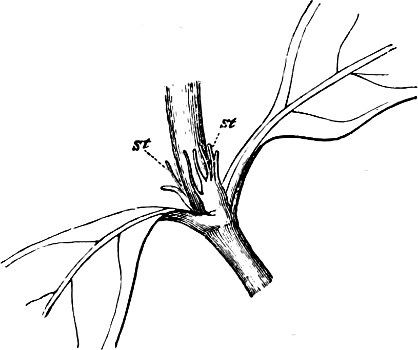
Fig. 586.—Cephaëlis ipecacuanha.
Portion of a branch: st stipules.
4. Spermacoceæ. Chiefly small shrubs and herbs,
many of which are weeds in tropical countries. The stipular
sheaths bear numerous bristles at the edge. Spermacoce,
Borreria, Diodia, Richardsonia, etc.
5. Stellatæ. Herbaceous plants with verticillate
leaves (Figs. 587, 588–590); the stipules are large, leaf-like,
and resemble the lamina of the leaves, so that the leaves appear to
be placed several in a whorl, while in reality there are only two
opposite leaves, the stipules of which project freely, and are
not erect (Fig. 587).
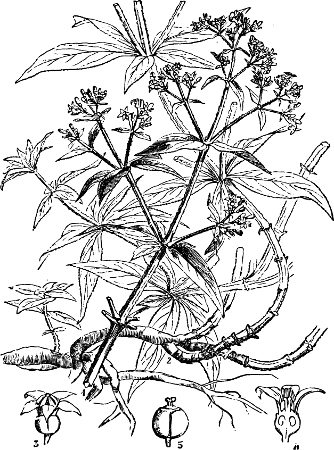
Fig. 587.—Rubia tinctorum.
In some cases there are apparently 4 leaves in the whorl, and then
2 of these are leaves, and the other two are their interpetiolar
stipules. When there are apparently 6 leaves, then the two of these
which are opposite each other are leaves, and the other four are
stipules; if there are several members in the whorl, then a division of
the stipules has taken place. The proof of this theory is founded upon
the fact that not more than 2 of the leaves of the whorl ever support
buds (which, in addition, are seldom of equal vigour), and also that
the whorls do not alternate with each other, which, according to the
rules of the position of the leaves, they should do if all the members
of a whorl had equal value. If there are, for instance, 4 members in
two successive whorls, they stand right above one another, and do not
alternate. The development and anatomical relations (the branching of
the vascular bundles) also point to the same conclusion.—All the
other groups of the order have only 2 small scale-like interpetiolar
stipules, or they form at the base of the leaf-stalks an interpetiolar
sheath, having often a toothed edge (Fig. 586).—Another characteristic
feature in this group is that the calyx is rudimentary, the corolla
valvate (Fig. 588), and that each of the two loculi of the
ovary has only 1 ovule. The fruit is a schizocarp dividing into
2 fruitlets (Fig. 590). The forms of the fruit, as well as
many other characters, as, for example, the epigynous flower, the
rudimentary calyx, the two free or almost free styles, present
interesting analogous resemblances to the polypetalous order of the
Umbelliferæ. This group has its home chiefly in the temperate
regions of the northern hemisphere, especially about the Mediterranean;
it is the only group which occurs in this country, represented by 4
genera.
Figs. 588–590.—Rubia tinctorum.

Fig. 588.—Diagram.
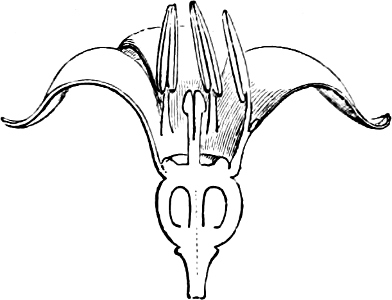
Fig. 589.—Longitudinal section of flower.
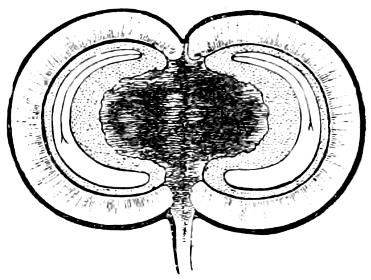
Fig. 590.—Longitudinal section of fruit (3/1).
Galium (Cleavers) is almost destitute of a calyx; it has a
small 4-partite, rotate corolla, 4 stamens, and 2 free styles.
The fruitlets are nut-like. The inflorescence is a paniculate
dichasium passing into helicoid cymes.—Asperula (Woodruff) is
distinguished from the above by its salver- or funnel-shaped corolla.
1 style.—Rubia (Madder, Figs. 587–590) has almost the same
form of corolla as Galium, but (most frequently) a 5-merous
flower, and the fruitlets are “drupes.” Sherardia
(Field Madder); the flowers are clustered in closely arranged cymes
surrounded by an involucre; the calyx has 6 distinct
teeth, while the number of petals and stamens is 4. The corolla is
funnel-shaped.—Vaillantia. Crucianella.
The DISTRIBUTION OF SEEDS, in some instances, is
promoted by hooked appendages on the fruitlets (e.g.
Galium aparine).
The small flowers of the Stellatæ are frequently collected
in compact inflorescences, and are therefore rendered
more conspicuous; slight protandry is found in some,
self-pollination in the species which are less conspicuous.
Many species are heterostylous. Myrmecodia,
Hydnophytum, and other genera have large tubers
(hypocotyledonous stems), whose labyrinthine cavities and
passages are inhabited by ants.
About 4,500 species; tropical or sub-tropical except the
Stellatæ; especially American. The tropical ones are mostly
trees.—Several are OFFICINAL on account of the large
amount of alkaloids and glycosides which they
contain. The most important are the Cinchonas (Cinchona
calisaya, C. succirubra, C. officinalis,
C. micrantha, etc.), whose bark contains the well-known
febrifuge and tonic, Quinine, Cinchonin, etc.; Quinine is
also found in Exostemma, Ladenbergia, and
Remijia. The root “Ipecacuanha” (an emetic) from
Cephaëlis ipecacuanha (Brazils). Caffeine is officinal.
The use of the seeds of the coffee plant (“the beans”) was first
known in Europe in 1583.—There are only a few which contain
aromatic properties, principally among the Stellatæ
(coumarin in Asperula odorata, the Woodruff), in which
group colouring materials are also found. The root and
root-stalks of Rubia tinctorum, the Madder (S. Eur.,
Orient., Fig. 587), were formerly largely used for dyeing,
but are now superseded by the analine colours. Red dyes are
also obtained from the roots of species of Asperula
and Galium. Gambier is a splendid colouring material,
obtained from Uncaria gambir (S.E. Asia), which is
used in dyeing and tanning.—The order does not furnish many
ornamental flowers.
Order 2. Caprifoliaceæ. This order agrees with the Rubiaceæ
in having opposite leaves and an epigynous flower, most frequently
5-merous with the ordinary tetracyclic diagram, but in some species it
is zygomorphic; the corolla has imbricate æstivation, carpels 3–5,
most frequently 3 (not 2, which is the most usual number in the
Rubiaceæ). The fruit is generally a berry or a drupe, but
the most important, and in any case most easily recognisable feature,
is the absence of stipules; in exceptional cases, where they
are present, they are not interpetiolar, and are most frequently
small.—The majority of plants belonging to this order are shrubs
or trees. Compound leaves sometimes occur. Stipules only appear in a
few species of Lonicera, Sambucus and Viburnum;
in the common Elder (Sambucus nigra) they are in some instances
glandular and small, but in other cases larger and more leaf-like (upon
long, well-developed shoots); in the Dwarf Elder (S. ebulus)
they have the normal leaf-like form; in Viburnum opulus they
are present as narrow lobes at the base of the petiole; in others they
are completely absent. The leaves are frequently penninerved, rarely
palminerved. The calyx, as in the Stellatæ and Aggregatæ, is often very
insignificant.
1. Lonicereæ, Honeysuckle Group. This has
campanulate or tubular corollas which are often zygomorphic;
in connection with the length of the corolla the style is long,
filamentous, and most frequently has a large, capitate stigma.
There are several ovules in the loculi of the ovary, and the
fruit is most frequently a berry.

Fig. 591.—Lonicera.
Lonicera (Honeysuckle). Shrubs, sometimes twiners. The corolla
in some species is considerably bilabiate (Fig. 591), with 4 lobes in
the upper lip, and 1 in the under lip, but in others more regular,
tubular, or campanulate. The flowers are either borne in capitate
inflorescences, which are compound and formed of closely compressed
3-flowered dichasia (sect. Caprifolium), or in dichasia with
2 flowers (the terminal flower is wanting). The ovaries and fruits
coalesce in some (sect. Xylosteum). The opposite leaves in
some species unite with each other and form a broad collar encircling
the stem (Fig. 591). Above the primary bud 1–2 accessory buds are often
found in the leaf-axils.—Diervilla (Weigelia); with a
2-locular, 2-valved capsule.—Symphoricarpus (Snowberry) has
an almost regular, funnel-shaped corolla; a peculiar feature is found
in the ovary which has 4 loculi, the 2 median having many ovules in 2
rows, all of which are aborted; the 2 lateral ones, on the other hand,
each have only 1 ovule which is developed. Different forms of leaves
are frequently found on the same branch; they are entire or lobed.
2. Sambuceæ, Elder Group (Fig. 592). This has a
rotate, regular corolla, extrorse anthers, a very short
and thick (or almost absent) style, with tripartite stigmas, and
only 1 pendulous ovule in each of the 3 (-5) loculi of the ovary. The
fruit is a “drupe” with 1–3 (-5) stones. The inflorescence is
made up of cymes grouped in an umbel-like arrangement.
Sambucus (Elder, Fig. 592) has imparipinnate leaves
and a “drupe” with 3 (-5) stones. Between the calyx and the
style a disc remains on the apex of the fruit. S. nigra with
black fruit; S. racemosa with red fruit; S. ebulus is a
perennial herb; the others are woody.—Viburnum (Guelder-rose)
has simple leaves (penninerved or palminerved, entire, dentate
or lobed), and a “drupe” with only 1 stone, which is compressed,
cartilaginous, and parchment-like; 2 of the loculi of the ovary
are aborted. (In V. opulus the marginal flowers of the
inflorescence are barren, and in that case their corollas are generally
specially large; the cultivated Viburnum has only barren
flowers, with large corollas.)
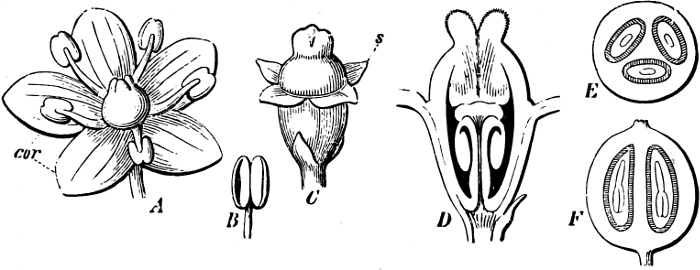
Fig. 592.—Sambucus nigra: cor
corolla; s calyx.
3. Linnæeæ. Linnæa borealis (the only
species) is an extreme form of the order; it has a 2-flowered
dichasium, funnel-shaped, slightly bilabiate corollas (2/3);
4 didynamous stamens. Two of the 3 loculi of the ovary have
several ovules which are not developed, while the third has only
1 ovule, which developes into a seed. The fruit is a nut, which
is enveloped by the two large bracteoles, which are covered by
sticky, glandular hairs, and serve as a means of distribution.
It is a small undershrub.
[Adoxa, which was formerly classed in this order,
appears, according to recent investigations, to be more properly
placed among the Saxifraginæ.]
In cases where the flowers are small, as in Sambucus
and Viburnum opulus, they are rendered conspicuous by
being arranged in closely-packed inflorescences; they are
massed together and form large surfaces, and in the last named
are still more conspicuous on account of the barren, but large
ray-flowers, which are of service in this respect. Honey is
secreted in the nectaries at the base of the styles. In the
genera with rotate flowers, as Viburnum and other
Sambuceæ, the honey lies so exposed and in such a thin layer,
that only flies and insects with short probosces can procure it;
bees, however, visit these flowers for the sake of the pollen.
There is hardly any nectar in the Elder; self-pollination
frequently takes place. The flowers of the Caprifoliaceæ,
which, with their long corolla-tube are adapted for evening-and
night-flying insects with long probosces, open in the evening,
and at that time give off their strongest scent.
Distribution. 230 species; especially outside
the Tropics in the Northern Hemisphere. In this
country they are found especially in hedges and as
under-shrubs.—Officinal: the flowers and fresh fruits
of the Elder (S. nigra), the fruits (“berries”) being
also used in the household. Ornamental shrubs: species
of Lonicera, Symphoricarpus, Diervilla,
which are chiefly from N. Am., Abelia and Viburnum.
The leaves are opposite and without stipules. The flower (Figs.
593, 595, 598, 599, 600) is epigynous, zygomorphic or
asymmetrical, 5-merous with S5, P5, stamens typically 5, but
by suppression never more than 4, sometimes less, carpels 3–2.
The calyx is more or less insignificant, and almost suppressed in the
extreme forms. The ovary has 3–1 loculi, but only one loculus
has an ovule, which is pendulous with the micropyle turned
upwards (Fig. 594). Fruit a nut. Embryo straight, with the radicle
pointing upwards (Fig. 597), without or with endosperm.
The inflorescences are distinct dichasia in Valerianaceæ, but in
Dipsacaceæ and Calyceraceæ they are crowded together into capitula.
This family is closely allied to the Rubiales through the
Valerianaceæ, which have almost the same structure as many
of the Caprifoliaceæ. It attains the highest development in
the Dipsacaceæ, which are composite plants, but differs from
Compositæ in the position of the ovule, etc.
Order 1. Valerianaceæ. Herbaceous plants or under-shrubs with
opposite leaves, often pinnate; stipules absent. The flowers are borne
in dichasia and in scorpioid cymose inflorescences and
are entirely without any plane of symmetry (Fig. 593). The
calyx and corolla are 5-merous, but the calyx is frequently very
insignificant and ultimately a pappus, as in Compositæ; the corolla
is frequently saccate or produced into a spur at the base. Most
frequently, only 3 (4–1) of the 5 stamens are developed; these are
free. Carpels 3, which form an inferior ovary, often with
3 loculi, but only 1 of the loculi contains 1
pendulous, anatropous ovule (Figs. 593, 594 A), the other
loculi are empty and shrink up more or less completely. (Compare Fig.
593 A, B). Style 1, stigma tripartite. Endosperm absent;
embryo straight, with the radicle directed upwards.
The inflorescences are dichasia, or unipared scorpioid cymes
with the branches developed in the axil of the second bracteole.
Both the bracteoles are generally present and frequently form
4 very regular, longitudinal rows on the branches of the
inflorescence.—5 stamens do not occur (except perhaps in
Patrinia). The suppression of stamens and carpels takes
place most readily on the anterior side of the flower and that
turned towards the first bracteole (a) (Fig. 593), whose
branch is suppressed in the dichasium; after this the posterior
median stamen is next suppressed.
By the vegetative characters as well as by the inflorescence
and the flower, the order is allied to the Caprifoliaceæ and
especially to the Sambuceæ.
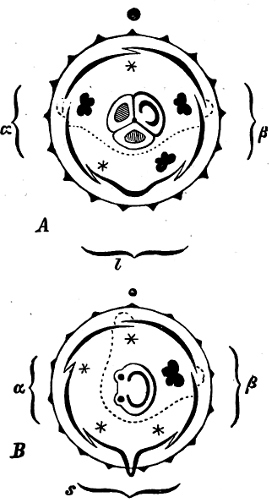
Fig. 593.—A Diagram of Valeriana
officinalis. B Diagram of Centranthus.
In the least modified (oldest) forms, Patrinia and
Nardostachys, there is an almost regular flower, a 5-merous
calyx, 4 stamens, and 3 loculi in the ovary, 2 of which however
are barren. The stamens in Valerianella are reduced to
3, in Fedia to 2 (posterior), and the calyx is less
distinctly 5-dentate; the 2 empty loculi in the ovary are still
visible. Fedia has a small spur at the base of the corolla.
Valeriana has a very reduced, hair-like calyx (pappus),
an unsymmetrical, salver-shaped corolla with a sac-like,
nectariferous spur at the base, 3 stamens and only 1 loculus in
the ovary (Figs. 594, 593). Centranthus (Fig. 593) is still
further reduced. The corolla has a spur and only 1 stamen; unipared
scorpioid cymes with 4 rows of bracteoles. In the last two genera there
is a peculiar wall in the corolla-tube, which divides it longitudinally
into two compartments (indicated by a dotted line in Fig. 593), one of
which encloses the style. This wall is low in Valeriana, but in
Centranthus it reaches as far as the throat.—The rays of the
pappus are pinnately branched and rolled up before the ripening
of the fruit. 12–20 in number (Fig. 594 A, B).
Val. officinalis and others are protandrous: in the
first period the stamens project from the centre of the flower
(Fig. 595 a), the stigmas in the second (b) when
the stamens have become bent backwards. (V. dioica is
diœcious with large ♂-and small ♀-flowers).—275 species;
especially from the temperate and colder parts of the
northern hemisphere of the Old World, Western North America
and the Andes.—Bitter properties are characteristic,
such for instance as the volatile acid and volatile oil of
Valeriana; these occur especially in the rhizomes.
Officinal; the rhizomes of V. officinalis.—The
true Indian “Nardus,” an important medicine and perfume in
India, is extracted from Nardostachys (Himalaya). A
variety of Valerianella olitoria is sometimes used as
salad.
Fig. 594.—Valeriana: A ovary
(longitudinal section); B ripe fruit.
Fig. 595.—Valeriana: a flower in
the ♂ stage; b in the ♀.
Fig. 596.—Centranthus ruber. Flower,
its lowermost portion (the ovary and spur) in longitudinal section. (Mag.)
Fig. 597.—Scabiosa atropurpurea. Fruit
in longitudinal section. Inside the “epicalyx” may be seen the fruit
drawn out into a beak, with straight embryo and radicle directed
upwards.
Order 2. Dipsacaceæ (Teasels). Herbs with opposite
leaves without stipules. The flowers are situated in compact capitula
each with an involucre. A characteristic feature of the order is
that each flower of the capitulum has a gamophyllous
“epicalyx” (Figs. 597, 599, 600), which envelopes the inferior
ovary. The flowers (Figs. 599, 600) are ☿, 5-merous (S5, P5, stamens
typically 5, G2), but the calyx often expands at the edge into a
membrane with 5, or an indefinite number of bristles or teeth (pappus,
Figs. 597, 600), and the zygomorphic, funnel-shaped corolla is
sometimes 5-lobed and bilabiate (2/3), but most frequently 4-partite
(Fig. 599), the two lobes of the upper lip coalescing into one lobe, as
in certain Labiatæ, Veronica and Plantago; the æstivation
is imbricate.
Figs. 598–600.—Dipsacus fullonum.
Fig. 598.—Inflorescence (the flowers in a zone below the apex
commence to flower first).

Fig. 599.—Flower (4/1).
Fig. 600.—The same in longitudinal section.
The stamens are never more than 4, the posterior one
remaining undeveloped; they usually have free anthers
which generally project considerably (Fig. 599). The ovary is
unilocular with 1 pendulous ovule and bears 1 undivided
style; fruit a nut with 1 seed, containing endosperm and
with the radicle turned upwards (Fig. 597).
The flowers do not always open in centripetal order, a fact
which may be observed especially in the Dipsacaceæ, in which a
zone of flowers round the centre of the capitulum opens first,
and the flowering then proceeds both upwards and downwards (Fig.
598). This has probably some connection with the fact that the
capitulum has arisen from the coalescence of several dichasial
inflorescences. In species of Scabiosa the flowers
open simultaneously at the circumference, or in a zone at the
centre.—The morphological explanation of the “epicalyx”
is not quite certain; in all probability it is formed from two
united bracteoles, for an “epicalyx” is distinctly formed in
this way in one of the Valerianaceæ, Phyllactis.—The
ray-flowers are larger and more irregular, labiate or
ligulate, than the disc-flowers, yet not in so high a degree as
in the Compositæ.
A. A scarious bract to each flower. Scabiosa has a
5-lobed corolla; the “epicalyx” has a dry, scarious, often finally
large collar, and the true calyx is formed of long bristles (generally
5) (Fig. 597). Succisa pratensis (Devil’s-bit) has a 4-lobed
corolla, the collar of the “epicalyx” is herbaceous; the calyx as in
the preceding.—Pterocephalus.—Dipsacus (Teasel); large,
spiny and stiff-haired herbs with capitula, or short, thick spikes on
which both the involucral-leaves and bracts project considerably, and
are stiff and spinose (Fig. 598). The “epicalyx” has short teeth, or is
almost entire. The leaves of the stem unite together in pairs, so
that shallow cups are formed round the stems in which rain-water may
collect.—Cephalaria.—Morina: the flowers are falsely
verticillate as in the Labiatæ; the calyx has 2 laterally-placed,
entire, or emarginate lobes; 2 stamens, or 2 large and 2 small ones.
B. Bristles, but no true bract to each flower.
Knautia; the corolla is 4-partite, the calyx cup-like, with many
bristles or teeth on the edge.
Pollination is in many species effected by insects.
The honey is secreted by a ring round the base of the style.
The flowers in our native species are considerably protandrous.
Gynodiœcious flowers also occur.—150 species; especially in
the Mediterranean and the Orient; the order is not represented
in the South Sea Islands, Australia and America.—The heads of
the true Teasel (Dips. fullonum) are used for carding
wool, on account of the elastic bracts, which are hooked at
the point. The order has bitter properties; tanin, etc.; but
no species are used in medicine or the household.—Scabiosa
atropurpurea, etc., are used as ornamental plants.
Order 3. Calyceraceæ. This order resembles the Compositæ
in the valvate æstivation of the corolla and the more or less
united stamens, and the Dipsacaceæ in the undivided style,
pendulous ovule and endosperm. The calyx is frequently composed
of 5 distinct scales. An “epicalyx” is wanting.—20 species;
America.
The flower is epigynous, perfect, with 5 sepals, 5 petals, and
5 stamens in regular alternation, and 3 (2–5) carpels. The
sepals in all cases are distinct, but narrow and pointed, so
that the æstivation is open. The corolla is gamopetalous with (as in
the Compositæ) valvate, or slightly infolded-valvate æstivation.
The stamens are nearly always situated on the torus without
being united to the corolla (Figs. 601, 604). The anthers adhere or
unite and form a tube with introrse anthers from which the pollen is
swept out by the projecting, brush-like hairs on the style (as in the
Compositæ). The ovary is 3-(2–5) locular, many ovules
in each loculus. The fruit is generally a many-seeded capsule
(or berry). Embryo in the centre of a fleshy endosperm.—The
majority are herbs with scattered leaves, without stipules. The
presence of latex and inulin, together with the
tubular formation of the anthers, the pollination, etc., indicate a
relationship with the Compositæ.
The Cucurbitaceæ are by some authorities placed in this
family as being most closely related to the Campanulaceæ.
Although the corolla is most frequently gamopetalous, and other
similarities to the Campanulaceæ are present, yet on account
of the structure of the ovule, and for other reasons, the
Cucurbitaceæ are here placed in the Choripetalæ. The Campanulinæ
without doubt proceed upwards to the Compositæ, with which, in
addition to the occurrence of inulin and laticiferous vessels
(Cichorieæ), there are many corresponding features both in the
structural and biological relations (epigyny, valvate æstivation
of the corolla, tendency of the anthers to adhere or unite,
protandry with a stylar-brush, etc.) The inflorescence of
Jasione is almost identical with that of the Compositæ.
Order 1. Campanulaceæ (Campanulas). The flowers are
regular and in some only semi-epigynous, 5-merous, except in the
gynœceum which is 3-merous (the unpaired, median carpel being generally
posterior), more rarely 2–5-merous, and has a corresponding number
of stigmas and loculi in the ovary; the placentation is axile with a
large number of ovules. The median sepal is posterior. The stamens
frequently have broad, free bases (Fig. 601 H) which cover
the nectariferous upper surface of the ovary; the anthers only fit
loosely together, and become separated as soon, as the pollen is shed
(Fig. 601 G), 1 long style, which is studded by sweeping-hairs
(stylar-brush), which ultimately become invaginated; the stigmas do
not unfold until the stamens have shed the pollen (Fig. 601 E,
G). Fruit a capsule.—Herbs, more rarely under-shrubs or shrubs,
with latex and scattered, undivided leaves without stipules. The
inflorescence is most frequently a raceme or spike with terminal
flower.
A. Capsule opening at the side by pores and small valves:
Campanula (Canterbury-bell); the corolla is bell-shaped, rarely
almost rotate; capsule obconical. The pores of the capsule are
found near the top of the fruit when it is erect, and near the base
when it is pendulous, so that the seeds are not liberated unless the
capsule is forcibly shaken, and they are thus ejected to a considerable
distance.—Phyteuma (Rampion) has free petals, which for a
long time adhere at the apex and form a tube round the stamens (Fig.
601); inflorescence compact, spike-like or capitate, in the latter case
resembling that of the Compositæ, and frequently with an involucre
similar to the one possessed by this order. Specularia
(rotate corolla, prismatic capsule), Michauxia (flower
8-merous).—Symphyandra has syngenesious anthers.
B. Capsule with valves at the apex, loculicidal dehiscence:
Jasione; the petals are almost free. The anthers are united at
the base (syngenesious). The flowers are situated in capitate umbels
with involucres.—Wahlenbergia; Platycodon.
Fig. 601.—Phyteuma spicatum. Flowers
and parts of flowers in various stages of development.
C. Berry: Canarina; flower, 6-merous; leaves
opposite.
Protandry is general (Fig. 601). 510 species; principally in
temperate countries. Several genera furnish ornamental plants,
but are of little use for other purposes. The roots of some
Campanula-and Phyteuma-species are large and may
serve as pot-herbs (C. rapunculus, P. spicatum).
Order 2. Cyphiaceæ. In this order the corolla is
zygomorphic and the stamens free, hence it is intermediate
between orders 1 and 3.—About 24 species; Africa.
Order 3. Lobeliaceæ (Lobelias). This order may briefly
be described as Campanulaceæ with zygomorphic flowers and
anthers united into a tube, in most cases slightly bent;
generally 2 carpels and an inverted position of the flower,
i.e. the median sepal is turned anteriorly (Fig. 602)
(a position which is found to occur within the Campanulaceæ). A
twisting of the peduncle takes place even before flowering (as in the
Orchids) so that the ordinary position of the 5-merous Dicotyledons
appears to be restored. The zygomorphy of the flower is especially
present in the corolla, which has a bipartite under-lip and a
tripartite upper-lip, and is, in Lobelia, anteriorly
(apparently posteriorly) deeply cleft (Fig. 602). There is 1 style,
but the stigma is capitate and bilobed and surrounded at its base by a
whorl of hairs, which assists in pollination (as a stylar-brush)
in the same manner as the sweeping-hairs in the Campanulaceæ and
Compositæ. There is no terminal flower in the spicate, or
racemose inflorescences.—Lobelia has a capsule, several others
have berries. Isotoma (regular flower); Heterotoma
has a spur; Siphocampylos; Lysipoma (pyxidium);
Clintonia (1–locular fruit). Metzleria (all the petals
are free).
Fig. 602.—Diagram of Lobelia fulgens.
Figs. 603, 604.—Lobelia syphilitica.
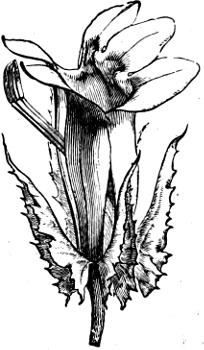
Fig. 603. Flower (2/1).
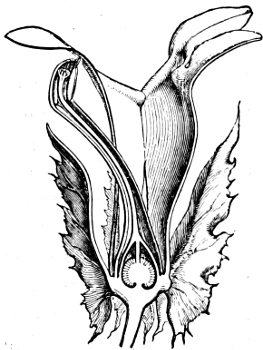
Fig. 604.—Longitudinal
section of the same.
Entomophilous and protandrous. About 500 species, especially in
the Tropics; in this country, L. dortmanna (margin of
lakes).—Several are cultivated in gardens and conservatories
as ornamental plants (Lobelia bicolor, erinus,
fulgens, etc., Siphocampylos, Centropogon).
The latex of several species of Tupa is poisonous;
caoutchouc is also obtained from them. Officinal:
“herba Lobeliæ” (the alkaloid lobeline) from the
poisonous L. inflata (N. Am.).
Order 4. Goodeniaceæ. Chiefly Australian (200 species),
closely related to Orders 3 and 5, but without latex. The style
is provided with a “collecting-cup” which receives the pollen
before the flower opens; it has a small, hairy aperture through
which the pollen is forced out by the stigmas, and through
which they emerge when the pollen is shed; it is sensitive
and exhibits movements when touched.—Herbs, under-shrubs,
less frequently shrubs. Goodenia, Leschenaultia,
Scævola.
Order 5. Stylidiaceæ (or Candolleaceæ); 100
species, the majority Australian; zygomorpbic flowers, but
with the ordinary position. The anterior petal is very small.
The chief characteristic feature is the presence of only 2
stamens (with extrorse anthers) which are united with the style
and form a stylar-column; this is bent like a knee and
sensitive at the bend to such a degree that when touched it
jerks violently across the flower to the opposite side and then
loses its sensitiveness.—Herbs, less frequently under-shrubs.
Stylidium (Candollea).
The flowers, which are borne in “capitula” (Figs. 605, 610), are
epigynous (Fig. 605 C, D), 5-merous in
the calyx, corolla and andrœcium, the corolla is valvate in
æstivation, with 2 carpels (S5, P5, A5, G2). The anthers
are united into a tube (syngenesious) (except Ambrosieæ)
which surrounds the bifid style. There is never more than 1
loculus in the ovary, with 1 erect, anatropous
ovule. The fruit is a 1–seeded nut (cypsela), with thin pericarp, the
calyx generally persists as a tuft of hairs (pappus) (Fig.
606) on the summit of the fruit. Embryo without endosperm; the
radicle directed downwards.
Only 1 Order: Compositæ.
With respect to the inflorescence and the development of the individual
flowers, there is a very close resemblance to the Dipsacaceæ, which
stand on the same plane of progression as the Compositæ. But while
the latter are allied to Campanulinæ as the last stage in the
process of evolution, the Dipsacaceæ form the final stage of the
Rubiales-Dipsacales.
Order Compositæ. (For the principal characteristics compare
those of the family.) The Compositæ are chiefly herbs, but trees
and shrubs also occur in tropical countries. The leaves may be
scattered or opposite, but have no stipules. The outer leaves of
the involucre as a rule are barren, especially when numerous
and imbricate, while the innermost ones support the ray-flowers
of the capitulum; in a few instances all are fertile (e.g.
Tragopogon, Tagetes). The CAPITULA are
many-flowered, with the exception, e.g. of Echinops,
which has 1-flowered capitula (see page 570). The capitula are again
arranged in inflorescences, most frequently corymbose with centrifugal
order of development. The form of the receptacle is an important
character for the division of the genera (flat, convex, conical), and
also the presence of scales; these may be one scale (bract) for
each flower (Fig. 610 br), or a large number of bristles, which
do not each correspond to a leaf, or the receptacle may be entirely
without covering (naked). The flowers open in acropetal order
in each capitulum. All the flowers in a capitulum may be of the same
sex, and their form and colour are in that case the same, or
the sexes may be different, in which case the form and colour are also
most frequently different: the ray-flowers have projecting labiate or
ligulate corollas, while the disc-flowers have tubular corollas. As a
rule in the latter case the ♀ flowers are at the circumference, and the
☿ in the centre, less frequently ♀-flowers at the edge and ♂-flowers
in the centre. The ray-flowers in some genera are neuter (e.g.
Centaurea). Some are diœcious.
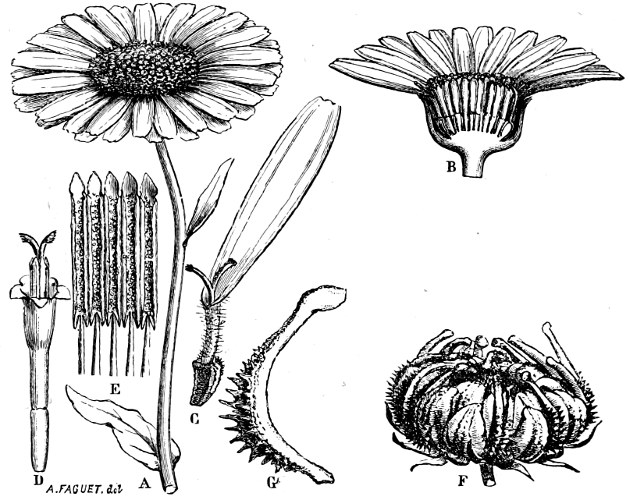
Fig. 605.—Calendula arvensis: A
capitulum; B capitulum in longitudinal section; C
♀-flower; D ☿-flower; E the stamens; F capitulum
with ripe fruits; G ripe fruit.
There is no trace of an epicalyx (in contrast to the Dipsacaceæ, which
they generally so resemble). The formation of the CALYX is
very varied. The calyx always consists of a very small cushion-like
structure, most frequently developed later than the corolla; the 5
corners, which correspond to the 5 sepals, in a few instances are
raised as 5 large, flat, membranous bodies, e.g. in species
of Xeranthemum, Catananche, Sphenogyne, etc.;
in other instances each of these bears a shorter or longer bristle
on its apex, followed by others in rather uncertain numbers and
with but slight indications of order, on the edge and on the outer
side of the calyx between the 5 points; in other instances, again,
the calyx is covered with bristles and hairs without any indication
of order or definite number (Fig. 606 a, b); finally
instances occur in which the edge is raised as a membranous collar,
irregularly toothed and notched, or divided into small scales. There
are naturally differences in the means of distribution corresponding
to the differences in structure of the calyx. The fruits a and
b represented in Fig. 606 are distributed by the wind, those
like c, on the other hand, by attaching themselves to animals
and human beings. The rays of the pappus are termed rough when
special cells project a little beyond the surface, but if these grow
out, and are hair-like, the pappus is said to be feathery. In
some genera the pappus is raised on a long stalk, which is developed
from the upper part of the fruit, and termed a beak (Fig. 606
a). The pappus does not attain its full development till the
ripening of the fruit, i.e. until it is about to be of use.
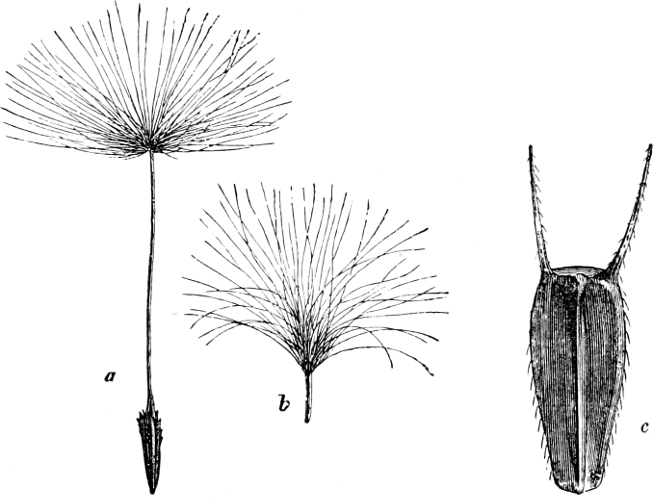
Fig. 606.—a Fruit of Taraxacum;
b of Senecio; c of Bidens.
The COROLLA has various forms: (a) tubular
(Fig. 605 D), with a shorter or longer tube, not always of the
same bore throughout and especially slightly widened at the top to
form a bell-shaped opening, with 5 regular teeth: (b)
labiate after 2/3, i.e. with 2 petals in the upper
and 3 in the under lip: (c) ligulate, i.e. the
corolla is split for a considerable distance on the posterior side
(as in the Labiate genus Teucrium) and prolonged into a long,
strap-like portion (Fig. 609 A), which projects upwards. A
distinction must, however, be drawn between the true and false ligulate
corolla. In the first case the corolla has 5 teeth at the apex (Fig.
609 A) and is made up of all the petals of the corolla united
together; this is the usual condition in the Ligulate-flowered.
In the latter case (Fig. 605 C) the tongue has only 3 teeth
(or is more irregularly 2–3-dentate), and is only formed of 3 petals;
the corolla is then truly bilabiate, the tongue is the large under
lip, and the upper lip is very slightly developed, or even at an early
stage quite suppressed. This false “ligulate” corolla is found among
the ray-flowers; sometimes the upper lip is seen quite plainly,
e.g. in Tagetes, especially in the double capitula.
The VENATION of the corolla is peculiar; there are always
commisural veins which branch dichotomously at the angles between
the teeth of the corolla, and send a branch into the edge of the two
nearest teeth. The midrib is frequently absent, but may be present,
and then it has sometimes no connection with the other veins of the
corolla.
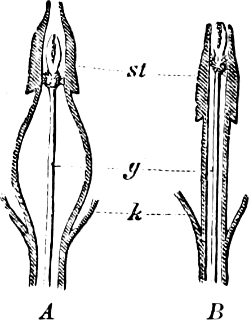
Fig. 607.—Centaurea cyanus: A
the anther-tube (st) with the crescentic curved filament before
irritation; g the style; k the base of the corolla;
B the same after irritation, the anthers are drawn further down.
The STAMENS are attached to the corolla, and have free
filaments (Silybum has united filaments), but the anthers, which
at first are free, adhere together and form a tube (Fig. 605 E:
only Ambrosieæ have free anthers). The connective is
generally prolonged, and protrudes above the anthers as a thin, brown
membrane of various forms (Fig. 605 E); appendages of various
forms may also be found at the base of the anthers. The anthers open
introrsely, and the pollen must be carried out at the top of the tube
by upward growth of the style, and by means of the “stylar-brush”
(Figs. 607, 608, 609); the filaments are sometimes sensitive
(e.g. in the Corn-flower, Fig. 607), and shorten on being
touched, so that the anther-tube is pulled downwards, and the pollen
swept out at the top (Figs. 607, 608 A, B).
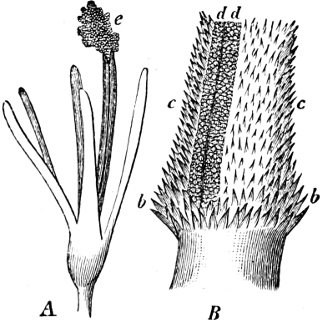
Fig. 608.—Cirsium arvense: A
the upper portion of a flower, the pollen (e) is being ejected;
B part of the upper portion of the style with stylar-brush
(b, c) and the stigmatic papillæ (d).
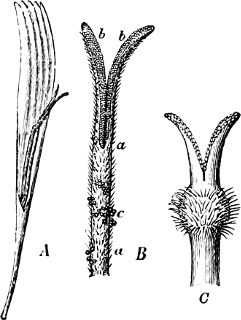
Fig. 609.—Leontodon autumnale: A
ligulate flower; B extremity of the style with stylar-brush
(a), stigma (b) and pollen-grains (c). C
Centaurea cyanus.

Fig. 610.—Achillea millefolium.
The STYLE divides at the apex into two branches (Figs.
609, 610), both of which generally bear on the inner surface two
lines of stigmatic papillæ (Fig. 610 B, C) and being
in shape, etc., very varied, are therefore employed as systematic
characters.—The most important types are: A. The style
is uniformly cylindrical; its branches are semi-cylindrical,
long, and with long hairs, and finally bend backwards; the stylar
branches bear slightly projecting stigmatic papillæ on the inner
side. This form is characteristic of the Cichorieæ (Fig. 609
A B). B. The style is uniformly cylindrical;
the branches are long, cylindrical or club-like, short, not rolled
back, with fine hairs externally; the stigmatic lines do not reach
beyond the centre, and do not meet together. Characteristic of
Eupatorium, Petasites, Tussilago. C. The
style is thickened beneath the stigmatic branches in the form of a
knob, or very hairy (Fig. 609 C); the stigmatic lines reach
as far as the apex of the branches and then converge; sometimes the
stigmatic branches are united as far as the apex. Characteristic of
the Cynareæ. D. The stylar branches are lanceolate,
or linear, pointed; externally flat and thickly covered with hairs
in the upper portion; the stigmatic lines cease where the hairs
commence externally. Characteristic of Aster, Bellis,
Inula, Dahlia, etc. E. The stylar branches are
linear, with long, brush-like hairs at the apex, where they are either
abruptly cut off or prolonged into a very hairy, conical appendage;
the stigmatic lines are broad, reach as far as the brush-like
hairs, and do not meet together (Fig. 610). Characteristic of
Senecio, Helianthus, Xanthium, Gnaphalium,
Artemisia, Anthemis, and others related to these.
A ring-like nectary is found round the base of the style.
The thin-walled cypsela (Fig. 606), with seeds fitting closely
to the pericarp, has many different forms (smooth, ribbed, spined,
etc.); its point of attachment generally lies at the lowest end but
sometimes it is drawn obliquely up the side (Centaurea, etc.).
The calyx, persistent on the apex of the fruit, has been described
above. Some genera have two or three different forms of fruits in
each capitulum.—The embryo is straight, with the radicle turned
downwards, and without endosperm, but is rich in oil.
The variously flowered capitula, whose normal tubular disc-flowers have
been changed to ligulate flowers, may be termed “double flowers.”
The relationship of the Compositæ to the Campanulinæ has been
described above (page 561). The alliance with the Dipsacaceæ
is more apparent than real. Similar capitate inflorescences
also occur as the final stage in other lines of descent, as in
Eryngium among the Umbelliferæ.
1. Cynareæ, Thistle Group. Flowers all ☿, regular, with
tubular corollas. The receptacle is covered with numerous
bristles, which surround the flowers without any definite
order, or the edges of the grooves in which these are placed have a
well-marked fringe. The involucral leaves are numerous, imbricate,
and are either prolonged into a thorn or terminate with a
membranous edge. The style has been described on page 568
(Fig. 609 C). Nearly all have a hairy or feathery pappus. The
filaments are sensitive.
Carduus (Thistle); capitula ovoid; involucral leaves
compact, imbricate, with thorny points; the pappus-rays are
hair-like and united at the base by a ring (i.e. the
calyx), and fall off together.—Cirsium (Fig. 608) has a
feathery pappus, in other respects it is like Carduus.
C. arvense reproduces and passes the winter by means of
suckers.—Cynara (Artichoke) has a feathery pappus and
large, solitary capitulum, with broad involucral leaves; these
have a fleshy base like the receptacle (edible).—Silylum
has united filaments. S. marianum (Milk-thistle), has leaves
with numerous white spots. Onopordon (Cotton-thistle).
Cnicus (C. benedictus) has a large, many-spined thorn
on the involucral leaves; pappus trimorphic.—Lappa
(Burdock) is easily recognized by the hooked involucral leaves,
which assist in the distribution of the fruit; in this respect it
differs from the other inflorescences, and also in the fact that the
pappus is short, and quickly falls off, without serving as a means
of distribution.—Carlina; the external involucral leaves
are leafy, thorny, with branched or unbranched spines
standing straight out or bent backwards; the internal ones are
dry, and prolonged as dry, coloured, radiating
scales. The well-developed bristles on the receptacle and edge
of the calyx are deeply cleft and lobed.—Centaurea
(Knap-weed, Fig. 607). The ray-flowers are neuter, and generally
larger than the disc-flowers; the involucral leaves are regularly
imbricate, but are frequently provided at the apex with a dry, chaffy,
often lobed, fringed appendage. The attachment of the fruit is
lateral. Serratula (Saw-wort).—Carthamus, the outer
and inner involucral leaves differ very much.—Echinops
(Globe-thistle) is characterised by having “compound capitula,”
i.e. there is only one flower in each capitulum, but many
such capitula are collected into a spherical head, which at the base
may also have a few involucral leaves. The individual capitula have
narrow, linear involucral leaves. (There are altogether about
150 species of Compositæ with 1-flowered capitula, all from warm
countries.)—Xeranthemum, Staehelina, Jurinea,
Saussurea, etc.
2. Mutisieæ, Labiate-flowered Group. Tropical (S.
American) forms whose zygomorphic flowers have a bilabiate
corolla (2/3). The involucre is nearly the same as in the
Thistles.
3. Cichorieæ, Chicory Group (or Ligulifloræ). The
flowers are all ☿ and have a ligulate, 5-dentate corolla.
The stylar branches are thin and prolonged (Fig. 609 B).
Laticiferous vessels occur in the majority (in this feature they
resemble the Lobeliaceæ and Campanulaceæ).
A. The pappus is wanting, or it is scale-like,
but not long and hairy.—Cichorium (Chicory); capitula with
blue flowers, borne singly or a few together in the leaf-axil;
there are two whorls of involucral leaves, an outer one of short and
radiating, an inner of more numerous, longer and erect leaves; pappus,
scale-like.—Lapsana (Nipplewort). The few involucral leaves are
nearly of the same size, and persist forming a sort of capsule round
the fruits, which are entirely without a pappus. There are only a few
flowers in the small capitula.—Arnoseris (Swine’s-succory),
Catananche, etc.
B. The pappus is long and hairy (not branched),
generally fine and snowy-white. There are no scales on the
receptacle. The two genera first considered have beaked
fruits.—Taraxacum (Dandelion) (Fig. 606 a); the capitula
are many-flowered, and borne singly on the top of a leafless, hollow
stalk.—Lactuca (Lettuce) has many small, few-flowered capitula
borne in panicles.—Crepis (Hawksbeard).—Hieracium
(Hawk-weed) has many imbricate involucral leaves, and a stiff, brittle,
brownish pappus.—Sonchus (Sow-thistle); the capitula, when a
little old, have a broad base, and are abstricted above in the form of
a jug; involucral leaves imbricate; the fruit is compressed, without a
beak, ridged. The soft, white pappus falls off collectively.
C. The pappus is feathery and branched; no scales
on the receptacle.—Tragopogon (Goat’s-beard) generally
has 8 involucral leaves in one whorl. The fruit has a long
beak; the rays of the pappus are interwoven in the form of an
umbrella.—Scorzonera has fruits like the preceding, but almost
without any beak; involucral leaves many, imbricate.—Leontodon
(Hawkbit) has a slightly feathery pappus, rays not interwoven; beak
absent.—Picris.
D. Long, chaff-like, deciduous scales on the receptacle; pappus
feathery.—Hypochœris (Cat’s-ear).
4. Eupatorieæ, Hemp-agrimony Group. All the flowers are most
frequently ☿; corollas tubular and regular; the involucral leaves are
not stiff and spiny; the receptacle is not covered with stiff bristles.
The stylar branches are long, club-like, or gradually tapering. There
is no swelling below the stigma.
Eupatorium (Hemp-agrimony); all the flowers are
☿.—Petasites (Butterbur); ray-flowers ♀, disc-flowers ☿ or ♂;
sometimes diœcious. Capitula in racemes or panicles. The leaves develop
after the flowering.—Tussilago (T. farfara, Colt’s-foot)
has a solitary capitulum borne on a scaly, scape-like stem; the
ray-flowers are ♀ with ligulate corollas, disc-flowers ♂. The
leaves unfold after the flowering. Ageratum, Mikania,
Vernonia.
5. Astereæ, Aster Group (or Radiatæ, Ray-flowered).
The flowers are of two forms and different sexes; the ray-flowers
are ♀ (sometimes neuter), most frequently with irregular, falsely
ligulate, radiating corollas; the disc-flowers are ☿, regular,
with tubular corollas (Fig. 610). Sometimes only tubular flowers are
present, as e.g. in Senecio vulgaris (Groundsel), and
the exterior of the capitulum is then as in the Eupatorieæ. The stylar
branches are straight, more or less flat and short (Fig. 610).
A. Anthemideæ. Involucral leaves imbricate, generally
membranous at the edge; pappus wanting, or at most a
membranous margin to the calyx, but without hairs.
[+]. Chaff-like bracts on the receptacle are found in
Anthemis (Chamomile), Anacyclus (A. officinarum),
Achillea (Milfoil, Fig. 610), Santolina, etc.
[++]. A naked receptacle is found in the following:
Bellis (Daisy) has solitary capitula on leafless stalks
with white ray-flowers.—Matricaria (Wild Chamomile) has
a conical receptacle. (M. chamomilla has a very high,
hollow receptacle; M. inodora has large, odourless capitula,
and the receptacle is not hollow.)—Chrysanthemum
(Ox-eye) most frequently large, solitary capitula; flat
receptacle.—Pyrethrum; pappus scanty.—With these are classed
Tanacetum (Tansy) and Artemisia (Wormwood) with tubular
corollas only.
B. Heliantheæ. Most frequently a bract to each flower
is found on the receptacle. The pappus is never exactly hairy, but
consists of scales, spines, etc., and the fruits are most frequently
compressed (Fig. 606 c).—Helianthus (Sun-flower); H.
tuberosus (Jerusalem Artichoke) has tuberous underground stems.
Dahlia has tuberous roots (Am.). Bidens (Bur-marigold,
Fig. 606 c); the fruits are compressed with 2 (or more) spines
provided with reflexed barbs.—Calliopsis; Rudbeckia;
Zinnia; Tagetes has united involucral leaves, and
yellow, transparent oil-glands. Spilanthes, Galinsoga,
Melampodium, Silphium (Compass-plant), Helenium,
Gaillardia.
C. Calenduleæ have 1–2 rows of involucral leaves,
a naked receptacle, and large, crescent-shaped, irregularly warted
fruits, of different forms in the same capitulum; pappus absent (Fig.
605).—Calendula (Marigold); ray-flowers ♀, disc-flowers ♂.
D. Senecioneæ, have a fine, hairy, white pappus;
no bracts, otherwise as in Anthemideæ. The involucral leaves are most
frequently in 1–2 rows.—Senecio (Groundsel) has two whorls
of involucral leaves, which most frequently have black tips, the
external being much shorter than the internal ones (S. vulgaris
has all flowers ☿ and alike).—Cacalia, Doronicum,
Cineraria, Ligularia, Arnica (A. montana;
large, long-stalked capitula; leaves opposite, forming a kind of
rosette).
E. Astereæ have a bristle-like, unbranched pappus,
often of a dingy brown; receptacle naked; involucral leaves
numerous, imbricate.—Solidago (Golden-rod); capitula small,
yellow-flowered, borne in panicles. Aster; disc-flowers
most frequently yellow, ray-flowers violet; Callistephus;
Erigeron (Flea-bane)—Inula.—All the corollas are
tubular in: Gnaphalium (Cud-weed); involucral leaves dry,
rattling, often coloured; the foliage-leaves and stem often white with
woolly hairs; ray-flowers ♀, with narrow, tubular corolla; disc-flowers
☿ (few). Antennaria (Cat’s-foot; diœcious), Filago,
Helichrysum, Ammobium, Rhodanthe and others.
Leontopodium (L. alpinum, “Edelweiss”).
F. Ambrosieæ, a very reduced type of
Compositæ, differing from the others in having free
anthers; the capitula are generally unisexual, monœcious,
the ♂ borne in a terminal inflorescence, the ♀ in the
leaf-axils. In other respects they are most closely related to
Heliantheæ.—Xanthium. In the ♂-capitula there
are many flowers without calyx, but with tubular corolla and
free involucral leaves. In the ♀-capitula there are only 2
flowers, which are entirely destitute of both calyx and corolla;
involucral leaves 2-spined, united to form an ovoid, bilocular
envelope, each compartment containing one flower. The envelope
of involucral leaves unites with the fruits, enclosing them at
maturity with a hard covering from which numerous hook-like
spines project, assisting very greatly in the distribution of
the fruit. The whole structure thus finally becomes a 1- or
2-seeded false nut.—Ambrosia, the ♀ capitulum
1-flowered.
Pollination. The flowers are somewhat insignificant,
but become very conspicuous owing to a number being crowded
together in one inflorescence. The corollas of the ray-flowers,
being often very large (Astereæ; Centaurea),
frequently render the capitula still more conspicuous. The
capitula display many biological phenomena similar to those
often shown by the individual flowers in other orders, e.g.
by periodically opening and closing, in which the involucral
leaves resemble the calyx in their action. (The name “Compositæ”
originates from the term “flos compositus,” composite flower).
An abundance of honey is formed, which to some extent fills
up the corolla-tube, and since insects may visit a number
of flowers in the course of a short period they are very
frequently visited, especially by butterflies and bees. The
pollination has been described on page 567. Protandry is
universal. In the bud the tips of the styles, covered by the
sweeping-hairs, lie closely enveloped by the anther-tube; in
the next stage the style grows through the tube and sweeps
out the pollen as it proceeds; ultimately the stylar branches
expand and the stigma is then prepared to receive the pollen.
In many, the sensitiveness of the filaments assists in sweeping
out the pollen at the exact moment of the insect visit.
Regular self-pollination is found e.g. in Senecio
vulgaris; wind-pollination e.g. in Artemisia
and the plants related to it.
This extremely natural and well-defined order is the largest
(and no doubt one of the youngest?); it embraces 10–12,000
known species (in 770 genera), or about one-tenth of all
Flowering-plants. They are distributed over the whole globe, but
are most numerous in temperate countries; the majority prefer
open spaces; a smaller number are forest-forms. They abound
especially in open districts in America.
Among the substances frequently found may be mentioned:
Inulin (especially in the subterranean parts),
Bitter materials, Tannin, volatile oils, fatty
oils in the fruits. Medicinal:[40] “Herba” of
Artemisia absinthium (Wormwood) and maritima[+]
(Sea-wormwood), Achillea millefolium; the leaves
of Cnicus benedictus and Tussilago farfara; the
unopened capitula of Artemisia maritima, var.
stechmanniana; the capitula of Tanacetum,
Matricaria chamomilla[+] (wild Chamomile), Anthemis
nobilis[+] (common Chamomile); the separate flowers of
Arnica; the roots of Arnica montana[+],
Taraxacum officinale[+], Anacyclus officinarum[+],
Lappa major, minor, nemorosa and
tomentosa, Inula helenium and Artemisia
vulgaris; the latex of Lactuca virosa[+]. The
following are cultivated for food:—Lactuca sativa
(Lettuce), Cichorium endivia (from E. Asia, for salads),
Cynara scolymus (Artichoke, Mediterranean), Scorzonera
hispanica (S. Eur.), Helianthus tuberosus (Jerusalem
Artichoke, from N. Am., introduced into Europe 1616),
Cichorium intybus (roots as “chicory,”) Tragopogon
porrifolium (Salsafy), Artemisia dracunculus.
Oil is extracted from the following (the seeds):
Helianthus annuus (Peru), Madia sativa
(Chili), Guizotia oleifera (Abyssinia). Dyes
from: Carthamus tinctorius (Safflower, used in the
preparation of rouge; Egypt), Serratula tinctoria.
Insect-powder from: Pyrethrum cinerariifolium
(Dalmatia) and roseum (Persia, Caucasus). The
following are cultivated in houses and gardens for the
sake of their scented leaves:—Tanacetum balsamita
(Balsam), Artemisia abrotanum (Southernwood) and A.
argentea. A great many of the genera enumerated are
cultivated in dwelling-houses for the sake of the flowers;
e.g. Pericallis cruenta (generally termed
“Cineraria”). Asteriscus pygmæus is supposed to be the
genuine “Rose of Jericho”; the involucral leaves envelop the
fruits after their ripening and keep them enclosed for 8–10
months until rain occurs.