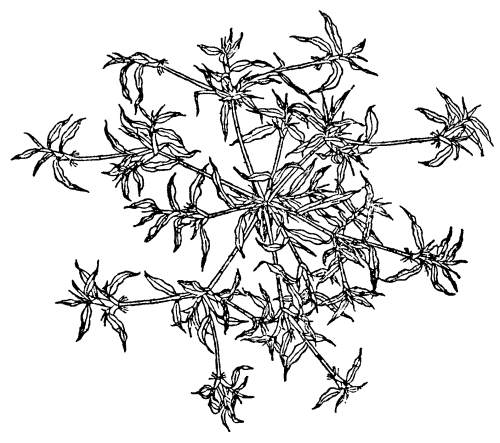
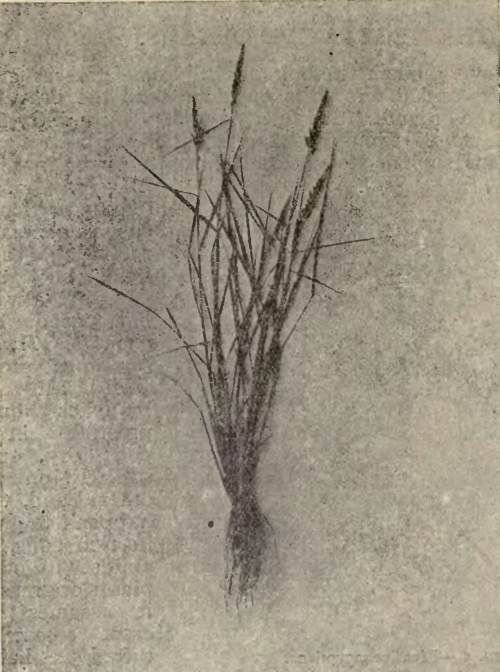
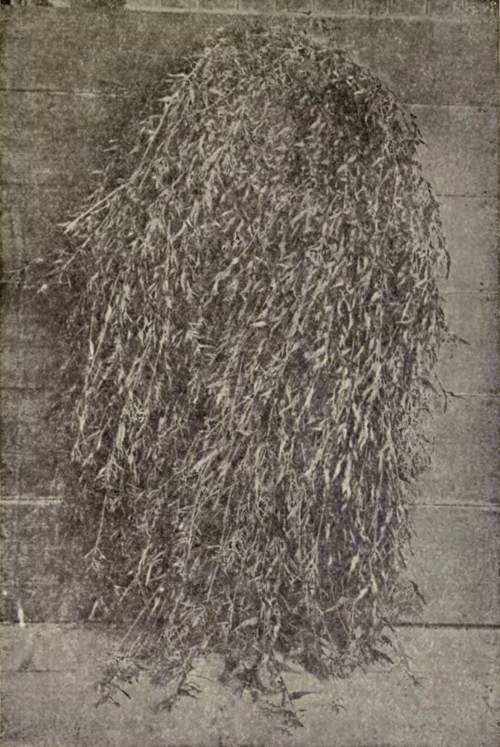
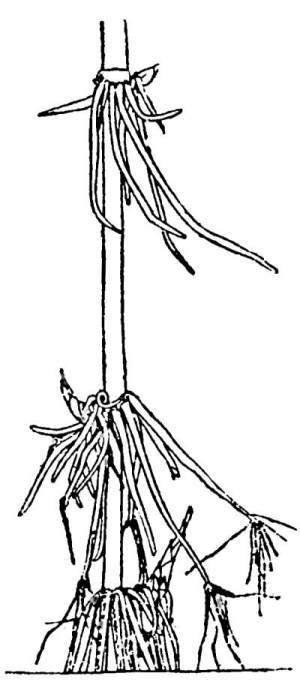
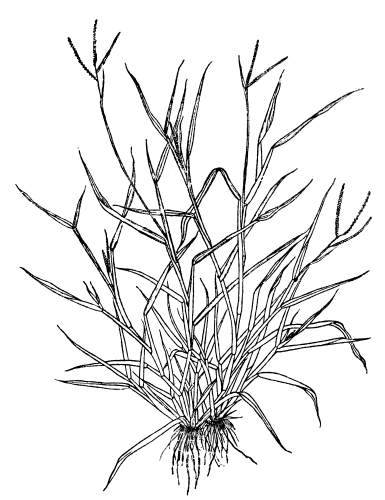
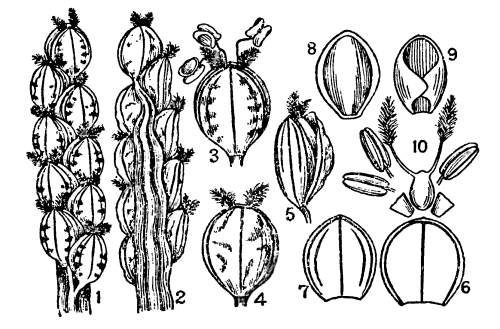
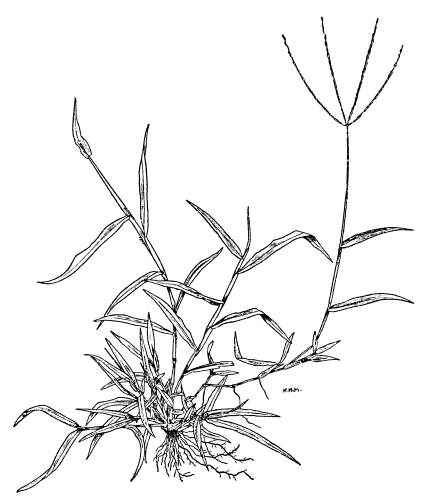
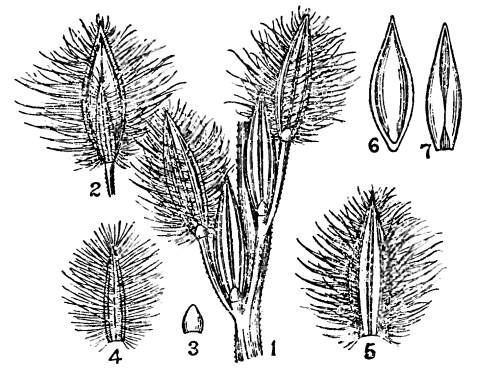
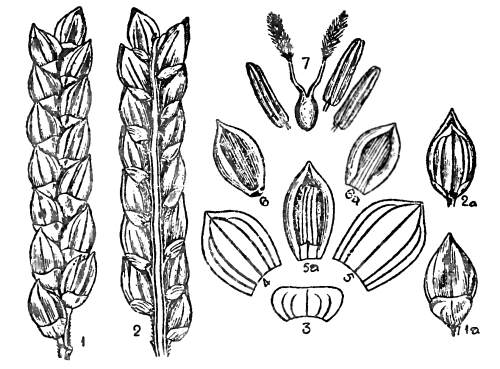
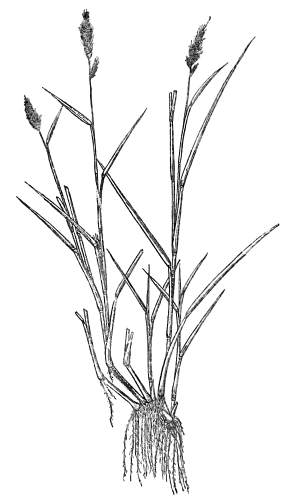
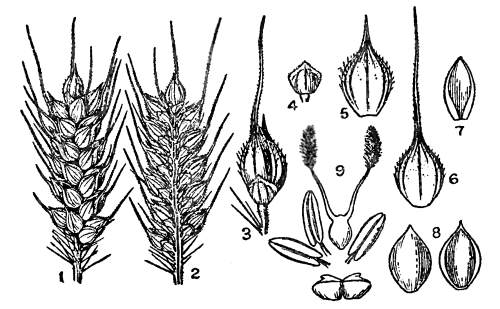
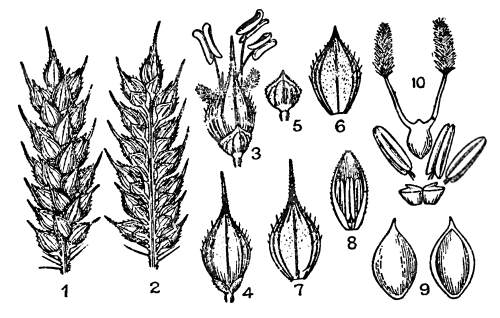
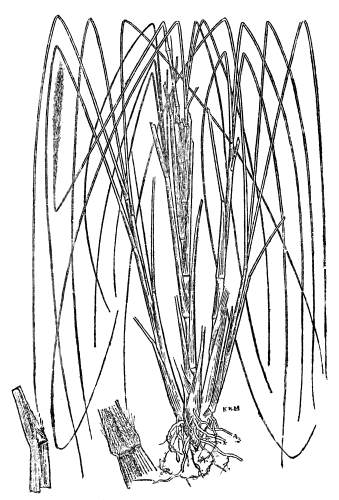
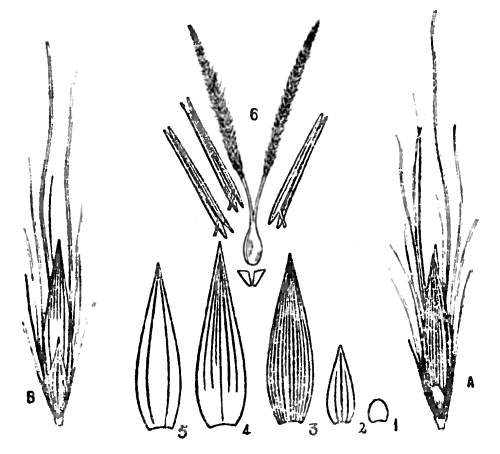
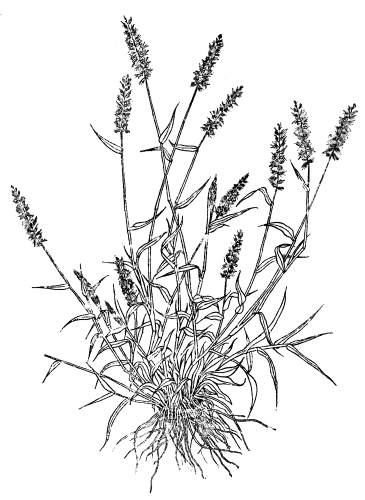
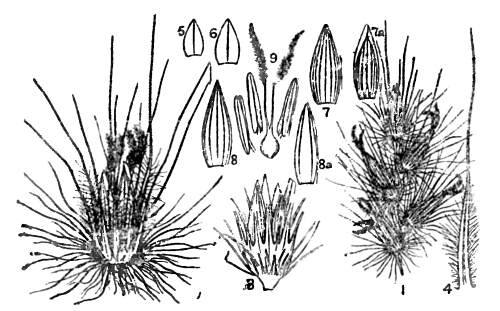
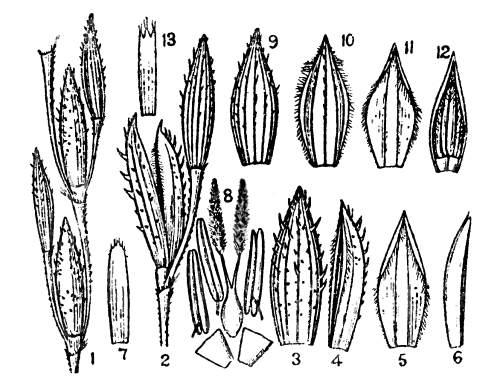
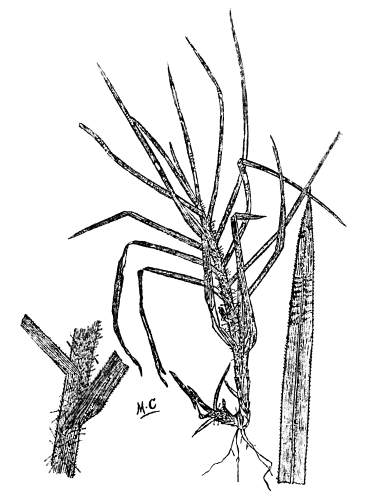
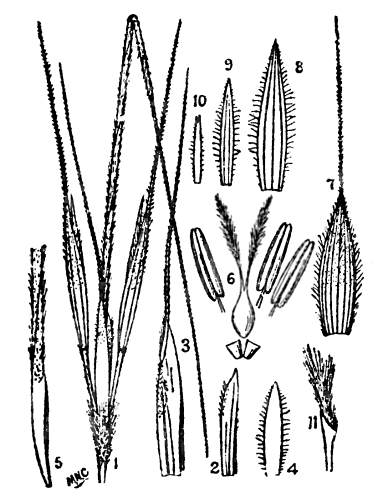
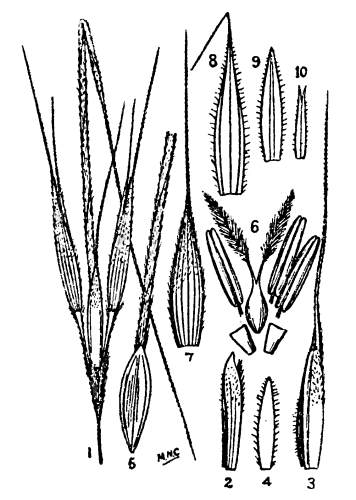
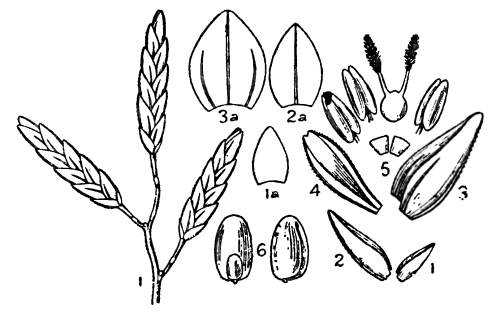
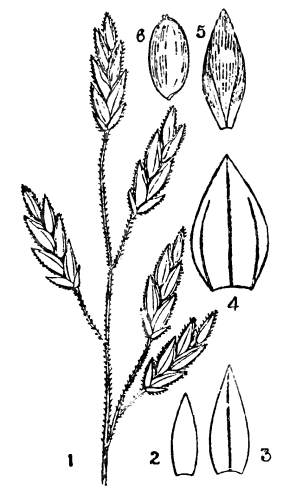
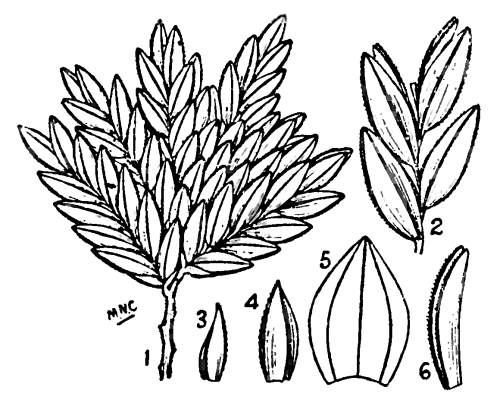
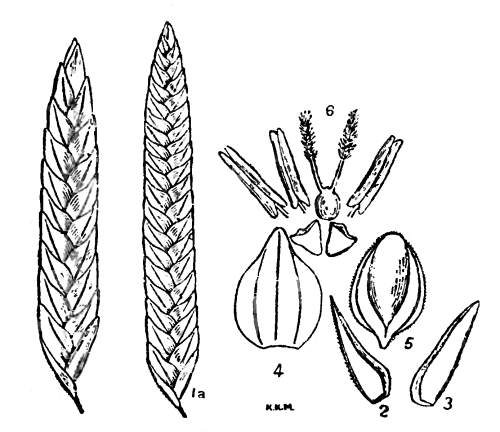
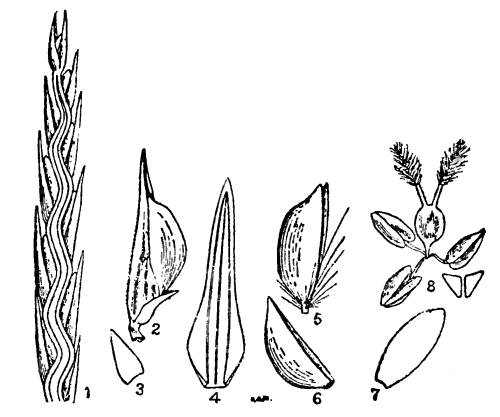
Andropogoneæ is a very large tribe with about thirty genera.
It is very well represented in South India and some genera are of
very wide distribution.
The spikelets are usually arranged in pairs at each joint, one
sessile and the other stalked. The spikelets may all be similar as
in Imperata or they may be different as in Ischæmum and
Andropogon. There may be only one flower in the spikelet as in
Eremochloa and Saccharum or two as in Ischæmum and Apocopis.
In the genera Polytoca and Coix the spikelets are unisexual and
the male and female spikelets are found in the same inflorescence,
the female being below and the male being continuous with it.
The spikelet nearly always consists of four glumes, the first or the
first and the second being firmer and coriaceous or chartaceous.
The flowering glumes are always shorter than the empty glumes,
and are hyaline. The fourth glume is often awned or reduced to
an awn.
The main rachis of the inflorescence is usually jointed at the
base. In addition to this the rachis may be jointed all along its
length, so as to become separated into distinct joints when mature
as in Rottboellia, Saccharum and Andropogon, or it may be
continuous as in Imperata. The pedicels of spikelets and the
lower portions of the rachilla of the spikelets may have long hairs.
Sub. Tribe 1. Maydeæ.
- The spikelets are all unisexual, spicate, the male and female
spikelets are dissimilar, and are on the same or on different
spikes.
- Fruiting spikelets enclosed in a stony nut-like polished bract 16. Coix.
- Fruiting spikelets with the first glume forming a crustaceous nut-like envelope to other glumes and grain 17. Polytoca.
Sub. Tribe 2. Sacchareæ.
- The spikelets are all similar, in compound racemes or panicles;
the first glume not sunk in the hollow of the rachis. Spikelets are
1-flowered.
- Rachis not fragile; spikelets in cylindrical silvery thyrsus 18. Imperata.
- Rachis fragile; spikelets in open very much branched silky panicles 19. Saccharum.
Sub. Tribe 3. Ischemeæ.
- Spikelets many, dissimilar, in solitary, digitate or fascicled
racemes or spikes; first glume not sunk in the hollow of the rachis.
- Margins of the first glume of the sessile spikelet inflexed.
- Spikes rarely solitary; spikelets binate, 2-flowered and awned 20. Ischæmum.
- Spikes solitary; spikelets 1-flowered; first glume of the sessile spikelet pectinate 21. Eremochloa.
- Margins of the first glume of the sessile spikelet not inflexed.
- Spikes solitary or binate; spikelets 1- to 2-flowered, diandrous; first glume broad and truncate 22. Apocopis.
- Spikes 2 or more; spikelets binate, upper alone awned 23. Lophopogon.
Sub. Tribe 4. Apludeæ.
- Spikelets three on an inarticulate rachis 24. Apluda.
Sub. Tribe 5. Rottboellieæ.
- Spikelets similar or dissimilar, 1- to 2-flowered, solitary, 2-
or rarely 3-nate on the internodes of an articulated spike or
raceme, not awned; the first glume is not keeled, sunk in a cavity
of joints of the rachis; sessile spikelets 4-glumed.
- Sessile spikelets single; first glume flat 25. Rottboellia.
- Sessile spikelets geminate in all except the uppermost joints 26. Mnesithea.
- Sessile spikelets binate; first glume globose, pitted 27. Manisuris.
Sub. Tribe 6. Eu-Andropogoneæ.
- Spikelets are dissimilar, 1-flowered, 2-(rarely) 3-nate on the
whorled articulate branches of simple or compound racemes or
panicles; glumes four, first glume not keeled, fourth glume usually
awned.
- Spikelets binate below and 3-nate at the top on a spicate or panicled inflorescence 28. Andropogon.
- Spikelets in two superposed series. Upper series of one or more
sessile bisexual or female spikelets with one terminal pedicelled
male spikelet.
- Rachis jointed above the involucral spikelets 29. Anthistiria.
- Rachis jointed below the involucral spikelets 30. Iseilema.
These are tall monoecious annual or perennial grasses. The
inflorescences are terminal or axillary spiciform racemes. The
lowest-spikelet in the raceme is female and this is enclosed in
a bract which at length becomes hardened, polished and nut-like
and the other spikelets above it are male. The male spikelets
are 2- to 3-nate at each node of the rachis, 1 sessile and 1 or 2
pedicelled, lanceolate and 4-glumed. The first and the second
glumes are subequal and empty, and the first glume is winged
along the inflated margins. The third and the fourth glumes are
hyaline, with three stamens or empty. The female spikelet is ovoid
acuminate and has four glumes. The first glume is chartaceous
and the others are thin and gradually smaller. The grain is
orbicular, ventrally furrowed and enclosed by the polished hard
bract.
This is a tall monoecious leafy annual (rarely perennial) grass
with stout, smooth, polished, freely branching stems rooting at the
lower nodes and varying in length from 3 to 5 feet or more.
The leaf-sheath is long, usually smooth but occasionally with
scattered tubercle-based hairs. The ligule is a narrow membrane.
The nodes are glabrous.
The leaf-blade is long, flat, narrow or broad, acuminate, cordate
at base, with a stout midrib and many slender veins on both sides,
usually glabrous on both sides though occasionally with scattered
hairs, and with spinulosely serrate margins, varying from 4 to 18
inches in length and 1/3 to 2 inches in breadth.
The inflorescence consists of nodding or drooping spiciform
racemes, 1 to 1-1/2 inches long, terminating the branches. The
racemes consist of many male spikelets with one (rarely two) female
spikelets at the base; the rachis is stout above, and the part within
the bract enclosing the female spikelet is slender.
The male spikelets are imbricating, 2 or 3 at a node of the rachis,
one sessile and one or two pedicelled, dorsally compressed, articulate
at the base and persistent, very variable in size, 3/8 to 3/4 inch.
There are four glumes in the spikelet. The first glume is oblong-lanceolate,
chartaceous, 3/5 inch long, acute, many-nerved, concave
with inflexed margins bearing narrow green many-veined wings.
The second glume is similar to the first, but thinner and without the
wings, 5- to 9- or rarely 11-nerved. The third glume is oblong-lanceolate,
hyaline, faintly 3- to 5-nerved, paleate and with three stamens.
The fourth glume is similar to the third, paleate with or without
stamens.
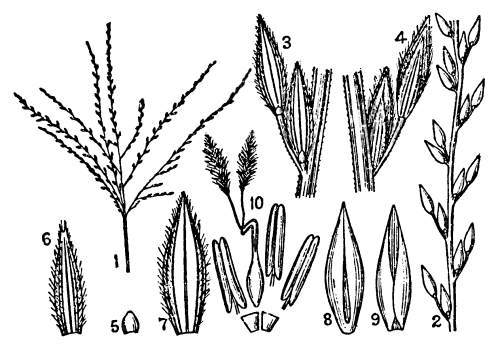
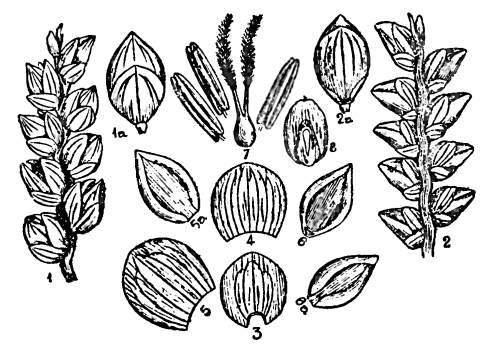
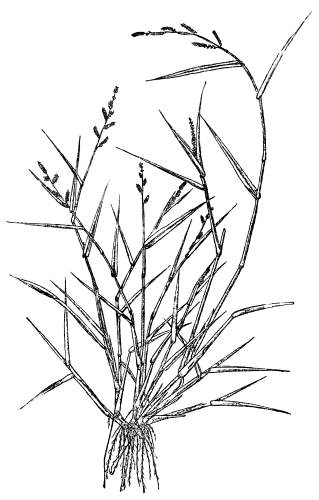
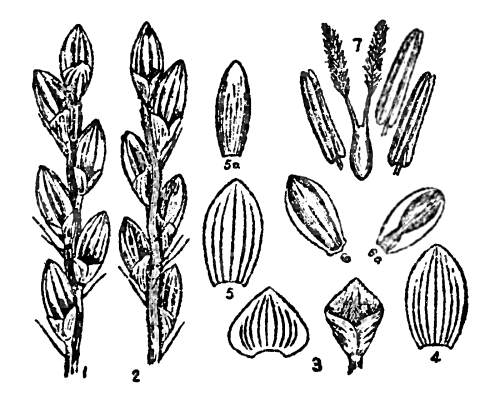
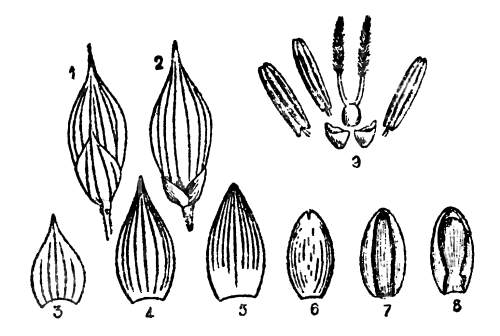
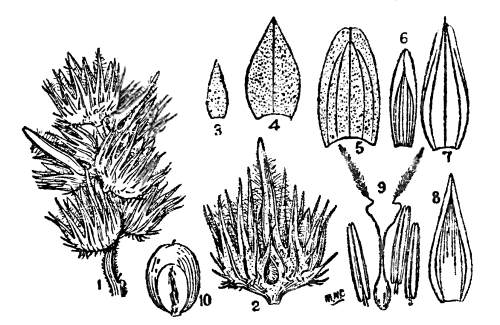
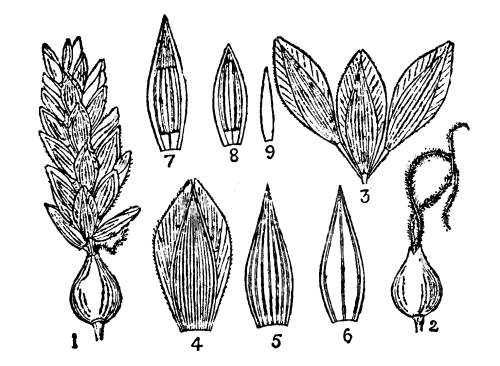
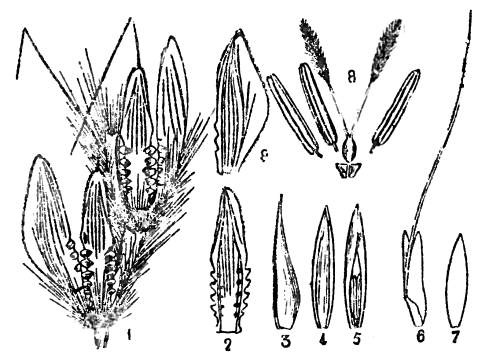
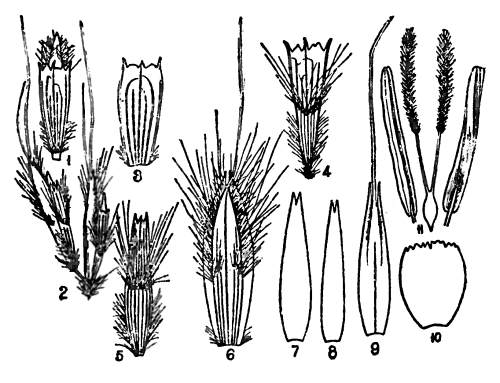
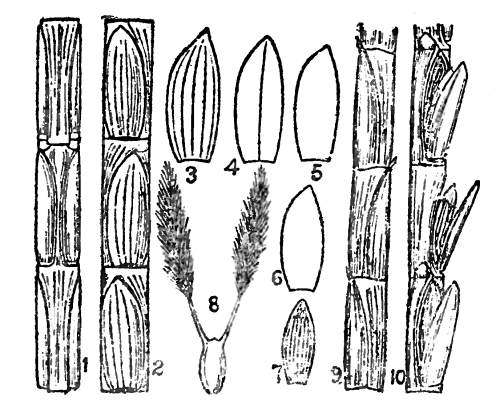
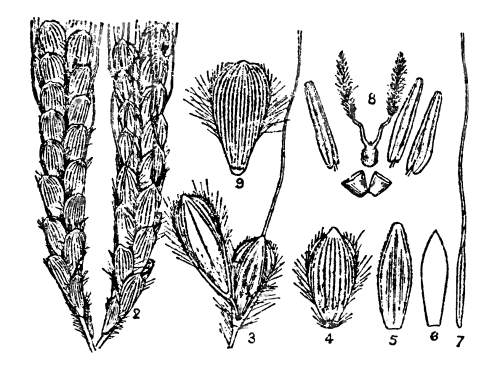
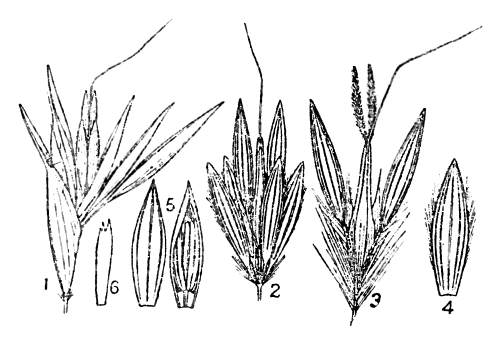
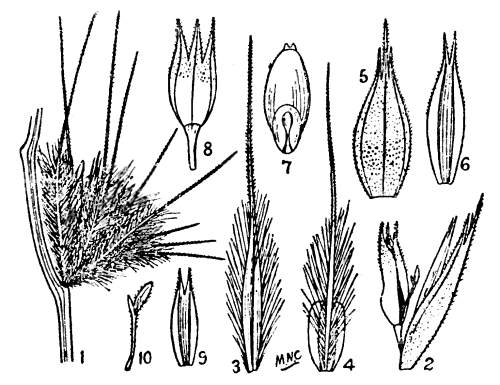
Fig. 126.—Coix Lachryma-Jobi.
1. Inflorescence; 2. the female spikelet; 3. male spikelets; 4, 5, 6 and 8. the first,
second, third and the fourth glume, respectively, of a male spikelet; 7 and 9. palea of the
third and the fourth glumes, respectively.]
The female spikelet is enclosed by a closed bract which finally
becomes hardened, and there are four glumes in the spikelet. The
first and the second glumes are chartaceous. The third and the fourth
are hyaline, the former being empty and the latter with an ovary.
Lodicules are not present. The ovary is ovoid with very long
capillary styles. The grain is orbicular, compressed, channelled
at the back and enclosed within the stony, hardened and polished
bract.
This grass usually grows in paddy fields. There are two distinct
varieties—one a fairly tall one annual and the other a very
tall (5 to 10 feet) perennial one. The racemes of the latter are
longer and drooping, the male spikelets are in threes and the wings
of the first glume are usually broader than in the other form. This
species is easily recognized by the polished bract enclosing the
female spikelet.
Distribution.—Throughout India.
These are tall monoecious annual or perennial grasses. Inflorescences
consist of spiciform racemes with spathaceous bracts;
rachis is jointed. Racemes may all be male or with one or two
female spikelets at the base. Male spikelets are geminate, one
sessile and one pedicelled, 2-flowered or imperfect, and with four
glumes, which are subequal. The first glume is membranous,
many-nerved, shallowly concave and with a narrow membranous
margin. The second glume is narrower, ovate, acute, 5- to 9-nerved.
The third glume is membranous, oblong, acute, 3- to 5-nerved,
paleate and with three stamens. The fourth glume is very slender,
hyaline, linear, paleate with three stamens or empty. Female
spikelets are broadly oblong, 1-flowered and with four glumes.
The first glume is thick, coriaceous and closely embraces the
rachis of the spike by its involute margin and the other glumes are
within. The second glume is oblong, many-nerved. The third is
narrowly oblong, 3- to 5-nerved, empty. The fourth glume is very
narrow, truncate, 3-nerved, paleate. Styles are very long with
slender stigmas. Grain is small, fusiform, terete and enclosed in
the nut-like polished and hardened first glume.
This is an erect, tall, stout, freely branching, leafy, monoecious
perennial grass. The stems are terete, 3 to 6 feet high.
The leaf-sheaths are long, glabrous, or with scattered tubercle-based
bristly hairs. The ligule is a narrow membrane. The
nodes have a ring of soft long hairs.
The leaf-blades are long, flat, linear, acuminate, with a stout
midrib and thickened serrate margins, scabrid above and sometimes
with a few tubercle-based hairs, 10 inches to 2 feet long and
1/4 to 3/4 inch broad.
The inflorescence consists of paniculate spike-like racemes terminating
the branches and at first enclosed in spathiform bracts,
the lower and outer spathiform bracts are one inch or more in length
with a long awn at the tip, and the inner proper sheaths are oblong,
awned and about 1/2 inch long. The raceme consists of one or
more female spikelets at the base and a number of male spikelets
above, appearing as if sessile on the top of the female spikelet,
but really articulate with the internode below it which is enclosed
by the first glume of the female spikelet.
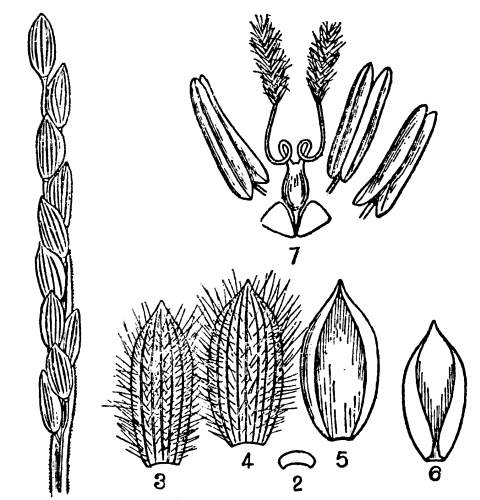
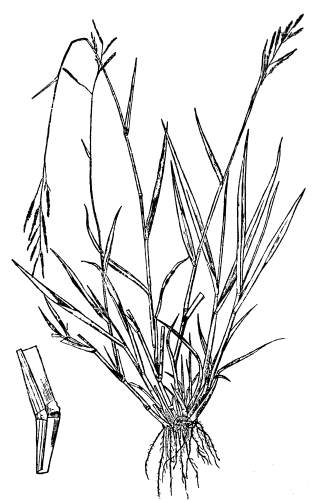
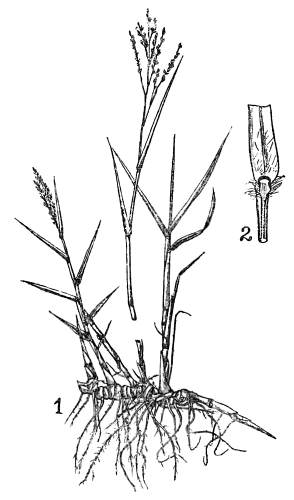
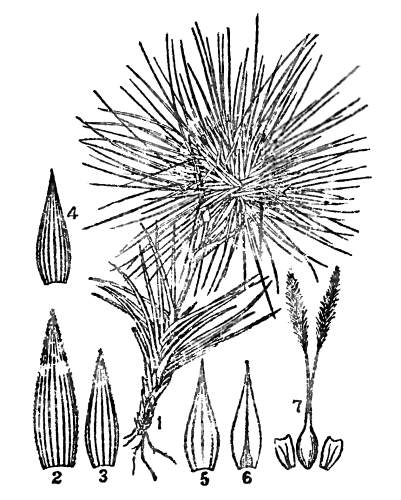
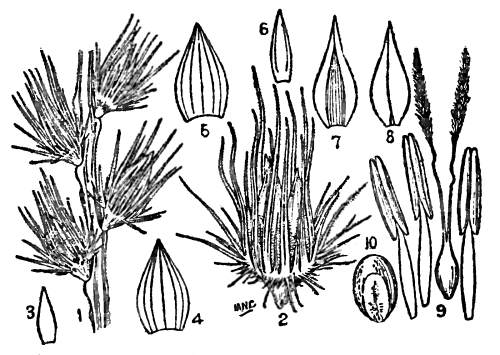
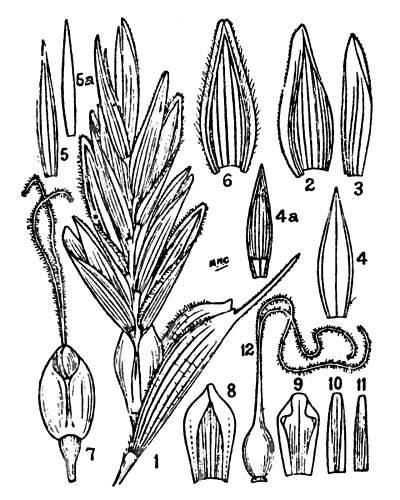
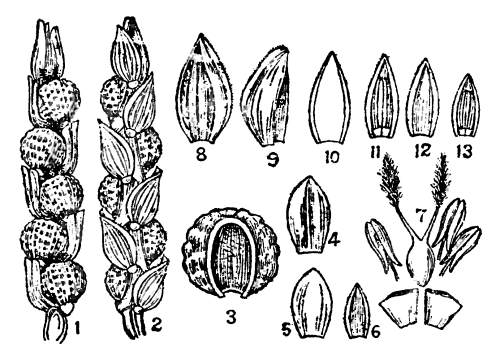
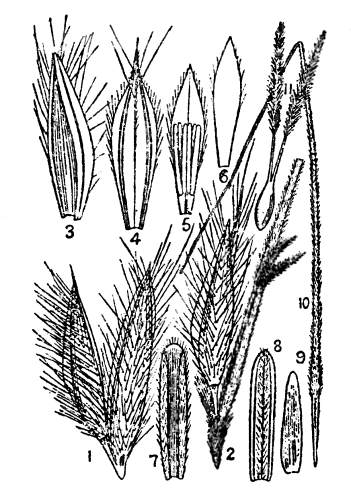
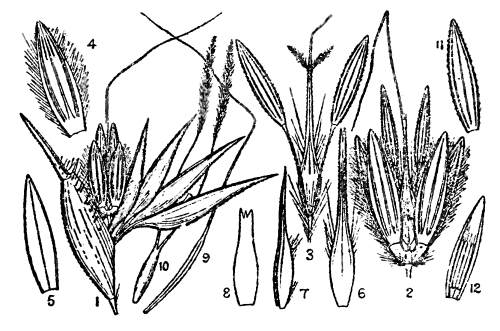
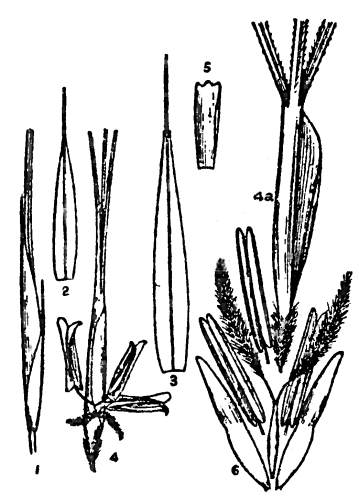
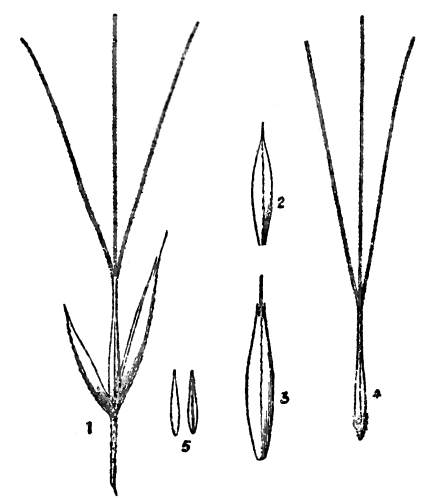
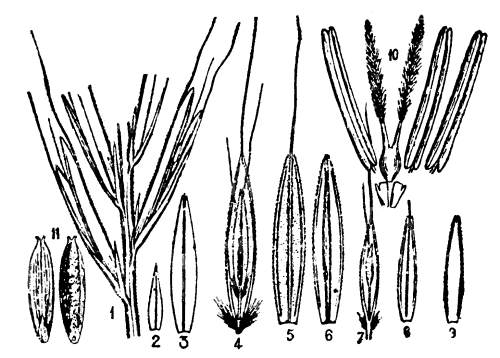
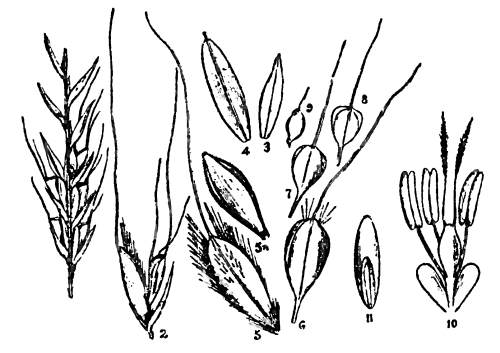
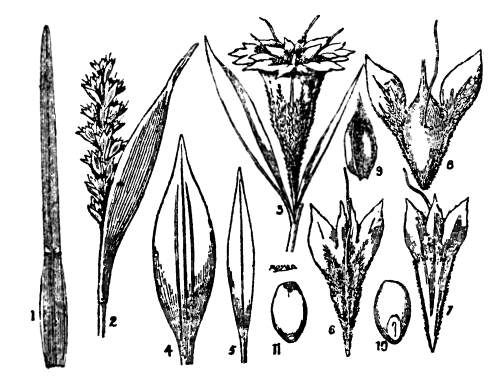
Fig. 127.—Polytoca barbata.
1. Inflorescence; 2, 3, 4 and 5. the first, second, third and the fourth glume, respectively,
of the male spikelet; 4a and 5a. palea of the third and the fourth glume,
respectively; 6. the first glume of the sessile spikelet; 7. female spikelet; 8, 9 and 10.
the second, third and the fourth glume, respectively; 11. palea of the fourth glume;
12. ovary.
The male spikelets are solitary, or binate and then one sessile
and one pedicelled, 2-flowered, reaching 3/8 inch in length and
consist of four glumes each. The first glume is concave, ovate, acute,
pubescent, herbaceous, many-nerved and with a narrow membranous
margin on one side only in the pedicelled and solitary
spikelets and on both sides in the sessile spikelets. The second
glume is narrower, dorsally compressed, ovate, acuminate, 5- to 9-nerved,
laterally compressed and with a narrow wing to the keel
near the apex in sessile spikelets and dorsally compressed without
the keel in the pedicelled and solitary spikelets. The third glume is
membranous, oblong, acuminate, 3- to 5-nerved, with three stamens
and paleate; the palea is hyaline, broadly linear. The fourth
glume is very slender, linear, hyaline, with or without stamens,
paleate; palea is flat, narrowly linear. Lodicules are present and
they are small. The anthers in the third glume are larger than
those in the fourth glume.
The female spikelet is oblong, 1/6 inch long, 1-flowered and
with four glumes. The first glume is thickly coriaceous, white,
shining, closely embracing the rachis and the other glumes entire
at the tip. The second glume is quadrately oblong, many-nerved. The
third glume is oblong, narrower than the second, 3- to 5-nerved paleate,
empty. The palea of the third glume is narrow, truncate. The
fourth glume is narrow, truncate, 3-nerved, paleate; the palea is
truncate and wrapped round the ovary. Styles are long and
stigmas slender. Lodicules are not present. The grain is fusiform,
terete and within the nut-like polished hardened glume.
Distribution.—In damp situations all over India.
These are erect perennial grasses. The inflorescence is a spike-like
panicle, with very short filiform inarticulate branches and
rachises. Spikelets are binate, 1-flowered, all alike, both pedicelled,
articulate at the base and hidden by the very long silky
hairs arising from a small callus and from the glumes. There are
four glumes. The first two glumes are membranous, lanceolate,
and subequal. The third glume is shorter and smaller, hyaline.
The fourth glume is still smaller and hyaline. Stamens are two,
rarely one. Lodicules are not found. Styles connate below, with
stigmas very long, narrow and exserted at the top of the spikelets.
Grain is small and oblong.
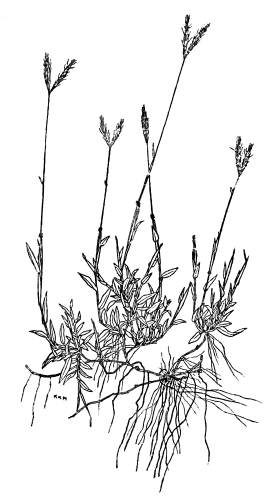
This is an erect perennial grass with creeping, stoloniferous
root-stocks, with aerial stems varying from 6 inches to 3 feet.
The leaf-sheath is loose and glabrous. The ligule consists of
long soft hairs. The nodes are naked or bearded.
The leaf-blade is linear, flat, tapering from about the middle
towards the top, finely acuminate, and also narrowing towards the
base into the stout midrib, margins with fine long hairs at the base,
6 to 18 inches by 1/10 to 1/3 inch, scabrous above and smooth
beneath.
The panicle is narrow, spike-like, silvery, 3 to 8 inches; branches
are short and appressed and the internodes of spikes are short
with the tips dilated.
The spikelets are 1/8 to 1/6 inch concealed by long silvery hairs
of the callus and the glumes, articulate at the base; callus hairs are
about twice as long as the spikelet or longer.
There are four glumes in the spikelet. The first glume is ovate-lanceolate,
obtuse, with ciliate tips and long hairs at the back
below the middle, rather thickened towards the base, dorsally hairy,
3- to 7-nerved, nerves not reaching the tip. The second glume is
as long as the first, with membranous margins and with long hairs
at the back, 3- to 7-nerved. The third glume is hyaline, less than
half as long as the first and second glumes, oblong, obtuse or
irregularly toothed, nerveless or 1-nerved. The fourth glume is
slightly shorter and narrower than the third, ovate, acute, obtuse
or toothed, ciliate, nerveless or faintly 1-nerved, paleate; palea is
about half as long as the glume, quadrate, toothed or retuse,
nerveless, glabrous. There are only two stamens with orange
anthers. Styles are slender, long, with purple stigmas. Lodicules
are absent. Grain is small and oblong.
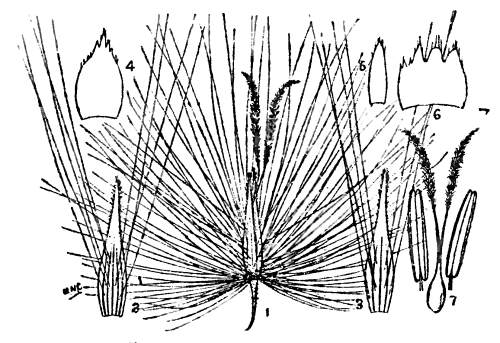
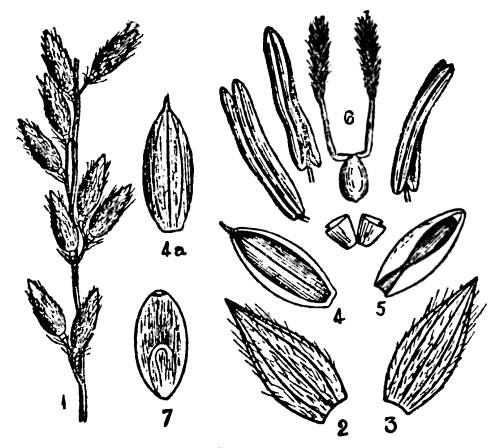
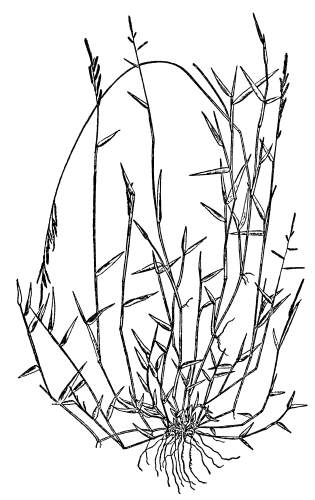
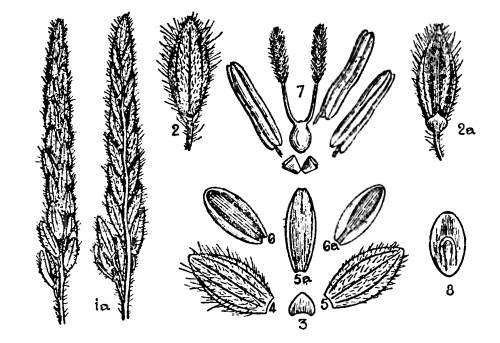
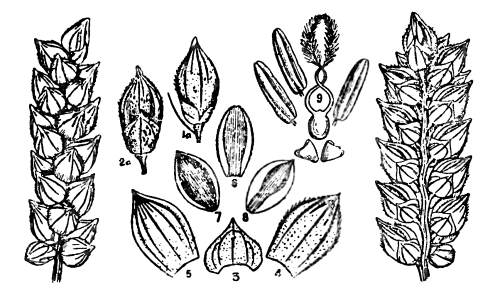
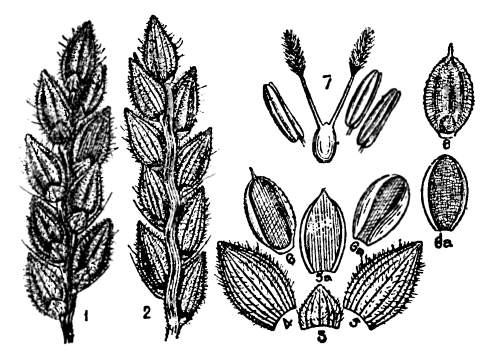
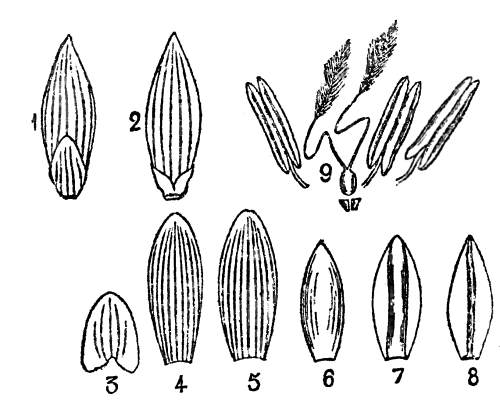
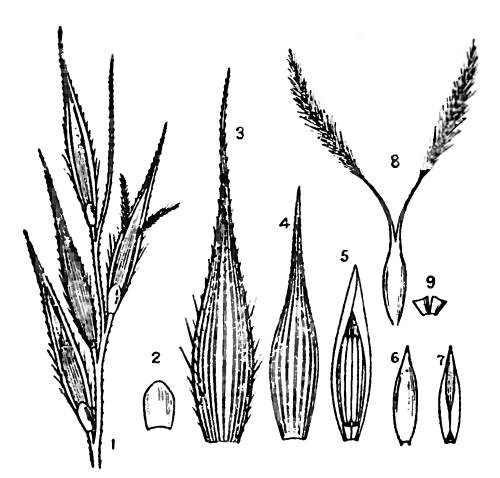
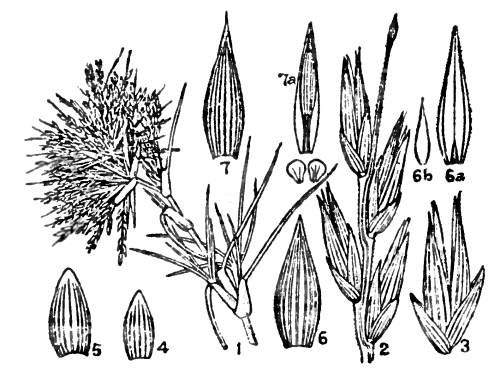
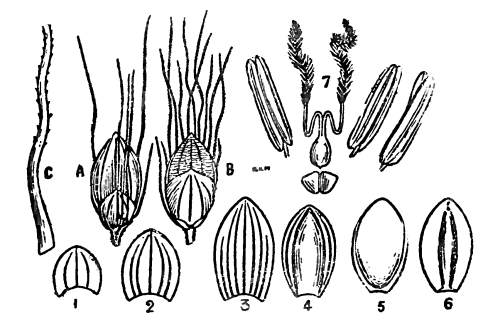
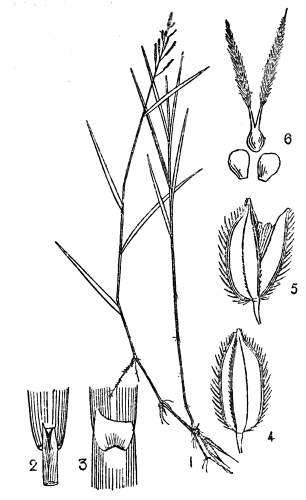
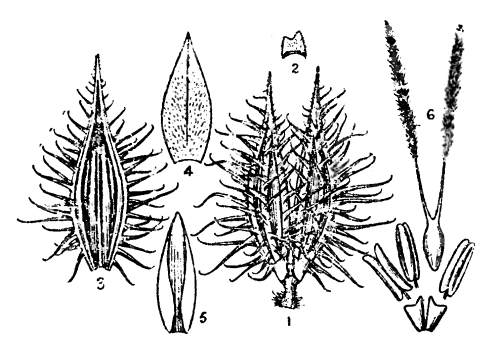
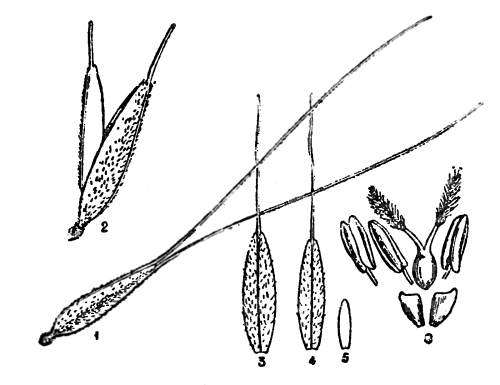
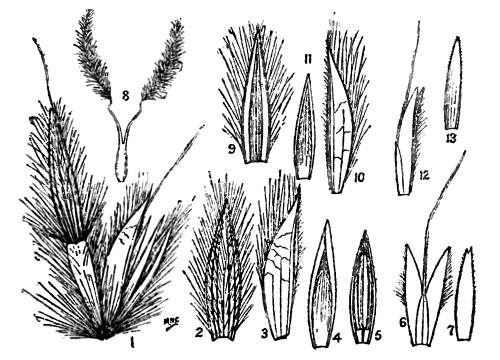
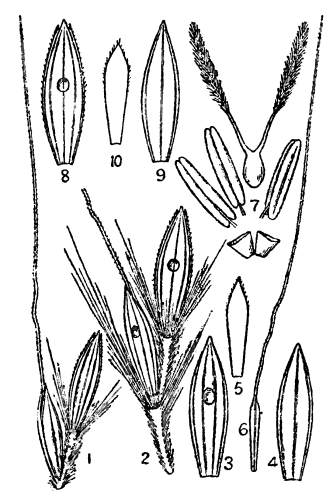
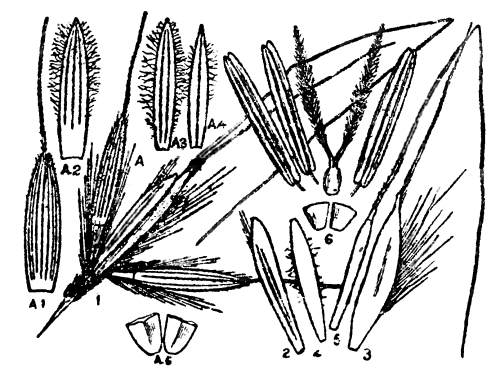
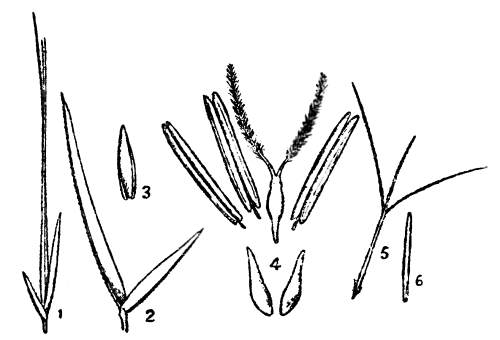
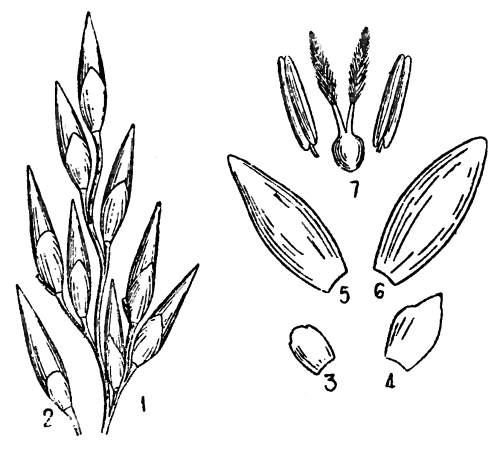
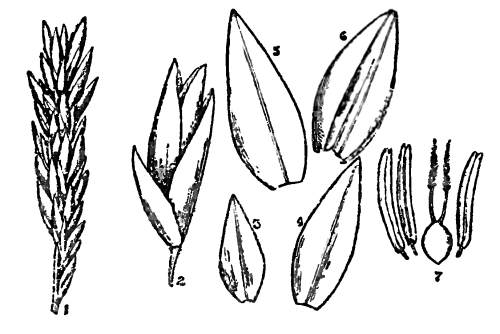
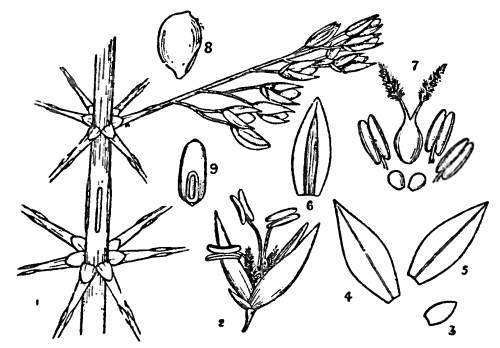
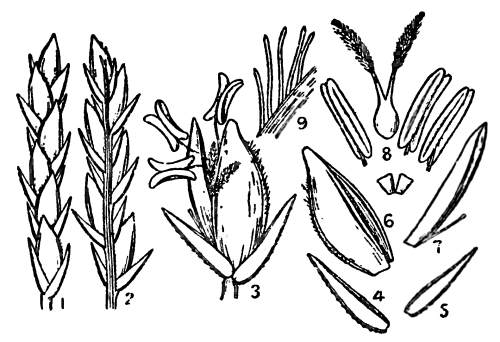
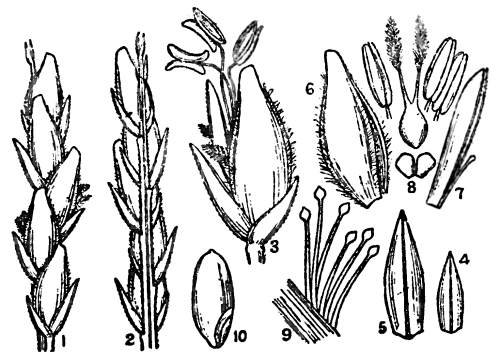
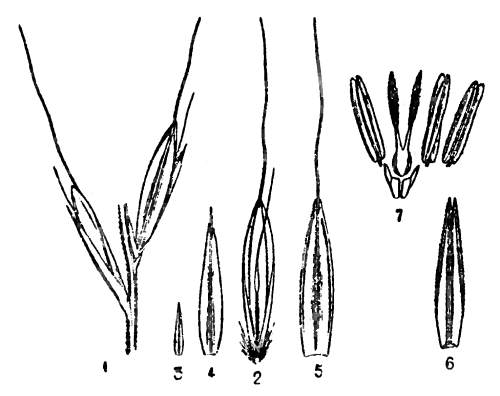
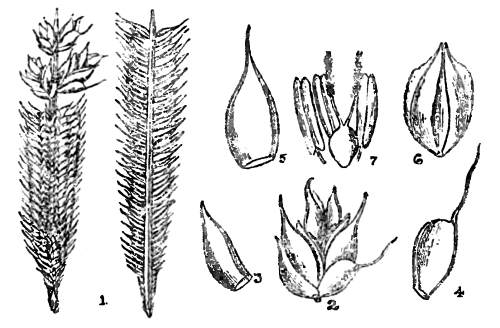
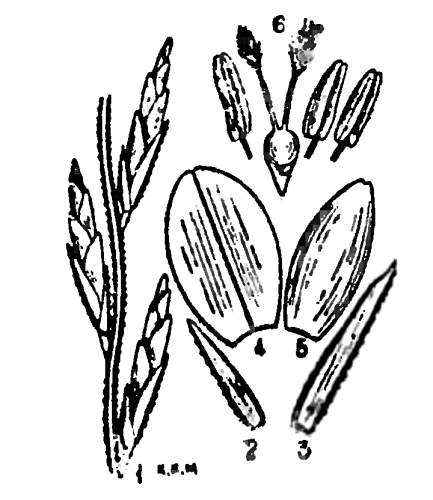
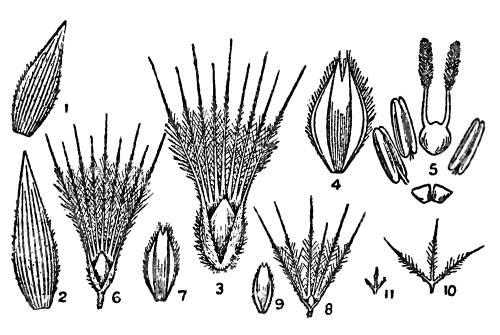
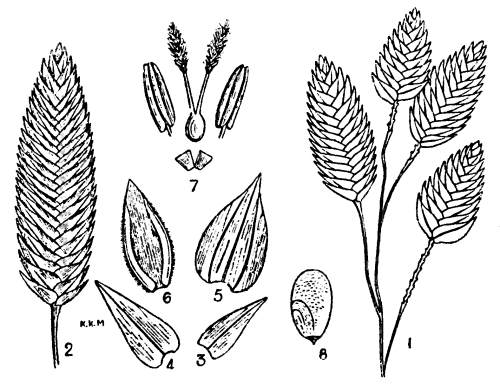
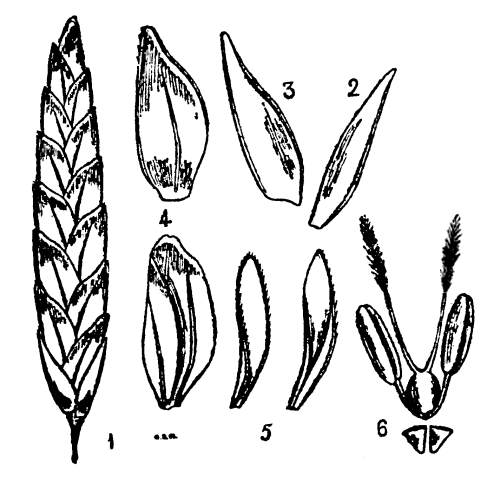
Fig. 128.—Imperata arundinacea.
1. A spikelet; 2, 3, 4, and 5. the first, second, third and the fourth
glume, respectively; 6. palea of the fourth glume; 7. two stamens and the ovary.
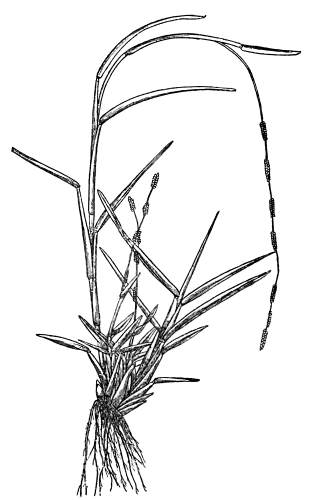
This is fairly abundant in moist stiff soils. On account of the
underground stolons this grass cannot be eradicated easily.
Distribution.—Throughout India.
These are tall perennial grasses. Inflorescence is a much
branched open panicle, branches spreading or erect, capillary
and fragile. Spikelets are small, 1-flowered, binate, one sessile
and the other pedicelled, the sessile spikelet is bisexual and the
pedicelled is female and rarely bisexual; sessile spikelets are
deciduous with the contiguous joint of the rachis and the pedicel.
There are four glumes. The first glume is chartaceous, equal in
length to the second, oblong or lanceolate. The second glume is
concave. The third glume is hyaline, empty. The fourth glume
is very small or absent. Lodicules are present. There are three
stamens. Stigmas are laterally exserted. Grain is oblong or
sub-globose.
This is a tall perennial grass with a creeping root-stock bearing
erect stems and occasionally decumbent or prostrate stolons.
Stems vary in length from 5 to 20 feet. Branches and axillary
buds grow out piercing the sheaths near the nodes.
The leaf-sheath is glabrous, but woolly at the mouth. The ligule
is a distinct ovate membrane. The nodes are glabrous.
The leaf-blade is very long, narrow linear, acuminate and
narrowing downwards into the stout midrib, coriaceous, glabrous
and 1-1/2 to 2 feet by 1/8 to 1/4 inch.
The panicle is lanceolate, 8 to 24 inches, silky and the peduncle
just below the panicle is softly silky, branches are whorled, three
to five at a level, 2 to 4 inches long, rachis of the branches almost
capillary, jointed and fragile, joints with long cilia at the back.
The spikelets are binate, one sessile and another pedicelled,
both bisexual and alike, lanceolate, 1/8 to 1/6 inch long, callus is
minute and bearded with spreading silky hairs 1/2 inch long.
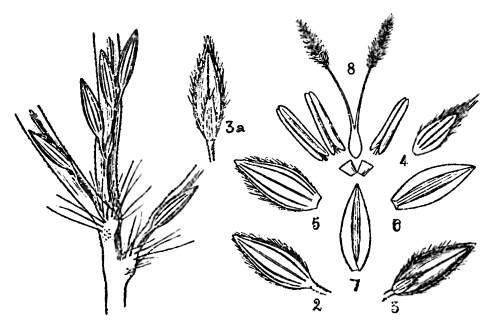
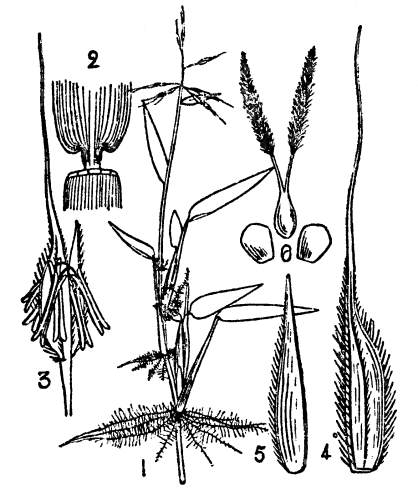
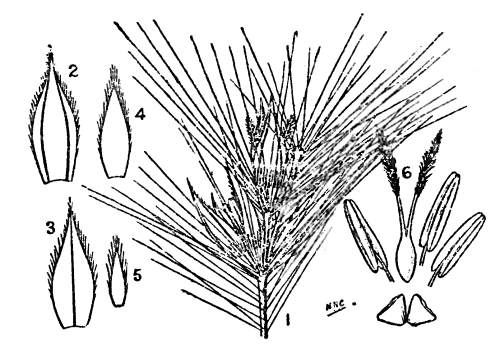
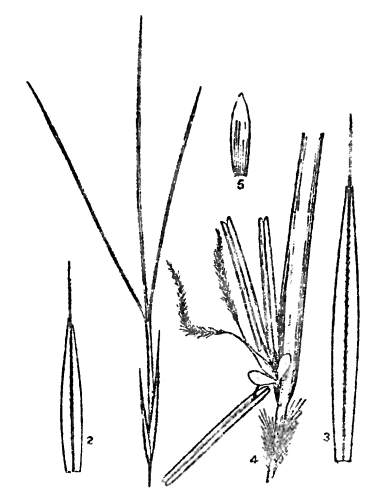
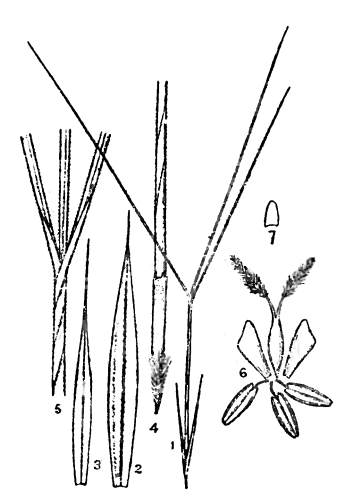
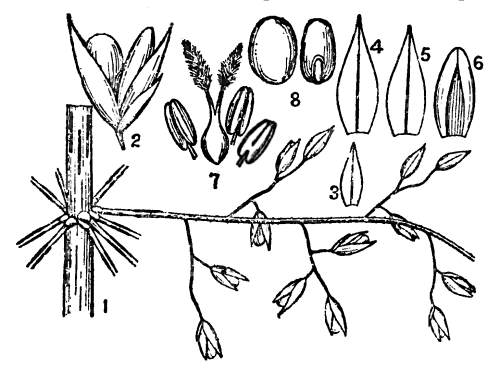
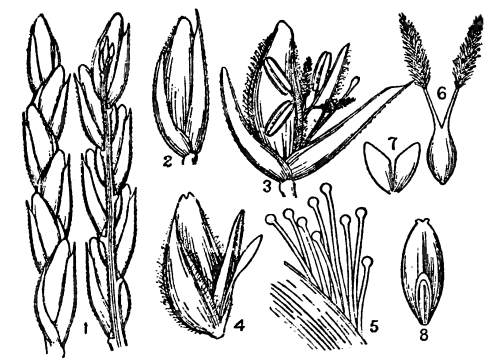
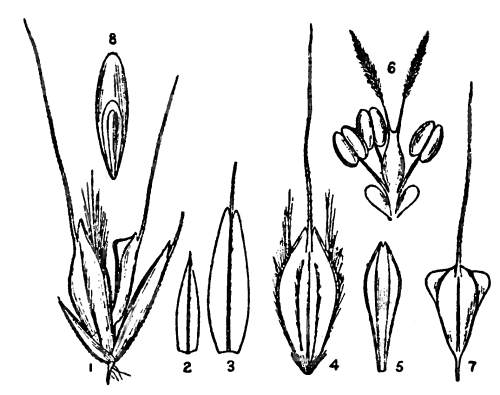
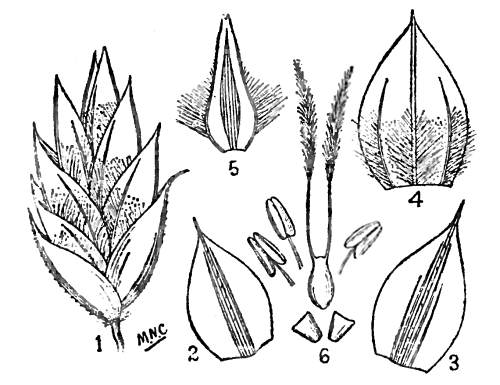
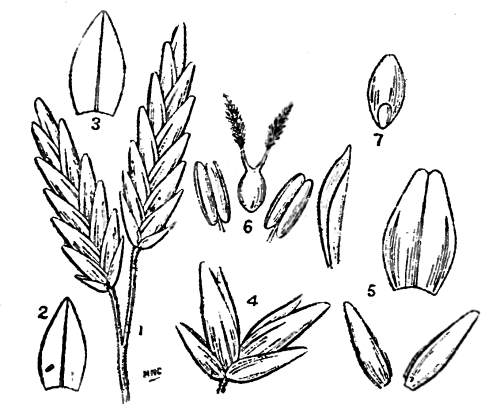
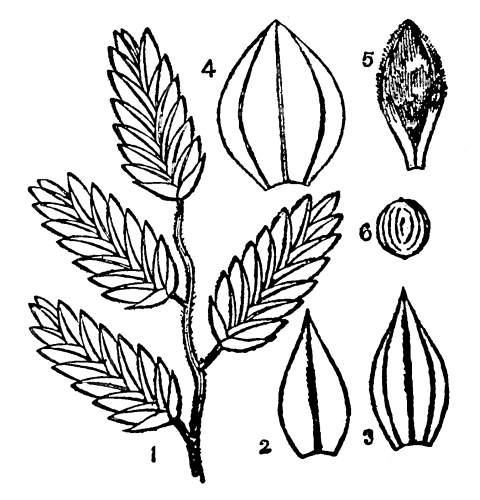
Fig. 129.—Saccharum spontaneum.
1. Two spikelets; 2, 3, 4 and 5. the first, second, third and
the fourth glume, respectively; 6. ovary, stamens and lodicules.
There are four glumes. The first glume is lanceolate, subulate,
acuminate, 2-nerved, flattened dorsally, coriaceous at the base and
hyaline above it, and with smooth incurved margins. The second
glume is about equal to or slightly shorter than the first, lanceolate,
acuminate, 1-nerved, keeled with an opaque base; margins and
keel are ciliate with fine long hairs. The third glume is hyaline,
ovate-lanceolate, nerveless, acute, ciliate. The fourth glume is
very slender, ciliate, acuminate, paleate; palea is minute, very
variable. Stamens are three. Lodicules are cuneate or quadrate.
The grain is very small, oblong.
Distribution.—This occurs all over India along the sides of the
river.
The grasses of this genus are either annuals or perennials.
The inflorescence consists of spikes, solitary, digitate or fascicled,
articulate and fragile; the joints of the floral axis and the pedicels
of the pedicelled spikelets are trigonous and hollowed ventrally.
Spikelets are binate, one sessile and one pedicelled; the pedicelled
spikelets are dissimilar from the sessile and both usually 2-flowered.
The sessile spikelets have four glumes. The first
glume is coriaceous, oblong or lanceolate, convex more or less,
marginally winged above the middle, truncate or two-cuspidate
at the apex and awnless. The second glume is as long as the first,
coriaceous, concave, acute or obtuse, awned or not. The third
glume is hyaline, deeply cleft into two lobes with an awn in the
cleft, and 3-nerved, paleate; palea is linear-lanceolate enclosing
either stamens and ovary or ovary alone. Lodicules are cuneate
or quadrate.
KEY TO SPECIES.
- Racemes two or three; the first glume of the sessile spikelet dorsally flat, not channelled or depressed along the middle line.
- Margin of the first glume of the sessile spikelet incurved narrowly from the base to the apex.
- First glume of sessile spikelets with nodulose margins. 1. I. aristatum.
- First glume of sessile spikelets closely transversely ribbed. 2. I. rugosum.
- First glume of the sessile spikelet translucent, bicuspidate at the tip and with smooth margins. 3. I. pilosum.
- Margin of the first glume of the sessile spikelet broadly incurved from below the middle.
- First glume of the sessile spikelet with smooth margins, callus bearded. 4. I. ciliare.
- Raceme solitary; the first glume of the sessile spikelet deeply grooved at the back along the middle line. 5. I. laxum.
This is a perennial grass, with fairly stout, erect or somewhat
decumbent, simple or branched, glabrous, leafy stems, 1 to 4 feet
high.
The leaf-sheath is loose, glabrous and auricled. The ligule is a
distinct membrane, broad or narrow. Nodes are glabrous.
The leaf-blade is linear-lanceolate, flat, acuminate, narrowed
towards the base which may be acute, subcordate or rarely even
petiolate, glabrous or sparsely hairy above and glaucous beneath,
4 to 10 inches long and 1/4 to 1 inch broad.
The inflorescence consists of one or two, erect, stout or slender,
fragile racemes, 1 to 5 inches long.
Fig. 130.—Ischæmum aristatum.
1. A portion of the raceme showing the joints, sessile and pedicelled spikelets; 2,
3, 4 and 6. the first, second, third and the fourth glume, respectively, of the sessile
spikelet; 5 and 7. palea of the third and the fourth glumes, respectively; 8. ovary,
stamens and lodicules; 9. first glume of the pedicelled spikelet.
The spikelets are 1/6 to 1/3 inch long, the sessile and the pedicelled
closely pressed together, glabrous or hairy; the callus of the sessile
spikelet broad and thick, with or without hairs. The sessile spikelet
is awned and consists of four glumes. The first glume is 1/5 inch
long or less, oblong or linear-oblong, cartilaginous below the
middle, with two to four (or rarely up to six) marginal nodules on
each edge, sometimes these are connected by shallow ridges,
thinner above the middle, with green anastomosing veins, tip
obtuse or 2-toothed, and margins narrowly incurved. The second
glume is chartaceous, lanceolate, acuminate, 1-nerved and with a
smooth rounded keel. The third glume is ovate-lanceolate, membranous,
1-nerved, acuminate, male or bisexual with an oblong palea.
The fourth glume is cleft to or below the middle into lanceolate acute
lobes, with a brownish red awn 1/2 inch or more long at the sinus
twisted at the lower portion and straight above, paleate, usually
female; palea is linear oblong. The pedicelled spikelet is as long as
the sessile, inarticulate on the very thick, short pedicel which is
densely or sparsely hairy at the base. The first glume is scimitar-shaped,
coriaceous, acute, with a somewhat semi-circular wing. The
other glumes are as in sessile spikelets, but the fourth glume has no
awn and may have a mucro.
This grass is a variable one. There is much variation in the
breadth of the leaves and in the markings and hairiness of the
spikelets. The spikelets may be glabrous or hairy and the marking
in the first glume of the sessile spikelets varies in the matter of
marginal nodules—it may have mere shallow notches or deep well-formed
nodules and there may be transverse ridges or they may be
absent. This grass is abundant on the West Coast and rare in the
East Coast.
Distribution.—Throughout the plains and lower hills of India
and Ceylon.
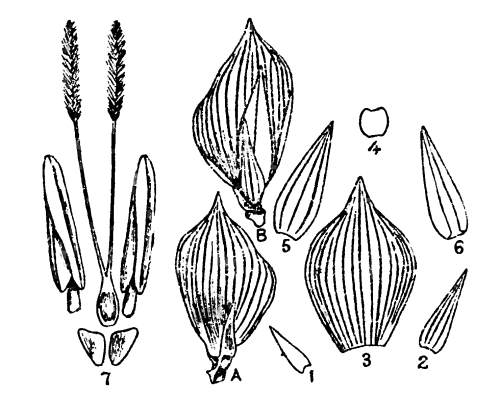
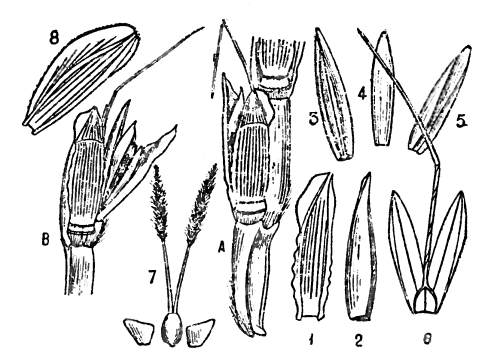
Fig. 131.—Ischæmum aristatum.
A. A portion of the raceme showing the joints; B. a sessile and a pedicelled
spikelet. 1, 2, 3 and 6. the first, second, third and the fourth glume, respectively; 4 and
5. palea of the third and the fourth glume; 7. ovary and lodicules; 8. first glume
of the pedicelled spikelets.
This is an erect annual grass with tufted, leafy, compressed
stems varying in length from 10 inches to 2 feet.
The leaf-sheath is glabrous, loose and compressed, with a membranous
auricle confluent with the truncate ligule. Nodes usually
glabrous but sometimes also puberulous.
The leaf-blade is narrow, linear-lanceolate, flat, base contracted,
flaccid, acuminate, rounded at the base, glabrous or sparsely hairy
on both the surfaces; the topmost leaf is often reduced to an
inflated sheath enclosing the inflorescence partially.
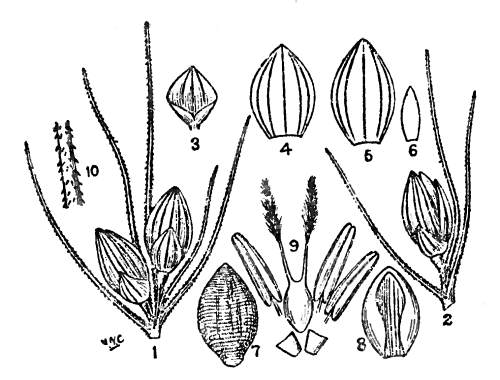
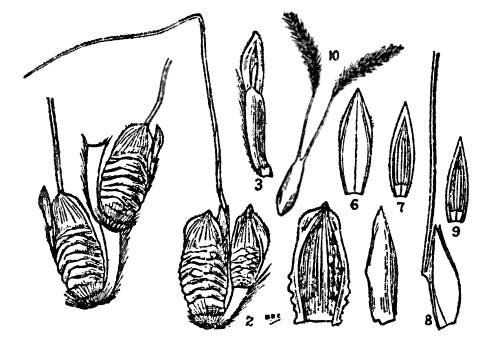
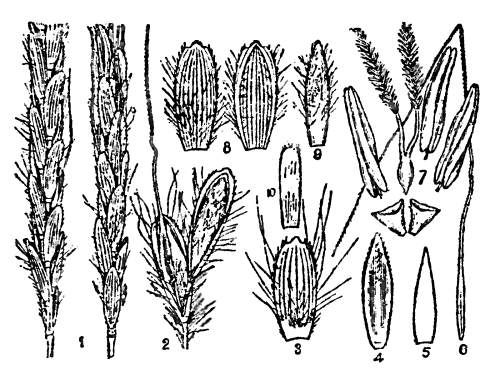
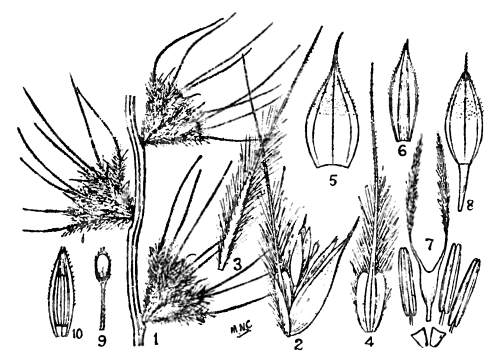
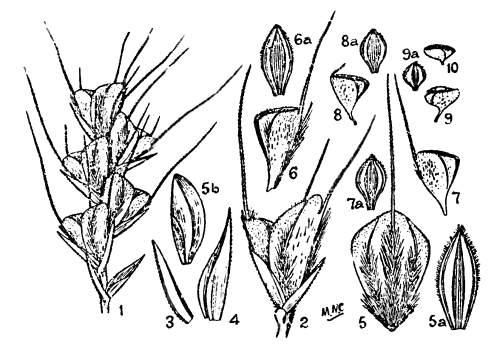
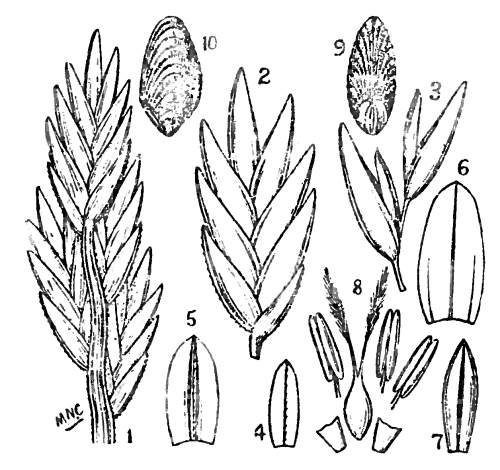
Fig. 132.—Ischæmum rugosum.
1. A part of the raceme showing sessile spikelets with reduced pedicelled spikelets; 2.
a sessile spikelet and a well developed pedicelled spikelet; 3. a reduced pedicelled
spikelet; 4, 5, 6 and 8. the first, second, third and the fourth glume of the sessile
spikelet; 7 and 9. palea of the third and fourth glumes of the sessile spikelet; 10. ovary.
The racemes are usually two, erect, fragile, 1 to 3 inches long
with a slight thickening of the peduncle below the inflorescence;
the joints are 1/3 to 2/3 as long as the sessile spikelets; trigonous
and subclavate, and with long hairs on one side. The spikelets
are linear-oblong, glabrous or villous, 1/8 to 1/4 inch long, sessile
and stalked spikelets close together; the pedicel of the stalked
spikelet is thick about 1/3 or less than the length of the sessile spikelet,
ciliate on one side, confluent with the thick callus of the sessile
spikelet, which is sparsely bristly. The sessile spikelet consists of
four glumes and is awned. The first glume is concave, pale yellow,
shining and cartilaginous to about 2/3 its length from the base, and
the upper third is membranous, dimidiately ovate; at the back in the
cartilaginous portion, there are three to six deep convex smooth
ridges running across the glume; the membranous tip is thin and
with anastomosing green veins; the margins of this glume are
thick, narrowly incurved, ciliolate, and with a narrow wing on the
outer margin. The second glume is oblong-lanceolate or lanceolate,
coriaceous, acuminate, scaberulous, keeled and laterally compressed
and on the keel just below the tip there is a narrow ciliate wing.
The third glume is ovate-lanceolate, hyaline, acuminate 1- to 3-veined,
male or empty, with a narrow hyaline palea. The fourth
glume is shorter than the third, deeply cleft into two lanceolate
acute lobes, 3-veined at the base; awn up to about 2/3 inch long;
palea is linear lanceolate. Stamens are three and lodicules are
small and cuneate.
The pedicelled spikelet is very variable. It is shorter than the
sessile, with obscure transverse ridges and may consist of four
glumes, but without an awn to the fourth glume; sometimes this
spikelet is reduced to a single glume.
The grain is broadly oblong, brownish and compressed.
Distribution.—Throughout India and Ceylon.
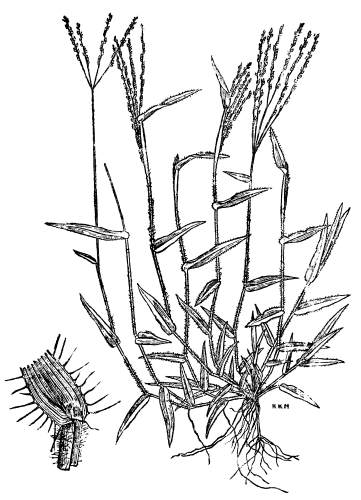
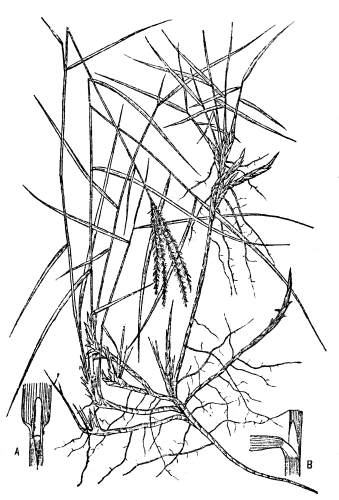
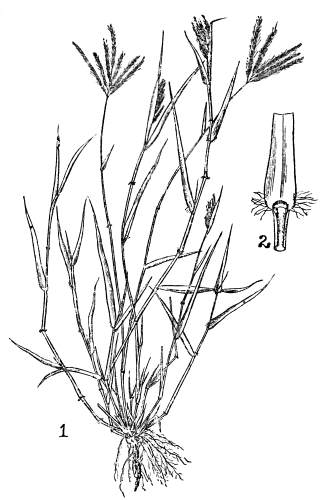
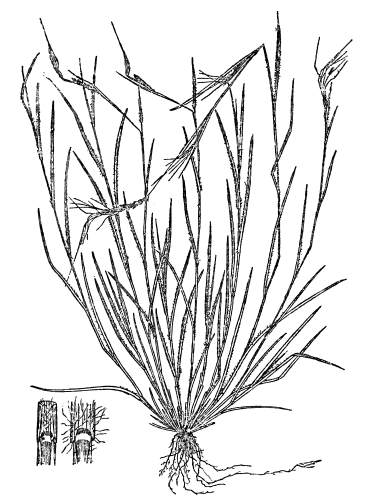
Fig. 133.—Ischæmum pilosum.
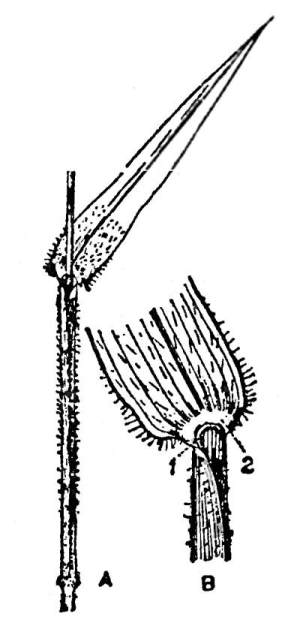
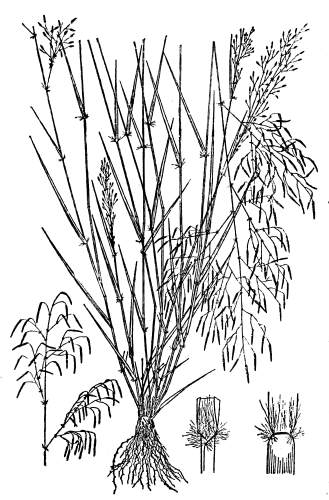
A and B. Ligules.
It is a tall, robust, perennial grass with rhizomes producing
numerous creeping stolons densely covered with scaly-sheaths.
The aerial stems are erect, freely branching at the base, slender,
2 to 3 feet long, glabrous.
The leaf-sheath is glabrous. The ligule is a distinct glabrous
membrane, 1/8 inch long, rounded. Nodes are glabrous.
The leaf-blade is linear, finely acuminate, glabrous but bearded
at the base, 6 to 12 inches long and 1/8 to 1/3 inch broad.
The inflorescence consists of two to six softly hairy spikes which
are yellow or brown 1 to 4 inches long. Joints and pedicels are
slender, sparsely ciliate.
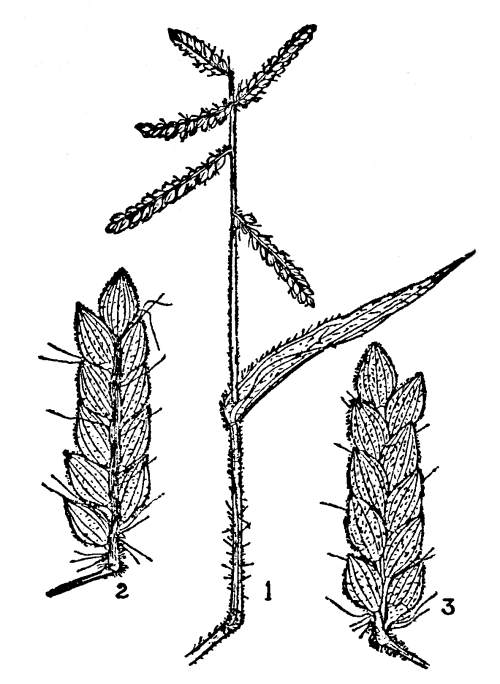
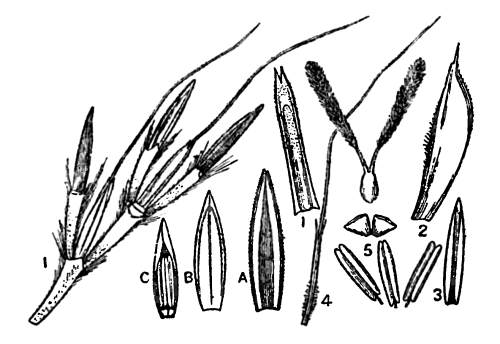
Fig. 134.—Ischæmum pilosum.
1. A sessile and a pedicelled spikelet; 2, 3, 4 and 6. the first, second, third and the
fourth glume, respectively, of the sessile spikelets; 5. palea of the third glume, 7. palea
of the fourth glume; 8. ovary; 9, 10, 11 and 12. first, second, third and the fourth
glume, respectively, of the pedicelled spikelets; 13. palea of the fourth glume.
The sessile spikelets are narrowly lanceolate, 3/4 inch long, with
long hairs at the base. The first glume is dorsally hairy, or
glabrous, narrowed from the middle upwards, chartaceous, with
incurved margins and six or seven anastomosing nerves. The second
glume is longer than the first, laterally compressed, ovate-lanceolate,
acuminate, chartaceous, glabrous but often with long hairs on
the keel towards the upper half, 5-nerved, the lateral nerves
anastomosing. The third glume is a little shorter than the second,
linear-oblong or lanceolate, paleate; palea is membranous, nerveless,
and encloses three stamens. The fourth glume is equal to the
third glume in length, membranous, hyaline and divided almost to
the middle into two acute lobes with an awn 1/4 to 3/8 inch long,
paleate; palea is lanceolate, nerveless and encloses three stamens
and the ovary and sometimes only the ovary. The pedicelled
spikelets are shorter than the sessile but with a shorter awn. The
glumes are similar to those of the sessile spikelet; sometimes these
spikelets are imperfect or even reduced to a single glume.
This grass grows well in black cotton soils and sometimes it
gets very well established and then it is very difficult to eradicate
it. Cattle seem to like this grass.
Distribution.—In black cotton soils all over the presidency, but
most abundant in the Ceded districts.
Fig. 135.—Ischæmum ciliare.
It is a tufted perennial grass, erect or creeping. Stems are erect
or ascending, sometimes decumbent at base, and rooting at the
nodes, stout or slender, 6 inches to 2 feet long.
The leaf-sheath is compressed, loose, glabrous or hairy. The
ligule is a short, ciliate membrane. Nodes are glabrous or hairy.
The leaf-blade is flat, linear-lanceolate, acuminate, narrowed
towards the acute or rounded base, glabrous or hairy, 2 to 6 inches
long and 1/6 to 1/2 inch wide.
The inflorescence consists of two spikes, 1-1/2 to 2 inches long;
joints and pedicels of the pedicelled spikelets equal, hairy at the
back and at the angles.
The sessile spikelets are 1/8 to 1/5 inch long, oblong, bearded at the
base. The first glume is coriaceous, convex, polished, smooth or
pitted, hairy below,
flat and veined
above the middle,
with broad or
narrow ciliate equal
wings and with
margins narrowly
inflexed above and
broadly so below.
The second glume is
coriaceous, equal to
or longer than the
first, lanceolate,
acuminate, or
shortly awned,
3- to 5-nerved,
keel narrowly
winged towards the
apex, dorsally ciliate
or not. The
third glume is ovate-lanceolate,
acuminate,
ciliate towards
the apex, 1- to 3-nerved, paleate; the palea has a coriaceous
lanceolate centre, with broad hyaline ciliate wings and encloses
three stamens. The fourth glume is hyaline, deeply lobed into two
oblong obtuse glabrous or ciliate lobes, with an awn twice as long
as the spikelet in the cleft, and paleate; palea is lanceolate,
acuminate, 2-nerved. Styles and stigmas are short.
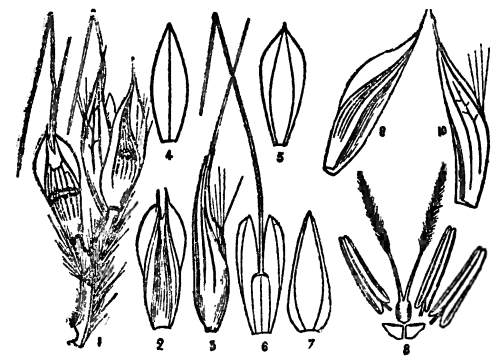
Fig. 136.—Ischæmum ciliare.
1. Spikelets; 2, 3, 4 and 6. the first, second, third and
the fourth glume, respectively, of the sessile spikelet; 5 and
7. palea of the third and the fourth glumes, respectively; 8.
lodicules, stamens and the ovary; 9 and 10. the first and the
second glumes of the pedicelled spikelet.
The pedicelled spikelets resemble the sessile ones in the structure
of their glumes and palea.
This grass is very variable in its habit and in the structure of its
spikelets. It grows mostly in wet situations, such as the bunds of
paddy fields and tanks. Cattle eat the grass eagerly.
Distribution.—All over India and Ceylon.
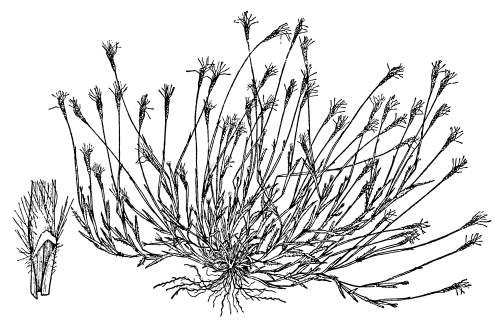
This is a perennial grass with numerous stiff, thick and wiry
roots.
Stems are erect, slender, rising in tufts from a short root-stock,
glabrous, leafy towards the base, varying in length from 2 to 3
feet.
The leaf-sheaths are shorter than the internodes usually
glabrous, but occasionally with scattered hairs. At the mouth
tufts of hairs are present or not. The ligule is a ridge of silky
hairs. The nodes are glabrous.
The leaf-blades are erect, flat, slightly glaucous, linear, narrowed
to long capillary tips, 5 to 12 inches long and 1/10 to 1/6 inch
broad, with prominent nerves and scabrid margins.
The inflorescence is a solitary spike, 2 to 5 inches long, erect and
fragile; the joints and pedicels are compressed, somewhat 2-angled,
ciliate with long hairs, and about half as long as the
spikelets.
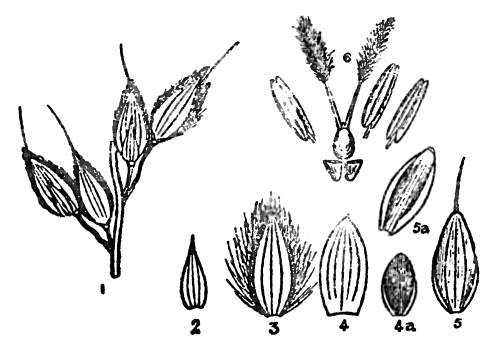
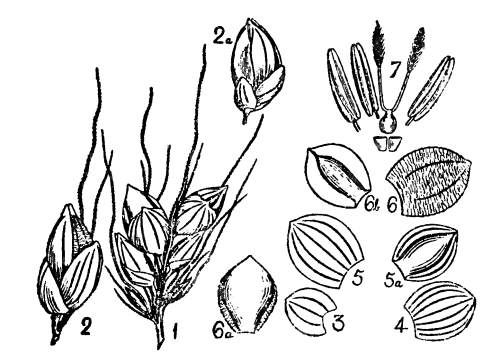
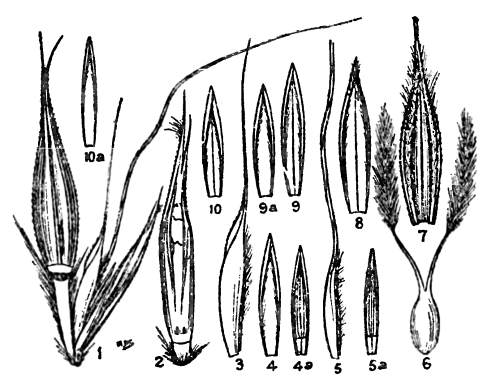
Fig. 137.—Ischæmum laxum.
1. A sessile and a pedicelled spikelet; 2. first glume of a sessile spikelet; 3. second
glume of a sessile spikelet; 4 and 5. third and fourth glumes of sessile spikelets; 4a
and 5a. are palea of third and fourth glumes; 6. ovary; 7, 8, 9 and 10. glumes of pedicelled
spikelets; 9a and 10a. palea of third and fourth glumes.
The spikelets are in pairs, one-sessile and one-pedicelled. The
sessile spikelets are pale-green, linear-oblong, acuminate with
a shortly bearded callus, 1/4 to 3/8 of an inch long. There are four
glumes in a spikelet. The first glume is chartaceous, oblong-lanceolate,
acuminate, 2-toothed with the teeth ending in two short
awns, densely ciliated at the apex on one side, conspicuously 6-
(rarely) 7-nerved, the two lateral being very strong and running
into the apical teeth and the intermediate four nerves being shorter
and not running up to the apex, and on the dorsal surface there is a
depression, where it is membranous and the nerves on its sides
sometimes anastomosing at the upper third of the glume. The second
glume is shorter than the first, chartaceous to a certain extent, ovate-lanceolate,
acuminate, concave, terminating in a fine scabrid awn,
1/2 inch long, with margins ciliate from above the middle to the
apex, and with a narrow ciliated wing on the keel at the apex
running up to the base of the awn, 3-nerved. The third glume is
lanceolate, acuminate, hyaline, nerveless, ciliate, with a linear
obtuse palea enclosing three stamens and two lodicules. The fourth
glume is hyaline, membranous, deeply split at the apex into two
prominent lobes and with an awn in the depression 1/2 inch
long, the palea is linear oblong and contains either the ovary alone
or both the stamens and the ovary.
The pedicelled spikelets are also as long as the sessile, more
conspicuous than the sessile and consist of four glumes, but are
not awned. The first glume is lanceolate or oblong-lanceolate,
chartaceous, with seven strong nerves, very prominent at the back
and the mid nerve being most conspicuous, with scabrid keels and
closely finely ciliated and folded margins, finely biaristate at the
apex. The second glume is lanceolate, finely acuminate, sub-chartaceous,
with the margins ciliate from about two-third its length from
the apex, 3-nerved, the mid nerve alone being prominent. The third
glume is hyaline, nerveless, lanceolate, ciliate in the margin,
paleate with 3 stamens or empty. The fourth glume is shorter than
the third, hyaline, narrow lanceolate, not awned, ciliate or not at
the margin, paleate and with three stamens and two lodicules.
This grass produces a large amount of leaves in good soils and
it is liked very much by cattle. It is capable of standing a long
spell of dry weather, and is valuable in this respect because it can
be depended upon when other grasses fail. It is worth conserving
with other grasses. It grows both in rich and poor soils, in open
places and also in thickets.
Distribution.—Throughout India and Ceylon.
These are tufted perennial grasses with rigid equitant leaves at
the base. The inflorescence consists of a solitary, glabrous, and
compressed spike, with a somewhat fragile rachis; the joints are
compressed, hollow and clavate. The spikelets are solitary, usually
2-flowered (rarely 1-flowered), secund, closely imbricating,
sessile with a short, pedicelled, reduced upper spikelet, and deciduous
with the joint. There are four glumes. The first glume is
oblong or ovate, flat, smooth, coriaceous, pectinately margined with
upcurved spines. The second glume is oblong-lanceolate, acute
and 3-nerved. The third glume is hyaline, obtuse, paleate and
male. The fourth glume is smaller, hyaline, oblong, obtuse, 1-nerved,
paleate, bisexual or female. Lodicules are truncate and
slightly oblique. Stamens are three with long anthers. Styles
are two with feathery stigmas. The grain is oval, plano-convex.
This is a perennial tufted grass with a woody creeping root-stock.
Stems are erect or ascending, slender, strongly compressed,
lower parts completely covered by rigid equitant leaves, 6 to 18
inches long or more.
The leaf-sheath is broad, flat, much compressed, glabrous and
keeled. The ligule is a short membrane. Nodes are glabrous.
The leaf-blade is linear, glabrous on both sides, 2 to 6 inches
long and 3/16 to 1/4 inch broad, with a rounded tip and two unequal
lobes.
The spike is solitary, up to 6 inches (or more) in length, joints
of the rachis 1/3 to 1/2 the length of the spikelets. Spikelets are
solitary, sessile, compressed, secund. The sessile spikelets are
3/16 to 1/6 inch, and consist of four spikelets. The first glume is
oblong-lanceolate, dorsally slightly convex, smooth, coriaceous, 7-
to 9-nerved, and with pectinate margins consisting of long, spreading,
upcurved spines and at the top with subquadrate wings on
each side reaching beyond the acute tip. The second glume is
chartaceous, oblong-lanceolate, acuminate, usually 5-nerved (and
occasionally 3-nerved), the mid-nerve keeled with a narrow wing from
below the middle to the base and with hyaline margins. The third
glume is oblong-obovate,
hyaline,
thin, paleate with
three yellow anthers
and two oblong-cuneate
lodicules;
palea is narrow,
oblong, obtuse. The
fourth glume is thin,
hyaline, oblong-lanceolate,
obtuse,
paleate, and bisexual;
palea lanceolate,
narrow, two-toothed
at the apex,
with deep purple
anthers and stigmas
of the same colour.
The lodicules are
obliquely truncate.
Ovary has a reddish
spot between the
style branches and
just at the apex in the fresh state in the bud and in the open flower.
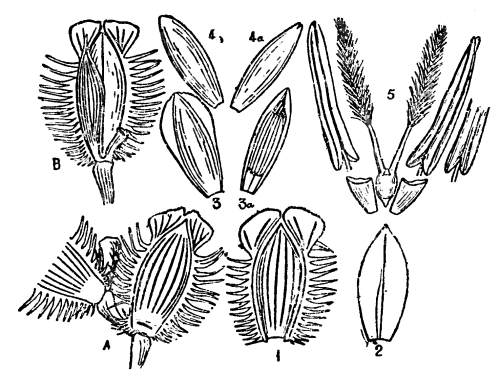
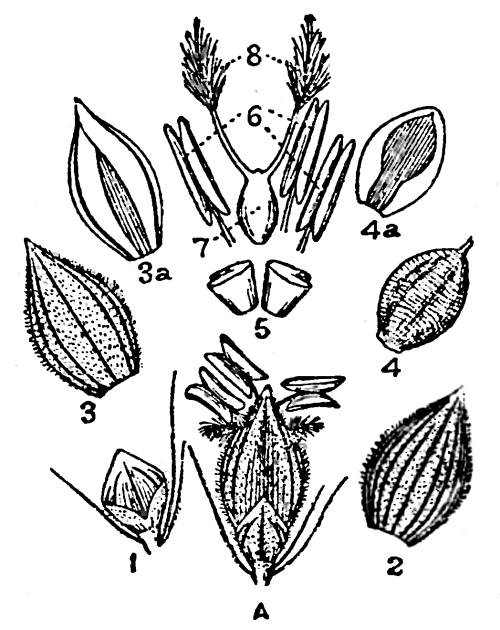
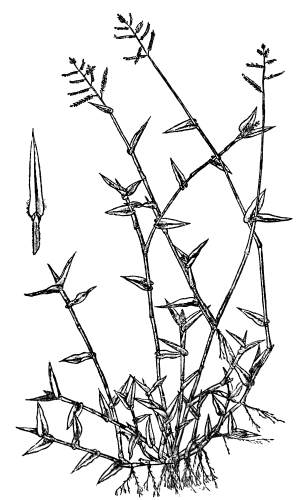
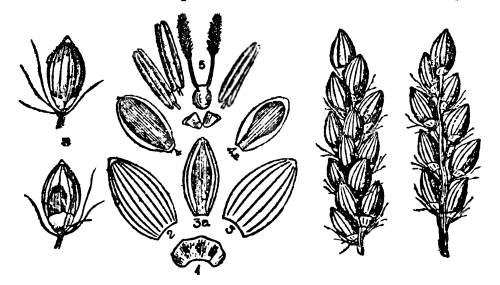
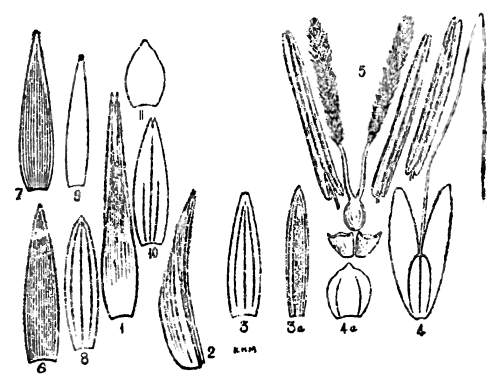
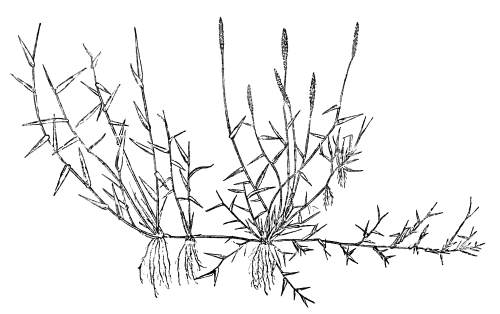
Fig. 138.—Eremochloa muricata.
A. Sessile spikelet; B. sessile and a pedicelled spikelet;
1, 2, 3 and 4. the first, second, third and the fourth glume
of the sessile spikelet; 3a and 4a. palea of the third and
fourth glumes of the sessile spikelet; 5. ovary, anthers and
lodicules.
The pedicelled spikelet is reduced to an inflated body, as long
as the sessile spikelet. It is pointed towards both ends, green with
anastomosing veins on the outside and membranous, white and
nerveless on the other side. The part of the pedicelled spikelet
corresponding to the spikelet looks as if the margins of the first
and second glumes are confluent all round.
Distribution.—South India and Ceylon.
These are annual or perennial grasses with slender stems. The
spikes are compressed, 2- to 3-nate, or solitary at the ends of slender
branches, with a rachis not jointed; joints are short, slender and
villous. Spikelets are closely imbricating in two series, sessile,
solitary, the upper reduced to a small pedicel 1- to 2-flowered,
the lowest few on the spike, imperfect, male or neuter. There are
four glumes. The first glume is large, broadly obovate or obcordate,
cuneate, villous with brown hairs, 7- to 9-nerved. The second
glume is as long as the first, but narrower, thinner, oblong to ovate,
spikelet truncate and 3-nerved. The third glume is hyaline,
narrow, paleate, male or empty. The fourth glume is hyaline,
linear, entire or 2-fid, awned, bisexual with a very short palea.
Lodicules are absent. Stamens are two or three with linear
anthers. Styles are short and stigmas slender and exserted. The
grain is small, oblong and narrow.
Fig. 139.—Apocopis Wightii.
This is a low and densely tufted or tall erect annual grass.
Stems are leafy, branching freely, 3 to 8 inches long.
The leaf-sheath is loose, usually hairy, rarely also glabrous and
hairy at the mouth. The ligule is a small lacerate membrane.
The leaf-blade is linear-lanceolate, acuminate, hairy on both
sides and with tubercle-based hairs, rarely glabrous, 3/4 to 3 inches
by 1/12 to 1/8 inch.
The inflorescence consists of two racemes, closely appressed
together on a very slender peduncle; the joints are shorter than
the spikelets and with long brown hairs.
The spikelets are oblong, 1/8 to 1/5 inch long, the callus is short,
hairy with long brown hairs. The first glume is cuneately obovate
or obcordate, yellowish with red brown tips or dark brown with
yellow tips, chartaceous below, membranous, hyaline and ciliate at
the truncate, emarginate or retuse apex, 7- to 9-nerved, the nerves
abruptly ceasing towards the apex. The second glume is as long as
the first, broadly oblong, sides sharply folded inwards, 3-nerved,
rarely nerveless, with long hairs at the back towards the base and
with short cilia at the apex. The third glume is as long as the
first, hyaline, thin,
linear-oblong,
nerveless, ciliate at
the apex, paleate,
usually with two
stamens or empty;
palea as long as the
glume, hyaline and
nerveless. The
fourth glume is
slightly longer
than the other
glumes or equal,
very narrowly
oblong or linear,
membranous,
awned and paleate;
awn is 2 to 6
times the length of
the glume, 7/8 to
1-1/4 inch long;
palea is hyaline,
thin, nerveless,
convolute, broadly oblong to almost quadrate oblong, apex with very
short cilia. Grain is minute and oblong.
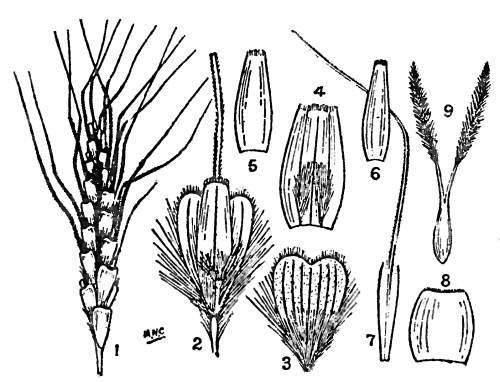
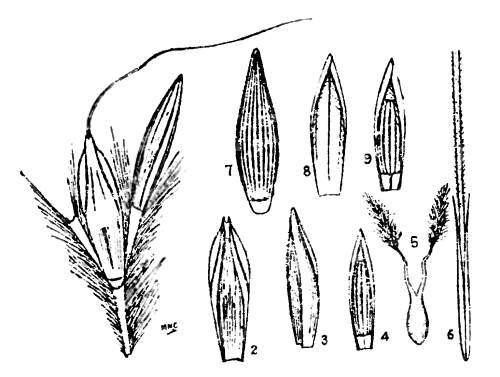
Fig. 140.—Apocopis Wightii.
1. Spike; 2. a spikelet; 3, 4, 5 and 7. the first, second, third
and the fourth glume, respectively; 6 and 8. palea of the
third and the fourth glume; 9. ovary.
This grass varies very much in its spikelets. In one form they
are smaller and hairy and in the other they are larger and glabrous
except for a few stray hairs here and there. The former one is
more widely distributed and the latter seems to be confined to
certain localities in the south of the Presidency.
Distribution.—Throughout the Deccan Peninsula, Behar, Central
India, Burma and Ceylon.
These are small densely tufted perennial grasses, with very
narrow leaves. The spikes are very short at the ends of very fine
branches, solitary, binate or fascicled, with very fragile rachis;
joints are very short, slender with cupular tips. The spikelets are
binate one sessile and the other shortly pedicelled, with the callus
villous. There are four glumes. The first glume (of both the
sessile and the pedicelled spikelets) is oblong, truncate, irregularly
3- to 4-toothed, 5- to 7-nerved and dorsally convex. The second
glume is narrow lanceolate, longer than the first, 3- to 5-nerved,
hispidly villous dorsally below the middle and on the sides, aristate
or awned. The third glume is oblong lanceolate, hyaline, acute or
aristate, 1-nerved, male or neuter, with a linear palea. The fourth
glume is hyaline, as long as the third, entire or 2-fid and awned in
the pedicelled and not awned in sessile spikelets, paleate with
female or bisexual flowers. Lodicules are not present. Stamens
are two. Stigmas are long.
This is a small annual grass with slender, tufted, erect stems
varying in height from 4 to 12 inches.
Leaf-sheaths are glabrous or with scattered hairs. The ligule is
a fringe of close-set long hairs. Nodes are covered with long hairs
below, but nodes nearer the inflorescence are glabrous.
Leaf-blades are very finely linear, acuminate, rigid, erect, glabrous
below, with long hairs on the upper surface to about quarter
the length of the blade and densely hairy near the mouth, and
varying in length from 2 to 6 inches.
The inflorescence consists of usually two closely appressed
spikes, though appearing as one, 1/2 to 3/4 inch long, pilose with
ferrugineous hairs; the peduncle is capillary and enclosed by the
upper leaf-sheath.
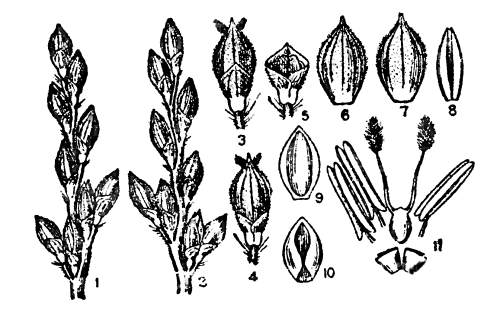
Fig. 141.—Lophopogon tridentatus.
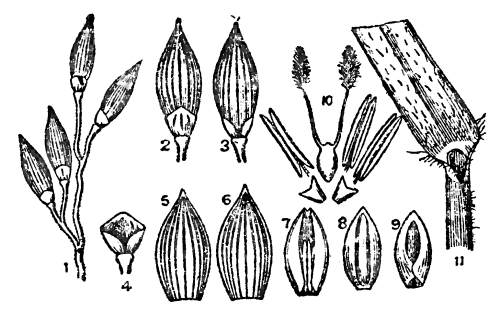
1. Awnless lower spikelet; 2. a lower sessile and an upper pedicelled spikelet;
3. the first glume of an awnless lower spikelet; 4. the first glume of a lower spikelet
that is awned; 5. the first, glume of the upper or pedicelled spikelets; 6, 7 and 9. the
second, third and the fourth glume, respectively, of the upper pedicelled spikelets; 8
and 10. palea of the third and the fourth glumes; 11. ovary and anthers.
The spikelets are densely imbricate, binate at each joint, the
upper being shortly pedicelled and the lower sessile or subsessile.
The lower spikelets are 1/5 inch long with a tuft of brownish hairs
at the tip of the callus. The lower spikelets at the very base of
the inflorescence are awnless and contain only two male flowers,
whereas those above in the inflorescence are awned and contain
one male flower and one hermaphrodite or female flower.
There are four glumes in the spikelet. The first glume in the
awnless spikelets is coriaceous, oblong, cuneate, very sparsely
hairy or glabrous, shorter than the second glume, 7-nerved,
5-toothed at the apex, two teeth being broader and shorter and
three sharper and longer. The second glume is longer than the
first, 1/5 inch long, sub-chartaceous, lanceolate, 3-nerved, 2-fid at
the tip and awned or aristate, margin hyaline and with long
brownish hairs on the marginal nerves. The third glume is hyaline,
a little shorter than the second, lanceolate-linear, tip bifid or
irregularly toothed, paleate with two stamens or rarely empty;
the palea is linear, about as long as the glume, tip irregularly
toothed. The fourth glume is hyaline, as long as the third glume,
2-fid at the tip, awnless with a very minute arista in the cleft or
not, paleate with two stamens; palea narrow and hyaline. The
first glume of the lower spikelets above is somewhat narrower, 5- or
3-toothed with long hairs at the margins and with tufts of hairs
at the back about the middle. The pedicelled or upper spikelets
also have four glumes and bear one male flower and one bisexual
flower. The first glume is shorter than the second glume, narrow,
oblong, cuneate, 3-toothed with marginal hairs and tufts of hairs at
about the middle at the back, 7-nerved all nerves running straight.
The second glume is longer than the first, 1/5 inch long, sub-chartaceous,
lanceolate, 2-fid at the tip, awned with hyaline margins,
3- to 7-nerved, marginal nerves with long brown hairs, and also
with two tufts of hairs at about the middle or without it. The
third glume is hyaline, nerveless, linear-lanceolate, shorter than the
second glume, tip irregularly toothed or unequally bifid, paleate
with two stamens; palea is linear about as long as the glume. The
fourth glume is hyaline, about 1/6 inch long, lanceolate, 2-fid at
the tip, awned in the cleft, lobes are hairy; awn is 3/4 inch long,
paleate, usually bisexual, rarely female; palea is two-thirds of the
glume in height, broadly ovate or quadrate, lobulate at the apex.
Styles are very long, purple, anthers long, yellow. Grain narrow
ellipsoidal or cylindric as long as the palea.
This grass is found in Chingleput, Nellore and Chittoor districts
in open waste places in loamy soils.
Distribution.—The Konkan, Kanara and Central Provinces.
These are tall leafy slender perennial grasses, with branching
stems erect or geniculately ascending from a creeping or decumbent
base. The inflorescence is a leafy panicle of many small spikes
enclosed in spathiform bracts. Spikes are of one linear joint
gibbously bulbous at the base, and jointed on the peduncle at the
base of the spathe by a minute curved pedicel. Spikelets are
three, a sessile, 2-flowered bisexual one in front, and two pedicelled
ones behind, one of which is imperfect and reduced to a glume and
the other perfect male or rarely bisexual. The two pedicels are
flat, prolonged from one side of the rounded rachis, oblong linear,
truncate with a few long hairs along the margin. Sessile spikelets
have four glumes. The first glume is chartaceous, linear oblong,
many-nerved, shortly bifid at the apex, longer than the other
glumes. The second glume is thinner, dorsally gibbous, keeled, 5-
to 9-nerved, beaked and minutely bifid. The third glume is
hyaline, oblong, acute, 3-nerved, paleate and male. The fourth
glume is hyaline, deeply bifid, awned in the sinus, bisexual with a
minute palea. The pedicelled spikelet has also four glumes. The
first and the second glumes are nearly equal, rather chartaceous.
linear-oblong, acute or acuminate, many-nerved. The third glume
is hyaline, oblong-lanceolate, 3-nerved, paleate and male. The
fourth glume is hyaline, bifid, paleate, 1-nerved, female or
bisexual. Lodicules are two. Stamens are three. Grain is oblong.
This is a tall leafy perennial grass with wiry roots. Stems are
densely tufted, branched, geniculately ascending, erect or the
branches scandent, solid, smooth and polished, 1 to 7 feet.
The leaf-sheath is glabrous or slightly hairy, the upper ones
being shorter and dilated into spathes with subulate tips. The
ligule is a short stiff slightly lacerate membrane.
The leaf-blade is linear-lanceolate, finely acuminate, base
narrowed into a petiole, scaberulous on both the surfaces.
The inflorescence consists of simple spikes, each in a spathiform
bract, and forming clusters terminating the stem and the branches.
The spikes have their bases rounded and swollen and each spike
consists of a sessile bisexual spikelet and two flat linear, truncate,
parallel pedicels, one terminated by a spikelet, and the other by a
solitary minute glume. Spathes are 1/8 to 1/3 inch long, sessile or
pedicellate, green, cymbiform, with subulate tips.
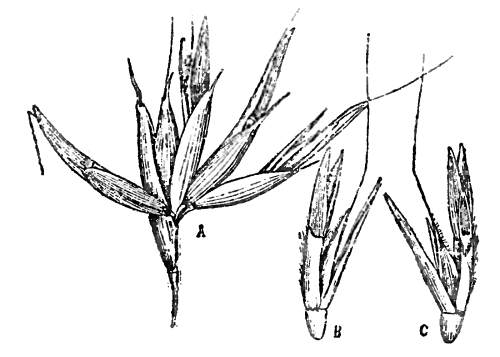
Fig. 142.—Apluda varia.
A. A cluster of spikes containing five spikes with their spathes; B and C. spikes.
The sessile as well as the pedicelled spikelets have four glumes. The
sessile spikelets are 1/8 to 1/5 inch long. The first glume is spreading
or erect, chartaceous, many-nerved, two-toothed at the apex and
with narrow hyaline margins from about the middle to the apex.
The second glume is compressed, dorsally gibbous, keeled, 7-nerved.
The third glume is hyaline, oblong-lanceolate, 3-nerved, paleate
with three stamens; palea is narrow. The fourth glume is shorter
than the third, deeply 2-fid and awned in the cleft, bisexual or
female, 3- to 5-nerved below the cleft, the lateral nerves arching
and meeting the mid-nerve just at the cleft, with a small ovate
palea. There are two lodicules. The pedicelled spikelets are dorsally
compressed. The first glume is lanceolate, oblong, subacute,
many-nerved, coriaceous and glabrous. The second glume is as long
as the first, many-nerved, lanceolate-oblong, coriaceous and
glabrous. The third glume is hyaline, shorter than the second,
3-nerved, paleate and with three stamens. The fourth glume is
shorter than or equal to the third, hyaline, 1-nerved rarely with
two short lateral nerves, female or imperfect. Lodicules are two.
A very common grass occurring in the plains and lower hills, all
over the Presidency and grows well in all kinds of soil.
Distribution.—All over India.
Fig. 143.—Apluda varia.
1, 2, 3 and 4. The first, second, third and the fourth glume, respectively, of the
sessile spikelet; 3a and 4a. are the palea of the third and the fourth glume, respectively;
5. stamens, ovary and lodicules; 6, 7, 8 and 10. the first, second, third and the fourth
glume, respectively, of the pedicelled spikelet; 9 and 11. palea of the third and the
fourth glumes.
These are tall, annual or perennial grasses, with leafy stems
and narrow leaves. The spikes are few or many, solitary or
panicled, with a jointed usually fragile rachis; the joints are
rounded or compressed, hollowed on one side and excavated at the
tip. The spikelets are usually binate, one-sessile closing or sunk
in the cavity of the joint and the other pedicelled, smaller than the
sessile or rudimentary with the pedicel usually adnate to the joints
and equal to or shorter than it. The sessile spikelets are bisexual,
1- to 2-flowered, equal to or shorter than the joint and four-glumed.
The first glume is coriaceous dorsally flattened, obtuse,
margins narrowly incurved. The second glume is thinner than the
first, broadly ovate, acute and gibbously convex. The third glume
is hyaline, ovate, acute, male or neuter, with a membranous palea.
The fourth glume is hyaline, bisexual, broadly ovate, acute with a
hyaline, ovate-lanceolate palea. There are three stamens with
linear anthers. There are two cuneate lodicules. Styles are two
with laterally exserted stigmas. The grain is broadly oblong.
The pedicelled spikelets are smaller than the sessile, male or
neuter, with four glumes. The first glume is herbaceous, many-nerved,
ovate-acute, minutely bifid at the apex. The second, third
and the fourth are more or less similar to those of the sessile
spikelet.
KEY TO THE SPECIES.
- Spike solitary, the first glume of the sessile spikelet broadly winged. R. Myurus.
- Spikes fascicled, the first glume of the sessile spikelet narrowly winged. R. exaltata.
This is a tufted perennial with creeping stems which branch
freely into ascending compressed branches, 10 inches to 2 feet
high.
The leaf-sheath is quite glabrous and compressed. The ligule
is a short ciliate membrane. Nodes are glabrous.
The leaf-blade is flat, linear, acute, glabrous, 2 to 6 inches long.
The inflorescence consists of a solitary terminal or axillary
raceme 1 to 2 inches long; joints are shorter than the spikelets,
excavate on one side and with a pore which is hidden by the
sessile spikelet. The sessile spikelet consists of four glumes. The
first glume is somewhat fiddle-shaped, dilated above the middle
into an orbicular wing, and towards the base into two auricles
joined by a transverse ridge, scaberulous, 5-nerved. The second
glume is somewhat membranous, ovate, acute and 3-nerved. The
third glume is hyaline, thin, oblong, obtuse and nerveless. The
fourth glume is lanceolate, nerveless and without a palea, bisexual.
There are two cuneate lodicules. The pedicelled spikelets also
have four glumes and the pedicels usually free, but also sometimes
adnate. The first glume is oblong, obtuse, winged on one side
only, 5-nerved. The second glume is boat-shaped, chartaceous, 3-nerved
crested with a semi-circular wing at the apex. The
third glume is hyaline, broadly oblong, obtuse, 3-nerved with a
lanceolate hyaline palea. The fourth glume is oblong, obtuse, male.
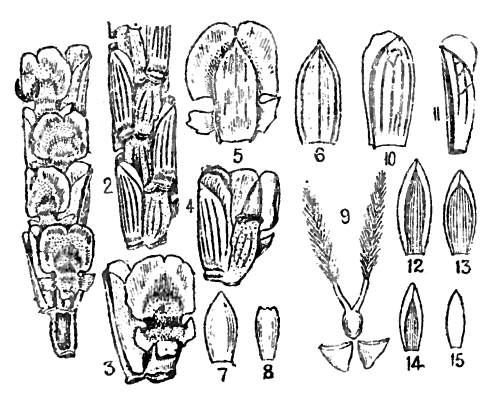
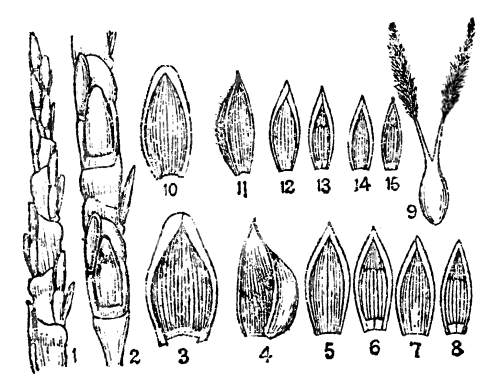
Fig. 144.—Rottboellia Myurus.
1. A portion of the raceme showing front view; 2. a portion of the raceme showing
the back view; 3. a sessile and a pedicelled spikelet showing the front side; 4. the same
showing the back side; 5, 6, 7 and 8. the first, second, third and the fourth glume of the
sessile spikelet, respectively; 9 ovary and lodicules; 10, 11, 12 and 14. the first, second,
third and the fourth glume, respectively, of the pedicelled spikelet; 13 and 15. palea of
the third and fourth glumes of the sessile spikelet.
This is very common in dry somewhat sandy places in the East
Coast districts.
Distribution.—Common in Deccan peninsula.
This grass is usually annual and rarely perennial. Stems are
stout, erect, hispid, branching from the base, varying in height
from 3 to 10 feet.
The leaf-sheaths are loose, hispid with tubercle-based hairs, or
glabrous, with mouth contracted. The ligule is short and ciliate.
The leaf-blade is linear-lanceolate, setaceously-acuminate with a
stout midrib prominent beneath, hispid or scabrid above, smooth
or sometimes scaberulous and glaucous beneath, spinulosely scabrid
at the margin, 5 to 24 inches by 1/4 to 1 inch.
Fig. 145.—Rottboellia exaltata.
1 and 2. A portion of the spike, back and front view; 3, 4, 5 and 7. the first, second,
third and the fourth glume, respectively, of the sessile spikelet; 6 and 8. palea of the
third and the fourth glumes of the sessile spikelet; 9. ovary; 10, 11, 12 and 14. the
first, second, third and the fourth glume of the pedicelled spikelet; 13 and 15. palea of
the third and the fourth glume of the pedicelled spikelet.
The racemes are stout, cylindrical below and very narrow and
with imperfect spikelets above, joints are smooth and rounded
dorsally. The sessile spikelets are as long as the joint or slightly
shorter and has four glumes. The first glume is ovate-oblong,
thickly coriaceous, smooth at the back with a truncate base and a
transverse ridge at the base inside, many-nerved, with very narrow
inflexed margins and very narrow wings at the top, the apex is
obtuse or emarginate. The second glume is equal to the first glume
in height, chartaceous, gibbously convex, broadly ovate, acute, 9-
to 11-nerved, and with a short wing to the keel at the apex. The
third glume is oblong or elliptic-oblong, rigid with a hyaline centre
and coriaceous at the sides, 3-nerved, paleate and with three
stamens; palea is as long as the glume, coriaceous with inflexed
hyaline margins. Lodicules are cuneate, with toothed edge. The
fourth glume is a little shorter than the third, ovate from a broad
base, hyaline and acute, 1-nerved, paleate and usually with an
ovary and two lodicules: palea is hyaline, as long as the glume.
but narrower, nerveless. Lodicules are quadrate; grain somewhat
large oblong and compressed. The pedicelled spikelets are usually
imperfect.
This grass occurs all over the Presidency in cultivated dry
fields.
Distribution.—Throughout the lower hills and plains of India
and in Australia and Africa.
These are erect slender perennial grasses with narrow leaves.
The spikes are solitary and slender, with a fragile, articulated
rachis; the joints are terete, ribbed, all but a few upper with two
equal and similar sessile spikelets, sunk in sub-opposite oblong
cavities, separated by a hyaline septum, and with sometimes a
minute glume representing a third spikelet (the pedicelled) on the
upper margin of the joint. The sessile spikelets are one-flowered,
nearly as long as the internode. There are four glumes in the
spikelet. The first glume closing the mouth of the cavity in the
joint is obliquely oblong, obtuse, smooth with narrowly incurved
margins. The second and the third glumes are as long as the first,
obtuse and hyaline. The third glume is empty, paleate or not.
The fourth glume is rather small, oblong, obtuse, bisexual and
palea shorter than the glume. The lodicules are not present. The
stamens are three. Ovary is very small with stigmas not exserted.
The grain is narrowly oblong compressed. The pedicelled spikelets
are confined to the upper 1-flowered joints of the spike and their
pedicels are confluent with the walls of the joints and their margins
are marked by two ribs. The first glume is very minute and the
other glumes are absent.
This is an erect slender perennial grass with smooth simple or
branched stems varying in height from 2 to 4 feet.
The leaf-sheath is terete, tight, glabrous. The ligule is a short
toothed membrane. Nodes are glabrous.
The leaf-blade is flat, linear from a narrow base, glabrous or base
hairy; apices of upper leaves acuminate, and those of the lower
obtuse, with finely serrate margins and a midrib prominent below,
6 to 12 inches long and 1/10 to 1/6 inch wide.
Racemes are short, exserted from the uppermost sheath, erect, 4
to 8 inches long; joints are 1/5 inch long, contracted in the middle,
with two equal and similar spikelets, sunk in the opposite oblong
cavities separated by a thin hyaline septum and sometimes with a
minute glume of the third spikelet on the upper margin of the
joint.
Fig. 146.—Mnesithea lævis.
1 and 2. Portions of a spike; 3, 4, 5 and 6. the first, second, third and the fourth
glume, respectively; 7. palea of the fourth glume; 8. ovary; 9 and 10. a part of the
spike at the terminal portion.
The sessile spikelets are 1-flowered, as long as the joint and
varying in length from 1/7 to 1/5 inch and have four glumes. The
first glume is obliquely oblong, coriaceous, smooth, obtuse, margins
narrowly incurved, truncate and pitted at the base, 5- to 7-nerved.
The second glume is as long as the first hyaline, oblong and obtuse.
The third glume is like the second but thinner and slightly broader,
paleate or not, empty. The fourth glume is rather smaller than the
third, oblong, obtuse, bisexual and paleate; the palea is shorter
than the glume. Lodicules are not present.
This grass is usually found in dry fields all over the presidency
but it is nowhere abundant.
Distribution.—Throughout India and Ceylon.
These are erect leafy much branched annual grasses. Leaves
are amplexicaul and cordate at the base. The inflorescence
consists of small, terete, axillary and terminal spikes with
peduncles often confluent in a leafy spiciform panicle; the rachis
is fragile with short broad joints, deeply excavate opposite the
sessile spikelets and the tips with two pits. Spikelets are in
dissimilar pairs, one globose, sessile and bisexual and the other
ovate, pedicelled, neuter with the pedicels adnate to, or closely
appressed to the joint of the rachis. The sessile spikelet has four
glumes. The first glume is globose, hard, coarsely pitted, with
an oblong ventral opening opposite the cavity in the joint of
the rachis. The second glume is chartaceous, minute, oblong, 1-nerved
immersed in the cavity of the first glume and closing the
opening. The third and the fourth glumes are hyaline and minute.
The lodicules are broadly cuneate. Anthers are minute. The
styles are free and stigmas are short exserted from the opening in
the first glume. Grain is sub-globose.
This is a freely branching annual with stems leafy to the top
and varying in length from 1 to 2-1/2 feet.
The leaf-sheath is inflated, covered with scattered tubercle-based
hairs. The ligule is a short membrane with ciliate margin. Nodes
are with long hairs.
The leaf-blade is linear, cordate and amplexicaul at base, acute,
flat, flaccid, with scattered tubercle-based hairs on both the
surfaces, 4 to 10 inches by 1/4 to 1/2 inch.
The spikes are solitary, axillary and terminal and 1/4 to 1 inch,
the peduncles of the spikes are often confluent in a leafy spathiform
panicle; the rachis is fragile with short joints deeply excavate
on one side.
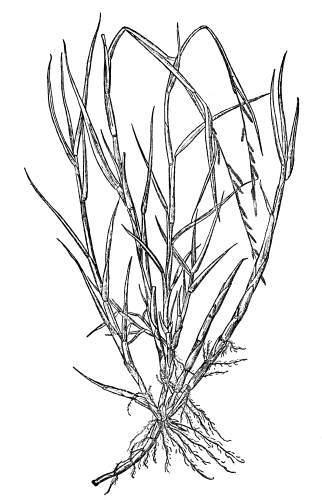
Fig. 147.—Manisuris granularis.
1 and 2. The front and back view of a bit of a spike; 3, 4, 5 and 6. the first,
second, third and the fourth glume, respectively, of the sessile spikelet; 7. ovary anthers
and lodicules; 8, 9, 10 and 12. the first, second, third and the fourth glume, respectively,
of the pedicelled spikelet; 11 and 13. palea of the third and fourth glumes.
The spikelets are 1- to 2-flowered in dissimilar pairs, one
globose, sessile and bisexual and the other ovate, pedicelled,
neuter; the pedicel is adnate to the joint of the rachis.
The sessile spikelet has four glumes. The first glume is hard,
globose, foveolate, with an oblong opening, faintly nerved. The
second glume is chartaceous, immersed in the cavity of the joint,
and filling the opening. The third glume is small hyaline and
empty. The fourth glume is hyaline, small and paleate. The grain
is sub-globose. Lodicules are broadly cuneate.
The pedicelled spikelets also have four glumes. The first glume
is ovate, sub-chartaceous, winged on one side with a broad hyaline
ciliate wing, 5- to 7-veined. The second glume is cymbiform,
compressed laterally, with a dorsal hyaline ciliate wing to the
keel, 5- to 7-veined. The third glume is hyaline, membranous,
oblong, 2-nerved and paleate or not, and with or without stamens.
The fourth glume is similar to the third, but slightly smaller, paleate
and with three stamens.
This grass occurs in open loamy soils and in cultivated dry
fields.
Distribution.—Throughout India and Ceylon and also in most of
the tropical countries.
The grasses of this genus are either perennial or annual and
vary very much in habit. The inflorescence consists of solitary,
binate, digitate, or panicled racemes. The rachis is usually jointed
and fragile. Spikelets are binate, a sessile female or bisexual and
a pedicelled male or neuter. The sessile spikelet is 1-flowered
and has usually four glumes. The first glume is coriaceous or
chartaceous, dorsally compressed, with incurved margins, usually
2-keeled. The second glume is as long as the first, thinner, with
a median keel, laterally compressed, awned or not. The third
glume is hyaline, empty, nerveless and without a palea. The
fourth glume is hyaline, narrow or broad, 2-fid and awned,
or reduced to an awn more or less dilated at the base, paleate
or not. There are two lodicules and three stamens. Stigmas
are feathery. Grain is free. The pedicelled spikelets are usually
smaller than the sessile and have three or four glumes and are
awnless.
KEY TO THE SPECIES.
- A. Sessile spikelets all similar.
- B. Racemes of many spikelets.
- C. Peduncle of racemes enclosed in spathiform leaf-sheaths.
- D. Joints of rachis and pedicels of upper spikelets slender
and tips obliquely truncate.
- Racemes solitary, pedicelled spikelets
similar to the sessile, glume
1 of sessile spikelets pitted. 1. A. foveolatus.
- DD. Joints of rachis and pedicels of upper spikelets clavate
or trumpet-shaped and tips cupular with toothed margins.
- Racemes binate, pedicelled spikelets
differing from the sessile, glume I
of the sessile spikelets deeply
channelled. 2. A. pumilus
- CC. Peduncle of racemes not enclosed in spathiform leaf-sheath.
- Racemes many, fascicled or panicled,
glume I of sessile spikelets
glabrous and pitted. 3. A. pertusus.
- Racemes many and whorled in the
panicle; glume I of sessile spikelets
muricate on the margins. 4. A. squarrosus.
- BB. Racemes of 3 spikelets on the capillary whorled branches
of an erect panicle.
- Pedicels of upper spikelets half as long as the sessile
spikelets or longer.
- Leaves broad.
- Leaf-sheaths covered densely with
bristly hairs. 5. A. asper.
- Leaf-sheaths covered with soft hairs. 6. A. Wightianus
- Pedicels of upper spikelets not half as long as the sessile
spikelet.
- Leaves glabrous and narrow 7. A. monticola.
- AA. The lowest one or more sessile spikelets in all racemes, or
at least in one or two, differing from all those above.
- Racemes digitate, rarely solitary, spikelets all alike in form
but differing in sex.
- Pedicel 1/3 as long as the sessile
spikelets; nodes usually glabrous;
ligule usually short and membranous. 8. A. caricosus.
- Pedicel 1/2 as long as the sessile
spikelets; nodes bearded; ligule
large and membranous. 9. A. annulatus.
- Racemes solitary; lower sessile spikelets very unlike the
pedicelled or upper spikelets which are cylindric.
- Margin of glume 1 of the pedicelled
spikelet unequally winged; ligule
is a broad truncate membrane. 10. A. contortus.
- Racemes two, both sessile, or one sessile and the other pedicelled
on a peduncle which is more or less sheathed
by a proper spathe, divaricate or deflexed.
- Leaf base broad and cordate 11. A. Schœnanthus.
N.B.—This genus is now split into several separate genera, each subgenus being
raised to the rank of a genus. But in this book the nomenclature adopted in
Hooker's Flora of British India is followed.
Fig. 148.—Andropogon foveolatus.
The stems are slender at first, slightly decumbent at the base
and then erect, covered at base with silkily villous sheaths, branches
freely above before flowering, the lower portion of stems alone
being leafy.
The leaf-sheath is somewhat scaberulous, partly green and partly
purplish, always shorter than the internode. The ligule is short,
truncate, hyaline and ciliate. Nodes are tumid and purplish with
a ring of hairs.
The leaf-blade is linear, narrow, sometimes even filiform,
acuminate slightly cordate at the base, scabrid throughout with
a few scattered long bulbous-based hairs near the base to a
distance of less than 1/2 inch about it and varies from 2 to 4
inches in length.
Fig. 149.—Andropogon foveolatus.
1 and 2. Sessile and pedicelled spikelets; 3, 4, 5 and 6. the first, second, third
and the fourth glume, respectively, of the sessile spikelet; 7. lodicules, anthers and ovary;
8, 9 and 10. the two glumes and the palea of the pedicelled spikelet.
The spikes are solitary, 1 to 1-3/4 inch long exserted far above the
small spathiform leaf-sheaths, peduncles are capillary and scaberulous,
pedicels and joints are somewhat flattened, and have along
both the narrow margins long, white, ascending hairs; callus is
short with a ring of short white hairs.
There are two kinds of spikelets, sessile and pedicelled, and both
are oblong-lanceolate and equal. The sessile spikelet consists of four
glumes. The first glume is lanceolate, flat and smooth, keels scabrid
with usually a deep dorsal pit, 4-nerved. The second glume
is lanceolate, acute, as long as the first, 3-nerved. The third
glume is small, membranous, linear-lanceolate, nerveless. The
fourth glume is the dilated base of the awn, awn is about 3/4 inch
twisted to half its length, scabrid, the lower twisted part dark and
the upper pale. There are three stamens and two lodicules.
Ovary has two feathery stigmas. The pedicelled spikelets have only
two glumes and contain three stamens. The first glume is oblong-lanceolate,
5-nerved, pitted above the middle, with recurved
margins and scabrid keels and nerves. The second glume is
lanceolate, membranous, hairy at the top, 3-nerved with margins
infolded; palea is oblanceolate, thinly membranous, nerveless
and ciliated at the top; there are three stamens and two lodicules.
This is a fairly common grass occurring all over the Presidency
much liked by cattle and yields plenty of foliage if properly looked
after. It grows on all kinds of soils, even laterite.
Distribution.—Throughout India.
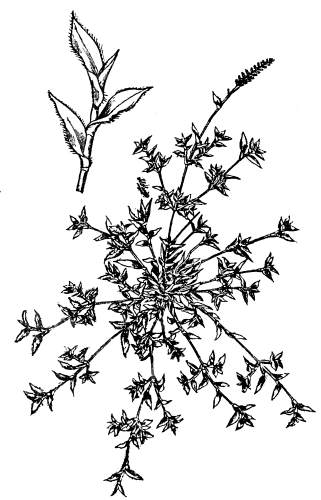
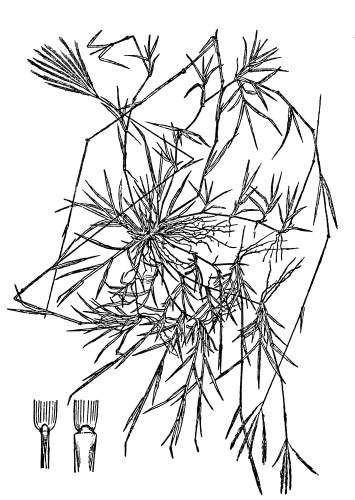
Fig. 150.—Andropogon pumilus.
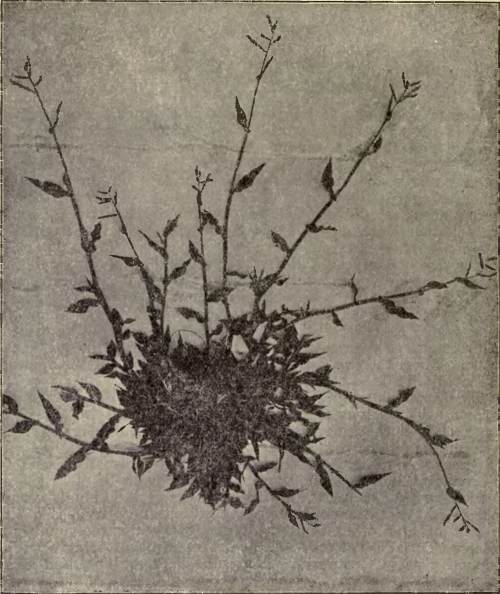
It is a tufted annual with numerous radiating branches, growing
on all directions, bent below and erect above; they vary in length
from 6 inches to 18 inches, but sometimes when growing under
favourable conditions attain the length of 2-1/2 feet. The stem is
slender, green, or pale reddish in the exposed portions and pale
in parts covered by sheaths slightly flattened, smooth.
The leaf-sheaths are smooth, compressed, distinctly keeled. The
ligule is a short, truncate, white, glabrous membrane. The nodes
are glabrous.
The leaf-blade is linear, finely acuminate, glabrous, but sometimes
somewhat scabrid along the nerves and with scattered long delicate
hairs above especially when young, varying in length from 1 to
7 inches and 1/10 to 1/8 inch in breadth.
The inflorescence consists of paired spikes with very slender
peduncles arising from flattened, glabrous, acuminate spathes,
varying in length from 1/2 to 1-1/4 inches. The spikes are spreading
and one of them always slightly longer than the other, reddish or
pale green, 1/2 to 1 inch long; the rachis consists of five to eight
flat joints broadened at the top and ending in a cup, densely ciliate
on both the margins, but hairs on one margin are shorter than those
on the other. Each joint bears a sessile and a pedicelled spikelet.
Fig. 151.—Andropogon pumilus.
1. A portion of the spike to show the arrangement of the spikelets; 1. the first
glume of the sessile spikelet; 2. second glume of the sessile spikelet; 3 and 4. third and
fourth glumes of the sessile spikelet; 5. anthers, lodicules and the ovary; A, B and C.
the three glumes of the pedicelled spikelets.
The sessile spikelet is about 3/16 inch with an awn 7/16 inch long.
There are four glumes in the spikelet. The first glume is narrow,
linear, membranous, grooved, finely bicuspidate at the apex, with
incurved margins and two nerves ending in tubercles below. The
second glume is a little longer than the first, narrow, lanceolate,
boat-shaped, thinly coriaceous with membranous margins, 1-nerved
and shortly awned. The third glume is about 2/3 of the
second glume in length, and shorter than the first glume, linear-lanceolate,
hyaline, nerveless or sometimes very obscurely 2-nerved.
The fourth glume is narrow linear, hyaline with two very
fine lobes at the apex with an awn between, 7/16 inch long. Palea
is hyaline and very small. Stamens are three, ovary with two long
reddish feathery stigmas. Lodicules small and cuneate. Grain is
long and narrow.
The pedicelled spikelets have only three glumes, and are slightly
shorter than the sessile ones, pedicel is similar to the joint. The
first glume is ovate-lanceolate, thinly coriaceous, distinctly many-nerved,
acuminate, margins infolded and membranous. The
second glume is ovate-lanceolate, membranous, glabrous and 3-nerved.
The third glume is short, oblong-lanceolate, nerveless or
faintly 2-nerved. There are three stamens.
This grass is variable in its size. In dry soils such as laterite
soils, it is a very small plant not exceeding 9 or 10 inches
across its spread. But in good soil and under favourable conditions
the plant measures across 5 or 6 feet. Cattle eat the
grass before it flowers and do not relish it so much when in flower.
A common grass flourishing all over the Presidency.
Distribution.—Occurs in drier parts throughout India.
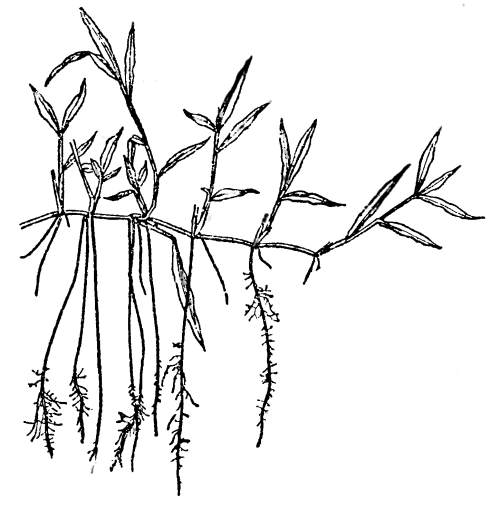
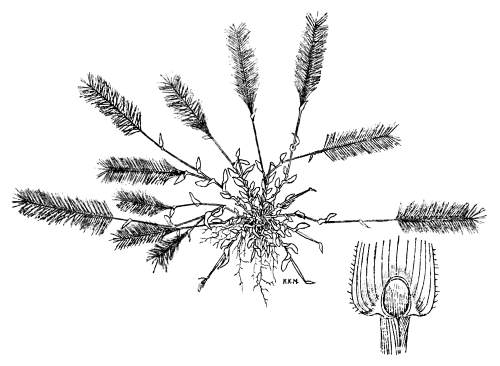
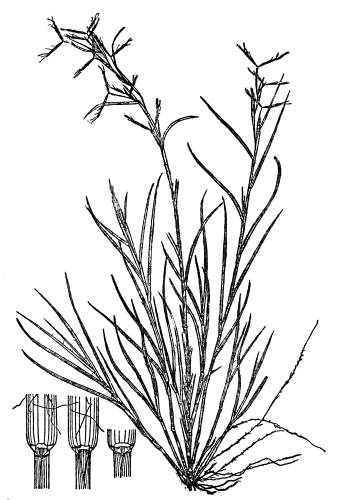
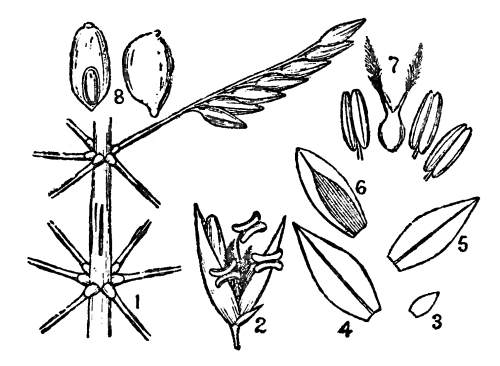
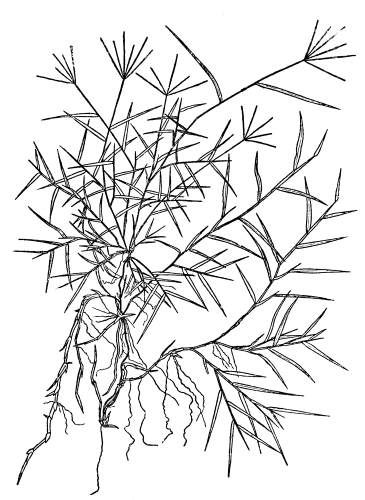
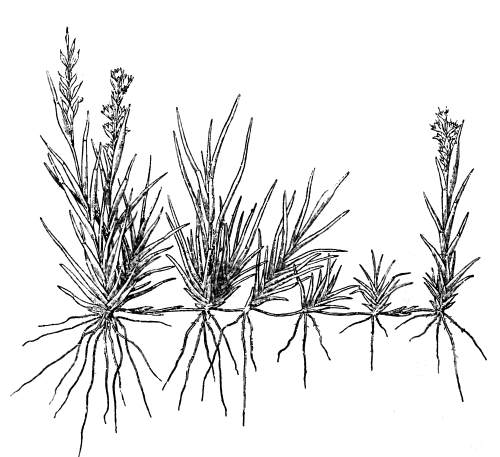
Fig. 152.—Andropogon pertusus.
This grass is perennial. Stems are tufted, very slender, widely
creeping on all sides, purplish, but the flowering branches are erect
or ascending from a geniculate base, leafy at base, the nodes of
the creeping branches rooting and bearing tufts of branches which
finally become independent plants at each node, the creeping
branches vary in length from 1 to 3 feet and the erect ones from
10 to 18 inches or more.
The leaf-sheaths are terete or somewhat compressed, glabrous,
sometimes ciliated near the node and shorter than the internode.
The ligule is a truncate membrane, slightly ciliate or not. Nodes
are bearded.
The leaf-blades in the prostrate branches are crowded, short
linear-lanceolate, finely acuminate, soft, shortly hairy along the
nerves, sparsely ciliate near the rounded base, varying in length
from 1 to 2 inches and in breadth 1/8 to 1/4 inch; but on the
flowering branches the leaves are longer, sometimes as long as
twelve inches with bigger sheaths.
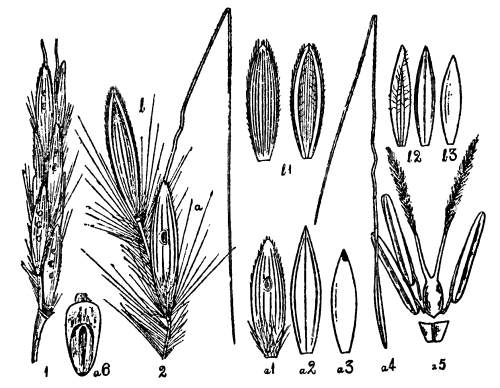
Fig. 153.—Andropogon pertusus.
1. A portion of a spike; 2. a pair of spikelets; a. sessile and b. pedicelled;
a-1. first glume; a-2. second glume; a-3. third glume; a-4. fourth glume and awn;
a-5. ovary and stamens; a-6. grain; b-1. first glume of pedicelled spikelet front and
back; b-2. second glume front and back; b-3. third glume.
The inflorescence consists of three to nine, slender, flexuous, erect,
purplish spikes, 1 to 2 inches long, alternately arranged on
a thin, long, slender, smooth peduncle of about six inches; rachis is
slender and the joints and pedicels are densely silky with long
hairs.
The spikelets are in pairs, one sessile and one-pedicelled, both are
equal, purplish or pale. The sessile spikelet consists of four glumes
and contains a complete flower and the callus is short and bearded
with long hairs. The first glume is coriaceous, oblong-lanceolate,
acute, truncate or emarginate, slightly hairy, or glabrous with a deep
pit above the middle (sometimes with two or three pits also) 7- to 9-nerved
with a few long hairs below the middle and with margins infolded
and shortly ciliate. The second glume is lanceolate-acuminate
and finely pointed at the tip and the point projecting slightly
beyond the first glume, 3-nerved or 3- to 5-nerved, membranous,
slightly hairy or glabrous, obscurely keeled. The third glume
is thin, membranous, shorter than the second glume, linear-oblong,
subobtuse or acute at the tip and nerveless. The fourth glume
is the base of the awn and the awn is not twisted, bent at about
the middle, 1/2 to 2/3 inch long; there is no palea. Anthers are three
and yellow; stigmas purple. The grain is oblong-obovate, slightly
transparent.
The pedicelled spikelets are slightly narrower than the sessile,
generally not pitted (though pitted in some plants), and not awned,
and each one consists of three glumes only; the pedicel is more
than half as long as the sessile spikelets. The first glume is slightly
hairy, oblong-lanceolate, acute or obtuse, ciliate at the margins,
7- to 9-, or 13-nerved, generally without pits, but occasionally with
one, two or three pits; the keels are ciliolate throughout the
length. The second glume is membranous, ovate-lanceolate, acute,
with incurved margins, 5-nerved. The third glume is hyaline,
linear-oblong, glabrous and thinly ciliate at the tip or not with
or without stamens.
This is an excellent fodder grass and it grows quickly and
stands cutting very well. Cattle eat this grass very well.
Distribution.—This grass is found all over India in the plains or
lower elevations of hills.
(Vetiveria zizanioides.)
This is a densely tufted perennial grass with branching root-stocks
and spongy aromatic roots.
The stems are leafy, with equitant, hard, leaf-sheaths at the
base, smooth and polished, solid, 2 to 3-1/2 feet high.
The leaf-sheaths are smooth, coriaceous, glabrous, keeled and
compressed. The ligule is a very short membrane.
Leaf-blades are narrowly linear, erect, strongly keeled and flat,
acuminate, glabrous both above and below, very much narrower
than the sheath at the base, 1 to 2 feet by 1/3 to 3/4 inch.
The panicle is conical, erect with branches, fascicled, varying
in length from 4 to 12 inches. The spikes consist of both sessile
and pedicelled spikelets, that are either grey, green, or purplish.
Fig 154.—Andropogon squarrosus.
1. A portion of a branch; 2. a sessile and a pedicelled spikelet; 3, 4, 5 and 6. the
first, second, third and the fourth glume, respectively, of the sessile spikelet; 7. palea of
the fourth glume; 8. lodicules, stamens and the ovary; 9, 10, 11 and 12. glumes of the
pedicelled spikelet; 13. palea of the fourth glume.
The sessile spikelets are about 1/6 inch long, lanceolate and with a
shortly bearded callus. The first glume is ovate-oblong, thickly coriaceous,
obscurely 2- to 4-nerved (occasionally 5- to 7-nerved), acute,
dorsally flat, with incurved margins and with two rows of tubercle-based
minute prickles or mere excrescences at the sides. The second
glume is as long as the first, oblong, coriaceous, keeled, with hyaline
and ciliolate margins, 1-nerved (sometimes 3-nerved, marginal
faint), and with minute prickles on the keel. The third glume is
broadly oblong, hyaline, nerveless or rarely with two obscure veins
ciliolate at the margins and acute or acuminate. The fourth glume
is shorter than the third, linear-oblong, mucronate or very shortly
awned at the apex, paleate; palea about two-thirds the length of the
glume, lanceolate. Lodicules are two, quadrate and conspicuous
though small. Styles and stigmas short. Stamens are three with
yellow anthers. Stigmas are purple.
The pedicelled spikelets are similar to the sessile ones, but are
slightly smaller and the prickles are less prominent. The fourth
glume has no mucro or awn and has three stamens.
This grass is fairly abundant in moist situations, in the margins
of tanks and in tankbeds in the Coromandel districts, but in other
inland districts it is not so common. In some places it seems to
be cultivated. This is the khus-khus grass.
Distribution.—Throughout the plains and lower hills of India,
Burma and Ceylon, also said to occur in Java and Tropical Africa.
(Chrysopogon asper, Heyne.)
This is a tufted perennial grass. Stems are stout below with
distichous leaves and very slender above, 2 to 3-1/2 feet long.
The leaf-sheaths are distichous and towards the base of the
stem are 1/2 inch broad, compressed, keeled and with scattered
tubercle-based hairs. The ligule is a short membrane fringed
with close set hairs.
Fig. 155.—Andropogon asper.
Leafy shoot, a bit of the stem with leaf-sheaths and a bit of the leaf.
The leaf-blades are broad, distinctly linear, acute or acuminate,
coriaceous, glabrous or softly hairy on both the surfaces, with a
slender midrib which bears short stiff tubercle-based hairs all
along, and margins with similar hairs, but a few leaves towards the
base are longer, and varying in length from 12 to 18 inches and in
breadth from 1/2 to 3/4 inch.
The panicle is somewhat narrow, 7 to 8 inches long, branches
are very slender, whorled, usually with only one spike consisting
of a sessile and two pedicelled spikelets.
The sessile spikelets are 1/4 inch long, laterally compressed, with
a long callus villous all round, and bisexual. The first glume is
coriaceous, linear-oblong, strongly compressed above and with a
few stiff short bristles beneath the tip. The second glume is linear,
oblong, coriaceous, with an awn as long as itself or shorter, keeled
and with short stiff bristles on the keel and on the sides above the
middle. The third glume is hyaline, narrow, obtuse, shorter than
the second, 2-nerved, ciliate.
The fourth glume is the linear,
hyaline, 3-nerved base of the
awn; the awn is 1-1/2 to 2-1/2
inches and bent at about the
middle.
The pedicelled spikelets are
about 1/3 inch, narrowly lanceolate,
male or neuter and with
short rusty hairs on both the
margins of the pedicel and a
semi-circular tip. The first
glume is thin, 2-toothed or not at
the tip, awned, awn being as
long as itself or longer, 7-nerved,
ciliate at the sides from
base to tip; the nerves are
either equidistant or the lateral
nerves nearer the margin. The
second glume is lanceolate-acuminate,
not awned, 3-nerved,
margins hyaline, and
ciliolate. The third glume is
hyaline, linear-oblong, 2-nerved,
ciliolate. The fourth glume
is linear or linear-lanceolate,
hyaline, nerveless or 1-nerved.
Fig. 156.—Andropogon asper.
1. Spike; 2, 3, 4 and 5. the first, second,
third and the fourth glume, respectively, of
the sessile spikelet; 6. the ovary, lodicules
and stamens; 7, 8, 9 and 10. the first, second,
third and the fourth glume, respectively, of
the pedicelled spikelet; 11. callus of the
spike.
This grass grows abundantly
on the sides of the Kambakkam
Drug, Chingleput district,
and in Penchalkonda, Nellore
district, and seems to be an endemic species. It is usually confined
to the hill sides and not found in the plains. This grass is very
closely allied to Andropogon Wightianus and it differs from it only
in the general habit of the plant and in having bristles on the
leaf-sheaths. On the whole this is a coarser and larger plant than
A. Wightianus.
Distribution.—Kambakkam Drug in the Chingleput district and
Penchalkonda in Nellore district.
(Chrysopogon Wightianus, Nees.)
This is a perennial. Stems are erect or ascending from a
creeping root-stock, varying in height from 2 to 3 feet.
The leaf-sheath is flattened, softly hairy or glabrous, often
ciliated near the mouth. The ligule is a fringe of very short
hairs.
The leaf-blade is narrowly or rarely broadly linear, obtuse or
acute and abruptly mucronate, or narrowly drawn into a point
glabrous or pubescent, margins shortly ciliate.
The panicle is narrow, 3 to 6 inches long, peduncle smooth
below but thinly pubescent above, lower branches long, few in a
whorl; rachis is very slender, angular, glabrous or hairy. The
spikes are solitary and each one consists of one sessile and two
pedicelled spikelets. The callus is long and densely bearded
with brown hairs.
Fig. 157.—Andropogon Wightianus.
1. A spike; 2, 3, 4 and 5. the first, second, third and the fourth glume, respectively,
of the sessile spikelet; 6. lodicules, stamens and the ovary; 7, 8, 9 and 10. the first,
second, third and the fourth glume, respectively, of the pedicelled spikelet.
Sessile spikelets are bisexual, sub-cylindric about 1/4 inch long.
There are four glumes. The first glume is chartaceous, laterally
compressed, obscurely 4-nerved, glabrous below, hispid near the
apex, minutely 2-toothed or not at the apex, not awned or rarely
with a short awn. The second glume is chartaceous, distinctly
awned, the awn being as long as the glume or longer, hispid above
and at the sides also. The third glume is hyaline, linear-oblong,
2-nerved ciliate. The fourth glume is narrow with hyaline margins,
with an awn 2 to 3 inches long; awn is hispid below, twisted and
geniculate at and less hairy above the middle. Stamens are three.
Styles are two and feathery. Lodicules are very small.
Pedicelled spikelets are male or neuter, flattened, hairy, rarely
glabrous. The pedicels are half as long or slightly longer than the
sessile spikelet, truncate or semi-circular at the top, and with brown
villous hairs along the margin. There are four glumes. The first
glume is about 3/8 inch, ciliate, along the inflexed margin, 7-nerved,
awned; awn equal to or longer than the glume. The second glume
is as long as the first, shortly awned or acuminate, 3-nerved, ciliate.
The third glume is hyaline, oblong, 2-nerved, sparsely ciliate. The
fourth glume is narrow, ciliate, nerveless or rarely 1-nerved, erose
or bifid at the top. Anthers three or more.
This grass grows on the plains as well as on the hills. It is
very closely allied to Andropogon asper, Heyne, and it is very
difficult to distinguish them. Andropogon Wightianus is somewhat
smaller compared with Andropogon asper, and the tubercle-based
bristles on the leaf-sheaths, so characteristic of A. asper, is
absent.
Distribution.—Madras, Chingleput district, Kodaikānal and
the Nilgiris.
(Chrysopogon monticola.)
This is a perennial grass.
The stems are usually slender, densely tufted, erect, simple, or
branched, leafy especially at the base, varying in height from 1 to
3 feet.
The leaf-sheaths are sparsely hairy or glabrous, the lower somewhat
compressed and the upper terete. The ligule is a short,
ciliated membrane. The nodes are glabrous.
The leaf-blade is narrow, linear, acute, rigid, flat, glaucous,
smooth or scaberulous, with margins scabrid and ciliated with
tubercle-based hairs especially towards the base, and varying in
length from 2 to 15 inches.
The inflorescence is an open panicle, ovate or oblong, varying
in length from 2 to 5 inches; the rachis is slender, smooth or
scaberulous, the branches are capillary, whorled and spreading,
tip oblique, bearded and bearing a single sessile and two pedicellate
spikelets.
Fig. 158.—Andropogon monticola.
1. Sessile and pedicellate spikelets; 2, 3, 4 and 5. the first, second, third and the
fourth glume, respectively, of the sessile spikelet; 6. anthers, ovary and lodicules; A-1,
A-2, A-3 and A-4. the glumes of the pedicelled spikelet; A-5. lodicules of the pedicelled
spikelet.
The sessile spikelets are bisexual, about 1/4 inch or less, with a
long callus bearded on one side with long rusty hairs. There are
four glumes in the spikelet. The first glume is chartaceous, linear,
complicate, 2-toothed at the tip and with short bristles towards the
apex, 4-veined. The second glume is chartaceous, ovate-lanceolate,
much broader than the first, ciliate with long rufous bristles on the
keel, shortly toothed at the apex with an awn about 1/3 of an inch
and with broadly hyaline margins. The third glume is hyaline,
narrow-oblong, ciliate and obtuse. The fourth glume is narrow,
oblong, hyaline with an awn nearly an inch long. There are
three stamens and two lodicules. The stigmas are long and
feathery.
The pedicelled spikelets are as long as the sessile and the
pedicels are flattened and with long rufous hairs on both the
margins. There are four glumes. The first glume is lanceolate,
acute and awned between two teeth, 7-nerved and scaberulous.
The second glume is lanceolate, acuminate, with thinly ciliate
hyaline margins, 3-nerved. The third glume is shorter than the
second, narrow, hyaline, ciliate at the margins, 2-nerved. The
fourth glume also is small, hyaline, ciliate, and 1-nerved. There
are three stamens and two lodicules.
This grass is found growing all over the Presidency on the
plains and even on low hills. It grows into a tall plant in rich
soils and remains stunted in poor, dry and rocky soils. Cattle eat
this grass.
Distribution.—Throughout India and Ceylon and in Africa.
This is a perennial grass more or less tufted in habit and
closely allied to Andropogon annulatus, Forsk.
Stems are erect or decumbent below or ascending from a
creeping base, rooting at the nodes, smooth, glabrous and much
branched, varying in height, from 1 to 2 feet; branches are short,
slender and sometimes even capillary, with nodes bearded or not
in branches ending in solitary spikes, and completely glabrous
when they end in binate spikes.
The leaf-sheaths are glabrous, rather compressed, striate, shorter
than the internodes. Ligule is membranous, short, very finely
ciliolate or not.
The leaf-blade is linear, finely acuminate, sparsely hairy,
sometimes with tubercle-based hairs, becoming glabrous when old
with scaberulous margins 2 to 8 inches by 1/10 to 1/6 inch, base
rounded mostly with a few long hairs.
Fig. 159.—Andropogon caricosus.
1 and 2. Front and back view of a bit of spike; 3. a sessile and a pedicelled
spikelet; 4, 5 and 6. the first, second and the third glume, respectively, of the sessile
spikelet; 7. awn representing the fourth glume; 8. stamens, lodicules and the ovary;
9. the first glume of the pedicelled spikelet.
The spikes are either binate or solitary varying in length from 1
to 2 inches, joints and pedicels about 1/3 as long as the sessile
spikelets, slightly angular or flat, ciliate along one side with white
hairs; peduncle is slender, pale or purple, pubescent or glabrous
just below the spike.
The spikelets are about 1/8 inch, imbricate, a sessile and a stalked
one from the top of each joint, greenish or purple. The sessile
spikelet contains a bisexual flower and consists of four glumes. The
callus is short, and shortly hairy below. The first glume is somewhat
chartaceous, obovate-oblong, obtuse or truncate, 7- to 11-nerved,
margin slightly folded, keel shortly rigidly ciliate towards
the apex, and thinly ciliate below, dorsal surfaces sparsely hairy
below the middle. The second glume is chartaceous, ovate-lanceolate,
acute, equal to or slightly longer than the first glume but
narrower, 3-nerved, margin infolded, thinly shortly ciliate, dorsally
glabrous, shining. The third glume is hyaline, ovate-oblong, acute,
nerveless, margins sparsely ciliate or not. The fourth glume is the
base of the awn, 3/4 to 1 inch, scaberulous. Stamens are three with
yellow or purple tinged anthers, ovary oblong with two feathery
stigmas. Lodicules are two, cuneate.
The pedicelled spikelets are either male or neuter and consist of
four glumes. The first glume is chartaceous, obovate-oblong, obtuse,
many-nerved (thirteen or more), thinly ciliate with long hairs
and with a few rigid short hairs towards the apex; margins are
slightly infolded, dorsally sparsely hairy without. The second glume
is membranous, ovate-lanceolate, acute, 3-nerved (occasionally
4-nerved), margins are thinly ciliate and infolded. The third
glume is hyaline, nerveless and ciliate. The fourth glume is
hyaline, nerveless, linear and oblong, glabrous, small, the apex is
narrowed and deeply bifid. There are three stamens and two
lodicules.
This is a common grass flourishing on the bunds of paddy
fields and in sheltered places where there is sufficient moisture
in the soil. But this is less common than A. annulatus, Forsk. In
black cotton soil at Bantanahal in Bellary district it grows to a
height of 4 or 5 feet.
Distribution.—Plains and low hills throughout India and Ceylon.
Fig. 160.—Andropogon annulatus.
1. Full plant; 2. base of the leaf and ligule.
This is a densely tufted perennial grass.
The main stem is underground, rhizomiferous, and covered with
scale leaves; branches are many arising in tufts, leafy, procumbent
at base and afterwards geniculately ascending and ending in
inflorescence, occasionally rooting at the nodes and varying in
length from 2 to 3 feet. The internodes vary from 1-1/2 to 4 inches,
pale or purplish, slightly flattened, smooth and glabrous.
The leaf-sheath is terete, glabrous, shining, green or purplish,
closed, with margins where separate ciliated and profusely so at
the tip especially the outer or both. The ligule is membranous
truncate, glabrous, about 1/16 inch in height. Nodes are purple
and softly villous.
Fig. 161.—Andropogon annulatus.
1. Front and back views of a portion of the spike; 2. a sessile and a pedicelled
spikelet; 3, 4, 5 and 6. the first, second, third and the fourth glume, respectively, of
the sessile spikelet; 7. the ovary, stamens and lodicules; 8, 9 and 10. the glumes of
the pedicelled spikelet.
The leaf-blade is linear-lanceolate, acuminate, scabrid, sparsely
hairy, becoming glabrous except at the base and with tubercle-based
hairs on the upper surface.
The spikes vary in number from two to nine, erect or slightly
spreading, subdigitately fascicled, pale when young and pinkish or
brown when old, varying in length from 1 to 2-1/2 inches. The stalk
of the whole inflorescence is long, slender, smooth and glabrous.
The peduncle of the spikes is from 1/8 to 1/6 of an inch long, thin,
slender, glabrous with swollen bases and with a ring of hairs at
the node. Joints of the rachis and the pedicels are slightly flattened,
ciliated along the narrow edges; the pedicels of the stalked
spikelets are half as long as the sessile spikelets. The spikelets
are one sessile and one pedicelled and imbricating on the rachis.
The sessile spikelet is as long as the stalked or a little less, with
a thick callus, shortly bearded at the base or sometimes glabrous
and consists of four glumes. The first glume is elliptic-oblong or
oblong, obtuse or truncate, irregularly 2- or 3-toothed, 5- to 9-nerved,
sparsely villous with long hairs and margins slightly infolded.
The second glume is smaller than the first glume, acute, membranous,
3-nerved and keeled, the margins are ciliate and infolded.
The third glume is hyaline, linear, acute, or obtuse, nerveless
sparsely hairy at the tip, very much shorter than the second
glume. The fourth glume is an awn with a linear hyaline base,
erect, about an inch long. Stamens are three, ovary is oblong
with two feathery, dark purple stigmas. Lodicules are two,
cuneate.
The pedicelled spikelets are male and consist of only three glumes.
The first glume is elliptic, oblong, irregularly obtuse, about 11-nerved,
margins slightly infolded with long pilose hairs throughout,
more along the margin. The second glume is a little smaller,
3-nerved, sparsely hairy only along the marginal nerves, folded
inwards, and slightly keeled. The third glume is shorter than the
second, hyaline, nerveless, narrow-lanceolate, acute; stamens are
three, with green anthers, purple-dotted. Lodicules are two, broad
and cuneate.
This grass is found flourishing all over India and grows in
cultivated fields and gardens and likes sheltered places. This
yields a considerable amount of fodder and stands cutting well.
Distribution. Throughout India in the hills and the plains.
Fig. 162.—Andropogon contortus.
(Heteropogon contortus, Beauv.)
This is a tufted perennial.
The stems are erect or slightly decumbent below, slender,
rather compressed towards the base, leafy at the base, simple or
branched, densely tufted and varying in length from 1 to 3 or 4
feet.
Fig. 163.—Andropogon contortus.
1. Lower pair of sessile and pedicelled spikelets; 2. upper pair of sessile and
pedicelled spikelets; 3, 4, 5 and 6. the first, second, third and the fourth glume, respectively,
of pedicelled spikelets; 7, 8, 9 and 10. the first, second, third and the fourth glume,
respectively, of the sessile spikelet; 11. ovary.
The leaf-sheath is smooth or sparsely hairy, compressed and
shortly auricled or not at the mouth. The ligule is short,
truncate and ciliolate.
The leaf-blades are linear, acute or abruptly acuminate, flat,
rigid, sparingly ciliate above, with tubercle-based hairs towards
the base, scaberulous throughout, and 2 to 12 inches long or more,
1/10 to 1/5 inch broad.
The inflorescence consists of a solitary spike with closely
imbricating spikelets.
The spikelets are all on one side, and the lower two to six
pairs of pedicelled and sessile spikelets are all males. The sessile spikelets
are all female and awned, except the few lower which are male
and awnless, 1/4 inch long. The callus is long, acute, bearded with
reddish-brown hairs. There are four glumes in the spikelet. The
first glume is narrow, linear-oblong, truncate or rounded, somewhat
brown, many-nerved, hispid, with incurved margins and membranous
tip. The second glume is linear, obtuse, coriaceous, dark-brown,
hispidulous, 3-nerved with incurved margins. The third glume is
oblong, hyaline, thin, nerveless, short and truncate. The fourth
glume is reduced to an awn, 3 inches or more in length. The ovary
is linear with two long stigmas.
The pedicelled spikelets are somewhat longer than the sessile
1/3 to 1/2 inch, with very short pedicels. The first glume is lanceolate,
obliquely twisted, hispid at the back with long bulbous-based
hairs, margins more or less unequally winged. The second glume
is oblong lanceolate, acuminate, 5-nerved, thinly ciliate with
hyaline margins. The third glume is oblong, hyaline, 1-nerved and
ciliate. The fourth glume is obovate-oblong or oblong, hyaline,
ciliate, nerveless. There are three stamens.
This grass though coarse forms very good hay if cut before it
flowers. The only objection against this grass is the presence of
the troublesome awns which get twisted together like the strands
of a rope. This is the spear grass of the Anglo-Indians. It
grows all over the Presidency and is a troublesome weed when in flower.
Distribution.—All over the Presidency and India. Common in
all tropical countries.
(Cymbopogon cæsius, Stapf.)
This is a perennial grass with stout or slender, erect stems
rising from a woody base, leafy upward, simple or branched.
The leaf-sheath is smooth and glabrous. The ligule is an oblong-ovate
membrane. Nodes are glabrous.
The leaf-blade is long, narrow or broad, narrowly linear-lanceolate,
finely acuminate, glaucous especially beneath, thinly
coriaceous, glabrous on both the surfaces, base rounded or cordate
and amplexicaul, 6 to 10 inches by 1/6 to 1/3 inch.
The panicle is elongate, leafy, narrow, dense or interrupted,
compound or decompound, 1 to 2 feet long; bracts are lanceolate,
spathiform, finely acuminate, glabrous, varying in length from 1 to
1-1/2 inches, and with hyaline margins; the proper bracts are as long
as the spikes or longer.
Fig. 164.—Andropogon Schoenanthus.
1. A sessile and two pedicelled spikelets; 2, 3, 4 and 5. the first, second, third
and fourth glume of the sessile spikelet, respectively; 6. ovary; 7, 8 and 9. the
glumes of the pedicelled spikelets in order.
The spikes are unequal, 1/2 to 2/3 inch long, one 3- to 4-jointed and
the other 4- to 6-jointed; the joints and pedicels are narrowly
clavate, half as long as the sessile spikelets, tips dilated and
toothed, margins villously ciliate, with long hairs.
The spikelets are binate, one sessile and the other pedicelled.
The sessile spikelets in the upper part of the spike are bisexual,
lanceolate, 1/6 inch long and those in the lower part of the spike
are shorter, obtuse, male. The callus is short and bearded.
There are four glumes. The first glume is ovate or obovate-oblong,
dorsally flat or nearly so, with a deep narrow-longitudinal median
furrow usually below the middle and answering to a ridge on the
ventral face, obtuse or 2-toothed at the apex, margined above the
middle, with a hyaline, narrow, finely denticulate wing, 2-nerved
or nerveless. The second glume is lanceolate, cymbiform, acute or
acuminate, 3-nerved, margins hyaline, ciliate, as long as the first
chartaceous and the keel with a serrulate wing above the middle.
The third glume is linear oblong, hyaline, obtuse, ciliate, nerveless.
The fourth glume is the narrowly winged 2-lobed base of the awn,
lobes are lanceolate erect and palea of the fourth glume is minute.
Lodicules are cuneate. Stamens are three.
The pedicelled spikelets are oblong-lanceolate, acute or obtuse,
glabrous and male. There are three glumes. The first glume is
glabrous or rarely puberulous, margins incurved, obtuse, 9- to 11-nerved.
The second glume is ovate, acute, 3-nerved. The third
glume is oblong or linear-oblong, hyaline, apex rounded, ciliate and
faintly 2-nerved.
This grass grows all over the Presidency in open dry situations
and is very widely distributed.
Distribution.—Throughout India—westward to tropical Africa.
(Themeda, Forsk.)
These are tall grasses, annual or perennial. Leaves are usually
long and narrow. The inflorescence consists of racemes or panicles
of fascicled spikes in the axils of spathiform bracts. The
spikelets vary in number from six to eleven in a cluster, the four
lowest being male or neuter, and forming an involucre with whorled
or superposed pairs round either 1-sessile bisexual spikelet with
two pedicelled spikelets or two superposed bisexual, the lower
with one pedicelled, the upper with two.
The involucral spikelets are male or neuter, the largest, and consist
of three glumes. The first glume is oblong, lanceolate, dorsally
flattened, many-nerved, margins narrowly incurved and keels
narrowly winged. The second glume is membranous, lanceolate,
acute, 3-nerved, with ciliate margins. The third glume is hyaline,
smaller than the second, 1-nerved or this glume may be absent,
stamens have large anthers. The pedicelled spikelets are similar to
the involucral in every respect but smaller, male or neuter, but the
first glume is not winged on the keels. The bisexual (or female)
spikelets are smaller than the involucrant spikelets, linear-oblong,
subterete, obtuse with a rigidly bearded callus. There are four
glumes in the spikelet. The first glume is terete, or dorsally compressed
or channelled, coriaceous and at length hardened, margins
incurved, dark brown to almost black when old. The second glume
is as long as the first, linear, dorsally chartaceous, with broadly incurved
membranous margins, 3-nerved. The third glume is very
small, hyaline, 1-nerved, epaleate. The fourth glume is the flattened
base of the awn, epaleate. The lodicules are two, cuneate.
Anthers are rather small. Styles are laterally or terminally
exserted. Grain is narrow, obovoid, biconvex, with two grooves on
the anterior side and with a long embryo.
This is an annual or perennial. Stems are stout or slender,
erect or ascending from a creeping root-stock, simple or branched,
1 to 4 feet.
The leaf-sheath is smooth, compressed. The ligule is a narrow
membrane.
The leaf-blade is linear-lanceolate, rigid, erect, acuminate with a
setaceous tip, nearly smooth, varying in length from 6 to 20 inches
and in breadth from 1/6 to 2/3 inch.
The inflorescence is an elongate panicle, 1 to 2 feet long, consisting
of rather distant fascicles of spikes and bracts on capillary,
flexuous peduncles; the spikes are sub-flabelliform or sub-globose,
1/2 to 1-1/2 inches broad, sometimes reduced to a few spikelets and
bracts; the outer bracts are longer than the fascicles, 1 to 1-1/2
inches long, glabrous or hairy with ordinary or tubercle-based hairs;
proper bracts are lanceolate, acute, compressed, glabrous or hairy
with membranous margins.
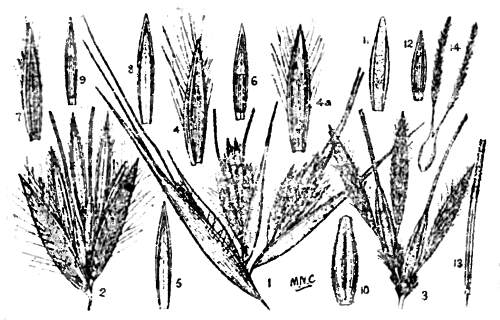
Fig. 165.—Anthistiria tremula.
1. Fascicles of three spikes with the outer bracts and proper bracts; 2. a spike
without its proper bract; 3. the pedicelled and the bisexual spikelets without the
involucral spikelets; 4, the first glume of the involucral spikelet with one wing only;
4a. the first glume of the involucral spikelet with wings to both the keels; 5 and 6. the
second and the third glume of the involucral spikelet; 7, 8 and 9. the glumes of the
bisexual spikelet; 10, 11, 12 and 13. glumes of the bisexual spikelet; 14. ovary.
The involucral spikelets are the longest, in contiguous superposed
pairs, about 1/2 inch long, and the rachis of the spike is produced
beyond these spikelets. There are three glumes. The first glume is
linear-lanceolate, acute, covered with long, often tubercle-based
hairs, many-nerved, margins narrowly incurved, and with narrow
wings, on both the keels in one of each of the pairs of spikelets and
on one keel only in the other of each of these pairs. The second
glume is oblong-lanceolate, acute, margins thin and membranous,
inflexed, ciliate above the middle, 3-nerved. The third glume is as
long as the second, hyaline, very narrowly linear, 1-nerved.
Stamens are three and the lodicules are cuneate.
The pedicelled spikelets are usually smaller than the involucral
spikelets and similar to them. The first glume is winged on one
side in the lowest spikelet and without wings in the others.
The bisexual or (female) spikelets are linear-oblong, obtuse, and
the callus with reddish hairs. The first glume is scabrid, deeply
channelled at the back, nerveless, narrowly truncate at the tip, and
hispid near the apex. The second glume is as long as the first,
linear, hyaline, 3-nerved, chartaceous at the back with the sides
membranous and incurved. The third glume is small, hyaline, 1-nerved
and epaleate. The fourth glume is the narrowed base of the
awn which is 1/2 inch long.
This grass is very common in marshes and in wet low-lying
places on the hills and occurs also in the plains in Malabar and
South Kanara.
Distribution.—The Deccan Peninsula, from the Konkan and
Central Provinces southward, and Ceylon.
These grasses are either annual or perennial, with slender freely
branching stems. The inflorescence is a panicle consisting of
groups of dissimilar spikelets with compressed, boat-shaped spathes
on peduncles. Spikelets are of two kinds, sessile and pedicelled.
Each peduncle bears 4-pedicelled male or neuter spikelets in a
regular whorl forming an involucel around 1 or 2 sessile bisexual
spikelets and 2- or 3-pedicelled male spikelets. Involucral spikelets
have 3 or 2 glumes, the first two glumes are somewhat similar, the
first 3- to 5-nerved and the second 3-nerved, the third glume is one
nerved and hyaline. Lodicules are cuneate and retuse. Anthers
yellow dotted or tinged violet. Pedicelled spikelets inside the involucral
similar to those of the involucral. Sessile spikelets are
bisexual or sometimes female, 4-glumed and awned.
KEY TO THE SPECIES.
- Panicle slender, lax; involucral spikelets
1/6 inch; pedicel slender, terete 1. I. laxum.
- Panicle crowded, leafy; involucral spikelets
1/6 inch or more, very strongly
nerved; pedicel harder, firmer and flattened 2. I. anthephoroides.
Fig. 166.—Iseilema laxum.
It is a tufted perennial grass with a stout, short, creeping root-stock.
Stems are slender, branched, ascending, 6 to 24 inches
long.
The leaf-sheaths are somewhat loose, glabrous. The ligule is
a shortly ciliate membrane.
The leaf-blade is linear, obtuse, glabrous and ciliate near the
base, 2 to 6 inches long. The leaf-blades in the upper portions of
the branches are smaller.
Fig. 167.—Iseilema laxum.
1. A cluster of spikelets with spathes. 2. a cluster consisting of the involucral
spikelets and three inner spikelets; 3. the inner spikelets consisting of one sessile
female or bisexual and 2-pedicelled male spikelets; 4, 5 and 6. the first, second and
the third glume, respectively, of the involucral spikelet.
The inflorescence is a narrow long panicle bearing clusters of
spikelets with spathes on slender peduncles, the outer spathes are
narrow-lanceolate, glabrous or with a few hairs near the margin,
1/4 to 1 inch long; inner spathes are lanceolate, smaller with membranous
margins. Each cluster consists of an involucel of 4
pedicelled spikelets forming a true whorl around 2 pedicelled and
1 sessile spikelets or 3 pedicelled and 2 sessile spikelets. The
involucral spikelets are male, oblong-lanceolate, acute, with short
flattened pedicels, bearded at the base, and have three glumes.
The first glume is oblong-lanceolate, acute, 5- to 7-nerved and
ciliate. The second glume is oblong-lanceolate, acuminate, equal or
slightly shorter than the first, glabrous, 3-nerved and with infolded
margins. The third glume is hyaline, linear, short, irregularly
toothed at the apex. The inner pedicelled spikelets are similar to
the involucral spikelets, but the third glume is very narrow, linear.
The sessile spikelets are female, rarely bisexual, narrowly lanceolate,
1/5 inch long, glabrous and have four glumes. The first
glume is lanceolate, chartaceous, truncate or 2-fid at the apex,
faintly 5-nerved, with a few long hairs or glabrous, and with
margins scaberulous towards the tip to about one-third the length
of the glume. The second glume is lanceolate, acuminate, glabrous,
sub-chartaceous, 3-nerved. The third glume is hyaline, nerveless,
apex irregularly cut, short; sometimes this glume is wanting. The
fourth glume is a very slender awn of about 1/2 inch.
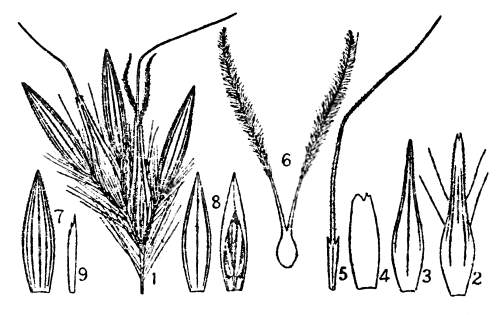
Fig. 168.—Iseilema laxum.
1. Inner spikelets consisting of 2-pedicelled male and two female or bisexual spikelets;
2, 3, 4 and 5. the first, second, third and the fourth glume, respectively, of the sessile
spikelets; 6. ovary; 7, 8 and 9. the first, second and the third glume, respectively, of
the inner pedicelled spikelet.
This is a widely spread common grass growing in somewhat
moist situations. This is the well-known Chengali gaddi of the
Telugu districts.
Distribution.—All over Madras and Bombay presidencies.
Fig. 169.—Iseilema anthephoroides.
This is a perennial grass closely resembling Iseilema laxum in
its habit, but shorter, stouter and branching more freely. The leaf
is similar to that of I. laxum in all its parts.
Fig. 170.—Iseilema anthephoroides.
1. A cluster of spikelets with spathes; 2. the involucral and the inner spikelets; 3. the
inner spikelets; 4 and 5. the glumes of the involucral spikelets; 6, 7, 8 and 9. the four
glumes, respectively, of the sessile spikelet; 10. ovary; 11 and 12. glumes of the inner
pedicelled spikelets.
The pedicelled spikelets of the involucel have firmer harder,
shorter and broader pedicels, thickly bearded and consist of two
glumes only. The first glume is very strongly 5-nerved, coriaceous,
oblong-lanceolate; with scaberulous infolded margins, with long
cilia. The second glume is lanceolate, thin, 3-nerved, glabrous.
The inner pedicelled spikelets are similar to the pedicelled
spikelets of the involucel. The sessile spikelet has four glumes.
The first glume is elliptic-lanceolate, apex drawn into a long narrow
strip ending in two teeth or truncate, sparsely ciliate at the margins
about the middle, faintly 3-nerved. The second glume is shorter
than the first, lanceolate, drawn out into an acuminate point at the
apex, hairy at the back. The third glume is hyaline, short, oblong,
apex broad and irregularly toothed, nerveless. The fourth glume
is an awn.
This is very common in the Deccan districts and grows on all
kinds of soils. This is a good fodder grass.
Distribution.—Very common in the Ceded districts and Nellore.