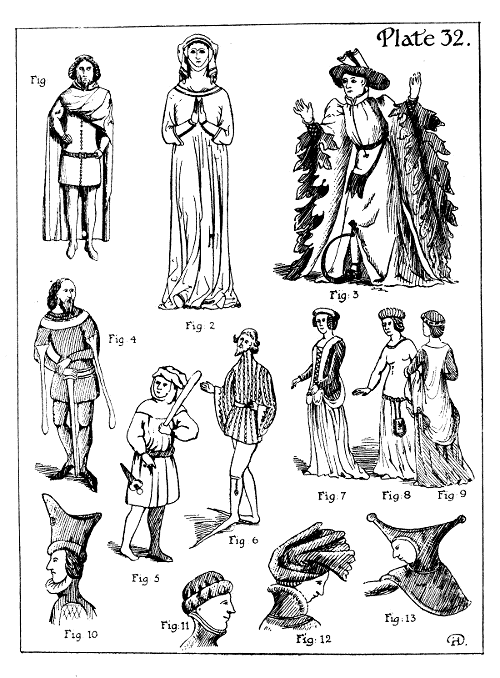
The effigies of King Henry IV. and his Queen at Canterbury are some
of the most splendid of our royal effigies, uniting richness, grandeur, and
simplicity. The King’s crown is particularly remarkable for its magnificence
(Fig. 1.) Since there had been very great extravagance in costume during
the reign of Richard II., when he came to the throne Henry revived the
sumptuary laws of his predecessors regulating the quality of the clothing to
be worn by the various classes of his subjects.
Four years after that, all slashing and cutting of garments into various
devices was forbidden; but the people were very fond of display, and perfect
disregard was shown by all classes of the community to any of these laws.
A notable decoration that appeared in this reign was the collar of SS. Various
accounts of its origin have been given, but the most probable one is that
S is the initial letter of Henry’s motto, “Souveraine,” which he had borne
while Earl of Derby.
The houppelande of Richard’s reign, with its high collar, huge sleeves,
and full skirt, was still worn, and is always depicted scarlet in MSS. The
“bag sleeves” came into fashion during this reign. They were of great
size and fulness, but gathered at the wrist and at the shoulders.
In the reign of Henry V. little change was made in costume, for the
minds of men were occupied with more serious matters in the war with
France.
Long and short gowns with large sleeves, either sweeping and indented
at the edge or of the “bag sleeve” variety, were the common upper
garments of all classes.
In some instances small bells were worn, fastened to a baldric or belt
passing diagonally like a sash across the body from the shoulder to the waist.
Beards were not worn much during this reign, and moustaches were
only partially worn, for the fashion was to be clean shaven, and the hair was
cut close above the ears.
At the commencement of Henry V.’s reign the colour of the surcoat
was again changed to white.
Henry VI. was invariably plain in his dress, and we are told that he
refused to wear the long-pointed shoes worn by the gentry. It is an interesting
reflection on the unsettled condition of the country in the unfortunate
reign of this King that the costumes were numerous and diverse, being “a
curious mixture of the costumes of preceding reigns.”
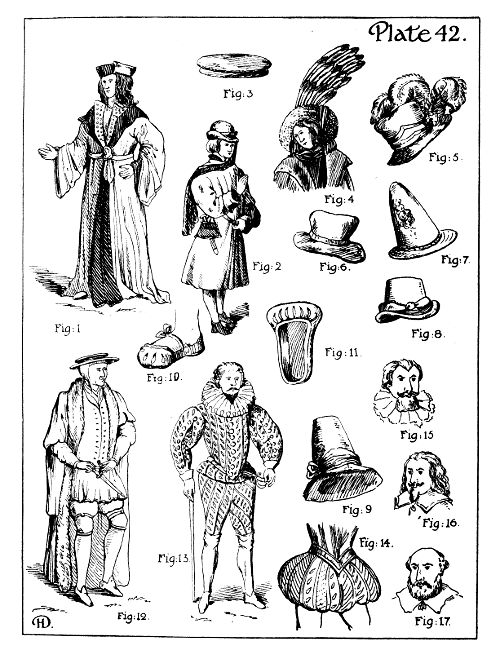
The most remarkable feature of the fifteenth century was the more
common use of caps and hats of fantastic shapes and the change of form of
the capuchon or hood into a regularly formed crown, with a thick roll, having
a long tippet attached to it and trailing on the ground or tucked into the
girdle. (Fig. 2a.)
A single feather is sometimes worn in the cap. (Fig. 5.) Long, tight
hose and short boots or buskins, and shoes with high fronts and backs that
turned over each way, were worn, all with long toes.
The gown or jacket begins to be cut even around the shoulders, instead
of being made high up the neck.
The face was still closely shaven.
The state mantles of the King and nobles were made of velvet and lined
with white damask or satin.
Legal and other official habits consisted of long, full gowns, girdled
round the waist and trimmed and lined with fur, according to the rank of
the wearer.
During the reigns of Edward IV., Edward V., and Richard III., a very
characteristic style of costume begins to come into vogue. The store from
which we draw our knowledge—the brasses, effigies, and illuminated MSS.—is
a very extensive one, and owing to the invention of printing and the use
of the wood block for illustration, we have still another source of information.
A very important feature of the costumes of this time was the excellent
fit of the garments. As Mrs. Ashdown says, in her British Costume,
“Broadly speaking, it had been perfectly possible for a dressmaker to cut
out and complete any garment worn by men up to that period; after the
reign of Edward IV. the era of the tailor began.”
In Edward’s reign the jackets and doublets were cut shorter than ever,
the sleeves slit so as to show the large, loose white shirts, and the shoulders
were padded with moss or flock.
Men wore the hair long, and had hats of cloth a quarter of an ell or
more in height, and all wore most sumptuous chains of gold. Shoes with
long, pointed toes, some as much as two feet long, called poulaines, were
also worn.
Sumptuary laws were again enacted in this reign against people who
dressed beyond their social position, and both the wearers and the tailors
and shoemakers were subject to fines for transgressing them.
In the reign of Richard III., gentlemen began to wear the long gowns
and more sober costumes that distinguished the reign of Henry VII. The
costumes of the nobility generally consisted of hose or long stockings tied
by points or laces to the doublet, which was open in front, about half-way
down the breast, showing a stomacher or vest, over which it was laced like
a peasant’s bodice.
Over the doublet was worn a long or a short gown, according to fancy
and circumstances, the former hanging loose, the latter full of pleats before
and behind, plain at the sides and girdled tightly about the waist.
Small caps or “bonets” of various shapes were worn. Boots reaching
to the middle of the thigh are frequently seen in the illuminations of the
period.
The hair was worn very bushy behind and at the sides. (Fig. 9.)
Very rich materials were used for the garments of nobles and others.
The costumes of the lower classes during this period followed the more
sober costumes of this and preceding periods, the materials being coarse and
the cut simple.
The costumes of the retainers of the nobility imitated those of their
masters, and were very often made of rich materials and in the extreme
fashion.
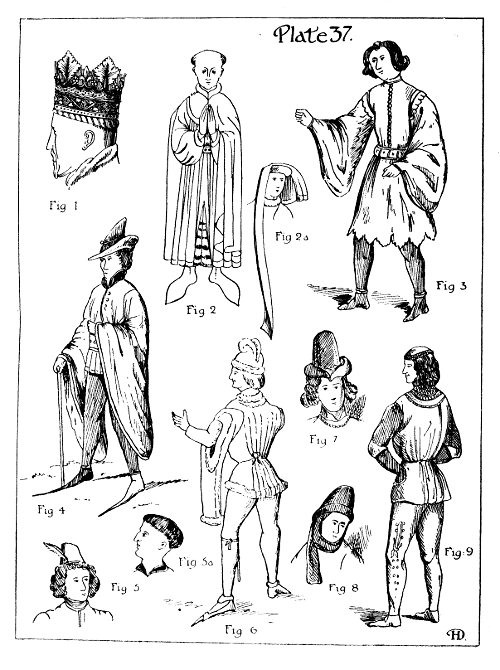
PLATE 37.
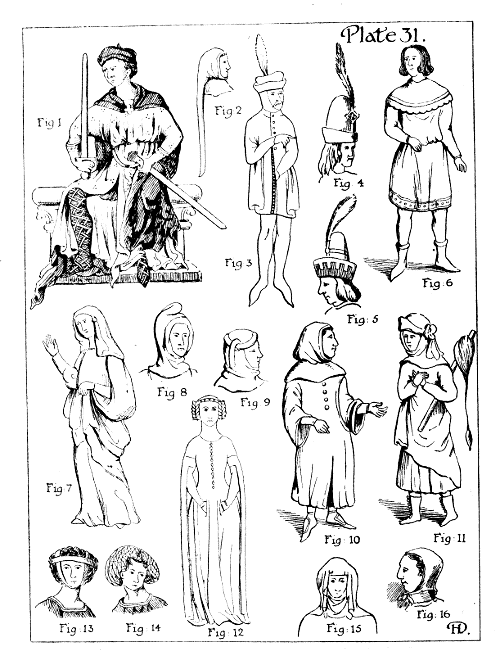
(Fig. 1) The Crown of Henry IV., from his effigy in Canterbury
Cathedral, 1422. It is of beautiful proportion and workmanship. (Fig. 2):
Brass of Ralph Segrym, M.P., Mayor, 1449, St. John’s Church, Maddermarket,
Norwich. This is a good example of civilian costume of the time,
the baggy sleeves being very typical. The cloak is fur-lined, and has a fur
collar, fastening with three buttons on the right shoulder. (Fig. 2a): Head-dress
of the period, composed of a thick roll of stuff encircling the head like
a turban, having a quantity of cloth attached to its inner edge which covers
one side, while on the other side a broad band or becca of the same material
hangs down to the ground. (Harl. MS., 2,278.) (Fig. 3): Male costume of
Henry IV.’s reign. (Harl. MS., 2,332.) The sleeves of the gown are very
wide, and are gathered tight around the wrist. The gown or tunic reaches
only to the knee, where it is scalloped in the form of leaves. Tight hose and
boots reaching above the ankle complete the costume. The hair is parted
in the front and is curled at the sides. (Fig. 4): An Exquisite of the reign
of Edward IV., wearing a characteristic peaked cap of the time, called a
bycocket, with a black crown and a white brim. His short, green jacket has
wide sleeves edged with ermine, and his chausses are red. (Fig. 5): A hat
of the time of Henry VI., from Gough’s Sepulchral Monuments. (Fig. 5a):
Head of Duke of Bedford, from a portrait of the time of Henry VI., showing
the peculiar way in which the hair was worn in this and the preceding reign.
(Fig. 6): Figure of Richard, Duke of Gloucester, afterward Richard III.
(From the Royal MS., 15 E. 4.) He is attired in the most fashionable dress
of the day. His red hat has a gold band and jewelled buttons to secure the
feathers. His crimson jacket is furred with deep red, is very short, and is
gathered in close folds behind, the sleeves being extremely long. He wears
the Garter around his left leg; his hose are blue, and he has the fashionable
long-pointed shoe and the clog or patten over it. (Fig. 7): Another form of
the bycocket hat. (Fig. 8): Hat of black cloth with the long pendant
twisted around the neck. (Harl. MS., 4,379.) (Fig. 9): Costume of the
time of Edward IV. (Royal MS., 15 E. ii.)
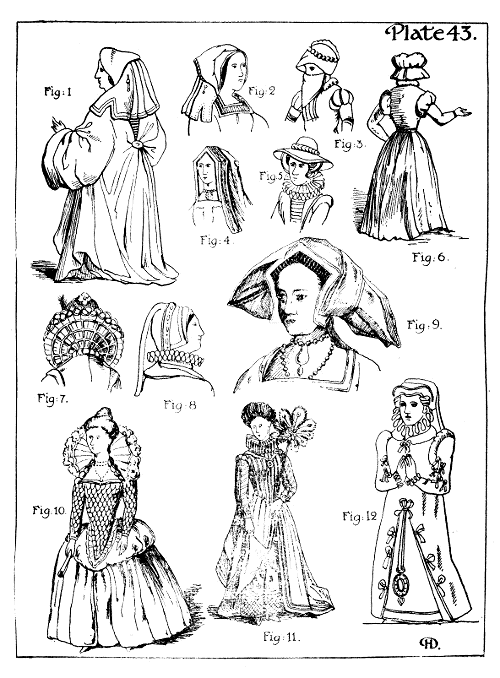
Little change was made in the costumes of ladies during these periods,
but there was a more wonderful variety in the head-dresses—many of them
striking and even picturesque—than during any other century of English
history. In the early part of this period the crespine or golden net caul, into
which the hair was gathered (Fig. 12), partly covered by a veil, was very
common. The côte-hardi was still very popular, but many ladies wore the
full outer garment or mantle, called the houppelande, buttoned high up to
the neck, with wide sleeves, and reaching down to the feet. (Fig. 4.)
Long-trained gowns were also worn, with stomachers, trimmed with fur
and velvet, and these displaced the super-tunic. Fur was very extensively
used by all classes, to the great disgust and contempt of some contemporary
writers.
Sumptuary laws passed in the reign of Henry IV. prohibited “the wearing
of furs of ermine, lettice, pure minivers, or grey,” by the wives of
esquires, unless they were noble themselves or their husbands held the office
of Mayor of certain towns.
In the reign of Henry VI. the previous fashions were continued, with
numerous fantastic additions. Towards the end of the reign, short-waisted
gowns were worn, girded tightly at the waist, with enormous trains and with
turn-over collars of fur or velvet coming to a point in front. Sleeves were
worn of all descriptions.
The different varieties of head-dresses were known as (1) the turban,
(2) the horned head-dress, (3) the heart-shaped head-dress, and (4) the forked
head-dress.
The Turban Head-dress (Fig. 7) was in fashion for some time, even continuing
until the next century, and was probably based upon the Turkish
turban.
It consisted of a light framework of wire, covered with silk or other
rich material.
The Horned Head-dress (Fig. 6) was probably the most grotesque form
of head-dress worn in this reign. The cauls at the side of the head were
made very large, and horns, from which depended the veil, extended horizontally
on either side of the head. This came in for very severe condemnation
and satire by the writers of the time, being compared to the horns of the
snail, of the unicorn, of the hart, and even of the devil himself.
The horns were worn so large that in some places “it was judged necessary
to enlarge the doors of the apartments,” and when entering a room the
wearers had “to turn aside and stoop.”
The Heart-shaped Head-dress (Fig. 9) was formed by the cauls being
made higher, so that the pad resting on them was pushed upward at the
sides, and the head-dress assumed the shape of a heart.
The Forked Head-dress (Fig. 10) was a variation of the horned head-dress,
in which the horns were placed vertically instead of horizontally.
The costumes of the reigns of the Yorkist Kings are very amply illustrated
from the numerous effigies, brasses, and MSS., and from the newly
invented wood blocks used in the new art of printing.
The ladies’ costumes of the reign of Edward IV. were modifications of
those worn in the reign of Henry VI., but they were very splendid and most
extravagant. The fashion of wearing tails to the gowns fell into disuse, and
in their room borders of velvet or fur were substituted. The gowns were
exceedingly short-waisted, and the dress was cut very low at the neck.
The Steeple Head-dress (Fig. 11), nicknamed “the chimney pot,”
came into use during this reign. It was conical or pyramidal in form, and
was generally about three-quarters of an ell in height. It was placed on the
head at an angle of about 45 degrees from the vertical, and in order to lessen
the tension on the head, a kind of framework of wire netting was worn under
it. To the apex was affixed a veil, often of fine texture, sometimes reaching
to the ground.
Another peculiar form of head-dress was known as the Butterfly Head-dress
(Fig. 8), introduced about 1470 A.D. It appears to have been a modification
of the steeple head-dress, the cone being truncated, with wires arranged
about it, to which wings of gauze veiling were affixed.
With this head-dress the hair was worn tightly drawn back from the
forehead.
The ladies of the middle class did not adopt these extravagant fashions.
They wore caps of cloth “with two wings at the side like apes’ ears.”
By the sumptuary laws, wives of persons whose income was less than
£40 a year were forbidden to wear girdles ornamented with gold and silver
work, or any “corse of silk” made out of the realm, or any coverchief
exceeding a certain price, or the furs of certain animals.
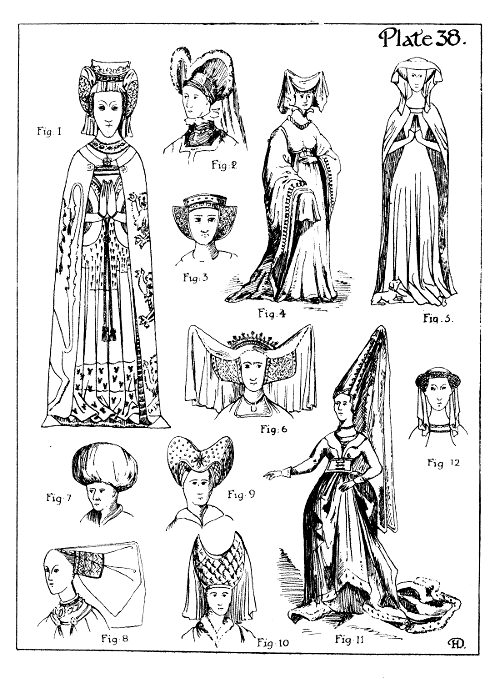
PLATE 38.
(Fig. 1): Joice, Lady Tiptoft, from the brass in Enfield Church, Middlesex,
1446 A.D. She is shown wearing a horned head-dress of very moderate
proportions and very elaborately made. She wears a côte-hardi and gown
trimmed richly with ermine. The brass, which is one of the finest of the
kind in England, shows the armorial bearings upon the cloak also. (Fig. 2):
115-116
Head-dress of a lady in the reign of Henry VI., with a veil or kerchief
attached to it. (Harl. MS., 6,431.) (Fig. 3): Head-dress of a lady in the
reign of Henry V., from the effigy of Catherine, Countess of Suffolk, showing
the golden caul at the sides of the head. (Fig. 4): Female costume of the
reign of Henry V., showing the horned head-dress covered with a kerchief,
the short waist, and the gown with very wide trailing sleeves and high collar
called the houppelande. (Fig. 5): Brass of Margaret, wife of William
Cheyne, 1419 A.D., at Hever, in Kent, showing the horned head-dress, the
close-fitting dress, and the mantle fastened across the bosom. (Fig. 6):
Horned head-dress of the fifteenth century, from the effigy of Beatrice,
Countess of Arundel, in the church at Arundel. This is considered to be the
finest illustration of the horned head-dress in existence. (Fig. 7): A turban
head-dress. (Harl. MS., 2,278.) (Fig. 8): Butterfly head-dress, from the
brass of Lady Say, in Broxbourne Church, Herts, 1473 A.D. (Fig. 9): Heart-shaped
head-dress. (Froissart’s Chronicles, Harl. MS., 4,379.) (Fig. 10):
A forked head-dress with small hanging veil. (Harl. MS., 2,278.) (Fig. 11):
Female costume of the reign of Edward IV., showing the steeple head-dress,
with kerchief fastened to the apex. The gown is very full, and both it and
the train are edged with ermine. The turn-over collar is also shown, and the
square-shaped under garment with lacing. (Harl. MS., 4,379.) (Fig. 12):
Head of a lady, from a brass at Sawtrey, Hants, 1404 A.D., showing the
crespine or golden net caul worn by ladies of the fourteenth and fifteenth
centuries, with a small veil hanging down by the side of the face.
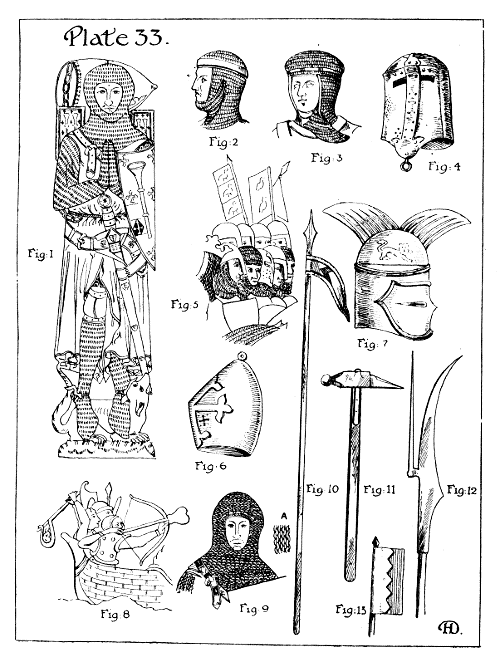
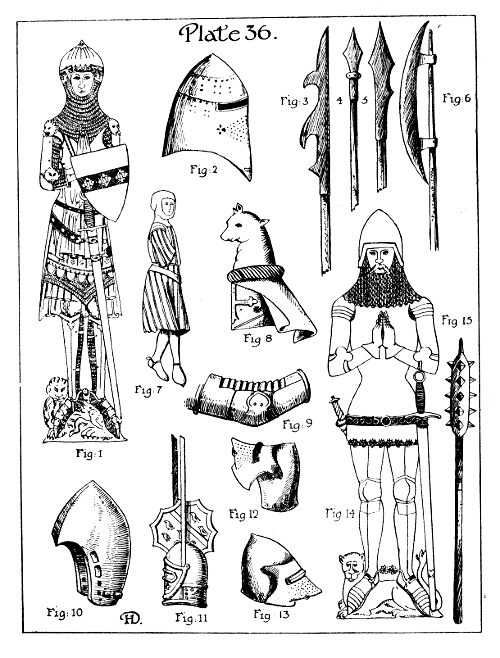
The various modifications in plate armour were such as were found
necessary for greater ease or for more perfect protection, and were of a
progressive character. In order to prevent confusion it is customary to
divide this period of 200 years into five lesser periods, the first three being
roughly coincident with the Lancastrian and Yorkist Periods, the remaining
two with the Tudor Period.
1st Period: 1410-1430. 2nd Period: 1430-1450. 3rd Period:
1450—1500.
1st Period: 1410-1450. This is also known as the surcoatless period,
as the polished breast and back plates were worn without any textile covering.
Before the Hundred Years’ War had broken, out again in the reign of
Henry V.—just before Agincourt—the types of armour had completely
changed. Knights gave up the use of the camail and jupon, and were
clothed in complete armour. Additional protections were placed in front of
the armpits, as roundles or pallettes, resembling small shields, and fan-shaped
plates were placed at the elbow joints. The basinet was made much
more globular in form, and a piece of plate called the gorget or neck-piece
took the place of the camail to connect the basinet with the body armour.
The lower part of the basinet, protecting the chin, was called the beaver (“I
saw young Harry with his beaver on.” H. IV., Pt. 1), and was fastened by
rivets to the upper part near the temples. The basinet now rested on the
gorget, and was so arranged that the head could be turned to right and left.
The breastplate was of globular form, and there was a corresponding
plate over the back. From the waist to the middle of the thigh, a series of
narrow, flexible, horizontal overlapping bands or plates of steel, called taces
or tassets, fastened to a lining of leather, were worn.
They thus formed a kind of armoured kilt or short steel petticoat. The
sword-belt was narrow, and was worn diagonally over the taces, and the
general form of the sword remained unaltered. The misericorde continued
to be worn on the right side. The hauberk was sometimes worn under the
plate armour, for the lower edge is sometimes shown in effigies and brasses.
All the details of the above description are shown in Fig. 1.
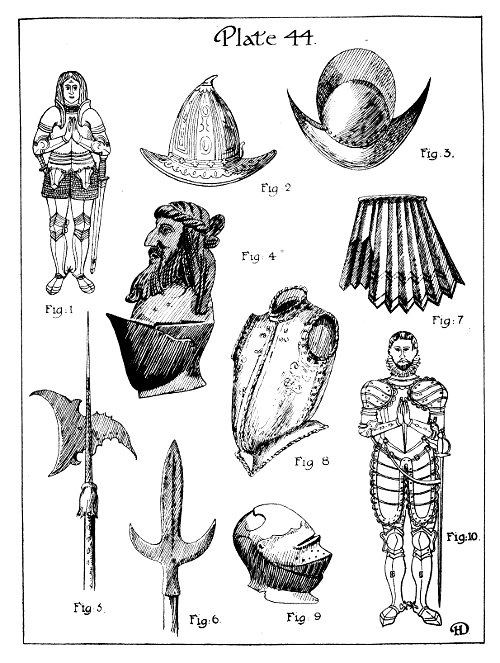
2nd Period: 1430-1450. This is sometimes called the Tabard Period,
as a new variety of short surcoat called a tabard was worn with short
sleeves over the armour, bearing the heraldic devices of the wearer, emblazoned
down the front and also on each sleeve.
The chief characteristic of the period with regard to the actual armour
was the system of adding strengthening or reinforcing pieces of plate to the
armour.
Over the flanks on each side, depending from the taces, a small plate,
varying in shape, called a tuille, was appended. It was fastened by strings
and allowed free movement of the limbs.
The sollerets or feet coverings became longer, and plates like those on
the shell of a lobster were added to the gauntlets to cover and protect the
backs of the hands.
Additional plates varying in size and form, were fixed to the elbows and
shoulders on the ordinary armour.
It is interesting to note that the right arm and shoulder were accoutred
so as to interfere as little as possible with the action when fighting; while the
left side and bridle arm were more fully protected with additional defensive
armour. Large reinforcing plates called pauldrons extended over the
shoulders, sometimes being made with a kind of standing collar to protect
the neck from a direct stroke.
One of the finest specimens of the armour of this period is that on the
splendid bronze effigy of Richard Beauchamp, Earl of Warwick. (Figs. 2
and 3.)
The brilliant artist and archæologist, Charles Stothard, when making
drawings of the figure, found to his great delight that it was movable, and
that the armour on the back was represented and finished as perfectly as
on the front.
3rd Period: 1450-1500. During this period the practice of reinforcing
the armour continued, and great modifications were made in the existing
pieces. The armour became more extravagant in form, dimensions and
adornment.
Enormous fan-like elbow pieces were worn, and the pauldrons or
shoulder pieces were very large.
This period includes the Wars of the Roses, and is, therefore, of considerable
interest. It has been said that, before this time, arms and armour
were European rather than English, but in this period, for the first time
since the Norman Conquest, England was cut off from the rest of Europe,
and was free to develop along her own lines.
Distinguishing and party badges, collars and devices were freely worn,
and incorporated with the arms during this period. The salade, a light
helmet, was principally worn in the Wars of the Roses.
The horses of knights in the tournament and on the battlefield were
sometimes as heavily armed as the riders. The horse’s head was protected
by a chanfrein, or face-piece, and movable plates of steel, forming the crinet,
covered the mane, while burnished shields or plates of metal were fixed on
the breast.
The weight of armour was so great that, when a knight was unhorsed,
he was utterly helpless, and at the mercy of his opponent, as it was impossible
for him to rise without assistance, and the victor had only the trouble
of coolly selecting the best chink in the junctures in the armour in which to
insert his sword or his dagger. As James I. afterwards said of armour,
owing to its general cumbersomeness, “It was an admirable defence, as it
hindered a man from being hurt himself or of hurting others.”
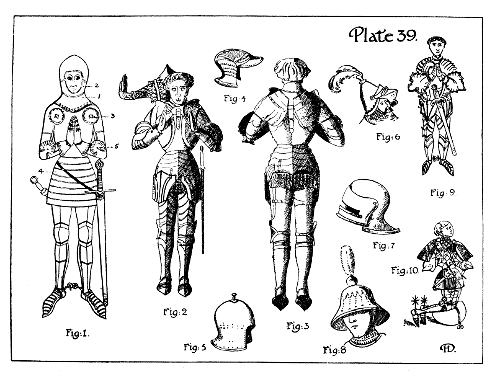
PLATE 39.
(Fig. 1): Brass of Sir John Lysle, Thruxton Church, Hampshire,
1407 A.D. This is the earliest example of complete plate armour in existence
in England, but the brass was probably made ten years after that date.
(1) Gorget; (2) Beaver; (3) Roundles; (4) Taces (8 in number); (5) Fan
119shaped
coudières. (Fig. 2): Front view of bronze effigy of Richard Beauchamp,
K. G., Earl of Warwick, from his tomb in the Beauchamp Chapel,
Warwick. The Earl died 1439 A.D., and the effigy was executed in 1453.
The following points will be noted: (1) The head is bare, and rests on a
crested helm; (2) the breastplate shoulder-guards are reinforced, the pauldrons
having low, upright neck defences; (3) the coudières, or elbow pieces,
are large, and of the same size on both arms; (4) there are five taces, showing
a skirt of mail beneath them, and there are two large tuilles. (Fig. 3):
Back view of the same. (Fig. 4): A skull cap of steel, called a casquetel,
with large ear-pieces, of the reign of Edward IV. (Fig. 5): Basinet of the
reign of Henry V. (Fig. 6): Basinet from the Register Book of St. Albans,
A.D. 1417. It rises to a point, upon which is placed a hollow tube to receive
the panache, or crest of feathers, and has a movable visor. (Fig. 7): Salade
with movable visor. (Fig. 8): Round salade with a jewelled plume. (From
Rouse’s Life of the Earl of Warwick.) (Fig. 9): Effigy of Sir Thomas
Peyton, in Isleham Church, Cambridgeshire, of the reign of Richard III.
The grotesque form of the enormous fan-like elbow-pieces and the large
pauldrons reinforcing the shoulder armour are particularly noticeable. (Fig.
10): Figure of Sir Robert Wingfield in complete armour, from a painted
window in East Herling Church, Norfolk, executed between 1461 and 1480.
He wears a tabard, with his “arms” blazoned on the front and on each
sleeve.
A.D. 1300 to 1377. Reigns of Edward I., II., and III.
The transition from the Early English, or Lancet style, to the Decorated
was much more gradual than from Norman to Early English, so gradual
that it is impossible to draw a line where one style ceases and another begins.
There can be no doubt that in some parts of the kingdom, Early English was
in use at the same time that, in other districts, the Decorated style was
becoming general, and thus the terms adopted to denote the different periods
must not be taken as definite or as commencing or closing at any particular
date, but merely as indicating the broad classification of the styles and details,
and for associating them with particular reigns for convenience of study.
The divisions are arbitrary, but very convenient in practice. Structurally,
there was not a great change in the buildings, but there was a more harmonious
relation and development of all the architectural features in walls,
piers, buttresses, windows, etc., both with regard to their size and their
enrichment, and it was because of this general use of ornament or enrichment
that it is called the Decorated Period. “It rivals the preceding style in
chasteness and elegance, while it surpasses it in richness.”
Great progress was made in the reign of Edward I., and the Decorated
work exhibits the most complete and perfect development of the Gothic arch,
which in the Early English was not fully matured, and in the Perpendicular
began to decline.
It is remarkable for its geometric tracery, its natural types of foliage,
and the undulating character of line and form in its ornamental details.
Windows.—The most distinctive features of the Decorated style are its
large windows and its mouldings. The windows are the chief glory of the
14th century Gothic. They vary very considerably in size, in form and in
intricacy.
As the window arches became broader, mullions or vertical bars of
masonry were required for their support, dividing the windows into lights,
and the upper portions of these mullions were developed into tracery, forming
circles, trefoils, or other geometric figures, and, afterwards, flowing lines.
It has been shown how the grouping of lancet-shaped windows and the
piercing of the space above them, under the arched dripstone, had produced
“plate tracery.” As the piercings became larger, narrow and irregularly
shaped surfaces of stone were left. These were pierced, and the intervening
piers of stone came to be shaped like the mullions; in fact, became a continuation
of the mullions. This development, which was reached before the
middle of the 13th century, is called “bar tracery.” At first, this bar
tracery was plain; then “cusps” (Pl. 40, Fig. 5), or projecting points, were
introduced on the inner edge of the mullions, and added greatly to the rich
effects. The earliest Decorated windows have tracery on a purely geometric
basis. Exeter Cathedral is considered the best typical example of the early
part of this style, and the existing windows were constructed at the end of
the 13th century. The Chapter-houses at York and Southwell are other rich
examples. Windows with flowing tracery are, in general, later than those
with geometrical patterns, though they are sometimes contemporaneous in
the same building.
No rule is followed in the form of the arch over windows in this style.
Some are very obtuse, others very acute, and the ogee, or double-curved
arch, is not uncommon.
Square-headed windows are very common in this style, in many parts of
the country, especially in Leicestershire and Oxfordshire. This form of
window was so very convenient that its use was never discontinued, though
it was more commonly used in houses and castles than in churches, and
windows with a flat curved top are frequently used. Circular or “Rose”
windows in churches and cathedrals are also a fine feature of this style.
Notable among these are the windows at the end of the south transept in
Lincoln and Westminster.
Pillars.—In ordinary parish churches the pillars are frequently as plain
as in the Early English Period, and are generally octagonal in cross sections,
but in richer churches they are clustered, and no longer have detached
shafts. The bases of the columns are often lozenge-shaped, or a square set
diagonally, to allow the light to penetrate better into the body of the building.
The capitals are frequently octagonal or bell-shaped, and sometimes
they are merely moulded or decorated with the “ball flower” (Pl. 49, Fig. 9)
and the “four-leaved flower” (Pl. 49, Fig. 10). In the preceding style a
conventional form of foliage was employed to decorate the capitals. But in
the richer examples of this style they are decorated with beautiful foliage,
more faithfully copied from Nature; the vine leaf, the maple leaf, the oak
leaf with acorns, the rose, and the ivy being most commonly imitated. The
foliage is twisted horizontally round the bell-shaped head, and does not shoot
up vertically from stiff or upright stems, as in the Early English. The bases
are usually moulded only, consisting of two or three rounds or roll-moulds,
and stand upon a plinth, the height of which varies very much.
Mouldings.—The mouldings of this style differ from those of the Early
English mainly in not having the rounds and hollows so deeply cut—a characteristic
feature being the introduction of fillets or small flat bands. The
deepest hollows, too, are found, not between each member, but between
groups of members.
They are always very effective, and are so arranged as to produce a
pleasing contrast of light and shade, which is softer and more blended than
in the Early English mouldings. (Pl. 41, Fig. 10.)
A moulding peculiar to this style is the “roll moulding” (Pl. 41, Fig. 7),
in which the upper half projects over the lower. The hollows are frequently
enriched with running foliage or with flowers at intervals, particularly the
“ball-flower” and the “four-leaved flower,” which are typical ornaments of
this period.
The surface of the interior walls is often covered with flat foliage,
arranged in small squares, called diaper work. (Pl. 9, Fig. 11.) This kind
of ornament is found in the Early English choir at Westminster Abbey, but
belongs more commonly to the decorated style.
Crockets and Finials (Pl. 41, Fig. 8) introduced into the Early English
style, were now used with greater profusion, and were treated with great
richness.
The Doorways are frequently large and richly sculptured, but in small
churches they are frequently plain. In large doorways the arch is generally
pointed; in smaller ones it is generally an Ogee (Pl. 41, Fig. 9), an arch
formed of a double curve, convex and concave, which came into general use
in this country in the fourteenth century. The mouldings are commonly
very rich.
The Arches do not differ materially in general effect from the Early
English ones; they are not so acute, but are distinguished by the
mouldings and caps as described above. In some cases the mouldings are
continued down the pier without the intervention of a capital, forming a completely
moulded opening.
Arcades or series of arches, were used in richly decorated buildings to
ornament the walls. The sedilia or seats on the south side of the choir, near
the altar, for the officiating clergy, were usually decorated in this form.
(Pl. 41, Fig. 6.)
Groined roofs or vaults of this style are distinguished from those of the
preceding style, chiefly by the introduction of numerous extra or intermediate
ribs and groins and by the natural foliage richly carved on the base. Stone
groining is imitated in cases where it would not be safe to place the weight
of a stone roof on the walls.
Timber roofs of this period are comparatively rare, but those of domestic
halls appear to have been more enriched than those of churches. It should
be noted that what are called “timber roofs” are frequently inner roofs or
ceilings, built for ornament only, with a plain, substantial roof over them, as
at Sparsholt, Berks. (Pl. 40, Fig. 6.)
Gargoyles, or grotesque waterspouts in the shape of monsters, are a
noticeable feature, and are for the purpose of throwing the rainwater clear
of the walls and buttresses.
The Buttresses in this period received great attention. They were proportioned
with distinct regard to their function. They are found in a great
variety of form and of degrees of richness, but they are almost invariably
worked in stages and are often ornamented with niches with crocketed
canopies originally containing images, and they often terminate in pinnacles.
(Pl. 41, Fig. 5.)
The Clear-story and the Triforium.—In large churches and cathedrals
the upper portion of the nave is lighted by a row of windows called the Clear-story
or the Clere-story. Below these, in the unlighted space under the roof
of the aisle, is a row of unlighted arches called the Triforium or Blind-story.
The decoration of these was, of course, similar to that employed in the other
windows and arches of this period.
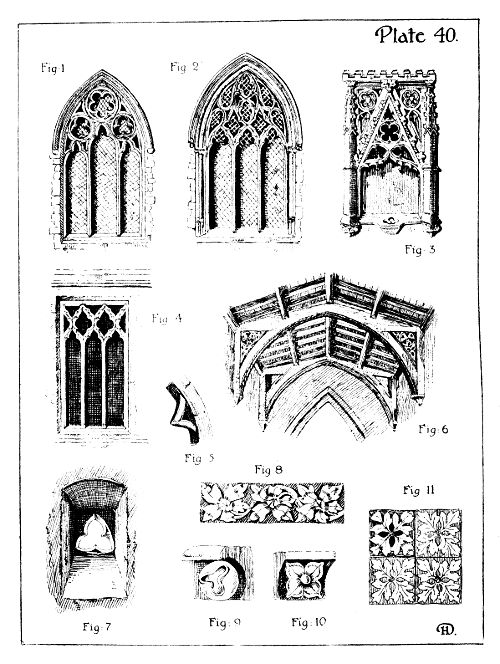
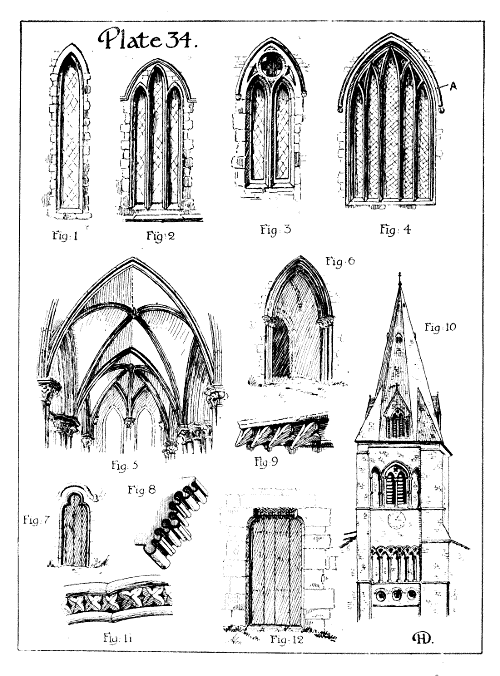
PLATE 40.
(Fig. 1): Decorated window from Meopham—an example of early
geometrical tracery with cusps. (Fig. 2): Decorated window from St.
Mary’s, Beverley, showing the manner in which the lines of the mullions were
125carried up to fill the head of the arch with flowing tracery. (Fig. 3): Decorated
Piscina from Fyfield, Berks., c. 1300 A.D., showing geometrical
tracery with a crocketed pediment, pinnacles and a battlement. (A Piscina
was a water drain, consisting of a shallow basin or sink with a hole in the
bottom to carry off the water with which the priest washed his hands. It
was placed near the altar, and was very common in the thirteenth and
succeeding centuries.) (Fig. 4): Square-headed window from Dorchester,
Oxfordshire, c. 1330 A.D. (Fig. 5): Detail showing a cusp. (Fig. 6):
Decorated timber (inner) roof at Sparsholt, c. 1350 A.D. (Fig. 7): Clear-story
window splayed (widened on the inside to throw down the light), from
Barton, Northants, c. 1320 A.D. (Fig. 8): Band of decorated ornament
from the triforium of the nave of St. Albans. (Fig. 9): The Ball-flower, a
characteristic ornament used on mouldings in the Decorated Period, being
a globular flower half-opened. (Fig. 10): The Four-leaved flower, another
characteristic ornament of the Decorated Period. (Fig. 11): Diaper work
from Lincoln Cathedral.
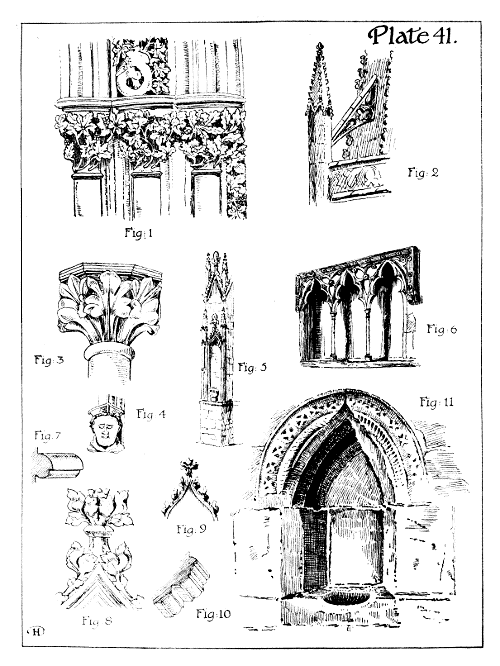
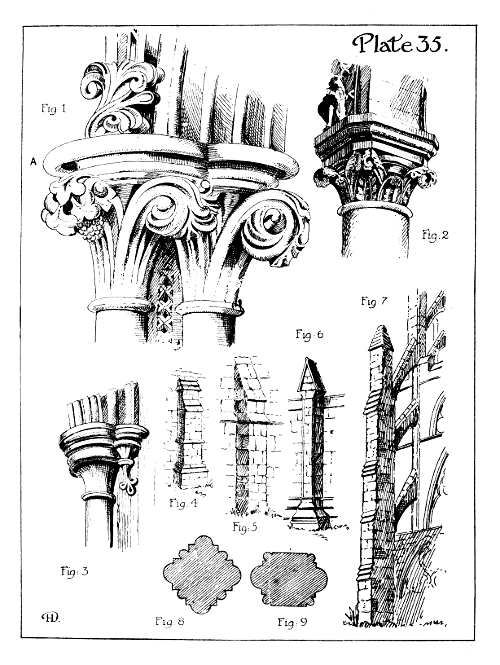
PLATE 41.
(Fig. 1): Decorated Capitals from the Chapter House, Southwell,
characteristic examples of the richly carved and clustered caps of the period.
(Fig. 2): Decorated Flying Buttress from the spire at Caythorpe, c. 1320
A.D. (Fig. 3): Decorated Capital of the Transition Period (between Early
English and Decorated). (Fig. 4): Decorated Corbel Head or Mask. Such
an ornament was placed at the end of a stone rib or dripstone. (Fig. 5):
Decorated Buttress, with a niche for an image, from St. Mary Magdalene,
Oxford, c. 1320 A.D. It is also ornamented with pinnacles and crockets.
(Fig. 6): Sedilia from Chesterton, Oxfordshire, c. 1326 A.D., decorated with
the Ball-flower. (Fig. 7): Roll moulding, very characteristic of the Decorated
Period—a moulding made up of two portions of circular mouldings, the
upper part larger than and projecting over the lower. (Fig. 8): Decorated
finial with crockets (on the side of the slope), from Lincoln Cathedral. (A
finial is a bunch of foliage which terminates pinnacles, canopies, pediments,
etc.) Crockets are projecting leaves, etc., used in Gothic architecture to
decorate the angles of spires, canopies, pinnacles, etc. (Fig. 9): An Ogee
arch, ornamented with crockets, from Beverley Minster, c. 1350 A.D. (Fig.
10): Section of decorated mouldings from Bray, Berks, c. 1300 A.D. (Fig.
11): Piscina from Wilford Church, Notts. This illustration is given to
show how builders, in renovating a church, altered and adapted work of a
preceding style. When the church was enlarged in the fourteenth century
this piscina was placed near the altar. The upper part was formed of
portions of two small Norman arches taken from two dismantled windows.
These were roughly trimmed to form a pointed arch to be in keeping with
the “pointed” style. (After H.F.)