JAPAN AS IT WAS AND IS: A Handbook
of Old Japan. By Richard
Hildreth. In two volumes. A reprint
edited and revised, with notes and additions,
by Ernest W. Clement and an
Introduction by William Elliot Griffis.
With maps and 100 illustrations. 12mo,
in slip Case. $3.00 net.
A. C. McClurg & Co. Chicago
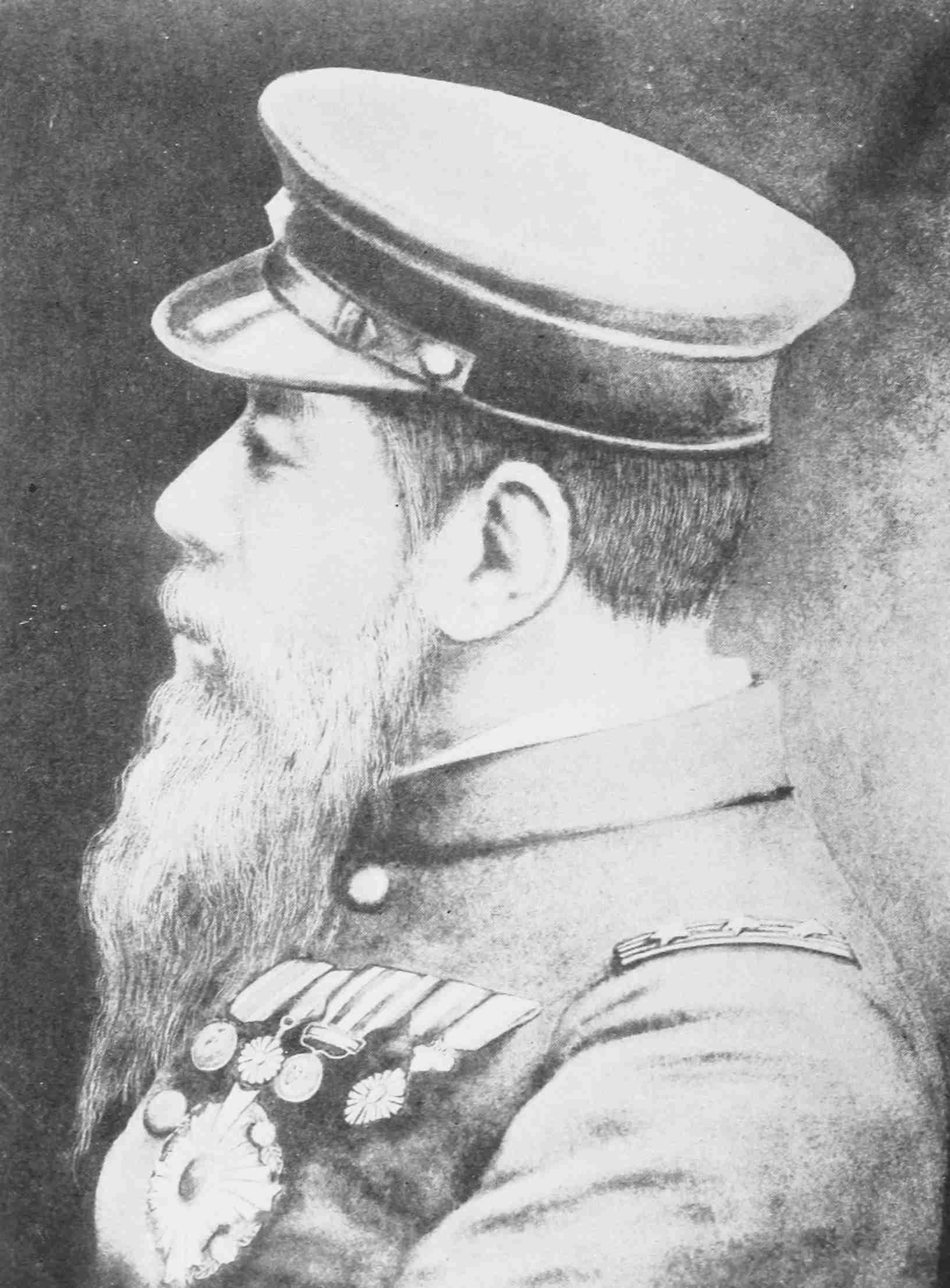
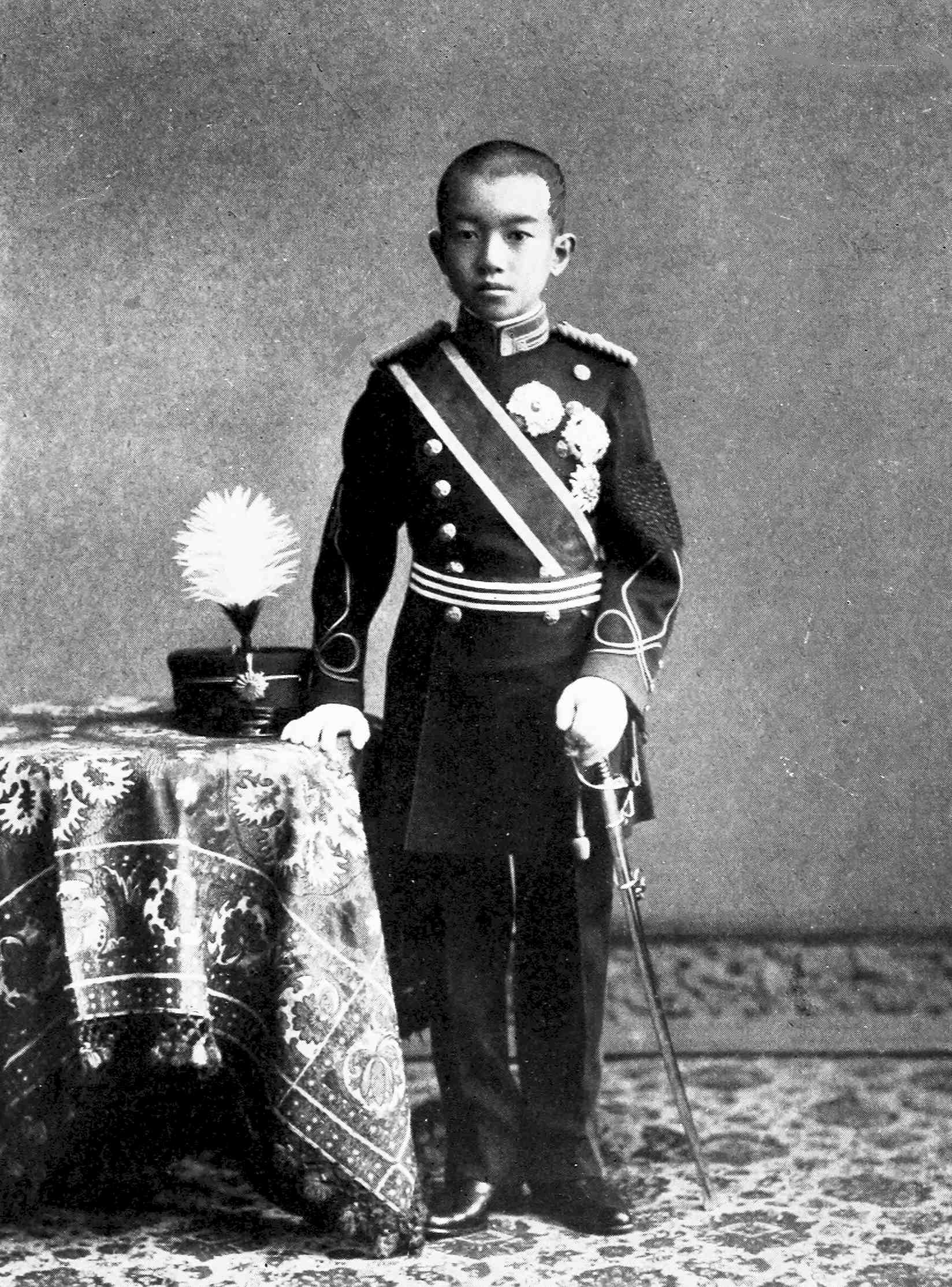
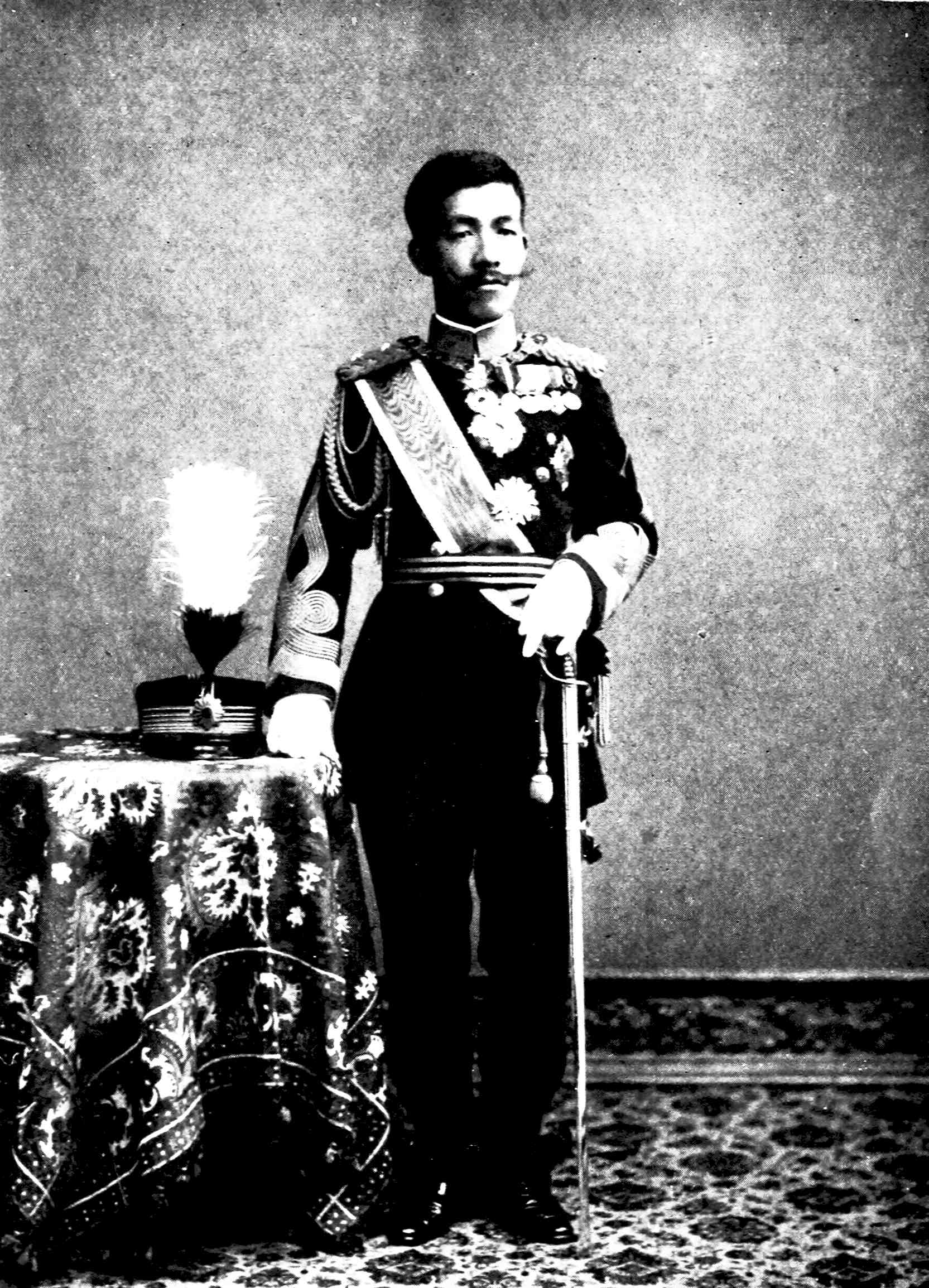
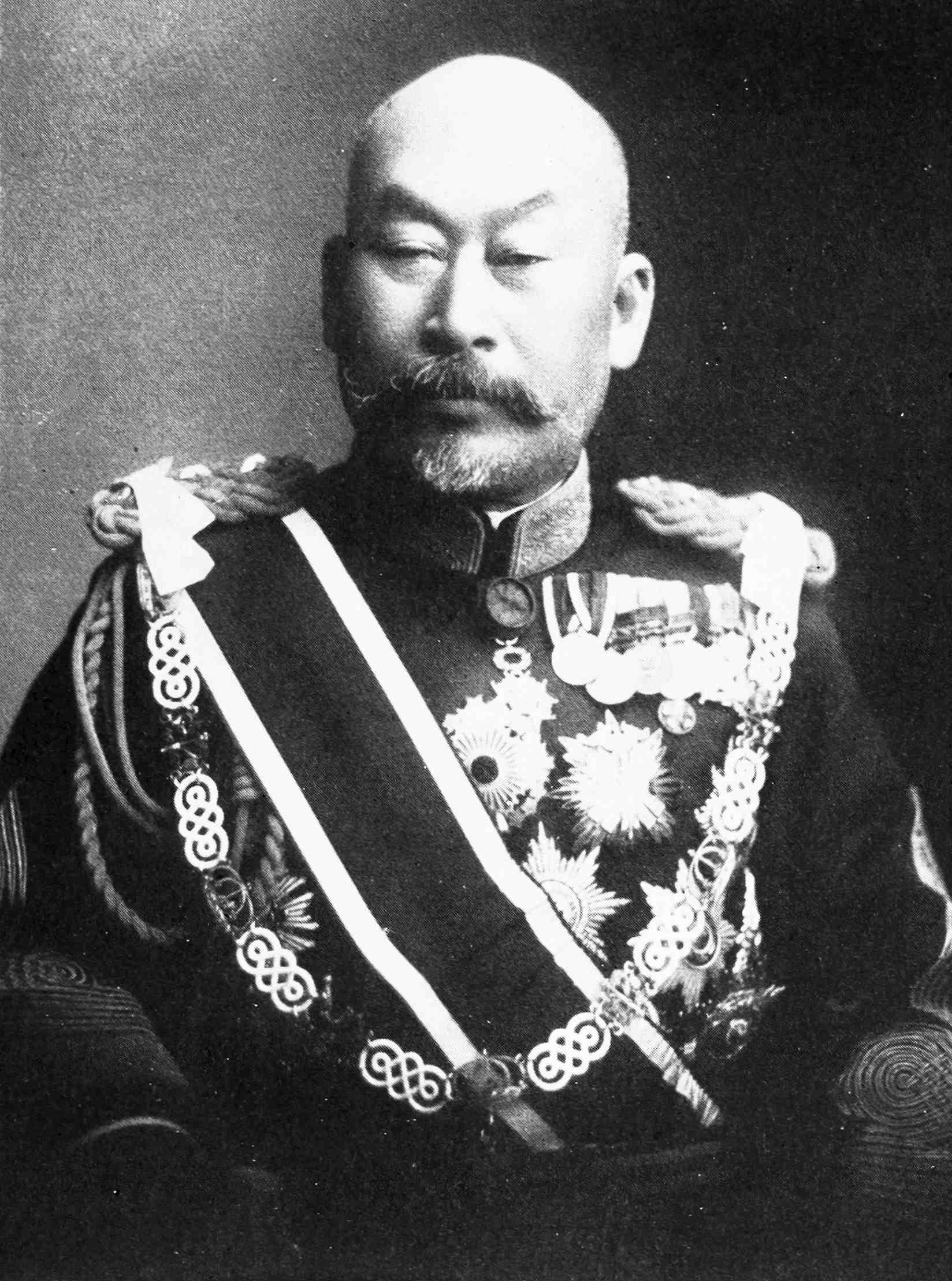
THE LATE EMPEROR MEIJI TENNO
New Revised Edition
WITH MAP AND ILLUSTRATIONS FROM PHOTOGRAPHS
NINTH EDITION
THOROUGHLY REVISED AND BROUGHT DOWN TO DATE
WITH ADDITIONAL CHAPTERS ON
THE RUSSO-JAPANESE WAR
AND
GREATER JAPAN
CHICAGO
A. C. McCLURG & CO.
1913
Copyright
A. C. McClurg & Co.
1903; 1905; 1913
Copyrighted in Great Britain
UNIVERSITY PRESS · JOHN WILSON
AND SON · CAMBRIDGE, U. S. A.
To the Memory of my Father
and my Mother
INTRODUCTION
THIS book, as its title indicates, is intended
to portray Japan as it is rather than as it
was. It is not by any means the purpose,
however, to ignore the past, upon which the present
is built, because such a course would be both foolish
and futile. Moreover, while there are probably no
portions of Japan, and very few of her people, entirely
unaffected by the new civilization, yet there
are still some sections which are comparatively unchanged
by the new ideas and ideals. And, although
those who have been least affected by the changes are
much more numerous than those who have been most
influenced, yet the latter are much more active and
powerful than the former.
In Japan reforms generally work from the top downward,
or rather from the government to the people.
As another1 has expressed it, “the government is the
moulder of public opinion”; and, to a large extent,
at least, this is true. We must, therefore, estimate
Japan’s condition and public opinion, not according
to the great mass of her people, but according to
the “ruling class,” if we may transfer to Modern
Japan a term of Feudal Japan. For, as suffrage in
Japan is limited by the amount of taxes paid, “the
masses” do not yet possess the franchise, and may be
said to be practically unconcerned about the government.
They will even endure heavy taxation and
some injustice before they will bother themselves
about politics. These real conservatives are, therefore,
a comparatively insignificant factor in the equation
of New Japan. The people are conservative, but
the government is progressive.
This book endeavors to portray Japan in all its
features as a modern world power. It cannot be expected
to cover in great detail all the ground outlined,
because it is not intended to be an exhaustive
encyclopædia of “things Japanese.” It is expected
to satisfy the specialist, not by furnishing all materials,
but by referring for particulars to works where
abundant materials may be found. It is expected to
satisfy the average general reader, by giving a kind
of bird’s-eye view of Modern Japan. It is planned
to be a compendium of condensed information, with
careful references to the best sources of more complete
knowledge.
Therefore, a special and very important feature of
the volume is its bibliography of reference books at the
end of each chapter. These lists have been prepared
with great care, and include practically all the best
works on Japan in the English language. In general,
however, no attempt has been made to cover magazine
articles, which are included in only very particular
instances.
There are two very important works not included
in any of the lists, because they belong to almost all;
they are omitted merely to avoid monotonous repetition.
These two books of general reference are
indispensable to the thorough student of Japan and
the Japanese. Chamberlain’s “Things Japanese”2
is the most convenient for general reference, and is a
small encyclopædia. “The Mikado’s Empire,”3 by
Dr. Griffis, is a thesaurus of information about Japan
and the Japanese.
After these, one may add to his Japanese library
according to his special taste, although we think
that Murray’s “Story of Japan,” also, should be in
every one’s hands. Then, if one can afford to get
Rein’s two exhaustive and thorough treatises, he is
well equipped. And the “Transactions of the Asiatic
Society of Japan” will make him quite a savant on
Japanese subjects. It should be added, that those
who have access to Captain Brinkley’s monumental
work of eight volumes on Japan will be richly rewarded
with a mine of most valuable information by
one of the best authorities. “Fifty Years of New
Japan” is valuable and unique, because it is written
by Japanese, each an authority in his department.4
For the latest statistics, “The Japan Year Book” is
invaluable.
We had intended, but finally abandoned the attempt,
to follow strictly one system of transliteration.
Such a course would require the correction of quotations,
and seemed scarcely necessary. Indeed, the
doctors still disagree, and have not yet positively
settled upon a uniform method of transliteration.
After all, there is no great difference between Tōkiō
and Tōkyō; kaisha and kwaisha; Iyeyasu and Ieyasu;
Kyūshiu, Kiūshiu, Kyūshū, and Kiūshū. There is
more divergency between Ryūkyū, Riūkiū, Liukiu,
Luchu, and Loo Choo; but all are in such general use
that it would be unwise, in a book like this, to try to
settle a question belonging to specialists. The fittest
will, in time, survive. We have, however, drawn the
line on “Yeddo,” “Jeddo,” and similar archaisms and
barbarisms, for which there is neither jot nor tittle of
reason. But it is hoped that the varieties of transliteration
in this book are too few to confuse.
The author is under special obligations to Professor
J. H. Wigmore, formerly a teacher in Tōkyō, and now
Dean of the Northwestern Law School, Chicago, for
kind criticisms and suggestions; to Mr. Frederick W.
Gookin, the art critic, of Chicago, for similar assistance,
and for the chapter on “Æsthetic Japan,” which
is entirely his composition; and also under general
obligations for the varied assistance of many friends,
too numerous to mention, in Japan and America. He
has endeavored to be accurate, but doubts not that he
has made mistakes. He only asks that the book be
judged merely for what it claims to be,—a Handbook
of Modern Japan.
Ernest Wilson Clement.
NOTE TO NEW REVISED EDITION
THE eight years which have elapsed since
this book was revised have been so crowded
with great events that another revision seems
advisable in order to make the book yet more timely
and as valuable as possible. Whenever it was practicable,
the statements and statistics in both the body
and the appendix of the book have been brought up to
date. In some cases, but only a very few, it was impossible
to alter the text without breaking up the paging;
therefore the original text was allowed to stand,
and the corrections have been indicated in notes or
some other way. A new chapter, moreover, has been
added, with new illustrations, and presents as concisely
and yet as comprehensively as possible the
facts which warrant its caption, “Greater Japan.”
a like a in father e „ e „ men i „ i „ pin o „ o „ pony u „ oo „ book ai as in aisle ei „ weigh au as o in bone ō „ „ „ „ ū as oo in moon
i in the middle of a word and u in the middle or at the end of
a word are sometimes almost inaudible.
The consonants are all sounded, as in English: g, however, has
only the hard sound, as in give, although the nasal ng is often
heard; ch and s are always soft, as in check and sin; and z before
u has the sound of dz. In the case of double consonants, each one
must be given its full sound.
There are as many syllables as vowels. There is practically
no accent; but care must be taken to distinguish between o and
ō, u and ū, of which the second is more prolonged than the first.
Be sure to avoid the flat sound of a, which is always pronounced
ah.
A HANDBOOK
OF
MODERN JAPAN
CHAPTER I PHYSIOGRAPHY — BIBLIOGRAPHY.
Outline of Topics: Situation of country; relation to the United
States; lines of communication; “Key of Asia.”—Area of empire.—Divisions:
highways, provinces, prefectures, principal cities
and ports.—Dense population; natives and foreigners; Japanese
abroad.—Mountains, volcanoes, hot springs, earthquakes.—Lakes,
rivers, bays, harbors, floods, tidal waves.—Epidemics, pests.—Climate:
temperature, winds (typhoons), moisture, ocean currents.—Flora
and fauna.—Peculiar position: Japan and the United
States.—Bibliography.
THE Japanese may appropriately be called
“our antipodal neighbors.” They do not
live, it is true, at a point exactly opposite
to us on this globe; but they belong to the obverse,
or Eastern, hemisphere, and are an Oriental people
of another race. They are separated from us by from
4,000 to 5,000 miles of the so-called, but misnamed,
Pacific Ocean; but they are connected with us by
many lines of freight and passenger vessels. In fact,
in their case, as in many other instances, the “disuniting
ocean” (Oceanus dissociabilis) of the Romans has
really disappeared, and even a broad expanse of waters
has become a connecting link between the countries
on the opposite shores. It may be, in a certain
measure, correct to say, as pupils in geography are
taught to express it, that the Pacific Ocean separates
the United States from Japan; but it is, in a broader
and higher sense, just as accurate to state that this
ocean binds us with our Asiatic neighbors and friends
in the closest ties. Japan was “opened” by the
United States; has been assisted materially, politically,
socially, educationally, and morally by American
influences in her wonderful career of progress;
and she appreciates the kindliness and friendship of
our people. We, in turn, ought to know more about
our rapidly developing protégé, and no doubt desire
to learn all we can concerning Japan and the
Japanese.
The development of trade and commerce has been
assisted by the power of steam to bring Japan and
the United States into close and intimate relations.
There are steamship lines from San Francisco, Vancouver,
Tacoma, Seattle, Portland, and San Diego
to Yokohama or Koōbe; and there are also a great
many sailing vessels plying between Japan and
America. The routes from San Francisco and San
Diego direct to Japan are several hundred miles
farther than the routes from the more northerly ports
mentioned above. The time occupied by the voyage
across the Pacific Ocean varies according to the vessel,
the winds and currents, etc.; but it may be put
down in a general way at about 14 days. The fast
royal mail steamers of the Canadian Pacific line often
make the trip in much less time, and thus bring
Chicago, for instance, within only a little more than
two weeks’ communication with Yokohama. It must,
therefore, be evident that Japan is no longer a remote
country, but is as near to the Pacific coast of
America, in time of passage, as the Atlantic coast
of America was twenty years ago to Europe.
It is true that the steamers of the San Francisco
and San Diego lines, especially those carrying mails
and passengers, go and come via Honolulu, so that
the voyage to Japan thus requires a few more days
than the direct trip would take. But, as Hawaii is
now part of the United States, our country has
thus become only about 10 days distant from Japan.
Moreover, as the Philippine Islands are also a portion
of our country, and Formosa has been for several
years a part, of Japan, the territories of the two nations
are brought almost within a stone’s throw, and
the people almost within speaking distance, of each
other. This proximity of the two nations to each
other should be an incentive to draw even more
closely together the ties, not only historical, commercial,
and material, but also political, social, educational,
intellectual, moral, and religious, that bind
them to each other, and, so far as possible, to make
“Japan and America all the same heart.”
But Japan is also an Asiatic country, and thus
holds a peculiar relation to the countries on the
eastern coast of the mainland of Asia. The islands
of Japan stretch along that shore in close proximity
to Siberia, Korea, and China, and are not far distant
from Siam. With all of those countries she enters,
therefore, into most intimate relationship of many
kinds. With Russia the relation is one of rivalry,
of more or less hostility, at present passive, but
likely to be aroused into activity by some unusually
exasperating event. In any case, Japan is the only
Far-Eastern power that can be relied upon to check
the aggressions of Russia; and this fact the wise
statesmen of Great Britain have clearly recognized by
entering into the Anglo-Japanese Alliance. Toward
Korea, China, and Siam, Japan sustains a natural
position of leadership, because she is far in advance
of all those nations in civilization. Ties geographical,
racial, social, political, intellectual, and religious,
bind them more or less closely together, so that
Japan can more sympathetically and thus more easily
lead them out into the path of progress. The natural
and common routes of trade and travel from the
United States to those countries run via Japan,
which thus becomes, in more senses than one, “the
key of Asia”; and for that very reason she is also
the logical mediator between the East and the
West.
The Japanese call their country Dai Nihon, or
Dai Nippon (Great Japan), and have always had a
patriotic faith in the reality of its greatness. But
this delightful delusion is rudely dispelled when the
fact is expressed statistically, in cold figures, that
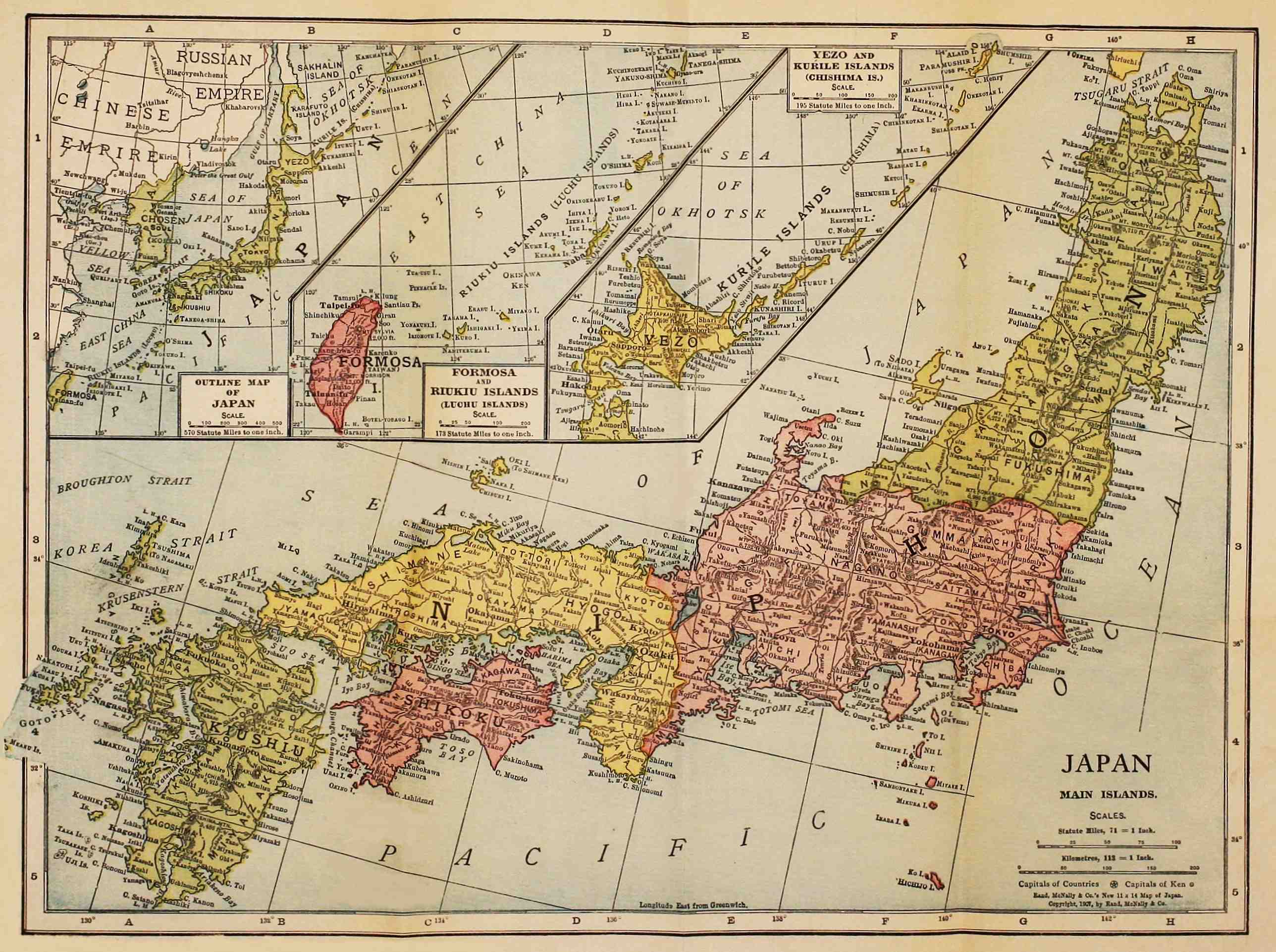
the area of the Empire of Japan is about 175,000
square miles,5 or only a little more than that of California.
It has, however, a comparatively long coast
line of more than 18,000 miles. The name Nihon,
or Nippon (a corruption of the Chinese Jih-pên, from
which was derived “Japan”), means “sun-source,”
and was given because the country lay to the east
from China. It is for this reason that Japan is
often called “The Sunrise Kingdom,” and that the
Imperial flag contains the simple design of a bright
sun on a plain white background.6
Japan proper comprises only the four large islands,
called Hondo, Shikoku, Kyūshiu, and Yezo (Hokkaidō);
but the Empire includes also Korea, Formosa,
the Pescadores, and about 4,000 small islands,
of which the Ryūkyū (Loo Choo) and the Kurile
groups are the most important. Japan proper lies
mainly between the same parallels of latitude7 as the
States of the Mississippi valley, and presents even
more various and extreme climates than may be found
from Minnesota to Louisiana.
The extreme northern point of the Empire of
Japan is 50° 56´ N., and the extreme southern point is
21° 45´ N. The extreme eastern point is 156° 32´ E.,
and the extreme western point 119° 18´ E. These
extremes furnish even greater varieties of climate
than those just mentioned. The Kurile Islands at
the extreme north are frigid, and have practically
no animal or vegetable life; while the beautiful
island of Formosa at the extreme south is half
in the tropics, with a corresponding climate, and
abounds in most valuable products. Marcus Island,
farther out in the Pacific, has guano deposits worth
working.
Japan proper is divided geographically into nine
“circuits,” called Gokinai, Tōkaidō, Tōsandō, Hokurikudō,
Sanindō, Sanyōdō, Nankaidō, Saikaidō, Hokkaidō.
The word dō, which appears in all the names
except the first, means “road” or “highway.” Some
of these appellations are not much used at present;
but others are retained in various connections, especially
in the names of railways, banks, companies,
or schools. A common official division of the largest
island (Hondo) is into Central, Northern, and Western.
Japan proper was also subdivided into 85 Kuni
(Province), the names of which are still retained in
general use to some extent. But, for purposes of
administration, the empire is divided into 3 Fu
(Municipality) and 43 Ken (Prefecture), besides Yezo
(or Hokkaidō) and Formosa, each of which is administered
as a “territory” or “colony.” The distinction
between Fu and Ken is practically one in
name only. These large divisions are again divided:
the former into Ku (Urban District) and Gun (Rural
District); and the latter into Gun. There are also
more than 50 incorporated Cities (Shi) within the Fu
and Ken.8 Moreover, the Gun is subdivided into
Chō (Town) and Son (Village).
But, while the prefix “great” does not apply to
Japan with reference to its extent, it is certainly
appropriate to the contents of that country. Within
the Empire of Japan are great mountains with grand
scenery, great and magnificent temples, great cities,
and a great many people. For, while the area of
Japan is only one-twentieth of that of the United
States, the population is about one-half as numerous.
Even in the country districts the villages are almost
continuous, so that it is an infrequent experience to
ride a mile without seeing a habitation; and in the
large cities the people are huddled very closely together.
The latest official statistics, those of 1909,
give the total population of Japan as 53,500,000, of
whom the males exceed the females by about 600,000;
and as of late years the annual increase has amounted
to about 700,000, the present population (1912) may
fairly be estimated at more than 55,000,000.9
The number of foreigners resident in Japan in
1909 exceeded 17,000, of whom more than half were
Chinese, and less than a quarter were British and
American. The number of Japanese in 1909 living
abroad was 301,000, of whom 100,000 were in the
United States (chiefly in Hawaii), 97,000 in China,
and only a few in British territory.
Japan is a mountainous country. The level ground,
including artificial terraces, is barely 12 per cent of
the area of the whole empire. A long range of high
mountains runs like a backbone through the main
island. The highest peak is the famous Fuji, which
rises 12,365 feet above the sea-level, and is a “dormant
volcano,” whose last eruption occurred in 1708.
Its summit is covered with snow about ten months
in the year.10 There are several other peaks of more
than 8,000 feet elevation, such as Mitake, Akashi,
Shirane, Komagatake, Aso, Asama, Bandai, some of
which are active volcanoes. Eruptions happen not
infrequently; and earthquakes, more or less severe,
registered by the seismometer, are of daily occurrence,
although most of the shocks are not ordinarily
perceptible. There are also several excellent hot
springs, of sulphuric or other mineral quality, as at
Ikao, Kusatsu, Atami, Hakone, Arima, Onsen. The
mountainous character of Japan has also its pleasant
features, because it furnishes means of escape from
the depressing heat of summer. Karuizawa, Nikkō,
Miyanoshita, Hakone, Arima, Chūzenji are the most
popular summer resorts.
There are not many, or large, lakes in Japan.
Lake Biwa, 50 miles long and 20 miles wide at its
widest point, is the largest and most famous. Hakone
Lake, the “Asiatic Loch Lomond,” is beautiful,
and especially noted for the reflection of Mount Fuji
in its water by moonlight. Lake Chūzenji, in the
Nikkō mountains, is regarded by many as “unrivalled
for beauty” and “hardly surpassed in any
land.”
There are many beautiful waterfalls, such as
Kegon, Urami, and others in the Nikkō district,
Nunobiki at Kōbe, Nachi in Kii, etc.
There are numerous rivers, short and swift; and
it is these streams, which, after a rainy season,
swelling and rushing impetuously down from the
mountains, overflow their sandy banks and cause
annually a terrible destruction of life and property.
The most important rivers are the Tone, the Shinano,
the Kiso, the Kitakami, the Tenryū, in the main
island, and the Ishikari in Yezo. The last is the
longest (about 400 miles); the next is the Shinano
(almost 250 miles); but no other river comes up
even to 200 miles in length. The Tenryū-gawa11 is
famous for its rapids. Some of these rivers are
navigable by small steamers.
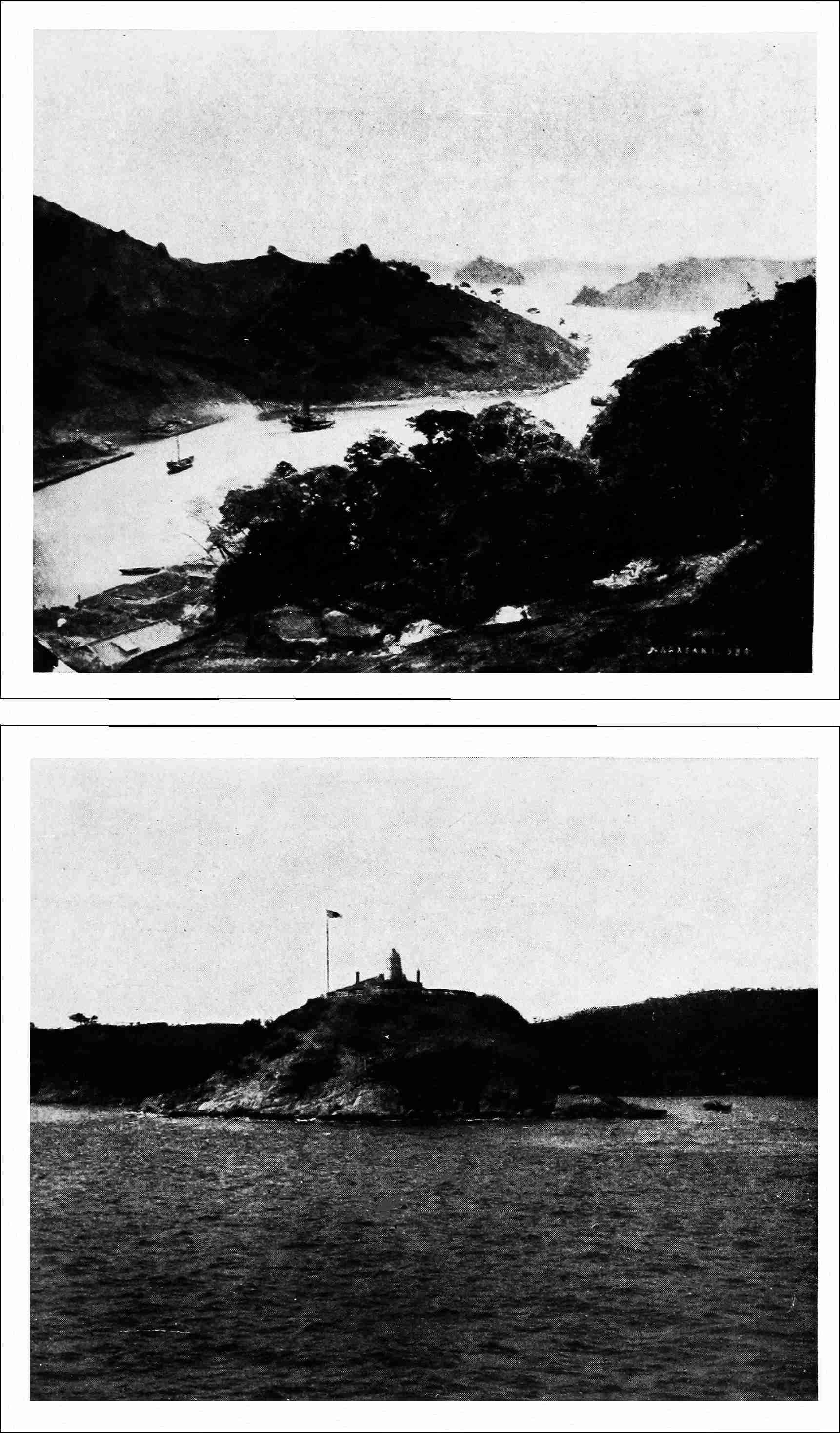
Japan, with its long and irregular coast line, is
particularly rich in bays and harbors, both natural
and artificial, which furnish shelter for the shipping
of all kinds. The “open ports,” which formerly
numbered only 6 (Nagasaki, Yokohama, Hakodate,
Ōsaka, Kōbe, Niigata), have reached the figure 36;
and the growing foreign commerce annually demands
further enlargement. Of the old ports, Niigata is
of no special importance in foreign commerce; but,
of the new ports, Kuchinotsu in Kyūshiu, Muroran
in Yezo (Hokkaidō), and especially Bakan and Moji,
on opposite sides of the Straits of Shimonoseki, are
rapidly growing. In this connection it is, perhaps,
not inappropriate to make mention of the far-famed
“Inland Sea,” known to the Japanese as Seto-no-uchi
(Between the Straits), or Seto-uchi, which lies between
the main island, Shikoku and Kyūshiu.
The long coast line of Japan is a source of danger;
for tidal waves occasionally spread devastation
along the shore. These, with floods, earthquakes,
eruptions, typhoons, and conflagrations, make a
combination of calamities which annually prove very
disastrous in Japan.
The country is subject to epidemics, like dysentery,
smallpox, cholera, plague, and “La Grippe,”
which generally prove quite fatal. In 1890, for
instance, some 50,000 Japanese were attacked by
cholera, and about 30,000 died; and during two
seasons of the “Russian epidemic” large numbers
of Japanese were carried away. In both cases the
foreigners living in Japan enjoyed comparative immunity.
And now, on account of the advance in
medical science, more stringent quarantine, and
better sanitary measures, the mortality among Japanese
has been considerably diminished: This fortunate
result is largely due to the efforts of such
men as Dr. Kitasato, whose fame as a bacteriologist
is world-wide. The zoölogical pests of Japan are
fleas, mosquitoes, and rats, all of which are very
troublesome; but modern improvements minimize
the extent of their power.
NAGASAKI HARBOR, AND LIGHTHOUSE INLAND SEA
But, in spite of the drawbacks just enumerated,
Japan is a beautiful spot for residence. “The aspect
of nature in Japan ... comprises a variety of savage
hideousness, appalling destructiveness, and almost
heavenly beauty.” The climate, though somewhat
debilitating, is fairly salubrious, and on the whole
is very delightful. The extremes of heat and cold
are not so great as in Chicago, for instance, but
are rendered more intolerable and depressing by the
humidity of the atmosphere. No month is exempt
from rain, which is most plentiful from June on
through September; and those two months are the
schedule dates for the two “rainy seasons.” September
is also liable to bring a terrible typhoon. Except
in the northern, or in the mountainous, districts,
snow is infrequent and light, and fogs are rare.
The spring is the most trying, and the autumn the
most charming season of the year.12
On account of the extent of Japan from north to
south, the wide differences of elevation and depression,
and the influence of monsoons and ocean
currents, there is no uniformity in the climate.
For instance, the eastern coast, along which runs
the Kuro Shio (Black Stream), with a moderating
influence like that of the Gulf Stream, is much
warmer than the western coast, which is swept by
Siberian breezes and Arctic currents. The excessive
humidity is due to the insular position and
heavy rainfall. Almost all portions of the country
are subject more or less to sudden changes of
weather. It is also said that there is in the air a
great lack of ozone (only about one-third as much
as in most Western lands); and for this reason Occidentals
at least are unable to carry on as vigorous
physical and mental labor as in the home lands.
Foreign children, however, seem to thrive well in
Japan.
“Roughly speaking, the Japanese summer is hot
and occasionally wet; September and the first half
of October much wetter; the late autumn and early
winter cool, comparatively dry, and delightful; February
and March disagreeable, with occasional snow
and dirty weather, which is all the more keenly
felt in Japanese inns devoid of fireplaces; the late
spring rainy and windy, with beautiful days interspersed.
But different years vary greatly from each
other.”13
In Japan “a rich soil, a genial climate, and a
sufficient rainfall produce luxuriant vegetation” of
the many varieties of the three zones over which the
country stretches. In Formosa, Kyūshiu, Shikoku,
and the Ryūkyū Islands, “the general aspect is tropical”;
on the main island the general appearance is
temperate; while Yezo and the Kurile Islands begin
to be quite frigid. The commonest trees are the
pine, cedar, maple, oak, lacquer, camphor, camellia,
plum, peach, and cherry; but the last three are
grown for their flowers rather than for their fruit
or wood. The bamboo, which grows abundantly,
is one of the most useful plants, and is extensively
employed also in ornamentation.
In the fauna of Japan we do not find such great
variety. Fish and other marine life are very abundant;
fresh-water fish are also numerous; and all
these furnish both livelihood and living to millions
of people. Birds are also quite numerous; and some
of them, like the so-called “nightingale” (uguisu),
are sweet singers. The badger, bear, boar, deer,
fox, hare, and monkey are found; cats, chickens,
dogs, horses, oxen, rats, and weasels are numerous;
but sheep and goats are rare. Snakes and lizards
are many; but really dangerous animals are comparatively
few, except the foxes and badgers, which are
said to have the power to bewitch people!
In conclusion, attention should be called once more
to the physiographical advantages of Japan, and
it may be of interest to set them forth from the point
of view of a Japanese who has indulged in some
prognostications of the future of his nation. From
the insular position of Japan, he assumes an adaptability
to commerce and navigation; from the situation
of Japan, “on the periphery of the land hemisphere,”
and thus at a safe distance from “the centre of
national animosities,” he deems her comparatively
secure from “the depredations of the world’s most
conquering nations”; from the direction of her chief
mountain system (her backbone), and “the variegated
configurations of her surface,” he thinks that “national
unity with local independence” may easily be
developed. Likewise, because more indentations are
found on the eastern than on the western sides of the
Japanese islands, except in the southwestern island
of Kyushiu, where the opposite is true; because the
ports of California, Oregon, Washington, and British
Columbia are open toward Japan; because the Hoang-Ho,
the Yangtze Kiang, and the Canton rivers all
flow and empty toward Japan; because the latter
thus “turns her back on Siberia, but extends one
arm toward America and the other toward China and
India”; because “winds and currents seem to imply
the same thing [by] making a call at Yokohama
almost a necessity to a vessel that plies between the
two continents,”—he conceives of his native country
as a nakōdo (middleman, or arbiter) “between the
democratic West and the Imperial East, between the
Christian America and the Buddhist Asia.”
But since these comparisons were made, the geography
of Eastern Asia and the Pacific Ocean has
been altered. Japan has acquired Formosa and Korea;
the United States has assumed the responsibility
of the Philippines; and China is threatened
with partition through “spheres of influence.”
Japan, therefore, seems now to be lying off the
eastern coast of Asia, with her back turned on
Russia with Siberian breezes and Arctic currents,
her face turned toward America, with one hand
stretched out toward the Aleutian Islands and
Alaska and the other toward the Philippines, for
the hearty grasp of friendship.
For more detailed information concerning the topics treated
in this chapter, the reader is referred to “The Story of Japan”
(Murray), in the “Story of the Nations” series; “The Gist
of Japan” (Peery); and “Advance Japan” (Morris).
For pleasant descriptions of various portions of Japan, “Jinrikisha
Days in Japan” (Miss Scidmore); “Lotos-Time in
Japan” (Finck); “Japan and her People” (Miss Hartshorne);
“Unbeaten Tracks in Japan” (Miss Bird, now Mrs. Bishop);
“Every Day Japan” (Lloyd); and “Japan To-Day” (Scherer)
are recommended.
The most complete popular work on the country is the
“Hand-Book for Japan” (Chamberlain and Mason), 8th edition;
and the most thorough scientific treatment is to be found
in Rein’s “Japan.”
Students of seismology should consult Prof. John Milne’s
works.
CHAPTER II INDUSTRIAL JAPAN — BIBLIOGRAPHY.
Outline of Topics: Agriculture; petty farming; small capital
and income; character of farmer; decrease of farmers; principal
products; rice; tea; tobacco; silk; cotton; camphor; bamboo;
marine products and industries.—Mining.—Engineering.—Shipbuilding.—Miscellaneous
industries.—Mechanical industries.—Shopping
in Japan.—Wages and incomes.—Guilds, labor unions,
strikes, etc.—Mr. Katayama.—Socialism.—Bibliography.
THE chief occupation of the Japanese is agriculture,
in which the great mass of the
people are employed. On account of the
volcanic nature and the mountainous condition of
the country, there are large portions not tillable;14
and for the same reason, perhaps, the soil in general
is not naturally very fertile. It must be, and can be,
made so by artificial means; but as yet not half of
what is fairly fertile soil is under cultivation. Large
portions of arable land, particularly in Yezo and
Formosa, can be made to return rich harvests, and
are gradually being brought under man’s dominion.
But it can be readily understood that if for any
reason the crops fail, severe suffering will ensue,
and perhaps become widespread. The prosperity of
the country depends largely upon the prosperity of
its farmers.
Farming, like almost everything in that land of
miniatures, is on a limited scale, as each man has
only a very small holding. “There is no farm
in Japan; there are only gardens” (Uchimura).
Even a “petty farmer” of our Northwest would
ridicule the extremely insignificant farms of the
Japanese, who, in turn, would be astounded at the
prodigious domains of a Dalrymple. A careful investigator,
Dr. Karl Rathgen, has summed up the
situation as follows: “In Japan are to be found only
small holdings. A farm of five chō15 (twelve acres)
is considered very large. As a rule the Japanese
farmer is without hired labor and without cattle.
The family alone cultivates the farm, which, however,
is so small that a large share of the available
labor can be devoted to other purposes besides farming,
such as the production of silk, indigo, tobacco.
The average holding for the whole of Japan (excluding
the Hokkaidō) for each agricultural family
is 8.3 tan15 (about two acres), varying from a maximum
of 17.6 tan in the prefecture of Aomori to a
minimum of 5.3 tan in the prefecture of Wakayama.”
“There are no large landed proprietors in Japan.”
A Japanese farm is so insignificant, partly because
a Japanese farmer has only a very small capital, and
needs only a slight income to support life. It has
been estimated that a man so fortunate as to own
a farm of five chō15 obtains therefrom an annual income
of 100 or 120 yen.15 And yet the Japanese
farmers are very careful and thoroughly understand
their business. “In spade-husbandry,” says Dr.
Griffis, “they have little to learn”; but “in stock-raising,
fruit-growing, and the raising of hardier
grains than rice, they need much instruction.”16
A Japanese farmer is hard-working, industrious,
stolid, conservative, and yet, by reason of his fatalistic
and stoical notions, in a way happy and contented.
“Left to the soil to till it, to live and die
upon it, the Japanese farmer has remained the same,
... with his horizon bounded by his rice-fields,
his water-courses, or the timbered hills, his intellect
laid away for safe-keeping in the priest’s hands, ...
caring little who rules him, unless he is taxed beyond
the power of flesh and blood to bear.” He is,
however, more than ordinarily interested in taxation,
for the land-tax of three and one-third per cent of the
assessed value of the land amounts to about half the
national revenue, and is no inconsiderable part of
the state, county, town, and village taxes. It would
have reverted to the original rate of two and one-half
per cent; but it has been still further increased on
account of the Russo-Japanese War.17
The principal products of the Japanese farms are
rice, barley, wheat, millet, maize, beans, peas, potatoes
(Irish and sweet), turnips, carrots, melons, eggplants,
buckwheat, onions, beets, and a large white
bitter radish (daikon). A very good average yield
is fifty bushels to an acre. The entire annual production
of rice varies each year, but averages about
46,000,000 koku;18 and the annual exportation of rice
runs from about 8,000,000 yen to over 10,000,000
yen. The list of fruits19 and nuts grown in Japan
includes pears, peaches, oranges, figs, persimmons,
grapes, plums, loquats, apricots, strawberries, bananas,
apples, peanuts, chestnuts, etc.
Among other important Japanese productions must
be mentioned, of course, tea, tobacco, and mulberry
trees. Of these the last is, perhaps, indigenous;
but the other two are importations in their origin.
The culture of tea is most extensively carried on in
the middle and southern districts. The annual production
is now about 7,000,000 kwan;20 the annual
export trade is valued at over 10,000,000 yen. The
price of tea runs from five cents to six dollars per
pound, of which the last is raised at Uji, near Kyōto.
The Japanese are a tea-drinking people; they use
that beverage at meals and between meals, at all
times and in all places. It is true that they drink it
from a very small cup, which holds about two tablespoonfuls,
but they drink, as we are told to pray,
“without ceasing.” Hot water is kept ever ready for
making tea, which is sipped every few minutes, and is
always served, with cake or confectionery, to visitors.21
Tobacco was introduced into Japan by the Portuguese,
but its use was at first strictly prohibited.
The practice of smoking, however, rapidly spread
until it became well-nigh a universal custom, not
even restricted to the male sex. The Lilliputian
pipe would seem to indicate that only a limited
amount of the weed is used; but smoking, like
tea-drinking, is practised “early and often.” The
Japanese tobacco is said to be “remarkable for its
mildness and dryness.”
The silk industry is the most important in relation
to Japan’s foreign trade, and is on the increase.
Silk is sent away to American and European markets
chiefly in its raw state, but is also manufactured into
handkerchiefs, etc. The exports of silk for the year
1910 amounted to about $90,000,000, or about two-fifths
of the entire export trade. It would, of course,
be beyond the limits of this chapter to enter into the
description of the details of sericulture; it may be
sufficient here to state that only the stolid patience
of Orientals can well endure the slow, tedious, and
painstaking process of feeding the silkworms.22
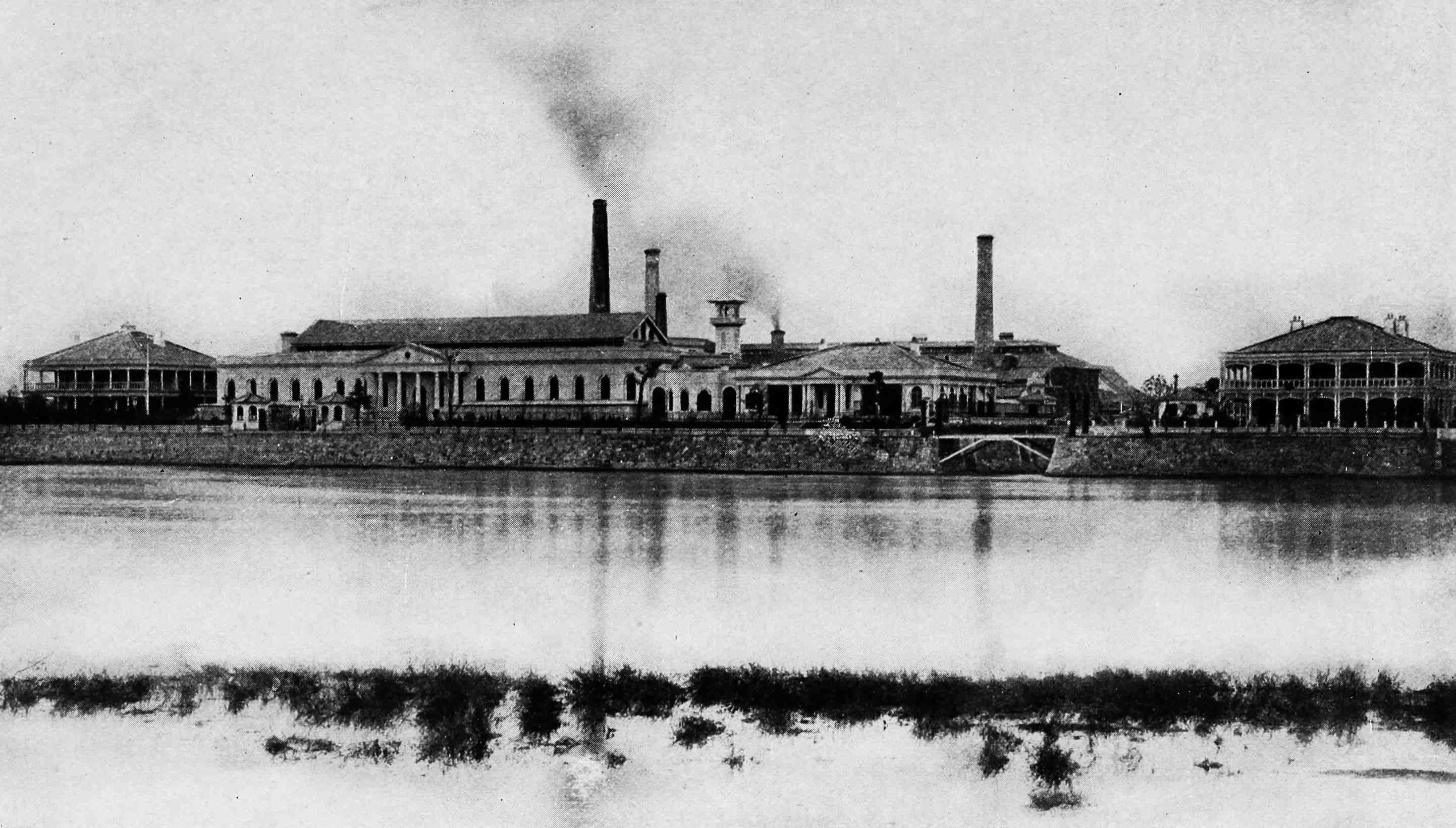
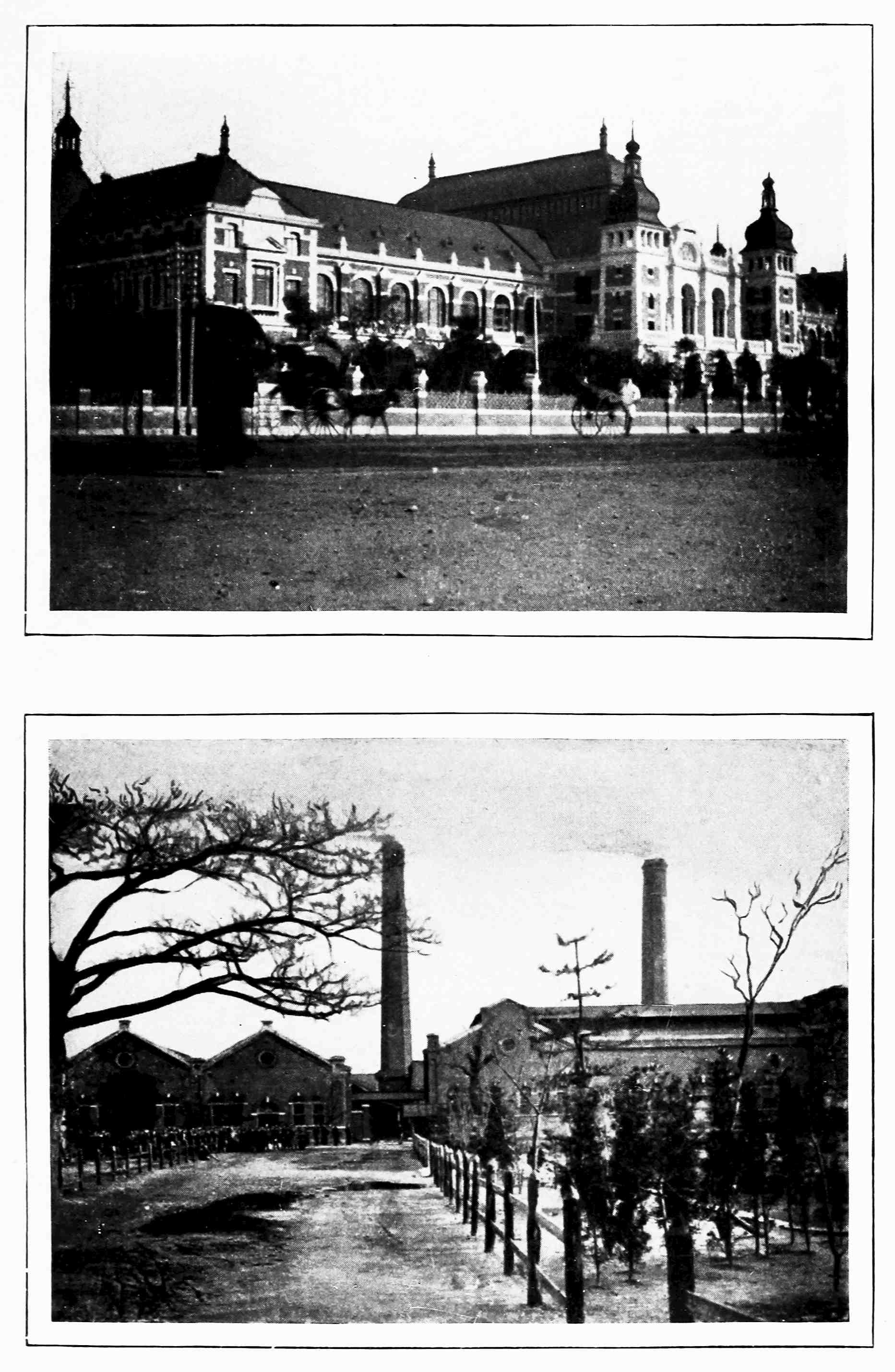
COTTON MILLS, ŌSAKA
Cotton-spinning is a comparatively new industry
in Japan, but is growing rapidly. Cotton is, of
course, the principal material for the clothing of the
common people, who cannot afford silk robes. But
Japan, though raising a great deal of cotton, cannot
supply the demand, and imports large quantities
from India and America. It is only within a short
time that cotton-spinning by machinery has become
a Japanese industry; formerly all the yarn was spun
by hand; but in 1907 there were 136 cotton-mills in
Japan. Some are very small concerns; but in Osaka,
Nagoya, and Tōkyō there are comparatively large and
flourishing mills. Ordinary workmen receive from
12 to 20 sen a day; skilled laborers make from 30 to
40 sen; girls earn from 10 to 20 sen, and children
only a few sen per day; but the stockholders receive
dividends of from 10 to 20 per cent per annum.
Since Japan acquired Formosa from China, she has
had added to her resources another very important
and valuable product, in which she possesses practically
a monopoly of the world’s market and a supply
supposed to be sufficient for the demands of the
whole world for this entire century. It has been
estimated, for instance, that the area of interior districts
in which the camphor tree is found will reach
over 1,500 miles. The camphor business of Japan
in Formosa is in the hands of a British firm, to
whom, as highest bidder, the government let out
its monopoly for a fixed term of years.23
Perhaps the most generally useful product of Japan
is the bamboo,24 which “finds a use in every size, at
all ages, and for manifold purposes,” or, as Huish
expresses it, “is used for everything.” Rein and
Chamberlain each takes up a page or more for an
incomplete list of articles made from bamboo; so
that Piggott is surely right when he states that it is
“an easier task to say what is not made of bamboo.”
Inasmuch as Japan is an insular country, with a
long line of sea-coast, it is natural that fishing should
be one of the principal occupations of the people, and
that fish, seaweed, and other marine products should
be common diet. From ancient times down to the
opening of Japan, the fishing industry was a simple
occupation, somewhat limited in its scope; but since
the Japanese have learned from other nations to what
extent marine industries are capable of development,
fishing has become the source of many and varied
lines of business. The canning industry, for instance,
is of quite recent origin, but is growing
rapidly. Whaling and sealing are very profitable
occupations. Smelt-fishing by torchlight by means
of tame cormorants was largely employed in olden
times, and is kept up somewhat even to the present
day. The occupation of a fisherman, though arduous
and dangerous, is not entirely prosaic, and, in Japan,
contributes to art. The return home of the fishing-smacks
in the afternoon is an interesting sight; and
the aspect of the sea, dotted with white sails, appeals
so strongly to the æsthetic sense of the Japanese
that it is included among the “eight views” of any
locality.
Mining is also a flourishing industry in Japan, as
the country is quite rich in mineral resources. Coal
is so extensively found that it constitutes an item of
export. Copper, antimony, sulphur, and silver are
found in large quantities; gold, tin, iron, lead, salt,
etc., in smaller quantities. Oil, too, has sprung up
into an important product.25
Engineering, perhaps, deserves a paragraph by
itself. This department in the Imperial University
is flourishing, and sends forth annually a large
number of good engineers. In civil engineering
the Japanese have become so skilful that they have
little need now of foreign experts except in the
matter of general supervision.
It is worthy of special notice that the Japanese
have become quite skilful in ship-building, so that
they now construct vessels of various kinds, not only
for themselves but for other nations. The Mitsu
Bishi Company, Nagasaki, has constructed for the
Oriental Steamship Company three fine passenger
steamers of 13,000 tons each. At the Uraga Dockyard
large American men-of-war have been satisfactorily
repaired; and on October 15, 1902, a small
United States gunboat was launched,—“the firstinstance in which Japan has got an order of shipbuilding
from a Western country.”26
Among the minor miscellaneous industries which
can only be mentioned are sugar-raising, paper-making
(there are a number of mills which are
paying well), dyeing, glass-blowing, lumber, horse-breeding,
poultry, pisciculture, ice, brick, fan, match,
button, handkerchief, pottery, lacquer, weaving, embroidery,
sake and beer brewing, soy, etc. The extent
and variety of the industries of Modern Japan
are also clearly evidenced in a short article about
“The Ōsaka Exhibition” of 1903 in the Appendix.
In what we style “the mechanical arts” the Japanese
excel, and have a world-wide reputation. With
their innate æsthetic instincts they make the most
commonplace beautiful. It is a trite saying that a
globe-trotter, picking up in a native shop a very
pretty little article, and admiring it for its simplicity
and exquisite taste, is likely to find it an ordinary
household utensil. Japanese lacquer work is distinctive
and remarkable for its beauty and strength;
lacquered utensils, such as bowls, trays, etc., are
not damaged by boiling soups, hot water, or even
cigar ashes. In porcelain and pottery, the Japanese
are celebrated for the artistic skill displayed in
manufacture and ornamentation. “The bronze and
inlaid metal work of Japan is highly esteemed.”
Japanese swords, too, are remarkable weapons with
“astonishing cleaving power.” To summarize this
paragraph, it may be said that the Japanese have
turned what we call mechanical industries into fine
arts, which display a magnificent triumph of æstheticism
even in little things.27
This chapter would be incomplete without a paragraph
concerning Japanese shops, or retail stores,
which are among the first curiosities to attract and
rivet a foreigner’s attention. The building is, perhaps,
a small, low, frame structure, crowded among
its fellows on a narrow lane. The floor is raised a
foot or so above the ground, and is covered, as usual,
with thick matting. Spread out on the floor or on
wooden tiers or on shelves are the goods for sale.
The shopkeeper sits on his feet on the floor, and
calmly smokes his pipelet, or fans himself, or in
winter warms his hands over the hibachi (fire-bowl).
He greets you with a profound bow and most respectful
words of welcome, but makes no attempt to
effect a sale, or even to show an article unless you ask
to see it. He is imperturbably indifferent whether
or not you make a purchase; either way, it is all
right. He will politely display anything you want
to see; and, even if, after making him much trouble,
you buy nothing or only an insignificant and cheap
article, he sends you away with as profound a bow
and as polite expressions as if you had bought out
the shop. Whether you buy little or much or even
nothing, you are always dismissed with “Arigatō
gozaimasu” and “Mata irasshai,” which are very respectful
phrases for “Thank you” and “Come again.”
Having dropped into “a veritable shoppers’ paradise,”
you will quickly “find yourself the prey of an
acute case of shopping fever before you know it!”
It is, indeed, true, to quote further from this same
writer, that “to stroll down the Broadway [known as
the Ginza] of Tokio of an evening is a liberal education
in every-day art.”28
From what has already been written, it is easily
noticeable that wages and incomes, like so many
things in petite Japan, are insignificant. It may be
added that ordinary mechanics earn on an average
over 50 sen a day, and the most skilful seldom get
more than double that amount; that carpenters earn
from 70 to 100 sen a day; that street-car drivers and
conductors receive 12 or 15 yen per month, and other
workmen of the common people about the same.
Even an official who receives 1,000 yen per year is
considered to have a snug income. It will be inferred
from this that the cost of living is proportionately
cheaper, whether for provisions or for shelter
or for clothes, and that the wants, the absolute necessities,
of the people are few and simple. Literally
true it is, that a Japanese man “wants but little here
below, nor wants that little long.” With rice, barley,
sweet potatoes, other vegetables, fish, eggs, tea,
and even sweetmeats in abundance and very cheap,
a Japanese can subsist on little and be contented and
happy with enough, or even less than that. But,
unfortunately, the new civilization of the West has
carried into Japan the itch for gold and the desire for
more numerous and more expensive luxuries, and has
increased the cost of living without increasing proportionately
the amount of income or wages.29
Industrial Japan has already become more or less
modified by features of Occidental industrialism,
such as guilds, trade unions, strikes, co-operative
stores. It is true that feudal Japan also had guilds,
which are, however, now run rather on modern lines.
One of the oldest, strongest, and most compact is
that of the dock coolies, who without many written
rules are yet so well organized that they have
almost an absolute monopoly, with frequent strikes,
which are always successful. Others of the guilds
are those of the sawyers, the plasterers, the stonemasons,
the bricklayers, the carpenters, the barbers,
the coolies (who can travel all over the empire without
a penny and live on their fellows), the wrestlers,
the actors, the gamblers, the pickpockets, etc. The
beggars’ guild is now defunct. The labor unions
of modern days include the iron-workers, the ship-carpenters,
the railway engineers, the railway workmen,
the printers, and the European-style cooks.
The last-mentioned is one in which foreigners resident
in Japan necessarily take a practical interest!
The only unions which have become absolute masters
of the situation are those of the dock coolies, the
railway laborers, and the railway engineers. As for
co-operative stores, there are a dozen or more in
Tōkyō, Yokohama, and Northern Japan.
The perfect organization of these modern unions
is due largely to the efforts of a young man named
Sen Katayama, who is the champion of the rights
of the laboring man in Japan. He spent ten years
in America and made a special study of social problems.
He is the head of Kingsley Hall, a social
settlement of varied activity in the heart of Tōkyō,
and editor of the “Labor World,” the organ of the
working classes. That the changes rapidly taking
place in the industrial life of Japan will raise up
serious problems, there is no doubt; what phases they
will assume cannot be foreseen. But “socialistic”
ideas are carefully repressed in modern Japan.
“Japan and its Trade” and “Advance Japan” (Morris);
“The Yankees of the East” (Curtis); “Japan in Transition”
(Ransome), chap. x.; “The Awakening of the East” (Leroy-Beaulieu),
chaps. iv. and v.; “Dai Nippon” (Dyer), chaps.
viii. and xi.; and especially Rein’s “Industries of Japan,” in
which the subject is treated in great detail with German thoroughness.
But to keep pace with the rapid progress along industrial
and commercial lines, one really needs current English
newspapers and magazines, such as are mentioned in the chapter
on “Language and Literature.” The reports of the British
and United States consular officials are also very useful in this
respect.
“The Japan Year Book,” issued annually, is a veritable
cyclopedia of important facts and figures.
CHAPTER III TRAVEL, TRANSPORTATION, COMMERCE — BIBLIOGRAPHY.
Outline of Topics: Travelling in Old Japan; vehicles of Old
and New Japan; jinrikisha; railway travel; telegraph and telephone;
street-car, bicycle, and automobile; steamships.—Postal
system.—Oil, gas, and electric light.—Foreign commerce; variety
of imports.—Mixed corporations.—Stock and other exchanges.—Banking
system; coinage; monetary standard.—Baron Shibusawa
on business ability of Japanese, prospects of industrial and commercial
Japan, and financial situation.—Bibliography.
ONE of the most common and most important
indications of a great change in the life and
civilization of Japan is to be seen in the
improved modes of travel and transportation. The
ancient method, though in some sections pack-horses
and oxen were used, was essentially pedestrian. The
common people travelled on foot, and carried or
dragged over the road their own baggage or freight.
Couriers, carrying the most important despatches,
relied upon fleetness of foot. The higher classes and
wealthy people, even though not themselves making
any exertions in their own behalf, were carried about
in vehicles by coolies, who, with their human burdens,
tramped from place to place. On water, too, travel
and transportation depended mostly upon human muscular
exertion, as all boats, small or large, had to be
propelled by oars or poles, except when favored with a
breeze to swell the sails and allow the boatmen a respite
from their toil. But all this hard labor developed, of
course, a strength of limb and a power of endurance
that even in recent years have enabled the Japanese
soldiers to march and fight in either the piercing cold
and deep snow of Manchuria or the blistering heat
of Formosa. A life of constant outdoor exposure to
wind, rain, cold, or heat has toughened and browned
the skin, and made an altogether hardy race out of the
common people; while the lack of this regular exercise
and calisthenic training has left its mark in the comparatively
weak constitutions of those who travelled,
not on their own feet, but on the shoulders of others.
The common vehicles of the olden days were
ordinary carts for freight and norimono and kago for
passengers. The norimono is a good-sized sedan-chair
or palanquin, in which the rider can sit in a fairly
comfortable position. The kago is a sort of basket in
which the traveller takes a half-sitting, half-reclining
posture, not altogether comfortable—at least for tall
foreigners. At present the norimono is seldom if
ever employed except for corpses or invalids, but
the kago is still used in mountainous regions, where
nothing else is available. It must be understood, of
course, that the nobles and their retainers often
rode on horseback; but the great mass of the people
walked and the few rode in kago or norimono.
Now, however, modes of travel have changed
greatly, and are changing year by year. There are
still many pedestrians; the kago is yet to be seen;
boats are propelled by stern-end oar or laboriously
pushed along with poles; and pack-horses and oxen—even
in the streets of Tōkyō—are in frequent use.
But there are many other means of communication
and transportation. There have come into use the
horse-car, the stage, the jinrikisha, the railroad, with
the telegraph and the telephone; the modern row-boat,
the steamboat; the bicycle, the automobile, and
the electric railway, with the electric light to show
the road by night. An excellent postal system and
various other modern contrivances for facilitating the
means of communication have been adopted.
The most common mode of conveyance at present, in
all possible localities, is the jin-riki-sha (man-power-carriage),
or “Pull-man car,” as it has been wittily
called. This is a two-wheeled “small gig,” or large
baby-carriage, pulled by one or more men. A ride in
a jinrikisha, after one has become accustomed to
human labor in that capacity, is really comfortable
and delightful. The coolies who pull these vehicles
develop swiftness and endurance, but are comparatively
short-lived. There is also a two-wheeled
freight cart manipulated in the same fashion. It
has been estimated that in the Empire there are
almost 1,350,000 hand-carts, about 185,000 jinrikishas,
about 28,000 ox-carts, more than 66,000 other
freight carts, and almost 100,000 carriages and
wagons. The business of transportation thus furnishes
occupation to thousands of people, but gives
to each engaged therein only a scanty remuneration,
which is often insufficient for the support of life, after
the tax has been paid. The fee for a jinrikisha ride
averages about 12 or 15 sen per ri (2½ miles), or varies
from 20 to 30 sen per hour. If a coolie makes 50 sen
in one day, he is fortunate, and is lucky to average 25
or 30 sen per day; for some days he may be wearily
waiting and watching from dawn to the dead of night
without receiving scarcely a copper. Hard, indeed,
is their lot; and their death rate is rather high.30
But even the jinrikisha will eventually be supplanted
for long journeys wherever a railroad goes.
There are now in Japan over 6,000 miles of railway,
and in Korea and South Manchuria there are 641
and 706 miles more. There is one continuous line of
railroad from Aomori in the extreme north to Shimonoseki
in the extreme south of the main island, and
then, after crossing the Straits of Shimonoseki, there
is another unbroken line from Moji to Nagasaki and
Kagoshima or Kumamoto. In the island of Yezo
(Hokkaidō) is a short line built by American engineers
after American models; but all other railroads in
Japan were built and are operated according to the
British methods. The rate of fare is 1 sen per mile for
third class, 2 sen for second class, and 3 sen for first
class, and the rate of speed rarely exceeds 20 or 25 miles
per hour; but fortunately the people are not in such
a hurry as Americans. Recently, however, express
trains, running at the rate of 30 or more miles per
hour, have been started on several of the roads, especially
between large and important places. Dining-cars
and sleeping-cars, too, may be found on some of
the lines; and the American check system is used for
baggage. The government owns most of the railways;
in 1906, the Twenty-second Diet adopted a bill
for buying up the seventeen largest private lines.
This may have been desirable from a strategic point of
view; but from the business standpoint it was not advisable,
for the government lines are not so well managed.
The best line in the country was a private one, the
Sanyō Railway Company, operating west from Kōbe.31
Railroads have been naturally accompanied, and
often preceded, by telegraph lines, which now keep
the various parts of the empire in close communication
with Tōkyō and with each other. During 1910
the telegrams numbered over 28,000,000, and are
increasing rapidly in number every year. The
Japanese syllabary has lent itself easily to a code
like the Morse Code.32 Telephones, too, have been
introduced and are growing in favor so rapidly that
the government cannot keep up with the petitions for
installation. According to the latest reports, there
were over 100,000 telephones in all Japan. There
are many public slot telephones, which can be used
for a few minutes for 5 sen.
Horse-cars are largely used in cities, but are being
gradually supplanted by electric cars. The bus in
the city and the stage in the country are in common
use, but cannot be recommended for comfort.
Bicycles are very popular, and are cheaply manufactured
in Japan; even Japanese women have begun to
ride, while young men are very skilful as trick riders
and rapid as “scorchers.” Automobiles also are
coming into a limited use.
In a country where formerly no ships large enough
to make long voyages were allowed to be made, steamship
companies are now flourishing. The Ōsaka
Shōsen Kwaisha (Osaka Merchant Marine Company)
is a very large and prosperous corporation,
whose business is chiefly coasting trade, but which
also runs to Formosa, the Ryūkyū Islands, the Bonin
Islands, Korea, China, and America. The largest
steamship company in Japan, and one of the largest
in the world, is the Nippon Yūsen Kwaisha (Japan
Mail Steamship Company). It has a fleet of 88
vessels with 300,000 tons; and maintains not only
a frequent coasting service, but also several foreign
lines, to Siberia, Korea, China, India, Australia,
Europe, and America. This is the line which runs
fortnightly from Seattle to Hongkong with excellent
passenger accommodations. The Tōyō Kisen
Kwaisha (Oriental Steamship Company) is a Japanese
organization with three fine vessels running
about once a month from San Francisco to Hawaii,
Japan, China, and Manila. The word Maru33 in such
combinations as “America Maru” or “Kaga Maru” is
a special suffix always attached to the name of a ship.
In Old Japan there was no official postal system,
and letters were despatched by private messengers
and relays of couriers. When Japan was opened to
the world, some of the foreign nations represented
there maintained special post-offices of their own, but
these were gradually abandoned. It was in 1872 that
the modern postal system of Japan was organized on
American models; and it was only five years later
when Japan was admitted to the International Postal
Union. The twenty-fifth anniversary of this event was
celebrated with great éclat in Tōkyō in 1902. The
Japanese postal system has been gradually improved
during its quarter-century of existence, so that in some
respects it excels its model, the United States postal
system, and is really one of the most efficient in the
world. It includes registration, money orders, parcel
post, reply postal cards, postal savings,34 and universal
free delivery. Letter postage is 3 sen within the
empire and 10 sen to all countries of the International
Postal Union; postal cards are 1½ and 4 sen respectively.
We also beg leave to remind Americans that
letter postage to Japan is not 2 cents, but 5 cents, per
ounce.
Oil is most extensively used for lighting purposes;
but gas and electricity are also employed, and bring
good dividends to companies furnishing such illumination.
A very large amount of oil has been annually
imported from the United States and Russia; but as
rich fields have been found in Northern Japan,35
the Standard Oil Company is also interested in a
Japanese corporation, the International Oil Company,
organized to work Japanese fields. Foreign capital
has also been invested in the Ōsaka Gas Company,
and is sought by the Tōkyō Gas Company, as well as
by several electric and steam railway companies. The
first buildings erected for the Imperial Diet were
supplied with electric lights, but caught fire in some
way, and were totally destroyed. This calamity was
laid at the door of a flaw in the electric lighting
apparatus, and so frightened the Emperor that he
decided not to use the electric lights in the palace;
but if my memory serves me rightly, after one or
two nights of imperfect and unsatisfactory lighting,
he resorted once more to electricity.
The foreign trade of Japan had increased from
$13,123,272 in 1868 to $265,017,161 in 1902,—twenty-fold
in a third of a century.36 Of recent years
the imports have been larger than the exports; in
1898 they were more than $55,000,000 in excess; in
1900, almost $41,500,000 in excess; but in 1901 the
difference was only about $1,750,000. The chief
articles of export are silk (either raw, or partly or
wholly manufactured), cotton yarn and goods, matches,
coal, high-grade rice, copper, camphor, tea, matting,
straw braid, and porcelain. The principal imports
are raw cotton, shirting and printed cotton, mousseline,
wool, cotton velvet, satin, cheap rice, flour,
sugar, petroleum, oil cake, peas and beans, machinery,
iron and steel (including nails and rails), steamers,
locomotives, and railway carriages. The exports are
sent chiefly to the United States, Great Britain and
colonies (especially Hongkong), China, and France;
while the imports come mostly from Great Britain
and colonies (especially England, India, and Hongkong),
the United States, Germany, France and colonies,
and China.
The variety in the geographical distribution of the
imports of Japan may be faintly illustrated by the following
partial list of supplies taken by an American
family from Tōkyō to the summer resort of Hakone:
soap from England and America, cocoa from England,
butter from California, cornstarch from Buffalo, N. Y.,
Swiss milk, Holland candles, pickles from England,
Scotch oatmeal, American rolled oats and cracked
wheat, flour from Spokane Falls, Washington, canned
goods from San Francisco, Kansas City, Chicago, and
Omaha, and evaporated cream from Illinois.
The first mixed corporation, composed of Japanese
and foreigners, to be licensed under the new Commercial
Codes after the new treaties went into effect in 1899,
was the Nippon Electric Company, in which a large
electric company of Chicago is specially interested.
Japan has several stock exchanges and chambers
of commerce in various localities, and these are all
under the strictest supervision and close restrictions.
It was in 1872 that National Bank Regulations were
first issued, and a few banks were established; but in
1876 it was found necessary to make radical amendments
in those regulations in the way of affording
greater facilities for the organization of banks. The
result was that by 1879 there were 153 national banks
in the country; and in 1886 the further organization
of national banks was stopped. In the mean time the
Yokohama Specie Bank had been organized (in 1880)
for the support of the foreign trade; and (in 1882)
the Bank of Japan (Nippon Ginkō) had been organized
to “secure proper regulations of the currency.”
In 1897 the Industrial Bank, and later provincial
agricultural-industrial banks were organized to give
special banking facilities to local agricultural and industrial
circles. The Bank of Formosa, the Colonial
Bank of Hokkaidō, and a Credit Mobilier complete the
list of official institutions. By 1899 all the national
banks had either been changed into private banks or
had gone out of existence. Private banks number
almost 1,700, of which the Mitsui, the Mitsubishi, the
Hundredth, the Sumitomo, the Fifteenth (Nobles’),
the First, and the Yasuda are the strongest. Savings-banks
are also quite numerous (652), and are helping
to develop habits of thrift and economy among the
common people.37
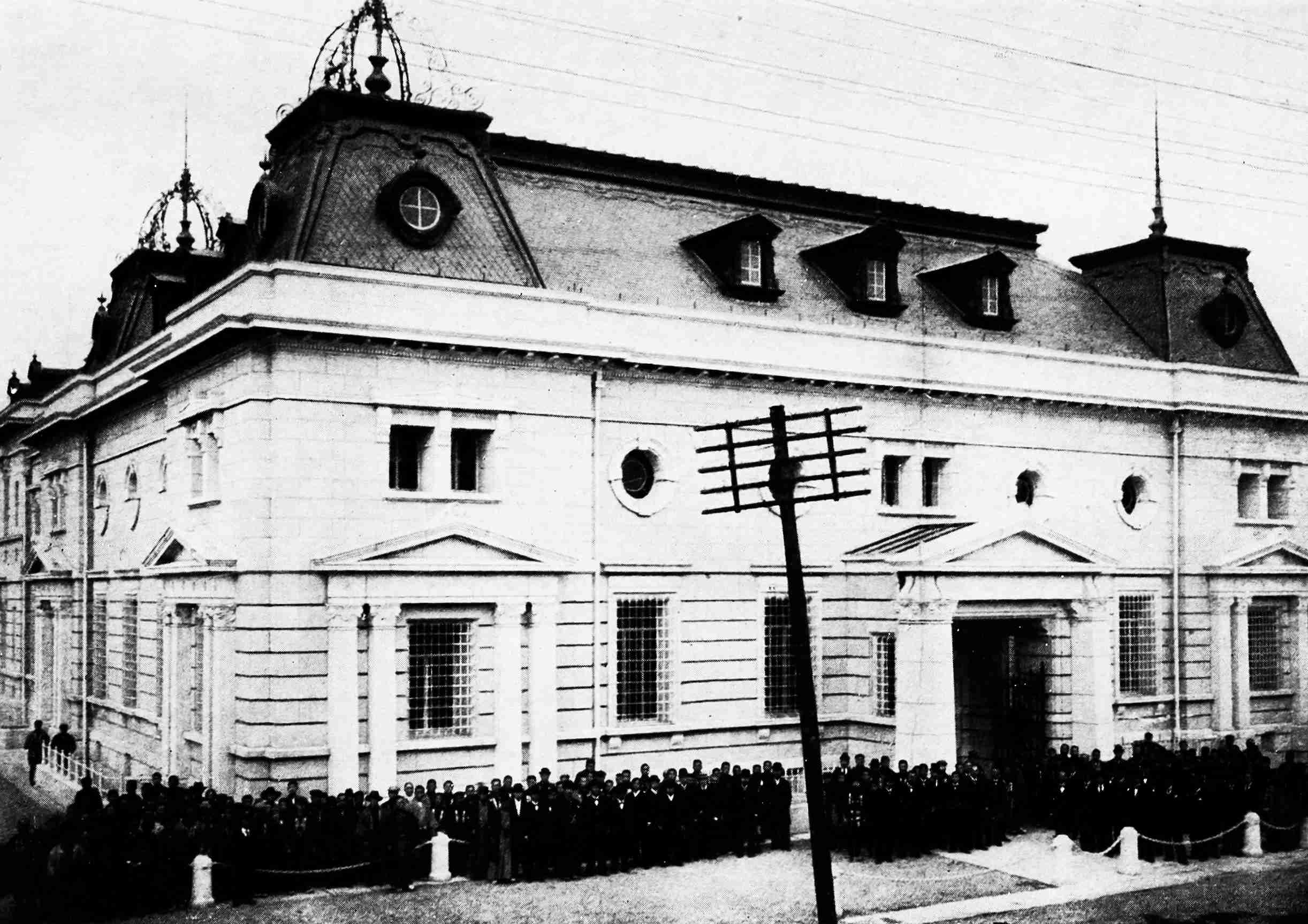
FIRST BANK, TŌKYŌ
The first Japanese mint was established at Ōsaka
in 1871, and has been actively at work ever since;
and there is an institution in Tōkyō for the manufacture
of paper money. The coins now chiefly used the
copper, nickel, silver, and gold; but in the country
districts it is still possible to find brass coins of less
than mill values. The copper pieces are ½ sen (5 rin),
1 sen, and 2 sen; the 5 sen piece is the only nickel
coin; the silver pieces are 5 sen, 10 sen, 20 sen, and
50 sen; and the gold coins are 5 yen, 10 yen, and 20 yen.
There are also paper notes of 1 yen and upward:
these are issued only by the Bank of Japan, and
amounted in 1910 to over 400,000,000 yen.
In 1897 Japan adopted the gold standard, so that
exchange fluctuations with the Occident are slight,
and the Japanese currency has a fixed value, at the
rate of about 50 cents for the yen.38
Concerning the prospects of industrial and commercial
Japan, it may be well to note the views39 of
Baron Shibusawa, one of the foremost of Japanese
merchants and financiers. In referring to the capacity
of the Japanese for business, the Baron says:—
“There are, however, four peculiarities in the Japanese
character which make it hard for the people to achieve
business success. These are: Firstly, impulsiveness,
which causes them to be enthusiastic during successful
business and progressive even to rashness when filled
with enthusiasm; secondly, lack of patience, which
causes easy discouragement when business is not so successful;
thirdly, disinclination for union; and fourthly,
they do not honor credit as they should, which is so important
a factor in financial success. These four peculiarities
are to be met with in Japanese business men in
a more or less marked degree.
“Although Japan, as a country, is old, yet her commercial
and industrial career being new, there are necessarily
many points of incompleteness. For example,
although we have many railways, yet there is no close connection
made between the railway station and the harbor.
Again, although we have railways, yet we have no appropriate
cars, etc. To complete such work and to open
up the resources of the country, and to allow Japan to
benefit from them, we need more capital. The capital
we have in the country is not enough. So what is now
wanted in Japan is foreign capital. A great proportion
of the Japanese people, however, are opposed to the
idea of sharing any profits equally with any other nation.
Their exclusiveness in this respect is a distinct
relic of the old era. They ignore altogether the fact
that, with the assistance of foreign capital, the profits
would be quadrupled. The very idea of sharing with an
outside power is distasteful to them. For instance, I
have been endeavoring for many years by word and deed
to obtain a revision of the laws relative to the ownership
of land in Japan by foreigners. I may say that Marquis
Itō and other public men are of my opinion in the matter.
Because, however, of this exclusive element in
Japan, it has still been found impossible to allow foreigners
to own Japanese land. Until this change is
made, foreign investors will naturally feel that there is
little safety for their investments.
“I am also anxious to introduce the idea of a system
of trusteeship in order to encourage foreign nations to
invest their money in Japanese enterprises. There are
very many uncompleted works in Japan, which need outside
money to finish them and which would return good
profits. I feel assured that it would be possible for
prominent Japanese bankers and capitalists to make
themselves personally responsible for the money of the
foreign investor. By such a system the security of the
investment would be much increased, and the foreign
investor would have the assurance that his money was
safe, even if the business in which it had been invested
may have ceased to exist. The entire loss caused by
the failure of Japanese business enterprises would thus
be borne by the Japanese.
“The day will come when Japan will compete with the
powers already in the field on all lines of manufactured
goods, but this time must necessarily be far distant. The
trouble at present is that, while the Japanese can imitate
everything, they cannot, at the same time, invent superior
things. But the trade of the Oriental countries
will come to be regarded as Japan’s natural share, and
she is already well capable of supplying it.
“The resources of Japan are very varied and very fair
in quantity at present. Raw silk and tea are abundant,
while coal is plentiful, as also copper and silver; gold is
not so much so. I hope to see our plentiful water supply
turned into good account and harnessed to produce
electric energy. This would be a great saving of expense
and would cheapen the cost of production very
much. Oil has been found in several districts and will
take the place of coal to a large extent, and it is possible
that if fully developed its export trade may be made to
the neighboring countries. In Hokkaidō we have rich
coal and silver mines and oil wells, while in Formosa
we have rich gold mines. The iron we use in our iron
works in Kiūshiu comes partly from several mines of
Japan and partly from China.
“My hope for the future is that foreign capital may be
brought into the country and that the economic position
of the country may be made so secure as to leave no
doubt possible in the mind of the world as to the stability
of the Japanese Empire.”
We also take pleasure in quoting the same high
authority upon the subject of the present financial
situation in Japan, as follows:40—
“The present financial difficulty in Japan is only the
natural sequence of the over-expansion of business of
some years ago. In every country there are waves of
prosperity followed by periods of depression. I have
known, in the economic history of Japan since the
Restoration, five or six such waves. They do not necessarily
injure the real financial standing of the country.
The peculiarities of the Japanese business character
have much to answer for in the way of increasing the
appearance of financial insecurity during the times of
depression. After the prosperous times of 1893 came
the war with China and the subsequent indemnity.
Much of the money paid by China was spent in Japan,
and the Japanese people came to the conclusion that this
increased circulation of money would be permanent.
They acted impulsively in many enterprises, and rushed
into all kinds of business because the government had
over-expanded its enterprises after the war. The depression
reached its height in 1900 and 1901, and businesses
were abandoned or reduced because it was not
such easy work as formerly. By proper management
our national income can be made still greater than our
expenditure.”
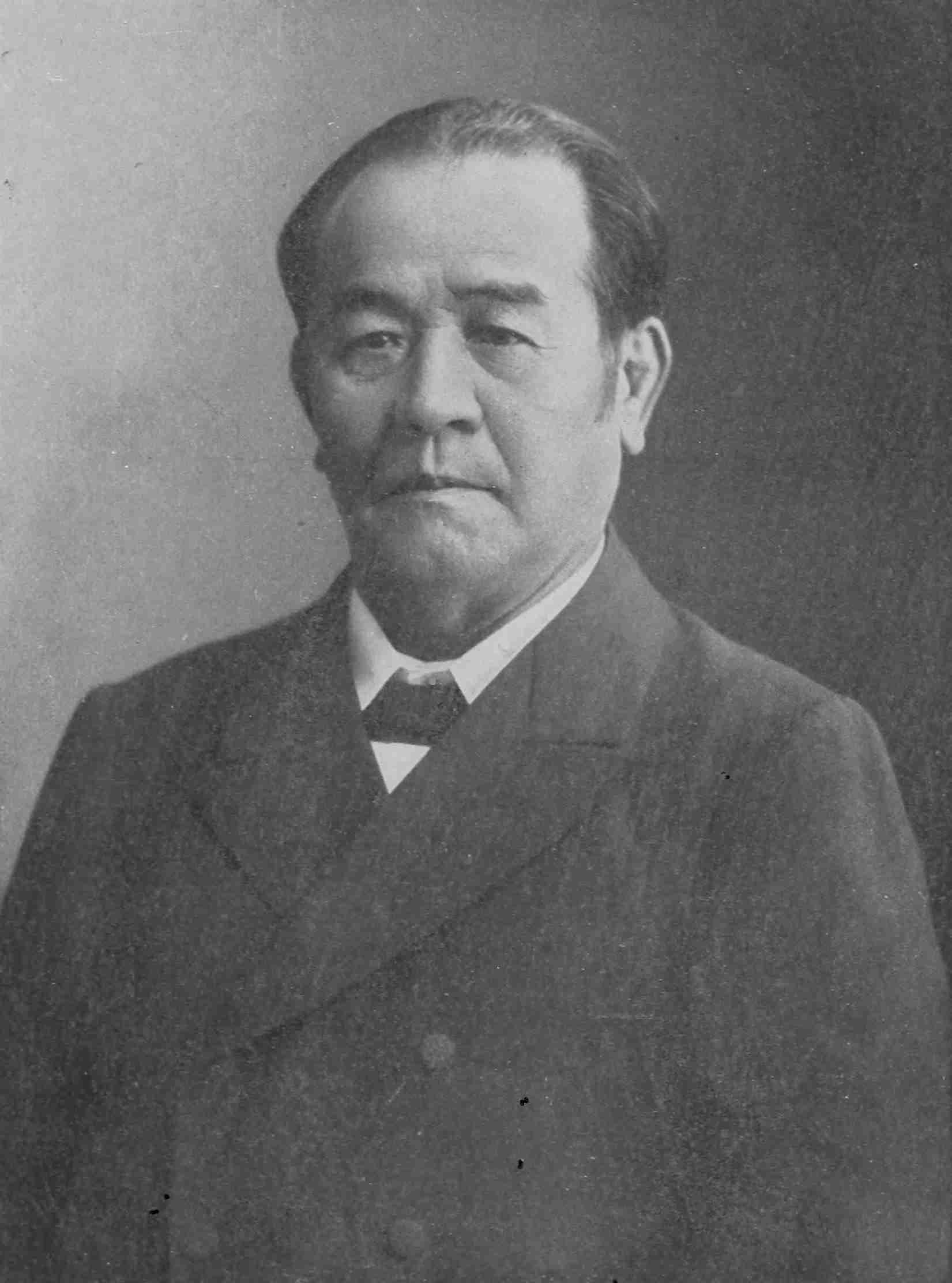
BARON SHIBUSAWA
The national debt of Japan January, 1913, was more
than 2,500,000,000 yen ($1,250,000,000), of which almost
1,500,000,000 yen ($750,000,000) was in foreign loans.
For interesting accounts of travel when and where modern
conveniences were not available, read “Unbeaten Tracks in
Japan” (Bird); “The Mikado’s Empire” (Griffis); “Noto,
an Unexplored Corner of Japan” (Lowell); “Glimpses of
Unfamiliar Japan” (Hearn); and papers in the Transactions
of the Asiatic Society of Japan. For similarly interesting
accounts of travel with modern conveniences read “Jinrikisha
Days in Japan” (Scidmore); “Japan and her People” (Hartshorne);
“The Yankees of the East” (Curtis); “Japan To-day”
(Scherer); “Every Day Japan” (Lloyd).
On the industrial and commercial phases of these topics,
consult books, papers, magazines, and pamphlets mentioned in
the bibliography of the preceding chapter; especially, for the
latest statistics, “The Japan Year Book.”
CHAPTER IV PEOPLE, HOUSES, FOOD, DRESS — BIBLIOGRAPHY.
Outline of Topics: Ainu; ethnology; two types; comparative
stature and weight; intellectual and moral qualities.—Classes
in society of old and new régimes; social principle.—Family and
empire.—Houses; public buildings; rooms; foreign architecture.—Gardens.—Food;
meals; table manners; foreign cooking.—Undress
and dress; European costume.—Bathing.—Bibliography.
WHO were the aborigines of Japan is yet a
disputed question. Remains have been
found of a race of dwarfs who dwelt in
caves and pits, but who these people were is not
positively known. They may have been contemporary
with the Ainu, whom many call “the aborigines
of Japan.” It is certain, however, that the Ainu
were once a very numerous nation, “the members
of which formerly extended all over Japan, and were
in Japan long before the present race of Japanese.”
But the latter gradually forced the former northward,
until a final refuge was found in Yezo and the Kurile
Islands. There the Ainu are now living, but are
slowly dying out as a race; there are at present only
about 17,000 remaining. They are said to be “the
hairiest race in the whole world,” “of sturdy build,”
filthy in their habits (bathing is unknown), addicted
to drunkenness, and yet “of a mild and amiable disposition.”
Their religion is nature-worship.41
It is well known that the Japanese are classed
under the Mongolian (or Yellow) Race. They
themselves boastfully assert that they belong to
the “golden race,” and are superior to Caucasians,
who belong to the “silver race”! As Mongolians,
they are marked, not only by a yellowish hue, of
many shades from the darkest to the lightest, but
also by straight black hair (rather coarse), scanty
beard, rather broad and prominent cheek-bones, and
eyes more or less oblique. Some think that the
Japanese people show strong evidences of Malay
origin,42
and claim that the present Emperor, for instance,
is of a striking Malay type. It is not impossible,
nor even improbable, that Malays were
borne on the “Japan Current” northward from
their tropical abodes to the Japanese islands; but
there is no historical record of such a movement.
Therefore the best authorities, like Rein and Baelz,
do not acknowledge more than slight traces of
Malay influence. A more recent theory concerning
the origin of the real Japanese—or Yamato men, as
they called themselves—is that they are descendants
of the Hittites, whose capital was Hamath, or Yamath,
or Yamato!
There are two distinct types of Japanese: the
oval-faced, narrow-eyed, small aristocratic class;
and the pudding-faced, full-eyed, flat-nosed, stout
common people. Of these, the latter is the one
claimed to be Malay. The plebeians, having always
been accustomed to hard labor by the sweat of the
brow, are comparatively strong; the others, having
been developed by centuries of an inactive life, have
inherited weak constitutions. Indeed, the people, as
a whole, are subject to early maturity and early decay.
There is a Japanese proverb to this effect: “At ten,
a god-like child; at twenty, a clever man; from twenty-five
on, an ordinary man.” And, in spite of the fact
that there have been remarkable exceptions to this
rule, careful investigation by Japanese supports the
truth of the proverb. And yet there seems to be no
doubt that modern education and conditions of life
show a gradual improvement in this respect.
GROUP OF COUNTRY PEOPLE
The average Japanese, compared with the average
European or American, has a lower stature43 with a
long body and short legs. A good authority states
that “the average stature of Japanese men is about
the same as the average stature of European women”;
and that “the [Japanese] women are proportionately
smaller.” Some one has wittily called the Japanese
“the diamond edition of humanity.”
The Japanese also weigh much less than Europeans.
The average weight of young men of twenty
years of age in Europe is about 144 pounds, while
the average weight of the strongest young men of
the suburban districts of Tōkyō was only about 121
pounds; which gives the European an advantage of
23 pounds.
The Japanese are very quick to learn. Their
minds are strong in observation, perception, and
memory, and weak in logic and abstraction. As
born lovers of nature, they have well-trained powers
of observation and perception, so that their minds
turn readily to scientific pursuits. And as the ancient
Japanese system of education followed Chinese
models, the power of memorizing by rote has been
strongly developed, so that the Japanese mind has
little difficulty in becoming a storehouse of historical
and other facts. But, as the powers of reasoning
and abstraction have not been well trained, the
Japanese do not take so readily to mathematical
problems and metaphysical theorems.
The typical Japanese is loyal, filial, respectful,
obedient, faithful, kind, gentle, courteous, unselfish,
generous.44 His besetting sins are deception, intemperance,
debauchery,—and these are common sins
of humanity. In respect to these evils, he is unmoral
rather than immoral; and in his case these
sins should not be considered so heinous as in the
case of one who has been taught and knows better.45
And it is with reference to these very evils that
Shintō, Buddhism, and Confucianism have been a
complete failure in Japan, and that Christianity is
making its impress upon the nation.
There never were distinct and rigid castes in Japan,
as in Egypt and India, but formerly there were four
classes in society. These were, in order, the official
and military class; the agricultural class, or the
farmers; the laboring class, or the artisans; and the
mercantile class, or merchants. Above all these were
the Emperor and the Imperial family; below all these
were the tanners, grave-diggers, beggars, etc., who were
the Japanese pariah, or outcasts. The first class included
the court nobility, the feudal lords, and their
knights; they alone were permitted to carry two
swords, were exempt from taxation, and were also
the special educated and literary class, because they
had the most leisure for study. The other three classes
together constituted the common people, who were
kept in rigid subjection and bled profusely by taxes.
Under the present régime there are three general
classes of the entire population of Japan: the nobility,
the gentry, and the common people. The
nobility, created in 1884, comprises five orders:
prince, marquis, count, viscount, and baron; the
gentry are the descendants of the knights (samurai)
of the old first class; the common people include all
the rest of the population. By the census of 1903
the nobility numbered 5,055; the gentry, 2,168,058;
and the common people, 44,559,015. (These figures
are exclusive of Formosa.) Even now the burden
of taxation falls upon the mass of the common
people, especially upon the farming class, for the
land tax is the most important source of revenue in
Japan.
The fundamental principle of Japanese society was,
and still is, reverent obedience to superiors. This
polite and humble deference is exhibited in their
language and in their manners and customs, and has
become so thoroughly incorporated into their natures
that it even yet resists the levelling tendency of the
present age. The language is full of honorifics to
be applied to or concerning another, and of humilifics
to be applied concerning self. I and mine are thus
always ignorant, stupid, dirty, homely, insignificant,
etc., while you and yours are ever intelligent, wise,
clean, beautiful, noble etc. Perhaps there is nothing
that causes the student of the vernacular deeper
chagrin than to find that he has made so serious an
error as to transpose the humble and the honorific
words or phrases! The ordinary salutation is really
an obeisance, as it consists of a profound bow,—on
the street with body bent half forward, in the house
with forehead touching the floor. This deep and
universal feeling of reverence for superiors and elders
early developed into worship, both of the family and
of the national ancestors. This is the fundamental
and central idea of Shintō, the native cult, of which
more will be written in a subsequent chapter.
The Japanese family46 was, in its constitution, an
empire, with absolute authority in the hands of one
man. The husband was, theoretically and practically,
the great authority to whom wife and children
were subject. He was a veritable autocrat and
despot; and he received superciliously the homage
of all the family, who literally bowed down before
him. The family, and not the individual, was the
unit of society; but by the new codes now in operation
the individual has acquired greater rights. There
is much hope, therefore, that gradually the tyranny
of the family will be eliminated.
One writer on Japan has well said: “The Empire
is one great family; the family is a little empire.”47
In truth, the empire is founded and maintained on
the family idea of one line “in unbroken succession”
from Jimmu Tennō.
A house alone does not make a “home,” but
merely gives it local habitation; and as Japanese
houses48 are unique, they deserve some consideration.
Although brick and stone are coming into use among
the wealthy classes, wood is the chief material employed
in building. A typical Japanese house is a
slight and flimsy frame structure with straw-thatched,
or shingled, or tiled roof. It has no foundation in
the ground, but rests on stones laid on the ground,
and stands wholly above the surface. This and other
peculiar features of construction and ornamentation
are the outcome of attempts to lessen the dangers
from the frequent and severe earthquakes. The
outer doors and windows of Japanese houses are
called amado (rain-doors), and are solid wood.
They slide in grooves above and below; in stormy
weather and at night they are closed and fastened,
not so tightly, however, as to prevent them from
rattling; at other times they are open. The inner
doors, the windows, and sometimes the partitions
between the different rooms are lattice frames, covered
with a translucent, but not transparent, white
paper, and running in grooves. These, too, as well
as the opaque paper screens used between the rooms,
can be taken out; so that all the rooms may be turned
into one, or the entire house be thrown open to the
air of heaven. The floors are covered with tatami—thick,
soft mats of straw, each usually six by three
feet in size. Thus the accommodations of rooms are
indicated by the terms, “six-mat room,” “eight-mat
room,” etc. Inasmuch as on these mats the Japanese
walk, sit, eat, work, sleep, it is necessary to keep
them very clean. They are carpet, chair, sofa, bed,
table, all in one, and must not be soiled by dirty
sandals, clogs, shoes, or boots, all of which are,
therefore, to be removed before entering a house.
It may readily be seen that this is quite an inconvenient
custom for foreigners!
Schools, churches, offices, stores, and other places
for large and frequent public gatherings are being
constructed in Occidental style, with doors on
hinges, glass windows, chairs, benches, tables, stoves,
grates, and other “modern conveniences.”
A room in a Japanese house seems to an American
to be comparatively bare and plain, as it is devoid
of furniture and bric-à-brac. There is no stove, for
only a small box or brazier, containing a few pieces
of charcoal in a bed of ashes, is used for heating
purposes. There are no chairs or sofas, for the
Japanese sit on their feet on the floor. There are
no huge bed sets, for they sleep on thick padded
quilts spread on the floor at night, and kept in a
closet when not needed. There is no large dining-table,
for each person eats sitting before a small, low
lacquer tray, or table, about a foot high. There is
no dazzling array of pictures and other ornaments on
the wall—only a kakemono (wall banner) or two;
and there are no miscellaneous ornaments set around
here and there—only a vase of flowers.
But more and more are the Japanese coming to
build at least parts of the house in Occidental style,
so that it is now quite common to find, in houses of
well-to-do people, a foreign room with carpet, table,
chairs, pictures, etc. Stoves and grates, too, for
either wood or coal, are being largely used. Mattresses,
springs, and bedsteads are also coming into
use, because sleeping on the floor, where one is
subject to draughts, has been found to be unhealthy.
In the case of foreign rooms, moreover,
it is generally unnecessary to take off the shoes;
and thus another frequent cause of colds is removed.
A prevailing style of architecture at present
is the hybrid!
The best rooms of a Japanese house are not in the
front, but in the rear, and have an outlook upon the
garden, which likewise, from its plainness and simplicity,
is unique. “Its artistic purpose is to copy
faithfully the attractions of a veritable landscape,
and to carry the real impressions that a real landscape
communicates. It is, therefore, at once a picture
and a poem; perhaps even more a poem than a
picture.” It is in Japan, moreover, that it is possible
to have a “garden” without flowers or grass—with,
perhaps, only “rocks and pebbles and sand.”
For the Japanese truly and literally find “sermons in
stones,” and give them not only “character” but also
“tones and values.” More than all that, “they held
it possible to express moral lessons in the design of
a garden, and abstract ideas, such as charity, faith,
piety, content, calm, and connubial bliss.” In Japan,
therefore, landscape-gardening is and always has been
a fine art.49
The Japanese may be called vegetarians, for it is
only within a recent period that meat has come to
play any part in their diet. Fish, flesh, and fowl
were once strictly forbidden as articles of food by
the tenets of Buddhism, but gradually, one after
another, came to be allowed as eatables. Even now
meat, though becoming more and more popular as
an article of diet, is not used in large quantities at
one meal. Chicken, game, beef, ham, and pork may
be found on sale in most large towns and cities. But
beef is cut up into mouthfuls, and sold to Japanese
by the ounce; chickens are carefully and minutely
dissected, and sold by parts, as the wing, the leg, or
an ounce or two of the breast. It was a matter of
great amazement to the Japanese of Mito that the
foreigners living there bought a whole chicken or
two, or five or six pounds of beef, at one time, and
devoured them all in two or three meals!
Rice is, of course, the staple article of diet, “the
staff of life” of the Japanese; and yet, in poverty-stricken
country districts, this may be a luxury, with
barley or millet as the ordinary food. Various vegetables,
particularly beans, are much used, fresh or
pickled; seaweed, fish, eggs, and nuts are largely
eaten; and a sauce, made of beans and wheat, and
sold in America as “soy,” is “the universal condiment.”
Thin vegetable soups are an important part
of their meals, and, as no spoons are used, are drunk
with a loud sucking noise, which is a fixed habit in
drinking. The principal beverages, even more common
than water, are tea and sake. The latter, an
alcoholic liquor brewed from rice, is taken hot; the
former, without milk or sugar, is also taken hot,
and is served, not only at meals, but just about
all the time. A kettle of hot water is always kept
ready at hand, in house or inn, so that tea may
be steeped in a moment and procured to drink at
any time. It is always set before a guest as soon
as he arrives, and is absolutely indispensable in every
household.
At meal time each person sits on the floor before
a small, low table on which his food is placed. They
use no knife, fork, or spoon, only chop-sticks; and
do not consider it in bad form to eat and drink with
loud smacking and sucking sounds. Their food,
when served, seems to foreigners more beautiful than
palatable; it is “unsatisfying and mawkish.” One
who has probably had innumerable experiences during
a long residence in Japan says: “After a Japanese
dinner you have simultaneously a feeling of fulness
and a feeling of having eaten nothing that will do
you any good.”50 Yet, in time foreigners learn to
like many parts of a Japanese bill of fare; and when
travelling about the country, by carrying with them
bread, butter, jam, and canned meats, can get along
with rice, eggs, vegetables, and chicken or fish to
complete the daily fare. In the summer resorts frequented
by foreigners there are always hotels and
restaurants where only European cooking is served.
With the introduction of Western civilization came
wine, ale, beer, etc., which are extensively used by
the Japanese.
Indeed, we must not fail to take notice of the
change that is taking place in the diet of the Japanese.
Bread and meat, which were long ago introduced
into the diet of the army and the navy, are
pretty generally popular; and many other articles of
“foreign food” are largely used. It is quite a common
custom in well-to-do families to have at least
one “foreign meal” per day; and “foreign restaurants,”
especially in the large cities, are well patronized.
It is said, indeed, that first-class “foreign
cooking” is cheaper than first-class “Japanese cooking.”
The standard of living has been considerably
raised within the past decade.
It is important to touch briefly on the subject of
costume, though it will not be possible or profitable
to describe minutely every garment. It may not be
improper to begin with the topic of undress; for the
Japanese, perhaps because great lovers of nature,
think it nothing immodest to be seen, even in public,
in the garb of nature. Of course, in the open ports
and large cities, foreign ideas of modesty are more
strongly enforced; but in the interior the primitive
innocence of the Garden of Eden prevails to a greater
or less extent. In hot weather children go stark-naked,
and men wear only a loin-cloth: “Honi soit
qui mal y pense”—“Evil to him who evil thinks.”
The ordinary Japanese costume may be said to
consist of a shirt, a loose silk gown fastened at the
waist with a silk sash, short socks with separate
places for the big toes, and either straw sandals or
wooden clogs. For ceremonial occasions, “a divided
skirt,” and a silk coat, adorned with the family crest,
are used; these are called, respectively, hakama and
haori. In winter two or three padded gowns are
added; and in all seasons many persons go bare-footed,
bare-legged, and bare-headed. The female
garb51 does not differ greatly from the male costume,
except that the sash is larger and richer and the
gown is made of lighter fabrics. The women powder
and paint, oil their hair, and adorn their heads with
pretty combs and hairpins.
The Japanese costume is certainly very beautiful
and becoming, and is pronounced by medical authorities
to be highly sanitary. For persons, however, in
active business, and for those who work in the fields,
it is not so convenient as the European costume; but
it is altogether too charming to be entirely discarded,
and, with some modification, might well be adopted
in other lands. At court, the European costume is
generally used; the frock coat and evening dress
have become common ceremonial garbs; and silk
hats, gloves, and canes also have become fashionable.
The efforts of the Japanese to adopt Western customs
and to conform to the usages of the Occident
in matters of dress are sometimes quite amusing to
those who witness them.52
Chamberlain affirms that “cleanliness is one of
the few original items of Japanese civilization.”
Surely their practice of frequent bathing ought to
have brought them to that stage which is considered
“next to godliness.” A bathroom is commonly an
important part of the house; but if a room is not
available for that purpose, a bathtub outdoors will
do, or the public bath-houses afford every facility
at a very small charge. Necessary exposure of the
person in connection with bathing is not considered
immodest; but, in large cities at least, the two sexes
are no longer permitted to bathe together promiscuously.
The hot baths, with water at about 110° F.,
are generally unendurable by foreigners. The latter,
however, after some experience, may become accustomed
to such heat and find it quite healthy. “Sea-bathing
was not formerly much practised; but since
1885 the upper classes have taken greatly to it, in
imitation of European usage, and the coast is now
dotted with bathing establishments.”53 The Japanese
also resort “to an almost incredible extreme”
to the hot mineral springs, which are so numerous
in Japan and generally possess excellent medicinal
qualities.
Rein’s “Japan” is valuable on these topics; “Advance
Japan” has a good chapter on “Diet, Dress, and Manners”
(iv.); “A Japanese Interior,” by Miss Alice M. Bacon, gives
most interesting glimpses of the inner life of the people; Murray’s
“Story of Japan,” chap. ii.; Knapp’s “Feudal and
Modern Japan,” vol. i. chap. v. and vol. ii. chap. iv.; and
“Japan in History, Folklore, and Art” (Griffis), are useful;
Finck in his “Lotos-Time in Japan,” also gives interesting
glimpses of these topics; and Miss Bacon’s “Japanese Girls
and Women” (revised and illustrated edition) is invaluable
concerning family life. Miss Hartshorne’s “Japan and her
People” is well worth reading on these subjects. “Japanese
Life in Town and Country” (Knox), “Dai Nippon” (Dyer),
and “Every Day Japan” (Lloyd) are also valuable.
CHAPTER V MANNERS AND CUSTOMS — BIBLIOGRAPHY.
Outline of Topics: Birth and birthdays; marriage; death
and funeral; mourning.—Holidays (national, local, class, and
religions); the “five festivals”; New Year’s holidays; the other
four festivals; floral festivals; religious festivals.—Games; wrestling.—Theatre;
scenery and wardrobes; chorus and pantomime;
the Nō.—Music; dancing-girls.—Occidentalization.—Folk-lore;
superstitions about lucky and unlucky days, hours, ages, years, etc.—Bibliography.
THE three great events in the career of a
Japanese are, of course, birth, marriage,
and death, each of which is, therefore
celebrated with much formality. When a child is
born, he or she is the recipient of many presents,
which, however, create an obligation that must
eventually be cleared off. A very common but
honorable present on such an occasion consists of
eggs in small or large quantities, according to circumstances.
When the first American baby was
born in Mito, she was favored with a total of 456
eggs, besides dried fish, toys, Japanese robes, and
other articles of clothing, etc., and her parents were
favored with universal congratulations, diluted with
condolences because the new baby was a girl instead
of a boy! Japanese babyhood is blithesome.54
The birthday of an individual, however, is not
especially observed upon its recurring anniversary;
for New Year’s Day is a kind of national, or universal,
birthday, from which age is reckoned. And
this loss of an individual birthday is also made up
to the boys and girls by the two special festivals,
hereafter described, of Dolls and of Flags.
The wedding ceremony55 is quite simple but very
formal. The principal feature thereof is the san-san-ku-do
(three-three-nine-times); that is, both the
bride and the bridegroom drink three times out of
each of three cups of different sizes. This ceremony,
however, does not affect at all the validity
of the marriage; it is purely a social affair, of practically
no more importance than the wedding reception
in America or England. In Christian circles
this convivial ceremony is omitted, and a rite performed
by a Christian minister is substituted. As
marriage is only a civil contract, its legality rests
upon the official registration of the couple as husband
and wife; and this formality is often neglected,
so that divorce is easy and frequent. And
as “matches” are generally made by parents,
guardians, relatives, or friends, the mariage de
convenance prevails in Japan. But the new Civil
Code throws safeguards around the institution of
wedlock; and the teachings of Christianity have
already caused considerable improvement in the
way of elevating marriage from its low standard to
a holy rite.
To the fatalistic Japanese death has no terrors,
especially as they are a people who seem to take
about as much care of the dead as of the living.
Funeral ceremonies56 are very elaborate, expensive,
solemn, and yet somewhat boisterous affairs. The
Shintō rites are much plainer than Buddhist ceremonies.
In the former, the coffin is long and low,
as in the West, but in the latter it is small and
square, so that the corpse “is fitted into it in a
squatting posture with the head bent to the knees.”
There are other distinguishing features of the two
funerals: the bare shaven heads of Buddhist priests in
contrast with the non-shaven heads of Shintō priests;
the dark blue coats of the Buddhist pall-bearers in
contrast with the plain white garb of the Shintō
pall-bearers.
The mourning code of Japan is rather strict, and
contains two features: the wearing of mourning garments
(which are white), and the abstinence from
animal food. The regular dates for visits to the
grave are the seventh, fourteenth, twenty-first, thirty-fifth,
forty-ninth, and one-hundredth days, and the
first, third, seventh, thirteenth, twenty-third, twenty-seventh,
thirty-third, thirty-seventh, fiftieth, and
one-hundredth years.
As is shown in another chapter (“Japanese Traits”),
the Japanese are a merry, vivacious, pleasure-loving
people, who are satisfied with a simple life. They
give and take frequent holidays, which they enjoy
to the fullest extent. The national holidays are
numerous, and come as follows every year:—
Four Sides’ Worship, January 1.
First Beginning Festival, January 3.
Emperor Kōmei’s Festival, January 30. Kigen-setsu, February 11.
Spring Festival, March 22 (about).
Jimmu Tennō Festival, April 3.
Autumn Festival, September 24 (about). Kanname Festival, October 17.
Emperor’s Birthday, November 3. Niiname Festival, November 23.
Some of the national holidays need a few words of
explanation. Kigen-setsu, for instance, was originally
a festival in honor of the ascension of Jimmu, the
first Emperor, to the throne, and was thus the anniversary
of the establishment of the Old Empire; but
it is now observed also as the celebration of the promulgation
of the constitution (Feb. 11, 1889), and
is thus the anniversary of the establishment of the
New Empire. The Jimmu Tennō Festival of April 3
is the so-called anniversary of the death of that Emperor.
The Kanname Festival in October celebrates
the offering of first-fruits to the ancestral deities, and
the Niiname Festival in November celebrates the
tasting of those first-fruits by the Emperor. The
Spring and Autumn Festivals in March and September
are adaptations of the Buddhist equinoctial
festivals of the dead, and are especially observed for
the worship of the Imperial ancestors. The Emperor
Kōmei was the father of the present Emperor,
and reigned from 1847 to 1867. “Four Sides’ Worship”
naturally suggests worship from the four principal
directions. This and the “First Beginning
Festival” make the special New Year’s holidays.
Besides these, there are a great many local, class,
and religious holidays, including Sunday, so that
comparatively few persons in Japan are kept under
high pressure, but almost every one has frequent
opportunities to relax from the tension of his occupation
or profession. Even the poorest, who have
to be content with a hand-to-mouth existence, take
their occasional holidays.
The five great festivals of the year fall on the
first day of the first month (New Year’s Day), the
third day of the third month (Dolls’ Festival),
the fifth day of the fifth month (Feast of the Flags),
the seventh day of the seventh month (Festival of the
Star Vega), and the ninth day of the ninth month
(Chrysanthemum Festival). These are now officially
observed according to the Gregorian calendar, but
may also be popularly celebrated according to the
old lunar calendar, and would then fall from three
to seven weeks later. And there are not a few
people who are perfectly willing to observe both
calendars and thus double their number of holidays!
The greatest of these is the New Year’s holiday
or season, which is often prolonged to three, five,
seven, or even fifteen days. The practice of making
calls and presents still prevails, and, though
quite burdensome, illustrates the thoughtfulness, good
cheer, and generosity of the people.57
NEW YEAR’S GREETING
The Dolls’ Festival is the one especially devoted
to the girls; and the Feast of Flags is set apart
for the boys. The Festival of the Star Vega commemorates
a tradition concerning two starry lovers on
opposite sides of the Milky Way, or River of Heaven.
The Chrysanthemum Festival seems to have been
overshadowed by the Emperor’s Birthday.
There are also many “flower festivals,” such as
those of viewing the plum, cherry, wistaria, iris,
morning-glory, lotus, maple, etc.58
One of the most important of the Buddhist festivals
is that in honor of the spirits of the dead; it is
called Bon-matsuri and comes in the middle of July.
Buddha’s birthday in April is also observed. There
is a Japanese Memorial Day, celebrated twice a year
in May and November, when immense crowds flock
to the shrines called Shōkonsha, and pay their homage
to the spirits of those who have died for their country.
Moreover, space would fail to tell of the numerous
local shrines and temples, Shintō and Buddhist,
where the people flock annually or semi-annually, to
“worship” a few minutes and enjoy a picnic for the
remainder of the day. And, in Christian circles,
Christmas, Easter, and Sunday-school picnics are important
and interesting occasions.
The common games are chess, go (a very complicated
game slightly resembling checkers), parchesi,
and cards. Flower-cards and poetical quotations are
old-style, but still popular; while Occidental cards,
under the name of torompu (“trump”) are coming
into general use. Children find great amusement
also with kites, tops, battledore and shuttlecock,
snow-men, dolls, cards, etc.59 The chief sports of
young men are wrestling, rowing, tennis, and baseball.
In the great American game they have become
so proficient that they frequently win against
the Americans and British who make up the baseball
club of the Yokohama Athletic Association!
Professional wrestling-matches60 continue to draw
large crowds to see the huge masses of flesh measure
their strength and skill. Jūjutsu is a kind of wrestling
in which skill and dexterity are more important
than mere physical strength.61 Sleight-of-hand performers
and acrobats are quite popular.
The theatre60 is a very important feature in the
Japanese world of amusements, and still remains
about the only place where Old Japan can be well
studied. Theatrical performances in Japan are, of
course, quite different from those in the Occident, and
seem very tedious to Westerners, partly because they
are so long and partly because they are unintelligible.
When the writer attended the theatre in Mito, the
play began, thirty minutes late, at 3:30 P. M., and
continued, without interruption, until almost midnight.
Then, according to custom, a short supplementary
play of almost an hour’s duration followed,
so that it was about one o’clock when he finally
reached home. The Japanese, however, are accustomed
to this “sweetness long drawn out,” and
either bring their lunches or slip out between acts
to get something to eat and drink, or buy tea and
cake in the theatre.
The wardrobes and the scenery are elaborate and
magnificent. The former are often almost priceless
heirlooms handed down from one generation to another.
Changes of wardrobe are often made in the
presence of the audience; an actor, by dropping off
one robe (which is immediately carried away by a
small boy), entirely metamorphoses his appearance.
One convenient arrangement of the scenery is that
of the revolving stage, so that, as an old scene gradually
disappears, the new one is coming into view.
The supernumeraries, moreover, though theoretically
invisible, are distinctly present, but seem to distract
neither players nor audience. The female parts are
usually taken by men dressed as women; and animals
are represented by either men or wooden models.
The orchestra plays an exceedingly important part
in a Japanese drama. It consists of the samisen
(a guitar of three strings), the fue (flute), and the
taiko (drum). It plays, not between the acts to entertain
the spectators, but, like the Greek chorus,
during the scene, to direct and explain the drama.
Pantomime is an important element in the play and
exceedingly expressive. The pantomimic actions are
guided by the orchestra and the singers of the chants
that furnish necessary explanations. Japanese plays
are mostly historical, though some depict life and
manners. It is quite interesting to note that in 1903
an adapted translation of “Othello” was put on the
Japanese stage with marked success.
The Nō “dances,” as they are sometimes called,
were at first “purely religious performances, intended
to propitiate the chief deities of the Shintō religion,
and were acted exclusively in connection with their
shrines.” But they were afterwards secularized and
popularized, as lyric dramas. They are comparatively
brief, and occupy only about an hour in performing.
They are now given chiefly as special
entertainments in high society or court circles to
extraordinary guests.62
Music, especially in connection with dancing, furnishes
another common means of amusement. The
chief instruments of the old style are the koto, a kind
of lyre; the samisen, already described; the kokyū, a
sort of fiddle; lutes, flutes, fifes, drums, etc.; while
the violin, organ, and piano are coming into general
use. These instruments, moreover, are now being
manufactured by the Japanese. Individuals, bands,
and orchestras, trained under foreign supervision, furnish
music, both instrumental and vocal, for private
and public entertainments; and concerts in European
style are becoming very popular.
It used to be that no evening entertainment
was considered complete without the dancing-girls
(geisha),63 whose presence is never conducive to
morality. But a strong effort is now being made,
even in non-Christian circles, to banish these evil
features of social entertainments. The Occidental
mixed dances have not yet met with great favor,
except that in the court circle, which is cosmopolitan,
quadrilles, waltzes, etc., are encouraged.
The manners and customs, especially in the large
cities, are undergoing considerable Occidentalizing,
which results at first in an amusing mixture, or a
queer hybrid. This is particularly true of social
functions in official or high life. It is, of course,
true that the great mass of the people, the “lower
classes,” are not yet to any great extent affected by
the social changes in the world above their reach
and ken, and still conduct their social intercourse
more Japonico, that is, in the approved methods of
their ancestors; but in the life of the middle and
upper classes, and especially in official functions, the
influence of Occidental manners and customs is quite
marked.
Japanese literature is immensely rich in stories of
adventure, most interesting historical and biographical
incidents, folk-lore, and fairy tales. All of these
are quite familiar to the Japanese child, whether
boy or girl, whose mind feasts upon, and delights
in, the heroic and the marvellous. The youth and
the adults, also, are not at all averse to such mental
pabulum, and flock, for instance, to the hall of
the professional story-teller, who regales them with
fact and fiction ingeniously blended. Yoshitsune,
Benkei, Momotarō, Kintarō, and others are common
heroes of folk-lore and fiction; while “The Tongue-Cut
Sparrow,” “The Matsuyama Mirror,” “The Man
who Made Trees Bloom,” are examples of hundreds
of popular fairy tales. Japanese folk-lore is an instructive
and most interesting subject, which must,
however, be now dismissed with references.64
To an audience of Athenians on Mars Hill, Paul
said: “Ye men of Athens, I perceive that in all
things ye are altogether superstitious.” One might
likewise stand before an audience of Japanese and
say: “Ye men of Nippon, I perceive that in all
things ye are altogether superstitious.” For most
faithfully and devoutly do the mass of the people
still worship their innumerable deities, estimated with
the indefinite expression “eight hundred myriads”;
and most firmly do they continue to believe in the
efficacy of charms and amulets and to hold to inherited
superstitious ideas. It is only where the
common school and Christianity have had full sway
that these “foolish notions” disappear. And while
we have not space for a methodical study of Japanese
superstitions, we ought at least to present, even in
a desultory manner, some illustrations, culled at
random from various sources.65
The days of each month were named, not only in
numerical order, but also according to the animals
of the Chinese zodiac. And the latter names were
perhaps more important than the numerical ones,
because, according to these special names, a day was
judged to be either lucky or unlucky for particular
events. “Every day has its degree of luck for removal
[from one place to another], and, indeed,
according to another system, for actions of any kind;
for a day is presided over in succession by one of six
stars which may make it lucky throughout or only at
night, or in the forenoon or the afternoon, or exactly
at noon, or absolutely unlucky. There are also
special days on which marriages should take place,
prayers are granted by the gods, stores should be
opened, and signboards put up.” Dr. Griffis informs
us in “The Mikado’s Empire,” that “many
people of the lower classes would not wash their
heads or hair on ‘the day of the horse,’ lest their
hair become red.” On the other hand, this “horse
day” is sacred to Inari Sama, the rice-god, who employs
foxes as his messengers; and “the day of the
rat” is sacred to Daikoku, the god of wealth, who, in
pictures, is always accompanied by that rodent. As
for wedding days, Rev. N. Tamura says: “We think it
is very unfortunate to be married on the 16th of January,
20th of February, 4th of March, 18th of April,
6th of May, 7th of June, 10th of July, 11th of August,
9th of September, 3d of October, 25th of November,
or 30th of December, also on the grandfather’s or
grandmother’s death day.” These dates are probably
applicable to only the old calendar. “Seeds will not
germinate if planted on certain days” (Griffis).
The hours were named, not only according to the
numerical plan, but also according to the heavenly
menagerie in the following way:—
1.
Hour of the Rat
11 P. M.-1 A. M.
2.
Hour of the Ox
1-3 A. M.
3.
Hour of the Tiger
3-5 A. M.
4.
Hour of the Hare
5-7 A. M.
6.
Hour of the Dragon
7-9 A. M.
6.
Hour of the Serpent
9-11 A. M.
7.
Hour of the Horse
11 A. M.-1 P. M.
8.
Hour of the Goat
1-3 P. M.
9.
Hour of the Monkey
3-5 P. M.
10.
Hour of the Cock
5-7 P. M.
11.
Hour of the Dog
7-9 P. M.
12.
Hour of the Boar
9-11 P. M.
The “hour of the ox,” by the way, being the time
of sound sleep, was sacred to women crossed in love
for taking vengeance upon a straw image of the
recreant lover at the shrine of Fudō.
“After 5 P. M. many people will not put on new
clothes or sandals” (Griffis). From “Superstitious
Japan”: “If one swallows seven grains of red beans
(azuki) and one go of sake before the hour of the ox
on the first day of the year, he will be free from
sickness and calamity throughout the year; if he
drinks toso (spiced sake) at the hour of the tiger of
the same day, he will be untouched by malaria
through the year. On the seventh day of the first
month if a male swallows seven, and a female fourteen,
red beans, they will be free from sickness all
their lives; if one bathes at the hour of the dog on
the tenth day [of the same month], his teeth will
become hard.”
There are also superstitions about ages. Some
persons, for instance, “are averse to a marriage between
those whose ages differ by three or nine years.
A man’s nativity also influences the direction in
which he should remove; and his age may permit
his removal one year and absolutely forbid it the
next.” There are also critical years in a person’s
life, such as the seventh, twenty-fifth, forty-second,
and sixty-first66 years for a man, and the seventh,
eighth, thirty-third, forty-second, and sixty-first66
years for a woman. There is a similar story to the
effect that a child born (or begotten?) in the father’s
forty-third year is supposed to be possessed of a devil.
When such a child is about one month old, it is,
therefore, exposed for about three hours in some
sacred place. Some member or friend of the family
then goes to get it, and bringing it to the parents,
says: “This is a child whom I have found and whom
you had better take and bring up.” Thus having
fooled the devil, the parents receive their own child
back.
From Inouye’s “Sketches of Tōkyō Life” we learn
that aged persons provide against failing memory by
passing through seven different shrine gates on the
spring or autumn equinox. An incantation against
noxious insects, written with the infusion of India
ink in liquorice water on the eighth day of the fourth
moon, Buddha’s birthday, will prevent the entrance
of the insects at every doorway or window where it
is posted. January 16 and July 16 were and are
special holidays for servants and apprentices, and
considered sacred to Emma, the god of Hades. At
the time of the winter solstice doctors would worship
the Chinese Esculapius. “The foot-wear left
outside on the night of the winter equinox should be
thrown away; he who wears them will shorten his
own life. If you cut a bamboo on a moonlight night,
you will find a snake in the hollow of it between the
third and fourth joints.” “During an eclipse of
the sun or moon, people carefully cover, the wells, as
they suppose that poison falls from the sky during
the period of the obscuration.” “If on the night of
the second day of the first moon, one dreams of the
takara-bune (treasure-ship), he shall become a rich
man.” The first “dog day” and the third “dog
day” in July are days for eating special cakes.
“The third dog day is considered by the peasantry
a turning-point in the life of the crops. Eels are
eaten on any day of the bull [ox] that may occur
during this period of greatest heat.” The author
was once warned by a Japanese woman that he must
not take medicine or consult a doctor on New Year’s
Day, because such acts would portend a year of
illness.
There are many good books which portray the manners
and customs of the Japanese people; and as for magazine and
newspaper articles on the subject their name is legion. The
works of Griffis, Chamberlain, Rein, Hearn, Lowell, Miss
Bacon, Miss Scidmore, Miss Hartshorne, Mrs. Isabella Bird
Bishop, and Mitford’s “Tales of Old Japan” may be recommended.
Good novels, like “Mito Yashiki” (Maclay), “Honda
the Samurai” (Griffis), “In the Mikado’s Service” (Griffis), etc.,
give an insight into Japanese life. This may suffice, as more
particular references have been given in connection with many
of the topics of the chapter. “A Japanese Boy” (Shigemi),
“When I was a Boy in Japan” (Shioya), “Japanese Girls and
Women” (Miss Bacon), and “The Wee Ones of Japan” (Mrs.
Bramhall) give good pictures of child-life; and Dr. Griffis has
edited an edition of Mrs. Chaplin-Ayrton’s valuable “Child-Life
in Japan.” “Japanese Life in Town and Country”
(Knox), and “Every Day Japan” (Lloyd) also contain good material
in this connection.
CHAPTER VI JAPANESE TRAITS — BIBLIOGRAPHY.
Outline of Topics: First impressions: minuteness; politeness
and courtesy; etiquette; simplicity; vivacity; equanimity;
union of Stoicism and Epicureanism; generosity; unpracticality;
procrastination; humility and conceit; lack of originality; fickleness;
æstheticism; loyalty; filial piety; sentimental temperament;
susceptibility to impulse; land and people.—Bibliography.
FIRST impressions are, of course, often deceitful,
as they are likely to be formed from
merely superficial views; but they are quite
certain to emphasize the peculiar characteristics of
a person or a people. The points of difference are
very evident at first, but gradually become less observable
or prominent, and in time may scarcely be
noticed. It is, of course, undeniable that first impressions
must be more or less modified, but it is
also true that some remain practically unchanged, or
are verified and strengthened by long experience.
In the case of the Japanese, for instance, a first
and lasting impression is that of minuteness. This
characteristic of “things Japanese” pertains less to
quality than to quantity, is not a mental or a moral,
so much as a physical or dimensional, feature. The
empire, though called Dai Nippon (Great Japan)
is small; the people are short; the lanes are narrow;
the houses are low and small; farms are insignificant;67
teacups, other dishes, pipes, etc., are like our
toys; and innumerable other objects are Lilliputian.
Pierre Loti, the French writer, in his description
of Japanese life, draws extensively on the diminutives
of his native tongue. In business matters,
moreover, the Japanese seem incapable of managing
big enterprises, and do everything on a small scale
with a small capital. The saying that they are
“great in little things and little in great things”
contains some truth. But it must, in fairness, be
acknowledged that, of recent years, the Japanese
have begun to display a remarkable facility and success
in the management of great enterprises. They
are outgrowing this characteristic of smallness, and
are even now reckoned among the “great world-powers.”
The Japanese are famous the world over for their
politeness and courtesy; they are a nation of good
manners, and, for this and other qualities, have
been styled “the French of the Orient.” From
morning to night, from the cradle to the grave, the
entire life is characterized by unvarying gentleness
and politeness in word and act. Many of the expressions
and actions are mere formalities, it is true;
but they have, by centuries of hereditary influence,
been so far incorporated into the individual and
national life as to be a second nature. This trait
is one which most deeply impresses all visitors and
residents, and concerning which Sir Edwin Arnold
has written the following:—
“Where else in the world does there exist such a conspiracy
to be agreeable; such a widespread compact to
render the difficult affairs of life as smooth and graceful
as circumstances admit; such fair decrees of fine behavior
fixed and accomplished for all; such universal restraint
of the coarser impulses of speech and act; such
pretty picturesqueness of daily existence; such lovely
love of nature as the embellisher of that existence; such
sincere delight in beautiful, artistic things; such frank
enjoyment of the enjoyable; such tenderness to little
children; such reverence for parents and old persons;
such widespread refinement of taste and habits; such
courtesy to strangers; and such willingness to please
and to be pleased?”
As stated above, the innate courtesy of the Japanese
manifests itself in every possible way in word and
deed. Thus has been developed an almost perfect
code of etiquette, of polite speech and conduct for
every possible occasion; and while these formalities
are sometimes apparently unnecessary, often even
a cloak for insincerity, and also a waste of time in
this practical age, we cannot but lament the decadence
of Japanese manners.
GARDEN AT ŌJI
Another prominent and prevailing element of
Japanese civilization is simplicity. The people have
the simplicity of nature to such an extent that the
garb of nature is not considered immodest. They
find delight in the simplest forms of natural beauties,
and they plant their standard of beauty on a simple
base. A rough and gnarled tree, or even a mere
trunk or stump; a bare twig or branch without
leaves or blossoms; an old stone; all kinds of flowers
and grasses have in themselves a real natural beauty.
A Japanese admires the beauties of nature just as
they are; he loves a flower as a flower. The Japanese
truly worship Nature in all her varied forms
and hold communion with all her aspects. They
enjoy the simplest amusements with the simplest
toys which, cheap and frail, may last only an hour,
but easily yield their money’s worth and more of
real pleasure. They find the greatest happiness in
such simple recreations as going to see the plum
blossoms or cherry flowers, and gazing at the full
moon. They are, in comparison with Americans,
childish in their simplicity; but they succeed in extracting
more solid enjoyment out of life than any
other people on the globe. Americans sacrifice life
to get a living: Japanese, by simply living, enjoy
life.
And this leads to another impression and characterization
of the Japanese people as merry, lighthearted,
and vivacious. Careless, even to an extreme;
free from worry and anxiety, because easily satisfied
with little, and because inclined to be excessively
fatalistic,—they not only are faithful disciples of
the Epicurean philosophy, that happiness or pleasure
is the summum bonum of life, but they succeed in
being happy without much exertion. They believe
that men “by perpetual toil, bustle, and worry render
themselves unfit to enjoy the pleasures which nature
places within their reach”; and that the Occidental,
and especially the American, life of high pressure,
with too much work and too little play, is actually
making Jack a dull boy. It is certainly to be hoped,
but perhaps in vain, that the increasing complexity
of modern life in Japan will not entirely obliterate
the simplicity and vivacity of the Japanese; for they
seem to “have verily solved the great problem—how
to be happy though poor.”
The Japanese are, however, extremely stoical
in belief and behavior, and can refrain as rigidly
from manifestations of joy or sorrow as could a
Spartan or a Roman.68 Many a Japanese Leonidas,
Brutus, or Cato stands forth as a typical hero in
their annals. Without the least sign of suffering
they can experience the severest torture, such as disembowelling
themselves; and without a word of complaint
they receive adversity or affliction. Shikata
ga nai (“There is no help”) is the stereotyped phrase
of consolation from the least to the greatest loss,
injury, or affliction. For a broken dish, a bruise,
a broken limb, a business failure, a death, weeping
is silly, sympathy is useless; alike for all, shikata
ga nai.
It is possibly this combination or union of Stoicism
and Epicureanism that makes the real and complete
enjoyment of life. The following paragraph pictures
graphically the contrasting characteristics of Japanese
and American women: “It is said that the habitual
serenity of Japanese women is due to their freedom
from small worries. The fashion of their dress never
varies, so they are saved much anxiety of mind on
that subject. Housekeeping is simplified by the absence
of draperies and a crowd of ornaments to gather
dust, and the custom of leaving footwear at the entrance
keeps out much mud and dirt. With all our
boasted civilization, we may well learn from the
Orientals how to prevent the little foxes of petty
anxieties from spoiling the vines of our domestic
comfort. If American housekeepers could eliminate
from their lives some of the unnecessary care of
things, it would probably smooth their brows and tone
down the sharpened expression of their features.”
The Japanese are, by instinct, a very unselfish and
generous people. These two seemingly synonymous
adjectives are purposely used; for the Japanese
possess, not only the negative and passive virtue of
unselfishness, but also its positive and active expression
in generosity; they are not merely careless
and thoughtless of self, but they are careful and
thoughtful of others. In fact, their philanthropic
instincts are so strong that neither excessive wealth
nor extreme pauperism is prevalent. These two
traits had their origin, probably, in a contempt for
mere money-making and the lack of a strong desire
for wealth. The merchant, engaged in trade,—that
is, in money-making pursuits,—was ranked below
the soldier, the farmer, and the artisan. The typical
Japanese believed that “the love of money is the
root of all evil,” and was not actuated by “the
accursed greed for gold” (auri sacra fames). No
sordid views of life on a cash basis were held by the
Japanese, and not even the materialism of modern
life has yet destroyed their generous and philanthropic
instincts. They are as truly altruistic as
Occidentals are egoistic.
The modern characteristic expressed by the term
“practical” does not belong to the Japanese, who
are rather visionary in disposition. This trait is undoubtedly
an effect of the old distaste for money-making
pursuits, and renders the Japanese people,
on the whole, incapable of attending strictly and
carefully to the minutiæ of business. They do not,
indeed, appear to possess the mental and moral qualities
which go to make a successful merchant or business
man.69 This is the testimony both of those who
have studied their psychological natures and of those
who have had actual business experience with them.
The former say that unpracticality and a distaste for
money-making are natural elements of the Japanese
character, as is evidenced by the fact that, in ancient
society, the merchant was assigned to the fourth
class—below the soldier, the farmer, the artisan.
“The temperament, the training, and the necessary
materials are, for the most part, lacking”; and these
cannot, in spite of the impressionableness of the
Japanese nature, be readily acquired and developed.
Business men, moreover, who have had actual dealings
with the Japanese, complain of dishonesty,70
“pettiness, constant shilly-shallying,” and unbusiness-like
habits; and call them “good-natured, artistic,
and all that, but muddle-pated folks when it comes
to matters of business.”
One illustration of their natural incapacity for
business life is found in the fact that they had no
idea of time. They did not understand the value,
according to our standards, of the minutes, and were
much given to what we call a “waste of time.”
They were not accustomed to reckon time minute-ly,
or to take into notice any period less than an hour,
and considered it nine o’clock until it was ten o’clock.
Moreover, the hour of the old “time-table” was 120
minutes long.71 Besides, the Japanese are too dignified
to be in a hurry; so that, if they miss one train,
they do not fume and fret because they have to wait
even several hours for the next train, but take it all
calmly and patiently. And as clocks and watches
are still somewhat of a luxury to the common people,
we must not expect them to come up at once to
our ideas of strict punctuality. But in school and
office and business they are learning habits of
promptness and coming to realize that “time is
money”; so that recent years have shown a marked
improvement.
In the character of the Japanese are blended the
two inharmonious elements of humility and conceit.
Their language, customs, and manners are permeated
with the idea of self-abasement, “in honor preferring
one another”; but their minds are filled with
excessive vanity, individual and national. They call
their own country “Great Japan,” and have always
had a strong faith in the reality of its greatness. The
precocity and conceit of Japanese youth are very noticeable.
A schoolboy of fourteen is always ready
to express with confidence and positiveness his
criticisms on Occidental and Oriental politics, philosophy,
and religion. Young Japan, whether individually
or collectively, is now in the Sophomore
class of the World’s University. Japan is self-assertive,
self-confident, and independent. But the
marvellous achievements in the transformation of
Japan during the past half-century are some excuse
for the development of vanity; and the future,
with its responsibilities, surely demands a measure
of self-confidence.
The Japanese are commonly criticised as being
imitative rather than initiative or inventive; and
it must be acknowledged that a study of their history
bears out this criticism. The old civilization was
very largely borrowed from the Chinese, perhaps
through the Koreans; and in modern times we
have witnessed a similar adoption and imitation of
Occidental civilization. But it must also be borne
in mind that in few cases was there servile imitation;
for, in almost every instance, there was an adaptation
to the peculiar needs of Japan. And yet even
this assimilation might show that the Japanese have
“great talent, but little genius” (Munzinger), or
“little creative power” (Rein). However, there
have been indications of late years that the Japanese
mind is developing inventive power. Originality is
making itself known in many really remarkable inventions,
especially along mechanical lines. Rifles,
repeating pistols, smokeless gunpowder, guncotton,
and bicycle boats are a few illustrations of Japanese
inventions. Moreover, many of the Japanese inventors
have secured letters patent in England, Germany,
France, Austria, and the United States. In
scientific discoveries, too, the Japanese are coming
forward.
The Japanese have also been frequently accused
of fickleness, and during the past fifty years have certainly
furnished numerous reasons for such a charge.
They have seemed to shift about with “every wind
of doctrine,” and, like the Athenians in Paul’s day,
have been often attracted by new things. But Dening’s
defence against this accusation is worthy of
notice, and seems quite reasonable. He claims that
“this peculiarity is accidental, not inherent”; that
there was “no lack of permanence in their laws, institutions,
and pursuits in the days of their isolation”;
that in recent times “their attention has been
attracted by such a multitude of [new] things ...
that they have found great difficulty in making a
judicious selection”; and the rapid changes “have
not been usually dictated by mere fickleness, but
have resulted from the wish to prove all things.”
Chamberlain, likewise, refers to so-called “characteristic
traits” that are “characteristic merely of the
stage through which the nation is now passing.”
And certainly a growing steadfastness of purpose
and action is perceptible in many phases of Japanese
life.
The Japanese are pre-eminently an æsthetic people.
In all sections, among all classes, art reigns supreme.
It permeates everything, great or small. “Whatever
these people fashion, from the toy of an hour to the
triumphs of all time, is touched by a taste unknown
elsewhere.”72
The national spirit is excessively strong in Japan,
and has been made powerful by centuries of development.
Every Japanese is born, lives, and dies for
his country. Loyalty is the highest virtue; and
Yamato-damashii (Japan spirit) is a synonym too
often of narrow and inordinate patriotism. But
the vision of the Japanese is broadening, and they
are learning that cosmopolitanism is not necessarily
antagonistic to patriotism. They used to harp on
“The Japan of the Japanese”; later they began to
talk about “The Japan of Asia”; but now they wax
eloquent over “The Japan of the World.”
Filial piety is the second virtue in the Japanese
ethics, and is often carried to a silly extreme. The
old custom of inkyō made it possible for parents,
even while they were still able-bodied, to retire from
active work and become an incubus on the eldest
son, perhaps just starting out in his life career.
But now there is a law that no one can become inkyō
before he is sixty years of age. And yet filial piety
can easily nullify the law!
Professor George T. Ladd, who has made a special
study of the Japanese from the psychological point of
view, sums up their “character” as of the “sentimental
temperament.”73 The following are suggestive
passages:—
“This distinctive Japanese temperament is that which
Lotze has so happily called the ‘sentimental temperament.’
It is the temperament characteristic of youth,
predominatingly, in all races. It is, as a temperament,
characteristic of all ages, of both sexes, and of all classes
of population, among the Japanese. But, of course, in
Japan as everywhere, the different ages, sexes, and
classes of society, differ in respect to the purity of this
temperamental distinction. Many important individual
exceptions, or examples of other temperaments, also
occur.
“The distinguishing mark of the sentimental temperament
is great susceptibility to variety of influences—especially
on the side of feeling, and independent of
clear logical analysis or fixed and well-comprehended
principles—with a tendency to a will that is impulsive
and liable to collapse. Such susceptibility is likely to
be accompanied by unusual difficulty in giving due
weight to those practical considerations, which lead to
compromises in politics, to steadiness in labor, to patience
in developing the details of science and philosophy, and
to the establishment of a firm connection between the
higher life of thought and feeling and the details of
daily conduct. On the other hand, it is the artistic
temperament, the temperament which makes one ‘interesting,’
the ‘clever’ mind, the temperament which
has a suggestion of genius at its command....
“Japan is the land of much natural scenery that is
pre-eminently interesting and picturesque. It is the
land of beautiful green mountains and of luxurious and
highly variegated flora. It is the land that lends itself
to art, to sentiment, to reverie and brooding over the
mysteries of nature and of life. But it is also the land
of volcanoes, earthquakes, floods, and typhoons; the
land under whose thin fair crust, or weird and grotesque
superficial beauty, and in whose air and surrounding
waters, the mightiest destructive forces of
nature slumber and mutter, and betimes break forth
with amazing destructive effect. As is the land, so—in
many striking respects—are the people that dwell
in it. The superficial observer, especially if he himself
be a victim of the unmixed sentimental temperament,
may find everything interesting, æsthetically pleasing,
promising continued kindness of feeling, and unwearied
delightful politeness of address. But the more profound
student will take note of the clear indications, that
beneath this thin, fair crust, there are smouldering fires
of national sentiment, uncontrolled by solid moral principle,
and unguided by sound, practical judgment. As
yet, however, we are confident in the larger hope for the
future of this most ‘interesting’ of Oriental races.”
Rein’s “Japan,” “The Gist of Japan” (Peery), “Japan
and its Regeneration” (Cary), “The Soul of the Far East”
(Lowell), “Feudal and Modern Japan” (Knapp), “Lotos-Time
in Japan” (Finck), and Hearn’s works discuss the subject
of Japanese characteristics with intelligence from various
points of view. The most interesting and instructive Japanese
writer on the subject is Nitobe in his “Bushidō, the Soul of
Japan.” Dening’s paper in vol. xix. Transactions Asiatic
Society of Japan is very valuable. “The Evolution of the
Japanese” (Gulick) should also be carefully studied, especially
as he differs from Lowell and others, who contend that Orientals
in general, and Japanese in particular, have no “soul,”
or distinct personality.
Hearn’s best work, entitled “Japan, An Interpretation,” is
interesting and instructive in this connection. “Japanese Life
in Town and Country” (Knox), “Dai Nippon” (Dyer), chap.
iii., and “Every Day Japan” (Lloyd) also throw light on this
topic.
CHAPTER VII HISTORY (OLD JAPAN) — BIBLIOGRAPHY.
Outline of Topics: Outline of mythology and history; sources
of material; earlier periods; Japanese and Græco-Roman mythology;
prehistoric period; continental influences; capitals; Imperialism;
Fujiwara Epoch; Taira and Minamoto; Hōjō tyranny;
Ashikaga Period; Nobunaga and Hideyoshi; Iyeyasu; Tokugawa
Dynasty.—Bibliography.
THE mythology and history of Japan may be
outlined in the following manner:—
A. Sources of material.
1. Oral tradition.
2. Kojiki [711 A. D.].
3. Nihongi [720 A. D.].
B. Chronology.
I. Old Japan.
1. “Divine Ages.” Creation of world; Izanagi and
Izanami; Sun-goddess and brother; Ninigi; Princes
Fire-Shine and Fire-Fade; Jimmu.
2. Prehistoric Period [660 B.C.-400 (?) A. D.]. Jimmu
Tennō; “Sūjin, the Civilizer”; Yamato-Dake; Empress
Jingu; Invasion of Korea; Ōjin, deified as
Hachiman, the Japanese Mars; Take-no-uchi. Native
elements of civilization. Chinese literature.
3. Imperialistic Period [400 (?)-888 A. D.]. Continental
influences (on language and literature, learning, government,
manners and customs, and religion); Buddhism;
Shōtoku Taishi; practice of abdication; Nara
Epoch; capital settled at Kyōto; Sugawara; Fujiwara
family established in regency (888 A. D.).
4. Civil Strife [888-1603 A. D.]. Fujiwara bureaucracy;
Taira supremacy (1156-1185); wars of red and white
flags; Yoritomo and Yoshitsune; Minamoto supremacy
(1185-1199); first Shōgunate; Hōjō tyranny
(1199-1333); Tartar armada; Kusunoki and Nitta;
Ashikaga supremacy (1333-1573); “War of the
Chrysanthemums”; tribute to China; fine arts
and architecture; cha-no-yu; Portuguese; Francis
Xavier; spread of Christianity; Nobunaga, persecutor
of Buddhists (1573-1582); Hideyoshi, “Napoleon
of Japan” (1585-1598); persecution of
Christianity; invasion of Korea; Iyeyasu; battle
of Sekigahara (1600 A. D.).
5. Tokugawa Feudalism [1603-1868 A. D.]. Iyeyasu
Shōgun (1603); capital Yedo, girdled by friendly
fiefs; perfection of feudalism; Dutch; Will Adams;
English; extermination of Christianity; seclusion
and crystallization (1638-1853); Confucian influences.
II. New Japan.
5 (continued). Perry’s Expedition; treaties with foreign
nations; internal strife; Richardson affair;
Shimonoseki affair; resignation of Shōgun; abolition
of Shōgunate; Revolutionary War; New Imperialism;
Imperial capital Yedo, renamed Tōkyō; Meiji Era.
6. New Empire [1868- ]. Opening of ports and
cities; “Charter Oath”; telegraphs, light-houses,
postal system, mint, dockyard, etc.; outcasts acknowledged
as human beings; abolition of feudalism;
first railway, newspaper, and church; Imperial University;
Yokohama Missionary Conference; Gregorian
calendar; anti-Christian edicts removed; Saga rebellion;
Formosan Expedition; assembly of governors;
Senate; treaty with Korea; Satsuma rebellion; bi-metallism;
Loo Choo annexed; new codes; prefectural
assemblies; Bank of Japan; Ōsaka Missionary Conference;
new nobility; Japan Mail Steamship Company;
Privy Council; Prince Haru made Crown
Prince; anti-foreign reaction; promulgation of Constitution;
first Diet; Gifu earthquake; war with
China; Formosa; tariff revision; gold standard;
freedom of press and public meetings; opening of
Japan by new treaties; war with China; Tōkyō
Missionary Conference; Anglo-Japanese Alliance.
The student of Japanese history is confronted, at
the outset, with a serious difficulty. In ancient
times the Japanese had no literary script, so that
all events had to be handed down from generation
to generation by oral tradition. The art of writing
was introduced into Japan, from China probably, in
the latter part of the third century A. D.; but it was
not used for recording events until the beginning of
the fifth century. All these early records, moreover,
were destroyed by fire; so that the only “reliance
for information about ... antiquity” has to
be placed in the Kojiki,74 or “Records of Ancient
Matters,” and the Nihongi,75 or “Chronicles of
Japan.” The former, completed in 712 A. D., is
written in a purer Japanese style; the latter, finished
in 720 A. D., is “much more tinctured with Chinese
philosophy”; though differing in some details, they
are practically concordant, and supply the data upon
which the Japanese have constructed their “history.”
It is thus evident that the accounts of the period
before Christ must be largely mythological, and the
records of the first four centuries of the Christian
era must be a thorough mixture of fact and fiction,
which it is difficult carefully to separate.
ŌSAKA CASTLE
According to Japanese chronology, the Empire of
Japan was founded by Jimmu Tennō in 660 B. C.
This was when Assyria, under Sardanapalus, was at
the height of its power; not long after the ten tribes
of Israel had been carried into captivity, and soon
after the reign of the good Hezekiah in Judah; before
Media had risen into prominence; a century later
than Lycurgus, and a few decades before Draco; and
during the period of the Roman kingdom. But
according to a foreign scholar who has sifted the
material at hand, the first absolutely authentic date
in Japanese history is 461 A. D.,76—just the time
when the Saxons were settling in England. If,
therefore, the Japanese are given the benefit of more
than a century, there yet remains a millennium which
falls under the sacrificial knife of the historical critic.
But while we cannot accept unchallenged the details
of about a thousand years, and cannot withhold surprise
that even the Constitution of New Japan
maintains the “exploded religious fiction” of the
foundation of the empire, we must acknowledge that
the Imperial family of Japan has formed the oldest
continuous dynasty in the world, and can probably
boast an “unbroken line” of eighteen or twenty
centuries.
1. “Divine Ages.”
2. Prehistoric Period [660 B. C.—400 (?) A. D.].
Dr. Murray, in “The Story of Japan,” following
the illustrious example of Arnold in Roman history,
treats these more or less mythological periods in
a reasonable way. He says: “Yet the events of
the earlier period[s] ... are capable, with due care
and inspection, of furnishing important lessons and
disclosing many facts in regard to the lives and
characteristics of the primitive Japanese.” These
facts concerning the native elements of civilization
pertain to the mode of government, which was
feudal; to food, clothing, houses, arms, and implements;
to plants and domestic and wild animals; to
modes of travel; to reading and writing, as being unknown;
to various manners and customs; to superstitions;
and to “religious notions,” which found
expression in Shintō, itself not strictly a “religion,”
but only a cult without a moral code. “Morals
were invented by the Chinese because they were an
immoral people; but in Japan there was no necessity
for any system of morals, as every Japanese acted
rightly if he only consulted his own heart”! So
asserts a Shintō apologist. And from the fact that
so many myths cluster around Izumo, it is a natural
inference that one migration of the ancestors of the
Japanese from Korea landed in that province, while
the legends relating to Izanagi and Izanami, the first
male and female deities, since they find local habitation
in Kyūshiu, seem to indicate another migration
(Korean or Malay?) to that locality. These different
migrations are also supposed to account for the
two distinct types of Japanese.
The story of the creation of the world bears considerable
resemblance to that related in Ovid’s Metamorphoses;
and this is only one of many points of
remarkable similarity between the mythology of Japan
and the Græco-Roman mythology.77 And one famous
incident in the career of the Sun-Goddess is evidently
a myth of a solar eclipse.
Although the Emperor Jimmu cannot be accepted
as a truly historical personage, neither can he be
entirely ignored, for he is still an important “character”
in Japanese “history” and continues to claim
in his honor two national holidays (February 11 and
April 3). And, just as Jimmu may be considered
the Cyrus, or founder, of the Japanese Empire, so
Sūjin, “the Civilizer,” may be called its Darius, or
organizer. The Prince Yamato-Dake is a popular
hero, whose wonderful exploits are still sung in prose
and poetry. As for the Empress Jingu, or Jingō,
although she is not included in the official list78 of
the rulers of the empire, she is considered a great
heroine, and is especially famous for her successful
invasion of Korea, assigned to about 200 A. d. And
it is her son, Ōjin, who, deified as Hachiman, is still
“worshipped” as god of war; while Take-no-uchi is
renowned for having served as Prime Minister to
five Emperors and one Empress (Jingu). It was
during this period that the Chinese language and
literature, together with the art of writing, were introduced
into Japan through Korea.
3. Imperialistic Period [400(?)-888 A. D.].
The continental influences form an important factor
in the equation of Japanese civilization. The
Japanese “have been from the beginning of their
history a receptive people,” and are indebted to
Korea and China for the beginnings of language,
literature, education, art, mental and moral philosophy
(Confucianism), religion (Buddhism), and many
social ideas. The conversion of the nation to Buddhism
took place in the sixth and seventh centuries,
and was largely due to the powerful influence of the
Prime Minister of the Empress Suiko. He is best
known by his posthumous title of Shōtoku Taishi,
and is also famous for having compiled “the first
written law[s] in Japan.”
For a long period, on account of superstitions, the
capital was frequently removed, so that Japan is said
to have had “no less than sixty capitals.” But during
most of the eighth century the court was located
at Nara, which gave its name to that epoch; and in
794 A. D. the capital was permanently established at
Kyōto.
At first the government of Japan was an absolute
monarchy, not only in name, but also in fact; for
the authority of the Emperor was recognized and
maintained, comparatively unimpaired, throughout
the realm. But the decay of the Imperial power
began quite early in “the Middle Ages of Japan,”
as Dr. Murray calls the period from about 700 to
1184 A. D. The Emperors themselves, wearied with
the restrained and dignified life which, as “descendants
of the gods,” they were obliged by etiquette to
endure, preferred to abdicate; and in retirement
“often wielded a greater influence and exerted a
more active part in the administration of affairs.”
This practice of abdication frequently brought a
youth, or even an infant, to the throne, and naturally
transferred the real power to the subordinate administrative
officers. This was the way in which gradatim
the “duarchy,” as it is sometimes called, was
developed, and in which seriatim families and even
individuals became prominent.
4. Civil Strife [888-1603 A. D.].
Although actual warfare did not begin for a long
period, the date of the appointment of a Fujiwara as
Regent practically ended Imperialism and was the
beginning of jealousy and strife. And yet the Fujiwara
Epoch was the “Elizabethan Age” of classical
literature. But after that family had for about 400
years “monopolized nearly all the important offices
in the government,” and from 888 had held the
regency in hereditary tenure, it was finally deposed
by the so-called “military families.”
The first of these was the Taira, who, after only
a short period of power (1156-1185) through Kiyomori,
were utterly overthrown in the “wars of the
red and white flags,” and practically annihilated in
the great naval battle of Dan-no-ura. Next came
the Minamoto, represented by Yoritomo,79 whose authority
was further enhanced when the Emperor
bestowed on him the highest military title, Sei-i-Tai-Shōgun.
And from this time (1192) till 1868
the emperors were practical nonentities, and subordinates
actually governed the empire. The Japanese
Merovingians, however, were never deprived of
their titular honor by their “Mayors of the Palace.”
But the successors of Yoritomo in the office of
Shōgun were young and sensual, and gladly relinquished
the executive duties to their guardians of
the Hōjō family, who, as regents, ruled “with
resistless authority” and “unexampled cruelty and
rapacity,” but yet deserve credit for defeating (in
1281) an invading force of Tartars sent by Kublai
Khan. The great patriots, Kusunoki and Nitta,
with the aid of Ashikaga, finally overthrew the Hōjō
domination in 1333; but the Ashikaga rule succeeded
and continued till 1573.
During the fourteenth century occurred the Japanese
“War of the Roses,” or the “War of the Chrysanthemums,”
which was a conflict between two rival
branches of the Imperial family. It resulted in the
defeat of the “Southern Court” by the “Northern
Court,” and the reunion of the Imperial authority in
the person of the Emperor Komatsu II. It was an
Ashikaga Shōgun who encouraged the quaint tea-ceremonial,
called cha-no-yu; it was the same family
who fostered fine arts, especially painting and architecture;
it was an Ashikaga who paid tribute to
China; it was “in almost the worst period of the
Ashikaga anarchy” that, in 1542, “the Portuguese
made their first appearance in Japan”; and it was
only seven years later when Francis Xavier arrived
there to begin his missionary labors, from which
Christianity spread rapidly, until the converts were
numbered by the millions.80
The next few decades of Japanese history are
crowded with civil strife, and include the three
great men, Nobunaga, Hideyoshi, and Iyeyasu,
each of whom in turn seized the supreme power.
The first-named persecuted Buddhism and was favorable
to Christianity; the other two interdicted the
latter. Hideyoshi, who “rose from obscurity solely
by his own talents,” has been called “the Napoleon
of Japan.” He is generally known by his title of
Taikō; and he extended his name abroad by an invasion
of Korea, which was not, however, a complete
success. He is regarded by many as “the greatest
soldier, if not the greatest man, whom Japan has
produced.” If this statement can be successfully
challenged, the palm will certainly be awarded to
Iyeyasu, who, by the victory of Sekigahara in 1600,
became the virtual ruler of the empire.
5. Tokugawa Feudalism [1603-1868 A. D.].
Iyeyasu founded a dynasty (Tokugawa) of Shōguns,
who, for more than 260 years, ruled at Yedo, surrounded
by faithful vassals, and who at least gave
the empire a long period of peace. He brought
Japanese feudalism to its perfection of organization.
His successors destroyed Christianity by means of
a fearful persecution; prohibited commercial intercourse,
except with the Chinese and the Dutch,81
and allowed it with these only to a limited extent,
and thus crystallized Japanese civilization and institutions.
It may be true that “Japan reached the
acme of her ancient greatness during the Tokugawa
Dynasty”; but it is also true that by this policy of
insulation and seclusion she was put back two and a
half centuries in the matter of progress in civilization.
The long years of peace under the Tokugawas
were also years of literary development. Chinese
history, literature, and philosophy were ardently
studied; Confucianism wielded a mighty influence;
but Japanese history and literature were not neglected.
The Mito clan especially was the centre of
intellectual industry, and produced, among a large
number of works, the Dai Nihon Shi (History of
Great Japan), which is even to-day the standard.
The study of Japanese history revealed the fact that
the governmental authority had been originally centred
in the Emperor, and not divided with any subordinate;
and the study of Confucian political science
led to the same idea of an absolute monarchy.
Thus the spirit of Imperialism grew, encouraged,
perhaps, by clan jealousies and fostered by anti-foreign
opinions, until “the last of the Shōguns”
resigned his position, and the Emperor was restored
to his original sole authority. Then the leaders of
the Restoration abandoned their anti-foreign slogan,
which had been only a pretext, and by a complete
but wise volte-face, began to turn their country into
the path of modern civilization, to make up for the
lost centuries. But the story of this wonderful transformation
belongs to the next chapter.
Griffis, in his “Japan in History, Folk-lore, and Art,”
gives interesting glimpses of Japanese history; and many other
works on Japan present a brief treatment of this subject.
Clement’s Hildreth’s “Japan as it Was and Is” is especially
valuable for the period of seclusion. Knapp’s “Feudal and
Modern Japan” is instructive in its contrasts. The Transactions
of the Asiatic Society of Japan abound in valuable material.
For a single volume on this subject, Murray’s “Japan”
in the series of “The Stories of the Nations” or Longford’s
“Story of Old Japan” is the best. Murdoch’s “History of
Japan” in three volumes, of which two have been published, is
the most authoritative.
CHAPTER VIII HISTORY (NEW JAPAN) — I. Period of Seclusion (1801-1853). CHRONOLOGY. — II. Period of Treaty-Making (1854-1858). CHRONOLOGY. — III. Period of Civil Commotions (1858-1868). CHRONOLOGY. — IV. Period of Reconstruction (1868-1878). CHRONOLOGY. — V. Period of Internal Development (1879-1889). CHRONOLOGY. — VI. Period of Constitutional Government (1889-1900). CHRONOLOGY. — BIBLIOGRAPHY.
Outline of Topics: Birth of New Japan.—Nineteenth Century
Japan; calendars; six periods: (I) Period of Seclusion, chronology
and description; (II) Period of Treaty-making, chronology
and description; (III) Period of Civil Commotions, chronology and
description; (IV) Period of Reconstruction, chronology and description,
especially the “Charter Oath”; (V) Period of Internal
Development, chronology and description; (VI) Period of Constitutional
Government, chronology and description; summary of
general progress.—Bibliography.
JULY 14, 1853, was the birthday of New Japan.
It was the day when Commodore Perry and his
suite first landed on the shore of Yedo Bay at
Kurihama, near Uraga, and when Japanese authorities
received, in contravention of their own laws, an
official communication from Millard Fillmore, President
of the United States.
It may be true that, even if Perry had not come,
Japan would have been eventually opened, because
internal public opinion was shaping itself against the
policy of seclusion; but we care little for what “might
have been.” It is, of course, true that Perry did not
fully carry out the purpose of his expedition until the
following year, when he negotiated a treaty of friendship;
but the reception of the President’s letter was
the crucial point; it was the beginning of the end of
old Japan. The rest followed in due course of time.
When Japanese authorities broke their own laws,
the downfall of the old system was inevitable. Mark
those words in the receipt—“in opposition to the
Japanese law.” That was a clear confession that the
old policy of seclusion and its prohibitions could no
longer be strictly maintained. A precedent was thus
established, of which other nations were not at all
slow to avail themselves.
But although New Japan was not born until the
second half of the nineteenth century, it suits the
purpose of this book a little better, even at the expense
of possible repetition, to take a survey in this
chapter of that entire century, in order that the real
progress of Japan may thereby be more clearly revealed
in all its marvellous strides.
Of course, the employment of the Gregorian calendar
in Japan is of comparatively recent occurrence, so
that it would be quite proper to divide up the century
according to the old Japanese custom of periods, or
eras,82 of varying length. This system was introduced
from China and has prevailed since 645 A. D. A new
era was always chosen “whenever it was deemed
necessary to commemorate an auspicious or ward off a
malign event.” It is interesting, by the way, to notice
that, immediately after Commodore Perry’s arrival
(1853), the name of the period was changed for a
good omen! Hereafter these eras will correspond
with the reigns of the emperors.
But it is really more intelligible to divide the history
of the century into six periods of well-determined
duration. Each one of these periods, moreover, may
be accurately named in accord with the distinguishing
characteristic of that period. It must, however, be
clearly understood that these distinctions are not all
absolute, but rather relative. It is also possible, without
an undue stretch of the imagination, to trace, in
the order of the periods, the general progress that has
marked the history of New Japan. These periods are
as follows:—
It is of special interest for Americans to notice that
the third and fourth periods are almost contemporaneous
with the periods of Civil War and Reconstruction
in the United States.
We now take up each period in detail.
1804.
Resanoff, Russian Embassy.
1807.
The “Eclipse” of Boston at Nagasaki.
1808.
The British frigate “Phaethon” at Nagasaki.
1811-1813.
Golownin’s captivity in Yezo.
1818.
Captain Gordon (British) in Yedo Bay.
1825-1829.
Dr. Von Siebold (Dutch) in Yedo.
1827.
Beechey (British) in “Blossom” at Loo Choo Islands.
Wreck of American whaler “Lawrence” on Kurile Islands.
(United States) Commodore Biddle’s Expedition in Yedo Bay.
1848.
Wreck of American whaler “Ladoga” off Matsumai, Yezo.
Ronald McDonald landed in Japan.
1849.
United States “Preble” in Nagasaki harbor.
British “Mariner” in Yedo Bay.
1853.
Shōgun Iyeyoshi died.
Commodore Perry in Yedo Bay.
It needs only a few words to summarize this period
which includes the final days of the two-edged policy
of exclusion and inclusion, which forbade not only
foreigners to enter, but also Japanese to leave, the
country. It would not even allow Japanese ship-wrecked
on other shores to be brought back to their
native land, as several futile attempts mentioned
above attest. Nagasaki was the only place where foreign
trade was allowed, and there only in a slight
degree with Chinese and Dutch. The events of this
period are almost all vain attempts to open Japan.
Two important events concern the Loo Choo Islands,
then independent, and later visited also by Commodore
Perry on his way from China to Japan. Ronald
McDonald was an Oregon boy, who, “voluntarily
left adrift, got into Yezo, and thence to Nagasaki.”
He is reported to have puzzled the Japanese authorities
by stating that in America “the people are king
and the source of authority”! This period of seclusion
came to an end on July 14, 1853, when the
Japanese, contrary to their own laws, received from
Commodore Perry the letter from President Fillmore
to the Emperor of Japan.85
1854.
Perry’s treaty of peace and amity.
British treaty of peace and amity.
1855.
Russian treaty of peace and amity.
Terrible earthquake.
1856.
Fire in Yedo; 100,000 lives lost.
Dutch treaty of peace and amity.
Townsend Harris, United States Consul, arrived.
1857.
Harris in audience with the Shōgun.
1858.
Harris treaty of trade and commerce.
Elgin treaty of trade and commerce.
PERRY MONUMENT, NEAR URAGA
This is the era which was opened by Commodore
Perry, and was almost entirely devoted to the persevering
attempts of Perry, Harris, Curtius, Lord
Elgin, and others to negotiate treaties, first of friendship
and amity, and afterwards of trade and commerce,
with Japan. It is rather interesting that the
only events chronicled above, besides treaty-making,
are terrible catastrophes, which the superstitious conservatives
believed to have been visited upon their
country as a punishment for treating with the barbarians!
It is again a matter of peculiar pride to
Americans that the first treaty of friendship and
amity was negotiated by Perry; that the first foreign
flag raised officially in Japan was the Stars and Stripes,
hoisted at Shimoda by Harris on September 4, 1856;
that Harris was the first accredited diplomatic agent
from a foreign country to Japan; that he also had the
honor of the first audience of a foreign representative
with the Shōgun, then supposed to be the
Emperor; and that he negotiated the first treaty of
trade and commerce.
1859.
Yokohama, Nagasaki, Hakodate opened.
First Christian missionaries.
1860.
Assassination of Ii, Prime Minister of the Shōgun.
1861.
Frequent attacks on foreigners.
1862.
First foreign embassy. Richardson affair.
1863.
Bombardment of Kagoshima.
1864.
Bombardment of Shimonoseki.
1865.
Imperial sanction of treaties. Tariff convention.
1866.
Shōgun Iyemochi died; succeeded by Keiki.
1867.
Emperor Kōmei died; succeeded by Mutsuhito.
Keiki resigned. Reorganization of the Government.
1868.
Restoration, or Revolution.
This era has been so named because it was marked
by commotions, not merely between different factions
among the Japanese, but also between Japanese and
foreigners. The anti-foreign spirit that manifested
itself in numerous assaults and conspiracies was so
involved with internal dissensions that it is quite
difficult to distinguish them. The assassination of
Ii, the Shōgun’s Prime Minister, who had the courage
and the foresight to sign the treaties, was the natural
sequence of the opening of three ports to foreign commerce.
The conservative spirit, moreover, was still
so strong that the Shōgun had to send an embassy,
the first one ever sent abroad officially by Japan, to
petition the treaty-powers to permit the postponement
of the opening of other ports. The murder of
Richardson, an Englishman who rudely interrupted
the progress of the retinue of the Prince of Satsuma,
was the pretext for the bombardment of Kagoshima;
and the firing on an American vessel that was passing
through the Straits of Shimonoseki was the excuse
for the bombardment of Shimonoseki. About the
middle of this period the Imperial sanction of the
treaties was obtained, and a tariff convention was
negotiated.
The civil dissensions, however, continued; the
great clan of Chōshiu became engaged in actual warfare
against the Shōgun’s troops in Kyōto and were
proclaimed “rebels,” against whom an Imperial army
was despatched; the young Shōgun, Iyemochi, died
and was succeeded by Keiki; and the Emperor
Kōmei also died and was succeeded by his young son,
Mutsuhito, the present Emperor. Finally, the new
Shōgun, observing the drift of political affairs and
the need of the times for a more centralized and
unified administration, resigned his position; and the
system of government was re-formed with the Emperor
in direct control. The new Emperor declared in a
manifesto: “Henceforward we shall exercise supreme
authority, both in the internal and [the] external
affairs of the country. Consequently the title of
Emperor should be substituted for that of Tycoon
[Shōgun], which has hitherto been employed in the
treaties.” Of this manifesto, one writer says: “Appended
were the seal of Dai Nippon, and the signature,
Mutsuhito, this being the first occasion in
Japanese history on which the name of an Emperor
had appeared during his lifetime.”86
But the effect of the reorganization of the government
seemed to the adherents of the former
Shōgun to work so much injustice to them that they
rose in arms against the Sat-Chō [Satsuma-Chōshiu]
combination which was then influential at court.
This led, in 1867, to a civil war, which, after a severe
struggle, culminated in 1868 in the complete triumph
of the Imperialists. This event is what is called by
some “the Restoration,” and by others “the Revolution.”
This was, in fact, the climax of all the civil
commotions of the period; the anti-foreign spirit
and policy were only secondary to the prime purpose
of overthrowing the usurpation of the Tokugawa
Shōgunate and restoring the one legal Emperor to
his lawful authority. And thus fell, not only the
Tokugawa Dynasty, as had fallen other dynasties, of
Shōguns, but also the whole system of a Shōgunate;
and thus the Emperor of Japan became, not ruler in
name and fame only, but sovereign in act and fact.
From 1868 to the middle of 1912 Mutsuhito was
Emperor both de jure and de facto.
1868.
Opening of Hyōgo (Kōbe) and Ōsaka.
Emperor’s audience of foreign ministers.
Yedo named Tōkyō and made capital.
1869.
Opening of Yedo and Niigata.
The “Charter Oath” of Japan.
1870.
Light-houses, telegraphs.
1871.
Postal system, mint, and dock.
Feudalism abolished.
Eta and hinin (outcasts) admitted to citizenship.
Colonization in Yezo [Hokkaidō].
1872.
First railway, newspaper, church, and Missionary Conference.
Imperial University in Tōkyō.
Iwakura Embassy to America and Europe.
1873.
Adoption of Gregorian calendar.
Removal of anti-Christian edicts.
Empress gave audience to foreign ladies.
1874.
Saga Rebellion. Formosan Expedition.
1875.
Assembly of Governors. Senate.
Sakhalin traded off for Kurile Islands.
1876.
Treaty with Korea.
1877.
Satsuma Rebellion.
First National Exhibition in Tōkyō.
1878.
Bimetallism.
Promise to establish Prefectural Assemblies.
This period was one of laying the foundations of a
New Japan, to be constructed out of the old, and was
one of such kaleidoscopic changes and marvellous
transformations in society, business, and administration
that it is almost blinding to the eye to attempt
to watch the work of reconstruction. There were
abortive but costly attempts, like the Saga and the
Satsuma rebellions, to check the progressive policy.
It was the great period of “firsts,” of beginnings:
the first audiences of foreign ministers by the Emperor
and of foreign ladies by the Empress; the first
telegraph, mint, dock, railroad, postal system, newspaper,
exhibition, church, etc.; an assembly of provincial
governors to confer together upon general
policy, and a Senate.
The “Charter Oath” of Japan was not obtained
by coercion, but voluntarily taken: it is such an
important document that at least a summary may
be given:87—
“1. A deliberative assembly should be formed, and all
measures be decided by public opinion.
“2. The principles of social and political economics
should be diligently studied by both the superior and
[the] inferior classes of our people.
“3. Every one in the community shall be assisted
to persevere in carrying out his will for all good
purposes.
“4. All the old absurd usages of former times should
be disregarded, and the impartiality and justice displayed
in the workings of nature be adopted as a basis
of action.
“5. Wisdom and ability should be sought after in all
quarters of the world for the purpose of firmly establishing
the foundations of the empire.”
Two years later feudalism was abolished by the
following laconic decree: “The clans are abolished,
and prefectures are established in their places.” In
the same year the outcast eta and hi-nin (not-human)
were recognized as common people. Then
followed the despatch of the Iwakura Embassy to
America and Europe, where, although they failed in
their prime purpose of securing a revision of the
treaties on more nearly equal terms, they learned
most valuable lessons. Two immediate results thereof
were seen in the removal of the anti-Christian edicts
and the adoption of the Gregorian, or Christian, calendar.
And finally came the promise to establish
prefectural assemblies as training schools in local self-government.
1879.
Annexation of the Loo Choo Islands.
Visit of General U. S. Grant.
1880.
Promulgation of Penal Code and Code of Criminal Procedure.
Establishment of prefectural assemblies.
1881.
Announcement of Constitutional Government.
1882.
Organization of political parties.
Bank of Japan (Nippon Ginkō).
1883.
Missionary Conference, Ōsaka.
1884.
New orders of nobility in European fashion.
English introduced into school curricula.
1885.
Japan Mail Steamship Company (Nippon Yūsen Kwaisha).
Cabinet reconstruction, known as “The Great Earthquake” (political).
1886.
Dissatisfaction of Radicals.
1887.
“Peace Preservation Act.”
1888.
Establishment of Privy Council.
Eruption of Mount Bandai.
1889.
Promulgation of the Constitution (February 11).
Establishment of local self-government.
Prince Haru proclaimed Crown Prince.
This period is not marked, perhaps, by so many
unusual events as the preceding one; but it was a
period of rapid, though somewhat quiet, internal
development. We note in financial affairs the organization
of the Bank of Japan, which has ever
since been a most important agent in maintaining
an economic equilibrium; in business circles the
organization of the Japan Mail Steamship Company,
which has been instrumental in expanding Japanese
trade and commerce; in society the reorganization
of the nobility; and in legal matters the promulgation
of new codes. Several political events are noted
in the chronology; but they were mostly preparatory
to the next period. The promise to establish prefectural
assemblies was fulfilled, and these became preparatory
schools in political science; and another
promise, that of a constitution, was made. The Cabinet
was reconstructed, and political parties were
organized. The Radicals, however, became dissatisfied
with the slowness of political progress, and made
such an agitation that, in 1887, many were expelled
from Tōkyō by the so-called “Peace Preservation
Act,” and those who refused to obey were imprisoned.
But finally, in 1889, as the climax of
the internal development and political preparations,
came the establishment of local self-government and
the promulgation of the Constitution, which ushered
in the next period.
1889.
Anti-foreign reaction.
1890.
First National Election. First Imperial Diet.
Promulgation of Civil and Commercial Codes.
1891.
Attack on the Czarowitz, now Emperor of Russia.
Gifu earthquake.
1892.
Dispute between the two Houses of Diet.
1893.
Dispute between the Diet and the Government.
1894.
War with China.
1895.
War with China. Acquisition of Formosa.
1896.
Alliance between the Government and Liberals.
Tidal wave on northeastern coast of main island.
1897.
Revised tariff. Gold standard.
Freedom of press and public meeting.
1898.
Revised Civil Code. First “Party Cabinet.”
1899.
New treaties on terms of equality—Japan wide open.
1900.
Wedding of Crown Prince Haru.
Extension of electoral franchise.
War with China—Japan allied with Christendom.
General Missionary Conference, Tōkyō.
This period included wars and other calamities, but
also some very fortunate events. It opened, strange
to say, with the “anti-foreign reaction” at its height.
This reaction was the natural result of the rapid
Occidentalizing that had been going on, and was
strengthened by the refusal of Western nations to
revise the treaties which kept Japan in thraldom.
But the period closed with “treaty revision” accomplished,
and Japan admitted, on terms of equality, to
alliance with Western nations.88 And in quelling the
“Boxer” disturbances in China and particularly in
raising the Siege of Peking, Japan played a most
important part. This period was chiefly occupied
with the experimental stage in constitutional government,
when the relations between the two Houses
of the Diet, between the Diet and the Cabinet, between
the Cabinet and political parties, were being
defined. This was also the period during which new
civil, commercial, and criminal codes were put into
operation; the gold standard was adopted; the restrictions
on the freedom of the press and of public
meeting were almost entirely removed; the tariff was
revised in the interests of Japan; and the electoral
franchise in elections for members of the House of
Representatives was largely extended.
It has already been suggested that the very order
of these periods indicates in general the progress of
Japan during those hundred years. The century
dawns, nay, even the second half of the century
opens, with Japan in seclusion. But Commodore
Perry breaks down that isolation; and Japan enters,
first merely into amity, but afterwards into commercial
intercourse, with foreign nations. The break
up of the old foreign policy accelerates the break up
of the old national policy of government, and civil
commotions culminate in the restoration of the Emperor
to his lawful authority. Japan is then reconstructed
on new lines; and a tremendous internal
development prepares the Japanese to be admitted
by their generous Emperor into a share of his inherited
prerogatives. And the century sets with Japan
among the great nations of Christendom, and with
the Japanese enjoying a constitutional government,
representative institutions, local self-government, freedom
of the press and of public meeting, and religious
liberty. If this is the record of Nineteenth
Century Japan, what of Twentieth Century Japan?
STATESMEN OF NEW JAPAN
PRINCE SANJŌ AND COUNT KATSU
It certainly has a good start, in formal alliance with
Great Britain to maintain peace and justice in the
Far East.
The same as the preceding chapter, with the addition of
“The Intercourse between the United States and Japan”
(Nitobe); “Matthew Calbraith Perry,” “Townsend Harris,”
and “Verbeck of Japan” (all by Griffis); “Advance Japan”
(Morris); and Perry’s Expedition (official report).
On the early history of New Japan there are many valuable
works by Alcock, Black, Dickson, Dixon (W. G.), House,
Lanman, Mounsey, Mossman, and others. See also Satow’s
translation of “Kinse Shiriaku.” On the war with China
(1894, 1895), see “Heroic Japan” (Eastlake and Yamada); and
on the lessons and results of that war, see “The New Far
East” (Diosy). “The Awakening of Japan” (Okakura),
“The White Peril in the Far East” (Gulick), and “Young
Japan” (Scherer) trace thoughtfully the development of New
Japan. “Dai Nippon” (Dyer), chaps, ii. and iv., may be read
with profit. “The Progress of Japan, 1853-1871” (Gubbins),
covers thoroughly part of this period.
CHAPTER IX CONSTITUTIONAL IMPERIALISM — BIBLIOGRAPHY.
Outline of Topics: The “Charter Oath” of Japan; popular
agitation; promise of a national assembly; a red-letter year; the
“Magna Charta” of Japan; Imperial prerogatives; personality of
Emperor and Empress; Crown Prince and Princess; Imperial
grandchildren; Privy Council; Imperial Cabinet; Departments
of State; sundry comments; House of Peers; House of Commons;
some “firsts”; rights and duties of subjects; criticisms of Japanese
politics; popular rights; personnel of two Houses; cabinet
responsibility; political parties; persons and principles; constitutional
system satisfactory.—Bibliography.
WHEN the Revolution, or Restoration, of
1868 ended the usurpation, and overthrew
the despotism of the Shōgun, the
young Emperor, Mutsuhito, restored to his ancestral
rights as the actual sole ruler of the empire, took
solemn oath that “a deliberative assembly should be
formed; all measures be decided by public opinion;
the uncivilized customs of former times should be
broken through; the impartiality and justice displayed
in the workings of nature be adopted as a basis of
action; and that intellect and learning should be
sought for throughout the world, in order to establish
the foundations of the empire.” In that same
year an assembly of representatives of the clans was
called to meet in the capital, and was given the title
of Shūgi-in (House of Commons). It consisted of
samurai (knights) from each clan; and as they were
appointed by each daimyō (prince), the body was
a purely feudal, and not at all a popular, assembly.
In 1871 feudalism was abolished, and later a senate
was established; but that was an advisory body, consisting
of officials appointed by the Emperor and
without legislative power. In 1875 the Emperor
convoked a council of the officers of the provincial
governments with a purpose stated as follows: “We
also call a council of the officials of our provinces, so
that the feelings of the people may be made known
and the public welfare attained. By these means we
shall gradually confer upon the nation a constitutional
form of government. The provincial officials
are summoned as the representatives of the people
in the various provinces, that they may express their
opinion on behalf of the people.”
But a body so constituted and rather conservative
could not satisfy the demands of the new age.
Itagaki (now Count) insisted that the government
should “guarantee the establishment of a popular
assembly,” and organized societies, or associations,
for popular agitation of the subject. Petitions and
memorials poured in upon the government, within
whose circles Ōkuma (now Count), Minister of
Finance, was most active in the same direction. In
the mean time (1878) provincial assemblies, the
members of which were chosen by popular election,
had been established as a preparatory measure.
It was on October 12, 1881, that the Emperor
issued his memorable proclamation that a National
Assembly should be opened in 1890. That proclamation
read as follows:—
“We therefore hereby declare that we shall, in the
23rd year of Meiji, establish a Parliament, in order to
carry into full effect the determination we have announced,
and we charge our faithful subjects bearing
our commissions to make, in the mean time, all necessary
preparations to that end. With regard to the limitations
upon the Imperial prerogative, and the constitution
of the Parliament, we shall decide hereafter, and shall
make proclamation in due time.”
From that time on there was progress, “steadily,
if slowly, in the direction of greater decentralization
and broader popular prerogative.”
The year 1889 was a red-letter year in the calendar
of Japan’s political progress. On February 11 was
promulgated that famous document89 which took
Japan forever out of the ranks of Oriental despotisms
and placed her among constitutional monarchies;
and on April 1 the law of local self-government for
city, town, and village went into effect.
The Japanese Constitution has very appropriately
been called “the Magna Charta of Japanese liberty.”
It was not, however, like the famous English document,
extorted by force from an unwilling monarch
and a cruel tyrant, but was voluntarily granted by
a kind and loved ruler at the expense of his inherited
and long-established rights. The present Emperor
holds the throne according to the native tradition,
perpetuated even in the language of the Constitution,
by virtue of a “lineal succession unbroken for
ages eternal.” But even though rigid criticism
compels us to reject as more or less mythological
the so-called “history” of about 1,000 years; and
although Yoshihito, therefore, may not be really the
123d ruler of the line from the Japanese Romulus
(Jimmu), nevertheless he remains the representative
of the oldest living dynasty in the world. If, then,
time is a factor in confirming the claims and rights of
a ruler, no king or emperor of the present day has a
better title. And his father, born and bred in the
atmosphere of Oriental absolutism and despotism,
“in consideration of the progressive tendency of the
course of human affairs, and in parallel with the
advance of civilization,”90 voluntarily and generously
admitted his people to a share in the administration of
public affairs.
That important document, which signed away such
strongly acquired and inherited prerogatives, at the
outset, however, seems far from generous. The
Emperor, “sacred and inviolate,” is “the head of
the empire,” combining in himself the rights of
sovereignty; but he “exercises them according to
the provisions of the Constitution.” It is only “in
consequence of an urgent necessity to maintain public
safety or to avert public calamities,” that the
Emperor, “when the Imperial Diet is not sitting,”
may issue “Imperial Ordinances in place of law.”
But these ordinances must be approved by the Imperial
Diet at its next session, or become “invalid
for the future.” To the Emperor is reserved the
function of issuing ordinances necessary for carrying
out the laws passed by the Diet or for the
maintenance of public peace and order; but “no
Ordinance shall in any way alter any of the existing
laws.” The Emperor also determines the organization
of the various branches of the government,
appoints and dismisses all officials, and fixes their
salaries. Moreover, he has “the supreme command
of the army and navy,” whose organization and
peace standing he determines; “declares war, makes
peace, and concludes treaties”; “confers titles of nobility,
rank, orders, and other marks of honor”; and
“orders amnesty, pardon, commutation of punishments
and rehabilitation.”
Now it must be quite evident to the most casual
reader that, in carrying out this Constitution, patterned
after that of Germany, much depends upon
the Emperor and his personality. One, like Kōmei
(the father of the recent Emperor), bigoted and intent
upon resisting any infringement, to the slightest
degree, upon his “divine rights,” could create a great
deal of friction in the administration of affairs. But,
fortunately for Japan and the world, Mutsuhito was
not at all inclined to be narrow-minded, selfish,
and despotic, but was graciously pleased to be the
leader of his subjects in broader and better paths.
And although the Empress had no share in the
administration and wisely kept “out of politics,” her
popularity enhanced the interest felt in the reign
recently closed.91
It is, moreover, fortunate for Japan that the new
Emperor, Yoshihito, is also a man of most liberal ideas
and progressive tendencies. He has had a broad education,
by both public and private instruction, and a
careful training for the career that lies before him;
and he will undoubtedly be found ready to extend
popular privileges just so far as conditions warrant.
Seated on the ancestral throne, he is the first Japanese
Emperor who has received any education in public;
for it was in the Gakushūin—or Nobles’ School, as it
is called in English—that he completed the elementary
course.92 After that, on account of poor health,
he was compelled to pursue his studies under private
tutors.
And that the Imperial line will, in all human
probability, remain “unbroken” for many years, is
rendered likely by the fact that the Emperor and
the Empress Sada have been blessed with three
healthy sons, Princes Michi, Atsu, and Teru, who
are being brought up by professional “tutors,”
Count and Countess Kawamura, away from court
life, with such care as the needs of said Imperial
line demand.
But, to return from this digression to the subject
of the Constitution, another body recognized by that
document is the Privy Council (Sumitsu-In), appointed
by the Emperor and consulted by him upon
certain matters of State. It consists of 1 President,
1 Vice-President, 25 Councillors, and 1 Secretary,
with 5 assistants; and it is composed of “personages
who have rendered signal service to the State and
who are distinguished for their experience,” such as
ex-Ministers of State and others, whose “valuable
advice on matters of State” would naturally be
sought. The matters coming within the cognizance
of the Privy Council are specified as follows:
Matters which come under its jurisdiction by the
Law of the Houses (of Parliament); drafts and
doubtful points relating to articles of the Constitution,
and to laws and ordinances dependent to the
Constitution; proclamation of the law of siege and
certain Imperial ordinances; international treaties;
and matters specially called for. The Ministers of
State are, ex officio, members of the Privy Council;
but although it is “the Emperor’s highest
resort of counsel, it shall not interfere with the
Executive.”
The Cabinet includes the holders of 10 portfolios:
those of the Minister President, or Premier; the
Minister of Foreign Affairs; the Minister of Home
Affairs; the Minister of Finance; the Minister of
the Army, or War; the Minister of the Navy; the
Minister of Justice; the Minister of Education;
the Minister of Agriculture and Commerce; and the
Minister of Communications. There is one other
official who holds the title of Minister, but is not a
member of the Cabinet, that is, the Minister of the
Imperial Household. When the Cabinet is fully
organized, it contains 10 members; but occasionally
circumstances compel the Premier or some other
Minister to hold an extra portfolio, at least temporarily.
Each department of state has its own subordinate
officials, most of whom hold office under
civil-service rules and are not removable.
The titles of the departments are mostly self-explanatory,
and correspond in general to similar
departments in Occidental countries; but in some
cases there are vital differences, especially in comparison
with the United States Cabinet. In a paternal
government, like that of Japan, the Minister of
Home Affairs holds a much more important position
than our Secretary of the Interior, for he has the
general oversight of the police system and the prefectural
governments; the Minister of Justice holds a
broader position than our Attorney-General; and the
Minister of Communications has the oversight, not
of the postal system only, but also of telegraphs,
telephones, railways, and other modes of conveyance
and communication. In general, as will be observed,
the Japanese Government owns many institutions
which, in our country, are entrusted to
private enterprise.
The Premier receives a salary of 9,600 yen, and
other ministers receive 6,000 yen, besides official
residence and sundry allowances. In most cases
the real work of each department is performed by the
subordinate officials, while the frequently changing93
Ministers of State are only nominal heads of the departments.
The two portfolios of the Army and the
Navy, however, have been taken out of politics, and
are not subject to change whenever a ministry goes
out of office. Ministers of State, as well as governmental
delegates, specially appointed for the purpose,
“may, at any time, take seats and speak in
either House” of the Imperial Diet.
The Imperial Diet of Japan consists of two Houses,
the House of Peers and the House of Commons.
The membership of the former comprises three
classes,—hereditary, elective, and appointive.94 The
members of the Imperial Family and of the orders of
Princes and Marquises possess the hereditary tenure.
From among those persons who have the titles of
Count, Baron, and Viscount a certain number are
chosen by election, for a term of seven years. The
Emperor has the power of appointing for life membership
a limited number of persons, deserving on
account of meritorious services to the State or of
erudition. Finally, in each Fu and Ken one member
is elected from and among the highest tax-payers and
appointed by the Emperor, for a term of seven years.
The members of the House of Commons are always
elected by ballot in accordance with the Election
Law, by which they now number 379. Their term
of office is four years, unless they lose their seats
by dissolution of the Diet, as has often happened.
“Those [persons] alone shall be eligible [as candidates],
that are male Japanese subjects, of not less
than full thirty years of age, and that in the Fu or
Ken in which they desire to be elected, have been
paying direct national taxes to an amount of not less
than 15 yen, for a period of not less than one year
previous to the date of making out the electoral list,
and that are still paying that amount of direct
national taxes.”95 Certain officials, as well as military
and naval officers, are ineligible. A voter must
be full twenty-five years of age; must have actually
resided in that Fu or Ken for one year; and must
have been paying direct national taxes of not less
than 10 yen. The limits of an electoral district include
a whole Fu or Ken, except that an incorporated
city (Shi) forms one or more districts by itself. And
the number of the latter kind of districts has been
increased lately, so that urban populations might
have a more adequate representation. The plan of
unsigned uni-nominal ballots is employed. The
present number of eligible voters is a little over one
million.
DEPARTMENTS OF STATE: NAVY; AGRICULTURE AND
COMMERCE; JUSTICE; FOREIGN AFFAIRS
The first election under the Constitution took
place (whether designedly or accidentally, I know
not), by a curious coincidence, on July 4, 1890; and
the first session of the Imperial Diet opened on
November 29, 1890. On December 2 the House of
Peers received the first bill ever presented to a
National Assembly in Japan; and on December 4
the first Budget (for 1891) was laid before the House
of Representatives by Count Matsukata, Minister of
Finance.
Some notice must be taken of the rights and duties
of subjects under the Japanese Constitution. All
such persons are eligible to civil and military offices;
amenable to service in the army and the navy, and
the duty of paying taxes, according to law; have the
liberty of abode, inviolate right of property, right of
trial by law, and freedom of speech, writing, publication,
public meeting, association, and religious belief,
“within the limits of law”; cannot be arrested,
detained, tried, or punished, “unless according to
law,” and can claim inviolate secrecy of correspondence.
Moreover, “the house of no Japanese subject
shall be entered or searched without his consent,”
except in due process of law. All subjects may also
present petitions, “by observing the proper forms of
respect.” The freedom of religious belief is granted
“within limits not prejudicial to peace and order,
and not antagonistic to their duties as subjects.”
These “rights” are old to Anglo-Saxons, but new to
Japanese.
Now we often see and hear rather uncomplimentary
statements about the Imperial Diet, political parties,
cabinet ministers, and Japanese political affairs in
general, and are even told that Japan is only “playing”
with parliamentary and representative institutions,
that her popular assemblies are mere “toys,”
her constitutional government is all a “farce,” and
her new civilization is nothing but a “bib.” Such
criticisms, however, result either from ignorance or
from a wrong point of view. It is undeniably true
that, viewed from the vantage-ground attained by
popular institutions and constitutional government
in many Occidental nations, Japan is still lagging
behind. It is not fair, however, to judge her by
our own standards; the only just way is to estimate
carefully the exact difference between her former
and her present conditions. This the author has
tried to do elsewhere in a pamphlet96 on “Constitutional
Government in Japan,” in which he has given
a sketch of the workings of the Japanese Constitution
during the first decade, or period, of its history.
From that he quotes the following conclusions:—
The progress made during the first decade of constitutional
government in Japan was considerable.
In the first place, popular rights were largely expanded
by the removal of most of the restrictions
on freedom of the press and public meeting; as
much extension of the electoral franchise as seems
warranted was accomplished; and public opinion, as
voiced in the newspapers and magazines, was wielding
an increased and constantly increasing influence.
On this point the “Japan Times” says: “No one
who goes into the country and compares the present
degree of the people’s political education with what
it was ten years ago, can fail to be struck by the
immense progress achieved during that interval.”
In the second place, the character of the two
Houses of the Imperial Diet has greatly improved.
The inexperienced have given way to the experienced,
the ignorant to the intelligent; so that, after
six elections, the personnel of the House of Representatives
is of a much better quality, and the House
of Peers has been quickened by the infusion of new
blood. Experience, as usual, has been a good teacher.
In the third place, the Cabinet, theoretically responsible
to the Emperor because appointed by him
on his own sole authority, is practically responsible
to the Imperial Diet and must command the support
of a majority of that body. Hereafter it would seem
that dissolution of the Diet is not likely to occur as
often as dissolution of the Cabinet.
The one weak point in this situation is that,
although the principle of party cabinets is thus established,
its practical application is difficult of realization,
simply because there are no true political
parties in Japan. There are many so-called “parties,”
which are really only factions, bound together
by personal, class, geographical, or mercantile ties,
and without distinctive principles. One “party”
is actually Count Ōkuma’s following; another is
Count Itagaki’s; another is called “the business
men’s party”; another is composed of politicians of
the Northeast; and another tries to maintain the old
clan alliances; so in 1913 Prince Katsura assumed
leadership of a new progressive party.97
But it is, nevertheless, true that “Japan is at
length passing out of the epoch of persons and entering
the era of principles,” when, of course, will
speedily come the development of parties. It is not,
perhaps, strange that the personality of the great
statesmen who made New Japan possible has been
felt for so long a time, nor that the able men of the
rising generation have begun to chafe a little under
the prolonged control of those older statesmen. But,
as the “Japan Times” says, “the conflict between
the old and the new elements of political power, the
so-called clan statesmen and the party politicians,
has been so far removed that the time is already in
sight when the country will see them working harmoniously
under the same banner and with the
same platform.” Such was apparently the case in the
Seiyukwai, Marquis Itō’s new party, organized in
1900, the closing year of the first decade of Japanese
constitutionalism. And this problem of political
parties is the great one to be solved in the second
period of constitutional government in Japan.
We may, therefore, conclude that the working of
the new system of government has, on the whole,
been satisfactory. We must acknowledge, with the
“Japan Mail,” that “it would be altogether extravagant
to expect that Japan’s new constitutional garments
should fit her perfectly from the first. They
are too large for her. She has to grow into them,
and of course the process is destined to be more
or less awkward.” We must agree with Prince
Itō, the author of the Constitution, not only that
there has been the experimental period, but also that
“excellent results have thus far been obtained, when
it is remembered how sudden has been the transition
from feudalism to representative institutions.” We
ought, indeed, to bear in mind, that, when the Constitution
was promulgated, Japan was only eighteen
years out of feudalism and twenty-one years out of
military despotism; so that, by both the Oriental and
the Occidental reckoning, New Japan had only just
come “of age” politically. She seems, therefore,
deserving of the greatest credit for the progress of
the first decade of constitutionalism.
“The Story of Japan” (Murray), “Advance Japan” (Morris),
and “The Yankees of the East” (Curtis), give some information
here and there about the government of Japan. But
especially helpful are Wigmore’s articles in the “Nation” and
“Scribner’s Monthly,” Iyenaga’s “Constitutional Development
of Japan,” Knapp’s “Feudal and Modern Japan,” Count
(now Marquis) Itō’s “Commentaries on the Constitution of the
Empire of Japan,” and Lay’s “History of Japanese Political
Parties” (Transactions Asiatic Society of Japan, vol. xxx.
part iii.). See also “The Political Ideas of Modern Japan”
(Kawakami), and “Dai Nippon” (Dyer), chaps. xiii. and xiv.
Uycharu’s “Political Development of Japan (1867-1909)” is
the latest and best.
CHAPTER X LOCAL SELF-GOVERNMENT — BIBLIOGRAPHY.
Outline of Topics: Local government under feudalism;
periods of modern local self-government; gradual development
therein; prefectural assemblies; candidates and electors; standing
committee; sessions; business; speaking; petitions; how bills
become laws; powers of prefectural assemblies, theoretical and
practical; residents and citizens of cities, towns, and villages;
rights and duties of citizens; administration in city, town, and
village; city council; town and village officials; city assembly;
assemblymen; powers of city assembly; town or village assembly;
special provisions for towns and villages; administration of territories;
pacification of Formosa; colonial government; policy in
Formosa; political progress in Japan.—Bibliography.
WE have already noted incidentally in preceding
chapters some of the steps in the
development of local self-government in
Japan; and now we must treat that subject more
particularly. First it is well to observe in passing
that the steps from feudalism to local self-government
were not so difficult as might be imagined; for
under the feudal system local government by clans
had prevailed.98 And yet when feudalism was abolished,
the reconstruction of local government was
entered upon slowly and cautiously in order to minimize
jealousies and other obstacles.
Wigmore, in his articles99 on this subject, divides
the period from 1867 to 1889 into two parts (1867-1878
and 1878-1889), and explains as follows: “The
former was occupied with testing the capacity of the
people for self-government; the latter with extending
to them a larger and larger measure of power,
and in advancing towards a proper degree of decentralization.”
As he wrote in 1890, he was just at
the beginning of the third period, what he himself
calls “a new period,” during which local self-government,
under the new constitutional régime,
was to be still further expanded in the line of
popular privileges.
After the Shōgunate fell, but before feudalism
was formally abolished, that is, from 1867 to 1871,
the chiefs of the clans were allowed to continue
their administration of local affairs under the title
of chi-hanji (local governor). But when feudalism
was formally abolished in 1871, these feudal lords
were retired on annuities; their fiefs (263 in number)
were incorporated, regardless of former geographical
and feudal boundaries, and with regard for convenience
of administration by the central government,
into 72 Ken and 3 Fu; and outsiders were largely
appointed to the position of governor in these new
local governments. The first attempts on the part
of the central government to consult local public
opinion were by means of meetings of the local officials;
but the people were gradually allowed, in
rather an informal and limited way, to have a voice
in certain matters. In 1878, however, as we have
seen, prefectural assemblies, the members of which
should be chosen by popular election, were established;
and just ten years later a law extending local
self-government to cities, towns, and villages was
enacted, to go into effect in 1889. And these two
agencies of local self-government in Japan are worthy
of a little study.
The Japanese Kenkwai and Fukwai correspond, in
general, with an American State legislature, but
differ in many respects, because they are part of a
centralized national administration. They are “to
counsel about the budget of expenses to be met by
local taxation, and about the manner of collecting
such taxes.” The members are elected in each Ken
or Fu according to the population, at the rate of
1 member for each 20,000 people. Each electoral
district may also elect yobi-in (reserve members),
twice the number of regular members. As their
name indicates, they are to take the places of regular
members who may for any reason be unable to serve.
It is, therefore, unlikely that there would ever be a
vacancy to be filled by a special election; for each
member has two “substitutes” ready to step into his
vacant place! The term of service covers 4 years;
but half of the members retire every 2 years. Each
member receives an emolument of 1 yenper diem
during the session, and travelling expenses.
A candidate for representative in a prefectural assembly
must be over 25 years of age, a permanent
resident of that Ken or Fu, and be paying an annual
land-tax of more than 10 yen. Voters in such an
election must be over 20 years of age, permanent
residents of that Ken or Fu, and be paying annual
land-taxes of more than 5 yen. There are about
2,000,000 voters in all.
From among the members, the assembly elects a
“standing committee of from five to seven persons,”
who serve for a period of two years. They remain
in the capital throughout the year, to give advice
when the Governor asks it about the manner and
order of carrying out the enactments of the assembly
and about the payment of extraordinary expense. A
member of this committee receives “from 30 yen to
80 yen per month, and travelling expenses.”
The ordinary annual session of an assembly opens
some time in November and continues for not more
than 30 days. But the Governor has power to call
a special session and to suspend an assembly; while
the power to prorogue an assembly rests with the
Minister of State for Home Affairs.
Each session of an assembly is formally “opened”
by the Governor; and the business to come before
the assembly is presented in bills originating with
him and his subordinates. At any time, when a
member of the assembly wishes explanations concerning
any matter within the purview of the assembly,
the Governor or his representative must explain. In
fact, such officials may speak at any time, provided
they do not interrupt the speech of a member; but
they have no vote.
NAVAL LEADERS OF JAPAN
ADMIRAL ENOMOTO ADMIRAL KABAYAMA
When a member wishes to address the assembly,
he rises, calls out “Gichō” (Chairman), and gives
the number of his seat. When the chairman has
recognized him by repeating that number, he “has
the floor.”100
If other matters, besides those included in the
“original bill(s)” of the Governor, seem to at least
two members to warrant discussion, they present
these matters in the form of petitions; and if the
assembly grants permission, these petitions may be
discussed, like bills.
No bill becomes a law until it has been signed by
the Governor. If the latter does not agree with a
bill, he may appeal to the Department of Home
Affairs, where it will be finally decided.
If we now endeavor to measure the extent and
limitations of the power of a Japanese prefectural
assembly, we may say that in theory a Kenkwai or
a Fukwai is by no means entirely independent of the
central government, nor does it possess absolute control
of the matters of its own Ken or Fu. It will be
noticed that in all cases the final ratification or decision
rests with the Governor or the Department of
Home Affairs. The latter also has the power in its
own hands of suspending an assembly at its discretion.
It would seem, then, that theoretically a
Fukwai or a Kenkwai is pretty much under the control
of the central government, and has very little
real power of its own. Its nature appears more like
that of an elective advisory board than of a legislative
body.
But, in practice and in fact, a wise Governor,
though he is an appointive officer of the central government,
does not often put himself in opposition to
public opinion, unless it be a case of the greatest
importance; and the Department of Home Affairs is
loath to exercise authority unless it is absolutely
necessary. The central government holds the power
to control these assemblies if it should be necessary;
but it also respects public opinion, and allows local
self-government as far as possible.101
The extension of local self-government to cities,
towns, and villages (shi, chō, and son) led to the introduction
into the Japanese language of several
special terms, like jūmin (resident) and kōmin (citizen),
and to a careful distinction between the respective
rights and duties of the two. The “residents”
of a city [town or village] include “all those who
have their residence in the city [town or village],
without distinction of sex, age, color, nationality, or
condition in life.” A “citizen,” however, must be
“an independent male person,” that is, one who has
completed his twenty-fifth year and has a household;
he must be “a subject of the empire and in the enjoyment
of his civil rights”; and for two years he
must have been a resident of the given local division,
must have contributed toward its common burdens,
and must have paid therein a “national land-tax of
2 or more yen in other direct national taxes.” The
rights of a citizen over and above his rights as a resident
are simply but comprehensively stated. They
consist in the privilege of voting in the local elections,
and of eligibility to the honorary offices.
There is, however, a slight qualification of this
seemingly universal citizen suffrage. Those whose
citizenship, for reasons to be given later, is suspended,
and “those who are in actual military or
naval service,” are disfranchised. Companies, however,
and “other juristic persons” are entitled to the
suffrage on similar conditions with individuals.102
But when we come to consider the duties of a citizen,
we find peculiar conditions. The citizen of a
Japanese city, town, or village, is under obligation
to fill any honorary office to which he may be elected
or appointed; and except for certain specified reasons
he cannot decline official service without being
“subjected to suspension of citizenship for from three
to six years, together with an additional levy, during
the same period, of from one-eighth to one-quarter
more than his ordinary share of contribution to
the city expenditure.” Here is compulsory “public
spirit”! On the whole, citizenship seems to be regarded
more as a duty than as a privilege; and the
citizens best qualified to fill official positions of trust
would find it much more difficult than in America
to “keep out of politics.”
The administration of local affairs in city, town,
or village is more or less centralized. In the cities
the origination and the administration of the local
laws devolves upon a “city council”; and in the
towns and the villages, upon certain chiefs and their
deputies.
A city council consists of a mayor, his deputy,
and a certain number of honorary councilmen. The
mayor is appointed directly by the Emperor from
among three candidates previously selected by the
city assembly, a body to be described later. The
deputy-mayor and councilmen are elected by the city
assembly. The councilmen hold office for four years,
but half of them retire every two years. In the case
of a very large city it is permissible to divide the
city into Ku (wards), each with its own chief and
deputy and even council and assembly. The functions
of a city council include the preparation of
business for the city assembly and the execution
of the decisions of the assembly; the administration
of the city revenue, and the carrying out of the
budget voted by the assembly; and general superintendence
of city affairs.
In towns or villages these duties devolve upon
the mayors and deputies, who are elected by the town
or village assembly from among the local citizens.
The city assembly, already mentioned, is a popular
representative body. The number of members varies,
in proportion to the population, from thirty to sixty;
and the membership is divided into three classes,
elected by three classes of voters, according to the
amount of taxes paid by the electors to the city.
The object of this division, copied from the Prussian
system of local government, seems to be to give
the highest tax-payers a power and a representation
greater than what they might secure by mere proportion
of numbers.103
The assemblymen hold office for six years, are
eligible for re-election, and, like the councilmen,
draw no salary, but receive “compensation for the
actual expenses needed for the discharge of their
duties.” The assemblymen go out in rotation every
two years.
The principal matters to be decided by the city
assembly, besides the election of certain city officials
by secret ballot, are as follows: the making and
altering of city by-laws and regulations; the voting
of the budget and all matters involving expense; the
modes of imposing and collecting all kinds of taxes;
the incurring of a new liability or the relinquishment
of an acquired right; the modes of management of
city property and establishments; etc.
The constitution of a town or village assembly is
also based upon the population, according to a fixed
ratio. But in the grouping of electors according to
the amount of taxes paid, there are only two classes.
The rules, powers, and functions of a town or village
assembly correspond exactly to those of the city
assembly.
There are, in the case of towns and villages, two
provisions which are not necessary in the case of
cities. One provision prescribes a method by which
two or more towns or villages, by mutual agreement
and with the permission of the superintending authority,
may form a union for the common administration
of affairs that are common to them. The
other provision prescribes that, by a town or village
by-law, decided upon by the Gun council, “a small
town or village may substitute for the town or village
assembly a general meeting of all citizens having
suffrage.” This appears to be an imitation, in theory
at least, of the Anglo-Saxon town meeting and
village assembly.
The privileges of local self-government are extended
to all parts of the empire except Hokkaidō
and Formosa, which are administered as “territories”
by the central government. In Hokkaidō, moreover,
a small measure of local administration has been
granted, and this will be enlarged as rapidly as
possible. But Japanese rule in Formosa is worthy
of special consideration, because it is illustrative of
what Japan can do in bringing enemies under her
jurisdiction into harmony with her government.
Japanese colonial government in Formosa may be
called a success.
When Formosa104 was ceded by China to Japan in
1895, it was well understood that the Japanese had
no easy task in pacifying the Chinese, civilizing the
savages, and thus bringing the beautiful isle, with
its great resources, under cultivation and proper restraint.
But, by a wise combination of military force
and civil government, Japan has achieved a remarkable
success.
At first, for a brief period, Formosan affairs were
under a separate department of State, that of Colonization;
but when administrative economy and reform
were demanded, this department was abolished,
and the Governor-General of Formosa, appointed by
the Emperor upon recommendation of the Cabinet,
was made directly responsible to the Cabinet. At
first, of course, mistakes were made, and a great deal
of incapacity and corruption manifested themselves
in official circles. But, by a gradual weeding out
of the incompetent and the dishonest, the civil service
has been greatly improved. Especially in dealing
with opium smoking and foot-binding among
the Chinese has the Japanese government shown
remarkable tact. And it has also encouraged local
administration among the natives to the extent of
employing them in subordinate positions where they
can be trained for future usefulness.
The general policy of Japan in Formosa has been
stated succinctly by Count Kabayama: “Subjugate
it from one side by force of arms, and then confer
on the subjugated portion the benefits of civil government.”
It is the expressed determination to
make Formosa, “body, soul, and spirit,” a part of
their empire; and reliable testimony shows that they
are making a success of their labors.105
We have now noticed the chief features of local
self-government as applied in Japan to prefectures,
counties, cities, towns, and villages. Although there
are many enactments against which the democratic
ideas of Americans would revolt, the system is certainly
well adapted to the present needs and capabilities
of Japan. It is an interesting fact that Japan’s
political institutions have been developed, since the
Restoration of 1868, from the top downward. In
Japan the people are conservative, and the government
is progressive; and the people are simply
under the necessity of growing up to political privileges
that are gradually bestowed upon them. And
we may feel assured that, as the people show themselves
capable of exercising power, their privileges
will be gradually extended. We should not find
fault with Japan, because in only a few years she
has not leaped into the enjoyment of political privileges
which the English and American people obtained
only after centuries of slow and often bloody
development; but we should congratulate Japan,
because by peaceful measures she has gradually removed
herself entirely out of the pale of Oriental
absolutism, beyond even despotic Russia, and may
be classed with her model, Germany.
Especially helpful are Iyenaga’s “Constitutional Development
of Japan,” Wigmore’s articles in the “Nation,” and several
papers in the Transactions Asiatic Society of Japan. See
also the author’s “Local Self-Government in Japan” in the
“Political Science Quarterly” for June, 1892, and “A Japanese
State Legislature” in the “Nation” for February 27, 1890.
On the subject of Formosa, besides Davidson’s book already
mentioned, see chap. xiv. of Ransome’s “Japan in Transition,”
pp. 167, 169, of Diosy’s “New Far East,” and Takekoshi’s
“Japanese Rule in Formosa.”
CHAPTER XI JAPAN AS A WORLD POWER — BIBLIOGRAPHY.
Outline of Topics: Standards of world-power; conscription;
draft and exemption; army; arms and ammunition; officers of the
army; navy; types of Japanese war-vessels; coal supply; “Blue-jacket
Spirit”; Japan as a sea power; growth of cosmopolitan
spirit; Anglo-Japanese Alliance,—natural, guarantee of peace,
confession of England’s weakness, admission of Japan’s strength;
Japan’s responsibility; meaning for Christianity; the United States
a silent partner.—Bibliography.
IT is a sad commentary on the present standards
of civilization that a consideration of Japan as
a world power requires special attention to
military and naval affairs. It is rather a strange
coincidence that it was not until little Japan in 1894
showed that she could easily overcome immense China
that the “Great Powers” were willing to revise
their treaties with her on terms of equality and admit
her to the comity of nations. And it is another
strange coincidence that it was the Boxer troubles
which gave Japan another opportunity to display the
efficiency of her military and naval organizations, and
win such laurels side by side with troops of the other
“Powers,” that Great Britain, the mightiest of them
all, abandoned her time-honored policy of “splendid
isolation” and sought Japan’s assistance by means
of the Anglo-Japanese Alliance. It is not, however,
to be imagined that Great Britain overlooked or ignored
Japan’s other elements of power; but it is quite
evident that the latter’s military and naval efficiency
made a great impression on the former. Therefore
it is our duty, having considered Japan’s geographical,
industrial, commercial, social, historical, and political
features, to take up now her polemic ability.
DISTINGUISHED LAND COMMANDERS
GENERAL BARON KUROKI GENERAL BARON OKU
GENERAL BARON NODZU
The Japanese army and navy are created and sustained,
as to personnel, by a conscription system,
quite like that of Germany. Theoretically, “all
males between the full ages of 17 and 40 years, who
are Japanese subjects, shall be liable to conscription.”106
This period is, moreover, divided up as
follows: (1) Active service with the colors, for 3
years in the army and 4 years in the navy, by those
who have “attained the full age of 20 years”; so
that those who are between 17 and 20 are apparently
exempt except “in time of war or other emergency”;
(2) First Reserve term, of 4 years in the army and
3 years in the navy, “by such as have completed
their service with the colors”; (3) Second Reserve
term of 5 years, “by those who have completed their
service in the First Reserves”; and (4) Service in
the Territorial Army for the remaining years by those
who have completed the preceding term. But the last
three services are merely nominal, as the First and
Second Reserves and the Territorial Army are ordinarily
called out only for drill once a year and are
mobilized, in order, “in time of war or of emergency.”
And, by a special arrangement, the actual service in
barracks may be only 2 years.
A very thorough method of drafting carries into
effect these provisions, and would make more than
200,000 young men annually liable to service. But,
as this is a much larger number than the government
could possibly care for, or would need in times of
peace, there is a “sweeping system of exemptions”
that brings the number of conscripts down within
practical limits. This system takes into account
physical conditions, educational courses, individual
and family necessities, official duties, business requirements,
etc. Even then the number of those
available who pass the examination is too large, so
that it is reduced by lot. Those who are finally enrolled
are divided up among the various lines of
service according to physique, former occupation and
attainments. “Conscripts for active naval service
shall be selected from youths belonging to the sea-coast
or insular districts.” The term of active service
is computed from December 1 of each year; so that
the days just preceding or following that day are
busy ones for those who are either giving new conscripts
a fine send-off or welcoming home those whose
terms have expired.
Japan is divided, for military purposes, into eighteen
districts, each of which is occupied by a division.
The headquarters of these districts are located at
Tōkyō, Sendai, Nagoya, Ōsaka, Hiroshima, Kumamoto,
Asahigawa, etc., etc. There is also the Imperial
Guard, with headquarters, of course, at Tōkyō: they
are to be distinguished from other soldiers by having
a red instead of a yellow band around the cap, and
are “a picked corps,” who present a very fine appearance.
The war-footing of the Japanese army exceeds
500,000 men, and its peace-footing is almost 200,000:
these figures take account only of combatants. The
discipline, courage, and endurance of the Japanese
army have been clearly exhibited side by side with
the troops of Occidental nations in China, and have
suffered naught by comparison. The army has been
called “the most formidable mobile land force in the
Far East, indeed in the whole of Asia,” and “the
best army in the world, for its size.” And the remarkable
manner in which the various parts of the
service coöperate and smoothly carry out the general
plans has won the admiration of capable critics.107
The guns for the artillery service used to be purchased
abroad, but are now chiefly manufactured in
Ōsaka. There is an excellent arsenal in the Koishikawa
District of Tōkyō; it is on part of the site of the
magnificent yashiki (mansion) of the Prince of Mito,
whose beautiful garden still remains a delight to all
visitors. This arsenal is where the once famous
Murata rifle was formerly manufactured; but that
has been superseded by the “30th Year” (of Meiji)
rifle; and both of these are Japanese inventions.
The arsenal is also turning out ammunition at the
ordinary rate of a million rounds a day.
According to the Constitution, the Emperor “has
the supreme command of the army and the navy”;
and under him come the Minister of War, the actual
Commander-in-Chief, the Chief of Staff, the generals
and other officers and officials in order. The Emperor
is not expected to take command in person;
but often one of the Imperial Princes will act as
Commander-in-Chief in the field. There are now
only two living Field-Marshals, Marquis Yamagata
and Marquis Ōyama. There are various schools for
educating and training the officers of the army and
the navy.
As Japan is entirely an insular nation, the importance
of her navy cannot be over-estimated. Even
before the war with China, the Japanese navy had
been rapidly growing; and it showed its marked efficiency
in the battles of the Yalu and Wei-hai-wei
(1894, 1895). The post-bellum plans for expansion
have, moreover, emphasized the value to Japan of
sea-power; and the programme of naval expansion,
in spite of increased burdens of taxation, has met
comparatively little opposition. For purposes of administration,
the coast of Japan is divided into five
naval districts, each with one fort which is a first-class
naval station. These stations are Yokosuka,
Kure, Saseho, Maizuru, and (to be established) Muroran.
The navy at present includes battleships, cruisers,
ships for coast defence, gunboats, torpedo boats,
torpedo catchers, and despatch ships. Of the first
four kinds there are two or three classes in each;
and of battleships there are nine first-class ones of
more than 15,000 tons each. The organization of the
navy is similar to that of the army: below the Emperor,
who is nominally in supreme command, come
the Minister of the Navy, the actual Commander-in-Chief,
the Chief of Staff, the admirals, etc.
MILITARY LEADERS OF NEW JAPAN
FIELD-MARSHAL ŌYAMA AND FIELD-MARSHAL YAMAGATA
Attention should be called to two or three points
emphasized by Mr. Arthur Diosy.108 The first is that
“Nelson’s own plan, as valid to-day as it was in his
time,” has been carried out in the types of vessels
built for the Japanese fleet. “The main idea prevailing
in their selection is the defence of the national
interests by offensive operations against the enemy’s
fleets,” but “at no very great distance from the base
of operations at home.” The warships of Japan,
therefore, are not required to devote so much space
to the storage of coal and other supplies for long
voyages, and can utilize more space for guns and reserve
ammunition, or can be built smaller and “handier.”
It is in this way that “they are among the
swiftest of all the fighting ships afloat.”
The second point, which is related to the first, is
that Japan “stands in the foremost rank as a naval
power,” not merely on account of the number and
fighting strength of her ships, the efficiency of their
officers and crews, and the perfection of the naval
organization, but also on account of the well-equipped
dockyards and arsenals in convenient locations, and
the abundant supply of excellent coal in easy reach.
The third point concerns what Diosy calls the
“Blue-jacket Spirit,” a “scarcely definable something”
that is hard to describe in words, but that shines forth
in every word and deed of the officer, the sailor,
the marine,—the esprit de corps of the personnel of
the Japanese navy. This spirit he finds only in the
British, Japanese, and United States navies.
And we cannot refrain from quoting the same
writer’s paragraph of summary as follows:—
“Japan possesses all the elements of Sea-Power:
swift, powerful ships, adapted to the work they are
intended for, numerous good harbors, excellent coal
in abundance, capital facilities for the repair of her
vessels, and the necessary plant, constantly augmented
and improved, for building new ones. Her naval organization
is wise and efficient, her administrative services
are thorough and honest; her naval officers are
gallant, dashing, and scientifically trained, and the armament
they control is of the latest and best pattern.
Strong in ships, strong in guns, Japan is stronger still in
the factor without which ships and guns are useless—‘the
Man behind the Gun.’”109
Ten years ago it was improper to speak of Japan
as a world power; it was then fitting to treat of her,
as Norman did in one chapter of his “Real Japan,”
under the caption of “Japan as an Eastern Power.”
But, as already pointed out, it was her overwhelming
defeat of China that at least expedited her formal
and nominal recognition in the comity of nations.
The new treaties which formulated this recognition
went into effect in 1899, from which date it may be
eminently proper to begin a seventh period,110 that of
“Cosmopolitanism,” in the history of New Japan.
And by Japan’s successes in the second war with
China arising out of the Boxer troubles, she confirmed
her claim to recognition as a world power;
and this recognition was completed through the
Anglo-Japanese Alliance of 1902. Not many years
ago the ideal was still such a narrow theme as “The
Japan of the Japanese”; then the vision widened out
so as to include “The Japan of Asia”; but now the
horizon is unlimited and extends to “The Japan of
the World.” Indeed, the Japanese have outgrown
“Native Japan,” and even “Asiatic Japan,” into
“Cosmopolitan Japan.” They are interested, not
only in national, but also international, problems.
It has already been pointed out that the complete
recognition of Japan as a world power was manifested
in the Anglo-Japanese Alliance. This is the
greatest political event of 1902,111 so far as concerns
directly the future of the Orient and indirectly the
affairs of the Occident. This convention between
Great Britain and Japan caused profound surprise
and widespread rejoicing, and in Japan particularly
it was the occasion for numerous feasts, even in
various provincial localities, where more or less profuse
self-gratulation was the order of the day. But
it is now possible to take a calmer view of the situation
and to make a more judicial estimate of the
importance of the alliance.
In the first place, it is well to remember that this
formal alliance is only the natural outcome of a
community of interests in the Far East, and is the
natural result of practical coöperation for some time
past. As Count Ōkuma put it, they (Great Britain
and Japan) have been allies in effect for some years;
they are now allies in name. Indeed, for several
years past this alliance has existed in spirit, and it
has now merely become a public acknowledgment
of sympathy and similar aims in policy in the Far
East. This alliance, then, is not artificial or compulsory,
but natural, spontaneous, and voluntary.
The second point to notice is that the Anglo-Japanese
Alliance includes the greatest power each
of the Occident and of the Orient. This alliance is
also the combination of two of the greatest naval
powers, as well as two great military powers of the
world. It would seem likely, therefore, as a prominent
Japanese expressed it, “that there is no power
or combination of powers that could make head
against this union in the Far East; the attempt would
be like spitting at a tiger.” The Anglo-Japanese
Alliance is, therefore, a guarantee, of the very first
quality, of peace in the Orient, and of just dealings
with China and Korea.
Another important point in connection with this
alliance is the fact that herein Great Britain has
abandoned, has broken to pieces, her traditional policy
of “splendid isolation.” For many decades she
has not been in the habit of contracting alliances
with other powers in carrying out plans to advance
her own interests. The fact, therefore, that in this
case she has seen fit to depart from her usual policy
is a positive indication that the situation in the Far
East was one of imminent peril and demanded unusual
precaution. It is a proof that Russian aggressions
were no mere phantoms, but were terribly real
and threatening.
And the fact that, when Great Britain broke her
policy of grand isolation, it was to enter into alliance
with an Oriental rather than an Occidental power,
is also one of great significance. It proves more
effectively than folios of verbal argument, and speaks
out more loudly than a thousand tongues could tell,
the present satisfactory status of Japan. The insignificant,
“half-civilized” country of a few years
ago is now “on the same lotus-blossom” with Great
Britain. That little island-empire of the Orient is
now but fifty years out of her own practically complete
isolation from the rest of the world; she is
only thirty years out of feudalism; she has been
only a little more than a decade in constitutionalism
and parliamentary government, and she has been only
a few years in the comity of nations by virtue of
treaties on terms of equality; nevertheless, she has
become the political partner of that immense island-empire
which stretches in all directions, and encircles
the globe with the drum-beat of her garrisons. The
huge empire on whose possessions the sun never sets
has taken as its ally the small empire of the rising
sun!
This recognition of the status of New Japan has
been, of course, a matter of great pride and rejoicing
to that nation and therefore a source of encouragement
to continue steadfast in the paths of progress
along which she has been moving so rapidly.112 It
has likewise been recognized that this alliance imposes
great responsibilities upon Japan, if she would
maintain her new position.113 These responsibilities
are along not only military, naval, political, and
commercial lines, but also along social, moral, and
religious lines. The new alliance means that licentiousness,
dishonesty, and other vices should not be
tolerated, and that ignorance, superstition, and idolatry
should not be allowed to thrive among a people
in alliance with such a progressively Christian nation
as Great Britain. In other words, this alliance should
hasten the spread of the Gospel in Japan.
But this alliance means much to Christianity, not
merely in Japan, but over all the Orient. For the
prime objects of the alliance are the independence
of Korea and the integrity of the Chinese Empire;
and the prime effect of the alliance is peace in the
Orient. This means that Russian aggressions in
China and Korea will be, already have been, considerably
checked, and that Anglo-Saxon and Japanese
influences will be paramount in those countries.
And all this means that Christian missionary work
will be practically unhindered, unless it be by local
and spasmodic prejudice; and that the word will
have freer course and be glorified. The alliance
of the first nation of Christendom with a largely
Christianized nation like Japan cannot fail to Christianize
the Far East.
STATESMEN OF NEW JAPAN
COUNT ŌKUMA, MARQUIS INOUYE, COUNT ITAGAKI,
MARQUIS MATSUKATA
Finally, one significant phase of the Anglo-Japanese
Alliance is the fact that, to all intents and purposes,
it includes the United States of America, which may
be called a “silent partner.” It is well known that
the convention was shown at Washington before it
was promulgated, and that it was heartily approved
by our government. Practically, therefore, it is, in
a very broad sense, an Anglo-Japanese Alliance.
Certainly our interests in the Far East have been
and are identical with those of Great Britain and
Japan; and all our “moral influence,” at least,
should be exerted toward the purposes of that convention.
Indeed, the Anglo-Japanese Alliance should
mean the union of Great Britain and the United
States with Japan to maintain in the Orient the
“open door,” not merely of trade and commerce,
but of all social, intellectual, moral, and religious
reforms; the open door, not of material civilization
only, but also of the gospel of Jesus Christ.114
“The Real Japan” (Norman), chaps. v., xiii.; “Advance
Japan” (Morris), chap. xiii.; “The New Far East” (Diosy),
especially chap. vii.; “Heroic Japan” (Eastlake and Yamada);
“The Awakening of the East” (Leroy-Beaulieu), chap. ix;
and “Japan in Transition” (Ransome), chap. xv.; “Japan Today”
(Scherer), chap. xi.; “The Real Triumph of Japan”
(Seaman); “Every Day Japan” (Lloyd); “Dai Nippon”
(Dyer), chaps. vi., xvi., and xvii.; and “The Imperial Japanese
Navy” (Janes).
CHAPTER XII LEGAL JAPAN — BIBLIOGRAPHY.
Outline of Topics: Justice in Old Japan; new codes; list of
same; crimes and punishments; convicts; police; arrest; trials;
courts; judiciary; prisons; legalized prostitution; crusade against
social evil; rescue homes, etc.—Registration.—Taxation.—Foreigners
under Japanese law; restrictions upon them.—Leasing
land.—Mines.—Railways.—Banking, insurance, etc.; kinds of corporations;
foreign associations; Japanese corporations.—Foreigners
in business.—Bibliography.
THE difference between Old Japan and New
Japan is quite clearly evident when one
comes to the study of law and jurisprudence.
It would be very misleading to affirm that
the administration of justice was a farce; and yet so-called
legal decisions were too often arbitrary and
tyrannical. The feudal lords were too much inclined
to visit summary and cruel punishment on slight pretext;
and altogether too few were the men like Oöka,
the justice and wisdom of whose decisions won for
him the title of “Japanese Solomon.” As a matter
of fact, there was in Old Japan, as Wigmore has
abundantly shown,115 “a legal system, a body of clear
and consistent rules, a collection of statutes and of
binding precedents.” The chief characteristics of
Japanese justice under the old régime, as indicated by
Wigmore, were the following: (1) Making justice “personal,
not impersonal,” by balancing “the benefits
and disadvantages of a given course, not for all time
in a fixed rule, but anew in each instance,” and thus
“to sacrifice legal principle to present expediency”;
(2) the feudal spirit, especially in criminal law, as
illustrated by the use of torture, humiliating forms
of procedure, and awfully severe punishments; and
(3) the attainment of justice, “not so much by the
aid of the law as by mutual consent,” by means of
definite customs, applied, however, “through arbitration
and concession,” so that there was “a universal
resort to arbitration and compromise as a primary
means of settling disputes,” and only a dernier ressort
to the process of law. These characteristics should
be noticed, not merely on account of their historical
value, but in explanation of certain traits still prominent
even in New Japan.
But Modern Japan is pretty well equipped with a
system of new codes, based on European models, yet
showing some modifications to suit Japan’s peculiar
needs. This codification along Western lines was
strongly opposed by the conservatives, who insisted
that national codes, “interpreting national needs,”
should be naturally developed in due course of time.
But this opposition was overcome by the demands
for treaty revision and the recognition of Japan in
the comity of nations; for Occidental powers would
not remove their extra-territorial jurisdiction and
leave their nationals to the mercy of Japanese courts,
unless the laws were codified according to Western
models.
A list of the new codes is taken, with slight modifications,
from Chamberlain’s “Things Japanese,”
which has been especially helpful in the preparation
of this chapter.
The new codes resulting from the legislative activity
of the present reign are: (1) the Criminal Code
and the Code of Criminal Procedure, drafted by
Monsieur Boissonade, on the basis of the Code
Napoleon, with modifications suggested by the old
Japanese Criminal Law; these were published in
1880, and came into force in 1882; the Code of
Criminal Procedure was, however, revised in 1890,
in order that it might be uniform with the Code of
Civil Procedure, according to the provisions of (2)
the Law of the Organization of the Judicial Courts,
promulgated in the month of February, 1890, and put
into force on November 1 of the same year; (3) the
Code of Civil Procedure, which went into effect at
once; (4) the Civil Code, and (5) the Commercial
Code, which were put into force in 1898; and (6)
divers statutes on miscellaneous subjects.116
There are, according to the Japanese Criminal
Code, three kinds of crimes, of two degrees, major
and minor. The three kinds are: (1) against the
State or the Imperial Family, and in violation of the
public credit, policy, peace, health, etc.; (2) against
person and property; and (3) police offences. Major
crimes are punishable by (1) death by hanging; (2)
deportation with or without hard labor, for life or for
a term of years; and (3) imprisonment on similar
terms. Minor crimes are punishable by fines and
confinement with or without hard labor. What are
called police offences are punishable by small fines
running from 5 sen to 2 yen, and by detention for from
1 to 10 days without hard labor. In cases of capital
punishment no public visitors, only the necessary
officials, are allowed to be present. Deportation is
usually made to the northern island of Yezo, to work
generally in the mines.
Convicts are easily recognizable by their “crushed
strawberry” uniforms, and are often seen in public;
for convict labor, in the case both of individuals
and of gangs, is utilized by the authorities. In
fact, all prisoners, according to their abilities, are
required to labor nine hours each day in some
kind of employment, either inside or outside of the
prison.
The Japanese policeman is one of the most interesting
“characters” of his nation. He is the successor
of the samurai, who, in the old régime, took
upon themselves the duty of enforcing justice. He
possesses all the pomp and dignity of his knightly
predecessor; and he, too, carries a sword. All the
people, from children up to grandfather, stand in
complete awe of him. And well may they be afraid;
for in his dealings, at least with the common people,
he manifests no gentleness, but by his dictatorial
manners compels the utmost respect for himself and
the law. He seldom has to use force in making an
arrest, unless in the cases of the professional criminals;
and he does not usually find it necessary to
use handcuffs, as a strong cord will serve his purpose
on ordinary occasions. He is more easily to be found,
when wanted, than the proverbial American policeman.
He is poorly paid, but richly faithful, and in
every sense of the words upholds the dignity of the
law. His figure clad in white or blue uniform, respectively,
for five and seven months of the year, is
familiar and welcome to foreigners, because to them
he is invariably kind and courteous.
When a person suspected of some crime or misdemeanor
has been arrested by the police, he is taken
to the nearest detention station and put through a
preliminary investigation before the judge of the
local court. As this may be delayed, and bail allowed
or not at the discretion of the judge, accused
persons are sometimes kept in detention for a considerable
period. No counsel is allowed at this
secret preliminary examination before a kind of justice
of peace. The latter, from the evidence, either
dismisses the prisoner, or imposes a suitable punishment,
or remands him for trial before the proper
court.
A trial in Japan, as in France, is of the “inquisitorial”
type, and is conducted by the judge (or judges)
alone. “All questions by counsel must be put
through him. Counsel do not so much defend their
clients as represent them.” Witnesses are sworn, so
to speak, by “a solemn asseveration,” without “any
religious sanction”; and this takes the form of a
written document “duly signed and sealed.” The
government is represented by the public procurator,
who seems to combine in one person the duties of
inspector, grand jury, and prosecuting attorney.
Hearsay evidence is admitted; and circumstantial
evidence has no small influence.
Japanese courts are organized according to the
French system, with some modifications along German
lines. They are four in kind, from the Local
Court, through the District or Provincial Court,
and the Court of Appeal, up to the Supreme Court.
The local courts have jurisdiction over police offences
and some minor crimes; the district courts
conduct preliminary investigations and have jurisdiction
over crimes; the courts of appeal hear new trials;
while the supreme court hears criminal appeals on
matters of law. Japanese courts are very solemn
places, with strict regulations as to costume, ceremony,
and conduct.
The Japanese judiciary is, by this time, pretty
much weeded out of the old judges with antiquated
notions, and consists very largely of comparatively
young men, educated in the modern systems. A
graduate of the Law College of the Imperial University
may attain a seat on the bench after three
years as a probationary judge, and one examination;
other persons must pass two severe examinations.
The salary of an ordinary judge is small; and just
after the Imperial Diet in 1901 had failed to pass a
bill for increase of their salaries, a large number went
on a strike! Judges are appointed for life on good
behavior.
COURT BUILDINGS, TŌKYŌ, AND THE MINT, ŌSAKA
The management of the Japanese prison system
will bear favorable comparison with that of any
Western country; for it has undergone considerable
improvement of recent years, and is quite up to date.
It is rather amusing to recall the fact that, before the
new treaties came into effect, by which foreigners
were to fall under Japanese jurisdiction, considerable
anxiety was manifested lest American criminals, for
instance, should suffer inconvenience in Japanese
jails! And it was a singular coincidence that the
first crime committed after the midnight when those
treaties went into effect was by an American, who
committed a triple murder in Yokohama. But the
trial and treatment of Miller showed to the world
that Japanese law and prisons were entirely unworthy
of the captious criticism that had been
passed upon them. With commodious buildings, extensive
grounds, ventilated rooms, gardens and shops
for laborers, hospitals for the sick, bath privileges,
wholesome food, reading matter under certain limitations,
rewards for good behavior, part pay for labor,
the Japanese prison, especially the largest ones at
Tōkyō, Yokohama, and other important cities, must
be acknowledged to hold high rank among the reformatory
institutions of the world.
This is, perhaps, as appropriate a place as any to
introduce one of the peculiar legal institutions of
Japan, that is, the public brothel. As is well known,
the social evil is licensed, and therefore legalized, in
Japan; it is not merely not condemned, but actually
condoned. In Old Japan the young girl willing to
sell herself to a life of shame to relieve the poverty
and distress of her parents would be considered virtuous,
because filial piety was regarded as a higher
virtue than personal chastity. Nor would the parents
who accepted such relief be severely condemned,
because the welfare of the family was more important
than the condition of the individual. And even in
Modern Japan, in the eyes of the law, it is no crime
to visit a licensed house of ill-fame; and visitors to
such places hand in their cards and have their names
and addresses registered, just as if they were attending
an ordinary public function. Nay more, an ex-President
of the Imperial University, and one of the
leading philosophers and educators of the day, has
come out in public print and affirmed that, from the
standpoint of science and philosophy, he can see no
evil in prostitution per se. And when such licensed
brothels are allowed near Buddhist temples and
Shintō shrines, it would appear as if those cults
were really culpable not to protest. Indeed, when
the patriotic youth of New Japan, wishing to pay
homage at the most famous shrines of Ise, are compelled
to reach the spot by passing along a road
lined on both sides with legalized brothels, it looks
as if official encouragement to impurity was offered,
or at least temptation was presented, to the rising
generation.
But Christianity has always taught, in Japan as
elsewhere, that prostitution, whether licensed or unlicensed,
is a sin, and has sought by various means
to check this terrible evil. Formerly no girl was
able to escape from her awful slavery, no matter how
much she desired to free herself, except by permission
of the keeper! But within the past few years a
campaign has been waged that has greatly weakened
the tyranny of the abominable system. A test case,
bitterly fought at every point, was carried up through
all the courts to the highest, and finally won by
those who contended that a girl could not be kept in
a brothel against her will. Another test case, carried
up to the Supreme Court, and decided in favor of
the keepers, to the effect that the financial obligations
of the girls are valid in law, has given the
reform movement a temporary set-back. But, in
spite of all obstacles and opposition, the crusade
against the social evil has achieved a large measure
of success. About 14,000 girls have been set free;
the number of applicants for admission, as well as of
unlicensed prostitutes, has diminished; the number of
visitors has so largely decreased, that some brothels
have been compelled to go into bankruptcy and close
up the business; public opinion has been aroused,
and the moral tone of society has been elevated and
purified.
We must not fail to call attention to the fact that
the destructive work of this crusade has been supplemented
by the constructive work of establishing
“rescue homes” under the auspices of the Woman’s
Christian Temperance Union, the Salvation Army,
and other Christian organizations. There is also a
very large and successful Home for ex-Convicts,
conducted in Tōkyō by Mr. Hara, a Christian minister,
often called the “Howard of Japan.” This
title might also be given to Mr. Tomeoka, another
Christian minister, who has made a special study
of penology and prison management, and is conducting
both a “reform school” and a “school for
prison officials.”
Inasmuch as Japan is under a paternal government,
the system of registration is carefully and thoroughly
employed. It is practically ubiquitous and
universal; and it is carried to such an extreme as to
be vexatious to Anglo-Saxons, especially to Americans.
But to a Japanese the seki (register) is all important;
it is the certificate of his (or her) very existence,
age, status, occupation, home (permanent or temporary),
and almost of the character of the individual.
In case of change of residence, this biographical
sketch must be transferred from one locality to
another; and even in case of travel, or presence in
a hotel for a single night only, the guest must give
an account of himself to the proprietor according
to certain blanks supplied by the police. A foreigner
is concerned with the following information
by Dr. Masujima, the eminent lawyer and jurist of
Tōkyō:—
“A foreign householder who intends to stay for more
than nine days at one place in Japan, must, within ten
days of his arrival, report to the police regarding himself
and persons in his company, stating full particulars,
ages, profession or other occupation, the place from
which they last came, their home domicile, and the
relationship of those persons with him; as well as the
full address of the house in which he lives, countersigned
by the landlord, any changes in such information
to be treated in like manner from time to time.”
The subject of taxation is one which may well be
mentioned in this chapter, although it is scarcely
profitable to devote much space thereto. In Old Japan
taxes were paid in kind, chiefly with rice; but in
New Japan they are payable only with cash. The
system of taxation is rather complicated and oppressive;
and yet the people stoically endure their burdens
without indulging in the pastime of agrarian
riots. The land-tax of 3-1/3 per cent of the assessed
value of the land in the case of rural lands and 5
per cent in the case of urban lands is a very important
source of revenue, and has always been the cause
of great trouble in political circles. Other taxes are
the business tax, the income tax, the house tax, etc.
The last mentioned is the one which foreigners
claimed to be exempt from paying, but the Japanese
government claimed to have the authority to levy;
the question has been submitted to arbitration, and is
still sub judice. Under the new treaties Japan has
the right to levy duties on imports, and thereby
secures considerable revenue. In the list of articles
exempt from duties we find books, maps, charts,
bullion, coins, cotton, flax, hemp, jute, rice, wool,
plants, trees, shrubs, etc.; and in the list of prohibited
articles opium and adulterations are most
prominent.117
Inasmuch as the status of foreigners under Japanese
law is a subject of growing practical importance,
we make extracts from an address delivered by Dr.
Masujima before the New York State Bar Association
in January, 1903:—
“The cases in which foreigners are restricted in the
enjoyment of private rights, are the ownership of land
or Japanese ships, the right to work mines, to own
shares in the Bank of Japan or the Yokohama Specie
Bank, to be members or brokers of exchanges, to engage
in emigration business, or to receive bounties for navigation
or ship building. Any company must, in order
to own Japanese ships, have its principal office in Japan,
and all members in case of a Gōmei Kaisha, all unlimited
liability members in case of either a Gōshi Kaisha
or Kabushiki Gōshi Kaisha, and all directors in case
of a limited company, must be Japanese subjects.
Otherwise foreigners are as free as the Japanese to
own shares in any Japanese commercial companies
organized by themselves alone, or in combination with
the Japanese, or to engage in any manufacture or other
commercial operations.
“Foreigners may hold a long lease of land to plant
trees or erect permanent structures, which may be
arranged for an indefinite term almost perpetual, such
as one thousand years, or as long as may be agreed
upon. Such a holding is called superficies, and it is
very much like a long English lease, the only difference
being that trees or buildings do not, at the
end of the term, revert to the landlord, his right being
only that of pre-emption at current valuation. The
most advisable way for the enjoyment of the actual
and permanent holding of land is for a foreigner to
buy land himself through a Japanese, as bare trustee,
and to secure its superficies for the period of as long
a term as may be desirable for his purposes.
“Although no foreigners may work mines individually,
they may be taken on mortgage, and a company registered
as a Japanese organization is entitled to engage
in mining; the theory is that foreigners as members
merge themselves in the entity of a Japanese corporation,
although it may be composed of foreigners
exclusively.
“No railway or tramway business is allowed to be
carried on unless by a limited company and a concession
for such purpose has to be secured from the
proper authorities. No such railway can be pledged,
but it may be hypothecated. Japanese pledge corresponds
to English mortgage, differing therefrom in that
immediate transfer of possession and holding the pledged
property absolutely is essential. Hypothecation does
not carry possession nor the right of entry. This condition
of Japanese railway law has not satisfied capitalists
as not affording sufficient security to induce
investment by them. There has been some attempt
to have this law altered, but it has not yet been
accomplished.
“Banking, insurance, shipping, and all other kinds
of commercial business may be carried on in Japan
by foreign companies by observing the treaties and
certain regulations, such as the registration of their
branch offices, their representatives or other matters
prescribed by law.
“There are two kinds of civil corporations, the one
consisting of persons associated together, and the other
an estate of aggregate property somewhat like a trust
in English law, formed or established for the purpose
of religious worship, teaching, art, charity, education,
or any other object of public benefit, not aiming at the
making of a profit. Such a corporation can come in
existence only with the permission of the competent
authorities, while Japanese commercial corporations
may be formed without it.
“No foreign association of persons or trust property
is accorded the same rights and privileges as are enjoyed
by similar Japanese corporations; such a foreign corporation
has no standing whatsoever in the Japanese
courts, and the only way in which it could obtain
protection would be to appear in the individual names
of its members, just as used once to be the case in
partnership actions. Purely technical evidence must
be procured and filed before any legal proceeding can
be initiated, and the best interests of the corporation
might easily be jeopardized. Some foreign religious
societies have sought to get themselves incorporated
as Japanese corporations, but failed. Japan has no
State religion, and she is absolutely impartial in religious
matters. Any religious body so applying must be
and show itself to be a purely Japanese institution,
free from all control of any sort from its corresponding
religious bodies in foreign countries. Any legal connection
whatever between the home body and Japanese
organization is a bar to such purpose.118
STATESMEN OF NEW JAPAN
ŌKUBO, SAIGŌ, KIDO, AND PRINCE IWAKURA
“A Japanese corporation has almost as large privileges
as a Japanese subject. It can own land and exercise
other rights not accorded to individual foreigners. A
corporation so organized may contain in its ranks foreign
members, but it must be of such a nature as not to
be under any danger of control of any kind from outside.
Even after incorporation, the charter will be forfeited
should the policy of the Japanese Government be at
any time prejudiced by the conduct of a corporation
so sanctioned.
“If foreigners wish to do business in combination with
the Japanese, the best way would be to form a Gōshi
Kaisha or limited partnership, they themselves carrying
unlimited liability. To control a Kabushiki Kaisha,
or limited company, they should own more than half
the amount of capital, either by holding themselves or
through their own nominees, and shares should be tied
up so as not to allow their transfer without the consent
of the board of directors. The advantage of any business
being organized as a Japanese corporation consists,
as the law now stands, in owning land and having the
full rights of Japanese subjects.”
It should be added here that many prominent
Japanese continue to urge that foreigners be allowed
to own land, possibly under certain restrictions; and
that such a privilege is quite likely to be granted
before very long.
Suitable works of reference on this chapter are scarce.
“The Yankees of the East” (Curtis), chap, viii., and “The
Real Japan” (Norman), chaps. iii. and xi., furnish some material.
Dr. Masujima’s papers in the Transactions Asiatic Society
of Japan on “The Japanese Legal Seal” (vol. xvii.) and
“Modern Japanese Legal Institutions” (vol. xviii.) are quite
instructive; and so is Longford’s “Summary of the Japanese
Penal Codes” in vol. v. Some specific references have already
been made in footnotes.
“Every Day Japan” (Lloyd) contains interesting material
on these topics. Hozumi’s “Lectures on the New Japanese
Civil Code” and “Ancestor Worship and Japanese Law” are
very valuable.
CHAPTER XIII THE NEW WOMAN IN JAPAN 119 — BIBLIOGRAPHY.
Outline of Topics: Not Western “new woman,” but abstract,
legal new woman in Japan.—Woman in old régime; wife in old
régime; lack of “home”; woman anciently honored.—Legal status
in Old Japan, in New Japan; independent person; marriage;
right of marriage; husband and wife.—Divorce,—by arrangement
and judicial.—Concubinage; child of a concubine.—Prospects
of new woman; openings for labor.—The “New Great
Learning for Women.”—Enlarged educational advantages; new
schools.—Women in business.—The Empress and the Crown
Princess.—The woman question; further needs; women and
Christianity.—Bibliography.
ANY intention of using the term “new woman”
in a jocose or satirical way is disclaimed at
the outset. It is not our purpose to refer at
all to such a creature as that called “new woman”
in the Occident; for it has not yet appeared to any
great extent among the Japanese. It may be true,
in some cases, that the modernized Japanese woman
is “without gentleness or refinement,” and may be
called a “parody of a man” or a “sickening sort of
person.” But, as the “Jiji Shimpo” explains, “the
process of the new woman’s evolution may be disfigured
by some accident”; and “the new woman stands
out with objectionable salience because her environment
is so colorless.”
It is desired, in the first instance, to consider, not
the new woman in the concrete, in the flesh, but
the abstract, legal new woman that has been created
by the new Civil Code of Japan. In looking through
the translation of that document by Mr. Gubbins,
we have been deeply impressed with the possibilities
which lie before the women of New Japan through
the rights and privileges vouchsafed to them under
that code.
In Old Japan, as stated in a preceding chapter,120
the constitution of the family was practically that
of an empire, in which all other members thereof
were subject to the despotic authority of the master.
A Japanese woman was subject to the “three obediences”:
as a maiden, to her father; as a wife, to her
husband and his parents;121 as a widow, to her oldest
son, whether real or only adopted. A daughter might
even be called upon, for the sake of her parents, to
sacrifice her honor and enter a brothel; and she was
still considered virtuous, because personal chastity
was a lower virtue than filial piety.
A Japanese, like a Grecian, wife was to her husband
a faithful slave, “something better than his
dog, a little dearer than his horse”; she was both a
drudge and a plaything, to be cast aside as capriciously
as a child throws away a toy. She must tamely
submit to having concubines brought, perhaps, right
into the house at the will of her lord; or she herself
might, under slight and flimsy pretexts, be divorced
and sent back to her parents. The following “seven
reasons for divorce” were laid down by a celebrated
Japanese moralist: disobedience to father-in-law or
mother-in-law; barrenness; lewdness; jealousy; leprosy
or any like foul disease; garrulousness and
prattling; stealing.
It is, therefore, a misnomer to speak of “Japanese
homes” of the old régime, in the sense in which
we use that little word “home” with all its depth
and wealth of meaning and its associated thoughts of
“love” and “sympathy.” Indeed, the word “home”
cannot be perfectly translated into the Japanese language,
and is generally transferred bodily with the
pronunciation homu. And one of the far-reaching
results of Christian mission work in Japan has been
the introduction of the idea and the ideal of the
Christian home.
It should, however, be constantly kept in mind
that in the most ancient times women were highly
esteemed, and even “used to play an important part
on the political stage.” In Shintō the central object
of adoration is the sun, which is worshipped as a
goddess. There have been seated on the imperial
throne of Japan eight empresses, one of whom is
famous for her martial valor and military exploits.
It was when Buddhism became powerful that Hindoo
and Chinese conceptions of woman’s position
moulded public opinion and thus eventually changed
the manners, customs, and laws of Japan so as to
relegate woman to an abnormally inferior position.
As only one striking example out of many possible
illustrations of the relative positions of man and
woman, we note that, in the case of the death of the
husband, the law prescribed mourning garments for
thirteen months and abstinence from impurity for
fifty days; but, in the case of the death of the wife,
mourning garments for three months and abstinence
for twenty days were sufficient.
Mr. Gubbins in the introduction to Part II. of his
translation of the Civil Code, writes as follows:—
“The legal position of women in Japan before the
commencement of modern legislative reform is well illustrated
by the fact that offences came under different
categories according to their commission by the wife
against the husband, or by the husband against the wife,
and by the curious anomaly that, while the husband
stood in the first degree of relationship to his wife, the
latter stood to him only in the second.122 The disabilities
under which a woman formerly labored shut her out
from the exercise of almost all rights. She could not
inherit or own property in her own name, she could not
become the head of a family, she could not adopt, and
she could not be the guardian of her child. The maxim,
mulier est finis familiae, was as true in Japan as in Rome,
though its observance may have been less strict, owing
to the greater frequency of adoption.
“In no respect has modern progress in Japan made
greater strides than in the improvement of the position
of women. Though she still labors under certain disabilities,
a woman can now become the head of a family
and exercise authority as such; she can inherit and
own property and manage it herself; she can exercise
parental authority; if single, or a widow, she can adopt;
she is one of the parties to adoption effected by her husband,
and her consent in addition to that of her husband
is necessary to the adoption of her child by another person;
she can act as guardian or curator; and she has a
voice in family councils.”123
Moreover, although it is true that for the performance
of certain acts (Art. 14) a wife must obtain
her husband’s permission, and that a wife’s acts
may be annulled by her husband (Art. 120), yet it
is explicitly stated that “a wife who has been permitted
to engage in one or more businesses possesses
in regard thereto the capacity of an independent
person.”
But let us look a little more particularly into the
provisions relating to marriage, divorce, etc. The
marriageable age is 17 full years for men and 15
full years for women. Marriage takes effect when
notice of the fact is given to a registrar, by both
parties with two witnesses. From this it will appear
that the ceremony is a “purely social function, having
no connection whatsoever with law beyond the somewhat
remote contingency of its being adducible as
evidence of a marriage having taken place.” And
here is where some Japanese Christians make an
unfortunate and sometimes serious mistake, in thinking
that the ceremony by a minister of the gospel is
sufficient and registration is a matter of convenience.
Without registration a marriage is not legal.
The right of marriage is not free, except to the
head of a family.124 All other persons, whatever their
ages, can marry only with the consent of the head
of his or her family. Men under 30 and women
under 25 cannot marry without the consent of the
parents; and minors in some cases must obtain the
consent of the guardian or even of a family council.
In Art. 790 it is stipulated that “a husband and
wife are mutually bound to support one another.”
A husband manages the property of his wife, unless
he is unable to do so, when she manages it herself.
“With regard to daily household matters, a wife is
regarded as her husband’s agent.”
There are two ways of effecting divorce: either by
arrangement, which is effected in a similar way to
marriage—that is, by simply having the registration
of marriage cancelled—or by judicial divorce,
which may be granted on several grounds specified
in the Code. But divorce by arrangement cannot
be effected by persons under 25 years of age, without
consent of the person or persons by whose consent
marriage was effected. And if the persons who
effect this kind of divorce fail to determine who is
to have the custody of the children, they belong to
the father; but “in cases where the father leaves the
family owing to divorce, the custody of the children
belongs to the mother,” evidently because she remains
in the family. In other words, children are
chattels of the family.
The grounds on which judicial divorce is granted
include bigamy, adultery on the part of the wife, the
husband’s receiving a criminal sentence for an offence
against morality, cruel treatment or grave insult
such as to render living together unbearable, desertion
with evil intent, cruel treatment or gross insult
of or by lineal ascendants.
The new Civil Code indirectly sanctions concubinage
by stipulating (in Art. 827) that “an illegitimate
child may be recognized by the father or
mother” by giving notice to a registrar. Such a
child is called shoshi, but is not legitimized. It is,
however, stipulated (in Art. 728) that between a
wife and a shoshi “the same relationship as that between
parent and child is established.” That seems
clearly enough to mean that a wife must accept a
concubine’s child as if it were her own, in case the
father “recognizes” it. This would appear to be
little, if any, advance over the old régime, where
“the wife of the father,” as she was technically
called, frequently had to accept as her own child
that of a concubine.
Mr. Gubbins makes the following explanation of
shoshi:—
“This term illustrates the transitionary phase through
which Japanese law is passing. Japanese dictionaries
define shoshi as the child of a concubine, and this, so long
as concubinage was sanctioned by law, and the question
of legitimacy never arose, was the accepted meaning of
the term. The law of Japan, which, in the course of its
development on western lines, has come to accept the
principle of legitimacy, and to admit of the legitimization
of children by the subsequent marriage of their
parents, now recognizes an intermediate stage between
legitimacy and illegitimacy.”
Such is the general outline of the legal status of
woman according to the new Civil Code. It will
undoubtedly be most interesting to watch the gradual
evolution of a new woman in Japan as the outcome
of this legislation. It remains to be seen how far
the social status of woman will be improved. It is
not at all likely that her actual position will be immediately
advanced in any great degree. It is probable
that custom will continue, for a while at least,
to wield a mightier influence than the Code; and
that, as Mr. Gubbins remarks, “the present transitional
condition of Japanese society may favor a rule
being honored more in the breach than in the observance.”
But it will probably not be long before
here and there certain women will claim the rights
accorded by law125 and will find a corresponding improvement
in their social condition; and thus the
general position of the Japanese woman will gradually
be advanced.
And, as a matter of fact, the status of woman in
Japan is improving in practice no less than in theory,
especially in the new openings for work that render
her more or less independent of male support. For
instance, although the work of weaving, formerly
carried on by women in the homes, is now largely
transferred to factories, with modern machinery,
there is an increasing demand for female hands.
This is also true in cotton mills, match factories,
tobacco shops, and many other such places of work.
Telephone exchanges, post-offices, railway ticket
offices, printing offices, also find girls and women
deft and skilful. In hospitals and schools, too, the
Japanese young woman is finding her sphere. She
is likewise showing her skill and taste in both artistic
and literary employments. But in Japan, as elsewhere,
this drift into industrial and other occupations
is producing a scarcity of servants for housework.
Just as Kaibara’s “Onna Daigaku” (Great Learning
for Women) was the standard for female education
under the old régime, so New Japan most
appropriately has a “Shin [New] Onna-Daigaku,” by
Mr. Fukuzawa, the famous educator and writer.
The following summary thereof is from the “Japan
Mail”:—
“The ‘Sekai-no-Nihon’ reviews at some length Mr.
Fukuzawa’s series of articles entitled ‘Shin Onna-Daigaku,’
which have now appeared in book form. We
give in a brief form the gist of the reviewer’s remarks.
Mr. Fukuzawa’s object in writing so much on the subject
of women’s position in modern times is to endeavor
to create a new standard for women. Hitherto the
teaching of Kaibara Ekiken’s ‘Onna Daigaku’ has
been accepted in all quarters. According to it woman
occupies a subordinate position, and must on no account
assert her independence or claim equality with man.
While showing the untenableness of all such theories,
Mr. Fukuzawa does not rush to an opposite extreme.
He defines woman’s position in a remarkably common-sense
way. He would not have women attempt to
imitate men. They have their own spheres and should
keep to them. When discussing the education of girls
he insists on the necessity of making a special point of
giving them a thorough drilling in household duties.
They should have a knowledge of cooking; they should
be taught how to make the most of money, how to manage
servants, &c. Next to these things he attaches great
importance to their being instructed in the laws of
health. Among other subjects botany is to be recommended
as specially suited to the female mind. He
further argues that women should be taught Economy
and Law. He thinks that a knowledge of these subjects
will tend to develop their general intelligence, and save
them from becoming the creatures of emotion. In olden
times a woman carried a dagger in her girdle to be used
as a last resource. In modern times a thoroughly enlightened
mind will be her best protection against the
dangers to which she is exposed. With the tendency to
conceit which is said to be engendered by the kind of
education recommended, Mr. Fukuzawa deals in his
treatise, arguing that this tendency can be rendered
harmless by instruction in the kind of demeanor that
best becomes a woman.... Marriage according to the
old methods Mr. Fukuzawa condemns, and the practice
of having the father-in-law or mother-in-law living with
the married couple should, he thinks, be discontinued.
Marriage should be regarded in a serious light, and the
duties and responsibilities it involves should be duly
considered. Mothers should take pleasure in instructing
their children, and should know enough to gain their
respect. The whole system recommended is based on
Western life and thought. This new Gospel for woman
preached by a man who has spent his whole life in advocating
reform, as one of his last messages to the nation,
is, says the ‘Sekai-no-Nihon,’ very striking and likely
to effect great good.”126
Within the past decade or so the educational advantages
for Japanese girls have very largely increased;
and the number of girls and young women
availing themselves of these advantages has grown
encouragingly. There has been a marked increase
in the number of female pupils in public and private,
including mission, schools of all grades; and there
have been new institutions organized especially for
young women, concerning two of which it is necessary
to speak more particularly.
One is a kind of English normal school in charge
of Miss Umé Tsuda, herself a type of the best kind
of “new woman” in Japan. She was the youngest
of the first group of Japanese girls sent over to the
United States in 1871 to be educated; and ever since
her return to Japan she has been trying to elevate
the condition of her sisters. Her school is intended
primarily to train young women to be efficient
teachers, particularly of English. Another important
institution is the University for Women, opened
in 1901 in Tōkyō, the first of its kind started in
the first year of the new century, as a harbinger
that the Twentieth Century in Japan will be largely
the women’s century.127
What the new woman in Japan is able to accomplish
in business lines is well illustrated in the following
paragraphs:128—
“Mrs. Asa Hiroöka, of Ōsaka, is well known in business
circles as the actual guiding spirit and organizer of the
famous banking firm of Kajima. A daughter of the
Mitsui family, she was married at the age of 17 to Mr.
Shingorō Hiroöka of Ōsaka a few years previous to the
restoration. The Hiroöka family was one of those celebrated
banking agents of the feudal barons who flourished
at Ōsaka during the Tokugawa régime, and, like
many of the rest, had its affairs thrown into disorder
and was itself reduced to a precarious condition by the
political convulsion of three decades ago. The Kajimaya,
under which style the Hiroöka family conducted its business,
would certainly have shared the same melancholy
fate that overtook so many of its compeers had it not been
for the resolute character and business capacity of Mrs.
Asa, who assumed the sole direction of affairs, introducing
sweeping changes in the organization of the firm, and in
a remarkably short space of time succeeded in starting it
on a career of fresh and increasing prosperity.
“About twenty years ago Moji, the present flourishing
centre of the coal business, had scarcely come into existence;
in other words, few people had yet commenced to
turn their attention to the development of coal-mining.
In this venture she encountered innumerable difficulties.
In the first place, she had to overcome the determined
opposition of the other members of the family. Their
position was, in fact, so strong and persistent that she
had to engage in the undertaking entirely on her own
account and responsibility. She had thus to start afresh
with little capital, except her own personal credit, and
many were the hardships and disadvantages against
which she had to struggle. But there is always a way
where there is a will, and our fair but indomitable miner
was ultimately rewarded with signal success, and succeeded
in adding largely to the capital of the firm and
in establishing her reputation as a resourceful organizer
and a unique business woman.
“All the collieries in her possession have one after
another been disposed of at profitable prices, and just at
present she is devoting her whole attention to the expansion
of the banking business of the firm. An eminently
successful financier and business organizer, she is by no
means indifferent to interests of a higher sort. Herself
well educated, she takes a keen interest in educational
matters, especially those relating to her own sex,
being one of the principal supporters of Mr. Naruse’s
scheme for a university for girls. By way of giving
practical encouragement to the movement in favor of
female education, she already employs some educated
girls as clerks at her banks, and intends to place a
new department which is about to be opened at those
banks almost exclusively in the hands of female
clerks.”
This chapter would, of course, be incomplete without
a few words about the recent first lady of the
land now Empress Dowager, who has proved herself
to be in heartiest sympathy with the ideals of New
Japan. As she had no children of her own, she
adopted the entire nation and completely won their
love; she was, indeed, the mother of millions. She
is especially interested in educational and benevolent
institutions; she is the active patron of the
Peeresses’ School, the University for Women,129 the
Red Cross Society, and other philanthropic enterprises.
In times of calamity her purse is always
opened for a liberal contribution to the suffering.130
The lady now of special interest is Empress Sada,
the young wife of the new Emperor. She was born
in 1884, and was educated in the Peeresses’ School
until her betrothal, when she was placed under private
tutors. She was married on May 10, 1900,
and is the mother of three healthy sons. The young
rulers live a happy and congenial life.
H. I. M. THE EMPRESS
In conclusion, we make one more quotation, from
Miss Bacon’s “Japanese Girls and Women,” as
follows:—
“The woman question in Japan is at the present
moment a matter of much consideration. There seems
to be an uneasy feeling in the minds of even the more
conservative men that some change in the status of
women is inevitable, if the nation wishes to keep the
pace it has set for itself. The Japanese women of the
past and of the present are exactly suited to the position
accorded them in society, and any attempt to alter
them without changing their status only results in
making square pegs for round holes. If the pegs hereafter
are to be cut square, the holes must be enlarged
and squared to fit them. The Japanese woman stands
in no need of alteration unless her place in life is
somehow enlarged, nor, on the other hand, can she fill
a larger place without additional training. The men
of new Japan, to whom the opinions and customs of
the western world are becoming daily more familiar,
while they shrink aghast, in many cases, at the thought
that their women may ever become like the forward,
self-assertive, half-masculine women of the West, show
a growing tendency to dissatisfaction with the smallness
and narrowness of the lives of their wives and
daughters—a growing belief that better-educated women
would make better homes, and that the ideal home of
Europe and America is the product of a more advanced
civilization than that of Japan. Reluctantly in many
cases, but still almost universally, it is admitted that
in the interest of the homes, and for the sake of future
generations, something must be done to carry the women
forward into a position more in harmony with what the
nation is reaching for in other directions. This desire
shows itself in individual efforts to improve by more advanced
education daughters of exceptional promise, and
in general efforts for the improvement of the condition
of women.”
Miss Bacon, in her book, traces very clearly the
progress that has been made in the condition of
woman, and shows how “better laws, broader education
for the women, [and] a change in public
opinion” are still necessary. And she affirms that
“we can feel pretty sure that, when the people have
become used to these [recent] changes [of the new
Civil Code], other and more binding laws will be
enacted, for the drift of enlightened public opinion
seems to be in favor of securing better and more
firmly established homes.”
The following is also worthy of quotation: “It is
not possible to understand the actual progress made
in Japan in improving the condition of women, without
some consideration of the effect that Christian
thought and Christian lives have had on the thought
and lives of the modern Japanese.”
“The Real Japan,” chap. viii.; “Out of the Far East”
(Hearn), pp. 85-125; “The Yankees of the East,” chaps.
ix., xix.; “An American Missionary in Japan” (Gordon),
chap. xv.; “Japan and her People,” vol. i. pp. 178-191; “A
Japanese Interior” (Miss Bacon); “Every Day Japan” (Lloyd);
and, last and best, Miss Bacon’s “Japanese Girls and Women,”
revised edition, illustrated.
CHAPTER XIV LANGUAGE AND LITERATURE — BIBLIOGRAPHY.
Outline of Topics: Japanese syllabary; i-ro-ha arrangement;
arrangement of fifty-sounds; modern inventions.—Chinese ideographs;
Kata-kana; Hira-gana; Kana-majiri and Kana-tsuki; variety
in pronunciation.—Japanese elocution.—Japanese syntax;
logic in linguistics; a sample sentence; kind of language; topsy-turvy
practices.—Ancient literature; poetry; naga-uta and tanka;
hokku; a poem a picture.—Characteristics of Japanese poetry.—Modern
literature: newspapers; press laws; English journals;
Japanese journals; magazines and periodicals; books; what the
Japanese read; their literary taste; foreign books; linguistic reforms,
theory and practice.—Bibliography.
THE Japanese language belongs, philologically,
to the Altaic family, and is of the
agglutinative type. Practically, it is musical
and easy to pronounce, but, on account of its
long and involved sentences, difficult to learn. Its
alphabet is not phonetic, but syllabic, and very simple
and regular. It comprises 73 characters, of which
5 are duplicates of the same sounds, so that there
are really only 68 distinct sounds. As many of the
sounds, moreover, are only slight modifications of
other sounds, they are represented by the same characters,
with certain diacritical signs attached (as in
the case of ha, ba, and pa). There are, consequently,
in common use only 48 distinct characters, which are
arranged in such an order as to form a stanza of
poetry131 as follows:—
Iro wa nioedo
Chirinuru wo—
Waga yo tare zo
Tsune naran?
Ui no oku-yama
Kyō koete,
Asaki yume miji,
Ei mo sezu.
Which means, being interpreted by Professor B. H.
Chamberlain:—
“Though gay in hue, [the blossoms] flutter down,
Alas! Who then, in this world of ours, may continue
forever? Crossing to-day the uttermost limits of phenomenal
existence, I shall see no more fleeting dreams,
neither be any longer intoxicated.” In other words,
“all is transitory in this fleeting world. Let us escape
from its illusions and vanities.”
Another arrangement, based on the five vowels and
their combination with certain consonants, gives fifty
sounds, of which, however, two or three are really
duplicates. This table of fifty sounds (gojū-on) is as
follows:—
Those in italics are duplicates; and (w)i and (w)e,
though written with different characters from i and e,
have practically the same pronunciation.
It will be seen that both of these arrangements are
more or less artificial; at least, they appear to be
mnemonic contrivances, and are certainly very convenient,
because they are flexible. For instance, the
demands of modern times and European languages
for a v sound has led the Japanese to represent it by
the simple device of attaching the common diacritical
mark to the w series. By a similar device
they might utilize the r series for l and the s series
for th!
The Japanese characters, not difficult or complex
in formation, are modifications and simplifications of
Chinese ideographs. There had been in Japan no
written language until after the introduction of
Chinese civilization in the sixth century A. D., when
Chinese words and characters were absorbed by the
wholesale. Later, two systems of contracting the
complex and cumbersome Chinese ideographs were
invented, and are still used to some extent, indeed
almost entirely by the uneducated class.
The oldest and simplest modification is called
Kata-kana (side-letters), and consisted merely in
taking part of a Chinese ideograph. But, as these
characters were separate, and did not easily run together,
they have not been used much, “except in
dictionaries, books intended for the learned, or to
spell foreign names.”
The next modification was a contraction of Chinese
characters into a running, or grass, hand, and is
therefore called Hira-gana (plain-letters). These
are all that the ignorant, especially the women, can
read.
But a Japanese who aspires to the smallest degree
of education must be familiar with many Chinese
characters; and a pupil is, in fact, instructed in that
language and literature from the primary school up
through the university. Some books are written entirely
in Chinese, and, of course, can be read only by
the best educated. But the commonest method for
newspapers and books which are not intended for a
limited circulation among the erudite only, is the use
of a mixture of Chinese and Japanese characters, of
which the root forms are Chinese, and the connectives,
agglutinative particles, and grammatical endings
are Japanese; this is called Kana-majiri. For
even more general circulation the Chinese characters
will be explained by Japanese characters at the side;
this is called Kana-tsuki.
This practice of mixing the characters of the two
languages leads to some variety in pronunciation.
That is to say, a word written with Chinese ideographs
may be read with the Japonicized Chinese
pronunciation or with that of the pure Japanese
word of which it is the equivalent. For instance,
the Chinese characters which make up the word
meaning “Japan” are usually pronounced Nippon,
or Nihon, by the Japanese, but may also be read, in
pure Japanese, as Hi-no-moto. It is practically the
same as when we are allowed to read “etc.” either
as “et cetera” or as “and-so-forth” (or “i. e.,” either
as “id est” or as “that is”).
In connection with this topic of reading, we
may as well touch on the elocutionary element in
reading by Japanese. Their style of reading, as
amusing to us as ours is to them, may be called
“sing-song”: they rise and fall by monotones, and,
going very rapidly without attention to the beginning
or the end of a sentence, catch breath now and then
by a peculiar sucking sound. They seem to make no
attempt to read “with expression,” as we call it; and,
when they come to study English, are a great trial
for a while to the foreign teacher!
The peculiarities of Japanese syntax have been so
attractively discussed by Mr. Percival Lowell,133 that
any other writer on that subject must at the outset
acknowledge his indebtedness to that author. It will
be unnecessary in this chapter to go into details; it
will be sufficient to mention several of the points in
which Japanese and English syntax are different.
For instance, a Japanese noun knows no distinction
(in form) of gender and number; a Japanese adjective
or adverb has no terminational comparison; a
Japanese verb is proof to the distinctions of number
and person. In the Japanese language the connectives
which correspond to our prepositions are placed
after their nouns; the verbs always come last; our
personal and possessive pronouns are supplanted by
honorific expressions; and the definite article, the
relative pronoun, and the pure temporal conjunction
are lacking. To illustrate the first point, it is
enough to say that a teacher once asked a young
Japanese pupil, “Have you any brothers?” and
received this answer: “There are four men; but
they are all women.” In the question, the generic
term kyōdai, which may be applied to both sexes,
although strictly it should be limited to the male
sex, was employed; in the reply, the generic term
for “man” was used in the first clause, and the
proper specification was added in the second clause.
What he literally replied was this: “There are [=I
have] four [such] persons; but they are all women.”
And, in Japanese, “man,” whether singular, dual, or
plural, whether single or married, may be simply
hito; and yet the idea of “men” may also be expressed
by doubling the word into hito-bito; while
that of “women” is expressed by suffixing domo or
tachi to onna and making onna-tachi, onna-domo.
With reference to language in general, a most
patriotic Japanese once proved, to his own satisfaction,
“the wickedness of foreign nations, not
only in act but in speech,” and illustrated by
the fact that the Europeans, for instance, put the
verb before the noun, and said, “see the moon.”
But the Japanese said “moon see,” because, “if
the moon was not there first, you could not see it
afterwards”!
H. I. M. THE CROWN PRINCE
Some of the peculiarities of Japanese sentences are
illustrated in the following: “The man whom I met
yesterday went to Tōkyō by the nine o’clock train
this morning,” if translated literally from Japanese,
would read: “My yesterday-on met man-as-for,
this morning’s ninth-hour’s train-by Tōkyō-to
went.”
In short, the Japanese language is an involved,
complicated, impersonal, neutral, obscure, but withal
a pretty, musical, logical, and polite tongue. Chamberlain
says: “Japanese is probably—all things considered—the
most difficult language on the face of
the earth.”
A Japanese book begins where an English book
ends; it is read from top to bottom in lines running
from right to left; and the “foot-notes” are at
the top of the page, while the reader’s mark is
inserted at the bottom. Books are always arranged
on a shelf or elsewhere, with the first volume at the
right hand, or in horizontal piles. The Japanese
call our style of writing “crab-writing,” because it
“goes backward” and across the page like a crawfish;
and the individual just quoted, claimed to be
able to judge of the hearts of foreigners by their
writing, “which was crooked”! Inversion appears
again in such expressions as “east-north,” “west-south,”
instead of “northeast,” “southwest.” The
address of a letter runs as follows: “America, United
States, Illinois State, Chicago City, Hyde Park District,
Washington Avenue, 0000 No., Smith, John,
Mr.” In dates the order of year, month, day, is followed.
The word for roof (yane) means literally
“house-root,” because a Japanese house is constructed
to fit the roof, which is made first. But, as words are
only the expression of thought, this contrariety must
be traced back to the thoughts and ideas of Japanese,
who, in so many other things, seem to us as “topsy-turvy”
as we seem to them.
Japanese literature of the old régime was written
partly in classical Chinese, partly in pure Japanese,
and comprised mostly mythology, history, law, poetry,
romance, drama, and Buddhist and Confucian philosophy.
As we cannot go into details on this subject,
so tempting, we shall confine ourselves to a few
comments on Japanese poetry, which is more original
and less Chinese than prose. The Japanese are very
much addicted to writing poetry; like Silas Wegg,
they drop off into poetry on every possible occasion.
They are, in one sense, “born” poets, and, in another
sense, made poets: poeta Japonicus et nascitur
et fit,—“The Japanese poet is both born and
made.” There are certain rigid forms, and only a
few, for verse; and all fairly educated Japanese
know those forms. In school, moreover, they are
carefully taught the theory and the practice of
versification.
Occasionally a Japanese poem will be rather long,
and is then called naga-uta, (long poem); but usually
it is only a “tiny ode” of 31 syllables, arranged in 5
lines of respectively 5, 7, 5, 7, and 7 syllables. The
following is a specimen of such an uta, or tanka, from
the famous “Hundred Poems”:—
There is also an abbreviated form called hokku,
which contains only the 17 syllables of the first 3
lines of the tanka. The following is an example:—
Kare-eda ni
U no tomari keri
Aki no kure.
“On an autumn evening a crow perches on a withered
branch.”
The quaintness and simplicity of Japanese thought
and expression appear very clearly in their poetry.
It has been truly said that a Japanese poem is a
picture or even only the outline of a picture to be
filled in by the imagination. It may be merely an
exclamation, without any logical assertion, like the
following, written a thousand years ago:—
Japanese poetry has no rhyme, no parallelism, no
alliteration, no accent; it is almost all lyrical, and
abounds in acrostics, anagrams, and palindromes.
Its chief subjects are taken from nature, and a poem
may be evoked by the simplest thing. Although
Japanese poetry is difficult to understand, it is interesting
to study.
Japanese literature of the new régime is too varied
to enumerate, as it covers, in both original and translated
work, about all the fields of modern thought,
as well as the fields of the old régime, just mentioned.
The development of newspapers is, perhaps, one of
the most interesting phases of the progress of New
Japan. The year 1902 was the thirtieth anniversary
of the establishment of Japanese journalism.
Before that time small sheets, each like a modern
“extra,” were issued to give account of a murder or
an important event, and were hawked about by street-criers.
But the “Nisshin Shinjishi,” started in 1872
by an Englishman named Black, was the first attempt
at a real newspaper.136 Now there are probably more
than 1,000 papers, magazines, etc., published in the
empire. The newspapers are issued daily, and cost
from 25 to 50 sen per month. Most of the metropolitan
papers indulge in wood-cuts, even cartoons.
At first the press laws were rigorous and the
official censors zealous; so that a Japanese editor
must weigh carefully his utterances, and even then
was likely, in a time of great political excitement, to
bring upon his paper the ban of either temporary or
total suspension. Some of the papers tried to circumvent
the laws by having an extra edition issued
under a different name, so that when one was suspended
the other might continue; and sometimes a
paper had nominal editors, or dummies, to suffer the
punishment of imprisonment, while the real editors,
or criminals, remained at their desks! It might be
added, in this connection, that a public speaker also
was liable to interruption by the police if he was
considered by them to be uttering sentiments subversive
of peace and order. Perfect freedom of speech
and liberty of the press do not now, and cannot yet, exist
in Japan; but the restrictions have been gradually
withdrawn, and are now comparatively small.
Newspapers in foreign languages, most of them in
English, are issued in Yokohama, Kōbe, Nagasaki,
and Tōkyō. Of all these, the “Japan Mail,” of
Yokohama, is facile princeps, for it does not deal
in captious criticisms of the mistakes and sins of
the Japanese, but is keenly sympathetic with their
desire for improvement and progress in all lines.
The “Japan Times,” of Tōkyō, is owned, managed,
and edited by Japanese, and is a valuable paper.
Deserving also of mention are the “Japan Daily
Advertiser,” of Tōkyō, and the “Herald” and the
“Chronicle” of Kōbe.
It is rather a difficult task to select from the vernacular
newspapers the few most worthy of mention;
but two from Ōsaka and six from Tōkyō will suffice.
The “Ōsaka Asahi Shimbun” is said to have the
largest circulation in the whole country; and the
“Ōsaka Mainichi Shimbun” is well known. In Tōkyō
the most prominent journals are the “Jiji Shimpō,”
the “Nichi Nichi Shimbun,” the “Kokumin Shimbun,”
the “Mainichi Shimbun,” and the “Hōchi
Shimbun.” Another Tokyo paper of very large
circulation is the “Yorozu Chōhō.” Almost all
the newspapers of Japan are morning papers; but,
as they generally go to press early in the evening
of the preceding day, the “news” is not the latest.
But very important events will always be published
in “extras” at any hour.137
There are also magazines galore of every kind.
Some of them prove rather short-lived; but most of
them find a constituency, as each one seems to have
its own field. Probably the largest and most successful
magazine is named “Taiyō” (Sun), which
issues monthly about 250 pages of Japanese matter,
with 24 pages of English matter, and is finely illustrated.
Its leading articles by well-known writers
cover a great variety of topics. The “Kokumin-no-Tomo”
(Nation’s Friend) is another excellent
magazine, famous for the admirable style of its
contributions. The “Rikugō Zasshi” (Cosmos) is
philosophical and religious. There are a great
many Shintō, Buddhist, and Christian weekly and
monthly periodicals, which are published primarily
for the edification of the believers.
“Of making many books there is no end” in Japan.
Composition is apparently such an easy task, and
publishing is so cheap, that every person inspired
with an idea is tempted to rush into print. And
those who are not so fortunate as to be rich in “original”
ideas, have an inexhaustible field in the translation
of books from English and other Occidental
languages; indeed, a fair living may be made in
that way.
Japanese taste in reading is illustrated by a table
accompanying a recent official report from the Imperial
Library at Tōkyō. During a period of 24 days
covered by the report, the readers numbered 7,770,
and the books called for were classified as follows:—
Japanese and Chinese works.
European works.
Theology and religion
635
14
Philosophy and education
2,368
145
Literature and languages
8,038
998
History, biography, geography, travel
9,768
460
Law, politics, sociology, economy, statistics
6,577
304
Mathematics, natural philosophy, medicine
9,506
388
Engineering, military arts, industries
4,943
205
Miscellaneous books
4,840
530
The table will interest American readers as showing
how large is the number of European works
included. It may be added that the Japanese are
decidedly a reading people. Even the “jinrikisha
man,” waiting on the street-corner for a customer,
is frequently to be seen reading a newspaper, magazine,
or book.
The leading firm of booksellers in Japan recently
asked a large number of eminent Japanese men of
letters, of science, of business, etc., to name their
favorite European or American books. The 73 answers
received have been published in a Japanese
periodical, and are interesting as displaying
the literary tastes of Japanese readers of foreign
literature.
The most popular work is Darwin’s “Origin of
Species,” which received 26 votes; next come
Goethe’s “Faust,” the “Encyclopædia Britannica,”
and Hugo’s “Les Misérables,” in the order named.
Among English men of letters, Byron and Tennyson
are the most popular. The names of Stevenson,
Hardy, Meredith, “Mark Twain,” and other recent
writers are rarely met with, while that of Kipling
occurs not even once. Among continental writers,
Tolstoi, Schopenhauer, Heine, and Zola are frequently
mentioned; and Nietzsche’s “Zarathustra”
is characterized more than once as the greatest work
in the last decade of the nineteenth century.138
Some interesting information with reference to
the demand for foreign works in Japan has been made
public in the “Japan Times” by a Japanese importer
of foreign books, and several items therefrom are of
interest.
Works relating to architecture and building, chemistry,
electricity and magnetism, engineering and mechanics,
manufactures and industrial arts, metallurgy
and mining, together with dictionaries and encyclopædias,
enjoy the largest demand. In chemistry,
Remsen is one of the popular authors; in metallurgy,
Phillips’s work heads the list; in electricity and
magnetism, Thomson’s works find the largest number
of purchasers; and there is an active demand for
Taggart’s “Cotton Spinning.” The favorite dictionary
is “Nuttall’s Standard Dictionary,” of which the
firm above named has already sold between 200,000
and 300,000 copies! Next comes “Webster’s Condensed
Dictionary,” and even “Webster’s Unabridged”
sells at the rate of from 50 to 60 copies
per month. The “Students’ Standard Dictionary”
also sells well.
Works on scientific subjects, especially new publications,
are in great demand, and show the eagerness
of Japanese students to become acquainted with the
results of the latest investigations. In astronomy,
Newcomb and Holden’s popular treatise comes first.
In pedagogics, Herbart is the most popular author at
present. In history, Fisher’s “Universal History”
heads the list; in general, works on modern history
are in greater demand than those of earlier periods.
The greater demand for language books, among which
the Otto series stands first, may have been due to the
arrival of the date [1899] of mixed residence. Mathematical
books are only in fair request.
In medicine, German books have practically driven
from the field works in other languages. In politics
and diplomacy, however, French works are preferred;
Walker’s “Political Economy,” Jevons’s “Money,”
and Bastiat’s “Science of Finance” have a large
sale. In law, German works are beginning to predominate.
Taine’s “English Literature” heads the
list in works of that class, and is used as a text-book
or work of reference in several higher institutions of
learning. Of books on Japan, Griffis’s “Mikado’s
Empire” maintains its ground as the favorite. Works
on antiquities and ethnology, elocution and oratory,
theology and religion, are said to be practically devoid
of demand; but philosophical works find good
sale, with Herbert Spencer in the van.
Fifty years ago a foreign book had to be smuggled
into Japan and studied secretly; and many an earnest
scholar paid with his life the penalty for desiring a
broad education through books. Fifty years ago,
Dutch books were about the only ones, except
Chinese, that got into the empire even by smuggling.
Now information is eagerly sought from all
quarters of the globe; and books in many languages
are readable by Japanese.139
It is generally supposed that languages, like poets,
are “born, not made,” and that the changes in a
language come, not artificially, but naturally. Interesting,
therefore, is the spectacle of an attempt to
effect a tremendous reform in a language, many centuries
old, by legislative enactment. The nation
which is making this apparently foolish and useless
attempt is Japan, which has already often startled
the world by its marvellous reforms. And if its
wonderful success in legislative reforms in other lines
are any criterion in this case, it will succeed in effecting
much-needed reform in its language. At the
sixteenth session of the Imperial Diet, a sum of money
was appropriated for a “linguistic commission.” This
was appointed in the spring of that year, has held
several meetings, and has already arrived at some
decisions. It has been decided, for instance, that “a
phonographic script” is to be employed; but the much
discussed question, whether it shall be the common
Japanese kana (syllabic characters) or Roman letters,
is still on the docket. It is also proposed to reduce
the number of Chinese ideographs in common use.
Moreover, the differences between the written and the
spoken language are to be abolished; and the formal
epistolary style is to be reformed. It has also been
decided that the whole system of Japanese etymology
must be “carefully revised.” Even the “problem of
local dialects” is to be attacked, and “a standard
dialect fixed.” It is noticeable that the commission
is not afflicted with trepidity, but is proceeding with
the utmost courage to attack the most difficult problems.
It is composed of some of the most practical
as well as the most scholarly men of the empire, and
its work will be watched with the deepest interest,
both at home and abroad. And the great changes
already effected in the Japanese language since the
country was opened are some warrant for believing
that this commission will achieve a measure of
success.140
And yet we understand that legislative enactment
alone cannot make these reforms perfectly effective;
but we are gratified that intelligent public opinion
will support these reforms, not only theoretically, but
also practically. For the full fruition of such reforms
must be attained through the schools and the public
press; and the latter has already begun to work along
these very lines. It is, indeed, well for Japan that
her leaders realize the necessity of breaking loose from
her thraldom to Chinese letters, literature, thought,
and ideals.
Rein’s “Japan”; “Advance Japan” (Morris), chap. xi.;
Knapp’s “Feudal and Modern Japan,” vol. ii. chaps. i.-iii.;
and “Japan in History, Folk-lore and Art” (Griffis), pp. 76-91,
104-107. For special study of the language, Imbrie’s “English-Japanese
Etymology,” Chamberlain’s “Hand-book of Colloquial
Japanese” and “Moji no Shirube”141; Aston’s “Grammar of
the Japanese Written Language”142; and Brinkley’s “Unabridged
Japanese-English Dictionary.”143 On the literature,
Aston’s “History of Japanese Literature,” entire; see also
Chamberlain’s “Japanese Epigrams” in Transactions Asiatic
Society of Japan, vol. xxx. part ii.
CHAPTER XV EDUCATION — BIBLIOGRAPHY.
Outline of Topics: Old-style education; study of Dutch;
modern education; branches of curricula; three kinds of schools;
school age; the Imperial Rescript; kindergartens; elementary
schools; middle schools; higher schools; universities; normal
schools; agricultural schools; technical schools; commercial
schools; foreign language schools; art and music; eleemosynary
institutions; female education; professional schools; private
schools; mission schools; foreign instructors and study abroad;
teachers’ associations; libraries; scientific study; defects of Japanese
education.—Bibliography.
THE old-style education was at first Buddhist,
afterwards Confucian, in method and matter.
It comprised chiefly instruction in the
Japanese and the Chinese languages, literature, and
history, and was mostly confined to the samurai
(knights), or military class. Female education consisted
mainly of reading and writing Japanese, the
elaborate rules of etiquette, and “polite accomplishments”
in music and art. All instruction was given
pretty much by the Chinese system of lectures; and
a “memoriter” method of learning hampered original
investigation. Especially in the domain of Japanese
history, so called, on which rested the political institutions,
skepticism was practically synonymous
with treason.
According to a Japanese authority, “the first book
published [in Japan] on foreign subjects” was by the
famous scholar Arai Hakuseki [1657-1725] under the
title “Seiyō Kibun” (Notes of the Western Ocean).
Early in the eighteenth century a few scholars were
officially commissioned to study Dutch; and many
others secretly engaged in the same pursuit. It was
almost entirely through the Dutch that, during the
period of seclusion, the Japanese obtained their
knowledge of Western countries and peoples, of
history and science, especially of medical science.144
Several Dutch scholars also studied Japan.
But since the opening of Japan new ideas have
gradually come to prevail; and especially since the
Restoration of 1868, education, like all other institutions
of Japan, has had the methodical and progressive
spirit of Western civilization infused into it.
Foreigners, especially Americans, were called in to
remodel the whole system and to instruct in the new
education. Thus in the various provinces the system
of education was graded and made harmonious for
the entire empire. Kindergartens have been established
in many localities, and are especially valuable,
because most mothers are incompetent to give satisfactory
home instruction. Six is the age at which a
child may enter the “elementary school” for a course
of eight years; next comes the “middle school” for
five years; then the “higher school” for two or three
years, and, finally, the Imperial Universities at Tōkyō
and Kyōto, each with its various colleges. There are
also normal schools, “common” and “higher,” for
the training of teachers, and a great many technical
and professional schools, public and private. Missionary
schools of all grades are doing an excellent
work, and in many particulars supplying a great need.
Co-education prevails only in the elementary schools;
and the higher education of woman has been sadly
neglected, but better provision for it is gradually being
made. The first year of the new century was marked
by the establishment at Tōkyō of the first University
for Women.145 The present Emperor attended the
“Nobles’ School,” and having ascended the throne,
becomes the first Japanese Emperor educated in a
public school; and the Empress Sada attended the
Peeresses’ School.
IMPERIAL UNIVERSITY BUILDINGS, TŌKYŌ
The principal branches taught in the elementary
schools are reading, writing, arithmetic (Japanese
and foreign), composition, grammar, geography, history,
physical exercise, morals (Confucian), and
English; those in the middle and higher schools
are Japanese and Chinese history, composition, language
and literature, general history, mathematics,
sciences, philosophy, morals, physical exercise, English,
French, and German; in the universities the
lines of study are varied and specialized. The
Japanese learn well to translate, write, and speak
the modern languages, and in the university may
study Latin, Greek, and Sanskrit.
If we classify Japanese schools according to management,
there are three kinds: those respectively
under the central government, local authorities, and
private auspices. Those of the first class are under
the supervision of the Department of Education, are
mainly special schools and higher institutions of learning,
and are supported by appropriations voted by the
Imperial Diet in the annual budget. Those of the
second class are mainly elementary, middle and normal
schools, are under the supervision of the local
authorities, and are supported by local taxes, sometimes
supplemented by national aid. Those of the
third class are supported chiefly by tuition fees, but
may also be assisted by individual beneficence.146
The school age for children is from six to fourteen,
and covers the period of the elementary school; while
the period of compulsory attendance is from six to
ten years of age. During the latter period education
is free; and in any case tuition fees are arranged to
suit the financial ability of the payer. Corporal
punishment is not allowed in any school.
The inspiring motive of education in Japan is
found in an Imperial Rescript that the late Emperor
issued in October, 1890. A copy of this is kept,
often hanging framed, in every school, and on
special occasions it is read aloud, while all the
scholars reverently listen with bowed heads. It
reads as follows:147—
KNOW YE, OUR SUBJECTS:
Our Imperial Ancestors have founded Our Empire on
a basis broad and everlasting and have deeply and firmly
implanted virtue. Our subjects, ever united in loyalty
and filial piety, have from generation to generation illustrated
the beauty thereof. This is the glory of the fundamental
character of Our Empire, and herein also lies the
source of Our education. Ye, Our subjects, be filial to
your parents, affectionate to your brothers and sisters,
as husbands and wives be harmonious, as friends true;
brothers, bear yourselves in modesty and moderation;
extend your benevolence to all; pursue learning and cultivate
arts, and thereby develop intellectual faculties
and perfect moral powers; furthermore, advance public
good and promote common interests; always respect the
Constitution and observe the laws; should emergency
arise, offer yourselves courageously to the State; and
thus guard and maintain the prosperity of Our Imperial
Throne coeval with heaven and earth. So shall ye not
only be Our good and faithful subjects, but render illustrious
the best traditions of your forefathers.
The Way here set forth is indeed the teaching bequeathed
by Our Imperial Ancestors, to be observed
alike by their Descendants and the subjects, infallible
for all ages and true in all reverence in common with
you, Our subjects, that we may all thus attain to the
same virtue.
There are between 200 and 300 kindergartens,
public and private, in Japan; and they are conducted,
so far as outward forms are concerned, very
much as in America and Europe. The common
means of training are games, singing, conversation,
and handiwork. But the Christian kindergartens
are the only ones that carry out to full fruition
the real spirit, as expressed in Froebel’s own words:
“My system is based upon religion and leads up to
religion.” The Christian kindergartens are quite
popular and successful.
The Japanese elementary school, like the American
grammar school, covers a period of eight years,
which is, however, divided into two parts of four
years each. The lower portion is called the “common
elementary school,” and the upper portion is the
“higher elementary school.” In many a small village
only the former is maintained, and the latter is
often carried on by the co-operation of several villages;
but in large places both exist, either separately
or conjointly. Under certain circumstances a supplementary
course may be established in elementary
schools (Shō Gakkō). English may be begun in the
higher elementary school, and it is required in every
middle school.
Each prefecture must maintain at least one middle
school (Chū Gakkō), and three prefectures have as
many as seven each. This institution corresponds
practically to an American high school; but its
course of study covers five years, besides the opportunity
of a supplementary year. Candidates for
admission must be over twelve years of age, and
possess attainments equal to those who have completed
the second year of the higher elementary
school. Thus two years of these schools lap over
each other. The number of middle schools, in spite
of annual increase, is still inadequate to accommodate
all the applicants.
There are in Japan eight “higher schools” (Kōtō
Gakkō), located at Tōkyō, Sendai, Kyōto, Kanazawa,
Kumamoto, Okayama, Yamaguchi, and Kagoshima.
These bear numbers in this order, and are often called
by the name “High School,” because the word Kōtō
means simply “high grade.” If the reader, for instance,
sees elsewhere a reference to the “Third High
School,” it will refer to the Kōtō Gakkō at Kyōto.
The word “Higher” is, therefore, used in this book
to avoid confusion. These schools are clearing-houses,
or preparatory schools, for the universities, and have
also their own complete departments.
At present there are only two public universities
in Japan,—at Tōkyō and Kyōto. The former contains
six colleges (Law, Medicine, Engineering,
Literature, Science, and Agriculture); and the latter
consists of only four colleges (Law, Medicine, Science,
and Engineering), but others will be added
gradually. There are also just two great private
universities, both in Tōkyō: the Keiō-gijiku, founded
by the late Mr. Fukuzawa, the “great commoner,”
and the “grand old man” of Japan; and the Waseda,
founded by that veteran statesman, Count Ōkuma.
There is no Christian institution of university grade,
although it is confidently expected that the Dōshisha,
at Kyōto, will soon be elevated again to that rank.
The Japanese universities have very good accommodations
and equipment, with strong faculties, and are
doing work worthy to be compared with that of Occidental
universities. One of the most unique phases
of university work in Japan is the fact that the Imperial
University in Tōkyō maintains a chair of seismology,
or, in other words, supports a most important
“professor of earthquakes”!
Common normal schools number over fifty; there
must be at least one in each prefecture, and in four
cases there are two or three each. Besides these
and above these is a “higher normal school,” or
normal college, in Tōkyō, with an elementary school
and a middle school for practice work. There is
also in Tōkyō a “higher female normal school,” with
a kindergarten, an elementary school, and a high
school for practice work. But these provisions are
inadequate to supply the increasing demand for
teachers in public schools.
Inasmuch as Japan is an agricultural country
and is rich in forests, agricultural and dendrological
schools are a necessity, in order that the people
may be able to make the most out of their resources.
The Sapporo Agricultural College, founded
by Americans in 1872, is the best of its kind, and
furnishes a broader course of study than its name
implies.
And, in order that the industrial life of New Japan
may be elevated, and both capital and labor may
profit by the latest inventions and improvements,
manual training and other technical schools have
been started and are very popular.
EDUCATORS AND SCIENTISTS OF JAPAN
BARON ISHIGURO, VISCOUNT MORI, MR. FUKUZAWA,
DR. KITASATO
In view of the fact that the Japanese are not fitted
by natural temperament for a mercantile life, and yet
the geographical position of Japan is so well adapted
to a commercial career, the need of thorough instruction
in modern methods of business has been keenly
felt, and is being supplied by business colleges, of
which the Higher Commercial School in Tōkyō is
most useful and prosperous.
Formerly an adjunct of the above-mentioned institution,
but now an independent organization, is the
Foreign Language School, Tōkyō. Besides this,
several foreign languages are taught in the middle
and higher schools and the universities; and there
are also a great many private schools and classes
for instruction in one or more foreign languages.
English is, of course, the most popular and most
useful.
The Tōkyō Fine Arts School is the best of its
kind, and gives instruction in painting (both Japanese
and European), designing, sculpture, and “industrial
arts,” like engraving, puddling, casting,
lacquer, etc. The Tōkyō Academy of Music is a
type of its kind, and gives instruction in vocal and
instrumental music and musical composition. It has
accomplished wonders along those lines.
The education of the blind, the deaf, and the dumb
is not neglected in Japan; there are ten schools for
the benefit of these unfortunates; and the government
institution in Tōkyō is the most important.
Charity schools and orphan asylums are also carried
on, chiefly under Christian auspices, in very poor
districts in large cities.
During the early years of New Japan female education
was almost entirely in the hands of the Christian
missionaries, who alone seemed to realize the
necessity of a better education and training for the
future mothers of the nation. But thinking Japanese
have come to realize, with Count Ōkuma, that
all countries which have attempted “to work with
the male sex as the single standard” have “fallen
signally behind in the march of progress”; and that
“Japan by raising woman to her proper place should
provide herself with a double standard.” Thus it
has come about that educational privileges for girls
and young ladies are increasing.
Law schools, medical schools, theological seminaries,
and other professional schools are numerous;
on these lines private enterprise is very active,
because the public institutions are inadequate.
There used to be a great dearth of good private
institutions of learning, and this lack was partly
due to the fact that private enterprise in this direction
received little encouragement, and public spirit
was lacking on the part of those who might have
assisted in this way. But recently both the advantages
of private schools and the opportunities
thus afforded to men of means have come to be
appreciated.
In this connection a few words should be written
concerning mission schools, which will also be considered
in the chapter on Christianity. In spite of
limitations both from within and from without, these
institutions, having their “ups and downs,” nevertheless
maintained themselves and have won popular
favor against a strong prejudice. They have always
insisted upon a high mental and moral standard, and
have without doubt aroused the public schools to raise
their standards and ideals. Whatever may be said
for or against mission schools as evangelizing agencies,
it is generally acknowledged that, as educational
institutions, they have been models of correct
pedagogical principles and exemplars of high morality.
It is also interesting to note that, after a period
during which the Japanese thought that they could
teach foreign languages as well as foreigners, there
is an increasing demand for foreign instructors.
Within the past two years several young men from
America have been engaged as teachers of English
in middle schools; and such opportunities are increasing.
Moreover, a larger number of students
than ever are annually sent abroad by the government,
or go abroad at their own expense, to finish
their education. Thus narrow prejudices are dissipated
and minds are broadened.
Another means for improving the educational system
of Japan is to be found in teachers’ associations,
educational societies, and summer institutes. The
first two are local; the last are national. The educational
societies are for the purpose of increasing the
general interest in education in the different localities;
the teachers’ associations are, as in America,
for the improvement of methods of instruction; and
the summer institutes are for the same purpose on a
broader scale.
What was written about private schools may be repeated
concerning libraries. No Japanese Carnegie
has yet appeared; only a few men, like Mr. Ōhashi,
and the late Baron Kodama, formerly Governor of
Formosa, have endowed libraries as memorials. The
largest public library is the Imperial Library148 in
Tōkyō, with over 400,000 volumes, of which more
than 50,000 volumes are in European languages.
It is in the domain of science that the Japanese
have achieved, perhaps, their greatest intellectual
successes. Their work in original investigation is
always painstaking, and in many cases it has attained
an international reputation. The names of
Dr. Kitasato, associated with the famous Dr. Koch
in his researches, and Dr. Aoyama, the hero of the
pest in China, are well known; and now comes Dr.
Ishigami, who claims to have discovered the germ
of smallpox.
The chief defects in the Japanese educational
system are on three lines: dependence on Chinese
ideographs, vague instruction in ethics, and encouragement
of cramming. The removal of these
hindrances to progress is engaging the attention of
thoughtful educators, but is a slow and gradual
process.
“The Wee Ones of Japan” (Mrs. Bramhall), pp. 97-108;
“When I was a Boy in Japan” (Shioya); “A Japanese Boy”
(Shigemi); “Japanese Girls and Women” and “A Japanese Interior”
(Miss Bacon), all give interesting accounts of school life
in both Old and New Japan. The Department of Education issues
annually in English, for free distribution on application,
a “Report,” which contains the latest statistics and other information.
“The Educational Conquest of the Far East”
(Lewis) is an excellent discussion of educational conditions and
problems of the day in China and Japan. See also Scherer’s
“Young Japan,” pp. 284-311. The (English) catalogue of the
Imperial University, Tōkyō, is instructive. “Every Day
Japan” (Lloyd) contains interesting material on this subject.
“Japanese Education” (Kikuchi) is authoritative.
CHAPTER XVI ÆSTHETIC JAPAN — BIBLIOGRAPHY.
Outline of Topics: Japan’s debt to art.—Wide diffusion of
æsthetic ideals.—Chinese origin of Japanese art.—Painting the
key-note.—Considered a form of poetry.—Characteristics.—Color
prints.—Sculpture.—Keramics.—Metal work.—Cloisonné.
Lacquer.—Embroidery.—Music.—Poetry.—Dancing.—Drama.
Tea ceremonies.—Flower arrangement.—Landscape gardening.—Unity
of the arts.—Bibliography.
IT has been said with a great deal of truth that
no other country in the world owes so much
to its art as Japan. As Huish puts it, “Japan
would never have attracted the extraordinary notice
which she so rapidly did had it not been for her art....
Her art manufactures have penetrated the length
and breadth of the world.” Yet it is a curious fact,
to which Chamberlain calls attention, that the Japanese
have “no genuinely native word” for either
art or nature. The expression “fine art” is commonly
represented by the word bi-jutsu, a Chinese
compound meaning literally “beauty-craft.” So intimately
are æsthetic ideals bound up with the whole
course of Japanese life and modes of thought, that
art is not, as in the Western world, a mere sporadic
efflorescence, but the inevitable expression of the
spirit of the Eastern civilization, and needing therefore
no distinctive term to denote it as a thing set
apart and existing by itself.
While this is true, it is also true that Japan
furnishes no exception to Mr. Whistler’s dictum that
“there never was an art-loving nation.” The explanation
of this seeming paradox is one which needs
to be borne in mind. The æsthetic ideals crystallized
in the works of the countless generations of artists
who for more than a thousand years have held to
them firmly as their guiding principles, have become
so much the intellectual heritage of the people as a
whole that it is most natural that the foreign observer,
noting the æsthetic impress upon everything about
him, should look upon the Japanese as a nation of
artists. To an extent not known elsewhere the Japanese
mechanic is indeed an art-isan. And there is a
measure of truth in Percival Lowell’s assertion that
there are “no mechanical arts in Japan simply because
all such have been raised to the position of fine arts.”149
From the Japanese point of view, however, differences
in degree of artistic perception are as pronounced
among the Japanese as among other peoples. In
Japan, as in all other lands, artistic inspiration is
given to but few among the many; artists having
creative genius tower high above their fellows; and
the little touches that excite the wonder and admiration
of the outside world are seen to be in large
degree the outcome of conventional notions rather
than the expression of individual feeling.
The art of Japan like most other elements in her
civilization is of Chinese origin. Concurrently with
the introduction by way of the Middle Kingdom of
that stream of abstract idealism known as Northern
Buddhism, China became the fountain head whence
until comparatively recent times a succession of
æsthetic ideas spread over Japan.150 Modern Chinese
art is justly held to possess little merit, but in the
days when it exerted its dominating influence upon
the Japanese mind it had attained a very high standard
of excellence, and in particular some of the Chinese
painters were among the greatest the world has ever
known. With the exception of a few original modifications,
the product of temperament and historical
situation, everything in Japanese art has come from
China; yet the generic ideas have been so worked
over and transformed in the process that the resultant
is distinctly not Chinese but Japanese. The influence
of Buddhism has been very great; it would
indeed, be difficult to overestimate it.151 Most of
the earlier artists were Buddhist priests, and, until
the revival of Shintō as the State religion, during the
present reign, Buddhism was directly and indirectly
one of the principal promoters and patrons of the arts.
PAINTING BY HO-ITSU: VIEW OF FUJI-SAN
Foremost among the arts of Japan, both relatively
and as the key which is necessary to understanding
and appreciation of the others, is painting. It is an
art differing in many respects from that of the
European schools of painting, but not less worthy of
serious consideration, and in certain qualities it ranks
supreme. To those who have seen the masterpieces
preserved among the temple treasures, or hidden in
the collections of Japanese noblemen, and have felt
their grandeur and charm, this will seem far short of
over-statement. In the West, however, there is little
opportunity to gauge the achievements of the great
Japanese painters,152 and it is even possible to spend
a lifetime in Japan and remain in ignorance thereof.
Japanese critics have always considered painting
to be a form of poetry. The painter therefore strives
to represent the soul of things rather than their visible
forms. Not that he scorns realism, indeed he is
often minutely realistic in a way that is unapproachable;
but realism with him is only incidental, his
main purpose being to produce a poem in form and
color. To this end all irrelevant details are necessarily
omitted. Nothing is given that in any way
interferes with the central thought. Reduced thus
to its simplest elements, his art calls for the utmost
harmony in all that enters into it, and first of all for
perfect composition of line, mass, and vacant space.
Scarcely less important is color arrangement, including
the balancing of light and dark as factors in the
result. A high degree of technical skill is also requisite,
for the poetry would be lost should the execution
seem labored. The greatest works are, in appearance
at least, spontaneous to an astonishing degree. Wonderful
indeed are the possibilities of a single brush
stroke in the hands of a master. The effects produced
range from almost microscopic realism to the
broadest impressionism, the latter quality being predominant
in the works of some of the most eminent
artists.
So far as it is possible to sum them up in a brief
statement, the distinguishing characteristics of Japanese
painting are these:—
1. Excellence of composition.
2. Subtlety and beauty of line.
3. Remarkable command of the brush, and directness
of method in its use.
4. Simplicity of treatment, and rigid exclusion of non-essentials.
5. Absence of chiaroscuro, and the employment of
notan, or contrast between light and dark.
6. Skilful generalization of forms.
7. Poetical conception.
8. High development of the sense of harmony in color.
Any such summing up is, however, necessarily imperfect.
It is not feasible to give here any account
of the various schools and artists, and the reader
desiring more extended information is referred to the
sources indicated in the bibliography appended to
this chapter. Before leaving this branch of the subject,
mention should be made of calligraphy, which,
although justly regarded in Japan as an art, is not so
much a separate art as the art of painting applied to
writing the Chinese ideographs. It will not appear
strange, therefore, that masterly writing should be
esteemed equally with painting.
An art closely allied to painting is that of chromoxylography,
or color printing from engraved wood
blocks. Nothing could be simpler than the method
employed, the sheets of paper being laid face down
on the block which has been previously inked with
a brush, and pressure is then applied by rubbing the
back of the sheets with a pad held in the hand of
the printer. Nevertheless no greater triumphs of the
printer’s art have ever been achieved than the beautiful
color prints of the eighteenth and nineteenth centuries
after designs by Harunobu, Koriusai, Shunsho, Kyonaga,
Toyokuni, Utamaro, Hokusai, and other noted
artists of the Popular school. Though still in use, this
process is largely being superseded by the cheaper,
if less artistic, processes of lithography, collotype, etc.
In glyptic art the triumphs of the Japanese have
been little less than in that of painting. The most
remarkable specimens are the ancient figures in bronze
and in wood which are preserved in the temples. The
Daibutsu, or gigantic bronze statue of Buddha, at Nara
will serve as an example, having been illustrated so
often that all the world is familiar with its appearance.
The objects upon which the art of the Japanese
sculptors has been exercised are many. Particularly
in the carving of the masks used in the Nō dances,
and the little ornaments called netsuke, the skill and
artistic qualities displayed are often of the highest
order. It would be difficult to overpraise the best
work of such artists in this line, as Deme Jikan,
Minko, Tomotada, Miwa, and many others. As in
the case of painting, the method used by the carver
must be direct and masterly to satisfy Japanese taste.
Only clean, strong strokes will pass muster. There
must be no niggling nor retouching. Visitors to the
shrines at Nikkō will be impressed by this quality in
the remarkable works to be found there by the famous
seventeenth-century sculptor Hidari Jingorō, that is
to say, “Left-handed Jingorō.”
One of the most ancient of the arts of Japan is
that of the potter. It is also one of the most profitable
for study. The principles which have been
enumerated as applicable to painting will be found
carefully embodied in the fabrication and ornamentation
of keramic wares, the variety of which is endless.
In some instances these wares are known by the
names of the makers, as Ninsei, Kenzan, Kozan,
Seifu, and others; but in general they are designated
by the names of the provinces wherein they
are made. Thus we have the wares of Satsuma, Hizen,
Arita, Imari, Kaga, Kyōto, Owari, Bizen, Iga, Ota,
Soma, Izumo, and many more. Occasionally the name
of a particular locality is used, as for instance that of
Seto in Owari. Here it was that Shirozaemon, called
“the Father of Pottery,” established himself in the
thirteenth century; and such was the repute of the
products of his kiln that Seto-mono, or Seto ware,
became a generic name in Japan for all keramic productions,
quite as in English we use the term “china”
for all kinds of porcelain wherever made.
Unfortunately the Japanese potter of to-day is
largely under the influence of foreign markets, to
the great degradation of his art. The condition is
well portrayed by Huish, who says: “The wealthy
‘red-hairs’ who came to him from the West could see
no beauties in the objects that had given the greatest
pleasure to the men of refinement of his own country;
and in order that the potter might participate in the
overflow of silver dollars with which the foreigners
were blessed, he was obliged to put aside those principles
which he and his father before him had looked
upon as the fundamental ones of their craft, and produce
wares totally at variance with his preconceived
ideas of the right.”
Many and distinctive are the arts of the Japanese
metal-workers. They are widely renowned for their
skill in compounding numerous alloys, for inlaying
one metal upon another, for clever manipulation of
refractory materials such as wrought iron of exceeding
toughness which they nevertheless carve and chase
almost as though it were wax, for casting in bronze
and iron by the cire perdue process, and especially
for the manufacture of armor, both offensive (such as
swords and spears) and defensive (such as helmets
and coats of mail). Japanese swords excel even the
famous blades of Damascus and Toledo, and the
names of the swordsmiths Munichika, Masamune,
Muramasa, and others, are now of international reputation.
The blades which were made by these
men are not only of extraordinary excellence, but are
also veritable works of art and highly prized as
such by connoisseurs. Equally celebrated in different
lines are the works of the Miochin and Goto families;
and among the metal-workers of to-day are many
worthy successors of these giants of the past.
The art of enamelling upon metal is, with some
exceptions, comparatively a new one in Japan, but
is now very popular. The wares are known to the
Japanese as Shippō-yaki, and in general, in the West,
as cloisonné. The centres of the enamel-workers
are Tōkyō, Kyōto, and Nagoya, and the best-known
makers are Namikawa, of Tōkyō, the inventor of the
“cloison-less” enamel, and his namesake of Kyōto.
One of the most distinctive of the arts of Japan
is that of lacquering, and the Japanese product far
excels that of any other makers. The lac, which is
a varnish made from the poisonous sap of a tree of
the sumac (rhus) family, is applied in thin layers
on a carefully prepared ground, usually of wood, and
after being dried in a moist oven or steam-chest, is
carefully rubbed down and polished. This is repeated
with each layer. Various substances, metallic and
other, are mixed with the lac or applied to its surface
before it is dry, and it may be carved and inlaid in
different ways. This is a bare outline of a process
which is long and tedious and which has many variations.
Extended accounts with many interesting details
will be found in Rein’s “Industries of Japan,”
in the ninth volume of the Transactions of the Asiatic
Society of Japan, and in Volume VII. of Captain
Brinkley’s “Japan.”
PAINTING BY YASUNOBU: HERON AND LOTUS
Embroidery, like the designing for brocades and
other fabrics, is an art which follows closely the
analogies of the art of painting, and is governed by
the same æsthetic principles. The embroiderers in
Japan are not women but men, and in their work they
often display remarkable taste and ability as designers,
as well as craftsmanship of the highest order.
To Occidental ears Japanese music, set, as it always
is, in a minor key and abounding in discords, seems
unworthy of the name of music. To characterize it
as merely “strummings and squealings” because it
does not conform to our ideas, is, however, an unfair
aspersion. The fact is that it is based upon a scale
which differs from that which we use, one of its
peculiarities being the introduction of a semi-tone
above the tonic. In the Japanese mind music is so
closely related to the sister arts of poetry and dancing
that neither can well be treated separately. As
Captain Brinkley tells us: “There is no Japanese
music that will not serve as accompaniment for the
Japanese stanza, and the stanza, in turn, adapts itself
perfectly to the fashion of the Japanese dance. The
law of the unities seems to have prescribed that the
cadence of the stanza should melt into the lilt of
the song, and that the measure of the song should
be worked out by the ‘woven paces and waving
hands’ of the dance. The affinity between them is
so close that it is difficult to tell where one begins
and the other ends.”
Japanese poetry is also conspicuously different from
that of the Occident. It is a form of word painting
in brief lyrics, and “it is primarily an expression of
emotion.” The odes which all Japanese learn to
compose are verbal melodies which can be neither
transposed nor translated. Owing to the nature of
the Japanese language, there are no accented syllables,
nor is there any quantity, nor any rhyme. This is
well explained by Aston in his “History of Japanese
Literature.” He says:—
“As every syllable ends in a vowel, and as there are
only five vowels, there could only be five rhymes, the
constant reiteration of which would be intolerably monotonous....
The only thing in the mechanism of Japanese
poetry which distinguishes it from prose is the
alternation of phrases of five and seven syllables each.
It is, in fact, a species of blank verse.”
The art of dancing, which consists mainly in
rhythmic posturings, often of great beauty, and requiring
not only physical training of the most rigorous
character but a high degree of skill, is in turn
intimately associated with the histrionic art. For an
account of the early dances and their gradual merging
into the classical drama or dance known as Nō
(literally, “accomplishment”), the reader is referred
to the third volume of Captain Brinkley’s “Japan:
Its History, Arts, and Literature.” Few foreigners
ever learn to appreciate Japanese dancing. Its primary
purpose is mimetic. “The mechanics of the
dance,” says Brinkley, “are as nothing to the Japanese
spectator compared with the music of its motion,
and he interprets the staccato and legato of its passages
with discrimination amounting almost to instinct.
In exceptional cases the foreigner’s perception may
be similarly subtle,” but as he must generally be
unable to apprehend the esoterics of the dance, he is
“like one watching a drama where an unknown plot
is acted in an unintelligible language.”
As to the Japanese drama proper, it differs from
our own chiefly in the stage setting and accessories,
and in the greater importance given to the mimetic
side of the performance.
An art essentially Japanese is that of flower arrangement.
In its origin it is closely related to the
Cha-no-yu, or Tea Ceremonial, which developed into
a cult during the Shōgunate of Ashikaga Yoshimasa
in the fifteenth century. This cult, which was
founded on the four cardinal virtues of urbanity,
courtesy, purity, and imperturbability, has been a
mighty force in holding the Japanese true to a high
standard in matters of taste, by combining “æsthetic
eclecticism of the most fastidious nature with the
severest canons of simplicity and austerity.” The
end has been achieved not so much by the elaborate
code as through what it stands for; the ceremony
being in reality a gathering of connoisseurs to view
works of art, each of which to win favor must meet
the requirements of the most exacting taste. Out
of the æsthetic necessity of making fitting disposition
of the flowers introduced into the tea-room, grew the
art of Ike-bana, or flower arrangement. This has
gradually come to have an elaborate code of its own,
and several distinct “schools” have arisen. In a
general way it may be said that the art consists
in arranging flowers with regard to harmonious composition
of line, while keeping in mind certain poetic
analogies which must not be violated, and the appearance
of vitality and natural growth. Here, again,
the principles of composition in painting find their
application.
Still another application is found in landscape gardening,
which in the hands of the Japanese is also
a fine art. This too has its different “schools” and
its special code of rules, formulated during the many
centuries of development at the hands of successive
generations of artists.
Japan is, in truth, a shining example of the essential
unity of all the arts, and illustrates admirably
the truth of the old saying, Natura artis magister
(Nature the mistress of art). Unfortunately, what
has been said in this chapter applies more to Old
Japan than to the Japan of to-day. Modern Japan,
whether rightly or wrongly, is becoming tired of being
praised for æsthetic excellence, and is more anxious
to be appraised and appreciated for its material, social,
commercial, and political “progress.” To the cultivated
Japanese, who regard art as the highest outcome
and flowering of civilization, this tendency is
not encouraging. And as to the future of Japanese
art, its perpetuation must come from excluding rather
than attempting to amalgamate Western ideas. In
the impressive words of Okakura, the outcome will
be “victory from within, or a mighty death without.”
Painting: “The Pictorial Arts of Japan” (Anderson); “Catalogue
of Japanese and Chinese Paintings in the British Museum”
(Anderson); “The Painters of Japan” (Morrison).
Prints: “An Outline of the History of Ukiyo-ye” (Fenollosa);
“Geschichte des Japanischen Farbenholzschnitts” (Seidlitz);
“Japanese Illustration” (Strange); “Japanese Wood Engravings”
(Anderson); “Japanese Wood-cutting and Wood-cut
Printing” (Tokuno).
Pottery: “Catalogue of the Morse Collection of Japanese
Pottery, Museum of Fine Arts, Boston” (Morse); “Japan:
Its History, Art, and Literature” (Brinkley); “Keramic Art
of Japan” (Audsley and Bowes); “L’Art Japonais” (Gonse).
Glyptic Art: “Histoire de l’Art du Japan,” published by the
Japanese Commission for the Paris Exposition of 1900.
This work contains much information about all the arts, not
available elsewhere.
Metal Work—Lacquer: “The Industries of Japan” (Rein);
“Notes on Shippo” (Bowes); “Ornamental Arts of Japan”
(Audsley); “L’Art Japonais” (Gonse); “Japan and its
Art” (Huish).
Music: “The Music and Musical Instruments of Japan”
(Piggott); “Miyako-Dori” (Bevan).
Poetry: “History of Japanese Literature” (Aston); “Classical
Poetry of the Japanese” (Chamberlain); “Japanese Odes”
(Dickins).
Drama: “Artistic Japan,” vol. v. (edited by S. Bing).
Flower Arrangement: “The Flowers of Japan and the Art of
Floral Arrangement” (Conder).
Landscape-Gardening: “Landscape-Gardening in Japan”
(Conder).
Tea Ceremonial: “The Book of Tea” (Okakura).
General: “An Artist’s Letters from Japan” (La Farge); “Jinrikisha
Days in Japan” (Scidmore).
CHAPTER XVII 153 DISESTABLISHMENT OF SHINTŌ — BIBLIOGRAPHY.
Outline of Topics: Religion in Japan; Shintō; a “natural
religion”; simple services; religious patriotism; perfunctory worship;
Shintō doomed “as a religion”; secularization of Ise shrines;
element of embarrassment to Christians; “worship” (?) of Emperor’s
portrait; difficulties in translation of Christian terms;
method of reforms in Japan; future of Shintō.—Bibliography.
IT is a curious fact that Japan cannot boast of an
indigenous religion, or of much original mental
or moral philosophy. “Shintō” (The Gods’
Way), purely Japanese in its origin, is only a cult,
a system of worship, not a religion, or even a philosophy.
Buddhism and Confucianism came in from
China, perhaps through Korea, and Christianity entered
from Europe and America.
Shintō is a system in which the deification and
worship of heroes, emperors, family ancestors, and
forces of nature play an important part. It has no
dogmas, no sacred books, no moral code, “no philosophy,
no code of ethics, no metaphysics”; it sums up
its theory of human duty in the following injunction:
“Follow your natural impulses and obey the laws of
the State.”154 It requires of its adherents nothing
except worship at certain temples or shrines on
stated days. A “pure Shintō” temple is an exceedingly
plain affair, in front of which, at a little
distance, is invariably set a torii, or arch. Without
idols, the temple contains, as emblems of Shintō,
strips of paper hanging from a wand, together with
a mirror. The form of ordinary worship is simple:
it consists of washing the face, or hands, or both,
with holy water; of ringing a bell, or clapping the
hands, to call the god’s attention; of casting in a
coin as an offering; of standing with clasped hands
during a short prayer, and of making a farewell bow.
This ceremony is sufficient to “cover a multitude of
sins”! At the regular festivals there are special and
elaborate services, at which the priests (often laymen)
officiate. Pilgrimages to holy spots, usually
“high places,” are important in Shintō.
But Shintō seems destined to decay as naturally as
it developed. According to the best authorities, it
was, in the original and purest form, ancestor-worship
combined with the worship of nature. That
is to say, it arose from the natural reverence paid to
ancestors, whether individual or national, and from
the awe inspired by the wonderful and frequently
horrible forces of nature. In time these two elements
became more or less confused, so that eventually,
in some cases, national ancestors were identified
with heavenly bodies, and the sun, for instance, worshipped
as a goddess, was called the special ancestor
of the Japanese nation. It seems proper, therefore,
to call Shintō, so far as the word “religion” is applicable
to it, a “natural religion” in more senses
than one of the word “natural.”155
It has just been intimated that the word “religion”
is not in all points applicable to Shintō. It has, for
instance, no dogmas or creed, except the very simple
and general injunction: “Follow your own natural
impulses and obey the laws of the State.” Dr.
Nitobe says, in his book entitled “Bushidō”: “The
tenets of Shintōism cover the two predominating
features of the emotional life of our race—patriotism
and loyalty.” Its services are very simple,
and consist of the presentation of offerings and the
recital of formal addresses, which are partly praises
and partly prayers. In one ritual, that of purification,
it is true that there may be seen signs of moral
instruction; but this is now a mere formal ceremony,
performed, perhaps, only twice a year in some, not
all, of the principal Shintō shrines. Certainly, in
the sense that Christianity, with its creeds, whether
simple or complex, its moral doctrines, its spiritual
teachings, its outlook into the future life, its restraining
and uplifting influence upon the individual
and society, is called a religion, Shintō has no right
to that appellation.
But as a system of national as well as of individual
worship, including prayers to the deified ancestors
or national heroes or to the personified and
deified powers of nature, Shintō is properly a religion.
And there can be no doubt that, in the
eyes of the great mass of the people, it has all the
force of a religion. One needs to stand but a few
minutes in front of a Shintō shrine to observe that
the mode of worship is practically the same as that
before a Buddhist temple. This does not refer to
the regular public ceremonies at stated times, but
to the brief ordinary visits of the common people to
the shrines and temples as they may be passing by.
In their hearts there is apparently as much “worship”
and “reverence” in one case as in the other.
And this superstitious attitude of the people toward
Shintō has been utilized on more than one occasion
in political measures, so that Shintō has often been
nothing but a political engine. “In its lower forms
[it] is blind obedience to governmental and priestly
dictates.” It has thus been unfairly used as a test
of so-called patriotism, a kind of ecclesiastical patriotism,
founded on mythology and superstition. Thus
Shintō has been, as Sir Ernest Satow called it, “in
a certain sense, a state religion, since its temples are
maintained out of the imperial and local revenues,
and the attendance of the principal officials is required
by court etiquette at certain annual festivals
which are celebrated at the palace.” Similarly, local
officials are required to be present and “worship”
on certain occasions at local shrines. As Dr. Griffis
has remarked, “To those Japanese whose first idea
of duty is loyalty to the Emperor, Shintō thus becomes
a system of patriotism exalted to a religion.”
But the relation of the educated classes toward
Shintō is quite different. A knowledge of science
has shown the foolishness of personifying and deifying
the forces of nature and of worshipping foxes,
badgers, and other animals. Moreover, the scientific
study of the Japanese annals has revealed the absurdities
of much that had been accepted as real
history, and has shown that the so-called historical
foundation of Shintō is a mass of myths and legends.
The well-educated Japanese do not believe the nonsense
of the “Kojiki”156 upon which the claim that the
Emperor should be worshipped is based; but few, if
any, dare to give public expression to their own private
opinions, for they love life and reputation more
than liberty of speech. And many of those who
really know better not only will employ the old fictions
in word of mouth or on the written page, but
will even visit shrines and go perfunctorily through
the forms of worship.
Now it is quite evident that, ever since the opening
of Japan and the consequent spread of popular education,
the diffusion of scientific knowledge, and the
propagation of Christianity, Shintō as a religion has
been doomed. Not merely monotheism, but also
science, ridiculed the Shintō doctrine of myriads of
gods; and even atheism and agnosticism, so heartily
welcomed in Japan, would not lend any support to
the superstitions of Shintō. Ever since the Restoration
of 1868, which was, of course, a revival of pure
political Shintō, frequent attempts have been made
to have Shintō declared, in actual fact, by special
enactment, the State religion of Japan. But religious
Shintō has been suffering a gradual decline, as
Dr. Griffis shows in “The Religions of Japan.” For
a little while the council that had charge of Shintō
matters “held equal authority with the great council
of the government. Pretty soon the first step downward
was taken, and from a supreme council it was
made one of the ten departments of the government.
In less than a year followed another retrograde movement,
and the department was called a board. Finally,
in 1877, the board became a bureau.” And, in the
closing year of the nineteenth century, another step
downward was taken by making a complete official
demarcation between Shintō shrines and Buddhist
temples. Hereafter Buddhist and Christian matters
come under the charge of the Bureau of Religions;
while Shintō affairs are entirely secularized and set
apart under a Bureau of Shrines. This is the final
step in the official disestablishment of Shintō. It
is one of the greatest triumphs of civilization and
Christianity in Japan, for it has evidently been made
necessary by the spread of the gospel; and this move
is fraught with deep significance, with great promise
and encouragement.
Even before this official action had been taken, the
necessity for completely secularizing Shintō had been
fully recognized within its own circles. In 1899
the officials of the Great Shrine at Ise, in which are
preserved the mirror, the sword, and the jewel, the
three sacred treasures of Shintō, took the proper
legal steps to become a secular organization. They
asserted that Shintō is “merely a mechanism for
keeping generations in touch with generations, and
preserving the continuity of the nation’s veneration
for its ancestors.” Shintō could never hope “to
stand as a religion,” but it might stand “as the
embodiment of a national sentiment.” According to
the editor of the “Japan Mail,” the leaders of Shintō
have “shown great astuteness” in taking that step;
and others have even suggested that they have very
shrewdly laid a most dangerous trap for Christians
by attempting to deprive them of a valid reason for
not participating in Shintō ceremonies.
And there is no doubt that there still remains an
element of embarrassment to Christians. Nominally
and theoretically, Shintō is no longer a religion; it is
“merely a cult embodying the principle of veneration
for ancestors, and having for its chief function the
performance of rites in memory of the [so-called]
divine ancestors of the empire’s sovereigns.” But
the common people will continue to regard Shintō
in the light of a religion, and to worship and pray at
the shrines. Until, therefore, the masses are educated
up to a knowledge of the distinctions between
“human” and “divine,” “secular” and “religious,”
“reverence” and “worship,” they will continue to
bow their heads, clap their hands, and mumble
their prayers at Shintō shrines. Christians, of
course, ought not to indulge in such practices; but,
because such things are done by those who do not
know better, should they refrain entirely from participating
in national celebrations and patriotic ceremonies?
Or should they, regardless of what others
may be doing, take part in whatever way their consciences
will allow? Is this a case in which Paul’s
instructions about eating meat and things offered to
idols would be applicable?
This is really much the same question that
arose some years ago with reference to bowing before
the Emperor’s portrait. To that ceremony the
common word for “worship” [reihai or hairei] was
applied; and therefore many Christians conscientiously
refused to perform it. Now, those Japanese
words are composed of rei, a very common term indicating
any polite act, and hai, which in its original
ideographic form was written with a picture of two
hands clasped, and therefore naturally indicates
worship. But this word hai is an integral part of
such words as haiken (a very polite expression for
“please let me see”), haishaku (“please lend”),
haikei (the humble phrase at the beginning of a
letter). In all these cases the word hai expresses
a humble request to a superior, originally made with
clasped hands and bowed head. These words are
in daily use by Christians, including missionaries,
without conscientious scruples, because they are apparently
cases of what rhetoricians call “fossil metaphors.”
It would appear, then, that hai, which
gives reihai its significance of “worship,” may have
shades of meaning, just as we speak, not only of the
“worship of the one, true God,” but also of “hero-worship.”
It is, in fact, a question of terms in a
language and among a people where such fine distinctions
are not drawn between the secular and the
religious, the common and the uncommon, the holy
and the unholy. In a country where each person
must humble himself before others and must express
that humility in words and deeds that to Occidentals
suggest Uriah Heep, and where profound bows are
the most ordinary occurrence, bowing to the Emperor’s
portrait is scarcely “worship.” It is no
more “worship” or “idolatry” than baring the head
when the United States flag was raised at San Juan
de Porto Rico, or when the British sing “God Save
the King,” or than standing with bared and bowed
heads before an open grave. To repeat, the whole
question is largely one of terms in a language undergoing
great transitions and modifications through
contact with Occidental thought and speech.
In this connection the whole subject of translation
comes up. What Japanese words, for instance,
shall be used for “God,” “spirit,” “love,”
“home,” “worship,” “personal,” and many other
terms? The ideas included in such words do not
exist in the Japanese mind, and therefore there
are no absolutely equivalent terms. Either old
words of lower concepts must be used, or words
must be coined; in either case the full idea of the
original is not transferred to the Japanese mind
without considerable explanation. But this is a
digression.
This disestablishment of Shintō is another instance
of the peculiar method by which reforms, whether
political, social, or moral, are usually accomplished
in Japan. In Occidental nations political reforms
have been initiated by the people, by the power of
public opinion; and popular rights have been wrested
by the ruled from the unwilling rulers, whether feudal
barons or monarchs. But in Japan all the political
and social reforms of the last few decades have been
imposed by the ruling classes upon the indifferent
people. It is probably true that the great mass of the
Japanese care very little, if any, whether their government
is an absolute or a constitutional monarchy;
know scarcely anything about the cabinet, the Imperial
Diet, the new codes, and such things; and are
contented with the old customs, costumes, ceremonies,
and religions. They are not like that Irishman
who, when he was asked, immediately upon landing
in New York, to which party he belonged, promptly
replied, “I’m agin the government.” The common
people of Japan go to the other extreme and are
always “for the government”; that is, they favor
the established order, whatever it may be, and do
not want any disturbance. Or it may, perhaps, be
nearer the truth to say that they keep “the noiseless
tenor of their way,” regardless of what changes may
be transpiring in social and political Japan. But,
although they are natural conservatives, they are,
nevertheless, able to adapt themselves gradually to
the new order of things, as soon as these are firmly
established. Now this disestablishment of Shintō
has not come about, as idolatry has often been overthrown
in the isles of the sea, in accordance with
the demands of the people, who had learned better
from the teachings of Christianity and modern
science; but it has been carried out somewhat as a
political measure by the government, and the people
must still be educated up to an understanding of the
new status of Shintō.
But, although Shintō will continue for some time
to be considered a religion by the mass of the people,
and thus the full results of disestablishment cannot
be immediately realized; yet this official removal of
Shintō from the position of a religion is one of the
most important reforms of this great reform era in
Japan. When Constantine disestablished the religions
of Greece and Rome by establishing Christianity as
the religion of his empire, the worship of Zeus (or
Jupiter), of Aphrodite (or Venus), and of the other
deities of Olympus, did not cease at once; nor, on
the other hand, did the efforts of Julian succeed in
reviving the old idolatry. Shintō will linger and
continue to attract thousands of worshippers to its
shrines; but it is doomed to die as perished the
Greek and Roman religions. Amaterasu, the sun-goddess,
will yet have her votaries in Japan as had
Apollo in Greece and Rome; but the rays of the
Sun of Righteousness will dispel the darkness of
this myth. The farmers will continue to make their
offerings and their petitions at the shrines of Inari
Sama, the rice-god, and will attempt to propitiate
the wrath of the god of thunder and lightning; but
they will gradually learn of the Almighty, who sendeth
seed-time and harvest, lightning and thunder, rain
and sunshine. The sailors and fishermen will continue
their worship at the shrines of their special
deities, until they know of Him who maketh the seas
to be calm and the winds to be still. Therefore, although
the Japanese government has pronounced the
sentence of death upon the Shintō religion, the execution
of that sentence will be a very gradual and
prolonged affair. In the mean time it behooves the
disciples of Jesus Christ to be unremitting in their
labors of teaching the Japanese people to substitute
for “the Way of the Gods” the religion of Him who
said, “I am the Way, the Truth, and the Life.”
See Rein’s “Japan,” Peery’s “Gist of Japan,” Cary’s “Japan
and its Regeneration,” Knapp’s “Feudal and Modern Japan,”
and Lowell’s “Soul of the Far East,” pp. 162-193. But especially
valuable are “The Religions of Japan” (Griffis), “The
Development of Religion in Japan” (Knox), “Occult Japan”
(Lowell), Hearn’s works, and papers by Sir Ernest Satow and
Dr. Florenz in Transactions Asiatic Society of Japan, vols. ii.,
iii. (App.), vii., ix., xxvii. These references are, of course, on
the general subject of Shintō rather than the special topic of
this chapter.
Aston’s “Shintō: The Way of the Gods” (1905) is, of course,
most excellent. Hozumi’s “Ancestor-Worship and Japanese
Law” is very valuable.
CHAPTER XVIII CONFUCIANISM, BUSHIDŌ, BUDDHISM — BIBLIOGRAPHY.
Outline of Topics: Confucianism; “Five Relations”; Bushidō;
influences of Confucianism and Bushidō.—Buddhism; general
view; chief sects; Tendai sect; Shingon sect; Zen sect;
Jōdo sect; Shin sect; Nichiren sect; New Buddhism; influences of
Buddhism; corruption of Buddhism; control of cemeteries; mixed
sects.—Relations of Shintō, Confucianism, and Buddhism.—Religious
toleration.—Bibliography.
THE philosophical teachings of Confucius
were very popular in Japan among the educated
classes, who, caring little for religion,
were content to supplement Shintō with Confucianism.
Its moral code undoubtedly proved beneficial
to Japan in many respects; but now it is
practically superseded by the doctrines of Western
atheistic, agnostic, and materialistic philosophy.
The “five relations” (gorin), around which clustered
the Confucian ethical code, were those of
Father and Son, Ruler and Ruled, Husband and
Wife, Elder and Younger Brothers, and Friends. In
China, “filial piety,” the great virtue of the first
relation, was the foundation of the whole system;
but in Japanese Confucianism this was relegated
to the second place, and “loyalty,” the great virtue
of the second relation, was put first. The scope
of this relation, moreover, was quite wide; it included
not only the relation between the sovereign
and his subjects, but also that between a lord and
his retainers, and even that between any master and
servants. The virtue of the third relation was known
as “distinction,” which practically meant that each
should know and keep his or her own place; that
of the fourth relation was “order,” which insisted
upon the primacy of seniority in age; and between
friends the typical virtue was “faith,” or “trust,”
or “confidence.”
The word Bushidō means, literally, “The Warrior’s
Way,” which was the code of ethics that prevailed
in Feudal Japan, and whose influence is still felt,
although waning, in Modern Japan. It was the
moral code of Japanese chivalry, of the knight and
of the gentleman. It has not inaptly been styled
“Japonicized Confucianism,” for it was chiefly Confucian
in its constitution. But it gathered elements
from Shintō and Buddhism: from the latter it received
fatalism (Stoicism); and from the former it
received loyalty and patriotism, which meant practically
the same thing. It ignored personal chastity
(except in women); it encouraged suicide and revenge;
but it emphasized justice, courage, benevolence,
politeness, veracity, honor, and self-control.
One of its most powerful principles was giri (right
reason), which is difficult to translate or define,
but comes pretty close to what we call “duty” or
“the right.” This still maintains a potent influence
in New Japan, and often accounts for erratic procedures.
Indeed, so-called peculiarities of the Japanese
cannot be understood without a knowledge
of Bushidō, which has been analyzed in a flattering
manner in Dr. Nitobe’s book, entitled “Bushidō,
the Soul of Japan.”
Inasmuch as the influence of Confucianism in
Japan was chiefly manifested through Bushidō, to
be correct, we ought to speak of their joint influences.
But since Bushidō, as we have just seen,
was largely Confucianism, slightly modified to suit
the needs of the Japanese spirit (Yamato-damashii),
we shall, for convenience, follow other writers in
using the term “Confucianism.” Rein testifies that
in Japan “widely diffused religious indifference and
formal atheism are the consequences” of the pursuit
of Confucianism. Chamberlain says that “during
the two hundred years that followed, the whole
intellect of the country was moulded by Confucian
ideas.” Griffis bears similarly strong testimony, and
emphasizes the fact that “all Japanese social, official,
intellectual, and literary life was permeated with the
new spirit of Confucian thought.” It is not strange,
therefore, that when Japan was opened to the world,
and Occidental learning and literature poured in,
the materialism and the agnosticism of the West met
with a sympathetic reception.
GROUP OF PILGRIMS, AND BUDDHIST PRIESTS
Buddhism is the accepted faith of the great mass
of the Japanese people. It was introduced into
Japan from Korea, in the sixth century A. D., and
spread rapidly. It is now divided in Japan into
eight sects, with various sub-sects, which bring the
grand total up to about thirty-five. These sects
vary, some in doctrines and others in rituals, and
are even quite hostile to each other. The Shin sect
deserves, perhaps, a special mention; because it opposes
celibacy and asceticism, does not restrict the
diet, worships only one Buddha, and preaches salvation
by faith. It is often called “the Protestantism
of Buddhism.” Buddhist temples are usually magnificent
structures, and the ritual is elaborate; but,
in spite of the assistance of Colonel Olcott, Sir
Edwin Arnold, and others, it is fast losing ground.
It has degenerated and become idolatry and superstition.
It keeps hold of the ignorant masses, and
even of intelligent persons, chiefly because it has
control of funeral rites and cemeteries. It has been
said that a Japanese is a Shintōist in life and a
Buddhist at death; and it is also true that he may
be during life, at one and the same time, a devotee
of both. Buddhism may suffice for a people who
are crushed under an Oriental despotism; but Christianity
alone is the religion of liberty and progress.
Buddha may be “the light of Asia,” but Jesus
Christ is “the light of the world.”
Nanjō, the historian of Japanese Buddhism, has
written a “History of the Twelve Japanese Buddhist
Sects”; but as some of these are now defunct, it is
sufficient to notice here only eight principal sects, as
follows: Tendai, Shingon, Zen, Jōdo, Shin, Nichiren,
Ji, Yuzu Nembutsu. Moreover, as the last two
of these are comparatively insignificant, the mere
mention of their names is enough, but a little more
should be said concerning each of the other six.
1. The Tendai sect is the oldest, but now ranks
among the lowest. It belongs to the school which
“sought to define truth and to find salvation in knowledge”:
but as the truth was often too abstruse for
the mass, it must be dealt out, by means of pious
devices, according to the ability of the learner; so
that the disciples of this sect have been called the
Jesuits of Buddhism.
2. To the same school belongs the Shingon sect,
which is only a year younger than the former sect and
now ranks third in the list. It was founded by the
celebrated priest Kōbō Daishi; and its doctrines also
are quite abstruse. This is the sect which is responsible
for that mixing of Shintō and Buddhism that
prevailed for so many centuries by the adoption of
Shintō deities into the Buddhist pantheon. These
believers are sometimes called the Gnostics of
Buddhism.
3. The Zen sect represents the school which teaches that “abstract
contemplation leads to a knowledge of saving truth.” “Look carefully
within, and there you will find the Buddha.” This sect arose probably
“out of a reaction against the multiplication of idols,” and was
“a return to simpler forms of worship and conduct”; therefore its
disciples have been called “the Quakers of Japanese Buddhism.” Others
call them “the Japanese Quietists” or “the Japanese Mystics.” This is
now the largest Buddhist sect.
4. A third school, teaching that salvation was to be
obtained only through the works of another, has been
represented by two sects, the Jōdo and the Shin. The
former, which now ranks fourth, was founded upon a
very simple doctrine, with an easy rule of life, that is,
the frequent repetition of the invocation Namu Amida
Butsu, “Hail to Amida the Buddha.” These Buddhists
use a double rosary.
5. The Shin sect,157 which sprung out of the Jōdo
sect, is that of the Japanese Reformers or Protestants.
In numerical strength it is second to the Zen sect, but
in real power and influence it is facile princeps. Its
priests are allowed to marry, and to eat flesh and fish.
It teaches that morality is as important as faith; or,
in quite familiar words, that “faith without works is
dead.” It is monotheistic, as it worships only one
Buddha. It alone of all Buddhist sects provides a
way of salvation for women. It upholds a high
standard of education, carries on vigorous missions
in China and Korea, and has priests even in
America.
6. The sect founded by the priest Nichiren and
named for him is not large, but very radical and
influential. In their controversial and uncompromising
attitude toward other religions or even other
sects of Buddhism, the disciples of the “fiery Nichiren”
have been called “the Jesuits of Buddhism.”
Their invocation is Namu Myōhō Renge Kyō (Hail
to the Doctrine of the Lotus of the Wonderful
Law). Their doctrine is complete pantheism; as
Dr. Griffis expresses it, Nichiren “was destined to
bring religion, not only down to men, but even
down to the beasts and the mud.”
Of all these sects, the only one which has been
appreciably influenced by contact with Western civilization
and conflict with Christianity is the Shin sect.
One type of New Buddhism tries to ally itself with
the doctrines of scientific evolution. Another type
has learned lessons from Christian activity in Japan,
and is putting forth its energies in the direction of
philanthropic and educational institutions; so that it
has its hospitals, magazines, schools, and, to balance
the Young Men’s Christian Association, its Young
Men’s Buddhist Association, with summer schools,
etc. The New Buddhism will die hard.
The influence of Buddhism upon the Japanese
people must not be underestimated, especially because
it is still manifest, to a high degree, even in
New Japan. Chamberlain says:158 “All education
was for centuries in Buddhist hands, as was the
care of the poor and sick; Buddhism introduced
art, introduced medicine, moulded the folk-lore of
the country, created its dramatic poetry, deeply influenced
politics and every sphere of social and
intellectual activity. In a word, Buddhism was the
teacher under whose instruction the Japanese nation
grew up.” Or, as Griffis outlines it,159 the Buddhist
missionaries were purveyors of civilization,
ministers of art, wielded a mighty influence in military
and political affairs, transformed the manners
and customs, inspired a tremendous development in
education and literature; but Buddhism was “kind
to the brute and cruel to man,” neglected charity
and philanthropy, degraded woman, and left upon
the Japanese character the blight of a merciless fatalism
and an awful pessimism.160 It created “habits of
gentleness and courtesy” and a “spirit of hopeless
resignation.” To sum up, “in a word, Buddhism is
law, but not gospel.”
At present, Buddhism in Japan is exceedingly corrupt,
is losing its hold upon the educated, but retains
a tremendous influence over the great mass of the
people. The majority of the priests are ignorant,
illiterate, and immoral, “blind leaders of the blind.”
The newspapers of the day are unsparing in their
denunciation of the immoralities of the priesthood.
The following is only one of many such testimonies
by ex-priests: “Something that did trouble me was
the growing conviction that Buddhism was dead,
that it had reached the extremity of corruption.
Strife and scandal were rife everywhere. The chief
priests ... were grasping after worldly place and
prosperity. Of the immorality of the priests it makes
me blush to speak. It is not a rare thing to see men
with shaven heads and attired in black garments
wandering about in prostitute quarters, or to find
women living in temples, or to discover fish-bones
thrown among the graves.... The religion has no
rallying power left, no inner life.... It has contributed
much to our civilization in the past, but
it is now exhausted.”
One element of the strong hold which Buddhism
had and has upon the people, even upon the educated
classes, is the fact that so many cemeteries have been
and are connected with Buddhist temples. It used
to be a frequent saying that a Japanese was a Shintōist
in life and a Buddhist in death; because, though
he may never have espoused Buddhism, he might
be laid away in his grave according to Buddhist ceremonies
in a Buddhist temple and a Buddhist graveyard.
But this control of the cemeteries seems to
be passing out of Buddhist hands into the care of the
local civil authorities. And this secularization, if
it may be so called, of the graveyards not only abolishes
the Buddhist monopoly, but also takes away
from the priests the golden opportunity of extorting
immense fees. The Buddhist control of cemeteries
has often been a source of great embarrassment to
Christians, who were frequently compelled to bury
their dead under Buddhist auspices. But there have
lately been cases where no objection was made to
the burial of Christians with Christian rites in a
Buddhist graveyard.
This is, perhaps, the most suitable place to devote
just a few words to those sects which are comparatively
modern in their origin, and are so composite in
their doctrine that they cannot be classed under either
Shintō or Buddhism. Indeed, they even show traces,
though perhaps slight, of Christian teaching; and
they all agree in the one doctrine of faith healing.
These are Remmon-kyō (Doctrine of the Lotus-Gate),161Kurozumi-kyō (Doctrine of Kurozumi, name
of founder),162 and Tenrikyō (Doctrine of Heavenly
Reason).163 The first and the last were founded by
ignorant peasant women, and win adherents mostly
among the lowest classes. The first seems more
Buddhist than Shintō; the second seems more Shintō
than Buddhist; while the third is the one which
shows most plainly traces of Christian influence.
In Kurozumi-kyō, the Sun-goddess is the chief object
of devotion, because the founder was healed by worshipping
the rising sun. Tenrikyō is growing rapidly,
and is exclusive and intolerant.
The eclecticism of the Japanese in intellectual
matters may be explained by calling attention to
one phase of their attitude toward the three cults
of Old Japan. There was in general a feeling of
“with malice toward none, with charity for all”; for
the three, to a greater or less degree, overlapped or
supplemented each other.164 Shintō, as we have seen,
was only a national cult; Confucianism was a philosophy
of the relations between man and man; while
Buddhism was a true religion, with ideas about sin
and salvation. As another has summed up the scope
of these three “ways,” “Shintōism furnishes the
object of worship, Confucianism offers the rules of
life, and Buddhism supplies the way of future salvation.”
It was, therefore, possible for a person to be
a disciple of two, or even all, of these “doctrines” at
one and the same time. He “had constantly before
his eyes the emblems of each of these religions. In
nearly every Samurai’s house were the moral books
of Confucius, the black lacquered wooden tablets,
inscribed in gold with the Buddhist names of his
ancestors, while on the god-shelf stood the idols and
symbols of Shintō.”
Therefore there are to-day probably thousands of
Japanese who would readily accept Christianity by
simply adding the image of Jesus to their present
collection, and giving it equal honor with those of
Buddha and their ancestors. They might easily
incorporate Jehovah in their pantheon; but they find
difficulty in appreciating the intolerance of Christians
in having “no other gods besides” Jehovah.
The references for this chapter are in general the same as
those for the preceding chapter, except that, in place of the
special papers on Shintō, should be substituted special papers
on Confucianism by Knox and Haga in Transactions Asiatic
Society of Japan, vol. xx. pp. 1-192; on Buddhism, by Lloyd in
Transactions Asiatic Society of Japan, vol. xxii. pp. 337-506,
and in “Every Day Japan”; and Nitobe’s “Bushidō, the Soul
of Japan.”
“Japan To-day” (Scherer) contains an interesting chapter (vi.)
of Buddhist sermons: see also Mitford’s “Tales of Old Japan.”
Dr. Knox, who is an authority on Confucianism, has given in
his “Japanese Life in Town and Country” a few chapters (vi.-xi.)
of interest in this connection; and he has also issued (1907)
a valuable book, entitled “The Development of Religion in
Japan.” Lloyd’s “Creed of Half Japan” is very suggestive.
CHAPTER XIX JAPANESE CHRISTENDOM — BIBLIOGRAPHY.
Outline of Topics: Mediæval Christianity; Modern Christianity;
missionaries; Japanese Christians; Christian literature;
kinds and methods of work; churches and chapels; Sunday-schools;
Christian education; Christian philanthropy; Young Men’s
Christian Association and Young Women’s Christian Association;
temperance and the social evil; interdenominational institutions;
Japonicized Christianity; Christianity and business; Sabbath;
Christianity and the press; Christianity and Christians in politics;
simple Christianity; status of Christianity.—Bibliography.
THE great Jesuit missionary, Francis Xavier,
was the one who introduced Christianity
into Japan, in 1549; and the labors of
himself and his successors were so faithful and successful,
that at the beginning of the next century
there were about 1,000,000 Christians in Japan.
But political complications, internal and external,
and religious jealousies, brought on a terrible persecution,
in which the Church was practically extinguished.
In 1638 the following edict was issued:—
“So long as the sun shall continue to warm the earth,
let no Christian be so bold as to come to Japan; and let
all know that the King of Spain himself, or the Christian’s
God, or the great God of all, if he dare violate this
command, shall pay for it with his head.”
And, all over the Empire, on special bulletin-boards,
notices were published to the effect that
this edict must be strictly enforced.165 And yet, in
spite of the shrewd measures employed to detect
Christians, by compelling suspected persons, for instance,
to trample on the cross or be crucified, in
some sections the knowledge of the Gospel was
handed down in secret from one generation to another;
so that, when these edicts were removed in
1873, to a few here and there Christianity was not a
strange doctrine.166
Just as soon as it was possible, under the treaties
of 1858, for foreigners to reside in Japan, even under
restrictions, missionaries began to enter (1859), and
are now numbered by the hundreds. This count includes
both single and married men, the wives (for in
some cases the wife is worth more than the husband),
and single ladies.
The work of the Greek Church has been carried
on, except for a few years, so far as foreigners are
concerned, by only one man, and even now has only
two single men connected with the mission; but the
remarkable personality of the late Bishop Nicolai and
his tact in utilizing Japanese workers made a profound
impression and neutralized the prejudice arising out
of political animosity to Russia.
The Roman Catholic missionaries, both male and
female, have been carrying on their work with the
usual devotion and self-sacrifice in a quiet and un-ostentatious
manner, and are overcoming to a large
extent the inherited prejudice against the Catholic
Christians of Old Japan. The present workers are
mostly French, and number more than 200; they are
scattered all over the empire, even in small places.
The principal Protestant denominations represented
by missionaries in Japan are the Baptists,
Congregationalists, Disciples, Episcopalians, Friends,
Lutherans, Methodists, Presbyterians (including Reformed),
Salvation Army, and Universalists. There
are in all over thirty different Protestant organizations
at work in Japan, of all sorts and shades
of belief; and there are several Independents, or
free lances. The Protestant missionaries represent
High Church, Low Church, and No-Church (Plymouth
Brethren et al.); two regular Baptist societies
(but only one Japanese Church), besides Disciples
and Christians; six branches of the Presbyterian
family, but all uniting in one Japanese Church; six
branches of the Methodist family, now at work, with
good prospects for success, to effect a similar union
of their Japanese churches; three kinds of Episcopalians,
with one Japanese Church; Seventh-Day Adventists;
Dowie’s followers; Faith Mission; Christian
Alliance; Scandinavian Alliance; German Liberals;
the Young Men’s Christian Association; the Women’s
Christian Temperance Union; the Young People’s Society
of Christian Endeavor;—in short, the entire
alphabet for a complete vocabulary of Christian
activity. And the Mormons, too, have recently sent
emissaries to Japan.
The missionaries have been, and are, a mighty
force in New Japan, not merely through their
preaching of the Gospel, but also through their
practising of the Christian virtues; not only by
their teaching of all-sided truth and wisdom, but
also by their touching, their social contact with the
people; not only by their logic, but also by their
lives. They are vivid and impressive object-lessons
of the ideal Christian life,—“living epistles, known
and read of all men.” They are, in general, well-educated
men and women, a noble company, respected
and loved by the Japanese.
The Japanese Christians are not strong numerically;
but they exercise an influence entirely out of
proportion to their mere numbers. There are more
than 180,000 nominal Christians of all kinds, who
may represent a Christian community of at least
twice that number. But, in spite of their faults
and failings, due to the fact that they are less than
fifty years removed from anti-Christian influences
of the worst types, and are still surrounded by various
hindrances,167 they are also a noble body of men
and women, loved and honored by fellow-Japanese
and foreigners.
The Christian literature of Japan is truly voluminous,
and is an important factor in moulding and elevating
public opinion. The Bible has been translated
into the Japanese language, and is widely circulated;
it is published in many forms by the Bible societies.
Until a few years ago, it was almost impossible to
induce a non-Christian bookseller to keep the Bible
on hand; for its presence in his store might prejudice
him in the eyes of the public, and, besides, it
was not easily salable. But such prejudice has
died away, and a demand for the Bible has sprung
up, so that it has become to the book-dealer a profitable
article of his stock. Commentaries on the books
of the Bible and theological treatises are numerous,
and tracts are counted by the millions.168 Christian
magazines and books are published and obtain circulation.
The Methodist Publishing House and
several Japanese companies find the publication of
Christian literature a profitable venture. There are
daily newspapers, owned and edited by Christians,
who use their columns to teach Christian ideals. And
in 1901 was issued a popular novel, called “Ichijiku”
(The Fig Tree), which is Christian in tone and
teaching.
The work of foreign missionaries and native Christians
in Japan may be divided into four kinds: evangelistic,
educational, publication, and philanthropic.
It is, however, very difficult and extremely unwise
to attempt always to make and to maintain these distinctions;
for these classes of work often overlap and
supplement each other. The work, as a whole, is
carried on much as it is in the West, except that the
measures and methods must be more or less adapted
to the peculiar conditions in Japan.169 Thus Christianity
is represented there by certain institutions,
which, according to various circumstances, are flourishing
in a greater or less degree in different localities,
but which, as a whole, are exerting a tremendous
influence upon the nation and are creating the ideals
for Twentieth Century Japan.
There are hundreds of churches and chapels, but
they are seldom indicated by spires and steeples pointing
upward as signs of the doctrine which leads mankind
onward and upward. For that reason they are
not generally discovered by the “globe-trotter,” who
tries to do Japan in a month or less, and is not usually
looking for such things, but yet goes back to report
Christianity a failure in Japan. Nevertheless, the
churches and chapels are there,—perhaps in out-of-the-way
places, on narrow side-streets, or even on
the principal thoroughfares, and they may be only
ordinary Japanese houses; but the work is going
on there, quietly and unostentatiously. There is also
a “gospel ship” (Fukuin Maru), cruising about the
long-neglected islands of the Inland Sea.
In the churches and chapels, or in other buildings,
or even in the private houses of foreigners
and Japanese, are about 1,000 Sunday-schools, where
the children are being instructed in the simplest truths
of the Bible. They may not understand at once much
of what they hear; but they gradually come to better
and better ideas, and when they reach years of understanding,
many of them fully accept the truths
learned in Sunday-school.170
But the duty of the Christian propagandist is not
completed by the conversion of unbelievers; it extends
also to the training of these converts into a useful
body of Christian citizens. It is unwise to rely entirely
upon public education by a system so well
organized even as that of Japan. If private schools
under Christian auspices are useful, in America, they
are an absolute necessity in Japan. It is dangerous
to leave Christian boys and girls under the irreligious
and often immoral influences of public institutions.
As “an ounce of prevention is worth a pound of cure,”
it is supremely important to keep Christian Japanese
youth under positive Christian instruction and influences
during their impressible period. And it is
also necessary to train up a strong body of Christian
pastors and laymen, who shall be the leaders in the
self-supporting Japanese church that is the goal of
all missionary effort. Therefore the work of Christianity
in Japan includes a system of education, with
kindergartens and elementary schools, academies and
colleges, universities and theological seminaries, and
with a strong emphasis on the education and training
of the girls and women.171
GOSPEL SHIP “FUKUIN MARU,” AND Y.M.C.A. SUMMER SCHOOL,
DŌSHISHA, KYŌTO
But Christianity in Japan is also philanthropic, as
it should be, and therein exposes clearly what Buddhism
left undone. The latter was, as has already
been said, proportionately “kind to the brute and
cruel to man”; for it allowed humanity to suffer
while it regarded animals as “sacred.” Christianity,
however, has not only its Society for the Prevention
of Cruelty to Animals, but also its “Homes,” asylums,
hospitals, refuges,—for the poor, the neglected, the
widow, the fatherless, the sick, the insane, the outcast,
the Magdalene, and the worst criminal. All
such institutions it is carrying on in Japan; and
most of them never existed there until Christians
introduced them or Christian teaching inspired them.
This may be predicated even of the Red Cross Society;
for although the branch in Japan was first
organized as an independent association, yet the very
fact that the need of such a society was felt was due
largely to Christian influence. Revenge and “no
quarter” were the doctrines of Old Japan; but
New Japan, aroused by the example of Christian
nations, and inspired by the teachings of the Bible,
now heartily supports the Red Cross Society, a Christian
institution with a distinctively Christian banner.
When the forces that have made for true civilization
and for righteousness are figured out, it will be
found that the work of the Young Men’s Christian
Association has been a very important factor. In
Japan, as elsewhere, that work is unusually successful
in gaining sympathy and forming a common platform
on which all Christians may unite in valuable
work. It has there both city and student associations,
of which the latter are more numerous and
powerful, but the former are increasing in number
and influence. The work there is varied, as in
other lands, and is constantly broadening out. The
visits of Mr. John R. Mott have been peculiarly beneficial
to the student class. In two special phases the
work of the Young Men’s Christian Association in
Japan has been most helpful,—in the establishment
of Christian boarding-houses for young men in public
schools, and in securing for public high schools
and colleges Christian young men from America as
teachers of English. And it is a matter of great rejoicing
to all interested in the welfare of the girls in
the public schools, and shops and factories,172 of the
large cities of Japan that Young Women’s Christian
Association work has been started.
The Woman’s Christian Temperance Union and
other Christian temperance organizations are fighting
the same battles in Japan as in America. The
old religions never made any attempt to check the
tobacco, liquor, and social evils; they seemed to assume
such to be inevitable. Even now the leadership
in these social and moral reforms is almost solely in
the hands of Christians. By their untiring efforts
the public sentiment against these evils is rapidly
growing, and various organizations, by public meetings
and pages of literature, are trying to lift the
people out of these “habits.” A bill prohibiting the
sale of tobacco to minors was made a law by the Diet,
and one prohibiting the sale of liquor to minors is
being pushed. By the indefatigable labors of a
Methodist missionary, the Women’s Christian Temperance
Union, and the Salvation Army, some 14,000
girls have been enabled to free themselves from their
slavery in the brothels; some of these wicked resorts
had to close up; and public sentiment was so vehemently
aroused against this evil that the number of
visitors to houses of ill-fame considerably decreased.
And it is Christian teaching that has disestablished
concubinage and is constantly working to purify the
family life of Japan.
The Young People’s Society of Christian Endeavor,
the Scripture Union, and the Evangelical
Alliance are other examples of interdenominational
institutions which are doing much to minimize sectarianism
and remind Japanese Christians that, in
spite of minor differences, they ought to be and are
really “one.”
Indeed, the Japanese converts are naturally much
less sectarian than the missionaries, and can change
their denominational affiliations without difficulty.
The Japanese Protestants are coming nearer and
nearer together by minimizing their differences and
emphasizing their correspondences. For instance,
the innate courtesy of Japanese Baptists makes
them loath to insist on “close communion”; while
with the Presbyterians and other Pedobaptists, “infant
baptism” is unpopular. The Methodists, in
their plan for a single church of all their branches,
had to choose an ambiguous term for the title, instead
of “Bishop,” of their chief official. The Friends
cannot emphasize their anti-military doctrine among
a people liable to conscription; and though High-Church
Episcopal missionaries may be exclusive,
their Japanese believers enjoy co-operation with other
Christians. There will eventually be developed a
“Japonicized Christianity.”
Christianity has already made an impression upon
the commercial life of New Japan. The tremendous
development of industry, trade, and commerce has
required new business standards, and especially
does it demand honesty and integrity. It is not
infrequent, therefore, for companies and corporations
to seek out young men trained in Christian
schools, because they are most likely to be actuated
by high ideals. The Sabbath, too, although Sunday
is more a holiday than a holy day, is also proving to
be a boon in business and labor circles, and is coming
gradually to be observed more strictly. Christian
socialism, too, is not without its influence in
Japan.
There are a few Japanese newspapers which are
owned, managed, and edited by Christians, and are
working, in their way, to uphold Christian institutions.
They are also striving to introduce into
Japanese journalism higher ideals. There is a still
larger number of papers, whose managers and editors,
though not professedly Christian, favor Christianity,
especially in its social and moral aspects, and have,
for instance, given a hearty support to the crusade
against the social evil. The influence of Christianity
may also be seen in the elevation of the tone of the
Japanese press.
The impress of Christianity has also been felt
even in the political institutions of New Japan.
The principle of constitutionalism found no encouragement
in the philosophy of Old Japan, but is the
fruit of Christian civilization. The doctrine of religious
liberty, acknowledged in the Constitution, is
of Christian origin. The old idea of impersonality,
which recognized no value in the individual, but
called him or her a “thing,” could not live long after
the Christian teachings of individual worth, rights,
and responsibility, and personal salvation became
prevalent. These points illustrate some indirect,
but important, results of Christianity in Japan.
There are also influential Christian men in public
life. Every Diet contains a disproportionately large
number of Christians, who may be counted upon on
every occasion to stand up for right principles, and
most of whom are very influential. The late Speaker
Kataoka and Messrs. Ebara, Shimada, and Nemoto
may be named as examples of Japanese Christian
men in politics. In army and navy circles, on the
bench and at the bar, in business, and in many
other high positions, Christian men are among the
most prominent, and are found even in “Cæsar’s
household.”
Christianity is bound to become a greater power in
Japan, but it will be a Christianity modified by native
ideas and influences. It is the tendency of the Japanese
less to originate than to imitate; to adopt, but
also to adapt and to simplify. They are not inclined
to metaphysical and theological discussions, and they
care little for Occidental and accidental denominations
differentiated by hair-splitting distinctions
embodied in verbose creeds. They are, therefore,
desirous of uniting Japanese believers upon a simple
statement of the fundamental and essential truths of
Christianity. They need less of dogmas and rituals,
and more of the spirit of Christ in their lives. The
people are superstitious and sensual, and need intellectual
and moral training. Superstition can be dissipated
by science, and sensuality can be conquered
only by spirituality. The great mass of the people
are still sunk in comparative ignorance and superstition,
but are gradually being elevated by the spread
of knowledge. But the Japanese public-school education
is one-sided and imperfect, without a lofty and
inspiring standard of morality. Christian education
supplies all needs by developing a well-rounded and
balanced intellect, and furnishing the highest and
purest ideals of life. Theology is not wanted or
needed in Japan so much as a practical and spiritual
Christianity.
The condition of Christianity in Japan at the
present time is quite like that of Christianity in
the Roman Empire in the days of Constantine, who,
himself a nominal Christian, “established” Christianity
as the official faith of his empire. And yet, as
Uhlhorn says,173 “the ancient religion was still deeply
rooted in the manners and customs, in the domestic
and the public life.” And this situation Uhlhorn
represents by the following illustration:—
“In this new city on the Bosphorus, Constantine set
up a colossal statue of himself. It was an ancient statue
of Apollo. Its head was struck off and a head of Constantine
was substituted. Also, inside the statue was
placed a piece of what was supposed to be the holy cross.
This is a kind of mirror of the age. A heathen body
with a Christian head and Christian life at the heart.”
This is a fair illustration of the condition of affairs
in Japan at the beginning of the twentieth century.
There is a heathen body, for the great mass of the
Japanese (many millions) still cling to the old faiths.
But there is a Christian head, because the leaders of
New Japan are favorable to Christianity and its institutions,
and are reconstructing the nation largely
on Christian lines and with Christian ideals. And
there is Christian life at the heart, for it is that life,
as shown in the preceding pages, which is inspiring
Japan with new ideas and ideals. And when we
take into consideration how much Christianity has
done for Japan in less than fifty years, we feel quite
warranted in prophesying that within this twentieth
century Japan will become practically a Christian
nation.
Those specially interested should not fail to consult “The
Gist of Japan” (Peery); “Christianity in Modern Japan” (Clement);
“Japan and its Regeneration” (Cary); “Dux Christus: An
Outline Study of Japan”; “The Religions of Japan,” “Verbeck
of Japan,” and “A Maker of the New Orient” (all by Griffis);
and “Sunrise in the Sunrise Kingdom” (De Forest). The
“Proceedings” of the Osaka and the Tōkyō Missionary Conferences,
and Ritter’s “History of Protestant Missions in Japan”
are very valuable. “From Far Formosa” (Mackay) tells of
wonderful pioneer work there. For current news, the “Japan
Evangelist,” a monthly magazine published by the Methodist
Publishing House, Tōkyō, is the best.
The pamphlet entitled “The Christian Movement [in its Relation
to the New Life] in Japan,” issued annually by the Standing
Committee of Coöperating Christian Missions, is most
instructive.
On early Catholicism, the “History of Japan,” by Murdoch
and Yamagata, is invaluable.
The authoritative work is Cary’s “History of Christianity in
Japan” (2 vols.).
CHAPTER XX TWENTIETH CENTURY JAPAN
Outline of Topics: Japan in 1801 and 1901; eras; Emperor
and Court; Shōgun.—Sealed and wide-open Japan.—Travel and
barriers.—Social changes.—Samurai.—Ideals of 1801 and
1901.—Costume.—Architecture.—Diet.—Education.—Newspapers.—Manufactures.—Status
of woman.—Christianity.—Permanent
transformations.—Prophecy.
IN order to understand as clearly as possible the
progress made by New Japan during the past
fifty years, it will be profitable to institute some
comparisons between conditions then and now. As
a matter of fact the greater part of this wonderful
advancement was achieved during the last third of
the nineteenth century; but it suits our purpose better
to compare 1801 and 1901, the first years of the two
centuries. Thus can we appreciate fully with how
much difference in conditions and prospects Japan
has entered upon the twentieth century than she entered
upon the nineteenth century.
By the Japanese calendar, the year 1801 was the
first of the Kyōwa Era, a short and uneventful period;
but the year 1901 was the thirty-fourth of the Meiji
Era, or Period of Enlightened Rule,—a most appropriate
name for the first era of the New Empire.
The Emperor in 1801 had been known before his
ascension of the throne as Prince Kanin Kanehito
(from whom the present Prince Kanin has descended);
but he is now known by his posthumous title of
Kōkaku. He is said to have been “a sovereign of
great sagacity”; but he was, as we know, only a
nominal ruler, like the fainéant kings of France,
while the actual authority was held, and the real
power was exercised, by a Mayor of the Palace, a
Shōgun of the Tokugawa family. The Emperor was
“powerless and lived in splendid poverty.”
The Imperial Court was organized in Kyōto “with
all pomp and circumstance; it had its Ministers,
Vice-Ministers, and subordinate officials; it had its
five principal, as well as more than a hundred ordinary,
Court nobles; but the sovereign’s actual power
did not extend beyond the direction of matters relating
to rank and etiquette, the classification of
shrine-keepers, priests and priestesses, and professionals
of various kinds,—in a word, actual functions
of no material importance whatever.” In an absolute
empire Kōkaku was Emperor in name and fame only.
“He was practically confined in sacred seclusion;
his person must neither touch the earth nor be polluted
by contact with common mortals. The most scrupulous
care was exercised about his dress, food, even
the very dishes themselves; he was, to the common
people, a real invisible deity. It is reported that the
Emperors of the olden days must sit motionless upon
the throne for a certain number of hours each day, in
order that the empire might have peace. Their persons
were sacred, so that nobody was permitted to lay
hands thereon; therefore their hair and nails might
have grown to an unseemly length, had they not been
clandestinely trimmed during sleeping hours. The
dishes from which they had partaken of food were
forthwith dashed in pieces, in order that nobody else
might ever use them. And the very rice that they
ate was picked over kernel by kernel, in order that no
broken or imperfect grain might find lodgment in the
Imperial stomach.” It is also said that no one was
allowed to speak the name of the Emperor or to
write in full the characters of his name; in the latter
case, for clearness, at least one stroke must be
omitted from each character.
But the late Emperor, whose name was Mutsuhito,
was an entirely different personage. He did not live
in seclusion, but frequently showed himself in public
to his subjects, who could look upon his face without
fear of being smitten with death. He was, none
the less, revered and loved by all the people, and was
the real ruler of the land. He had, however, voluntarily
surrendered to the people some of his prerogatives,
so that the Japanese to-day enjoy constitutional
government, parliamentary and representative institutions,
and local self-government. And in 1901 the
Empire, instead of being divided up, as in 1801, into
about 300 feudal fiefs, in each of which a Daimyō was
more or less a law unto himself, is divided into
about 50 Prefectures, Imperial Cities and Territories,
in each of which the people have more or less a
voice in the administration.
The Empress Dowager, too, although brought up
and educated in the old-fashioned way, had yet
adopted modern ideas with great ease. She did not
have shaven eyebrows and blackened teeth, like her
predecessor of 1801. She often appears in public,
and continues a generous patron of female education,
the Red Cross Society, and artistic and philanthropic
enterprises.
The Shōgun of 1801 was Iyenari, who exercised
that authority for about half a century. He lived in
glory and splendor in Yedo (now Tōkyō) with his
vassals around him. Theoretically he was only
Generalissimo under the Emperor, and, as a matter
of policy, kept up the practice of occasional visits to
Kyōto, where he humbled himself before his nominal
superior; but, as the highest administrative officer,
he was ruler in act and fact. Very appropriately
has he been called “the Emperor’s vassal jailer.”
During his Shōgunate “the military class remained
perfectly tranquil, and the feudal system attained
its highest stage of efficiency.”
In 1901 there was no Shōgun; the last of the Tokugawa
dynasty abdicated in 1867, and has spent most
of his life since then in retirement in Mito and
Shizuoka. He is now living quietly in Tōkyō, without
much regard, apparently, to the new-fangled ways
of these times, except that he is reported to ride a
bicycle!
In 1801 Japan was still a sealed country, but not
hermetically, because there was one chink at Nagasaki,
where occasional intercourse was allowed with the
Chinese and the Dutch. Not only were foreigners
forbidden to enter, but natives were also forbidden to
leave, this “holy land.” Already, however, efforts
were being made spasmodically to break down the
policy of seclusion, with its two phases of exclusion
and inclusion.
In 1901, however, thousands of foreigners of many
nationalities travelled and resided in Japan; and thousands
of Japanese were travelling and residing in many
parts of the globe. Foreign vessels, flying many different
flags, freely entered the harbors of Japan; and
Japanese ships conducted freight and passenger services
to Asia, Australasia, America, and Europe.
The figures of the small amount of the foreign
trade of Nagasaki in 1801 are not at hand; but the
exports and imports of Japan for 1901 amounted respectively
to 252,349,543 yen and 255,816,645 yen.
A Japanese of 1801 would have travelled, if he
were one of the common people, by foot, and, if he
were of sufficient rank or wealth, by norimono, or
kago, or on horseback. The Japanese of 1901 might
continue to travel by foot, and, in mountainous districts,
might still use the kago; but they might also
travel by jinrikisha, horse-car, stage, steam-car, steamboat,
horse and carriage, electric car, and bicycle.
The letter of 1801 was despatched by courier or relays
of couriers; that of 1901 by mail, and communication
by telegraph and telephone was becoming
more and more common. There were over 3,600
miles of railway, 9,500 miles of telegraph, and, in
Tōkyō alone, over 6,000 telephones. An electric railway
was actually disturbing and desecrating the hallowed
precincts of Kyōto, once sacred to the Emperor.
And even His Majesty’s Palace in Tōkyō had been
put into telephonic and telegraphic communication
with the rest of the city and even of the world.
Nor was travel throughout the empire itself free and
unimpeded to all in 1801. The country was split up
into feudal fiefs, of which each lord was intensely
jealous of other lords and had to act on the defensive.
Every traveller was under considerable surveillance,
and had to be able to give a strict account of himself;
and many “barriers” were erected where travellers
were challenged by guards. The large places where
the lords lived were walled towns, entered by gates
carefully guarded by sentinels. In Kyōto and Yedo
the palaces of the Emperor and the Shōgun were
protected by moats and gateway. But in 1901 those
historic castles and gateways had mostly crumbled
into ruins or been destroyed in war, or demolished
by the hands of coolies working under the direction
of the Board of Public Works or the Bureau of Street
Improvements.
We cannot refrain from referring more particularly
to the great change that has been effected in the
whole constitution of Japanese society. In 1801,
below the Court nobles and the feudal lords, there
were four classes of society,—the knight, the farmer,
the mechanic, and the merchant, besides the outcasts.
In 1901, below the nobility, there were only two
classes,—the gentry and the common people; and
the distinction between these two is one of name
only. In official records and on certain occasions
the registration of the nominal rank is necessary;
but in actual life few questions are asked about a
man’s standing, and merit finds its reward.
In 1801 the samurai (knight) was the beau ideal
of the Japanese. His courage was unimpeachable;
he was the model, not only of a warrior, but also of
a gentleman, and before him the common people
had to bow their heads to the ground. But now the
sword which was his “soul” is a curio, the bow and
arrows are also curiosities, and the panoply either
hangs rusty in a storehouse or is offered for sale by
a dealer in second-hand goods. The samurai is now
only an historical character; and when feudalism
was abolished, many an individual of that class fell
into a pauper’s grave, or, forced into unaccustomed
manual labor, learned the culinary art, and entered
service in the despised foreigner’s kitchen!
Indeed, although the soldier is still highly honored,
and deeds worthy of the best of the old samurai are
still performed,174 the merchant, formerly despised because
he bartered for profit, has risen in esteem and
become one of the most important factors in Japanese
society and civilization. The age of 1801 was feudal
and æsthetic; the age of 1901, democratic and commercial.
In 1801, the swords; in 1901, the soroban
(abacus): in 1801, the castle; in 1901, the counting-house:
in 1801, bushi (knights); in 1901 budgets.
In 1801 the Japanese wore nothing but their own
national costume, with strictly prescribed uniforms
for every occasion. In hot weather a scarcity or
utter lack of clothing was the prevailing style. In
1901 the latter style, though no longer conventional,
prevailed under certain limitations,—when and where
the police were not strict constructionists of the law!
And in 1901 there was a great variety of styles, ranging
from pure native to pure foreign, with all kinds
of fits and misfits and ludicrous combinations.
Japanese houses of 1801 and 1901 show some
differences. The native style has been more or less
modified by foreign architecture. Glass, of course, is
largely taking the place of paper for doors and windows;
carpeted floors are often preferred to matted
floors; stoves, chairs, tables, lamps, and bedsteads
are coming more and more into use; and brick and
stone are more largely employed in the construction
of residences, offices, and stores.
The diet of the Japanese has also changed considerably
within 100 years. Whereas in 1801 they
were practically vegetarians, in 1901 they had learned
to eat and drink anything and everything. Foreign
cooking had become very popular and also cheap; in
many Japanese families foreign food was eaten at
least once a day.
A Japanese student of 1801 was compelled to study
at night by the dull light of a pith wick floating in
vegetable oil, or by the fitful flame of fifty fireflies
imprisoned in a small bamboo cage. The student of
1901 burned midnight oil from Russia or America,
or studied by the aid of gas or electric light. The
studies in 1801 were confined to Japanese and Chinese
classics. It was considered practically a crime to seek
learning outside of Japan and China, but in 1901 the
studies included the whole range of Oriental and Occidental
learning; and one school in Tōkyō tried to
attract students by assuming the name “School of
One Hundred Branches.” And while in 1801 Dutch
books were read only by a very select few, and mostly
in secret at the risk of one’s life, in 1901 it was possible
to find readers of Dutch, English, French, German,
Russian, Italian, Spanish, Latin, Greek, Hebrew,
Sanskrit, and other books. In 1801 education was
practically confined to the priestly and military
classes, but in 1901 there were no such limitations,
and elementary education was made free.
In 1801 there were no newspapers in Japan; in
1901 papers and magazines galore, printed in almost
all parts of the empire. Indeed, in 1801, books
were either copied laboriously by hand or printed
from wood-cuts; but in 1901 all the modern improvements
in printing were utilized. Moreover, fonts of
type of many languages might be found; and in fact,
anything needed in the printing line could be manufactured
at the Tsukiji Type Foundry, Tōkyō.
The mention of this foundry suggests also the
immense number of manufacturing plants that were
to be found in Japan in 1901 against none in 1801.
Cotton, woollen, and paper mills, iron foundries,
electrical apparatus manufactories, engine works,
steamships, docks are only a few examples of the
development along this line. And in Tōkyō the
grounds which in 1801 were entirely devoted to
the æsthetic gardens of the Prince of Mito are now
partially given over to the practical but sooty purposes
of an arsenal.
There is a great difference also between the Japanese
woman of 1801 and her descendant of 1901.
The former had practically no rights that her husband
was bound to respect; she must be respectfully
obedient to her husband and his parents, and she
could be divorced at will. But, according to the new
codes which went into effect in 1899, “a woman
can now become the head of a family and exercise
authority as such; she can inherit and own property
and manage it herself; she can exercise parental
authority; she can act as guardian or executor and
has a voice in family councils.” Thus her legal and
social status has greatly improved.
In 1801 Christianity was under the ban of a strict
prohibition, publicly advertised on the official bulletin-boards;
and although believers in secret were transmitting
the faith which had been secretly handed
down to them, it was supposed that “the corrupt
sect” had been wiped out. But in 1901 there were
more than 120,000 enrolled believers, who represented
a Christian community of about twice that number.
Christian preachers and churches were all over
the empire, and a Gospel ship was cruising about
in the Inland Sea. According to the Constitution,
religious belief is free; so that Christianity was becoming
more and more a power in the land and wielding
in society an influence that cannot be measured.
And in 1901 Japanese troops, in alliance with those
of nations of Christendom, had rescued Christian
missionaries and Chinese converts from the fury of
mobs and soldiery, and Christian missionaries, driven
out of China, had found safe and comfortable places
of refuge in Japan.
Such comparisons might be carried out with regard
to many other items and in greater detail; but these
will, perhaps, suffice as illustrations of the extent to
which Japan was transformed during the nineteenth
century. In some points, of course, especially in
modern inventions, there has been no greater change
than in Occidental nations during the same period.
But it should be carefully borne in mind that these
transformations, in geographical, agricultural, mineral,
industrial, commercial, manufacturing, social, economic,
political, legal, educational, moral, and religious
affairs, so far as they have gone, are not temporary
or superficial, but permanent and thorough; there is
to be no retrogression. Japan has deliberately and
firmly started out, not only to march along with the
other so-called civilized nations, but also to contribute
toward further progress in civilization. The only
question is, What will be the record of Twentieth
Century Japan?
The full answer to this question we must pass
on to the man who one hundred years hence may
write on “Japan in 1901 and 2001.” But though
we do not lay claim to any special gift of prophecy,
we venture to indulge in some general predictions
which no one, to-day at least, can challenge. We
feel sure, for instance, that Twentieth Century Japan
will keep apace with the progress of the world in
material civilization. We doubt not that during this
century the Japanese people, becoming better fitted,
will gradually be admitted to a greater share in the
administration of the government, local and national.
We feel quite certain that the social conditions of
Japan will be greatly ameliorated, and education become
very widely diffused, so that an immense
intellectual improvement will be attained during the
next hundred years. We also dare to predict that
by 2001 Shintō will have entirely disappeared as a
religion, Buddhism will have lost its hold upon the
people, and Japan will have become practically a
Christian nation.
CHAPTER XXI THE MISSION OF JAPAN — BIBLIOGRAPHY.
Outline of Topics: Aims and ambitions of Japan.—Grand
park.—Commercial centre.—Advantageous position.—Leader in
civilization.—Example of civilized nation.—Transmitter of Western
civilization.—Japan and Korea.—Japan and China.—Fuchow,
Yangtse Valley, and Manchuria.—Japanese leaders of Chinese.—Dr.
Hirth on China and Japan.—Japanese invasion of China.—Siam
and Japan.—The United States a Pacific Power.—A complete
Anglo-Japanese Alliance.—Russia and Japan.—Two streams
of civilization.—New Japan egotistic.—Prospects of Japan.—Confidence
in Japan.—Bibliography.
IT is now appropriate to inquire what is apparently
the mission of Japan in the world. Since
even much less powerful nations have played
most important parts on the stage of the world’s
history, it is simply inconceivable that Japan should
have attained in so brief a period such an eminent
position as a world-power without having some special
mission to perform and some contribution to make to
the sum total of what is called civilization. And in
considering this topic of the mission of Japan, it may
be well to ascertain what are the aims and aspirations
of the Japanese, because it is usually along these lines
that a nation, as well as an individual, achieves success.
Let us then permit Japanese themselves to
answer largely our queries concerning the rôle which
is to be theirs “in the great world-drama that continues
unendingly, like a Chinese play, in the Far
East.” And the opinions which are now to be presented,
even though the individuals themselves are
not, in every case, the most prominent personages
that might have been selected, nevertheless fairly
represent Japanese public opinion.
One175 says: “Japan is especially favored by nature
with beauty and picturesqueness of scenery and a
healthful climate, and has been appropriately called
the ‘Paradise of the East.’ We shall turn this
country into a grand park of the nations, and draw
pleasure-seekers from all parts of the world. We
shall build magnificent hotels and establish excellent
clubs, in most splendid style, to receive the
royal visitors of Europe and the millionaires of
America.” And while the objection has been raised
that this is not “a very lofty rôle for Japan,” it is
claimed that “it is seen to be about the rôle that
France, the great nation of artists, is content to play
in Europe—making herself infinitely beautiful and
infinitely charming.” And certainly to minister artistically
to the enjoyment of residents and visitors
by making the country as pleasant and delightful
as possible is an aim that accords well with the
naturally æsthetic tastes of the Japanese people.
Therefore, concerning success in this endeavor there
cannot be the slightest doubt.
That rôle is not, however, purely æsthetic, because
it contemplates the mercenary advantages to
be reaped from the expected throngs of pleasure-seekers,
and is, therefore, also practical. And the
same person makes another suggestion, wholly practical
and pecuniary, as follows:—
“Japan is geographically situated in an advantageous
position, as at the centre of the world’s commercial
routes. China will be the future market of the world,
and Japan will receive the mercantile vessels fitted to
be despatched to all parts of the earth. Japan should
provide herself with extensive docks at the various
ports of the island on the route of the mercantile
vessels, to give them shelter and, if needed, necessary
repairs and cleaning, and eventually supply fuel and
water.”
We have already referred, in the closing paragraphs
of the first chapter, to the physiographical
advantages of Japan, but we are impelled to dwell
more at length on the subject. A noted Japanese176
has emphasized the point with the following suggestions:
“To all appearances, the seas about Japan and China
will be the future theatre of the Far East. The Philippines
have been reduced to a province of the United
States. China, separated from us only by a very narrow
strip of water, is offering every promise of becoming
a great resource open to the world of the twentieth
century. The Siberia railway has been opened to traffic;
and the construction of a canal across Central America
is expected to be finished before long.... As for
fuel, our supply of coal from the mines of Hokkaidō
and Kyūshiu is so abundant that the surplus not required
for our own consumption is exported largely
into various parts of the East, where no productive
coal mines have been found except a very few ones of
poor quality....
“Taking all these [things] into account, it is not too
much to say that the future situation of Japan will be
that of a central station of various water passages,—a
situation most conducive to the good of our country;
and that, numerous as the attractive places of historical
interest and natural beauty are, it is chiefly
from our excellently advantageous position, a connecting
link common to the three chains of water passage
to and from Europe, America, and Asia, that we shall
be able to obtain the largest share of the riches of the
nations of the world.”
With reference to the success of Japan in such a
purpose as this, there can be very little doubt; for
the natural advantages are so great that they require
comparatively little improvement.
But, besides this aim of commercial prosperity,
there is a higher ambition. One writer177 says:—
“Japan’s mission at this juncture would be to act
as the leader to the Asiatic countries in introducing
modern civilization: China and Korea, for instance,
can learn about civilization much faster and easier
than from the countries in Europe and America, for
they have common systems of letters and to a certain
extent of ideas.”
“It is the mission of Japan to set up an example of
a civilized and independent national state for her Asiatic
neighbors, and then to make a confederation of all the
Asiatic nations on the basis of international law; just
as it is the mission of the United States of America
to form one vast pan-American Union of all the republics
of the new hemisphere, and thus to hasten on
the progress toward the organization of the whole
world.”
Again we quote from the editor of the “Taiyō”
(Sun), as follows:—
“It is our duty to transmit the essence of Occidental
civilization to our neighbors, as better success may
be realized by so doing than by introducing there the
new institutions directly from the West. The present
state of things in China does not allow her to appreciate
fully the ideas of Westerners, more so because their
fundamental conception of morals is at variance with
that of Occidentals. But Japan has every facility to
win the confidence of China, in consideration of its
geographical situation and of its literary affinity. The
valor, discipline, and order of our army have already
gained the confidence and respect of the Chinese, and
it now remains for us to guide them to higher possibilities
with enlightened thoughts and ideas. Such
a work cannot be accomplished in a day; it will require
years of perseverance and toil.”
Now, it may be profitable to ascertain to what extent
Japan is fulfilling her self-appointed but natural
mission to uplift her neighbors and kindred in Eastern
Asia. In Korea, for instance, what is the scope
of Japanese influence? In that peninsula there are
thousands of Japanese, by whom almost all the important
enterprises of the country are managed. Of
the foreign trade of Korea, by far the largest per cent
of both exports and imports is in connection with
Japan; while the trade of Russia with Korea is positively
insignificant. The principal articles of export
to Japan are agricultural products, while the imports
from Japan are chiefly manufactured goods. At every
open port of Korea there is a Japanese post and telegraph
office, through which alone can communication
be had with foreign countries. As Korea is almost
wholly destitute of shipping, her coasting trade is
chiefly carried on by Japanese vessels, which also
furnish almost all the means of trade and travel
abroad. In railways, too, the Japanese have largest
control; and their banks are strong and prosperous.
Fisheries and mining likewise furnish employment
for Japanese, who also carry on numerous miscellaneous
business enterprises.
When we pass on to China, we find most astonishing
results, a full treatment of which would require
a volume, so that we must be content with a few
typical examples. In Fuchow, for instance, in the
six years since a Japanese consul first landed there,
the number of Japanese residents had increased from
8 to 70, and the number of Formosan natives, now
naturalized Japanese, who were staying there, was
more than 160. The Ōsaka Shōsen Kwaisha179 has a
branch office in Fuchow; and the Formosan Bank
has sent there a special commissioner. In Amoy also,
on account of its proximity to Formosa, Japanese influence
is growing.
The great increase of Japanese enterprise on the
Yangtse River during recent years deserves a paragraph
by itself. There are several Japanese lines of
steamers, besides special vessels for the coal and iron
trade. “Side by side with this development of carrying
facilities many Japanese, in the capacity of
merchants, Government employes or projectors, may
be seen travelling in the Yangtse Valley; and further
the number of persons engaged in the translation of
Japanese books into Chinese has increased in an extraordinary
degree.... Nothing is more remarkable
than the popularity enjoyed by Japanese things and
Japanese subjects.”
In view of the complications with Russia, it is
well to call attention to the fact that Northern China,
especially Manchuria, is most important to Japan
from the commercial point of view. The trade
with Dalny alone is from 30,000,000 to 40,000,000
yen per year, and that with all Manchuria amounts
to about 20,000,000 yen annually. It is perfectly
natural, therefore, that Japan should object to continued
Russian occupation, from which she has already
suffered by direct and indirect interference,
and that she should demand a fair field with “open
doors.”
From such instances, of which more might be
cited, it is apparent that Japan is doing her duty
in the way of helping China to the benefits of material
civilization. But her influence is being exerted
for good on higher planes. For, as the editor
of the “Japan Mail” observes, “every Japanese subject
employed in China in whatever capacity will be
a centre for diffusing the light of liberalism”; and
“the Chinese are apparently to be led along their
new path by the Japanese,” who “have some degree
of distant kinship with the Chinese.”
The words of Dr. Hirth will add weight because
he is, perhaps, the most eminent Chinese scholar in
the country and holds the professorship of Chinese in
Columbia University, New York City. He spoke as
follows:180—
“No capable observer of events in China since the
Imperial Court returned to Peking can doubt that the
government has decided to adopt the policy of Japan,
which is to take the methods of western civilization
for their models. In directing the new movement in
China, Japan is taking the lead over other foreign
nations, and this, it is asserted, is due to her superior
command of the language.
“Moreover, every educated Japanese is imbued with
the ideas prevalent in Chinese literature, religious and
political, and hence he has a different standing in the
eyes of the Chinese from that of Americans and Europeans.
China has thus placed the work of educating
the rising generation in the hands of the Japanese as
being less likely to destroy the old knowledge while
familiarizing the students with the advantages of the
new.
“A National University has been established by the
Emperor at Peking, which it is calculated will be the
model for educational institutions all over the country.
Recently a Japanese professor has been selected to draft
a new code of laws for the empire. The reason why a
Japanese was selected for this work in preference to an
equally learned German, American, or Englishman, is
because men who are both willing and capable of making
due allowance for traditional prejudices will never arise
from a country where the study of Chinese institutions is
so much in its infancy as with all of us, except Japan.”
The present peaceable invasion of China by Japanese,
“not this time with guns for weapons, but
with ideas and educational influences,” is along these
seven lines:181—
“1. The Agricultural College, established some years
ago at Wuchang by the Viceroy Chang Chih-tung, and
managed for some time by an expert American, has now
been given over to Japanese management.
“2. The military school in Hangchau is taught wholly
by Japanese.
“3. A large amount of translation work is done by
the Japanese.
“4. Many Chinese students have been sent by Chang
Chih-tung during recent years to be educated in Japanese
schools for Chinese government service.
“5. More than one large and influential Chinese newspaper
is owned and edited by Japanese, one of which is
an especially strong advocate of closer union between the
two great nations of the East.
“6. Nearly 100 Japanese students are in attendance
at school in Shanghai, studying Chinese and English with
a view to positions of usefulness in China.
“7. A large and increasing number of translation societies
are being organized in Shanghai, the principal object
of which is to get into circulation books on Western
learning. The significant fact is that the large majority
of them are translated from the Japanese rather than
European languages, because, as they say, the Japanese
have already selected the best, and they wish to profit
by their experience. Books on Political Economy,
General Science, Agriculture, Pedagogics, Ancient and
Current History are now commonly on sale in Chinese
bookstores, most of which are advertised as having been
adapted from the Japanese.”
There is yet another country which is feeling the
influence of Japan; and that is Siam. No doubt
much of this increased interest in “things Japanese”
may be attributed to the recent visit of the Siamese
Crown Prince to Japan. He is having a Japanese
building constructed for himself; and the king is to
have a Japanese garden and house added to the
grounds of his palace. The trade between Japan and
Siam is not yet very extensive;182 but it is capable
of considerable expansion. Siamese boys and girls
have begun to resort to Japan for educational advantages;
so that, in more senses than one, Japan is
coming to be the teacher and leader of Siam.
But there is another phase of the Far Eastern
situation that demands close attention. The United
States has definite and direct interests of several
kinds in Japan, Korea, China, and Siam; and she
must maintain these at all hazards. Through the
possession of Hawaii, Guam, and particularly the
Philippines, she has become a Pacific Power, more
than ever concerned, and directly, in Oriental politics.
The advent of the United States into that field
was hailed with joy by the Japanese, who have the
utmost confidence in our international policy.
In view of the fact, therefore, that the United
States, by virtue of providential necessity, must
be reckoned as a factor in Oriental politics, and
cannot herself ignore such responsibilities, there is
only one course open, only one policy to be pursued.
It is most clearly our duty as a nation (passively,
if possible, but actively, if necessary) to
support the Anglo-Japanese Alliance in its efforts
in behalf of the nations of Eastern Asia. The union
of the greatest nations of Europe, America, and Asia
in a complete Anglo-Japanese Alliance would make
a “triple alliance” practically invincible.
There are two rival interests contending for mastery
on the other shore of the Pacific Ocean,—Russia
and Japan. Toward the former we must feel gratitude
for her attitude toward us when our Union was
in utmost peril; but that sentiment is overbalanced
by other considerations. Toward the latter we have
an imperative duty, as toward a protégé, because it
was America who started Japan on her present career
and must acknowledge the responsibility to assist her
in every laudable purpose. And certainly her aims
in the Far East coincide with ours and with the
dictates of civilization. The supremacy of Japan
in Eastern Asia means far more for America and
American institutions than does the domination of
Russia. Japan to-day enjoys rights unknown in
Russia: social freedom, political privileges, representative
institutions, local self-government, intellectual
liberty, freedom of assembly and of the
press, and religious liberty. Japan is already far
in advance of Russia and, in many respects abreast
of Germany, in civilization. And, as “Japan holds
the key of the Far Eastern position,” she is our
natural ally. Dai Nippon banzai—“Long live Great
Japan.”
But let us now revert again to the Japanese writer
quoted near the close of the first chapter. With a
reminder of the ever westward course of empire, he
pens a paragraph so bold and suggestive that it is
worth transcribing:183—
“Two streams of civilization flowed in opposite directions
when mankind descended from their primitive homes
on the table-land of Iran or America. That towards the
west passed through Babylon, Phœnicia, Greece, Rome,
Germany, England, and culminated in America, while
that through the east travelled through India, Thibet,
and China, culminating in the Manchoo Court of Peking.
The moral world is also a magnet with its two opposite
poles on the opposite banks of the Pacific, the democratic,
aggressive, inductive America, and the imperial,
conservative, and deductive China. There have been constant
attempts for the union of these magnetic currents....
Grander tasks await the young Japan, who has the
best of Europe and the best of Asia at her command.
At her touch the circuit is completed, and the healthy
fluid shall overflow the earth!”
In fact, it seems not improbable that the nation
which, having from ancient times imbibed and assimilated
the elements of Oriental civilization, has been
swallowing and digesting Occidental civilization, may
produce a new and strong tissue. It is, therefore,
argued with no little force that “to reconcile the
East with the West: to be the advocate of the East,
and the harbinger of the West: this we believe to
be the mission which Japan is called upon to fulfil.”
To most persons, undoubtedly, this conception of
the future of Japan appears to be teeming with national
vanity. And, indeed, it cannot be denied that
New Japan is extremely egotistic. She views with
evident self-gratulation the astonishing progress she
has made, and believes herself capable of even more
wonderful transformations. And surely, when we
contemplate the history of the past fifty years, and
consider the remarkable facility with which Japan has
metamorphosed herself, we need not wonder that she
is confident or even boastful. To those conversant
with this people, their capabilities, and possibilities,
the above forecast of Japan’s future seems to photograph,
with some exaggerations, the natural and not
altogether improper self-confidence and reliance of an
able, growing, and independent nation, which has
shown an inexplicable power of assimilating the
various and diverse elements of civilization. Even
a foreigner has so much confidence in the grand
future of Japan that he expressed himself in the
“Atlantic Monthly” (June, 1892) in the following
strong language:—
“In bringing to pass the fusion of eastern and western
types, which ... shall create in both hemispheres a
far more rounded civilization than either has ever known,
Japan has the inestimable privilege of becoming our
most alert pioneer. Through her temperament, her individuality,
her deeper insight into the secrets of the
East, her ready divining of the powers of the West, ...
it may be decreed in the secret council chambers of destiny
that on her shores shall be first created that new
latter-day type of civilized man which shall prevail
throughout the world for the next thousand years.”
But while we may not, perhaps, be fully warranted
in such sanguine expectations, we cannot help being
impressed with the fact that the prospects of Japan
are unusually bright. She slept for 250 years while
the Occident was moving rapidly onward in the path
of civilization, and she must now hasten to catch up.
But she can avoid the pitfalls into which the others,
now and then, here and there, have fallen, and by
which they have been delayed. She can profit by
the mistakes, by the costly experiences, of those
who preceded her along the rough road. She must
move quickly to make up for lost time, but not too
rapidly; she must “make haste slowly.” She can
never go back, except to ruin and death. She has
stepped into the path of progress forever. She must
discard all things, whether manners, customs, letters,
political forms, superstitions, moulds of thought, or
anything else which tends to retard her onward movements.
But it is sincerely to be hoped that even the
demands of modern progress will allow her to retain
much of that grace and charm, of that quaint simplicity,
of that light-hearted and merry nature, all of
which characterize the Japanese.
We believe in Japan. We are confident that she
has powers, both patent and latent, which will enable
her to achieve still greater successes than she has
yet accomplished. We have had our “blue spells,”
when, for this or that reason, we felt discouraged
over the apparent failure of some movement for reform;
but in most instances we have eventually
seen success crown the effort. With reference to
political affairs F. V. Dickins has well expressed it:
“There is a silent strength underlying the sound
and fury of Japanese politics which will enable the
country to weather much worse storms than any that
threaten it.”184 Therefore we reiterate that we have
confidence in the future of Japan and the Japanese.
We repeat that their achievements up to date are a
guarantee of continued success in the future. We
dare prophesy that they will yet display wonderful
transformations in their development. We feel perfectly
warranted in applying Vergil’s line,—
Hos successus alit; possunt, quia posse videntur,
which Conington translates into two verses,—
“These bring success their zeal to fan,
They can because they think they can.”
“The Awakening of Japan” (Okakura); “The White Peril
in the Far East” (Gulick); “Dai Nippon” (Dyer), chap. xix.;
“The Spirit of the Orient” (Knox); and “The Future of
Japan” (Watson).
THE NAVAL HERO OF THE WAR
ADMIRAL TŌGŌ
THE RUSSO-JAPANESE WAR — CHRONOLOGY OF THE RUSSO-JAPANESE WAR — Summary — BIBLIOGRAPHY.
The war between Japan and Russia was inevitable,
because, as already pointed out in this volume,185
the two countries represented different and naturally hostile
interests. Ever since Russia, shut out from an open
port on the European or Western Asiatic seaboard, began
to spread eastward through Asia to seek an outlet into
the Pacific Ocean, it had been inevitable that the two
powers would some day come into collision. And it can
be confidently affirmed that the Russians did nothing,
while Japan had done much, to avert the conflict.
Russia not infrequently committed overt acts to provoke
Japan, and had generally treated the latter in an overbearing
and insolent manner.
In 1875, Japan was forced to give up Sakhalin for the
bleak and barren Kurile Islands. It was just twenty years
later (1895) that Russia committed her most unjust act
of interference and provocation. Japan, after her successful
conflict with China, by the treaty of Shimonoseki,
had obtained the cession of the Liaotung Peninsula, of
which Port Arthur was then the most important port.
“Hardly was the ink dry on it [treaty] before the three
great European powers—Russia, France, and Germany—stepped
in, and, in order to justify their interference,
declared that any holding of Manchurian territory by
Japan would constitute a menace to the peace of Asia.”186
Japan, exhausted by her first foreign war under the new
régime, was in no position to offer any opposition to three
of the greatest World Powers, when they tendered her
kindly(?) advice. The only two powers who might have
assisted her against this combination were neither sufficiently
interested nor far-sighted enough to interfere;
and they (Great Britain and the United States) kept silent.
Therefore, Japan had nothing to do but to submit and
accept a monetary consideration for giving up her claim
to the Liaotung Peninsula.
This in itself was not a casus belli, but it was enough
to arouse to almost fever-heat the excitement of an intensely
patriotic and naturally militant nation. The Government
was able to hold in check the indignant people;
but nothing could prevent the development of a not
unnatural desire for revenge. From that time it was
definitely and positively known that a war with Russia
was inevitable in the not-distant future; and calmly and
carefully the Japanese went to work to prepare themselves
for that conflict. It is not necessary to go into
the details of that preparation, the thoroughness of which
has been surprising the civilized world.
But even then war might have been averted, for the
spirit of revenge would have faded away in the multitude
of other interests and sentiments that have been pressing
upon Japan’s attention within the past decade. Indeed,
during the Boxer troubles of 1900 and 1901 in China,
when the troops of Japan were marching, in company
with those of Russia, Germany, France, Great Britain,
the United States, et al., to the relief of the beleaguered
foreigners in Peking, it almost seemed like a harbinger
of continued peace in the Far East. But this harmony
was only apparent, not real,—only temporary, not permanent.
In fact, it was that very campaign which enabled Russia
to complete her practical possession of Manchuria. She
had, in the meantime, obtained from China a lease of
that very territory which she had forced Japan to give up.
She had also obtained permission from China to extend the
Siberian Railway through Manchuria to Port Arthur and
Dalny, and thus obtain an outlet to the Pacific Ocean.
Measures of material expansion might not have alarmed
Japan, if it had not been that Russia sought to obtain
permanent possession of Manchuria through a military
occupation ostensibly for the purpose of protecting her
commercial interests. She marched her troops in large
numbers into Manchuria in order to protect the railway
from the depredations of Chinese bandits; she fortified
Port Arthur and built up Dalny, the great “fiat city,” and
in every way showed no intention of letting Manchuria slip
out of her control. All such acts did not tend to allay
the spirit of revenge in the hearts of the Japanese, but of
course made them more and more indignant.
Nor was this all. Russia began to show most evident
signs of encroaching upon Korea. “Japan watched all
these things with profound anxiety. If there were any
reality in the dangers which Russia, Germany, and France
had declared to be incidental to Japanese occupation of
part of Manchuria, the same dangers must be doubly incidental
to Russian occupation of the whole of Manchuria;
the independence of Korea would become illusory ...;
an obstacle would be created to the permanent peace of
the East.”187
If Russia succeeded in maintaining her position in
Manchuria, her next step would take her into Korea, for
whose safety and independence there would be no guarantee;
and still another step would bring her over against
Japan. Thus would be endangered, not only the influence
of Japan on the continent, but even her very existence.
She would sink at least into the position of a third-rate
power, and would be completely isolated from all opportunities
for expansion.
But, even in spite of insults and provocations, Japan
set herself to resist the Russian encroachments by peaceable
means and measures, in which she at last had the
support of Great Britain and the United States. It was
to be presumed that Russia would keep her promise to
give up her military occupation of Manchuria and restore
to China the administration of the “Three Provinces” on
the dates specified in a convention with China signed
April 8, 1902. According to this, Russia agreed to withdraw
her troops gradually from Manchuria and entirely
resign her control thereof within one year.
But when the time came for the final evacuation, Russia
showed no sign of intending to carry out her agreement.
After futile protests from Japan, Great Britain, and the
United States, Japan suggested to Russia to open up
negotiations concerning their respective interests in the
Far East; and to this Russia assented. It is scarcely
profitable to follow the devious windings of these negotiations,
which were delayed by Russia on one pretext or
another. It is sufficient to state that Japan invited Russia
to nothing more than “to subscribe to the policy enunciated
by the United States and Great Britain,—the policy
of the ‘open door’ and of the integrity of the Chinese
and [the] Korean Empires.”
During the course of the prolonged negotiations, Russia
was moving troops to the scene of action and making
other military preparations. These did not necessarily
mean that she anticipated war, but that she at least
expected to overawe little Japan and thus obtain her
desires.
“The only alternatives for Japan were war or total
and permanent effacement in Asia. She chose war, and
in fighting, she is fighting the battle of Anglo-Saxondom
as well as of herself,—the battle of free and equal opportunities
for all without undue encroachment upon the
sovereign rights or territorial integrity of China or Korea,
against a military dictatorship, against a programme of
ruthless territorial aggrandizement, and against a policy
of selfish restrictions.”188
But it was not till after six months of negotiations
that the Japanese Government, on February 5, 1904,
“having exhausted without effect every means of conciliation,”
and “finding that their just representations
and moderate and unselfish proposals in the interest of a
firm and lasting peace in the extreme East are not receiving
the consideration which is their due,” officially announced
to the Russian Government that they would not
only “terminate the present futile negotiations,” but also
“sever their diplomatic relations with the Imperial Russian
Government,” and “reserve to themselves the right
to take such independent action as they may deem best.”189
This was tantamount to a declaration of war.
On February 6, Admiral Togo left Sasebo under official
instructions, and about midnight of February 8 struck
the first blow of the war. Six of his torpedo-boats
attacked the Russian squadron in the harbor of Port
Arthur, inflicted serious damage upon the enemy, and
retired without much loss. On the following day a
detachment of the fleet under Admiral Uriu defeated
two Russian cruisers in the harbor of Chemulpo, Korea.
Thus within a few hours the Japanese gained control of
the sea, and landed troops, who soon entered Seoul.
The formal declaration of war was made by Russia on
February 9, and by Japan on February 10, for publication
in the newspapers of the following day, which was the anniversary
of the founding of the Japanese Empire in 660
B. C. and of the promulgation of the Constitution in 1889.
On February 23, a treaty of alliance between Japan
and Korea was formally signed at Seoul.190
On the next
night began a series of attempts on the part of the
Japanese squadron to block the mouth of the harbor of
Port Arthur. After several essays, in one of which
Commander Hirose met his heroic end, the Japanese so
far succeeded that the Russian war vessels were shut up
in the harbor for a long period. This enabled Japan to
land troops with perfect immunity at several points on
the coast of Manchuria.
In the meantime, the First Army, under General Kuroki,
was marching across Korea without encountering
much opposition, and, by brilliant strategy, succeeded in
crossing the Yalu River in the face of a well-fortified
Russian army. The Second Army, under General Oku,
landed at Kinchow, and after bloody contests, especially
at Nanshan, was able to get possession of Dalny, and
sever connections between the Russians in Port Arthur
and their main force under General Kuropatkin. The
Third Army, under General Nodzu, having landed at
Takushan, soon got into touch with the First Army; and
together they continued their march northward in the
face of constant opposition.
When Port Arthur was isolated from the rest of the
Russian forces, still another army was sent out, under
General Nogi, to carry on the investment of that place,
so that the former armies might be free to give undivided
attention to General Kuropatkin’s force. The attempt of
the latter to relieve Port Arthur was checked by the
Japanese in bloody battles at Telissu and Kaiping, after
which they advanced northward toward Liaoyang.
In the meantime, in March, the Imperial Diet had met
and voted unanimously the Government’s proposals to
raise from various sources a special war fund of yen
576,000,000. Indeed, in every possible way, the Japanese
people, as a unit, supported the Government in the carrying
on of war, even to undergoing many hardships. All
domestic loans thus far issued have been over-subscribed
three or four times.
Moreover, on the last day of March, the fiftieth anniversary
of Commodore Perry’s treaty with Japan, a
memorable meeting to celebrate the event was held in the
Y. M. C. A. Hall, Tōkyō. It was attended by a large
number of both Japanese and foreigners, and, after
listening to eloquent speeches, unanimously adopted a
resolution to raise a Perry Memorial Relief Fund for the
destitute families of Japanese soldiers and sailors. The
subscription of over 60,000 yen on the spot has since
been increased to about 100,000 yen.
The events off Port Arthur were colored still more
tragically on April 13, when the Russian flagship “Petropavlovsk”
of Admiral Makaroff was sunk, and almost all
on board, including the admiral and the famous painter
Verestchagin, perished. In May, the Japanese suffered
their first heavy losses in the sinking of the “Hatsuse”
and the “Yoshino.”
In April the Russian Vladivostok squadron had taken
the offensive and sunk a Japanese transport with a few
troops on board. After that it made occasional sorties
toward the Korean Straits in the hope of creating a diversion
from Port Arthur, and in one instance sunk the
“Hitachi Maru” with a large number of Japanese troops
on board. Moreover, in July this squadron succeeded in
getting through the Tsugaru Straits to the eastern coast
of Japan, where it committed depredations, even just off
the entrance of Tōkyō Bay. But later it was met in the
Korean Straits by Admiral Kamimura’s squadron and
defeated with the loss of the “Rurik.”
By the early part of August the army investing Port
Arthur had made such progress, in spite of severe opposition,
that it became extremely dangerous for the Russian
fleet to remain there longer. Therefore, on August 10,
they made a sortie with the intention of escaping to
Vladivostok. But Admiral Togo was not to be caught
napping, and engaged in battle with the squadron. A few
vessels, badly damaged, regained Port Arthur; others,
some of which were severely injured, escaped to neutral
ports, where they had to be dismantled; the “Novik”
eluded its pursuers for a short time, but was finally overtaken
and sunk in Korsakoff Harbor, Sakhalin.
On August 23 began the great battle of Liaoyang,
which continued for over a week, and deserves to go
down on the pages of history as one of the severest,
bloodiest, and probably most decisive battles ever fought.
It was only by the most tremendous exertions that
General Kuropatkin was enabled to save his army from
having its retreat cut off by the flanking movement of
Kuroki, while Oku and Nodzu were pounding away from
other directions.
The attempt of Kuropatkin to retrieve his fortunes by
advancing with heavy reënforcements to retake Liaoyang
met with another disastrous defeat in the battle of
the Shaho River, October 10-15. After that, the two
armies practically went into Winter quarters and engaged
in nothing more than skirmishes until January, 1905,
when Mitschenko’s cavalry made an unsuccessful raid
upon Newchang and Yinkow, and Kuropatkin’s army,
apparently urged on by the political exigencies caused
by discontent at home, attempted a flanking movement on
Liaoyang, but was repulsed in the battle of Heikeutai.
In view of the lull in hostilities along at the front,
popular interest was once more directed toward Port
Arthur. The Japanese navy continued faithfully its task
of watching the harbor; and, although it could not maintain
an absolutely complete blockade, it was nevertheless
able to prevent exit and entrance, except in the case of
Chinese junks and small steamers, which occasionally
succeeded in running the blockade under cover of night
or stormy weather. The navy also coöperated with the
army by means of frequent bombardments of the harbor,
in which the remnants of the Russian fleet had sought
refuge, and even of the city of Port Arthur.
The Japanese army persistently pushed the attack from
the land side; and the Russians stubbornly resisted every
step of the advance. The former employed both direct
and flanking attacks, and utilized every device known in
engineering to overcome the “impregnable” fortress,
so well fortified both by nature and by art. Slowly but
steadily the besiegers pressed on and obtained possession
of various forts. On October 30 they made a general
assault, in which they succeeded in capturing several important
positions. Just one month later, the “203-metre
Hill” fell into the hands of the Japanese and gave them
the command of the inner harbor. In a few days they
had succeeded in completely disabling the remnants of
the Russian squadron, so that the greater portion of their
own fleet was released from its long and arduous blockade,
and enabled to undergo a thorough overhauling in the
docks. A portion of it, under Vice-Admiral Uriu, was
despatched to watch the course of the Baltic fleet, and
every preparation was made to accord to these visitors
as warm a reception as possible.
Admirals Togo and Kamimura, with their suites, returned,
for a short period, to Tōkyō, where they were
greeted on December 30 with an enthusiastic welcome.
And, when the eventful year 1904 passed away, it was
generally thought that Port Arthur might be able to
hold out a month longer.
It may, therefore, be easily imagined with what complete
surprise came the news that on January 1 General
Stoessel had opened negotiations with General Nogi concerning
surrender. “Hope deferred maketh the heart
sick”: but the relief from the long suspense showed
itself in a kind of prolonged banzai and a series of celebrations
which lasted through the month. The stubborn
defence and the bravery of the defenders had awakened
in every Japanese heart a feeling of admiration; so that
the chivalrous treatment of the garrison found a ready
response on all sides.
DISTINGUISHED LAND COMMANDERS
GENERAL BARON KODAMA
GENERAL COUNT NOGI
ADMIRAL PRINCE ITŌ
During most of the month of February, the two armies
confronting each other along the banks of the Shaho
River remained in apparent inactivity, except for occasional
skirmishes, but in real preparation for another
battle. Just when this began it is a little difficult to state
precisely, because some of the earlier operations were
only feints to disguise the real purpose. On February 24,
the Japanese gained a point by the capture of Ching-ho-cheng
after two days of hard fighting. And from this
time the struggle went on practically without cessation
for two or three weeks. Within a few days the Japanese
had turned both flanks of the Russian army, which was
compelled to beat a precipitate retreat in great confusion
and barely escaped complete annihilation. The Japanese
pushed on in hot pursuit, and occupied Fushun, Mukden,
Tiehling, Kaiyuan, and Changtu. This was the result of
the great battle of Mukden, which was much more decisive
than even Liaoyang, and ended the military activity
in Manchuria for several months.
In the meantime the Baltic fleet had been leisurely
making its way eastward, and, apparently regardless of
international law, had been enjoying the hospitality of
neutral waters, especially those of Madagascar and Annam.
But, although Japan, supported by Great Britain
and the United States, vigorously protested against the
flagrant violations of international law in the abuse of
French hospitality, yet she did not allow herself to swerve
from her original plan concerning the Baltic fleet, or to
be lured away from her own strategic position to a battlefield
of Russia’s choosing. The Japanese fleet, under the
indomitable Togo, was watching and waiting in the waters
between Japan and Korea; and, as all things come to
those who wait, to the Japanese came finally the Russian
fleet, steering boldly through the Tsushima channel for
Vladivostok. May 27 and 28 (the latter the birthday of
the Empress of Japan) are the red-letter dates of the
great naval battle, which resulted in the practical annihilation
of the Baltic fleet, with tremendous loss to the
Russians and only slight damage to the Japanese. The
Battle of the Sea of Japan, as it is officially designated,
was the decisive conflict of the war; and it deserves also
to rank among the decisive battles of the world’s history.
If Togo had been defeated, the communications of the
immense Japanese army in Manchuria would have been
severed, and Japan itself would have been at the mercy
of the depredations of the Russian fleet. But the destruction
of the latter was so complete, that it is not strange
that Russia was willing at last to listen to the tactful
intervention of President Roosevelt. Peace commissioners
were appointed by both combatants to meet in some suitable
place in the United States about August 1. The
Japanese representatives were Baron Komura, Minister
of Foreign Affairs, and Mr. Takahira, Minister to the
United States; and the Russian representatives were
Count Sergius Witte, President of the Imperial Committee
of Ministers, and Baron Rosen, Minister to the United
States.
COUNT KOMURA
MINISTER TAKAHIRA
THE JAPANESE PEACE ENVOYS
Accordingly, avoiding the heat of Washington, the
peace envoys convened at Portsmouth, N. H., on August
9, after paying their respects to President Roosevelt.
The Japanese presented the following twelve articles
for the consideration of their opponents:
1. That Russia recognize Japan’s preponderating influence
in Korea.
2. That Russia and Japan evacuate Manchuria.
3. That Japan restore Chinese sovereignty and civil government
in Manchuria.
4. That both powers respect Chinese sovereignty in Manchuria
and the principle of equal commercial opportunity there
for all nations.
5. That the island of Sakhalin be ceded to Japan.
6. That Russia surrender to Japan all rights accruing under
Chinese leases of the Liaotung peninsula, including Port
Arthur, Dalny, and the Blonde and Elliott islands.
7. That Russia surrender to China by arrangement with
Japan the branch of the Chinese Eastern railway from Harbin
to Port Arthur and Newchwang, with retrocession of all privileges
under the concession of 1898.
8. That the Russian concessions obtained in 1896 by which
the short route connecting the Trans-Siberian and Ussuri railways
in northern Manchuria be given to the Chinese Eastern
railway, Chinese imperial police to be substituted for the
Russian guards.
9. That Russia pay Japan the substantial costs of the war.
10. That Russia surrender to Japan all warships interned in
far Asiatic waters.
11. That Russia limit strictly the naval establishment maintained
in neutral waters of the far East.
12. That Russia grant fishing rights to Japan along the
Russian littoral in Siberia.
After the agreement by Russia to certain of these
articles, and skilful manœuvring by the Russian envoys
until the demand by Japan for an indemnity was practically
the one remaining cause for dispute between them,
the world was startled on August 29 by the surrender of
the Japanese of all demand for indemnification and the
consequent declaration of peace. As amended the treaty
grants to Japan all that Japan contended for before the
declaration of war except the maintenance of the territorial
integrity of China, with the addition of the valuable
fishing rights along the Siberian coast and the right to
establish a consular service throughout eastern Russia.
The two powers mutually obligate themselves not to
fortify the Russo-Korean frontier nor to erect fortifications
on the island of Sakhalin, the more valuable portion
of which, situated below the fiftieth meridian, is ceded to
Japan. Japan obtains the Chinese Eastern railway and
the right to build a branch line to Kirin, while the South
Manchuria railway is to be used for commercial purposes
only, both powers maintaining guards along its right of
way. Korea, Manchuria, and Siberia are opened to
trade on the most favored nation basis, and Manchuria
is given the “open door” for all the world to enter.
Japan finds herself in possession of the sea and land
routes to Peking through the ownership of Port Arthur,
and her influence in China has waxed as that of Russia
has waned, the subjects of the czar standing now in the
territorial position they occupied in 1890, with every
diplomatic advantage then held at the Chinese capital
practically annihilated.
By the surrender of all claim for compensation, except
that for the care of Russian prisoners of war, and by
the return of the warships interned in far Eastern waters,
Japan has shown herself as magnanimous as brave, as
thoughtful for the peace of the world as for the details
which have brought her such success. Scrupulously respecting
all the rules of war, Japan has also set the world
a new standard of hygienic efficiency in the care of the
wounded and especially in the prevention of disease
among her soldiers in the field.
Space fails to tell of innumerable deeds of Spartan
heroism at the front; of the calmness and dignity of the
Japanese people in the time of war, which they do not
allow to interfere with their usual daily duties; of working
overtime to increase the productive wealth of the
country in this crisis; of the extra labor performed, even
at night, that a neighbor’s field or business may not
suffer loss during his absence from home to fight his
country’s battles; of the work of women, young and old,
to provide necessary clothing and “comfort bags” for
those at the front; of the suffering and self-sacrifice of
many at home that loved ones may serve the country on
the battlefield; of the kindly care of Russian prisoners,
who are “treated more like guests”; of the work of the
Red Cross Society, and its abundant labors both at home
and at the front. The Japanese are truly heroic in every
sense of the word.
Two features have already stood out prominently in
this war,—the “splendid tenacity” of the Japanese
soldiery, and the coördination of the movements of their
armies and navy. The strategic phase of the war reflects
the utmost credit upon Yamagata, Ōyama, Kodama, and
the others who planned the campaigns.
It ought not to be necessary to consider seriously the so-called
“Yellow Peril,” but it may be well to refer briefly
to this bogy. For such an idea there is not an iota of a
reason. It is true that the Japanese are ambitious to
become the leaders and teachers of Korea, China, and
Siam;191 but it is for the purpose of leading and teaching
them in civilization. Japan has turned her back, whether
for good or for ill, upon Oriental civilization, and has
turned her face, whether for good or ill, toward Occidental
civilization. By this is not meant, either that she
will throw away all things Oriental, or that she will accept
all things Occidental. But it is simply meant, as before
pointed out,192 that she will be the true reconciler between
East and West, and will develop that which is good and
useful in both civilizations. It is her purpose, therefore,
not to array the East against the West, but to bring them
closer together in various bonds of unity. It would be
absolutely impossible for her to take any backward step
in the path which she has begun to tread, and in which
she is striving earnestly and succeeding rapidly in catching
up with Western nations. Japan represents in the
Far East the ideals of Western civilization more than does
Russia. The immense empire of China with its teeming
population under Russian domination or only under
Russian influence would constitute a real “Yellow Peril,”
or “Muscovite Menace,” terrible to contemplate. But
Japanese leadership or hegemony in Korean and Chinese
affairs constitutes a guarantee of peace and prosperity,
of the “open door,” of the spread of true civilization, in
the Far East.
The real policy of Japan in this war has been clearly
set forth in various ways, of which one case follows:
On May 16 there was held in Tōkyō a most significant
mass meeting of representatives of all kinds and shades
of philosophies, cults, and religions. The thousand persons
present included foreign missionaries, American
and British, and Japanese Shintōists, Buddhists, Roman
Catholics, Greek Catholics, and Protestants of various
denominations, besides probably many free-thinkers.
There was a small number of women, both Japanese
and foreign, in attendance.
There were several speakers, all of whom dwelt
upon the necessity of union in the present crisis in the
history of Japan. From the “Japan Mail” we extract
the following paragraphs in summary of some of the
addresses:—
“Mr. Ōuchi, the representative of Buddhism, declared
that the Japanese do not constitute the Yellow Peril. The
Mongols constitute it, and, above all, the Russians, who
are Mongols. Napoleon had well said that a Russian has
a white skin over a yellow heart. Japan has a yellow
skin over a white heart. The whole practice of Russia,
her boundless aggressions, her despotism and intolerance,
mark her as the true Yellow Peril of the era.”
“Mr. Shibata, representing Shintō, said that the pity
of Buddhism, the charity (love) of Christianity, and the
pure heart of Shintō are all one and the same thing under
different names.”
“Dr. Imbrie (representative of Christianity) adduced
as proofs that religion and race have nothing to do with
the present war: first, the fact that one of the belligerents,
Japan, has a constitution guaranteeing freedom of conscience;
secondly, the meeting now assembled, where all
creeds and all races united in a common cause. He believed
that the heart of the nation was with them in this
matter, and that such an assembly might be convened in
any part of Japan. He believed also that the victory
in the war would be with Japan for the sake of the principles
she represented.”
The meeting unanimously adopted the following
resolution:—
“The war now existing between Japan and Russia has
for its object, on the part of Japan, the security of the
empire and the permanent peace of the East. It is
carried on in the interests of justice, humanity, and the
civilization of the world. With differences between races
or religions it has nothing whatever to do. We, therefore,
meeting together without distinction of race or
religion, agree that we will endeavor to publish to the
world, each in a manner accordant with the methods
observed in the religious body to which he belongs, the
real purpose of the present war, as now described. We
also express a most earnest desire for the speedy accomplishment
of an honorable peace.”
The significance of this meeting can scarcely be overestimated.
It is a perfectly conclusive answer to the
attempts made in various quarters “to foment an anti-Japanese
crusade on the ground of racial and religious
prejudices.” Japan stands before the world as a champion
of “the equality and fraternity of all races.” The
so-called “Yellow Peril” is a myth, a fantasy, a delusion;
the reality is to be found in the “Golden Opportunity”
to win the Orient for Christ through Japan’s
leadership.
H. E. Count Katsura, in his official capacity as Prime
Minister and speaking in the name of His Majesty the
Emperor, has given assurances that the “Yellow Peril”
is a myth, and that the religious liberty guaranteed
in the Japanese constitution is to be enforced. He
has stated most emphatically that “Japan stands for
religious freedom.” The leading statesmen of Japan,
whether in or out of office, assert most positively that
Japan’s interests in the Far East are practically identical
with those of Great Britain and the United States,
and that she desires to work in harmony with those
nations.193
The cause of Christian civilization in Japan has been
indirectly benefited by this war. The people, with minds
broadened by the responsibilities of their country, and
with hearts touched by the practical sympathy of Christian
nations, are listening with deeper interest to the
presentation of Christian truths. The noble work of the
Young Men’s Christian Association at Antung proved
so successful that the military authorities soon requested
its extension to other portions of Manchuria. The
Japanese have felt that though their nation is nominally
non-Christian, yet it is fighting the battle of Christian
civilization against a nation nominally Christian. The
war has been one of the most momentous in history, and
decides whether the Far East is to be dominated by conservative,
despotic Russia or directed by progressive,
liberal Japan.
Feb.
5, 1904. Severance of diplomatic relations.
8-9. Japanese naval victories at Fort Arthur and Chemulpo.
9.
Russian declaration of war.
10.
Japanese declaration of war.
23.
Treaty of Japan with Korea.
24.
First attempt to block Port Arthur.
March
13.
Marquis Ito starts on special mission to Korea.
27.
Imperial Diet passed War Budget. Second attempt to block Port Arthur.
31.
Fiftieth anniversary of Perry’s treaty with Japan.
April
13.
“Petropavlovsk” sunk by Japanese mine.
25.
Transport “Kinshiu Maru” sunk by Russians.
May
1.
Battle of the Yalu River.
3.
Third attempt to block Port Arthur.
15.
“Hatsuse” and “Yoshino” sunk.
16.
Pan-Religion Mass Meeting, Tōkyō.
25, 26. Battle of Nanshan.
27.
Occupation of Dalny.
June
15.
“Hitachi Maru” (transport) sunk. Battle of Telissu.
23.
Naval battle off Port Arthur.
27.
Japanese capture Ta, Motien, and Fenshui Passes.
July
6-9. Battle of Kaiping.
21-30. Vladivostok Squadron in Pacific Ocean.
24.
Battle of Tashikiao.
31.
Japanese capture Simucheng.
Aug.
10.
Russian fleet made unsuccessful sortie from Fort Arthur.
14.
Vladivostok fleet defeated.
20.
“Novik” sunk in Korsakoff Harbor.
Aug.
23-Sept. 4. Battle of Liaoyang.
Oct.
10-15. Battle of the Shaho River.
30.
General assault on Port Arthur.
Nov.
30.
Japanese capture 203-metre Hill, P. A.
Dec.
3-11. Destruction Port Arthur Squadron.
30.
Togo and Kamimura reach Tōkyō.
Jan.
1, 1905. Surrender of Port Arthur.
25-29. Battle of Heikeutai.
Feb.
24-March 10. Battle of Mukden.
Feb.
24.
Japanese occupied Ching-ho-cheng.
March
9.
Japanese occupied Fushun.
10.
Japanese occupied Mukden.
16.
Japanese occupied Tiehling.
19.
Japanese occupied Kaiyuan.
20.
Japanese occupied Fakuman.
21.
Japanese occupied Changtu.
May
27, 28. Battle of the Japan Sea.
June
2.
President Roosevelt broached subject of peace.
16.
Japanese occupied Kangping.
18.
Japanese occupied Liaoyangwopeng.
July
8.
Sakhalin in hands of Japanese.
18.
Vladivostok isolated.
Aug.
9.
Peace envoys convene at Portsmouth, N. H.
29.
Terms of treaty of peace settled.
A brief summary of the war shows that at the close of the
570 days which it lasted Russia had 629,614 men in the field
in Manchuria, to which Japan was able to oppose 912,730,
with 1116 Russian cannon to 1030 Japanese. The Japanese
captured 67,701 Russians, losing only 646 prisoners themselves.
The total casualty list on land shows 294,779 Russians killed
and wounded to 113,086 Japanese. The total loss to Russia
in ships is estimated at $155,560,000, including twelve battleships,
five armored cruisers, one coast defense vessel, six
cruisers, fourteen converted cruisers, and nineteen destroyers
sunk, and two battleships, two coast defense vessels, one converted
cruiser, and two destroyers captured, nineteen other
naval vessels being driven into internment. Japan’s naval
loss includes two battleships, four cruisers, as many converted
cruisers, and two torpedo boat destroyers sunk, which were
valued at $24,720,000, none being captured or interned. On
the sea Russia lost 8100 in killed and wounded to Japan’s
3670. The total cost of war is figured at $2,000,000,000, of
which Russia spent $1,200,000,000, borrowing $870,000,000, and
Japan spent $800,000,000, borrowing $650,000,000.
George Kennan’s articles in “The Outlook” are superior.
Of the books which have been issued, the best are “With Kuroki
in Manchuria,” by Frederick Palmer, and “From Tōkyō through
Manchuria with the Japanese,” by Major Louis L. Seaman.
A very thorough, scholarly, and quite impartial presentation of
the causes and issues of the war is found in “The Russo-Japanese
Conflict” (Asakawa), from which one can understand
completely the situation in the Far East. “The White Peril
in the Far East” (Gulick) is also valuable in this connection;
and “The Awakening of Japan” (Okakura) throws light on
Japan’s aims and ideals. “As the Hague Ordains” (Miss
Scidmore) throws a great deal of light upon the ideas of many
of the chief actors in the bloody drama. “Human Bullets”
(Sakurai) relates most simply but vividly the experiences of a
Japanese officer, especially at the terrible siege of Port Arthur.
“The Tragedy of Russia” (McCormick) is most valuable.
GREATER JAPAN — BIBLIOGRAPHY.
H. I. M. THE EMPEROR
THE Treaty of Portsmouth, which closed the Russo-Japanese
War, made Japan one of the great
powers of the world; therefore, this chapter is entitled
“Greater Japan.” This is not so much because Japan
became larger, although she added half of Sakhalin, obtained
Russia’s lease of part of Manchuria, and has annexed
Korea, but it is because she has become truly greater in
many senses of the word. This will appear more evident
as one reads carefully the following record of the principal
events of the past seven years (1905-1912).
It is, perhaps, not strange that the Japanese nation
was, on the whole, disappointed with the terms of the
Treaty of Portsmouth. They had borne heavy financial
burdens, and had confidently anticipated at least a partial
compensation in the shape of an indemnity and the re-acquisition
of Sakhalin, of which they considered themselves
cheated by Russia, in 1875. To get only half of
Sakhalin was not so much of a loss, because it was the better
half; but to get not a single sen of indemnity was the
bitterest kind of a pill, without even a coat of sugar.
And, although most of the Japanese people, as is usual,
quickly swallowed their disappointment, it is not strange
that agitators utilized the occasion to stir up the rowdy
element to break out in riots in Tōkyō early in September,
1905. And, after the destruction of considerable property,
the city was placed under martial law until the excitement
subsided.
The wisdom of the Japanese envoys in bringing the
war to a close, even on unpopular terms, was fully justified
when it soon became evident that the northern section
of the main island, in the region about Sendai, was
threatened with a famine, due to the partial or entire failure
of crops. But the energy which had been spent on
the prosecution of the war was at once transferred to the
task of relieving the suffering. To the appeals for assistance
a hearty response was made, not only by Japanese
and foreigners in Japan, but also by other peoples, East
and West.
Another compensation for the unpopular peace was
found in September, 1905, when it became known that,
in August, even before the Treaty of Portsmouth had been
signed, the Anglo-Japanese Alliance had been renewed
for a term of ten years.
Therefore, by the beginning of November, the feeling
of disappointment had so far subsided that the Emperor’s
birthday (November 3) was celebrated in Tōkyō with unusual
éclat by a grand triumphal military review, followed
later by a grand triumphal naval review at Yokosuka.
The Katsura Ministry, however, being held responsible
for the unpopular terms of peace, resigned in December,194
and was succeeded in January, 1906, by a Cabinet under
Marquis Saionji, the leader of the Seiyukwai, without
special change of policy.
In the meantime, in accordance with a Convention between
Japan and Korea, the former established in the latter
a Residency-General in Seoul, with Residencies in
several parts of the country. And to the most important
post of Resident-General the Emperor of Japan appointed
[then] Marquis Ito. And by this Convention the
control of Korea’s foreign affairs passed to the Residency-General.
MARQUIS SAIONJI
The Twenty-second Session of the Imperial Diet (December
28, 1905-March 27, 1906) is worthy of special
notice because it passed, with slight amendments, the
government bill for the nationalization of the railways of
the Empire. The original bill contemplated the purchase by
the government of all the railroads: but the Diet amended
the bill, while accepting the principle, by exempting a few
small railways of no great strategic importance, and applying
the principle to seventeen large and important lines.
In the same year, the railways in Korea passed under the
management of the Japanese Government.
Another event worthy of notice is the organization in
1906 of the Japan Peace Society, composed of men and
women of several nationalities and of many shades of political
and religious belief. And in 1909 this society was
honored and strengthened by Count Okuma’s acceptance
of the position of President.
The year 1907 was marked by the negotiation of several
“Agreements” of prime importance in the maintenance
of peace in the Far East. In the first place, the
Russo-Japanese Convention (July) “consolidating peace
and good neighborly relations,” proved that the Portsmouth
Treaty was not merely a sort of truce but a desire to “preserve
the peace permanently.” The Franco-Japanese
Agreement (June) evinced the strong “desire to strengthen
the relations of amity existing between” the two peoples.
A new Japan-Korea Agreement (July) gave Japan the
control of the internal administrative affairs of Korea and
especially established a “clear differentiation” of the
Executive and Judicial departments of State. This separation
of the judiciary from executive and official interference
was further emphasized by the appointment of an
earnest Japanese Christian, Judge Watanabe, as Chief
Justice of the Supreme Court in Korea. Meantime, the
Emperor, whose corrupt rule had brought his country to
its deplorable condition, abdicated, and his son succeeded
to the throne, while the new Crown Prince went over to
Japan to be educated and was granted a suitable domicile in
Tōkyō. Moreover, the Crown Prince of Japan made a visit
to Korea—the first instance of a Japanese Crown Prince
leaving his native land—and succeeded in conquering
prejudices and winning hearts.
The year 1907 was also memorable for some important
events in the Christian movement in Japan. In April, the
World’s Student Christian Federation, composed of 625
delegates from 25 nations, in all parts of the world, convened
in Tōkyō, and, in an inspiring session of several
days, exemplified the practical application of their motto,
ut omnes unum sint.
The late General Booth, of the Salvation Army, made
a visit to Japan (April 16-May 24), received a most cordial
welcome, was honored by an audience with the Emperor,
and held a remarkable series of meetings in the
principal cities.
The National Sunday-school Association, which was organized
in May, was another application of the principle
of Christian unity. And the First Conference of the
(union) Methodist Church of Japan, meeting in Tōkyō
(May 22-June 7), on June 1, elected as its first bishop
Rev. Y. Honda, D.D., the first native to be elected to such
an important ecclesiastical position in the Far East.
The short stop-over made in Japan by Hon. William H.
Taft, then United States Secretary of War, on his way to
Manila, was one which truly warranted his additional title
of “Secretary of Peace.” In a speech on October 1, at a
banquet given in his honor in Tōkyō, he made a profound
impression when he said: “War between Japan and the
United States would be a crime against modern civilization.”
And 116 representative missionaries, residing in
all sections of Japan, and representing 20 American
Christian organizations, besides Independents, signed a
series of resolutions expressing their hope “that local and
spasmodic misunderstandings may not be allowed to affect
in the slightest degree the natural and historic friendship
of the two neighbors on opposite sides of the Pacific,”
and that all “efforts to maintain peace and good-will may
be supported by all patriotic citizens and may be crowned
with success.”
And, although the immigration question at one time
was a fruitful source of agitation, yet the authorities in
Japan, Canada, and the United States dealt with the question
in a considerate and statesmanlike manner and came
to a satisfactory settlement.
The friendly relations between Japan and the United
States were further consolidated, on May 5, 1908, by an
Arbitration Treaty, the first which Japan had ever negotiated.
This was only one more strong evidence that the
two countries do not wish to find a casus belli.
In October of the same year came the first visit of a
company of American business men to Japan and the visit
of the American fleet, both of which received a most cordial
welcome. The business men were given every opportunity
to ascertain industrial conditions in Japan, and
acknowledged that the visit was an eye-opener. In welcoming
the fleet, the “Kokumin Shimbun” said, among
other good things, “The sixteen battleships, representative
of the noble traditions of American justice, come to
our shores as heralds of peace.” And, most significantly,
it added that “the time was ripe for an Americo-Japanese
camaraderie, which is already so strong as to be tantamount
to an unwritten alliance.” This utterance was
significant because it was followed so closely by the
Americo-Japanese Entente, dated November 30, 1908.
This is a document195 of immense importance, which must
stand as a perpetual reminder that a war between Japan
and the United States would be a crime.
In July, 1908, the Saionji Ministry resigned, ostensibly
on account of the Premier’s illness, and Marquis Katsura
was again called upon to form a Cabinet.
Inasmuch as the great prosperity which immediately
followed the Russo-Japanese War had led to some extravagance
and reckless speculation, the Emperor felt impelled
to issue in October, 1908, an edict of warning to
the people.
One more important event of this year should be chronicled—the
completion of the railway which runs the length
of the island of Formosa. This is facilitating greatly
the development of the resources of that “Beautiful Isle.”
In June, 1909, Prince Itō resigned his position as Resident-General
in Korea, and was succeeded by Viscount
Sone, who had been Vice-Resident-General. In July, the
administration of justice and prisons was transferred to the
Resident-General. In October, Prince Itō was assassinated
at Harbin by a Korean fanatic; and, in December, an
unsuccessful attempt was made at Seoul upon the life of
the Korean Prime Minister by another fanatic. Prince
Itō, as the greatest statesman of Modern Japan, was especially
honored with a most elaborate state funeral.
The year 1909 was also marked by a Semi-Centennial
Conference, held in Tōkyō, October 5-10, to commemorate
the beginning of Christian missions in New Japan. It
was “the first national conference in which the Japanese
and missionaries coöperated on an equal footing”; it
marked “the emergence of the Japanese Church from infancy
to youth; from the stigma of being an alien parasite
to the acknowledged status of an indigenous institution”;
and marked the waning of missionary domination and
the rapid assumption of control by Japanese Christians.
Thus it was a real epoch-making event in the history of
the Christian movement in Japan.
STATESMEN OF NEW JAPAN
MARQUIS KATSURA AND PRINCE ITŌ
A large party of representative Japanese business men
started in the fall of 1909 for a trip to the United States,
and returned in the spring of 1910. The courteous treatment
and generous hospitality extended to them in their
hurried tour across the country were highly appreciated.
The trip afforded an excellent opportunity to ascertain
that the true sentiments of the best Americans are friendly
to Japan.
Viscount Sone, Resident-General in Korea, having
been compelled, on account of dangerous illness, to
return to Japan, resigned his post, and died September
13, 1910. He was succeeded by General Viscount Terauchi,
Minister of War, who carried through the plan of
annexation, which was formally announced on August 29,
1910. This “passing of Korea” is a truly unfortunate
but inevitable occurrence. It was a practical impossibility
for Korea, in her peculiar geographical position, to maintain
political independence. The “Poland of the Far East”
was destined, not to partition, but to absorption by Russia,
or China, or Japan; and she has fallen to the lot of
the one best able to improve her condition.
The year 1910 was also marked by the discovery of
an anarchist plot against the sacred person of the Emperor.
Several were arrested as conspirators, of whom a
few were acquitted, a few were condemned to imprisonment
for terms of years, but twelve were condemned to
death and executed (in 1911).
It was in July, 1911, that the term of the revised
treaties (which had gone into effect in 1899) expired, and
entirely new treaties were negotiated with all the powers.
As these treaties included no limitations upon the commercial
autonomy of Japan, they marked the “end of her
extra-territorial embarrassments.” And, in particular,
the new treaty with the United States omitted the objectionable
provision of the old treaty (see Appendix), in accordance
with which it was permissible for the United
States to limit the immigration of Japanese. This delicate
question was left to a “gentleman’s agreement,”
whereby the Japanese Government would exercise the utmost
care concerning granting passports to Japanese to
travel to the United States.
The Anglo-Japanese Alliance was again revised in 1911
and renewed for a term of ten years. The most significant
point in this revision was a provision inserted, in
view of the probability at that time of an Anglo-American
Arbitration Treaty, that nothing should entail upon
either “contracting party an obligation to go to war with
the Power with whom such treaty of arbitration is in
force.” This was accomplished before the death of Marquis
Komura, who thus lived long enough to see this
increased influence of that alliance in the original negotiation
of which he played a most important part.
That year was also distinguished by the generous Imperial
donation of 1,500,000 yen to start a fund for the
relief of the sick poor. This contribution was supplemented
by gifts from all over the Empire, until the fund
has reached a total of about 25,000,000 yen. And to administer
properly this large amount, a society called “Saiseikwai”
has been organized, with an Imperial Prince as
Honorary President.
The year 1911 is likewise a red-letter year in the political
history of Japan, because, when the Katsura Cabinet
resigned, the duty of organizing a new Ministry was bestowed
upon Marquis Saionji (the leader of the Seiyukai),
who made up what is practically a party administration.
VISCOUNT SONE
One of the most significant events of the year 1912 was
what is known as the “Tri-Religion Conference” (in
March). It was called by Mr. Tokonami, Vice-Minister
of Home Affairs, and consisted of about fifty Shinto,
Buddhist, and Christian representatives. It was no attempt
to amalgamate the three faiths; it was merely a
means of bringing those representatives together for better
acquaintance with each other, for more earnest work
in behalf of social and moral amelioration, and for greater
emphasis upon the spiritual needs of the nation. The
most significant point, however, was the fact that the conference
was practically an official recognition of Christianity
on the same footing with Shinto and Buddhism.
As the trial of a large number of Korean Christians on a
charge of conspiring to assassinate Governor-General Terauchi
is still sub judice, it is proper at present merely to
mention the fact. It is, however, only right to add, that
much of the criticism of the case arises from the fact that
Japanese judicial processes follow European rather than
American models and are not in accord with Anglo-Saxon
ideas of justice.
The most prominent events of 1912 were, of course, the
death of the Emperor Mutsuhito, the accession of the
Crown Prince Yoshihito, and the close of the marvellous
Meiji Era with the beginning of a new era, called Taisho
(Great Righteousness). The limits of space forbid more
than the mention of the wonderful scenes, especially in
front of the Palace, when the prayers of all classes of people,
of all religious beliefs and of no belief, were mingled
together during the days just preceding July 30. Mutsuhito
and Meiji: these two names are practically synchronous
and synonymous; the reign of Mutsuhito was the
Enlightened Rule of Meiji.196 It was, therefore, most appropriate
that the deceased Emperor was given the posthumous
title of Meiji Tenno. And the Imperial funeral was
a most elaborate affair, an interesting combination of the
Old and the New, in which the former predominated; for
it was a Shinto ceremony with some modern Occidental attachments.
And the tragic suicide of General Count Nogi
and the Countess at eight o’clock in the evening of September
13, just as the Imperial cortège was leaving the Palace,
was in accordance with the old idea of following
one’s master in death. But, while it was not in accord
with Christian ideas of life and duty, my tongue of criticism
is silenced.
A governmental crisis led to the resignation of Premier
Saionji and his cabinet in December, and Prince Katsura
for the third time was called to the place. Popular opposition
to an increase of the army and military expenses,
demand for reduction of taxes, belief that Premier Katsura
was in sympathy with the military party, that he might
influence the Emperor, and that democratic tendencies
were likely to be checked, led to an uprising in opposition
to him and his ministry. February 5, 1913, a resolution
was adopted in Parliament expressing lack of confidence.
Rioting in Tōkyō and elsewhere was followed by the
resignation of Prince Katsura and his cabinet February 11,
and on the 12th, by the direction of the Emperor, Count
Yamamoto formed a new ministry.
Mention should be made of some matters which do not fit
well into these chronological annals. The fact that Japanese
educational authorities are obtaining Christian young
men as English teachers through the Young Men’s Christian
Association is interesting. It should also be noted
that the number of Chinese students resorting to Japan
for education increased rapidly, until it was estimated at
15,000 to 20,000. But, as the great mass of these were
mere adventurers, there came a natural but heavy reduction,
so that only about 5,000 remained by 1910. And,
in that year, almost all of these returned to China to
participate in the Revolution. There are also several
hundred Korean students, whose numbers will probably
increase, besides many Indians and a few Siamese and
Philippinos. And these Oriental students return home
imbued with progressive ideas.
This is a summary of the principal events which have
made a “Greater Japan.” Dai Nippon (Great Japan) has
been enlarged in seven years by the acquisition of considerable
territory. She is no longer merely insular, but
continental. She is greater in her resources and in her
potentialities. She has increased her wealth and her productive
capacity; she has enlarged her industrial enterprise;
she has expanded her trade and commerce. She
has a bigger army and navy to protect herself from aggression.
Her educational facilities are greater, and her
moral and spiritual development has been enhanced
through Christianity. Japan enjoys greater power and
influence in the world’s councils, and she is also weighted
with much greater responsibilities. New Japan, in 1913
sixty years old, is a truly “Greater Japan.”
“Corea, the Hermit Nation” (7th edition) (Griffis); “Korea
and her Neighbors” (Mrs. Bird-Bishop); “Korean Sketches” and
“Korea in Transition” (Gale); “The Passing of Korea” (Hulbert);
“The Tragedy of Korea” (McKenzie); “With Marquis
Itō in Korea” (Ladd); “China and the Far East” (Clark University
Lectures); “American Japanese Relations” (Kawakami);
“The Japanese Nation” (Nitobe).
JAPAN
MAIN ISLANDS.
APPENDIX
GENERAL VISCOUNT TERAUCHI.
APPENDIX — Provinces and Prefectures — Tables of Japanese Money, Weight, and Measure 198 — Arable Land in Japan 199 — Fruit-Growing in Japan 200 — Factories in Japan 201 — Clearing-Houses of Japan — Ship-Building in Japan 203 — The Ōsaka Exhibition 204 — Cost of Living in Japan — Railways in Japan — Postal Savings in Japan 206 — The Oil Industry in Japan 207 — NATIONAL DEVELOPMENT. — DEVELOPMENT OF THE FOREIGN TRADE OF JAPAN — The Wealth of Japan — Japanese Year Periods — LIST OF JAPANESE YEAR PERIODS. 210 — Ministerial Changes in Japan — Japan’s House of Peers — The Political Parties of Japan 216 — Army Statistics of Japan 218 — Japanese Naval Increment 220 — Japan’s Mercantile Marine 223 — Schools in Japan 226 — Statistics of Christianity in Japan 229 — Japan’s National Song 231 — Floral Japan — Japan and Siam 232 — Formosa under Japan — The Americo-Japanese Entente
THE following list gives in detail the divisions
of Japan into Provinces (Kuni), according to
“Circuits”:—
Nankaidō (Southern Sea Road). Kii (or Kishiu), Awaji
Island, Awa, Sanuki, Iyo, Tosa (or Toshiu), of which
the last four are in the island of Shikoku.
Saikaidō (Western Sea Road). Chikuzen, Chikugo,
Buzen, Bungo, Hizen, Higo, Hyūga, Ōsumi, Satsuma
(or Sasshiu), Iki Island, Tsushima Island, of which
all except the last two are on the island of Kyūshiu.
(25 Years) Central Meteorological Observatory (1876-1900)
35° 41´ N. Lat., 139° 46´ E. Long. Height, 70 feet. Inches and Fahrenheit degrees.
Jan.
Feb.
Mar.
April.
Mean temperature
36.9
38.4
44.2
54.3
Mean max. temperature
46.8
47.5
53.4
62.9
Mean min. temperature
28.6
30.4
35.3
45.6
Absolute max. temp.
97.9 (July 14, 1891)
Absolute min. temp.
15.4 (Jan. 13, 1876)
Mean rainfall
2.14
3.03
4.32
5.04
No. rainy days
7.2
9.1
12.4
14.8
Days with snow
4.0
4.5
2.8
0.1
Mean barometer (reduced freez. point)
29.96
29.97
29.95
29.94
Mean direction of wind
N.22°W.
N.16°W.
N.8°W.
N.51°E.
May.
June.
July.
Aug.
Mean temperature
61.9
68.8
75.8
78.2
Mean max. temperature
70.2
76.1
83.0
86.0
Mean min. temperature
53.5
62.2
69.6
71.8
Absolute max. temp.
Absolute min. temp.
Mean rainfall
5.91
6.52
5.01
4.37
No. rainy days
13.3
14.4
14.1
11.8
Days with snow
...
...
...
...
Mean barometer (reduced freez. point)
29.84
29.77
29.77
29.79
Mean direction of wind
S.44°E.
S.39°E.
S.20°E.
S.21°E.
Sept.
Oct.
Nov.
Dec.
Mean temperature
71.6
60.3
50.1
41.3
Mean max. temperature
78.9
68.9
60.1
52.0
Mean min. temperature
65.5
53.1
41.7
32.4
Absolute max. temp.
Absolute min. temp.
Mean rainfall
8.12
7.07
4.35
2.02
No. rainy days
16.2
13.1
9.0
6.3
Days with snow
...
...
0.2
1.2
Mean barometer (reduced freez. point)
29.87
29.98
29.99
29.95
Mean direction of wind
N.47°E.
N.4°W.
N.14°W.
N.25°W.
Year.
Mean temperature
56.8
Mean max. temperature
65.5
Mean min. temperature
49.1
Absolute max. temp.
Absolute min. temp.
Mean rainfall
57.90
No. rainy days
141.6
Days with snow
12.8
Mean barometer (reduced freez. point)
29.90
Mean direction of wind
N.1°W.
Hokkaidō (Northern Sea Road). Oshima, Shiribeshi,
Iburi, Ishikari, Hitaka, Tokachi, Teshiwo, Kushiro,
Nemuro, Kitami (all on the island of Yezo), and Chishima,
or the Kurile Islands.
Ryūkyū (Loo Choo) Islands. This group constituted
one, the 85th, Kuni.
The following is the list of Japanese Prefectures (Ken
and Fu):—
Hokkaidō and Formosa are at present administered as
“territories” by the Imperial Government, although
the former has recently been granted a small measure of
local self-government.
Length (Sashi). Japanese Weights and Measures.
As the use of the Japanese weights and measures is
becoming more and more frequent in reports and books
from the Far East, the following tables will be found
useful to all persons who wish to ascertain the equivalents
of the Japanese terms in similar terms in use in
the United States and in England:—
LONG MEASURE (SASHI)
1 Mō (0.0001 Shaku)
0.000099 foot.
1 Rin (10 Mō)
0.00099 foot.
1 Bu (10 Rin)
1.4317 lines.
1 Sun (10 Bu)
1.1931 inches.
1 Shaku (10 Sun)
11.9305 inches.
1 Ken (6 Shaku)
1.9884 yards.
1 Jō (10 Shaku)
3.3140 yards.
1 Chō (60 Ken)
5.4229 chains (1.15 m.).
1 Ri (36 Chō)
2.4403 miles (2½ m.).
1 Kai-Ri (Marine Ri)
1.1507 miles.
DRY GOODS MEASURE (KUJIRA-JAKU)
1 Sun (0.1 Shaku)
1.4913 inches.
1 Shaku (10 Sun)
14.9130 inches.
1 Tan
(about) 11 yards.
1 Hiki
(about) 22 yards.
WEIGHT (HAKARI)
1 Mō
0.000008 pound (avoirdupois).
1 Rin (10 Mō)
0.000083 pound„
1 Fun (10 Rin)
5.7972 grains„
1 Momme (10 Fun)
2.12 drams„
1 Kin (160 Momme)
1.3251 pounds„
1 Kwan (1,000 Momme)
8.2817 pounds„
CAPACITY (MASU)
1 Shaku (10 Sai)
0.00397 gallon.
1 Gō (10 Shaku)
1.2706 gills; 0.0199 peck.
1 Shō (10 Gō)
1.5881 quarts; 0.1985 peck.
1 To (10 Shō)
3.9703 gallons; 1.9851 pecks.
1 Koku (10 To)
39.7033 gallons; 4.9629 bushels.
SUPERFICIAL MEASURE (TANBETSU)
1 Square Shaku
about 1 square foot.
1 Tsubo (36 Square Shaku)
3.9538 square yards.
1 Se (30 Tsubo)
about 119 square yards.
1 Tan (10 Se)
0.2451 acre.
1 Chō (10 Tan)
2.4507 acres.
1 Square Ki
5.9552 square miles.
MONEY
1 yen
$0.4935
1 sen
one-half cent.
Money, Weight, and Measure of Various Countries
in Terms of those of Japanese
MONEY
English pound (20 shillings)
9.763 yen.
Shilling (12 pennies)
0.4881 „
Penny (4 farthings)
0.0407 „
Hong Kong dollar
0.949 „
American dollar (100 cents)
2.006 „
Cent
0.02 „
German mark
0.478 „
French franc
0.387 „
Chinese tael
1.298 „
Manila dollar
0.985 „
Mexican dollar
0.965 „
ENGLISH AND AMERICAN LENGTH
Mile (1,760 yards)
14 chō and 49 ken.
Yard (3 feet)
3 shaku.
Foot (12 inches)
1 shaku.
Inch
8 bu and 4 rin.
GERMAN, FRENCH, AUSTRIAN, AND ITALIAN LENGTH
Metre
3 shaku and 3 sun.
Centimetre (1-100 metre)
3 bu and 3 rin.
Millimetre (1-1000 metre)
3 rin and 3 mō.
ENGLISH CAPACITY
Gallon (liquid)
2 shō, 5 gō, and 2 shaku.
Bushel (wheat)
2 to and 1 gō.
AMERICAN CAPACITY
Gallon (liquid)
2shō and 1 gō.
Bushel (wheat)
1 to, 9 shō, and 5 gō.
Weight
ENGLISH AND AMERICAN (HEAVYWEIGHTS)
Ton (20 hundredweight, or 2,240 pounds)
about 270 kwan and 946 momme.
Short ton (2,000 pounds)
241 kwan and 916 momme.
Hundredweight (112 pounds)
13 kwan and 547 momme.
Pound (16 ounces)
121 momme.
Ounce
about 8 momme.
LIGHT WEIGHT
Pound
99 momme and 5 bu.
Ounce
8 momme and 3 bu.
Grain
1 rin and 7 mō.
Area
AMERICAN AND ENGLISH
Acre4tan and 24 ho.
The “Nichi Nichi Shimbun” argues that the real
question for the Japanese to consider is development of
agriculture, not a paltry lightening of the fiscal burden
now imposed on agriculturists. When the area of cultivated
land in the various countries of the world is
compared with the total areas of those countries, startling
figures result.
Ratio of Area of Cultivated Land to Total Area of
Country
Belgium
53.9
Prussia
50.3
France
50.2
Germany
43.4
Denmark
42.5
Italy
39.9
Hungary
37.7
Austria
36.7
Spain
35.7
Holland
27.3
England
27.9
Portugal
24.9
European Russia
16.4
Japan
13.8
Japanese habitually plead that their extraordinarily low
place on this list is the result, not of want of industry,
but of natural obstacles, much of the surface of their
islands consisting of mountains and hills which cannot
be made arable. The “Nichi Nichi” alleges that such
an excuse is merely partial, and that a little energy and
resolution would soon change the situation. At any
rate, the opposition offered by politicians to the present
land tax is not in the genuine interests of agriculture,
but in the interests of political popularity.
Mr. Megata, an official of the Finance Department
and an expert statistician, has figured out that in 1901
more than 15,000,000 acres were in cultivation.
The actual yield of rice for ten years (1900-1909) is
indicated in the following table:—
Koku.
1900
41,466,422
1901
46,914,434
1902
36,932,266
1903
46,473,298
1904
51,430,321
1905
38,172,560
1906
46,302,530
1907
49,052,065
1908
51,932,893
1909
52,437,662
Average
46,114,451
Fruits originally cultivated, and probably native in
Japan, include the orange, pear, peach, sour plum,
almond, grape, persimmon, loquat, pomegranate, ginko
or salisburia, and fig. The mikan, or Japanese sweet
orange, is smaller, sweeter, and less juicy than the
oranges raised in America, and the thin membrane separating
the sections of the fruit is tougher; it has a very
pleasant flavor, and is much used for food by both natives
and foreigners. It is cultivated all through the warmer
regions of Japan, and is the most plentiful of the fruits
raised there, being found in the markets from early
autumn until late the following spring. The persimmon
comes next to the orange in the number produced, and
is a favorite with the natives, but its season is comparatively
short. It closely resembles the persimmon
of America’s Southern States. The sour plum is extensively
cultivated and yields a good crop, but the other
fruits named above, though more or less widely grown,
are produced in much smaller quantities—the fig being
most abundant and most valued of the less important
fruits. The government has introduced peaches, pears,
and grapes from Europe and America, and has found
the soil and climate well adapted to their production, so
that these are now cultivated in addition to the native
varieties of the same fruits. Of the fruits wholly unknown
in Japan until introduced from abroad, the
apple has proved most successful, and it has become a
chief product of some districts in the Hokkaidō, or
northern island. The apples are of fine appearance
and excellent flavor, and the trees yield a profit very
encouraging to the cultivator, so that the area of their
production is being increased. The natives eat fruit
chiefly fresh, and its use as a table diet is not general,
although increasing. The processes of drying and canning
fruits are beginning to come into use, but only as
a means of preserving the fruit for home consumption,
not for export.
The following table shows the development of the
clearing-house business in the two largest centres:—
First Half-Year of
Total of Checks and Bills Cleared.
Tōkyō Yen.
Ōsaka. Yen.
1895
131,600,000
34,500,000
1896
184,800,000
65,700,000
1897
250,300,000
72,200,000
1898
383,400,000
97,300,000
1899
433,800,000
161,600,000
1900
675,400,000
255,500,000
1901
565,000,000
263,700,000
1902
614,700,000
298,700,000
1903
756,100,000
395,900,000
1908 (whole year)
2,962,973,000
1,418,941,000
1910 (whole year)
3,841,380,000
2,028,605,000
Recent orders which have been placed in the hands of
the Nagasaki Dockyard and Engine Works and the
Kawasaki Dockyard Company, Limited, by the Nippon
Yūsen Kaisha and the Ōsaka Shōsen Kaisha, serve to
remind the resident of the rapid development of the
ship-building industry in this country, while at the same
time affording evidence of the growth of the country’s
mercantile marine. The order placed with the first-named
yard is for four large steamers of 6,000, 5,400,
2,500, and 1,900 tons, respectively, the largest vessels
being intended for the Japan Mail Steamship Company’s
European and Australian lines. Nor is the Ōsaka
Shōsen Kaisha in a different position. This enterprising
company also has found it necessary to order new
vessels, and has found it economical to order them in
Japan instead of from abroad. The fact is worthy of
note, for it is the first time in the history of the country
that orders for eight ocean-going steamers have been in
hand at one time. This may, we trust, be held to
indicate that the shipping and ship-building industries
are in a healthy and prosperous state.
The contrast between the condition of the local ship-building
trade now and that of a few years back is a
striking one. Perhaps the first real impetus given to
private ship-building here was due to the enterprise of
the late Mr. E. C. Kirby, at whose yard at Onohama—the
plant of which was subsequently removed to Kure—one
large cruiser and several smaller gunboats and
steamers were successfully launched. Since then, the
yards at Kawasaki, Ōsaka, Ishikawajima, Uraga, and
Nagasaki have taken up the work vigorously, and demonstrated
beyond possibility of cavil their ability to turn
out ocean-going craft, and large river steamers of the
highest standard. With the productions of Ōsaka and
Kōbe ship-building establishments trading regularly on
the Yangtze, and 6,000-ton liners from the Nagasaki
Shipbuilding Engine Works, making record voyages
between Seattle and the Orient, and others running
regularly between home ports and London, there is no
longer room for surprise in viewing Japan-built steamers.
There is no doubt that with the opening up of additional
lines in the China and Japan seas, sufficient work for
local ship-builders will be forthcoming for some years to
come, and it is therefore unlikely that they will enter
into serious competition in the near future with ship-building
yards in Shanghai, Hongkong, and Singapore.
The home demand seems likely to engage their activities
for some years yet, though the presence of a 700-ton
steamer for the Shanghai customs on the stocks at
Kawasaki may be held to belie the prediction.... Although
Japanese ship-builders may have quite enough to
do in the near future to meet the home demand, a young
rival has entered the lists against the great ship-building
concerns of the West; and this in itself is no small
credit to the nation, which is already able to plume itself
upon having accomplished more in a generation than any
other people in Asia or in the South Seas, and as much,
relatively, as the American and English peoples whose
homes are on the Pacific slope.
Considering that as recently as 1873 Japan had no
such institution as a factory, and knew nothing whatever
of iron foundries or machine shops, the Japanese-made
machinery display at the exhibition at Ōsaka was astonishing.
There we found silk-weaving and mat-making
machines, electrical motors and generators, gas and oil
engines, locomotives, electrical fittings, tools, beltings,
match-making machine, lemonade-making machine, distilling
machine, fire-brigade appliances, rice-cleaning
machines, huge steam navvy, oil tanks, soap-making
machines, printing machines, massive hoisting engine,
tea-refining machinery, heavy mining machinery, and
many other smaller machines, all of Japanese manufacture,
admirably made and efficient.
In general manufactures the empire made a good
showing. Straw braid; shibori, a beautiful stuff, making
pretty dress material; woollen serges and woven silks,
particularly a delicate fabric of mixed silk and cotton
(the output of this fabric exceeding $1,500,000 per
annum); cheap and good cotton blankets, Japanese towels,
artistic designs in tiles and roofing materials, drainpipes,
fireproof bricks. In drinkables, also of home manufacture,
there was beer by the carload; sake, the famous
native drink, enough to quench the thirst of an army.
One of the best exhibits was in clocks; some of them
very handsome and very cheap, made by one or other of
the twelve Japanese clock companies. The porcelain
exhibition was good, consisting of beautiful vases, artistic
porcelain trays, basins, teacups, etc. The exhibit of
Japanese-made shoes was quite creditable. Other native
manufactures exhibited were bamboo furniture, whatnots,
over-mantels, fire screens, shell buttons, paper lanterns,
fine silken rugs, shawls, paper, camphor, oils, soap, all
kinds of sauces and relishes, silks of every hue and description,
silk lace, gold and silver thread, linen, duck,
tent cloths, ivory work, bronzes, lacquer and silver work,
surgical instruments, pianos, organs, and other musical
instruments, bicycles, gymnastic and athletic goods,
microscopes, cameras, barometers, and almost every kind
of educational apparatus.
The natural products of the country were exhibited to
good advantage. Rice, tobacco (manufactured and un-manufactured),
silkworms, various varieties of silk
cocoons, tea, huge oranges, sugar, furs, woods, pearls,
coral, fish (dried and salted). Mushrooms were a special
exhibit of one prefecture, tea of another, and so on. The
whole section of the agricultural experiment station was
complete and admirable in every way.
In the foreign section we found weaving-machines
(only introduced October, 1902, and already largely sold),
German shoe-making and cigarette-making machines,
and searchlights from Nuremberg, match and matchbox-making
machines, rifles, wire samples, chemicals, perfumes,
British-made electrical appliances, timber, paints,
varnishes, gas and oil engines, steam-engines (British),
a turbo-alternator (electric) from Newcastle-on-Tyne,
rubber and steel goods from England, Maxim’s famous
guns, fountain pens, typewriters, Indian cotton, American
bone goods, American motor cars and bicycles, meat
extracts, American provisions, American lighting and
heating apparatus for railway carriages and street cars,
refrigerator cars, Boston pile-sinking outfits, New York
pumps, marine gasolene engine, and sewing-machines.
Canada also made a good exhibit of the cereals and
food products of the Dominion, with the Canadian system
of cold storage, and of pulp woods, furniture, and iron
work.
How Laborers Live
The following tables are from “The Labor World”
for July 1, 1898. The editor sent a form to be filled
out by the laborers themselves, to get accurate statistics
of their lives and work. A few samples throw light
upon the inner life of Japanese laborers:—
No. 1.—House, two rooms; a family,—man (30), wife (23), mother (53),
two sisters (14 and 11); occupation, blacksmith.
Working days in a month
26
Working hours in a day
12
Daily wages
$0.52
Monthly income
13.83
Monthly expenses
13.65
House rent, one month
0.96
Rice
5.76
Fuel and light
1.08
Vegetables.
0.87
Fish
0.96
Sake (rice beer)
0.24
Soy (Japanese sauce)
0.73
Tobacco
0.20
Hair cutting and dressing
0.83
Bath
0.88
Pin money
0.25
Sundries
0.89
No. 55.—House, two rooms, with kitchen; a family,—man (27), wife
(25), boy (6), girl (2); business, iron worker.
Daily wages
$0.25
Overtime income for one month
1.50
Monthly income
8.28
Monthly income
8.28
Monthly expense
9.44
House rent
0.75
Rice
3.25
Fuel and light
0.41
Vegetables
0.60
Fish
0.60
Soy and miso
0.23
Tobacco
0.25
Hair cutting and dressing
0.18
Bath
0.20
Pin money
0.60
Sundries, including interest on debt
2.37
Increase in Living Expense
The following interesting comparison between the
cost of living in 1889 and 1899 is from “The Miyako”:
(Calculated monthly expenditure of a family of six members—a married
couple, a parent, two children, and one servant—living with strict
economy.)
1889.
1899.
yen.
yen.
House rent (a house containing the furnished
rooms of 6, 4½, and 2 mats, respectively
2.50
5.00
Cleaned rice (at the rate of 2 shō per day)
4.50
7.00
(1 to 3 shō per yen.)
(8 shō 5 gō per yen.)
Soy
0.45
0.75
Salt and miso (including 1½ gō of salt and some miso)
0.40
0.70
Oils (3 shō of kerosene and 5 gō of vegetable oil)
0.45
0.69
Sugar
0.60
0.90
Milk (1 gō per day)
0.90
1.10
Newspaper (only 1)
0.25
0.35
School expenses (for 2 children)
0.80
0.90
Stationery expenditure (for the children)
0.60
0.90
Hair dressing
0.34
0.69
Price of bath (every other day for the family)
0.90
1.50
Vegetables
0.90
1.50
Fish food (9 messes for the family)
1.08
1.80
Beef (6 messes for the family, about 2/3 of 1 pound)
0.60
1.20
Tsukudani and other auxiliary foods (6 messes)
0.24
0.42
Tea
0.40
0.50
Fuel
1.00
1.80
Total
17.21
28.20
Security money for rent
7.00
15.00
These include necessaries, but if other petty expenses
are taken into calculation, a family of 6 members as
mentioned above will require a monthly income of at
least 35 yen on which to maintain themselves decently.
The report on railway development shows that since
the government constructed its first line of eighteen
miles from Yokohama to Tōkyō in 1872, a great trunk
line of 1,200 miles has been built, and the total mileage
in the country increased to 6,042, which in 1910 handled
153,088,066 passengers and 25,815,000 tons of freight.
Of this entire mileage, 506 miles are owned by private
corporations, and 5,536 by the government, which was
the pioneer in the movement to give the country modern
land transportation. No private construction was done
until 1883, when the government had 181 miles of railway
under operation; and it was not until 1889 that private
enterprise for a time led the governmental effort. The
state railways to August, 1905, cost the sum of 85,573,511
yen, while the private systems represented a cost for construction
to the same date of 191,230,291 yen. In 1910
the grand total had reached almost 577,000,000 yen.
MILITARY REVIEW, HIMEJI
According to the reports made on the railways at the
end of the year 1910 the gross earnings of both state and
private railways for that year were 89,000,000 yen, the
gross expenditures 46,796,000 yen, and the net profit
over 43,700,000 yen.
The government has arranged plans for railway construction
and development which involve an outlay of
174,523,365 yen, the construction to extend through eight
years, and the improvements through twelve.
The line from Nagoya to Haichioji, near Tōkyō, opened to
traffic in 1911, is about 224 miles long. The construction
represents the best engineering skill, and an outlay of
$17,500,000. It has ninety-five tunnels and 350 bridges.
The people of the country opposed the construction of
the first line from Yokohama to Tokyo as a dangerous
thing, and it was several years before public opposition
to the innovation was entirely removed. Bond issues for
railway construction were opposed, but the government
insisted on its policy and finally won the people to its
general support, so that by the end of the year 1908
on all lines there were 2,156 locomotives, 5,951 passenger
coaches, and 34,045 freight cars in use.
It must be admitted at the outset that the system of
postal savings in Japan cannot boast of any particularly
brilliant record. The study of it reveals, however, a
state of things which is not without some encouraging
features. We give below the amounts of the deposits
and some other items for every third year since the
inauguration of the institution:—
Year.
Deposits at the End of the Year. Yen.
No. of Depositors.
Amount per Depositor. Yen.
1875
15,000
1,800
8
1878
286,000
14,100
20
1881
821,000
38,900
21
1884
5,260,000
141,200
37
1887
18,213,000
568,800
31
1890
19,197,000
833,700
25
1893
26,155,000
1,060,200
24
1896
28,251,000
1,273,300
21
1899
23,455,000
1,397,600
16
1902
28,536,000
2,707,500
10
1905
54,754,096
5,858,560
9
1908
92,389,473
7,886,279
12
1911
200,000,000
12,000,000
17
The sudden drop between the years 1896 and 1902 is
owing to the fact that the extraordinarily high interest
offered by the ordinary banks during that period of
monetary stringency diverted deposits from the Post
Offices. The gradual fall in the general rates of interest
since then has already begun to turn the tide back in
favor of the Post Offices, as shown by the figures for
late years. What is particularly satisfactory is the increase
in the number of depositors, the increase in this
respect being far more remarkable than the increase in
the amount of the deposits, as shown by the decreasing
amount per depositor. This means, if it means anything,
that the advantages offered by the Postal Savings
Bank are more and more extensively appreciated by the
poorer classes.
The amount of deposits at the Postal Savings Bank
seems to be steadily increasing, as is shown by the table.
The figures for 1909, not given there, show 9,717,236
depositors, and 122,098,101 yen deposits.
Not altogether unsatisfactory as is this result of the
official efforts to encourage the saving habit among the
people, it must be noted that we are in this respect far
behind some of the European countries. Consulting the
statistics for the year 1898, we find the postal savings
reached in that year to £120,000,000 in England, £33,000,000
in France, £21,000,000 in Belgium, £4,800,000 in Austria,
£1,000,000 in Hungary, £2,700,000 in Holland, and
£3,400,000 in Sweden. In spite of the great improvement
effected in the system of late years, especially in
the way of simplifying the official procedure connected
with the acceptance and repayment of the deposits, much
still remains to be done in order to bring the facilities
provided by it within easy reach of the people by increasing
the number of the Post Offices authorized to
receive deposits throughout the country.
While speaking of savings, it may not be uninteresting
to mention a few figures on the state of the deposits
at the ordinary banks. We do not happen to have at
hand the statistics covering all the banking concerns in
the country. The “Ginkō Tsushin-Roku,” however, supplies
us with reliable statistics up to February, 1902, so
far as the principal banking centres are concerned. We
find, then, that the total amount of deposits at the banks
belonging to the clearing-houses of Tōkyō, Ōsaka, Kyōto,
Nagoya, Yokohama, and Kōbe, stood at the end of February
at 308,289,000 yen, made up as follows, not including
the deposits at the Bank of Japan:
Yen.
Tōkyō
119,268,000
Ōsaka
75,824,000
Yokohama
49,280,000
Kōbe
23,423,000
Kyōto
22,616,000
Nagoya
17,878,000
In June, 1910, the Bank of Japan had a paid-up capital
of 37,600,000 yen; in 1909 the deposits were 220,101,784
yen. At that time the Industrial Bank of Japan had
deposits of 8,930,050 yen. The deposits in all the Japanese
banks in 1909 amounted to 1,617,873,711 yen.
Japan’s oil industry has a brilliant future before it.
The use of kerosene in the country has grown at a wonderfully
rapid pace. In the first year of Meiji the
amount of oil imported was 639 koku. In 1901 it had
reached 1,300,000 koku. The value of the oil imported
in 1868 was only 7,236 yen; that imported in 1901 was
14 million yen.208 The following table shows the rate at
which the import of kerosene into Japan increased:—
Years.
Koku.
Value. Yen.
1868
639
7,236
1872
8,936
160,608
1877
53,645
605,598
1882
413,644
2,320,905
1887
421,177
1,871,428
1892
653,785
3,328,398
1897
1,221,164
7,667,350
1900
1,356,846
14,162,652
1901
1,379,927
14,943,400
Notwithstanding the large supply that has come from
abroad, of late years the demand for the Echigo oil has
gone on increasing, as shown in the subjoined table,
which covers seven years.
Years.
Kokuof Crude Petroleum.
Value.Yen.
1895
158,334
526,976
1896
207,470
619,333
1897
257,614
668,677
1898
355,006
670,308
1899
544,583
1,450,904
1900
836,628
2,142,003
1901
1,115,807
2,345,916
It is calculated that about 5/10 of the total quantity of
this crude petroleum was used for lighting purposes.
It would seem, then, that Echigo supplied 3/10 of the
total amount of oil used for lighting in Japan during
the seven years, and that the remaining 7/10 came from
abroad. Taking the year 1901, the value of the crude
petroleum being 2,345,916 yen, it is estimated that when
refined this amount of petroleum would fetch not less
than 4 million yen. But the fact remains that the proportion
of oil imported is still very large, so that there
is room for a further great development of the business.
In 1908 Japan’s output of petroleum was 1,872,592
U. S. barrels. Echigo is by no means worked out: new
fields are constantly being discovered in that province.
Then petroleum has been found in Hokkaidō
and in the Yamagata and Shizuoka prefectures. So
that among Japan’s modern industries her oil trade may
be pronounced to be full of promise. How the quality
of the Japanese oil compares with the American and
Russian brands, we are not told by the Jiji, but from
other sources we gather that when properly refined
Japanese petroleum is equal to the best American and
Russian oils.
The following table shows the national development in population,
finance, trade, railway, vessels, telegraphs, savings, and currency,
during the 30 years from 1872 to 1902.
Year.
Population. (in Thousand)
State Expenditure. Yen.
Trade. Yen.
Railway. Miles.
1872
33,210
57,730,025
43,204,462
18
1873
33,300
62,678,601
49,742,830
18
1874
33,625
82,269,528
42,779,120
38
1875
33,997
69,203,242
48,586,738
38
1876
34,338
59,308,956
51,676,296
65
1877
(unknown)
48,428,324
50,769,424
66
1878
„
60,911,336
58,862,974
68
1879
35,768
60,317,578
61,128,772
73
1880
35,929
63,140,896
65,021,987
98
1881
36,358
71,460,321
62,250,133
122
1882
36,700
73,480,667
67,168,344
170
1883
37,017
83,106,859
64,712,861
244
1884
37,451
76,663,108
63,544,112
262
1885
37,868
61,115,313
66,503,659
353
1886
38,507
83,223,960
84,044,745
430
1887
39,069
79,453,036
96,711,932
593
1888
39,607
81,504,024
131,160,744
912
1889
40,072
79,713,671
136,164,472
1,136
1890
40,453
82,125,403
138,332,086
1,339
1891
40,718
83,558,891
142,454,540
1,716
1892
41,089
76,734,740
162,428,833
1,870
1893
41,388
84,581,872
177,970,036
1,938
1894
41,813
78,128,643
230,028,141
2,118
1895
42,270
85,317,179
265,372,756
2,290
1896
42,706
168,856,509
289,517,234
2,507
1897
43,228
223,678,844
382,435,848
2,948
1898
43,763
219,757,568
443,255,909
3,120
1899
44,260
254,165,537
435,331,802
3,638
1900
....
292,726,996
491,691,839
3,855
1901
....
266,856,824
508,166,187
4,026
1902
....
275,751,194
Year.
Vessels. Ton.
Telegraphic Lines. Ri.
Savings. Yen.
Money in Circulation. Yen
1872
22,364
87
....
132,611,498
1873
26,988
806
....
159,423,361
1874
26,120
1,758
....
157,660,830
1875
42,304
1,833
15,224
154,931,596
1876
40,248
2,156
41,845
163,692,344
1877
49,105
2,876
100,138
175,432,023
1878
43,899
3,512
286,289
221,994,874
1879
42,763
3,842
494,114
215,912,239
1880
41,215
4,489
662,091
203,994,171
1881
41,044
5,078
821,938
195,742,688
1882
42,107
5,477
1,058,225
186,376,681
1883
45,350
5,871
2,298,502
182,625,317
1884
49,845
6,122
5,260,484
177,978,053
1885
59,613
6,283
9,050,255
181,433,916
1886
63,314
6,353
15,462,054
198,557,838
1887
72,322
6,818
18,417,022
200,157,163
1888
81,066
7,588
20,142,169
207,825,609
1889
88,816
8,191
19,976,419
220,748,343
1890
93,812
9,250
19,197,942
205,408,438
1891
95,588
9,113
26,424,174
210,872,584
1892
102,301
9,920
30,031,483
219,848,385
1893
110,205
10,230
32,199.954
244,847,437
1894
169,414
11,502
32,772,652
256,088,534
1895
213,221
12,212
41,143,695
291,665,016
1896
227,841
15,431
46,693,884
307,461,803
1897
426,624
18,360
51,550,536
330,470,142
1898
464,246
20,561
52,532,992
285,589,698
1899
498,376
24,342
68,829,712
332,702,090
1900
534,239
27,390
72,897,286
318,280,814
1901
....
....
....
306,315,006
1902
NOTE.—In expenditure, the figures from 1872 up to 1898 are taken
from the settled account, and those of 1899, 1900, and 1901 from the
actual account. 1902 is from the Budget. In railways, the figures
show the mileages of the lines belonging to the government as well
as those belonging to private firms opened to traffic at the end of
the respective years. The tonnage of vessels shown in the table is
that of steamers. Before 1896, the figures represented the aggregate
amount of both registered and unregistered tonnage, while from that
year up to 1902, the figures only represented registered tonnage. In
savings, the figures show the total amount saved in the post offices
as well in the savings banks at the end of the respective years.
The figures from 1890 to 1900 indicate, however, the amounts of the
postal savings only.
From the “Tōyō Keizai Shimpō” (Oriental Economist).
From the official statistics we give a table of Japan’s foreign trade
each year from 1868 to 1901, and for 1909.
Exports. Yen.
Imports. Yen.
Total. Yen.
1868
15,553,472
870
10,693,071
790
26,246,544
660
1869
12,908,977
990
20,783,633
090
33,692,611
080
1870
14,543,012
510
33,741,637
360
48,284,649
870
1871
17,968,608
660
21,916,727
650
39,885,336
310
1872
17,026,647
220
26,174,814
930
43,201,462
150
1873
21,635,440
850
28,107,390
030
49,742,830
880
1874
19,317,306
090
23,461,814
400
42,779,120
490
1875
18,611,110
610
29,975,627
620
48,586,738
230
1876
27,711,527
500
29,964,678
960
51,676,206
460
1877
23,348,521
600
27,420,902
950
50,769,424
650
1878
25,988,140
280
32,874,834
170
58,862,974
450
1879
28,175,770
190
32,953,002
390
61,128,772
580
1880
28,395,386
660
36,626,601
000
65,021,987
660
1881
31,058,887
930
31,191,246
020
62,250,133
950
1882
37,721,750
570
29,446,593
980
67,168,344
550
1883
36,268,019
590
28,444,841
780
64,712,861
370
1884
33,871,465
500
29,672,647
450
63,544,112
950
1885
37,146,691
430
29,356,967
920
66,503,659
350
1886
48,876,312
790
32,168,432
260
81,044,745
050
1887
52,407,681
150
44,304,251
690
96,711,932
840
1888
65,705,510
210
65,455,234
010
131,160,744
220
1889
70,060,705
820
66,103,766
600
136,164,472
420
1890
56,603,506
030
81,728,580
500
138,332,086
530
1891
79,527,272
340
62,927,268
380
142,454,540
720
1892
91,102,753
630
71,326,079
500
162,428,833
130
1893
89,712,864
590
88,257,171
710
177,970,036
300
1894
113,246,086
150
117,481,955
460
230,728,041
610
1895
136,112,177
920
129,260,578
280
265,372,756
200
1896
177,842,700
620
171,674,474
250
289,517,234
870
1897
163,135,077
320
219,300,771
640
382,435,848
960
1898
165,753,752
880
277,502,156
510
443,255,909
390
1899
214,929,894
310
220,401,925
990
435,331,820
300
1900
204,429,998
980
287,261,845
680
491,691,839
560
1901
252,349,542
100
255,816,644
700
508,166,187
800
1909
413,112,511
..
394,198,843
..
807,311,354
Imports Compared with Exports.
Increase. Yen.
Decrease. Yen.
1868
.......
..
4,860,401
080
1869
7,874,655
1870
19,198,624
850
1871
3,948,118
990
1872
9,148,167
710
1873
6,471,949
180
1874
4,144,508
310
1875
11,364,517
010
1876
.......
..
3,746,848
540
1877
4,072,381
850
1878
6,886,693
890
1879
4,777,232
200
1880
8,231,214
340
1881
132,358
090
1882
......
..
8,275,156
590
1883
......
..
7,823,177
810
1884
......
..
4,198,818
050
1885
......
..
7,789,723
510
1886
......
..
16,707,880
530
1887
......
..
8,103,429
460
1888
......
..
250,276
200
1889
......
..
3,966,939
220
1890
25,125,074
470
1891
......
..
16,600,003
960
1892
......
..
19,776,674
130
1893
......
..
1,455,692
880
1894
4,235,869
310
1895
......
..
6,851,599
640
1896
53,831,713
680
1897
56,165,694
320
1898
111,748,403
630
1899
5,472,031
680
1900
82,831,851
600
1901
3,467,101
600
=1909=
The following estimate gives an idea of the wealth of
Japan and its distribution:—
Land
7,000
millions
yen.
Mines
500
„
„
Live-stock
80
„
„
Buildings
1,900
„
„
Furniture
400
„
„
Railroads
350
„
„
Warships and merchant-ships
250
„
„
Specie
200
„
„
Miscellaneous
300
„
„
Goods and other products
800
„
„
Total
11,080
„
„
The output of gold in 1908 was 168,883 ounces.
On the position Japanese occupy as regards the acquisition
of wealth Mr. Kure Bunso, the well-known
statistician, writes in the “Shakaigaku Zasshi” as follows:
There are only two men in Japan who pay an income
tax on over 250,000 yen. There are only 13 men in the
whole country who pay on 39,000 yen, being in the proportion
of 4 persons to every 100,000 inhabitants; only
67 who pay on 24,000 yen, being in the proportion of 2
persons to every 10,000 inhabitants; 96 persons who
pay on 17,000 yen, being in the proportion of 2.8 persons
to every 10,000 inhabitants; those who pay on 11,000
yen number 140, being in the proportion of 4 persons to
every 10,000 inhabitants. Out of every 1,000 inhabitants
there are only 7 persons who make 2,700 yen a year.
Thus it is seen that when compared with the French
and the English the Japanese are extremely poor. The
Germans seem to be rich to the Japanese, though when
compared with the French and English they are poor.
General Grant, when in Japan nearly twenty years ago,
remarked that Japan was fortunate in having such an
equality among all classes of the people. He said that
the gulf between the rich and the poor did not exist here.
Equality may be all very well in its way, but, says Mr.
Kure, a state of equality in which most of the people
hardly have enough to live on is anything but desirable.209
The new building of the Mitsui Company in Tōkyō is constructed
upon steel frames, and is the only one of its kind
in the East. The Mitsui Bank is the oldest banking establishment
in Japan, more than 200 years old. The building
area is 2,600 square yards on a site covering 2½ acres.
It should be borne in mind that the Japanese year
periods do not regularly correspond with the reigns of
the Emperors, because “a new one was chosen whenever
it was deemed necessary to commemorate an auspicious
or ward off a malign event.” But hereafter the era will
correspond with the reign of an Emperor. The names
of some of these eras are quite famous, like the Elizabethan
or the Victorian Era in English history. As the
first era was a time of great reforms, it is known as
the Taikwa Reformation; the Engi Era, in the tenth
century, is celebrated for important legislation; the
Genroku Era, in the seventeenth century, was “a period
of great activity in various arts”; and the Tempō Era,
of recent days, was “the last brilliant period of feudalism
before its fall.” This name was also given to the
large 8 rin piece coined in that era. The Wadō Era,
in the fourteenth century, was so named on account of
the discovery of copper; and the second era, Hakuchi,
commemorates a “white pheasant,” presented to the
Emperor.
The names of these periods are made by the various combinations of
68 Chinese words of good omen.
There are, moreover, other expressions which more
closely resemble such common Occidental phrases as the
Victorian Era, the Elizabethan Era, the Age of Pericles,
except that in the impersonal Orient such expressions
are named more often from places. In Japanese history,
for instance, it is very common to read of the Nara
Epoch, the Heian Epoch, the Muromachi Period, the
Kamakura Period, the Yedo Era, the Tōkyō Period
(Modern Japan). Personal names are applied, however,
in such cases as the Hōjō Era, the Ashikaga Period,
the Tokugawa Era, the Fujiwara Period.
N.B.—Nos. 36 and 38 were the
same empress; likewise Nos. 47 and
49.
We append also a list of the
sovereigns of the “Northern Court”
during the separation, as follows:
1.
Kōgon (1331-1333)
2.
Kōmyō (1336-1348)
3.
Sukō (1349-1352)
4.
Go-Kōgon (1352-1371)
5.
Go-Enyu (1371-1382)
6.
Go-Komatsu (1383-1392)
In 1392 Go-Komatsu became emperor
over the reunited empire.
The following table shows the Cabinet changes that have
taken place since constitutional government was instituted:
Premier.
Term of Office.
Yrs.
Mos.
Yamagata
Dec. ’89-Apr. ’91
1
4
Matsukata
May ’91-July ’92
1
2
Itō
Aug. ’92-Aug. ’96
4
0
Matsukata
Sept. ’96-Dec. ’97
1
3
Ito
Jan. ’98-June ’98
0
5
Okuma-Itagaki
June ’98-Oct. ’98
0
4
Yamagata
Nov. ’98-Sept. ’00
1
10
Itō
Oct. ’00-May ’01
0
7
Katsura
June ’01-Dec. ’05
4
6
Saionji
Jan. ’06-July ’08
2
6
Katsura
July ’08-Aug. ’11
3
2
Saionji
Sept. ’11-Dec. ’12
1
3
Katsura
Dec. ’12-Feb. ’13
0
2
Yamamoto
Feb. ’13-
In connection with this table, we wish to call attention
to the fact that the average duration of eleven Ministries
is less than two years; and that the average was
considerably raised by the unusual length of the two
Ministries which covered the periods of the wars with
China and Russia, when political rivalries were buried.
It is quite probable that, if foreign wars had not occurred
to unify the nation, those Ministries would not have had
a duration so greatly in excess of the average, especially
as, at the outbreak of the wars, party feeling was running
very high. In that case the general average would
have been reduced by an increase in the number of
cabinets. It should also be noticed that three of these
Ministries (both Matsukata and the second Itō) came to
an end on account of collision with the Diet, and that
four Ministries (the Kuroda, the first and third Itō, and
the first party Cabinet of Ōkuma and Itagaki) were
broken up by internal dissensions; and the last Katsura
(February, 1913) was forced out by popular revolt.
Among its 373 members only 57 sit by hereditary
right; namely, 14 Princes of the Blood, 13 Princes, and
30 Marquises. Among the remaining members, 150 are
elected by the Counts, Viscounts, and Barons, 121 are Imperial
nominees,—that is to say, men who have earned
distinction by eminent services or attainments,—and 45
represent the highest tax-payers in the prefectures.
The idea of popular representation in the government
of Japan may be said to have had its birth with the
Restoration, although some thoughtful men had been
turning their minds in that direction at an earlier date.
His Imperial Majesty the present Emperor, in his oath
on the occasion of his succession to the throne, made
known his enlightened desire that men should meet in
council from all parts of the country and all affairs
of state be determined in accordance with public
opinion. This pronouncement may be regarded as the
starting-point of the movement for parliamentary representation.
The germ of the present House of Peers and
House of Representatives is found in the Gi-sei, a
department of the government which was organized as
early as June, 1868. The Kō-gi-jō, which was opened
in the following year, was representative, not of the
people, but of the governing authorities in the various
localities. The members of the Sa-In, which replaced
the Kō-gi-jō (or Shūgi-in) in September, 1871, were
nominated by the Emperor and the council of state.
The history of political parties in Japan may conveniently
be divided into four periods: (1) From the
Restoration up to 1882, while as yet they were in embryo;
(2) from the year 1882, when they for the first time
took actual shape, until 1888; (3) from the organization
of the Daidō-Danketsu in 1887 until 1898; (4) the
period since the amalgamation of the two strongest
parties to form the constitutional party in 1898.
During the early seventies discussion went on regarding
the advisability of the formation of a popular
assembly. In 1874 was formed the first political society,
the Aikoku-tō, or patriotic society, from which later
sprang the Liberal Party (Jiyu-tō). In the previous
year a division had taken place in the ranks of the
higher officials of the government. The one party was
composed of those who desired rapid progress in domestic
matters and a vigorous foreign policy; the other desired
steady progress at home and conciliation abroad. The
latter party retained control of the government, and the
former went into opposition. Among the most important
of the radical party was Itagaki of Kōchi Prefecture.
He organized the first local society, and devoted
himself constantly to the attainment of his end of bringing
about parliamentary institutions in the country.
We thus have Kōchi, and later on Hizen, working for
the extension of the power of the people, while the
government was in the main conducted by Satsuma
and Chōshū men.
The agitation for popular representation, although
checked for a time by the Satsuma Rebellion, gained
strength in 1879 and 1880, and the government became
convinced that the question could not longer be postponed.
On the 12th of October, 1881, the Emperor
promulgated the famous ordinance in which the promise
was given that a parliament should actually be established
in 1890. As a preparatory measure, Itō, in company
with a number of junior officials, was despatched to
Europe early in 1882 to study the political systems of
the West. The promise of a parliament served to give
a more definite purpose to the various political associations,
and the year 1882 saw the formal organization of
the three parties which, under various names, have continued
almost uninterruptedly to occupy the field until
the present time. The Jiyu-tō was the first organized,
although not the first to be properly registered as a
political association.
It is noticeable that the utterances of the various
political parties when they first came into existence
present in the main no features of a distinctive nature.
All put forth excellent doctrines, but usually of extreme
vagueness. The same characteristic has been noticeable
throughout their history except when some temporary
question of urgency has arisen. This is no doubt the
reason why the grouping has constantly changed, one
merging into another, and secessions occurring without
apparent cause. 1883 and the following years saw a falling
off in the interest in political parties,—doubtless a
natural result of the over excitement which had just
preceded, and of the apparent certainty of a parliament
after 1890. The interest in politics and in parties
revived, however, as the date assigned for the granting
of the constitution approached.
Since the opening of the first Diet, the efforts of the
parties have in general been directed towards the securing
of control of the administration,—the establishment
of parliamentary government. Except during the period
of the war with China, when all party differences were
for the time set aside, the parties have all been in more or
less constant opposition to the government. Until within
the last year or two, however, no party has possessed for
any considerable length of time an absolute majority of
the membership of the Lower House, sufficient to enable
it to control the votes of that body. Political parties
have now become a distinct power in the land which no
statesman can afford entirely to neglect. From small
and unruly beginnings, they have gradually progressed
in influence and in organization. As by degrees they
have been getting rid of their unruly and dangerous
elements, and learning to a greater extent the lesson of
responsibility, they have more and more gained the
popular confidence. Possessing practically the power
of the purse,—for in the Diet the House of Representatives
has the first say as to the details of the budget
presented by the government,—they have always to be
reckoned with....
That there have been no distinct and well-defined
party issues may be traced to the fact that feudalism
gave place so suddenly to a modern state of society.
The leaders of thought and those who have taken up
the work of national rejuvenation have all been men of
progressive tendencies. That the parties have frequently
opposed the government in cases where opposition
for its own sake has been the only recognizable
principle cannot be denied. It must be remembered
that they have all along been struggling for a share in
the administration. The political parties have well
illustrated the intensely democratic character of the
Japanese people side by side with marked reverence for
the Emperor. The desire for equality and the revolt
against the controlling influence of a narrow coterie has
all along been exhibited....
I217 may perhaps take this opportunity to mention two
characteristics of Japanese political parties which have
impressed themselves upon me in the course of my own,
as yet comparatively slight, study of the politics of this
country. As in so many other aspects of Japanese life,
so also in politics, I think we can see a curious blending
of Old Japan with the very latest and most advanced
which the West has to offer. It was a remark of the
most influential, if not the greatest, English political
philosopher of the nineteenth century, John Stuart Mill,
that, even if we could be assured that an autocrat, an
all-powerful individual ruler, would govern more wisely
than a popular government, we ought, nevertheless, to
prefer the popular government for the educative effect
which the effort to govern produces upon the people.
Now it will be found that there has been very much
conscious or unconscious following of this idea in the
progress of popular government in Japan. In marked
contrast to the history of popular government in the
West, where parliaments have been forced on the
government from below for the protection of popular
rights, popular representation has been granted from
above in this country, and the people have grown up to
it, or are in process of growing. The truth of this is
not affected by the fact that contest between rival clans
has been an ever controlling factor in the domestic
politics of the country since Restoration days. The
agitation of the parties has been not so much directed
against the measures of the government as against the
fact that the government is not controlled by the representatives
of the people.
The element of Old Japan in the political parties is
seen in the nature of political allegiance. What holds
the parties together is men rather than measures. In
Old Japan personal allegiance to one’s feudal lord was
one of the strongest feelings of the individual, and
sufficed to give a distinct character to the life of the
time. The most important elements of feudalism, the
political and economic organization of the society which
was founded upon it, have passed away, but the sentimental
part remains in the personal allegiance of men
to their party leaders of to-day. What would the Seiyukai
have been without Prince Itō, or the Progressive party
without Count Ōkuma? No doubt other leaders would
be forthcoming if these were not present, the names of
the parties might be retained, but the membership would
almost certainly undergo enormous changes.
Surgeon-Major Koike, in a lecture delivered before
the Medical Union in the salon of the Musical College
in Uyeno, gave some interesting figures relating to the
casualties in the North-China campaign as compared
with the China-Japan war of 1894-1895. These will be
most easily understood by putting them into tabular
form.
Total number of patients in the North-China campaign
22,080
Total number of deaths out of the above aggregate
1,137
(This, of course, is exclusive of those killed in the
field; it shows only the sick and wounded.)
North-China Campaign.
China-Japan War.
Percentage of deaths
5.1
8.1
Number of sick to each wounded man
5.5
4.1
Number of deaths from sickness to each death
from wounds
2.3
9.7
Percentage of deaths among wounded men
3.2
3.9
Percentage of deaths among diseased men
4.2
8.4
Return of the Hiroshima Reserve Hospital
North-China Campaign.
Percentage of deaths among wounded men
2.1
Percentage of deaths among sick men
3.3
Comparative Figures (General)
Total percentage of deaths among wounded men:
Satsuma Rebellion
17.0
China-Japan War
9.7
North-China Campaign
4.6
Comparative Figures Showing the Percentage of Sick
during the Occupation of Peking in the Winter
Russian troops
8.75 (typhoid, dysentery, syphilis).
French troops
5.42 (typhoid, syphilis).
German troops
5.33 (typhoid, syphilis, dysentery).
British troops
5.22 (sunstroke, diarrhœa, dysentery, and typhoid).
Sick, including wounds, accidents, etc., not received on firing-line
162,556
Died of sickness and disease
7,433
Contagious diseases
10,565
Died of contagious diseases
4,557
Killed and died from wounds
52,946
Died from all diseases
11,992
Writing about naval increment, the “Nichi Nichi
Shimbun” notes the increase of the Japanese Navy
during recent years as follows:—
Total Tonnage.
1897
100,000
1898
134,000
1899
154,000
1900
204,000
1901
232,000
In the immediate future, the total tonnage will be raised
to the post-bellum figure of 250,000 tons.221 Everybody
agrees that Japan must not rest there. She has to keep
up with the rapid additions made by other countries to
their naval forces. That is not a matter of serious
difficulty so far as ships are concerned: they can always
be bought with money. But the men to man them is
another problem. After the Restoration any number of
recruits were obtainable for the army, as was natural
in a country where a military feudalism had existed for
centuries. The navy, however, could not be so easily
supplied, maritime enterprise having been effectually
checked under the Tokugawa rule. Difficulties about
seamen may now be said to have been overcome. But
that is not true of officers. Our contemporary here gives
the following table:—
Year.
Number of Officers and Men Actually Serving.
Total Force, Including Reserves.
1895
14,463
17,140
1900
28,308
32,981
This shows an increment of only 100 per cent, whereas
the increase of tonnage in the same time was 400 per
cent.222 The great difficulty is to get a supply of officers
for the lower ranks—midshipmen and lieutenants.
The only college for educating these officers is at Edajima,
where not more than 600 cadets can be accommodated.
There, then, a change must be effected. It will
probably take the form of organizing another naval college
at Yokosuka, and making arrangements that the
preliminary education of candidates shall be effected in
the middle schools.
The “Tōkyō Keizai” publishes some interesting statistics
bearing on the development of our mercantile marine.
It was 1870 or thereabouts that the Japanese began to
turn their attention to the carrying trade in the modern
sense of the term, but its growth was slow until the
Chinese War of 1894-1895. The following table gives the
figures for the eleven years from 1892 to 1902 inclusive:
From the comparative statistics published by our contemporary,
it is noticed that, while in 1892 our mercantile
fleet was the thirteenth in the world in point of
tonnage, it had risen by 1901 to the eighth position.
It is interesting to observe that it is rapidly coming up
to the same relative status as that occupied by our naval
fleet whose position is the seventh among the navies of
the world.225
“SHIKISHIMA” IN NAVAL REVIEW, KŌBE
Treaty of Commerce and Navigation between
Japan and the United States of America
Signed at Washington, 22nd day of the 11th month, 27th year of Meiji.
Ratifications exchanged at that City, 21st day of the 3rd month, 28th year
of Meiji.
His Majesty the Emperor of Japan and the President
of the United States of America being equally desirous
of maintaining the relations of good understanding which
happily exist between them, by extending and increasing
the intercourse between their respective States, and
being convinced that this object cannot better be accomplished
than by revising the Treaties hitherto existing
between the two countries, have resolved to complete
such a revision, based upon principles of equity and
mutual benefit, and, for that purpose, have named as
their Plenipotentiaries, that is to say: His Majesty the
Emperor of Japan, Jushii Shinichiro Kurino, of the
Order of the Sacred Treasure of the Fourth Class, and
the President of the United States of America, Walter
Q. Gresham, Secretary of State of the United States;
who, after having communicated to each other their full
powers, found to be in good and due form, have agreed
upon and concluded the following Articles:—
Art. I.—The subjects or citizens of each of the two
High Contracting Parties shall have full liberty to
enter, travel, or reside in any part of the territories of
the other Contracting Party, and shall enjoy full and
perfect protection for their persons and property.
They shall have free access to the Courts of Justice
in pursuit and defence of their rights; they shall be
at liberty equally with native subjects or citizens to
choose and employ lawyers, advocates, and representatives
to pursue and defend their rights before such
Courts, and in all other matters connected with the administration
of justice they shall enjoy all the rights
and privileges enjoyed by native subjects or citizens.
In whatever relates to rights of residence and travel;
to the possession of goods and effects of any kind; to
the succession to personal estate, by will or otherwise,
and the disposal of property of any sort and in any
manner whatsoever which they may lawfully acquire, the
subjects or citizens of each Contracting Party shall
enjoy in the territories of the other the same privileges,
liberties, and rights, and shall be subject to no higher
imposts or charges in those respects than native subjects
or citizens, or subjects or citizens of the most
favoured nation. The subjects or citizens of each of the
Contracting Parties shall enjoy in the territories of
the other entire liberty of conscience, and, subject to the
laws, ordinances, and regulations, shall enjoy the right
of private or public exercise of their worship, and also
the right of burying their respective countrymen according
to their religious customs, in such suitable and convenient
places as may be established and maintained for
that purpose.
They shall not be compelled, under any pretext whatsoever,
to pay any charges or taxes other or higher than
those that are, or may be, paid by native subjects or
citizens, or subjects or citizens of the most favoured
nation.
The subjects or citizens of either of the Contracting
Parties residing in the territories of the other shall be
exempted from all compulsory military service whatsoever,
whether in the army, navy, national guard, or
militia; from all contribution imposed in lieu of personal
service; and from all forced loans or military exactions
or contributions.
Art. II.—There shall be reciprocal freedom of commerce
and navigation between the territories of the two
High Contracting Parties.
The subjects or citizens of each of the Contracting
Parties may trade in any part of the territories of the
other by wholesale or retail in all kinds of produce,
manufactures, and merchandize of lawful commerce,
either in person or by agents, singly or in partnerships
with foreigners or native subjects or citizens; and they
may there own or hire and occupy houses, manufactories,
warehouses, shops, and premises which may be necessary
for them, and lease land for residential and commercial
purposes, conforming themselves to the laws,
police and customs regulations of the country like native
subjects or citizens.
They shall have liberty freely to come with their
ships and cargoes to all places, ports, and rivers in the
territories of the other, which are or may be opened to
foreign commerce, and shall enjoy, respectively, the
same treatment in matters of commerce and navigation
as native subjects or citizens, or subjects or citizens of
the most favoured nation without having to pay taxes,
imposts, or duties, of whatever nature or under whatever
denomination levied in the name or for the profit of the
Government, public functionaries, private individuals,
corporations, or establishments of any kind, other or
greater than those paid by native subjects or citizens
or subjects or citizens of the most favoured nation.
It is, however, understood that the stipulations contained
in this and the preceding Article do not in any
way affect the laws, ordinances, and regulations with
regard to trade, the immigration of labourers, police and
public security which are in force or which may hereafter
be enacted in either of the two countries.
Art. III.—The dwellings, manufactories, warehouses,
and shops of the subjects or citizens of each of the High
Contracting Parties in the territories of the other, and
all premises appertaining thereto destined for purposes
of residence or commerce, shall be respected.
It shall not be allowable to proceed to make a search
of, or a domiciliary visit to, such dwellings and premises,
or to examine or inspect books, papers, or accounts,
except under the conditions and with the forms prescribed
by the laws, ordinances, and regulations for
subjects or citizens of the country.
Art. IV.—No other or higher duties shall be imposed
on the importation into the territories of the United
States of any article, the produce or manufacture of the
territories of His Majesty the Emperor of Japan, from
whatever place arriving; and no other or higher duties
shall be imposed on the importation into the territories
of His Majesty the Emperor of Japan of any article, the
produce or manufacture of the United States, from whatever
place arriving than on the like article produced or
manufactured in any other foreign country; nor shall any
prohibition be maintained or imposed on the importation
of any article, the produce or manufacture of the territories
of either of the High Contracting Parties, into the
territories of the other, from whatever place arriving,
which shall not equally extend to the importation of the
like article, being the produce or manufacture of any
other country. This last provision is not applicable to
the sanitary and other prohibitions occasioned by the
necessity of protecting the safety of persons, or of cattle,
or plants useful to agriculture.
Art. V.—No other or higher duties or charges shall
be imposed in the territories of either of the High Contracting
Parties on the exportation of any article to the
territories of the other than such as are, or may be, payable
on the exportation of the like article to any other
foreign country; nor shall any prohibition be imposed
on the exportation of any article from the territories of
either of the two High Contracting Parties to the territories
of the other which shall not equally extend to the
exportation of the like article to any other country.
Art. VI.—The subjects or citizens of each of the
High Contracting Parties shall enjoy in the territories
of the other exemption from all transit duties, and a
perfect equality of treatment with native subjects or
citizens in all that relates to warehousing, bounties, and
drawbacks.
Art. VII.—All articles which are or may be legally
imported into the ports of the territories of His Majesty
the Emperor of Japan in Japanese vessels may likewise
be imported into those ports in vessels of the United
States, without being liable to any other or higher duties
or charges of whatever denomination than if such articles
were imported in Japanese vessels; and, reciprocally,
all articles which are, or may be, legally imported into
the ports of the territories of the United States in vessels
of the United States may likewise be imported into
those ports in Japanese vessels, without being liable to
any other or higher duties or charges of whatever denomination
than if such articles were imported in vessels
of the United States. Such reciprocal equality of treatment
shall take effect without distinction, whether such
articles come directly from the place of origin or from
any other place.
In the same manner, there shall be perfect equality
of treatment in regard to exportation, so that the same
export duties shall be paid, and the same bounties and
drawbacks allowed, in the territories of either of the
High Contracting Parties on the exportation of any
article which is or may be legally exported therefrom,
whether such exportation shall take place in Japanese
vessels or in vessels of the United States, and whatever
may be the place of destination, whether a port of either
of the High Contracting Parties or of any third Power.
Art. VIII.—No duties of tonnage, harbour, pilotage,
lighthouse, quarantine, or other similar or corresponding
duties of whatever nature, or under whatever denomination
levied in the name or for the profit of Government,
public functionaries, private individuals, corporations,
or establishments of any kind, shall be imposed in the
ports of the territories of either country upon the vessels
of the other country which shall not equally and under
the same conditions be imposed in the like cases on
national vessels in general or vessels of the most favoured
nation. Such equality of treatment shall apply reciprocally
to the respective vessels, from whatever port or
place they may arrive, and whatever may be their place
of destination.
Art. IX.—In all that regards the stationing, loading,
and unloading of vessels in the ports, basins, docks,
roadsteads, harbours, or rivers of the territories of the
two countries, no privilege shall be granted to national
vessels which shall not be equally granted to vessels of
the other country; the intention of the High Contracting
Parties being that in this respect also the respective vessels
shall be treated on the footing of perfect equality.
Art. X.—The coasting trade of both the High Contracting
Parties is excepted from the provisions of the
present Treaty, and shall be regulated according to
the laws, ordinances, and regulations of Japan and of the
United States, respectively. It is, however, understood
that Japanese subjects in the territories of the United
States and citizens of the United States in the territories
of His Majesty the Emperor of Japan shall enjoy in this
respect the rights which are, or may be, granted under
such laws, ordinances, and regulations to the subjects
or citizens of any other country.
A Japanese vessel laden in a foreign country with
cargo destined for two or more ports in the territories
of the United States and a vessel of the United States
laden in a foreign country with cargo destined for two
or more ports in the territories of His Majesty the
Emperor of Japan, may discharge a portion of her cargo
at one port, and continue her voyage to the other port
or ports of destination where foreign trade is permitted,
for the purpose of landing the remainder of her original
cargo there, subject always to the laws and custom-house
regulations of the two countries.
The Japanese Government, however, agrees to allow
vessels of the United States to continue, as heretofore,
for the period of the duration of this Treaty, to carry
cargo between the existing open ports of the Empire,
excepting to or from the ports of Ōsaka, Niigata, and
Ebisuminato.
Art. XI.—Any ship-of-war or merchant vessel of
either of the High Contracting Parties which may be
compelled by stress of weather, or by reason of any
other distress, to take shelter in a port of the other,
shall be at liberty to refit therein, to procure all necessary
supplies, and to put to sea again, without paying
any dues other than such as would be payable by national
vessels. In case, however, the master of a merchant
vessel should be under the necessity of disposing of a
part of his cargo in order to defray the expenses, she
shall be bound to conform to the regulations and tariffs
of the place to which he may have come.
If any ship-of-war or merchant vessel of one of the
High Contracting Parties should run aground or be
wrecked upon the coasts of the other, the local authorities
shall inform the Consul-General, Consul, Vice-Consul,
or Consular Agent of the district of occurrence, or, if
there be no such Consular officers, they shall inform the
Consul-General, Consul, Vice-Consul, or Consular Agent
of the nearest district.
All proceedings relative to the salvage of Japanese
vessels wrecked or cast on shore in the territorial waters
of the United States shall take place in accordance with
the laws of the United States; and, reciprocally, all
measures of salvage relative to vessels of the United
States wrecked or cast on shore in the territorial waters of
His Majesty the Emperor of Japan shall take place in
accordance with the laws, ordinances, and regulations of
Japan.
Such stranded or wrecked ship or vessel, and all parts
thereof, and all furnitures and appurtenances belonging
thereunto, and all goods and merchandize saved therefrom,
including those which may have been cast into the
sea, or the proceeds thereof, if sold, as well as all papers
found on board such stranded or wrecked ship or vessel,
shall be given up to the owners or their agents, when
claimed by them. If such owners or agents are not on
the spot, the same shall be delivered to the respective
Consuls-General, Consuls, Vice-Consuls, or Consular
Agents upon being claimed by them within the period
fixed by the laws, ordinances, and regulations of the
country, and such Consular officers, owners, or agents
shall pay only the expenses incurred in the preservation
of the property, together with the salvage or other expenses
which would have been payable in the case of a
wreck of a national vessel.
The goods and merchandize saved from the wreck
shall be exempt from all the duties of the Customs unless
cleared for consumption, in which case they shall
pay the ordinary duties.
When a ship or vessel belonging to the subjects or
citizens of one of the High Contracting Parties is
stranded or wrecked in the territories of the other, the
respective Consuls-General, Consuls, Vice-Consuls, and
Consular Agents shall be authorized, in case the owner
or master, or other agent of the owner, is not present, to
lend their official assistance in order to afford the
necessary assistance to the subjects or citizens of the respective
States. The same rule shall apply in case the
owner, master, or other agent is present, but requires
such assistance to be given.
Art. XII.—All vessels which, according to Japanese
law, are to be deemed Japanese vessels, and all vessels
which, according to United States law, are to be deemed
vessels of the United States, shall, for the purposes of
this Treaty, be deemed Japanese vessels and vessels of
the United States, respectively.
Art. XIII.—The Consuls-General, Consuls, Vice-Consular
Agents of each of the High Contracting Parties,
residing in the territories of the other, shall receive from
the local authorities such assistance as can by law be
given to them for the recovery of deserters from the
vessels of their respective countries.
It is understood that this stipulation shall not apply
to the subjects or citizens of the country where the
desertion takes place.
Art. XIV.—The High Contracting Parties agree
that, in all that concerns commerce and navigation any
privilege, favour, or immunity which either High Contracting
Party has actually granted, or may hereafter
grant, to the Government, ships, subjects, or citizens of
any other State, shall be extended to the Government,
ships, subjects, or citizens of the other High Contracting
Party, gratuitously, if the concession in favour of
that other State shall have been gratuitous, and on the
same or equivalent conditions if the concession shall
have been conditional; it being their intention that the
trade and navigation of each country shall be placed, in
all respects, by the other on the footing of the most
favoured nation.
Art. XV.—Each of the High Contracting Parties
may appoint Consuls-General, Consuls, Vice-Consuls,
Pro-Consuls, and Consular Agents, in all the ports, cities,
and places of the other except in those where it may not
be convenient to recognize such officers.
This exception, however, shall not be made in regard
to one of the High Contracting Parties without being
made likewise in regard to every other Power.
The Consuls-General, Consuls, Vice-Consuls, Pro-Consuls,
and Consular Agents may exercise all functions,
and shall enjoy all privileges, exemptions, and immunities
which are, or may hereafter be, granted to Consular
officers of the most favoured nation.
Art. XVI.—The subjects or citizens of each of the
High Contracting Parties shall enjoy in the territories
of the other the same protection as native subjects or
citizens in regard to patents, trademarks, and designs,
upon fulfilment of the formalities prescribed by law.
Art. XVII.—The High Contracting Parties agree to
the following arrangement:—
The several Foreign Settlements in Japan shall, from
the date this Treaty comes into force, be incorporated
with the respective Japanese communes, and shall
thenceforth form part of the general municipal system
of Japan. The competent Japanese authorities shall
thereupon assume all municipal obligations and duties
in respect thereof, and the common funds and property,
if any, belonging to such Settlements shall at the same
time be transferred to the said Japanese authorities.
When such incorporation takes place, existing leases
in perpetuity upon which property is now held in the
said Settlements shall be confirmed, and no conditions
whatever other than those contained in such existing
leases shall be imposed in respect of such property. It
is, however, understood that the Consular Authorities
mentioned in the same are in all cases to be replaced by
the Japanese Authorities. All lands which may previously
have been granted by the Japanese Government
free of rent for the public purposes of the said Settlements
shall, subject to the right of eminent domain, be
permanently reserved free of all taxes and charges for
the public purposes for which they were originally set
apart.
Art. XVIII.—The present Treaty shall, from the
date it comes into force, be substituted in place of the
Treaty of Peace and Amity concluded on the 3rd day of
the 3rd month of the 7th year of Kayei corresponding
to the 31st day of March, 1854; the Treaty of Amity
and Commerce concluded on the 19th day of the 6th
month of the 5th year of Ansei, corresponding to the
29th day of July, 1858; the Tariff Convention concluded
on the 13th day of the 5th month of the 2nd year of
Keio, corresponding to the 25th day of June, 1866; the
Convention concluded on the 25th day of the 7th month
of the 11th year of Meiji, corresponding to the 25th
day of July, 1878, and all Arrangements and Agreements
subsidiary thereto concluded or existing between the
High Contracting Parties, and from the same date such
Treaties, Conventions, Arrangements, and Agreements
shall cease to be binding, and in consequence, the jurisdiction
then exercised by Courts of the United States in
Japan and all the exceptional privileges, exemptions,
and immunities then enjoyed by citizens of the United
States as a part of, or appurtenant to, such jurisdiction,
shall absolutely and without notice cease and determine,
and thereafter all such jurisdiction shall be assumed and
exercised by Japanese Courts.
Art. XIX.—This Treaty shall go into operation on
the 17th day of July, 1899, and shall remain in force
for the period of twelve years from that date.
Either High Contracting Party shall have the right,
at any time after eleven years shall have elapsed from
the date it goes into operation, to give notice to the
other of its intention to terminate the same, and at the
expiration of twelve months after such notice is given
this Treaty shall wholly cease and determine.
Art. XX.—This Treaty shall be ratified and the
ratifications thereof shall be exchanged at Tokyo or
Washington as soon as possible, and not later than six
months after its signature.
In witness whereof, the respective Plenipotentiaries
have signed the present Treaty in duplicate and have
thereunto affixed their seals.
Done at the City of Washington the 22nd day of the
11th month of the 27th year of Meiji, corresponding to
the 22nd day of November in the eighteen hundred and
ninety-fourth year of the Christian era.
(Signed) Shinichiro Kurino. (L. S.) Walter Q. Gresham. (L. S.)
[Amendment to the Foregoing Treaty Proposed by the Government of
the United States of America and Ratified with the Treaty.]
Art. XIX.—Clause 2, after the word “time” insert
the word “thereafter” and strike out all after the word
“time” down to and including the word “operation,”
so that the clause will read: “Either High Contracting
Party shall have the right, at any time thereafter, to
give notice to the other of its intention to terminate the
same, and at the expiration of twelve months after such
notice is given this Treaty shall wholly cease and
determine.”
Protocol
The Government of His Majesty the Emperor of
Japan and the Government of the United States of
America, deeming it advisable in the interests of both
Countries to regulate certain special matters of mutual
concern, apart from the Treaty of Commerce and Navigation
signed this day, have, through their respective
Plenipotentiaries, agreed upon the following
stipulations:—
1.—It is agreed by the Contracting Parties that one
month after the exchange of the ratifications of the
Treaty of Commerce and Navigation signed this day,
the Import Tariff now in operation in Japan in respect
of goods and merchandize imported into Japan by the
citizens of the United States shall cease to be binding.
From the same date the General Statutory Tariff of
Japan, shall, subject to the provisions of Article IX. of
the Treaty of March 31, 1854, at present subsisting
between the Contracting Parties, so long as said Treaty
remains in force, and thereafter, subject to the provisions
of Article IV. and Article XIV., of the Treaty
signed this day, be applicable to goods and merchandize,
being the growth, produce, or manufacture of the
territories of the United States upon importation into
Japan.
But nothing contained in this Protocol shall be held
to limit or qualify the right of the Japanese Government
to restrict or to prohibit the importation of adulterated
drugs, medicines, food, or beverages; indecent or
obscene prints, paintings, books, cards, lithographic or
other engravings, photographs or any other indecent
or obscene articles; articles in violation of patent, trademark,
or copyright laws of Japan; or any other article
which for sanitary reasons or in view of public security
or morals, might offer any danger.
2.—The Japanese Government, pending the opening
of the country to citizens of the United States,
agrees to extend the existing passport system in such
a manner as to allow citizens of the United States, on
the production of a certificate of recommendation from
the Representative of the United States at Tōkiō, or
from any of the Consuls of the United States at the
open ports in Japan, to obtain upon application passports
available for any part of the country and for any
period not exceeding twelve months, from the Imperial
Japanese Foreign Office in Tōkiō, or from the Chief
Authorities in the Prefecture in which an open port is
situated, it being understood that the existing Rules
and Regulations governing citizens of the United
States who visit the interior of the Empire are to be
maintained.
3.—The undersigned Plenipotentiaries have agreed
that this Protocol shall be submitted to the two High
Contracting Parties at the same time as the Treaty of
Commerce and Navigation signed this day, and that
when the said Treaty is ratified the agreements contained
in the Protocol shall also equally be considered
as approved, without the necessity of a further formal
ratification.
It is agreed that this Protocol shall terminate at the
same time the said Treaty ceases to be binding.
In witness whereof the respective Plenipotentiaries
have signed the same and have affixed thereto their
seals.
Done at Washington the 22nd day of the 11th month
of the 27th year of Meiji, corresponding to the 22nd
November, in the eighteen hundred and ninety-fourth
year of the Christian era.
(Signed) Shinichiro Kurino. (L. S.) Walter Q. Gresham. (L. S.)
Imperial Rescript on the New Treaties
Governing Our realm by the abiding aid of Our
ancestors’ achievements, which have enabled Us to
secure the prosperity of Our people at home and to
establish relations of close amity with the nations
abroad, it is a source of heartfelt gratification to Us that,
in the sequel of exhaustive planning and repeated negotiations,
an agreement has been come to with the Powers,
and the revision of the Treaties, Our long cherished aim,
is to-day on the eve of becoming an accomplished fact;
a result which, while it adds materially to the responsibilities
of Our empire, will greatly strengthen the basis
of Our friendship with foreign countries.
It is Our earnest wish that Our subjects, whose
devoted loyalty in the discharge of their duties is conspicuous,
should enter earnestly into Our sentiments in
this matter, and, in compliance with the great policy
of opening the country, should all unite with one heart
to associate cordially with the peoples from afar, thus
maintaining the character of the nation and enhancing
the prestige of the empire.
In view of the responsibilities that devolve upon Us
in giving effect to the new Treaties, it is Our will that
Our Ministers of State, acting on Our behalf, should
instruct Our officials of all classes to observe the utmost
circumspection in the management of affairs, to the end
that subjects and strangers alike may enjoy equal
privileges and advantages, and that, every source of
dissatisfaction being avoided, relations of peace and
amity with all nations may be strengthened and consolidated
in perpetuity.
(Imperial Sign Manual.)
(Signatures of all the Cabinet Ministers.)
(Dated) June 30th, 1899.
The latest returns compiled by the educational
authorities show that education in Japan is in a satisfactory
condition. For instance the percentage of the
children newly admitted to primary schools throughout
the country out of every 100 of those who had attained
the school-going age last month [March, 1903] was 93.78
for boys, 81.08 for girls, and 88.05 for boys and girls
together, which show respectively an increase
of 3.23, 9.18, and 6.38 against the figures for last year. Again, the
different schools throughout the country totalled 29,335, while the
teachers totalled 110,104, the attendance 5,265,006, and the graduates
911,621, representing respectively an increase of 473; 11,977; 339,333;
and 112,737 as compared with the figures for the preceding year. [In
1909-10, these totals were 34,659; 172,228; 7,170,470; and 899,288.]
By the government establishments are meant all institutions under the
control of the Department of Education.
Statistical items relating to the Higher Normal School for Females are
included among those for the Higher Normal School, and those relating
to the three institutes for the training of technical teachers among
those for technical schools.
The most remarkable occurrence in Japan in the opening
year of the Twentieth Century was the establishment
of a University for Women. What does this
mean? It means that the Twentieth Century is to be
the century for women in Japan and perhaps in other
parts of the Orient, just as the Nineteenth Century was
the century for women in the Occident. This new University
will be the centre of woman’s activity, social,
educational, economical (and perhaps political?), in the
future in Japan.
About ten years ago Mr. Naruse began to think about
establishing a university for girls and went to America
to inspect female institutions of learning. There he
spent three years going about from place to place, and
thus made a thorough observation and study of colleges
for women in the United States of America. In 1894
he was encouraged to start the enterprise, in which his
special friends were such men as Marquis Itō, Marquis
Saionji, Counts Ōkuma and Itagaki, and Baron Utsumi,
then Mayor of Ōsaka, now Home Minister.
Among the first promoters of the enterprise were
well-to-do persons of Ōsaka, such as Mr. Dogura and
Mrs. Hiroöka (of the Mitsui family). The idea was,
and still is, to secure 300,000 yen, of which half should
be used for property and half for endowment. It was
also decided not to begin to build unless at least 100,000
yen had been raised. The money was obtained quite
rapidly; and in this Mr. Naruse’s skill and tact were
remarkable. Many not in sympathy with the idea of
higher female education (like Baron Katō, ex-President
of the Imperial University), were won over by Mr.
Naruse’s presentation of the cause.
The problem of location was thoroughly discussed in
Ōsaka, and at last it was unanimously agreed that Tōkyō,
being the capital, was the most convenient place, because
the institution was not local, for either Ōsaka or Tōkyō
alone, but was national, for all Japan.
The faculty number forty-six in all, among whom are
several professors of the Imperial University. The
President is, of course, Mr. Naruse; and the Dean is
Professor S. Aso, a Dōshisha alumnus. There are also
several ladies; and it is the purpose to have as many
lady teachers as possible.
There are three departments in the University course:
1. Department of Domestic Science.
2. Department of Japanese Literature.
3. Department of English Literature.
In the first department the greater part of the time
is devoted to various branches of Applied and Domestic
Science; in the second and third departments the largest
number of hours is given up to Japanese and English
respectively. Ethics, Sociology, Psychology, Education
(including Child-Study) and Calisthenics are required
studies in all departments; and Drawing, Music, and
Science of Teaching, are electives in all cases.
The boarding-department includes seven “Houses,”
each with a matron and a head cook. The girls live just
as at home, and take turns in cooking.
This school is not, of course, to be compared with
foreign universities, or the Imperial University; nor is
it a copy of other universities; but it is intended to
make this university just suited to the needs of the
time and the social conditions of Japanese women.
The standard will be gradually elevated. In the system
of female education, it is a university, at least in
germ.
It is the purpose as soon as possible to increase the
number of courses; to add, for instance, pedagogy (including
sociology, psychology, etc.), music, science, art,
and calisthenics. It is intended also to extend the preparatory
course downward, so that it shall include, not
a Kōtō Gakkō only as at present, but also a Shō Gakkō
(Grammar School) and a kindergarten. Thus the system
of female education will be complete in all its
grades: from three to six in the kindergarten; six years
in the grammar school; five years in the secondary
school (Kōtō Jō Gakkō); three years in the university;
with a post-graduate course of three years. Then surely
the institution will be worthy to be called a university.
Under the title, “The Present State of Christianity,”
the “Tōkyō Maishū Shinshi” publishes a number of
statistics culled from the Rev. D. S. Spencer’s “Tidings
from Japan.” Here is the “Maishū Shinshi’s” summary
of Mr. Spencer’s report:
These figures, when compared with those of ten years
ago, do not, as far as the Greek Church and the Roman
Catholic Church are concerned, indicate remarkable
progress, but to Protestants they are on the whole
encouraging. There are 23 Protestant denominations
working in Japan, but the most important sects are the
Congregationalists, the Presbyterians, the Episcopalians,
the Methodists, and the Baptists. The statistics for the
5 principal missions are as follows:—
Missions.
Foreign Missionaries.
Japanese Pastors.
Adult Members.
Including Children.
Baptisms Last Year.
Congregational
71
45
10,856
11,548
880
Presbyterian
153
79
10,156
11,651
1,213
Episcopalian
224
47
9,968
10,997
846
Methodist
233
125
9,283
9,711
1,598
Baptist
56
9
2,213
2,213
328
The following table gives other interesting particulars:
Missions.
Churches.
Self-supporting Churches.
Church Property. Yen.
Congregational
81
34
125,794
Presbyterian
71
23
218,252
Episcopalian
69
2
Methodist
146
13
225,559
Baptist
30
Missions.
Sunday-School Scholars.
Native Money Subscribed. Yen.
Amount Per Member. Yen. Sen.
Congregational
6,880
33,791
3.11
Presbyterian
7,879
29,027
2.86
Episcopalian
5,524
15,827
1.59
Methodist
12,613
30,011
3.24
Baptist
3,775
4,283
1.94
It is calculated that if all the different kinds of property
held by the Protestant Church be included, it is worth
over 1,500,000 yen.
The Catholic Church in Japan
A writer signing himself “K. M.” contributes to the
“Fukuin Shimpō” an account of the methods followed by
the Roman Catholics and of their work in Japan, said
to have been derived from an interview with L’Abbé E.
Ligneul. The following is a summary of “K. M.’s”
article. (1) The revival of Roman Catholicism in Japan.
This began at Nagasaki in 1865, where a church was
built and when the descendants of the old Christians
came forward in large numbers to welcome the arrival of
foreign missionaries. Having mentioned the principal
works of reference on the Roman Catholic Missions in
Japan, M. Ligneul went on to speak (2) Of the present
state of their churches. The following table gives the
numerical strength of the mission:—
Ecclesiastical Districts.
Converts.
Japanese Priests.
Japanese Evangelists.
Foreign Missionaries (Male).
Tōkyō
9,245
4
20
37
Nagasaki
38,160
27
180
31
Ōsaka
4,273
2
40
27
Hakodate
4,643
1
20
20
Total
56,321
34
260
115
The fact that comparatively little is known of the
work being carried on by the Roman Catholics throughout
the country is no accidental affair. It is one of the
principles observed by the whole mission to refrain
from the use of the methods employed by other missions
for making their work known to the public generally.
The Greek Church in Japan
In the issue of the “Tserkovniya Vyedomosti” or
“Church Gazette” (the official organ of the Russian
Church) for March 29 (O. S.) there is a long article
taken from the “Moscow Gazette” on the state of the
Greek Church in Japan.
The writer says that there are now 260 congregations,
one more than last year; 41 clergymen, including 1
bishop, 2 Russian clergymen (who have now left Japan—Translator),
30 Japanese clergymen, 1 Russian deacon,
7 Japanese deacons: altogether three more persons
than last year; Christians 27,245 (935 more than last
year); Catechists 1,214 (643 adults, 571 minors, altogether
305 more than last year); deaths 279 (18 less
than last year); marriages 29 (9 more than last year);
churches or preachers’ houses 174. The sum of the
offerings made by the Christians in support of their
church totalled 11,870 yen 41.8 sen, 4,505 yen 72.5 sen
more than last year. The number of pupils in Mission
schools totalled 152, 12 less than last year.
The annual meeting of clergy (Shinpin Kwaigi) of
the Greek Church Mission was held in the cathedral
of that mission in Tōkyō on the 15th inst. It was
reported at the meeting that there were 1,037 converts
last year, deaths 320; and now that the members of
the church number 27,956, including 40 clergymen and
146 denkiosha (preachers or unordained evangelists and
helpers).
Few Europeans have learned to detect and enjoy the
subtle beauty of Japanese poetry. Fewer still, perhaps,
are acquainted with the delicate charm of the little poem
which, although not a hymn, takes the place in Japanese
minds and hearts of the Briton’s “God Save the King,”
or the American’s “My Country, ’tis of Thee.” It is
sung to a native air, the custom being to sing the poem
through thrice, and when thus rendered by a large and
enthusiastic company it is often truly impressive. The
poem itself is very old, being found in the “Manyōshiu,”
which dates from about the middle of the eighth century,
and its author is unknown. As originally composed, it
was not addressed to the actual ruler, but in all probability
to an Emperor who had gone into retirement.
Now, however, it is exclusively applied to the reigning
Sovereign. The poem consists of the usual number of
thirty-one syllables, and runs as follows:—
Kimi ga yo wa
Chiyo ni yachiyo ni
Sazare ishi no
Iwao to narite
Koke no musu made.
So far as we are aware only two English translations
have been published. One of these is by Viscount
Fukuba, and, closely following the original, reads as
follows:
“May our Sovereign live for thousands and ten thousands
of years, until the tiny pebble becomes a moss-covered rock.”
The other, by Professor Chamberlain, is more finished
but less literal than the foregoing, and is included in his
excellent “Classical Poetry of the Japanese”:—
“A thousand years of happy life be thine!
Live on, My lord, till what are pebbles now,
By age united, to great rocks shall grow,
Whose venerable sides the moss doth line.”
To the above translations may be added a third by the
late Dr. Gordon:—
“O Prince upon the throne!
Ten thousand years live on,
Till pebbles shall great rocks become
With moss all overgrown!”
The Japanese are a nature-loving people, and frequently
give practical expression to their feelings by taking a
holiday simply for “flower-viewing.” At the proper
season the entire nation, so to speak, takes a day off,
and turns out on a big picnic to see the plum blossoms,
or the cherry blossoms, or the maples, or the chrysanthemums.
No utilitarian views of the value of time or
miserly conceptions of the expense of such outings prevail
for a moment; for the Japanese are worshippers
of beauty rather than of the “almighty dollar.” A few
pennies on such occasions bring many pleasures; and
business interests are sacrificed at the shrine of beauty.
And, as one or more flowers are blooming every month,
because twigs, leaves, grasses, etc., are included in the
scope of the word hana, there is almost a continuous
round of such picnics during the year. It is our purpose,
therefore, to arrange a calendar of flowers popular
each month.
At the very outset we are confronted with a chronological
difficulty in presenting this subject to Western
readers. For the programme of Japanese floral festivals
was originally arranged on the basis of the old lunar
calendar so long in vogue in Japan. By that calendar
the New Year came in at varying dates from about the
21st of January up to the 19th of February; in 1903 it
fell on Thursday, January 29; so that it is from three to
seven weeks behind the Occidental solar calendar. And
yet, when Japan adopted the Gregorian calendar, many
of these festivals were transferred to the “New Style”
without regard to the awful anachronism that necessarily
followed.
For instance, the following is a floral programme according
to the “Old Style”:—
Old Style.
New Style.
1st
month,
February
Pine.
2d
„
March
Plum.
3d
„
April
Cherry.
4th
„
May
Wistaria.
5th
„
June
Iris.
6th
„
July
Tree peony.
7th
„
August
Lezpedeza.
8th
„
September
Eularia.
9th
„
October
Chrysanthemum.
10th
„
November
Maple.
11th
„
December
Willow.
12th
„
January
Paulownia.
Now, the pine is chosen for the 1st month (O. S.) on
account of the prominent part that it plays in the New
Year’s decorations, but when the new year begins the
first of January, that calendar suffers serious dislocation,
because all of the other flowers cannot be moved a
whole month.
A similar confusion arises in connection with the
great festival of the “autumn full moon,” in which
certain grasses also figured. By the lunar calendar it
fell about the 15th day of the 8th month, which never
comes in the Western 8th month, August. It came in
1902 on September 18; and 1903 it will not come until
early in October! It may now be readily seen how
difficult it is in Japan to run on schedule time!
But, taking all these difficulties into consideration,
and harmonizing them so far as possible, we have been
able to construct the following modern Japanese floral
calendar:—
January
Pine.
February
Plum.
March
Peach.
April
Cherry.
May
Wistaria.
June
Iris.
July
Morning-glory.
August
Lotus.
September
“Seven Grasses.”
October
Chrysanthemum.
November
Maple.
December
Camellia.
Mr. Inagaki, Japanese Representative in Bangkok,
has been making strenuous efforts to bring about the
establishment of a direct line of steamers between Japan
and Siam. He maintains that there cannot be any
substantial development of trade without some improvement
of the means of communication. Tōkyō newspapers
report that the Ōsaka Shōsen Kaisha has been induced
to undertake the extension of its Formosan line to
Siam, and that arrangements are now under discussion
with the Formosan officials.
In a lecture delivered by Mr. Inagaki before the
Japan Economic Society, he insisted that Siam could
be of the greatest service to Japan in supplying raw
materials and food stuffs. Her production of sugar,
hemp, and gum is very large, and whereas her export
of silk ten years ago was only 250,000 yen, it is now 10
millions. The Siamese government has decided to devote
a quarter of a million yen to agricultural experimental stations,
and there can be no doubt that if Japan sent seeds
of raw materials to be grown in that country, fine results
would be obtained. It is important that a country like
Japan should have a source of supply which would certainly
remain neutral in time of war, and Siam is essentially such
a source. This question of food supply will one day be as
important for Japan as it is already for England, and its
solution seems to lie in the direction of Siam.
Concerning Formosa under Japanese rule the following
additional items are worthy of notice. The Governor-General,
1913, is Count Sakuma.
It has been pointed out by the “Japan Mail” that
the revenue of the new territory in the first six years
after its cession to Japan has increased by 600 per cent,
as shown in the following table:—
Yen.
1896
2,710,000
1897
5,320,000
1898
8,250,000
1899
11,750,000
1900
14,900,000
1901
16,370,000
The number of the pest patients in Formosa has been
decreasing year after year, as the following returns for
the period January 1 to June 17 of the respective years
show:—
Cases.
Mortality.
1901
3,481
2,619
1902
1,795
1,352
1903
750
606
The government is making strenuous efforts to increase
the export trade. It has subsidized a modern sugar-mill
which has commenced operations in South Formosa,
manufacturing brown sugar for refining purposes; it
has likewise given assistance to a white-sugar factory;
it has started an experimental paper-factory; in fact, it
has devoted all its energies toward increasing the island’s
productions. Independent Japanese firms have likewise
done a good deal, though not as much as we had reason
to anticipate. Two gold-quartz mills, one being of considerable
size, are successfully at work in the Formosan
gold fields; two wealthy companies are engaged in plantation
work on a large scale in Southeast and in North
Formosa; and there is a glass-factory in the north,
several Japanese-owned coal-mines, a paper-factory at
Kagi, several modern salt farms, and other small industries,
to Japanese credit. In improving transportation,
the Japanese have done much, and are planning to do
much more. The Chinese railway line was handed over
to the Japanese in such a condition that it had to be
all reconstructed. We thus have practically a new line
to Kelung and another to Shinchiku (formerly Teckoham).
In addition to these, new lines were constructed
from Taihoku to Tamsui, and from Takow to Shinyeisho
via Tainan-fu, which gives a total of 93 miles of rail.
The trunk line connecting the north and south is now
in course of construction.233 The Japanese have also built
over 200 miles of narrow gauge for the temporary transport
of military supplies, general freight, and passengers.
Nearly a thousand miles of ordinary road have been
constructed.234
Rev. W. Campbell, a Scotch missionary in Formosa,
testifies concerning what Japan has accomplished in the
island:—
At the outset it should be remembered that, when
they [Japanese] arrived in 1895, instead of being allowed
to take quiet possession, they found the people everywhere
up in arms against them, and had literally to fight
their way from north to south before anything like
settled government could be established.... Immediately
after some measure of peace had been restored, the
executive sent out qualified experts to engage in survey
work and to report on the resources of their newly ceded
territory.
A complete census of the population was taken in
1897, 800 miles of roads were made, and a tramway line
laid down from Takow to Sin-tek. This was followed
by construction of the main line of railway from Kelung
to Takow, about one-half of which has already been
opened for goods and passenger traffic. Three cables
were also laid down, connecting Formosa with Japan,
Foochow, and the Pescadores, and over the existing 1,500
miles of telegraph and telephone wires immediate communication
has been made possible with every important
inland centre. The post offices recently opened in Formosa
number over a hundred, and letters can now be
sent to any part of the empire for two cents each. Up
till the close of 1899, 122 government educational institutions
had been established, only 9 of those being for
Japanese, and 113 for natives. There are at present 10
principal Government hospitals in the island, at which
about 60,000 patients are treated gratuitously every year,
while sanitary precautions and free vaccination have
become so general that the danger from visitations like
small-pox and plague has been very much reduced.235
“1. It is the wish of the two Governments to encourage
the free and peaceful development of their commerce
on the Pacific Ocean;
“2. The policy of both Governments, uninfluenced by
any aggressive tendencies, is directed to the maintenance
of the existing status quo in the region above mentioned
and to the defence of the principle of equal opportunity
for commerce and industry in China;
“3. They are accordingly firmly resolved reciprocally
to respect the territorial possessions belonging
to each other in said region;
“4. They are also determined to preserve the common
interests of all Powers in China, by supporting by
all pacific means at their disposal, the independence and
integrity of China and the principle of equal opportunity
for commerce and industry of all nations in that
Empire;
“5. Should any event occur threatening the status quo
as above described, or the principle of equal opportunity
as above defined, it remains for the two Governments to
communicate with each other in order to arrive at an
understanding as to what measures they may consider it
useful to take.”
4 If any are inclined to delve still more deeply into any of these
topics, they will find farther references in the books in the lists, especially
in “Things Japanese.” And the most complete treatment of
this subject is found in Wenckstern’s “Bibliography of Japan.”
Poole’s Index is also valuable.
13 This quotation is from Murray’s “Hand-Book for Japan” by
Chamberlain and Mason. The Introduction of that book contains
most valuable practical information for prospective travellers in
Japan.
15 See tables of measurement and coinage, in Appendix.
16 See “The Yankees of the East” (Curtis), chap. xiii.
17 The “Shakai Zasshi” has the following on the decrease of
farmers: The causes of the phenomenon, briefly stated, are as
below: (1) The current methods of farming require no intelligence
in the farmer. He works very much like an animal in a
purely mechanical fashion. Hence lads with minds are attracted
to trade and industry. (2) The universality of education has increased
the number of intelligent men among the lower classes, and
this has made farmers discontented with their lot. (3) City life offers
many attractions to active-minded persons; and hence in Japan, as
in the Western world, there has been a steady flow of country
people towards the towns. The statistics published on this matter
show, that, whereas in 1889 the proportion of townspeople to the
total number of inhabitants was 15 in every 100 persons, in 1898 it
has risen to 18. This accounts for the scarcity of farm labor, which
has constantly been complained of in recent years.—Japan Mail.
24 See Transactions Japan Society, London, vol. i., for an interesting
paper by Charles Holme, and Transactions Asiatic Society of
Japan, vol. xxvii., for an elaborate and finely illustrated paper by
Sir Ernest Satow, on “Bamboo.”
29 The Yankees of the East (Curtis), chap. xii. Also see Appendix.
30 “Unlike ordinary laborers jinrikisha men have always to
work in the open air, often in defiance of the elements, and irrespective
of day or night. Sometimes they are covered from head
to foot with dust and at other times drenched to the skin with
water. Then again they experience a constant change in their
bodily temperature, at one time perspiring from their arduous
exertions, and at another shivering with cold. No one can doubt
that such quick change in bodily temperature will sooner or later
tell on the health of those unfortunate victims. At every street
corner they are to be found on the eager look-out for customers,
but exhaustion soon asserts its claim over them, as they invariably
doze whenever and wherever they have the chance.”
31 See Appendix, for important railway statistics.
32 Japan is also in cable communication with the rest of the
world via Hongkong, or Vladivostock, or Manila, or Honolulu; and
press rates are available.
38 For tables of currency, weights, measures, etc., see Appendix.
39 See “Japan and America” for June and July, 1903; also consult
Diosy’s “New Far East,” chap. vi.
40 See “Japan and America” for June and July, 1903.
41 “Unbeaten Tracks in Japan,” by Miss Bird (now Mrs. Bishop),
is interesting and reliable in its treatment of the Ainu of that
day. Chamberlain also has written on the “Ainos.” The best
single book is, of course, “The Ainu of Japan,” by Rev. J.
Batchelor, the leading authority, who has also written a book
on “Ainu Folk-lore.”
42 “Various Impressions” is the title of an address delivered
at a meeting of the Imperial Education Society by Dr. Nitobe,
reported very fully in the Kyōiku Kōhō. Dr. Nitobe gave an
account of his travels in the South Pacific. He visited Java,
many other islands, and Australia. At Java he felt persuaded
that an eminent French ethnologist who not long ago said that, as
the result of much investigation, he had come to the conclusion
that the Japanese race was 6/10 Malay, 3/10 Mongolian, and 1/10 mixed,
was right. Among the mixed elements there was an Aryan element,
which came from India, and a negrito element. “Now it is
supposed,” says Dr. Nitobe, “that this negrito element comes from
the Javanese. It no longer shows itself in the Japanese in regard
to the form of the nose and that of the cheek-bones, but it is to be
seen in the curly hair of certain inhabitants of Kyūshiu. In Oshū,
from which I come, this peculiarity is not known. During my
travels in the South Pacific Islands I was repeatedly struck by
the similarity of Malay customs to our own. In the structure of
their houses even this was very manifest.”—Japan Mail.
43 Dr. Baelz estimates the average stature at about 5 feet.
44 See also subsequent chapter on “Japanese Traits.”
45 His is simply a case of what is called “undeveloped moral
consciousness.”
46 See Transactions Japan Society, London, vol. ii., papers by
Goh and Aston.
48 Morse’s “Japanese Homes” is the one book on this subject.
49 Besides Morse’s “Japanese Homes,” Conder’s “Landscape-Gardening
in Japan” (Transactions Asiatic Society of Japan, vol.
xiv., and in book form, illustrated), is very valuable. An instructive
short description of this subject may be found in chap. xvi.,
vol. ii., of Hearn’s “Glimpses of Unfamiliar Japan.”
50 For descriptions of Japanese meals or banquets, see Miss
Scidmore’s “Jinrikisha Days in Japan,” passim; “The Yankees
of the East” (Curtis), vol. ii. chap. xiv.; and Norman’s “Real
Japan,” chap. i.
52 For instance, “such an attire as Japanese clogs, flannel
drawers, swallow-tail coat, and opera hat” has been seen; and
another witness testifies to the “oddest mixtures of evening dress
and bathing suits, naked legs with a blouse and a foreign hat, high
boots with a kimono, legs and head Asiatic with trunk European,
or vice versa, with endless combinations and variations.” There
is a great variety, with all kinds of fits and misfits.
64 The best books on this subject are Mitford’s “Tales of Old
Japan,” Miss Ballard’s “Fairy Tales from Far Japan,” Griffis’s
“Fire-Fly’s Lovers,” Mme. Ozaki’s “Japanese Fairy Book,” and
the series of crêpe booklets of “Japanese Fairy Tales,” published
by the Kobunsha, Tōkyō.
65 See “Japanese Calendars,” Transactions Asiatic Society of
Japan, vol. xxx. part. i.
66 The sixty-first year of a person’s life is of special interest,
because it is the first of a second cycle of sixty years.
67 “The vast rice crop is raised on millions of tiny farms; the
silk crop in millions of small, poor homes; the tea crop on countless
little patches of soil.”—Lafcadio Hearn.
68 The Japanese seem to have no nerves; or, at least, their
nervous system is much less sensitive than ours.
74 Chamberlain’s English version is found in Transactions Asiatic
Society of Japan, vol. x., Supplement.
75 Aston’s English version is found in Transactions Japan Society,
London, Supplement.
76 See Transactions Asiatic Society of Japan, vol. xvi. pp. 39-75.
77 There are, indeed, many striking resemblances between “things
Japanese” of various kinds and the corresponding “things Græco-Roman.”
See “Japanesque Elements in ‘The Last Days of Pompeii’”
in the “Arena” for October, 1896.
78 See Appendix, where will also be found a list of the year-periods,
or eras.
79 His younger brother, Yoshitsune, was a popular hero.
80 See “The Religions of Japan” (Griffis), chap. xi.
81 Previously Portuguese, English, and others had enjoyed the
privilege.
84 Recommending to open Japan to foreign intercourse.
85 The following is what the Japanese themselves stated about
this event: “The letter of the President of the United States of
North America, and copy, are hereby received and delivered to the
Emperor. Many times it has been communicated that business
relating to foreign countries cannot be transacted here at Uraga,
but in Nagasaki. Now, it has been observed that the Admiral, in
his quality of ambassador of the President, would be insulted by
it; the justice of this has been acknowledged; consequently, the
above-mentioned letter is hereby received, in opposition to the
Japanese law.”
98 See valuable papers by Simmons and Wigmore in Transactions
Asiatic Society of Japan, vol. xix. pp. 37-270, and vol. xx., Supplement,
part i., pp. 41-62.
100 The sessions are generally very orderly; no smoking or drinking
is allowed in the assembly-room.
101 The principle of local self-government has been most signally
upheld in one instance by the Imperial Japanese government.
Recently the Governor of Gumma Prefecture, in the face of the
public opinion of that section, gave permission for the re-establishment
of the system of licensed immorality. Inasmuch as the
people of that prefecture have always taken great pride in the
fact that their section was an oasis in the desert, they raised a
great storm, and accused the Governor of having lent himself to
speculators. Whether or not this accusation was true, the Minister
of Home Affairs so far respected local opinion as to revoke the permission
granted by the Governor and to remove the latter from
office.
102 Baron Kentarō Kaneko has been elected a member of the City
Council (of Tōkyō) as representative of the first-class tax-payers
in Kōjimachi Ku. It may be added that the Nippon Yūsen Kwaisha
(Japan Mail Steamship Company) is the only first-class tax-payer
in that ward, and the Baron secured the one vote.
112 “Japan, geographically to the mighty continent of Asia what
Great Britain is to the continent of Europe; Japan, an island
people with all the strength, mental and physical, that is the heritage
of a nation cradled on the sea; Japan, by the necessities of
her environment compelled to appreciate the importance of sea-power;
Japan, in short, the Britain of the Orient.”—Diosy.
113 The first alliance of a white nation and a yellow nation.
114 Several paragraphs are here republished, by permission, from
“The Standard,” Chicago.
115 See his voluminous work in Transactions Asiatic Society of
Japan, vol. xx., Supplement.
116 These new codes are available in English, as follows: The
Civil Code, by Gubbins; the Civil Code and the Commercial Code,
by Lönholm and Terry; the Commercial Code, the Criminal Code,
and the Code of Civil Procedure, in official translations.
117 See “Japan in the Beginning of the Twentieth Century.”
118 But missionaries, as individuals, are able to unite in organizing
a Japanese corporation.
119 Portions of this chapter are reprinted by permission from the
“American Journal of Sociology,” March, 1903.
121 The Japanese mother-in-law is an awful tyrant; but it is always
the wife’s mother-in-law.
122 Since 1882 they have been upon the same basis.
123 These are composed of a large circle of relatives, and exercise
autocratic influence in most important questions.
124 The word “family” is here and hereinafter used in a technical
sense, peculiar to Japan, of a group of the same surname. In Old
Japan the family was the social unit.
125 “A Japanese judge has ruled in a certain case that the wife is
not obliged ‘to obey the unreasonable demands of her husband.’
In this particular instance the man of the house had told the wife
to perform some disagreeable manual labor for him; she refused,
and he promptly divorced her. The wife appealed, and her plea
was upheld by the court. A very important precedent has been
established, and this decision may lead to a revolution in Japanese
domestic life, in which, thanks to the courage of one woman and
the enlightening effect of American ideals, the Japanese wife need
no longer be her husband’s slave.”—Congregational Work.
126 It is interesting to note that after a marriage ceremony at one
of the shrines at Nikkō, the bridegroom and the bride were presented
with a copy of Mr. Fukuzawa’s work.
129 “H. M. the Empress gave a donation of 2,000 yen to the Women’s
University established by Mr. Jinzō Naruse. Prince Iwakura and
Marquis Hachisuka will call at the Imperial Palace in a day or
two in order to express the gratitude of the university for this
munificent donation.”—Japan Times.
130 Her birthday on May 28 is annually observed by Christian
women in special services.
131 Arranged by the famous Buddhist priest, Kōbō Daishi.
132 Read from top to bottom and from left to right.
136 It is, however, only fair to state that Joseph Heco, who was
probably the first naturalized Japanese citizen of the United States,
claims the same honor for his “Kaigai Shimbun,” published in 1864
to give a summary of foreign news. See his “Narrative of a Japanese,”
vol. ii. pp. 53, 59.
150 While it is possible and even probable that this movement
may have begun before the formal introduction of Buddhism from
Korea in the year 552, our present knowledge of the history of art
in Japan anterior to that event is not sufficient to warrant any
definite assertion respecting it.
151 See “The Ideals of the East,” by Kakasu Okakura. London,
1903.
152 The principal collections of Japanese paintings in America are
the Fenollosa collection in the Museum of Fine Arts, Boston, and
that of Mr. Charles L. Freer, of Detroit. A few fine works are
owned by Mr. Henry O. Havemeyer, Mr. Howard Mansfield, and
Mr. C. D. Weldon, of New York; Mr. Denman Ross, Mr. Quincy A.
Shaw, and Mrs. John Gardner, of Boston; Mr. Charles J. Morse, of
Uniontown, Pa.; and Mr. Frederick W. Gookin, of Chicago. In England
the most notable collections are those of the British Museum
and Mr. Arthur Morrison, of Loughton. There are also a number
of private collections in France and Germany.
153 A large portion of this chapter is reprinted, by permission,
from “The Standard,” Chicago.
154 “Shintō signifies character in the highest sense,—courage,
courtesy, honor, and, above all things, loyalty. The spirit of
Shintō is the spirit of filial piety [Lat. pietas], the zest of duty,
the readiness to surrender life for a principle.... It is the docility
of the child; it is the sweetness of the Japanese woman.... It is
religion—but religion transmuted into hereditary moral impulse—religion
transmuted into ethical instinct. It is the whole emotional
life of the race,—the Soul of Japan.”—Hearn.
155 “Shintō is the Japanese conception of the cosmos. It is a combination
of the worship of nature and of their own ancestors....
To the Japanese eye, the universe itself took on the paternal look.
Awe of their parents, which these people could comprehend, lent
explanation to dread of nature, which they could not. Quite cogently,
to their minds, the thunder and the typhoon, the sunshine
and the earthquake, were the work not only of anthropomorphic
beings, but of beings ancestrally related to themselves. In short,
Shintō ... is simply the patriarchal principle projected without
perspective into the past, dilating with distance into deity.”
“Shintō is so Japanese it will not down. It is the faith of these
people’s birthright, not of their adoption. Its folk-lore is what
they learned at the knee of the race-mother, not what they were
taught from abroad. Buddhist they are by virtue of belief; Shintō
by virtue of being.”—Lowell, “The Soul of the Far East.”
156 The earliest sacred book. The ancient records.
157 See Transactions Asiatic Society of Japan, vols. xiv. and xvii.,
papers on “Shinshiu” by Troup.
160 “Emotionally its tenets do not at bottom satisfy us Occidentals,
flirt with them as we may. Passivity is not our passion,
preach it as we are prone to do each to his neighbor. Scientifically,
pessimism is foolishness, and impersonality a stage in development
from which we are emerging, not one into which we shall
ever relapse. As a dogma it is unfortunate, doing its devotee in
the deeper sense no good, but it becomes positively faulty when it
leads to practical ignoring of the mine and thine, and does other
people harm.”—Lowell.
161 See papers in vol. xxix., Transactions Asiatic Society of Japan,
by Lloyd and Greene.
162 See Cary’s article in “Andover Review,” June, 1889.
163 See Greene’s paper in vol. xxiii., Transactions Asiatic Society
of Japan.
164 See Lowell’s “Soul of the Far East,” pp. 168, 169.
165 “The wicked sect called Christian is strictly prohibited. Suspected
persons are to be reported to the respective officials, and rewards
will be given” (1868).
166 See also Murray’s “Story of Japan,” pp. 172-179, 240-268.
169 It is unfortunate that there are any missionaries, with more
zeal than knowledge, who seem to forget those wise words of Paul,
the courageous, but tactful, and therefore successful, preacher, in
1 Corinthians ix. 22. But most of the missionaries, or the best of
them, always bear in mind Christ’s own instructions in Matthew
x. 16.
170 It is no small matter for encouragement to Christian workers
in Japan that it is now possible to find among Japanese Christians
three generations of believers; so that the words of Paul in 2 Timothy
i. 5 may be applied here: “Having been reminded of the unfeigned
faith that is in thee; which dwelt first in thy grandmother
Lois and thy mother Eunice.” The future of Christianity in Japan
is insured when it begins to be inherited.
171 See “An American Missionary in Japan,” pp. 259-262.
172 There are said to be 17,530 women employed in the factories
and workshops of Tōkyō alone.
190 The following is the authorized English text of the Protocol,
signed at Seoul, on February 23, 1904:—
Mr. Hayashi, Envoy Extraordinary and Minister Plenipotentiary
of His Majesty the Emperor of Japan, and Major-General Yi Tchi
Yong, Minister of State for Foreign Affairs ad interim of His
Majesty the Emperor of Korea, being respectively duly empowered
for the purpose, have agreed upon the following Articles:—
Article I.—For the purpose of maintaining a permanent and
solid friendship between Japan and Korea and firmly establishing
peace in the Far East, the Imperial Government of Korea shall
place full confidence in the Imperial Government of Japan and
adopt the advice of the latter in regard to improvements in
administration.
Article II.—The Imperial Government of Japan shall in a
spirit of firm friendship insure the safety and repose of the
Imperial House of Korea.
Article III.—The Imperial Government of Japan definitively
guarantees the independence and territorial integrity of the Korean
Empire.
Article IV.—In case the welfare of the Imperial House of
Korea or the territorial integrity of Korea is endangered by aggression
of a third Power or internal disturbances, the Imperial Government
of Japan shall immediately take such necessary measures
as the circumstances require, and in such cases the Imperial
Government of Korea shall give full facilities to promote the action
of the Imperial Japanese Government.
The Imperial Government of Japan may, for the attainment of
the above-mentioned object, occupy, when the circumstances require
it, such places as may be necessary from strategical points
of view.
Article V.—The Governments of the two countries shall not
in future, without mutual consent, conclude with a third Power such
an arrangement as may be contrary to the principle of the present
Protocol.
Article VI.—Details in connection with the present Protocol
shall be arranged as the circumstances may require, between the
Representative of Japan and the Minister of State for Foreign
Affairs of Korea.
193 Certainly the Japanese enjoy more social freedom and political
privileges than the subjects of the Czar. Intellectual liberty
is not repressed in Japan as in Russia, and freedom of assembly
and of the press is permitted in Japan, but not in Russia. The
administration of law and justice in Japan is by far more humane
than in Russia with its Siberian horrors. Again, strongest of all,
nominally non-Christian Japan grants religious liberty, while nominally
Christian Russia cruelly persecutes Jews and Stundists. In
fact, in what constitutes true greatness, Japan is superior to Russia.
194 It had established a record by holding office for four and one-half
years, the longest period of any Ministry since the establishment
of constitutional government.
204 From “Japan and America,” by Walter J. Ballard. This account,
with a few changes, is retained because of the impressive
witness it bears to the progress of Japan. (Ed.)