MECHANICAL AIDS TO DRAUGHTSMANSHIP—DRAWING AND SKETCHING FROM
NATURE.
The various methods whereby illustrations may be made for reproduction
have now been reviewed, if not exhaustively, at least with sufficient
completeness to enable the reader to start making those actual
experiments in practice without which the most exact description is
useless.
But thus far, with the exception of such cases in which it is possible
to use a photogram and reproduce it by "half-tone" process, some ability
to draw, some certain amount of native artistry on the part of the
student, has been taken for granted.
Now, while in wash drawings, crayon, or pencil sketches, "scrape"
boards, and the like, there must be some amount of instinctive artistic
ability, not only to guide the hand in execution but to govern taste,
idea, and selection; yet in simple line drawing with the pen, without
any art knowledge or technical ability, it may be possible to produce a
perfectly reproducible drawing, fulfilling in every way the essential
duty of an illustration. And if this be so, there is no reason why very
many more writers should not illustrate what they have to say, making
matters more intelligible and producing a more lasting impression.
For the purpose we shall require a photogram to commence with, and here
is a use and an application of photography not always fully realised or
appreciated. A man may be possessed of considerable taste and judgment
in the selecting of a view, or particular aspect of a building, and yet
be utterly lacking in ability to put down on paper correctly what he
sees; that is, he is not a good draughtsman. No particular taste in
selecting a position may be needed, or possessed, and yet it may be
desirable to portray an object, or scene, and it is to such men that the
camera becomes so important as an indirect means to illustration.
Indirect because, as already pointed out, the reproduction of a
photogram by half-tone process (the only way of reproducing a photogram
for type machine printing) is attended with difficulties, and cannot
always be resorted to. The half-tone block is not suitable for the most
rapid printing in newspapers, &c.; its results are not all that
could be wished; it is more expensive and takes longer to make, apart
from such other drawbacks pointed out in an earlier chapter. Therefore
it is desirable to see how we can utilise a photogram so as to produce
the simpler, and often more acceptable, line block from it, and do this
by a more mechanical method than re-drawing, or copying from it.
Probably the first easy method that will suggest itself will be to make
a tracing from it on tracing paper, and then with carbon paper transfer
it to the desired card, &c.
There is no objection to such a course, except that it is
not always attended with equal satisfaction. To begin
with, a photogram is often so dark in parts as to prevent
our seeing many details through the tracing paper; also,
however careful, if we are tracing a face, the slight deviation
in tracing over the outlines and features, which
is almost unavoidable, and further variations when afterwards
transferring, will often seriously interfere with the
likeness—presuming a likeness to be required.
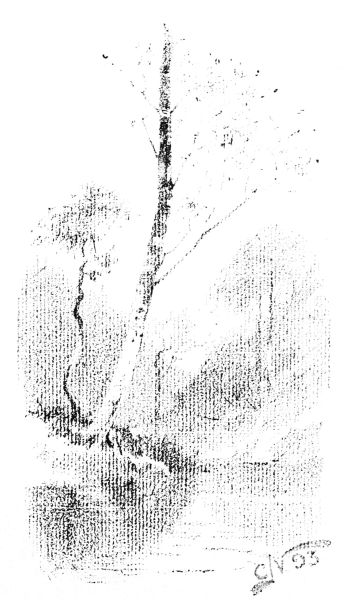
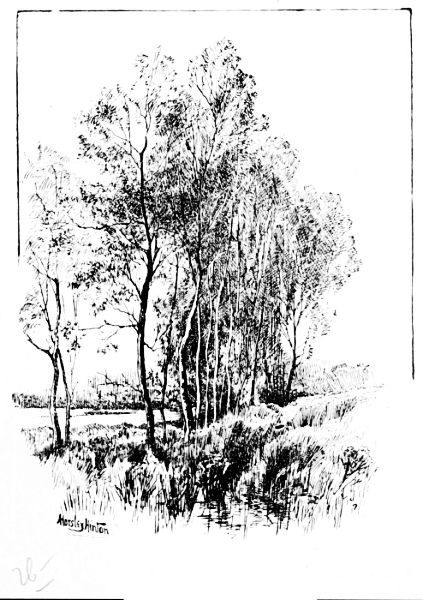
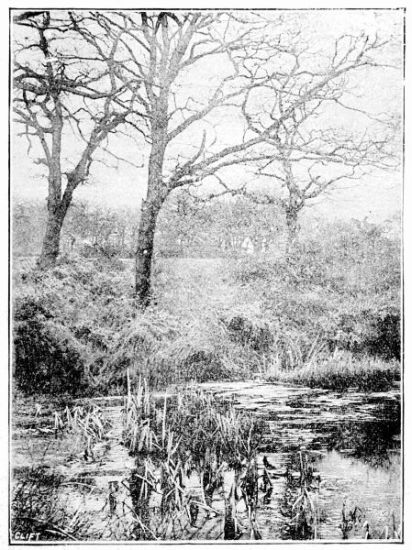
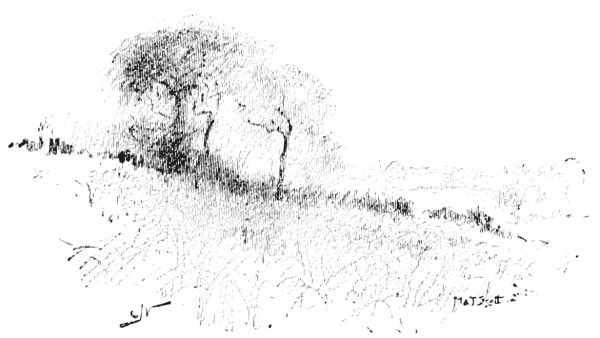
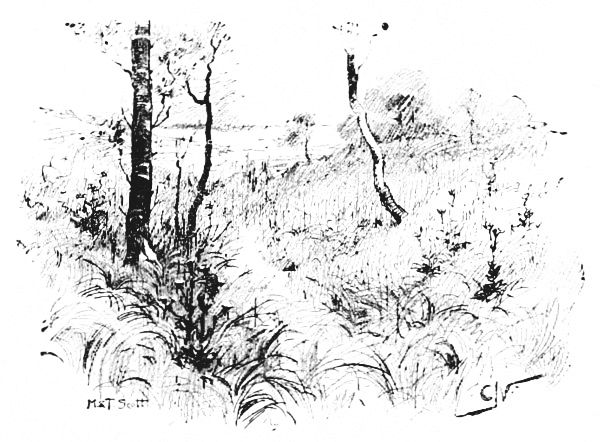
STUDY OF TREES.
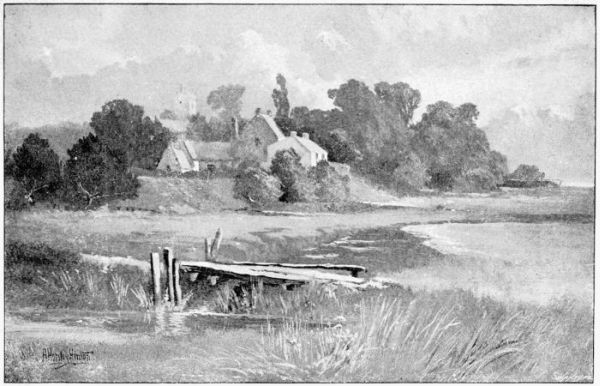
Crayon drawing on Lalanne paper; vertical grain. (Original 8 x 4½.)
An avoidance of error and saving of time may be effected by making a
fairly pale print and, having "fixed" it, cover the back with the
scribble of a blue pencil or chalk.
We can now place this down upon the card board or paper to be drawn
upon, and carefully go over everything that is to be drawn with a sharp
hard point, which will leave a blue outline sketch which can then be
inked in, and the blue need not be rubbed out afterwards as it will not
appear in reproduction.
In the same way the original photogram can be used with a piece of
blue carbon paper instead of chalking the back of the print. No
attempt should be made to draw in all the details of a photogram, but
only such salient points as may be required for illustration.
Another method is as follows:—Make the photogram in the ordinary
way, but on "plain salted paper," or "Matt silver sensitised paper,"
which has been previously prepared by immersion for a short while in a
solution of ammonium chlorate, 100 grains; gelatine, 10 grains; water,
10 ounces.
The photogram is to be fixed and washed, toning being unnecessary; when
dry it can be drawn upon with a "fixed" or indelible black ink,
carefully putting in just what parts are needed and disregarding the
rest of the picture. As soon as the ink is dry, the print is immersed in
a bath of mercury bichlorate and alcohol, when the photogram will
gradually disappear, leaving the black ink lines on plain white paper.
Nothing more is required beyond mounting on card to fit it for
reproduction. Of course corrections can be made and stains, &c., be
removed with Chinese white. Should it be desired to restore the bleached
photogram, it can be done by immersing in a weak solution of soda
hyposulphite.
The foregoing method is one given by Mr. C.G. Harper in his book
"Drawing for Reproduction"; it appears, however, needlessly elaborate,
and I presume mercury bichloride is intended and not bichlorate. Even
with care the photographic image is sometimes slow to get rid of, and
will often refuse altogether to leave the clear white blank we require.
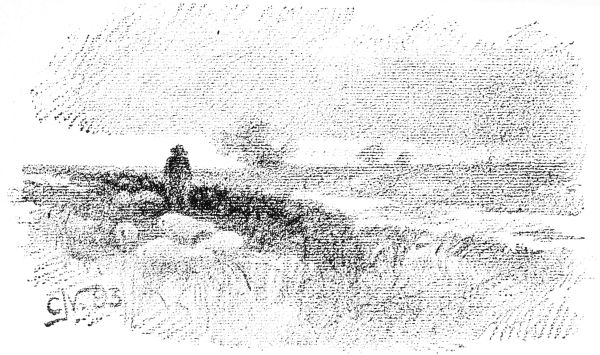
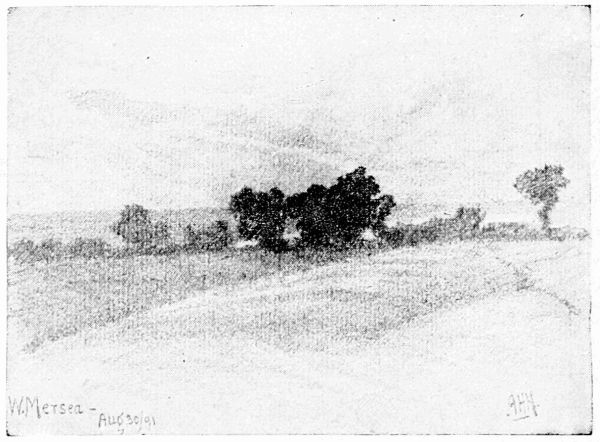
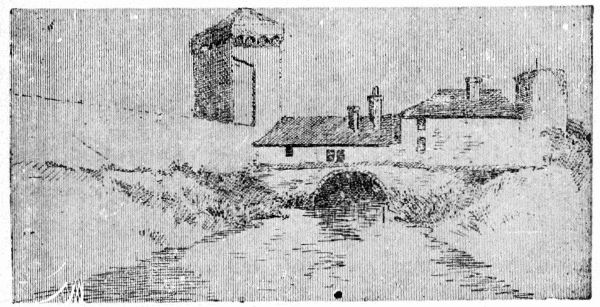
ADVANCING TWILIGHT.
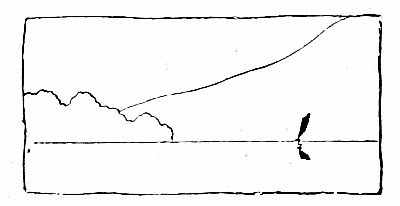
Crayon drawing on Lalanne paper; horizontal grain. (Original 10½ x 6.)
A photographic print, however, on either albumenised or "Matt" paper
will certainly disappear utterly if subjected to the following bath, for
which formula I am indebted to Mr. E.J. Wall:—
| Iodine | 1 grain |
| Iodide of Potassium | 10 grains |
| Cyanide of Potassium | 20 " |
| Water | 102 " |
This is a similar solution as is used to remove ink-stains from linen,
&c.
The print may also be bleached by sponging over with the following
preparation, recommended by W. Ethelbert Henry:—
| Saturated Solution Iodine in Alcohol | 1 part |
| "" Cyanide of Potassium in Water | 2 parts |
| Water | 2 " |
After which the print is to be washed well for a few minutes.
Of course the reason for using a "fixed" ink in such processes is
obvious.
Yet another method on similar lines, but even simpler in operation. A
certain photographic printing paper called "Ferro-prussiate" paper
gives, on exposure to light, a blue image, and only requires washing
in water to "fix" or make it permanent. This blue print can now be used
for drawing upon, as in the previous instance, only that the
photographic image, being blue, does not need to be bleached, and will
not interfere with the reproduction of the black lines drawn upon it.
If for any reason it be desired to get rid of the blue
print, this can be bleached by immersion in water containing
a little common washing soda.
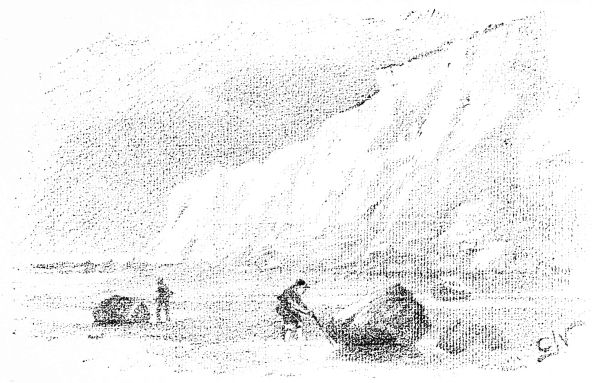
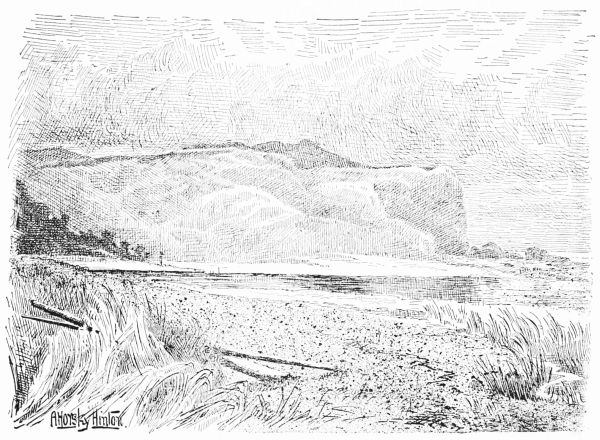
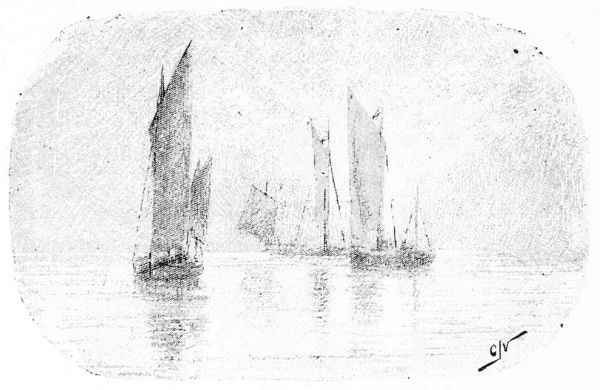
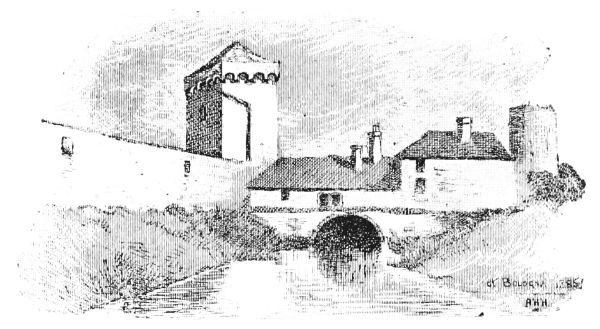
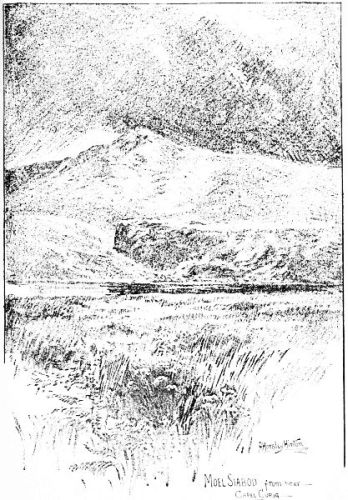
BEACHY HEAD.
Crayon drawing on Michallet paper, right side. (Original 8½ x 5½.)
Thus from a photogram of even the most elaborate subject an absolutely
correct drawing may be made fit for reproduction without the illustrator
having any knowledge or skill as a draughtsman.
By placing the unskilled in such a position, photography appears to have
removed the last obstacle to the more frequent use of appropriate
illustration; and the ease with which both pleasing and accurate
outlines can be made should render inexcusable the shamefully untruthful
"sketches" which every day appear in newspaper and magazine.
The method of drawing on thin transfer paper with transfer ink, and then
placing the drawing direct on to a zinc block, hardly needs to be
referred to here. Such a simple means of placing the image on the zinc
and then etching is necessarily of limited application, neither
reduction nor enlargement is possible, and photography is not employed;
it is merely a mechanical etching of the zinc in all parts not protected
by the ink image, as transferred from the drawing in transfer ink, and
is used for very rapid and imperfect portraits, &c., in the commoner
class of newspaper work.
And now, whatever be the special characteristics and advantages of the
camera, it is by no means my intention to advocate its use where even
only a moderate amount of native artistic ability exists; and, in all
probability, the possessor of such ability will more frequently prefer
to use his sketch-book than his camera—and this is as it should
be. There is always something of freshness about a first original
sketch, be it in whatsoever medium, a quality which the most careful
copy fails to repeat.
This brings us to consider whether it would not be well to make our
first impressions or sketches in such a manner that they could be handed
to the process worker right away; and we shall then have to consider
what medium and what materials are suitable for "drawing from life."
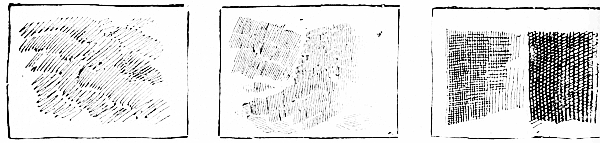
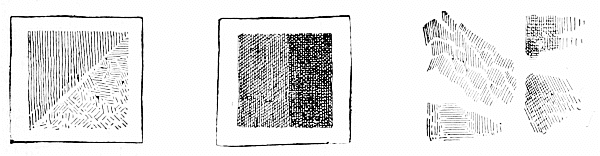
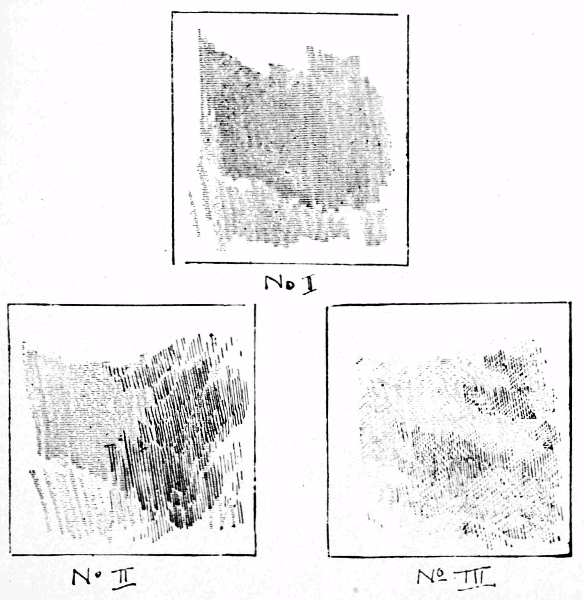
Certainly the ordinary pencil sketch, as taken from the pocket
sketch-book, would not do. In the first place such sketches would
rarely be vigorous enough, and whatever vigour they possessed would be
sadly diminished by rubbing and the pressure of the opposite page.
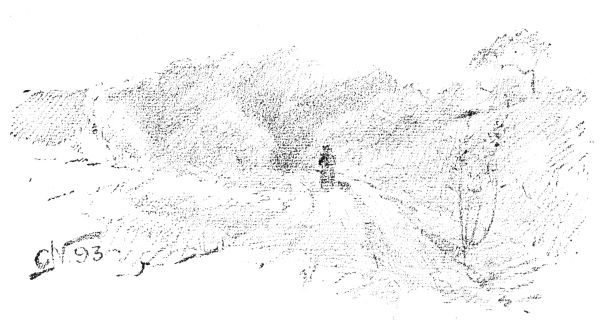
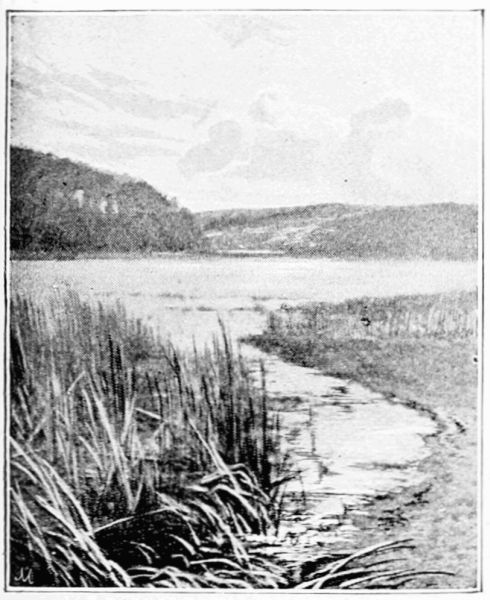
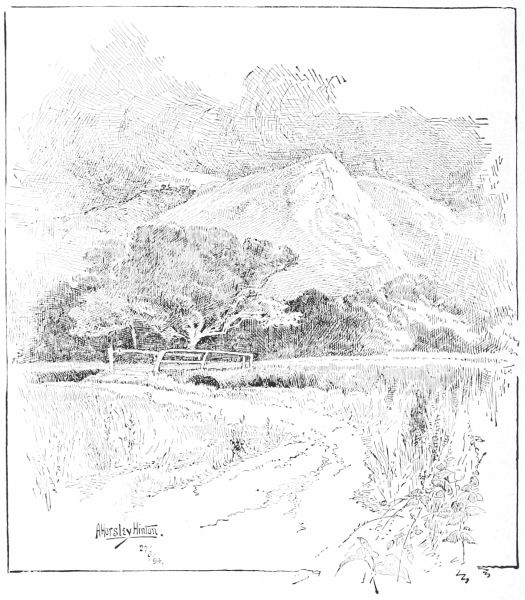
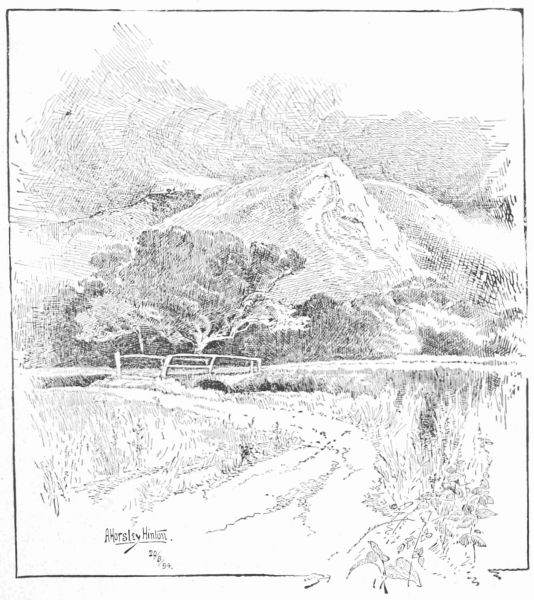
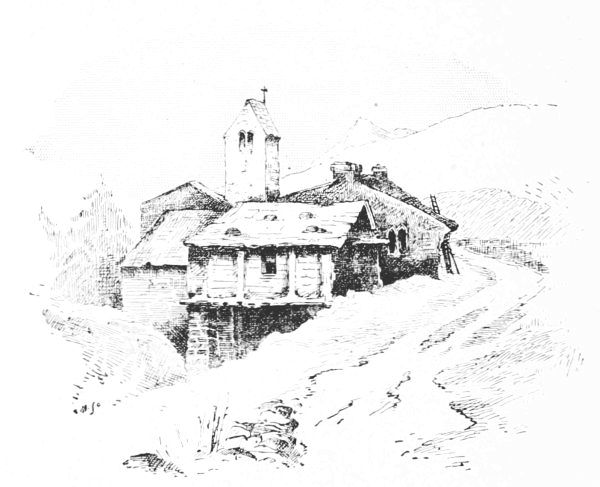
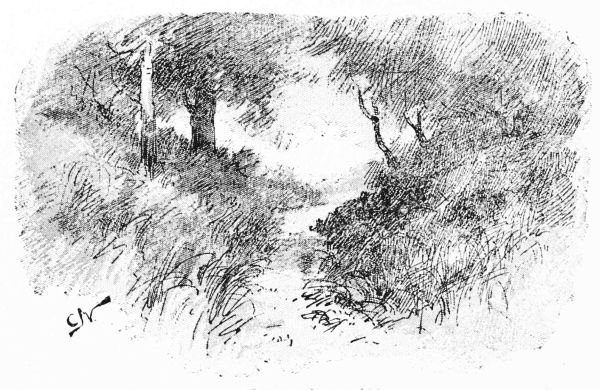
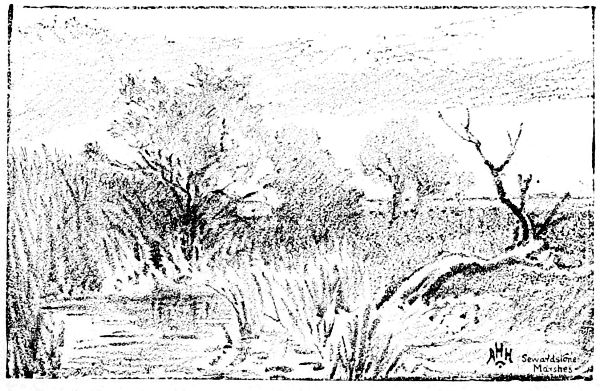
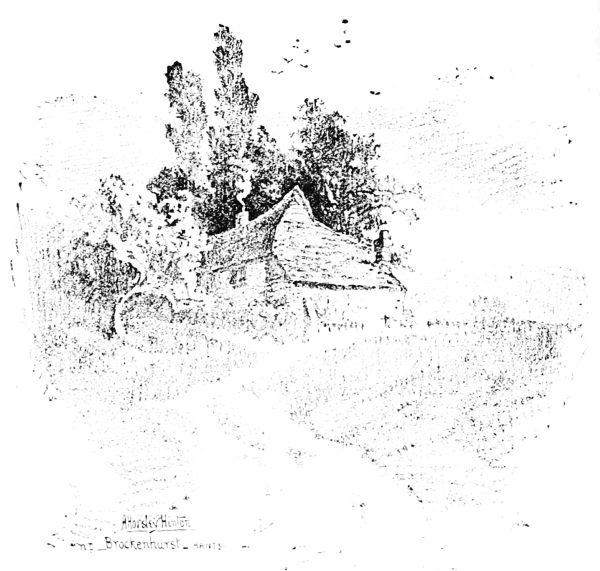
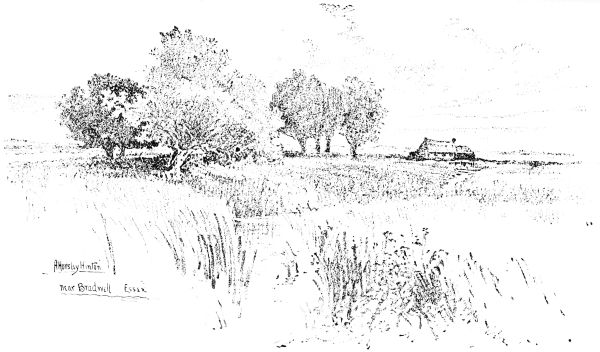
A SUSSEX LANE.
Crayon drawing on Michallet paper, wrong side of paper used. (Original 9 x 4½.)
Very few have successfully drawn from life in pen and ink. Some few
well-known caricaturists and figure draughtsmen do so, and attain
success purely through their splendid dash and spirit, but such things
are forbidden the average man with whom the pen drawing is a matter of
delicate care. But there seems no reason why the lithographic crayon on
rough paper should not be thus utilised, and slight "touchings-up" added
afterwards. In this way we might often have ready for immediate
reproduction a sketch containing some of that spontaneous feeling which
is so noticeable when glancing through the pages of an artist's
sketch-book.
I have noticed in some a very false idea existing with regard to
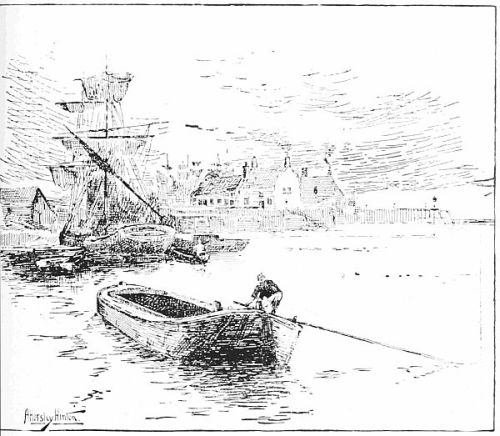
draughting in a picture with pencil before using the pen and ink. Now I
do not hesitate to say that the careful sketching in of the subject in
pencil is essential to all except the genius, and I am not writing for
the genius, who knows more than I can tell him and can dispense with
what he does not know. There is nothing to be ashamed of in drawing
first in pencil; one might perhaps be able to draw in quite as correctly
with the pen, but the advantage of a pencil outline as a guide is that
it gives more time and leisure thought for carefully considering the pen
work before putting it in. By this course there is less danger of
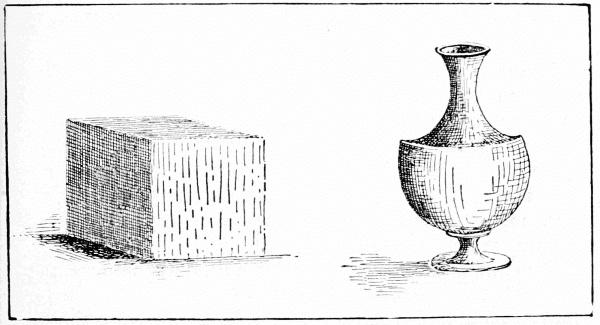
confused hesitating lines. From the first let the ink lines be clear,
distinct, and black; no "messing about," to quote Mr. Blackburn's
expressive phrase; be decided as to the sort of shading you are going to
put in a certain place and put it there, once for all, and don't touch
it again. Avoid, by constant self-restraint, over-elaboration or too
much laboured detail; let each part of the drawing be finished from
the first, and do not return to it and work on it over and over again.
And the first step to ensuring this precision will be by carefully
pencilling everything, indicating only where shading is to come. When
the pen and ink drawing is completed, carefully erase the pencil marks
with bread crumbs; do not use indiarubber, which will be sure to
abrade the surface, and probably break the continuity of the ink lines.
As we become more conversant with the possibilities of the zinco
process, an intimacy which can only be brought by an experience built up
of experiments and failures, we shall find it possible to sometimes
leave in certain of the pencilling (allowing, of course, for their
coming up as black as ink), but for the beginner such a practice is not
recommended, as it is nearly sure to end in disappointment.
There are many interesting modifications of recognised means which are
possible to the experienced—especially the production of what may
be termed "mixed drawings," either for reproduction in half-tone or
line, drawings in which in order to produce less ordinary effects, wash,
pen, and pencil are employed combinedly; but, by the time my gentle
reader has reached a stage when he may advisedly attempt such excursions
from the orthodox path, he will have passed beyond the sphere of this
book and will be entitled to that liberty which art permits to its
practitioners.
In the meantime let me ask the student to repress for a time his more
lofty aspirations, and content himself with patiently learning to
produce—not a charming sketch, a delightful drawing, but—a
drawing in which there is as much of artistic or pictorial merit as is
compatible with the requirements of the process of reproduction. If you
are drawing professedly for reproduction, no blame can attach to you if
you "bear in mind during the production of your drawing the necessity of
its making a good block, with as little sacrifice of artistic quality as
may be."
An exalted position as an art is not necessarily claimed for drawing or
painting for reproduction; but how much of that difficult-to-be-defined
quality which we call "artistic" exists in it, depends not so much
upon the method, the means, or the application, as it does on those who
work at it and their motive. Apart from this, viewed from the lowest
aspect, its utility is beyond question, and at the present time it is an
application of fine art showing the most vitality of any.
The books devoted to the subject which have already been written, have
perhaps given too much attention to the actual processes of
reproduction—they have not appealed to the illustrator; or else,
while professing to be books of instruction in practice, have dealt
rather with the theory of illustration and the comparison of styles. It
seemed to me there was need for a simple description of methods for the
enlightening of a beginner: an elementary guide; a first step; in short,
a Handbook of illustration.
They are used and endorsed by the leading Illustrators, Schools,
Colleges and Institutes. Three-fourths of the professional draughtsmen
of this country use no other drawing ink.
The manufacturers have never solicited a single testimonial, yet the
merits of the inks have called forth endorsement from the most famous
and experienced users of drawing inks in various professions, real
masters of their arts. The following are a few commendations:
Jo. Pennell, the celebrated pen artist of London, Eng.—"There is
no ink equal to it for half a dozen reasons. From the time you open the
bottle until you have put all its contents on paper, you have no reason
to find fault with it."
A.B. Frost, the famous American illustrator, Convent, N.J.,
U.S.A.—"I use a great deal of it, and it is certainly the best."
E.W. Senior, C.E., Sydney, Australia.—"I cannot refrain from
letting you know how I appreciate your 'American Drawing Ink.' It is an
article long been looked for by us professional men. In my opinion, it
is far superior to [Blank's] Liquid Indian Ink. I have been using it
for 2½ years now, and have during that time and up to the present
ceased to have any other brand in the office—so pleased am I with
it."
T.B. Norgate, Patent Attorney, Victoria, B.C.—"I have used your
inks for some years and find them first-class."
Jacob Hauck, Draughtsman, County Surveyor's Office, Omaha, Neb.—"I
have used hundreds of your 'General Inks,' and became a great admirer of
your unequalled ink."
The Inks are as follows: Blacks—Two kinds. Waterproof (insoluble
when dry) and General (soluble). Colors—Carmine, Scarlet,
Vermilion, Brick Red, Blue, Yellow, Green, Orange, Brown, Indigo,
Violet.
Prices—Small bottles, 25 cents each; half pints, $2 each; pints,
$3.75 each, and quarts, $7 each.
Users are cautioned to refuse untried and experimental inks, which may
be claimed as being equal to the Higgins Inks. Higgins' American Drawing
Inks were first introduced in 1880, and have hence stood the test of
time unfailingly. Every bottle is strictly guaranteed from first to
last by the manufacturers. Color cards showing actual inks sent free.
FOR SALE BY DEALERS THROUGHOUT THE WORLD
CHAS. M. HIGGINS & CO.,
Originators and Manufacturers Inks and Adhesives,
168 to 172 Eighth Street, Brooklyn, N.Y., U.S.A.
London Office, 106 Charing Cross Road.
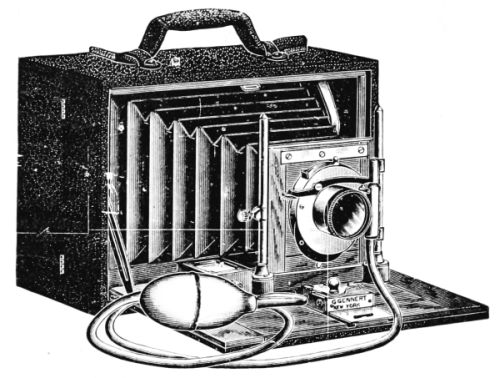
The Folding Montauk
IS THE
"Ideal" Artists' Camera
It is fitted with a perfect lens for in or outdoor, snapshot or time
exposures, and when examined and tested will show its superiority at
once.
When fitted with Ross Patent London-Made Lenses they are perfection
itself, and will make perfect snapshots
"ON A GRAY DAY"
PRICES FROM $25 TO $150
Send for catalogue and full description to the maker
G. GENNERT,

24 and 26 East 13th St.NEW YORK
PHOTOGRAPHY applied to the decoration of China, Porcelain, Placques, Art
Pottery and Ceramic and Metallic Surfaces in general.
POST PAID, FIVE CENTS EXTRA
G. GENNERT, PUBLISHER
24 & 26 East 13th St. NEW YORK
BY GEORGE FRITZ
VICE-DIRECTOR OF THE COURT AND IMPERIAL STATE
PRINTING WORKS AT VIENNA
TRANSLATED BY E.J. WALL
FELLOW OF THE ROYAL PHOTOGRAPHIC SOCIETY
CONTAINING SIX FULL PAGE PLATES BY THE IMPERIAL
STATE PRINTING WORKS AT VIENNA
THIS book treats of the preparation of Collodions, etc., for Negative
work, preparation of stones and of Zinc plates and the making of
drawings for Photo-Lithographic work, and includes special detailed
instructions for the various materials used, diagrams illustrating the
best studios and work rooms, etc.
G. GENNERT, PUBLISHER
24 & 26 East 13th St. NEW YORK
CHAMPION CARD
AND PAPER CO.

EAST PEPPERELL, MASS.
MANUFACTURERS OF
SURFACE-COATED
PAPERS ....
PLAIN AND
COATED BLANKS
FOR PRINTERS
& LITHOGRAPHERS
"THIS BOOK IS PRINTED ON
OUR COATED PAPER"
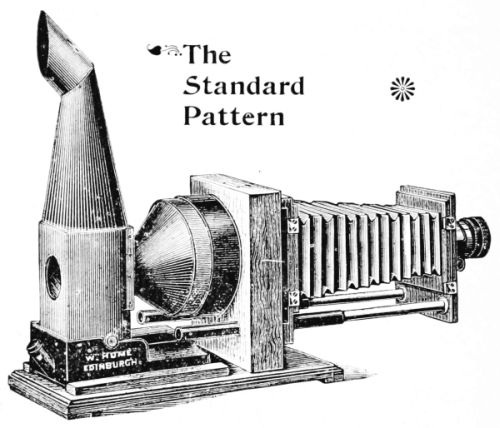
Hume's

CANTILEVER
ENLARGING
APPARATUS
In 30 Sizes, Various Patterns.
5½ in. Condensers, for 3¼ 4¼ plate, without objective,
$35; with objective, $45.
8¼ in. Condensers, for 5 × 7 plate, without objective,
$60; with objective, $80.
Fine Screw Motion, for use with non-racking lenses.
Price for all sizes, $5.
Goods Tested Thoroughly and Packed Free
G. GENNERT
Sole American Agent
24 and 26 East 13th St. NEW YORK
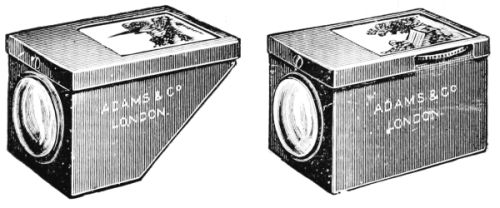
Adams

A perfect, bright and distinct image in direct sunlight,
or in a room where objects are hardly discernible on
the ground glass.
STYLE No. 1, FOR REGULAR CAMERAS
STYLE No. 2, FOR DETECTIVE CAMERAS
J.A. LEONARD,
Civil Engineer.
Newburgh, N.Y., Oct. 2, 1895.
The "Adams" Finder received this A.M., and I want to thank
you for putting me in the way of getting such a perfect instrument.
While the price seemed high, the results are so far
beyond anything that I deemed possible, that I am more than
satisfied. I find that in the brightest sunlight the Finder gives
a beautiful, clear and brilliant image, without any necessity of
shading.
Very sincerely yours,
(Signed) J.A. LEONARD.
Adams Brilliant Finders
Style No. 1. Size No. 1, $4.50 Size No. 2, $5.50 Size No. 3, $6.50
Style No. 2. Size No. 1, 3.50 Size No. 2, 4.50 Size No. 3, 5.50
G. GENNERT, Sole Agent
24 and 26 East 13th Street, NEW YORK
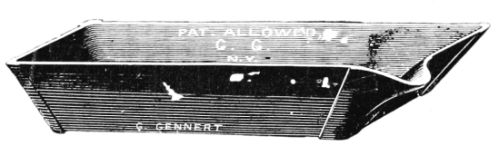
THE "GENNERT"
"UNIVERSAL"
Hard Rubber Fixing Box
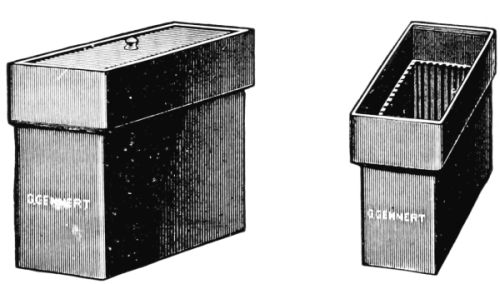
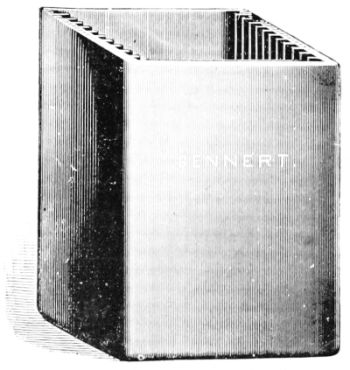
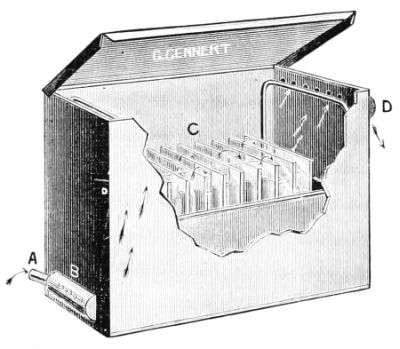
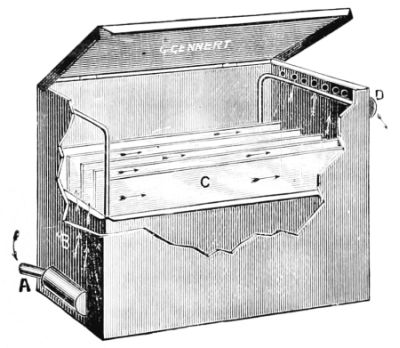
The "Gennert" Universal Fixing Box is a decided improvement over
the well-known "Gennert" Hard Rubber Bath. The
"Gennert" Universal Fixing Box
is a substantial box with cover, made entirely of hard rubber, and has the
following advantages over all other methods of fixing: It has ridges on all
four sides, thus allowing any size plate to be fitted (see cut No. 2). The
plate stands half an inch above the ridges, allowing the operator to remove
it without touching the film, as the top of the box above the ridges
flares out sufficiently to admit the fingers to reach the side of the plate.
It fixes more plates. The cover prevents dust and light from entering the
box. The hypo is always clean and fresh. All impurities sink to the bottom
and the plate cannot touch them. It saves plates. No spots possible
on your negatives. It saves spotting and retouching. It saves your
temper.
The "Gennert" Universal Fixing Box
is made in two sizes: No. 1 allows of twenty 3¼ × 4¼, 4¼ × 5½ or 4¼ × 6½, or
eleven 6½ × 8½ plates being fixed at one time: price, $4.50. No. 2 allows of
twenty-two 4 × 5, 5 × 7 or 5 × 8, or eleven 8 × 10 plates being fixed at one time;
price, $5.00.
Buy a "Gennert" Universal Fixing Box, made of pure hard rubber,
and save your hypo, plates and temper, by sending an order to your dealer
for a Universal.
G. GENNERT, Manufacturer
24-26 East 13th Street NEW YORK
PRICE LIST—Plain, Orthochromatic and Strippers
| Sizes. |
Per Doz.
Plain
or Ortho. |
Per Doz.
Strippers. |
No. of
Doz.
in Case. |
|
|
| |
| 3¼ × 4¼ |
$0 45 |
$0 70 |
36 |
| 4 × 5 |
0 65 |
0 90 |
36 |
| 4¾ × 6½ |
1 00 |
1 25 |
24 |
| 5 × 7 |
1 10 |
1 45 |
24 |
| 5 × 8 |
1 25 |
1 65 |
24 |
| 6½ × 8½ |
1 65 |
2 20 |
12 |
| 8 × 10 |
2 40 |
3 20 |
12 |
| 10 × 12 |
3 80 |
5 00 |
4 |
| 11 × 14 |
5 00 |
6 65 |
3 |
| 14 × 17 |
9 00 |
12 00 |
2 |
CARBUTT'S FLUID STRIPPING MEDIUM
Which has been arrived at after a series of exhaustive experiments, is destined to entirely
supersede the old gelatine processes. It is supplied already prepared from the factory. It
is applied cold, sets and dries quickly, forming a pellicle negative, thin, tough and flexible,
and may be printed from either side. Full particulars for use accompany each package.
Price: Pint bottles, 75c.; quart bottles, $1.35; per gallon, $5.
Testimonial
"We have been in the photo-engraving business over three years. Used wet-plates for
two years, and your process-plates for the last year on half-tone work. Each lot seemed
uniform with the others and worked well. Have not had a wet-plate bath in the place, even
for line work (or half-tone either), for over a year, and have turned out just as good half-tone
work as can be done, so our customers say. It is as good as we could ever get with wet
plates."—H.... Eng. Co., per G.C.A.
WRITE TO FACTORY FOR CIRCULARS
JOHN CARBUTT, KEYSTONE DRY PLATE AND FILM WORKS
Wayne Junction, Philadelphia
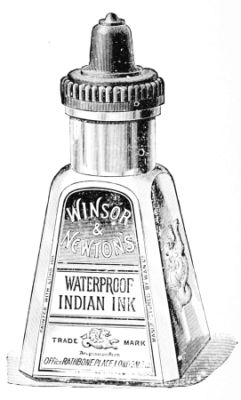
Winsor & Newton's
WATERPROOF INDIAN INK
With Patent Stopper and Quill Feeder
This new Preparation has been introduced to meet the requirements of
those Artists, Architects and Designers who wish to lay washes of color
over drawings in ink.
Unlike many so-called "Indelible" Inks, Messrs. Winsor & Newton's
Waterproof Indian ink, after it has dried, will be found absolutely
unaffected by subsequent wetting. The lines of the drawing, from the
thickest to the thinnest, remain undisturbed, and the purity of the most
delicate color-wash is retained in an unsullied condition.
Finally, it may be mentioned that Messrs. Winsor and Newton's
preparation is made from genuine Indian Ink, and not, as is frequently
the case, from an imitative article.
Winsor and Newton's Waterproof Ink is made in 21 different colors.
Sample card on application.
Winsor & Newton, Limited
88 Fulton StreetRathbone Place
NEW YORK AND LONDON.
PROCESS ILLUSTRATION
PRACTICAL MATERIALS
FOR
PRACTICAL WORKERS
ANGERER SCRAPER BOARDS
EIGHT VARIETIES. Sample Packet, 1s. 6d.
ANGERER LITHOGRAPHIC GRAINED PAPERS
FOUR VARIETIES. Sample Packet, 6d.
GILLOT SCRAPER BOARDS
EIGHT VARIETIES. Sample Packet, 1s. 2d.
PENROSE'S NEW STIPPLE BOARDS
Imitating the Lithographic Hand Stipple
TWO KINDS. Sample Packet, 6d.
GOODALL'S BRISTOL BOARDS
LITHOGRAPHIC TRANSFER PAPERS
TRACING TRANSFER PAPERS
LEMERCIER'S INKS and CRAYONS
Gillott's Pens. Fine Sable Brushes
T Squares, Set Squares. Tracing Points, Ruling Pens,
Magnifying and Diminishing Glasses
All Materials, Tools, Chemicals, and Appliances for every Branch of
Photo-mechanical Reproduction Catalogue, Sixpence, Post-free
PENROSE & CO.
The Photo Process Stores
8a, UPPER BAKER ST., Clerkenwell, LONDON F.W. DEVOE & C.T. RAYNOLDS
CO
F.W. DEVOE & C.T. RAYNOLDS CO
MANUFACTURERS OF
Artists' Materials
SUPPLIES FOR
Oil and Water
Color Painting
Pastel and
Miniature Painting
Charcoal, Crayon and
Lead Pencil Drawing
Etching, Ornamenting
and Designing
Materials for
Tapestry Painting
Pyrography and
China Painting
Materials for Pen and Ink Drawing A Specialty
Liquid Inks, Crow Quill Pens, Process Papers,
Roulettes, F.W. Devoe & Co.'s Superior Liquid
Chinese White and Indian Ink, "Pen and Ink
Carton," "Bank Note Bristol," best for Black
and White Work, "Scratch Board," etc., etc.
A Complete Line of Ross's Hand Stipple Process Papers at
Wholesale and Retail
Fulton and William Streets, New York,
and 176 Randolph Street, Chicago
GENNERT
Hard Rubber
Photographers'
DEVELOPING
and
FIXING DISHES
The Standard of Excellence
Each Piece Marked
"GENNERT"
Manufacturer, New York
A.B. Fleming & Co.
(LIMITED)
Scottish Printing Ink Manufactory
Caroline Park, EDINBURGH
Warehouse;
15 Whitefriars St., London, E.C.
Fine Color Department;
101 Leadenhall St., London, E.C.
Manufacturers of Every Kind of Black and Colored Inks
HALF-TONE PRINTING INKS
IN BLACK AND ART SHADES A SPECIALTY
(Any Shade Made to Order)
Our Half-Tone Inks will not fill up, do not contain
Earth-Colors, and are permanent
Photochromic Printing in Three Colors
THE THREE NEUTRAL COLORS
(Red, Blue and Yellow)
SPECIALLY PREPARED AND GUARANTEED ABSOLUTELY PERMANENT
Shades Verified by Lovibond's Patent Tintometer
HIGH-CLASS COLLOTYPE INKS
OF ALL SHADES
Patented 1881-89 and Patent applied for
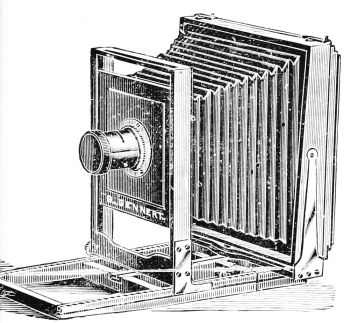 AS A FRONT FOCUS.
The Brighton is the first desired step forward in view cameras for
several years, and can justly be called perfect, as it has all the
features so highly prized by Artists and View Photographers, and is also
adapted for Studio use of the amateur or artist.
1st. It is a Front Focus Camera.
2d. It is a Back Focus Camera as well.
3d. It has more swing than any other Camera.
4th. It has a self-centering, rising and falling front.
5th. It has Rack and Pinion (forward) and slide (backward) movement.
6th. It has a new front board feature, and an extra large front board.
7th. It can be used with an extremely short or long focus lens and no
lens is so wide in its angle that it can take in any part of the bed.
8th. While no Camera is more rigid when the back clamp is set, it can be
taken entirely apart by reversing the tightening lever.
9th. It has an improvement which allows the bed to be raised without the
screw catching.
10th. It can be set up and taken down quicker and easier than any
Camera.
Add to this absolutely perfect workmanship, materials and finish, and
you have the Brighton Camera, the Twentieth Century product.
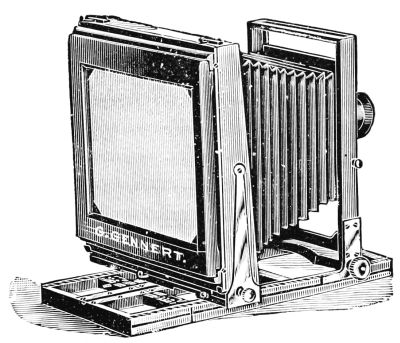 AS A BACK FOCUS.
Price List.—Leather Bellows, Double Swing, including one "Xtralite"
Plate Holder and Carrying Case, 5 × 7, $24.00; 5 × 8, $26.00; 6½ × 8½, $28.00;
8 × 10, $30.00; 11 × 14, $40.00; 14 × 17, $60.00.
G. GENNERT, Manufacturer
24 & 26 East 13th Street, NEW YORK
ROSS LENSES
ROSS ZEISS ANASTIGMATS
ROSS-GOERZ
DOUBLE ANASTIGMATS
The Best Photographic Objectives for all purposes.
Several series especially adapted to Reproductions.
G. GENNERT
Sole American Agent
24 & 26 East 13th Street, NEW YORK
There are

WASHING BOXES AND BOXES
That are Supposed to Wash, But Don't Do It
The Gennert
Universal
Washing Box
WASHES
CLEAN
AND
QUICK
No. 1 Holds 22 Plates 3¼ × 4¼ or 4¼ × 6½—11 Plates 6½ × 8½. Price, $2.00.
No. 2 Holds 22 Plates 4 × 5, 5 × 7, or 5 × 8—11 Plates 8 × 10. Price, $2.25.
G. GENNERT, Sole Mfr.,
24 and 26 East 13th St. NEW YORK
"The NEW YORK PHOTOGRAVURE CO., at 137 West 23d Street, makes perfect
pictures for artistic, scientific and commercial purposes, by special,
inimitable photogravure, photogelatine, and half-tone block processes.
It has a gallery fitted to produce negatives of all sizes up to 24 × 30,
by the best orthochromatic methods. From this department to the packing
room, there is not a phase of any work, however trivial apparently, not
carefully attended with the most zealous supervision."
From King's Handbook of New York City
Photographs in Colors
"Mr. Edwards spoke from the small stage at the end of the exhibition
hall, and after an interesting résumé of the many 'processes' by which
pictures and illustrations are now made with the aid of photography, the
most important of which he explained in lucid and not too technical
phraseology, he approached the most interesting part of his discourse,
the modern method of three-color printing, which has, under the New York
Photogravure Company, reached so high a state of perfection and resulted
in such surprisingly attractive results."
From the Mail and Express, New York
"SUN AND SHADE reproduces, not only the most notable
paintings and portraits, but the best work of amateur and professional
photographers. If it gave nothing but the latter work,
it would be deserving of the most liberal patronage that it receives;
but it is an admirable record of the greatest paintings
at the Metropolitan Museum of Art, of living American players,
of portraits of celebrated Americans, of great American painters,
with reproductions of their work, and it is a monument of the
New York Photogravure Co., which is a monument of artistic
New York."
Transcriber notes:
Fixed various commas and full-stops.
P.16. 'astist' changed to 'artist'.
P.32. 'ana' changed to 'and'.
P.109. 'reveiwed' changed to 'reviewed'.
Add: Camera: to 'be be raised', changed to 'be raised'.
Please note, special fonts used for this work are:
"Arial Narrow"; "Gill Sans MT Ext Condensed Bold";
"Wolf's Bane"; "Saunder BRK"; "Flowers Blossom Black" "Olde English Regular" and "Georgia".