A GUIDE TO THE SHELL AND STARFISH GALLERIES (MOLLUSCA, POLYZOA, BRACHIOPODA, TUNICATA, ECHINODERMA, AND WORMS).
Transcriber’s Note:
New original cover art included with this eBook is granted to the public domain.
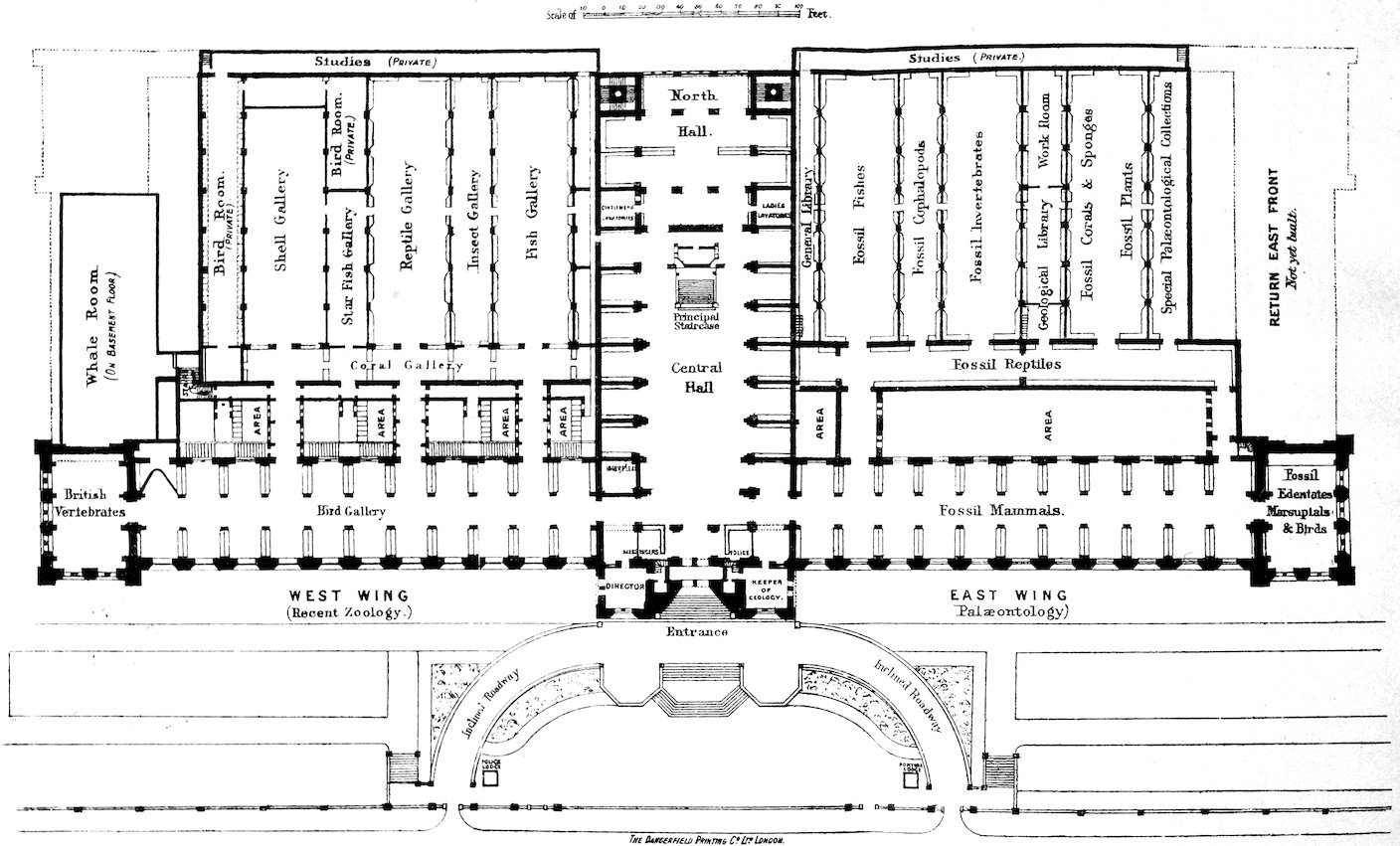
British Museum (Natural History)
Ground Floor.
PREFACE.
One of the large north galleries approached from the Bird Gallery is devoted to the exhibition of the extensive Class of Mollusca. Specimens of the types of all the principal divisions of this Class are exhibited, either entire and preserved in spirit, or as models. However, as not the animals, but their shells have always been a favourite object of study, and a popular source of pleasure to collectors, the exhibition of the species of shells has been made as complete as the space of this Gallery admitted. It has thus proved adequate for the requirements of the majority of visitors and students who consult this Collection. A separate series of British Shells is exhibited in some small table-cases along the west wall.
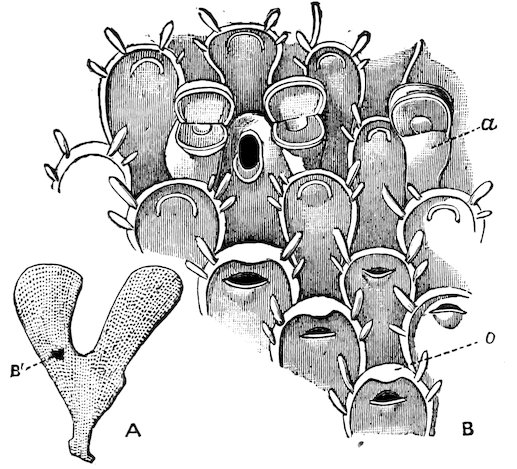
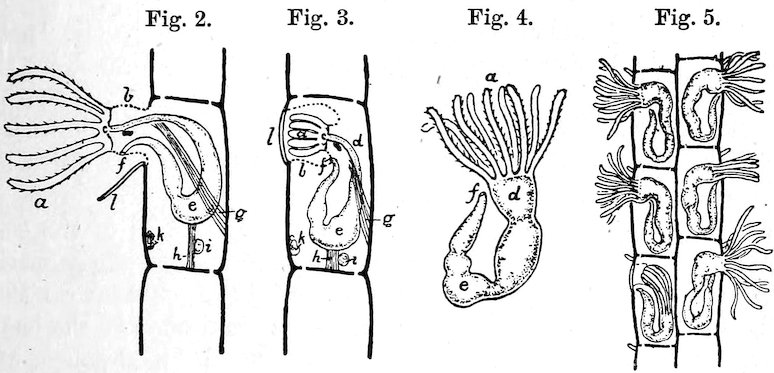
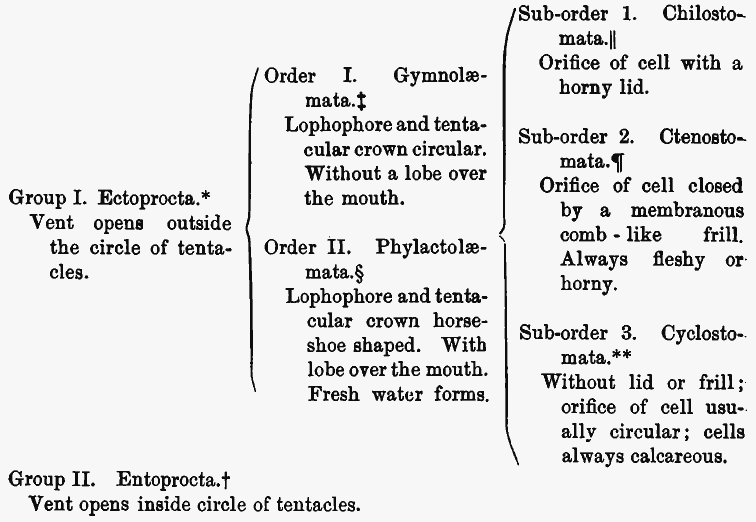
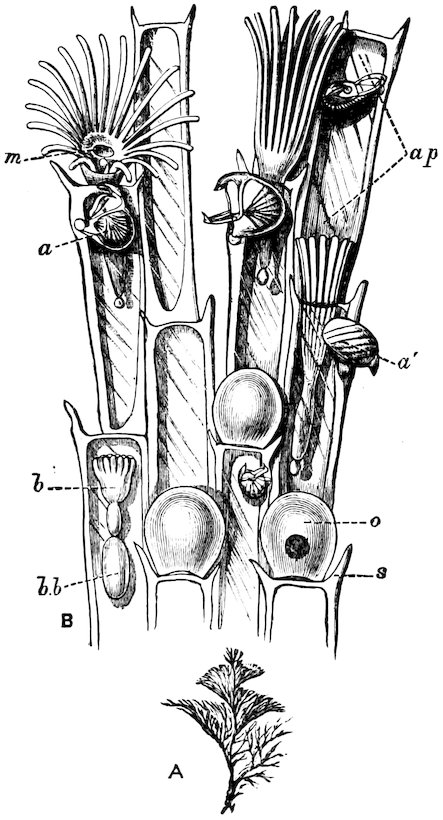
This Gallery also contains the exhibited series of Polyzoa, Brachiopoda, and Tunicata.
The Starfish Gallery, so called from one of the best-known types of the Echinoderma, contains an exhibition of the animals of this Class, as well as of the somewhat heterogeneous assemblage of creatures which are comprised under the popular name of Worms (Vermes). These animals possess greater attraction to students of Natural History than to the general public, and many, from their small size or the soft nature of their body, are not suitable for exhibition. Therefore no attempt has been made to show more than iva carefully selected number of the types of the larger groups. But the exhibition of very complete series, supplemented by models or figures, to illustrate the remarkable life history of some of these animals, also of specimens of the Worms which possess a special interest from their relation to man, render this Gallery particularly instructive to the student.
This guide has been prepared by Mr. E. A. Smith, Mr. F. J. Bell, and Mr. R. Kirkpatrick, who have special charge of the collections described.
In conclusion, thanks are due to Messrs. A. & C. Black, Messrs. F. Warne & Co., Messrs. Macmillan & Co., Crosby Lockwood & Son, and the Linnean Society for kindly allowing the use of clichés from illustrations in various works published by them.
TABLE OF CONTENTS. — GENERAL NOTES ON MOLLUSCA. — Class I.—AMPHINEURA. — Class II.—GASTROPODA. — Section Streptoneura . — Section Euthyneura . — Class III.—SCAPHOPODA. [5] — Class IV.—LAMELLIBRANCHIA. [6] — Protobranchia. (Fig. 25, A .) — Filibranchia. (Fig. 25, B .) — Pseudolamellibranchia. — Eulamellibranchia. (Fig. 25, C .) — Septibranchia. (Fig. 25, D .) — Class V.—CEPHALOPODA. [9] — ALPHABETICAL INDEX OF THE FAMILIES AND PRINCIPAL GENERA OF MOLLUSCA EXHIBITED IN THE SHELL GALLERY.
| THE SHELL GALLERY. | ||
|---|---|---|
| PAGE | ||
| General Notes on Mollusca | 1 | |
| Systematic Arrangement | 7 | |
| Amphineura (Chitons, etc.) | 7 | |
| Gastropoda (Marine Univalves, Land-Snails, etc.) | 9 | |
| Lamellibranchia (Bivalves, Oysters, Cockles, etc.) | 29 | |
| Cephalopoda (Octopus, Cuttlefish, etc.) | 45 | |
| Index to principal Genera of Mollusca | 51 | |
| General Notes on Polyzoa | 54 | |
| Classification | 57 | |
| An account of the Brachiopoda | 74 | |
| Classification | 77 | |
| An account of the Tunicata | 83 | |
| Arrangement | 90 | |
| THE STARFISH GALLERY. | ||
| General account of the Echinoderma | 106 | |
| Crinoidea (Lily Stars, etc.) | 112 | |
| Asteroidea (Starfishes) | 113 | |
| Ophiuroidea (Brittle-Stars) | 114 | |
| Echinoidea (Sea-Urchins) | 114 | |
| Holothurioidea (Sea-Cucumbers) | 115 | |
| Vermes | Platyhelminthes (Tapeworms, etc.) | 116 |
| Nematodes (Round-worms, etc.) | 118 | |
| Annulata (Marine Worms, Earthworms, Leeches) | 122 | |
The Mollusca constitute one of the principal divisions of the Animal Kingdom, and include such animals as the Octopus, Cuttlefish, Snail, Slug, Whelk, Cockle, and Oyster.
They may be characterized as soft, cold-blooded animals, without distinctly marked external division into segments (as in Worms); their cerebral ganglia (the centre of the nervous system) lie above the commencement of the gullet, and are connected with the inferior ganglia by nerve-chords. Their heart consists of two or more chambers, and is situated on the dorsal side of the animal; it drives the blood into spaces between the various organs of the body. Only the Cephalopods possess internal cartilages, but all are without a bony internal skeleton; in the majority this is compensated by an external hardened shell which is formed (secreted) by the outer covering of the animal termed the mantle. |The shell.| The shell may consist of two parts (valves), as in the Oyster, or may be single, as in the Whelk and Limpet, or composed of a series of plates, as in the “Coat-of-mail” shells or Chitons: when well developed it is hardened by a rich deposit of carbonate of lime; but it may be gelatinous, as in Cymbulia, or altogether absent, as in Octopus; it may cover and protect the body, as in the Oyster, lie within the folds of the mantle, as in the Sea-hares (Aplysiidæ), or it may be quite internal, as in the horny “pen” of the Squid. It may be elongated, as in the Elephant Tooth-shell (Dentalium), cup-shaped, as in the Limpet, or spirally coiled, as in the Snail.
The mantle may form a free fold on either side of the body, as in the Bivalves, or it may become largely attached to the body-wall, 2as in the Snail or the Slug, and so give rise to an air-chamber, which, when its walls are richly supplied with blood, serves as a lung. The ventral surface of Molluscs is produced into the so-called “foot,” which may be very variously modified. The foot may be more or less hatchet-shaped, or curved and capable of serving as a leaping-organ, or sole-shaped and adapted for creeping; its margins may be produced into elongated processes, as the so-called arms of the Octopus, eight in number and provided with suckers, or of the Nautilus, where the arms are much more numerous, but shorter and without suckers. In the Cephalopods, also, another part of the foot may fold over from either side and form a median funnel, through which the water of respiration is driven outwards, causing the animal to move in the opposite direction—this part of the foot having, therefore, still the function of an organ of locomotion. By means of their muscular foot the Solenidæ, or Razor-shells, burrow in the sand, the Pond-Snails (Limnæidæ) crawl on aquatic plants and swim reversed on the surface of the water, the Limpet clings to the rock, and the Cockles and Trigonias take surprising leaps.
Upon the upper surface of the foot, in many Gastropods, a flat hard structure termed the operculum is situated, which, when the animal is retracted, partly or entirely closes the aperture of the shell. In some cases, as in the Turbos, it is very strong and of a stony nature, but in most instances it is horny. It is differently constructed in distinct families: it may be annular and multispiral, annular and paucispiral, subannular and ovate, or subannular and unguiculate. In the Nerites it is shelly, somewhat semicircular, closes the aperture of the shell, and is furnished with a stout projection on the straight edge, fitting like a hinge under the inner lip of the shell. A series of opercula is exhibited in side table-case C.
Thread-like processes on either side of the body, the so-called gill-filaments, often unite with those in front of and behind them, and so give rise to plates; these, when well developed, are best seen in the division to which the Oyster and the Mussel belong, and which, therefore, has been called the division of the plate-gilled Molluscs, or Lamellibranchia. Where the body is coiled or twisted on itself, as so often happens, the gills of one side may be altogether lost. Sometimes, as in Phyllirhoë, when the body is small and its wall thin, the gills (ctenidia) disappear altogether, and there is no special breathing-organ; in others the loss of the gill is compensated 3by the formation by the mantle of a lung; this is most often seen in the forms that live on land.
But these so-called gills may have other functions: in the Lamellibranchs, where there is no head and no special means by which the creature can obtain food, the delicate waving filaments or cilia with which they are covered cause currents in the surrounding water, by means of which minute organisms are brought to the mouth.
All Molluscs, except the Lamellibranchs, have a very remarkable structure developed in the floor of their mouth-cavities; on a basis of cartilage, which may be moved backwards and forwards by muscles, there is developed a horny plate, which may be of considerable length, and which has its upper surface covered with a number of more or less fine, flattened, or spiny outgrowths, which are known as teeth. This is the odontophore, tongue, radula, or lingual ribbon (see fig. 3).[1]
Eyes may be absent, as in nearly all the headless Lamellibranchs; but in other Molluscs they are generally present, and may be more or less well developed. An instructive series of stages is exhibited by the Cephalopoda. In Nautilus the eye remains an open pit; in Ommatostrephes two chambers appear, the anterior of which is bounded posteriorly by the lens, and is open to the exterior, so that sea-water enters it; in Sepia, finally, the anterior chamber becomes closed in front. We may observe that the eyes of all Cephalopods are at first pit-like, or pass through a stage which is permanent in Nautilus, one of the geologically oldest types.
Cephalic eyes have recently been noticed in Mytilus and Avicula.
Eyes of a more complicated structure, which are modified tentacles, are sometimes found on the edges of the mantle in Lamellibranchs (e.g. Pecten); these eyes resemble those of Vertebrates, and differ from those of most invertebrate animals in having the fibres of the optic nerve entering the distal and not the proximal ends of the retinal cells. Eyes of a similar construction are to be found on the back of the shellless Oncidium, and may be about one hundred in number.
Eyes of a remarkable character on the shells of some of the Chitons appear to be modified from tactile organs, and are innervated like the ordinary molluscan eye; they sometimes occur in enormous numbers, more than ten thousand being present on one animal (see wax model, Case 2).
In Cephalopods the ear, like the eye, is known to make its first 4appearance in the form of an open pit, the mouth of which gradually closes up, leaving only a narrow slit in communication with the exterior. It is probable that in many forms the so-called ear is an organ by means of which the mollusc becomes acquainted with changes in the surface over which it is passing; it is often found deeply imbedded in the substance of the foot, where it forms a closed vesicle.
There is no doubt that the carnivorous Gastropoda are gifted with a sense of smell, and throughout the series we observe patches of modified cells of the body-wall (the osphradium) which serve either as olfactory organs or as an apparatus for testing the nature of the water of respiration.
The sexes are distinct in the most highly organized Mollusca, but are united in the same individual in some of the lower forms, such as Land-Snails, the Opisthobranchia (including the Bubble-Shells, Sea-Slugs, &c.), and in some Bivalves. The reproduction of Mollusca is in all cases effected by means of eggs. In some instances the young are actually hatched within the oviduct of the parent, as in the Freshwater Snails (Vivipara); and apparently in most Bivalves the eggs are also retained within the valves until hatched.
The ova of many molluscs are deposited in masses enclosed in capsules. Some of them are very wonderful and complicated structures. Those of the Cuttles and their allies are clustered like grapes, each capsule containing but a single embryo; but in the Calamaries or Squids they form a radiating mass of elongated sacks, each containing from thirty to two hundred eggs, and it has been estimated that one of the spawn-clusters of the Common Squid (Loligo vulgaris) contains as many as 40,000 ova. Everybody knows the spawn-cases of the Common Whelk, found so abundantly on the sea-beach, consisting of a large number of yellowish capsules, heaped one upon another and forming an irregularly rounded mass. As many as five or six hundred capsules may be piled together in a single heap, each capsule containing several hundred eggs, of which perhaps only thirty or forty are hatched.
In other genera, as Tethys, Doris, Eolis, &c., the eggs are contained in a spirally rolled ribbon or strap-like structure; and some of the Naticæ build a somewhat similar capsule, composed of the eggs cemented together by sand and a gelatinous material, the whole forming two-thirds of a circle narrowed at the upper part.
Terrestrial Molluscs deposit, in comparison with their marine relations, but very few eggs. They are sometimes covered by a 5thin soft skin, but in certain groups, such as the large South-American Strophochili and the African Achatinæ, which include the largest of known land-molluscs, they are protected by a hardened calcareous shell, in some instances fully an inch in diameter. The freshwater forms (Limnæa and Physa) deposit from thirty to a hundred eggs enveloped in a gelatinous mass.
The number of eggs produced by some Bivalves is enormous. The Common Oyster is said to produce a million or more, and the American variety ten, or even sixty, times as many. Some of the River-Mussels are also very prolific, as many as two millions being sometimes the product of a single individual. A small series of the eggs of Land-Snails and of the egg-capsules of some marine Gastropods is exhibited in side table-case C at the side of the Gallery.
The ova of Mollusca may be gradually developed into the form of the parent, or there may be a free-swimming larva, which has a circlet of cilia near the anterior pole of its body (so-called “Veliger” larvæ), or there may be special larvæ, as in the case of the Freshwater Mussel, the “Glochidium,” as it is called, which has a toothed bivalve shell by which it can fix itself to fishes.
The limits of age of molluscs has been definitely ascertained in a few instances only. Most Land-Snails probably live about two years, although in confinement some have been kept alive for a much longer time. Some of the marine forms live for a considerable period, the Common Oyster not attaining full growth until about five years old, after which it may continue to live for many years. The Giant Clam, a specimen of which is placed in the upright cases near the entrance to the Gallery, must, one would think, have a very long existence, judging from the size and thickness of the shell. |Hibernation and torpidity.| All terrestrial molluscs hibernate in cold climates, hiding themselves away in the ground between roots and similar sheltered places. In tropical countries some assume a state of torpidity (æstivate) during the hottest and driest season of the year, closing up the aperture of their shells with a temporary lid or door (epiphragm), in order to resist the dryness of the atmosphere. Some of these “summer-sleepers” are endowed with a remarkable tenacity of life. An Australian Pond-Mussel has been known to live a year after being removed from the water; several Land-Snails have revived after a captivity of from two to five years, without any food whatever. One of the most remarkable instances of this kind occurred in the British Museum. A specimen of Helix desertorum, a common 6Desert-Snail from Egypt, was fixed to a tablet in March 1846, and in the same month of the year 1850 it was discovered to be alive. It must have come out of its shell in the interval, and finding it was unable to crawl away, had again retired within it, closing the aperture with a new epiphragm, but leaving traces of slime upon the tablet, which led to its immersion in water and subsequent revival, having passed a period of four years in a dry museum without the smallest particle of food. The actual specimen is here figured, Fig. 1.
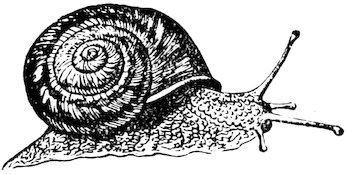
Fig. 1.[2]
Helix desertorum.
(See black table-case 1.)
The economic uses of molluscs to man are manifold, and will be mentioned in the course of the description of the several families; but here may be the place to direct the attention of visitors to side table-cases B and D at the side of the room, containing some specimens of articles manufactured from shells, such as cameos, flowers, bracelets, brooches, &c.
Mollusca made their appearance on the globe at a very early epoch in the history of the development of animal life, a large number of fossil forms, such as Nautilus, Lituites, Orthoceras, &c., being found in the oldest Palæozoic formations. Probably all these belonged to the Tetrabranchia, of which one descendant only, the Pearly Nautilus, has survived to our period. Some Gastropods and Bivalves coexisted with those ancient Tetrabranchs; but these types abounded more in the later geological epochs, many Tertiary forms being undistinguishable from species which now exist.
The greater number of Mollusca are inhabitants of the sea, some passing their whole life at the surface hundreds or thousands of miles away from land; others at the bottom of the ocean at all depths, some having been dredged at five miles from the surface. Many are found in much shallower water, and a large number between tide-marks. Rivers and lakes furnish an immense variety of forms, and vast numbers live on land in all situations—on mountains, in valleys, forests, and deserts.
Molluscs are either animal or vegetable-feeders, the former preying principally upon other members of their own class.
7The following Table shows the systematic arrangement of the Mollusca adopted in the Shell Gallery:—
Class I.—Amphineura.
- Order 1.—
- Polyplacophora. Chitons.
- „ 2.—
- Aplacophora. Neomenia, Chætoderma, etc.
Class II.—Gastropoda.
- Order 1.—
- Scutibranchia. Nerites, Top-shells, Ear-shells, Limpets.
- „ 2.—
- Pectinibranchia. Rock-snails, Whelks, Olive-shells, Harp-shells, Cones, Strombs or Wing-shells, Periwinkles, Carrier-shells, etc.
- Order 1.—
- Opisthobranchia. Bubble-shells, Sea-hares, Umbrella-shells.
- „ 2.—
- Pulmonata. Land and freshwater Snails, False Limpets.
Class III.—Scaphopoda. Tooth-shells (Dentalium).
Class IV.—Lamellibranchia. Bivalved Molluscs.
- Order 1.—
- Protobranchia. Nucula, etc.
- „ 2.—
- Filibranchia. Anomia, Common Mussel, Ark-shells, etc.
- „ 3.—
- Pseudolamellibranchia. Pearl-Oyster, Hammer Oyster, Wing-shells, etc.
- „ 4.—
- Eulamellibranchia. Freshwater Mussels, Cockles, Razor-shells, Ship-worms, etc.
- „ 5.—
- Septibranchia. Poromya, etc.
Class V.—Cephalopoda.
- Order 1.—
- Tetrabranchia. Pearly Nautilus.
- „ 2.—
- Dibranchia. Octopus, or Poulp, Argonaut, Squids, and Cuttle fishes.
The Molluscs of this class are characterized by bilateral symmetry. The head and arms are situated at the opposite extremities of the elongated body, the gills, genital ducts and circulatory organs being paired and similar on both sides. The first order belonging to this division, the Polyplacophora, includes the “Coat-of-mail shells,” or “Sea-woodlice” (Chitonidæ). They have their back armed with eight shelly plates which overlap one another like tiles, and, like woodlice, have the power of rolling themselves into a ball. These plates are imbedded at the sides into the fleshy mantle, beneath which, on each side of the foot, are arranged the gills. A Chiton differs in many respects from other Mollusca. It has a shell like an Isopod Crustacean, a heart down the back like a sea-worm, symmetrical organs of reproduction on each side like the bivalves, a 8head and crawling foot like a true Limpet, and a posterior anal orifice. These several anatomical peculiarities at one time induced certain eminent authorities to hesitate in considering them molluscs; but now that the development from the egg has been investigated, their association with the Mollusca may be considered definitely settled.
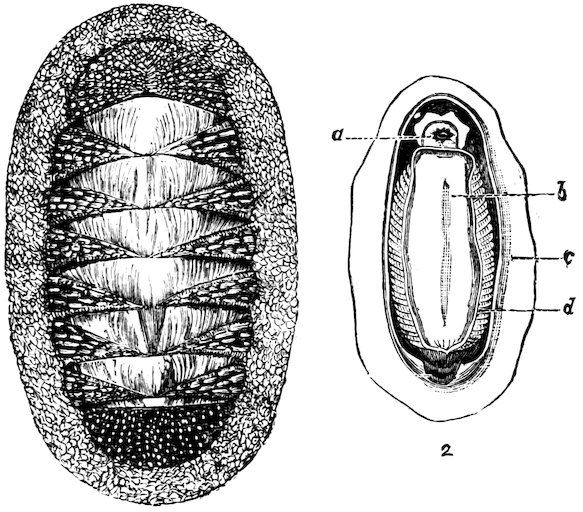
Fig. 2.
Coat-of-mail Shells, or Chitons.
1. Chiton squamosus (upper surface).
2. Chiton elegans (lower surface): a, mouth; b, foot; c, mantle; d, gills.
Chitons are found in all parts of the world, the finest inhabiting tropical countries. They live chiefly on rocks and under stones at low-water or at moderate depths; but a few forms have been discovered by the ‘Challenger’ Expedition at depths exceeding 2000 fathoms. The numerous sections of the group are principally distinguished by differences in the edges of the plates or valves which are inserted in the mantle, and in the different kinds of ornamentation upon the upper surface of the mantle-border. This, in some species, is quite smooth, in others covered with a dense mass of minute grains or scales, and in others armed with short prickly spines. In the giant Cryptochiton of Kamtschatka the plates are entirely covered over by the thick leathery granular mantle, and in another set, Cryptoplax, which consists of long slug-like animals, the plates are very small, and placed at intervals along the back.
About five hundred living species are known, and about one-fourth 9that number has been found fossil from the Silurian age downwards.
The second order of Amphineura, namely, the Aplacophora, comprises a few somewhat worm-like Molluscs which are devoid of a shell, but have instead the dorsal surface more or less studded with numerous minute calcareous spines or spicules. Neomenia, Proneomenia, Chætoderma are genera belonging to this order.
In contradistinction to the preceding class these Molluscs are asymmetrical, especially in respect of the gills and the spiral coiling of the viscera and most of the shells. They may be divided into two sections, Streptoneura and Euthyneura, distinguished by differences in the arrangement of the visceral nerve-loop.
The Molluscs of this section are bisexual and furnished with a shell, and generally with an operculum. The gills are in front of the heart and the visceral nerve-loop is twisted into a figure of 8. The section contains two groups or orders, Scutibranchia and Pectinibranchia.
Order 1.—Scutibranchia.
The Scutibranchia have a free bipectinate gill, or the gill may be absent (Lepeta, Helicina), and generally exhibit traces of bilateral symmetry.
The Acmæidæ are called False Limpets, because, although the shells are identical with the true Limpets, the animals differ in having only a small gill on the left side of the neck, whilst the Patellæ have the gills greatly developed all round the sides of the foot. Both the true and the false Limpets are littoral and found on rocks between tide-marks. They have the power of excavating the surface to which they attach themselves, and adhere so firmly that it is easier to break the shell than detach the animal. The largest known Limpet (Patella (Ancistromesus) mexicana, case 7) inhabits the west coast of Central America, its shell having sometimes a length of 12 inches. The Limpets are vegetable-feeders and fond of seaweeds of various kinds, which they rasp with their remarkable spiny tongues. That of the common English Limpet (P. vulgata, Fig. 3) is longer than the shell itself, and armed with as many as 1920 glassy hooks in 160 rows of twelve teeth each. The Limpet is commonly used for bait in the sea-fishing off the Scottish coast, and vast quantities are consumed as food in some parts of Ireland. Some Limpets, such as P. compressa, P. mytilina, etc., are found on the stems of floating seaweeds, and have the shells usually thinner and smoother than the Rock-Limpets, which have to resist the fury of the breaking waves.
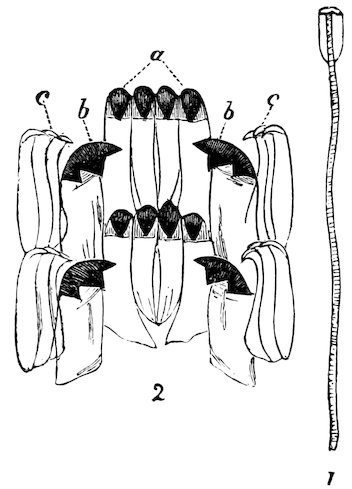
Fig. 3.
1. Radula of the Common British Rock-Limpet (Patella vulgata), natural size.
2. Two transverse series of teeth: a, median teeth; b, laterals; c, uncini or marginals.
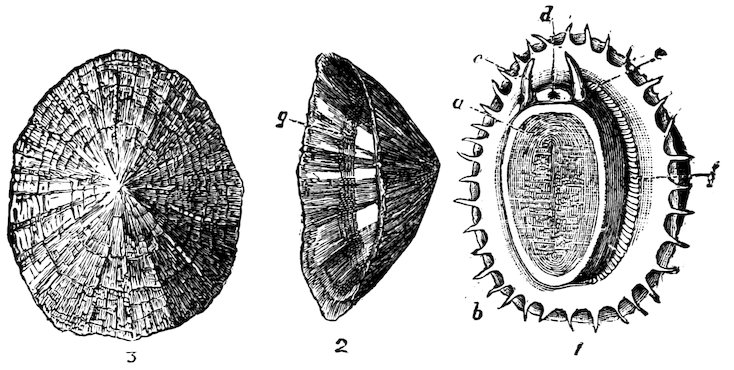
Fig. 4.
The Common Rock-Limpet (Patella vulgata). British.
1. Animal: a, foot; b, fringed mantle; c, tentacles; d, mouth; e, eyes; f, gills.
2. Side view of shell, showing the impression or scar of the attachment-muscle, g.
3. Upper surface of the shell.
11The “Keyhole Limpets” and “Slit Limpets” (Fissurellidæ) resemble in external shape ordinary Limpets, but are perforated at or near the apex, or more or less slit at the front margin. The hole or slit gives passage to a tubular fold of the mantle, through which the water apparently flows to the gills. The largest species are from California and South America, and others are found, but not abundantly, on most shores. The animal of the large Lucupina crenulata from California is eight or ten inches in length, and almost conceals the shell, and the shell of the South-African Pupillæa aperta is also all but hidden beneath the mantle of the animal.
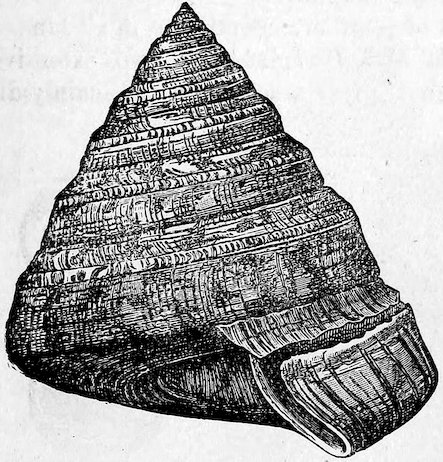
Fig. 5.[3]
Pleurotomaria adansoniana. Case 9.
⅓ natural size.
The Pleurotomariæ are extremely rare in recent times, only five species being known, whereas over a thousand fossil forms have 12been described. The specimens of P. adansoniana and P. beyrichi exhibited in case 9, are among the finest acquisitions to the shell collection of recent years.
The “Ear-shells” or “Ormers” (Haliotidæ) are found adhering to rocks in most parts of the world, with the exception of South America. They are lined with pearl, and many exhibit splendid colours and sculpture externally. Like the Limpets they hold on to the rocks with such tenacity that it is absolutely impossible to remove some of the larger species by force without injuring the shell. Boiling water or mustard and water poured over them will, however, soon compel them to relinquish their hold. The shell of Haliotis is pierced by a series of holes parallel with the left margin. Through such of them as are open the animal protrudes a slender filament or feeler, and the water also finds its way through them to the gills beneath.
The Single British species (H. tuberculata) is not actually found on the English coast, but common on rocks and stones at low-water in the Channel Islands. It is frequently eaten by the poor of those islands and the north of France; other species in New Zealand, China, Japan, West Africa, and elsewhere, constitute a common article of diet among the natives. Haliotis-shells are largely used in the manufacture of pearl ornaments, and in all kinds of inlaid work.
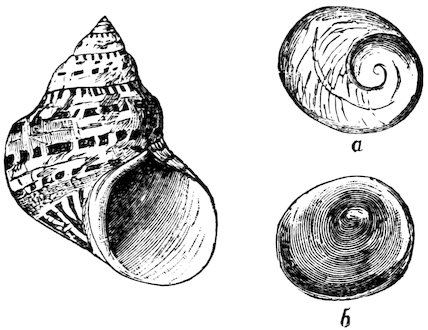
Fig. 6.
Top-shell (Turbo petholatus). (From the Indo-Pacific Ocean.)
a. Inner surface of operculum. b. Exterior of ditto.
The Trochidæ, and Turbinidæ are two extensive families, the animals of which are very much alike, and mainly distinguished by the operculum, which in the former is horny, and shelly in the latter. The shells of these families are beautifully pearly within, 13and the external shelly coat is generally brightly coloured and highly ornamented. Several very pretty species are found on our own shores. The opercula of Turbo petholatus (Fig. 6), from the Indian and Pacific Oceans, are frequently mounted in gold and silver as scarf-pins, ear-rings, &c.
The Nerites are mostly found in tropical countries, and, like the Winkles, are very strongly made, to resist the force of the breaking waves. The Neritinas are partly found in the sea, and partly in fresh water, and are less solid shells. The third section of Neritidæ, the Septariæ, are shaped very much like Limpets, except that the apex is at one end instead of central. They are, however, very different animals, and furnished with a shelly operculum imbedded in the foot.
Order 2.—Pectinibranchia.
In most cases the molluscs of this order have an attached monopectinate gill and a single osphradium. A few are fresh or brackish water forms, but the majority are marine.
The “River-Snails” (Viviparidæ) might be termed freshwater Periwinkles, as the animals of both are very similar. The true Viviparæ are viviparous. They are rather sluggish, and found at the bottom of ponds and rivers feeding on decaying animal and vegetable matter.
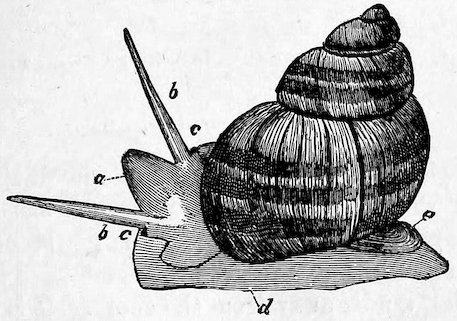
Fig. 7.
The Common British River-Snail (Vivipara vivipara).
a, head; b, tentacles; c, eyes; d, foot; e, operculum.
The Cyclophoridæ are land-shells, which, however, cannot properly be considered true lung-breathers like ordinary snails. They have not the closed lung-chamber of the Pulmonates, their eyes are 14placed at the base of the tentacles instead of at their tips, they have a long proboscis armed with a different rasping tongue (radula), a spiral operculum, and the sexes are distinct, whereas the true Snails are hermaphrodite.
The operculated air-breathers have been divided into many sections, chiefly on account of differences in the apertures of the shells and in the opercula. They most abound in hot countries, but a few species are met with in temperate regions.
The “Apple-Snails” (Ampullariidæ) live in the rivers and marshes of tropical regions, and, although represented by a large number of species, exhibit comparatively slight variations in form and colour. The animal has both a pectinated gill and a lung cavity, being thus enabled to breathe either water or air.
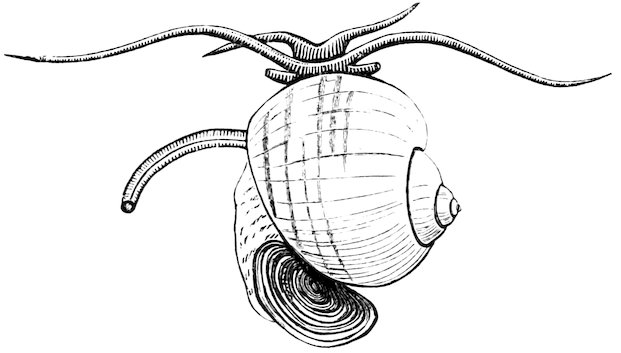
Fig. 8.
Ampullaria canaliculata.
The “Periwinkles” (Littorinidæ) are found almost on every known shore; they feed upon all kinds of marine vegetation. Some species are met with at low-water mark, others on rocks almost beyond the reach of the sea, and some have been discovered inland nearly half a mile away from the shore. It is calculated that 1900 tons of the “Common Periwinkle” (Littorina littorea), of the value of £15,000, are annually consumed in London alone.
The family of Calyptræidæ includes the “Slipper-Limpets” (Crepidula) and the “Cup-and-saucer Limpets” (Crucibulum). Although furnished with a foot, they rarely crawl about, but remain attached to rocks, stones, or other shells, sometimes forming a shelly plate under the foot by which they become fixed to the spot where they have taken up their abode.
The “Cowry-shells” (Cypræidæ) are remarkable for their varied 15markings and splendid polish, which is produced and preserved by two flaps of the mantle, one on each side, which fold over the back, a line down the centre of which usually marks where the flaps meet. The animals are even more brilliantly coloured than the shells. They have no operculum, but a large foot, which they can withdraw entirely within their shell, although the aperture is usually very narrow. Cowries, as is well known, are sold as ornaments; and a small yellow species, “the money-cowry” (C. moneta), which is very common in the Indian and Pacific Oceans, passes current as coin among the negro tribes of certain parts of Africa. The specimen of Cypræa leucodon figured on p. 16 is extremely valuable and supposed to be the only one hitherto discovered. The “orange cowry” (Cypræa aurora) is worn by chiefs in the Friendly Islands, and is considered the highest order of dignity. Only one small species, Trivia europæa, is found on the British coast, and about 100 fossil forms have been discovered in the Chalk.
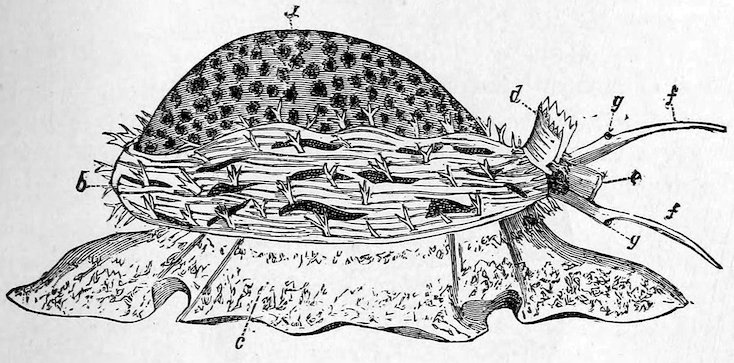
Fig. 9.
The Tiger Cowry (Cypræa tigris). (From the Indo-Pacific Ocean.)
a, the shell; b, the mantle; c, foot; d, siphon; e, proboscis; f, tentacles; g, eyes.
Of the Ovulidæ, the most curious is the “Weaver’s-shuttle” (Radius volva), in which the shell is peculiarly beaked at both ends. It is found living on barked corals (Gorgoniidæ), and some of the smaller species exhibit differences of coloration, resembling the tints of the Gorgonias upon which they are found.
The Naticas are mostly blind, and have a very large foot, suitable for burrowing in the sand when in quest of bivalves. They are very 16voracious. This is one of the groups of shells that have continued to exist from Palæozoic times.
The “Violet Snails” (Ianthinidæ) are found floating about in every ocean, excepting in cold regions, with the spire of the shell downwards, and the bottom, being more exposed to the action of light, is more deeply tinted than the upper part. They feed upon Jelly-fish, and construct a gelatinous raft, filled with air-bubbles, beneath which the females attach their eggs.
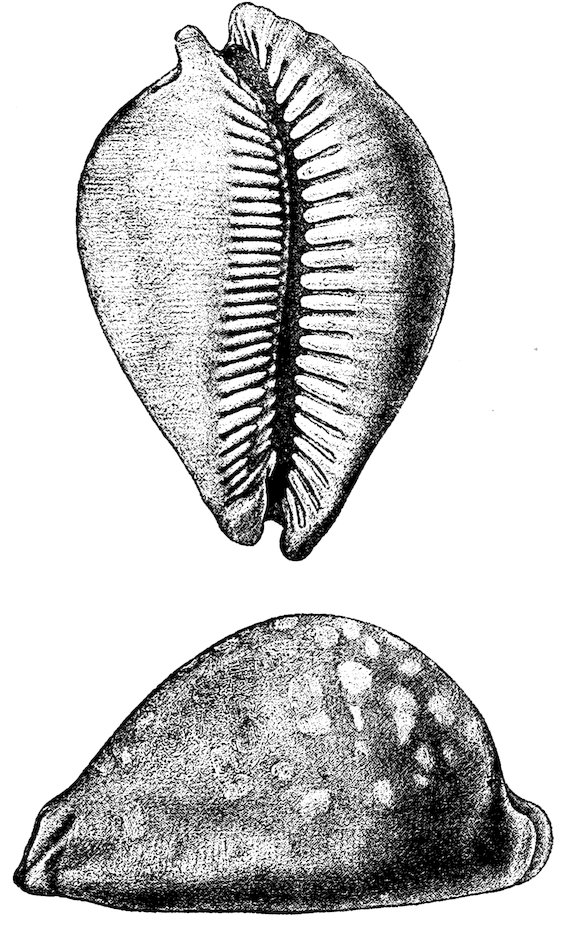
Fig. 10.
Cypræa leucodon. Case 32.
17The Melaniidæ are freshwater Snails which abound in most tropical and subtropical countries; about 1000 species are known. They are mostly of dark colours, and are fond of muddy places.
The Cerithiidæ are chiefly marine forms, some, however, entering brackish water. About five hundred fossil species have been described, some of them gigantic in comparison with any now living, of which more than two hundred are known.
The Scala scalaris was formerly considered a great rarity, as much as £40 having been given for a single specimen, which might now be purchased for as many pence.
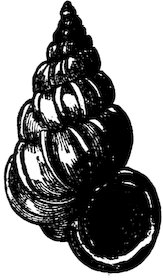
Fig. 11.
Scala scalaris.
Case 44.
The “Worm-shells” (Vermetidæ) are a very peculiar family. Their shells can scarcely be distinguished from the shelly tubes which are formed by certain species of marine worms, Serpula, &c. They are free and spiral in early life, but afterwards become distorted and generally attached to rocks, stones, &c. A foot for walking purposes therefore would be of no use; consequently it is more or less obsolete, serving only as a support to the operculum.
The “Screw-shells” (Turritellidæ) have elongate tapering shells; about 100 recent and 200 fossil species are known. One species only (Turritella communis) is now found living on the British coasts.
The Xenophoridæ have the singular habit of cementing to the exterior of their shell, stones, pieces of coral, and fragments of other shells; hence they have been called “Carrier-shells,” and, according to the kind of material chosen, have been named “Conchologists” and “Mineralogists.” Beyond acting as a disguise, and consequently as a protection, there does not appear to be any special utility in thus adding to the weight of their own shells. The animals do not glide like most other molluscs, but scramble along like the Strombs, the form of their foot being small, divided into a front, expanded, and a hind, tapering portion admirably adapted to the nature of the ground on which they live, which usually consists of broken and dead shells.
The “Wing-shells” (Strombidæ) are the largest of the Gastropods with a proboscis or non-retractile snout. They do not crawl like most other Gastropods, but progress by a sort of hopping movement. They act as scavengers, feeding on decomposing animal matter.
The Strombus gigas, or “Fountain-shell,” occurs in great numbers 18in the West Indies, and is a very heavy solid shell. It is a favourite ornament for rockwork and fountains in gardens, and, like the Helmet-shells, is used for cameo-carving. It is also employed in the manufacture of porcelain, as many as 300,000 having been imported into Liverpool in one year for that purpose.
The Scorpion-shells, or “Spider-claws,” as they are sometimes called (Pterocera), possess singular claw-like projections, which are developed on the outer lip of the shells.
The “Trumpet-shells” (Lotoriidæ) have varices or strengthening ribs at intervals, like the Murices; the largest species, Lotorium variegatum, is used by South-Sea Islanders as a horn or trumpet. A hole is made in the upper part of the spire to blow through, and the sound produced can be modulated or varied by inserting the hand in the aperture or mouth of the shell.
The “Helmet-shells” (Cassididæ) are used for cameo-carving; they consist of differently coloured layers, so that the ground-colour of the carving is of a different tint from the subject engraved. The most artistic shell-cameos are produced in Italy, whence the art has been introduced into France and England. The Cassis madagascariensis (Fig. 12 on p. 19) is in special request by shell-carvers on account of the strong contrast of the white upper layer with the dark ground beneath. Extinct forms of Cassis are found fossil in Tertiary formations, but none of them equal in size the largest living species.
The “Tun-shells” (Doliidæ) are remarkable for the globoseness of the shells, which are covered with very regular revolving ribs.
The Fasciolariidæ contains two of the largest living Gastropods: Megalatractus aruanus, from North and West Australia, and Fasciolaria gigantea, which is found off the coast of South Carolina, and attains at times a length of two feet.
The Mitras (Mitridæ) are great favourites with shell-collectors, on account of their beautiful colours and varied sculpture. There are about 600 living species already known, and between one and two hundred have been found in a fossil state. Shells of this group, like the Fasciolariæ, are distinguished by a few plaits or folds on the inner side of the aperture (the columella). Mitras are almost exclusively found in tropical or subtropical regions, the majority being met with either at low-water mark or in comparatively shallow water.
The family of Buccinidæ also contains a very large and various assemblage of forms. Among them may be mentioned the Whelks (Buccinum). (See Fig. 13 on p. 19.)
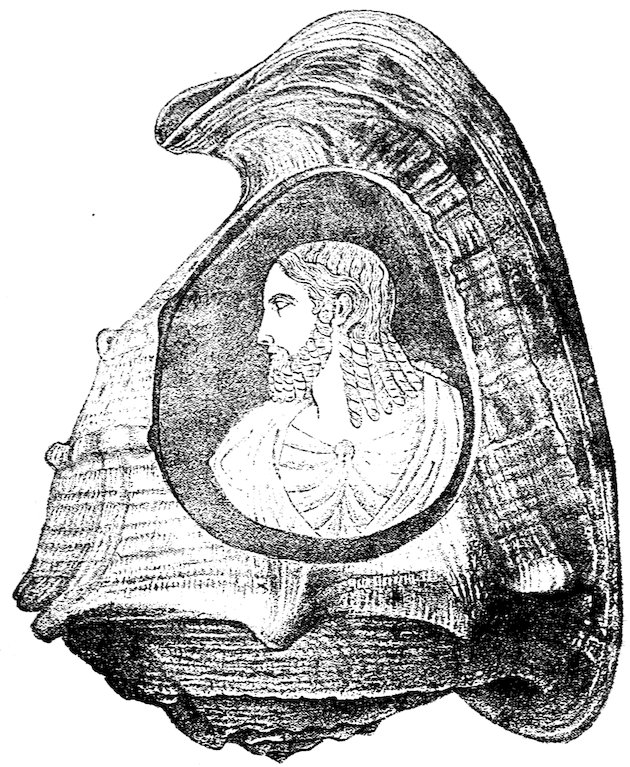
Fig. 12.
Cassis madagascariensis, with cameo engraved upon it.
Side table-case B.
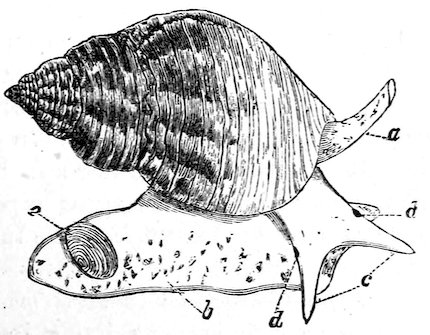
Fig. 13.
The Common Whelk (Buccinum undatum).
a, siphon; b, foot; c, tentacles; d, eyes; e, operculum.
20The family of Muricidæ, or “Rock-shells,” is another extensive group, containing many very handsome and peculiar forms. The animals of this family have a long proboscis, at the end of which is the spiny tongue (radula), and which is retractile within the body. The true Murices produce at intervals ribs or varices, which in some species are ornamented with long spines or foliations, and which indicate periods of growth, but of what duration we do not know. They are all carnivorous, feeding chiefly on other Mollusca, boring through the shells of bivalves with their spiny tongue, and slowly devouring the unfortunate inhabitant piecemeal. From certain species of Murex (M. brandaris, &c.) found in the Mediterranean, the ancients manufactured the celebrated Tyrian purple dye.
The “Purples” (Purpura) are found between tide-marks all over the world. Magilus, belonging to the family Coralliophilidæ (Case 77), is found among coral-reefs in tropical seas, and has the remarkable habit of lengthening the aperture of its shell into an elongate tube, in order to keep pace with the growth of the coral, and to prevent its being overgrown and killed.
The “Volutes” (Volutidæ) are a group of shells also much sought after by shell-collectors. Some of these attain to a very large size, the animals inhabiting them being enormous. The Boat-shells (Cymba) and Melons (Cymbium) are ovo-viviparous, the young being carried about by the parent until they are an inch in length. Volutes are found chiefly in the warmer parts of the Atlantic and Indo-Pacific Oceans, and occur in the greatest variety on the coasts of Australia.
The Olives (Olividæ) are common in most tropical seas, and are remarkable for their beautiful polish and various patterns of colouring. In structure and form they are very similar to each other. They burrow in sand in quest of bivalves for food, and some species are said to have the power of swimming by expanding the lobes of the foot.
The Harps (Harpidæ) form a small well-marked group, of which probably nearly all the existing species have been discovered. The animals inhabiting these beautiful shells are also brightly coloured. They have the remarkable power of casting off a portion of the foot when disturbed. The species are known from the Indo-Pacific Ocean, the west coast of Central America, and West Africa.
The next family, the “Slit-lips” (Pleurotomatidæ), consists of very numerous species, over a thousand living forms having been discovered, and almost as many fossil species from Cretaceous and 21Tertiary strata have been described. The typical forms are characterized by a slit in the outer side (lip) of the aperture. Species of Pleurotoma are found in every sea, although most abundant in the tropics, and, although so numerous in species, the number of specimens is small in comparison with some other genera.
The “Auger-shells” (Terebridæ), like the Cones, present a great similarity in form, but, unlike them, have a great diversity of “sculpture” or external ornamentation. They are all elongate shells, with a deep notch at the base of the aperture. Owing to the length and comparative solidity of the shells, the animals of many of the species do not carry their shelly structures on their backs, like most other species, but drag them along the sandy sea-bottom.
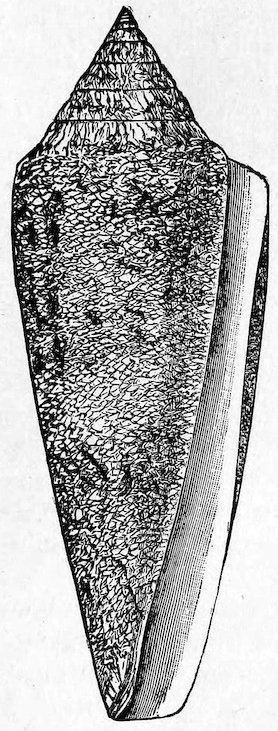
Fig. 14.
The “Glory-of-the-Sea” Cone (Conus gloria-maris). Case 94.
(From the Philippine Islands.)
The Conidæ, or Cones, form one of the most beautiful portions of the collection of Shells. This family, of which between 400 and 500 22distinct kinds are known, is a great favourite with collectors on account of the brilliant colours and various patterns of the shells. Some, owing to their beauty and rarity, have been sold at very high prices, as much as £50 having been paid for a single shell. The Cones are found in all tropical seas, but are rare in cold or temperate latitudes. None are met with on our own shores, one species alone being known from the Mediterranean. They occur fossil in the Chalk and Tertiary strata. These animals are all carnivorous, and live usually in shallow water among rocks and coral-reefs. Some of them are said to bite when handled, and to be dangerously poisonous, the bite in some instances having been all but fatal.
The Atlantidæ, Pterotracheidæ, and Carinariidæ, at various times recognized as forming a distinct sub-class or order of Gastropoda, under the name of Heteropoda or Nucleobranchiata, are now regarded as families of aberrant Gastropods organised for swimming in the open sea. The Atlantas are found in great numbers in warm latitudes, and are provided with a glassy, thin, flat, spiral shell, not unlike a keeled Ammonite. The glassy shell of the Carinaria is one of the most beautiful structures of any mollusc, and at one time was such a rarity that £100 are said to have been given for a single specimen, which at the present time is perhaps worth only from five to ten pounds. Species of Carinaria are found in the Mediterranean and warmer parts of the Atlantic and Indian Oceans. The animal is large, semitransparent, and elongate, with a compressed fin-like foot which projects from the body, and is used in swimming. The gills are placed towards the hinder part of the back and covered by the shell. They feed on jelly-fish of various kinds, and probably on other soft animals.
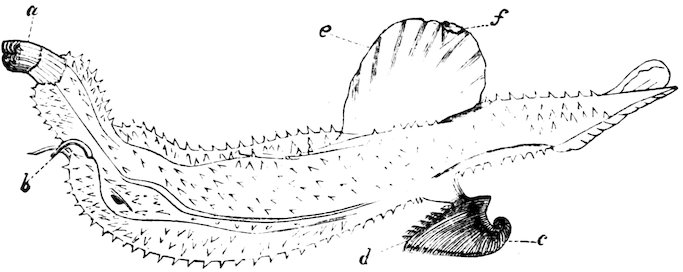
Fig. 15.
Glassy Nautilus (Carinaria lamarcki).
a, proboscis; b, tentacles; c, shell; d, gills; e, foot; f, sucker.
The Gastropods belonging to this sub-class have the visceral nerve-loop straight and not twisted as in the Streptoneura. All the Euthyneura are hermaphrodite, and their radula is generally composed of numerous similar denticles on each side of a median tooth. Scarcely any of these forms are provided with an operculum in the adult state. The Euthyneura may be divided into two orders, Opisthobranchia and Pulmonata.
Order 1.—Opisthobranchia.
All the Molluscs of this order are marine, some (Tectibranchia) breathing by means of the ordinary Gastropod ctenidium, which is generally behind the heart, whereas others (Nudibranchia) have developed a different type of respiratory organs.
The Opisthobranchia include the “Pteropods” formerly considered as a distinct class, the “Bubble-shells” (Bullidæ), the “Sea-Hares” (Aplysiidæ), the “Umbrella-shells” (Umbraculidæ), the Nudibranchs and some others.
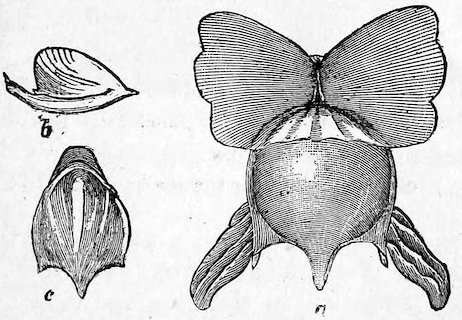
Fig. 16.
Shell-bearing Pteropod (Cavolina tridentata). Case 96.
a. Shell and animal. b. Side view of shell. c. Dorsal view of shell.
The Pteropods[4] are sometimes called Sea-butterflies, and are organized for swimming freely in the ocean. They have a pair of fins developed from the sides of the mouth or neck, which perform a flapping movement during progression. Some Pteropods (Thecosomata) 24are provided with small glassy shells; others (Gymnosomota) are naked. They exist in countless millions in some parts of the ocean, discolouring the water for miles. They constitute the principal food of the Baleen Whales.
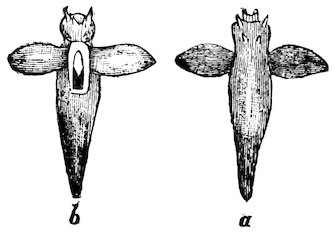
Fig. 17.
Shell-less Pteropod (Clione limacina).
a. Dorsal view. b. Ventral aspect.
About a hundred species are known.
The Sea-Hares, so called on account of a slight resemblance to a crouching hare and not for their nimbleness of foot, are found in most parts of the world, in pools at low water. At the hinder part of the back two flaps of the mantle partly conceal a thin horny shell which serves as a protection to the gills and vital organs beneath. When molested, these animals discharge a large quantity of a purple fluid, discolouring the surrounding water for a distance of more than a yard.
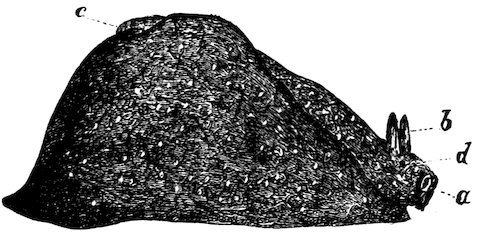
Fig. 18.
Sea-Hare (Tethys (Aplysia) punctata). British.
a, labial tentacles; b, upper tentacles or rhinophores; c, siphonal fold of the mantle near the shell; d, eye.
The shell of Umbraculum is shaped very like that useful article, an umbrella, of the Chinese pattern. The animal is very large, having its breathing-organs on the right side below the shell.
The Nudibranchs or Naked-gilled Molluscs comprise some of the 25most beautiful and strange forms. They are unprovided with shells except in the earliest stages of their existence, when they dwell in a minute nautiloid shell, furnished with an operculum, both of which are subsequently cast off. Unfortunately the colours of these beautiful creatures cannot be preserved after death, and therefore a small series of glass models is exhibited, which will give some idea of their great variety in form and colouring. They are found in most parts of the world, chiefly in shallow water, but a few species live upon floating seaweed in the open sea. Over a hundred species exist on the British coast, the majority of which are, however, very small. They are chiefly carnivorous, feeding on other molluscs, sea-anemones, &c.
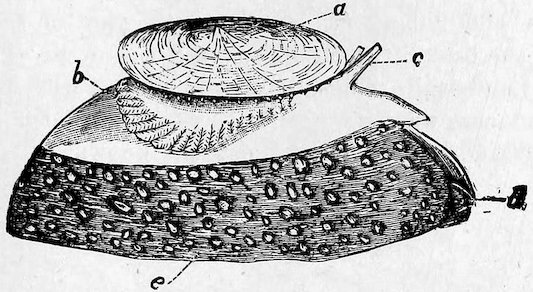
Fig. 19.
The Umbrella-shell (Umbraculum mediterraneum).
a, shell; b, gills; c, tentacles; d, mouth; e, foot.
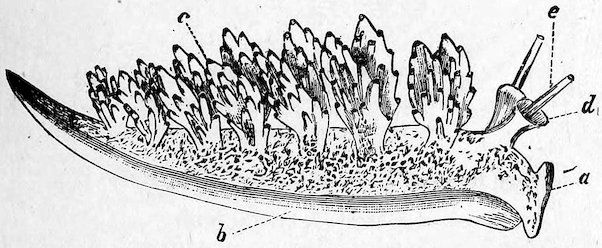
Fig. 20.
Naked-gilled Mollusc, or Nudibranch (Doto coronata).
a, head; b, foot; c, gills; d, tentacle-sheath; e, tentacle.
Order 2.—Pulmonata.
The Pulmonata are furnished with a lung cavity in place of the ordinary gill of other Gastropods, and may be termed true air-breathers. 26Most of them are provided with shells, and, with the exception of the Amphibolidæ never possess an operculum. They are divisible into two groups or sub-orders, Basommatophora and Stylommatophora, characterized by a difference in the position of the eyes. The Basommatophora, including the Auriculidæ, Amphibolidæ, Siphonariidæ, and Limnæidæ, have a single pair of non-retractile tentacles, at the base of which are situated the eyes. The Stylommatophora (Land-snails, Slugs, &c.), are provided with two pairs of retractile tentacles, with the eyes at the summit of the upper pair. Over ten thousand species of Pulmonata are known.
(Basommatophora.)
The first group of the aquatic air-breathers, the Auriculidæ, chiefly inhabit salt or brackish water. The largest forms are tropical and found at the mouths of rivers, among the roots and stems of mangrove-trees, or in damp woods near the sea.
The “Limpet-Snails” (Siphonariidæ) seem at first sight to be out of place among the Snails and Slugs, and more nearly allied to the Rock-Limpets; but the character of the tongue (radula) and the closed respiratory cavity indicate a close relationship with the present group.
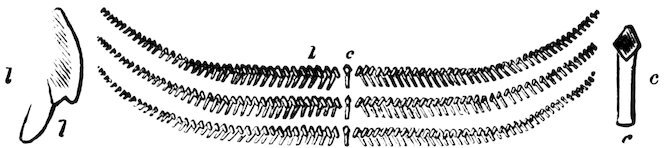
Fig. 21.
Three Rows of Teeth of the Radula of Siphonaria.
c, central; l, lateral teeth.
The shells of Siphonaria may be known from Limpets by a slight bulging on one side, caused by a radiating groove which interrupts the muscle of attachment. They are marine, and are found on rocks between tide-marks, chiefly in tropical countries.
The Limnæidæ are only found in fresh water. Most of them occasionally rise to the surface to breathe, where they glide along foot uppermost, at times suspending themselves by a glutinous thread, after the fashion of a spider. All countries appear to have their peculiar species.
27The freshwater Limpets (Ancylus) live attached to stones and leaves of plants, and have not the habit of floating, but, like the rest of the Limnæidæ, feed on freshwater algæ, confervæ, and decayed vegetable matter.
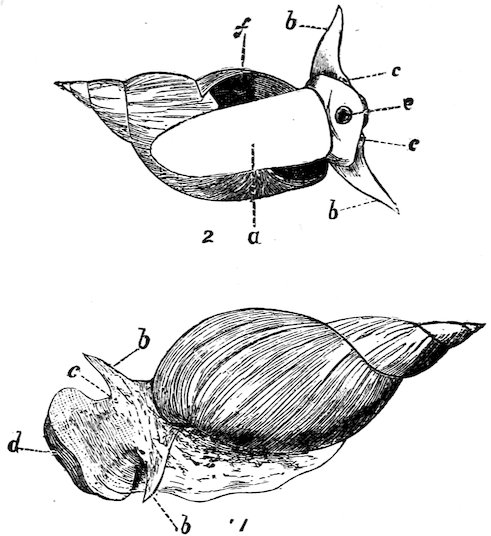
Fig. 22.
British Pond-Snail (Limnæa stagnalis).
1. Upper view: a, foot; b, tentacles; c, eye; d, muzzle.
2. Lower view: letters a, b, c as above; e, mouth; f, respiratory orifice.
(Stylommatophora.)
True Snails (Helicidæ, etc.) have a distinct head furnished with eyes, tentacles, cutting upper jaws, and rasping teeth, and all are protected by a spiral shell. They are almost exclusively vegetable-feeders, subsisting chiefly on leaves. The sexes are not distinct. Many of the species are beautiful objects on account of the brilliancy of their colouration, and some are remarkable for the variation they exhibit in this respect. Species of Helicidæ are found in nearly every part of the world and in all situations, from sea-level to an altitude of 12,000 feet. They are fond of moisture, and in hot and dry weather retire within their shells, remaining torpid until the return of dew and rain. Helix pomatia (Case 119), which is found on the chalk in the south of England and on the Continent, is commonly eaten in Austria, France, and Belgium.
28The eggs of Land-Snails vary in texture, size, and in numbers: they are usually white, but in some instances yellow and pale green. Those of some of the large South-American forms are as hard as that of a hen, and more than an inch in length (Case 120).
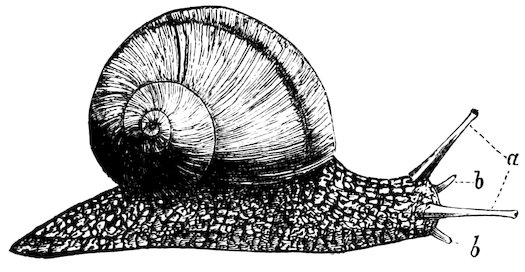
Fig. 23.
British Land-Snail (Helix pomatia).
a, eye-bearing tentacles (“horns”); b, lower or smaller tentacles.
Slugs (Cases 106,107) are very like Snails without external shells; most of them, however, possess a small internal shelly plate, or a few calcareous granules hidden beneath the skin of the back. Some have a large slime-pore at the end of the foot, and others are slightly phosphorescent. Like the Snails, they are fond of damp localities, and at times become great pests to farmers in devouring the young shoots of the growing corn. Testacella, which is found in this country, differs from the Slugs in having an external shell at the tail-end of the foot. It is not slimy, and lives under ground, feeding upon earthworms.
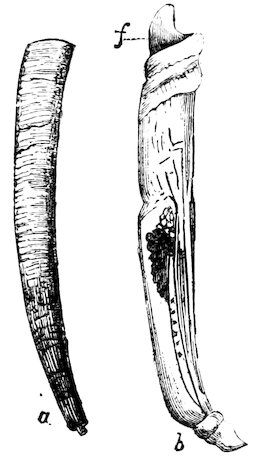
Fig. 24.
British Tooth-shell.
(Dentalium tarentinum).
a. The shell. b. The animal, removed from its shell; f. the foot.
The “Tooth-shells” (Dentaliidæ) form a distinct group, the shells of which are very unlike those of any other mollusc, but closely resembling the shelly tubes constructed by certain kinds of marine worms. The Dentalia 29have neither eyes nor tentacles, or a distinct head like Gastropods; their organs of circulation and respiration are of a rudimentary kind, and they have no heart. The sexes are separate. Their foot is adapted for burrowing in sand, in which they live and obtain their food, which consists of Foraminifera and minute Bivalves. One species, Dentalium pretiosum, found on the shores of North-West America, was until recently used as money by the Indians.
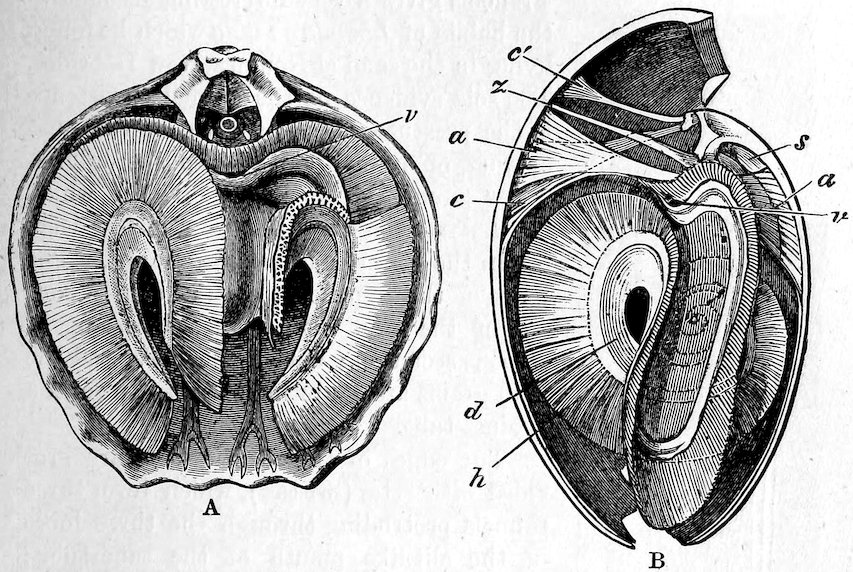
The Molluscs belonging to this Class have neither head, nor cephalic eyes, nor jaws or tongue like those of the other Classes, and are enclosed in a shell which consists of two plates or valves held together on one side of the margin by a horny, elastic substance, called the “ligament.” Bivalves do not creep about in search of food, but find their means of existence in the shape of minute particles, both animal and vegetable, which happen to be contained in the water which they breathe. Some, however, are capable of locomotion by means of a well-developed foot, and a few swim through the water by alternately opening and shutting their valves. The body is enclosed within two lobes of the mantle which line the interior of the valves, and which at their base are firmly attached to the shell, producing on the shell a scar or impression called the “pallial line.” The gills are lamellar or leaf-like, and placed on each side of the body. Each gill is called a ctenidium, and consists of an axis which is partly attached to the body of the Mollusc. This axis generally gives off two plates consisting of hollow filaments which are parallel with one another, directed downwards towards the ventral side, and in most cases long and refolded upon themselves, so that each plate becomes in reality a double lamella. In a few instances, however, the filaments are simple and not reflected. They are connected with one another by microscopic cilia, sometimes by vascular junctions, and the dependent and reflected portions (lamellæ) of each filament may be connected by “interlamellar vascular junctions.” The mouth is merely an oval aperture at the anterior end of the body, and generally furnished on each side with 30soft thin flaps, or labial palps, which have the function of conveying the food to the mouth. The mantle secretes the substance out of which the shell is formed. The two valves are always in contact at the hinge, which is generally formed by small interlocking projections or hinge-teeth, and they are closed by large adductor muscles, which are attached to impressions in the interior of the shell. When these muscles cease to act, as after death, the valves of the shell open in consequence of the elasticity of the ligament on the dorsal margin. The majority of species have two principal adductors, one at each end, like the Venus-shells, Cockles, Razor-shells, &c.; but in Oysters, Scallops, and a few others, there is but a single central muscle. All Bivalves are aquatic, and the majority marine. They are found burrowing in sand or attached to rocks. Some perforate stones and corals, others wood, and a few construct a sort of nest of fragments of shells, stones, &c.
Many schemes of classification have from time to time been propounded, based upon the presence or absence of respiratory siphons, the number and position of the adductor shell-muscles, the character of the shell-hinge, &c. The most recent arrangement is founded principally upon the structure of the gills. The value of such a classification has yet to be fully tested. Mr. Paul Pilseneer has suggested five orders of Lamellibranchs: Protobranchia, Filibranchia, Pseudolamellibranchia, Eulamellibranchia, Septibranchia.
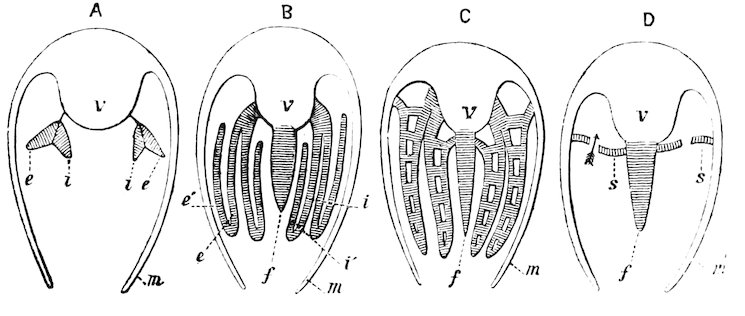
Fig. 25.
(From the ‘Cambridge Natural History.’ Messrs. Macmillan & Co.)
A. Protobranchia. B. Filibranchia. C. Eulamellibranchia. D. Septibranchia.
m. Mantle, v. Body. f′. Foot. e. Outer gill-lamella; i. Inner gill-lamella; e′. Reflected portion of outer lamella; i′. Reflected portion of inner lamella; s. Septum-like gill.
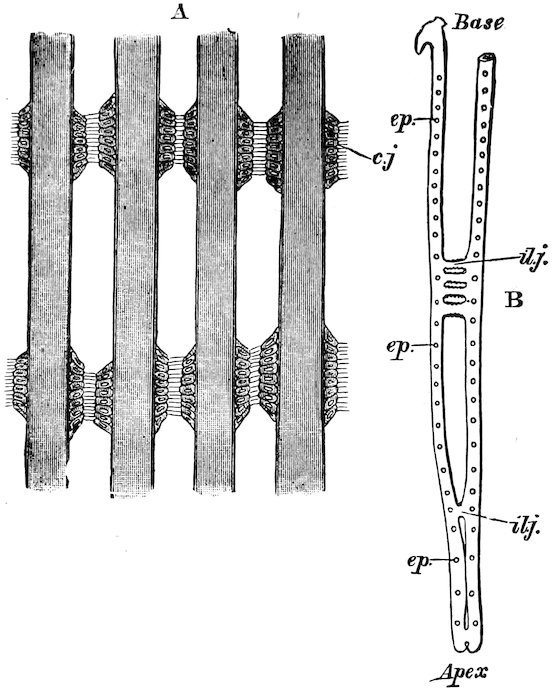
Fig. 26.
Gill of Mytilus edulis.[7]
A. Part of four filaments showing ciliated interfilamentar junctions (cj).
B. Diagram of a single filament showing the two lamellæ connected at intervals by interlamellar junctions (ilj) and the position of the interfilamentar ciliated junctions (ep).
In this order the filaments of the gills are not reflected, but arranged in two divergent rows, the foot being expanded and flattened beneath with crenulated margins and with the byssal gland very slightly developed. The Nuculidæ and Solenomyidæ are the only families belonging to this order. The shells of the former are remarkable for the numerous fine interlocking hinge-teeth, and those of the latter on account of the strong fringed periostracum.
In this group the gills are smooth, with the filaments directed downwards, reflected, and connected one with another by interfilamentar ciliated junctions, but the lamellæ are not connected. The foot is usually provided with a well-developed byssal gland. Anomia, Arca, Trigonia, and Mytilus belong to this order.
The family of Anomiidæ contains a number of more or less pearly shells remarkable for a deep notch or hole in the lower or flat valve through which a shelly plug passes, by means of which the animal attaches itself to other shells, stones, &c. Anomia ænigmatica is found adhering to leaves in mangrove-swamps.
The Placunidæ, sometimes called Window-shells and Saddle-Oysters, are very flat pearly shells with a remarkable hinge, which consists of two long divergent teeth, like a ⋀, to which the ligament is attached. The species are few in number, and inhabit sandy shores of India, China, and North Australia.
The Arcidæ are a family of strong ponderous shells varying much in form and sculpture. The animals have a longish pointed foot, deeply grooved along the bottom, no labial palpi, and free margins to the mantle, which are not prolonged into breathing-siphons. Many of the Arks often anchor themselves by means of a strong byssus. The shells of this family are usually radiately ridged; and the hinge is composed of a number of teeth arranged along the hinge-line, which is generally straight. Arca tortuosa, from China, has the valves curiously twisted. The section Barbatia is remarkable for the coarse fibrous character of the epidermis; Scapharca for its unequal valves; and Cucullæa, from the Indian Ocean, for the elevated ridge bounding the posterior muscular impression. Glycymeris (better known as Pectunculus) has the hinge-teeth arranged in an arched series, and the shells are more regular in growth than in many other forms of Arcidæ.
The Trigoniidæ are one of those families which have all but disappeared during our period. Only three or four living species are known, whilst more than a hundred fossil forms have been described from the Jurassic and Cretaceous formations. Australia, where some of the oldest types of animal life persist, furnishes also the existing species of Trigonia (Fig. 27). The animals have a long, sharply-bent, pointed foot like the Cockles, with which they make surprising leaps. The shells are beautifully pearly within, and ribbed and noduled exteriorly.
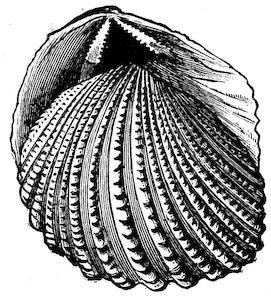
The Mytilidæ, or Mussels, are too well known to need description. The small foot, which is brown in the common species, is not much used in creeping about, but has the power of spinning a byssus or bundle of tough threads, by means of which the animals attach themselves to rocks and one another, forming colonies of vast numbers. Mussels have always been much eaten in this and other maritime countries, and large quantities are brought to the London market from the Dutch coast. At times they are unwholesome; but all the exact causes of this are not known. Mussels seem to be found on every shore, and some of the species are very widely distributed—the common edible Mussel, M. edulis, being found on every European coast, on the shores of North and South America, in the Arctic and Antarctic Oceans, and probably on the coasts of Australia.
One group of Mussels (Lithodomus, Case 144) burrow in rocks and other shells, forming holes just large enough to contain their shells. L. dactylus is sold as an article of diet on the shores of the Mediterranean.
The gills in this order are plicate, and the two lamellæ of each plate are furnished with conjunctive or vascular interlamellar junctions, and the filaments are connected by interfilamentar ciliated discs in some cases, in others by vascular concrescence. The mantle-margins are separated all round, and the foot is either small or wanting. Only a single adductor muscle is generally present. The Pearl-oysters, true Oysters, and Scallops are the forms which constitute this order.
The large family of Aviculidæ includes the “Wing-shells” (Avicula), the “Pearl” and “Hammer Oysters” (Meleagrina and Malleus), and Pinna (Fig. 28). Some species of Pinna attain to a length of two feet. They are found imbedded in the sand with the narrow pointed end downwards. They form a large silky byssus, which can be woven or knitted into gloves, socks, etc. (see side table—case B). The “Hammer-Oyster” (Malleus) is so called from its rude 34resemblance to a hammer. The “Pearl-Oysters” (Meleagrina margaritifera, Fig. 29) possess rather heavy strong shells, lined with very thick layers of “mother-o’-pearl.” Hundreds of tons of these shells are annually collected at the great pearl-fisheries of North and West Australia, and imported into Europe. The pearl-oyster of Ceylon (M. fucata, Case 146) is a smaller species, and collected more for the pearls than the shells. The round pearls, which are valued so highly, are either excrescences of the pearly layer or are found loose in the fleshy parts of the animal. Some small foreign body which has accidentally penetrated under the mantle and irritates the animal is covered with successive concentric layers of nacre, thus attaining sometimes, but rarely, the size of a small filbert. The nacre is generally of the well-known pearly-white colour, very rarely dark, and occasionally almost black. The action of the animal in secreting successive layers of nacre over any foreign body which intrudes between the mantle-folds, and thus converting it into a pearl, is strikingly illustrated by two specimens in which, in the one case, an entire fish, and in the other a small crab, have been so enclosed (see side table-case E).
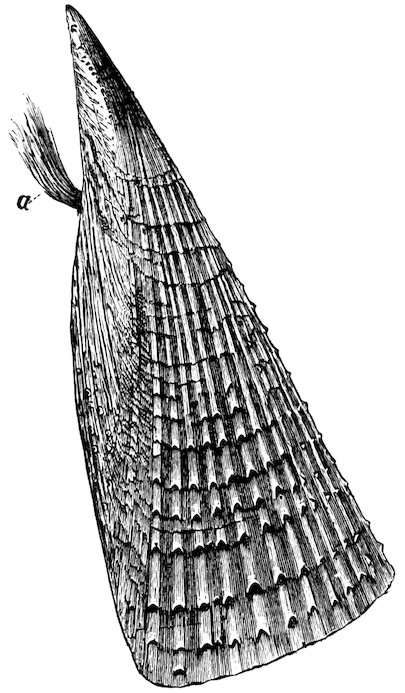
Fig. 28.
British “Fan-Mussel” (Pinna pectinata): a, the byssus. Case 150.
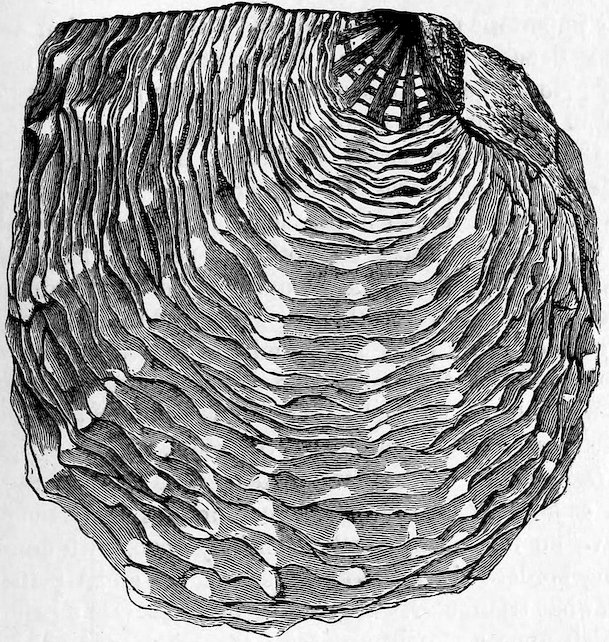
Fig. 29.
Pearl-Oyster (Meleagrina margaritifera). Case 146.
The most ancient and, even at the present day, one of the most important of the pearl-fisheries is that carried on on the western shores of Ceylon. “The Banks,” or spots on which the oysters grow, are at an average depth of 30 to 60 feet, and extend several miles along the coast. The oysters, which should be six or seven years old when collected, are gathered in baskets by native divers and hauled up by ropes into hundreds of small boats. The shells are then brought to land and placed upon the ground to die and putrefy, and then minutely examined for the pearls, which are either found loose in the shells or imbedded in the fleshy parts of the oysters. As many as two million oysters have been brought ashore on one day; but the number obtained varies very much according to the state of the banks. A small proportion of the oysters contain pearls; in some only very small ones (seed or dust-pearls as they are called) are found, and very few contain pearls larger than a pea, which are so highly valued. In his account of the 36pearl-fishery of Ceylon the Rev. James Cordiner says that he saw the operation of sorting the pearls performed; the produce of 17,000 oysters weighed only ¾ lb. and was contained in a vessel smaller than a common soup-plate. Out of that quantity there were not found two fine perfect pearls; all of the largest were slightly deformed, rugged and uneven, but of the smaller sizes many were round and perfect. The chief qualities which regulate the value of pearls are size, roundness, and brilliancy of lustre. Of the smallest kind several may be bought for a shilling, whilst many thousand pounds have been given for a single fine pearl of surpassing beauty.
Other important pearl-fisheries besides that of Ceylon are carried on in the Persian Gulf, on the west coast of Central America, and especially North-west Australia, where diving-dresses are now employed in collecting the shells.
The Chinese obtain pearls artificially from a species of freshwater Mussel (Dipsas plicata). In order to do this they keep them in tanks and insert between the shell and the animal either small shot or small round pieces of mother-of-pearl, which soon receive regular coatings of nacre and assume the look of ordinary pearls. They also insert small metal images of Buddha, which also soon become covered with pearl and firmly cemented to the shell, the production being to the uninitiated a supernatural testimony to the truth of Buddhism. (A shell treated in this way is exhibited in one of the small cases (E) at the side of the room.)
The Ostreidæ, or Oysters, undoubtedly take the first rank among molluscs as regards usefulness to mankind as an article of food. They have no foot; the mantle is entirely open, with double edges, each being bordered by a short fringe, and the labial palps are large and somewhat triangular. There are on each side a pair of simple gills, which appear closely striated; the single adductor muscle is large and nearly central (see Fig. 30). The Oyster is, except in the very young state, entirely incapable of locomotion, and always attached by the deeper valve to other shells, rocks, or other substances. The common British species is not full-grown until it is about five or seven years old. A series of different ages, from the “spat” to the adult form, is exhibited in Case 152. During the months of May, June, and July the eggs are discharged into the gills, where they remain until hatched; and it is during this period that oysters are “out of season.” In the American Oyster (O. virginica), on the contrary, the eggs are said to be 37hatched outside the parent shell. Oysters of different kinds are found on nearly every shore. The gigantic O. gigas is said to grow to the length of three feet in the Bay of Taichou, Japan, where it is commonly eaten. About two hundred fossil species have already been described.
The Spondylidæ, or Thorny Oysters, closely resemble the Scallops, but the shells are more spiny, heavier, united by interlocking teeth, and one of the valves is attached to rocks, corals, etc. Many of the species are very brightly coloured; and from the fact that small quantities of water are sometimes enclosed in cavities in the inner layer of the shell, they have been called “Water-Clams” or “Water Spondyli.”
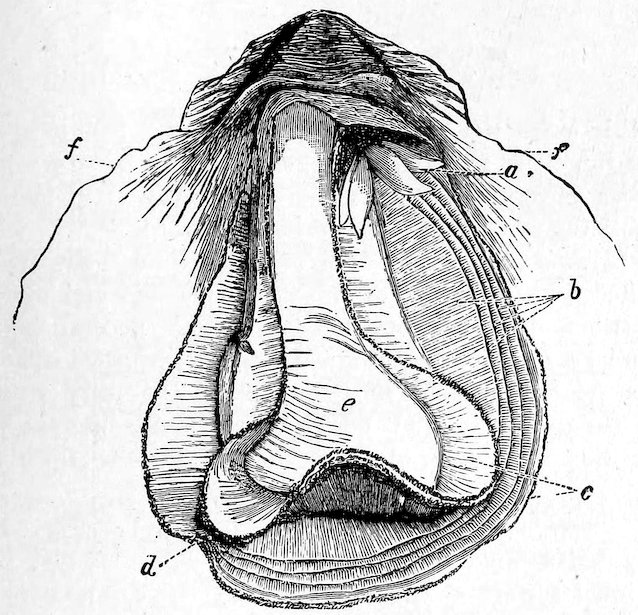
Fig. 30.
Common Edible Oyster (Ostrea edulis).
a, labial palpi; b, gills; c, mantle; d, junction of the two folds of the mantle; e, large adductor muscle; f, the shell.
The Limas (Limidæ) are very like the Pectens, but the inner edge of their mantle is fringed with very long thread-like filaments. The shells are always white, generally more or less oblique, and radiately ridged. They appear to be found in most seas, and either swim about freely like the young Scallops by flapping their valves 38or attach themselves by a byssus, sometimes forming a sort of nest, consisting of pieces of coral and shell or small stones, in which they are completely concealed.
The Scallops or Fan-shells (Pectinidæ) are well known for their beautiful colours, sculpture, and excellent flavour. The animal has a distinct foot, which is not, however, used as a locomotive organ, but employed in spinning a byssus of attachment when required. The young Pectens dart through the water by opening and suddenly closing their valves. The species are very numerous, world-wide in their distribution, and may be found at depths from a few to three thousand fathoms.
In this order the gills have interfilamentar and interlamellar vascular junctions, and there are generally two adductor muscles. The order is very extensive, comprising nearly sixty families, of which only the more important can be referred to.
The Carditidæ and Astartidæ have strong solid shells, frequently ornamented with radiating or concentric ribbing, and usually are coated with a dark epidermis. They have the general appearance of certain Veneridæ; but the animal has no prolonged siphons, but merely a fringed opening in the mantle. One very remarkable species, Thecalia concamerata (Case 161), has an internal cup-like process within the valves, which serves as a nursing-pouch for the young.
The Lucinidæ are almost invariably white shells, and may generally be recognized by the very long muscular scar in front on the inner surface of the valves. They occur in all parts of the world; and the fossil forms, which are still more numerous than those now living, have existed at every epoch from the Silurian.
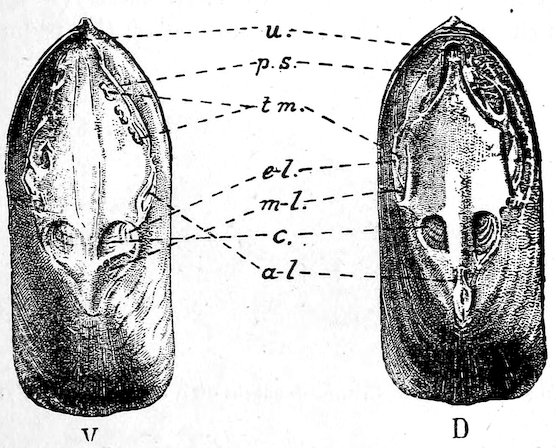
Of the freshwater Mussels or Unionidæ more than 1200 species have been already discovered; they are found in most parts of the world, the greatest number having been described from North America. In Unio the edges of the mantle are not united along the bottom and not prolonged into siphonal tubes; at the posterior end there are two openings, of which the upper or excretal orifice is simple, and the lower or branchial fringed at the edge. Two “cephalic eyes” have recently been noticed by Mr. P. Pelseneer. The foot is very large and adapted for crawling and burrowing. The sexes are distinct; and the shells of the females are somewhat 39more tumid than those of the males. Margaritana margaritifera, (Case 168) which is found in this country and in Europe, sometimes produces handsome pearls, but not equal to those obtained from the pearl-oyster of tropical seas. The hinge in this family is extremely variable, being in some instances delicate and toothless (Anodonta, Fig. 31, B), whilst in others it is enormously thickened and furnished with strong interlocking teeth (see Fig. 31, A).
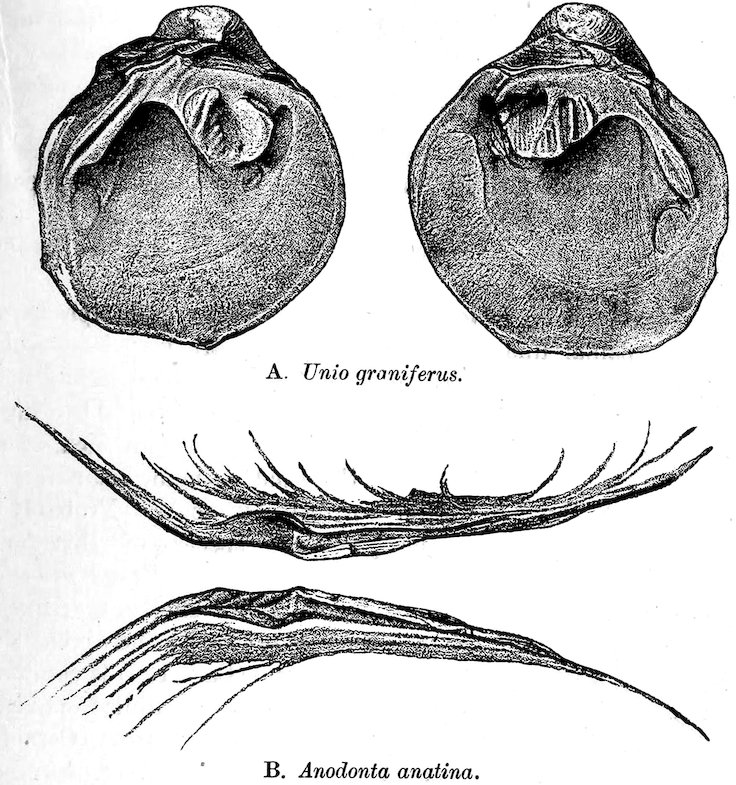
Fig. 31.
The family Ætheriidæ, or freshwater Oysters, consists of but three genera: Ætheria contains African, and Mülleria and Barttettia Indian and South-American forms. When young the shells of Ætheria (which are common in the Nile) are free and not unlike an Anodonta, but when adult they become attached and irregular and look like an olive-green Oyster; they are, however, provided with two muscular impressions instead of one, as in ordinary marine 40Oysters. Still more remarkable is Mülleria lobata of Colombia, which, when young, freely moves about and has two adductor muscles, but in time becomes attached and stationary, and then possesses but a single adductor.
The Tellinas have usually thin shells, and their two siphons are longer and more completely separated from each other than in the Veneridæ. The pallial line is widely and deeply sinuated, and the ligament generally external. In the genus Semele of the family Scrobiculariidæ, it is placed within the hinge-margin. They live in great numbers beneath the sand in shallow water, and are occasionally used as food.
The Mactridæ have an internal ligament to the hinge, the siphons are joined together and fringed at the ends, and the pallial line is more or less sinuated. Spisula solidissima (Case 184), the largest species found on the coast of the United States, is a common article of diet.
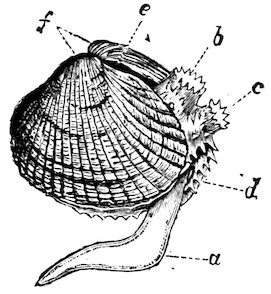
Fig. 32.
Common British Cockle
(Cardium edule).
a, foot; b, exhalant siphon; c, branchial or inhalant siphon; d, edge of mantle; e, ligament; f, umbones or beaks of the shell.
The next family, Veneridæ, have long respiratory siphons and a sinuated pallial line. Many of this tribe are very beautiful in form and colouring, and most of them have very hard strong shells. The valves are united above by an external ligament, and the hinge-plate is toothed. Nearly all of them live buried an inch or two beneath the sand or mud, but a few are found burrowing in rocks. Probably the majority of the species of this family might be used as food. Venus verrucosa, of our own southern shores, is frequently eaten both in this country and abroad; and Venus mercenaria (Case 189) is commonly sold in the markets of Philadelphia and New York. Cytherea lusoria (Case 185) also forms a favourite article of diet among the poorer classes in Japan, and several kinds are eaten by the natives of New Zealand and other countries.
Some of the “Cockles” (Cardiidæ) from warm latitudes are highly coloured and adorned with most beautiful sculpture. Probably the majority are eatable, as the common cockle (Cardium edule) of the British coast. The foot of these molluscs is very large, bent, and used for leaping. The siphons are short and fringed at the margins.
41The Tridacnidæ, or true Clams, differ from other Bivalves with united mantle-margins in having but a central adductor muscle. In the typical species the animal is attached to the rocks by a “byssus,” a strong fibrous structure which passes through an aperture at the upper part of the shell. A species found in the Red Sea, T. elongata, is eaten by the natives, and the shell employed for the manufacture of lime. Tridacna gigas, the largest known bivalved mollusc, sometimes weighs over 500 lb., that exhibited in the upright cases at the entrance of the Gallery being 310 lb. in weight. A large pair bordered with gilt copper are used as bénitiers or holy-water vessels in the church of St. Sulpice in Paris. Tridacnæ are found associated in large numbers in lagoons, among coral-reefs in the Eastern and Pacific Seas. The animals are described as presenting a beautiful iridescent glare of blue, violet, and yellow variegated with fantastic markings.
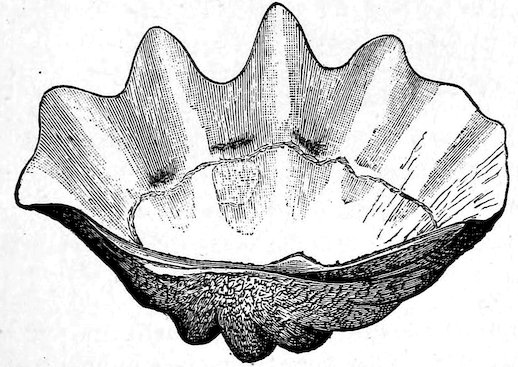
Fig. 33.
Left valve of the Giant Clam (Tridacna gigas).
Length, 36 inches. Weight, 154 lb.; weight of the two valves, 310 lb.
The genus Chama consists of tropical species, which are found fixed to corals, rocks, etc. Nevertheless, they have a small bent foot, but what purpose it serves is difficult to conceive.
In this place attention should be called to the Hippuritidæ and Radiolitidæ, very remarkable extinct families of bivalved molluscs which occur abundantly in the cretaceous strata of southern and eastern Europe, Egypt, etc. They are remarkable for the solidity of the shells, the relatively small space occupied by the animal, and the complicated character of the hinge and processes bearing the adductor muscles. They are usually classed near to the Chamidæ, but their true position as regards living Mollusca is very problematical. 42A fine series of these shells is exhibited in Gallery VIII., wall-case 5, in the Geological Department.
The Myidæ, popularly known as “Gapers,” on account of their valves being open at one or both ends, have the mantle united all round, except where the small foot is protruded. The siphons are very long, united almost to the ends, and covered with a coarse wrinkled outer skin. They bury themselves in mud and sand at low-water mark or in shallow water. The species are few in number, and chiefly from the shores of northern countries. Mya arenaria of our own coasts is largely eaten in some parts of Europe and North America.
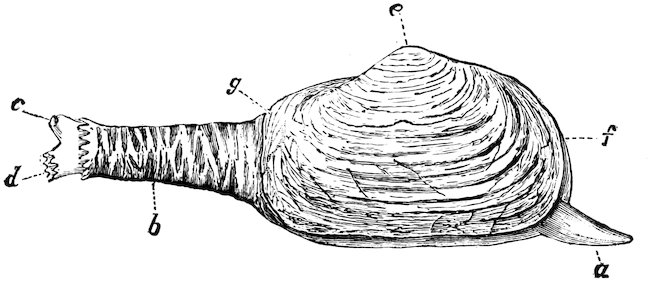
Fig. 34.
British Gaper (Mya truncata).
a, foot; b, siphon-sheath; c, exhalant siphon; d, inhalant siphon; e, umbones or beaks; f, anterior, g, posterior end of shell.
The Corbulæ (Case 198) have one valve larger than the other and are like little Myæ, but the valves are almost closed and their siphons are very short.
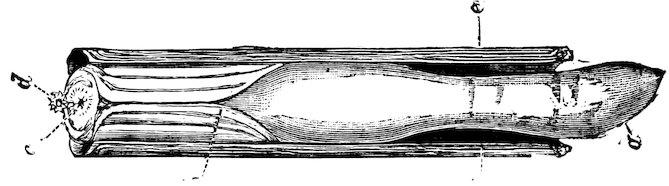
Fig. 35.
British Razor-shell (Solen siliqua).
a, foot; b, mantle; c, inhalant siphon; d, exhalant siphon; e, shell.
Many of the Solenidæ, or Razor-shells, possess very elongated shells, and are remarkable for the great development of the foot, which can be pointed or contracted as may be required for boring into sand. By means of this powerful foot the animals, when 43disturbed, bore with such rapidity and to such a depth that their capture is a matter of great difficulty; and even when seized they hold on so tightly that at times they suffer their foot to be torn off rather than be captured. They not only burrow in sand, but also have the power of darting through the water, like the Scallops. Solens were considered a dainty dish by the ancient Greeks, and numbers are still eaten by the poorer coast-population of this country and abroad.
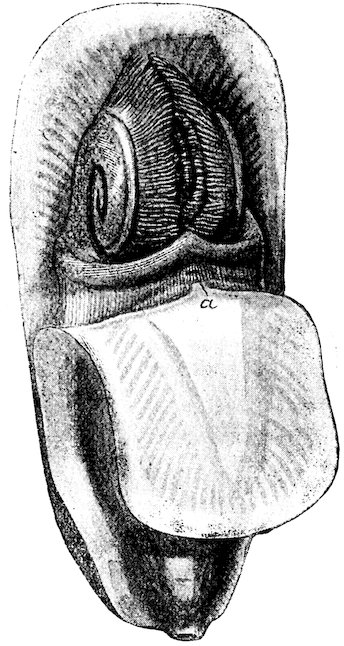
The Pholadidæ, or Piddocks, are very remarkable shells, of an unusually complicated structure, some having the power of boring into rocks, wood, mud, sand, etc. Their shells are white, adorned with prickly sculpture, and, although thin, are strong. The foot is believed to be the principal excavating instrument, but the shell no doubt is used as a file to enlarge the hole as the creature grows. These animals are brightly phosphorescent; and certain species are eaten at many places on the shores of the Mediterranean. They appear to be indifferent as regards the material they bore into; for the common Pholas dactylus (Fig. 36) of our own shores has been found in slate-rocks, mica-schist, coal-shale, new red sandstone, chalk, marl, peat, and submarine wood. The siphons are long in the Piddocks, united except near the end, and enclosed in tough skin. The species are world-wide in their distribution, and several are found fossil in some of the Tertiary formations.
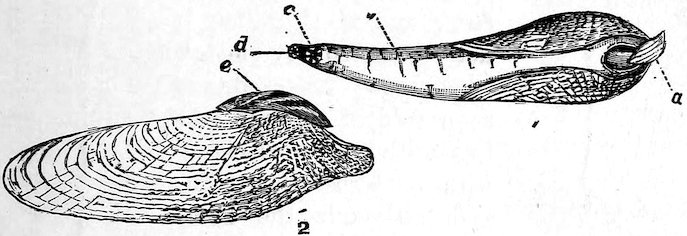
Fig. 36.
Piddock, or Borer (Pholas dactylus). (From the British coast.)
1. Animal in the shell: a, foot; b, siphons; c, inhalant orifice; d, exhalant orifice.
2. Shell: e, accessory valves or plates.
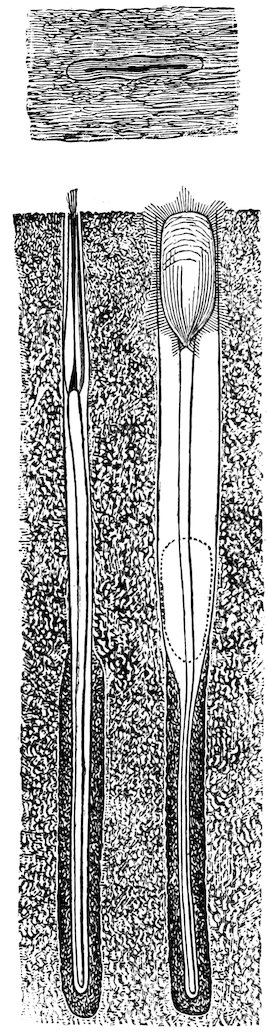
The Teredinidæ, or Ship-worms, are also borers, like the Pholads, but do not perforate rocks. They are principally wood-borers; the large Kuphus arenaria, which is an exception, living buried in the sand. The ship-worm has a long worm-like body, from 6 to 12 44inches in length, which is more or less enclosed in a thin shelly tube or sheath. The true bivalved shell is at the thicker end, and protects the mouth, labial palps, the liver, and other internal organs. At the opposite, or more slender, end of the animal, the mantle is produced into two small tubes, one of which conveys the water to the gills, whilst through the other the water is expelled, charged with the woody pulp excavated by the foot. At the end there is a pair of pallets, or paddles as they are sometimes termed, which are probably used as a means of defence, in closing the shelly tube after the contraction of the siphons.
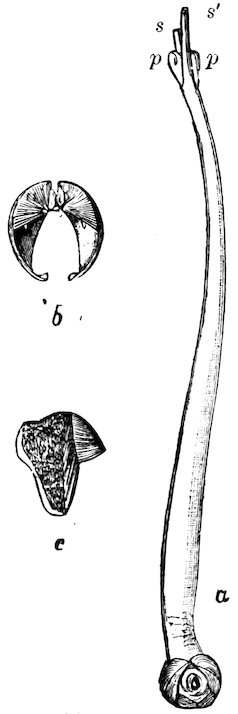
Fig. 37.
Ship-worm
(Teredo norvegica).
Case 202.
a, animal, removed from its shelly tube: p, p, pallets; s, exhalant siphon; s′, inhalant siphon.
b, c, different aspects of the shell.
These animals are most destructive to ships, piers, etc.; and wood, which is not protected by metal, when once attacked, is soon riddled through and through. They work either with or across the grain, and although the holes may be all but touching, they seldom appear to run into one another.
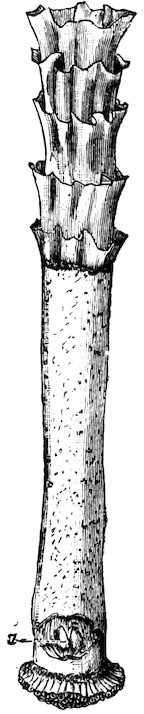
Fig. 38.
Watering-pot Shell
(Brechites vaginifer).
Case 204.
a, bivalve shell of the very young animal.
The “Watering-pot shell” (Brechites), of the family Clavagellidæ, is a very remarkable structure, and unlike the shell of an ordinary bivalved mollusc. On looking carefully, however, near the perforated end (the rose), two small valves will be seen imbedded in the surface. They are found with the rose downwards buried in mud or sand at low water on the shores of the Indian and Pacific Oceans.
The members of this order differ from other Lamellibranchs in having the gill-plates represented by a muscular septum. They are provided with two respiratory siphons and two adductor muscles, and the edges of the mantle-lobes are connected at three points. The families Poromyidæ, and Cuspidariidæ, constitute this order. The species are all small, without colour-markings, are world-wide in their distribution and occur at all depths.
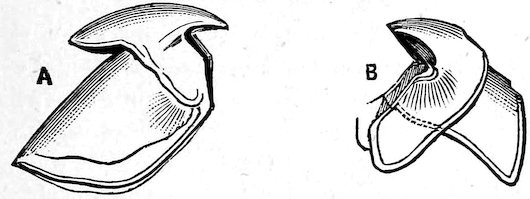
Fig. 39.
A, the upper, B, the lower beak of Architeuthis monachus; one-third natural size.
This Class includes the Octopus or Polypus, Cuttlefish, Squid, Spirula, the Paper and Pearly Nautilus. The body of the animal consists of a muscular sac, in the cavity of which the viscera are placed. In front of the body projects the head, which, in species belonging to the two-gilled section of the Class, is surrounded by eight or ten fleshy arms. A wide aperture below the head admits the water to the gills or branchiæ, which are situated in the interior of the sac, whilst a short tube, the so-called funnel or siphuncle, projects from the opening of the mantle—the water and various excretions being expelled through this tube, especially also an ink-like fluid, which is discharged by all Cephalopods (except Nautilus) when disturbed, in order to darken the water and thus escape their enemies. The centre of the head, between the base of the arms, is occupied by the mouth, which is armed with two horny or calcareous jaws, similar to the beak of a parrot (Fig. 39). The two large eyes are placed on the sides of the head. The arms or feet are more or less elongate, capable of movement in any direction, and, except in Nautilus, furnished on one side with numerous suckers, by means of which the 46animal attaches itself most securely to anything it may seize; they are employed in capturing food and in walking. Cephalopods walk in any direction head downwards, but can swim backwards only, being propelled in that direction by the water which they discharge with force through the funnel out of their branchial cavity. They are divided, according to the number of their gills (which is either two or four), into Dibranchia and Tetrabranchia. Of the latter but one representative now exists, viz., the Pearly Nautilus, all other living Cephalopods being provided with but two gills, placed one on each side of the body within the mantle, as may be seen in the wax model of Sepia officinalis (Case 207). The two-gilled section comprises forms with eight arms, as Argonauta and Octopus, and others with ten arms, viz., the Cuttlefishes (Sepia) (Fig. 43), the Squids (Loligo, Ommatostrephes, Sepiola, Chiroteuthis, etc.), and Spirula. The “shell” of the Paper-Nautilus, or Argonauta, is too well known to require any description. Unlike the shells of other Mollusca, it is not attached to the animal by a special muscle, but is held on to the body by two of the arms, which are dilated and specially adapted for this purpose. Only the female Argonaut is provided with a shell, the male being shellless and a much smaller creature. The Argonaut-shell is therefore not a true shell, but simply a receptacle for the ova, serving at the same time for the protection of the parent.
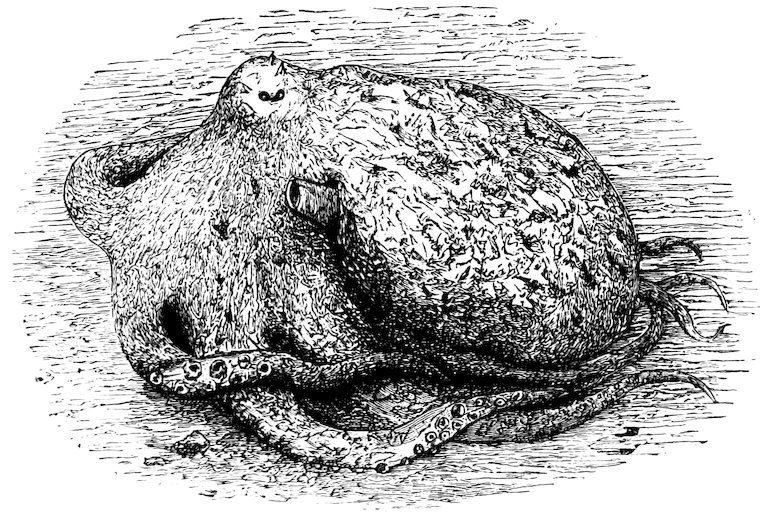
Fig 40.
The Common Octopus (Polypus vulgaris), resting.
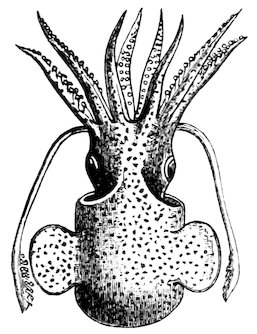
Fig. 41.
Sepiola scandica
(Natural size). British.
47Chiroteuthis Veranyi is remarkable on account of the great length of the tentacular arms. These are non-retractile and are employed to seize their prey when at a distance.
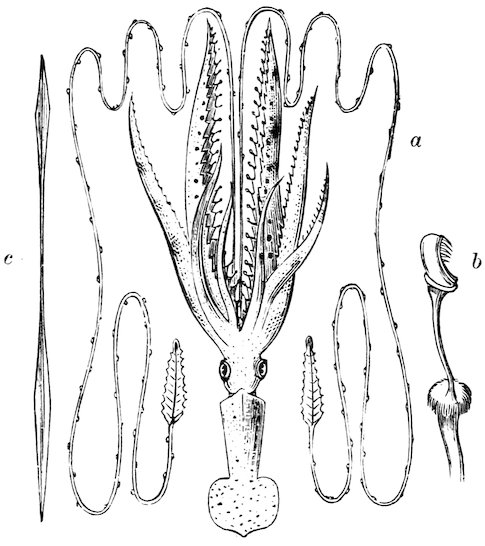
Fig. 42.
Chiroteuthis Veranyi (much reduced).
a, general view of animal; b, magnified view of pedunculated sucker of the terminal club of the tentacular arms; c, internal shell or gladius.
The species of Octopus are found on the shores of almost all temperate and tropical seas; they do not attain to a large size, and are without the internal shell or “bone” which is found in the mantle of many Cephalopods. That of the Cuttlefish or Sepia (Fig. 43 a) is found in abundance on our coasts; it is composed of numberless layers of a friable calcareous substance. That of the Squid tribe is of quite another character, consisting of an elongate thin horny plate, and strengthened by one or more thickened ribs, in some species somewhat resembling a quill-pen. Some species of this pen-bearing class related to the Common Squid attain an immense size. 48One was captured off the Irish coast in June, 1875 (probably Architeuthis harveyi), with the shorter arms 8 feet in length and 15 inches in circumference at the base, the two tentacular arms having a total length of 30 feet. The powerful beak measured about 4 inches across. Thus from the tip of the tail to the end of the tentacular arms this wonderful monster must have measured something like 40 feet in length. Other very large specimens of Architeuthis have been captured on the coasts of Newfoundland and Labrador. Two specimens stranded on the south coast of Newfoundland, in the winter of 1870–1871, measured respectively 40 and 47 feet. Another, cast ashore at Bonavista Bay in December, 1873, had a very stout body 14 feet long, arms 10 feet, and tentacles 24 feet in length. These are only a few of the many instances of the capture of gigantic Cephalopods, which occur not only in the North-Atlantic Ocean, but also in tropical seas. Their appearance in mid-ocean may, in some instances, have given rise to the tales of “Sea-serpents.” Specimens much smaller than those mentioned above have attacked men, and pearl-fishers are in constant fear of them. One of the arms of a large Squid (Architeuthis harveyi?), which is supposed to have been found off the coast of South America, is exhibited in the black upright Case A at the side of the room.
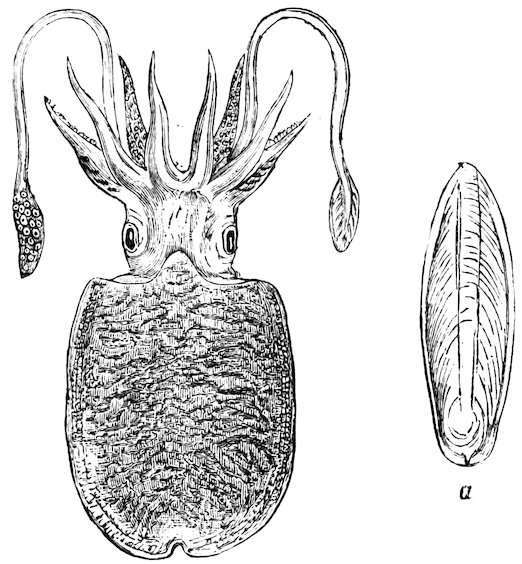
Fig. 43.
The Common Cuttlefish (Sepia officinalis), and its shell or bone (a).
49The shells of Spirula (Fig. 44) have been long known, and are scattered in thousands on the shores of New Zealand and other islands in the Pacific Ocean, and they are also found in the Indian and Atlantic Oceans, occasionally drifting on the coast of Devon and Cornwall. Notwithstanding the abundance of the shells, very few specimens of the perfect animal have been captured. The loosely-coiled shell resembles a ram’s horn, and is divided into a number of segments by fine concave partitions, like the shell of Nautilus, each one pierced by a slender tube or siphon. It is placed at the hinder end of the body, and is covered with so thin a skin, that a small portion of it appears to be exposed both in front and behind. Absolutely nothing is known of the habits of this very interesting creature, although probably they are somewhat similar to those of other Cephalopods.
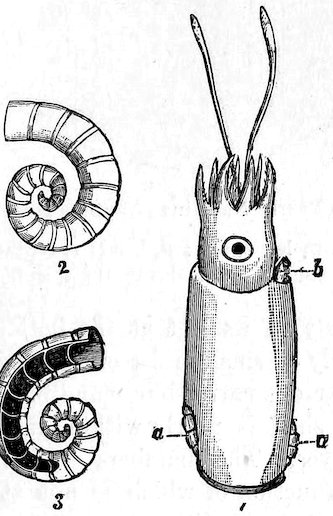
Fig. 44.
The Spirula (Spirula peronii). (From the Indian and Pacific Oceans.)
1. Animal: a, portions of the shell exposed in front and behind; b, the funnel or siphuncle. 2. Side view of shell. 3. Shell in section, to show partitions or septa.
The Nautilus (Fig. 45), of which several shells (Case 208) and a perfect animal in spirit (black upright case A) are exhibited, is an inhabitant of the Indo-Pacific Ocean, and differs from all other living Cephalopods in being provided with four instead of two gills, and, instead of eight or ten arms with suckers and hooks, has a 50number of small retractile feelers. The Nautilus occasionally swims, like other members of its class, at the surface of the sea, but mostly crawls about leisurely on its feet at the bottom in search of food, which consists chiefly of small crabs or Mollusca, which it crushes with its strong calcareous parrot-like mandibles.
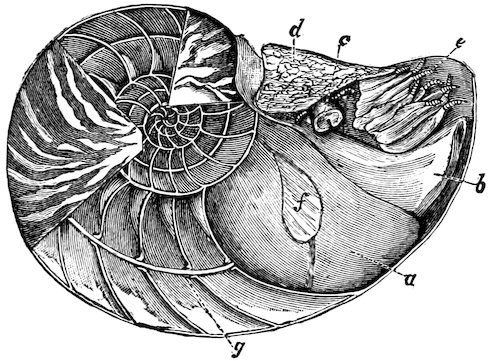
Fig. 45.
The Pearly Nautilus (Nautilus pompilius).
a, body; b, siphuncle; c, eye; d, hood; e, tentacles; f, muscle of attachment to the shell; g, siphon.
The chambered shell is pearly within, and covered with an external calcareous layer. The chambers are connected by a slender tube or siphon, the function of which is not at present thoroughly understood. The septa, or partitions across the shell, indicate periods of growth. When the Nautilus outgrows the capacity of the outer chamber, in which it resides, it constructs a new one of larger size, separating the additional chamber from the preceding one by a transverse partition.
A series of Cephalopods preserved in spirit is exhibited in the black upright case at the side of the room.
This Index has been compiled to assist the numerous visitors, who wish to examine and determine specimens of shells, in finding, without trouble or loss of time, the Cases in which the genera are placed. Subgeneric terms are omitted, as they do not fall within the scope of this “Guide.”
- Acanthina, 75
- Achatina, 130–131
- Achatinella, 134, 135
- Acmæa, 4
- Actæon, 94
- Ætheria, 178
- Amphibola, 98
- Amphiperas, 35
- Ampullaria, 25, 26
- Amussium, 159
- Anatina, 203
- Ancylus, 99
- Anodonta, 166, 167
- Anomia, 137
- Anostoma, 128
- Aplacophora, 3
- Aplustrum, 96
- Aplysia = Tethys, 96
- Aporrhais, 49
- Arca, 139
- Arctica, 162
- Argonauta, 205, 206
- Arion, 107
- Aspergillum (= Brechites), 204
- Astarte, 161
- Atlanta, 94
- Auriculidæ, 97, 98
- Avicula = Pteria, 145
- Batissa, 165
- Brechites, 204
- Bryopa, 204
- Buccinum, 65
- Buliminus, 128
- Bulimulus, 122
- Bulimus = Strophocheilus, 120
- Bullidæ, 95
- Calyptræidæ, 31, 32
- Cancellaria, 77
- Capulus, 31
- Cardita, 160
- Cardium, 192–194
- Carinaria, 94
- Cassis, 55–56
- Cerion, 129
- Cerithiidæ, 42–44
- Chætoderma, 3
- Chama, 196
- Chitonidæ, 1–3
- Chrysodomus, 64
- Circe, 187
- Clausilia, 129–130
- Clavagella = Bryopa, 204
- Columbella, 69
- Conus, 89–94
- Coralliophila, 76
- Corbicula, 164
- Corbis, 163
- Corbula, 198
- Crassatella, 161
- Crenatula, 147
- Crenella, 145
- Cucullæa, 140
- Cuma, 75
- Cuspidaria, 204
- Cyclophoridæ, 23, 25
- Cyclostomatidæ = Pomatiidæ, 28, 29
- Cylindrella, 127
- Cypræa, 32–35
- Cyprina = Arctica, 162
- Cyrena, 164
- Cythera = Meretrix, 185
- Delphinula, 12
- Dentalium, 136
- Despoena, 22
- Diplodonta, 163
- Dolium, 56, 57
- Donax, 182
- Dosinia, 188
- Dreissensia, 179
- 52Eburna, 67
- Emarginula, 7
- Ennea, 103
- Eucalodium, 129
- Eulima, 46
- Fasciolaria, 59
- Ficula = Pirula, 57
- Fissurella, 8
- Fulgur, 61
- Fusus, 57, 58
- Gadinia, 99
- Galatea, 165
- Galeomma, 163
- Gastrochæna, 201
- Gena, 11
- Glandina = Oleacina, 102
- Glauconome, 192
- Glycymeris, 141
- Haliotis, 9–11
- Haminea, 95
- Harpa, 84
- Helicarion, 104
- Helicidæ, 107–121
- Helicina, 21
- Hemifusus, 61
- Heteropoda, 24
- Hinnites, 159
- Hydatina, 96
- Ianthina, 38
- Isocardia, 162
- Isognomon = Melina, 147
- Kellia, 163
- Latiaxis, 74
- Latirus, 59
- Leda = Nuculana, 137
- Lepeta, 4
- Lepton, 163
- Lima, 156
- Limax, 106
- Limnæidæ, 99–102
- Limopsis, 141
- Lithodomus, 144
- Littorina, 27
- Loligo, 207
- Lotorium, 53, 54
- Lucinidæ, 162, 163
- Lutraria, 199
- Lyonsia, 203
- Mactridæ, 183–185
- Magilus, 77
- Malletia, 137
- Malleus, 146
- Marginella, 83, 84
- Melaniidæ, 38–41
- Meleagrina, 146
- Melina, 147
- Melongena, 61
- Meretrix, 185
- Mesodesma, 182
- Mitridæ, 61–64
- Modiola, 143, 144
- Modiolarca, 145
- Modiolaria, 145
- Monoceros = Acanthina, 75
- Montacuta, 163
- Murex, 70–73
- Mutela, 177
- Mya, 198
- Myadora, 203
- Mycetopus, 176
- Myochama, 203
- Mytilus, 142, 143
- Nassa, 67, 68
- Naticidæ, 36, 37
- Nautilus, 208
- Navicella = Septaria, 20, 21
- Neæra = Cuspidaria, 204
- Neomenia, 3
- Nerita, 18, 19
- Neritina, 19–20
- Nucleobranchiata = Heteropoda, 84
- Nucula, 137
- Nuculana, 137
- Nudibranchiata, 97
- Octopus, 205
- Oleacina, 102
- Olividæ, 81–83
- Ostrea, 152–154
- Ovulum = Amphiperas, 35
- Paludina = Vivipara, 22
- Paludomus, 41
- Pandora, 202
- Panopea, 201
- Partula, 126, 127
- Patella, 4–7
- Pectinidæ, 156–160
- Pectunculus = Glycymeris, 141
- Pedum, 156
- Periploma, 203
- Petricola, 192
- Philine, 96
- Pholadidæ, 201, 202
- Pholadomya, 204
- Pholas, 201, 202
- Phorus (= Xenophora), 49
- Physa, 101
- Pinna, 148–152
- Pirula, 57
- Placuna, 138
- Planaxis, 44
- Planorbis, 100
- Pleurotomaria, 9
- Pleurotomidæ, 85–87
- Plicatula, 154
- Pomatiidæ, 28, 29
- Proserpina = Despoena, 22
- Psammobia, 197
- Pteria, 145
- Pterocera, 51, 52
- Pteropoda, 96
- Puncturella, 7
- Pupa, 128
- Purpura, 74, 75
- Pyramidellidæ, 45
- Ranella, 54
- Ricinula = Sistrum, 76
- Ringicula, 95
- Rissoiidæ, 30
- Rocellaria, 201
- Rostellaria, 52
- Rotella, 15, 16
- Saxicava, 201
- Scala, 44, 45
- Scalaria = Scala, 44, 45
- Scaphander, 95
- Scaphopoda, 136
- Scintilla, 163
- Scutum, 7
- Semele, 181
- Sepia, 206, 207
- Septaria, 20, 21
- Septifer, 143
- Siliquaria, 47
- Siphonaria, 98, 99
- Sistrum, 76
- Solarium, 45
- Solenidæ, 199–201
- Solenomya, 137
- Sphærium, 165
- Spirula, 207
- Spondylus, 154–156
- 53Stenogyra, 133
- Stilifer, 46
- Stomatella, 11
- Streptaxis, 102
- Strombus, 49–51
- Strophia = Cerion, 129
- Strophocheilus, 120
- Struthiolaria, 49
- Succinea, 135
- Sunetta, 187
- Sycotypus, 61
- Tapes, 190,191
- Tellinidæ, 179–181
- Terebellum, 52
- Terebridæ, 87–89
- Teredo, 202
- Testacella, 102
- Tethys, 96
- Thracia, 203
- Trichotropis, 37
- Tridacna, 195
- Trigonia, 141
- Triton = Lotorium, 53, 54
- Trochidæ, 12–15
- Trophon, 70
- Truncatella, 30
- Tugonia, 198
- Turbinellidæ, 60,61
- Turbinidæ, 16–18
- Turritella, 48
- Typhis, 70
- Umbraculum, 97
- Umbrella = Umbraculum, 97
- Ungulina, 163
- Unionidæ, 166–178
- Valvata, 30
- Vanicoro, 49
- Velutina, 37
- Veneridæ, 185–191
- Venerupis, 192
- Venus, 188
- Vermetidæ, 46, 47
- Vitrina, 106
- Vivipara, 22
- Volutidæ, 78–81
- Vulsella, 147
- Xenophora, 49
- Yoldia, 137