The arms and armour of the ancients are contained in Wall-Cases
111-119, and in Table-Case E. The weapons of attack date
from the beginning of the use of metal, in the prehistoric period,
but all the defensive armour belongs to the historical age.
Armour.—There is not much literary evidence for the armour
of antiquity, but military subjects are very commonly represented
in works of art, and these, with the actual remains of armour,
give a good idea of the ancient panoply. The armour of the
prehellenic civilisations of Greece, as described by Homer, is a
subject of dispute, and as this collection possesses no specimen
of such remnants as have been found, there is no need here to
discuss the question. It is enough to say that the armour of the
inhabitants of Greece of the Mycenaean or Bronze Age was entirely
different from that of the Hellenic period, which began with the
introduction of iron in the place of bronze, and that the heroes
of the Homeric poems, who are so frequently portrayed in classical
art, are represented in the armour not of their own day, but of
that of the artist. The earliest Greek fashion is seen in a small
bronze figure of a soldier from Dodona, a cast of which is exhibited
in Case 113 (No. 185; fig. 66). The original is in the Antiquarium
at Berlin. Its date is about 500 B.C. The man was striking with
a spear; he carries a shield on his left arm, and wears a metal
helmet, cuirass and greaves. These three pieces of body-armour
were worn throughout classical times, being adopted from the
Greeks by the Romans. All are represented in this collection.
Helmet.—The earliest type of helmet is known as Corinthian,
because it is worn by the goddess Athena in the well-known coin-type
of Corinth (fig. 12e). It was a complete metal casing of the
head and neck, open only in front of the eyes and mouth; the nose
was protected by a vertical strip which was left between the eyes,
and the rest of the face was covered as by a mask (fig. 66). In
the earliest specimens (No. 186) the metal is everywhere of the
same thickness, the cheek-pieces large and clumsy, the nose-piece
straight, and little attempt is made to curve the back so as to fit
the neck. Later helmets were more gracefully designed: the nasal
and cheek-pieces are shaped and curved, the crown is distinguished
from the lower part, the neck has a natural contour, and is set off
from the rest of the helmet by a notch on each side of the bottom
rim (No. 187; fig. 67). The lines of hair and eyebrows are often
indicated in embossed and engraved patterns (Nos. 188, 189;
fig. 78).
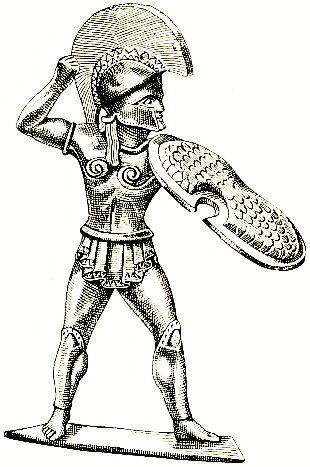
Fig. 66.—Greek Soldier. Cast of Bronze Statuette
from Dodona (No. 185). 2:3.
It would seem that the Corinthian helmet at its best was a
cumbrous piece of armour. The ears of the wearer were covered,
and the ill-fitting shell must have sat loose upon the head, so as
to be easily displaced by a sudden turn. This and the chafing of
the metal were obviated in some degree by a lining of felt or leather,
which was sewn inside the helmet in the rows of holes along the edges.
In No. 189 the actual fastenings may be seen as well as the holes:
thin twine along the bottom rim, and rivets in the holes elsewhere.
This is an unusually well preserved helmet; the wooden peg on
which the plume was tied is still in place (fig. 78). A leathern
cap was also worn, and is seen on the coins of Corinth (fig. 12e),
where the helmet is represented in the position in which it was carried
when the wearer was not fighting, i.e., pushed back until the lower
rim projected in a peak over the forehead. This position came to
be adopted in battle also; for in the last of the Corinthian series
(Nos. 190, 191, fig. 68,
192) there is not sufficient depth to the
helmet to admit of its being worn over the face in the original way,
nor are the eyeholes large enough to be of use, while in two examples
these are represented only by engraving, a traditional design which
shows the evolution of the helmet (No. 192). Such examples are,
however, not really Greek. They come from South Italy, and belong
to a late period, when the art and manners of Greek colonists were
reproduced in barbarous form among the natives. Drawings of this
helmet on Italian vases of the third century B.C. give a date for
the class.
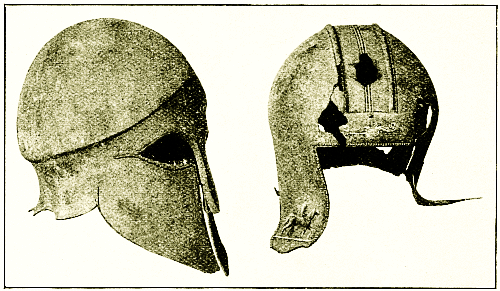
Fig. 67.—Greek Helmets of "Corinthian" and "Island" Types
(Nos. 187, 193). 1:5.
An additional value is given to three of the early helmets by
inscriptions which they bear and which help to date them. The
first (No. 188) is a record of a dedication of Corinthian spoils to
Zeus by the Argives:
ΤΑΡΓ[ΕΙ]ΟΙ
ΑΝΕΘΕΝ
ΤΟΙ ΔΙϜΙ ΤΟΝ
ϘΟΡΙΝΘΟΘΕΝ, in lettering which belongs probably to the end of the
sixth century B.C.40
The helmet was found in the bed of the river
Alpheios, near Olympia, and was doubtless dedicated in the
sanctuary. A shield bearing the first word of a similar inscription
has since been found at Olympia, and was probably part of the same
offering. Another helmet (No. 186) has five letters,
ΟΛΥΜΠ,
scratched on the corner of one of the cheek-pieces in characters of
about 500 B.C. The complete word was perhaps
Ὀλυμπίῳ, "To the
Olympian Zeus." This is said to have been found at Dodona in
Epeiros. The third is inscribed on the front with the name of its
owner,
ΔΑΣΙΜΟΣ
ΠΥΡΡΟΥ, "Dasimos son of Pyrrhos" (No. 194).
The date of the writing is the beginning of the fifth century. This
helmet, which comes from South Italy, differs from the Corinthian
only in having holes for the ears, but it is really the first of a new
type, the so-called Attic.
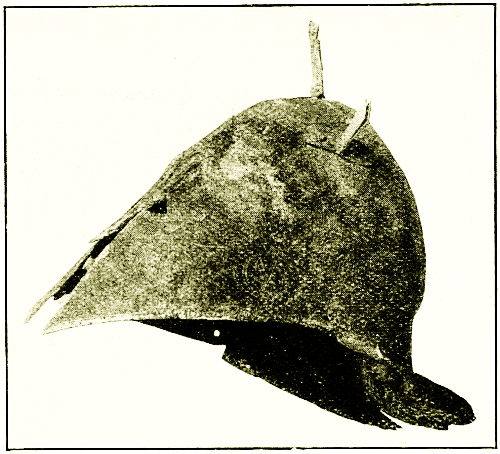
Fig. 68.—Graeco-Italian Helmet of Debased Corinthian Form
(No. 191). 1:6.
The evidence of inscriptions, painting and sculpture shows that
the Corinthian helmet was generally worn by the Greeks from the
first appearance of metal armour in the eighth century B.C. to the
early years of the fifth. It then became less common, but never
quite disappeared, and was used, certainly as a decorative type, by
the Romans of the Empire.
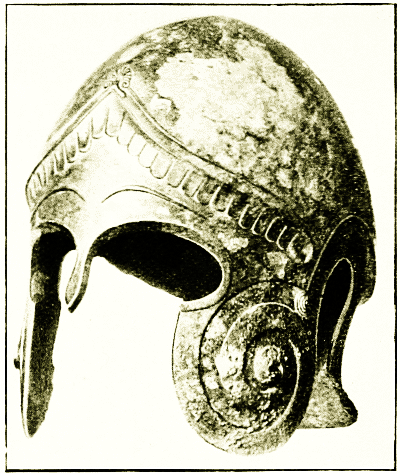
Fig. 69.—Attic Helmet from
Macedonia (No. 195). Ca. 1:4.
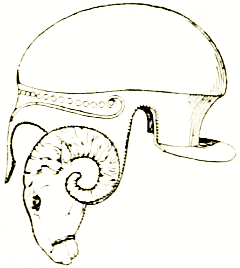
Fig. 70.—Attic Helmet Decorated
with Ram's Heads on the Cheek-Pieces. At Naples.
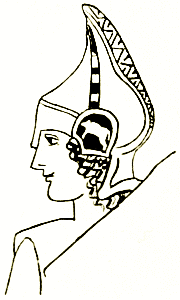
Fig. 71.—Head of Hippolyte,
with Helmet in the shape of a Phrygian Cap.
The Attic helmet, which gets its name from its use on the coins of Athens (fig. 12, f-l), appeared
first in the sixth century B.C., and in the fourth was the usual type.
In shape it is lighter than the Corinthian, and resembles a cap with
appendages to protect the neck, cheeks and nose. The ear was thus left
free. The finest Attic helmet (No. 195, fig. 69) has been acquired
recently from the British Salonika Force. It was found with a
spearhead and other objects in a grave of about 500 B.C. in the camp
of the 29th General Hospital at Mikra Karabournou, in January, 1918,
and was transferred to this collection from the Imperial War Museum.
The nasal is elegantly modelled, eyebrows and tongues of hair over the
forehead are wrought in relief, and broad spiral bands in relief decorate
and strengthen the cheek-pieces. The cheek-pieces were often hung
on hinges (No. 197), and were pushed up from the face when the
wearer was not fighting (fig. 81). No. 198 is a cheek-piece from
Loryma in Caria, which reproduces the form of the face beneath
it. An Attic helmet from Ruvo in Apulia (No. 196) has fixed
cheek-pieces in the shape of rams' heads, which were completed
with applied reliefs like those of a similar helmet at Naples (fig. 70).
The nose-piece was often omitted. The forehead was well covered,
and was usually marked by a triangular frontal band, often enclosing
an ornament. No. 197 has the head of a young Satyr in relief.
The Attic helmet was also adopted in Italy, especially by the
Etruscans. No. 199 (fig. 78) was found in an Etruscan tomb at
Vulci.
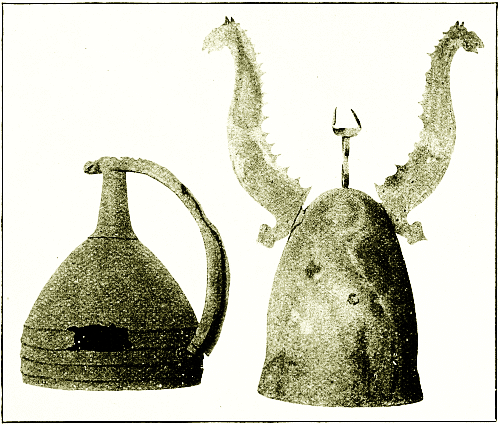
Fig. 72.—Italian Helmets with Metal Crests
(Nos. 205, 202). 1:6.
These two helmets, the Corinthian and the Attic, were so far
the most general among the Greeks as to merit the name of the
classical types. No. 193 is an intermediate form which has been
assigned to the Aegean Islands because of its occurrence in vase-paintings
from the Cyclades. This example was found in the river
Alpheios, and was no doubt originally dedicated, like several other
pieces in this collection, in the temple at Olympia. It is cut straight
over the eyes, has no nose-piece and no ear-holes (fig. 67). A
peculiar feature is a broad band with high raised edges which runs
over the crown of the head from forehead to neck. A stout pin
in front of this shows that the band was a channel in which the
crest was fixed. A row of silver studs and a silver band decorate
the rim of this helmet, and there are remains of ornaments in relief,
palmettes on forehead and at the ears, and on each cheek-piece a
horseman. These were no doubt also of silver, but the plates have
come away, leaving their impress upon the cement which used to
hold them in place. The style of the modelling belongs to the
end of the sixth century B.C. Another Greek type has the shape of
a Phrygian cap, with the addition of movable cheek-pieces, of which
the hinges are partially preserved (No. 200). Such a helmet is
often worn by Amazons, for instance by the Queen Hippolyte on an
Attic bowl of about 450 B.C., which is exhibited in the Third Vase
Room (fig. 71). It is also shewn in the cast of an Etruscan bronze
statuette which stands beside the helmet (No. 201). The tall
oval helmet (No. 202, fig. 72) with its barbarous pair of horns in
the shape of crests of sea-horses, is Italian, but the same type
appears on Greek monuments.
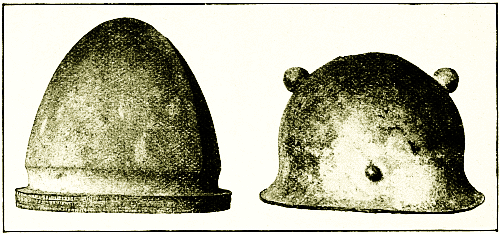
Fig. 73.—Etruscan and Early Italian Helmets
(Nos. 207, 203). 1:5.
Italian helmets are more like hats, giving no protection to the
face unless cheek-pieces are added. An early form, from Ancona,
is almost hemispherical, with wide brim and two large bosses on
the sides (No. 203, fig. 73). The bosses would stop glancing blows
on the head. The smaller knob on the front of this example may
have held the crest; if so, the corresponding knob behind has been
lost. Two helmets from Cannae are later developments of the same
type (No. 204, fig. 74). They are decorated and stiffened with
two curved bands in relief, one on each side of the crown. The
bosses and brims are broken away. The earliest helmets of this
shape belong to the seventh century B.C. Our later specimens were
probably worn in the battle of Cannae (216 B.C.). They have wrongly
been called Carthaginian because of their discovery on this battlefield,
but the type is European, and has been found at Hallstatt.
The helmet with sharp pointed top also belongs to a class which
extended to France and Germany in the early Iron Age (No. 205,
fig. 72). The arched socket for the crest is a peculiarity of this
example, which is of later date, about fourth century B.C. More
strictly of Italian origin are the heavy Etruscan helmets resembling
reversed jockey-caps, with a knob on top, a short peak covering the
wearer's neck, and attached cheek-pieces (No. 206, fig. 75). They are
cast; nearly all other helmets are hammered work. Their date is from
the fifth to the third century B.C. The Etruscans also used an oval
helmet with ridged crown, of which the most notable example comes from
Olympia, where it was dedicated as part of the Greek spoils from the
naval battle of Kyme (B.C. 474). This helmet is described above among
the Greek Inscriptions (p. 8, fig. 7, No. 13). Other examples are
heavier, and have a broad decorated rim (No. 207, fig. 73).
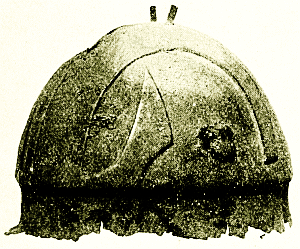
Fig. 74.—Italian Helmet, from
the Battlefield of Cannae (No. 204). 1:5.
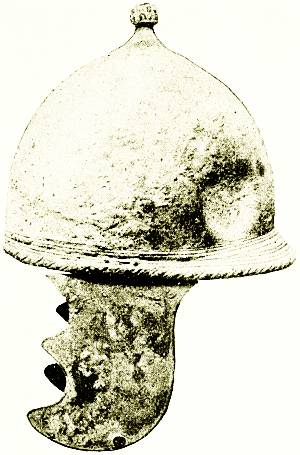
Fig. 75.—Etruscan "Jockey-Cap"
Helmet with hinged Cheek-Pieces (No. 206). 1:5.
There is no specimen of a Roman helmet in this collection.
The scarcity of remains of Roman armour is due to the fact that
it was mostly made of iron, which has decayed. Representations of
different shapes may be seen, in a statuette of an officer (No. 219,
fig. 85), a small model of a trophy (No. 233), a cast of a large marble
relief (No. 236), and a drawing of a soldier from the Column of
Trajan (fig. 90). All these show close-fitting caps with broad chin-straps,
which also serve as cheek-pieces. They are varieties of the
Attic type. Some Roman helmets found in England are exhibited
in the Department of British and Mediaeval Antiquities. One of
them is reproduced in fig. 76. It is evidently related to the much
older Etruscan "jockey-cap." The hinged cheek-pieces are wanting.
It is likely that the Romans would combine Greek and Italian
patterns in designing a uniform helmet for their own army.
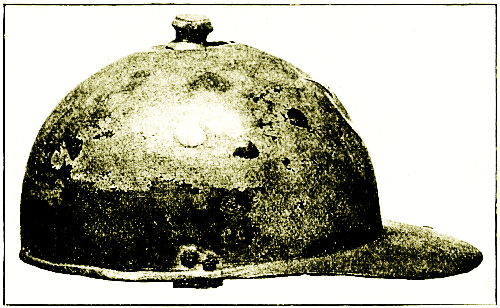
Fig. 76.—Roman Legionary Helmet found near
Berkhampstead. Ca. 1:4.
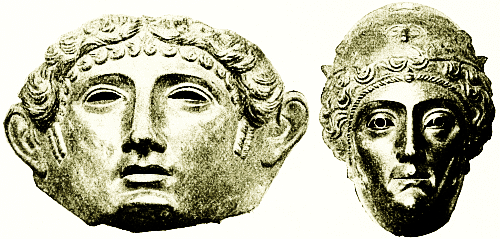
Fig. 77.—Parade Helmet Masks (Nos. 209, 208).
A peculiar fashion of Roman helmet is represented by two bronze vizor-masks
in Case 117 (Nos. 208, 209, fig. 77). A complete
helmet of the same kind, exhibited in the Room of Roman
Britain, was found at Ribchester in 1796, and two other specimens,
a fragmentary iron helmet and a bronze mask, have recently been
excavated at Newstead on the Tweed. The Newstead helmet has
remains of padding still adhering, which prove that these strange
helmets were actually worn, though Arrian, writing on tactics in
the second century A.D., says that they were used for display, and
not in battle. The earlier of our examples (No. 208, fig. 77, right),
which probably belongs to the first century A.D., is said to have
been found on the face of a skeleton in a grave at Nola in Italy in
the eighteenth century. The other (No. 209, fig. 77, left), which
has the more usual type of features, has lately been presented to
the Museum, having been purchased at Aintab in Syria during the
occupation of the country by British troops. Both masks are
pierced at eyes, nostrils and mouth, and show traces of attachment
to the helmet above the forehead. No. 209 has remains of white
metal plating on the face, the hair being left in the colour of
bronze.

Fig. 78.—Helmets with Wooden Peg for Plume and Tube
for Feather (Nos. 189, 199). 1:5.
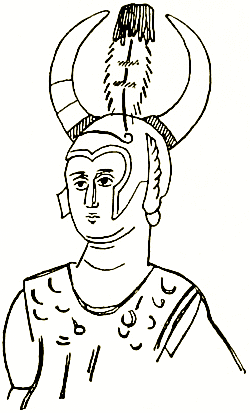
Fig. 79.—Italian
Helmet decorated with Horns,
Wings and Plume.
Crests are shown on all kinds of helmets, as in the Greek, Etruscan
and Roman statuettes (figs. 66, 81, 85), and the drawings on Greek
and Italian vases (figs. 79, 86, etc.); it is not uncommon to find
three on one helmet. They had thick horsehair plumes, sometimes
simply wired to the helmet, sometimes mounted in sockets. Very
few helmets show original fittings for the crests. These must have
been added by the owners. Some helmets have holes drilled in
the crown; No. 186 has remains of wire in the holes. No. 189
has a bronze socket still holding a wooden peg, but this is only
fastened with cement, and its rough make is not in keeping with the
fine finish of this helmet (fig. 78). The flanged channel and pins of
No. 193 (fig. 67) are peculiar to that type of helmet. An Etruscan
helmet of Attic shape (No. 199, fig. 78) had a pair of tubes to carry
single feathers, only one of which remains (cf. fig. 80). It was an
Italian habit to wear fantastic ornaments. The head of a horseman from
a wall-painting at Capua shows horns, wings, and a plume or feather
(fig. 79). A Corinthian helmet from Apulia has a pair of curved horns
like those in the wall-painting (No. 190). An Attic helmet belonging
to a suit of armour which was found in a grave at Capua, and is
exhibited here on loan from H.M. Armoury in
the Tower of London (No. 210), has horns of coiled wire (perhaps
clips for feathers), and a pair of wings. The oval bronze hat
(No. 202, fig. 72) has two crests of sea-horses mounted as horns,
with the support for a plume between them. These accessories are
detachable; they are cut out of thin sheet metal and fit on to flat
ears on the helmet. Two of the latest of the Corinthian class
(No. 191, fig. 68) have such attachments.
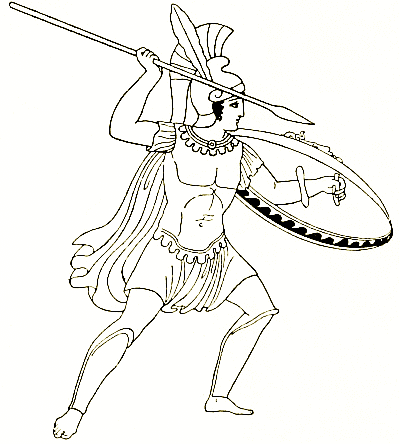
Fig. 80.—Italian Vase-Painting, showing Feathered
Helmet and the Metal Cuirass.
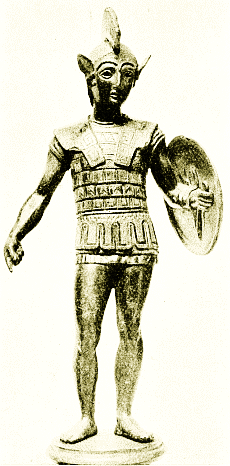
Fig. 81.—Etruscan Bronze Statuette
with Plated Cuirass. 1:4.
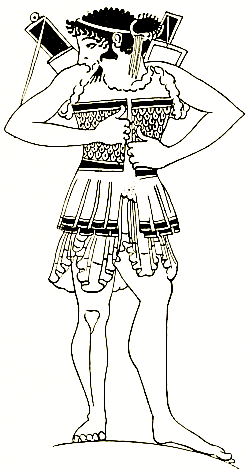
Fig. 82.—A Soldier Putting
on his Cuirass.
Cuirass.—The earliest metal cuirass consisted of two bronze
plates roughly shaped to fit the body, and fastened together at the
sides and shoulders. The bottom edge was turned up so as not to
cut the hips. The Greek statuette from Dodona (No. 185, fig. 66)
shows the form. It was contemporary with the Corinthian helmet
in Greece, and was probably discarded there for the same reason,
that it was as much a burden as a protection. In Italy it had a longer
life, but in an improved shape which is represented in Italian vase-painting
(fig. 80), and is shown here in the cast of an Etruscan
statuette (No. 201), as well as in some actual specimens from Italy
(Nos. 210, 211, 212). These fit closely to the body, of
which
the form is moulded in free style on the metal plates, and the bottom
edge follows the line of the waist. A fringe of leather was often
attached to the rim. The fastenings are rings for lacing, and
pins in sockets which serve either as hinges or clasps. The other
cuirass was generally used in Greece from the beginning of the fifth
century B.C. An Etruscan statuette in the Bronze Room shows
every detail of the type (fig. 81). It was made of leather plated with
bronze, with shoulder-straps to buckle down upon the breast. In
scenes of the arming of soldiers, for instance on a vase by the painter
Douris, at Vienna (fig. 82), the method of putting on this cuirass
is often represented, and the construction of the various parts is
shown. The bronze plating might be in the form of square tabs
or round scales. Two fragments of such plating are exhibited (No.
213, fig. 83, right). The larger consists of six plates of bronze with
the lower edge scalloped, sewn with wire on a leathern coat, and
overlapping in such a way as everywhere to present three thicknesses
of metal. The leather of this example is modern. The other is
of five much smaller scales, similarly wired together. The larger
fragment is from France, the smaller from Oxyrhynchus, in Egypt.
Some pieces of heavier bronze plating, one of them still clasping a
shrivelled tongue of leather, may have served as the long tabs which
form a skirt to this cuirass. They were excavated at Kertch in the
Crimea (No. 214, fig. 83, left).
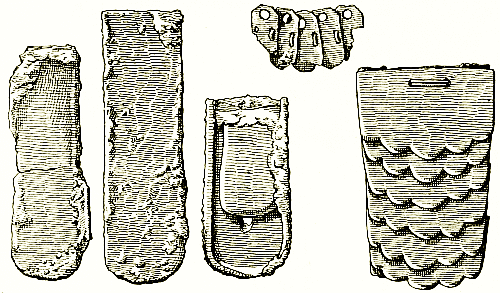
Fig. 83.—Bronze Plating from Cuirasses (Nos. 214, 213).
3:5.
A peculiar Italian type is represented by a triangular bronze
breastplate filled with three circles in relief (No. 215). This
breastplate
often appears on third-century vases of South Italian fabric,
and a number of such plates have been found in tombs of the
beginning of the Iron Age. It is therefore an ancient pattern, but
this example is contemporary with the vases (fig. 84).
Another piece of native Italian fashion is the metal belt (No. 216)
which is also represented in vase paintings of the third century B.C.
(fig. 84). It was worn with the triangular breastplate. Rows of
holes along the edges show that the belts were lined with cloth or
leather. The fastening is simple, one end hooking into the other.
Many elaborate hooks are exhibited (No. 217). Two oval bronze
plaques (No. 218) may have belonged to belts of different type.
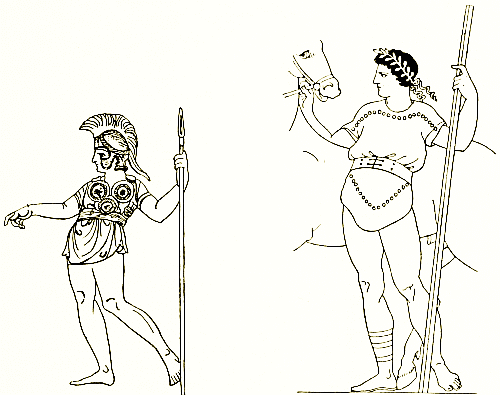
Fig. 84.—Vase Paintings showing Italian Breastplate and
Metal Belt.
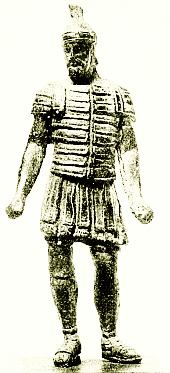
Fig. 85.—Bronze Statuette of a
Roman Legionary Soldier (No. 219). 2:3.
Remains of Roman cuirasses are as rare as of the helmets, and
for the same reason; but the general type of the armour worn by
the legionary soldier is illustrated by a small statuette (No. 219;
fig. 85). The cuirass is of the same design as the flexible Greek type;
it is made of overlapping bands of metal, which are fastened down the
front. There are shoulder-pieces of similar construction, and straps
are brought over from the back to hold the armour in place. Underneath
is a kilt of leather or metal strips. Two other varieties of
Roman cuirass are shown in the cast of the relief representing pieces
of armour (No. 236), and a fourth is the coat of mail, which appears
in the reliefs of the Columns of Trajan and Marcus Aurelius at Rome
(about 110 and 190 A.D. respectively). It is represented here by
fragments of two different patterns and sizes (No. 220).
Greaves.—The third part of the Greek body armour is the
greaves. Metal greaves may have been worn towards the close of
the Mycenaean Age (the pair from Enkomi in Cyprus dates from
about 1100 B.C.), but their general use was due, like that of the
metal cuirass, to the adoption of the small shield, which necessitated
a better covering of the body and legs. The poet Alcaeos says that
the greave was a protection against missiles. It was a thin sheet of
bronze, shaped to fit the leg, which it clasped and held of its own
elasticity. Only the greaves from Enkomi (No. 221) are laced with
bronze wire. Warriors putting on their greaves are often represented
on the Attic vases. Fig. 86 is from the same scene as fig. 82. An
ankle-pad was worn to keep the bottom edge from chafing. There is
little difference of shape or decoration in the existing specimens.
Some reach only to the knee, and some extend above it to cover part of
the thigh (Nos. 222, 225).
With the exception of the pair from Enkomi, all these date from the sixth to the
third century B.C. Two of the
finest (No. 223; fig. 87) from Ruvo in South
Italy, are decorated on the knee with a figure of a Gorgon.
The tongue and eyes were made of ivory. The style points to
Ionia as the place, and the sixth century as the time of manufacture.
Rather later is the pair with incised palmettes above the knees
(No. 224). The only other decoration is the expression of the
muscles of the leg to correspond with the similar representation
of the body on the breastplate. As in the belt and helmet, there
is usually a row of holes along the rim for the attachment of
a lining. In the Roman army the greave was worn from early
times, but under the Empire it became a mark of distinction
for the centurions.
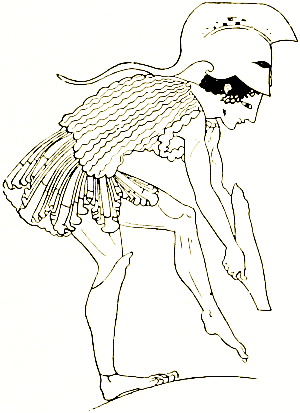
Fig. 86.—A Soldier putting on his Greaves.
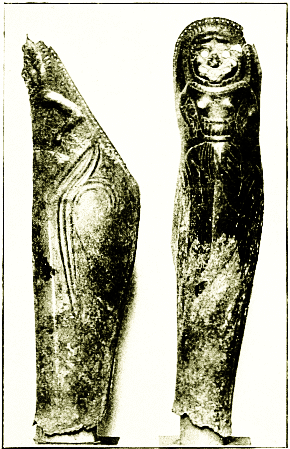
Fig. 87.—Pair of Bronze Greaves
Decorated with Figures of Gorgons (No. 223). 1:6.
Some rare pieces of armour are arranged with the greaves.
No. 226 is a thigh-piece, of which the provenance is not known.
A similar piece was found at Olympia. Armour for the thigh is
represented on some Greek vases of the sixth century B.C., but not
on later monuments, although both Xenophon and Arrian mention
it as part of the equipment of cavalry. A guard for the upper part
of the right arm, from Italy, which is more familiar as armour of
the later gladiator, dates from the fifth or fourth century B.C.
(No. 227). It was fastened to the shoulder of the cuirass. Another
piece of different shape is mounted with the suit of armour from
Capua (No. 210). There are three pairs of shin-guards from Italy
(No. 228). The ankle-pieces are designed to protect the "Achilles"
tendon at the back of the foot (No. 229; fig. 88). These subsidiary
pieces of leg-armour were probably worn by the Italians of the
fourth century B.C., when the long greave was going out of fashion.
Armour of an unusual kind is represented by the pair of bronze
shoes, which are also from Ruvo (No. 230; fig. 89). The metal
covering is only for the top of the foot, and the toes are on a separate
plate, which is hinged at the joint. Part of a single shoe of the same
type was found at Olympia.

Fig. 88.—Bronze Ankle-Guard (No. 229). 1:4.
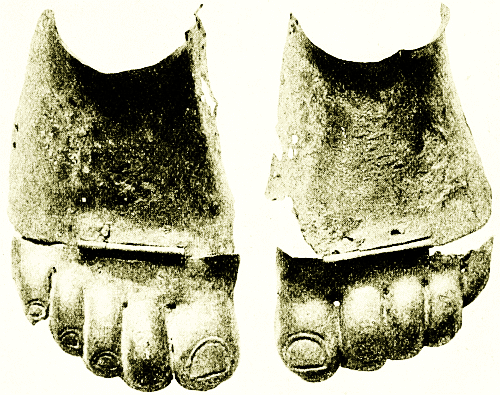
Fig. 89.—Bronze Shoes (No. 230). 1:4.
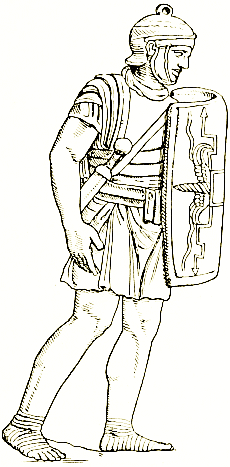
Fig. 90.—Roman Legionary Soldier from the Trajan Column.
Shield.—An essential part of the ancient panoply was the shield,
but actual remains are rare. Greek shields were probably made of wood
or leather studded or plated with metal. The prehistoric shield of
Homer's time we know was a large bull-hide, which enveloped the man
from head to foot, and was slung round his neck by a strap. Herodotus
says that this unwieldy weapon was superseded by the smaller shield,
an invention of the Carians, held on the left arm by a loop and a
cross-bar (fig. 102). The common shapes were circular and oval; more fanciful patterns, lozenges and
crescents, belonged to less civilised neighbours of the Greeks.
Leather construction is seen in the shape of the Boeotian shield
(so called from its use as the national coin-type of Boeotia), which
the Dodona soldier carries (No. 185; fig. 66). This is oval with a
gap in the middle of each long side, a shape produced by stretching
a hide on a long frame with cross-bars at top and bottom. Strings
for tightening the leather cover are drawn inside a shield in fig. 102.
Two circular bronze shields are exhibited, both from Italy. The
large one is decorated with narrow bands of Sphinxes, rosettes,
palm- and lotus-patterns in relief, in the oriental Greek style of the sixth
century B.C. (No. 231). The smaller (No. 232), which has
a spiked boss and punctured geometric patterns, is probably Italian of
about the same date. Neither of these examples has the fittings
of a shield inside. They may have been made for decorative
or votive use.
No Roman shields are represented, and none have survived entire, for
they were also made of wood and leather, and only the central boss and
the framework were of metal. The ordinary type is illustrated in the
reliefs of the Trajan Column (fig. 90), where the legionaries are
perhaps distinguished from the auxiliary soldiers by their oblong
shields. These are further differentiated by the badges of the various
legions; the illustration shows a thunderbolt. The Greeks also carried
devices on their shields, mostly figures of animals (fig. 102, a
bull's head), which would be chosen as the emblem of a man or family,
like coats of arms in mediaeval Europe. Some states also had their
badges; men of Lacedaemon, Sicyon, and Messene bore the initial
letters of the names of their towns.
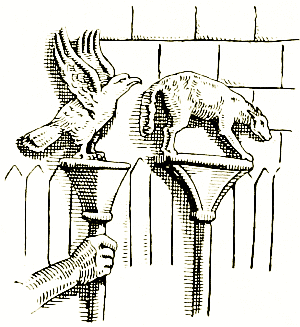
Fig. 91.—Roman Legionary Badges used as Standards, from the Trajan Column.
Trophies.—A peculiar usage of
war among the Greeks, which was
afterwards practised by the Romans, was the erection of trophies
of the arms captured from a defeated enemy. Soldiers of
all ages have celebrated their achievements by the display of
armour or similar spoils which they have stripped from their
opponents; but the custom of building effigies with the empty
armour, to be left for a monument on the battlefield, as a token
of victory, belonged properly to the Greeks. Helmet, cuirass
and greaves were slung in position on a tree-trunk, and the shield
and other weapons were bound to the arms of a cross-piece. An
inscription was affixed, giving an account of the victory and the
dedication of the monument to a deity, as other spoils were dedicated
in the temples. In the centre of the Wall-Cases 116-117 two suits
of armour are set up in this fashion (Nos. 210, 211). In Case 111
there are a small bronze model of a Roman trophy (No. 233), and two
lamps with designs of the same subject. One of them has a trophy
of barbarian arms, a horned helmet and oblong wooden shields, with
a man and a woman captive at the foot (No. 234). The other is
more fanciful: a trophy is borne aloft by a Victory, who is poised
with her foot on a globe, to symbolise the subjection of the world
(No. 235).
The Greeks had established customs in raising trophies, and these were
strictly observed. The trophy was an assertion of victory, and was
accepted by the vanquished and left inviolate by them. But it was
contrary to usage for the victors to repair it, or to make the
supports of anything more durable than wood. The native Roman practice
was to fix captured armour in the house, like trophies of the chase.
The built trophy was borrowed from the Greeks, but it was not
necessarily erected on the battlefield. At Rome there were many
trophies commemorating provincial victories, and the custom was
continued in the representations of spoils on the triumphal arches and
other monuments of the Imperial age. A marble relief of pieces of
armour from one of these monuments is reproduced in a cast (No. 236).
The arms are mostly Roman, but the dragon-standard and loose tunic
belong to the Dacians, a barbarous people who made trouble on the
north-east frontier of the Roman Empire in the second century after
Christ.
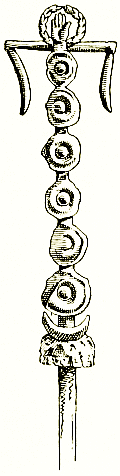
Fig. 92.—Roman Manipular Vexillum,
from the Trajan Column.
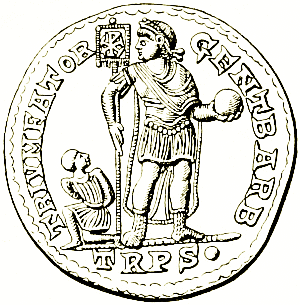
Fig. 93.—Silver Coin of Valens
(364-378 a.d.) showing the Emperor holding the Labarum,
TRIUMPHANT OVER BARBARIANS.
Standards.—Military standards were not much used by the
Greeks, but in the Roman army, which was a regular institution,
not a temporary levy of citizens, they were elaborately developed.
The eagle was the standard of the legion. It was a gilt image of
the bird with spread wings, holding a thunderbolt in its claws.
Marks of military distinction bestowed upon the legion—crowns,
wreaths, and medallions—were carried on the staff which supported
the eagle or on the eagle itself (fig. 109, p. 105). Smaller standards
belonged to the companies of the legion (maniples or centuries). These
were originally banners (vexilla) mounted on spears, with honorary
wreaths and medallions attached to the shafts. A cast of such
a standard is exhibited (No. 237). The cross-piece represents the
bar on which the banner was hung, the sloping and vertical members
at its ends are derived from the cords which fastened the
cross-bar to the pole. The other standards shown in fig. 91,
figures of birds or animals carried on a plain shaft, are also represented
here, in the bronze boar (No. 238). Such standards were
probably used by detachments of the legion. The regimental
emblems were chosen or bestowed for various reasons; some legions had
several badges, and the same badges are found with several legions.
The boar is known to have belonged to the 1st (Italica), 2nd
(Adjutrix), 10th (Fretensis) and 20th (Valeria Victrix). The
bronze hand (No. 239) may have been part of a standard, but its poor
structure rather indicates votive use. An open hand was the proper
standard of the maniple, the Roman company of two centuries, which,
indeed, derived its name from this device (manipulus, a handful).
The Roman explanation, as recorded by Ovid and others, was that when
Romulus first organised his men by hundreds, he gave
each company a standard consisting of a handful of twigs or
grass on the point of a spear. In any case the maniple took its
name from the hand, and the hand is often represented as the
standard of the maniple; fig. 92 is taken from the Trajan Column.
The cross-bar, which originally carried the banner, and its hanging
tassels are shown in this standard, as in No. 237, but the more
important part of the cord, which fastened the bar to the shaft,
has been omitted from the design. This fortuitous pattern of a
cross was eagerly recognised by the early Church as a military
emblem of Christianity, and the famous labarum, the miraculous
standard which Christ gave to the Emperor Constantine on the eve
of the battle of the Milvian Bridge, was a cavalry vexillum of the
Roman army with the monogram of Christ emblazoned on its
banner (fig. 93).
The pieces of armour are described in the Catalogue of Bronzes
to which reference should be made for fuller details. The Catalogue
numbers are painted on the objects.
(185) Bronzen aus Dodona in den Kgl. Museen zu Berlin, p. 13, pl. 2;
(201) Friederichs, Kleinere Kunst, 2197; (208) Cat. of Bronzes, 877;
Benndorf, Ant. Gesichtshelme, p. 15, pl. 3; for the class see Curle, A
Roman Frontier Post and its People, p. 179; (221) B.M. Excavations in
Cyprus, p. 16, fig. 26; (236) Cat. of Sculpture, 2620; (237, 238, 239)
reproduced by Daremberg and Saglio, Dict. Ant. s.v. Signa Militaria.
Weapons.—The weapons of offence, which are exhibited in
Table-Case E, differ from the majority of the antiquities shown
in this room, in that many of them were made at a remote period
in the history of Greece and Italy, some even dating from the
beginning of the Bronze Age, when the use of metal had not long
supplanted that of stone. In a few examples from the island of
Cyprus, the metal is almost pure copper. It is therefore not
strictly accurate to call these weapons Greek and Roman, for they
were made a thousand years before those nations began; but they
come from the lands which were afterwards inhabited by the
Greeks and Romans, and are valuable as representing the development
of arms in those parts of the world, and as being the work
of the primitive races in whom the Greeks and Romans had their
origin.
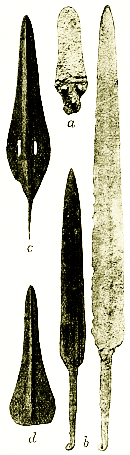
Fig. 94.—Primitive Bronze Spear- and Dagger-Blades,
from Greece and Cyprus (Nos. 241-4). 1:4.
Early Greek Bronze Age.—The first class consists of
arms which belong to the Early Bronze Age in Greece,
a period preceding the mature and extensive civilisation to
which the name of Mycenaean is commonly applied. The
general date of 3000 to 2000 B.C., which is assigned to the
weapons of this period, serves rather to indicate their chronological
relations than to give their precise age. In any case they stand
as a definite beginning of the history of arms in Europe. In these
early times the sword had not been invented, and short daggers
or spear-heads only were produced by workmen with a still
imperfect mastery of metallurgy. The most ancient form was a
short thick blade, with rivets in the base, where it was fastened
to the hilt or shaft. A more secure attachment was contrived by
prolonging the broad base of the blade into a tang, which was let
into the handle and held by a rivet through the end. But the
greatest advance was the discovery that if a rib were left up the
middle of the blade, the edges could be fined down and tapered to
a sharp point without loss of strength. In the final development
the stiffening rib and the tang were connected, so that the strongest
part of the blade was continued down into the handle. Yet in spite of
progress and improvements in design, the old patterns remained in use
to the end of the Bronze Age, and even later, so that a chronological
classification based on the forms of early Weapons is untrustworthy.
All the stages in the development are shown in these examples. The
most primitive types are represented by a series of blades from Cyprus
(No. 241; fig. 94a), which, from material and technique, might be
placed at a very early period; but they were excavated from Mycenaean
tombs of the end of the Bronze Age. To the same island belong the
narrow blades with long tangs, which are turned round at the end in a
hook to hold the handle (No. 242; fig. 94b). This type is said to
have been found in graves of 3000 B.C. It is certainly a primitive
shape, and peculiar to the pre-Mycenaean civilisation of Cyprus.
Another local variety is known in the leaf-shaped blade with a sharp
tang and two slits, one on each side of the midrib, through which the
shaft was lashed in place (No. 243; fig. 94c). The pattern is
characteristic of the contemporary civilisation of the Cycladic
Islands. Two pointed blades with no tang belong to the same early
period. The smaller of the two was found at Athens (No. 244;
fig. 94d).
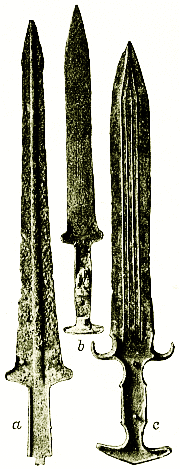
Fig. 95.—Bronze Swords of the Mycenaean Period Nos. 245, 247-8). 1:4.

Fig. 96.—Bronze Swords of late Mycenaean Type (Nos. 249-50). 1:4.
Mycenaean swords and daggers.—The next period
was the close of the Bronze Age in Greece, occupying the
second millennium before Christ. It has been called, from its
best-known centre at Mycenae, the Mycenaean Age. In this period, by
improvement in metal-working, the short daggers were lengthened into
swords, which, towards the end of the age, were made even a yard long,
and very slender. Such weapons were used mainly for thrusting, for
they would break with a direct blow. Homer records many such accidents
on the battlefield. At the same time the spear-head was differentiated
from the dagger-blade, being provided with a socket for the shaft.
Mycenaean weapons are represented here by swords and spear-heads
found mainly at Ialysos in Rhodes, and belonging to the end of the
period. The swords are short and heavy, and are made in one piece
with the hilt. The guard is straight in the earlier specimens, and the
pommel of the hilt was a round knob, of which the tang remains
(No. 245; fig. 95a). This is the form of the well-known daggers
from Mycenae, which have the blades inlaid with designs in coloured
metals, the hilts and pommels embossed and chased in gold.
Electrotype copies of the Mycenae daggers are exhibited in the
Gold Ornament Room Passage. A closer parallel to these is a
blade from Cameiros which has the rivets still in place (No. 246).
In other swords the raised flange on the edges of the hilt is
continued to form a crescent-shaped pommel. The hollow space
was filled with an ornamental material for the grip. The rivets
are usually in place, and on a small dagger from Karpathos a
great part of the ivory mount is preserved (No. 247; fig. 95b).
The last form of this hilt appears in a heavy sword, formerly
in the Woodhouse Collection (No. 248; fig. 95c). The projection
of flanges and pommel is accentuated, and the ends of the
guard are curled up like horns. This type survived into the
Hellenic period. Another late Mycenaean form is seen in a long
and slender sword with a broad base to the blade, which contracts
again towards the hilt (No. 249; fig. 96a). At the other end of
the hilt are two divergent tongues of metal, which are better preserved
in another example, of heavier fabric, from Enkomi, in
Cyprus (No. 250; fig. 96b). The type is that in which the earliest
iron swords of Greece were made (No. 263; fig. 101b), and which
was the prototype of the common bronze sword of the rest of Europe.
The lighter specimen (No. 249) is from Scutari in Albania.
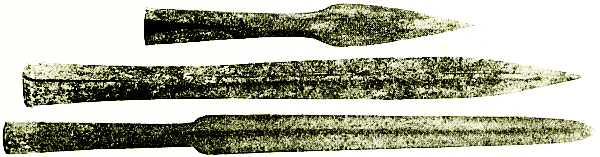
Fig. 97.—Bronze Spearheads of the Mycenaean Period (No.
251). 1:4.
Mycenaean spears and arrows.—The spear was in
Homeric times the soldier's most important arm, a long and
heavy weapon which was thrown with great force or used for
thrusting. Mycenaean spearheads are illustrated in a series from
Ialysos (No. 251; fig. 97). They are skilfully made to secure
the greatest strength with the least expenditure of material;
in most cases the shaft runs far up into the blade, which is
narrow and springs gently from the socket, some being wider near
the point than at the base. There is considerable variety of shape,
but all are characterised by the thin blade with shallow curves.
Mycenaean arrowheads from the same site are of more primitive
design (No. 252; fig. 98). The best are large and heavy, and have
long barbs; a tang and no socket to take the shaft. Others are
curiously flat and weak, and are plainly metal reproductions of a
stone pattern.
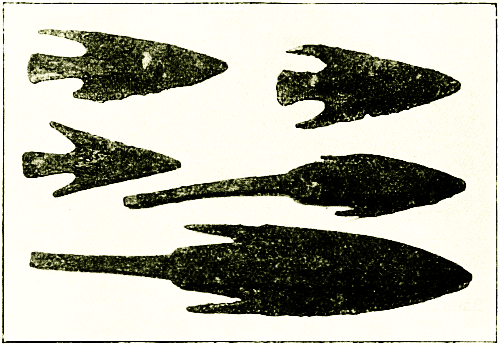
Fig. 98.—Mycenaean Bronze Arrowheads from Ialysos
(No. 252). 2:3.
Italian Bronze Age.—The Bronze Age of Italy is represented
here by daggers and spears which date from about the fifteenth to the
tenth century B.C. Italian daggers are remarkable for the use of
engraved geometrical decoration on the blades. The first class
resembles the Mycenaean weapons in the form of the hilt with edges
raised for inlay and crescent-shaped pommel, and the round base of
the blade is also similar to an early Mycenaean type. The haft of
one dagger is wound with bronze wire, another has an ivory handle
bound with gold (No. 253; fig. 99a), and a third has the pommel
filled
with ivory (No. 254). Some of the blades were made separately, and
riveted to the hilt after the primitive fashion (No. 255; fig.
99b).
In that case the hilt was split to receive the tang, and overlapped
the base (No. 256). Some of these daggers diverge still further
from the Mycenaean in having the blade with recurving edges
which is characteristic of a cutting sword (No. 257; fig. 99c).
The sheaths are of peculiar shape, being made of a thin plate of
bronze with an ornament at the end in the form of a large round
knob or several discs on a peg (No. 258; fig. 99 e, f).
They are decorated with the same linear designs as the blades. A later
variety of Italian sword, known from the horned extremities of the
pommel as the Antennae type, is represented by two specimens
(No. 259; fig. 99d). In the first, the horns are simply curved
projections, in the other they are developed into large rings or
spiral coils. The type is of frequent occurrence throughout Europe,
even in the north.
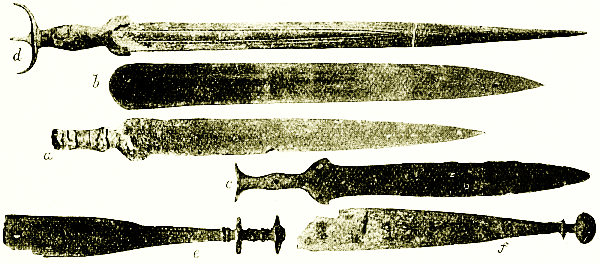
Fig. 99.—Early Italian Bronze Swords and Sheaths
(Nos. 253, 255, 257-9). 1:6.
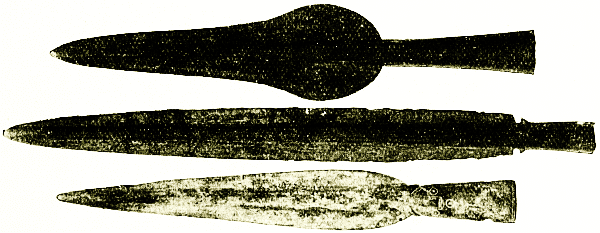
Fig. 100.—Italian Bronze Spearheads (No. 260).
Italian spearheads do not suggest so much connection with
Mycenaean types. Some of them are narrow, but most have broad
and strongly-curving blades which spring sharply from the sockets
(No. 260; fig. 100). A spearhead from Sicily is remarkable for
its great size (No. 261): it is thirty-five
inches long.
The rest of the arms belong to the historical period. The usual
weapons of the Greeks were the spear and sword. The bow was a special
arm, which did not form part of the equipment of the ordinary soldier,
and its use, like that of the sling, was practised by men of certain
districts, who served as mercenaries to other states. The axe was a
barbarous weapon, and is generally represented in the hands of
Amazons, who brought their mode of warfare from the wilds of Scythia
(see fig. 109).
Greek swords.—The
earliest Greek swords in this collection date from the tenth century B.C.,
when iron was fast taking the place of bronze; but forms common in the Bronze Age were still reproduced in
iron, just as those peculiar to stone implements were for some time
preserved in bronze. This conservative tendency is noticeable in three
iron swords, of which two are from Cyprus (Nos. 262, 263; fig.
101b). They reproduce the general form of the bronze sword from
Enkomi in the same island (No. 250; fig. 96). A short iron dagger is
similar to the common Mycenaean type (No. 264; fig. 101a).

Fig. 101.—Iron Swords, showing the Survival of Mycenaean Types (Nos. 263-4). 1:4.
The ordinary Greek sword of the fifth century B.C. is represented by
three examples. The type appears frequently in works of art. On a vase
in the Third Vase Room (E 468; Pedestal 6) there is a drawing of the
combat of Achilles and Memnon, in which Memnon is armed with this sword. In the sheath
by his side is another, so that it is possible to see both hilt and
blade at once (fig. 102). The shape is entirely different from that of
prehistoric times. The hilt is round and the pommel a small knob,
while the guard is a plain crosspiece. The blade, which, being made
of iron, is long and thin, swells from the hilt towards the point in the
manner characteristic of the cutting sword. All these features are
visible in the examples (No. 265; fig. 104a, b). The
swelling blade is best seen in the largest specimen, while the iron-handled fragment,
which was excavated from a tomb near the Mausoleum at Halikarnassos,
shows the original form of the hilt. The small dagger
with a bone hilt and the bone end of the scabbard forms part of
a group of weapons which were found on the battlefield of Marathon
(No. 266; fig. 103). The others are iron spearheads, arrowheads
both of bronze and iron, and leaden slingshot, two of which are
marked with a thunderbolt and the Greek name Zoilos.
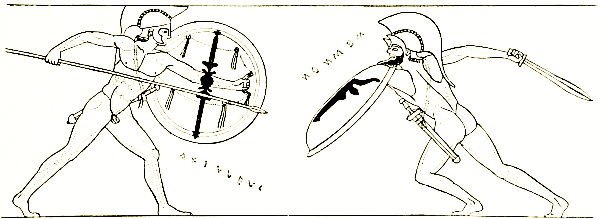
Fig. 102.—Vase-Painting of the Combat between Achilles and
Memnon, showing the Classical Greek Weapons.
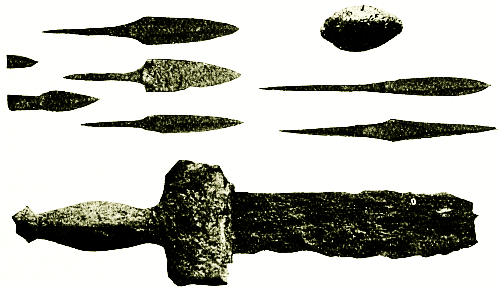
Fig. 103.—Weapons from the Battlefield of Marathon (No. 266). Ca. 1:3.
Another common type of Greek sword is the heavy knife-like sabre with
a hilt in the shape of a bird's head (No. 267; fig. 104c). Its
original appearance may be seen on the Athenian bowl already mentioned
on page 80 (fig. 105). The classical name was machaira. Xenophon
recommends it as a cavalry weapon, because of its heavy down-stroke.
This example comes from Spain, where many similar swords have been
found, but the origin of the type is Greek or even Oriental. The
dagger with a cylindrical bronze hilt of which the pommel is a
lynx-head, appears from the style of the decoration to be Graeco-Roman
(No. 268). Some models in terracotta from Naukratis give the types of
the Hellenistic period (No. 269).
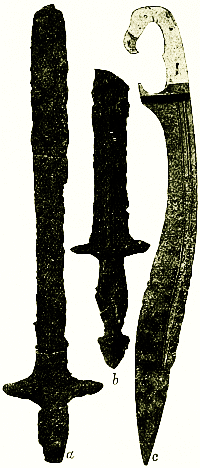
Fig. 104.—Greek Iron Swords (Nos. 265, 267). 1:5.
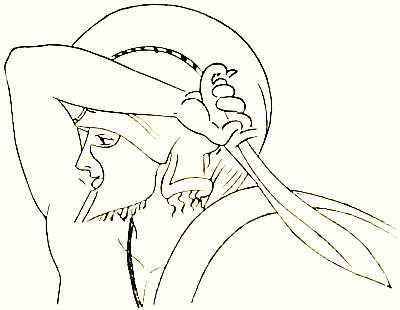
Fig. 105.—The Machaira, with Hilt in the Shape of a Bird.

Fig. 106.—Greek Spearheads (Nos. 272-3, 275). About 1:4.
Greek and Roman spears.—Classical spears are represented
by a variety of heads both in bronze and iron. The earliest Greek
type is an iron head found with pottery of the tenth or ninth century
B.C. in a grave at Assarlik in Asia Minor (No. 271). Those with
three and four blades are a small class, examples of which came to
light at Olympia, and suggest as a date the end of the sixth century
B.C. (No. 272; fig. 106a).
To the same date may belong the decoratively modelled bronze spear
from Kameiros, and another of plainer design from the same place (No.
273; fig. 106b, c), with two from Olympia, and a large iron one
(No. 274) found with the fine Attic helmet (p. 78) in Macedonia. A
curious spearhead, or perhaps a butt, from Olympia is shown among the
Greek Inscriptions (p. 9, No. 14, fig. 8). Spearbutts are not
uncommon. Some are plain tapered ferrules (No. 279; fig. 107), others
end in two-pronged forks (Nos. 280, 281; fig. 107). The bronze forks
are from Egypt, the iron one (fig. 107, bottom centre) was found on
the bank of the Tiber with the spearheads mentioned below. The
unusually long iron head, which was found in Spain with the iron
machaira, is probably a later Greek form (No. 275; fig. 106d).
This example exhibits in a high degree the superiority of iron to
bronze. Other iron spearheads are from Italy; some are from the Tiber
(No. 276). Three specimens, one with remains of the wooden shaft and
the lashing of wire, were found near the village of Talamone on the
west coast of Italy (No. 277; fig. 108), where in 225 B.C. the Romans
won a decisive victory over the Gauls, who had marched successfully to
within a few days of Rome, and were returning home with their plunder.
Like the helmets from Kyme and Cannae, and the arms from Marathon,
these spears are relics of one of the famous battles of antiquity. The
Roman soldiers of later times carried spears of a different kind. They
had no thrusting lance, but an extremely heavy weapon, the pilum,
which they threw with great effect at close quarters. The small iron
heads from Licenza (No. 278) have much the same shape as the head of
the pilum. They probably belonged to light throwing-spears. The purpose of the long head was
to bend and encumber the enemy after piercing his shield or armour.
Roman swords.—The
collection of swords ends in those which belong to the Roman period. A
fragment of a sword with a heavy iron blade seems too big for the
natives of Italy, and may have been used by a Gaulish invader (No.
282). The large sword with a flat guard and an ivory and bronze handle
(No. 283) is perhaps a Roman gladius, which was afterwards
superseded in the army by a sword of Spanish pattern.
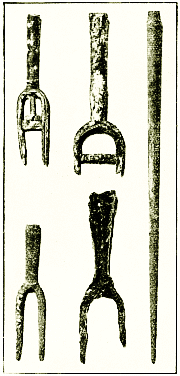
Fig. 107.—Bronze and Iron Spear-Butts
(Nos. 279-81). Ca. 1:5.
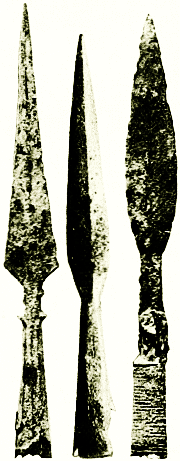
Fig. 108.—Iron Spearheads from
Talamone (No. 277). About 1:4.
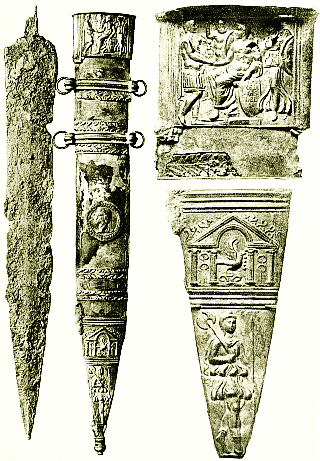
Fig. 109.—Roman Legionary Sword and Scabbard found at Mainz
(No. 284). 1:4. Reliefs, 2:3.
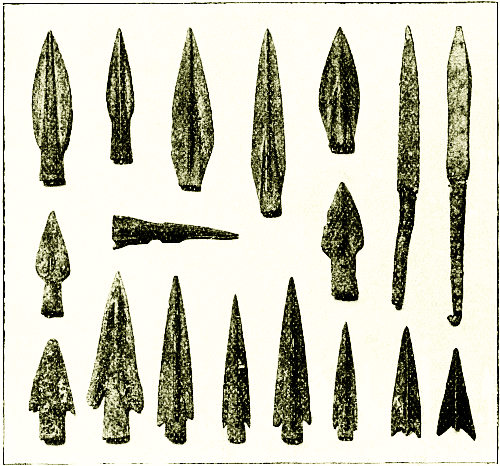
Fig. 110.—Greek and Cypriote Bronze arrowheads
(Nos. 290, 288). 2:3.
The later Roman sword is excellently represented by the so-called
"Sword of Tiberius," which was found in a field at Mainz on the
Rhine (No. 284; fig. 109). The short iron blade is of the usual
type, measuring twenty-one inches in length and two and a half
in width at the base, from whence it tapers gently to a sharp point.
The scabbard was made of wood covered with a plate of silver-gilt
which is decorated with reliefs in gilt bronze. The plates of the
bands which were hooked to the sword-belt are ornamented with
wreaths of oak. At the hilt is a group which represents the Emperor
Tiberius receiving his nephew Germanicus on the latter's return, in
the year 17 A.D., from his victorious campaigns against the Germans,
in the course of which he had recovered one of the legionary eagles
which Varus had lost. The emperor, robed as a deity, is seated on
a throne, resting his left arm on a shield which is inscribed
FELICITAS · TIBERI—"The Good Fortune of Tiberius"—and holding in his
right hand a small figure of Victory with wreath and palm, which
he has just taken from his returning general. Germanicus stands
before him in military attire, with his right hand stretched out.
In the background is an armed figure, and behind the emperor a
winged Victory brings a shield upon which is the legend VIC · AVG—"The
Victory of Augustus." The middle of the scabbard is
occupied by a medallion charged with a portrait of Tiberius, and at
the point is a larger plate which is divided into two fields. The
uppermost has a representation of a Roman eagle in a temple, and
in the other is an Amazon armed with battle-axe and lance. It
might not be wrong to connect the eagle with that of Varus; and
the figure of the Amazon calls to mind the ode of Horace
(Carm. iv. 4) celebrating the success of Drusus, the father of this
Germanicus, against the Germans of the Danube, in which the poet
expresses surprise that those barbarians should be armed with the
Amazonian axe. Perhaps the next generation attributed this
legendary weapon also to the Germans of the Rhine, and the
Amazon is an allusion to the campaigns which the sword commemorates.
From the contrast of the elaboration of the design
with the cheapness of the execution, it would seem that the weapon
is one of many copies which were turned out for some official
purpose, probably a sword of honour presented to officers who had
served with Germanicus.
Other remains of Roman swords are less complete. There are
several fragments of scabbards, a bronze guard, two ivory pieces
which may have been pommels of the hilt or caps of the sheath,
and a good specimen of an entire hilt in bone (No. 285). This is
very similar to the classical Greek pattern.
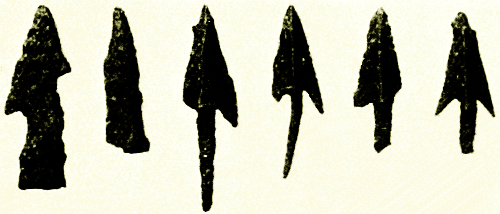
Fig. 111.—Roman Arrowheads (No. 293). 2:3.
Sling-shot and arrowheads.—Weapons which show little
difference of form in Greek or Roman times are the sling-shot (No.
286) and arrowheads. Sling-shot are mostly cast in lead, but some
are of bronze and stone. The inscribed sling-bolts from Marathon
have already been mentioned, and others similarly bear inscriptions
in raised letters: a personal name, of the maker or the general or
the slinger; or the name of the state from whose army it was shot—"From
the Corinthians"; or a message to the bullet or to the
enemy—"Strike hard," and "Take this." A large bronze arrowhead
from Olynthus (No. 291) bears the name of Philip, probably
the father of Alexander the Great, the Macedonian king against
whom Demosthenes wrote his Olynthiac and Philippic orations.
Some of the arrowheads have already been described, the
Mycenaean from Rhodes (No. 252; fig. 98), and those from
Marathon (No. 266; fig. 103). The large iron heads with knife-like
blade and long tang are Oriental (No. 287); those from
Marathon were no doubt used by Persian bowmen. A similar
group from Cyprus, but of bronze, shows long square heads (No.
288; fig. 110, top, right). A bundle of six bronze arrowheads of
broad leaf shape, found in a grave at Enkomi in Cyprus, has rusted
together as the arrows lay in the quiver, remains of which and of
the wooden shafts can still be seen (No. 289). Greek examples
belong to two classes; they are all made of bronze. The commoner
class has sockets and blades like miniature spearheads; (No. 290;
fig. 110). Many of these have three blades; the large inscribed
head from Olynthus (No. 291) is of this shape, but barbed. Another
variety, which always has barbs, is triangular with a central hole
for the shaft. The second class consists of heavy heads with long
barbs and tangs (No. 292). These appear to be related to a
Mycenaean form (see fig. 98), and as they are often represented on
coins of Crete, they may perhaps be identified as the arrows of the
Cretan bow. The Roman period is represented by six iron arrowheads
from Xanten (Castra Vetera) on the Rhine. They show the
spearhead and triangular shapes, and are all barbed (No. 293;
fig. 111).
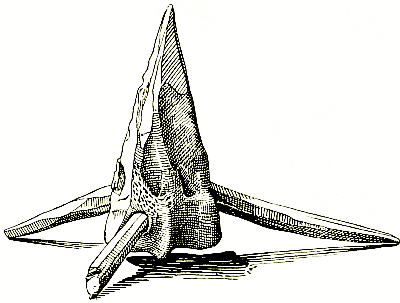
Fig. 112.—Bone Calthrop from the Crimea (No. 296). 2:3.
Such is the regular series of classical weapons. Exceptional
pieces are the bronze double-axe (No. 294), if this can be called a
weapon, the ridged mace-head from Rome (No. 295), and the calthrop
(No. 296; fig. 112), a contrivance for disabling cavalry. This
singular object, which was found at Kertch in the Crimea, is cut from
a human radius bone.
The bronze weapons are more fully described in the Catalogue of Bronzes
under the numbers painted on the objects.
(269) Cat. of Terracottas, C 629 ff.; (271) Journal of Hellenic Studies,
VIII., p. 64; (284) Proc. Soc. Ant. Lond., N.S. III., p. 358; Cat. of
Bronzes, 867; (289) Excavations in Cyprus, p. 17, fig. 28; (296) McPherson,
Antiq. Kertch, p. 101.


 ).
The ticket bears the symbols of an owl within an olive wreath, and a Gorgoneion.


 πατοῦ "walk!" (?) on
the sole. A shoe has been found in Egypt, impressing at every step the
invitation


 in silver, and weighing 389 grains), belonging to
this series, is seen in fig. 194 above.


 at the top of p. 77, and theta with a dot
 at the bottom of p. 130.
 ,
and
 ...
 ...
and on p. 161, as a marking in silver on an ounce weight,
 .
