A Guide to the Egyptian Collections in the British Museum
Whole book · 24 sections
A GUIDE TO THE EGYPTIAN COLLECTIONS IN THE BRITISH MUSEUM.
Transcriber’s Note: This book contains text in Greek (στήλη),
Coptic (ⲛⲁⲛ) and Egyptian hieroglyphs (𓏟𓈖𓊹𓌃𓏪). You may need to install
additional fonts to properly render those languages. Noto Sans Egyptian
Hieroglyphs is recommended.
Egyptian names may be rendered into English in many different ways, and
in this book frequently are (e.g. Teḥutimes, Teḥuti-mes, Thothmes). Some
minor changes were made (especially in the Index) to achieve consistency
of capitalization and accents, but otherwise these differences have been
preserved as printed.
BRITISH MUSEUM.
A GUIDE TO THE
EGYPTIAN COLLECTIONS IN THE
BRITISH MUSEUM.
WITH 53 PLATES AND 180 ILLUSTRATIONS IN THE TEXT.
PRINTED BY ORDER OF THE TRUSTEES.
1909.
PRICE HALF-A-CROWN.
[All Rights Reserved.]
HARRISON AND SONS, LTD.,
PRINTERS IN ORDINARY TO HIS MAJESTY,
ST. MARTIN’S LANE, LONDON, W.C. 2.
PRINTED IN ENGLAND.
PREFACE.
The Collection of Egyptian Antiquities in the British Museum
comprises nearly fifty thousand objects, and many of its
sections are unrivalled in completeness. It illustrates, in
a more or less comprehensive manner, the history and civilization
of the Egyptians from the time when their country was
passing out of the Predynastic Period under a settled form of
government, about B.C. 4500, to the time of the downfall of
the power of the Queens Candace at Meroë, in the Egyptian
Sûdân, in the second or third century after Christ. The
monuments of Christian Egypt also form a very important
series, and illustrate Coptic funerary sculpture and art
between the sixth and eleventh centuries A.D.
The present Guide has been prepared with the view of
providing the visitor to the British Museum with information
of a more general character than can be conveniently given
in the Guides to the several Galleries and Rooms of the
Department. An attempt has here been made to present
a sketch of the origin, the manners and customs, the
language, the writing, the literature, the religion, and the
burial rites of the peoples of Egypt, and of their history
under the successive dynasties; embodying references to the
several objects of the Collection which illustrate the different
branches of the subject. The text is supplemented by an
abundant selection of cuts and plates of the most important
of the antiquities.
E. A. WALLIS BUDGE.
Department of Egyptian and Assyrian
Antiquities, British Museum, September 29, 1908.
INTRODUCTION TO THE EGYPTIAN COLLECTIONS IN THE BRITISH MUSEUM.
CHAPTER I.
The Country of Egypt and its Limits. The Delta.
Oases. Lakes. The Nile. Inundation. Nile
Festivals. Famines. Ancient and Modern
Divisions of Egypt and the Sûdân.
The Land of Egypt is situated in the north-east shoulder
of the continent of Africa, and in the earliest times it consisted
of that portion of the Nile Valley which lay between
the Mediterranean Sea and the northern end of the First
Cataract; the Island of Ābu, or Elephantine, and the town
of Sunnu, or Sunt, the Syene of classical writers and the
Sewênêh of the Bible (Ezekiel xxix, 10), forming the southern
boundary of the country. The northern limit of Egypt has,
in historic times, always been the Mediterranean Sea, but
its southern limit varied considerably at different periods.
Under the Vth dynasty, about B.C. 3600, it was marked by
Elephantine and Syene. Under the XIIth dynasty, about
B.C. 2500, it was extended to Semnah and Kummah, about
250 miles to the south of Syene. Under the XVIIIth
dynasty, about B.C. 1600, the southern frontier town was
probably Napata, the modern Merawi, about 600 miles, by
river, from Syene. A century later the Egyptians took
possession of the Island of Meroë, and they appear to have
built a town at a place about 930 miles from Syene, by
river, to mark their southern frontier. Between B.C. 1200 and
600 the frontier was withdrawn to Syene, where it remained
practically for several centuries. Under the Arabs, the
southern frontier was fixed at Dongola (A.D. 1275), the old
Nubian capital, which lay about 570 miles from Syene. In
1873, Sir Samuel Baker extended it to Gondókoro, about
2,823 miles, by river, from Cairo. In 1895, the frontier town
of Egypt in the south was Wâdî Ḥalfah, and it continued
to be so until the capture of Umm Darmân (Omdurmân)
in 1898. At the present time, the southern limit of Egypt
is marked by the 22nd parallel of N. latitude, which crosses
the Nile at Gebel Sahaba, about eight miles north of the Camp
at Wâdî Ḥalfah, and its northern limit is the northernmost point
of the Delta. The distance, by river, from the Camp to the
Mediterranean Sea, is about 960 miles. The boundary of
Egypt on the east is marked by a line drawn from Ar-Rafah,
which lies a little to the east of Al-Arîsh, the Rhinocolura
of classical writers, to Tabah, at the head of the Gulf of
Akabah, by the eastern coast of the Peninsula of Sinai,[1] and
by the Red Sea. On the west, the boundary is marked by
a line drawn from the Gulf of Solum due south to a point
a little to the south-west of the Oasis of Sîwah, and then
proceeding in a south-easterly direction to the 22nd parallel
of N. latitude, near Wâdî Ḥalfah.
MAP OF EGYPT.
The name “Egypt,” which has come to us through the
Latin “Aegyptus” and the Greek “Aiguptos,” is derived
from one of the ancient Egyptian names of Memphis, viz.,
“Ḥet-ka-Ptaḥ,” meaning “Temple of the Ka, or Double, of
Ptaḥ” 𓉗𓏏𓉐𓂓𓏤𓊪𓏏𓎛𓀭 or 𓉘𓂓𓏤𓊪𓏏𓎛𓀭𓉜. The common name
for Egypt among the Egyptians was “Qem,” or “Qemt,” i.e.,
the “Black Land,” 𓆎𓏏𓊖, in allusion to the brownish-black
mud of which the soil chiefly consists. Another name of
frequent occurrence in the literature is “Ta-Merȧ,” the “Land
of the Inundation,” 𓇾𓏤𓈇𓌻𓇋𓆳𓊖.
The soil of Egypt is formed of a layer of sedimentary
deposits, which has been laid down by the Nile, and varies in
depth from about 40 to 110 feet; the rate at which this layer
is being added to at the present time in the bed of the river
is said to be about four inches in a century. In prehistoric
times the sea ran up as far as Esna, and deposited thick layers
of sand and gravel; upon these the rivers and streams
flowing from the south spread the mud and stony matter
which they brought down with them, and thus the soil of
Egypt was gradually built up. Near Esna begins the layer
of sandstone, which extends southward, and covers nearly
the whole of Nubia, and rests ultimately on crystalline rock.
The Delta of Egypt.
The part of Egypt which lies to the north of the point
where the Nile divides itself into two branches resembles in
shape a lotus flower, or
a triangle standing on its
apex, and because of its
similarity to the fourth
letter of their alphabet, the
Greeks called it Delta, Δ.
The Delta is formed of
a deep layer of mud and
sand, which rests upon the
yellow quartz sands, and
gravels and stiff clay, which
were laid down by the sea
in prehistoric times. The
area of the Delta is about
14,500 square miles.
The Oases of Egypt
are seven in number, and all are situated in the Western
Desert. Their names are: 1. Oasis of Sîwah or Jupiter
Ammon; 2. Oasis of Baḥarîyah, i.e., the Northern Oasis;
3. The Oasis of Farâfrah, the Ta-ȧḥet of the Egyptians;
4. The Oasis of Dâkhlah, i.e., the “Inner” Oasis, the
Tchesti of the Egyptians; 5. The Oasis of Khârgah,
i.e., the “Outer Oasis,” the Uaḥt-rest or “Southern Oasis” of
the Egyptians; 6. The Oasis of Dailah, to the west of
Farâfrah; 7. The Oasis of Kûrkûr, to the west of Aswân.
The principal Lakes of Egypt are: 1. Birkat al-Ḳurûn,
a long, narrow lake lying to the north-west of the
Province of the Fayyûm, and formerly believed to be
a part of the Lake Moeris described by Herodotus; 2. The
Natron Lakes, which lie in the Natron Valley, to the north-west
of Cairo; from these the Egyptians obtained salt and
various forms of soda, which were used for making incense,
and in embalming the dead; 3. Lake Menzâlah, Lake
Bûrlûs, Lake Edkû, Lake Abukîr, now almost reclaimed,
and Lake Mareotis; all these are in the Delta. Lake
Timsaḥ (i.e., Crocodile Lake) and the Bitter Lakes, which
were originally mere swamps, came into existence with the
making of the Suez Canal.
The Fayyûm which was in ancient times regarded as one
of the Oases, is nothing more than a deep depression
scooped out of the limestone, on which are layers of loams
and marls covered over by Nile mud. The district was
called by the Egyptians “Ta-she,” or “Land of the Lake”;
at the present time it has an area of about 850 square miles,
and is watered by a branch of the Nile called the “Baḥr
Yûsuf,” which flows into it through an opening in the
mountains on the west bank of the Nile. The Baḥr Yûsuf,
or “River of Joseph,” is not called after the name of the
patriarch Joseph, but that of some Muḥammadan ruler. It
is not a canal as was once supposed, but an arm of the Nile,
which, however, needs clearing out periodically. In the
Fayyûm lay the large body of water to which Herodotus
gave the name of Lake Moeris. He believed that this Lake
had been constructed artificially, but modern irrigation
authorities in Egypt have come to the conclusion that the
mass of water which he saw and thought was a lake was
merely the result of the Nile flood, or inundation, and that
there never was a Lake Moeris.
The Entrance to the Valley of the Tombs of
the Kings at Thebes.
Deserts. On each side of the Valley of the Nile lies a
vast desert. That on the east is called the Arabian Desert,
or Red Sea Desert, and that on the west the Libyan Desert.
The influence of the latter on the climate of Egypt is very
great, as for six months of the year the prevailing wind
blows from the west. At many places in the Eastern and
Western Deserts there are long stretches of sand scores of
miles in length, and immense tracts covered with layers of
loose pebbles and stone, and the general effect is desolate in
the extreme. The hills which skirt the deserts along the
Valley of the Nile are usually quite low, but at certain points
they rise to the height of a few hundred feet. Nothing grows
on them, and more bare and inhospitable places cannot be
imagined. The accompanying illustration gives a good idea
of the general appearance of the stone hills on the Nile. In
the fore-ground are masses of broken stone, sand, rocks, etc.,
and these stretch back to a gap in the range of hills just below
the letter A, whence, between steep rocks, a rough road winds
in and out along the dreary valley which contains the sepulchres
of the great kings of the XVIIIth, XIXth and
later dynasties. Under the light of a full moon the Valley is
full of weird beauty, but in the day-time the heat in it
resembles that of a furnace.
The chief characteristic of Egypt is the great river Nile,
which has in all ages been the source of the life and prosperity
of its inhabitants, and the principal highway of the country.
The Egyptians of the early Dynastic Period had no exact
knowledge about the true source of the river. In their hymns
to the Nile-god they described him as the “hidden one,” and
“unseen,” and his “secret places” are said to be “unknown.”
The river over which he presided formed a part of the great
celestial river, or ocean, upon which sailed the boats of the
Sun-god daily. This river surrounded the whole earth, from
which, however, it was separated by a range of mountains.
On one portion of this river was placed the throne of Osiris,
according to a legend, and close by was the opening in the
range of mountains through which an arm of the celestial
river flowed into the earth. The place where the Nile
appeared on earth was believed to be situated in the First
Cataract, and in late times the Nile was said to rise there,
between two mountains which were near the Island of Elephantine
and the Island of Philae. Herodotus gives the
names of these mountains as “Krôphi” and “Môphi,” and
their originals have probably been found in the old Egyptian
“Qer-Ḥāpi” and “Mu-Ḥāpi”; these names mean “Cavern
of Ḥāpi” and “Water of Ḥāpi” respectively.
The two Nile-gods and their Cavern, and
the hippopotamus goddess, who is armed with a huge knife, their
protectress.
The Nile-god in his cavern, under the rocks
at Philae, pouring out the waters which formed the two Niles.
The underground caverns, or “storehouses of the Nile,”
from which the river welled up, are depicted in the illustrations
here given. In the first the cavern is guarded by a
hippopotamus-headed goddess, who is armed with a large knife
and wears a feather on her head. Above are seated two
gods, one wearing a cluster of papyrus plants on his head,
and the other a cluster of lotus flowers; the former represents
the Nile of the South, and the other the Nile of the North.
Each god holds water-plants in one hand. In the second
illustration the god is depicted kneeling in his cavern, which
is enclosed by the body of a serpent; he wears a cluster of
water-plants on his head, and is pouring out from two vases
the streams of water which became the South and North
Niles.
The Egyptians called both their river and the river-god
“Ḥāp” or “Ḥāpi” 𓎛𓂝𓊪, 𓎛𓂝𓊪𓏭𓈘𓈗𓀭, a name of which
the meaning is unknown; in very early dynastic times the
god was called “Ḥep-ur” 𓎛𓊪𓈘𓅨, i.e., the “great Ḥep.”
The name “Nile,” by which the “River of Egypt” is
generally known, is not of Egyptian origin, but is probably
derived from the Semitic word nakhal “river”; this the
Greeks turned into “Neilos,” and the Latins into “Nilus,”
whence comes the common form “Nile.” The river appears
in the form of a man wearing a cluster of water-plants on his
head, and his fertility is indicated by a large pendent breast.
In the accompanying illustration the gods of the South and
North Niles are seen tying stems of the lotus and papyrus
plants round the symbol of “union”; the scene represents
the union of Upper and Lower Egypt.
The Nile-god bearing offerings of bread, wine,
fruit, flowers, etc.
The Nile-gods of the South and North tying
the stems of a lily and a papyrus plant round the symbol of “union,”
symbolizing the union of Upper and Lower Egypt.
The ideas held by the Egyptians concerning the power of
the Nile-god are well illustrated by a lengthy Hymn to the
Nile preserved on papyrus in the British Museum (Sallier II,
No. 10,182). “Homage to thee, O Ḥāpi, thou appearest in this
land, and thou comest in peace to make Egypt to live. Thou
waterest the fields which Rā hath created, thou givest life
unto all animals, and as thou descendest on thy way from
heaven thou makest the land to drink without ceasing. Thou
art the friend of bread and drink, thou givest strength to the
grain and makest it to increase, and thou fillest every place
of work with work.... Thou art the lord of fish ... thou art
the creator of barley, and thou makest the temples to endure
for millions of years.... Thou art the lord of the poor and
needy. If thou wert overthrown in the heavens, the gods
would fall upon their faces, and men would perish. When
thou appearest upon the earth, shouts of joy rise up and all
people are glad; every man of might receiveth food, and
every tooth is provided with meat.... Thou fillest the storehouses,
thou makest the granaries to overflow and thou
hast regard to the condition of the poor and needy. Thou
makest herbs and grain to grow that the desires of all
may be satisfied, and thou art not impoverished thereby.
Thou makest thy strength to be a shield for man.” Elsewhere
he is called the “father of the gods of the company of
the gods who dwell in the celestial ocean,” and he was
declared to be self-begotten, and “One,” and in nature inscrutable.
In another passage of the same hymn it is said that the
god is not sculptured in stone, that images of him are not
seen, “he is not to be seen in inscribed shrines, there is no
habitation large enough to contain him, and thou canst not
make images of him in thy heart.” These statements suggest
that statues or figures of the Nile-god were not commonly
made, and it is a fact that figures of the god, large or small,
are rare. In the fine collection of figures of Egyptian gods
exhibited in the Third Egyptian Room, which is certainly
one of the largest in the world, there is only one figure of
Ḥāpi (No. 108, Wall-case 125). In this the god wears on his
head a cluster of papyrus plants 𓇇, before which is the
Utchat, or Eye of Horus, 𓂀, and he holds an altar from
which he pours out water. The only other figure of the god
in the British Museum collection is the fine quartzite sandstone
statue (Southern Egyptian Gallery, No. 766) which was
dedicated to Ȧmen-Rā by Shashanq, the son of Uasarken
and his queen Maāt-ka-Rā. Here the god bears on his
out-stretched hands an altar, from which hang down bunches
of grain, green herbs, flowers, waterfowl, etc. The statue was
dedicated to Ȧmen-Rā, who included the attributes of Ḥāp
among his own.
The NILE from SEA to SOURCE
The true source of the Nile
is Victoria Nyanza, or Lake
Victoria, which lies between the
parallels of latitude 0° 20′ N.
and 3° S., and the meridians of
31° 40′ and 35° E. of Greenwich;
the lake is 250 miles in
length and 200 in breadth, and
was discovered in modern times
by Speke, on August 3rd, 1858.
Other contributory sources are
Albert Nyanza, or Lake Albert,
discovered by Sir Samuel Baker
on March 16th, 1864, and Lake
Albert Edward, discovered by
Sir H. M. Stanley in 1875; the
connecting channel between
these lakes is the Semliki River.
The portion of the Nile between
Lake Victoria and Lake Albert
is called the “Victoria Nile”
(or the “Somerset River”); that
between Lake Albert and Lake
Nô is called the “Baḥr al-Gebel”
or “Upper Nile”; and that between
Lake Nô and Kharṭûm
is called “Baḥr al-Abyaḍ,”
or “White Nile.” The total
length of these three portions
of the Nile is about 1,560 miles.
At Kharṭûm the White Nile is
joined by the “Blue Nile” (or
Abâî, the Astapos of Strabo,
which rises in Lake Ṣânâ and
is about 1,000 miles long), and
their united streams form that
portion of the river which is
commonly known as the “Nile.”
The distance from Kharṭûm to
the Mediterranean Sea is about
1,913 miles, and thus the total
length of the Niles is about
3,473 miles. Between Kharṭûm
and the sea the Nile receives
but one tributary, viz., the
Atbara, the Astaboras of Strabo, a torrential stream which
brings into the Nile an immense quantity of dirty red water
containing valuable deposits of mud. The Cataracts, or
series of rapids, on the Nile are six in number: the first is
between Aswân and Philae, the second is a little to the south
of Wâdî Ḥalfah, the third is at Ḥannek, the fourth is at
Adramîya, the fifth is at Wâdî al-Ḥamâr, and the sixth is at
Shablûkah. On the White Nile is a series of cataracts known
as the “Fôla Falls,” and on the Blue Nile there are cataracts
from Rusêres southwards for a distance of 40 miles.
Statue of Ḥāpi the Nile-god.
[No. 766.]
The most important characteristic of the Nile is its annual
flooding or Inundation. By the end of May, in Egypt, the
river is at its lowest level. During the month of June the
Nile, between Cairo and Aswân, begins to rise, and a quantity
of “green water” appears at this time. The cause of the
colour is said to be myriads of minute algae, which subsequently
putrefy and disappear. During August the river
rises rapidly, and its waters assume a red, muddy colour,
which is due to the presence of the rich red earth which
is brought into the Nile by the Blue Nile and the
Atbara. The rising of the waters continues until the middle
of September, when they remain stationary for about a fortnight
or three weeks. In October a further slight rise occurs,
and then they begin to fall; the fall continues gradually until,
in the May following, they are at their lowest level once
more. The cause of the Inundation is, as Aristotle (who
lived in the fourth century B.C.) first showed, the spring and
early summer rains in the mountains of Ethiopia and the
Southern Sûdân; these are brought down in torrents by the
great tributaries of the Nile, viz., the Gazelle River, the Sobat
(the Astasobas of Strabo), the Giraffe River, the Blue Nile,
and the Atbara. The Sobat rises about April 15, the Gazelle
River and the Giraffe River about the 15th of May, the Blue
Nile at the end of May, and the Atbara a little later. The
united waters of these tributaries, with the water of the
Upper Nile, reach Egypt about the end of August, and cause
the Inundation to reach its highest level. The Nile rises from
21 feet to 28 feet, and deposits a thin layer of fertilizing
mud over every part of the country reached by its waters.
Formerly, when the rise was about 26 feet, there was sufficient
water to cover the whole country; when it was less, scarcity
prevailed; and when it was more, ruin and misery appeared
through over-flooding. In recent years, the British irrigation
engineers in Egypt have regulated, by means of the Aswân
Dam, the Barrage at Asyûṭ, and the Barrage near Al-Manâshî,
a little to the north of Cairo,[2] the supply of water
during the winter, or dry season, with such success, that, in
spite of “low” Niles, the principal crops have been saved, and
the people protected from want.
In connection with the adoration of the Nile, two
important festivals were observed. The first of these took
place in June and was called the “Night of the Tear,”
𓈖𓇉𓄿𓏏𓏲𓏭𓇌𓁻, Qerḥ en Ḥatui, because it
was believed that at this time of the year the goddess Isis
shed tears in commemoration of her first great lamentation
over the dead body of her husband Osiris. Her tears fell
into the river, and as they fell they multiplied and filled the
river, and in this way caused the Inundation. This belief
exists in Egypt, in a modified form, at the present time, and,
up to the middle of last century the Muḥammadans celebrated,
with great solemnity, a festival on the 11th day of Paoni
(June 17th), which was called the “Night of the Drop,” Lêlat
al-Nuḳtah. On the night of this day a miraculous drop of
water was supposed to fall into the Nile and cause it to rise.
The second ancient Nile-festival was observed about the
middle of August, and has its equivalent in the modern
Muḥammadan festival of the “Cutting of the Dam.” A dam
of earth about 23 feet high was built in the Khalîg Canal,
and when the level of the Nile nearly reached this height, a
party of workmen thinned the upper portion of the dam at
sunrise on the day following the “completion of the Nile,”
and immediately afterwards a boat was rowed against it, and,
breaking the dam, passed through it with the current.
The history of Egypt shows that in all periods the country
has suffered from severe famines, which have been caused by
successions of “low” Niles. Thus a terrible seven years’
famine began in A.D. 1066, and lasted till 1072. Dogs, cats,
horses, mules, vermin fetched extravagant prices, and the
people of Cairo killed and ate each other, and human flesh
was sold in the public markets. In Genesis xli, we have
another example of a seven years’ famine, and still an older
one is mentioned in an inscription cut upon a rock on the
Island of Sâḥal in the First Cataract. According to the text,
this famine took place in the reign of Tcheser, a king of the
IIIrd dynasty, about B.C. 4000, because there had been no
satisfactory inundation of the Nile for seven years. The king
says that by reason of this, grain was very scarce, vegetables
and garden produce of every description could not be obtained,
the people had nothing to eat, and men were everywhere
robbing their neighbours. Children wailed for food, young
men had no strength to move, strong men collapsed for
want of sustenance, and the aged lay in despair on the
ground waiting for death. The king wrote to Matar, the
Governor of the First Cataract, where the Nile was believed
to rise, and asked him to enquire of Khnemu, the god of the
Cataract, why such calamities were allowed to fall on the
country. Subsequently the king visited Elephantine, and was
received by Khnemu, the god of the Cataract, who told him
that the Nile had failed to rise because the worship of the
gods of the Cataract had been neglected. The king promised
to dedicate offerings regularly to their temples in future, and,
having kept his promise, the Nile rose and covered the land,
and filled the country with prosperity.
Egyptian Geography.—From time immemorial Egypt
has been divided into two parts, viz., the Land of the South,
Ta-Resu, 𓇾𓏤𓈇𓇖𓊖, and the Land of the North, Ta-Meḥt,
𓇾𓏤𓈇𓇉𓏏𓊖. The Land of the South is Upper Egypt, and its
northern limit in modern times is Cairo; the Land of the North
is Lower Egypt, i.e., the Delta, and its southern limit is Cairo.
The ancient Egyptians divided the Land of the South into
twenty-two parts, and the Land of the North into twenty parts;
each such part was called Ḥesp𓎛𓊃𓊪𓈈, a word which
the Greeks rendered by nome. Each nome was to all intents
and purposes a little complete kingdom. It was governed by
a ḥeq, 𓋾𓈎, or chief man, and it contained a capital town in
which was the seat of the god of the nome and the priesthood,
and every ḥeq administered his ḥesp as he pleased. The
number of the nomes given by Greek and Roman writers
varies between thirty-six and forty-four. In late times Egypt
was divided into three parts, Upper, Central, and Lower
Egypt; Central Egypt consisted of seven nomes, and was
therefore called Heptanomis. The nomes were:
Under the Ptolemies, the district between Elephantine and
Philae was called Dodekaschoinos, because it contained
twelve schoinoi, or measures of land, but later this term was
applied to the whole region between Elephantine and Hiera
Sykaminos.
Under the late Roman emperors many of the nomes were
subdivided, probably for convenience in levying taxes, and in
still later times the governor of a nome, or province, bore the
title of Duke (Δουξ).
Modern Egypt is divided into 14 provinces:
LOWER EGYPT.
Province.
Capital.
1.
Baḥêrah.
Damanhûr.
2.
Ḳalyûbîyah.
Benha.
3.
Sharkîyah.
Zaḳâzîḳ.
4.
Dakhâlîyah.
Manṣûrah.
5.
Manûfîyah.
Menûf.
6.
Gharbîyah.
Ṭanṭa.
UPPER EGYPT.
Province.
Capital.
1.
Gîzah.
Gîzah.
2.
Beni-Suwêf.
Beni-Suwêf.
3.
Minyah.
Minyah.
4.
Asyûṭ.
Asyûṭ.
5.
Girgah.
Ṣûhâḳ.
6.
Ḳena.
Ḳena.
7.
Nûba.
Aswân.
8.
Fayyûm.
Madînat al-Fayyûm.
The towns of Cairo, Alexandria, Port Sa’îd, Suez,
Damietta, etc., are generally governed each by a native ruler.
The provinces of the Sûdân are as follows:
1. Baḥr al-Ghazâl. 2. Berber. 3. Blue Nile Province.
4. Dongola. 5. Ḥalfah. 6. Kassala. 7. Kharṭûm Province.
8. Kordofân. 9. Mongalla. 10. Red Sea Province.
11. Sennaar. 12. Upper Nile Province. 13. White Nile
Province.
CHAPTER II.
Ethnography. The Land of Punt. National
Character. Population. Language. Forms Of
Writing. Decipherment of Egyptian Hieroglyphics.
Young and Champollion. Hieroglyphic
Alphabet and Writing. Writing Materials.
The Egyptians.—The evidence of the monuments and
the literature of Egypt proves that the Egyptians were of
African origin, and that they were akin to the light-skinned
peoples who inhabited the north-east portion of the African
Continent. Further evidence of this fact is supplied by the
“table of nations” preserved in the tenth chapter of Genesis,
where it is stated that Cush and Mizraim were the sons of
Ham. Now this Cush, or Ethiopia, is not the country which
we call Abyssinia, but the Northern Sûdân, or Nubia; therefore
the Nubians (Cush) and the Egyptians (Mizraim) were
brethren, and they were Hamites, or Africans. The relationship
between the Nubians and the Egyptians is also asserted
by Diodorus, who declared that the Egyptians were descended
from a colony of Ethiopians, i.e., Nubians, who had settled in
Egypt. And there is no doubt that from the earliest to the
latest times a very close bond existed between the Northern
Nubians and the Egyptians, which manifested itself in the
religion and religious ceremonies of both peoples. The
Cushites were dark in colour, sometimes actually black, but
there is no evidence which proves they were negroes; and
the Egyptians were red, or brown-red, or reddish yellow
in colour. On the west of the Nile Valley lived the fair-skinned
Libyans; on the east the remote ancestors of the
Blemmyes and the modern Bîshârî tribes, who were of a light
brownish colour, and on the south, near the Equator, were
negro tribes, which formed part of the great belt of black
peoples that extended right across Africa, from sea to sea.
The dynastic Egyptians appear to have regarded a
country, or district, called Pun𓊪𓃹𓈖𓏏𓈉 as their original
home, and they certainly preserved down to the latest times
some of the peculiarities in dress of the primitive inhabitants
of that region. That Punt was situated a considerable
distance to the south of Egypt is certain, and that it could be
reached by land, and also by water by way of the Red Sea, is
clear from the inscriptions, but there is no evidence available
which enables the exact limits of the country to be defined.
The despatch of several expeditions to Punt by the Egyptians
is recorded, for the purpose of bringing back ānti spice,
𓂝𓈖𓅂𓏊𓏧, or myrrh, which was used freely for embalming
purposes. They started from some point on the Red Sea
near the modern town of Ḳuṣêr, and sailed southwards until
they reached the river of the port of Punt which was situated
on the east coast of Africa, probably in Somaliland. The
expedition despatched by Queen Ḥātshepset about B.C. 1550
brought back boomerangs, a huge pile of myrrh, logs of
ebony, elephants’ tusks, sweet-smelling woods, eye-paint,
various kinds of spices, dog-headed apes, monkeys, leopard
(or panther) skins, “green” (i.e., pale) gold, and gold rings
which are to this day used as currency in East Africa and are
known as “ring money.” Now, all these things are products
of the region which lies between the southern end of the
Red Sea, the Indian Ocean, and the Valley of the Nile, and
it is impossible not to conclude that Punt was situated somewhere
in it. The Egyptian expeditions probably sailed up
a river for a considerable distance, to a point where the
products of Punt were brought by trading caravans for
export, and there the Egyptians bartered for the myrrh, etc.,
which they required. The market place must have been
inland, for the huts of the natives are represented in the bas-reliefs
as standing close to the river.
The men of Punt wore a pointed beard and a loin cloth,
which was kept in position by a kind of belt, from which hung
down behind the tail of an animal. The beard of the
Egyptian was also pointed, and gods, kings, and priestly
officials on solemn, ceremonial occasions, wore tails. Thus
in the Papyrus of Ani (Judgment Scene) the gods Thoth and
Anubis wear tails, and the priestly official in the same scene
wears the leopard’s skin, the tail of which is supposed to be
hanging behind him. In two statues of Ȧmen-ḥetep III
(Northern Egyptian Gallery, Nos. 412, 413), the tail is supposed
to be brought forward under the body of the king, and its
end is carefully sculptured on the space between his legs.
The custom of wearing tails is common in Central Africa
at the present day, even the women, in some places, wearing
long tails of bast (Schweinfurth, Heart of Africa, I, p. 295);
and a recent traveller reports that the Gazum people wear
tails, about six inches long, for which they dig holes in the
ground when they sit down (Boyd Alexander, From the
Niger, I, p. 78). Many other points of comparison between
the Egyptians and the peoples of Central Africa could be
mentioned in proof of the views that the indigenous dynastic
Egyptians were connected with the people of Punt, and that
Punt was situated in the South-Eastern Sûdân.
As to the succession of peoples in the Nile Valley, or rather
of that portion of it which is called Egypt, many theories
have been formulated in recent years. Some of the most
competent authorities think that the earliest dwellers in
Egypt were black folk, who were driven out or killed off by
a race of people who possessed many of the characteristics
of the Libyans, and who came from the west, or south-west, and
took possession of Egypt. It is thought that the next
invasions of the country were made by peoples who came
from the east, or south-east, and, having settled down on the
Nile, mingled with the inhabitants. After these it seems very
probable that Egypt was invaded by tribes whose home was
some part of Western Asia, probably the country now called
Southern Babylonia. Some think that they entered Egypt by
the Isthmus of Suez, and others that they crossed from Arabia
to Africa by the straits of Bâb al-Mandib at the southern end
of the Red Sea. Another view is that the invaders entered
Egypt by the Wâdî Ḥammâmât, and that they arrived on
the Nile at some place near the modern town of Ḳena.
Little by little the invaders conquered the country, and introduced
into it the arts of agriculture, brick-making, writing,
working in metals, etc. Wheat, barley, and the domestic
sheep seem to have been brought into Egypt about this time.
The manners and customs of the new comers were very
different from those of the men they conquered, and their
civilization was of a much higher character than that of the
primitive Egyptians; but, among the great bulk of the
population, the beliefs, religion, and habits continued to preserve
unchanged their characteristic African nature.
1 2 3 4 5 6
What the physical form of the primitive, pre-dynastic
Egyptian was cannot be said, but it is probable that he
resembled the dynastic Egyptians whose pictures are seen by
hundreds in the tombs. If this be so, he was tall, slender of
body, with long thin legs, small hands, and long feet. His
hair was black and curly, but must not be confounded with
the “wool” of the negro, his eyes black and slightly almond-shaped,
his cheek-bones high and often prominent, his
nose straight—sometimes aquiline—and inclined to be fleshy;
his mouth wide, with somewhat full lips, his teeth small and
regular and his chin prominent, because his under jaw was
thrust slightly forward. The women were yellowish in colour,
probably because their bodies were not so much exposed
to the rays of the sun as those of the men. The general
character of the physique of the Egyptian has remained
practically unchanged to the present day, and no admixture
of foreign elements has affected it permanently.
7
Ivory figure of a king.
1st dynasty (?)
[No. 197, Table-case L, Third Egyptian Room.]
8
Bone figure of a dwarf.
Archaïc Period.
[No. 42, Table-case L, Third Egyptian Room.]
9
Bone figure of a woman carrying a child on her shoulder.
Archaïc Period.
[No. 41, Table-case L, Third Egyptian Room.]
10
Bone figure of a woman, with inlaid lapis-lazuli eyes.
Archaïc Period.
[No. 40, Table-case L, Third Egyptian Room.]
The physical features and dress of the primitive dynastic
Egyptians are well illustrated by the accompanying drawings
and photographs. From Nos. 1-6 (page 23) we see that their
hair was short and curly, their noses long and pointed, their eyes
almond-shaped, their beards pointed, their arms and legs long,
their hands large, and their feet long and flat. They wear in
their hair feathers, probably red feathers from the tails of
parrots, such as are worn at the present day, and their loin cloths
are fastened round their bodies by belts, from which hang short,
bushy tails of jackals(?). No. 1 bears a hawk-standard, the
symbol of the god of the tribe, and is armed with a mace
having a diamond-shaped head. No. 2 bears a hawk-standard
and wields a double-headed stone axe. No. 3 is armed with
a mace and a bow. No. 4 is shooting a flint-tipped arrow
from a bow. No. 5 is armed with a boomerang and a spear,
and No. 6 with a mace and a boomerang. The above illustrations
are drawn from the green slate shield exhibited in
Table-case L in the Third Egyptian Room.
To about the same period belongs the ivory figure of a king
here reproduced (No. 7). He wears the Crown of the South, and
a garment worked with an elaborate diamond pattern. The
nose is flatter and more fleshy than in the drawings from the
slate shield, and the lips are fuller and firmer. In figures 8-10
we have representations of the women of the Archaïc Period,
about B.C. 4200. No. 8 is a female dwarf, or perhaps a woman
who belonged to one of the pygmy tribes that lived near the
Equator. No. 9 is a most interesting figure, for it illustrates
the hair-dressing and dress of the period. The features of the
child, who is carried partly on the back and partly on the
left shoulder, as at the present day, are well preserved. No. 10
represents a woman of slim build, with blue eyes, and wearing
an elaborate head-dress, which falls over her shoulders.
Portrait Figures of Officials
of the IIIrd or IVth Dynasty. AboutB.C. 3700.
Figure of Betchmes, a royal kinsman.
[Vestibule, South Wall, No. 3.]
Painted limestone figure of Nefer-hi.
[No. 150, Wall-case 99, Third Egyptian Room.]
National Character.—Herodotus, who was an acute
observer of the manners and customs of the Egyptians, states
(ii, 64) that the Egyptians were “beyond measure scrupulous
in all matters appertaining to religion,” and the monuments
prove him to be absolutely correct. The Egyptian worshipped
his God, whose chief symbol to him was the sun, daily and
regularly, and prayed to him morning and evening. His
attitude towards his Maker was one of absolute resignation.
The power of God, as displayed by the Sun, and the River
Nile, and other forces of nature filled him with awe, and
made him to realize his helplessness. His views as to the
dependence of men on the sun are well illustrated by the
following extract from a hymn to Ȧten, the god of the Solar
Disk: “When thou settest in the western horizon of heaven,
the earth becometh dark with the darkness of the dead.
Men sleep in their houses, their heads are covered up, their
nostrils are closed, and no man can see his neighbour;
everything which they possess could be stolen from under
their heads without their knowing it. All the lions come
forth from their dens, every creeping thing biteth, the smithy
is in blackness, and all the earth is silent because he who
made them (i.e., all creatures) resteth in his horizon. When
the dawn cometh, and thou risest and shinest from the Disk,
darkness flieth away, thou givest forth thy rays, and the
Two Lands (i.e., Egypt) are in festival. Men rise up, they
stand upon their feet—it is thou who hast raised them—they
wash their bodies, and dress themselves in their clothes, and
they [stretch out] their hands to thee in thanksgiving for thy
rising.” To the god of the city, or local deity, he also paid
due reverence. He worshipped Osiris, the type and symbol
of the resurrection, most truly, for on his help and succour
depended his hope of eternal life. The Egyptians, who were
men of means, spent largely during their lifetime in making
preparations for their death, and they spared neither money
nor pains in their endeavours to secure for themselves life in
the Other World. They observed the Religious and Civil
Laws most carefully, and any breach they might make in
either they thought could be amply atoned for by making
offerings or payment.
The fox playing the double pipes for a flock
of goats to march to.
[From a papyrus in the British Museum, No. 10,016.]
A mouse seated on a chair, with a table of
food before it. A cat is presenting to it a palm branch, and behind it is
a mouse bearing a fan, etc.
[From a papyrus in the British Museum, No. 10,016.]
The Egyptian was easy and simple in disposition, and
fond of pleasure and of the good things of this world. He
loved eating and drinking, and he lost no opportunity
of enjoying himself. The literature of all periods is filled
with passages in which the living are exhorted to be happy;
and we may note that in the famous Dialogue between a man
who is weary of life and his soul, the latter tells the man that
to remember the grave only brings sorrow to the heart and
fills the eyes with tears. And after several observations of
the same import, the soul says: “Hearken unto me, for,
behold, it is good for men to hearken; follow after pleasure
and forget care.”[4] In the Song of the Harper we read:
“Bodies (i.e., men) have come into being in order to pass
away since the time of Rā, and young men come in their
places. Rā placeth himself in the sky in the morning, and
Temu setteth in the Mountain of Sunset. Men beget
children and women bring forth, and every nostril snuffeth
the wind of dawn from the time of their birth to the day
when they go to the place which is assigned to them. Make
[thy] day happy! Let there be perfumes and sweet odours
for thy nostrils, and let there be wreaths of flowers and lilies
for the neck and shoulders of thy beloved sister who shall
be seated by thy side. Let there be songs and the music of
the harp before thee, and setting behind thy back unpleasant
things of every kind, remember only pleasure, until the day
cometh wherein thou must travel to the land which loveth
silence.”
A cat herding geese.
[From a papyrus in the British Museum, No. 10,016.]
The advice to eat, drink, and be happy, is also given to a
high-priest of Memphis by his dead wife That-I-em-ḥetep on
her sepulchral tablet (Southern Egyptian Gallery, Bay 29,
No. 1027). She says: “Hail, my brother, husband, friend,
... let[5] not thy heart cease to drink water, to eat bread, to
drink wine, to love women, to make a happy day, and to
seek thy heart’s desire by day and by night. And set no
care whatsoever in thy heart: are the years which [we pass]
upon the earth so many [that we need do this]?”
The lion and the unicorn playing a game of draughts.
[From a papyrus in the British Museum, No. 10,016.]
The morality of the Egyptians was of a high character,
and certainly higher than that of Oriental nations in general.
Many of the Precepts of Ptaḥ-ḥetep, Kaqemna, and Khensu-ḥetep
bear comparison with the moral maxims of the Books of
Proverbs and Ecclesiasticus. The view of the Egyptian as
to his duty towards his neighbour is well summed up by
Pepi-Nekht, an old feudal lord of Elephantine, who
flourished under the VIth dynasty, and said: “I am one who
spoke good and repeated what was liked. Never did I say
an evil word of any kind to a chief against anyone, for I
wished it to be well with me before the great god. I gave
bread to the hungry man, and clothes to the naked man. I
never gave judgment in a case between two brothers
whereby a son was deprived of his father’s goods. I was
loved by my father, favoured by my mother, and beloved by
my brothers and sisters.” Love of parents and home was
a strong trait in the character of the Egyptian; and it was one
cause of his hatred of military service and of any occupation
which would take him away from his town or village. He
prayed, too, that in the Other World he might have his
parents, wife, children, and relatives, with him on his farm in
the Fields of Peace, and that when his spirit was on the way
thither, the spirits of his kinsfolk would come to meet him,
armed with their staves and weapons, so that they might
protect him from the attack of hostile spirits. Like all
African people he loved music, singing, and dancing, and
was attracted by ceremonials, processions, and display of
every kind; the satirical papyri (see the illustrations on
pages 27-30), and even the wall-paintings in the tombs,
show that he possessed a keen sense of humour. The
peasant was then, as now, a laborious toiler, and as he was
literally the slave of Pharaoh for thousands of years, the
ideas of freedom and national independence, as we understand
them, were wholly unknown to him.
All classes were intensely superstitious, and they believed
firmly in the existence of spirits,
good and bad, witches, and fiends
and devils, which they tried to
cajole, or wheedle, or placate with
gifts, or to vanquish by means of
spells, magical names, words of
power, amulets of all kinds,
etc. The magician was the real
priest, to the lower classes at least,
as he is to this day in Central
Africa, for by the use of magical
figures he assured his clients that
he could procure for them the
death, or sickness, of an enemy,
riches, the love of women, dreams
wherein the future would be revealed
to them, and above all, the
assistance of the gods. We find
that about B.C. 312 a service was
regularly performed in the temple of Ȧmen-Rā at Thebes to
make the sun rise. In the course of it a figure of the monster
Āpep, who was supposed to be lying in wait to swallow the
Sun-god, was made of wax, then wrapped in new papyrus on
which the “accursed name” of the fiend was written in green
ink, and solemnly burned in a fire fed by a special kind of
herb, whilst the priest spurned it with his left foot and poured
out curses on each of the thirty “accursed names” of the evil
one. As the wax melted and was consumed, together with
the papyrus and the green ink with which his name was written,
so the body of Āpep was believed to be consumed in the
flames of the rising sun in the eastern sky.
The spearing of Āpep.
From the evidence given at Thebes about B.C. 1200
against certain officials who were implicated in a case of
conspiracy against Rameses III, it appeared that a certain
man had stolen a book of magic from the temple library.
From this he obtained instructions how to make the wax
figures which caused the sickness, quakings of the limbs,
and death of those in whose forms they were made. An
example of the wax figures which were used in the Ptolemaïc
period is exhibited in Table-case C in the Third Egyptian
Room, No. 198. The core is made of inscribed papyrus, and
in front, in the centre, is a piece of hair, presumably that of
the person on whom the magician who made the figure sought
to exert his influence. Every act of daily life had some
magical or religious observance associated with it, and every
day, either in whole or in part, was declared to be lucky or
unlucky, in accordance with a series of events which were
represented by the Calendar of lucky and unlucky days.
Superstition played as prominent a part in medicine as
in religion. The practice of dismembering the dead in
primitive times must have taught the Egyptians some
practical anatomy, and the operations connected with
mummification in the later period must have added largely to
their knowledge of the arrangement of the principal internal
organs of the body. The Egyptians were well acquainted
with the importance of the heart in the human economy, and
they appear to have had some knowledge of the functions of the
arteries. A considerable number of medical prescriptions
have come down to us, e.g., those which are inscribed on a
papyrus in the British Museum (No. 10,059) and are said to be
as old as the time of Khufu (Cheops), a king of the IVth
dynasty, and those of the Ebers Papyrus, of the XVIIIth
dynasty; from these it is easy to see that they closely
resemble in many particulars the prescriptions given in
English medical books printed two or three hundred years
ago. Powders and decoctions made from plants and seeds
were largely used, and the piths of certain trees, dates,
sycamore-figs, and other fruits, salt, magnesia, oil, honey,
sweet beer, formed the principal ingredients of many
prescriptions. With these were often mixed substances of an
unpleasant nature, e.g., bone dust, rancid fat, the droppings of
animals, etc. In order that certain drugs might have the
desired effect it was necessary for the physician to recite a
magical formula four times (Ebers Papyrus CVIII). Other
medicines again owed their efficacy to the belief that they
had been actually taken by one or other of the gods whilst
they reigned upon earth, and the authorship of certain
prescriptions was ascribed to Rā. Thus according to the
Ebers Papyrus (XLVI) Rā suffered from attacks of boils of
a most malignant kind, and he made up a salve, containing
sixteen ingredients, which gave him instant relief, and which
was therefore certain to cure ordinary mortals. The following
is a characteristic example of a prescription which, as is
evident, contains a number of substances which are well
known to be good for inflamed eyes, and also some others
the special value of which is not clear:—
𓎡𓏏𓈖𓏏𓂧𓂋𓂡𓇉𓄿𓍘𓏭𓅓𓁹𓏏𓏤
“Another [prescription] for driving inflammation from
the eye.
“Place in water, let stand for one night,
strain through a cloth, and smear over [the eye] for four days;
or, according to another prescription, paint it on [the eye] with
a goose-feather.”[6]
The Egyptian physician was called upon not only to heal
his patients, but to beautify them, and we find prescriptions
for removing scurf from the skin, for changing the colour of
the skin, for making the skin smooth, and the following for
removing wrinkles from the face:—
𓎡𓏏𓈖𓏏𓂧𓂋𓂡𓈎𓂋𓆑𓏲𓏼𓏌𓏤𓁷𓏤
“Another [prescription] for driving away wrinkles
of the face.”
𓅮𓇌𓏏𓈒𓏼𓈖𓏏𓊹𓌣𓏏𓂋𓈒𓏼
Ball of incense
1
𓏠𓈖𓎛𓈒𓏼
Wax
1
𓆮𓏊𓏼𓇅𓆓𓏛
Fresh oil
1
𓎼𓇋𓏲𓆰𓏥
Cypress berries
1
[Directions for use.]
𓏌𓂡𓏟𓏜𓂋𓂞𓁷𓏤
𓎛𓋴𓐠𓄿𓈗𓏊𓏼𓂋𓂞
𓂋𓁷𓏤𓇳𓏤𓏿𓁹𓌴𓁹𓄿𓄿𓎡
“Crush, and rub down and put in new milk and
apply it to the face for six days. Take good heed [to
this].”[7]
The population of Egypt was, in 1897, 9,734,405 persons,
of whom 8,978,775 were Muḥammadans, 25,200 Jews, and
730,162 Christians. The last census was taken on the 29th
April, 1907, and the entire population of the country consisted
of 11,272,000 persons, or nearly 16 per cent. more than in
1897.
The Egyptian Language is not Semitic, although it
possesses many characteristics which resemble those of the
Semitic languages, but in a less developed form. Of all the
views on the subject which have been held in recent years,
the most plausible one is that which makes Egyptian belong
to the group of Proto-Semitic languages. The Egyptian and
the Semitic languages appear to have sprung from a common
stock, from which they separated before their grammars and
vocabularies were consolidated. The Egyptian language
developed rapidly under circumstances of which nothing is
known, and then, apparently, became crystallized; the Semitic
language developed less rapidly, but continued to develope
for centuries after the growth of the Egyptian language was
arrested. To the period when Egyptian separated itself from
the parent stock no date can be assigned, but it must have
taken place some thousands of years before Christ. Later,
under the XVIIIth and XIXth dynasties, B.C. 1550 to 1300,
a large number of Semitic words were introduced into the
language, and in such compositions as the “Travels of an
Egyptian” (see page 70) a great many are transcribed into
Egyptian characters.
The Egyptian language as known to us appears in four
divisions, viz.:—
1. The Egyptian of the Early Empire, which was studied
and employed for literary purposes from about B.C. 4400 to
about A.D. 200.
2. The Egyptian used in the ordinary business of life and
for conversation, from about B.C. 2600 to 650.
3. The popular speech of the country, from about 600 or
500 B.C. to the end of the Roman Period.
4. The ordinary language of the country, after Christianity
was introduced into it; this is called Coptic. It ceased to
be used in Egypt as a spoken language, probably about the
twelfth century, but the Holy Scriptures and the Services are in
several places in Egypt read in Coptic on Sundays and Festivals,
although very few people understand what is being read. Four
dialects of Coptic are distinguished: (1) That of Upper Egypt,
called “Sahidic.” (2) That of Lower Egypt, called “Boheiric.”
(3) The dialect of Ṣûhâḳ and its neighbourhood. (4) The
dialect of the district of the Fayyûm. It is a noteworthy fact
that, from the beginning of the second century of our era
to the twelfth, the language of ancient Egypt was preserved, in
a modified form, chiefly through the translations of the Holy
Scriptures, which were made from Greek into Coptic.
A page of hieratic writing from the Great
Harris Papyrus.
Egyptian Writing was of three kinds, which are called
“Hieroglyphic,” “Hieratic,” and “Demotic.” The oldest form
is the hieroglyphic (i.e., sacred engraved writing), or purely
pictorial, which was employed in inscriptions upon temples,
tombs, statues, sepulchral tablets, etc., and for monumental
purposes generally. At a very early period it was found that
the hieroglyphic form of writing was cumbrous, and that in
cases where it was important to write quickly on papyrus,
the pictorial characters were inconvenient. The scribes,
therefore, began first to modify, and secondly to abbreviate
the pictorial characters, and at length the form of writing
called hieratic (i.e., the priests’ writing) was developed.
Hieratic was a style of cursive writing much used by the
priests in copying literary compositions on papyrus from the
IVth or Vth dynasty to the XXVIth dynasty. This form
of writing is well illustrated by the above reproduction of
a page from the Great Harris Papyrus in the British Museum
(No. 9999), which was written about B.C. 1200. The text is
read from right to left, and the following is a transcript into
hieroglyphic characters of the first two lines:—
Between the end of the XXIInd and the beginning of
the XXVIth dynasty the scribes, wishing to simplify hieratic
still further, constructed from it a purely conventional system
of signs from which most of the prominent characteristics of
the hieroglyphic, or pictures, that had been preserved in the
hieratic characters, disappeared. This new form of writing
was called demotic (i.e., the people’s writing), but it was
known among some of the early Egyptologists as enchorial
(i.e., native writing, or writing of the country). On the
Rosetta Stone (Egyptian Gallery, No. 960) the visitor will
see an example of the hieroglyphic and demotic forms
of writing placed one above the other, and in the text
we find that the hieroglyphic portion is called “the writing of
the divine words,” or letters, 𓏟𓈖𓊹𓌃𓏪, and the demotic
“the writing of books,” i.e., rolls of papyrus, 𓏟𓋔𓈚𓂝𓇌𓍽.
The invention of the art of writing was assigned to the god
Thoth, who was the great scribe of the gods, and who is
frequently represented holding a writing palette and a reed
pen, and the hieroglyphics, or picture signs, were, therefore,
called “divine, sacred, or holy.” Hieroglyphics were used
for monumental purposes until about the end of the third
century A.D., but it is tolerably certain that very few people
could read them or understand them.
Demotic Writing.
During the Ptolemaïc Period, though Greek was the
language of the kings and the upper classes of the country,
the temples were covered with inscriptions in hieroglyphics,
and the Ptolemies and the Romans adopted old Egyptian
titles, and had their names transcribed into hieroglyphics and
cut in cartouches like the Pharaohs. In the reigns of
Euergetes I (B.C. 267 to 222) and Epiphanes (B.C. 205 to 181) the
priests promulgated decrees in honour of their kings which
were cut on slabs of basalt in the hieroglyphic, demotic, and
Greek characters, but on the sepulchral tablets of the period
the inscriptions are usually in hieroglyphics alone, because
the natives throughout the country clung to these characters,
which had, from time immemorial, been associated with their
religious beliefs and ceremonies. In the Southern Egyptian
Gallery, however, are exhibited several tablets which are
inscribed in demotic as well as in hieroglyphics, and of these
may be noted the tablet of Tut-i-em-ḥetep (No. 1028, Bay 25),
who died B.C. 118; the tablet of Khā-em-ḥrȧ (No. 997, Bay 25);
and the tablet of Peṭā Bast (No. 1030, Bay 27). In the Roman
Period we find that the use of demotic sometimes superseded
that of hieroglyphics in public documents, and as an example
of this may be mentioned the fine sandstone tablet inscribed,
wholly in demotic, with a decree recording the dedication of
certain properties to the gods who were worshipped at Karnak
(Thebes) in the first century of our era (No. 993, Bay 27).
This tablet was found at Karnak, in the Hall of Columns,
where, no doubt, it was set up originally, and its inscription
was cut in demotic, because, at that period, that form of
writing was better understood than hieroglyphics. In the
Roman Period hieroglyphic inscriptions were sometimes
accompanied by renderings into Greek and Latin, e.g., No. 257,
Third Egyptian Room, Wall-case No. 109. This is a portion
of a statue of a priest bearing a shrine of Osiris. On the back
of the plinth is an inscription in hieroglyphics containing an
address to Osiris by a priest of the “fourth order,” and on one
side of the plinth are cut in Latin and Greek “priest bearing
Osiris.”
Coptic is written with the letters of the Greek alphabet,
and seven signs (ϣ, ϥ, ϧ, ϩ, ϫ, ϭ, ϯ), derived from
demotic characters, the phonetic values of which could not be
expressed by Greek letters. A fine collection of sepulchral
tablets inscribed in Coptic is exhibited in the Southern
Egyptian Gallery (Bay 32), and a long and most instructive
series of drafts of documents on potsherds and slices of limestone
will be found in Table-case M in the Fourth Egyptian
Room. In the copy of the Lord’s Prayer (St. Matthew vi, 9)
here appended the reader will find all the signs which are
peculiar to Coptic save one (ϭ). The dialect is that of
Lower Egypt. The two words marked by asterisks are Greek,
not Egyptian.
ⲡⲉⲛⲓⲱⲧ
Peniôt
Our Father
ⲉⲧϧⲉⲛ
etkhen
who art in
ⲛⲓⲫⲏⲟⲩⲓ
niphêoui
the heavens,
ⲙⲁⲣⲉϥⲧⲟⲩⲃⲟ
mareftoubo
may be hallowed
ⲛ̅ϫⲉⲡⲉⲕⲣⲁⲛ.
entche pekran.
thy name.
ⲙⲁⲣⲉⲥⲓ
Maresi
May come
ⲛ̀ϫⲉⲧⲉⲕⲙⲉⲧⲟⲩⲣⲟ.
entche tekmetouro.
thy kingdom
ⲡⲉⲧⲉϩⲛⲁⲕ
Peteḥnak
Thy will
ⲙⲁⲣⲉϥϣⲱⲡⲓ
marefshôpi
let it be
ⲙⲫⲣⲏϯ
emphrêti
as
ϧⲉⲛ
khen
in
ⲧⲫⲉ
tphe
the heaven
ⲛⲉⲙ
nem
so
ϩⲓϫⲉⲛ
ḥitchen
upon
ⲡⲓⲕⲁϩⲓ.
pikaḥi.
the earth.
ⲡⲉⲛⲱⲓⲕ
Penôik
Our bread
ⲛ̅ⲧⲉ
ente
of
ⲣⲁⲥϯ
rasti
to-morrow
ⲙⲏⲓϥ
mêif
give it
ⲛⲁⲛ
nan
to us
ⲙ̅ⲫⲟⲟⲩ.
emphoou.
to-day.
ⲟⲩⲟϩ
Ouoḥ
And
ⲭⲁ
kha
forgive
ⲛⲉⲧⲉⲣⲟⲛ
neteron
our debts
ⲛⲁⲛ
nan
to us
ⲉⲃⲟⲗ
ebol
ⲙ̅ⲫⲣⲏϯ
emphrêti
as
ϩⲱⲛ
ḥôn
we also
ⲛ̀ⲧⲉⲛⲭⲱ ⲉⲃⲟⲗ ⲛ̅ⲛⲏ
entenkhô ebol ennê
forgive
ⲉⲧⲉⲟⲩⲟⲛ
eteouon
those who are
ⲛ̀ⲧⲁⲛ ⲉⲣⲱⲟⲩ.
entan erôou.
our debtors.
ⲟⲩⲟϩ
ouoḥ
And
ⲙ̅ⲡⲉⲣⲉⲛⲧⲉⲛ
emperenten
bring us not
ⲉϧⲟⲩⲛ
ekhoun
into
ⲉ
e
ⲡⲓⲣⲁⲥⲙⲟⲥ.*
pirasmos,
temptation;
ⲁⲗⲗⲁ*
alla
but
ⲛⲁϩⲙⲉⲛ
naḥmen
deliver us
ⲉⲃⲟⲗϩⲁ
ebolḥa
from
ⲡⲓⲡⲉⲧϩⲱⲟⲩ.
pipetḥôou.
that which is evil.
Coptic inscription on a slice of limestone.
[No. 10, Table-case M, Third Egyptian Room.]
Decipherment of Egyptian Hieroglyphics.—Before the
close of the period of Roman rule in Egypt, the hieroglyphic
system of writing fell into disuse, and its place was gradually
taken by demotic, i.e., a conventional form of the hieratic,
or cursive writing. When the Egyptians became converted
to Christianity, they adopted the Greek alphabet, adding to it
seven signs derived from demotic, to express the sounds
peculiar to their language. The priests appear to have
prosecuted some study of hieroglyphics until the end of the
fifth century A.D., but soon after this the power to read and
understand them was lost, and until the beginning of the
nineteenth century, no Oriental or European could read or
understand a hieroglyphic inscription. During the seventeenth
and eighteenth centuries many attempts were made by
scholars to read and translate the Egyptian inscriptions, but
no real progress was made until after the discovery of the
Rosetta Stone. This “Stone” is a portion of a large black
basalt stele measuring 3 feet 9 inches by 2 feet 4½ inches, and
is inscribed with fourteen lines of hieroglyphics, thirty-two
lines of demotic, and fifty-four lines of Greek. (See Southern
Egyptian Gallery, No. 960.) It was found in 1798 by a French
officer of artillery named Boussard, among the ruins of Fort
Saint Julien, near the Rosetta mouth of the Nile, and was
removed, in 1799, to the Institut National at Cairo, to be
examined by the learned; and Napoleon ordered the inscription
to be engraved and copies of it to be submitted to the
scholars and learned societies of Europe. In 1801 it passed
into the possession of the British, and it was sent to England
in February, 1802. It was exhibited for a few months in the
rooms of the Society of Antiquaries, and then was finally
deposited in the British Museum.
The “Rosetta Stone.”
[Southern Egyptian Gallery, No. 960.]
The first translation of the Greek text was made by
Du Theil and Weston, in 1801-02, and they rightly declared
that the stone was set up as the result of a Decree passed
at the General Council of Egyptian priests assembled at
Memphis to celebrate the first commemoration of the
coronation of Ptolemy V, Epiphanes, king of all Egypt.
The young king had been crowned in the eighth year of
his reign, therefore the first commemoration took place in the
ninth year, in the spring of the year, B.C. 196. The Decree
sets forth that, because the king had given corn and money
from his private resources to the temples, and had remitted
taxes and released prisoners, and had abolished the press-gang
and restored the worship of the gods, etc., the priests
decreed that: Additional honours be paid to the king and his
ancestors; an image of the king be set up in every temple;
a statue and shrine be set up in every temple; a monthly
festival be established on the birthday and coronation day
of the king; this Decree be engraved upon a hard stone
stele in the writing of the priests (hieroglyphic), in the writing
of books (demotic), and in the writing of the Greeks (Greek),
and set up in every temple of the first, second, and third class,
by the side of the image of the king.
In 1802 Åkerblad succeeded in making out the general
meaning of several lines of the demotic text, and in identifying
the equivalents of the names Alexander, Alexandria, Ptolemy,
etc. In 1819 Thomas Young published in the Encyclopaedia
Britannica, vol. IV, the results of his studies of the texts,
and among them was a list of several alphabetic
Egyptian characters to which, in most cases, he had assigned
correct values. He was the first to grasp the idea of a phonetic
principle in the reading of the Egyptian hieroglyphics, and he
was the first to apply it to their decipherment. Warburton,
De Guignes, Barthélemy and Zoëga all suspected the existence
of alphabetic hieroglyphics, and the three last-named scholars
believed that the oval, or cartouche𓍷, contained
a royal name; but it was Young who first proved both points
and successfully deciphered the name of Ptolemy on the
Rosetta Stone, and that of Berenice on another monument,
and it was Bankes who first identified the name of
Cleopatra. The list of alphabetic characters was much
enlarged in 1822 by the eminent scholar Champollion, who
not only correctly deciphered the names and titles of most of
the Roman Emperors, but drew up classified lists of the
hieroglyphics, and formulated a system of grammar and
general decipherment which is the foundation upon which all
subsequent Egyptologists have worked. The discovery of the
correct alphabetic values of Egyptian signs was most useful
for reading names, but, for translating the language, a
competent knowledge of Coptic was required. Now Coptic
is only another name for Egyptian. The Egyptian Christians
are called “Copts,” and the Holy Scriptures, Liturgies, etc.,
which they translated from Greek soon after their conversion
to Christianity, are said to be written in “Coptic.” The
knowledge of Coptic has never been lost, and a comparatively
large sacred literature has always been available for study by
scholars. Champollion, quite early in the nineteenth century,
realized the great importance of Coptic for the purpose of
Egyptian decipherment, and he made himself the greatest
Coptic scholar of his time. His knowledge of Coptic was
deep and wide, and to this important qualification much of
his success is due. Having once obtained a correct value of
many alphabetic and syllabic characters, his knowledge of
Coptic helped him to deduce the values of others, and to
assign meanings to Egyptian words with marvellous accuracy.
The method by which the greater part of the Egyptian
alphabet was recovered is this: It was assumed correctly
that the cartouche always contained a royal name. The
only cartouche on the Rosetta Stone was assumed to contain
the name Ptolemy. An obelisk brought from Philae
about that time contained a hieroglyphic inscription, and
a translation of it in Greek, which mentioned two names,
Ptolemy and Cleopatra, and one of the cartouches was filled
with hieroglyphic characters which were identical with those
in the cartouche on the Rosetta Stone. Thus there was
good reason to believe that the cartouche on the Rosetta Stone
contained the name of Ptolemy written in hieroglyphic
characters. Here is the cartouche which was assumed to
represent the name Ptolemaios, or Ptolemy, the hieroglyphics
being numbered (A)—
A𓍹𓊪𓏏𓍯𓃭𓐝𓇌𓋴𓍺
and here is the cartouche which was assumed to represent the
name Cleopatra (B)—
B𓍹𓈎𓃭𓇋𓍯𓊪𓄿𓂧𓂋𓄿𓏏𓆇𓍺
Now in B, the first sign, 𓈎, must represent K; it is not
found in A. No. 2 sign, 𓃭, is identical with No. 4 sign in A.
This was assumed to be L. No. 3 sign, 𓇋, represents a vowel,
and doubled, 𓇌, is found in A, No. 6. No. 4 sign, 𓍯, is
identical with No. 3 in A, and it must have the value of O in
both A and B. No. 5 sign, 𓊪, is identical with No. 1 in A,
and as A contains the name Ptolemy, the first sign, 𓊪, must
be P. No. 6 sign, 𓄿, is wanting in A, but its value must
be A, because it is the same sign as No. 9, which ends the
name Kleopatra. No. 7, 𓂧, does not occur in A, but we see
it in other cartouches taking the place of 𓏏 the second letter
in the name of Ptolemaios, and it must therefore be some kind
of T. No. 8, 𓂋, we assume is R, because it is the last letter
but one in the name of Kleopatra. Nos. 10 and 11 signs, 𓏏𓆇,
we find after the names of goddesses; the first of them
is T; and the second is a “determinative.” We now insert
the alphabetic values in the two cartouches and obtain the
following results:
A𓍹PTOL𓐝𓇌𓋴𓍺
B𓍹KL(?) OPATR(?)A𓏏𓆇𓍺
In the case of A it is quite clear that Ptol is the first part of the name of Ptolemaios,
therefore 𓐝𓇌𓋴 must represent the
second part of the name, or Maios. We may
then say that 𓐝 is M, and the
last sign 𓋴 is S, and that
𓇌 represents some i-sound, or e-sound;
in the case of B we are certain of the
values of all the signs except 𓈎, 𓂋 and 𓆇, but
it is clear from their positions in the name that the first two must
represent K and R.
We have seen that the signs 𓏏𓆇 are added
to the names of goddesses, and as Kleopatra was regarded as a goddess,
they are added to her name. They do not affect the name itself. The two
royal names may now be taken out of the cartouches, and the values
written under the characters thus:
A𓊪 𓏏 𓍯 𓃭 𓐝 𓇌 𓋴 P T O L M (I or E) S
B𓈎 𓃭 𓇋 𓍯 𓊪 𓄿 𓂧 𓂋 𓄿 𓏏𓆇 K L E(?) O P A T R A ...
Taking another cartouche𓍹𓄿𓃭𓎡𓋴𓇋𓈖𓂧𓂋𓊃𓍺
we already know the signs, 𓄿𓃭𓋴𓇋𓂧𓂋, which
represent A, L,
S, E(?), T, and R. The only Greek
name which contains these letters in this order is Alexandros,
or Alexander, and we therefore conclude that the last sign, 𓊃, is S, that 𓎡 is K, that 𓇋 is A, and that 𓈖 is N.
A common title of the Roman Emperors was 𓎡𓇌𓋴𓂋𓊃, and as we know all the signs but one
(𓇌) with certainty we write down
K-𓇌-S-R-S, which can only be “Kaisaros,” or “Caesar.” From
this we again see that 𓇌 represents the αι
in Καισαρος and Πτολεμαιος, or ae in Caesar.
In this way the Egyptian alphabet was recovered.
Now if we look at the last line of the Egyptian text on
the Rosetta Stone we shall find that in the cartouche𓍹𓊪𓏏𓍯𓃭𓐝𓇌𓋴𓋹𓆓𓏏𓇾𓊪𓏏𓎛𓌻𓇌𓍺 there are several signs
which have not been explained above, viz., 𓋹𓆓𓏏𓇾𓊪𓏏𓎛𓌻𓇌.
These signs, it is clear, form no part of the name of Ptolemy, and
the position in which they are found suggests that they represent
titles. A reference to the Greek version (line 49) shows that
Ptolemy is there called “everliving, beloved of Phtha,” and it now
remains to see if the hieroglyphics mean anything like these words. The
sound and meaning of the first sign, 𓋹,
were well known from the statements of Greek writers who said that it was
pronounced anch, and that it meant “living,” or “life.” Two of
the three characters in the group, 𓊪𓏏𓎛, we
know to be P and T,
and we are justified in assuming that 𓊪𓏏𓎛
represents the name of the god Phtha, or as it is now read
Ptaḥ. Now, if 𓋹 means
“living” or “life,” and 𓊪𓏏𓎛 means
“Ptaḥ,” 𓆓𓏏𓇾 must mean “for ever,”
and 𓌻𓇌 must mean “beloved.” Of the
first group, 𓆓𓏏𓇾, we already know
the value of the second sign 𓏏,
T, and of the second group we know
that 𓇌 has the value of I. Recourse must now be had to Coptic, so that
the Coptic (i.e., Egyptian) words for “for ever” and “beloved”
may be compared with the hieroglyphic originals. The common word
for “for ever,” “eternity,” etc., is eneḥ, but there is no
n in 𓆓𓏏𓇾, so this will not suit.
We do, however, find the word ϭⲉⲧ, djet, which means “an
age,” “a long undefined period of time,” and this agrees well with
the sound of 𓆓𓏏𓇾, and shows that the
sound of 𓆓 was something like DJ, and that 𓇾 must
have a T sound. The common word in Coptic
for “to love” is ⲙⲉⲣ, mer, and we may therefore transcribe
𓌻𓇌 by meri, and assume that it
means something like “beloved.” As the meanings here deduced for 𓋹𓆓𓏏𓇾𓊪𓏏𓎛𓌻𓇌 make good sense in every text in which they
occur we are justified in assuming them to be correct.
The Egyptian alphabetic characters are as follow:—
𓄿
A
The Hebrew aleph א.
𓇋
Ȧ
𓂝
Ā
Pronounced like the Hebrew ע.
𓇌 or 𓏭
I
The Hebrew yodh י.
𓅱 or 𓏲
U or W
The Hebrew וּ and ו. It had sometimes an o-sound, like the Hebrew וֺ.
𓃀
B
Hebrew ב.
𓊪
P
”פ.
𓆑
F
𓅓
⎫
M
” מ.
𓐝
⎭
𓈖
⎫
N
” נ.
𓋔
⎭
𓂋
⎫
R and L
” ר and ל.
𓃭
⎭
𓉔
H
” ה.
𓎛
Ḥ
” ח.
𓐍
χ (KH)
” כ, without the Dagesh.
𓊃
⎫
S
” ס or שׂ.
𓋴
⎭
𓈚
SH
” שׁ.
𓎡
K
” כּ.
𓈎
Q
” ק.
𓎼
Ḳ
” ג.
𓏏
T
” תּ.
𓍿
⎫
TH(?)
” ת (?).
𓍘
⎭
𓂧
Ṭ
” ט.
𓆓
TCH or Ṣ (?)
” צ.
Hieroglyphic writing.—The hieroglyph is a picture of an
object, animate or inanimate, e.g., 𓁹 an eye, 𓃝 a ram,
𓃹 a hare, 𓅐 a vulture, 𓅧 a duck, 𓇼 a star, 𓉶 an obelisk,
𓁷 a face, 𓂾 a leg.
Now pictures may also represent ideas, e.g., 𓊊, a wall
leaning on one side represents “falling”; 𓄤, a musical
instrument, symbolizes “joy, happiness, pleasure,” etc.;
𓋩, a seal, represents something of which great care is
taken, i.e., “treasure”; 𓀋, a man holding a vessel placed on
his head, symbolizes “to bear, to carry”; , the sky with a
star hanging from it, suggests “night”; and so on. Hieroglyphs
used in this way are called ideographs. Every object
had a name, therefore each picture, or hieroglyph, was a
word-sign, and a list of these would have made a dictionary
in the earliest times. At one time all hieroglyphs were
syllabic, and the Egyptians had no alphabetic hieroglyphs;
and if scribes had needed to write down letter by letter
the name of some foreign product, or the name of a foreign
king, supposing they did not possess syllables suitable in
sound, they would have been unable to do so. In fact the
Egyptians needed an alphabet, and the oldest inscriptions of
any length show that they already possessed one.
About the origin of alphabetic hieroglyphs opinions
differ. They probably arose in this way. The sounds of the
first letters of the names of certain objects were given to the
pictures of such objects, and henceforward the pictures, or
hieroglyphs, bore those phonetic values, and so became the
letters of an alphabet. Each name chosen for this purpose
appears to have consisted of a syllable containing an initial
consonant, and one or more vowels. The vowel, or vowels,
was dropped, and the name of the object, or the syllable,
passed into a purely alphabetic value. Thus 𓃀 is an
alphabetic hieroglyph with the phonetic value of B, and it may
well represent the consonant of some word like Bu “a place,”
or Bȧa “iron.” Similarly 𓂋, which has the phonetic value
of R, probably represents the consonant of some word like
Ru “mouth,” in Coptic Rô; and 𓆑 with the phonetic value
of F probably represents the consonant of some word like fa
“to carry.” Thus we have a series of alphabetic characters or
letters. Signs having alphabetic values are used to form
words without any reference to their pictorial or ideographic
meanings. One of the words for “knife” is sfnṭ, which is
thus spelt 𓋴𓆑𓈖𓂧. Now 𓋴s is a picture of a chair-back;
𓆑f is a picture of a snail(?); 𓈖n is a picture of the
wavy surface of water; and 𓂧ṭ is a picture of a human
hand stretched out flat; in the word sfnṭ the picture meanings
of the characters play no part, and the signs are used to
express alphabetic sounds only.
As long as the Egyptians used picture writing pure and
simple its meaning was easily understood, but, when they
began to spell their words with alphabetic signs and syllabic
values of picture signs which had no reference whatever to
the original meaning of the signs, it was found necessary to
indicate in some way the meaning and even the sounds of
many of the words so written. This they did by adding to
them signs which are called determinatives. Thus the word
āḥa𓊢𓂝 means both “to stand” and “boat,” but when the
writer wished the reader to give it the former meaning he
added to the word a pair of legs 𓂻, thus 𓊢𓂝𓂻, and when
the latter he added the picture of a boat 𓊛, thus 𓊢𓂝𓊛.
Similarly men𓏠𓈖 means “to abide, be stable,” and also “to
be ill,” and the meanings are distinguished by the use of the
determinatives 𓏛 and 𓅪, the former signifying “an
abstract idea,” and the latter “discomfort,” or “evil.” The
following words show the use of the determinatives; 𓀭 a god,
𓀁 actions performed with the mouth, 𓁐 a woman, 𓈉 a
country, 𓄛 the skin of an animal, 𓈗 water, 𓌪 actions
performed with a knife, and 𓏊 a pot of unguent or liquid.
The god Khnemu
𓎸𓅓𓅱𓀭
Meṭu “to speak”
𓌃𓂧𓅱𓀁
Sat “daughter”
𓅭𓏏𓁐
Kesh “Nubia”
𓎡𓈚𓈉
Pennu “mouse”
𓊪𓈖𓏌𓅱𓄛
Mȧu “cat”
𓏇𓇋𓅱𓄛 or 𓏇𓇋𓅱𓃠
Qebḥ “libation”
𓈎𓃀𓎛𓈗
Sma “to slay”
𓋴𓌳𓌪
Merḥet “oil”
𓌻𓂋𓎛𓏏𓏊
Ḥeqt “beer”
𓎛𓈎𓏏𓏊
Hieroglyphs are written in perpendicular or horizontal
lines as in A and B. In these examples the words are to be
read in the direction in which the birds face, i.e., from left to
right.
The writing materials consisted of papyrus, palette,
reed-pens, ink and ink-pot. Papyrus was made from the
stem of the papyrus plant (Cyperus Papyrus), which grew in
the marshes and pools near the Nile; it is no longer cultivated
in Egypt, but is found in the Sûdân, where it grows to a
height of from 20 to 25 ft., and has very thick stems. The
exact meaning and derivation of “papyrus” are unknown,
but the word is probably of Egyptian origin.[10] A sheet of
papyrus was made in the following way: The stem was cut
into thin strips, which were laid side by side perpendicularly,
and upon these another series of strips was laid horizontally;
a thin solution of gum, or paste, was run in between them,
after which the sheet was pressed and dried. By joining a
number of such sheets together rolls of almost any length
could be made. The longest papyrus in the Egyptian
Collection in the British Museum, No. 9999, is 135 ft. long
and 1 ft. 5 in. wide; the Papyrus of Ani measures 78 ft. by
1 ft. 3 in.; the Papyrus of Nebseni, 76 ft. by 8¾ in.; the
Papyrus of Nu, 65 ft. 6 in. by 1 ft. 1½ in.; the Papyrus of
Nekht, 46 ft. 7 in. by 1 ft. 1½ in.
Wooden palette inscribed
with the name of Ȧāḥmes I, B.C. 1600.
[No. 2, Table-case C, Third Egyptian Room.]
Wooden palette of Rāmeri, an official of Thothmes IV,
B.C. 1470.
[No. 3, Table-case C, Third Egyptian Room.]
The palette, in Egyptian mesthȧ𓐝𓊃𓍘𓇋𓆱, usually
consisted of a rectangular piece of wood, from eight to sixteen
inches long, and from two to three broad, at one end of which
were sunk a number of oval or circular hollows to hold ink or
paint. Down the middle was cut a groove, sloping at one end,
in which the writing reeds were placed; these were kept in
position by a piece of wood glued across the middle of the
palette, or by a sliding cover, which also served to protect the
reeds from injury. A very good collection of palettes is
exhibited in the Third Egyptian Room, Table-case C. Of
special interest are the palettes of Ba-nefer, of the reign of
Pepi II, B.C. 3200 (No. 12,782); the palette of Ȧāḥmes I,
the first king of the XVIIIth dynasty, about B.C. 1600
(No. 12,784); the palette of the scribe Pa-mer-ȧḥau, who lived
in the reign of Ȧmen-ḥetep III, about B.C. 1450 (No. 5513);
and the palettes of Ȧmen-mes (No. 12,778) and a scribe
(No. 5514), who lived in the reign of Seti I and Rameses II
respectively. The hollows for the ink, or paint, generally
black and red, are usually two in number, but some
palettes have a dozen. The inscriptions on palettes
usually contain prayers to the great gods of the Other
World for sepulchral offerings; but sometimes they are
dedications to the god Teḥuti, or Thoth 𓅝𓏏𓏭𓀭, to whom
the invention of the art of writing is attributed. The writing
reed, in Egyptian qesh𓈎𓈚𓌟𓆭, which served as a pen, was
about 10 inches long, and from ⅟₁₆th to ⅛th of an inch in
diameter; the end used for writing was bruised and not cut.
After the XXVIth dynasty, an ordinary reed, similar to that
used in the East at the present day, was employed, and the
end was cut like a quill, or steel pen. The ordinary palette will
hold about ten writing reeds easily. The ink was made of
mineral or vegetable substances mixed with gum and water.
The earths, or ochres, or preparations of copper, were rubbed
down on slabs with little mullers, several of which may be
seen in the Third Egyptian Room, Table-case C. The
ink-pot was called pes𓊪𓊃𓎺, and was usually made of
faïence or porcelain. The hieroglyph 𓏟 represents the
palette, an ink pot, and a reed, united by a cord; the whole
stands for “scribe” and “writing.”
Slab of limestone inscribed with a draft
of a deed. Dated in the reign of Ḥeru-em-ḥeb, about
B.C. 1400.
[No. 22, Table-case C, Third Egyptian Room.]
Besides papyrus, scribes frequently used slices of white
limestone of a fine texture, or boards plastered with lime,
for writing purposes. On these they wrote drafts of literary
compositions, hymns, school exercises, and sketches in outline
of the figures of kings, gods, etc., made to scale. As examples
may be mentioned No. 22, inscribed with the draft of a legal
document which was drawn up in connection with a robbery of
weapons from the Royal Arsenal by the Chief of the Treasury,
about B.C. 1100, and No. 41, inscribed in the hieratic character
with a draft of a part of a famous work called the “Instructions
of Ȧmen-em-ḥāt I,” king of Egypt, about B.C. 2500
(Third Egyptian Room, Table-case C). In the Ptolemaïc
Period pieces of broken earthenware vessels, or potsherds,
commonly known as ostraka, were much used for writing
purposes. The inscriptions on these are chiefly of a business
character, receipts or acquittances, etc.; but certain of them
contain extracts from literary works, e.g., a school exercise
consisting of lines 105-117 and 128-139 of the Phoenissae of
Euripides (No. 88, Third Egyptian Room, Table-case C).
After the introduction of Christianity into Egypt, the Copts,
or Christian Egyptians, imitated their pagan ancestors, and
wrote letters, lists of objects, prayers, extracts from the
Scriptures, etc., on slices of white limestone. A fine collection of
such Coptic inscriptions is exhibited in the Fourth Egyptian
Room, Table-case M; and of special interest are: No. 3.
Liturgical fragment. No. 5. An undertaking by Abraham
to take charge of a camel. No. 8. Religious exercise, Coptic
and Greek hymns. No. 17. Extract from Psalm xcviii, “Sing
unto the Lord a new Song,” etc. No. 19. Part of the Alexandrian
Canon of the Mass, written in corrupt Greek by Apa
Eiḥannes. No. 20. Fragment containing part of a Greek hymn
and a letter in Coptic, conveying the salutations of Dioskoros
to his brother Ounaref and his mother Tnouba. No. 26.
Letter from the priest Victor and Matthaios, to Germanos
and Isak (Isaac), authorizing them to sow their share of a
field, and specifying the rent. No. 28. Document referring
to the sale of a camel. It is dated on the second of the month
Pashans, and witnessed by three persons:—Dioskle and
Ouanafre[11] of Pallas, and Gergorios of Remmosh. No. 41.
Part of a letter requesting some monks to bless the writers,
and to send holy water to them that they might sprinkle
their sick beasts with it. No. 53. List of measurements of
land, in which Greek arithmetical signs, etc., are employed.
No. 57. Receipt for a ḥolokotinos (solidus) paid as tax or
rent by Zaêl for the “camels’ field” for the ninth year.
No. 60. School exercise in Greek and Coptic grammar; on
the obverse is a portion of a letter addressed to the authorities
of a monastery. No. 61. Reading exercise. No. 62. Fragment
of a school exercise, with rough drawings of animals.
No. 65. Acquittance of Mizael Konstantinos for the first
instalment of taxes for the year, signed by Severus. No. 66.
Writing exercise for the formation of letters. The Copts
sometimes covered the outside of an unbroken jar with lists,
etc., e.g., the amphora, No. 166F, Fourth Egyptian Room,
Wall-case No. 163. On this are written six lists of names
of men, with those of their fathers and mothers, and it is
probable that the inscriptions were written not later than the
eighth century.
CHAPTER III.
Egyptian Literature, Sacred and Profane.
Egyptian Literature.—The literature of Ancient Egypt,
written in the hieroglyphic, hieratic, and demotic characters,
is large, and the contents of the principal divisions of it may
be thus summarized:—
Religious literature: first and foremost is the great
compilation of texts, partly magical and partly religious, to
which was given the name “Per-em-hru,” i.e., the “Book of
Coming Forth by Day,” or, as it is now generally called, the
Book of the Dead. This work is extant in three great
Recensions, viz., the Heliopolitan, Theban, and Saïte. The
Heliopolitan Recension consists of a series of formulas of a
semi-magical character, written in hieroglyphics, which were
collected by the priests of Ȧn, or Heliopolis, about B.C. 3300.
A large number of these formulas were in existence long before
this period. The oldest copies of texts of this Recension are
found in the Pyramids of kings Unȧs, Tetȧ, Pepi I, Meḥti-em-sa-f,
and Pepi II at Ṣaḳḳârah, but series of the formulas
from it were copied on coffins and sarcophagi down to about
B.C. 200. Among such is the coffin of Āmamu in the British
Museum (First Egyptian Room, No. 6654). On this magnificent
coffin are written some hundreds of lines of text in
black ink, and a list of canonical offerings, according to the
Liturgy of Funerary Offerings, is appended. The coffin itself
was intended to represent the chamber of a maṣṭaba tomb,
and on the inside are painted pictures of doors and panels,
similar to those which are found in the tombs about B.C. 3500.
It is one of the finest of its class, and it was probably made
before the XIth dynasty (B.C. 2600). In connection with this
must be mentioned the portion of a wooden coffin of
Menthuḥetep, a king of the XIth dynasty, on which is inscribed
a version of a part of the XVIIth Chapter of the Book
of the Dead (Second Egyptian Room, Wall-cases 86-88).
The Theban Recension was generally written upon papyri
in hieroglyphics, and was divided into sections, or chapters,
each of which had its distinct title, but no definite place in the
series. It was much used during the XVIIIth, XIXth, and
XXth dynasties. In the first half of the XVIIIth dynasty the
custom grew up of adding vignettes to certain chapters of
this Recension, and before another century had passed so
many coloured illustrations were added to the papyri that
frequently chapters had to be abbreviated, and the scribes
were obliged to omit some of them altogether. This
Recension contained about 180 chapters, but no extant papyrus
contains them all. The chapters represent the theological
opinions of the colleges of On (Memphis), Herakleopolis,
Abydos, and Thebes, and are of the first importance for the
study of the Egyptian Religion. In the Rubric to the
LXIVth Chapter are mentioned two traditions which are very
valuable for the history of the Recension. In the one it is
stated that the chapter was “found” in the reign of Semti,
a king of the Ist dynasty, and in the other that it was “found”
in the reign of Menkaurā (Mycerinus), a king of the IVth
dynasty, by Ḥeru-ṭāṭā-f, a prince, the son of King Khufu, or
Cheops. Thus it is certain that in the XVIIIth dynasty it
was believed that the chapter was in existence in the earliest
dynasties. Now we find from the Papyrus of Nu that there
were two forms of this chapter extant, and that one of these
was twice as long as the other. The longer one is entitled
“Chapter of Coming Forth by Day,” and the shorter, “Chapter
of Knowing the ‘Chapters of Coming Forth by Day’ in a
Single Chapter.” The rubric to the latter attributes the chapter
to the Ist dynasty, and thus it seems that even at this remote
period the “Chapters of Coming Forth by Day” were widely
known, and that the priests found it necessary to produce for
general use a chapter which contained the essence of them all.
The British Museum possesses the finest collection in the
world of papyri containing the Theban Recension, and of these
may be specially mentioned: The Papyrus of Nebseni,[12] with
vignettes in black outline (No. 9900); the Papyrus of
Ani, a magnificently coloured papyrus containing texts and
vignettes not found elsewhere[13] (No. 10,470); the Papyrus
of Nu, with coloured vignettes, rubrics, etc., containing a good
text throughout, and a large number of chapters not found
elsewhere[14] (No. 10,477); the Papyrus of Hu-nefer, a scribe
who flourished in the reign of Seti I, with a fine series of
brilliantly painted vignettes[14] (No. 9901); and the Papyrus
of Mut-ḥetep, most valuable
because it contains correct copies
of early texts (No. 10,010).
Vignette and text of the Theban Book of the
Dead from the Papyrus of Ani.
XVIIIth dynasty.
[Brit. Mus., No. 10,470.]
Vignette and text of the Theban Book of the
Dead from the Papyrus of Nu.
XVIIIth dynasty.
[Brit. Mus., No. 10,477.]
Plate I.
Ḥer-Ḥeru, the first priest-king, and Queen Netchemet standing in the Hall
of Osiris and praying to the god whilst the heart of the Queen is being
weighed in the Balance.
XXIst dynasty, about B.C. 1050.
[Southern Egyptian Gallery, No. 758.]
Presented by His Majesty the King, 1903.
Vignette and Chapter of the Book of the Dead
written in hieratic for Ḥeru-em-ḥeb.
XXVIth dynasty, or later.
[Brit. Mus., No. 10,257.]
Out of the Theban Recension
grew another Recension, to
which no special name has been
given. It was written on papyrus
both in hieroglyphics and hieratic,
and its Chapters have no fixed
order. It came into existence
in the XXth dynasty, probably
under the growing influence of
the priests of Ȧmen. Fine
examples of the papyri of this
Recension are the Papyrus of
Queen Netchemet (see Plate
I), the wife of Ḥer-Ḥeru,
the first high priest-king of the
XXIst dynasty (exhibited in the
Southern Egyptian Gallery), and
the Papyrus of Ȧnhai, a priestess
of Ȧmen.[15] In the latter an
entirely new style of decoration
is employed, and gold is used
in decorating the disk of Rā
Harmachis for the first time.
Of the history of the Book
of the Dead between B.C. 1000
and 650 little is known. Under
the influence of the great renaissance,
which took place in the
XXVIth dynasty, another Recension
came into use, called the
Saïte. In this the chapters had
a fixed order, many new ones
being inserted. The text was
written both in hieroglyphics and
hieratic, and it was decorated
with a series of vignettes, in which
all the figures were drawn in
black outline. The appearance
of papyri of this Recension is
monotonous and dull, and both
the drawings and the hieroglyphics
are stiff and spiritless. Good examples of papyri
of this Recension are the Papyrus of Ḥeru-em-ḥeb, written
in hieratic (No. 10,257), and the Papyrus of Ḥeru, written
in hieroglyphics (No. 10,479). The vignettes usually occupy
small spaces at the top of the columns of text. The
Recension in use in the Ptolemaïc Period was the Saïte,
but before the Roman Period it was customary to write
other and newer funerary works on papyri, and little by
little the Book of the Dead, as a whole, became obsolete. It
seems as if an attempt was made to extract from the old work
the texts which were regarded as absolutely necessary for
salvation, and as if the older mythology was unknown to the
Egyptians of the period. It is quite certain that many of the
scribes copied texts without understanding them, and that the
meanings of many vignettes were lost.
About the beginning of the Ptolemaïc Period the following
works came into general use: 1. The Shāit en Sensen𓈚𓂝𓇌𓏏𓏤𓍼𓈖𓊃𓈖𓊃𓈖𓊡𓏪, or Book of Breathings.
Like the great Book of the Dead, this work was declared
to have been written by Thoth, the scribe of the gods, the
“Heart of Rā.” It contains a number of prayers for offerings,
a series of declarations that the deceased has not committed
certain specified sins, a statement that he has neither sin nor evil
in him, and a demand that his soul be admitted into the heaven
because “he gave food to the hungry, water to the thirsty,
clothes to the naked, and offerings to the Gods, and to the
Khu (beatified spirits).” A fine copy of this work is that
written in the hieratic character for Kerasher on a papyrus in
the British Museum (No. 9995). In the first part are copies
of vignettes from the Book of the Dead, but the details are
modified to suit the religious beliefs of the period. Thus
Thoth and not Horus introduces the deceased to Osiris, and
Anubis and Hathor lead him into the Judgment Hall instead of
Maāt.
2. The Lamentations of Isis and Nephthys, a work in
which these goddesses lamented the sufferings and death of
Osiris, and proclaimed his resurrection, and glorified him in
the heavens. It was recited by two priestesses, who were
ceremonially pure, on the 25th day of the month Choiak
(December), and the words in the book were believed to be
those which Isis and Nephthys actually said at their first
mourning for their brother Osiris. Copies of them were
written on papyrus and buried with the dead to ensure their
resurrection and future happiness and glory.
3. The Festival Songs of the Two Tcherti, i.e., of the
Two Weepers, Isis and Nephthys, a work similar in character
to the preceding. It was recited on five days of the month
Choiak (December), during which the great annual festival of
Osiris was celebrated. The priestesses who sang the verses
of the work wore lambs’-wool crowns on their heads, carried
tambourines which they beat from time to time, and bore on
their arms bandlets with the names of Isis and Nephthys
written upon them. The recital of the work was preceded by
an address by the Kher
ḥeb, or “Lector,” and
then the two priestesses
sang the rhythmic sections
of the compositions
alternately.
A copy of a Book of the Dead entitled “May my
name flourish!”
Roman Period.
[Brit. Mus., No. 10,304.]
4. The Litanies of
Seker, a short composition
of about 100
lines, containing two
series of addresses to
Seker, the god of the
Other World. Fine
copies of this and the
preceding work are
given in the Rhind
Papyrus (No. 10,188).
5. The Book of
traversing Eternity
(Shāti en sebebi ḥeḥ𓏛𓏏𓏭𓏤𓍼𓅂𓈖𓊃𓃀𓃀𓏭𓂻𓎛𓎛𓇳), a work in
which the happiness
of the blessed dead
is described, and an
account given of a
journey through the
Other World by the
deceased, who visits
the shrines of the gods,
and takes part in the
services of praise which
are performed there
by the spirits and souls,
of the righteous, and enjoys the offerings which are made to
them by the faithful on earth (Papyrus No. 29, at Vienna).
6. The Book of May my Name Flourish,[16] a work which
was very popular in the Roman Period. It is, in reality, a
development of a long prayer which is found in the Pyramid
Texts of the VIth dynasty. Its object was to make the name
of the deceased permanent in heaven and on earth, for it was a
common belief, from the earliest to the latest times, that the
man whose name was blotted out had no portion or existence
in the other world. A nameless soul possessed no identity,
and could not be introduced to Rā and the company of the
gods. The British Museum possesses several copies of this
work, written generally on narrow strips of papyrus, in a kind
of hieratic, containing many demotic characters. (Nos. 10,108,
10,111, 10,112, 10,109, etc.)
7. Another work which obtained some popularity in the
late period is the so-called Ritual of Embalmment. In this
composition is given a large number of the formulas that
were recited over the unguents, spices, and swathings during
the process of embalming the body.
The ceremonies of “Opening the Mouth.”
8. In all periods the burial of the dead was accompanied
by the presentation of series of offerings. Up to the end of
the Vth dynasty a
comparatively small
number of names of
offerings was inscribed
on the walls of the
tombs, and in the
presentation of such
offerings consisted the
ceremony of Opening
the Mouth of the
dead. Under the VIth
dynasty a new and
enlarged list of offerings
was drawn up,
and a series of formulas
was added to it for
recital by the priest
as object after object was presented to the mummy. In many
of these formulas there were plays of words upon the names
of the offerings, each of which was symbolical of some divine
being, or object, or act. Several new ceremonies connected
with the purification and censing of the mummy, and the use
of instruments in “opening the mouth and eyes” of the
mummy were introduced at this time. To this List of
Offerings, with its rubrics, the name of Liturgy of Funerary
Offerings may be given. Under the XVIIIth dynasty a
further development of the List of Offerings took place, and
new ceremonies were added, and the work was henceforth
known as the Book of Opening the Mouth. The visitor will
see on the west wall of the Second Egyptian Room a large
coloured drawing in which the performance of ceremonies
connected with the opening of the mouth is represented.
One priest is supposed to be touching the mouth of the
mummy with the Ur-ḥeka instrument, and is holding
other instruments; the other priest is presenting vases of
water. Behind them is the Kher ḥeb, or Lector, who is
pouring out water from a libation vase and burning incense.
The object of the Book of Opening the Mouth was: 1. To
give the deceased a new body in the Other World, and
to make him to be divine. 2. To establish communion
between the living and the dead. In later days a statue
of the deceased took the place of his mummy in the
ceremonies, and then the chief object of the ceremonies,
formulas, and offerings, was to provide a dwelling place for
the Ka or “double” of the deceased, and to make his soul
to take up its abode in the statue. The Book of Opening
the Mouth was in general use from the Vth dynasty to the
first or second century of our era, that is, for a period of 4,000
years, and copies of it made in the Roman Period are almost
identical with those found in the Pyramids of Ṣaḳḳârah of
the VIth dynasty.
9. An important section of the Religious Literature of
Egypt is formed by works which were intended to be used
as Guides to the Other World. The oldest of these is a
work in which pictures are given of portions of Restau, in
the kingdom of the god Seker, and of several parts of the
Sekhet-ḥetep, or Elysian Fields, and their positions in respect
of the celestial Nile are shown. The descriptions of these
places and the formulas which were to be recited by the
deceased are written in hieratic, and these were to be learned
by men on earth so that their souls might recognize the
various regions as they came to them, and repeat the sacred
words at the right moments. This “Guide” may be called
the Book of enabling a man to travel over the ways of the
Other World, but recent writers have named it the Book of
the Two Ways. The finest and fullest copies of the work,
with illustrations in full colour, are found in the coffins of
Ḳua-ṭep and Sen, or Senȧ, the “chief physician,” in the
British Museum (Nos. 30,841, 30,839).
A second work of this kind is the Book of what is in the Ṭuat,
or Other World, or Shāt ȧm Ṭuat, 𓏛𓏤𓏏𓍼𓇋𓏶𓅓𓇼𓏏𓉐.
In this the Other World is divided into Twelve Sections corresponding
to the Twelve Hours of the Night, and pictures are
given of the various gods, demons, and fiends who were
supposed to obstruct the way of those who were passing from
this world to the kingdoms of Osiris and Rā. The texts
contain the speeches of the Sun-god of night, called Ȧfu-Rā,
and describe the conditions of the beatified, or the damned, in
each section, and give the names of the principal gods. The
work is very lengthy, and complete copies of it must have
been cumbrous, as well as costly. The priests therefore
prepared a Summary of the Book of Ȧm-Ṭuat, which was
supposed to contain all that was absolutely essential for the
soul to know that had to travel from this world to the next.
The most complete copy of the larger work is given on the
walls of the chambers in the tomb of Seti I, at Thebes, but
one half of it is cut on the outside of the magnificent
sarcophagus of Nekht-Ḥeru-ḥebt, king of Egypt about B.C. 378
(Southern Egyptian Gallery, No. 923). (See Plate II.) Of
portions of the “Summary” there are several copies in the
British Museum, both with and without illustrations (Nos. 9975,
9979, 9981-9985, etc.). The pictures of this work were believed
to be endowed with the same magical powers as the texts.
In the Book of Gates, a somewhat similar work, the road
from earth to heaven is marked by a series of Gates through
which the deceased hoped to pass. The texts, which are fully
illustrated, describe the progress of the Boat of the Sun-god
to the Kingdom of Osiris, the Judgment in the Hall of Osiris,
the life of the beatified in the Elysian Fields, and the punishment
of the wicked and of the foes of the Sun-god by
dismemberment and burning. Following these comes a set of
magical texts and pictures which describe and illustrate the
ceremonies which were performed daily to make the sun to
rise. They show that the Egyptians used to make a model
of the sun, and place it in a boat, and then bring to it
arrows to represent rays, and disks to represent the hours;
fire was next kindled with the fire-stick and applied to the
model, and appropriate formulas having been recited, the
body of the sun was believed to be reconstituted.
Plate II.
Scenes and texts from the Sixth Section of the Book of What is in
the Other World. From the sarcophagus of King Nekht-Ḥeru-ḥebt,
B.C. 378.
[Southern Egyptian Gallery, Bay 25, No. 923.]
10. As an example of Rituals may be mentioned the famous
Daily Ritual of the Divine Cult, the texts of which were
inscribed upon papyrus and cut on the walls of temples,
e.g., Abydos. From this we learn that the king was supposed
to perform daily a series of elaborate ceremonies in connection
with the statue of Ȧmen, and to present to it unguents,
wine, incense, articles of sacred apparel, etc. By means of
these he entered into communion with the god, who bestowed
upon him his vital power, strength, and spiritual qualities.
11.Hymnology is well represented by the hymns to the
gods Rā, Rā-Harmachis, Temu and Osiris, which are found in
the great Papyrus of Ani in the British Museum (No. 10,470),
and by the fine Hymn to the Nile, of which two copies are preserved
in the British Museum (Sallier II, No. 10,182, and
Anastasi VII, No. 10,222). Of somewhat different character,
though equally interesting, are the Hymns to Ȧmen contained
in the Anastasi Papyrus II (No. 10,243). Under this head
may be grouped the Litany of Osiris in the Papyrus of Ani,
and the Addresses of Horus to his father Osiris in the Papyrus
of Nebseni (No. 9900).
12.Service books are represented by the Book of Overthrowing
Āpepi, a work which contains a series of spells and
incantations that were recited in the great temple of Ȧmen-Rā
at Karnak (Thebes) on certain days of the month. These
were directed against Āpepi, the great foe of the Sun-god, and
enemy of all goodness and truth, who took the form of a
monster serpent, and waged war against all the gods daily.
The rubrics contained directions for ceremonies, in which
wax-figures were burned in the temple fires, whilst the priests
recited the spells in the Book. There is a complete copy of
the work in the British Museum (No. 10,188), which also contains
a list of the accursed names of Āpepi, and the text of
the hymn of praise which was sung when the arch-fiend was
overthrown.
13.Exegesis is represented by two valuable copies of a
work which forms the XVIIth Chapter of the Book of the
Dead in the Papyrus of Ani (No. 10,470), and the Papyrus of
Nebseni (No. 9900). In it a text treating of the origin of the
gods and their relation to Rā, and of the doctrine of the union
of Rā and Osiris, etc., is dissected, and each sentence of the
work is followed by a statement of the opinions of the various
great religious Colleges of Egypt.
14. An example of a rare class of work is found cut on
a black stone slab in the Southern Egyptian Gallery (No. 797).
The text states that it was copied from an inscribed board
which had become worm-eaten in the reign of Shabaka, king
of Egypt, about B.C. 700. From what is legible on the slab
we are justified in assuming that the work contained a sort
of philosophical statement of the religious beliefs of a priest
who was trying to systematize certain of the old traditions
of the country, and to evolve a system of belief which should
be consonant with the special traditions current at Memphis
at that time concerning the god Ptaḥ.
15. Another most important section of religious literature
consists of the funerary inscriptions cut on sepulchral tablets,
or grave-stones, which form so large a portion of the Egyptian
collections of the British Museum. In the vestibule and
galleries is exhibited a splendid series of such monuments,
the oldest dating from the IVth dynasty, about B.C. 3800, and
the most recent from the first century A.D.; thus the series
represents a period of about four thousand years. The value
of these monuments is very great, for they not only give the
various forms of the prayer to the gods for sepulchral
offerings in the different periods of Egyptian history, but
they afford a great deal of information about the attributes
of the gods, and they illustrate the growth and decay of many
forms of belief, details of ritual, etc. On Plates III-VIII are
reproduced good typical examples of sepulchral tablets of the
IVth, XIth, XIIth, XVIIIth, XIXth, and XXXth dynasties.
The number of the religious works of the Egyptians was
very large, and in each great temple a small chamber was
set apart as a library; here the papyrus rolls, or books, were
kept in boxes, and, in some cases, the names of the works
were inscribed on the walls of the chamber. The number of
the rolls in a temple library seems to have been comparatively
small, for the list of books which is cut on the wall of the
“House of Books,” of the temple of Edfû, only contains the
names of thirty-seven works.
Profane Literature.—Among works of a didactic and
moral character may be mentioned the Precepts of Kaqemna
and the Precepts of Ptaḥ-ḥetep. The first of these contains
a short series of admonitions as to general behaviour, which
were written towards the end of the IIIrd dynasty, about B.C.
3900, and the second a group of aphorisms of high moral
worth, by a high official who flourished in the reign of Ȧssȧ,
a king of the Vth dynasty, about B.C. 3360. A late copy of
the latter work is preserved in the British Museum. Other
works of this class are The Instructions of Ȧmen-em-ḥāt I,
a complete copy of which is given in the First Sallier Papyrus
(No. 10,185), and the Maxims of Ani, preserved in the
Egyptian Museum in Cairo. The latter work inculcates the
highest standard of practical morality, and contains a lofty
idea of the duty of the Egyptian to his god and his neighbour;
many of the counsels embody shrewd common sense and
experience, and are similar to portions of the Book of Proverbs
and the Book of Ecclesiasticus. The language in which the
maxims are written is sometimes very difficult, for many of
them are in the form of short, pithy proverbs.
Plate III.
False door from the tomb of Sheshȧ, a royal scribe, who flourished in
the reign of Khufu (Cheops), about B.C. 3700.
[Vestibule, North Wall, No. 18.]
Plate IV.
Sepulchral tablet of Thethȧ, an official who flourished in the reign
of Ȧntef-uaḥ-ānkh, a king of the XIth dynasty, B.C. 2600.
[Northern Egyptian Gallery, Bay 4, No. 100.]
Plate V.
Painted sepulchral tablet of Sebek-ḥetep, scribe of the wine-cellar.
XVIIIth dynasty.
[Northern Egyptian Gallery, Bay 12, No. 513.]
Plate VI.
Sepulchral tablet of Pai-neḥsi, the overseer of the storehouse of gold from
the Sûdân.
XIIth dynasty.
[Southern Egyptian Gallery, Bay 7, No. 299.]
Plate VII.
Sepulchral tablet of Bak-en-Ȧmen, a scribe of the table and wine-cellar.
XIXth or XXth dynasty.
[Southern Egyptian Gallery, Bay 22, No. 751.]
Plate VIII.
Sepulchral tablet of Nes-Ḥeru, a priest.
About B.C. 350.
[Southern Egyptian Gallery, Bay 26, No. 941.]
A work of a somewhat similar character is the very interesting
set of “Instructions” given by a high official to his son
Pepi, which we know from the Second Sallier Papyrus and the
Seventh Anastasi Papyrus in the British Museum (Nos. 10,182,
10,222). The writer entreats his son to adopt the profession
of letters, which he points out leads to rich emoluments, ease,
comfort, and dignity, and he begs him to “love letters as thy
mother.” He then compares the toil and unpleasantness of the
life of the blacksmith, carpenter, stone-cutter, barber, waterman,
fisherman, farm-labourer, gardener, fish-seller, sandal-maker,
laundryman, etc., and urges him to devote himself to his
books. This work is commonly known as the Hymn in
Praise of Learning; it was very popular in schools under the
XIXth and following dynasties, and portions of it, written
on slices of limestone, were set as “copies” for school-boys.
The Egyptians greatly loved works of Fiction and Travel,
and the copies of such which have come down to us show
that they were full of marvellous incidents, and that they
greatly resembled some of the sections of the “Arabian
Nights” of a later period. The Tale of the Two Brothers,
in the British Museum (No. 10,183), is one of the best examples
of Egyptian Fiction. In the first part of the story we
have a faithful description of the life of the peasant farmer
in Egypt. Ȧnpu, the elder brother, lives with his wife on a
small farm, and Batau, his younger brother, acts as his companion,
steward, and servant. The wife of Ȧnpu conceived
great affection for Batau. One day, when he returned to the
farm on an errand, she told him of her love; Batau rejected
her overtures, left the house, and went about his ordinary
work in the fields. When Ȧnpu returned to his house in the
evening, he found the rooms in darkness, and, going inside,
he discovered his wife lying sick upon the floor and in a
state which suggested she had been ill-treated and beaten.
In answer to his questions she told him that Batau had
attacked her and beaten her, and that she was sure when he
next came back to the farm he would kill her; she did not
tell him that she had made herself sick by eating rancid
grease, and Ȧnpu did not suspect her untruth. Ȧnpu then
took a large grass-cutting knife and went out to kill his
brother when he arrived. As Batau came to the byre to lead
his cattle into their stalls, the oxen told him that his brother
was waiting behind the door to kill him; looking under the
door he saw Ȧnpu’s feet, and then, setting his load on the
ground, he fled from the barn as fast as he could, pursued by
his brother. Whilst they were running, the Sun-god Shu
looked on, and, seeing that Ȧnpu was gaining on Batau,
caused a river full of crocodiles to spring up between them,
so that Ȧnpu was on one bank and Batau was on the other.
When Batau had explained the truth of the matter to Ȧnpu,
he departed to the Valley of the Acacia, and the elder brother
went home, murdered his wife, and threw her body to the
dogs.
The second part of the story is not so easy to follow.
Batau went to the Acacia Valley, and placed his heart on
the top of the flower of a tree, and passed some years in
hunting the wild animals of the desert. Whilst there the
gods made for him a wife, who was, however, subsequently
carried off to be the queen of Egypt. By her orders the
tree on which was the heart of Batau was cut down, and the
heart fell to the ground, where, after some time, it was found
by Ȧnpu, who went in search of it. Batau having recovered
his life, took the form of a bull, and, after a series of marvellous
transformations, became the father of a king of Egypt. The
papyrus containing this story was written by the scribe
Anna, and it was one of the rolls in the library of Seti II
Menephthah.
The Story of the Doomed Prince is another good example
of Egyptian Fiction, though the unique copy in the British
Museum (Harris, No. 500) is incomplete at the end. In the
story of the Possessed Princess of Bekhten we have a short
but interesting account of the driving out of a violent devil
from the body of one of the sisters-in-law of the king of Egypt,
by means of a statue of the god Khensu. The stele containing
the text is in Paris. Travel is well represented by the
Adventures of Sa-Nehat (papyrus at Berlin); the Story
of a Shipwrecked Sailor, who was cast up on an enchanted
island, and conversed with a serpent of fabulous length
(papyrus at St. Petersburg); the Journey of Unu-Ȧmen, who
went to Bêrût to buy cedar wood for the Boat of Ȧmen-Rā at
Thebes, but was robbed on his way there, and shipwrecked on
his way back, being cast up on the Island of Cyprus (papyrus
at St. Petersburg); and the Travels of an Egyptian, in a
papyrus in the British Museum (No. 10,247). In the last
work we have an account of the journey of an official who
travelled in Syria and Palestine, and of the misfortunes which
overtook him. He was robbed, his servants ran away, the
pole of his chariot was smashed, and he suffered from heat by
day, cold by night, and want of food and drink. For stealing
fruit from a garden near the road he was haled before the
local magistrate and fined heavily.
Stories of Magicians were as popular as books of travel,
and of these may be mentioned the group contained in the
Westcar Papyrus in Berlin. In one of them we are told of a
famous magician who made a figure of a crocodile in wax
which, when thrown into the river, became a huge, living
crocodile, and devoured the man who had done the magician
an injury. In another the magician cut off a goose’s head,
and placed it in one part of the room, and the body
of the bird in another; he then recited certain words of
power, and the head and body approached each other little
by little, and at length the head sprang up on the neck, and
the goose cackled. In another story we are told how one
of the maidens who was rowing the royal barge on a lake
dropped one of her ornaments into the water. A magician
having been brought, stood up and recited words of power,
whereupon the half of the lake on which was the boat
transferred itself above the other half, and remained there
whilst the maiden stepped out of the boat and picked up
her ornament which was seen lying on a shard. This done,
the magician repeated words of power, and the water, which
had been standing up like a wall, flowed back into its place.
Under the head of Science must be included the inscriptions
which deal with Astronomy, and contain lists of the
Planets, the thirty-six Dekans, the Signs of the Zodiac (see the
coffin of Ḥeru-netch-tef-f, First Egyptian Room, No. 6678), etc.;
Calendars (Papyrus No. 10,474); Geometry illustrated by the
famous Rhind Papyrus in the British Museum (No. 10,057);
Geography and Cartography, illustrated by the papyrus at
Cairo in which the religious divisions of the Fayyûm are
described, and by the famous map of the district of the gold
mines preserved in the Museum of Turin; Chronology, as
represented by the Turin Papyrus, which, when complete,
contained the names of about 300 kings of Egypt, and
the lengths of their reigns in years and months, or days. In
connection with this branch may be mentioned the King List
of Thunurei, found at Ṣaḳḳârah, and the King Lists of Seti I
and Rameses II found at Abydos (Tablets of Abydos,
1 and 2); the remains of the List made for Rameses II are
preserved in the British Museum (Southern Egyptian Gallery,
Bay 6, No. 592).
Marble Sundial.
Ptolemaïc Period.
[Southern Egyptian Gallery, Bay 29, No. 976.]
A number of valuable books dealing with Medicine have
come down to us, and of these one of the most interesting is
the papyrus in the British Museum, No. 10,059. It contains
copies of a number of prescriptions which date from the reign
of Khufu, the builder of the Great Pyramid, about B.C. 3730,
and several of the time of Ȧmen-ḥetep III (B.C. 1450). The
largest work on medicine is contained in the Ebers Papyrus
at Leipzig, and there are medical papyri in the Museums of
Paris, Leyden, Berlin, and California (Hearst Medical Papyrus).
In all these we find that magic was considered to be as
efficacious as drugs; many of the prescriptions are to all
intents and purposes magical formulas, and several suggest
charlatanism. Oil, honey, and tinctures or decoctions of
simple herbs were largely used, and the long list of names of
plants, herbs, seeds, etc., in the Ebers Papyrus proves that,
though the Egyptians had little idea of scientific Botany, they
had a very wide knowledge of the properties of plants, etc.
Anatomy was studied in a practical manner, especially for the
purposes of embalming and bone-setting, but as no treatises
on the subject have come down to us, it is impossible to say
whether the Egyptians deserved the great reputations which
they enjoyed as physicians. It is tolerably certain that they
made no experiments in dissection, for the body was sacred
to Osiris, and might not be dismembered, at all events in the
later times. The commonest diseases among the Egyptians
seem to have been ophthalmia, fever, maladies of the stomach,
ulcers, “Nile boils,” epilepsy and anaemia.
Biographical inscriptions form a very important section
of the Literature, and they throw much light, not only on the
social condition of the people, but also on the history of the
country. Thus, the inscription of the official Ptaḥ-shepses,
who was born under the IVth dynasty, besides enumerating
the various high offices which he held, proves that he lived
through the reigns of eight or nine kings, and thus fixes
the order of the succession of several of them (see Egyptian
Vestibule, No. 32). The official Ȧntef lived under three
kings, whose names he gives, and thus fixes the order of
their succession (Bay 4, No. 99). (Plate XXII.) The stele[17]
of Erṭā-Ȧntef-Ṭāṭāu says that the deceased was “Governor
of the South” in the reign of Usertsen I, and thus we
know that an Egyptian viceroy governed the Sûdân as early
as B.C. 2433 (Bay 4, No. 196). The stele of Sa-Menthu
describes how he went to the Sûdân to bring back gold
for the king of Egypt, and tells us that he made men,
women, and children to work in digging out the quartz,
and in crushing the ore and washing the gold from it
(Bay 6, No. 145). From the biographies of the great Egyptian
officials much of the history of Egypt can be pieced together.
The Egyptians did not write history in the modern sense
of the word. Some of the kings, e.g., Thothmes III, inscribed
annals on the walls of their temples, and many others set up
inscriptions to commemorate great events. Thus Usertsen III
set up at Semnah in the sixteenth year of his reign a stele to
mark the frontier of Egypt on the south, and to proclaim his
conquest of the Northern Sûdân. Ȧmen-ḥetep III, B.C. 1450,
set up a stele at Semnah to record his conquest of the country
of Abhat, and the slaughter of a number of Blacks (Bay 6,
No. 411). Rameses II caused copies of his account of his
fight against the Kheta, or Hittites, to be cut on stelae, and
set up in various places throughout the kingdom, e.g., at
Amârah and Abû-Simbel. Some of the Nubian kings also
caused good detailed accounts of their wars to be cut upon
stelae, which were set up in their capital, and in many cases
these are the sole authorities for the history of the period.
Thus Piānkhi (B.C. 740) gives a really fine account of his
invasion and conquest of Egypt, even taking the trouble to
describe the military operations connected with the siege
of great cities like Memphis, his love for horses, and his
devotions at Thebes and Heliopolis. Ḥeru-sa-ȧtef, another
Nubian king, gives on his stele a careful summary of his
expeditions to various parts of the Sûdân, and lists of the
tribute which he received. Casts of both monuments are
exhibited in the Southern Egyptian Gallery, Bay 18, No. 815,
and Central Saloon, No. 793. The Stele of Nȧstasen (B.C. 525)
at Berlin is another good example of this class of monument,
and the text, which seems to mention Cambyses, is of great
interest. Finally may be mentioned the stele of the Decree of
Ptolemy I (B.C. 325), granting certain properties to the temple
of Buto (see the Cast in Bay 28, No. 950). The finest general
account of the reign of a king is that given by Rameses III
(B.C. 1200) in the Harris Papyrus No. 1, in the British Museum
(No. 9999); but even in this more care is devoted to the
glorification of the king than to the facts of history. The
inscription of Menephthah (B.C. 1250), which is cut on the
back of a stele of Ȧmen-ḥetep III in the Egyptian Museum
in Cairo, though containing useful historical indications
and mentioning the name of the Israelites 𓇌𓊃𓏮𓂋𓇋𓄿𓂋𓏤𓌙𓀀𓁐𓏪
(line 27), cannot be regarded as a serious statement
of fact, and must be classed with the panegyric written
by the court scribe Penta-urt on the exploits of Rameses II.
The Historical Romances of the Egyptians are represented
by the narrative of the Capture of the town of Joppa (Harris
Papyrus, No. 500), and by the Dispute between Seqenen-Rā,
King of Thebes, and Āpepi, King of Avaris (Sallier Papyrus, I,
No. 10,185). Books of Magic are numerous, and of these may
be mentioned Papyrus Salt, No. 825, and Harris Papyrus,
No. 10,051. Several Mythological Legends are extant, viz.,
of the Resurrection of Osiris and the birth of Horus (on
a stele in Paris); of the Creation of the World, Gods, and
Men (British Museum Papyrus, No. 10,188); of the Wars
of Ḥeru-Beḥuṭet, or Horus, the War-god of Edfû (on the
temple of Edfû); of the Destruction of Mankind (in the tomb
of Seti I); of how Unȧs killed and ate the Gods (in the
Pyramid of Unȧs); of the Poisoning of Rā the Sun-god
(papyrus at Turin); of the Death of Horus by a scorpion’s
sting, and his resurrection through Thoth (text on the Metternich
Stele); and of the Wanderings of Isis, with her son
Horus and the Seven Scorpion-goddesses, in the Delta (text
on the Metternich Stele). The History of Osiris, and of his
murder by Set, has not yet been found in Egyptian texts in
a complete form, but there are frequent allusions to this
history in the inscriptions of all periods, and it is clear
that we have a tolerably accurate version of it in the
narrative written by Plutarch (De Iside et Osiride).
Among the Legal Documents in the British Museum may
be mentioned the papyri containing accounts of the prosecution
of the robbers who broke into and plundered the
royal tombs under the XXth dynasty (Papyri Abbott,
Nos. 10,221 and 10,052), and the process against a man who
was charged with stealing a quantity of silver (Nos. 10,053,
10,054). Songs and Poetry are represented by the Love
Songs contained in the Harris Papyrus, No. 500; the Song
of Ȧntuf, which was sung to the accompaniment of the harp
(Harris Papyrus, No. 500); and the Song of the Harper,
written on the wall of a tomb at Thebes, in which the hearers
are enjoined to be happy, to anoint and scent themselves, and
to rejoice with music and song, until the day cometh when
they must depart to the land “which loveth silence.” The
mutability of things, and the fleetingness of the world are
also dwelt upon. The works enumerated in the above paragraphs
are written in hieroglyphics and hieratic. The literature
written in demotic is considerable, and it consists of
books of magic, tales and stories, collections of moral
aphorisms, legal documents, marriage contracts, etc.
CHAPTER IV.
Manners and Customs. Marriage. Polygamy.
Honour paid to the Mother. The Child and
its Name. Toys. Education. Dress. Food.
Amusements. Dwelling Houses and Furniture.
Agriculture and Cattle Breeding. Trade.
Handicrafts.
Manners and Customs.—The views of the Egyptians
about marriage closely resemble those held by many African
tribes, for they married their sisters and nieces, and sometimes
indulged in polygamy. It is probable that the views as
to marriage which obtained generally in Egypt were less
rigid than those of Western nations. According to an
ancient legend Osiris married his sister Isis, who became by
him the mother of Horus, and he was also the father of
Anubis by his other sister Nephthys. Generally speaking,
the Egyptian was the husband of one wife, who was the
mistress of his house and the mother of his children, whether
she was his sister, or his niece, or a stranger. Kings and
noblemen married several wives, and became fathers of children
by many of the women of their households. The Ptolemies,
curiously enough, seeing that they were Greeks, married their
sisters and nieces, like the Egyptians. Marriage in Egypt was,
no doubt, arranged in the way common to the East, i.e., it was
practically a business transaction, great care being taken to
provide for the maintenance of the woman in the event of
misbehaviour either on her part or that of her husband.
Whether any religious ceremony was performed at the
marriage is unknown. Girls were married before they were
fourteen years of age. The legitimate wife of a man is called
“Nebt pa,” 𓎟𓏏𓉐𓏤, i.e., “lady of
the house,”[18] and she might
of course, be “his beloved sister”; frequently, however, the
latter title is a euphemism for “mistress,” or “concubine.”
To divorce or eject the “lady of the house” was a very
difficult matter, and it was probably the fear of possible
pecuniary complications which caused the Egyptian in so many
cases to marry his sister or the woman whom he called by
that name. Moreover, it was thus easier to keep the property
in the husband’s family.
The legal wife was one of the freest women in the
world. She went about the house, and outside it, at will,
and, unlike the modern Egyptian women, she wore no veil.
If she pleased, she held converse with men in the village
or market, and she suffered from none of the restrictions
which are placed upon women in the East in modern
times. When the wife became a mother her power and
influence were greatly increased, and the literature of
ancient Egypt contains many passages which illustrate the
honour and esteem in which the “mistress of the house” was
held by her children, and on scores of stelae in the Egyptian
Galleries the name of the mother of the deceased is given,
whilst that of his father is not mentioned. The Egyptians,
like many African tribes, traced their descent through their
mothers, and the views which they held concerning the affection
due to the wife from her husband, and the love which a
son should give to his mother, are well illustrated by two
passages. In the Precepts of Ptaḥ-ḥetep (B.C. 3200): “If
thou wouldst be a wise man, rule thy house and love thy
wife wholly and constantly. Feed her and clothe her, love
her tenderly, and fulfil her desires as long as thou livest, for
she is an estate which conferreth great reward upon her lord.
Be not hard to her, for she will be more easily moved by
persuasion than by force. Observe what she wisheth, and that
on which her mind runneth; thereby shalt thou make her
to stay in thy house. If thou resistest her will it is ruin.”
In the Precepts of Khensu-ḥetep (B.C. 1500) we read:
“When thou art grown up, and art married, and hast a house,
never forget the pains which thou didst cost thy mother,
nor the care which she bestowed upon thee. Never give
her cause to complain of thee, lest she lift up her hands to
God in heaven, and He hearken to her cry [and punish
thee].”
The life of the woman in the lower classes was a hard one.
She cooked the food for her husband and children, she wove
the flax into linen, attended to all matters in the house, and
usually managed to have a large family. She was a mother
at the age of fifteen, or earlier, and a grandmother at thirty,
by which time her body was bent, her forehead wrinkled, and
her face withered. Among the upper classes the process of
physical deterioration was, of course, slower, but the results
were the same.
Soon after a child was born a name was given to it, which
usually had reference to some physical characteristic; thus a
boy might be called “Nekht” 𓈖𓆱𓐍𓏏𓂡 “Strong,” and a girl
“Nefert” 𓄤𓏏 “Beautiful,” or “Netchemet” 𓇛𓏏 “Sweet.”
Pious folk introduced the name of some god or goddess into
the child’s name, e.g., “Rā-ḥetep” 𓂋𓂝𓇳𓏤𓊵𓏏𓊪𓀀 “Rā is satisfied,”
and loyal folk the name of the reigning king, e.g.,
“Pepi-nekht” 𓊪𓊪𓇌𓈖𓆱𓐍𓏏𓂡 “Pepi the strong one.” Several
members of a family often bore the same name, but in these
cases each was distinguished by some “little name” (i.e., pet-name).
As a pet-name may be mentioned “Mȧi-sherȧui,”
i.e., “Little Cat,” or “Pussy,” 𓏇𓇌𓈚𓂋𓇋𓏲𓏭𓅪𓁐. In well-to-do
families a special day was set apart for naming a child
and this name-day was usually celebrated with rejoicings.
For the first three years of its life a child was wholly in its
mother’s care, and she carried it about on her back or left
shoulder (see the ivory figure No. 41 in Table-case L in the
Third Egyptian Room). For the next three or four years of
its life it went about naked, whether boy or girl, gentle or
simple; indeed a grandson of Khufu, the builder of the Great
Pyramid, went to school unclothed. The heads of children
were clean-shaven, with the exception of a lock of hair on
the right side of the head. Little girls sometimes wore an
amulet on their breast or body in order to avert the “evil
eye,” and perhaps a cheap bracelet or necklace. They played
with dolls, numerous examples of which have come down
to us (see Standard-case C in the Fourth Egyptian Room).
Like all children, Egyptian children loved toys of all kinds.
As examples of these may be mentioned the cat with a movable
lower jaw, the elephant and his rider, each having
movable limbs, the negro being pursued by an animal, the ape
drawing a chariot, the cat-headed dwarf, the lion killing its
prey, the toy dog, hippopotamus, etc. The balls they played
with were made of porcelain, papyrus, leather stuffed with
chopped straw, etc. (See Standard-case C.)
Education.—It is doubtful if the children of peasants and
of the lowest classes went to school, or received any education
at all; both boys and girls were probably sent to herd the
geese, to drive the sheep and goats to pasture or to the canal
or river to drink, to look after the cows, to collect fuel for
the fire, etc. It is unlikely that girls or women generally were
taught to read and to write, but little is known about this
matter. The boys of the professional and upper classes
undoubtedly received a certain amount of instruction, for
learning was highly esteemed throughout Egypt; but speaking
generally, the learning of the country was in the hands
of the scribes. The profession of the scribe was one of
great dignity and importance, and the highest offices in the
land were open to him. The temples and certain offices of
the Government maintained schools in which scribes were
trained, and pupils were, of course, promoted according to
their proficiency and ability. In the temple-schools boys
were trained to copy religious texts both in the hieroglyphic
and hieratic characters, and they studied religious literature,
exegesis, the legends of the gods, funerary texts, etc. In the
schools of the Government Departments the teaching was
devised to suit the requirements of the Treasury, the Public
Granaries, the Crown Lands’ Department, etc., and the pupils
studied arithmetic, the keeping of accounts, geometry, mensuration,
the writing of reports, etc. In all schools boys were
taught to be clean, diligent, obedient, respectful and well-behaved.
Lessons began early in the morning and lasted till
noon, when, as a papyrus in the British Museum says: “the
pupils left the school with cries of joy.” The daily allowance
of food for a boy was three bread-cakes and two jugs of beer,
which were brought to the school-house by his mother every
day. Corporal punishment was administered freely, and the
back of the lazy boy who would not get up early, and that
of the inattentive boy, received many stripes; in one case a
very bad boy was locked up for three whole months in a strong
room in one of the temples.
School exercises were written on small whitewashed
boards, slices of white limestone, and papyrus with a reed,
and they usually consisted of extracts from ancient texts,
religious or poetical, the contents of which were intended
to improve the mind and form the morals and manners of
the reader and copyist. (See Standard-case C in the Third
Egyptian Room.) The education given in the colleges
of the Priests was of a different character. There the
young men studied magical and religious texts, several
Books of the Dead, the doctrines of the cosmogony, and the
histories and legends of the gods. They read the ancient
writings with the priests whose duty it was to instruct them,
and learned by heart their expositions of the traditions
accepted in the temples. One would expect the colleges to
have possessed glossaries, or dictionaries, and grammars, but
it is doubtful if they did, for nothing of the kind has hitherto
been discovered. History in the modern sense of the word
was unknown, though some of the great kings caused Annals
of their reigns to be written; and recent excavations have
shown that even the King Lists which were drawn up under
the XVIIIth and XIXth dynasties are incomplete, and that
they contain the names of some kings wrongly spelt.
Astronomy was studied with some success by the priests,
and the maps of stars which were compiled by them were
undoubtedly used for practical purposes in connexion with
the agriculture of the country.
Head of a seated figure of a priestess
wearing a full-plaited wig, bandlet, etc.
XVIIIth dynasty.
[Wall-case 103, Third Egyptian Room.]
Plate IX.
Painted relief with scenes representing dancing, the slaughter of cattle,
preparations for a feast, etc. From the tomb of Ur-ȧri-en-Ptaḥ.
VIth dynasty.
[Assyrian Basement, No. 80.]
Plate X.
Painted sepulchral tablet of Kaḥu, a scribe of a storehouse of Ȧmen.
XVIIIth dynasty.
[Northern Egyptian Gallery, Bay 12, No. 514.]
Dress and ornaments.—The garments worn by the
Egyptians were made of linen, for wool was regarded as
unclean. The earliest masculine garment was the loin-cloth,
the primitive form of which was preserved for ceremonial purposes
until a late period. Above it a girdle, or belt, was
usually added, and to this a tail, either that of some animal,
or an imitation made of leather, was fastened. The tail is
worn by many African peoples to this day. As time went on
and fashion changed the loin-cloth developed into a sort of
skirt, which varied in length, fulness, and folds, or a short
kilt projecting in a peak just above the knees. Later
both men and women wore a sort of shirt, and over this a
loose flowing garment which reached from the neck to the feet.
The linen worn by women of the upper classes was of very
fine texture, and in the luxurious period of the XVIIIth and
XIXth dynasties their apparel was often very voluminous.
The dress of men and women under the VIth dynasty is well
illustrated by the scenes from a maṣṭaba tomb (see the
Assyrian Saloon) reproduced on Plate IX, and under the
XVIIIth dynasty by the figures on the stele of Kaḥu (Bay 12,
No. 514) (Plate X). Both men and women wore wigs, which
were sometimes very full and heavy, but women plaited their
natural hair. Sandals were made of papyrus and palm-fibre,
neatly woven or plaited, and sometimes of goat skin, or gazelle
skin, well tanned and stained a pink colour. (See Table-case A
in the Third Egyptian Room and Standard-case L in the
Fourth Egyptian Room.) The “cone” was worn on the head
by men and women, sometimes with a lotus flower or lily
attached to it. According to some it contained a ball saturated
with oil or pomade of some kind, which ran slowly into the
hair, and so spread over the head and shoulders, causing
pleasing sensations to him on whose head the ball was. The
headdresses of the king and queen were very elaborate,
whilst those of ordinary folk consisted of a bandlet, more or
less decorated. Men of position always carried a staff or
walking stick as a sign of authority, and those whom the
king had honoured by the gift of a gold collar wore it on
every important occasion. Both men and women wore rings,
anklets, bracelets, armlets, necklaces, elaborately ornamented
collars, pectorals, pendants, amulets, and earrings, just as they
do in Egypt and the Sûdân at the present time. Egyptian
women stained the nails of their fingers and toes a yellowish
red with the juice of the ḥenna plant; they painted their faces
with a sort of rouge, and their eyelids and eyebrows with
a preparation of antimony (stibium, or koḥl), and they added
under the eyes thick lines of paint to make them appear
large and full. Both men and women sometimes decorated
their bodies with tattoo markings, which originally probably
had a religious, or tribal, import. The burning winds and
heat made the use of unguents an absolute necessity, and
oils and pomades were very largely used in all periods.
Strong scented woods and herbs were pounded and mixed
with oil, and rubbed into the body, and scents were in
ancient days, as now, in great demand. Often women carried
a fan and a mirror. A fine collection of mirrors is exhibited
in Wall-cases Nos. 182-187 in the Fourth Egyptian Room.
Food.—The food of the lower classes consisted chiefly of
bread and vegetables. The bread was made of a kind of
millet, like the modern dhurra, barley, and rarely of wheat.
The grains were rolled and crushed on a stone and then both
the flour and the bran were mixed with water into a stiff
paste; from this pieces were broken off and flattened out by
the hand into cakes of various degrees of thickness, which
were baked on hot stones, or in mud-lined ovens. (See the
examples in Table-case H in the Third Egyptian Room.)
Bread-cakes were made in a variety of shapes, e.g., 𓏏, 𓏙, 𓏐,
, 𓊔, , , 𓏖, 𓏑, etc. Among vegetables may be
mentioned onions, cucumbers of various kinds, beans, peas,
lentils, radishes, pumpkins, water-melons, leeks, garlic,
roots of the turnip and carrot class, and vegetables belonging
to the class of the modern bâmia, bâdingân (egg-plant),
melûkhîyah (spinach), etc. All these grew in great abundance,
and, in growing, needed little attention, and formed
very important items in the food of all classes. (Compare
Numbers xi, 4, 5: “And the children of Israel also wept
again, and said, Who shall give us flesh to eat? We
remember the fish, which we did eat in Egypt freely; the
cucumbers, and the melons, and the leeks, and the onions,
and the garlick.”) Milk was drunk in large quantities by
the living and was offered to the dead, and cheese was
everywhere a common article of food. Among fruits may
be mentioned figs, dates, mulberries, grapes, and probably
pomegranates. From both figs and dates syrups and
sweetmeats must have been made. Fish was largely eaten
by the poorer classes, but from various passages in the texts
we learn that the “eaters of fish” were unclean ceremonially.
The animal food eaten consisted of the flesh of the sheep, goat,
ox, gazelle, ariel, the antelope and other animals of that
class, etc.; domestic animals intended for human food
were often fattened artificially. Groups of swine are represented
on the monuments occasionally, but the pig must have
been regarded as an unclean animal. Among the birds eaten
were the goose, duck, pigeon, dove, and the several kinds of
birds which were found in the marshes all over Egypt in
ancient days. Geese also were fattened artificially, and the
trade in them must have been very large. (See the wall
painting in Standard-case I in the Third Egyptian Room,
where the inspection and counting of geese are represented.)
Salt was obtained from the lakes on the sea-coast, and rock-salt
from several places in the Western Desert. With cooked
meats, stews, etc., various kinds of seeds of the spice class were
probably eaten, as modern nations eat mustard and pepper.
The common drink of the country was beer, ḥeqt𓎛𓈎𓏏𓏊,
made from barley, and probably flavoured with plants of
various kinds which took the place of hops; in the earliest
Liturgy of Funerary Offerings mention is made of three or four
kinds of beer. A sweet beer was made from honey. Wine
made from grapes was drunk by the upper classes, and the
lower classes drank date wine. This was, and still is, made by
pouring water on ripe, fleshy dates, and letting it stand for a
number of days, according to the strength of the wine required;
after standing for a week or so the liquor becomes
an exceedingly strong intoxicant.
Mode of eating.—The peasant sat, or squatted, on the
ground and dipped his bread-cake into the mess of lentils or
boiled vegetables which was in a bowl resting either on the
ground or on a poor wooden stand. Well-to-do folk either sat
on low stools, or lay on reed mats or cushions, and dipped
their hands into the various bowls of boiled grain, meat, and
vegetables which were placed on the small low stand that
served as a table, round which they were grouped. Water was
drunk from earthenware vessels, which were probably like
the modern ḳula, or water-bottle, and wine and beer from
bowls. The joint was roughly cut or broken into small pieces,
probably before it was brought into the eating-chamber, but
birds were pulled to pieces by the head of the house and
his family or guests as they sat at meat. Fingers were wiped
on the thin, flat bread-cakes, but after the meal a member of
the household brought a jug and basin and poured water
over the hands of those who had eaten. The chief meal of
the day was eaten about the time of sunset. The Egyptians
were careful to inculcate moderation in eating and drinking.
Kaqemna, the sage, said: “If thou art sitting in company
hate the food which thou likest; restrain thy appetite, for
greediness savoureth of the beasts. Since one cup of water
will quench the thirst, and a mouthful of vegetables stablish
the heart, and one kind of good food is as satisfying as
another, and a small quantity [of food] is as good as
a large quantity, the man who permitteth his appetite to
guide him is an abomination.” On the other hand, the guest
must take what his host gives him, and must eat it, for to
leave it uneaten is indeed an unmannerly act. And Ptaḥ-ḥetep
said: “When thou art seated among the guests of a
great man, accept what he giveth thee gracefully. Look
before thee, nor stare [at the food], nor look at it often; he
who departeth from this rule is a boorish fellow. And speak
not to the great man more than is necessary, for one knoweth
not what word will displease him. Speak when he speaketh,
and thy word shall give pleasure.”
Relief with a hippopotamus. From the
temple of Neb-ḥap-Rā Menthu-ḥetep.
XIth dynasty.
[Northern Egyptian Gallery, Bay 3, No. 110.]
Amusements.—The children of the poor were employed
as soon as possible in tending the animals in the field, and
they had few toys to play with; the children of well-to-do
folk had painted wooden dolls, with hair made of strings of
mud or porcelain beads, and movable joints, models of
animals, etc. The chief amusement of men was hunting,
and fishing, and fowling. Fish and water-fowl were usually
caught in nets, but as bronze fish hooks have been found
(see Table-cases B and J in the Third Egyptian Room) the
rod and line must also have been used. The Egyptian
sportsman set out on the marshes in a shallow boat with low
bows and stern, taking with him his short fishing spears,
harpoons, boomerangs (see Table-case E in the Third
Egyptian Room), nets, his hunting-cat (see the wall-painting
in Case I in the Third Egyptian Room), servants, and
sometimes a favourite wife or daughter. Nets were cast for
fish in certain parts of the marshes, and the boat was poled
in among the high reeds and bulrushes where the birds
congregated. The skilled boomerang thrower soon brought
down many birds, and his efforts were ably seconded by his
hunting-cat. Among the birds may be mentioned the
vulture, eagle, hawk, falcon, buzzard, kite, crow, lark,
linnet, sparrow, quail, pelican, ibis, swallow, heron, goose,
pigeon, etc. Occasionally the hippopotamus was attacked
among the dense papyrus growths, and the animal was
usually harpooned to death, as was the custom in the Sûdân
until recently, for the sake of the flesh. The crocodile was
also sometimes caught. No hippopotamus has been seen
living in Egypt in a natural state for very many generations,
and the crocodile retreated south of Kharṭûm soon after
paddle steamers were placed on the Nile. The crocodile was
considered to be a sacred animal for thousands of years, and
a sacred crocodile was kept and worshipped as the God of
the Nile at Kharṭûm so recently as the year 1829. The
numerous ivory objects found in Predynastic graves prove
that the primitive Egyptians hunted and killed the elephant
(see Table-case L in the Third Egyptian Room), and it seems
as if a considerable amount of ivory passed into Egypt proper
by way of the First Cataract, for the ancient Egyptian name
of the old frontier city was Ābu 𓍋𓃀𓅱𓃰𓅱𓄣𓈉, i.e.,
“Elephant City” (hence “Elephantine”). At a very early
period, however, the elephant must have retreated far to the
south, for he plays no part in Egyptian mythology, and figures
of the animal are rare. (See the carnelian elephant in Table-case
F, in the Fourth Egyptian Room.) The bear also seems
to have been hunted. (See page 86.)
The deserts on each side of the Nile were hunted in all
periods, and if we may trust the paintings in the tombs
excellent sport was always to be had. The animals most
commonly hunted were the lion, lynx, leopard, panther, wolf,
jackal, wild-dog, fox, hyaena, hare, gazelle, oryx, ibex, ariel,
and many other animals of that class. In primitive times the
Egyptians caught many animals with the lasso (see the
green slate shield exhibited in Table-case L in the Third
Egyptian Room). The rope was thrown over the horns, or
round the legs, of the animal, which was then easily pulled
down. The weapons used in hunting were clubs, bows, flint-tipped
arrows, boomerangs, and doubled-headed axes, all of
which are shown in the illustrations on page 23. The indigenous
ancestors of the dynastic Egyptians probably hunted
the elephant, rhinoceros, and giraffe, but it is unlikely
that many of these creatures remained in Egypt in the
Historical Period. Dogs were employed largely in hunting,
and several species are known. The most useful and valuable
was the large dog, something like the greyhound, with
prick ears and a long curling tail, of the same species
which is used in Mesopotamia and Persia and the Sûdân at
the present day, and is called Salûḳî. The boldness of
this kind of dog, called in Egyptian thesem𓍿𓊃𓅓𓃡,
is marvellous, for he will attack panthers and lions, and his
fleetness is almost incredible. His speed is compared with that
of a flash of light in the Book of the Dead (Chapter XXIV).
The kings of the XVIIIth dynasty were great hunters,
and Ȧmen-ḥetep III, who hunted from the Euphrates in the
North to the Blue Nile in the South, states on his scarabs
that he killed with his own hand 110 fierce lions during the
first ten years of his reign. (See Table-case D, Fourth
Egyptian Room, Nos. 925-929.)
Green schist bear.
Archaïc Period.
[No. 10, Table-case L, Third Egyptian Room.]
Next to hunting dancing was perhaps the most favourite
amusement of the Egyptians, and from Pyramid times the
Egyptians delighted in watching men and women perform.
The dances were accompanied sometimes by youths who
played a reed pipe or flute, single or double, or twanged
the strings of an instrument of the harp, 𓏢, or lute class.
(See the fine examples in Table-case A in the Fourth
Egyptian Room.) The kings of the Ancient Empire loved
a dance called the “dance of the god” which was danced by
the Pygmies in Central Africa; and two of them, Ȧssȧ and
Pepi, caused a Pygmy to be brought from his remote country
to Memphis to dance before them. Dancing women danced
and sang to the accompaniment of the tambourine, which
was also used, together with the sistrum𓏣, cymbals, and
bells, in musical services in the temples. The drum, both
the large drum which was beaten with tabs of leather, and the
small hand drum, was a very favourite instrument of music,
and was largely used in festivities by every class. Tumblers,
acrobats, and buffoons afforded amusement to the spectators,
and the drawings found on the walls of some of the tombs
at Beni Hasan (B.C. 2300) show that many of the tricks
exhibited at the present day were performed at that time.
The well-to-do Egyptian hired dancers, singers, gymnasts, and
musicians, and entertained his guests, both during and after
feasts, with their performances.
The Egyptian loved to play draughts on earth, in
Egyptian sent𓊃𓈖𓏏𓏠, and he earnestly hoped that he would
do the same in heaven. (See Standard-case F in the Third
Egyptian Room, where the scribe Ani and his wife are represented
playing draughts in the Other World.) How the game
was played is not known, but there must have been several
kinds of games, for the draughtboards are not all arranged in
the same way. (For examples of them see Standard-cases C
and H in the Fourth Egyptian Room.) The top of the
box which held the draughtsmen formed the board on
which the game was played. The Egyptians played a
number of games with counters, but the methods are unknown.
Numbers of dice have been found in the tombs, but
it is doubtful if the die was known among the Egyptians of
the Early Empire. Many of their games were, no doubt,
games of chance. The modern equivalent of the draughts and
counters of the ancient Egyptians is dominoes. The poor
man, it seems from the texts, sometimes betook himself to
“the house for swilling beer” 𓋴𓅨𓂋𓇋𓈗𓏊𓎛𓈎𓏏𓏊𓉐𓏤,
where he got drunk, and babbled about his affairs, and fell
about and hurt himself, and was then cast out of the door by
his fellow drinkers who said: “out with this swiller,”
𓁷𓂋𓇋𓅱𓈐𓅮𓄿𓏭𓋴𓅨𓂋𓇋𓈗𓏊𓂡𓏪. When his friends
came to seek him and upbraid him, they found him lying
on the ground as helpless as a child (Maxims of Khensu-ḥetep,
XIII). During the dark, moonless nights, after long
weary days spent in hauling up water from the river, the
peasant villager had little to amuse him, except games played
with counters and draughts, and the converse of his companions
in the “beer-house.”
Egyptian house, with inner chamber and
two flights of steps leading to the roof.
About B.C. 4000.
[No. 292, Wall-case 107, Third Egyptian Room.]
Dwelling Houses.—The king usually lived in a palace or
large building within the precincts of some temple, or at a very
little distance from one. His palace was probably like the
large houses of modern times in Egypt, i.e., it had a courtyard
with trees in the middle of it, and a large garden round
about it. In the garden were fish-ponds and groves of fruit
trees, palms, acacias, flowering shrubs with scented blossoms,
and a limited number of flowers. There were arbours, too,
covered with creepers and vines, and the gardeners watered
the ground daily by means of small channels into which water
was poured from the shâdûf, or the water wheel. The courtyards
were paved, or tiled, or covered with floors made of
inlaid painted porcelain work. The walls and ceilings of the
rooms were painted with rich and intricate designs, and in a
few of the rooms there were openings near the roof which
served as windows. The royal furniture was probably richly
painted and inlaid with ebony, ivory, porcelain, and, under the
New Empire, metal vases of all shapes and sizes would be
seen everywhere in the dwelling rooms. Certain large rooms
were set apart for receptions and entertainments, and these
probably contained large raised benches placed along the walls
for the guests. The kitchen, pantry, stables, and general
servants’ quarters were outside the house, but the personal
attendants on the king and queen, the steward, the master of
the chambers, etc., had their apartments in the palace. The
storeys were rarely more than two in number, and the roof,
which was flat, was approached by a flight of steps, either from
the courtyard or from the roof of the storey on the ground
floor.
The houses of nobles were built on the same lines as the
palace, but with less magnificence, and they seldom consisted
of more than two storeys. There was a courtyard, with sets
of small rooms built on three sides of it, and a portico on the
fourth. On the flat roof were wind shafts by which the north
wind was brought into the rooms, and a small amount of light
was also admitted into them through openings in the upper
parts of the walls, close to the ceiling. Then as now, at
certain seasons of the year, some of the members of the family
slept on the roof or in the courtyard, the remainder on
the upper floor. Near the house were the wine-press, beer-house,
stable, byres for cattle, bins for various kinds of
grain, etc., and chambers for storing the fruit and vegetables
from the estate. The garden contained a small lake, and in
the ground round about, which was divided into oblong beds,
were fruit trees and flowering shrubs with scented blossoms,
vines, etc. The whole was enclosed within a thick mud wall
built probably of crude brick. The farmhouse of one storey
usually contained one living-room, one bed-room, and a
number of small chambers in which grain was stored. On the
roof was a small chamber to which the master retired in the
cool of the evening; this was approached by means of a flight
of solid mud steps. The corn was ground and the bread baked
in the courtyard, where also were kept the large porous
earthenware jars, like the modern zîr, containing the supply
of water which was brought to the house from the Nile each
morning and evening. The house and yard were enclosed by
a strong mud wall, with one door in it; in times of danger the
cattle of the farm were driven from the fields into the yard.
A good model of this kind of house is exhibited in Standard-case
C, in the Fourth Egyptian Room. Here are seen the
master sitting in the chamber on the wall, or roof, with a plate
of food before him, and the wife rolling the dough for the
bread-cakes of the evening meal. The house of the peasant
labourer was a mere hut made of mud, the roof of which was
formed of layers of palm branches or straw. Small huts
were made of reeds or palm trees bound together with twigs,
and perhaps daubed with mud in the cold weather, and in
the northern districts of mud; in the summer a shelter of
reed mats probably sufficed.
Egyptian hut.
About B.C. 4000.
[No. 293, Wall-case 108, Third Egyptian Room.]
Furniture.—The Egyptians did not fill their houses with
furniture like Western Nations. Their bedsteads were made
of wood, which usually came from the Sûdân, and consisted of
a strong rectangular framework, about 15 or 20 inches high,
across which was stretched plaited palm fibre, or rope; the
ankarîb of the Sûdân is the modern equivalent. The covering
of such beds was formed of thick padded linen sheets, and the
pillow was a support made of wood, or ivory, more or less
ornamented, with a curved top for the neck to fit into. (See
Wall-cases Nos. 97, 98, in the Third Egyptian Room.) Carpets
were unknown, but plaited palm leaf or straw mats took their
place. Chairs (see Standard-case H in the Fourth Egyptian
Room) and tables were found in the houses of the wealthy,
but only low stools were known in poor abodes. (For
examples of a painted table, chairs inlaid with ivory and
ebony, a couch-frame, stools, inlaid box, etc., see Standard-case
L in the Fourth Egyptian Room.) Men, women, and
children squatted or sat on the floor, or reclined upon mats,
and in later days upon cushions made of padded linen. In
houses of moderate
size there was probably
a raised mud bench,
covered with mats in
the receiving or eating
room, for the use of the
male members of the
house, or their guests.
There was also, probably,
a raised mud
bench built against the
outside of one of the
walls of the house for
the use of friends who
sat there in the cool of
the evening and for the
men of the house to
sleep on during hot
nights. Niches, or square cavities cut in the walls, served
as cupboards, and in one of these the lamp (see Wall-case
No. 176 in the Fourth Egyptian Room), usually made of
earthenware, stood.
Ivory head-rest, or pillow, of Ḳua-ṭep.
XIIth dynasty.
[No. 69, Wall-case 98, Third Egyptian Room.]
The stores of clothing, etc., were kept in a very small room
provided with a stout wooden door with a bolt-lock and
key of simple pattern. (For examples of bolts and keys,
see Wall-cases Nos. 180, 181, in the Fourth Egyptian
Room.) The mistress of the house usually possessed a small
strong box in which she kept jewellery, ornaments, and
amulets, and perhaps also her toilet requisites; in some cases
the latter were kept in a special toilet box, which held eye-paint
(stibium, or antimony, koḥl), comb, hair-tweezers,
pumice-stone, unguents and pomades, both scented and
plain. (See Standard-case L in the Fourth Egyptian Room.)
Kitchen utensils were comparatively few in number. Fresh
and sour milk (or curds), soft cheese, sheep-fat, etc., were kept
in earthenware pots, some of which were undoubtedly glazed;
bowls made of earthenware or gourds were common, as were
large open saucers. The cooking pots were usually of
earthenware, or, among well-to-do people, of metal. Knives
made of flint, stone, or metal, were common, and rough flesh
forks; in the later period spoons were used. Plates, in the
modern sense of the word, were unknown; the thick bread-cake
served as a plate for those who squatted round the bowl
of cooked vegetables with pieces of meat on the top, and the
thin flat cake was frequently used as a napkin. A stone
corn-grinder and a kneading-stone were found in every house.
The stock of grain for the family was kept in large earthenware
jars, or in a kind of bin made of mud. Every house
contained a figure of the god under whose protection the
family lived, and to this adoration was offered at regular
intervals; it took part in the family-councils, its lot was bound
up with that of the family, and it prevented wandering spirits
of evil disposition from entering the house. There being no
chimney to the house, the fire was lit wherever it was most
convenient, and the smoke went out through the roof and the
aperture in the wall which served as a window. The fuel was
animal dung, and such refuse from the straw as could not be
eaten by the cow or goat of the house, and, occasionally, pieces
of wood. As matches were unknown, care was taken to keep
a small amount of fuel smouldering under the ashes, so that
whenever it was necessary to boil lentils, etc., the fire could be
revived; if the fire was out, recourse was had to the striking
of flints, or to some neighbour, or to the temple fire. In
primitive times the Egyptians seem to have used a fire-stick,
like some of the tribes of Central Africa.
Agriculture and Cattle-breeding.—By far the larger
part of the population of Egypt and the Egyptian Sûdân
has been for many thousands of years past connected with
the cultivation of the soil and the rearing of cattle, and on
the success of the farmer and the cattle-breeder the
prosperity of the whole country has always depended.
In remote ages, before the estuary of the Nile was filled
up by the mud which came down in flood-time from
the mountains of Ethiopia and Nubia, and while still the
sea flowed up the Nile as far as Esna, the primitive Egyptians
were shepherds and herdsmen. The great cattle-breeding
district was situated in the neighbourhood of the country now
called Dâr Fûr, or the “Home of the Fûrs,” and even to the
present day the exportation of the beautiful cattle of the
district forms a very important item of Sûdân trade. The
natives who lived by breeding cattle were called by the
Egyptians “Menti,” i.e., “cattle-men,” and their modern
descendants are called “Baḳḳârah,” which also means “cattle-men.”
In all times they have been a wild and lawless folk,
ferocious, blood-thirsty, and cruel. The early cattle-men
worshipped the bull, and this animal played a prominent
part in later Egyptian mythology. Several kinds of bulls
were worshipped in Egypt: Apis at Memphis, Mnevis at
Heliopolis, and Bachis at Hermonthis, and one of the greatest
of the titles of Osiris was “Bull of Ȧmentet,” or “Bull of the
Other World.” The cow also was worshipped under the name
of Hathor, and a flint cow-head in the British Museum (Table-case
M in the Third Egyptian Room) proves that her cult
dates from the latter part of the Neolithic Period. The
paintings on the walls of early tombs show that several kinds
of cattle were known to the Egyptians, and the inscriptions
make it clear that the old feudal lords and gentry of
Egypt devoted much attention to cattle-breeding, and that
they made a regular trade of it. (See the models of cows in
the Wall-cases on the Landing of the North-West Staircase,
No. 140, and the wall painting in Standard-case I in the
Third Egyptian Room.) Oxen and cows were fattened like
the smaller animals and geese, and, before they were turned
out for the season into the deserts to browse upon the growth
which followed the rains, they were branded, or marked in
some way with their owner’s name.
The bull Ḥāp (Apis), with the triangular
blaze on his forehead, and the scarabs, etc., on his back.
[Table-case H, Third Egyptian Room.]
The bull Mer-ur (Mnevis).
[Table-case H, Third Egyptian Room.]
Flint Cow’s head.
[No. 86, Table-case M, Third Egyptian Room.]
The camel was certainly known in the Predynastic Period,
for the head of an earthenware figure of one was found at
Abydos a few years ago; but this animal cannot have been
used for transport purposes, or bred by the early Dynastic
Egyptians, for otherwise we should find pictures of him on the
walls of the tombs. One of the earliest mentions of the camel
is contained in the “Travels of an Egyptian” (Brit. Mus.
Papyrus No. 10,247), where we find the Semitic word for
camel under the form kamāȧl𓎡𓄿𓅖𓇋𓄿𓏭𓂋𓏤𓄛.
The camel plays no part in Egyptian mythology. The
commonest beast of burden was the ass, which was bred
in large numbers, and was employed like oxen for treading
out the corn and for riding. One of the desert caravans
of Ḥer-Khuf, an old feudal lord of
Elephantine under the VIth dynasty,
contained 300 asses. The ass was admired
for his strength, endurance, and
virility, and he appears in Egyptian
mythology as a form of the Sun-god.
Sheep and goats were always bred in
large numbers. The horse may have
been known in Egypt in the XIIth
dynasty, but he was not bred there
until the experience gained by the
Egyptians in their Asiatic campaigns
showed them his value in military
operations. Horses must have been
plentiful in Egypt under the XXIInd
dynasty, “for Solomon had horses
brought out of Egypt,” and “a chariot
came up and went out of Egypt, for six hundred shekels
of silver, and an horse for an hundred and fifty” (1 Kings
x, 28, 29). Excellent representations of horses are seen in
the wall-painting in Standard-case D in the Third Egyptian
Room, and in the battle-scene of Rameses II on the South
Wall of the Fourth Egyptian Room, above the cases.
The pig is not often represented on the monuments, but a
painting in a tomb at Thebes shows that swine were used on
farms for treading out the corn. From a very early period
the god of evil, Set, was believed to have appeared in the form
of a “black pig” 𓂋𓂋𓃟𓆎𓅓𓏜 when he smote the Eye
of Horus (i.e., the Sun). The gods then decreed that pigs
should be sacrificed to Horus, with bulls, sheep, and goats.
In one form of the Judgment Scene the pig is the emblem of
evil, and also in the Book of the Dead (see Chapters XXXVI
and CXII). On the other hand, the sow was an animal
sacred to Isis, and small figures of sows were worn as amulets
attached to necklaces. (See the figures of sacred animals in
Wall-case No. 121 in the Third Egyptian Room.) Under
the early dynasties a species of ram, which became the symbol
of the god Khnemu 𓁠, with flat horns projecting at right
angles from the sides of his head 𓃝, was common in Nubia,
but it appears to have died out before the end of the XIIth
dynasty. Another kind of ram apparently indigenous
to Nubia, became the symbol of the god Ȧmen of the Sûdân.
The principal instrument used in farming was the plough𓍁, the share of which was made of a piece of wood tied to
a long pole; at the other end of the pole was fixed a bar,
which was made fast to the horns of the cows which drew
the plough. This primitive instrument was little more than
a stout stake tied to a pole which was drawn over the ground,
and made a very shallow furrow. The stiff Nile mud was
further broken up by the hoe𓌸, of which examples may be
seen in the Wall-case No. 102 in the Third Egyptian Room
(No. 281, etc.). As soon as the fields were ready to receive
the seed, the sowing took place, and when the seed had been
cast into the furrows it was trodden in by the animals on the
farm being driven over it. The sowing was done by hand,
and no drill appears to have been used. The fields were
watered either by allowing the water to flow from a large
basin or reservoir on to them, or by machines which lifted the
water from the canal to their level, or from the Nile itself.
The commonest water-raising machine resembled the modern
shâdûf, which was worked by one or two men. Two stout
stakes were driven firmly into the ground at the edge of the
stream, and between them was tied a long pole, heavily
weighted with a mass of mud or stone at one end. To the
end of the longer half of the pole a rope and a leather bucket
were tied. The labourer drew the pole down until the bucket
entered the stream, and the weight of the counterpoise at the
other end helped him to raise the water to the surface of the
field, where he poured it into the channel leading to the
growing crop.
At the harvest the crops were cut with the small sickle𓌳
(see Table-case K in Third Egyptian Room, Nos. 1-4), which
in primitive times was made of flint or a series of flints set in a
wooden frame , and in later times of iron or bronze. The
wheat or barley was tied up into small bundles by the
reapers, and carried to the threshing floor, where the grain
was trodden out by animals—donkeys, swine, etc. The threshing
floor, as we may see from the wall paintings and pictures
on papyri, was circular in form, and its edges were raised,
, thus preventing the animals, as they ran round and
round in it, from scattering the grain with their feet. The
operations of ploughing, reaping, and treading out the corn
are well illustrated by the Vignette No. 35, from the Ani
Papyrus. (See Standard-case G in the Third Egyptian Room.)
When the grain had been trodden out, it was thrown up
by hand into heaps, the wind blowing away the chaff
whilst it was in the air. It was next carried in baskets, or
bags, to the store or granary, which was usually near the
house. Here it was either piled up in heaps on mud stands
with raised edges 𓊚, or poured into large bins built in
the walls along a rectangular courtyard. (See the models of
granaries in Standard-case C in the Fourth Egyptian Room.)
Trade.—The trade of Egypt appears to have been chiefly
in the hands of the seafaring folk of the Delta, who probably
worked the imports and exports of the country in connection
with the Semitic merchants who traded in the seaports of
Phoenicia and the Mediterranean generally. The chief
export of Egypt was corn, which was carried all over the
Mediterranean, and we know from Genesis xii, xli-xliii, that
when grain was scarce in other countries, the merchants
were in the habit of going to Egypt to supply their
wants. At intervals, however, serious famines came upon
Egypt (Genesis xli, 55, 56), and when corn could not be
imported, the mortality among the people was very great. In
the reign of Ptolemy III (B.C. 247) there was a famine in
Egypt, and the King expended much gold in purchasing grain
at a high price to save the lives of the people of Egypt, and
he caused corn to be brought to Egypt from Eastern Syria,
and Phoenicia, and Cyprus. Next in importance came the
linen of Egypt, which, in the form of byssus, was famous
throughout Western Asia. Under the XVIIIth dynasty
considerable quantities of gold were exported from Egypt to
Northern Syria, Assyria and Babylonia. The gold came
from the Eastern Sûdân and Punt, where at that time
(B.C. 1500) it was produced in such large quantities that
Tushratta writing to Ȧmen-ḥetep III says: “Send me so much
gold that it cannot be measured, more gold than that thou
didst send to my father; for in my brother’s land (i.e., Egypt),
gold is as common as dust”! (Tell al-Amarna tablet, No. 8.)
According to Diodorus (ed. Didot, p. 41) Rameses II received
from his gold and silver mines in one year metal to the
value of 32,000,000 minas, or £80,000,000 sterling. Another
article of export was paper manufactured from papyrus.
Among the imports may be mentioned copper and tin
from Cyprus and Northern Syria, cedar wood from the
Lebanon Mountains, lapis-lazuli paste from Babylonia,
myrrh and spices for embalming, skins, cattle, ebony, ostrich
feathers, bows, pillows, chairs, couches, fans, mats,
shields, etc., from the Sûdân; and a number of the products of
India and Arabia must have found their way into Egypt by
means of the caravans which crossed the desert to some place
near the modern Suez or Ḳanṭarah, and some sea-borne goods
entered Egypt by the route from the Red Sea to the Nile, viâ
Ḳuṣêr and Ḳena. The importance of Egypt as a trading
centre, and as the natural market half-way between the East
and the West, was not fully recognized until the Ptolemaïc
Period, about B.C. 250. Business was carried on chiefly by
barter, so much wheat, barley, or millet being the value of a
sheep, bull, cow, or goat, linen, etc. The Egyptians used weights
and measures, e.g., the royal cubit of 7 palms or 28 fingers,
the little cubit of 6 palms or 24 fingers, the palm of 4 fingers,
the hand of 5 fingers, the fist of 6 fingers, and the finger; of
dry measure, the hen, the ṭenȧt, the ȧpt, etc.; of weight, the
ṭeben (= 3⅕ ounces), the ḳeṭ = ⅟₁₀th of a ṭeben, etc. The use of
the scales was well known, but there is no evidence that the
steelyard was employed before the Roman Period. Stamped
money was unknown among the Egyptians, but they appear
to have used a currency which consisted of pieces of wire
made of copper, iron, or gold, and gold-dust. Ring-money,
made of gold, is represented in the painting on the south wall
of the Fourth Egyptian Room; and also the little bags
containing gold dust. Ring-money in gold is in use at the
present day along the east coast of Africa, and in certain
parts of the Sûdân copper wire still possesses great purchasing
powers.
Jewellers drilling and polishing beads, etc.
XVIIIth dynasty.
[Northern Egyptian Gallery, Bay 12, No. 518.]
Handicrafts.—The Egyptian of all periods was a skilled
potter. In the earliest times the potter’s wheel was unknown,
and every vessel was shaped by the potter’s hand or foot.
Vessels of all sorts, shapes, and sizes were made with great
skill, and in later periods were decorated with linear and other
designs. The art of the potter throve until the advent of
the conquerors from Asia, when it began to languish; and
in a few centuries earthenware vessels were superseded by
stone. Good examples of Predynastic and Archaïc pottery
will be found in the cases on the Landing of the North-West
Staircase, and of the pottery of the later periods in
the Fourth Egyptian Room. The Basket-weaver wove
rush matting, plaited mats and sandals, and made ropes and
baskets of all kinds. Specimens of his work will be seen in
Table-case A in the Third Egyptian Room, and in Wall-cases
182-187 in the Fourth Egyptian Room. Owing to the
abundance of flax in Egypt the trade of the linen-weaver was
in all periods most flourishing, and the “fine linen of Egypt”
was famous throughout Western Asia and the seaports of the
Mediterranean. A staff of linen weavers appears to have
been attached to each temple, and the sale of their work
produced a large revenue; a portion was paid to the king,
and the rest was kept by the priests. The city of Ȧpu
(Panopolis, the modern Akhmîm) was one of the chief seats of
the linen industry, and to this day the dyed curtains of
Akhmîm are used throughout Egypt. The craft of the
jeweller was very important, for, in addition to the rings,
bracelets, necklaces, pendants, earrings, etc., which he made
in gold and silver, he cut the amulets and ornaments in
amethyst, garnet, agate, onyx, chalcedony, carnelian, jasper,
mother-of-emerald, lapis-lazuli, turquoise, rock-crystal, basalt,
porphyry, haematite, obsidian, coral, mother-of-pearl, etc.
(See Table-cases F, J.) The finest work of the jeweller
belongs to the XIIth dynasty, and the workmen of that period
brought the art of inlaying precious stones and metals to
a very high pitch of perfection. Some think that the Egyptians
understood the art of enamelling, but authorities are not
agreed on this point.
The glass-maker’s craft is a very old one in Egypt,
and it is probable that the Phoenicians borrowed it from
that country. Fine specimens of it in the British
Museum are the turquoise-blue opaque glass jar of
Thothmes III (Table-case H, No. 50, Third Egyptian
Room), a blue glass bowl, and a variegated glass bowl from
the tomb of Ȧmen-ḥetep II (Nos. 57, 59, in the same case),
and an opaque glass stibium pot with a gold rim (Wall-cases
182-187, No. 29). The porcelain maker produced the
little figures, amulets, bowls, vases, ushabtiu-figures, tiles,
beads, pendants, etc., in the beautiful blue, green, purple,
violet, and brown glazed ware to which the name Egyptian
porcelain is usually given. An exceedingly fine collection of
objects in this material is exhibited in Wall-cases Nos. 151-156
in the Fourth Egyptian Room. The leather worker prepared
parchments for writing materials, and made the harness for
horses and trappings for chariots, soldiers’ belts (Table-case B,
No. 193), sheaths for daggers (No. 37), nets of fine meshes
(Wall-case No. 187, Fourth Egyptian Room), seats for chairs
(No. 5 Standard-case L, same room), bags in which barbers
carried their razors, etc. (Wall-case No. 184, Fourth Egyptian
Room.) Examples of the tools of the carpenter, blacksmith
and coppersmith, stonemason, house-painter and decorator,
etc., will be found in Table-case K and Wall-case 103 in the
Third Egyptian Room.
Of the brickmaker’s work specimens belonging to the
reigns of Ȧmen-ḥetep III, Thothmes I, Thothmes III,
and Rameses II are exhibited in Wall-case 175, Fourth
Egyptian Room. Examples of the craft of the furniture
maker in the form of tables, chairs, stools, couches, toilet
boxes, altar-stands, etc., are seen in Standard-case L and
Wall-case No. 190 in the Fourth Egyptian Room. The work
of the ivory carver went hand in hand with that of the
carpenter as regards the inlaying of chair frames, jewel-boxes,
etc. (see Nos. 13 and 16 in Standard-case L). Specimens of
the highest form of his skill are seen in the chair-legs, human
figures, spoons, etc., in Table-case A in the Fourth Egyptian
Room. The caster-in-metal produced the splendid series of
figures of the gods in Wall-cases 119-132 and Table-case H
in the Third Egyptian Room; fine examples are the silver
figure of Ȧmen-Rā (No. 42), gold figures of Thoth, Ptaḥ
and Rā, (Nos. 21, 25, 26), and the gold figure of Osiris
(No. 34). The wood-carver made the models of men, boats,
animals, etc., which were placed in the tombs (see Wall-case
Nos. 192, 193, Fourth Egyptian Room), and dolls and
children’s toys (see Standard-case C, Fourth Egyptian Room).
The dyer produced the salmon-coloured linen coverings for
mummies (see Case L, First Egyptian Room), the brown
mummy-swathings (see Wall-cases 93-96, Third Egyptian
Room), and coloured wearing apparel (see Table-case E,
Third Egyptian Room), etc.
The baker and confectioner found constant employment
in every town and village in Egypt, for the Egyptians
loved cakes made with honey, and fruit of all kinds, and
bread and buns made into fanciful shapes. A great
business was done in bread and pastry which were intended
to serve as funerary offerings. Specimens of the bread
and the stands on which the flat loaves were placed, will be
found in Table-case H, Third Egyptian Room. The terra-cotta
cones𓏙 which are exhibited in large numbers in Wall-cases
110, 111, are supposed by some to represent the loaves,
of a pyramidal shape, seen in the hands of kings and others
who are represented offering to the gods. The barber also
found constant employment, for many had their whole
heads and bodies shaved every two or three days. He
also dressed the hair of ladies on ceremonial occasions, and
made wigs (see the fine example in Wall-case H, Third
Egyptian Room). The barber often united to his trade the
profession of physician, just as was the case in Europe in the
Middle Ages. The craft of the boat-builder was very
important in a country where a river was the chief highway.
Flat-bottomed boats and punts used in fishing in the
canals, or fowling on the marshes, were made of bundles of
reeds, or papyrus, tied together, like the modern tôf in the
Sûdân. Boats for carrying merchandize on the river were
made of planks of wood pegged together, which were sometimes
kept in position by being nailed on to ribs, and others
were merely tied round with ropes made of papyrus. One of
the earliest known pictures of an Egyptian boat is seen on vase
No. 160, in Wall-case No. 5, on the landing of the North-West
Staircase. Models of funeral boats, and barges and war
boats are exhibited on the upper shelf of Wall-cases
Nos. 99-110, in the Third Egyptian Room. The Egyptians
were skilful boat builders, and they made rafts capable of
carrying enormous blocks of stone, e.g., the obelisks which
Queen Ḥātshepset set up at Karnak. They had equivalents
of the modern broad ferry-boat, barge, lighter, etc., which they
worked with oars or “sweeps” and sails, or towed, when going
upstream, and when there was no wind.
CHAPTER V.
Architecture, Painting, Sculpture, etc.
Architecture.—The history of the earliest form of Egyptian
architecture cannot be written because, with the exception of
the ruined tombs of the Archaïc Period, all the remains of the
earliest temples have been destroyed or have perished. The
oldest form of the house was, no doubt, a hut built of reeds,
the roof of which was supported by a pole, i.e., a tree trunk, or
poles; its shape was round or oblong. The cold winds of
winter prompted the Egyptian to make the walls of his abode
of Nile mud; this he mixed with water until it acquired the
consistence of stiff paste, and then piled it up with his
hands until the walls were as thick and high as he wanted
them to be. All the walls inclined inwards, and so each
helped to support the other; the roof was made of a layer of
mud which rested on a number of pieces of palm trunks or
small trees. The door probably faced the south, and an
aperture, which served as a window, was cut high up in the
north wall. (See the model of an early house, No. 174, North-West
Staircase Landing.) Before the house was a small yard
enclosed by thick walls made of mud, which inclined inwards,
and a flight of solid mud steps led up to the roof. (See
the models of early houses in Wall-cases Nos. 105-108 in
the Third Egyptian Room.) Walls made of mud in this way
are unsatisfactory, for they sag or bulge, and soon fall down.
The invention of the brick marked a great improvement in the
stability of buildings; and its use in the construction of houses,
granaries, government buildings, forts, etc., became universal.
A theory has been recently put forward that brickmaking was
introduced into Egypt from Mesopotamia, but there is no
reason why, in a land where all the soil is mud, which when
well sun-dried becomes exceedingly hard, the idea of making
bricks should not have been indigenous. Few things in the
East last as long as a well-made brick, especially if it has
been carefully baked; and buildings, even when made of
crude bricks, last for several hundreds of years, unless they
are destroyed by the hand of man. The invention of the
brick permitted the Egyptians to build the elliptical arch,
which is frequently found in brick-built buildings; the knowledge
of the arch is of ancient standing in Egypt. The early
mud or brick house of the man of means was provided with a
portico (the modern rakûbah), which was supported on palm
trunks; this portico suggested the colonnade of later days,
and the palm trunks the stone pillars with palm-leaf capitals.
Pylon and court of the Temple of Edfû.
Ptolemaïc Period.
The “house of the god,” or temple, was at first built of mud,
but what such a building was like is not known. Under the
Ancient Empire the Egyptians built their temples of stone,
and the oldest known example is that called the “Temple of
the Sphinx” at Gîzah. It is built on a simple plan, and consists
practically of a large hall, in the form , containing
16 pillars, each about 16 feet high; the materials used were
granite and limestone. It had neither formal door, nor
windows, and such light as entered must have made its way
in through oblique slits in the roof. It has no inscriptions,
or bas-reliefs, or paintings, and even in its present state its
massiveness, dignity, and solidity greatly impress the beholder.
Gateway in the Temple of Rameses III, at
Madînat Habû, in Western Thebes.
About B.C. 1200.
Of the temples of the XIIth dynasty nothing is known, but
of the New Empire several temples exist, and their general
characteristics may be thus summarized. A broad path
brought the worshipper to the gateway in the wall which
enclosed the temple precincts; on each side of the path was
a row of sphinxes, or rams, which symbolized the guardian
spirits of the place. Passing through the gateway he soon
reached the main pylon, which consisted of a massive doorway
and two towers. During festivals long painted poles,
flying coloured streamers, were attached to the face of the
pylon at regular intervals. On each side of the gateway was
a colossal statue of the king, and statues of the king were
often arranged at intervals along the front of the pylon.
Before the pylon stood a pair of obelisks, and sometimes a
pair of sphinxes, or sacred animals. The original signification
of the obelisks is unknown; it is probable that they were
connected with a solar, or even phallic cult, but as the texts
afford no explanation of their meaning it is useless to theorize.
Beyond the great pylon was an open court, with a colonnade,
which was used as a sort of bazaar where holy objects, amulets,
and things for offerings could be bought by the public. Here,
too, the sick were laid that alms might be given to them, and
here beggars of all kinds congregated, as they do in a modern
mosque. Passing through a second pylon, the hypostyle hall,
or hall of columns, was entered, and here the priests made
their processions, and received the offerings of the faithful.
Beyond the hall, or halls of columns, the laity were not permitted
to penetrate. The other chambers of the temple formed
the sanctuary of the god, and contained his shrine. The
little rooms round about the shrine contained the temple
library, and the dresses, jewellery, and other sacred properties
of the god, or gods, worshipped in the temple. At the
extreme end of the temple was the shrine of the god, which
was entered by no one except the king and the priests; in it
were kept a sacred boat, or ark, and a figure, or symbol, of
the god, or animal sacred to him.
Gateway of Ptolemy IX at Karnak.
Plate XI.
Columns in the Temple of Seti I, B.C. 1370,
at Abydos.
Granite obelisks at Karnak. That on the right bears
the name of Queen Ḥātshepset, and that on the left the name of Thothmes I.
XVIIIth dynasty, B.C. 1550.
Pillars with ornamental capitals in the Temple
of Isis at Philae.
Ptolemaïc Period.
The temples of Egypt from the XVIIIth dynasty to the
Roman Period vary greatly in detail, but the general plan
is always the same. The great temples of Karnak (see
Plate XXX), Luxor, Abydos (see Plate XI), etc., awe
the spectator by their size and majestic dignity; the smaller
temples of the Ptolemaïc and Roman Periods are less grand,
but are much more graceful buildings. The severity of the
interiors of the older buildings is moderated by the reliefs and
inscriptions with which walls, pillars, pilasters, architraves, etc.,
are covered profusely, and the bright colours, reds, blues,
greens, and yellows, in which many of the painted scenes were
executed, added greatly to their general effect. The massive
square pillars were replaced in later times by pillars with
eight sides, and the whole character of the simple round
column was changed when its shaft was made to resemble a
papyrus or lotus stalk, and its upper part was sculptured in
the form of the flower of either plant. Both pillars and
pilasters were sometimes decorated with figures of Osiris, cut
on the front face in high relief, as at Abû-Simbel, and the
capitals were often sculptured in the form of the head of
Hathor (the Cow-goddess), surmounted by a sistrum. The
pillar with the Hathor-headed capital was suggested by
the pole, or small tree trunk, surmounted by the head
of a bull, ox, or cow, which the primitive Egyptians set
up over the graves of their chiefs, a custom which survives
to the present day among certain of the tribes
of Central Africa. Every temple had a sacred lake
within its precincts, just as every large house possessed
a garden with an ornamental lake in it. Each temple
also was surrounded by
a girdle wall, which was
usually made exceedingly
strong and was provided
with fortified gateways.
The space between the
temple buildings and this
wall was occupied by gardens
and storehouses for
the property of the priests,
and also by the dwellings
of private folk. Thus the
girdle wall of the temple
actually enclosed a small
city, which in cases of
popular panic or invasion
became a city of refuge.
Painted portrait statue of Ȧn-kheft-ka, a
royal kinsman.
IVth dynasty, about B.C. 3700.
[Northern Egyptian Gallery, Bay 1, No. 33.]
Painting and sculpture.—The
Egyptians,
from the IVth dynasty
downwards, were in the
habit of painting the bas-reliefs
in their temples
and tombs, and also their
statues, and they seemed
to have relied greatly upon
paintings in bright colours
to enhance the effect of the
work of the sculptor. The
earliest wall decoration
consists of series of figures
of men, animals, etc., traced
or cut in outline, or sculptured
in low relief, on
tolerably smooth slabs of
limestone; sometimes the
surfaces of the slabs were
prepared with a sort of
limewash, and the paintings
painted upon it. The
skill of the painter, even in
the remote period of the
IVth dynasty, is marvellous,
and the accuracy with
which he represented every detail and characteristic of animate
and inanimate objects is beyond praise. At all periods, however,
general scenes are more or less hard, a fact due to want
of perspective. The Egyptians loved colour, and they used it
wherever it could possibly be employed. A striking instance
of this is afforded by the elaborately painted papyri of the
Book of the Dead, which when once buried in the tomb were
intended to be seen by no other eye than that of the spirit
of the deceased!
Alabaster figure of a priest seated on a throne
with steps.
IVth-VIth dynasty.
[No. 156, Wall-case 99, Third Egyptian Room.]
Head of a painted statue
of Neb-ḥap-Rā Men-thu-ḥetep.
XIth dynasty.
[Northern Egyptian Gallery, Bay 3, No. 104.]
Diorite statue of Sebek-nekht.
XIIth dynasty.
[No. 164, Wall-case 100, Third Egyptian Room.]
The wall sculptures were of two kinds, the bas-relief
and the sunk relief. In the bas-relief the sculpture is
raised a little above the surface of the slab, and in the sunk
relief it is a little below. The sunk relief is one of the most
characteristic features of Egyptian sculpture. Of the first
kind there are many examples in the Egyptian Galleries of
the British Museum, especially in the Vestibule at the north
end of the Northern Gallery, where the slab from the tomb
of Rā-ḥetep at Mêdûm (Egyptian Vestibule, No. 40), of the
IVth dynasty may be specially noted. Several portions
of fine and delicately painted bas-reliefs from the temple of
Neb-ḥap-Rā; Menthu-ḥetep, of the XIth dynasty, at Dêr
al-Baḥarî, which are exhibited in Bay 2 of the Northern
Gallery, are worthy of careful study. The sepulchral tablet of
Sebek-āa, of the XIth dynasty, should be noted (Bay 4, No. 120;
see Plate XXIII). Examples of the sunk relief will be found
in the Northern Egyptian Gallery, Bay 1. Both paintings
and reliefs, however, are unsatisfactory from the modern
point of view, for while the head is given in profile, the eye
is represented as if the figure were in a full-faced position.
A front view is given of the shoulders, but the view of the
other portions of the body is a mixture of profile and full face.
These facts are calculated to give a false impression of the
skill of the painter and sculptor, which, as is admitted on
all hands, was very great.
Figure of a king.
XIIIth dynasty.
[No. 178, Wall-case 102, Third Egyptian Room.]
The artist was at a very early period fettered by tradition
and conventionality, but sufficient proofs have survived to show
that when free to give rein to his fancy he could produce even
caricatures and comic pictures of the most amusing character.
Thus, in Papyrus No. 10,016, we see the lion and the unicorn
playing a game of draughts, a fox playing a double pipe while
animals of the gazelle class strut in front of him, a cat driving
geese, and a cat presenting a palm branch to a mouse which
is seated on a chair and holding a lotus. Behind the chair is
another mouse bearing a fan and a bag with toilet requisites
(see pages 27-30). In the reign of Ȧmen-ḥetep IV, about
B.C. 1420, there was a revolt against the
conventional forms of painting and
sculpture approved by the priests. For
about twenty-five years, new designs
and new colours were introduced, but
they did not find favour among the
people generally, and, when the king
died, traditionalism promptly re-asserted
itself, and the new capital
which he founded near the modern
village of Tell al-Amarna fell into ruin,
and its splendours were forgotten.
Queen Tetȧ-Kharṭ, about
B.C. 1600.
[No. 187, Wall-case 102, Third Egyptian Room.]
The sculptured reliefs of the
IVth and Vth dynasties, and the
statues and portrait figures
were in beauty and fidelity
rarely equalled in later times,
and certainly never surpassed.
The chief employers of both
painter and sculptor in the later
dynasties were the priests, who
required statues of gods and
kings for the
temples; massive
strength, an expression
of impassibility,
and close
adherence to existing
models were
the traditional
characteristics of
such works. With
private employers
the case was different, for they demanded of the sculptor
portrait figures which should be representations of their friends
at once faithful and pleasing. Among early portrait figures
of fine work in the British Museum may be mentioned the
ivory figure of a king, wearing a robe of elaborate pattern
(Table-case No. 197, in the Third Egyptian Room; see
page 24, No. 7); the statue of the official Nefer-hi of the IIIrd
dynasty (No. 150, Wall-case 99, Third Egyptian Room); the
statue of Betchmes, of the IIIrd dynasty (No. 3, in the
Egyptian Vestibule, see page 110), and the statue of Ȧn-kheft-ka,
of the IVth dynasty, (Bay 1, No. 33, in the
Northern Egyptian Gallery, see page 109).
Head of a colossal statue of Ȧmen-ḥetep III,
B.C. 1450.
[Northern Egyptian Gallery, Bay 4, No. 416.]
Plate XII.
Head of a stone figure of a priestess of the XVIIIth dynasty.
[From the cast, No. 38,430, Wall-case 102, Third Egyptian Room.]
Plate XIII.
Limestone seated figures of Khā-em-Uast and his wife.
XIXth dynasty.
[No. 41,603, Wall-case 105, Third Egyptian Room.]
On the second shelf of Wall-cases 99-109 in the Third
Egyptian Room is exhibited a typical series of portrait
figures in stone which illustrate the work of the period
between the IIIrd dynasty and the Roman Period. Special
attention may be given to the head of an official (No. 186) in
crystalline limestone; the figure of Queen Tetȧ-Kharṭ, a wife
of Ȧāḥmes I, B.C. 1600 (No. 187, see page 113); the portion
of the head of a figure, the “heretic king,” Ȧmen-ḥetep IV,
or Khu-en-Ȧten, B.C. 1420 (No. 212); the figure of Queen
Ȧmenȧrṭās, of the XXVth dynasty, B.C. 700 (No. 232); the
seated figures of Khā-em-Uast and his wife (Wall-case 105,
Third Egyptian Room; see Plate XIII); the
seated figure of Ḥarua, one of the officials of
Ȧmenȧrṭās (No. 234); the two figures of officials
of the Roman Period (Nos. 269 and 270); and
the head of a priestess (see Plate XII).
Statue of Isis, holding a figure of Osiris.
Dedicated by Shashanq, a high official.
Ptolemaïc Period.
[Southern Egyptian Gallery, Bay 28, No. 964.]
In the Northern and Southern Egyptian
Galleries among the finest examples of large
statues may be mentioned the three grey granite
statues of Usertsen III, B.C. 2330, each of
which represents the king at a different
period of his life (Nos. 158, 159, 160;
see Plate XXV); the dark granite head
of Ȧmen-em-ḥāt III, of the XIIth
dynasty (No. 774; see Plate XXVI);
the red granite statue of Sekhem-uatch-taui-Rā,
a king of the XIIIth
dynasty (No. 276, Plate XXVII); the
head of Thothmes III, B.C. 1550 (No. 360;
Plate XXXI); the heads of Ȧmen-ḥetep
III, B.C. 1450 (Nos. 416, 417); the
white limestone statues of an official and
his wife, of very fine work (No. 565);
and the granite statue of Isis holding
a figure of Osiris between her
wings (No. 964). The statues and
portrait figures of the latter
part of the XVIIIth, XIXth
and XXth dynasties lack the
fidelity to nature of those
of the Ancient and Middle
Empires, and it is clear that
about B.C. 1200 both statues
and figures were kept in
stock by funerary masons,
who merely added the names
of deceased persons to them
after they were sold.
Under the Saïte kings of the XXVIth dynasty a Renaissance
took place, and for a short time painters, sculptors,
and scribes modelled their works on examples drawn chiefly
from the monuments of the Ancient Empire.
CHAPTER VI.
The King and his Chief Officers of State and
Subjects. Military Service.
The King of Egypt was absolute master of the country,
which had been given to him by the gods, and of every
man, woman, and child, and of everything in it from one
end to the other. He was the son of Ḥeru-ur, i.e., Horus
the Great, the oldest of all the gods of Egypt, whose
attributes were, at a later period, usurped by Rā, the Sun-god,
and was declared to be of the very substance and
essence of the god. He was believed to be a god, and
was worshipped as a god, and his statues and figures were
placed among the statues of the gods, and with them
received the adoration of men. His word on any subject
was final, his authority limitless, in his person he united the
intelligence and strength of all beings in heaven and on earth;
men lived by his grace only, and at a word from him they
were slain. In short, the Egyptians were serfs and bondmen
of the king, the counterpart, image and symbol of the god of
heaven.
He possessed five great names or titles: 1. A Horus
name, as the descendant of Horus. 2. A Nebti name, as
representative of Nekhebit and Uatchit, the great goddesses of
the South and North. 3. A Horus of gold name. The blood
of the sun-god was supposed to be made of gold, and as the
divine blood ran in the king’s veins, a “name of gold” was
given to him. 4. A Suten Bȧt name, as king of the South
(Suten) and King of the North (Bȧt). 5. A Son of Rā name,
or personal name of the king. Thus, the five names of
Usertsen III were:
Horus name, Neter Kheperu. This was placed
in a serekh thus:—
𓅃𓇴𓋹 𓉘𓊹𓆣𓅱𓊂
The Horus name is sometimes called the
“banner name”; the serekh, however, is not
a banner, but a representation of a building
of a funerary character.
Nebti name, Neter Mestu𓅒𓊹𓄠𓅱𓏏.
Horus of gold name, Ānkh Kheper𓅉𓋹𓆣.
Suten Bȧt name, Khā-kau-Rā𓆥𓍹𓇳𓈍𓂓𓂓𓂓𓍺.
Son of Rā name, Usertsen𓅭𓇳𓍹𓄊𓋴𓂋𓏏𓊃𓈖𓍺.
The oval in which the fourth and fifth names are placed,
𓍷, is called in Egyptian Shennu, and is commonly
known as the “cartouche.” It was originally circular in
form, 𓍶, like a signet ring, and Besh, a king of the IInd dynasty,
appears to have been the first to use the cartouche. Another
common title of the king was Per-āa𓉐𓉻, i.e., “Great House,”
meaning the “house in which all men live,” or the “Asylum of
the Universe,” “Sublime Porte,” etc., which we find in the
Bible under the form of “Pharaoh.” The king being god
never died, and he owed the property of immortality which he
possessed to the “fluid of life” 𓎃𓈖𓋹, sa en ānkh, which he
obtained from Rā before his birth, for the god was believed to
become incarnate from time to time, and to consort with queen
after queen, so that his son might always sit on the throne of
Egypt. The statues of Rā, being inhabited by his doubles,
were endowed with the “fluid of life,” and this they transmitted
to their human counterpart, the king, by resting their hands
upon his head, or by drawing them over the back of his head
and down his back. The king performed the ceremonies of
the “divine cult” daily, and as a result he drew from the god
each day a new supply of the “fluid of life,” which justified
him in adopting the title “Endowed with life, like Rā, for ever,”
𓏙𓋹𓇳𓏤𓏇𓆓𓏏𓇾.
The Queen was called either the “woman of the
god,” 𓊹𓈞𓏏, or the “woman of the king,” 𓇓𓈞𓏏, but she
possessed several other titles.
Seated figure of Qen-nefer, a prince and overseer
of the palace, about B.C. 1450.
[Central Saloon, No. 556.]
The official to whom the king entrusted the administration
of the country was called Erpā𓂋𓊪𓂝, and of
almost equal authority was the Tchat𓅷𓏏𓏤, whose
equivalent in modern times is the Ḳâḍî, or Judge.
Other high offices were Chief Councillor, 𓃥𓉪, the Town
Governor, 𓄓𓊖𓏏𓏤, the Chancellor, 𓆤𓏏𓋩, and, of course, the
chiefs of the nomes, the officers of the Treasury, Army, Works
Department, Police and Law Courts, and Temples, each of
whom had his own staff. Titles often bestowed by the king
were Ḥā𓄂𓂝, Prince, and Smer𓋴𓍋, Smer-uāt𓋴𓍋𓌡𓏏𓏤,
which mean something like “friend,” and “only friend.”
Picturesque titles appear occasionally; thus one official calls
himself “the eyes of the king in the South, and his ears in the
North,” “the eyes of the king in Thebes,” etc. In the priesthood
were the following grades: 1. The neter ḥen, or servant
of the god 𓊹𓍛; 2. The tef neter, father of the god 𓊹𓏏𓆑𓀀;
3. The āb, libationer 𓃂𓈗𓀀; 4. The Kher ḥeb, or “Lector,”
or “precentor” 𓌨𓂋𓎛𓃀𓎱𓀀, etc. There were several
kinds of minor priests, e.g.,
the ḥen ka, or priest of the
Ka, the sem, or setem, the
ȧmm ȧs, the ȧmm khent,
and the ministrants in
general. The title of the
high priest of Memphis
was “Ur-kherp-ḥem,” i.e.,
“Great Chief of the hammer,”
in allusion to his
being priest of Ptaḥ, the
Blacksmith-god of Memphis;
that of the high
priest of Heliopolis was
“Ur-maau,” i.e., “great
seer”; and that of the
high priest of Thebes was
“Chief prophet of Ȧmen-Rā.”
Among the civilians
the Scribes played the
most prominent part in
the administration of the
country, and in all periods
both “royal scribes” and
“scribes” held many high
offices, especially in connection with the Treasury, and with
institutions which possessed large properties, such as the great
temples of Heliopolis, Memphis, Saïs, Bubastis, Abydos and
Thebes.
Statues of Māḥu, a director of Works, and
Sebta, a priestess of Hathor, B.C. 1350.
[Central Saloon, No. 637.]
Military service.—The Egyptian was neither a fighting
man nor a soldier by nature, and except for a few comparatively
short periods in her history, Egypt never had an Army in
the sense in which the word is used by Western Nations.
The Egyptian hated military service, and in any conflict
which resembled war he generally ran away. When a hostile
force threatened the country, the head of each nome
collected a number of men from his district, and armed them
as well as he could, and then sent his contingent to some
place appointed by the king. Individual nobles also, no doubt,
sent companies of men more or less armed from their estates
to fight the king’s battles. The peasant, or fellaḥ, was then, as
now, a formidable opponent in a fight, when armed with a
stout stick, or club, especially when he could fight under
cover or behind a wall; but anything like organized resistance
terrified him, and rendered him useless. On the other hand,
the native of the Sûdân was a very fine fighter, and whenever
it was possible Pharaoh stiffened his troops with regiments
of Blacks. Thus, if we may believe the account of Unȧ, the
commander-in-chief of Pepi, a king of the VIth dynasty, his
army contained Blacks from every great province of the Sûdân,
and numbered “many times ten thousand.” In the Asiatic
campaigns, which produced such great spoil for Egypt, the
organizers of these wars, which are better termed “military
raids,” and the finest fighters in them were either Blacks, or
of Sûdânî origin. Egypt had only need of soldiers in the
strict sense of the word when it was necessary to suppress
sudden rebellions in the provinces, or to compel tributary
kings to pay what was due from them, or to provide escorts to
Government trading expeditions. In times of peace the
troops of the militia laid down their clubs, bows, daggers,
and spears, and worked at their trades or cultivated
the fields. Military exercises, drillings, manœuvres, etc., there
were none.
The Predynastic Egyptian warrior armed himself with a
short, stout stick; later it was weighted at one end with a
piece of flint or stone, and so became a kind of club. A flat
piece of flint, or stone, with a roughly-formed cutting edge,
bound to a stick by thongs of leather, served as an axe.
Double-headed axes were also known, and knives, spear-heads,
arrow-heads, etc., were commonly used.
The equipment of the soldier of the Ancient Empire was
simple. He wore a sort of skull cap, of leather(?), with
a feather or two stuck in the top; he fought with a
club𓌉, or mace, and a bow𓌔, carrying his flint-tipped
arrows in a leather quiver slung over his back, and he
caught the blows and arrows of his foe on a large leathern
shield, which was sometimes ornamented with the badge of
his master or his family. At a later period he wore a leathern
shirt to protect his body, and he added to his arms a long
spear, a knife, or dagger, with a curved blade 𓌛𓑀, and sometimes
a battle-axe. The equipment of the mercenaries of a
still later period differed in many details from that of the
native Egyptian. (For examples of bows, arrows, daggers,
spears, etc., see Table-case B in the Third Egyptian Room.)
The horse and chariot were unused in Egypt before the
kings of the XVIIIth dynasty began to make conquests in
Western Asia. At a comparatively early period the Egyptians
began to fortify their towns with walls and strong gates, and
in the XIIth dynasty King Usertsen III erected a series of
forts in the Second Cataract to prevent the Nubians from
descending the river and laying Egypt waste. One strong
fort was built near Buhen (Wâdî Ḥalfah), another on the
island now called Jazîrat al-Malik, one at Semnah, and
another exactly opposite at Kummah. The walls were built
of mud bricks, many feet thick, and long slopes cased with
stone were built against them. Within each enclosure were
series of chambers for storehouses and barracks, and at one
corner a small temple, dedicated to the chief god of the
district. Another series of forts was built on the frontier
between the north-east line of the Delta and Syria, generally
of great strength.
The geographical position of Egypt made it unnecessary
for her to possess a navy, and, moreover, the peasants were
as little fitted to become sailors as soldiers. The most
important sea-fight in which the Egyptians took part was the
engagement in which Rameses III (B.C. 1200, or later) vanquished
the confederation of Libyan tribes. This king built
war-ships, and manned them with crews from the seafaring
peoples of the Mediterranean, and he succeeded in gaining a
signal victory by sea and land over his enemies.
CHAPTER VII.
Egyptian Religion. Early belief in Spirits,
Fetishes, Companies of Gods. The Word for
God and “god.” List of gods. Polytheism.
Oneness of God. Legends of the gods. Osiris
and the Resurrection. The Judgment. The
Other World. Doctrine of Retribution. Amulets.
Predynastic Religion.—From the evidence derived from
a number of Predynastic graves it is perfectly clear that the
Predynastic Egyptians believed in a future life; for otherwise
they never would have buried with the dead food and flint
weapons, etc., for the chase in the Other World. Whether
they believed that the future life would be eternal cannot be
said; but they certainly hoped that it would resemble the life
on this earth.
Dynastic.—The religion of the ancient Egyptians was of
African origin, and in the earliest times had much in common
with that of many of the peoples and tribes who live in
Equatorial Africa at the present day. Earth, air, sea and
sky were believed to be filled with spirits, some of whom were
occupied in carrying on the works of nature, and others in
aiding or injuring man upon earth. Every object, both
animate and inanimate, was inhabited by a spirit, which could
assume any form it pleased, and occupy the body of any man,
woman, quadruped, bird, fish, insect, reptile, tree, etc. The
incarnations of certain of these spirits became gods at a very
early period, e.g., the hippopotamus,[19] crocodile, lion, bull, ram,
dog-headed ape, dog, wolf, jackal, ichneumon, hawk, vulture,
ibis, swallow, dove, and heron, certain kinds of snakes, uraeus,
frog, beetle, grasshopper, mantis, and several kinds of fish.
All the above were regarded as powers of good from the
earliest to the latest times. On the other hand, certain
animals, e.g., gazelle, the animal which is the symbol of Set,
𓃩, or 𓃫, the hyaena, the lynx, the scorpion, the
turtle, were incarnations of powers of evil. The heavenly
bodies were regarded as powers of good, probably, in the
earliest times; but the scorching heat of the sun, lightning,
hurricanes, storms, flood, darkness, mist and fog were
regarded as manifestations of spirits hostile to man.
In addition, the primitive Egyptians fashioned symbols
of spirits, much in the same way as the native of
Central Africa makes “fetishes.”[20] All these they worshipped
because they admired some quality or attribute in
them, or because they feared them; and the religion of the
earliest period consisted of the performance of rites and
ceremonies which had for their object the propitiation of them.
Men gave gifts to the incarnations of the spirits to persuade
them to withhold the evils which they might inflict upon
them, and to protect them from every calamity; moreover,
they appealed to them as possessing the same feelings and
passions as human beings. The dead were assumed to enjoy
a renewed existence in the Other World, probably with
benevolent spirits; it is quite certain that this belief was
current among the primitive Egyptians, at least among
those who lived during the latter half of the Neolithic
Period. Every district and every large city or town had its
own spirit or object of worship, and most of the gods of
Egypt of the Dynastic Period were selected from them; often,
no doubt, their names were changed, and their attributes
added to.
At a very early period an attempt was made to
group the gods into families containing husband, wife, and
son; these are usually called triads, examples of which are:
Ȧmen-Rā, Mut and Khensu at Thebes; Ba-neb-Ṭeṭ, Ḥāt-meḥit
and Ḥeru-pa-kharṭ at Mendes; Ptaḥ, Sekhet and I-em-ḥetep
at Memphis. Another attempt to group the gods resulted in
the Ennead or Company of nine or more gods.
Ȧmen-Rā. Ȧmsu or Menu. Ȧmset. Anubis.
Ȧsȧr (Osiris). Ȧsȧr (Osiris).
At Heliopolis, the On of the Bible, the priests proclaimed the
existence of three Companies of the gods. The first Company
was called the “Great” 𓊹𓊹𓊹𓊹𓊹𓊹𓊹𓊹𓊹𓉻𓏏, the second the
“Little” 𓊹𓊹𓊹𓊹𓊹𓊹𓊹𓊹𓊹𓅪𓏏, and the third had no special
title; these Companies represented the gods of heaven,
earth, and the Other World respectively. When all three
companies were invoked they were represented thus:
𓊹𓊹𓊹𓊹𓊹𓊹𓊹𓊹𓊹𓊹𓊹𓊹𓊹𓊹𓊹𓊹𓊹𓊹𓊹𓊹𓊹𓊹𓊹𓊹𓊹𓊹𓊹. The gods of the
Great Company were: Temu, Shu, Tefnut, Seb, Nut, Osiris,
Isis, Set, Nephthys; Khenti-Ȧmenti, Rā, Horus, and
Uatchit were sometimes added. The gods of the Little
Company were: Rā, Ȧm-Ȧnnu, Ȧm-Āntchet, Ȧm-Ḥet-Serqet,
Ȧm-neter-ḥet, Ȧm-ḥetch-paār, Ȧm-Saḥ, Ȧm-Ṭep,
Ȧm-Ḥet-ur-Rā, Ȧm-Unnu-resu, and Ȧm-Unnu-meḥt.
The common Egyptian word for God and god is NETER𓈖𓏏𓂋, which is symbolized by the sign 𓊹; goddess is
NETERT𓈖𓏏𓂋𓏏𓆇; the plurals are NETERU𓊹𓊹𓊹 or
𓈖𓏏𓂋𓅱𓀭𓏪 “gods,” and NETERIT𓈖𓏏𓂋𓇌𓏏𓆗𓏪 “goddesses.”
The original meaning of the word NETER is unknown, but
in the Dynastic Period it probably meant “high, exalted,
sublime, divine, godlike,” etc.
The following are some of the principal gods and goddesses,
and the visitor will find an unrivalled series of figures
of most of them in bronze, wood, stone, etc., exhibited in
Wall-cases 119-132 in the Third Egyptian Room. Full
descriptions will be found in the Guide to the Third and
Fourth Egyptian Rooms, pp. 116-168:—
Ȧsȧr, Osiris, 𓁹𓊨𓀭, the man-god who rose from the dead,
was deified, and became the king of the Other
World and judge of the Dead.
Ȧst, Isis, 𓊨𓏏𓆇, the sister-wife of Osiris.
Set𓋴𓏏𓈜𓁣, the principle of Evil, and opponent of Osiris.
Nebt-ḥet, Nephthys, 𓏏𓆇𓁐, the wife of Set.
Ȧnpu, Anubis, 𓇋𓈖𓊪𓅱, the Dog-god, or Jackal-god,
son of Set.
Ȧp-uat𓄋𓊪𓏴𓈐𓏏𓏦, the Wolf-god, a friend and companion
of Osiris.
Ḥeru, Horus, 𓅃𓏤𓀭, existed in several forms, e.g., Horus
the Elder (Arouëris), Horus the Blind, Horus the
Child (Harpokrates), Horus, son of Osiris, Horus,
son of Isis, etc.
Nu𓏍𓇯𓀭, god of the primeval watery mass out of
which the world was made.
Ḥāpi𓎛𓂝𓊪𓏭𓈘𓈗𓀭, the Nile-god.
Kheperȧ𓐍𓊪𓆣𓂋𓇋𓀭, the creator of the universe
whose dwelling was Nu.
Teḥuti, Thoth, 𓅝𓏏𓏭𓀭, who created the world and all
things in it by a word.
Khnemu𓎸𓅓𓅱𓀭, who assisted in carrying out the
work of creation.
Ptaḥ𓊪𓏏𓎛𓀭, who assisted Khnemu in the work of
creation.
Rā𓂋𓂝𓇳𓏤𓀭, the Sun-god.
Seb (Ḳeb) 𓅬𓃀, the Earth-god.
Shu𓆄𓅱𓀭, the god of the air.
Ḥet-Ḥeru, Hathor, 𓉡, a sky-goddess, who existed in
seven forms.
Nut𓏌𓏏𓇯𓁐, a sky-goddess.
Tefnut𓏏𓆑𓏌𓏏𓁐, a rain-goddess.
Nekhebit𓇑𓏌𓏏𓁐, the great goddess of the South.
Uatchit𓇅𓇌𓏏𓆇𓁐, the great goddess of the North.
Net, Neith, 𓋋𓏏𓆇𓁐, the self-created goddess of Saïs, who
existed in four forms.
Bast𓎰𓏏𓆇𓁐, the great goddess of Bubastis.
Menu, or Ȧmsu𓋉𓊾𓀭, god of virility and generation.
Bes𓃀𓋴𓁲,
⎫
gods of the Sûdân.
Ānqet𓂝𓈖𓈎𓏏𓆇𓆗,
⎪
Satit𓄝𓏏𓏭𓆗,
⎪
Ṭeṭun𓂧𓂧𓃹𓈖𓀭,
⎪
Merul𓌻𓅱𓏩𓃭, or
Menruil𓈘𓈖𓂋𓏲𓏭𓊹.
⎭
Temu𓏏𓍃𓅓𓅱, the Man-god, who always appears
in human form.
Ḥāp𓎛𓐑𓊪𓀭,
⎫
The divine sons of Horus, son of Osiris, who
assisted their father in performing the ceremonies connected with the
mummifying and burial of Osiris.
Mesthȧ𓐝𓊃𓍘𓇋𓀭,
⎪
Qebḥsennuf𓏁𓌣𓏪𓆑𓀭,
⎪
Ṭuamutef𓇼𓄿𓅐𓏏𓆑𓀭,
⎭
Ȧmen𓇋𓏠𓈖𓀭, or Ȧmen-Rā𓇋𓏠𓈖𓂋𓂝𓇳𓏤𓀭, the great
god of Thebes.
Mut𓅐𓏏𓆇𓁐, the female counterpart of Ȧmen-Rā.
Khensu𓐍𓈖𓇓𓅱𓀭, the son of Ȧmen and Mut. Like
Horus he had seven forms.
Iusāaset𓂻𓏲𓊃𓂝𓄿𓋴𓏏𓆇𓁐, a goddess of Heliopolis.
I-em-ḥetep (Imouthis) 𓇍𓅓𓊵𓏏𓊪𓀭, a deified physician
of Memphis.
Seker𓊃𓎡𓂋𓀭, god of the dead of Memphis.
Nefer-Tem𓄤𓆑𓂋𓏏𓍃𓅓𓀭, a god of Memphis.
The lotus was his symbol.
Maāt𓌷𓂝𓏏𓆇𓁦, goddess of wisdom, right, truth, law,
order, etc.
Sesheta𓋇𓏏𓆇𓁐, goddess of literature.
Meskhenit𓄠𓋴𓐍𓈖𓏏𓈜𓁐, goddess of birth.
Renenit𓂋𓈖𓈖𓏏𓆇𓁐, goddess of fertility, the harvest, etc.
Meḥ-urit𓎖𓎛𓅨𓂋𓏏, a very ancient sky-goddess.
Sekhet𓋴𓐍𓏏𓌂𓁐, a fire-goddess, the female counterpart
of Ptaḥ.
Ta-tenen𓇾𓏤𓏏𓈇𓇑𓇑𓈖𓈖, a very ancient earth-god.
Menthu𓏠𓈖𓍿𓅱𓀭, an ancient war-god.
Ȧten𓇋𓏏𓈖𓇳, the god of the solar disk.
FOREIGN GODS AND GODDESSES.
Ānthȧt𓂝𓈖𓍘𓇋𓏏𓆇𓆗, a goddess of Syrian origin.
Ānthrethȧ𓂝𓈖𓍿𓂋𓏤𓍘𓇋𓆗, goddess of the Kheta.
Āsthȧrethit𓂝𓊃𓍿𓇋𓂋𓍿𓏏𓆇𓆗, Ashtoreth, a goddess
of Syrian origin.
Qeṭesh𓊧𓂧𓈚𓆗, goddess of Syrian origin.
Kent𓎡𓈖𓏏𓆇𓆗, a goddess of Syrian origin.
Āasith𓉻𓂝𓏛𓋴𓏭𓍘𓆗, a goddess of the Eastern Desert.
Bāirthȧ𓃀𓂝𓏭𓂋𓏤𓍘𓇋, i.e., Beltis, counterpart of Ba’al
Sephôn.
Bār𓃀𓂝𓂋𓃩, i.e., “Baal,” a Syrian war-god.
Reshpu𓂋𓈚𓊪𓅱𓀭, god of the lightning and thunderbolt.
Sutekh𓇓𓅱𓏏𓐍, one of the chief gods of the Kheta
and Syrians.
ANIMAL-GODS AND GODDESSES, ETC.
Ḥāp𓐑𓊪𓃒, the Apis Bull.
Mer-ur𓅨𓂋𓉕𓃒, the Mnevis Bull.
Bakha𓃀𓄡, the Bachis Bull.
Ba𓃝, the Ram-god.
Sebek𓋴𓃀𓎡𓆋, the Crocodile god.
Ta-urt𓏏𓄿𓅨𓂋𓏏𓆗
⎫
The Hippopotamus-goddesses.
Rerit𓂋𓂋𓏏𓏲𓄛
⎪
Ȧpit𓇋𓊪𓏏𓄛
⎪
Shepuit𓈚𓊪𓏲𓏏𓆇
⎭
Ma-ḥes𓌳𓎛𓎿𓋴𓁻, the Lion-god; lion-goddesses
were numerous, e.g., Sekhet, Pekhth, Tefnut, etc.
Mafṭet𓌳𓄿𓆑𓂧𓏏, the Lynx-goddess.
Bast𓎯𓏏𓆇, the Cat-goddess; the word for “cat” was
Mȧu𓏇𓇋𓅱𓃠.
Ȧnpu𓇋𓈖𓊪𓅱, the Dog, or Jackal-god.
Apuat𓄋𓈐, the Wolf-god.
Khatru𓆼𓄿𓏏𓂋𓅱, the Ichneumon-god.
The following birds were sacred: The phoenix, Bennu𓃀𓈖𓏌𓅱𓅣; the vulture, Nerȧu𓈖𓂋𓇋𓅱𓅐; the hawk,
Bȧk𓃀𓇋𓎡𓅄; the hawk of gold, Bȧk en nub𓃀𓇋𓎡𓅄𓈖𓋞𓈒𓏦; the divine hawk, Bȧk netri,
𓃀𓇋𓎡𓅄𓊹𓏏𓂋𓏭𓏜; the ibis, Habû𓉔𓄿𓃀𓅱𓅝;
the swallow, Ment𓏠𓈖𓏏𓅨; the goose, 𓅬, of which
there were several kinds; etc.
The following reptiles and insects were sacred: the turtle,
Āpesh𓂝𓊪𓈚𓆉, or Sheta𓈚𓏏𓄿𓆉; the snake, Sa-ta𓅭𓇾𓏤𓈇; the scorpion, Serk𓋴𓂋𓎡; the Āpshait beetle,
𓂝𓊪𓆷𓄿𓇌𓆤; the “praying mantis”, Ābit𓍋𓃀𓇋𓇋𓏏𓅬; the grasshopper, Saneḥemu, 𓅭𓈖𓈞𓅓𓅱𓆧; Kheprerȧ the beetle, Scarabaeus sacer,
𓆣𓂋𓂋𓇋𓅬.
The following fish were sacred: The Ȧbṭu𓋁𓃀𓂧𓅱𓆟;
the Ȧnt𓇋𓆛𓈖𓏏𓆟, which announced the rise of the Nile;
the Āḥa𓂚𓄿𓆟; the Āṭ𓂝𓂧𓆟; the Utu𓎘𓅱𓆟;
the Meḥit𓎖𓎛𓇌𓏏𓆟; the Nār𓈖𓂝𓂋𓆟; etc. Classical
writers mention the Oxyrhynchus, the Phagrus, the Latus,
the Lepidotus, the Silurus, the Maeotes, etc., but authorities
differ in their identifications.
Number of the gods.—As every district, city, town, and
village possessed a god, with a female counterpart and a son,
and also a being of evil, or devil, to say nothing of the creatures
who, in modern times, would be called vaguely “spirits,” or
“fairies,” it follows that the “gods” of the Egyptians must
have been very numerous. The names of a great many have
been lost, but about 200 gods are mentioned in the Pyramid
Texts, about 480 in the Theban Recension of the Book of the
Dead, and about 1,200 in the various works which deal with
the Other World; a total of about 2,200 names has been
noted. The Egyptians tried to reduce the large number of
their gods by declaring that their gods were merely forms of
the great Sun-god Rā, who was said to have “created the
names of his members, which became the gods who are in the
following of Rā” (Book of the Dead, xvii, 11). The Egyptian
system of Polytheism (not Pantheism) appears to have been
well suited to the early conditions of the country, but several
facts make it certain that attempts were made by the priests
to give their religion a distinctly monotheistic character. The
results of their endeavours in this respect find expression in
many texts. Under the Ancient Empire we read in the
Pyramid Texts of a God who was the lord of heaven, who gave
life to the dead, and who was entirely different in every way
from the “gods.” In Moral Precepts we have such phrases as:
“The things which God doeth cannot be known.” “The eating
of bread is according to the plan of God,” i.e., a man’s food
comes to him through the Providence of God. “Labour in
the field which God hath given thee.” “God loveth obedience
and hateth disobedience.” “Verily a good son is the gift of
God.” “God is the righteous judge.”[21] “Wrong not thy
mother lest she lift up her hands to God, and He hear her
complaints (and punish thee).” “The multiplying of words
is an abomination to the sanctuary of God.” And the official
Paḥeri says in his Biography (line 42): “I never told lies to
another man, for I knew that God dwelt among men, and I
recognised Him”:—
𓂜𓆓𓂧𓇋𓎼𓂋𓍅𓅪𓏥𓂋𓎡𓇌𓀀𓂋𓐍𓏛𓎡𓅱𓀀𓊹𓏤𓇋𓏶𓏭𓂋𓍿𓀀𓁐𓏪𓋷𓄿𓀁𓇋𓇓𓅱
In funerary texts the god referred to may possibly be Osiris,
god and judge of the dead, but in the Moral Precepts quoted
above this is impossible, and it follows that the Egyptians
believed in a God Who was wholly apart from the “Companies
of Gods,” and in His wise, inscrutable, and kindly Providence.
The doctrine of Oneness, or Unity, we find in connection
with the great God who created the universe and all that is
in it, by whatsoever name he be called, Rā, or Tem, or
Kheperȧ, or Ptaḥ, or Khnemu, or Ȧten. Thus Rā is the
“Lord of heaven, lord of earth, maker of beings celestial, and
of beings terrestrial, the One God, who came into being in
primeval time, maker of the world, creator of men, maker
of the sky, creator of the Nile, fashioner of whatsoever is in
the waters, and creator of their life, maker of mountains,
creator of men, and women, and beasts, and cattle, and the
heavens and the earth” (Book of the Dead, Chapter CLXXII).
In another passage it is said of this same god: “He is the
divine matter which produced the Two Companies of Gods,
every god came into being through him, God One alone,
𓌡𓏤𓂝𓌡𓏤𓂝𓏲𓏭𓀭. He made what is when the earth began in
primeval time, his births are hidden, his transformations
are multitudinous, and his similitude cannot be known.”
It has been argued that the Egyptian idea of the Oneness
of a god is a totally different thing from Monotheism, but,
taking the facts as they stand, we are justified in saying that
when the Egyptian declared that his god was One, neter uā𓊹𓀭𓌡𓏤𓂝, his meaning was identical with that expressed by
the Hebrew in the words, “The Lord our God is one”
(Deuteronomy vi, 4), and by the Arab in his declaration,
“God, He is one” (Kur’ân, Surah cxii).
The principal religious beliefs of the Egyptians may be
summarized thus: The Creation.—In the beginning there
existed an immense mass of water wherein lived the god Nu.
He felt the desire to create this universe, and his heart, or
intelligence, who was called Thoth, spake a word expressing
this desire, and the world came into being. The first act
of creation was the appearance of the sun from out of the
water; the light separated the heavens from the earth, and
the sky was placed upon four pillars 𓉽𓉽𓉽𓉽, which marked
the cardinal points.
The god Khnemu fashioning a man on a potter’s
wheel which he works with his foot. Behind stands Thoth, marking the years
of his life on a notched palm branch.
Creation of gods.—According to the priests of On,
the god Kheperȧ, a form of Rā, who was self-begotten and
self-produced, fashioned a god and a goddess out of the
matter of his own body, and these became the parents of
a number of other gods and goddesses, e.g., Osiris and Isis,
Set and Nephthys, Horus and Anubis, etc. The priests
of Hermopolis declared that Thoth was the primeval god,
and that the gods he created were Nu and Nut, Ḥeḥu
and Ḥeḥut, Kekui and Kekuit, Ḳerḥ and Ḳerḥit. The first
pair represent the watery mass out of which everything came;
the second, indefinite time, or eternity; the third, darkness;
and the fourth, night. The priests of Saïs taught that their
goddess Net (Neith) was self-begotten and self-produced, that
she was the mother of Rā, the Sun-god, and at the same time
a virgin-goddess.
Creation of men.—According to a very old legend,
mankind was divided into four races: 1. Reth, or
Remt, i.e., “Men,” 𓂋𓍿𓀀𓁐𓏪; these were the Egyptians.
2. Āamu𓌙𓅓𓅱𓏪, or the peoples of the Eastern Desert.
3. Themeḥu𓍿𓎖𓅱𓏪, i.e., the Libyans. 4. Neḥesu𓅘𓎛𓋴𓅱𓏪, i.e., the black and brown peoples, and Negroes
and Negroids, of the Sûdân. The Egyptians or “Men,” were
formed out of the tears which fell from the Eye of Rā; these
dropped upon the members of his body and then turned into
men and women. The Libyans came into being through
some act of the Sun-god in connection with his Eye, and the
Āamu and the Neḥesu were descended irregularly from Rā.
Another legend declared that man was made out of potters’
mud on a wheel by Khnemu, the ram-headed god of Philae.
Destruction of mankind.—After Rā had been reigning
for a considerable time, men and women began to speak
contemptuously of him, and to blaspheme him. Rā assembled
the gods and took counsel with them, and, as the result, he
sent forth his Eye among mankind in the form of the goddess
Hathor, who destroyed men from off the earth with the
exception of a small company. The goddess Sekhet assisted
in the slaughter, and for several days wandered about Egypt
wading in pools of men’s blood. At length Rā was
appeased, and he stopped the work of slaughter; but he was
weary of man, and determined to withdraw himself from
the management of his affairs. After taking further counsel
with the gods he retreated to a newly-constituted portion of
heaven, and created there the Sekhet-ḥetepet, or Elysian
Fields.
According to another legend preserved in the CLXXVth
Chapter of the Book of the Dead (Papyrus of Ani, No. 10,470),
a general destruction of mankind was caused by the Flood,
which was brought upon the world by the god Temu, who
announced his intention of destroying everything in it, and of
covering the earth with the waters of the primeval ocean Nu.
The flood appears to have begun at Ḥenensu, in Upper
Egypt, the Khânês of Isaiah xxx, 4, and the Herakleopolis
of the Greeks, and to have submerged all Egypt. All life
was destroyed, and the only beings who survived were those
who were in the “Boat of Millions of Years,” i.e., the Ark of
the Sun-god, with the god Temu. The mutilated state of a
large portion of the text makes it impossible to piece the
details together, but it seems that, after the earth was covered
by the Flood, Temu sailed over the waters to the Island of
Flame, and took up his abode there. Subsequently he was
succeeded by Osiris, whose authority was disputed by Set,
the god of evil; but eventually Set was overthrown, and
Osiris ruled triumphantly.
The Legend of Horus and Set.—In very early times
legends were current concerning the great fight which took
place between Horus the Great, the Sun-god, the god of day,
light, life, and of all physical and moral good, and Set, the
god of night, darkness, death, and of all physical and moral
evil. Set succeeded in carrying off the Eye of Horus, i.e., the
Sun, and tried to devour it, but the Eye of Horus inflicted a
deadly wound on Set, and cut off and carried away one of
his thighs. At length Thoth, the intelligence of Rā, interfered,
and made an arrangement between the two combatant
gods, whereby the day (Horus) was to be a certain length,
and the night (Set) likewise, and neither was to destroy the
other. Because of this decision Thoth was called “Ȧp reḥui,”
or “Judge of the Combatants.” Now the moon was the
second, or left, eye of Horus the Great, and it was much
persecuted by Set during fourteen nights of every month.
Each night Set succeeded in cutting off a piece from it, and at
length no moon was left. Thoth, however, made new moons,
which he placed in the sky month by month, and thus
frustrated the evil deeds of Set. On one occasion Set was
wandering about the sky in the evening and found there the
crescent, or new moon, which he immediately swallowed, but
he was eventually made to disgorge it by Thoth, who was
watching over it. At a later period, when the moon was
identified with Osiris, the enmity of Set was transferred to
Osiris, and the legend entered upon a new phase; Osiris
became the symbol of moral good, and Set of moral evil and
wickedness.
The views held by the Egyptians about Osiris from
about B.C. 3800 to the Roman Period may be thus
summarized:—Legend of Osiris.—Osiris, in Egyptian Ȧsȧr𓁹𓊨, was once a king who reigned in the south of Egypt;
his sister-wife was called Isis, in Egyptian Ȧst𓊨𓏏, and
their son Horus, in Egyptian Ḥeru𓅃. He did great
good to all his people, and taught them the arts of agriculture,
and made good laws for them, and ruled them justly. Now
Osiris had a twin brother called Set𓊃𓏏𓈜, the Sêth of
Plutarch, who was very jealous of him, and who lost no
opportunity of undermining his authority and reviling him,
for he wished to see Osiris removed from his path, so that he
might seize his brother’s throne and wife. At length, by a
stratagem, he managed to kill Osiris, by drowning him in the
Nile. The river, however, carried the dead body of Osiris to
the papyrus swamps in the Delta, where the waters deposited
it on the lower branches of an acacia tree, which grew up
round it and concealed it. Isis discovered, by magical means,
where her husband’s body was, and went to the place and
took possession of it. Wishing to visit her son Horus, so that
she might urge him to take vengeance on Set, she hid the
body in a secret spot, and went off to the city of Buto to
Horus. During her absence, Set found the body one night
when he was out hunting, and recognizing it, he tore it into
fourteen pieces, which he scattered about the country. Isis,
having heard what Set had done, set out and collected the
portions of the body of Osiris, and wherever she found one
of them she buried it, and built a shrine over it.
Osiris rising from the sarcophagus with
“life” in each hand. On each side are two of the children of Horus.
Now Isis was a great enchantress, and she learned from
Thoth the knowledge of magical ceremonies and of most
potent words of power. She was able to transform herself
into any kind of creature, and to travel through earth, air, fire,
or water with equal ease. Instructed by his mother, Horus,
with the assistance of a number of his “followers,” performed
a series of ceremonies connected with the burial of his father,
which had the effect of raising Osiris from the dead, and of
establishing him as king in Ȧmenti, i.e., the “Hidden Place,”
or the Other World. When this was done, Osiris appeared to
Horus and urged him to avenge him on Set, and shortly
afterwards a great fight between Horus and Set took place.
Set was defeated and, according to the XVIIth Chapter of
the Book of the Dead, mutilated by Horus, who suffered
no injury whatsoever. The great fight took place near the
modern city of Asyûṭ, and lasted three days; each god fought
in the form of a wolf or bear. (Fourth Sallier Papyrus in the
British Museum.)
The cult of Osiris is as old as Dynastic Egyptian civilization,
and, from the earliest to the latest times, he was regarded
as the god-man who suffered, died, rose again, and reigned
eternally in heaven. He was the “King of eternity, lord of
the everlastingness, the prince of gods and men, the god
of gods, king of kings, lord of lords, prince of princes, the
governor of the world, whose existence is everlasting”
(Papyrus of Ani, Plate I). To the Egyptians Osiris was the
god who “made men and women to be born again,”
𓄠𓋴𓏏𓍃𓅱𓀀𓁐𓏪𓄙, who made them to rise
from the dead, and bestowed upon them everlasting life;
he was, in all times, the cause of their resurrection, and
was also the resurrection itself. He was both god
and man, and could sympathize with them in sickness
and death, and the idea of his human personality brought
them comfort. The confidence with which men looked to
him as a being who knew neither decay nor corruption is
best expressed in the words of a text on coffin No. 22,940
(Wall-case No. 40, First Egyptian Room). “Homage to
thee, O my father Osiris! Thy flesh suffered no decay,
worms touched thee not, thou didst not moulder away,
withering came not on thee, and thou didst not suffer
corruption; and I shall possess my flesh for ever and ever,
I shall not crumble away, I shall not wither, I shall not
become corruption.”
The Kingdom of Osiris was situated in Sekhet-ḥetep
𓇏𓏏𓏭𓈇𓏤𓊵𓏏𓊪𓊖, i.e., the “Field of Peace,” a division of Sekhet-Ȧaru,
or the “Field of Reeds.”
From the pictures of this region
given in papyri we see that it
was surrounded by a stream
of water, and intersected by
numerous canals, and, judging
by the descriptions given in
these pictures, it must have been
considered to be a very fertile
place. The wheat and the barley
there grew to a great height,
and plants, vegetables, and fruit
trees abounded. The idea of
the Sekhet-ḥetep was no doubt
suggested by the fertile regions
of the Delta and the Oases in the Western Desert.
Osiris in his shrine.
Thoth in the form of an ape weighing the
heart in the presence of Osiris.
The goddess Maāt weighing the heart in the presence
of the ape of Thoth. By her side is the Eater of the Dead.
The Judgment of Osiris, from the Book of Gates.
A Osiris seated on a throne with nine steps.
B The scales in which the hearts of the dead were weighed.
C The pig, symbol of evil, in a boat under the charge of an ape,
the companion of Thoth.
D Anubis, the god of the tomb.
E Heads of gazelle, typical of the enemies of Osiris.
In one part of this kingdom was placed the Judgment
Hall of Osiris, and there sat the great judge
of the dead. The soul of every man was brought
there and weighed in the “Great Balance” in his
presence, by Thoth, the scribe of the gods. The soul
was represented by the heart 𓄣, and was weighed against the
feather 𓆄, symbolic of righteousness (maāt). If the heart
failed to counterbalance the feather it was cast to an animal
monster called Ām-mit, i.e., “Eater of the Dead,” which was
part crocodile, part lion, and part hippopotamus. When the
heart and the feather balanced exactly Thoth announced the
fact to the gods of his company, and then the soul of the
deceased was taken by Horus into the presence of Osiris, who
rewarded him according to his deserts. Before the weighing
of the heart took place the deceased was obliged, presumably,
to pass along the Hall of Osiris, and to make the Negative
Confession before the Two and Forty Assessors of the
Dead, “who tried sinners, and fed upon their blood, on the
day when the lives of men are reckoned up in the presence of
the Good Being” (Osiris). Apparently each of these beings
asked him the question: “Hast thou committed such and such
a sin”? For his answers, as given in the Book of the Dead
(Chapter CXXV), take these forms:—
“Hail, Long-strider, coming from Ȧnnu, I have not
committed iniquity.
“Hail, Eater of shades, coming from Qerti, I have not
stolen.
“Hail, Bad-face, coming from Re-stau, I have killed
neither man nor woman.
“Hail, Flame, advancing and retreating, I have not
robbed God.
“Hail, Uamemti, coming from the house of slaughter, I
have not committed adultery.
“Hail, Two-horns, coming from Saïs, I have not
multiplied words overmuch.”
The forty-two sins enumerated in the Negative Confession
represent the chief sins abominated by the Egyptians under
the XVIIIth dynasty.
The texts connected with the examination of the
dead show that the Egyptian idea of sin was different from
that of Western nations. With the Egyptian the commission
of sin was regarded merely as a breach of the ritual
law, or of the law of the community, and could be atoned for
by the payment of goods or possessions; this payment once
made, the law-breaker considered that he was free from all
obligation, real or moral. The idea of repentance finds no
expression in Egyptian texts, and, curiously enough, there
is no word in Coptic for “repentance.” The translators of
the New Testament from Greek into Coptic were obliged to
use the Greek word μετάνοια. From the earliest times the
Egyptians appear to have believed firmly that the righteous
would be rewarded in the Other World, and the wicked
punished, but there is no definite statement on this point in
the texts until the XIXth dynasty, when the doctrine of
retribution is clearly expressed. In the Second Part of the
“Book of Gates” a number of beings are described as “those
who worshipped Rā upon earth, who spake words of power
against the Evil One (Āpep), who made offerings to Rā, and
burnt incense to their own gods.” Other beings are described
as “those who spake truth upon earth, and who did not
approach false gods” 𓈖𓏏𓂋𓇌𓅪𓏥. In return for this Rā
gave to them food and drink which should never fail, and
decreed that their souls should never be hacked in pieces.
Close by, in the same section of the work, are mentioned the
“rebels against Rā, who blasphemed the god when they were
upon earth, who thrust aside right, and cursed the god of the
horizon.” As punishment for these deeds Rā decreed that
they should be bound in chains, that their bodies should be
cut in pieces, and their souls destroyed.
The rewards of the righteous were, moreover, graduated,
for when Osiris decreed that such and such a soul was to
receive an estate in his kingdom, the land measurers of
heaven took their measuring ropes with them, and going
into the Elysian Fields measured out for those who were
deemed righteous plots, which varied in size according to
their merits. According to another view the blessed lived
always with the Sun-god in his boat, and travelled with
him across the sky day by day. The “gods” in heaven
spent their lives in ministering to their god Osiris, or Rā,
and in performing his commands, and the duty of a certain
number of them consisted in singing to him and praising
him at dawn and at sunset. The spirits and souls of
the righteous, in their glorified bodies, became “beings and
messengers” of God, and they sat on the great throne by his
side. They wore the finest raiment, and white linen garments
and sandals, they ate of the “tree of life” 𓆱𓐍𓏤𓆱𓈖𓋹𓈖𓐍,
and sat with the great gods by the side of the Great Lake in
the Field of Peace, their bread and drink never grew stale,
they neither thirsted nor hungered, and they enjoyed celestial
figs and wine. In one portion of the kingdom of Osiris the
blessed cultivated the divine plant Maāt, whereon both they
and Osiris lived, and eating the same food they became one
with him, and shared with him his attributes of divinity,
incorruptibility, and immortality.
The holy Ape-gods singing hymns
of praise to Rā at sunrise.
The Jackal-gods and the Hawk-gods
singing hymns of praise to Rā at sunset.
The wicked who were in the Other World consisted of
two classes: 1. The enemies of Rā, the Sun-god. 2. The
enemies of Osiris, i.e., the souls of sinful men and women.
The former were gathered together each night and did their
utmost to prevent the sun rising morning by morning, but they
were always seized by the angels of Rā and dragged by them to
the eastern portion of the sky, where they were cast into the fiery
caldrons of the god and consumed in their flames. The heavy
mists and clouds of the morning represented the smoke of
these caldrons, and the red glare of dawn was the reflection of
their flames. Opinions differed as to the way in which the
enemies of Osiris were disposed of. According to some, those
who were condemned in the Judgment were devoured by the
monster Ām-mit, the “Eater of the Dead”; but others held
that they were dragged to the divine block of doom 𓌩,
where they were beheaded by the headsman of Osiris, called
Shesmu𓈚𓊃𓅓𓅱𓀭. Sometimes their bodies were hacked
limb from limb by him, and sometimes they were seized upon
by the “Watchers,” who “carry slaughtering knives, and have
cruel fingers,” and cut the dead into pieces, which were
thrown down into pits of fire, or into the great Lake of Fire.
Here at one corner sat a monster who swallowed hearts and
ate up the dead, himself remaining invisible; his name was
“Devourer for millions of years.”
The judgment of souls took place at midnight, and
the righteous were rewarded, and the condemned punished
before a new day began. The souls of all those who had
died during the day were judged that day, and their cases
disposed of finally; eternal happiness was decreed for the
blessed, and annihilation, not everlasting punishment,
for the wicked. In late times there are passages in the texts
which suggest that certain souls who set out from this world
for the kingdom of Osiris failed to reach it, either because the
amulets which were buried with their bodies were not sufficiently
powerful, or because their offerings to the gods were
too few when they were on earth. There is no evidence
that such souls were believed to suffer, or that the portion
of the Other World beyond which they had been unable to
proceed was a sort of purgatory. They dwelt in darkness
during the greater part of each day, but the Sun-god passed
among them each night, and spake words on which they
lived until the next night; when he departed they wept as
the doors of their abode closed on them, and shut him from
their sight.
The views of the Egyptians about the position of heavenPET𓊪𓏏𓇯, and the Other World changed in different periods.
In the earliest times heaven was believed to be situated above
the large, flat rectangular slab of iron (or alabaster?) which
formed the sky. This slab was supported on four pillars,
which were kept in position and presided over by the four
sons of Horus, Mesthȧ, Ḥāpi, Ṭuamutef, and Qebḥsennuf.
These four gods sat on pillars, which, subsequently, were
regarded as the four cardinal points. The stars were
believed to be hung from the slab by hooks through holes,
, like lamps from a ceiling. The righteous ascended to
this heaven by means of a ladder. Osiris himself was
obliged to use a ladder, and Horus and Set held each one
side of the ladder , and assisted him to mount with their
fingers. The models of ladders and of the two forefingers
which are found in tombs commemorate this event.
The name given to the Other World was Ṭuat𓇼𓄿𓏏𓉐.
This region was not under the earth, or deep in it, but ran
parallel with Egypt, which formed one side of it. A river
flowed through the whole length of it. On the other side of the
river was a range of mountains, and outside this was the great
celestial ocean which surrounded the world. The Ṭuat was
a valley which in the XIXth dynasty was believed to begin
near Thebes, at Manu, the Mountain of Sunset, and, stretching
northwards as far as Saïs, bent round towards the east until
it reached the region of Ȧnnu (On), when it turned to the
south and continued until it ended at Bakhet, the Mountain
of Sunrise. The Ṭuat was divided into ten sections, and
had a vestibule at each end of it, and in the XIXth dynasty
it included the local kingdoms of the dead of Thebes, Abydos,
Herakleopolis, Memphis, Saïs, Bubastis, and Ȧnnu. Each
section was guarded by a massive gate, with battlements, but
its door flew open before the Sun-god as he traversed the
Ṭuat nightly in his boat. According to one legend there was
a small passage at Abydos called “Peka,” i.e., the Gap, which
connected this world with the Ṭuat; and according to another
there was a similar passage at Thebes. Be this as it may, the
souls of all those who had died during the day assembled in
the passage each evening and endeavoured to obtain a seat
in the solar bark as the god passed by. In its passage the
boat passed the kingdom of Osiris; those who preferred a
material heaven disembarked at that spot, and those who
desired to become like Rā and to be with him remained in
their places in the boat. For all souls, however, there was an
examination of their credentials, and those who were not
provided with amulets, and with formulas and words of
power, were ejected.
Recognition of Friends.—From the statements made in
papyri and on coffins there is no doubt that the Egyptians
believed that they would know and recognize each other in
the Other World, and would enjoy intercourse with their
relatives and friends. In the Papyrus of Ȧnhai (B.C. 1040),
we see this lady meeting her father and mother in the Sekhet-ḥetep,
or Elysian Fields, and sailing with her husband in a
boat on one of the canals; in the Papyrus of Ani (B.C. 1500)
we see the deceased seated with his wife Thuthu playing
draughts; and the scribe Nebseni (B.C. 1550) says: “I have
seen the Osiris (i.e., his father), and I have recognized my
mother.” In the Book of the Dead (Chapter LII) the deceased
prays: “May my ancestors, and my father and mother be given
unto me as guardians of my door, and for the ordering of
my territory,” and in Chapter LXVIII he declares that he
shall have authority over his workmen and workwomen just
as he had upon earth. On a coffin of the XIth dynasty
(B.C. 2600) at Cairo the gods Rā, Tem, Seb, and Nut are
implored to grant the “gathering together of the ancestors
and kinsfolk of Sepȧ in the Other World,” in the following
words: “Let him traverse heaven, and earth, and the waters,
let him meet his ancestors, and his father, and his mother,
and his sons and daughters, and his brethren and his sisters,
and his friends both male and female, and those who have
been as parents to him (i.e., uncles and aunts), and his
kinsfolk (i.e., cousins or connexions), and those who have
worked for him on earth, both male and female, and the
woman whom he hath loved and known.”[22] In the second
portion of the text it is declared that all these shall come
forth to meet Sepȧ on his arrival in the Other World, and
that they shall bear in their hands their staves, and their
mattocks, and their ploughshares, and their clubs, so that in
the event of any attack being made upon him by any hostile
god, they may deliver their kinsman forthwith.
The use of amulets played a very large part in the
Egyptian religion. They were generally made of stones and
other materials believed to possess magical properties, which
their wearers were supposed to acquire. A fine collection of
Egyptian amulets is exhibited in the Fourth Egyptian Room
(Table-case F), where examples of every authorized shape
and kind will be found. In connexion with these the
unrivalled collection of scarabs should be examined (Table-cases
D, E, G, I).
Flint amulets of the Predynastic Period.
The Oryx. The Crocodile. A Fish. Hippopotamus.
[See Table-case M, Third Egyptian Room.]
The following are the principal amulets mentioned in
funerary texts or found in tombs with, or on, the bodies of
the dead: The scarab, or beetle, kheprer𓆣𓂋𓂋𓅬,
was the symbol of the god Kheperȧ, and represented
generation, new life, virility, and resurrection. The Heart,
ȧb𓄣, symbol of the seat of life in the bodies of gods,
animals, and men, and emblem of the conscience; it brought
to the wearer the protection of both Osiris and Rā. The
heart was associated with the scarab, and the same ḥekau,
or words of power, were written on both. The importance of
this amulet is shown by the fact that in the Book of the Dead
six chapters are devoted to formulas for the protection of the
heart. The Girdle of Isis, thet𓎬, assured the wearer of the
divine protection of the holy blood of the goddess. The Ṭeṭ𓊽, a fetish, the original significance of which is unknown. In
later times it symbolized the tree trunk in which the body of
Osiris was hidden by Isis, and also the upright, consolidated
back-bone of the god. Its general meaning is stability. The
Pillow𓊫 typified the raising up and preservation of the
head. The Vulture𓅐 brought with it the protection of
the great “Mother” Isis. The Collar gave strength and
power to the breast, heart, and lungs, and symbolized the
dominion of the wearer over all Egypt. The Papyrus
Sceptre𓇅 represented the strength, vigour, and virility of
youth, and abundance of every kind.
The human-headed Hawk ensured to the deceased
the power of uniting his body, soul and spirit at will. The
Ladder symbolized the ladder by which Osiris ascended
from the earth to heaven. Models of this were buried with
the dead in the tombs, and when the deceased needed a
ladder he uttered the Chapter of the Ladder, and the
model ladder became as long as he wanted. The Two
Fingers index and medius, represent the fingers
which Horus used when he helped his father Osiris up the
ladder which reached from earth to heaven.
The Utchat𓂀 typified the strength and power of the
Eye of Horus, or Rā, i.e., the Sun-god, the two eyes 𓂀𓑀𓂀
gave to the wearer the strength and protection both of the
Sun and Moon. The Ānkh𓋹, or symbol of “life.” What
object this amulet represented is unknown. The Nefer𓄤,
or lute, signified “happiness, good luck,” etc. The
Serpent’s Head protected its wearer when alive against snake
bite, and when dead against the attacks of worms and serpents
in the tomb. The Menȧt𓋧 represented nutrition, and the
union of the male and female powers of nature, generation,
etc. The Sma𓄥 symbolized animal pleasure. The Shen𓍶
was the emblem of the orbit of the sun in heaven. King
Besh, of the IInd dynasty, wrote his name within this circle,
which in an elongated form 𓍷 became the cartouche of the
later kings. The shen was the symbol of the eternal protection
of the name by Rā.
The Steps𓊍 symbolized the throne of Osiris, and
procured for the wearer “exaltation” to and in heaven.
The Plumes symbolized Isis and Nephthys, who had
their seat on the forehead of Rā, and the Maāti goddesses,
or goddesses of Right and Truth. The Frog𓆏 was
typical of teeming life and the resurrection. It was the
symbol of the goddess Ḥeqt, the wife of Khnemu, who
made the first man on a potter’s wheel, and when laid on
a dead person transferred to him the new life which was in the
body of the goddess. The Pesesh-Kef suggests the
idea of second birth in connexion with the ceremonies of
Opening the Mouth. The mouth of the mummy, or of a
statue, was touched with this amulet, or instrument, whilst the
priest recited words of power; as a result of that the mouth was
“opened,” i.e., the deceased could henceforth talk, think, walk,
eat, drink, etc., in the Other World. A fine example of this
amulet in flint (Table-case M, Third Egyptian Room) of the
Neolithic Period proves that the idea of “opening the mouth”
is older than the dynasties of Egypt. The Solar Disk on
the horizon 𓈌 symbolizes life which renews itself, resurrection,
virility, strength, etc. The Neterui𓊋𓑀𓊋𓑀, or 𓊹𓊹,
represent the two iron instruments used in the ceremony
of “opening the mouth”; their presence among the swathings
of the mummy, or in the tomb, secured for the deceased the
protection of the gods of the South and the North.
On rare occasions all the amulets mentioned above have
been found in one tomb, or on a single body. A good
example of a collection of amulets found on a single body is
No. 4 (Table-case K, Fourth Egyptian Room). Here will
be seen uraei, the menȧt, the utchat, the scarab, the shen, the
triad of Isis, Nephthys, and Harpokrates: the papyrus sceptre,
the heart, the plumes, the two fingers, ṭeṭs, etc.; the places
on the body on which they were found are indicated by the
labels. Another class of amulets is represented by the figures
of gods, goddesses, and sacred animals, which were either
worn as pendants to necklaces, etc., during life, or placed
among the swathings of the mummified body. Of these the
British Museum possesses very large collections, and the
finest examples of them will be found in Wall-cases Nos.
119-132, in the Third Egyptian Room. A very remarkable
group of amulets or objects, which were intended to give
protection to the tomb of the priestess for whom they were
made, is exhibited in the Second Egyptian Room (Wall-case
No. 73). It consists of a Ṭeṭ 𓊽, a human figure 𓀾, a
jackal 𓃣, and a reed, and each object stands on a small
inscribed brick of Nile mud. The ceremony in which these
were used is described in the Book of the Dead (Chapter
CXXXVII). The text is only found in the Papyrus of Nu
(No. 10,477), and the group of objects which illustrates it
appears to be unique.
In connexion with the numerous ceremonies which found
a prominent place in the cult of Osiris must be mentioned
two classes of magical figures. It has already been said
that the righteous who lived in the kingdom of Osiris were
employed in the cultivation of the Maāt wheat, on which both
they and Osiris lived. Now, before this wheat could be grown,
it was assumed that the land of the celestial fields had to be
prepared and watered, and renewed with top-dressing, just
like the fields on earth. These laborious agricultural works
were performed by a celestial corvée, which was under the
general control of the “Ḥenbiu,” or gods of the Celestial
Domain Lands. These gods provided estates for the blessed,
and carefully watched the land measurers to see that they
carried out their orders. They also provided gangs of beings
to work these fields, and set taskmasters (Tchatchaiu) and
time-keepers (Kheru āḥāu) over them, so that they might
make them toil their appointed time. Why these beings
were condemned to forced labour cannot be explained, for not
a word is said which would suggest that they were sinners, and
that their work was a punishment. The Egyptian theologians
appear to have been incapable of conceiving a heaven in
which there was no corvée to perform menial tasks, and equally
incapable of imagining the existence of a corvée which did
not need the constant supervision of time-keepers and gangers.
Be this as it may, the Egyptians, as a people, hated
forced labour, and the priests found a way for them to
escape from it. The means chosen was the Shabti, or
Ushabti figure.[23] The meaning of the word Ushabti is
unknown. Some associate the name with that of the persea
tree (shab, or shabt), but others connect it with the word
ushab, “to answer,” and think the figure was called Ushabti,
because in the text cut upon it the figure “answers” and
says: “Verily I am there,” etc. The Ushabti figure was a figure
made of wood, stone, porcelain, metal, etc., which was intended
to represent the person on whose behalf it was fashioned, and
it was supposed to carry a digging tool and a basket in which
to remove earth or sand from one place to another. In short,
the Ushabti figure is a model of a farm labourer or fallâḥ.
On the figure it was customary to cut a formula which was
supposed to be said by the deceased in the Other World, to
this effect: “In the event of my being condemned to spread
dust (i.e., sebakh or top-dressing) on the fields in the Ṭuat,
or to fill the water-courses with water from the river, or to
reap the harvest, such work shall be performed for me by
thee, and no obstacle shall be put in thy way.” Below this
formula were cut the words with which the figure was supposed
to answer: “Verily I am there, wheresoever thou mayest
speak” (or call me). When the deceased found himself
in the Other World, and condemned to work in the celestial
corvée, he was supposed to utter the words rendered above,
and if they had been spoken in a correct tone of voice, the
figure would change into a full-grown man, who was provided
with a digging tool and basket, and who was capable of
performing field labours.
The dread of forced labour in the minds of the
Egyptians resulted in the production of the immense
numbers of Ushabti figures which are seen in all great
museums. The number found in some tombs is very large;
thus, Seti I caused 700 to be buried with him, and,
at the present time, there are 149 figures in the Ushabti-box
of Ānkh-f-en-Khensu in Wall-case 116, in the Third
Egyptian Room. The collection of Ushabti figures in the
British Museum (Second Egyptian Room) is unrivalled, and
contains fine specimens of every period from about B.C.
2600 to B.C. 600. Worthy of note are the limestone figure of
Ȧāḥmes I, the fine diorite figure of king Ȧmen-ḥetep II, the
granite figure of Ȧmen-ḥetep III, the porcelain and wooden
figures of Seti I, and the figures of Rameses III, Rameses V,
Psammetichus I, and Uaḥ-ȧb-Rā (Pharaoh Ḥophra).
Other figures which were highly esteemed as possessing
magical powers were those to which the name of Ptaḥ-Seker-Ȧsȧr,
or Ptaḥ-Socharis-Osiris, has been given (see Second
Egyptian Room, Wall-cases 89-92). Ptaḥ was the creator
of the world, according to the doctrine of Memphis; Seker
was the god of the Other World of Memphis; and Ȧsȧr, or
Osiris, has already been discussed; these three gods were
united in the later theology, and the resultant god was
regarded as the lord of Heaven, Earth, and the Other World.
Figures of this triune god were made of wood, painted or
gilded, and fixed on a rectangular stand, in which two cavities
were usually hollowed out, one in front of the figure and one
at one side. In the cavity in front a little piece of the body of
the deceased was placed, and a cover was fitted over it, with
a figure of the hawk of Seker 𓅌 upon it; in the cavity in
the side of the pedestal a small roll of papyrus inscribed with
prayers was inserted. The figure and pedestal were often
inscribed with formulas in which the triune god Ptaḥ-Seker-Ȧsȧr
was invoked, and it was believed that so long as the
portion of the dead body that was in the pedestal of the
figure was preserved, the body in the tomb would be kept in
its integrity and everlasting life would be assured for the soul.
Typical examples of these figures are Nos. 9870 and 9736
(Wall-cases 90 and 91, Second Egyptian Room). Originally the
figure on the pedestal was that of Osiris himself, standing upon
the symbol of Maāt, or Truth 𓐙; a good example is
No. 20,868, which is hollow; it contained the fine copy of
the Book of the Dead of the priestess Ȧnhai, which is in the
British Museum (No. 10,472, Wall-case 90, Second Egyptian
Room).
We have already seen that, after the murder and mutilation
of the body of Osiris, the Man-god of the primitive Egyptians,
by Set, the god of evil, Horus the son of Osiris, assisted by a
number of beings who are called the Followers of Horus,
performed a number of magical ceremonies, whereby the
rejoining of the limbs of the god was effected, and the preservation
of his body was secured for ever. The Egyptians
argued: Certain ceremonies were performed by Horus on the
dead body of Osiris, and he was mummified, and as a result
he rose from the dead; we therefore will have the ceremonies
which were performed over Osiris performed over our
dead bodies, which shall be mummified, as was the body of
Osiris, and we also shall rise from the dead. Every Egyptian
from the time of the IVth dynasty, about B.C. 3600,
believed that his existence in the Other World depended
upon the mummification of his body in this world, and
during his lifetime he made provision for his embalmment,
and, when his means permitted, prepared a tomb in
which his mummified body should be placed. Now the
Egyptian had several reasons for mummifying the dead:
1. He wished the souls of the dead to enjoy everlasting life.
2. He wished to maintain dwelling places for the Kau or
“doubles” of the dead, so that they might not be obliged
to wander about in the deserts in search of food. 3. He
wished the dead to form a bond of union between the gods
and himself. 4. He believed that the soul came back to the
body from time to time. 5. He believed in the resurrection
of the material body itself, and that at some future time it
would be united to its soul for all eternity. This last was
the chief reason why he preserved the body with spices,
unguents, bitumen, etc., and, in spite of the very high state
of civilization to which the Egyptians attained, the belief in
the supreme importance of mummification was never wholly
eradicated from the minds of ordinary folk, even after they
had embraced Christianity.
In the most primitive times the dead were mutilated to
prevent their returning to their native places to live upon
the food needed for the living, but in the Dynastic Period
the utmost care was taken to prevent the mutilation of
the body, and to preserve it from destruction caused by
damp, dry rot, or worms. The texts state plainly that after
the resurrection the body was to live upon earth, whilst the
soul dwelt in heaven. In the Vth dynasty it was written:
“The soul belongeth to heaven, and the body to earth,” and
in the VIth dynasty it is said to king Pepi: “Thy essence
belongeth to heaven, and thy body belongeth to earth.”
The same idea occurs in all dynasties down to the Ptolemaïc
Period, when we find in the “Lamentations of Isis” the
words addressed to the deceased, who is identified with
Osiris: “Heaven hath thy soul, and earth hath thy body.”
Before an account of the process of mummification
is given, it will be well to note briefly the views
which the Egyptians held as to the relationship of the
component parts of the material and spiritual man. Most
peoples have divided man into three parts, body, soul, and
spirit; but the Egyptian system of the human economy was
more complex. The material part of a man was the khat𓏏𓐎, or body. Through mummification, and the prayers
which were recited over it after that process, the body obtained
a degree of knowledge, and power, and glory, whereby it
became henceforth lasting and incorruptible. This glorified
body was called a Sāḥu𓊃𓂝𓎛𓅱𓋩. When a man was
born into the world there was also born with him an abstract
individuality, or personality, which remained with him all the
days of his life, and could only be separated permanently
from him by death. To this personality is given the name
Ka𓂓𓏤, a word which has been translated by “double,
genius, image, character, person, self,” etc.
When the Ka left the body at death it was necessary for
the living to find a habitation, and to provide meat, and drink,
and shelter for it. Otherwise it would be obliged to wander
about in search of food, and if it failed to find it, would
return and wreak vengeance on the living. Provision was
therefore made for the Ka in the tomb of the dead person of
whom it had once formed a part. First a statue was made
in stone, or wood, and fashioned to represent the deceased.
Over this a long series of ceremonies was performed, and at
the end of them the deceased was declared to have obtained
the powers of talking, thinking, walking, etc., and the statue
was supposed to be in a fit state to receive the Ka should it be
pleased to enter into it and dwell there. A special chamber
was set apart in the tomb for the statue, and through an
opening in one of the walls which communicated with the
hall of the tomb wherein the offerings were made, the Ka
inhabiting this statue was able to enjoy the smell of the
incense, meat, wine, and other offerings. It had power to
leave the statue and to wander about at will on earth and in
the Other World; and there are suggestions in the texts that
it might take up its abode in the body of a living man from
which his Ka had temporarily gone forth for some purpose
of its own.
With the Ka was closely connected the Ȧb𓄣𓏤, or heart,
which was regarded as the seat of life and the source of the
emotions; it possessed two phases, one material and the other
spiritual. It corresponds with the “dual soul” of many
tribes in the Sûdân at the present day. The spiritual
heart could be stolen from a man by the exercise of magical
powers; and this belief survives among certain peoples in
Central Africa at the present day. Another attribute of a
man was the Sekhem𓋴𓐍𓅓𓌂, or vital power, which was
intimately connected with the Ka, and seems to have possessed
a form similar to it. The mental and spiritual attributes of
man were grouped in the Khu𓐍𓅜𓅱, the exact meaning
of which it is very hard to define. The Khu seems to have
been a shining, translucent, transparent, intangible essence of
a man, and the word is on the whole perhaps best rendered
by spirit. The Khu escaped from the tomb and made its
way to heaven, where it joined the “imperishable spirits”
who lived with Rā. It is probable that the Sāḥu, Ȧb, Sekhem,
and Khu were all attributes of the Ka.
That part of a man which was, beyond all doubt,
believed to be everlasting and to enjoy eternal existence
in heaven in a state of glory, was the Ba𓅡𓏤, or
soul; it was associated with the Ka, and, like the heart,
appears to have possessed a dual nature. It could live
in a state of invisibility, and yet could take form at
pleasure; it is often depicted as a human-headed hawk,
𓏤. The object of all the ceremonies which were performed
over the mummy or the statue in the tomb was to bring back
the soul from heaven to the body in which it dwelt on earth,
and when the priest told the kinsfolk of the deceased that
“Horus had recovered his eye,” i.e., that the soul had returned
to the body, they felt that everlasting life and happiness were
secured for him. The souls of the blessed lived with the
“spirits” in the heaven of Rā, and when they appeared in the
sky they did so under the form of stars.
The soul was usually accompanied by the Khaibit𓋼𓏤𓏏, or shadow, which may be compared with the σκία
of the Greeks, and the umbra of the Romans. It had
an independent existence, and was able to separate itself
from the body at will, but hostile fiends might attack it,
and therefore the deceased prays in the Book of the Dead
(Chapter XCII): “Let not be shut in my soul, let not
be fettered my shadow, let a way be opened for my soul and
for my shadow, and let them see the Great God.” It is very
difficult to know where the functions of each of these parts
of a man began and ended, for even the Egyptians became
confused in dealing with them, and the texts often contradict
each other. The main facts are, however, quite clear. The
Egyptians believed in the existence of body, double, spirit,
soul, and shadow, at all periods, and the views which they
held about each are best understood by reference to the
religious beliefs which exist at the present time among the
A-Zandê, or Nyam-Nyam, the Bantu, the Mañbattu, and
cognate tribes in Central Africa. Under the influence of
foreigners the primitive views became modified as time went
on, but in all essentials the Egyptians who served under
the Romans believed what their ancestors believed 5,000 years
before.
CHAPTER VIII.
Embalming. The Egyptian Tomb.
Mummy is the name given to the body of a human
being, or creature, which has been preserved from decay by
means of spices, gums, natron, bitumen, etc.; strictly speaking
it should only be given to the body preserved by bitumen,
for “mummy” is derived from a word which appears in
Arabic under the form mûmîâ, and means “bitumen.” The
oldest preserved bodies known were prepared with salt and
soda, and bitumen was certainly not used on a large scale for
embalming purposes before the XXIInd dynasty, about
B.C. 900. The embalmed body, swathed in linen, was called by
the Egyptians qes𓈎𓊃𓀾, 𓈎𓊃𓌟𓍱, or qesȧu𓈎𓊃𓇋𓅱𓀿𓑀𓍱,
which has passed into Coptic under the form kôs. The word
“mummy” is not of Egyptian origin.
In the latter part of the Neolithic Period the Egyptians,
in some places at least, decapitated and dismembered the
dead, but subsequently, probably as a result of change in
religious thought, they took steps to preserve them. At first
bodies were merely dried in the sun, and then placed in a hole
in the ground, in a sitting position, just as they are to this
day by the A-Zandê; later they were laid on one side, with
the legs bent upwards, and their knees near the chin. Evisceration
of some kind appears to have been practised, but not
of a very elaborate character. The finest and most complete
example of the class of preserved bodies which were buried
in a crouching position is exhibited in the First Egyptian
Room, Case A. Here we see, lying on his left side, a Predynastic
Egyptian, with hair of a reddish tint; the knees
are bent to a level with the top of the breast, and the hands
are placed before the face. He was dolichocephalic, or
long-headed, and he was both physically and mentally
entirely different from the Dynastic Egyptians, whose skulls,
in respect of measurements, occupy a middle position
between the dolichocephalic and the brachycephalic, or
short-headed. Round about the body are vessels which
held food, flint weapons, etc. At this period the body was
sometimes wrapped in the skin of some animal, or rolled up
in a reed mat.
Soon after the beginning of the Dynastic Period, probably
as the result of the growth and development of the
cult of Osiris, the Egyptians began to devote more care to
the preservation of the bodies of the dead, and the earliest
known examples prove that the brain and viscerae were
removed, and that the placing of bodies in a crouching
position in graves was abandoned, at all events among the
ruling classes. The doctrine of Osiris taught that the human
body was a precious thing, and men took care to embalm it
and swathe it in linen, so that it might be ready for the return
of the soul to it, when it would begin a new life in the kingdom
of Osiris.
The Egyptian texts supply no details of the methods
employed in embalmment, but classical writers describe the
processes at some length, and the mummies which have been
unrolled and examined prove that their statements are on the
whole correct. According to Herodotus (ii, 85) there were
three methods of embalming in use in his time. In the
first or most expensive way, the brains and viscerae were
removed from the body, which was carefully washed with
palm wine, and then sprinkled with powdered spices. The
cavities in the head and body were next filled with pounded
myrrh, cassia, etc., and the opening in the abdomen through
which the viscerae were taken out was sewed up. A tank containing
a solution of salt, or soda, was prepared, and the body
was steeped in it for seventy days. At the end of this period
it was taken out of the solution, dried, and anointed with
sweet-smelling unguents; then the swathing with linen strips
was begun. Sometimes, in the case of women, the cheeks
and lips were painted, the eye-lids smeared with eye-paint,
and other attempts made to give to the face the semblance
of life before swathing. The fingers and toes were each
swathed separately, then the legs and arms, and finally,
when pads and wads of linen had been fixed in various
places to keep the swathings in position, and to give to the
mummy the traditional form of the mummy of Osiris, the body
and head were wrapped up in large sheets of linen, which were
held in place by stout bands. As each swathing was placed
on the body, a priest who was specially appointed said the
formula which applied to it, and in cases where a large
number of amulets were used, these objects, which were
intended to give to the mummy the protection of the various
gods, were inserted, under his directions, in their proper
places between the swathings. When the swathing of the
body was ended, the name of the deceased was usually
written in ink on one of the outer coverings.
In the second method of embalming, the viscerae were
removed by means of oil of cedar, and the flesh was dissolved
off the bones by a preparation of soda; mummies which were
prepared by this process consist of nothing but skin and bone.
The third method was used almost exclusively for the poor;
the body was steeped in a preparation of soda for a period of
seventy days, and then handed over to the relatives for burial.
The period which elapsed between death and burial varied in
length. From the inscriptions we learn that in one case the
embalming lasted 16 days, the swathing in linen 35 days,
and the burial 70 days, i.e., 121 days in all. In another,
the embalming occupied 66 days, the preparations for burial
4 days, and the burial 26 days, in all 96 days. According to
the Bible (Genesis l, 3), the embalming of Jacob occupied
40 days, but the period of mourning was 70 days. Certain
stelae in the British Museum[24] mention 70 days, and we may
assume that this period was commonly observed, at all events,
in Graeco-Roman times.
Cost of embalming.—According to Diodorus, who lived
about B.C. 40, the methods of embalming were three in
number; the first cost one talent of silver, about £250;
the second, twenty minae, about £60; and the third very
little indeed. In the description of the first method given
both by Herodotus and Diodorus, it is said that the
intestines were removed from the body previous to embalming,
but neither writer says what was done with them afterwards.
We know, however, that they were cleansed, and
wrapped in linen with powdered spices, salt, etc., and placed
in a series of four jars, or vases, to which modern writers have
given the name Canopic Jars. They were thus named by
the early Egyptologists, who believed that in them they saw
some confirmation of the legend handed down by certain
ancient writers to the effect that Canopus, the pilot of
Menelaus, who is said to have been buried at Canopus, in
Egypt, was worshipped there under the form of a jar with
small feet, a thin neck, a swollen body, and a round back.
Each “Canopic” jar was dedicated to one of the four sons
of Horus, or sons of Osiris, who were also the gods of the
four cardinal points; and each jar was provided with a lid
made in the shape of the head of the deity to whom it was
dedicated. The names of the four gods were:—
1. Mesthȧ𓅓𓋴𓍘𓇋𓀭, or Ȧmset𓇋𓅓𓋴𓏏𓀭; he was
man-headed.
2. Ḥāpi𓐑𓊪𓇌𓀭; he was dog-headed.
3. Ṭuamutef𓇼𓅐𓏏𓆑𓀭; he was jackal-headed.
4. Qebḥsennuf𓈎𓃀𓎛𓏁𓈗𓌣𓌣𓌣𓆑𓀭; he was hawk-headed.
These gods represented the south, north, east, and west
respectively, and the goddesses with whom they were associated
were Isis, Nephthys, Neith, and Serqet. Mesthȧ
protected the stomach and large intestines; Ḥāpi, the small
intestines; Ṭuamutef the lungs and heart; and Qebḥsennuf
the liver and gall bladder. The custom of mummifying the
intestines separately is as old as the VIth dynasty at least,
and the gods of the cardinal points who presided over them
are mentioned several times in the texts of Unȧs, Pepi, and
other kings of the Vth and VIth dynasties. The four jars
were usually placed in a coffer, or chest, specially prepared for
the purpose; and this is frequently depicted in representations
of funeral processions. The Ani Papyrus shows the four
sons of Horus standing by the coffer containing the
mummified intestines of the deceased, and his renewed body
rising through the cover of it, holding “life” 𓋹 in each
hand (see page 138). Among the fine collection of
“Canopic” jars in the British Museum may be specially
mentioned the set made for Ḳua-ṭep, XIth dynasty,
No. 30,838 (Third Egyptian Room, Wall-case No. 112),
and the sets Nos. 22,374-7, and 9562-5, of the later period,
in Wall-cases Nos. 74 and 75 (Second Egyptian Room).
The custom of mummifying the dead appears to have
been unknown in the Predynastic Period. In the earliest
attempts made to preserve the body, the plan followed was to
remove the intestines, and then to dry it in the sun, or to rub
it with salt. The skulls found in the tombs are usually empty,
a fact which proves that the embalmers were able to remove
the brain and membranes without injury to the bridge of the
nose; sometimes they contain bitumen, or some kind of resin,
which must have been introduced into them by the way
through which the brains were extracted, i.e., through the
nostrils. Mummies cured with unguents and spices do not
last long when unrolled; the skin of those cured with natron,
i.e., a mixture of carbonate, sulphate, and muriate of soda, is
hard, and comparatively durable, but it hangs loosely from
the bones, which are white and somewhat friable; bodies
from which the intestines have been removed, and which have
been preserved by being filled with bitumen, are quite black
and hard, and practically speaking, last for ever. The dead
poor were sometimes merely salted and laid in a common
pit or cave. At one period the dead were embalmed in
honey: the treatment of the child who was found in a sealed
jar of honey, mentioned by the Muḥammadan writer ʿAbd
al-Laṭîf, and the body of Alexander the Great being well-known
instances of the custom.
Under, or soon after the XXVIth dynasty, the Egyptians
began to place their mummified dead in brightly painted
cartonnage cases, decorated with inscriptions containing
the pedigree of the deceased, religious texts, figures of
gods, etc., and to set them upright in the halls of their houses.
The faces were painted to resemble those of the dead, and
attempts were made to reproduce the natural colour of their
skins, hair, and eyes, and even to represent small physical
peculiarities. A man’s immediate ancestors formed a part of
his household.
About the beginning of the Graeco-Roman Period, or
in the first century after Christ, it became the custom
among the ruling class in Egypt to insert painted
portraits of the dead in the linen swathings over their faces.
Specimens of such portraits may be seen in Case Y in the
Second Egyptian Room, and in Wall-cases Nos. 70 and 71.
A century or two later further attempts were made to abolish
from mummies the funerary swathings, etc., and the dead
were placed in papyrus cases, which were moulded to their
forms, and were painted with coloured representations of
their clothes and ornaments. Very fine examples of such
painted papyrus cases are exhibited in Wall-cases 64
and 65 in the First Egyptian Room, and they are of special
interest as showing what kinds of garments and jewellery
were worn by the Graeco-Egyptian ladies of Egypt, and
how they were decorated. In the case of men, painted
portraits were inserted over the faces, and the rest of the
mummy was covered with plaster, usually coloured pink or
red, and ornamented with faulty imitations of the scenes
found on the old cartonnage cases. The best example of this
kind of mummy is that of Artemidorus, exhibited in Wall-case
63 in the First Egyptian Room. The figures of the
gods, etc., are painted in gold, and the mistakes in them prove
that the artist did not understand the signification of the
scenes which he was copying. The old theology of Egypt
was forgotten, the meanings of the old funerary texts and
scenes were lost, and the artist found himself obliged to use
the form of address to the dead customary among the Greeks,
i.e., “O Artemidorus, farewell!”
The Egyptians, even after their conversion to Christianity,
continued for a time to mummify their dead, and to bury
them with the old ceremonies; but before the end of the
third century A.D. the art of embalmment had fallen into
general disuse. The pagan Egyptian embalmed his dead
because he believed that the “perfect soul” would return to
the body after death, and that it would enter upon a new
life in it; he therefore took pains to preserve the body
against the corruption of the grave. The Christian Egyptian
believed that at the Resurrection he would receive back his
body, changed and incorruptible, and that it was unnecessary
for him to preserve by means of spices and unguents that
which he would obtain, without any trouble on his part, by
faith through Christ. Little by little, as a result of this belief,
the observance of the old pagan ceremonies ceased, and with
them embalmment in the Egyptian fashion. The views which
Anthony the “Father of the Monks of the Egyptian desert”
(A.D. 250-355), held on this matter are of importance.
According to Athanasius: “The Egyptians were in the habit
of taking the dead bodies of righteous men, and especially
those of the blessed martyrs, and of embalming them and
placing them, not in graves, but on biers in their houses,
for they thought that by so doing they were paying honour
to them.” Anthony besought the Bishops to preach to the
people, and to command them to cease from this habit, and
he showed “That it was a transgression of a command for a
man not to hide in the ground the bodies of those who were
dead, even though they were righteous men. Therefore
many hearkened and were persuaded not to do so, and they
laid their dead in the ground, and buried them therein.”
When he was dying he entreated his monks, saying: “Permit
no man to take my body and carry it into Egypt, lest
according to the custom which they have, they embalm me
and lay me up in their houses.... And ye know that I
have continually made exhortation concerning this thing
and begged that it should not be done, and ye well know
how much I have blamed those who observed this custom.
Dig a grave then, and bury me therein, and hide my body
under the earth, and let these my words be observed carefully
by you, and tell ye no man where ye lay me until the
Resurrection of the Dead, when I shall receive this body
without corruption from the Saviour.” (See The Life of
Anthony, by Athanasius, in Migne Patrologiae, Ser. Graec.,
tom. XXVI, col. 972.)
The linen mummy swathings must now be mentioned.
These were made from flax, and were of various thicknesses.
Surviving examples vary in length from a few inches to
about 15 feet, and in width from 2 to 10 inches; some are
made with fringe at each end. Mummies are often found
wrapped in linen sheets, several feet square, and the outside
covering of all is sometimes of a purple or salmon
colour. Under the Ancient Empire, mummy swathings were
quite plain, but under the Middle Empire, blue stripes
occasionally appear at the ends, and the sheets in which
the mummies of kings were wrapped, e.g., Ȧmenḥetep III
and Thothmes III, were covered with hieroglyphic texts from
the Book of the Dead. At a later period texts in the hieratic
character appear on the swathings, accompanied by vignettes
drawn in outline. The principal seat of the linen industry
in Egypt was Panopolis, the modern Akhmîm, and, at a
very early period, the weavers attained to such skill, that in
a square inch 540 threads may be counted in the warp
and 110 in the woof. About the third century of our era,
the mummies of wealthy people were wrapped in “royal
cloth” made wholly of silk and decorated with figures of
gods, animals, etc. The visitor will find a large collection of
mummy swathings and sheets exhibited in Table-case E, in
the Third Egyptian Room. Here are the fringed linen
winding-sheet of Teḥuti-sat, a singing woman of Queen
Ȧāḥmes-nefert-ȧri, B.C. 1550 (No. 1); two swathings inscribed
with texts from the Book of the Dead (Nos. 11, 12); a roll
of linen inscribed with the names of Piānkhi Seneferef-Rā,
B.C. 700 (No. 13); grave shirts from Akhmîm (Nos. 18-27);
and specimens of embroidered linen, with figures of saints,
etc. (No. 39 ff.); a portion of a Coptic stole embroidered with
scenes from the life of Christ, and squares of linen worked
with coloured figures of birds (doves?), and the Cross and
symbol of “life” 𓋹 within wreaths (Nos. 40-51).
In the same case is a good general collection of reels,
spindles and spindle whorls, and carding instruments, etc.,
used by workers in linen. In Table-case J is a fine
collection of pieces of linen ornamented with patterns and
designs woven in coloured threads, or worked in wools, from
the tombs of Egyptian Christians, dating from A.D. 300 to 900.
Of special interest are the squares with figures of Adam and
Eve (No. 4), St. George slaying the Dragon (No. 18), and
God the Father among the Seraphim (Nos. 21-24). The
fine pieces of yellow silk, one with arabesque designs and
an Arabic inscription in the Kûfî character, are remarkable
(Nos. 25-27). Of bier-cloths, the finest example in Europe
is probably that seen in Wall-cases 70 and 71, in the Second
Egyptian Room. This cloth is embroidered in coloured
wools, with a frieze of cherubs holding necklaces, baskets of
fruit, flowers, etc. In the centre two cherubs are supporting
a crown, within which is worked a cross, and the rest of the
cloth is ornamented with doves, vases of fruit and flowers,
rosettes, etc. It belongs to the period after A.D. 350.
The Egyptian Tomb.—The care taken by the Egyptians
to preserve the bodies of their dead would have been in vain
if they had not provided secure hiding places for their
mummies. The mummy had to be guarded against the
attacks of thieves and of wild animals, and placed beyond the
reach of the waters of the Inundation. In primitive times
the dead of all classes were buried in graves which were dug
on the skirts of the desert, in the sandy or rocky soil; this
custom was dictated by economical considerations, for the
mud soil of the country, every yard of which was cultivated,
was too valuable to the living to be devoted to the dead.
The graves were usually oval in shape, and comparatively
shallow, and they were covered over with slabs and layers
of sand (see Case A, First Egyptian Room); it is probable
that they were marked by some kind of stone or stake
driven into the ground near the head of the grave. The
graves, in which bodies were buried in a sitting position,
were, of course, deeper than those in which they were
laid on their sides. Over the graves of chiefs, huts made
of reeds and grass were built, and offerings of food and drink
were probably placed in them, as well as in the graves. At
a later period mud houses took the place of the reed huts,
and, still later, such houses were built of stone. In the
Archaïc Period the buildings over the graves of the kings
were rectangular in form, and they contained many chambers,
wherein, no doubt, the ceremonies connected with the burial
of kings were performed, and stores of provisions of all kinds
for the use of the deceased were placed. At this time men
and women of lower rank were buried in shallow graves, the
sides of which were protected with crude bricks, and the
poorest folk of all were buried together in pits, which belonged
to the community.
The Step Pyramid at Ṣaḳḳârah.
Plate XIV.
False door from the Maṣṭaba tomb of Ȧsȧ-ānkh, a high official, who
flourished in the reign of King Ȧssȧ, about B.C. 3400.
[Vestibule, South Wall, No. 53.]
In the IIIrd dynasty, king Tcheser 𓍹𓂋𓍺, whose
name a late tradition coupled with a very severe Seven
Years’ Famine, built himself, at Ṣaḳḳârah, a magnificent
tomb in the form of an oblong pyramidal building with six
steps, to which the name of Step Pyramid has been given.
Its total height is about 197 feet, and the length of its sides at
the base is: south and north 352 feet, east and west 396 feet.
A common name for the tomb is Pa tchetta𓉐𓏤𓆓𓏏𓇾, “House
of eternity,” and tombs were endowed with estates by wealthy
folk in perpetuity. The commonest form of tomb made for royal
personages and nobles at this time, and for several centuries
afterwards, was the heavy, massive building of rectangular
oblong shape, the four sides of which were four walls symmetrically
inclined towards their common centre. To this
building the name of maṣṭaba, i.e., “bench,” has been given.
It was thus called by the Arabs, because all the examples
with which they were familiar, being more than half buried
in sand, resembled the long low seats which are common in
oriental houses. The exterior surfaces of the maṣṭaba are
not flat, for the face of each course of masonry, formed of
stones laid vertically, is a little behind the one beneath it, and
if these recesses were a little deeper, the external appearance
of each side of the building would resemble a flight of steps.
The height of the maṣṭaba varies from 13 feet to 30 feet, the
length from 26 feet to 170 feet, and the width from 20 feet
to 86 feet. The plan of the maṣṭaba is an oblong rectangle,
and the greater axis of the rectangle is usually in the direction
from south to north. Maṣṭabas were arranged in rows
symmetrically on all sides of the Pyramids at Gîzah. The
maṣṭabas at Ṣaḳḳârah are built of stone and brick. The
entrance to the maṣṭaba is usually on the east side. Near the
north-east corner is sometimes found a series of long vertical
grooves, or a “false door” (see Plate XIV), which is sometimes
called the stele. Near the south-east corner is generally
another opening, but larger and more carefully made; in this
is sometimes found a fine inscribed limestone false door, and
sometimes a small architectural façade, in the centre of which
is a door. The top of the maṣṭaba is quite flat.
A group of Maṣṭaba tombs at Ṣaḳḳârah.
Tablet for offerings, or altar, of Ḥeru-sa-Ȧst,
a scribe.
[Southern Egyptian Gallery, Bay 14, No. 1034.]
An Egyptian tomb of the maṣṭaba class.
A.—The hall of the tomb in which offerings were made.
B, C.—The pit, or shaft, leading to the mummy chamber.
D.—A small corridor.
E.—The mummy chamber.
The soul, in the form of a human-headed bird,
descending the pit of the tomb to visit the mummy in the mummy chamber.
The interior of the complete maṣṭaba consists of: 1. A
chamber. 2. The Serdâb. 3. A pit. 4. A mummy-chamber.
The walls of the maṣṭaba chamber may be ornamented with
sculptures or not. In it, facing the east, is a false door, which is
usually inscribed. At the foot of the false door, on the bare
ground, is often seen a tablet for offerings, made of granite,
alabaster, limestone, etc., on which are sculptured figures of meat
and drink offerings—cakes, loaves of bread, geese, a haunch of
beef, vases of unguents, fruit, vegetables, flowers, etc. In
many tablets for offerings small tanks, or hollows, with channels,
are cut, and in these libations of wine were supposed to be
poured. A large collection of such tablets for offerings of all
periods, from the IVth dynasty to the Roman Period, is
exhibited in the Egyptian Gallery, Bays 14 and 16. Sometimes
a pair of stands for offerings, made of stone, is found
by the stele; examples of these are exhibited in Wall-case
No. 200, in the Fourth Egyptian Room. In the south or
north wall of the maṣṭaba chamber is usually a narrow
chamber built of large stones, partly hidden in the masonry, to
which the name of Serdâb[25] has been given. Sometimes the
serdâb is isolated from the chamber, but usually it is connected
with it by means of a rectangular passage, or slit, so
narrow that the hand can be inserted in it with difficulty.
Inside the serdâb the statue of the deceased, which was
intended to serve as a dwelling-place for the Ka, or double,
was placed, and the passage was made in order to conduct
to it the smoke and smell of the burning incense and
offerings. The serdâb is sometimes called the “Ka-chapel,”
and persons of means and position generally appointed a
“priest of the Ka” to offer up offerings morning and evening.
The pit, or shaft, of the maṣṭaba was rectangular, square,
or oblong, but never round, and it varied in depth from
40 to 80 feet. It led to the chamber below the ground where
the mummy was laid. At the bottom of the pit, on the
south side, was an opening into a passage from 4 to 5 feet
high; this passage led obliquely to the south-east, in the
same direction as the upper chamber, and then expanded
on all sides and became the sarcophagus chamber, or
mummy chamber. When the dried or mummified body
had been placed in the sarcophagus, and the cover of the
sarcophagus had been sealed, the pit was filled with stones,
mud, and sand, and the deceased was thus preserved from
all ordinary chances of disturbance.
The ornamentation of the maṣṭaba consisted of sculptured
scenes of three classes: 1. Biographical. 2. Sepulchral.
3. Those referring to the cult of the dead and funerary gifts.
In them we see the deceased hunting, fishing, making pleasure
excursions by water, listening to music and watching women
dance, overseeing building operations, or the work of
ploughing, sowing and reaping on his estate, the management
of cattle, the bringing of offerings to his tomb, etc.
The reader will gain a good idea of the general arrangement
of the false doors inside the maṣṭaba chamber, and the
painted decorations and sculptures of an ordinary maṣṭaba,
by examining the complete monument exhibited in the
Assyrian Saloon. This was built originally on the side of a
small spur of the mountain near Ṣaḳḳârah for Ur-ȧri-en-Ptaḥ,
a royal scribe and councillor who flourished in the
reign of Pepi II Nefer-ka-Rā, about B.C. 3100. It is interesting
to note that two “false doors” are found on the
south wall of this maṣṭaba, one for Ur-ȧri-en-Ptaḥ and one
for his wife Khent-kaut-s, and that the former contains a
list of names of about ninety canonical offerings. The
decorations of maṣṭabas never include figures of gods, or the
emblems which at a later period were considered sacred.
The next form of the tomb was the pyramid,[26] which is to
all intents and purposes merely a maṣṭaba built on a square
base, with the greater part of it above the surface of the
ground. It contained a long passage, with a sarcophagus
chamber, or mummy chamber, at the end of it. The place of
the maṣṭaba chamber was taken by a small temple, or chapel,
built outside the pyramid, in which funerary gifts and offerings
were made; the pit of the maṣṭaba was represented by a long
passage, which sloped either upwards or downwards; and the
mummy-chamber in each case was substantially the same.
The principal pyramids of Egypt are those of Abû Roâsh,
Gîzah, Zâwyet al-ʿAryân, Abû-Ṣîr, Ṣaḳḳârah, Lisht, Dahshûr,
Al-Lâhûn, Ḥawârah, and Kulla. In the Egyptian Sûdân
there are pyramids at Kurrû, Zûma, Tanḳâsi, Gebel Barkal,
Nûrî, and Bagrawîr, but all these are inferior in design and
construction to the pyramids of Egypt. The latest of the
pyramid tombs in the Sûdân were built probably during
the first or second century A.D. by a series of native queens,
each of whom bore the name of “Candace.” A great many
theories, chiefly of an astronomical character, have been
formulated about the Pyramids of Gîzah: but it is now
generally thought that they were tombs and nothing else,
and there is no evidence to justify us in believing that they
were built by any of the Hebrew patriarchs, or that they
were the “Granaries of Joseph,” or that they contain chambers
filled with gold and precious stones, which have not yet been
discovered or cleared out. The kings of the XIIth dynasty
followed the example of their predecessors of the Vth and
VIth dynasties, and built pyramids for their tombs, but they
were on a much smaller scale. The pyramids of Ȧmenemḥāt I
and Usertsen I were at Lisht, those of Ȧmenemḥāt II and
Usertsen III were at Dahshûr, the pyramid of Usertsen II
was at Al-Lâhûn, and that of Ȧmenemḥāt III was at Ḥawârah.
Nobles and high officials built pyramidal tombs, usually about
30 feet high, which were supposed to contain the three
essential parts of the tomb, the upper chamber, the pit, or
shaft, and the mummy chamber; but as a matter of fact, the
body was buried in the brickwork which formed the base of
such a pyramid; there was no pit, and the pyramid itself
represented the upper chamber.
A section of the Second Pyramid of Gîzah,
built by Khāfrā (Chephren), showing a piece of the original casing at the
top, underground passage, and mummy chamber.
Entrance to the tomb of Khnemu-ḥetep, an
official, at Beni Hasan.
XIIth dynasty.
Plate XV.
View of a painted chamber in the tomb of the scribe Nekht.
XVIIIth dynasty, about B.C. 1450.
Plate XVI.
Wall-painting from a tomb.
Scene: Payment of tribute. Sûdânî men bearing rings of gold, logs
of ebony, panther-skins, apes, etc.
[Northern Egyptian Gallery, Bay 13, No. 520.]
Rock-hewn tombs.—The pyramid tomb was suitable for
regions where the ground was flat, but the Egyptians who
dwelt in places near mountains began at an early period of
history to hew tombs in them. Thus at Aswân (Syene) the
mountains on the west bank of the Nile contain three tiers
of tombs, the oldest being those of nobles and governors of
Elephantine under the VIth and VIIth dynasties. These are
approached by means of a staircase cut in the slope of the
hill, down the middle of which a smooth path was made for
the purpose of drawing up the coffins and sarcophagi of the
dead. At the top of the staircase the hill was scarped, and
here the chambers of the tombs were hewn. The “false
doors” were cut in the solid rock, and were above the mouth
of the shaft, or pit, at the bottom of which, in chambers made
for the purpose, the mummies were placed. Some of the
tombs of the XIIth dynasty on the north side of the hill have
long corridors leading to the mouths of the pits, and above
these are the “false doors,” before which statues were sometimes
placed.
Entrance to a royal tomb in the Valley of the Tombs
of the Kings.
I. Ground Plan of the Tomb of Seti I,
B.C. 1366.
II. Section of the Tomb of Seti I.
(From Lepsius, Denkmäler, Abth. I, Bl. 96.)
Wall-painting from a tomb.
Scene: Servants of a high official bearing offerings to the tomb.
[Northern Egyptian Gallery, Bay 12, No. 517.]
Under the XVIIIth dynasty rock-hewn tombs of great
size were made, and the finest examples of these are
undoubtedly the Tombs of the Kings at Thebes. The
annexed plan and section of the tomb of Seti I will give
an idea of the extent of the largest of them. A is a
flight of steps, B a corridor, C a second flight of steps,
D a corridor, E, F, and G are rectangular chambers, H and I
corridors, K an ante-chamber, L the large six-pillared hall in
which stood the king’s sarcophagus and mummy, and M, N,
O, P, Q are chambers in which funerary ceremonies were
performed. Under the sarcophagus is another staircase, which
leads to an unfinished passage, its entrance being about
150 feet below the entrance to the first staircase; the total
length of the tomb is about 700 feet. The walls of the
corridors and of most of the chambers are decorated with
hieroglyphic texts and vignettes which illustrate mythological
legends and the funerary ceremonies, all painted in bright
colours, and on the roof of the great hall are painted lists of
the thirty-six Dekans and other stars, and several figures of
solar and stellar gods. The Tombs of the Kings were all
built on practically one and the same plan; the modifications
which are found in the details are due partly to structural
difficulties, and partly to the variation in the length of
the time which was devoted to their making. They cover a
period of about 550 years, i.e., B.C. 1600-1050. At the
entrances to some of the tombs of nobles and high officials
gardens were laid out and trees planted, and these were, of
course, maintained out of the endowments of the tombs.
Under the XXVIth dynasty
attempts were made to reproduce
tombs after the
plans of the XIXth dynasty,
and a few very remarkable
tombs, e.g., that of Peṭā-Ȧmen-ȧpt
at Thebes, were
the result. The decoration
was, however, inferior, and
the scribes who drafted the
texts for the walls contented
themselves with
making extracts from the
old funerary compositions,
and invented few that were
wholly new.
Limestone coffin of Ḥes-Peṭān-Ȧst.
Ptolemaïc Period.
[Southern Egyptian Gallery, Bay 26, No. 968.]
The poor were buried
in shallow graves made in
the desert, or in caves and
hollows in the mountains.
Some of the caves in the
Theban hills are literally
filled with skulls and bones
and the remains of badly
made mummies, and the
same may be said of several
“mummy pits,” in many
parts of Egypt, which were
the common property of
the neighbouring towns.
Among such remains are
found cheap porcelain
scarabs and poorly moulded
figures of the gods, and
sometimes coarse papyrus
sandals, which prove that
the equipment of the poor
for their journey to the
Other World was cheap
and meagre.
Tomb Equipment.—To
describe here in detail
all the varieties of objects
which may be fittingly
grouped under this head is
impossible, but the principal requirements of the dead of well-to-do
folk may be thus enumerated: 1.Coffin, or coffins,
painted and decorated according to the means of the relatives.
A fine collection of coffins, which illustrates all the important
varieties between B.C. 2600 and A.D. 300 is exhibited in the
First and Second Egyptian Rooms. Fine sarcophagi in wood
and stone will be found in the Second Egyptian Room and in
the Southern Egyptian Gallery (see Plates XVII and XVIII).
2. A stele, or sepulchral tablet, recording the name and
pedigree of the deceased, and containing usually a prayer to
certain gods for sepulchral offerings (see Plate XIX).
Examples of almost every kind of sepulchral tablet in stone
will be found on the shelves
in the Egyptian Galleries,
and brightly painted wooden
tablets are exhibited in the
Third Egyptian Room (Wall-cases
Nos. 99-113). 3. A set
of Canopic Jars (see above
page 160). 4. A statue, or
figure, seated or standing,
usually inscribed, which was
intended to form a dwelling
place for the “double” (Ka)
of the deceased, and to receive
the offerings of his
friends and relatives. (See
the double statue of Ka-ṭep
and Ḥetep-ḥeres from their
maṣṭaba at Gîzah, and Third
Egyptian Room, Wall-case
99 ff.) 5. A ushabti figure,
i.e., a figure which was supposed
to transform itself into
a living man in the Other
World at the command of the deceased, and to perform any
agricultural work which he might be condemned to do. In
some tombs scores of ushabtiu have been found, and when a
large number was buried in a tomb, a special box to hold them
was provided. (For examples see Second Egyptian Room,
Wall-cases Nos. 77-82.) 6. A Heart-scarab, i.e., a model of
a beetle (of the Goliath species?) usually in hard green stone,
which was either inserted in the breast of the deceased, where it
was intended to take the place of his heart which had been
removed during the process of mummification, or was fastened
on the breast over the heart. It was inscribed with the text
of Chapter XXXB of the Book of the Dead, in which the
deceased prays that his heart may be victorious in the judgment,
that no hostile or lying witnesses may appear against
him, etc. This prayer is very old, and a Rubric to the
LXIVth Chapter proves that it was in existence early in the
IVth dynasty. Frequently the heart-scarab was inserted in
a rectangular temple-shaped plaque, or pectoral (see Table-case
I, in the Fourth Egyptian Room). 7. A copy of some
religious text or texts (Book of the Dead), written upon stone,
wood, or papyrus. In the Vth dynasty such texts were cut
on the walls of pyramid chambers, corridors, etc. In the
XIth dynasty they were traced in ink on the stone mummy
chambers and on the sides of wooden sarcophagi. (See the
coffin of Āmamu in the First Egyptian Room, Case C.)
In the XVIIIth-XXVIth dynasties they were written on
rolls of papyrus which were placed in the coffin with the
mummy, or between the legs of the mummy, or in a niche in
the wall of the tomb. Sometimes the mummy was wrapped
wholly in inscribed papyrus, and sometimes the texts were
written on the linen swathings. 8. A set of vessels (bowls,
jars, vases, bottles, etc.) for holding unguents, oils, astringent
liquids, etc., for use in the Other World. These were made
of granite, diorite, breccia, alabaster, etc., and their shapes
are often exceedingly graceful. A very complete collection
of them will be seen in the Fourth Egyptian Room; the
oldest date from the Archaïc Period, and the series continues
to the XXVIth dynasty at least. 9. Royal ladies and
priestesses were usually provided with a toilet box containing
combs, mirror, hair-pins, hair-tweezers, sandals, tubes of
eye-paint, flasks of sweet unguent, etc.; for an example see
Standard-case L, in the Fourth Egyptian Room. 10. A
Pillow made of wood, ivory, alabaster, etc.
Painted limestone figures of Ka-ṭep
and his wife Ḥetep-ḥeres.
IVth dynasty, B.C. 3750.
[Vestibule, East Doorway, No. 14.]
The tombs of the wealthy were provided with chairs, tables,
couches, stools, boxes, painted and inlaid to hold jewellery,
scents, etc., and many articles which the Egyptians used daily
in their professions. The sistrum, cymbals, and bells which the
priestess used in the temple were buried with her; the bow and
arrows of the hunter, the favourite inscribed staff of authority
of the official, the spear, dagger and axe of the warrior, the
palette and colour-pots of the artist, the sceptre or symbol of
office of the governor, children’s toys and dolls, dice, draughts,
and counters used in games—all these things went to form
the equipment for the tomb in individual cases, and examples of
them are to be seen in the Third and Fourth Egyptian Rooms.
Of personal ornaments of the dead the variety is endless,
but a very good general idea of them may be obtained from
the collections in the Table-cases in the Fourth Egyptian
Room. In Case F, one side is filled with amulets, many of
which were worn for decorative purposes during life by their
owners, and the other side contains a collection of necklaces
and beads belonging to various periods between B.C. 1700
and A.D. 100. The beads are made of gold, amethyst,
garnet, carnelian, mother-of-emerald, lapis-lazuli, agate, topaz,
glass, etc., all which materials were believed to possess
magical properties, and the pendants were intended to bring
luck, long life, health, etc., to their wearers. The necklaces of
the early period will be found in Case J, some of which
belong to the period of the Early Empire; the porcelain beads
and necklaces are in Case B. At one period unpierced, round
and conical beads were made in Egypt. (See Table-case L,
Second Egyptian Room.) They were found placed in semi-circular
rows on a layer of clay, which was intended to serve
as a necklace or breastplate for a mummy. A fine display
of gold rings, pendants, bracelets, etc., will be found in
Table-case J in the Fourth Egyptian Room. Worthy
of special note are: the gold bracelets of Nemareth (Nos. 134,
135), the gold uraeus (No. 105), the “heart-scarab” in massive
gold setting (No. 132), the hawk of gold (No. 133), gold
pendant (No. 137), gold pectoral (No. 138), gold bangle with
figures in gold and silver alternately (No. 140), gold lion
(No. 175), Scarab of Sebekemsaf, a king of the XIVth
dynasty (No. 195), gold rings inscribed with the names of
Thothmes III, Ḥātshepset, Shishak I, Ȧmen-ḥetep III, and
Ptolemy III (Nos. 198, 201, 217, 237, 266), silver rings
inscribed with the names of Ȧmen-ḥetep IV, Shishak, and
Psammetichus (Nos. 390, 392), and a very fine collection of
64 scarabs in agate, onyx, lapis-lazuli, etc., from the tomb of
a princess of the XIIth dynasty, about B.C. 2400 (No. 382).
Plate XVII.
General view of the Sarcophagus of King Nekht-Ḥeru-ḥebt,
B.C. 378, engraved with scenes and
texts from the Book of What is in the Other World, and selections
from the Book of the Praises of Rā.
[Southern Egyptian Gallery, Bay 25, No. 923.]
Plate XVIII.
Granite sarcophagus of Nes-Qeṭiu, a prince, chancellor, and scribe of Ȧmen-Rā.
XXVIth dynasty, or later.
[Southern Egyptian Gallery, Bay 26, No. 825.]
Plate XIX.
Sepulchral tablet of Ban-āa, a scribe.
XVIIIth dynasty.
[Northern Egyptian Gallery, Bay 9, No. 474.]
CHAPTER IX.
Numbers Cardinal and Ordinal. Divisions of Time:
The Calendar, Sothic Period. Chronology.
Numbers.—The numbers 1 to 9 are expressed by short
perpendicular strokes, e.g., 𓏺 = 1, 𓏻 = 2, 𓏼 = 3, 𓏻𓏻 = 4, 𓏾 = 5,
𓏿 = 6, 𓐀 = 7, 𓐁 = 8, and 𓐂 = 9. The number 10 is
expressed by 𓎆, 100 by 𓍢, 1,000 by 𓆼, 10,000 by 𓂭, 100,000
by 𓆏, 1,000,000 by 𓁨, and 10,000,000 by 𓍶; tens up to
90 are expressed by repeating the sign for ten, 𓎆, so many
times; hundreds up to 900 by repeating the sign for
hundred, 𓍢, so many times; thousands up to 9,000 by
repeating the sign for thousand, 𓆼, so many times; and so on.
The following extract will illustrate the use of these signs:—
I.
Ru geese
𓆾𓆾𓍩𓎆𓎆
=
6,820
Khet-āa geese
𓆼𓍣𓍣𓎆
=
1,410
Turpu geese
𓆼𓍢𓍣𓍣𓎆𓎆𓎆𓏻𓏻
=
1,534
Tchau geese
𓍢𓎊
=
150
Mest geese
𓆿𓎋
=
4,060
Water fowl
𓂮𓇀𓎆𓎆
=
25,020
Menāt birds
𓂭𓂭𓂭𓂭𓂭𓆼𓆼𓆼𓆼𓆼𓆼𓆼𓍩𓎆
=
57,810
Paṭ birds
𓂮𓆼𓍢𓍧
=
21,700
Paāsh birds
𓆼𓍣𓎉
=
1,240
Birds
𓆾𓆾𓍢𓍣𓍣𓎆
=
6,510
Total No. of birds:
𓆏𓏤𓂮𓆾𓆾𓍣𓎆𓎉𓏻𓏻
=
126,254
II.
𓅧𓈎𓏥𓉻𓏛
𓆏𓆏𓆏𓆏𓆏𓆏𓆏𓆏𓆏𓂯𓂯𓂯𓆽𓍧𓍢𓎊
Large loaves
992,750.
Fractions𓂋𓏥 = ⅓, 𓐝 = ½, = ⅔, 𓂋𓎆 = ⅟₁₀,
𓂋𓍢 = ⅟₁₀₀, 𓂋𓆼 = ⅟₁₀₀₀, 𓂋𓎆𓎆𓎆𓎆𓐃 = ⅟₄₅, etc. Ordinal numbers
are indicated by 𓎖 placed before the figure, or by 𓏌
placed after it; e.g.𓎖𓏿 = “sixth,” 𓐀𓏌 = “seventh.”
Divisions of Time.—The smallest fraction was the ȧnt,
𓁻𓈖𓏏𓇳, one third of a second, or “the twinkling of an eye.”
Then came the ḥat𓇉𓄿𓏏𓇳, second; the at𓄁𓏏𓇳, minute;
and the unnut𓃹𓈖𓏌𓏏𓇳hour. Twenty-four hours made
one day, hru𓉔𓂋𓅱𓇳𓏤, ten days made one week, and
thirty days one calendar month, 𓇺𓂧𓇼𓇳. Twelve months plus
the five epagomenal days made one vague or calendar year,
renpit𓂋𓈖𓊪𓏭𓏏𓆳𓇳. Longer periods of time were:—
Seṭ period
𓋴𓂧𓈅𓉳
=
30 years.
Two-Ḥenti period
𓎨𓎨𓇳𓇳
=
120 ”
Ḥeḥ
𓎛𓇳𓎛
=
An Age.
Tchetta
𓆓𓏏𓇾
=
Eternity.
We also have:—
=
Millions of years.
=
10,000,000 years.
=
1,000,000,000,000 years.
=
10,000,000,000,000 years.
=
1,000,000,000,000,000,000 years.
In late times the Sothic Period and the Phoenix Period
were used by the Greeks, but there is no evidence that either
was known to the Ancient Egyptians.
Chronology, and the ancient Egyptian Year. The
Calendars of Lucky and Unlucky Days indicate that in very
early times the Egyptian Year consisted of 12 months each
of 30 days, i.e., that the primitive year contained 360 days.
Whether the Egyptians ever tried to use the lunar year of
354 days there is no evidence to show. Now the progress of
the seasons would, in a few years, soon convince those who
used the year of 360 days that their year did not agree with
the solar year, and that it was too short, and they would be
obliged to add to its days in some way. The inscriptions
prove that even at so early a period as the reign of Pepi II of
the VIth dynasty, the Egyptians were in the habit of adding
five days each year to their year of 360 days, and that before
B.C. 3000 the year in common use contained 365 days. These
“five days” are known as “the days over the year”
𓆳𓁷𓂋𓅱𓇳𓐃, or 𓇳𓏦𓏾𓁷𓂋𓅱𓇯𓏥𓆳𓏏𓏤, or “the five
epagomenal days,” and they were said to be the days on
which Osiris, Horus, Set, Isis, and Nephthys respectively were
born. The primitive year of 360 days was divided into three
seasons. The first season was Shat, or Akhet, 𓆷𓏏𓇳; it
began about July 19 and ended about November 15, and
corresponded practically with the period of the Inundation.
The second season was Pert𓉐𓂋𓏏𓇳; it began about November
15 and ended about March 15. The third season was Shemu𓈚𓈗; it began about March 15 and ended about July 13.
These seasons to the Egyptians represented roughly Winter,
Spring, and Summer. Each season contained four months,
which were in early times called the first, second, third, and
fourth month of that season; in later times a name was given
to each month. The following was the early calendar:—
To these twelve months, as already said, five days were
added, and the year thus formed is generally known as the
“vague (or wandering) year,” and the “calendar year.” Now
it is clear that since this vague year of 365 days was shorter
than the true year, or “solar year,” of 365¼, by nearly a
quarter of a day, every fourth vague year would be shorter
than the true year by nearly a whole day. Moreover, given a
sufficient number of years, the vague year would work
backward through all the months of the year, until at length
the first day of the vague year would coincide with the first
day of the solar year. Thus, supposing the first day of the
vague and solar years to have coincided on January 1,
B.C. 2000, two hundred years later the first day of the
vague year would have worked back about 50 days;
and five hundred years later, i.e., about B.C. 1300, the first
day of the vague year would fall in the height of the
summer instead of in the depth of winter. This defect
in their year of 365 days would soon become apparent,
and we may be sure that they were not long in discovering
some means for correcting it. According to some authorities
the Egyptians knew the length of the true, or solar, year
with considerable exactitude, and if this be so they were
well able to plan their farming operations without any
reference to the vague year. According to others the
Egyptians were ignorant of the solar year, but were
acquainted with a Sothic year, which is so called because
it began on the day when the star Sepṭ (or Sirius, or Sothis,
or the Dog Star) rose heliacally, that is to say, with the sun.
This happened on July 19 or 20, and as this date was very
near the time when the Inundation began, the Egyptians
considered it most convenient for their year and the Inundation
to begin at the same time. The Sothic year contained
practically 365¼ days, i.e., a few minutes more than the true,
or solar, year; and the Sothic Period, i.e., the length of the
time which must elapse between two risings of Sothis
heliacally, contained 1,460 Sothic years, or 1,461 vague, or
calendar, years.
It has now to be considered how the above facts bear upon
Egyptian chronology. To make a complete scheme of
Egyptian chronology we need a complete list of the kings of
Egypt, and to know the order in which each succeeded, and
the number of years which each reigned. Now, such a list
does not exist, for the lists we have only contain selections of
kings’ names; and of many a king neither the order of his
succession nor the length of his reign is known. The facts at
present available do not permit the making of a complete
detailed scheme of chronology, but one which is approximately
correct in many parts of it can be framed. As authorities for
the names of the kings there are:—1. The Royal Papyrus of
Turin, which, when complete, contained over 300 royal names.
2. The Tablet of Abydos,[29] made for Seti I, containing seventy-six
names. 3. The Tablet of Ṣaḳḳârah, containing fifty
names. 4. The Egyptian monuments of all periods. 5. The
King List of Manetho.[30] The Turin Papyrus, which was compiled
about B.C. 1500, gave the lengths of the reigns of the
kings, but unfortunately most of them are broken. Manetho
compiled his King List, it is said for Ptolemy II Philadelphus,
in the first half of the third century B.C., but, as the work in
which it appeared is lost, we only know it by the copies
which have come down to us in the Chronicle of Julius
Africanus (third century A.D.), in the Chronicle of Eusebius,
Bishop of Caesarea, who died about A.D. 340, and in the
Chronography of George the Monk (eighth century A.D.).
Eusebius himself also compiled a King List, but his results
differ materially from those of Manetho as given by Africanus.
Manetho divided the kings of Egypt into thirty dynasties,
which he arranged in three groups: Dynasties I-XI, XII-XIX,
and XX-XXX. He also gave the lengths of the reigns
of the kings, and the cities of their origin, Memphis, Elephantine,
Thebes, etc.
Now, although a great many credible facts are to be
gathered from the above authorities from which we are
justified in making the general deduction that the period of
dynastic civilization lasted between four and five thousand
years, they none of them help to fix an exact date for the
reign of the first dynastic king of Egypt, who, by general
consent, is said to have been Menȧ or Menes. If Manetho’s
List were trustworthy, the difficulty would be settled, but
unfortunately one version of it makes 561 kings reign in
5,524 years, whilst another gives the number of the kings as
361, and their total reigns as 4,480 or 4,780 years. Many
Egyptologists have accepted Manetho’s statements with
modifications, but others have tried to work out more accurate
results, astronomically, by the use of the Sothic Period. It
has already been said that the Sothic Period of 1,460 years is
equal to 1,461 vague, or calendar, years, and it is argued that,
if we can find mentions of the risings of Sothis (Sirius, or the
Dog-star) expressed in terms of the vague year, and if we can
also fix a date for the beginning or end of a Sothic Period, it
will be possible to arrive at fixed points in Egyptian chronology.
Fortunately some three or four mentions of the rising
of Sothis are known in the inscriptions, and thanks to
Censorinus, who wrote his work (De Die Natali) A.D. 238, it
is known that a Sothic Period came to an end A.D. 139.[31] If
this be so, it is clear that the Sothic Period to which he refers
began in B.C. 1321, the one before that in B.C. 2781, the one
previous in B.C. 4241, and so on. The next step is to work
out the mentions of the risings of Sothis which are expressed
in terms of the vague, or calendar, year, and, provided that the
statement of Censorinus be trustworthy and the calculations
of modern investigators be correct, it is possible to assign a
date in ordinary Julian years to such risings of Sirius.
Want of space renders it impossible to discuss here the
various systems of chronology which have been formulated by
Egyptologists and others, but the dates proposed by the
principal authorities for some of the dynasties may be thus
grouped:—
Dynasty.
Dates proposed.
1.
2.
3.
4.
5.
6.
I
5869
5702
5613
5004
4400
3315
III
5318
5147
5058
4449
3966
2895
VI
4426
4402
4310
3703
3300
2540
XII
3703
3404
3315
2851
2466
2000
XVIII
1822
1655
1796
1703
1700
1580
XIX
1473
1326
1404
1462
1400
1320
XX
1279
1183
1195
1288
1200
1200
Of these systems the one proposed by the late Dr. H.
Brugsch (No. 5) agrees best with the general evidence of the
monuments as to the length of the period of Dynastic
civilization; it is therefore used, with some modification of the
dates of the XVIIIth dynasty, in this book. It has been declared
that the intervals which he placed between the VIth and the
XIIth, and the XIIth and the XVIIIth dynasties are too long,
but, on the other hand, many objections can be urged against
the reductions recently suggested. It is proposed to reduce
the date given by Brugsch for Menes, B.C. 4400, to
B.C. 3315; but there is no evidence in support of the reduction.
The view has been steadily growing for years that some of
the dates proposed by Brugsch for the kings of the XVIIIth
dynasty must be reduced, and as this view is supported by
the evidence derived from the recently published Babylonian
Chronicles, and the general testimony of recently excavated
monuments, the dates of the reigns of the early kings of that
dynasty may well be brought down nearly one hundred years.
The other evidence on the point, being of an astronomical
character, can only be dealt with by experts. Egyptian
chronology is a difficult subject, chiefly because of an
insufficiency of facts about the reigns of the kings of the
VIIth-XIth, and the XIIIth-XVIIth dynasties. Every year,
however, witnesses the removal of a certain number of
difficulties, and as long as excavations are made in Egypt a
steady increase in the knowledge of the subject may
reasonably be hoped for.
CHAPTER X. — Palaeolithic Period. — Neolithic Period. — DYNASTIC PERIOD—ANCIENT EMPIRE. — First Dynasty. From the city of This. — Second Dynasty. From the city of This. — Third Dynasty. From Memphis. — Fourth Dynasty. From Memphis. — Fifth Dynasty. From Elephantine. — Sixth Dynasty. From Memphis. — Seventh Dynasty. From Memphis. — Eighth Dynasty. From Memphis. — Ninth Dynasty. — Tenth Dynasty. — Eleventh Dynasty. From Thebes.
THE HISTORY OF EGYPT.
The only remains of this Period in the British Museum
are flint axes, borers, scrapers, etc., typical examples of
which are exhibited in Table-case M in the Third Egyptian
Room.
Towards the end of this Period Egypt was divided
into two kingdoms, of the South and of the North; of the
kings of the latter a few names are known from the Palermo
Stele, e.g., Seka, Khaȧu, Tȧu, Thesh Neheb, Uatch-nār
or Uatch-ȧnt, Mekha, etc. No date can be assigned to the
rule of these kings, but they probably all reigned before
B.C. 4500. Whilst Egypt was divided into two kingdoms
the country was invaded, probably more than once, by a
people who made their way thither from the East, or South-East,
and settled as conquerors in the Nile Valley and Delta.
They brought with them a civilization superior to the African,
and appear to have introduced wheat, barley, the sheep, the
art of writing, a superior kind of brickmaking, etc. After a
time, length unknown, there arose a king who succeeded
in uniting the Kingdoms of the North and South under his
sway; that king was Menȧ or Menes.
AboutB.C. 4400.
Menȧ, the Menes of the Greeks, was the first dynastic
king of Egypt, and has been identified by some with king
Āḥa𓂚, whose tomb was discovered in 1897 at Abydos.
Nothing is known of his reign from the monuments, but a
tradition preserved by Greek writers declared that he
altered the course of the Nile, and so redeemed from
the river a large tract upon which he built the
first city of Memphis. Among the objects in the
British Museum bearing the name of Āḥa may be
mentioned some clay sealings for small wine-jars, a
portion of an ivory box, and parts of two ebony tablets.
(Table-case L in the Third Egyptian Room.)
𓅃𓉘𓂚𓊂 Āḥa.
𓅃𓉘𓆢𓍋𓊂 Nār-mer.
Tetȧ, or Ȧtet, was the successor of Menȧ, according
to the King Lists. In recent years this king has
been identified by some with a king whose name
is provisionally read Nār-mer; others, however,
take the view that Nār-mer is one of the names
of Betchau, a king of the IInd dynasty.
𓅃𓉘𓏄𓊂 Khent.
𓅃𓉘𓆓𓊂 Tcha.
The next two kings were Ȧteth and Ȧta,
but of their reigns nothing is known; according
to some authorities we are to identify King
Khent with the former, and King Tcha with
the latter. There are several small objects in
the British Museum inscribed with the name
of Tcha (Table-case L), and several jar-sealings
(Wall-case on Landing).
𓅃𓉘𓂧𓈖𓊂 Ṭen.
The reign of the next king Semti𓈉𓈉, or Ṭen, formerly
known as Ḥesepti𓈈𓈈, was important. A legend preserved
in the Book of the Dead states that the short form of
the LXIVth Chapter of that work was “found” during
his reign; and on the tablet exhibited in Table-case L,
Third Egyptian Room (No. 124), the king is represented
dancing before a god, who wears the White
Crown and is seated within a shrine placed on the
top of a flight of steps. As in later texts Osiris
is called “the god on the steps,” and the White Crown
is one of his most characteristic emblems, we are probably
justified in identifying the figure in the shrine with that of
Osiris. It is probable that the worship of Osiris assumed
an importance in the reign of Semti hitherto unknown,
and that it was at this period that the cult of this god
began to displace the worship of ancestors, which, up to
that time, appears to have been general. It is clear that
tradition assigned to his reign a period of literary activity.
The name of Semti also occurs in connexion with a recipe
in a book of medicine for driving the disease ukhedu out
of the body. (For objects bearing his name see Table-case L,
and for wine-jar sealings see Wall-cases on Landing.)
King Semti dancing before the god who
wears the White Crown.
The sixth king of this dynasty was Āṭȧb, or Ātchȧb,
otherwise known as Merpeba, or Merbapen. (For a number of
objects bearing his names see Table-case L and Wall-cases
on Landing.)
The next king, according to the King Lists, was called
Semerkha, or Ḥu, or Nekht, or Semsu, the Semempses of
Manetho. (For objects bearing his name see Table-case
L and Wall-cases on Landing.)
𓅃𓉘𓈎𓂝𓊂 Qā.
This dynasty was brought to a close by the reign
of a king called Qebḥ in the later Lists; the correct
form of his name is, however, Sen, and his Horus name
is Qā. (For objects bearing his name see Table-case
L and Wall-cases on Landing.)
AboutB.C. 4133.
The first king of the IInd dynasty was Khā-Sekhemui,
𓈍𓌂𓌂 other names of whom were Betchau, Neter-baiu, and
Besh. From the reliefs on the statues of this king which
were recovered from his tomb at Abydos, we may assume
that Besh fought many battles, and conquered his enemies.
From a design on one of his vases we learn that he was
probably the first to enclose his personal name within the
Shennu sign 𓍶, which was afterwards elongated into the
cartouche𓍷 when royal names became longer. In
this design we see the vulture-goddess Nekhebit uniting the
South and the North, and holding in one claw the sign 𓍶,
with the name Besh written within it thus 𓃀𓈚.
Betchau, or Besh, has been identified by some with Nār-mer.
There are no objects bearing the name of Nār-mer in the
British Museum, but a good cast of a green slate shield of
Betchau is exhibited in Wall-case 10 on the Landing of the
North-West Staircase. The designs on this remarkable object
are reproduced in the Guide to the First and Second Egyptian
Rooms, p. 40 ff. The objects found in the tomb of Besh prove
that the Egyptians were, even at this early period, skilled in
stone-cutting, statue-making, and working in metals, and that
their religious and social institutions must have been established
for many generations. (See the copper vases and wine-jar
sealings on the Landing, and the interesting group of
objects, fragments of vases, etc., in Table-case L.)
Besh was followed by Ḥetep-Sekhemui𓊵𓌂𓌂, of
whom we have a fragment of a stone vase (Table-case L,
No. 162); and by Rā-neb and En-neter (see the fragment
of a bowl in Table-case L, No. 163). During the reign
of Rā-neb, who was also called Ka-kau, the worship of the
Apis Bull of Memphis, the Mnevis Bull of Heliopolis, and
the Ram of Mendes was either reconstituted, or additional
shrines were founded or old ones repaired. (For
typical figures of these gods see Table-case H, Third
Egyptian Room.) After Uatchnes, of whom nothing is
known, came a king who as the representative of Horus was
called Sekhem-ȧb, and as the representative of Set, Perȧbsen.
In Table-case L are a jar-sealing and a fragment of a stone
vase, and in the Wall-case on the Landing a fine, hard grey
granite stele, inscribed with his Set name.
Slab from the tomb of Sherȧ, a Priest of the
Ka of Senṭ, a king of the IInd dynasty, B.C. 4000.
[Vestibule, South Wall, No. 1.]
Senṭ or Senṭȧ is mentioned in connexion with a certain
medical work which was either written or edited in the reign
of Semti, the fifth king of the Ist dynasty. Nothing is
known of Senṭ’s reign, but we find from the tomb of Sherȧ, a
priest, that services were performed on behalf of his Ka or
“Double” and that of his predecessor Perȧbsen. Sherȧ the
priest probably lived at the end of the IInd, or at the
beginning of the IIIrd, dynasty. A fine slab from his tomb is
exhibited in the Egyptian Vestibule, No. 1.
Of the remaining kings of the IInd dynasty, Neferkarā,
Neferkaseker, Ḥetchefa, and Bebi, or Tchatchai, their
names only have survived.
AboutB.C. 3966.
The greatest of the kings of this dynasty was Tcheser, or
Tcheser-sa, who is renowned as the builder of the famous
Step Pyramid at Ṣaḳḳârah. This pyramid is about 200 feet
high, and has six “steps,” 38, 36, 34½, 33, 31, and 29½ feet
high respectively; the lengths of its sides at the base are:
north and south, 352 feet, east and west 396 feet. A tomb of
Tcheser, who has been identified with this king, was
discovered at Bêt Khallâf in 1901. Details of his reign
are wanting, but, according to a legend preserved on a
rock stele on the Island of Sâḥal in the First Cataract, a
Seven Years’ Famine came upon Egypt in his time, and
want and misery were universal. Greek tradition ascribed to
Tcheser great medical knowledge, and he is said to have been
a patron of literature. Among the objects of this king in the
British Museum may be mentioned the fragment of a slate
vase (Table-case L, No. 169), and the very interesting small
glazed tiles (Nos. 208, 209, in the same case; and see Table-case
K in the Fourth Egyptian Room, Nos. 863-869), which
were found inlaid in the wall of the doorway in the pyramid
of King Tcheser.
The other kings of this dynasty, Ḥen-Nekhtor, Sa-Nekht,
Tcheser-Tetȧ, Setches, and Nefer-ka-Rā Ḥuni were
unimportant; the last named is mentioned in the famous Book
of Moral Precepts known as the Prisse Papyrus, where he is
said to have been the predecessor of the great king Seneferu.
With the ending of the IIIrd dynasty the period of Egyptian
History called the Archaïc Period closes. During these
dynasties civilization had advanced greatly in Egypt. The
habitations of the living were now built of brick, with wooden
roofs supported on pillars; and the dead were provided with
stone-built tombs, called maṣṭabas, in which they were laid
at full length, instead of in contracted positions. The art of
writing had been introduced, and the beginning of the hieroglyphic
system invented. Sculptors and metal workers had
attained considerable skill, and potters had learned how to apply
glaze. The progress made during the Archaïc Period can be
successfully studied by the visitor from the valuable collection
of objects exhibited in Table-case L in the Second Egyptian
Room, and in the Wall-cases on the Landing of the North-West
Staircase. Special attention should be given to the
green slate shields, sculptured in relief with hunting scenes,
and to the fine display of vases and bowls, in diorite, granite,
porphyry, jasper, breccia, limestone, alabaster, etc., in Wall-cases
137-142, 194-204, in the Fourth Egyptian Room. To
the same period probably belong:—1. The portion of a
sculptured stele, with the Horus name of a king, which was
found at Wâdî Maghârah in the Peninsula of Sinai (Egyptian
Vestibule, No. 2). 2. The very interesting red granite statue,
of a most archaïc character, of Betchmes, a royal kinsman
and axeman who was attached to the body-guard of the king
(Egyptian Vestibule, No. 3). 3. The text on a limestone
slab in which the hieroglyphics are not divided by lines
(Egyptian Vestibule, No. 4). 4. Relief from the tomb of
Suten-ȧbu (Egyptian Vestibule, No. 5).
Relief from the tomb of Suten-ȧbu.
IIIrd or IVth dynasty, B.C. 3700.
[Vestibule, South Wall, No. 5.]
AboutB.C. 3733.
With the accession of Seneferu one of the most important
periods in the history of Egypt opened, and it was marked by
the conquest of the Sûdân and the Sinaitic Peninsula, by
the building of the Pyramids, and by the production of bas-reliefs,
sculptures, wall-paintings, etc., which for fidelity to
nature and delicacy of execution were never surpassed.
Several of the earlier kings of Egypt had trade relations with
the natives of Sinai who worked the famous copper and
turquoise mines of Wâdî Maghârah; but Seneferu invaded the
country and conquered it, and cut reliefs on the rocks in
which he is represented clubbing the rebellious natives. He
was the first to group four of the royal titles within
a cartouche thus: 𓍹𓆥𓅒𓎟𓌷𓏏𓅉𓋴𓄤𓂋𓅱𓍺.
He also raided the Sûdân, and captured, as we learn from
the Palermo Stele, 7,000 men, i.e., slaves, and 200,000 animals,
i.e., oxen, cows, goats, etc. The men were, no doubt, brought
to Egypt and made to labour there on the king’s works.
During the reign of Seneferu, Egypt was invaded by certain
Eastern tribes by way of the desert; and the country seems
to have suffered from a famine. Seneferu was probably
buried in the Pyramid of Mêdûm, which is called the “False
Pyramid,” and is of an unusual shape; it is about 115 feet
high, and consists of three stages, which are 70, 20, and 25
feet high respectively. He also built a pyramid at Dahshûr.
His queen was Mert-tefs𓌻𓂋𓏏𓏏𓆑𓋴, who survived him
and was living during the reigns of Khufu and Khāfrā; a
limestone false door from her tomb is exhibited in the
Egyptian Vestibule, No. 7. The
governor of Seneferu’s pyramid
at Mêdûm was Ka-nefer (for his
sepulchral stele see the Egyptian
Vestibule, No. 8), to whose
memory a pious son set up the
memorial tablet No. 9.
King Khufu (Cheops).
[Vestibule, South Wall, No. 13.]
Seneferu was succeeded by
Khufu, the Cheops of the
Greeks, the son of Shaȧru𓍹𓈚𓄿𓁹𓂋𓅱𓍺, the greatest
king of the dynasty; he is said
to have reigned sixty-three years.
He may have been a great warrior,
like Seneferu; and a relief on the
rocks at Wâdî Maghârah in the
Sinaitic Peninsula represents him
in the act of clubbing a typical foe
in the presence of the ibis-headed
god Thoth. He was, however, a
far greater builder, and he has
been known to fame for some
thousands of years as the builder
of the Great Pyramid (see
Plate XX). This wonderful
building, which the Egyptians
called “Khut,” 𓅜𓐍𓏏𓉴, stands
on the edge of a ledge of rock
forming the “skirt” (hence the
name Gîzah) of the desert, on the western bank of the Nile,
about 5 miles from the river, near the village of Al-Gîzah.
It covers an area of 12½ acres. It is 451 feet high, and
the flat space at the top is about 30 feet square. The
length of each side at the base is 755 feet; but before the
outer layers of stone were removed and used in Cairo for
building material each side was 20 feet longer, and the
pyramid itself was about 30 feet higher. It was originally
covered with inscribed slabs of smooth limestone or polished
granite, and it is calculated that it at present contains
85,000,000 cubic feet of masonry. The illustration on
page 197 illustrates the general arrangement of the chambers
and corridors inside the pyramid, and the corridor and mummy
chamber beneath it. The stone used in building was quarried
at Ṭura, on the eastern bank of the Nile, about 8 or 9 miles
from the pyramid site. It was rolled down to the river
on a made road, and ferried across in barges, and then
rolled up the embanked road and causeway to the rock.
According to Diodorus (i, 63), the building occupied at least
twenty years, and some 300,000 men were employed in the work.
Herodotus says (ii, 64) that ten years were consumed in the
quarrying of the stone, and ten more in building, and that the
men worked in gangs of ten thousand, each gang working
three months at a time. A group of three casing stones
from the Great Pyramid are exhibited in the Egyptian Vestibule,
Nos. 10-12, and also a plaster cast of a statue of Khufu
(No. 13). Attached to the Great Pyramid was a funerary
temple in which commemorative services were performed; and
either towards the end of the king’s reign, or soon after his
death, one of the chief priests in it was Ka-ṭep, who held the
office of “Prefect of the sa” 𓌂𓅓𓎂, i.e., of the “fluid of
life.” Ka-ṭep was a “royal kinsman,” and his wife Ḥetep-ḥeres
was a “royal kinswoman.” For the statues of Ka-ṭep
and his wife, see page 177, and for “false doors” from his
maṣṭaba tomb, see Egyptian Vestibule, Nos. 14-17, and for
his censers, see Wall-case 200 in the Fourth Egyptian Room,
Nos. 52, 53. Another official who flourished about this period
was Sheshȧ, from whose tomb came the limestone stele in
the Egyptian Vestibule, No. 18.
Plate XX.
The Great Pyramid and Sphinx.
Section of the Great Pyramid of Gîzah, built
by Khufu (Cheops), showing the internal passages and chambers, and the
underground corridor and sarcophagus chamber.
During the reign of Khufu a large number of fine tombs
were built round about the Great Pyramid, and in some of
them fine monolithic sarcophagi were placed. An excellent
idea of this class of monument may be gained from an
examination of the cast of the sarcophagus of Khufu-ānkh
(Egyptian Vestibule, No. 19).
Here, because the monument is associated with the name of
Khufu in the inscription of Thothmes IV, must be mentioned
the Sphinx, in Egyptian Ḥu 𓎛𓅱. The early history
of this wonderful man-headed lion is unknown, but it seems
that some work upon the rock out of which it was fashioned
was undertaken by Khufu. Under the XIIth dynasty the
headdress, called nemmes, was cut, and it is possible that an
attempt was made to give the face some resemblance to that
of Ȧmen-em-ḥāt III, or one of his predecessors, about the same
time. At a later period the Sphinx was identified with Rā-Harmachis,
probably under the influence of an ancient
tradition which connected it with the Sun-god. It is 150 feet
long and 70 feet high; the head is 30 feet long and the
face 14 feet wide. Originally
the face was painted
a bright red, and traces of
the colour are still visible.
Traditions and superstitions
have gathered about
it in all ages, and it is
probable that the rock out
of which it was made was
regarded with veneration
in primitive times. In the
Middle Ages the natives
believed that the Sphinx
kept the sands of the
Western Desert from
swallowing up the village
of Gîzah. A portion of
the painted limestone
uraeus, or asp, from the
forehead and a portion of
the beard of the Sphinx
are exhibited in the
Egyptian Vestibule, Nos.
20 and 21.
King Khāfrā (Chephren).
Khufu was succeeded
by Ṭeṭ-f-Rā, of whom
nothing is known; and he
again was succeeded by
Khā-f-Rā, the Chephren
of the Greek writers, who
is famous chiefly as the
builder of the Second
Pyramid at Gîzah, called in Egyptian “Ur” 𓅨𓉴, i.e., the
“Great.” Its height is about 450 feet, the length of each
side at the base is 700 feet, and it is said to contain
about 60,000,000 cubic feet of masonry, weighing some
4,883,000 tons. It was first opened by Belzoni (born 1778,
died 1823) in 1816. It was originally cased with polished
stone, but only towards the top has the casing been preserved.
The illustration on page 171 shows the arrangement of
the corridor and sarcophagus chamber, which is very different
from that of the Great Pyramid. A funerary chapel was
attached to the pyramid; and among those who ministered
in it was Rutchek, the chief of the libationer priests, who
calls himself a “friend of
Pharaoh” 𓋴𓍋𓈖𓉐𓉻.
(For an architrave and
an inscription from his
tomb see Egyptian
Vestibule, Nos. 22 and
23.) The Pyramid itself
was in charge of
the “royal kinsman”
Thethȧ, who was the
royal steward, and “overseer
of the throne of
Pharaoh,” and priest of
Hathor and Neith. Two
fine doors from the
maṣṭaba tomb of Thethȧ
are exhibited in the
Northern Egyptian
Gallery (Bay 1, Nos. 24
and 25), together with a
short inscription referring
to the burial of his
father and mother (No.
26). The perfection to
which the sculptor’s art
had attained at this
period is well illustrated
by the casts of statues
of Chephren, from the
hard stone originals in
the Museum in Cairo,
exhibited in the Egyptian Vestibule, Nos. 27 and 28. A
fragment of an alabaster vessel from the king’s tomb,
bearing his name, is in Wall-case 138 in the Fourth Egyptian
Room, No. 56.
King Menkaurā (Mykerinos).
[Vestibule, South Wall, No. 30.]
Men-kau-Rā, the Mykerinos of Greek writers, reigned, it
is said, about sixty-three years; no details of his reign are
known, and he is chiefly famous as the builder of the Third
Pyramid at Gîzah, which the Egyptians called “Ḥer”
𓁷𓂋𓉴. This pyramid is between 210 and 215 feet high, and
the length of each side at the base is about 350 feet. The
illustration on page 202 shows the position of the corridors and
the mummy chamber, which is 60 feet below the surface of
the ground, and also indicates the damage which was done to
the pyramid by the Khalîfa Al-Mâmûn, who, believing that it
was full of gold and precious stones, tried to demolish it. The
pyramid was originally cased with slabs of granite, many of
which still remain in position. In the mummy chamber were
discovered a stone sarcophagus, a wooden coffin, the cover
of which was inscribed with the king’s names and titles and
an extract from a religious text, and the remains of a
mummy wrapped in a cloth. These were despatched by
ship to England in 1838, but the ship was wrecked, and the
sarcophagus was lost; the fragments of the coffin and the
mummy were recovered, and are now exhibited in Case B in
the First Egyptian Room. In the reign of Men-kau-Rā
certain Chapters of the Book of the Dead were revised or
composed by Ḥeruṭāṭāf, a son of Khufu, or Cheops, who
was renowned for his learning. A cast of a statue of
Men-kau-Rā, and a sepulchral stele of Khennu, a “royal
kinsman” and councillor of the king, are exhibited in the
Egyptian Vestibule, Nos. 30 and 31.
In the reign of Men-kau-Rā was born a child to whom
the name of Ptaḥ-Shepses was given, and who was a playfellow
of the princes and princesses in the palace. In the
reign of the next king, Shepseskaf, he married the royal
princess Maāt-khā𓌷𓂝𓏏𓈍𓂝, and lived on through the
reigns of Userkaf, Saḥu-Rā, Nefer-ȧri-ka-Rā, and two or
three other kings of the Vth dynasty. Under each king
he filled a number of important offices, and at his death
was probably considerably more than 100 years old. He
was buried in a fine large maṣṭaba tomb at Ṣaḳḳârah,
from which the great door in the Egyptian Vestibule,
No. 32, was taken. The façade is inscribed in fine bold
hieroglyphics, and the sculptured decorations on the sides
are good examples of the best funerary reliefs of the
period. The upper parts of each of the main perpendicular
lines of text contained the name of a king, but of these only
two now remain.
Section of the Third Pyramid of Gîzah,
built by Menkaurā (Mykerinos), showing the extent of the portions
removed.
Plate XXI.
An Egyptian official of the IVth dynasty. Cast of the wooden statue of
the Shêkh al-Balad, or “Shêkh of the Village.”
[Egyptian Vestibule, No. 35.]
The beauty of the statues of the IVth dynasty is
well illustrated by the painted limestone portrait statue of
Ȧn-kheft-ka, a royal kinsman, which was found at Dahshûr
(Bay 1, No. 33), and the headless statue of an official
found at Gîzah (Vestibule, No. 34). The standing figures
of the Shêkh al-Balad (see Plate XXI) and the Scribe are
wonderful examples of fidelity to nature (see the casts in the
Egyptian Vestibule, Nos. 35 and 36). The finest bas-relief of
the period is that from the tomb of Rā-ḥetep at Mêdûm
(Egyptian Vestibule, No. 40); and the wall decorations of
the ordinary maṣṭaba tomb of this time are illustrated by the
sculptured slabs from the tombs of Ȧri (Egyptian Vestibule,
Nos. 41-43), and Ȧfȧ, a steward and head-gardener (No. 44),
and Ānkh-ḥaf, the scribe (No. 45), etc.
AboutB.C. 3566.
The kings of this dynasty are: Userkaf, Saḥu-Rā,
Kakaȧ, Nefer-ȧri-ka-Rā, Shepses-ka-Rā, Khā-nefer-Rā,
User-en-Rā Ȧn, Men-kau-Ḥeru, Ṭeṭ-ka-Rā Ȧssȧ, Unȧs.
The reigns of all these kings, from a historical point of view,
are comparatively unimportant. During the reign of Userkaf
a great development of the cult of Rā took place in Egypt,
and the worship of the Sun-god, according to the form
established by the priests of Heliopolis, became dominant in
the land. In the reign of Userkaf, or in that of one of his
immediate successors, the title of “son of Rā” was added to
the other royal titles, and, as the son of the Sun-god, the king
took a special name. Userkaf built at Abû-Ṣîr the pyramid
called “Āb-ȧst” 𓀆𓊨𓊨𓊨𓉴. Saḥu-Rā appears to have
made a raid into Sinai, for he is represented in a rock-relief at
Wâdî Maghârah in the traditional attitude of clubbing a native
of the country. He built, at Abû-Ṣîr, the pyramid called
“Khā-ba” 𓈍𓅡𓉴. For an alabaster vase inscribed with
the Horus name of this king, Neb-khāu, see Wall-case 138,
No. 58; and there is in the British Museum also a
cylinder seal inscribed with his name (No. 48,023). The
next important king of this dynasty is User-en-Rā,
whose name, as son of Rā, was Ȧn. He carried on
mining operations in Sinai, and probably suppressed
revolts there among the natives; but details are wanting.
He built at Abû-Ṣîr the pyramid called “Men-ȧst”
𓏠𓈖𓊨𓊨𓊨𓉴. From this, probably, came the fine grey granite
funerary vase inscribed with his name 𓆥𓍹𓇳𓈖𓄊𓋴𓂋𓍺.
(See Fourth Egyptian Room, Wall-case 194, No. 51.)
Usertsen I, a king of the
XIIth dynasty, wishing for
some reason to commemorate
User-en-Rā, dedicated to him
a black granite statue, the
lower portion of which is in
the Egyptian Vestibule, No.
48. On one side of the throne
is the royal prenomen, and on
the other the nomen, which is
repeated on the king’s belt.
A plaster cast of a stone
statue of User-en-Rā is also
exhibited in the Vestibule,
No. 49.
King User-en-Rā Ȧn,
B.C. 3433.
[Vestibule, South Wall, No. 49.]
Ȧssȧ, the next king of importance,
worked the quarries
in Wâdî Ḥammâmât, near
the old high road which ran
from Ḳena on the Nile, in
Upper Egypt, to a place near
the modern Ḳuṣêr (Cosseir)
on the Red Sea, and the
copper and turquoise mines
in the Peninsula of Sinai.
He built at Abû-Ṣîr the
pyramid called “Nefer” 𓄤𓉴.
During the reign of Ȧssȧ a
development of trade between
Egypt and the Sûdân ensued, and an Egyptian
official called Ba-ur-ṭeṭ succeeded in reaching the “Land of
the Spirits” and bringing thence a pygmy ṭenḳ𓂧𓈖𓎼𓄔𓁌,
whom he gave to the king. The pygmy actually came from
the land of Punt, which tradition declares was the original
home of the Egyptians. He was employed to dance the
“dance of the gods” before the king. It seems to have been
the custom in still earlier times to import pygmies from the
Sûdân, for skeletons of two were found near the tomb of
Semempses, a king of the Ist dynasty, at Abydos.
Unȧs, the last king of the Vth dynasty, the Onnos of
Manetho, carried on the usual mining operations, and, it is
said, built a temple to Hathor at Memphis. He is chiefly
famous as the builder of the first of a very remarkable series
of pyramids at Ṣaḳḳârah, the corridors and chamber walls of
which were covered with series of formulae of the greatest
value for the study of the Egyptian Religion. The pyramid
of Unȧs was about 60 feet high, and the length of each side at
the base was 220 feet; in front of its door stood a portico
which rested on granite columns with palm-leaf capitals. One
of these columns now stands in the Egyptian Vestibule,
No. 50. (For an alabaster vase from his mummy chamber,
inscribed with his name and titles 𓍹𓅭𓇳𓃹𓈖𓇋𓋴𓍺, see
Wall-case 138 in the Fourth Egyptian Room, No. 57.)
The funerary reliefs of the Vth dynasty are very fine.
Those worthy of note are: a “false door,” from the tomb of
Khnemu-ḥetep, a councillor and libationer and an officer of
the palace of Userkaf (Egyptian Vestibule, No. 51); a
portion of the façade of the tomb of Neka-ānkh, a priest who
ministered in the tomb of Userkaf (No. 52); a massive “false
door” from the tomb of Ȧsȧ-ānkh, from Ṣaḳḳârah (No. 53);
a slab sculptured in low relief with a figure of the royal
kinswoman Thethȧ (No. 60); and a slab from the tomb of
Khnemu-ḥetep, a chief of Nekheb (No. 61).
AboutB.C. 3300.
The kings of this dynasty were:—
1. Tetȧ.
2. Userka-Rā.
3. Rā-meri Pepi I.
4. Mer-en-Rā.
5. Nefer-ka-Rā Pepi II.
6. Mer-en-Rā Tchefau(?)-em-sa-f.
Tetȧ, the first king of this dynasty, was neither a warrior
nor a great builder; and details of his reign are wanting. He
built a pyramid at Ṣaḳḳârah, the interior of the chambers and
corridors of which are covered with inscriptions of a religious
character; it is commonly known as the “Prison Pyramid.”
Of the monuments of this king in the British Museum may be
mentioned a grant of land to the god Khenti Ȧmenti
of Abydos (Egyptian Vestibule, No. 74); an alabaster vase
from his pyramid, inscribed with his name and titles (Wall-case
138 in the Fourth Egyptian Room, Nos. 59 and 60); and
a fine breccia bull, to which the royal names and titles have
been added in recent times (No. 61).
Rā-meri, or Pepi I, was probably the greatest king of this
dynasty. He worked the granite quarries at Elephantine, or
Syene, and in the Wâdî Ḥammâmât, and he established
his power in the Peninsula of Sinai, where he ruled the local
tribes with a strong hand. His reign was one of industrial
progress; and trade and handicrafts flourished throughout the
country under his fostering care. Under the leadership of a
favourite official named Unȧ, he despatched a very large army
composed of men drawn from all parts of the Sûdân, to put
down a wide-spread revolt which had broken out among the
dwellers in the Eastern Desert called “the Āamu, who lived
on the sand.” Unȧ gained a decisive victory, and was
promoted to very high honours. Pepi I built a pyramid at
Ṣaḳḳârah, the walls of the chambers and corridors of which
were covered with inscriptions of a religious character; from
this comes the fine alabaster vase, inscribed with his name and
titles, in Wall-case 138 in the Fourth Egyptian Room, No. 66.
(For two fine “false doors” from the tomb of Qarta, a high
official of Pepi I, see Egyptian Vestibule, Nos. 75, 76.)
Pepi I was succeeded by Mer-en-Rā I Tchefau(?)-em-sa-f,
who carried on the works begun by his father, and built a
pyramid at Ṣaḳḳârah, from which came the fine alabaster vase
in Wall-case 138 in the Fourth Egyptian Room, No. 66. He
was succeeded by Nefer-ka-Rā Pepi II, who according to
tradition lived to the age of 100 years. During his reign
Egypt was in a state of prosperity, and there was great
activity in trade and handicrafts. At this time flourished the
famous official Ḥer-Khuf, who was the master of a caravan
which traded between Egypt and the Sûdân, which country
he visited four times. On the last occasion he brought back a
pygmy from “the land of the Spirits,” which King Pepi II
bade him bring to Memphis. Detailed orders were sent
to the effect that the pygmy was to be watched during
the day so that he might not fall into the water, and
his sleeping place was to be visited ten times each night by
properly qualified people, for, said the king: “I wish to see
him more than all the tributes of Sinai and Punt.” Other
prominent traders in the Sûdân on behalf of the king at this
time were Pepi-nekht, Mekhu, who died there, and whose
body was brought back to Egypt by his son Sabben, etc.
Among the objects of the time of Pepi II may be mentioned
a portion of a doorway made by him at Abydos, and a
sepulchral stele of Nefer-Sennȧ, from his tomb at Denderah
(Egyptian Vestibule, Nos. 77 and 78). Among the priests
who ministered in the chapel attached to the pyramid of
Pepi II was Heb-peri, whose stele is exhibited in the
Egyptian Vestibule, No. 79. The most important monument
of his reign is the maṣṭaba tomb of Ur-ȧri-en-Ptaḥ, a royal
kinsman and scribe, libationer, and councillor, from Ṣaḳḳârah,
which has been re-built in the Assyrian Saloon (No. 80).
It is a good typical example of the tomb of noblemen
and high officials of the period. The painted reliefs are
interesting, and are typical of the wall decorations of tombs
towards the close of the VIth dynasty. The inscriptions
show that both Ur-ȧri-en-Ptaḥ and his wife were buried in the
chamber beneath the maṣṭaba; the list of offerings, some 90
in number, is exceptionally long.
Of the last king of the VIth dynasty, Mer-en-Rā II
Tchefa-em-sa-f, nothing is known.
The funerary art of this period is well illustrated by the
stelae and “false doors” of: Sennu (Bay 1, No. 81), Ptaḥ-ḥetep,
a priest (No. 82), Erṭā-en-ānkh, a royal kinsman and
councillor (No. 83), Uthenȧa, whose “good name” was Penȧ
(a very interesting relief, No. 84), Ȧṭu, a scribe and
superintendent of the “Great House of the Six” (No. 85),
Behenu, a priestess of Hathor (No. 88), and a portion of a
slab from the roof of a tomb, with flutings, which are probably
intended to represent tree trunks (No. 90). All these, with
the exception of No. 81, are in the Egyptian Vestibule. To
this period also probably belong the libation tanks, and
tablet for offerings of Ȧntḳes, Khart-en-Khennu, and
Senb (Bay 14, Nos. 93-95).
Besides the larger remains of this period, the scarabs
in the Table-cases in the Fourth Egyptian Room should
be examined. Several of them are inscribed with names
of the kings of the first six dynasties, but it is not certain
how many, or if any, of such scarabs are contemporaneous,
and for this reason they have not been described in
the preceding paragraphs. On the other hand, of the fine
collection of scarabs of officials, inscribed with their titles,
scores certainly belong to the period of the first half of the
Ancient Empire, and are of the greatest interest and
historical value.
The monuments prove that between the IVth and VIth
dynasties the Egyptians lived in a state of serfdom, and
that they regarded their king as the owner of both their
souls and bodies. He was the very essence of God in human
form upon earth, and his power was absolute; even in the
Other World his authority was held to be equal to that of
the great gods of the dead. The Pharaohs of this period
were masters of the Peninsula of Sinai, and of the Eastern
Desert between Egypt and the Red Sea; and the memory
of the raid which Seneferu made in the Sûdân probably
induced the warlike tribes of that country to permit Egyptian
caravans to pass from Syene to the Blue and White Niles
unmolested.
At the close of the VIth dynasty a period of general
disorder appears to have set in, the chiefs of cities such as
Suten-ḥenen (Herakleopolis), Asyûṭ and Thebes contending
among themselves for supremacy. Of the history of this
period nothing is known. According to Manetho (version
of Africanus) we have:—
Seventy kings in seventy days.
Twenty-seven kings in 146 years.
The Tablet of Abydos supplies after Neter-ka-Rā, the
name of the last king of the VIth dynasty, the following
sixteen names, which represent, presumably, the kings of the
VIIIth dynasty:—
1.Men-ka-Rā.
2.Nefer-ka-Rā.
3.Nefer-ka-Rā Nebi.
4.Ṭeṭ-ka-Rā ...
5.Nefer-ka-Rā Khenṭu.
6.Mer-en-Ḥeru.
7.Senefer-ka.
8.N-ka-Rā.
9.Nefer-ka-Rā Tererl.
10.Nefer-ka-Ḥeru.
11.Nefer-ka-Rā Pepi senb.
12.Senefer-ka Ȧnnu.
13.... kau-Rā.
14.Nefer-kau-Rā.
15.Nefer-kau-Ḥeru.
16.Nefer-ȧri-ka-Rā.
Under the rule of these kings the princes of Herakleopolis
succeeded in gaining their independence, and thus the seat of
the government of Egypt was removed from Memphis up the
river to Suten-ḥenen, the modern Ahnâs, about 60 miles
south of Cairo.
Nineteen kings in 409 years.
Nineteen kings in 185 years.
The Turin Papyrus contains a series of fragmentary
names, which may represent those of the kings of one or the
other of these dynasties; the fourth of these is Khati, whose
name is also found on a rock in the First Cataract, and
on a bronze bowl in the Museum of the Louvre in Paris.
Among the kings of the Tenth Dynasty may be placed
king Ka-meri-Rā in whose reign lived Khati, prince of Siut,
or Asyûṭ. About this time war appears to have been going
on between the princes of Herakleopolis and the princes of
Thebes, and the prince of Siut sent troops to support the
Herakleopolitans against the Thebans. For a time the
Thebans were beaten, but at length they gained the mastery
over the princes of the North, and founded a new dynasty.
Of the period represented by dynasties VII-X there
are no monuments in the British Museum, with perhaps the
exception of a few scarabs.
AboutB.C. 2600.
The founder of this dynasty was, most probably, Ȧntefȧ,
a local chief of the Thebaïd, whose titles were Erpā𓂋𓊪𓂝
and Ḥā𓄂, and “great prince of the nome of the Thebaïd,
the satisfier of the heart of the king, the controller of the
Gates of the Cataract, the support of the South, making
the two banks of the Nile to live, chief of the Priests, the
loyal servant of the Great God, the Lord of Heaven.”
He was probably succeeded by two or three chiefs of similar
name who made no claim to the sovereignty of the Northern
Kingdom, which was then in the hands of the princes of
Herakleopolis. The first of Ȧntefȧ’s successors who claimed
to be “King of the South and of the North,” and “Lord of
the two Lands,” i.e., all Egypt, was Uaḥ-ānkh Ȧntef-āa, who
was succeeded by Nekht-neb-ṭep-nefer Ȧntef, and he was
followed by Sānkh-ȧb-taui Menthu-ḥetep I. These facts
are derived from the important stele of Ȧntef, a priestly
official, which is exhibited in the Northern Egyptian Gallery,
Bay 4, No. 99 (see Plate XXII). Among the officials who
flourished in the reign of Uaḥ-Ȧntef and his son was
Thethȧ, whose sepulchral stele, inscribed with a biographical
notice, is exhibited in the same Bay (No. 100). From his
tomb also came the inscription which formed the façade
(No. 101), and the reliefs (Nos. 102, 103), on which are
represented members of the family of the deceased bearing
offerings. The order of the remaining kings of the dynasty
is doubtful. Several of them were called Menthu-ḥetep,
and they may be distinguished by their prenomens thus:—
Neb-ḥapt-Rā Menthu-ḥetep.
Neb-taui-Rā Menthu-ḥetep.
Neb-ḥap-Rā Menthu-ḥetep.
S-ānkh-ka-Rā Menthu-ḥetep.
The first of these kings, Neb-ḥapt-Rā Menthu-ḥetep,
probably Menthu-ḥetep II, appears to have been an able
ruler, who reigned for about 46 years. He was a great
warrior, and established his authority from one end of
Egypt to the other. Among his other achievements was the
pacifying of the Āamu, or the tribes of the Eastern Desert
and Sinai. He built a fine temple at Dêr al-Baḥarî, the
remains of which have been recently discovered and excavated.
This building is unique in being associated with a pyramid-tomb.
The fragments of the painted limestone reliefs which
have been found among its ruins lack nothing in finish,
fidelity to nature, and execution, whilst in design and
general treatment they may be compared with some of
the best funerary reliefs of the Vth dynasty. In the
Northern Gallery, Bay 3, an interesting collection of such
fragments is exhibited, and worthy of note are: Head of
a painted limestone statue of Neb-ḥapt-Rā Menthu-ḥetep,
wearing the crown of the South (No. 104); portion of a
painted relief, with a figure of the king being embraced by
Rā (No. 105); relief, with a seated figure of the king and his
prenomen 𓍹𓇳𓎟𓊤𓍺 (No. 106); relief, with a figure of a
king grasping an Āamu foe by one leg (No. 108); relief, with
a figure of a hippopotamus (No. 110); relief, with a figure
of a prince called Menthu-ḥetep (No. 111); slab, inscribed
Sma-taui, the Horus name of the king (No. 117); and a
portion of an inscription referring to the overthrow of the
Āamu by the king (No. 118).
Plate XXII.
Tablet of Ȧntet, an official who flourished in the reigns of three kings
of the XIth dynasty, about B.C. 2600.
Scene: A priest making offering to the deceased and his three wives.
[Southern Egyptian Gallery, Bay 4, No. 99.]
Plate XXIII.
Sepulchral tablet of Sebek-āa, an overseer of transport, sculptured
with scenes representing the presentation of offerings, etc.
XIth dynasty, B.C. 2600.
[Northern Egyptian Gallery, Bay 4, No. 120.]
To the period of the XIth dynasty may be attributed
the following interesting tablets and reliefs: Relief, from
the tomb of Sebek-āa at Ḳurnah (see Plate XXIII), on which
are represented the preparations for a funeral feast, the
figure of the deceased lying on his bier, etc. (Bay 4, No. 120).
The cutting of the figures and design is of a most unusual
character; and for the general treatment of the subject this
stele is probably unique. Other tablets, probably somewhat
later in date, are: Tablet of Khensu-user, set up by his son
Seḥetep-ȧb (Bay 3, No. 121), tablet of Sa-Menthu (Bay 2,
No. 122), tablet of Menthu-ḥetep (Vestibule, North Wall,
No. 123), and tablet of Mer-shesu-Ḥeru and his friends
(Bay 2, No. 124). The portion of a wooden coffin inscribed
in hieratic with part of the XVIIth Chapter of the Book of
the Dead, in Wall-case 87 in the Second Egyptian Room,
belongs to this period; the text was written for one of the
Menthu-ḥetep kings.
During the reign of Sānkh-ka-Rā Menthu-ḥetep, who
was probably the last king of the dynasty, an expedition,
under the command of a general, Ḥennu, was despatched to
Punt, by way of the Red Sea. The object of the expedition
was to obtain a supply of ānti𓂝𓈖𓅂𓈒𓏦, or myrrh, which
was largely used for purposes of embalming. Ḥennu succeeded
in reaching Punt, and in bringing back large quantities of all
the products of that remote country. Details of the reign
of Sānkh-ka-Rā are wanting, but with, or soon after, his
death the XIth dynasty and the Ancient Empire came to
an end. The length of the period which elapsed between
the close of the VIth and the close of the XIth dynasty
is unknown. Some authorities make the interval between
the VIth and the XIIth dynasty to be about 650 years,
others less than 500 years, and others less still.
The following monuments probably belong to the period
which immediately preceded the rise to supreme power of
Ȧmenemḥāt I, the first king of the XIIth dynasty: Black
granite seated statue of Menthu-āa, or Āa-Menthu, an
Erpā and Ḥā Prince, son of the lady Mert (Vestibule,
No. 127); tablet of the lady Nefert-tu, set up in her honour
by her son Menthu-ḥetep (Bay 1, No. 128), and the tablets
of User (Bay 1, No. 129), and Ȧqer (Bay 1, No. 130).
The tablet of Ȧntef, son of the lady Qeḥet, or Ḥeqt, and
overseer of the king’s cattle and preserves of water fowl
(Vestibule, No. 133), and the important inscription of Ȧntef,
the son of the lady Mait (Bay 4, No. 134), and the Prayer of
N-Ȧntef-ȧqer to Ȧnpu, lord of Sepau (Vestibule, No. 135),
are all interesting, and are characteristic productions of this
period.
CHAPTER XI. — MIDDLE EMPIRE. — Twelfth Dynasty. From Thebes.
AboutB.C. 2466.
B.C. 2466.
Ȧmenemḥāt I, the first king of the XIIth dynasty, appears
to have ascended the throne after a period of
anarchy, and, even after his accession,
the members of his own household conspired against
him. The king tells us, in his Instructions, how one
night, after he had composed himself to sleep, a number of
armed men burst into his chamber and tried to murder
him. Leaping from his couch he attacked his assailants, and
put them to flight. (See Sallier Papyri I and III, and
the slice of stone No. 41 in Table-case C in the Third
Egyptian Room.) Ȧmenemḥāt drew up a survey of the
country, and set boundaries to each nome, or province,
and he framed a set of regulations for the supply of
water for irrigation to the different towns. Work went
on in the quarries of Ḥammâmât and Ṭura, and the king
restored the temples at Tanis, Bubastis, Abydos, etc., and
founded a temple to Ȧmen at Karnak. He built the fortified
palace of Thet-taui 𓎁𓇾𓇾𓏏𓊖, near Memphis, and a pyramid
tomb called “Qā” 𓈎𓀠𓉴, at Lisht. He invaded the Sûdân,
conquered the four great tribes there, viz., the Mātchaiu, the
Uauaiu, the Satiu, and the Ḥeriu-shā, and made himself
master of their country as far as the modern Korosko or
Ibrîm (Primis). His reign was prosperous, and in his time
“no man went hungry or thirsty.” He associated his son
Usertsen I with him in the rule of the kingdom in the 20th
year of his reign.
B.C. 2433.
Usertsen I was a great builder, and he rebuilt, or re-founded,
the famous temple of Ȧnnu, the On of the
Bible and the Heliopolis of classical writers, the
sanctuary of the Bull Mer-ur (Mnevis). Before the temple
he set up two obelisks, the pyramidions of which were cased
in copper; the one now standing is 65 feet high. He set up
an obelisk at Begig in the Fayyûm, and carried on the works
of restoration of the temples which his father had begun.
In the 43rd year of his reign he invaded Nubia, and compelled
the tribes to pay him tribute, which the official Ȧmeni
collected and brought safely to Egypt. Ȧmeni was despatched
twice subsequently to Nubia to bring back gold and other
products of the Sûdân. The name given to Nubia in the
inscription which records these facts is Kash𓎡𓄿𓈚𓈉,
hence the Biblical Cush, which does not, however, mean
Ethiopia in the modern sense of the term, but Nubia.
Usertsen I built a fort and a temple at Behen, the modern
Wâdî Ḥalfah, and appointed a “Governor of the South” to
rule over Nubia, or the Northern Sûdân. The old copper
mines in the Wâdî Maghârah were reopened, and new ones at
Ṣarâbît al-Khâdim were also worked; the king built his
pyramid tomb at Lisht, and associated his son with him in
the rule of the kingdom a year before he died.
Among the monuments of his reign may be mentioned: A
fine red granite stele on which are sculptured figures of Khnemu
and Sati, gods of the First Cataract, and his Horus name, from
Philae (Bay 5, No. 136); head of a colossal granite statue of
Usertsen I, wearing the Crown of the South (Bay 1, No. 137);
and a fragment of a chalcedony vase inscribed with the king’s
prenomen 𓍹𓇳𓆣𓂓𓍺 (No. 67, Wall-case 138, Fourth Egyptian
Room). Of his officials there are the painted stele of Ȧthi,
who died in the 14th year of the king’s reign (Bay 3, No. 138);
the stele of Neferu, the overseer of the royal water-transport
at Behen, or Wâdî Ḥalfah (Bay 3, No. 139), and two stelae
and a statue of Ȧntef, the son of Sebek-unnu and the lady
Sent. Ȧntef was a confidential servant of the king and
superintended the royal private apartments in the palace;
he died four years before his master, i.e., in the 39th year of
the reign of Usertsen I. (See Bay 1, No. 140; Bay 3,
Nos. 141 and 142.)
Plate XXIV.
Sepulchral tablet and seated portrait figure of Sa-Hathor, a mining
inspector in the Sûdân, in the reign of Ȧmenemḥāt II,
B.C. 2400.
[Southern Egyptian Gallery, Bay 1, No. 143.]
B.C. 2400.
The reign of Ȧmenemḥāt II was prosperous, but uneventful;
and no military expeditions of importance
were necessary either in the Peninsula of
Sinai or in Nubia. There was a large colony of
Egyptians at Sarâbît al-Khâdim, and a temple was built
there in this reign to Hathor, the goddess “of the land of
the turquoise.” The search for gold was carried on actively
in the Sûdân, under the direction of Sa-Hathor, who tells
us on his stele (Bay 1, No. 143; see Plate XXIV) that he
worked in the mining districts when he was a young man,
and that he made the chiefs wash out the gold; he brought
back turquoises and went to the Land of the Blacks, or
Sûdân, and collected the products of the country for his
master. His knowledge of stone working induced the king to
send him to superintend the hewing of the ten royal statues
which he placed before his pyramid tomb. An interesting
event of this period was the despatch of an expedition to
Punt under the direction of Khent-khat-ur, who returned
safely with his men in the 28th year of the king’s reign. In
the third year of Ȧmenemḥāt II died the Erpā Sa-Menthu,
a royal scribe and overseer of works. He was born in the
reign of Ȧmenemḥāt I, and was appointed scribe, etc., by
Usertsen I. His sepulchral stele is a fine example of its class
(Bay 6, No. 145). Another interesting stele of this reign is
that of Khenti-em-semti, a royal official, and confidential
servant and treasurer to the king; he visited Elephantine
and Abydos (Bay 1, No. 146). The official Khenti-em-semt-ur
was a libationer priest who ministered in the chapel attached
to the royal pyramid called “Kherp” 𓌂𓉴𓊖𓏏𓏤 (Bay 1,
No. 147). The door socket (Bay 5, No. 148), dated in
the 30th year of the reign of Ȧmenemḥāt II, comes from a
royal building in Lower Egypt, and the seated figure of
Hathor (Bay 1, No. 149), dedicated to the goddess by Seneferu,
the overseer of the boats, from Ṣarâbît al-Khâdim, dates from
the time of the opening of the new mines in the Peninsula of
Sinai. The three dated stelae of Ȧmenemḥāt (13th year),
Seḥetepȧb (19th year), and Menu-Nefer (29th year) are
valuable examples of the funerary stelae of this reign (Bay 1,
No. 150; Bay 7, No. 151; and Bay 5, No. 152), and the stelae
of Seneferu (Bay 3, No. 153), and Sen-ȧtef (Bay 1, No. 154).
B.C. 2366.
The reign of Usertsen II was long and prosperous, but
uneventful. Active labour went on in the turquoise and gold
mines, and the quarries at Elephantine were worked under
the direction of Sa-Renput, the Governor of
Nubia. Usertsen II built a pyramid tomb at
Al-Lâhûn, of wonderful design and construction. It seems
that he developed trade in the Red Sea, and took care
to keep in check the tribes of the Eastern Desert. Classical
writers call him “Sesostris” and describe him as a great
conqueror and traveller, but up to the present the Egyptian
monuments have not justified these assertions. Among the
monuments of his reign may be mentioned the stele of
Sebek-ḥetep, the boat-builder, and Tchaa, a palace official
(Bay 9, No. 155, and Bay 1, No. 156), each of which is dated
in the 6th year of Usertsen II, and the lower portion of a
black granite figure of Sa-Renput, the “Great Chief in
Ta-Kenset” (i.e., Nubia), the “great father of the King of
the South, and the great one of the King of the North.”
Sa-Renput held many high offices at Elephantine and was one
of the greatest of the feudal chiefs of his time (Vestibule,
No. 157).
B.C. 2333.
Usertsen III, who was associated with his father in the rule
of the kingdom, was probably the greatest king
of the XIIth dynasty. The principal events
of his reign were the conquest and occupation of all the
Northern Sûdân. As a preparation for this work, he made, or
cleared out, a canal about 250 feet long, 34½ feet wide, and
26 feet deep, in the First Cataract, so that he might pass boats
through it to the south. In the 8th year of his reign he sailed
up to Wâdî Ḥalfah, and, passing on to one of the great
“Gates” in the Second Cataract, he built two forts, one on
each bank, at the places now called Semnah (west bank) and
Kummah (east bank). He also built a fort to the north, on
the Island Gazîrat al-Malik, and others probably on the
islands in the Nile to the south. In fact, he occupied the
whole of the gold-producing country of the Northern Sûdân.
He set up a stele at Semnah to mark the limit of his kingdom
on the south, and caused to be inscribed on it a decree in
which the Blacks were prohibited from entering Egyptian
territory without permission. Eight years later he set up two
inscribed stelae in which he vaunted his own boldness, prompt
action, and invincibility, and abused the Blacks, calling them
cowards, runaways, etc. He says: “I have seen them, I made
no mistake about them. I seized their women, I carried off
their men and women when I came to their wells, I slew their
bulls, I destroyed their grain, and set fire [to their houses].”
Usertsen III established a line of forts at regular intervals
along the River Nile between Elephantine and the famous rock
called Gebel Dôsha, and garrisoned them with Egyptian troops;
and was thus able to ensure the safe transport of gold into
Egypt, where the precious metal was required in ever-increasing
quantities. He repaired and added to many of the great
temples of Egypt, e.g., Tanis, Bubastis, Abydos, Herakleopolis,
Thebes, Elephantine, etc., and he built a pyramid tomb for
himself at Dahshûr. Among the monuments of this king and
his reign may be mentioned: Three grey granite statues of
Usertsen III (Nos. 158, 159, 160) which were found in the
South Court of the temple of Neb-ḥap-Rā Menthu-ḥetep at
Dêr al-Baḥarî. These fine statues appear to represent the king
at different periods of his life, and in finish and execution they
stand unrivalled among the monuments of the period. On
the plinth of No. 158 (Bay 1) are cut the king’s Horus name
Neter Kheperu, and his name as king of the South and North
(see above, page 116) 𓍹𓇳𓈍𓂓𓂓𓂓𓍺 (see Plate XXV). Head
of a colossal granite statue of Usertsen III (Bay 1, No. 161);
a portion of a seated figure of the king from Ṣarâbît al-Khâdim
(Bay 1, No. 162); and the lower portions of two quartzite
statues of the king (Vestibule, Nos. 163, 164). No. 164 was
usurped by Uasarken II, of the XXIInd dynasty, who cut his
cartouches upon the pedestal. The building activity of the
king at Bubastis is marked by the granite slabs from that
site in Bay 23 (Nos. 166 and 167) on which is cut the
royal prenomen. No. 167 is of interest, for here we see
part of the prenomen of Rameses II cut over that of
Usertsen III. Of the prominent officials who flourished in
this reign we have the stele of Ȧn-ḥer-nekht, the overseer of
the granaries, dated in the 7th year (Bay 1, No. 168); the
stele of Ȧmeni, who carried out certain works at Elephantine
in connexion with the king’s expedition into Nubia, dated in
the 8th year (Bay 3, No. 169); and the stele of Sebek-ḥetep,
a warder of a temple, dated in the 13th year (Bay 5, No. 170).
Plate XXV.
Granite statue of Usertsen III, B.C. 2330.
XIIth dynasty.
[Northern Egyptian Gallery, Bay 1, No. 159.]
B.C. 2300.
Ȧmenemḥāt III reigned about fifty years, and devoted all
his energies to improving the prosperity of his
kingdom. Art, sculpture, architecture, and trade
of all kinds flourished under his fostering care; and the remains
of his buildings and inscribed monuments bear witness to the
activity which must have prevailed among all classes of handicraftsmen
during his reign. The mines of Sinai, the Wâdî
Ḥammâmât, Ṭura, and elsewhere were diligently worked, and
the king carried out large irrigation works in connexion with
the great natural reservoir in the Fayyûm, which is commonly
known by the name of Lake Moeris (from the Egyptian Mu-ur,
or Ma-ur) 𓈗𓅨𓂋, 𓈘𓅨𓂋𓈗. The circumference of
this reservoir was 150 miles, and its area 750 square miles; its
average level was 80 feet above the Mediterranean. In Nubia
also he appears to have undertaken irrigation works, for several
“levels” are cut on the rocks near the Forts of Usertsen III
at Semnah and Kummah, with the years of the king’s reign in
which they were cut. They show that the level of the river
during the inundation was about 26 feet higher than it is at
the present time. Ȧmenemḥāt III is also thought to have
built the Labyrinth, which Herodotus says (ii, 148) contained
twelve courts, and 3,000 chambers, 1,500 above ground and
1,500 under ground, and covered an area about 1,000 feet long
and 800 feet broad. It was dedicated to the crocodile-god
Sebek; and many sacred crocodiles were buried in a place
specially set apart for them. Ȧmenemḥāt III built a pyramid
at Ḥawârah, and he and his daughter Ptaḥ-Nefert were buried
in it. From the ruins of the chapel at the entrance to this
pyramid came the limestone slab inscribed with the king’s
names and titles exhibited in Bay 5 (No. 171).
Foremost among the monuments of this reign must be
mentioned the colossal grey granite seated statue, and the
head, which probably belongs to it, exhibited in the Southern
Egyptian Gallery (Bay 22, Nos. 774, 775; see Plate XXVI).
The inscription on the pedestal of the throne was cut there by
order of Uasarken II, a king of the XXIInd dynasty; but it
is certain that an earlier inscription existed, which was erased
to make room for the new one. The features of the face
and the general treatment of the head resemble those of all
other extant inscribed statues and figures of Ȧmenemḥāt III;
compare the cast of the statue in the Hermitage at
St. Petersburg (Bay 2, No. 172), and the cast of a head from
a statue of the king (No. 172, in Wall-case 101, in the Third
Egyptian Room). To his reign also belong the famous
sphinxes which were found at Ṣân (Tanis) in 1861, and were
for many years attributed to the Hyksos, because the name of
Ȧpepȧ was cut on a shoulder of one of them. On the cast of
one of these exhibited in the Central Saloon (No. 173) are
inscribed cartouches of Rameses II, Mer-en-Ptaḥ II, and
Pasebkhānut. Of officials who flourished in this reign we
have the fine white limestone shrine of Pa-suten-sa, from
Mêdûm, surmounted by the figure of a hawk (Bay 1, No. 174);
the stele of Nebpu-Usertsen, one of the king’s personal
attendants (Bay 2, No. 175); the stele of Usertsen-senbu𓄊𓋴𓂋𓏏𓊃𓈖𓋴𓈖𓃀𓋴𓈖𓃀𓋴𓈖𓃀, a veritable royal kinsman, and
a commissioner of the revenue, dated in the 25th year of the
king’s reign (Bay 1, No. 177); and the stele and altar of
Sebek-ḥer-ḥeb and Kemen, dated in the 44th year of the
king’s reign[32] (Bay 3, Nos. 179, 180). The stele of Tati-ānkef
(Bay 5, No. 181), the son of Tenȧuit, is of peculiar interest, for
it was found in Malta (see page 220).
Plate XXVI.
Head of a colossal seated statue of Ȧmenemḥāt III (?),
B.C. 2300.
[Southern Egyptian Gallery, Bay 22, No. 774.]
The reign of Ȧmenemḥāt IV was short, and monuments
of his reign are few. His name is found on the rocks in the
copper mines in Sinai, and on
a rock at Kummah in Nubia,
but details of his reign are
wanting. An interesting glazed
steatite plaque, bearing his
name and that of Prince
Ȧmeni, will be found in Wall-case
150 in the Fourth Egyptian
Room, No. 1.
Shrine dedicated to Osiris by Pa-suten-sa,
scribe, who flourished in the reign of Ȧmenemḥāt III,
B.C. 2300.
[Northern Egyptian Gallery, Bay 1, No. 174.]
The last ruler of this dynasty
was Sebek-neferut-Rā, the
Skemiophris of Manetho, and
sister of Ȧmenemḥāt IV; her
reign was short, and her
monuments are few. The
most important is the glazed
cylinder-seal inscribed with
four of her royal names, exhibited
in Table-case D, Fourth
Egyptian Room, No. 134.
In connexion with the XIIth
dynasty must be mentioned
King Ḥer, who may have been
a son of Ȧmenemḥāt III, or of
Usertsen III (see his scarab,
No. 37,652), and an Usertsen
with the prenomen of
Seneferȧb-Rā, who is sometimes
called Usertsen IV.
Sepulchral stele of Tatiankef, the son of
Tenȧuit. Found in Malta.
XIIth dynasty.
[Northern Egyptian Gallery, Bay 5, No. 181.]
The rule of the XIIth
dynasty was long and prosperous;
and art, and sculpture,
and literature flourished. The
art of the period is developed
directly out of that of the
Ancient Empire, but one of the most prominent characteristics
is an increased tendency towards realism which is
especially seen in the designs and workmanship of small
objects. The Scarabs of the XIIth dynasty are particularly
interesting and beautiful, and a splendid set of examples is
exhibited in the Fourth Egyptian Room. The sepulchral
stelae of the period are also very interesting, and many of
them exhibit clearly the transition stages between the “false
door” of the maṣṭaba tomb of the Ancient Empire and the
stele, or tablet, which stood by itself in the tomb. The
British Museum Collection is rich in XIIth dynasty stelae,
comprising examples of every important variety. The
inscriptions upon them usually open with the formula suten-ṭā-ḥetep,
𓇓𓏙𓊵𓏏𓊪 which is followed by a prayer to one or
more gods for sepulchral offerings and for “glory in heaven,
strength upon earth, and triumph in the Other World.”
Opinions differ as to the meaning of the formula suten ṭā
ḥetep. Some think that it is a prayer to “the king to give
an offering”; and others that it is a prayer for “an offering
like that of a king”; and many different renderings have
been proposed by Egyptologists. It is of course possible
that, under the IVth dynasty, the formula may have been a
prayer that an offering might be given by the king, for the
king was regarded as the equal of Anubis and Osiris and other
gods of the dead; but it is manifestly impossible that every
man throughout Egypt could expect the king to send him an
offering at his death, and we are therefore driven to conclude
that the original meaning of the formula was forgotten at a
very early period, and that it was only prefixed to funerary
texts at the dictates of custom or tradition. If it had any
meaning at all in the later dynasties, it would probably be
that of a petition to one or more gods for the gift of an
offering like unto that made for a king after his death.
Sepulchral stelae are also valuable because they give the titles
of the offices held by deceased persons, and because they often
supply biographies of men who played important parts in the
history of their country.
Among stelae and other monuments of historical value
of this period may be mentioned: Stele from the tomb of
Khnemu-ḥetep at Beni-Hasan (Vestibule, No. 182); statue of
Ȧmenemḥāt, a veritable royal kinsman,[33] and master of the
robes (Bay 1, No. 183); seated figure of Ȧmeni, inscribed
with a prayer for offerings (Bay 1, No. 184); stele of Nekhtȧ,
a Ḥā Prince (Bay 1, No. 185); stele of Ȧnḥer-nekht, chief
clerk of grain supply (Bay 1, No. 186); stele of Ȧntef, an
overseer of priests (Bay 1, No. 187); stele of Sa-Ȧnḥer, a
deputy keeper of the seal, with figures of eighteen of his children
and relatives bearing offerings (Bay 1, No. 189); stele of the
lady Khu, with figures of her two husbands and twelve
children (Bay 1, No. 190); stele set up to the memory of
sixteen persons and their mothers (Bay 2, No. 191); stele of
Sebek-āāiu, with hieroglyphics inlaid with blue paste (Bay 2,
No. 193); stele of Ȧmeni, of unusual style (Bay 2, No. 194);
stele of Erṭā-Ȧntef-Ṭāṭāu, a governor of the Sûdân (Bay 4,
No. 196); and stele of Ȧntef, with an inscription of twenty
lines in which the deceased describes his virtues and abilities
(Bay 7, No. 197). As examples of the wall-paintings on the
tombs of this period may be mentioned the slabs from the
tomb of Teḥuti-ḥetep, a high official who flourished during
the reign of Ȧmenemḥāt II (Bay 2, Nos. 198-200; Bay 7,
No. 201). To the same period, or a little later, belongs the
sandstone obelisk which was set up to the memory of an
Egyptian official of the copper mines at Ṣarâbît al-Khâdim in
the Peninsula of Sinai (Bay 1, No. 202).
The other monuments of the XIIth dynasty consist of
altars, or tablets for offerings, of which a considerable
number are exhibited in Bays 14, 16, and 17. Among the altars
of the XIIth dynasty may be noted that of the Ḥā prince
Usertsen, a superintendent of the prophets, sculptured
with figures of vases and two tanks, and inscribed with an
address to the living (Bay 17, No. 269). The altar is a
rectangular, flat slab of stone, with a projection which was
intended to serve as a spout, from which the drink offerings
were supposed to run off into a vessel placed to receive
them. In the altar small rectangular tanks were sometimes
cut, but usually the surface was sculptured with figures of
haunches of meat, bread-cakes, fruit, flowers, unguent vases,
libation jars, etc., and on the edges and sides were inscribed
prayers for funerary offerings of meat and drink and for
things which were deemed necessary for the dead. The
Egyptians believed that the material things placed on such
altars possessed, like animated creatures, two bodies and
spirits; their bodies were consumed by the priests and others,
and their spirits by the gods. Some believed in the transmutation
of offerings.
We now come to a period, i.e., that of the XIIIth, XIVth,
XVth, XVIth, and XVIIth dynasties, which is full of difficulties.
Not only is the order of the succession of the kings of
these dynasties unknown, but authorities differ greatly in their
estimate of the length of the period of their rule. Some say
that the interval between the XIIth and the XVIIIth dynasties
consisted of more than 500 years, and others that it was less
than 200 years. The figures given by Manetho are as follows:—
XIIIth
dynasty.
From Thebes.
60
kings
in 453 years.
XIVth
”
” Xoïs.
76
”
in 184 (or 484 years).
XVth
”
Shepherds.
6
”
in 284 years.
XVIth
”
Shepherds.
32
”
in 518 years.
XVIIth
”
Shepherds.
5
(?) kings
in 151 years.
Plate XXVII.
Granite statue of King Sekhem-uatch-taui-Rā.
XIIIth or XIVth dynasty, B.C. 2000.
[Northern Egyptian Gallery, Bay 1, No. 276.]
Plate XXVIII.
Stele of the reign of Sekhem-ka-Rā, a king of the XIIIth dynasty,
about B.C. 2000.
[Northern Egyptian Gallery, Bay 2, No. 277.]
Plate XXIX.
Memorial cone of Sebek-ḥetep, a scribe, who flourished in the reign of
Sebek-em-sa-f, B.C. 2000.
XIIIth dynasty.
[Northern Egyptian Gallery, Bay 1, No. 280.]
The total of these years is 1,590 according to one reckoning
and 1,290 according to another, but it is impossible to accept
either, and we must therefore assume that the total of 1,590
or 1,290 years represents the length of the reigns of the
kings at Thebes, and of those who ruled in the Delta. In
fact it is clear that, except at rare intervals, between the
XIIth and the XVIIIth dynasties a king of the North and
a king of the South were always reigning at the same time in
Egypt, and that neither was sufficiently strong to make himself
master of the whole country. The evidence derived from
the monuments seems to indicate that the power of the
Theban kings declined steadily at the beginning of this
period, and that, as it declined, the power of the nomad
Semites from the east, who are known as Hyksos or Shepherds,
increased until the end of the period, when the Theban
kings became strong enough to make themselves masters of
the whole country. The names of a considerable number of
kings, who may be assumed to have reigned during the
XIIIth and XIVth dynasties, are known from scarabs and
larger monuments, but nothing is known of their reigns.
Of the monuments of the period in the British Museum
may be specially noted: Red granite seated figure of Sekhem-uatch-taui-Rā,
a king of the XIIIth or XIVth dynasty. This
is a fine piece of sculpture, and is unlike any other statue in
the gallery. The body lacks the heaviness of the statues of
the earlier period. On the throne are cut, in outline, figures
of two lions placed back to back. Above them are the signs
sa ānkh𓎂𓋹, i.e., the “fluid of life,” which the king derived
from Rā, the Sun-god (see Plate XXVII; Bay 1, No. 276). Of
interest also are three stelae of private individuals, each of
which mentions the name of a king, viz., Sekhem-ka-Rā (see
Plate XXVIII), with the Horus name of Sānkh-taui (Bay 2,
No. 277), Sebek-ḥetep, with the prenomen of Khā-nefer-Rā
(Bay 5, No. 278), and Ȧb-ȧā (Bay 5, No. 279). To this
period belongs the axe handle of Sekhem-uatch-taui-Rā
(Sebek-ḥetep) a king (Table-case E, Third Egyptian Room,
No. 104). To a somewhat later period belong the interesting
memorial cone of the scribe Sebek-ḥetep, who flourished
in the reign of Sebek-em-sa-f (see Plate XXIX), of the
XIVth dynasty, a unique object (Bay 1, No. 280), and the
royal inscribed green stone scarab, with a human face, set
in a gold plinth, which probably came from the tomb of this
king at Thebes (Table-case J, Fourth Egyptian Room,
No. 195). Of interest, too, are the royal stele of the little-known
king Ȧp-uat-em-sau-f (Bay 3, No. 281); the stele of
Ḥetep-neteru and Teḥuti-āa, which mentions another hitherto
unknown king (Bay 4, No. 282); the stele of Ptaḥ-sānkh,
mentioning king Rā-Ḥetep (Bay 5, No. 283); and the slab
from the temple of Osorkon II at Bubastis, inscribed with
the name of Sekhem-khu-taui-Rā (Bay 23, No. 284).
To a great many stelae of private individuals, who flourished
between the XIIth and the XVIIIth dynasties, it is difficult
to assign exact dates, for very few of them mention royal
names, and the inscriptions cut on them afford no clue. Fine
examples of the transition period of funerary sculpture, stelae,
etc., are: Stele of Nebȧ, an inspector (Bay 1, No. 285); grey
granite portrait figure of an official of Athribis (Bay 2,
No. 288); granite figure of Nefer-ȧri, from Bubastis (Bay 2,
No. 289); stele of Pai-neḥsi, the store keeper of the gold
which came from the Sûdân (Bay 7, No. 299); stele of
Ȧntef-Ȧqer-ānkh-khu (Bay 7, No. 301); stele of Queen
Mer-seḳer (Bay 9, No. 330).
The Hyksos.—Comparatively soon after the downfall
of the XIIIth dynasty, the Delta and northern
parts of Egypt were little by little occupied by a confederation
of Semitic nomad tribes to whose leaders, on the
authority of Flavius Josephus, the historian (who died about
A.D. 100), the name of Hyksos or Shepherd Kings has been
given. The word Hyksos is derived from two Egyptian
words Ḥequ-Shasu𓋾𓈎𓀀𓏪𓆷𓄿𓇓𓅱𓏪, i.e., the
Shêkhs or Governors of the Shasu,[34] or nomadic tribes of the
Eastern Desert, Syria, etc. It is extremely unlikely that
they fought for the possession of Egypt; and we may assume
that they migrated into the Delta, and that, after a few
generations, they found that their power and numbers were
sufficiently great to enable them to assume the mastery of the
whole country of Lower Egypt. The Hyksos, who had settled
in the Delta, adopted, little by little, the manners and customs
of the Egyptians; and at length their chiefs adopted the
Egyptian language and religion, and assumed the titles of the
old Pharaohs, and became to all intents and purposes Egyptian
kings. They apparently worshipped several gods, the chief
of whom was Sutekh𓇓𓏲𓏏𓐍𓀭, and him they identified
with Set𓋴𓏏𓈜𓃩, or Suti𓇓𓅱𓏏𓏭𓃩, the old Egyptian
god of darkness and evil.
Granite lion inscribed with the name of Khian,
a Hyksos king, about B.C. 1800.
[Northern Egyptian Gallery, Bay 5, No. 340.]
According to Josephus the chief kings of the Hyksos
were: Salatis, who reigned at Memphis, and fortified the
city of Avaris, near Tanis, and garrisoned it with 250,000
men; he reigned 13 years. He was succeeded by Beon,
who reigned 44 years, and Apachnas, who reigned 36 years
and 7 months, and Apophis, who reigned 61 years, and
Jonias who reigned 50 years and 1 month, and Assis, who
reigned 49 years and 2 months. Of the objects in the British
Museum which belong to the Hyksos Period may be
mentioned: 1. The famous Mathematical Papyrus (No.
10,058), which was written in the reign of Āa-user-Rā𓍹𓇳𓉻𓂝𓄊𓋴𓍺, or Ȧpepȧ I; 2. A red granite slab from the
temple of Bubastis, inscribed with the name of Ȧpepȧ𓍹𓇋𓀁𓊪𓊪𓇋𓍺 (Bay 23, No. 339); 3. A scarab inscribed Āa-peḥ,
the prenomen of Nubti, a king whose cartouches appear on
the famous Stele of 400 years[35] (No. 32,368); 4. The granite
lion (Bay 5, No. 340) on the breast of which is cut the
cartouche 𓊹𓄤𓍹𓇳𓋴𓈖𓍺Suser-en-Rā, i.e., the prenomen of
King Khian𓍹𓐍𓇌𓄿𓈖𓍺. This lion was purchased at
Baghdad, but its provenance is unknown. Besides these the
British Museum possesses a large number of scarabs of the
Hyksos Period inscribed with the names of kings and royal
personages.
Another Hyksos king, Āa-qenen-Rā Ȧpepȧ II, is made
known to us by Sallier Papyrus II (No. 10,185), which shows
that he was a contemporary of one of the Theban kings
called Seqenen-Rā. According to this document there was
enmity between Ȧpepȧ II and Seqenen-Rā, his vassal, but as
the papyrus is mutilated the result of their enmity is unknown.
During one portion of the Hyksos Period a group of
petty kings, or chiefs, each of whom was called Ȧntef-āa,
ruled either at Thebes or Coptos, and a few of their
monuments have come down to us. In the British Museum
are: 1. Stone memorial pyramid of Ȧntef-āa Ȧp-Maāt
(Vestibule, South wall, No. 341); 2. Slab sculptured with a
figure of Ȧntef Nub-kheper-Rā (Bay 4, No. 342); 3. Gilded
coffin of Ȧntef-āa (Wall-case 2, First Egyptian Room).
It has been said above that there was enmity between
Ȧpepȧ II and Seqenen-Rā, but the monuments prove that
there were three kings who bore the Seqenen-Rā prenomen,
and it seems that all three waged war against the Hyksos in
the north; their full names were Seqenen-Rā (I), Tau-āa,
Seqenen-Rā (II), Tau-āa-āa, Seqenen-Rā (III), Tau-āa-qen.
The greatest warrior of the three was undoubtedly the last
named, and it was he who determined to throw off the yoke
of the foreigner. He was supported by all classes of
Egyptians, for the Hyksos were hated, and especially by the
priests of Ȧmen-Rā at Thebes, who regarded the demand of
the Hyksos king that Seqenen-Rā III should worship the
god Sutekh as a grave insult to their god Ȧmen-Rā. Seqenen-Rā
III refused to worship Sutekh, and proclaimed his
independence. Of the battles which were fought during the
war that followed nothing is known, but it is clear that in one of
them the brave leader in the struggle for national independence
was slain. When his mummy was unrolled at Cairo, in 1886,
it was seen that the lower jaw-bone was broken and the
skull split; there were also large wounds in the side of the
head and over the eye, and one ear had been hacked away.
Tau-āa-qen was succeeded by his son (?) Ka-mes, whose
reign was, however, short. To him belonged the fine bronze
axe-head inscribed with his names and titles exhibited in
Table-case B in the Third Egyptian Room (No. 5), and the
spear head, similarly inscribed, of which see a cast in the
same case (No. 191). Ka-mes had several children by his
wife Ȧāḥ-ḥetep, and some of their sons may have ruled for
a short time; but the country was very unsettled, and the
first to succeed in restoring law and order was Ȧāḥmes,
or Amāsis I, the founder of the XVIIIth dynasty.
CHAPTER XII. — THE NEW EMPIRE. — The Eighteenth Dynasty. From Thebes. — Nineteenth Dynasty. From Thebes. — Twentieth Dynasty. From Thebes. — Twenty-First Dynasty. — Twenty-Second Dynasty. From Bubastis. — Twenty-Third Dynasty. From Tanis. — Twenty-Fourth Dynasty. From Saïs. — Twenty-Fifth Dynasty. From Nubia. — Twenty-Sixth Dynasty. From Saïs. — Twenty-Seventh Dynasty. From Persia. — Twenty-Eighth Dynasty. From Saïs. — Twenty-Ninth Dynasty. From Mendes. — Thirtieth Dynasty. From Sebennytus.
AboutB.C. 1600.
Under this dynasty Egypt formed her empire in Western
Asia, and conquered and occupied the Egyptian Sûdân,
probably so far south as the Baḥr al-Ghazâl. The Hyksos were
expelled from Egypt by the first kings of the dynasty, and
the peoples in the Eastern and Western Deserts were held in
check with a firm hand. King after king made frequent
raids on a large scale into Syria and the Sûdân, and on each
occasion brought back untold spoils, a considerable proportion
of which was expended on the building of great temples like
those of Karnak, Luxor, and Dêr al-Baḥarî. Trade developed
to an unprecedented extent, and riches increased; and the
king and his priests and nobles were able to gratify their love
of splendid temples, colossal statues, lofty obelisks, large
palaces, fine houses and gardens, decorated furniture,
elaborate jewellery, costly tombs, etc. Under the patronage
of the priesthood and the temple-schools education prospered,
literature, art, painting and sculpture flourished, and the vast
works which were undertaken by the Government encouraged
handicraftsmen of every kind in the production of the best
work. Among the kings of this dynasty were the greatest
and most powerful sovereigns that ever ruled Egypt, viz.,
Thothmes III and Ȧmen-ḥetep III.
B.C. 1600.
The first king of the dynasty was Ȧāḥmes, or Amāsis I,
who carried on the war against the Hyksos
which Seqenen-Rā had begun. He captured
the city of Avaris, the stronghold of the Hyksos, and
turned the enemy out of the country, and in the fifth year of
his reign he captured the city of Sharuhen (mentioned in
Joshua xix, 6), in Syria. He subsequently invaded Nubia
and compelled the tribes to pay tribute. Among the monuments
of his reign are the massive granite altar inscribed
with his name (Bay 16, No. 343); the head of a seated
figure of Nefert-ȧri, his wife (Bay
12, No. 344); the ushabti figure of
the king (Wall-case 84, Second
Egyptian Room, No. 129); and the
portrait of the Queen (Case 1, Third
Egyptian Room, No. 3).
Statue of Ȧmen-ḥetep I,
B.C. 1600, in the form of Osiris, wearing
the Crown of the South.
[Northern Egyptian Gallery, Bay 3, No. 346.]
Ȧmen-ḥetep I, the son of
Amāsis I, continued the war in
Nubia, and the rebuilding of the
temple of Ȧmen and other sanctuaries;
he was the founder of the
great brotherhood of the Priests of
Ȧmen. From a building made by him
at Dêr al-Baḥarî came the magnificent
painted limestone statue of the
king, in the mummied form and with
the White Crown of Osiris, exhibited
in the Northern Egyptian Gallery
(No. 346), and the stele on which
are sculptured figures of Neb-Ḥapt-Rā
Menthu-ḥetep and Ȧmen-ḥetep I
(Bay 9, No. 347). Other
interesting monuments of this reign
are: the stele of Pa-sheṭ, a judge,
who is seen adoring the king and
queen (Bay 7, No. 348); and a stele
with figures of the king and queen
(Bay 9, No. 349). The inscriptions
and scenes on several stelae show
that Ȧmen-ḥetep I and his queens
were included among the gods; see
the stelae of Ḥui (Bay 8, No. 352),
Pa-ren-nefer (Bay 8, No. 353),
Ȧmen-em-Ȧpt (Bay 10, No. 354),
Ȧmen-men (Bay 10, No. 355), and
Ḥui, son of Nefert-ithȧ (Bay 11,
No. 357).
B.C. 1550.
Teḥuti-mes I, or Thothmes I,
the son of Ȧmen-ḥetep I,
made Napata,
at the foot of the Fourth Cataract,
the border of his kingdom to the
south; and he waged war in Northern
Syria. He added to the temple of
Ȧmen, and set up obelisks at Karnak. Among objects
bearing his name are two bricks and a steatite vase inscribed
with his prenomen and name (Wall-cases 150 and 175 in the
Fourth Egyptian Room).
Thothmes II, the son of Thothmes I and Mut-Nefert,
married his half-sister Ḥātshepset; during his short reign, war
was carried on in Syria and Nubia, and many temples in
Egypt and forts in Nubia were repaired or rebuilt. Among
the monuments of this reign may be mentioned the scarabs
in Table-case D (Fourth Egyptian Room) and a portion of a
slab inscribed with his Horus name (Third Egyptian Room,
Wall-case 103, No. 937).
After the death of Thothmes II, his widow Ḥātshepset
reigned alone for some years, and she built the famous
temple of Dêr al-Baḥarî, the walls of which she decorated
with reliefs illustrating her Expedition to Punt. The temple
was called “Tcheser-Tcheseru,” i.e., “Holy of Holies,” and
the architect was Senmut; it was built close to the temple
of Menthu-ḥetep Neb-ḥap-Rā, and was ranged in three
terraces. It was enclosed by a wall, and was approached by
an avenue of sphinxes, which led to the pylon at the entrance,
where stood two obelisks. She also set up two great granite
obelisks in honour of her father Thothmes I. About twenty
years before her death she associated her nephew Thothmes III
with her in the rule of the kingdom. Many scarabs, a gold
ring, a wooden cartouche, and an alabaster vase, inscribed
with her names and titles, are exhibited in the Fourth
Egyptian Room (Table-cases P and J and Wall-case 139).
Thothmes III, the son of Thothmes II and the lady Ȧset,
was the greatest of all the kings of Egypt; he reigned for
about 53 years, 21 years as co-regent with Ḥātshepset, and
32 years alone. Soon after he became sole ruler of Egypt he
began a series of campaigns in Palestine, Syria and other
countries of Western Asia, and his arms were everywhere
victorious. In the first campaign he captured the city of
Megiddo, in Syria, and brought back an immense quantity
of spoil. Subsequently he undertook some fifteen campaigns
into different parts of Western Asia; and towards the close
of his reign he appears to have raided the Sûdân. The vast
wealth which he drew from Asia enabled him to be a generous
friend of the priesthood, and to repair, rebuild and enlarge and
found sanctuaries for the great gods of Egypt. He carried on
extensive building operations at Heliopolis, Memphis, Abydos,
Denderah, Coptos, Dêr al-Baḥarî, Madînat Habû, Hermonthis,
Esna, Edfû, etc.; but his greatest work was the colonnade
which he built in the temple of Ȧmen at Karnak, 150 feet
long, 50 feet wide, with 50 columns and 32 rectangular pillars
(see Plate XXX). He founded the temple of Ṣulb (Soleb)
near the Third Cataract, and dedicated a temple at Semnah
to Usertsen III. At Karnak and elsewhere he set up
magnificent granite obelisks, one of which, commonly called
Cleopatra’s Needle, now stands on the Thames Embankment.
He was buried in the valley of the Tombs of the
Kings at Thebes; and his mummy was wrapped in a linen
sheet inscribed with the text of the CLIVth Chapter of the
Book of the Dead, and extracts from the Litany of Rā.
Plate XXX.
The Hall of Columns in the great temple of Ȧmen-Rā, at Karnak.
Plate XXXI.
Head from a colossal granite statue of Thothmes III,
B.C. 1550.
[Northern Egyptian Gallery, Bay 2, No. 360.]
Among the many monuments of Thothmes III and his
reign may be mentioned: 1. The magnificent head, in red
granite, from a colossal statue of the king, found by Belzoni
at Karnak (No. 360, Northern Gallery; see Plate XXXI);
the total height of the head and crown is 9 ft. 5 in., and
the width of the face is 2 ft. 7½ in. 2. Massive granite
monument with figures of the god Menthu-Rā and Thothmes
III in relief (Bay 2, No. 363). 3. Fragment of the obelisk
set up by the king at Heliopolis (Bay 12, No. 364); and a
door jamb from a temple of Thothmes III at Wâdî Ḥalfah
(Bay 10, No. 365). Of interest, too, are the cast of a granite
sphinx bearing the name of Thothmes III on its breast
(Northern Gallery, No. 366); the cast of the famous granite
stele inscribed with an address to the king by Ȧmen-Rā, in
which the god describes the exploits of Thothmes III (Central
Saloon, No. 367); portion of a stele dated in the 35th year of
Thothmes III (Bay 11, No. 368); slab with scenes of Ȧmen-ḥetep I
and Thothmes III adoring the gods (Bay 12, No. 369).
Among smaller objects inscribed with his name may be
mentioned the glass jug, gold rings, razor (?), tools and
weapons in bronze, and bricks made of Nile mud, exhibited
in the Third and Fourth Egyptian Rooms. There are also
the stele of Messnȧu, a priest in his temple (Bay 8, No. 372),
and the statue of Netchem, who prayed to the royal Ka
of Thothmes III 𓇓𓏏𓈖𓂔𓍹𓇳𓏠𓆣𓍺 (Bay 9, No. 373).
To the joint reign of Thothmes III and Ḥātshepset belongs
the statue of Ȧnebni, the master of the armoury, which was
set up to his memory by his august master and mistress
(Bay 9, No. 374).
B.C. 1500.
Ȧmen-ḥetep II fought in Syria, and penetrated the Sûdân as
far as Wâd Bâ-Nagaa, about 80 miles north of
Kharṭûm; he caused the body of one of the
chiefs whom he had slain in Syria to be sent to Napata
(Gebel Barkal), and hung upon the city walls to strike terror
into the Nubians. Of monuments of his reign may be
noted: The royal ushabti figure in diorite (Wall-case 84,
Second Egyptian Room, No. 7); the glass and alabaster
vessels (Table-case H in the Third Egyptian Room), and the
axe-head in Table-case B in the Fourth Egyptian Room;
the stele of Ȧthu, second priest of the king (Bay 4, No. 375);
and the portion of the bowl dedicated by the scribe Teḥutimes
(Bay 12, No. 376).
The reign of Thothmes IV was short and unimportant.
He made one or more raids into Nubia, an expedition into
Syria; and in the first year of his reign he set up a tablet
between the paws of the Sphinx stating that the god of the
Sphinx, Ḥerukhuti-Kheperȧ-Rā-Temu, appeared to him one
day before he was king, and bade him remove the sand which
had closed him in on all sides, and promised him that he
should become king if he obeyed. Thothmes undertook the
work, and in due course became king. His inscription
mentions king Khāf-Rā (Chephren) in connexion with some
work (probably a clearing of the sand) performed for the
Sphinx. Among the monuments of his reign may be
noted the stele of Ȧmen-ḥetep, an officer who accompanied
the king into Western Asia and the Sûdân (Bay 11, No. 377);
and the stele of Nefer-ḥāt, overseer of the works in the
Temple of Abydos (Bay 8, No. 378). Thothmes IV married
a lady named Mut-em-uȧa, who became the mother of
Ȧmen-ḥetep III. The granite boat which was dedicated
to the queen as the counterpart of the goddess Mut, is
exhibited in the Northern Gallery (Bay 7, No. 379). For a
portion of the head of her seated figure from the boat see
Bay 7, No. 380. Some think that Mut-em-uȧa is to be identified
with the daughter of Artatama, king of Mitani.[36]
B.C. 1450.
Ȧmen-ḥetep III, the Memnon of the Greeks, declared
himself to be an incarnation of the god Ȧmen-Rā; he
reigned about 36 years. In the fifth year of his reign he
marched into the Sûdân and crushed a rebellion at Abhat,
taking 750 prisoners. He subsequently travelled
in many parts of that country, and built a
magnificent temple there, near the modern village of Ṣulb
(Soleb), which he dedicated to himself as the god of the
Sûdân. He made many expeditions into Western Asia, and
whilst there he enjoyed lion-hunting on a large scale; on the
large scarabs exhibited in Table-case D (Fourth Egyptian
Room) he states that he shot with his own hand one hundred
and two fierce lions during the first ten years of his reign.
His frequent visits to Western Asia enabled him to continue
the friendly personal relations with the kings and rulers which
his father inaugurated; and he married several of their
daughters, e.g., a daughter of Kadashman-Bêl, king of
Karaduniyash; a daughter of Shutarna, king of Mitani; and a
daughter of Tushratta, king of Mitani. He also married a
sister of Tushratta called Gilukhipa, who arrived in Egypt
with three hundred and seventeen of her principal women.
The greatest and best beloved of his wives, however, was Thi,
who must also have been of foreign extraction. Judging by the
appearance of the mummies of her father, Iuȧa and her
mother Thuȧa, which have recently been found, it seems that
the former was not an Egyptian, but a native of some part of
the Eastern Desert or Southern Syria, while the latter was a
native Egyptian woman. Their daughter Thi was a very
remarkable woman in every way, and it seems beyond
question that her son Ȧmen-ḥetep IV derived from her
the monotheistic views which he held.
The Temple of Luxor, built by Ȧmen-ḥetep
III, B.C. 1450.
The building operations of Ȧmen-ḥetep III were on a very
large scale, and extended from one end of Egypt and
Nubia to the other. He built the Apis chapels at Ṣaḳḳârah;
at Thebes he built a pylon; at Karnak the temple dedicated to
the Theban triad, Ȧmen-Rā, Mut and Khensu; in the Southern
Ȧpt (i.e., Luxor), a temple to Menthu, and a temple to the
goddess Mut, from which come the series of statues of Sekhet,
a fire-goddess, exhibited in the Northern Egyptian Gallery,
Nos. 381-410. All these buildings were on the east bank of the
Nile. On the west bank he erected a great temple, the
Memnonium, and in front of it set up two huge statues of
himself which are generally known as the Colossi of Memnon
(see Plate XXXIII). The northern statue was said to emit a
sweet, sad note daily at sunrise, and for this reason was
known as the “vocal statue of Memnon”; the sound was
never heard after the statue was repaired by the Emperor
Septimius Severus (A.D. 193-211). Ȧmen-ḥetep III also
built a temple at Al-Kâb, and another to the god Khnemu
at Elephantine, and at Saddênga in the Sûdân he built a
temple in honour of his wife Thi, who was also probably
worshipped there, as the king himself was worshipped in his
temple at Ṣulb, which has already been mentioned.
Plate XXXII.
Colossal seated statue of Ȧmen-ḥetep III, B.C. 1450.
[Northern Egyptian Gallery, Bay 8, No. 412.]
Plate XXXIII.
The statues of Ȧmen-ḥetep III, B.C. 1450,
commonly known as “The Colossi.” The statue on the right is the famous
“Colossus of Memnon,” from which a sound was said to issue at dawn.
The reign of Ȧmen-ḥetep III was long and prosperous,
and his kingdom extended from the city of Nî, on the
Euphrates, to Karei, in the Sûdân. He developed the gold
mines of the Sûdân to an unprecedented extent, and
exported gold to the countries of Western Asia. The
monuments of this reign are numerous; among them may
be specially mentioned: 1. A tablet inscribed with an account
of the crushing of the revolt in Nubia in the fifth year
of his reign, set up by Meri-mes, governor of the Sûdân
(Bay 6, No. 411). 2. Two colossal seated statues of Ȧmen-ḥetep III
(see Plate XXXII), from the Memnonium (Bay 8,
No. 412; Bay 9, No. 413). 3. Upper portion of a colossal
statue (Bay 6, No. 415), and two heads from colossal
sandstone statues of the king (Bay 4, No. 416; Bay 5,
No. 417). 4. Head from the granite sarcophagus of the
king (Central Saloon, No. 418). 5. Grey granite column from
a temple built by him at Memphis (?). It was repaired
by Menephthah I under the XIXth dynasty, and about
100 years later Set-nekht inscribed his cartouches upon
it (Bay 7, No. 419). The monuments of his officials are also
numerous. The most interesting are: Granite coffin of
Meri-mes, governor of the Sûdân (Bay 12, No. 420); stele of
Sururu, a high official (Bay 7, No. 422), seated figure of
Kames, a king’s messenger (Bay 5, No. 423); a slab, with
cornice, from the tomb of Pa-ȧri, an overseer of the granaries
of Ȧmen-Rā at Thebes (Bay 10, No. 424); stele of Ȧpni,
a master of transport (Bay 11, No. 425); painted statue of
Pa-ser, an Erpā, from Dêr al-Baḥarî (Bay 13, No. 427);
granite statue of Ȧmen-ḥetep, an Erpā, from Bubastis (Bay 12,
No. 428), etc. Of special interest are the two fine red granite
lions, which were found in the ruins of a temple at Gebel
Barkal, at the foot of the Fourth Cataract. No. 430 dates
from the reign of Ȧmen-ḥetep III, and appears to have been
made by him for the temple of Ṣulb; No. 431 was, according
to the inscription, made by Tut-ānkh-Ȧmen, a later king of
the XVIIIth dynasty, who “repaired the monuments of his
father Ȧmen-ḥetep” (see Plate XXXVI). The name of a
late Nubian king, Ȧmen-Ȧsru, is found on each lion, and it is
possible that he may have brought both lions to Napata from
Ṣulb, and placed them in his own temple. Stelae Nos. 432
(Bay 10) and 433 (Bay 9) are of a most unusual character.
No. 432 is a late (Ptolemaïc) copy, written in hieratic, of
the deed of endowment of the funerary chapel of Ȧmen-ḥetep,
the son of Ḥāp, the famous architect who built the
Colossi, dated in the thirty-first year of the reign of Ȧmen-ḥetep III.
No. 433 is inscribed with a series of addresses
which can be read both perpendicularly and horizontally.
Among smaller objects inscribed with the names of Ȧmen-ḥetep III
and Queen Thi may be noted the bronze menȧt
amulet, stamp, vase, brick, stibium pot, plaque, scarabs,
etc., which are exhibited in the Third and Fourth Egyptian
Rooms.
Scarab of Ȧmen-ḥetep III,
recording the names of the parents of Queen Thi.
[No. 29,437.]
Scarab of Ȧmen-ḥetep III, recording the slaughter of
102 lions by the king in the first ten years of his reign.
[No. 12,520.]
Of the greatest importance for the history of this reign
are the Tell al-Amarna Tablets, a fine collection of which
is exhibited in Table-case F in the Babylonian Room. They
consist of a series of letters and despatches, etc., written chiefly
to Ȧmen-ḥetep III and his son Ȧmen-ḥetep IV, by kings and
governors of countries, provinces, and towns in Western
Asia. Nearly all are written in a Semitic dialect, and in the
cuneiform character. They were found in a chamber to the
east of the palace of Ȧmen-ḥetep IV, in the city of Khut-Ȧten,
near the modern Tell al-Amarna. Among the royal letters
in the British Museum are: Draft of a letter from
Ȧmen-ḥetep III to Kadashman-Bêl, king of Karaduniyash
(No. 29,784); a letter from Kadashman-Bêl to Ȧmen-ḥetep III
(No. 29,787); letters from Tushratta, king of Mitani, to
Ȧmen-ḥetep III (Nos. 29,792, 29,791); letter from Burraburiyash
to Ȧmen-ḥetep IV (No. 29,785); letter from
Tushratta to Thi, queen of Egypt (No. 29,794); etc.[37] (see
Plates XXXIV, XXXV).
B.C. 1400.
Ȧmen-ḥetep IV was the son of Ȧmen-ḥetep III and Queen
Thi, and reigned about 20 years. In his
youth he became a warm devotee of the god
Ȧten, whose visible symbol was the solar disc, and rejected
the cult of Ȧmen, or Ȧmen-Rā, the king of the gods. During
the first few years of his reign he lived at Thebes, and
built there a Benben 𓃀𓈖𓃀𓈖𓉐, or shrine, dedicated to
Harmachis; and it seems that this was regarded by the priests
with disfavour. The pretensions of the priests of Ȧmen were
unbearable to him, and he therefore decided to leave Thebes
and build a royal capital elsewhere. The site chosen by him
was on the east bank of the Nile, near the modern villages of
Ḥaggi Ḳandîl and Tell al-Amarna. There he built a temple
to Ȧten, a palace for himself, and houses for his officials. As
the new capital grew, so the enmity between the king and the
priests of Ȧmen increased. This can hardly be wondered at,
for he caused the name and representations of the god to
be obliterated from the monuments. Having moved to his
new city, which he called Khut-Ȧten, he abandoned his
name of Ȧmen-ḥetep, because it contained the name of the
god he despised, and adopted the new name of Khu-en-Ȧten,
i.e., the “Spirit of Ȧten.” In his new capital he established
a new form of the ancient cult of Ȧten, as he understood it,
in the temple Ḥet-Benben; and the new worship was carried
on with the forms and ceremonies which had been in use in
Heliopolis for some two thousand years. Incense was burnt
on the altars, offerings of all kinds were made, but no bloody
sacrifices were offered up; on certain occasions the king
himself officiated. The followers of Ȧten declared that their
god was almighty; and that he was the sole creator of the
universe; they ascribed to him a monotheistic character,
or oneness, which denied the existence of any other god.
Their god was “One Alone,” and different in nature from
any of the other gods of Egypt. It was the intolerance of
the followers of the cult of Ȧten as formulated by Ȧmen-ḥetep IV
which made them hated by the priests of Ȧmen-Rā
at Thebes.
Plate XXXIV.
Letter from Ȧmen-ḥetep III, king of Egypt, to Kadashman-Bêl, king of
Karaduniyash.
[No. 1, Table-case F, Babylonian and Assyrian Room.]
Plate XXXV.
Letter from Tushratta, king of Mitani, to Ȧmen-ḥetep III, king of Egypt.
[No. 8, Table-case F, Babylonian and Assyrian Room.]
The palace and houses of the new city were beautiful,
and were richly decorated. Art developed in a new direction,
and was characterized by a freedom and a naturalism
which are never met with, before or after, in Egyptian
history. It sanctioned the use of new colours and new
designs. The reliefs and pictures of the king prove that his
features were unusual in character. He had a high, narrow,
receding forehead, a large aquiline nose, a thin mouth,
projecting chin, a slender neck, rounded chest, and his figure
in many respects resembled that of a woman (see Wall-case
105, Third Egyptian Room, Nos. 213 and 214). Whilst the
king was playing the priest in his new city, and making
arrangements for building shrines to Ȧten in the Sûdân,
his Asiatic Empire was breaking up. The Tell al-Amarna
letters show how rapidly the desert tribes began to harass the
Egyptian garrisons in Syria and Palestine, and to hem them
in. Ȧmen-ḥetep IV made no attempt to maintain his
authority in Asia, or to keep what his fathers had won in battle,
and there is no record of any military expedition during his
reign. Shortly after his death Egypt had lost her Asiatic
Empire, his new city was destroyed, the cult of Ȧten died
out, and the shrine of Harmachis which he built at Thebes
was pulled down, and the stones rebuilt into the temple
of Ȧmen. Ȧmen and his priests had prevailed.
Among the monuments of this reign may be mentioned:
1. Base of a statue of Ȧmen-ḥetep IV, inscribed with the
names and titles of Khu-en-Ȧten; his cartouche as Ȧmen-ḥetep
IV has been mutilated (Bay 13, No. 435). 2. Base
of a statue inscribed with the names of Khu-en-Ȧten and
his wife Nefertith (Bay 13, No. 436). 3. Stele of Ptaḥ-māi,
inscribed with prayers to Ȧten and Rā (Bay 10, No. 438).
The Tell al-Amarna letters to Ȧmen-ḥetep IV will be
found in Table-case F in the Babylonian Room; the
scarabs, rings, etc., in Table-cases D and J; and a fine
porcelain boomerang in Wall-case 150, in the Fourth
Egyptian Room. (For a rough outline drawing of Queen
Nefertith (?) see Table-case C in the Third Egyptian Room,
No. 4.)
The last kings of this dynasty were Tut-ānkh-Ȧmen,
Ȧi, and Ḥeru-em-ḥeb; the first two of these married members
of the family of Ȧmen-ḥetep IV. Ḥeru-em-ḥeb was a wise
and just king, and his reign was long and prosperous. Of
the monuments of these reigns may be mentioned: the red
granite lion inscribed with the name of Tut-ānkh-Ȧmen
(Bay 10, No. 431; see Plate XXXVI); the stele of Thuthu,
a steward of Ȧi (Bay 12, No. 439); the granite statue of
Ḥeru-em-ḥeb (Bay 13, No. 441), and the statues of Ḥeru-em-ḥeb
and the god Menu, or Ȧmsu (Bay 12, No. 442); the
stibium tube of Tut-ānkh-Ȧmen and his wife Queen Ānkh-sen-Ȧmen
(Wall-case 183, Fourth Egyptian Room, No. 23).
Plate XXXVI.
Granite lion dedicated to Ȧmen-ḥetep III by Tut-ānkh-Ȧmen,
about B.C. 1400.
[Northern Egyptian Gallery, Bay 10, No. 431.]
Plate XXXVII.
Seated statues of a priest, or high official, and his wife.
XVIIIth or XIXth dynasty.
[Southern Egyptian Gallery, Bay 18, No. 565.]
The statues, stelae, etc., of the XVIIIth dynasty are
numerous, and many of them are of great interest as illustrating
the perfection to which art attained under the patronage of
wealthy kings and the priests of Ȧmen. Among them may be
noted the following: Figure and stele of Nekht-Menu or Nekht-Ȧmsu,
holding a stele (Bay 2, No. 443); figures of Ȧri-neferu
and his wife Ȧpu (Bay 3, No. 444); stele of Ȧmen-em-ḥāt,
inscribed with adorations to Osiris (Bay 5, No 447); granite
figure of Kamesu, a scribe (Bay 7, No. 452); stele of Pasheṭ,
guardian of the northern lake and northern pillars of Ȧmen
(Bay 8, No. 455); stele of Nefer-renpit, sculptured with a
scene representing the ceremony of Opening the Mouth (Bay 8,
No. 456); stele of Teḥutimes, captain of the guard of the city
gate of Memphis (Bay 8, No. 460); stele of Ḥeru-em-ḥeb a high
official, and two door-jambs inscribed with a hymn to the Sun-god
(Bay 8, Nos. 461-463); stele of Neb-Rā, on which are
sculptured four eyes and two ears 𓁻𓁻𓁻𓁻𓄔𓄔 (Bay 9,
No. 467); stele of Ban-āa, a royal scribe (Bay 9, No. 474);
stele of Ḥeru and Sutui, twin brothers, architects and clerks
of the works at Thebes early in the XVIIIth dynasty (Bay 9,
No. 475); stele of Pasheṭ inscribed with praises of the Syrian
god Reshpu (Bay 10, No. 478); stele of Qaḥa (Bay 10,
No. 483); stele of Māḥu, captain of the king’s bow (Bay 10,
No. 487); stele of Anna (Bay 11, No. 503); stele of Sebek-ḥetep,
scribe of the wine-cellar (Bay 12, No. 513); sepulchral
monument of Thuthu, with pyramidal top and libation basin
attached (Bay 13, No. 549); granite figure of Qen-nefer,
a high court official (Central Saloon, No. 556); three small
inscribed pyramids (Bay 18, Nos. 558-560); painted shrine of
Ani, a gardener (Bay 18, No. 561), etc. To the period of the
XVIIIth dynasty may probably be attributed the seated
statues of a priest, or high administrative official, and his wife
in Bay 18, No. 565 (see Plate XXXVII). This monument is
undoubtedly one of the most beautiful examples of Egyptian
sculpture in the British Museum. Here, too, must be noted
a very rare object, viz., a complete wooden door, from the
tomb of Khensu-ḥetep at Thebes, on which is cut a scene
representing the deceased making offerings to Osiris-Khenti-Ȧmenti,
in the presence of Hathor, lady of Ȧmentet
(Vestibule, North Wall, No. 566).
AboutB.C. 1370.
Rameses I, the first king of this dynasty, appears to have
ascended the throne when he was an elderly man. He made
an attempt to enter into friendly relations with Sapalul, the
chief of the Kheta, or Hittites; and he seems to have raided
the Sûdân. Monuments of his reign are few (see the scarabs
inscribed with his name in Table-case D in the Fourth Egyptian
Room).
The early years of the reign of Seti I, the son and successor
of Rameses I, were spent in fighting. He attacked the Shasu,
or nomad tribes of the Eastern Desert and of Palestine and
Syria, and defeated them with great slaughter, and advanced
to the city of Kadesh, on the Orontes, and conquered it.
He returned to Egypt laden with spoil, including cedar wood
from Lebanon for making a new barge for Ȧmen-Rā at
Thebes. He made raids in the Sûdân, and forced the
natives to assist him in reworking the old gold mines and
opening up new ones. He reopened the copper mines in
Sinai, and all the large quarries, for he needed much stone
for his buildings. He began to build a great temple at
Abydos, but did not live to finish it: the walls and pillars
are ornamented with religious scenes and figures of the gods,
and the sculptures and reliefs are among the most beautiful
of Egypt. In one of the corridors is the famous King List,
or Tablet of Abydos, which contains the names of 76 kings,
the first name being that of Menȧ or Menes. At Karnak
he added 79 columns to the Hall of Columns (see
Plate XXX); at Ḳurnah (Thebes) he finished the temple
begun by his father Rameses I; and he built a splendid
tomb in the Valley of the Tombs of the Kings (see page 174).
From this tomb came his magnificent alabaster sarcophagus
which is now preserved in Sir John Soane’s Museum in
Lincoln’s Inn Fields. Seti I built a temple at Dulgo, near
the Third Cataract, probably in connexion with the gold
trade carried on by the government; he opened up roads to
the gold deposits in the Wâdî Ulâḳî, in the Eastern Desert;
and he built a temple at Radassîyah on the old caravan road
which ran from Edfû to the emerald mines of Gebel Zâbarâ,
near Berenice, on the Red Sea; and dug wells at many places in
the desert. His reign was comparatively short, 10 or 15 years
at most, and he was succeeded by his second son Rameses II,
whom he had made co-regent. Among the monuments
of his reign are: Large wooden Ka-figure of Seti I, found in
a chamber in his tomb (Central Saloon, No. 567); three
painted slabs from the tomb of Seti I (Central Saloon,
Nos. 568-570); and a grey granite clamp from a wall
in Seti’s temple at Abydos, inscribed with his prenomen
𓍹𓇳𓏠𓁦𓍺, (Bay 18, No. 572). Among smaller objects may be
noted the scarabs, glazed vase, and ushabtiu figures of the
king exhibited in the Second and Fourth Egyptian Rooms
(Wall-cases 78, 79, 150 and 152). A stele set up by him
at Wâdî Ḥalfah in the first year of his reign is in Bay 13
(No. 574), and the stele of Rumā, a scribe and priest in his
temple at Abydos, is in Bay 11 (No. 573). The beautifully
illustrated Papyrus of Hunefer was written in this reign
(No. 9901).
Kneeling statue of Rameses II holding a
tablet for offering.
[Southern Egyptian Gallery, Bay 17, No. 584.]
Ramessu, or Rameses II, the Sesostris of the Greek
writers, the son of Seti I, was associated with his father in the
rule of the kingdom at
an early age; he was
probably between 20
and 30 years old when
he became sole king of
Egypt. He reigned 67
years, and died aged
about 100 years. He
married many wives,
among them being some
of his own near relatives,
and was the father of
about 111 sons and 51
daughters. During the
first two or three years
of his reign he made
war on the tribes of the
Sûdân, and his victories
over them were commemorated
by the rock-hewn
temple at Bêt
al-Walî, near Kalâbshah.
Reproductions in plaster
of the scenes of the
paying of tribute to him
are exhibited on the
North and South walls
of the Fourth Egyptian
Room. In the fourth
year of his reign Rameses
was fighting in Syria,
and so began the series
of battles with the Kheta
and their allies which
lasted for fifteen or sixteen
years. In the end neither side was victorious, and finally
Rameses was obliged to make a treaty with the prince of the
Kheta, in which it was agreed that Egypt was not to invade
Kheta territory, and that the Kheta were not to invade
Egypt. The Kheta admitted the sovereignty of Rameses
over all territory south of the Nahr al-Kalb, or Dog River,
near Bêrût, in Syria, and the region north of it was to be
Kheta territory for ever. The most important among the
long series of battles was the Egyptian attack on Kadesh,
on the Orontes; it was temporarily successful, but it cost
Rameses dear. During the struggle, Rameses had charged
among the enemy far ahead of his troops, who had either
been killed or had run away. When the king realized
his position, he found that he was surrounded by the
foe, and was in the greatest danger of being slain.
Undaunted, however, he girded on his armour, and in
the strength of the gods Menthu and Bāl (Baal, 𓃀𓂝𓂋𓏤)
he turned on his foes, and cut his way through them, slaying
large numbers as he escaped from their midst. “I was,”
said the king, “by myself, for my soldiers and my horsemen
had forsaken me, and not one of them was bold
enough to come to my aid.” This episode was treated in a
highly poetical manner in a composition generally known
as the Poem of Pentaurt. As a matter of fact Pentaurt
was not the author, but merely the scribe who made the
fullest copy of the work known, namely, that in the British
Museum Papyrus, Sallier III. Thirteen years after the
conclusion of the treaty with the Kheta, i.e., in the thirty-fourth
year of his reign, Rameses II married the daughter of
the prince of the Kheta, whose Egyptian name was Maā-Rā
ur-neferu.
Plate XXXVIII.
Front of the rock-hewn temple built at Abû Simbel by Rameses II,
B.C. 1330, to commemorate his victory
over the Kheta.
Rameses was a great builder; his name is found everywhere
on monuments and buildings in Egypt, and he
frequently usurped the works of his predecessors and inscribed
his own name on statues, etc., which he did not make.
The smallest repair of a sanctuary was sufficient excuse for
him to have his name inscribed on pillars, architraves, door-jambs,
and every prominent part of the building. His
greatest works were: 1. The rock-hewn temple of Abû-Simbel,
dedicated to Ȧmen, Rā-Harmachis and Ptaḥ (see
Plate XXXVIII); its length is 185 feet, its height 90 feet,
and the four colossal statues of the king in front of it are each
60 feet high. In the large hall are eight square pillars, each
30 feet high, each with a colossal figure of Osiris, 17 feet
high, standing against it. 2. The rock-hewn temple of Bêt
al-Walî at Kalâbshah. 3. The Ramesseum at Thebes,
called by Diodorus the “Tomb of Osymandyas,” and by
Strabo the “Memnonium.” The granite statue of the king
which stood before the second pylon was 60 feet high, and
weighed about 900 tons. He completed the Hall of Columns
at Karnak; added to the temple of Ȧmen-ḥetep III at
Luxor; and set up several statues of himself and two granite
obelisks, each about 80 feet high. In the Delta he rebuilt
Tanis, which became a city of the first importance, and he
built the city of Pa-Temu, the Pithom of Exodus i, II,
which is now called Tall al-Maskhûṭah; from the latter
place came the statue of the “Recorder of Pithom”
(Bay 21, No. 776). At Memphis, Abydos, and every important
city of Egypt and Nubia, he carried on building
operations; and he dug wells in Wâdî Ulâḳî, in the desert
to the east of Dakkah, and worked the gold mines there.
His reign was one of great material prosperity, and he
lived long enough to carry out every work of importance
which he planned. He was not a great soldier like
Thothmes III, or a great administrator and diplomatist
like Ȧmen-ḥetep III; and the glory and power, and the
territory of Egypt were not so great as in the days of those
kings. Few of the works carried out by Rameses can be
compared with those of the great kings of the XVIIIth
dynasty in beauty of design, finish, and solidity.
Façade of the Ramesseum in Western Thebes.
About B.C. 1330.
Statue of Rameses II,
with the name of Mer-en-Ptaḥ I cut on the shoulders and breast.
[Central Saloon, No. 577.]
Upper part of a statue of Rameses II. Found on
the Island of Elephantine.
[Central Saloon, Bay 14, No. 582.]
Plate XXXIX.
Upper portions of a colossal statue of Rameses II,
B.C. 1330.
[Central Saloon, No. 576.]
The monuments of this reign are very numerous, and
among them may be noted the following: Wooden Ka-figure
of Rameses II, from his tomb at Thebes (Central Saloon,
No. 575). Upper portion of a colossal granite statue of
Rameses II, which was originally painted red, and was
one of a pair that stood in the Ramesseum in Western
Thebes (see Plate XXXIX); weight about 7 tons 5 cwt. (Central
Saloon, No. 576). Colossal statue of Rameses II, on the
shoulders and breast of which are cut the prenomen and
name of Seti Mer-en-Ptaḥ (Central Saloon, No. 577). Statue
of Rameses II from Elephantine (Bay 14, No. 582). Kneeling
statue of Rameses II, holding before him a tablet of offerings
(Bay 17, No. 584). Portion of a statue of Rameses II; on
one side of the plinth is sculptured a figure of a favourite wife
called Batau-ānth: from Ṣarâbît al-Khâdim in the Peninsula
of Sinai (Central Saloon, No. 587). With these should
be compared the cast of the head of a colossal statue
of the king which was set up before the temple of Ptaḥ
at Memphis (Central Saloon, No. 588), and the cast of
another colossal statue of the king at Abû-Simbel
(Vestibule, No. 589). The width of the face of the latter is
8 feet 9 inches, and the length from brow to chin is 9 feet 8 inches.
From the temple built by Rameses at Abydos comes the
famous King List, or Second Tablet of Abydos, which, when
complete, contained the prenomens of 52 of his predecessors
on the throne of Egypt (Bay 6, No. 592); from Athribis
(Benha) comes the granite lion (Bay 14, No. 593); from
Abû-Simbel the interesting pair of hawk-headed sphinxes
(Bay 15, Nos. 594, 595); from Pithom the granite hawk
(Central Saloon, No. 596); and from Memphis the fist of a
colossal statue (Bay 16, No. 597).
Of considerable interest, too, are the granite columns
(Nos. 598, 599). The first is from the temple of Bubastis,
and on it, in places, are seen the names of Osorkon II; its
total height is 20 feet 8 inches and its weight about 11 tons
5 cwt. The second is monolithic and is from the temple
of Ḥeru-shefit, the Arsaphes of the Greeks at Herakleopolis;
in places the names of Menephthah I have been added.
Its height is 17 feet 2 inches, and its weight about 6 tons
12 cwt. The altar of Rameses II is in Bay 16 (No. 600).
In connexion with the colossal statues of this period may be
noted the upper portions of two statues of Queens or
goddesses, in the Central Saloon, Nos. 601, 602. They were
found by Belzoni at Abû-Simbel, and most probably represent
wives of Rameses II.
The art of the reign of Rameses II is illustrated by several
small objects bearing his name, e.g., the scarabs (Table-case D,
Fourth Egyptian Room); gilded vase for eye-paint (Wall-case
143, Fourth Egyptian Room); a scribe’s palette (Table-case
C, Third Egyptian Room); a beautiful glazed bowl
inscribed with the king’s names and titles (Wall-case 151,
Fourth Egyptian Room); model for a relief, with a figure of
the goddess Qeṭesh (Table-case C, Third Egyptian Room);
glazed boomerang (Wall-case 151, Fourth Egyptian Room);
bronze figure of the king (Wall-case 191, same room), etc.
Statue of Khā-em-Uast, son of Rameses II.
[Southern Egyptian Gallery, Bay 18, No. 615.]
The statues and stelae of
officials of Rameses II are
numerous, and the inscriptions
on them supply much information
about the works and
administration of the country.
Thus we have: the statue of
Paneḥsi, the scribe and director
of the storehouse of gold from
the Sûdân (Central Saloon,
No. 603); the kneeling figure
of Paser, a Governor of the
Sûdân (Central Saloon, No.
604); the stele of Ȧmen-em-ȧnt,
a scribe of the soldiers,
who held several high offices
(Bay 11, No. 607); the stele of
Setau, another Governor of the
Sûdân (Bay 17, No. 608); the
stele of Ȧmen-ḥetep, a king’s
messenger (Bay 19, No. 610);
the stele of Ptaḥ-em-uȧa,
keeper of the king’s stables
(Bay 20, No. 611); and the
stelae of Bakāa and Nefer-ḥrȧ,
who died in the thirty-eighth
and sixty-second years of the
king’s reign respectively (Bay
19, No. 612; Bay 20, No. 613).
The inscribed statue of Khā-em-Uast
(Bay 18, No. 615), a
son of Rameses II, is of great
interest, both historically and
linguistically. Khā-em-Uast
was a Sem priest in the temple of
Ptaḥ of Memphis, and a man of
great learning, and he was held
in high repute as a magician.
He managed the affairs of the
country for about twenty-five years before his death, which took
place in the fifty-fifth year of the reign of his father.
Statue of Seti II Mer-en-Ptaḥ II, king of
Egypt, B.C. 1266, holding a shrine surmounted
by a head of the ram of Ȧmen.
[Southern Egyptian Gallery, Bay 21, No. 616.]
Mer-en-Ptaḥ, or Menephthah, was associated with his
father in the rule of the kingdom for about twelve years before
he became sole king. In the fifth year of his reign Egypt was
attacked by a confederation of tribes from Libya, and
by certain peoples from the northern shores and islands
of the Mediterranean.
Menephthah fortified his
towns and collected an
army, and in the fierce
battle which followed
he was victorious. The
Libyan king barely
escaped with his life; but
six of his brothers and
sons and over 6,000 of
his soldiers were slain,
and 9,000 were taken
prisoners. It is probable
that the Exodus took
place during the early
years of this reign. In
the year of his victory
he caused a Hymn of
Triumph to be cut upon
the back of a stele of
Ȧmen-ḥetep III at
Thebes, and among the
peoples of Palestine
whom he conquered
are mentioned the
Israelites, 𓇌𓊃𓏭𓂋𓇋𓄿𓂋𓏤𓌙𓀀𓁐𓏪.
His mummy was found in
the tomb of Ȧmen-ḥetep
II at Thebes, and
is now in Cairo. Like
his father he caused his
names to be cut on
monuments which he
had not made, e.g., the lion of Ȧmenemḥāt III (No. 173),
the pillar of Ȧmen-ḥetep III (No. 419), and a statue (No. 577)
and pillar of his father (No. 599). Among the monuments of
his reign may be mentioned the door-jamb from his temple
at Memphis (No. 1169). The remaining kings of the XIXth
dynasty were:—
1.Seti II Mer-en-Ptaḥ. See his statue holding a shrine
with a head of Ȧmen (Bay 21, No. 616), a slab from his
tomb at Thebes (Central Saloon, No. 617), and a plaque and
a scarab in the Third and Fourth Egyptian Rooms (Wall-case
124 and Table-case D). The D’Orbiney Papyrus in the
British Museum containing the Tale of the Two Brothers
was written during the reign of this king. 2.Ȧmen-mes, of
whose reign nothing is known. 3.Sa-Ptaḥ, of whom many
reliefs are found at various places in Egypt. On his death
a period of anarchy followed, and nothing like order
prevailed in the country until Set-nekht, a relative of
Rameses II, obtained supreme power.
The smaller monuments of the XIXth dynasty in the
British Museum are very interesting, and, though the work of
the sculptor and engraver is not so good as that of the
XVIIIth dynasty, it is important for illustrating the methods
employed at a time when quantity was more valued than
quality. The inscriptions too are valuable, for they afford
much information on minor points of the Egyptian religion.
Among the statues and stelae of this period may be noted:
a finely sculptured relief from the tomb of Mes, a priest of
the Ka (Bay 17, No. 635); the stele of Ȧmen-Rā-mes, a
priest of the statue of King Mer-en-Ptaḥ (Bay 20, No. 636);
the painted limestone statues of Māḥu and his wife Sebta, fine
work (Central Saloon, No. 637); the granite figure of Rui,
high-priest of Ȧmen (Central Saloon, No. 638); the stele of
Ptaḥ-mes, the comptroller of the grain supply of Egypt
(Central Saloon, No. 642); the stele of Pa-ser, the scribe and
master mason of all Egypt (Central Saloon, No. 643); the
seated figure of Pa-mer-ȧḥau, a commander-in-chief (Central
Saloon, No. 644); the stele of the superintendent of all the
priests and all the gold workers of the Sûdân, from Wâdî
Ḥalfah (Central Saloon, No. 645); the stele of Qaḥa, a master
craftsman, on which are sculptured figures of the Syrian
deities Kent and Reshpu and Ānthȧt (Ȧnaitis), and the
Egyptian god Menu, an important monument (Bay 10,
No. 646; see Plate XL); the stele of the god Reshpu
(Bay 17, No. 647); stele of Ḥeru, painted with a scene of
the worship of Kent, or Qeṭesh, Reshpu and Menu (Bay 17,
No. 650); the stele of Ṭāṭā-āa, an overseer of scribes (Bay 12,
No. 652); the granite coffin of a high-priest of Memphis
(Bay 17, No. 654).
Plate XL.
Sepulchral stele of Qaḥa, sculptured with figures of the foreign deities
Kent, Reshpu, and Ānthȧt, and the Egyptian god Menu.
XIXth dynasty.
[Northern Egyptian Gallery, Bay 10, No. 646.]
AboutB.C. 1200.
We learn from the great papyrus of Rameses III that
after the downfall of the XIXth dynasty the land of Egypt
fell into a state of anarchy, every man acting according to
his own judgment, and no one holding supreme authority for
many years. The country was in the hands of the nobles and
the governors of the cities who fought against each other.
This continued for some years, and then “years of want”
succeeded, and a certain Syrian called Ȧrsu𓇋𓀀𓁹𓂋𓇓𓏲𓌙𓀀,
rose to power. Gathering his followers about him, he levied
tribute and seized the goods of the people. As he paid no
honour to the gods of Egypt and did nothing for their
temples, they in due course set him aside and placed on
the throne Set-nekht, who brought the country into order,
and re-established the worship of the gods, and provided
the temples with offerings. His reign was short, and he
was succeeded by Rameses III, the chief event of whose
reign of 31 years was the victory of the Egyptians over
a confederation of peoples from Philistia, Cyprus, Crete,
and the northern shores of the Mediterranean, who attacked
Egypt by land and sea. Rameses III collected an army and
a fleet, and in the battle which followed on the coast of
Southern Palestine, his forces were victorious. Multitudes
of the enemy were slain on land, and those who succeeded
in reaching their ships could not escape, for the fleet of the
Egyptians hemmed them in, and a great slaughter ensued.
Rameses then marched through Syria, and having collected
much spoil, returned to Egypt. Soon afterwards the Libyans
attacked Egypt on the west, but they were quickly defeated
and spoiled.
Rameses appears to have kept one fleet in the Mediterranean
and one in the Red Sea, for trading purposes, and
this “sea-power” was probably the source of the great
material prosperity of Egypt under his reign. The peace
and security of the country were such that he could
boast: “I made it possible for an Egyptian woman to
walk with a bold and free step whithersoever she pleased,
and no man or woman among the people of the land would
molest her.” Rameses built the so-called “Pavilion” and the
great Temple of Madînat Habû at Thebes, and a small palace
at Tell al-Yahûdîyyah (see the glazed tiles, etc., from it in the
Fourth Egyptian Room), and he richly endowed the temples
of Heliopolis, Memphis, and Thebes, and gave them gifts of
an almost incredible amount.[38] Lists of all his benefactions
and a valuable summary of his reign are preserved in the
great Papyrus of Rameses III, the longest Egyptian
papyrus in the world (see page 74). Among the monuments
and small objects bearing his name may be mentioned: The
base of a pillar from a shrine of Rameses III (Bay 18,
No. 716); a slab from one of his buildings at Ṣaḳḳârah (Central
Saloon, No. 717); and the royal ushabtiu figures (Wall-case
85, Second Egyptian Room, Nos. 12, 13).
On the death of Rameses III the power of Egypt began
rapidly to decline, and the succeeding kings of the dynasty,
each of whom bore the name of Rameses, found their authority
more and more usurped by the high-priests of Ȧmen, the
great god of Thebes. Among the objects inscribed with the
name of Rameses IV are scarabs (Table-case D, Fourth
Egyptian Room), a fragment of an alabaster vase (Wall-case
137, same room), and the stele of Ḥeru-ȧ, a royal scribe
(Bay 24, No. 719).
Under the rule of Rameses V-VIII the people of
Thebes became poor, and the living were driven to plunder
the tombs of kings and queens for the sake of the gold
ornaments on the mummies and in the coffins. Under
Rameses IX the government undertook a prosecution of
the principal thieves, and appointed a commission to report
upon the extent of the robberies of the royal tombs.
Part of the statement of the examination of the tombs
is preserved in the Abbott Papyrus in the British Museum
(No. 10,221). During the course of the enquiry a number
of the accused were beaten on the hands and feet, and
confessed to breaking into the tombs of Sebek-em-sa-f and
queen Nub-khā-s. In the reign of Rameses IX, the high-priest
of Ȧmen, called Ȧmen-ḥetep, held great power, and
induced the king to authorize him to levy taxes on the
people for the maintenance of his temple and priesthood.
Under Rameses X further prosecutions of the tomb robbers
took place, but the government was powerless to stop the
depredations. Rameses XI and Rameses XII were weaker
than their predecessors, and allowed the high-priest of Ȧmen
to rule the country. On the death of Rameses XII, the
high-priest, Ḥer-Ḥeru, seized the supreme power, and
assumed all the titles and functions of the king of Egypt.
But the priests of Ȧmen were as little able to maintain
the power of Egypt as the kings Rameses, and they could
not make their authority effective even in the Delta, or
Northern Egypt. Thus it fell out that Egypt became once
more divided into two kingdoms, viz., the Kingdom of the
North, ruled from Tanis by Nessu-ba-neb-Ṭeṭ, whose name
was Graecized by Manetho under the form of Smendes, and
the Kingdom of the South, ruled from Thebes by Ḥer-Ḥeru,
the first of the priest-kings of Egypt. For some years,
however, Smendes must have been king of all Egypt, for
when repairs of an urgent character were needed for the
temples of Thebes, it was he who had the quarries opened,
and collected the workmen, and directed the building operations
which saved one of the temples from falling down.
The monuments of the XXth dynasty are characterized
by coarseness of work and lack of finish, but the inscriptions
on them are of considerable value linguistically.
Among large objects may be mentioned the granite coffin
of Setau, a governor of the Sûdân (Bay 19, No. 720);
the libation basin (Bay 19, No. 722); the seated figures
of Ȧmen-Rā and Mut (Bay 18, No. 728); the stele of
Pai, comptroller of a chief queen (Bay 22, No. 752); and the
shrine of Ȧmen-em-ḥeb, a scribe of the king’s bowmen
(Bay 17, No. 754).
B.C. 1050 (?)
Kings of Tanis.
Nessu-ba-neb-Ṭeṭ (Smendes).
Pasebkhānut I.
Ȧmen-em-Ȧpt.
Sa-Ȧmen.
Pasebkhānut II.
Priest-kings of Thebes.
Ḥer-Ḥeru.
Paiānkh.
Painetchem I.
Painetchem II.
Masaherth.
Men-kheper-Rā.
Painetchem III.
The reigns of all these kings are historically of little
importance. As soon as Ḥer-Ḥeru had proclaimed himself
king at Thebes, he assumed a series of titles indicating that
he was the temporal as well as spiritual head of Egypt. One
of the chief works carried out by the priest-kings was in
connexion with the repair and removal of the royal mummies
from their tombs to places of safety. The mummies of Seti I
and Rameses II were removed from tomb to tomb, but
the pillaging continued, and we read that many of the royal
mummies required to be repaired, re-swathed, and provided
with new coffins. The rule of the priest-kings was not
successful, and several serious riots seem to have occurred
at Thebes through their neglect of the temporal affairs of the
country. One of the most important objects of the reign of
Ḥer-Ḥeru is the copy of the Book of the Dead which was
written for his wife Queen Netchemet; an important portion
of it was presented to the British Museum by His Majesty
the King in 1903, and this is exhibited in the Southern
Egyptian Gallery, No. 758 (see Plates I and XLI). The
vignettes are very fine examples of the work of the period, and
the texts contain interesting hymns to Rā and Osiris, and a
valuable version of one of the most important sections of
the Book of the Dead, viz., Chapter XVII. This papyrus was
found at Thebes. A number of ushabtiu figures, inscribed with
the names of Nesi-Khensu, Ḥent-taui, the Painetchems,
Maāt-ka-Rā, and other members of the families of the priest-kings,
will be found in Wall-cases 153, 154, in the Fourth
Egyptian Room. The largest monument of this dynasty in the
British Museum is a lintel from a temple of Sa-Ȧmen at
Memphis (No. 1170). In the First Egyptian Room are
exhibited several very fine mummies and coffins belonging to
the period of this dynasty, and in the Second Room several
typical examples of ushabtiu figures and boxes, which
illustrate the funerary art of the period. The monuments
of the Tanite kings are few and unimportant.
The history of the next two hundred and fifty years
(B.C. 1050-800) is full of difficulty. When the rule of the
priest-kings of Thebes came to an end the Kingdom of the
South appears to have passed into the hands of a series of
weak and incapable men, not one of whom succeeded in making
himself “King of the South and North.” On the death of
the last Tanite king of the XXIst dynasty (about B.C. 950),
the Kingdom of the North was seized by Shashanq, a
descendant of a Libyan chief, who established his seat of
power at Bubastis. He and his descendants formed the
XXIInd dynasty, which lasted till about B.C. 760. About
this time the priests of Ȧmen departed from Thebes to Nubia,
and soon afterwards the supreme power in the North was
seized by local chiefs dwelling at Tanis (XXIIIrd dynasty),
who made a league with all the feudal lords in the Delta,
with the view of taking possession of the whole country.
When news of this reached Piānkhi, king of Nubia, he
forthwith invaded Egypt and conquered it. After his return
to Nubia, a Nubian dynasty was established at Thebes, and
a local chief of Saïs became King of the North, about
B.C. 733. He represents the XXIVth dynasty. The kings of
the XXVth dynasty (about B.C. 700) were Nubians, and the
kings of the XXVIth dynasty were descendants of the
chiefs of Saïs who were conquered by the Nubian king
Piānkhi, about B.C. 740.
Plate XLI.
Vignettes from the Papyrus of Queen Netchemet.
Ḥer-Ḥeru and Netchemet praying. The rising sun on the horizon. The Ape-gods and Isis and Nephthys adoring the rising sun.
[Southern Egyptian Gallery, No. 758.]
Presented by His Majesty the King, 1903.
AboutB.C. 950.
The first king of this dynasty was Shashanq I, the
Shishak of I Kings xiv, 25; 2 Chronicles xii, 5, 7, 9. He
was of Libyan extraction, being descended from Buiu-uaua𓃀𓅱𓇌𓅱𓍯𓄿𓊕𓏮𓀭 a Libyan prince, who flourished
about B.C. 1150, and one of whose descendants married
Meḥt-en-usekht, high-priestess of Ȧmen, and became the
father of Nemareth, who in his turn became the father of
Shashanq. A daughter of Nemareth owned the inlaid gold
bracelets exhibited in Table-case J in the Fourth Egyptian
Room (Nos. 134, 135). The principal event in the reign of
Shashanq was the invasion of Palestine and capture of
Jerusalem. He spoiled the Temple, and carried off much
gold and silver, and took away the bucklers and shields of
Solomon, and also the golden quivers which David had
taken from the king of Zobah. He gave Jeroboam, king
of Judah, one of his daughters to wife. On his return to
Egypt he caused a record of this campaign to be cut upon
the second pylon of the Temple of Karnak, and added a
list of all the towns and villages which he had conquered
in Palestine. Among them are the names of many places
familiar from the Bible narrative, but the statement that
“the king of Judah” is mentioned is incorrect. Shashanq
repaired the Temple of Mut at Thebes, and set up in it a
number of seated granite statues of the goddess Sekhet,
two fine examples of which, inscribed with the king’s names
and titles, are exhibited in the Southern Egyptian Gallery,
Nos. 763, 764. A son of Shashanq named Ȧuputh was viceroy
of the South, to whom is due the removal of the royal
mummies from their tombs to the tomb of Ȧst-em-khebit
at Dêr al-Baḥarî, where, together with the coffins and
funerary furniture, they were secreted, the pit being filled up
with sand, stones, etc., and the entrance carefully walled up.
This hiding place remained intact until 1872, when it was
discovered accidentally by the Arabs. (For the inscribed base
of a statue of Ȧuputh, see Bay 19, No. 765.)
Seated figure of Ānkh-renp-nefer, the
“Good Recorder” of the town of Pithom, who flourished in the reign
of Osorkon II, about B.C. 900.
[Southern Egyptian Gallery, Bay 21, No. 776.]
Another son of
Shashanq I, named Uasarken,
or Osorkon I,
became king of Egypt,
and married Tasheṭ-Khensu,
and Maāt-ka-Rā,
the daughter of
Pasebkhānut II, the last
of the Tanite kings of
the XXIst dynasty. The
son of Osorkon I and
Maāt-ka-Rā was called
Shashanq, and was made
high priest of Ȧmen; he
dedicated to the god the
fine quartzite statue of
Ḥāpi, the Nile-god, exhibited
in the Southern
Egyptian Gallery, Bay
22, No. 766. Osorkon I
was succeeded by Thekeleth
I, who was succeeded
by Osorkon II,
famous for the works
which he carried out in
the Temple of Bast, the
great goddess of Bubastis,
the Pibeseth of
the Bible. From this site
came many important
monuments, among
which may be mentioned:
The massive
granite Hathor-headed
capital of a pillar (see
Plate XLII; Bay 16, No. 768); and the slabs sculptured with
figures of Osorkon II and Bast, and figures of Osorkon II and
his Queen Karāmā (Bay 23, No. 769). Osorkon II perpetuated
the names of the great kings his predecessors, and
accordingly we find on granite slabs from his temple the
names of Khufu, Khāfrā, etc., and figures of Ȧmen-ḥetep II,
Seti I, etc. (Bay 23, Nos. 771-773). Like Rameses II, Mer-en-Ptaḥ,
and other kings, Osorkon II caused his name to
be cut upon monuments of other kings, e.g., the statue of
Usertsen III (Vestibule, No. 163) and the grey granite statue
of Ȧmenemḥāt III (Bay 20, No. 775). In his reign flourished
the good recorder of Pithom, whose statue (Bay 21, No. 776)
was found at Pithom. The reigns of the other kings of this
dynasty, Shashanq II, Thekeleth II, Shashanq III, Pamȧi,
and Shashanq IV were unimportant.
Plate XLII.
Hathor-headed capital from the temple of Osorkon II at Bubastis.
XXIInd dynasty, B.C. 866.
[Central Saloon, No. 768.]
B.C. 766.
The principal kings of this dynasty were Peṭā-Bast and
Osorkon III, who reigned in the Delta.
It seems that a short time before the reign of Peṭā-Bast,
the priests of Ȧmen had found it impossible to maintain
their position at Thebes, and therefore, having hidden the
mummies and coffins of the members of their order in a secret
place, which was not discovered until 1892, they retreated to
the South and settled at Napata, a city at the foot of the
Fourth Cataract. (For examples of the coffins of the priests of
Ȧmen of this period, see First Egyptian Room, Wall-cases
11-15.) A few years after their arrival, they appear to have
persuaded Piānkhi, the king of the Northern Sûdân, to
invade Egypt and to seize the kingdom of the South at least,
to which, in view of the close relationship of the governing
powers at Napata with those at Thebes, he might be assumed
to have a just claim. For some time Piānkhi did nothing, but
at length, in the twenty-first year of his reign, hearing that all
the princes of the Northern Kingdom had united their forces,
and were attempting to seize the country, he ordered his
army to advance into Egypt. In a very short time great
successes were reported. Thereupon he joined his troops, and
his progress was victorious and rapid. City after city fell
before his attack, and on the capture of Memphis, Egypt lay
vanquished at his feet. The governors came in one after
another, and at length Tafnekht, their leader, sent in his
submission accompanied by gifts. Piānkhi filled his boats
with spoil and returned to Napata, where he built a great
temple to Ȧmen, and set up a stele recording his victories.
(For a cast of the stele see Central Saloon, No. 793.) After
Piānkhi’s return to Nubia, Osorkon III, perhaps with
Thekeleth III as co-regent, reigned at Thebes. To the
latter half of this dynasty probably belongs the stele of
Prince Ȧuuaruath, son of Osorkon and high-priest of
Ȧmen (Bay 22, No. 777), and the monument mentioning a
king with the Horus name of Ka-nekht-khā-em-Uast
(Bay 21, No. 778).
The principal king of this dynasty was Bakenrenef, the
Bocchoris of the Greeks, the son of Tafnekht of Saïs. His
reign was short, but tradition assert that he was one of the
six great law-givers of Egypt. About this time a Nubian
called Kashta ruled at Thebes, and married Shep-en-Ȧpt,
the high-priestess of Ȧmen; their son Shabaka became the
first king of the XXVth dynasty. Among the monuments of
this period may be mentioned: The altar, stand, and
libation bowl, dedicated by Nes-Ȧmsu to Kashta, Shep-en-Ȧpt,
and Ȧmenȧrṭās (Bay 20, No. 794); the base of a statue
inscribed with the names of Shep-en-Ȧpt I, Shep-en-Ȧpt II,
etc. (Bay 20, No. 795); and the alabaster vessel of Kashta
and Ȧmenȧrṭās (Wall-case 139, Fourth Egyptian Room,
No. 84).
B.C. 700.
Shabaka, or Sabaco, whom some identify with So of
2 Kings xvii, 4, was a contemporary of Sargon and Sennacherib,
kings of Assyria. With one or other of these
kings he must have had correspondence, for two seals bearing
the name of Shabaka were found among the tablets of the
Royal Library at Nineveh. (See Nineveh Gallery, Table-case
I, No. 32, etc.) Among the objects bearing his name are
several scarabs, and an alabaster vase in the Fourth Egyptian
Room (Table-case D and Wall-case 139), and a basalt slab
(Bay 25, No. 797) inscribed with a copy of a mythological
text, copied by the king’s order from an old, half obliterated
document. The portion of the text surviving contains legends
of Rā, Osiris, Set, Horus, Ptaḥ and other gods; and it seems to
imply that all their powers were absorbed by Ptaḥ, in whose
temple the slab was set up. Of Shabaka’s sister, the great
Princess Ȧmenȧrṭās, may be mentioned the following objects:
A fine inscribed statue (Wall-case 107, Third Egyptian
Room), her lapis-lazuli scarab (Table-case D, Fourth Egyptian
Room), and a steatite cylinder inscribed with her
names and titles (Wall-case 193, same room). This princess
possessed great power in Thebes, and she repaired portions
of some of the great temples of that city, and built a small
chapel near the temple of Ȧmen. She re-established the
worship of the gods, and devoted a large proportion of her
property to the restoration of their statues and the observance
of their festivals.
Shabaka was succeeded by Shabataka (see a bronze
shrine dedicated by him to Ȧmen-Rā in Wall-case 123 in the
Fourth Egyptian Room), of whom little is known. He
was followed by Taharqa, the Tirhâḳâh of the Bible,
(2 Kings xix, 9), the son of a farmer and the lady Āqleq, who
began to reign between B.C. 693 and 691. He was an ally
of Hezekiah, king of Judah. About 676, Esarhaddon,
king of Assyria, crushed the revolt in Palestine, and six
years later he invaded Egypt, defeated Taharqa, captured
Memphis, and appointed twenty governors over the various
provinces of the country. After the death of Esarhaddon, in
668, Taharqa returned and proclaimed himself king of
Egypt at Memphis; but Ashur-bani-pal, the new king of
Assyria, marched against him and defeated his forces,
which were assembled at Karbaniti, a city probably situated
near the north-east frontier of Egypt. Taharqa fled, and
Ashur-bani-pal marched into Egypt, crushed the enemy, and
re-appointed the governors who had been appointed by his
father.
Taharqa repaired several temples at Thebes, and built
a large temple to Ȧmen at Napata, and a small one in
honour of Usertsen III at Semnah. For a bronze figure of
the king, and two plaques and scarabs bearing his name,
see Table-case K, Wall-case 193, and Table-case D in the
Third and Fourth Egyptian Rooms.
The successor of Taharqa was Tanuath Ȧmen, the Tandamanie
of the cuneiform inscriptions, who had been co-regent
with him. After the death of Taharqa, as the result of a
dream Tanuath Ȧmen invaded Egypt, and captured Heliopolis;
he tried to turn the Assyrians out of Memphis, but
failed. Hearing that the king of Assyria was coming with
a large army, he fled to Thebes, whither he was followed
by the Assyrians, who sacked the city. Tanuath-Ȧmen fled
once more, and his subsequent history is unknown. A cast
of the Stele of the Dream is exhibited in Bay 22, No. 799,
and an account of the burning and pillage of Thebes is
given on the great cylinder of Ashur-bani-pal (Table-case
H, Babylonian Room), and the calamities which came
upon the city are described by the prophet Nahum (iii, 10).
AboutB.C. 666.
Psemthek I, or Psammetichus, was the son of Nekau,
governor of Saïs, and married Shep-en-Ȧpt, the daughter of
Piānkhi and Ȧmenȧrṭās I. Thus, by marriage, he obtained a
claim to the throne of Egypt. He appears to have fought
against the Assyrians on every opportunity for many years,
and at length by the help of Carian and Ionian mercenaries
he succeeded in expelling them, and in making himself
master of all Egypt. He established garrisons at Elephantine,
Pelusium, Daphnae, and Marea. He protected the Greeks,
a colony of whom he settled in the city of Naukratis. He
encouraged trade of every kind, and embarked in many
commercial enterprises. He rebuilt, or enlarged, the temple
of the goddess Neith of Saïs (see bronze figures of her in
Wall-case 125, Fourth Egyptian Room), and built a gallery
in the Serapeum at Ṣaḳḳârah. Among the monuments of
his reign are: An intercolumnar slab sculptured with a
scene representing the king making an offering to the gods;
from the temple of Temu at Rosetta (Bay 24, No. 800).
A shaft of a column, and a portion of a statue, inscribed with
his names and titles (Bay 24, Nos. 801, 802). For smaller
objects inscribed with his name see the Foundation Deposits
and the figure of Isis (Table-cases K and H, Third
Egyptian Room), his ushabti figure (Wall-case 78, Second
Egyptian Room), and his scarabs (Table-case D, Fourth
Egyptian Room).
B.C. 612.
Nekau, or Necho, maintained an army of Greeks, and two
fleets, one in the Mediterranean and one in the
Red Sea. He recut and enlarged the old canal
which in the time of Seti I joined the Nile and the Red Sea,
and is said to have employed 120,000 men in the work. He
led an army into Syria, and fought with Josiah, king of Judah,
who attempted to bar his progress in the valley of Megiddo;
Josiah was struck by an Egyptian arrow which penetrated his
disguise, and he died (2 Kings xxiii, 29 ff.; 2 Chron. xxxv, 22).
Necho advanced towards the Euphrates, but was met at
Karkemish by Nebuchadnezzar II and his army, and in the
battle which followed he was defeated. Among the small
objects inscribed with his name are: A bronze shrine
(Table-case H, Third Egyptian Room), a porcelain vase
(Wall-case 157, Fourth Egyptian Room), an alabastron
(Wall-case 139, Fourth Egyptian Room), and a limestone
draughtsman (Standard-case
C, Fourth Egyptian
Room).
B.C. 596.
B.C. 592.
Head of a colossal statue of
Psammetichus II, about B.C. 596.
[Southern Egyptian Gallery, Bay 23, No. 803.]
The reign of Psammetichus
II, the son of Necho,
was short and
unimportant;
but he appears to have made
a raid into Nubia. He
repaired several of the
large temples at Heliopolis,
Memphis, Karnak, and
Elephantine. Among the
monuments of his reign is a
head from a colossal statue
of the king, found near the
south end of the Suez Canal
(Bay 23, No. 803). For
small objects inscribed with
his name see the scarabs in
Table-case D, and a portion
of a sistrum in Wall-case
157, Fourth Egyptian Room.
Under Ḥāā-ȧb-Rā Uaḥ-ȧb-Rā,
the Pharaoh Ḥophra
of Jeremiah xliv, 30 and the
Apries of the Greeks, Egypt
enjoyed a period of great prosperity, directly due to
the encouragement he gave to commerce, and
to the business qualities of the Greeks who
had settled in Naukratis and elsewhere in Egypt. He made
an expedition into Syria. Zedekiah, king of Judah,
counted upon his help to repulse Nebuchadnezzar II;
but failing to do so, Ḥophra incurred the denunciations of the
prophet Jeremiah: “And this shall be a sign to you, saith
the Lord, that I will punish you in this place, that ye may
know that my words shall surely stand against you for evil:
Thus saith the Lord: Behold, I will give Pharaoh-hophra
king of Egypt into the hand of his enemies, and into the
hand of them that seek his life; as I gave Zedekiah king of
Judah into the hand of Nebuchadnezzar king of Babylon
his enemy, and that sought his life” (Jeremiah xliv, 29-30).
Pharaoh Ḥophra was dethroned by his own soldiers, who
made their general Ȧāḥmes (Amāsis II) king in his stead.
Among monuments bearing his name are a limestone stele,
on which is sculptured the figure of the king (Bay 22,
No. 804), and a portion of a statue of Pefā-Net, the king’s
chief physician (Central Saloon, No. 805).
B.C. 572.
Amāsis II treated his former master with kindness, but, as
Ḥophra persisted in raiding the country,
further fighting ensued. In the end, Ḥophra
was slain by his own soldiers on board his boat. During the
reign of Amāsis II Nebuchadnezzar II attempted to invade
Egypt, with what success is unknown. During this long reign
of about 44 years the country in general enjoyed peace and
prosperity, and the quarries were re-opened and many temples
restored; remains of his building activity are visible on the
sites of all the great sanctuaries of Egypt. He was a
generous patron of the Greeks, and granted them lands and
many privileges. Among the monuments of his reign are:
Two granite tablets for offerings, or altars (Bay 16, No. 806;
Bay 17, No. 807); a stele, dated in his eighth year, recording the
dedication of a building to Neith, goddess of Saïs (Bay 24,
No. 808); a weight inscribed with his prenomen (Wall-case
180, Fourth Egyptian Room), and handles of two
sistra (Wall-case 187, same room).
Amāsis II married Thent-kheta, by whom he became the
father of Psammetichus III. He was also the official husband
of the famous high-priestess of Ȧmen, Ānkhnes-neferȧb-Rā,
the daughter of Psammetichus II and the Lady Takhauath,
and the adopted daughter of Nit-Ȧqert (Nitokris), high
priestess of Ȧmen.[39] The magnificent sarcophagus in the
Southern Egyptian Gallery was made for her (Bay 24,
No. 811). It is undoubtedly one of the finest monuments of
the XXVIth dynasty in the British Museum. (See
Plates XLIII, XLIV). The reliefs and figures are carefully executed,
and the hieroglyphics are well cut. In the Ptolemaïc Period
this sarcophagus was used for a royal scribe named Ȧmen-ḥetep,
or Pi-Menth, his name being inserted in the cartouches
and the feminine suffixes being changed to masculine.
Ānkhnes-neferȧb-Rā built a chapel at Thebes, from which
came slabs Nos. 812, 813 (Bay 24). Worthy of note also
are two fine bronze figures of Harpokrates-Ȧmen and
Menu, which were dedicated to Queen Ānkhnes-neferȧb-Rā
by priests in her temple (see Table-case H, Third Egyptian
Room). Amāsis II had a daughter, Ta-Khart-Ȧst (for a
portion of a statue of her see Bay 24, No. 814).
Plate XLIII.
Queen Ānkhnes-neferȧb-Rā, daughter of Psammetichus II and
Queen Takhauath, wearing the head-dress of Isis-Hathor.
From the cover of the sarcophagus of the queen.
About B.C. 600.
[Southern Egyptian Gallery, Bay 24, No. 811.]
Plate XLIV.
The Sky-goddess Nut. From the inside of the sarcophagus of
Queen Ānkhnes-neferȧb-Rā.
[Southern Egyptian Gallery, Bay 24, No. 811.]
Plate XLV.
Kneeling statue of Uaḥ-ȧb-Rā, a prince, governor, and
commander-in-chief, about B.C. 600.
XXVIth dynasty.
[Southern Egyptian Gallery, Bay 21, No. 818.]
The last king of this dynasty was Psammetichus III.
During his short reign, which lasted six months only, the
Persians under their king Cambyses invaded Egypt, and,
having defeated the Egyptians at Pelusium, marched on to
Memphis and captured it. After a short time Cambyses put
Psammetichus to death, and Egypt became a province, or
satrapy, of Persia.
During the rule of the XXVIth dynasty over Egypt, it
appears that several native Nubian kings ruled the Northern
Sûdân from Napata, the modern Gebel Barkal. Among
these were Ȧspelta and Ḥeru-sa-ȧtef, the former of whom
probably reigned about B.C. 625 and the latter about B.C. 580.
For casts of stelae recording the Coronation of Ȧspelta and
the Annals of Ḥeru-sa-ȧtef, see Bay 18, No. 815, and Bay 20,
No. 816. A cast of a stele inscribed with an edict against the
eaters of raw meat is in Bay 20, No. 817.
Under the XXVIth dynasty a great revival of art and
learning took place, due partly to the settled condition of the
country under a firm government, and partly to the material
prosperity which obtained at that period. The painter and
sculptor took for their models the reliefs and statues of the Early
Empire, and the funerary masons and scribes cut or wrote on
the stelae and tombs texts which were composed under the
VIth dynasty, or earlier. The monuments of the period are
more often made of dark limestone, dark green or grey schist,
and basalt than granite, which was so commonly used for
coffins, statues, stelae, etc., under the Middle Empire. These
substances give to the large monuments of the Saïte Period
a sad and sometimes heavy effect. Among the many fine
examples of the sculpture of the period may be mentioned:
The black basalt kneeling statue of Uaḥ-ȧb-Rā, a prince and
general of the army (see Plate XLV; Bay 21, No. 818); the
portion of the kneeling figure of Khnem-ȧb-Rā-Men, prefect
of Saïs, holding a shrine of Neith (Bay 23, No. 819); the
portion of a figure of Ānkh-p-kharṭ, a priest who had
ministered in the temple for eighty years (Bay 24, No. 820);
and the libation bowl dedicated to the goddesses Mut and
Hathor (Bay 22, Nos. 821, 822). The casts of the Cow of
Hathor and the Hippopotamus of Smeṭsmeṭ are also very
instructive (Bay 25, No. 823; Bay 26, No. 824). Of the
massive stone sarcophagi and coffins, Nos. 825-829 are very
fine important examples. On the two granite sarcophagi of
Nes-Qeṭiu (No. 825) and Ḥāp-men (No. 826) are cut the
figures of all the gods who were believed to protect the dead;
but the others (Nos. 827-29) are plainer. The sepulchral
stelae are very numerous; interesting examples will be found
in Bays 21, 22, etc.
B.C. 527.
The rule of the Persians over Egypt lasted about one
hundred and ten years. Cambyses, having established himself
as king, set out on an expedition to the Sûdân. On his way
thither he despatched an army of 50,000 men to the Oasis of
Jupiter Ammon, now known as Sîwah, to secure the submission
of the tribes; but, after reaching Khârgah, these troops were
never more heard of. Cambyses continued his march into
Nubia, where, it seems, he came in touch with a native army
somewhere near the Third Cataract. According to the annals
of Nȧstasen, king of Nubia, his boats were captured on the
river, and all his soldiers slain after a fierce fight. Greek
tradition states that Cambyses committed many sacrilegious
acts in Egypt; but the inscription of Utcha-ḥer-resenet, the
chancellor of Saïs, records that Cambyses cleared out the
temple of Neith in that city, restored its revenues, and
reinstated its priests. This done he went to the temple in
person, and performed acts of worship, like the Pharaohs of
old. The money which he gave the chancellor enabled him
“to provide with a coffin the man who was too poor to buy
one, and he took care of the children.”
B.C. 521.
Darius I, Hystaspes, was a wise and enlightened king,
and he tried to understand the religion and customs of the
Egyptians. He established a coinage, encouraged
trade, subscribed money for expenses
incurred in the discovery of a new Apis Bull, supported
religious institutions, and commissioned the chancellor Utcha-ḥer-resenet
to found a school for the training of scribes.
He was tolerant; and built a temple to Ȧmen-Rā in the
Oasis of Al-Khârgah, on the walls of which is cut a remarkable
hymn to Ȧmen. He also completed the canal between
the Nile and the Red Sea, which Necho began, and so added
greatly to the prosperity of the country. In the latter part
of his reign the Egyptians, led by Khabbesha, revolted
against the Persian rule with some success. Darius
determined to set out from Persia to put down the
rebellion, but died before he could do so. The triumph
of Khabbesha was short-lived, for Xerxes the Great
marched against him, defeated his forces, and reduced the
country to servitude worse than before. Xerxes
did nothing for the gods or people of Egypt,
and left few traces of his reign in the country. An
alabaster vase inscribed with his name in four languages,
Egyptian, Persian, Median and Babylonian, which was found
at Halicarnassus, is exhibited in the Gold Room in the
British Museum. For fragments of other vases, on which his
name appears in Egyptian letters, within a
cartouche, and with the additions “Pharaoh, the
Great,” as here given, see Wall-cases Nos. 28
and 29, in the Babylonian Room. A cast of a
stele, dated in his fourth year, with a bilingual
inscription in Egyptian and Aramean, is
exhibited in the Semitic Room (Second
Northern Gallery, Wall-case 29).
𓍹𓆼𓆷𓇌𓄿𓃭𓆷𓄿𓍺𓉐𓉻𓅮𓉻𓂝
B.C. 486.
B.C. 466.
In the reign of Artaxerxes I another revolt,
headed by Inarôs, a Libyan, who
was assisted by the Athenians, broke
out, and at the battle of Papremis, the satrap of
Egypt, Akhaemenes, was killed and his forces
defeated. Subsequently the Persians defeated
the Egyptians, and Inarôs was captured and
taken to Persia, where a few years later he was
impaled and flayed alive.
B.C. 424.
Darius II, Nothus, repaired the temple of
Ȧmen-Rā at Al-Khârgah, and
added his name to its walls. In
his reign the Egyptians at length succeeded in
throwing off the Persian yoke. Their leader,
Amyrtaios, has been thought to be Ȧmen-ruṭ-meri-Ȧmen.
B.C. 420 (?).
According to the King List of Manetho the XXVIIIth
dynasty consisted of one king, who was named Amyrtaios;
Julius Africanus and the Syncellus state that he reigned six
years, and make Saïs the seat of his rule. At one time
authorities identified Amyrtaios with the king Ȧmen-ruṭ, whose
name 𓊹𓄤𓍹𓇳𓄊𓌷𓏏𓇋𓏠𓈖𓍉𓈖𓍺𓎟𓇾𓇾𓍹𓇋𓏠𓈖𓌗𓇋𓏠𓈖𓌻𓍺
is found on a plank from a coffin preserved at Berlin. The
form of the prenomen, however, proves that Ȧmen-ruṭ lived
at a period anterior to Amyrtaios, and the identification must,
therefore, be abandoned.
B.C. 399.
Of the five kings of this dynasty only three appear to
have left remains, viz. Naifaauruṭ (Nepherites), Haḳer
(Achoris), and Psamut; their reigns were unimportant, their
total length being only about twenty-one years.
B.C. 378.
B.C. 378.
Nekht-Ḥeru-ḥebt, the Nektanebês and Nektanebus I of
classical writers, succeeded in overthrowing the
dynasty of Mendes, and made himself king of
all Egypt, which he ruled with success for a period of
eighteen years. He repaired several of the temples of Memphis
and Thebes, and the temple of Darius I at Al-Khârgah,
and revived the custom of setting up obelisks. He also
founded the temple of Horus at Ḥebt, the modern Behbît-al-Ḥagârah.
During his prosperous reign more attention was
given to the performance of ceremonies connected with the
dead, and, as a result, a considerable number of statues,
stelae, etc., which may be attributed to his reign have come
down to us.
Plate XLVI.
Obelisk dedicated to Thoth by King Ḥeru-nekht-ḥebt,
B.C. 378.
XXXth dynasty.
[Southern Egyptian Gallery, Bay 31, No. 919.]
Plate XLVII.
Scenes and texts from the Second Section of the Book of What is in
the Other World. From the sarcophagus of King Nekht-Ḥeru-ḥebt,
B.C. 378.
[Southern Egyptian Gallery, Bay 25, No. 923.]
Among his monuments worthy of special note are:
1. A pair of obelisks, inscribed with his names and titles, and
dedicated to “Thoth, the Twice Great,” before whose temple
they were set up. They were taken from a town in the Delta
during the eighteenth century, and stood for many years before
one of the mosques of Cairo (see Plate XLVI). (Bays 31, 32,
Nos. 919, 920.) 2. Portion of a statue of Ȧmen-Rā(?), dedicated
to the god by this king. (Bay 30, No. 921.) 3.Sarcophagus
of Nectanebus I. (See Plate XLVII.) This most valuable
and interesting object is one of the most remarkable
monuments of this king. The inside is decorated with
figures of the gods, and on the outside are cut the texts
and illustrations of a series of sections of the great
funerary work entitled the Book of what is in the Ṭuat
(i.e., the Other World). The Ṭuat was a long narrow valley
which ran parallel with Egypt, and was neither above nor
below this earth; a river flowed through its whole length.
It was entered on the left bank of the Nile near Thebes,
ran due north as far as Saïs, then curved to the east, and
finally terminated where the sun rose. This valley was
divided into ten sections, and at each end was a sort of
ante-chamber or vestibule. Each section was filled with its
own peculiar beings, many of whom were hostile to the dead
who wished to pass through it in the Boat of the Sun-god,
which traversed it nightly. The god himself could only do
this by uttering words of power. The Book of what is in the
Ṭuat was supposed to contain these words of power; and
copies of it were written on papyri, or cut on sarcophagi, so
that their possessors or occupants might be able to recite
them in case of need. The representations of the gods
which accompanied the texts enabled the dead to recognize
the several beings of the Other World when they met them,
and to recite the appropriate words of power. On the
rounded head of the sarcophagus the First Section of the
Ṭuat is sculptured, and on the foot the Ninth Section; on
the right hand side are the Second and Sixth Sections,
and on the left are the Third and Eighth Sections (Bay 25,
No. 923). These Sections refer to the kingdoms of the dead
of Thebes, Abydos, and Saïs; the other six Sections were
probably sculptured on the cover, which was destroyed in the
eighteenth century; those relating to Memphis and Heliopolis
are omitted.
Nectanebus I was succeeded by his son Tcheḥrȧ (Teôs, or
Tachos), in whose reign the Persians led by Artaxerxes II
made an attack upon Egypt, but failed to conquer it.
B.C. 358.
Teôs was succeeded by his son Nekht-neb-f, or Nectanebus
II, in whose reign the Persians, under
Artaxerxes III, once again obtained possession
of the country. The reign of Nectanebus II, who was the
last native king of Egypt, was on the whole peaceful and
prosperous; he repaired many temples, and his name is
found on buildings in all the great sanctuaries from Philae
to Sebennytus in the Delta. The statues and stelae of the
period are well-cut, and the work is tasteful and delicate.
Among them may be mentioned: A granite statue of
Nectanebus II (Bay 29, No. 924); the two intercolumnar
slabs on which are representations of the king kneeling and
making an offering (Bay 27, No. 926; Bay 28, No. 927); and
a small gilded door from the model of a shrine, on which the
king is represented kneeling and making an offering (Table-case
C, Fourth Egyptian Room).
The Persians, having succeeded in obtaining the supreme
power once again, held it for a period of about eight years;
but their rule was hateful to the Egyptians, and when
Alexander the Great (born B.C. 356, died 324), who had
defeated Darius III at the Battle of Issus, B.C. 332, arrived at
Memphis, he was welcomed as the saviour of the country.
He marched to the Oasis of Sîwah (Jupiter Ammon) and
entered the temple of Ȧmen-Rā, and worshipped the god,
who acknowledged him to be his son and therefore the
rightful king of Egypt. Soon after, in B.C. 331, Alexander
founded the city of Alexandria.
In the scramble for the provinces of Alexander’s great
Empire which took place at his death, Egypt fell to the
share of one of his generals, Ptolemy Lagus, who administered
the country in the name of Alexander’s sons, Philip
Arrhidaeus and Alexander II of Egypt, the former of whom
never set foot in the country; the latter was brought thither
as a child of six years, and was murdered when he was
thirteen years old (B.C. 311); but in spite of these facts
Ptolemy Lagus caused buildings to be erected in their
names, and ruled the country as their loyal servant. To the
period B.C. 332-306 belong the portion of a clepsydra inscribed
with the name of Alexander the Great (Bay 29, No. 948);
the portion of a clepsydra inscribed with the name of
Philip Arrhidaeus (Bay 29, No. 949); and the papyrus of
Nes-Ȧmsu, containing the Book of Overthrowing Āpep,
which is dated in the twelfth year of “Pharaoh Alexander, the
son of Alexander,” i.e., Alexander II (No. 10,188). In
the seventh year of his reign Alexander II restored to the
temples of the city of Pe-Ṭep (Buto) the property which
had been wrested from it by Xerxes the Great: a cast of
the stele which commemorates this fact will be found in
Bay 28, No. 950.
CHAPTER XIII. — THE PTOLEMAÏC PERIOD. — THE ROMAN PERIOD. — THE ARAB PERIOD.
Under the capable rule of the earlier Ptolemies, Egypt
became prosperous and powerful, and in the reign of Philadelphus
she was the wealthiest country in the world. Though
they and their court were Greeks and spoke Greek, the
language of the priesthood and people was Egyptian, and the
native religion of the country remained practically unchanged.
As time went on, however, Greek became more and more
the official language, and Egyptian was only used officially
for religious purposes. The Ptolemies worshipped the
Egyptian gods, offered up sacrifices to them, and rebuilt and
endowed many of their temples, e.g., at Denderah, Edfû,
Esna, Philae, Dakkah, etc. They adopted Egyptian names
and titles, married their sisters and nieces, and in every way
they adopted the habits of Egyptian Pharaohs; many were
crowned with all the ancient rites and ceremonies at
Memphis. They did not, however, permit the priests to
interfere in the government of the country, which was
administered on Greek lines, and though at times their
power was skilfully disguised, it was nevertheless ubiquitous
and effective. The revenues which they drew from Egypt
were very large, and no other monarchs in the world at
that time possessed such vast wealth as the Ptolemies. This
was due to the encouragement which they gave to commercial
enterprises of every kind, and to the freedom to
trade which was enjoyed by the Jews, who had settled in
large numbers not only in Alexandria, but also in the rich
provinces of the Fayyûm, and in the Thebaïd, and in Syene.
Ptolemy I, Soter I, B.C. 304, founded the Alexandrian
Library and Museum, settled a number of Jews in
Alexandria, and introduced the worship of the god Hades,
who was henceforth known in Egypt as Serapis, i.e., Ȧsȧr-Ḥāpi,
or Osiris-Apis. (See Wall-cases 176-181, Fourth
Egyptian Room.) For a relief and an inscription from his
buildings at Terenouthis, see Bay 25, Nos. 951, 952.
Plate XLVIII.
Relief with figures of Ptolemy II, Philadelphus, and Queen Arsinoë,
about B.C. 260.
[Southern Egyptian Gallery, Bay 25, No. 953.]
Ptolemy II, Philadelphus, B.C. 287 or 286, founded the
cities of Berenice Troglodytica, on the Red Sea, and Arsinoë
in the Fayyûm, and built the famous Pharos, or lighthouse,
at Alexandria, one of the seven wonders of the world. In
his reign the priest Manetho wrote a History of Egypt, of
which only the King List is extant, and the famous Greek
version of the Old Testament, known as the Septuagint,
was compiled. He added largely to the Alexandrian Library,
which is said at that time to have contained 400,000 works.
For stelae, sculptured with reliefs in which Ptolemy II and
Queen Arsinoë are represented making offerings to the
gods, see Bay 25, Nos. 953-955 (see Plate XLVIII); a
portion of a royal edict is in Bay 28, No. 956.
Stele sculptured with a scene representing
Ptolemy II, Philadelphus, making offerings to Ȧmsu, or Menu, Uatchet, etc.,
about B.C. 260.
[Southern Egyptian Gallery, Bay 25, No. 954.]
Ptolemy III, Euergetes I, B.C. 246, conquered the greater
portion of Western Asia. He was a patron of the arts and
learning, and he repaired and rebuilt many of the ancient
temples. To commemorate his victories and the benefits
which he conferred on Egypt, the priesthood assembled at
Canopus in the ninth year of his reign, and passed a Decree
conferring special honours on the king and his queen Berenice.
It was ordered that the Decree be cut in the Greek and
Egyptian languages on stelae to be set up in the most
prominent places in temples of the first, second, and third
class throughout Egypt, in order that all men might read of
the king’s bounty. The Egyptian version was inscribed in
two kinds of writing, viz., in hieroglyphics and in demotic.
The Decree also ordered that one day be added to the calendar
every fourth year, thus anticipating the leap-year of modern
times. For a cast of the Decree of Canopus see Bay 28,
No. 957. Ptolemy III began to build the temple of Edfû
(see Plate XLIX), B.C. 237, which was finished by Ptolemy XI,
B.C. 57. Objects inscribed with his name are not common.
(For a gold ring which was made in his reign see Table-case J,
Fourth Egyptian Room.)
Ptolemy IV, Philopator I, B.C. 222 or 221, added a hall
to the temple which the Nubian king, Ergamenes, built at
Dakkah, and dedicated a temple to Homer. He defeated
Antiochus the Great at the Battle of Raphia, but did nothing
further to break his power. He organized elephant hunts in
the Sûdân, and transported the animals by sea to Egypt for
military purposes; a Greek inscription set up by Alexandros,
general of the elephant hunts of Ptolemy IV, is in Bay 26,
No. 958.
Plate XLIX.
View of the Temple of Edfû, taken from the top of the pylon. The
temple was begun B.C. 237 and finished
B.C. 57, and its construction occupied
180 years, 3 months, and 14 days.
Plate L.
Granite monolithic shrine dedicated to the goddess Isis of Philae by
Ptolemy IX (?), Euergetes II, B.C. 147-117.
[Southern Egyptian Gallery, Bay 30, No. 962.]
Ptolemy V, Epiphanes, B.C. 205, was a great benefactor
of the temples of Egypt; and to mark their gratitude to him
the priests of all Egypt met in solemn assembly at Memphis
in the ninth year of his reign, and passed a Decree ordering
that increased honours be paid to the king and his ancestors,
that a statue of him be set up in each of the temples, and that
a copy of the Decree, inscribed upon a stone stele, in hieroglyphic,
demotic and Greek writing, be likewise set up in each
temple of the first, second, and third class throughout Egypt.
This Decree was duly carried out, for portions of three or four
stelae, inscribed with the text of it, have been discovered.
Most important of all is the stele which was found by
M. Boussard in 1798, which, because it was dug up near Rosetta,
is commonly known as the Rosetta Stone (see No. 960,
Southern Egyptian Gallery). A special interest attaches to
this monument, for from it Thomas Young, in 1816-1818,
deduced the values of several letters of the Egyptian alphabet,
and succeeded in reading the name of Ptolemy. Next with
the help of this text and of an obelisk from Philae, the
Frenchman Champollion read the name Cleopatra, and formulated
a correct system of Egyptian decipherment. (For details
see page 41 ff.) During the reign of Ptolemy V, the
Egyptians invoked the protection of Rome.
Head of a statue of one of the Ptolemies,
about B.C. 300.
[Southern Egyptian Gallery, Bay 27, No. 947.]
Ptolemy VI, Eupator, died the year he became king.
During the reign of Ptolemy VII, Philometor (B.C. 173),
the Jews were permitted to build a temple at Onion, Onias
being high-priest. (For a stele on which are sculptured figures
of Ptolemy VII and the two Queens Cleopatra, see Bay 27,
No. 961.) Ptolemy VIII was murdered. Ptolemy IX,
Euergetes II, B.C. 147-117, finished the temple of Edfû, and
repaired many temples both in Egypt and Nubia. From one
of these came the fine monolithic granite shrine (see
Plate L) in which a sacred bird or animal was kept (Bay 30,
No. 962). It was found lying on its side among the ruins
of a Coptic church on the Island of Philae; it had been utilized
by the builders of the church as the base of a Christian altar.
Ptolemy X, B.C. 117, conferred great benefits on the temples
of the First Cataract (see Bay 29, No. 963); Ptolemy XI
and Ptolemy XII were killed in B.C. 87 and 81 respectively;
Ptolemy XIII, B.C. 80-51, began to build the temples of
Denderah and Esna; Ptolemy XIV, B.C. 51, and his sister
Cleopatra were left by their father, Ptolemy XIII, under the
guardianship of the Roman Senate, and Pompey was made
their guardian. After the battle of Pharsalia, Pompey fled
to Egypt, and was murdered at the instance of Ptolemy XIV,
who had banished his wife Cleopatra. In B.C. 48, Julius Caesar
landed in Egypt, defeated Ptolemy, who was drowned, and
reinstated Cleopatra. Ptolemy XV was appointed co-regent;
but he was murdered by Cleopatra’s orders in B.C. 45, and
Ptolemy XVI, Caesarion, son of Julius Caesar and Cleopatra,
was named co-regent in his stead. After the defeat of Antony
by Octavianus and the death of Antony and Cleopatra,
Egypt became a Roman Province, B.C. 30.
The Egyptian antiquities of the Ptolemaïc Period in the
British Museum consist chiefly of Stelae inscribed with
funerary texts; they are comparatively small in size, and are
painted in bright colours. The reliefs, in which the figures of
the gods are represented, are delicately cut, and the hieroglyphics
have the slender form which is one of the chief characteristics
of the inscriptions of the period. The texts often contain
the ages of the deceased persons, and details concerning
the length of time occupied in the process of mummification,
which are wholly wanting in the funerary monuments of an
earlier period. Among the gods mentioned on the stelae is
Serapis, who represents a fusion of the old Egyptian gods,
Osiris and Apis. (For figures of this god in terra-cotta see
Table-case M in the Fourth Egyptian Room.) The stone
coffins of the period are in the form of a mummy, and are
usually carefully cut and finished. We have already seen that
two important edicts of the priests of Memphis and Canopus
were cut on stelae in two forms of Egyptian writing, viz.,
hieroglyphic and demotic, and in Greek; there are also several
examples of funerary monuments in the British Museum in
which the hieroglyphic text is followed by a rendering in
demotic and Greek. In the case of small objects, e.g., mummy
labels, the inscriptions are in demotic and Greek only.
Limestone window with mullions in the form
of pillars with Hathor-headed capitals. From the temple at Denderah.
Ptolemaïc Period.
[Southern Egyptian Gallery, Bay 25, No. 972.]
Among the noteworthy monuments of this period are: A
statue of the goddess Isis, holding before her a figure of Osiris,
whom she protects with her wings, dedicated to the goddess by
one Shashanq (Bay 28, No. 964); massive green granite beetle,
symbol of Kheperȧ, the self-produced god, the creator of the
universe, and the type of resurrection (Central Saloon, No. 965);
stone serpent, with the bust of a woman (Bay 32, No. 966);
green basalt coffin of the lady Ānkhet (Bay 29, No. 967) and
the limestone coffin of Ḥes-Peṭān-Ȧst (Bay 26, No. 968);
limestone window from the clerestory of the temple of
Denderah (Bay 25, No. 972); and a marble sun-dial from
Alexandria (Bay 29, No. 976). An interesting group of stelae,
with demotic inscriptions, is exhibited in Bay 27 (Nos. 983-990);
and in Bay 29 (No. 994) is the stele of Euonymos, with an
inscription in Greek and demotic. Among the stelae which
give the ages of deceased persons may be noted those of
Ḥer-ȧbu, a priest of king Saḥu-Rā (?), who lived fifty years,
seven months, and five days (Bay 30, No. 995); Tashermut,
a priestess who died aged ninety-seven years (Bay 27, No. 996);
and Berenice (?) who died aged sixty-four years, eight months,
and twenty-six days (Bay 29, No. 998).
Of all the stelae of this period the most interesting is that
of the lady That-I-em-ḥetep, who belonged to a family that
reckoned among its members several princes of Memphis and
high priests of Ptaḥ (Bay 29, No. 1027). She was born in the
ninth year of the reign of Ptolemy XIII, about B.C. 71, and
when fourteen years old she was married to her half-brother,
the priest P-shere-en-Ptaḥ (see his stele in Bay 27, No. 1026).
During the first twelve years of her married life she gave birth
to three daughters, but no son, which caused her husband great
grief. She and her husband prayed to the god I-em-ḥetep, the
son of Ptaḥ, for a son, and the god, appearing to P-shere-en-Ptaḥ
in a dream, promised to grant his prayer if he carried out
certain works in connexion with the temple. When the priest
awoke he caused the works to be taken in hand, and soon after
they were completed his wife gave birth to a son who was
named I-em-ḥetep, and surnamed Peṭā-Bast (see his stele in
Bay 27, No. 1030). Four years afterwards That-I-em-ḥetep died,
and was buried with due ceremony by her husband, whom
she addresses thus: “O my brother, my husband, my friend,
the Ur-kherp-ḥem (i.e., high priest of Memphis), cease not to
drink, to eat, to be drunken, and to marry wives, and to enjoy
thyself, and to follow the desire of thy heart by day and
by night; and let not sorrow or sadness find a place in
thy heart during all the years which thou shalt live
upon earth. Ȧmenti (i.e., the land of the dead) is the land
of stupor and darkness, and a place of oppression for those
who are therein. The august ones sleep in their mummied
forms; they cannot awake to see their brethren, they cannot
look upon their fathers and mothers, and they are unmindful
of wives and children. The living water which the earth
hath for its dwellers is stagnant water for me.... I no
longer know where I am, now that I have arrived in this
valley [of the dead]. Would that I had water to drink from
a running stream, and one to say to me, ‘Remove not thy
pitcher from the stream’! O that my face were turned
towards the north wind on the river bank that the coolness
thereof might quiet the anguish which is in my heart!
“He whose name is Universal Death calleth everyone to
him; and they come unto him with quaking hearts, and they
are terrified through their fear of him. With him is no
distinction made between gods and men, and the great are
even as the little in his sight. He showeth no favour to those
who long for him; for he carrieth away the babe from his
mother, as well as the aged man. As he goeth about on
his way, all men fear him, and, though all make supplication
before him, he turneth not his face towards them. Entreaty
reacheth not unto him, for he will not hearken unto him that
maketh supplication, and him who presenteth unto him
offerings and funerary, he will not regard.”
The ideas expressed in the above extract have their origin
in the materialism which found its way into Egypt under the
rule of the Ptolemies.
The building at Philae commonly known
as “Pharaoh’s Bed.”
Roman Period.
Egypt, having become a province of the Roman Empire
on the death of Cleopatra, B.C. 30, was forthwith placed under
the rule of a Prefect, and administered like any other Roman
Province. Under the strict but just rule of her new masters
Egypt prospered, for trade flourished, and life and property
were, on the whole, well protected by the laws of Rome.
Reference has already been made (see page 255) to the Nubian
kingdom founded by Piānkhi, who made Napata his capital;
it must also be noted that at the same period, between
B.C. 500 and the end of the Ptolemaïc rule, a second Nubian
kingdom was founded by some unknown Sûdânî chief on
the Island of Meroë, with a capital at Meroë, on the
Nile, about 50 miles south of its junction with the Atbara.
When the Romans began to rule over Egypt the Meroïtic
Kingdom was in a flourishing state, and the authority of its
sovereign, who appears to have been Queen Ȧmenṭārit[40] (having
also the title Candace, which was common to all the
Queens of Meroë), probably extended northwards as far as
the First Cataract. In B.C. 29 Candace made a treaty with
Cornelius Gallus, the first prefect of Egypt; but, five years
later, when Ælius Gallus was prefect, she invaded Egyptian
territory and slew the Roman garrisons of Philae and Syene.
In revenge the Romans invaded Nubia and marched to
Napata, which they sacked and burned; and Candace was
forced to submit. From that time onward little is heard of
the Kingdom of Meroë; but the pyramids which still stand
near Meroë prove that the Nubians observed the old Egyptian
customs in connexion with the burial of their dead in chambers
under the ground. They offered sacrifices to Osiris, Isis,
Nephthys, Anubis, and other gods of the cycle of Osiris, and
recited the ancient formulas, which are also written in hieroglyphics
on the walls of the funerary chapels; and in some
instances they reproduced on the walls whole scenes, e.g., the
Weighing of the Heart, and the Pylons of the Other World,
from Ptolemaïc copies of the Book of the Dead, as for example,
on the sandstone relief from a pyramid chapel at Meroë
which is exhibited in Bay 31, No. 1049. On the right Queen
Candace is seated, her consort by her side, holding symbols
of sovereignty, her feet resting on representatives of conquered
tribes. Immediately in front of the large figure of the queen
we see her pouring out libations to Osiris, and round about her
are vases of wine, beer, unguents, bulls for sacrifice, etc., for
the funerary feast. In her company are priests, officials,
relatives, and others, who bear offerings, palm branches, etc.
This relief was originally coloured red. Also may be mentioned
the two altars with Meroïtic Inscriptions exhibited in
Bay 30, Nos. 1050, 1051. The Meroïtic character has not yet
been deciphered.
Plate LI.
Tablet recording the restoration of the temple of Mut by the Emperor
Tiberius Caesar, about A.D. 20.
[Southern Egyptian Gallery, Bay 27, No. 1052.]
Plate LII.
Tablet recording the setting up of a statue to the goddess Mut, and
the restoration of certain buildings by the Emperor Tiberius Caesar,
about A.D. 20.
[Southern Egyptian Gallery, Bay 29, No. 1053.]
Nearly all the Roman emperors from Tiberius (A.D. 14) to
Decius (A.D. 249) adopted Egyptian names and titles, and
caused their names to be written within cartouches like those
of the Pharaohs. The stele in Bay 27 (No. 1052) states that
Tiberius rebuilt portions of the temple of Mut at Thebes (see
Plate LI); and another stele (Bay 29, No. 1053) refers to
the setting up by him of a statue of the goddess Mut, and the
re-endowment of the portion of the temple wherein it stood
(see Plate LII). In the reign of Nero (A.D. 54-69) two
centurions sent into the Sûdân to report on the general condition
of the country reached the marshes near Shâmbî, about
700 miles south of Kharṭûm. Tradition asserts that
Christianity was preached in Alexandria towards the close
of his reign, and that St. Mark arrived in that city, A.D. 69.
To this period belongs stele No. 1057 (Bay 32), which was
set up to mark the gratitude of the Egyptians to Nero for
appointing F. Claudius Balbillus, prefect of Egypt. Hadrian
visited Egypt twice, and founded the city of Antinoopolis in
memory of his friend Antinous who was drowned in the Nile;
when at Thebes he went with the Empress Sabina to view the
Colossi (see Plate XXXIII). Marcus Aurelius (A.D. 161-180)
was a just ruler and favoured Christianity in Egypt; in his reign
the walls which surrounded the Sphinx at Gîzah were repaired
(see stele, No. 1058, Bay 32). Septimius Severus (A.D. 196)
issued an edict against the Christians in Egypt, and his successor,
Caracalla (A.D. 211), encouraged the pagan Egyptians and
favoured their religion. Decius (A.D. 249) made a systematic
attempt to destroy the Christians, and every person was called
upon to offer sacrifice to the gods, or suffer death. In the reign
of Diocletian (A.D. 284), the Blemmyes, a confederation of tribes
who lived in the Eastern Sûdân, became so powerful that they
compelled the Roman garrisons to withdraw from the
Dodekaschoinos,[41] and the emperor was obliged to hire the
Nobadae, or tribes of the Western Desert, to keep them in
check. He also agreed to pay the Blemmyes a fixed annual
sum to refrain from raiding Roman territory in Egypt, and built
a temple at Elephantine wherein representatives of all the
peoples concerned might swear to observe the covenant in the
presence of their respective gods. Diocletian in fact abandoned
the Sûdân. In 304 he issued a savage edict against the
Christians in Egypt, and the persecution which followed it was
marked with ferocious cruelty. Many thousands of Egyptians
fled to the desert monasteries to avoid conscription, and
embraced Christianity. From one of his buildings on the
Island of Philae comes the stone bearing the names of
Diocletian and Constantine (A.D. 324) (No. 1059, Bay 26).
In 378 Theodosius the Great proclaimed Christianity
the religion of his Empire, and many temples in Lower
Egypt were turned at once into churches; but the ancient
Egyptian gods were worshipped as usual in Upper Egypt.
Marcianus (A.D. 450-457) invaded Nubia and punished
the Blemmyes and Nobadae for raiding Roman territory;
they paid a huge fine, gave hostages for their future
good behaviour, and made an agreement to keep the peace
for one hundred years. In return they stipulated that they
should be allowed to make pilgrimages annually to Philae,
and to borrow the statue of Isis from time to time, so that
they might take it about the country, and give the people
the opportunity of invoking the protection and blessing of the
goddess. In the first half of the sixth century the Nubians
embraced Christianity, and Silko, king of the Nobadae,
founded a kingdom having its capital at Dongola. During
the reign of Justinian (A.D. 527-565) the hundred years’
truce came to an end, and the Blemmyes and Nobadae again
began to give trouble. Justinian, believing that the cause
of the revolt was the annual pilgrimage to Philae, sent his
officer Narses thither, with strict orders to close the temples
of Isis. Narses threw the priests of Isis into prison, confiscated
the revenues of the goddess, and carried off the
statues of the gods of Philae to Constantinople.
In the reign of Heraclius the Persians, under Chosroës,
invaded Egypt (A.D. 619), which they held for ten years.
Owing to the desertion from the Persians of the Arab tribes,
who had now attached themselves to the victorious troops of
Muḥammad the Prophet (born at Mekkah, Aug. 20, A.D. 570,
died in June, 632), Heraclius was able to attack the Persians,
in Syria, and defeating them became master of Egypt
once more. In 640ʿAmr Ibn al-Âṣî, the general of the
Khalîfa Omar, conquered Egypt, and thus the country
became a province of the newly-founded Arab Empire.
During the rule of the Romans, which lasted from B.C. 30
to A.D. 640, the Greek language entirely superseded Egyptian
for official purposes, and it was also usually employed in the
funerary inscriptions. Interesting examples are the stele of
Politta, inscribed with a metrical text (Bay 26, No. 1083),
and the stele of Artemidorus (Bay 26, No. 1084). On the
pillar altar (Bay 31, No. 1086) is a dedication in Greek to
the god Serapis of the city of Canopus; and on the square
sandstone slab (Bay 26, No. 1087) is a very interesting but
difficult text recording the cleansing and restoration of some
public building near the town of Kom Ombo in Upper
Egypt, whilst Gabriel was Duke of the Thebaïd. Other
interesting inscriptions in Greek are found in ostraka, or
potsherds, many of which are dated in the reigns of Claudius,
Nero, Vespasian, Trajan, Antoninus, Sabinus, Pertinax, etc.,
will be found exhibited in Table-case C in the Third
Egyptian Room. During the early centuries of Roman
rule the Egyptians continued to mummify their dead, and to
bury them with the ancient rites and ceremonies. The use of
the funerary stele or tablet continued down to the fourth
century A.D.; but the gods represented on them appeared in
different forms, and Greek or demotic took the place of
hieroglyphics. In the region about Thebes and to the south
of that city the cult of Osiris and Isis continued until about
A.D. 560, and a simple system of mummification was practised
in connexion with the worship of the dead.
Sepulchral tablet sculptured with figures
of doves, pillars, leaf patterns, etc.
[Southern Egyptian Gallery, Bay 30, No. 1156.]
The most important event during the rule of the Romans
was the introduction of Christianity by St. Mark the
Apostle, who, according to tradition, preached the Gospel
in Alexandria about A.D. 69. The knowledge of the new
religion spread rapidly, and converts multiplied and, though
no direct proof is forthcoming at present, there is reason to
think that before the middle of the second century an
account of the life of Christ and His words and works existed
in the Egyptian tongue. Men who had embraced Christianity
retired into the desert to lead a life of austerity and contemplation,
among whom may be mentioned Frontonius,
who collected seventy disciples, and withdrew to the Nitrian
Desert between A.D. 138 and 161, and Paul the Anchorite,
who died about A.D. 250, aged 113 years. The life and
teaching of Anthony, born 250, died 355, induced thousands
to become monks. Pachomius, in 320, systematized
monasticism, but he required the recluses to work for their
living whilst they cultivated spiritual excellences. Women
as well as men flocked to the desert, and nunneries existed
in many places in Egypt. The number of such recluses
was great; at Nitria alone there were 5,000 monks, and,
in addition, 600 lived solitary lives in the neighbouring
desert. At Oxyrhynchus there were 10,000 monks, and the
bishop had charge of 20,000 nuns. In the monasteries of Nitria
and Panopolis, and elsewhere, the Holy Scriptures were translated
from Greek into Egyptian (i.e., Coptic, see pages 35-39)
and Syriac, and other Oriental languages; and copies
of them were carried by monks and fugitive Christians into
Nubia, and even into remote Abyssinia, by way of the Blue
Nile. In the Oases of the Western Desert were numbers of
Christians in the fourth and fifth centuries; wherever the
monk went he took Christianity with him. Still, in spite of
the spread of the new religion, the beliefs which the Egyptians
had received from their pagan ancestors also flourished in
Egypt for centuries after the preaching of St. Mark, and people
of all classes clung to their amulets, and words of power, and
magical ceremonies, even after they had embraced Christianity.
For a very long time the Cross was regarded as an amulet
possessing the greatest magical power possible, and the
Name of Christ was held to be the greatest of all words of
power.
Sepulchral tablet of Plêïnôs, a “reader.”
[Southern Egyptian Gallery, Bay 32, No. 1145.]
Sepulchral tablet of David, an Egyptian Christian.
[Southern Egyptian Gallery, Bay 30, No. 1160.]
The principal doctrine of the Egyptian Christians, or
Copts, is that God the Father and Christ are of one and the
Same nature; Arius held that God and Christ are only
similar in nature, and was declared a heretic. The Copts
are called Monophysites, because they believed, and still
believe, that Christ is of one nature only, and Jacobites
because their views as to the nature of Christ are identical
with those of one Jacob, a famous preacher of the Monophysite
doctrine. The head of the Coptic Church is the Patriarch,
who is chosen from among the monks of the Monastery of
St. Anthony in the Red Sea Desert. The Copts attach great
importance to Baptism, they face the East when praying, and
they pray seven times a day. They make use of Confession,
and keep five Fasts and seven Festivals. The Copts were
persecuted severely in the reigns of Hadrian, Decius, Diocletian,
and Julian the Apostate (A.D. 361), but the cruellest of the
persecutions of the Roman emperors was that of Diocletian
in 304. The Copts commemorated the sufferings of their
community on this occasion by making the Era of the
Martyrs, by which they date their documents, begin with the
day of Diocletian’s accession to the throne, i.e., August 29th,
A.D. 284. In the reign of Justinian the Copts split up into
two great parties, i.e., the Melkites, or Royalists, which
included all those who were in the service of the Government,
and the Jacobites, or ordinary inhabitants of the country;
henceforward each party chose its own Patriarch. The
dissensions between them materially aided the Conquest of
Egypt by the Arabs.
Side by side with Christianity there also sprang up in
Egypt, under Roman rule, a number of sects to which the
title “Gnostic” has been given. They derived many of their
views and beliefs from the religion of the ancient Egyptians,
and they admitted into their system many of the old gods,
e.g., Khnemu, Ptaḥ, Rā, Ȧmen, Thoth, Osiris, etc. The
founders of Gnosticism, a word derived from the Greek
gnosis, “knowledge,” claimed to possess a superiority of
knowledge in respect of things divine and celestial, and
they regarded the knowledge of God as the truest perfection
of knowledge. The characteristic god of the Gnostics was
Abrasax, or Abraxas, and he represented the One who
embraced All within himself. They attributed magical
properties to stones, which, when cut into certain forms, and
inscribed with legends, or mystic names, words, and letters,
afforded, they thought, protection against moral and physical
evil. An unusually fine collection of Gnostic Gems and
Amulets is exhibited in Table-case N, in the Fourth
Egyptian Room: No. 1 speaks of the “Father of the World,
the God in Three Forms”; No. 18 shows us the lion-headed
serpent Knoumis and the mystic symbol ; No. 25
makes the Osiris-Christ to be Jah of the Hebrews, and
also Alpha and Omega; Nos. 36, 37, and 44 have figures of
Abraxas cut upon them; No. 87 mentions Solomon’s Seal,
No. 110, the six Archangels; and of peculiar interest are
No. 231, engraved with a representation of the Crucifixion,
and No 469, engraved with a representation of the Birth of
Christ.
A.D. 640-1517.
As the Arabs were materially assisted in their conquest of
Egypt by the Copts, the new masters of the country treated
the latter with great consideration for about 100 years; but,
from A.D. 750 onwards, they persecuted their Christian subjects
at intervals with great severity. The non-Christian
inhabitants of the country embraced Islâm, or the doctrine
of Muḥammad the Prophet, and, with the religion of the
Muslims, the knowledge of the Arabic language spread
throughout Egypt. It gradually superseded Egyptian, or
Coptic, and about the end of the twelfth century it became
the common language of the country, Coptic ceasing to
be spoken except in monasteries and remote villages. In
642 the Arabs, under ʿAbd-Allah bin Sa’ad, occupied the
Egyptian Sûdân, and ten years later they marched to Dongola,
destroyed the church and the town, and levied an annual
tribute, or Baḳṭ, consisting of 360 or 365 men upon the
Nubians, which was paid with more or less regularity for
nearly 500 years. On several occasions the Arabs invited the
Christians of Nubia to embrace Islâm, but the latter steadily
rejected the offer, paid their tribute, and continued to
worship God according to the teachings of their Jacobite
priests, who were appointed to their office by the Patriarch
of Alexandria. Many hundreds of churches were built in
the Sûdân between A.D. 540, when the Christian religion was
established by Silko, king of the Nobadae, and 1450, when
the Christian kingdom of Alwa, on the Blue Nile, was
destroyed. During the greater part of these 900 years the
Liturgy was recited in Greek, and the services were conducted
after the manner laid down by the spiritual authorities
in Alexandria. Certain Books of the Bible and various
Offices were translated into Nûbî, the language of the
country; but of these few remains are extant.
Plate LIII.
Sepulchral tablet set up in memory of Apa Paḥomo, the head of a
monastic settlement. On the right is a figure of
Saint Victor, and on the left a figure of Saint Apakene.
VIIth to Xth century, A.D.
[Southern Egyptian Gallery, Bay 30, No. 1103.]
In Egypt the Copts founded and maintained many monasteries,
and built many churches; and from these come two
remarkable series of monuments, inscribed in Greek and
Coptic, which are exhibited in Bays 28, 30, and 32 of the
Southern Egyptian Gallery. The greater number of them
belong to the period between 600 and 1000 A.D., and
among them may be noted:—The stele of Isos(?), inscribed
in Greek with a prayer to the “God of Spirits” (Bay 26,
No. 1094); the stele of Paḥomo (see Plate LIII), the father
of a monastic settlement, with figures of the military saints
Apakene and Victor (Bay 30, No. 1103); the apse from the
shrine of a saint, on which are sculptured vine branches,
with doves seated on them, and figures of flowers, shells,
fish, etc.: a very interesting object (Bay 32, No. 1104); the
stele of John the Deacon, inscribed with a lament on the
bitterness of death (Bay 30, No. 1105); an altar slab from
a church (Bay 32, No. 1106); three stelae, inscribed with
invocations to saints (Bays 30, 32, Nos. 1107-1109); apse
from a shrine of a saint from a church at Philae (Bay 30,
No. 1113); and a group of stelae commemorating the holy
women Hêlenê, daughter of Peter, deacon and steward
of the Church of St. John, in Esna, in Upper Egypt (Bay 30,
No. 1115), Sara, Rachel, Teucharis, Troïs, and Rebecca
(Bay 32, Nos. 1116-1120). Many of the sepulchral stelae
are richly sculptured with pediments of shrines, pillars with
elaborate carvings, figures of doves, and everywhere are prominent
the cross, which is assumed to be identical with the
ānkh𓋹, the old Egyptian symbol of “life,” and the crown.
On several of them also are seen Alpha and Omega, Α Ω.
The most elaborately decorated stele is that which was set
up for the child Mary in the old church at Ṣûhâḳ. The
design is good, the cutting excellent, and it is one of the
finest examples extant of this class of monument (Bay 32,
No. 1123).[42] A very interesting group of Coptic documents,
consisting of affidavits, letters, invoices, contracts, extracts
from the Scriptures and from liturgies, hymns, etc., is exhibited
in Table-case M in the Fourth Egyptian Room. In division 4
of the same case is a good collection of Coptic crosses,
pendants with figures of St. George, etc., from Panopolis.
Several very fine examples of linenwork from Coptic graves
and churches will be found in Table-cases E and J in the
Third Egyptian Room, and a handsome bier cloth in Wall-cases
70 and 71, in the Second Egyptian Room.
Sepulchral tablet of Abraam, the “perfect monk.”
[Southern Egyptian Gallery, Bay 30, No. 1136.]
Sepulchral tablet of Rachel, a Christian lady.
[Southern Egyptian Gallery, Bay 32, No. 1117.]
Soon after the Arabs had conquered Egypt, they found it
necessary to keep a strong garrison at Syene, the modern
Aswân. In order to relieve the soldiers of the garrison
from the duty of a pilgrimage to Mekkah, an order was issued
from Fosṭâṭ, the first Arab capital in Egypt, near Old Cairo,
that a pilgrimage to Aswân counted as a pilgrimage to
Mekkah; hence for some two or three hundred years Aswân
was regarded as a holy place, and pious Muslims were brought
there from all parts to be buried. A collection of gravestones
inscribed in Kûfî, or Kufic, a form of Arabic writing, from
the old Muḥammadan cemetery at Aswân, is exhibited in
the Second Northern Gallery (Wall-cases 52-54). The
oldest example is that of Azhar, son of ʿAbd as-Salâm, who
died in the year of the Hejira 252 = A.D. 866.
The Arab dynasties which ruled Egypt and the Sûdân
between 656 and 1517 are as follows:—
𓆥𓍹𓁚𓁩𓈘𓇌𓍺Rā-meri-Ȧmen, 𓅭𓇳 son of the Sun, 𓍹𓏎𓍘𓃭𓇌𓌗𓆷𓍺Ȧntheriruṭsha. (Darius Nothus.)
𓆥𓍹𓇳𓃝𓈖𓊹𓊹𓊹𓈘𓍺Ba-en-Rā neteru-meri, 𓅭𓇳 son of the Sun, 𓍹𓈖𓏭𓄿𓆑𓉻𓏲𓏦𓌗𓍺Naifaauruṭ.
𓆥𓍹𓎸𓁧𓇳𓍺Khnem-maāt-Rā, 𓅭𓇳 son of the Sun, 𓍹𓉔𓄿𓎼𓃭𓍺Haḳer.
𓆥𓍹𓇳𓄊𓋴𓊪𓏏𓎛𓍉𓈖𓍺Rā-usr-setep-en-Ptaḥ, 𓅭𓇳 son of the Sun, 𓍹𓊪𓀔𓏏𓅐𓍺Psamut.
𓆥𓍹𓁛𓁩𓋴𓇛𓄣𓏤𓍉𓈖𓍺S-netchem-ȧb-Rā setep-en-Ȧmen, 𓅭𓇳 son of the Sun, 𓍹𓁩𓌻𓂡𓅃𓎳𓏏𓊖𓍺Nekht-Ḥeru-ḥebt-meri-Ȧmen.
(Nektanebês.)
𓆥𓍹𓇳𓁹𓌷𓏏𓂝𓈖𓍺Rā-ȧri-en-Maāt, 𓅭𓇳 son of the Sun, 𓍹𓏎𓇯𓀭𓆓𓁷𓏤𓍉𓈖𓍺Tche-ḥrȧ-setep-en-Ȧn-ḥer.
𓆥𓍹𓇳𓆣𓂓𓍺Kheper-ka-Rā, 𓅭𓇳 son of the Sun, 𓍹𓈖𓆱𓐍𓏏𓂡𓃭𓆑𓍺Nekht-neb-f. (Nektanebos.)
𓆥𓍹𓁬𓁛𓈖𓍉𓈘𓍺Setep-en-Rā-meri-Ȧmen, 𓅭𓇳 son of the Sun, 𓍹𓄿𓃭𓎡𓊃𓇋𓈖𓂧𓂋𓊃𓍺Aleksȧnṭres. (Alexander the Great.)
𓎟𓇿𓇿 Neb taui 𓍹𓁞𓁩𓍉𓈖𓈘𓍺Setep-en-Rā-meri-Ȧmen, 𓅭𓇳 son of the Sun, 𓍹𓊪𓉔𓇌𓅱𓃭𓇌𓅱𓊪𓍯𓋴𓍺Phiuliupuas.
(Philip Arrhidaeus.)
𓆥𓍹𓇳𓀠𓄣𓍉𓈖𓇋𓏠𓈖𓍺Rā-qa-ȧb-setep-en-Ȧmen, 𓅭𓇳 son of the Sun, 𓍹𓄿𓃭𓎡𓊃𓇋𓈖𓂧𓂋𓊃𓍺Aleksȧnṭres. (Alexander II.)
𓆥𓍹𓁞𓁩𓍉𓈖𓈘𓍺Setep-en-Rā-meri-Ȧmen, 𓅭𓇳 son of the Sun, 𓍹𓊪𓂧𓅱𓃭𓐝𓇌𓋴𓍺Pṭulmis. (Ptolemy I. Soter I.)
𓆥𓍹𓇳𓄊𓂓𓏤𓇋𓏠𓈖𓈘𓍺Rā-usr-ka-meri-Ȧmen, 𓅭𓇳 son of the Sun, 𓍹𓊪𓏏𓃭𓏲𓐝𓇌𓋴𓍺Pṭulmis. (Ptolemy II. Philadelphus.)
𓆥𓍹𓊹𓇶𓊹𓄯𓈖𓊪𓏏𓎛𓍉𓈖𓁹𓐙︂𓁞𓁩𓌂𓋹𓍺Neterui-perui-āā-en-Ptaḥ-setep-en-Ȧmen-ȧri-Maāt-Rā-sekhem-ānkh, 𓅭𓇳 son of the Sun, 𓍹𓊪𓏏𓍯𓃭𓐝𓇌𓋴𓋹𓆓𓏏𓇾𓊪𓏏𓎛𓈘𓍺Ptualmis ānkh tchetta Ptaḥ meri.
Ptolemy (IX. Euergetes II.), living for ever, beloved of Ptaḥ.
𓎟𓇾𓇾 Nebt taui Lady of two lands, 𓍹𓈎𓃭𓄿𓊪𓂧𓂋𓄿𓏏𓆇𓆓𓂧𓏏𓏲𓏌𓋴𓂧𓂋𓄿𓊪𓏌𓏏𓆇𓍺Qlapeṭrat tcheṭtu-nes Ṭrapenet.Cleopatra, called Tryphaena.
𓇴𓆇 Rā sa son of the Sun, 𓃭𓈍𓏦 neb khāu lord of diadems, 𓍹𓎡𓇌𓋴𓃭𓊃𓋹𓆓𓏏𓇾𓊪𓏏𓎛𓊨𓏏𓆇𓈘𓍺Kiseres ānkh tchetta Ptaḥ Ȧset meri Caesar, living for ever, of Ptaḥ
and Isis beloved.
FOOTNOTES
[1] The Peninsula of Sinai has been a province of Egypt for about
6,000 years.
[2] To these must now be added the Barrage at Esna.
[3] Names printed in heavy type are Egyptian; those in capitals are Greek, and
those in italics are the names by which the places are known by the modern
Arabs.
[8] These words mean: “If thou wouldst be a perfect man make thou
[thy] son well pleasing to God.”
[9] These words mean: “I have given bread to the famishing, water to
the thirsty, clothes to the naked, and a boat to him that was shipwrecked.”
[10] A recent view makes “papyrus” to be derived from the conjectural
name pa-p-ior “that which is of the river.”
[11] A form of the old Egyptian name Un-nefer𓃹𓈖𓄤𓆑𓂋𓀀.
[12] Photographs of this Papyrus have been published by the Trustees
of the British Museum, £2 2s. per set.
[13] A full coloured facsimile has been published by the Trustees of the
British Museum, in 37 plates, portfolio, £1 11s. 6d., half bound £1 16s.
The Egyptian Text is also issued with an English translation, etc., 4to.,
£1 10s.
[14] Also published by the Trustees of the British Museum; “Facsimiles
of the Papyri of Hunefer, Ȧnhai, Kerasher and Netchemet, with supplementary
text from the Papyrus of Nu,” fol., £2 10s.
[17] The word stele, from the Greek στήλη, means literally an upright stone, or
pillar, or column, which was set up over a grave, like our tombstone, or in a
public place as a memorial of some public event.
[18] The Muḥammadan speaks of his wife as his “house,” and the determinative
to the Egyptian word shows that the ancient Egyptian held the same idea about
his wife as the modern Arab.
[19] See the flint hippopotami, crocodile, cow’s head, fish, etc., in Table-case
M (Third Egyptian Room).
[20] The word “fetish” is derived from the Portuguese feitiço, “a charm.”
[21] From the Precepts of Ptaḥ-ḥetep and the Maxims of Khensu-ḥetep.
Grant ye this Sepȧ, he may traverse heaven, he may
traverse earth, he may traverse the waters, he may meet
his ancestors, he may meet his father, he may meet his mother,
he may meet his children and his brothers and sisters, he may meet
his friends, he may meet his uncles and aunts, he may meet
his connexions, he may meet his friends who did things for
this Sepȧ upon earth, he may meet his woman [whom] he loved
and knew, etc.
[23] In Egyptian, Shabti𓆷𓄿𓃀𓏏𓏭𓀾, or Ushebti𓅱𓈚𓃀𓏏𓏭𓀾,
or Shauabti𓆷𓄿𓍯𓄿𓃀𓏏𓏭𓀾, 𓆷𓍯𓃀𓏏𓏭𓀾; in the plural, Shabtiu,
or Ushabtiu.
[25] Strictly speaking the serdâb is a lofty, vaulted,
subterranean chamber, with a large opening in the north side
to admit air in the hot weather.
[26] The word “pyramid” seems to be derived from the Egyptian Peremus𓉐𓂋𓂻𓅓𓅱𓋴𓉐, which probably means “a building with a sloping side.”
[27] The Coptic names are derived from the ancient Egyptian names; thus
“Thoth” is from 𓅝𓏏𓏭𓀭, whose festival was celebrated in that month.
“Choiak” is from the name of the festival Ḳaḥrȧka𓂓𓏤𓁷𓏤𓂓𓏤𓎱𓇳𓏦, and so on.
[28] We should naturally expect 𓈚𓈗 to represent the whole period of the
Inundation, and not merely the first two or three weeks of it; and 𓆷𓏏𓇳
cannot originally have referred at all to the period of the Inundation. This
subject, however, is one of difficulty.
[29] A second Tablet of Abydos, made for Rameses II, is exhibited in the
Northern Egyptian Gallery, Bay 6, No. 592.
[30] To these may be added the fragment of a stele (now preserved at Palermo),
from which the names of a few of the Predynastic kings of Lower Egypt have
been recovered.
[31] He says: “The Egyptians in the formation of their Great Year had no
regard to the moon. In Greece the Egyptian Year is called ‘cynical’ (dog-like),
and in Latin ‘canicular’ because it commences with the rising of the Canicular
or Dog-star, to which is fixed the first day of the month which the Egyptians
called Thoth. Their civil year had but 365 days without any intercalation.
Thus with the Egyptians the space of four years is shorter by one day than the
space of four natural years, and a complete synchronism is only established at
the end of 1,461 years.” (Chapter XVIII.) “But of these [eras] the beginnings
always take place on the first day of the month which is called Thoth among
the Egyptians, a day which this present year corresponds to the VIIth day of
the Kalends of July (June 25), whilst a hundred years ago ... this same
day corresponded to the XIIth day of the Kalends of August (July 21), at
which time the Dog-star is wont to rise in Egypt.” (Chapter XXI.)
[32] The name of the king is not given, but Ȧmenemḥāt III must be referred to.
[33]𓇓𓏏𓈖𓂋𓐍𓏛suten rekh, “royal kinsman.” The title of “royal kinsman”
was often bestowed upon officials by kings as a reward for faithful services;
Ȧmenemḥāt means that his title was not honorary.
[34] The word Shasu means primarily “robber,” and 𓆷𓇓𓅱𓈉 is the
“land of the robber,” i.e., the nomad desert man, who plundered caravans at
every opportunity. Later, Shasu𓆷𓄿𓇓𓅱𓀀𓁐𓏪, means merely
“pastoral desert tribes.”
[35] It was discovered at Ṣân (Tanis) by Mariette, who had the inscription
copied; the stele was then carefully buried, and it has not since been seen.
[37] Full descriptions of all the tablets have been published by the Trustees of the
British Museum, with summaries of the contents and the texts in The Tell al-Amarna
Tablets in the British Museum, Autotype plates, 1892, 8vo. Price 28s.;
and see the Guide to the Babylonian and Assyrian Collections, Second
Edition, 1908, pp. 177-192.
[38]E.g., 2,756 images of the gods, 113,433 men, 490,386 oxen and cattle,
1,071,780 aruras of land, 514 vineyards, 160 towns, 71,000 bundles of flax,
6,272,431 loaves of bread, 19,130,032 bundles of vegetables, 1,933,766 jars of
honey, 5,279,552 bushels of corn, etc.
[40] The hieroglyphic form of her prenomen is 𓍹𓇋𓏠𓈖𓂝𓂋𓇌𓏏𓆇𓍺
and her nomen was Kenthȧḥebit𓍹𓎡𓈖𓍘𓇋𓎱𓇌𓏏𓆇𓍺, whence, probably,
the title Candace is derived. Her tomb is at Meroë (Northern Group of
Pyramids, No. 1).
[41]I.e., the portion of the Nile Valley between Syene and Hierasykaminos,
which was 12 schoeni (hence the name), or 70 miles, in length.
[42] Copies and translations of most of the Greek and Coptic inscriptions have
been published by the Trustees of the British Museum in “Coptic and Greek
Texts of the Christian Period from Ostraka, Stelae, etc., in the British
Museum.” With 100 plates. 1905. Foolscap. £2.
[43] The word Khalîfa means “successor,” i.e., of the Prophet.
PUBLICATIONS OF THE DEPARTMENT OF EGYPTIAN AND ASSYRIAN ANTIQUITIES. — THE BOOK OF THE DEAD. — EGYPTIAN PAPYRI, ETC. — BABYLONIAN AND ASSYRIAN TEXTS, ETC. — GUIDE BOOKS. — HIMYARITIC & PHOENICIAN INSCRIPTIONS.
Photographs of the Papyrus of Nebseni in the British Museum.
1876. Unmounted 2l. 2s. (Mounted copies and copies in
portfolios may be obtained on special terms.)
The Papyrus of Ani, the Book of the Dead. Facsimile.
Second edition. 1894. Fol. Portfolio or half bound. 2l. 10s.
The Papyrus of Ani, the Book of the Dead. The Egyptian
Text, with interlinear transliteration and translation, a running
translation, introduction, etc. By E. A. Wallis Budge, Litt.D.
1895. 4to. 1l. 10s.
Facsimiles of the Papyri of Hunefer, Ȧnhai, Kerasher, and
Netchemet, with supplementary text from the Papyrus of Nu.
With transcripts, translations, etc. By E. A. Wallis Budge,
Litt.D. 1899. Fol. 2l. 10s.
Egyptian Texts of the Earliest Period, from the coffin of
Āmamu. 32 coloured plates. 1886. Fol. 2l. 2s.
Facsimile of the Rhind Mathematical Papyrus in the British
Museum. 21 plates. 1898. Fol. 18s.
Inscriptions in the Hieratic and Demotic Character. 1868.
Fol. 1l. 7s. 6d.
Coptic and Greek Texts of the Christian Period, from
Ostraka, Stelae, etc., in the British Museum. By H. R. Hall.
100 plates. 1905. Foolscap. 2l.
Inscriptions in the Cuneiform Character, from Assyrian
Monuments discovered by A. H. Layard, D.C.L. 1851. Fol.
1l. 1s.
The Cuneiform Inscriptions of Western Asia, Vol. III. Prepared
for publication by Major-General Sir H. C. Rawlinson,
K.C.B., assisted by George Smith, Department of Antiquities,
British Museum. 1870. Fol. 1l.
The Sculptures and Inscription of Darius the Great on
the Rock of Behistûn, in Persia. A new collation of the
Persian, Susian, and Babylonian Texts, with English translation,
plates, etc. 1907. 8vo. 1l.
Cuneiform Texts From Babylonian Tablets, etc., in the British
Museum. Parts I.-V., VII.-XXIII., 50 plates each; Part VI.,
49 plates. 1896-1906. Foolscap. 7s. 6d. each part. Part XXIV.
50 plates. 1908. Foolscap. 10s.
Annals of the Kings of Assyria. Cuneiform Texts, with
translations, etc. By E. A. Wallis Budge, Litt.D., and L. W.
King, M.A. Vol. I. 1903. 4to. 1l.
Photograph of a Babylonian Tablet (Sp. 3, 2). 1895. 1s. 6d.
The Tell el-Amarna Tablets in the British Museum. Autotype
Plates. 1892. 8vo. 1l. 8s.
Catalogue of Cuneiform Tablets in the Kouyunjik Collection.
By C. Bezold. Vol. I., 8vo, 1889, 15s.; Vol. II.,
8vo, 1891, 15s.; Vol. III., 8vo, 1894, 15s.; Vol. IV., 8vo,
1896, 1l.; Vol. V., 8vo, 1899, 1l. 3s.
Guide to the Egyptian Collections. With 53 plates and
180 illustrations. 1909. 8vo. 1s.
Guide to the First and Second Egyptian Rooms. With
32 plates and 28 illustrations. Second edition. 1904. 8vo. 1s.
Guide to the Third and Fourth Egyptian Rooms. With
8 plates and 131 illustrations. 1904. 8vo. 1s. 6d.
Guide to the Babylonian and Assyrian Collections. 2nd
edition. With 45 plates and 45 illustrations. 1908. 8vo. 1s.
Inscriptions in the Phoenician Character, discovered on the
site of Carthage during researches by Nathan Davis, 1856-58.
1863. Fol. 1l. 5s.
Inscriptions in the Himyaritic Character, discovered chiefly
in Southern Arabia. 1863. Fol. 1l. 4s.
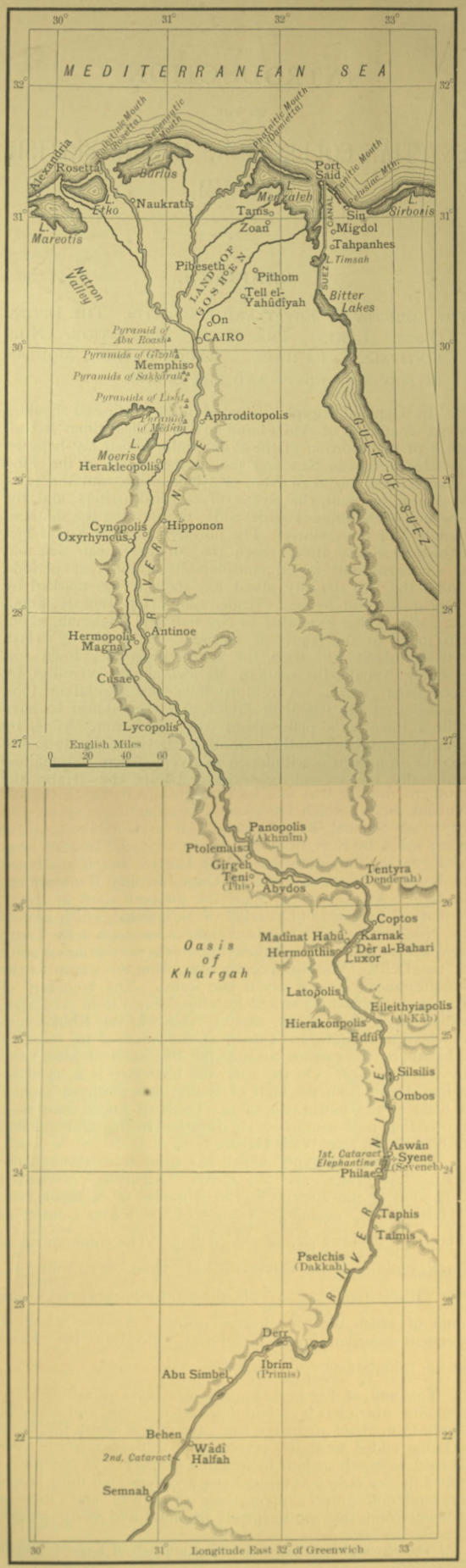
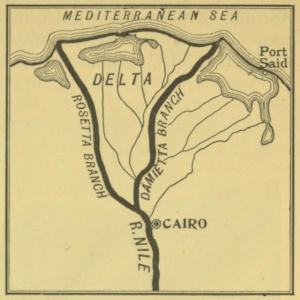
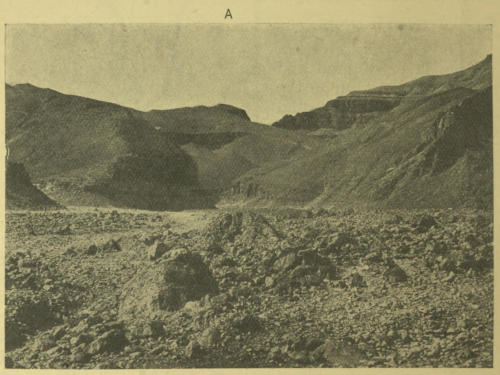
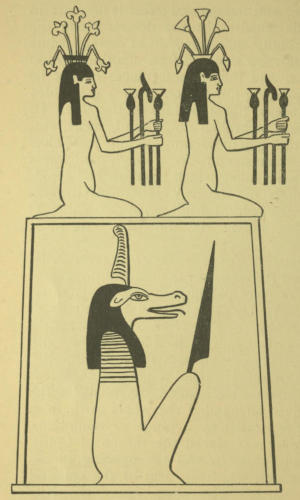
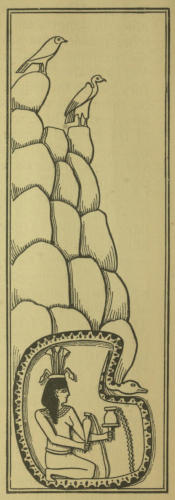
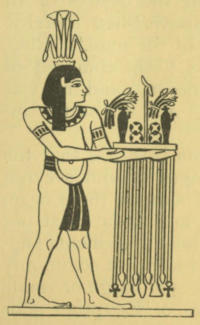
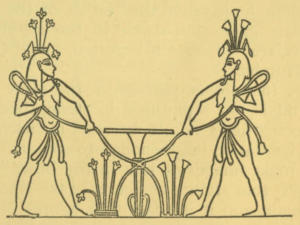
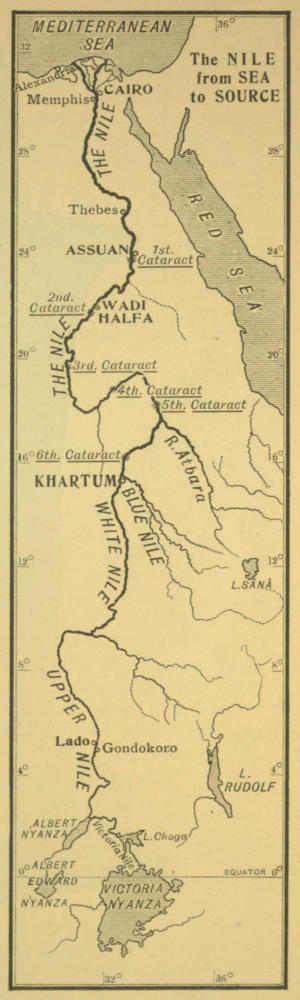
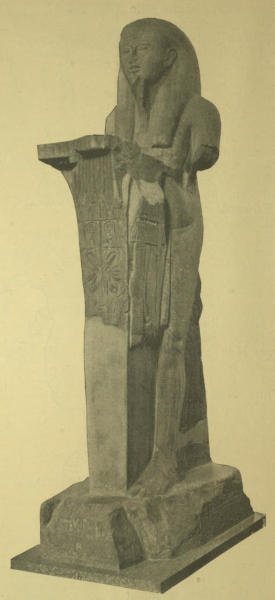
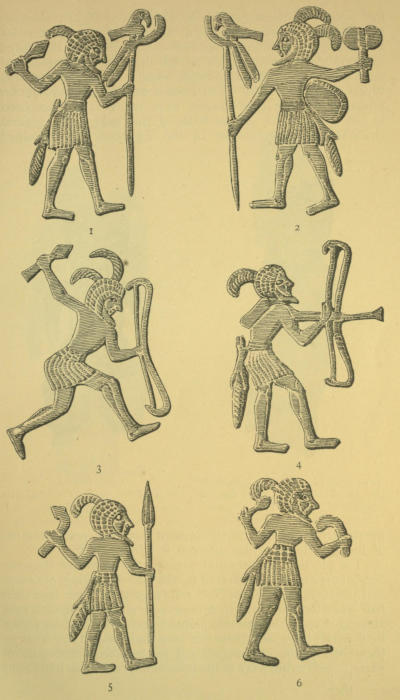
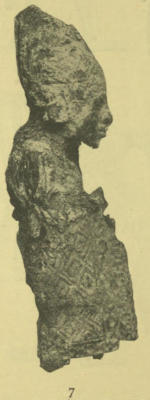
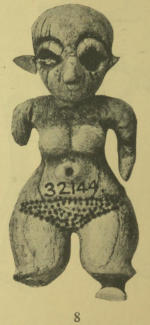
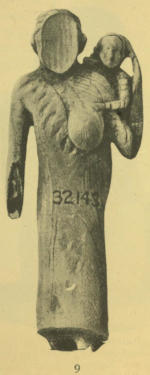
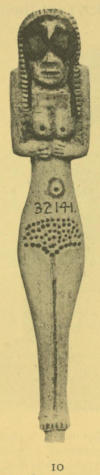
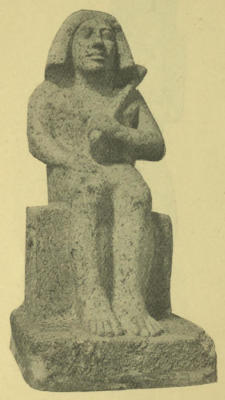
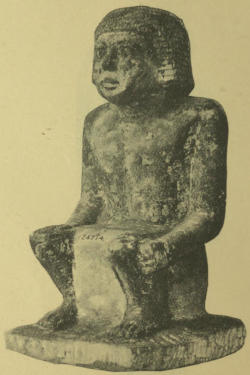
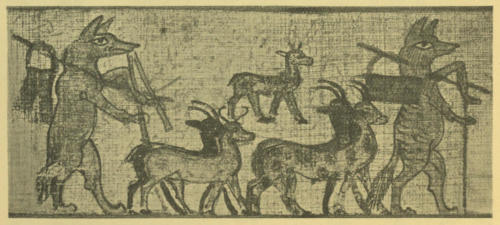
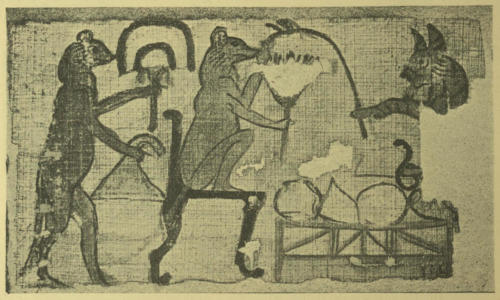
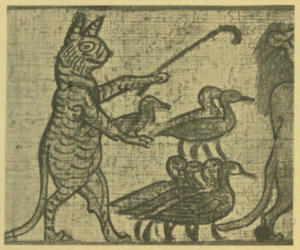
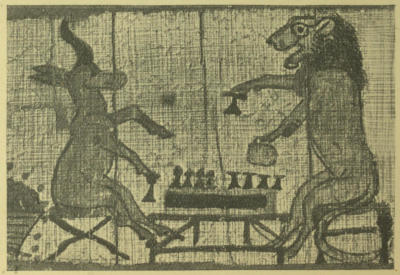
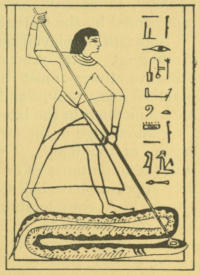
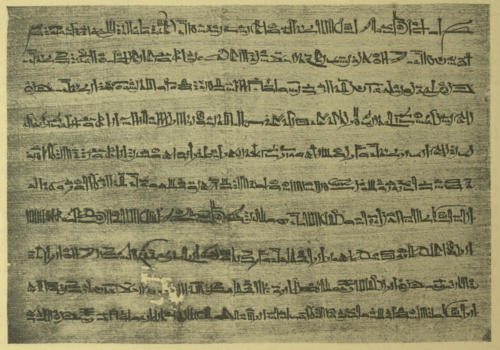
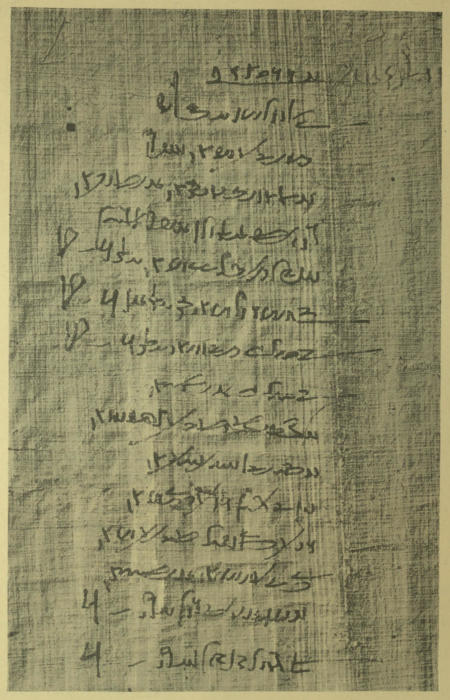
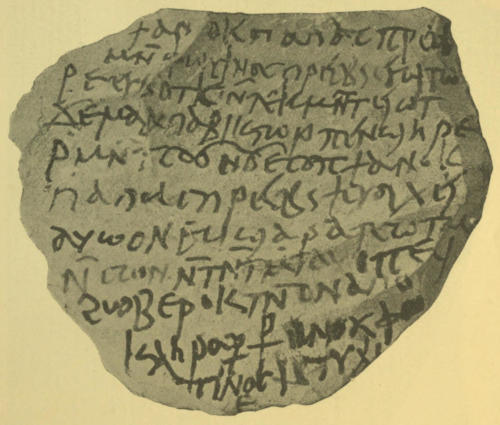
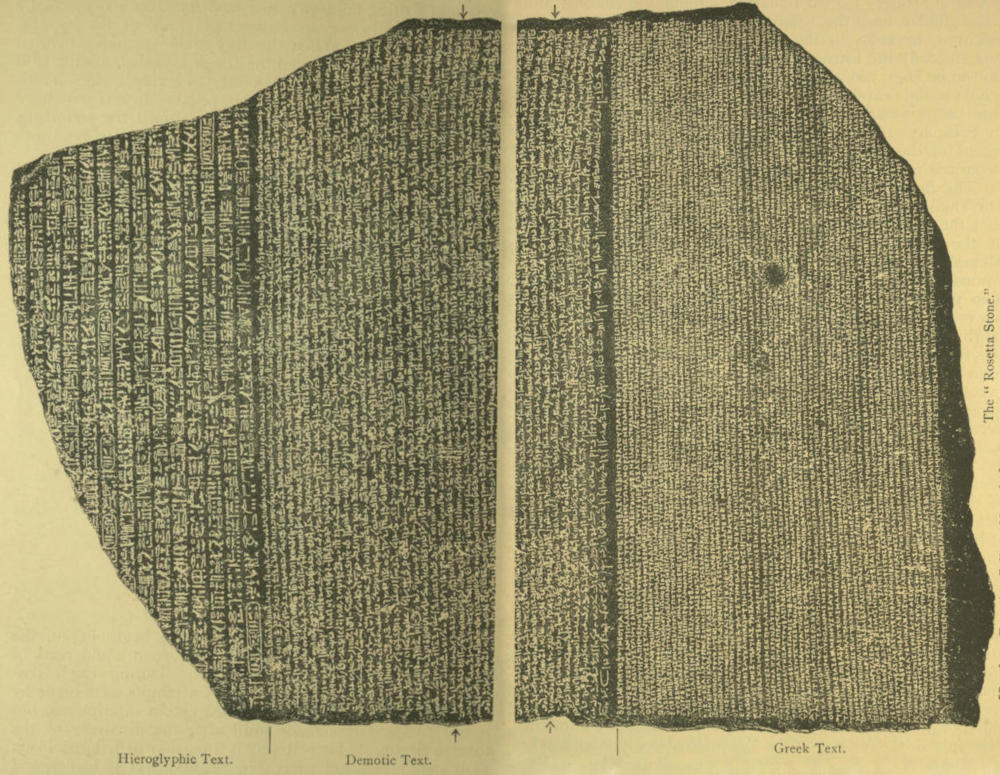
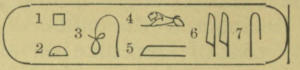

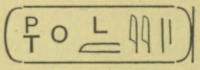
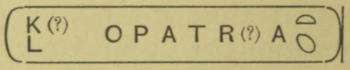
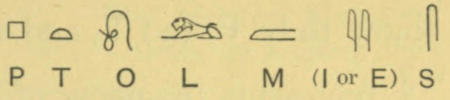

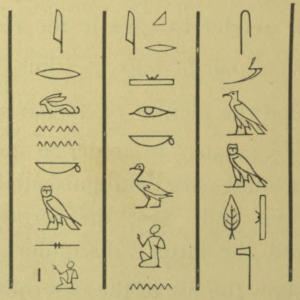
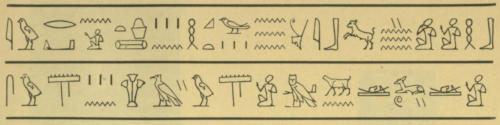
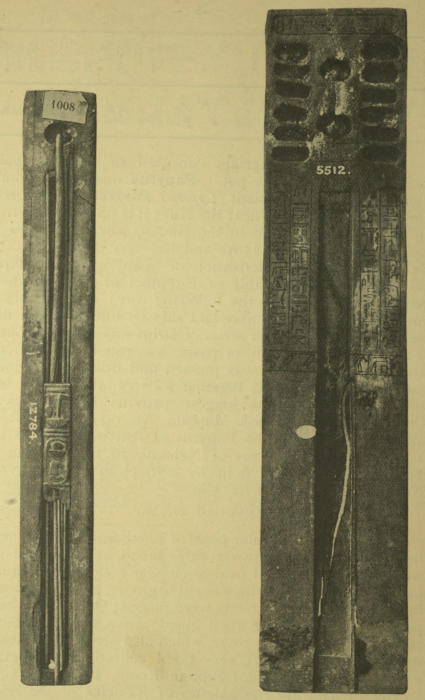
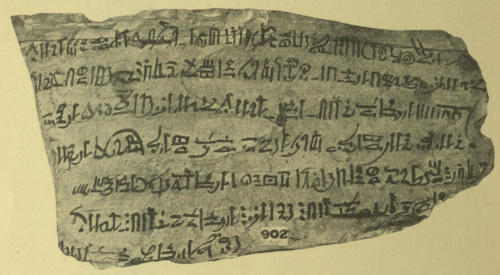
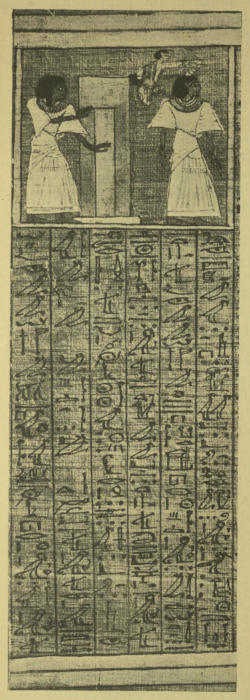
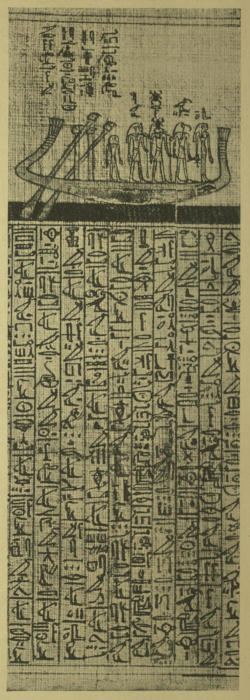
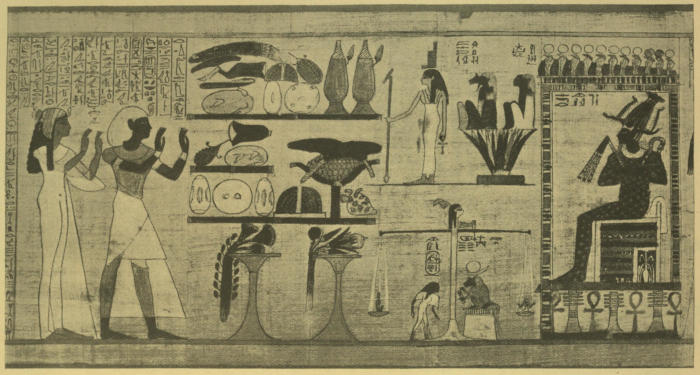
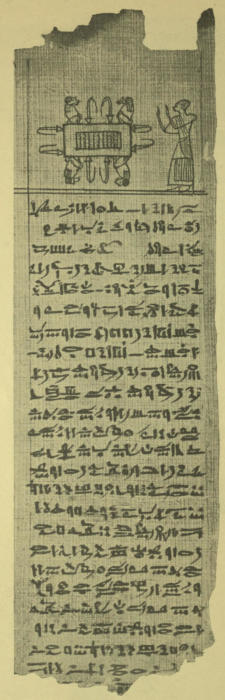
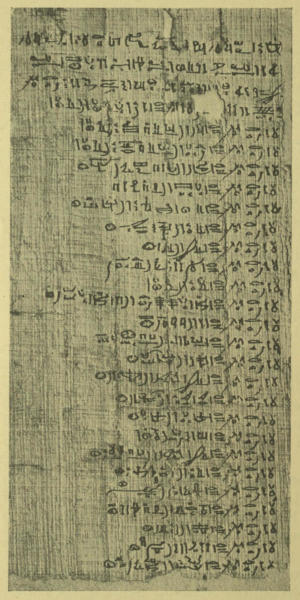
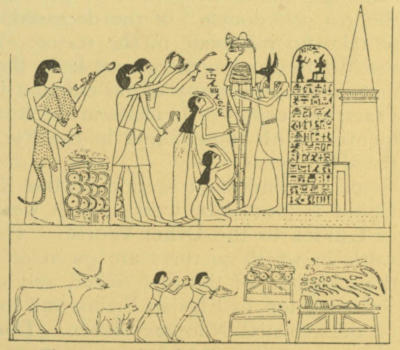
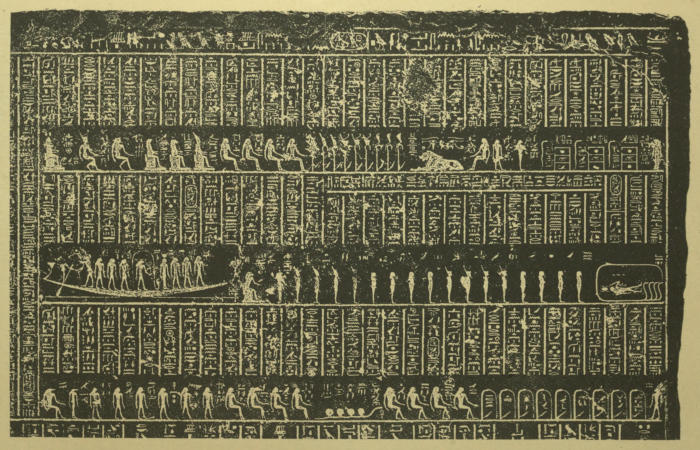
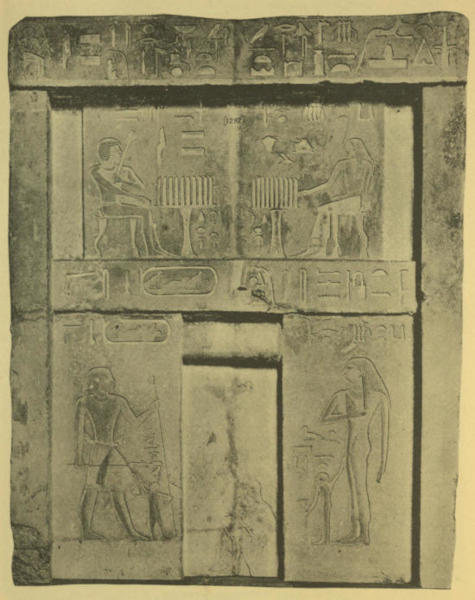
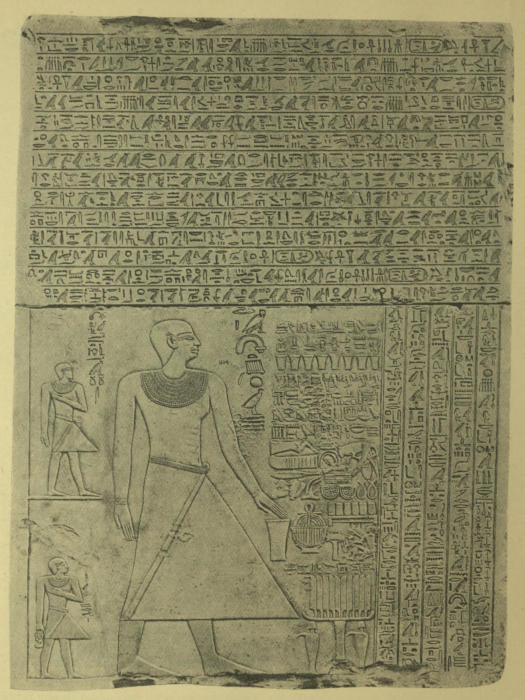
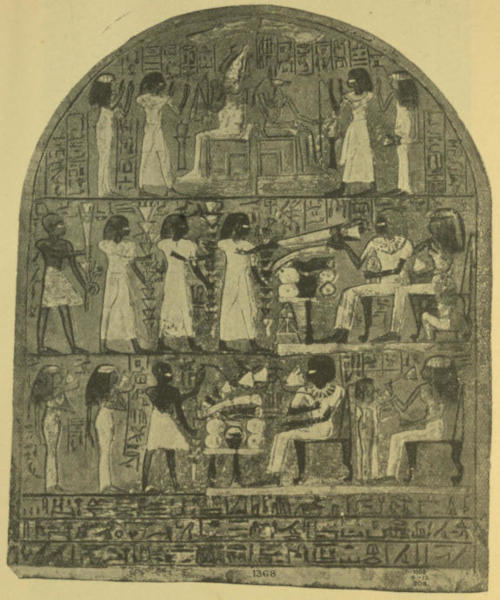
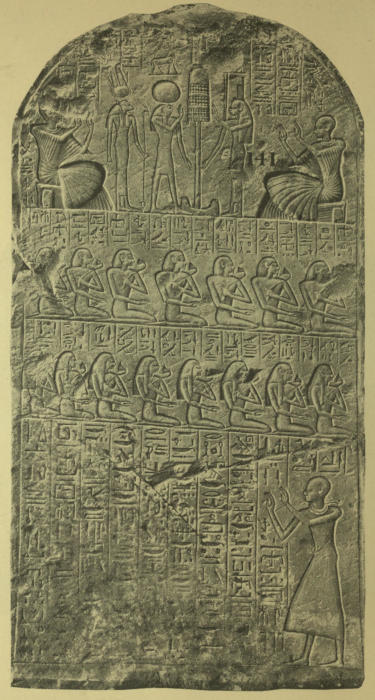
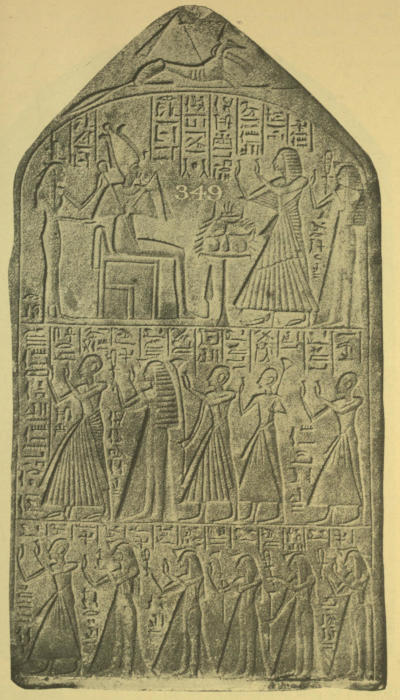
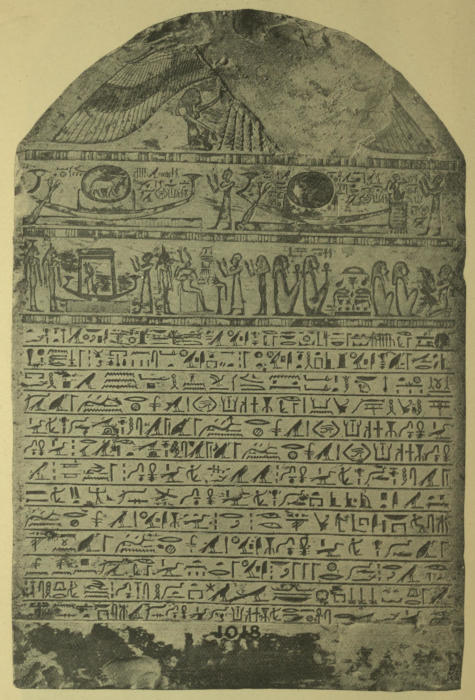
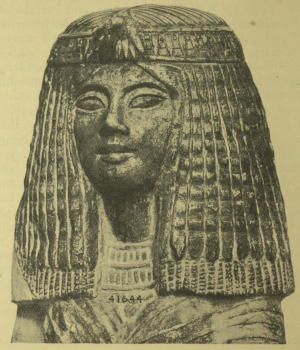
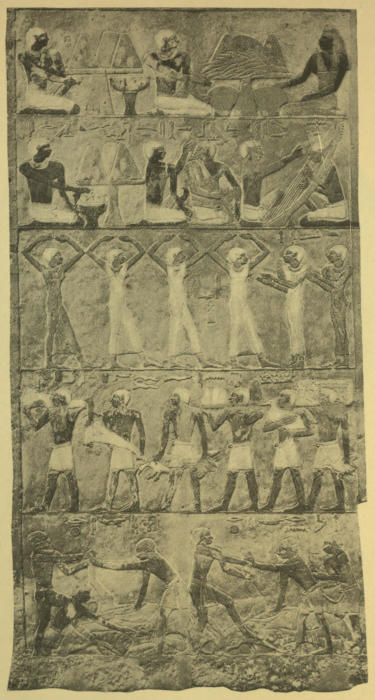
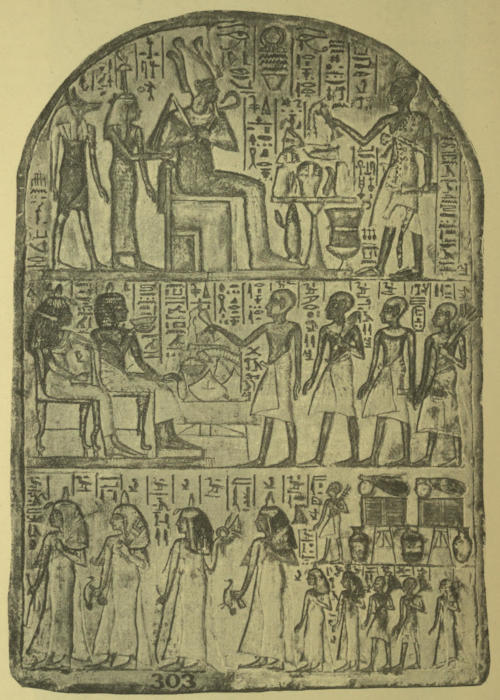
 ,
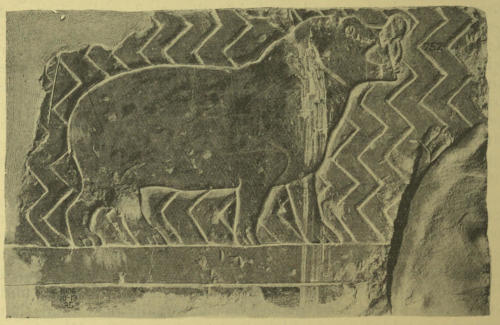
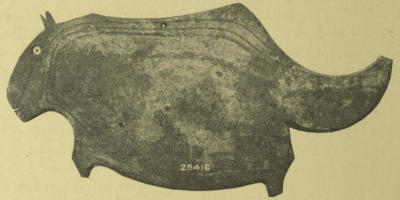
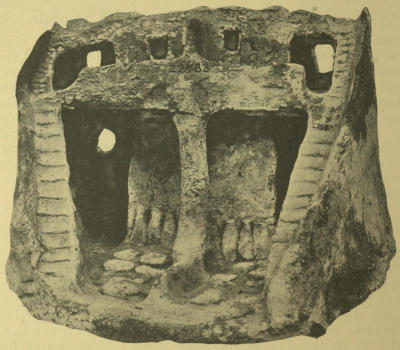
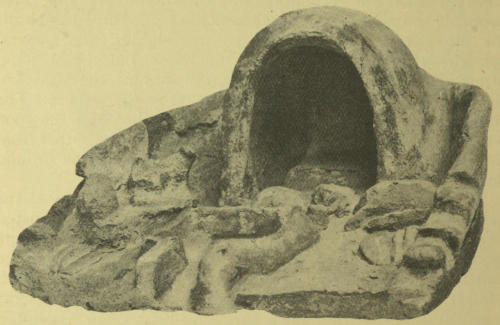
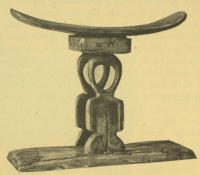
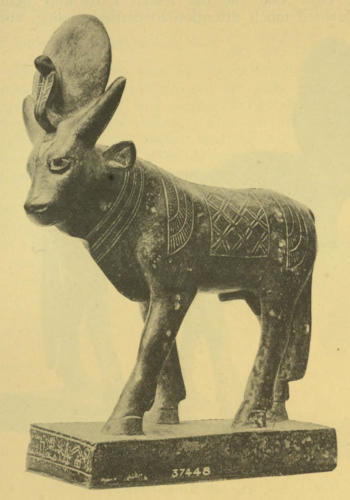
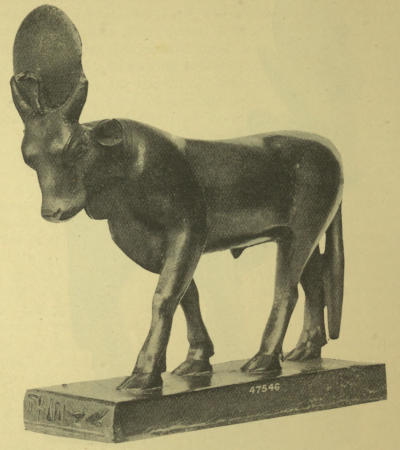
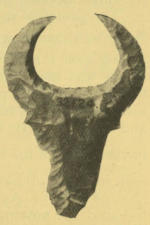
 , and in later times of iron or bronze. The
wheat or barley was tied up into small bundles by the
reapers, and carried to the threshing floor, where the grain
was trodden out by animals—donkeys, swine, etc. The threshing
floor, as we may see from the wall paintings and pictures
on papyri, was circular in form, and its edges were raised,
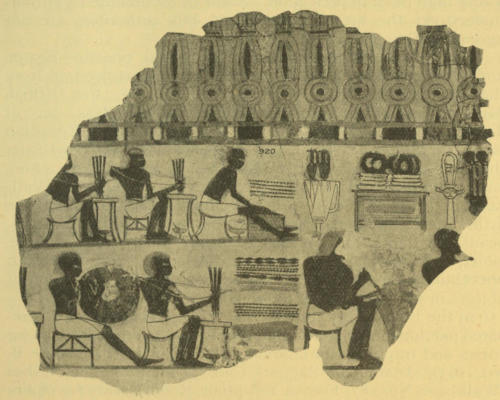
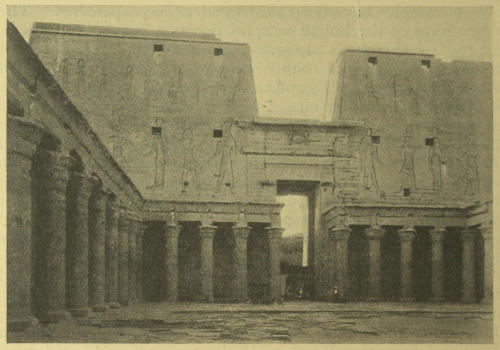
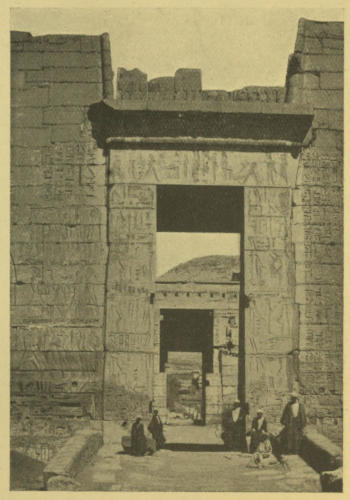
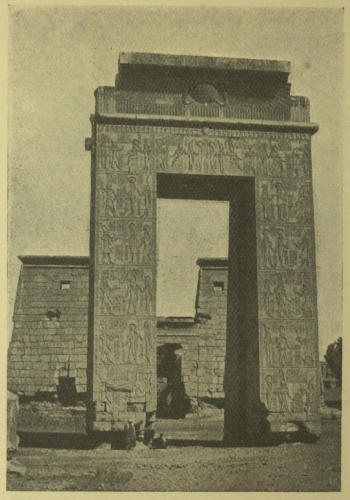
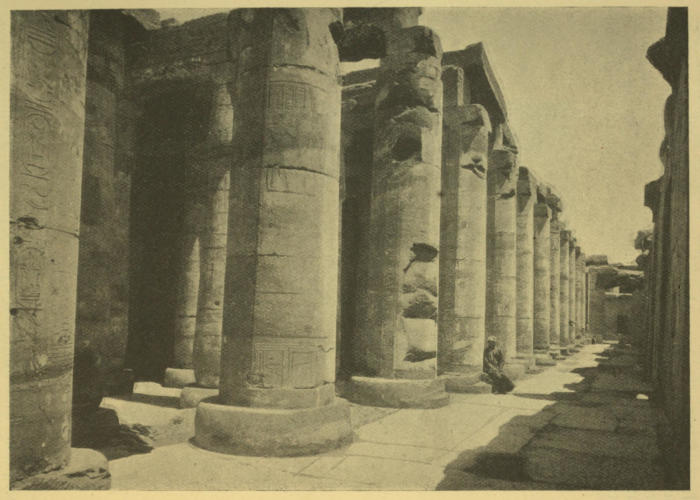
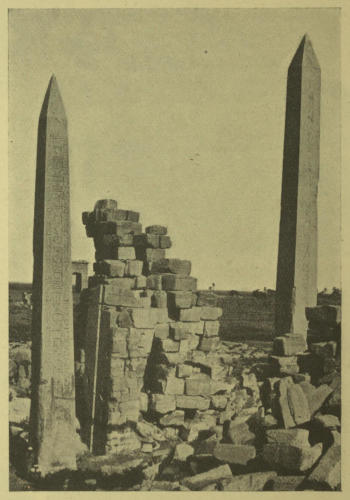
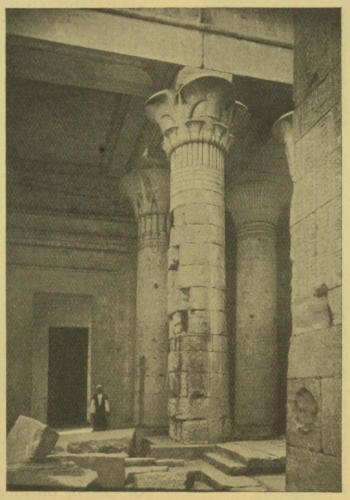
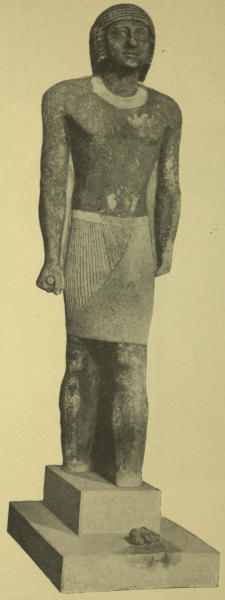
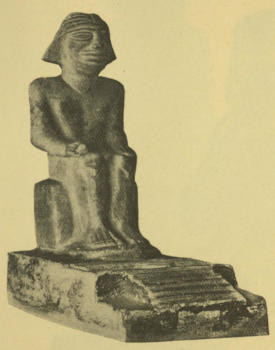
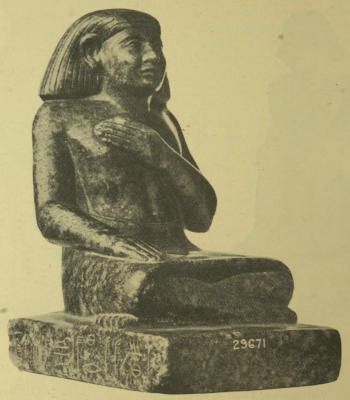
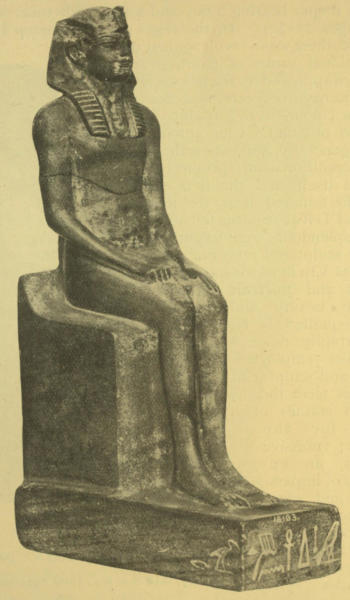
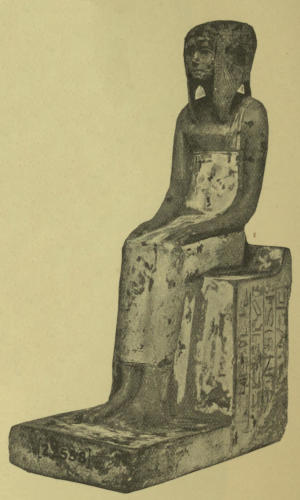
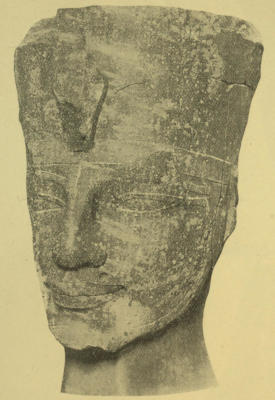
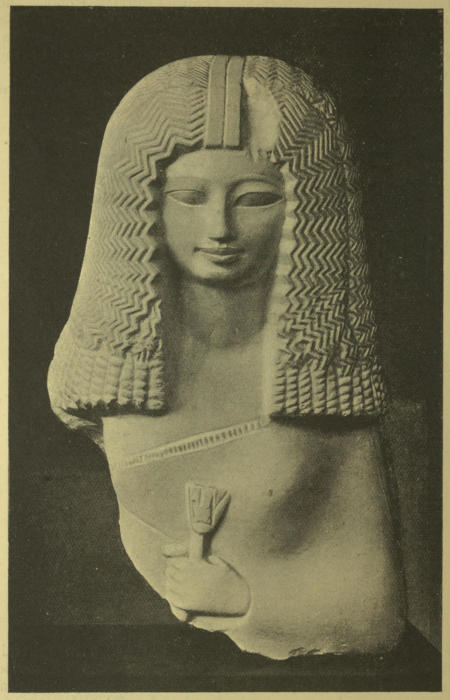
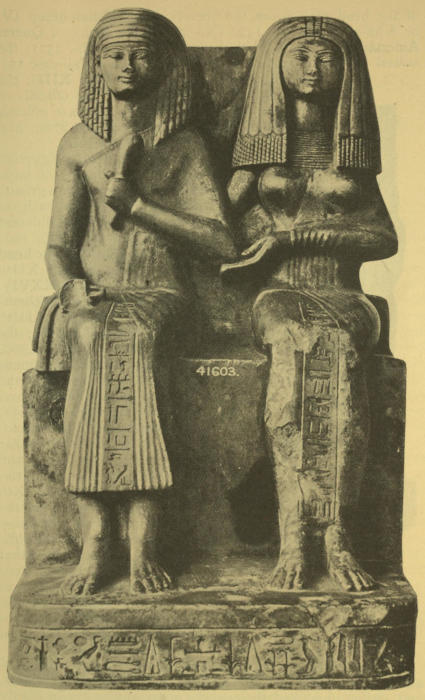
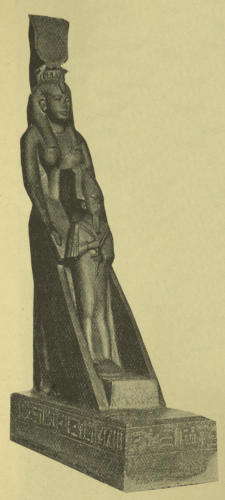
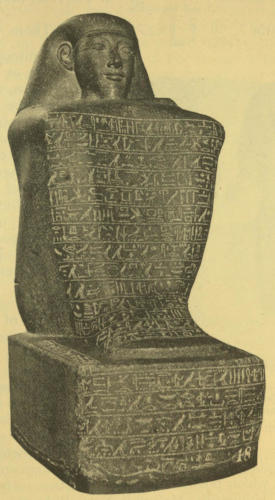
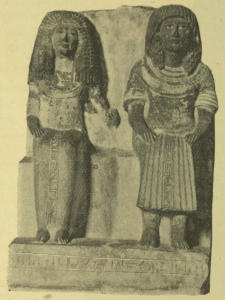
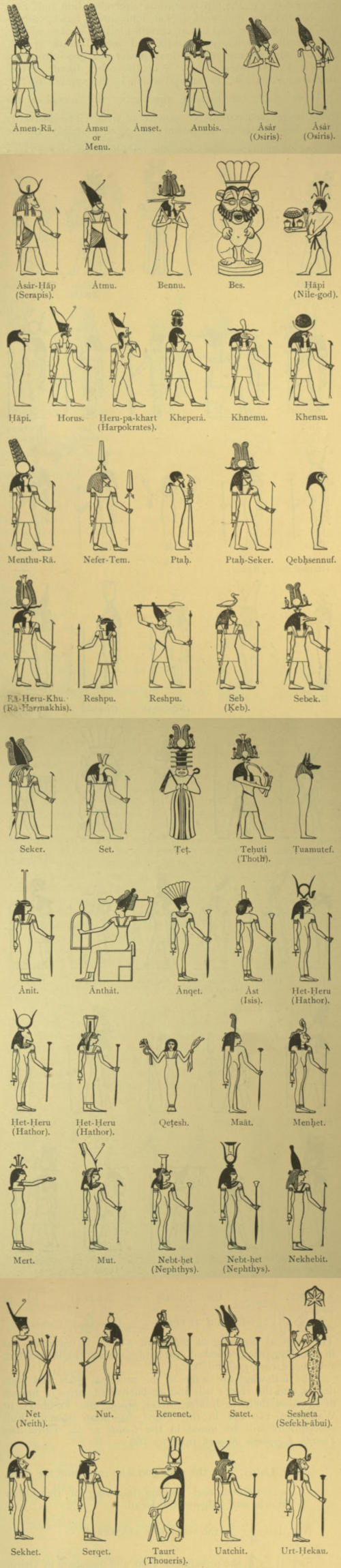
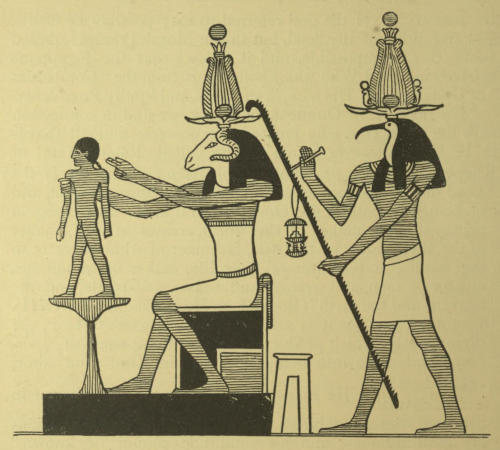
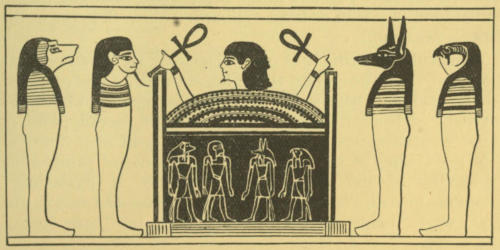
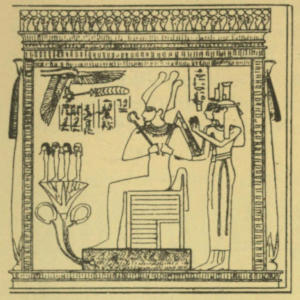
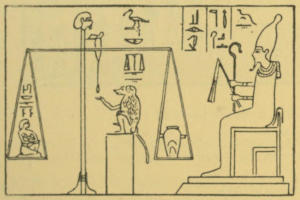
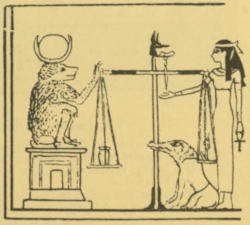
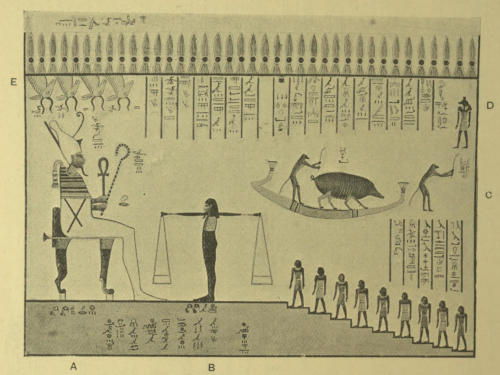
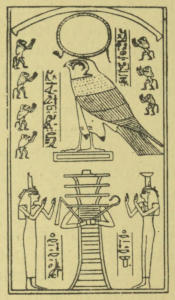
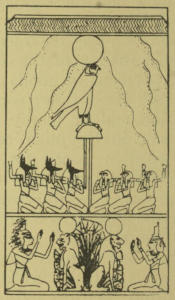
 , and assisted him to mount with their
fingers. The models of ladders and of the two forefingers
which are found in tombs commemorate this event.
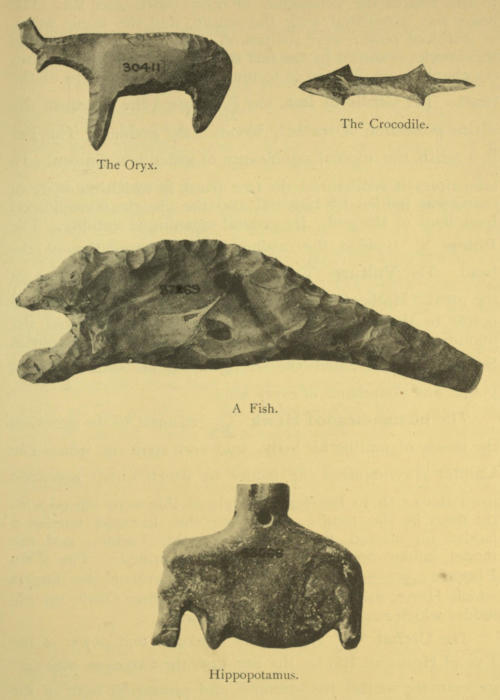
 symbolized the ladder by which Osiris ascended
from the earth to heaven. Models of this were buried with
the dead in the tombs, and when the deceased needed a
ladder he uttered the Chapter of the Ladder, and the
model ladder became as long as he wanted. The Two
Fingers
 index and medius, represent the fingers
which Horus used when he helped his father Osiris up the
ladder which reached from earth to heaven.
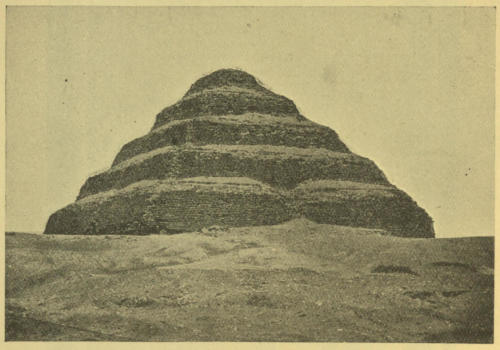
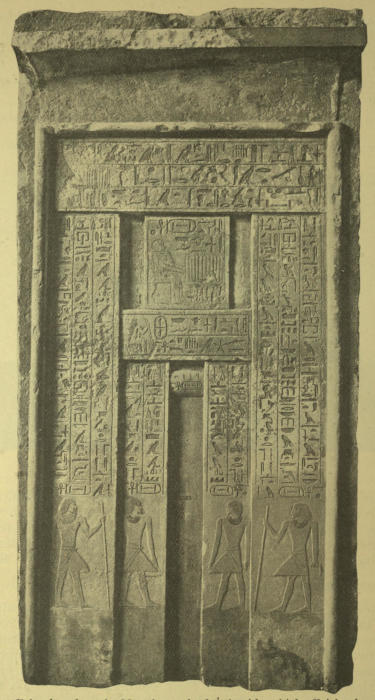
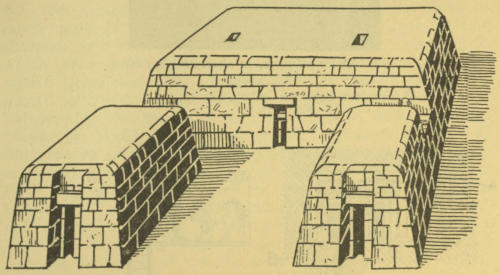
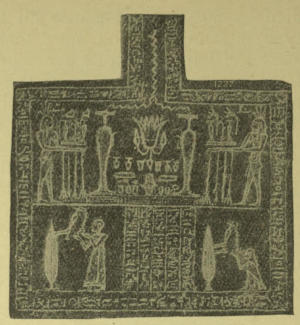
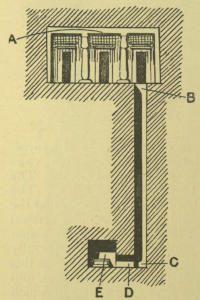
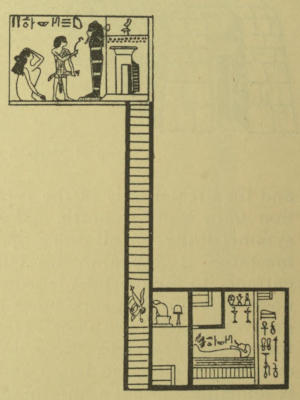
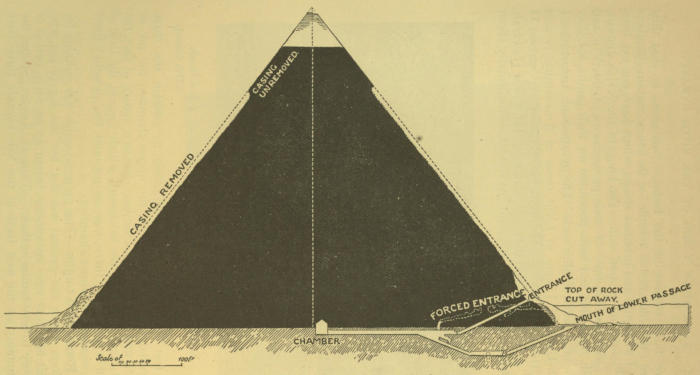
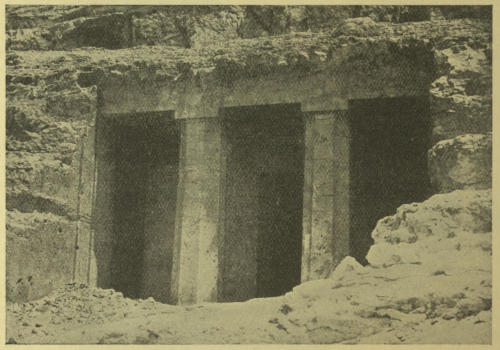
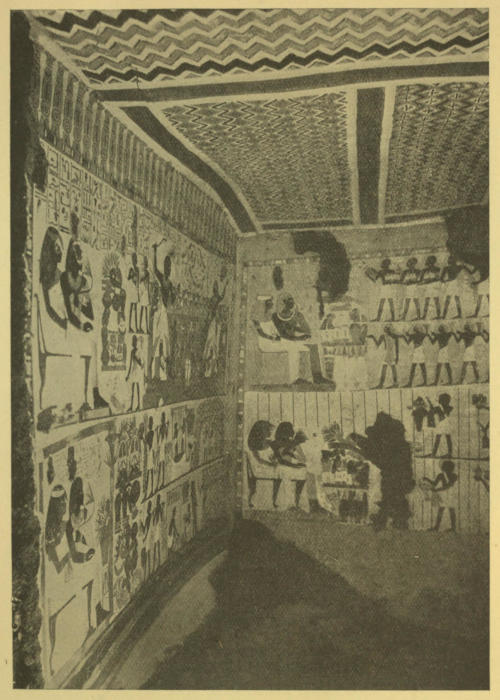
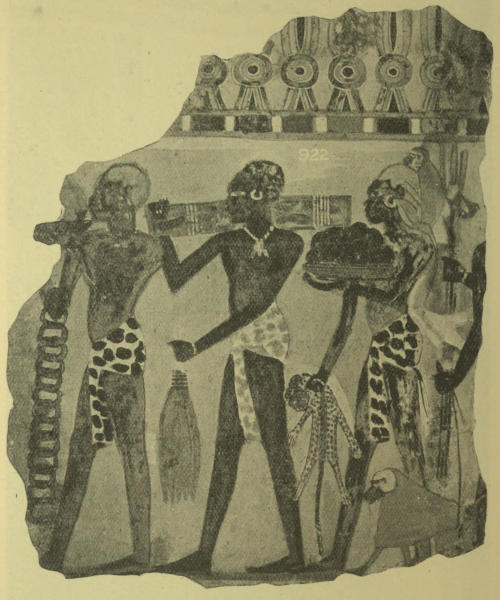
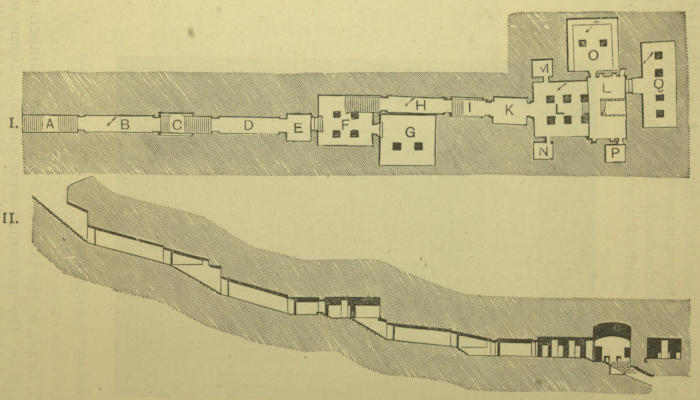
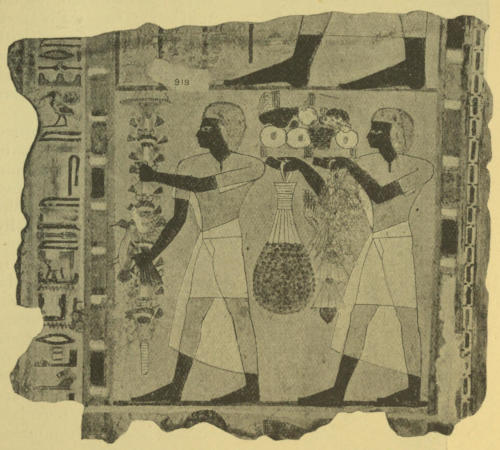
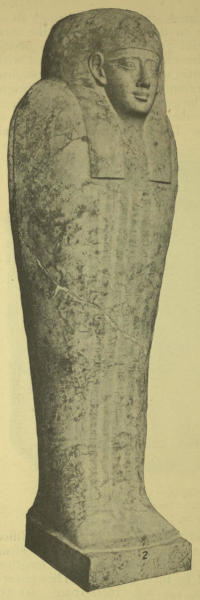
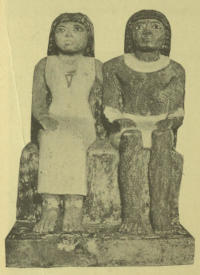
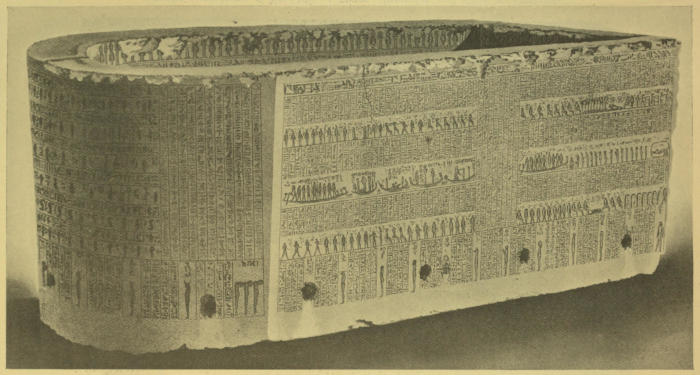
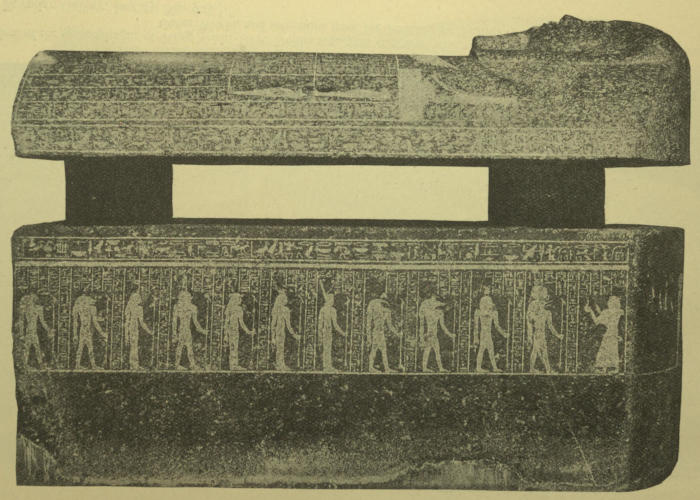
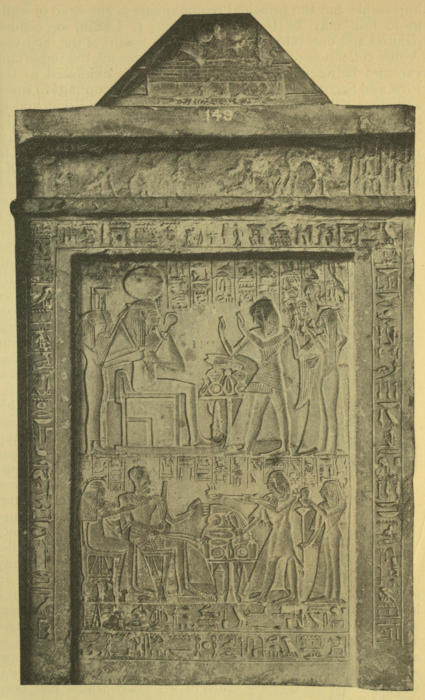


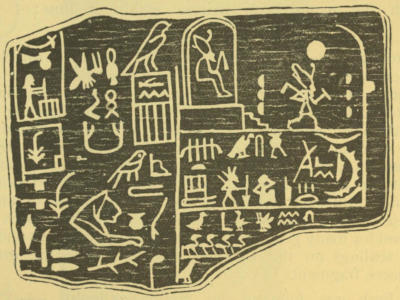
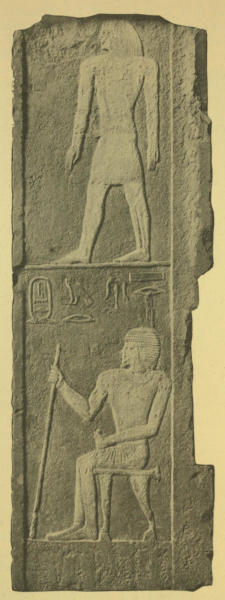
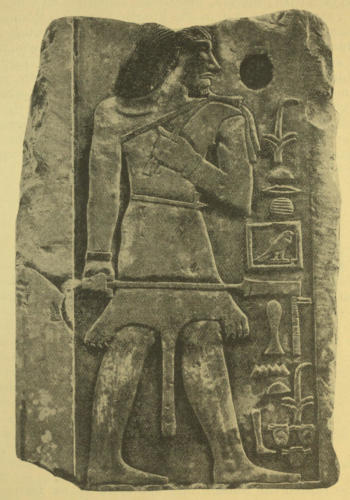
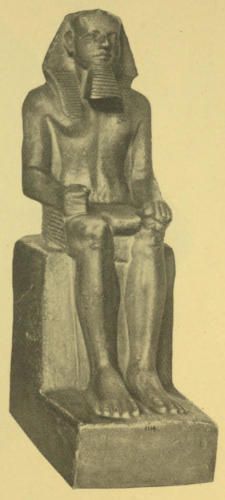
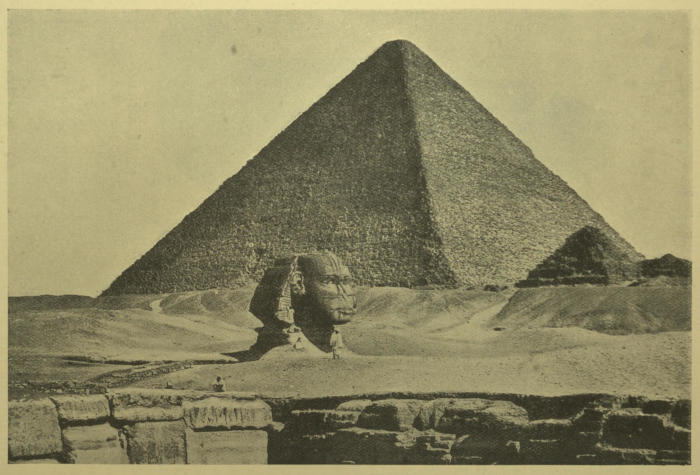
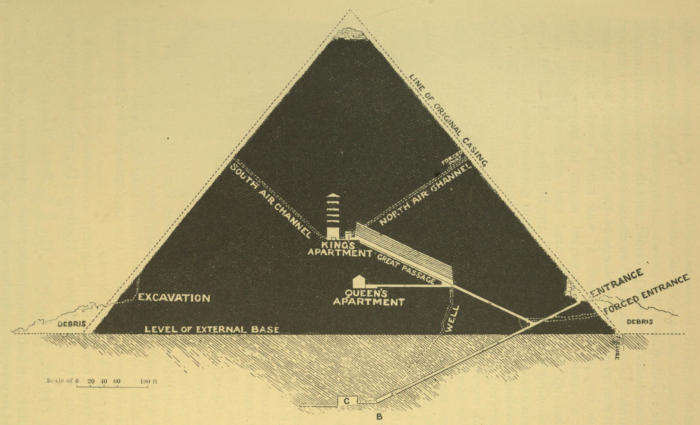
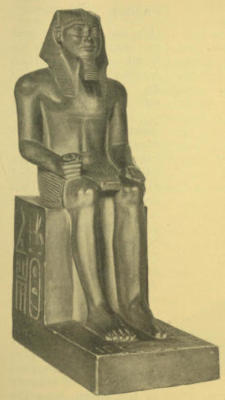
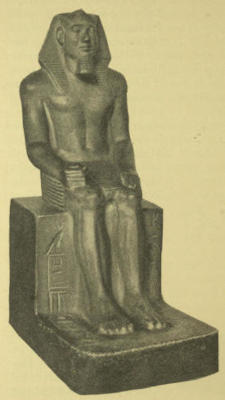
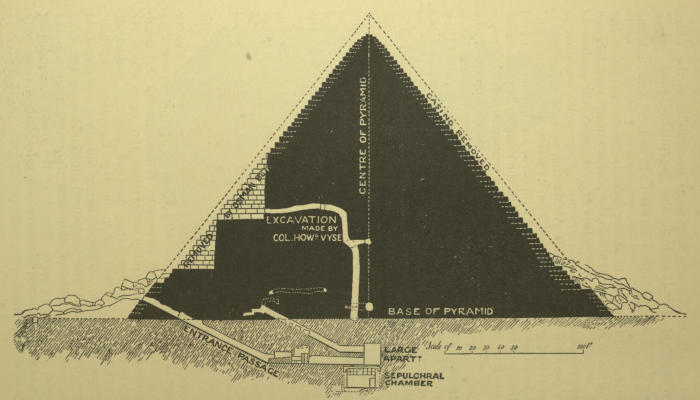
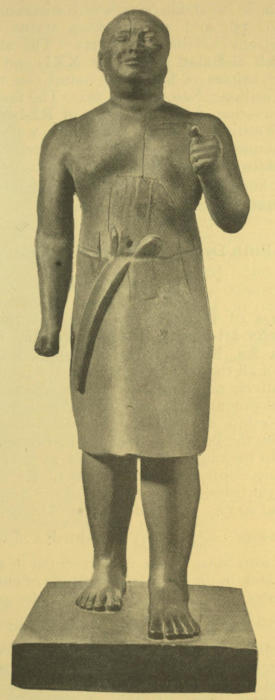
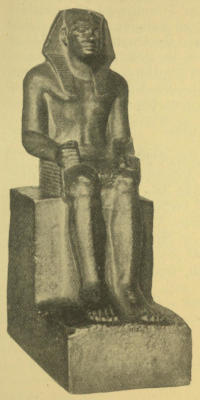
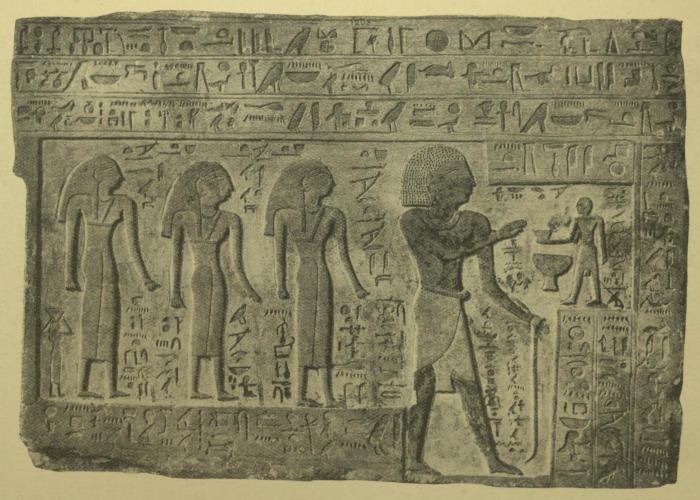
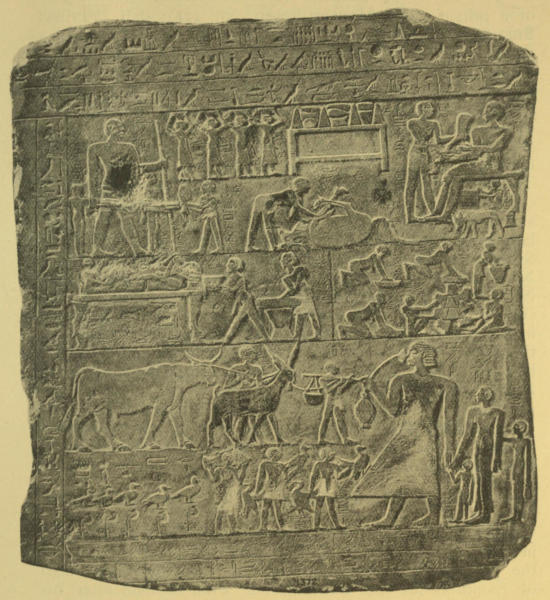
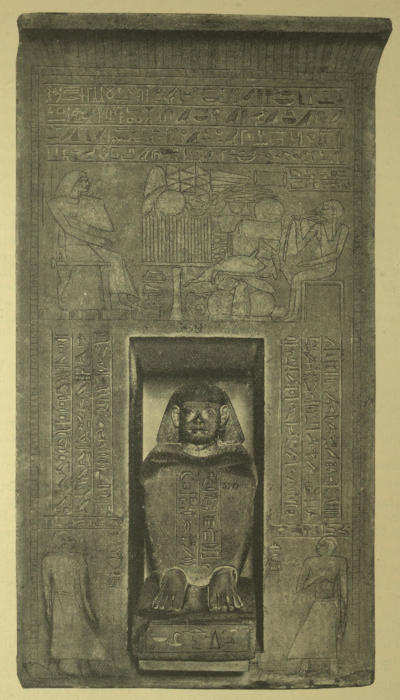
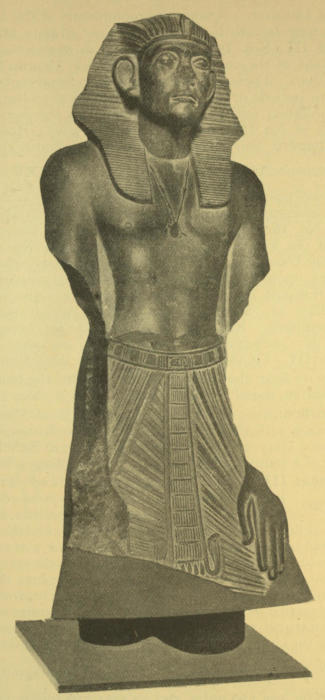
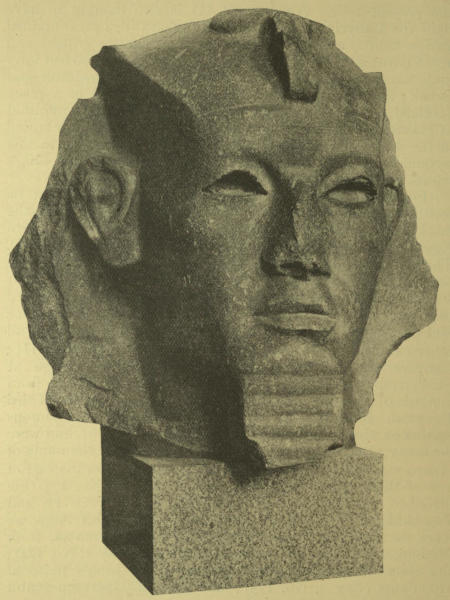
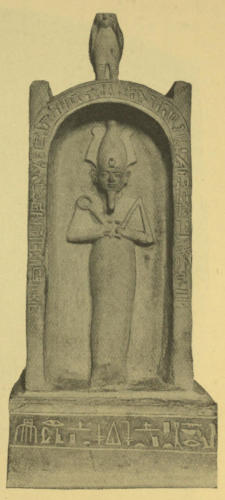
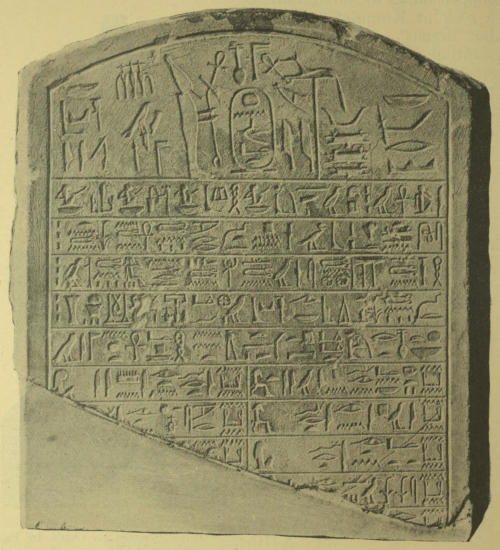
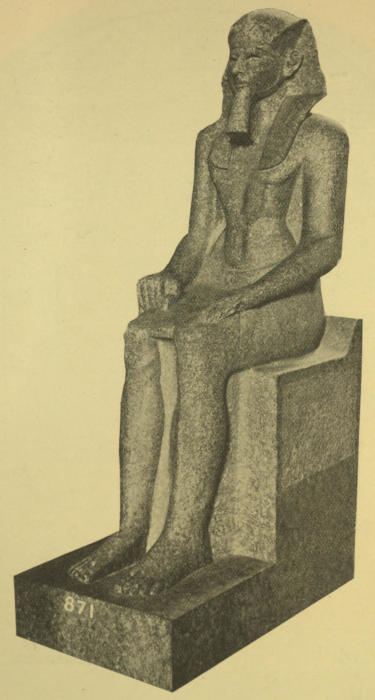
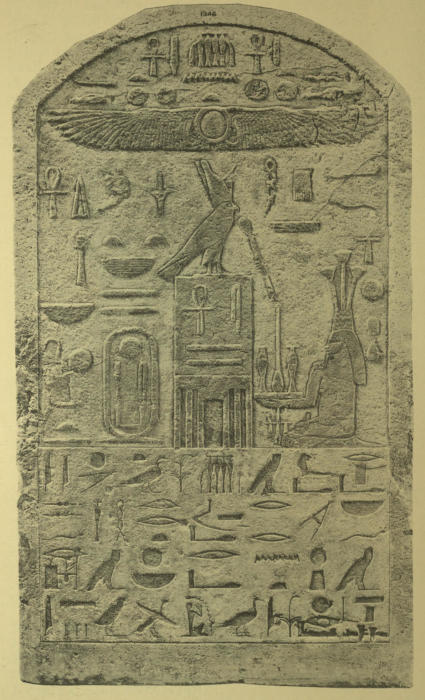
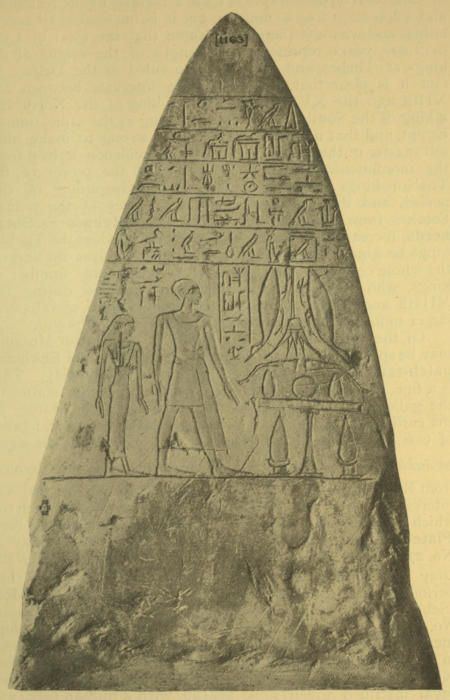
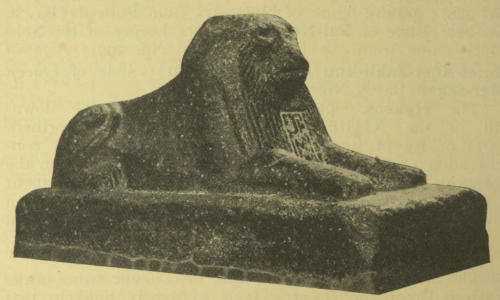
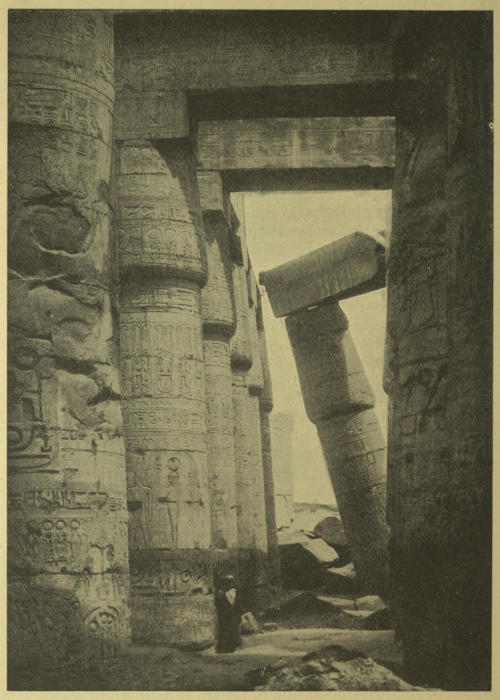
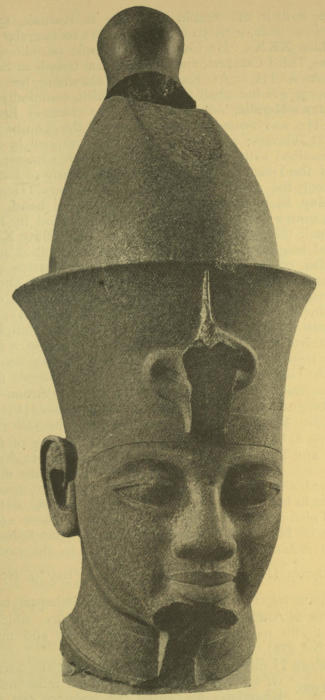
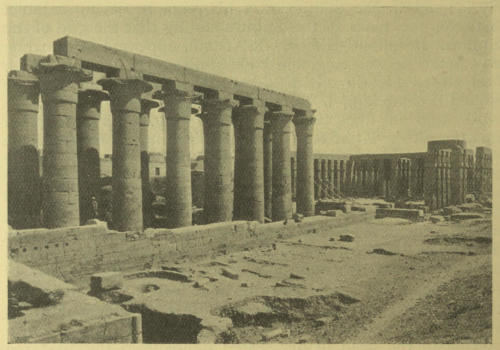
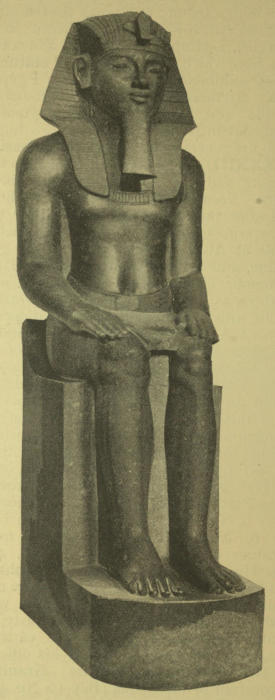
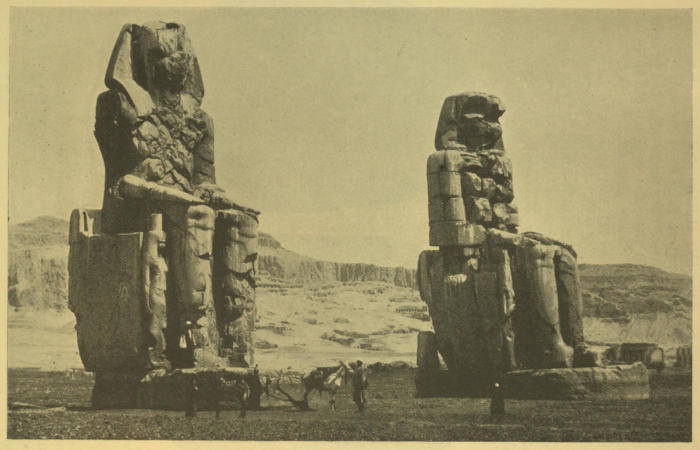
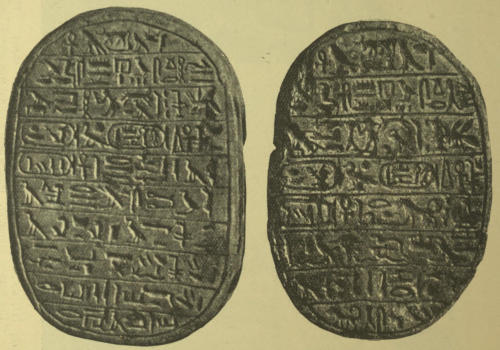
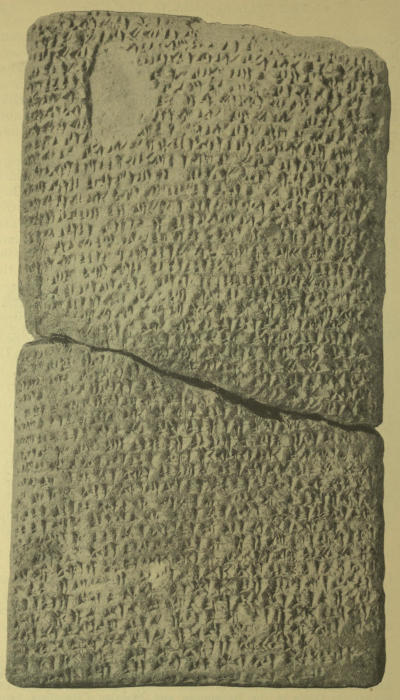
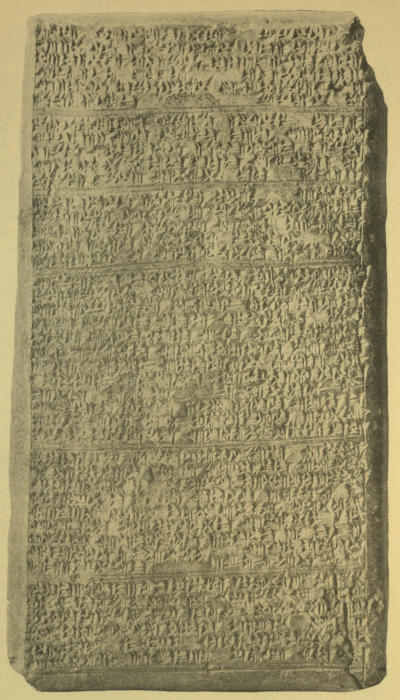
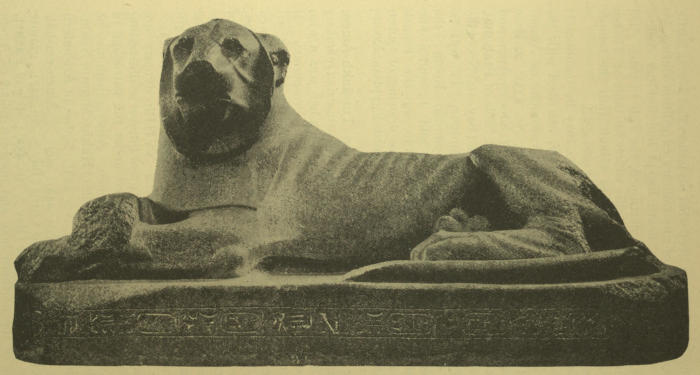
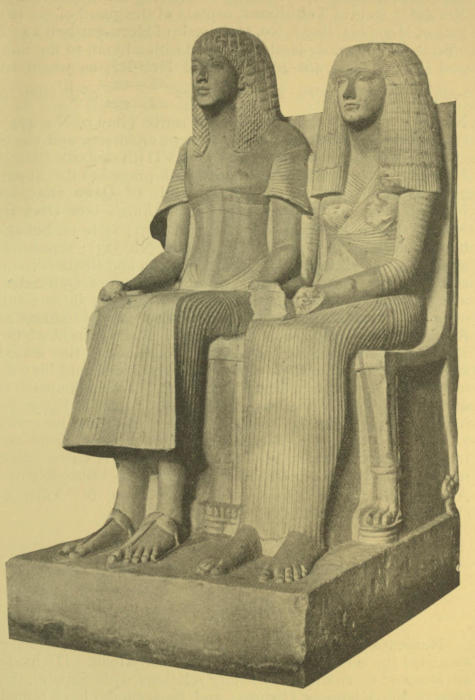
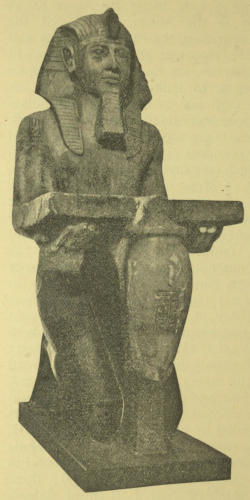
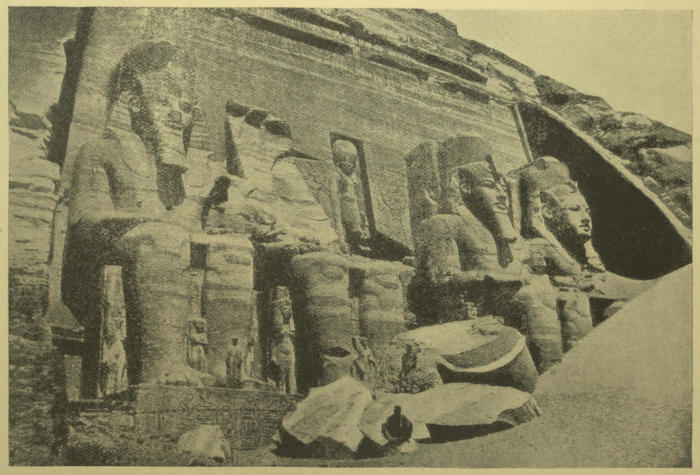
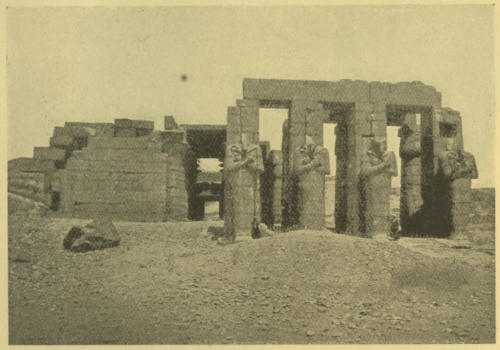
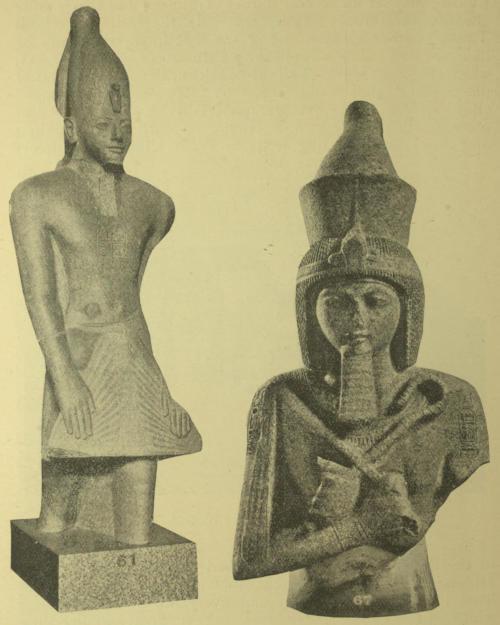
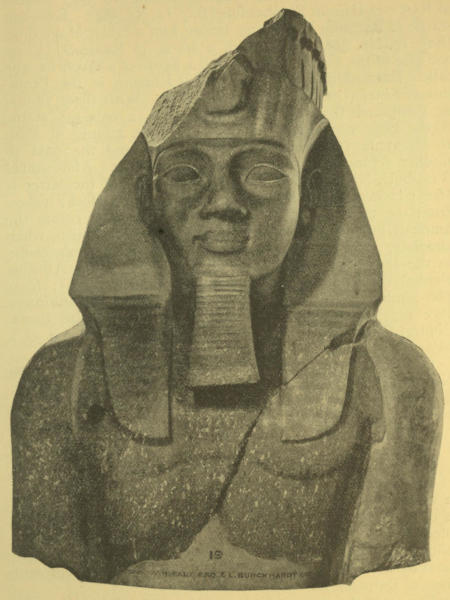
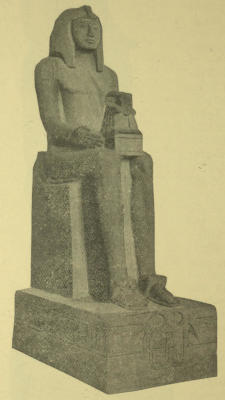
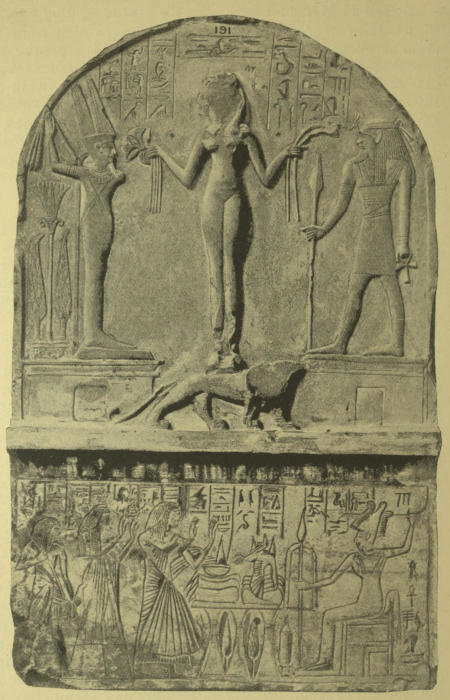
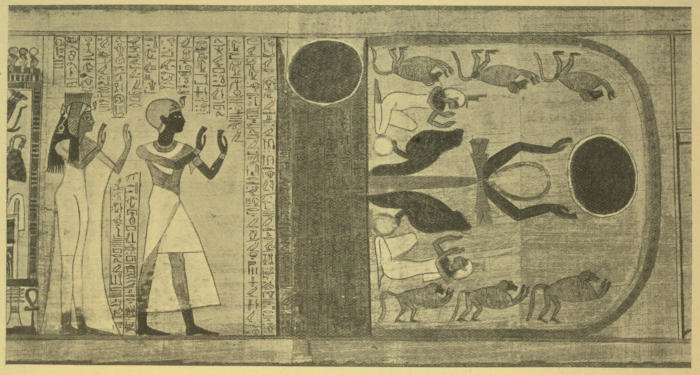
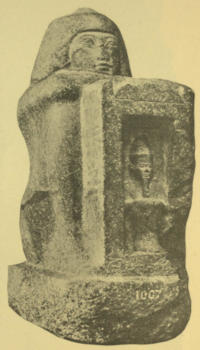
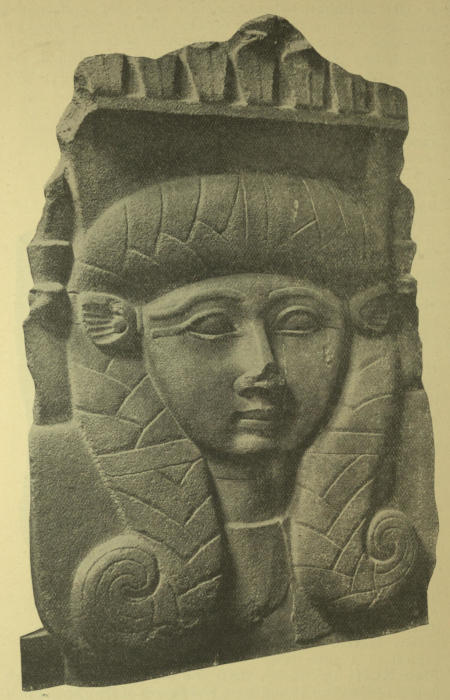
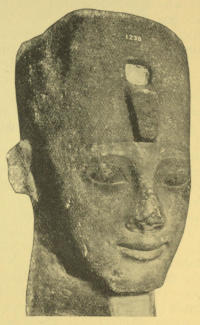
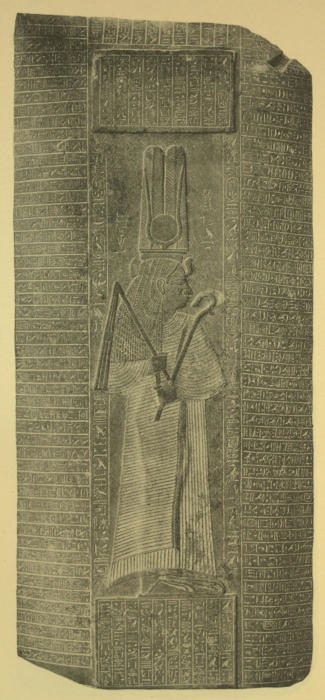
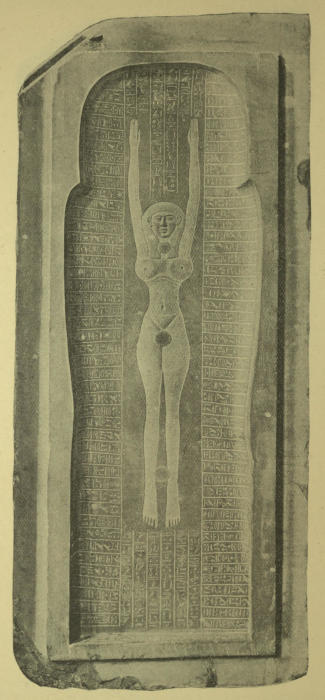
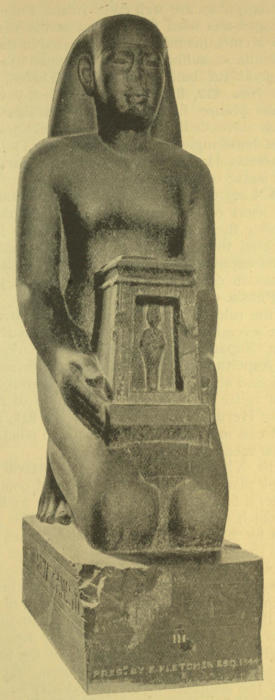
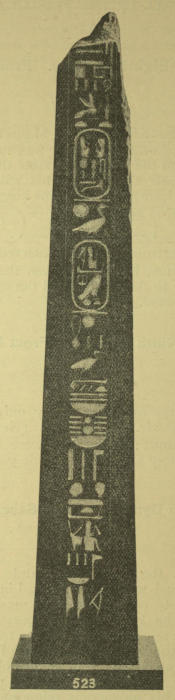
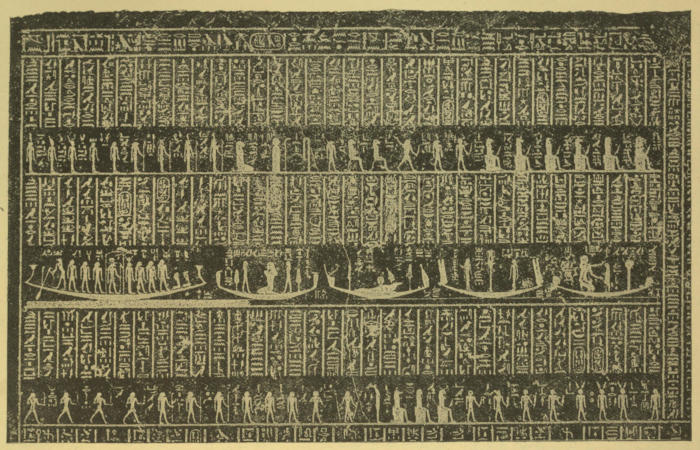
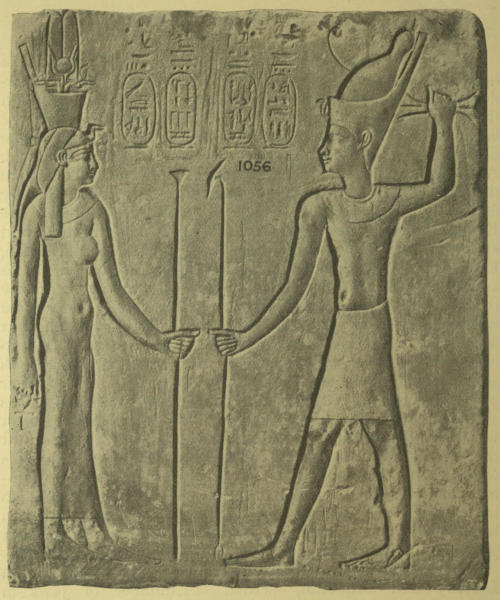
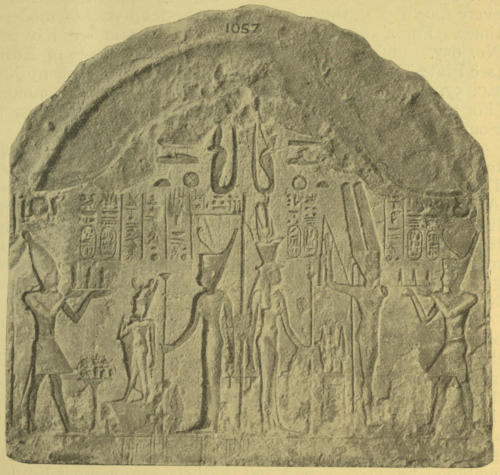
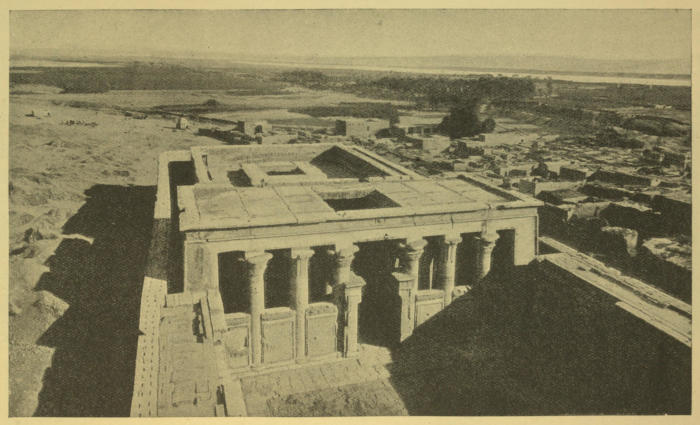
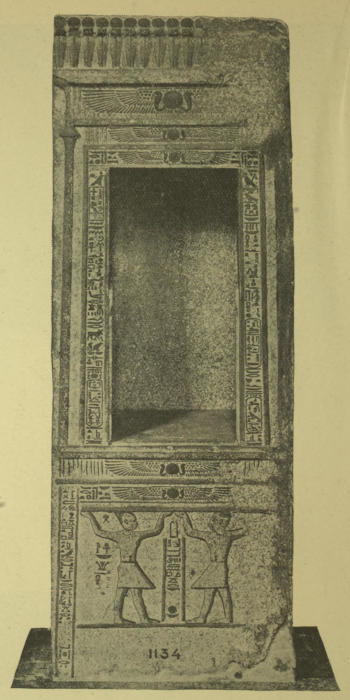
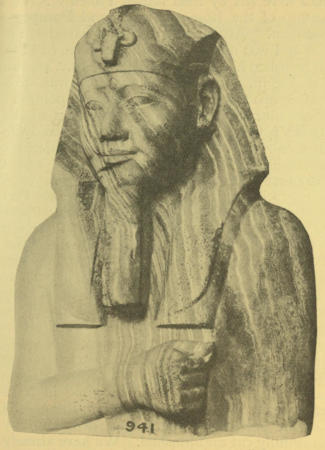
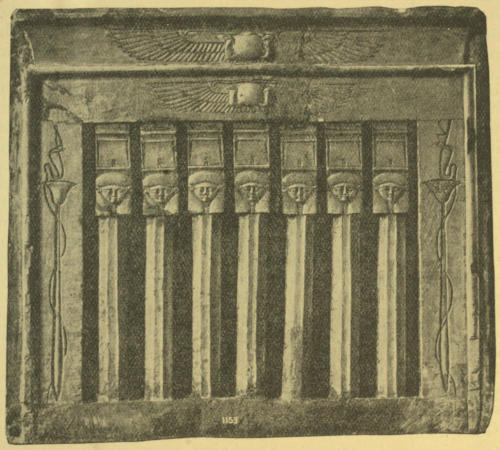
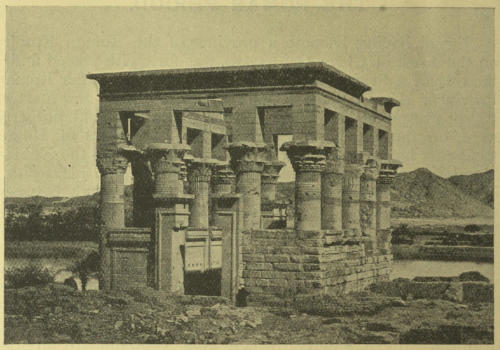
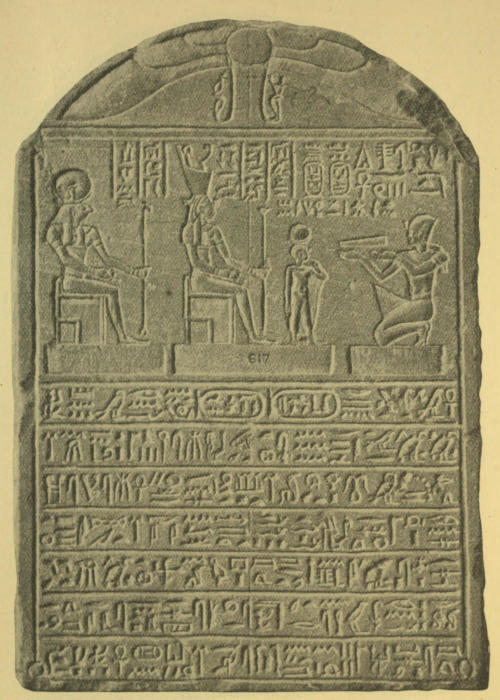
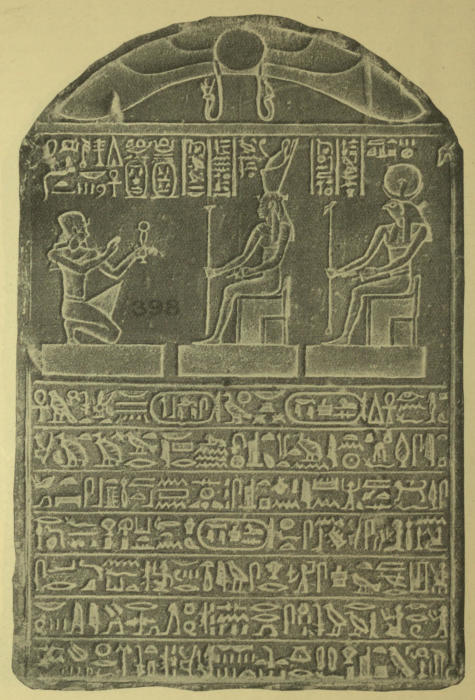
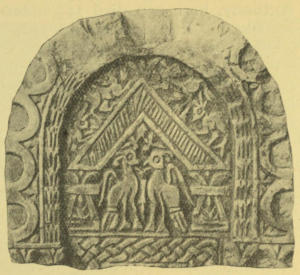
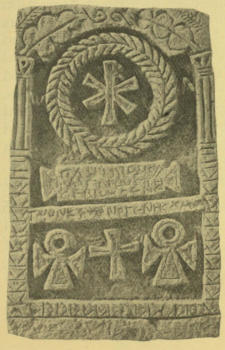
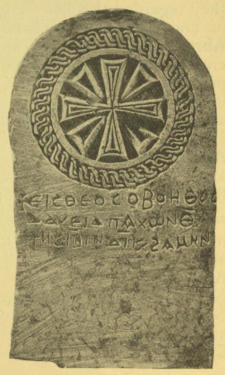
 ; No. 25
makes the Osiris-Christ to be Jah of the Hebrews, and
also Alpha and Omega; Nos. 36, 37, and 44 have figures of
Abraxas cut upon them; No. 87 mentions Solomon’s Seal,
No. 110, the six Archangels; and of peculiar interest are
No. 231, engraved with a representation of the Crucifixion,
and No 469, engraved with a representation of the Birth of
Christ.