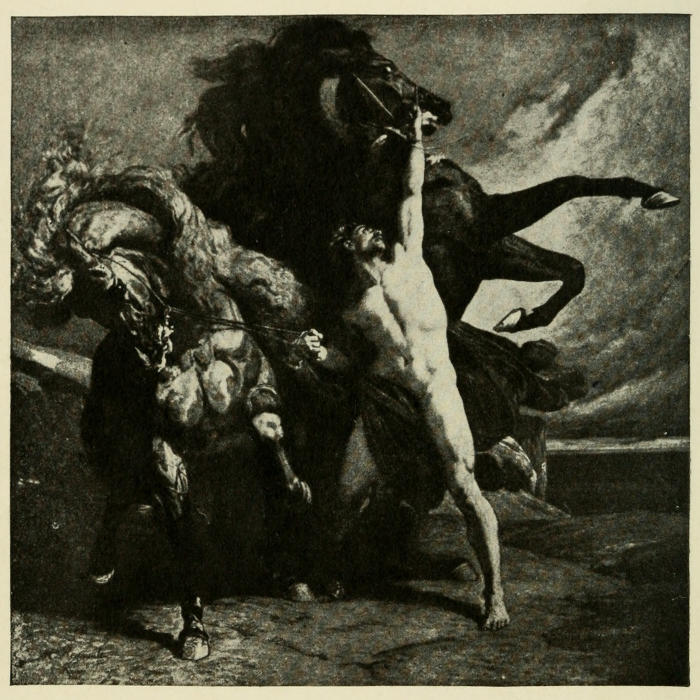
Automedon and the Horses of Achilles. H. Regnault.
A
GUIDE TO MYTHOLOGY
BY
HELEN A. CLARKE Author of “Ancient Myth in Modern Poets,” “Longfellow’s
Country,” “Hawthorne’s Country,”
“The Poets’ New England,” Etc.
Garden CityNew York
DOUBLEDAY, PAGE & COMPANY
1918
COPYRIGHT, 1908, BY
DOUBLEDAY, PAGE & COMPANY
ALL RIGHTS RESERVED, INCLUDING THAT OF
TRANSLATION INTO FOREIGN LANGUAGES,
INCLUDING THE SCANDINAVIAN
To MY LITTLE FRIEND
KATHARINE CORFIELD NEWBOLD
PREFATORY NOTE
It is a pleasure to express my thanks to publishers
and authors for courteous permission given me to
include in this book stories from their collections.
To Houghton, Mifflin & Co., the publishers of “Algonquin
Legends,” by J. G. Leland, and of Bryant’s
translation of the “Odyssey”; to J. B. Lippincott
Co., the publishers of “Gods and Heroes of Old
Japan,” by Violet M. Pasteur, and of “Old Deccan
Days,” by Mary Frere; to A. Wessels Co., the publishers
and to Mr. W. W. Canfield, the author of
“Legends of the Iroquois”; to Ginn & Co., the
publishers of “Classic Myths in English Literature,”
based on Bulfinch’s “Age of Fable,” by
Charles Mills Gayley; to Macmillan & Co., publishers
of “Theocritus, Bion, and Moschus, Done into English
Prose,” by A. Lang; to Scott, Foresman & Co.,
publishers of “Norse Mythology,” by Melville B.
Anderson. Other collections, out of print, as far as
I know—the original publishers no longer being in
existence, from which I have taken stories, are:
“Indian Fairy Tales Based on Schoolcraft,” by Cornelius
Mathews, and “Indian Myths,” by Ellen R.
Emerson; also from the following English publications:
“Polynesian Myths,” by Sir George Grey;
“Russian Stories,” by Ralston.
I am also deeply indebted, as every one who studies
mythology must be, to the following works, among
others in various branches of the subject: Max Müller’s
“Chips from a German Workshop,” Cox’s “Mythology
of the Aryan Races,” John Fiske’s “Myths
and Mythmakers,” Frazer’s “Golden Bough,” Hartland’s
“Myth of Perseus,” Clodd’s “Childhood of
Religions,” Andrew Lang’s “Custom and Myth,”
Tyler’s “Primitive Culture,” Mills’s “Tree of Mythology,”
Chamberlain’s “The Child and Childhood
in Folk Thought,” De Gubernatis’s “Zoological Mythology,”
Dr. Brinton’s “American Hero Myths,”
“Myths of the New World,” as well as to many
collections of folk-tales.
My aim in this book on Mythology for young
readers has been to give them solid knowledge on
the subject, as far as it is advisable to go with immature
minds, based upon the most recent investigations
of scholars, and to select the myths used in
illustration of the plan, with a view to giving them
interesting stories to read, which will, almost unconsciously
to themselves, lay a firm foundation for the
fascinating study of Comparative Mythology, should
they wish to go more deeply into it in the future.
There is much talk nowadays as to the
authenticity of the records of savage myths. Much of this
talk seems to me futile, for a myth is not a fixed
entity. Each successive narrator is almost sure to
vary and embellish somewhat the material that comes
to him, according to his own inventive fancy. If,
therefore, a savage myth recorded by a white man retains
the chief characteristics of the savage myth,
in spite of some fanciful turns given it by him, to
the degree, say, that a story of Ovid’s retains those
of a Greek myth, it is to all intents and purposes a
savage myth, and the embellishments may be disregarded,
as Ovid’s are when we are considering
Greek Mythology. I have, therefore, included in
this volume those versions of the myths that seemed
most readable and attractive, provided the primitive
attitude of mind and customs were fully emphasized.
STORIES: How the muskrat made the world
(Indians of British Columbia).—How a kite
helped to make the world (Philippine Island).—How
Maui fished up the earth (Polynesian).—The
origin of the robin (Odjibwa, Cornelius
Mathews, based on Schoolcraft).—The origin
of the hare (Aino, B. F. Chamberlain).—How
the mole became blind (North American Indian,
Mill’s “Tree of Mythology”).—The boy
and the wolves (North American Indian, Ellen
R. Emerson, “Indian Legends”).—How Wasbashas,
the snail, became a man (North American
Indian, Emerson).—The amazing adventures
of Master Rabbit (Algonquin, Leland’s
“Algonquin Legends”).—The story of Manabozho
(Iroquois, Mathews-Schoolcraft).—How
Glooskap made his uncle, the turtle, into a
great man (Mic-Mac and Passamaquoddy, Leland).—Punchkin
(Hindoo, M. Frere’s “Old
Deccan Days”).
STORIES: Hymn to Indra (Hindoo, “Rig Veda”).—The
Four apes (Egyptian, Book of the Dead).—Story
of the Midgard serpent and Fenris,
the wolf (Norse, Melville B. Anderson’s, “Norse
Mythology,” based on the Eddas).—The
story of Apollo and Phaëton (Greek, Gayley,
based on Bulfinch).—The story of Odysseus
and the oxen of the sun (Greek, paraphrase from
Bryant’s “Odyssey”).—The story of Athēne
and Arachne (Greek, Gayley-Bulfinch).
STORIES: Ygdrasil, the Norse world tree.—Story
of the Aino who fell asleep at the foot
of a pine tree.—Wunzh, the father of Indian
corn (North American Indian, Mathews-Schoolcraft).—Leelinau,
the Lost Daughter (North
American Indian, Mathews-Schoolcraft).—Birth
of the arbutus (Iroquois, W. B. Canfield’s
“Legends of the Iroquois”).—Song at
the beginning (Ancient Mexican, Brinton’s
“Myths of the New World”).—Flower song
(Ancient Mexican, Brinton’s “Myths of the
New World”).—The story of Erisichthon (Greek,
Bulfinch’s “Age of Fable”).—Story of Pan and
Syrinx (Greek, Gayley-Bulfinch).—Story of
Pomona and Vertumnus (Roman, Gayley-Bulfinch).—Myth
of Osiris and Isis (Bulfinch).—Story
of Adonis (Greek, extracts from Lang’s
“Lament for Adonis,” by Bion).
STORIES: Story of the making of the sun,
moon, and stars (Navajo, Emerson).—Story of
the conquering of the sun (North American
Indian, Emerson).—Hymn to the sun (North
American Indian, Emerson).—Hymn to Sûrya
(Hindoo, “Rig Veda”).—The worship of the sun
and the dream of Onawutaquto (North American
Indian, Emerson).—The witch and the
sun’s sister (Russian, Ralston’s “Russian Folk-Tales”).—The
making of the mirror (Japanese,
Violet M. Pasteur, “Gods and Heroes of
Old Japan”).—The death of Balder the Good
(Norse, Anderson-Eddas).—Battle of Ra and
Anapef (Egyptian, Book of the Dead).—Story
of Phœbus Apollo (Greek, Gayley-Bulfinch).—Story
of Artemis and Orion (Greek, Gayley-Bulfinch).—Story
of the child and the star (Iowa
Indian, Emerson).—Osseo, the son of the evening
star (North American Indian, Mathews-Schoolcraft).—The
wandering star (Chippewa,
Emerson).—The daughters of the stars (North
American Indian, Mathews-Schoolcraft).
STORIES: How a hunter visited the thunder
spirits who dwell in Mount Katahdin (Passamaquoddy,
Leland).—The thunder and lightning
men (Passamaquoddy, Leland).—How
Glooskap bound Wuchowsen, the great wind
bird (Passamaquoddy, Leland).—The wonderful
exploits of Paup-puk-keewiss (North American
Indian, Mathews-Schoolcraft).—The story of
Odin’s sword and Sigmund (Norse, Anderson-Eddas).—How
Thor conquered the stone giant
(Norse, Anderson-Eddas).—How Zeus came to
be king of gods (Greek).—Hymn to the dawn
(Hindoo, “Rig Veda”).—The lover’s vision of
the happy land (North American Indian, Emerson).—The
message-bearers (Iroquois, Canfield).—The
way of the gods (Japanese, Violet
M. Pasteur).
STORIES: Malayan story of the sun and moon.—Hymn
to the mother of the gods (Mexican
Indian, Brinton’s “Rig Veda Americanus”).—Hymn
to Cihuacoatl (Mexican Indian, Brinton).—The
children of heaven and earth (Sir
George Grey, “Polynesian Mythology”).—Story
of Demeter (Greek, from Hymn to
Demeter, Callimachus).—The story of Demeter
and Persephone (Greek, Gayley-Bulfinch,
drawn from Ovid and Apollodorus).—Legend
of Tu-tok-a-nu-la (Indian, Emerson).—Nezhik-e-wa-wa-sun,
or the lone lightning
(Odjibwa, Emerson).—Wasis, the baby
(Penobscot, Leland).—Ojeeg Annung, or the
summer-maker (Indian, Emerson).—The legend
of Maui (Polynesian, Grey).—The infant
Heracles (Greek, paraphrased from Lang’s
translation of the Idyls of Theocritus).—The
infant Hermes (Greek, paraphrased from Shelley’s
translation of the Homeric Hymn to
Mercury).
What is a myth? This looks like a simple
question, and one that ought to be easy to
answer. Yet it is one which has puzzled for centuries
the heads of many learned men, who in their
attempts to give a satisfactory answer to the question,
have written whole libraries of profound books
on the subject. It would seem almost hopeless
for us to try and find an answer, if it were not
that we live in the Twentieth Century, which is like
a great hilltop towering above all the past centuries;
and from this height we are able to look
down and see right into the minds of all these
learned and distinguished men, and understand why
they found the answer to this question so difficult.
Let us try to imagine all the myths which have
come into existence since the beginning of the
world shut up in a huge round castle in the midst
of a wide plain, and all these learned men like
knights of the Middle Ages besieging the castle to
find out the secrets that are locked up within it.
They come, galloping up on horseback from every
quarter of the plain—North, East, South, West—carrying
long spears with which they batter away
at the castle until they succeed in making a hole
through the wall. Then each of these knights of
learning becomes so intent upon what he sees in
the castle through the hole that he, himself, has
made that he is entirely unaware of what the other
knights see through the holes they have made.
Then they all go off and write their learned books,
telling what they have seen, and when they come to
read each other’s books, of course, they have terrible
battles—all of words fortunately—in their attempts
to settle who is right, and each one contends that he
has seen all there is to be seen through his own particular
little spear hole. But we, upon the hilltop
can perceive that every one of the knights saw something
about myths which was true, and the way to
find the answer we want is to piece together all the
fractions of truth which each man saw into a whole
truth, or something near a whole truth, for, you
know, the whole truth about anything is so immense
that it is almost if not quite impossible to find it all
out.
For example, it would not be possible for me to
tell you in this one short chapter all the secrets
which all the knights of learning saw as they looked
into the castle; but I shall tell you a few of them,
for it will help you to understand more intelligently
what a myth really is.
The first knight to be seen galloping out of a
very far-distant past is the Greek Theognis of
Rhegium. He lived six hundred years B.C., but
even as long ago as that there had come to be such
an immense number of myths in Greece, that their
existence was already a cause for much wonder. He
carried a spear, called “allegory,” and when he battered
into the castle, the only truth he could see
was that all myths were allegories. According to
him the Greek mythical gods, Apollo, Helios, and
Hephaestos, were fire under different aspects: Hera
was the air; Posidon, the water; Artemis, the moon,
and so on. Other learned Greeks followed in his
footsteps and saw much the same things. For example,
three hundred years later, Aristotle said
that myths were the attempt of the world before
his time to express philosophical speculations, and
Plutarch four hundred and sixty years later said
that myths were metaphysical statements in disguise.
That is, they all thought that myths had
been invented to stand as symbols of objects in nature
or of ideas which men had expressed.
Now, if we look again, we shall see another
Greek knight galloping out of the past whose name
was Euhemeros. He was a historian, a philosopher,
and a traveller, and he lived about three hundred
years B.C. He was the friend of the King of
Macedon, who sent him off on missions to various
countries. The spear he carried was called “history,”
and the way he came to decide that myths
were historical accounts of real persons is told in the
following little story. Once when he was off on his
travels, after sailing about for several days, he arrived
in the Indian Ocean, where he found a group
of islands the most important of which was Panchaia.
The inhabitants of this island were distinguished
for their piety and honored the gods by
the most magnificent sacrifices and offerings of gold
and silver. Among the wonderful works of art in
this island was an immensely tall column on the
top of which was a temple to Jupiter Triumphant.
This was supposed to have been erected by Jupiter
himself, when, an earthly monarch, he marched
through the country victorious. Inside this temple
was a column upon which were recorded the doings
of Jupiter and of his father and grandfather,
Kronos and Uranos.
This story, itself, is so evidently a myth that it
does not amount to anything as a proof of the historical
theory. Nevertheless there have been many
to adopt this belief.
Other knights of learning, both ancient and modern,
have carried lances with the sounding name,
“natural phenomena.” When they look into the
castle they see myths as personifications of natural
phenomena. Everything that we see happening in
nature comes under the head of natural phenomena.
The rising and setting of the sun, the moon and the
stars each day, the clouds that drift across the sky,
storms and whirlwinds, the lightning flash and the
loud roar of the thunder, as well as the gentle rain,
the tinkling of waterfalls, and the light morning
breezes. When all these objects and events in nature
are talked about as if they had the same powers
as human beings, they are said to be personified.
Here is a very pretty example of a myth in which
the dawn is personified. It is taken from one of the
most ancient books in the world, the “Rig Veda,”
about which you will hear more later.
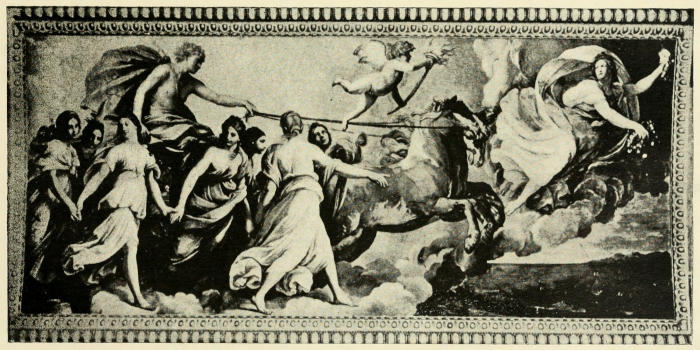
“The lovely Dawn arousing man goes before the
sun preparing practicable paths, riding in a spacious
chariot, expanding everywhere, she diffuses light at
the commencement of the days.”
Among the ancient knights of learning who
thought that all myths were started in this way was
the great Thucydides; and Cicero also believed that
the exalted beings in mythology who were worshipped
as gods were in reality personifications of
the objects in nature which struck the imagination
of primitive mankind.
There are also many modern knights of learning
who hold the same view, among the most
distinguished of whom is the English scholar, Max
Müller. About him and his followers Sir George
Cox and John Fiske, the American historian and
thinker, you will one day know more if you continue
your studies in mythology. When Max Müller
came to write his learned books upon what he
saw in the castle of myths, he supported his learning
upon many interesting facts which he had discovered
when he was studying the languages of different
races.
In comparing the ancient Greek language with
the ancient language of India, the Sanskrit, he
found out that they were often very much alike.
This drove him to the conclusion that they must
both be descended from some still older language.
He noticed also remarkable resemblances between
the myths of Greece and those of India, of which
there were large numbers collected in the old books
in Sanskrit and other Indian languages. Then he
made up his mind that the ancient race of people
who spoke the old language from which Greek and
Sanskrit were descended must have had a great
fondness for inventing myths, and that these myths
had been handed down from generation to generation.
Finally, many of the descendants of this
ancient race went to live in India, while others went
to live in Greece, and that was the reason the languages
and the myths of these two peoples were so
much alike in many ways. The original home of
this ancient myth-making race has been thought to
be Central Asia, and the race is known in history as
the Aryan race. But Max Müller and others who
agreed with him were so intoxicated with their new
discoveries that they were constantly in danger of
making fanciful comparisons between the words of
the two languages, and building upon these fanciful
comparisons explanations of myths, even more
mythical than the myths themselves. In fact they
not only saw in one direction like the other knights,
but they used a huge magnifying glass that tinted
every thing with unnatural rainbow colors such as
you have seen when looking through an opera glass.
I will speak of three others only of the many
modern knights of learning who have seen some of
the truth:—E. B. Tylor, Andrew Lang, and James
G. Frazer. The first of these tells especially about
some very curious beliefs possessed by primitive
men. These beliefs colored their imagination no
matter what kind of myths they might invent. One
of them was that a spirit, separate from their ordinary
life lived inside of their bodies; another that all
things in nature had life like themselves, and also
spirits dwelling within them like the spirits within
themselves. This was thought to be true of trees
and stones as well as of birds and animals. The
second, Andrew Lang, considers that myths are
stories which tell about the manners and customs of
ancient or savage people, and the third, James G.
Frazer, sees in the worship of the spirits of vegetation,
the corn, the trees and so on the origin of most
myths. Very long and very profound are the arguments
with which each supports his particular point
of view, and many are the illustrations drawn from
the myths of all lands with which each illuminates
his argument, but, like the rest of the knights, each
sees so much in his own truth that he is more or less
blind to all that others see.
Now that I have tried to give you this glimpse at
the various explanations of myths proposed from the
most ancient times to the present, I think we shall
be a little better prepared to find out an answer for
ourselves that will be satisfactory.
Suppose we take the top off the castle in which we
imagined the myths and the secrets of their origin
to be locked up, and look down upon them from our
hilltop, using as an aid to our vision all the light
that comes in through the numerous breaks in the
castle made by the lances of the knights. What will
the wonderful treasures revealed to us be like?
They will not be like jewels, all polished and placed
in regular shining rows, for myths were never fashioned
as a jeweler would fashion his stones—all at
once—into perfectly finished and beautiful shapes.
No!—the imaginary contents of our castle which
will best stand as a symbol or picture of all the
myths of the whole world in all their wonderful
variety will be an immense forest of almost countless
kinds of trees. Under the trees there are many
sorts of plants and flowers; and if we look closer we
shall see that some of these trees and plants are ugly
in shape, some are even decaying, but there are
many most lovely to behold, and a few of the trees
tower up above the others and are profusely decorated
with many shining ornaments, making them
look like Christmas trees. You will see at once
that by using this symbol to stand for all the myths
of the whole world I want to point out and make
clear to you the important fact that myths were not
made all at once as the jeweler polishes his stones,
but they grew up gradually from small beginnings,
like oaks from acorns, or pines from pine cones—and
the soil in which they grew was the minds of
primitive men ages and ages ago.
Sometimes the trees of one land will look exceedingly
like those in another land—in fact, being the
same sort of trees, but differing somewhat in shape.
Then the smaller plants and flowers are the symbols
for many kinds of little mythical stories about every
thing that you can think of, or rather that primitive
man could think of, for he didn’t know about trolleys
and telephones and automobiles, and so there
are not any myths about such things as these. And
the Christmas trees are the myths which have been
enlarged and glorified by having myths from other
lands added to them.
Now the point comes up, how did all this vast
forest of myths which covers the whole world arise,
for the forest symbolizes, remember, only the forms
oral or written in which the myths of the world
have come to us. To answer this, we must now try
to imagine behind all this wonderful growth of
myth, on the one hand, the mind of mankind, and
on the other hand all the objects of external nature.
And besides we must think of mankind as it was untold
ages ago in the real childhood of the world. In
those far off days when the first men used to roam
about the world getting their food by hunting, with
nothing but caves or tents to live in, man’s consciousness
of himself was not even as strong as that of a
small child to-day. Still, he had implanted in him
the power of observing whatever went on before him,
and a constant curiosity to know the cause or the
“reason why” of every thing he saw. Above all he
had a vivid imagination. He could “make believe”
about the things he saw far better than children do
in their games to-day, and that is how he came to
invent explanations of most of the things he saw
about him. Here, for example, is a little story
invented by the Hottentots to explain two things
which they had observed, the spots on the moon,
and the way in which the upper lip of a hare is
split.
“The moon sent an insect to men saying, ‘Go
thou to men and tell them, as I die and dying live,
so ye shall also die and dying live.’ The insect
started with his message, but while on the way was
overtaken by the hare who asked him upon what
errand he was bound. The insect answered that he
had been sent by the moon to tell men that as she
dies and dying lives so also shall they die and dying
live! The hare said, ‘As thou art an awkward runner,
let me go.’ With these words he ran off and
when he reached men he said, ‘I am sent by the
moon to tell you, as I die and dying perish, in the
same manner shall ye also die and come wholly to
an end.’ Then the hare returned to the moon and
told her what he had said to men. The moon
reproached him angrily, saying, ‘Darest thou tell
the people a thing which I have not said?’ With
these words she took up a hatchet to split his head,
missing that the hatchet fell upon the upper lip and
made a deep gash. Maddened by such treatment,
the hare flew at the moon and scratched her face
which are the dark spots which we now see on the
moon.”
You see these primitive Hottentots treat every
thing in nature as if it were alive just as we learned
from Tylor. They really did not know what a
great difference there is between a human being
and an animal or between animals and plants or
even plants and stones. All of the objects in nature
being endowed with life, they might speak and act
just like human beings. But it was only the very
wisest of human beings who could understand this
language that the animals and plants and other objects
in nature might speak.
On this account all nature seemed very mysterious
to primitive man, and he therefore was ready to
worship almost any object that caught his attention.
Then the strange feeling he had that another
spirit quite detached from his ordinary life lived
inside his body, made him imagine queer things
about this spirit; for one thing, that it might leave
his body and go off on independent journeys in the
form of a bird or an animal, or even that it might be
stowed away for safe keeping in some animal or
other object, like the famous story of the Norse
giant whose heart, which is equivalent to his true
life, is far away in an egg that is in a church that is
on an island that lies in a lake. In many stories
belonging to this primitive time, a man’s luck often
stands for his life and is bound up in some object
outside of himself as in this story of the Algonquin
Indians, which reflects all the strange notions I have
spoken of as well as giving an explanation of the
appearance of the sheldrake duck. It is the story
of how one of the Partridge’s wives became a sheldrake
duck, and why her feet and feathers are red.
“There was once a hunter who lived in the woods.
He had a brother or spirit who was so small that he
kept him in a box, and when he went forth he closed
this very carefully, for fear lest an evil spirit should
get him.
“One day this hunter, returning, saw a very beautiful
girl sitting on a rock by a river, making a moccasin.
And being in a canoe he paddled up softly
and silently to capture her; but she, seeing him
coming, jumped into the water and disappeared. On
returning to her mother, who lived at the bottom of
the river, she was told to go back to the hunter and
be his wife; ‘for now,’ said the mother, ‘you belong
to that man.’
“The hunter’s name was Mitchihess, the Partridge.
When she came to his lodge he was absent. So she
arranged every thing for his return, making a bed
of boughs. At night he came back with one beaver.
This he divided; cooked one half for supper and laid
by the other half. In the morning when she awoke
he was gone, and the other half of the beaver had
also disappeared. That night he returned with another
beaver, and the same thing took place again.
Then she resolved to spy and find out what all this
meant.
“So she lay down and went to sleep with one eye
open. Then he quietly rose and cooked the half of
the beaver, and taking a key unlocked a box, and
took out a little red dwarf and fed him. Replacing
the elf, he locked him up again, and lay down to
sleep. And the small creature had eaten the whole
half beaver. But ere he put him in his box he
washed him and combed his hair, which seemed to
delight him.
“The next morning, when her husband had gone
for the day, the wife sought for the key, and having
found it opened the box and called to the little fellow
to come out. This he refused to do for a long
time, though she promised to wash and comb him.
Being at length persuaded, he peeped out, when she
pulled him forth. But whenever she touched him
her hands became red, though of this she took no
heed, thinking she could wash it off at will. But
lo! while combing him, there entered a hideous being,
an awful devil, who caught the small elf from
her and ran away.
“Then she was terribly frightened. And trying
to wash her hands, the red stain remained. When
her husband returned that night he had no game;
when he saw the red stain he knew all that had happened;
when he knew what had happened he seized
his bow to beat her; when she saw him seize his bow
to beat her she ran down to the river and jumped
in to escape death at his hands, though it should be
by drowning. But as she fell into the water she
became a sheldrake duck. And to this day the
marks of the red stain are to be seen on her feet
and feathers.”
You will observe a very strange custom alluded to
in this story, and that is the way in which the
hunter is described as capturing the maiden for his
wife instead of gently trying to persuade her to be
his wife. This shows that it is a very far-back
myth, for there are many other stories to prove that
savages learned to be much more gentle in their
ways toward women even before men became altogether
civilized.
How primitive men came to have such peculiar
beliefs we cannot say positively. Some people have
thought that perhaps their dreams made them think
that there was a spirit inside of them separate from
their ordinary life, while the sounds and movements
in nature, such as the singing of a waterfall, the
rustling of leaves, or the sound which stones would
give out when knocked together, would seem to the
uneducated mind of early mankind, to be signs of
life like his own.
Another very early belief is that in magic and
sorcery. Primitive man used to imagine that he
could make it rain by imitating the thunder, which
he did by shaking dried seeds about in a gourd.
Magic is really the producing of any desired effect
or event by means which are quite outside of the
laws of nature. As the primitive savage did not
know any thing about the laws of nature, laws which
have taken ages for men to discover and all of which
are not even yet discovered, he revelled in the invention
of means by which he thought he might accomplish
the things he would like to do. Sometimes he
asked spirits to help him, and if what he wanted
to do was evil, he would ask aid of evil spirits.
There are countless myths in which magic plays a
part, examples of which you will see as you read
the stories given in the following chapters.
Since in the time most remote men depended
upon animals almost entirely for their food, it is
probable that animals were the objects that made the
most vivid impressions on them, and, therefore, that
stories of animals belong to this most primitive
stage.
At this time, too, it is likely that the worship of
animals arose, for almost every tribe of savages had
a sacred animal which, except in rare instances, it
was never allowed to kill and from which it often
imagined itself descended.
After many ages, mankind began to till the
ground, and to raise grain and vegetables, then plants
and trees were more especially observed by them, and
the mythical stories have, in consequence, more about
plants and trees in them; and, as they had sacred
animals, they had also sacred trees or plants, and
worshipped them or imagined themselves descended
from them.
Then as men progressed in their powers of observation
they saw natural phenomena more and
more. The succession of night and day impressed
itself upon them, they took note of the motions of
the sun, the moon and the stars, clouds caught their
attention, storms filled them with awe and fear as
the lightning flashed and the thunder roared and
rattled in its might. The wind laughed in summer
breezes or howled in wintry blasts and they noticed
it, and as soon as their attention was fully aroused
to all these wonders of nature, they began to think
of them, as not only endowed with powers like their
own, but as living beings. First, they frequently
personified nature as animals, then as human beings,
and as they had worshipped sacred animals and sacred
plants and sacred trees, now they worshipped
these gods of nature; and as they invented tales
about the animals and the trees, so they invented
tales about these gods of nature. As one would expect,
the stories about animals and trees would often
be mingled with the new stories of the nature gods,
and sometimes changed so that one would hardly
recognize them. And then, again, a story told about
a nature god in one part of the world would, on
account of the early wanderings of the human race
from one land to another, be added as an ornament
to a story told in another part of the world,
like the ornaments on the Christmas trees in the
castle.
Again, whole myths would be transported, and
as they reached different countries they would be
changed somewhat so that they would reflect the
manners or the knowledge of that particular country.
A strange thing, however, about many myths
is that those in one part of the world are so much
like those in another part of the world that it would
seem as if they must have been invented by the same
people. Not only are there myths in India and
Greece which are very much alike, but there are
myths in Scandinavia and North America and South
America that strongly resemble each other and those
of Greece and India.
Why this should be the case is another point about
which learned men have had many opinions. Some
of them have thought that the whole human race
must once have lived in one particular spot on the
globe, and that from there large numbers wandered
forth to seek new homes in all the other countries
on the globe, taking with them the myths which they
had in common when they all lived together. It has
never been settled just where that particular spot
was, and probably it never will be. Perhaps it was
in Central Asia, perhaps it was in the southern part
of Spain, perhaps in Norway and Sweden, perhaps
in the island of Atlantis, in the Southern Seas, which
a legend says was submerged ages and ages ago. All
of these places have been suggested as the original
home of the whole human race, and very good arguments
have been brought forward to prove the truth
of every one of these suggestions.
Since it does not seem possible to find out the
truth about this, there are other people who dismiss
the idea altogether. They think that man and nature
being a good deal alike in whatever part of the
world you find them, it is highly probable that myths
might resemble each other very strikingly and yet
be invented independently by people living in lands
far apart, while the differences would be due largely
to climate.
Now if we try to think of centuries of time going
by until in many countries primitive man is no longer
primitive but begins to be more civilized, we shall
find that certain groups of myths became crystallized
into complete religious systems, such as existed
in Egypt, Assyria, India, Greece, Persia, and many
other countries. By this time the human race had
attained to a much greater degree of self-consciousness.
Men were beginning to understand both themselves
and nature better, and they often could see
the true causes for the events of nature going on
about them. The next step was for them to begin
to observe very carefully the systems of religious
myths which had been handed down to them by
their forefathers. Upon these they used their imaginative
faculty, as man had earlier used it upon
nature itself, with the result that they attached new
meanings and gave fresh explanations of myths
which had originally started as simple personifications
of nature. In Greece, for example, Apollo,
who was originally a personification of the sun, came
to be regarded as the God of Music and Poetry;
Athēne, who was originally the Dawn, became the
Goddess of Wisdom; Hermes, originally the Wind,
became the God of Eloquence and the leader of
spirits. This is the way myths gradually grew to
have philosophical or metaphysical meanings—that
is, to stand as symbols of the deepest and most far-reaching
thoughts of which the mind of man at
that time was capable. Many of those thoughts are
so profound and so wonderful that one needs to have
a great deal of knowledge to understand them. All
that interests you now is to know that there are such
thoughts and that some day you will want to know
more about them.
While some myths were thus raised to religious
systems, there were many which remained in the
form of legends and stories. In the course of many
generations, these stories were told over again and
again so that many changes crept into them and
many additions were made. Sometimes the effect
of these changes was to make a story cruder, sometimes
the complexity of a story was increased, and
sometimes it became more interesting and beautiful.
Stories which have been changed or added to
by the people in this way are called variants of the
same story.
Owing to these facts mythology has been divided
into two great sections. That which has risen to the
dignity of a religion is called culture-lore, and that
which has remained always in the form of stories
and legends is called folk-lore. The first reflects the
learning, wisdom and manners of the more intelligent
portions of humanity, who developed in advance
of the others; and the second the beliefs and
customs of the less intelligent.
You are probably wondering by this time how all
this vast array of myths has come down to us from
the long ago past. Much of it has been preserved in
ancient books like the “Rig Veda” in India, which
is thought to be about four thousand years old, the
“Iliad” and “Odyssey” of Homer in Greece,
about three thousand years old and many others.
These books existed in manuscript for many hundreds
of years. Since the invention of printing,
large numbers of them have been printed and translated
into modern languages. Knowledge of ancient
myths has also been obtained from monuments and
the inscriptions upon them, from paintings on vases
and from statues.
The folk-lore has for the most part been preserved
orally in the stories of the common people, and has
been handed down from generation to generation and
finally taken down in writing by some one especially
interested in collecting the stories, while the myths
of the most primitive men are preserved in the survivals
of them among the races still remaining uncivilized
in various parts of the globe. These have
been for several centuries taken down from the
mouths of the people, or observed in their customs
and recorded by students. Among these less civilized
races there are besides crude monuments, and
even crude forms of writing by means of which primitive
men have recorded their own myths.
You will realize by this time what an extensive
and wonderful forest this forest of myths is which
we imagine ourselves looking down upon from our
hilltop, and after having taken this bird’s-eye view
of the whole forest, you will be the better able to
enjoy going down into the forest and making little
journeys in different directions and becoming better
acquainted with some of the most beautiful of the
myths as you will in the following chapters. And
now, moreover, you will have no difficulty in understanding
me when I answer the question, “What is
a myth?” by saying:
A myth is any imaginative explanation or interpretation
by man of himself or of the objects and
events in nature outside of himself, including their
appearance, their effects and the still greater mystery
of their causes. It may exist in many forms
from the simple myth of explanation to the complicated
systems of religious myths in which the objects
of nature are regarded as gods in human form. The
chief thing to be remembered about myths is that
they are not true, though they may contain some elements
of truth; another, that though not actually
true they seemed to be true to the people who made
them.
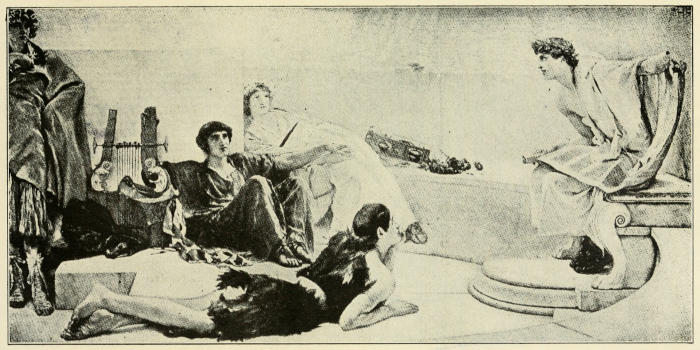
A Reading from Homer. L. Alma-Tadema.
CHAPTER II ANIMALS IN PRIMITIVE MYTHS — HOW A MUSKRAT MADE THE WORLD — HOW THE KITE HELPED TO MAKE THE WORLD — HOW MAUI FISHED UP THE EARTH — THE ORIGIN OF THE ROBIN — THE ORIGIN OF THE HARE — HOW THE MOLE BECAME BLIND — THE BOY AND THE WOLVES; OR, THE BROKEN PROMISE — HOW WASBASHAS, THE SNAIL, BECAME A MAN — THE AMAZING ADVENTURES OF MASTER RABBIT WITH THE OTTER AND THE WOODPECKER GIRLS ALSO A FULL ACCOUNT OF THE FAMOUS CHASE, IN WHICH HE FOOLED LUSIFEE, THE WILD CAT — I. HOW MASTER RABBIT SOUGHT TO RIVAL KEEOONY, THE OTTER — II. HOW MAHTIGWESS, THE RABBIT, DINED WITH THE WOODPECKER GIRLS, AND WAS AGAIN HUMBLED BY TRYING TO RIVAL THEM. — III. RELATING HOW THE RABBIT BECAME WISE BY BEING ORIGINAL, AND OF THE TERRIBLE TRICKS WHICH HE BY MAGIC PLAYED LOUP-CERVIER. — THE STORY OF MANABOZHO — HOW GLOOSKAP MADE HIS UNCLE MIKCHICH THE TURTLE INTO A GREAT MAN, AND GOT HIM A WIFE. OF TURTLES’ EGGS, AND HOW GLOOSKAP VANQUISHED A SORCERER BY SMOKING TOBACCO. — PUNCHKIN
The stories now to be told belong to that very
early time in human life, when, as we learned
in the last chapter, men regarded every thing in nature
as if it were gifted with life like themselves.
The strange ideas to which this belief gave rise are,
of course, reflected in their myths. Many of the
stories have in them animals and plants which talk,
while the transformation of men into animals or
animals into men or even gods into animals, when
animals are not actually worshipped is frequent.
The most curious of all these beliefs is that mankind
is descended from animals, all the more curious
because some modern scientific men have, as
every one knows, tried to prove very much the same
thing. The modern scientist, however, does not have
any especial reverence for the antediluvian ape from
which he supposes he may have evolved, while the
primitive savage regarded with awe and reverence
the animals from which he thought himself descended.
Groups of savages called clans—all tracing
their descent from the same animal, considered
that animal to be especially their friend. They
would not kill it or eat it, except in a few instances
when it was killed for the purposes of sacrifice.
Many different animals were regarded as ancestral
animals, and became the sign or totem, as it was
called, of the tribe. Among totem animals may be
mentioned the following in Australia: Opossum,
Swan, Duck, Fish. Most of the Australian tribes
declare that the family started by a transformation
of these animals into mankind. The North American
Indians have a great variety of totem animals:
Wolf, Bear, Beaver, Turtle, Deer, Snipe, Heron,
Hawk, Crane, Duck, Loon, Turkey, Muskrat, Pike,
Catfish, Carp, and so on.
It was an easy step for the savage from the belief
in his own descent from some animal to a
belief in the sacredness and mystery of animals,
naturally leading to the worship of them. The Indians
of Peru, for example, regarded the dog as
their most exalted deity. They set up the image
of a dog in their temples. They were also in the
habit of choosing a live dog as a representation of
their deity. They worshipped this and offered sacrifices
to it, and when it was well fattened up they
ate it with solemn religious ceremonies. This is
one of the cases where the sacred animal was eaten.
Serpent worship is one of the most wide-spread
forms of animal worship, an example of which is
found among the Zulus to whom certain species are
sacred because they are supposed to be the incarnations
of ancestral spirits.
Another form which the sacred animal took was
that of a supernatural being not only concerned in
the origin of men but who had a part to play in the
origin of the whole world.
In a large number of these myths, the water already
existed and, also of course, the remarkable
animal who brought to pass such wonders. The
animal was sometimes very humble as in the story
told by the Indians of British Columbia of the
creation of the world.
In the beginning nothing existed but water and
a muskrat. As the little animal kept diving down
to the bottom of the water in search of food, his
mouth became frequently filled with mud. This he
spat out and so gradually formed by alluvial deposit,
an island, which grew and grew until it finally
became large enough to be the earth.
The natives of the Philippine Islands tell this
story of the creation of the world.
The world at first consisted only of sky and
water and between these two there flew a kite. The
kite became weary of flying about, and finding no
place to rest; so he set the water at variance with
the sky. Then, in order to keep the water within
bounds and so that it should not get uppermost, the
sky loaded the water with a number of islands in
which the kite might settle and leave them at peace.
Now, it happened that floating about in the water
was a large cane with two joints which was at
length thrown up by the waves at the feet of the
kite as it stood on the shore of one of the islands.
The kite split open the cane with its bill, and behold,
a man came out of one joint and a woman
out of the other. They were soon after married
by the consent of their god, Bathala Meycapal,
and from them are descended the different nations
of the world.
In some stories, a fish instead of a bird or an
animal is the maker of the earth, while there is an
interesting Polynesian myth in which the earth itself
was a fish and was fished up out of the waters
with a fish hook. The person who accomplished
this remarkable feat was the youngest of the Maui
brothers, and the flower of the family, by all accounts.
We shall hear of him again in the chapter
on child myths.
The youngest Maui was always very badly treated
by his elder brothers. They were in the habit of
going off and leaving him alone at home with nothing
to do and nobody to play with. Their treatment of
him at meals was even more shocking. They would
devour the best of every thing themselves, and toss
him a bone or offal to eat.
Finally, little Maui plucks up courage to assert
himself, and the next time his brothers go a-fishing,
he takes his place in the boat and insists on going,
too. “Where is your hook,” ask the two brothers.
“Oh this will do,” says little Maui, taking out his
ancestor’s jawbone. This he throws overboard for
his fish-hook, but on trying to pull it in again he
finds it very heavy. By hauling away at it, however,
he at last lifts it, and finds it has brought up
the land from the bottom of the deep. This land
proved to be an extraordinary combination of an
enormous fish and an island with houses and men
and animals on it.
The world supporting tortoise is a familiar mythological
friend, believed in by Asia, and holding
an important place in the mythology of the North
American Indian, where a turtle, the lonely inhabitant
of the waste of waters, dived to the depths
for the earth.
Even so humble an insect as the grasshopper
figures in the Bushman’s story of the creation of
the world. Insignificant as the grasshopper appears
to us, to the Bushman he appeared a great creature,
called Cagn, with truly omnipotent powers, for he
undertook the work of creation without even the
usual raw material of water. He simply gave orders
and caused all things to appear and to be
made,—sun, moon, stars, wind, mountains, animals.
In many of the primitive stories, magic is the
means by which the most wonderful effects are produced.
It was believed that a magician could bring
about any effect he desired by the mere use of his
will, and often without any visible symbol of magic
power. Sometimes, however, magic wands were
used, and sometimes ceremonies were performed for
the purpose of producing magical results. On the
other hand magical prodigies such as the changing
of shape from man to animal often occur without
the intervention of any magician.
Whatever may have been the origin of this belief,
it is certain that it was just as sincerely believed
in as a theory of the universe by early mankind as
the doctrine of an endless, persistent energy, always
working from cause to effect has been believed in
by the nineteenth century scientist.
Very fanciful stories have clustered about the idea
that the spirit might be detached from the body,
and placed somewhere far away, as you will see
when you read the story of “Punchkin.”
So firmly was this idea fixed in the savage mind
that, it seems probable, his worship of animals, even
in the earliest stages of life was really a worship of
the spirit within the animal, rather than of the
animal itself, and from this phase he passed on to
the worship of a great spirit that might manifest
itself in many forms. This was the belief of many
of the North American Indian tribes. The Great
Spirit, above all the lesser gods, is frequently referred
to in their stories.
Of the following stories the first three, are examples
of a very large class of early myths, which
attempt to account for the origin or peculiarities
of animals. Curiosity having been awakened, the
savage tries to explain what he sees and often invents
pretty and even elaborate myths in his effort
to find a truth beyond his knowledge.
In the “Origin of the Robin,” a custom observed
among Indians is referred to in the young man’s
fast. Instead of college commencements, with Baccalaureate
sermons, and valedictories, the young
Indian boy or maiden was made to observe a solitary
fast afar from the parental wigwam, and while
suffering the pangs of hunger and loneliness, it was
believed that the Great Spirit or a guardian spirit
would reveal to him his future.
(From the Odjibwa)
An old man had an only son, named Opeechee,
who had come to that age which is thought to be
most proper to make the long and final fast which
is to secure through life a guardian genius or
spirit. The father was ambitious that his son should
surpass all others in whatever was deemed wisest
and greatest among his people. To accomplish his
wish, he thought it necessary that the young Opeechee
should fast a much longer time than any of
those renowned for their power of wisdom, whose
fame he coveted.
He therefore directed his son to prepare with
great ceremony for the event. After Opeechee had
been several times in the sweating-lodge and bath,
which were to prepare and purify him for communion
with his good spirit, his father ordered him to lie
down upon a clean mat in a little lodge expressly provided
for him. He enjoined upon him at the same
time to endure his fast like a man, and promised that
at the expiration of twelve days he should receive
food and the blessing of his father.
The lad carefully observed the command, and lay
with his face covered, calmly awaiting the approach
of the spirit which was to decide his good or evil
fortune for all the days of his life.
Every morning his father came to the door of the
little lodge and encouraged him to persevere, dwelling
at length on the vast honor and renown that
must ever attend him, should he accomplish the full
term of trial allotted to him.
To these glowing words of promise and glory the
boy never replied, but he lay without the least sign
of discontent or murmuring until the ninth day,
when he addressed his father as follows:
“My father, my dreams forebode evil. May I
break my fast now, and at a more favorable time
make a new fast?”
The father answered:
“My son, you know not what you ask. If you
get up now all your glory will depart. Wait patiently
a little longer. You have but three days
more, and your term will be completed. You know
it is for your own good, and I encourage you to persevere.
Shall not your aged father live to see you a
star among the chieftains and the beloved of battle?”
The son assented; and covering himself more closely,
that he might shut out the light which prompted
him to complain, he lay till the eleventh day, when
he repeated his request.
The father addressed Opeechee as he had the other
day, and promised that he would himself prepare
his first meal, and bring it to him by the dawn of
the morning.
The son moaned, and the father added:
“Will you bring shame upon your father when
his sun is falling in the West?”
“I will not shame you, my father,” replied Opeechee;
and he lay so still and motionless that you
could only know that he was living by the gentle
heaving of his breast.
At the spring of the day, the next morning, the
father, delighted at having gained his end, prepared
a repast for his son, and hastened to set it before
him. On coming to the door of the little lodge,
he was surprised to hear his son talking to himself.
He held his ear down to listen, and, looking
through a small opening, he was yet more astonished
when he beheld his son painted with vermilion over
all his breast, and in the act of finishing his work
by laying on the paint as far back on his shoulders
as he could reach with his hands, saying at the
same time, to himself: “My father has destroyed my
fortune as a man. He would not listen to my requests.
He has urged me beyond my tender strength.
He will be the loser. I shall be forever happy in my
new state, for I have been obedient to my parent.
He alone will be the sufferer, for my guardian spirit
is a just one. Though not propitious to me in the
manner I desired, he has shown me pity in another
way—he has given me another shape; and now I
must go.”
At this moment the old man broke in exclaiming:
“My son! I pray you leave me not!”
But the young man with the quickness of a bird
flew to the top of the lodge and perched himself on
the highest pole, having been changed into a beautiful
robin red-breast. He looked down upon his
father with pity, and addressed him as follows:
“Regret not, my father, the change you behold.
I shall be happier in my present state than I could
have been as a man. I shall always be the friend of
men, and keep near their dwellings. I shall ever
be contented; and although I could not gratify
your wishes as a warrior, it will be my daily
aim to make you amends for it as a harbinger of
peace and joy. I shall cheer you by my songs, and
strive to inspire in others the joy and lightsomeness
of heart I feel in my present state. This will be
some compensation to you for the loss of glory you
expected. I am now free from the cares and pains
of human life. My food is furnished by the mountains
and fields, and my pathway of life is in the
bright air.”
Then, stretching himself on his toes, as if delighted
with the gift of wings, Opeechee caroled one
of his sweetest songs, and flew away into a neighboring
wood.
(From the Aino)
Suddenly, there was a large house on the top of
a mountain, wherein were six people beautifully arrayed,
but constantly quarreling. Whence they came
was unknown. Thereupon Okikurumi came and
said: “Oh! you bad hares! you wicked hares! Who
does not know your origin? The children in the
sky were pelting each other with snow balls, and the
snow balls fell into the world of men. As it would
be a pity to waste anything that falls from the sky,
the snow balls were turned into hares, and those
hares are you. You who dwell in this world which
belongs to me, should not quarrel. What is that you
are making such a noise about?”
With these words, Okikurumi seized a fire-brand,
and beat each of the six with it in turn. Thereupon
all the hares ran away. This is the origin of
the hare and for this reason the body of the hare
is white because made of snow, while its ears, which
are the place where it was charred by the fire-brand,—are
black.
(North American Indian)
Once a squirrel was being chased by an Indian,
and in order to escape, the squirrel ran all the way
up a tree into the sky. The Indian set a snare for
the squirrel at the top of the tree and then came
down, but he found the next day that the sun was
caught in the snare, and this brought on night. He
saw at once how much harm he had caused, and being
an Indian of very good intentions he was anxious
to do what he could to remedy the mischief.
So he sent up great numbers of animals in the hope
that they might cut the noose and release the sun,
but the intense heat burned them all to ashes. At
length the slow mole succeeded; he burrowed under
the road in the sky till he reached the place of the
sun, gnawed in twain the cords, and released the
captive. But the sun’s flash put his eyes out and
this is the reason why the mole is blind. The effect
of the burning is still to be seen on the nose and the
teeth of the mole, for they are brown as if burnt.
From that time on, however, the gait of the sun has
been more deliberate and slow.
(North American Indian)
In the depths of a solitary forest a hunter had
built his lodge, for he was weary of the companionship
of the people of his tribe; their habits of deceit
and cruelty had turned his heart from them.
With his family, his wife and three children, he had
selected a home in the solitude of the forest. Years
passed by while he peacefully enjoyed the quiet of
his home, or the more attractive pleasures of the
chase, in which he was joined by his eldest son. At
length his peaceful enjoyments were interrupted:
sickness entered the solitary lodge, and the hunter
was prostrated upon his couch never more to
rise.
As death drew near, he addressed his family in
these words: “You,” said he turning to his wife,
“you, who have been the companion of my life,
shall join me in the Isle of the Blessed. You have
not long to suffer. But oh, my children!” and he
turned his eyes affectionately upon them, “you have
just commenced life; and, mark me, unkindness, ingratitude,
and every wickedness is before you. I
left my tribe and kindred to come to this unfrequented
place, because of the evils of which I have
just warned you. I have contented myself with
the company of your mother and yourselves, for I
was solicitous that you might be kept from bad example;
and I shall die contented if you, my children,
promise to cherish each other, and not to forsake
your youngest brother.”
Exhausted with speaking, the dying hunter closed
his eyes for a few moments, and then, rousing himself
with great effort, he took the hand of his two
eldest children and said: “My daughter, never forsake
your youngest brother. My son, never forsake
your youngest brother.”
“Never! never!” responded both; and the hunter
sank back upon his pallet and soon expired.
His wife, according to his predictions, followed
him after the brief expiration of eight months; but
in her last moments she reminded the two children
of the promise made their father. During the winter
following their mother’s death, the two elder
children were exceedingly thoughtful in regard to
their brother, who was a mere child and very delicate
and sickly; but when the winter had passed away,
the young man became restless, and at length determined
to break his promise to his father, and
seek the village of his father’s tribe.
He communicated this determination to his sister,
who replied: “My brother, I cannot wonder at your
desire, as we are not prohibited the society of our
fellow-men; but we were told to cherish each other,
and protect our little brother. If we follow our own
inclinations, we may forget him.”
To this the young man made no reply, but, taking
his bow and arrows, left the lodge and never returned.
Several moons passed after his departure,
during which the girl tenderly watched over her
little brother; but at length the solitude of her life
became unendurable, and she began to meditate escaping
from the care of her brother, and leaving him
alone in his helplessness. She gathered into the
lodge a large amount of food, and then said to her
brother, “My brother, do not leave the lodge; I go
to seek our brother, and shall soon return.”
Then she went in search of the village of her tribe,
where she hoped to find her elder brother. When she
reached the village, she was so delighted with the
novelty of society and the pleasure of seeing others
of her own age that she entirely forgot her little
brother. She found her elder brother nicely settled
in life, he having married very happily; and, on
receiving a proposal of marriage herself, abandoned
all thought of returning to the solitary lodge in the
forest, accepting a home in the village with the young
man who became her husband.
As soon as the little brother had eaten all the
food collected by his sister, he went into the woods
and picked berries and dug up roots. That satisfied
his hunger as long as the weather was mild; but, when
the winter drew on, he was obliged to wander about
in very great distress for want of food. He often
passed his nights in the clefts and hollows of old
trees, and was glad to eat the refuse-meat left by
the wolves; and he became so fearless of those animals
that he would sit by them while they devoured
their prey, and the animals themselves were so accustomed
to him that they seemed pleased with his
presence, and always left some of their food for him.
Thus the little boy lived on through the winter, succored
from hunger by the wild beasts of the woods.
When the winter had passed away and the ice
had melted from the Great Lake, he followed the
wolves to its open shore. It happened one day that
his elder brother was fishing in his canoe on the
lake, and, hearing the cry of a child, hastened to the
shore, where at a short distance from him he discovered
his little brother, who was singing plaintively
these lines:
Nesia, Nesia, shug wuh, gushuh!
Ne mien gun-iew! Ne mien gun-iew!
My brother, my brother!
I am turning into a wolf!
I am turning into a wolf!
At the termination of his song, he howled like a
wolf; and the elder, approaching him, was startled
at seeing that the little fellow had indeed half turned
into a wolf, when, running hastily forward, he
shouted, “My brother, my little brother, come to
me!” But the boy fled from him, while he continued
to sing: “I am turning into a wolf!—Ne
mien gun-iew! Ne mien gun-iew!” Filled with anguish
and remorse, the elder brother continued to
cry, “My brother, my little brother, come to me!”
But the more eagerly he called, the more rapidly
his brother fled from him, while he became more
and more like a wolf, until, with a prolonged howl,
his whole body was transformed, when he bounded
swiftly away into the depths of the forest.
The elder brother, in the deepest sorrow, now returned
to his village, where with his sister he lamented
the dreadful fate of his brother until the
end of his life.
(North American Indian)
Upon the banks of the Missouri River there once
lived a snail, in great enjoyment; for he found
plenty of food, and was never in want of anything
that a snail could desire. At length, however, disaster
reached him. The waters of the river overflowed
its banks; and, although the little creature
clung to a log with all his strength,—hoping thereby
to remain safe upon the shore,—the rising flood carried
both him and the log away, and they floated
helplessly many days, until the waters subsided,
when the poor snail was left upon a strange shore
that was covered with the river’s slime, where, as
the sun arose, the heat was so intense that he was
irrecoverably fixed in the mud. Oppressed with the
heat and drought, and famishing for want of nourishment,
in despair he resigned himself to his fate
and prepared to die. But suddenly new feelings
arose, and a renewed vigor entered his frame. His
shell burst open; his head gradually arose above
the ground; his lower extremities assumed the character
of feet and legs; arms extended from his sides,
and their extremities divided into fingers; and, thus
beneath the influence of the shining sun, he became
a tall and noble-looking man. For a while he was
stupefied with the change; he had no energy, no distinct
thoughts; but by degrees his brain assumed its
activity, and returning recollection induced him to
travel back to his native shore. Naked and ignorant,
and almost perishing with hunger, he walked along.
He saw beasts and birds enticing to the appetite;
but, not knowing how to kill them, his hunger was
left unappeased.
At last he became so weak that he laid himself
down upon the ground in despair, thinking that he
must die. He had not been lying thus very long,
when he heard a voice calling him by name, “Wasbashas,
Wasbashas!” He looked up, and before him
beheld the Great Spirit sitting upon a white animal.
And the eyes of the Spirit were like stars; the hair
of his head shone like the sun. Trembling from
head to foot, Wasbashas bowed his head. He could
not look upon him. Again the voice spoke, in a
mild tone, “Wasbashas, why art thou terrified?” “I
tremble,” replied Wasbashas, “because I stand before
him who raised me from the ground. I am faint;
I have eaten nothing since I was left a little shell
upon the shore.” The Great Spirit then lifted up
his hands, displaying in them a bow and arrows;
and telling Wasbashas to look at him, he put an arrow
to the string of the bow, and sent it into the air,
striking a beautiful bird, that dropped dead upon
the ground. A deer then coming in sight, he placed
another arrow to the string, and pierced it through
and through. “There,” said the Great Spirit, “is
your food, and these are your arms,”—handing him
the bow and arrows. The beneficent Being then instructed
him how to remove the skin of the deer, and
prepare it for a garment. “You are naked,” said
he, “and must be clothed; for although it is now
warm, the skies will change, and bring rains and
snow and cold winds.” Having said this, he also
imparted the gift of fire, and instructed him how to
roast the flesh of the deer and bird. He then placed
a collar of wampum around his neck. “This,” said
he, “is your title of authority over all the beasts.”
Having done this, the Great Spirit arose in the air
and vanished from sight. Wasbashas refreshed himself
with the food, and afterward pursued his way
to his native land. Having walked a long distance,
he seated himself on the banks of a river, and meditated
on what had transpired, when a large beaver
arose up from the channel and addressed him. “Who
art thou?” said the beaver, “that comest here to
disturb my ancient reign?”
“I am a man,” he replied. “I was once a creeping
shell; but who art thou?” “I am king of the
nation of beavers,” was answered; “I lead my people
up and down this stream. We are a busy people,
and the river is my dominion.”
“I must divide it with you,” said Wasbashas;
“the Great Spirit has placed me at the head of
beasts and birds, fishes and fowls, and has provided
me with the power of maintaining my rights;”
and then he exhibited the gifts of the Great Spirit,
the bow and arrows and the wampum.
“Come, come,” said the beaver in a modified tone,
“I perceive we are brothers; walk with me to my
lodge, and refresh yourself after your journey.” So
saying he conducted Wasbashas, who had accepted
the invitation with great alacrity, to a beautiful
large village, where he was entertained in the chief’s
lodge, which was built in a cone shape; and, as the
floor was covered with pine mats, it had a very delightful
appearance to the eyes of Wasbashas.
After they had seated themselves, the chief bade
his wife and daughter prepare for them the choicest
food in their possession. Meanwhile he entertained
his guest by informing him how they constructed
their lodges, and described their manner of cutting
down trees with their teeth, and felling them across
streams so as to dam up the water; and also instructed
him in the method of finishing the dams
with leaves and clay. With this wise conversation
the chief beguiled the time, and also gained the respect
of Wasbashas. His wife and daughter now entered,
bringing in fresh peeled poplar and willow
and sassafras and elder-bark, which was the most
choice food known to them. Of this Wasbashas made
a semblance of tasting, while his entertainer devoured
a large amount with great enjoyment. The
daughter of the chief now attracted the eyes of
Wasbashas. Her modest deportment and cleanly attire,
her assiduous attention to the commands of her
father, heightened very much her charms, which in
the estimation of the guest were very great; and
the longer Wasbashas gazed upon the maiden, the
more deeply he was enamoured, until at length he
formed the resolution to seek her in marriage; upon
which, with persuasive words, he spoke to the chief,
begging him to allow his suit. The chief gladly
assented; and as the daughter had formed a favourable
opinion of the suitor, a marriage was consummated—but
not without a feast to which beavers and
friendly animals were invited. From this union of
the snail and beaver the Osage tribe has its origin.
(Algonquin)
Of old times, Mahtigwess, the Rabbit, who is
called in the Micmac tongue Ableegumooch, lived
with his grandmother, waiting for better times; and
truly he found it a hard matter in midwinter, when
ice was on the river and snow was on the plain, to
provide even for his small household. And running
through the forest one day he found a lonely wigwam,
and he that dwelt therein was Keeoony, the Otter.
The lodge was on the bank of a river, and a smooth
road of ice slanted from the door down to the water.
And the Otter made him welcome, and directed his
housekeeper to get ready to cook; saying which, he
took the hooks on which he was wont to string fish
when he had them, and went to fetch a mess for dinner.
Placing himself on the top of the slide, he
coasted in and under the water, and then came out
with a great bunch of eels, which were soon cooked,
and on which they dined.
“By my life,” thought Master Rabbit, “but that
is an easy way of getting a living! Truly these fishing-folk
have fine fare, and cheap! Cannot I, who
am so clever, do as well as this mere Otter? Of
course I can. Why not?” Thereupon he grew so
confident of himself as to invite the Otter to dine
with him—adamadusk ketkewop—on the third day
after that, and so went home.
“Come on!” he said to his grandmother the next
morning; “let us remove our wigwam down to the
lake.” So they removed; and he selected a site such
as the Otter had chosen for his home, and the weather
being cold he made a road of ice, of a coast, down
from his door to the water, and all was well. Then
the guest came at the time set, and Rabbit, calling his
grandmother, bade her get ready to cook a dinner.
“But what am I to cook, grandson?” inquired the
old dame.
“Truly I will see to that,” said he, and made him
a nabogun, or stick to string eels. Then going to the
ice path, he tried to slide like one skilled in the art,
but indeed with little luck, for he went first to the
right side, then to the left, and so hitched and
jumped till he came to the water, where he went in
with a bob backwards. And this bad beginning had
no better ending, since of all swimmers and divers the
Rabbit is the very worst, and this one was no better
than his brothers. The water was cold, he lost his
breath, he struggled, and was well-nigh drowned.
“But what on earth ails the fellow?” said the Otter
to the grandmother, who was looking on in amazement.
“Well, he has seen somebody do something, and is
trying to do likewise,” replied the old lady.
“Ho! come out of that now,” cried the Otter,
“and hand me your nabogun!” And the poor Rabbit,
shivering with cold, and almost frozen, came
from the water and limped into the lodge. And
there he required much nursing from his grandmother,
while the Otter, plunging into the stream,
soon returned with a load of fish. But, disgusted
at the Rabbit for attempting what he could not
perform, he threw them down as a gift, and went
home without tasting the meal.
Now Master Rabbit, though disappointed, was not
discouraged, for this one virtue he had, that he never
gave up. And wandering one day in the wilderness,
he found a wigwam well filled with young women, all
wearing red head-dresses; and no wonder, for they
were Woodpeckers. Now, Master Rabbit was a well-bred
Indian, who made himself as a melody to all
voices, and so he was cheerfully bidden to bide to dinner,
which he did. Then one of the red-polled pretty
girls, taking a woltes, or wooden dish, lightly climbed
a tree, so that she seemed to run; and while ascending,
stopping here and there and tapping now and
then, took from this place and that many of those insects
called by the Indians apchel-moal-timpkawal, or
rice, because they so much resemble it. And note
that this rice is a dainty dish for those who like it.
And when it was boiled, and they had dined, Master
Rabbit again reflected, “La! how easily some folks
live! What is to hinder me from doing the same?
Ho, you girls! come over and dine with me the day
after to-morrow!”
And having accepted this invitation, all the guests
came on the day set, when Master Rabbit undertook
to play woodpecker. So having taken the head of an
eel-spear and fastened it to his nose to make a bill, he
climbed as well as he could—and bad was the best—up
a tree, and tried to get his harvest of rice. Truly
he got none; only in this did he succeed in resembling
a Woodpecker, that he had a red poll; for his
pate was all torn and bleeding, bruised by the fishing-point.
And the pretty birds all looked and laughed,
and wondered what the Rabbit was about.
“Ah!” said his grandmother, “I suppose he is
trying again to do something which he has seen some
one do. ’Tis just like him.”
“Oh, come down there!” cried Miss Woodpecker,
as well as she could for laughing. “Give me your
dish!” And having got it she scampered up the
trunk, and soon brought down a dinner. But it was
long ere Master Rabbit heard the last of it from
these gay tree-tappers.
There are men who are bad at copying, yet are
good originals, and of this kind was Master Rabbit,
who, when he gave up trying to do as others did,
succeeded very well. And, having found out his
foible, he applied himself to become able in good
earnest, and studied m’téoulin, or magic, so severely
that in time he grew to be an awful conjurer, so that
he could raise ghosts, crops, storms, or devils whenever
he wanted them. For he had perseverance,
and out of this may come anything, if it be only
brought into the right road.
Now it came to pass that Master Rabbit got into
great trouble. The records of the Micmacs say that
it was from his stealing a string of fish from the
Otter, who pursued him; but the Passamaquoddies
declare that he was innocent of this evil deed, probably
because they make great account of him as
their ancestor and as the father of the Wabanaki.
Howbeit, this is the way in which they tell the
tale.
Now the Rabbit is the natural prey of the Loup-Cervier,
or Lusifee, who is a kind of wild-cat, none
being more obstinate. And this Wild-Cat once went
hunting with a gang of wolves, and they got nothing.
Then Wild-Cat, who had made them great promises
and acted as chief, became angry, and, thinking of the
Rabbit, promised them that this time they should indeed
get their dinner. So he took them to Rabbit’s
wigwam; but he was out, and the Wolves, being
vexed and starved, reviled Wild-Cat, and then rushed
off howling through the woods.
Now I think that the Rabbit is m’téoulin. Yes,
he must be, for when Wild-Cat started to hunt him
alone, he determined with all his soul not to be
caught, and made himself as magical as he could. So
he picked up a handful of chips, and threw one as
far as possible, then jumped to it—for he had a
charm for a long jump; and then threw another,
and so on, for a great distance. This was to make
no tracks, and when he thought he had got out of
scent and sight and sound he scampered away like
the wind.
Now, as I said, when the wolves got to Master
Rabbit’s house and found nothing, they smelt about
and left Wild-Cat, who swore by his tail that he
would catch Rabbit, if he had to hunt forever and
run himself to death. So, taking the house for a
center, he kept going round and round it, all the
time a little further, and so more around and still
further. Then at last having found the track, he
went in hot haste after Mr. Rabbit. And both
ran hard, till, night coming on, Rabbit, to protect
himself, had only just time to trample down the
snow a little, and stick up a spruce twig on end and
sit on it. But when Wild-Cat came up he found
there a fine wigwam, and put his head in. All that
he saw was an old man of very grave and dignified
appearance, whose hair was gray, and whose majestic
(sogmoye) appearance was heightened by a pair of
long and venerable ears. And of him Wild-Cat
asked in a gasping hurry if he had seen a Rabbit
running that way.
“Rabbits!” replied the old man. “Why, of
course, I have seen many. They abound in the woods
about here. I see dozens of them every day.” With
this he said kindly to Wild-Cat that he had better
tarry with him for a time. “I am an old man,” he
remarked with solemnity—“an old man, living alone,
and a respectable guest, like you, sir, comes to me like
a blessing.” And the Cat, greatly impressed, remained.
After a good supper he lay down by the
fire, and, having run all day, was at once asleep, and
made but one nap of it till morning. But how astonished,
and oh, how miserable he was, when he awoke,
to find himself on the open heath in the snow and almost
starved! The wind blew as if it had a keen will
to kill him; it seemed to go all through his body.
Then he saw that he had been a fool and cheated by
magic, and in a rage swore again by his teeth, as well
as his tail, that the Rabbit should die. There was no
hut now, only the trampled snow and a spruce twig,
and yet out of this little, Rabbit had conjured up so
great a delusion.
Then he ran again all day. And when night came,
Master Rabbit, having a little more time than before,
again trampled down the snow, but for a greater
space, and strewed many branches all about, for now
a huge effort was to be made. And when Wild-Cat
got there he found a great Indian village, with
crowds of people going to and fro. The first building
he saw was a church, in which service was being
held. And he, entering, said hastily to the first person
he saw, “Ha! ho! have you seen a Rabbit running
by here?”
“Hush—sh, sh!” replied the man. “You must
wait till meeting is over before asking such questions.”
Then a young man beckoned to him to come
in, and he listened till the end to a long sermon on the
wickedness of being vindictive and rapacious; and
the preacher was a gray ancient, and his ears stood
up over his little cap like the two handles of a pitcher,
yet for all that the Wild-Cat’s heart was not
moved one whit. And when it was all at an end he
said to the obliging young man, “But have you seen
a Rabbit running by?”
“Rabbits! Rab-bits!” replied the young man.
“Why, there are hundreds racing about in the cedar
swamps near this place, and you can have as many as
you want.” “Ah!” replied Wild-Cat, “but they are
not what I seek. Mine is an entirely different kind.”
The other said that he knew of no sort save the wild
wood-rabbits, but that perhaps their Governor, or
Chief, who was very wise, could tell him all about
them. Then the Governor, or Sagamore, came up.
Like the preacher, he was very remarkable and gray,
with the long locks standing up one on either side
of his head. And he invited the stranger to his
house, where his two very beautiful daughters cooked
him a fine supper. And when he wished to retire
they brought out blankets and a beautiful white
bear’s skin, and made up a bed for him by the fire.
Truly, his eyes were closed as soon as he lay down,
but when he awoke there had been a great change.
For now he was in a wet cedar swamp, the wind
blowing ten times worse than ever, and his supper
and sleep had done him little good, for they were
all a delusion. All around him were rabbits’ tracks
and broken twigs, but nothing more.
Yet he sprang up, more enraged than ever, and
swearing more terribly by his tail, teeth, and claws
that he would be revenged. So he ran on all day, and
at night, when he came to another large village, he
was so weary that he could just gasp, “Have—you—seen
a Rab—bit run this way?” With much concern
and kindness they all asked him what was the
matter. So he told them all this story, and they
pitied him very much; yea, one gray old man—and
this was the Chief—with two beautiful daughters,
shed tears and comforted him, and advised him to
stay with them. So they took him to a large hall,
where there was a great fire burning in the middle
thereof. And over it hung two pots with soup and
meat, and two Indians stood by and gave food to all
the people. And he had his share with the rest, and
all feasted gayly.
Now, when they had done eating, the old Governor,
who was very gray, and from either side of whose
head rose two very venerable, long white feathers,
rose to welcome the stranger, and in a long speech
said it was, indeed, the custom of their village to
entertain guests, but that they expected from them a
song. Then Wild-Cat, who was vain of his voice,
uplifted it in vengeance against the Rabbits:
Oh, how I hate them!
How I despise them!
How I laugh at them!
May I scalp them all!
Then he said that he thought the Governor should
sing. And to this the Chief consented, but declared
that all who were present should bow their heads
while seated, and shut their eyes, which they did.
Then Chief Rabbit, at one bound, cleared the heads
of his guests, and drawing his timheyen, or tomahawk,
as he jumped, gave Wild-Cat a wound which
cut deeply into his head and only fell short of killing
him by entirely stunning him. When he recovered,
he was again in snow, slush and filth, more starved
than ever, his head bleeding from a dreadful blow,
and he himself almost dead. Yet, with all that, the
Indian devil was stronger in him than ever, for every
new disgrace did but bring more resolve to be revenged,
and he swore it by his tail, claws, teeth, and
eyes.
So he tottered along, though he could hardly walk;
nor could he, indeed, go very far that day. And when
almost broken down with pain and weariness, he
came about noon to two good wigwams. Looking into
one, he saw a gray-haired old man, and in the other
a young girl, apparently his daughter. And they received
him kindly, and listened to his story, saying
it was very sad, the old man declaring that he must
really remain there, and that he would get him a
doctor, since, unless he were well cared for at once,
he would die. Then he went forth as if in great
concern, leaving his daughter to nurse the weary,
wounded stranger.
Now, when the doctor came, he, too, was an old
gray man, with a scalp-lock strangely divided like
two horns. But the Wild-Cat had become a little
suspicious, having been so often deceived, for much
abuse will cease to amuse even the most innocent;
and truly he was none of these. And, looking grimly
at the Doctor, he said: “I was asking if any Rabbits
are here, and truly you look very much like one yourself.
How did you get that split nose?” “Oh, that
is very simple,” replied the old man. “Once I was
hammering wampum beads, and the stone on which
I beat them broke in halves, and one piece flew up,
and, as you see, split my nose.” “But,” persisted
the Wild-Cat, “why are the soles of your feet so yellow,
even like a Rabbit’s?” “Ah, that is because
I have been preparing some tobacco, and I had to
hold it down with my feet, for, truly, I needed both
my hands to work with. So the tobacco stained them
yellow.” Then the Wild-Cat suspected no more,
and the Doctor put salve on his wound, so that he
felt much better.
But oh, the wretchedness of the awaking in the
morning! For then Wild-Cat found himself indeed
in the extreme of misery. His head was swollen and
aching to an incredible degree, and the horrible
wound, which was gaping wide, had been stuffed with
hemlock needles and pine splinters, and this was the
cool salve which the Doctor had applied. And then
he swore by all his body and soul that he would slay
the next being he met, Rabbit or Indian. Verily
this time he would be utterly revenged.
Now Mahtigwess, the Rabbit, had almost come to
an end of his m’téoulin, or wizard power, for that
time, yet he had still enough left for one more great
effort. And, coming to a lake, he picked up a very
large chip, and, having seamed it with sorcery and
magnified it by magic, threw it into the water, where
it at once seemed to be a great ship, such as white
men build. And when the Wild-Cat came up he
saw it, with sails spread and flags flying, and the
captain stood so stately on the deck, with folded
arms, and he was a fine, gray-haired, dignified man,
with a cocked hat, the two points of which were like
grand and stately horns. But the Wild-Cat had
sworn, and he was mindful of his great oath; so he
cried, “You cannot escape me this time, Rabbit! I
have you now!” Saying this he plunged in, and tried
to swim to the ship. And the captain, seeing a Wild-Cat
in the water, being engaged in musket drill,
ordered his men to fire at it, which they did with a
bang! Now this was caused by a party of night-hawks
overhead, who swooped down with a sudden
cry like a shot; at least it seemed so to Wild-Cat,
who, deceived and appalled by this volley, deeming
that he had verily made a mistake this time, turned
tail and swam ashore into the dark old forest, where,
if he is not dead, he is running still.
In the following two stories, the two most celebrated
heroes of American Indian Mythology figure.
The first is known as Manabozho among the Algonquin
Indians and as Hiawatha among the Iroquois.
Although he appears most often in the form of a
man in Indian legends, he seems at times to be
endowed with divine attributes. According to the
ordinary account of him[1] he is regarded as the messenger
of the Great Spirit, sent down to mankind,
in the character of a wise man or prophet. But he
has all the attributes of humanity as well as the
power of performing miraculous deeds. He adapts
himself perfectly to their manners and customs and
ideas. He marries, builds a lodge, hunts and fishes,
goes to war, has his triumphs and his failures like
other Indians. Whatever man could do in strength
or wisdom he could do, but when he encounters situations
requiring more than human strength, his miraculous
powers come into play. He is provided with
a magic canoe which goes where it is bid. He could
leap over extensive regions of country like an ignis
fatuus. He appears suddenly like a god, or wanders
over weary wastes of country a poor and starving
hunter. His voice is at one moment deep and sonorous
as a thunder-clap, and at another clothed with
the softness of feminine supplication. He could
transform himself into any animal he pleased. He
often conversed with animals, fowls, reptiles, and
fishes. He deemed himself related to them, and always
in speaking to them called them “my brother,”
and one of his greatest resources when finding himself
hard pressed was to change himself into their
shapes.
He could conquer Manitoes, no matter what their
evil power might be. Manitoes in Indian stories are
not unlike fairies in their characteristics. They
were of all imaginary kinds, grades, powers, sometimes
benign, sometimes malicious, but Manabozho
was a personage strong enough in his necromantic
powers to baffle the most malicious, beat the stoutest,
and overreach the most cunning. He was not,
however, the wholly benevolent being we might expect
he would be with all these great gifts; he was
unfortunately ambitious, vainglorious, and deceitful,
and at times not much better himself than a
wicked Manito. But what could be expected of a
son of the West Wind, for his father was Ningabiun,
the West Wind, and you will find that mythical
beings which personify the wind are always of
a tricksy disposition just as the wind itself is. As
a god he was often spoken of as the great white
Hare.
The Algonquin hero, Glooskap,[2] is equally interesting,
and of a more truly heroic disposition than
Manabozho. The name of this divinity, Glooskap,
means a liar, because it is said that when he left
the earth for the land of spirits he promised to return
and he has never done so. Many and wonderful
are the tales told of Glooskap, but he is never
silly, or cruel, or fantastic like Manabozho. Any one
who goes to Nova Scotia, to-day, may see the grand
Cape Blomidon, where Glooskap lived. It juts out
between the Bay of Fundy and the Basin of Minas.
Its foundations are of red sandstone and far up
toward the sky it is crowned with granite battlements.
Sometimes the waters of the Basin of Minas
gently wash against the base of this gigantic cape
and sometimes one could walk a mile or two from the
cape to reach the water. Twice a day this happens
as the tide comes up and recedes. Truly, it is a
magical land, and Blomidon is a noble home, well
befitting the great Indian divinity whose head rises
to the stars, and who could slay a giant enemy with
a mere tap of his bow. We shall meet with both
of these heroes again later.
(Iroquois)
To begin at the beginning, Manabozho, while yet
a youngster, was living with his grandmother, near
the edge of a wide prairie. It was on this prairie that
he first saw animals and birds of every kind; he also
there made first acquaintance with thunder and lightning;
he would sit by the hour watching the clouds
as they rolled, and musing on the shades of light and
darkness as the day rose and fell.
For a stripling, Manabozho was uncommonly wide-awake.
Every new sight he beheld in the heavens
was a subject of remark; every new animal or bird,
an object of deep interest; and every sound that
came from the bosom of nature, was like a new lesson
which he was expected to learn. He often trembled
at what he heard and saw.
To the scene of the wide open prairie his grandmother
sent him at an early age to watch. The first
sound he heard was that of the owl, at which he was
greatly terrified, and, quickly descending the tree he
had climbed, he ran with alarm to the lodge. “Noko!
noko! grandmother!” he cried. “I have heard
a monedo.”
She laughed at his fears, and asked him what kind
of noise his reverence made. He answered, “It
makes a noise like this: ko-ko-ko-ho.”
His grandmother told him he was young and foolish;
that what he heard was only a bird which derived
its name from the peculiar noise it made.
He returned to the prairie and continued his
watch. As he stood there looking at the clouds, he
thought to himself, “It is singular that I am so
simple and my grandmother so wise; and that I have
neither father nor mother. I have never heard a
word about them. I must ask and find out.”
He went home and sat down, silent and dejected.
Finding that this did not attract the notice of his
grandmother, he began a loud lamentation, which
he kept increasing, louder and louder, till it shook
the lodge, and nearly deafened the old grandmother.
She at length said, “Manabozho, what is the matter
with you? You are making a great deal of
noise.”
Manabozho started off again with his doleful hubbub;
but succeeded in jerking out between his big
sobs, “I haven’t got any father nor mother; I
haven’t;” and he set out again lamenting more boisterously
than ever.
Knowing that he was of a wicked and revengeful
temper, his grandmother dreaded to tell him the
story of his parentage; as she knew he would make
trouble of it.
Manabozho renewed his cries, and managed to
throw out, for a third or fourth time, his sorrowful
lament that he was a poor unfortunate, who had no
parents and no relations.
She at last said to him, “Yes, you have a father
and three brothers living. Your mother is dead. She
was taken for a wife by your father, the West, without
the consent of her parents. Your brothers are
the North, East, and South; and being older than
yourself, your father has given them great power with
the winds, according to their names. You are the
youngest of his children. I have nursed you from
your infancy; for your mother, owing to the ill-treatment
of your father, died when you were an
infant. I have no relations beside you this side of
the planet in which I was born, and from which I
was precipitated by female jealousy. Your mother
was my only child, and you are my only hope.”
“I am glad my father is living,” said Manabozho.
“I shall set out in the morning to visit him.”
His grandmother would have discouraged him;
saying it was a long distance to the place where his
father, Ningabiun, or the West, lived.
This information seemed rather to please than to
disconcert Manabozho; for by this time he had grown
to such a size and strength that he had been compelled
to leave the narrow shelter of his grandmother’s
lodge and to live out of doors. He was so
tall that, if he had been so disposed, he could have
snapped off the heads of the birds roosting in the
topmost branches of the highest trees, as he stood up,
without being at the trouble to climb. And if he had
at any time taken a fancy to one of the same trees
for a walking stick, he would have had no more to
do than to pluck it up with his thumb and finger,
and strip down the leaves and twigs with the palm of
his hand.
Bidding good-by to his venerable old grandmother,
who pulled a very long face over his departure, Manabozho
set out at great headway, for he was able to
stride from one side of a prairie to the other at a
single step.
He found his father on a high mountain-ground,
far in the west. His father espied his approach at a
great distance, and bounded down the mountain-side
several miles to give him welcome, and, side-by-side,
apparently delighted with each other, they reached
in two or three of their giant paces the lodge of
the West, which stood high up near the clouds.
They spent some days in talking with each other—for
these two great persons did nothing on a small
scale, and a whole day to deliver a single sentence,
such was the immensity of their discourse, was quite
an ordinary affair.
One evening Manabozho asked his father what he
was most afraid of on earth.
He replied—“Nothing.”
“But is there nothing you dread, here—nothing
that would hurt you if you took too much of it?
Come, tell me.”
Manabozho was very urgent; at last his father
said:
“Yes, there is a black stone to be found a couple
of hundred miles from here, over that way,” pointing
as he spoke. “It is the only thing earthly that I am
afraid of, for if it should happen to hit me on any
part of my body it would hurt me very much.”
The West made this important circumstance
known to Manabozho in the strictest confidence.
“Now, you will not tell any one, Manabozho, that
the black stone is bad medicine for your father, will
you?” he added. “You are a good son, and I know
will keep it to yourself. Now tell me, my darling
boy, is there not something that you don’t like?”
Manabozho answered promptly—“Nothing.”
His father, who was of a very steady and persevering
temper, put the same question to him seventeen
times, and each time Manabozho made the same
answer—“Nothing.”
But the West insisted—“There must be something
you are afraid of.”
“Well, I will tell you,” says Manabozho, “what
it is.”
He made an effort to speak, but it seemed to be
too much for him.
“Out with it,” said Ningabiun, or the West,
fetching Manabozho such a blow on the back as
shook the mountain with its echo.
“Je-ee, je-ee—it is,” said Manabozho, apparently
in great pain. “Yeo, yeo! I cannot name it, I
tremble so.”
The West told him to banish his fears, and to
speak up; no one would hurt him.
Manabozho began again, and he would have gone
over the same make-believe of anguish, had not his
father, whose strength he knew was more than a
match for his own, threatened to pitch him into a
river about five miles off. At last he cried out:
“Father, since you will know, it is the root of the
bulrush.”
He who could with perfect ease spin a sentence a
whole day long, seemed to be exhausted by the effort
of pronouncing that one word, “bulrush.”
Some time after, Manabozho observed:
“I will get some of the black rock, merely to see
how it looks.”
“Well,” said the father, “I will also get a little
of the bulrush-root, to learn how it tastes.”
They were both double-dealing with each other,
and in their hearts getting ready for some desperate
work.
They had no sooner separated for the evening than
Manabozho was striding off the couple of hundred
miles necessary to bring him to the place where black
rock was to be procured, while down the other side
of the mountain hurried Ningabiun.
At the break of day they each appeared at the
great level on the mountain-top, Manabozho with
twenty loads, at least, of the black stone, on one side,
and on the other the West, with a whole meadow of
bulrush in his arms.
Manabozho was the first to strike—hurling a great
piece of the black rock, which struck the West directly
between the eyes, who returned the favor with
a blow of bulrush, that rung over the shoulders of
Manabozho, far and wide, like the whip-thong of the
lightning among the clouds.
And now either rallied, and Manabozho poured in
a tempest of black rock, while Ningabiun discharged
a shower of bulrush. Blow upon blow, thwack upon
thwack—they fought hand to hand until black rock
and bulrush were all gone. Then they betook themselves
to hurling crags at each other, cudgeling with
huge oak-trees, and defying each other from one
mountain-top to another; while at times they shot
enormous boulders of granite across at each other’s
heads, as though they had been mere jack-stones.
The battle, which had commenced on the mountains,
had extended far west. The West was forced to
give ground. Manabozho pressing on, drove him
across rivers and mountains, ridges and lakes, till at
last he got him to the very brink of the world.
“Hold!” cried the West. “My son, you know
my power, and although I allow that I am now fairly
out of breath, it is impossible to kill me. Stop where
you are, and I will also portion you out with as much
power as your brothers. The four quarters of the
globe are already occupied, but you can go and do a
great deal of good to the people of the earth, which
is beset with serpents, beasts, and monsters, who
make great havoc of human life. Go and do good,
and if you put forth half the strength you have to-day
you will acquire a name that will last forever.
When you have finished your work I will have a
place provided for you. You will then go and sit
with your brother, Kabinocca, in the North.”
Manabozho gave his father his hand upon this
agreement. And parting from him, he returned to
his own grounds, where he lay for some time sore of
his wounds.
These being, however, greatly allayed, and soon
after cured by his grandmother’s skill in medicines,
Manabozho, as big and sturdy as ever, was ripe for
new adventures. He set his thoughts immediately
upon a war excursion against the Pearl Feather, a
wicked old Manito, living on the other side of the
great lake, who had killed his grandfather. He began
his preparations by making huge bows and arrows
without number; but he had no heads for his shafts.
At last Noko told him that an old man, who lived
at some distance, could furnish him with such as
he needed. He sent her to get some. She soon
returned with her wrapper full. Manabozho told her
that he had not enough, and sent her again. She
came back with as many more. He thought to himself,
“I must find out the way of making these
heads.”
Instead of directly asking how it was done, he preferred—just
like Manabozho—to deceive his grandmother
to come at the knowledge he desired, by a
trick. “Noko,” said he, “while I take my drum
and rattle, and sing my war-songs, do you go and try
to get me some larger heads, for these you have
brought me are all of the same size. Go and see
whether the old man is not willing to make some
a little larger.”
He followed her at a distance as she went, having
left his drum at the lodge, with a great bird tied at
the top, whose fluttering should keep up the drumbeat,
the same as if he were tarrying at home. He
saw the old workman busy, and learned how he
prepared the heads; he also beheld the old man’s
daughter, who was very beautiful; and Manabozho
now discovered for the first time that he had a heart
of his own, and the sigh he heaved passed through
the arrow-maker’s lodge like a gale of wind.
“How it blows!” said the old man.
“It must be from the south,” said the daughter;
“for it is very fragrant.”
Manabozho slipped away, and in two strides he
was at home, shouting forth his songs as though he
had never left the lodge. He had just time to free
the bird which had been beating the drum, when his
grandmother came in and delivered to him the big
arrow-heads.
In the evening the grandmother said, “My son,
you ought to fast before you go to war, as your
brothers do, to find out whether you will be successful
or not.”
He said he had no objection; and having privately
stored away, in a shady place in the forest, two or
three dozen juicy bears, a moose, and twenty strings
of the tenderest birds, he would retire from the
lodge so far as to be entirely out of view of his
grandmother, fall to and enjoy himself heartily, and
at nightfall, having just despatched a dozen birds
and half a bear or so, he would return, tottering
and woe-begone, as if quite famished, so as to move
deeply the sympathies of his wise old granddame.
The place of his fast had been chosen by Noko,
and she had told him it must be so far as to be
beyond the sound of her voice or it would be unlucky.
After a time Manabozho, who was always spying
out mischief, said to himself, “I must find out why
my grandmother is so anxious to have me fast at this
spot.”
The next day he went but a short distance. She
cried out, “A little further off;” but he came nearer
to the lodge, the rogue that he was, and cried out in a
low, counterfeited voice, to make it appear that he was
going away instead of approaching. He had now got
so near that he could see all that passed in the lodge.
He had not been long in ambush when an old
magician crept into the lodge. This old magician
had very long hair, which hung across his shoulders
and down his back, like a bush or foot-mat. They
commenced talking about him, and in doing so, they
put their two old heads so very close together that
Manabozho was satisfied they were kissing each
other. He was indignant that any one should take
such a liberty with his venerable grandmother, and
to mark his sense of the outrage, he touched the
bushy hair of the old magician with a live coal
which he had blown upon. The old magician had
not time to kiss the old grandmother more than once
again before he felt the flame; and jumping out into
the air, it burned only the fiercer, and he ran, blazing
like a fire-ball, across the prairie.
Manabozho who had, meanwhile, stolen off to his
fasting place, cried out, in a heart-broken tone, and
as if on the very point of starvation, “Noko! Noko!
is it time for me to come home?”
“Yes,” she cried. And when he came in she asked
him, “Did you see anything?”
“Nothing,” he answered, with an air of childish
candor; looking as much like a big simpleton as he
could. The grandmother looked at him very closely
and said no more.
Manabozho finished his term of fasting; in the
course of which he slyly despatched twenty fat bears,
six dozen birds, and two fine moose; sung his war-song,
and embarked in his canoe, fully prepared for
war. Beside weapons of battle, he had stowed in a
large supply of oil.
He travelled rapidly night and day, for he had
only to will or speak, and the canoe went. At
length he arrived in sight of the fiery serpents. He
paused to view them; he observed that they were
some distance apart, and that the flames which they
constantly belched forth reached across the pass. He
gave them a good morning, and began talking with
them in a very friendly way; but they answered,
“We know you, Manabozho; you cannot pass.”
He was not, however, to be put off so easily. Turning
his canoe as if about to go back, he suddenly
cried out with a loud and terrified voice:
“What is that behind you?”
The serpents, thrown off their guard, instantly
turned their heads, and he in a moment glided past
them.
“Well,” said he, quietly, after he had got by,
“how do you like my movement?”
He then took up his bow and arrows, and with deliberate
aim shot every one of them, easily, for the
serpents were fixed to one spot, and could not even
turn round. They were of an enormous length, and
of a bright color.
Having thus escaped the sentinel serpents, Manabozho
pushed on in his canoe until he came to a part
of the lake called Pitch-water, as whatever touched
it was sure to stick fast. But Manabozho was prepared
with his oil, and rubbing his canoe freely from
end to end, he slipped through with ease, and he was
the first person who had ever succeeded in passing
through the Pitch-water.
“There is nothing like a little oil to help one
through pitch-water,” said Manabozho to himself.
Now in view of land, he could see the lodge of the
Shining Manito, high upon a distant hill.
Putting his clubs and arrows in order, just at the
dawn of day Manabozho began his attack, yelling
and shouting, and beating his drum, and calling out
in triple voices:
“Surround him! surround him! run up! run
up!” making it appear that he had many followers.
“It was you that killed my grandfather,” and
shot off a whole forest of arrows.
The Pearl Feather appeared on the height, blazing
like the sun, and paid back the discharges of Manabozho
with a tempest of bolts, which rattled like the
hail.
All day long the fight was kept up, and Manabozho
had fired all of his arrows but three, without
effect; for the Shining Manito was clothed in pure
wampum. It was only by immense leaps to right
and left that Manabozho could save his head from
the sturdy blows which fell about him on every side,
like pine-trees, from the hands of the Manito. He
was badly bruised, and at his very wit’s end, when a
large woodpecker flew past and lit on a tree. It
was a bird he had known on the prairie, near his
grandmother’s lodge.
“Manabozho,” called out the woodpecker, “your
enemy has a weak point; shoot at the lock of hair on
the crown of his head.”
He shot his first arrow and only drew blood in a
few drops. The Manito made one or two unsteady
steps, but recovered himself. He began to parley,
but Manabozho, now that he had discovered a way to
reach him, was in no humor to trifle, and he let
slip another arrow, which brought the Shining Manito
to his knees. And now, having the crown of his
head within good range, Manabozho sent in his third
arrow, which laid the Manito out upon the ground,
stark dead.
Manabozho lifted up a huge war-cry, beat his
drum, took the scalp of the Manito as his trophy,
and calling the woodpecker to come and receive a reward
for the timely hint he had given him, he rubbed
the blood of the Shining Manito on the woodpecker’s
head, the feathers of which are red to this day.
Full of his victory, Manabozho returned home, beating
his war-drum furiously, and shouting aloud his
songs of triumph. His grandmother was on the
shore ready to welcome him with the war-dance,
which she performed with wonderful skill for one so
far advanced in years.
The heart of Manabozho swelled within him. He
was fairly on fire, and an unconquerable desire for
further adventures seized upon him. He had destroyed
the powerful Pearl Feather, killed his serpents,
and escaped all his wiles and charms. He
had prevailed in a great land fight, his next trophy
should be from the water.
He tried his prowess as a fisherman, and with such
success that he captured a fish so monstrous in size
and so rich in fat that with the oil Manabozho was
able to form a small lake. To this, being generously
disposed, and having a cunning purpose of his own
to answer, he invited all the birds and beasts of his
acquaintance; and he made the order in which they
partook of the banquet the measure of their fatness
for all time to come. As fast as they arrived he
told them to plunge in and help themselves.
The first to make his appearance was the bear,
who took a long and steady draught; then came the
deer, the opossum, and such others of the family as
are noted for their comfortable case. The moose and
bison were slack in their cups, and the partridge, always
lean in flesh, looked on till the supply was
nearly gone. There was not a drop left by the time
the hare and the martin appeared on the shore of the
lake, and they are, in consequence, the slenderest of
all creatures.
When this ceremony was over, Manabozho suggested
to his friends, the assembled birds and animals,
that the occasion was proper for a little merry-making;
and taking up his drum, he cried out:
“New songs from the South; come, brothers,
dance!”
He directed them, to make the sport more mirthful,
that they should shut their eyes and pass round
him in a circle. Again he beat his drum and cried
out:
“New songs from the South; come, brothers,
dance!”
They all fell in and commenced their rounds.
Whenever Manabozho, as he stood in the circle, saw
a fat fowl which he fancied, pass by him, he adroitly
wrung its neck and slipped it in his girdle, at the
same time beating his drum and singing at the top
of his lungs, to drown the noise of the fluttering, and
crying out in a tone of admiration:
“That’s the way, my brothers; that’s the way!”
At last a small duck, of the diver family, thinking
there was something wrong, opened one eye and saw
what Manabozho was doing. Giving a spring, and
crying:
“Ha-ha-a! Manabozho is killing us!” he made
for the water.
Manabozho, quite vexed that the creature should
have played the spy upon his house-keeping, followed
him, and just as the diver duck was plunging
into the water, gave him a kick, which is the reason
that the diver’s tail-feathers are few, his back flattened,
and his legs straightened out, so that when he
comes on land he makes a poor figure in walking.
Meantime, the other birds, having no ambition to
be thrust into Manabozho’s girdle, flew off, and the
animals scampered into the woods.
Manabozho stretching himself at ease in the shade
along the side of the prairie, thought what he should
do next. He concluded that he would travel and see
new countries; and having once made up his mind, in
less than three days, such was his length of limb and
the immensity of his stride, he had walked over the
entire continent, looked into every lodge by the way,
and with such nicety of observation, that he was able
to inform his good old grandmother what each family
had for a dinner at a given hour.
By way of relief to these grand doings, Manabozho
was disposed to vary his experiences by bestowing a
little time upon the sports of the woods. He had
heard reported great feats in hunting, and he had a
desire to try his power in that way. Besides that, it
was a slight consideration that he had devoured all
the game within reach of the lodge; and so, one
evening, as he was walking along the shore of the
great lake, weary and hungry, he encountered a great
magician in the form of an old wolf, with six young
ones, coming toward him.
The wolf no sooner caught sight of him than he
told his whelps, who were close about his side, to keep
out of the way of Manabozho; “For I know,” he
said, “that it is that mischievous fellow whom we see
yonder.”
The young wolves were in the act of running on,
when Manabozho cried out, “My grandchildren,
where are you going? Stop and I will go with you. I
wish to have a little chat with your excellent father.”
Saying which he advanced and greeted the old
wolf, expressing himself as delighted at seeing him
looking so well. “Whither do you journey?” he
asked.
“We are looking for a good hunting ground to
pass the winter,” the old wolf answered. “What
brings you here?”
“I was looking for you,” said Manabozho. “For
I have a passion for the chase, brother. I always admired
your family; are you willing to change me
into a wolf?”
The wolf gave him a favorable answer, and he was
forthwith changed into a wolf.
“Well, that will do,” said Manabozho; then
looking at his tail, he added, “Oh! could you oblige
me by making my tail a little longer and more
bushy?”
“Certainly,” said the wolf; and he gave Manabozho
such a length and spread of tail, that it was
constantly getting between his legs, and it was so
heavy that it was as much as he could do to find
strength to carry it. But having asked for it, he was
ashamed to say a word; and they all started off in
company, dashing up a ravine.
After getting into the woods for some distance,
they fell in with the tracks of moose. The young
ones scampered off in pursuit, the old wolf and
Manabozho following at their leisure.
“Well,” said the old wolf, by way of opening discourse,
“who do you think is the fastest of the boys?
Can you tell by the jumps they take?”
“Why,” he replied, “the one that takes such
long jumps, he is the fastest to be sure.”
“Ha! ha! you are mistaken,” said the old wolf.
“He makes a good start, but he will be the first to
tire out; this one, who appears to be behind, will be
the one to kill the game.”
By this time they had come to the spot where the
boys had started in chase. One had dropped what
seemed to be a small medicine-sack, which he carried
for the use of the hunting party.
“Take that, Manabozho,” said the old wolf.
“Esa,” he replied, “what will I do with a dirty
dog-skin?”
The old wolf took it up; it was a beautiful robe.
“Oh, I will carry it now,” cried Manabozho.
“Oh, no,” said the old wolf, who had exerted his
magical powers, “it is a robe of pearls. Come
along!” And away sped the old wolf at a great
rate of speed.
“Not so fast,” called Manabozho after him; and
then he added to himself as he panted after, “Oh,
this tail!”
Coming to a place where the moose had lain down,
they saw that the young wolves had made a fresh
start after their prey.
“Why,” said the old wolf, “this moose is poor. I
know by the tracks; for I can always tell whether
they are fat or not.”
A little further on, one of the young wolves, in
dashing at the moose, had broken a tooth on a tree.
“Manabozho,” said the old wolf, “one of your
grandchildren has shot at the game. Take his arrow;
there it is.”
“No,” replied Manabozho; “what will I do with
a dirty dog’s tooth?”
The old wolf took it up, and behold it was a beautiful
silver arrow.
When they at last overtook them, they found that
the youngsters had killed a very fat moose. Manabozho
was very hungry; but the old wolf just then
again exerted his magical powers, and Manabozho
saw nothing but the bones picked quite clean. He
thought to himself, “Just as I expected; dirty,
greedy fellows. If it had not been for this log at my
back, I should have been in time to have got a mouthful:”
and he cursed the bushy tail which he carried,
to the bottom of his heart. He, however, sat down
without saying a word.
At length the old wolf spoke to one of the young
ones, saying:
“Give some meat to your grandfather.”
One of them obeyed, and coming near to Manabozho,
he presented him the other end of his own
bushy tail, which was nicely seasoned with burs,
gathered in the course of the hunt.
Manabozho jumped up and called out:
“You dog, now that your stomach is full, do you
think I am going to eat you to get at my dinner?
Get you gone into some other place.”
Saying which Manabozho, in his anger, walked off
by himself.
“Come back, brother,” cried the wolf. “You are
losing your eyes.”
Manabozho turned back.
“You do the child injustice. Look there!” and
behold, a heap of fresh, ruddy meat, was lying on the
spot, already prepared.
Manabozho, at the view of so much good provision,
put on a smiling face.
“In amazement,” he said; “how fine the meat is!”
“Yes,” replied the old wolf, “it is always so with
us; we know our work, and always get the best. It
is not a long tail that makes the hunter.”
Manabozho bit his lip.
They now fixed their winter quarters. The youngsters
went out in search of game, and they soon
brought in a large supply. One day, during the absence
of the young hunters, the old wolf amused himself
in cracking the large bones of a moose.
“Manabozho,” said he, “cover your head with the
robe, and do not look at me while I am busy with
these bones, for a piece may fly in your eye.”
He did as he was bid; but looking through a rent
that was in the robe, he saw what the other was
about. Just at that moment a piece flew off and hit
him on the eye. He cried out:
“Tyau, why do you strike me, you old dog?”
The wolf answered, “You must have been looking
at me.”
“No, no,” retorted Manabozho, “why should I
want to look at you?”
“Manabozho,” said the old wolf, “you must have
been looking or you would not have got hurt.”
“No, no,” he replied again, “I was not. I will
repay the saucy wolf this mischief,” he thought to
himself.
So the next day, taking up a bone to obtain the
marrow, he said to the wolf:
“Brother, cover your head and do not look at
me, for I very much fear a piece may fly in your
eye.”
The wolf did so; and Manabozho, taking the large
leg-bone of the moose, first looking to see if the wolf
was well covered, hit him a blow with all his might.
The wolf jumped up, cried out, and fell prostrate
from the effects of the blow.
“Why,” said he, when he came to a little and
was able to sit up, “why do you strike me so?”
“Strike you?” said Manabozho, with well-feigned
surprise; “no; you must have been looking at me.”
“No,” answered the wolf, “I say I have not.”
But Manabozho insisted, and as the old wolf was
no great master of tricky argument, he was obliged
to give it up.
Shortly after this the old wolf suggested to Manabozho
that he should go out and try his luck in hunting
by himself.
When he chose to put his mind upon it he was
quite expert, and this time he succeeded in killing a
fine fat moose, which he thought he would take aside
slyly, and devour alone, having prepared to tell the
old wolf a pretty story on his return, to account for
his failure to bring anything with him.
He was very hungry, and he sat down to eat; but
as he never could go to work in a straightforward
way, he immediately fell into great doubts as to the
proper point at which to begin.
“Well,” said he, “I do not know where to commence.
At the head? No. People will laugh, and
say, ‘He ate him backward.’”
He went to the side. “No,” said he, “they will
say I ate him sideways.”
He then went to the hind-quarter. “No, that
will not do either; they will say I ate him forward.
I will begin here, say what they will.”
He took a delicate piece from the small of the
back, and was just on the point of putting it to his
mouth, when a tree close by made a creaking noise.
He seemed vexed at the sound. He raised the morsel
to his mouth the second time, when the tree
creaked again.
“Why”, he exclaimed, “I cannot eat when I hear
such a noise. Stop, stop!” he said to the tree. He
put it down, exclaiming, “I cannot eat with such
a noise;” and starting away he climbed the tree,
and was pulling at the limb which had offended him,
when his fore paw was caught between the branches
so that he could not free himself.
While thus held fast, he saw a pack of wolves advancing
through the wood in the direction of his
meat. He suspected them to be the old wolf and
his cubs, but night was coming on and he could not
make them out.
“Go the other way, go the other way!” he cried
out; “what would you come to get here?”
The wolves stopped for a while and talked among
themselves, and said:
“Manabozho must have something there, or he
would not tell us to go another way.”
“I begin to know him,” said an old wolf, “and all
his tricks. Let us go forward and see.”
They came on, and finding the moose, they soon
made away with it. Manabozho looked wistfully on
to see them eat till they were fully satisfied, when
they scampered off in high spirits.
A heavy blast of wind opened the branches and released
Manabozho, who found that the wolves had
left nothing but the bare bones. He made for home,
where, when he related his mishap, the old wolf, taking
him by the fore paw, condoled with him deeply
on his ill-luck. A tear even started to his eye as he
added:
“My brother, this should teach us not to meddle
with points of ceremony when we have good meat to
eat.”
The winter having by this time drawn fairly to a
close, on a bright morning in the early spring the
old wolf addressed Manabozho: “My brother, I am
obliged to leave you; and although I have sometimes
been merry at your expense, I will show that I care
for your comfort. I shall leave one of the boys behind
me to be your hunter, and to keep you company
through the long summer afternoons.”
The old wolf galloped off with his five young ones;
and as they disappeared from view, Manabozho was
disenchanted in a moment, and returned to his mortal
shape.
Although he had been sometimes vexed and imposed
upon, he had, altogether, passed a pleasant
winter with the cunning old wolf, and now that he
was gone, Manabozho was downcast and low in spirit.
But as the days grew brighter he recovered by degrees
his air of cheerful confidence, and was ready
to try his hand upon any new adventure that might
occur to him. The old spirit of mischief was still
alive within him.
The young wolf who had been left with him was a
good hunter, and never failed to keep the lodge well
supplied with meat. One day Manabozho addressed
him as follows:
“My grandson, I had a dream last night, and it
does not portend good. It is of the large lake which
lies in that direction. You must be careful always
to go across it, whether the ice seem strong or not.
Never go around it, for there are enemies on the
further shore who lie in wait for you. The ice is
always safe.”
Now Manabozho knew well that the ice was thinning
every day under the warm sun, but he could not
stay himself from playing a trick upon the young
wolf.
In the evening when he came to the lake, after a
long day’s travel in quest of game, the young wolf,
confiding in his grandfather, said, “Hwooh! the ice
does look thin, but Nesho says it is sound;” and he
trotted upon the glassy plain.
He had not got half way across when the ice
snapped, and with a mournful cry the young wolf
fell in and he was immediately seized by the water-serpents
who knew that it was Manabozho’s grandson,
and were thirsting for revenge upon him for
the death of their relations in the war upon Pearl
Feather.
Manabozho heard the young wolf’s cry as he sat in
his lodge; he knew what had happened; and, from
that moment, he was deprived of the greater part of
his magical power.
He returned, scarcely more than an ordinary mortal,
to his former place of dwelling, whence his
grandmother had departed no one knew whither. He
married the arrow-maker’s daughter, and became the
father of several children, and very poor. He was
scarcely able to procure the means of living. His
lodge was pitched in a remote part of the country,
where he could get no game. It was winter, and he
had not the common comforts of life. He said to his
wife one day, “I will go out walking and see if I
cannot find some lodges.”
After walking some time he saw a lodge at a distance.
The children were playing at the door. When
they saw him approaching they ran in and told their
parents that Manabozho was coming.
It was the residence of the large red-headed woodpecker.
He came to the door and asked Manabozho
to enter. This invitation was promptly accepted.
After some time, the woodpecker, who was a magician,
said to his wife:
“Have you nothing to give Manabozho? He
must be hungry.”
She answered, “No.”
“He ought not to go without his supper,” said the
woodpecker. “I will see what I can do.”
In the center of the lodge stood a large tamarack-tree.
Upon this the woodpecker flew, and commenced
going up, turning his head on each side of
the tree, and every now and then driving in his bill.
At last he pulled something out of the tree and
threw it down; when, behold, a fine fat raccoon lay
on the ground. He drew out six or seven more.
He then descended, and told his wife to prepare
them.
“Manabozho,” he said, “this is the only thing we
eat; what else can we give you?”
“It is very good,” replied Manabozho.
They smoked their pipes and conversed with each
other.
After eating, Manabozho got ready to go home;
when the woodpecker said to his wife, “Give him
the other raccoons to take home for his children.”
In the act of leaving the lodge, Manabozho, on
purpose, dropped one of his mittens, which was soon
after observed on the ground.
“Run,” said the woodpecker to his eldest son,
“and give it to him; but mind that you do not give
it into his hand; throw it at him, for there is no
knowing him, he acts so curiously.”
The boy did as he was directed.
“Grandfather,” said he to Manabozho, as he came
up to him, “you have left one of your mittens; here
it is.”
“Yes,” he said, affecting to be ignorant of the circumstance,
“it is so; but don’t throw it, you will
soil it on the snow.”
The lad, however, threw it, and was about to return,
when Manabozho cried out, “Bakah! Bakah!
stop—stop; is that all you eat? Do you eat nothing
else with your raccoon? Tell me!”
“Yes, that is all,” answered the young woodpecker;
“we have nothing else.”
“Tell your father,” continued Manabozho, “to
come and visit me, and let him bring a sack. I
will give him what he shall eat with his raccoon-meat.”
When the young one returned and reported this
message to his father, the old woodpecker turned up
his nose at the invitation. “I wonder,” he said,
“what he thinks he has got, poor fellow!”
He was bound, however, to answer the proffer of
hospitality, and he went accordingly, taking along a
cedar-sack, to pay a visit to Manabozho.
Manabozho received the old red-headed woodpecker
with great ceremony. He had stood at the
door awaiting his arrival, and as soon as he came in
sight Manabozho commenced, while he was yet far
off, bowing and opening wide his arms, in token of
welcome; all of which the woodpecker returned in
due form, by ducking his bill, and hopping to right
and left, upon the ground, extending his wings to
their full length and fluttering them back to his
breast.
When the woodpecker at last reached the lodge,
Manabozho made various remarks upon the weather,
the appearance of the country, and especially on the
scarcity of game.
“But we,” he added, “we always have enough.
Come in, and you shall not go away hungry, my
noble bird!”
Manabozho had always prided himself on being
able to give as good as he had received; and to be up
with the woodpecker, he had shifted his lodge so as
to enclose a large dry tamarack-tree.
“What can I give you,” said he to the woodpecker;
“but as we eat so shall you eat.”
With this he hopped forward, and, jumping on
the tamarack-tree, he attempted to climb it just as
he had seen the woodpecker do in his own lodge. He
turned his head first on one side, then on the other,
in the manner of the bird, meanwhile striving to go
up, and as often slipping down. Ever and anon he
would strike the tree with his nose, as if it had been
a bill, and draw back, but he pulled out no raccoons;
and he dashed his nose so often against the trunk
that at last the blood began to flow, and he tumbled
down senseless upon the ground.
The woodpecker started up with his drum and
rattle to restore him, and by beating them violently
he succeeded in bringing him to.
As soon as he came to his senses, Manabozho began
to lay the blame of his failure upon his wife,
saying to his guest:
“Nemesho, it is this woman-relation of yours—she
is the cause of my not succeeding. She has made
me a worthless fellow. Before I took her I also
could get raccoons.”
The woodpecker said nothing, but flying on the
tree he drew out several fine raccoons.
“Here,” said he, “this is the way we do!” and
left him in disdain, carrying his bill high in the air,
and stepping over the door-sill as if it were not worthy
to be touched by his toes.
After this visit, Manabozho was sitting in the
lodge one day with his head down. He heard the
wind whistling round it, and thought that by attentively
listening he could hear the voice of some one
speaking to him. It seemed to say to him:
“Great chief, why are you sorrowful? Am not I
your friend—your guardian spirit?”
Manabozho immediately took up his rattle, and
without rising from the ground where he was sitting,
began to sing the chant which has at every close
the refrain of, “Wha lay le aw.”
When he had dwelt for a long time on this peculiar
chant, which he had been used to sing in all his
times of trouble, he laid his rattle aside and determined
to fast. For this purpose he went to a cave
which faced the setting sun, and built a very small
fire, near which he lay down, first telling his wife that
neither she nor the children must come near him till
he had finished his fast.
At the end of seven days he came back to the
lodge, pale and thin, looking like a spirit himself, and
as if he had seen spirits. His wife had in the meantime
dug through the snow and got a few of the plants
called truffles. These she boiled and set before him,
and this was all the food they had or seemed likely
to obtain.
When he had finished his light repast, Manabozho
took up his station in the door to see what would
happen. As he stood thus, holding in his hand his
large bow, with a quiver well filled with arrows, a
deer glided past along the far edge of the prairie but
it was miles away, and no shaft that Manabozho
could shoot would be able to touch it.
Presently a cry came down the air, and looking up
he beheld a great flight of birds, but they were so far
up in the sky that he would have lost his arrows in a
vain attempt among the clouds.
Still he stood watchful, and confident that some
turn of luck was about to occur, when there came
near to the lodge two hunters, who bore between
them, on poles upon their shoulders, a bear, and it
was so fine and fat a bear that it was as much as
the two hunters could do with all their strength to
carry it.
As they came to the lodge-door, one of the hunters
asked if Manabozho lived thereabout.
“He is here,” answered Manabozho.
“I have often heard of you,” said the first hunter,
“and I was curious to see you. But you have lost
your magical power. Do you know whether any of
it is left?”
Manabozho answered that he was himself in the
dark on the subject.
“Suppose you make a trial,” said the hunter.
“What shall I do?” asked Manabozho.
“There is my friend,” said the hunter, pointing to
his companion, “who with me owns this bear which
we are carrying home. Suppose you see if you can
change him into a piece of rock.”
“Very well,” said Manabozho; and he had scarcely
spoken before the other hunter became a rock.
“Now change him back again,” said the first
hunter.
“That I can’t do,” Manabozho answered; “there
my power ends.”
The hunter looked at the rock with a bewildered
face.
“What shall I do?” he asked. “This bear I can
never carry alone, and it was agreed between my
friend there and myself that we should not divide it
till we reached home. Can’t you change my friend
back, Manabozho?”
“I would like to oblige you,” answered Manabozho,
“but it is utterly out of my power.”
With this, looking again at the rock with a sad
and bewildered face, and then casting a sorrowful
glance at the bear, which lay by the door of the lodge,
the hunter took his leave, bewailing bitterly at heart
the loss of his friend and his bear.
He was scarcely out of sight when Manabozho sent
the children to get red willow sticks. Of these he
cut off as many pieces of equal length as would
serve to invite his friends among the beasts and birds
to a feast. A red stick was sent to each one, not forgetting
the woodpecker and his family.
When they arrived they were astonished to see
such an abundance of meat prepared for them at
such a time of scarcity. Manabozho understood their
glance, and was proud of a chance to make such a
display.
“Akewazi,” he said to the oldest of the party,
“the weather is very cold, and the snow lasts a long
time; we can kill nothing now but small squirrels,
and they are all black; and I have sent for you to
help me eat some of them.”
The woodpecker was the first to try a mouthful
of the bear’s meat, but he had no sooner begun to
taste it than it changed into a dry powder, and set
him coughing. It appeared as bitter as ashes.
The moose was affected in the same way, and it
brought on such a dry cough as to shake every bone
in his body.
One by one, each in turn joined the company of
coughers, except Manabozho and his family, to whom
the bear’s meat proved very savory.
But the visitors had too high a sense of what was
due to decorum and good manners to say anything.
The meat looked very fine, and being keenly set and
strongly tempted by its promising look, they thought
they would try more of it. The more they ate the
faster they coughed, and the louder became the uproar,
until Manabozho, exerting the magical gift
which he found he retained, changed them all into
squirrels; and to this day the squirrel suffers from
the same dry cough which was brought on by attempting
to sup off of Manabozho’s ashen bear’s
meat.
And ever after this transformation, when Manabozho
lacked provisions for his family, he would
hunt the squirrel, a supply of which never failed
him, so that he was always sure to have a number
of his friends present in this shape at the banquet.
The rock into which he changed the hunter, and
so became possessed of the bear, and thus laid the
foundations of his good fortune, ever after remained
by his lodge-door, and it was called the Game-Bag
of Manabozho, the Mischief-Maker.
(Micmac and Passamaquoddy)
Now when Glooskap left Uktukamkw, or Newfoundland,
it was in a canoe, and he came to Piktook
(M. for Pictou), which means the bubbling up of air,
because there is much bubbling in the water near that
place. And here there was an Indian village, and
in that place the Master met with a man whom he
loved all his life.
And this was not because this man, whose name in
Micmac is Mikchich and in Passamaquoddy Chick-we-notchk,
meaning the Turtle, was great, or well
favored, or rich. For truly he was none of these,
being very poor and lazy, no longer young, and not
very clever or wise in any way. It is said that he
was indeed Glooskap’s uncle, but others think that
this was by adoption. However, this old fellow bore
all his wants with such good nature that the Master,
taking him in great affection, resolved to make of him
a mighty man. Which came to pass, and that in a
strange manner, as we shall see.
For coming to Piktook, where there were above a
hundred wigwams, Glooskap, being a very handsome,
stately man, with the manner of a great chief, was
much admired, and that not a little by all the women,
so that every one wished to have him in the house.
Yet he gave them all the go-by, and dwelt with his
old uncle, in whose quaint ways and old time stories
he took great delight. And there was to be a great
feast with games, but Glooskap did not care to go,
either as a guest or a performer in the play.
Still he inquired of Mikchich if he would not take
part in it, telling him that all the maidens would be
there, and asking him why he had never married, and
saying that he should not live alone. Then the uncle
said, “Poor and old and plain am I; I have not even
garments fit for a feast; better were it for me to
smoke my pipe at home.” “Truly, if that be all,
uncle,” replied Glooskap, “I trow I can turn tailor
and fit you to a turn; and have no care as to your
outside or your face, for to him who knows how,
’tis as easy to make a man over as a suit of clothes.”
“Yes; but, nephew,” said Mikchich, “how say you
as to making over the inside of a mortal?” “By the
great Beaver!” answered the Master, “that is something
harder to do, else I were not so long at work
in this world. But before I leave this town I shall
do that also for you; and as for this present sport,
do but put on my belt.” And when he had done
that, Mikchich became so young and handsome that
no man or woman ever saw the like. And then
Glooskap dressed him in his own best clothes, and
promised him that to the end of his days, whenever
he should be a man, he would be the comeliest of men;
and because he was patient and tough, he should, as
an animal, become the hardest to kill of all creatures
on the face of the earth, as it came to pass.
So Mikchich went to the feast. Now the chief of
Piktook had three beautiful daughters, and the youngest
was the loveliest in the land. And on her he cast
his eyes, and returning said, “I have seen one whom
I want.” Now all the young men in Piktook desired
this girl, and would kill any one who would win her.
So the next day Glooskap, taking a bunch of wawbap
(P., wampum), went to the chief and proposed
for Mikchich, and the mother at once said “Yes.”
So the girl made up a bed of fresh twigs and covered
it with a great white bear-skin, and went to Mikchich,
and they returned and had dried meat for
supper. So they were married.
Now Turtle seemed to be very lazy, and when
others hunted he lounged at home. One day his
young wife said to him that if this went on thus they
must soon starve. So he put on his snow-shoes and
went forth, and she followed him to see what he
would do. And he had not gone far ere he tripped
and fell down, and the girl, returning, told her
mother that he was worthless. But the mother said,
“He will do something yet. Be patient.”
One day it came to pass that Glooskap said to Mikchich,
“To-morrow there will be a great game at
ball, and you must play. But because you have made
yourself enemies of all the young men here, they
will seek to slay you, by crowding altogether and
trampling upon you. And when they do this it will
be by your father-in-law’s lodge, and to escape them
I give you the power to jump high over it. This
you may do twice, but the third time will be terrible
for you, and yet it must be.”
All this happened as he foretold; for the young
men indeed tried to take his life, and to escape them
Mikchich jumped over the lodge, so that he seemed
like a bird flying. But the third time he did this he
was caught on the top of the tent-poles, and hung
there dangling in the smoke which rose from below.
Then Glooskap, who was seated in the tent, said,
“Uncle, I will now make you the sogmo, or great
chief of the Tortoises, and you shall bear up a great
nation.” Then he smoked Mikchich so long that his
skin became a hard shell, and the marks of the smoke
may be seen thereon to this day. And removing his
entrails he destroyed them, so that but one short one
was left. And he cried aloud, “Milooks! (M.) My
nephew, you will kill me!” But the nephew replied,
“Not so. I am giving you great life. From
this time you may roll through a flame and never
feel it, and live on land or in the water. And though
your head be cut off, it will live for nine days,
and your heart, even, shall beat as long when taken
from your body.” So Mikchich rejoiced greatly.
And this came betimes, for he soon had need of it
all. For the next day all the men went on a hunt,
and the Master warned him that they would seek to
slay him. Now the young men went on before, and
Turtle lingered behind; but all at once he made a
magic flight far over their heads, unseen, and deep
in the forest he slew a moose. Then he drew this to
the snow-shoe track or road, and when his foes came
up there he sat upon the moose, smoking, and waiting
for them. Now Glooskap had told them that
they would see some one come out ahead of them
all that day, and when this came to pass they were
more angered in their hearts than ever.
So they plotted to kill Turtle, and his nephew, who
was about to leave, told him how it would be. “First
of all, they will build a mighty fire and throw you
in it. But do thou, O uncle, go cheerfully, for by
my power thou wilt in no wise suffer. Then they will
speak of drowning, but thou must beg and pray that
this may not be; and then they will the more seek to
do so, and thou shalt fight them to the bitter end, and
yet it shall be.”
And as he said, so it came to pass; and Mikchich,
being of good cheer, bade farewell to his nephew.
And they seized him and threw him into a great fire,
but he turned over and went to sleep in it, being
very lazy; and when the fire had burnt out he awoke,
and called for more wood, because it was a cold
night.
Then they seized him yet again, and spoke of
drowning. But, hearing this, he, as if he were in
mortal dread, begged them not to do this thing. And
he said they might cut him to pieces, or burn him, as
they would, but not to throw him into the water.
Therefore they resolved to do so, and dragged him
on. Then he screamed horribly and fought lustily,
and tore up trees and roots and rocks like a madman;
but they took him into a canoe and paddled out into
the middle of the lake (or to the sea), and, throwing
him in, watched him sink as he vanished far
down below. So they thought him dead, and returned
rejoicing.
Now the next day at noon there was a hot sunshine,
and something was seen basking on a great
rock, about a mile out in the lake. So two young
men took a canoe and went forth to see what this
might be. And when they came to the edge of the
rock, which was about a foot high, there lay Mikchich
sunning himself; but seeing them coming to
take him, he only said, “Good-by,” and rolled over
plump into the water, where he is living to this day.
In memory whereof all turtles, when they see any
one coming, tip tilt themselves over into the water at
once.
In the following Hindoo story of “Punchkin”
you will see the expression of the primitive notion
that the life of a person may be bound up in some
external object. Invention runs riot in the attempts
to make this object as inaccessible as possible.
There is the Norse story of the “Giant who had
no Heart in his Body,” who finally tells the lovely
princess he keeps in bondage that “Far, far away
in a lake lies an island; on that island stands a
church; in that church is a well; in that well swims
a duck; in that duck there is an egg; and in that
egg there lies my heart, you darling.” The hero,
of course, goes and finds the giant’s heart, and so
kills him, and rescues the princess. There is also
the story of the little Hindoo princess, called Sodawa
Bai, whose soul was in the beautiful golden necklace
she was born with around her neck, and who died
when another princess who hated her finally took
it off.
(A Hindoo Story)
Once upon a time there was a Rajah who had
seven beautiful daughters. They were all good girls;
but the youngest, named Balna, was more clever
than the rest. The Rajah’s wife died when they
were quite little children, so these seven poor princesses
were left with no mother to take care of them.
The Rajah’s daughters took it by turns to cook
their father’s dinner every day, whilst he was absent
deliberating with his ministers on the affairs of the
nation.
About this time the Purdan died, leaving a widow
and one daughter; and every day, when the seven
princesses were preparing their father’s dinner, the
Purdan’s widow and daughter would come and beg
for a little fire from the hearth. Then Balna used
to say to her sisters, “Send that woman away; send
her away. Let her get the fire at her own house.
What does she want with ours? If we allow her
to come here we shall suffer for it some day.” But
the other sisters would answer, “Be quiet, Balna;
why must you always be quarrelling with this poor
woman? Let her take some fire if she likes.” Then
the Purdan’s widow used to go to the hearth and
take a few sticks from it; and, whilst no one was
looking, she would quickly throw some mud into
the midst of the dishes which were being prepared
for the Rajah’s dinner.
Now the Rajah was very fond of his daughters.
Ever since their mother’s death they had cooked his
dinner with their own hands, in order to avoid the
danger of his being poisoned by his enemies. So,
when he found the mud mixed up with his dinner,
he thought it must arise from their carelessness, as it
appeared improbable that any one should have put
mud there on purpose; but being very kind, he did
not like to reprove them for it, although this spoiling
of the curry was repeated many successive days.
At last, one day, he determined to hide and watch
his daughters cooking and see how it all happened;
so he went into the next room, and watched them
through a hole in the wall.
There he saw his seven daughters carefully washing
the rice and preparing the curry, and as each
dish was completed they put it by the fire ready to
be cooked. Next he noticed the Purdan’s widow
come to the door, and beg for a few sticks from the
fire to cook her dinner with. Balna turned to her,
angrily, and said, “Why don’t you keep fuel in
your own house and not come here every day and
take ours? Sisters, don’t give this woman any more;
let her buy it for herself.”
Then the eldest sister answered, “Balna, let the
poor woman take the wood and the fire; she does
us no harm.” But Balna replied, “If you let her
come here so often, maybe she will do us some harm,
and make us sorry for it, some day.”
The Rajah then saw the Purdan’s widow go to the
place where all his dinner was nicely prepared, and,
as she took the wood, she threw a little mud into
each of the dishes.
At this he was very angry, and sent to have the
woman seized and brought before him. But when the
widow came, she told him that she had played this
trick because she wanted to gain an audience with
him; and she spoke so cleverly, and pleased him
so well with her cunning words, that instead of punishing
her the Rajah married her, and made her his
Ranee, and she and her daughter came to live in the
palace.
The new Ranee hated the seven poor princesses,
and wanted to get them, if possible, out of the way,
in order that her daughter might have all their
riches and live in the palace as princess in their
place; and instead of being grateful to them for
their kindness to her, she did all she could to make
them miserable. She gave them nothing but bread
to eat, and very little of that, and very little water to
drink; so these seven poor little princesses, who had
been accustomed to have everything comfortable
about them, and good food and good clothes all their
lives long, were very miserable and unhappy; and
they used to go out every day and sit by their dead
mother’s tomb and cry; and used to say, “Oh
mother, mother, cannot you see your poor children,
how unhappy we are, and how we are starved by our
cruel step-mother?”
One day, whilst they were sobbing and crying, lo
and behold! a beautiful pomelo tree grew up out of
the grave, covered with fresh ripe pomeloes, and
the children satisfied their hunger by eating some
of the fruit; and every day after this, instead of trying
to eat the nasty dinner their step-mother provided
for them, they used to go out to their mother’s grave
and eat the pomeloes which grew there on the beautiful
tree.
Then the Ranee said to her daughter, “I cannot
tell how it is; every day those seven girls say
they don’t want any dinner, and won’t eat any, and
yet they never grow thin nor look ill; they look better
than you do. I cannot tell how it is;” and she
bade her watch the seven princesses and see if any
one gave them anything to eat.
So next day, when the princesses went to their
mother’s grave, and were eating the beautiful pomeloes,
the Purdan’s daughter followed them and saw
them gathering the fruit.
Then Balna said to her sisters, “Do you see that
girl watching us? Let us drive her away or hide
the pomeloes, else she will go and tell her mother
all about it, and that will be very bad for us.”
But the other sisters said, “Oh, no, do not be unkind,
Balna. The girl would never be so cruel as
to tell her mother. Let us rather invite her to come
and have some of the fruit;” and calling her to
them, they gave her one of the pomeloes.
No sooner had she eaten it, however, than the
Purdan’s daughter went home and said to her
mother, “I do not wonder the seven princesses will
not eat the nasty dinner you prepare for them, for
by their mother’s grave there grows a beautiful pomelo
tree, and they go there every day and eat the
pomeloes. I ate one, and it was the nicest I have
ever tasted.”
The cruel Ranee was much vexed at hearing
this, and all next day she stayed in her room, and
told the Rajah that she had a very bad headache.
The Rajah at hearing this was deeply grieved, and
said to his wife, “What can I do for you?” She
answered, “There is only one thing that will make
my headache well. By your dead wife’s tomb there
grows a fine pomelo tree; you must bring that here,
and boil it, root and branch, and put a little of the
water in which it has been boiled on my forehead,
and that will cure my headache.” So the Rajah
sent his servants, and had the beautiful pomelo tree
pulled up by the roots, and did as the Ranee desired;
and when some of the water in which it had been
boiled was put on her forehead she said her headache
was gone and she felt quite well.
Next day, when the seven princesses went as
usual to the grave of their mother, the pomelo tree
had disappeared. Then they all began to cry very
bitterly.
Now there was by the Ranee’s tomb a small tank,
and as they were crying they saw that the tank was
filled with a rich, cream-like substance, which quickly
hardened into a thick white cake. At seeing this
all the princesses were very glad, and they ate some
of the cake, and liked it; and next day the same
thing happened, and so it went on for many days.
Every morning the princesses went to their mother’s
grave, and found the little tank filled with nourishing,
cream-like cake. Then the cruel step-mother
said to her daughter, “I cannot tell how it is; I
have had the pomelo tree which used to grow by the
Ranee’s grave destroyed, and yet the princesses grow
no thinner, nor look more sad, though they never
eat the dinner I give them. I cannot tell how
it is!”
And her daughter said, “I will watch.”
Next day, while the princesses were eating the
cream cake, who should come by but their step-mother’s
daughter. Balna saw her first, and said,
“See, sisters, there comes that girl again. Let us
sit round the edge of the tank, and not allow her
to see it; for if we give her some of our cake she
will go and tell her mother, and that will be very
unfortunate for us.”
The other sisters, however, thought Balna unnecessarily
suspicious, and instead of following her advice
they gave the Purdan’s daughter some of the
cake, and she went home and told her mother all
about it.
The Ranee, on hearing how well the princesses
fared, was exceedingly angry, and sent her servants
to pull down the dead Ranee’s tomb and fill the
little tank with the ruins. And not content with this,
she next day pretended to be very, very ill—in fact,
at the point of death; and when the Rajah was
much grieved, and asked her whether it was in his
power to procure her any remedy, she said to him,
“Only one thing can save my life, but I know you
will not do it.” He replied, “Yes, whatever it is, I
will do it.” She then said, “To save my life, you
must kill the seven daughters of your first wife, and
put some of their blood on my forehead and on the
palms of my hands, and their death will be my life.”
At these words the Rajah was very sorrowful; but
because he feared to break his word, he went out
with a heavy heart to find his daughters.
He found them crying by the ruins of their
mother’s grave.
Then, feeling he could not kill them, the Rajah
spoke kindly to them, and told them to come out
into the jungle with him; and there he made a fire
and cooked some rice, and gave it to them. But in
the afternoon, it being very hot, the seven princesses
all fell asleep, and when he saw they were fast
asleep the Rajah, their father, stole away and left
them (for he feared his wife), saying to himself,
“It is better my poor daughters should die here
than be killed by their step-mother.”
He then shot a deer, and returning home, put
some of the blood on the forehead and hands of the
Ranee, and she thought then that he had really
killed the princesses and said she felt quite well.
Meantime the seven princesses awoke, and when
they found themselves all alone in the thick jungle
they were much frightened, and began to call out
as loud as they could, in hopes of making their father
hear; but he was by that time far away, and would
not have been able to hear them, even had their
voices been as loud as thunder.
It so happened that this very day the seven young
sons of a neighboring Rajah chanced to be hunting
in the same jungle, and as they were returning
home after the day’s sport was over, the youngest
prince said to his brothers: “Stop, I think I hear
some one crying and calling out. Do you not hear
voices? Let us go in the direction of the sound,
and try and find out what it is.”
So the seven princes rode through the wood until
they came to the place where the seven princesses
sat crying and wringing their hands. At the sight
of them the young princes were very much astonished,
and still more so on learning their story;
and they settled that each should take one of these
poor forlorn ladies home with him and marry
her.
So the first and eldest prince took the eldest
princess home with him and married her.
And the second took the second;
And the third took the third;
And the fourth took the fourth;
And the fifth took the fifth;
And the sixth took the sixth;
And the seventh, and handsomest of all, took the
beautiful Balna.
And when they got to their own land there was
great rejoicing throughout the kingdom at the marriage
of the seven young princes to seven such
beautiful princesses.
About a year after this Balna had a little son,
and his uncles and aunts were so fond of the boy
that it was as if he had seven fathers and seven
mothers. None of the other princes or princesses
had any children, so the son of the seventh prince
and Balna was acknowledged their heir by all the
rest.
They had thus lived very happily for some time,
when one fine day the seventh prince (Balna’s husband)
said he would go out hunting, and away he
went; and they waited long for him, but he never
came back.
Then his six brothers said they would go and see
what had become of him; and they went away, but
they also did not return.
And the seven princesses grieved very much, for
they felt sure their kind husbands must have been
killed.
One day, not long after this had happened, as
Balna was rocking her baby’s cradle, and whilst her
sisters were working in the room below, there came
to the palace door a man in a long black dress, who
said that he was a Fakir, and came to beg. The
servants said to him, “You cannot go into the palace—the
Rajah’s sons have all gone away; we think
they must be dead, and their widows cannot be interrupted
by your begging.” But he said, “I am a
holy man; you must let me in.” Then the stupid
servants let him walk through the palace, but they
did not know that this man was no Fakir, but a
wicked magician named Punchkin.
Punchkin Fakir wandered through the palace,
and saw many beautiful things there, till at last he
reached the room where Balna sat singing beside
her little boy’s cradle. The magician thought her
more beautiful than all the other beautiful things he
had seen, insomuch that he asked her to go home
with him and to marry him. But she said, “My
husband, I fear, is dead, but my little boy is still
quite young; I will stay here and teach him to grow
up a clever man, and when he is grown up he shall
go out into the world, and try and learn tidings of
his father. Heaven forbid that I should ever leave
him or marry you.” At these words the magician
was very angry, and turned her into a little black
dog, and led her away, saying, “Since you will not
come with me of your own free will, I will make
you.” So the poor princess was dragged away, without
any power of effecting an escape, or of letting
her sisters know what had become of her. As Punchkin
passed through the palace gate the servants said
to him, “Where did you get that pretty little dog?”
And he answered, “One of the princesses gave it
to me as a present.” At hearing which they let him
go without further questioning.
Soon after this the six elder princesses heard the
little baby, their nephew, begin to cry, and when
they went upstairs they were much surprised to
find him all alone, and Balna nowhere to be seen.
Then they questioned the servants, and when they
heard of the Fakir and the little black dog they
guessed what had happened, and sent in every direction
seeking them, but neither the Fakir nor the
dog was to be found. What could six poor women
do? They had to give up all hopes of ever seeing
their kind husbands and their sister and her husband
again, and they devoted themselves thenceforward
to teaching and taking care of their little nephew.
Thus time went on, till Balna’s son was fourteen
years old. Then one day his aunts told him
the history of the family; and no sooner did he hear
it than he was seized with a great desire to go in
search of his father and mother and uncles, and
bring them home again if he could find them alive.
His aunts, on learning his determination, were much
alarmed and tried to dissuade him, saying, “We have
lost our husbands, and our sister and her husband,
and you are now our sole hope; if you go away,
what shall we do?” But he replied, “I pray you
not to be discouraged; I shall return soon, and, if
it is possible, bring my father and mother and uncles
with me.” So he set out on his travels, but for
some months he could learn nothing to help him in
his search.
At last, after he had journeyed many hundreds
of weary miles, and become almost hopeless of ever
being able to hear anything further of his parents,
he one day came to a country which seemed full of
stones and rocks and trees, and there he saw a
large palace with a high tower; hard by which was
a Malee’s little house.
As he was looking about, the Malee’s wife saw
him, and ran out of the house and said, “My dear
boy, who are you that dare venture to this dangerous
place?” And he answered, “I am a Rajah’s
son, and I come in search of my father and my
uncles and my mother whom a wicked enchanter
bewitched.” Then the Malee’s wife said, “This
country and this palace belong to a great enchanter;
he is all-powerful, and if any one displeases him, he
can turn them into stones and trees. All the rocks
and trees you see here were living people once, and
the magician turned them to what they now are.
Some time ago a Rajah’s son came here, and shortly
afterward came his six brothers, and they were all
turned into stones and trees; and these are not
the only unfortunate ones, for up in that tower lives
a beautiful princess, whom the magician has kept
prisoner there for twelve years, because she hates
him and will not marry him.”
Then the little prince thought, “These must be
my parents and my uncles. I have found what I
seek at last.” So he told his story to the Malee’s
wife, and begged her to help him to remain in that
place a while, and inquire further concerning the
unhappy people she mentioned; and she promised to
befriend him, and advised his disguising himself,
lest the magician should see him, and turn him
likewise into stone. To this the prince agreed.
So the Malee’s wife dressed him up in a saree, and
pretended that he was her daughter.
One day, not long after this, as the magician was
walking in his garden, he saw the little girl (as he
thought) playing about, and he asked her who she
was. She told him she was the Malee’s daughter,
and the magician said, “You are a pretty little
girl, and to-morrow you shall take a present of flowers
from me to the beautiful lady who lives in the
tower.”
The young prince was much delighted at hearing
this, and after some consultation with the Malee’s
wife, he settled that it would be more safe for
him to retain his disguise, and trust to the chance
of a favorable opportunity for establishing some
communication with his mother, if it were indeed
she.
Now it happened that at Balna’s marriage her
husband had given her a small gold ring on which
her name was engraved, and she put it on her little
son’s finger when he was a baby, and afterward when
he was older, his aunts had had it enlarged for him,
so that he was still able to wear it. The Malee’s wife
advised him to fasten the well-known treasure to
one of the bouquets he presented to his mother, and
trust to her recognizing it. This was not to be done
without difficulty, as such a strict watch was kept
over the poor princess (for fear of her ever establishing
communication with her friends) that though
the supposed Malee’s daughter was permitted to take
her flowers every day, the magician or one of his
slaves was always in the room at the same time. At
last one day, however, opportunity favored him and
when no one was looking the boy tied the ring to a
nosegay and threw it at Balna’s feet. The ring fell
with a clang on the floor, and Balna, looking to see
what made the strange sound, found the little ring
tied to the flowers. On recognizing it, she at once
believed the story her son told her of his long search,
and begged him to advise her as to what she had
better do; at the same time entreating him on no
account to endanger his life by trying to rescue her.
She told him that for twelve long years the magician
had kept her shut up in the tower because she refused
to marry him, and she was so closely guarded
that she saw no hope of release.
Now Balna’s son was a bright, clever boy; so he
said, “Do not fear, dear mother; the first thing to
do is to discover how far the magician’s power extends,
in order that we may be able to liberate my
father and uncles, whom he has imprisoned in the
form of rocks and trees. You have spoken to him
angrily for twelve long years; do you now rather
speak kindly. Tell him you have given up all hopes
of again seeing the husband you have so long
mourned, and say you are willing to marry him.
Then endeavor to find out what his power consists
in, and whether he is immortal or can be put to
death.”
Balna determined to take her son’s advice; and
the next day sent for Punchkin and spoke to him as
had been suggested.
The magician, greatly delighted, begged her to allow
the wedding to take place as soon as possible.
But she told him that before she married him he
must allow her a little more time in which she
might make his acquaintance, and that, after being
enemies so long, their friendship could but strengthen
by degrees. “And do tell me,” she said, “are you
quite immortal? Can death never touch you? And
are you too great an enchanter ever to feel human
suffering?”
“Why do you ask?” said he.
“Because,” she replied, “if I am to be your wife
I would fain know all about you, in order, if any
calamity threatens you, to overcome, or, if possible,
to avert it.”
“It is true,” he said, “that I am not as others.
Far, far away, hundreds of thousands of miles from
this, there lies a desolate country covered with thick
jungle. In the midst of the jungle grows a circle
of palm trees, and in the center of the circle stand
six chattees full of water, piled one above another;
below the sixth chattee is a small cage which contains
a little green parrot; on the life of the parrot
depends my life, and if the parrot is killed I must
die. It is, however,” he added, “impossible that
the parrot should sustain any injury, both on account
of the inaccessibility of the country and because,
by my appointment, many thousand evil genii surround
the palm trees, and kill all who approach the
place.”
Balna told her son what Punchkin had said, but,
at the same time, implored him to give up all idea
of getting the parrot.
The prince, however, replied, “Mother, unless I
can get hold of that parrot you and my father and
uncles cannot be liberated: be not afraid, I will
shortly return. Do you, meantime, keep the magician
in good humor—still putting off your marriage
with him on various pretexts; and before he
finds out the cause of delay I will return.” So saying
he went away.
Many, many weary miles did he travel, till at last
he came to a thick jungle, and being very tired, sat
down under a tree and fell asleep. He was awakened
by a soft rustling sound, and, looking about
him, saw a large serpent which was making its way
to an eagle’s nest built in the tree under which he
lay, and in the nest were two young eagles. The
prince, seeing the danger of the young birds, drew
his sword and killed the serpent; at the same moment
a rushing sound was heard in the air, and the
two old eagles, who had been out hunting for food
for their young ones, returned. They quickly saw
the dead serpent and the young prince standing
over it; and the old mother eagle said to him, “Dear
boy, for many years all our young have been devoured
by that cruel serpent: you have now saved
the lives of our children; whenever you are in need,
therefore, send to us and we will help you; and as
for these little eagles, take them, and let them be
your servants.”
At this the prince was very glad, and the two
eaglets crossed their wings, on which he mounted;
and they carried him far, far away over the
thick jungles until he came to the place where
grew the circle of palm trees in the midst of
which stood the six chattees full of water. It
was the middle of the day. All around the trees
were the genii fast asleep; nevertheless, there were
such countless thousands of them that it would have
been quite impossible for any one to walk through
their ranks to the place. Down swooped the strong-winged
eaglets—down jumped the prince; in an instant
he had overthrown the six chattees full of
water, and seized the little green parrot, which he
rolled up in his cloak; while, as he mounted again
into the air, all the genii below awoke, and, finding
their treasure gone, set up a wild and melancholy
howl.
Away, away flew the little eagles till they came
to their home in the great tree; then the prince said
to the old eagles, “Take back your little ones; they
have done me good service; if ever again I stand
in need of help I shall not fail to come to you.” He
then continued his journey on foot till he arrived
once more at the magician’s palace, where he sat
down at the door and began playing with the parrot.
The magician saw him, and came to him quickly
and said, “My boy, where did you get that parrot?
Give it to me, I pray you.” But the prince answered,
“Oh, no, I cannot give away my parrot;
it is a great pet of mine; I have had it many years.”
Then the magician said, “If it is an old favorite,
I can understand you not caring to give it away;
but come, what will you sell it for?” “Sir,” replied
the prince, “I will not sell my parrot.”
Then the magician got frightened and said,
“Anything, anything; name what price you will, and
it shall be yours.” “Then,” the prince answered,
“I will that you liberate the Rajah’s seven sons
whom you turned into rocks and trees.” “It is done
as you desire,” said the magician, “only give me
my parrot” (and with that, by a stroke of his wand,
Balna’s husband and his brothers resumed their
natural shapes). “Now give me my parrot,” repeated
Punchkin. “Not so fast, my master,” rejoined
the prince; “I must first beg that you restore
to life all whom you have thus imprisoned.”
The magician immediately waved his wand again;
and whilst he cried in an imploring voice, “Give
me my parrot!” the whole garden became suddenly
alive: where rocks and stones and trees had been
before, stood Rajahs and Punts and Sirdars, and
mighty men on prancing horses, and jewelled pages
and troops of armed attendants.
“Give me my parrot!” cried Punchkin. Then
the boy took hold of the parrot and tore off one of
its wings; and as he did so the magician’s right arm
fell off.
Punchkin then stretched out his left arm, crying
“Give me my parrot!” The prince pulled off the
parrot’s second wing, and the magician’s left arm
tumbled off.
“Give me my parrot!” cried he, and fell on his
knees. The prince pulled off the parrot’s right leg—the
magician’s right leg fell off; the prince pulled off
the parrot’s left leg—down fell the magician’s left.
Nothing remained of him save the limbless body
and the head; but still he rolled his eyes, and cried,
“Give me my parrot!” “Take your parrot, then,”
cried the boy, and with that he wrung the bird’s
neck and threw it at the magician; and as he did so,
Punchkin’s head twisted round, and with a fearful
groan he died!
Then they let Balna out of the tower; and she,
her son, and the seven princes went to their own
country, and lived very happily ever afterward. And
as to the rest of the world, every one went to his
own house.
CHAPTER III ANIMALS IN CULTURE MYTHS — HYMNS TO INDRA — THE FOUR APES — STORY OF THE MIDGARD SERPENT AND FENRIS THE WOLF — THE STORY OF APOLLO AND PHAËTON — THE STORY OF ODYSSEUS AND THE OXEN OF THE SUN — STORY OF ARACHNE AND ATHĒNE
All the stories so far have reflected primitive
man’s way of thinking and acting. Passing now
to more developed phases of life, we are confronted in
myths by such an array of animals—definite personifications
of natural phenomena—that no possible
ark would hold these cosmical monsters.
Now if we imagine ourselves off for a hunt for
some of these animals in the mythology of people
no longer primitive but with a considerable degree
of culture, we shall find ourselves rewarded to the
full in the myths of India. The ancient Hindoo
revels in animal cosmic myths. The sky seems to
be in his imagination one vast pasture land for cows
and bulls, though frequently it is turned into a
battle-ground because of the incursions of an evil
serpent who has a predilection for carrying off cows.
These tremendous dramas in the imaginative sky of
the Hindoo are a magnified reflection of the state
of affairs existing upon the earth. Cosmic cattle
would be expected to be more glorious than mundane
cattle, yet we see through these myths how
important the cow was to the existence of the Hindoo.[3]
To increase the number of cows, to render
them fruitful in milk and prolific in calves, to have
them well looked after, is the dream, the ideal of
the ancient Hindoo. His worst enemy, therefore,
is he that robs him of his cows, while his best
friend would be he who rescues the cows from the
robber.
The dewy moon, the dawn, the watery cloud, in
fact, the entire vault of heaven which gives the
benignant and quickening rain as cows give their
milk, are all personified as the beneficent Cow of
Abundance.
The great and awful ruler of all these cows is the
God Indra, who rides in a car to which are harnessed
magnificent bay steeds. Sometimes he is
called a Bull and sometimes he is said to roar like
a Bull.
From the hymns of the “Rig Veda,” probably
three or four thousand years old, many of which
were written in honor of Indra, may be gathered the
characteristics of Indra and these remarkable cattle.
In her cloudy aspects, this cow of the sky was called
the spotted one, and was said to be the mother of
the storm winds or Maruts, while Indra, who hides
himself in thunder-clouds is the Bull of Bulls, invincible
son of a cow that bellows like the Maruts.
This terrible creature bellows and shows his strength
as he sharpens his horns, who is able of himself to
overthrow all peoples. His horns are the lightning,
and he is sometimes said to have a thousand of them.
With all these animals prancing about in the sky,
there is a fine opportunity for brilliant onslaughts
upon the enemy who steals the cows. Indra with
his thunder-bolts and the Maruts with their winds
are the leaders on one side, while in the hostile camp
will be found a horrid monster called by different
names, such as Valas, Vritras, Cushnas, meaning
the enemy, black one, thief, serpent, wolf, or wild
boar. This awful being generally seems to throw
down the gauntlet by stealing the cows of Indra
and imprisoning them in a dark and dismal cavern
in the clouds. Then an exciting battle follows;
Indra bellows, the thunder-bolt bellows, the Maruts
bellow, and ascend the rock, now by their own efforts
making the sonorous stone, the rock mountain
fall; now, with the iron edge of their rolling chariots
violently splitting the mountain; then the valiant
hero, Indra, beloved by the gods, moves the
stone; he hears the cows, by aid of the Maruts he
finds the cows hidden in the cavern. Furnished with
an arm of stone he opens the grotto of Valas, who
keeps the cows; he vanquishes, kills or pursues the
thieves in battle. We may see this battle every time
there is a thunder-storm, the lightning often leaps
between the clouds, and the thunder roars before the
rain falls, but when there comes the heavy downpour
of rain, the ancient Hindoo would compare it
to the refreshing milk of the cows which have been
rescued by Indra.
Horses are also important animals in Hindoo
myths. The Asvins, who gallop across the sky from
morning till night, are sometimes called the sons
of the Sun and the Dawn and sometimes they are
called the steeds of Indra. They are described in
the hymns of the “Rig Veda” as full of life, having
eyes like the sun, drawing the chariot with the
golden yoke, the two most rapid ones, who carry
Indra as every day they carry the sun. They are
as two rays of the sun, which illumine the sky with
manes the color of a peacock, bridled sixty times,
beneficent, winged, indefatigable, resolute destroyers
of enemies.
The Hindoo deities all have animals on which
they ride, called Vahans or Vehicles; thus, Indra
sometimes rides an elephant, Siva, a bull, Durga,
a tiger, and so on. These all share in the honors of
worship accorded to their riders. These vehicles of
the gods were probably once impersonations of the
gods themselves, or animals into which they changed
themselves as they do in the primitive myths with
which we are already familiar.
The cow does not seem to have been a Vahan for
any of the gods. She was too much of a goddess
in her own right, shown by the fact that she was
regularly worshipped every year with great ceremony.
Egypt, however, was the land where animals received
the greatest reverence. We find there a complete
archæological museum of mythological animals.
Cats and dogs, mice and crocodiles, birds and insects—all
were worshipped. So sacred did the Egyptians
consider animals in general that it was a capital
crime if any of them were killed. Should an Ibis
or a Hawk be even accidentally killed, the unfortunate
person who happened to do it was put to death
by the multitude without form of law. Even if a
cat died, everybody in the house cut off his eyebrows.
Nothing, not even the direst extremes of
famine, could tempt an Egyptian to eat a sacred
animal. They would rather devour each other than
this.
But of all the animals, the ox kind received the
highest honors. Bulls were occasionally sacrificed,
but cows never. They were sacred to Isis, the Moon
Goddess. There were special individuals of the
species, however, who were looked upon with the
utmost veneration. They were called Apis and Mnevis.
Apis was a black bull, but had a white star on
his forehead, the figure of an eagle on his back, a
crescent on his right side, with a knot under his
tongue, resembling the Scarabeus or sacred beetle.
Apis is described as living twenty-five years, when
he jumped into a well or into the river Nile. Upon
the discovery of a new Apis the Egyptians celebrated
a joyful festival.
According to an ancient account, as soon as a report
had been spread abroad that the Egyptian god
had been brought to light, certain sacred scribes,
who were well versed in the mystic marks, which
they had learned by tradition, approached the divine
calf. They fed it during four months with milk, in
a house that fronted the rising sun. After this the
sacred scribes carried him in a vessel prepared for
the purpose to Memphis, where he had a convenient
and delightful abode, with pleasure grounds and
ample space for salubrious exercise. Companions
were provided for him. He drank from a well or
fountain of clean water.
Dances and festivities and joyful assemblies were
held in honor of this animal at the rising of the
Nile, and the man from whose flock the divine beast
sprang was the happiest of mortals and was looked
upon with admiration by all the people. According
to some, Apis was dedicated to Isis or the Moon.
Next to Apis the highest honors were paid to the
sacred bull of Heliopolis, called Mnevis. This bull
was black and was dedicated to Osiris. He was kept
in a stable in the Temple of the Sun and was worshipped
as a god. The warring principle in nature,
Typhon, was identified with various hideous
animals, such as the crocodile and hippopotamus.
The most sacred of beetles was the Scarabeus, the
symbol either of the sun or immortality. Even the
higher gods were frequently represented as animals,
or in part animals, while to those gods imaged
in human form, like Osiris and Isis, animals were
sacred. There was also an important bird, which was
itself mythical, called the Phœnix. This wonderful
bird was said to rise from time to time out of its
own ashes.
Animals occupy a somewhat different position in
Norse mythology. They are also survivals, very
likely, from an earlier stage of life when animals
were worshipped, but when we meet with them in
the Norse myths they have become symbols of the
various ideas of mankind in regard to the mind and
spirit, and no longer appear simply as personifications
of the events of nature like Indra and the cows
in Hindoo mythology.
The Norse gods appear galloping into view on their
wonderful steeds across the rainbow bridge, Bifrost,
from Heaven to Earth. Their names are very significant:
Odin rides Sleipner; Heimdal, Goldtop.
The other horses are Glad (Bright), Gyller (Gilder),
Gler (the Shining One), Skeidbrimer (Fleetfoot),
Silfrintop (Silvertop), Siner (Sinews), Gisl (the Sunbeam),
Falhofner (Palehoof), Letfet (Lightfoot).
Thor, the thunderer, unlike Indra, who often
drove two bay steeds, had no horse upon which to
ride over the rainbow bridge. He would destroy it
with his thunder-bolts, so he had to wade through
three rivers every day in order to reach the council
of the gods. Odin’s horse, Sleipner, is the most
wonderful—a genuine cosmic animal, with eight
legs that symbolize the eight winds of heaven.
The maiden Sol drove two gentle and beautiful
steeds which were harnessed to the car of the sun.
She drove in great haste, for she as well as her
brother, who watches over the moon, are pursued by
two wolves, by which is probably meant eclipses of
the sun and moon. Day and Night also drive round
the sky after each other. Night first with his steed
Rine-fax. Every morning, as he ends his course,
Rine-fax bedews the earth with the foam from his
bit. Then Day follows with her steed, Shining-fax,
from whose mane all the sky and earth glisten. The
god Frey rides on a boar named Golden-bristle, and
his sister, Freyja, the goddess of love, is drawn by
two cats.
The Midgard serpent or the worm which supported
the earth with its tail in its mouth, is another
most interesting mythical animal, whose story will
be found in this chapter.
Finally, there is a Norse cow, still more remarkable
than the Hindoo cow. She was made of frozen
vapor, and four rivers of milk ran from her and
fed the giant Yiner, or the earth. It is easy to
recognize these rivers of milk as mountain streams
of melted snow. This poor cow had only rime stones
to live on, which she licked because of the salt.
After she had licked them for some time, two magical,
godlike beings sprang out of the stones and became
the parents of Odin. The name of this
strange cow was Audhumbla.
In the Norse Heaven, Valhalla, there are two
more strange animals. The food of the Gods of
Valhalla, Mead, is supplied by the milk of a she-goat
who feeds upon the leaves of an extraordinary
tree. Upon this same tree feeds a stag, and from
his antlers fall so many drops of dew that water
is supplied to thirty-six rivers, twelve of which flow
to the abodes of the gods, twelve to the abodes of
men, and twelve to Niflheim.
Fenris, the wolf, is another important animal who
typifies evil.
Turning now to Greek mythology, we find that
animals, on the whole, play a subordinate part. Animals
are sacrificed to the gods of Greece, but they
are not often worshipped. Many of the gods have
more than one animal sacred to them or sacrificed
to them in their worship, and very likely some of
these animals, as in Indian mythology, were originally
worshipped. When the ideas of early mankind
once began to develop it would soon occur to them
that human beings would be better impersonations
for their gods than animals, yet the animals, once
having been sacred, it would be very difficult to
banish them altogether, hence they remained in the
more developed myths as animals sacred to gods in
human form. Greek myths, too, abound in transformations
into animal form, Zeus (Roman name
Jupiter or Jove), the ruling god of heaven and
earth, being especially given to appearing on earth
in the form of some animal. Gods of the earth and
sea were also often represented as half man, half
animal, the most famous of these being Pan, the god
of the woods, who was half man, half goat, and the
mermaids, who had the bodies of women with fishes’
tails. Though not so prominent as in India, the sky
is the pasture land for flocks and herds in Greece,
as you will see illustrated in the story of Odysseus’s
meeting with them. There are animals, also, which
talk, like the celebrated steeds of Achilles, described
in the “Iliad.” In one place they are pictured as
weeping when they saw the Greek hero Patroclus
slain. As Pope translates this affecting scene:
“Along their face
The big round drops cours’d down with silent pace
Conglobing on the dust. Their manes that late
Circled their arched necks and waved in state
Trailed on the dust beneath the yoke, were spread,
And prone to earth was hung their languid head.”
But even more marvellous was the time when
Xanthus broke into speech and warned his master
of his approaching doom. It is quite in the manner
of an animal in a savage myth, but in the days of
Homer’s “Iliad” thought had advanced so far
among the Greeks that the speech of this horse was
not regarded as a perfectly natural event as it would
be in a savage myth. It was Juno, the goddess, who
willed that Xanthus should break eternal silence
and portentous speak. Achilles addresses his horses,
and Xanthus answers:
“Xanthus and Balius! of Podarges’ strain;
(Unless ye boast that heavenly race in vain)
Be swift, be mindful of the load ye bear
And learn to make your master more your care:
Through falling squadrons bear my slaughtering sword,
Nor, as ye left Patroclus, leave your lord.”
The generous Xanthus, as the words he said,
Seemed sensible of woe, and droop’d his head:
Trembling he stood before the golden wain,
And bow’d to dust the honors of his mane;
When, strange to tell! (so Juno will’d) he broke
Eternal silence, and portentous spoke:
“Achilles! yes! this day at least we bear
Thy rage in safety through the files of war:
But come it will, the fatal time must come,
Not ours the fault, but God decrees thy doom.
Not through our crime, or slowness in the course,
Tell thy Patroclus, but by heavenly force:
The bright far-shooting god who gilds the day
(Confess’d we saw him) tore his arms away.
No: could our swiftness o’er the winds prevail,
Or beat the pinions of the western gale,
All were in vain: the fates thy death demand,
Due to a mortal and immortal hand.’
Then ceas’d forever, by the Furies tied,
This fateful voice. Th’ intrepid chief replied
With unabated rage: ‘So let it be!
Portents and prodigies are lost on me.’”
Zeus. From Pompeii.
In Pegasus, the winged steed of the Nine Muses,
we have what might be called the prize horse of
all mythology. The old Greek writer Hesiod says
he was born near the springs of Ocean. And he,
indeed, winging his flight away, left Earth, the
mother of flocks, and came to the immortals; in Jove’s
house he dwells, bearing to counsellor Jove thunder
and lightning. This looks very much as if he began
life as a personification of a natural phenomenon,
like the Hindoo Asvins and the Norse Sleipner. But
he was destined to a more glorious career than any
of them. The goddess of wisdom, Athēne, caught
him and tamed him, and he became the symbol of
the imagination in its highest flights into the region
of poetic aspiration and inspiration, a fitting climax
to an idea, going back to the very fountains of the
imagination which bubbled up in that early stage
of life when animals as well as men were thought
to be endowed with spirit.
In the two hymns following, one from the most
ancient of Hindoo books, the “Rig Veda,” and one
from a still more ancient Egyptian book called “The
Book of the Dead,” there is quite a contrast, though
they both represent myths in the highly developed
religious form of hymns or songs to the gods. The
Hindoo song sings the praises of Indra, while the
Egyptian song is a prayer. Rā, who is mentioned,
was the God of the Sun in Egypt.
Instead of driving steeds as many other sun-gods
did, he was said to ride in a boat. But according
to this hymn, there were four sacred apes in the
boat, to whom the ancient Egyptians offered prayers
as they did to the sacred bulls Apis and Mnevis.
(From the “Rig Veda”)
I will declare the manly deeds of Indra, the first that he achieved, the thunder-wielder.
He slew the dragon, then disclosed the waters, and cleft the channels of the mountain torrents.
He slew the dragon lying on the mountain; his heavenly bolt of thunder Twashtar fashioned.
Like lowing kine in rapid flow descending the waters glided downward to the ocean.
Impetuous as a bull, he chose the Soma, and quaffed in threefold sacrifice the juices.
Maghavan grasped the thunder for his weapon, and smote to death this first born of the dragons.
When, Indra, thou hadst slain the dragon’s first born, and overcome the charms of the enchanters,
Then, giving life to sun and dawn and heaven, thou foundest not one foe to stand against thee.
Indra with his own great and deadly thunder smote into pieces Vritra worst of Vritras.
...
They who pervaded earth’s extremest limit subdued not with their charms the wealth-bestower:
Indra, the bull, made his ally the thunder, and with its light milked cows from out the darkness.
The waters flowed according to their nature; he mid the navigable streams waxed mighty.
Then, Indra, with his spirit concentrated, smote him forever with his strongest weapon.
Indra broke through Ilîbisa’s strong castles, and Sushna with his horn he cut to pieces:
Thou, Maghavan, for all his might and swiftness, slewest thy fighting foeman with thy thunder.
Fierce on his enemies fell Indra’s weapon: with his sharp horn he rent their towns in pieces.
He with his thunderbolt dealt blows on Vritra, and conquered, executing all his purpose.
(From the “Book of the Dead”)
“Hail, ye four apes, who sit in the bows of the
boat of Rā, who convey right and truth to Neb-er-tchu,
who sit in judgment on my misery and on my
strength, who make the gods to rest contented by
means of the flame of your mouths, who offer holy
offerings to the gods and sepulchral meals to the
Khus who live upon right and truth, and who feed
upon right and truth of heart, who are without deceit
and fraud and to whom wickedness is an abomination,
do ye away with my evil deeds, and put
ye away my sin which deserved stripes upon earth,
and destroy ye any evil whatsoever that belongeth
unto me, and let there be no obstacle whatsoever on
my part toward you. O, grant ye I may make my
way through the underworld. O, grant that there
may be given to me cakes and ale and sweetmeats,
even as they are given to the living
Khus.”
The four apes make answer, saying, “Come then,
for we have done away with thy wickedness, and we
have put away thy sin, along with the sin deserving
of stripes which thou didst commit upon earth, and
we have destroyed all the evil which belonged to
thee upon earth. There shall be given unto thee
cakes and ale and sweetmeats, and thou shalt come
forth and thou shalt enter in at thy desire, even
as do those Khus who are favored of the god,
and thou shalt be proclaimed each day in the
horizon.”
(From the Norse Eddas)
This huge beast was one of the children of Loke,
a troublesome, mischievous giant, who forced himself
upon the society of the gods. His delight was
to get them into all sorts of difficulties, and then
by his cunning, wit and skill to extricate them.
The gods knew that as the Midgard serpent grew
larger he would bring untold troubles upon gods
and men. So Odin thought the best way to dispose
of him would be to throw him into the deep
ocean which surrounds the earth. He did so, but
the serpent has grown to such an enormous size, that
holding his tail in his mouth, he encircles the whole
earth. One time the god Thor went with his servant
Loke to the land of the giants. After some
adventures they came to a city, standing in the
middle of a plain. It was so lofty that they were
obliged to bend their necks quite back on their shoulders
in order to see the top of it. On arriving, they
entered the city, and seeing a large palace before
them with the door wide open, they went in and
found a number of men of prodigious stature sitting
on benches in the hall. Going further they came
before the king, Utgard-Loke, whom they saluted
with great respect. The king, regarding them with
a scornful smile, said, “If I do not mistake me, that
stripling yonder must be the god Thor.” Utgard-Loke
then asked Thor and his companions in what
feats they excelled, for he said, “No one is permitted
to remain here who does not, in some feat or other,
excel all other men.” Various feats of strength
were tried, then Utgard-Loke said, “We have a very
trifling game here. It consists merely in lifting my
cat from the ground; nor should I have dared to
mention such a feat to the great Thor if I had not
already observed that thou art by no means what
we took thee for.”
As he finished a large gray cat sprang on the hall
floor. Thor put his hand under the cat, and did his
utmost to raise him from the floor, but the cat, bending
his back, had, notwithstanding all Thor’s efforts,
only one of his feet lifted up, seeing which Thor
made no further attempt.
“This trial has turned out,” said Utgard-Loke,
“just as I imagined it would. The cat is large, but
Thor is little in comparison with our men.”
The next morning, at break of day, Thor and his
companions dressed themselves and prepared for
their departure. Utgard-Loke ordered a table to be
set for them, on which there was no lack of victuals
or drink. After the repast, Utgard-Loke led them
to the gate of the city, and on parting asked Thor
how he thought his journey had turned out, and
whether he had met with any men stronger than
himself. Thor told him that he could not deny but
that he had brought great shame on himself. “And
what grieves me most,” he added, “is that thou wilt
call me a person of little worth.”
“Nay,” said Utgard-Loke, “it behooves me to tell
thee the truth, now thou art out of the city, which
so long as I live and have my way thou shalt never
enter again. And, by my troth, had I known beforehand
that thou hadst so much strength in thee, and
wouldst have brought me so near to a great mishap,
I would not have suffered thee to enter this time.
Know then that I have all along deceived thee by my
illusions.” He then complimented Thor upon each
feat he had performed, and as for the cat, he said,
“Thou hast indeed performed a wonderful feat by
lifting up the cat, and to tell thee the truth, when
we saw that one of his paws was off the floor we
were all of us terror-stricken, for what thou tookest
for a cat was in reality the Midgard serpent that encompasseth
the earth, and he was so stretched by
thee that he was barely long enough to enclose it
between his head and tail.”
The wolf Fenris was also one of Loke’s children,
and gave the gods a great deal of trouble until they
succeeded in chaining him. He broke the strongest
fetters as if they were made of cobwebs. Finally
the gods sent a messenger to the mountain spirits,
who made for them the chain called Gleipnir. It
was fashioned of various things: the noise made by
the footfall of a cat, the roots of stones, the breath
of fishes, the nerves of bears, and the spittle of
birds. When finished it was as smooth and soft as
a silken string. But when the gods asked the wolf
to suffer himself to be bound with this apparently
slight ribbon he suspected their design, fearing that
it was made by enchantment. He therefore only
consented to be bound with it on condition that one
of the gods put his hand in his (Fenris’s) mouth
as a pledge that the band was to be removed again.
Tyr alone had sufficient courage to do this. But
when the wolf found that he could not break his
fetters and that the gods would not release him, he
bit off Tyr’s hand. Tyr, consequently, has ever since
remained one-handed.
(Greek: After Ovid)
Phaëton was the son of Apollo and the earthly
nymph Clymene. One day Epaphus, the son of
Zeus and Io, scoffed at the idea of Phaëton’s being
the son of a god. Phaëton complained of the insult
to his mother, Clymene. She sent him to Phœbus
Apollo to ask for himself whether he had not been
truly informed concerning his parentage. Gladly
Phaëton travelled toward the regions of the sunrise,
and gained at last the palace of the Sun. He approached
his father’s presence, but stopped at a
distance, for the light was more than he could bear.
Phœbus Apollo, arrayed in purple, sat on a throne
that glittered with diamonds. Beside him stood the
Day, the Month, the Year, the Hours and the Seasons.
Surrounded by these attendants, the Sun beheld
the youth dazzled with the novelty and splendor
of the scene, and inquired the purpose of his errand.
The youth replied, “Oh, light of the boundless
world, Phœbus, my father—give me some proof,
I beseech thee, by which I may be known as thine!”
He ceased. His father, laying aside the beams that
shone around his head, bade him approach, embraced
him, and swore by the river Styx that whatever
proof he might ask should be granted. Phaëton
immediately asked to be permitted for one day to
drive the chariot of the Sun. The father repented
of his promise, and tried to dissuade the boy by telling
him the perils of the undertaking. “None but
myself,” he said, “may drive the flaming car of
day. Not even Zeus, whose terrible right arm hurls
the thunder-bolts. The first part of the way is steep,
and such as the horses when fresh in the morning
can hardly climb; the middle part is high up in the
heavens, whence I myself can scarcely, without
alarm, look down and behold the earth and sea
stretched beneath me. The last part of the road
descends rapidly and requires most careful driving.
Tethys, who is waiting to receive me, often trembles
for me lest I should fall headlong. Add to this
that the heaven is all the time turning round and
carrying the stars with it. Couldst thou keep thy
course, while the sphere revolved beneath thee? The
road, also, is through the midst of frightful monsters.
Thou must pass by the horns of the Bull, in
front of the Archer, and near the Lion’s jaws, and
where the Scorpion stretches its arms in one direction
and the Crab in another. Nor wilt thou find
it easy to guide these horses, with their breasts full
of fire that they breathe forth from their mouths
and nostrils. Beware, my son, lest I be the donor of
a fatal gift; recall the request while yet thou canst.”
He ended; but the youth rejected admonition, and
held to his demand. So, having resisted as long as
he might, Phœbus at last led the way to where
stood the lofty chariot.
It was of gold, the gift of Vulcan: the axle of
gold, the pole and wheels of gold, the spokes of
silver. Along the seat were rows of chrysolites and
diamonds reflecting the brightness of the sun. While
the daring youth gazed in admiration, the Dawn
threw open the purple doors of the east, and showed
the pathway strewn with roses. The stars withdrew,
marshalled by the Day Star, which last of
all retired also. The father when he saw the earth
beginning to glow and the moon preparing to retire,
ordered the Hours to harness up the horses. They
led forth from the lofty stalls the steeds full fed
with ambrosia, and attached the reins. Then the
father, smearing the face of his son with a powerful
unguent, made him capable of enduring the brightness
of the flame. He set the rays on the lad’s
head, and, with a foreboding sigh, told him to spare
the whip and hold tight the reins; not to take the
straight road between the five circles, but to turn
off to the left; to keep within the limit of the middle
zone, and avoid the northern and the southern
alike; finally, to keep in the well-worn ruts, and to
drive neither too high nor too low, for the middle
course was safest and best.
Forthwith the agile youth sprang into the chariot,
stood erect and grasped the reins with delight, pouring
out thanks to his reluctant parent. But the
steeds soon perceived that the load they drew was
lighter than usual; and as a ship without ballast is
tossed hither and thither on the sea, the chariot,
without its accustomed weight, was dashed about as
if empty. The horses rushed headlong and left the
travelled road. Then for the first time the Great
and Little Bears were scorched with heat, and would
fain, if it were possible, have plunged into the water;
and the serpent which lies coiled round the
north pole, torpid and harmless, grew warm, and
with warmth felt its rage revive. Boötes, they say,
fled away though encumbered with his plough and
unused to rapid motion.
When hapless Phaëton looked down upon the
earth, now spreading in vast extent beneath him, he
grew pale, and his knees shook with terror. He lost
his self-command, and knew not whether to draw
tight the reins or throw them loose; he forgot the
names of the horses. But when he beheld the monstrous
forms scattered over the surface of heaven—the
Scorpion extending two great arms, his tail, and
his crooked claws over the space of two signs of the
Zodiac—when the boy beheld him, reeking with
poison and menacing with fangs, his courage failed,
and the reins fell from his hands. The horses, unrestrained,
went off into unknown regions of the sky,
in among the stars, hurling the chariot over pathless
places, now up in high heaven, now down almost to
the earth. The Moon saw with astonishment her
brother’s chariot running beneath her own. The
clouds began to smoke, the forest-clad mountains
burned—Athos and Taurus and Timolus and Œti;
Ida, once celebrated for fountains; the Muses’
Mountain, Helicon and Hæmus; Ætna, with fires
within and without, and Parnassus, with his two
peaks, and Rhodope, forced at last to part with his
snowy crown. The cold climate was no protection
to Scythia; Caucasus burned, and Ossa and Pindus,
and, greater than both, Olympus,—the Alps high
in air, and the Apennines crowned with clouds.
Phaëton beheld the world on fire, and felt the heat
intolerable. Then, too, it is said, the people of
Ethiopia became black because the blood was called
by the heat so suddenly to the surface; and the
Libyan Desert was dried up to the condition in which
it remains to this day. The nymphs of the fountains,
with dishevelled hair, mourned their waters,
nor were the rivers safe beneath their banks; Tanaïs
smoked, and Caïcus, Xanthus and Mæander; Babylonian
Euphrates and Ganges, Tagus with golden
sands, and Caÿster where the swans resort. Nile
fled away and hid his head in the desert, and there
it still remains, concealed. Where he used to discharge
his waters through seven mouths into the
sea, seven dry channels alone remained. The earth
cracked open and through the chinks light broke
into Tartarus, and frightened the king of shadows
and his queen. The sea shrank up. Even Nereus
and his wife Doris, with the Nereïds, their daughters,
sought the deepest caves for refuge.
Thrice Neptune essayed to raise his head above the
surface, and thrice he was driven back by the heat.
Earth, surrounded as she was by waters, yet with
head and shoulders bare, screening her face with her
hand, looked up to heaven, and with husky voice
prayed Zeus, if it were his will that she should perish
by fire, to end her agony at once by his thunderbolts,
or else to consider his own heaven, how both
the poles were smoking that sustained his palace, and
that all must fall if they were destroyed.
Earth, overcome with heat and thirst, could say
no more. Then Zeus, calling the gods to witness
that all was lost unless some speedy remedy were
applied, thundered, brandished a lightning-bolt in
his right hand, launched it against the charioteer,
and struck him at the same moment from his seat
and from existence. Phaëton with his hair on fire,
fell headlong like a shooting star which marks the
heavens with its brightness as it falls, and Eridanus,
the great river, received him and cooled his burning
frame. His sisters, the Heliades, as they lamented
his fate, were turned into poplar trees, on the banks
of the river, and their tears, which continued to flow,
became amber as they dropped into the stream.
(Greek: From the “Odyssey”)
When Odysseus (called also Ulysses) one of
the heroes of the Trojan war, was returning
to his home in Ithaca, he had many adventures
and suffered many hardships which caused
him to be years making the voyage from Troy
to Ithaca. One of these adventures was his visit to the
Isle of the Sun, about which he had been warned by
the goddess Circè. Odysseus himself tells how the
ship in which he and his comrades were embarked
entered the great deep and reached the Isle Æacea,
where the Morning, child of Dawn, abides and holds
her dances, and the Sun goes up from the earth.
There they landed, and drew their galley up on the
beach. After disembarking, they all lay down to
sleep beside the sea and waited for the holy Moon
to rise.
As soon as Circè, for this was the island where
this goddess dwelt, heard that Odysseus and his comrades
were there, she quickly attired herself and
came down to the beach with her maids who followed,
bringing bread and store of meats and generous
wines. Then the wise goddess, standing in their
midst, spake to them and said, “Take food and wine,
and hold a feast to-day, and with the dawn of morning
you shall sail away. I will show you the way,
and point out to you all its dangers, so that you may
not come to any harm through following false counsels,
either on the land or on the water.” The confiding
minds of Odysseus and his men were easily
swayed by her counsels. So all that day they sat and
banqueted upon the abundant meats and generous
wines. And when the sun went down and darkness
came, the crew lay down to sleep beside the moorings
of the ship, and Circè, taking the hand of Odysseus,
led him apart, made him sit down, and sitting
before him made him tell all that he had seen.
Then she addressed him, saying, “Thus far all is
well; now needfully attend to what I say, and may
some deity help you to remember it.” She told him
first about the Sirens’ haunt, which it would be difficult
for him to pass, and then about the horrible
rocks where Scylla and Charybdis dwelt, giving him
instructions how to meet these dangers; then continuing
she said, “In your voyage you will reach
the Isle Trinacria, where in pastures belonging to
the Sun many beeves and fatling sheep of his are
fed—seven herds of oxen, and as many flocks of
sheep, and fifty in each flock and herd. They never
increase and they never die, and they are tended by
two shepherdesses, goddesses with redundant locks.
One is named Lampetia, the other Phaëthusa. If
your desire be to return to Ithaca, your home, only
leave these flocks and herds unharmed, and you and
all your men will return, though after many toils.
But if you rashly harm them, I foretell destruction
to your ship and all its crew; and if you should escape,
yet your return will be late and in sorrow,
with all your comrades lost.”
As she finished speaking, the Morning on her
golden throne looked forth; the glorious goddess
went her way into the isle, and Odysseus went to
his ship and bade the men embark and cast the hawsers
loose. Straightway they all went on board,
and duly manned the benches, smiting the hoary
waters with their oars. Then Circè, amber-haired,
the mighty goddess of the musical voice, sent a fair
wind behind the dark-prowed ship, which gayly bore
them company and filled the sails.
Odysseus then told the crew all that Circè, the amber-haired,
had said to him. He warns them of the
dangers to come, and how they may be escaped,
first the Sirens, and the rocks where Scylla and
Charybdis dwelt. They escaped these dangers, and
approached the pleasant island of the Sun, where the
oxen with broad, beautiful foreheads were grazing,
and flocks of sheep, the fatlings of the god who
makes the round of heaven. While yet at sea, Odysseus
heard from his ship the lowing of the herds
in the stables and the bleating of the flocks, and
when he heard them he immediately thought of the
words the blind seer, Tiresias of Thebes, had said to
him, and those of Circè, by whom he had often been
warned to shun the island of the god whose light
is sweet to all. Then with a sorrowing heart he
said to his companions, “My comrades, sufferers as
you are, listen to me, and I shall disclose the oracles
which lately Tiresias and Circè gave me. The goddess
earnestly admonished me not to approach the
island of the Sun, whose light is sweet to all, for
there she said some great misfortune lay in wait for
us. Now let us speed the ship and pass the isle.”
The hearts of the men were broken by this speech,
and one of them, Eurylochus, bitterly replied, “How
austere you are, Odysseus. You are exceedingly
strong and no labor tires your limbs; they must be
made of iron, since by your will you deny to us,
overcome with toil and sleeplessness, the chance to
tread the land again, and make a generous banquet
in that island amid the waters. You would have us
sail into the swiftly coming night, and stray far
from the island, through the misty sea. By night
the mighty winds spring up that make a wreck of
ships; and how can one escape destruction, should a
sudden hurricane rise from the south or the hard-blowing
west, causing a ship to founder in the dark
in spite of all the sovereign gods? Let us obey the
dark-browed Night, and take our evening meal, remaining
close beside our gallant bark, and go on
board again when morning breaks, and enter the
wide sea.” The others all approved, and Odysseus
knew at once that some god was meditating evil
against them, and he replied, “Eurylochus, you force
me to your will since I am only one. Now all of
you, bind yourselves to me firmly, by an oath, that
if you here shall meet a herd of beeves or flock of
sheep, you will not dare to slay a single ox or sheep,
but feed contented on the stores that Circè gave.”
The crew swore as Odysseus asked, and when the
solemn oath was taken they brought the galley to
land and moored it in a winding creek, beside a
fountain of sweet water. They then stepped from
the deck and made ready their evening meal.
They ate and drank until their thirst and hunger
were appeased, and then they thought of those whom
Scylla had snatched from the galley’s deck and devoured,
and wept until sleep stole softly over them
amid their tears. Now came the third part of the
night; the stars were sinking, when the cloud-compeller,
Jove, sent forth a violent wind with eddying
gusts, and covered both the earth and the sky with
clouds, and darkness fell from heaven. When morning
came, the rosy-fingered daughter of the Dawn,
they drew the ship into a spacious bay. The home
of the nymphs was there, and there they saw the
smooth fair places where they danced. Then Odysseus
called a council of his men and said to them,
“My friends, in our good ship are food and drink;
we must abstain from these beeves, lest we be made
to suffer, for these herds and these fair flocks are
sacred to a dreaded god, the Sun—the all-beholding
and all-hearing Sun.” All were swayed full
easily by what he said. Now for an entire month
the gales blew from the south, and after that no
wind save east and south. As long as they had the
bread and wine Circè had given them, the men
spared the beeves, moved by the love of life. But
when the stores on board the galley were consumed,
they roamed the island in their need, and sought for
prey. They snared with baited hooks the fish and
birds—whatever came to hand—till they were gaunt
with famine.
Meanwhile, Odysseus withdrew apart within the
isle to supplicate the gods, hoping one of them
might reveal the way of his return. As he strayed
into the land apart from all the rest, he found a sheltered
nook where no wind came, and prayed with
washed hands to all the gods who dwelt in heaven.
At last he fell into a soft slumber. But Eurylochus,
in the meantime, was beguiling the men with fatal
counsels.
“Hear, my companions, sufferers as you are, the
words that I shall speak. All modes of death
are hateful to the wretched race of men; but this of
hunger, thus to meet our fate, is the most fearful.
Let us drive apart the best of all the oxen of the
Sun, and sacrifice them to the immortal ones, who
dwell in the broad heaven. And if we come to Ithaca,
our country, we will there build to the Sun,
whose path is o’er our heads, a sumptuous temple,
and endow its shrine with many gifts and rare. But
if it be his will, approved by all the other gods, to
sink our bark in anger, for the sake of these high-horned
oxen, I should choose sooner to gasp my life
away amid the billows of the deep, than pine to
death by famine in this melancholy isle.”
The crew approved of this, and now from the
neighboring herd they drove the best of all the
beeves; for near the dark-prowed ship the fair broad-fronted
herd with crooked horns was feeding. The
crew stood round the victims and, offering their petitions
to the gods, held tender oak leaves in their
hands, just plucked from a tall tree, for in the good
ship’s hold there was left no more white barley.
When they had prayed, and slain and dressed the
beeves, they hewed away the thighs and covered
them with double folds of skin, and laid raw slices
over these. They had no wine to pour in sacrifice
upon the burning flesh, so they poured water instead,
and roasted all the entrails thus. When the thighs
were thoroughly consumed, the entrails tasted, all
the rest was carved into small portions, and transfixed
with spits.
Just at this moment Odysseus awoke, and hurrying
to the shore and his good ship, he perceived the
savory steam from the burnt offering, and sorrowfully,
then, he called upon the ever-living gods:—“O
Father Jove, and all ye blessed gods, who live
forever, ’twas a cruel sleep in which ye lulled me to
my grievous harm. My comrades here have done a
fearful wrong.”
Then Lampetia, of the trailing robes, flew in haste
to the Sun, who journeys round the earth, to tell him
that the men had slain his beeves.
In anger then he thus addressed the gods:
“O Father Jove, and all ye blessed gods who
never die, avenge the wrong I bear upon the comrades
of Laertes’ son, Odysseus, who have foully
slain my beeves, in which I took delight whene’er I
rose into the starry heaven, and when again I sank
from heaven to earth. If they make not large
amends for this great wrong, I shall go down to
Hades, there to shine among the dead.”
And cloud-compelling Zeus replied: “Still shine,
O Sun! among the deathless gods and mortal men,
upon the nourishing earth. Soon will I cleave with
a white thunder-bolt their galley in the midst of a
black sea.”
When Odysseus came to the ship beside the sea,
he spoke to them all sternly, man after man, yet he
could think of no redress. The beeves were dead,
and now the gods amazed them with prodigies. The
skins moved and crawled, the flesh, both raw and
roasted on the spits, lowed with the voice of oxen.
Six whole days the men feasted, taking from the herd
the Sun’s best oxen. When Jove brought the seventh
day, the tempest ceased; the wind fell, and they
straightway went on board. They set the mast upright,
and, spreading the white sails, they ventured
on the great wide sea again.
When they had left the isle and there appeared no
other land, but only sea and sky, the son of Saturn
(Jove) caused a lurid cloud to gather o’er the galley,
and to cast its darkness on the ship. Not long the
ship ran onward, ere the furious west wind rose and
blew a hurricane. A strong blast snapped both ropes
that held the mast; the mast fell back; the tackle
dropped entangled to the hold; the mast in falling on
the galley’s stem, dashed on the pilot’s head and
crushed the bones, and from the deck he plunged
like one who dives into the deep. His gallant spirit
left the limbs at once. Jove thundered from on
high, and sent a thunder-bolt into the ship, that,
quaking with the fearful blow, and filled with stifling
sulphur, shook the men off into the deep. They
floated round the ship like sea mews; Jupiter had
cut them off from their return.
Odysseus moved from place to place, still in the
ship, until the tempest’s force parted the sides and
keel. The naked keel was swept before the waves.
The mast had snapped just at the base, but round it
was a thong made of a bullock’s hide. With this
Odysseus bound the mast and keel together. He
took his seat upon them and the wild winds bore
him on.
(Greek: After Ovid)
There was once a beautiful maiden, named
Arachne, who was so accomplished in the arts of
carding and spinning, of weaving and embroidery,
that the nymphs themselves would leave their groves
and fountains to come and gaze upon her work. It
was not only beautiful when it was done, but beautiful
also in the doing. To watch her one would have
said that Athēne herself had taught her. But this
she denied, and could not bear to be thought even a
pupil of a goddess. “Let Athēne try her skill with
mine,” she said; “if beaten I will pay the penalty.”
Athēne heard this and was much displeased. Assuming
the form of an old woman, she appeared to
Arachne, and kindly advised her to challenge her
fellow mortals if she would, but at once to ask forgiveness
of the goddess. Arachne bade the old dame
to keep her counsel for others. “I am not afraid
of the goddess. Let her try her skill if she dare
venture.” “She comes,” said Athēne, and dropping
her disguise stood confessed. The nymphs bent
low in homage, and all the bystanders paid reverence.
Arachne alone was unterrified. A sudden
color dyed her cheeks, and then she grew pale; but
she stood to her resolve, and rushed on her fate.
They proceed to the contest. Each takes her station
and attaches the web to the beam. Then the slender
shuttle is passed in and out among the threads. The
reed with its fine teeth strikes up the woof into its
place, and compacts the web. Wool of Tyrian dye
is contrasted with that of other colors, shaded off
into one another so adroitly that the joining deceives
the eye. And the effect is like the bow whose long
arch tinges the heavens, formed by sunbeams reflected
from the shower, in which, when the colors
meet, they seem as one, but at a little distance from
the point of contact are wholly different.
Athēne. Glyptothek, Munich.
Athēne wrought on her web the scene of her contest
with Posidon. Twelve of the heavenly powers
were represented, Zeus with august gravity sitting in
the midst. Posidon, the ruler of the sea, held his
trident, and appeared to have just smitten the earth,
from which a horse had leaped forth. The bright-eyed
goddess depicted herself with helmeted head, her
ægis covering her breast, as when she had created
the olive tree, with its berries and its dark green
leaves. But the most astonishing example of her
skill appeared in a butterfly, so beautiful that only a
poet can describe it properly. Listen to the charming
description of the poet Spenser:
Amongst these leaves she made a Butterfly,
With excellent device and wondrous slight;
Fluttering among the olives wantonly,
That seemed to live, so like it was in sight;
The velvet nap which on his wings doth lie,
The silken down with which his back is dight;
His broad outstretchèd horns, his hairy thighs,
His glorious colors, and his glistening eyes.
Which when Arachne saw, as overlaid
And masterèd with workmanship so rare,
She stood astonished long, ne aught gainsaid;
And with fast fixèd eyes on her did stare.
Such was the central circle of Athēne’s web; and
in the four corners were represented incidents illustrating
the displeasure of the gods at such presumptuous
mortals as had dared to contend with them.
These were meant as warnings from Athēne to her
rival to give up the contest before it was too late.
But Arachne did not yield. She filled her web
with subjects designedly chosen to exhibit the failings
and errors of the gods, wonderfully well done,
but strongly marking her presumption and impiety.
Athēne could not forbear to admire, yet was indignant
at the insult. She struck the web with her
shuttle, and rent it in pieces; then, touching the forehead
of Arachne, she made her realize her guilt.
It was more than mortal could bear; and forthwith
Arachne hanged herself. “Live, guilty woman,”
said Athēne, “but that thou mayest preserve the
memory of this lesson, continue to hang, both thou
and thy descendants, to all future times.” Then
sprinkling her with the juices of aconite, the goddess
transformed her into a spider, forever spinning the
thread by which she is suspended.
CHAPTER IV TREE AND PLANT MYTHS — YGDRASIL: THE NORSE WORLD TREE — STORY OF THE AINO WHO FELL ASLEEP AT THE FOOT OF A PINE TREE — WUNZH, THE FATHER OF INDIAN CORN — LEELINAU, THE LOST DAUGHTER — BIRTH OF THE ARBUTUS — SONG AT THE BEGINNING — FLOWER SONG — THE STORY OF ERISICHTHON — PAN AND SYRINX — POMONA AND VERTUMNUS — MYTH OF OSIRIS AND ISIS — THE DEATH OF ADONIS [4]
To primitive man, trees and plants seemed as mysterious
as animals, and there are many myths
which tell of the descent of mankind from trees, and
many cases in which plants were totems instead of
animals. Among various Indian tribes who had
such a belief may be mentioned the Miztecs, who declared
they were descended from two majestic trees
that stood in the gorge of the mountain of Apiola.
The Chiapanecas thought they sprang from the roots
of a silk cotton tree. The Tamaraquas of South
America have a tradition that the human race sprang
from the fruits of the date palm after the Mexican
age of water. Passing half way round the world
to the Damaras of South Africa we find still more
remarkable qualities attributed to the first tree. “In
the beginning,” they say, “there was a tree, and out
of this tree came Damaras, Bushmen (the wildest
of South African tribes), oxen and zebras. The Damaras
lit a fire which frightened away the Bushmen
and the zebras, but the oxen remained. Hence it
is that Bushmen and wild beasts live together in all
sorts of inaccessible places, but the Damaras and
oxen possess the land.”
Even in Greek mythology, the idea of descent from
trees had not quite died out, for we read in the “Odyssey”
that Penelope says to Odysseus, while still in
the disguise of a beggar, so that she does not recognize
him, “Now, I pray, declare thy lineage, for
thou surely art not sprung from the old fabulous
oak nor from the rock.”
The oak was regarded with very great reverence
by the Greeks. They declared it to be the first tree
that grew upon the earth, its acorns being the earliest
food of man. There is an interesting story to
the effect that the Deluge was due to quarrels between
Zeus (Jupiter) and Hera (Juno), and when
the waters subsided an oaken statue emerged supposed
to be a symbol of peace between the king of
gods and his consort.
When the imagination begins to sprout a little
more the savage invents a story telling how the first
men and animals were made out of trees by some
divinity. Thus Glooskap, the Algonquin divinity,
made man in this way: “He took his bow and arrows
and shot at trees, the basket tree, the ash. Then
Indians came out of the bark of the ash trees.” In
Norse mythology there is a similar legend, according
to which there were no intelligent men on earth until
there came three mighty and benevolent gods to
the world. Men had no sense, nor blood, nor motive
powers, nor goodly color. Odin gave spirit, Haemir
gave sense, and Lodur gave blood by bestowing it
upon the senseless ashes and elms.
The worship of trees is told of in stories from one
end of the world to the other.
The Ainos of Japan have a story that “at the beginning
of the world the ground was so hot that the
creatures called men even got their feet burnt. For
this reason no tree or herb could grow. The only
herb that grew at that time was the mugwort. Of
trees the only ones were the oak and pine. For this
reason these two trees are the oldest among trees.
This being so, these two trees are divine; they are
trees which human beings worship.”
They also believe in a mystic pine tree made
of metal which grew at the head of the world, against
which the swords of the gods broke and bent where
they attacked it. The Japanese god, Izanagi, repels
the eight thunder gods in the infernal regions by
throwing at them the three fruits of the peach tree
that grew at the entrance of the level pass of the dark
world.
There is also a Chinese peach tree of the gods
which grows near the palace of Si Wang Mu, the
West Queen Mother. Its fruit of immortality ripens
once in thirteen thousand years and gives three
thousand years of life to the eater. Tung Fang So
stole three and lived nine thousand years.
The Hindoos have more than one marvellous mythical
tree. According to the “Rig Veda,” the god
Brahma himself was a tree and all the other gods
are considered branches of the divine parent stem.
There is also a supernatural tree sacred to Buddha.
This cloud tree is the tree of knowledge and wisdom
and is covered with divine flowers. It glows and
sparkles with the brilliance of all manner of precious
stones. The root, the trunk, the branches, and the
leaves are formed of gems of the most glorious description.
It grows in soil pure and delightfully
even to which the rich verdure of grass imparts the
tints of a peacock’s neck. This tree receives the homage
of the gods. The arm of Maya, the mother of
Buddha, when she stretches it forth to grasp the
bough which bends toward her shines as the lightning
illumines the sky. Beneath this tree Buddha,
at whose birth a flash of light pierced through all
the world, sat down with the firm resolve not to rise
until he had attained the knowledge which maketh
free. Then the tempter Mara advanced with
his demoniacal forces. Encircling the sacred tree,
hosts of demons assailed Buddha with fiery darts,
amid the whirl of hurricanes, darkness and the
downpour of floods of water, to drive him from the
tree.
Buddha, however, maintained his position unmoved
and at length the demons were compelled to
fly.
Still another marvellous tree is that of the Persians.
It is called the Haoma. It is the sacred
vine of the Zoroastrians, which produces the primal
drink of immortality, after which it is named. It is
the first of all trees, planted in heaven by Ormuzd
in the fountain of life. Near this tree grows another,
called the “impassive” or “inviolable,” which bears
the seeds of every kind of vegetable life. Both these
trees are situated in a lake and guarded by ten fish,
who keep a ceaseless watch upon a lizard sent by
the evil power, Ahriman, to destroy the sacred Haoma.
The inviolable tree is also known both as the
eagle’s and the owl’s tree. Either one or the other
of these birds sits perched upon the top. The moment
he rises from the tree a thousand branches
shoot forth; when he settles again, he breaks a thousand
branches, and causes their seed to fall. Another
bird, his constant companion, picks up these seeds
and carries them to where the god Tistar draws
water, which he then rains down upon the earth with
the seeds it contains.
The chief of all the great mythical trees is the
Norse World Tree, an ash tree called “Ygdrasil.”
One of the stems of this tree springs from the central
primordial abyss, from the subterranean source of
matter, runs up through the earth which it supports,
and issuing out of the celestial mountain in the
world’s center, called Asgard, spreads its branches
over the entire universe. These widespread branches
are the ethereal or celestial regions, their leaves the
clouds, their buds or fruits the stars. Four harts
run across the branches of the tree and bite the buds.
These are the four cardinal winds. Perched upon
the top branches is an eagle and between his eyes
sits a hawk. The eagle symbolizes the air and the
hawk the wind-still ether. A squirrel runs up and
down the ash, and seeks to cause strife between the
eagle and Nidhögg, a monster which is constantly
gnawing the roots. The squirrel signifies hail and
other atmospheric phenomena. Nidhögg and serpents
which gnaw the roots of the tree are the volcanic
agencies which are constantly seeking to destroy
the earth’s foundation. Another stem springs from
the holy Urdan-fountain where the gods sit in judgment.
In this fountain swim two swans, the progenitors
of all the species. These are by some
thought to typify the sun and the moon. Near the
fountain dwell three maidens who fix the lifetime
of all men, called Norns. Every day they draw
water from the spring and with it sprinkle the ash
Ygdrasil in order that its branches may not rot and
wither away. This water is so holy that everything
placed in the spring becomes as white as the film
within an egg-shell. The dew that falls from the
tree upon the earth men call honey-dew, and it is
the food of the bees. The third stem of the Ygdrasil
takes its rise in the cold and cheerless regions of the
North (the land of the Frost Giants), over the source
of the ocean, which is typified by a spring called
Mirmir’s Well, in which wisdom and wit lie hidden.
Mirmir, the owner of this spring, is full of wisdom
because he drinks of the waters.
In this myth the whole universe is symbolized as
a tree, and so we see how the simple thoughts of the
early savage about trees grow and expand until a
great poet comes upon the earth and with his larger
powers of imagination throws into a myth so much
wonder and beauty that we can scarcely realize what
a humble little beginning it had in the groping mind
of a primitive savage.
In Greek mythology the woods are peopled with
fauns and satyrs, dryads and hamadryads. The
first were spirits or gods of the wood and were represented
as goats with the heads of men. The principal
of these was Pan, already mentioned as an example
of an animal myth. Since, however, he is a
personification of nature as a whole he partakes of
the qualities of a plant myth, as do all the other
gods of the wood.
The dryads and hamadryads sometimes appeared
in the form of peasant girls, or shepherdesses,
or followers of the hunt, but it was thought that
they perished when certain trees which had been
their abode died or were felled, and upon whose existence
theirs depended. The Romans, whose mythology
is based for the most part upon the Greek mythology,
except that their names for the gods were
different, have some special plant gods of their own.
Faunus was worshipped as a god of fields and shepherds,
and the god Sylvanus presided over forest
glades and ploughed fields. Then there was Flora,
the goddess of flowers, and Pomona, the goddess of
fruit trees, and Vertumnus, the husband of Pomona,
the guardian of fruit trees, gardens and vegetables.
Many lovely stories are based upon this idea that
the plant world is also a living world, some of which
you may read for yourselves in this chapter.
(Japanese)
There was once a young Aino who fell asleep at
the foot of a pine of extraordinary height. While
asleep there appeared to him in a dream the goddess
of the tree. This pine was near the entrance
of an immense cavern at the far end of which is a
gleam of light, where there is an issue to another
world. He found this cavern by pursuing a bear,
who turned out to be a god, up a mountain of the
underworld, until it took refuge in a hole in the
ground which led into the cavern. When he awoke,
he offered up thanks to the tree and set up divine
symbols in its honor.
(North American Indian)
In time past—we cannot tell exactly how many,
many years ago—a poor Indian was living, with
his wife and children, in a beautiful part of the
country. He was not only poor, but he had the misfortune
to be inexpert in procuring food for his family,
and his children were all too young to give him
assistance.
Although of a lowly condition and straitened in
his circumstances, he was a man of kind and contented
disposition. He was always thankful to the
Great Spirit for everything he received. He even
stood in the door of his lodge to bless the birds that
flew past in the summer evenings; although, if he had
been of a complaining temper, he might have repined
that they were not rather spread upon the
table for his evening meal.
The same gracious and sweet disposition was inherited
by his eldest son, who had now arrived at the
proper age to undertake the ceremony of the fast, to
learn what kind of a spirit would be his guide and
guardian through life.
Wunzh, for that was his name, had been an obedient
boy from his infancy—pensive, thoughtful, and
gentle—so that he was beloved by the whole family.
As soon as the first buds of spring appeared, and
the delicious fragrance of the young year began to
sweeten the air, his father, with the help of his
younger brothers, built for Wunzh the customary
little lodge, at a retired spot at some distance from
their own, where he would not be disturbed during
the solemn rite.
To prepare himself, Wunzh sought to clear his
heart of every evil thought, and to think of nothing
that was not good and beautiful and kindly.
That he might store his mind with pleasant ideas
for his dreams, for the first few days he amused himself
by walking in the woods and over the mountains,
examining the early plants and flowers.
As he rambled far and wide, through the wild
country, he felt a strong desire to know how the
plants and herbs and berries grew, without any aid
from man, and why it was that some kinds were good
to eat, and that others were possessed of medicinal
or poisonous power.
After he had become too languid to walk about,
and confined himself strictly to the lodge, he recalled
these thoughts, and turning them in his mind,
he wished he could dream of something that would
prove a benefit to his father and family, and to all
others of his fellow-creatures.
“True,” thought Wunzh, “the Great Spirit made
all things, and it is to him that we owe our lives.
Could he not make it easier for us to get our food
than by hunting animals and taking fish? I must
try to find this out in my visions.”
On the third day Wunzh became weak and faint,
and kept his bed. Suddenly he fancied, as he lay
thus, that a bright light came in at the lodge door,
and ere he was aware he saw a handsome young
man, with a complexion of the softest and purest
white, coming down from the sky, and advancing
toward him.
The beautiful stranger was richly and gayly
dressed, having on a great many garments of green
and yellow colors, but differing in their deeper or
lighter shades. He had a plume of waving feathers
on his head, and all his motions were graceful, and
reminded Wunzh of the deep green of the summer
grass, and the clear amber of the summer sky, and
the gentle blowing of the summer wind. Beautiful
as the stranger was, he paused on a little mound of
earth, just before the door of the lodge.
“I am sent to you, my friend,” said this celestial
visitor, in a voice most soft and musical to listen to,
“I am sent to you by that Great Spirit who made all
things in the sky and on the earth. He has seen and
knows your motives in fasting. He sees that it is
from a kind and benevolent wish to do good to your
people and to procure a benefit for them; that you
do not seek for strength in war, or the praise of the
men of the bloody hand. I am sent to instruct you
and to show you how you can do your kindred good.”
He then told the young man to arise, and to prepare
to wrestle with him, as it was only by this means
that he could hope to succeed in his wishes.
Wunzh knew how weak he was from fasting, but
the voice of the stranger was cheery, and put such a
courage in his heart, that he promptly sprang up, determined
to die rather than fail. Brave Wunzh! if
you ever accomplish anything, it will be through the
power of the resolve that spake within you at that
moment.
He began the trial, and after a long-sustained
struggle he was almost overpowered, when the beautiful
stranger said:
“My friend, it is enough for once, I will come
again to try you;” and smiling on him, he returned
through the air in the same direction in which he
had come.
The next day, although he saw how sweetly the
wild flowers bloomed upon the slopes, and the birds
warbled from the woodland, he longed to see the
celestial visitor, and to hear his voice.
To his great joy he reappeared at the same hour,
toward the going down of the sun, and rechallenged
Wunzh to a trial of strength.
The brave Wunzh felt that his strength of body
was even less than on the day before, but the courage
of his mind seemed to grow. Observing this, and
how Wunzh put his whole heart in the struggle, the
stranger again spoke to him in the words he used
before, adding:
“To-morrow will be your last trial. Be strong,
my friend, for this is the only way in which you can
overcome me and obtain the boon you seek.”
The light which shone after him as he left Wunzh
was brighter than before.
On the third day he came again and renewed the
struggle. Very faint in body was poor Wunzh, but
he was stronger at heart than ever, and determined
to prevail now or perish. He put forth his utmost
powers, and after a contest more severe than either
of the others, the stranger ceased his efforts, and declared
himself conquered.
For the first time he entered Wunzh’s little fasting-lodge,
and sitting down beside the youth, he began
to deliver his instructions to him and to inform
him in what manner he should proceed to take advantage
of his victory.
“You have won your desire of the Great Spirit,”
said the beautiful stranger. “You have wrestled
manfully. To-morrow will be the seventh day of
your fasting. Your father will give you food to
strengthen you, and as it is the last day of trial you
will prevail. I know this, and now tell you what you
must do to benefit your family and your people. To-morrow,”
he repeated, “I shall meet you and wrestle
with you for the last time. As soon as you have prevailed
against me, you will strip off my garments and
throw me down, clean the earth of roots and weeds,
make it soft, and bury me in the spot. When you
have done this, leave my body in the earth, and do
not disturb it, but come at times to visit the place, to
see whether I have come to life, and above all be
careful never to let the grass or weeds grow upon my
grave. Once a month cover me with fresh earth. If
you follow these my instructions you will accomplish
your object of doing good to your fellow-creatures by
teaching them the knowledge I now teach you.”
He then shook Wunzh by the hand and disappeared,
but he was gone so soon that Wunzh could
not tell what direction he took.
In the morning, Wunzh’s father came to his lodge
with some slight refreshments, saying:
“My son, you have fasted long enough. If the
Great Spirit will favor you, he will do it now. It is
seven days since you have tasted food, and you must
not sacrifice your life. The Master of Life does not
require that.”
“My father,” replied Wunzh, “wait till the sun
goes down. I have a particular reason for extending
my fast to that hour.”
“Very well,” said the old man, “I shall wait till
the hour arrives, and you shall be inclined to eat.”
At his usual hour of appearing, the beautiful
sky-visitor returned, and the trial of strength was renewed.
Although he had not availed himself of his
father’s offer of food, Wunzh felt that new strength
had been given him. His heart was mighty within
him to achieve some great purpose. Courage within
the bosom of the brave Wunzh was like the eagle
that spreads his wings within the treetop for a great
flight.
He grasped his angel challenger with supernatural
strength, threw him down, and, mindful of his own
instructions, tore from him his beautiful garments
and plume, and finding him dead, he immediately
buried him on the spot, using all the precautions he
had been told of, and very confident was Wunzh, all
the time, that his friend would again come to life.
Wunzh now returned to his father’s lodge, where
he was warmly welcomed, for as it had been appointed
to him during the days of his fasting to walk
apart with Heaven, he was not permitted to see any
human face save that of his father, the representative
to the little household upon earth of the Good Father
who is in Heaven.
Wunzh partook sparingly of the meal that had
been prepared for him, and once more mingled in
the cares and sports of the family. But he never for
a moment forgot the grave of his friend. He carefully
visited it throughout the spring, and weeded
out the grass, and kept the ground in a soft and pliant
state; and sometimes, when the brave Wunzh
thought of his friend that was gone from his sight,
he dropped a tear upon the earth where he lay.
Watching and tending, and moistening the earth
with his tears, it was not long before Wunzh saw the
tops of green plumes coming through the ground;
and the more faithful he was in obeying his instructions
in keeping the ground in order, and in cherishing
the memory of his departed friend, the faster
they grew. He was, however, careful to conceal the
charge of the earth which he had from his father.
Days and weeks had passed in this way; the summer
was drawing toward a close, when one day, after
a long absence in hunting, Wunzh invited his father
to follow him to the quiet and lonesome spot of his
former fast.
The little fasting-lodge had been removed, and the
weeds kept from growing on the circle where it had
stood; but in its place rose a tall and graceful plant,
surmounted with nodding plumes and stately leaves
and golden clusters. There was in its aspect and
bearing the deep green of the summer grass, the clear
amber of the summer sky, and the gentle blowing of
the summer wind.
“It is my friend!” shouted Wunzh, “it is the
friend of all mankind. It is Mondawmin: it is our
Indian Corn! We need no longer rely on hunting
alone, for as long as this gift is cherished and taken
care of, the ground itself will give us a living.”
He then pulled an ear.
“See, my father,” said he, “this is what I fasted
for. The Great Spirit has listened to my voice, and
sent us something new, and henceforth our people
will not alone depend upon the chase or upon the
waters.”
Wunzh then communicated to his father the instructions
given to him by the stranger. He told him
that the broad husks must be torn away, as he had
pulled off the garments in his wrestling, and having
done this, he directed him how the ear must be held
before the fire till the outer skin became brown—as
the complexion of his angel friend had been tinted
by the sun—while all the milk was retained in the
grain.
The whole family, in high spirits, and deeply
grateful to the Merciful Master who gave it, assisted
in a feast on the newly grown ears of corn.
So came that mighty blessing into the world, and
we owe all of those beautiful fields of healthful grain
to the dream of the brave boy Wunzh.
(North American Indian)
Leelinau was the favorite daughter of a hunter
who lived on the lake shore, near the base of the
lofty highlands, called Kang Wudjoo.
From her earliest youth she was observed to be
thoughtful and retiring. She passed much of her
time in solitude, and seemed ever to prefer the companionship
of her own shadow to the society of the
lodge circle.
Whenever she could leave her father’s lodge she
would fly to remote haunts and recesses in the woods,
or sit in lonely revery upon some high promontory
of rock overlooking the lake. In such places she
would often, with her face turned upward, linger
long in contemplation of the air, as if she were invoking
her guardian spirit, and beseeching him to
lighten her sadness.
But amid all the leafy haunts, none drew her steps
toward it so often as a forest of pines on the open
shore, called Manitowok, or the Sacred Wood. It
was one of those hallowed places which is the resort
of the little wild men of the woods, and of the turtle
spirits or fairies which delight in romantic scenes.
Owing to this circumstance, its green retirement was
seldom visited by Indians, who feared to fall under
the influence of its mischievous inhabitants.
And whenever they were compelled by stress of
weather to make a landing on this part of the coast,
they never failed to leave an offering of tobacco, or
some other token, to show that they desired to stand
well with the proprietors of the fairy ground.
To this sacred spot Leelinau had made her way at
an early age, gathering strange flowers and plants,
which she would bring home to her parents, and relate
to them all the haps and mishaps that had occurred
in her rambles.
Although they discountenanced her frequent visits
to the place, they were not able to restrain them, for
she was of so gentle and delicate a temper that they
feared to thwart her.
Her attachment to the fairy wood, therefore, grew
with her years. If she wished to solicit her spirits to
procure pleasant dreams, or any other maiden favor,
Leelinau repaired to the Manitowok. If her father
remained abroad in the hunt later than usual, and it
was feared that he had been overwhelmed by the
tempest, or had met with some other mischance, Leelinau
offered up her prayers for safety at the Manitowok.
It was there that she fasted, mused, and
strolled.
She at length became so engrossed by the fairy
pines that her parents began to suspect that some
evil spirit had enticed her to its haunts, and had cast
upon her a charm which she had not the power to
resist.
This belief was confirmed when, one day, her
mother, who had secretly followed her, overheard her
murmuring to some unknown and invisible companion
appeals like these:
“Spirit of the dancing leaves!” whispered Leelinau,
“hear a throbbing heart in its sadness. Spirit
of the foaming stream! visit thou my nightly pillow,
shedding over it silver dreams of mountain brook and
pebbly rivulet. Spirit of the starry night! lead my
footprints to the blushing mis-kodeed, or where the
burning passion-flower shines with carmine hue.
Spirit of the greenwood plume!” she concluded,
turning with passionate gaze to the beautiful young
pines which stood waving their green beauty over
her head, “shed on me, on Leelinau the sad, thy leafy
fragrance, such as spring unfolds from sweetest flowers,
or hearts that to each other show their inmost
grief. Spirits! hear, O hear a maiden’s prayer!”
Day by day these strange communings with unseen
beings drew away the heart of Leelinau more
and more from the simple duties of the lodge, and
she walked among her people, melancholy and silent,
like a spirit who had visited them from another
land.
The pastimes which engaged the frolic moments
of her young companions, passed by her as little
trivial pageants in which she had no concern.
When the girls of the neighboring lodges assembled
to play at the favorite female game of pappus-e-ko-waun,
or the block and string, before the lodge-door,
Leelinau would sit vacantly by, or enter so feebly
into the spirit of the play as to show that it was irksome
to her.
Again, in the evening, when the young people
formed a ring around the lodge, and the piepeend-jigun,
or leather and bone, passed rapidly from one
to the other, she either handed it along without attempting
to play, or if she took a part, it was with no
effort to succeed.
The time of the corn gathering had come, and the
young people of the tribe were assembled in the field,
busy in plucking the ripened maize. One of the girls,
noted for her beauty, had found a red ear, and every
one congratulated her that a brave admirer was on
his way to her father’s lodge. She blushed, and
hiding the trophy in her bosom, she thanked the
Good Spirit that it was a red ear, and not a crooked,
that she had found.
Presently it chanced that one who was there among
the young men espied in the hands of Leelinau, who
had plucked it indifferently, one of the crooked kind,
and at once the word “Wa-ge-min!” was shouted
aloud through the field, and the whole circle was set
in a roar.
“The thief is in the corn-field!” exclaimed the
young man, Iagoo by name, and famous in the tribe
for his mirthful powers of story-telling; “see you not
the old man stooping as he enters the field? See
you not signs that he crouched as he crept in the
dark? Is it not plain by this mark on the stalk that
he was heavily bent in his back? Old man, be
nimble, or some one will take thee while thou art
taking the ear.”
These questions Iagoo accompanied with the action
of one bowed with age stealthily entering the corn-field.
He went on:
“See how he stoops as he breaks off the ear.
Nushka! He seems for a moment to tremble.
Walker, be nimble! Hooh! It is plain the old man
is the thief.”
He turned suddenly where she sat in the circle,
pensively regarding the crooked ear which she held
in her hand, and exclaimed:
“Leelinau, the old man is thine!”
Laughter rang merrily through the corn-field, but
Leelinau, casting down upon the ground the crooked
ear of maize, walked pensively away.
The next morning the eldest son of a neighboring
chief called at her father’s lodge. He was quite advanced
in years; but he enjoyed such renown in battle,
and his name was so famous in the hunt, that
the parents accepted him as a suitor for their daughter.
They hoped that his shining qualities would
draw back the thoughts of Leelinau from that spirit-land
whither she seemed to have wholly directed her
affections.
It was this chief’s son whom Iagoo had pictured
as the corn-taker, but, without objecting to his age, or
giving any other reason, Leelinau firmly declined his
proposals. The parents ascribed the young daughter’s
hesitancy to maiden fear, and paying no further heed
to her refusal, a day was fixed for the marriage-visit
to the lodge.
The warrior came to the lodge-door, and Leelinau
refused to see him, informing her parents, at
the same time, that she would never consent to the
match.
It had been her custom to pass many of her hours
in her favorite place of retirement, under a broad-topped
young pine, whose leaves whispered in every
wind that blew; but most of all in that gentle murmur
of the air at the evening hour, dear to lovers,
when the twilight steals on.
Thither she now repaired, and, while reclining
pensively against the young pine tree, she fancied
that she heard a voice addressing her. At first it was
scarcely more than a sigh; presently it grew more
clear, and she heard it distinctly whisper:
“Maiden, think me not a tree, but thine own
dear lover, glad to be with thee in my tall and
blooming strength, with the bright green nodding
plume that waves above thee. Thou art leaning on
my breast, Leelinau; lean forever there and be at
peace. Fly from men who are false and cruel, and
quit the tumult of their dusty strife, for this quiet,
lonely shade. Over thee I my arms will fling, fairer
than the lodge’s roof. I will breathe a perfume like
that of flowers over thy happy evening rest. In my
bark canoe I’ll waft thee o’er the waters of the sky-blue
lake. I will deck the folds of thy mantle with
the sun’s last rays. Come, and on the mountain free
rove a fairy bright with me!”
Leelinau drank in with eager ear these magical
words. Her heart was fixed. No warrior’s son should
clasp her hand. She listened in the hope to hear the
airy voice speak more; but it only repeated, “Again!
again!” and entirely ceased.
On the eve of the day fixed for her marriage, Leelinau
decked herself in her best garments. She
arranged her hair according to the fashion of her
tribe, and put on all of her maiden ornaments in
beautiful array. With a smile, she presented herself
before her parents.
“I am going,” she said, “to meet my little lover,
the chieftain of the Green Plume, who is waiting for
me at the Spirit Grove.”
Her face was radiant with joy, and the parents,
taking what she had said as her own fanciful way of
expressing acquiescence in their plans, wished her
good fortune in the happy meeting.
“I am going,” she continued, addressing her
mother as they left the lodge, “I am going from one
who has watched my infancy and guarded my youth;
who has given me medicine when I was sick, and
prepared my food when I was well. I am going
from a father who has ranged the forest to procure
the choicest skins for my dress, and kept his lodge
supplied with the best spoil of the chase. I am going
from a lodge which has been my shelter from the
storms of winter, and my shield from the heats of
summer. Farewell, my parents, farewell!”
So saying, she sped faster than any could follow
her to the margin of the fairy wood, and in a moment
was lost to sight.
As she had often thus withdrawn herself from the
lodge, the parents were not in fear, but confidently
awaited her return. Hour chased hour, as the clouds
of evening rolled up in the west; darkness came on,
but no daughter returned. With torches they hastened
to the wood, and although they lit up every dark
recess and leafy gloom, their search was in vain.
Leelinau was nowhere to be seen. They called aloud,
in lament, upon her name, but she answered not.
Suns rose and set, but nevermore in their light did
the bereaved parents’ eyes behold the lost form of
their beloved child. Their daughter was lost indeed.
Whither she had vanished no mortal tongue could
tell; although it chanced that a company of fishermen,
who were spearing fish near the Spirit Grove,
descried something that seemed to resemble a female
figure standing on the shore. As the evening was
mild and the waters calm, they cautiously pulled
their canoe toward land, but the slight ripple of their
oars excited alarm. The figure fled in haste, but
they could recognize in the shape and dress as she
ascended the bank, the lost daughter, and they saw
the green plumes of her fairy-lover waving over his
forehead as he glided lightly through the forest of
young pines.
(Iroquois)
Many, many moons ago there lived an old man
alone in his lodge beside a frozen stream in the
great forest beyond the wide waters of the northern
lakes. His locks were long and white with age
and frost. The fur of the bear and cunning beaver
covered his body, but none too warmly, for snow and
ice were everywhere. Over all the earth there was
winter. The winds came down the bleak mountain
sides and wildly hurried through the branches of
the trees and bushes, looking for song birds that they
might chill to the heart. Even the evil spirits shivered
in the desolation and sought to dig for themselves
sheltering caves in the deep snow and ice.
Lonely and halting, the old man went abroad in the
forest, looking for the broken branches that had fallen
from the trees that he might keep alive the fire
in his lodge. Few fagots could he find, and in despair
he again sought his lodge, where, hovering over the
fading embers on his hearth, he cried in anguish to
the Great Spirit that he might not perish.
Then the wind moaned in the tree-tops, and circling
through the forests came back and blew aside the skin
of the great bear hanging over his lodge-door, and, lo!
a beautiful maiden entered. Her cheeks were red
like the leaves of wild roses; her eyes were large and
glowed like the eyes of the fawn at night; her hair
was black as the wing of the crow, and so long that
it brushed the ground as she walked; her hands
were clad in willow buds; over her head was a crown
of flowers; her mantle was woven with sweet grasses
and ferns, and her moccasins were white lilies, laced
and embroidered with the petals of honeysuckle.
When she breathed, the air of the lodge became
warm, and the cold winds rushed back in affright.
The old man looked in wonder at his strange visitor,
and then opened his lips and said: “My daughter,
thou art welcome to the poor shelter of my cheerless
lodge. It is lonely and desolate, and the Great
Spirit has covered the fallen branches of the trees
with his death-cloth that I may not find them and
light again the fire of my lodge. Come sit thou
here and tell me who thou art that thou dost wander
like the deer in the forest. Tell me also of thy country
and what people gave thee such beauty and
grace, and then I, the desolate Manito, will tell thee
of my victories till thou dost weary of my greatness.”
The maiden smiled, and the sunlight streamed
forth and shot its warmth through the roof of the
lodge. The desolate Manito filled his pipe of friendship,
and when he had drawn of the fragrant tobacco,
he said: “When I, the Manito, blow the
breath from my nostrils the waters of the river stand
still, the great waves on the lakes rest, and the murmurings
of the streams die away in silence.”
Then the maiden said: “The Manito is great and
strong and the waters know the touch of his breath;
but when I, the loved of the birds, smile, the flowers
spring up over all the forest and the plains are covered
with a carpet of green.”
Then said the Manito: “I shake my locks, and
lo! the earth is wrapped in the death-cloth of snow.”
Then the maiden replied: “I breathe into the
air and the warm rains come and the death-cloth
vanishes like the darkness when the great fire awakens
from its bed in the morning.”
Then the Manito said: “When I walk about,
the leaves die on the trees and fall to the ground;
the birds desert their nests and fly away beyond the
lakes; the animals bury themselves in holes in the
earth or in caves in the mountain side, and the winds
wail the death-chant over all the land.”
“Ah, great is the Manito,” said the maiden, “and
his mighty name is feared by all living things in the
land. ‘Great is the Manito,’ says all the world, and
his fame has spread among the children of the Great
Spirit till they crouch with fear and say: ‘Mighty
and cruel is the Manito! Terrible is the Manito, and
more cruel and cunning in his tortures than the red
men. His strength is greater than the strength of
the giant trees of the forest, for does he not rend
them with his mighty hands?’ But when I, the gentle
maiden, walk forth, the trees cover with many
leaves the nakedness which thou, the great Manito,
hath caused; the birds sing in the branches and build
again the nests from which thou drivest them; the
animals seek their mates and rear their young; the
wind sings soft and pleasant music to the ears of
the red man, while his wives and pappooses sport in
the warm sunshine near his wigwam.”
As the maiden spoke the lodge grew warm and
bright, but the boasting Manito heeded it not, for
his head drooped forward on his breast, and he slept.
Then the maiden passed her hands above the
Manito’s head and he began to grow small. The
bluebirds came and filled the trees about the lodge,
and sang, while the rivers lifted up their waters and
boiled with freedom. Streams of water poured from
the Manito’s mouth, and the garments that covered
his shrunken and vanishing form turned into bright
and glistening leaves.
Then the maiden knelt upon the ground and took
from her bosom most precious and beautiful rose-white
flowers. She hid them under the leaves all
about her, and as she breathed with love upon them,
said:
“I give to you, oh, precious jewels, all my virtues
and my sweetest breath, and men shall pluck
thee with bowed head on bended knee.”
Then the maiden moved over the plains, the hills
and the mountains. The birds and the winds sang
together in joyous chorus, while the flowers lifted
up their heads and greeted her with fragrance.
Wherever she stepped, and nowhere else, grows the
arbutus.
In the two little poems following, by an ancient
Mexican Indian, the poet calls the songs he sings
“flowers,” which he seems to think he gathers in
some mysterious land of the spirit. The idea is a
very beautiful one, worthy of any poet, and certainly
shows that some, at least, of the Indians had reached
a high plane of poetic fancy.
(Ancient Mexican Indian)
1. I am wondering where I may gather some
pretty, sweet flowers. Whom shall I ask? Suppose
that I ask the brilliant humming-bird, the emerald
trembler; suppose that I ask the yellow butterfly;
they will tell me they know where bloom the pretty,
sweet flowers, whether I may get them here in the
laurel woods where dwell the tzinitzcan birds, or
whether I may gather them in the flowery forests
where the thanquehol lives. There they may be
plucked sparkling with dew, there they come forth
in perfection. Perhaps there I shall see them if
they have appeared; I shall place them in the folds
of my garment, and with them I shall greet the
children, I shall make glad the nobles.
2. Truly as I walk along I hear the rocks as it
were replying to the sweet songs of the flowers; truly
the glittering, chattering water answers; the bird-green
fountain, there it sings, it dashes forth, it
sings again; the mocking-bird answers; perhaps the
coyol bird answers; and many sweet singing birds
scatter their songs around like music. They bless
the earth, pouring out their sweet voices.
3. I said, I cried aloud: May I not cause you
pain, ye beloved ones, who are seated to listen; may
the brilliant humming-birds come soon. Whom do
we seek, O noble poet? I ask, I say: Where are
the pretty, fragrant flowers with which I may make
glad you, my noble compeers? Soon they will sing
to me: “Here we will make thee to see, thou singer,
truly wherewith thou shalt make glad the nobles, thy
companions.”
4. They led me within a valley to a fertile spot,
a flowery spot, where the dew spread out in glittering
splendor, where I saw various lovely fragrant
flowers, lovely odorous flowers, clothed with the dew,
scattered around in rainbow glory. There they said
to me: “Pluck the flowers, whichever thou wishest,
mayest thou the singer be glad, and give them to
thy friends, to the nobles, that they may rejoice on
the earth.”
5. So I gathered in the folds of my garment
the various fragrant flowers, delicate scented, delicious,
and I said: May some of our people enter
here, may very many of us be here; and I thought
I should go forth to announce to our friends that
here all of us should rejoice in the different lovely,
odorous flowers, and that we should cull the various
sweet songs with which we might rejoice our friends
here on earth, and the nobles in their grandeur and
dignity.
6. So I, the singer, gathered all the flowers to
place them upon the nobles, to clothe them and put
them in their hands, and soon I lifted my voice in
a worthy song glorifying the nobles before the face
of the Cause of All, where there is no servitude.
7. Where shall one pluck them? Where gather
the sweet flowers? And how shall I attain the flowery
land, that fertile land, where there is no servitude
nor affliction? If one purchases it here on
earth, it is only through submission to the Cause of
All; here on earth grief fills my soul as I recall
where I, the singer, saw the flowery spot.
8. And I said: Truly there is no good spot here
on earth, truly in some other bourne there is gladness;
for what good is this earth? Truly there is
another life in the hereafter. There may I go, there
the sweet birds sing, there may I learn to know
those good flowers, those sweet flowers, those delicious
ones, which alone pleasurably, sweetly intoxicate,
which alone pleasurably, sweetly intoxicate.
(Ancient Mexican Indian)
1. In the place of tears, I, the singer, watch my
flowers; they are in my hand; they intoxicate my
soul and my song, as I walk alone with them, with
my sad soul among them.
2. In this spot, where the herbage is like sweet
ointment and green as the turquoise and emerald,
I think upon my song, holding the beauteous flowers
in my hand, as I walk alone with them, with my
sad soul among them.
3. In this spot of turquoise and emerald, I think
upon beauteous songs, beauteous flowers; let us rejoice
now, dear friends and children, for life is not
long upon earth.
4. I shall hasten forth, I shall go to the sweet
songs, the sweet flowers, dear friends and children.
5. O he! I cried aloud; O he! I rained down
flowers as I left.
6. Let us go forth anywhere; I, the singer, shall
find and bring forth the flowers; let us be glad while
we live; listen to my song.
7. I, the poet, cry out a song for a place of joy,
a glorious song which descends to Mictlan, and there
turns about and comes forth again.
8. I seek neither vestment nor riches, O children,
but a song for a place of joy.
(Greek)
Erisichthon was a profane person and a despiser of
the gods. On one occasion he presumed to violate
with the axe a grove sacred to Ceres (Demeter).
There stood in this grove a venerable oak, so large
that it seemed a wood in itself, its ancient trunk
towering aloft, whereon votive garlands were often
hung and inscriptions carved expressing the gratitude
of suppliants to the nymph of the tree. Often
had the dryads danced round it hand in hand. Its
trunk measured fifteen cubits round, and it overtopped
the other trees as they overtopped the shrubbery.
But for all that, Erisichthon saw no reason
why he should spare it, and he ordered his servants
to cut it down. When he saw them hesitate he
snatched an axe from one, and thus impiously exclaimed,
“I care not whether it be a tree beloved of
the goddess or not. Were it the goddess herself it
should come down, if it stood in my way.” So saying,
he lifted the axe, and the oak seemed to shudder
and utter a groan. When the first blow fell upon
the trunk, blood flowed from the wound. All the
bystanders were horror-struck, and one of them ventured
to remonstrate and hold back the fatal axe.
Erisichthon, with a scornful look, said to him, “Receive
the reward of your piety,” and turned against
him the weapon which he had held aside from the
tree, gashed his body with many wounds, and cut
off his head. Then from the midst of the oak came
a voice: “I who dwell in this tree am a nymph, beloved
by Ceres, and, dying by your hands, forewarn
you that punishment awaits you.” He desisted not
from his crime; and at last the tree, sundered by
repeated blows and drawn by ropes, fell with a crash,
and prostrated a great part of the grove in its fall.
The dryads, in dismay at the loss of their companion,
and at seeing the pride of the forest laid
low, went in a body to Ceres, all clad in garments of
mourning, and invoked punishment upon Erisichthon.
She nodded her assent, and as she bowed her
head, the grain ripe for harvest in the laden fields
bowed also. She planned a punishment so dire that
one would pity him, if such a culprit as he could
be pitied—to deliver him over to Famine. As Ceres
herself could not approach Famine, for the Fates
have ordained that these two goddesses shall never
come together, she called on Oread from her mountain
and spoke to her in these words: “There is
a place in the farthest part of ice-clad Scythia, a
sad and sterile region without trees and without
crops. Cold dwells there, and Fear, and Shuddering,
and Famine. Go and tell the last to take possession
of the bowels of Erisichthon. Let not Abundance
subdue her, nor the power of my gifts drive her
away. Be not alarmed at the distance, for Famine
dwells very far from Ceres, but take my chariot.
The dragons are fleet and obey the rein, and will
take you through the air in a short time.” So she
gave her the reins, and she drove away and soon
reached Scythia. On arriving at Mount Caucasus
she stopped the dragons and found Famine in a
stony field, pulling up with teeth and claws the
scanty herbage. Her hair was rough, her eyes sunk,
her face pale, her lips blanched, her jaws covered
with dust, and her skin drawn tight, so as to show
all her bones. As Oread saw her afar off (for she
did not dare to come near), she delivered the commands
of Ceres; and though she stopped as short a
time as possible, and kept her distance as well as
she could, yet she began to feel hungry, and turned
the dragons’ heads and drove back to Thessaly.
Famine obeyed the commands of Ceres and sped
through the air to the dwelling of Erisichthon, entered
the bed-chamber of the guilty man, and found
him asleep. She enfolded him with her wings and
breathed herself into him, infusing her poison into
his veins. Having discharged her task, she hastened
to leave the land of plenty and returned to her accustomed
haunts. Erisichthon still slept, and in his
dreams craved food, and moved his jaws as if eating.
When he awoke his hunger was raging. Without a
moment’s delay he would have food set before him,
of whatever kind earth, sea, or air produces, and
complained of hunger even while he ate. What
would have sufficed for a city or a nation was not
enough for him. The more he ate the more he
craved.
His property rapidly diminished under the unceasing
demands of his appetite, but his hunger continued
unabated. At length he had spent all, and had
only his daughter left, a daughter worthy of a better
parent. Her, too, he sold. She scorned to be the
slave of a purchaser, and, as she stood by the sea-side,
raised her hands in prayer to Neptune. He
heard her prayer, and, though her new master was
not far off, and had his eyes on her a moment before,
Neptune changed her form, and made her assume
that of a fisherman busy at his occupation. Her master,
looking for her and seeing her in her altered
form, addressed her and said: “Good fisherman,
whither went the maiden whom I saw just now, with
hair dishevelled and in humble garb, standing about
where you stand? Tell me truly, so may your luck
be good, and not a fish nibble at your hook and get
away.” She perceived that her prayer was answered,
and rejoiced inwardly at hearing herself inquired
of about herself. She replied: “Pardon me,
stranger, but I have been so intent upon my line
that I have seen nothing else; but I wish I may
never catch another fish if I believe any woman or
other person except myself to have been hereabouts
for some time.” He was deceived and went his way,
thinking his slave had escaped. Then she resumed
her own form. Her father was well pleased to find
her still with him, and the money, too, that he got
by the sale of her; so he sold her again. But she
was changed by the favor of Neptune as often as
she was sold—now into a horse, now a bird, now an
ox, and now a stag—got away from her purchasers,
and came home.
(Greek)
Once there was a beautiful nymph of the woods
whose name was Syrinx. She was much admired by
all the satyrs and spirits of the wood, but she was
a faithful worshipper of Artemis and did not respond
to the attentions of any of her admirers. One
day, however, Pan met her, and was so delighted
with her that he persistently wooed her with many
compliments. Away she ran from him without stopping
to hear what he had to say, but on the bank
of the river he overtook her. Then she called on
her friends the water-nymphs to help her. They
heard her, and just as Pan was about to throw his
arms around her they changed her into a tuft of
reeds. As he breathed a sigh, the air sounded through
the reeds and produced a plaintive melody. Pan, delighted
with the music and with the novelty of the
experience, exclaimed, “Thus, then, at least, you
shall be mine.” So he took some of the reeds, of
unequal lengths, and placing them together side by
side, he made an instrument and called it Syrinx,
in honor of the nymph.
(Roman)
Pomona was a hamadryad who presided over fruit
trees and especially over apple orchards. She had
scorned the offers of love made her by Pan and
other spirits of the woods, and also those of Vertumnus,
the god of gardens and of the changing
seasons. But, unwearied, he wooed her in as many
guises as his seasons themselves could assume. Now
as a reaper, now as haymaker, now as ploughman,
now as vine-dresser, now as apple picker, now as
fisherman, now as soldier, all to no avail.
At last he disguised himself as an old woman
and came to her. He admired her fruit, especially
the luxuriance of her grapes, and enlarged upon the
dependence of the luxuriant vine, close by, upon the
elm to which it was clinging; advised Pomona, likewise,
to choose some youth—say, for instance, the
young Vertumnus—about whom to twine her arms.
Then he told the melancholy tale of how the worthy
Iphio, spurned by Anaxarete, had hanged himself
to her gate-post; and how the gods had turned
the hard-hearted virgin to stone even as she gazed
on her lover’s funeral. “Consider these things,
dearest child,” said the seeming old woman, “lay
aside thy scorn and thy delays, and accept a
lover. So may neither the vernal frosts blight
thy young fruits, nor furious winds scatter thy
blossoms!”
When Vertumnus had thus spoken he dropped his
disguise, and stood before Pomona in his proper
person, a comely youth. Pleased with such ardent
wooing, Pomona consented and became his wife.
Although the god Osiris in Egyptian Mythology
has been frequently identified with the sun, there is
no doubt that he was also regarded as a god of vegetation.
There is a representation of him in one
of the great temples in Egypt in which the dead
body of Osiris is shown with stalks of corn springing
from it, and a priest is watering the stalks from
a pitcher which he holds in his hands. The inscription
which accompanies this representation sets
forth, “This is the form of him one may not name,
Osiris of the Mysteries, who springs from the returning
waters.” He is often spoken of, also, as
“The one in the tree,” “The solitary one in the
Acacia.” The myth here related seems to be one
of the death of vegetation, slain by the evil Typhon.
This was caused in Egypt by drought, while the
springing up of vegetation was caused by the annual
overflow of the Nile.
A similar myth exists in Greece in which the god
of vegetation, Adonis, is mourned by Aphrodite, also
called Cypris and Cytherea (Roman Venus), who
loved him.
(Egyptian)
Osiris and Isis were at one time induced to descend
to the earth to bestow gifts and blessings on
its inhabitants. Isis showed them first the use of
wheat and barley, and Osiris made the instruments
of agriculture and taught men the use of them, as
well as how to harness the ox to the plough. He then
gave men laws, the institution of marriage, a civil
organization, and taught them how to worship the
gods. After he had thus made the valley of the
Nile a happy country, he assembled a host with
which he went to bestow his blessings upon the rest
of the world. He conquered the nations everywhere
but only with music and eloquence. His brother
Typhon saw this, and sought during his absence to
usurp his throne. But Isis, who held the reins of
government, frustrated his plans. Still more imbittered,
he now resolved to kill his brother. Having
organized a conspiracy of seventy-two members,
he went with them to the feast which was
celebrated in honor of the king’s return. He then
caused a box or chest to be brought in, which had
been made to fit exactly the size of Osiris, and declared
that he would give that chest of precious
wood to whosoever could get into it. The rest tried
in vain, but no sooner was Osiris in it than Typhon
and his companions closed the lid and flung the chest
into the Nile. When Isis heard of the cruel murder
she wept and mourned; and then, with her hair
shorn, clothed in black, and beating her breast, she
sought diligently for the body of her husband. In
the search she was assisted by Anubis. They sought
in vain for some time; for when the chest, carried
by the waves to the shores of Byblos, had become entangled
in the reeds that grew at the edge of the
water, the divine power that dwelt in the body of
Osiris imparted such strength to the shrub that it
grew into a mighty tree, enclosing in its trunk the
coffin of the god. This tree, with its sacred deposit,
was shortly after felled, and erected as a column in
the palace of the King of Phœnicia. But at length,
by the aid of Anubis and the sacred birds, Isis
ascertained these facts, and then went to the royal
city. There she offered herself at the palace as
a servant, and, being admitted, threw off her disguise,
and appeared as the goddess, surrounded with
thunder and lightning. Striking the column with
her wand, she caused it to split open and give up
the sacred coffin. This she seized, and returned
with it, and concealed it in the depth of a forest;
but Typhon discovered it, and cutting the body into
fourteen pieces, scattered them hither and thither.
After a tedious search, Isis found thirteen pieces,
the fishes of the Nile having eaten the other. This
she replaced by an imitation of sycamore wood,
and buried the body at Philæ, which became ever
after the burying place of the nation, and the spot
to which pilgrimages were made from all parts of
the country. A temple of surpassing magnificence
was also erected there in honor of the god, and
at every place where one of his limbs had been
found minor temples and tombs were built in commemoration
of the event.
(From Bion’s Lament for Adonis)
Low on the hills is lying the lovely Adonis, and
his thigh with the boar’s tusk, his white thigh with
the boar’s tusk, is wounded, and sorrow on Cypris he
brings, as softly he breathes his life away.
To Cypris his kiss is dear, though he lives no
longer, but Adonis knew not that she kissed him
whenas he died.
Woe, woe for Adonis, the Loves join in the lament!
A cruel, cruel wound on his thigh hath Adonis, but
a deeper wound in her heart Cytherea bears. About
him his dear hounds are loudly baying, and the
nymphs of the wild wood wail him; but Aphrodite
with unbound locks through the glades goes wandering—wretched,
with hair unbraided, with feet unsandalled,
and the thorns as she passes wound her
and pluck the blossom of her sacred blood. Shrill
she wails as down the long woodlands she is borne,
lamenting her Assyrian lord, and again calling him
and again.
Woe, woe for Cytherea, the Loves join in the lament!
...
No more in the oak woods, Cypris, lament thy
lord. It is no fair couch for Adonis, the lonely bed
of reeds!
Now lay him down to sleep in his own soft coverlets,
in a couch all of gold, that yearns for Adonis,
though sad is he to look upon. Cast on him garlands
and blossoms: all things have perished in his death,
yea, all the flowers are faded. Sprinkle him with
ointments of Syria, sprinkle him with unguents of
myrrh. Nay, perish all perfumes, for Adonis, who
was thy perfume, hath perished.
He reclines, the delicate Adonis, in his raiment of
purple, and around him the Loves are weeping, and
groaning aloud, clipping their locks for Adonis. And
one upon his shafts, another on his bow is treading,
and one hath loosed the sandals of Adonis, and another
hath broken his own feathered quiver, and
one in a golden vessel bears water, and another laves
the wound, and another from behind him with his
wings is fanning Adonis.
Woe, woe for Cytherea, the Loves join in the lament!
...
And woe, woe for Adonis, shrilly cry the Muses,
neglecting Pæan (Apollo), and they lament Adonis
aloud, and songs they chant to him, but he does not
heed them, not that he is loath to hear, but that the
Maiden of Hades doth not let him go.
Cease, Cytherea, from thy lamentations, to-day refrain
from thy dirges. Thou must again bewail
him, again must weep for him another year.
CHAPTER V MYTHS OF THE SUN, MOON, AND STARS — THE NAVAJO STORY OF THE MAKING OF THE SUN, MOON, AND STARS — THE STORY OF THE CONQUERING OF THE SUN — HYMN TO THE SUN — HYMN TO SÛRYA, THE SUN — THE WORSHIP OF THE SUN, AND THE DREAM OF ONAWUTAQUTO — THE WITCH AND THE SUN’S SISTER — THE MAKING OF THE MIRROR — THE DEATH OF BALDER THE GOOD — BATTLE BETWEEN RA AND ANAPEF OR APEP IN THE UNDERWORLD — THE STORY OF PHŒBUS APOLLO — THE STORY OF ARTEMIS AND ORION — STORY OF THE CHILD AND THE STAR — OSSEO, THE SON OF THE EVENING STAR — THE WANDERING STAR — THE DAUGHTERS OF THE STARS
We come now to myths in which the Sun and
the Moon, and other objects of nature, play
the most important part. We find myths of this sort
all over the globe, some of them crude and simple,
and some of them in the form of very beautiful
stories.
The Incas of Peru believed they were descended
from the Sun, so with them the Sun was their totem
instead of an animal or a plant. But there came a
time when the Incas established a higher god than
the Sun. They deposed the Sun because it could
move only in one part of the heavens and so must
have a ruler over it. So then to the question: “What
are the Sun, the Moon, and the Stars,” they answered:
“They are men and women. At evening
they swim in the waters, they go down from sight in
the west. In the morning the Sun cometh forth at
Wau-bunong, the Place of Breaking Light.”
According to the Cherokee Indians, a number of
beings were employed in constructing the Sun, the
first planet made. “It was the intention of the
Creator that men should live always, but the Sun,
having surveyed the land, and, finding an insufficiency
for their support, changed this design, and
arranged that they should die. The daughter of the
Sun was the first to suffer under this law. She was
bitten by a serpent, and died. Thereupon the Sun
decreed that men should live always. At the same
time, he commissioned a few persons to take a box,
and seek the spirit of his daughter, and return with
it encased therein. In no wise must the box be
opened. But the box was opened. Immortality fled.
Men must die.”
The Sun-God was not always able to carry everything
before him, as the story of his battle with the
Hare-God shows, as well as the various stories about
his being ensnared and his course regulated. In
some countries, the Sun is the husband of the
Moon, in others the Moon is the husband of the
Sun. Again the Moon will be the sister of the Sun
or the Sun the sister of the Moon.
At the beginning, when the people had all crept
out of the aperture in the cave in which they had
previously lived, a council of wise men was held to
discuss the propriety of introducing more light upon
the earth, which at that time was very small, being
lit only by a twilight, like that seen just at the
breaking of dawn. Having deliberated some time,
the wise men concluded to have a sun and moon, and
a variety of stars placed above the earth. They first
made the heavens for them to be placed in; then the
old men of the Navajos commenced building a sun,
which was done in a large house constructed for the
purpose.
To the other tribes was confided the making of
the moon and stars, which they soon accomplished;
when it was decided to give the sun and moon
to the guidance of the two dumb Fluters, who had
figured with some importance as musicians in their
former place of residence in the cave, and one of
whom had accidentally conceived the plan of leaving
that place for their present more agreeable quarters.
These two men, who have carried the two heavenly
bodies ever since, staggered at first with their weight;
and the one who carried the sun came near burning
the earth by bearing it too near, before he had
reached the aperture in the mountain through which
he was to pass during the night. This misfortune,
however, was prevented by the old men, who puffed
the smoke of their pipes toward it, which caused it
to retire to a greater distance in the heavens. These
men have been obliged to do this four times since the
dumb man—the Fluter—has carried the sun in the
heavens; for the earth has grown very much larger
than at the beginning, and consequently the sun
would have to be removed, or the earth and all therein
would perish in its heat. Now, after the sun and
moon had taken their places, the people commenced
embroidering the stars upon the heavens the wise
men had made, in beautiful and varied patterns
and images. Bears and fishes and all varieties of
animals were being skilfully drawn, when in rushed
a prairie wolf, roughly exclaiming: “What folly is
this? Why are you making all this fuss to make a
bit of embroidery? Just stick the stars about the
sky anywhere;” and, suiting the action to the word,
the villainous wolf scattered a large pile all over the
heavens. Thus it is that there is such confusion
among the few images which the tasteful Navajos
had so carefully elaborated.
(North American Indian)
Once upon a time Tä-vwotz, the Hare-God, was
sitting with his family by the camp-fire in the solemn
woods, anxiously waiting for the return of Tä-vi,
the wayward Sun-God. Weary with long watching,
the Hare-God fell asleep, and the Sun-God came so
near that he scorched the shoulders of Tä-vwotz.
Foreseeing the vengeance which would be thus provoked,
he fled back to his cave beneath the earth.
Tä-vwotz awoke in great wrath and speedily determined
to go and fight the Sun-God.
After a long journey of many adventures the
Hare-God came to the brink of the earth, and there
watched long and patiently, till at last, the Sun-God
coming out, he shot an arrow in his face; but the
fierce heat consumed the arrow ere it had finished
its course. Then other arrows were sped, till only
one remained in his quiver; but this was the magical
arrow that never failed its mark. Tä-vwotz, holding
it in his hand, lifted the barb to his eye and baptized
it in a divine tear; then the arrow was sped
and struck the Sun-God full in the face, and the
sun was shivered into a thousand fragments, which
fell to the earth and caused a general conflagration.
Then Tä-vwotz, the Hare-God, fled before the destruction
he had wrought; and as he fled, the burning
earth consumed his feet, consumed his legs, consumed
his body, his hands and arms. All were
consumed but the head alone, which rolled across
valleys and over mountains, fleeing destruction from
the burning earth, until at last, swollen with heat,
the eyes of the god burst, and the tears gushed forth
in a flood which spread over the earth and extinguished
the fire. The Sun-God was now conquered;
and he appeared before a council of the gods to
await sentence.
In that long council were established the days and
nights, the seasons and years, with the length thereof,
and the Sun-God was condemned to travel across
the firmament by the same trail every day.
Another view of the religion of the sun is shown
in the Indian hymns to the sun, as it is rising, at
mid-day, and at sunset. After the Indian hymn, we
shall find it interesting to go to the opposite side of
the earth and see what a Hindoo hymn to the sun
is like. It is less a prayer than the Indian hymn,
and, like the other Hindoo hymns, a song of praise.
(North American Indian)
Great Spirit! Master of our lives. Great Spirit!
Master of things visible and invisible, and who daily
makes them visible and invisible. Great Spirit!
Master of every other spirit, good or bad, command
the good to be favorable unto us, and deter the bad
from the commission of evil.
O Grand Spirit! preserve the strength and courage
of our warriors, and augment their numbers, that
they may resist oppression from our enemies, and
recover our country and the rights of our fathers.
O Grand Spirit! preserve the lives of such of our
old men as are inclined to give counsel to the young.
Preserve our children and multiply their number,
and let them be the comfort and support of declining
age. Preserve our corn and our animals, and let no
famine desolate the land. Protect our villages, guard
our lives!
O Great Spirit! when hidden in the west protect
us from our enemies, who violate the night and do
evil when thou art not present. Good Spirit! make
known to us your pleasure by sending to us the
Spirit of Dreams. Let the Spirit of Dreams proclaim
thy will in the night, and we will perform it
in the day; and if it say the time of some be closed,
send them, Master of Life, to the great country of
souls, where they may meet their friends, and where
thou art pleased to shine upon them with a bright,
warm and perpetual blaze!
O Grand, O Great Spirit! hearken to the voice
of the nations, hearken to all thy children, and remember
us always, for we are descended from thee.
Courage, nations, courage! the Great Spirit, now
above our heads, will make us vanquish our enemies;
he will cover our fields with corn, and increase
the animals of our woods. He will see that the old
be made happy, and that the young augment. He
will make the nations prosper, make them rejoice,
and make them put up their voice to him, while he
rises and sets in their land, and while his heat and
light can thus gloriously shine out.
The nations must prosper; they have been looked
upon by the Great Spirit. What more can they
wish? Is not that happiness enough? See, he retires,
great and content, after having visited his children
with light and universal good.
O Grand Spirit! sleep not longer in the gloomy
west, but return and call your people to light and
life—to light and life—to light and life.
(From the “Rig Veda”)
His heralds bear him up aloft, the god who knoweth all that lives,
Sûrya, that all may look on him.
The constellations pass away, like thieves, together with their beams,
Before the all-beholding Sun.
His herald rays are seen afar refulgent o’er the world of men,
Like flames of fire that hum and blaze.
Swift and all beautiful art thou, O Sûrya, maker of the light,
Illuming all the radiant realm
Thou goest to the hosts of the gods, thou comest hither to mankind,
Hither all light to be beheld.
Traversing sky and wide mid-air, thou makest with thy beams our days,
Sun, seeing all things that have birth.
Seven bay steeds harnessed to thy car bear thee, O thou far-seeing one,
God, Sûrya, with the radiant hair.
Sûrya hath yoked the pure bright seven, the daughters of the chariot;
With these, self-yoked, he goeth forth.
Looking upon the loftier light above the darkness we have come
To Sûrya, god among the gods, the light that is most excellent.
(North American Indian)
On the shores of Lake Huron there lived, a long
time ago, an aged Odjibwa and his wife, who had
an only son—a very beautiful boy—whose name was
Onawutaquto, or He that catches Clouds. These
parents were proud of their son, and anticipated the
time when they should see him a celebrated warrior.
But when Onawutaquto arrived at the proper age,
he was unwilling to submit to the fast prescribed to
youths entering manhood, which very much disturbed
his parents, who denied him food at their lodge, giving
him only charcoal with which to blacken his face,
according to the custom. Finally he consented to
their wishes, and left the lodge for a place of solitude.
The night came on and the youth slept. In
his dream a beautiful woman came down from the
clouds and stood by his side. “Onawutaquto,” said
she, “I am come for you; follow in my footsteps.”
The young man obeyed, and presently found himself
ascending gradually above the trees, where, passing
through an orifice in the clouds, he perceived
that he had arrived upon a beautiful plain. Following
his guide, he entered a splendidly furnished
lodge, on one side of which there were bows and
arrows, clubs and spears, and various warlike implements,
tipped with silver. On the other side were
articles exclusively belonging to women, which were
of the most elegant description.
This, the young man found, was the home of his
fair guide, who, exhibiting to him a broad rich belt
that she was embroidering with many colors, said:
“Let me conceal you beneath this belt, for my
brother is coming, and I must hide you from him.”
Then, placing him in one corner of the lodge, she
concealed him entirely with the belt. Presently her
brother came in. He was very richly dressed, and
his whole person shone as if he had bright points of
silver glittering all over his garments. Without
speaking, the brother took down from the wall a
very richly carved pipe, within which he placed
a fragrant smoking mixture, and regaled himself.
When he had finished he turned to his sister, saying:
“Nemissa, my elder sister, when will you quit these
practices? Do you forget that the Great Spirit has
commanded that you should not take away the children
from below? Perhaps you suppose that you
have effectually concealed Onawutaquto, and I do
not know of his presence. If you would not offend
me, send him immediately down to his parents.”
But Nemissa was resolved to retain the young man,
and the brother desisted from urging his request.
Addressing the youth, he said: “Come forth from
your concealment, and walk about and amuse yourself!
You will become hungry if you remain there.”
He then presented him with a bow and arrow, and a
pipe of red stone elaborately ornamented. This was
a signal that he consented to the marriage of Nemissa
to Onawutaquto, which immediately took place. The
young man found that the lodge, which was now
his home, was situated in the most delightful part
of the plain; and all things—the flowers and trees
and birds—were more beautiful than any on earth.
The streams ran more swiftly, and gleamed like silver.
The animals were full of enjoyment, while the
birds wore feathers of gorgeous colors. Onawutaquto
observed that the brother regularly left in the
morning, returning in the evening, when his sister
would depart, remaining away a portion of the
night. This aroused his curiosity, and, wishing to
solve the mystery of this singular habit, he sought
and obtained consent to accompany the brother in
one of his daily journeys. They travelled over a
smooth plain without boundaries, until Onawutaquto
felt exceedingly fatigued and very much in need of
food, and he asked his companion if there were no
game in that region. “Patience, my brother,” answered
he, “we shall soon reach the spot where I
eat my dinner, and you will then see in what way
I am provided.” After walking on a long time, they
came to a place which was spread over with very
fine mats, where they sat down to rest. There was
at this place a round aperture in the sky, looking
through which Onawutaquto discovered the earth,
with its gleaming lakes and thick forests. In some
places he could see the villages of the Indians, and
in others he saw a war party stealing upon the camp
of its enemy. In another place he saw feasting and
dancing, where, on the green plain, young men were
engaged at ball. Along the stream the women were
employed in gathering apukwa for mats. “Do you
see,” said the brother, “that group of children playing
beside a lodge? Observe that beautiful and active
boy,” said he, at the same time darting something
at him from his hand. The child immediately
fell upon the ground, and was carried into a lodge
where the people gathered in crowds; when Onawutaquto
heard the Jossakeed, or priest, asking the
child’s life in the sheshegwam, or “song of entreaty.”
To this entreaty the companion of Onawutaquto
made answer: “Send me up the sacrifice of a white
dog.” Immediately a feast was ordered by the parents
of the child; the white dog was killed, his
carcass was roasted, and all the wise men and the
Jossakeed of the village assembled to witness the
ceremony. “There are many below,” said the
brother to Onawutaquto, “whom you call Jossakeed,
because of their great success in the medical science,
but it is to me they owe their skill. When I have
struck one of the people with sickness, the Jossakeed
directs them to look to me; and when they send me
the offering I ask, I remove my hand from off them
and they recover.” The sacrifice was now parcelled
out in dishes, when the master of the feast said: “We
send this to thee, great Manito, thou that dwellest
in the sun.” And immediately the roasted animal
came up to the two residents of the sky. After partaking
of this repast, they returned to the lodge by
another way. It was in this manner Onawutaquto
lived for some time; but at last he became wearied
of such a life, and, thinking of his friends he had
left, one day he asked permission of his wife to
return to the earth, to which, with great reluctance
and with many delays, she consented. “Since you
are better pleased,” she said, “with the cares and
the ills and the poverty of your earthly life than with
the peaceful delights of the sky, go! I give you
permission, and I will guide your return; but remember,
you are still my husband. I hold a chain
in my hand by which I can draw you back whenever
I will. Beware, therefore, how you venture to take
a wife among the people below. Should you ever
do so, it is then you shall feel the full force of my
displeasure.” As she said this her eyes flashed and
she straightened herself up with a majestic air,
and—Onawutaquto awoke from his dream. He found
himself where he had lain down to fast, and his
mother told him he had been absent a year. The
change from the beautiful realms in which he had
been living to the scenes of earthly existence was
at first distasteful. He became moody and abstracted.
By degrees, however, these impressions
wore away, and he regained his interest in terrestrial
pursuits. Now, forgetting the admonition of
his heavenly spouse, he married a beautiful woman
of his tribe, but his bride died in four days after
their marriage. Although thus reminded, Onawutaquto
soon married again; when one day he left his
lodge for the purpose of hunting, and from that
time never was seen by mortal eyes.
(Russian)
In a certain far-off country there once lived a
king and queen. And they had an only son, Prince
Ivan, who was dumb from his birth. One day, when
he was twelve years old, he went into the stable to
see a groom who was a great friend of his.
That groom always used to tell him tales (skazki),
and on this occasion Prince Ivan went to him expecting
to hear some stories (skazochki), but that
wasn’t what he heard.
“Prince Ivan!” said the groom, “your mother
will soon have a daughter, and you a sister. She
will be a terrible witch, and she will eat up her father
and her mother, and all their subjects. So go and
ask your father for the best horse he has—as if you
wanted a gallop—and then, if you want to be out
of harm’s way, ride away whithersoever your eyes
guide you.”
Prince Ivan ran off to his father and, for the first
time in his life, began speaking to him.
At that the king was so delighted that he never
thought of asking what he wanted a good steed for,
but immediately ordered the very best horse he had
in his stud to be saddled for the prince.
Prince Ivan mounted, and rode off without caring
where he went. Long, long did he ride.
At length he came to where two old women were
sewing, and he begged them to let him live with
them. But they said:
“Gladly would we do so, Prince Ivan, only we
have now but a short time to live. As soon as we
have broken that trunkful of needles, and used up
that trunkful of thread, that instant will death arrive!”
Prince Ivan burst into tears and rode on. Long,
long did he ride. At length he came to where the
giant Vertodub was, and he besought him, saying:
“Take me to live with you.”
“Gladly would I have taken you, Prince Ivan,”
replied the giant, “but now I have very little longer
to live. As soon as I have pulled up all these trees
by the roots, instantly will come my death!”
More bitterly still did the prince weep as he rode
farther and farther on. By and by he came to where
the giant Vertogor was, and made the same request
to him, but he replied:
“Gladly would I have taken you, Prince Ivan,
but I myself have very little longer to live. I am set
here, you know, to level mountains. The moment I
have settled matters with these you see remaining,
then will my death come!”
Prince Ivan burst into a flood of bitter tears, and
rode on still farther. Long, long did he ride. At
last he came to the dwelling of the Sun’s Sister.
She received him into her house, gave him food and
drink, and treated him just as if he had been her
own son.
The prince now led an easy life. But it was all
no use; he couldn’t help being miserable. He longed
so to know what was going on at home.
He often went to the top of a high mountain, and
thence gazed at the palace in which he used to live,
and he could see that it was all eaten away; nothing
but the bare walls remained! Then he would sigh
and weep. Once when he returned after he had
been thus looking and crying, the Sun’s Sister asked
him:
“What makes your eyes so red to-day, Prince
Ivan?”
“The wind has been blowing in them,” said he.
The same thing happened the second time. Then
the Sun’s Sister ordered the wind to stop blowing.
Again, a third time did Prince Ivan come back with
a blubbered face. This time there was no help for
it; he had to confess everything, and then he took
to entreating the Sun’s Sister to let him go, that he
might satisfy himself about his old home. She
would not let him go, but he went on urgently entreating.
So at last he persuaded her, and she let him go
away to find out about his home. But first she provided
him for the journey with a brush, a comb,
and two youth-giving apples. However old anyone
might be, let him eat one of these apples, he would
grow young again in an instant.
Well, Prince Ivan came to where Vertogor was.
There was only just one mountain left! He took
his brush and cast it down on the open plain. Immediately
there rose out of the earth, goodness knows
whence, high, ever so high mountains, their peaks
touching the sky. And the number of them was
such that there were more than the eye could see!
Vertogor rejoiced greatly and blithely recommenced
his work.
After a time Prince Ivan came to where Vertodub
was, and found that there were only three
trees remaining there. So he took the comb and
flung it on the open plain. Immediately from somewhere
or other there came a sound of trees, and
forth from the ground arose dense oak forests, each
stem more huge than the others! Vertodub was delighted,
thanked the prince, and set to work uprooting
the ancient oaks.
By and by Prince Ivan reached the old women,
and gave each of them an apple. They ate them, and
straightway became young again. So they gave him
a handkerchief; you only had to wave it, and behind
you lay a whole lake! At last Prince Ivan arrived
at home. Out came running his sister to meet him,
and caressed him fondly.
“Sit thee down, my brother!” she said. “Play
a tune on the lute while I go and get dinner ready.”
The prince sat down and strummed away on the
lute (gusli).
Then there crept a mouse out of a hole, and said
to him in a human voice:
“Save yourself, Prince. Run away quick! your
sister has gone to sharpen her teeth.”
Prince Ivan fled from the room, jumped upon his
horse, and galloped away back. Meantime the mouse
kept running over the strings of the lute. They
twanged, and the sister never guessed that her brother
was off. When she had sharpened her teeth she
burst into the room. Lo and behold! not a soul was
there; nothing but the mouse bolting into his hole.
The witch waxed wroth, ground her teeth like anything,
and set off in pursuit.
Prince Ivan heard a loud noise and looked back.
There was his sister chasing him. So he waved his
handkerchief, and a deep lake lay behind him. While
the witch was swimming across the water, Prince
Ivan got a long way ahead. But on she came faster
than ever; and now she was close at hand! Vertodub
guessed that the prince was trying to escape from
his sister. So he began tearing up oaks and strewing
them across the road. A regular mountain did
he pile up! there was no passing by for the witch!
So she set to work to clear the way. She gnawed,
and gnawed, and at length contrived by hard work
to bore her way through; but by this time Prince
Ivan was far ahead.
On she dashed in pursuit, chased and chased. Just
a little more, and it would be impossible for him
to escape! But Vertogor spied the witch, laid hold
of the very highest of all the mountains, pitched
it down all of a heap on the road, and flung another
mountain right on top of it. While the witch was
climbing and clambering, Prince Ivan rode and rode,
and found himself a long way ahead. At last the
witch got across the mountain, and once more set off
in pursuit of her brother. By and by she caught
sight of him and exclaimed:
“You sha’n’t get away from me this time!” And
now she is close, now she is just going to catch him!
At that very moment Prince Ivan dashed up to
the abode of the Sun’s Sister and cried.
“Sun, Sun! open the window!”
The Sun’s Sister opened the window, and the
prince bounded through it, horse and all.
Then the witch began to ask that her brother might
be given up to her for punishment. The Sun’s
Sister would not listen to her, nor would she give
him up. Then the witch said:
“Let Prince Ivan be weighed against me, to see
which is the heavier. If I am, then I will eat him;
but if he is, then let him kill me!”
This was done. Prince Ivan was the first to get
into one of the scales; then the witch began to get
into the other. But no sooner had she set foot in
it than up shot Prince Ivan in the air, and that
with such force that he flew right up into the sky,
and into the house of the Sun’s Sister.
But as for the Witch-Snake, she remained down
below on earth.
(Japanese)
Now, when Amaterasu, the Sun-Goddess, ascended
into her kingdom, she reigned there peacefully in
great glory; and the fair light of her beauty flooded
the earth and the heavens.
Her brother Susa-wo, at the time of his banishment
to the under-world, beheld her shining and
said:
“I will go and bid farewell to my sister the Sun-Goddess,
ere I depart!”
So he mounted to heaven with such sudden violence
that the rivers and mountains shook and
groaned aloud, and every land and country quaked.
Amaterasu was greatly alarmed and said: “I
know my brother desires to take my kingdom from
me!” So she girt on her ten-span sword and her
nine-span sword, and her necklace of five hundred
jewels which she twisted round her hair and arms,
and she slung on her thousand-arrow quiver, and
great high-sounding elbow-shield. Then she brandished
her bow and stamped her feet into the hard
ground till it fell away from her like rotten snow,
and she stood valiantly, uttering a mighty cry of
defiance.
Then Susa-wo stood on the farther side of the
Tranquil River of Heaven, which is the Milky Way,
and answered her softly with fair words:
“O my sister! I am come hither with a pure
heart to bid thee farewell. Why dost thou put on a
stern countenance? Let me but see thee once and
speak with thee, face to face, ere I depart.” Then
the heart of the Sun-Goddess was softened, and she
let him enter and cross the River of Heaven. But
even here Susa-wo could not rest from his turbulent
ways.
Now, in her wisdom, Amaterasu would wonder
how best to help and comfort mankind, and on a
certain day she sent Susa-wo on a journey to find
her sister, the Food-Goddess, as she had many things
to inquire of her. When the Food-Goddess looked
and saw Susa-wo descending toward her, she quickly
prepared a great banquet in his honor, and by her
miraculous power she produced from her mouth
boiled rice and every kind of fish and game. But
Susa-wo, watching her, flew into a rage and cried
out: “Thou art unclean! Dost thou offer me what
comes from thy mouth?” And he took out his
sword and slew her.
When Amaterasu heard this, she was very wroth
with her brother, and sent a second messenger to
see if the Food-Goddess were really dead. And
when he found her, behold, a miracle! All things
good for man were growing from her head and body.
Millet and grass, mulberry trees with silkworms on
them, rice and wheat and large and small beans.
The messenger took them all and presented them to
the Sun-Goddess, who rejoiced greatly and gave them
to mankind, rice for the wet fields and other grains
for the dry.
And she planted the mulberry trees on the fragrant
hills of heaven, and chewed the cocoons of the
silkworms, and spun thread to weave silk garments
for the gods.
Now, one day, while she was weaving with her
maidens in the sacred hall, word was brought to
her that her brother had trampled the rice fields and
polluted her storehouses. And when she sought to
excuse him he angered her yet more by his folly and
violence. So Amaterasu covered her face, and in her
grief and anger she hid herself from the sight of
all men in a rocky cave, and closed the door.
When her radiance was hidden, all the world was
left in deep darkness and confusion, the whole plain
of heaven was obscured, and the Land of the Reed-Plains
darkened. Night and day were unknown,
and neither in heaven nor earth was there any light
at all. The sound of many voices rose and fell, like
the swarming of bees, and everywhere was trouble
and dismay.
In the midst of the gloom the eighty myriads of
gods met together in council, and their meeting-place
was on the banks of the Milky Way of Heaven.
And the Great Wise God, wiser than his fellows,
who held in his mind the thoughts and imaginings
of all men, said softly: “She is a woman, and
surely will be curious. Let us show her something
more beautiful than herself!” But as in all High
Heaven nothing fairer could be found, they made a
mighty mirror, forged by the Blacksmith God from
the metals of heaven. Yet the gods were not satisfied,
and commanded him to make another. So with
his anvil from the Milky Way, and bellows, fashioned
from a single deer-skin, he forged a second
and yet a third, and this last was perfect and flawless,
in shape like the Sun.
And they lit great fires outside the cave and hung
the mirror there on the branches of the sacred Sakaki
tree, above it a necklace of ever-bright and glittering
jewels, and below it some strips of fine-woven cloth.
Then the Wise God took from his fellows six long
bows and bound them together, and placed them
upright in the ground and gently brushed the
strings.
And the fair Goddess Amé-no-Uzumé was led
forth to dance, her flowing sleeves bound up with
the creeping plant Masaki, and her head-dress of
trailing Kadsura vine, gathered from the mountains
of Heavenly Fragrance, and in her hands the
branches of young bamboos hung with tiny bells.
These she waved rhythmically to and fro to the
sound of her stepping, and as the humming of the
bow-strings rose and fell, the eighty Myriad Gods
sat around her and joyfully beat the measure.
She sang of the beauty of an unknown goddess,
and as her body swayed in cadence, the great assembly
of gods laughed aloud till the vault of heaven
shook.
The Sun-Goddess wondered greatly at all this
mirth and music, and said: “How is it that while
the whole Plain of Heaven and the Land of the
Reed-Plains is darkened, Uzumé sings and frolics,
and the eighty Myriad Gods do laugh?” She
peeped inquisitive out of the cave.
Uzumé still sang of the beauty of the Unknown
Goddess, and the words of the first song were these:
Gods! from the cavern’s gloom
Comes she majestical.
Shall not our hearts rejoice?
Mine is the victory!
Who can resist my charms?
Hail, Ever-Shining One!
And wondering—longing—yet unwilling to venture
forth, Amaterasu looked from the depths of the
cave and listened to the strains, and heard the gods
make merry; till, opening wider the door, she stood
upon the threshold.
Two gods hastily held forward the mirror, and
she saw, amazed, the vision of her own exceeding
loveliness. Then the first flush of dawn appeared
suddenly in the east, there was a stir as of awakening
birds, the mountain-tops blushed pink, and all
the gods held their breath.
She stepped forward softly, still gazing entranced,
while broad shafts of light shot upward in the sky,
and her glory filled the air with rosy radiance. As
she looked on her ineffable beauty, the Wise God,
twisting a rice-straw rope, stretched it across the
mouth of the cave—for never more could she desire
to hide her face from a sorrowing world.
And thus with the sunshine came music and dancing,
for the delight of men.
In Norse mythology, the story is told that the
heavenly bodies were formed of the sparks from
Muspelheim. The gods did not create them, but
they placed them in the heavens to give light to
the world, and assigned them a prescribed locality
and motion. Mundilfare was the father of the sun
and moon. He had two children, a son and a
daughter, so lovely and graceful that he called
the boy Maane (Moon), and the girl Sol (Sun),
and Sol he gave in marriage to Glener (the Shining
One).
The gods, however, were much incensed at the
presumption of Mundilfare, so they took his two
children and placed them in the heavens, where they
let Sol drive the horses of the Sun, while Maane
guides the Moon and regulates its increasing and
waning aspect.
Very closely akin to a god of the Sun in Norse
mythology is Balder the Good. He is the favorite
of all the gods and of all men and nature. So fair
and dazzling is he in form and features that rays of
light seem to issue from him. Some idea of the
beauty of his hair may be formed from the fact
that the whitest of all plants is called Balder’s brow.
Balder is described as the mildest, the wisest and
the most eloquent of all the gods, yet such is his
nature that the judgment he has pronounced can
never be altered. He dwells in the heavenly mansion
called Breidablik, meaning the broad-shining splendor,
into which nothing unclean can enter. He is,
in fact, the God of Light. Some one says of him,[5]
“Light is the best thing we have in the world;
it is white and pure; it cannot be wounded; no
shock can disturb it; nothing in the world can kill it
excepting its own negative, darkness (Höder). Loke
(Fire) is jealous of it; the pure light of heaven
and the blaze of fire are each other’s enemies. Balder
does not fight, the mythology gives no exploits by
him; he only shines and dazzles, conferring blessings
upon all, and this he continues to do steadfast
and unchangeable, until darkness steals upon him—darkness
that does not itself know what harm it is
doing; and when Balder is dead, cries of lamentation
are heard throughout all nature.” How his
death occurred will be related in the story of him in
this chapter.
The God of the Sun in Egypt was Ra, though
Osiris is often called the God of the Sun; and probably
was identified with the sun in some stage of the
long development of this myth, as already mentioned.
Like Balder and other sun gods, Ra has his fight
with the demon of darkness in the under world, as
described in an ancient Egyptian papyrus, a translation
of which is given in this chapter.
In Greek mythology there are two gods of the
sun and two goddesses of the moon.[6] The older
ones were Helios and Selene, but they became identified
with the later celebrated pair, Phœbus Apollo
and Artemis or Diana, as the Romans called her,
the children of Zeus, the God of the Sky, and Latona.
Apollo was not only a god of the sun, who brought
the warm sun and the spring, but he was the healer,
who warded off the dangers and diseases of summer
and autumn. He had a temple at Delphi, where a
priestess was wont to give forth oracles in regard
to the future, supposed to be revealed by Apollo.
He was a founder of cities, a promoter of colonization,
a giver of good laws, and, finally, he was the
patron of music and poetry. To him were sacred
the wolf, the roe, the mouse, the he-goat, the ram,
the dolphin, and the swan.
Apollo with the Lyre. Glyptothek, Munich.
An ancient hymn by Callimachus (240 B.C.) describes
him as follows:
“How hath the laurel shoot of Apollo heaved!
How the whole of the shrine! Afar, afar be ye, sinners.
Now verily doth Phœbus knock at the doors
with beauteous foot. See you not? The Delian
palm has nodded in a pleasant fashion on a sudden,
and the swan sings sweetly on the air. Now of
your own accord fall back, ye bolts of the doors, and
of yourselves, ye bars. For no longer is the god
afar off. Make ready, ye young men, for the song
and the choir. Not to every one doth Apollo manifest
himself, but to only the good. Whoso shall
have seen him, great is he; small that man who
hath not seen him.
“We shall behold thee, O Fardarter! and shall be
no more of small account. Nor silent lyre, nor
noiseless tread should the servants of Phœbus have,
when he sojourns among them. Listen and keep
holy silence at the song in honor of Apollo.
...
“Golden are both the garment and the clasp of
Apollo, his lyre, his Lyctian bow, and his quiver:
golden, too, his sandals; for Apollo is rich in gold,
and has also many possessions.
...
“And indeed he is ever beauteous, ever young.
...
“Great, too, in art is no one so much as Apollo.
“To Phœbus the care of the bow as well as of song
is intrusted.
“To him, likewise, belong divinations and diviners:
and from Phœbus physicians have learned the
art of delaying death.
...
“And following Phœbus men are wont to measure
out cities. For Phœbus ever delights in founding
cities and Phœbus himself lays their foundations.”
The twin sister of Apollo, Artemis, is first of all
the Goddess of the Moon. Its slender arc is her
bow; its beams are her arrows, with which she sends
upon womenkind a painless death. She determined
herself never to fall in love or marry, and so she
imposed upon the nymphs she gathered about her
vows of perpetual maidenhood, and if any of them
broke these vows she punished them severely and
swiftly. Graceful in form and free of movement,
equipped for the chase, and surrounded by a bevy of
fair companions, the swift-rushing goddess was wont
to scour hill, valley, forest, and plain. She was,
however, not only huntress, but guardian of wild
beasts, mistress of horses and kine and other domestic
brutes. She ruled marsh and mountain;
her gleaming arrows smote sea as well as land.
Springs and woodland brooks she favored, for in
them she and her attendants were accustomed to
bathe. She blessed with verdure the meadows and
arable lands, and from them obtained a meed of
thanks. When weary of the chase, she turned to
music and dancing, for the lyre and flute and song
were dear to her. Muses, graces, nymphs, and the
fair goddesses themselves thronged the rites of the
chorus-leading queen. But ordinarily a woodland
chapel or a rustic altar sufficed for her worship.
There the hunter laid his offering—antlers, skin,
or edible portions of the deer that Artemis of the
golden arrows had herself vouchsafed him.
She was mistress of the brute creation, protectress
of youth, patron of temperance in all things,
guardian of civil right. The cypress tree was sacred
to her; and her favorites were the bear, the boar,
the dog, the goat, and especially the hind.
A pretty picture is given of Artemis in a hymn
by Callimachus which describes how, when sitting
yet a blooming child on the knees of her sire, she
thus addressed him:
“‘Grant me, kind father, to preserve eternal
maidenhood, and many names, that so Phœbus may
not vie with me. And give me arrows and bow.
Grant it, sire! I ask not a quiver of thee, nor a
large bow: the cyclopes will forthwith forge me
arrows, and fashion a flexible bow. And I ask to
be girt as far as the knee with a tunic of colored
border, that I may slay wild beasts. And give me
sixty ocean nymphs to form my chorus, all young
and of the same age. Give me likewise as attendants
twenty Amnisian nymphs, who may duly take
care of my buskins, and, when I no longer am
shooting lynxes and stags, may tend my fleet dogs.
Give me all mountains, and assign to me any city,
whichsoever thou choosest. For ’twill be rare, when
Artemis shall go down into a city. On mountains
will I dwell.’
“Thus having spoken, the maiden wished to touch
the beard of her sire, and oft outstretched her hands
to no purpose, until at last she might touch it.
Then her father assented with a smile, and said as
he fondled her: ‘Have, child, whatever you ask of
your own choice; but other yet greater gifts will
your sire bestow. Thrice ten cities will I present to
you, which shall not learn to honor any other god,
but thee alone, and shall be called the cities of Artemis.
And I will give thee many cities to measure
out in common with other gods, on the continent and
islands; in all shall be altars and sacred groves of
Artemis, and thou shalt be guardian over ways and
harbors.’”
(From the Norse Eddas)
This was an event which the asas deemed of
great importance. Balder the Good having been
tormented by terrible dreams, indicating that his
life was in great peril, communicated them to
the assembled gods, who, sorrow-stricken, resolved
to conjure all things to avert from him the threatened
danger. Then Frigg exacted an oath from
fire and water, from iron and all other metals, as
well as from stones, earths, diseases, beasts, birds,
poisons, and creeping things, that none of them
would do any harm to Balder. Still Odin feared
that the prosperity of the gods had vanished. He
saddled his steed Sleipner and rode down to Niflheim,
where the dog from Hel met him; it was
bloody on the breast and barked a long time at Odin.
Odin advanced; the earth trembled beneath him, and
he came to the high dwelling of Hel. East of the
door he knew the grave of the vala was situated;
thither he rode and sang magic songs (kvao galdra),
until she unwillingly stood up and asked who disturbed
her peace, after she had been lying so long
covered with snow and wet with dew. Odin called
himself Vegtam, a son of Valtam, and asked for
whom the benches were strewn with rings and the
couches were swimming in gold. She replied that
the mead was brewed for Balder, but all the gods
would despair. When Odin asked further who
should be Balder’s bane, she answered that Höder
would hurl the famous branch and become the bane
of Odin’s son; but Rind should give birth to a son
who, only one night old, should wield a sword, and
would neither wash his hands nor comb his hair before
he had avenged his brother. But recognizing
Odin by an enigmatical question, she said: “You are
not Vegtam, as I believed, but you are Odin, the
old ruler.” Odin replied: “You are no vala, but the
mother of three giants.” Then the vala told Odin
to ride home and boast of his journey, but assured
him that no one should again visit her thus before
Loke should be loosed from his chains and the ruin
of the gods had come.
When it had been made known that nothing in
the world would harm Balder, it became a favorite
pastime of the gods at their meetings to get Balder
to stand up and serve them as a mark, some hurling
darts at him, some stones, while others hewed at
him with their swords and battle-axes; for whatever
they did none of them could harm him, and
this was regarded by all as a great honor shown
to Balder. But when Loke Laufeyarson beheld the
scene he was sorely vexed that Balder was not hurt.
Assuming, therefore, the guise of a woman he went
to Fensal, the mansion of Frigg. That goddess, seeing
the pretended woman, inquired of her whether
she knew what the gods were doing at their meetings.
The woman (Loke) replied that they were
throwing darts and stones at Balder without being
able to hurt him.
“Ay,” said Frigg, “neither metal nor wood can
hurt Balder, for I have exacted an oath from all of
them.”
“What!” exclaimed the woman, “have all
things sworn to spare Balder?”
“All things,” replied Frigg, “except one little
shrub that grows on the eastern side of Valhal, and
is called mistletoe, and which I thought too young
and feeble to crave an oath from.”
As soon as Loke heard this he went away, and,
resuming his natural form, pulled up the mistletoe
and repaired to the place where the gods were assembled.
There he found Höder standing far to
one side without engaging in the sport on account
of his blindness. Loke, going up to him, said:
“Why do not you also throw something at Balder?”
“Because I am blind,” answered Höder, “and
cannot see where Balder is, and besides I have nothing
to throw at him.”
“Come, then,” said Loke, “do like the rest, and
show honor to Balder by throwing this twig at him,
and I will direct your arm toward the place where
he stands.”
Höder then took the mistletoe, and under the
guidance of Loke darted it at Balder, who, pierced
through and through, fell down lifeless. Surely
never was there witnessed, either among gods or
men, a more atrocious deed than this! When Balder
fell the gods were struck speechless with horror, and
then they looked at each other; and all were of one
mind to lay hands on him who had done the deed,
but they were obliged to delay their vengeance out
of respect for the sacred place (place of peace)
where they were assembled. They at length gave
vent to their grief by such loud lamentations that
they were not able to express their grief to one another.
Odin, however, felt this misfortune most
severely, because he knew best how great was the
mischief and the loss which the gods had sustained
by the death of Balder. When the gods were a little
composed, Frigg asked who among them wished to
gain all her love and favor by riding to the lower
world to try and find Balder, and offer a ransom
to Hel if she would permit Balder to return to Asgard;
whereupon Hermod, surnamed the Nimble,
offered to undertake the journey. Odin’s horse
Sleipner was then led forth and prepared for the
journey; Hermod mounted him and galloped hastily
away.
The gods then took the dead body of Balder and
carried it to the sea, where lay Balder’s ship, Ringhorn,
which was the largest of all ships. But when
they wanted to launch this ship, in order to make
Balder’s funeral pile on it, they were unable to
move it from the place. In this predicament they
sent a messenger to Jotunheim for a certain giantess
named Hyrroken (the smoking fire), who came riding
on a wolf and had twisted serpents for her reins.
As soon as she alighted Odin ordered four berserks
to hold her steed, but they were obliged to throw
the animal down on the ground before they could
manage it. Hyrroken then went to the prow of the
ship, and with a single push set it afloat; but the
motion was so violent that fire sparkled from the
underlaid rollers and the whole world shook. Thor,
enraged at the sight, grasped his mallet and would
have broken the woman’s skull had not the gods interceded
for her. Balder’s body was then carried
to the funeral pile on board the ship, and this ceremony
had such an effect upon Balder’s wife Nanna,
daughter of Nep, that her heart broke with grief,
and her body was laid upon the same pile and burned
with that of her husband. Thor stood beside the
pile and consecrated it with his hammer Mjolner.
Before his feet sprang up a dwarf called Lit. Thor
kicked him with his foot into the fire, so that he
also was burned. There was a vast concourse of
various kinds of people at Balder’s funeral procession.
First of all came Odin, accompanied by
Frigg, the valkyries, and his ravens. Then came
Frey in his chariot, drawn by the boar Gullinburste
(gold-brush), or Slidrugtanne (the sharp-toothed).
Heimdal rode his horse Goldtop, and Freyja drove
in her chariot drawn by cats. There were also a
great number of frost giants and mountain giants
present. Odin cast upon the funeral pile the famous
ring Draupner, which had been made for him by
the dwarfs, and possessed the property of producing
every ninth night eight rings of equal weight.
Balder’s horse, fully caparisoned, was also laid upon
the pile, and consumed in the same flames with the
body of his master.
Diana or Artemis the Huntress. Versailles.
Meanwhile Hermod was proceeding on his mission.
Of him it is to be related that he rode nine
days and as many nights through dark and deep
valleys—so dark that he could not discern anything
until he came to the river Gjol and passed over the
Gjallar bridge (bridge over the river Gjol), which
is covered with glittering gold. Modgud, the maiden
who kept the bridge, asked him his name and parentage,
and added that the day before five fylkes
(kingdoms, bands) of dead men had ridden over the
bridge; “but,” she said, “it did not shake as much
beneath all of them together as it does under you
alone, and you have not the complexion of the dead;
why, then, do you ride here on your way to Hel?”
“I ride to Hel,” answered Hermod, “to seek for
Balder; have you perchance seen him pass this
way?” She replied that Balder had ridden over
the Gjallar bridge, and that the road to the abodes
of death (to Hel) lay downward and toward the
north.
Hermod then continued his journey until he came
to the barred gates of Hel. Then he alighted from
his horse, drew the girths tighter, remounted him,
and clapped both spurs into him. The horse cleared
the gate with a tremendous leap without touching it.
Hermod then rode forward to the palace, alighted
and went in, where he found his brother Balder
occupying the most distinguished seat in the hall,
and spent the night in his company. The next morning
he entreated Hel (death) to let Balder ride
home with him, representing to her the sorrow which
prevailed among the gods. Hel replied that it
should now be tried whether Balder was so universally
beloved as he was said to be; if, therefore,
she added, all things in the world, the living as
well as the lifeless, will weep for him, then he shall
return to the gods, but if anything speak against
him or refuse to weep, then Hel will keep him.
After this Hermod rose up; Balder went with him
out of the hall and gave him the ring Draupner, to
present as a keepsake to Odin. Nanna sent Frigg
a carpet, together with several other gifts, and to
Fulla she sent a gold finger-ring. Hermod then
rode back to Asgard and related everything that he
had heard and witnessed.
The gods upon this dispatched messengers throughout
all the world to beseech everything to weep, in
order that Balder might be delivered from the power
of Hel. All things very willingly complied with
the request—man, animals, the earth, stones, trees,
and all metals—just as we see things weep when
they come out of the frost into the warm air. When
the messengers were returning, with the conviction
that their mission had been quite successful, they
found on their way home a giantess (ogress, gygr),
who called herself Thok. They bade her also weep
Balder out of the dominion of Hel. But she answered:
Thok will weep
With dry tears
For Balder’s death;
Neither in life nor in death
Gave he me gladness;
Let Hel keep what she has.
(Egyptian)
Get thee back, depart, retreat from me, O Anapef;
withdraw, or thou shalt be drowned at the
pool of Nu, at the place where thy father hath
ordered that thy slaughter be performed. Depart
thou from the divine place of birth of Ra, wherein
is thy terror. I am Ra who dwelleth in his terror.
Get thee back, Fiend, before the darts of his beams.
Ra hath overthrown thy words, the gods have turned
thy face backward, the Lynx hath torn open thy
breast, the Scorpion hath cast fetters upon thee, and
Maat hath sent forth thy destruction. Those who
are in the ways have overthrown thee; fall down
and depart, O Apep, thou Enemy of Ra! O thou
that passest over the region in the eastern part of
heaven with the sound of the roaring thunder-cloud,
O Ra, who openest the gates of the horizon straightway
on thy appearance, Apep hath sunk helpless
under thy gashings. I have performed thy will,
O Ra, I have performed thy will, I have done
that which is fair, I have done that which is fair, I
have labored for the peace of Ra. I have made
to advance thy fetters, O Ra, and Apep hath fallen
through thy drawing them tight. The gods of the
south and of the north, of the west and of the east,
have fastened chains upon him, and they have fettered
him with fetters; the god Rekes hath overthrown
him and the god Hertit hath put him in
chains. Ra setteth, Ra setteth, Ra is strong at his
setting. Apep hath fallen; Apep, the enemy of Ra,
departeth. Greater is the punishment which hath
been inflicted on thee than the sting which is the Scorpion
goddess, and mightily hath she, whose course
is everlasting, worked in upon thee, and with deadly
effect. Thou shalt never enjoy the delights of love,
thou shalt never fulfil thy desire, O Apep, thou
Enemy of Ra! He maketh thee to go back, O
thou who art hateful to Ra; he looketh upon thee,
get thee back! He pierceth thy head, he cutteth
through thy face, he divideth thy head at the two
sides of the ways, and it is crushed in his land;
thy bones are smashed in pieces, thy members are
hacked off thee, and the god Aker hath condemned
thee, O Apep, thou Enemy of Ra! Thy mariners
are those who keep the reckoning for thee, O Ra;
as thou advancest and thou resteth there within
are the offerings made to thee. As thou advancest,
as thou advancest toward the House. Let not any
baleful obstacle proceed from thy mouth against me
when thou workest on my behalf. I am Set, who
let loose the storm-clouds and the thunder in the
horizon of heaven.
(Greek)
Soon after his birth the Sun God spent a year
among the Hyperboreans, where for six continuous
months of the year there is sunshine and spring,
soft climate, profusion of herbs and flowers, and
the very ecstasy of life. During this delay the
Delphians sang pæans—hymns of praise—to Apollo,
and danced in chorus about the tripod, or three-legged
stool, where the expectant priestess of Apollo
had taken her seat. At last, when the year was
warm, came the god in his chariot drawn by swans—heralded
by songs of springtide, of nightingales and
swallows and crickets. Then the crystal fount of
Castalia and the stream Cephissus overflowed their
bounds, and mankind made grateful offerings to the
god. But his advent was not altogether peaceful.
An enormous serpent (Python) had crept forth from
the slime with which, after the flood, the earth was
covered; and in the caves of Mount Parnassus this
terror of the people lurked. Him Apollo encountered,
and after fearful combat slew with arrows,
weapons which the god of the silver bow had not
before used against any but feeble animals. In
commemoration of this conquest, he instituted the
Pythian games, in which the victor, in feats of
strength, swiftness of foot, or in the chariot race,
should be crowned with a wreath of beach leaves.
In his conflict with another monster of darkness,
Apollo had the assistance of his sister Artemis
(Diana). By their unerring, fiery darts they subdued
the giant Tityus, who not only had obstructed
the peaceful ways to the oracle of Delphi, but had
ventured to insult the mother of the twin deities.
Another event in the life of Apollo shows the
fatal effect of his fiery darts upon a young friend,
Hyacinthus. The god of the silver bow was in the
habit of going with Hyacinthus when he went forth
on his hunting and fishing expeditions, or upon
tramps in the mountains. One day they decided
to play a game of quoits together. Apollo, heaving
aloft the discus with strength mingled with skill,
sent it high and far. Hyacinthus, excited with the
sport and eager to make his throw, ran forward
to seize the missile; but it bounded from the earth
and struck him in the forehead. He fainted and
fell. The god, as pale as himself, raised him and
tried all his art to staunch the wound and retain
the flitting life, but in vain. As when one has
broken the stem of a lily in the garden it hangs
its head and turns its flowers to the earth, so the
head of the dying boy, as if too heavy for his neck,
fell over on his shoulder. “Thou diest, Hyacinth,”
said Phœbus, “robbed of thy life by me. Would
that I could die for thee! But since that may not
be, my lyre shall celebrate thee, my song shall tell
thy fate, and thou shalt become a flower inscribed
with my regret.” While the golden god spoke, the
blood which had flowed on the ground and stained
the herbage ceased to be blood, and a flower of
hue more beautiful than Tyrian purple sprang up,
resembling in shape the lily. Phœbus then, to confer
still greater honor, marked the petals with his
sorrow, inscribing “Ai! ai!” upon them. The
flower bears the name of Hyacinthus, and with returning
spring revives the memory of his fate.
Apollo was also a perfect magician in music.
He helped Neptune, the God of the Sea, to build
the walls of the ancient and far-famed city of Troy
simply by playing on his lyre.
It is said that upon one occasion Pan had the
temerity to compare his music with that of Apollo,
and to challenge the God of the Lyre to a trial of
skill. The challenge was accepted, and Tmolus,
the Mountain God, was chosen umpire. The Senior
took his seat, and cleared away the trees from his
ears to listen. At a given signal, Pan blew on his
pipes, and with his rustic melody gave great satisfaction
to himself and his faithful follower Midas,
who happened to be present. Then Tmolus turned
his head toward the Sun God, and all his trees
turned with him. Apollo rose, his brow wreathed
with Parnassian laurel, while his robe of Tyrian
purple swept the ground. In his left hand he held
the lyre, and with his right hand struck the strings.
Tmolus at once awarded the victory to the lyric
god, and all but Midas acquiesced in the judgment.
He dissented, and questioned the justice of the
award, and Apollo promptly transformed his depraved
pair of ears into those of an ass.
(Greek)
Orion, the son of Neptune, was a giant and a
mighty hunter, whose prowess and manly favor
gained for him the rare good-will of Artemis. It is
related that he loved Merope, the daughter of
Œnopion, king of Chios, and sought her in marriage.
He cleared the island of wild beasts, and
brought the spoils of the chase as presents to his
beloved; but as Œnopion constantly deferred his
consent, Orion attempted to gain possession of the
maiden by violence. Her father, incensed at this
conduct, made Orion drunk, deprived him of his
sight, and cast him out on the seashore. The
blinded hero, instructed by an oracle to seek the
rays of morning, followed the sound of a Cyclop’s
hammer till he reached Lemnos, where Vulcan,
taking pity on him, gave him Cedalion, one of his
men, to be his guide to the abode of the sun. Placing
Cedalion on his shoulders, Orion proceeded to
the east, and there meeting the Sun God, was restored
to sight by his beam.
Diana or Artemis. Correggio.
After this he used to go hunting with Artemis,
much to the displeasure of Apollo, who did not like
his sister to make such a friend of Orion. One
day, therefore, observing Orion as he walked through
the sea, with his head just above water, Apollo
pointed out the black object to his sister, and maintained
that she could not hit it. The archer goddess
discharged a shaft with fatal aim; the waves rolled
the dead body of Orion to the land. Then, bewailing
with many tears the death of her friend,
Artemis placed him among the stars, where he appears
as a giant, with a girdle, sword, lion’s skin,
and club. Sirius, his dog, follows him, and the
Pleiades fly before him. In the beginning of winter,
all through the night, Orion follows the chase
across the heavens, but with dawn he sinks toward
the waters of his father, Neptune. In the beginning
of summer he may be seen, with daybreak, in
the eastern sky, till Artemis draws again her darts
and slays him.
The myths of the stars are almost as numerous
as those of the sun and moon, and exist everywhere.
A very prevalent idea in regard to them
is that human beings are transformed into stars;
for example, in Australia they say that the god
Pundjel made stars of all the good men and women
after the Deluge. In Greek mythology, the gods
very frequently turned men and women into stars.
Both in Australia and Greece the stars the Greeks
called, and we know now as, Castor and Pollux were
two young men. In the first case they are said to
be two hunters, in the second they were two brothers
so famous for their brotherly love that Zeus, desiring
to make their memory immortal, placed them
both among the stars. Sometimes a human being
or an animal is transformed into a whole constellation
or group of stars. The story told about the
constellations of the Great Bear and the Little Bear
in Greece is that once a nymph, Callisto, of the train
of Artemis, who fell in love, was changed into a
bear by Juno. One day long after she saw a youth
hunting, and recognized him as her own son. She
stopped and wanted to embrace him, but her son, not
recognizing her in her bear form, was on the point
of transfixing her when Zeus arrested the crime,
and, snatching away both of them, placed them in
the heavens as the Great Bear and the Little Bear.
The story of Orion’s translation into a constellation
has already been given. Around the group of stars
called the Pleiades cluster many legends. Of this
group of seven stars one is so dim that it seems
entirely to disappear. A South Australian legend
tells that the Pleiades were a queen and her six
attendants. The Crow fell in love with the queen,
who refused to be his wife. The Crow, however,
found that the queen and her six maidens were in
the habit of hunting for white, edible grubs in the
bark of trees. The Crow at once changed himself
into a grub and hid in the bark of a tree. The
six maidens sought to pick him out with their
wooden hooks, but he broke the points of all the
hooks. Then came the queen with her pretty bone
hook; he let himself be drawn out, took the shape
of a giant, and ran away with her. Ever since there
have only been six stars and six maidens in the
Pleiades. According to a Greek myth, the Pleiades,
who still fly before Orion in the heavens, were
daughters of Atlas and nymphs of the train of
Artemis. One day they were pursued by the giant
hunter Orion, and, being very much frightened,
they prayed to the gods to change their form. Zeus
heard their prayers, changed them into pigeons, and
placed them among the stars. Though their number
was seven, only six stars are now visible, for
it is said Electra left her place that she might not
behold the ruin of Troy, which had been founded
by her son Dardanus. The sight had such an effect
on her sisters that they blanched, and have been
pale ever since. But Electra became a comet. Her
hair floating wildly, she still ranges inconsolably the
expanse of heaven.
The prettiest notion in regard to the stars is that
they are the souls of the dead. In Germany, for
example, they thought that when a child died, God
made a new star.
The North American Indians are particularly fond
of star myths, and they have invented some charming
star stories. According to them, stars might
come down and talk to men, after the manner of
one whose story is given below. It came down and
told a hunter where to find game.
Some of the animal constellations among the stars
are evidently metamorphosed totems, for there is a
widespread belief that these star animals or men
were the ancestors of the people, and that ages ago
they had been lifted up to heaven. The Milky Way
is described by the Indians sometimes as the “path
of spirits and the road of souls,” sometimes as the
“road of birds along which the souls of the good go
flitting like birds, to dwell at last in heaven in peace.”
(Iowa Indian)
Many years ago a child, when very young, observed
a star in the heavens that attracted him more
than any others. As the child grew to manhood his
attachment increased. His thoughts dwelt continually
on this beauty of the night. One day, while
hunting, as he sat down, travel-worn and weary
with his ill-success, his beloved star appeared to him
and comforted him with encouraging words, and then
conducted him to a place where he found a great
plenty and variety of game. From this time the
young man showed a wonderful improvement in the
art of hunting, and soon became celebrated in this
pursuit.
(North American Indian)
There once lived an Indian in the north who had
ten daughters, all of whom grew up to womanhood.
They were noted for their beauty, especially Oweenee,
the youngest, who was very independent in her
way of thinking. She was a great admirer of romantic
places, and spent much of her time with the
flowers and winds and clouds in the open air.
Though the flower were homely, if it was fragrant—though
the wind were rough, if it was healthful—and
though the cloud were dark, if it embosomed
the fruitful rain, she knew how, in spite of appearances,
to acknowledge the good qualities concealed
from the eye. She paid very little attention to the
many handsome young men who came to her father’s
lodge for the purpose of seeing her.
Her elder sisters were all sought in marriage, and
one after the other they went off to dwell in the
lodges of their husbands; but Oweenee was deaf to
all proposals of the kind. At last she married an
old man called Osseo, who was scarcely able to walk,
and who was too poor to have things like others.
The only property he owned in the world was the
walking-staff which he carried in his hand. Though
thus poor and homely, Osseo was a devout and good
man; faithful in all his duties, and obedient in all
things to the Good Spirit. Of course they jeered
and laughed at Oweenee on all sides, but she seemed
to be quite happy, and said to them, “It is my
choice and you will see in the end who has acted
the wisest.”
They made a special mock of the walking-staff,
and scarcely an hour in the day passed that they did
not make some disparaging reference to it. Among
themselves they spoke of Osseo of the walking-staff,
in derision, as the owner of the big woods, or the
great timber-man.
“True,” said Oweenee, “it is but a simple stick;
but as it supports the steps of my husband, it is
more precious to me than all the forests of the
north.”
A time came when the sisters, and their husbands,
and their parents were all invited to a feast. As
the distance was considerable, they doubted whether
Osseo, so aged and feeble, would be able to undertake
the journey; but in spite of their friendly
doubts, he joined them, and set out with a good
heart.
As they walked along the path they could not
help pitying their young and handsome sister who
had such an unsuitable mate. She, however, smiled
upon Osseo, and kept with him by the way the same
as if he had been the comeliest bridegroom in all
the company. Osseo often stopped and gazed upward;
but they could perceive nothing in the direction
in which he looked, unless it was the faint
glimmering of the evening star. They heard him
muttering to himself as they went along, and one
of the elder sisters caught the words, “Pity me, my
father!”
“Poor old man,” said she; “he is talking to his
father. What a pity it is that he would not fall
and break his neck, that our sister might have a
young husband.”
Presently, as they came to a great rock where
Osseo had been used to breathe his morning and
his evening prayer, the star emitted a brighter ray,
which shone directly in his face. Osseo, with a
sharp cry, fell trembling to the earth, where the
others would have left him; but his good wife raised
him up, and he sprang forward on the path, and
with steps light as the reindeer he led the party,
no longer decrepit and infirm, but a beautiful young
man. On turning around to look for his wife, behold!
she had become changed, at the same moment,
into an aged and feeble woman, bent almost
double, and walking with the staff which he had cast
aside.
Osseo immediately joined her, and with looks of
fondness and the tenderest regard, bestowed on her
every endearing attention, and constantly addressed
her by the term of ne-ne-moosh-a, or my sweetheart.
As they walked along, whenever they were not
gazing fondly in each other’s face, they bent their
looks on heaven, and a light, as if of far-off stars,
was in their eyes.
On arriving at the lodge of the hunter with whom
they were to feast, they found the banquet ready,
and as soon as their entertainer had finished his
harangue—in which he told them his feasting was
in honor of the Evening or Woman’s Star—they
began to partake of the portion dealt out, according
to age and character, to each one of the guests. The
food was very delicious, and they were all happy
but Osseo, who looked at his wife, and then gazed
upward, as if he was looking into the substance of
the sky. Sounds were soon heard, as if from far-off
voices in the air, and they became plainer and
plainer, till he could clearly distinguish some of the
words.
“My son, my son,” said the voice, “I have seen
your afflictions, and pity your wants. I come to call
you away from a scene that is stained with blood and
tears. The earth is full of sorrows. Wicked spirits,
the enemies of mankind, walk abroad, and lie in wait
to ensnare the children of the sky. Every night
they are lifting their voices to the Power of Evil,
and every day they make themselves busy in casting
mischief in the hunter’s path. You have long been
their victim, but you shall be their victim no more.
The spell you were under is broken. Your evil
genius is overcome. I have cast him down by my
superior strength, and it is this strength I now exert
for your happiness. Ascend, my son; ascend into
the skies, and partake of the feast I have prepared
for you in the stars, and bring with you those you
love.
“The food set before you is enchanted and blessed.
Fear not to partake of it. It is endowed with magic
power to give immortality to mortals, and to change
men to spirits. Your bowls and kettles shall no
longer be wood and earth. The one shall become
silver and the other pure gold. They shall shine
like fire, and glisten like the most beautiful scarlet.
Every female shall also change her state and looks,
and no longer be doomed to laborious tasks. She
shall put on the beauty of the starlight, and become
a shining bird of the air. She shall dance, and
not work. She shall sing, and not cry.
“My beams,” continued the voice, “shine faintly
on your lodge, but they have power to transform it
into the lightness of the skies, and decorate it with
the colors of the clouds. Come, Osseo, my son, and
dwell no longer on earth. Think strongly on my
words, and look steadfastly at my beams. My power
is now at its height. Doubt not, delay not. It is
the voice of the Spirit of the Stars that calls you
away to happiness and celestial rest.”
The words were intelligible to Osseo, but his companions
thought them some far-off sounds of music,
or birds singing in the woods. Very soon the lodge
began to shake and tremble, and they felt it rising
into the air. It was too late to run out, for they
were already as high as the tops of the trees. Osseo
looked around him as the lodge passed through the
topmost boughs, and behold! their wooden dishes
were changed into shells of a scarlet color, the poles
of the lodge to glittering rods of silver, and the bark
that covered them into the gorgeous wings of insects.
A moment more and his brothers and sisters, and
their parents and friends, were transformed into
birds of various plumage. Some were jays, some
partridges and pigeons, and others gay singing birds,
who hopped about, displaying their many-colored
feathers, and singing songs of cheerful note.
But his wife, Oweenee, still kept her earthly garb,
and exhibited all the indications of extreme old age.
He again cast his eyes in the direction of the clouds,
and uttered the peculiar cry which had given him
the victory at the rock. In a moment the youth and
beauty of his wife returned; her dingy garments
assumed the shining appearance of green silk, and
her staff was changed into a silver feather.
The lodge again shook and trembled, for they
were now passing through the uppermost clouds, and
they immediately after found themselves in the
Evening Star, the residence of Osseo’s father.
“My son,” said the old man, “hang that cage of
birds which you have brought along in your hand
at the door, and I will inform you why you and
your wife have been sent for.”
Osseo obeyed, and then took his seat in the lodge.
“Pity was shown to you,” resumed the King of
the Star, “on account of the contempt of your
wife’s sisters, who laughed at her ill fortune, and
ridiculed you while you were under the power of
that wicked spirit whom you overcame at the rock.
That spirit lives in the next lodge, being the small
star you see on the left of mine, and he has always
felt envious of my family because we had greater
power, and especially because we had committed to us
the care of the female world. He failed in many
attempts to destroy your brothers and sisters-in-law,
but succeeded at last in transforming yourself and
your wife into decrepit old persons. You must be
careful and not let the light of his beams fall on
you while you are here, for therein lies the power
of his enchantment. A ray of light is the bow and
arrow he uses.”
Osseo lived happy and contented in the parental
lodge, and in due time his wife presented him with
a son, who grew up rapidly, and in the very likeness
of Osseo himself. He was very quick and ready in
learning everything that was done in his grandfather’s
dominions, but he wished also to learn the
art of hunting, for he had heard that this was a
favorite pursuit below. To gratify him, his father
made him a bow and arrows, and he then let the
birds out of the cage that he might practise in shooting.
In this pastime he soon became expert, and
the very first day he brought down a bird; but when
he went to pick it up, to his amazement it was a
beautiful young woman, with the arrow sticking in
her breast. It was one of his younger aunts.
The moment her blood fell upon the surface of
that pure and spotless planet, the charm was dissolved.
The boy immediately found himself sinking,
although he was partly upheld by something
like wings until he passed through the lower clouds,
and he then suddenly dropped upon a high, breezy
island in a large lake. He was pleased, on looking
up, to see all his aunts and uncles following him in
the form of birds, and he soon discovered the silver
lodge, with his father and mother, descending, with
its waving tassels fluttering like so many insects’
gilded wings. It rested on the loftiest cliffs of the
island, and there they fixed their residence. They
all resumed their natural shapes, but they were diminished
to the size of fairies; and as a mark of
homage to the King of the Evening Star, they never
failed on every pleasant evening during the summer
season to join hands and dance upon the top of the
rocks. These rocks were quickly observed by the
Indians to be covered, in moonlight evenings, with a
larger sort of Ininees, or little men, and were called
Mish-in-e-mok-in-ok-ong, or Little Spirits, and the
island is named from them to this day.
Their shining lodge can be seen in the summer
evenings, when the moon beams strongly on the pinnacles
of the rocks; and the fishermen who go near
those high cliffs at night have even heard the voices
of the happy little dancers. And Osseo and his
wife, as fondly attached to each other as ever, always
lead the dance.
(A Chippewa Legend)
A quarrel arose among the stars, when one of
them was driven from its home in the heavens, and
descended to the earth. It wandered from one path
to another, and was seen hovering over the campfires
when the people were preparing to sleep.
Among all the people in the world, only one could
be found who was not afraid of this star, and this
was a daughter of a Chippewa. She was not afraid
of the star, but admired and loved it. When she
awoke in the night she always beheld it, for the
star loved the maiden. In midsummer the young
girl, on going into the woods for berries, lost her
way, when a storm arose. Her cries for rescue were
answered only by the frogs. A lonely night came,
when she looked for her star in vain; the storm
overcast the sky, and at length caught her in its
fury and bore her away. Many seasons passed,
during which the star was seen, dimmed and wandering,
in the sky. At length, one autumn, it disappeared.
Then a hunter saw a small light hanging
over the water within the marshland in which
he was hunting. He returned to announce the
strange sight. “That,” said the old wise man, “was
the star driven from heaven, now wandering in
search of our lost maiden, our beautiful child of
the Chippewas.”
(North American Indian)
Waupee, or the White Hawk, lived in a remote
part of the forest, where animals abounded. Every
day he returned from the chase with a large spoil,
for he was one of the most skilful and lucky hunters
of his tribe. His form was like the cedar; the
fire of youth beamed from his eye; there was no
forest too gloomy for him to penetrate, and no track
made by bird or beast of any kind which he could
not readily follow.
One day he had gone beyond any point which he
had ever before visited. He travelled through an
open wood, which enabled him to see a great distance.
At length he beheld a light breaking through
the foliage of the distant trees, which made him
sure that he was on the borders of a prairie. It
was a wide plain, covered with long blue grass, and
enamelled with flowers of a thousand lovely tints.
After walking for some time without a path,
musing upon the open country, and enjoying the
fragrant breeze, he suddenly came to a ring worn
among the grass and the flowers, as if it had been
made by footsteps moving lightly round and round.
But it was strange—so strange as to cause the White
Hawk to pause and gaze long and fixedly upon the
ground—there was no path which led to this flowery
circle. There was not even a crushed leaf nor a
broken twig, nor the least trace of a footstep, approaching
or retiring, to be found. He thought he
would hide himself and lie in wait to discover, if
he could, what this strange circle meant.
Presently he heard the faint sounds of music in
the air. He looked up in the direction they came
from, and as the magic notes died away he saw a
small object, like a little summer cloud that approaches
the earth, floating down from above. At
first it was very small, and seemed as if it could
have been blown away by the first breeze that came
along; but it rapidly grew as he gazed upon it, and
the music every moment came clearer and more
sweetly to his ear. As it neared the earth it appeared
as a basket, and it was filled with twelve
sisters, of the most lovely forms and enchanting
beauty.
As soon as the basket touched the ground they
leaped out, and began straightway to dance, in the
most joyous manner, around the magic ring, striking,
as they did so, a shining ball, which uttered the
most ravishing melodies, and kept time as they
danced.
The White Hawk, from his concealment, entranced,
gazed upon their graceful forms and movements.
He admired them all, but he was most
pleased with the youngest. He longed to be at
her side, to embrace her, to call her his own; and
unable to remain longer a silent admirer, he rushed
out and endeavored to seize this twelfth beauty who
so enchanted him. But the sisters, with the quickness
of birds, the moment they descried the form
of a man, leaped back into the basket, and were
drawn up into the sky.
Lamenting his ill-luck, Waupee gazed longingly
upon the fairy basket as it ascended and bore the
lovely sisters from his view. “They are gone,” he
said, “and I shall see them no more.”
He returned to his solitary lodge, but he found
no relief to his mind. He walked abroad, but to
look at the sky, which had withdrawn from his sight
the only being he had ever loved, was painful to
him now.
The next day, selecting the same hour, the White
Hawk went back to the prairie, and took his station
near the ring; in order to deceive the sisters, he
assumed the form of an opossum, and sat among
the grass as if he were there engaged in chewing
the cud. He had not waited long when he saw the
cloudy basket descend, and heard the same sweet
music falling as before. He crept slowly toward
the ring; but the instant the sisters caught sight of
him they were startled, and sprang into their car.
It rose a short distance when one of the elder sisters
spoke.
“Perhaps,” she said, “it has come to show us how
the game is played by mortals.”
“Oh, no!” the youngest replied. “Quick, let
us ascend.”
And all joining in a chant, they rose out of
sight.
Waupee, casting off his disguise, walked sorrowfully
back to his lodge—but, ah! the night seemed
very long to lonely White Hawk. His whole soul
was filled with the thought of the beautiful sister.
Betimes, the next day, he returned to the haunted
spot, hoping and fearing, and sighing as though his
very soul would leave his body in its anguish. He
reflected upon the plan he should follow to secure
success. He had already failed twice; to fail a
third time would be fatal. Near by he found an
old stump, much covered with moss, and just then
in use as the residence of a number of mice, who
had stopped there on a pilgrimage to some relatives
on the other side of the prairie. The White Hawk
was so pleased with their tidy little forms that he
thought he, too, would be a mouse, especially as they
were by no means formidable to look at, and would
not be at all likely to create alarm.
He accordingly, having first brought the stump
and set it near the ring, without further notice
became a mouse, and peeped and sported about, and
kept his sharp little eyes busy with the others; but
he did not forget to keep one eye up toward the sky,
and one ear wide open in the same direction.
It was not long before the sisters, at their customary
hour, came down and resumed their sport.
“But see,” cried the younger sister, “that stump
was not there before.”
She ran off, frightened, toward the basket. Her
sisters only smiled, and gathering round the old
tree stump, they struck it, in jest, when out ran
the mice, and among them Waupee. They killed
them all but one, which was pursued by the younger
sister. Just as she had raised a silver stick which
she held in her hand to put an end to it, too, the
form of the White Hawk arose, and he clasped his
prize in his arms. The other eleven sprang to their
basket, and were drawn up to the skies.
Waupee exerted all his skill to please his bride
and win her affections. He wiped the tears from
her eyes; he related his adventures in the chase; he
dwelt upon the charms of life on the earth. He was
constant in his attentions, keeping fondly by her
side, and picking out the way for her to walk as he
led her gently toward his lodge. He felt his heart
glow with joy as he entered it, and from that moment
he was one of the happiest of men.
Winter and summer passed rapidly away, and as
the spring drew near with its balmy gales and its
many-colored flowers, their happiness was increased
by the presence of a beautiful boy in their lodge.
What more of earthly blessing was there for them
to enjoy?
Waupee’s wife was a daughter of one of the stars,
and as the scenes of earth began to pall upon her
sight, she sighed to revisit her father. But she
was obliged to hide these feelings from her husband.
She remembered the charm that would carry
her up, and while White Hawk was engaged in the
chase, she took occasion to construct a wicker basket,
which she kept concealed. In the meantime
she collected such rarities from the earth as she
thought would please her father, as well as the most
dainty kinds of food.
One day when Waupee was absent, and all was
in readiness, she went out to the charmed ring,
taking with her her little son. As they entered the
car she commenced her magical song, and the basket
rose. The song was sad, and of a lowly and mournful
cadence, and as it was wafted far away by the
wind, it caught her husband’s ear. It was a voice
which he well knew, and he instantly ran to the
prairie. Though he made breathless speed, he could
not reach the ring before his wife and child had
ascended beyond his reach. He lifted up his voice
in loud appeals, but they were unavailing. The
basket still went up. He watched it till it became
a small speck, and finally it vanished in the sky.
He then bent his head down to the ground, and was
miserable.
Through a long winter and a long summer Waupee
bewailed his loss, but he found no relief. The
beautiful spirit had come and gone, and he should
see it no more!
He mourned his wife’s loss sorely, but his son’s
still more; for the boy had both the mother’s beauty
and the father’s strength.
In the meantime his wife had reached her home
in the stars, and in the blissful employments of her
father’s house she had almost forgotten that she had
left a husband upon the earth. But her son, as he
grew up, resembled more and more his father, and
every day he was restless and anxious to visit the
scene of his birth. His grandfather said to his
daughter, one day:
“Go, my child, and take your son down to his
father, and ask him to come up and live with us.
But tell him to bring along a specimen of each kind
of bird and animal he kills in the chase.”
She accordingly took the boy and descended.
The White Hawk, who was ever near the enchanted
spot, heard her voice as she came down the sky.
His heart beat with impatience as he saw her form
and that of his son, and they were soon clasped in
his arms.
He heard the message of the Star, and he began
to hunt with the greatest activity, that he might
collect the presents with all dispatch. He spent
whole nights, as well as days, in searching for every
curious and beautiful animal and bird. He only
preserved a foot, a wing, or a tail of each.
When all was ready, Waupee visited once more
each favorite spot—the hill-top whence he had been
used to see the rising sun; the stream where he had
sported as a boy; the old lodge, now looking sad and
solemn, which he was to sit in no more; and, last
of all, coming to the magic circle, he gazed widely
around him with tearful eyes, and, taking his wife
and child by the hand, they entered the car and
were drawn up—into a country far beyond the flight
of birds, or the power of mortal eye to pierce.
Great joy was manifested upon their arrival at the
starry plains. The Star Chief invited all his people
to a feast; and when they had assembled, he proclaimed
aloud that each one might continue as he
was, an inhabitant of his own dominions, or select
of the earthly gifts such as he liked best. A very
strange confusion immediately arose; not one but
sprang forward. Some chose a foot, some a wing,
some a tail, and some a claw. Those who selected
tails or claws were changed into animals, and ran
off; the others assumed the form of birds, and flew
away. Waupee chose a white hawk’s feather. His
wife and son followed his example, and each one
became a white hawk. He spread his wings, and,
followed by his wife and son, descended with the
other birds to the earth, where he is still to be
found, with the brightness of the starry plains in
his eye and the freedom of the heavenly breezes
in his wings.
CHAPTER VI MYTHS OF THE SKY AND AIR — HOW A HUNTER VISITED THE THUNDER SPIRITS WHO DWELL IN MOUNT KATAHDIN — THE THUNDER AND LIGHTNING MEN — HOW GLOOSKAP BOUND WUCHOWSEN, THE GREAT WIND-BIRD, AND MADE ALL THE WATERS IN ALL THE WORLD STAGNANT — THE WONDERFUL EXPLOITS OF PAUP-PUK-KEEWISS — THE STORY OF ODIN’S SWORD AND SIGMUND — HOW THOR CONQUERED THE STONE GIANT HRUNGNER — HOW ZEUS CAME TO BE KING OF GODS — HYMN TO THE DAWN — THE LOVER’S VISION OF THE HAPPY ISLAND — THE MESSAGE-BEARERS — THE WAY OF THE GODS
The sky and the air are identified with the
highest conceptions of divinity reached in the
myths either of savage or more cultured races. The
Great Spirit of the North American Indians was
the god of the sky. Varuna, the all-seeing, merciful
god of the Hindoos, was the god of the vault of
heaven. Zeus, the supreme god of the Greeks, was
the sky god; also Odin, the great god in Norse
mythology (although above him was a mysterious,
unnameable god), Ormuzd in Persian mythology,
Rangi in Polynesian, in Japan the Invisible Lord
of the Middle Heaven. Closely related in power
to the gods of the sky are the gods of wind or storm.
Sometimes the god of the sky is himself the wielder
of the thunder, as in the case of Zeus, and sometimes
there is a special god of storm or thunder, as the
Indra of the Hindoos or the Thor of the Norsemen.
In Indian myths, Manabozho often wielded the thunder
and lightning, and he has contests with another
god of the air, Paup-puk-keewiss, the wind, a personage
full of mischief, as wind gods are apt to be, like
the Greek Hermes. The personification of wind and
thunder as birds is very common, and many a quaint
tale results from this mythical idea. The Sioux
Indians believed in a god, Wah-keen-yan, in the
form of a large bird, whose flapping wings made
the thunder. He lived in the far, far west, on a
mound rising from a mountain top. To his tent
there are four openings, in which there are sentinels
clothed in red down. At the east is a butterfly,
at the west a bear; a fawn is at the south, and
a reindeer is at the north. He fashioned the first
spear and tomahawk, and attempted to kill the
offspring of Oan-tay-hee, his bitter enemy. If
Oan-tay-hee came near the surface of the earth, then
Wah-keen-yan would fire a hot thunderbolt at him.
Another of his enemies was Chaho-ter’dah, the god
of the forest. It was said that the god of thunder
often came racing along, hurling lightning at a tree,
to kill the forest god, who, having been warned,
had taken refuge in the water. Then Chaho-ter’dah
would ascend a tree and hurl his lightning at his
adversary to bring him down to submission.
Aurora. Guido Reni.
Another thunder bird is Sootooch, believed in by
the natives of Vancouver’s Island. He is a mighty
bird, dwelling aloft and far away, the flap of whose
wings makes the thunder, and his tongue is the
forked lightning. There were once four of these
birds in the land, and they fed on whales. But
the great deity Quawteaht, entering into a whale,
enticed one thunder bird after another to swoop
down and seize him with its talons. Then he would
plunge to the bottom of the sea and drown it. Thus
three of them perished, but the last one spread his
wings and flew to the distant height, where he has
since remained.
The Dakotahs say that thunder is a large bird
flying through the air. Its bright tracks are seen
in the air before you hear the clapping of its wings.
The old bird begins the thunder, but its rumbling
noise is caused by an immense quantity of young
birds or thunders that do the mischief. They are
like the young, mischievous men that will not listen to
good counsel. The old Thunder is wise and good, and
does not kill anybody nor do any kind of mischief.
The chief god of the Brazilians is a large bird
who sweeps over the heavens, watching his children
and watering their crops. He warns them of his
presence by the mighty sound of his voice, the rushing
of his wings, and the flash of his eye. This
interesting bird is worshipped in a way befitting his
nature. A dry gourd is filled with pebbles and
decked with feathers and arrows, which is rattled
vigorously to symbolize the drama of the storm.
This curious implement has another element of interest
in the fact that it is one of the earliest forms
of musical instrument.
An equally remarkable variety of bird is the wind
bird, who wings his way through all mythologies in
one form or another. Although the wind in Greece
had risen to man’s estate, it was still represented
as having wings. Even the wind god Hermes, far
removed as he is from the savage idea of the wind,
could not get along without wings for his feet and
head. Zeus, also, has a raven for his messenger,
and Odin has the ravens Hugin and Munin, who
fly every day over the whole world and report to
him on their return what they have seen. Besides,
there is a Norse god of the winds—a giant who
sits in the northern extremity of heaven, clad in
eagle’s plumes. When he spreads out his wings for
flight the winds arise from under them.
The thunder, however, like the wind, even among
savages, is sometimes personified as men, as in the
following Algonquin stories:
(Passamaquoddy)
N’karnayoo. Of old times. Once an Indian
went forth to hunt. And he departed from the
east branch of the Penobscot, and came to the head
of another branch that leads into the east branch,
and this he followed even to the foot of Mount
Katahdin. And there he hunted many a day alone,
and met none, till one morning in midwinter he
found the track of snowshoes. So he returned to
his camp; but the next day he met with it again
in a far-distant place. And thus it was that, wherever
he went, this track came to him every day.
Then noting this, as a sign to be observed, he followed
it, and it went up the mountain Katahdin,
which, being interpreted, means “the great mountain,”
until at last it was lost in a hard snowshoe
road made by many travellers. And since it was
hard and even, he took off his agahmook (P.), or
snowshoes, and went ever on and up with the road;
and it was a strange path and strange was its ending,
for it stopped just before a high ledge, like an
immense wall, on a platform at its foot. And there
were many signs there, as of many people, yet he
saw no one. And as he stayed it seemed to grow
stranger and stranger. At last he heard a sound as
of footsteps coming, yet within the wall, when lo!
a girl stepped directly out of the precipice upon the
platform. But though she was beautiful beyond
belief, he was afraid. And to his every thought
she answered in words, and that so sweetly and
kindly and cleverly that he was soon without fear,
though he saw that she had powerful m’téoulin, or
great magic power. And they being soon pleased
one with the other, and wanting each other, she
bade him accompany her, and that by walking directly
through the rock. “Have no fear,” said she,
“but advance boldly!” So he obeyed, and lo! the
rock was as the air, and it gave way as he went on.
And ever as they went the maiden talked to him,
answering his thoughts, so that he spoke not aloud.
And anon they came to a great cavern far within,
and there was an old man seated by a fire, and the
old man welcomed him. And he was very kindly
treated by the strange pair all day: in all his life he
had never been so happy. Now as the night drew
near, the old man said to his daughter, “Can you
hear aught of your brothers?” Then she went out
to the terrace, and, returning, said, “No.” Then
anon he asked her again, and she, going and returning
as before, replied, “Now I hear them coming.”
Then they listened, when lo! there came, as at the
door without, a crash of thunder with a flash of
lightning, and out of the light stepped two young
men of great beauty, but like giants, stupendous and
of awful mien. And, like their father, their eyebrows
were of stone, while their cheeks were as rocks.
And the hunter was told by their sister that when
they went forth, which was every few days, their
father said to them: “Sons, arise! it is time now
for you to go forth over the world and save our
friends. Go not too near the trees, but if you see
aught that is harmful to those whom we love, strike,
and spare not!” Then when they went forth they
flew on high, among the clouds: and thus it is that
the Thunder and Lightning, whose home is in the
mighty Katahdin, are made. And when the thunder
strikes, the brothers are shooting at the enemies
of their friends.
Now when the day was done the hunter returned
to his home, and when there found he had been
gone seven years. All this I have heard from the
old people who are dead and gone.
(Passamaquoddy)
This is truly an old Indian story of old time.
Once an Indian was whirled up by the roaring
wind: he was taken up in a thunder-storm, and set
down again in the village of the Thunders. In
after times he described them as very like human
beings: they used bows and arrows (tah-bokque),
and had wings.
But these wings can be laid aside, and kept for
use. And from time to time their chief gives these
Thunders orders to put them on, and tells them
where to go. He also tells them how long they are
to be gone, and warns them not to go too low, for
it is sure death for them to be caught in the crotch
of a tree.
The great chief of the Thunders, hearing of the
stranger’s arrival, sent for him, and received him
very kindly, and told him that he would do well to become
one of them. To which the man being willing,
the chief soon after called all his people together to
see the ceremony of thunderifying the Indian.
Then they bade him go into a square thing, or
box, and while in it he lost his senses and became
a Thunder. Then they brought him a pair of wings,
and he put them on. So he flew about like the rest
of the Thunders; he became quite like them, and
followed all their ways. And he said that they
always flew toward the sou’ n’ snook, or south, and
that the roar and crash of the thunder was the sound
of their wings. Their great amusement is to play
at ball across the sky. When they return they carefully
put away their wings for their next flight.
There is a big bird in the south, and this they are
always trying to kill, but never succeed in doing so.
They made long journeys, and always took him
with them. So it went on for a long time, but it
came to pass that the Indian began to tire of his
strange friends. Then he told the chief that he
wished to see his family on earth, and the sagamore
listened to him and was very kind. Then he called
all his people together, and said that their brother
from the other world was very lonesome, and wished
to return. They were all very sorry indeed to lose
him, but because they loved him they let him have
his own way, and decided to carry him back again.
So bidding him close his eyes till he should be on
earth, they carried him down.
The Indians saw a great thunder-storm drawing
near; they heard such thunder as they never knew
before, and then something in the shape of a human
being coming down with lightning; then they ran
to the spot where he sat, and it was their long-lost
brother, who had been gone seven years.
He had been in the Thunder-world. He told them
how he had been playing ball with the Thunder-boys;
yes, how he had been turned into a real Thunder
himself.
(Passamaquoddy)
The Indians believe in a great bird called by them
Wochowsen or Wuchowsen, meaning Wind-Blow or
the Wind-Blower, who lives far to the North, and
sits upon a great rock at the end of the sky. And
it is because whenever he moves his wings the wind
blows they of old times called him that.
When Glooskap was among men he often went
out in his canoe with bow and arrows to kill sea-fowl.
At one time it was every day very windy;
it grew worse; at last it blew a tempest, and he
could not go out at all. Then he said: “Wuchowsen,
the Great Bird, has done this!”
He went to find him; it was long ere he reached
his abode. He found sitting on a high rock a large
white Bird.
“Grandfather,” said Glooskap, “you take no compassion
on your Koosesek, your grandchildren. You
have caused this wind and storm; it is too much.
Be easier with your wings!”
The Giant Bird replied: “I have been here since
ancient times; in the earliest days, ere aught else
spoke, I first moved my wings; mine was the first
voice—and I will ever move my wings as I will.”
Then Glooskap rose in his might; he rose to the
clouds; he took the Great Bird-giant Wuchowsen as
though he were a duck, and tied both his wings,
and threw him down into a chasm between deep
rocks, and left him lying there.
The Indians could now go out in their canoes all
day long, for there was a dead calm for many weeks
and months. And with that all the waters became
stagnant. They were so thick that Glooskap could
not paddle his canoe. Then he thought of the Great
Bird, and went to see him.
As he had left him he found him, for Wuchowsen
is immortal. So, raising him, he put him on his
rock again, and untied one of his wings. Since then
the winds have never been so terrible as in the old
time.
A man of large stature found himself standing
alone on a prairie. He thought to himself: “How
came I here? Are there no beings on this earth
but myself? I must travel and see. I must walk
till I find the abodes of men.”
So soon as his mind was made up he set out, he
knew not whither, in search of habitations. He was
a resolute fellow, and no difficulties could turn him
from his purpose: neither prairies, rivers, woods,
nor storms had the effect to daunt his courage or
turn him back. After travelling a long time he
came to a wood, in which he saw decayed stumps
of trees, as if they had been cut in ancient times,
but no other trace of men. Pursuing his journey,
he found more recent marks of the same kind; after
this he came upon fresh traces of human beings;
first their footsteps, and then the wood they had
felled, lying in heaps. Pushing on, he emerged
toward dusk from the forest, and beheld at a distance
a large village of high lodges standing on
rising ground.
“I am tired of this dog-trot,” he said to himself.
“I will arrive there on a run.”
He started off with all his speed. On coming to
the first lodge, without any especial exertion, he
jumped over it, and found himself standing by the
door on the other side. Those within saw something
pass over the opening in the roof, and then
they heard a thump upon the ground. “What is
that?” they all said, and one ran out to see and
invited him in. He found himself in company with
an old chief and several men who were seated in
the lodge. Meat was set before him, after which
the old chief asked him whither he was going, and
what was his name. He answered that he was in
search of adventures, and that his name was “Paup-puk-keewiss.”
They all opened their eyes upon the stranger with
a broad stare.
“Paup-puk-keewiss!” whispered one to another,
and a general titter went round.
They invited him to stay with them, which he
was inclined to do, for it was a pleasant village,
but so small as constantly to embarrass Paup-puk-keewiss.
He was in perpetual trouble; whenever
he shook hands with a stranger to whom he might
be introduced, such was the abundance of his
strength, without meaning it, he wrung his arm
off at the shoulder. Once or twice, in mere sport,
he cuffed the boys about the lodge by the side of
the head, and they flew out of sight as though they
had been shot from a bow; nor could they ever
be found again, though they were searched for in
all the country round, far and wide. If Paup-puk-keewiss
proposed to himself a short stroll in the
morning, he was at once miles out of town. When
he entered a lodge, if he happened for a moment
to forget himself, he walked straight through the
leathern, or wooden, or earthen walls as if he had
been merely passing through a bush. At his meals
he broke in pieces all the dishes, set them down
as lightly as he would; and, putting a leg out of
bed when he rose, it was a common thing for him
to push off the top of the lodge.
He wanted more elbow-room, and after a short
stay, in which, by the accidental letting go of his
strength, he had nearly laid waste the whole place,
and filled it with demolished lodges and broken pottery
and one-armed men, he made up his mind to
go farther, taking with him a young man who had
formed a strong attachment for him, and who might
serve him as his pipe-bearer; for Paup-puk-keewiss
was a huge smoker, and vast clouds followed him
wherever he went, so that people could say, “Paup-puk-keewiss
is coming!” by the mighty smoke he
raised.
They set out together, and when his companion
was fatigued with walking, Paup-puk-keewiss would
put him forward on his journey a mile or two by
giving him a cast in the air and lighting him in a
soft place among the trees, or in a cool spot in a
water-pond, among the sedges and water-lilies. At
other times he would lighten the way by showing
off a few tricks, such as leaping over trees, and
turning round on one leg till he made the dust fly;
at which the pipe-bearer was mightily pleased, although
it sometimes happened that the character of
these gambols frightened him. For Paup-puk-keewiss
would, without the least hint of such an intention,
jump into the air far ahead, and it would
cost the little pipe-bearer half a day’s hard travel
to come up with him; and then the dust Paup-puk-keewiss
raised was often so thick and heavy as completely
to bury the poor little pipe-bearer, and compel
Paup-puk-keewiss to dig diligently and with
might and main to get him out alive.
One day they came to a very large village, where
they were well received. After staying in it some
time (in the course of which Paup-puk-keewiss, in
a fit of abstraction, walked straight through the sides
of three lodges without stopping to look for the
door), they were informed of a number of wicked
spirits, who lived at a distance, and who made it
a practice to kill all who came to their lodge. Attempts
had been made to destroy them, but they
had always proved more than a match for such as
had come out against them.
Paup-puk-keewiss determined to pay them a visit,
although he was strongly advised not to do so. The
chief of the village warned him of the great danger
he would incur, but finding Paup-puk-keewiss resolved,
he said:
“Well, if you will go, being my guest I will send
twenty warriors to serve you.”
Paup-puk-keewiss thanked him for the offer, although
he suggested that he thought he could get
along without them, at which the little pipe-bearer
grinned, for his master had never shown in that
village what he could do, and the chief thought that
he, Paup-puk-keewiss, would be likely to need twenty
warriors, at the least, to encounter the wicked spirits
with any chance of success. Twenty young men
made their appearance. They set forward, and after
about a day’s journey they descried the lodge of the
Manitoes.
Paup-puk-keewiss placed his friend, Pipe-bearer,
and the warriors near enough to see all that passed,
while he went alone to the lodge.
As he entered, Paup-puk-keewiss saw five horrid-looking
Manitoes in the act of eating. It was the
father and his four sons. They were really hideous
to look upon. Their eyes were swimming low in
their heads, and they glared about as if they were
half starved. They offered Paup-puk-keewiss something
to eat, which he politely refused, for he had
a strong suspicion that it was the thigh-bone of a
man.
“What have you come for?” said the old one.
“Nothing,” answered Paup-puk-keewiss.
They all stared at him.
“Do you not wish to wrestle?” they all asked.
“Yes,” replied Paup-puk-keewiss, “I don’t mind
if I do take a turn.”
Pipe-bearer, who stood near enough to overhear
the conversation, grinned from ear to ear when he
caught this remark. A hideous smile came over the
faces of the Manitoes.
“You go,” they said to the eldest brother.
The two got ready—the Manito and Paup-puk-keewiss—and
they were soon clinched in each other’s
arms for a deadly throw. Paup-puk-keewiss knew
their object—his death; they wanted a taste of his
body, and he was determined they should have it,
perhaps in a different sense from that they intended.
“Haw! haw!” they cried, and soon the dust and
dry leaves flew about as if driven by a strong wind.
The Manito was strong, but Paup-puk-keewiss
thought he could master him; and all at once,
giving him a sly trip as the wicked spirit was
trying to finish his breakfast with a piece out of
his shoulder, he sent the Manito headforemost
against a stone, and, calling aloud to the three
others, he bade them come and take the body away.
The brothers now stepped forth in quick succession,
but Paup-puk-keewiss, having got his blood
up and limbered himself by exercise, soon dispatched
the three—sending one this way, another that, and
the third straight up into the air so high that he
never came down again.
It was time for the old Manito to be frightened,
and dreadfully frightened he got, and ran for his
life, which was the very worst thing he could have
done; for Paup-puk-keewiss, of all his gifts of
strength, was most noted for his speed of foot. The
old Manito set off, and for mere sport’s sake Paup-puk-keewiss
pursued him. Sometimes he was before
the wicked old spirit, sometimes he was flying
over his head, and then he would keep along at a
steady trot just at his heels, till he had blown all
the breath out of the old knave’s body.
Meantime his friend, Pipe-bearer, and the twenty
young warriors cried out:
“Ha, ha, ah! ha, ha, ah! Paup-puk-keewiss is
driving him before him!”
The Manito only turned his head now and then
to look back. At length, when he was tired of the
sport, to be rid of him, Paup-puk-keewiss, with a
gentle application of his foot, sent the wicked old
Manito whirling away through the air, in which he
made a great number of the most curious turnovers
in the world, till he came to alight, when it so
happened that he fell astride of an old bull buffalo,
grazing in a distant pasture, who straightway set
off with him at a long gallop, and the old Manito
has not been heard of to this day.
The warriors and Pipe-bearer and Paup-puk-keewiss
set to work and burned down the lodge of
the wicked spirits, and then when they came to
look about, they saw that the ground was strewn on
all sides with human bones bleaching in the sun;
these were the unhappy victims of the Manitoes.
Paup-puk-keewiss then took three arrows from his
girdle, and, after having performed a ceremony to
the Great Spirit, he shot one into the air, crying:
“You are lying down; rise up or you will be
hit!”
The bones all moved to one place. He shot the
second arrow, repeating the same words, when each
bone drew toward its fellow-bone; the third arrow
brought forth to life the whole multitude of people
who had been killed by the Manitoes. Paup-puk-keewiss
conducted the crowd to the chief of the
village, who had proved his friend, and gave them
into his hands. The chief was there with his counsellors,
to whom he spoke apart.
“Who is more worthy,” said the chief to Paup-puk-keewiss,
“to rule than you? You alone can defend
them.”
Paup-puk-keewiss thanked him, and told him that
he was in search of more adventures. “I have done
some things,” said Paup-puk-keewiss, rather boastfully,
“and I think I can do some more.”
The chief still urged him, but he was eager to
go, and, naming Pipe-bearer to tarry and take his
place, he set out again on his travels, promising that
he would some time or other come back and see
them.
“Ho! ho! ho!” they all cried. “Come back
again and see us!” He renewed his promise that
he would, and then set out alone.
After travelling some time he came to a great
lake, and on looking about he discovered a very
large otter on an island. He thought to himself:
“His skin will make me a fine pouch.” And he
immediately drew up at long shots and drove an
arrow into his side. He waded into the lake, and
with some difficulty dragged him ashore, and up a
hill overlooking the lake.
As soon as Paup-puk-keewiss got the otter into
the sunshine where it was warm, he skinned him,
and threw the carcass some distance off, thinking
the war-eagle would come, and that he should have
a chance to secure his feathers as ornaments for the
head; for Paup-puk-keewiss began to be proud, and
was disposed to display himself.
He soon heard a rushing noise as of a loud wind,
but could see nothing. Presently a large eagle
dropped, as if from the air, upon the otter’s carcass.
Paup-puk-keewiss drew his bow, and the
arrow passed through under both of his wings. The
bird made a convulsive flight upward, with such
force that the cumbrous body was borne up several
feet from the ground; but, with its claws deeply
fixed, the heavy otter brought the eagle back to the
earth. Paup-puk-keewiss possessed himself of a
handful of the prime feathers, crowned his head
with the trophy, and set off in high spirits on the
lookout for something new.
After walking awhile, he came to a body of water
which flooded the trees on its banks—it was a
lake made by beavers. Taking his station on the
raised dam where the stream escaped, he watched
to see whether any of the beavers would show themselves.
A head presently peeped out of the water
to see who it was that disturbed them.
“My friend,” said Paup-puk-keewiss, in his most
persuasive manner, “could you not oblige me by
turning me into a beaver like yourself. Nothing
would please me so much as to make your acquaintance,
I can assure you,” for Paup-puk-keewiss was
curious to know how these watery creatures lived,
and what kind of notions they had.
“I do not know,” replied the beaver, who was
rather short-nosed and surly. “I will go and ask
the others. Meanwhile stay where you are, if you
please.”
“To be sure,” answered Paup-puk-keewiss, stealing
down the bank several paces as soon as the
beaver’s back was turned.
Presently there was a great splashing of the water,
and all the beavers showed their heads and looked
warily to where he stood, to see if he was armed;
but he had knowingly left his bow and arrows in
a hollow tree at a short distance.
After a long conversation, which they conducted
in a whisper so that Paup-puk-keewiss could not
catch a word, strain his ears as he would, they all
advanced in a body toward the spot where he stood,
the chief approaching the nearest, and lifting his
head highest out of the water.
“Can you not,” said Paup-puk-keewiss, noticing
that they waited for him to speak first, “turn me
into a beaver? I wish to live among you.”
“Yes,” answered their chief; “lie down.” And
Paup-puk-keewiss in a moment found himself a
beaver, and was gliding into the water, when a
thought seemed to strike him, and he paused at the
edge of the lake. “I am very small,” he said to the
beaver, in a sorrowful tone. “You must make me
large,” he said; for Paup-puk-keewiss was terribly
ambitious, and wanted always to be the first person
in every company. “Larger than any of you; in
my present size it’s hardly worth my while to go
into the water.”
“Yes, yes!” said they. “By and by, when we
get into the lodge, it shall be done.”
They all dived into the lake, and in passing great
heaps of limbs and logs at the bottom, he asked the
use of them. They answered, “It is for our winter’s
provisions.”
When they all got into the lodge their number
was about one hundred. The lodge was large and
warm.
“Now we will make you large,” said they. “Will
that do?”
“Yes,” he answered; for he found that he was
ten times the size of the largest.
“You need not go out,” said the others; “we
will bring you food into the lodge, and you will be
our chief.”
“Very well,” Paup-puk-keewiss answered. He
thought, “I will stay here and grow fat at their
expense.” But, soon after, one ran into the lodge,
out of breath, crying out, “We are visited by the
Indians!”
All huddled together in great fear. The water
began to lower, for the hunters had broken down
the dam, and they soon heard them on the roof
of the lodge, breaking it up. Out jumped all the
beavers into the water, and so escaped.
Paup-puk-keewiss tried to follow them, but, unfortunately,
to gratify his ambition they had made
him so large that he could not creep out at the hole.
He tried to call them back, but either they did not
hear or would not attend to him; he worried himself
so much in searching for a door to let him
out that he looked like a great bladder, swollen and
blistering in the sun, and the sweat stood out upon
his forehead in knobs and huge bubbles.
Although he heard and understood every word
that the hunters spoke—and some of their expressions
suggested terrible ideas—he could not turn
himself back into a man. He had chosen to be a
beaver, and a beaver he must be. One of the hunters,
a prying little man, with a single lock dangling
over one eye, put his head in at the top of the lodge.
“Ty-au!” cried he. “Tut ty-au! Me-shau-mik—king
of beavers—is in.” Whereupon the whole
crowd of hunters began upon him with their clubs,
and knocked his skull about until it was no harder
than a morass in the middle of summer. Paup-puk-keewiss
thought as well as ever he did, although
he was a beaver; and he felt that he was in
a rather foolish scrape, inhabiting the carcass of a
beaver.
Presently seven or eight of the hunters hoisted
his body upon long poles, and marched away home
with him. As they went, he reflected in this manner:
“What will become of me? My ghost or
shadow will not die after they get me to their
lodges.”
Invitations were immediately sent out for a grand
feast; but as soon as his body got cold, his soul,
being uncomfortable in a house without heat, flew
off.
Having reassumed his mortal shape, Paup-puk-keewiss
found himself standing near a prairie.
After walking a distance, he saw a herd of elk
feeding. He admired their apparent ease and enjoyment
of life, and thought there could be nothing
more pleasant than the liberty of running about and
feeding on the prairies. He had been a water
animal, and now he wished to become a land animal,
to learn what passed in an elk’s head as he
roved about. He asked them if they could not turn
him into one of themselves.
“Yes,” they answered, after a pause. “Get
down on your hands and feet.”
He obeyed their directions, and forthwith found
himself to be an elk.
“I want big horns, big feet,” said he; “I wish
to be very large,” for all the conceit and vainglory
had not been knocked out of Paup-puk-keewiss, even
by the sturdy thwacks of the hunters’ clubs.
“Yes, yes,” they answered. “There,” exerting
their power, “are you big enough?”
“That will do,” he replied, for, looking into a
lake hard by, Paup-puk-keewiss saw that he was
very large. They spent their time in grazing and
running to and fro; but what astonished Paup-puk-keewiss,
although he often lifted up his head and
directed his eyes that way, he could never see the
stars, which he had so admired as a human being.
Being rather cold one day, Paup-puk-keewiss went
into a thick wood for shelter, whither he was followed
by most of the herd. They had not been
long there when some elks from behind passed the
others like a strong wind, calling out:
“The hunters are after us!”
All took the alarm, and off they ran, Paup-puk-keewiss
with the rest.
“Keep out on the plains,” they said. But it
was too late to profit by this advice, for they had
already got entangled in the thick woods. Paup-puk-keewiss
soon scented the hunters, who were
closely following his trail, for they had left all the
others and were making after him in full cry. He
jumped furiously, dashed through the underwood,
and broke down whole groves of saplings in his
flight. But this only made it the harder for him to
get on, such a huge and lusty elk was he by his
own request.
Presently, as he dashed past an open space, he
felt an arrow in his side. They could not well
miss it, he presented so wide a mark to the shot.
He bounded over trees under the smart, but the
shafts clattered thicker and thicker at his ribs, and
at last one entered his heart. He fell to the ground,
and heard the whoop of triumph sounded by the
hunters. On coming up, they looked on the carcass
with astonishment, and with their hands up
to their mouths, exclaimed: “Ty-au! ty-au!”
There were about sixty in the party, who had
come out on a special hunt, as one of their number
had, the day before, observed his large tracks on
the plains. When they had skinned him his flesh
grew cold and his spirit took its flight from the
dead body, and Paup-puk-keewiss found himself in
human shape, with a bow and arrows.
But his passion for adventure was not yet cooled;
for, on coming to a large lake with a sandy beach,
he saw a large flock of brant, and speaking to them
in the brant language, he requested them to make
a brant of him.
“Yes,” they replied at once, for the brant is a
bird of a very obliging disposition.
“But I want to be very large,” he said. There
was no end to the ambition of Paup-puk-keewiss.
“Very well,” they answered; and he soon found
himself a large brant, all the others standing gazing
in astonishment at his great size.
“You must fly as leader,” they said.
“No,” answered Paup-puk-keewiss; “I will fly
behind.”
“Very well,” rejoined the brant. “One thing
more we have to say to you Brother Paup-puk-keewiss”
(for he had told them his name); “you
must be careful, in flying, not to look down, for
something may happen to you.”
“Well, it is so,” said he; and soon the flock rose
up into the air, for they were bound north. They
flew very fast—he behind. One day, while going
with a strong wind, and as swift as their wings
could flap, as they passed over a large village the
Indians raised a great shout on seeing them, particularly
on Paup-puk-keewiss’s account, for his
wings were broader than two large mats. The
village people made such a frightful noise that he
forgot what had been told him about looking down.
They were now scudding along as swift as arrows,
and as soon as he brought his neck in and stretched
it down to look at the shouters, his huge tail was
caught by the wind, and over and over he was blown.
He tried to right himself, but without success, for
he had no sooner got out of one heavy air-current
than he fell into another, which treated him even
more rudely than that he had escaped from. Down,
down he went, making more turns than he wished
for, from a height of several miles.
The first moment he had to look about him, Paup-puk-keewiss,
in the shape of a big brant, was aware
that he was jammed into a large, hollow tree. To
get backward or forward was out of the question,
and there, in spite of himself, was Paup-puk-keewiss
forced to tarry till his brant life was ended by
starvation, when, his spirit being at liberty, he was
once more a human being.
As he journeyed on in search of further adventures,
Paup-puk-keewiss came to a lodge in which
were two old men, with heads white from extreme
age. They were very fine old men to look at. There
was such sweetness and innocence in their features
that Paup-puk-keewiss would have enjoyed himself
very much at their lodge if he had had no other
entertainment than such as the gazing upon the
serene and happy faces of the two innocent old
men, with heads white from extreme age, afforded.
They treated him well, and he made known to
them that he was going back to his village, his
friends and people, whereupon the two white-headed
old men very heartily wished him a good journey
and abundance of comfort in seeing his friends once
more. They even arose, old and infirm as they
were, and, tottering with exceeding difficulty to the
door, were at great pains to point out to him the
exact course he should take; and they called his
attention to the circumstance that it was much
shorter and more direct than he would have taken
himself. Ah! what merry deceivers were these two
old men with very white heads.
Paup-puk-keewiss, with blessings showered on him
until he was fairly out of sight, set forth with good
heart. He thought he heard loud laughter resounding
after him in the direction of the lodge of the
two old men; but it could not have been the two old
men, for they were certainly too old to laugh.
He walked briskly all day, and at night he had
the satisfaction of reaching a lodge in all respects
like that which he had left in the morning. There
were two fine old men, and his treatment was in
every particular the same, even down to the parting
blessing and the laughter that followed him as
he went his way.
After walking the third day, and coming to a
lodge the same as before, he was satisfied from the
bearings of the course he had taken that he had
been journeying in a circle, and by a notch which
he had cut in the door-post that these were the same
two old men all along; and that, despite their innocent
faces and their very white heads, they had
been playing him a sorry trick.
“Who are you,” said Paup-puk-keewiss, “to treat
me so? Come forth, I say!”
They were compelled to obey his summons lest,
in his anger, he should take their lives, and they
appeared on the outside of the lodge.
“We must have a little trial of speed now,” said
Paup-puk-keewiss.
“A race?” they asked. “We are very old; we
cannot run.”
“We will see,” said Paup-puk-keewiss; whereupon
he set them out upon the road, and then he gave
them a gentle push, which put them in motion.
Then he pushed them again—harder—harder—until
they got under fine headway, when he gave each
of them an astounding shock with his foot, and off
they flew at a great rate, round and round the
course; and such was the magic virtue of the foot
of Paup-puk-keewiss that no object once set going
by it could by any possibility stop; so that, for
aught we know to the contrary, the two innocent,
white-headed, merry old men are trotting with all
their might and main around the circle in which
they beguiled Paup-puk-keewiss to this day.
Continuing his journey, Paup-puk-keewiss, although
his head was warm and buzzing with all
sorts of schemes, did not know exactly what to do
until he came to a big lake. He mounted a high
hill to try and see to the other side, but he could
not. He then made a canoe, and sailed forth. The
water was very clear—a transparent blue—and he
saw that it abounded with fish of a rare and delicate
complexion. This circumstance inspired him
with a wish to return to his village, and to bring
his people to live near this beautiful lake.
Toward evening, coming to a woody island, he
encamped and ate the fish he had speared, and they
proved to be as comforting to the stomach as they
were pleasing to the eye. The next day Paup-puk-keewiss
returned to the mainland, and as he wandered
along the shore he espied at a distance the
celebrated giant, Manabozho, who is a bitter enemy
of Paup-puk-keewiss, and loses no opportunity to
stop him on his journeyings and to thwart his plans.
At first it occurred to Paup-puk-keewiss to have
a trial of wits with the giant, but on second thoughts
he said to himself: “I am in a hurry now; I will
see him another time.”
With no further mischief than raising a great
whirlwind of dust, which caused Manabozho to rub
his eyes severely, Paup-puk-keewiss quietly slipped
out of the way; and he made good speed withal,
for in much less time than you could count half
the stars in the sky of a winter night, he had reached
home.
His return was welcomed with a great hubbub of
feasting and songs; and he had scarcely set foot in
the village before he had invitations to take potluck
at different lodges, which would have lasted
him the rest of his natural life. Pipe-bearer, who
had some time before given up the cares of a ruler,
and fallen back upon his native place, fairly danced
with joy at the sight of Paup-puk-keewiss, who, not
to be outdone, dandled him affectionately in his
arms by casting him up and down in the air half
a mile or so, till little Pipe-bearer had no breath
left in his body to say that he was happy to see
Paup-puk-keewiss home again.
Paup-puk-keewiss gave the village folks a lively
account of his adventures, and when he came to the
blue lake and the abundant fish, he dwelt upon their
charms with such effect that they agreed, with one
voice, that it must be a glorious place to live in,
and if he would show them the way they would
shift camp and settle there at once.
He not only showed them the way, but, bringing
his wonderful strength and speed of foot to bear,
in less than half a day he had transported the whole
village, with its children, women, tents, and implements
of war, to the new water-side.
Here, for a time, Paup-puk-keewiss appeared to
be content, until one day a message came for him
in the shape of a bear, who said that their king
wished to see him immediately at his village. Paup-puk-keewiss
was ready in an instant, and, mounting
upon the messenger’s back, off he ran. Toward
evening they climbed a high mountain, and came
to a cave where the bear-king lived. He was a
very large person, and, puffing with fat and a sense
of his own importance, he made Paup-puk-keewiss
welcome by inviting him into his lodge.
As soon as it was proper, he spoke, and said that
he had sent for him on hearing that he was the
chief who was moving a large party toward his
hunting-grounds.
“You must know,” said the bear-king with a
terrible growl, “that you have no right there, and
I wish you would leave the country with your party,
or else the strongest force will take possession. Take
notice.”
“Very well,” replied Paup-puk-keewiss, going
toward the door, for he suspected that the king of
the bears was preparing to give him a hug, “so
be it.”
He wished to gain time and to consult his people,
for he had seen, as he came along, that the bears
were gathering in great force on the side of the
mountain. He also made known to the bear-king
that he would go back that night, that his people
might be put in immediate possession of his royal
behest.
The bear-king replied that Paup-puk-keewiss
might do as he pleased, but that one of his young
men was at his command; and, jumping nimbly on
his back, Paup-puk-keewiss rode home.
He assembled the people, and ordered the bear’s
head off, to be hung outside of the village, that the
bear-spies, who were lurking in the neighborhood,
might see it and carry the news to their chief.
The next morning, by break of day, Paup-puk-keewiss
had all of his young warriors under arms
and ready for a fight. About the middle of the
afternoon the bear war-party came in sight, led
on by the pursy king, and making a tremendous
noise. They advanced on their hind-legs, and
made a very imposing display of their teeth and
eyeballs.
The bear-chief himself came forward, and, with
a majestic wave of his right hand, said that he did
not wish to shed the blood of the young warriors,
but that if Paup-puk-keewiss, who appeared to be
the head of the war-party, consented, they two
would have a race, and the winner should kill the
losing chief, and all his young men should be servants
to the other.
Paup-puk-keewiss agreed, of course—how little
Pipe-bearer, who stood by, grinned as they came to
terms!—and they started to run before the whole
company of warriors, who stood in a circle looking
on.
At first there was a prospect that Paup-puk-keewiss
would be badly beaten; for, although he kept
crowding the great fat bear-king till the sweat
trickled from his shaggy ears, he never seemed to
be able to push past him. By and by, Paup-puk-keewiss,
going through a number of the most extraordinary
maneuvers in the world, raised about
the great fat bear-king such eddies and whirlwinds
with the sand, and so danced about before and after
him, that he at last got fairly bewildered, and cried
out for them to come and take him off. Out of
sight before him in reaching the goal, Paup-puk-keewiss
only waited for the bear-king to come up,
when he drove an arrow straight through him and
ordered them to take the body away and make it
ready for supper, as he was getting hungry.
He then directed all of the other bears to fall
to and help prepare the feast, for in fulfilment of
the agreement they had become servants. With
many wry faces the bears, although bound to act
becomingly in their new character, according to the
forfeit, served up the body of their late royal master;
and in doing this they fell, either by accident
or design, into many curious mistakes.
When the feast came to be served up and they
were summoned to be in attendance, one of them,
a sprightly young fellow of an inquisitive turn of
mind, was found upon the roof of the lodge, with
his head half way down the smoke-hole, with a view
to learn what they were to have for dinner. Another,
a middle-aged bear with very long arms, who
was put in charge of the children in the character
of nurse, squeezed three or four of the most promising
young pappooses to death, while the mothers
were outside to look after the preparations; and
another, when he should have been waiting at the
back of his master, had climbed a shady tree and
was indulging in his afternoon nap. And when, at
last, the dinner was ready to be served, they came
tumbling in with the dishes, heels over head, one
after the other, so that one half of the feast was
spread upon the ground and the other half deposited
out of doors, on the other side of the lodge.
After a while, however, by strict discipline and
threatening to cut off their provisions, the bear-servants
were brought into tolerable control.
Yet Paup-puk-keewiss, with his ever-restless disposition,
was uneasy; and, having done so many
wonderful things, he resolved upon a strict and thorough
reform in all the affairs of the village. To
prevent future difficulty he determined to adopt new
regulations between the bears and their masters.
With this view, he issued an edict that henceforward
the bears should eat at the first table, and
that the Indians were to wait upon them; that in
all public processions of an honorable character the
bears should go first; and that when any fighting
was to be done, the Indians should have the privilege
reserved of receiving the first shots. A special
exemption was made in behalf of Paup-puk-keewiss’s
favorite and confidential adviser, Pipe-bearer (who
had been very busy in private recommending the
new order of things), who was to be allowed to sit
at the head of the feast, and to stay at home with
the old women in the event of battle.
Having seen his orders strictly enforced, and the
rights of the bears over the Indians fairly established,
Paup-puk-keewiss fixed his mind upon further
adventures. He determined to go abroad for
a time, and having an old score to settle with Manabozho,
he set out with a hope of soon falling in with
that famous giant. Paup-puk-keewiss was a blood
relation of Dais Imid, or He of the Little Shell,
and had heard of what had passed between that
giant and his kinsman.
After wandering a long time he came to the lodge
of Manabozho, who was absent. He thought he
must play him a trick, and so he turned everything
in the lodge upside down and killed his birds, of
which there was an extraordinary attendance, for
Manabozho is master of the fowls of the air, and
this was the appointed morning for them to call
and pay their court to him. Among the number
was a raven, accounted the meanest of birds, which
Paup-puk-keewiss killed and hung up by the neck,
to insult him.
He then went on till he came to a very high
point of rocks running out into the lake, from the
top of which he could see the country back as far
as the eye could reach. While sitting there, Manabozho’s
mountain chickens flew round and past him
in great numbers. Out of mere spite to their master,
Paup-puk-keewiss shot them by the score, for
his arrows were very sure and the birds very
plenty, and he amused himself by throwing the
birds down the rocks. At length a wary bird
cried out:
“Paup-puk-keewiss is killing us; go and tell our
father.”
Away sped a delegation of the birds which were
the quickest of wing, and Manabozho soon made his
appearance on the plain below. Paup-puk-keewiss,
who when he is in the wrong is no match for Manabozho,
made his escape on the other side. Manabozho,
who had in two or three strides reached the
top of the mountain, cried out:
“You are a rogue. The earth is not so large
but I can get up to you.”
Off ran Paup-puk-keewiss, and Manabozho after
him. The race was sharp, and such leaps and strides
as they made! Over hills and prairies, with all his
speed, went Paup-puk-keewiss, and Manabozho hard
upon him. Paup-puk-keewiss had some mischievous
notions still left in his head which he thought
might befriend him. He knew that Manabozho
was under a spell to restore whatever he, Paup-puk-keewiss,
destroyed. Forthwith he stopped and
climbed a large pine-tree, stripped off its beautiful
green foliage, threw it to the winds, and then
went on.
When Manabozho reached the spot, the tree addressed
him. “Great chief,” said the tree, “will
you give me my life again? Paup-puk-keewiss has
killed me.”
“Yes,” replied Manabozho, who as quickly as he
could gathered the scattered leaves and branches,
renewed its beauty with his breath, and set off.
Although Paup-puk-keewiss in the same way compelled
Manabozho to lose time in repairing the hemlock,
the sycamore, cedar, and many other trees, the
giant did not falter, but pushing briskly forward,
was fast overtaking him when Paup-puk-keewiss
happened to see an elk. And asking him, for old
acquaintance’ sake, to take him on his back, the
elk did so, and for some time he made good headway;
but still Manabozho was in sight.
He was fast gaining upon him when Paup-puk-keewiss
threw himself off the elk’s back, and, striking
a great sandstone rock near the path, he broke
it into pieces, and scattered the grains in a thousand
directions; for this was nearly his last hope of
escape. Manabozho was so close upon him at this
place that he had almost caught him; but the foundation
of the rock cried out:
“Haye! Ne-me-sho, Paup-puk-keewiss has spoiled
me. Will you not restore me to life?”
“Yes,” replied Manabozho. He re-established the
rock in all its strength.
He then pushed on in pursuit, and had got so
near to Paup-puk-keewiss as to put out his arm to
seize him; but Paup-puk-keewiss dodged him and, as
his last chance, he immediately raised such a dust and
commotion by whirlwinds as made the trees break
and the sand and leaves dance in the air. Again and
again Manabozho stretched his arm, but he escaped
him at every turn, and kept up such a tumult of
dust that he dashed into a hollow tree which had
been blown down, changed himself into a snake,
and crept out at the roots just in time to save his
life; for at that moment Manabozho, who had the
power of lightning, struck it, and it was strewn
about in little pieces.
Again Paup-puk-keewiss was in human shape,
and Manabozho was pressing him hard. At a distance
he saw a very high bluff of rocks jutting out
into a lake, and he ran for the foot of the precipice,
which was abrupt and elevated. As he came near,
to his surprise and great relief, the Manito of the
rock opened his door and told Paup-puk-keewiss to
come in. The door was no sooner closed than Manabozho
knocked.
“Open it!” he cried, with a loud voice. The
Manito was afraid of him, but he said to Paup-puk-keewiss:
“Since I have taken you as my guest,
I would sooner die with you than open the door.”
“Open it!” Manabozho again cried, in a louder
voice than before.
The Manito kept silent.
“Very well,” said Manabozho; “I give you till
morning to live.”
Paup-puk-keewiss trembled, for he thought his
last hour had come.
When the night came on the clouds were thick
and black, and as they were torn open by the lightning,
such discharges of thunder were never heard
as bellowed forth. The clouds advanced slowly and
wrapped the earth about with their vast shadows
as in a huge cloak. All night long the clouds gathered,
and the lightning flashed, and the thunder
roared, and above all could be heard Manabozho
muttering vengeance upon poor Paup-puk-keewiss.
“You have led a very foolish kind of life, Paup-puk-keewiss,”
said his friend the Manito.
“I know it—I know it!” Paup-puk-keewiss answered.
“You had great gifts of strength awarded to
you,” said the Manito.
“I am aware of it,” replied Paup-puk-keewiss.
“Instead of employing it for useful purposes, and
for the good of your fellow-creatures, you have done
nothing since you became a man but raise whirlwinds
on the highways, leap over trees, break whatever
you met in pieces, and perform a thousand
idle pranks.”
Paup-puk-keewiss, with great penitence, confessed
that his friend the Manito spoke but too truly. Then
Manabozho as Animiki, the Spirit of Lightning, in a
cloud of heavy blackness, floated over the bluff of
rocks that protected Paup-puk-keewiss. The threatening
roar of his voice was heard rending the air,
and Paup-puk-keewiss, with his companion, the
Manito of the Rocks, trembled with fear. Mighty
arrows of fire darted through the air from Manabozho’s
bow; the mountains themselves gave way;
the solid rocks were broken, and, tottering apart,
fell, crushing Paup-puk-keewiss and the Manito into
fragments. For the first time Paup-puk-keewiss experienced
death, for he was incapable of entering by
his own will a new form, as he was in the human
form when crushed between the rocks of the mountain.
The Norse god of the sky,[7] Odin, was depicted
in a most picturesque fashion. He is said to look
like an old, tall, one-eyed man, with a long beard,
a broad-brimmed hat, a striped cloak of many colors,
and a spear in his hand. On his arm he wears
the gold ring Draupner and carries a spear called
Gungner; two ravens sit on his shoulders, two wolves
lie at his feet, and a huge chariot rolls over his head.
He sits upon a high throne and looks out upon the
world, or he rides on the winds upon his horse
Sleipner. There is a deep speculative expression
upon his countenance. Odin’s hat symbolizes the
arched vault of heaven, and his blue or variegated
cloak is the blue sky or atmosphere. His horse with
eight legs, as we learned before, symbolizes the eight
winds of heaven, and his ring the fruitfulness of
nature. His spear produces violent trembling or
shaking. He is regarded as the all-pervading spirit
of the world, and produces life and spirit, though
he did not create the world. In whatever creative
work he does he is helped by others. All knowledge
comes from him—the arts of war and the arts of
peace; even poetry was invented by him. He is
the ruler over all things, and, although other deities
may have power, they all serve and obey him as
children do their father.
He frequently appeared to men. One of the most
interesting of these revelations of himself is told in
the Norse epic, the “Volsung Saga.”
King Volsung had made preparations for an entertainment.
Blazing fires burned along the hall,
and in the middle of the hall stood a large tree,
whose green and fair foliage covered the roof. King
Volsung had placed it there, and it was called Odin’s
tree. Now, as the guests sat around the fire in
the evening, a man entered the hall whose countenance
they did not know. He wore a variegated
cloak, was barefooted, his breeches were of linen,
and a wide-brimmed hat hung down over his face.
He was very tall, looked old, and was one-eyed. He
had a sword in his hand. The man went to the
tree, and struck his sword into it with so powerful
a blow that it sunk into it even to the hilt. No one
dared greet this man. Then said he: “He who
draws this sword out of the trunk of the tree shall
have it as a gift from me, and shall find it true
that he never wielded a better sword.” Then went
the old man out of the hall again, and no one knew
who he was or whither he went. Now all tried to
draw the sword out, but it would not move before
Volsung’s son, Sigmund, came; for him it seemed
to be quite loose.
When Odin went forth to battle, he was resplendent
in armor and a golden helmet; with him were
his messengers, the Valkyries—giant, warlike maids
who, when in Valhalla, the home of Odin, brought
in the drink and waited upon the table, but in time
of battle were sent forth by Odin to every battle-field,
carrying the message of death to the brave
hero, and inviting him home to Odin’s hall, a message
he received with joy and gladness. To bear
away to heaven the souls of the dead is often an
office of a wind god, and in this case of wind
goddesses, for there can be little doubt that the
Valkyries had some of the attributes of the wind.
The Norse god next in importance to Odin was
Thor. He wears a red beard. He has a fiery nature,
is girded with a belt of strength, and swings
a hammer in his hand. He rides in a chariot
drawn by two goats, from whose hoofs and teeth
sparks of fire flash, and the scarlet cloud reflects
his fiery eyes. Over his head he wears a crown of
stars, under his feet rests the earth, and it shows
the footprints of his mighty steps. He is enormously
strong, and very terrible when angry, which is not
supposed to be often, for he has, on the whole, a
good-natured disposition. The region in which he
lives is called Thrudvaug and his mansion Bilskiner,
in which there are five hundred and forty halls.
His hammer, his belt, and his gauntlet are all possessed
of remarkable qualities. The first is called
Mjolner, and woe be to the frost or mountain giant
against whom Thor hurls it. His iron gauntlet he
wears when he is laying about him with his hammer,
and when he puts on his belt of strength his
power is redoubled. This mighty god has many and
wonderful adventures.
There is no better description of the god Thor
to be found than that by our own poet Longfellow,
in his “Tales of a Wayside Inn”:
“I am the god Thor,
I am the war god,
I am the Thunderer!
Here in my Northland,
My fastness and fortress,
Reign I forever!
Here amid icebergs
Rule I the nations;
This is my hammer,
Mjolner, the mighty
Giants and sorcerers
Cannot withstand it!
These are the gauntlets
Wherewith I wield it
And hurl it afar off;
This is my girdle;
Whenever I brace it
Strength is redoubled!
The light thou beholdest
Stream through the heavens,
In flashes of crimson,
Is but my red beard
Blown by the night wind,
Affrighting the nations.
Jove is my brother;
Mine eyes are the lightning;
The wheels of my chariot
Roll in the thunder;
The blows of my hammer
Ring in the earthquake!”
Thor had once gone eastward to crush trolls, but
Odin rode on his horse Sleipner to Jotunheim, the
land of giants, and came to a giant by name Hrungner.
Then he asked Hrungner what man that was,
who with a helmet of gold rode through the air and
over the sea, and added that it was an extraordinarily
good horse he had. Odin replied that he would
wager his head that so good a horse could not be
found in Jotunheim. Hrungner said that it was indeed
a very excellent horse, but he had one called
Goldfax that could take much longer paces, and he
immediately sprang upon his horse and galloped
away after Odin. Odin constantly kept ahead, but
Hrungner’s giant nature had become so excited that
before he was himself aware of it he had come within
the gates of Asgard. When he came to the door
of the hall the gods invited him in to drink. They
set before him the bowls out of which Thor was accustomed
to drink, and he emptied them each in one
draught, and so he became drunk and began to boast
in a most conceited fashion. He was going to take
Valhal, he said, and carry it off to Jotunheim; he
would demolish Asgard and kill the gods, except
Freyja and Lif, whom he would take home with him;
and while Freyja was pouring the celestial beverage
into bowls for him he remarked that he was going to
drink up all the ale of the gods. At last the gods
grew very tired of his arrogance. They, therefore,
called Thor, who came at once. He was very much
enraged and, swinging his hammer about, he fiercely
asked who was to blame that dogwise giants should
be permitted to drink there, or who had given safety
to Hrungner in Valhal, and why Freyja should pour
ale for him as she did at the feasts of the gods.
Hrungner, looking at Thor with anything but a
friendly eye, answered that Odin had invited him
and that he was under his protection. Thor said
that Hrungner should come to rue that invitation before
he came out; but the giant answered that it
would be but little honor to Thor to kill him,
unarmed, as he was; it would be a better proof of his
valor if he dared contend with him at the boundaries
of his territory. “It was foolish, indeed, of me to
leave my weapons at home. Had I my shield and
my flint stone with me, we would now try a duel.
But I declare you to be a coward if you kill me unarmed.”
Thor would not excuse himself from such
a challenge the like of which no one had ever offered
him before. Hrungner now went his way and hastened
home. This journey of Hrungner was much
talked of by the giants, and especially did his challenge
of Thor awaken their interest, and it was of
great importance to them which of the two should
come out from the combat victorious. For if Hrungner,
who was the most powerful among the giants,
should be conquered, they might look for nothing but
evil from Thor. They, therefore, made a man of
clay, nine miles high and three miles broad between
the shoulders. They could not find a heart corresponding
to his size and therefore took one out of a
mare; but this fluttered and trembled when Thor
came. Hrungner had a heart of hard stone, sharp
and three-cornered; his head was also of stone, and
likewise his shield, which was broad and thick, and
this shield he held before him when he stood waiting
for Thor. His weapon was a flint stone, which he
swung over his shoulders, so that it was no trifle to
join in combat with him. By his side stood the clay
giant, who was so extremely terrified that the sweat
poured from off him. Thor went to the duel together
with Thjalfe, a servant, whom he had got from a
peasant by the sea. Thjalfe ran to the place where
Hrungner was standing, and said to him: “You stand
unguarded, giant; you hold the shield before you,
but Thor has seen you; he comes with violence from
beneath the earth and attacks you.” Then Hrungner
hastily put the shield beneath his feet and stood
upon it, but he seized his flint stone with both hands.
Presently he saw flashes of lightning and heard loud
crashings, and then he saw Thor in his might rushing
forward with impetuous speed, swinging his hammer
and throwing it from the distance against Hrungner.
The latter lifted the flint stone with both his hands
and threw it with all his might against the hammer;
the two met in the air and the flint stone broke into
two pieces, one piece of which fell on the ground
(and hence the flint mountains), while the other flew
with such force against the head of Thor that he fell
forward to the ground; but the hammer Mjolner hit
Hrungner right in the head and crushed his skull into
small pieces, he himself falling over Thor, so that his
foot lay across Thor’s neck. Thor could only be
released from the giant’s foot by his own son Magne
(strength), and to this day the flint stone sticks fast
in Thor’s forehead.
Longfellow calls Thor the brother of Zeus. Zeus
is, however, only like Thor in his character of the
thunderer. As the All-father of the Greeks he is
like Odin.
Zeus, or Jupiter,[8] as he was called by the Romans,
was regarded as the supreme ruler of the universe.
Sometimes he was pictured as a god of war. Then
he rode in his thunder car, hurling the thunderbolt
or lashing his enemies with a scourge of lightning.
He wore a breastplate or shield of storm-cloud like
the skin of a gray goat fearful to behold and made
by the God of Fire. His special messenger was the
eagle.
In his peaceful guise, he sat throned in the high
clear heavens. There he was the gatherer of clouds
and snows, the dispenser of gentle rains and winds,
the moderator of light and heat and the seasons. He
was worshipped with various rites in different places,
but everywhere the loftiest trees and the highest
mountain peaks were sacred to him.
The story told of Zeus is that he had not always
been the supreme god. Before him reigned his
father, Cronus, and before Cronus his grandfather,
Uranus. Cronus deposed Uranus, and having heard
that he was destined to be deposed by one of his own
children, he indulged in the queer habit of swallowing
them all. His wife, Rhea, however, when Zeus
was born thought of the happy expedient of giving
Cronus a stone to swallow, which he, unsuspecting,
did. The little Zeus was hidden in the island of
Crete, where he was tended by nymphs and brought
up on goat’s milk. When he became a full-grown
god, he made his father disgorge the brothers and sisters
he had swallowed—namely, Vesta, Ceres, Juno,
Pluto, and Neptune—and then went to war against
his cruel father. This war is a battle of the powers
of light against the powers of darkness. Cronus is
helped by his brothers the Titans, and Zeus is helped
by the Cyclopes, one-eyed giants, and the Hecatonchires,
hundred-handed monsters who had been confined
for ages in Tartarus. Zeus and his hosts held
Mount Olympus. For ages victory wavered in the
balance, until by the advice of Rhea, Zeus released
the Cyclopes and the Hecatonchires. Instantly they
hastened to the battle-field of Thessaly, the Cyclopes
to support Zeus with their thunders and lightnings,
the hundred-handed monsters with the shock of the
earthquake. Provided with such artillery, shaking
earth and sea, Zeus issued to the onslaught. With
the gleam of the lightning the Titans were blinded,
by the earthquake they were laid low, with the flames
they were well-nigh consumed; overpowered and fettered
by the hands of the Hecatonchires, they were
consigned to the yawning cave of Tartarus. In the
council of the gods following this great battle Zeus
was chosen Sovereign of the World. He delegated
to his brother Posidon or Neptune the kingdom of
the sea and all the waters, to his brother Hades or
Pluto the government of the underworld, dark, unseen,
mysterious, where the spirits of the dead should
dwell, and of Tartarus the prison of the subdued
Titans. For himself Zeus retained heaven and
earth. His dwelling and that of the gods was on the
summit of an ideal mountain called Olympus. The
gods all had their separate dwellings, but all when
summoned assembled in the palace of Zeus, there to
feast upon ambrosia and nectar. Their duties consisted
in discussing the affairs of heaven and earth,
while for amusement they had the melodies of Apollo’s
lyre, and the songs of the muses. There was a
gate of clouds to this heavenly city kept by goddesses,
the Hours or Seasons, and through these gates
the celestials passed when bent upon any errand to
earth.
The Flying Mercury or Hermes. Giovanni di Bologna.
Hermes (Roman name, Mercury) was the personification
of the wind and the messenger of Zeus, and,
like the Valkyries, he had the office of conducting
the souls of the dead to Hades. His summoning
of the souls of the dead is beautifully described in
this passage from the Odyssey, translated by the
poet Bryant:
“In his hand he bore
The beautiful golden wand, with which at will
He shuts the eyes of men, or opens them
From sleep. With this he guided on their way
The ghostly rout; they followed, uttering
A shrilly wail. As when a flock of bats,
Deep in a dismal cavern, fly about
And squeak, if one have fallen from the place
Where, clinging to each other and the rock,
They rested, so that crowd of ghosts went forth
With shrill and plaintive cries. Before them moved
Beneficent Hermes through those dreary ways,
And past the ocean stream they went, and past
Leucadia’s rock, the portals of the Sun,
And people of the land of dreams, until
They reached the fields of asphodel, where dwell
The souls, the bodiless forms of those who die.”
Among the loveliest of the sky deities are the goddesses
of the dawn. Besides bringing light and joy
to mankind, they are his kind helpers when he is in
trouble, and the givers of all good things. We have
already made the acquaintance of the Hindoo Dawn
Goddess Ushas, and give here another Vedic hymn
in her praise. The counterpart of Ushas in Greek
mythology is Aurora, the Goddess of the Dawn,
who is pictured flying before the car of Apollo. A
more developed Dawn Goddess is Pallas Athēne
(Roman name Minerva.) She is represented as
having sprung fully armed from the head of her
father Zeus, as the Dawn springs up in the morning
sky. But she has a warlike, as well as a beneficent
side when she wields the lightning and the thunderbolts.
When Pallas Athēne decided to give her aid
to any human being, she sometimes took the form
of Mentes, or of a young shepherd, as she does in
different scenes in the “Odyssey.” When she descends
to earth she is described as fastening underneath
her feet
“The fair, ambrosial golden sandals worn
To bear her over ocean like the wind,
And o’er the boundless land. In hand she took,
Well tipped with trenchant brass, the mighty spear,
Heavy and huge and strong, with which she bears
Whole phalanxes of heroes to earth,
When she, the daughter of a mighty sire,
Is angered. From the Olympian heights she plunged
And stood among the men of Ithaca.
... In her hand she bore the spear,
And seemed the stranger Mentes.”
When Pallas returned to heaven she
“Passed like an eagle out of sight and all
Were seized with deep amazement as they saw.”
Another time Pallas appears to Odysseus or
Ulysses in the shape
“Of a young shepherd, delicately formed,
As are the sons of kings. A mantle lay
Upon her shoulder in rich folds, her feet
Shone in their sandals: in her hand she bore
A javelin. As Ulysses saw, his heart
Was glad within him, and he hastened on
And thus accosted her with wingèd words,
‘Fair youth, who art the first whom I have met
Upon this shore, I bid thee hail, and hope
Thou meetest me with no unkind intent.
Protect what thou beholdest here and me;
I make my suit to thee as to a god,
And come to thy dear knees.’”
After a little talk with Odysseus
“the blue-eyed goddess, Pallas, smiled
And touched the chief caressingly. She seemed
A beautiful and stately woman now,
Such as are skilled in works of rare device.”
She advises Odysseus and says to him:
“Hither am I come to frame for thee
Wise counsels, and to hide away the stores
Given by the opulent Phæacian chiefs
At thy departure. I shall also tell
What thou must yet endure beneath the roof
Of thine own palace, by the will of fate.
Yet bear it bravely, since thou must, nor speak
To any man or woman of thyself
And of thy wandering hither, but submit
To many things that grieve thee, silently,
And bear indignities from violent men.”
Thus this beneficent Dawn Goddess is always helping
mankind in their troubles, and scattering abroad
so much wisdom that she came to be called in Greek
mythology the Goddess of Wisdom.
The Indian and the Japanese stories following
show other fancies about gods of the sky and air.
“The Lover’s Vision of the Happy Land” gives a
picture of the home of departed spirits in the sky.
“The Message-Bearers” is related to the idea that
the wind is a messenger of the gods, but it is the
wind in the form of the repeated sounds in echoes.
The Indians[9] were in the habit of frequenting
rivers with high, wooded banks, or ravines with precipitous
sides where reverberations could be heard
for miles, until they would die away in the distance.
There they would stand for hours shouting and listening
to the echoing shouts as they leaped from
shore to shore, or from hill to mountain, and from
mountain to valley—on and on into silence; always
firmly believing that the words were called from one
to another of the faithful spirits until they reached
the ears of their loved ones, and finally the Great
Spirit himself.
“The Way of the Gods” describes a god of the
infinite sky as the beginning of all things.
(From the “Rig Veda”)
The radiant Dawns have risen up for glory, in their white splendor live the waves of waters.
She maketh paths all easy, fair to travel, and rich hath shown herself, benign and friendly.
We see that thou art good: far shines thy lustre; thy beams, thy splendors have flown up to heaven.
Decking thyself, thou makest bare thy bosom, shining in majesty, thou goddess Morning.
Red are the kine and luminous that bear her, the blessèd one who spreadeth through the distance.
The foes she chaseth like a valiant archer, like a swift warrior she repelleth darkness.
Thy ways are easy on the hills: thou passest in windless calm, self-luminous! through waters.
So lofty goddess with thine ample pathway, daughter of Heaven, bring wealth to give us courage.
Dawn, bring me wealth: untroubled, with thine oxen thou bearest riches at thy will and pleasure;
Thou who, a goddess, child of Heaven, hast shown thee lovely through bounty when we called thee early.
As the birds fly forth from their resting-places, so men with store of food rise at thy dawning.
Yea, to the liberal mortal who remaineth at home, O goddess Dawn, much good thou bringest.
Athēne: Brandisher of the Spear. Capitol, Rome.
There was once a very beautiful girl, more beautiful
than all the Indian maidens of her tribe, who
died suddenly, on the eve of her marriage to a handsome
young chief; and, although her lover was brave,
his heart was not proof against his loss. He mourned
as one without hope. After her burial he sat near
the spot where her remains were deposited, without
speaking, musing and dreaming of her he had lost.
War and hunting had no charms for him. He pushed
aside his bow and arrows, for his heart was dead
within him. He had heard the old people say that
there was a path that led to the Land of Souls, and
he determined to follow it. With this resolution he
left the remains of his beloved, and, after making
some preparation for the journey, set out at an early
hour of the morning.
At first he hardly knew which direction to take,
for he was guided only by the tradition that he must
go southward. For a while he could discover no
change in the appearance of the country; forests,
hills, valleys, and streams had the same familiar look
that they wore around his native home. There was
snow upon the ground, however, when he set out;
and it was sometimes seen clinging in thick mats
upon the trees and bushes, but at length it began to
diminish, and finally, as he travelled swiftly along,
totally disappeared, when the forest assumed a more
cheerful appearance. The trees appeared to be putting
forth their leaves, and suddenly, as if by enchantment,
as he walked onward, he found himself
surrounded by the budding flowers of spring; the air
seemed warm upon his cheek, while overhead, instead
of wintry clouds, the sky was clear, and his ears were
saluted with songs of birds.
The lover’s heart beat quickly at these changes, for
he knew he was in the right path, as appearances
agreed with the traditions of his tribe. As he sped
along, he discovered a footpath, which he followed,
and was led through a dark grove, then up a long precipitous
ridge, on the extreme summit of which he
came to a lodge. In the doorway of this lodge stood
an old man, whose hair was white as snow, and whose
eyes, though deeply sunken, had a wonderful brilliancy.
He had a long robe of skins thrown loosely
around his shoulders, and a staff in his hand. The
young lover accosted him and began to tell his story,
when the old man interrupted him by saying: “I
have expected you, and had just risen to bid you welcome.
She whom you seek passed here a few days
since. Enter my lodge, for therein she rested, being
fatigued, and I will answer all your inquiries, and
give you direction for your journey from this point.”
Having entered and rested within the lodge, according
to the old man’s invitation, the young lover,
impatient of delay, soon issued forth from the lodge-door,
accompanied by the venerable chief. “You
see yonder gulf,” said the chief, “and the wide-stretching
blue plains beyond. It is the Land of
Souls. You stand upon its borders, and my lodge is
its gate of entrance; but you cannot take your body
along with you; leave it here with your bow and arrows,
your bundle and your dog; you will find it safe
on your return.”
So saying, he turned and reëntered his lodge, and
the freed traveller bounded forward as if his feet
were winged. He found, as he thus sped forward,
that all things retained their natural colors and
shapes, except that they seemed more beautiful—the
colors being richer and shapes more comely; and he
would have thought that everything was the same as
heretofore, had he not seen that the animals bounded
across his path with the utmost freedom and confidence,
and birds of beautiful plumage inhabited the
groves, and sported in the waters in fearless and undisturbed
enjoyment. As he passed on, however, he
noticed that his passage was not impeded by trees or
other objects; he appeared to walk directly through
them. They were, in fact, but the souls of trees, and
he then became sensible that he was in the Land of
Shadows.
When he had travelled some distance through the
country, which continually became more and more
attractive, he came to the banks of a broad lake, in
the center of which was a beautiful island; and tied
upon the shore of this lake he found a canoe of white,
shining stone, within which were white paddles that
seemed to be of the same shining material.
He immediately entered the canoe and took the
paddles in his hands, when, to his joy and surprise,
on turning around, he discovered the object of his
search, the young maiden, in another canoe exactly
the counterpart of his; who, having imitated his motions
in gathering up the paddles and making preparations
for embarking, followed him as he pushed off
from shore.
The waves of the lake soon began to rise, and, at
a distance, looked ready to submerge them in their
watery embrace; but yet, on approaching their white
edges, they seemed to melt away. Still, as these enormous
waves followed each other in quick succession,
it kept them in continual fear; for they felt no certainty
but that some one of them might break upon
their canoes and bring them to destruction; while,
added to this perpetual fear, the water of the lake
was so clear that it disclosed to their affrighted gaze
large heaps of bones of human beings who had perished
before. And, as they moved on, they saw many
persons struggling and sinking in the waves. Old
men and women, and young men and maidens, were
there; and but few were able to pass over. The children
alone were seen to glide on without fear. However,
notwithstanding their terror, the young man and
maiden moved unharmed along, for their deeds in
life had been free from evil, and the Master of Life
had decreed their safety; and, at length, they leaped
out upon the shore of the Happy Island, the place of
their destination, and wandered together over the
blissful fields, where everything was formed to delight
the eye and please the ear. The air itself was
like food, and nourished and strengthened them.
There were no tempests. No one shivered for the
want of warm clothes. No one suffered from hunger.
No one mourned for the dead. They saw no graves.
They heard of no wars. There was no hunting of
animals. Gladly the young lover would have remained
forever with his beloved in this beautiful
land, but this was not permitted; for, although he did
not see the Master of Life, he heard his voice in a
soft breeze which commanded his return: “Go
back,” said the voice, “to the land from whence you
came. Your time has not yet come; your work is
not finished, and the duties for which I made you are
not completed. Return to your people and accomplish
all the duties of a brave man. You will be the
ruler of your tribe for many years. My messenger
at the gate shall instruct you in your future work,
when he surrenders your body. Listen to him, and
you shall afterwards rejoin the spirit which you must
now leave behind. She is accepted, and will dwell
here forever, as young and as happy as when I called
her from the Land of Snows.” And with this the
lover’s vision closed.
When the Great Spirit brought the Redmen from
the Happy Hunting Grounds and left them upon
the earth, they were filled with fear lest they could
never make him hear their wants, and could not
reach his ears when they desired to tell him of their
joys and sorrows. The sachems went before him
and said: “O our Father, how will thy children
tell thee of the deeds they have performed that will
please thine ear? How will they ask thee to their
homes to help them drive away the bad spirits; and
how will they invite thee to their feasts and dances?
O our Father, thou canst not at all times be awake
and watching thy children, and they will not know
when thou art sleeping. Thy children do not know
the trail to the Happy Hunting Grounds by which
to send their wise men and sachems to talk with
thee, for thou hast covered it with thy hands and
thy children cannot discover it. How will the words
of thy children reach thee, O our Father, the Manito;
how will what they say come to thine ears?”
Then the Great Spirit created for each one of the
Redmen a second self, to whom he gave a home in
the air. He provided these beings with wings and
swift feet, so they could move very rapidly. To
them he imparted the secrets of the entrance to his
home, and made them guides to his children whom
he had called on the long journey, so that they
should not lose the paths leading to their future
home. Finally, the Great Spirit told these creatures
of the air that they should be message-bearers
for his children, and convey their words exactly as
spoken from one point to another until they reached
the ears of his sachems in the big wigwam by the
side of the council-fire that never lost its light.
They must be ready at all times to answer the
calls of the Redmen, so that none of their words
might be lost. Messages to the loved ones who had
left the earth and gone to the Happy Hunting
Grounds must be transmitted with the same watchful
care as were those intended for his ears alone.
If any of his children spoke idle and untruthful
words, they, too, must be repeated, that their father
might know whether they were worthy to be admitted
to the grand council-fire.
When he had finished his instructions, the Great
Spirit told the sachems that he would return to his
home, and that they could go with his children to
the bank of a beautiful river near which they dwelt,
and there talk to him.
Slowly and with a loud voice the chief sachem
began to speak. From the opposite bank of the
river the waiting message-bearer caught up the
sachem’s words as they were spoken, and with a
strong voice shouted them to another dweller of the
air, who crouched in the tree-tops far down the river,
ready and alert to do the Great Spirit’s bidding.
On and on, rolling along the ravines and valleys,
leaping from hill-top to mountainside and from
mountainside to lake, striding over the forests at
a bound—fainter and yet fainter, until lost in the
blue distance of the plain—the message of thankfulness
and love was borne from the lips of the
grateful sachem until it reached the ears of the
ever-listening and loving father, and was told to the
chiefs who sat in the light of the council-fire that
never grows dim.
(Japanese)
Listen, my children, to the true story of the Beginning
of the World.
When there was neither Heaven nor Earth, nor
Sun nor Moon, nor anything that is, there existed
in Infinite Space the Invisible Lord of the Middle
Heaven. With him were two other Gods.
By their miraculous power, a Thing whose shape
cannot be described came into existence in the midst
of Space, in appearance like a Floating Cloud.
Forth from it sprang, as it were, a Flowering Rushsprout,
rising from the water—pure, translucent,
and bright—which grew and grew and widened and
widened infinitely, till it spread over all things and
became the Canopy of Heaven. Then downward
from the Floating Cloud grew the Under-region—the
Realm of Night—which is the Root-region of
the World and the abode of Departed Spirits.
And the center of the Floating Cloud became the
Earth, which was still liquid and formless and without
life.
After this were born in Heaven seven generations
of Gods, and the last and most perfect of these were
Izanagi and Izanami. Now, Izanagi and Izanami
were the Parents of the World and all that is in
it. And it happened in this wise: the Gods of the
High Plain of Heaven said to Izanagi and Izanami:
“Descend and make of this drifting mud and
ocean a firm and beautiful Land, and fill it with
living things.” And the Gods placed in their hands
a mystic jewelled Spear.
Now, in these days the heavens were near to the
earth, and the space between was spanned by a
Heavenly Floating Bridge. So they set forth
bravely on their journey, and, looking down into
the space beneath them, they saw in the depths the
green plain of the Sea. They held counsel together
and said, “Is there not a country beneath?”
And Izanagi pushed the jewelled Spear down from
the Floating Bridge and stirred the green sea round
and round, and some say that is why the earth
turns round and round to this day. Then the brine
went curdle-curdle, and they drew up the Spear, and
the brine that fell from the end of the Spear dropped
down and became an island. This island was called
Onogoro, and is one of the Everlasting Islands of
the Land of Sunrise, of the Land of Fertile Reed-plains,
which is Japan.
Now, the Gods stepped down on to the Earth, and
it was strange and desolate, and they shivered, and
felt lonely and afraid.
Suddenly sounded a whirring of wings; two tiny
Sekirei—wagtails—swept by and fluttered to the
ground. It was early springtime; the living air
thrilled warm and sweet. With little pecks and
cheeps, full of busy pride, the pair sought twigs
and grasses and wove them deftly into a downy
nest. Quivering with rapture, the lover-bird hovered
round his mate, and sang of love and joy and
happy days to come.
While the Great Gods watched, a warmth crept
round the heart of Izanagi, and in Izanami’s eyes
was a mist of tears. She whispered softly, “Let
us, too, make a house to dwell in!” Then Izanagi
plunged his spear into the ground, and round them
rose a great and glorious Palace, and the Spear was
the Heart-Pillar thereof. And they were hidden
from the sight of Heaven and Earth.
Then, moving round this Pillar, they met and
gazed on one another with charmed eyes. The
Mother of Mankind cried joyfully: “Behold! I
have met with a lovely Youth!” And Izanagi
cried back: “Behold! I have met with a lovely
Maiden!”
So the Sekirei first taught the Gods the ways of
Love, and are honored and cherished in Japan to
this day.
But Izanagi remembered how Izanami had been
the first to speak, and in his displeasure said wrathfully:
“I am a Man, and should by right have
spoken first!”
When the first child born to them was ugly and
deformed, they put him in a boat made of camphor-wood,
and he sailed away to sea and became the
God of the fisherfolk. His children are the hairy
men who live in some of the islands of Japan to
this day.
Then the Gods passed round the Pillar a second
time, and Izanagi spoke first. So his anger was
appeased, and they lived greatly content.
Together they made the eight islands of Japan,
and placed them at the summit of the globe. But
the land was hidden—becovered with mists—so Izanagi
sent forth the God of the Winds. He, blowing
lustily, rent the clouds, and the earth lay as a bride
unveiled, shimmering with silver dew on her green
pastures.
Next came the Food-Spirit to comfort mankind,
the Sea Gods, the Mountain Gods, the Gods of the
River-mouths, the Tree Gods, and the Earth Goddess.
Last of all was born the fierce Fire God,
Kagu-tsuchi. Now, this God was of such a hot and
fiery temper that he burned his Great Mother, and
she suffered change and departed to the Lower
World.
Then Izanagi was wroth, and cried aloud: “Oh,
that I should have given my Beloved in return for
a single child!”
And his sorrow was so great that he crawled
round her head and her feet, and from the tears
that he shed sprang up the Goddess of Weeping.
Then he took his ten-span sword and hewed Kagu-tsuchi
in three pieces, and each piece sprang into
life as the Spirit of Thunder, the Spirit of Mountains,
and the Spirit of Rain.
Now, Izanagi loved his wife so greatly that he
could find no rest or peace on earth; and, after
wandering long in search of comfort and finding
none, he determined to seek her, even in the realm
of Departed Spirits. His way lay through a long
and gloomy passage where few have trod, right
through the center of the earth, till he came at
length to the Gate of Everlasting Night, to the
Kingdom of Yomi, the Ruler of the Under World.
He knocked at the Gate and cried aloud:
“O my beloved Sister! come back to me!” And
she answered him:
“O beloved Elder Brother! gladly would I come,
but, alas! I have eaten of Yomi’s cooking and am
bewitched. Let me return and speak to him, but
do not thou follow me!”
So Izanagi waited anxiously without, till, growing
impatient at her long delay, he broke a tooth
off his comb, lighting it as a torch, and so dared
to enter those terrible shades. Through dark and
dreadful ways he wandered, and his heart quailed
within him.
But Yomi was wroth with him for his daring,
and smote Izanami so that when he found her she
lay as one altered in death, with Eight Witches at
her head and her feet. Then a great horror fell
upon Izanagi; he turned and fled swiftly, and the
Eight Ugly Women rose and pursued him. On he
ran, through winding ways where icy blasts fly
shrieking; and the Witches swept after him and
would have caught him, but he seized the wreath
from his head and flung it down, and it was changed
into bunches of grapes. When the Witches saw
these they stopped and greedily devoured them;
then, gathering up their robes, rose and pursued
again.
Izanagi felt the chill of their coming, and drew
out a many-toothed comb from the right bunch of
his hair and threw it behind him. Behold! as it
touched the ground, there sprang up a hedge of
young bamboo shoots across the path. The Witches
swooped down, pulled up the young shoots, and ate
them to the last one; then again gave chase.
Now, Izanami, too, was angered against him, for
she had been put to shame; and she sent five hundred
warriors from Yomi to pursue him. When the
rush and the tramping drew nearer, Izanagi unsheathed
his ten-span sword, and in his despair his
breath failed as at the approach of Death. Then
suddenly appeared before him the Gate of the Pass
of Yomi; and hastily plucking some peaches which
grew by the gate, he threw them, and scattered
his pursuers, and himself passed through into the
light. And he rolled a mighty stone across the
mouth of the opening, so that none hereafter could
move it.
The peaches that had saved him he named Their
Augustness the Great Divine Fruit, and they are
honored in some parts of Japan to this day.
Now, when he came back into the world again,
Izanagi felt very weary, and searched for a clear
stream to wash away the foulness of the Lower
Regions which clung to him. When he had found
one he bathed therein, and of this washing many
evil gods were born; among them were the Gods
of Crookedness, who love to plague mankind. Seeing
this evil, he made the Gods of Straightening, to
make crooked things straight.
Now, when he had rested and accomplished his
purification, he created the greatest of his children
in this wise:
Descending once more into the clear stream, he
bathed his left eye, and forth sprang Amaterasu,
the great Sun Goddess.
Sparkling with light, she rose from the waters
as the Sun rises in the East, and her brightness
was wonderful, and shone through Heaven and
Earth; never was seen such radiant glory.
Izanagi rejoiced greatly, and said, “There is
none like this Miraculous Child!”
Taking a necklace of jewels, he put it round her
neck and said, “Rule Thou over the Plain of High
Heaven!”
Thus Amaterasu became the source of all life and
light; the glory of her shining has warmed and comforted
all mankind, and she is worshipped by them
unto this day.
Then he bathed his right eye, and there appeared
her brother, the Moon God. Izanagi said: “Thy
beauty and radiance are next to the Sun in splendor;
rule thou over the Dominion of Night!”
When the two beautiful ones had departed, a third
God came forth, whose name was Susa-wo. He was
a god with a strange destiny, and could never be at
peace, sweeping ceaselessly over hills and valleys
with his long beard floating behind him. Izanagi
gave him dominion over the sea.
But he was not content and neglected his kingdom,
restlessly roaming over the earth, so that the
green mountains withered and the rivers dried up.
The murmuring of spirits he woke with his moaning
was as the sound of innumerable bees.
So Izanagi in his wrath banished him to the
Nether Regions, and, having accomplished his work,
withdrew into an Island Cave, and abode there till
the End.
CHAPTER VII MOTHER-MYTHS AND CHILD-MYTHS — MALAYAN STORY OF THE SUN AND MOON — HYMN TO THE MOTHER OF THE GODS — HYMN TO CIHUACOATL, THE MOTHER OF MORTALS — THE CHILDREN OF HEAVEN AND EARTH — STORY OF DEMETER — THE STORY OF DEMETER AND PERSEPHONE — LEGEND OF TU-TOK-A-NU-LA — NEZHIK-E-WA-WA-SUN; OR, THE LONE LIGHTNING — WASIS, THE BABY HOW THE LORD OF MEN AND BEASTS STROVE WITH THE MIGHTY WASIS, AND WAS SHAMEFULLY DEFEATED — OJEEG ANNUNG; OR, THE SUMMER-MAKER — THE LEGEND OF MAUI — THE INFANT HERACLES — THE STORY OF THE CHILD HERMES — FOOTNOTES
In all the myths we have learned about so far there
has been very little of the purely human element
of affection, yet it is true that reverence and love for
the mother of all things was one of the earliest instincts
in the mind of primitive man, as well as love
and even reverence for children.
The idea of the earth as a mother is a very simple
and natural one, and so we find everywhere that the
earth has been personified as a mother.
Among the primitive people of America the Earth-Mother
is a personage of much importance. The
Peruvians worshipped her as Mama-Pacha or Mother
Earth. The Caribs, when there was an earthquake
said it was their Mother Earth dancing and signifying
to them to dance and make merry likewise, which
accordingly they did. Among the North American
Indians, the Comanches call on the earth as their
mother, while they regard the Great Spirit as their
father.
In the mythology of the Finns, Lapps and Esths,
the Earth-Mother is a divinely honored personage.
One of the most primitive forms of the Earth-Mother
is that of the Zulus. She is described as a very little
animal about as large as a pole-cat, and is marked
with little white and black stripes. The Zulus say
of her that she is not commonly seen. We hear it
said that primitive men knew her. No one existing at
the present time ever saw her. In spite of this fact,
however, they seem to have very definite ideas of her
appearance, for upon one side of this little black and
white animal there grow a bed of reeds, a forest, and
grass. She always goes about followed by a large
troop of children which resemble her, and in whose
welfare she takes a great interest. The name of this
goddess is Inkosa-za-na.
The oldest of all their gods in Polynesian mythology
is a mother-goddess called Vari. She is the
very beginning of things in the abyss. She is celebrated
as the source of all from whom all beings
claim descent. She sheltered the Earth-Mother, who
in Polynesian mythology is called Papa, whose husband
was Rangi, the Heaven. How these two came
to be separated is told in the story of the “Children
of Heaven and Earth.”
We see from this myth of Vari that the earth is
not the only mother-goddess.
The very beginnings of things in night and chaos
were frequently represented as mother goddesses.
For example, the Egyptian Mother-goddess was
Neith, the goddess of night. She is celebrated as the
“Only One.” “Glory to thee! Thou art mightier
than the Gods! The forms of the living souls which
are in their places give glory to the terrors of thee,
their mother; thou art their origin.” She is represented
as self-existing. “I am all that was and is and
is to be; no mortal hath lifted my veil.” In the
Public Library in Boston the artist Sargent has
made the vague, black figure of this goddess the
background in his fresco, giving a symbolic representation
of Egyptian religion. The face of Neith shows
inscrutable calm, and she wears as a necklace the constellations
of the Zodiac, and on her head the winged
globe of the sun. She was said also to have been the
mother of the sun.
The Hindoo, Aditi, mother of the gods, seems to
have been a goddess of the same kind. She is said to
represent free, unbounded infinity, and is the mother
of twelve heavenly beings—sun-gods, called Adityas.
Her kinship with other mother-goddesses is shown
by the fact that she was invoked as the bestower of
blessings on children and cattle.
In the naïve and poetical little myth of the Malayan
Peninsula given later, the sun and moon both
figure as mother-goddesses.
The worship of mother-goddesses among the ancient
Mexican Indians was prominent. Hymns descriptive
of two are given here. The first is to the
goddess Teteoinan, the “Mother of the Gods.” She
was also called Soci, “Our Mother,” and also by another
name which signified “The Heart of the
Earth.” This last name was given to her because
she was believed to be the cause of earthquakes. She
presided over the vegetable and animal world and her
chief temple at Tepeyacac was one of the most renowned
in ancient Mexico. The other goddess,
Cihuacoatl, was the mythical mother of the human
race, and was regarded with veneration on account
of her antiquity. As well as being an Earth-Goddess,
she was the Goddess of War.
It would be possible to give many illustrations of
mother-tree goddesses, but we have space for only
one, that of the Persian world-tree in whose midst
dwelt the mother of all. “In Eridu a dark pine
grew. It was planted in a holy place. Its crown was
crystal white, which spread toward the deep vault
above. The Abyss of Hea was its pasturage in
Eridu, a canal full of waters. Its station was the
center of the earth. Its shrine was the couch of
Mother Zicam. The roof of its holy house like a forest
spread its shade; there were none who entered
within. It was the seat of the mighty mother, who
passes athwart the heavens.”
The Norse earth-goddess, consort of Odin, appears
in three forms—Jord, Frigg, and Rind. Jord is the
original uninhabited earth, Frigg is the inhabited,
cultivated earth, and Rind is the frozen earth of winter.
The child of the first is Thor, the thunderer; of
the second is Balder, the good or the beautiful; and
of the third is Vale, who revenged the death of
Balder. Of these, Frigg is more nearly like other
mother-goddesses, though she seems to be somewhat
withdrawn from active participation in the duties of
the mother-goddess. These are handed over to her
maid-servants, of whom she had seven—Fulla, Hlyn,
Guaa, Snotra, Var, Lofu, and Syn. Fulla, with
golden hair adorned with a ribbon, looks after harvests.
Hlyn is the protectress who delivers people
from peril. Guaa is the messenger who runs errands
for Frigg. Var has charge of marriage, Lofu of love,
and Syn of justice. The counterpart of Frigg in
Greek mythology is Demeter (Roman name, Ceres),
the daughter of another earth-goddess, Rhea. Like
Frigg, she represents the bountiful life-giving aspects
of nature. She is best described in the hymn written
in her honor by Callimachus given later, and in
which you will recognize another version of the story
of Erisichthon.
The Moon is a woman, and the Sun also. The
stars are the Moon’s children, and the Sun had in
olden times as many. Fearing, however, that mankind
could not bear so much brightness and heat,
they agreed each to devour her children. But the
Moon instead of eating up her stars hid them from
the Sun’s sight, who, believing them all devoured, ate
up her own; no sooner had she done it than the Moon
brought her family out of their hiding-place. When
the Sun saw them, filled with rage, she chased the
Moon to kill her. The chase has lasted ever since,
and sometimes the Sun even comes near enough to
bite the Moon, and that is an eclipse. The Sun, as
men may see, still devours her stars at dawn, and the
Moon hides hers all day while the Sun is near, and
only brings them out at night when her pursuer is far
away.
Demeter or Ceres. The Vatican.
(Mexican Indian)
Hail to our mother, who caused the yellow flowers to blossom,
she who scattered the seeds of the maguey, as she came
forth from Paradise.
Hail to our mother, who poured forth white flowers in
abundance, who scattered the seeds of the maguey, as she
came forth from Paradise.
Hail to the goddess who shines in the thorn-bush like a
bright butterfly.
Ho! she is our mother, goddess of the earth; she supplies
food in the desert to the wild beasts, and causes them to live.
Thus, thus, you see her to be an ever-fresh model of
liberality toward all flesh.
And as you see the goddess of the earth do to the wild
beasts, so also does she toward the green herbs and the fishes.
(Mexican Indian)
Quilaztli, plumed with eagle feathers, with the crest of
eagles, painted with serpents’ blood, comes with her hoe,
beating her drum, from Colhuacan.
She alone, who is our flesh, goddess of the fields and shrubs,
is strong to support us.
With the hoe, with the hoe, with hands full, with the hoe,
with hands full, the goddess of the fields is strong to support
us.
With a broom in her hands the goddess of the fields strongly
supports us.
Our mother is as twelve eagles, goddess of drum-beating,
filling the fields of tzioac and maguey like our lord Mixcoatl.
She is our mother, a goddess of war, our mother, a goddess
of war, an example and a companion from the home of our
ancestors.
She comes forth, she appears when war is waged, she protects
us in war that we shall not be destroyed, an example
and companion from the home of our ancestors.
She comes adorned in the ancient manner with the eagle
crest, in the ancient manner with the eagle crest.
(Polynesian)
Men had but one pair of primitive ancestors; they
sprang from the vast Heaven that exists above us,
and from the Earth which lies beneath us. According
to the traditions of our race, Rangi and Papa, or
Heaven and Earth, were the source from which, in
the beginning, all things originated. Darkness then
rested upon the Heaven and upon the Earth, and
they still both clave together, for they had not yet
been rent apart, and their children were ever thinking
among themselves what might be the difference
between darkness and light.
At last, worn out by the continued darkness, the
children of Heaven and Earth consulted amongst
themselves, saying: “Let us now determine what we
should do with Rangi and Papa, whether it would be
better to slay them or to rend them apart.” Then
spoke Tu-Matauenga, the fiercest of the children of
Heaven and Earth: “It is well, let us slay them.”
Then spoke Tane-Mahuta, the father of forests and
of all things that inhabit them, or that are constructed
from trees: “Nay, not so. It is better to
rend them apart, and to let the Heaven stand far
above us, and the Earth lie under our feet. Let the
Sky become as a stranger to us, but the Earth remain
close to us as our nursing mother.”
The brothers all consented to this proposal, with
the exception of Tawhiri-ma-tea, the father of winds
and storms, and he, fearing that his kingdom was
about to be overthrown, grieved greatly at the
thought of his parents being torn apart.
Finally, however, having come to an agreement as
to their plans, lo, Rongo-matane, the god and father
of the cultivated food of man, rises up that he may
rend apart Heaven and Earth; he struggles, but he
cannot rend them apart. Lo, next, Tangawa, the
god and father of fish and reptiles, rises up, that he
may rend apart Heaven and Earth; he also struggles,
but he cannot rend them apart. Lo, next, Haumia-tikitiki,
the god and father of the food of man which
springs without cultivation, rises up and struggles,
but ineffectually. Lo, then, Tu-Matauenga, the god
and father of fierce human beings, rises up and struggles,
but he, too, fails in his efforts. Then, at last,
slowly uprises Tane-Mahuta, the god and father of
forests, of birds, and of insects, and he struggles with
his parents; in vain he strives to rend them apart with
his hands and arms. Lo, he pauses; his head is now
firmly planted on his mother the Earth, his feet he
raises up and rests against his father the Heaven, he
strains his back and limbs with mighty effort. Now
are rent apart Rangi and Papa, and with cries and
groans of woe they shriek aloud: “Wherefore slay
you thus your parents? Why commit you so dreadful
a crime as to slay us, as to rend your parents
apart?” But Tane-Mahuta pauses not; he regards
not their shrieks and cries; far, far beneath him he
presses down the Earth; far, far above him he thrusts
up the Sky.
Then, also, there arose in the breast of Tawhiri-ma-tea,
the god and father of winds and storms, a
fierce desire to wage war with his brothers, because
they had rent apart their common parents.
The god of hurricanes and storms dreads also that
the world should become too fair and beautiful, so
he rises, follows his father to the realms above, and
hurries to the sheltered hollows in the boundless
skies; there he hides and clings, and nestling in this
place of rest he consults long with his parent, and as
the vast Heaven listens to the suggestions of Tawhiri-ma-tea,
thoughts and plans are formed in his
breast, and Tawhiri-ma-tea also understands what he
must do.
He sends forth fierce squalls, whirlwinds, dense
clouds, massy clouds, dark clouds, gloomy thick
clouds, fiery clouds, clouds which precede hurricanes,
clouds of fiery black, clouds reflecting glowing red
light, clouds wildly drifting from all quarters and
wildly bursting, clouds of thunder-storms, and clouds
hurriedly flying. In the midst of these Tawhiri-ma-tea
himself sweeps wildly on. Alas! Alas! then
rages the fierce hurricane; and whilst Tane-Mahuta
and his gigantic forests still stand, unconscious and
unsuspecting, the blast of the breath of the mouth of
Tawhiri-ma-tea smites them, the gigantic trees are
snapped off right in the middle; alas! alas! they are
rent to atoms, dashed to the earth, with boughs and
branches torn and scattered, and lying on the earth,
trees and branches all alike left for the insect, for
the grub, and for loathsome rottenness.
From the forests and their inhabitants Tawhiri-ma-tea
next swoops down upon the seas, and lashes
in his wrath the ocean. Ah! ah! waves steep as cliffs
arise, whose summits are so lofty that to look from
them would make the beholder giddy; these soon
eddy in whirlpools, and Tangawa, the god of ocean,
and father of all that dwell therein, flies affrighted
through his seas.
Tawhiri-ma-tea next rushed on to attack his brothers
Rongo-matane and Haumia-tikitiki, the gods and
progenitors of cultivated and uncultivated food; but
Papa, to save these for her other children, caught
them up, and hid them in a place of safety; and so
well were these children of hers concealed by their
Mother Earth, that Tawhiri-ma-tea sought for them
in vain.
Tawhiri-ma-tea having thus vanquished all his
other brothers, next rushed against Tu-Matauenga,
to try his strength against his; he exerted all his force
against him, but he could neither shake him nor prevail
against him. What did Tu-Matauenga care for
his brother’s wrath? he was the only one of the whole
party of brothers who had planned the destruction of
their parents, and had shown himself brave and fierce
in war. Tu-Matauenga, or man, still stood erect and
unshaken upon the breast of his Mother Earth; and
now at length the hearts of Heaven and of the god
of storms became tranquil, and their passions were
assuaged.
Up to this time the vast Heaven has still ever remained
separated from his spouse the Earth. Yet
their mutual love still continues—the soft warm
sighs of her loving bosom still ever rise up to him,
ascending from the woody mountains and valleys,
and men call these mists; and the vast Heaven, as
he mourns through the long nights his separation
from his beloved, drops frequent tears upon her
bosom, and men seeing these, term them dewdrops.
(Greek: From the Hymn of Callimachus)
He sings how Demeter was the first to cut off
wheat, straw, and handfuls of ears, and introduced
oxen to tread out the corn. He tells also how she
punishes those who are guilty of disrespect to her
power. She made the son of Triopus pitiable by
hunger. Not yet were the Pelasgians inhabiting
the Cnidian land, but sacred Dotium; but to thyself
had raised a beautiful enclosure, thickly grown
with trees; scarce would an arrow have penetrated
it. In it was the pine, in it tall elms, and pear-trees
also, and beautiful, sweet apples, whilst the
water, like as amber, was bursting forth from
springs. Then the son of Triopus hastened forth
with twenty servants, all in their prime, all giant
men, having armed them in both respects with
hatchets and axes, so they rushed without shame
into the grove of Demeter.
Now there was a poplar, a large tree reaching to
heaven, and under it the nymphs were wont to disport
themselves in the noontide, which, stricken first,
sounded an evil melody for the rest. Demeter became
aware that her sacred grove was in danger,
and said in anger, “Who is hewing down my beautiful
trees?”
Forthwith she likened herself to Nicippe, whom
the state had appointed as her public priestess, and
she grasped in her hand the fillets and poppies and
kept her key on her shoulders. Then said she,
soothing the sad and shameless man: “My son who
fellest the sacred trees which are consecrated to gods,
stay, my son, child, much beloved by thy parents,
forbear and turn away thy servants, lest anywise our
Lady Demeter be wroth with thee; Demeter, whose
holy precinct thou art pillaging.”
At her then, looking askance more fiercely than
a lioness with savage brood: “Give way, lest I
fasten this great axe in thy flesh. These trees thou
shalt behold my well-roofed house, wherein I shall
ever and anon hold pleasant banquets to my heart’s
content with my companions.” So spake the youth,
and Nemesis recorded the wicked speech.
Demeter was wroth in an unspeakable degree, and
she became the goddess. Her steps, indeed, trod
the ground, but her head touched Olympus. Then
were they half dead, I wot, when they had seen
the awful goddess, and on a sudden rushed away,
having left the axe among the oaks. The rest she
left alone, for by constraint they followed beneath
their lord’s hands, but she replied to the king that
vexed her: “So, so; build thy hall, thou dog, thou
dog, wherein thou mayst hold banquets, for frequent
festivals thou shalt have hereafter.” Forthwith she
sent upon him a grievous, fierce hunger, burning
and violent. So terrible was his appetite that he
ate up everything his mother had, causing her to
call on Neptune:
“Either remove thou from him his sad disorder
or thyself take and maintain him, for my tables
have fallen short. Reft are my folds, and my stalls
now void of beasts; and at length my cooks have
declined the task. Nay, more, they have unyoked
the mules from the great wains, and he ate the
heifer which his mother was feeding for Vesta, and
the prize-gaining steed and war horse, and the cat
which lesser animals dread.”
O Demeter, may he be no friend to me who is
hated by you.... Sing ye virgins, and ye mothers
join the acclaim. All hail, Demeter, many nurturing
of many measures. And as the four white-maned
steeds carry the basket, so shall the great
goddess, wide ruling, come, bringing to us fair
spring, fair summer, winter and autumn, and shall
keep them for us to another year.
Hail, goddess, and preserve this city in harmony
and prosperity, and bring all things home ripe from
the fields. Feed our cattle; support our fruit trees;
bring forth the ear, produce the harvest; nurse also
peace; that he who has sowed, that same may reap.
Be propitious at my bidding, O thou, thrice-prayed-for,
widely ruling among goddesses.
(Greek)
Once upon a time, when the giants had all been
imprisoned by Zeus under Mount Ætna, Pluto, the
ruler over the lower regions, or Hades, became very
much alarmed lest the shock of their fall might expose
his kingdom to the light of day. Under this
apprehension, he mounted his chariot, drawn by
black horses, and made a journey of inspection to
satisfy himself of the extent of the damage. While
he was thus engaged, he was espied by the Goddess
of Love, Aphrodite (Venus), who was sitting on
Mount Eryx, playing with her little boy Eros
(Cupid).
He is one of the children in mythology who never
grows up and never grows any wiser. He carries
about with him always a bow and a quiver full of
arrows, which he shoots right into the hearts of
people and fills them with a love so overwhelming
for some one they have seen that they will even
carry that person off against his or her will, as this
present story shows. As soon as Aphrodite saw
Pluto, she exclaimed: “My son, take thy darts
which subdue all, even Zeus himself, and send one
into the breast of yonder dark monarch, who rules
the realm of Tartarus. Dost thou not see that
even in heaven some despise our power? Athēne
and Artemis defy us; and there is that daughter
of Demeter, who threatens to follow their example.
Now, if thou regardest thine own interest or mine,
join these two in one.” The boy selected his sharpest
and truest arrow, and sped it right to the heart
of Pluto.
Now in the vale of Enna is a lake embowered in
woods, where Spring reigns perpetual. Here Persephone
(Roman, Proserpina) was playing with her
companions, gathering lilies and violets, when the
god Pluto saw her. He immediately loved her, and,
without waiting to find out whether she returned
his love or not, he caught her up and carried her
off. She screamed for help to her mother and her
companions, but Pluto urged on his steeds and outdistanced
pursuit. When he reached the river Cyane,
it opposed his passage; whereupon he struck
the bank with his trident, and the earth opened and
gave him a passage to Tartarus.
Then Demeter, overwhelmed with grief, sought
her daughter through the whole world. Bright-haired
Aurora, when she came forth in the morning,
and Hesperus, when he led out the stars in
the evening, found her still busy in the search.
At length, weary and sad, she sat down upon a
stone, and remained nine days and nine nights, in
the open air, under the sunlight and moonlight and
falling showers. It was where the city of Eleusis
now stands, near the home of an old man named
Celeus. His little girl, pitying the old woman,
said to her: “Mother”—and the name was sweet
to the ears of Demeter—“why sittest thou here
alone upon the rocks?” The old man begged her
to come into his cottage. She declined. He urged
her. “Go in peace,” she replied, “and be happy
in thy daughter; I have lost mine.” But their
compassion finally prevailed. Demeter rose from
the stone and went with them. As they walked,
Celeus said that his only son lay sick of a fever.
The goddess stooped and gathered some poppies.
Then, entering the cottage where all was in distress—for
the boy, Triptolemus, seemed past recovery—she
restored the child to life and health with
a kiss. In grateful happiness the family spread the
table, and put upon it curds and cream, apples, and
honey in the comb. While they ate, Demeter
mingled poppy juice in the milk of the boy. When
night came, she arose and, taking the sleeping boy,
moulded his limbs with her hands, and uttered over
him three times a solemn charm, then went and
laid him in the ashes. His mother, who had been
watching what her guest was doing, sprang forward
with a cry and snatched the child from the fire.
Then Demeter assumed her own form, and a divine
splendor shone all around. While they were overcome
with astonishment, she said: “Mother, thou
hast been cruel in thy fondness; for I would have
made thy son immortal. Nevertheless, he shall be
great and useful. He shall teach men the use of
the plough, and the rewards which labor can win
from the soil.” So saying, she wrapped a cloud
about her, and, mounting her chariot, rode away.
Demeter continued her search for her daughter,
until at last she returned to Sicily, whence she had
at first set out, and stood by the banks of the river
Cyane. The river nymph would have told the goddess
all she had witnessed, but dared not for fear of
Pluto; so she ventured merely to take up the girdle
which Persephone had dropped in her flight, and
float it to the feet of her mother. Demeter, seeing
this, laid her curse upon the innocent earth in which
her daughter had disappeared. Then succeeded
drought and famine, flood and plague, until at last
the fountain Arethusa made intercession for the
land. For she had observed that it had opened all
unwillingly to the might of Pluto, and she had
also, in her flight from Alpheus through the lower
regions of the earth, beheld the missing Persephone.
She reported that the daughter of Demeter seemed
sad, but no longer showed alarm in her countenance.
Her look was such as became a queen—the queen
of Erebus, the powerful bride of the monarch of
the realm of the dead.
When Demeter heard this she stood a while like
one stupefied; then she implored Zeus to interfere
to procure the restitution of her daughter. Zeus
consented on condition that Persephone should not,
during her stay in the lower world, have taken any
food; otherwise, the Fates forbade her release. Accordingly,
Hermes was sent, accompanied by Spring,
to demand Persephone of Pluto. The wily monarch
consented; but, alas! the maiden had taken a pomegranate
which Pluto offered her, and had sucked
the sweet pulp from a few of the seeds. A compromise,
however, was effected by which she was to
pass half the time with her mother and the rest
with the lord of Hades—so the flowers bloom upon
the earth for half the year, and for the other half
are buried underground, out of sight.
Demeter, pacified with this arrangement, restored
the earth to her favor. She remembered, also, about
Celeus and his family, and her promise to his infant
son, Triptolemus. She taught the boy the use
of the plough and how to sow the seed. She took him
in her chariot, drawn by winged dragons, through
all the countries of the earth; and under her guidance
he imparted to mankind valuable grains, and
the knowledge of agriculture. After his return,
Triptolemus built a temple to Demeter in Eleusis,
and established the worship of the goddess under the
name of the Eleusinian mysteries, which, in the
splendor and solemnity of their observance, surpassed
all other religious celebrations among the
Greeks.
Myths in which children figure are so numerous
that it will be possible to give but a few of the
most important ones. There are sun and moon children,
and star children, and children of the wind;
strong children and clever children and tricksy
children, and even children who are worshipped as
ancestors. A charming tale of the Zuni Indians
tells how they came to worship children. Once some
mothers were crossing a river with their children.
By some magical means the children were changed
into such ugly and mischievous shapes that many of
the mothers, in their fright, let them fall into the
water. Some of them held fast to their children,
and these were restored to their natural shapes on
the other side of the river, but those who had lost
their children grieved deeply, and nothing could
comfort them. Thereupon, two little twin brothers,
who were called Sons of the Sun, went downward
beneath the waters of a lake to the dwelling of the
children, who as soon as they saw the twins inquired
lovingly how it fared with their mothers.
Their visitors told them of the grief and sorrow of
their parents, whereupon the children said: “Tell
our mothers we are not dead, but live and sing in
this beautiful place, which is the home for them
when they sleep. One day they will wake here and
be happy always. And we are here to intercede
with the Sun, our father, that he may give to our
people rain and the fruits of the earth, and all that
is good for them.” Ever since these children have
been worshipped as ancestral gods.
We have already had a little story in which the
stars appear as the children of the sun and moon.
In another one, of the Indians of British Columbia,
the dark spots which we see on the moon are supposed
to be a child and her little basket. According
to this legend, one night a child of the chief class
awoke and cried for water. Its cries were very
affecting—“Mother, give me a drink!”—but the
mother heeded not. The Moon was touched, and
came down, entered the house, and approached the
child, saying: “Here is water from heaven; drink.”
The child eagerly took hold of the jar and drank
the water, and was then enticed to go away with its
benefactor, the Moon. They took an underground
passage until they got quite clear of the village,
and then ascended to heaven. And still we see in
the moon the figure of that very child, carrying the
little round basket it had in its hand when it went
to sleep.
The Indians of Mt. Shasta have a little wind
child, who also became the ancestress of the grizzly-bear
people. They tell how once a terrific storm
came up from the sea and shook to its base the
wigwam—Mt. Shasta itself—in which lived the
Great Spirit and his family. Then the Great Spirit
commanded his daughter, little more than an infant,
to go up and command the wind to be still;
but he cautioned her at the same time, in a tender,
fatherly manner, to be sure and not put her head
out into the blast, but to thrust out her little red
arm and make a sign before she delivered her message.
But she could not withstand the temptation
to look out upon the world, and of course, being
such a little thing, she was caught up by the storm
and blown down the mountain into the land of the
grizzly-bear people. She married one of them, and
became the ancestress of a new race of men. When
the Great Spirit heard that his daughter still lived,
he ran down the mountain for joy, but when he
found out that his daughter had married one of the
grizzly-bear people, he was so angry that he cursed
the grizzly people and turned them into the present
race of bears of that name. Then he drove them
and the new race of men out of their wigwam, shut
to the door, and passed away to his mountains,
carrying his daughter with him; and her or him no
eye has since seen.
A very important mythical being in Polynesian
mythology is a little boy called Maui-tiki-tiki-o-Taranga,
and how he caught the Sun is told in the story
of him in this chapter.
The Egyptians called the sun itself a child when
it was rising. The name of this Child-Sun was
Horus, and he was sometimes regarded as the god
of silence and represented as a child with his finger
held up to his lip. The principal children in Greek
myths are Heracles and Hermes, who, although they
figure in many stories after they had become full-grown
gods, were both very remarkable when they
were babies. Heracles was the God of Strength,
but it is very probable that there are some cosmic
elements in the conception of this god. His struggle
with the serpents in his babyhood resembles very
closely other battles in mythology between the sun
and the powers of darkness, Ra and Anapef or
Apollo and the Python. Hermes, who is a roguish
little imp, is full of such tricks as the wind plays,
and he has become the model of many a mediæval
tale of tricksy thieves and wonder-workers.
Other stories to be given in this chapter show
how important little human children were among
primitive people—so important in one story that
all the animals in the world assembled and tried
to save two little boys who went sound asleep upon
a rock that gradually rose higher and higher until
their faces touched the moon; and so important in
another that even the great god of the Algonquins,
Glooskap himself, was conquered by the baby; and
in still another Indian myth so important that if
it had not been for the wishes of the little son of
a Manito, there would never have been any summer;
but this last, if he really were the son of a Manito,
was, of course, a little more than human.
(Indians of the Yosemite Valley)
There were once two little boys living in the
valley, who went down to the river to swim. After
paddling and splashing about to their hearts’ content,
they went on shore and crept upon a huge
bowlder that stood beside the water, on which they
lay down in the warm sunshine to dry themselves.
Very soon they fell asleep, and slept so soundly that
they never wakened more. Through moons and
snows, winter and summer, they slumbered on.
Meantime the great rock whereon they slept was
treacherously rising day and night, little by little,
until it soon lifted them up beyond the sight of their
friends, who sought them everywhere, weeping.
Thus they were borne up at last beyond all human
help or reach of human voice; lifted up into the
blue heavens, far up, far up, until their faces
touched the moon; and still they slumbered and
slept, year after year, safe among the clouds.
Then, upon a time, all the animals assembled together
to bring down the little boys from the top
of the great rock. Every animal made a spring up
the face of the wall as far as he could leap. The
little mouse could only jump up a hand-breadth;
the rat, two hand-breadths; the raccoon, a little farther;
and so on—the grizzly bear making a mighty
leap far up the wall, but falling back like all the
others. Last of all the lion tried, and he jumped
up farther than any other animal, but he, too, fell
down flat on his back.
Then came along an insignificant measuring-worm,
which even the mouse could have crushed by
treading on it, and began to creep up the rock.
Step by step, a little at a time, he measured his
way up, until he presently was above the lion’s
jump, then pretty soon out of sight. So he crawled
up and up, through many sleeps, for about one whole
snow, and at last he reached the top. Then he took
the little boys and came downward as he went up,
so bringing them safely to ground.
And the rock is called the measuring-worm—Tutokanula.
(Odjibwa)
A little orphan boy, who had no one to care for
him, was once living with his uncle, who treated
him very badly, making him do hard things and
giving him very little to eat; so that the boy pined
away, he never grew much, and became, through
hard usage, very thin and light. At last the uncle
felt ashamed of this treatment, and determined to
make amends for it by fattening him up, but his
real object was to kill him by over-feeding. He told
his wife to give the boy plenty of bear’s meat, and
let him have the fat, which is thought to be the
best part. They were both very assiduous in cramming
him, and one day came near choking him to
death by forcing the fat down his throat. The boy
escaped and fled from the lodge. He knew not where
to go, but wandered about. When night came on,
he was afraid the wild beasts would eat him; so he
climbed up into the forks of a huge pine tree, and
there he fell asleep in the branches, and had an
aupoway, or ominous dream.
A person appeared to him from the upper sky
and said: “My poor little lad, I pity you, and the
bad usage you have received from your uncle has
led me to visit you; follow me, and step in my
tracks.” Immediately his sleep left him, and he
rose up and followed his guide, mounting up higher
and higher into the air, until he reached the upper
sky. Here twelve arrows were put into his hands,
and he was told that there were a great many Manitoes
in the northern sky, against whom he must go
to war, and try to waylay and shoot them. Accordingly,
he went to that part of the sky, and at long
intervals shot arrow after arrow until he had expended
eleven, in vain attempts to kill the Manitoes.
At the flight of each arrow there was a long and
solitary streak of lightning in the sky—then all was
clear again, and not a cloud or spot could be seen.
The twelfth arrow he held a long time in his hands,
and looked around keenly on every side to spy the
Manitoes he was after. But these Manitoes were
very cunning, and could change their form in a
moment. All they feared was the boy’s arrows, for
these were magic arrows, which had been given to
him by a good spirit, and had power to kill them
if aimed aright. At length the boy drew up his
last arrow, settled in his aim, and let fly, as he
thought, into the very heart of the chief of the
Manitoes; but before the arrow reached him, the
Manito changed himself into a rock. Into this rock
the head of the arrow sank deep and stuck fast.
“Now your gifts are all expended,” cried the enraged
Manito, “and I will make an example of your
audacity and pride of heart for lifting your bow
against me.” And so saying, he transformed the
boy into the Nezhik-e-wa-wa-sun, or Lone Lightning,
which may be observed in the northern sky to this
day.
(Penobscot)
Now it came to pass when Glooskap had conquered
all his enemies, even the Kewahqu’, who were giants
and sorcerers, and the M’téoulin, who were magicians,
and the Pamola, who is the evil spirit of the
night air, and all manner of ghosts, witches, devils,
cannibals, and goblins, that he thought upon what
he had done, and wondered if his work was at an
end.
And he said this to a certain woman. But she replied:
“Not so fast, Master, for there yet remains
One whom no one has ever conquered or got the better
of in any way, and who will remain unconquered
to the end of time.”
“And who is he?” inquired the Master.
“It is the mighty Wasis,” she replied, “and
there he sits; and I warn you that if you meddle
with him you will be in sore trouble.”
Now Wasis was the Baby. And he sat on the
floor sucking a piece of maple-sugar, greatly contented,
troubling no one.
As the Lord of Men and Beasts had never married
or had a child, he knew naught of the way of
managing children. Therefore he was quite certain,
as is the wont of such people, that he knew all
about it. So he turned to Baby with a bewitching
smile and bade him come to him.
Then Baby smiled again, but did not budge.
And the Master spake sweetly and made his voice
like that of the summer bird, but it was of no avail,
for Wasis sat still and sucked his maple-sugar.
Then the Master frowned and spoke terribly, and
ordered Wasis to come crawling to him immediately.
And Baby burst out into crying and yelling, but did
not move for all that.
Then, since he could do but one thing more, the
Master had recourse to magic. He used his most
awful spells, and sang the songs which raise the
dead and scare the devils. And Wasis sat and
looked on admiringly, and seemed to find it very interesting,
but all the same he never moved an inch.
So Glooskap gave it up in despair, and Wasis, sitting
on the floor in the sunshine, went goo! goo! and
crowed.
And to this day when you see a babe well contented,
going goo! goo! and crowing, and no one can
tell why, know that it is because he remembers the
time when he overcame the Master who had conquered
all the world. For of all the beings that
have ever been since the beginning, Baby is alone
the only invincible one.
(North American Indian)
There lived a celebrated hunter on the southern
shores of Lake Superior, who was considered a Manito
by some, for there was nothing but what he could
accomplish. He lived off the path, in a wild, lonesome
place, with a wife whom he loved, and they
were blessed with a son, who had attained his thirteenth
year. The hunter’s name was Ojeeg, or the
Fisher, which is the name of an expert, sprightly
little animal common to the region. He was so successful
in the chase that he seldom returned without
bringing his wife and son a plentiful supply of venison,
or other dainties of the woods. As hunting
formed his constant occupation, his son began early
to emulate his father in the same employment, and
would take his bow and arrows, and exert his skill in
trying to kill birds and squirrels. The greatest impediment
he met with was the coldness and severity
of the climate. He often returned home, his little
fingers benumbed with cold, and crying with vexation
at his disappointment. Days and months and
years passed away, but still the same perpetual depth
of snow was seen, covering all the country as with
a white cloak.
One day, after a fruitless trial of his forest skill,
the little boy was returning homeward with a heavy
heart, when he saw a small red squirrel gnawing the
top of a pine bur. He had approached within a
proper distance to shoot, when the squirrel sat up on
its hind legs and thus addressed him:
“My grandchild, put up your arrows, and listen to
what I have to tell you.” The boy complied rather
reluctantly, when the squirrel continued: “My son,
I see you pass frequently, with your fingers benumbed
with cold, and crying with vexation for not
having killed any birds. Now, if you will follow my
advice we will see if you cannot accomplish your
wishes. If you will strictly pursue my advice, we
will have perpetual summer, and you will then have
the pleasure of killing as many birds as you please;
and I will also have something to eat, as I am now
myself on the point of starvation.
“Listen to me. As soon as you get home you must
commence crying. You must throw away your bow
and arrows in discontent. If your mother asks you
what is the matter, you must not answer her, but
continue crying and sobbing. If she offers you anything
to eat, you must push it away with apparent
discontent, and continue crying. In the evening,
when your father returns from hunting, he will inquire
of your mother what is the matter with you.
She will answer that you came home crying, and
would not so much as mention the cause to her. All
this while you must not leave off sobbing. At last
your father will say: ‘My son, why is this unnecessary
grief? Tell me the cause. You know I am a
spirit, and that nothing is impossible for me to perform.’
You must then answer him, and say that you
are sorry to see the snow continually on the ground,
and ask him if he could not cause it to melt, so that
we might have perpetual summer. Say it in a supplicating
way and tell him this is the cause of your grief.
Your father will reply: ‘It is very hard to accomplish
your request, but for your sake, and on account
of my love for you, I will use my utmost endeavors.’
He will tell you to be still, and cease crying. He
will try to bring summer with all its loveliness. You
must then be quiet, and eat that which is set before
you.”
The squirrel ceased. The boy promised obedience
to his advice, and departed. When he reached home,
he did as he had been instructed, and all was exactly
fulfilled, as it had been predicted by the squirrel.
Ojeeg told him that it was a great undertaking.
He must first make a feast, and invite some of his
friends to accompany him on a journey. Next day
he had a bear roasted whole. All who had been invited
to the feast came punctually to the appointment.
There were the Otter, Beaver, Lynx, Badger, and
Wolverine. After the feast, they arranged it among
themselves to set out on the contemplated journey in
three days. When the time arrived, the Fisher took
leave of his wife and son, as he foresaw that it was
for the last time. He and his companions travelled
in company day after day, meeting with nothing but
the ordinary incidents. On the twentieth day they
arrived at the foot of a high mountain, where they
saw the tracks of some person who had recently
killed an animal, which they knew by the blood that
marked the way. The Fisher told his friends that
they ought to follow the track, and see if they could
not procure something to eat. They followed it for
some time; at last they arrived at a lodge, which had
been hidden from their view by a hollow in the
mountain. Ojeeg told his friends to be very sedate,
and not to laugh on any account. The first object
that they saw was a man standing at the door of the
lodge, but of so deformed a shape that they could not
possibly make out who or what sort of a man it could
be. His head was enormously large; he had such a
queer set of teeth, and no arms. They wondered how
he could kill animals. But the secret was soon revealed.
He was a great Manito. He invited them to
pass the night, to which they consented.
He boiled his meat in a hollow vessel made of
wood, and took it out of this singular kettle in some
way unknown to his guests. He carefully gave each
their portion to eat, but made so many odd movements
that the Otter could not refrain from laughing,
for he is the only one who is spoken of as a
jester. The Manito looked at him with a terrible
look, and then made a spring at him, and got on him
to smother him, for that was his mode of killing animals.
But the Otter, when he felt him on his neck,
slipped his head back and made for the door, which
he passed in safety; but went out with the curse of
the Manito. The others passed the night, and they
conversed on different subjects. The Manito told the
Fisher that he would accomplish his object, but that
it would probably cost him his life. He gave them
his advice, directed them how to act, and described
a certain road which they must follow, and they
would thereby be led to the place of action.
They set off in the morning, and met their friend,
the Otter, shivering with cold; but Ojeeg had taken
care to bring along some of the meat that had been
given him, which he presented to his friend. They
pursued their way, and travelled twenty days more
before they got to the place of which the Manito
had told them. It was a most lofty mountain. They
rested on its highest peak to fill their pipes and refresh
themselves. Before smoking, they made the
customary ceremony, pointing to the heavens, the
four winds, the earth, and the zenith; in the meantime,
speaking in a loud voice, they addressed the
Great Spirit, hoping that their object would be accomplished.
They then commenced smoking.
They gazed on the sky in silent admiration and astonishment,
for they were on so elevated a point that
it appeared to be only a short distance above their
heads. After they had finished smoking, they prepared
themselves. Ojeeg told the Otter to make the
first attempt to try and make a hole in the sky. He
consented with a grin. He made a leap, but fell
down the hill stunned by the force of his fall; and
the snow being moist, and falling on his back, he
slid with velocity down the side of the mountain.
When he found himself at the bottom, he thought to
himself: “It is the last time I shall attempt such a
jump, so I will make the best of my way home.”
Then it was the turn of the Beaver, who made the
attempt, but fell down senseless; then of the Lynx
and Badger, who had no better success.
“Now,” says Fisher to the Wolverine, “try your
skill; your ancestors were celebrated for their activity,
hardihood, and perseverance, and I depend on
you for success. Now make the attempt.” He did
so, but also without success. He leaped the second
time, but now they could see that the sky was giving
way to their repeated attempts. Mustering strength,
he made the third leap, and went in. The Fisher
nimbly followed him.
They found themselves in a beautiful plain, extending
as far as the eye could reach, covered with
flowers of a thousand different hues and fragrance.
Here and there were clusters of tall, shady trees,
separated by innumerable streams of the purest
water, which wound around their courses under the
cooling shades, and filled the plain with countless
beautiful lakes, whose banks and bosom were covered
with water-fowl, basking and sporting in the
sun. The trees were alive with birds of different
plumage, warbling their sweet notes, and delighted
with perpetual spring.
The Fisher and his friend beheld very long lodges,
and the celestial inhabitants amusing themselves at a
distance. Words cannot express the beauty and
charm of the place. The lodges were empty of inhabitants,
but they saw them lined with mocuks, of
different sizes, filled with birds and fowls of different
plumage. Ojeeg thought of his son, and immediately
commenced cutting open the mocuks and letting out
the birds, who descended in whole flocks through the
opening which they had made. The warm air of
those regions also rushed down through the opening,
and spread its genial influence over the north.
When the celestial inhabitants saw the birds let
loose, and the warm gales descending, they raised a
shout like thunder, and ran for their lodges. But it
was too late. Spring, summer, and autumn had gone;
even perpetual summer had almost all gone; but
they separated it with a blow, and only a part descended;
but the ends were so mangled that, wherever
it prevails among the lower inhabitants, it is
always sickly.
When the Wolverine heard the noise, he made for
the opening and safely descended. Not so the Fisher.
Anxious to fulfil his son’s wishes, he continued to
break open the mocuks. He was, at last, obliged to
run also, but the opening was now closed by the inhabitants.
He ran with all his might over the plains
of heaven, and, it would appear, took a northerly
direction. He saw his pursuers so close that he had
to climb the first large tree that he came to. They
commenced shooting at him with their arrows, but
without effect, for all his body was invulnerable except
the space of about an inch near the tip of his
tail. At last one of the arrows hit the spot, for he
had in this chase assumed the shape of the Fisher
after whom he was named.
He looked down from the tree, and saw some
among his assailants with the totems of his ancestors.
He claimed relationship, and told them to desist,
which they only did at the approach of night.
He then came down to try and find an opening in
the celestial plain, by which he might descend to
the earth. But he could find none. At last, becoming
faint from the loss of blood from the wound on
his tail, he laid himself down toward the north of
the plain, and, stretching out his limbs, said: “I
have fulfilled my promise to my son, though it has
cost me my life; but I die satisfied in the idea that
I have done so much good, not only for him, but for
my fellow-beings. Hereafter I will be a sign to the
inhabitants below for ages to come, who will venerate
my name for having succeeded in procuring
the varying seasons. They will now have from
eight to ten moons without snow.”
He was found dead next morning, but they left
him as they found him, with the arrow sticking in
his tail, as it can be plainly seen, at this time, in
the heavens.
(Polynesian)
Once when his relations were all dancing in the
great House of Assembly they found out who he was.
For little Maui, the infant, crept into the house,
and went and sat behind one of his brothers, and hid
himself, so when their mother counted her children
that they might stand up ready for the dance, she
said: “One, that’s Maui-taha; two, that’s Maui-roto;
three, that’s Maui-pae; four, that’s Maui-waho”;
and then she saw another, and cried out:
“Hollo, where did this fifth come from?” Then
little Maui, the infant, answered: “Ah, I’m your
child, too.” Then the mother counted them all over
again, and said: “Oh, no, there ought to be only
four of you; now for the first time I’ve seen you.”
Then little Maui and his mother stood for a long
time disputing about this in the very middle of the
ranks of all the dancers.
At last she got angry, and cried out: “Come, you,
be off now, out of the house at once; you are no
child of mine, you belong to some one else.” Then
little Maui spoke out quite boldly, and said: “Very
well, I’d better be off, then, for I suppose, as you say
it, I must be the child of some other person; but
indeed I did think I was your child when I said so,
because I knew I was born by the side of the sea,
and was thrown by you into the foam of the surf,
after you had wrapped me up in a long tress of your
hair, which you cut off for the purpose; then the
seaweed formed and fashioned me, as, caught in its
long tangles, the ever-heaving surges of the sea
rolled me, folded as I was in them, from side to
side; at length the breezes and squalls which blew
from the ocean drifted me on shore again, and the
soft jelly-fish of the long, sandy beaches rolled themselves
round me to protect me; then again myriads
of flies buzzed about me, and flocks of birds collected
round me to tear me to pieces, but at that moment
appeared there also my great ancestor, Tama-nui-ki-te-Rangi,
and he saw the flies and birds collected in
clusters and flocks above the jelly-fish, and behold,
within there lay a human being; then he caught me
up and carried me to his house, and he hung me up
in the roof that I might feel the warm smoke and
the heat of the fire, so I was saved alive by the kindness
of that old man. At last I grew, and then I
heard of the fame of the dancing of this great House
of Assembly. It was that which brought me here.
But ever since I can remember I have heard the
names of these your first-born children, as you have
been calling them over until this very night, when
I again heard you repeating them. In proof of this
I will now recite your names to you, my brothers.
You are Maui-taha, and you are Maui-roto, and
you are Maui-pae, and you are Maui-waho, and as
for me, I’m little Maui-the-baby, and here I am sitting
before you.”
When his mother, Taranga, heard all this, she
cried out: “You dear little child, you are indeed
my last-born, therefore I now tell you your name
shall be Maui-tiki-tiki-o-Taranga,” and he was called
by that name.
It was now night; but early in the morning
Taranga rose up, and suddenly, in a moment of
time, she was gone from the house where her children
were. As soon as they woke up they looked
all about to no purpose, as they could not see her;
the elder brothers knew she had left them, and
were accustomed to it; but the little child was exceedingly
vexed; yet he thought: “I cannot see
her, ’tis true, but perhaps she has only gone to prepare
some food for us.” No-no—she was off, far,
far away.
Now, at nightfall when their mother came back
to them, her children were dancing and singing as
usual. As soon as they had finished, she called to
her last-born, “Come here, my child, let us sleep
together”; so they slept together; but as soon as day
dawned, she disappeared. The little fellow now felt
quite suspicious at such strange proceedings on the
part of his mother every morning. So, at length,
another night, he crept out of bed in the night and
stole his mother’s apron, her belt, and clothes, and
hid them; then he went and stopped up every crevice
in the wooden window, and in the doorway, so
that the light of the dawn might not shine into the
house, and make his mother hurry to get up. But
after he had done this his little heart still felt very
anxious and uneasy, lest his mother should, in her
impatience, rise in the darkness, and defeat his
plans. But the night dragged its slow length along
without his mother moving; at last there came the
faint light of early morn, but his mother still slept
on; then the sun rose up, and mounted far up above
the horizon; now at last his mother moved, and began
to think to herself, “What kind of night can
this be, to last so long?” and having thought thus,
she dropped asleep again. Again she awoke, and
began to think to herself, but could not tell that it
was broad daylight outside, as the window and every
chink in the house were stopped up closely.
At last up she jumped; and finding herself without
her clothes or her belt or her apron, she ran and
pulled out the things with which the windows and
chinks in the doors were stopped up, and whilst
doing so, oh, dear! oh, dear! there she saw the sun
high up in the heavens; then she snatched up, as
she ran off, the old flax cloak, with which the door
of the house had been stopped up, and carried it off
as her only covering; getting, at last, outside the
house, she hurried away, and ran crying at the
thought of having been so badly treated by her own
children.
As soon as his mother got outside the house, little
Maui jumped up, and kneeling upon his hands and
knees peeped after her through the doorway into
the bright light. Whilst he was watching her, she
reached down to a clump of rushes, and snatching it
up from the ground, dropped into a hole underneath
it, and clapping the rushes into the hole again as
if it were its covering, so disappeared. Then little
Maui jumped on his feet, and, as hard as he could
go, ran out of the house, pulled up the clump of
rushes, and peeping down, discovered a beautiful
open cave running quite deep into the earth.
He covered up the hole again and returned to the
house, and waking up his brothers who were still
sleeping, said: “Come, come, my brothers, rouse up,
you have slept long enough; come, get up; here we
are again cajoled by our mother.” Then his brothers
made haste and got up; alas! alas! the sun was
quite high up in the heavens.
The little Maui now asked his brothers again,
“Where do you think the place is where our father
and mother dwell?” and they answered: “How
should we know, we have never seen it; although
we are Maui-taha, and Maui-roto, and Maui-pae, and
Maui-waho, we have never seen the place; and do
you think you can find that place which you are so
anxious to see? What does it signify to you? Cannot
you stop quietly with us? What do we care
about our father, or about our mother? Did she
feed us with food till we grew up to be men? not
a bit of it. Why, without doubt, Rangi, or the
Heaven, is our father, who kindly sent his offspring
down to us: Hau-whenna, or gentle breezes, to cool
the earth and young plants; and Hau-ma-ringiringi,
or mists, to moisten them; and Hau-ma-roto-roto, or
fine weather, to make them grow; and Tonarangi,
or rain, to water them; and Tomairangi, or dews,
to nourish them. He gave these his offspring to cause
our food to grow, and then Papa-tu-a-nuku, or the
Earth, made her seeds to spring, and grow forth,
and provide sustenance for her children in this long-continuing
world.”
Little Maui then answered: “What you say is
truly quite correct; but such thoughts and sayings
would better become me than you, for in the foaming
bubbles of the sea I was nursed and fed: it
would please me better if you would think over and
remember the time when you were nursed at your
mother’s breast; it could not have been until after
you had ceased to be nourished by her milk that
you could have eaten the kinds of food you have
mentioned; as for me, oh! my brothers, I have never
partaken either of her milk or of her food; yet I
love her, for this single reason alone—that she is
my mother; and because I love her, I wish to know
the place where she and my father dwell.”
His brothers felt quite surprised and pleased with
their little brother when they heard him talk in this
way, and when, after a little time, they had recovered
from their amazement, they told him to try and
find their father and mother. So he said he would
go. It was a long time ago that he had finished his
first labor, for when he first appeared to his relatives
in their house of singing and dancing, he had
on that occasion transformed himself into the likeness
of all manner of birds, of every bird in the
world, and yet no single form that he then assumed
had pleased his brothers; but now when he showed
himself to them, transformed into the semblance of
a pigeon, his brothers said: “Ah! now indeed, oh,
brother, you do look very well indeed, very beautiful,
very beautiful, much more beautiful than you
looked in any of the other forms you assumed, when
you first discovered yourself to us.” What made
him look so beautiful now were the belt and apron
he had stolen from his mother. The shining white
upon his breast was her belt, the glossy black feathers
at his throat, the fastening to the belt. Then
off he flew until he came to the clump of rushes,
closing the opening of the cave into which his
mother had disappeared. Then down he went into
the cave, shutting up its mouth with the rushes so
as to hide the entrance. Away he flew, very fast
indeed, and twice he dipped his wing, because the
cave was narrow; soon he reached nearly to the bottom
of the cave, and flew along it; and again, because
the cave was so narrow, he dipped first one
wing and then the other, but the cave now widened,
and he dashed straight on.
At last he saw a party of people coming along
under a grove of trees; they were a special kind of
tree, called manapan trees, that belonged to the
country. Maui flying on, perched upon the top of
one of these trees, under which the people had seated
themselves; and when he saw his mother lying down
on the grass by the side of her husband, he guessed
at once who they were, and he thought, “Ah! there
sit my father and mother right under me”; and he
soon heard their names, as they were called to by
their friends who were sitting with them; then the
pigeon hopped down, and perched on another spray
a little lower, and it pecked off one of the berries
of the tree and dropped it gently down, and hit the
father with it on the forehead; and some of the
party said, “Was it a bird which threw that
down?” but the father said, “Oh, no, it was only
a berry that fell by chance.”
Then the pigeon again pecked off some of the
berries from the tree, and threw them down with
all its force, and struck both father and mother, so
that he really hurt them; then they cried out, and
the whole party jumped up and looked into the tree,
and as the pigeon began to coo, they soon found out
from the noise where it was sitting amongst the
leaves and branches, and the whole of them, the
chiefs and common people alike, caught up stones
to pelt the pigeon with, but they threw for a very
long time without hitting it; at last the father tried
to throw a stone at it; ah, he struck it, but Maui
had himself contrived that he should be struck by
the stone which his father threw; for, but by his
choice no one could hit him; he was struck exactly
upon his left leg, and down he fell, and as he lay
fluttering and struggling upon the ground, they all
ran to catch him, but lo! the pigeon had turned into
a man.
Then all those who saw him were frightened at
his fierce glaring eyes, which were red as if painted
with red ochre, and they said: “Oh, it is now no
wonder that he so long sat still up in the tree; had
he been a bird he would have flown off long before,
but he is a man.” And some of them said: “No,
indeed, rather a god—just look at his form and appearance;
the like has never been seen before since
Rangi and Papa-tu-a-nuku were torn apart.” Then
Taranga said: “I used to see one who looked like
this person every night when I went to visit my
children, but what I saw then excelled what I see
now; just listen to me.” Then she told the story of
Maui as he had told it to her and his brothers himself.
Then Taranga asked Maui, who was sitting near
her, “Where do you come from? from the west?”
and he answered, “No.” “From the north-east,
then?” “No.” “From the south-east then?”
“No.” “From the south then?” “No.” “Was
it the wind which blows upon me—the wind that
brought you here to me?” When she asked this, he
opened his mouth and answered, “Yes.” And she
cried out, “Oh, this then is indeed my child”; and
she said, “Are you Maui-taha?” He answered,
“No.” Then said she, “Are you Maui-tiki-tiki-o-Taranga?”
and he answered, “Yes.” And she cried
aloud: “This is, indeed, my child. By the winds
and storms and wave-uplifting gales he was fashioned
and became a human being; welcome, oh, my
child, welcome! By you shall hereafter be climbed
the threshold of the house of your great ancestor
Hine-nui-te-po, and death shall thenceforth have no
power over man.” This prophecy, however, was not
fulfilled, for when the time came for him to encounter
Hine-nui-te-po, he was himself killed.
Maui, after these things, returned to his brothers
to tell them that he had found his parents, and to
explain where they dwelt.
The young hero, Maui, had not been long at home
with his brothers when he began to think that it
was too soon after the rising of the sun that it became
night again, and that the sun again sank down
below the horizon, every day, every day; in the same
manner the days appeared too short to him. So at
last one day he said to his brothers, “Let us now
catch the sun in a noose, so that we may compel him
to move more slowly, in order that mankind may
have long days to labor in to procure subsistence for
themselves”; but they answered him, “Why, no
man could approach it on account of its warmth,
and the fierceness of its heat”; but the young hero
said to them: “Have you not seen the multitude of
things I have already achieved? Did I not by degrees
transform myself into every bird in the world,
small or great; and did I not after all this again
assume the form of a man? As for that feat, I accomplished
it by enchantments, and I will by the
same means accomplish also this other thing which
I have in mind.” When his brothers heard this they
consented to aid him in his conquest of the sun.
Then they began to spin and twist ropes to form
a noose to catch the sun in, and in doing this they
discovered the mode of plaiting flax into stout,
square-shaped ropes, and the manner of plaiting
flat ropes, and of spinning round ropes; at last they
finished making all the ropes they required. Then
Maui took up his enchanted weapon, and he took
his brothers with him, and they carried their provisions,
ropes, and other things with them in their
hands. They travelled all night, and as soon as day
broke, they halted in the desert, and hid themselves
that they might not be seen by the sun; and at night
they renewed their journey, and before dawn they
halted and hid themselves again; at length they got
very far, very far to the eastward, and came to the
very edge of the place out of which the sun rises.
Then they set to work and built on each side of
this place a long high wall of clay, with huts of
boughs of trees at each end to hide themselves in;
when these were finished, they made the loops of the
noose, and the brothers of Maui then lay in wait on
one side of the place out of which the sun rises,
and Maui himself lay in wait upon the other side.
The young hero held in his hand his enchanted
weapon, the jaw-bone of his ancestress, and said
to his brothers: “Mind now, keep yourselves hid,
and do not go showing yourselves foolishly to the
sun; if you do, you will frighten him; but wait patiently
until his head and fore-legs have got well
into the snare, then I will shout; you haul away as
hard as you can on the ropes on both sides, and then
I’ll rush out and attack him, but do you keep your
ropes tight for a good long time, until he is nearly
dead, when we will let him go; but mind now, my
brothers, do not let him move you to pity with his
shrieks and screams.”
At last the sun came rising up out of his place,
like a fire spreading far and wide over the mountains
and forests; he rises up, his head passes
through the noose, and it takes in more and more of
his body, until his fore-paws pass through; then the
ropes are pulled tight, and the monster begins to
struggle and roll himself about, whilst the snare
jerks backward and forward as he struggles. Ah!
is he not held fast in the ropes of his enemies!
Then forth rushes that bold hero, Maui-tiki-tiki-o-Taranga,
with his enchanted weapon. Alas! the
sun screams aloud; he roars; Maui strikes him
fiercely with many blows; they hold him for a long
time; at last they let him go, and then weak from
wounds the sun creeps slowly along its course. Then
men learned the second name of the sun, for in its
agony the sun screamed out: “Why am I thus smitten
by you! oh, man! do you know what you are
doing? Why should you wish to kill Tama-nui-te-Ra?”
At last they let him go. Oh, then, Tama-nui-te-Ra
went very slowly and feebly on his course.
(Greek)
When Heracles (Roman, Hercules) was a very
wee child, not more than ten months old, he performed
a marvellous feat which was a worthy sample
of the vast labors he was to accomplish during
his life. His mother, Alcmena, took him and his
younger brother, Iphicles, gave them both their bath
and their evening feast of milk, and then tucked
them safely away in their cradle, which was not an
ordinary one by any means, but a magnificent
bronze shield which their father, Amphitryon, had
taken from his fallen enemy, Pterelaus. Then the
mother stroked her little children’s heads, and said
to them:
“Sleep, my little ones, a light delicious sleep;
sleep, soul of mine, two brothers, babes unharmed;
blessed be your sleep, and blessed may ye come to
the dawn.”[10]
And as she spoke she rocked the huge shield back
and forth, and soon they both fell asleep.
But just at midnight, when the constellation of
the Great Bear wheeled round toward the constellation
of Orion that shows his mighty shoulder, Hera
(Roman, Juno) sent forth two horrible monsters,
two snakes with bristling coils of azure—she urged
them against the broad threshold of the house door,
intending that they should devour the young child
Heracles. Then the serpents crawled, writhing
along the ground, and ever from their eyes shone
a baleful fire as they came, and they spat out their
deadly venom. But when with their flickering
tongues they were drawing near the children, then
Alcmena’s dear babes wakened, by the will of Zeus
that knows all things, and there was a bright light
in the chamber.
Then one of the children, Iphicles, straightway
screamed out, when he beheld the hideous monsters
above the hollow shield, and saw their pitiless fangs,
and eager to flee from them he kicked off the woollen
coverlet with his feet. But Heracles set his force
against them, and grasped them with his hands,
holding them as in a bond, having got them by the
throat, wherein lies the evil venom, detested even
by the gods, of baleful snakes. Then the serpents,
in their turn, wound their coils about the young
child, the child unweaned, who never wept in his
nursling days; but again they relaxed their spines
on account of the pain, and strove to find some issue
from the grasp of iron. Alcmena awoke first, hearing
the cry.
“Arise, Amphitryon, for numbing fear lays hold
of me: arise, nor stay to put on thy shoes! Dost thou
not hear how loud the younger child is wailing? and
though it is the depth of night, the walls are all plain
to see as in the clear dawn? I know there is some
strange thing within the house, my dearest lord!”
Thus she spoke, and at his wife’s bidding Amphitryon
stepped down out of his bed of cedar, making
for his richly ornamented sword which he always
kept hanging on a pin above his bed. Just as he was
reaching out for his new woven belt, and lifting with
his other hand the mighty sheath of lotus wood, lo!
the wide chamber was filled again with night. Then
he called aloud to his servants, who were sleeping
soundly. “Lights! Bring lights as quick as may be
from the hearth, my servants, and thrust back the
strong bolts of the doors. Arise, serving-men, stout
of heart. Your master calls you.”
Then quickly came the serving-men with burning
torches, filling the whole house. When they saw the
young child Heracles clutching the two snakes in his
tender grasp, they all cried out and smote their hands
together. But Heracles displayed the creeping things
to his father, Amphitryon, and leaped on high in his
childish glee, and laughing, at his father’s feet he
laid them down, the dread monsters fallen on the
sleep of death. Then Alcmena took Iphicles, dry-eyed
and wan with fear, and laid him in her own
bosom; but Amphitryon placed the other child beneath
a lamb’s wool coverlet, and betook himself
again to his rest.
The cocks had barely sung their third welcome to
the earliest dawn, when Alcmena called forth the
seer Tiresias, who cannot lie, and told him of the
new portent, and bade him declare what things
should come to pass.
“Nay, even if the gods devise some mischief, do
not in pity conceal it from me; let me remind thee
what thou well knowest, that mortals may not escape
the doom that Fate speeds from her spindle.”
Thus the Queen spoke, and he answered:
“Be of good cheer, daughter of Perseus, woman
that hast borne the noblest of children. For by the
sweet light that long hath left mine eyes, I swear
that many Achæan women, as they card the soft
wool about their knees, shall sing at eventide of
Alcmena’s name, and thou shalt be honorable among
the women of Argos. Such a man, even this thy son,
shall mount to the starry firmament, the hero, broad
of breast, the master of all wild beasts, and of all
mankind. Twelve labors is he fated to accomplish,
and thereafter to dwell in the house of Zeus.”
The Infant Hercules. Louvre.
(Greek)
The little child-god Hermes was born at the first
peep of day in a rocky cavern overshadowed by a
beautiful grove of ancient trees. He was so remarkable
a child that he began playing on the lyre at noon,
and the very same evening he stole away the herds
of Phœbus Apollo. He sprang from the arms of his
mother, Maia, nor could she keep him in his sacred
cradle, nor from creeping forth to seek the herds of
Apollo.
Wandering forth from the lofty cavern, he found
a tortoise, and cried out, “What a treasure!” Before
the portal, the little beast was depasturing the
flowery herbage at his leisure, moving his feet in a
deliberate measure over the turf. Hermes, eyeing
him and laughing, exclaimed: “You are a useful
godsend indeed to me, king of the dance, companion
of the feast, lovely in all your nature! Welcome,
you excellent plaything! Where, sweet mountain
beast, did you get that speckled shell? Thus much
I know, you must come home with me and be my
guest; you will give joy to me, and I will do all that
is in my power to honor you. Better to be at home
than out-of-doors; so come with me, and though it
has been said that when alive you defend from magic
power, I know you will sing sweetly when you are
dead.” Having spoken, this quaint infant lifted the
tortoise up from the grass upon which it was feeding,
and grasping it tightly in his delighted hold, carried
off his treasured prize into the cavern. He then
scooped out all the inside of the tortoise, leaving only
the shell. Then, through the shell he bored small
holes at proper distances, and fastened within, the
cut stems of reeds, and a bridge, over which he
stretched the strings.
When he had made this lovely instrument, he tried
the chords, and brought forth beautiful music. He
hit the strings with a little instrument called the plectrum,
and lo! up from beneath his hand there went
a tumult sweet of mighty sounds and from his lips
he sent a strain of unpremeditated wit, joyous and
wild and wanton—such as you may hear among revellers
on a holiday. He sang a lovely song in honor
of his mother Maia, but while he was singing, he was
suddenly seized with a new fancy. So he deposited
in his sacred crib the hollow lyre, and from the sweet
cavern rushed with great leaps up to the mountain’s
head, revolving in his mind some subtle feat of
thievish craft, such as a swindler might devise in the
lone season of dim night. The great Sun had driven
his steeds and chariot under the ocean’s bed. Meanwhile
the child strode over the Pierian mountains
clothed in shadows, where the immortal oxen of the
God are pastured in the flowering unmown meadows,
and safely stalled in a remote abode—elate and proud
he drove fifty from the herd, lowing aloud. He drove
them wandering over the sandy way, but being of a
crafty disposition, he drove them backward and forward
astray, so that the tracks which seemed before
were aft; then he threw his sandals into the ocean
spray, and for each foot he wrought a kind of raft of
tamarisk, and tamarisk-like sprigs, and bound them in
a lump with withy twigs. And on his feet he tied
these sandals light, so that the trail of the wide leaves
might confuse his tracks; and then, a self-sufficing
wight, like a man hastening on some distant way,
he from Piera’s mountain bent his flight; but an old
man perceived the infant pass down green Onchestus
heaped like beds with grass. The old man stood,
dressing his sunny vine: “Halloo! old fellow with
the crooked shoulder! You grub those stumps? Before
they will bear wine methinks even you must
grow a little older: attend, I pray, to this advice of
mine if you would escape something which might
appall a bolder man. Seeing, see not—and hearing,
hear not—and—if you have understanding—understand.”
So saying, Hermes roused the oxen vast;
over shadowy mountain and resounding dell, and
flower-paven plains, great Hermes passed; till the
black night divine, which favoring fell around his
steps, grew gray, and morning fast wakened the world
to work, and from her sea-strewn cell, the sublime
Morn had just begun to climb into her watch-tower.
Now to Alpheus he drove all the broad foreheaded
oxen of the Sun. They came unwearied to the lofty
stall and to the water-troughs which ever run through
the fresh fields—and when everyone had been pastured
with rush-grass tall, lotus and all sweet herbage,
the great God drove them into the stall.
Hermes then heaped a mighty pile of wood, and
then bethought him how to produce fire. He took
two smooth laurel branches, stripped off the bark and
rubbed them in his palms. Suddenly the burning
vapor leaped forth on high, which the divine child
saw with delight. And fine dry logs and numerous
roots he gathered in a delve upon the ground and
kindled them, and instantaneously the strength of the
fierce flames was breathed around, and while the
might of the glorious fire thus wrapped the great pile
with glare and roaring sound, Hermes dragged forth
two heifers, lowing loud, close to the fire—such might
was in the God. He threw them on their backs upon
the earth and rolled them over and over and bored
their lives out. Then he cut up the fat and flesh
and placed the two on spits of wood before the fire,
toasting their flesh and ribs, and while this was being
done he stretched their hides over a craggy stone.
This was a burnt offering to the gods, but the savor
of the roasted meat tempted him sorely though immortal,
but he repressed the desire to taste it and put
not a single morsel into his mouth.
Then he removed every trace of the fresh butchery
and cooking, so that it seemed all to have vanished
through the sky. He burned the hoofs and horns and
head and hair; the insatiate fire devoured them hungrily.
And when he saw that everything was clear,
he quenched the coals and trampled the black dust,
and tossed into the stream his bloody sandals. All
night he worked in the serene moonshine, but when
the light of day was spread abroad, he sought his
natal mountain-peaks. On his long wandering,
neither man nor god had met him, since he killed
Apollo’s kine, nor had a single house-dog barked at
him on his road. Now he passed obliquely through
the keyhole, like a thin mist or an autumnal blast.
Right through the temple of the spacious cave he
went with soft light feet, as if his tread fell not on
earth. Then he crept quickly to his cradle and
spread the swaddling clothes about him; and the
knave lay playing with the covering of the bed, with
his left hand about his knees and the right hand
holding his beloved tortoise-lyre tight. There he lay,
innocent as a new-born child, as gossips say.
But though he was a god, the goddess, his fair
mother, was not deceived, and knew all that he
had been doing while away. So she said to him:
“Whence come you and what wild adventures have
you had, you cunning rogue. Where have you been
all night long, clothed in your impudence? What
have you done since you departed hence? Apollo will
soon pass within this gate and bind your tender body
in a chain inextricably tight and fast as fate, unless
you can delude the god again. A pretty torment are
you for gods and men.” “Dear mother,” the sly
Hermes replied, “why scold and bother as if I were
like other babes of my age, and understood nothing.
I have hatched a scheme in my subtle brain which,
while the sacred stars round heaven are rolled, will
profit you and me, nor shall our lot be as you counsel,
without gifts or food, to spend our lives in this
obscure abode. We will leave this shadow-peopled
cave and live among the gods, and pass each day in
high communion, sharing their great wealth, and
from the portion which Jove gave to Phœbus I will
snatch my share away, and if he should find me out
I’ll countermine him by a deeper plan. I’ll pierce
the Pythian temple walls, though stout, and sack the
fane of everything I can—cauldrons and tripods,
each golden cup and every brazen pan, all the
wrought tapestries and the gay garments.” So they
talked together.
Meanwhile the Day, ethereal-born, arose out of
the flood of flowing Ocean, bearing light to men.
Apollo passed toward the sacred wood, which from
the inmost depths of its green glen echoes the
voice of Neptune, and there stood on the same
spot in green Onchestus that same old man, the
vine-dresser, who was employed hedging his vineyard
there. Latona’s glorious son began: “Pray tell
me, ancient hedger of Onchestus green, whether a
drove of kine has passed this way, all heifers with
crooked horns? For they have been stolen from the
herd in high Pieria, where a black bull was fed apart,
between two woody mountains in a neighboring glen,
though four fierce dogs guarded them. And what
is strange, the author of this theft has stolen all the
fatted heifers, but the four dogs and the black bull
are left. They were stolen last night at set of sun,
of their soft beds and their sweet food bereft. Now
tell me, old man, born before the world began, have
you seen any one pass with the cows?” The old
man replied: “My friend, it would require no common
skill justly to speak of everything I see. On
various purposes of good or ill many pass by my
vineyard, and for me it is difficult to know the invisible
thoughts which may be in all those many
minds. Thus much alone I can certainly say. I
tilled these vines until the decline of day, and then
I thought I saw, but dare not speak with certainty
of such a wondrous thing, a child who could scarcely
have been born a week, closely following those fair-horned
cattle. And in his hand he held a polished
stick, and, as on purpose, he walked wavering from
one side to the other of the road, and with his face
turned in the opposite direction from his steps.”
Apollo, hearing this, passed quickly on. No winged
omen could have shown more clearly who it was. So
Apollo wrapped a purple atmosphere around his
shoulders, and like fire went to famous Pylos, seeking
his kine there. He found their tracks, yet hardly
cold, and cried: “What wonder do mine eyes behold.
Here are the footsteps of the horned herd turned back
toward their fields of asphodel; but these are not the
tracks of beast or bird, gray wolf or bear, or lion of
the dell, or maned Centaur. Sand was never stirred
by man or woman thus! Inexplicable! Who with
unwearied feet ever could impress the sand with such
enormous vestiges?”
Having spoken thus, Phœbus impetuously sought
high Cyllene’s forest-cinctured hill, and the deep
cavern where dark shadows lie, the home of Hermes.
A delightful odor from the dew was all about.
And Phœbus stooped under the craggy roof arched
over the dark cavern. Maia’s child perceived from
afar that he came angry about the cows that had
been stolen. Then Hermes piled over him his fine
and fragrant swaddling clothes. There he lay like
a burning spark covered, beneath the ashes cold
and dark, an infant who had sucked his fill and
now was newly washed and put to bed, awake but
courting sleep with weary will. And gathered in a
lump, hands, feet and head, he lay, and his beloved
tortoise still he grasped and held under his shoulder
blade. Phœbus knew the lovely mountain goddess,
not less her subtle, swindling baby, who lay swathed
in his sly wiles. He looked sharp round every
crook of the ample cavern for his kine, and when he
saw them not he took the glittering key and opened
three great hollow recesses in the rock, where many
a nook was filled with sweet food immortals swallow,
and mighty heaps of silver and of gold were piled
within—a wonder to behold, and white and silver
robes, all overwrought with cunning workmanship.
Except among the gods there can be naught in the
wide world to be compared with it. Latona’s offspring,
after having sought his herds in every corner,
thus greeted great Hermes: “Little cradled rogue,
tell me about my illustrious heifers, where are they?
Speak quickly, or a quarrel between us must rise,
and the event will be that I shall haul you into dismal
Tartarus, in fiery gloom to dwell eternally. Nor
shall your father nor your mother loose the bars of
that black dungeon. Utterly you shall be cast out
from the light of day, unblest as they to rule the
ghosts of men.” Hermes slyly answered: “Son of
great Latona, what a speech is this! Why come you
here to ask me what has been done with the wild
oxen which it seems you miss? I have not seen them,
nor from any one have I heard a word of the whole
business. If you should promise an immense reward
I could not tell you more. A stealer of oxen should
be both tall and strong, and I am but a little new-born
thing who, yet at least, can think of nothing
wrong. My business is to suck and sleep and fling
the cradle clothes about me all day long; or half
asleep, hear my sweet mother sing, and to be washed
in water clean and warm, and hushed and kissed and
kept secure from harm. Oh, let not this quarrel ever
be heard of, for the astounded gods would laugh at
you for telling a story so absurd as that a new-born
infant could fare forth out of his home after a savage
herd. I was born yesterday. My small feet are
too tender for the roads so hard and rough, and if you
think that this is not enough, I swear a great oath that
I stole not your cows, and that I know of no one else
who might or could or did. Whatever things cows
are I do not know, for I have only heard the name.”
This said, he winked as fast as could be, and his
brow was all wrinkled, and he gave a loud whistle
like one who hears some strange absurdity. Apollo
gently smiled and said: “Ay, ay, you cunning little
rascal, you will bore many a rich man’s house, and
your array of thieves will lay their siege before his
door, silent as night, in night, and many a day in
the wild glens rough shepherds will deplore that you
or yours, having an appetite, met with their cattle.
And this among the gods shall be your gift, to be
the lord of those who steal and swindle.”
Apollo seized him then. “What do you mean to
do with me, you unkind God?” said Hermes. “Is it
about these cows you tease me so? I wish the race
of cows were perished. I did not steal your cows, I
do not even know what things cows are. Alas! I well
may sigh that since I came into this world of woe I
should ever have heard of one.” Thus Phœbus and
the vagrant Hermes talked without coming to an explanation.
Hermes continued to try and cheat Apollo
with lies and roguery, but when no evasion served,
he proposed to appeal to Jove to judge between them.
Hermes paced first over the sandy ground and he
of the silver bow followed, and from Jove’s equal
balance they did require a judgment in the cause
wherein they strove. As they came over odorous
Olympus and its snows a murmuring tumult arose.
And from the folded depths of the great hill, while
Hermes and Apollo reverent stood before Jove’s
throne, the indestructible immortals rushed in mighty
multitude, and while their seats in order due they
filled the lofty Thunderer in a careless mood to
Phœbus said: “Whence drive you this sweet prey,
this herald-baby, born but yesterday? A most important
subject, trifler, this to lay before the Gods!”
“Nay, father, nay. When you have understood the
business, say not that I alone am fond of prey. I
found this little boy in a recess in Cyllene’s mountains
far away—a manifest and most apparent thief,
a scandal-monger beyond all belief. I never saw his
like either in heaven or earth for knavery or craft.
Out of the field yester-even, by the low shore on which
the loud sea laughed, he had driven my cattle right
down to the river ford. The cattle’s track on the
black dust is fully evident, as if they went toward
the place from which they came—that asphodel
meadow in which I feed my many herds. The child’s
steps were most incomprehensible. I know not how
I can describe in words those tracks. He could not
have gone either upon his feet or his hands. He
must have had some strange mode of moving on.
Those immense vestiges, as I traced them on the
sandy road, seemed like the trail of oak toppings,
but thence the hard ground gave no mark or track
denoting where they trod; but, working at his fence
an old man saw him as he passed to Pylos with the
cows in fiery haste. I found that in the dark he had
quietly sacrificed some cows, and before light had
thrown the ashes all dispersedly about the road; then,
still as gloomy night, he crept into his cradle, rubbing
either eye and cogitating some new trick. No
eagle could have seen him as he lay hid in his cavern.
I taxed him with the fact, when he declared most
solemnly that he had neither seen nor in any manner
heard of my lost cows, whatever things cows be; nor
could he tell, though offered a reward of any one
who could tell me about them.”
Then Phœbus sat down and Hermes addressed the
Supreme Lord of Gods and Men. “Great Father,
you know well beforehand that all I shall say is truth,
for I am totally unacquainted with untruth. At sunrise
Phœbus came, but with no band of gods to bear
him witness, in great wrath to my abode, seeking his
heifers there and declaring that I must show him
where they are or he would hurl me down the dark
abyss. I know that every limb of Apollo is clothed
with speed and might and manliness, as a green bank
with flowers, but unlike him I was born yesterday,
and you may guess he knew this well when he indulged
the whim of bullying a poor little new-born
thing that slept and never thought of cow-driving.
Am I like a strong fellow who steals kine? This driving
of herds is none of mine. I have never wandered
across my threshold! I reverence the divine Sun and
the gods and you, and care even for this hard accuser,
who must know I am as innocent as they or you.
I swear by these most gloriously wrought portals
through which the multitude of the Immortals pass
and repass forever, day and night, devising schemes
for the affairs of mortals, that I am guiltless,” and
Hermes winked as if now his adversary was silenced,
and Jove, according to his wont, laughed heartily to
hear the subtle-witted infant give such a plausible
account. But he remitted judgment for the time
and sent them forth to seek the stolen cows. Hermes
was truthfully to lead the way and show where he
had hidden the mighty heifers.
Then they hastened to Pylos and the wide pastures
and lofty stalls by the Alphean ford, where wealth
in the mute night is multiplied with silent growth.
While Hermes drove the herd out of the stony cavern,
Phœbus spied the hides of those the little babe
had slain, stretched high upon the precipice. “How
was it possible,” then Phœbus asked, “that you, a
little child born yesterday, a thing on mother’s milk
and kisses fed, could have slain these two prodigious
heifers? Ever I may well dread hereafter your
prowess, when you grow strong and tall.” He
spoke, and bound stiff withy bands around the infant’s
wrists. He might as well have bound the wild
oxen. The withy bands, though starkly interknit,
fell at the feet of the immortal child, loosened by
some device of his quick wit. Phœbus was again
deceived, and stared while Hermes sought some hole,
looking askance and winking fast, as though where
he might hide himself. But suddenly he changed his
plans, and with strange skill subdued Apollo by the
might of winning music. His left hand held the
lyre, and in his right the plectrum struck the chords;
unconquerable, up from beneath his hands in circling
flight the gathering music rose, and sweet as Love
the penetrating notes did live and move within the
heart of great Apollo. He listened with all his soul
and laughed for pleasure. The unabashed boy stood
close to his side harping fearlessly, and to the measure
of the sweet lyre there followed loud and free his
joyous voice, for he unlocked the treasure of his deep
song illustrating the birth of the bright gods and the
dark desert Earth, and how to the Immortals every
one, a portion was assigned of all that is; but chief
did clothe Maia’s son Mnemosyne in the light of his
loud melodies, and as each god was born or had begun
he in their order due and fit degrees sang of
his birth and being, and did move Apollo to unutterable
love. These words he spoke: “You heifer-stealing
schemer, well do you deserve that fifty oxen
should requite such minstrelsies as I have heard even
now. Comrade of feasts, little contriving wight, one
of your secrets I would gladly know—whether the
glorious power you now show forth was folded up
within you at your birth, or whether mortal taught
or God inspired your skill in song?” And Hermes
replied: “Wisely hast thou enquired of my skill.
Jove has given to thee also divinest gifts. By thee
the depths of his far voice are understood, by thee
the mystery of all oracular fates. Even I, a child,
perceive thy might and majesty. Thou canst seek
out and compass all that wit can find or teach, yet
if thou wilt, come take the lyre—be mine the glory
giving it. Strike the sweet chords and sing aloud,
and wake thy joyous pleasure out of many a fit of
tranced sound.” The shell he proffered Apollo took,
and gave him in return the glittering lash, installing
him as herdsman. Hermes flashed a joyous look at
him, and then Apollo with the plectrum struck the
chords, and from beneath his hands a crash of mighty
sounds rushed up whose music shook the soul with
sweetness, and with the lyre his sweeter voice a just
accordance kept.