TO THE LAND's END.—LOGAN ROCK, &c.
"The Sun beams tremble, and the purple light
Illumes the dark Bolerium;—seat of storms,
High are his granite rocks; his frowning brow
Hangs o'er the smiling ocean. In his caves,
Where sleep the haggard spirits of the storm,
Wild dreary are the schistose rocks around,
Encircled by the waves, where to the breeze
The haggard cormorant shrieks; and far beyond
Are seen the cloud-like islands, grey in mists."
Sir H. Davy.
In an excursion to the Land's End the traveller
will meet with several intermediate objects
well worthy his attention, more worthy, perhaps,
than the celebrated promontory itself, as being
monuments of the highest antiquity in the kingdom.
They consist of Druidical circles, Cairns,
or circular heaps of stones, Cromlechs, Crosses,
Military Entrenchments, and the obscure remains
of Castles. Many of these venerable objects,
however, to the eternal disgrace of the inhabitants
be it spoken, have of late been much mutilated,
and indeed some have been entirely demolished.
That the noblest monuments of Greece
should have been converted into lime by the
barbarous Turks, or that the temple of Diana
should have furnished a cement for the voluptuous
apartments of the Haram, are instances of
degeneracy which we might have been prepared
to witness in such a people; but that the venerable
remains of British antiquity, the silent but
faithful monuments of men and days long past,
which are so interesting from their connection
with the primitive history of our island, should
in this enlightened age have been sawed into gate
posts, or converted into pig-troughs, is really
past all endurance.—But to proceed.—In riding
from Penzance to the Land's End, which is about
ten miles distant, the first objects to be noticed
are two beautiful villas, well wooded, and adjoining
each other,—Castle-Horneck, the seat
of the Borlase family, and Rose Hill, the property
of the Rev. Uriah Tonkin. The sea and
land views from these houses are of the most
enchanting description. In viewing the latter
place, the stranger will scarcely believe that the
spot which now exhibits so rich a pastural scene,
was a few years since a deformed and barren
rock! but what cannot gold effect, or where is
the wild which its magic cannot convert into
fairy land? The cost of the gunpowder alone
for blowing up the rocks to facilitate their removal
amounted to several hundred pounds.
About a mile farther west, the road passes
another villa, Trereiffe, the ancient seat of the
family of Nicholls, who have been proprietors of
the great tythes of the parish of Madron from the
period of the reformation. It is now the residence
of the Rev. Charles Valentine Le Grice,
into whose possession it has passed by marriage.
The scenery about this place is of a very exquisite
cast, and, from the richness of the land,
and luxuriance of its productions, it may be
fairly denominated the garden of the Mount's
Bay. After passing through a shady avenue,
from which we catch a delicious peep of the sea
bounded by a grotesque group of rocks, we take
leave of the picturesque, and plunge into a country
of a very different aspect and description,—rough,
wild, and unsheltered; never was contrast
more complete or striking, not a tree is seen to
break the extended uniformity of the hills, nor is
there a single object, with the exception of a few
scattered monuments of antiquity, to recommend
it to notice. The agriculturist may, perhaps,
view the district with somewhat different sensations,
for the downs are certainly improveable,
and those portions which have been brought into
tillage have amply rewarded the labour of the
adventurer: indeed in several districts cultivation
has even spread to the very brim of the ocean.
The natural product of the high lands is only a
thin turf interspersed with heath, fern and furze,[35]
and many huge blocks of granite are disseminated
in all directions; this circumstance has materially
impeded the progress of cultivation, for in order
to remove these boulders it is necessary to blast
them with gunpowder; the fragments, however,
become useful in their turn, and are employed in
making enclosures, which bear the provincial
name of hedges. This stone, commonly called
Growan, is, moreover, wrought into columnar
masses, eight or ten feet long, which are used as
supporters to sheds and outhouses, or gates posts,
and bridges over rivulets. It is also the material
of which common rollers, mill-stones, salting and
pig troughs are made; in short, few stones are
converted to more various purposes of rural
œconomy, and it accordingly forms an article of
some commercial value. The mode of splitting it
into the required forms is somewhat curious; it
is effected by applying several wedges to holes
cut, or pooled as it is termed, in the surface of
the stone at the distance of three or four inches
from each other, according to its size and hardness;
the harder the mass, the easier it may be
split into the required form; the softer, the less
regularly it separates. The blocks of granite
employed in the construction of the Waterloo
Bridge over the Thames were procured from the
downs in the vicinity of Penhryn.[36]
The Granite of the Land's End district is remarkable
for its coarse grain, and the large proportion
of its felspar, which, according to the
observations of Dr. Paris, may be estimated as
high as from 70 to 90 per cent. It moreover possesses
an earthy texture, which greatly accelerates
its decomposition. This circumstance will in
some measure account for the unusual fertility of
the growan soil in the parishes of Saint Burian,
Sennen, and Saint Levan. It will moreover
explain the theory of a practice, which would
otherwise appear absurd, that of actually applying
the disintegrated growan to certain lands as
a manure!
On a closer examination of this Granite, the
prismatic crystals of felspar will often be found
to exhibit that structure which Haüy calls hemitrope;
more often, they are termed macles, and
are compounded of two crystals intersecting each
other at particular angles.
The Botanist as he rides along in the Summer
months will observe amongst the gorse (Ulex),
which is abundant on each side of the road, the
parasitical plant Cuscuta Epithymum, (called
Epiphany by the country people,) winding its
spiral structure in all directions, and producing
from its reddish hue a beautiful contrast.
The farming of this country is in general slovenly,
and certainly very far behind any other
part of the kingdom,[37] although it is but just to
acknowledge that Leha, a farm situated near the
Land's End road, forms a pleasing exception to
this general remark. The proprietor, John
Scobell Esq. of Nancealverne, has here introduced
the Drill Husbandry of Northumberland,
which would seem to be well adapted to a country
so infested with weeds, those hungry invaders
of the farmer's property, and usurpers of his soil.
The farmers have a peculiar practice, obviously
suggested by the inconstancy of the weather, that
of putting up their wheat, barley, and other kinds
of grain, in the field into what are called "Arishmows."
The sheaves are built up into a regular
solid cone about twelve feet high; the beards all
turned inwards, and the butt end only exposed
to the weather. The whole is finished by an
inverted sheaf of reed or corn and tied to the
upper rows.
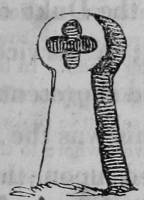
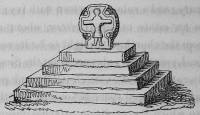
The first objects of antiquity which we have to
notice are the stone crosses placed by the roads'
side; some of them still retain their original
situation, while others, broken and mutilated,
have been converted into the various purposes of
rural œconomy. They appear to have been originally
designed as guides to direct the pilgrim
to the different churches. A few of the more
remarkable of them are represented as vignettes
in different parts of the present work, from which
the reader will become acquainted with their
general appearance.
At Boscawen-Un, in a field about a quarter
of a mile west of Leha, we meet with one of the
most ancient British monuments in the kingdom;
"a Druidical circle," as it has been pronounced,
consisting of nineteen stones, some of which have
fallen, placed in a circle of about twenty-five
feet in diameter, having a single one in the centre.
There is considerable doubt and obscurity
with respect to the origin and intended use of
these circles, of which there are many similar
examples in Cornwall. Camden is inclined to
consider them as military trophies, while Borlase
deems it highly probable that such monuments
were of religious institution, and designed originally
and principally for the rites of worship; at
the same time he conceives "they might sometimes
have been employed as places of council
and judgment, and that, whilst any council or
decree was pending, the principal persons concerned
stood, each by his pillar, and that where
a middle stone was erected, as at Boscawen-Un,
there stood the Prince or General elect." This
must certainly be acknowledged as one of the
most extraordinary specimens of antiquarian
dreaming ever presented to the public.
About half a mile to the right of the high
road stands an object of later origin, but not
of less interest to the antiquary; the ruins of a
small oratory, or baptistry, dedicated to Saint
Euinus, and commonly known by the name of
Chapel Euny. It is situated near a well, whose
waters have been long supposed to possess very
extraordinary virtues, and to have performed
many miraculous cures. There is a similar ruin,
which we shall hereafter have occasion to notice
at Madron; and it is worthy of remark that
these wells do not possess any mineral impregnation;
the sick, however, at this very day, repair
to them, while the credulous attempt to read the
future in the appearance of the bubbles produced
in their waters by the dropping in of pins or
pebbles. This mode of divining is perhaps one
of the most ancient superstitions that have descended
to us, and was termed Hydromancy.
The Castalian fountain, and many others amongst
the Grecians, were supposed to be of a prophetic
nature; thus, by dipping a fair mirror into a well
did the Patræans of Greece receive, as they vainly
imagined, some notice of ensuing sickness, or
convalescence.
On the summit of the hill above these ruins,
are situated the remains of Caerbran Castle or
Round (that is Brennus's Castle) which is thus
described by Borlase. "It is a circular fortification,
consisting first of a deep ditch, fifteen
feet wide, edged with stone, through which you
pass to the outer vallum, which is of earth, fifteen
feet high, and was well perfected towards the
north-east, but not so towards the west; within
this vallum, passing a large ditch about fifteen
yards wide, you come to a stone wall, which
quite rounded the top of the hill, and seems to
have been of considerable strength, but lies,
now, like a ridge of disorderly stones; the diameter
of the whole is ninety paces, and in the
centre of all is a little circle."
There are no less than seven of these hill castles,
as they are termed, although they might
with more propriety be called strong entrenchments,
to be seen at this time within five miles
around Penzance; all so placed on the hills as
to admit of immediate communication with each
other by signal. From several of them we have
views of the North and South Channel, but from
all of them either that of one sea or the other.
Much doubt has arisen concerning their origin.
Mr. Polwhele attributes them to the Irish, while
Dr. Borlase, like an orthodox antiquary, who
takes shelter, whenever he is bewildered, under
the sanction of a popular name, at once boldly
decides upon their Danish origin.
The lonely ruins of Chapel Carn Bre next
attract our notice; they are situated upon the
extremity of a high granite ridge, overlooking
the surfy recess of Whitsand Bay; from their
great elevation they are visible from every part
of the country, although they scarcely form a
skeleton of the original building, and in a short
time, probably, not a vestige will remain to mark
the consecrated spot. It appears to have been a
Chantry, erected for the performance of religious
service for the safety of mariners. It is not for
the inspection of these ruins that we direct the
stranger to ascend the hill, for they are too insignificant
to merit attention, but it is for the
purpose of his viewing the extensive prospect
which its summit commands,—a wild expanse of
waters occupying twenty-nine points of the compass!—From
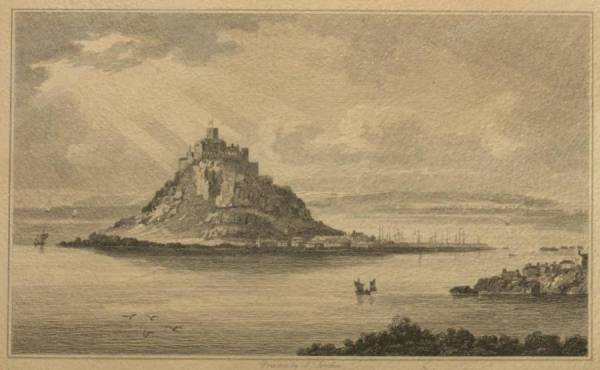
this spot also Saint Michael's Mount
has a singularly fine effect, appearing as if placed
in the centre of a lake at a distance from the
ocean.
We now proceed to Sennan Church-town,[38]
which according to barometrical admeasurement
is 391 feet above the level of the sea. It is about
a mile from the Land's End, and is celebrated
for containing the Ale-house whimsically called
"The First and Last Inn in England." On the
western side of its sign is inscribed "The First,"
and on the eastern side "The Last Inn in England."
The last village towards the Land's End is
named Mayon or Mean. In this place is the
large stone spoken of by Dr. Borlase under the
name of "Table mean," and concerning which
there is a vague tradition that three kings once
dined together on it, in their journey to the
Land's End.
On the turf between this village and the Land's
End, the Botanist will find Bartsia Viscosa, and
Illocebrum Verticillatum, the latter of which is
peculiar to this county.
Having arrived at the celebrated Promontory,
we descend a rapid slope, which brings us to a
bold group of rocks, composing the western extremity
of our island. Some years ago a military
officer who visited this spot, was rash enough to
descend on horseback; the horse soon became
unruly, plunged, reared, and, fearful to relate,
fell backwards over the precipice, and rolling
from rock to rock was dashed to atoms before it
reached the sea. The rider was for some time
unable to disengage himself, but at length by a
desperate effort he threw himself off, and was
happily caught by some fragments of rock, at
the very brink of the precipice, where he remained
suspended in a state of insensibility until
assistance could be afforded him! The awful
spot is marked by the figure of a horse-shoe,
traced on the turf with a deep incision, which is
cleared out from time to time, in order to preserve
it as a monument of rashness which could
be alone equalled by the good fortune with which
it was attended.
Why any promontory in an island should be
exclusively denominated the Land's End, it is
difficult to understand; yet so powerful is the
charm of a name, that many persons have visited
it on no other account; the intelligent tourist,
however, will receive a much more substantial
gratification from his visit; the great geological
interest of the spot will afford him an ample
source of entertainment and instruction, while
the magnificence of its convulsed scenery, the
ceaseless roar, and deep intonation of the ocean,
and the wild shrieks of the Cormorant, all combine
to awaken the blended sensations of awe
and admiration.
The cliff which bounds this extremity is rather
abrupt than elevated, not being more than sixty
feet above the level of the sea. It is composed
entirely of Granite, the forms of which present a
very extraordinary appearance, assuming in some
places the resemblance of shafts that had been
regularly cut with the chisel; in others, regular
equidistant fissures divide the rock into horizontal
masses, and give it the character of basaltic
columns; in other places, again, the impetuous
waves of the ocean have opened, for their retreat,
gigantic arches, through which the angry billows
roll and bellow with tremendous fury.
Several of these rocks from their grotesque
forms have acquired whimsical appellations, as
that of the Armed Knight, the Irish Lady, &c.
An inclining rock on the side of a craggy headland,
south of the Land's End, has obtained the
name of Dr. Johnson's Head, and visitors after
having heard the appellation seldom fail to acknowledge
that it bears some resemblance to the
physiognomy of that extraordinary man.
On the north, this rocky scene is terminated
by a promontory 229 feet above the level of the
sea, called "Cape Cornwall," between which and
the Land's End, the coast retires, and forms
Whitsand Bay, a name which it derives from,
the peculiar whiteness of its sand, and amongst
which the naturalist will find several rare microscopic
shells. There are, besides, some historical
recollections which invest this spot with interest.
It was in this bay that Stephen landed on his first
arrival in England; as did king John, on his return
from Ireland; and Perkin Warbeck, in the
prosecution of those claims to the crown to which
some late writers have been disposed to consider
that he was entitled, as the real son of Edward
the Fourth. In the rocks near the southern termination
of Whitsand Bay may be seen the junction
of the granite and slate; large veins of the
former may be also observed to traverse the
latter in all directions.
In viewing the whole of the scenery of this
stern coast "it is impossible" says De Luc, "not
to be struck with the idea, that the bed of the sea
is the effect of a vast subsidence, in which the strata
were broken off on the edge of what, by the retreat
of the sea towards the sunken part, became
a continent; the many small islands, or rocks of
granite, appear to be the memorials of the land's
abridgement, being evidently parts of the sunken
strata remaining more elevated than the rest."
There is a small Archipelago of this kind called
the Long-ships, at the distance of two miles west
of the Land's end; on the largest of these rocks
is a light-house, which was erected in consequence
of the very dangerous character of the
coast, by a Mr. Smith, in the year 1797, who obtained
a grant from the Trinity House, and was
rewarded for a limited number of years by a certain
rate on all ships that passed it. This period
having expired, it is at present under the jurisdiction
of the Trinity House.[39] The tower is constructed
of granite, the stones of which are trenailed
on the same plan as that adopted by Smeaton
in the construction of the Eddystone light-house.
The circumference of the tower at its
base is 68 feet; the height from the rock to the
vane of the lantern, 52 feet; and from the sea to
the base of the light-house it is 60 feet; but notwithstanding
this elevation its lantern has been
often dashed to pieces by the spray of the ocean
during the winter's tempest! The management
of this establishment is entrusted to two men,
who during the winter are often, for two or three
months, confined to this sea-girt prison without
the possibility of communicating with the land;
they accordingly lay in a store of provisions, as
if they were about to embark for a long voyage.
We have already stated that the historians of
Cornwall, from Leland, Norden, and Carew,
downwards, have all recorded the ancient tradition
of a considerable portion of the Mount's
bay having been formerly woodland. They have
likewise handed down the concurrent tradition
relative to the supposed tract of land which once
connected the islands of Scilly with Cornwall.
This tract, to which we are told was given the
name of the Lioness ("the Silurian Lyonois,")
is said to have contained one hundred and forty
parish churches, all of which were swept away
by the resistless ocean! As to the Cornish word
Lethowstow, or Lioness, by which the sea between
Scilly and Cornwall is distinguished, we
may observe, that the appropriation of such a
term is sufficiently accounted for from the general
violence and turbulence of the sea, just as the
celebrated rock lying south of the channel between
the Land's end and Scilly retains the name
of the Wolf,[40] from the howling of the waves
around it. Those who may wish for farther evidence
upon this subject may consult Mr. Boase's
excellent memoir "On the submersion of part of
the Mount's bay," published in the second volume
of the Transactions of the Geological Society of
Cornwall.
We shall in this place make a short digression,
in order to afford some account of the Scilly
Islands, which are situated in a cluster about
nine leagues, west by south, from the Land's
end, and are distinctly visible from it.
The Scilly Islands were called by the
Greeks Hesperides and Capiterides, or the Tin
Isles, and by this name they are mentioned by
Diodorus Siculus, Strabo, and Solinus. They
must, however, have undergone some material
revolution since the age of these writers, for we
fail in every attempt to reconcile their present
state with the description which they have transmitted
to us; and what is very unaccountable,
not a vestige of any ancient mine can be discovered
in the islands, except in one part of
Trescow; and these remains are so limited, that
they rather give an idea of an attempt at discovery,
than of extensive and permanent mining.
We are strongly inclined to believe that
the Tin of those days came, in part at least, from
the opposite coast of Saint Just, but of this we
shall hereafter speak more fully. In the time of
Strabo we learn that the number of these Islands
did not exceed ten, whereas at present there are
upwards of one hundred and forty, but of which
the following only are inhabited, viz. Saint
Mary's, Saint Agnes', Saint Martin's, Trescow,
Bryer, and Sampson. It is curious that the name
of the cluster should have been derived from one
of the smallest of the islets (Scilly), whose surface
does not exceed an acre. The number of
inhabitants amounts to about two thousand,
nearly half of which reside in Saint Mary's,
which contains 1600 acres; it possesses three
towns, a pier, a garrison, a custom house, and
some monuments of British antiquity.
At Saint Agnes is a very high and strong
light-house, which was erected in the year 1680.
Its present machinery was designed by the ingenious
Adam Walker, the well known lecturer on
Natural Philosophy, although it has lately undergone
some modification at the suggestion of
Mr. Wyatt. The machinery consists of a triangular
frame attached to a perpendicular axis,
which, by means of an appropriate power, is
made to revolve once every three minutes. On
each face of the triangle are arranged ten parabolic
reflectors of copper plated with silver, each
having an argand lamp in its focus. By this
device the light progressively sweeps the whole
horizon, and by its regular intermission and increase
is readily distinguished from every other
on the coast.[41]
The civil government of these islands is chiefly
managed by twelve of the principal inhabitants,
who meet monthly at Heugh Town, St. Mary's,
and settle differences by compromise. The Duke
of Leeds holds the islands by lease for thirty-one
years from the year 1800, at the rent of £40,
besides paying the fine of £4000, as a renewal.
The reader is no doubt anxiously waiting to
be introduced to the classical descendants of the
Grecian or Phœnician race,—Whether they have
been swallowed up with the "Lioness," or washed
into the ocean by the tempests, we know not;
but certain it is that the present inhabitants are
all new comers;—Phœnician or Grecian, there
are none.—Jenkins, Ellis, Hicks, Woodcock,
Ashford, and Gibson[42] are names which would
even defy the ingenious author of the Diversions
of Purley to trace to a classical source.
The Scillonians are a robust and healthy people,
and were it not for the facility with which
they obtain spirits, they would attain a very advanced
age. It is a common saying amongst
them, and is no doubt intended to express how
highly favourable the spot is to longevity, although
it obviously admits of another construction,
that "for one man who dies a natural death,
nine are drowned." It has been remarked that a
deformed person is not to be found in the islands;
but we apprehend that this fact requires an explanation
very different from that which is usually
assigned; it cannot be received as any test
of the salubrity of the spot, or of the superior
healthiness of the race; the fact is simply this,
that exposure to inclement weather, want of
proper food, and those various privations which
necessarily increase as we recede from the luxuries
of civilization, kill, during infancy, those
feeble subjects which might, otherwise, have
become deformed during the progress of their
growth. It is for the same reason that we so
frequently observe the troops of barbarous countries
composed of the most athletic individuals, for
the hardship of their service weeds out the feeble
and invalid. We have already alluded to the
tenacity with which the Cornishman clings to his
native soil, but the attachment of the Scillonian,
if possible, is still stronger to his desolate rock.
What a striking contrast does this form with the
roving inhabitant of an alluvial country, where
every object, it might be presumed, was calculated
to excite and sustain the strongest attachment;
but this principle of Nature is wise and
universal,—the plant is easily loosened from a
generous soil, but with what difficulty is the
lichen torn from its rock.
The islanders are chiefly employed in Ashing,
making kelp from the Algæ, which is disposed of
to the Bristol merchant for the use of the glass
manufacturer, and in pilotage. From a combination,
however, of unfortunate circumstances, in
addition to the fatal blow given to the smuggling
trade, by the activity of the preventive service,
the inhabitants were reduced to such extreme
distress that it became necessary in the year 1819
to appeal to the generosity of the public in their
behalf; and, notwithstanding the great difficulties
of the times, the sum of nine thousand pounds
was collected for their relief. In this great work
of charity it is but an act of justice to state, that
the Society for promoting Christian knowledge,
by their purse, as well as by their writings, performed
a very essential service. The funds thus
obtained were in part appropriated to the relief
of the immediate and pressing distress under
which they laboured, while the remainder was
very judiciously applied towards the promotion of
such permanent advantages as might prevent the
chance of its recurrence. A Fish-cellar was
accordingly provided in the island of Trescow,
for the purpose of storing and curing Ash; boats
adapted for the Mackarel and Pilchard Fisheries
were purchased, and others were repaired; nets
and various kinds of tackling were also at the
same time liberally supplied. By such means
have the inhabitants of these cheerless rocks
been enabled to avail themselves of some of the
resources which Providence has placed within
their reach, and their families have been thus
enabled to exist without the dread of absolute
starvation.[43] Much, however, still remains for
philanthropic exertion, and should this humble
volume fall into the hands of those, who are
enabled by the superior gifts of fortune to
contribute to the wants of their unhappy brethren,
we may perhaps serve their cause by stating
that any donation, however small, will be
received by Henry Boase, Esq. at the Penzance
Bank. The greatest benefit would arise from the
extension of their fisheries, for in consequence of
the peculiar situation and convenience of these
islands, the Cod and Ling fisheries might be carried
to almost any extent; and, while boats in
any part even of the Mount's Bay, would be
weather-bound with the wind W.S.W. to S., they
can proceed from Scilly into the channel, without
the least difficulty. The Scillonians, however,
have as yet been unable to avail themselves of
the advantages of their locality; the want of proper
boats prevents their proceeding in the pursuit
of their occupation, farther than four or five
leagues from the land.
During the summer months various species of
fish are caught with hook and line; among the
smaller kind, which are salted by the Scillonians
for their winter consumption, are "Bass, Wrass,
Chad, Scad, Brit, Barne, Cuddle, Whistlers," &c.
all of which are included by the islanders under
the general appellation of "Rock-fish."
There is a very curious fact noticed here with
respect to the Woodcock. These birds generally
arrive in Scilly before they are observed in any
part of England; more frequently with a north-east,[44]
though sometimes with a north-west wind,
and are often so exhausted as to be caught in
great numbers by the inhabitants, especially near
the light-house, the splendour of whose light appears
to attract them, and striking against its
lantern they not unfrequently fall lifeless in the
gallery. It is for the naturalist to consider from
whence they migrate.
The Climate of these islands is both milder and
more equable than that of Cornwall, but this
advantage is counterbalanced by the frequent
occurrence of the most sudden and violent storms.
By those who have kept journals it has been
found that not more than six days of perfect calm
occur in the course of a year, and that the wind
blows from between S.W. and N.W. for more
than half of that period.
With respect to Geology, these islands will
afford but little variety; with the exception of
some beds of Porphyry at Saint Mary's, and
some beds of Chlorite, containing Pyrites, in the
same island, they consist entirely of Granite, and
are doubtless a continuation of the Devonian
range, although the rock assumes an appearance
less porphyritic; it contains, however, veins of
red Granite. At the Lizard Point in the island
of Trescow, a variety of granite occurs, in which
the felspar is of a remarkably pure white, and
might, we should conceive, be advantageously
employed in the manufacture of Porcelain. In
some chasms of this rock, and in the centre of
large masses, the Mica is of a silvery hue, and
occurs crystallized in its primitive form. In the
same island is a remarkable cavern, in the centre
of which is a pool of fresh water. The porphyritic
beds in Saint Mary's are interesting on
account of the distinct appearance of stratification
which they display, and Mr. Majendie thinks
that an undoubted instance of stratified granite
is to be seen near the same spot. The Granite
of Scilly is very liable to decomposition; whence
has arisen all that fancied statuary of the Druids,
of which we have spoken in another place. The
Islands are undoubtedly undergoing a gradual
diminution. At no great distance of time Saint
Mary's will probably be divided by the sea, and
a channel formed through the low land between
the New-town and the south-east side of the garrison.
This might perhaps be prevented by
throwing down masses of granite from a neighbouring
hill, so as to form a barrier against the
sea. The object may be worthy of attention, as
the sea in winter, with a high tide, has been
known to pass over this land, and the effect of its
forcing a channel there would be to divide the
garrison from the rest of the island. If the Geologist
proceeds to a spot behind the quay, and between
the front of the garrison-hill and that
island, he will be gratified by the discovery of a
process the very converse of that which we have
been just describing. In these places the granitic
sand is becoming indurated by the slow infiltration
of water holding iron in solution, and which
appears to be derived from the decomposing hills
above it. Some fine specimens of this "regenerated"
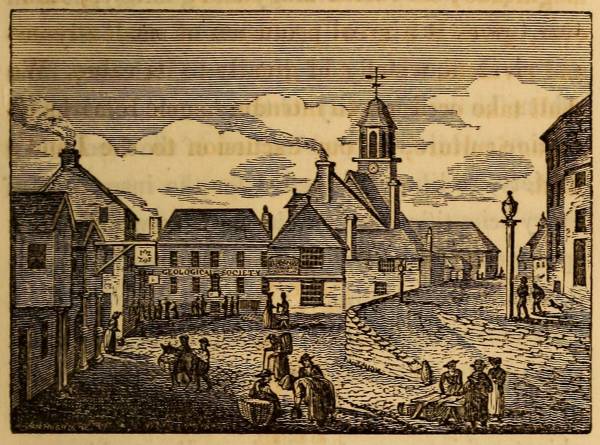
granite have been placed in the Geological
Society's cabinet at Penzance.
We now return to the Land's End,—from
which we should proceed to visit a promontory,
called "Castle Treryn," where is situated the
celebrated "Logan Stone." If we pursue our
route along the cliffs, it will be found to lie several
miles south-east of the Land's End, although
by taking the direct and usual road across the
country, it is not more than two miles distant;
but the Geologist must walk, or ride along the
coast on horseback, and we can assure him that
he will be amply recompensed for his trouble.
From the Cape on which the signal station is
situated, the rock scenery is particularly magnificent,
exhibiting an admirable specimen of the
manner, and forms, into which Granite disintegrates.
About forty yards from this Cape is the
promontory called Tol-Pedn-Penwith, which in
the Cornish language signifies the holed headland
in Penwith. The name is derived from a singular
chasm, known by the appellation of the Funnel
Rock; it is a vast perpendicular excavation
in the granite, resembling in figure an inverted
cone, and has been evidently produced by the
gradual decomposition of one of those vertical
veins with which this part of the coast is so frequently
intersected. By a circuitous route you
may descend to the bottom of the cavern, into
which the sea flows at high water. Here the
Cornish Chough (Corvus Graculus) has built its
nest for several years, a bird which is very common
about the rocky parts of this coast, and may
be distinguished by its red legs and bill, and the
violaceous blackness of its feathers. This promontory
forms the Western extremity of the
Mount's Bay. The antiquary will discover in
this spot the vestiges of one of the ancient "Cliff
Castles," which were little else than stone walls,
stretching across necks of land from cliff to cliff.
The only geological phenomenon worthy of particular
notice is a large and beautiful contemporaneous
vein of red Granite containing Shorl; is
one foot in width, and may be seen for about
forty feet in length.
Continuing our route around the coast we at
length arrive at "Castle Treryn." Its name is
derived from the supposition of its having been
the site of an ancient British fortress, of which
there are still some obscure traces, although the
wild and rugged appearance of the rocks indicate
nothing like art.
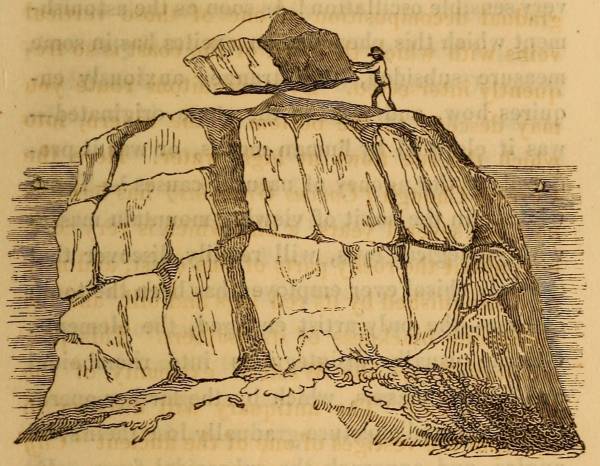
The foundation of the whole is a stupendous
group of Granite rocks, which rise in pyramidal
clusters to a prodigious altitude, and overhang
the sea. On one of those pyramids is situated
the celebrated "Logan Stone," which is an
immense block of Granite weighing above 60
tons. The surface in contact with the under
rock is of very small extent, and the whole mass
is so nicely balanced, that, notwithstanding its
magnitude, the strength of a single man applied
to its under edge is sufficient to change its centre
of gravity, and though at first in a degree scarcely
perceptible, yet the repetition of such impulses,
at each return of the stone, produces at length a
very sensible oscillation! As soon as the astonishment
which this phenomenon excites has in some
measure subsided, the stranger anxiously enquires
how, and whence the stone originated—was
it elevated by human means, or was it produced
by the agency of natural causes?—Those
who are in the habit of viewing mountain masses
with geological eyes, will readily discover that
the only chisel ever employed has been the tooth
of time—the only artist engaged, the elements.
Granite usually disintegrates into rhomboidal
and tabular masses, which by the farther operation
of air and moisture gradually lose their solid
angles, and approach the spheroidal form. De
Luc observed, in the Giant mountains of Silesia,
spheroids of this description so piled upon each
other as to resemble Dutch cheeses; and appearances,
no less illustrative of the phenomenon,
may be seen from the signal station to which we
have just alluded. The fact of the upper part
of the cliff being more exposed to atmospheric
agency, than the parts beneath, will sufficiently
explain why these rounded masses so frequently
rest on blocks which still preserve the tabular
form; and since such spheroidal blocks must obviously
rest in that position in which their lesser
axes are perpendicular to the horizon, it is equally
evident that whenever an adequate force is applied
they must vibrate on their point of support.
Although we are thus led to deny the Druidical
origin of this stone, for which so many zealous
antiquaries have contended, still we by no means
intend to deny that the Druids employed it as an
engine of superstition; it is indeed very probable
that, having observed so uncommon a property,
they dexterously contrived to make it answer the
purposes of an ordeal, and by regarding it as
the touchstone of truth, acquitted or condemned
the accused by its motions. Mason poetically
alludes to this supposed property in the following
lines.
"Behold yon huge
And unknown sphere of living adamant,
Which, pois'd by magic, rests its central weight
On yonder pointed rock: firm as it seems,
Such is its strange, and virtuous property,
It moves obsequious to the gentlest touch
Of him, whose heart is pure, but to a traitor,
Tho' e'en a giant's prowess nerv'd his arm,
It stands as fix'd as Snowdon."
The rocks are covered with a species of Byssus
long and rough to the touch, forming a kind of
hoary beard; in many places they are deeply
furrowed, carrying with them a singular air of
antiquity, which combines with the whole of the
romantic scenery to awaken in the minds of
the poet and enthusiast the recollection of the
Druidical ages. The Botanist will observe the
common Thrift (Statice Armeria) imparting a
glowing tinge to the scanty vegetation of the spot,
and, by growing within the crevices of the rocks,
affording a very picturesque contrast to their
massive fabric. Here too the Daucus Maritimus,
or wild carrot; Sedum Telephium, Saxifraga
Stellaris, and Asplenium Marinum, may be found
in abundance.
The Granite in this spot is extremely beautiful,
on account of its porphyritic appearance;
the crystals of felspar are numerous and distinct;
in some places the rock is traversed by veins of
red felspar, and of black tourmaline, or schorl,
of which the crystalline forms of the prisms, on
account of their close aggregation, are very indistinct.
Here may also be observed a contemporaneous
vein of schorl rock in the granite,
nearly two feet wide, highly inclined and very
short, and not having any distinct walls. On
the western side of the Logan rock is a cavern,
formed by the decomposition of a vein of granite,
the felspar of which assumes a brilliant flesh-red,
and lilac colour; and, where it is polished by
the sea, exceeding even in beauty the Serpentine
caverns at the Lizard.
Mr. Majendie observed in this spot numerous
veins of fine grained granite, which he is inclined
to consider as cotemporaneous; he also observed
what, at first sight, appeared to be fragments,
but which, upon closer examination, he pronounces
to be cotemporaneous concretions; for large
crystals of felspar may be seen shooting from the
porphyritic granite into these apparent fragments.
These phenomena are extremely interesting in a
geological point of view, and well deserve the
attention of the scientific tourist.
In Treryn cove, just below the site of the
castle, Dr. Maton found several of the rarer
species of shells, as Patella Pellucida, P. Fissura,
Mytilus Modiolus, Trochus Conulus, Turbo Cimex,
and T. Fascitatus (of Pennant.)
Before we quit this coast we beg to state, for
the information of the geological tourist, that the
Granite which we have just traced from beyond
the Land's End to this spot, continues until within
half a mile of the signal post near Lemorna
cove, where it meets with a patch of slate, and is
lost for about the space of three quarters of a
mile. At the western extremity of this junction
(Carn Silver) the mineralogist will find embedded
Garnet-rock with veins of Epidote and
Axinite. Here may also be seen the rare occurrence
of a granite vein penetrating both the slate
and the granitic rock.
But let us return.——About two miles north-east
of the Logan rock, and in the high road to
Penzance, stands the town of Saint Buryan,
which though now only a group of wretched cottages
was once a place of very considerable note,
and the seat of a College of Augustine Canons;
the latter was founded by Athelstan after his
return from the conquest of the Scilly Islands,
A.D. 930. The remains of the College were wantonly
demolished by one Shrubshall, Governor
of Pendennis Castle, during the usurpation of
Cromwell.
The Church tower stands on the highest point
in this part of the country, being 467 feet above
the level of the sea; it consequently forms a very
conspicuous object, and is so exposed to the rains
from the Atlantic, that the stones carry a deceptive
face of freshness with them which lends an
aspect of newness to the whole building. From
the top of the tower the prospect is of a very
extensive kind, commanding the whole range of
the surrounding country, and an immense surface
of sea. In clear weather the Scilly Islands may
be easily distinguished in the horizon, especially
with a setting sun, when they appear to project
from the brilliant ground of the western sky like
figures embossed on burnished gold.
Both from the history and appearance of this
edifice the antiquary will enter it with sensations
of awe and veneration, but he will find with
regret that the ancient Roodloft has been lately
removed, from an idea that it deadened the voice
of the preacher, and that the parishioners have
also converted the original forms into modern
pews, a change which has cruelly violated the
venerable uniformity of the interior. There is a
singular monument in the church, in the shape of
a coffin, having an inscription around the border
in very rude characters, and now partly obliterated;
it is in Norman French, and has been thus
translated.
CLARICE
The wife of Geffrei de Bollait lies here
God of her soul have mercy
They who pray for her soul shall have
Ten days Pardon.
On the middle of the stone is represented a
Cross fleury, standing on four steps; the monument
is said to have been found many years ago
by the sexton, while sinking a grave.
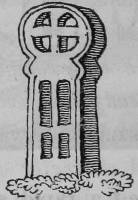
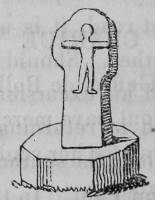
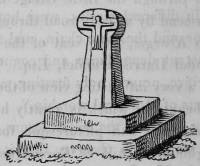
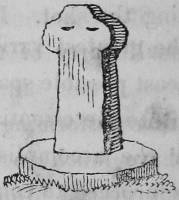
Opposite the great door in the church-yard
stands a very ancient Cross, on one side of which
are five balls, and, on the other, a rude figure
intended to represent the crucified Saviour. We
here present our readers with a sketch of this
singular monument.
Another Cross stands in the road, and faces the
entrance into the church-yard, of which also we
have introduced a delineation.
The Deanery is in the gift of the Crown, as a
royal peculiar, and is tenable with any other
preferment. The Dean exercises an independent
jurisdiction in all ecclesiastical matters within
the parish of St. Burian, and its dependent parishes
of St. Levan, and Sennan. He is the
Rector, and is entitled to all tithes. A Visitation
court is held in his name, and the appeal from it
is only to the King in council. Athelstan is said
to have granted to this church the privilege of a
Sanctuary, and a ruin overgrown with ivy; standing
on an estate called Bosliven, about a mile
east from the church, is thought to be its remains,
but Mr. Lysons justly observes that the Sanctuary
usually comprised the church itself, and perhaps
a certain privileged space beyond it, and that the
ruins to which the tradition attaches, are probably
those only of an ancient chapel.
From St. Buryan the traveller may at once
return to Penzance, which is about six miles distant,
but as no object of particular interest will
occur in the direct road, it is unnecessary for us
to attend him thither. Should he, however, be
inclined to extend his excursion, he will receive
much gratification in returning by a somewhat
circuitous route along the southern coast, through
the parish of Saint Paul. In this case, we may
first proceed to Boskenna, the seat of John
Paynter Esq. a highly romantic spot, abounding
with woodcocks, and which under the direction
of a skilful landscape gardener might be made to
emulate in beauty any of the charming villas that
adorn the under-cliff of the Isle of Wight. On
this estate there is a superficial quarry of decomposing
granite, which the mineralogist ought to
visit, for the purpose of obtaining some remarkably
fine specimens of felspar in separate crystals,
which may be easily removed from the mass
in which they lie imbedded.
At Bolleit, in a croft near Boskenna, and adjoining
the high road, is to be seen a circle of
stones very similar to that we have already described
(p. 81,) except that it has not a central
pillar; the appellation given to these stones is
that of the "Merry Maidens," on account of a
whimsical tradition, that they were once young
women transformed like Niobe into stones, as
a punishment for the crime of dancing on the
Sabbath day. In a field on the opposite side of
the road there are two upright stones standing
about a furlong asunder, the one being nearly
twelve, the other sixteen feet in height. They
are probably sepulchral monuments; the same
ridiculous tradition, however, attaches to them
as to the circle, and has accordingly bestowed
upon them the appellation of the "Pipers."
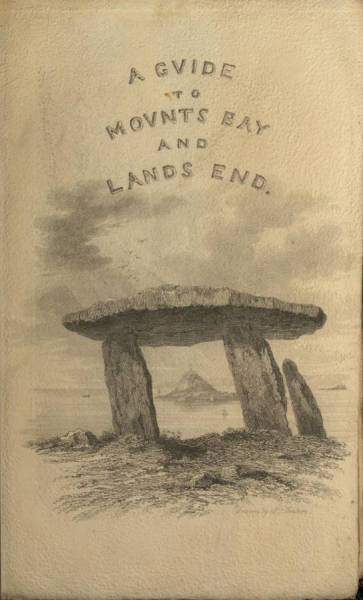
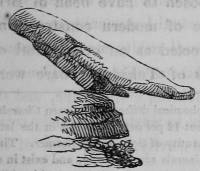
At Carn Boscawen, on this coast, is to be
seen a very extraordinary group of rocks, consisting
of a large flat stone, the ends of which
are so poised upon the neighbouring rocks, as to
leave an opening underneath; Dr. Borlase, with
his accustomed zeal, insists upon its Druidical
origin, and ever ready to supply the deficiency
of both history and tradition by the sallies of an
active imagination, very confidently informs us,
that "this said opening beneath the pensile stone
was designed for the seat of some considerable
person, from which he might give out his edicts,
and decisions, his predictions, and admissions to
Noviciates"!—Risum teneatis geologici?
In our road to Saint Paul, we pass Trouve, or
Trewoof, an estate situated on the side of a
woody hill, overlooking a romantic valley, which
is terminated by Lemorna Cove, a spot which
should be visited by every stranger who delights
in the "lone majesty of untamed Nature."
Within the estate of Trouve are the remains of a
triple entrenchment, in which runs a subterranean
passage; and, it is said, that during the civil
wars a party of Royalists were here concealed
from the observation of the forces of Sir Thomas
Fairfax. There is a fine chalybeate spring on
this estate.
At Kerris, in the parish of Paul, about five
miles from Penzance, is an oval enclosure called
"Roundago," which is stated to have been connected
with Druidical rites; time and the Goths,
however, have nearly destroyed its last remains,
so that the antiquary will require the eyes of a
Borlase to recognise its existence by any description
hitherto given of it.
Paul Church is a very conspicuous object
from its high elevation,[45] and interests the historian
from the tradition, already stated, of its
having been burnt by the Spaniards, upon which
occasion the south porch alone is said, in consequence
of the direction of the wind, to have
escaped the conflagration. A pleasing confirmation
of this tradition was lately afforded during
some repairs, when one of the wooden supporters
was found charred at the end nearest the body of
the church. It also deserves notice that the thick
stone division at the back of the Trewarveneth
pew, which has so frequently occasioned enquiry,
is a part of the old church, which escaped the
fire. In the church is the following curious notice
of its having been burnt, "The Spanger
burnt this church in the year 1595."
Most tourists inform us that in this church-yard
is to be seen the monumental stone, with
the epitaph of Old Dolly Pentreath, so celebrated
among antiquaries, as having been the last person
who spoke the Cornish language. Such a
monument, however, if it ever existed, is no
longer to be found, nor can any information be
obtained with regard to its probable locality.
Her Epitaph is said to have been both in the
Cornish and English language, viz.
"Coth Dol Pentreath canz ha deaw
Marir en Bedans en Powl pleu
Na en an Eglar ganna Poble braz
Bet en Eglar Hay Coth Dolly es!"
"Old Dol Pentreath, one hundred age and two
Both born, and in Paul Parish buried too;
Not in the Church 'mongst people great and high
But in the Church-yard doth old Dolly lie!"
In the parishes of Paul and Buryan are several
Tin streams; in some of which the Wood Tin, or
wood-like oxide of Tin, is occasionally found in
large, and well defined pieces. It has been also,
although rarely, found in its matrix.
From Paul Church we may proceed to Penzance,
either by the high road over Paul Hill,
which becomes extremely interesting from the
picturesque beauty and superior cultivation of
the country; or we may descend towards the sea
shore, and return through the villages of Mousehole
and Newlyn, which may be called colonies
of Fishermen, for here the Pilchard[46] and Mackarel
fisheries are carried on to a very great extent;
and every kind of fish which frequent this
coast are caught and sent to Penzance, and other
Cornish towns; and, in the early part of the
season, they supply the London market with
Mackarel, which are conveyed thither by way of
Portsmouth. The Lobster fishery also proves
an ample source of revenue to the Mount's Bay
fishermen, from which alone they divide not less
than Two Thousand Pounds, annually.
The ride or walk along the coast from Mousehole
to Newlyn is highly interesting. The
former town which is situated about two miles
south-west of Penzance; and half a mile from
Paul Church-town, contains about six hundred
inhabitants. There is a small Pier capable of
admitting vessels of one hundred tons burthen;
but it is chiefly used as a harbour for the numerous
fishing boats.
Newlyn, with respect to population, exceeds
by one-third that of Mousehole. It has a commodious
pier, which is also usually occupied by
the fishing boats of the place, which exceed four
hundred in number. In the cliff-road between
these villages, we pass a platform, which during
the late war was a battery, forming a security to
the bay from any privateers that might visit it.
Adjoining this battery stands a furnace for the
purpose of heating the shot. It was under the
direction of a small party of the Royal Artillery.
The Geologist in performing this part of the
excursion will have much to observe. About
one hundred yards west of Mousehole, the clay-slate
ceases, and the granite commences. At
this junction numerous granite veins, varying in
width from about a foot to less than an inch, pass
through the slate.[47] A little farther west, a cavern
may be observed in the cliff, which has evidently
been produced by the decomposition of the walls
of an old Adit. In this cavern the Mineralogist
has found good specimens of Eisenkeisel, or Iron
flint:—but we will conclude, for our tourist
must be wearied by the length of the excursion;
tomorrow we shall be again prepared to accompany
him in a different direction, and to point
out a succession of fresh objects, when antiquities,
minerals, and picturesque views will, in
their turn, again present themselves for his examination.
Between Penzance, and Buryan.