To journey from one Central-American republic
to another, the traveler should equip
himself with a private yacht.
Having neglected this precaution, he must resort
to patience. There is a steamship service along the
Pacific Coast which advertises regular sailing dates.
But since its vessels are quite apt to be ahead of
their schedules, one usually repairs to the seaport a
day or two in advance. And since they are far more
apt to be behind their schedules, one usually waits
there for a period varying from one to three weeks,
at a shabby hotel in a blazing hot town whose inhabitants
earn their living by overcharging such
travelers as fate has thus thrown into their grasp.
Not possessing the private yacht, I left Tegucigalpa
for Amapala one day in advance.
Bill, the hard-boiled, took me down the mountain
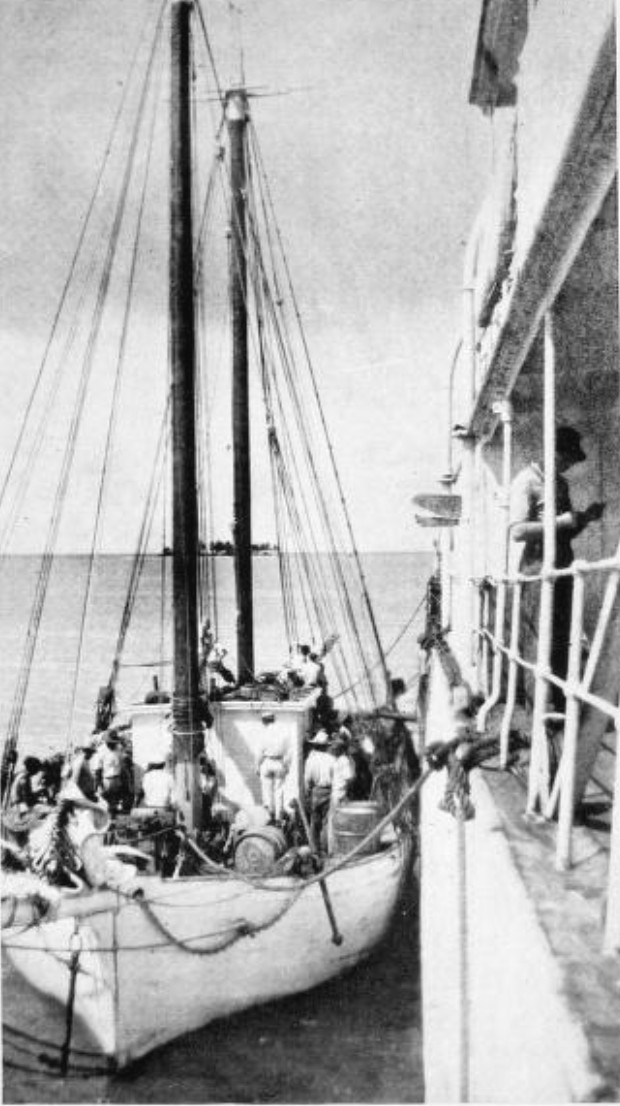
road to San Lorenzo, where a launch was already
waiting. There a member of the crew undertook to
facilitate my voyage. He greeted me with a smile
as I reached the end of the wharf.
“I’m the man who carried your suit-case, señor.”
“I carried it myself.”
“Did you really? Then I’ll put it on board for
you.”
Since a squad of Honduran soldiers held all
passengers on the wharf until the baggage was
aboard, I surrendered it to him, and he placed it on
the extreme edge of the stern, precariously balanced
on the small end, tying it fast with the rest of the
cargo, but with a flimsy piece of cord which threatened
at any moment to break and spill the entire
load into the Gulf of Fonseca.
“It’s all right,” he assured me. “I have my eye
on it!”
Then, as the soldiers finally permitted us to embark—after
an official had ascertained that my passport
was properly viséd by the Honduran Minister
of Foreign Relations—the officious mozo
climbed upon the thwarts to offer me an unnecessary
hand. “When we arrived at Amapala, señor, I’ll
show you to the hotel.”
“I already know one hotel there.”
“Then I’ll show you to the other one.”
I had frequently encountered his type in nearly
every port of the world. He believed all traveling
Yankees to be simpletons with the one redeeming
virtue of lavishness in bestowing tips for useless
services. Throughout the four-hour ride across the
Gulf, he sat opposite me, smiling sweetly whenever
he could catch my attention. And when we drew
up beside the wharf at Amapala, he untied my suit-case
first. But having untied it, he left it while he
assisted the rest of the crew in dragging eight heavy
trunks up a slippery flight of wooden steps.
According to local custom, another squad of soldiers
herded all passengers ashore to answer another
questionnaire, and from the dock I looked down to
see my suit-case dancing and rocking unsteadily with
each swell that rolled in from the misnamed Pacific.
From the opposite end of the launch, the mozo held
up his palm in the Latin-American gesture that signifies,
“Patience.”
“No hay cuidado, señor. I’m watching it.”
But it was already toppling. And the shadowy
figure of a shark, cruising about the murky waters
below, suggested the impracticability of recovering
it later by diving. Avoiding the guard, I landed
back on the launch, and caught the suit-case just as it
started to fall. Four ragged urchins, waiting on the
dock to carry baggage, leaped after me to struggle
for its possession. The mozo joined the fray. We
surged back and forth across the deck, while the
shark waited below, until our battle was interrupted
by a policeman with drawn revolver.
“You are arrested!” he screamed at me.
And he marched me to the commandancia, where
a pompous official lectured me, politely but firmly,
upon the insult I had paid the government of Honduras.
It was a small country, he said, but it possessed
high ideals. The authority of its army was a
thing to be respected. Considering that I was a
foreigner and not acquainted with local customs, I
would be forgiven. But in the future, he hoped I
should never jump off a dock onto a boat until all
cargo was unloaded.
As I walked out of the office, still clinging to my
suit-case, the mozo came up to demand his tip for
keeping an eye on it. I waited a moment to see how
much the policeman would expect for his services in
arresting me, but he collected only the customary fee
which all passengers paid for the use of the wharf in
disembarking.
So I turned toward the steamship office, to learn
when I might proceed to Nicaragua.
“Quién sabe? We expected two passenger vessels.
But the one, last night at La Unión, went back
to La Libertad for six more sacks of coffee. And
the other, having filled with coffee at San José de
Guatemala, has canceled its schedule entirely.”
I stopped at the leading hotel, operated—like
most hotels on this coast—by a Chinaman.
It was the usual type of seaport hostelry, less
comfortable and more expensive than those of the
interior cities, but well stocked with fleas, bugs,
liquor, and flirtatious servant maids.
“What does one do in this town for amusement?”
I asked a native.
“Amusement?” He seemed a little surprised.
“Why, señor, there are plenty of women.”
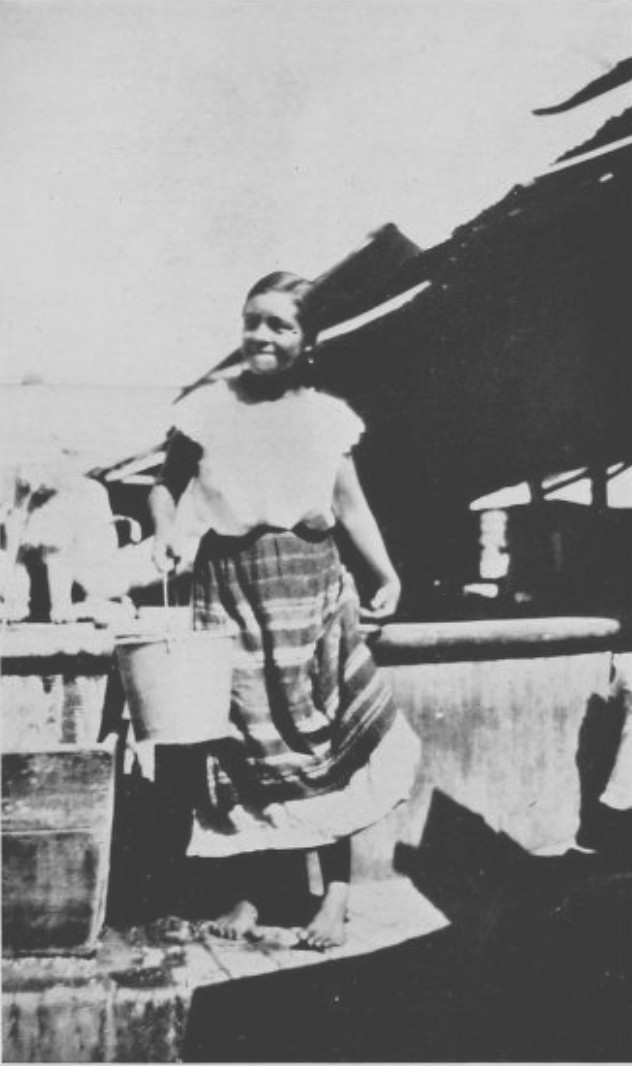
For occupation, the male population carried the
baggage of passing travelers. The female population
took in washing. Rather dark, and not distinguished
for beauty, the younger ones called at the
hotel for the laundry; the older ones did the work.
They took the clothes to the waterfront, laid the
garments on flat rocks, and pounded the buttons off
with a stout club. Then they left them to bleach,
spreading them out on scrubby little bushes whose
berries stained them with yellow spots, while they
themselves—already stripped to the waist for comfort—retired
to the shallow water to immerse themselves
through the hot mid-day. In the evening they
collected the garments, carried them home, and
ripped them into shreds with rusty irons. Finally,
having wrapped them into a neat bundle with the
least-ruined articles on top, the younger girls
brought them back with smiling countenances, and
the inquiry:
“Is that all, señor?”
As a town, Amapala was not unpicturesque. Its
whitewashed houses, beneath red-tiled roofs, were
set amid palms and bougainvillea. If at noon it
seemed to wither under the dry white heat of a
tropic sun, there was usually a breeze in the evening,
with a tang of salt from the ocean. Across the Gulf
of Fonseca, if one looked beyond the fleet of scows
and lighters in the foreground, one could see myriad
islands and the cones of several Salvadorean volcanoes.
There was a play of red and gold at sunset,
then the purple and silver of twilight, and finally a
glorious night with stars twinkling above and fireflies
below, and the glare of the volcanoes tracing a
crimson path through the waters of the bay.
Its only point of interest, however, was the cliff
where occurred a bloody incident in a long-past war
between Nicaragua and Honduras. Some many
years ago Nicaragua, having confiscated a smuggling
schooner, had armed it with a cannon, and
feeling rather cocky in its possession of a navy,
had dispatched it to fight Honduras. It came up to
Amapala and fired one shot. The bloody incident
occurred when a Honduranean, standing on the cliff,
craned his neck to see where the shot landed, and fell
into the Gulf of Fonseca.
From the cone of the extinct volcano that rose
above Amapala, one could see Honduras, Salvador,
and Nicaragua. Each was but a few hours’ distance
from the other, yet the traveler might wait indefinitely
for a boat. Shields, my companion on the auto
trip from Guatemala to Santa Ana, was now in
Amapala, also bound for Nicaragua, and had already
been waiting over a week.
He spent most of his time on the hotel veranda,
scanning the horizon with a telescope. This operation
afforded much entertainment for the village
idiot. Each Central-American port seems to contain
one weak-minded or defective youth, who sits all day
at the hotel to watch the every movement of a visiting
foreigner. In Amapala it was “The Dummy.”
He was a harmless, pleasant little brown fellow
in ragged breeches and an undershirt salvaged from
the rubbish pile. How he lived, no one seemed able
to explain. Some one apparently fed him. No one
apparently washed him. Occasionally he earned a
few pennies by performing tricks for tourists. His
chief accomplishment was that of resting his bare
toe upon a lighted cigarette. He was always cheerful,
and affable, and he would chat with us by the
hour in parrot-like squawks made intelligible by a
marvelous art of mimicry. He could describe any
one in Amapala by a single gesture. For the Commandante
he twisted an imaginary mustache. For
the Chinaman, he pulled down his cheeks to give his
eyes an oblique slant. He became our constant associate
and entertainer, guide, counselor and friend.
From time to time, as an alternative amusement,
Shields wrote passionate love letters to the daughters
of the Commandante—the only two white girls
in town—to which missives, I later learned, he usually
signed my name. The Dummy would serve as
emissary, and upon his return would enact the giggling
of the señoritas, and the wrathful explosions
of their parents.
Toward evening, the two girls sometimes made
their appearance to stroll in the plaza, accompanied
by a male relative with a rifle. Occasionally they
would stop at the hotel for a glass of lemonade, and
would subject Shields and myself to the careful
scrutiny to which señoritas invariably subject a
strange youth, while their companion sat beside
them with the rifle over his knees. Still later the
Commandante himself would join them, favoring us
with a stern military glance of warning.
The Dummy always sidled away at his approach,
for the Commandante had arrested him not long ago.
He often told us the story in his own crude language.
The trouble had been about a woman. From his
ecstatic expression, she must have been beautiful.
He would point at his face, then at his black trousers,
to suggest her complexion, and a twist of his
fingers would indicate kinky hair. He showed us in
pantomime the evil intentions of a rival. He seized
a rock and planted it with much zest against the
villain’s imaginary skull. He whistled shrilly. That
was a policeman! He slumped into a heap as the
imaginary club descended upon his head. He placed
his wrists together. Handcuffed! He held up ten
fingers. The Commandante had sentenced him to
ten days! Then he gave a series of unintelligible
parrot-squawks, and pointed toward La Unión.
During his imprisonment, the girl had fled with the
rival! He shook his head sadly, and ran a hand
across his throat. Was he meditating suicide? Or
was he planning revenge? His story always ended
in the harsh, mirthless laughter of an imbecile, and
he sidled away, for the Commandante, having partaken
of his cocktail, was leading his family home.
In the evening the Consular Agent, fat and jovial,
would drop in for a glass of beer. His only official
duty at present was looking after a Panamanian
sailor who had fallen down the hold of the last vessel
in port and broken a shoulder bone.
“It might have killed a white man, but you can’t
hurt these natives. Down in Nicaragua, I saw one
fellow sink a pen-knife two inches into another
fellow’s skull. We just pulled it out, and the man
went on working.”
And many other yarns would follow, the locale
varying from Chile, where they use those little
curved blades with an upward thrust, to the Philippines,
where the Moros take your head off with one
deft swing of a bolo. We would all collaborate, the
stories growing more and more astounding until we
reached the incident of the Mexican who swam two
miles after a shark had bitten off his stomach.
“I believe it,” the Consular Agent would nod.
“Down in Costa Rica a shark bit one of my pearl-divers,
and took out a chunk as big as a watermelon.
We clapped it back on, plastered the edges with a
little mud—”
Then we would have another beer, and the Consular
Agent would stroll homeward. The street
lamps flickered. Five ragged soldiers—the night
patrol—glided past us like phantoms through the
dark street. A peon girl hurried along the sidewalk,
and the Dummy, bidding us good-night, ran after
her with shrill parrot-like squawks. Within the
hotel the Chinaman sat imperturbable as a Buddha,
waiting to close up his establishment, while the
town’s three German merchants drowsed at a table.
Shields and I would rise and yawn.
“To-morrow there may be a boat.”
The one break in the day’s monotony came at mid-afternoon.
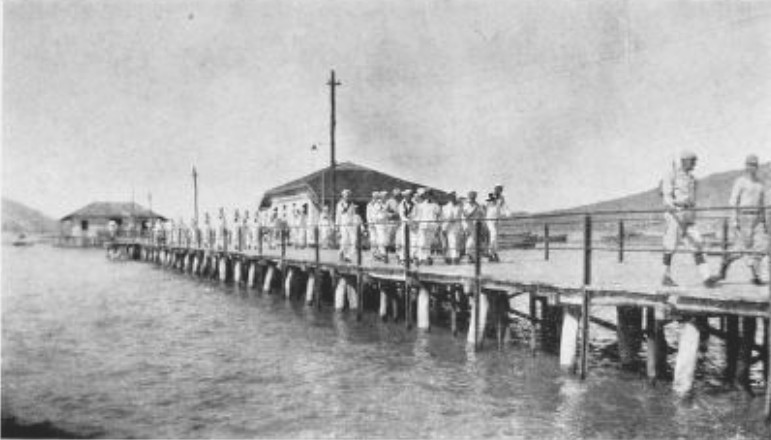
Then a shore-party from the Rochester, still lingering
far out in the harbor, would shoot past the
waterfront in a trim white launch, and come rolling
up the long wharf to see the sights of town.
Whenever the Chinaman saw them coming, he
would shout for all his servants to man the bar.
The sailors, seeming to know the local geography
instinctively, headed straight for the hotel. While
their Ship’s Police scattered out through town with
swinging clubs, the tars all trooped into the establishment.
“Hello there, buddy! Say, kin you talk this spig
language? Tell that Chink we want liquor!”
And presently they were all over the city, bargaining
in every shop, contriving somehow despite
their ignorance of Spanish to obtain whatever they
desired. They purchased native rope bags, and
filled them with fresh eggs, live turtles, earthenware
jars, Spanish daggers, goat-skulls, fruits, vegetables,
and snake skins. They stood on street corners,
frowning over handfuls of unfamiliar coins received
in exchange, wondering to what extent they had been
cheated.
“Hey there, feller. You’re a Yank, ain’t you?
Tell me how much I’ve got here in real money.”
One husky tar, with a sailor’s knack of getting acquainted,
rolled up the street with a native girl on
his arm, amid the cheers of his friends. He had a
sandwich in one hand, and a flask in the other. She
was a chubby little brown creature, in a tight-fitting
red dress, and her short fat legs bulged above the
tops of high, tightly-laced boots that appeared newly
purchased.
“Wait a minute, sister. We’re goin’ in here an’
get you a hat. You’ll be some swell skoit when I
get finished wit’ you.”
They vanished into a shop. When they emerged,
the lady wore a green and yellow bonnet trimmed
with purple and blue. She was leading her hero toward
the village photographer’s to immortalize in
tin-type this thrilling event. They came out with
the photographer’s parrot. The sailor had purchased
it, and was teaching it to say:
“To hell wit’ the marines!”
Gradually, as the hour of departure drew near,
all would gravitate toward the saloon at the wharf,
where they purchased more flasks of whiskey for the
journey to their ship. The little native bartender,
overwhelmed at the many orders shouted at him
in a strange tongue, became completely paralyzed,
whereupon every one helped himself, and tossed
greenbacks across the bar. At last the S.P.’s commenced
to herd the crowd toward their launch. A
delinquent always came running from town at the
last moment, his bag of eggs bouncing against his
uniform and creating golden havoc. The little native
bartender came to life to scream that two flasks had
not been paid for. The escort of the lady in the red
dress had a fight at the end of the wharf with several
of his cronies who considered it their privilege to
kiss her farewell.
“Act like gentlemen, you —— —— ——, or I’ll
poke you one in the snout!”
Then, packed into their trim white craft, they
were gone, leaving Amapala flooded with crisp new
American greenbacks.
Our steamer finally came.
After our two weeks of waiting, it picked us up
and landed us within eight hours at the Nicaraguan
port of Corinto.
For years Nicaragua had been the especial protégé
of the United States government, financed by
American bankers, and policed by American marines.
Having traveled for several months in republics
not blessed with such attentions, a gringo
naturally looked forward to the progressiveness and
modernity of Nicaragua.
No difference was evident.
We landed at a fairly good dock, and sat there for
three hours while the American-supervised customs
officials finished their siesta. Then we passed into
such a town as might have formed the locale of O.
Henry’s “Cabbages and Kings.”
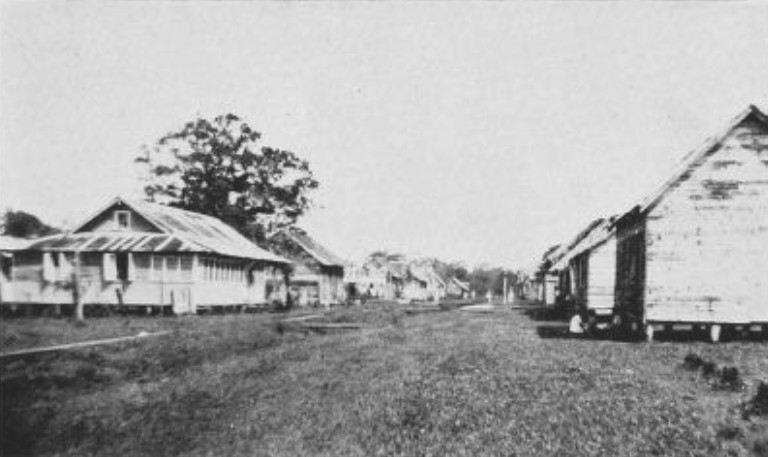
The unpaved streets were grown with grass,
neatly cropped by grazing herds of livestock. The
buildings were mostly flimsy wooden structures
sadly in need of paint. There was nothing to distinguish
Corinto—the principal seaport of Nicaragua—from
any other port along the Central-American
coast.
A railway—one of the American-managed institutions—carried
me inland through a scraggly jungle.
The country was comparatively level; occasional
volcanic peaks, rising abruptly from the plain, had
rendered it fertile with their lava dust; frequent
lakes indicated a plentiful water supply. Yet one
observed few of the rich plantations that covered
such land in the other Central-American republics;
occasionally there was a field of pineapples or sugar-cane;
as a rule, the road led through wilderness.
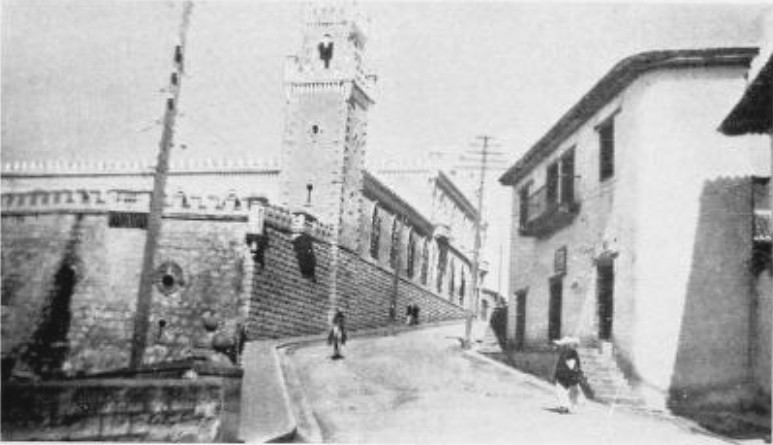
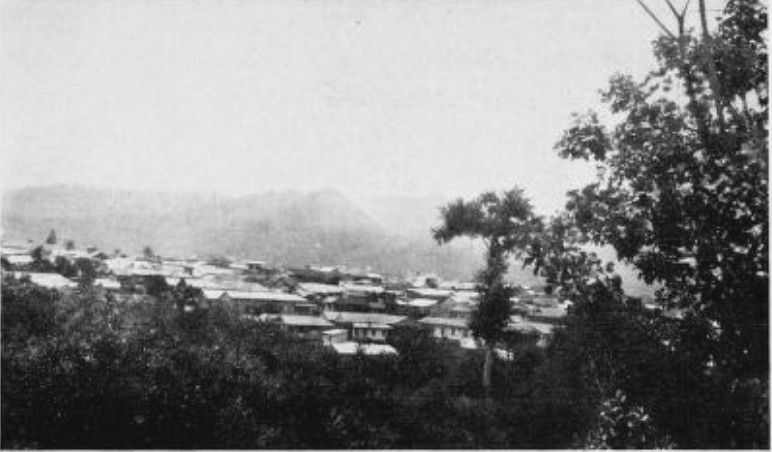
León, the second city of Nicaragua, lay thick in
dust. Its streets were unpaved. Its houses, of
brilliant green or yellow, with trimmings of blue and
red, were resplendent in the blinding tropic sunlight,
but upon close inspection, they proved somewhat
dilapidated. Its cathedral towers, rising at every
corner, were cracked and ridden from earthquake
and revolution. The whole town seemed very old
and very sleepy, and drowsing in the memories of a
past. The American occupation had brought an
end to civil strife on a large scale, but it evidently
had not brought the prosperity to mend its ravages.
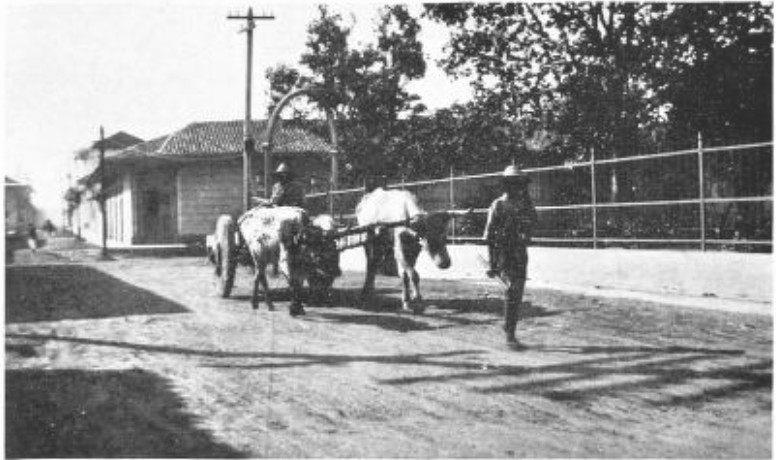
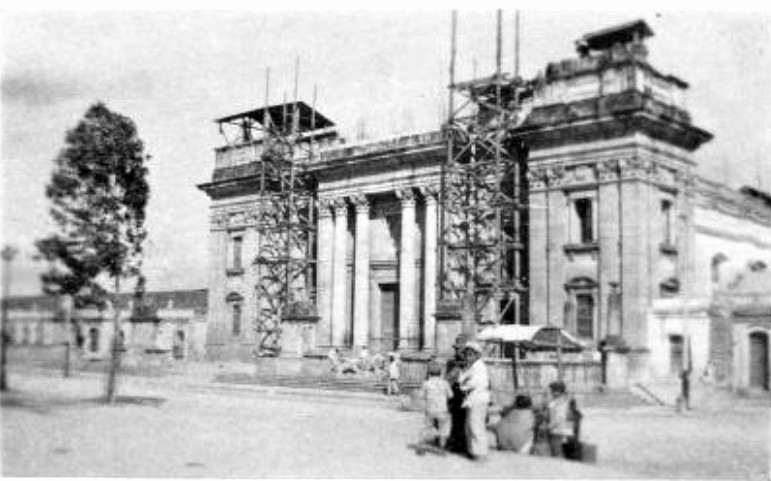
THE AMERICAN INTERVENTION HAD BROUGHT PEACE, BUT MANAGUA’S
DUSTY STREETS SUGGESTED NO PROSPERITY
Managua, the capital, was in no better repair. It
was situated at an altitude of only 140 feet—by far
the lowest altitude of any Central-American capital.
It sweltered in heat, relieved somewhat by the
breezes from its lakefront, but like Corinto and León
it was a city of sand, and the breezes filled the streets
with swirling dust. Each lumbering ox-cart left a
cloud in its wake. It lay two inches deep on the
main avenues. It covered the grassless plaza, and
the barren expanse of desert before the old cathedral,
where vegetation was sprouting from a fallen
spire. It settled upon the low roofs of the drab
shops and dwellings. It seeped inside through door
or window, and formed a coating upon the tiled floor
of the hotel. Now and then a civic employee would
turn a hose upon some portion of the Sahara, to convert
it momentarily to mud, but no sooner did he
cease than the blazing sun reconverted it to sand,
and the breezes sent it whirling again.
Nicaragua was a country of many natural advantages.
Its people appeared to be of better caliber
than those of Honduras. Its area—49,200 square
miles—was the greatest in Central America. Its
land was all suitable for cultivation. Its potential
wealth—in mahogany and hardwoods, in gold and
silver and other metals—is estimated by many authorities
to exceed that of any of its neighbors. Yet
the imports and exports of this largest republic were
far below those of Salvador, the smallest. Its cities—although
upon closer inspection, they proved to
contain better shops and hotels—were outwardly
less imposing than those of Honduras. And when
I offered a merchant a ten-dollar bill, he threw up
his hands with the exclamation:
“You must change your large money at the
bank!”
I turned to an Old-Timer, himself an American.
“Hasn’t our country done anything to make this
a regular republic?”
“Son,” he said, “this was a regular republic before
our country stepped in.”
The story of the American coöperation—which the
Nicaraguans themselves describe by a less pleasant
word—dates back to 1909.
At that time Nicaragua had a Dictator. José Santos
Zelaya had been reëlecting himself president for
seventeen years. He had commenced his reign, stern
though it was, with fairness and justice toward his
countrymen and friendliness toward foreigners. In
his later years, overwhelmed with conceit at his success,
he came to regard his Dictatorship as a right
that carried with it the privilege to amuse himself as
he saw fit. If he needed money, he horsewhipped
the wealthier merchants until they offered a “voluntary”
contribution. If he saw a woman he desired,
he sent for her to come to the palace. Presently he
commenced to meddle in his neighbor’s affairs,
fomenting revolutions in the adjoining countries,
and thumbing his nose at the United States.
In 1909 a revolution started in his own country,
over at the isolated port of Bluefields on the Caribbean
coast. There are rumors that it had the backing
of American capitalists. These rumors arise
from the fact that Adolfo Diaz, then the treasurer
of the revolution—and later the leading actor in the
drama—was an humble employee of an American
concern. Diaz denies these rumors. “Every
penny,” he told me in Managua, “was contributed
by Nicaraguans.” But certain it is that the revolution
had the sympathy of the United States government.
President Taft, at the time, frankly described
Zelaya in a message to Congress as “an international
nuisance.” And when, during the fighting,
the Zelayistas executed two American soldiers of fortune
caught red-handed attempting to dynamite
troopships on the San Juan River, the American
government made this trivial incident the pretext
for hinting broadly that it was time for Zelaya to
resign. Zelaya did resign, leaving the presidency
in the hands of an excellent man backed by all the
old lieutenants of the Zelayista party. The United
States was not satisfied. And when the Zelayistas,
having licked the revolutionists to a frazzle, were
about to take their stronghold at Bluefields, an
American gunboat intervened on the ground that
further fighting might destroy American property.
From some mysterious source—which all Latin
America believes to be the United States—the revolutionists
obtained new ammunition. They sallied
out from Bluefields again, thrashed the Zelayistas,
and overturned the government. One General Estrada,
the leader of the insurrection, became president,
but he soon gave way to Adolfo Diaz. Now
enters upon the scene the American banker.
President Diaz found the country bankrupt.
There is much controversy as to how the debt originated,
each party blaming it on the other. The
truth is that Zelaya had left several millions in the
treasury because he had just negotiated a loan with
British bankers and had not had time to spend it.
He also left a long list of claims because of his high-handed
confiscation of property. The revolutionists
had doubled the bill by their own destruction of
property during the warfare. Wherefore blame
is divided. The important fact is that Don Adolfo
found his country in debt to the extent of over
thirty-two million dollars, a staggering sum to a
small republic. He called upon a firm of New York
bankers for a loan of fifteen million.
This transaction was arranged through the
American State Department by a treaty which the
Senate—newly turned democratic when Wilson replaced
Taft—refused to ratify. Nicaragua, however,
regarded it as an agreement. As security for
the loan, the bankers took over the collection of the
customs, and arranged to look after the whole business
of the national debt. They never advanced the
loan. They did advance a million and a half, followed
by comparatively trifling sums, to stabilize
the currency and reorganize the national bank, but
they also took over the bank. Later, when another
million was advanced, they took over the operation
of the Nicaraguan railway.
President Diaz, now retired to civil life, assumes
full responsibility for these transactions. He is a
pleasant little gentleman with graying hair and a
frank, boyish smile.
“I asked the bankers to do it. I was taking the
only means I had to bring my country out of financial
chaos. But I became, as a result, the most
hated man in Nicaragua.”
In fact, all Nicaragua called him a traitor, accused
him of selling the republic to the American capitalists,
and rose to overthrow him. For three days,
in 1912, the rest of the country poured cannon balls
into Managua, until President Diaz asked the United
States for protection. Two thousand American
marines were promptly landed. Having suppressed
the revolution, they left a “legation guard” in Managua
as an intimation that the United States stood
ready to suppress any further uprisings.
Indirectly these marines make presidents to-day.
Elections in Nicaragua are as much a farce as in
Mexico. Whoever controls the polls wins the verdict.
Wherefore the Conservative party, which first
invited the American bankers, has remained steadily
in power. It can be defeated only by revolution,
which the marines prevent.
“You ought to be here at election time,” said an
old American resident, “and see them run their voters
from one booth to another by the truckload. They
number about one-tenth of the population, but they
always win.”
If the marines were withdrawn—even the Conservatives
themselves admitted to me—the present government
would be overthrown within twenty-four
hours. Nicaragua, as a whole, never endorsed the
invitation to the American capitalists. When the
Conservatives invited them, the entire country
turned Liberal. If Zelaya were to come to life and
return to Managua, he would find the republic waiting
with open arms. But while the marines are
present, the Liberals are helpless.
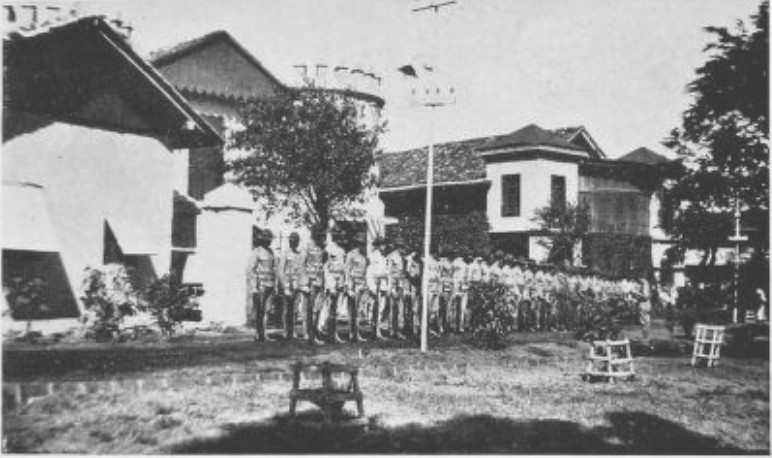
IF THE AMERICAN MARINES WERE WITHDRAWN FROM NICARAGUA A
REVOLUTION WOULD TRANSPIRE OVER-NIGHT
At the time of my visit another election campaign
was starting. Realizing their dependence upon
Washington, the Liberals had affected a change of
heart, announcing that they would support the bankers
as ardently as the Conservatives, and asking for
a new election law which would keep their opponents
from stuffing the ballot boxes. A new law had been
drafted by a New York lawyer. The Liberals were
hopeful, but uncertain.
“Who will be your candidate?” I asked one of
their leaders.
“We do not know yet,” he said. “We have not
heard who will be most acceptable to Washington.”
During my several weeks in Managua, I talked
with most of the actors who had played leading rôles
in the international drama. I do not believe that the
United States was guilty of a deep-laid plot to gain
possession of the little republic. I believe that the
American government acted for the best interests of
the Nicaraguans. But when one reviews the train
of events since 1909, one sees at a glance that they
can very easily be misinterpreted until they look decidedly
nasty. First came a revolution, assisted by
an American gunboat, which doubled the already-overwhelming
national debt. Then came American
bankers, taking charge of the national debt, and
exacting as security everything of value in the republic.
Then came the American marines, keeping
in power the minority party that invited the bankers,
against the will of Nicaragua itself. And all
Latin America chooses to regard these events as
part of a deep-laid program of intrigue.
There are always two sides to a question.
Nicaragua, under American supervision, has
made progress, but it is a progress which, both to
the permanent resident and the casual tourist, is
altogether invisible.
Outwardly, since the coming of the bankers, the
republic has marked time. No large industries have
been introduced. No railways have been built. The
greater part of the country is without means of communication
or development. The cities are in worse
repair than those of Honduras. And, although the
bankers deny it, every Nicaraguan—and nearly
every foreign resident—proclaims that the country
is far less prosperous to-day than in the worst days
of Zelaya.
This is largely due to the fact that the bankers
administering Nicaragua’s finances are devoting all
their attention to clearing up the old national debt.
Colonel Clifford D. Ham, the American collector
of customs, has reduced this debt from over thirty-two
million dollars to less than nine million. There
is no country in the world, except the United States,
whose finances are to-day in such flourishing condition
as those of Nicaragua. But this means nothing
to the average native. No Latin-American is ever
roused individually to a high pitch of enthusiasm
over the prospect of paying what he owes. Collectively
he finds the idea quite objectionable, particularly
when the indebtedness was contracted a
long time ago. And so he says, “These Americans
turn aside at our very gates every penny that would
otherwise flow into the country; they are draining
the very life-blood from the nation!” He points to
the fact that when the American government, a few
years ago, purchased the rights to build a Nicaraguan
Canal at some time in the future, and paid
therefor three million dollars, the money never left
New York, but was applied immediately upon that
infernal debt.
The national bank has stabilized the currency, so
that the Nicaraguan cordoba is on a par with the
American dollar. According to the bankers there is
more money in circulation to-day in Nicaragua than
ever before. But the Nicaraguan insists that prices
have risen so that he now can buy only half as much
as in the days of Zelaya, forgetting that prices have
risen throughout the world. “All the money is in
the bank, and I can not obtain credit without giving
security!” The Latin is not a hard, cold business
man; he resents these business-like methods; he
curses the commerciality of the gringo.
The railway, when the Americans took it over,
was a total wreck. The employees had not been paid
for two weeks, since there was just $2.49 in the cash-drawer.
The names of thirty-five dead men were
found still on the payroll. Some of the locomotive
engineers were barefoot. Most of the workers had
to draw their salary in the form of an I.O.U., which
could be cashed at a twenty per cent. discount at the
office of a local pawnbroker. Every one of any
political prominence expected a pass; the more influential
were accustomed to private cars, or to the
courtesy of having the regular passenger train stop
to wait several hours for them while they paid visits
along the line. To-day the road is in good shape;
it operates systematically as railways should operate;
it operates also at a profit instead of a deficit,
and is earning money which is steadily rebuying itself
back into the hands of the Nicaraguan government.
But the Nicaraguan is suspicious. Whenever
the American manager buys a new locomotive,
the newspapers proclaim that he has done so to run
up the bills in order that Nicaragua can not regain
control of the road.
Some day in the near future the American capitalist
will retire, leaving Nicaragua in excellent
shape for progress.
Since the Latin-American lives completely in the
present, the Nicaraguan can not appreciate work
that builds for future prosperity. He sees no visible
result of the American coöperation. He knows only
that his country has been at a standstill since the
Americans came. He loudly damns the gringo. And
all Latin America echoes his accusations against the
scheming Colossus of the North. So, unfortunately,
does many an American resident in Nicaragua.
Nicaragua is a lowland of tropical heat. It has
the least invigorating climate in Central America.
The natives are not particularly blessed with energy
or industry, and are consequently rather eager to
blame their lack of initiative to the stifling effect of
their subserviency to the United States.
Individually they are quite ready to be friendly
to any American. Collectively they love to damn the
gringos. And the newspapers of Managua and
León cater regularly to their taste by soaking every
Yankee who attains prominence in the republic.
These papers, like the dailies of Guatemala, are
mostly four-sheet publications with the flavor of
rural journalism. They are printed, usually at a
loss, by gentlemen of political aspirations who desire
an organ for self-expression. The reporters,
inspired by the same vanity, editorialize in every
news report. In mentioning the arrival of an
actress, they felicitate her and wish her success. In
describing the arrest of some petty criminal, they
express the hope that he may be convicted and
hanged and dealt with not too leniently in purgatory.
In attacking Americans, however, they reach
their highest flights of eloquence. No article on
politics or finance is complete without an allusion to
“the oppressive hand of the American banker.”
And when the banker has been exhausted as a source
of indignant outpourings, they give their attention
to the other American residents.
On one occasion they flamed out against young
René Wallace, the son of a Yankee merchant, because
he had organized a league of basket-ball clubs
among the young ladies of Nicaraguan society.
They proclaimed indignantly that he was trying to
deprive the local señoritas of all modesty and gentleness
by arraying them in bloomers and teaching
them the hoydenish games wherein no self-respecting
woman could indulge.
On another occasion they flamed out against Dr.
Daniel M. Molloy, of the Rockefeller Foundation,
because the name of Rockefeller suggested to them
another capitalistic invasion. This Foundation has
been active throughout Central America, particularly
in combating hook-worm, wherewith nearly all
the barefoot inhabitants are infected. It suppressed
a yellow fever epidemic which swept throughout
these countries in 1918. It has built hospitals, improved
water supplies, taught hygiene, and worked
in many other ways for the betterment of the various
republics. The ignorant peons, indifferent to
hygiene, had always regarded sickness and disease
as something inevitable, to be accepted with fatalistic
patience. In infant mortality, Mexico surpasses
all the world’s civilized communities, while
its total death-rate is thrice that of the United States,
and it is safe to assume that the Central-American
republics—in the absence of statistics—keep pace
with Mexico. The educated classes have never made
much effort to relieve this situation. In Tegucigalpa
a recently appointed director of a government hospital
had to begin his work by removing forty-two
cans of garbage left in the hospital patio by the last
director. The Rockefeller Foundation there, in employing
a new native physician of high standing in
the community, discovered that he had never studied
bacteriology and had but a vague idea that any
diseases were caused by germs. In lands where
such conditions prevail, the Foundation should
have been hailed as a God-send, especially since it
came largely at its own expense. But a newspaper
in León published daily editorials attacking Dr.
Molloy, and insisting that Rockefeller would presently
be demanding oil concessions. When no such
demands were forthcoming, the editor found another
argument in the fact that Dr. Molloy was advocating
new methods in sewerage disposal.
“Aha!” he shouted on his front page. “We see
the nigger in the woodpile. This gringo is a secret
representative of a manufacturing firm that hopes
to sell us American plumbing devices!”
At the time of my sojourn in Managua, there was
a temporary lull in such attacks, for the city was
indulging in its semi-annual outburst of culture.
The aristocrats of Central America are very fond
of theatrical entertainment, and some of the republics
have built national theaters, but such is the expense
of bringing artistes from Europe that performances
are rare, and usually subsidized by the government.
Frijolita, who had danced before all the crowned
heads of Europe, had recently been performing in
Tegucigalpa. The Honduran government, having
paid her expenses to the country, had allowed
her to get out as best she could, wherefore she was
now about to dance in the neighboring capitals.
All Nicaragua felt honored. Every poet in the
country tuned his lyre, and prepared to sing her
praises.
In Central America nearly every one who can
write is a poet. The composition of verses is a universal
indoor sport among the young men. On Sunday
each newspaper devotes a page to the unremunerated
labors of the local bards. Guests at the
hotels, seeing me scribbling in a note book, always
inquired whether I were writing verses. Every one
who can afford the luxury, prints privately his musings,
which no one else ever seems to read. When it
became known that Frijolita would dance, the editors
themselves took a crack at versification, and
published their outpourings neatly boxed on the first
sheet.
I shared my hotel room with Bosco, the tenor, and
Maestro, the orchestra conductor. Frijolita, stopping
at the most expensive hotel, had dispatched
them to the sort of hostelry where itinerant travel-writers
were forced to stay, and they were much incensed.
But to our room came the minor devotees
of art from the Nicaraguan population to bask in
their glory, and both Bosco and Maestro entertained
them with stories of Frijolita’s absurd temperament,
and with sly comments upon her age, suggesting
that she had not really danced before a crowned
head since Napoleon Bonaparte went into exile.
Bosco was a cheerful person. He was small and
rotund, but he sang divinely, and was not stingy
with his accomplishment. In the early morning he
poked a bleary countenance from his mosquito-net
and greeted the Indian servant-maid with an aria.
Then he would stroll out into the patio in his pajamas,
carrying his guitar, to serenade the other ladies
of the establishment.
Maestro was a withered, elderly person, once famous
but fallen into obscurity. He was taciturn and
unsociable. His one love was his fiddle. He would
stroll away by himself to the back regions of the
hotel, where he found inspiration in the banana trees
and the rubbish heap, and there he would evoke
weird squeals from his instrument in an effort to
perfect what he described as a new technique.
Frijolita remained at the more expensive hotel,
giving out daily interviews to the press about the
many royal scions who had committed suicide because
she could not respond to their love. Her husband
sometimes came to call upon us. He was a
dapper little fellow; his hair was very long; his face
was always neatly powdered; his smile was endearing.
He would greet us with a gentle wave of the
hand or a gesture of his cane; ask after our health;
and withdraw gracefully, a vision of dainty, silken-clad
ankles, leaving a trail of haunting perfume behind
him.
A week elapsed. Maestro devoted it to informing
his acquaintances that Frijolita was treating him
like a dog. Then came the much-awaited début.
The theater was a shabby structure of European
design, its two balconies consisting of boxes and
loges, where sat the ladies of society. The unattached
men filled the pit, many with their hats on,
craning their necks to stare aloft. We waited an
hour and a half for the President. He finally
arrived. Every one rose. The orchestra played
the national anthem. It was greeted with vast applause.
Little withered Maestro turned and bowed.
Then the orchestra played again—that piece about
daybreak or springtime or something wherein the
trapdrummer usually toots upon a bird-whistle.
Here the trapdrummer had no bird-whistle. But
the curtain went up just the same, revealing a conventional
backdrop, and a huddled mass of plumes
in the foreground which proved to be none other
than Frijolita herself, apparently asleep.
More applause! Thunderous applause! It awakened
Frijolita. Very slowly she arose from the floor
and commenced to undulate. At some time in the
distant past, one sensed that she had been a great
dancer. Nowadays one felt that she had reached the
stage where she ought to interpret only the classics.
She was just a bit too heavy to do popular stuff.
But she was game. She undulated faster and faster.
She flitted and romped and turned somersaults.
Applause became a roar of approval. The music
ceased. She bowed, leaped behind the curtain,
emerged in a Spanish shawl, unwound it and threw
it away, leaped back behind the curtain, emerged in
another shawl—
There were fourteen shawls to be unwound, while
the roar grew to a tumult. Then she was gone.
Bosco, who was not singing to-night, came out of
the wings, and hurried through the auditorium with
a preoccupied air to let the public know he was connected
in some way with the troupe, while Maestro
acknowledged with grateful genuflections the approval
of the spectators. It was an exhibition such
as might be seen in any second-rate vaudeville house
on Broadway as a curtain-raiser, but it was an event
in Managua. Most of the Nicaraguans recognized it
as an inferior performance, but outwardly they
maintained an air of joyous appreciation largely
patriotic.
Frijolita had no supporting troupe. There was
a brief intermission; then she broke loose again.
This time she displayed an elephantine pair of bare
legs, and the roar of approval increased. Again and
again she danced, interpreting thereby—according
to the program—the latest wiggles of every land
from Egypt to Japan. She came finally to her masterpiece,
the genuine Hawaiian hula-hula. And then
occurred the unexpected climax. Maestro, either by
accident or malicious design, stopped his music too
soon, leaving her with one foot in the air.
Frijolita flew into a rage. Her far-famed temperament
burst all bounds. Rushing to front-stage, she
screamed revilement at the musician. All Managua
cheered her. Rising in his wrath, Maestro screamed
revilement at her. And all Managua cheered him.
Frijolita was outraged. She seized such pieces of
scenery as were not nailed down, and commenced to
hurl them. The President, feeling that the whole
affair was beneath his dignity, took his departure.
Frijolita’s husband came teetering forward to mediate.
“Qué pasa?” he inquired pleasantly. “What’s
the trouble?”
Frijolita glared at him.
“What sort of man are you? Why don’t you defend
me?”
He fled before another shower of scenery, and
Frijolita fled after him. Managua carried the little
Maestro out upon its shoulders, and treated him to
champagne, delighted at the unanticipated entertainment
he had offered.
But the next day the local papers did not mention
the incident. Perhaps the editors felt that they
must maintain appearances, and that Managua’s
semi-annual outburst of culture should pass off—in
the press at least—with éclat. Or perhaps they had
already composed their poems, and could not deny
themselves the satisfaction of publishing them. For
the verses appeared, neatly boxed on the first page,
eulogizing the performance of the incomparable
artiste, Frijolita.
Managua, of late, has gone in for sports.
The marines have taught the natives to box and to
play baseball. In the latter game, the Nicaraguan
boys invariably defeat their mentors. In boxing,
they still have much to learn, but they are promising.
The newspapers write up the events with a Latin-American
flavor. In the advertisement of a baseball
match, the public is advised not to miss:
“A wonderful sporting event! Colossal stealing
of bases! Lightning-light flight of ball from pitcher
to catcher! Formidable blows of the bat! Thrilling
to the emotions! Do not miss it! Do not miss it!
To the field on Sunday at the ten of the morning!
To the field!”
Baseball is firmly established. Boxing has long
been opposed in Latin America as a brutal amusement
suitable only to gringos, but it has gained
much popularity since the advent of Firpo.
One Sunday afternoon I drifted out to the field
to see the local champions. There was a rickety
grand-stand, but the ring stood far away from it in
the center of a bare pasture. If one wished a ringside
seat, one could take a camp-chair and move it
wherever he pleased. Every one started back in the
shade of the stand, and edged his seat forward as
the shadows lengthened, finally reaching the ring in
time for the final bout.
The promoter acted as introducer and referee.
He was a prominent local politician—a large, stout
gentleman in a big leather sombrero. He commenced
with two diminutive urchins, who knew nothing
of boxing; they fought so gamely that they were
fagged before the end of the first round, but they
struggled through three of them, obtaining additional
rest while the promoter explained that they
must not kick or bite, and then returning to the fray
to put both hands together and shove them toward
the adversary’s face.
Next came two older boys. Then two full-grown
men, one barefoot, one in shoes and silk shirt. The
barefoot one, a wild-looking Indian with dark face
and long hair, had evidently learned his strategy by
watching game-cocks. He kept edging sidewise as
though he did not see the other fellow. He would
start his swing by winding up like a baseball pitcher.
The other could always see it coming and leap aside,
but it was an unwieldy swing, and the other invariably
jumped into it, until his silk shirt was crimson.
The spectators were delighted. They could not
appreciate science, but they recognized blood when
they saw it, and screamed their approval. The
Indian won.
Then came the semi-finals and the finals. Here
the participants were trained to some extent, but
they were handicapped by Latin vanity. They were
constantly posing before the crowd. Between the
rounds, instead of resting, they would turn to their
admirers to make a speech. “He got me by accident
last time, but I’ll show you something when the
bell rings.” If one were knocked to the floor, instead
of taking his count of nine even when he sadly
needed it, he would leap immediately to his feet,
determined to redeem himself in the eyes of his followers.
Or one of them, having backed the other
against the ropes and pummeled him to a pulp,
would forgo his advantage to listen to the applause.
But these men were fighters. The old phrase,
“the fistless Latin,” is rapidly becoming obsolete.
These scrappers never stalled or clinched to save
themselves or to gain time. They fought harder
than any American pugilist. And they had infinite
courage. In the final bout one youth was greatly
outweighed; his opponent cut his eye in the very
first round so that he was almost blinded; even the
Nicaraguan spectators, much as they loved gore,
suggested that the battle should stop, but the little
fellow insisted on continuing; he was beaten into a
bloody mess, knocked down again and again,
pounded until it became a torture, but he never wavered;
the moment he regained his feet he rushed
forward courageously for additional punishment
with a fortitude that no Anglo-Saxon could surpass.
In many phases of life these people acquit themselves
as poor sportsmen, especially in their politics,
but they are learning. Sportsmanship, after all, is
not a hereditary virtue, but one acquired through
experience. What American can not recall the many
squabbles that marked his earliest boyhood ventures
into athletics? It is only by training that one learns
to abide by the decision of an umpire. I was rather
amazed to notice that not one of the Nicaraguan
boxers contested the decision of the referee.
The one American resident that the Managua
newspapers do not occasionally attack is the Marine.
Some years ago one periodical published an editorial
accusing the Legation Guard of general misconduct,
whereupon the soldiers promptly wrecked
its plant. No such accusations have been repeated.
There are about a hundred and fifty marines in
Managua. They were the cleanest-cut body of
young men that I had ever seen anywhere. There
was no drunkenness among them, no rough-house, no
swaggering or bullying attitude toward the natives,
no tendency to pick a fight with the local police.
“The only difficulty we ever have,” said the
American minister, John E. Ramer, “is that now
and then one of them falls in love with a Nicaraguan
señorita. The lad might be able to support her in
her accustomed luxury here, but he couldn’t do it
at home. Consequently, for the best interests of
both parties, the officers—if they see it coming—try
to cheat Cupid by transferring the man to another
post.”
The barracks are situated on the outskirts of town.
The men are well quartered—with drill-grounds,
club, baseball diamond, moving picture theater, and
tennis courts—and so completely comfortable that
a Nicaraguan president, paying a visit to the camp,
once threw up his hands in astonishment with the
exclamation:
“Your privates live like generals!”
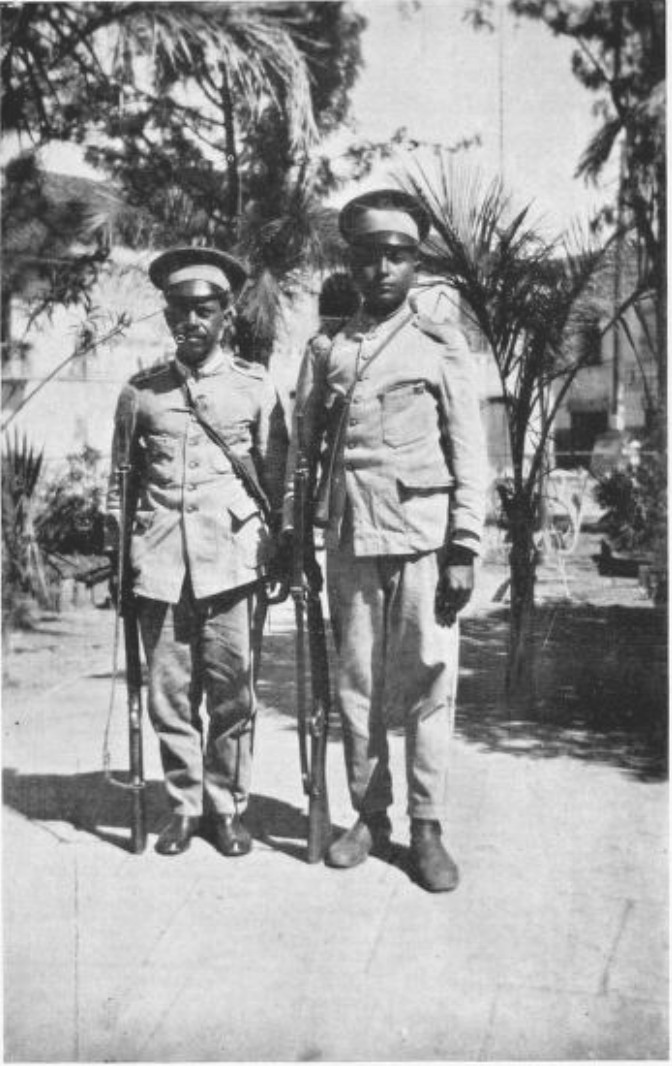
Adjacent to their cantonment is that of the Nicaraguan
soldiers. I strolled over to the native barracks
one day with Corporal Landy, the Legation
orderly.
“Hello, you bandits!” he greeted them, and all
the Nicaraguans grinned. “These devils,” he explained
to me in Spanish, that they might hear,
“never have any drill or fatigue or anything else to
do except to sit around and watch us sweat.” And
they all chuckled good-humoredly, as though they
liked it. Very casually he took the gun away from
a native sentry to show me the rust upon it. “And
that cannon they have there, if you were to fire it,
would turn a somersault and land on its back.”
They talked together on friendly terms about the
night last year when a revolution was expected.
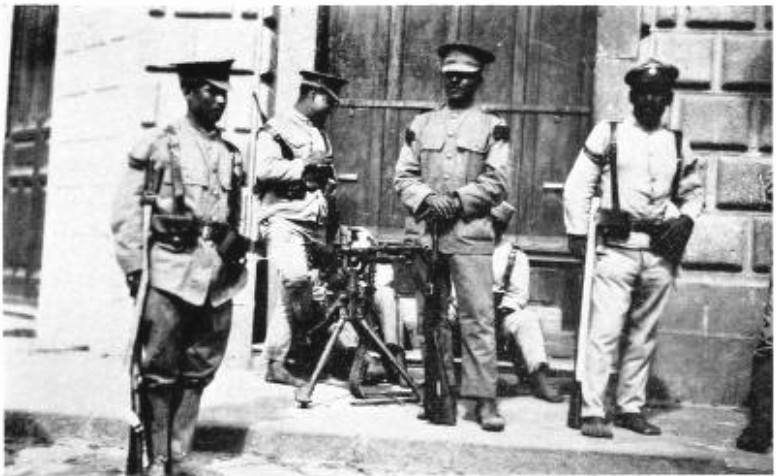
Each had the other covered with machine-guns in
case of an emergency. They laugh about it now, and
each assures the other, “I was aiming straight at
you that night.”
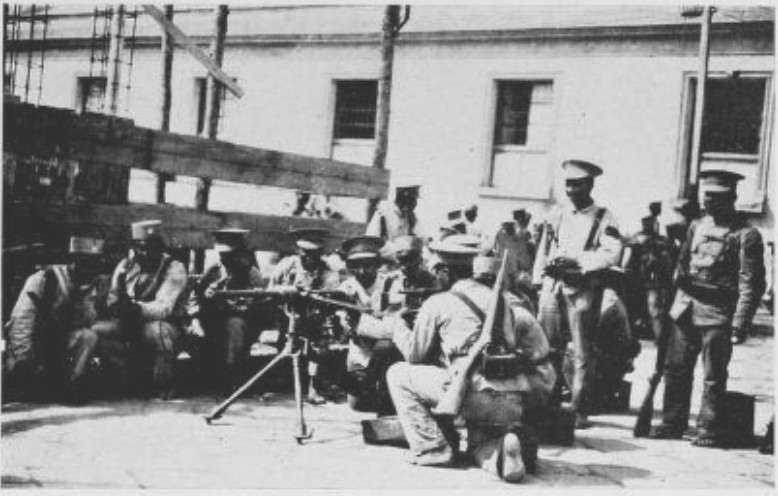
I attended an inspection one Saturday morning.
The Rochester, previously at Amapala, had reached
Corinto, and Admiral Dayton came up to inspect the
troops. There was a close-order drill, then extended
order, then fire call, and finally the call to arms
wherein every man took the post he would take in
case of actual fighting in Managua. The bugle rang
out. There was a scurrying of machine-gunners to
the various emplacements about the barracks.
Down by the front entrance the sallying party
formed to charge with fixed bayonets through the
streets of Managua.
Just across the line, the Nicaraguan troops sat
cross-legged on the ground, and grinned appreciatively,
as though they felt that this was an exhibition
staged for their personal entertainment. They
themselves were never called upon to practice for
such emergencies. When the marines first did it,
some years ago, the native soldiers had all scurried
back into the barracks to get their own guns, while
an anxious presidential voice came over the telephone
wire to the American Legation, demanding:
“What’s the matter in your camp? Your marines
are running about like madmen! Are they declaring
war upon us?”
They soon assembled again, and marched back to
the barracks, while the band played “Dixie,” and
the stars and stripes floated in the breeze. This
whole occupation, because of its aspect in foreign
eyes, was a thing that might be deplored, but what
Yankee in a far-away land would not be thrilled at
the sight?
It is natural that the Nicaraguan resents American
intervention.
There exists in the Latin-American’s character a
combination of inefficiency and pride which induces
the inferiority complex. His inefficiency sometimes
leads him into a muddle from which he is unable to
extricate himself. He invites the foreigner to help
him out. Then his pride asserts itself. He resents
the fact that he has been obliged to call upon the
foreigner. He proceeds thereupon to damn him.
During my stay in Managua, the rumor circulated
about—an ever recurrent rumor there—that the
marines were to be withdrawn. Inside of an hour
the American Legation was filled with diplomats
from foreign countries, and merchants who owned
property in Nicaragua, all anxious to know if the
rumor were true, all fearful of the destructive revolution
that would follow overnight, all eager to protest
against the withdrawal of the much-abused
gringos.
In the crowd were many Nicaraguans who had
been loudest in their condemnation of the United
States.
Like most persons with the inferiority complex,
the Latin-American is extremely sensitive. He resents,
even more than the humiliation of gringo
assistance, the assumption of loftier worth which
usually characterizes the Anglo-Saxon.
This assumption, to us, is often quite unconscious.
If we are aware of our national self-satisfaction,
most of us try to hide it when traveling in the southern
republics. Our diplomats and business men seek
valiantly to proclaim our great admiration of our
neighbors. It has become the fashion in our writing
to promote an entente cordiale by flattering the
people of these countries. The charming woman
writer in particular—who makes a brief trip to the
more modern cities of Chile and the Argentine,
meets only the aristocracy, and completes her book
as a bread-and-butter letter to the delightful people
who fed her tea and cakes—is inclined nowadays, in
her impulse to jolt out of his complacency the reader
at home, to picture all the Latin-Americans as infinitely
superior to our own crude selves.
Yet all of us, even though we may have acquired
a strong affection for our friends of the southland,
still consider ourselves their peers. We know that
every gringo is not to be ranked above every Latin-American.
But we are confident that man for man—lawyer
for lawyer, doctor for doctor, soldier for
soldier, farmer for farmer—the Anglo-Saxon usually
surpasses his counterpart in physique, intelligence,
education, ability and character, if not in
refinement. The Latin-American himself is aware
of the contrast. He may, and sometimes does, voluntarily
admit it. But he is naturally a trifle resentful
when the gringo, by word or action, reminds him
of it.
We remind him quite frequently. The most considerate
traveler will lapse unintentionally at times
into an attitude of condescension. Our kindly
church-goers at home contribute their pennies to
missionary enterprises in order that he may be
educated and uplifted. And as though this were
not the supreme height of international insult, however
much he may actually need education and uplift,
we appoint ourselves the policemen of the continent,
take him under our paternal wing, and
threaten to spank him if he misbehaves.
We assume that he should appreciate our kindliness
and love us as the big brother we consider
ourselves to be. On the contrary, he not only dislikes
us as a nation, but distrusts our motives. He
looks upon us—and frequently with good cause—as
hypocrites who pat him upon the back as a prelude
to selling him American products. In our missionary
efforts he sees only a colossal national vanity.
In the application of our Monroe Doctrine he scents
an ambition for the conquest of his country.
To the average American this last statement may
sound ridiculous. When we promulgated that doctrine,
we thought only of Europe. It was later, when
we realized that European nations might disregard
it unless their citizens or property were protected in
Latin America that we undertook to supervise the
conduct of our neighbors’ wars and revolutions.
Our ambitions for conquest at present are purely
commercial. But there are several incidents in our
past history which these little republics remember
with foreboding. They remember, for instance, that
we fought with Mexico about Texas, and emerged
victorious with Arizona, Utah, Nevada, and California.
They feel that there is something a little
funny in the way Panama started its revolution
against Colombia just about the time we wished to
build the Panama Canal. They question our philanthropic
motives in Nicaragua. They are always
wondering where the lightning may strike next.
So firmly convinced are most of our neighbors that
we are what they always describe as “the grasping
Colossus of the North,” that when our government
exercises forbearance, they merely suspect us of
cowardice. When Woodrow Wilson for many years
let Mexico literally get away with murder, his idealism
was misunderstood. For a time Latin America
looked upon the United States as a braggart that
never executed its repeated diplomatic threats.
Carranza, the special protégé of our State Department,
posed before the neighboring presidents as a
guardian of Latin-American rights, and had envoys
touring the southern continent in an effort to align
Guatemala, Nicaragua, Colombia, Chile, Argentina,
and other countries, in a secret entente against the
United States.
Personally I dislike our meddling in Latin-American
affairs. It seems to me that it should be any
government’s privilege to run a revolution in its
own country if it so chooses. But there are many
gringos in all these republics, who came there in
accordance with local constitutional guarantees, and
sometimes at the invitation of the government itself,
who must be protected. If we do not occasionally
step in, Europe will. Latin America—with the exception
of the few nations which conduct their elections
in peace—expects it. The Latin-American
resents it, but he despises us when we abstain.
If we are to uphold our prestige, however, we
must apply our foreign policies—whatever they
may be—to all republics consistently.
“We never know just what to expect from your
government,” a Supreme Court justice said to me in
Honduras. “You tell us again and again, for instance,
that you will recognize only a constitutionally
elected president, who gains office without force.
Yet to-day you have recognized nine Latin-American
presidents who did gain office by force.”
These were the presidents of Peru, Bolivia, Venezuela,
Nicaragua, Salvador, Honduras, Guatemala,
Santo Domingo, and Mexico.
“And you tell us also,” continued the Justice,
“that at all times, we must protect American property.
If we of the little countries do not, you immediately
send down your gunboats. In Nicaragua,
two American filibusters, convicted of murder, are
executed, and presently you take over the entire
country. In Mexico, during many revolutions,
countless Americans are slain, and much property
damaged, and you content yourselves with writing
notes. To us of the little countries, it all seems very
unfair.”
As to the recognition of Latin-American presidents,
Heaven help the State Department to apply a
consistent rule, when so few are legitimately elected!
But as to the protection of American property,
there can be but one right course. Either it is not
worth protecting, or it is, whether it be in Nicaragua
or Mexico. Practically all Central-Americans to-day,
although too polite to voice their opinion, look
upon us as something of a bully who picks on the
weaker republics.
That they are so friendly, despite their fancied
grievances, is a tribute to the natural kindliness of
these people.
Even in Nicaragua, although the press may attack
the gringo, the people as a whole are cordial to any
individual American who will meet them half-way.
“I went home last year,” said one of the Old-Timers.
“I’d been here for ten years, but no one
in my own town seemed to make much of a fuss over
me. They just shook hands and remarked, ‘Let’s
see; you’ve been away, haven’t you?’ But when I
came back and stepped off the train in Managua,
every porter and coachman on the platform recognized
me. The bootblacks grinned all over their
dirty brown faces. And my neighbors all came
hurrying to my house to hug me, and slap me on the
back, and make those funny gurgling noises. That
was my real homecoming.”