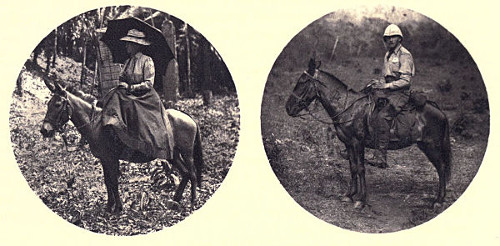
The first historical notice of the Maya Indians comes to us from
Columbus, who did not get in touch with the more civilized races of
America until the end of his career as an explorer, and then by an
unlucky chance he failed to follow up the clue. During his fourth
voyage Columbus landed on Bonacca, one of the Ruatan group of islands
lying about thirty miles from the northern coast of Honduras, and the
story of his meeting with the Maya Indians is well told by Washington
Irving:—
“The Adelantado, with two launches full of people, landed on the
principal island, which was extremely verdant and fertile. The
inhabitants resembled those of other islands, excepting that their
foreheads were narrower. While the Adelantado was on shore, he beheld
a great canoe arriving, as from a distant and important voyage. He
was struck with its magnitude and contents. It was eight feet wide,
and as long as a galley, though formed of the trunk of a single tree.
In the centre was a kind of awning or cabin of palm-leaves, after the
manner of those in the gondolas of Venice, and sufficiently close to
exclude both sun and rain. Under this sat a cacique with his wives and
children. Twenty-five Indians rowed the canoe, and it was filled with
all kinds of articles of the manufacture and natural production of the
adjacent countries. It is supposed that this bark had come from the
province of Yucatan, which is about forty leagues distant from this
island.
“The Indians in the canoe appeared to have no fear of the Spaniards,
and readily went alongside of the admiral’s caravel. Columbus was
overjoyed at thus having brought to him at once, without trouble or
danger, a collection of specimens of all the important articles of this
part of the New World. He examined, with great curiosity and interest,
the contents of the canoe. Among various utensils and weapons similar
to those already found among the natives, he perceived others of a
much superior kind. There were hatchets for cutting wood, formed not
of stone but copper; wooden swords, with channels on each side of the
blade, in which sharp flints were firmly fixed by cords made of the
intestines of fishes; being the same kind of weapon afterwards found
among the Mexicans. There were copper bells, and other articles of the
same metal, together with a rude kind of crucible in which to melt
it; various vessels and utensils neatly formed of clay, of marble,
and of hard wood; sheets and mantles of cotton, worked and dyed with
various colors; great quantities of cacao, a fruit as yet unknown to
the Spaniards, but which, as they soon found, the natives held in great
estimation, using it both as food and money. There was a beverage also
extracted from maize or Indian corn, resembling beer. Their provisions
consisted of bread made of maize, and roots of various kinds, similar
to those of Hispaniola. From among these articles, Columbus collected
such as were important to send as specimens to Spain, giving the
natives European trinkets in exchange, with which they were highly
satisfied. They appeared to manifest neither astonishment nor alarm
when on board of the vessels, and surrounded by people who must have
been so strange and wonderful to them. The women wore mantles, with
which they wrapped themselves, like the female Moors of Granada, and
the men had cloths of cotton round their loins. Both sexes appeared
more particular about these coverings, and to have a quicker sense of
personal modesty than any Indians Columbus had yet discovered.
“These circumstances, together with the superiority of their implements
and manufactures, were held by the admiral as indications that he was
approaching more civilized nations. He endeavoured to gain particular
information from these Indians about the surrounding countries; but as
they spoke a different language from that of his interpreters, he could
understand them but imperfectly. They informed him that they had just
arrived from a country, rich, cultivated, and industrious, situated to
the west. They endeavoured to impress him with an idea of the wealth
and magnificence of the regions, and the people in that quarter, and
urged him to steer in that direction. Well would it have been for
Columbus had he followed their advice. Within a day or two he would
have arrived at Yucatan; the discovery of Mexico and the other opulent
countries of New Spain would have necessarily followed; the Southern
Ocean would have been disclosed to him, and a succession of splendid
discoveries would have shed fresh glory on his declining age, instead
of its sinking amidst gloom, neglect, and disappointment.”
Intent on discovering a strait by which he might gain the southern sea,
Columbus ignored the advice of the Indians to travel towards the west,
and thus the discovery of Yucatan and Mexico was left to others.
In the year 1517 an expedition was organized in Cuba under the command
of Francisco Hernandez de Cordova, for the purpose of discovering
new lands to the westward, and among the volunteers who joined the
expedition was that perfect type of the Spanish “conquistador,”
Bernal Diaz del Castillo, who was the eye-witness of so many stirring
events of those days, and whose delightful account of his adventures,
dictated to his children in his old age, is one of the most valuable
contributions to the history of the time. On leaving the west end of
the island of Cuba the three vessels which carried the explorers were
nearly lost in a severe storm, and it was not until the twenty-first
day of the voyage that they made land near Cape Catoche, the north-east
point of Yucatan. Here, for the first time, the Spaniards saw Indian
houses built of stone; to quote Bernal Diaz, “From the ships we saw a
great town about two leagues from the shore; as we had never seen in
Cuba so great and populous a place we named it ‘El Gran Cairo.’” The
natives, who came off to the vessels in large dug-out canoes, made
friendly overtures to the Spaniards and induced them to land and march
towards the town, but as soon as the Spaniards got into broken ground
a treacherous attack was made on them, and they were forced to retreat
and take refuge in their ships. The expedition then coasted along the
north and west shore of Yucatan, until it reached the town of Campeche,
when again men were landed, and this time met with a somewhat better
reception from the natives. “They led us,” Bernal Diaz writes, “to
some very large houses well built of stone and plaster, which were the
sanctuaries of their Idols, where we saw figures of great serpents and
other Idols carved and painted on the walls surrounding an altar which
was drenched with blood still fresh.”
The next landing was made a little further down the coast at Champoton,
where the explorers received such a rough handling from the Indians
that only one of them escaped unhurt, and Hernandez de Cordova himself
died of his wounds on the return voyage when within a few days’ sail of
Cuba. Throughout the account of this expedition Bernal Diaz notes the
bravery of the Indians, who fought the Spaniards hand to hand, and the
excellence of their clothing, their arms, and their buildings. During
the following year another expedition was despatched, under the command
of Juan de Grijalva, who, also failing to make any headway against the
natives of Yucatan, continued his voyage to the westward, discovered
the coast of Mexico, and brought to light the riches of that country.
The success of Grijalva’s expedition fully aroused the interest of the
Spaniards, and it was immediately followed up in February 1519 by the
far-famed expedition under the command of Hernan Cortés, which resulted
in the conquest of Mexico. Cortés, like his predecessors, on leaving
Cuba made for the coast of Yucatan, but after a stay of some days’
duration in the Island of Cozumel, he pushed on round the coast without
delay to the mouth of the Tabasco River, where he fought a battle with
the natives and took formal possession of the land in the name of the
King of Spain. No attempt, however, was then made at colonization,
and Cortés re-embarked his soldiers and pressed on to the rich prize
of Mexico. Five years later, after Mexico had been conquered, Cortés
returned to the province of Tabasco, and thence crossed the base of the
peninsula of Yucatan in the course of his celebrated march to Honduras.
No effort was made to subdue the Mayas of Yucatan until the year
1528, when Francisco de Montejo, who had been appointed Adelantado of
Yucatan, landed on the north-east coast with four hundred Spaniards
and marched towards the interior. Unfortunately no contemporary record
of this expedition is in existence, and we know little more than the
fact that at the end of two years the Spaniards were driven from the
country. It was not until the year 1540 that any further attempt was
made at conquest; in that year Francisco de Montejo, the son of the
Adelantado, marched inland from Campeche, and two years later founded
the town of Merida, the present capital of the country, whilst his
cousin, another Francisco de Montejo, marched to the eastward and
founded a settlement at Chuaca, which a few years later was moved to
the present site of the town of Valladolid. From this time forward the
dominion of the Spaniards over the northern and western portions of
Yucatan remained undisturbed, but they never succeeded in subduing the
natives in the central and eastern part of the province, and the Santa
Cruz Indians maintain their independence of the Mexican Government to
the present day.
The northern part of Yucatan is little better than a coral-reef raised
a few feet above sea-level, covered with a thin coating of earth
which supports a scrubby growth not worthy of the name of forest. The
sea around the coast is everywhere shallow, and to the northward the
great Bank of Yucatan extends for more than eighty miles from the
shore before the line of fifty fathoms is reached. We had drifted over
the edge of this bank in a steamer with a broken shaft on my return
from Guatemala in 1885, and found an anchorage in forty-five fathoms
of water at a distance of over fifty miles from the land. The most
curious fact about this strange country is the total absence of rivers
and even of streamlets. The heavy rainfall soaks through the porous
limestone rock and oozes out again along the northern coast-line. The
water-supply of the inhabitants is found in deep caves or openings in
the limestone, known as “’cenotes,” the Spanish form of a Maya word,
which the reader will nearly approach by trying to pronounce “tznot” as
a monosyllable[2].
With a low coast-line, a shallow sea, and an absence of rivers, follows
a lack of good harbours; at Progreso there is merely an open roadstead,
where the steamers anchor two miles from the shore, and at Campeche
the conditions are much the same, only small vessels finding a little
shelter by lying inside a raised coral bank.
On my voyages between Livingston and New Orleans I had frequently
passed along the coast of Yucatan and had twice caught sight of the
small ruined temple on the Island of Mugeres; but it was not until
the winter of 1888-89 that I was able to set foot in the country with
the purpose of examining some of the ruins, and I then chose Chichén
Itzá as the site giving promise of the best results. There were
disadvantages in thus breaking new ground, not the least of which was
the absence of my faithful companions Gorgonio Lopez and his brothers,
and I was well aware how greatly I should miss their assistance.
Landing at Progreso on Christmas Eve I went on by rail, for a distance
of about twenty-five miles, through a flat and uninteresting country to
the city of Merida, and at once commenced preparations for the journey
to Chichén.
I was soon to have experience of the inconvenience which may easily
arise from the want of a good harbour, for the captain of the steamer
carrying all my heavy baggage, encountering a heavy “norther” as he
approached the port of Progreso, preferred the open sea to anchorage on
a lee shore, and passed on to make the round of the gulf ports before
returning to land my cargo at Progreso a fortnight later.
Merida, as described by Stephens, was a charming, old-fashioned,
out-of-the-world, sleepy city, with a cultivated and hospitable upper
class of Spaniards and a picturesque population of Mestizos and
Indians. Merida, as I found it, was a modernized Spanish-American town
in the throes of a “hemp” boom. The picturesqueness of the half-caste
population remained, but there all the charm ended. There is only one
product of the country which Europeans have found profit in cultivating
for export, and that is the Agave rigida, a plant nearly related to
the American aloe, which is known locally as “Henequen,” and produces a
fibre that has become of considerable commercial importance under the
name of “Sisal hemp.” It is to the increased demand for this fibre that
at the time of my arrival the people of Yucatan owed a somewhat sudden
access of riches. The rocky soil seems to suit the plant to perfection,
the cultivation is simple and not very laborious, and cheap machinery
had been devised for the extraction of the fibre from the leaves, so
that for some time past it had been possible to sell the product at two
cents a pound and leave a fair margin of profit. The henequen fibre is
much inferior to that extracted from the stem of the banana and known
as Manila hemp, but so small has the world become that a hurricane in
Manila which destroyed the banana plants at once brought wealth to
Yucatan. The loss of the Manila crop was accentuated by the increased
demand for twine in North America for use in the reaping and binding
machines which are so largely employed in harvesting the gigantic
wheat-crop of the Western States, so that during my stay in Yucatan the
price of henequen rose to thirteen cents a pound!
This was not a fortunate state of affairs for me, as I had need
of many hands to help in clearing the ruins, and now that every
proprietor was eager to increase the size of his henequen plantation,
field-labourers were in great demand; I could only hope that as Chichén
Itzá lay far from the centre of commercial activity, the villages in
its neighbourhood might for some time yet escape the effects of the “boom.” I had been accustomed in Guatemala and Honduras to depend to
a great extent on the assistance of the local officials in engaging
labourers; but although, through the kindness of the English Minister,
I had come with ample recommendations from the Mexican Government to
the local authorities, I found that I could not look for the same
favourable result in Yucatan, as the Indians are less under the control
of officials than they are under that of a small number of powerful
Spanish families who are all large land-holders. Although the status
of slavery does not legally exist, custom is slow in dying, and the
greater number of Indian labourers are still tied to the soil.
After a month of weary waiting in Merida, during which time the only
pleasant episodes were a short visit to Mr. E. Thompson, the United
States Consul, who was at work exploring the ruins at Labná, and a
day spent at the celebrated ruins of Uxmal, I was at last able to set
out to the eastward, travelling the first day by rail, and then in
a springless cart, known as a “volan coche,” to the town of Yzamal.
This town occupies the site of an ancient Indian city, and the great
pyramidal foundations which formerly supported the Maya temples are
still the most prominent feature in the landscape.
At Yzamal I was most hospitably received by Dr. Gaumer, an American
gentleman who has long been a collector of natural-history specimens
for the Editors of the ‘Biologia Centrali-Americana,’ and to him and to
Mrs. Gaumer I was indebted for numerous acts of kindness during my stay
in the country. Thence I pushed on to the town of Valladolid, which,
with the exception of Comitan in Honduras, I may safely say is the most
dead-alive town it has ever been my fate to enter. Here I presented
letters from the Government to the local authorities, and made the best
arrangements I could effect for a supply of labourers. I then returned
by the main road as far as ’Citas, and on the 6th February rode by a
bush track to Pisté, a small village about two miles distant from the
ruins of Chichén Itzá.
When Stephens and Catherwood visited Chichén in 1842, a flourishing
hacienda had been established among the ruins, and the ground was in
part kept clear for pasturing cattle. A few years later, in 1847, the
untamed Indians from the south made a raid into the settled portion of
Yucatan, destroyed the hacienda at Chichén and the village of Pisté
and carried their ravages, I believe, as far as Yzamal. At the time
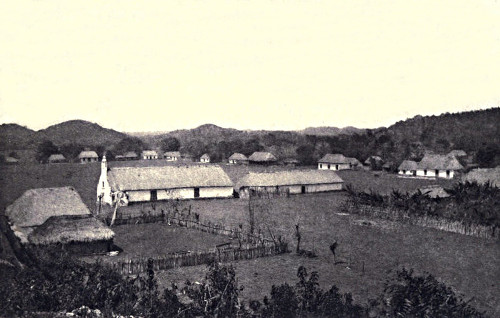
of my visit the village of Pisté had been partly re-occupied and some
of the ruined houses had been rebuilt, but the large church was still
roofless and the whole of the site of the ancient city, as well as the
church and buildings of the Hacienda, was covered by a dense jungle.
For the first few days I put up in the house of Stephen, the village
judge and far the most important person in the small community. He
was a young man, well-built and athletic, with frank and pleasant
manners, and a certain air of command about him which became him well;
altogether he was a capital specimen of a half-caste yeoman. He was
perhaps a little too fond of aguardiente, but he seemed to live a happy
life in a somewhat patriarchal fashion. His legal wife (for there were
some others in the background) was the mother of a most delightful
boy, about four years old, a child who would have attracted attention
in any part of the world for his robust beauty and his charming genial
manners and fearless ways. The villagers adored this boy, and in return
he lorded it over them royally; he never showed any shyness of me, and
we became fast friends at once; he used to prattle away to me in Maya
about all that was going on, although I could not understand a word
of his language. I don’t think I ever met a child who attracted me so
much, and it was hard to believe that he was related to the people
around him, for he seemed to belong to some superior race.
I was able to engage a few men in Pisté, and set them to work at once
to clear the jungle around the principal buildings; at the end of a
week I took up my quarters at the ruins themselves, in a building
known as the Casa Colorada. Soon after my arrival in the country I
had engaged a man named Pablo Parera as a general overseer, but he
proved to be of very little use to me, and it was no great loss when,
early in March, he begged a fortnight’s leave of absence, saying that
he had received news that his mother was dying in Merida. He was very
circumstantial about the doctor’s report on the lung trouble from which
his mother was suffering, and at his earnest request I gave him the
money for his journey and an order on my agent in Merida for a month’s
pay in advance, as he expressed himself most anxious to return to me.
Early the next morning he set out on his journey. It so happened that
the next day I had to ride into Yzamal, a distance of about forty
miles, on business, where I chanced to hear that my friend Pablo had
passed a cheerful evening the night before, apparently quite forgetful
of his dying mother, and, moreover, that he had boasted that he well
understood how to manage me, and was going on to Merida to have a good
time at the Carnival. Luckily I was just in time to send a telegram
to my agent in Merida, and when Pablo walked into his office the next
morning he learnt that the order for his payment had been cancelled; he
wisely made no protest and I never heard of him again. I then gave up
all hopes of finding another overseer and chose the most intelligent
amongst the workmen to take charge of the tools and act as “caporal.”
During the first few weeks all my labourers were men from Pisté, and as
they returned to their homes before dark, I was left to sleep in the
ruins alone. For a few nights I paid one of the Indians an extra “real”
to stop for the night; but as he could speak no Spanish, conversation
was impossible, and the way he sat silently on the floor and followed
my every movement with his eyes was worse than a nightmare, so I soon
gave up the experiment, infinitely preferring the solitude of the ruins
to his company.
In the beginning of March three local officials paid me a visit and
stayed two days. They expressed great interest in the work I was doing
and were most sympathetic over my troubles in engaging labourers;
indeed, one of them, who was also editor of a newspaper, on his return
home wrote a most flattering account of me. In a leading article he
pointed out that my enterprise was one of national importance, in which
every town and village in the neighbourhood should be proud to help.
Unfortunately he failed to despatch the half-dozen soldiers whom he had
been directed by his superior officer to send me from his own town; and
I found that most of the alleged interest in my work and promises of
assistance ended in the same way. However, by persistent application,
by letter and in person, I managed for a time to worry a fair amount
of assistance from the local officials, and secured the services of
twenty or thirty Indian soldiers to clear bush, move the fallen stones,
and dig away the earth which had accumulated round the base of the
principal buildings.
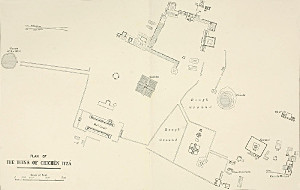
PLAN OF THE RUINS OF CHICHÉN ITZÁ.
As usual, I had been laughed at by my acquaintances in Merida for
bringing with me wheelbarrows and spades, being assured by them that
the Indians would never be persuaded to use them. They told me that an
Indian’s method of digging was to scrape a little earth together with
his hands and, in a leisurely way, to ladle it into a small basket of
plaited leaves or into his straw hat, if a basket were not at hand, and
then to saunter off and empty the contents at a few yards distance. I
must own that there was some difficulty in persuading newcomers that
four men were not needed to take charge of one wheelbarrow, one to fill
it half-full of earth and stones, and three to look on and see that the
load was not unduly heavy, and then with a united effort to lift it by
the wheel and two handles and carry it off bodily. I did once see an
Indian load a wheelbarrow with a few stones, and (with the help
of two friends to raise it up) carry off the loaded barrow on the top
of his head. However, these vagaries were never indulged in for long,
and as soon as they found that the wheels went round, and that their
labour was lightened by the use of them, they always took kindly to
the wheelbarrows. As the men went barefooted or wore thin sandals they
could not work well with a spade, but they soon became skilful with a
shovel. They are thoroughly accustomed to using hoes, and in handling a
machete to clear jungle it would be difficult to find their equals.
Just before starting on my last journey to Yzamal, Stephen had come
out to the ruins in a state of great distress to tell me that his boy
had been ill for three or four days and that he feared that he was
dying. I went in to see the poor little fellow as I passed through the
village and found him in a pitiable state of fever and delirium. There
was no doctor within forty miles, and there was nothing I could do for
him beyond sending to my camp for a supply of beef-jelly and arrowroot
in the hope of keeping up his strength; but I deeply regretted that I
had not had earlier news of the child’s illness, when perhaps simple
remedies might have been efficacious. As I rode into the village on
my return from Yzamal a few days later, my first inquiry was for the
boy, and I learnt that he had never rallied and had been buried that
morning. Stephen came to me, looking haggard and wretched, and asked
me to put up for the night in another house in the village, as his
house was being prepared for a religious service. The whole village
was grief-stricken, and two of the elders called on me to say that on
behalf of all the villagers they had a favour to ask of me. They said
that it was a great grief to them all that they possessed no portrait
of Stephen’s son, and they proposed, if I was agreeable, to go at once
and dig up the body so that I might take a photograph of it, and the
appearance of one they loved so much would then never fade from their
minds. Fortunately I could plead the excuse that I had no photographic
plates ready for use, but it needed some tact to avoid hurting their
feelings and a great deal of explanation before I could induce them
to withdraw their ghastly request. Their distress was touching, and
utterly unlike the usual callousness of the American native; but, as I
have said, the child was possessed of exceptional beauty and charm of
manner, and he had won his way to all their hearts.
Before dark I went over to Stephen’s house to see the unhappy mother,
and found the house clean and ready for the service. The small table
at which I had been accustomed to write was turned into an altar
and covered with a white cloth; above this was fixed a crucifix,
flanked, incongruously enough, by two glaring oleographs, one of a
very décolletée German damsel apparently singing the praises of
lager-beer, whilst her companion on the other side of the crucifix was
a sprightly Spanish girl who apparently preferred white wine. The altar
itself was graced by half-a-dozen old beer-bottles with gaudy labels,
filled with flowers. I was not bidden to the service, which Stephen
must have conducted himself, as there was no priest within many miles,
so, thinking they would prefer being left to themselves, I returned
to my house. Stephen was clearly heart-broken over his loss, but I am
sorry to say the proximate effect on him was a drinking-bout which
lasted a fortnight.
In March Mr. Thompson paid me a short visit accompanied by Mr. H.
Sweet, who had been assisting him in his work at Labná. Mr. Sweet
was about to return home to Boston, but he was much attracted by the
work to be done at Chichén, and I exerted my powers of persuasion to
the utmost to induce him to stay on with me. At last he promised that
should the letters he expected to receive on his return to Merida
enable him to prolong his stay in Yucatan, he would come back to pay
me another visit. Not many days later to my great delight he rode into
camp, and I secured a charming companion for the remainder of my stay
at the ruins.
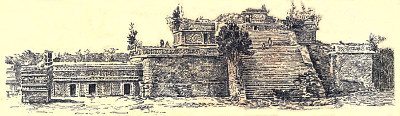
By the time Sweet arrived a considerable amount of clearing had been
done, and I had shifted my quarters from the Casa Colorada to the
building known as the “Casa de Monjas,” or the Nunnery. This is a
fine structure, raised on a solid basement of masonry, 165 feet in
length, 89 feet wide, and 35 feet high. A magnificent broad stairway
of forty-nine steps leads to the level top of this basement, on which
stands a house with eight chambers. One of the chambers had been filled
in and sealed up so as to form a secure foundation to an upper story
which is now in ruins; but the remainder were in good condition, and
made a most comfortable lodging for us. The interior wall-surfaces had
formerly been coated with plaster and covered with paintings; but
of this decoration only a few fragments two or three inches square
remained. The broad terrace around the house was on a level with the
tree-tops, and our view extended over the forest-covered plain to the
far horizon. To the southward, where no clearing had yet been made,
the sea of verdure spread unbroken from our feet. During the lovely
tropical nights, when a gentle breeze swayed the tree-tops, and the
moonlight rippled over the foliage, it seemed to be a real sea in
motion below us, and one almost expected to feel the pulsation of ocean
waves against the walls. In the daytime the woods were alive with
birds; the beautiful mot-mots were so tame that they flew fearlessly in
and out of our rooms, and mocking-birds and scarlet cardinals poured
forth a flood of melody such as I have never heard equalled.
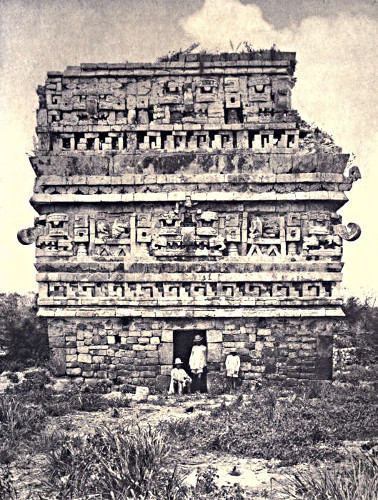
“LA IGLESIA”, CHICHÉN ITZÁ.
The east wing of the Nunnery extends towards some detached buildings,
of which one, known as “la iglesia,” is shown on the accompanying
plate. Huge grotesque masks or faces with projecting snouts are the
most prominent objects in the decoration of this building. On either
side of the middle mask in the lower frieze is a panel holding two
dilapidated figures of humanized animals: the figure on the right of
the central mask is clearly intended for a turtle, and that on the left
for an alligator.
Looking northwards from our high platform the ruins lay spread out
before us. To the right we could see the front of the many-chambered “Ak at ’cib” (“the writing in the dark”), so called from the carved
inscription on the doorway of an inner room. More immediately in front
of us rose the strange circular building known as the “Caracol,” from
the small winding stairway hidden in the central mass of masonry.
The circular form of this building, and the curiously unsymmetrical
arrangement of the terraces, steps, and doorways, suggest the idea that
it may have been used as an observatory, and that the direction of
the lines of the terraces and the outlook from the doorways may have
reference to the rising and setting of the heavenly bodies. To the left
stands the Casa Colorada and the much-ruined buildings surrounding it.
Beyond this, again, rises a pyramid which once had supported a temple
of which nothing now remains but the two serpent columns which formed
the doorway.
About three hundred yards to the N.E. of our house lay the ’cenote from
which we drew our supply of water, its rocky and precipitous banks
overhung by a thick growth of trees which afforded a grateful shade.
The water was about sixty feet below the level of the ground, and could
only be reached at one spot by a rough pathway, but we eased the labour
of drawing water by rigging up a rope and pulley to an overhanging
tree and hauling up the water in a bucket. Beyond the buildings I have
already mentioned, we could see from our terrace the lofty Castillo
and the top of the temple on the east wall of the Ball Court.
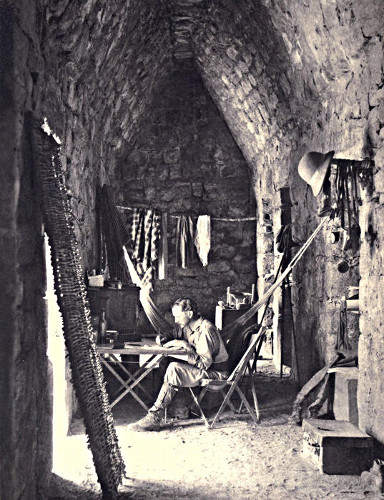
MY ROOM, CHICHÉN ITZÁ, 1889.
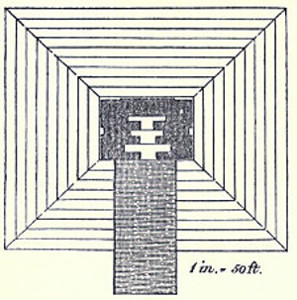
The Castillo is a stately building, even in its ruined condition, and
must have been magnificent in the days of its splendour. The great
pyramidal foundation, 195 feet square at its base, is ascended on each
side by a grand stairway of over ninety steps, with a low, broad, stone
edging. The sides of the foundation were terraced and faced with stone,
and were probably at one time ornamented with mural paintings. The
temple which stands on this magnificent foundation faces N.N.E., and is
not set quite true to the lines of the base of the pyramid. At the foot
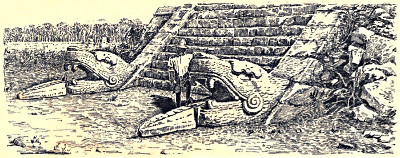
of the northern stairway are two huge serpents’ heads, and the porch
of the temple is supported by two serpent columns. Both doorways and
interior columns are rich in carving, but the design and execution of
the ornament is poor in comparison with that found in some of the other
temples.
Westward of the Castillo is a complicated group of colonnades and
temples which had not been previously surveyed. We were able only
to make a surface survey, and such excavations as were necessary to
ascertain the ground-plan of the temples; there still remains in this
direction a splendid field for investigation by the next explorer.
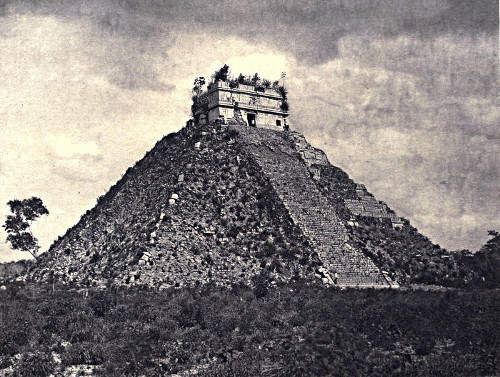
CHICHÉN ITZÁ, THE CASTILLO.
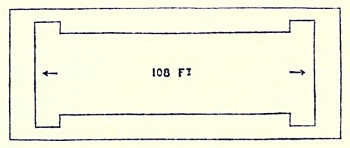
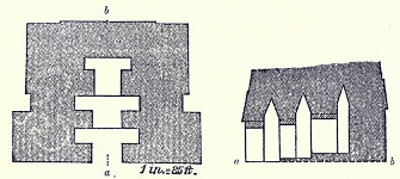
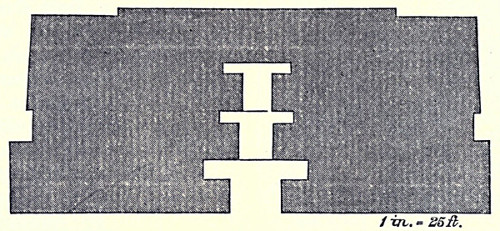
To the north-west of the Castillo stands the Great Ball Court, which is
perhaps the most interesting building at Chichén. Two parallel walls,
272 feet long and 27 feet high, standing 119 feet apart, form the side
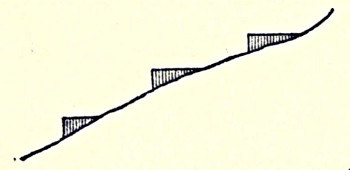
boundaries of the court, which is open at either end. A terrace, 5
feet high and 10 feet broad, projects from the base of the walls as is
shown in the section. From the middle of each wall, 3 feet from the
top, projected a great stone ring, measuring 4 feet in diameter and 18
inches in aperture, carved from a single block of stone 11 inches
in thickness, and ornamented with a design of entwined serpents. At
each end of the Court stands the ruins of a detached temple profusely
ornamented with carving.
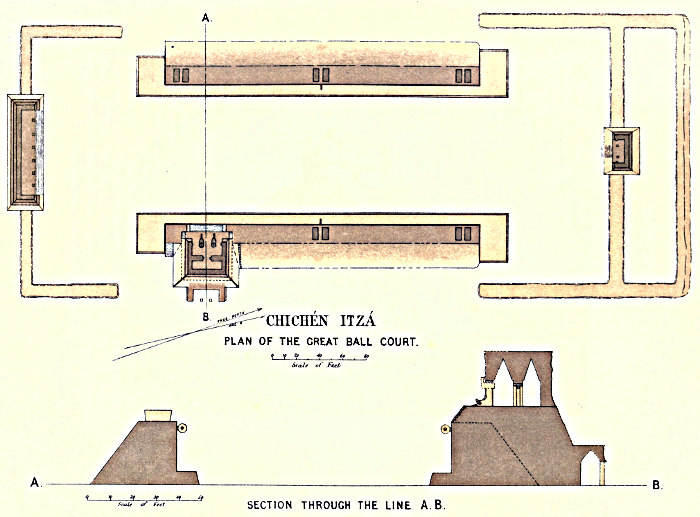
CHICHÉN ITZÁ, PLAN OF THE GREAT BALL COURT.
The game which was played in this magnificent court was, no doubt,
much the same as the Mexican Tlachtli, which is thus described by
Herrera:—“The game was called ‘Tlachtli,’ which is the same as
’Trinquete’ in Spanish. The ball was made of the gum from a tree which
grows in the hot country. This tree, when tapped, exudes some large
white drops, which soon congeal and when mixed and kneaded become as
black as pitch; of this material the balls are made, and, although
heavy and hard to the hand, they bound and rebound as lightly as
footballs, and are indeed better, as there is no need to inflate them.
They do not play for ‘chases’ (al chaçar), but to make a winning stroke
(al vencer), as in the game of Chueca—that is, to strike the ball
against or to hit it over the wall which the opposite party defend.
The ball may be struck with any part of the body, either such part as
is most convenient or such as each player is most skilful in using.
Sometimes it is arranged that it should count against any player who
touches the ball otherwise than with his hip, for this is considered by
them to show the greatest skill, and on this account they would wear a
piece of stiff raw hide over the hips, so that the ball might better
rebound. The ball might be struck as long as it bounded, and it made
many bounds one after the other, as though it were alive. They played
in parties, so many on each side, and for such a stake as a parcel
of cotton cloths (una carga de mantas), more or less, according to
the wealth of the players. They also played for articles of gold and
for feathers, and at times staked their own persons. The place where
they played was a court on the level of the ground (sala baja), long,
narrow, and high, but wider above than below, and higher at the sides
than at the ends (fronteras)[3]. So that it should be better to play
in, the court was well cemented, and the walls and floors made quite
smooth. In the side walls were fixed two stones like millstones, with
a hole pierced through the middle, through which there was just room
for the ball to pass, and the player who hit the ball through the
hole won the game; and as this was a rare victory, which few gained,
by the ancient custom and law of the game, the victor had a right to
the mantles of all the spectators; and when the ball passed through
the hole it was an amusing sight to see all the onlookers take to
flight with much merriment and laughter in the hope of saving their
mantles, which others clutched at on behalf of the victor, who had
to make certain sacrifices to the Idol of Trinquete and of the stone
(ring) through which the ball had passed. To those who saw the feat
performed for the first time it seemed like a miracle, and they said
that a player who had such good luck would become a thief or an
adulterer, or would die soon. And the memory of such a victory lasted
many days, until it was followed by another, which put it out of mind.
Every Trinquete court was a temple, and at midnight on a lucky day two
Idols—one of the game and one of the ball—were placed on the top of
the lower walls with certain ceremonies and witchcraft; and in the
middle of the floor they sang songs and performed other ceremonies;
then a priest from the great temple with other holy men came to bless
the court. Certain words were said, the ball was thrown four times, as
in the game, and after such ceremonies the court became consecrated and
fit to play in, but not before.”[4]
I cannot help thinking that Tlachtli must have been a much more
complicated game than that which Herrera describes. To a tennis-player
the presence of the rings in the wall would suggest the use of a net
to divide the court; but it is useless to speculate on the rules of
the game, and our only hope is that some more detailed and accurate
description of the manner in which it was played may yet come to
light, possibly as the result of Señor Troncoso’s researches into the
manuscripts of Padre Sahagun which have recently been discovered in
Florence.
On the top of the wall above the rings and at the boundaries of the
court I discovered the remains of what were evidently the marker’s
boxes.
At the southern end of the eastern wall there is no marker’s box, but
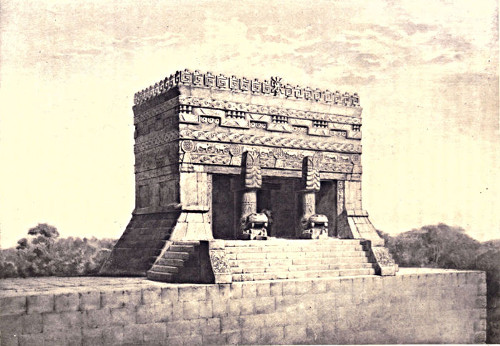
its place is taken by what must have been a most beautiful little
temple opening towards the court. A restoration of this temple is given
on the opposite page. Unfortunately for us, the builders made use of
wooden beams instead of stone lintels with which to span the porch,
and, as the wood decayed, the strangely-shaped capitals over-balanced
by the heavy projections in the form of the tail of a rattlesnake, fell
forward and carried the front of the building with them. The shafts and
base of each column with the huge snake’s head attached are still in
place, and the restoration has been effected in the drawing merely by
replacing the rattle-snakes’ tails, which were found amongst the debris
at the foot of the wall and carefully measured, and by continuing the
ornament on the sides and back of the building across the front, so
that no new feature is introduced.
CHICHÉN ITZÁ, THE BALL COURT TEMPLE RESTORED.
The wooden beams forming the lintel above the doorway leading to the
inner chamber of this building are still perfectly sound, and the
lower one is beautifully carved, as are also the stone door-jambs. The
walls of the inner chamber are covered with mural paintings, alas! now
woefully mutilated. Unluckily I had no tracing-paper with me, but by
the use of thin sheets of letter-paper I was able to trace some of the
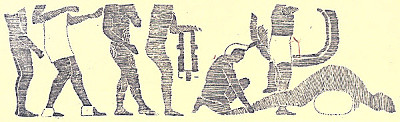
better-preserved pictures and to transfer them to drawing-paper. Above
the doorway is a picture which represents a human sacrifice. The
serpent-priest stands over the body of the victim, which is stretched
backwards over a sacrificial stone so as to expose the chest to the
knife.
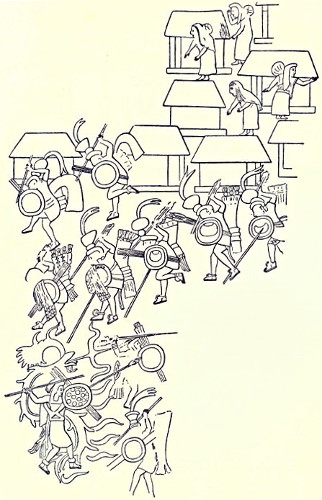
On the south side of the doorway the whole wall-surface is occupied by
a battle-scene, where one party, apparently led by the serpent-priest,
is attacking a town, while the women, standing on the roofs of the
houses, cheer on their defenders and bewail their losses. The arms used
are short spears hurled from a throwing-stick (the Mexican atlatl), and
all the warriors carry shields, which in some cases are covered with
feathered mantles. It is worth noting that although the use of bows
and arrows is frequently mentioned by the Spanish writers, the bow is
never figured on any of the Maya sculptures, and was probably a late
introduction.
CHICHÉN ITZÁ, MURAL PAINTING OF A BATTLE FROM THE GREAT
BALL COURT TEMPLE.
At the back of this temple, on the level of the ground, is another
chamber which possesses features of great interest. The greater part of
the roof had fallen in, carrying portions of the wall with it, and the
floor of the chamber was closely packed with the debris to the height
of 4 feet. When this was cleared away, we were rewarded by finding
intact the lower part of the columns which had supported the doorway,
and lying between them a curious altar in the shape of a grotesque
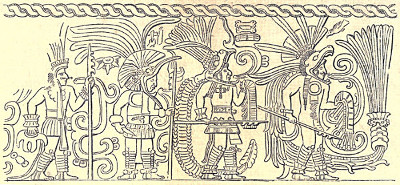
tiger. Then we set to work to make paper moulds of the sculptured
ornament, representing processions of armed men in quaint ceremonial
costumes, which cover the whole of the surface of the interior walls
and the four sides of the square columns. The time at our disposal
was limited, as the moulding-paper had, for some unknown reason, been
delayed in Havana, and when at last it did arrive it was found to be
badly damaged with salt water, so that it was difficult to manipulate.
The scene of our labours was about three-quarters of a mile from our
house and nearly half a mile from the ’cenote, from which all the water
had to be carried on men’s backs. The heat was terrific, for the ruined
chamber formed a sort of shallow cave facing E.S.E., into which the
June sun poured its rays until past noon, raising it to the heat of an
oven. We could not begin work until three o’clock in the afternoon,
and even then the wall was so hot that the damp paper refused to
adhere to it, and the precious water had to be freely used to cool
it down; time after time a half-finished mould would fall away from
the heated surface and the labour would have to be gone through again.
All moulding had to be done with our own hands, as no native could be
found competent to help us; and as I was still busy on the survey, the
heavier share fell to Mr. Sweet, who stuck to his task manfully until
the paper was all used up; I hope some day soon to show him the fine
cast of the interior of the building which is now exhibited at the
South Kensington Museum.
To the east of the Great Ball Court are two structures which Diego de
Landa, Bishop of Yucatan, writing in 1566, describes as “two small
theatres built of stone, with four stairways, and paved with flagstones
at the top, on which they say they played farces and comedies for the
solace of the public.” He then goes on to describe the sacred ’cenote
as follows:—
“There runs from the patio in front of these theatres a beautiful broad
causeway to a pool about two stone throws off. In this pool they have
had, and had at that time, the custom to throw into it live men as a
sacrifice to the Gods in time of drought, and they hold that these men
do not die although they are never more seen. They threw in also many
things made of precious stones and other things which they prized, so
that if this land has had gold in it, it would be in this pool that
most of it would be, so greatly did the Indians revere it.
“This pool has a depth of fully seven fathoms to the surface of the
water, and is more than a hundred feet across and is round in shape,
and it is a wonder to look at, for it is clean cut rock down to the
water, and the water appears to have a green colour, and I think this
is caused by the trees which surround it—and it is very deep.
“There is on the top, near the opening, a small building where I
found Idols made in honour of each of the principal buildings of the
land, almost like the Pantheon of Rome. I do not know if this was a
contrivance of the ancients or one of the people of to-day, so that
they might meet with their Idols when they went to the pool with their
offerings.”
In the year 1579, in answer to a despatch from the Spanish Government,
a report was drawn up by three of the founders of Valladolid describing
the Indian towns in the neighbourhood, in which the following passage
occurs:—
“Eight leagues from this town stand some buildings called Chicheniça,
amongst them there is a Cu[5] made by the hand (of man) of hewn stone
and masonry, and this is the principal building.
“It has over ninety steps, and the steps go all round, so as to reach
to the top of it, the height of each step a little over the third of a
vara high. On the summit stands a sort of tower with rooms in it.
“This Cu stands between two zenotes of deep water—one of them is
called the Zenote of Sacrifice. They call the place Chicheniça, after
an Indian named Alquin Itzá, who was living at the foot of the Zenote
of Sacrifice.
“At this zenote the Lords and Chiefs of all the provinces of Valladolid
observed this custom. After having fasted for sixty days without
raising their eyes during that time even to look at their wives, nor
at those who brought them food, they came to the mouth of this zenote
and, at the break of day, they threw into it some Indian women, some
belonging to each of the Lords, and they told the women that they
should beg for a good year in all those things which they thought fit,
and thus they cast them in unbound, but as they were thrown headlong
they fell into the water, giving a great blow on it; and exactly at
midday she who was able to come out, cried out loud that they should
throw her a rope to drag her out with, and she arrived at the top half
dead, and they made great fires round her and incensed her with Copal;
and when she came to herself she said that below there were many of her
nation, both men and women, who received her, and that raising her head
to look at some of them, they gave her heavy blows on the neck, making
her put her head down, which was all under water, in which she fancied
were many hollows and deeps; and in answer to the questions which the
Indian girl put to them, they replied to her whether it should be a
good or bad year, and whether the devil was angry with any of the Lords
who had cast in the Indian girls, but these Lords already knew that if
a girl did not beg to be taken out at midday it was because the devil
was angry with them, and she never came out again. Then seeing that she
did not come out, all the followers of that Lord and the Lord himself
threw great stones into the water and with loud cries fled from the
place.”
I fear that this slight description of Chichén must wholly fail
to convey to my readers the sensation of a ghostly grandeur and
magnificence which becomes almost oppressive to one who wanders day
after day amongst the ruined buildings. Although Chichén is not to be
compared in picturesqueness with some of the ruined towns in Guatemala
and Tabasco, there is a spaciousness about it which is strangely
impressive, and the wide horizon, broken only here and there by a
distant mound or lofty temple, is more suggestive of the easy access
and free movement of a large population than the narrow valley of Copan
or the terraced hillsides of Palenque. It is difficult to estimate
accurately the actual size of the ancient city, for we were not able to
carry our clearings beyond the neighbourhood of the principal buildings
still left standing, whose position is shown in the plan; but it is
almost impossible to penetrate the surrounding jungle in any direction
without coming across artificial mounds and terraces and other signs of
human handiwork.
Had Chichén Itzá been fully peopled in the year 1528, it is almost
incredible that Montejo could have held it for two years with a force
which numbered only four hundred men, and during a great part of the
time must have been reduced to less than half that number[6]. It seems
more reasonable to suppose either that the historians were at fault in
describing Chichén Itzá as the site of Montejo’s camp, or that the city
was in a state of decadence and had already been partly abandoned by
its population. The latter supposition is strengthened by the passage
quoted above from the Valladolid document, in which no mention is
made of a great population, and no word occurs which would lead one
to suppose that in 1542 Chichén Itzá was still a great living city,
although it was undoubtedly still looked on as a sacred place where
certain time-honoured ceremonies were performed.
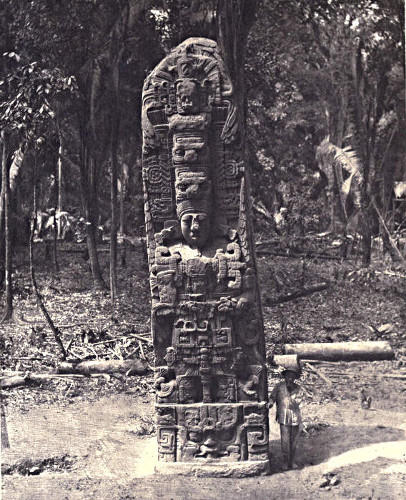
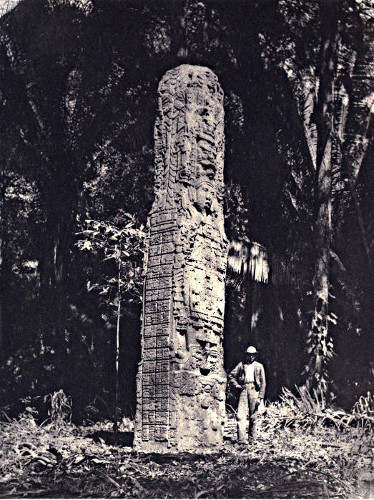
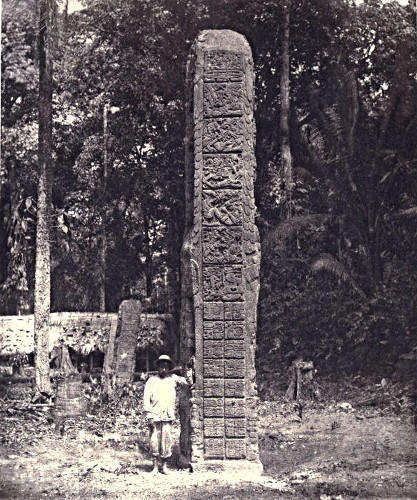
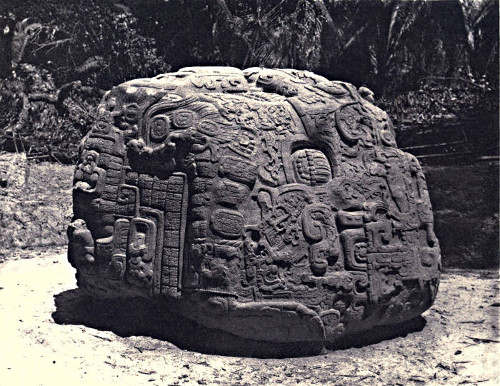
In comparing the ruins of Chichén with those of Copan and Quirigua, one
notices at Chichén the greater size of the buildings, the free use of
columns, the absence of sculptured stelæ, the scarcity of hieroglyphic
inscriptions, and, most important of all, the fact that every man
is shown as a warrior with atlatl and spears in his hand; the only
representation of a woman depicts her watching a battle from the roof
of a house in a beleagured town, whereas at Copan and Quirigua there
are no representations of weapons of war, and at Copan a woman was
deemed worthy of a fine statue in the Great Plaza. I am inclined to
think that it must have been the stress of war that drove the peaceable
inhabitants of the fertile valleys of the Motagua and Usumacinta and
the highlands of the Vera Paz to the loss hospitable plains of Yucatan,
where, having learnt the arts of war, they re-established their power.
Then again they passed through evil times: intertribal feuds and Nahua
invasions may account for the destruction or abandonment of their
great cities, such as Chichén Itzá and Mayapan, and in these latter
contests they may have learned the use of the bows and arrows with
which they fought the Spaniards.
This view is somewhat strengthened by the result of a very careful
examination of the caves and ’cenotes of Yucatan made in 1895 by
Mr. Henry Mercer, who records the conclusions he has come to in the
following words:—Firstly, that no earlier inhabitant had preceded the
builders of the ruined cities of Yucatan; secondly, that the people
revealed in the caves had reached the country in geologically recent
times; thirdly, that these people, substantially the ancestors of the
present Maya Indians, had not developed their culture in Yucatan, but
had brought it with them from somewhere else.
It was not until the 2nd July that we left the ruins and set out for
Merida, and even then we were reluctant to depart and leave unexamined
so much that is of interest; but our store of food had run out and we
found the greatest difficulty in getting supplies in the neighbourhood.
Moreover, the heavy showers and great heat made such work as we were
engaged on almost impossible. During the month of May we had both
suffered from malarious fever. Fortunately our attacks occurred on
alternate days, so that we could each tend the other in turn, and we
both made complete recovery. The difficulty in engaging labourers was
never smoothed away, and was the occasion of much vexatious waste of
time. During the time we were ill with fever we were altogether bereft
of labourers for about a fortnight, and found the greatest difficulty
in supplying ourselves with firewood and water. After this matters
mended, and we were better served; but towards the end of our stay, I
had again to depend solely on the villagers from Pisté, some of whom
would condescend to do a short day’s work for me at about three times
the current rate of wages.
To Sweet’s arrival at the most critical moment the success of my
expedition was very largely due. He was keenly interested in his
work, and, in spite of attacks of fever, we spent a very happy three
months together. Sweet undertook all the photography, and was also of
the greatest assistance in the survey; and with his ever-ready help
and cheery companionship, I could make light of the numberless petty
annoyances and delays which were so hard to bear when I was alone;
moreover he supplied that invaluable stimulus to work which came from
discussing with an intelligent companion the various problems which
presented themselves for solution as the clearings widened out and the
remains of the ancient city were disclosed to our view.






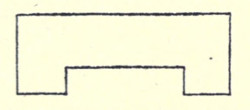










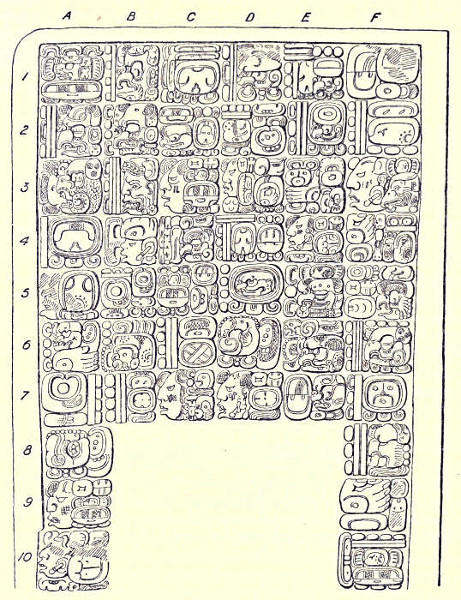

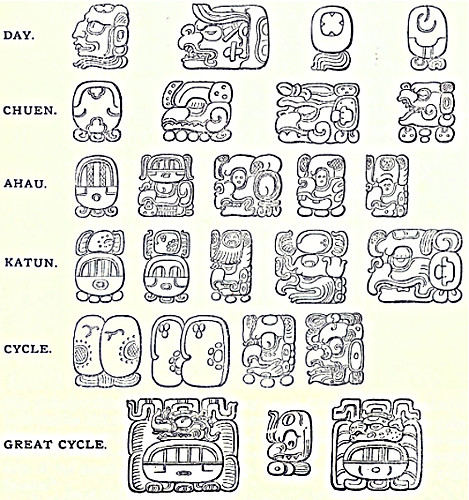
 is possibly the sign for twenty, but it is
very generally used as a sign for a “full count.” (See examples on
is possibly the sign for twenty, but it is
very generally used as a sign for a “full count.” (See examples on