On arriving at Reykir, our guide conducted us to his own dwelling, a
fair-sized farm, where he and his wife resided with all their mutual
relations, this being the custom in Iceland. In this case they included
the wife, her father, mother, grandfather, and sister on the one side;
the husband, his two brothers, sister, and mother on the other. Quite a
happy little community, as the couple themselves were also blessed with
several children.
On entering we were shown into the guest chamber, a small,
neatly-furnished apartment, panelled with wood, and containing two
windows, neither of which were made to open—a peculiarity not only to
be found in Iceland but in some other places, especially in Tyrol. A
wooden bedstead stood in one corner, covered with an elaborate
patch-work quilt, whilst a table and two chairs constituted the
remainder of the furniture. As our party numbered five, some pack boxes
were added—not very soft seats after a long jolting ride. A
looking-glass hung on the wall; but what a glass! It was quite
impossible to recognise your own face in it; I can only liken its
reflection to what one would see in a kitchen spoon—not a silver
spoon—for there the features, though distorted, would be visible, here
they were not. Certainly if such mirrors are the only medium of
reflection the people of Reyker possess, they will not grow vain of
their personal attractions. The room also contained a barometer and an
accordion. In most of the houses we entered we found the latter
instrument, which the people, being fond of music, amuse themselves with
during the long winter evenings. Curiously enough, there is little or no
native music, however. A bookcase on the wall contained quite a small
library of Icelandic literature.
Tired with our long ride, we were very glad to rest awhile, while our
student friend, our guide, and all the combined families in the house
down to the babies and the dogs, stood around us, until the room was so
full I don't think another soul could have found entrance.
The Icelanders are on first acquaintance with strangers somewhat
reserved; but if treated affably this reserve soon wears off, and their
hospitality is unbounded. Even among the poorest a night's lodging is
never refused to a traveller.
In outlying districts the farmhouses take the place of inns, whilst the
charges are on a most moderate scale.
We brought with us some cheese and biscuits, and a pound of Buzzard's
chocolate, which the farmer's wife supplemented with coffee and 'skyr,'
the latter served in soup plates.
Skyr is the national dish, taking the place of porridge to a Scotchman,
and is nothing less than curded sheep's milk, like German 'dicke-milch,'
eaten with sugar, to which cream is added as a luxury. As it was rather
sour, we fought shy of it at first, fearing future consequences, but
this was unnecessary. It is really excellent, and the natives eat it in
large quantities. Huge barrels of this skyr are made during the time the
sheep are in full milk, and stored away for winter's use. It is
agreeable to the taste, satisfying, and wholesome.
While eating our lunch, our host and his numerous family circle—who all
seemed much interested at our presence—did nothing but ply us with
continual questions about England, the English people, and the cost of
the various articles we either wore or carried with us.
We invited our host and one or two of his friends to taste our cheese
and chocolate, when after every mouthful they each shook hands with all
the gentlemen of our party; whilst those of the women who shared our
repast, after shaking hands with the gentlemen, kissed Miss T. and
myself most affectionately.
Class distinction is unknown in Iceland; in fact, there are no gentry,
in our acceptation of the term, and little or no wealth among the
inhabitants.
I believe the Bishop is the richest man in the Island, and his income is
about £150 a year, a sum which these simple-minded folk look upon as
riches.
Our coffee and skyr, with attendance for seven people, cost 1s.
7½d., a sum reasonable enough to meet any traveller's purse.
At the ports, however, in Iceland as elsewhere, we found we had to keep
our wits about us to avoid being cheated, the English being credited as
made of money.
Near to this farmhouse, at Reykir, there were some hot springs which we
visited, and we stood and watched with much interest the water bubbling
up to the surface.
Close to one of these springs we noticed a large open tub in which the
family washing was being done in the natural hot water thus supplied;
but the water was yellow, and gave off a sulphureous odour—although it
did not seem to discolour the clothes.
The ground around the house was, as usual, piled up with dried fish. It
is difficult to realise the stench caused by this food supply, unless
one has experienced it. Cod liver oil is made in large quantities in
Iceland, and exported to England, where it is then refined for use. If a
lover of cod liver oil—and I believe such eccentric persons
exist—could once be placed within 500 yards of its manufacture, I feel
sure they would never taste it again.
Our guide was one of the largest farmers in Iceland, and owned the
adjoining island, namely, 'Lonely Island,' or 'Drangey,' famous as the
retreat of the outlawed hero of the 'Gretter-Saga.' The legend states
that one Christmas night the chief's fire went out, and having no means
of rekindling it, he swam from Drangey Island to the Reykir farm to get
a light, a distance which to us, humanly speaking, seems impossible for
any man to have done.
The tale goes on to say that an old witch went out in a boat to visit
Gretter on Drangey. The boat upset and she was drowned; but a large rock
like a boat in full sail rose from the sea a few yards from the Island
itself.
The 'Saga' contains many wonderful tales in connection with this
locality, specially relative to the high table-land which rises almost
perpendicularly above the sea. The scenery in this part of the Island is
very fine. On the west side of the 'Skagaffiryr,' a fair-sized river,
are seen the peaks of the 'Tindastoll,' a very steep range of mountains
intersected with water-worn gorges; while opposite, 'Malmey,' or
'Sandstone Isle,' juts into the sea, north of a rude peninsula with a
low isthmus that appears almost like an island.
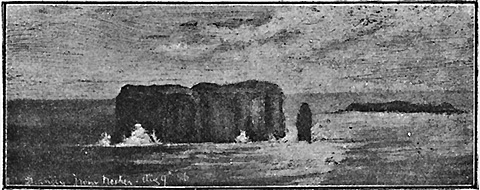 Drangey from Reykir. Aug. 9th, 1886.
In the middle of this fjord Drangey is situated. This island, which was
the property of our guide, is a huge mass of rock, nearly perpendicular,
while at one end is the witch's rock resembling the ship in full sail.
Drangey is the home of innumerable eider-ducks, who swim at will in and
about the surrounding waters. The drake is a very handsome bird, a large
portion of his plumage being white; the hen is smaller, and brown in
colour. In disposition the birds are very shy and retiring. The hen
builds her nest with down plucked from her own breast; this nest the
farmer immediately takes possession of; the poor bird makes a second in
like manner, which is likewise confiscated; the third nest he leaves
untouched, for by this time the bird's breast is almost bare. Eider-down
is very valuable, fetching from 12s. to 20s. per pound. When the farmer
desires to catch the eider-duck, he places on the shore, at low water, a
small board, carefully set with a series of snares on its surface, and
as the birds walk over it they are made prisoners by their feet. There
must have been many thousands of eider-duck between Reykir and Drangey,
and no gun is allowed to be fired for miles around.
Owing to the uneven nature of the ground, caused by constant earth
mounds, even where the soil is good the plough is used with great
difficulty. In fact, it can only be utilised by removing the sod and
levelling the earth with a spade, until smooth enough for a pony to drag
the plough over it. There are very few ploughs, or indeed any farming
implements of any size in Iceland, the farmers being too poor to buy
them, nor are the latter at all an enterprising class, contenting
themselves with the primitive method of cultivating the soil which
their forefathers used to adopt. Our guide being a man of more energy
than his brethren, and wealthier, had invested in a plough, of which he
was very proud, and exhibited to us as a great novelty, evidently
thinking we had never seen such a wonderful thing.
Hay was being cut all the time we were in the Island, cut under every
possible disadvantage, and yet cut with marvellous persistency. With
this labour, of course, the frost mounds interfere, being most
disastrous to the scythe, and yet the natives never leave a single blade
of grass, cutting round and round, and between these curious little
hillocks. On the hay crop so very much depends, for when that fails,
ponies die, sheep and cattle have to be killed and the meat preserved,
and the farmer is nearly ruined. Hay is therefore looked upon as a
treasure to its possessor, and is most carefully stored for the cattle's
winter provender; but as during the greater part of the year the
Icelanders are snowed up, the cultivation of hay or cereals is a
difficult matter.
In many parts of Iceland there exist enormous stretches of country
covered with dangerous bog, which are, of course, at present undrained.
Now, however, that an Agricultural College has been established in the
Island, it is hoped a fresh impetus will be given to farming operations
in general. At present there are only about 220 acres under cereal
cultivation, whilst its inhabitants number over 70,000! Although there
are no trees, as before said, there is no scarcity of flowers, indeed
the flora is particularly rich, in some instances being composed of
specimens not found elsewhere. Often for miles the ground is thickly
carpeted with the most beautiful mountain and Arctic flowers, sometimes
nestling even in the snow, which lies in patches quite near to the
towns. Iceland moss is found on the lava plains.
Mr Gordon was a botanist, and brought home a large collection of
specimens; many more, on which he had set great store, were
unfortunately lost from the pony's back. The following is a list of
those he secured, a great number of which we found growing among huge
boulders in high barren places.
| LIST OF PLANTS BROUGHT FROM ICELAND. |
| 1. | Plantago maritima. | 20. | Galium saxatile. |
| 2. | Raniunculus acris. | 21 | Stellaria aquatica. |
| 3. | Euphrasia officinalis. | 22. | Eriocaulon vaginatum. |
| 4. | Alchemilla vulgaris. | 23. | Dryas octopetale. |
| 5. | Do. alpina. | 24. | Salix herbacea. |
| 6. | Erigeron alpinus. | 25. | Do. lapponica. |
| 7. | Rumex acetosa. | 26. | Do. aurita. |
| 8. | Do. acetocella. | 27. | Polygonum viviperum. |
| 9. | Myosotis sylvatica. (?) | 28. | Thalictrum alpinum. |
| 10. | Cardamine pratensis. | 29. | Leontodon taraxacum. |
| 11. | Comarum palustris. | 30. | Samolus valerandi. |
| 12. | Trifolium repens. | 31. | Equisetum pratense. |
| 13. | Saxifraga oppositifolia. | 32. | Stellaria cerastoides. |
| 14. | Empetrum nigrum. | 33. | Viola tricolor. |
| 15. | Cerastium alpinum. | 34. | Do. palustris. |
| 16. | Cynoglossum officinale. (?) | 35. | Cerastium trigynum. |
| 17. | Penguicula vulgaris. | 36. | Potentilla reptans. |
| 18. | Poa alpina. | 37. | Arabis. (sp.?) |
| 19. | Capsella bursa pastoris. | 38. | Betula nana. |
| 39. | Parnassia palustris. | 46. | Potentilla anserina. |
| 40. | Cerastium vulgatum. | 47. | Aparagia hispidus. |
| 41. | Silene acaulis. | 48. | Rhinanthus crista galli. |
| 42. | Vaccinium uliginosum. | 49. | Galium vulgaris. |
| 43. | Do. vitis idea. | 50. | Galium parisiense. |
| 44. | Thymus serpyllifolia. | 51. | Geranium pratense. |
| 45. | Gentiana campestris. | | |
| Names furnished by C. A. Gordon, M.D. C.B. | |
| Birch2 species. | } |
included in above. |
| Willow3 " |
Mushrooms grow abundantly in Iceland, and we much enjoyed them, eaten
with salt, as a supplement to our meals.
After some hours' rest at Reykir, we remounted, and rode back to
Sauderkrok, parting with much regret from our student friend, who had
proved a most agreeable and intelligent addition to our party.
That night we were none of us sorry to exchange our saddles for our
berths in the Camoens, having been on horseback the greater part of
the day, on a road the roughness of which is indescribable.
A further steam of twelve hours up the Hruta Fjord brought us to
Bordeyri, a still smaller place than Sauderkrok. Here our captain
informed us he should have to wait thirty-six hours for the discharge of
further cargo. This fjord is very dangerous, for it has never been
surveyed, consequently deep-sea leads were frequently used, the sailors
meanwhile chanting a very pretty refrain. When we anchored opposite
Bordeyri, we all noticed the anxious look which the captain's face had
lately worn had left him, and how pleased he seemed to have brought his
steamer safely to her moorings.
We landed in a boat which came alongside the Camoens, and commenced at
once to take a survey of the place. A few dozen houses or so, with a
large store, where every necessary of life was supposed to be procurable
(at least an Icelander's necessities), constituted the town. We entered
the store in search of some native curiosities to carry home. A brisk
trade was being carried on in sugar candy, large sacks of which were
purchased by the farmers, who had come to meet the steamer and barter
their goods for winter supplies. Never was any shopping done under
greater difficulties than our own, and we almost despaired of making
ourselves understood. The store-man, however, grinned most
good-naturedly when we failed to do so, and we at last unearthed some
finely-carved drinking-horns, and a couple of powder flasks, which we
thought would help to decorate a London hall.
While at Bordeyri, we felt we were the subject of much amusement and
admiration among the little crowd of natives who flocked to see us,
forming also, I doubt not, a topic of conversation among them for many a
day to come.
Our survey of the town was soon made, so we ordered ponies for a ride up
country, this being the best way of passing our time. On the way we saw
a number of large ravens; splendid birds they were and wonderfully tame;
the ground was quite covered in places by flocks of them.
Iceland boasts of a great variety of birds; in fact, they form an
attraction to many English sportsmen to visit the Island. Both my
brother and A. L. T. were sportsmen, but our time was too limited to
admit of the exercise of this taste. Among the birds may be noted swan,
geese, duck, curlew, mallard, snipe, plover, ptarmigan,—90 species of
birds, in fact, 54 of which are wildfowl. During our ride, A. L. T. shot
a fine raven, and on our return to the ship, my brother skinned and
stuffed it, as a memento of his inland trip. Many of the passengers were
so interested in his performance, that he was called on to deliver a
lecture on skinning and stuffing birds, and he explained how skilfully
this could be accomplished, with the help of a penknife alone. On
another occasion, A. L. T. caught a baby curlew as yet unable to fly,
but the cries of the parents as they whirled round and round us seeking
their offspring, were so heart-rending, that in sheer pity he placed the
little thing back on the ground, where it was instantly joined by the
old birds, who uttered cries of delight, which we continued hearing
until we were well out of sight.
There are great attractions for sportsmen in Iceland—reindeer shooting
on the western side of the Island, whale and seal shooting, and salmon
and trout fishing, the latter being met with in all the rivers. Indeed
some of the finest salmon fishing in the world is to be found here, and
several Englishmen rent rivers, where they enjoy this sport every
summer; the life being free and independent, the expenses small, and the
sport excellent, naturally form many attractions. At the same time, so
much netting and trapping of the fish goes on, there is every
probability the salmon will be exterminated before long.
Our ride out of Bordeyri was very interesting. There are some hot
springs on the east of the fjord, which are reached by boat, but which
we had not time to visit. Had we remained longer, we should much have
liked to see the 'Anglica fish-lakes,' but these were a full day's
journey from Bordeyri, and quite out of our route. They are, we were
told, abundantly stocked with char, trout, and other good fish, and
afford an excellent halting-place for sporting travellers.
A part of our way lay along a peat-track, over which we raced our
ponies, varying our exploits later amid bogs, which required the most
careful riding to avoid a catastrophe. As usual, there were many rivers
to be forded, through which our ponies plodded up to their middles,
never flinching even at the coldest glacial water. Often during our
rides, towards evening the cold became intense, although for a few hours
about mid-day the sun was very hot.
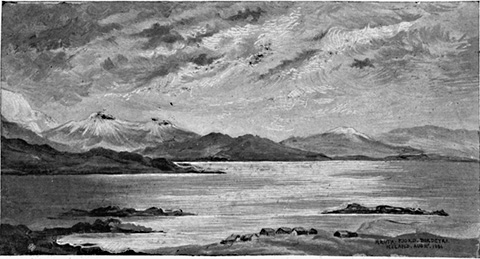 Hruta Fjord, Borderyre, Iceland, Aug. 11, 1886. Etched
by Frank P. Fellows, from a sketch by the Author, 1888. Page 86.
Hruta Fjord, Borderyre, Iceland, Aug. 11, 1886. Etched
by Frank P. Fellows, from a sketch by the Author, 1888. Page 86.
After some hours' riding, we arrived at another typical farm, which I
sketched from my pony's back. The farm-house, and a small hamlet of
wooden huts which lay around it, formed a good foreground to the distant
fjord. Dismounting, we entered the house by a low door, knocking our
heads against the rafters as we traversed a long dark passage which led
to the guest-chamber. This room, as usual, was neatly panelled with
wood, and contained a bed, chairs, etc., but, from the absence of fresh
air, was fearfully close. Our ride had sharpened our appetite, and we at
once produced our lunch supply, consisting of cheese and biscuits, etc.
We offered some of the biscuits to the farmer, who at first turned them
round and round in his hand suspiciously, then seeing that we ate them
with enjoyment, he raised one solemnly to his lips, tasted it, and then
speedily devoured his share of the meal. In a short time all the various
members of the family joined us, and, sans cérémonie, proceeded to
examine our belongings. Pipes, match-boxes, watches, furs, and jewellery
were all passed in review, and we were asked the price of each article,
and whether we had brought them out from England. Our table knives
seemed to cause them the greatest astonishment, and as the Sheffield
steel glanced in the sun, they were quite childlike in their delight;
certainly our English cutlery was a great contrast to the jagged iron
knives which served them at table. In our turn, we admired their quaint
old silver ornaments, but when we testified a desire to purchase, we
failed to meet with any response.
We did not, as first proposed, remain the night at this farm, its
accommodation not being sufficiently enticing, so our hostess was saved
fulfilling the curious Icelandic custom considered a compliment to
strangers, of putting all her guests to bed herself, whether man or
woman, and not leaving the room until they were safely tucked up. We
cannot say, however, we encountered this form of hospitality ourselves,
but we were told it was constantly carried out.
As we sat round the table at our meal in this faraway region, so distant
from all the trammels of Society, we wondered what expressions the faces
of our London friends would have worn could they have seen our party
passing the only spoon available from one person to the other,
occasionally even eating with our fingers. Certainly our surroundings
were much at variance with a well-appointed luncheon table, and yet we
enjoyed ourselves all the more from its primitive simplicity. Lunch
over, we prepared to continue our journey, but found our ponies had
wandered much further off than usual, and our guide went to seek them.
The Icelander and his pony have initiated signs, which serves them in
lieu of language. For instance, when the rider dismounts, and simply
leaves the reins over the animal's head, the latter knows that he will
be wanted again soon, and must not wander far off; if, on the other
hand, the bridle is left loose, the pony knows he may roam at will in
search of food until his master seeks him.
We rode back to Bordeyri, which we reached in the evening, and again
slept on board the Camoens. During our absence up country the previous
day we heard that the ship's company had been in a great state of
excitement, consequent on the embarkation of some forty emigrants from
Bordeyri and its surrounding neighbourhood. We saw these our
fellow-passengers the next day, men, women, and children, many of the
former quite old, apparently not more than one in five appeared capable
of a good day's work. These emigrants were bound for Manitoba and
Winnipeg, in each of which places there is an Icelandic colony, and
which settlements they could reach at a cost of £6, 10s. per head. Poor
things! we wondered if they had taken into serious consideration the
difficulties that lay in their path in the New World they were seeking.
Probably, considering the land they were leaving was one of volcanoes
and desert wastes, they hoped for better things. Their Icelandic life
must indeed be hard and colourless, so hard as to have taken from them
all pleasure in existence. To judge by their apathy, these questions did
not seem to have been taken much into account by them; possibly when the
sight of green fields, and Nature's abundance, break upon their view,
dormant will, and energy may rise to fresh surroundings, and inspire
them with an impetus to work.
Ah! speculate as we would upon their future, and probably we did so more
than they did themselves, all we could do for them was to wish them
God-speed and good luck in their venture.
A bright 12th of August dawned at sea as we left the Hruta Fjord, and
steamed again towards the Arctic Circle and Cape North. When we met at
breakfast the conversation naturally turned upon grouse, and 12th of
August sport in general, and the gentlemen wished themselves in
Scotland, and exchanged their last year's experiences there. I
remembered mine also, for I was staying in a country house in
Lanarkshire, and some dozen men ready equipped for sport stood staring
out of the windows of the breakfast-room, grumbling lustily at the
pouring rain, and finally having to abandon their shooting expedition
for the day, and content themselves with dancing Scotch reels, and
otherwise amusing 'we girls,'—sorry consolation for the 12th of August!
The day wore on, and we had the unusual treat of a calm sea, but as the
wind blew straight across from the ice regions, it was fearfully cold,
pack-ice being seen in the distance, whilst an hour or so later we were
enveloped in a thick fog.
The captain looked uneasy, as he had discerned ice ahead, and during his
last voyage this fog had betokened its dangerous proximity. To turn back
now and go round the Island to Reykjavik would be a serious loss of
time. We slackened speed, the fog-horn was blown, and several times the
sailors took deep-sea soundings.
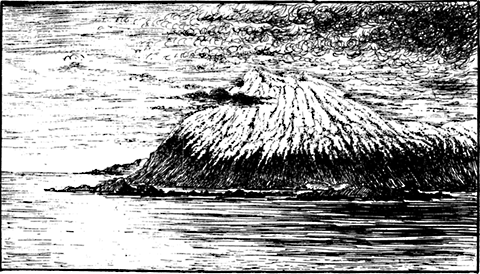 Snaefell Jökull—Iceland—Aug 13. 1886, 11 P.M. Etched by
Frank P Fellows from a sketch by the Author. 1888.
Snaefell Jökull—Iceland—Aug 13. 1886, 11 P.M. Etched by
Frank P Fellows from a sketch by the Author. 1888.
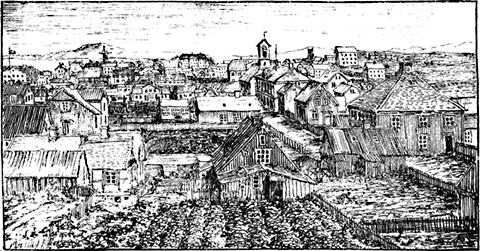 Reikjavik, Chief town of Iceland. Reduced & etched from a Photograph by F.P. Fellows. 1888.
At dinner-time the captain handed me a parcel containing a tiny shell
and a piece of coal black lava, drawn up from 66 fathoms of water S.-E.
North Cape, and 27 miles from the same. Though only 10 miles from land,
the fog so entirely hid the coast that we missed one of the prettiest
views of Iceland.
The next day, however, was lovely, and under a cloudless blue sky the
coast-line showed to the greatest advantage. The sunset that night was
one of the finest I have ever seen. Snaefell Jökull, with its snow
summit, stood out against the most perfect sky, the colours deepening
from yellow to orange, and vermilion to carmine, and constantly
changing, like a kaleidoscope.
At 11.30 p.m. the sun had not set, but was illuminating the heavens with
the most gorgeous colouring, reminding one of the distant warmer regions
of the south, although at the same time the thermometer stood far below
freezing point as we steamed within the Arctic Circle.

 MRS. ALEC TWEEDIE.


