Frances had her enthusiasms; so had Edward Montague, with the saving
difference that hers were for her amusement and his were concerning his
life-work. Still he found time for other things also. He accepted the
invitation to dinner promptly. The University was by no means a byway
homeward, but he found many an odd moment to spend there when he rode in
for his mail or for other affairs. He came the following Sunday and the
next, and made the round of Sabbath-school and church and mission and
late walk with the professor and his daughter.
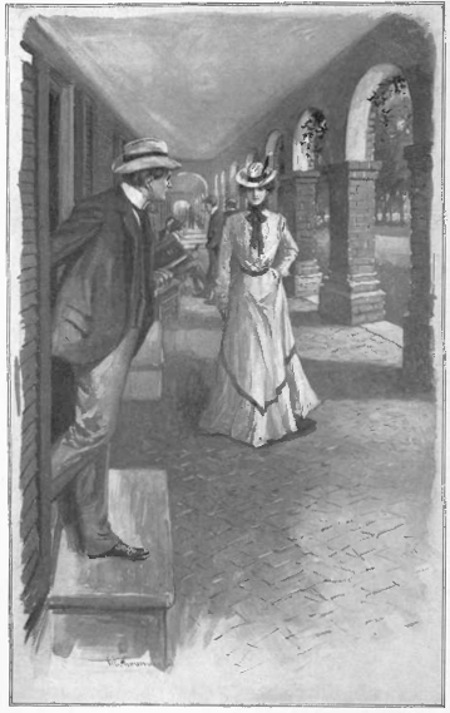
Lawson, who had not seen Frances since the short drive she permitted
him, was loitering that last Sabbath afternoon before the doorway of a
student in the West Range—a monkish row of rooms fashioned as those on
the inner quadrangle are, but unbroken by the professors' houses and
facing westward; he was thinking nothing of what he was saying, and was
noting vaguely the fading lights of sunset on the far-away mountains,
and the bared branches of the trees tossing softly against the
opalescent sky; but he was conscious through and through of the missed
comradeship of the hour. He wondered if he dared go and ring the bell
and pay a call quite boldly, setting aside the fact that the day had
been debarred him. The more he dwelt on the bare chance of finding
Frances alone, on the thought of the joy it would be to strive skilfully
to slip again into the grooves of their delightful friendship, to fence
against the cold reserve she had once more placed as a barrier between
them, to see it melt, perhaps, against the strong personality he had
come to know as one of his factors in any fight, the more he wished to
try and see her; the very thought of it, the very remembrance that there
was a test of skill, too, in it, was urging him irresistibly.
"Good-by, old fellow!" he called shortly, turning suddenly away.
"Hold on!" called the student, who had some thought of accompanying
him. But when he had gotten his hat and coat, Lawson was striding far
down the corridor. At the end of it the road from the mountain of the
observatory curved into the wide drive through the grounds. Lawson
looking upward was angered unreasonably, violently, unbelievingly. He
left such moods to others, mostly. He turned instantly into the short
cut across the campus. He could not hurry enough even when outside the
grounds, but he must swing himself on the car clanging townward.
He left behind a gay, unconscious trio. The professor and Frances and
Edward Montague were walking briskly homeward, when they glimpsed him.
The professor's face, when interested, was strangely frank and boyish;
Lawson was used to seeing him look a trifle bored and a trifle more
absorbed. To see him, as he had done that one swift instant, alert,
wide-awake, to see a tall, fair, young man talking to him with careless
ease—the University men were always in awe of him—to see Frances
between them, laughing, rosy, her coat collar turned high about her
head, framing her bright face distractingly—the trio shut him out. They
were quite sufficient to themselves, or seemed so.
"You will come in, Edward," the professor said at the door.
The young man looked at the fading sunset lights of the sky and
hesitated. He thought of the ride before him and he thought of the empty
house awaiting him; he looked in at the cheer of the house showing
through the open door and at the young woman standing in the hall
listening for his answer. Her face neither invited nor forbade; he
followed the professor.
But the contrast he had drawn for a minute haunted him. He cared not a
whit for fine furnishings, scarce knowing them when he saw them, except
for the air of comfort and the atmosphere of home they might give; but
those two were requirements. He was too busied all the days and too
tired all the nights to think how they were now denied him, but while
he had no time to bemoan a loss, he had time for dreamings. The vision
of a sweet, frank face beset him oftener than he knew; he was building
castles taller than he thought and frailer than the castled clouds of
sunset beyond the mountains. This reality was charming.
"What's the use of going home, now?" the professor reassured him as they
went in to the fireside; "it would be dark when you got there. You
couldn't do anything; just have an evening all to yourself."
"And father wants to talk grapes to you," Frances added gayly; "he's
just gotten some pamphlets—"
The professor looked guilty. "Well, I chanced on an advertisement—"
"And he hasn't had a chance to bring them out all day—"
"Frances!"
"Here they are," teased his daughter, "with your report on agriculture,"
she held up dramatically the big book she had dragged from beneath the
papers on the table. "I have been listening to hear him begin talking
of it every moment. He's just been waiting the right time,—you know you
have," to her father.
The professor fingered the pamphlet nervously. "You know, here—the
secretary says—"
"There, he has begun; I am going to see about supper."
Edward listened. There was much to awaken his keenest interest. He was
devoted to his pursuit, theory and practice. But he was listening too,
with all his inner consciousness, for a light footstep, and when Frances
came quietly back with an amused look at the two, his eyes flashed her
amusement back at her, as with much show of not disturbing them, she
slipped into a chair before the fire. The professor was unconscious; he
was in full swing and went on glibly.
The young man's face was turned attentively towards him; the father did
not know that just so Frances' face was in the line of vision, but
Edward knew. It needed but the flicker of an eyelid for him to watch
the supple figure in its careless lounging; the fluff of the dark hair
above her forehead, the curve of the long black lashes as she gazed
thoughtfully into the fire. A cosy fireside, an easy chair and this same
occupant for it flashed for a moment on the horizon of his dreamings. It
was but a dream he dared not name even to himself,—a vision that
dazzled him. He put his hand over his eyes.
The professor broke the thread of his argument. "You are tired?"
"I! no—ah—" the young man stammered.
"Well, here, take this home with you when you go! Read it for yourself,
and see what you think of it; I expect some others," he added
shamefacedly.
"Father!" cried Frances mischievously, "Mr. Montague, he's started," she
added comically, "there's no stopping him. He'll go with no particular
interest for ever so long, then something attracts him," she spread out
her hands as if in dismay, "we are flooded with papers and pamphlets;
he won't let me touch them. When it is all over I gather them up and—"
she made a gesture as if flinging an armful of trash into the fire. "You
have touched him on his most vulnerable point now. I don't know when he
will stop."
"You had better stop, yourself," said the professor chafing a little
under her teasing.
"I warn you, he will try—"
"Now, daughter!" he knew what she was going to say, "you know I never
interfere with other people."
"It's true, every word of it!" but Frances saw that her father was hurt
a trifle. She came behind his chair and put her arms about his
shoulders, laughing over his head at Edward who was watching her with
half envious amusement.
"Professors should be bald," she said lightly, "now look at this!" She
ran her fingers through his thick, dark hair, wavy about the temples
where the gray showed in the black. Her father looked up at her
adoringly, his eyes—which were often stern—dark and loving.
"If they were, they would have no young woman to bother them, rumpling
it up."
"You are lucky, sir, to have one; isn't he?"
Young Montague was silent, but Frances, looking up, saw his eyes. She
slipped back to her chair.
When he took his leave, later in the evening, he had his own special
plea.
"You've promised to come and see the old place," he began.
"Father is going to bring me some day."
"I'm going to make some day a near day," he said persistently. "Mr.
Holloway, I'm going hunting Tuesday. I've a good deal of game about my
woods. Come out Wednesday; I'll see you have some for dinner."
The professor reluctantly pleaded his engagements.
"It's moonlight; you don't mind driving home at night?"
"Oh, the road is familiar enough," assented the professor.
"Mrs. Randall will come."
"We'll drive by for her."
"I asked her to-day after church; she said any time this week. I shall
look for you in the afternoon, as early as you can make it."
So it was they arranged. Edward watched the peaks apprehensively; but
the fine weather held. His hunting was successful. There were a score of
partridges and a brace of rabbits in the big basement kitchen and he was
cautioning his cook fussily, when he heard the roll of wheels.
"I 'clar' I's glad dey's come!" muttered the cook, as at last she was
free to go about her work.
Edward had been nervously anxious all day. The bare house was swept and
scrubbed to the last point of cleanliness. He hesitated long over the
propriety of entertaining them in "the chamber," over across the hall
from the parlor, but it was the only furnished room of the house except
the basement dining room. He got all of his belongings out of sight and
locked the closet door on the disorder. He wondered if he should leave
his pipe upon the mantelpiece and at the last moment forgot it. He
wondered, while he raged, why the curtains looked so awry and if the rug
were the color he should have chosen. But the walls were white with
whitewash, the hearth was newly reddened, and on the andirons in the
huge fireplace a fire roared hot enough for Christmas; in the kitchen
below was a scared cook who knew she would hear some hot language did
anything go wrong in her domains.
Edward was as glad as she was to hear the wheels. He hurried out on the
porch and down the long flight of steps. He had hoped to help Frances
from the trap and say some pretty words of greeting, but she had already
sprung out and met him at the steps. The professor was assisting Mrs.
Randall.
"Father says you are going to take us all over the place," called
Frances at once. "Let's go now; Mrs. Randall wants to, also!"
"Of course!" chimed that pleased matron; "we want to see all the
establishment. When we come back, I'm going down in the kitchen."
"I wish you would," pleaded the host fervently.
Mrs. Randall, who had no children of her own, had a mother's heart for
all: she had been longing to get out to this bachelor's establishment
ever since it was set up, but the doctor was always too busy. She was
going to make the best of the opportunity, and if this "boy" had any
need her bright eyes could see, she was resolved to help him fill it.
"Go get your hat, Edward; we'll all come in afterwards."
And the young man ran back up the steps, all his pretty speeches unsaid.
"We'll go out to the vineyard first," suggested the professor, hurrying
ahead, with Mrs. Randall close behind him, in the narrow path beaten
along the tangle of yellow Jerusalem apples and prickly Spanish needles
and wild grasses.
The farm was still in sorry order. The ground of the orchard close to
the house was covered with tangled, browning weeds, in some of the trees
the late winesaps shone red and ruddy. Frances stopped to fill her
hands with them.
"Don't eat those; I have some splendid ones in the house for you."
"These are fine!" She set her white teeth in the red fruit. "I like
these best, I like to pull them."
"Eve!" he bantered.
"Are they forbidden?"
"Nothing is, here; it's all yours—" he began eagerly.
"Oh, thanks! Had you a Spanish ancestor?"
"English on each side," he declared stoutly.
"You look it," she assented, with one quick look at his fair face and a
swift noting of his sturdiness.
"The Saxons are truth-tellers," he urged.
But the professor had paused at the pig-pen near the orchard's edge.
"Fine hogs!" he called back to his host, "Cheshire?"
Edward joined him reluctantly. "That one is," he said, pointing to the
pinkish-white sides of a lazy, fat wallower.
"He'll weigh two hundred."
"I expect he will."
"Seems a pity to kill him."
"I have the mother."
"Who's going to make your sausage and dry your lard?" asked Mrs. Randall
quickly.
"Lizzie."
"What, trust that darkey with it?"
"There's nothing else to do."
"Come on, Frances," called her father, for that young woman was still
loitering under the apple-trees.
Mr. Holloway took the lead towards the vineyard. The Northrup estate
numbered many acres, but not many valuable ones. They were too high up
the mountains, which ran steeply to their crests a bare five hundred
yards behind the house. This narrow valley at its base sheltered from
the north was fertile, and wound straight at the foot of the peaks for
nearly a mile. Close to the house was the vineyard; beyond the vines,
the cornfields, above there on the mountain side, the woodland.
Frances followed, but her words of praise were for the autumn woods, the
towering peaks, or, far down below them, the misty valley. About the
house was more the women could praise.
There was the pipe bringing its clear mountain water from a far off
spring to the kitchen door, there was the great ground floor room of the
wing stored with apples shining redly against the white of the walls.
Here Mrs. Randall paused.
"I am going into the kitchen," she announced. But the professor and
Frances and Edward went up the stairway to the covered porch joining the
wing to the main building, and by the rear door of "the chamber" into
the house.
"You must go through the house," insisted Edward.
The professor begged off. "No, I'll sit here; it isn't often I see such
a fire as this. I've been over it before, and many times, years ago."
The professor was lost in the memory of the happy days he had spent in
the old house when his years were less than young Montague's, of the
lives which had drifted far away, of the strange fate that had brought
the deserted homestead into the hands of a schoolfellow's son, of the
odd feeling which beset him when he was being made to feel at home where
he had happily been at ease so many days of his young manhood; for the
professor was a dreamer, and his dreams showed him often the realities
of existence, true and strange. He lived and he saw life. He knew that
the strangeness of its fortunes were matched in no tale written or to be
written, because at the vital truths humanity stops fear-stricken at the
unveiling of the God of the innermost Holies. Still it is the God and
still it is the Holy and still the veil hangs there. The Divine hand
alone is strong enough to touch it, the Divine eye alone is pure enough
to see within, pitying enough, merciful enough. Talk of life's shadows,
its sunlights, its surface play; leave the Holiest to Him!
The man saw bright faces there in the flames which went roaring up the
great chimney, read old tales in the gleaming embers on the hearth,
lived old days, while the echo of gay laughter floated down to him.
Frances and her host were walking through the empty rooms upstairs, the
young man pointing eagerly to views of towering peaks silhouetted
against the reddening sky, their sides tawny with the russet leaves of
oaks or vivid with the evergreens, or gray with bare tossing branches.
From the windows opposite those framing such vistas, she looked into a
wide deep valley of clustering hill-tops, low, soft, round, green,
crowding close together, running water between,—though this she could
not see.
"The grass is green down between those hills the whole year through," he
was telling her, "and the water never freezes; that's why it is such a
splendid stock-farm. Mr. Payne is very successful. I have been wondering
if I should try some stock here."
Frances was scarce heeding, she was looking down on the circle of the
lawn before the door, tangled, weed-grown; noting that the long arms of
the spirea needed trimming, that the clump of jonquils should be freed
from weeds, the waxberry trained, and the roses freed from their long
dead branches; it was pitiful to see all this plenty of beauty run to
waste.
"Shall we go down?" he asked, seeing she was only half attentive.
"You have not seen the parlor," he paused at the foot of the stairway to
say.
He led the way across the hall. "It's a splendid room!"
It was. But it was empty and cold and dusky. Frances went over to the
high, black-painted mantel and leaned against it looking down on the
fireless hearth. She was thinking how desolate it was. He, for one
flashing second, saw again his vision. For an instant it shone—the
fire, the furnishings, the happy woman.
He stepped forward impulsively. "It lacks one thing," he blurted,
without a moment's thought of what she would think of his speech.
"Two!" she said lightly.
"Furnishings as well," he said in his mind, "furnishings and a
mistress," he repeated in his heart, but before he could open his lips,
she was saying, "Two!"
"What?" he asked breathlessly.
"Steam heat and an electric plant!"