December 1, 1917.
My dear Dick,—
It is now nearly nine months since I wrote
the last of my letters of advice to you, and since
then you have yourself been in France and have
had many experiences and hairbreadth escapes.
I am very thankful that your wound is only a
slight one, and am glad that within a couple
of months you will probably once more be able
to take your place in the fighting-line, for that
is where your country demands your presence.
It behoves you, in the meantime, to seize every
opportunity of studying your profession and familiarising
yourself as far as possible with the
different positions in which you may be placed,
so that when you meet a similar situation in the
field you may recognise it for what it really is, in
spite of the surroundings in which it is dressed,
and may thus be more likely to solve it properly
than would be the case if you were dealing with a
problem which you had never thought over before.
It would be difficult to exaggerate the
importance of the results which may depend on
your correctly answering the questions put to
you on the field of battle. These questions become
more complex and more varied as the responsibility
of an officer’s position increases, but
in the case of a junior officer they are seldom
very difficult, and all that is required to deal
with them properly is a little common sense and
a cool head combined with courage and determination.
It is on the result of the many little fights of
which an action is composed that the result of a
battle depends. The brilliant strategy of a commander-in-chief
and the fine tactics of a divisional
commander cannot bear fruit unless the
troop-leading of the companies is well carried
out, and in the same way good troop-leading will
prevent a defeat being turned into a rout. Individual
gallantry, valuable as it may be, is bound
to be thrown away if unaccompanied by skill.
The experiences you have undergone should
render you more capable of assimilating the
requisite knowledge than you were nine months
ago.
Before I proceed further, I will mention a few
axioms which can seldom be neglected without
bad results accruing. Some of these seem so
self-evident that it would appear to be unnecessary
to state them, nevertheless they are all of
them continually transgressed.
1. Impress on your men the importance of
adjusting their sights correctly. On a peace
field-day this axiom is sometimes neglected, and
in the excitement of action it is often entirely
forgotten.
2. Keep your men together unless there is
some very definite object for not doing so, and
only detach them for protective services, i.e.
advance guards, etc.
3. Infantry mounted officers are apt to forget
that their horses are given to them in order to
give them more mobility. There are many occasions
on which, by cantering on and making arrangements
previous to the arrival of the unit
which they command, they can save a great deal
of valuable time and often much marching and
counter-marching.
4. Never allow the pace in front to be hurried
on a march. It is much easier to march
at the head than at the rear of a column.
5. Before opening fire, carefully consider the
situation. If you feel certain of being able to
deal with the enemy, let him approach close
before disclosing yourself, and then destroy him.
If, on the contrary, he is so much superior to
you that you cannot hope to be able to do this,
you should open at a long range, but in these
circumstances do not hurry the rate of fire to
begin with. It takes an exceptional man to fire
more than 200 rounds in a short space of time
without being shaken.
6. It is a sound rule always to pursue the
line of action which your opponent does not wish
you to pursue. If, for instance, in the circumstances
mentioned in the above paragraph the
enemy open fire on you at a long range, you may
presume that he does so in order to keep you at
arm’s length, and if you halt you are probably
doing what he wishes you to do.
7. However small your party may be when
acting independently, it is responsible for its
own protection, and it should always have an
advance guard or its equivalent.
8. Whenever you have an opportunity of doing
so, and the tactical situation allows of it,
check your ranges by firing at an auxiliary
mark where you can see the splash of your bullet,
such as a dusty road or water.
9. When you have ascertained the correct distances
of the object, make a range-card and pass
on your information to neighbouring troops.
10. If you see a good opportunity of inflicting
loss on the enemy, but it is impracticable to
check the range, use combined sights.
11. Remember that if the target you are
shooting at is large enough and you know the
range, you can inflict heavy losses with rifle and
machine-gun fire at ranges well over 2,000 yards.
12. Do not forget to make use of the map
when estimating a range.
13. Although the secret of success in an engagement
is the proper co-operation of the different
arms of the service, the platoon commander
must not cry out for artillery assistance
when he has the means of carrying out his task
in his own platoon, which, with its riflemen, its
Lewis gunners, its bombers, and its rifle bombers,
is, in itself, a miniature division. In an
action where telephonic communication has
broken down this rule applies with special
force.
14. Above all things, impress on your men
the enormous power of their rifle. I have heard
many stories of men not firing at all because they
hoped the enemy would come within bombing
range. I have also heard of bodies of German
troops streaming across the open unfired at because
no order was given. I have also heard of
machine guns stopping a German advance, whilst
infantry who were lying down beside them did
not fire a shot.
15. Rifle grenades and bombs both have their
proper uses, and in trench fighting it would be
difficult to get on without them. The former
are also excellent for giving covering fire whilst
a post is being rushed; but if the infantryman’s
worth be 100, of this 100, 85 per cent. belongs to
his rifle and bayonet, 10 per cent. to his rifle
grenade, and 5 per cent. at the outside to his
bomb.
16. Never miss an opportunity to reorganise
your company or platoon, as the case may be,
ready for the next emergency.
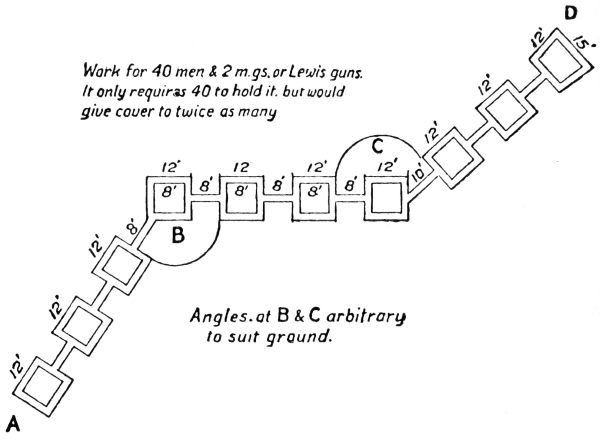
17. After capturing a trench or work, get
your Lewis guns into position without any delay.
From a small front they can bring a great
fire to bear, and they must be given the best
position. Under the protection given by them,
the remainder of your command must consolidate.
(For consolidation, see note to Scheme 7.)
18. Your duty towards the enemy is your duty
towards your neighbour reversed. Think how
he could make himself most objectionable to you
and act in this manner towards him.
19. Always be certain that you understand
your orders, and if you are in doubt never hesitate
to ask and make certain, even should your
commanding officer have a short temper.
20. If you are detached for any specific purpose
you should always rejoin your unit when
you have accomplished what you were told to
do.
21. Do not fail to give negative information.
Young officers are very apt to neglect this. It
may be of great importance to a commanding
officer to know that a certain place is not held
by the enemy, and this is just the kind of information
that his patrol leaders are apt to forget
to send him.
22. Always insist on any verbal order you
may give being repeated to you by the recipient
before he leaves your presence.
23. In a retirement you send men to the rear
with orders to take up another position to protect
your retirement; always see that they are
accompanied by a competent leader, or when the
last party falls back they will very likely find
that their retirement is unsupported.
Try to remember these axioms. My subsequent
letters will be founded on their application.
Your affectionate father,
“X. Y. Z.”