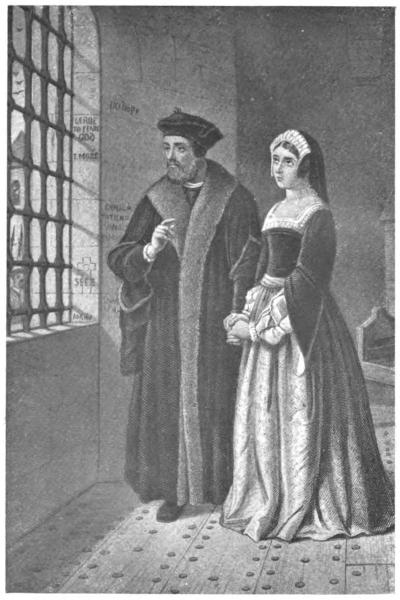
OBSERVING FROM HIS PRISON WINDOW THE MONKS GOING TO EXECUTION
A.D. 1535
(From the picture by J. R. Herbert, R.A., in the National Gallery
Vernon Collection)
A GARDEN OF
GIRLS Or
Famous Schoolgirls of Former Days
BY
Mrs. THOMAS CONCANNON M.A.
Author of
“The Sorrow of Lycadoon” “The Land of
Long Ago” “Earth, Sea and Sky” etc.
LONGMANS, GREEN, AND CO. 39 PATERNOSTER ROW, LONDON
NEW YORK, BOMBAY, AND CALCUTTA
1914
“Queen rose of
the rosebud garden
of girls.”—Maud.
INTRODUCTION
I offer this little book (which aims at a reconstruction
as faithful and accurate as careful
research could achieve, of the real school-life and
education of real little girls in many ages, and in
many lands) to all those interested in the education
of the Irish Girls of To-day—the women of a
great and splendid To-morrow.
If it be true, as Cardinal Logue reminds us, that
“A Nation is what its Women make its Men,” at
no time was the question of the Education of her
Girls of more importance to Ireland than it is now.
Is all well with that Education? By what test
shall Ireland prove it?
As I write these words, there comes before me
a memory of a wonderful little room, at the end of
a Dresden Gallery, where the Sistine Madonna hangs
beautiful and alone. Here, generation after generation
of artists have come to gaze on that Miracle
of Loveliness, and to test their own art by its
perfection.
So, a little apart in the Gallery of the Scriptures
hangs the immortal picture of the “Valiant Woman.”
And it seemed to me, as I was writing of the Little
Girls in my book, that I could see each age and
each country coming to that picture as to a shrine,
and trying to copy, each in its own medium, its untold
perfection.
Do those who have charge of the Education of
the Irish Girls of To-day stand often before that
picture of the “Valiant Woman,” and do they try to
reproduce her image?
If so, all is well with the Education of Ireland’s
Girls—and all will be well with Ireland, the Nation.
HELENA CONCANNON.
Five of the sketches: Darlugdacha, St. Elizabeth,
Cecilia Gonzaga, Margaret More, and Marie Jeanne
d’Aumale, appeared in the “Irish Rosary” during
1912—I am indebted to the kindness of the Editor
for permission to republish in book form. It is only
one of a long list of favours, for which I am his grateful
debtor.
I owe acknowledgment, also, to Professor Max
Freund, Queen’s University, Belfast, for valuable
direction in the Middle High German Studies underlying
the sketch of St. Elizabeth.
DARLUGDACHA — Part I.—The Orphaning of Darlugdacha — Part II.—The Fostering of Darlugdacha.
A Little Schoolgirl of St. Brigid
(Circa A.D. 490)
Across the plain, in the twilight, rode
Flann with his noble guest-friends by his
side, and his hunting train behind him.
They had hunted all day in the woods to the
south of the plain—on foot, as the old Irish
custom was, while their horses grazed free
in the forest glades, and the gillies guarded
their masters’ trappings. Now, weary of
limb themselves, they were astride their
fresh steeds, and the miles that lay between
them and the banqueting hall within the
white Dún above the Liffey were miles of
soft, springy turf. Even the trappers felt
their heavy burdens light, as their feet
touched it. They raced in time to the
joyous concert of the beagles, and the tinkling
of the horse-bells—every man of them
with his great wolf-dog at his side.
The red sunset filled the West, and, in the
glow of it, splendid mantles—purple and
yellow, and green, and red—were yet more
splendid. Gleams of fire were struck from
great jewelled brooches, from the gold on
bits and bridles, from richly-wrought horse-cloths.
Flann himself, a glowing splendid
figure, rode at the head of that splendid
company, the pride of life in his heart, and
crowning his haughtily carried head.
They came to a point from which a great
oak tree was visible. It seemed to Flann,
all at once, as if another hand than his were
laid on the bridle, and his horse were being
urged out of its straight course for the home
stable. He lifted his echlasc,[1] and with it
tried to turn the horse’s head back again.
But in vain. One way only the horse would
go, and that was towards the great oak tree,
which spread a wide dark net against the
red background of the sunset.
“Let it thus be,” said Flann, yielding.
“Let us lay the wolf’s head at the holy
maiden’s feet, that she may know how her
cattle may henceforth graze in peace.” He
called out the word to his followers, and
presently they were all—horsemen, and
runners, and dogs—thundering across the
turf due westward.
They came to the door of the Lios, which
surrounded the cells of the holy maiden,
Brigid, and her companions. “Knock
loudly,” cried Flann; and a gillie stooped
and found the knocker in a niche by the
door, and struck the wood heavily with it.
The sound of the sliding bolt followed
speedily. The door opened, and a white
figure stood framed in the door-porch.
“Prince Flann,” said a woman’s clear
voice, with a note of wonder in it, “a blessing
on thee and on thy company. Is it
aught of ill befallen Etain, thy wife, which
brings thee so late to the door of Brigid’s
cell?”
Flann shouted a word back to the
Cuchairi,[2] and one of them came forward, a
tall man in a rough, frieze mantle, and laid
a dead wolf at the nun’s feet.
“This is what brings us to Brigid’s cell,
so far out of our way,” said Flann, pointing
with jewelled “echlasc” to the gaunt, stark
figure, stretched on the grass before the
immdorus.[3] “Now, oh! Blathnata, may
the flocks of Brigid, and you her sisters,
graze in peace.”
He met the eyes of the little pale nun, and
found them fixed on him with a strange
compassion. The red of the sunset had
suddenly faded from the sky, and a quick
fear clutched his heart as the chill, grey
shadows followed it. What word was that
Blathnata had spoken of an ill that may
have befallen Etain, his wife?
His gaze went past the slim, white figure
in the immdorus. Behind her he could see,
over the darkling lawn, the pale glimmer of
the little lime-washed wattle cells, where
Brigid and her sisters dwelt. The oak tree
was stirring with a queer moaning sound,
and the voice of the brook that ran past it,
and out under the Lios into the plain, held
a sob. Then suddenly the smell of wet
grass and running water was lost in the
acrid smell of blood. The spear-wound in
the wolf’s heart was bleeding again.
Prince Flann could feel beneath him how
his horse was trembling in every limb.
From behind came the nervous neighing of
steeds, the soothing words of the riders, the
frightened yelp of a dog, suddenly silenced.
Then a burst of music came floating out
from over the Lios—and horses and dogs
quieted. Flann looked again, and saw the
windows of the little wooden church, where
the holy virgins were gathered for the
vesper hymn, streaming with a faint but
steady light.
How was it that Flann could only hear in
the vesper music wherewith the Church, the
kind Mother, soothes and comforts her
tired and frightened children, before the
coming of the darkness, the echoes of the
death-song of Cineal Cearbhail? How was
it that the lights of the Church burned
before him like corpse-candles? Not he
alone of that splendid company felt the joy
and pride of life yield to an eerie sense of
inevitable death.
“Must we wait until her evening prayer
is ended, before we may speak with
Brigid?” said Flann at last, mastering himself
with a strong effort.
It was too dark to see the expression of
Blathnata’s face. But the tone of her voice
made the fear that was clutching at Flann’s
heart take a tighter grip. “Our Mother
knew (by what means I may not say) that
Etain, thy wife, had need of her. Nathfraich,
the charioteer, drove her over the
plain, to-day, to thy Dún by the Liffey, and
there she yet bides.”
What a ride was that over the plain in
the darkness when the sun had burned itself
out of the sky, and the world was black with
its ashes. Never a word had Flann spoken
since he turned his horse away from the
door of Brigid’s Lios. Never once did he
lift his head from his breast, until the
neighing of his horse made him conscious of
the scent of river-water. Then he looked,
as his habit was, for the lights of his Dún,
and saw them laid like a crown of jewels on
the brow of the hill.
But what lights were they? Small need
to ask that question when the wailing of
women came to him already over the glimmering
white palisade, towards which he
and his company were climbing.
He was off his horse before a gillie could
come to him. He had no thought of his
guests as he hurried past the banqueting-hall,
where their shields hung in order
above the spread tables. Their feet had
hardly touched the ground, when he had
climbed the outer staircase which led to the
grianan—and saw what it held for him.
In the centre of it, on a rich couch of
beaten bronze, lay the white form of a girl.
The little golden head was pressed deep into
the thick deerskin cushion. On the breast,
beneath the delicate white hands, joined for
the supreme prayer, the fold of the embroidered
coverlet was ominously still. The
light of tall wax candles, grouped around
the couch, fell on the chiselled beauty of a
high-bred white, young face.
Around the circular, tapestry-covered
walls women were seated, making lament
for the passing away of so much beauty, and
love, and youth. “It is low your yellow
head lies to-night, oh, Etain of the golden
locks, you that were wont to hold it high at
the Feastings of Kings and Heroes, when
poets sang the high deeds of Flann, your
Lord. It is cold and still your hands are,
that were wont to be stretched out for the
relieving of the wants of the stranger, and
the poor; for the pouring out of wine for
guests; for the rewarding of learned men,
and men of valour. No colder and stiller
than your heart, that was once warm with
the noble blood of the race of Con! Ochone!
Ochone! for the cold, still heart that can
never feel the warmth of the little child
nestling against it.”
The “keeners” were suddenly silent—for
a cry more heartrending than theirs was
filling the death-chamber. It was the cry
of a little motherless baby. A tall woman,
dressed from head to foot in spotless white,
with a white veil thrown over her long, dark
hair, had entered the room, and, coming
straight to where Flann knelt by the couch
of his dead wife, she stooped and tried to
lay in his empty arms, what she was carrying
in the shelter of her white mantle.
“See, Prince Flann,” she said, “what
Etain, thy wife, has left thee for thy consolation
until the day comes when she may
stretch out her hands to thee again—and
welcome thee home for ever.”
But Flann would not lift his face.
“Take it away, oh! Brigid!” he said, “and
let me not look on that which has cost me the
loss of my one treasure. Let the God you
serve keep the child, and give me back
Etain, my wife.”
There was a moment’s silence, for Brigid
had the child anew in the folds of her
mantle, and its cries had ceased. Then
there came a deep groan, followed by a
sudden, horrified cry from the women.
Brigid knelt down quickly, the child in her
arms, and lifted one of the hands, which
Flann had flung in his passion of despair
across the dead body of his wife. Heavy as
lead it dropped from her grasp. It was the
hand of a dead man.
She rose then, the sorrow of the world
darkening her grey eyes. “Methinks the
wish of Flann has been fulfilled,” she said.
“Now he stands with Etain, his wife—and
their little child shall be consecrate to God.”
So in the folds of Brigid’s white mantle,
the little orphan maiden, Darlugdacha,
found shelter; and the first home she knew
was the white-washed hut of wattles and
clay in the shadow of the great oak tree of
the Plain of Kildare.
Very warm was the nest they made for
her—the holy maidens, who were Brigid’s
companions. Dear gentle Daria, the blind
nun, wove a cradle of osiers, and Blathnata
filled a deer-skin with downy feathers to
lay in it. Kinnia spun fine linen for it;
and Brigid, herself, took the wool of the
whitest lamb in her flock, and spun and
wove it into warm, soft coverlets. When
the sisters were gathered with spindle, and
distaff, and needle on the lawn, the little
cradle stood in the midst of them, protected
from the damp grass by the wolf-skin,
which had been Flann’s last offering. But
it was so contrived that it could be hung,
also, from a branch of the tree. So, as the
little green leaves began to peep out on the
oak tree, they found among their green
company something that they might well
have taken for a beautiful, rosy blossom.
And it was the little child in her cradle.
At night the cradle was hung from the
feici[4] in Brigid’s cell, a dim lamp swaying
from the opposite end. And when the
dawn came, and Brigid set wide the door to
let it in, there was always standing by the
threshold her own snow-white pet doe,
waiting to give her milk to feed her tiny
nursling.
The months passed quickly, and at last
the little maiden had climbed out of the
cradle, and was learning to take her first
faltering steps. Blind Daria, with her
deft hands, had fashioned the quaintest
garments for her. They were of undyed
lambs’-wool, and made in the same fashion
that the holy maidens, themselves, had
chosen. There was a white mantle, too;
and on the curly, baby head, was set a snow-white
veil.
But not in dress alone was Darlugdacha
a little nun. Very early, like all healthy
little girls, she insisted on taking an active
part in the life she saw around her. There
was one beautiful night when Brigid and
her companions were gathered in the
Church for the Second Nocturn. The
lamps were swaying from the ridge-pole,
and in the dim light of them the nuns were
singing from psalters of their own copying
the appointed psalms. All but blind
Daria, who needed no psalter and no lamp-light.
All at once the blind nun’s quick ear
caught a sound at the barred door. Very
softly she stole from her place and set it
open. There was Darlugdacha, with her
white tunic all stained with mud, her rosy
face all stained with tears, and her baby
hands all hurt with beating at the door.
Sightless Daria could see these things, as
she stooped and gathered the forlorn little
figure into her arms. Presently, she was
back in her place again, with Darlugdacha’s
head on her shoulder, and Darlugdacha
singing her own version of the psalms
after her, in the sweetest baby voice. But,
long before the Office was ended, Darlugdacha
was sound asleep.
After that night, Daria would always
slip into the Abbess’ hut before she took her
own place in the church, and, if the child
seemed restless, she would wrap her up
warmly in her own mantle and carry her
with her. So Darlugdacha early took her
part in the “Magnum Opus,” and the
earliest words her tongue uttered were the
praises of God. The music of the psaltery
was her most frequent lullaby.
She was welcome everywhere, and in no
place whithersoever her little pattering
feet led her, did she find her help, however
embarrassing to the recipient, disdained.
Even when there were guests in the guest-house,
and Blathnata, the cook, was very
busy in the kitchen, Darlugdacha could
enter that domain fearlessly, and, as Blathnata
soon found out, could make herself
astonishingly useful. The kitchen was a
little round hut, which stood by itself behind
the other cells. A fire of wood burned
in the middle of it, the smoke escaping
through a hole in the roof. It was always
a joy to Darlugdacha when Blathnata
swung the beautiful shining cauldron over
the flames, and the cheerful simmering of
the meat within filled the little hut with
sound. She was very proud of herself when
she was, at last, permitted to go near
enough to the fire to turn the fish, or joints,
that were roasting on spits of pointed hazel
rods round the fire, and proudest of all,
when Blathnata showed her how to baste
them with honey. She was very young,
indeed, when she cooked her first dish of
Craibhacan, chopping the meat fine, and
flavouring it with leeks, and kale, and
rowan berries. Nathfraich, the charioteer,
won her heart by making for her a tiny
kneading trough, and a sieve with a whale-bone
bottom, and he secured it for ever by
manfully eating to the last crumb the first
cake she baked with these utensils. Kinnia
said, as she and Blathnata were carrying
water one day from the covered well in the
dairy to the kitchen, and Darlugdacha was
trotting along by their side (her hand on one
of the handles of the pail, as if she had the
whole weight of it herself), that, for her
part, she would rather eat a woman’s ration
than a man’s ration of Darlugdacha’s baking.
But when she saw Darlugdacha,
presently, with one of Blathnata’s cooking-aprons
on her (so as to save her white tunic),
scrubbing away very busily at Blathnata’s
wooden vessels, the little woman looked so
sweet, that Kinnia told herself she would
eat a whole cake, if it were necessary, to
please her.
There was never such a busy little girl.
When work was slack in the kitchen, there
was the dairy to keep her in occupation.
Brigid herself loved the dairy, and, mindful
of her own young days, gave Darlugdacha
the freedom of it early. In the
delicious dawn-hour, when the sisters, one
and all, went out to the milking, there was
never a happier young thing, whether
among the lambs, or the birds, or the flowers,
than the tiny white maiden who trotted between
Brigid and Daria, with each hand in
one of theirs, laughing back at Kinnia and
Blathnata, who carried the wooden milking
vessels between them. She knew each of
the cows by name, and she would call them
out in her clear voice the moment she passed
out of the door of the Lios, and came in sight
of the “badhun” (bawn, lit. cow-fort), into
which the cattle were driven each night for
safety. And when the gate of the badhun
was reached, there they were waiting for
her—Bainidhe and Breacaidhe, and Sgead
and Riabhac, and all the others, lowing in
answer. And the sound of their bells put
the birds on the tops of the apple-trees of
the Lios, to shame.
It happened, however, one morning, that
when Darlugdacha got to the gate of the
badhun, she found among the waiting,
lowing herd, no Bainidhe—the little white
cow with the red ears, which was her special
pet. It seemed that two lepers had come
to Brigid the day before, and the sight of
their miserable condition so prevailed with
the compassionate Abbess that she promised
to give them the best cow in her byre,
leaving the choice to them. Of course, it
naturally fell on Bainidhe.
Darlugdacha’s soft little heart was torn
by two emotions when she heard the explanation
of Bainidhe’s absence. She was
dreadfully sorry, to be sure, for the poor
lepers, whom she had learned to pray for
night and morning. But, I fear me, she
was far more sorry for Bainidhe, driven
away from her nice, juicy pasturage, and
the fragrant breath, and the lowing of her
companions, and the warm shelter of the
badhun—and the stroking of a little girl’s
soft hand.
It was the turn of Brigid herself, that
day, to drive the cows, after milking, from
the badhun, and herd them in the Curragh.
Usually, Darlugdacha would be out of herself
with delight when it was proposed, as
it was now, that she should go with her.
But to-day it was clear that the delights of
a day with the dear mother, all to herself,
in the glorious plain, were overshadowed
by the loss of Bainidhe. So Brigid told
Kinnia to take Darlugdacha back with her
to the dairy, and let her help to skim the
cream, and stand as near as ever she liked
to the cuinneog (churn), when the loinid
(churn-dash) was beating the white milk-waves
into flying froth—which, on ordinary
occasions, was not considered a suitable
place for a little girl, who had a white tunic
to keep clean.
It took her some time before she was her
cheerful little self again. Even the pat of
butter Kinnia gave her to stamp failed to
bring her consolation. But a good drenching
in buttermilk froth helped her wonderfully;
and when Kinnia (who, I am afraid,
was not guiltless in the matter of that
drenching) had wiped the small, rosy face
dry again, she felt inclined to give credence
to Kinnia’s expressed faith that she would
see Bainidhe again before very long.
A greater number of poor came that day
to the gate than usual. Darlugdacha was
kept very busy helping Kinnia to attend to
their wants. Here a poor woman wanted
milk for her sick son; there a crippled girl
had come for butter; for a poor man with a
large family there was a great loaf of bread,
with cheese and bacon, and a measure of
milk. Now, as Darlugdacha flew from the
kitchen to the dairy, and thence to the gate,
she seemed to have in her ears all the time
the lowing of Bainidhe. At last, towards
evening, when all the other poor had departed,
there came a great knocking with
the “bas-chrannidhe” at the door; and
when Kinnia and Darlugdacha went to
open it, what should they find before them
but the two lepers of the day before—and
Bainidhe.
They had not been able to drive Bainidhe
a single step beyond a certain point in the
plain, well within sight of the Oak Tree.
And so they had come back to ask Brigid to
help them again.
Happy Darlugdacha, her small arms
round Bainidhe’s white neck, her small
hand alternately stroking Bainidhe’s nose,
or pulling her red ear, was welcoming her
restored darling, while Bainidhe was lowing
with contentment, and trying to tell how
clever she had been, and Kinnia was away
with Blathnata in the kitchen, preparing a
comfortable meal for the two poor lepers.
At that moment the tinkling of cow-bells
was heard, and Brigid came in sight,
driving her cattle across the plain.
The lepers could not await her coming.
They were off to meet her like two flashes of
lightning. And presently, over the lowing
of the cattle and the tinkling of the cow-bells,
and the joyous barking of the “cubuachaill”
(i.e., “dog-cowherd,” sheep-dog),
Darlugdacha could hear their hoarse voices
telling Brigid their story.
Then, quite suddenly, the tinkling of a
cow-bell was heard from another direction,
and a man was seen coming from the North
driving a cow before him.
Darlugdacha left off stroking Bainidhe
for a moment, and waited to see what would
happen.
Brigid and the lepers and her cows came
up with the stranger and his cow just at the
Lios gate.
“My Master has sent this cow to thee as
a gift,” said the man, and put an end of the
halter that was round the cow’s neck in
Brigid’s hand. With that he was off
again.
Brigid looked at the cow which she held
haltered, and then at the one Darlugdacha
was stroking. And Darlugdacha looked at
the new cow, and then at Bainidhe, and
then back again. The two cows were
exactly alike.
“Methinks my Master has sent this cow
to you, poor men,” said Brigid, “instead of
the one that would not go with you.” She
put the halter into the hands of the two
lepers; and when Kinnia and Blathnata
had given them food, they drove off their
new cow contentedly.
Since they did not come back for a long
long time, I feel sure that the second cow
must have gone with them obediently. As
for Bainidhe, she was driven with her other
companions into the badhun, and Darlugdacha
stood very close to her, while Brigid
herself milked her.
In those days, when the ideal of education
was the direct preparation of the child
for the duties which his future station in
life was likely to lay on him, the law itself
took cognisance of the necessity of training
girls in the arts of household management.
“The use of the quern, and the kneading
trough, and the use of the sieve are to be
taught to their daughters” says the
Senchus Mór to Foster Parents in one
place; and, again, to those who foster the
children of Chieftains, “sewing, and cutting-out,
and embroidery are to be taught to
their daughters.”
You may be sure then that Darlugdacha
(whom Brigid held in fosterage for the
High King of Heaven Himself) was early
trained in the use of the spindle, and the
distaff, and the needle. In the quiet evenings
of the tender Irish summer-time, when
the nuns sat on the lawn under the shadow
of the great oak, and Brigid, her poet’s soul
stirred to the depths by the beauty of the
world around her, was thinking, with pity,
of Daria’s blindness, a little girl could be
seen making a very brave attempt to imitate
whatever she saw Kinnia, and Daria, and
Blathnata, and Brigid herself do. It was
Daria’s task to comb the wool. She drew it
out in handfuls from the bag at her
feet, and combed it with a pair of “cards”
until it was fit for spinning. Then she
turned it over to Blathnata, who wound it
first loosely on the cuigeal (distaff), and
then, dexterously, spun it on to the spindle.
Kinnia was kept busy with her bronze
needle and ball of wool, fashioning garments
for the sisters themselves, or for the many
poor who depended on them. And, while
Brigid’s clever artist-fingers are copying on
some beautiful ecclesiastical garment, with
many coloured, precious threads, the design
stamped on the leather pattern she holds
before her, let us, whose fashionable pedagogy
lays so much stress on “Object
Lessons,” think how fortunate Darlugdacha
is. There is not a process, from the sowing
of the flax-seed to the making up of the
linen altar-cloth, that she has not witnessed
with her own eyes. She has been able to
follow, step by step, the evolution of the
woollen garment which Kinnia is fashioning—from
the shearing of the sheep
onward.
In the winter evenings the sisters sat in
the loom-house, and wove the flaxen and
woollen yarn they had prepared during the
summer into linen and cloth. Darlugdacha
loved to sit by, in the light of the rush
candles, and watch the shuttle being flung
back and forth. But something more
precious was being woven during these
hours than the web on the loom; and many
a wonderful old story, many a gracious
thought, many a poem, and many a prayer,
were being patterned into the weaving of it.
The old Irish, a people courteous and
sociable, held no one cultured who could not
“talk” well. Story-telling, as a great test
of education and good breeding, was the
accomplishment they valued most. Little
Darlugdacha, who was set aside to be the
bride of the King of Kings, was in the
thought of those who fostered her to get the
culture of a Princess. Can you picture
her, a little white girl, sitting very close to
her dear mother, telling, when the turn for
a tale comes to her, some story she has been
taught concerning the ancient days and
ways in Erinn? Very sweetly and gravely
the clear, treble voice carries the tale. Do
you notice how pleasant is its “timbre,”
how very expressive its inflections, how
charming and musical its modulations?
There is no instrument from which better
effects can be obtained than the human
“speaking” voice; and do they not do well,
in this ancient Ireland, to which we have
slipped back in search of our Darlugdacha,
to devote great care to its cultivation? It
is true they are fortunate in having in this
language they speak, rich in sounds, full of
delicately-shaded endings, a marvellous
exerciser. And have we nothing to learn
from Darlugdacha’s teachers?
We have still other things to learn from
Darlugdacha’s teachers. Those story-telling
lessons held many lessons in one. In a
highly inflected language, like Old Irish, to
learn to tell a continuous tale was to undergo,
among other things, a thorough drill in
Grammar. The material of the tale was a
storehouse of instruction in History and
Geography. The Memory-training, which
we try to combine with an awakening of the
aesthetic faculties when we prescribe the
memorising of poetry for our youngsters,
was admirably acquired by the same
means. As for “Education,” there was
Character-training in those old tales that
set the heart beating for noble deeds,
nobly done. Character-training, too, in the
reasoned patriotism they taught by showing
why Ireland was a country to be loved, and
how to love her. Courtesy and Dignity
ever hovered before the apprentice story-teller
as the ideal to be striven for.
Courtesy demanded the best of him, that it
might be offered to his neighbour for his
neighbour’s pleasure. Dignity and Self-respect
demanded the best of him, that it
might be worthy of himself.
You must not go away with the idea,
however, that Darlugdacha’s “Instruction”
was all gained by learning to re-tell the old
tales. She had her reading and writing
lessons, too. I like to think that the same
method was adopted with her to make her
learn her letters, as was found efficacious
with Saint Columbkille. Perhaps Blathnata
made a cake for her—a nice cake with
plenty of honey in it—and traced the
alphabet on the top of it. As Darlugdacha
learned to know the letters, she could make
her very own of them, you see, by eating
them. It may have required more than one
cake to make the process of instruction complete.
No matter how many were needed,
I am sure Blathnata did not spare them.
At last, Darlugdacha had got beyond her
alphabet cakes, and was all afire to get helping
the sisters to copy the psalter. Cilldara
was a small place in those days, and had no
“Teach Screptra.”[5] But the books hung in
their leathern satchels from hooks along the
walls of the Erdam (or Sacristy) that opened
off the little Church. Hither came the nuns
in turn to help to make the new copies, of
which the Abbess had constant need to
bestow in alms on poor churches. Two or
three other virgins had joined the community
since Darlugdacha’s coming; and
one of them, the daughter of a scribe, was
particularly skilful at the work. Darlugdacha
was fascinated by it. She would
stand for hours at a time watching the
clever pen go delicately over the vellum—and
longing for the day when she, too,
would sit at a desk with a quill in her right
hand, and a knife in her left to keep it
pointed, with her conical ink-cup fastened
to her chair-arm—a fully-equipped scribe.
In the meantime, she was forced to content
herself with her fan-shaped, waxed tablets,
on which she practised copying with a
metal “style.” When the wax surface was
used up, she rubbed it smooth, and began
over again. Thus the little hands grew
sure and steady—and, at last, one day, on
an old piece of vellum, they tried their skill
with the pen.
Down across the ages, from those exquisite
days, fresh and beautiful as the
summer dawn, there has come to us a poem
of Brigid’s. It sets us in the midst of the
preparations for a great Church Festival,
where the Guest of Honour was to be One
Who, indeed, was never absent from the
midst of the white band of women whom the
Oak Tree sheltered. For, was not every act
of theirs a prayer? And were they not
gathered together in His name? And hath
He not made a promise? Nevertheless, it
is fitting that, at Easter time His Resurrection
be honoured, and the poor and the
afflicted, His chosen representatives, be
made joyful. So as the paschal moon gets
nearer and nearer to its white perfecting
in the East, the little hive beneath the Oak
Tree grows busier. There is ale to be
brewed for the faithful who shall attend the
Celebration of the Passion in the neighbouring
churches. There is corn to be
ground in the querns, to be ready for baking
into paschal cakes, or dealt out to the needy.
There are candles for the altar to be made
of virgin wax from the bee-hives in the
nuns’ scented garden. There is store of
meat to be salted and cooked for the banqueting
table, spread for the poor. In the
little wooden Church, blind Daria, the
sacristan, is laying out her choicest vestments,
taking from their places of safety
the precious vessels. The altar linen, snowy
from the brook, stands ready. Around His
Throne are flowers and fragrant herbs.
And little Darlugdacha is flitting, like a
white bird, in the midst of it all, singing
Brigid’s hymn—finding, in all this preparation,
its mystic significance, learning
the reading of the Riddle of Life:—
I should like a great lake of ale
For the King of the Kings;
I should like the family of Heaven
To be drinking it through time eternal.
I should like the viands
Of belief and pure piety;
I should like flails
Of penance at my house.
I should like the men of Heaven
In my own house.
I should like kieves
Of peace to be at their disposal.
I should like vessels
Of charity for distribution;
I should like caves
Of mercy for their company.
I should like cheerfulness
To be in their drinking;
I should like Jesus
Here to be among them.
I should like the three
Marys of illustrious renown;
I should like the people
Of Heaven, there from all parts.
I should like that I should be
A rent-payer to the Lord;
That should I suffer distress,
He would bestow upon me a good blessing.
SAINT ELIZABETH — Part I.—“A Star in the East.” — Part II.—On the Wartburg.
A Little German Schoolgirl of the Middle Ages
Has not Herr Walther,[6] good-humouredly
turning the laugh against himself, advised
all those who suffer from earache to stay
away from the Court of Thuringia? For
my part I can never read his “Spruch”:—“Swer
in den ôren siech von ungesûhte sî,”
without feeling a most realistic discomfort
at the din, made even in the poetry (and at
700 years’ distance!) by the alternating
trains of “coming and parting guests,” for
whom Landgraf Hermann’s undiscriminating
hospitality had equal “welcome and
speeding”; and without endorsing Herr
Wolfram’s[7] regret that no Kaye, the
boorish Seneschal of King Arthur’s Court,
held office in the Wartburg, to keep the
“good and bad” in their respective places.
How intolerable the ceaseless din could
be, even to one who was born in the midst of
it, a little boy was dolorously feeling on a
certain summer’s evening of the year 1211.
The noise seemed worse than usual from the
impression he had (which nobody took the
slightest trouble, alas! to remove), that he
was hopelessly “out of it.” When, braving
the dragon which kept terrible guard over
King Ortnit, murdered in his sleep (a warning,
in high relief over the tower gate, to
watchmen too fond of sleep), he had climbed
the rough spiral staircase to the keep, he
had found no welcome from the warder,
intent on scanning the horizon for an
eagerly expected messenger. Shouts, that
sounded not all too sober, from the House of
the Muleteers, warned him off their
premises. As for the kitchen—with the
roaring of fires, and the creaking of spits,
and the cursing of cooks and scullions, and
the wailing of imprisoned fowl, awaiting
execution under the huge table—that was
Inferno! As the little boy passed the great
stone steps that led to the entrance of the
Palas, he put his hands in his ears; for the
door of the Saal stood open, and amidst the
gambols of gleemen, and the notes of every
musical instrument known to the period—flageolet,
guitar, organistrum, bagpipe,
psaltery, tabor, lute, sackbut, rebeck and
gigue—Landgraf Hermann was reminding
guests (who needed small reminder) that, if
ever there was an excuse for emptying
flagons, it was to-day, when the little
Hungarian Princess, the betrothed of his
son and heir, Hermann, was due to arrive
at her German home.
In the Armourers’ House our little boy
had been frankly snubbed; and big brother,
Hermann, whom he found in it (made much
of as the hero of the day), being measured,
if you please, for a suit of armour (which
he supposed he would need very soon now),
had given him the brutal advice to go back
to Agnes, and Heinrich, and Conrad in the
nursery—and not be forcing his company
on his elders.
And then, suddenly, things had changed.
As he turned out of the Armourers’ smithy,
with Hermann’s mocking laugh in his ears,
he heard his own name called once or twice.
His mother had sent one of her women in
search of him, and he was to come at once
to the women’s apartments.
It certainly was a comfort to be wanted
somewhere, and young Ludwig made about
two steps of the staircase which led to the
long open gallery on the side of the great
courtyard. He lingered a little, though, on
the gallery, for the sense of beauty and comfort
which one had to starve somewhat in
mediæval castles found satisfaction here.
Sweet-scented flowers grew in boxes in
the spaces between the charming double
columns, which even to-day are the Wartburg’s
chief architectural beauty. In
gilded cages beneath the open arches were
the little song-birds his mother loved. On
the inside wall were painted tender
domestic scenes from the Bible. He had a
dim but very pleasant consciousness, as he
passed them by, that the figures were smiling
out on him the welcome of old friends.
And as he paused for a moment at the door
of his mother’s room, and looked back along
the gallery, he noticed that the last rays of
the sun were filling it, and the birds were
singing, and some of the flowers, that had
gone to sleep, had wakened up again.
But all this did not prepare him for what
he found when he pushed open the door,
and stood on the threshold of the great
vaulted chamber, where his mother awaited
him.
A feast of colour and light! Instead of
the golden evening rays, here was the soft
radiance of hundreds of waxen tapers. The
hinged wooden shutters had been let down
over the unglazed window spaces, and night
was summoned hither before her time.
From the quartered arches of the painted
roof hung chandeliers of enamelled bronze,
of the admirable workmanship of the
period, and each of them was laden with
lights. In long rows between the columns
on which the roof rested stood tall candle-sticks
with great “king-candles” burning
in them. On the hearth flamed a fire of
scented wood, and the light of candles and
leaping fire made wonderful play with the
glowing colours of the painted ceilings, and
the splendid tapestry on the walls.
“Come hither, fair son.”
Young Ludwig came over the flower-strewn
floor, between columns of coloured
marble and “king-candles,” his handsome,
fair head held high. In his page’s dress of
crimson, he fitted in well with the rest of the
scene. So did his mother, standing in the
midst of her maidens, stately and beautiful
in her mantle, with its shimmering embroideries,
its long train, and breast fastening
of regal pearls. She held out a little
white hand to him, and he kissed it, kneeling
on one knee. Then, with a sudden impulse,
as if the mother claimed her rights as
well as the princess, she stooped down to
him, moved aside her wimple, and laid his
firm young cheek against her own. She left
her hand in his, while he rose from his
knees, and led him with it to the top of the
chamber.
“Look, fair son, and tell me what you
see.”
For a moment Ludwig was so astonished
at what he saw that he could not speak.
Then he turned to his mother with a question:
“Who worked the tapestry? And
how do I come to be standing in the Landgraf’s
robes, high on the Wartburg, with
the valley and the town of Eisenach far
beneath me, and a great star hanging low
from the sky above my head?”
His mother answered one part of his
question: “The ‘Wise Nun’ in thy Father’s
Convent of Eisenach has wrought it,” she
said, and then stopped suddenly, and led
him to the lateral wall.
“This, too, hath the wise nun wrought?”
he asked in growing astonishment. For
the tapestry on this wall depicted a scene
which had occurred in the Wartburg four
years previously, with a fidelity which
seemed impossible to anyone but an eye-witness.
It was the celebrated “War of the
Poets” on the Wartburg—the “Wartburgkrieg”—the
memory of which is as fresh
to-day as when young Ludwig looked on the
“Wise Nun’s” tapestry, and saw it
pictured in glowing colours and wealth of
detail on the canvas.
There on the “Minstrels’ Gallery” were
the seats of Duke Hermann and Duchess
Sophia. The Landgräfin had risen from
hers, and with the folds of her mantle was
covering a terror-stricken suppliant. In
the Minstrel’s Hall, a step or two beneath
the Gallery, were the other contestants.
Ludwig recognises each of the angry faces
that are turned towards the fugitive—Wolfram
von Eschenbach, Walther von der
Vogelweide, Heinrich von Zweten, and
Heinrich Schreiber. A man, with the instruments
of the executioner in his hand to
label him for the spectator, is starting forward,
but the quick movement is arrested by
someone he sees in the opening door—a
white-haired, venerable man, with a long
beard.
“It is Klingsohr, the Wise Man from
Hungary, who has come just in time to save
the life of Heinrich von Ofterdingen,” says
Ludwig, while his mother nodded confirmation.
Young Ludwig passed on.
Here was the white-haired man again—in
a garden this time before one of the little
tables which have been in German inn-gardens
since first such things were, and
will be, until they are no more. He has risen
from the table and is scanning the skies—and,
behold! very low in them is hanging
the star which shines about Ludwig’s own
head in the piece of tapestry opposite.
From the other tables, men in the knightly
garb of peace, have risen likewise, neglecting
their chess, and draughts, and dice, and
drinking flagons, to follow the direction of
the old man’s pointing arm.
On the left wall another many-figured
scene. A king and queen on their thrones
in the midst of a full and splendid court.
Between them, the wonderful star is poised;
and at their feet are kneeling ambassadors,
whom Ludwig recognises as those sent from
his father’s court, to ask the hand of the
little Hungarian Princess (whose birth had
been announced to him by Klingsohr) for
his eldest son, Hermann.
“How wonderful it is,” said Ludwig,
“but why did the ‘Wise Nun,’ so exact in
all else, make the mistake of clothing me in
the Landgraf’s robes, instead of Hermann?”
Nobody answered, for a peal from the
Berchfrid,[8] that rang through every corner
of the huge enclosure on the Wartburg,
made its way into the women’s apartments,
and told those who waited there that they
need wait no more. The serving women
were busy with their lady’s mantle, and
presently the hum of a merry little song,
and the ring of a martial (and not quite
steady) step was heard along the gallery,
and Duke Hermann, somewhat flushed from
his mighty potations, but excellently-humoured,
came into the “kemenate.”
“Art ready to meet thy daughter-in-law,
Frau Landgräfin?” he said, jocularly.
“If so, there is no time to be lost. What,
Ludwig, still at thy mother’s girdle? It
fears me much that we shall never make a
sturdy drinker and fighter of thee, to keep
thy father in countenance.”
Over Duchess Sophia’s fine face a shadow
fell. She loved this passionate Lord of
hers, with all his faults and all his
weaknesses. But it was the dearest
prayer of her soul to preserve her sons
from following the path he trod. As
much as lay in her power, she strove to
keep them away from the motley company
which held revel in the hall of the main
building. But Hermann had speedily
emancipated himself. “The lust of the
eyes, the delight of the flesh, and the pride
of life,” had put their fascination on him as
soon as he had got clear of the women’s
apartments. Ludwig was different. A
certain asceticism, answering her own, had
early revealed itself in his character. A
strength of purpose, a force of self-restraint,
a natural attitude of noble aloofness
from all that seemed unworthy, made
her build high hopes on Ludwig. And as
for Hermann, who knew what blessings
might be brought him by this child-bride
from Hungary, whose birth had been accompanied
by such wonders, who had already
won the gladness of peace for her own land?
Joyfully, then, she went forth to meet
her. Outside on the gallery torches burned.
The great courtyard was full of light and
movement, the stamping of horses, the
shouting of orders, snatches of laughter and
song. She heard a whisper from Ludwig:
“May I be your escort, Lady Mother?” and
answered with a pressure of the hand. A
groom brought her horse, and Ludwig
lifted her from the mounting-stone at the
bottom of the staircase, on to the bench-like
seat, which, for the ladies of the thirteenth
century, took the place of a saddle. Her
husband and Hermann were already
mounted; Ludwig, as his mother’s chosen
squire, was at her horse’s head. So they
rode, with a long train of knights, and
ladies, and squires, and pages, behind them,
out of the great court into the Vorburg, and
then through the triple gates of the
entrance tower, out over the lowered drawbridge,
and so to the narrow and dangerous
path which led to the plain below. So
narrow was the path that they could but
ride in single file with a torch-bearer beside
each rider to light the way for them. In
the depths below them, Eisenach lay, a
great blazing jewel in the dark valley. All
sorts of summer-night scents came to them
from the sloping woods on either side.
There was no darkness in the sky, only a
deep blue, cut by exquisite star-forms. In
the west was a thin curve of a very young
moon. Landgraf Hermann began to hum
a “Lied” of Walther’s, the “Praise of
Summer”—“Swie wol der heide ir manicvaltiu
varwe stât,” “How well the painted
heath becomes its wealth of summer bloom”—and
presently a boy’s soprano took it up,
and to wood, and heath, and meadow were
being revealed their own sweet loveliness,
under the tender light of a poet’s longing,
wistful yet passionless, like that of the thin
young moon herself!
So those rode down from the Wartburg,
who went forth from it to meet the King’s
Daughter.
The gates of Eisenach opened to their
trumpeter, and through the torch-lit streets
they rode to the inn beside Saint George’s
Gate, where Michael Hellgreff had had
Klingsohr to guest, what time he saw the
Star hang low in the mystic East. On
their way, they passed groups of burghers
and their dames, all in their Sunday best,
sitting on benches under the overhanging
stories of their gabled, wooden houses, who
left off gossiping to cheer their Sovereigns
and the handsome young bridegroom.
Under the linden on the green, country lads
and lasses, in the fine clothes which raised
Neidhart’s bile, were dancing a merry
“Springtanz,” to the infinite delight of the
Court Pages and the dainty scorn of the
Court Ladies. They shouted their “Heil”
as the Ducal pair passed, but never lost a
step. The market-place was almost impassable,
so dense were the throngs that
crowded round the roasting ox, and the
fountain that played wine.
There were two people in the ducal procession
who were not sorry to leave the uproar
of the streets, and seek the quiet of
Master Hellgreff’s garden. These were the
Landgräfin and her second son. As for the
Landgraf and Hermann, they and the
Knights, and Squires, and Pages were out
in the street again directly, and the ladies
showed so evident a desire to follow them,
and see all the gay doings, that the Landgräfin
summoned back the Squires and put
her ladies in their charge, and sent them
forth.
But Ludwig and his mother had their
own joy, sitting in the scented, dark
garden, into which the gay noises of the
streets came, robbed of their harshness,
with the stars shining down on them, and
the young moon over the woods, while they
waited for the trumpet to sound at the gate.
It came at last, and Duchess Sophia
hastened to the door of the inn, to be joined
there by her Lord and Hermann, as had
been agreed. As the Ducal tableau
arranged itself, there was a moment’s
silence, as if a whole people were holding its
breath in expectation. It was broken by
the noise of wheels, and a carriage passed
through the towered gate, and stopped
before the Hellgreff Inn. Two Knights,
who rode on either side of it, dismounted,
amid the frantic cheers of the by-standers,
and knelt to kiss in turn the hand of the
Landgraf and the Landgräfin. Then they
turned to the carriage, wherein a lady was
standing up, with a little sleeping girl in
her arms. But the Landgräfin could wait
no longer. Over the muddy street she went,
in defiance of all etiquette, and took the
little maid, warm and lovely with sleep,
from the hands of Frau Bertha, and carried
her to her Lord.
Then the joy of the people got beyond all
bounds. And it was their shouts of welcome
that made the little four-year-old
bride open her eyes at last—on her German
home.
It was astonishing how soon she really
seemed to make it her home. Kind Duchess
Sophia, who had watched the whole first
night by the little bride’s silver cradle, in
the Inn at Eisenach, looked carefully, in the
days that followed their return to the
Wartburg, for a sign of home-sickness.
But, except that the child’s great dark eyes
would sometimes fill with tears when they
rested on Frau Bertha, she could find none.
Little princesses are early schooled to
stoicism, and before the tiny Hungarian’s
“Königstochter,” left her father and
mother, she had received lessons which,
young as she was, she was not too young to
understand.
So, after a time, she became, to all intents
and purposes, a little German girl, as much
one of the family as Agnes, or Heinrich, or
Conrad, who shared the Kinderstube with
her. She was more in awe of Hermann
than anybody else; for Hermann had
realised that, instead of its adding to his
“manliness,” it made him rather ridiculous
to be the “Bräutigam” of a mere baby like
that—and his behaviour showed it. For
Ludwig, on the contrary, she developed a
shy friendship, which went straight to the
boy’s chivalrous heart, and made her, in a
manner, dearer to him than his blood-sister
Agnes. For the rest, the little maid did
not often see either Hermann or Ludwig,
who were most of the day with their
governor serving the first grade of their
apprenticeship to the great profession of
knighthood.
A mediæval nursery was a merry place,
and mediæval children had nothing to envy
their modern brothers and sisters, whether
in the matter of toys or games. A lover of
the romantic Middle Ages, Zingerle, in his
wanderings through the Märchenwald of
Middle High German poetry, or over the
more prosaic lands ploughed by the Middle
High German Moralists and “Didaktiker”—Thomasin
von Zirclarie, Freidank, Hugo
von Trimberg, and others—has found many
a happy group of children, and gathered
themselves and their games into a very
charming book: “Das deutsche Kinderspiel
im Mittelalter.” With the aid of it, we
can easily reconstruct the life led by little
Elizabeth in her nursery at the end of the
“Kemenate” (women’s apartments).
While she and Agnes played with their
dolls (“tocken”), or kept house with their
toy cooking-vessels, Heinrich and Conrad
jousted rather noisily on hobby horses, or,
failing these, on two mettlesome steeds,
which, outside the nursery, would have been
taken for sticks. Nurse (“amme”) was as
important a personage then as now, and
had as many rôles to fill. Sometimes she
presided over tourneys where wooden
swords wrought frightful havoc on wooden
shields. If anybody came out of the combat
with bruised knee or finger, it was hers
to dress the warrior’s wound—and, maybe,
make it well again with kisses. At the
tourneys where she presided there were
nothing but victors. Everybody won the
prize of painted egg or apple. (By the
way, did you ever notice that the Christ
Child of mediæval artists has always an
apple in His chubby hand?) Sometimes
she went visiting the stately “halls” where
Elizabeth and Agnes played Châtelaine,
and ate the wonderful things they cooked
for her, and inquired about their doll-children,
just as nurse does to-day. In a
carved wooden box she kept the “best”
toys, the birds and animals in coloured clay,
or wood, or metal, which were too fine to be
played with every day. In the nursery
door there was always a hole cut near the
ground, just large enough for a tiny dog or
a cat to creep through. That, I am sure, was
a kind thought of nurse’s. When games
got too noisy, and little boys and girls were
tiring themselves into crossness, she had a
way of gathering them into the shelter of
the great fire-place, and telling them the
most fascinating stories. Some of the tales
that are prime nursery-favourites to-day
were told, without a doubt, by her “Amme”
to Saint Elizabeth when she was a little
girl. “The Seven Wild Swans,” “The
Sleeping Beauty,” “Clever Else,” “The
Fox and the Geese,” and many, many others.
Some of the “Lügenmärchen” (of the kind
definitely associated in later years with the
name of the immortal Munchhausen) go
back equally far. Nobody knows, for instance,
how old is the legend of
“Schlaraffenland”—“the Land of Cockayne”—of
which our Middle Irish “Vision of Mac
Conglinghe” is an interesting variant.
Young wits were sharpened by guessing
riddles. Here are some Thirteenth Century
ones, which Saint Elizabeth may have tried
to guess:—
“The Full of the Valley, the Full of the Land,
But never the Full of a little girl’s Hand.”
The answer to that must often have lain
before her, making her feel, as she stood in
her high window-niche in the Kinderstube
of the Wartburg, as if she were looking out
from a tall ship on a great sea, beneath
which towns, and fields, and woods lay
buried, and unseen. For it was the Mist—above
which the Wartburg, on its high
crag, stood upraised.
Here is another which helped little boys
and girls (who would presently be studying
their “Comput”) to remember the divisions
of time.
In my father’s garden stands a tree;
(The year).
Upon it twelve fine branches see.
(The months).
Thirty birds on every bough;
(The days).
Eggs enough for each I trow—
(The hours).
Four-and-twenty in each nest.
Hurry up and guess the rest.
Little stammerers and lispers had their
tongues exercised in difficult sound combinations,
like our “Three grey geese in a
green field grazing.” This one is very old,
though I give it in a modern form:
“Meiner Mutter Magd macht mir mein
Mus mit meiner Mutter Mehl.”
The ceremony of “being put to bed” was
not very different in mediæval nurseries
from what it is to-day. Mediæval children,
like their modern counterparts, probably
got cross with sleep, and were naughty, and
would not say their prayers or go to bed.
And mediæval nurses had to threaten them
with the “Wolf,” or the “Man,” the great
bogies of the period; and, when they had
captured their small refractory charges,
they had to coax them into good humour
again with rhymes about their little bare
toes, or their ten small fingers, like our
“this is the one that went to the market.”
One comes across these rhymes in grave
books of German erudition with the oddest
effect.
Before the child went to sleep, of course,
he or she had his or her prayers to say.
Even the smallest child had to repeat the
“Our Father” and the “Apostles’ Creed.”
The “Hail Mary” was learned later. The
great preacher, Berthold von Regensburg,
says that, if a child of seven can say
the Ave Maria, as well as the Pater Noster,
and the Credo, “daz ist vil wunderguot,”
“better than good,” as we say in Anglo-Irish.
Mediæval children commissioned a bigger
troup of angels “to guard their bed” than
ours do, who are content with a protector
for each corner:—“There are four corners
on my bed.” Elizabeth claimed twelve
angels when she “laid her down to sleep”:
“Two at my head, two by my sides, two at
my feet, two to cover me, two to waken me,
two to show me the way to the Heavenly
Kingdom.”
And, if the mediæval child awoke in the
night, there was always the night-lamp
burning before the Crucifix, or the picture
of the dear Mother, just as it burns in so
many Catholic homes to-night!
The joys of child-life in the Middle Ages
only really began with the spring. We who
have, in our comfortable houses, learned to
rob winter of his terrors, have paid the
price by losing much of that joy in the
spring, which is so persistent a note in
Middle High German poetry. One must
realise how dreary the winter must have
been in those mediæval castles to realise the
“Wonne des Frühlings”—for mediæval
souls—the children’s especially. Think of
being shut up in semi-darkness all the
winter; for there was no glass in the windows,
and if the storms raged (and how
they must have raged round the Wartburg!)
there was nothing for it but to pull
down the heavy wooden shutters, and
crouch round the fire for light, and heat,
and comfort. And sometimes the fire
smoked, for mediæval chimneys did not
“draw” well; and how little eyes must
have smarted, and young nerves suffered!
The heavy clothes, too, one had to wear in
those cold draughty rooms must have been
a torture to little bodies. No wonder they
greeted the spring as the “Freudenzeit.”
There was a great ceremony when they went
out into the spring woods in search of the
first violet. The coming of swallow and
stork was treated as a great event. Many
games, too, “came in” with the spring;
and if a little boy of to-day could, by any
chance, have a chat with a little boy of the
Middle Ages, he would find that the same
rigid convention which makes it impossible
for a self-respecting lad to play marbles,
when “it is the time” for spinning tops, or
to spin tops when “it is the time” for rolling
hoops, ruled in the Middle Ages.
Except that it was not a “convention” then,
but the result of hard necessity. Little
girls play jack-stones and skip with ropes
to-day at certain seasons, because their
small ancestresses of seven or eight hundred
years ago were forced to confine these games
to this season.
But do modern children get the same
delight out of nature that the children of
olden times did? Except the story of little
Eoin in Mr. Pearse’s exquisite book of
studies of Irish childlife, Iosagan, I know
of nothing in modern literature that at all
reminds one of the glorious passage in
which Wolfram describes the effect of the
bird-song on his child hero, Parzifal. I
wish I could take some dear little boys and
girls I know, a-roaming the spring woods
with those little German children of so
many centuries ago, and see them consult
their flower-oracles, and catch butterflies,
and bore holes in the birch-tree and drink
the sweet sap, and learn to whistle a tune
on a leaf, and look for strawberries in the
glades. But, alas! space is limited, and I
must try to get as much of a wide subject
into it as possible.
There is one amusing ceremony I must
mention, particularly as it forms a convenient
stepping-stone to the next division
of my subject. It was a ceremony which
lasted quite to the end of the Middle Ages,
and fittingly belonged to a period when
Grammar, the first of the Seven Liberal
Arts, was always represented with a rod.
On a certain day in the early summer,
mediæval children went out to the woods to
cut the rods, which were afterwards to be
used with such effect on their own sturdy
little persons. The mediæval schoolmaster
had no need of a proverb to convince him
that to spare the rod was to spoil the child.
And even when Walther protests against
the abuse of the “Gerte,” he, by no means,
desires its abolition.
At the age of seven the boys passed out of
the women’s apartments and were given
into the hands of a governor. The girls
stayed behind with a “Meisterinne”; and
it was the custom at princely courts to
receive the daughters of the vassals to share
the lessons of the Princesses. Thus we
know that, among the companions who
studied with Elizabeth was her faithful
friend of the bitter years to come, Guta.
Though girls and boys were educated
separately, it is impossible to separate the
ideals of education in the case of the two
sexes. In order, indeed, to arrive at any
comprehension of the ideals towards which
the educators of girls in the Catholic
Middle Ages strained, we must strive to
realize the mediæval conception of the
“verie parfit gentil knight.” For if ever
it needed a certain type of woman to help
to produce a certain type of man, it was
during the Age of Chivalry. Moreover,
the Catholic Church, the one great pedagogic
authority of the Middle Ages, has
always held that Education must concern
itself with the Soul as well as the body of
man. And “there is no sex in soul” to
side with Bishop Spalding against Francis
Thompson. The educational ideals held
up by the Church before those who set themselves
to train her sons, were for those who
trained her daughters, too. The knightly
virtues, “Staete” and “Maeze” (Steadfastness
and Moderation) were womanly
virtues, too. The pillars of chivalry,
“theumuot” (= Demut, humility), and
Treue (fidelity) are the pillars of all true
womanhood.
Something of the spirit of the education
of the period may be gathered from the
definition of the word Zûht (Zucht) in the
Middle High German vocabulary: “that
lofty culture of the mind, which is a fruit
of education, and which expresses itself in
outward modesty, inward chastity, self-restraint
and self-denial, and in the externals
of good breeding.” The chivalrous
education aimed at cultivating “Self-Knowledge,
Self-Reverence and Self-Control”
in a man or woman whose corporal
form had been developed to something as
nearly approaching the ideal of perfection
as possible. And it sought perfection in
all things, because of Him Who is Infinite
Perfection.
While the boys were undergoing that
thorough course of physical training, and
practising the Seven “Brumicheiten,”
which correspond in the education of the
future Knight to the Seven Liberal Arts in
the education of the future cleric—riding,
swimming, running, jumping, wrestling,
shooting with bow and arrow, and hunting—the
girls had also their physical exercises,
carefully designed to develop the grace of
the body. Much attention was paid to
deportment. To walk with great strides,
to swing one’s arms, to sit with one’s legs
crossed, to take the initiative in addressing
a strange man, to look at him boldly, to
speak loud, to laugh noisily, were all great
offences against “Zucht.” A girl was
drilled to walk gracefully, with downcast
eyes, to hold her mantle on her breast with
a certain gesture, to lift her train with another.
She had, moreover, to learn to ride,
to tame falcons, and to acquire the ritual
and language of the chase.
Book-learning for a woman was held of
more importance than for a man. Little
Elizabeth must have been stirred to great
efforts in this direction by her eagerness to
read the beautiful psalter which she loved
to open in her frequent visits to the chapel.
The old chaplain who taught her had no
difficulty with her. When she had learned
to read, she had a whole new world open to
her, which, alas! is closed to us now. For
which of us can Natural History have the
same appeal, for instance, as for one who
studied it in the fascinating pages of the
“Physiologus”?
The Middle Ages did not lay a very great
stress on the school-room as a factor of
education. A great part of the training of
boys and girls was got by what I might call
the system of “direct apprenticeship to
life.” Elizabeth and Agnes were being
trained for the noble profession of wife and
mother, Christian Châtelaine and great
lady. They were early set to acquire the
womanly arts and crafts, spinning, and
tapestry, and embroidery. In the garden,
where sweet-scented flowers and herbs were
cultivated, they gathered simples, and made
them, under skilled guidance, into unguents
and potions. They took their places in the
hall, and had the privilege of hearing the
best poetry the period produced. They followed
the direction of the great world-currents
of the century from the talk of the
travellers who claimed the Wartburg hospitality—returned
crusaders, and pilgrims,
or wandering scholars from some of the
universities which were just then springing
up. And once upon a time two men came
to the Wartburg, two men in grey habits,
with bare feet and a cord around their
waist. And the story they had to tell was
of the “Poor Little Man” of Assisi, their
master! Oh! story to be remembered by
Elizabeth through all her life!
It was never the custom of Duchess
Sophia to keep her girls shut up in the
women’s apartments. We are constantly
meeting her and them, making the long
descent from the Wartburg to the town of
Eisenach. Sometimes it would be to take
their part in a church festival; sometimes,
perhaps, to listen to the preaching
of a “Kreuzzug prediger,” and sometimes
for that direct training in Christian
Charity, which was so characteristic of
the Middle Ages. There was no hiding
away of the poor in those days in
their own slums. They displayed themselves,
and their sores, and their nakedness
at the doors of Princes, and claimed the
noblest as their servants. So Duchess
Sophia and her girls went into the huts of
the poorest, and tended them like sisters.
And all this time the great realities of
life were playing their part in Elizabeth’s
education. She had hardly been two years
in the Wartburg when the dreadful news
of her mother’s assassination was brought
to her. Was she too young, little six-year-old
girl that she was, fully to understand?
But on the Saint Sylvester Day of the
year 1216, another blow befell, not her
alone, but all those who dwelt on the Wartburg—young
Hermann, her betrothed, died
suddenly, and amid the wailing of the
“Media Vita,” which surrounded the bier
of his son, Duke Hermann lost his reason.
For a year he sat in darkness and the
shadow of death, murmuring ever the
terrible psalm: “In the Midst of Life we
are in Death.” He died in the year following,
1217. He was laid to rest in the convent
he had founded, and young Ludwig
reigned in his stead.
What was to become of Elizabeth?
There were many who said, “let her be sent
back to her father. The Arpad rule is
weakening in Hungary, as witness Queen
Gertrude’s murder. Her dowry, too, hath
never been paid in full.” Duchess Sophia
was of this way of thinking. She was
nervous and irritable after the terrible
strain of her husband’s illness, and the
shock of her son’s death.
But there were two people who were
determined that justice should be done to
the little stranger, who had left home and
kindred, on the promise of becoming, one
day, Landgräfin of Thuringia. One of
these two was old Walther of Varilla, who
had brought her from her Hungarian home,
and watched over her tenderly ever since.
The other was Landgraf Ludwig, into
whose heart she had stolen, all unknown,
when she was a tiny girl; and whose
chivalrous soul could not bear to inflict an
ignominy on her.
So it came to pass that, in the Burgkapelle,
whither Elizabeth had turned so
often from her play, she stood one day with
her hand in Ludwig’s, and plighted her
eternal troth.
CECILIA GONZAGA — Part I.—A Dominican Educationist. — Part II.—La Casa Giocosa.
A Little Italian Schoolgirl of the Renaissance
It was ever the custom of that most
excellent Lord, Gianfrancesco Gonzaga,
when he was home from his wars, to spend
the hour before supper with his wife, and
their children, in a fair loggia on a garden
terrace overlooking the Mincio. Here,
while the evening breeze came, cool from the
lakes, and perfumed from the gardens, he
tasted the delights of family life, and rested
from the cares of War and State in the
gentle atmosphere, which surrounded his
pious and cultured Lady, Madonna Paola
Malatesta.
Those who visit Mantua to-day may see,
in the heart of its old Castello, in the celebrated
Sala degli Sposi, just such another
family scene, painted in fresco by Mantegna.
It shows, it is true, a later generation
of Gonzagas. Stately Marchese Lodovico,
who sits in patriarchal dignity by the
side of his wife, Marchesa Barbara, surrounded
by their children and grandchildren,
is, in the group I would fain
conjure up for you, but a boy. At the risk
of ruining the poetry of the scene, I must
tell you that he is an extremely fat boy—oh!
of a fatness, out of which he is to be
presently most vigorously educated! His
eight-year-old brother, Carlo, having outgrown
his strength, is, on the other hand,
far too lank and thin. But for the others,
you are at liberty to call up the images of
the dearest youngsters of your acquaintance.
Margherita, a charming maiden of
thirteen summers, whose betrothal to
Leonello of Este, the heir of Marchese
Niccolò of Ferrara, is already spoken of,
might resent being called a “youngster.”
But Gianlucido and Alessandro are tiny
children; and golden-haired Cecilia, the
flower of the flock, has reached the mature
age of three!
This was the scene which met the eye
of that most distinguished educationist,
Vittorino da Feltre, who had come at the
invitation of the Capitano of Mantua to
undertake the education of these children;
and as his eye fell upon it, he may well have
felt all the doubts, that had ridden with
him through all the long miles from Venice,
suddenly depart. Indeed he had done well
to come. Surely it was a task well worthy
of a man’s noblest energies, to train up
these fair children, and to make of them the
men and women, in whom the Christian
Humanist sees his ideals realised.
Who had been responsible for bringing
Vittorino da Feltre to Mantua? Who had
suggested to that bluff soldier, Gianfrancesco,
eager to give his children all the
benefits of the “New Learning,” for which
Italy was madly athirst, the choice of a
teacher, who was as great a Christian as he
was a scholar and an educationist?
The accepted story is that Guarino, the
great Greek scholar, being unable to accept
the Gonzagas’ offer, himself, passed it on to
his friend, Vittorino da Feltre. But I
have my own good reasons for thinking
that the choice of Vittorino was something
more than a “pis aller,” and that Madonna
Paola herself was mainly responsible for it.
The grand-daughter of that Carlo Malatesta
(who took so much to heart the Gospel
precepts of sacrificing whatever gives
scandal—be it a man’s own right eye, or
right hand—that he had, during his guardianship
of a Gonzaga minor, thrown into
the lake, at Mantua, a statue of Virgil, to
which he found the people paying idolatrous
reverence), her girlhood had been
spent in Rimini, as great in repentance as
in crime. Rimini hath other memories
besides that of Francesca; and Madonna
Paola, in the very year[9] when the fate of
her kinswoman, Parisina, at the hands of
her husband, Marquis Nicholas of Ferrara,
recalled, but too exactly, the story heard by
Dante in the Second Circle of the Inferno,
may well have turned to one of them for
comfort. During the years of her girlhood,
Rimini was the scene of the labours of the
great Dominican reformer, the Blessed
Giovanni Dominici. This remarkable man
was a great friend of her grandfather, and
we may well assume that his book, the
“Regola del Governo di Cura famigliare,”
though dedicated to a Florentine lady,
Madonna Bartolommea, wife of Antonio
Alberti (and kinswoman of the celebrated
Leo Battista Alberti) was not unknown to
those who had charge of Paola’s education,
and, very probably, represented one of the
very strongest influences of her girlhood.
If this be so, it is impossible to see nothing
more than a mere chance in the selection of
a teacher who had already made a name
for himself by a system of education
exactly corresponding to that outlined in
Dominici’s treatise. In studying the
Renaissance, we are under a great disadvantage
from the fact that its best known
interpreters are generally quite incapable
of appreciating the force and vivacity of
religion during it. Symonds, and Burckhardt,
and Settenbrini, setting out to prove
Michelet’s theory that “the Renaissance
was a discovery of the World and Man,”
reject and misinterpret anything that contradicts
it. The Middle Ages must be
made as dark, and stagnant, and evil-smelling
as possible—the “Dead Sea”
indeed of Symonds; and the guiding principle
of the Middle Ages, the Catholic
Religion, must be a Spirit of Darkness—otherwise,
what becomes of the theory?
Poor Humanity, according to Symonds, had
a cowl put on it by the Obscurantist
Church, and was bidden to look neither
“on the azure of the waters, nor the
luxuriance of the vines, nor the radiance
of the mountains with their robe of sun and
snow.” And so, with downcast eyes, it
passed on its way, knowing nothing but that
“beauty is a snare, pleasure a sin, the
world a fleeting show, man fallen and lost,
death the only certainty, judgment inevitable,
hell everlasting, heaven hard to win,
ignorance acceptable to God.” “These,”
we were told, were the “fixed ideas of the
mediæval Church.”
I have no intention of refuting this
palpably absurd rendering of the Catholic
outlook, nor is there much necessity, for,
fortunately, true history is coming into
her own. In Germany she has made her
first conquests; and here, thinking of men
like Janssen, and Pastor, and Emil Michael,
and praying to see go forth one day from
the Lecture Halls of our Irish Universities,
reapers to follow them into the fields that
stand ready for the sickle; I cannot but
rejoice at the bright prospects of a great
Irish publishing house, which shall do
for Irish savants, what Herder did for
those of Germany.
As long as historians like Symonds interpreted
the Renaissance for us, it was inevitable
that we should be shown only a small
part of it—just as much as would fit comfortably
into the Michelet formula. Moreover,
Symonds and his fellows really did not
know Catholicism when they saw it. Between
involuntary ignorance, and deliberate
“suppressiones veri,” they have managed
to give us a very untruthful picture of the
Renaissance.
It is with something like a gasp of
wonder we turn to the complete picture
presented by Dr. Pastor. Here, side by
side with belated Pagans, like the “Panormita,”
and Lorenzo Valla, we see true
Christian Savants like Gianozzo Manetti,
Lionardo Bruni, Ambrogio Traversari, and
our own Vittorino; side by side with
monsters like Sigismondo Pandolfo Malatesta
we have Christian rulers like the good
Duke Frederick of Urbino; side by side
with social butterflies like poor Beatrice of
Este, we have devoted mothers of families
like Madonna Paola; side by side with the
celebrated sinners, we have the canonized
saints, a long, long list of them. I believe,
indeed, that, at no period of their history,
have the two great Orders of St. Francis
and St. Dominic shown themselves so fruitful
in Saints, as that across which Symonds
would fain have us see written the “I follow
the finite” of Cosimo de’ Medici.
As a result of this treatment of the
period, many of its most characteristic
works have been hidden away from us. So
it has come to pass that, while most students
of Italian Literature know a great deal
about a book like “Il Trattato del Governo
della Famiglia,” if only because the question
of its authorship has been so hotly
debated, even those who hold for the paternity
of Leo Battista Alberti, as against
Pandolfini, may very well be unaware of the
existence of the “Regola del Governo di
Cura Famigliare,” dedicated to Leo Battista’s
kinswoman, Bartolommea.
If anything were wanting to prove how
much alike is Catholicism in all ages and
nations, one would only have to put this
little book, written five hundred years ago,
for a Florentine lady, into the hands of an
Irish Catholic mother of to-day, and see
how much of it she can use for herself.
Practically all of it, we should find.
“You have offered yourself,” the author
says to Bartolommea, “body and soul, with
all your possessions and your children, as
far as they belong to you, to God, Our Lord,
and now you want to know how to make the
best use of all these things for His glory.”
Thus, with the precision of the schoolman,
he states and divides his subject. The first
book, then, tells how to use the powers of the
soul for God; the second, the faculties and
senses of the body; the third, temporal
goods. The fourth book tells how children
are to be trained, and is, indeed, a most
thorough treatise on Education.
Children are to be brought up (1) for God,
(2) for father and mother, (3) for themselves,
(4) for their country, (5) for the
trials of life. Again, you see the schoolman,
and admire the method. Can anything
be more admirable than this summing
up of the whole end and aim of Catholic
Education, which takes account of the child
in his future relations as Christian, member
of a family, individual with an individual’s
responsibilities for the investment of his
talents (the faculties of soul and body),
citizen, and man?
Then, with an astonishing feeling for
realities, he prescribes the practical method
by which this end shall be attained.
“You are bringing up your child for
God. Therefore, let the thought of God
await his first consciousness. For such as
him, God became a Little Child. Show him
that Little Child; have His image and that
of Saint John in your homes, and let your
baby make a playmate of Jesukin. (Does
that not make one think a little of Iosagan
playing with the children along the stone
ditches of the Connemara roads?) For the
girl have pictures of the girl-saints: Agnes
with her lamb; Elizabeth and Cecilia with
their roses; and Catherine with her wheel.
But if you cannot afford to have these
pictures in your homes (for those were not
the days of colour printing and lithography)
be sure to bring the little ones often
to the Church, and let them see them there.”
I like to think that a great master, painting
in those years, had a thought of dear,
little, chubby, dark-eyed boys and girls
being taken, one of the days soon to follow,
into the church, when the masterpiece
should be hanging in its place, and making
friends with his “Bambino.”
Not by “sight” alone shall you teach
your little ones to know God. “While
they lie against your breast, and you feed
them with your own substance, feed their
souls with the sweetness of the love of
Jesus, that wells first from your own heart;
let the first words they utter be: ‘Jesus,
Ave Maria, Deo Gratias, Pater noster qui
es in coelo.’
“Have a little altar for the children,”
the author counsels, “and teach them the
different colours and the different vestments
for the several festivals. Let them ring
the ‘Hours’ with their own small bell.
Nor were it ill done to let them preach to
you; to the which preaching do you listen
with all due attention and reverence. So
shall they learn more easily, and more
exactly, their Christian Doctrine, and you
will have an opportunity of judging what
progress they are really making in it.”
Dominici loves to see the young things
gambol about. “As for games,” he says,
“let them run and jump, and gambol and
play”—but never so as to scare away the
little playmate, Jesukin. He throws in
a word of warning about the choice of
their companions among the neighbour’s
children.
Dominici is not in favour of sending
children to the schools, as things then were.
(It must be remembered that he was engaged
in a work of reform among those responsible
for those schools.) He advises the mother
to teach the children as much as she can at
home herself. Here the question of what
they should study meets him. Is it safe to
let their young and innocent minds come
into contact with pagan morality? He
strongly regrets the old days and the old
ways. Our ancestors were wiser. First
they taught the Psalter, and Sacred
Doctrine. Then, if the child was to go
further: the Morality of Cato, the Fictions
of Aesop, the profitable wisdom of Prospero
(i.e., certain “sentences” taken from the
works of Saint Augustine); the Fidei
Confessio of Bœthius; the philosophy of
the “Eva Columello,”[10] the “Tres leo
Naturas”[11]; and to help them to memorize
the Sacred Story, the poem “Aethiopium
Terras.”
He was writing this book for a woman
who had known much trouble, who had seen
her husband’s family driven into exile by
the Medici. It behoves her then to rear up
her children in the possession of that
liberty of which no Cosimo can dispossess
them—the liberty which is in the heart of
every true man who has emancipated his
Will from the thraldom of his passions.
Again and again, he returns to this point:
train their will. Teach them to know Good
from Evil, and to choose good. No man can
be free who is not free from these three
things: free from sin, free from vengeance,
free from debt. Nor can a man be free
whose soul is in bondage to the appetites of
his body. Rear your children hardily; so
shall they have no fear of future evil fortune.
Again he goes into detail: “Teach
them to eat bitter things, lest too great
daintiness be their undoing.” And again:
“if they are sick, do not show them too
much compassion, for so shall you take
from them the opportunity of practising
patience.”
Be careful with whom your children
associate. “None of the things entrusted
to you are so precious as your children.
Their souls are worth more in God’s eyes
than Heaven and Earth, and the whole of
the irrational creation; and you do Him a
greater service in bringing up your children
well than if you possessed the whole
world, and gave all away to the poor.”
When treating of the relation of the child
to his parents, Dominici lays great stress
on the observance of those outward forms,
which express the reverence due from him
to them. In the presence of parents, children
shall not sit down unless desired to do
so; they must stand in a respectful attitude,
humbly bow the head when any command is
addressed to them, and uncover when they
meet their father or mother. “Twice a day
at least shall they kneel and beg your blessing.
The child must say: ‘Benedicite,’
and you shall answer: ‘May God bless thee
with an everlasting blessing,’ or ‘may the
blessing of God be always with thee.’ And
let the child, kneeling to ask a blessing from
you, remind you to ask a blessing from your
Father who is in Heaven—not twice a day
only, but as often as you change your
occupation.”
Very noble are the precepts he gives
Madonna Bartolommea, to whom Florence
had shown herself, indeed, but an unkind
stepmother. “You owe your child to your
country. Therefore, teach him the duties
of a good citizen, and morning and evening
let him pray for the Patria.” Those are
precepts we in Ireland might follow with
profit.
I have lingered a little on the educational
theories of the great Dominican, because
many of them were put in practice in the
school which Vittorino da Feltre founded
at Mantua, under the protection of the
Gonzagas that it is almost unthinkable that
Vittorino and Madonna Paola were not
directly influenced by it. We shall now see
these theories in practice.
On the banks of the Mincio, the Gonzagas,
very splendid even in their Condottiere
days, had built a stately Pleasure House,
which (for reasons on which it pleases
certain historians yet to dispute) they called
the “Casa Giocosa”—the “Joyous House,”
if you care to translate it thus.
When Vittorino da Feltre came to
Mantua, it would seem that the two elder of
the Gonzaga boys were already being educated
in this house. The Court School,
where the sons of the reigning house and of
the gentlemen in their service were educated,
was an old European institution.
The Palace Schools of Charlemagne are
notable examples.
No trace of the “Casa Giocosa” is now
to be found. Even its situation is a matter
of uncertainty; but it has been described
for us so often, and so vividly, that we need
but to close our eyes, and there it stands
again on broad meadow lands, that sweep
down to the “slow-gliding Mincio,” in
the midst of its fair lawns and terraced
gardens, with its avenues of acacias and
plane trees, its hedges of roses, its shady
courts and fountains and statues, its marble
“loggie,” and frescoed, spacious chambers,
full of air and sunshine—a memory and an
inspiration for all the schools that have
followed it since.
Now, if ever there was a man who was
that rare thing, a schoolmaster born, it was
Vittorino da Feltre. He had discovered
his vocation in his student days at the University
of Padua, where he had kept body
and soul together by teaching backward
students, and helping them to keep up with
their classes. He had developed it at
Venice, where he had shared the management
of a school with the great Greek
scholar, Guarino. But at Mantua, whither
he came, a ripe man of forty-five or so,
with a large experience of boy-nature, a
thorough mastery of methods of teaching,
a store of well-tested theories, and a new
field on which to exercise them, he was like
a prince coming into his own kingdom.
There seems something providential in the
way things were arranged for Vittorino da
Feltre. One is reminded of the Providence
which we shall see in a later paper, surrounding
the foundation of another great
educational institution—Madame de Maintenon’s
Saint-Cyr.
One condition Vittorino made before he
took over the “Casa Giocosa.” He was to
be supreme master in the establishment.
Even the parents were not to interfere, and
there was to be no appeal from his decision,
whether as to the studies of the children,
their food and manner of life, or their companions.
On the last point, he was
destined to meet with grave opposition.
Some families claimed it as one of their
immemorial privileges to send their children
to the Court School, to be educated with
the Princes. But, privilege or no privilege,
Vittorino would tolerate nobody at the
school whose example was likely to be harmful.
Here you see him putting into
practice one of the most constantly reiterated
of the precepts of the Blessed Giovanni
Dominici: “Be careful of your children’s
companions.”
Not alone of the companions of the
Princes was he careful, but of the servants.
It would seem that when Vittorino took
over the “Casa Giocosa,” he found a whole
troup of liveried menials ready to minister
to the slightest wish of the young Princes.
His first care was to send them all off,
replacing them by a few trustworthy attendants,
not numerous enough to make
discipline difficult. He put porters at the
gate, on whom he could rely, wishing to
secure for his school the atmosphere of
quiet, and work, and prayer, and order, and
wholesome austerity in which the young
souls confided to him might grow to their
full perfection. The vicinity of a splendid
court made his precautions all the more
necessary.
With the troops of servants disappeared
the soft carpets, and luxurious couches, the
gold and silver plate, and, above all, the
rich foods which were playing such havoc
with poor Lodovico’s figure—not to speak
of anything else. Everything was to be
plain and wholesome and abundant, but
there was to be no luxury. Had not the
Blessed Giovanni warned Madonna Bartolommea
against rearing her children too
softly? “Rear them hardily” had been
his advice. “Teach them to eat bitter food
and things unpleasant,” so shall they be
able to say “we care not” when life is hard
with them in the years to come.
The little picture-children for whom
Dominici pleads, that Madonna Bartolommea’s
boys and girls may make friendship
with them early, were not forgotten by
Vittorino. Be sure, when, at his request,
Madonna Paola sent her painter to cover
the walls of the study-halls and galleries
with “frescoes of children playing,” the
tiny Jesukin, and dear Saint John, who was
as an elder brother to Him, were to be seen
there, playing together—in the carpenter’s
shop, mayhap, when Elizabeth had taken
her boy to Nazareth to visit his small cousin,
or by the covered well under the palm-tree
in Zachary’s garden, when the sweet spring
days had called Mary and her bambino to
the hill-country.
Poor Lodovico must have felt the change
rather hard at first. He had been accustomed
to get up whatever time he liked, do
as little as he pleased, and have his interest
aroused by nothing except questions of eating
and drinking. One really thinks there
must have been something diseased in poor
Lodovico’s extraordinary appetite. Our
ancestors would have seen in him a fellow
victim of Cathal MacFinguine, King of
Munster, in whom there entered the Demon
of Gluttony through eating the apples,
whereon the Scholar of Fergal, son of Maelduin,
had put his heathen charms, “so that
the demon abode in the throat of Cathal, to
the ruin of the men of Munster during
three half-years; and it is likely he would
have ruined Ireland during another half-year.”
At all events, Vittorino took Lodovico in
hand at once. He was only allowed to eat
at mealtimes; but at first his meals were
set at short intervals, and there was no stint
on the quantity of food; which, however,
was as plain as possible, so that the
appetite should not be over-stimulated.
Gradually, the meals became fewer,
and Vittorino, discovering that Lodovico’s
voracity was as much the result of an empty
mind and starved interests as anything else,
had the inspiration to accompany them
with little entertainments. He had singers,
and musicians, and storytellers placed in
the dining-hall; and, lo! Lodovico, listening
to them, forgot his plate, for the nonce,
and did not notice the loss of it, when an
attendant, on a sign from Vittorino, bore it
quietly away.
With Carlo, the second son, the master
pursued quite a different plan. Carlo was
growing too fast, and spending his energies
too rapidly in the ardour which he put into
his games. Vittorino saw to it that the boy
should have as much to eat as he wished at
meal times. Between meals he had permission
to eat, too—but only bread.
His attention to the food of his pupils
and to their bodily welfare give the key to
Vittorino’s whole educational system. The
“Mens sana in corpore sano,” is as an
educational ideal, not the exclusive possession
of the Greeks. I have tried to show
how vitally it influenced education in the
Middle Ages; but, undoubtedly, Vittorino
found new ardour for his pursuit of it in
the image of the “Academy,” which his
Greek studies had conjured up for him,
and kept constantly before his mind.
But the little boys and girls, for whom
Vittorino was going to assume responsibility,
had something more than a body and
a mind to be developed. They had each an
immortal soul. The recognition of that
fact must, logically, alter any system of
education, not founded on it, into something
very different. And so the Christian
school of Mantua, forming colonists for this
world, and citizens for heaven, was something
essentially different from the
Platonic Academy, however much it may
have borrowed from it.
The strengthening and developing of
body, and mind, and soul—that is, in a few
words, what the whole system of Vittorino
aimed at. It is in the harmonious ordering
of the different studies and exercises, which
he chose for the perfecting of the three
parts of men, that the chief excellence of
the “Casa Giocosa” consists.
“You are rearing your children for
God,” the Blessed Giovanni reminded
Madonna Bartolommea. Vittorino never
forgot this for a moment, nor did he ever
allow his pupils to forget that they had
been “created and placed” in this world by
God, “to know Him, love Him, and serve
Him, and by that means to gain Everlasting
Life.”
The common day began with hearing
Mass in the school chapel. After Mass, the
Office of Our Lady was recited, and a short
instruction in some point of Christian
Doctrine was given to the school. But this
teaching was not theoretic only. He taught
them not only what Christians must believe,
but showed them how Christians must act.
And so we find his pupils, in the after
years, distinguished, among all the men
and women of Italy, by their practical
Christianity. Lodovico, once the self-indulgent,
grew into the Marchese Lodovico,
chaste and sober, and wise and kind—the
best of the Gonzaga Princes. Little
Frederick Montefeltro, sent as a hostage to
the Mantuan Court, rejoiced, in the years
when men spoke of him as the “Good Duke
of Urbino,” that the chances of war had
brought him such good fortune as to make
him the pupil of such a master. Ever
before his eyes he would have that master’s
image, and as much as might be, he would
carry out his system of life in the order of
the Ducal Palace. So Vittorino’s portrait
adorned one of the walls of the famous
palace, with these words written under it:
“In honour of his saintly master, Vittorino
da Feltre, who by word and example, instructed
him in all human excellence,
Frederico, has set this here.” And better
still, “the Court of Urbino was framed
on the precepts which the Duke had
learnt in the Casa Giocosa, and became in
its turn a school where Italian princes sent
their sons to be trained in knightly exercises
and elegant manners.” And so we trace,
in a direct line of descent from the “Casa
Giocosa,” “the best book that was ever
written upon good breeding,” as Doctor
Johnson testified to Boswell: “‘Il Cortegiano’—the
best book, I tell you, and you
should read it.” An advice which one
could not do better than repeat.
In an age when men lied and deceived
shamelessly, Vittorino’s pupils were known
for their absolute sincerity. This love of
truth and hatred of falsehood was not won
without careful efforts on the part of the
master. He would not punish for a fault
that was bravely confessed, and so took
away one of the occasions of lying from
timid children. A funny little story is told
of Alessandro Gonzaga. The little fellow
was ill, and had been ordered not to drink
any water. But he was horribly thirsty,
and disobeyed the commands. There was
no great danger of being “found out,” but
the boy was uneasy, until he had confessed.
“Do you know what I did?” he said to
Vittorino. “I took a big, big drink of
water. Wasn’t I very good?” “Well,”
said Vittorino, seeing that it could not be
helped now, “at least, you were very good
to tell it.”
He never allowed his pupils to utter a
profane word. When Carlo was quite
grown up, he swore a soldier’s oath in his
master’s presence. And lo! the little man
was upon him in an instant, boxing his ears,
as if he were still a schoolboy. To the
honour of Carlo, it must be said that he
bore the indignity meekly, feeling that he
had deserved it.
Like Dominici, Vittorino loved to see the
children run about, and laugh, and leap,
and play. He found two of them, during
recreation hour one day, confabbing in a
corner about their lessons. Do you think
he was pleased? Not a bit of it. Out he
routed them, and made them take part in
the other children’s games. For, long
before the English Duke, he had found out
for himself that many a battle yet to be
fought was being won already on those
meadows by the Mincio, where his pupils
were playing merrily.
One of the outstanding features in
Vittorino’s system was the importance he
attached to games—and all sorts of
physical exercises. He held as a fundamental
principle that “the human spirit
cannot exercise its faculties fully, if the
physical organs which it must use are
defective.” He insisted on outdoor exercise,
whatever the weather. He had his
pupils taught riding, and swimming, and
wrestling, and fencing. He organised
hunting and fishing expeditions for them;
and, remembering that many of his pupils
were to be soldiers, he liked to teach them
the art of warfare, by occupying mimic
trenches, and pitching mimic camps, and
taking mimic towns—according to the most
approved methods.
These rougher plays were not for the
girls, though they, in general, shared the
lessons of the boys. For them there were
dancing lessons, where every movement of
their body was trained to an exquisite
grace. They had riding lessons, too, and
hunted and played “palla,” or tennis. No
game was tolerated for them which would
tend to make them ungraceful—as so many
of the games our girls play to-day really
seem to do.
Plenty of fresh air and exercise, plenty
of good, simple food, to which they brought
the sauce of a healthy hunger, sound and
dreamless sleep, soon made the youngsters
of the “Casa Giocosa” a healthy, happy
band, whom it was a delight to see at their
lessons.
He had the supreme gift of the good
teacher, our Vittorino, that of knowing how
to interest his pupils in their work. The
maxim of Quintilian “do not allow the boy
to conceive an aversion for the studies
which he cannot yet love,” was adopted by
him, and, until the young minds were ripe
enough to love learning for its own sake, it
was the master’s care to surround it with
attractions. So we find him reviving
the Quintilianian device of teaching the
youngsters to read by means of painted
cards and wooden blocks. As we have seen
already, our Irish ancestors had a similar
plan. In Whitley Stokes’ “Lives of the
Irish Saints from the Book of Lismore,”
there is a charming story of Saint Columbkille,
as a child, learning his letters from
a cake, on which they had been stamped.
In Vittorino’s school there was no place
for the rod, which we have seen play such
an important part in the mediæval school-system.
He liked to appeal to the children
through their sense of honour and dignity.
The greatest punishment for such children
was to make them feel ashamed.
As far as school-work went, however,
there was little need for punishment. The
enthusiasm for letters which had seized on
all Italy had taken possession of the little
people of the “Casa Giocosa” in an
extraordinary degree; and in some cases,
especially that of Gianlucido, the master’s
care was rather to restrain than to urge
them on. That great scholar, Ambrogio
Traversari, General of the Camaldolese
Order, writing to his friend, the celebrated
Niccolò Nicoli, mentioned the boy’s marvellous
achievements in Latin and Greek.
On the occasion of a later visit, which he
described for the great Cosimo de’ Medici,
he listened to a Latin poem of about two
hundred verses, wherein Gianlucido celebrated
the coming of the Emperor Sigismund
to Mantua.
That same letter to Cosimo makes mention
of Cecilia, whom, perhaps, my readers
think I have left too long undistinguished,
among the band of merry children, playing
by the Mincio. “There is also a daughter
of the Marquis[12] at the school,” writes
Ambrogio, “who, though only ten years’
old, writes Greek with such elegance that,
I am ashamed to acknowledge, scarcely any
of my own pupils can approach it.” This
tribute, indeed, hardly does full credit to
Cecilia’s astonishing attainments. At
eight years old, we are told, she read the
works of Saint John Chrysostom, and wrote
elegant Latin verses. She had begun the
study of Greek at the mature age of six.
Nor did she excel less in the feminine
arts, on which her master’s educational
system laid such stress. Those little, high-born,
Italian girls learned to dance almost
as soon as they learned to walk, and a suggestion
of the music which accompanied
their early dancing lessons lingered in
every graceful movement. Music, too, was
as general as speech, and the child learned
it as naturally. But, general as it was, it
was never cheapened by being wedded to
unworthy words. When a little girl
learned to sing, there was food for her
intellect in the lesson, too; for, in those
days, men set sonnets of Petrarch and passages
from Virgil to music, and the lute
made a charming accompaniment.
The “speaking” voice was even more
carefully trained than the “singing” voice.
To quote from the delightful “Life of
Vittorino da Feltre” in the Saint Nicholas
Series: “the greatest trouble was taken
with the cultivation of the voice, the manner
of breathing, pronunciation, and all the
other details which go to make up an easy
and elegant delivery.... Like the
ancient Romans, the master attached to this
exercise a certain hygienic value.” It was
a rare treat to hear Cecilia, in that golden
voice of hers, declaim some of her own
verses.
It is worth while to examine, in some
detail, the system which led to such
astonishing results.
Those painted cards and blocks, of which
I have spoken, had been designed to teach
the child to read Latin. The thing was
not so surprising in those days as it would
be in ours. As a matter of fact, it was as
short a step towards the “unknown from
the known” (the safest of pedagogic principles)
to teach a child, whose mother-tongue
was the speech of Lombardy, to read
Latin, as to teach him or her to read
Italian. So the children learned to read
Latin very young indeed. Unless Cecilia
was an exception, they learned to read
Greek very young, too. The practice was
to translate Greek into Latin.
Later on, the pupils took up the study of
Grammar. The rules of Latin Grammar
were deduced from a careful study of the
works of Virgil and Cicero, while those of
Greek were formulated while the pupils
studied Homer and Demosthenes. The
barbarous system, from which we are just
emerging, which made the study of grammatical
rules precede all else, was the
unfortunate discovery of the century following
Vittorino’s.
History was studied in the pages of
Sallust, Valerius Maximus, and Livy.
Vittorino’s practice was to make his
pupils read aloud, insisting on good pronunciation
and artistic delivery. He made
them learn off by heart, too, the best passages
of the poets, orators, and philosophers.
And so the children had faultless models to
hand, when it was time for them to address
themselves to original composition.
To balance any tendency this practice
might have had to make his pupils adopt
other people’s thoughts ready-made, he put
them through a very thorough course of
mental gymnastics. He aimed, with these
exercises, to win for his pupils rather
strength and vigour of mentality than
subtilty. “I want to teach them to think,
and not to split hairs,” expresses a pedagogic
maxim of his, of which all his
biographers have taken note. He made the
youngsters propose difficulties to him, or
raised them himself for them, and helped
them to solve them. The Mathematical
training given in the “Casa Giocosa” was
the best in all Italy. At none of the
Universities were Mathematics taught in a
manner so profitable, or their educative
value so fully realised.
When the children were a little older
they took part in certain oratorical exercises,
the idea of which the master had
borrowed from the “Schools of Rhetoric”
of Antiquity. Many of these boys would,
in the years to come, be employed in Diplomatic
Missions, and nothing could more
fittingly prepare them for such work than
these “Disputations.”
Such, in broadest outline, was the education
which made of Cecilia Gonzaga, at the
age of sixteen, one of the most charming
and accomplished ladies in all Italy. Many
a princely suitor came riding over the long
bridge of San Giorgio to lay his hand and
heart at the feet of the Marchese’s golden-haired
girl, whose beauty and attainments
had set their poets singing. One, in particular,
found favour with her father—Oddantonio
of Montefeltro, elder brother
of that Frederico who had been Cecilia’s
fellow-pupil at the “Casa Giocosa.”
Oddantonio saw Cecilia, for the first time,
on the occasion of Margherita’s marriage
with Leonello of Este, fell in love with her
immediately, and formally asked for her
hand six weeks later. The alliance proposed
was one that offered immense political
advantages to the House of Gonzaga,
and the Marchese eagerly accepted it,
though the reputation of his prospective
son-in-law was none of the best. In the off-hand
way fathers had in those days, when
it was a question of arranging their
daughters’ matrimonial affairs, the Marquis
sent for Cecilia one day, and told her to
hold herself ready to be married.
But another Lover than Oddantonio had
won Cecilia for Himself. The little
Jesukin, with Whom she had played her
childish games, Who, grown to manhood,
had changed the water of the old philosophies
into the wine of truth for her
drinking, Who had sanctified the dust of
the earth’s materialism because His Feet
had touched it, and made the World a
Sacred Place because He had died in it, was
the Beloved of her heart.
As Magdalene, on a day, had broken the
“alabaster box of precious ointment,” and
anointed His Feet therewith, so, too, was
Cecilia ready to pour out at His Feet all the
treasures of heart, and mind, and soul,
which Vittorino’s teaching had helped her
to gather; as Magdalene spent the beauty
of her hair to wipe the Feet she had
anointed, so, too, was Cecilia ready to lay
down her beauty for His dear sake.
Not many yards from the Castello of
Mantua was a Convent of the Poor Clares,
founded by Madonna Paola. Here was the
abode which her Beloved had chosen for
her, and here He offered her the habit which
Francis had bestowed on Clare, the rope-girdle,
the coarse veil. Oddantonio’s jewels
and gifts, the satins and laces, and cloth of
gold in which he would have decked his
bride, were dross in the eyes of her, whose
chosen ornaments were the jewels of
Madonna Poverty.
When she announced her intention of
becoming a Clarice to her father, his rage
knew no bounds. One blushes to tell it (for
Gianfrancesco, with all his faults, has a
way of making us like him), but it must be
told: he actually used physical violence to
the poor girl to compel her to do what she
was told. But steadfast as Clare herself,
Cecilia stood firm, finding a little comfort
in the unfailing sympathy of her mother
and her teacher.
For two years the struggle lasted—Vittorino
and Paola managing, between them,
to dissuade the Marquis from forcing on his
daughter’s marriage with a Prince, whose
name was beginning to be in all men’s
mouths as that of a notorious libertine. It
may well be that Gianfrancesco was a little
ashamed of himself when he was forced to
recognise the true character of his chosen
son-in-law. But ashamed or not, he was
no more ready to see his brilliant girl bury
herself in a Poor Clare’s Cell. To the last,
he refused his permission for her entrance
into religion; and Cecilia, fearing to bring
disaster on the Convent she had chosen, was
forced to acquiesce.
But a day came when Gianfrancesco had
power to make his will felt no longer—a
day when he lay very still and cold on a bier
of black velvet, and was borne to his tomb
in San Francesco.
Curiously enough, the Church wherein
the great Marchese lay buried was part of
the Convent Cecilia had been so anxious to
make her home. Nothing stood in the way
of the accomplishment of her heart’s desire
now; and so it came to pass that the Vows
he had so long refused to allow his daughter
to take were uttered over Marchese Gianfrancesco’s
tomb.
MARGARET MORE — Part I. — Part II.
A Little Schoolgirl of Tudor England
At the foot of the river-stairs nearest the
Westminster Law Courts, you might have
seen (in the days when the sixteenth century
was yet in its teens, King Henry the Eighth,
a slim young Prince—the very flower of
knighthood—and the Thames, a silver highway
of romance,) a private barge, with a
couple of blue-coated serving men, waiting
for their master. And presently down the
steps would come a man with brown hair a
little tumbled, and dress a little awry, after
a long, hard day’s work in the Courts.
Something in the gait—a little defect, one
shoulder somewhat higher than the other—might
strike your attention, and you would
turn to a water-bailiff near you with a question:
“Is this Master More?” Then—whether
intentionally or not, your whisper
having carried further than the ear for
which it was ostensibly intended—you
would see the uneven shoulders swing suddenly
round, and from half-way down the
steps a clever face—wonderfully attractive
in its irregularity—with a humorous
mouth, and merry, grey eyes, would be
lifted to you, and a laughing voice would
proclaim its owner, “Thomas More, indeed,
and very much more at your service.”
If upon being further pressed to know in
what more he could serve you, you were well
enough advised to make the request to be
rowed down the river with him to Chelsea—there
to make the acquaintance of his
daughter, Mistress Margaret, and the
others of his “Academia,” not to mention
his second wife, Dame Alice (for whose
solid, if somewhat Philistine, qualities you
have the highest regard), and Master
Gunnel, and John Harris, and Henry
Pattieson—with all of whom you already
seem to yourself familiar, from Erasmus,
his letters—you would find yourself comfortably
seated in the stern of the barge
(before you had time to enlarge on the
reasons, which had emboldened you to make
your request), and being borne on your
pleasant way down the pleasant, shining
Thames.
Oh! a very pleasant way, in good sooth!
The river covered with barges that carry
bright colours, and music and laughter, and
its banks covered with gardens that let the
evening breeze rifle them for sweetness; the
wooded hills that fill in the distance, brave
in their new summer greenery, and the
kindly sun, the giver of all these good gifts,
so loth to leave the sight of them that he
sinks but slowly, slowly to his bed in the
West!
And yet methinks the most pleasant part
of all would be yet to come. It would be
waiting for you at a certain steps, towards
which you might have seen your host, long
since, strain his eyes. A group of young
things are standing at the top, waving their
scarves. Two of them, a little boy and a
girl, so near a size that you take them for
twins, are in such haste to get to the barge
that they are in danger of tumbling right
down the steps into the river. You can
hear a girl’s voice call at them anxiously,
“Cecy! Jack!” and when the barge is
fastened to its moorings, and you are
mounting the steps, leisurely enough to give
your host a good start of you, you look
up and see those two troublesome little
monkeys held fast by the hands of a tall
girl of fifteen or so, and you know by the
way her father turns to her, first of all, that
this is Margaret.
In the meantime your host is being
pulled, very affectionately, from one to the
other. Margaret’s restraining hand is not
strong enough to keep Jack and Cecily in
check any longer, and with those two rifling
his pockets for barley-sugar, and Bess and
Daisy hanging out of his arms, one on each
side, and Margaret Giggs a little in the
background, and young Will Roper, and
Jack Dancey, and Rupert Alington dancing
around, one understands why he cares not
to be over-careful of his clothes.
Going up the garden path to the great
house you will meet a stately lady stepping
sedately down from it. If her welcome has
a touch of frigidity, lay it not to her charge,
good lady. In truth, her lord might have
given her a little warning that a stranger
was coming to supper. Then had she time
to get Gillian to add a dish of black-caps
and a lèche to the bill of fare, and herself
to change into her scarlet gown and coif.
Whereas, now!
Indeed, the fare is plain enough, as you
will presently discover when you are seated
at Master More’s right hand at the long
table in the great hall. But dainty though
you be at your sizes, on ordinary occasions,
it will be odds if you have ever set down to
a meal more to your taste, or eaten anything
with a greater appetite than the salt meat,
and coarse fish, and thick slices from the
cob-loaf, flavoured, as these are, with the
“Attic Salt,” for which this house is
famous.
After supper someone will suggest a
stroll through the garden; and you will
accept the more readily since you hear
Dame Alice say that Gillian needs her
superintendence in the kitchen. As you
rise from table your eye, through the long,
wide lattice, catches a glimpse of glowing
flower-beds and blossoming hedges, and you
compliment your host on the beautiful home
he has made for himself. Is it fancy, or
does a slight shadow really fall on his
laughing face, as if he felt in how short a
time he must bid it all good-bye?
It would seem as if Margaret noticed the
little cloud also, and her homely, clever face,
so like her father’s in colouring and feature
and expression, reflects it lovingly. But
she knows how to conjure away his sadness.
“Shall we not go to the Academia first, and
show you to what good use we have put the
day?” she asks him, laying her hand on his
arm and turning her dear face up to his.
“Well proposed, Meg,” he says, tucking
her arm under his own, and so leading the
way up the broad oak stairs—you following
among the others.
“How charming!” is your first exclamation
as you enter the schoolroom. And,
indeed, you are right. No more delightful
room can be imagined than this panelled-oak
chamber, with deep, low, roomy
window-seats, and classic tapestry, flapping
in the cool breeze from the river.
After you have spoken a word with Master
Gunnel, the tutor (whom you have noticed
slip away early from the supper table, and
find again here with young John Clement,
with a Greek text between them) you will
be conducted to the various desks, and
shown their contents by their several
owners. On Bessy’s you will find a “Livy”
most probably, on Daisy Middleton’s a
“Sallust,” and on Margaret’s a “Saint
Augustine,” with her father’s marks
“where she is to read and where desist.”
Then Master Gunnel will conduct you to
his own high desk, and take therefrom some
of their traductions, at the purity and
elegance of which, if you have any skill in
Latin style, you will be completely amazed.
Though you compliment Master Gunnel
on the proficiency of his pupils you know,
and he knows, that the credit is all due to
their father. Even in his busiest years it
has been his chief occupation. If you had
time to go over the letters which Margaret
treasures so dearly, and which you may see
(tied up like a lover’s in blue ribbon) in a
safe corner of her desk, you would find, not
once, but many times repeated, words like
these: “I beg you, Margaret, tell me about
the progress you are all making in your
studies. For I assure you that, rather than
allow my children to be idle and slothful, I
would make a sacrifice of wealth, and bid
adieu to other cares and business, to attend
to my children and my family, amongst
whom none is more dear to me than yourself,
my beloved daughter.”
“Jack! Jack! What has become of
Jack?” Margaret looks around anxiously;
but for once Jack is not in any particular
mischief, and comes up to his father with a
look of self-satisfaction at the fact, which
is infinitely comical.
“Look,” says his father, “how the little
monkey knows already that he is going to be
praised for the Latin letter he sent me to
Court by the hand of the Bristol merchant.”
He takes the little chap between his
knees, and strokes his curls while he talks
to them all. Indeed, each of them had done
very well, and it was not only because he
was their father and loved them dearly that
their letters had given him such pleasure.
Their letters were very good; the thought
very well put; the Latin pure and correct.
But John’s pleased him best of all, because
it was longer, and showed that he had taken
more trouble with it than the others had
done. It was funny too, and some of his
own jokes had been turned very wittily
against himself; the which pleased him not
a little. But even in this matter John had
remembered not to go too far, and while he
thrust and parried very prettily, he never
forgot that he was fencing with his father.
With that Cecy claps her hands in delight,
for whatever of good or ill befalls
Jack is her hap, too.
“There is a mount for thee, too, Cecy,”
her father promises her, and takes her and
Jack, one on each knee, and goes on with
his discourse.
When he is away from home he will
expect a letter from each of them every day.
He will not take excuses such as Jack is
wont to make, that he has not time, or the
carrier went off before he knew, or, forsooth,
he had nothing to write about. As for
want of time, how could it fail, since everyone
who has anything to say in the division
of their day will let the letter to father take
first place. And as for keeping the carrier
waiting, why not have the letters ready and
sealed, even before his coming? And as
for having nothing to say—did anyone ever
hear of such an excuse from girls, who (he
pulls Cecy’s ears at this point) have always
a world to say about nothing at all. If
there is nothing at all to write about, why!
let them write about “nothing at all.” But
they know he likes to hear about their
studies and their games. But whatever
they write, whether it be fun or earnest, let
them write it as carefully and with as much
finish as possible. It will be no harm to
write out first the whole in English, for
then they will have much less trouble in
turning it into Latin; not having to look for
the matter, their mind will be more free to
attend to the language. That, however, he
will leave to their own choice; but on another
thing he will be strict. Whatever
they have composed, they must carefully
examine before writing out clear; and in
this examination they must first scrutinise
the whole sentence, and then every part of
it. Thus, if any solecisms have escaped
them, they will easily detect them. By this
diligence they will soon be able to turn out
elegant productions.
“And have them shown to the Archbishop,
or Dean Colet, or even the King, as
Erasmus did with a letter of Margaret’s,”
says Cecily.
A little shade comes over the kind face
above her curls. If there is one thing he
dreads for his girls, this wise father, it is
vain-glory.
“Tilly-vally, Master More,” says Dame
Alice, bustling in (just at the right moment,
to show what a sensible choice he has made
of a step-mother for his brilliant girls).
“What comes over you to keep the girls all
idling here, while Gillian needs them in the
dairy, being all of a sweat, poor wench,
a-trying to make the butter come? Off
with you all, girls, now, and take your turns
at the churn until the cream breaks, were it
to keep you to morning.”
She leads the relief-party off to the dairy,
and you find yourself alone with your host
and Master Gunnel.
“Shall we to the garden until the young
ones come back to us?” Master More inquires,
and you need no second invitation.
What a beautiful garden it is! Even
though so many of the flowers have gone to
sleep, you know you have never been in so
beautiful a garden in all your life. All
sorts of sweet perfumes come to you as you
seat yourself between your host and Master
Gunnel in the pavilion that gives such a
charming view of the river. You would
like to know some of the names of these so
sweet-smelling flowers and herbs that you
might perfume your own garden with them.
Sayth Master Gunnel: “It is a pity that
Mistress Margaret is not here, for she
knows the name of each of them, and their
nature, and their uses.”
Margaret’s father laughs. “If Margaret
is not spoiled, methinks it is not to her
tutor she owes it—for he is always ready to
blazon forth her praises. I am glad to
think, however, that she has good skill in
herbs. It is that the children may learn
the uses of common things that I keep in
my garden and paddock many a plant
which the fastidious would cast forth. A
woman should have good knowledge of
healing.”
“And of what else?” inquires Master
Gunnel, innocently.
A merry laugh from your host. “Look
what artifices he useth, this good Gunnel, to
get me to mount my favourite hobby. You
must e’en take the consequences, if it rides
off with me.”
And with that he is off in good earnest,
and you are minded to lose no word of what
he says about the way a girl should be
educated.
“In your country,” he says (turning to
you), “which would have been mine, too,
had not one of my ancestors left Ireland for
England, I have heard it said that embroiderers
ever kept before them, stamped
in a piece of leather, the pattern of that
design which they wished to imitate on
church robes and vestments. Now, even
such a pattern, stamped on the imperishable
leather of Holy Writ, lies to our hands;
and I know that good Master Gunnel here
(of whose work one may speak in a manner,
not all too fanciful, as resembling that of
the embroiderer) puts in never a stitch
without looking carefully at the model. Is
it not so, Master Gunnel?”
For answer Master Gunnel begins to
quote the glorious words: “Who shall find
a valiant woman? far, and from the uttermost
coast is the price of her. The heart
of her husband trusteth in her, and he shall
have no need of spoils.” And so on, till the
picture is complete, and the “Valiant
Woman” stands out before you, strong, and
wise, and chaste, and kind, and sweet, in all
her imperishable beauty.
The hour is exquisite. Sweeter and
sweeter grows the garden, as the dew distils
new perfumes. The paling river is pricked
here and there by a rare star; but in the sky
itself, from where you sit, you can only see
one, and that is Venus. In the faint light
your host’s face, raised to it, shows very soft
and dreamy. Is he thinking of the wife of
his youth, the dead mother of his girls?
Presently he begins to talk again. “If
I were a preacher, or a moralist, or anything
but a lawyer, trained only to look for
the flaws in all things, I could show you
how in that one passage of Holy Writ is
contained a whole treatise on the Education
of Women. But Master Gunnel shall do it
for me.”
“Right willingly,” declares Master
Gunnel, “if you will but show me how.”
“I would have you in the first place note
that the ‘Mens Sana in Corpore Sano’ hath
never been more clearly indicated than in
that picture. For the healthy body, you
shall see it mentioned not once but many
times, and you shall guess at it, too, by the
laughter and good humour which she
carries down into her old age. ‘She hath
girded her loins with strength, and hath
strengthened her arm’—as if to show that
this strength and suppleness of body, so
admirable in a woman, were to be cultivated
by suitable exercises; as to which, to
speak sooth, none are so well adapted for
the purpose as those she finds ready to hand
in her household tasks, sweeping, kneading
bread, churning, spinning.”
“At all of which she was proficient, this
‘Valiant Woman,’” puts in Master Gunnel.
“‘She hath looked well to the paths of her
house, and hath not eaten her bread idle’,
and again: ‘She hath sought wool and flax,
and hath wrought by the counsel of her
hands.’ ‘Her fingers have taken hold of
the spindle.’”
“As for her good humour,” continues
your host, laughing a little, “I would ask
your opinion whether it is better shown in
anything than the excellent terms she
always managed to maintain with her
husband.”
“Of a truth,” sayth Master Gunnel
demurely, “the fact proveth that she
suffered not from megrims, to which effect
I, for one (who believe in the healthfulness
of the morning hours), consider her early
rising much contributed.”
“Ah! Master Gunnel,” says More,
standing up, “you will be able to write
that treatise without any help from me.”
Here you put in a word, and entreat
Master More to develop the matter further.
“And you will,” he promises you; “but
let us climb to the roof of the new building,
where I have promised to have the young
ones, and question them on their knowledge
of the stars.”
Under the great dome of the starry sky
the conversation takes another tone—deeper
and more serious. He holds, you gather
from what you hear him say, that those who
trained the mind and soul of that woman
were not afraid to feed them with the food
of strong thoughts. He discovers a strength
and sureness about all her dealings, a big and
generous way of regarding things that show
a well-nourished, well-balanced mentality.
That little touch about her concern for the
well-being of her household: that they be
generously fed, and warmly and comfortably
clad, seems to him to indicate a wider
outlook than the prejudice which confines
woman’s studies to the petty things of life
would tend to foster. “Be sure of this,”
sayth he, “she is not one of those who are
penny-wise and pound-foolish, saving a
candle’s end and spoiling a velvet gown.”
“That she was well-read,” says Master
Gunnel, “is not without warranty.”
“Now, how may that be?” you inquire;
and Master Gunnel instances her clever
and sensible conversation, which, he holds
reasonably enough, was not acquired without
reading, and study, and listening to the
conversation of learned men. “I take it,”
he says, turning to More, “that we can
interpret this, what is further said of her:
‘She had opened her mouth to wisdom, and
the law of clemency is on her tongue.’”
But here there comes a sound of laughter
thrilling through the garden, and a scamper
of light feet up the steps that lead to the
flat roof of the new building, and the whole
Academia, with the exception of Jack and
Cecy (who have been attacked by “Johnny
Nods,” and carried off to their respective
beds), are here to tell all the frolic they had
in the dairy, and how long it has taken for
the butter to come.
When you found yourself last night in the
oak bed-chamber, which Dame Alice had
assigned to you as the pleasantest in the
house, you felt strangely disinclined for
slumber. So you set the wax candle (which
had been borne before you very ceremoniously,
to light you to your quarters) in a
place secure from the night breeze, and,
unbolting the heavy wooden shutter as
noiselessly as possible, you opened your
lattice, and stepped out into the balcony—out
into the night that was sweet with
flowers and starlight.
Then, as you sought among the stars for
those with which you had made friendship
when you formed one of the little group of
star-gazers on the roof of the new building,
you seemed to hear again the voice of your
host. How droll he had been as he pulled
Daisy’s pink ear, and praised her for that
she was able, on occasion, to tell the sun
from the moon! But, presently, the
laughter and bantering had died away, and
you found yourself listening in a delicious
hushed expectancy for a whisper of the
music of the spheres as your host’s words
made you think of them as moving harmoniously,
carrying each its appointed
luminary like a blazing jewel set in a
crystal circlet! Ah! truly the “Almagest”[13]
would make a man a poet in spite of himself;
and now you know how a certain look
in Margaret’s eyes came there. For who
could gaze, night after night, into the great
spaces wherein the revolutions of the
spheres make melody, and around which
the fixed stars are built, in their firmament,
into a mighty battlement, without carrying
some of the wonder and the glory of it all
away in one’s own soul?
In the lighted hall, afterwards, cozy with
candlelight and a great log ablaze on the
wide hearth, you came back very gently to
earth. Such a good earth and a kind
earth; not so very far from heaven either,
since there was love, and light, and music
to keep the roadway free!
Here Dame Alice, taking her capable
part in the concert of instrumental music
(which you learned is a nightly event in
this household), relaxed a little from her
attitude of housewifely overcarefulness,
and showed you a pleasanter part of her
nature. And when you looked round the
circle and saw the happy looks of each little
performer on harp, and lute, and monochord,
and flute, it is odds but your pity
was stirred for certain little girls you left
behind you in the twentieth century, who
spend such miserable, profitless, lonely
hours in “practising.” If the “practice
hour” were such a jolly re-union of the
whole family as it is here, be sure our little
maids would get more good out of their
music-lessons!
Gradually the instruments were laid
carefully aside, and the maid-servants, who
had been busy with their spinning and
sewing during the concert, prepared the
place for the night prayers. One thing
surprised you no little, and this was the
accuracy with which everyone in the household
recited the alternate verses of the
psalms chosen: “Miserere,” “Ad Te
Domine levavi,” and “Deus misereatur
nostri.”
Surely the blessing of God rested visibly
on this home, where everything was done to
show Him perpetual honour! And so with
a sense of great spiritual peace in your
heart you came away from your star-watch
on the balcony, and presently were lost in
blissful dreams in the huge four-poster bed,
with its downy pillows and sheets that
smelled of lavender.
And now it is morning again, and the
sun is streaming through the chink in the
wooden shutter, which you neglected to
fasten properly last night. Someone below
in the garden is singing, and you speed your
toilet to the merry tune and time:—
“The Hunt is up, the Hunt is up,
And it is well nigh Daye,
Harry our King has gone hunting
To bring his Deere to baye.
The East is bright with Morning Lighte,
And Darkness it is fled,
And the merrie Horn wakes up the Morn
To leave his idle Bed.
Behold the Skies with golder Dies.
Tra la la la la la!”
“Up with it, young ones; up with the
burden though it do come before it’s time,”
says the merry voice of your host. And
certainly they take him at his word, until
the thrushes and blackbirds start singing,
too—in self-defence.
“Shall we visit the menagerie now?”
queries Master More, when there comes a
moment’s silence in the wake of the “good-morrows”
which greeted your appearance.
“Nay,” as you look round the groups for
an explanation, “these be not the only wild
animals we keep in the enclosure.”
And then you look again, and see that
everybody has some feeding stuff in his or
her hand, and you find yourself presently
engaged on a round of visits to the
quaintest and most varied collection of pet-animals
you ever dreamed of. There is one
condition laid down in this household for
all who would own a pet in it, and that is
that the whole care of it devolves on the
owner. Methinks in this there is a fine
training in thoughtfulness and in the sense
of responsibility as well as in Natural
History.
There is a little time to spare yet, it
seems, before the bell rings for Mass, and
you willingly accept the invitation to pass
it in the study in the new building. “And
Meg shall come with us, too,” your host
promises, “but for the others, I would ask
no four walls to try and hold them while
they be in such spirits.”
So off they go scampering round the
garden, the wild young things!
In the new building you find a long
gallery lined with books, which leads to a
charming little room built all for study and
retirement. On the broad oak table lie
leaves of the manuscript which has occupied
Master More during long hours while all
the world beside slept. “Oh! Father,”
says Margaret reproachfully, “what a state
your desk is in,” and, thereupon, she sets
about tidying it with deft hands, and an
understanding mind.
“Our Meg here,” says her father, laying
a hand on her bonny brown head, “is the
only one of her sex one can trust among
one’s books and papers, with the hope of
finding one’s way safely through them after
her. She is the tidy part of my own soul.”
“A part of his own soul!” Nobody shall
know until the end has come on earth how
true are these words; what tender, holy
secrets are confided to this dear daughter
alone in all the world; how much apart he
lives, even in the midst of that gay and
happy family life, in some respects, from all
but her! But here as you note her flitting
among his books, finding out those which
she feels he will need for this work, looking
up references and marking passages, you
see how closely she is identified with his
intellectual interests. Here in this little
study she is as much at home as he. And in
what lies beyond it, in the little bare room
where only a carved crucifix breaks the
white line of wall, and where her father
seeks God and his own soul in solitude,
what is her place? Oh! truly a privileged
one there, too—as the world shall know at
last when he shall have made the last distribution
of his gifts from the Tower—and
to her falls his hair-shirt, while Cecily has
his “handkerchief,” and Elizabeth “a
picture in parchment with her name on the
back thereof.”
The bell for Mass sounds from the Parish
Church a little bit down the river, and you
follow your host and Margaret to the door
to find Dame Alice (more stately than ever
in her blue cloak and white head-dress),
waiting to take Master More’s arm, and
head the family procession, by the path
they have made for themselves by the end
of the meadows to the little church. What
an appetite you carry home with you, and
how the sweetness of that morning hour in
the quaint old English church lingers with
the band that seats itself for breakfast in
the long hall, afterwards, making the meal
a veritable “agape,” a feast of love!
What merry jests and quips are bandied
round, and how heartily your host makes
you feel yourself of the company when you
prove yourself not inapt to catch and throw
back the light and shining ball of words
aimed at you by Henry Pattieson, the
official jester to the household. And so the
morning hours pass.
And now it is time for Master More to
make himself ready for the day’s business
in the Law Courts. It appears, however,
that you need not terminate your pleasant
visit so quickly. It is proposed by the
master of the house himself, seconded most
cordially by Dame Alice, and passed
with acclamation by the whole band of
youngsters, that you spend yet another
day in this hospitable household, and
strengthen your acquaintance with its inmates.
It is not to be expected, as you
perfectly agree when the fact is pointed out
to you by Dame Alice, that that good lady
should spend much time with you, having
heavy household duties to attend to, but the
girls will be free presently, and as for the
boys, having nothing more important to do
than lessons, they and Master Gunnel are
ready to devote themselves to you immediately.
But first Master More has to be seen off,
and kerchiefs and sashes have to be waved
at him from the water-stairs, until his
barge grows smaller and smaller, and finally
the speck it has become has been caught into
the distance. Then off go the girls, under
the bustling and energetic directions of
Dame Alice, to help in the dairy or kitchen,
or attend to the wants of the poor, whose
meals are as regular a part of the household
machinery as those of the family themselves.
In the meantime you go to the
schoolroom with Master Gunnel and the
boys—young John Clement, and Jack
Dancey, and Will Roper, wards or protégés
of Master More, and the son of the house,
young John More. A word or two puts you
in possession of the present position and
future prospects of the lads. Young
Clement has a marked taste for medicine,
and is already a distinguished botanist.
He has been taken into the household at the
recommendation of Dean Colet, at whose
School of St. Paul’s he has already distinguished
himself, and while pursuing his
own Greek and Latin studies under Master
Gunnel, preparatory to entering Oxford,
he acts as assistant tutor and directs the
botanical researches of the others. Will
Roper is a ward of Master More, and Jack
Dancey is the son of a legal client, whom
the good man has taken into his house until
his affairs can be settled. Otherwise it
were ill for young Dancey, of whose estates
the lawyers alone draw the profits. To
balance matters, Dancey, very wisely, proposes
to became a lawyer himself. As for
Jack More, you know a little of his abilities
already—but it needs no Master Gunnel to
tell you presently when you shall be alone
with him—the boys being given a task to do,
and sent into the garden with it—that in
the matter of brains, poor Jack can never
hope to compete with his sisters.
You venture to remark that it is a pity,
but you do not find Master Gunnel over
ready to agree with you.
“For my part,” he says, “I hold with
Master More that the harvest will not be
much affected whether it is a man or a
woman who sows the field. In truth, it is a
matter on which he hath done me the honour
to put his views in writing, at some length—if
you care to see his letter, I have it at
hand.”
Indeed, you care very much, and
presently you are seated in a comfortable
window seat, with the treasured letter
spread out on your knees.
To your shame, be it spoken, you read the
Latin with less ease than Cecy or Jack
would show; noting which, Master Gunnel
unostentatiously begins to read in English
some of the more important passages.
“Listen to this,” he counsels you, pointing
to a marked passage, and thereupon
begins:—
“Nor do I think that the harvest will be
much affected whether it is a man or a
woman who sows the field. They both have
the same human nature, which reason differentiates
from that of beasts; both, therefore,
are equally suited for those studies by
which reason is perfectioned, and becomes
fruitful like a ploughed land, on which the
seed of good lessons has been sown. If it
be true that the soil of woman’s brain be
bad, and apter to bear bracken than corn,
by which saying many keep women from
study, I think, on the contrary, that a
woman’s wit is, on that account, all the
more diligently to be cultivated, that
nature’s defect may be redressed by industry.
This was the opinion of the
ancients, of those who were most prudent
as well as most holy. Not to speak of the
rest, St. Jerome and St. Augustine not only
exhorted excellent matrons and most noble
virgins to study, but also, in order to assist
them, diligently explained the abstruse
meanings of Holy Scripture, and wrote for
tender girls letters replete with so much
erudition, that now-a-days old men, who
call themselves professors of sacred science,
can scarcely read them correctly, much less
understand them. Do you, my learned
Gunnel, have the kindness to see that my
daughters thoroughly learn these works of
those holy men....”
“So that is the explanation of the Saint
Augustine we found on Margaret’s desk
yesterevening?”
Master Gunnel nods confirmation, but he
is much occupied in finding the next suitable
passage in the letter, and does not
speak immediately.
Then with his thumb on the paragraph
selected, he looks up for a moment out of
kind, rather near-sighted eyes.
“Do you remember last night when he
spoke of the ‘Valiant Woman,’ and showed
how all those who have girls to educate can
find in her an imperishable model? For
his own daughters he hath borne in mind,
that, of all the virtues of the ‘Valiant
Woman,’ it is her fear of the Lord that
alone giveth substance and value to the
others. ‘Many daughters have gathered
together riches: thou hast surpassed them
all. Favour is deceitful, and beauty is
vain: the woman that feareth the Lord, she
shall be praised.’ Hark, how he drives
home the point. He hath been praising
Elizabeth for her good conduct in her
mother’s absence.
“‘Let her understand that such conduct
delights me more than all possible letters I
could receive from anyone. Though I
prefer learning joined with virtue, to all
the treasures of kings, yet renown for
learning, when it is not united with a good
life, is nothing else than splendid and
notorious infamy: this would be specially
the case in a woman. Since erudition in
women is a new thing, and a reproach to
the sloth of men, many will gladly assail it,
and impute to literature what is really the
fault of nature, thinking from the vices of
the learned to get their own ignorance
esteemed as virtue. On the other hand, if
a woman (and this I desire and hope with
you as their teacher for all my daughters)
to eminent virtue should add an outwork of
even moderate skill in literature, I think
she will have more real profit than if she
had obtained the riches of Crœsus and the
beauty of Helen. I do not say this because
of the glory which will be hers, though glory
follows virtue as a shadow follows a body,
but because the reward of wisdom is too
solid to be lost like riches or to decay like
beauty, since it depends on the intimate
conscience of what is right, not on the talk
of men, than which nothing is more foolish
or mischievous.
“‘It belongs to a good man, no doubt, to
avoid infamy, but to lay himself out for
renown is the conduct of a man who is not
only proud, but ridiculous and miserable.
A soul must be without peace which is ever
fluctuating between elation and disappointment
from the opinions of men.
Among all the benefits that learning
bestows on men, there is none more excellent
than this, that by the study of books we are
taught in that very study to seek not praise,
but utility. Such has been the teaching of
the most learned men, especially of philosophers,
who are the guides of human life,
although some may have abused learning,
like other good things, simply to court glory
and popular renown.’”
Master Gunnel interrupts himself a
moment with a reminiscent smile: “It may
well have been that I was in danger of
turning Margaret’s attention to the wrong
things, but, if this were so, I was soon made
to discover the mistake. Mark how gently
I am brought to task:
“‘I have dwelt so much on this matter,
my dear Gunnel, because of what you say in
your letter, that Margaret’s lofty character
should not be abased. In this judgment I
quite agree with you; but to me, and, no
doubt, to you also, that man would seem to
abase a generous character who should
accustom it to admire what is vain and low.
He, on the contrary, raises the character
who rises to virtue and true goods, and who
looks down with contempt from the contemplation
of what is sublime, on those
shadows of good things which almost
all mortals, through ignorance of truth,
greedily snatch at as if they were true
goods.’”
But here come the boys back with their
finished tasks; and little Cecy is at the door,
with her stepmother’s compliments, and are
you fond of curds and cream? If so, you
will come to the dairy and eat them, with a
dish of strawberries, gathered by Dame
Alice herself when the morning dew was yet
on them, and carefully kept for you until
this moment on the coolest shelf of the cool
dark pantry.
MARIE JEANNE D’AUMALE — Part I. — Part II.
A Little Schoolgirl of Saint-Cyr
The little “new” girl had sobbed herself
to sleep at last, and in all the long, white
dormitory there was no sound but that of
the regular breathing of healthy, sleeping
children. Very gently, Madame de Fontaine
withdrew her hand from the lock of
the little fingers which had held it so
long. Then, as she stooped to kiss the small
face on the tear-stained pillow, she heard a
murmur of “Maman!” and saw that the
child was smiling in her sleep.
“She is dreaming of home,” said
Madame de Fontaine to herself; and,
involuntarily, she turned to the unshuttered
window, when she was back in her cell at
the end of the dormitory, and yielded her
own dreams to the spells the white moon
was weaving for them.
Away across the park, long cords of light
were stretched across the dark mass of the
Château, where a King and his courtiers
held revel. Now and then, the night wind
whispering to the tall trees, carried
snatches of the music to which the dainty,
jewelled feet of the Court ladies moved
rhythmically. But these things barely
touched the nun’s consciousness. Beyond
the boundaries of the stately park, far away
from the echoes of courtly music, or the
light of a King’s presence, her dreams were
following where those of little Marie
Jeanne d’Aumale had led—to an old
“gentilhommière” in the heart of the
provinces, very shabby, and tumble-down,
and dilapidated, but where a little girl
could be very happy, because she called it
“home.”
It may well have been that more than one
of the little sleepers in the long row of little
white beds was dreaming of just such an old
“noblesse”;[14] and that is why, as she looked
into the moonlit park, the nun could see it
so plainly before her. Poor little girls!
Two titles had procured for them their
right of entrance into Saint-Cyr: nobility
of birth, and poverty; and one was more
clearly written across the tumble-down
walls, the grass-grown courtyard, the empty
byres and stables of their old provincial
“gentilhommières,” than the other on the
Coat of Arms carved above the dilapidated
doorway.
And was not one as honourable as the
other? Nun as she was, Madame de
Fontaine was not yet dead to that noble
pride, to which, as Madame de Maintenon
herself has finely said, “before having
died, one must have lived.” And, standing
there at the window of that establishment,
whose foundation, four years ago, represented
an instalment of payment of the debt
contracted by the Monarchy to France, to
the nobility of France, ruined in its service,
she felt the thrill of one whose order “hath
chosen the better part.”
And all the time, from the lighted palace
across the park, floated the soft strains of
dance-music! There, they who had made
the other choice, who had abandoned their
homes, and their home duties, who lived at
Court, absentees from their estates, and
deserters from their “consigne,” were
dancing their “branles,” and “courantes,”
their “menuets” and “passe-pied” in
the light of the King’s presence. Let them
dance on! The true hope of France was in
these little sleeping girls, who, gathered
together under the pious roof of Saint-Cyr,
were being trained for a womanhood, which
should work out the regeneration of a
kingdom.
Never has a more splendid tribute been
paid to women than in the foundation of
Saint-Cyr; and one runs the risk of failing
to realize its importance, both in the history
of feminism, and in the history of education,
if one neglects to consider it, as much
in the light of the statesmanship of Louis
XIV. as in that of the charity of Madame
de Maintenon. The primary idea was
hers, no doubt—but it remained for the
King, not only to supply her with the
means of putting her project into execution,
but to perceive the part it might play
in the economical reconstruction of his
kingdom. Long wars had left the country
desolate, but no class was made “with
its desolation more desolate” than the class
of country gentlemen. And yet it was
among them that the King had always
found his most gallant and disinterested
defenders. It grieved him to the heart
when he heard the tales of the misery in
which, among their untilled fields and half-ruined
walls, they were rearing their
families. In his coffers there was not the
wherewithal to requite their services, and
help them to cultivate their fields again and
rebuild their “gentilhommières.” But
there was something else that could be done
for them, and the King did it. He could
give them “Valiant Women”—and he
knew in his heart that the gift was indeed
a royal one, and worthy of him—more
precious to those who received it than gold
and silver. “Far, and from the uttermost
coasts” was to be the price of those whom
Saint-Cyr was rearing for France.
As I have said, the primary idea was
Madame de Maintenon’s, and it developed
successively from a small start at Rueil
(1682) with sixty pupils, through Noisy
with its one hundred and twenty-four, to
stately Saint-Cyr with its projected five
hundred. Herself a daughter of the
class of smaller landed gentry, she had
experienced in her own person all the
sorrows and bitterness, all the temptations
and dangers to which these poor little
sisters of her order must inevitably be
exposed—and her thought was to gather as
many of them as possible into shelter
from them. With the generous means put
at her disposition she reckoned that she
could provide for five hundred young girls,
up to the age of fifteen.
But—and it was the statesmanship of the
King that raised the point—would there
really be very much gained by keeping the
girls only until their fifteenth year, and
then sending them back to their families
with nothing but a half-finished education
to their credit? Would it not be better to
keep them in Saint-Cyr until they were
twenty, and their education complete?
With an education such as was planned for
them, and a small dowry to supplement the
fortune it represented, these girls would
find no difficulty in securing suitable
“partis,” or being received into convents.
Madame de Maintenon perceived that
this course would be much better, and she
willingly agreed to have the original
number of five hundred pupils reduced to
two hundred and fifty. For, as she plainly
saw, it was less a question of gathering in
the greatest number of girls possible, than
of conferring a permanent benefit on the
whole kingdom, “by making the foundation
a source of pious instruction for it.”
Saint-Cyr was to be the leaven, which,
hidden in “three measures of meal” (being
the whole of France), was “to leaven the
whole.” Every girl who left Saint-Cyr,
after her thirteen years’ training in all
Christian and womanly virtues and accomplishments,
was to be a centre of education
and enlightenment for all those with whom
she should come in contact. In her was to
come to life that picture of the Christian
Gentlewoman which Fénélon has painted in
immortal colours, and which M. Octave
Gréard has hung in its true place in his
gallery of women:—
“As for me,” he says, in his admirable
introduction to the “Education des Filles,”
“I love to picture to myself the young
woman, educated by Fénélon, as he has
painted her, in the setting of a provincial
‘gentilhommière’ he has chosen for her.
Up with the dawn, lest laziness or self-indulgence
should gain any hold on her;
carefully planning the employment of her
own day, and that of her servants, and
apportioning its various tasks among them
with gentle authority; devoting to her
children all the time that is necessary to
learn to know their characters, and to train
them in right principles; her clever hands
always busy with some useful piece of
needlework; interesting herself in the business
of the farm and the estate, and missing
no opportunity of learning even from
the humblest of those engaged on them;
thoughtful for the comforts and wants of
her dependents; founding little schools for
poor children, and interesting her friends
in the care of the destitute sick; leading
amid solid and useful occupations, such as
these, a full if uneventful existence, and
animating everything about her with the
same sentiment of life.”
No one who knows intimately the
Catholic women of France can fail to
recognise the type, and in its persistence
(which really inspires a belief in the resurrection
of France) must see an overwhelming
justification of the statesmanship of Louis
XIV. “What France needs,” says Père
La Chaise, and he spoke for his royal
penitent, too, “is not good nuns—we have
enough of them—but good mothers of
families.” It is the glory of Saint-Cyr,
from its foundation until it fell under the
axe of Revolution, to have furnished France
with them, and, what is more, to have
assured the vitality of the strain in a degree
to which the affairs of France bear witness
even to-day. When at a recent re-union of
the “Ligue des Femmes Françaises,” the
Catholic Women’s League of France, we
saw the portrait of the ideal “Femme
Française,” drawn by the Marquis de
Lespinay, and recognised, in every gracious
detail, its identity with the ideal which
Fénélon formulated, and Saint-Cyr realized,
did it not seem, indeed, that Madame de
Maintenon’s prayer had been heard? That
Saint-Cyr will live—in spirit at least—as
long as France, and that France will live—because
of it—as long as the world? Vive
Saint-Cyr! Puisse-t-il durer autant que
la France, et la France autant que le
monde!
She was accustomed to early hours at
home, was our little Marie-Jeanne, being a
busy young person, whose usefulness in
minding turkeys, and similar offices, was
never questioned in the d’Aumale household.
Accordingly, she was quite wide-awake
when, very early next morning, the
shutters were opened, and somebody passed
down the dormitory, pausing at each little
white bed to pass the holy-water to its small
occupant, and elicit “Deo Gratiases” of
varying degrees of drowsiness in answer
to a very brisk “Benedicamus Domino.”
Some of the “Deo Gratiases” were very,
very sleepy—but certainly not Marie-Jeanne’s.
Hers absolutely vibrated with
energy, and the emphatic bump with which
she immediately transferred her small person
from bed to floor was but its fitting
sequel.
“The dear little one!” said a voice; and
Marie Jeanne, interrupting her toilet,
looked up to see a very tall and beautiful
lady pass the asperges to the nun, who had
put her lonely little self to sleep last night,
and come and take her in her arms.
“Shall I send one of the ‘bleues’ to help
her to dress, Madame?” inquired the nun.
But the beautiful lady shook her head. “I
will help her, myself,” she told the Sister,
“but indeed I think she will not need much
helping.”
She was quite right. Everything that a
little girl could reasonably be expected to do
for herself, Marie Jeanne d’Aumale did.
But, as she explained (afterwards,
naturally, for she rightly gathered conversation
was not allowed in the dormitory),
the uniform of Saint-Cyr, which she donned
this morning for the first time, was not at
all like the style of garment she had been
accustomed to wear at home, and one had to
learn the ways of the fastenings.
It was a very pretty uniform, she
decided, when she was fully dressed and
ready to survey herself. It consisted of a
neat brown frock, with a cape and apron to
match. The apron was bound, in Marie
Jeanne’s case, with a smart red ribbon,
which showed, as she presently learned, that
she belonged to the “Rouges,” the division
comprising the youngest in the school, the
children between seven and ten. The
“Vertes,” whose apron-ribbon was green,
came next in order of age, being girls
between eleven and thirteen. Then came
the “Jaunes,” with their yellow ribbon—girls
between fourteen and sixteen. The
“Bleues” were the big girls of the school,
and showed their standing by the blue
ribbon which bordered their apron. Little
or big, they all wore pretty white muslin
caps on their heads, and soft white muslin
collars round their necks, of the fashion we
call “Puritan.” They were encouraged to
do their hair, if modestly, as becomingly as
possible, and a dainty bit of ribbon was
supplied occasionally to help in its
adornment. It would appear from an
“Entretien” with the “Vertes” in the
year 1703, that Madame de Maintenon and
the Dames de Saint-Louis had occasionally
a little trouble with the “demoiselles”
about the way they wore their caps, which
they persisted in putting too far back on
their heads, showing too much hair.
You may be sure that Marie Jeanne’s cap
was properly put on—for, as you have
probably guessed already, it was no less a
person than Madame de Maintenon herself
who helped her to dress on her first morning
at Saint-Cyr. As we know, she very often
came to the house before the children
got up, and was present at their toilet, and
had an eye to the way in which they discharged
the household tasks that were
assigned to them.
And now that Marie Jeanne is dressed
and we have sufficiently admired her uniform,
I have to ask you whether you would
wish to spend the rest of the day with her
and the other “Rouges” here at Saint-Cyr.
If you do (and I can imagine no experience
more profitable for any one interested in
little girls and their education), I shall
allow Madame de Maintenon herself to do
the honours.
In an instruction to the “Class rouge”
in the year 1701, she describes in great
detail how a “reasonable little girl” spends
her day at Saint-Cyr. The “Entretien”
is particularly interesting, as enabling us
to reconstruct the programme of the day’s
work at the celebrated “Maison de Saint-Louis.”
Nor is it less interesting, as showing
Madame de Maintenon’s methods of
instruction. One likes to picture the Classroom
of the “Rouge” for the occasion—a
charming big room, with tall windows looking
out on a beautiful park, with coloured
prints and maps on the walls, and fifty-six
little girls, in the uniform I have described,
sitting in their benches. One fancies that
they have hurried back from recreation in
the park, with more promptness than usual
at the news that Madame is coming to them
to-day. And now the door opens, and they
all stand up to receive her. We can picture
her seated on the rostrum, and our little
friends in their places—and the “Entretien”
ready to begin. I had forgotten one
detail: At Saint-Cyr they always began a
lesson with the recitation of the “Veni
Creator.”
She looks round the eager little faces,
and picks one out. “Mademoiselle de
Provieuse,” says Madame, “do you know
what is meant by a ‘reasonable’ little
girl?” Now, it is not quite easy to define
in so many words a reasonable little girl,
though one may know in one’s own mind
very well what a reasonable little girl is.
So Mademoiselle de Provieuse hesitates,
and Madame comes to the rescue. It
appears that “a reasonable person” is
simply “a person who is always doing the
right thing at the right time.” That
sounds simple, and every little girl present
is interested immediately. It seems, then,
that to be “reasonable”—and if there is
one thing every little Saint-Cyrienne worth
her salt wants to be, it is “reasonable”—one
has nothing to do, but to do as well as
one possibly can whatever one is supposed
to be doing at any particular time. Let us
see how that works out.
The first thing our “reasonable” little
girl does when she awakes in the morning
is to make her Morning Offering—and that
she does with all her heart. Then, when
she is called, she gets up immediately (even
though six o’clock seems rather early),
dresses herself quickly and modestly, but as
neatly and carefully as she can. After
that, if she has any time to spare, she helps
the smaller children to dress, and takes her
share in making beds, tidying up the
dormitory, sweeping, dusting, and polishing.
No half-done work for her—untidily
made beds, sweeping that leaves all the dirt
in the corners, or polishing that shows more
smears than anything else! No, whatever
a “reasonable” little girl does, she does
with all her heart, and her only pride is in
work well done.
The next item in the day’s programme is
morning prayers in the schoolroom. And
here our little girl shows how “reasonable”
she is by her devotion and attention. She
is not the sort of little girl who giggles, and
whispers, and tries to distract her companions—not
she, for she knows that there
is nothing more serious than praying to
God. Prayers are followed by breakfast—and
as it is as important to eat well as it is
to do anything else well, nothing pleases
Madame better than to hear of a little girl
thoroughly enjoying her breakfast. It
would seem that at Saint-Cyr, there was
sometimes permission to talk at breakfast,
while sometimes silence was enforced.
Madame de Maintenon, who likes to give
her girls a reason for the rules to which
they are subjected, explains on another
occasion (Instruction to the “Jaunes,”
July, 1703) why these times of silence were
prescribed: “The first reason is to teach
you to hold your tongues; nothing is so ugly
in a girl as to be always talking, even if she
were a genius, and said the wittiest and
cleverest things possible. The Saint-Cyr
girls have always been accused of this fault.
Another reason is to give you time to think,
for we know that, if you employ it well,
nothing will contribute so much to your
advantage.”
At eight o’clock our little girl goes to
Mass (here a hint is slipped in as to her
behaviour in Church—she must see her
companions well seated before taking her
own place, and during Mass-time she must
not turn her head to see who is coming out;
she must follow the parts of the Mass with
all the respect and devotion of which she is
capable, for nothing is so sacred as the
Mass).
Classes occupy the time from 8.30 until
12; and I know you will be interested to
know what our little friend learns at them.
The programme of instruction for the
“Rouges” included reading, writing, and
arithmetic, the elements of grammar, Catechism
and Bible History. If she were a
little advanced, she could help the others,
and Madame de Maintenon loved to see
her little friends doing the mother to their
younger companions. According to her, a
little girl could not too soon begin to make
herself useful to others. In an “Entretien”
with the nuns, dated 1701, on the “necessity
of avoiding useless fatigues,” we catch a
glimpse of a little girl comfortably seated,
with a little new-comer, to whom she is
teaching her “ba bé,” kneeling at her feet.
As Madame de Maintenon is such a disciple
of Fénélon (in matters of education) one is
glad to think that the little Saint-Cyriennes
learned their “ba bé,” not in a Latin
Psalter, as was the general habit of the
time, but in “the prettily-bound book, with
gilt edges and nice pictures,” which he
recommends.
For teaching writing, she certainly
adopted his methods: “When children can
read a little, you should make a sort of play
for them by making them form letters....
Children have a natural inclination to draw
figures on paper, and, with the least
little bit of help and direction, they
will learn to form letters, and gradually
accustom themselves to write. Then you
will say to them: Write me a little
note, or send such and such a piece of
news to your brother, or your cousin.” We
know that Madame de Maintenon herself
adopted this method with one of her first
pupils, the Duke of Maine. When he was
only five years old she told him one day to
write a letter to the King. “Oh! but I
don’t know how to write a letter,” said the
little chap. “Have you nothing in your
heart you would like to tell him?” “I am
very sorry he has gone away,” says the little
Duke, readily. “Very well, write that
down; nothing could be better. What
else?” “Well, I shall be very, very glad
when he comes back.” “There’s your letter
written,” says Madame. “All you have to
do is to write it down simply as you think
it, and, if you think amiss, we shall correct
you.” It is in this way, as she told the
“Bleues” one day she came to correct their
letters for them, that she taught Monsieur
de Maine, “and you know,” she said,
“what beautiful letters he writes now.”
I have not been able to find any indication
of how arithmetic was taught at Saint-Cyr—but
its importance for girls had been too
strongly insisted on by Fénélon for it to be
neglected. “Girls,” he says, “should
know the four rules—addition, subtraction,
multiplication, and division. You should
practice them in these rules by giving them
accounts to make up. Many people find
this task a great burden, but if one is
accustomed to it from childhood, and learns
to avail oneself of the help of the rules, to
deal quickly with the most complicated
accounts, one loses this distaste.” Very
often, as he points out, good and economical
housekeeping depends on the housekeeper’s
exactitude in keeping accounts.
Grammar was taught at Saint-Cyr in the
spirit of the “Education des Filles” by
practice in correct writing and speaking,
rather than by rule, “as boys study their
Latin Grammar.” Again and again the
importance of speaking “good French” is
insisted upon—and we all know the models
that were given them. It was to teach her
little girls to speak the purest and best
French that Madame de Maintenon had
them trained to act some of the best plays
of Corneille and Racine. There came a
day when these young people “played
‘Andromaque’ so well that they would
never play it again—neither it, nor any
other of your pieces,” Madame writes to
Racine. She did not keep her word,
fortunately for us, for they were destined
to play “Esther.”
If our visit to Saint-Cyr had been paid in
the year 1689, we might have been in time
for a rehearsal of “Esther,” or even (thrilling
thought!) for the famous “fifth” performance,
where Madame de Sévigné sat
between Madame de Bagnols and the
Maréchal de Bellefonds, in “the second
bench behind the Duchesses,” and showed
her appreciation by an absorbed attention
and “certaines louanges sourdes et bien
placées” which had their reward. For the
King was so gratified that he actually came
and spoke to her. “Madame, I am told
you like it.” “Sire, what I feel is beyond
expression.” “Said his Majesty to me:
‘Racine is very clever.’ Said I to him:
‘Indeed, Sire, he is very clever, but these
young people are very clever, too.’” And
off she goes for the torchlight drive to Paris,
thinking less, one suspects, of Racine and
the “very clever young people” who acted
his piece, than of her own clever self,
and the triumph she had scored over her
friends, who were merely fashionable or
pretty.
Alas! Dates are stubborn things, and
the date of Marie Jeanne’s arrival at Saint-Cyr
(1690) precludes all possibility of her
having been (for instance) the “youngest of
the Israelites” on this occasion, and peeping
out from behind the curtains to see that
brilliant audience. There were many
people in France who, if they had been
questioned about the matter, would have
said it was just as well for herself. For it
was not the sturdy good sense of the Curé
of Versailles, alone, that was now awake to
the danger of turning the heads of the
young actresses; almost everybody who gave
any thought to the matter saw how much
justice there was in his blunt criticism that
this was the way to train up theatrical
“stars,” not “novices.” The fact that
Saint-Cyr did not primarily set itself to
train up “novices,” but rather good wives
and mothers, lessened in no way the force
of M. Hébert’s strictures. And Madame
de Maintenon was not slow to perceive her
mistake, and to repair it energetically.
It happened, accordingly, that it was into
a very quiet Saint-Cyr—a very dull Saint-Cyr,
according to the girls, who had lived
through the excitement of the “Esther”
performances of the year before—that
Marie Jeanne found herself. Now, one
day was exactly like another, and anybody
who knew the time-tables could tell, exactly,
what every little girl in the place was doing
at a given hour.
That makes it all the easier for us, who
have left Marie Jeanne and her companions,
the Rouges, at their morning lessons, and
must now come back to finish the day with
them. The classes are nearly ended now,
and there is a general, and not unpleasant
feeling, that it is getting near dinner-time.
But before going to dine there is something
to be done. A little girl must examine
her conscience “to see in what she may have
offended God during the morning, to ask
His pardon, and to form the resolution of
doing better, with His help, during the rest
of the day.” The work she has offered to
Him, when she awoke in the morning, is
now examined by her, before she hands it
in, so to speak; and the faults and blemishes
are, if not repaired, at least apologised for.
“Most particularly does she examine herself
to see if she has fallen into the
principal fault from which she has undertaken
to rid herself.” At Saint-Cyr,
nobody is considered too young to be
allowed to forget the responsibility she has,
as between her own soul and God.
Dinner-hour is twelve o’clock; and again,
as at breakfast, a little girl is expected to
really enjoy her food, and every care is
taken to have it both appetizing and
abundant. It is instructive, in this regard,
to find Madame de Maintenon taking the
Superior to task when an occasional
retrenchment is attempted. In 1696, she
wrote to Madame du Peron: “Madame, I
have always forgotten to ask you why you
continue to give rye bread to the children
at a time when wheat is not dear. It is
well for them to learn by their own
experience the ups and downs of life, and
they ought to take their share in the
nation’s reverses. But they must go back
to their ordinary régime when there is
nothing to prevent it. The tendency of
communities is to retrench in the matter of
food rather than in things that show.”
Again speaking to Madame de Glapion,
she returns to the subject, giving her a
lesson in true economy, which not nuns
alone, but all housewives, might read with
profit. It would appear that the nuns had
not only been pushing their spirit of saving
(in what concerned the girls) to the extreme,
but that the work-mistresses had allowed a
certain spirit of commercialism to creep
into their direction of the needlework
classes. “Are your girls sempstresses?”
she asks, angrily. “Is it for that the King
has entrusted them to you?” It is far
better for them to learn to turn their hand
to all kinds of sewing and mending—family
sewing one might call it—than to
be expert mantua-makers. She protests
against the “economy” which savours of
meanness and stupidity. “Indeed, ma
sœur, when the big girls have worn their
dresses more than a year, it is too much to
expect the same dresses to last as long again
with the little ones. The same remark
applies to ever so many other things, where
‘economy’ has been pushed to such an
extreme that I don’t know where you get
material for mending. This is what it
comes to: you keep mending, and darning,
and patching, continually, without reflecting,
that if, on the one hand, you save something,
you waste so much silk, and thread
and time, on the other, that there is really
nothing gained.” With these liberal sentiments
on the part of its foundress, we may
expect to find the “table” at Saint-Cyr
abundant and excellent. It is true it
had not a great name for hospitality to
strangers. “Be sure to take your dinner
before you go,” said Madame de Maintenon’s
brother one day to Bourdalone, who
was to preach at Saint-Cyr. “Saint-Cyr
is, in very truth, a House of God.
One eats not, neither does one drink.”
“It is true,” said Madame de Maintenon,
gaily, “our ‘fort’ is education, and our
‘faible’ is hospitality.” But, it is only
fair to Saint-Cyr to add that what it saved
on its guests, it spent very profitably on its
inmates. To one guest it was hospitable,
at all events—the little Duchess of Burgundy.
Would you like to know what she
had for dinner one day she spent there?
Lobster soup (it was a fast day), eggs, “sur
le plat,” baked sole, gooseberry jelly, cream
cakes, brown and white bread, and fresh
butter. It sounds appetizing.
Dinner was followed by recreation; and
to be a “reasonable” little girl, a little girl
after Madame de Maintenon’s own heart,
one had to put as much good will into one’s
recreation as into anything else. She loved
to see her girls run about, and dance, and
play, and help their companions to enjoy
themselves. But a strange thing had been
reported to her. When they were in the
garden, nobody could get them to move; and
when they were in the class-rooms, they
were always complaining of having to sit
still so long. “Everything in its own
place, and the garden was the place to run
about.”
Such a charming garden, and park, as
Saint-Cyr possessed—designed by the great
Mansard, and with the King himself as
sponsor for its poetically-named groves and
alleys: Allée de Réflexions; Allée Solitaire;
Allée du Cœur; Cabinet de Recueillement,
and Cabinet Solitaire. If it were not the
Comte d’Haussonvilles from whom I draw
this curious piece of information, I should
have inevitably credited Mademoiselle de
Scudéry with the choice of these names.
They seem so utterly unlike what we would
expect from Louis XIV. One fancies
Madame de Maintenon must have only
accepted them with a sort of resigned
amusement. Certainly she had no intention
of allowing the names to justify themselves;
for, instead of the sentimental
meditation which they seemed to suggest,
she was all for filling these groves and alleys
with the gay laughter and games of healthy
and happy little girls.
In her system of education, recreation
played a very important part—in the first
place for its hygienic value. “Let the
children run about in the open air as much
as possible,” she is always preaching to her
nuns, “nothing will help them so much
to grow tall and strong.” But, more
important still, at no time more frequently
than during recreation does a girl get an
opportunity of sacrificing her own inclinations
in order to give pleasure to others—and
this is a lesson no woman can learn too
early for her own happiness, if for nothing
else. Moreover, proficiency in games of
skill was important from a social point of
view. Everybody—from the Royal Family
down—played those games, and a girl
would feel herself at a disadvantage afterwards
if she had not attained some proficiency
in them. Games like “I love my
love” had, according to Madame de Maintenon,
the combined merits of making a girl
quick-witted, and giving her subject for
reflection. It seems to me that Madame de
Maintenon showed an even greater amount
of commonsense than usual in the answer
she gave a nun, who wished to know
whether she approved of the little ones
making rag-dolls at recreation, in the two-fold
design of making them handy and
amusing them. “Anything is better than
keeping them unoccupied,” is her reply;
“but you will succeed better in making
them handy, by employing them at something
genuinely useful. Little girls,”
continues this keen student of girl nature,
“usually love to be working, and you cannot
make them happier than by giving them
something useful to do. Show them how to
do this right, and you are not only amusing
them, but training them.” I wish every
mother would take that lesson to heart. A
little girl of three or four usually develops
all of a sudden a great taste for sweeping,
and baking, and washing (washing, particularly).
Now, instead of sending her
out to play, a wise mother will seize the
opportunity of showing the little one how
to do these things right. I saw the prettiest
sight the other day; it was a laundry lesson
to a tiny girl of three-and-a-half. You
never saw such a happy little girl as the
pupil; no game ever invented could hold
half the interest for her, and I am bound to
say that she displayed more aptitude than
many a poor girl who came to the work after
her ’teens. For my part, I am convinced
that sewing, and sweeping, and washing,
are far better instruments for hand-and-eye
training than paper-folding, and mixing
and modelling dough into cakes and scones,
while quite as interesting to children as
modelling in clay, has the educational
advantage which anything woven into the
genuine web of life has over what is
extraneous to it. And here I may be
allowed to remark that much of the educational
unrest, so keenly diagnosed by Dr.
Starkie, is due to the fact that parents, the
first and natural teachers, have in these
days a tendency to turn over their children,
body and soul to a professional class—shirking
their own duties. Everything
nowadays, is supposed to be taught at
school; and the only part parents take in
their children’s education is to criticise the
teachers, and grumble at the results of the
system. If parents did their own share,
things would be more satisfactory. And I
include among the parents’ share the duty
of teaching cooking, etc., and training the
willing little hands to turn themselves to
useful account in the busy family life
around them.
But we have got far away from Marie
Jeanne and the “Rouges” of Saint-Cyr,
who, after a jolly recreation in the park,
are trooping into their class-room for the
two o’clock “instruction,” which as often
as not, Madame de Maintenon gave herself.
What did she talk about at these “instructions”?
“Of everything under the
sun,” one is tempted to exclaim at first,
when one turns over the list of subjects
drawn up by Madame de Berval. Books
were rare at Saint-Cyr, especially after the
“Reform” of 1691, and it was from these
“instructions” that the girls laid in their
provision of general information. “Do
not accustom them to a great diversity of
reading; the seven or eight books which are
in use in your house would do them for all
their lives, if they only read for edification.
Curiosity is dangerous and insatiable.”
But there are books for which she makes
an exception: “Try to make them love
Saint Francis de Sales; his books are solid
and show one how to attain the greatest
perfection, with the utmost courtesy and
refinement.” As for herself, one always
feels that the “Introduction à la Vie
Dévote” was never long out of her hands;
and she comes to her girls with some of its
chapters fresh in her memory. If to
understand the “pedagogy” of Saint-Cyr,
one must have studied Fénélon’s “Education
des Filles,” to understand the whole
spirit of the institution, the union of
“Religion and Commonsense,” on which it
was founded, one must re-read Saint
Francis de Sales. Sometimes, especially
for the bigger girls, the “Instruction”
began with a reading from the “Introduction.”
We find an interesting example in
an “Instruction à la Classe Bleue” of
March, 1712.
Madame de Maintenon interrupted the
reading to ask Mademoiselle du Mesnil what
she understood by the good-humoured and
generous humility of which St. Francis de
Sales spoke. “I believe,” said the young lady,
“that, in this case, the good-humour would
consist in not allowing oneself to be discouraged
by the faults, of which one’s
humility forced one to convict oneself; and
the generosity in setting oneself, with all
the courage and goodwill possible, to correct
them.” Madame was delighted with the
answer, and went on to point out to the
girls the perfection and solidity of the
Spirit of Saint Francis de Sales, “his
straightforwardness, gentleness, and the
attractive way he had of leading souls to
God.” “Do you know him well, this Saint,
my dear children?”
It appears they did, and Mademoiselle de
Conflans proceeds to show her knowledge
(and a fine literary taste, too, it seems to me)
in the quotation she chooses from him, at
Madame de Maintenon’s request. It is
from that admirable chapter on “the manner
of practising true poverty in the midst
of riches” (Part III., Chapter XV.), and
Mademoiselle de Conflans quotes it almost
literally: “Tell me, are not the gardeners
of great princes more concerned to cultivate
and beautify the gardens they have in
charge, than if they were their own? And
why is that? Because, doubtless, they look
on those gardens as belonging to the kings
and princes, with whom they wish to gain
favour by their services. My Philothea,
the possessions we have are not ours.” (At
this point, Mademoiselle de Conflans ceases
to quote but paraphrases admirably.)
“They are but given to us by God, to be
managed for His glory, for our salvation,
and for the good of our neighbour. As
long as these ends are kept in view, we
please God by looking well after our worldly
possessions....”
“Suppose, Mademoiselle,” continues
Madame, “then that you were married (she
taught them, as we shall see presently, not
to be afraid to mention the word marriage
at Saint-Cyr), and that you had plenty of
money, what would you do?” “I should
feed and clothe my children well,” says
Mademoiselle (who had not studied her
Francis de Sales for nothing); “I should
pay my debts; I should help my poor neighbours;
I should take care of people who
were ashamed to ask assistance; and I
should visit and assist the sick poor in
the hospitals.” “All that is excellent,”
comments Madame, approvingly, “but
among all these different kinds of charity,
preference is to be given to that exercised
towards your own poor tenants and poor
relations. But if you met with some
financial reverses, would it be right to
borrow money to keep up your charities?”
Mademoiselle de Chaunac gives it as her
opinion that it would. “If you really
think it would be right to borrow money
to keep up one’s charities you are very much
mistaken. One’s first duty is towards one’s
own children and servants.”
That is good sense and justice, and the
religion that was taught in Saint-Cyr was
never separated from one or the other.
“Make them see that true piety consists in
the fulfilment of one’s duties; let them learn
those of a wife and of a mother, their obligations
towards their servants, the edification
they owe to their neighbours, and what sort
of a life they can and ought to lead in the
world.” She was never tired, when talking
to the girls, of contrasting true devotion
with wrong-headed “voteenism.” She
defined the latter by its manifestations:
leaving the Blessed Sacrament to go to pray
before a statue; leaving one’s class to say
extra prayers; putting one’s head against
the wall, for fear of allowing one’s devotion
to evaporate, and being quite annoyed if
one is interrupted, for something quite
necessary; waiting an hour outside the confessional
for “contrition” to fall from
heaven, and then saying you don’t feel like
going to confession, for you have not the
proper sorrow for your sins; spending a lot
of money on ornaments for the chapel and
leaving your sisters in want; employing at
prayer much more time than is marked out,
and thereby neglecting the duties of your
charge. “True piety, ‘devotion in the spirit
of Saint François de Sales,’” as she calls it
somewhere, “is, on the contrary, solid,
simple, good-humoured, sweet, and free, consisting
rather in innocence of life than in
austerities and frequent retreats. When an
educated woman misses vespers to stay with
her sick husband, everybody will approve;
when she holds the principle that we must
honour our father and mother, however bad
they may be, nobody will laugh; when she
maintains that it is better for a woman to
rear her children well, and train her servants,
than to pass the whole morning in
her oratory, people will easily accommodate
themselves to that religion, and she will
make it loved and respected.”
To prepare her girls for that exact fulfilment
of duties which, according to her (and
Saint Francis), is the best sign of true
piety, she adopted two great means. The
first was to train them to an exact
observance of present duties. She was
always preaching to them the honour and
glory of work well done. It is a matter of
pride to be able to sweep, and dust, and
mend well, and, far from being ashamed of
doing these things, a girl ought to be proud
to be seen by everybody at them. But what
of a girl who does not care in the least how
her work is done, provided she gets through
it some way or other? Madame de Maintenon
has an ugly name for such little girls,
and she does not hesitate to apply it:
Coward! There was surely a terrible
sting in the word, for girls of noble birth,
with a long tradition of soldierly honour in
their families. One fancies the lash of it
made them turn to their sweeping, and
dusting, and polishing with more zeal than
the fear of punishment would have done.
She likes her girls to remember they are
noble, provided they show themselves
worthy of their birth. “In the world,
nobility is recognised by its true politeness;
it loves to give pleasure, to spare trouble, to
relieve pain. If one of you were forced to
take a position with some individual, and
could not bring yourself to do it, preferring
to spend the whole day working to earn the
necessaries of life, I could not blame her.
If another received a proposal of marriage
from a man of low birth, and she answered
me, ‘I cannot overcome the disinclination
I feel to it,’ I would pity her for refusing
a match which might make her happy, but
I should not find it strange, for these are
inclinations common to the nobility. If I
should hear a girl say, ‘I would rather a
thousand times see my brother dead than
hear that he had run away from the enemy,
and is a coward’—a noble heart spoke there,
and I feel the same as you. If some of you
said, ‘I would rather wear homespun all
my life than receive presents,’ I should say,
‘these are girls who feel their nobility, and
are true to it.’” In the meantime, they
can prove their nobility in no way better
than the care they take to fulfil their daily
duties exactly. In interesting their sense
of honour, Madame de Maintenon shows
her knowledge of girl nature, grafted on a
good stock.
For the future, she looks forward,
picturing vividly the life that awaits them.
What matter if the picture be not very gay?
It is well to face the truth, and teach her
girls to be prepared for it. Most of them
will marry; she hopes so, at all events, and
in some cases goes out of her way to provide
them with husbands. “What Saint-Cyr
wants,” she says on one occasion, “is sons-in-law.”
To all of them she repeats the
advice she gave a girl, on leaving: “Either
marry, or become a nun; don’t be an old
maid.” She was more angry than ever her
nuns remembered having seen her, one day
she heard that they would not mention the
word “marriage,” and that when they came
to it in the Catechism, they passed it over.
“What! a Sacrament, instituted by Jesus
Christ, which He has honoured by His
presence, the obligations of which are
detailed by His apostles, and must be
taught by you to your girls, cannot be
named! That is what turns into ridicule
the education given in convents. There is
far more immodesty in this affectation than
there is in talking of what is really
innocent. When they have passed through
matrimony, they will find there is nothing
to laugh at in it. You must accustom them
to speak of it very seriously, even sadly; for
I believe it is the state of life in which one
experiences the most tribulations, even in
the happiest marriage.”
She herself speaks of it to the girls often,
and seriously—and, if the truth must be
told, too sadly. It was not quite fair to
take her own experience as typical. Shall
I be accused of a frightful heresy, too, if I
judge her teaching that a woman should
yield her taste and her judgment in all
things to a husband (no matter how absurd
and fanatical he may be) as extremely
unwholesome?
The needlework lesson which followed
the “Instruction” was considered among
the most important of the day’s programme.
“Try to give the girls a taste for work,” is
a recommendation which is always recurring
in Madame de Maintenon’s letters.
Nor was it only for its direct practical
application that she valued it for her girls.
She wanted them, it is true, to be able to
turn their hands to anything: “to pass
from new to old, from fine to coarse, from
dresses to underwear, caps and coifs.” But
she knew, long before Lady Henry Somerset,
the extraordinary comfort there is in the
use of the hands. In a wonderfully suggestive
article by Maude Egerton King in
the “Vineyard,” Lady Henry Somerset’s
discovery is recorded: “Who has not heard
of Lady Henry Somerset and the help she
has discovered for poor women drunkards
in the use of their hands? She tells us how
domestic grief brings desire for forgetting,
and how this is most easily bought in
poisonous drink—poor substitute, indeed,
for the keen interest of handwork and the
consolation found in its conquest of things.”
“There was comfort in carding the wool,
solace in the spinning-wheel, decision in the
exacting shuttle as it flew to escape the
batten and reed.” Madame de Maintenon
had tasted in many hours of spirit weariness
the solace of the busy hand: “nothing
is more necessary for our sex than the love
of work; it calms the passions, it occupies
the mind, and filling up the time pleasantly,
leaves one no leisure for evil thoughts.
What is a woman to do who cannot bear to
stay at home, or find pleasure in her household
employments, or interest in a bit of
needlework. What can she do but seek it
at the theatre, or the card-table?” No
wonder that next to piety, and reason, she
values needlework as an instrument of
education.
There is a singing lesson yet to be gone
through, and a catechism lesson, before the
supper and recreation, night prayers and
examination of conscience which end the
day at Saint-Cyr. Whether the girls have
a voice or not, she likes them to join the
singing-class. “Even if they cannot sing,
they will know something about it, and take
pleasure in it,” she tells the “Vertes” on
one occasion, and goes on to impress them
with the necessity of letting slip no opportunity
of learning anything likely to be
useful. “Look at me,” she says, “who
found no talent so useful at Court as to be
able to do hair well!”
At the Catechism Classes she likes the
girls to question one another, but she had
no patience with budding casuists, who
made difficulties to show their own cleverness.
Did she scold the little Duchess of
Burgundy who, one day, doing Catechist
to the “Bleues,” on being asked, “Where
is the Valley of Jehosaphat?” covered her
own ignorance by the scorn she poured on
the questioner? “That’s a sensible question,
indeed, Mademoiselle; and you have
great need of knowing it in order to get to
Heaven.” I do not think so. With
Fénélon (whose precept in this particular
was so much better than his practice) she
held that women have not the brains for
the subtleties of Theology or Philosophy.
“Women only know things by halves”
(here she repeats Fénélon’s very words),
“and the little they know renders them
proud, disdainful, talkative, and disgusted
with common things.” “I would much
prefer to see your girl occupied with your
house-steward’s accounts than with the
disputes of the Theologians,” Fénélon had
said, and Madame de Maintenon (especially
after the Quietist troubles, when even the
“Rouges” talked of nothing else but
“pure love,” “holy indifference,” “simplicity,”
and all the other jargon of
Madame Guyon’s letters) took the lesson to
heart.
And now to conclude. In a letter to the
“Dames de Saint Louis” of February,
1706, she sums up the whole aim of the
education of Saint-Cyr, and nothing gives
a more faithful picture of its ideal than her
words:—
“Let all your instructions, conversations,
reprimands, punishments, rewards, relaxations,
be employed to make your girls
virtuous, pure, modest, discreet, silent,
reliable, kind, just, generous, lovers of
honour, of good faith and probity, giving
pleasure in all that is possible, hurting no
one’s feelings, bearing peace everywhere,
never repeating aught but what will please
and reconcile. Thirteen years are not too
long, my dear sisters, to train them up, and
form them to so many good things.”
Thirteen years are certainly not too long—nor
a whole life!
Two Schoolgirl Diarists of the Eighteenth Century
I.—HÉLÈNE MASSALSKI
(Paris 1771—1778)
In the rather demure little company of
girls—Irish, German, Italian, English,
and French—whom it has been my
pleasant task to gather together, what
on earth has naughty Hélène Massalski
to do? And what good purpose could
one hope to serve by reviving, for
twentieth century Irish girls, and their
mothers and teachers, the mischievous
pranks and schoolgirl frolics of a little
Polish maiden in her eighteenth century
French convent? All I can say now is that
Hélène Massalski will not be kept away.
“Here she comes,” with her scribbled
diary, like Galuppi, “with his old music,”
and here’s all the good it brings:—
“What they lived once thus at Venice,
where the merchants were the kings,”
or at least so they lived in a fashionable
Parisian convent of the eighteenth century.
Here we have (presented from a perfectly
different point of view from that from
which we studied our other little girls’
school lives) a picture of the education,
which produced the exquisite and distinguished
type of womanhood, represented
by the “Grandes Dames” and great Salon-holders
of the ancient régime. Poor little
girls! Not a few of those who played
“hunt the stag” through the spacious
gardens of l’Abbaye-aux-Bois, or were
formed to “le bon ton et le bel usage” in
the society of Madame de Rochechouart,
were to hold their last “Salon” soon
enough in the filthy prisons of the Revolution.
But gracious, high-hearted, and
spirited to the end, one sees them do honour
to something in their convent training,
which makes it seem to us a thing very noble
and fine indeed.
It is not in a schoolgirl’s diary—commenced
when Hélène was ten years old—that
one can expect to find a philosophical
presentation of the aims and ideals of the
education offered to the daughters of
the noblest families of France by the
Bernardines of the Abbaye-aux-Bois.
When the little Polish Princess was scribbling
her notes (and spoiling her hand, as
she naïvely confesses) she had no other idea
than to copy the big girls who had all
succumbed to the fashionable craze for
writing “Mémoires.” But she has managed
to give us a very real and convincing picture
of her school, and of her mistresses, and
there is not a little educational wisdom to
be garnered from her shrewd comments on
her experiences.
I imagine my readers would not be
particularly interested in the sequence of
events in Polish politics—feuds between
the two great rival Polish houses of
Radiwill and Massalski; the election to
the Throne of Poland of the Massalski
candidate, Stanislaus Augustus, with
Russian help; the sudden volte-face of the
Massalski’s towards nationalism; the Confederation
of Bar, and its éclatant defeat
under Count Oginski—which sent into
exile in Paris, in the year of grace 1771, the
Prince-Bishop (Massalski) of Wilna. For
us the Prince-Bishop is merely of importance
as the uncle of Hélène, and the
date of his exile is only of note as that of
the year our little friend first went to
school. She herself will tell us her first
day’s experiences:—
“I first came to the Abbaye-aux-Bois
on a Thursday. My uncle’s friend,
Madame Geoffrin, brought me to the
Abbess’s parlour, a beautiful room all in
white and gold. Madame de Rochechouart
came to the parlour with Mère Quatre-Temps,
the latter being mistress of the
Lower Division where I was to be.
“They told me I was very pretty, and
had pretty hair; but I made no answer,
because I had forgotten all the French I
knew on the journey ... though I
understood everything that was said to me.
They said they were going to take me inside
to dress me in the school uniform, and show
me to Madame Geoffrin afterwards. They
opened the wicket of the Grille, and passed
me through it, for I was very small. They
brought me to the Abbess’s room then, and
Soeur Crinoire put the uniform on me; but
when I saw it was black I began to cry
bitterly; however, when they fastened the
blue ribbons on me, I was somewhat consoled.
Then they gave me sweets, and told
me I should have some every day.
“The big girls who were on duty in the
Abbess’s apartments came to have a look at
me, and I could hear them say: ‘Poor
youngster; she cannot speak any French;
we must get her to talk Polish to see what
sort of a language it is.’ But I knew they
would only make fun of me, so I wouldn’t
say a word. Then they said that I came
from a country very far away called
Poland, and somebody said, ‘Oh! how
funny it must feel to be a Pole!’”
Hélène was not long until she made a
friend. Mademoiselle de Montmorency,
the daughter of one of the noblest houses of
France, took the little stranger on her knee,
and asked her wouldn’t she like to have her
for her “little mother.” “I made signs
that I should,” says Hélène, “for I made
up my mind not to speak until I should be
able to talk like everybody else.” The
other girls wanted to know did Hélène
think Mlle de Montmorency pretty, and the
little Pole put her hand to her eyes, “as
much as to say that she had lovely eyes.”
After being brought to the parlour to
have her uniform inspected by her uncle
and Madame Geoffrin, Hélène was sent off
by Madame de Rochechouart, the mistress
of schools, in care of Mademoiselle de
Montmorency, to make the acquaintance of
her future companions. She gives a
spirited description of her reception at
recreation, when the girls crowded round
her, anxious to see what sort of a strange
being the little foreigner was who could not
speak French. At supper she made up
with another little girl called Mademoiselle
de Choiseul, and even ventured on a word or
two in reply to something the latter said.
At that, little Choiseul clapped her hands
and shouted: “Oh! the little Polish girl
can speak French!” Mlle de Choiseul told
her that at roll-call she would have to ask
for recreation for all the Pensionnaires and
give a party. Hélène religiously complied
with these recommendations, and her
inauguration at l’Abbaye-aux-Bois was
complete.
She was not long making herself at home—even
too much at home, if one may judge
from some of her escapades.
There were three divisions in the school—the
“Blues,” the “Whites,” and the
“Reds.” The “Blues” were the little
girls from seven to ten; the “Whites”
were the First Communion Class; and the
“Reds” were the big girls who were finishing
their education. As these young girls
all belonged to the highest classes of society,
and were destined to be mistresses of great
establishments, and to play a great and
important part in the social life of the
time, their education had a very definite
objective, and one cannot but be impressed
with the perfection with which it was
adapted to it. It was extremely practical
on the one hand, and on the other, laid great
stress on the accomplishments most valued
in the circles in which the girls were to
move. Extreme care was taken with their
dancing, their music, their drawing, and
perhaps most of all with their conversation,
the art which the eighteenth century placed
above all others. They were early accustomed
to good society, being often let out to
visit at great houses. We find Hélène out
“three or four times a week,” one carnival,
at children’s balls given by Madame de la
Vaupalière and the Marquise du Châtelet,
at another, out three times a week for a
whole month, to rehearse for the part of
Joas in Athalie at the Duchess of Mortemart’s.
Royalty came to the school fêtes
and school balls, and the greatest ladies in
Paris strove for invitations. Madame de
Rochechouart, the mistress of schools, had
the habit of gathering some of the girls, in
whom she was most interested, into her
room every evening. “There,” says Hélène,
“we read the newest books which could be
fittingly read by us—we talked of everything
that interested Paris, for the nuns
spent so much of their time in the parlour,
and we girls went out so much, that we
knew everything.... It seems to me
that Madame de Rochechouart and her
sister had a distinction of manner all their
own, and a “tone” which we all caught—I
mean those of us who visited them much.
Society ladies were astonished at the way
we expressed ourselves, Mademoiselle de
Conflans in particular. There was a distinction
about her slightest remark.”
So much for their social training. For
their domestic training there was the
admirable system of “Obédiences,” that is,
a system by which the principal duties of
the great establishment were distributed
among the elder girls under the expert
supervision of the choir nuns, and with
proper help from the lay-sisters. Future
Duchesses and Countesses were to be
found in the “Lingerie” folding sheets
and serviettes; in the “Réfectoire” laying
the cloth and setting the tables; in the
“Sacristie” mending altar-cloths and vestments;
in the “Apothicairerie” making
poultices and mixing potions; in the
“Cuisine” cooking or adding up household
accounts. And when these young girls
became mistresses of great houses themselves,
their intimate knowledge of the
practical working of them thus acquired
must have been of immense service to them.
It was to the “Blues” that Hélène first
belonged, and she has been thoughtful
enough to copy out for us their “Timetable.”
From which it appears that they
rose at seven in summer, and 7.30 in winter,
and went to bed all the year round at 9.30.
They were in their places in the class-room
at 8, to be inspected by the mistress of the
school, Madame de Rochechouart, and
studied and repeated their catechism until
nine, when they had breakfast. Mass was
after breakfast, and they studied from 10
to 11. At 11 they had a music lesson, and
at half-past a dancing lesson. From 12 to
1 they had history and geography. At 1
they dined, and recreation continued after
dinner until 3 o’clock, when they went back
to the class-room for writing and arithmetic.
From four to five they had a
dancing lesson (where they learned to dance
those “farlanes” and “montférines” in
which Hélène was so proficient.) At five
“goûter” and recreation until six. At
six they practised the harp or clavecin, and
at seven they had supper. On Sundays and
fêtes they came to the schoolroom at 8 and
studied the Gospel until 9. At 11 they had
a sermon from one of the chaplains, and at
4 o’clock vespers.
The best masters in Paris were engaged
for these young girls. Molé and Larive,
the “Stars” of the Comédie-Française,
taught them declamation and reading
aloud; Philippe, Noverre, and Dauberval,
“premier danseurs” at the “Opéra”
taught them dancing. When they were ill,
they had the King’s own doctor called in to
prescribe for them, and expense was never
considered in the question of their education.
Hélène sketches in a most comic way the
three mistresses of the “Blues” in her time:
Madame de Montluc (in religion Mère
Quatre-Temps), “good-natured, quiet, careful,
but far too fussy”; Madame de Montbourcher
(Mère Sainte Macaire), “good-natured,
stupid, very ugly, and dreadfully
afraid of ghosts”; Madame de Fresnes
(Mère Sainte Bathilde), “ugly, good-natured,
great at telling stories.”
The “Blues” were usually promoted to
the “White” or First Communion Class at
ten, but Hélène’s tendency to get into
scrapes kept her back a whole year, even
after her companion in mischief, Mlle de
Choiseul, had been promoted. Probably
the nuns thought it better to separate these
two choice spirits for a while, even though
Hélène knew at her finger tips everything
that was to be known of the Blues’ programme.
“I knew my Ancient History, the
History of France, and my Mythology very
well; I knew by heart the whole poem of
‘La Religion’ and ‘La Fontaine’s Fables,’
two cantos of ‘La Henriade,’ and the
whole of the Tragedy of Athalie, in which
I had played Joas” (at private theatricals,
given by the young Duchess of Mortemart,
one carnival). “I danced very well, I
could sing at sight, and played the harp
and the clavecin a little. But,” she continues
plaintively, “the continual scrapes
I got into, owing in a good deal to my
friendship for Mlle de Choiseul, kept me
back. I was so fond of her, that I would
rather be in penance with her than see her
punished alone; it was the same with her,
and whenever she saw me punished, she
would go away and do something, so as to
get into penance too. The day was not
long enough for us to say to each other all
we had to say; and at night, as her room
opened into mine, she would come to me, or
I would steal into her.” And nice pranks
they planned in these nocturnal visits!
They found out that by putting a little oil
on the hinges they could open a door without
making any noise. Having opportunely
unearthed a bottle of oil, they proceeded to
make use of their discovery to make a round
of the house in their dressing-gowns, and
see what mischief they could do.
“Once we took a bottle of ink and poured
it into the holy water font, which is just
inside the choir door. The nuns say matins
at two o’clock every morning, and as they
know them off by heart, there is no light but
that of the sanctuary lamp which barely
lights the holy water font. They took the
holy water, and never noticed what they
were doing to themselves. But daylight
came before matins were ended, and when
they saw each other all daubed with ink,
they took a fit of laughing, and the office
was interrupted. They suspected that this
was a trick of some of the girls, and they
set up an inquiry the next day, but it was
never discovered who did it.”
The two young ladies were less fortunate
on another occasion.
“The ropes of the bells, called the
‘Gondi,’ because they were blessed by the
Archbishop of Paris of the name, pass
through a tribune behind the Abbess’s
Throne. We climbed up one night, and
tied our handkerchiefs as tightly as ever we
could round the ropes. The novice whose
duty it was to ring for matins, began to
pull, but the knots on the ropes stopped
them, and the bells did not move. She
pulled and pulled, but it was all no use.
Some of the nuns, noticing that it was
after matins time, and hearing no bell, came
down to see what was the matter. They
saw the novice killing herself pulling away
at the ropes. Then they came to the conclusion
that there must be something the
matter with the bells, and climbing the
tribune, they found the handkerchiefs.
Unfortunately, our initials were on them,
H.M. and J.C.!”
I imagine it did not require these initials
for the mistress of schools, Madame de
Rochechouart, to know who the culprits
were. She was a woman of great wisdom
and discernment, full of tact and knowledge
of human nature, and exercised the
happiest influence on her wild young
charges. A look from her was enough for
Hélène, who was quite beyond the control
of her other mistresses, and she tells a
funny story of herself running back to the
class-room on occasions, all in tears,
“because Madame de Rochechouart looked
at me with her big eyes.” “You silly
child,” the others would say, “do you want
her to make her eyes small on your
account?”
The little Princess, who has a very sure
hand for “portraits,” has left us one of
“Madame de Rochechouart, sister of the
late Duke of Mortemart, now twenty-seven
years of age. Tall, beautifully made, a
pretty foot, a delicate white hand, superb
teeth and great dark eyes, grave and rather
proud-looking, but with an enchanting
smile.” The little girl lost her heart completely
to this nun, and her name occurs on
every page of these childish mémoires—until
the last pathetic page, all stained with
tears for the death of Madame de Rochechouart,
so wonderfully told on it. “She
possesses the love and respect of all the
pensionnaires; she is rather severe, but
perfectly just; we all adore her, and fear
her; she is not demonstrative, but a word
from her has an incredible effect; she is
taxed with being proud and somewhat
caustic towards her equals, but she is full
of humanity and kindness for her inferiors.
She is very clever and extremely well
informed.”
Her method of dealing with her girls
proves her qualities. She knew how to
appeal to the sentiment strongest in them,
“Noblesse Oblige,” and made them fear,
above all things, to tarnish the lustre of
their name by a low or unworthy action.
Two of her girls, whose acquaintance we
made in Hélène’s pages, show the effect of
this teaching of hers in a remarkable manner.
One was little Choiseul, Hélène’s particular
friend, who on the occasion of a family
scandal, acted with a strength and nobility
of character, of which one could hardly
believe a girl of fourteen capable. The
other was Mlle de Montmorency, Hélène’s
“petite maman,” whose death at the age of
fifteen is one of the most moving episodes
in Hélène’s journal.
Madame de Rochechouart knew how to
discriminate between faults that were the
effects of girlish giddiness, mere ebullitions
of youth, and those that arose from, or were
likely to end in permanent defects of
character. Thus the episodes of the ink and
the bells were not very severely punished by
her; and the adventure with the scullery
boy from the Conte de Beaumanoir’s
kitchen, which Hélène relates with much
zest, was touched off in such a way as to
make the girls feel the ridicule of it. But
when she found out her girls in anything
low, or underhand, or dishonourable, she
made them feel the full weight of her
displeasure.
Her wisdom was shown in her conduct on
the occasion of a “Revolution” in which
the girls indulged, with the object of getting
a very unpopular mistress removed from
the “White” Class. This mistress,
Madame de Saint Jérôme, had been appointed
by the Abbess, contrary to the
advice of Madame de Rochechouart, who
knew how unsuitable she was for her
charge, and told the Abbess plainly that she
could not be responsible for the consequences
if Madame de Saint Jérôme were
confirmed in it. In spite of these representations,
Madame de Saint Jérôme was
retained. Then the hotheads, de Choiseul,
de Mortemart, de Chauvigny, and, of
course, Hélène, formed a conspiracy to
bring about Madame de Saint Jérôme’s
removal. “The wearing of the green”
(whether in the shape of leaf, or blade of
grass, or ribbon) was to be the badge of the
conspirators—and the pass-word and
answer thereto was to be, “I take you without
green,” and the showing of it. In fine,
as Hélène would say herself, it was all very
well arranged.
The occasion for the outbreak was furnished
by Madame de Saint Jérôme. One
recreation day two little girls began to
squabble, and, I am sorry to say, in spite of
their aristocratic names, they even came to
blows. Madame de Saint Jérôme, without
inquiring into the rights of the matter, put
all the blame on one of them, Mlle de Lastic,
and on her expostulating, got into a frightful
temper, caught Mlle de Lastic by the
back of the neck, and threw her down so
violently that her nose began to bleed. Then
there was a dreadful to-do among all the
girls, and their attitude was so threatening
that Madame de Saint Jérôme left the
school in terror of her life. Then Mlle de
Mortemart got up on a table and asked all
those who had the green to show it, and
there was a universal show of it. A council
of war was then called, and it was decided
to leave the schoolroom in a body, seize the
kitchen and store-rooms,[15] and starve the
nuns into submission.
They put this fine project into execution,
after chasing the nuns they met in the
kitchen and cellars. But they took the
precaution to keep a lay-sister, and a young
nun as hostages, the former with the view
to having somebody to cook their supper for
them.
After a little it was determined to send
two of their number (Hélène and de
Choiseul were subsequently chosen) with
terms of peace to Madame de Rochechouart.
These were drawn up in a very formal
document, and embraced the following
demands: (1), a general amnesty; (2), the
withdrawal of Madame de Saint Jérôme;
(3), eight days’ recreation.
Hélène and her fellow ambassador met a
group of very anxious nuns on their way to
Madame de Rochechouart. “They asked
us: ‘Well, what are the rebels doing?’ We
told them that we were carrying their
proposals to Madame de Rochechouart.
“We went into her room, but she looked
at us with so severe an air that I got pale,
and Choiseul, bold as she is, trembled. However,
she handed her the request. Madame
de Rochechouart asked if the girls were in
the schoolroom. We said ‘No.’ ‘Then,’
said she, ‘I can listen to nothing from
them. You may go and bring your complaints
to the Abbess, or anybody you like,
for I won’t have anything to do with it.
You have taken the best possible means of
disgusting me for ever with such pupils,
who are far more suited to enlist in some
army or other, than to acquire the modesty
and gentleness which are a woman’s
greatest charm.’ We were in a dreadful
state; Mademoiselle de Choiseul, who had
more courage than I, threw herself at her
feet and said that a word from Madame de
Rochechouart would always have for her
the force of a sovereign command, and that
she had no doubt but that all the others felt
the same in this matter; but that, in an
affair of honour one would rather die
than seem to betray or abandon one’s companions.’
‘Well, then,’ said Madame de
Rochechouart, ‘you may speak to whoever
you like, for, for my part, I am no longer
your mistress.’”
They went thereupon to the Abbess, but
with not much better result. The Abbess,
indeed, promised a general amnesty if the
rebels should return, but insisted on the
retention of Madame de Saint Jérôme, a
condition which the “peace delegates” felt
they could not accept.
They returned therefore to the rebels’
quarters with no very encouraging news.
But, for the present, what these warriors
were thinking of most was their supper.
This, it seems, was a very gay affair, and
was followed by games until what should
have been bed-time—but wasn’t on this
occasion for the good reason that there were
no beds. It is true they gathered some
straw from the poultry yard, and offered
to make a bed from it for Madame Saint
Sulplice, the young nun they held as a
hostage, but she refused it, and said they
should put the little ones in it, as being the
more delicate. “We wrapped their heads
round with napkins and clean dusters and
dish-cloths,” says Hélène, “for fear they
might catch cold.” The others spent the
night as best they could, “partly in talking,
and partly in sleeping.”
The next day ended it. The nuns, as the
girls learned afterwards, were very much
embarrassed, and to put an end to this
intolerable state of things, some of them
even advocated calling in the watch. But
Madame de Rochechouart, with her usual
good sense, pointed out that this would be
the very means of creating a scandal—the
thing which it was their best policy to
avoid. She advocated sending for the
mothers of the ringleaders, and accordingly
the Duchesses de Chatellon and de Mortemart
arrived on the scene, together with the
Marquise du Châtelet and some other ladies.
They carried off their own daughters and
nieces from the rebels’ citadel, and the rest
of the troop being thus left without leaders,
soon capitulated on the terms of peace
brought them presently by a lay sister. The
message was: “The classes are open, it is
ten o’clock, and those who shall be back in
their places before twelve shall have a
general amnesty for the past.”
They kept Madame de Saint Jérôme in
her post a month longer, for the sake of the
principle of the thing, and then quietly
removed her.
In spite of all the trouble Hélène gave
Mère Quatre-Temps, one is glad to find that
they parted good friends when the time
came for Hélène to be promoted to the
“Whites.” “I went and asked pardon of
Mère Quatre-Temps,” she says prettily,
“for all the trouble I had caused her, and
thanked her for her kindness. She told me
she was really sorry not to have such
intimate relations with me in future. She
said, too, that although I had often driven
her nearly wild, I had moments when I
made up to her for all that. I kissed her.”
In effect, Hélène had her moments of
goodness, and in order that we may part
with her on as good terms as Mère Quatre-Temps,
I am going to show her in one of
them.
It was the night of her First Confession.
“Sœur Bichon[16] had come to see my nurse,
and while Mademoiselle Gioul, my maid,
was undressing me, Sœur Bichon said to me
that she recommended herself to my prayers
(for although I said them in common with
the class downstairs, they made me say
them again before putting me to bed). I
said to Sœur Bichon: ‘What do you want
me to ask God for you?’ She said: ‘Pray
to Him to make my soul as pure as yours is
at this moment.’ I said then, aloud, at the
end of my prayers: ‘Oh! my God, grant to
Sœur Bichon that her soul may be as white
as mine ought to be at my age, if I had
profited by all the good lessons that have
been given me.’ My nurse was delighted
with the way I had arranged this prayer,
and hugged me, as did Sœur Bichon and
Mademoiselle Gioul. When I was in bed,
I asked was it a sin to pray for la grise (a
gray cat which, like Mère Quatre-Temps,
sometimes suffered from the attentions of
Hélène and little Choiseul, if one had only
space to tell the tale). My nurse and Sœur
Bichon said it would be, and that I should
not talk of la grise to the good God.
“Afterwards as I was not sleepy, Sœur
Bichon came to my bed, and said that if I
died that night, I should go straight to
Paradise. I asked her what I should see
in Paradise. And she said to me, ‘Picture
to yourself, dearie, that Paradise is a great
big hall, all made of diamonds, rubies,
emeralds, and other precious stones. Le
bon Dieu is sitting on a throne. Jesus
Christ is on His right hand, and the Blessed
Virgin on His left, the Holy Ghost is
leaning over His shoulder, and all the
Saints are passing up and down before
Him.’ While she was telling me this, I
fell asleep.”
And so we leave her, dreaming of
Heaven, in her little white convent bed,
poor little Hélène Massalski.
II.—ANNA GREEN WINSLOW
(Boston 1771—1773)
In 1771, the very year little Hélène
Massalski was passed through the wicket
of the grill of the Abbaye-aux-Bois, and
dressed in her pensionnaire’s uniform to
begin her adventurous school career, a
demure little maiden in far off America sat
her down to write her diary too. It is
impossible to imagine a greater or more
piquant contrast than that between the
little Catholic girl in her French convent,
and the little Puritan who was sent to her
“Aunt Deming” in Boston by her parents
in Nova Scotia to be “finished” by Boston
teachers. While Hélène was “spoiling
her hand” scribbling memoirs which nobody
could read but herself, and getting Mlle. de
Choiseul to write her “copy-book” for her
so as to avoid trouble with M. Charme, her
writing-master, little Anna Green Winslow
was recording in careful penmanship the
events of her Puritan day “for the edification
of her ‘Hond. Mamma’” and her own
practice in “making letters even.” Poor
little girl! one feels that something more
than the chill of the Boston winter has got
into her frail little body; and one wishes
for something better than the warmth of
“Unkle Joshua’s” fire to cheer her on bitter
days on her way from school. For in
truth she is a very likeable little person,
this “Pilgrim’s daughter,” and one feels
that in a kindlier atmosphere she would
have blossomed into something very dear
and sweet. Sometimes in the midst of
her notes of “Mr. Hunt’s” and “Mr.
Beacon’s” sermons, one comes across the
most naïve confession of personal vanity,
and one cannot help loving her for it. It
was all very well for Mr. Beacon to tell her
that “true beauty consisted in holiness”;
and to show her “Hond. Mamma” that she
had been paying attention she even took the
pains to copy his very words—his “lastly”
to his dear young friends: “Let me tell
you, you’l never be truly beautiful till
you’re like the king’s daughter, all glorious
within, all the ornimints you can put on
while your souls are unholy make you the
more like white sepulchres garnished without,
but full of deformyty within. You
think me very unpolite, no doubt, to address
you in this manner, but I must go a little
further and tell you, how cource soever it
may sound to your delicacy, that while you
are without holiness, your beauty is
deformyty—you are all over black and
defiled, ugly and loathsome to all holy
beings, the wrath of the great God lies upon
you, and if you die in this condition, you
will be turned into hell, with ugly devils,
to eternity.” That might be so; but it did
not deter a certain little girl from “dressing
all (even to loading) of her best” for
“Miss Soley’s constitation” (“a very
genteel, well-regulated assembly,” she informs
her mamma). “I was dressed in my
yellow coat, black bib and apron, black
feathers on my head, my past (i.e., paste)
comb, and all my past garnet marquesett
and jet pins, together with my silver plume—my
loket, rings, black collar round my
neck, black mitts, and two or three yards of
blue ribbon (black and blue is high taste),
stripped tucker and ruffels (not my best)
and my silk shoes compleated my dress.”
Nor was there much consolation in the
thought of “interior whiteness” on
occasions when there seemed danger of
Aunt Deming making her wear “‘the black
hatt with the red Dominie.’ For the people
will ask me what I have got to sell as I go
along the street if I do, or how the folk at
New Guinie do? Dear Mamma, you don’t
know the fation here—I beg to look like
other folk. You don’t know what a stir
would be made in Sudbury-street, were I to
make my appearance there in my red
Dominie and black Hatt.”
In contrast with Hélène’s exciting
experiences, little Anna Green’s sedate
goings to and fro to writing school to
Master Holbrook, or “dansing-school” to
Master Turner, or sewing school to Madam
Smith seem very tame indeed. It is quite
an adventure for her “to be overtaken by
a lady who was quite a stranger to her,”
and to be accosted by her with “how do
you do, Miss?” “I answered her, but told
her I had not the pleasure of knowing her.”
She then asked, “What is your name,
Miss? I believe you think it is a very
strange question to ask, but have a mind
to know.” It turns out that the lady is an
old friend of Nanny’s mother, and sends
her all kinds of affectionate messages, including
one “to come up and live on
Jamaîcaplain,” the attraction being “a nice
meeting-house, and a charming minister,
and all so cleaver.” Sometimes when there
is absolutely nothing to tell, Nanny copies
out, “with her Aunt’s leave,” something
which pleased that good lady very much,
“and which I hope will please you, my
Papa and Mamma.” It turns out to be a
rather dull joke wherein Mr. W., “who
don’t set up for an Expositor of Scripture,
yet ventures to send Dr. Byles a short comment
on 1 Cor. ix. 11[17] in the shape of a
dozen pounds of chocolate.” To which the
Dr. returned the following very pretty
answer: “Dr. Byles returns respects to Mr.
W. and most heartily thanks him for his
judicious practical Familie Expositor,
which is in Tast.” To do Nanny justice,
this “joke” is more in the “tast” of Aunt
Doming than her own, for the little lady has
a charming sense of humour, and sometimes
employs it very prettily even against herself.
She was subject on occasions to
“egregious fits of laughterre,” and can
give the drollest description of some things
that tickle her fancy. For instance, a
“heddus roll” which Mr. D., the barber,
made for her. “This famous roll is not
made wholly of a red cow tail, but is a
mixture of that and horsehair (very coarse)
and a little human hair of yellow hue, that
I suppose was taken out of the back part of
an old wig. But D. made it all carded
together and twisted up. When it first
came home, aunt put it on, and my new cap
on it; she then took up her apron and
measured me, and from the roots of my hair
on my forehead to the top of my notions, I
measured above an inch longer than I did
downward from the roots of my hair to the
end of my chin. Nothing renders a young
person more amiable than virtue and
modesty without the help of fals hair, red
cow tail, or Mr. D.”
Poor “Mr. D.” He does not seem to
have been the beau idéal of barbers. Here
is a picture of him at work. “In the
course of my peregrination, as Aunt calls
it, I happened into a house where D. was
attending the lady of the family. How
long she was at his opperation I know not.
I saw him twist, and tug, and pick, and cut
off whole locks of grey hair at a slice (the
lady telling him she would have no hair to
dress the next time) for the space of an
hour and a half, when I left them, he
seeming not to be near done.”
She certainly needed her sense of humour,
for nothing could be more depressing than
the company she was forced to keep. If
she wasn’t ill herself, “with a whitloe on
my fourth finger, and something like one on
my middle finger,” and being ‘seasoned’ by
Aunt Deming with Globe Salts, she was
visiting sick relations and neighbours. She
goes to see Aunt Storer, and “finds Unkle
Storer so ill that he keeps chamber. As I
went down I call’d at Mrs. Whitwell’s and
must tell you Mr. and Mrs. Whitwell
are both ill, Mrs. Whitwell with rheumatism.”
Later on: “It has been a very
sickly time here, not one person that I know
of but has been under heavy colds (all laid
up at Unkle Storer’s).” The climate seems
to have been abominable. Almost every
entry deals with the weather, and it is only
well on in May that there is any mention
of warmth. Even in June we read: “All
last week till Saterday very cold and rainy.”
A snowstorm keeps her from dining with
“Unkle Joshua” on 6th December, and
another from Mrs. Whitwell’s on the 14th.
Christmas Eve, 1771, was “the coldest day
we have had since I have been in New
England,” and all folk abroad “have to
run to keep themselves warm.” The rain
of Sunday froze on Monday, so that “walking
was so slippery and the air so cold that
Aunt choses to have me for her scoller these
days.” February 13th was “a bitter
cold day.” February 18th, “bitter cold”
again. On February 22nd the weather
entry reads: “Since about the middle of
December ult. we have had till this week a
series of cold and stormy weather—every
snowstorm (of which we have had abundance)
except the first ended with rain, by
which means the snow was so hardened that
strong gales at N.W. soon turned it and all
above ground to ice, which this day seven-night
was from one to three, four, and, they
say, in some places five feet thick, in the
streets of this town. Last Saturday morning
we had a snowstorm come on, which
continued till 4 o’clock, p.m., when it
turned to rain, since which we have had a
warm air with many showers of rain, one
this morning a little before day, attended
with thunder. The streets have been very
wet, the water running like rivers all this
week, so that I could not possibly go to
school.”
In spite of the weather Anna and Aunt
Deming go to “meeting” with great
frequency, sometimes favoured by kind
neighbours like Mr. Soley and “Mr.
Wales” with seats in their chaise. Anna
is always supposed to write down the text
and as much of the sermon as she can
in her diary, and as sometimes Aunt
Deming puts in her pen, the effect is slightly
like that produced by the elder Mr. Weller’s
letter to Sam. She likes Mr. Hunt’s sermons
best, though she does not “understand all
he said about the external and internal
evidence” for the authenticity of the Bible.
On an occasion when Mr. Hunt preached on
“The Decrees of God” Anna had “set
down some of his observations on a loose
sheet of paper. But my Aunt says that a
Miss of 12 years’ old can’t possibly do
justice to the nicest subject in Divinity, and
therefore had better not attempt a repetition
of particulars, that she finds lie (as may
be easily concluded) somewhat confused in
my young mind. She also says that in
her poor judgment, Mr. Hunt discoursed
soundly, as well as ingeniously, upon the
subject, and very much to her instruction
and satisfaction.”
I am sorry to have to add that Anna
was a dreadfully bigoted young person,
and would not keep Christmas, “as the
Pope and his associates have ordained.”
Moreover, she has a horror of anything
savouring of “episcopacie.” She is
properly contemptuous of Dr. Pemberton’s
and Dr. Cooper’s “gowns.” “In the form
of episcopal cassocks we hear the Docts.
design to distinguish themselves from the
inferior clergy by these strange habits (at
a time too when the good people of New
England are threatened with and dreading
the coming of an episcopal bishop).” She
pokes irreverent fun at the doctors’ sleeves:
“I don’t know whether one sleeve would
make a full-trimmed negligee as the
fashion is at present, though I can’t say but
it might make one of the frugal sort,
with but scant trimming ... Aunt
says when she saw Dr. P. roll up the pulpit
stairs, the figure of Parson Trulliber
recorded by Mr. Fielding occurred to her
mind, and she was really sorry a congregational
divine should, by any instance, give
her so unpleasing an idea.”
She had her politics, too, as well as her
religious convictions, though there are only
slight indications in the diary of the storm
that was to burst so soon, and of which
Boston was to be the centre. She speaks
incidentally of the famous “Boston
Massacre” (1770), when the British troops
sent to Boston to enforce the Townshend
Acts fired at and killed several unarmed
citizens (and, as Daniel Webster said, the
Revolution began,) as the “murder of the
5th March last.” She had an account of
the first anniversary celebrations of the
Boston Massacre, “yesterday’s publick performances
and exhibitions” ready to send
to her “hond. Mamma,” “but Aunt says
I need not write about ’em because no
doubt there will be printed accounts.” She
could have wished to be there herself, but
could not, her face being swollen with a
heavy cold. She knew James Lovell, the
famous Boston patriot, who delivered the
Anniversary Address. “Master Jimmy
Lovell,” she calls him in another place.
A propos of a “very beautiful white feather
hat,” for the purchase of which she had
long been saving up “papa’s kind allowance,”
we learn she is, “as we say, a
daughter of liberty. I chose to wear as
much of our own manufactory as possible.”
In which respect she is very much in
the “fation,” as she dearly loves to be.
“Daughters of liberty,” we read elsewhere,
“held spinning and weaving bees, and
gathered in bands pledging themselves to
drink no tea till the obnoxious Revenue Act
was repealed.” Young unmarried girls
joined in an association with the proud
declaration, “We, the daughters of those
Patriots who have appeared for the public
interest, do now with pleasure engage with
them in denying ourselves the drinking of
foreign tea.” When she went “a-visiting
to Colonel Gridley’s with Aunt, and had
danced with Miss Polly Deming to the
‘musick of the minuet’ sung by Miss Becky
Gridley, the Colonel brought in the talk
of Whigs and Tories, and taught me the
difference between them.”
But in reality one suspects she understood
even less of Col. Gridley’s political
lecture than of Mr. Beacon’s sermon—and
led her quiet life from day to day without
the slightest suspicion of the great events
whose shadows were thus cast before. She
got through her day’s work—whether it
were “spinning 30 knots of linning yarn
(partly), new-footing a pair of stockings
for Lucinda, reading a part of the
pilgrim’s progress, coppieing part of my
text journal,” or, as on the 9th March, a
“piece-meal” day’s work, when she “sew’d
on the bosom of unkle’s shirt, mended two
pair of gloves, mended for the wash two
handkerchiefs (one cambrick), sewed on half
a border of a lawn apron of aunt’s, read
part of the xxist chapter of Exodus, and a
story in the ‘Mother’s Gift,’” without
suspecting that anything more exciting was
in store for her than the “constitations”
of which she has given us such a graphic
picture.
Very dull, I am afraid, these gatherings
would have seemed to Hélène Massalski,
accustomed to her brilliant school balls
during the carnival, when “they left aside
their school uniforms, and the mothers
vied with each other in dressing their
daughters,” or to her representations of
“Esther,” when their costumes were
designed after those of the Comédie
Française, and Hélène, as Esther, wore a
gown all white and silver, sparkling with
diamonds valued at over one hundred
thousand crowns, lent by the Duchesses de
Mortemart, de Gramont, and de Choiseul.
But little Anna Green Winslow thought
them perfectly delightful, and told her
mamma about them very prettily:—
“I told you I was going to a constitation
with Miss Soley. I have now the pleasure
to give you the result, viz., a very genteel,
well-regulated assembly which we had at
Mr. Soley’s last evening, Miss Soley being
mistress of the ceremony. Mrs. Soley
desired me to assist Miss Hannah in
making out a list of guests, which I did
some time since. I wrote all the invitation
cards. There was a large company
assembled in a handsome, large, upper room
in the new end of the house. We had two
fiddles, and I had the honour to open the
diversion of the evening in a minuet with
Miss Soley.... Our treat was nuts,
raisins, cakes, wine, punch hot and cold,
all in great plenty. We had a very agreeable
evening from five to ten o’clock. For
variety we woo’d a widow, hunted the
whistle, threaded the needle, and while the
company was collecting, we diverted ourselves
with playing of pawns, no rudeness,
mamma, I assure you.”
In contrast to Madame de Rochechouart,
grande dame to her exquisite finger tips,
grave, gracious, beautiful and intellectual,
poor Aunt Deming, with her laboured
jokes about “Mr. Calf,” and her appreciation
of Dr. Byles, cuts a sorry figure. We
feel genuine compassion for poor Nanny,
obliged to spend so much time with her.
Nothing can better illuminate “Aunt
Deming’s” character than a letter of hers
to her “dear neice,” when her “dear
neice” had left her to go home to her
mother. She begins by congratulating her
on having had a less “troublesome journey”
than she (Aunt Deming) anticipated. “I
was always unhappy in anticipating
trouble—it is my constitution, I believe—and
when matters have been better than my
fears, I have never been so dutifully thankful
as my bountiful benefactor had a right
to expect. This also, I believe, is the constitution
of all my fellow-race.”
After condoling with her “neice” on her
indisposition as well as that of Flavia and
her mamma, she goes on to her own pet
theme: “I’m at too great a distance to
render you the least service, and were I
near, too much out of health to—some part
of the time—even speak to you. I am
seized with exceeding weakness at the very
seat of life, and to a greater degree than I
ever before knew. Could I ride, it might
help me, but that is an exercise my income
will not permit. I walk out whenever I
can. The day will surely come when I must
quit this frail tabernacle, and it may be
soon—I certainly know I am not of importance
enough in this world for anyone to
wish my stay—rather am I, and do I consider
myself a cumberground. However,
I shall abide my appointed time, and I
desire to be found waiting for my change.”
No wonder it was a relief for a little girl
to get out even to see Madam Storer’s
funeral, or to visit Elder Whitwell’s
rheumatic wife, or to see “my Unkle Ned,
who has had the misfortune to break his
legs.” She very much enjoyed a “setting-up”
visit she paid to “Aunt Suky” to see
the latter’s new baby; more, one suspects,
for the opportunity it gave her of “dressing
up just as if I was to go to the ball,” than
for the sake of Nurse Eaton’s “tow-cakes,”
which cost her a “pistoreen” in good
money. “I took care to eat them before
I paid for them,” she remarks shrewdly.
She loves babies, one can see, and
sends affectionate messages to her own
little baby brother. On one occasion he
“has made an essay for a post script to
your letter, mamma. I must get him to
read it to me when he comes up, for two
reasons, the one is because I may have the
pleasure of hearing his voice, the other
because I don’t understand his characters.
I observe that he is mamma’s ‘Ducky
Darling.’”
“Cousin Charles Storer” seems to have
been interested in the little girl’s reading.
He lends her “Gulliver’s Travels
abreviated,” which “Aunt says I may read
for the sake of perfecting myself in reading
a variety of composures.” With her
“nihil obstat” Aunt Deming slips in an
incidental lesson on “literary history.”
“She sais farther that the piece was
desin’d as a burlesque upon the times in
which it was wrote, and Martimas
Scriblensis and Pope Dunciad were wrote
with the same design and as parts of the
same work, tho’ wrote by three several
hands.” Later on, Aunt Storer lent her
three of cousin Charles’ books to read, “viz.,
The puzzeling cap,[18] the female Oraters,
and the History of Gaffer too-shoes.” She
got the “History of Joseph Andrews
abreviated” for a New Year’s Gift, and
began “Sir Charles Grandison”—whether
she ever finished it or not. The
works of Fielding and Samuel Richardson
“abreviated” seem to have been favourite
books for children, and figure in booksellers’
lists of the period as suitable for the
“Instruction and Amusement of all good
Boys and Girls,” together with “The
Brother Gift, or the Naughty Girl
Reformed”; “The Sister Gift, or the
Naughty Boy Reformed,” and “Mr. Winlove’s
Moral Lectures.”
Compared with Hélène, who read the
best literature of the day, under the careful
eye of Madame de Rochechouart, and was
saturated in the masterpieces of Corneille
and Racine from her theatrical triumphs,
poor Anna’s literary pabulum seems very
thin stuff indeed.
In 1773, Anna’s parents came from Nova
Scotia to live in Marshfield, and their little
daughter left Aunt Deming’s house to
return to them. At this date, the diary
therefore comes to an end.
She lived to hear of some of the greatest
battles of the War of the Revolution, and
must have been rather puzzled which side
to pray for, seeing her own family divided
on the question. But soon she was beyond
all earthly troubles, for she died of consumption
in 1779.
PAMELA AT BELLECHASSE
The Schooldays of Lady Edward Fitzgerald
“Pale, pretty Pamela!” So charming a
picture she makes, in her husband’s letters
to his mother, as she sits in the window by
the garden of Kildare Lodge, daintily
stitching for her baby; or out in the garden
(while he sits in the window) “busy in her
little American jacket planting sweet pea
and mignonette”; or in stately Leinster
House, making for him a point of light in
its gloom, of comfort in its loneliness, with
her baby in her arms, “her sweet, pale,
delicate face bending over it, and the
pretty look she gives it,” that our hearts
are hers for all time. Even the sordid
story of the after years cannot alienate
them from her. For us, in Ireland, whatever
France may have done with her during
the hard and pitiless “twenties” of the
nineteenth century, she lives for ever, set
by her husband’s love in an atmosphere of
eternal youth, of eternal romance—lovely
and pale, and sweet—Lord Edward’s girl-wife.
This is why, having come across, in the
Mémoires of her mother, Madame de Genlis,
an account of the education shared by
Pamela with the Orléans children at the
Convent of Bellechasse, I felt convinced
that my readers would be grateful to me for
setting the story of it down at the end of
this book I have gathered, not of hero-lays
indeed, but of tales of little girls’ school
lives in many ages and many lands.
Apart altogether from our special
interest in Pamela, as Lord Edward Fitzgerald’s
wife, it is true that Madame de
Genlis is too important a figure in the
history of education to be passed over in
silence. Through Miss Edgeworth’s Moral
Tales, in which it is impossible to mistake
her influence, her ideas have influenced
middle-class education in Ireland as far
down as the present generation at least (as
distinct from the “rising” generation,
which will doubtless be preserved from
them by the thoughtfulness of our Education
Boards in prescribing Miss Edgeworth’s
works for examination purposes).
In this connection it would be extremely
interesting to inquire how far the outlook
of the Irish Bourgeoisie, which gives such
offence to Mr. Yeats, can be laid at the
charge of Madame de Genlis.
In herself, that good lady united two
oddly dissimilar educational traditions,
that of Madame de Maintenon, and that of
Jean Jacques Rousseau. Rousseau, perhaps,
more because he was the fashion, and
Madame de Maintenon by conscious selection.
But there was one aspect of Madame
de Maintenon’s system, which Madame de
Genlis was, unhappily, unable to assimilate,
because there was wanting in her own the
deep and genuine piety which gives such
strength to Madame de Maintenon.
It was in 1777, when the little twin
Orléans Princesses were tiny babies, that
Madame de Genlis (in accordance with a
promise to their mother made before their
birth: that she should take charge of their
education), withdrew from her brilliant
position as Court Lady at the Palais Royal,
to the seclusion of the Convent of Bellechasse.
She does not omit to point out
what a sacrifice she was making, but then—what
will she not do for her dear Duke
and Duchess?
If the truth must be told, the sacrifice was
more apparent than real. It is easy enough
to gather from Madame’s own hints that her
position at the Palais Royal, where she had
made many enemies, was not altogether
pleasant. Moreover, she was shrewd
enough to see that in the new career as
“gouvernante” of these royal children,
there was a chance of distinction for a
woman of her very real talents and intelligence
which could never be gained at Court.
Clever actress and dramatist that she
was, she never took more pains with her
setting than on this occasion. She herself
had drawn the plans “for the charming
pavilion in the midst of the convent
garden,” where she and her pupils were to
live. Hers, too, of course, was the idea of
the vine-covered pergola which connected it
with the convent. The ceremony of installation
was arranged, one may be sure, by
her, though she passes it off as a “gentillesse”
of the community. “I felt nothing
but joy in entering this peaceable asylum
where I was to exercise so sweet a
sovereignty: I reflected that I should be
able to give myself up to my real tastes, and
I should be no longer exposed to the malice
which had caused me such pain.”
There was not very much “seclusion”
for the first few days, at all events. Everybody
of her acquaintance, whether at the
Palais Royal, or out of it, had heard so
much of the establishment at Bellechasse
that there was a rush to see it. Madame
de Genlis, for all her “quiet” tastes, had
the greatest pleasure in the world showing
them round. “Everyone was enchanted
with the place, which was really charming.
I had in my room a large alcove, of which
my bed only occupied the half; from it,
there opened a passage, leading to the
Princesses’ room, where a glass door without
a curtain enabled me to see from my own
bed everything that was going on. One of
the rooms of the suite held in glass-cases my
whole natural history collection. This and
my bureau were all I had brought with me
from the Palais Royal.” You will never
guess why the “bureau” has such importance
until Madame tells you that “she was
the first woman to have a bureau,” and was
very much criticised for it, though now it
was all the fashion.
In those Rousseau days one took much
thought for one’s dairy, and Madame de
Genlis tells of one built by the Duke, and
to which she had the pleasure of leading a
charming milk-maid, after having married
her to the young German gardener.
Rousseau and Madame de Maintenon are
both in her mind when she tells us of the
economy with which she managed the
establishment—“such a remarkable
economy that it has been much talked
about,” she adds with complacence. “My
first principle was to make up my account
every day, and to know the price of things,
and especially the quantities of food-stuffs
given out every day in the kitchen for the
different meals.... I knew exactly
how much rice or vermicelli was needed for
soup for four, eight, twelve persons. I
knew the exact quantities required of
sugar, jam, cream, oil, butter, milk, cheese,
eggs, etc. I sent to the markets every week
a man I could trust: he inquired in great
detail about the price of all provisions, and
brought me back the information in
writing.” Details like these, constantly
occurring in the Letters of Madame de
Maintenon to her brother and young sister-in-law,
gave Madame de Genlis the greatest
pleasure.
She goes on to tell of the “delicious life”
she leads at Bellechasse. She is relieved by
her position from the “fag” of paying
visits, but she can receive them very much
at her ease. Men were received, this being
a privilege of Princesses of the Blood
Royal, but they had to leave at ten o’clock....
But, like Bourdalone going to
preach at Saint Cyr, it is to be hoped that
they took their dinner before they went,
for, “to avoid useless expense, I had
decided that none of my friends should dine
at Bellechasse, except my husband, my
brother, and my two sisters-in-law.” And
these dined here but rarely.
She had hardly been installed when she
got permission for her mother, and her two
daughters to come and live with her, and
we may feel sure that she early cast about
in her mind for a reasonable pretext for
introducing on the scene poor little Pamela,
who was being brought up like a fisherman’s
child in a little village in England.
In the meantime something really important
and remarkable happened. The
Duke came one evening to Bellechasse, and
announced to Madame de Genlis that he
should have to provide immediately a
“gouverneur” for the two young Princes,
whose manners were getting atrocious. He
instanced the little Duke of Valois complaining
of having to “tambourine” too
long at his father’s door, and quoted a pun
of the same little Prince, which was
certainly not in the style of a Salon of the
period. Their father came to consult
Madame de Genlis on the choice of a
“gouverneur.” She proposed several, and
each met with an objection. M. de Schomberg
would make the boys little pedants;
the Chevalier de Durfort would pass on to
them his own faults of over-emphasis and
exaggeration; Monsieur de Thiars was too
frivolous. “What about myself, then?”
“Why not?” replied the Duke seriously.
“His air and tone struck me greatly. I
saw the possibility of something extraordinary
and glorious, and I desired its
realisation with all my heart.” As a matter
of fact, before the Duke left the matter was
settled, and Madame de Genlis had an
honour and a title that no woman in France
ever had before. Now the Ladies of the
Palais Royal would know what was behind
her retirement!
She was so much afraid of any contretemps,
that she even arranged the details
before the Duke left. The boys’ tutors,
M. de Bonnard and the Abbé Guyot and M.
Le Brun, were to be kept on, and one of
them was to escort the Princes from the
Palais to Bellechasse every day at twelve,
and escort them home again to the Palais
at ten o’clock at night. “A country house
was to be bought, in which we should spend
eight months of the year; and I was to have
complete control of their education.
Knowing that I myself was to teach them
history, mythology, literature, etc., which,
together with the lessons I gave to the
Princesses, would leave me not a moment’s
leisure, the Duke offered me 20,000 francs.
My reply was that no money could pay for
such a charge, that only friendship could
be its recompense. He insisted. I positively
refused. It is therefore quite
gratuitously that I have educated these
Princes.”
The arrangement, as far as the boys went,
was that they were to get up at seven and
have their Latin lesson, and religious instruction
from the Abbé; they were then
to have an arithmetic class with M. Le
Brun, who was to bring them to Bellechasse
at twelve. The Abbé and M. Le Brun could
stay there, or go away as they pleased until
the dinner-hour, two o’clock. “After
dinner, I took complete charge of the boys
until nine, when the masters returned to
supper and to bring the boys away. I
asked M. Le Brun to keep a detailed
journal of the way the boys spent their
mornings, leaving a wide margin for my
observations. I myself wrote the first
pages. These pages contained particular
instructions for M. Le Brun on the education
of the Princes. M. Le Brun brought
me this journal every morning; I read it
immediately; I scolded or praised, punished
or rewarded the boys, according to what I
saw in it.”
She next gives a portrait of the Duke of
Valois, the future Louis Philippe, at the
age of eight. It appears his want of
application was the most noticeable thing
about him. “I commenced by making
them read history. M. le duc de Valois
paid absolutely no attention. He stretched,
and yawned, and you can imagine my
astonishment when I saw him sprawl back
on the sofa on which we were sitting and
settle his feet on the table! I put him in
penance on the spot.”
It would appear that the young Prince
bore no grudge when the reason of the thing
was explained to him. “He loved reasoning,
as other children like nursery-tales.”
In spite of his “natural good sense,” it
seems, however, that he had a most unreasoning
aversion to two of the oddest things,
dogs and the smell of vinegar. It was the
business of his “gouverneur” to rid him
of these aversions, and this was happily
accomplished. Among his gifts was a most
remarkable memory. “I flatter myself that
I have succeeded in developing and cultivating
this gift of nature.”
Languages were to be taught at Bellechasse,
and as far as possible by the direct
method. The “second Valet de Chambre”
was a German, who not only played the
piano very well, but understood the principles
of his native language thoroughly.
It was he who taught the Duke German.
He had an Italian valet who was supposed
to speak nothing but Italian to his young
master, and an English tutor, “who gave
him lessons in my own room.” But, and it
is here that Madame de Genlis shows herself
so astonishingly modern, what about
utilising their play hours, too, for learning
English by getting a little English-speaking
child to play with them? Mr. Forth, who
is buying horses for the Duke in England,
receives the commission to look for one, and
finds her in little, nameless, five-year-old
Pamela, who, after a short delay, is
installed at Bellechasse, and made to share
the education of the Princes and Princesses
of the Blood Royal!
It had been arranged that the Duke
should buy a country-house for the children,
and choice was made of Saint Leu, where
they spent all the year except the winter.
“In the beautiful park I had little gardens
made for each of my pupils, which they dug
and planted for themselves.” (So Pamela
knew something about her business when
she set about planting her “sweet pea and
mignonette” in the garden at Kildare
Lodge).
The children had a chemist and botanist
among their teachers, a Monsieur Alyon,
who accompanied them in all their walks,
made them pick flowers, and taught them
Botany. M. Alyon gave them, every
summer too, a practical course in
Chemistry, at which Madame de Genlis
made a point of being present. A Pole,
called Merys, who was very clever at black-and-white
drawing, and water-colours, and
had executed many commissions for the
Duchess, was employed by Madame to
prepare slides for an historical magic
lantern. Four different sets of slides were
painted by him, from written descriptions
made by Madame, and in this attractive
way the children learned their Bible
History, Ancient History, Roman History,
and History of China and Japan. The
youngsters, we learn, took their turn week
about lecturing with the lantern. Can
anything be more modern?
Except, indeed, it be the way they learned
Geography! She tells us of “a delightful
game” she invented for her pupils. “I
made them stage and play out in the
garden, or inside the Château, according to
the subject, the most celebrated voyages.”
Everybody in the house, including Madame
herself, had a rôle in these representations.
They had wooden horses for the cavalcade;
“the lovely river in the park represented
the sea; a number of pretty little boats were
our fleets. We had a wardrobe of suitable
costumes. The best ‘Voyages’ we played
were those of Vasco de Gamma and
Snelgrove.”
Another device she had for teaching
them history was to stage historic tableau.
“I proposed the subjects, and M. Merys
grouped the actors.” Those who were not
performing had to guess the subject, which
would be either historical or mythological.
So successful were these “tableaux” that
Madame got permission to build a regular
little theatre for her children. It was so
arranged that the back of the stage could
open, if one so wished, and show “a long
alley of the garden, all illuminated and
adorned with garlands of flowers.” For
this little theatre Madame wrote a great
number of plays.
In this connection we are told of a success
of Pamela. A “tableau” had been arranged
representing “Venus and Psyche,” and the
parts were taken by Pamela and her two
half-sisters, Pamela’s rôle being that of
“Love.” David, the great historical
painter, was present, and his enthusiasm
knew no bounds. It came nearer to his
conception of ideal beauty than anything
he had ever seen, he declared.
So much for their life at Saint Leu
during the summer. At Bellechasse in the
winter they were equally busy and equally
happy. “I had a turning-lathe put up in
an ante-chamber, and all the children, as
well as myself, learned to use it. We
learned indeed everything that did not
require brute force. We learned bookbinding
and leather work, and made an
enormous number of Morocco leather
pocket-books, equal in workmanship to
those manufactured in England; we went
in for basket-making, making laces,
ribbons, artificial flowers, marble paper,
wood-gilding, all sorts of hair-work (even
wig-making!) Finally, for the boys we
had carpentry.” We learn that the future
King of the French, Louis Philippe, was
particularly good at carpentry. With the
sole help of his little brother, the Duke de
Montpensier, he made for a poor woman of
Saint Leu, in whom he was interested, a
great press, and a table with drawers,
“both articles as well made as if they had
been the work of a first-class joiner.”
Later on the Duke bought a seaside
residence for the children, and here they
learned to fish, and swim, and collect shells,
and “acquire,” as Madame says, “all sorts
of local information.”
In the midst of all this, the Revolution
was brewing, and in a journey Madame
took with her pupils through the North of
France, one feels she did more than collect
“local information.” She tried to make
up her mind which side was going to win,
and feeling certain it was not the King’s,
she deliberately turned her pupils’ sympathies
towards the Revolutionary Party.
“The desire of showing all sides to my
pupils (a thing which on this occasion
tempted me to take a rash step) brought me
from Saint Leu to spend some days at
Paris in order to see the people band
together to storm the Bastille.” ... She
gives a wonderful description of the great
ponderous black building swarming over
with people, and of the cheers that went up
from the crowds, as stone after stone fell
beneath the blows of the assailants.
Among the cheers none were louder than
those of little Pam, though one wonders very
much if she knew what they were about.
There she stood in the “Garden of Beaumarchais,”
and waved her dainty handkerchief,
and hurt her pretty throat with
cheers for Liberty, Equality, Fraternity!
Did she know, I wonder, that in the
street, there among the crowd of enthusiasts
for Liberty, was a handsome young Irishman
who had given up his title to throw
his lot in with the people, and live up to
its new doctrine of Equality? Did she
know, I wonder, how she herself was to wear
that title, and wear it as a crown set by a
stranger people’s love?
Perhaps not. It was some months later
that Lord Edward first saw the girl in the
shadow of Madame de Genlis’ box at the
opera. She reminded him of a dead lady
whom he had loved with a boy’s romantic
passion, and he asked for an introduction
to Madame de Genlis.
A few days later Madame de Genlis was
obliged to take Mademoiselle d’Orléans to
Tournay. Lord Edward and an English
friend accompanied them. Lord Edward,
being much in charming Pamela’s society,
lost his heart to her and proposed for her.
Madame de Genlis stipulated for the consent
of his mother, the Duchess of Leinster,
and this being obtained, they were married
at Tournay in 1793.
MARJORIE FLEMING
Sir Walter Scott’s “Pet Marjorie”
Room now in our “rosebud garden of girls”
for the dear little Scottish lassie, Marjorie
Fleming. For more than a hundred years
she has been sleeping under the plain white
marble cross in the graveyard of Abbotshall.
Above her is the record of her life in length
of years—of which the ninth was not complete:
Marjorie Fleming. Born 1803; died
1811. Then, on the plinth, the name by
which Sir Walter’s love has made her
famous: Pet Marjorie. And yet none of
the little girls whose stories I have told you
is so well remembered as nine-year-old
Marjorie, and none of them has counted so
many distinguished men of letters for her
admirers. Sir Walter Scott is only the first
of a long list of great writers who have
loved the little maid, though he was the only
one of them who heard her voice repeating
his ballads, and carried her proudly on his
shoulder to set her at the head of his supper-table
as Queen of the Revels. But seventy
years after her death, Dr. John Brown (the
Charles Lamb of Scotland) fell a victim to
her fascinations, and wrote on her “the
best book about a child that ever was
written”; and when she was more than
ninety years dead—she that had not lived
nine—Mr. William Archer contributed a
paper on her to the Pall Mall Gazette; Mr.
Leslie Stephen has written a sketch of
her life for the Dictionary of National
Biography; while for the centenary of her
birth (January 15, 1903) the Story of Pet
Marjorie was retold by L. MacBean.
What is the secret of her charm? I
think it is this: that Marjorie is “a little
child” in all the strange and beautiful connotation
of the word. All the poetry
Wordsworth has taught us to find in childhood
goes to the making of Marjorie—with
something more added:—
“Loving she is, and tractable, though mild,
And Innocence hath privilege in her
To dignify arch looks and laughing eyes.”
The exquisite lines to six-year-old
Hartley Coleridge might have been meant
for her—
“whose fancies from afar were brought;
Who of her words did make a mock apparel,
And fitted to unutterable thought
The breeze-like motion and the self-born carol,”
with a difference to make her dearer.
The children in Wordsworth “trail their
clouds of glory” in a region into which we
may only gaze from afar. Too rare is the
atmosphere for our breathing; and we look
at them a little wistfully, from another
plane, feeling ourselves shut out from their
“solitude” which to them is “blithe
society.” Of that enchanted region of
childhood, Marjorie alone has tried to make
us free. The thrill the mother feels when
her little one takes her into her confidence
is ours to feel when we read Marjorie’s
three diaries. That, I think, is what makes
her so inexpressibly dear.
In Kirkcaldy, in 1803, Marjorie was born
of good stock both in the paternal and
maternal line. A grandfather who had
fought for “Bonnie Prince Charlie” at
Culloden on the Fleming side, and a grandfather
who had distinguished himself in
surgery, on the Rae side, were fit progenitors
for romantic and clever Marjorie.
Her Highland descent is well justified; for
Marjorie, humorous, vivid, impulsive, high-spirited,
and generous is a Celt to her
finger-tips. Her face, too, as shown in Isa
Keith’s sketches, has the Celtic characteristics,
especially the deep-set eyes, with
their indications of thought and humour,
and the funny little mouth that could, one
feels, coax and pout equally well.
The Fleming nursery, when Marjorie
made her first appearance in it, had already
two occupants, five-year-old William and
two-year-old Isabella. The presiding
genius of the place was a certain Jeanie
Robertson. Nurse Jeanie was very particular
about teaching her young charges
their Catechism, and Willie, at two years’
old, did her so much credit that she was
fond of showing off her young theologian,
for the benefit of some militia officers
stationed in town. Jeanie put the questions
in broad Scots, beginning with:
“Wha made ye, ma bonnie man?” For the
correctness of this, and the three next
replies, Jeanie had no anxiety, but her tone
changed to menace and her closed “nieve”
(fist) was shaken in the child’s face as she
demanded: “Of what are you made?”
“Durrt” was the invariable reply, delivered
in an uncompromising tone. Whereat
Jeanie would cuff him, soundly. “Wull ye
never learn to say ‘dust,’ ye thrawn
deevil?”
Whether or not, it was from Jeanie that
Marjorie learned to know so much about the
“deevil” I cannot say. But, at all events,
she had a very wholesome fear of him, mixed
with a certain interest in her methods.
Cousin Isa, later on, taught her how to get the
better of him (as she taught her so many
other useful things, as, for instance, to make
“simecolings, nots of interrigation, pearids
and commas.”) She advised her: “When
I feel Satan beginning to tempt me that I
flee from him and he would flee from me.”
But in the meantime there was a certain
horrible fascination in thinking of him
going about “like a roaring lyon in search
of his pray,” and finding it in a little girl
who “behaved extremely ill in God’s most
holy church,” and “would never attande”
herself “nor let Isabella attand,” or in a
little girl “who stamped with her feet and
threw her new hat on the ground” when
Isabella brought her upstairs to teach her
“religion and my multiplication and to be
good and all my other lessons.”
It was when Marjorie had just turned
five that Cousin Isabella Keith engaged on
the course of education thus comprehensively
described. Isabella was hardly out
of her teens herself, but to Marjorie she was
the embodiment of all wisdom. “Isabella,”
she says in the second journal, “teaches me
everything I know, I am much indebted to
her, she is learn, and witty and sensible.”
Then in another place: “I hope that at 12
or 13 years old I will be as learned as Miss
Isa and Nancy Keith, for many girls have
not the advantage I have, and I am very
very glad that Satan has not given bols and
many other misfortunes.” The reference to
“bols,” it must be explained, was suggested
by the story of Job, in whom Marjorie was
much interested, feeling bound by their
common enmity against the “Divel.” “It
was the same Divel that tempted Job that
tempted me, I am sure, but he resisted
Satan, though he had boils and many many
other misfortunes which I have escaped.”
Isabella Keith had come on a visit from
her Edinburgh home to her aunt’s house at
Kirkcaldy, and fell in love so deeply with
her little cousin, that she begged to be
allowed to take her back with her to Edinburgh
to take charge of her education. The
Flemings thought well of the plan, and in
the summer of 1808 Marjorie left Kirkcaldy
and went to live at her Aunt Keith’s house
in No. 1, Charlotte-street, Edinburgh.
Young as she was, she had read all sorts
of things before she had left home. She
seems to have learned to read, as some
children will, who grow up among books,
almost unconsciously, and she made herself
free of her father’s library in the most complete
manner. Charles Lamb’s recipe for
producing “incomparable old maids” had
been tried in her case with extraordinary
results. Like “Cousin Bridget” in Mackery
End, “she was tumbled early, by accident
or design, into a spacious closet of good old
English reading, and browsed at will upon
that fair and wholesome pasturage.” The
plan may be all that Charles Lamb claims
for producing “incomparable old maids,”
but its effects on children are more questionable.
Fortunately Marjorie seems to have
got nothing worse from it than a vocabulary
and stock of phrases that seem a little
beyond her control, and a tremendous
interest in romance, which cousin Isa has to
keep in check. She is constantly losing her
heart, now to “a sailer” who called here to
say farewell; “it must be dreadful to leave
his native country where he might get a
wife and perhaps me, for I love him very
much and with all my heart, but O I forgot
Isabella forbid me to speak about love.”
Again to Mr. Crakey, with whom she
“walked to Crakyhall hand in hand in
Innocence and metitation sweet thinking on
the kind love which flows in our tender
hearted mind which is overflowing with
majestick pleasure.” And yet again to
“Philip Caddie, who paid no little attention
to me, he took my hand and led me
downstairs and shook my hand cordialy.”
But indeed it was a very innocent kind of
romance, and Cousin Isa need not have been
alarmed, for Marjorie’s “own true love”
was Cousin Isa herself. Indeed once she
has got away from the jargon of books—Kotzebue’s
Pigeon and Fawny Rachel and
The Cottage Cook, we hear no more of her
as a “loveress” except it be of “swine,
geese, cocks, and turkeys that made Ravelston
so pleasant to me, indeed they are the
delight of my heart.”
She had not been long in Edinburgh when
she wrote to tell her sister all about it. The
occasion was one of much solemnity, for, as
she observes, “this is the first time I ever
wrote a letter in my life.” In this letter
she tells of the girls who play with her in
the square, “and they cry just like a pig
when we are under the painful necessity of
putting it to death.” She draws a rather
unflattering portrait of a certain Miss
Potune, “a lady of my acquaintance,” and
this in spite of the fact that “she praises
me dreadfully.” “I repeated something
out of Dean Swift, and she said I was fit for
the stage, and you may think I was primmed
up with majestick pride, but upon my word
I felt myself turn a little birsay.” Perhaps
she felt that Miss Potune was only trying to
flatter her, just as she was doing with Aunt
Keith. “This horrid fat simpliton says
that my aunt is beautiful, which is entirely
impossible, for that is not her nature.”
She returns again to the subject of Miss
Potune in her diary, into which we shall
now be privileged to peep.
“Miss Potune is very fat, she pretends
to be very learned, she says she saw a stone
that dropt from the skies, but she is a good
Christian.” (The sequence of thought is
not particularly apparent, but we begin to
follow with more confidence in the next
“lap,” starting with “Christian.”) “An
annababtist is a thing I am not a member
of; I am a Pisplikan just now and a
Prisbeteren at Kercaldy, my native town,
which though dirty is clein in the country;
sentiment is what I am not acquainted with,
though I wish it and should like to pratise
it. I wish I had a great deal of gratitude
in my heart and in all my body. The
English have great power over the french;
Ah me per adventure at this moment some
noble Colnel at this moment sinks to the
ground without breath; and in convulsive
pangs dies; it is a melancholy consideration.”
Cousin Isabella had the little maid for a
bedfellow, and we get some funny glimpses
of what she had to endure from that
arrangement. “I’ve slept with Isabella,
but she cannot sleep with me. I’m so very
restless. I danced over her legs in the
morning and she cried ‘Oh! dear, you mad
girl, Madgie,’ for she was very sleepy.”—(Oh!
those little “Early wide-awakes!”
Which of us who have been wakened by
them at four o’clock in the morning will not
sympathise with poor Isa Keith?) “Every
morn I awake before Isa, and oh I wish
to be up and out with the larkies, but I must
take care of Isa, who when aslipe is as
beautiful as Viness and Jupiter in the sky.”
On a later occasion Marjorie records: “I
went into Isabella’s bed to make her smile
like the Genius Demedicus, or the statute in
ancient Greece, but she fell asleep in my
very face, at which my anger broke forth, so
that I awoke her from a very comfortable
nap. All was now hushed up, but my anger
again burst forth at her bidding me get up.”
Finally poor Isabella, in self-defence against
“continual figiting and kicking” had to
banish Marjorie to the foot of the bed, an
arrangement not without its advantages,
for it gave a certain young person opportunity
“to be continialy at work reading
the Arabian nights entertainment, which I
could not have done had I slept at the top.”
The situation, moreover, inspired the following
remarkable verses:—
“I love in Isa’s bed to lie
O such a joy and luxury
The bottom of the bed I sleep
And with great care I myself keep
Oft I embrace her feet of lillys
But she has got on all the pillies
Her neck I never can embrace
But I do hug her feet in place.
But I am sure I am contented
And of my follies am repented
I’m sure I’d rather be
In a small bed at liberty.”
Isabella would seem to have restored her
soon again, however, for we learn from a
later poem:—
“When cold as clay when cold as ice
To get into a bed tis nice
It is a nice thing for to creep
But not to dose away and sleep
Into a bed where Isa lies
And to my questions she replies
Corrects my faults improves my mind
And tells me of the faults she find
But she is sound asleep sometimes
For that I have not got good rimes
But when awake I her teize much
And she doth squall at every touch
Then Isa reads in bed alone
And reads the fasts by good Nelson
Then I get up to say my prayers
To get my porridge and go downstairs.”
If Marjorie’s journal ranges in its discussion
of subjects literally from “Shakespeare”
(or, as she calls him, “Shakepear,”
“of which I have a little knolege of,”
thus summed up: “Macbeth is a pretty
compisition but awful one Macbeth is
so bad and wicked, but Lady Macbeth
is so hardened in guilt she does not mind
her faults and sins no,”) to the “Musical
Glasses” (Nancy’s and Isabella’s uncle has
got musical glasses and the sound of them
is exceedingly sweet), her poetry is equally
universal in its range. From the “Ephibol
on my Dear Love Isabella,” composed when
the poetess was six, to loyal verses on the
King’s Birthday:—
“Poor man his health is very bad
And he is often very mad,”
and the Chef d’Oeuvre on “Mary Queen of
Scots” we have a wide selection:—
“Poor Mary Queen of Scots was born
With all the graces which adorn
Her birthday is so very late
That I do now forget the date
Her education was in france
There she did learn to sing and dance
There she was married to the dauphin
But soon he was laid in the coffin,”
and so on through the whole romantic and
tragic story to the end at Fotheringay. Nay,
even beyond it, goes our poet historian,
lured on by her sense of poetical justice
against Queen Elizabeth:
“Elizabeth was a cross old maid
Now when her youth began to fade
Her temper was worce then before
And people did not her adore
But Mary was much loved by all
Both by the great and by the small
But hark her soul to heaven did rise
And I do think she gained a prize
For I do think she would not go
Into the awfull place below
There is a thing that I must tell
Elizabeth went to fire and hell
Him who will teach her to be cevel
It must be her great friend the divel.”
It is very consoling to know that Marjorie
did not think any the worse of beautiful
Queen Mary for being a Catholic:
“She was a Roman Catholic strong
Nor did she think that it was wrong.”
Perhaps the fact that she herself was a
“Pisplikan just now and a Prisbeteren at
Kercaldy, my native town, which though
dirty is clein in the country,” made her more
tolerant than others of her nation:
“For they her faith could not well bear
And to upbraid her they would dare.”
Marjorie did not always keep to these
“Epic Heights.” Her muse is sometimes
occupied with such subjects as the death of
three young turkeys eaten by the rats, the
elopement of Jessy Watson the servant
maid, and her aunt’s monkey:
“There is a thing I love to see
That is our monkey catch a flee.”
Indeed her latest biographer opines that
the lament for the three turkeys will become
the most famous of Marjorie’s poems:
This “melancholy lay” was addressed to
the owner of the turkeys, Mrs. Crawfurd,
of Braehead—a “delightfull place” in
Marjorie’s opinion. “Now I am quite
happy,” she records on the eve of a visit
there, “for I am going to-morrow to a
delightfull place, Braehead by name,
belonging to Mrs. Craford, where there is
ducks, cocks, hens, bubbyjocks, 2 dogs, 2
cats and swine, which is delightful.”
The visit had its disappointments. First
in the matter of the weather: “I came here
as I thought to enjoy nature’s delightful
breath, it is sweeter than a fial of rose oil,
but Alas my hopes are dissopointed, it is
always spitring, but then I often get a blink
and then I am happy.” Moreover Marjorie’s
and Job’s old enemy (and Elizabeth’s
“great friend”) was particularly busy at
this time, and we have a constant record of
ill behaviour. “To-day I affronted myself
before Miss Margaret and Miss Isa Craford
and Mrs. Craford and Mrs. Kermical, which
was very nauty, but I hope there will be no
more evil in all my journal.” Alas for good
intentions! Behold what happened a few
days after. “I am going to telle you that
in all my life I never behaved so ill, for
when Isa bid me go out of the room I would
not go, and when Isa came to the room I
threw my book at her in a dreadful passion
and she did not lick me but said ‘Go into
the room and pray,’ and I did it. I will
never do it again. I hope that I will never
afront Isa, for she said she was never so
afronted in her life, but I hope it will never
happen again.”
“I am going to turn over a new life and
am going to be a very good girl and be
obedient to Isa Keith, here there is plenty
of goosberrys which makes my teath
water....
“My religion is greatly falling off
because I don’t pray with so much attention
when I am saying my prayers and my
character is lost away a-mong the Braehead
people. I hope I will be religious again,
but as for regaining my character I despare
for it.... Everybody just now hates
me and I deserve it, for I don’t behave well.”
In spite of her unfortunate experiences at
Braehead, she was very anxious to return to
it, and upbraided Isa in verse, on another
occasion, when their visit, she learned, was
only to be two days long:
“Beautious Isabella say
How long at braehead will you stay
O for a week or not so long
Then weel desart the busy throng
Ah can you see me sorrow so
And drop a hint that you must go
I thought you had a better hart
Than make me with my dear friends part
But now I see that you have not
And that you mock my dreadful lot
My health is always bad and sore
And you have hurt it a deal more.”
“The reason I wrote this poem is because
I am going to Braehead only two days.”
No wonder she loved Braehead: “Here
at Braehead I enjoy rurel felisity to perfection,
content, retirement, rurel friendship,
books all these dwell here, but I am not sure
of ease and alternate labour useful life.”
At Braehead even prose must take the
colour of poetry from waving trees and
morning sunbeams:
“In the morning the first thing I see
is most beautiful trees spreading their
luxurant branches between the Horison and
me....
“I love to see the morning sun that rise
so long before the moon ... the moon
that casts her silver light when the Horison
sinks beneath the clouds and scateres its
light on the surface of the earth.”
Another place where Marjorie dearly
loved to go visiting was Ravelston House:
“Ravelston is a fine place, because I get
balm wine and many other dainties, and it
is extremely pleasant to me by the company
of swine, geese, cocks, etc., and they are the
delight of my heart.”
Whether at home in Edinburgh, or in
Braehead, or Ravelston, Isabella continues
the education of her little charge: “I am
thinking,” says Marjorie, in a serious
Sunday mood, “how I shall improve the
many talents I have. I am sorry I have
threwn them away, it is shocking to think
of it when many have not the instruction.
I have, because Isabella teaches me to or
three hours every day in reading and writing
and arethmatick and many other things
and religion into the bargain. On Sundays
she teaches me to be virtuous.” Saturday
was a half-holiday—even from virtue!
“This is Saturday, and I am very glad of
it, because I have play half of the day and
I get money too, but alas I owe Isabella
fourpence, for I am fined 2 pence whenever
I bite my nails.”
On another Saturday we hear of her
having “sauntered about the woulds and by
the burn side and dirtied myselfe, which
puts me in mind of a song my mother composed.
It was that she was out and dirtied
herselfe, which is like me.”
Poor Isabella did not always have an
easy task. The “multiplication table”
gave particular trouble. “I am now going
to tell you about the horible and wretched
plaege that my multiplication gives me you
can’t conceive it—the most Devilish thing
is 8 times 8 and 7 times 7; it is what nature
itself can’t endure....” Sometimes the
Devil gets out of the “multiplication table”
and comes even near more sacred ground.
“To-day I have been very ungrateful and
bad and disobedient, Isabella gave me my
writing, I wrote so ill that she took it away
and locked it up in her desk where I stood
trying to open it till she made me come and
read my bible, but I was in a bad homour
and red it so carelessly and ill that she
took it from me and her blood ran cold, but
she never punished me, she is as gental as a
lamb to me an ungrateful girl.”
Isabella tries the effect of praise:—
“Isabella has given me praise for checking
my temper, for I was sulky even when
she was kneeling an hole hour teaching me
to write.”
But Marjorie is honest enough to think a
whipping would do herself good: “But she
never whipes me, so that I thinke I should
be the better of it, and the next time that I
behave ill, I think she should do it, for she
never does it, but she is very indulgent to
me, but I am very ungrateful to her.”
It may have been at Ravelston (where “I
am enjoying nature’s fresh air, the birds are
singing sweetly, the calf doth frisk and
play, and nature shows her glorious face,
the sun shines through the trees”) that
Marjorie first saw and conquered Sir
Walter. For all readers of Waverley will
remember how deeply its author loved the
old house and garden, where he had played
as a boy. The conquest was completed
when Marjorie returned to Edinburgh, and
by all accounts it was not her beauty that
worked the charm. As Marjorie herself
says, “I am very strong and robust and not
of the delicate sex, nor of the fair, but of the
deficient in looks,” and poor Isa Keith
is quite concerned about her plainness: “She
is grown excessively fat and strong,” she
writes about this time to Kirkcaldy, “but
I cannot say she is in great beauty, as she
has lost two front teeth, and her continued
propensity to laugh exhibits the defect
rather strongly.” But in the eyes of Sir
Walter, she was better than beautiful:
“She’s the most extraordinary creature I
ever met with,” he told Mrs. Keith, “and
her repeating of Shakespeare overpowers
me as nothing else does.”
Dr. Brown draws some charming pictures
of the great man and the little child
together, Marjorie teaching him nursery
rhymes:—“He used to say when he came
to Alibi Crackaby he broke down. Pin-Pan,
Musky-Dan, Tweedle-um, Tweedle-um
made him roar with laughter. He said
Musky Dan especially was beyond his
endurance, bringing up an Irishman and
his hat fresh from the Spice Islands and
odoriferous Ind; she getting quite bitter in
her displeasure at his ill behaviour and
stupidity. Then he would read ballads to
her in his own glorious way, the two getting
wild with excitement over Gil Morrice or
the Baron of Smailholm, and he would take
her on his knees and make her repeat Constance’s
speeches in King John till he
swayed to and fro sobbing his fill.”
The year before she died she was at a
Twelfth Night Supper at Scott’s in Castlestreet.
The company had all come—all but
Marjorie; and all were dull because Scott
was dull. “Where’s that bairn? What
can have come over her? I’ll go myself and
see!” And he was getting up, and would
have gone, when the bell rang, and in came
Duncan Roy and his henchman Dougal,
with the Sedan chair which was brought
right into the lobby and its top raised. And
there in its darkness and dingy old cloth
sat Maidie in white, her eyes gleaming,
and Scott bending over her in ecstacy.
“Sit ye there, my dautie, till they all
see you,” and forthwith he brought them
all. You can fancy the scene. And
he lifted her up and marched to his seat
with her on his stout shoulder, and set her
down beside him; and then began the night,
and such a night! Those who knew Scott
best said that night was never equalled.
Maidie and he were the stars; and she gave
them Constance’s speeches, and Helvellyn,
and all her repertoire, Scott showing her
off, and being oftimes rebuked by her for his
intentional blunders.
Perhaps the prudent mother at home in
Kirkcaldy began to fear the effects of all
this notoriety and excitement on her little
daughter’s character. At all events she did
not leave her in Edinburgh very many
months after this. In July, 1811, Marjorie
bade good-bye to her darling Isabella and
returned to Kirkcaldy.
We have letters of hers, mainly to Isa, to
fill up the simple story of the next few
months. In one of them, she refers to an
epidemic of measles. Little did Isabella
think, as she laughed over the quaint
phrases, that there was something ominous
in it. In November Marjorie herself fell a
victim to the epidemic, and was very ill for
many weeks.
It was a strange Maidie even to those
who knew her best that developed in this
illness—a very patient, submissive, and
quiet Maidie, who liked best to lie still and
think. One day as she was lying very still
her mother asked her if there was anything
she wished. “Oh, yes. If you would just
leave the room door open a wee bit, and
play the ‘Land o’ the Leal,’ and I will lie
and think and enjoy myself.”
On Sunday, the 15th December, she was
allowed to be up for a little while, and her
sister thus describes the scene.
“It was Sabbath evening, and after tea
my father, who idolized the child, and never
afterwards in my hearing mentioned her
name, took her in his arms; and while walking
up and down the room, she said:
‘Father, I will repeat something to you:
what would you like?’ He said ‘Just
choose yourself, Maidie.’ She hesitated for
a moment, between the paraphrase ‘Few
are Thy Days and Full of Woe,’ and the
lines of Burns, ‘Why I am loth to leave this
Earthly Scene?’” but chose the latter.
That was the last earthly scene for poor
little Maidie. Six days later, they laid her
to rest in the churchyard of Abbotshall.
FOOTNOTES
[1] Echlasc = horse-rod, with a goad at the end of it.
[19] I am afraid Marjorie’s language is sometimes very “shoking”
and poor cousin Isa has her own troubles getting her to conform
to a more “ladylike” standard in the matter. “To-day,”
she confesses on one occasion, “I pronounced a word which
should never come out of a lady’s lips, but Isabella kindly forgave
me because I said I would not do it again. I will tell you
what I think made me in so bad a humour is I got 1 or 2 cups
of that bad bad sina tea to Day.”