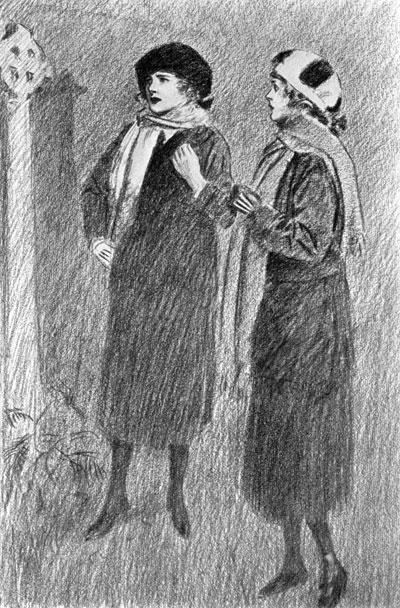
Opal turned up at school next morning in one of her most defiant and
reckless moods. She marched into the cloakroom with a jaunty "don't
care" air, and immediately began to talk about the circus.
"I was caught neatly, wasn't I!" she proclaimed. "Never got such a
surprise in my life as when you all came parading in like a flock of
lambkins. Miss Pollard had rather spasms to judge from her face."
"You'll get spasms later on if I'm not mistaken," said Merle.
"Oh, I can always fix up the poor old dears. They've a blind eye where
I'm concerned."
"How about that note you wrote?"
"Well, I had a headache, only it got better in time for the circus.
I'm a wonderful person at getting well when I make up my mind to it.
Will power I suppose. There's nothing neurotic about me!"
"You're the biggest fibber I know!"
"What are fibs?" asked Opal flippantly. "I only make a little
picturesque variation sometimes instead of telling the brutal truth.
It's what's called diplomacy,
and finesse, and all the rest of it. In a
matter of expediency I hedge the question."
"Use the plain Anglo-Saxon word 'lie' and I understand you," retorted
Merle, turning disgustedly away.
Opal laughed, and some of the younger children, who had been standing
like little pitchers listening with all their ears, laughed too.
"Look here, you kids," said Merle, facing round again. "You may think
all this is very clever and funny, but I tell you it's most
dishonourable. You've some queer notions in this school. I wouldn't give
anything for a head girl who can't speak the truth. She's not worth her
salt. Yes, I mean it. All this underhand work isn't done in decent
schools, and the sooner you get that into your silly little noddles the
better. Fibbers were 'sent to Coventry' at Whinburn High."
"Were they indeed," mocked Opal. "What an extremely superior place it
must have been. I wonder you condescend to stay at The Moorings among
such a set as ourselves. We're evidently not good enough for you."
Merle took no further notice but walked away, and Opal followed her,
giggling, into the classroom. She thought matters would be passed over
by the Principal as they had always been condoned before. Her boast that
she could do what she liked with her godmothers had hitherto been
justified. She had, however, gone a step too far. Miss Pollard's eyes
had at last been
opened, and in the light of yesterday she suddenly
began to remember very many sinister incidents which might easily be set
down to the head girl's influence.
"I'm afraid, my dear, we have been utterly mistaken in Opal," she
confided to her sister, and Miss Fanny, who had also had her doubts,
regretfully agreed with her.
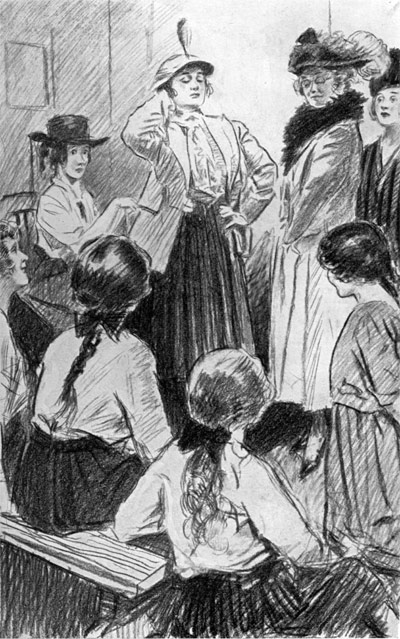
Miss Pollard took the call-over that morning, but when she had closed
the register she paused.
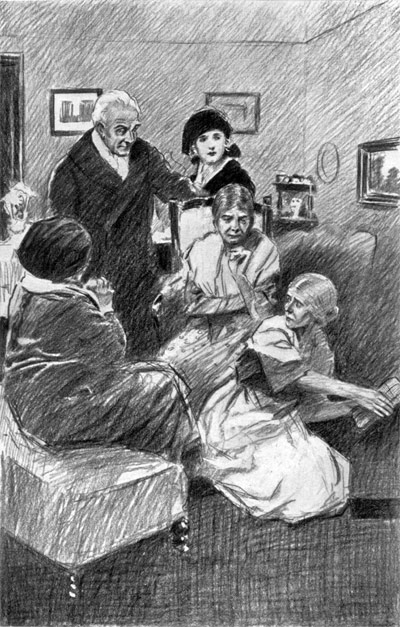
"There's a matter I wish to set straight," she said impressively. "Opal,
I received a note from you yesterday afternoon telling me you were in
bed with a headache. Will you kindly explain how it was that we saw you
at the circus?"
"My head was better, thanks, and I felt well enough to go," replied Opal
perkily. She was lolling on her seat, and sharpening a pencil as she
spoke.
"Sit up, and put that penknife in your pocket," commanded Miss Pollard,
in a stricter tone than she had ever used before to her favourite. "Now
answer me. Do you consider that you have been behaving in an honourable
fashion? Your letter was sent with the intention to deceive me! What
have you to say for yourself?"
Instead of doing as she was told, Opal went on sharpening her pencil
rather ostentatiously. There was a sullen look on her face. She was
trying her strength against Miss Pollard's. She had won before in minor
battles, and she hoped to score in this. A faint giggle from one of her
satellites among the juniors
spurred her on. She would show the girls
that she at any rate was not afraid of the head mistress. She leaned
back in her seat and yawned.
"If you ask me, I think it's a case of much ado about nothing," she
replied. "I've explained that I felt better, and I can't say any more."
This was the limit even for The Moorings. The girls looked at Opal in
amazement. As for Miss Pollard she stared for a moment as if absolutely
mesmerized with horror. Then, with a gasp, she recovered her presence of
mind, and, summoning all her dignity as Principal, delivered her
ultimatum.
"If that's the view you take of your deceit and falsehood the sooner you
leave this school the better. Get up and go home at once. You can tell
your mother the reason I have sent you, and say I will call and see her
this afternoon at five o'clock. Now go immediately!"
Opal, still with the sullen and defiant look on her face, rose slowly
and gave a glance of triumph round the room, which, however, met with no
response. Then she walked jauntily out and slammed the door after her.
What happened at her own home nobody ever knew. Miss Pollard called and
had a long talk with Mrs. Earnshaw, the result of which was that Opal
was sent away for a few weeks to stay with an aunt, and arrangements
were made at once to place her at a boarding-school after Easter. In
justice to her it must be chronicled that she apologized to her
godmothers, and
said she was really sorry, but they were wise enough not
to try the risky experiment of letting her return to The Moorings. She
was too old for so small a school, and needed strict discipline, and the
pressure of a high moral standard among girls of her own age. At
Brackenfield College she would not find her "fiblets", as she called
them, applauded or tolerated, and she would have to be straight and
honest if she wanted to win golden opinions. In spite of her many lapses
from the code of honour, there were elements of good in Opal, and under
the influence of straightforward girls such as Dona Anderson and Ailsa
Donald, who were at present leading spirits at Brackenfield, she was
likely to make a fresh start and retrieve her past.
The Moorings, freed from the shadow of her bad example, seemed a
different school. Iva Westwood was appointed head girl, and filled the
office conscientiously. The juniors, who took their colour from their
elders, soon dropped certain unpleasant practices, and were square in
their work. Miss Pollard and Miss Fanny also, feeling they had been too
slack and trustful, kept a tighter hand over things, so that cheating
and shirking were no longer possible as of yore. In respect of
favouritism they had learnt their lesson, and became strictly impartial.
"It hardly pays to be a boarder nowadays," mourned Aubrey Simpson.
"We're all treated so exactly alike."
"And a good business too," snapped Edith Carey. "I always said it was
time we had a turn. I like things to be fair all round, without anybody
getting special
privileges. The school's been nicer this last fortnight
than it has ever since I came here. I used to detest Miss Fanny, but I'm
beginning almost to like her now."
"Though she is making a horrible crusade about punctuality," groaned
Maude, who, as usual, was late for everything. "Just fancy! She actually
made me go to drawing-class without my pencils because I couldn't find
them."
"Poor old sport! Buck up! Buy a pencil with a ring at the end and cable
it on to you so that you won't lose it. You could wear it round your
neck like a baby's comforter."
"It wouldn't be much use at drawing when I want an 'H.B.', a 'B', and a
'B.B.'," grumbled Maude, who had small sense of humour and rarely saw a
joke.
But we must return to the day after the circus. The unfortunate clown
had been carried after his accident straight to the Cottage Hospital,
where his injuries were attended to by Dr. Tremayne. He was badly hurt,
and, though there was a possibility of his recovery, it would be months,
if ever, before he could resume his profession. The manager and the
ringmaster, and several other people from the show, came to the hospital
to inquire about him, but the circus was due at another town, and they
were obliged to move on at once. So that very evening the vans were
packed, and the great rumbling cavalcade, with all its horses, and
ponies, and elephants, and camels,
jolted along the High Street, and
turned up the north road in the direction of Warebury.
The piece of wreckage whom they left behind them lay very still and
quiet in the clean, white bed, at the Cottage Hospital, and made no more
jokes. His leg was in splints and his head was bandaged, and his right
arm was held in a sling. Dr. Tremayne, going to see him for the third
time on the following day, took Mavis and Merle, in the hope that
visitors might distract his thoughts. They went rather shyly into the
ward. It was strange to see "the funny man" lying flat on his pillow,
with hollow, sleepless eyes, and lines of pain round his poor mouth.
They offered him the flowers they had brought, and began to talk about
the circus. He brightened up a little at that. Evidently he was proud of
his reputation as a gymnast.
"It was the rope that failed. It wasn't my fault," he said. "I've done
that trick thousands of times, and never missed before. And I'd do it
again."
"You must make haste and get well then," said the sister-in-charge
kindly. "When we get your splints off you shall give us a special
performance in the ward if you like. We'll ask these young ladies to
come and see it, won't we?"
The ghost of a smile flickered round his lips for a moment.
"I can't say 'no harm done this time'," he whispered.
It was the first attempt he had made at a joke. Sister said visitors
had done him good, and though
she sent Mavis and Merle away then, she
asked them to come again. So every day they ran into the hospital for a
few minutes on their way to school, and again at lunch-time and after
tea. They never stopped long enough to tire the patient, but they
brought him flowers or newspapers or some little thing from the outside
world to help to cheer him up. They chatted to him and asked him what
towns he knew, and he told them he had travelled over most of England
and Scotland with the circus, and had even been to America.
"I've seen a-many beautiful places! But there's none to beat Devon in my
opinion."
"That's what we always say," cried Mavis. "Devonshire is the loveliest
county in England, and Chagmouth is the most beautiful little place in
all Devonshire."
"Chagmouth! Do you know Chagmouth?" asked the clown quickly.
"We motor over every Saturday with our uncle when he goes to take
surgery. Do you know it?"
"I used to when I was a boy. I haven't seen it now though for a matter
of fourteen year or so. I dare say it's changed."
"I don't believe it has much. People say it's just the same as it always
was. You must make haste and get well, and we'll ask Uncle to take you
there for a drive when you're able to get out of hospital."
"Ah—when?" echoed the clown, closing his eyes.
He was restless, and seemed in much pain. Dr. Tremayne came in later
and examined him, and gave him morphia. Sister's report the next morning
was unfavourable. His temperature was very high, and his pulse was
fluttering.
"I'm sorry I shan't be about to-day," said Dr. Tremayne. "I'm obliged to
go over to Halford to perform some eye operations at the hospital. I
don't suppose I shall be back till nine o'clock. I'll leave the
hypodermic syringe and if he needs it give him another dose of morphia.
We've done the best we can, but it's an anxious case all the same."
Mavis and Merle were detained after tea that day, and could not go round
to the hospital until about six o'clock. Sister greeted them with
relief.
"I've kept expecting you, and was going to send you a message if you
didn't come," she said. "He keeps asking for you all the time. He's gone
downhill rapidly to-day, poor fellow. He's sinking fast, and I don't
believe he'll ever see the night through. He's wandering a little in his
head, and he says you two know Chagmouth, and he wants to speak to you.
I'll tell him you've come."
Very gently the girls entered the ward where the patient was lying. The
signs of a great approaching change were on him. The hands that little
more than a week ago had grasped the trapeze so strongly now lay white
and frail on the counterpane. His face was shrunken, and his eyes held
the far-away look of one who is beginning to sight things beyond our
earthly plane of vision. He smiled feebly at Mavis and Merle, and tried
to raise his head. Sister lifted him a little and propped him up with an
extra pillow.
"You know Chagmouth?" he whispered.
"Yes! Yes!" Mavis was stooping down beside his bed.
"Is Mrs. Jarvis still living there—the nurse?"
"Yes, we sometimes see her. She's postwoman now."
"Could you fetch her here? To-night?"
"We'll try!"
"Tell her it's Jerry as wants her—her boy Jerry! She'll understand!"
"We'll bring her somehow, don't you worry," said Merle.
"I'm slipping west, and I'd like a word with her afore I go. You've been
so kind—I thought I might ask you to do that for me."
His breath came in gasps. His face was drawn with a spasm of pain.
Sister took the girls quietly aside.
"If there's anything you can do for him, you'd better do it," she said.
"I don't think he'll last the night."
Mavis and Merle saw for themselves that if mother and son were to meet
again on earth they must fetch Mrs. Jarvis quickly. How could they get
her to Durracombe in the shortest possible time? Outside the hospital
door they held a whispered consultation. Uncle David and the little
Deemster car were fifteen miles away, at Halford. They must find some
other means of conveyance. They went, therefore, to the Swan Hotel,
where motors were to be hired, and
explained the urgency of their
errand. The manageress shook her head.
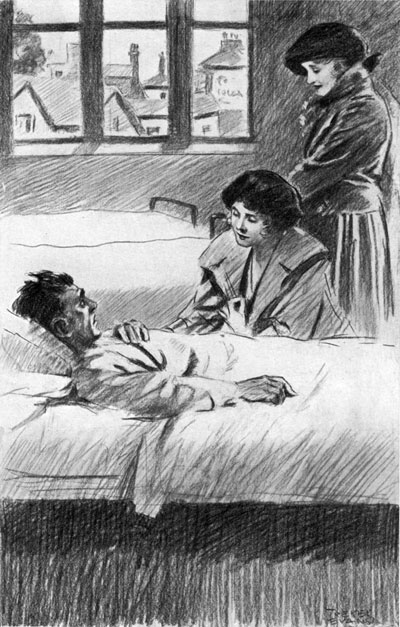
"YOU KNOW CHAGMOUTH?" HE WHISPERED
Page 232
"Mr. Johnson's out himself with the four-seater, and Bates has gone to
the station with the little car to meet a lady and take her to Rushton.
There's only the old Ford left, and no one to drive it."
"A Ford! May I look at it?" said Merle eagerly.
"You can if you like."
The car was standing in the yard, rather a shabby specimen, but in
workable order. Merle examined it carefully.
"It's exactly like Daddy's at home," she said. "I've often driven that.
Will you let me try this?"
"Oh, I don't know whether I dare!" gasped the manageress.
But Merle got inside the car and showed such a working knowledge of its
various levers and begged so hard to be allowed to take it out that at
last Mrs. Johnson relented.
"If it weren't a matter of life and death, as you might say, I wouldn't
let you for a minute. It seems almost like murder to trust you two
alone, and those hills and all. Still you do seem to know how to drive.
Be very careful of the brakes, and don't go tearing along too fast. I
shan't know a moment's peace till I see you safe back again. Little
George will give you a start. He knows how to do that, though he can't
drive yet."
George, a small boy of twelve, turned the starting-handle, and soon the
engine was humming. Merle
took off the brake, put in the low gear, waved
a good-bye to Mrs. Johnson, and with Mavis by her side steered
successfully through the gate-posts of the garage yard into the High
Street. The girls devoutly hoped that neither Aunt Nellie nor Jessop
would be looking out of the windows as they crossed the bridge. The
risky ride must be ventured, but they preferred to spare the feelings of
those at home.
To Merle it was a gorgeous opportunity. She was not in the least afraid
and perfectly confident that she could manage the car. She had always
wanted to go for a drive entirely on her own. Mavis, rather nervous but
ready to stick to her sister through all perils, kept an anxious eye on
the road, in case a motor-lorry should suddenly whisk round a corner, or
a flock of sheep emerge from a field.
"May Providence sweep all nails and bits of broken glass out of our
path. I don't know what we should do if we got a puncture," she
murmured.
"Run on the rim," returned Merle. "As long as the old car can keep going
I'll make her go. She's really doing very decently considering she's
rather a ramshackle concern. I'll get some pace out of her, you'll see,
when the road's clear ahead. I wonder if the speedometer is working?"
"Oh, do be careful!" implored Mavis. "There's something coming now.
Sound your hooter! It's one of those wretched furniture vans, and they
never leave proper room."
"I'm glad we haven't to pass the circus at any rate,"
said Merle, squeezing the bulb of the hooter, and lurching dangerously as she did
so, but regaining the left side of the road before they met the van.
Mavis was thankful when they were out of the deep Devonshire lanes and
up on the comparatively safe level of the moors, where there were no
high hedges to conceal approaching vehicles, and the road could be seen
stretching like a long ribbon in front of them.
"Shan't find any police trap here," chuckled Merle, increasing the speed
till the rattling old car seemed to be flying. "That speedometer isn't
working, but I dare say we're going at thirty miles an hour. I believe
she'd do forty."
"Merle, don't" squealed Mavis. "For goodness sake slow down or you'll
be upsetting the whole business into the ditch."
The hooting of a motor-cycle that wanted to pass them stopped Merle in
her mad career, and reminded her that she was occupying the middle of
the road. She steered to the left, and proceeded more soberly.
"We must be half-way there already," she triumphed. "We've simply
bounded along like a house on fire. Who says I can't drive? I shall tell
Daddy about this. It'll be a score for me, won't it."
"I hope we shan't meet a policeman anywhere who'll ask for your
licence."
"Don't care if I do. I just shan't stop, however much he waves his
white gloves at me. He can take the number of the car, and prosecute me
afterwards if he likes. I'd rather enjoy going before the bench of
magistrates. I'd tell the reason, and say the end justified the means."
"You'll make an end of us if you go bumping so fast over this lumpy
road. The holes are enough to upset a tank. What a sharp wind there is
up here! I wish we'd got our thick coats."
"You ought to have brought a wrap!" Merle's voice was self-reproachful.
"Turn up the collar of your jersey. Oh, I'm all right, thanks. It's hot
work to drive, I can tell you. There's Gundry Tor. We really are
getting on. We shall soon be at Chagmouth now."
What Mavis was dreading most was the tremendous hill that ran down the
ravine into the little town. It was a very steep gradient, and was
marked with a danger signal. She hoped the brakes of the rickety old car
would be equal to their duty. The road was unfenced, and had several
awkward bends, where an unskilled motorist, losing control, might dash
over the edge, and down into the woods. How she longed for Dr.
Tremayne's firm steady hand on the driving-wheel! It is always far more
anxious work to sit and watch a novice than to do a thing yourself.
Merle, in her girlish confidence, felt no alarm. She was ready to
venture anything in the way of a descent.
Fortunately for the safety of the sisters, her powers had no need to be
tested. While they were still on the level road at the top of the hill
they saw, walking briskly along in front of them, a little stumpy figure
in a navy-blue uniform, and with a leather bag slung over her back.
"Mrs. Jarvis, by all that's wonderful," exclaimed Mavis, in much relief.
The postwoman was coming back from collecting letters at a pillar-box in
a neighbouring village. It was the merest luck that they had overtaken
her at that particular spot. Merle stopped the car, and the girls
explained their errand.
"You must come with us at once," said Mavis. "Never mind the letters. We
can hand them in at the post-office at Durracombe instead. It will be
all right."
Poor Mrs. Jarvis did not need any urging. As soon as her clouded brain
understood who wanted her, she was ready to throw her post-bag to the
winds. She jumped into the back part of the car and took her seat,
trembling with excitement and eagerness.
"Jerry! My own boy Jerry!" she kept repeating. "Bless him! The little
table's all spread out in the kitchen ready for his tea. I knew he'd
come back to me some day. Bless his heart."
Merle with much difficulty managed to restart the old Ford, and to turn
it with its bonnet in the direction of Durracombe; then they set off
again at a rather reckless pace. Every minute seemed of importance now,
and Mavis did not remonstrate though they bumped over holes, tore round
corners, or flew across the moor at thirty miles an hour. Perhaps her
nerves were getting used to it. She gave a sigh of satisfaction,
however, when at last they came in sight of their destination, and
motored back across the bridge into
the High Street. Merle drove
straight to the hospital, where the girls took Mrs. Jarvis inside and
asked for Sister.
"Will you come into the ward, please," said the nurse who returned with
the message. "You've brought her just in time!"
Mavis and Merle stood aside to give precedence to Mrs. Jarvis. They had
warned the poor mother that it was no lad of thirteen whom she must
expect to see, that long years had passed away, and had changed him
possibly past recognition. There was little resemblance between the
round cheeks she used to kiss, and the sunken face on the pillow. But
mother hearts cannot forget, even though the brains may be blurred. She
knew him instantly as she stepped to his bed-side.
"Jerry! My own boy, Jerry! Come back at last!"
Then Nurse put a screen round the bed, and mother and son were left
alone, for there are some scenes too sacred for even the kindest friends
to witness.
Mavis and Merle returned an hour later to inquire, having taken back the
car, delivered the post-bag to the authorities, and reassured Aunt
Nellie of their whereabouts. They met Sister in the corridor of the
hospital. They looked at her in mute interrogation, and she shook her
head.
"I knew it was hopeless this afternoon, but it's been quicker than I
thought. He didn't suffer much, and he was so glad to have his mother
with him. Will you please tell Dr. Tremayne."
Very softly the girls went out of the hospital door.
It was dark, and
bright stars were shining overhead, but there was still a faint streak
of red where the sun had set. They looked at it for a moment or two
without speaking, then:
"It will rise over there," gulped Mavis, pointing eastward, and Merle
understood her meaning.
All the jokes and tricks of the funny man were over now, and his poor
hurt body was lying quiet and still, but he himself had "gone west", and
though the tea-table was spread in vain in the little cottage,
somewhere, in the light of the eternal dawn, mother and son would meet
and know one another again.