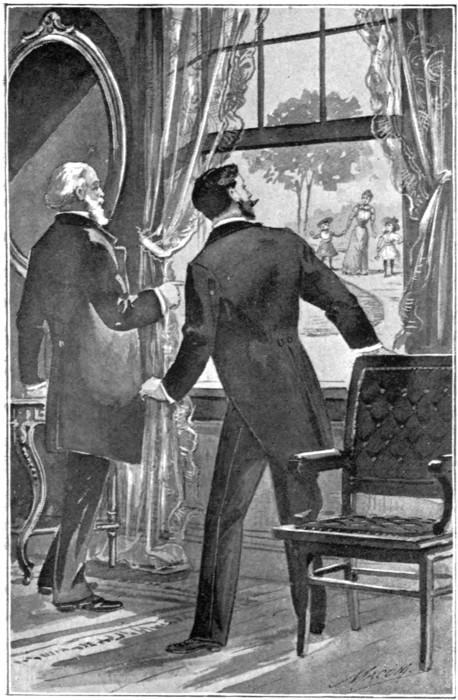
They were seated tete-a-tete at a dinner table.
“Tell me why you have never married, Milburn,” and the steel eyes in
Willard Frost’s face searched through his glasses.
Robert Milburn’s answer was a shrug, and a long cloud of smoke blown
back at the glowing end of his cigar.
“Tell me why,” persisted the keen-eyed Frost.
“Because it is too expensive a luxury; besides, a man who has affianced
a career like mine must take that for his bride,” was Robert’s answer.
“Admitting there is warmth and color in some of your artistic
creations, old fellow, I should think you would find these scarcely
available of winter nights, eh?”
Robert laughed; his laugh was short, though, and bitter. He had taken
keen pleasure in the cynical worldly wisdom and unsentimental judgment
of this man.
“If you can’t afford the wife, then let the wife afford you,” began
Frost’s logical reasoning. “You have brain, muscle and youth. Marry
them to that necessary adjunct which you do not possess, and which the
government refuses to supply. This is perfectly practical. The whole
question of marriage is too much a matter of sentiment; too little
a matter of judgment. Now, the son of a millionaire without an idea
above his raiment and his club, devoid of morals and of brains, marries
the daughter of a silver king. What is the result? A race of vulgar
imbeciles.”
Here Frost, more wickedly practical, continued: “Now, you are of
gentle blood, being fitted out by nature with the most unfortunate
combination of attributes. Nature has given you much more than your
share of intelligence and manly beauty, together with most refined and
sympathetic sensibilities and luxurious tastes, and then has placed you
in an orbit representing intelligence, aristocracy and wealth. Here
she has left you to revolve with the greater and lesser luminaries,
and that with the slenderest of incomes, which is not as yet greatly
increased by your profession. You doubtless find that it requires
considerable financiering to do these things deemed necessary to
maintain your position in the constellation.”
“It is rather annoying to be poor,” Robert answered in a carefully
repressed voice. A hard sigh followed, and there flashed through him
the hot consciousness of the bitter truth. For that special reason no
word had ever crossed his lips that could, by any means, be twisted
into serious suit with the fair sex. It was generally accepted that he
was not a “marrying” man.
They were, both of them, men who would at first sight interest a
stranger. The younger of the two you might have seen before if you
frequented the ultra-fashionable dinner parties, luncheons, etc., of
polite New York. Anywhere, everywhere, was Robert Milburn a special
guest and a general favorite.
He was medium-sized, delicately featured, with a look of half-lazy
enthusiasm. You would set him down at once as an artistic character;
at the same time, there was in his make-up and bearing, that which
bespeaks an ambitious nature. His companion, who appeared older, was a
man of statelier stamp, tall and sufficiently athletic. His face was
well finished and had a certain air of self-possession, which not a few
name self-conceit, and resent accordingly.
“Ah! Robert, you have entirely too much sentiment, my boy. Do not
waste yourself. I will cite you a girl—there’s Frances Baxter. True,
she is not good looking, in fact, I presume quite a few consider her
extraordinarily plain. But that excessive income is worth your while to
aspire to—such a name as Milburn is certainly worth something.”
With an earnestness of tone and manner which the gossipy nature of
the talk hardly seemed to call for, Robert nervously threw aside his
crumpled napkin and looked sharply at his companion, saying:
“Surely, then, I may do something better with it than sell it.”
“There, we will not argue, I am too wise to oppose a man who is
laboring under the temporary insanity of a love affair. I had feared
that you were not so level-headed as is your wont. Come, who is the
woman? Is it the Southern girl at the Stanhope’s?”
“Of whom do you speak?” asked Robert, looking pale and annoyed.
“Of Miss Bell—Cherokee Bell—to be sure.”
“You honor me with superior judgment to so accuse, whether it be true
or not,” and upon Milburn’s face there was that expression which tells
of what is beyond.
The other smiled meaningly, and raised his brows.
“Ah, my dear boy,” he mutely commented, “I am sorry my supposition is
true, but it leaves me wiser, and no transparent scheming goes.”
“Tell me your opinion of her, Milburn, I am interested deeply.”
“Well, I have always said she was positively refreshing,” began Robert.
“She came upon us to recall a bright world. She came as a revelation to
some, a reminiscence to others, and caused our social Sahara to blossom
with a suddenly enriched oasis.”
“Yes, she has that indescribable lissomeness and grace which she
doubtless inherits with her Southern blood. I was attracted, too, by
the delicacy of her hands and feet, of which she is pardonably proud.
But that scar or something disfigures one hand.”
Robert spoke up quickly: “That is a birth-mark, I think it is a fern
leaf.”
“A birth-mark! Oh hopelessly plebeian, don’t you think?”
“Your Miss Baxter has a very vivid one upon her neck.”
“I beg pardon, then, birthmarks are just the thing.”
Frost had commenced in a bantering mood, but now and again his voice
would take a more serious tone.
“Joking apart, Miss Bell is charming. She is, thanks to God, a being
out of the ordinary. She has a style unstinted and all her own. I
have upon several occasions made myself agreeable, partly for my own
gratification and partly because I saw in her eyes that she admired me.”
Frost leaned back in intended mock conceit, no small portion of which
appeared genuine.
Robert gave way to laughter, in which just a tinge of annoyance might
have been detected.
“She is quite accustomed to these attentions, for all her life
adoration has been her daily bread.”
“I should like to know how you are so well posted?” asked Frost, with a
dark flash in his grey eyes.
Robert Milburn lifted his head proudly, and answered quietly: “I have
known her since she was a little slip of a lass.”
“And how did the meeting come about? you were brought up in Maryland, I
believe.”
“True, but in the early ’80s I spent one spring and summer South. I was
at ‘Ashland.’ You know that is the old home of Henry Clay. It is about
in the center of the region of blue grass, down in Kentucky. Clay’s
great grandson, by marriage, Major McDowell, owns this historic place.
He is a well-mannered and distinguished host, and allowed me to fancy
myself an artist then, and I made some sketches of his horses—he is a
celebrated stock breeder.”
“How I should enjoy seeing a good stock farm; that is one pleasure
I am still on this side of,” put in Willard. “Go on, I meant not to
interrupt you.”
“The Major often saddled two of his fine steppers and invited me to
ride over the country with him. It was upon one of these jaunts that I
met the girl. It happened in this way: We were in the blue grass valley
just this side of the mountainous region. A turn-row, running through
a field of broken sod was our route, to avoid a dangerous creek ford.
With heartsome calls and chirruping, six plowmen went up and down the
long rows. The light earth, creaming away from the bright plowshare,
heaped upon their bare feet. I thought, ‘What is so delicious as the
feel of it—yielding, cool, electrical, fresh.’ We stopped to watch
them. They tramped sturdily behind the mules, one hand upon the
plow-handle, the other wrapped about with the line that ran to the
beast’s head. Presently, they all fell to singing a song—a relic,
it must have been, from the old care-free days. Over and over they
chanted the rude lilt, and their voices were mildly sweet. We stopped
to listen, for their song was like no other melodies under the sun.”
“But where does the girl come in? I expected to hear something of her,”
interrupted Willard, with an impatient gesture.
“Oh, yes! She is just down a trifle farther in the pasture lands with
an ‘ole Auntie.’ The Major addressed the negress as ‘Aunt Judy.’ They
were welcoming the new comer—a calf. The Auntie wore a bandana and a
coarse cotton print, over which was a thin, diamond-shaped shawl. Her
subdued face was brown—the brown of tobacco—and her weary eyes stole
quick, wondering glances at us, and instinctively she took the child’s
hand, as if to be sure she was safe.
“Now I come to Cherokee—let me try to describe her to you. In
coloring, delicacy, freshness, she was a flower. Her hair was combed
straight back, but it was perversely curly; and the short hairs around
her forehead had a fashion of falling loosely about, which was very
pretty. She was slim, her drooping-lashed eyes wore a soft seriousness.
She at once chained my vagrant fancy and I promised myself that would
not be the only time I should look upon her. On the homeward way the
Major told me she was the only child of Darwin Bell, an excellent
man. A man of good blood, good sense and piety, ‘but the best of all,’
continued the Major, ‘he was a gallant Confederate captain.’
“Then he happened to recall the fact that I was of the other side and
said: ‘I beg your pardon young man, but Darwin and I were army mates,
and that eulogy was but a heart-throb.’
“He had quite a little to tell of the negress. She was Cherokee’s
‘black mammy,’ and her faithfulness was a striking illustration of the
devotion of the slaves. It seems to me that the most callous man or
woman could not fail to appreciate little touches, here and there, of
the sweet kindly feeling that nestles close to the core of honest human
hearts. I went home that night in a softer mood.”
“Softer in more senses than one, I judge, also poorer,” Frost returned,
amusedly.
“You mean I had lost my heart?” the other asked in an odd tone.
“To be sure, but tell me more of Miss Bell, she is very like a serial
story, and I want awfully to read the next chapters.”
“Then you must learn the sequel from her.”
“That is not quite fair of you, but I have a mind to; in fact, I know I
cannot resist cultivating your blonde amaryllis, if you don’t object?”
Willard Frost smiled half—chaffingly, and quite enjoyed the expression
of surprise and anxiety upon his companion’s face.
“That is a matter of the utmost indifference to me,” was the icy
answer. The speaker’s hand, as it lay on the table, opened and shut in
a quick nervous fashion, which showed that he was more annoyed than he
looked, whereupon Frost waxed more eloquent and earnest.
“I mean to enter, though well I know, when love is a game of three, one
heart can win but pain.”
“But that would surely be mine, for what chance has a poor devil of an
artist like me with the invincible Frost?”
“I come under the same heading,” returned Willard, “I am an artist too.”
“Yes, but it would keep me in a desperate rush to run ahead of you—you
the prince of the swagger set, a member of half a dozen clubs, owner
of the smartest of four-in-hands, a capital dinner-giver, and a
first-rate host, and, accompanying these, a plethoric purse to make all
hospitalities easy.”
As Robert spoke, Frost poured out the last of the second bottle of
champagne and looked carelessly at the bill for it, which the waiter
had presented to the other.
“Suppose you find you a champion to do your battle—a John Alden?”
“He might do as Alden did, and keep the prize. My chum, Latham, is the
only one I dare trust to win and divide spoils, and he is abroad now,
you know.”
“Right glad I am, for Marrion Latham is a marvellous success with
womankind. Still, I want some one to oppose me, for no game is worth a
rap for a rational man to play unless he has competition”—this with
decided emphasis.
“What’s the matter with Fred Stanhope? I think he will make it
interesting for you.”
“Oh, I want a man, not a sissy. He is just the son of Mr. Stanhope.
He hasn’t enough sense to grease gimlets. He is a rich-born freak,
and I think he has set out to make a condign idiot of himself, in the
briefest, directest manner, and he will doubtless succeed. I prefer you
for a rival.”
“But Frost, I would be powerless, quite powerless, with you in the
field.”
“Ah, you idealize me, make me too great a hero,” answered Frost, quite
pleased within himself.
“Not a hero,” spoke Robert slowly, “but a smooth calculating man of the
period, just the manner of man to take with that type of woman. She,
this charming, intense creature, is so innocent, so ‘un-woke-up’, I
might say.”
“I am a holy terror at awakening one, and if there is any money with it
I shall exert myself to arouse her.”
There was an awkward silence. Frost paused and lighted a cigarette.
“Has she any plantations, stock farms, and the like? You seem so well
up in her history.”
“No, with the exception of a thousand dollars or so, she is absolutely
without means.”
“That settles it,” said Frost, flippantly. “You and your John Alden may
open negotiations for her beauty and innocence, but they are too tame
for me.”
“You are a fisherman, Frost, and if you can’t catch a whale you catch
a trout, and if you can’t catch a trout you would whip in the shallows
for the poor little minnows.”
“Minnows have their use as bait,” returned the other, with a meaning
smile.
“But not to catch whales with, and you direct the training of my
harpoon toward a big haul, yet you can stop to fish where you get but a
nibble? What a peculiar adviser—rather inconsistent, don’t you think?”
observed Robert, with a cynical sense of amusement. “I shall keep an
eye on you.”
“And I shall keep an eye on that fact,” muttered Frost to himself when
he had left his friend. “It is not much, but it would answer the small
demands of an honest girl. I will see about that thousand dollars.”