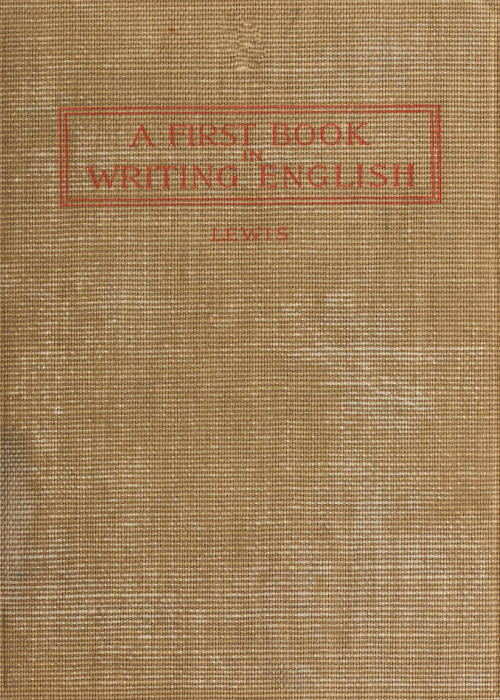
A First Book In Writing English
by Edwin Herbert Lewis
★★★★★No ratings yet
Language: English
Sign in to rate this book.
Sign in to shelve this book.
About this eBook
- Author
- Lewis, Edwin Herbert, 1866-1938
- Title
- A First Book in Writing English
- Credits
- Produced by Tim Lindell and the Online Distributed Proofreading Team at www.pgdp.net (This file was produced from images generously made available by The Internet Archive/American Libraries.)
- Language
- English
- LoC Class
- PE: Language and Literatures: English
- Subject
- English language -- Composition and exercises
- Category
- Text
- Project Gutenberg
- eBook-No. 62265
- Release Date
- May 28, 2020
- Copyright
- Public domain in the USA.
Contents
- 1.Untitled
- 2.PREFACE
- 3.CONTENTS
- 4.INTRODUCTORY EXPLANATIONS — A FIRST BOOK IN WRITING ENGLISH
- 5.CHAPTER I THE ART OF WRITING ENGLISH
- 6.CHAPTER II ON READING ALOUD, AND ON SPELLING
- 7.CHAPTER III A REVIEW OF PUNCTUATION — Capitals. — The Comma. — The Semicolon. — The Colon. — The Dash. — Quotation Marks. — Brackets. — The Exclamation Point. — The Interrogation Point. — Italics. — The Apostrophe. — Asterisks. — Common Abbreviations.
- 8.CHAPTER IV GRAMMATICAL PHASES OF WRITING ENGLISH — Concord of Subject and Predicate. — Concord of Adjective (or Participle) and Noun. — Concord of Pronoun and Antecedent. — Concord of Cases. — Concord of Tenses. — Government. — On the Reference of Pronouns. — Conjunctions and Prepositions. — Adverb or Adjective? — Matters of Etymology.
- 9.CHAPTER V ON DIVIDING A PARAGRAPH INTO SENTENCES
- 10.CHAPTER VI ON WELL-KNIT SENTENCES
- 11.CHAPTER VII ON ORGANIZING THE THEME
- 12.CHAPTER VIII ON CORRECTNESS IN CHOICE OF WORDS — Nouns — Ability, capacity. — Acceptance, acceptation. — Access, accession. — Act, action. — Advance, advancement. — Alternative, choice. — Avocation, vocation. — Balance, remainder. — Character, reputation. — Compliment, complement. — Council, counsel. — Falseness, falsity. — Invention, discovery. — Limit, limitation. — Majority, plurality. — Observation, observance. — Observation, remark. — Party, person. — Part, portion. — Prominent, predominant. — Recipe, receipt. — Relative, relation. — Residence, house. — Sewage, sewerage. — Site, situation. — Verbs — Accept, except. — Affect, effect. — Aggravate, irritate, tantalize. — Allude, mention. — Antagonize, alienate. — Begin, commence. — Bring, fetch. — Claim, assert, etc. — Degrade, demean, debase. — Drive, ride. — Endorse, approve, second. — Got, gotten, have. — Guess, think, reckon. — Intend, calculate. — Let, leave. — Lie, lay. — Locate, settle. — Loan, lend. — May, can. — Proved, proven. — Purpose, propose. — Sit, set. — Stay, stop. — Transpire, happen. — Wish, want, desire. — Adjectives and Adverbs — Apt, likely, liable. — Continual, continuous. — Funny, odd. — Healthy, healthful. — Imminent, eminent, immanent. — In, into. — Last, latest. — Last, preceding. — Mad, angry. — Most, almost. — Mutual, common. — Oral, verbal. — Posted, informed. — Practicable, practical. — Quite, somewhat, very, rather, entirely, wholly. — Real, really, extremely. — Some, somewhat. — Without, unless.
- 13.CHAPTER IX SOURCES OF THE ENGLISH VOCABULARY
- 14.CHAPTER X THE MASTERY OF A WRITING VOCABULARY — ENGLISH PROVERBS [43] — Groups of Synonyms [44]
- 15.CHAPTER XI RIGHT NUMBER AND SKILFUL CHOICE OF WORDS
- 16.CHAPTER XII LETTER-WRITING
- 17.CHAPTER XIII REPRODUCTION, ABSTRACT, SUMMARY, ABRIDGMENT — Material for Literal Reproduction — Narration — Description — Exposition — Material for Summary, Abstract, Abridgment — Narration — Description — Argument [52]
- 18.CHAPTER XIV NARRATION AND DESCRIPTION — Narration — Description — Suggested Topics for Description
- 19.CHAPTER XV EXPOSITION AND ARGUMENT — Exposition — Subjects for Exposition — Argument — Subjects for Argument or Debate
- 20.FOOTNOTES
- 21.SUBJECT INDEX
- 22.INDEX OF AUTHORS QUOTED
Community reviews
Sign in to write a review.
No reviews yet.