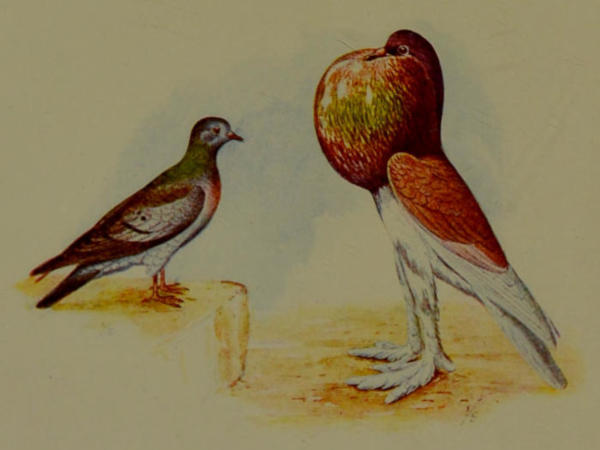
Plate I.—Illustrating
the results of Artificial Selection. Within historic times the small Wild Rock
Pigeon has been evolved into the large Pouter. The figure illustrates the
plasticity of a living organism.
BY
D. KERFOOT SHUTE, A.B., M.D. OPHTHALMIC SURGEON TO THE UNIVERSITY HOSPITAL (COLUMBIAN)
PROFESSOR OF ANATOMY IN THE COLUMBIAN UNIVERSITY
COPYRIGHT BY The Open Court Publishing Co.
CHICAGO, U. S. A.
1899
All rights reserved.
THIS LITTLE BOOK IS INSCRIBED TO DR. THEODORE GILL,
NOT ONLY IN ADMIRATION FOR HIS HIGH SCHOLARSHIP
AND EMINENT SCIENTIFIC ATTAINMENTS, BUT
ALSO IN APPRECIATION OF MANY
ACTS OF COURTESY AND
KINDNESS TO THE
AUTHOR.
PREFACE.
This little book has been written chiefly for the use
of students in the Medical Department of the
Columbian University. It is designed to serve
only as an introduction to the study of the Development
Theory, and the subject has been presented,
it is hoped, in a manner that will render it interesting
and easily intelligible to the general reader.
The doctrine of Evolution itself enters so largely
into all those departments of knowledge that especially
concern the human race, and it has so profoundly
modified our ideas with regard to the origin
and destiny of man, that it has attained a commanding
interest and become an almost necessary ingredient
in what is called a liberal education.
An overwhelming majority of Anthropologists,
Zoölogists, and Botanists, and a goodly number—constantly
increasing—of Christian clergymen and
laymen, have been almost compelled to believe in
the truth of the Evolution Theory, whether they
would or not, and they cannot but realize how very
widely the theory extends into almost every department
of human knowledge. No one, therefore,
who aspires even to a moderate degree of intellectual
culture, can well afford to exclude a clear
understanding of what this Doctrine of Evolution
really is. It is hoped this little work will render
such a conception easily attainable.
The author makes no claim for originality, unless
it be in the manner of presenting the subject. He
has utilized the facts collated by other observers,
and sometimes quoted the exact language and
expressions of well-known writers on Evolution,
and has endeavored to put them together in a way
that may be helpful to those who are beginning the
study of the Evolution Theory.
No attempt has been made to prove the truth of
the theory: this is assumed. The arguments in
support of it are coextensive with our knowledge of
Comparative Anatomy, Embryology, Physiology,
Psychology, and many other sciences.
In the preparation of the book the author is especially
indebted to his friend Prof. Theodore Gill, the
eminent ichthyologist, for many valuable suggestions,
and more particularly for his aid in constructing
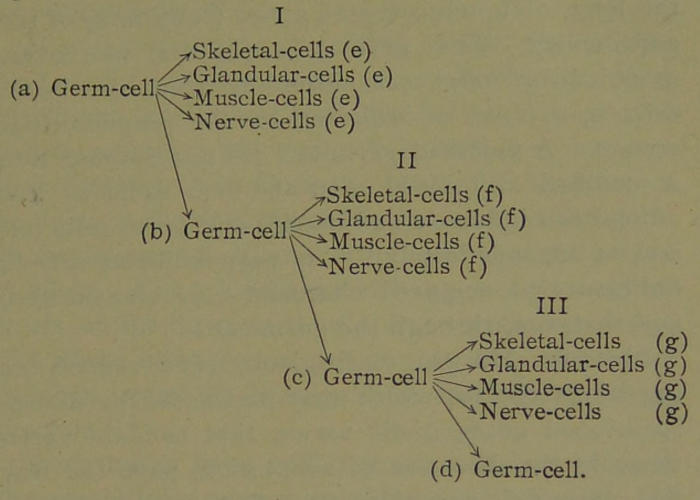
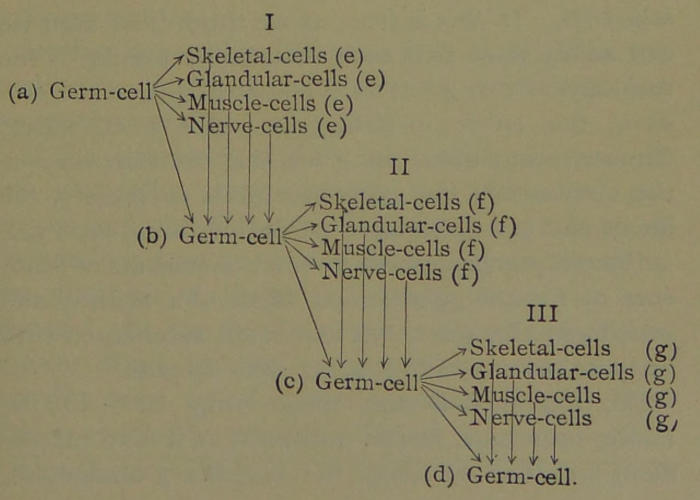
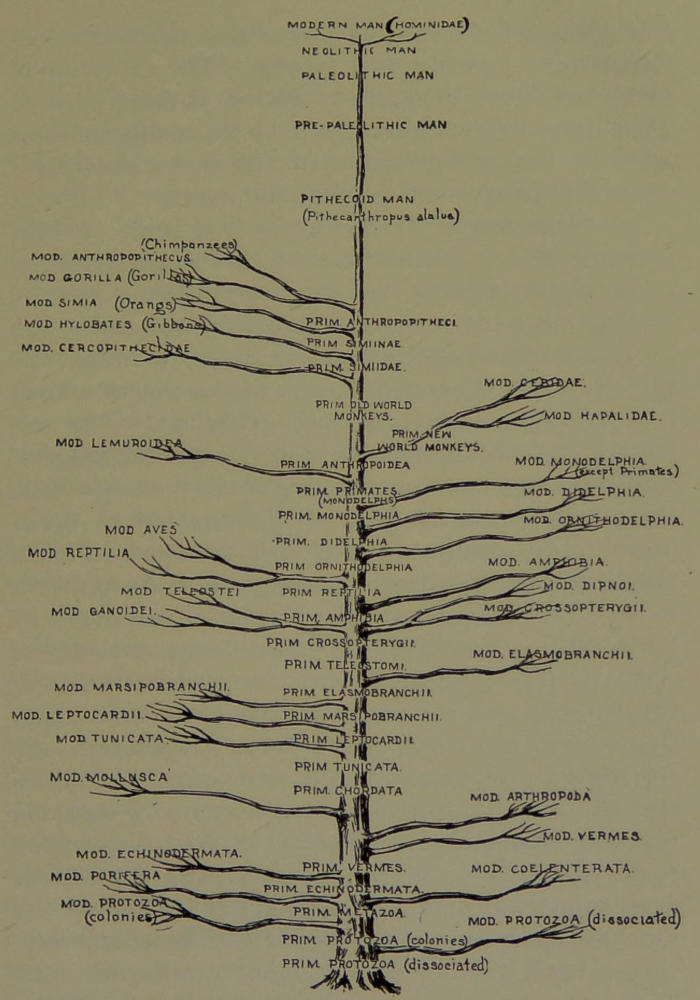
the Diagram of Development. He also desires
to thank his friend Dr. A. F. A. King for his kindly
assistance in preparing the manuscript for the press;
and also his friend Dr. L. O. Howard, Chief of the
U. S. Bureau of Entomology, for much valuable information
and assistance.
D. K. Shute.
August 1, 1899,
1318 L Street, N. W., Washington, D. C.
It is extremely difficult to realize the variety,
wealth, and grandeur of animal and plant life as
they exist on the globe to-day. Even if we
endeavor to recall, in imagination, all that we have
seen in streams and woodland, in ponds and rivers,
in meadows, and in the air; even when we call to
mind the multifarious specimens we have beheld in
all the museums of natural history we have visited,
and remember the most vivid descriptions that we
have ever read of the wealth of tropical life;—even
then we have only the faintest conception of the
multitude and variety of living forms, not to mention
the vanished hosts of bygone ages.
It has always been the endeavor of students of
nature to reduce this great host of living creatures
to order by some system of classification. First one
system of classification was adopted, and then
another, with the progress of Botany and Zoölogy,
until eventually, before the theory of evolution was
entertained by scientific men, that system was
adopted which naturalists likened to a tree. In this
system, those lowest organisms which cannot properly
be called either animals or plants, may be represented
by a short trunk. Soon this short trunk
divides into two large trunks, one of which represents
the animal kingdom and the other the
vegetable kingdom. Each of these trunks then
sends off large branches representing classes, from
which smaller and more numerous branches, representing
orders, are given off. From these, other
branches and sub-branches are separated, representing
families and genera, and finally the
terminal twigs or leaves represent species.
In this tree, while there is a general advance in
organization from below upwards, there are many
deviations in this respect. Some leaves may be
growing on different branches at the same level,
which means that species belonging to widely
divergent classes or orders may still possess an
equal grade of organization. On the same branch
there may be growing leaves at different levels.
This means that one species may be more highly
organized than another belonging to the same class.
Not only may all living species be classified in the
form of a family tree, but all the extinct hosts of
species that lived in the ages of the past may be
similarly classified. If all the animals that have ever
lived on the globe should be represented by a tree, those
existing on the earth to-day would be indicated by the
topmost twigs and leaves, while the extinct forms
would be represented by the trunk and main branches.
(Vid. Diagram of Development.)
The detecting of this tree-like arrangement of
species in nature is the progressive work of naturalists
for centuries past. At about the commencement
of the present century, when it was finally
detected, naturalists were unable to understand the
significance of it. They did not perceive the underlying
principle that accounts for the fact that groups
of living forms have such natural affinities that they
are arranged like a family tree.
When Darwin came upon the scene and found
that his predecessors had already empirically worked
out the tree-like system of classification, he convinced
naturalists that the great underlying principle
of this system was Heredity; and that, therefore,
the grouping of living and extinct organisms in
a family tree according to their natural affinities is a
grouping based upon genetic affinities; and further
that the ultimate meaning of classification is the
tracing of lines of pedigree. This signifies that all
the creatures living on the globe to-day, and all the
hosts that lived in the ages of the past, are blood
relations in greater or less degree, and that they
have all been evolved from simple microscopic
creatures that appeared on the globe at the dawn of
life. All organisms, then, have undergone an evolution.
The factors of fundamental importance in the
study of the theory of Evolution, or the doctrine of
the Transmutations of Organisms, are Cells, Heredity
and Variation, Environment, Natural Selection, and
Isolation.
The evolution of an organism means its descent
from preceding organisms with continuous adaptation
to its Environment. Its adaptation occurs chiefly, if
not entirely, through the Natural Selection of its useful
Variations, and the tending of these variations to
be transmitted to the offspring by the forces of Heredity.
The summation of the variations, by Heredity
and Isolation, leads ultimately to specific, generic, ordinal,
and other differences in the descendants; leads,
in other words, to the transmutations of organisms.
An organism consists of two great groups of
structural units called cells,—Germ-Cells and Body-Cells,—harmoniously
associated together. As far
as Evolution is concerned, the most fundamental
parts of an organism are the Germ-Cells.
In order that the reader may have a working
knowledge of the wonderful powers of Germ-Cells
and their progeny, it is vitally important that some
concrete illustrations of the activities of different
kinds of cells should be given.
SECTION I. ORGANIC CELLS: THE VISIBLE UNITS OF LIFE.
ORGANIC CELLS: THE VISIBLE UNITS OF LIFE. — CELL REPRODUCTION BY MITOSIS.
In the sanctuary of S. Vitale at Ravenna, in Italy,
is a very interesting representation, in mosaic pictures,
and over life-size, of the Emperor Justinian
and his Empress Theodora, attended by a numerous
suite of ladies and courtiers. The mosaics are small
bits of glass, of varying pattern and color, cemented
together so nicely as to form beautiful delineations
of the Emperor and his attendants.
The bits of glass or mosaics that form the figures
may very appropriately be called structural units.
The body of man, a bird, a lizard, an oak tree,
and many other animals and plants, may usefully
be compared to such mosaic figures; for, just as the
mosaic figure has its structural unit, the little bit of
glass or stone, called the mosaic; so the bodies of
men, birds, and other creatures may be looked upon
as infinitely complex figures formed of minute
mosaics called cells.
The groups of minute mosaics or cells that make
up the bodies of animals and plants differ profoundly
from the mosaics that form the figures of the dead
Emperor and his companions, inasmuch as each
mosaic or cell of the animal or plant body is so
small as to require the microscope to reveal it; also
each mosaic of the living animal or plant is a living
mosaic or cell, in that it can absorb food, digest it,
assimilate it, grow, and multiply in numbers.
Cells, then, are the morphological or structural units
which compose the bodies of all living creatures.
All animals and plants begin life as single cells,
which, in the vast majority of cases, are microscopic
in size. Those that remain single cells, and dissociated
throughout life, are called Unicellular Animals
(Protozoa) and Plants (Protophyta), and are to be
seen mostly by the microscope alone; but those
which, by multiplication and growth, form large
numbers of cells that remain associated together as
in the body of a bird or lizard, are called Multicellular
Animals (Metazoa) or Plants (Metaphyta).
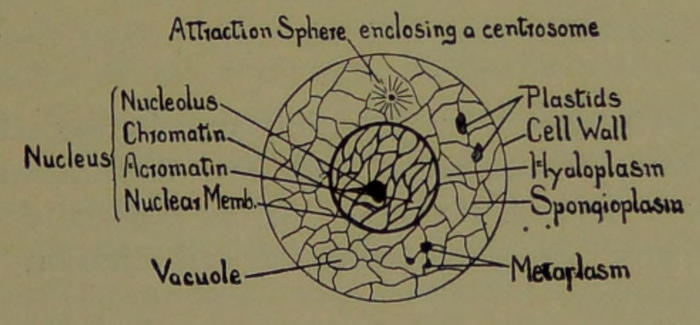
A cell (Fig. 1) is a nucleated lump of protoplasm,
or cytoplasm, and most often of microscopic size
and more or less covered on its exterior by, and
holding in its interior, various products and formations
resulting from its activity, which are called
metaplasm. Since the protoplasm of a cell, under
the microscope, presents a superficial resemblance
to a minute speck of that jelly-like substance
(albumen) which forms the white of an egg, it is
often called an albumenoid substance. But it is
very misleading to use such an expression, for protoplasm
is not a single chemical substance of great
complexity; but it is rather composed of a large
number of different chemical substances of great
complexity. Many of these substances, it is true,
are albumenoid in character. The same is true as
to the chemical complexity of the nucleus, which is
a physically and chemically differentiated part of
the protoplasm.
The protoplasm contains certain globulins, and
also albumins and peptones; it also contains large
quantities of nucleo-albumins, with other substances.
The nucleus not only contains these same
substances, but also nuclein and nucleo-proteids. It
is important to state that nuclein consists of an
albumin and nucleic acid.
Fig.
1.—Diagram of a Cell, highly magnified.
The protoplasm, structurally, is made up of
threads forming a complex, sponge-like substance,
or reticulum, called spongioplasm; and in the meshes
of the spongioplasm is a more or less fluid-like substance
known as hyaloplasm: suspended in the
hyaloplasm are various kinds of living bodies known
as plastids, besides various products resulting from
the activity of the protoplasm and which are designated
metaplasm.
In many cells the protoplasm has formed on its
periphery a layer of metaplasm which is frequently
called a cell-wall. This cell-wall prevents amœboid
movements of the protoplasm, and a cell possessing
it is said to be encysted.
In many cells, especially vegetable ones, will also
be observed clear spaces termed vacuoles. These
vacuoles contain water with various chemical substances
held in solution, which serve the purpose
chiefly of food-reservoirs.
The nucleus also is formed of threads called
nuclear or chromatin threads (chromosomes), the
interstices of which are filled with hyaloplasm or
achromatin. In the nucleus can also be observed
the nucleolus.
The protoplasmic and nuclear threads show various
structural modifications in different regions and
under different physiological states of the cell.
As will be observed later on, the nuclear threads
are of special interest to the student of heredity.
They may in one phase of cell-activity look like one
thread forming an inextricable network, while in
other phases they may look like thick, short, distinct
rods.
The centrosome (Fig. 1), with its enveloping attraction-sphere,
constitutes another fundamentally
important part of the cell. It is especially concerned
with the phenomena of cell division and
multiplication.
Just as the living body consists of an infinitely
complex figure of living mosaics termed cells, so the
cell itself consists of an infinitely complex figure of
still smaller living mosaics called, by Spencer,
Physiological Units. These units have been given
different names by various writers, viz.: by Darwin,
gemmæ (gemmules); by de Vries, pangennæ; by
Hertwig, idioblasts; by Weismann, biophors, etc.,
etc.
Like the atom of the chemist and the molecule of
the physicist, the physiological unit of the biologist
is merely at present an intellectual conception, yet
it is, at the same time, an intellectual necessity and
plays a very important part as the theoretical component
of many vital questions. Just as the cells
are the visible units of life, so the physiological units
are the invisible units.
The physiological activities of cells are those that
pertain to their nutrition and reproduction.
The nutrition of cells includes all processes that
are subservient to their life and well-being, such as
irritability, contractility, absorption of food, its
digestion and assimilation, secretion, etc.
In consequence of the wonderful nutritive activities
of cells, we may well speak of them as marvelous
magicians. Hertwig, following Haeckel, speaks
of many cells as being builders. In the same
spirit, we can say that multitudes of cells are expert
chemists, artists, sculptors, mathematicians, and so
on, in that they make all the myriad chemical products
of organic nature, such as spices, pigments,
sugars, starches, acids, perfumes, and numerous
other substances; they paint in colors that rival the
hues of the rainbow; they construct all of the beautiful
forms in the animal and plant worlds; and
they draw lines as straight and curves as graceful
as the most expert mathematician.
One of the most important reproductive activities
of a cell is mitosis (see below). Mitosis essentially
consists of a series of processes by which each
nuclear thread of the nucleus splits longitudinally
into two equal parts, and then these equivalent
parts separate from each other, so that from the one
nucleus we get two smaller nuclei. Then each of
these smaller nuclei appropriates its share of the
enveloping protoplasm, finally splitting it into two
parts. Thus from the larger cell (nucleated piece of
protoplasm) we get two smaller cells (two smaller
nucleated pieces of protoplasm). In technical
language, we say that the larger cell is the mother
cell, and the two smaller cells that it has divided into
are the daughter cells. In consequence of the
method of mitosis, the two daughter cells very
frequently are exactly like the mother cell, except
in size. But by the absorption of nutriment, and
through digestion and assimilation, they grow and
finally become exactly like the mother cell. This is
the simplest illustration of heredity. The reproductive
process may be repeated very many times,
so that from one cell we may get millions of cells.[1]
It is necessary to assume that the nutritive and
reproductive activities of cells are based upon and
controlled by the nutritive and reproductive activities
of the physiological units, inasmuch as these are
the ultimate living units.
In the activities of a cell the nucleus and protoplasm
are intimately correlated with one another.
The nucleus is looked upon by the majority of
cytologists as the formative center of the cell in a
chemical, and also, consequently, in a morphological,
sense. Active exchanges of material take place
between the nucleus and the protoplasm during the
nutritive processes of the cell. Possibly this may
be altogether a chemical process, or possibly it may
be due, as Hertwig suggests, to the migrations of
the physiological units as carriers and elaborators.
In these exchanges, and in the upbuilding chemical
activities (anabolism) of the cell, the nucleic
acid plays a leading part. Here the nucleic acid in
the physiological units of the nuclear threads, combines
with albumins from the protoplasm, forming
nuclein. Much of this nuclein, undergoing further
elaboration, is passed into the protoplasm as one of
its finished products (metaplasm). The more purely
nutritive the activity of a cell, the more nuclein its
nuclear threads contain; on the other hand, when
the cell is in the phase of reproductive activity, the
nucleus contains little nuclein, and is almost entirely
composed of pure nucleic acid.
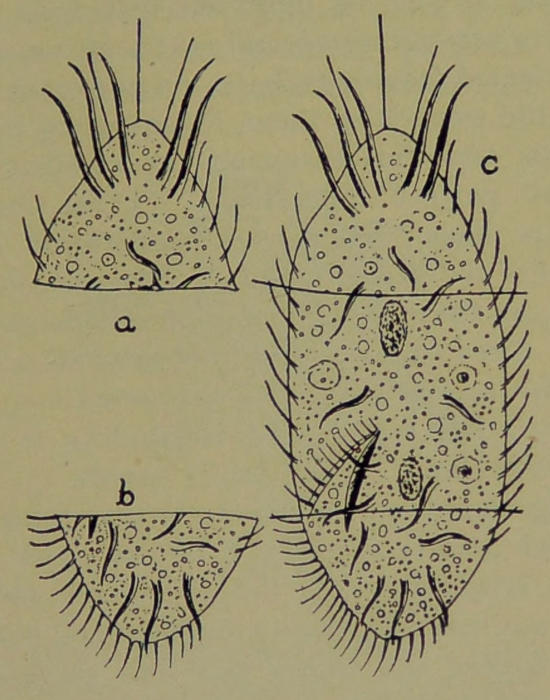
Fig. 2.—Stylonychia: c, an entire animal, showing planes of
section; the middle piece of c contains two nuclei and can
regenerate a perfect animal; a, and b, contain no nuclei,—they
live and swim about for a while and then die.
That the nucleus is the formative center of the
cell is indicated by the following, among many
facts: If a unicellular animal, such as Stylonychia
(Fig. 2), for instance, be broken up into several
fragments, it will be observed that some of the
fragments are nucleated and others non-nucleated.
The nucleated fragments have the power of quickly
healing the wounds on them, regenerating the missing
parts, and thus restoring the mutilated fragments
to perfect individuals. These nucleated
fragments have the power to perform all the
activities of the perfect animal. The non-nucleated
portions, on the other hand, cannot undergo regeneration.
They cannot digest food, or grow or secrete
substances as the nucleated fragments can. They
can simply live for awhile, responding to stimuli
and moving about. They finally perish.
Having mentioned in a general way some of the
wonderful powers of cells, it will be well now to
describe briefly a few of the unicellular plants and
animals that can be so easily obtained and studied in
warm weather, and which may thus serve as illustrations
of the powers of nucleated pieces of protoplasm
or cells. Many unicellular plants and
animals can be obtained in summer from the
superficial ooze on the bottom of slow-running
streams and also on the under surfaces of the leaves
of water plants, a study of which will be of the
greatest value and interest.
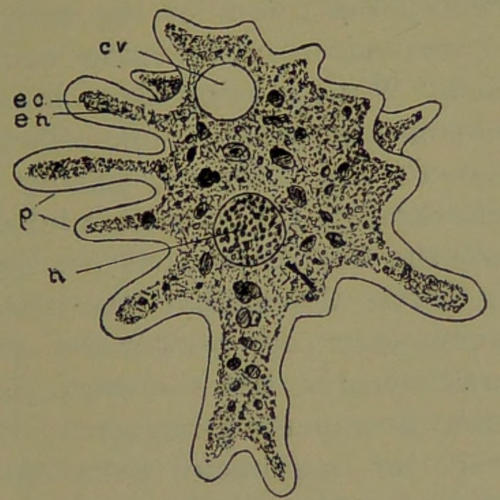
Amœba proteus (Fig. 3). This little unicellular
animal, which belongs to the Rhizopod type, is very
common in ponds and streams in warm weather.
In the resting state it is spherical in form, but when
active its form is as changeable as the fabled
Proteus, hence its name, Amœba proteus. This
little creature is a naked piece of protoplasm, with
its outer layer differentiated into a firmer and
pellucid part called the ectoplasm (Fig. 3, ec); its
interior, the endoplasm (en), is quite granular and
much more fluid, the granular particles moving
quite freely upon one another when the animal
changes its shape. The superficial portion of the
endoplasm is firmer than its more central parts, and
graduates insensibly into the more consistent
ectoplasm.
In the periphery of the granular endoplasm, and
adherent to the inner surface of the ectoplasm, is a
clearly defined nucleus (n). When most distinctly
seen, it presents the appearance of a clear vesicle
surrounding a solid and more or less spherical
nucleolus. A contractile vacuole (cv) is also uniformly
present, located in the endoplasm. The
creature has the power of putting out projections (p)
from the surface called false feet (pseudopodia).
Sometimes the protrusion consists of ectoplasm
alone, but more commonly endoplasm extends into
it, when a current of granules will be observed moving
from the more central portions of the Amœba
into its protrusion, whilst from some other protrusion
that is being withdrawn a similar current
may set towards the center of the body, and thus
the animal moves, in a creeping manner, from
place to place. While moving about in this way the
little animal comes across other one-celled creatures,
such as Desmids and Diatoms, seizing them and
forcing them through its ectoplasm into the endoplasm,
where the nutritious parts are digested and
assimilated. After the animal has taken its prey
through its ectoplasm, no break in the continuity of
the ectoplasm remains, but the parts immediately
come together in a perfect manner. After it has
abstracted all the nutriment from its prey, the
Amœba casts away from it the parts that are indigestible.
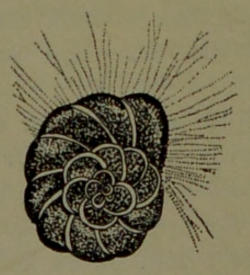
Fig. 4.—Rotalia Freyeri: a many-shelled Foraminifer, or a
colony of many single-shelled Foraminifera, with pseudopodia
extended.
Foraminifera. These are little protoplasmic
unicellular animals that have the power of secreting
for themselves more or less complex envelopes composed
of limestone. They may be single, as in
Lagena, or composed of a number of individuals
with the shells cemented together as in Globigerina
or Rotalia (Fig. 4). They have played a part of
vast importance in the geological development of
the world. Their myriads of shells remaining at the
bottom of seas millions of years after the little
protoplasmic bodies have perished, they have been
consolidated into vast expanses of limestone rocks,
and finally uplifted into such formations as the huge
chalk cliffs of England.
Osteoblasts and Osteoclasts. These cells are naked
pieces of protoplasm, the latter much the larger and
having many nuclei. They are concerned in some
of the most interesting phenomena of many growing
animals. Just as the Foraminifera have the
power of forming complex aggregations of limestone
shells, so the Osteoblasts have the power to
construct the bones of animals. And when a bone
is broken as the result of accident, these little cells
do the mending. While the Osteoblasts are bone-formers,
the Osteoclasts are bone-destroyers. It is
very curious that little specks of living jelly, like
these Osteoclasts, should have the power of destroying
hard tissue like bone, but such is the fact.
These Osteoclasts can, by their wonderful chemical
processes, liquefy and absorb, and by these means
destroy, ivory pegs that are driven into living bone.
They are the agents by which the roots of children’s
milk teeth are destroyed, so that the crowns of the
teeth are shed and the way paved for the appearance
of the permanent teeth. The wonderful
activity of these little Osteoblasts and Osteoclasts is
well exemplified in the growth and shedding of the
antlers of deer. While these antlers are growing in
the spring, they are covered with a delicate skin,
technically called “velvet.” This velvet is very
sensitive and quite warm from the nutrient blood
circulating through it. In it are hundreds and thousands
of busy, living Osteoblasts that work together
under some mysterious, directing or coördinating
agency, to build up the splendid beams, tynes and
snags that constitute the antlers, which in many
deer of the Rocky Mountains reach such a size that
a man may walk under the archway made by setting
the shed antlers up on their points. No hive of
bees is busier or more replete with active life than
the antler of a stag as it grows beneath the warm,
soft velvet, through the agency of the Osteoblasts.
The building of the antlers by these little agents
continues through the spring and summer. In the
autumn the Osteoblasts cease their activity and die;
the delicate, sensitive velvet dries and peels off,
leaving the dead, hard, bony substance exposed, and
they now become weapons adapted for fighting.
This is the season when the stags challenge one
another to single combat, the hinds standing timidly
by to be taken by the victor as his mates. When
the loves and battles of the autumn are over and the
mating is completed, the antlers no longer serve a
useful purpose, and they are shed. The shedding
is accomplished through the agency of the bone-destroyers,
the little jelly-like cells called Osteoclasts.
Bacteria are exceedingly minute specks of naked
protoplasm. They are unicellular plants. Some of
them are harmless to mankind; some are very useful
to him, and others are his deadly enemies.
Many of them are concerned in the production of the
infectious diseases. They do so by elaborating
various chemical products that are virulent poisons,
hence these products are called toxines; when taken
up by the blood, they are carried to various parts of
the body. In this manner they cause the particular
symptoms that are characteristic of a special infectious
disease. Why is it that some persons, on
exposure to an infectious disease, contract the
malady while others similarly exposed do not? In
other words, what gives immunity to disease? The
explanation is probably as follows: Just as the
invading bacteria have the power of secreting
toxines, so the cells of the body, normally, have the
power of elaborating chemical products that are
antidotes to the toxines, and are appropriately called
antitoxines. Infectious diseases and immunity from
them, are the result of a contest between the invading
bacteria and the protecting cells of the body.
If the bacteria secrete toxines in greater quantities
than can be neutralized by the cells of the body, we
have disease; if the reverse occur, we have
immunity.
The white blood-corpuscles (cells) also take part in
this warfare. They have the power of traveling, in
virtue of their amœboid movements, from the blood
to the part invaded by the bacteria. Here a contest
takes place between them, the corpuscle takes the
bacteria into its interior, and either kills them or is
itself killed. The result of this contest helps to
produce either immunity or infection.
Tetanus bacillus is a cell shaped like a slender rod.
It has the power of secreting a poison which, when
introduced into the body, produces convulsions and
other symptoms of lockjaw. These much resemble
those induced by strychnine poisoning.
Bacillus diphtheriæ is an exceedingly small unicellular
plant, and has the power of producing a poison
called toxalbumin, which is analogous to the poison
of certain venomous serpents. It is the speck of
protoplasm through whose activity diphtheria is
caused.
Many useful bacteria have the power of so acting
on dead organic bodies as to decompose them, the
three most conspicuous end-products of this decomposition
being water, carbonic oxide and ammonia.
When the dead bodies are decomposed in the soil
there are other bacteria, in addition, that have the
power of further acting on the ammonia, causing its
oxidation and producing nitrous and nitric acids
and their salts. The unicellular plants that bring
about these changes are the nitrifying bacteria.
Conspicuous illustrations of the functional activity
of these little naked pieces of protoplasm are
seen in the immense saltpeter beds of Peru and
Chili, where, from the enormous fecal accumulations
of sea-fowls, the immense quantities of nitrates are
produced that supply the commercial world.
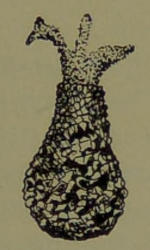
Fig. 5.—Difflugia Pyriformis.
Arcella, of which there are many species, is a
unicellular animal whose protoplasmic body has
secreted from its surface an enclosing “test” that is
composed of a horny membrane, resembling very
much in constitution the chitin which gives firmness
to the integuments of insects. This creature is
commonly discoidal in shape, with one face arched
and the other flat, an aperture being situated in the
center of the flat side through which the creature
may thrust its pseudopodia or withdraw them. The
surface of the testaceous covering is often marked
with a regular but minute and attractive pattern.
In Difflugia (Fig. 5), the test is somewhat pitcher-shaped,
and is mostly made up (by the constructive
activity of the protoplasm) of exceedingly small
particles of shell and gravel cemented together.
Many testaceous amœbans form tests of singular
beauty and remarkable regularity. In some of the
animals the minute plates of which the tests are
formed have been picked up from the surface over
which the animals crawl, and are cemented into
various charming patterns; and in other cases they
are formed by secretion from their own bodies. In
Quadrula symmetrica the protoplasmic body has constructed
a pear-shaped testaceous covering, of complete
transparence-like glass, composed of a great
number of square plates touching each other by
their edges. The protoplasmic body of the animal
does not entirely fill the test, the intervening space
being occupied by a clear liquid and traversed by
bands of protoplasm. A clear, large spherical
nucleus is seen in the part farthest from the pseudopodia.
It contains a dark and well-defined
nucleolus. In front of the nucleus two contractile
vesicles are to be observed. The pseudopodia in
these creatures, it must be remembered, are not
appendages, but lobate protrusions of the protoplasmic
body, are few in number, rounded, short
and broad.
Diatoms are unicellular plants, isolated or aggregated
together, that have the power of constructing
flint coverings, often of great complexity and charming
pattern. The tracings on many of these flint
coverings are so constant and small, that they are
frequently employed for the purpose of testing the
power of modern compound microscopes. In various
parts of the world vast deposits of Diatoms have
been discovered. The most remarkable of these for
extent, as well as for the beauty and number of the
species contained in it, is that on which the city of
Richmond, in Virginia, is built, which is over thirty
feet deep and extends for many miles.
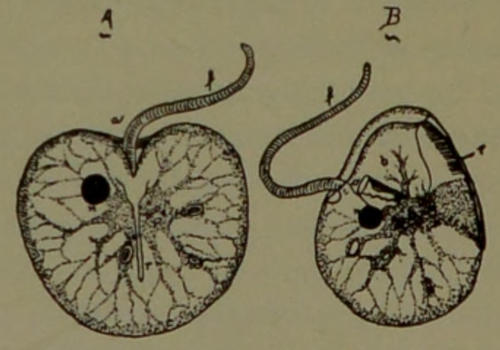
Fig. 6.—Noctiluca miliaris. A, dorsal view; B, side view;
n, nucleus; f, flagellum; a, entrance to atrium; b, atrium; o,
œsophagus; r, superficial ridge.
Noctiluca miliaris (Fig. 6) is a very large unicellular,
flagellate animal. It is spheroidal in form, and
has an average diameter of not quite one-half a millimeter.
It is just large enough to be observed by
the unaided eye when the water in which the animal
may be swimming is contained in a glass jar held up
to the light. It has a tail-like appendage (flagellum)
by which the animal moves about. Along one side
of the cell is a meridional groove resembling that of
a peach, and leading into a deep depression of the
surface termed the atrium (Fig. 6, B, b). It is from
the shallow commencement of this depression that
the flagellum (Fig. 6, f) originates. At the base of
the flagellum the depression sinks down to the
mouth (o). A slightly elevated ridge (r) extends
along the opposite meridian and commences with a
bifurcation at that end of the atrium farthest from
the flagellum. The mouth opens into a short
œsophagus, which leads down directly to the central
protoplasmic mass. The central protoplasmic mass
sends off branching prolongations of its substance in
all directions, the ramifications of which freely
inosculate. The farther these ramifications extend
out to the periphery, the thinner they become, until
finally a protoplasmic network of extreme tenuity is
formed immediately under the enveloping membrane
of the cell. In addition to these ramifying
prolongations, the central protoplasmic mass sends
off a thin, broad, irregular extension to the superficial
ridge and coalesces with it. Near the central
protoplasmic mass is seen the nucleus (n).
The flagellum is a flattened, whip-like filament,
having a striated appearance, and gradually tapers
from the base to its extremity. It slowly bends
over five or six times a minute to the mouth, and
then, more slowly still, bends away again. It is
through the movements of the flagellum that particles
of food are driven into the mouth and down
the œsophagus into the central protoplasmic mass.
In this mass and its extensions the food is digested
and assimilated.
This little one-celled animal has the power,
through its special chemical activities, of manufacturing
and emitting light. It is through the agency
of myriads of these little creatures that the diffused
luminosity of some seas is produced and can be
observed at night. The Noctiluca is very transparent,
and for this reason it is a particularly favorable
subject for the study of its luminosity or
phosphorescence. They can be obtained by the
tow-net in unlimited quantities from the sea and
transferred into a jar of sea water. Here they soon
rise to the surface, forming a thick layer. If the jar
be placed in the dark and agitated in the slightest
degree, there is an instantaneous display of light,
which is of a beautiful greenish tint. The light
emitted by the Noctiluca is so vivid that it can even
be observed in ordinary lamp-light. This phosphorescence
is only of an instant’s duration, and a
short rest is necessary for its renewal. The special
locality for the formation of the phosphorescence is
in the very fine protoplasmic network, which lines
the external structureless membrane or cell wall.
These wonderful little Noctilucæ may well be figuratively
called the fire-flies of the ocean.
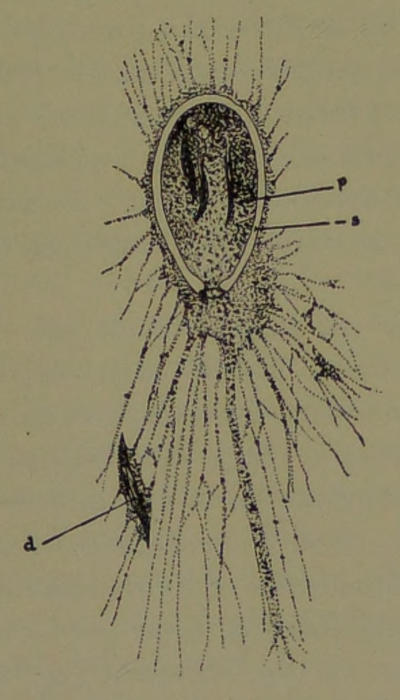
Fig. 7.—Gromia oviformis with protoplasmic threads (pseudopodia)
extended and forming an elaborate network in which
a captured unicellular organism is seen; d, diatom captured;
p, protoplasm containing captured diatoms; s, shell.
Gromia oviformis (Fig. 7) is often found in fresh
water adhering to confervæ and other plants of running
streams. The protoplasmic body of this animal
is enveloped in a chitinous covering that is egg-shaped
and of a brownish-yellow color. It is about
two millimeters in diameter. When the animal is
quiet, no one would suspect its real nature, so much
does it look like the seed of an aquatic plant. The
testaceous envelope has a single round orifice at its
more pointed end. The animal, when in an active
state, pushes out the protoplasmic substance, which
speedily gives off ramifying extensions, and these
by further ramification and inosculation form a complicated
network. The protoplasm of the animal
also extends itself in such a way as to form a continuous
layer on the external surface of the test.
From this layer numerous protoplasmic threads may
extend out, forming more or less complicated networks.
By the alternate contraction and extension
of its protoplasmic threads and networks, minute
one-celled plants and animals are entrapped like flies
in a spider’s web (d). When caught they are
carried, by retraction of the protoplasmic thread-like
pseudopodia, into the endoplasm in the test. Here
the nutritious parts of the entrapped creatures are
abstracted and assimilated. In transparent species,
the indigestible parts, such as the silicious valves of
diatoms, may be distinguished in the midst of the
endoplasm, from which they are ultimately extruded.
When gromia oviformis reproduces by mitosis it
gives off a bud (small cell), which finally separates
from the parent form and constitutes a distinct individual.
This process may be repeated many times,
so that a great number of separate individuals may
be formed, all of which lead detached and independent
lives.
Most of the protozoa, which are produced by
fission (cell division by mitosis), separate entirely
from each other, as in Gromia; but in many of these
unicellular animals, the new creatures produced by
fission do not separate from one another, but remain
more or less closely connected, and thus form
colonies of Protozoans. These colonies are of the
greatest interest, for they represent a lower stage of
the cell colonies of the Metazoa (multicellular animals).
They reproduce, in many cases, in a way
which is strongly suggestive of reproduction in the
Metazoa.
Microgromia socialis is a little unicellular animal,
having a thin, nearly globular, calcareous shell that
it secretes upon its surface. It multiplies by fission,
and forms a number of distinct individuals
which have the curious habit of fusing their pseudopodia
and uniting into a more or less closely associated
colony. The individuals sometimes remain at
a distance from one another, but sometimes associate
themselves together into a compact colony. These
individuals are all alike, performing the same functions.
There is no division of labor among the
units, but they live practically an independent life.
If the individual animals were detached from one
another, they would live and build new colonies.
Codosiga umbellata is another unicellular animal—a
flagellate Protozoan. It has a collar-like extension
of its ectoplasm from the anterior extremity of its
body, forming a sort of funnel from the bottom of
which the thread-like structure (flagellum) arises.
The vibrations of this flagellum cause a current of
the surrounding fluid to set into the funnel so that
particles of food reach the soft protoplasmic substance
which serves as a mouth. The nucleus is
seen near the base of the collar. Near the posterior
extremity of the body two contractile vesicles are to
be observed. This posterior extremity of the animal
has a cylindrical extension of its ectoplasm by
which it attaches itself to an object. This protozoan
multiplies by longitudinal fission. In some species
the animals separate completely from one another
and lead entirely independent lives. But in Codosiga
umbellata the fission does not extend through the
cylindrical extension, so that a group of animals are
associated in a colony.
Rotalia or Globigerina. The shelled amœba
(Lagena) gives off a bud (unseparated cell) which
grows to the full size, secretes its calcareous shell
and remains connected with the parent form. This
process may be repeated a number of times until a
colony of shelled amœbæ, of varying pattern in
different species, may be formed and permanently
associated together (Fig. 4). The individual amœbæ
are all alike and perform the same functions. There
is no division of labor, no specialization, among
them. If the individual animals could be separated
from one another they would live and build new
colonies.
Pandorina morum forms a small colony of sixteen
cells (solid sphere) of mulberry-like shape and
enclosed in a common gelatinous envelope. Each
cell in the mulberry mass bears two flagella on its
peripheral end. These project out beyond the surface
of the gelatinous envelope, and are agents for
locomotion of the colony. The cells in the colony
are all alike. There is no division of labor among
them. They all act alike. The cells (flagellate protozoans)
of the colony may reproduce in two ways.
Each animal in the colony may subdivide into sixteen
smaller units, each of which by growth and
multiplication may form a new mulberry mass, a
new colony, each unit of which acquires two
flagella. Or two of the small units may amalgamate
(conjugate), and then develop (by fission)
into a new colony. The conjugating units are
nearly of the same size and look very much alike.
Volvox globator is a spheroidal shaped colony
(hollow sphere) of unicellular flagellate animals,
about one-half a millimeter in size. It was formerly
supposed to be a fresh-water Alga. It is now
known to be a colony of Protozoans. All the animals
in this colony are not alike. There is a
division of labor among the cells, for some are
merely vegetative, serving purposes of nutrition,
and having no reproductive powers; while other
members of the colony are purely reproductive animals.
Furthermore, there is quite a marked
specialization of the reproductive cells. Those
reproductive cells that may be spoken of as the
female cells are large and non-motile encysted cells.
The male cells are small and actively motile, in that
they have two flagella developed on them. A small
flagellate male cell penetrates the large encysted
female cell, and as the result of this conjugation,
fission takes place repeatedly, and a new colony of
flagellate protozoans (volvox) is formed. Volvox
approaches very suggestively towards the type of
animals known as Metazoan.
In order to comprehend, in some measure, the
transition from Colonial Protozoa to Metazoa, it will
be well for the reader to study a typical sponge.
For a long time the Porifera (Sponges) were looked
upon as compound Protozoa (colonial Protozoa), but
while they are nearer the Protozoa than any of the
other types of Metazoa, their position in the animal
series is unquestionably among the Metazoa. The
Sponge, like the rest of the Metazoa, develops from
a fertilized egg by a process of cell multiplication,
differentiation, gastrulation, etc.
The multiplication of cells plays a part of such
fundamental importance in Evolution, and therefore
in Embryology and studies in Heredity, that it is
necessary to study the subject somewhat in detail.
It is a wonderful process, and is worthy of very
careful attention.
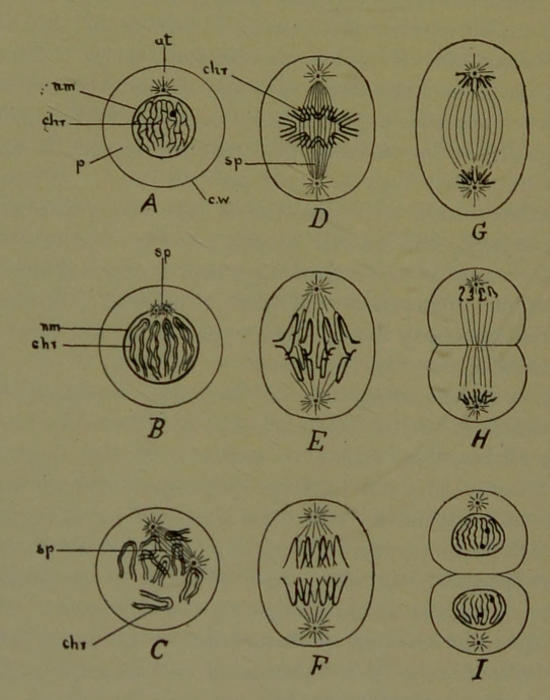
Fig. 8.—Diagram illustrating Mitosis. A, the cell commencing
activity; B, C, D, phases in the formation of the spindle
and the chromatin loops or V’s, also showing that the mother
V’s have split into daughter V’s; D, the chromatin loops forming
the equatorial plate, chr; E, F, G, separation of the daughter
loops (daughter chromosomes) and their passage towards
the poles of the spindle, thus forming daughter nuclei; H, I,
division of the protoplasm so as to form two daughter cells; at,
attraction sphere enclosing a centrosome; n m, nuclear membrane;
chr., chromatin threads; p, protoplasm; c w, cell wall;
sp, spindle.
The process by which one cell (a mother cell)
divides into two cells (daughter cells) is called
mitosis, and is inaugurated by the centrosome (Fig.
8, A, at). The centrosome divides into two
centrosomes, which at first remain close together
(Fig. 8, B, sp), and then gradually separate from
one another. Each centrosome becomes the center
of a system of fine achromatin fibers arranged
round it in a radiating manner and forming what is
called the attraction sphere; also, at the same time,
a spindle-shaped bundle of achromatin fibers, called
the spindle (Fig. 8, B, sp), extends between the centrosomes.
In the meantime, important changes have
been taking place in the chromosomes (hereditary
threads) of the nucleus. The chromosomes, which
at first are arranged in an apparently inextricable
tangle or network, frequently assume U-shaped or
V-shaped forms (Fig. 8, C, chr), and the nuclear
membrane disappears. Sooner or later each
chromosome splits longitudinally into two daughter
chromosomes, with which the achromatin fibers of
the spindle become connected (Fig. 8, D). In this
phase of mitosis the split V-shaped chromosomes
form a single group called the equatorial plate (chr),
and extend across the axis of the spindle. It is to
be observed from the diagrams in the figure, that
one of the centrosomes has traveled to the opposite
pole of the nucleus, thus causing the achromatin
fibers of the spindle to extend across the original
site of the nucleus. The equatorial plate of split
V-shaped mother chromosomes (hereditary threads)
thus divides the fibers of the spindle into two parts,
one half extending from one centrosome to one
group of daughter chromosomes, while the remaining
half extend from the other centrosome to the
other group of daughter chromosomes. Soon the
achromatin fibers of the spindle contract, and in this
way separate the two groups of daughter chromosomes,
so that one group is drawn towards one
centrosome, and the other group to the other centrosome
(Fig. 8, E, F, G, H). After the two groups
of daughter chromosomes have been drawn to their
respective centrosomes, each group assumes the
tangle or network phase like the nucleus of the
mother cell, and an investing nuclear membrane
reappears for each (Fig. 8, I). Thus from the
mother nucleus of the mother cell we get two
daughter nuclei (I). In a further phase of the
mitotic process, a furrow appears on the surface of
the protoplasm and surrounds it in the form of a
ring. This furrow is in a plane at right angles to
the long axis of the spindle, and gradually deepens
until the protoplasm is divided into two parts, each
segment of protoplasm containing its own nucleus
and centrosome; in short, the mother cell has
divided into two daughter cells (I).
It will thus be observed that the centrosomes and
their achromatin fibers are a beautiful mechanism
by which the heredity threads (chromosomes) are
exactly divided into two equivalent halves.
There are some cells (Amœba proteus, for
instance,) which divide in a much simpler manner
than by mitosis; in these there is no complicated
rearrangement of the chromosomes and no disappearance
of the nuclear membrane, the nucleus
simply becoming separated into two parts (Amitosis).
The Human Ovum. The human ovum is a typical
cell about one-fifth of a millimeter in size and
spherical in shape. It is a nucleated piece of protoplasm
possessing an enveloping cell-wall (metaplasm).
The protoplasm contains nutrient material
or yolk (metaplasm). The maturation of the ovum
essentially consists in throwing out half of its
chromosomes. In doing this the nucleus (mother)
approaches the surface of the protoplasm (Fig. 9,
A), and divides, by mitosis, into two daughter
nuclei; then the unripe ovum divides into two cells,
but of very unequal size. This process is repeated
a second time. Thus two small cells are formed
which are known as the polar bodies (Fig. 9, A, B,
pol. b). The large cell remaining after the formation
of the two polar bodies is the mature ovum (B).
Its nucleus, which recedes towards the center of the
protoplasm, is called the female pronucleus (Fig. 9,
B, f. pr.). The pronuclei of mature ova differ from
the nuclei of all the other cells of the body in that
they only contain half as many chromosomes
(hereditary threads).
The ripe spermatozoid (a flagellate sexual cell of
the male) corresponds to the ovum of the female.
It also contains a pronucleus having only half the
number of chromosomes that the other cells of the
adult body possess.
Fertilization. The male sexual cell (spermatozoid)
is vastly smaller than the female sexual cell (ovum).
Having a flagellum (Fig. 9, B, s), it moves about,
like a tadpole in water, and seeks the ovum. When
it comes in contact with the ovum it penetrates into
its interior (usually only one doing so), as indicated
at (Fig. 9, B, s). The tail or flagellum of the spermatozoid
fuses with the protoplasm of the ovum,
and disappears from view. Its pronucleus (C, m.
pr.), accompanied by its centrosome (C, m. c.),
approaches the female pronucleus (f. pr.) of the
ovum (Fig. 9, C, D). Finally the male and female
pronuclei coalesce to form a single nucleus (Fig. 9,
E, n. os.). The centrosome of the ovum persists
for awhile and then disappears; that of the spermatozoid
remains in the ovum, and is the agency by
which cell multiplication, through mitosis, takes
place.
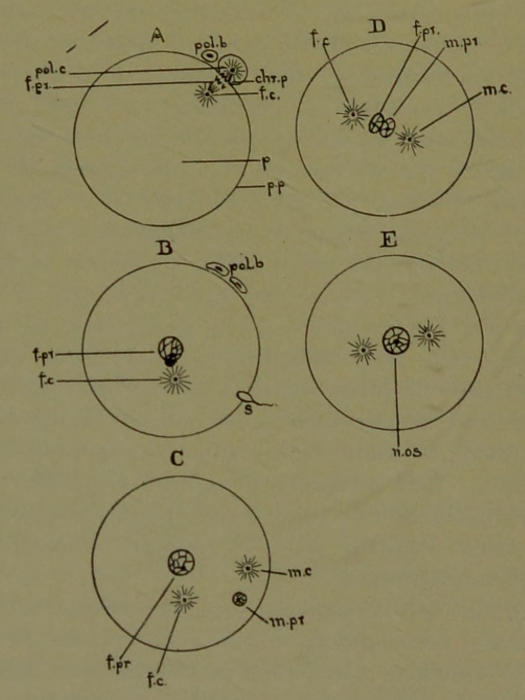
Fig. 9.—Diagram illustrating the maturation and fertilization
of the human ovum. A, one polar body is formed and a
second is in process of formation; B, both polar bodies are
formed and a spermatozoid is penetrating the ovum; C and D
represent the approach of the male pronucleus towards the
female pronucleus; E indicates the amalgamation of the two
pronuclei to form the nucleus of the oösperm (segmentation
nucleus); pol. b, polar bodies; pol. c, centrosome of the polar
body; chr. p, chromatin of the polar body; f pr, female pronucleus;
p, protoplasm; p p, peripheral protoplasm (but not
cell wall); f c, female centrosome; m c, male centrosome; m
pr, male pronucleus; n, os, nucleus of the oösperm (first stage
of a human being).
The cell resulting from the coalescence of the male
pronucleus with the pronucleus of the ovum, and
which is only one fifth of a millimeter in size, is the
first stage in the existence of a human being. Man
thus starts his career as a Protozoan-like creature,—as
a unicellular animal. The fertilized ovum is
called the sperm-egg (oösperm), and contains now
the normal number of hereditary threads (chromosomes);
for those of the male have been added to
those of the female.
Segmentation of the Oösperm. The fertilization of
the ovum imparts to it a wonderful stimulus, so that
the oösperm divides, by mitosis, into two cells, these
two into four, the four into eight, the eight into
sixteen, these into thirty-two, and so on repeatedly,
until a large number of comparatively small cells
are formed (Fig. 10). This mass of cells is spherical
in shape, and the little round cells towards the surface
project in such a way as to give to the mass an
appearance somewhat similar to the fruit of the
mulberry, whence it is termed the mulberry body
or morula (Fig. 10, 4). In the morula stage of his
existence man resembles the solid colony of protozoans
represented by Pandorina. The cells of the
morula next become arranged regularly in a single
layer at the circumference, by which the embryo
assumes the form of a hollow sphere, and is known
as the blastula (Fig. 10, 5). This phase of man’s
existence is quite suggestive of Volvox.
Soon one side of the blastula is invaginated or
pushed in, as one would push in one side of a hollow
india-rubber ball. The result of this invagination
(called gastrulation technically) is the formation of
a sort of cup. This is the gastrula (Fig. 10, 6)
phase of man’s existence. It is a higher and fundamentally
different phase of existence than either the
morula or the blastula. It corresponds, not to a
Protozoan, but to the higher Metazoan. It possesses
the fundamental anatomical qualities of a low
Cœlenterate (Polyp).
The mode of gastrulation is different in man from
that just described, and varies in different animals,
but the essential point common to all is the formation
of a double cellular-membrane; the outer membrane
being called epiblast or ectoderm, and the
inner one hypoblast or endoderm, the enclosed cavity
being the primitive digestive cavity. These two
layers are the primary germinal layers. A third
layer is subsequently formed between them, by the
agency of one or both of them, and is called the
mesoblast. From these three simple membranes,
which are composed exclusively of cells, are formed
all the complex tissues and organs of the adult man.
The epiblast develops into the nervous system
(brain, spinal cord, and nerves), and the cuticle,
hair, etc. The hypoblast develops into the cellular
parts of the digestive canal, the liver, lungs, etc.
The mesoblast develops into the muscles, bones,
ligaments, blood-vessels, etc. To trace the details
of this evolution of a human being from the microscopic
oösperm is a fascinating and instructive study,
but is beyond the limits and purpose of this little
book. It will well repay further careful study by
the reader.
A careful study of the life-histories of the few
unicellular animals and plants mentioned in the
preceding pages will help to let one realize the
wonderful powers of nucleated pieces of protoplasm
(cells). If isolated pieces of protoplasm can accomplish
so much, one will not be astonished to learn
that many diverse cells associated together in intimate
correlations, as occurs in the higher animals,
may accomplish results that are profoundly interesting
and marvelous. As far as anatomy and physiology
alone can reveal, it is the result of millions of
cells acting together that makes possible the existence
of such a living, sentient, thinking creature as
man or the highly intelligent elephant or any other
multicellular animal. It is due to the mysterious
powers of protoplasm that one little microscopic cell,
like the fertilized ovum of a woman, is able to hold
all the heritages of the race, and gradually unfold
them as it builds up the body into myriads of diverse
cells intimately associated together.
All of the wonderful results of Embryology are
accomplished through cell-multiplications, cell-differentiations,
cell-associations, invagination and
evaginations of cell-groups (tissues or organs), and
unequal growth of parts (cells or groups of cells).
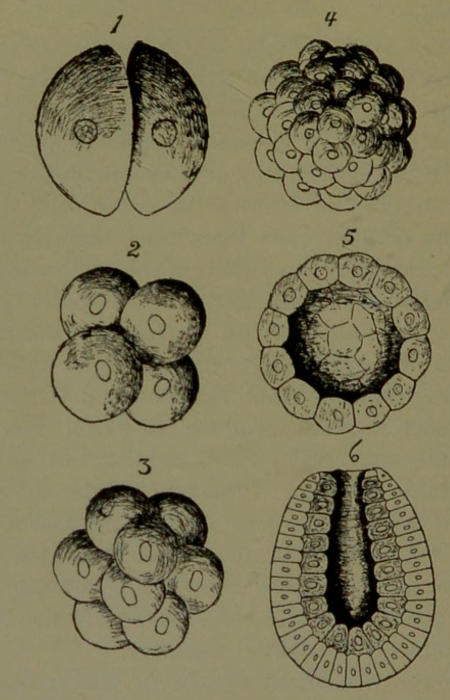
Fig. 10.—Segmentation of the fertilized ovum and Gastrulation:
4, morula; 5, section through blastula showing hollow
sphere; 6, gastrula showing outer layer of cells (epiblast) and
inner layer (hypoblast); the 6 is at the mouth of the cavity
(enteron) of the gastrula.
In concluding this brief but, we hope, useful study
of a few selected cells, we may say that an eminent
English physiologist has made the statement that a
student who has not looked through the microscope
and observed the circulation of the blood in the
web of a frog’s foot is not fit to study medicine.
However beautiful, fascinating and instructive the
sight of this circulation may be, we are tempted to
make the assertion that the student who has not
looked through the microscope at some of the
superficial ooze from the bottom of any slow-running
stream, in summer, and observed the structure
and actions of that wonderful little unicellular animal,
the Amœba proteus, is still less prepared to
study medicine. In this little speck of protoplasm
the problems of life are reduced to their simplest
forms, for all higher plants and animals may be
regarded as groups of more or less modified amœbæ
peculiarly associated together. In our studies of the
amœba we will be forcibly reminded of a very clever
trick which is practiced in India and is called the
mango-trick. In this trick a seed is put into the
ground and covered up, and after divers incantations
a full-blown mango-bush appears within five
minutes. We have never met any one who knew
how this thing was done, nor have we ever seen a
person who believed it to be anything else than a
conjuring trick. So it is with the amœba, a beautiful
and fascinating trickster of nature. We understand
some of its activities, interesting and
exceedingly instructive, but there are many others
beyond our ken. We see the commencement and
ending of many of its chemical activities, but there
are numerous other intermediary processes that take
place in the hidden recesses of the protoplasm, and
concerning which we know nothing. It may fall to the
lot of some reader of this little book, as a patient and
keen observer, to unravel some of these mango-like
tricks of the amœba or other unicellular creature.
SECTION II. HEREDITY WITH VARIATION.
HEREDITY WITH VARIATION. — ENVIRONMENT. — ACQUIRED CHARACTERS.
That an offspring always inherits from its parents
many of their characteristics is well known; that it
always varies, more or less, from them is also
equally well known. Heredity and variation are
twin forces that play upon every creature, holding
it rigidly true to the parental type or compelling
more or less divergence therefrom, according to the
strength of the one or other power; so that every
creature is the resultant of the activities of these
two great parallel forces. Variation is coextensive
with heredity, and every living creature gives evidence
of the existence of variations.
Examples of Variations. No two leaves on a plant
are exactly alike; no two children of the same parents
give a perfect resemblance; no two individuals
of the same species are molded in precisely the
same pattern; of the thousands and thousands of
faces that we observe in a city in the course of a
year, each has some distinctive peculiarity.
The trained eye of the gardener recognizes each
hyacinth among hundreds of bulbs; of the shepherd,
each sheep in his flock; of the Laplander, each
reindeer crowded in his herd like ants on the anthill.
In a flock of 1,000 sheep each mother can even recognize
a variation in the voice of her own lamb, all
alike to us.
Every part of an animal is subject to variations,
not only in bodily structure, but also in habits and
instincts, and these variations are large in amount,
numerous and diverse in character. Many observations,
experiments and measurements that have
been made at various times attest the truth of this
assertion. Not only do variations take place in animals
and plants under domestication, but also in the
wild state.
Illustrations of Heredity.Mental heredity can be
illustrated by studying the genealogies of such persons
as Aristotle, Goethe, Darwin, Coleridge, Milton,
etc. Probably the Bach family, of Germany, supply
one of the best illustrations of the inheritance of
intellectual character that we know of. The record
of this family begins in 1550, lasting through eight
generations to 1800. For about two centuries it
gave to the world musicians and singers of high
rank. The founder was Weit Bach, a baker of
Presburg, who sought recreation from his routine
work in song and music. For nearly two hundred
years his descendants, who were very numerous in
Franconia, Thuringia, and Saxony, retained a musical
talent, being all church singers and organists.
When the members of the family had become very
numerous and widely separated from one another,
they decided to meet at a stated place once a year.
Often more than a hundred persons—men, women
and children—bearing the name of Bach were thus
brought together. This family reunion continued
until nearly the middle of the eighteenth century.
In this family of musicians twenty-nine became
eminent.
Inheritance of moral character is well established.
Heredity, in its relation to crime and pauperism, has
been thoroughly investigated by Mr. Dugdale in his
most instructive little work entitled The Jukes. In
this work the descendants of one vicious and
neglected girl are traced through a large number of
generations. It reveals that a large proportion of
the descendants of this woman became licentious,
for, in the course of six generations, fifty-two per
cent. of the females became harlots and twenty-three
per cent. of the children were illegitimate. It
shows also that there were seven times more paupers
among the women than among the average
women of the State, and nine times more paupers
among the male descendants than among the
average men of the State.
The inheritance of physical peculiarities is so
obvious as to need no illustration. Among the
ancients the Romans stereotyped its truth by the
use of such expressions as the labiones, or thick-lipped;
the nasones, or big-nosed; the capitones, or
big-headed; and the buccones, or swollen-cheeked,
etc. In more recent times we read of the Austrian
lip and the Bourbon nose.
Questions of heredity and variation are cytological
ones—that is, questions of the anatomy, physiology,
physiological chemistry, and pathology of cells.
The most important part of a cell, as far as these
questions are concerned, is the nucleus. The nucleus
is the physical basis of all the heritages of an
organism, from the simplest to the most complex.
The nuclear threads may, therefore, very appropriately
be termed the hereditary threads, or, collectively,
the hereditary mass; and the physiological
units in them the hereditary units. The nucleus is
of fundamental importance in the reproduction or
multiplication of both unicellular and multicellular
animals and plants.
In unicellular creatures multiplication may take
place by fission and by conjugation. Both of these
processes can be studied by observation of the
infusorians. Maupas’s beautiful investigations on
these unicellular animals have demonstrated that
multiplication by fission may proceed to a prodigious
extent for many generations, but that a time comes
when the process fails, and the species will become
exhausted and die out unless there is a rejuvenation
of it by conjugation of individuals. In conjugation
two individual infusoria come in apposition with
each other, the nucleus in each undergoes subdivision.
They reciprocally exchange part of their
nuclear contents so that each infusorian comes to
contain hereditary threads of two distinct individuals.
From these rejuvenated (or fertilized) individuals
multitudes of others may be derived by
fission until exhaustion again takes place.
Multiplication in multicellular creatures may be
accomplished by budding (which is allied to fission),
and is exemplified in the plant, hydra, the queen
bee (parthenogenesis), etc., and by fertilization
(which is allied to conjugation). A knowledge of
the phenomena of fertilization of the ovum by the
spermatozoid is essential to any understanding of
the problems of heredity and variation in mankind.
The nuclear threads of the ovum are its hereditary
threads—the groups of maternal hereditary units;
likewise, the nucleus of the spermatozoid contains
the paternal groups of hereditary units.
Fertilization. In fertilization, the spermatozoid
(a nucleated flagellate cell) penetrates the ovum
(a nucleated, encysted cell), its protoplasm mixes
with that of the ovum, and its nuclear threads come
into relation with the nuclear threads of the ovum;
so that the fertilized ovum (a new creature, a veritable
microcosm) is still a nucleated cell, but one in
which the nucleus is compound, is hermaphroditic,
in that it contains maternal and paternal threads—that
is, maternal and paternal hereditary units
which constitute its hereditary mass.
It will be convenient to speak of the maternal and
paternal hereditary units in the fertilized ovum as
ancestral hereditary units.
This hermaphroditic cell passes through complex
phases, illustrated by embryology, to the adult. In
doing so this hermaphroditic cell (mother cell) first
divides into two smaller cells (daughter cells). The
mother cell divides in such a way (by mitosis) that
one-half of its nucleus and part of its protoplasm
goes to one daughter cell and the other half of the
nucleus, with the remainder of the protoplasm,
goes to the other daughter cell. It is an interesting
fact that although the amount of protoplasm which
goes from the mother cell to the two daughter cells
may be unequal at times, yet the amount of the
nucleus in one daughter cell is always exactly equal[2]
to that in the other; so that each daughter cell
contains maternal and paternal hereditary masses of
equal quantity and quality, being in fact one-half
that of the fertilized ovum. In consequence of the
fact that each hereditary unit in the nucleus of the
daughter cell can absorb nutriment and grow, it
comes about that the nucleus of each daughter cell
attains to the size of that of the mother cell. The
enveloping protoplasm of the nuclei also grows to a
greater or less extent, so that the cells as a whole
grow. These two daughter cells go through the
same process and form other daughter cells, and so
on through all the mitoses of development, until all
the myriads of cells of a living organism are produced,
each of which contains maternal and paternal
hereditary masses of equal quality and quantity, and
also of the same character as that of the fertilized
ovum whence they are all derived.
Apart from their activity in absorbing nutriment
and growing, the great majority of the hereditary
units in the nuclei of the forming cells remain
latent. But some of the hereditary units in each
cell produced are active. They multiply, grow and
migrate out of the nucleus, and get among the units
of the enveloping protoplasm. During this activity
they undergo physical and chemical changes and
effect corresponding differentiations in the protoplasm
of the cell. Thus, through many mitoses and
many differentiations of the protoplasm of cells, we
finally derive from the fertilized ovum all the cells
that constitute the adult body, such as muscle cells,
glandular cells (as liver cells, kidney cells, etc.),
nerve cells, skeletal cells (as bone, cartilage, and
connective-tissue cells), and the ova and spermatozoids.
According to this theory, the nucleus of
each cell in the adult animal or plant is pure
hereditary mass, exactly like that in the nucleus of
the fertilized ovum; but the protoplasm of each adult
cell that envelopes the nucleus may differ greatly in
different cell groups, as in muscle, nerve, cartilage,
and the like. Of course, the protoplasm of those
cells that develop into the ova and the spermatozoids
has differentiated along such lines as to
become like that of the ovum and spermatozoid, the
junction of which formed the fertilized ovum.
These statements hold true for plants and the lower
animal organisms, although they cannot be verified
for the higher animals. More than likely the pure
hereditary masses are present in the body (somatic)
cells of the higher organism in latent conditions, but
are unable ever to be developed owing to the
greater specialization of these cells. It is thus seen
that all the cells of many animals and plants can
perform their own special functions and at the same
time contain all of the hereditary units of the complex
organism in a state ready to develop under
favoring conditions.
Since the ova and spermatozoids are cells
specially differentiated for the purpose of propagating
the species by sexual generation, and since their
conjugation produces the germ of a new creature,
they may very appropriately be spoken of as germ
cells. Since all the other cells of the adult form the
great bulk of the body that envelopes and protects
the germ cells, they may be termed the body cells,
or somatic cells.
Suppose that ova, containing maternal and
paternal groups of hereditary units, are fertilized
by similarly complex spermatozoids, and the process
is repeated generation after generation. There
will come a time when the fertilized ovum will have
a highly complex nucleus composed of many different
ancestral groups of hereditary units.
One often hears the expression that a child is a
chip of the old block; but this is only a very partial
truth, for a child is preëminently a composite chip
of many old blocks.
The complex nucleus of the fertilized ovum may
be compared to a modern Italian building which has
been constructed of material—a column here, a
cornice there, a lintel yonder—gathered from different
classic buildings of varying antiquity. In view
of the increasing number of ancestral groups of
hereditary units that must have accumulated in the
nuclei of ova in the course of time, there must
necessarily, for mechanical reasons, have arrived a
period when these nuclei could receive no more of
them by fertilization, unless natural selection should
develop some saving device; hence we have, possibly,
an explanation of the phenomena of maturation
in ova (the reducing process of Weismann and
Hertwig). Here the ovum, prior to fertilization,
undergoes mitosis twice in succession, by which the
polar bodies are formed and the hereditary mass is
diminished by one-half (the mature germ cells having
only one-half the number of nuclear threads that
the body cells possess). A homologous process
takes place in the maturation of spermatozoids.
Fertilization increases the amount of the hereditary
mass in the ovum to the original quantity, and thus
restores the number of nuclear threads to the specific
number. All the body cells derived from the
fertilized ovum possess, also, the specific number
of threads.
This union of two distinct hereditary masses is
called amphimixis as well as fertilization.
Maturation and amphimixis or fertilization are the
source of many variations in the body, good and bad,
beautiful and ugly, geniuses and monstrosities;
because, in the commingling of distinct hereditary
masses, there is a struggle for existence between
the hereditary units and a survival of the fittest.
In this struggle some of the hereditary units are
strengthened so that heritages may be augmented;
some mix so that there may be a blending of characteristics;
some are mutually exclusive; some are
prepotent; some are neutralized; some are destroyed;
some lie dormant (latent) for varying lengths of
time, and some are so altered as to produce much
modified forms; and thus the possibilities of combination,
reactions and modifications of the hereditary
units, and therefore heritages, are almost endless.
The augmentation of heritages in the fertilized
ovum is well displayed, for instance, where fleet
horses are bred with fleet ones, until, by careful
selection, generation after generation, a progeny
may be secured much more swift than the original
stock from whence they were derived. In the same
way good milch cows have been produced.
The mixing of hereditary units and blending of
heritages is shown in the color of the skin, as where
a mulatto child is born to a negress by a white
father; mutually exclusive heritages are well illustrated
in the color of the eyes, as where a child has
either the blue eyes of one parent or the black of
the other, but never any blending of the colors; this
may also be illustrated where the white game bird
and black one are crossed, the young being either
white or black, but never blended. Prepotency is
illustrated where the silky variety of fan-tailed
pigeon is mated with any other small-sized variety
of pigeon, for the silkiness is invariably transmitted.
A most interesting case of prepotency in
mankind, mentioned by Ribot, is that of Lislet-Geoffrey,
an engineer in Mauritius. He was the son
of a very stupid negress and an educated white man.
In physical constitution he was as much a negro as
his mother; he had the woolly hair, the features, the
complexion, and the peculiar odor of his race. He
was so thoroughly a white man as regards intellectual
development that he succeeded in vanquishing
the prejudices of race, so strong in the French
colonies, and in being admitted into the most aristocratic
houses. At the time of his death he was
Corresponding Member of the Academy of Sciences.
In this, it will be observed, we have prepotency in
the mother’s physical constitution, and in the
father’s intellectual characteristics.
The struggle of heritages in the impregnated
ovum may lead to such structural changes of the
nucleus, and therefore of the cell, as to develop the
most marked variations—such variations as the
biologists call sports.
In the latter part of the eighteenth century the
farmers of Massachusetts had flocks of ordinary
sheep on their farms. These sheep were continually
jumping fences and getting on neighboring farms.
They were the source of many disputes and much
irritation between neighboring farmers. Finally,
one of the sheep had a lamb which, when grown,
displayed well-marked peculiarities (a sport). It
had a longer body than the ordinary sheep and
shorter legs, which were bowed. It was noticed that
this sheep could not get over the fences. The cute
Yankee farmer, noticing this valuable peculiarity,
carefully preserved this peculiar sheep, and from it
was ultimately derived, by careful selective breeding,
a special variety known as the Ancon sheep.
The germinal variations resulting from the mixing
of two separate hereditary masses by impregnation
find their expression in the most varied
qualities of the minds and bodies of developing
children. If the variations are not especially
marked, they are looked upon as normal and attract
no special attention.
But if the variations are so pronounced as to compel
attention, and at the same time it is known that
they are useful, they are spoken of as talents, or,
on the other hand, if they are harmful or useless,
they are designated as pathological or monstrosities.
These are truly what the biologists call sports;
and to those classes of sports that occur as specially
gifted in human culture, in the varied fields of
science, art, or literature, we assign such a person
as Shakespeare, and call the remarkable variations
embodied in him genius. On the other hand, such
variations as lead to certain forms of pigmentary
degeneration of the retina, and to Daltonism, to
dyschromatopsia and achromatopsia, to certain
supernumerary glands, polydactylism, and such like,
which are either useless or harmful, we designate as
pathological cases or monstrosities.
Hereditary units (the carriers of heritages) may
be latent—that is, they may appear late in life, or in
the offspring, or, still again, in remote descendants;
in the latter cases the heritages are spoken of as
reversional or atavistic. Latent hereditary units
may very usefully be compared to dormant seeds
buried in the ground. It is stated that buried seeds
may lie dormant for many years, so that when a
plot of ground is plowed deeply and upturned,
plants that have not been seen there within the
memory of one will often make their appearance and
flourish. The hereditary units are veritable living
seeds, that, under certain and often unknown
stimuli, grow and unfold their heritages as do the
buried seeds.
Latent heritages are well illustrated by a study of
secondary sexual characters as developed at puberty.
Among our barnyard fowls, the hens often, when
they have atrophy or degeneration of the ovaries,
although up to this time they have laid eggs for
years, stop this function, put aside the plumage and
appearance proper to their sex, and don more or less
completely the garments of the rooster. Thus
females have latent in them many secondary sexual
characters of the male. For similar reasons the
male develops, occasionally, female characters.
This latency is illustrated again in deer. In most
species of the deer tribe the males alone possess
antlers, yet it is a well-known circumstance that in
females with degenerations of the ovaries rudimentary
horns that are never shed appear. A study
of congenital color-blindness illustrates beautifully
latent heritages, showing how the females of one
generation may be free from the malady and the
males of the next afflicted.
A study of the regeneration of lost parts in various
animals and plants illustrates well the latency of
many hereditary units. A cutting made from the
willow and planted sends out roots and finally
reaches the dimensions of the adult tree. Here the
body cells of the stem evidently contained, in a
latent condition, many hereditary units in their
nuclei, which became active through the special
stimulus of being planted as a cutting. Adult
plants can be raised from the cuttings of many
other plants.
If the garden worm is cut in two, the head-part
will reproduce the tail-portion. If the little fresh-water
polyp, Hydra, be cut into a number of pieces,
each segment will reproduce a perfect animal.
Many lizards, after losing their tails by violence,
manufacture new tails through the agency of the
latent hereditary units contained in the body cells of
the stump left. If the tentacle or “horn” of a
snail, which contains an eye with a perfect lens and
retina, be cut off, the animal can reproduce another
one with a perfect eye, and this can be repeated a
number of times. Often newts, when fighting with
one another, or lobsters when fighting, lose a leg or
a claw. These highly organized animals have the
power of creating new limbs, making bones, ligaments,
muscles, nerves, cuticle, and so on. All of
this is done through the hereditary masses in the
nuclei of the body cells at the site of the injury.
A study of the phenomena of polymorphism in
hydroids and insects will beautifully and most interestingly
illustrate latent hereditary units.
Much that is speculative and fanciful is included
under the subject of atavism, and the safest plan for
pathologists and biologists, in considering any
abnormality, is to remember a golden rule of
Gegenbaur, that only those structures are reversional
which are taxonomically not far distant or phylogenetically
not very old. Embryology is also a very
important check in considering such subjects.
In mankind supernumerary limbs and digits,
microcephalia and micrencephalia, have been looked
upon as reversions to the simian type.
Lombroso, in contrasting the criminal with normal
man, looks upon his homo delinquens as an illustration
of atavism, contrasting with homo sapiens.
But, as Ziegler, in his Pathology, well observes,
many writers have gone too far in this respect, and
have characterized as atavistic formations various
acquired pathological formations and fresh variations
of germ cells.
I think one can safely say that supernumerary ribs
and those supernumerary nipples and mammary
glands along the line of the deep epigastric and
internal mammary arteries are truly atavistic structures;
also certain muscles normally belonging to
those mammalia which come near to man in the
scale of relationship, and which appear in man as
muscular variations, are reversional.
Children are often born with pigmented hairy
patches on their bodies known as moles; sometimes
these hairy moles are only of the size of a split pea,
in other cases they are several square inches in area,
while in rare cases almost all of the trunk may be
thus covered. Although many similar pathological
cases are often but marked variations called sports,
yet the illustrations mentioned are undoubtedly
reversional. Of the multitudinous illustrations of
atavism that could be mentioned I wish to refer to
but one more case.
The conjunctiva is a modification of skin, and
frequently proclaims its ancestry by reverting to its
original form. It is by no means a very rare event
to see a patient having a patch of hair-covered skin
growing upon the ocular conjunctiva. While a
clinical assistant at the Royal Ophthalmic Hospital
in London, we saw one such case, and Dr. Treacher
Collins, the pathologist of that eye hospital, has
stated that about twelve cases are seen there
annually of this pathological condition, which is
atavistic, according to Sutton, although it seemingly
violates Gegenbaur’s rule about phylogenetic
remoteness, and may be looked upon by some as a
pathological illustration of a sport.
In speaking of inheritance, we should carefully
discriminate between heredity and pseudo-heredity.
Physicians constantly write of tuberculosis, lepra,
smallpox, and syphilis as hereditary; but it is incorrect
and misleading to do so. When a person has
syphilis, say, from the earliest existence—that is,
from the fertilized ovum by transmission of a syphilitic
microbe through the germ cells of the parents—this
should be designated by its proper name as
congenital bacterial infection. This is totally different
from the hereditary qualities that flow from the
structural equilibrium following the commingling
and struggle for existence of multitudes of hereditary
units.
The one set of hereditary qualities is purely
germinal, while the other is germinal profoundly
modified by the presence of an infecting microbe. Of
course, to the extent that any toxines that are
secreted by the bacteria may cause permanent
structural changes in the germ-cells, to that extent
may the germinal characteristics be transmitted and
become hereditary.
Many instances of infection of the child in utero
have been reported in cases of endocarditis, scarlet
fever, and smallpox; and there can no longer be
any doubt, from experimental investigation and
recent observation, that pneumococci, typhoid
bacilli, anthrax bacilli, and pus cocci are able to
pass to the fœtus through the placenta. But the
diseases that develop in this way can be called
hereditary with even less semblance of correctness
than in the case of the fertilized ovum that is
invaded with a microbe.
All of these cases are illustrations of pseudo-hereditary
transmission, and should, for the sake of clearness
and accuracy, be spoken of as prenatal infections.
So far as the problems of heredity and variation
are concerned, we may say that the life cycle begins
and ends with the germ cell. Insects lay their eggs
in old age; among plants the annuals flower but to die;
in higher creatures the cessation of the procreative
power often marks the beginning of bodily decline.
Bearing in mind that the human body consists of
two great classes of cells, germ cells and somatic
cells, the following scheme will be found very useful
in discussing heredity with variation—viz.:
Germ-Cell
{
Stable (Heredity)
{
Unstable (Variation)
{
Blastogenetic
{
Temperature.
}
Environment
{
Chemical substances in solution in the fluids that bathe
the germ-cells, as food, drugs, poisons, etc.
}
{
Somatogenetic
{
Habitat
}
{
Temperature
}
{
Climate
}
{
Air
}
{
Food
}
{
Soil
}
{
Water
}
{
“Use”
}
{
“Disuse”
}
Just in proportion as fertilized germ cells during
the mitoses of ontogeny give origin, among the
somatic cells, to other germ cells that are structurally,
and therefore physiologically, like themselves,
just to that extent do we have heredity; on
the other hand, just to the degree that the new
germ cells which are produced are unstable, to that
degree also do we meet with variations.
In zoölogy the environment of an organism means
the sum-total of the conditions of life that surround
and affect it, such as food, air, water, climate, etc.
We have already stated that as far as evolution is
concerned the structures of fundamental importance
in an organism are the Germ-Cells; therefore, for
our purposes, we will define environment to be the
sum-total of the conditions that directly or indirectly
influence in any way the germ-cells, by which variations
in them may be produced, or through which
stability may be maintained.
There are two great classes of environmental
factors that bring about variations in the germ-cells.
One of these classes acts directly on the germ-cells,
and is therefore called blastogenetic; the other acts
indirectly through the body cells, and is therefore
designated somatogenetic. Many of the blastogenetic
factors bringing about structural changes in the
delicate mechanism of germ-cells are entirely
unknown, and are therefore designated as fortuitous.
Many other causes, such as poisons in solution
in the fluids that bathe them, can readily
enough be appreciated.
Blastogenetic Factors. It has been demonstrated
that various chemical substances, such as chloroform,
morphia, chloral, etc., have a pronounced influence
upon the vital activities of cells. It is well known
that microscopic unicellular plants constitute the
essential part of yeast. These little cells have the
power of causing fermentation in solutions of grape
sugar by which alcohol and carbon dioxide are
formed, the latter being a gas and escaping as
bubbles. If chloroform or ether be added to the
solution of sugar, before adding the yeast, no fermentation
takes place, for the yeast-cells are paralyzed.
But when the yeast is separated from the
chloroform solution and rinsed with distilled water,
it soon regains the power of causing fermentation
in pure solutions of sugar.
Ova and Spermatozoids are subject to the action
of drugs in a similar manner. If actively motile
spermatozoids of a sea-urchin be placed in a one-half
of one per cent. solution of chloral in sea water, it
will be found that after five minutes their action
will be completely arrested. These motions can
soon be restored if the chloral solution be sufficiently
diluted with pure sea water. These temporarily
paralyzed spermatozoids, when completely
recovered, will unite as quickly with ova as fresh
spermatozoids. When spermatozoids are kept for
half an hour in the chloral solution, a more decided
paralysis will be observed, which persists for some
time after the removal of the poisonous agent. A
few minutes elapse before some of the spermatozoids
exhibit feeble movements which finally become
active. Even when placed near ova, it is some time
before they fertilize them, although several may
attach themselves to the egg’s surface. But, finally,
fertilization does take place by the penetration of
one spermatozoid, and the egg normally develops.
In like manner, if ova are subjected to chloral
solution of varying strength, they also are influenced
in a marked degree; for, when fertilized, they
develop in an abnormal manner. Ordinarily, normal
ova are fertilized by one spermatozoid. If fertilized
by two or more, they become diseased, and
develop pathologically. The chloral solution favors
this fertilization by several spermatozoids. The
stronger the solution of chloral, the larger the number
of spermatozoids that fertilize the ovum.
Experiment and observation show that the behavior
of the nuclear hereditary mass is modified, during
mitosis, by the chloral and other solutions. It is
thus seen that the germ-cells of the lower animals
can be profoundly modified by various substances.
Equally true is it that the man or woman who
makes use of such drugs as alcohol, opium, chloral,
and such like, in an intemperate manner, contains
these poisons in solution in the blood, circulating to
every part of the body, and thus bathing and profoundly
influencing the germ-cells. In consequence
of this fact an acquired and habitual intemperance
will seldom fail to leave its impress upon one or
more of the offspring, either like the original vice or
one very closely allied to it. Intemperate people
not only profoundly impair the health, the intelligence,
and the morals of their offspring, by poisoning
these delicate germ-cells, but they also transmit
the fatal tendency to crave for the very substances
that have acted as poisons on these germ-cells before
and after fertilization. And one of the saddest
features of this great medical truth is that the
hereditary units which are concerned in transmitting
these grave abnormal tendencies may lie dormant in
the germs of one generation, to become active in
those of the next; so that children of intemperate
parents may lead honorable and temperate lives,
and take every pains to rear, in turn, their own
children in a wholesome and refining atmosphere,
and yet these children of good environment may
become intemperate through heredity, so that the
sins of the grandparents may be visited, not on the
children, but on the grandchildren.
These profound truths should lead all, and especially
law-makers, to remember that “the man who
inherits from his parents an impulsive or easily
tempted nature and an inert will and judgment,
and commits a crime under the influence of strong
emotion, can no more be placed in the same category
of responsibility with a man of more favorable
constitution and temperament than can a man who
steals a loaf under the pangs of starvation with a
merchant who commits a forgery to afford him the
means of prolonging a guilty career.”[3]
Not only do certain known poisons circulating in
the blood, or other fluid that may bathe the germ-cells
of living creatures, profoundly affect the germ-cells,
but many other substances probably have
great influence upon them. Certainly, the amount
and character of the food have a very decided influence
on them, as will be understood from the following
facts.
According to Yung, who has experimented very
extensively upon tadpoles, all tadpoles pass through
a bisexual (hermaphroditic) stage, as is the case
probably with most animals. During this tadpole
phase external influences, and, more particularly,
food, determine their fate as regards sex. In
Yung’s experiments it was found that when tadpoles
were left to themselves, the percentage of females
was in the majority, the average being probably
about 57 per cent. females and 43 per cent. males.
In experimenting with three broods, those fed on
beef gave 78 per cent. females; those fed on fish
gave 80 per cent. females; and those fed on the
highly nutritious flesh of frogs gave 92 per cent.
females.
In Mrs. Treat’s interesting experiments on moths
and butterflies, it was observed that if caterpillars
were confined and starved before they entered the
chrysalis state, the resultant moths or butterflies
were males, but others of the same brood that had
been highly nourished came out females.
The study of bees illustrates the same conclusions.
It is well known that in a beehive there are three
kinds of inmates, as the queen, the drones, and the
workers,—the last-mentioned being females whose
reproductive organs are imperfectly developed. It
is believed that the eggs that give rise to queens
and workers are fertilized and developed normally.
But it is a very curious fact that the eggs which
develop into drones do so without fertilization
(parthenogenesis). What factor or factors decide
the destiny of the two former, determining whether
a given ovum will develop into a queen, and thus be
the possible mother of a new generation, or stay at
the lower grade of a working, non-fertile female?
These factors are the quality and quantity of the
food. An abundance of what is called royal food
causes the development of the larva in such a way
that the queen with her reproductive organs is
formed. If a larva on the road to develop into a
worker (non-fertile female) “receive by chance some
crumbs from the royal superfluity,” it is found that
the reproductive organs may develop to such an
extent that workers partially fertile may be formed.
A worker larva may, by this royal food, be intentionally
reared into a queen bee.
It is thus seen how profoundly the germ-cells, in
their growth, may be affected and made to vary by
such a blastogenetic factor as food.
Somatogenetic Factors. As to somatogenetic
factors—granting that structural changes in the
body (body-cells) of an animal or plant can profoundly
influence in some way the germ-cells, and
that, therefore, acquired characters can be transmitted—they
are many and well defined. Some of
them are the habitat of an animal or plant, the temperature,
climate, air, food, soil, water, structures
in use or disuse (so-called “Use” and “Disuse”), etc.
The following brief descriptions will enable the
reader to understand that change in the surroundings
(environment) of a living creature may cause
its body (body-cells) to vary.
A certain species of snail was introduced into
Lexington, Virginia, a few years ago from Europe.
In its new habitat it varied very much. One hundred
and twenty-five varieties have been discovered
there, sixty-seven of which are new and unknown in
Europe, the native home of the species.
The common ringed snake, when living in its
natural habitat, deposits eggs in the sand, which are
hatched by the heat of the sun; but when this snake
is confined in a cage in which no sand is strewn, it
gives birth to little living snakes.
In experimenting on moths it has been found that
the variations of temperature to which the pupæ, and
probably also the larvæ, are subjected, tend to bring
about very pronounced differences in the moths.
Cold has a tendency to develop a darker hue in the
perfect insect.
English dogs when taken to hot climates, like
that of India, are known to degenerate in a few
generations. It is well known how climate affects
the hairiness of animals. When greyhounds are
taken to the uplands of Mexico they are unable to
course on account of the rarity of the air.
In 1870 a number of pupæ of a certain species of
moth (Saturnia) were taken from Texas to Switzerland.
After passing the winter there, the pupæ
emerged from their cocoons as moths, and resembled
the Texan species entirely. The young of these
moths were fed on the leaves of a plant different
from that the moths in Texas feed on, and they
developed into moths so different in form and color-pattern
from their parents that entomologists classified
them as a distinct species.
We have seen how certain foods affect the germ-cells
and act as blastogenetic factors; the preceding
case and the following show how certain foods act as
somatogenetic factors and modify the body-cells. If
the bullfinch be fed on hemp seed, its color is
changed to black; if the canary be fed on cayenne,
its plumage becomes darker; if the common green
Amazonian parrot be fed on the fat of siluroid fishes,
it assumes a beautiful variegation of red and yellow.
The character of the soil has a marked influence in
inducing somatogenetic variations. In France an
experimenter collected seed from the wild radish
and sowed one lot in heavy soil in the country,
while another lot was sown by him in the dry, light
soil near the Museum of Natural History in Paris.
The radish “roots” grown in these two places
presented marked differences in color and form.
Those grown in Paris were either of a rose or white
color and elongated; while those from the country
were violet, dark-brown or nearly black in color,
and more rounded than the former.
In the summer of 1847 Professor Buckman gathered
seed from wild parsnips, and sowed them in the
spring of 1848 under changed conditions of life.
Most of the plants grown from these seeds were like
the wild parsnips, but some of them developed the
light-green color and hairless, smooth appearance
characteristic of the cultivated plant. The roots
also were found to be more fleshy than those of the
wild variety.
Peas and squashes, when grown in different soils,
often show remarkable variations.
There is one species of shrimp that inhabits brackish
water, and another that lives in water which is
much more salt. These crustaceans differ from one
another in the character of the spines they bear and
in the form of the tail-lobes. They have been
regarded as distinct species, and yet either of them
can be transformed into the other in the course of a
few generations, by gradually altering the saline
conditions of the water.
For a long while the siredon and amblystoma were
regarded as being distinct genera of amphibians.
Siredon was looked upon as a permanent gill-breather,
while amblystoma passes through a
metamorphosis and becomes a permanent lung-breather.
It is now known that the former can
change into the latter. If there is plenty of water
the siredon remains indefinitely a gill-breather and
reproduces freely; but when the water dries up it
changes into the lung-breathing amblystoma. These
two cases illustrate very well the power of environment
to modify the development of organic forms.
As to “use” and “disuse”: It can readily be
observed that exercise increases the size of muscles;
that by steady application the capacity for thinking
can be developed; that the oarsman’s constant use
of his hands leads to the hardening and thickening
of the cuticle; that the arm of the blacksmith and
the legs of the mountaineer are much enlarged, etc.
When an organ is exercised properly, there is an
increased blood supply to it, and, consequently,
stimulated nutrition and growth in various parts,
such as in the muscular, nervous or other tissues.
When an organ is disused there is diminished
blood supply, and, consequently, diminished growth
and functional capacity. In man it is known that
certain activities, such as coal-heaving, shoemaking,
etc., produce recognizable effects upon the muscular
system, the skeleton, and other parts of the body.
The peculiar habits of a tribe, such as tree-climbing
among those natives of the interior of New
Guinea, who build their houses in the upper limbs
of lofty trees, modify the body in ways that are
readily recognizable.
After considering many facts in connection with
the brains of rabbits, Darwin announced that this
most complicated and important organ in an animal
is subject to the law of decrease in size from disuse.
We have very interesting illustrations of the effects
of “use” and “disuse” in causing somatogenetic
variations, in the differences between domestic
ducks and the wild ones from which they have been
undoubtedly derived. The wild duck, which must
constantly be on the alert for enemies, and uses its
wings so much more extensively and its legs comparatively
less than the domestic duck, is a much
more intelligent fowl than the stupid, well-protected
domestic one. The wings of the wild duck are
stronger and its legs shorter than those of the barnyard
duck. It has been shown that in the wild duck
the brain is nearly twice as heavy in proportion to
the body as it is in the comparatively imbecile
domestic duck.
Many other useful illustrations of disuse, such as
the cattle and goats in India, that have dependent
ears; also cats in China, and horses in parts of
Russia, whose ears are dependent, could be referred
to. Use and disuse are included among the factors
of environment, because by those terms we mean
certain groups of body-cells that are functionally active
or inactive; for body-cells on any theory of modified
pangenesis constitute an exceedingly important
environment of the germ-cells.
The surrounding conditions (environment) of an
animal or plant having the power to cause variations
in the living creature by affecting its germ-cells or
its body-cells, the environment may be spoken of as
blastogenetic and somatogenetic.
Whether it is a fact or not that somatic variations
can induce corresponding variations in the germ-cells,
and thus be transmitted by heredity, it is certainly
true that all heritages must come through the
germ-cells. For this reason, it is clearly seen that
so far as evolution is concerned the germ-cells are
the factors of fundamental importance in organisms.
Therefore, we may repeat that environment is the
sum-total of the conditions of life that affect the
germ-cells directly or indirectly.
All heritages, then, are derived directly through
the germ cells. Can there be any heritages
indirectly from the somatic cells through the germ-cells,
as has hitherto been assumed? In other words,
can acquired characteristics be transmitted to the
offspring? This question has given origin to the
battle royal that is still going on between opposing
schools of biology. The contending parties have
appealed to such biological evidence as is furnished
by a study of use-inheritance, reflex and instinctive
actions in animals, etc., and to such experimental
evidence as the induction of traumatic epilepsy in
guinea pigs, a change in the shape of the ear by
cutting the cervical sympathetic nerve, protrusion
of the eyeball through injury to the restiform body
of the brain, and such like, noting the effects on
the offspring, and have drawn very different conclusions.
As to the transmission or non-transmission of
acquired characters, some have maintained that only
germinal variations are transmitted (because they
believe the germ cells are insulated from the body
cells, and therefore from somatic influences). For
instance, Ziegler, in his work on General Pathology,
says: “If a disease, such as nearsightedness, is the
product of a special inherited predisposition, plus
the effect of harmful influences which have acted
upon the body during life, only that part can be
transmitted which was received by inheritance, but
not that part which was derived from external
influences.” In other words, there is no transmission
of acquired character. In this belief it will be
observed that he follows Weismann.
On the contrary, other investigators, like Darwin
and Spencer, teach that somatic variations—the plus
element in Ziegler’s illustration of nearsightedness—do
influence the germ-cells (through some such
agency as Darwin’s theory of pangenesis suggests),
and that, therefore, acquired characters can be
transmitted. The question is one of fundamental
importance, and yet no crucial experiment has been
devised or fact observed which can compel the correct
answer. The evidence seems to favor the view
that acquired characters can be transmitted.
The theories as to the transmission or non-transmission
of acquired characters may be better understood
by reference to schemes No. 1, 2 and 3. Scheme
No. 1 represents the theory of Pangenesis, which
teaches that reproductive cells are not formed from
pre-existing reproductive cells, but by the body cells
themselves. Darwin taught that all the cells of the
body, such as skeletal-cells, muscle-cells, nerve-cells,
and so on, are continually giving off infinitely small
cell germs or gemmules, which have the power of
growing and forming cells exactly like themselves.
These gemmules have a great affinity for one another,
and, circulating in the blood in countless numbers,
they finally come together in the reproductive glands
and form the reproductive cells. On this theory the
fact of the transmission of acquired characters can
readily be appreciated, and it can easily be understood
how the parent molds the child. Suppose,
for instance, that the parent, by exercise, has
become a skillful athlete. In him certain muscles
have become greatly developed and strengthened.
During all the time of the exercise of these muscles,
the modifying muscle cells have been continually
giving off to the blood modified gemmules, which
collect in the reproductive cells and make it possible
for the offspring to develop into an athlete
because the modified gemmules develop into modified
muscles like those of the athlete.
Scheme 1 shows the absence of any arrow like
those shown in schemes 2 and 3, directly connecting
germ-cell with germ-cell; this means that in this
theory there is no continuity of the germ-cells.
But arrows are seen extending from the various
body-cells (skeletal, glandular, etc.) to the germ-cell;
this means that the germ-cells are formed by
influences or gemmules emanating from the various
body cells.
Scheme 2 teaches that a germ-cell (when fertilized,
of course) can produce many cells, some of which
differentiate, finally, into skeletal cells, some into
glandular, some into muscle and nerve cells, and
some into new germ-cells; so that an animal or
plant, I, is formed. In like manner a germ-cell of
animal, I, can give rise to the germ and body cells
of animal, II, and so on indefinitely. This scheme
shows that there is a direct continuity of the germ-cells;
and it also shows that the germ-cells are
entirely insulated, as it were, from the body-cells
(skeletal, glandular, etc.), inasmuch as no influences
(arrows) extend from the body-cells to the germ-cells.
This means that the transmission of acquired
characters, bodily, mental, moral, etc., is impossible.
It means, in other words, that none of the
advantages gained by a parent in the course of his
life can be handed on to his offspring by heredity.
There are many biologists and pathologists who
teach this theory as the correct one.
The majority of biologists accept the theory illustrated
in Scheme 3. This is the theory of modified
Pangenesis, which teaches that there is a direct continuity
of the germ-cells and that these germ-cells
are not insulated from the body-cells, but that the
latter, when modified as the result of experience,
can send off influences that correspondingly modify
the germ-cells; so that the latter, when developing
into a new individual, may cause the same body
variations that exist in the parent. In short, this
scheme illustrates not only that there is a germinal
inheritance, but also an inheritance of acquired characters.
In this Scheme 3, the oblique arrows show
that germ-cells produce other germ cells; the perpendicular
arrows show that the germ-cells are modified
by influences that proceed from the body cells.
Germinal characteristics are transmitted with vastly
greater amplitude and swiftness than merely body
(acquired) characteristics. If, for instance, a man
were born with that physical constitution that
makes with ease a first-class pianist out of him, his
sons may easily, through heredity, be first-class
pianists. But if a man be born without such a congenital
tendency and has by constant labor and
practice so developed the muscles of his forearm,
his nerves, his brain, etc., that he becomes a very
good pianist (acquired characters); and, further, if
his male descendants for thousands of generations,
in succession, have become very good pianists by
constant practice, we may expect that the sons of
these last generations may obtain a congenital
tendency to become first-class pianists quite easily.
The constant improvement, by practice, of groups
of body-cells (muscle-cells, nerve-cells, etc.) for
generations, has, in each generation, tended to so
correspondingly modify the germ-cells that they
have acquired the power to develop into men who
may become very good pianists with very little
practice. This illustrates that there may be a continuous
summation of feeble germ-cell variations
that have been induced by prolonged influences
emanating from somatic variations, so that, in the
course of many generations, robust acquired characters
may ultimately be translated into strong congenital
characters (Scheme 3).
Scheme 1. Illustrating the theory of Pangenesis.
Here the germ-cell (a) develops into the body-cells,
e, e, e, e, of animal I, as indicated by the oblique
arrows, but not into any germ-cells, as indicated
by absence of arrow between germ-cell (a) and
germ-cells (b). The germ-cells (b) in animal I are
formed by the aggregation of infinite numbers of
gemmules from the various groups of body-cells,
e, e, e, e, as indicated by the perpendicular arrows.
The germ-cell (a) transmits germinal heritages to
the body-cells e, e, e, e; these body-cells transmit
the heritages to the germ-cells (b) by means of the
gemmules. If the body-cells are modified in any
way, correspondingly modified gemmules are sent to
the germ-cells (b), and these germ-cells are modified
and thus transmit acquired characters to animal
II, and so on.
Scheme 2. Illustrating the theory of Continuity of
the Germ-Cells; pure germinal inheritance; and the
non-transmissibility of acquired characters. The
germ-cells are insulated from the body cells. The
germ-cell (a) develops into the body-cells, e, e, e, e,
and the germ-cells (b), in animal I. The body-cells,
e, e, e, e, do not influence in any way the
germ-cells (b), as indicated by the absence of perpendicular
arrows. The germ-cells (b) get all their
heritages from the antecedent germ-cell (a), as
indicated by the oblique arrow from (a) to (b). All
heritages are purely through the germ-cells. The
same with the animals II and III. Germ-cells (a),
(b), (c), (d), are connected together by obliquely
placed arrows, indicating the continuity of the
germ-cells.
Scheme 3. Illustrating the theory of Continuity
with Modified Pangenesis. A germ-cell (a) develops
into the body-cells, e, e, e, e, and the germ-cells
(b) of animal I. The germ-cells (b) get their heritages
directly from the germ-cell (a), as indicated by
the long, obliquely-situated arrow (continuity of the
germ-cells). The germ-cells (b) are, moreover,
modified by influences extending from the body-cells,
e, e, e, e, as indicated by the perpendicular
arrows. A modified germ-cell (b) can develop into
a modified animal II, and the body-cells of this
animal can influence and modify the germ-cells (c);
and so on, indefinitely. The perpendicular arrows
indicate that acquired characters are transmitted,
and that, too, through the germ-cells.
Professor Morgan, of England, has advanced the
ingenious theory, which may reconcile the above-mentioned
antagonistic views, that somatic variations,
in the direction of adaptation, pave the way
for germinal variations, so that, while somatic
modifications as such are not inherited, they are yet
the favoring conditions under which germinal variations
are preserved by the great principle of natural
selection. If this is true, as we think it is, then we
can safely state that each man in his totality is the
resultant of two great factors—heredity and environment,
the latter including not only food, water,
climate, occupation, etc., but also the character of
the civilization, the state of morals in society, the
ideals and examples most frequently seen, etc., etc.
Heredity brings down to him the streams of tendency
of former generations, often of a healthy and
beneficent character, but also often surcharged with
lust and passion, and reeking with disease.
Environment is the coöperating and, to us,
vitally important factor, inasmuch as it may supplement
and thus reënforce the hereditary tendencies,
whether good or bad; or it may even tend to turn
them into new channels, correcting the evil or
vitiating the good.
Man is not simply a creature of the present, but
profoundly a product of the past. Bodily structure,
moral and intellectual tendencies, disease, vices, and
virtues are all in the marvelous stream of heritage
that comes to him from the past. “Diseases that
no facts in the individual life can account for point
gaunt fingers of blame from one generation to
another. Not a murderer is hung, not a daughter
starts on the downward way, but a great company,
like those who were present at the stoning of
Stephen, stand by inaugurating and consenting to
the ruin.”[4]
Truly has it been said that the past is at work in
the present, its powers reaching down through the
ages, to all the race, largely molding every human
life, touching and influencing every individual’s
thought and will, and, more than any other force,
coloring history.
Studies in heredity illustrate most luridly that the
continuity of the human race is a terrible but
remorseless reality.
If the ignorance and the perverted pleasures of
one generation may produce the vices and the
crimes and the diseases of another, a question of
tremendous import arises: Is heredity as potent in
the direction of virtue and health as of vice and
disease? At the first look one is almost tempted to
answer Nay! for the most striking examples of
heredity seem to be in the direction of evil. But
this is perfectly natural. Decay is always more
rapid than growth. A cherry rots much more
quickly than it ripens. Vice and disease spread
much more quickly and widely than virtue and
health. But all history and all social and medical
science teach that vice and disease carry within
themselves the seeds of decay, and virtue and
health the seeds of endurance and growth.
Through the great Darwinian principle of natural
selection, or survival of the fittest, vice and disease
will become less and less predominant, and virtue
and hygienic constitutions more and more disseminated.
As influencing a man’s life and character,[5] which
is the stronger factor, heredity or environment?
Fatalism or choice? In our opinion, as the result of
long study and reading, where we have an average
man of “mens sana in corpore sano,” environment
will be the stronger factor whether for good or for
evil—that is, in men in general, who have no
organic defect, such as insanity or idiocy, and allied
affections, the stronger force is environment; but in
those having such defect, heredity is the controlling
power, and, we may add, the destroying power.
It must be recalled, though, that the average man
with a “sound mind in a sound body,” in his
development to his present estate, has become possessed
of a vast aggregate of diverse heritages, of
varying age, strength and dignity. Some of them
are so old and strong that they seem to be cast in
unyielding molds, while others are so weak and
recent that they fluctuate with every passing circumstance.
The most dignified and important of
all his heritages is that of rational volition. It is
the play of this volition upon many of his other
heritages that gives him the power of selecting, to
a limited extent, his environment.
Every man is born into the world with a certain
physical constitution, and, therefore, with a given
temperament; with certain passions; with the
power of judgment; and with a certain strength of
will. If the power of his will be not equal to the
strength of his passions, the latter will surely predominate
and will display him as the slave of
heredity. If he has such an organization of his
nervous system that his volition is superior to his
passions, he will be none the less the servant of
heredity, though a being now possessed of the
power of Free-Will.
Man is, to a far greater degree than is ordinarily
realized, the servant of heredity. It seems to us an
incontrovertible fact that every living creature, at
any given moment, is swayed infinitely more by the
totality of its heritages than by its environment.
No one can possibly deny this so far as plants and
most animals are concerned. Nor, if one look below
the surface, can it be denied of the higher animals
and of man. Happily, the average man, with his
present constitution, has his diverse heritages so
proportioned that we may repeat that his life and
character (in customs, morals, and religion) are
vastly more influenced by environment than by
heredity.
The standards for estimating the life and character
of men, namely, human customs, morals, and
religions, are such recent acquisitions, geologically
speaking, that they have, as yet, very slightly if at
all influenced the germ-cells. They are acquired
(somatic) characteristics, and not congenital (germinal)
qualities. They are preëminently the creations
of environment. If the infants of a Catholic
family which is descended from a long line of Catholic
ancestors were to be placed and retained in a
purely Mohammedan environment, heredity would
carry no Christian customs, morals or religion into
that environment, but, on the contrary, the Mohammedan
surroundings would instill new customs,
different ethical ideas, and a different religion.
This illustrates how very feebly indeed are germ-cells
correspondingly impressed by pure acquired
characters. It is almost certain that the translation
of somatic changes into germinal changes is appallingly
slow. As far, then, as social customs, morals, and
religion are concerned, the average man is, in our
opinion, infinitely more the creature of nurture than
of nature. But, as far as his temperament, his
emotional nature, his judgment, his strength of
will, in short, his physical and therefore his mental
constitution, are concerned, he is almost absolutely
the creature of heredity. The equilibrium of qualities
or heritages in the average man, resident in a
given, stable community, is in harmony with the
average customs, ethical ideas, and religious beliefs
of that community. But in all stable communities
there are men whose resultant of heritages, some in
one direction and some in another, places them out
of harmony with the average of their social environment,
and they are looked upon, some as idiots,
some as geniuses, some as criminals, and others as
saints, and so on. So that again we may say that a
man’s character in a community is the resultant of
an hereditary physical constitution, and his environment.
Some men may inherit such a physical constitution
that in spite of the best environment they
are much debased below the average man; others
may possess such heritages that, notwithstanding
adverse circumstances, they reach a level of character
much above the average man. And there are
all gradations between the two extremes.
SECTION III. UNSTABLE ENVIRONMENT.
UNSTABLE ENVIRONMENT.
Where living creatures are in harmony with their
surroundings,—where, in other words, they are
adapted to their environment,—and where, further,
this environment is apparently in a state of equilibrium;
there we find the fewest and least marked
variations in the living creatures. To the casual
observer the face of nature maintains the same
guise from year to year. The earth seems solid and
unyielding; the mountains appear to be everlasting;
the restless waters of rivers and brooks seemingly
move and throb in the same channel; the tides ebb
and flow in apparently unchanging ocean beds; the
birds and flowers and woodlands look alike from
year to year; and all the varied phenomena of nature
appear completed and permanent, as if the present
world were constructed in an unyielding mold.
But nothing is fixed and rigid in nature. The
earth itself travels rapidly through space and brings
in due season spring, summer, autumn and winter;
revolves upon its axis and alternates the starry
night with sunshine; and periodically changes its
orbit so that at one time the northern pole has a
temperate climate where water lilies may grow, and
at another period presents an arctic climate with
impassable barriers of ice. Ice and frost and other
forces are breaking up the rocks of mountains, making
larger and smaller fragments and even powder;
the rains descend and the mountain brooks are
swollen to resistless torrents which carry the fragments
and mud to the rivers, and these latter take
the mud on to the ocean.
Thus, by degrees, the mountains, hills and all the
earth are being eroded and the great bulk of the
detritus carried by the rivers to the sea and deposited
along the sea margins. Thus sedimentation
goes along with erosion, and gradually marginal
sea bottoms of immense thickness are formed,
which will in time be consolidated into rocks and
uplifted as dry land. The ceaseless grinding of
waves and tides erodes the coast line and adds
débris to the marginal sea bottom. The finest sediment
is carried out by the tides so far as to reach
the ocean currents, and thus is strewn broadcast
over portions of deep-sea bottom, and will also in
due time be consolidated into rock.
Myriads of animals that form calcareous shells live
and die in the ocean. The shells of the dead animals
are falling like a perpetual shower on certain ocean
bottoms, year after year, so that immense accumulations
of calcareous substances occur there, which
will also in time be consolidated into limestone
rocks, and uplifted as dry land.
Deltas are forming at present at the mouths of
certain rivers, and estuaries at others. Lands are
now gradually emerging from the sea in some
places and at others sinking into the sea. The
entire coast of Scandinavia, both on the Baltic and
Atlantic sides, is rising out of the sea, and has been
doing so for a long time. It is rising at the rate of
more than two feet in a hundred years. During an
immense period of time there has been a gradual
elevation of all the southern part of the South
American continent. Sometimes a large elevation
takes place rapidly. In 1822, and again in 1835,
the southwest coast of South America, after severe
earthquakes, was elevated several feet along a distance
of several hundred miles. It is known that
the coast of Greenland, for five hundred miles, is
subsiding. From a study of coral barriers and
atolls it is believed that an area of the mid-Pacific
sea bottom covering over ten million square miles is
sinking and has been doing so for a long time.
The foregoing facts tend to illustrate the truth
that nothing is permanent in the environment of
living creatures at present. All surroundings are
perpetually changing, though apparently ever so
slowly. The changes that are now going on were
also taking place yesterday, last week, last century,
last æon, and so on throughout geologic time.
Gradual oscillations of the earth’s crust on a grand
scale and affecting whole continents, but usually so
slowly as to escape popular observation, have been
taking place ceaselessly through inconceivable ages.
These oscillations have produced all the great
inequalities of the earth’s surface, such as ocean
basins, continents and mountain chains. The oscillations
are probably due to the slow cooling and
unequal shrinking of the whole earth which has
been progressive through all geologic time.
The state of the contest between the eroding and
the uplifting agencies of the world at any time
determines the height of mountains and continents,
the depths of seas, the distribution of land and
water, for that period.
Fig. 11.—Archæan North America. The white part of the
drawing indicates the emerged land; the dark shading indicates
the submerged land covered by a shallow sea; the light
shading indicates the deep sea.
From Shaler’s First Book in Geology. By courtesy of the
publishers, D. C. Heath & Co.
Knowing that the present physical agencies at
work on the globe have been acting through long
ages,[6] it can readily be appreciated how small effects
have been accumulated and low elevations, for
instance, have become immense, high mountain
ranges. The growing mountain ranges alter the
climate and the meteorological conditions. The
rainfall on one side differs from that on the other.
The temperature varies with the altitude, and so on.
Although continents have gradually and steadily
grown from the earliest times, there have been
many local alterations of land and sea. Marginal
sea bottoms have become great mountain ranges.
Islands have appeared and sunk from view. Lakes
have been gradually converted into solid land or
into peat bogs. Fresh water bodies have become
brackish. Dry lands have become marshes, and
forests have been buried beneath the waves.
Geologic changes have caused great alterations in
climate at given times and in given areas.
These statements may be illustrated and emphasized
by a brief reference to the development of the
Continent of North America. This Continent has
grown from comparatively a small beginning to its
present great proportions. In doing so it has passed
through eras of stupendous duration. These eras
in the order of their occurrence are as follows:
(1) Archæan era; (2) Palæozoic era (subdivided into
Cambrian, Silurian, Devonian and Carboniferous periods);
(3) Mesozoic era (subdivided into Triassic,
Jurassic and Cretaceous periods); (4) Cenozoic era
(subdivided into Tertiary and Quaternary periods);
the Tertiary is subdivided into Eocene, Miocene and
Pliocene epochs; the Quaternary is subdivided into
Glacial, Champlain and Terrace epochs; (5) Psychozoic
era, or recent epoch.
The physical geography of the continent at the
close of that early geologic era known as the
Archæan is shown on the map (Fig. 11). At this
time the vast portion of the continent, whose outlines
nevertheless existed, was submerged under a
shallow sea, as indicated by the dark shading on the
figure. The white V-shaped mass, starting just
above the site of the great lakes and extending on
the one hand in a northeasterly direction to
Labrador, and on the other in a northwesterly
direction to the Arctic Ocean, is the emerged land
of this Archæan time. Smaller masses of Archæan
land are also seen at the site of the Blue Ridge
Mountains in the east and at that of the Rocky
Mountains in the west. Around these lands as a
nucleus the North American Continent has been
built. Therefore, at the close of the Archæan or
beginning of the next, or Palæozoic era, the whole
interior portion of the continent was covered by a
shallow sea which beat against the Canadian
Archæan land on the north, the Blue Ridge Archæan
land on the east, and the Rocky Mountain
Archæan land on the west. This shallow sea is
known as the Palæozoic Sea. Throughout the vast
ages of the Palæozoic era, immense sediments were
being deposited along the marginal sea bottoms.
The deposition of these sediments was simultaneous
with a further sinking of the submerged continent,
so that the shallowness of the Palæozoic Sea was
maintained; finally, the uplifting forces predominated,
and the submerged land along the margins of
the Canadian Archæan appeared as dry land, and
thus increased the area of the infant continent.
During all this period there was a steady and slow
growth of the land southward from the Canadian
Archæan, so that towards its close the visible continent
had increased nearly, though not exactly, to
the proportions attained in a still later (Cretaceous)
period (Fig. 12).
Fig. 12.—Cretaceous North America. The white portion of
the figure indicates emerged land—the growing continent.
From Shaler’s First Book in Geology. By courtesy of the
publishers, D. C. Heath & Co.
At the close of the Palæozoic era the slow, steady
changes that had been going on were replaced
by more rapid and comparatively revolutionary
changes, which caused great alterations in the
physical geography and climate. Hitherto the continent
had been comparatively low. Now the vast
sedimentary accumulations constituting the marginal
sea bottom of the eastern portion of the Palæozoic
Sea, which had been accumulating through all
Palæozoic time, were uplifted into the great
Appalachian chain of mountains.
During the earlier ages (Silurian and Devonian) of
this Palæozoic era, the place of the Appalachian
chain of mountains was marginal sea bottom; but
during the later ages (Carboniferous) it was, through
repeated oscillations, in an uncertain state, being
sometimes swamp land, sometimes covered with
river sediment, and sometimes covered by the sea.
It was during this Carboniferous age that the great
coal measures were formed; at this time also the
climate was probably very uniform, warm and
moist, loaded with carbonic acid gas and deficient in
oxygen. This period was undoubtedly a paradise
for the great coal-forming plants, but was very
unsuitable for the hot-blooded air-breathing animals,
such as mammals and birds, none of which
existed at that period. Throughout all geological
time the excessive amount of moisture in the air has
been gradually removed by the growth of continents
in size and height; also the superabundant carbon
dioxide in the atmosphere has been removed in
many ways, especially by the plants in the coal
period appropriating the carbon. Many ages later,
at the close of the Jurassic period, the Sierra
Nevada range of mountains was uplifted. Up to
this time the site of these mountains was a marginal
sea bottom receiving vast amounts of sediment, and
the Pacific coast-line was east of the site of the
Sierra range. Naturally vast changes in physical
geography and climate occurred in consequence.
During these and the following Cretaceous ages that
the continent was growing, the great interior
Palæozoic sea and what may be called the Gulf of
Mexico were more and more restricted, as shown in
the map of North America in the Cretaceous period
of its growth (Fig. 12). This great inland sea,
separating the continent into an eastern and western
portion, is now called Cretaceous Sea instead of
Palæozoic. This Cretaceous Sea covered the whole
plains and plateau region of the continent, and
extended from the Gulf of Mexico to the Arctic
Ocean. At the end of the Cretaceous period of the
continent this sea was obliterated by the gradual
upheaval of this region and replaced by great lakes.
At the same time the western marginal bottom of
the sea was uplifted into the Wahsatch range of
mountains; also at this time a line of islands in the
Cretaceous Sea was uplifted into the Colorado mountains.
All these events were entailing tremendous
changes in physical geography and climate. Fig.
13 is a representation of the map of North America
in the early Tertiary period, the time succeeding
the Cretaceous period. In this period, the continent
continuing to uplift, the lakes that occupied
the site of the Cretaceous Sea are obliterated; the
Coast Range mountains of California and Oregon
are uplifted from marginal sea bottom (Fig. 13, dark
shading); the Atlantic and Gulf borders are
extended (dark shading), so that at the close of the
Tertiary period the North American continent had
attained its present form, except the southern portion
of Florida and its keys. Since then the latter
have grown and are still growing.
Fig. 13.—Early Tertiary North America.
From Shaler’s First Book in Geology. By courtesy of the
publishers, D. C. Heath & Co.
A later epoch still in the history of the globe is
known as the Quaternary period, the period that
immediately preceded our present epoch. The
great features of this period, which is divided into
Glacial, Champlain and Terrace epochs, are the wide-spread
oscillations of the earth’s crust in high latitudes
towards the north and south poles, attended
with great changes of climate from temperateness
to extreme cold.
The Glacial epoch was characterized by upward
crust movements, the land becoming over one thousand
feet higher than at present. The land was
covered with ice, and an arctic severity of climate
extended almost to the Gulf of Mexico. The Champlain
epoch was characterized by a downward movement
of the coast until it became five hundred feet
or more below the present level, so that many lower
portions of the continent became covered with sea.
At this time there was a moderation of the temperature,
a melting of the vast sheets of ice, and consequently
a flooding of rivers and lakes, with many
icebergs floating in them. The last or Terrace
epoch of the Quaternary period was characterized by
a crust movement up to the present condition of
things.
What is true of the instability of the North
American Continent is true of all the continents
of the globe. They have all grown from small
beginnings to their present huge proportions,
and are now undergoing slow but irresistible
changes. When these facts are held in mind, one
may form a faint conception of the colossal changes
that have taken place throughout the sweep of
bygone ages. Environment means a complexity of
conditions almost infinite in their number and character,
and almost infinite in their variations.
SECTION IV. TRANSMUTATION OF LIVING FORMS.
TRANSMUTATION OF LIVING FORMS. — TABLE OF STRATIFIED ROCKS AND THE SUCCESSIVE APPEARANCE OF TYPICAL ANIMAL LIFE-FORMS.
It ought now to be understood that not only is the
present environment changing, but also that it has
been changing from the earliest geologic times.
What, then, is to be said about the living creatures
that have existed in the changing environment during
all these geologic ages? Have they been rigid,
unyielding forms? By no means! We know that
they can be modified by altering the conditions at
present; and a study of the fossils in the rock formations
of the different ages of the world shows
conclusively that animals and plants have altered in
the past with the changing environment. The living
creatures in the Silurian ages differ from those
in the succeeding Devonian ages, and these latter
differ from those in the still later Carboniferous ages;
and so on, to the present. Changing physical
geography and climate are associated with changing
forms in animal and plant life. The growing
amplitude and complexity of a continent are associated
with increasing complexity and specialization
of its living forms. Just as the North American
Continent of the Tertiary period differs from that of
the Silurian ages, so also do the animal and plant
forms of the Tertiary period differ from those of the
Silurian ages. Just as there has been a continuity in
the growth of the Silurian continent to that of the
Tertiary ages, and the present, so, also, there has
been a continuity of living creatures from Silurian
to Tertiary and present times. Changing conditions
of life have compelled modifications in living forms,
and those creatures that were unable to adapt themselves
to the altering conditions of life have perished,
while those that did adapt themselves, through
useful variations, lived and progressed in organization.
A study of the fossils in the rock formations (see
page 95) of different ages reveals the fact that thousands
of species have lived and flourished in one age
and then perished, never to appear in succeeding
ages. A study of the fossils also reveals that life-forms
have passed on from age to age, ever changing
with the changing continent, some advancing to
higher and higher levels, while others remained
lowly.
The facts enumerated above may be instructively
illustrated by a hasty reference to the history of
organic life as unfolded by the rocks of different
ages.[7]
Archæan Era. No evidence of life has been discovered
in the Archæan rocks, but, inasmuch as
with the dawning of the Palæozoic time, the waters
of the sea were peopled with plants and animals
living in great numbers and considerable variety, it
is evident that the ancestors of these creatures must
have lived during the Archæan ages.
Cenozoic.
Quaternary.
Man, Mastodon, Saber-toothed Tiger and
other Vertebrates. Invertebrates.
Tertiary.
Pliocene.
Equus and other Vertebrates. Pliohippus. Protohippus.
Invertebrates.
Miocene.
Miohippus and other Vertebrates. Mesohippus. Invertebrates.
Eocene.
Monkeys.Lemurs. Primitive Carnivora
and Herbivora. Orohippus. Invertebrates. Eohippus. Fishes, Amphibians,
Reptiles. Land Birds. Monotremes. Marsupials. Prim. Monodelphs.
Mesozoic.
Cretaceous.
Marsupials. Monotremes. Reptiles. Reptilian Birds.
Amphibians. Teleosts and other Fishes. Belemnites and other Invertebrates.
Jurassic.
Reptilian Birds, Reptilian Mammals. Rays, Chimæroids
and other Vertebrates. Invertebrates.
Triassic.
Primitive Marsupials, Primitive Monotremes,
Reptiles, Amphibians, Fishes. Ceratites and other Invertebrates.
Cambrian Period. The Cambrian rocks have furnished
many different species of marine animals.
Seaweeds are the only plants found fossil in the
Cambrian rocks. Some plants and animals may
possibly have dwelt upon the land, but if so they
have failed to leave any record of their existence.
The animals are all Invertebrates, but not of extremely
low forms; they have progressed since their appearance
in an earlier period. Siliceous Sponges are not
uncommon. The Cœlenterates are represented by
Graptolites and Corals. Echinoderms are rare, and
are principally represented by Cystids, a very
primitive type; true Crinoids and Star-fishes appear
before the close of the period. That marine worms
existed is indicated by borings and tracks in the
sands, which have since consolidated into rocks.
Mollusca burrowed in the mud or crawled over the
ocean bed. Brachiopods existed, and Arthropods
were represented by primitive types. The most
characteristic of Cambrian fossils are Trilobites and
Lampshells.
The former are extinct, and are not represented
in the modern ocean; the latter, although greatly
reduced in variety and numbers, are still found in
various parts of the sea. During all this period, no
backboned animals existed; then there were no
fishes or amphibians, no reptiles or birds, and no
mammals; nothing but invertebrates. The Cambrian
fauna shows steady progress, being decidedly
more advanced in the upper divisions than in the
lower ones.
Lower Silurian (Ordovician) Period. The life characteristics
of this period are very similar to those
of the Cambrian. Brachiopods have developed
extensively, though they have not yet reached their
height of development. The Trilobites attained
their greatest development in this period; but after
the Lower Silurian these creatures commenced to
decline in variety and numbers, and finally underwent
extinction near the close of the Palæozoic era.
In America no plants have been discovered above
the grade of seaweeds, but a few of the higher
Cryptogams are doubtfully reported in Europe.
The character of the flora in a later (Devonian)
period makes it highly probable that land plants
were well advanced in the Lower Silurian period.
Professor Scott states that the remains of land plants
may be discovered at any time, though this must
remain a matter of chance, inasmuch as all known
Ordovician rocks are marine, and therefore not a
favorable circumstance for the preservation of land
plants. Foraminifera and Radiolaria were abundant
in the seas of the Lower Silurian period.
Sponges and Brachiopods are numerous and varied.
Among Cœlenterates the Graptolites are very
numerous and varied; the few and doubtful Cambrian
Corals are succeeded by a considerable number
of Ordovician genera and species. They were
characteristically different from the reef-builders of
modern seas. The Echinodermata have greatly
increased in importance, being more numerous and
varied. The Cystids reach their maximum development
in this period. The Crinoids greatly increase
in numbers and variety. The Star-fishes greatly
expand; and a new and higher order of Echinoderms,
the Sea-Urchins, make their first appearance
in the later Ordovician period, but under very
primitive forms.
Among Arthropods the Trilobites increase greatly
in numbers and variety, and attain their maximum
development in this period. The occurrence of a
Centipede in Ordovician rocks indicates the interesting
fact that terrestrial animal life had already
begun.
One of the most striking differences between the
Lower Silurian and Cambrian periods is the great
advance made by the Molluscs, in variety and numbers,
during the former period. Molluscs exhibit
the most significant change in the great expansion
of the Cephalopods, a few of which had appeared in
the uppermost Cambrian rocks. In the Lower
Silurian period the Cephalopods became one of the
predominant types in the marine life. In modern
times nearly all Cephalopods are naked (Cuttlefish
and Squid), only a few having a shell (Nautilus and
Argonaut). The naked forms are higher creatures
than those with shells. In the Lower as well as
in the Upper Silurian periods no naked forms
existed, but only the lower forms with shells
(Nautiloids). In modern times and throughout
later geological periods only Nautiloids with coiled
shells were in existence. In both of the Silurian
periods the shells were all straight, and the animals
were called Orthoceratites. Such animals were
extremely abundant in those times, and often
reached an enormous size. Specimens have been
found which were ten inches in diameter and over
fifteen feet long. They were the most formidable
animals of those early ages, and were the rulers and
scavengers of the seas; so that the Lower and Upper
Silurian periods are known as the Age of Molluscs.
Upper Silurian Period. In this period great progress
is made in the history of life on the globe.
Upper Silurian life is the continuation and advance
of the organic system that flourished in the Ordovician,
certain groups expanding, others diminishing;
and some new groups now appear for the first time.
Sponges are still common. Among Cœlenterates
the Graptolites have greatly diminished; Hydroid
Corals have become important features of the seas
and in the formation of the reefs. True Corals
increase largely and play a more important part than
in the preceding period. Honeycomb and Chain
Corals are quite characteristic of this period.
Among Echinoderms there is a diminution of the
Cystids, and a marked increase of the Crinoids. A
new class of Echinoderms, the Blastids, now make
their first appearance. The Sea-urchins and Star-fishes
have increased in variety and abundance.
Brachiopods still exist in multitudes, but under
changed forms. Among Molluscs the Orthoceratites
are still the rulers of the seas. Among Arthropods
the Trilobites are still numerous, though decidedly
less so than in the preceding period. The land animals
are insects of low types, mainly allied to cockroaches.
Scorpions are also present as fossils in the
Upper Silurian rocks. These animals prove the
existence of a contemporaneous land vegetation.
During all the many millions of years that constitute
the Silurian periods, hosts of species lived and
died; hosts of variations were induced in the living
creatures by the ever-changing environment; so that
at the close of this time the Silurian rocks show that
some of the life-forms, lowly as they were, had yet
climbed higher in the scale of organization.
The later Silurian rocks reveal the remains of an
entirely new branch of living forms, a higher branch of
animals (Vertebrates) than had ever before existed.
These remains are those of Ostracoderms and primitive
Sharks. But at that early time they held a very
subordinate position among the hosts of living creatures;
the Molluscan Orthoceratites were still the
rulers of the seas; it was still the Age of Molluscs.
Devonian Period. The next set of ages succeeding
the Silurian time is known as the Devonian period.
Many of the kinds of creatures living in the Silurian
ages are also found in these ages, but under changed
forms. The Devonian seas had a great abundance
and variety of Corals and Crinoids. The Chain
Corals have perished, but the Cup and Honeycomb
Corals still live on with modified appearance. The
Graptolites are almost extinct. The Orthoceratites
still live on, much reduced in numbers and size.
The Molluscan Cephalopods have been revolutionized.
New forms have grown out of the variations
of the past, so that now in Devonian times we have
the introduction of the great Molluscan Ammonite
family, under the forms known as Goniatites, which
are characteristic of this and the succeeding Carboniferous
ages. The Trilobites still continue under new
forms, but much reduced in size and number.
Brachiopods are abundant and diversified.
In this age, for the first time, land plants become
conspicuous. The Devonian forests consisted of the
highest flowerless plants, such as ferns, horsetails,
and club mosses; and also the lowest flowering
plants, such as cycads, pines, cypresses, etc.—plants
which have imperfect and inconspicuous flowers. In
all ages, as now, land vegetation has been closely
related with insects. Insects, though rare as fossils,
are found in connection with the forests in the
Devonian period. They are among the lower orders
of the class, and are somewhat allied to cockroaches
and dragon flies.
The most characteristic feature of the Devonian
age is the expansion of that new and higher class of
animals, the backboned animals; for during the
earliest Devonian or latest Silurian times the Fishes
made their appearance. At first many of them
were comparatively small in size, they were few in
numbers, and of strange, unfishlike forms. Such
were the Ostracoderms, which, though generally
called fishes, belong to a type much below the true
fishes, and more nearly allied to the Lampreys, for
they were devoid of jaws and paired fins. There
was a great variety and wealth of true fishes in the
Devonian period. The Elasmobranchii (Sharks)
were well represented, though very generalized ones.
Crossopterygii, Dipnoi and Ganoidei were important
elements of the fish fauna of this period. At this
period there was an entire absence of those highly
specialized fishes (Teleosts) which in modern times
make up the vast majority of fishes, both marine and
fresh-water.
The true fishes soon developed to so great an
extent in size and numbers that they swarmed in the
Devonian seas and quickly became the rulers of the
age; hence Devonian time is known as the Age of
Fishes.
These early Devonian Fishes were of a more lowly
organization than modern ones, and were what is
called generalized forms; that is, they combined in
themselves the characters of two distinct classes.
They had distinct amphibian characters. From these
generalized Fishes were afterwards formed, through
many transitions, the Amphibians and the Fishes as
branches from a common trunk. This illustrates
what is a very general law, viz.: that the first-introduced
examples of a class are not typical forms of
that class, but intermediate forms or connecting
links with other classes. Certain footprints recently
discovered in the upper Devonian rocks of Pennsylvania
indicate that the Amphibia, the lowest of air-breathing
vertebrates, commenced their career in the
latter part of the Devonian period; but they were
inconspicuous among the monarch fishes.
Carboniferous Age. As in the Devonian Age so in
the Carboniferous times, we find flowerless plants,
such as ferns, horsetails, and club mosses; but in
this coal-forming age they culminate, and have
become gigantic in size, especially the two latter.
At this time we again meet with the next higher
order of plants, as cycads, pines, cypresses, etc.
These plants of the coal period were remarkable,
generalized types, connecting classes now widely
separated. During this period the insects increase
in variety and numbers along with the advancing
vegetation. It is interesting to find that as the
highest flowering plants are not yet in existence, so
those highest orders of insects, the flower-loving and
honey-loving ones, such as bees, butterflies and
moths, are not yet in existence. Corals and Echinoderms,
Molluscs and Crustaceans, etc., continue
through the ages with ever shifting forms. Brachiopods
have greatly diminished. Foraminifera for
the first time assume considerable importance in the
earth’s economy.
The Molluscan Goniatites continue through this
age with changing forms and advancing organization,
and are very numerous. The Trilobites, which
are characteristic of Palæozoic times, continue under
new forms through this age, and then perish. In
this age are introduced for the first time typical
Crustaceans of the long-tailed kind, such as shrimps.
Devonian fishes still prevail. The Elasmobranchii
are numerous and varied, and some of them are
highly specialized. Pleuracanthus is a remarkable
shark which has many features in common with the
lung-fishes (Dipnoi), such as the character of the
pectoral fins, the shape of the tail, the bones which
form a roof for the skull, while the skin is naked.
The Dipnoi continue, though in diminished
numbers.
The Crossopterygians are much less abundant.
The Ganoidei increase in numbers and varieties.
The fact of greatest interest concerning the Carboniferous
period is the expansion of the true land-breathing,
backboned animals, such as theAmphibians.
Their expansion marks a distinct step forward in the
scale of life.
The Carboniferous Amphibia all belong to the
extinct order of Labyrinthodonts (Stegocephala), in
which the skull is well covered with a roof of sculptured
bones. The Amphibia of the lower Carboniferous
rocks are of small or moderate size, not
exceeding eight feet in length and mostly much
smaller. A great number of these Amphibians are
known, most of them like the Salamanders in shape,
but some are snake-like in form, being long and
slender. An example of the Stegocephala is
Archegosaurus.
The upper Carboniferous rocks represent the later
Carboniferous period (Permian Period). The life of
this period is transitional between that of the
Palæozoic and of the Mesozoic eras. Here we meet
with the last of many types which had persisted
from Cambrian times, associated with forms which
are prophetic of the characteristic types of the
Mesozoic era. We also meet with types in the Permian
that are peculiar to the period. In this section
of the Carboniferous period many of the genera of
the fishes are the same, while new ones are introduced.
Among the lung-fishes the genus Ceratodus
is introduced, a creature very closely allied to the
modern lung-fish of Australia. The Amphibia are
still represented by the Stegocephala, several of the
older genera persisting, while many new forms
appear for the first time; several of the latter surpass
the earlier Carboniferous genera greatly in
size. The transitions from many of the Devonian
fishes to the Carboniferous Labyrinthodonts are so
gradual that it is sometimes difficult to say whether
we are dealing with Fish or Amphibian. In other
words, the Devonian fishes are generalized fishes,
that is, connecting links between Fish and Amphibian.
When the Amphibians finally separated from
the fishes they were not the highly specialized
forms of more recent times; but they were generalized
Amphibians, having some reptilian characteristics.
As time passed on and the creatures
continued to modify, some varied more and more in
the direction of true amphibians, and others more
and more in the direction of reptiles, until in the
Permian stage early, generalized Reptiles, of lizard-like
form, appeared in large numbers. The most
interesting of these primitive Reptiles are the Theromorpha
(beast forms), which present many remarkable
approximations to the structure of the mammals.
As yet no snakes or turtles, no alligators or
crocodiles had come into existence. In spite of the
fact that great advance in animal life was made
during Carboniferous times, there was little of the
life in those ancient woods that we associate with the
forests of the present; they were gloomy wastes of
shade, without the presence of bright flowers, no
humming of the bees, no song of birds, and few
sounds save the gurgling of running streams, the
sighing of the wind through the leaves, the splash of
waves upon the shore, and the bursting of the
thunder clouds. The interest and importance of the
Carboniferous Amphibians as the first land backboned
animals, is so great as to cause the Carboniferous
period to be spoken of as the Age of
Amphibians.
Triassic Period. In this period the ferns and
horsetails continue under new forms; but the next
higher orders of plants, the Cycads and Conifers,
now predominate. The Goniatites are replaced by
the Molluscan Ceratites, the latter being characteristic
of the Triassic period.
One of the most characteristic changes from the
Palæozoic to the Mesozoic era consists in the great
reduction of the Brachiopods.
The Vertebrata of this period are of extraordinary
interest and show great progress. The fishes exhibit
the least progress. The Dipnoan Ceratodus is
very characteristic, continuing from the Permian.
The Crossopterygians have greatly declined. The
Ganoidei continue to be the dominant fish-type, and
are most like the existing gar-pikes. The Amphibia
(Stegocephala) culminate in this period, multiplying
and diversifying greatly, and far surpass in size the
Carboniferous and Permian genera, and then become
extinct.
It is in the Reptilian class that we find the most
remarkable changes. The abundance and diversity
of the reptiles in this and the two succeeding periods
are incomparably greater than those in the Permian
age. The Triassic rocks have representatives of
almost all the orders of Mesozoic reptiles, though
often these are comparatively small and rare forms.
The reptiles with mammalian characters (Theromorpha),
which first appeared in the Permian
period, culminate in the Triassic, especially in
southern Africa, and then become extinct. No
birds, or reptiles which can be regarded as the
ancestors of birds, have been found in this period.
In this period one of the greatest advances in the
progress of life is indicated by the first appearance
of low mammals,—mammals having very decided reptilian
characters, and belonging to the orders of generalized
Monotremes and Marsupials (Dromatherium;
Microlestes).
Jurassic Period. The Fishes have advanced
greatly beyond those of the Triassic rocks. The
Sharks have advanced practically to their modern
condition, and a new order of Elasmobranchs, the
broad and flat Rays, are introduced.
The Chimæroids occur in this period, and were
more numerous than in modern times. Dipnoans
have become very scarce. The Crossopterygians
are greatly reduced. The Ganoidei are still the
dominant type; some of these latter approximate
the Teleosts so closely that it seems arbitrary to call
them Ganoidei. In Europe the Reptiles culminate
in this period and show extraordinary development
in variety, huge size, number and degree of organization.
They were rulers in every department of
nature. They were the rulers in the air in place of
birds; rulers on the land in place of mammals; and
rulers in the sea instead of sharks and whales.
Immense land reptiles (Dinosauria) as large as our
largest mammals, and in some cases larger than the
elephant, moved sluggishly over the land. Some
walked on all fours; others were occasionally or
usually bipedal, and walked upright like birds, and
had many structural features in common with the
latter; some were herbivorous, feeding on plants
and even reaching into the branches of trees for
their food, others were carnivorous, feeding on
their fellow-creatures. Huge reptiles (Ichthyosauria)
swam about in the sea in great numbers.
Immense bat-like forms (Pterosauria) sailed through
the air like birds, being literally flying dragons.
These reptiles, which had branched off from the
generalized Amphibians, were themselves very
generalized creatures. It is interesting to remember
that the Monotreme and Marsupial mammals
found in this age were very low reptilian mammals;
they were not typical, specialized Monotremes and
Marsupials, like the modern creatures, but very
generalized forms, being probably connecting links
with low generalized Insectivora, which were the
first of the true mammals.
These early Monotremes and Marsupials were
quite small animals, varying in size from a mole to
a rabbit. They were insignificant creatures among
the mighty giant reptiles, but they carried in their
warm blood the promise of future mammalian
supremacy.
Birds appear for the first time in this period, but
very different from modern birds. Not only did
many of the reptiles of this time have bird-like characters,
but all the birds of this period were distinctly
reptilian birds (Archæopteryx). Birds came off from
primitive reptiles as branches from a stem (see
Diagram of Development). It was only with the
passing epochs that these early birds changed more
and more from their reptilian characters and
assumed more and more the features of modern
birds. Many fossil connecting links between
reptiles and birds have been discovered, and afford
most useful illustrations of those changes in creatures
that we call Evolution.
Cretaceous Period. In the Cretaceous period the
aspect of plant life has changed greatly. Now, for
the first time, we meet with ordinary hard-wood
trees, such as beech, oaks, hickory, maples, poplar,
etc., but of very different genera and species from
those existing to-day.
In this period, for the first time, we find the highest
order of Cephalopods, viz., the naked ones, allied
to cuttlefishes and squids. They are known as the
Belemnites. Sometimes the fossil ink-bags of these
creatures are found so that they can be drawn in
their own fossil ink.
The Ammonites proper, which were introduced
in the Triassic period and culminated in Jurassic
time, become extinct at the close of the Cretaceous.
The Vertebrates form the most characteristic
features of the Cretaceous fauna. A revolution has
occurred among the Fishes. Sharks of modern type
are numerous. Crossopterygians and Ganoidei are
rare. There has been an immense expansion of
Teleosts or Bony Fishes, which now become the
dominant fishes. Most of the Cretaceous Teleosts
belong to modern families and even genera.
The Reptiles, in this period, continue to be the
dominant types of the land, air, and sea, and it is
difficult to decide whether the Cretaceous or the
Jurassic is to be regarded as the culminating period
of Reptilian history. The flying Reptiles (Pterosauria)
of this period are remarkable for their great
size, far exceeding, in this respect, those of the
Jurassic time. The land Reptiles (Dinosauria)
are in greater numbers than in the preceding
period. The sea Reptiles are less numerous
than in the Jurassic, but are of greatly increased
size.
Cretaceous Birds are much more numerous and
advanced than the Jurassic ones.
The Mammals of the Cretaceous are much more
abundant and varied than those of Jurassic times,
but they are nearly all of very small size, and continue
to play a very modest rôle. The lower
Cretaceous mammals differ but little from those of
the Jurassic, except for the larger number of
genera. The mammals of the latest Cretaceous
time are much more numerous and diversified than
those of the early Cretaceous. They also show
affinities with the mammals of the next succeeding
or Tertiary period. The birds and mammals,
though they have varied with the passing time and
changing surroundings like all other living creatures,
are very different from those around us now.
They have thrown off some of their reptilian characters,
yet they are still distinctly and pronouncedly
reptilian.
The Triassic, Jurassic and Cretaceous periods
together constitute the Mesozoic Era, or Age of
Reptiles; for never before and never in succeeding
ages were reptiles so huge, and varied, and masters
in all the realms of nature.
Tertiary Period. In reaching Tertiary time we
enter upon the threshold of our modern world. The
reptiles have dwindled to a few low forms, such as
alligators and crocodiles, to the small lizards, to
turtles and tortoises, and to those low-grade reptiles,
the snakes, which now for the first time are the most
numerous of the class. In these ages, as now, the
Teleost fishes vastly predominate, and the Ganoid
and Crossopterygian fishes are nearly extinct. In
Tertiary times, as in the present, all the reptilian
birds had disappeared, and only typical birds remain.
In other words, the bird-class had now separated
from the reptilian class, and the connecting links
became extinct.
In this age for the first time the highest flowering
plants are abundant, and now for the first time also
the highest orders of insects are abundant, such as
bees, ants, butterflies, etc. On account of the
greater warmth and moisture in the Tertiary period,
insect and plant life were fuller then than now.
That the climate was warmer in those times is
shown by the following facts: In America, during
the early Tertiary period, figs, evergreens and
palms grew in Dakota, showing a temperature there
at that time equal to the temperature in Florida at
present. In the middle Tertiary period trees like
the Redwood of California, and Magnolias, were
abundant in Greenland.
Although Reptilian Mammals (Multituberculata)
lived in the preceding era, true or typical Mammals
first came to view in the earliest Tertiary times.
They soon succeeded the vanished giant reptiles as
the rulers of the world; so that this and the succeeding
(Quaternary) period are known as the Age
of Mammals. At this period, for the first time,
appear generalized primitive flesh-eating mammals
(Creodonta), and primitive grass-eating ones (Condylarthra
and Amblypoda); also primitive Primates
(primitive Lemuroids, and, later, primitive types of
Monkeys, e. g., Anaptomorphus).
The evolution of mammals, compared with that of
other animal groups, has been so rapid that each
stage of even the Eocene has its own mammalian
fauna, differing from those of the succeeding and
preceding stages. All through the Tertiary period,
as through all the preceding ages, the species that
are advancing in life are undergoing greater and
greater specialization. Animals at first closely
related finally become more and more separated
from one another. This is well illustrated by a
study of the hoofed animals. In the earliest Tertiary
period all these animals seem to unite into one
branch but now they consist of many widely separated
sub-branches. As we trace the branch down
to the earliest Tertiary period, we find that even in
early Eocene times it divides into the even-toed and
odd-toed ungulates. In the later Miocene times,
each of these again separates,—the former, even-toed
ones, into the hog and hippopotamus families
with four toes, and the ruminant family with two
toes; the latter, odd-toed ones, into the elephant
family with five toes, the rhinoceros and tapir
families with three toes, and the horse family with
one toe.
Fig. 14.—Illustrating genesis of horse’s feet. Fore-feet (a)
and hind-feet (b) of Orohippus; fore-feet (c) and hind-feet
(d) of Mesohippus; fore-feet (e) and hind-feet (f) of Miohippus;
fore-feet (g) and hind-feet (h) of Protohippus; fore-feet (k) and
hind-feet (l) of Pliohippus; fore-feet (m) and hind-feet (n) of
Equus.
It will be exceedingly instructive to trace briefly
the progressive specialization of the horse family
through the Tertiary period. A wonderful series
representing this family has been found in the
American Tertiaries. First of all, the Eohippus is
found in the earliest Eocene rocks. This little
animal was about the size of a fox and had four perfect
toes (hoofed) and a fifth, much smaller, imperfect
one (splint) on the fore-feet; the hind-feet had
three perfect hoofed toes. Later on, in the middle
Eocene rocks, was found the Orohippus (Fig. 14),
with three toes behind (b), and four in front (a)—the
fifth imperfect toe (splint) being lost. This
animal was also about the size of a fox. Still later
on were found, in the Miocene rocks, the Mesohippus
(c, d) and the Miohippus (e, f), with three toes
behind (d, f) and three toes and a splint in front
(c, e). The splint in the Miohippus is much
smaller than in the Mesohippus, and also in the
former the two side toes have become smaller and
farther removed from the ground. Both of these
animals were about the size of sheep. Further on,
in the early Pliocene rocks, appears the Protohippus
(g, h), with three toes on all the feet, but the
middle toe considerably larger and longer than the
side toes. This animal was about the size of an ass.
Then, finally, came the Pliohippus (k, l) and Equus
(m, n) in the latest Pliocene rocks. Here the
middle toe is greatly enlarged and the side toes are
reduced to useless splints. Thus by degrees,
through slight modifications not only of the feet,
but also of the skull, teeth, brain, etc., and by
adaptations from age to age, was formed the modern
horse. In like manner, by gradual changes and
adaptation to surroundings, all the early generalized
mammals pass into the higher specialized ones.
Quaternary Period. The mammals of this age
differ from those of the Tertiary period and from
living species. Never before this period, and never
since, have mammals been so large. They culminate
in this period and then decline. The great
mastodon, the great cave-bear, and saber-toothed
tiger, the Irish elk, and gigantic sloths and armadillos
lived in this age.
Most interesting of all, the remains of man now
first appear associated with these extinct animals.
Man must have been at first an apparently insignificant
creature among the mighty mammals that
surrounded him, and must for a time have contended
more or less doubtfully with them for
mastery. But as he increased in numbers and intelligence
he became more and more the ruler of
the brute creation; so that this age in which he
rules may fittingly be spoken of as the Psychozoic
Era, or Age of Man.
Fig. 15.—A snake and two lizards; a, snake; c, Bipes (lizard);
b, Cheirotes (lizard).
From Shaler’s First Book in Geology. By courtesy of the
publishers, D. C. Heath & Co.
Fig. 15 is introduced to show how easy may be
the transitions from one order of animals to
another. Two long, slender Lizards are shown
and also a Snake. Bipes has four limbs, but they
are very small and weak. Cheirotes has lost, probably
through disuse, the hind-limbs and the front
ones are small and weak, almost useless. The
snake has no limbs at all. The two lizards are
quite snake-like in external forms. Just as changing
environment, use and disuse, etc., can effect
transitions in external forms by slight gradations, so
also may the whole internal structures undergo
marked alterations by slight modifications through
long ages.
The brief references we have made to the changing
life-forms during the geologic ages, should be
very instructive even to a reader not familiar with
zoölogy. They teach the important lesson that life,
in the main, has ever advanced to higher and higher
levels. At one time in the history of the earth no
animals were in existence higher than the Invertebrates;
these lived through the ages with ever-changing
forms. Later, in the course of geologic
history, some of the primitive Invertebrates evolved
into the lowest Vertebrates, and Fishes finally
appeared, at first very primitive and generalized.
For long ages there were no creatures on the globe
higher than these. Then as the æons slowly rolled
on some of the early fishes evolved finally into a
higher group of animals, the Amphibians, and these
for long ages were the highest creatures in existence.
As time slowly passed, some of the primitive
amphibians evolved into primitive Reptiles, and
these creatures for long ages were the highest in
existence and monarchs of the world. Some of the
primitive reptiles branched off in one direction leading
to modern Birds, and some advanced in another
direction that led through primitive mammals to
man and other modern mammals. And now in
modern times man is monarch among the animals.
We may now begin to realize that truly with the
changing and growing continents during the geologic
ages, many life-forms have varied and
advanced to higher levels, culminating in the final
appearance of man as well as other living creatures.
SECTION V. NATURAL SELECTION.
NATURAL SELECTION. — ISOLATION OF VARIETIES IN NATURE.
In briefly outlining the transmutations of living
forms that took place during the Geologic Ages, we
have said that changing conditions of life—through
an ever-shifting environment—have compelled
modifications in the form, structure, and habits of
living creatures; and that those creatures which
were unable to adapt themselves, through useful
variations, to the altering conditions of life have
perished, while those that did adapt themselves
lived and progressed in organization. What, then,
is the great agency through which some life forms
have been eliminated during the ages, while others
have been selected to continue through these ages?
This agency is Natural Selection. The phrase
“natural selection” is simply a convenient, condensed
statement of observable and easily verifiable
facts, viz.: that animals and plants are so situated in
this world that they can only secure their food and
mates by work, by effort, by struggles, whether
consciously or unconsciously, and whether directly
or indirectly; and that in these struggles those that
are best equipped for their life duties are the ones
that are most naturally successful in living and procreating
their kind. The survival of those best
adapted to their environment may be spoken of, in
the language of Spencer, as the Survival of the
Fittest. Darwin’s phrase—Natural Selection—has
precisely the same significance and means that
those creatures which are best fitted to their surroundings
are the survivors. The working of
Natural Selection may be made clearer by a brief
reference to the Artificial Selection by Man of various
animals and plants. Variations frequently take
place in domesticated animals and plants. Some of
these variations appeal to man as being of practical
value, others as beautiful, and others again as
curious or interesting. He selects those individuals
whose variations he wishes to preserve, breeding
only them together, and in this way accentuates
those variations he desires to perpetuate. In
course of time the accumulation of these differences
becomes so marked as to make the animals differ
greatly from the original stock from whence they
came. A well-known illustration of this process is
the pigeon. All our domestic pigeons, forming a
large number of well-marked races, such as the
fantail, the tumbler, the pouter, etc., have been
produced from the ordinary wild rock pigeon of
Europe. The bird fancier, noticing individual
differences in the offspring of the wild rock pigeon,
selected the peculiar individuals, and bred only
them together. By this simple process of artificial
selection and isolation of the chosen or selected individuals,
all the races of pigeons have been produced.
Plate I shows the wild rock pigeon Columba livia
and the domesticated pouter. The forms of these
pigeons are very different, yet the wild rock pigeon
has been transmuted into the pouter through the
agency of Artificial Selection. The same is the case
with our pigs, dogs, cats, apples, grapes, and other
domesticated animals and plants. Fig. 16 shows
the domesticated pig that has been derived from the
wild boar by Artificial Selection. By this process,
such distinct races as the Newfoundland, the Skye
Terrier, and the Bulldog have been produced—creatures
that have all come from common ancestors,
yet so different looking, one from the other,
that if they had been found in the wild state, they
would not only have been ranked as distinct species,
but as even distinct genera. The same method has
given us different races of horses, cows, sheep,
flowers, grains, etc. The swiftest horses, for
instance, are selected to breed together; then the
fleetest offspring of these, time after time, until
horses are produced whose speed far surpasses that
of the originally selected pair from whence they
were derived. Darwin has taught us that what
man does on a small scale, in a comparatively short
time, Nature has been doing on a vast scale for
long ages and has thus given rise, from simple
forms, to the infinite variety and complexity of
animal and plant life, as we behold it on the globe
to-day. The selection by man of useful variations
in domesticated creatures being appropriately called
Man’s Selection, or Artificial Selection; the vastly
greater selection by nature of animals and plants
with useful variations and on an infinitely grander
scale, through inconceivably long ages, is most fittingly
called Natural Selection. The struggles—of
animals, for instance—that necessarily lead to the
survival of the fittest, are intensified and made
exceedingly acute and severe by the fact that all
animals tend to increase in a geometrical ratio, and
by the further fact that the food and place for animals
are limited. In other words, the population of the
animals in a given area tends greatly to outrun the
means of subsistence. And since animals are constantly
varying in many directions and are as plastic
in the hands of Nature as clay under the chisel
of the modeler, those that possess any useful
variations, whether congenital or acquired, that
give them any advantages in this great battle of
life, will most likely come out of the struggle as
victors.
Fig. 16.—Wild Boar contrasted with a modern Domesticated
Pig. Reproduced from Romanes’ “Darwin, and After Darwin.”
By courtesy of The Open Court Publishing Company.
Multiplication of Animals. Even in the slow-breeding
elephant, the offspring tend to increase
threefold in each generation. Some animals tend
to increase twenty or thirty fold in each generation,
while still others tend to increase a thousand fold
or even ten thousand fold. If all the offspring of
the elephant lived, in eight hundred years there
would be over nineteen million elephants alive. If
the eight million eggs which the roe of certain fishes,
such as the cod or the eel, contains, were to develop
into adult forms, the ocean would quickly become a
solid mass. The aphis or plant louse is so very
prolific that it has been estimated that the tenth
brood of one female alone would contain more
ponderable matter than all the population of China,—estimating
this population at five hundred millions.
Yet, in spite of this tendency on the part of
animals and plants to increase in numbers at such a
stupendous rate, it is found that, in any given area,
the conditions of which are not changing, the number
of the animals and plants remains fairly constant.
This is because of the fact that, along with
the stupendously large birth rate, there is an equally
stupendous death rate. This high death rate is to a
large extent indiscriminate, for it involves those
that are physically fit to live, as well as those that
are unfit to live. At the edge of a coral-reef, free-swimming,
active embryos are found in immense
numbers. After a while some of these settle at too
great a depth in the water or on the muddy bottom,
and die; others get into a more suitable position
and live. Again, whole nests of bees are
destroyed by the badger; tongue loads of ants are
engulfed at one gulp by the ant-bear; hundreds of
thousands of fry are destroyed by the Greenland
whale at one swallow. In all these cases, the
destruction is indiscriminate,—the good, bad, and
indifferent are alike decimated, but in spite of this
wholesale and indiscriminate destruction, keeping
down, as it does, the stupendous birth rate of living
creatures, more animals and plants are born than are
required to keep up the normal number of individuals
that can be supported in a given area. Among these
creatures there arises a struggle for existence, a
struggle for food and place, and those that are the best
fitted to live come out of the contest as conquerors.
In this struggle those creatures that emerge as
victors, on account of having been best adapted to
their conditions of life, may be spoken of as having
been selected by Nature; or they may be spoken of
as chosen by Natural Selection. In this great
struggle, over which Natural Selection presides as
some inexorable, ever-watchful, sharp-eyed task-master,
the victory is to the cunning instead of the
stupid; the race is to the swift instead of the slow;
and the battle is to the strong. The wolves of
keenest scent, the tigers of more supple spring and
sharper sight, secure their prey and thrive, while
the weaker members fail to get their food and
starve. During migration the birds that are
strongest on the wing reach the land whither they
are flying, while the weaker perish on their course.
Thus Natural Selection acts in two ways, eliminating
the unfit and selecting the fit, and there are, besides,
two special modifications of Natural Selection
which are called Sexual Selection and Insect Selection.
The following analysis of Natural Selection may
be useful to the reader, viz.:
Natural Selection
{
Elimination
{
Physical and Climatic Causes.
{
Enemies.
{
Competition.
{
Selection
{
Natural Selection Proper.
{
Sexual Selection.
{
By Preferential Mating.
{
By Battle.
{
Insect Selection.
Elimination of the Unfit. The elimination of the
unfit takes place through the agency of physical and
climatic causes and also through enemies, and competition
of members of the same species. Elimination
through the action of surrounding physical and
climatic conditions is shown by the following facts:
if certain tropical animals be transferred to sub-Arctic
or even temperate regions they are unable to
adapt themselves to the requirements of the new
climatic conditions, and die sooner or later; many
animals are killed if the fresh-water lake in which
they live be invaded by the waters of the ocean;
fishes which live at great depths in the sea and are,
therefore, subject to great pressure, are killed when
they are brought to the surface, on account of the
expansion of the gases in their tissues; if the
water where corals are living becomes too fresh, too
muddy, or too cold, they will die. The change of
climate to a much colder temperature at the close of
the Jurassic Ages was probably the cause of the
extinction of the huge reptiles that took place at
that time. In the winter of 1854-5, four-fifths of the
birds in Darwin’s grounds perished on account of
the severity of the cold.
As to elimination by enemies, it is well known to
naturalists that throughout nature battle within
battle is continually recurring with varying success.
When weaker animals are preyed upon by stronger
ones, and self-defense is useless, the bulky and slow
animals are eliminated, while the swift and agile
ones escape; the stupid are destroyed, while the
cunning often survive. As to elimination by competition,
the stronger animals kill the weaker ones,
and then quarrel and fight with one another over
the prey, the strongest, etc., getting the food.
While weaker animals are being preyed upon by
various enemies, and are thus eliminated, these enemies
are also competing with one another for the
prey. At the same time that the stupid and slow
creatures are being destroyed by their captors, thus
leaving the more cunning and agile animals in possession
of their habitat, the stupider and less active
captors are gradually eliminated by competition,
through failing to capture their more agile and cunning
prey.
The agency of Natural Selection in bringing
about the innumerable adaptations of animals and
plants, and, therefore, causing transmutations of
living creatures, can most interestingly and
instructively be illustrated by a study of the coloration
of animals and plants.
As a correct idea of the mode of operation of
Natural Selection, and the pronounced results
attained thereby, is very desirable, it will well
repay the reader to study in extenso the relations of
color-patterns to environment. The whole subject is
nothing but repeated illustrations of one principle,
viz.: Natural Selection. This fact and the interest
of the subject will justify the numerous details.
The Coloration of Animals and Environment. The
colors of animals often harmonize most wonderfully
with their surroundings. Thus green is a common
color of animals in the evergreen forests of the
tropics; white is the prevailing color in the arctic
regions; and a yellowish hue in desert places. In
the evergreen forests of tropical America, whole
groups of birds are found whose fundamental color
is green; there the parrots and fruit-eating pigeons
are commonly green; the bee-eaters, leaf-thrushes,
and many other birds, have so much green in their
color as to add greatly to their concealment in the
dense green foliage. In the desert places, the lion,
the desert antelope and the camel harmonize with
the color of the rocks and sand among which they
live. In the Arctic regions the polar bear, the
Greenland falcon, and the American polar hare are
white. We have further the dusky hue of creatures
that haunt the night, such as mice, moles, and bats;
and the gorgeous tints of fishes that swim among
the coral reefs. These local color adaptations of
animals are of great use to them, either enabling
them to escape the notice of their enemies or to
come upon their prey with the least risk of being
detected. Certain groups of animals have a local
color-adaptation, and may be noticed under the
heading of Protective Coloration; others have
acquired a wonderful resemblance to surrounding
inanimate objects, such as leaves, twigs, bird-droppings,
flowers, etc., and may be described under the
heading of Protective Imitation of particular objects,
or Protective Resemblance; closely allied to the latter
are those resemblances to surrounding objects which
are not so much for the purpose of protecting the
animals from enemies as for attracting their prey,
and these resemblances, therefore, will be described
under the title of Alluring Coloration. Other animals
have such color patterns as to be very conspicuous
in their surroundings; these animals are
usually very poisonous or possess other deleterious
qualities that cause beasts of prey to avoid them;
hence these animals may be said to possess Warning
Coloration. Many animals that are very desirable
food for carnivorous creatures have acquired, in
past ages, a remarkable resemblance to these
dangerous animals with warning coloration, and are
treated of under the title of Mimicry. There are
still other groups of animals whose peculiar coloration
enables the member of a herd or flock which
may have become separated from the herd to
readily recognize its companions at a distance as
friends, and thus distinguish them from enemies.
The color patterns of these animals may be classed
under the heading of Recognition Marks.
Protective Coloration, or Local Color Adaptation.
In forest-haunting animals of large size, such as
forest-cats, and forest-deer, rounded spots are frequently
noticed. Animals like the tiger, that spend
a great deal of their time among high grasses and
reeds, are striped vertically. The combined artistic
effects of these spots and stripes, in connection with
the lights and shades of the forest and the reeds, are
such as quite effectually to conceal the animals from
view: for the black stripes of the tiger, for instance,
correspond with the black shadows of the reeds or
grasses; and his yellow stripes with the yellow of
the reeds. In like manner the rounded spots of the
forest-deer harmonize with the spotty shadows of
the leaves in the forest. An experienced tiger
hunter has stated that in following up a wounded
tiger the natives saw the animal at a distance of
about twenty meters, under a tree among the reeds,
and pointed out the animal to him; but the color
effects of the stripes of the tiger so harmonized with
the artistic effect of the light and shade of the reeds
as to effectually prevent his seeing the animal for a
minute or so. The zebra, which is such a conspicuous
animal in our zoölogical gardens, on its
native soil and in a bright star-light night, may be
so close to one as to be heard breathing, and yet
cannot be seen, so completely are its color patterns
in harmony with its native habitat. Marine organisms
that float on the surface of the water are beautifully
tinged with blue in harmony with the color of
the ocean as it appears to their enemies above, the
birds; while, looked at from below, they are white,
thus harmonizing with the white clouds and the
foam as seen by enemies from below.
There are many animals that are very conspicuous
when removed from their native haunts, yet when
in their proper environment are invisible or
detected with the greatest difficulty. Such a large
animal as the giraffe is effectually concealed by its
form and color when standing among the broken
and dead trees that exist on the edges of the thickets
where it may be seeking its food. The odd shape of
the head, with its horns that resemble broken
branches, and the blotchy spots on the skin, so harmonize
with its surroundings that even the keen
eyes of the natives sometimes mistake giraffes for
trees and trees for giraffes.
There is a bat (Kerivoula picta) found in the
island of Formosa that has a very conspicuous black
and orange color. The body of this bat is of an
orange color, and its wings are black and orange-yellow.
When resting it suspends itself, head
downwards, from the branches of an evergreen tree.
During all the year some part of the foliage of this
tree is undergoing decay, so that many of the
leaves assume tints of orange and black. When
the bat is suspended among such decaying leaves its
colors and those of the leaves so harmonize that the
animal is perfectly concealed, and thus eludes its
enemies.
The sunbirds of Africa are very conspicuous when
out of their natural environment, being brilliant and
gorgeously colored. These birds find their main
food supply among plants that have very conspicuous
flowers; the aloe-blossoms, especially,
which they frequent, are brilliantly colored. The
colors of these birds so completely harmonize with
the gay colors of the blossoms that even the keen
eye of the hawk is unable to detect them. One
species of these birds, the black sunbird, is never
absent from a forest tree known as the Kaffir boom.
This tree has not a single green leaf on it, but consists
of a great mass of purplish-black and scarlet
blossoms. A dozen of the black sunbirds may be
feeding in this tree, and their notes may be heard
among its branches all the day, yet their color
adaptation to their environment is so complete that
they are seen with the greatest difficulty or are
entirely invisible.
Those birds whose colors have varied in such a
way that they have not harmonized with their surroundings,—that
have not become adapted to their
environment,—are seen by the hawks and are
exterminated; but those whose colors were more
favorably arranged and more in harmony with their
surroundings have been most often undetected by
their enemies, the hawks, and have lived and transmitted
their useful color patterns by heredity to
their offspring. This process going on, age after
age, has developed such perfect adaptations of the
sunbirds to their environment as the naturalist
observes at present.
These examples are illustrations of the fact that
those creatures that are most in harmony with their
surroundings are the ones that live and procreate
their kind. They are cases of the survival of those
animals that are best adapted to their environment,—the
survival of the fittest; the selection by nature
of favored creatures; in short, Natural Selection.
Among our native birds, the woodcock and snipe
have such tints and markings as strikingly to harmonize
them with the dead marshy vegetation which
constitutes their native haunts. The ptarmigan in
winter has a light coloration in harmony with the
environment of snow, while in its summer plumage
it is tinted and mottled in harmony with the color
effects of the lichen-covered stones among which it
spends a great deal of its time. Young unfledged
plovers are spotted in such a way as very accurately
to resemble the beach pebbles among which they
remain for protection.
The white-headed fruit pigeon (Ptilopus cinctus)
is a very conspicuous bird when taken from its
native haunts. It has a pure white neck and head,
black back, yellow belly, and well-marked, deeply-curved
black band across the breast, and black
wings. It is a handsome as well as very conspicuous
bird. It frequents trees that are a species
of Eucalyptus in the island of Timor, and which
have very open foliage and yellowish or whitish
bark. The pigeons may be sitting motionless on
exposed branches of the tree during the glaring heat
of the day. The yellow and white bark of the tree,
the deep blue sky seen through the openings of the
leaves, with the intense tropical sunlight casting
black shadows of one branch upon another, make
color effects that harmonize so completely with the
color patterns of the pigeons that they are entirely
invisible.[8] Here again the complete color adaptation
of the pigeons to their environment has been
accomplished through the agency of Natural Selection,—Nature
selecting those pigeons most frequently
that varied most in the direction of useful
color patterns, by concealing them from their
enemies, the hawks.
There are some birds that are not protectively
colored, which therefore do not possess a local color
adaptation. The common raven, which inhabits the
Arctic regions, is black instead of being white.
The raven is found as far north as any known bird
or mammal. It is a powerful and fearless bird, and
needs no protective coloring; and since it feeds on
dead animals it needs no concealing coloration to
enable it to secure its food.
The bright and conspicuous coloration of many
birds’ eggs have often been looked upon as a
difficulty on the theory of adaptive coloration. But
Wallace thinks that a careful consideration of the
subject in all its bearings shows that in a great number
of cases these colorations are instances of protective
coloration. He further thinks that when we
cannot see the meaning of the particular colors, we
may suppose that in some ancestral forms they have
been protective, and, being harmless, have persisted
under changed conditions which rendered the protection
needless. He states, in illustrating the protective
coloration of eggs, that “the beautiful blue
or greenish eggs of the hedge-sparrow, the song-thrush,
the blackbird, and the lesser redpole, seem
at first sight especially calculated to attract attention;
but it is doubtful whether they are really so
conspicuous when seen at a little distance among
their surroundings. For the nests of these birds are
either in evergreens, as holly or ivy, or surrounded
by the delicate green tints of the early spring vegetation,
and may thus harmonize very well with the
colors around them. The great majority of the eggs
of our smaller birds are so spotted or streaked with
brown or black on variously tinted grounds, that
when lying in the shadow of the nests and surrounded
by the many colors and tints of bark and
moss, of purple buds and tender green or yellow
foliage, with all the complex glittering lights and
mottled shades produced among these by the spring
sunshine and by the sparkling raindrops, they must
have a quite different aspect from that which they possess
when we observe them away from their natural
surroundings.” We have here, probably, according
to Wallace, a similar case, of general protective harmony,
to that of the green caterpillars with beautiful
white or purple bands and spots, which, though
gaudily conspicuous when seen alone, become practically
invisible among the complex lights and
shadows of the foliage they feed upon.
Eggs that are not protectively colored are usually
white or of some uniform pale color, and are concealed
by the birds in covered nests or in holes in
trees or in the ground. Many birds lay white eggs
in open nests, but even here the devices for concealing
them are very effective and interesting. In
some cases, such as the partridge, the goat-sucker,
and others, the birds have the habit of sitting close
and almost continuously on the eggs. These birds
are protectively colored. Ducks, pheasants, and
other birds have the habit of covering their white
eggs with dead leaves or other material when they
leave the nest. There are some large and powerful
birds that lay conspicuous white eggs in open nests.
Such are the cormorants, herons, storks, pelicans,
and others. But they guard their nests carefully,
and are able to drive away any enemies.
It is thus seen that there are many devices by
which birds’ eggs are protected, and these have all
been developed through the agency of Natural
Selection. For example, those exposed eggs of
timid birds that varied most in the direction of protectively
colored ones were the ones that were most
likely to be overlooked by egg-eating creatures, and
those that were least protectively colored, and
therefore the most conspicuous, were the ones most
likely to be destroyed. The protectively colored
eggs being thus, in the nature of things, the ones
that have suffered less destruction from enemies,
have developed into birds that have transmitted, by
heredity, their characteristics to succeeding generations
of birds’ eggs. And thus in the course of time
have many of the colorations of eggs been developed
from simple to elaborate patterns.
Many snakes, frogs, butterflies, caterpillars, and
so on, are colored green in harmony with the foliage
of the trees among which they live. By being
colored green these animals are more or less effectually
hidden from their enemies, such as carnivorous
birds. If they were not concealed by
protective coloration they would quickly be exterminated
by hungry and greedy enemies. The
green frogs are greatly protected by their colors
from their enemies, the green snakes. If they were
not so colored, they would quickly be exterminated
by these snakes. Even protectively colored as they
are, large numbers of them are caught by the
snakes, which are also protectively colored and
keener witted. It may be stated that the protectively
colored frogs are hunting for their food, the
protectively colored insects; but, at the same time,
they try to avoid their protectively colored enemies,
the snakes, though they are often caught; the protectively
colored snakes are hunting for their food,
the frogs, but, in their green surroundings,
endeavor to avoid their enemies, the reptile-eating
birds, though often unsuccessful. And so on, from
day to day, the tragedies of the animal world are
enacted.
It may be well to pause a moment here and ask
why it is that animals are not completely exterminated
which are thus perpetually being persecuted
and preyed upon by stronger foes. Why, for
instance, are any frogs left in a green locality,
when they are so eagerly sought for by their
enemies, the snakes? What are the factors that
permit the average or normal number of them to
exist in the given locality? The most important of
them have already been referred to separately, but
it will be useful to recapitulate, briefly, a few of
them now. One of the most important of them is
the tendency of the frogs to increase in geometrical
ratio. In the breeding season great numbers of
young are brought into the world, thus reinforcing
the depleted ranks of the adults. Another factor is
the instinctive effort of each frog to avoid its
enemies, and their protective coloration greatly
facilitates their concealment and escape. Another
factor is the circumstance that the snakes also have
enemies. They must be wary and careful in hunting
prey lest they be unduly exterminated by their
foes, the snake-eating animals. Then another
factor is the alternating day and night, by which
the warfare, offensive and defensive, must be periodically
checked. Then again, the hibernating
season, winter, checks or rather suspends the life-destroying
crusades. It may thus be recognized
that many complex factors occur to explain the circumstance
that a given locality generally contains
the normal number of individuals that constitute the
species of frogs.
The complex factors at work in these relations
and inter-relations of animals and plants are so
nicely balanced that with a comparatively stable
environment the number of species of the different
classes of animals may remain more or less constant.
But suppose one of these factors is profoundly
diminished, such, for instance, as a great
diminution in the number of the snake-eating birds.
Then the snakes, not being much persecuted by
their enemies, will be in a most favorable environment;
they will increase greatly in numbers; they
will be eagerly on the look-out for their food, the
frogs; the frogs, being thus unusually persecuted
and hard-pressed, will diminish greatly in numbers.
Now, this will be a golden opportunity for the
insects; their environment becomes much more
favorable. The snakes do not bother the insects,
but destroy their enemies, the frogs. Therefore,
the insects increase greatly in numbers and profoundly
affect the vegetation upon which they live
and thrive. The injury to the vegetation may thus
seriously affect an altogether different class of animals—the
grass-eating or foliage-eating animals,
like the ruminants.
It may thus be understood how profoundly complex
are the relations and correlations of living
creatures, and how a disturbance of some of the
links in these living chains may very extensively
affect the other links. The different creatures
referred to above are probably the simplest illustrations
that can be given of protectively colored animals.
For here we have green animals adapted to
a green environment—the green foliage of trees or
grass. This adaptation has been brought about by
Natural Selection. Suppose, for instance, that the
habitat of the non-protectively colored ancestors of the
frogs was for any reason unduly crowded by their
enemies, the snakes. The frogs would be hard
pressed and much persecuted. Suppose that among
the young of these frogs there were some that varied
in the direction of grass-green or leaf-green colors,
while others did not so vary, or possibly varied in
the direction of even conspicuous colors, such as
black or white. It is evident that the latter groups
would be easily detected by the snakes and
destroyed, while the green group would frequently
escape notice and would thrive and procreate their
kind. This process being repeated generation after
generation, there would come a time when the given
habitat would contain none but frogs with a protective
coloration of green. All of these protective
colorations of snakes, butterflies, and caterpillars,
as well as of frogs, are adaptations. They are illustrations
of the survival of the fittest; the survival of
those best adapted to their environment—in short,
Natural Selection.
Plate II.—Kallima paralekta. A butterfly of Sumatra
illustrating the work of Natural Selection: C, butterfly with
expanded wings (dorsal surface) which are conspicuously colored
through Sexual Selection; B, same butterfly with wings
closed (ventral surface) and presenting a close resemblance to
a dead leaf, A, through the agency of Natural Selection. B,
illustrates the Protective Resemblance of an animal to an inanimate
object.
Protective Imitation of Particular Objects. Insects
often exhibit a very great amount of detailed
resemblance to the leaves, flowers, and twigs of
plants among which they live. Those that live on
grass are striped longitudinally, while those that
feed on ordinary leaves have an oblique striation.
There is a larva of a Georgia butterfly (Sphinx fuciformis)
which feeds on a plant having small blue
flowers and linear, grass-like leaves. This larva has
a blue head and a green body striated like the
leaves. The resemblance of the insect to its
environment is very striking. There is another
species that feeds on a plant with small red flowers
situated in the axils of the leaves, and this larva has
a row of seven red spots of unequal size, which corresponds
quite closely with the size and color of the
flowers. There is a caterpillar in Borneo that
resembles a piece of moss with two exquisite pink-white
seed-capsules. Its general hue is greenish,
with two little pink spots on its upper surface, and
it is covered with hair. Its movements are very
slow, and when eating it withdraws its head beneath
a mobile fleshy hood that it possesses, so that its
motions in feeding are not noticeable. When living
in its native haunts it is all but impossible to detect
it, so completely does it resemble the surrounding
moss. Other insects resemble green or dead
leaves in all their varieties of form and color, and to
show what a great protection such resemblance
affords to insects in concealing them from view the
following observation of a naturalist in Nicaragua
may be related. In that country there are armies
of foraging ants that devour every insect they can
catch. Among a multitude of these ants he
observed a locust that looked very much like a green
leaf. The ants, many of them, were continually
running over the body and legs of the insect without
detecting its character. In many parts of the
world there are many butterflies (Kallima, for
example) the under surfaces of whose wings very
closely resemble dead leaves. They frequent dry
forests and are rapid flyers. They are rather large,
and the upper surfaces of their wings are quite
showy, having bluish and orange colors (Plate II).
It is their habit always to settle on some twig where
there are decaying or dead leaves. In doing so it
folds its wings together over the back, thus concealing
the gay upper surfaces and presenting the protectively
colored under surfaces. The resemblance
to a dead leaf is much more striking from the fact
that the short tails of the hind wings just touch the
branch on which the insect rests and look very
much like the stalk of a leaf. From this stalk a
dark curved line extends to the elongated tip of the
upper wings, thus imitating the midrib of a leaf.
On both sides of this midrib are oblique lines that
are partly markings and partly nervures, which give
the appearance of a leaf with its veining. The head
and antennæ fit in such a way between the closed
upper wings as not to interfere with that irregular
outline which is characteristic of the withered and
dry leaves. Often the closed wings are covered with
small black dots gathered into circular groups that
exactly resemble the minute fungi found on decaying
leaves, and it is sometimes difficult to believe
that the insects themselves are not attacked
by a fungus. Wallace states that this wonderful
imitation is most complete, and that in Sumatra he
has often seen a butterfly enter a bush and then disappear
as if by magic. He states that once he was
so fortunate as to see the exact spot on which the
insect settled, but even then lost sight of it for
some time, and was able to discover it close to his
eyes only after persistent and careful search.
The curious and interesting leaf-insects of Java
are veined and colored in such a way that, with the
leaf-like expansions from various parts of the body,
not one person in a dozen can detect them when
they are resting upon their food-plants right under
one’s eyes. Other insects resemble pieces of stick
(Plate III), with all the minute details of branches and
knots. An eminent naturalist has stated that after
being a practical entomologist for thirty years, he
was deceived by one of these stick insects and took
out his pruning knife to cut from a plum-tree what
seemed to him to be a projecting spur. This spur
proved to be the caterpillar of a geometer-moth,
about two inches in length. He placed a portion of
the plum-tree on a table, and showed it to several
members of his family, designating a space of several
inches in which the caterpillar was to be found,
but none of them could detect the insect until it was
pointed out to them. These protective resemblances
of living creatures to inanimate objects
are beautiful illustrations of adaptation to environment
through Natural Selection.
Beautiful illustrations of protective resemblance to
particular objects are furnished by leaf-hoppers
(insects) in Central America. They resemble the
thorny and prickly growths of the plants on which
they presumably live. Some of them also resemble
gall growths on the plants (Plate IV).
Plate IV.—Central American Leaf Hoppers resembling the
prickly and thorny growths of plants on which they presumably
live. Certain of them also represent gall growths on the
plants. Protective Resemblance. [Figures collected by Dr.
L. O. Howard, from various plates published in the Biologia
Centrali-Americana.]
Alluring Coloration. Besides those insects which
secure protection from enemies by their resemblance
to the inert objects among which they live,
there are others whose adaptive resemblance, and
therefore concealment, is for the purpose of securing
their food,—for alluring their prey. A most
interesting case of alluring coloration is that furnished
by a wingless insect of India, the mantis.
Its color and form are such as to closely resemble
such a fantastic flower as the pink orchis. The
insect rests motionless among the bright green foliage,
being very conspicuous on account of its pink
color, and looking so much like a flower that it
allures and captures the butterflies which settle
upon it.
There is a species of spider (Thomisus citreus) of
a creamy-white color whose abdomen completely
resembles in color and contour the unopened buds
of the flowers among which it rests. It has been
seen to capture flies that were attracted to the
flowers. There is another species of spider that
looks exactly like the excreta of birds, and through
this alluring resemblance captures certain butterflies.
A naturalist has related how, in pursuing a
butterfly through a jungle in Java, he was stopped
by a dense growth of bushes. Here he observed a
leaf with a bird’s dropping upon it, and sitting on
this dropping was a beautiful butterfly. Surprised
at such a usually dainty and pretty butterfly seeking
such inappropriate food, he carefully approached
to study the actions of the insect. The insect permitted
him to get so close that he seized it by the
wings, and to his astonishment a part of the body
remained behind as if the bird’s dropping was very
adhesive. He touched the dropping to see if it
really was sticky, and found that his eyes had been
deceived and that what he took for the excreta of a
bird was a most artfully colored spider, lying on its
back with its feet crossed and depressed closely to
the body. The spider had been firmly holding the
butterfly.
Plate III.—Caterpillar, B, of a Geometer Moth (Prochœrodes
transverrata) on the stem of a plant (Ailanthus), A.
Illustrating Protective Resemblance.
A very pretty illustration of alluring coloration is
furnished by the common spider (Misumena vatia),
which is often found spread out upon the yellow
heart of an ox-eyed daisy and in like position upon
Coreopsis (Plate V). It so closely resembles the
flower upon which it lurks that the ordinary
observer might well fail to notice its presence. The
coloration facilitates the taking of prey and protects
the creature from the assaults of enemies (Rev. H.
C. McCook). It will be observed from the illustration
that the flower is mostly yellow with some red;
the same is true of the spider. This case is a very
instructive illustration of alluring coloration by
which the insect has become a living bait for
entrapping butterflies and other insects. Nature
has brought about this complete color adaptation,
from the variations of myriads of spiders. For
those ancestral spiders that varied most in the direction
of color adaptation to their environment were
less often shunned by shy insects which could serve
as prey. The spiders with useful color variations
would thus most likely secure an abundance of
food, and, thus living, transmit to many of their
offspring their useful variations; while those with
inharmonious, and therefore harmful, variations
would not be so able to deceive their food insects,
and would thrive poorly or starve altogether. This
is another illustration of the survival of the fittest,
the selection by nature of those best adapted to or in
harmony with the environment; in short, it is Natural
Selection.
Wallace, from whom many of these illustrations are
taken, says that to many persons it will seem impossible
that such beautiful and detailed adaptations and
resemblances—and these are only samples of thousands
that occur in all parts of the world—can have
been brought about by the preservation of fortuitous
useful variations. Yet this will not seem so surprising,
continues Wallace, if we keep in mind the
facts of the rapid multiplication of animals, the
severe struggle for existence, and the constant variability
of these and all other organisms; and,
further, that we must remember that these delicate
adjustments are the result of a process, Natural
Selection, which has been going on for millions of
years, and that we now see the small percentage of
successes among the myriads of failures. “From
the very first appearance of insects, for instance,
and their various kinds of enemies, the need for protection
arose and was usually most easily met by
modifications of color. Hence we may be sure that
the earliest leaf-eating insects acquired a green color
as one of the necessities of their existence; and, as
the species became modified and specialized, those
feeding on particular species of plants would rapidly
acquire the peculiar tints and markings best adapted
to conceal them upon those plants. Then, every
little variation that, once in a hundred years perhaps,
led to the preservation of some insect which
was thereby rather better concealed than its fellows,
would form the starting-point of a further development,
leading ultimately to that perfection of imitation
in details which now astonishes us.” So it is
with the beautiful color adaptation of birds, mammals,
lizards, and other animals. There is a lizard
(Phrynocephalus mystaceus) inhabiting certain
sandy districts in Asia, whose body is protectively
colored and some of whose mouth-parts have alluring
coloration and form. The general surface harmonizes
with the sand in which it is found, while
the skin at each angle of its mouth is of red color
and so folded as to closely resemble a little red
flower which grows in the sand. The lizard, being
thus in harmony with its surroundings, resembling
the sand and the flowers, is hidden from its enemies,
the reptile-eating creatures. But at the same time
insects, being attracted by what they take to be
flowers, approach the lizards and are thus captured,
being allured to their destruction.
Plate V.—A spider (Misumena vatia) lurking for prey on
the center of a flower (Coreopsis). Illustrating especially alluring
Coloration (for attracting prey), but also Protective Resemblance
(against enemies). Reproduced from “American Spiders.”
By courtesy of Rev. Henry C. McCook.
Warning Coloration. Many animals possess color
patterns that render them very conspicuous in their
environment. It is a very interesting fact that most
of these creatures are the possessors of some deadly
weapons, as poison-fangs or stings, or that they are
very disagreeable and unpalatable food for other
animals. Warning colors are most abundant and
best developed among insects. A family of butterflies
(Heliconidæ), in tropical South America, possesses
very pronounced and conspicuous color
patterns, so that they are easily seen in their native
haunts. Many of them have deep blue-black with
vivid red, white, and yellow spots and bands, totally
unlike those butterflies in the same locality that are
protectively colored and palatable. Their bodies
have juices that exhale a powerful odor. If one kill
them by pinching the body, a liquid exudes that
stains the fingers yellow and leaves an odor on them
that can be removed only by repeated washing of
the hands. There is a great deal of evidence to
show that this odor is very offensive to insect-loving
animals. Protectively-colored butterflies fly with
great rapidity and are very wary and seek concealment;
while the butterflies with conspicuous colors
fly slowly, and do not conceal themselves, as if conscious
that they have no enemies.
Many caterpillars have gay and conspicuous colors
and do not conceal themselves. Bates noticed one
in South America four inches long, striped across
the body with yellow and black bands, and with
bright red head, tail, and legs. It could be seen by
any one who passed by, even at a distance of many
meters. All of these conspicuous and brightly-colored
caterpillars are unpalatable, and are refused
as food by insect-eating creatures.
Grasshoppers and locusts generally possess green
protective tints and are very palatable, but in tropical
regions there are many species most gaudily
decorated with blue, red, and black colors. They
are inedible and are invariably rejected as food by
lizards and birds.
A spider whose bite is exceedingly poisonous is
found in Queensland. Its bite will kill a dog, and
produces serious illness in man, with agonizing pain.
It is black with a bright red patch on the middle of
its body. This warning coloration is so conspicuous
that even the spider-hunting wasp avoids it.
In all parts of the world frogs are usually protectively
colored with browns or greens; and little
tree-frogs are either curiously mottled to imitate
dead leaves or bark, or they are green like the
leaves they rest upon. These protectively colored
frogs are always eagerly sought after by snakes and
other enemies. But there are some frogs that are
very conspicuously colored and that hop about with
impunity, being avoided by the snakes and birds of
prey. Such is a little frog in Nicaragua which with
its “scarlet vest and stockings of blue” is very conspicuous
in its native haunts.[9] Such, also, is a
small toad found in South America, which is colored
a bright vermilion and an intense black, which
crawls about in the sunshine over the sands of arid
places. Both of these animals are altogether
avoided by the frog-eating creatures, because they
have disagreeable properties that make them
inedible.
In tropical America the very poisonous snake
Elaps (Plate VI) is found abundantly. Its style of
coloration is very conspicuous and one that does not
occur in any other group of snakes, consisting
alternately of rings of red, black, and yellow, or red
and black of varying width and arranged in different
patterns. Snake-eating birds and mammals have
learned, through hereditary experiences, to avoid
these snakes with gay livery because they are
poisonous and therefore dangerous. In Plate VII the
conspicuously-colored black and yellow salamander
is an animal with warning coloration. It is inedible
and avoided by carnivorous birds. These warning
colorations have been evolved through the Natural
Selection of fortuitous useful color variations in the
ancestors during the Geologic Ages.
Plate VI.—Illustrating Warning Coloration (Elaps) and
especially Mimicry (Erythrolamprus). Elaps is a very
poisonous reptile and Erythrolamprus is harmless. Reproduced
(and modified) from Romanes’s “Darwin and after Darwin.”
By courtesy of the Open Court Publishing Company.
Mimicry. Protective resemblance of a harmless
animal to another of a different species that is harmful
is known as mimicry. Mimicry is bound up with
and altogether dependent upon warning coloration.
Some beetles are protected by having integuments,
etc., of very great hardness. Several genera of
weevils are in this way saved from attack by insect-loving
birds. These weevils are often closely imitated
in appearance by softer and more eatable
species of different genera from the weevils.
Wasps and bees are often mimicked by insects of
other orders.
Insectivorous birds are very active in hunting out
the edible beetles (Longicornia), and everywhere in
tropical regions these beetles so closely resemble
other insects which are avoided by the birds that
the longicorns are very frequently avoided and thus
protected.
In tropical America many butterflies (Heliconidæ)
are found that possess warning coloration. They
possess an offensive taste and odor which almost
entirely exempt them from the attacks of insect-eating
animals. The insectivorous birds have
learned, by transmitted experiences (heredity) to
avoid the Heliconidæ. It is an interesting fact that
in the same locality with these distasteful butterflies
are other species that are very palatable to insectivorous
creatures; but they so closely resemble the
non-edible species that the birds pass them by, not
recognizing their character.
There are some cases of mimicry among birds.
There is a genus of large honey-suckers known as
friar birds found in the Malay Archipelago. They
are noisy and powerful birds which go in small
flocks. They have sharp beaks which are long and
curved, and also powerful grasping claws. They
are perfectly able to defend themselves, often driving
away such birds of prey as hawks and crows
when they approach them too closely. In the same
environment are weak and timid birds known as
orioles, which trust chiefly to their retiring habits
and concealment for protection. The orioles,
although an entirely distinct species from the friar
birds, very closely resemble the latter. In each of
the great islands of the Malayan Archipelago there
is a distinct species of friar birds, and always in the
same locality is a species of oriole that exactly
mimics it. The separate species often look so thoroughly
alike that competent naturalists, prior to a
very close examination, have considered them as
belonging to the same species.[10]
The most remarkable cases of mimicry are those
in which poisonous snakes are mimicked by harmless
ones. There is an egg-eating snake in South
Africa that possesses neither teeth nor fangs and is
not poisonous. It very closely resembles the poisonous
Berg adder. When alarmed it still more
closely resembles the adder by the habit of flattening
its head and darting forward as if to strike an
enemy, hissing at the same time.
In tropical America, in the localities where the
poisonous genus Elaps is found so abundantly, are
several genera of harmless snakes of other families,
some species of which so closely resemble or mimic
the poisonous species that they are distinguished
from them with difficulty. The peculiar color patterns
of the poisonous snakes serve as warning
colors to snake-eating mammals and birds. The
mimicking snakes by flying these danger-flags are
protected.
In Plate VI Elaps is the venomous snake, and illustrates
warning coloration; Erythrolamprus is the
edible, non-venomous reptile that has acquired,
through Natural Selection, a protective resemblance
to Elaps, and illustrates mimicry. At the first
glance these two snakes look very much alike; but a
closer inspection will show that the detailed color
patterns differ in the two cases. Elaps, though a
very poisonous snake, has the reputation of not
being venomous. This error has probably originated
from the fact that it has a gentle disposition
and mild temper, and also from the fact that no
doubt it is frequently mistaken for the mimicking
non-venomous species.
Both warning coloration and mimicry are interesting
illustrations of adaptation to environment
through Natural Selection; for the myriads of
ancestral forms were continually giving slight variations
in color patterns, some of which were useful to
the creatures and others harmful. Those that harmonized
mostly with the environment gave their
possessors an advantage in the fierce struggle for
life,—the struggle for food and place and safety;
and procreating their kind age after age, led to the
perfection of mimicry as we behold it to-day.
Coloration as Recognition Marks. In gregarious
animals, whether herbivora or carnivora, and whether
mammals or birds, a ready recognition of their own
kind at a distance, in the dim twilight, or during
rapid motion, is of the greatest use, and probably
often leads to the preservation of life. Gregarious
animals will not usually permit a stranger in their
midst. So long as these animals keep together they
are generally safe from enemies; but a single animal
straggling off by itself may become an easy
prey to enemies. In such cases it is of the highest
importance to an animal that it should have every
facility for quickly discovering its companions at any
distance within the field of vision. Also to the
young and inexperienced of each herd some means
of easy recognition is of vital importance. Recognition
marks also enable the sexes to identify their
kind readily. The necessity for easy recognition
probably is at the basis of the bilateral symmetry in
the coloration of animals.[11] In the struggle for
existence those gregarious creatures that have the
best color patterns for recognition marks are the
most likely to get the scattered members of a herd
together with the greatest rapidity, and thus to save
them from their enemies. The surviving members,
transmitting their useful variations in recognition
marks to their offspring, are thus able in the
course of ages to bring into existence pronounced
color patterns. Thus Natural Selection can account
for much of the coloration in animals known as
recognition marks.
One or two illustrations of recognition marks in
creatures will be sufficient. A rabbit when alarmed
and fleeing to its burrow displays a conspicuous,
upturned white tail. The rest of the body is protectively
colored. This conspicuous white surface
of the upturned tail is a signal flag of danger. The
rabbit mostly feeds during moonlight nights, or soon
after sunset. The white upturned tails of alarmed
rabbits serve as signals and guides to the feeble and
young, and also to those at a more remote distance.
Thus a number of rabbits, each following the one or
two in front, are all able in the quickest manner to
reach a place of safety.
The spring-bok has a white patch on the face and
one on the sides. It also has a curiously well-marked
white stripe above the tail. When the animal
is at rest this last-mentioned white stripe is very
nearly concealed by a fold of skin, but when it is in
motion it comes into full view, like the upturned
tail of the rabbit, and serves as a guide to friends.
There are some animals inhabiting the Arctic
regions that are not white,—they are not protectively
colored. Such is the musk-sheep. This animal,
though living in Arctic regions, is yet brown
and conspicuous. Its safety depends upon its association
in small herds. It is gregarious. Therefore
it is of much more importance to this animal that it
should be able to quickly recognize its companions
at a distance than that it should be protectively
colored and so concealed from its enemies. So long
as they keep together in herds they are abundantly
able to protect themselves. This is an exception to
the rule of local color adaptation that proves the rule.
Sexual Selection. Among most backboned animals
it is the rule that both sexes should be alike in
color. This is especially true among the fishes,
reptiles, and mammals. But in birds the diversity
of sexual coloring is very frequent. It is among
this class, therefore, that Sexual Selection can best
be studied. One of the most fundamental characteristics
of birds is the greater conspicuousness of
coloration in the males. In the tropical regions
especially are found the most striking examples of
divergence in sexual color patterns. In humming
birds, the pheasants, the peacocks, chatterers,
tanagers, and birds of paradise, the females are
exceptionally dull-colored and plain, while the male
birds are gorgeously colored and conspicuously attractive.
The male birds of paradise, for instance,
are not only brilliantly colored, but also have
remarkable gorgets, plumes, and crests; whereas
the female paradise birds are without these decorations
and as plain as our thrushes in their ornamental
plumage (Plate VIII).
The splendor of plumage which characterizes the
male pheasants is entirely wanting in the females.
The intense crimsons and pure whites, the gorgeous
purples and blues of the male chatterers contrast
strikingly with the dull browns or olive greens of
the females. The sober hues of the females have
been accentuated by Natural Selection.[12] When
the females were brooding on the eggs in their
nests, those of them that had varied in the direction
of conspicuousness would most readily be detected
by their enemies, the hawks, and would be exterminated;
but those that had quiet and dull ornamentation
would most frequently escape discovery,
and would pass successfully through the brooding
season; thus living and transmitting their color
patterns to posterity,—Natural Selection ever
eliminating the conspicuous and preserving the
sober-hued,—in the course of time the dull ornamentation
of the females would become more and
more pronounced.
Plate VIII.—Male and Female Paradise Birds (Paradisea
minor). Illustrating the effects of Sexual Selection. The
upper figure (male bird) is much more beautiful than the lower
(female bird).
But another factor has been at work in accentuating
the marked differences in the ornamentation
of the sexes. This factor is Sexual Selection.[13] In
the brooding season there is an intense rivalry
among the males for the possession of the females.
Among them the art of courting has become,
indeed, one of the fine arts. The male birds, like
the males of almost all animals, have stronger passions
than the females, and with rarest exceptions
are much more eager than the females. In courtship
they display their adornments and accomplishments
most zealously before the females; they strut
around them in most eager courtship and pompous
vanity, displaying the utmost rivalry. The males
charm the females in various ways, such as dancing,
or performing fantastic antics either in the air or on
the ground; and then again by most melodious
song. After man, the female birds appear to be the
most æsthetic of all animals; therefore, those male
birds that are the most pleasing songsters, or the
most attractive in their dances and fantastic performances,
are the ones selected by the females for
mating. In this selection the female birds have
paid the minutest attention to fleeting fashions in
strut and dance, in form and color,—the progeny of
those males that have been selected by the females
for mating, transmitting the inherited peculiarities
of the parents, have tended more and more to stamp
as fixtures these fleeting fashions, and in this way
the males have become endowed with all sorts of
decorations and accomplishments.[14] Thus have
been produced in them the many forms of topknots,
wattles, combs, plumes, and feathers elongated and
springing gracefully from many portions of the
body; also the naked skin of the head and the beak,
frequently colored gorgeously. The feathers,
through this means, are often most beautifully
tinted in charming patterns. As bearing upon this
theory of Sexual Selection, it can be observed that
birds pay the closest attention to the songs of each
other. A bullfinch, for instance, had been taught
to pipe a German waltz, and in doing so was a most
excellent performer. He was placed in a room
where there were kept some eighteen canaries and
linnets, and immediately commenced producing his
melodies. The birds all ranged themselves on the
sides of their cages nearest the performer, listening
to his singing with the greatest interest. Undoubtedly
this singing is most often a matter of courtship;
the female finch selects that one out of a hundred
males whose notes charm her the most; the female
canary always chooses the best singer. The soft
cooing of pigeons and of turtledoves is a matter of
courtship. In the breeding season there is the most
intense rivalry between the males in singing; a bird
will sometimes sing until he drops down almost dead.
That female birds exercise choice in mating was
believed by Audubon. He describes how a woodpecker
hen was followed by six gay suitors who continued
to perform strange antics until a marked
preference was shown for one of them. A study of
the Australian bower-birds illustrates both the
courting antics of the males and the exercise of
choice by the females. These birds build bowers
which are sometimes quite large. That of one
species is raised on a thick platform of sticks and is
nearly four feet in length and eighteen inches in
height. These bowers are built on the ground, and
are for the sole purpose of courtship, since the nests
are formed in the trees. They are highly decorated
with leaves, berries, feathers, shells, and kindred
objects. Both sexes assist in the erection of the
bower, although the male bird is the principal
worker. The bower-constructing instinct is so
strong that it is practiced even in confinement. A
naturalist in describing the habits of some satin
bower-birds kept in an aviary says that at times the
male will chase the female all over the aviary, then
go to the bower, pick up a gay feather or a large
leaf, utter a curious kind of note, set all his feathers
erect, run round the bower, and become so excited
that his eyes appear to start from his head. He
continues opening first one wing and then the
other, uttering a low, whistling note, and, like the
domestic cock, seems to be picking up something
from the ground, until at last the female goes gently
toward him and the wooing is completed.
Instances of love dances may be taken from all
classes of the animal kingdom. “Mr. Peckham has
described a very interesting love-dance by a certain
species of spider (Saitis pulex). He placed a male
in a box with a female. As soon as the former saw
the latter, about twelve inches away, he became
excited and at once moved towards her; when some
four inches from her, he stood still, and then began
the most remarkable performances that an amorous
male could offer to an admiring female. She eyed
him eagerly, changing her position from time to
time so that he might always be in view. He, raising
his whole body on one side by straightening out
the legs, and lowering it on the other by folding the
first two pairs of legs up and under, leaned so far
over as to be in danger of losing his balance, which
he maintained only by sidling rapidly towards the
lowered side. The palpus, too, on this side, was
turned back to correspond to the direction of the
legs nearest it. He moved in a semicircle of about
two inches, and then instantly reversed the position
of the legs, and circled in the opposite direction,
gradually approaching nearer and nearer the
female. Now she dashes towards him, while he,
raising his first pair of legs, extends them upward
and forward as if to hold her off, but withal slowly
retreats. Again and again he circles from side to
side, she gazing towards him in a softer mood,
evidently admiring the grace of his antics. This is
repeated until are counted one hundred and eleven
circles made by the ardent little male. Now he
approaches nearer and nearer, and when almost
within reach whirls madly around and around her,
she joining and whirling with him in a giddy maze.
Again he falls back and resumes his semicircular
motions, with his body tilted over; she, all excitement,
lowers her head and raises her body, so that
it is almost vertical; both draw nearer; she moves
slowly under him, he crawling over her head, and
the mating is accomplished.”[15]
In addition to that form of Sexual Selection where
the female chooses a mate from among a number of
competing males, and which may be designated
preferential mating, there is another form of
selection in which the males fight with one another
for the mastery and the possession of the females.
Among the higher mammals it is a very general fact
that the males fight together for the possession of
the females. This leads, especially in polygamous
animals, to the better armed or stronger males
becoming the parents of the next generation, which
inherits the peculiarities of the parents. Thus the
offensive weapons and the vigor of the males are
continually increased, resulting in the antlers of the
stag, the tusks of the boar, the fighting instinct and
spurs of the gamecock, and the horns and strength
of the bull. Even mammals that are not specially
armed fight to the death for the possession of the
females, such as beavers, moles, squirrels, and
hares. Almost all male birds are especially pugnacious
during the breeding season. Battles have
been observed in such different groups as ducks,
finches, woodpeckers, humming birds, and waders.
Among fishes deadly battles occur between the
males of sticklebacks. Also the males of salmons
engage in deadly contests; among reptiles fighting
occurs among the male tortoises, crocodiles, and
lizards. Spiders and many butterflies often fight
for the females. Thus Sexual Selection through
the law of battle occurs widely throughout the animal
kingdom. This form of Natural Selection
greatly increases the vigor and fighting power of
male animals; for, in every case, the weaker males
are either driven away, killed or wounded, and the
field is left to the most vigorous for procreating their
kind.
The male stickleback is a little fish that builds its
nest among the weeds, weaving the material
together by a secretion from its kidneys. It is a
very passionate little animal, and is exceedingly
pugnacious in relation to its male rivals. The
battles of the males are often very desperate. The
combatants fasten tight to each other for a time,
tumbling over and over again, until they appear to
be completely exhausted. The males of the rough-tailed
stickleback, when fighting, swim round and
round one another, endeavoring to pierce each other
with their raised lateral spines. In fighting they
are perfect little furies, and their bite is very severe.
Their lateral spines are used with such fatal effect
during a battle that a male has been observed to rip
open his opponent, so that the latter sank to the
bottom in a dying condition. The females are very
peaceful. When they come out of their hiding-place
and view the nest that the male has made he
is mad with delight.
The male salmon is as pugnacious as the little
stickleback. Two males have been known to
virtually battle with each other all day long. In
breeding ponds the males can be seen constantly
fighting and tearing one another on the spawning
beds, and so many are injured in consequence that
they may be seen swimming near the banks in a
state of exhaustion, many of them apparently
dying.
Among birds the law of battle holds as well as the
law of preferential mating. During the breeding
season they are exceedingly pugnacious. The
humming birds, the smallest of any, are among the
most quarrelsome. Two males rarely meet without
a fierce fight on the wing.
Darwin gives the following illustration of the
invincible courage and fighting instinct of the gamecock.
One of these birds had both of its legs broken
in a cockpit, and its owner made a wager that if his
legs could be supported with splints and bandages
so that he could stand upright he would keep on
fighting. This was accomplished, and the bird
fought on with dauntless courage until he received a
death stroke.
It is probable that even with the most pugnacious
species of birds the pairing does not depend alone on
the courage and strength of the male, for these
males are usually decorated with various ornaments.
Furthermore, these decorations during the breeding
season often become more brilliant, and are eagerly
displayed before the females. Darwin states that
twenty or more males of the Tetrao cupido (species
of grouse) will assemble at a particular spot, keeping
up a tremendous chattering and strutting about.
At the first response from a female the males take
to fighting furiously, and the weaker are vanquished.
Both the victors and the vanquished pay court to
the female, so that the latter must make a choice or
the battle is renewed. Here we have the combined
action of selection through battle and by preferential
mating.
Among mammals the males win the females much
more through fighting than through the display of
charms. In the breeding season the most timid
male animals, which are not even supplied with any
special weapons for fighting, engage in the most
desperate conflicts. Two male hares have been
seen to fight until one was killed. Those male
mammals which are provided with special weapons
for fighting enter into the fiercest and most deadly
conflicts. The wild male elephant, during the
period of love, is one of the fiercest fighters in the
world. Lions engage in terrible battles, and a
young lion dare not approach an old one.
Male seals fight most desperately during the
breeding season, using both their claws and teeth.
The conquerors appropriate the females and transmit
their qualities to their offspring.
These are all cases of the survival of the fittest;
of the survival of the males best adapted to the
exigencies of their surroundings—in short, additional
illustrations of Natural Selection.
Insect Selection. Flowers usually consist of several
parts, such as the stem, the calyx composed of
green sepals, the corolla formed of attractively
colored petals, the stamens, the pistil, and finally of
certain nectar-forming organs situated at the base of
the last-named. The upper portions of the stamens
are known as antheridia. The free extremity of
each pistil is called a stigma, the intermediate stalk
is the style, and the base is the ovary. The flowers
constitute the sexual parts of the plant. The
stamens are the male elements and the pistils are
the female structures. In some species of plants
the flowers possess the stamens but not the pistils,—they
are male flowers; in others the flowers have
pistils but not stamens,—they are female flowers.
In still other plants the flowers possess both the
male and the female structures, and are therefore
bisexual or hermaphroditic flowers. The ovary of a
pistil has a number of cells in it called ovules
(female germ cells); the antheridia on the stamens
have cells in them called pollen (male germ cells).
When a pollen cell is carried by any means to the
stigma of a pistil, it sends down through the latter a
tubular prolongation by which the nucleus and
protoplasm of the pollen cell unite with the nucleus
and protoplasm of the ovule; so that we now have
a fertilized egg,—the germ of a new plant. This
fertilized ovule by repeated cell multiplication can
grow into an adult plant.
There are two agencies by which the pollen is
carried to the pistil; first, by the wind, and,
secondly, by insects (or, occasionally, by humming
birds). Flowers that are fertilized through the
agency of insects are the most beautiful in existence,
displaying all the varied hues and gorgeous
patterns that are found in the organic world. On
the other hand, the flowers which are fertilized
through the agency of the wind are incomparably
less beautiful than those of insect production, and
they do not secrete sweet juices or nectar. The
earliest flowers in geologic time consisted only of
those essential portions, the stamens and pistils,
and had no colored whorl of petals within another
colored whorl of sepals. The poorly developed
nectaries secreted only small quantities of honey.
The food-seeking insects visited these primitive
flowers for the pollen and nectar, even as they do
now. The nectaries in the plants were so situated
that the insects could not get at the honey without
rubbing off some of the pollen and carrying it to
other plants which it visited for honey. In this way
the nectar-seeking insects would often carry pollen
from the flower of one plant to the stigma of another
plant’s flower, and thus secure cross-fertilization.
Undoubtedly often the stigma of a plant’s flower
was fertilized by pollen from the same flower; but
it is known that seeds produced by cross-fertilization
are much more vigorous and hardy than those
produced by self-fertilization in the same flower;
therefore, those plants that varied most in the
direction best adapted for securing cross-fertilization
would have decided advantages in the struggle for
existence. Their fertilized eggs (seeds) would be
most vigorous, and would most readily secure nutriment
and withstand adverse circumstances. The
variations of the primitive flowers most calculated
to secure cross-fertilization would be those that
made the flower more conspicuous by the appearance
of bright colorations and delightful odors, such
as would attract the attention and visits of nectar-seeking
insects. These variations being transmitted,
by heredity, to the descendants and
accentuated as the ages passed would ultimately
lead to all the wonderful adaptations of flower and
insect structure to one another that are found in
nature.
Plate IX.—Two Primrose flowers (Primula elatior). A,
with a long style; B, with a short one. Vertical sections have
been made through the flowers.
Natural Selection has acted in a double manner
here, preserving those flowers that had the most
delightful odors or the most conspicuous and enticing
colorations and patterns; and at the same time
selecting those insects that varied most in the direction
of keenness of scent, acuteness of vision, and
color perceptions. It will be instructive to briefly
describe the fertilization of the primrose and an
orchis by bees. The primrose (Plate IX) has two
sorts of flowers that are never found on the same
plant; one has stamens high up the corolla tube and
a short style with its stigma below the anthers; the
other has the stamens far down the tube and a long
style with the stigma above the anthers. In both
cases the nectar is at the very bottom of the corolla
tube. When a bee visits a short-styled flower, it
extends its proboscis to the bottom of the tube and
in withdrawing it brings away some pollen cells at
its base. If it should next visit another short-styled
primrose, it would not fertilize it because the pollen
on the base of the proboscis could not reach the
stigma; it would only gather still more pollen. But
when it visits a long-styled primrose, it will necessarily
deposit some pollen cells on the stigma, inasmuch
as that is at the commencement of the corolla
tube. If the bee should first visit a long-styled
form of flower, it will carry off pollen on the tip of
its proboscis, and when it visits a short-styled
primrose will deposit the pollen on the stigma.
In the orchis the stigma is placed below the
anther. The stigma is in the front part of the
flower and at the base of the lip, the latter being
prolonged into a long tube full of nectar. The stigmatic
surface is composed of very viscid matter.
A bee when seeking the nectar pushes its head
against the anther, and in so doing detaches the two
sticky glands to which the club-shaped masses of
pollen cells are attached (Plate X). It carries these
away on the front part of its head. So long as the
masses of pollen cells remain erect on the bee’s
head, they cannot reach the stigma of any other
orchis that it visits. As the sticky glands on the
head contract, the pollen masses incline forward and
become horizontal, so that they touch the next
sticky stigma that is visited. The greater stickiness
of the stigma detaches the pollen masses from the
bee’s head, so that the flower is fertilized. It takes
so long for the pollen masses on the bee’s head to
assume the horizontal position that the insect has
visited all the flowers on one orchis and then visits
another plant. By this time the pollen masses are
in the proper position (horizontal) to fertilize the
flowers of another plant. In this way cross-fertilization
is secured and the vigor of the plant maintained.
It may now perhaps be appreciated how intimate
are the relations between the form and habits of
insects and the structure and coloration of flowers.
Our standards of beauty have largely been created
for us through Insect and Sexual Selection. If
insects had not been developed on the earth, plants
would not be ornamented by beautiful flowers, but
would show only such poor and inconspicuous ones
as are found on grasses, on oak, ash, and fir trees.
Grant Allen has beautifully written that, “while
man has tilled only a few level plains, a few great
river-valleys, a few peninsular mountain slopes,
leaving the vast mass of earth untouched by his
hand, the insect has spread itself over every land in
a thousand shapes, and has made the whole flowering
creation subservient to his daily wants. His
buttercup, his dandelion, and his meadowsweet
grow thick in every English field. His thyme
clothes the hillside; his heather purples the bleak
grey moorlands. High up among the Alpine
heights his gentian spreads its lakes of blue; amid
the snows of the Himalayas his rhododendrons
gleam with crimson light. Even the wayside pond
yields him the white crowfoot and the arrowhead,
while the broad expanses of Brazilian streams are
beautified by his gorgeous water lilies. The insect
has turned the whole surface of the earth into a
boundless flower-garden, which supplies him from
year to year with pollen or honey, and itself in turn
gains perpetuation by the baits that it offers to his
allurement.”
Plate X.—Illustrating the fertilization of an orchis by an
insect. A, represents a section of the flower and shows a bee
standing on the flower’s lip with its head touching the sticky
portion of the pollen masses; C, shows the pollen masses stuck
to the bee’s head and erect; B, shows the pollen masses horizontal,
the proper position to leave them detached from the
bee by the sticky stigma.
Natural Selection is the great agency that accounts
not only for the color patterns and forms of living
creatures, but also for the great majority, if not all,
of the useful characteristics of organic creatures,
including their internal organization.
One more illustration of the power of Natural
Selection may be given, outside of the subject of
color patterns. It may be interesting to readers
who are not familiar with the elements of zoölogy to
know that whales are not fishes but mammals.
They belong to the same class that man does. The
embryology of a whale reveals that it is descended
from ancestors that were land mammals, and that
these mammals had a scanty covering of hair, teeth
of different shape, broad tails like beavers, short
fore and hind legs, and well developed sense organs.
The olfactory organ was especially well developed.
It is probable that these ancestors of the whale
lived in marshy districts and were omnivorous, eating
both plant and animal food. They sought their
food in both shallow water and in swamps. As the
conditions of life became more and more unpropitious
on land, they were slowly modified through
the ages under the action of Natural Selection into
creatures somewhat like dolphins. At first they
lived in fresh water, but finally they found their way
into the sea and became the rulers of the ocean,
from which the giant sea reptiles of earlier epochs
had vanished. Hence are explained the adaptive
changes of structure: the fore-limbs were modified
into flippers enclosed in a fin-like sac, but retaining
the bones corresponding to like structures in other
mammals, as in the arm of man, the wing of the bat,
and the fore-leg of the horse. Traces of the hind
legs may be detected in a few species; the tail,
which acted as a powerful swimming organ, became
divided into two lobes; the head became fish-like in
shape; the seven bones of the neck, common to
most mammals, grew together; the skin became
hairless; and the teeth, which appear in the young
of the true whale, but are never cut, gave place to
hanging fringes of whalebone, in the meshes of
which the animal entangles the minute organisms it
feeds upon.[16]
The following analysis of Isolation will be useful:
Isolation
{
Sexual.
{
Preferential Mating.
{
Cross-Sterility.
{
Geographical.
It has been stated on an earlier page that the
commingling of diverse hereditary units accomplished
through the fertilization of an ovum by a
spermatozooid is the source of many variations in the
offspring. In this fertilized ovum the complexity of
chemical substance, and, therefore, the complexity
of inheritance, gives instability to the embryo, and
thus produces variations in the offspring. In this
embryo there is a struggle among the hereditary
units,—a struggle among the various qualities
inherited from both sides,—and a survival of the
fittest, a veritable intra-cellular Natural Selection.
It is a well-established law in biology that the union
of germ cells of very closely related individuals, that
is, of consanguineous individuals (in and in breeding)
leads to less vigorous and variable offspring, and the
parents are less prolific; while the commingling of
diverse heritages by the union of germ cells from
individuals belonging to strong but different varieties
leads to vigorous and quite variable offspring.
The union of such individuals is also most prolific.
On the other hand the union of individuals belonging
to very diverse varieties becomes less and less
prolific until the cross-sterility of species is reached,
although there are many exceptions to this rule of
cross-sterility. The individuals of a species living
in a state of nature are constantly varying. With
every generation trivial variations take place in all
directions and of all kinds. But these variations are
all funded in the common stock, for the varieties
freely mingle among one another and cross-breeding
is constant not only between them, but with the
parent stock. Of the variations that are constantly
taking place some are advantageous to the creatures,
some are disadvantageous, while many are neutral,
being neither useful nor harmful. Natural Selection
is ever alert, selecting the advantageous variations
and eliminating the disadvantageous ones.
The neutral variations are not touched by Natural
Selection; among these intercrossing of varieties
probably affords Nature an opportunity to make
almost endless combinations, some of which might
be useful to the animals, and others harmful, and
in either case would come under the influence of
Natural Selection. The commingling of diverse
heritages due to the union of more or less pronounced
varieties of the species in nature not only
leads to a funding of varietal characteristics, but
also increases the instability of the offspring, augmenting
their plasticity, so that more numerous and
diverse variations take place. According to
Romanes the reproductive organs are among the
most variable in the body. Of the numerous variations
taking place in the individuals of a species
under nature, some, therefore, affect the reproductive
organs in such a way that certain of these
individuals are cross-fertile with one another, but
cross-sterile with other varieties and with the parent
stock. This interesting and very important kind of
variation is known to occur in some individuals of
the human species. It is well known that a man
and woman have been cross-sterile with one another,
being unable to have children; yet when separating
and mating with others they have both been cross-fertile,
families being reared by both of them.
Variations are commencing species; isolated
variations diverge more and more into distinct
species. This fact, then, of the occurrence in
nature of variations in some of the individuals of a
species by which they are cross-fertile with one
another, but cross-sterile with other varieties and
with the parental stock, shows that Nature has a
most effectual means by which varieties may be isolated
from one another,—just as effective means as
man, the breeder of varieties of domestic animals,
possesses in isolating these domestic varieties by
physical barriers, as fences, etc. Cross-sterility,
therefore, in nature, is a most effective sexual
barrier. The special form of it under consideration
is what Romanes has called Physiological Selection.
The varieties that are isolated by this sexual barrier
have got to run the risks of in and in breeding,
which Darwin has shown occur in domesticated animals,
but which Wallace thinks are much less in a
state of nature.
Another very important mode of Nature for
isolating varieties is that which arises out of the
instinctive preferences of animals. There is a tendency
for like to breed with like where varieties are
formed. The pale and dark colored herds of fallow
deer in the Forest of Dean have never been known
to interbreed. In the Falkland Islands all the cattle
are known to have descended from the same stock.
Here there are differently colored herds of cattle,
and those cattle of the same color will interbreed
with each other, but not with individuals outside
their own color-caste, as Morgan expresses it.
When two flocks of heath sheep and merino sheep
are mixed together, they do not interbreed. This
isolation of varieties by instinctive preferences for
those individuals with like color patterns may be
spoken of as preferential mating through recognition
marks. A very obvious mode of isolation in nature
is by geographical barriers (including migration).
In treating of environment we learned that during
the geologic ages of the globe, the physical geography
and climate have repeatedly changed. A very cold
temperature, a mountain chain, a body of water, a
stretch of desert land, may completely prevent interbreeding,
on either side of the barrier, between the
individuals of a species.
It should now be understood that Nature, like
man, produces divergences from the parental stock,
and isolates them by various effective agencies.
Natural Selection ever carefully watches over these
processes, eliminating the unfit variations and
selecting the useful ones. Variation, Heredity,
Environment, Isolation, and Natural Selection, having
been acting and reacting through the ages, have
produced, from a common parental stock, all the
innumerable divergent and adaptive forms of living
creatures that can be traced through the geologic
strata to those on the surface of the earth to-day;
have produced, therefore, man also as the inflorescence
of the topmost branch of the tree of life.
SECTION VI. EVOLUTION OF MAN.
EVOLUTION OF MAN. — USELESS SCAFFOLDING LEFT IN THE BODY. — THE DEVELOPMENT OF THE BRAIN IN PHYLOGENY AND ONTOGENY. — THE BRAIN AND PSYCHIC PHENOMENA. — EVOLUTION AND SOCIAL PROBLEMS.
The detailed study of the development (ontogenetic
and phylogenetic) of man is so vastly intricate and
extensive a subject that it will be impossible in a
work of this character to do more than refer to it in
brief outline. One of the best and simplest methods
to approach the study of such a subject is to acquire
some idea of the development of the frog.
The fertilized frog’s egg, which is the starting
point in the life of a new frog, is deposited in water
and hatched by the warmth of spring. After fertilization
the egg or cell divides into two cells, these
two into four, the four into eight, the eight into sixteen,
and so on till a large number of small cells,
associated together, is formed (Fig. 10). These cell
phases represent different stages in the life of the
growing frog. It is thus seen that the frog, in its
earliest stages, consists of nothing but many small
cells. These cells, through the mysterious powers
of heredity, are going to differentiate as development
proceeds into the various organs (groups of
various kinds of cells) that form the tadpole and
finally the frog. For further stages in the development
of the egg (oösperm) towards the tadpole,
works upon Comparative Embryology should be
consulted.
At length the tadpole is hatched from the egg,
and then soon swims about in the water (Fig. 17).
The creature that comes from the egg looks nothing
whatever like a frog. It has no limbs whatever,
and consists mainly of a bulky head and tail. This
is the tadpole stage in the development of the frog.
It can exist only in water, breathing air therefrom
by means of gills. Like the fish, it has a two-chambered
heart. At this stage it has no lungs, and
the gills consist of an external (Fig. 17, a) and an
internal pair. The mouth is small, with only horny
toothless jaws, with no tongue. The creature is
herbivorous, living on decaying vegetable matter.
The vertebræ of the spinal column are bi-concave,
as in fishes. The tadpole is essentially a fish, and
would be so classed if it did not develop further.
An evolving fish does not go beyond this stage.
But the developing frog does go beyond this stage to
a higher one. As its evolution proceeds through
the multiplication and differentiation of the cells
that form its body, limbs begin to bud out, first
posteriorly (Fig. 17, b) and then anteriorly (Fig.
17, c). The lungs now begin to develop, and the
external gills dwindle more and more until they soon
disappear, the internal ones persisting for a while
longer. The tongue, at this stage, also makes its
appearance. The creature now can breathe both
air and water. This is the permanent condition of
many adult amphibians belonging to a lower order
than the mature frog, such as the siren, menobranchus,
etc. The siren in developing also passes
through the fish stage, but does not get beyond the
siren stage. But the evolving frog does go beyond
this stage, for with the growth of the legs the tail
dwindles slowly by its gradual absorption (Fig. 17,
d). The internal gills now disappear through
absorption, and the lungs develop more thoroughly.
Great changes take place in the blood-vascular
system, the fish-like, two-chambered heart evolving
into the three-chambered, amphibian heart. In
spite of its dwindling, the tail is still a very conspicuous
organ. In this phase of its development
the frog can breathe only air, and must frequently
come to the surface of the water for that purpose,
and soon leaves the water altogether. Now this
stage of the creature’s development corresponds to
the permanent adult condition of another order of
amphibians, which is higher than that to which the
siren belongs but lower than the order of the adult
frog. This intermediate order has such creatures
in it as the triton. The triton in developing passes
through the fish and siren stages, but does not get
higher than the triton stage. But the evolving frog
goes even higher than this triton-like condition. Its
tail is more and more absorbed until it finally disappears,
and then the young but perfect frog appears
(Fig. 17, e). During this period the teeth develop
and the creature becomes carnivorous, feeding on
insects. It is thus seen that the developing frog
passes by small gradations from one class (the fish
class) to an altogether different and higher class (the
amphibian class). When it has evolved to this
higher class, it then passes from the lower order
(“siren” order) to a higher one (“triton” order),
and then to the highest order (“frog” order). The
bi-concave vertebræ of the fish-like tadpole have
now developed into vertebræ with the cup-and-ball
joints of the higher amphibian. It is the same with
all the complex organs of the adult frog; they
evolve from the much simpler structures of the tadpole.
Fig. 17.—Tadpoles and Frog; a, tadpole with branching
external gills; b, gills absorbed and hind legs have appeared;
c, fore legs have appeared; d, tail shrunk and legs enlarged;
e, perfect, young frog,—tail entirely disappeared. The figures
represent some stages in the life history of the frog.
This study of the frog’s evolution from the
fertilized egg is profoundly instructive. It reveals
to us, through direct observation, that a creature
varies in its form and structure at succeeding
intervals of time. These variations diverge more
and more, so that specific, generic, and even ordinal
and class distinctions are revealed as the development
proceeds. Owen, the distinguished comparative
anatomist, in speaking of the transmutation of
one species into another in the course of geologic
history, says, though with a hostile purpose in view,
that in the metamorphoses of the amphibians we
seem to have such process carried on before our
eyes to its extremest extent. Not merely is one
specific form changed to another of the same
genus; not merely is one generic modification of an
order substituted for another, the transmutation is
not even limited by passing from one order
(Urodela) to another (Anura); it affects a transition
from class to class. The fish becomes the frog
(amphibian); the aquatic animal changes to the terrestrial
one; the water-breather becomes the air-breather;
an insect diet is substituted for a vegetable
one. And these changes, moreover, proceed gradually,
continuously, and without any interruption of
active life. Such is the language of Owen in
reference to these remarkable transmutations of the
developing frog.
The development of the frog is a brief recapitulation,
an epitome, through heredity, of the main
transmutations of its ancestral forms in geologic
time. It is not true that the embryonic phases in
the development of a higher form always resemble
the adult stages of lower forms. This may or may
not be the case; but what always does occur is that
the embryonic phases of a higher form resemble
the corresponding phases of the lower forms. So
far as the frog’s development is concerned, it is very
instructive to know that the order of succession of
its embryonic forms undoubtedly parallels the order
of succession of corresponding forms in past geologic
ages. Fishes appeared in the Upper Silurian
rocks with amphibian characteristics. In the succeeding
Carboniferous Ages the fishes still continued
under new forms; but also the lowest forms
of amphibians, the most fish-like forms, now
appeared. They were somewhat like the sirens,
they were perennibranchs. In the next succeeding
rocks, the Permian and Triassic, higher, triton-like
forms appeared. They were caducibranchs.
Finally, in the Tertiary rocks, the highest forms of
amphibians are found, such as the frogs.
In order to understand the relation of Ontogeny
to Phylogeny, it must be carefully borne in mind
that the simple and lowly organized creatures on the
globe at the first appearance of life were performing
the two great functions that all living creatures
perform, viz.: those of nutrition and reproduction.
These functions imply that organisms were reacting
to environment, and, therefore, undergoing modifications
and adaptations; and at the same time the
organisms were giving origin to offspring—they
were reproducing their kind through heredity. As
these simple organisms lived through the ages and
became more and more complex by modifications
and adaptations to an ever-changing environment,
they still evolved their kind in reproduction. Every
new adaptation gained by the parent was transmitted
by heredity, in the course of time, to the
offspring; every form and structure modified in the
parent was modified by heredity in the offspring;
and every structure lost by the parent was finally
lost in the offspring. Just in proportion as the parents,
through the ages, became modified, often
becoming more complex by the addition of adaptation
to adaptation, retaining some structures of their
ancestors by heredity (through use) and losing
others, eventually, through disuse; so the offspring
of these modifying parents became correspondingly
modified, and acquired by heredity the modified
structures and habits of the parents, while losing
other structures in time that the parents had lost.
Just as complex organisms of later ages have been
evolved from the simpler organisms of earlier ages
by the addition of adaptation to adaptation, in an
orderly sequence (Phylogeny); so, therefore, the
complex offspring, while growing, unfold these
inherited adaptations in the order of their acquisition.
This last process is called Ontogeny or
Embryology. Ontogeny is undoubtedly an illustration
of the results of Natural Selection’s activity;
for, during the phylogeny of the frog throughout
the incalculable ages of the past its ancestors
undoubtedly assumed innumerable forms and structures
which were adaptations to the times and surroundings.
But with the advancing time and
changing environment, some of the old forms and
structures continued useful and were retained, while
others became useless and were eliminated by
Natural Selection. In addition to the old useful
structures that were retained changing environment
often modified some of the retained structures and
added still other adaptations to these. And so on,
throughout the ages, in building up a frog, through
geologic embryos, geologic “infants,” geologic
“children,” and finally geologic adult frogs, Natural
Selection has retained during ontogeny many useful
structures in the order of their first appearance, and
eliminated innumerable others that became useless.
The ontogeny of the frog, which has been built up
by its phylogeny, reveals the useful structures that
have been retained, and in the order of their appearance;
often showing structures that have been lost
in the parent, but are not yet quite lost in the
embryo, while it fails to show innumerable useless
structures that have been lost in the past. This is
the reason why we say that the ontogeny of a frog is
a brief outline recapitulation of the main points in
the phylogeny of the frog, with even some main
points occasionally omitted altogether. The geologic
ancestors of the frog were the scaffoldings by
which it climbed from simple creatures up to its
present complex organization; just as the embryological
phases at present are the scaffoldings by
which a simple, unicellular, fertilized ovum climbs
up through heredity to the huge complexity of the
multicellular adult frog. What is true of the
development of the frog, ontogenetically and
phylogenetically, is also true of all living creatures,
and is therefore true of man.
Man, in his individual development, commences
life as a small, microscopic cell—the fertilized ovum—which
is only one-fifth of a millimeter in size.
His first stage resembles an encysted protozoan animal.
As cell-multiplication proceeds he soon gets
into the morula stage, which resembles a colony of
undifferentiated protozoans. He soon evolves into a
stage which may be compared to a colony of protozoans
some of the members of which have undergone
differentiation. Then comes the gastrula
stage, which is distinctly suggestive of a low metazoan,
and in which the developing germ assumes
fundamental anatomical qualities such as characterize
lowly animals like polyps. Then, by gradual
transmutations, the vertebrate characteristics appear;
but it could not be said at this stage of development,
if one did not know, whether one is observing a fish,
an amphibian, a reptile, or a mammal. Finally, the
developing man passes through his fish and reptile
phases and reaches the mammal stage. But as yet
it cannot be said to which order the animal belongs.
The evolution of the individual continuing, he
finally assumes those anatomical characteristics that
stamp him as belonging to the order of man.
The theory of evolution, then, teaches that this
development of man in the course of a few short
months, like the development of the frog, is a very
condensed and abbreviated epitome of the evolution
of mankind from primitive protozoans during the
incalculable ages of the past.
Drummond has prettily written that “the developing
human embryo is like a subtle phantasmagoria,
a living theater in which a weird transformation scene
is being enacted and in which countless strange
and uncouth characters take part. Some of these
characters are well known to science, some are
strangers. As the embryo unfolds, one by one
these animal-actors come upon the stage, file past in
phantom-like procession, throw off their drapery,
and dissolve away into something else. Yet, as
they vanish, each leaves behind a vital portion of
itself, some original and characteristic memorial,
something itself has made or won, that perhaps it
alone could make or win,—a bone, a muscle, a
ganglion, or a tooth,—to be the inheritance of the
race. And it is only after nearly all have played
their part and dedicated their gift that a human
form, mysteriously compounded of all that has gone
before, begins to be discerned as the resultant.”
As has been stated in the introductory part of this
book, if all the animals that have ever lived on the
globe should be represented by a tree those existing
on the earth to-day would be indicated by the topmost
twigs and leaves, while the extinct forms
would be represented by the trunk and main
branches. Just as the leaves, twigs, branches, and
trunk of the tree have a common origin, viz., the
seed that developed into the tree, so all the different
species of animals of the present and the past are
the trunk, branches, twigs, and leaves of the
“tree of life,” and have had a common origin
from a primitive protozoan cell (see Diagram of
Development, Fig. 18). Therefore all creatures,
living and past, have a more or less blood relationship.
The Diagram of Development will indicate in
a very general way the possible track taken by
a man as he evolved,—grew higher and higher
as the central, straight trunk of the expanding
tree of life,—during the geologic ages; and
finally appeared as the inflorescence of the topmost
branch of this central trunk. It is seen from this
scheme that the tree of life commenced in a primitive
cell. Without entering into any discussion of the
various theories of evolution and epigenesis, we may
say that the primitive protozoan contained potentially
all the animal forms (each being a cell or group
of cells) that have existed on the globe, just as the
fertilized egg contains potentially all the tissues and
organs (groups of cells) of the adult man.
As the tree of animal life unfolded and expanded—like
a germinating seed—from the primitive
protozoan, certain of the descendants evolved along
the straight and central branch, through the primitive
colonial protozoans, on through primitive
vermes, and still on through primitive fishes
(elasmobranchii), amphibians, reptiles, and on
through primitive ornithodelphia (monotremes), and
didelphia (marsupials) to a primitive order of monodelphia,
viz.: primitive primates. The evolution of
man continued through primitive anthropoidea to
primitive anthropopithecus. At this point we meet
with the common ancestors of the higher anthropoid
apes (chimpanzee and gorilla) and man.
Fig. 18.—Diagram of Development: Portion of the “Tree of
Life,” showing approximately the relative places of the great
groups of animals. The Central Trunk and Primary
Branches represent Primitive (geologic) forms; the Terminal
Twigs represent Modern forms.
At each stage of the evolution some of the
descendants of the animals of this stage diverged
obliquely, modifying the characters they possessed
at this stage in a direction that varied more and
more from those characters that led on to man. So
that all along the central trunk of the tree of animal
life collateral branches were given off. The collateral
branches given off at each upward stage of
evolution represent animals higher in the scale than
those that departed from the central trunk lower
down. To illustrate what has occurred at each
stage in the evolution of man, pause for a moment
to consider that phase of progress represented by
the primitive reptilia. If we study the anatomy of
the specialized reptiles, birds, and monotremes of
the present, we will find that they all have many
characters in common. These characters are
reptilian. Each class has its own distinctive
specialized peculiarities in addition to its common
reptilian characters. The study of the fossils of the
rocks shows that in the Jurassic and Cretaceous
ages animals existed that were undoubtedly reptiles,
but had also very distinct bird characters; also reptiles
existed that had distinct monotreme characters.
These reptiles came from those of earlier times
that were still more generalized. As the ages
passed, some of the generalized reptiles (primitive
reptiles) lost more and more the reptilian features
and gradually assumed more and more distinct bird
characters, until finally the highly specialized
modern birds (“glorified reptiles”) were evolved as
a branch from primitive reptiles. The specialized
reptiles of modern times likewise came from the
primitive reptiles. In like manner those primitive
reptiles that had mammalian (monotreme) characters,
by getting into a suitable environment,
gradually lost more and more their reptilian characters
and assumed with increasing accentuation the
characters of primitive monotremes—the lowest of
the mammalian class. But observe particularly that
the earliest introduced monotremes were not the
specialized monotremes on the globe to-day, but
generalized, primitive monotremes. These gave
origin to the specialized modern monotremes, and
also to the generalized primitive marsupials. The
evolution of man continued through the primitive
marsupials to primitive anthropoidea.
Here we meet with the common, generalized
ancestors of man and the monkeys. These creatures
contained, potentially at least, anthropoid as
well as pithecoid characters. From them were
derived the primitive New World monkeys (primitive
Platyrrhines) and the primitive Old World
monkeys (primitive Catarrhines). Some of the
descendants of the primitive Old World monkeys,
migrating into an environment which favored particularly
the pithecoid characters, eventually developed
into the tailed monkeys of the Old World
(Cercopithecidæ). Others of their descendants,
migrating into a different environment, found conditions
that favored the anthropoid characters especially,
and by greater and greater use of these, with
the diminished use of the pithecoid ones, the characters
of the anthropoid apes (primitive Simiidæ
and primitive Simiinæ) became clearer and clearer
until, in time, primitive anthropopithecus appeared,—a
tailless anthropoid ape of the Old World. More
than likely this anthropoid ape bore a close resemblance,
as Dr. Theodore Gill long since taught, to
the modern chimpanzee. If there were any differences
they could scarcely have been of even a
generic value. This primitive chimpanzee was
undoubtedly a quadrupedal, quadrumanous creature
leading an arboreal life. His descendants specialized
along two distinct but closely related lines.
Those that continued to live in trees specialized
along the oblique path that led finally to the gorilla
on the one hand and the chimpanzee on the other.
Those descendants that abandoned the trees and
lived on the ground used the feet more and more for
purposes of locomotion and less for grasping; while
they employed with increasing frequency the hands
for grasping exclusively. Associated with these
adaptations were many other correlated adaptations,
such as the upright posture, an enlarging brain, a
change in the character of the face and of the dentition,
etc. As man evolved further and further
along the central trunk of the tree of life, he discarded,
through disuse, many of the characters that
are peculiar to the anthropoid apes; and assumed
with increasing emphasis, through use, many of the
characters that are distinctive of man. He passed
through the phases of pithecoid man and pre-palæolithic
(primitive) man, until eventually, in
palæolithic man, the visage of humanity is clear
and unmistakable.
It is extremely interesting to attempt to form
some rough picture of primitive man. It may help
us to do so if we recall what Darwin has said about
the Fuegians, who are among the lowest of savages.
He has written that they are men whose very signs
and expressions are less intelligible to us than those
of the domesticated animals—men who do not possess
the instinct of those animals, nor yet appear to
boast of human reason, or at least of arts consequent
on that reason.
The Fuegians are much nearer to the ape than to
a Shakespeare or Sir Isaac Newton. In the words
of Clodd, primitive man was doubtless much lower
than the lowest Fuegians. “He was a powerful,
cunning biped, with keen sense organs (always
sharper, in virtue of constant exercise, in the savage
than in the civilized man, who supplements them by
science), strong instincts, uncontrolled and fitful
emotions, small faculty of wonder, and nascent
reasoning power; unable to forecast to-morrow or to
comprehend yesterday, living from hand to mouth
on the wild products of nature, clothed in skin or
bark, or daubed with clay, and finding shelter in
trees and caves; ignorant of the simplest arts, save
to chip a stone missile, and perhaps to produce fire;
strong in his need of life and vague sense of right to
it and to what he could get, but slowly impelled by
common perils and passions to form ties, loose and
haphazard at the outset, with his kind, the power of
combination with them depending on sounds, signs,
and gestures.”
Through the theory of evolution it can readily be
understood why the anatomical characters of the
anthropoid apes and of man are so very closely
alike. They have a common origin, and are blood
relations—the one group of animals having specialized
from common ancestors in one direction
(obliquely), and the other group having specialized
in another (straight) direction. (Vid. Diagram of
Development.)
Man, in his individual development from a fertilized
ovum, comes from a source infinitely lower
than the ape. Why, therefore, should he feel such
reluctance to believe that he has passed, during
geologic ages, through the phase of generalized
simian ancestors? Is there not much more of hope
in the knowledge that he has risen higher and
higher through the æons of the past than in the
belief that he was created an innocent and noble
character and then fell to utter wretchedness
through great temptation? The motto of evolution
is Excelsior. For it shows that the human race,
through all the incalculable ages of the past, has risen
to higher and higher levels,—to nobler and nobler
phases of being. His progress in the almost infinite
past suggests the hope that he will mount higher
and higher towards perfection during the limitless
future. Not only may we hope that there will be
boundless improvement of the human race, but
boundless evolution of each individual human being
as well. Evolution’s motto for each individual may
also be Excelsior. And, therefore, may we say with
some assurance of hope that love, while kissing the
pathetic lips of death, need not entertain in vain the
splendid hope of immortality. For if there be no
immortality of personal consciousness, then the evolution
of the cosmos, of man, of the highest mind in
man, have no intelligible meaning for us; they are
unfathomable enigmas—idiot stories without meaning.
Man, in specializing along certain lines since
separating from the ancestral simian stock, has displayed
more and more that structure of his skeleton
and of the soft parts molded upon it that is best
adapted to the needs of the mind resident within
him. His bones are not merely the jointed framework
of an animal, but a framework adapted to that
erect attitude which so befits his intellectual nature.
His feet are not the climbing and grasping feet of
the ape, but organs for giving firmness to the tread
and dignity to the bearing of a creature capable of
high thought. The arms and hands are not for
strength alone, for these members are much
stronger in many a brute; but they also give greater
expression and power to the thoughts that come
from within. The hands possess such molding of
fingers, thumbs, and palms, such delicacy for tactile
impressions, and such capacity for nice adjustments,
that they are not alone used for feeding the mouth
and fighting antagonists; but they also contribute
pre-eminently to the desires of a large mind, and are
the efficient servants of its promptings. As Dana
well says, “The face, with its expressive features, is
formed so as to respond not solely to the emotions
of pleasure and pain, but to shades of sentiment and
interacting sympathies the most varied, high as
heaven and low as earth,—ay, lower, in debased
human nature; the whole being, body, limbs, and
head, with eyes looking, not towards the earth, but
beyond an infinite horizon, is a majestic expression
of the divine feature in man and of the infinitude of
his aspirations.”
But it is well to remember that man’s structure is
riddled with evidences that he passed from an
ancestral, quadrupedal condition, through the semi-erect
to his present upright posture, slowly and
laboriously. His erect attitude, geologically speaking,
is a very recent accomplishment, and his
anatomy, therefore, reveals many imperfect adaptations
to his newly acquired posture. These imperfect
adaptations are the sources of many grave
diseases in mankind. It would require too technical
a knowledge of anatomy to explain these imperfect
adaptations, and I will therefore simply mention
rupture and uterine displacements as due to imperfect
adaptations to the upright attitude.
The common origin of man and the ape accounts
for many interesting and otherwise inexplicable
facts in anatomy. There is, for instance, a muscle
that is normally present in the orang-outang known
as the Opponens Hallucis. This muscle enables the
orang to oppose his big toe to the other toes, just as
we can oppose our thumb to the other fingers of our
hand. This muscle is absent from the foot of man
ordinarily. But occasionally it is found in man, in
the dissecting-room, as a rarity—as an anomaly.
The question naturally arises, why should this
muscle be present normally in the orang and absent
normally in man, occurring in the latter only as an
abnormality? The theory of evolution gives the
only rational answer. The man-like, ape-like
generalized ancestors of man and the orang possessed
this muscle, which was useful to them in
grasping the branches of the trees among which
they lived. These ancestors used the feet and
hands alike for purposes of grasping (prehension)
and locomotion. But those descendants that evolved
more and more man-ward used the feet more for
purposes of locomotion and less for grasping, while
they used the hands more for grasping and less for
locomotion, until, finally, man was created—a
creature that uses his feet exclusively for locomotion,
and the hands entirely for grasping. Through
disuse, therefore, the opponens hallucis gradually disappeared
in man; so that now it occurs only as a
rare abnormality. The hereditary units that make
this muscle still lie dormant in most men are usually
so weak, through disuse, that they do not develop.
Some unusual stimulus occasionally causes the
latent hereditary units to develop and makes it
appear in man. The same is the case with many
other muscles and structures that are normal in the
modern anthropoid apes, and only occur as rarities
in man. The appearance of those muscles in man
are instances of atavism, i. e., reversions to conditions
that were normal in the ancestors of man and
the apes, as they are still normal in the latter.
Man, in his post-natal growth, as well as during
his embryological development, exhibits reminiscences
of his animal ancestry. In the structure and
movement of the new-born babe, as well as in the
adult frame, we find continuous witnesses to the
ancient animal strain.
On the theory that men in bygone ages were
closely allied to simian creatures in habit as well as
structure; that they led an arboreal life; and that, like
the baby-monkeys to-day, the baby-men of other
ages clung to their mothers as they climbed among
the trees, Dr. Louis Robinson predicted that a
baby’s power for grasping would likely be found to
equal that of a young monkey which had reached a
corresponding period of growth. He tested a large
number of new-born infants in reference to this
power by extending his finger or a cane, to imitate
the branch of a tree, and observed how long they
would hang there without any other support (Plate
XI). He made experiments on about sixty children
under a month old. About thirty of the children
experimented upon were not over an hour old. Dr.
Robinson states that each of the infants, with two
exceptions, was able to hang to the finger or cane
by its hands, like an acrobat from a horizontal bar,
and sustain the whole weight of its body for at least
ten seconds. Twelve of the infants, less than an
hour old, held on for half a minute before the grasp
relaxed; while four of this age held on for one minute.
Over fifty of the infants when four days old
could continue the grip for half a minute. Three
weeks after birth the faculty for holding on reached
its maximum, for at this age several succeeded in
hanging on for a minute and a half; two held on
for over two minutes; and one infant held on
over two minutes and a half. One infant that was
less than an hour old hung by both hands to Dr.
Robinson’s finger for ten seconds, and then deliberately
let go with his right hand, as if to seek a better
hold, and continued his grasp with the left hand
only, for five seconds longer. In none of these
experiments did the limbs of the infants hang down
in the attitude of the erect position, but the thighs
were invariably in the baby-monkey attitude, at
right angles to the body. The doctor says that this
attitude and the disproportionately large development
of the arms compared with the legs give the
photographs of the infants a striking resemblance to
a well-known picture of the celebrated chimpanzee,
Sally, at the Zoölogical Garden in London. In
these experiments the infants very seldom gave any
sign of distress, and uttered no cry until the grasp
began to give way. The fact that the flexor muscles
of the forearm of a new-born infant show such
remarkable strength while the other parts of the
muscular system are so conspicuously weak and
flaccid,—that they are able to perform a feat of
muscular strength that will tax the powers of many
a healthy adult,—can be explained only on the
theory of inherited instinct from simian ancestors
that lived in trees. This instinct is no longer useful
to an infant. It is a vestigial instinct, a useless
scaffolding in its life history.
Plate XI.—Illustrating the grasping power of infants. Two
infants, ten and thirteen days old, respectively, supporting
their weight by the hands only (vestigial instinct.) Reproduced
from a photograph taken by Dr. Louis Robinson. By courtesy
of the Open Court Publishing Company.
Club-foot. There is an ordinary case of malformation
in the foot of a child known as club-foot. The
most common kind of this deformity is that where
the sole is turned inwards and upwards and the
heel is raised. Before birth all children pass
through this condition as a perfectly normal and
natural one, and only gradually outgrow it (evolve
beyond it). But some children fail to evolve beyond
this condition and have club-feet throughout life,
unless relieved by the surgeon. It is a very
instructive fact that this particular form of club-foot
is the normal condition of the adult gorilla and
orang-outang. The foot of every child passes
through this gorilla phase, and if it does not
develop beyond this phase it retains the simian
characters, and we call it an abnormality. In this
abnormality the anatomist finds that those bones
that enter into the formation of the ankle joint have
the pronounced anatomical characters of the adult
orang-outang.
Ribs. Adult man possesses twelve pairs of ribs.
The chimpanzee and gorilla possess fourteen pairs.
An older comparative anatomy predicted that in an
early embryonic condition man would be found to
possess thirteen or fourteen pairs. The prophecy
has been verified.
Hair. The apes have hair over the entire body.
At the sixth month of the embryonic development
the human fœtus is thickly covered with a somewhat
long, dark hair over all the body, except those parts
that are uncovered in the apes, viz.: the palms of the
hands and the soles of the feet. This covering of
hair is called lanugo. Since it covers all the body
except the points noted, it extends, of course, all
over the ears, face and forehead. It is usually
shed before birth. It is a simian characteristic,
and sometimes fails to disappear, but persists
and develops greatly. Therefore there are
occasionally found such men (“dog-faced men”)
as the Russian Jeftichjeff. The Ainos of one of
the Japanese Islands also possess this extreme
hairiness.
Vermiform Appendix. There are a number of
vestigial structures in man that are not only useless
but even a menace to life. The most striking of
the vestigial structures that come under this
category is a portion of man’s large intestine which
is called the Appendix Vermiformis. This useless
structure is a veritable death trap. In some animals,
such as the herbivorous ones, the appendix is very
large, sometimes longer than the body itself, and is
of great use in digestion. But in man it has
shrunken to a small rudiment varying from two to
six inches in length, which is very liable to a grave
form of disease that frequently causes death unless
timely treated by the surgeon. In the early embryo
the appendix is equal in caliber to the rest of the
bowel, but at a certain date ceases to grow pari
passu with it. At birth it has become a small rudiment
of the large intestine. In the new-born infant
the appendix is often of the same size as it is in the
adult. This precocity of an organ is always an indication
that it was of great importance to the ancestors
of the human species.
Tail. Man, like the anthropoid apes, has no
external tail; but, exactly like them, he has a rudimentary
one concealed beneath the skin. The
embryos of man and the ape at an early stage of
growth possess a very conspicuous tail, which is
even longer than the limbs. In the embryo of man
even the muscles for wagging the tail are still
found. In the adult man these muscles are represented,
normally, by bands of fibrous tissue. In the
dissecting-room one occasionally finds these muscles
well developed in the adult man. Man and the
anthropoid apes have descended from more primitive
simian ancestors that possessed tails.
Hearing. Prominent among vestigial structures,
though less easy for beginners to understand, are
those that point to piscine ancestors and which,
therefore, smack of the sea. Embryology points
indubitably to the fact that the ancient, geologic
progenitors of man once lived a marine life. In
the history of the globe there was a time when all
the animals lived in the sea. Land animals
appeared as later creations. Man, in evolving from
the primitive protozoan, passed through a marine-worm
phase and finally, through the ages, attained
to the fish stage. The chief characteristic of a fish
is its apparatus for breathing the air dissolved in
the water. This apparatus consists of gills—strong
bars with delicate, highly vascular, fringe-like curtains
hung on them, and through which the blood is
continually circulating. The circulating blood
throws out its impure gases and takes in from the
water the pure air, thus breathing. These bars or
arches are five or seven in number in many fishes.
Slits extend from the surface of the fish between the
bars to the throat, so that the water which the fish
takes into its mouth is forced out between the bars,
thus bathing the delicate curtains on them by which
air is breathed from the water. Sometimes the slits
between the bars are open and unprotected, as in
the sharks; but in the modern fishes (teleosts) they
are protected by a lid (operculum). If these slits
did not exist in the neck all fishes would quickly
perish. They are of so great use to the fish that
Natural Selection has taken exceptional care in perfecting
their mechanism.
It is one of the most interesting facts in evolution
that these slits in the fish’s neck are still represented
in the neck of man. One of the most
prominent features in every mammalian embryo is
the presence of four clefts of the old gill-slits. So
persistent are these characters that children are
occasionally born with persistent fissures leading to
the throat, so that milk, when swallowed, will come
out on the neck through an opening. Thus we have
a persistent piscine characteristic as an abnormality
in the child.
When the fish-like ancestors of man left the water
the elaborate breathing apparatus was no longer
needed for respiration. Nature, in creating new
adaptations for the land animal, did not discard the
elaborate gill apparatus that had been evolved
through the ages; but utilized this old apparatus
for the new adaptations. Nature is exceedingly
economical and does not discard old organs when
they can be molded for new functions.
In the course of ages, through minute gradations,
the first gill-slit and portions of its adjacent bars
were molded for purposes of hearing. In man there
are two passages leading to the drum or middle
ear; one is the external auditory canal (the opening
which is seen in what is popularly called the ear),
and the other is a canal leading from the throat to
the middle ear. In the adult these two channels
are partitioned off from each other by the membrane
of the drum. These canals are the counterpart or
homologues of the spiracle associated in the shark
with the first gill-slit. The external ear is developed
by the coalescence of six rounded tubercles
appearing in the bars or branchial arches that surround
the first gill-slit. In the course of ages the
remaining gill-bars (branchial arches) were also
modified for special uses.
In relation with the external ear of man are found
rudimentary muscles that are no longer useful and
ordinarily are not under the control of the will.
These muscles are the exact counterparts of well
developed functional muscles found in great numbers
of the lower animals. They are present in
man as vestigial structures, because he is descended
from animals in whom these muscles were well
developed and functional.
The anatomy of man reveals so many additional
vestigial structures that we may look upon him as a
museum of obsolete anatomies; he is an old curiosity
shop containing many discarded tools, many outgrown
and aborted organs. The lower animals as
well as man contain so many useless (vestigial)
structures among their useful organs, and they are
so significant of a former state of things in which
they were useful, that anatomists are willing to
stake the theory of evolution upon their presence
alone. Evolution explains a multitude of other
facts about man that are inexplicable on any other
theory.
Fig. 19. Brain of Fish (Bluefish). A, dorsal view; B, side
view; of, olfactory lobe; cr, cerebrum; ol, optic lobes; cb,
cerebellum; m, medulla; th, thalami.
In addition to pointing out the possible track
along which man has evolved from a primitive
protozoan it would be interesting as well as exceedingly
instructive to trace the development of each
structure and organ in his body. But the subject is
a vast one, and cannot be presented here even in
briefest outline. Yet it will be very valuable to
trace the unfolding of one organ, and that the highest,
as a sample of what occurs with every part of
the body. I refer to the development of the brain.
Fig. 19 represents the brain of an average bony
fish. It consists of six swellings in a line, one
before the other. Beginning from the end towards
the spinal cord, they are designated as follows, viz.:
a single median lobe, the medulla (Metencephalon),
m; then in front of this is another single median
lobe, the cerebellum (Epencephalon), cb; then the
optic lobes (Mesencephalon), right and left, ol;
then the thalami (Thalamencephalon), which are
small and hidden from view by the encroachment of
the two adjacent segments; then the cerebrum
(Prosencephalon), cr; then, finally, the olfactory
lobes (Rhinencephalon), of. In this fish the largest
of the segments are the optic lobes, ol.
Fig. 20.—Brain of Reptile (Turtle). A, dorsal view; B, side
view; of, olfactory lobe; cr, cerebrum; th, thalami; ol, optic
lobes; cb, cerebellum; m, medulla.
The reptile’s brain (Fig. 20) shows similar parts
with the same serial arrangement. The reptile is a
higher creature, a more intelligent animal, than
the fish; and in consonance with this fact the cerebrum,
cr, is the larger and more dominant part of
the brain instead of the optic lobes, ol.
Fig. 21.—Brain of Marsupial (Opossum). A, side view; B,
dorsal view; of, olfactory lobes; cr, cerebrum; ol, optic lobes;
cb, cerebellum; m, medulla. Thalami concealed from view
by the backwardly extended cerebrum; also the optic lobes are
partially covered by the cerebrum.
Fig. 22.—Brain of Lemur (Lemur nigrifrons). A, dorsal
view; B, side view; cr, cerebrum; cb, cerebellum; m, medulla.
In the marsupial (Fig. 21), a more intelligent animal
still, the cerebrum, cr, has grown so large that
it extends backwards and partially covers the optic
lobes. It is to be observed that in the marsupial
the cerebellum, cb (like the cerebrum, cr), has
evolved to a higher phase. It consists of a median
lobe, cb, which is larger than the median cerebellum
of the lower creatures mentioned, and of two
lateral lobes, one on either side, which have been
acquired in the course of evolution. The median
lobe, the homologue of the single, median cerebellum
of lower animals, is larger than the lateral ones.
The cerebellum of the marsupial has its surface
increased by fissures, while that of the fish and
reptile is smooth. The fissured cerebellum is a
higher evolution than the smooth ones. In the
groups of animals referred to so far the cerebrum is
smooth and the olfactory lobes are still in front,
though much encroached upon in the marsupial by
the enlarging cerebrum. In those animals still
higher in the scale of life, such as the prosimiæ
(Lemurs), the cerebrum has reached yet larger proportions
and complexity, and has grown still farther
backwards towards the medulla, so that it hides
from view a considerable portion of the cerebellum
(Fig. 22); it has also grown forward, thus concealing
largely the olfactory lobes. The cerebrum is no
longer smooth, but has a number of simple fissures
and convolutions (the higher animals have numerous
complex fissures and convolutions). The lateral
lobes of the cerebellum have increased relatively
more than the central lobe, and the whole organ has
advanced in complexity of fissures. In the higher
simiæ (monkeys and apes) the cerebrum has grown
so far backwards as to almost completely cover the
cerebellum and medulla, and its convolutions have
become much more numerous and complex. The
cerebellum has also grown greatly, and its lateral
lobes are now larger and more complex than the
central lobe.
Plate XII.—Brain of man: dorsal and side views. The
cerebrum has grown so far backwards and forwards as completely
to hide the other segments of the brain when looked at
from the dorsal surface. From Carus’s “The Soul of Man.”
By courtesy of The Open Court Publishing Company.
Finally, in man (Plate XII), the whole brain has
grown so enormously that it is three times larger
than the brain of the highest simian creature. The
cerebrum, especially, has increased enormously in
size. It has grown not only backwards (overlapping
cerebellum), upwards, and downwards on the
sides, it has grown so far forwards as not only to
cover the olfactory lobes, but also to project far
beyond them. The cerebellum has also increased
in size and complexity, especially the lateral lobes.
The ideal vertical section (Fig. 23) shows diagrammatically
in one figure all these stages in the evolution
of the human brain through the geologic ages.
Fig. 23.—Ideal, vertical and sagital section, representing
the ontogeny and phylogeny of the human brain. of, olfactory
lobe; crf, cerebrum of fish; ol, optic lobes of fish; cbf, cerebellum
of fish; m, medulla of fish; cbr, cerebellum of reptile;
cbo, cerebellum of opossum; cbl, cerebellum of lemur; cbm,
cerebellum of man; cr, cerebrum. Cerebrum convoluted in
lemur; much more convoluted in man. Cerebellum convoluted
from opossum upwards; mm, medulla of man.
Modified from Le Conte.
It is a very interesting and instructive fact that in
the development of the human brain from the
fertilized ovum these same stages, which are
permanent conditions in the zoölogical (taxonomic)
series, are passed through by it as transient stages.
One of the earliest conditions of the human brain
is that in which it presents three swellings in a
serial arrangement. They are known from behind,
forwards as hindbrain, midbrain, and forebrain.
For our purposes it is sufficiently accurate to say
that the fœtal brain, in developing from this early
condition to a later and higher condition, differentiates
the hindbrain into the medulla (Fig. 24, m)
and the cerebellum (cb); the midbrain becomes the
optic lobes (ol); and the forebrain differentiates into
the thalami (th) and the cerebrum (cr). A little
later the cerebrum buds forth the olfactory lobes
(of), so that the human brain will consist of six
fundamental segments,—one behind the other.
This is the fish stage in the growth of the human
brain. (Compare Fig. 24 with Fig. 19.)
Fig. 24.—Diagrammatic representation of the brain of a human
fœtus of the third week. Representing the fish-phase in the
ontogeny of the human brain. Side view. cr, cerebrum; th,
thalamus; ol, optic lobes; cb, cerebellum; m, medulla. The
olfactory lobes at this stage are very small and are not shown.
Fig. 25.—Dorsal view of the brain of a human fœtus of about
seven weeks. Representing the reptilian phase in the ontogeny
of the human brain. cr, cerebrum; th, thalami; ol, optic
lobes; cb, cerebellum; m, medulla.
Fig. 26.—Side view of the brain of a human fœtus of about
three months. Representing the marsupial phase in the ontogeny
of the human brain. cr, cerebrum; ol, optic lobes; cb,
cerebellum; m, medulla. The thalami are completely, and the
optic lobes partially, covered by the greatly enlarged cerebrum.
As development proceeds the most conspicuous
growth of the brain is observed in connection with
the cerebrum and cerebellum. The cerebrum particularly
grows relatively and actually larger and
larger, but does not yet cover any portion of the
optic lobes. This is the reptile stage, represented
in Fig. 25. The cerebrum, continuing to grow,
finally covers the front portion of the optic lobes.
This is the marsupial stage, and is shown in Figs.
26 and 27. Growing further, it soon covers a greater
or less portion of the cerebellum. These are the
prosimian (Lemur) and simian stages. Finally it
grows so far backward as to completely cover the
cerebellum, and so far forward as to project much
beyond the olfactory lobes. This is the human
stage (Plate XII).
Fig. 27.—Dorsal view of the brain (and spinal cord) of a
human fœtus of about three months. Representing the marsupial
phase of development. cr, cerebrum; ol, optic lobes;
cb, cerebellum; m, medulla; bs, brachial enlargement of the
spinal cord; ls, lumbar enlargement. The thalami are entirely
covered and hidden from view by the cerebrum.
In the study of the phylogeny of the brain we
found that the cerebrum in fish, reptile, and lower
marsupial is smooth. In the primitive primates
(Lemuroidea) it is convoluted; in the simiidæ it is
still more convoluted, while in man it reaches the
climax of complexity in the size, number, and
sinuosity of its convolutions. The object of these
convolutions is to increase the surface of the cortex
of the brain, the cortex being the seat of psychic
phenomena. Other things being equal, the greater
the amount of cortex the greater is the intelligence.
During its embryonic development the human cerebrum
passes also through the stage of smoothness to
a convoluted condition; then through stages of
increasing complexity of convolutions. Simultaneously
with this advance of cerebral organization,
there is an unfolding of increasing intelligence.
The cerebellum presides over the co-ordination of
the muscular movements of the body. It also, like
the cerebrum, passes through the fish, reptile,
marsupial, lemur, and simian phases. At first it
consists only of the median lobe; then the lateral
lobes appear, at first small in size, but getting larger
and larger until they greatly surpass in bulk the
more primitive median portion. At first the cerebellum
is smooth, but as it develops, its fissures
become greater and greater, thus increasing its
cortex, which presides over the muscular movements.
With the developing cerebellum are associated
increasing powers of muscular co-ordination;
increasing delicacy and complexity of muscular
movements. Thus the ontogeny of the brain
recapitulates its phylogeny.
The bearing of the theory of evolution on ideas of
creation, design, and kindred subjects may briefly
be referred to in connection with our views about
the relation of psychic phenomena to the brain.
The study of the human brain in its anatomical,
physiological and psychological aspects has brought
great thinkers, in all ages, into the presence of
phenomena that still baffle some of the most subtle
philosophers. Here we meet with such realities as
self-consciousness, perception, intellection and
volition. Are these material entities of such character
that we may say they are exclusively products
of the activity of the brain, as the secretion of bile is
the product of the activity of the liver, as Cabanis
taught? To us it seems clear that such is not the
case. One cannot take the specific gravity of love
or hate, of fear or joy, as one can that of bile; one
cannot find a single physical characteristic in any
psychic phenomenon. The most physical of all
mental processes, viz., perception, has its psychological
as well as its physiological phases. The
instreaming, through the senses, of impressions
from the external world, may be traced by the
physiologist along the different nerves of the body
to the cortex cells of the brain. All the phenomena
that occur at and between these cortex cells and the
peripheral endings of the nerves may be formulated
in terms of molecular physics. But not so with that
consciousness of these impressions which we call
perception. In the light of the present knowledge
that we possess, it seems to us that the only induction
which the physiologist is warranted in making
is that, associated with molecular movements in the
brain is the phenomenon of perception. This leaves
the field clear for each thinker to speculate about the
subject in such manner as seems to him most
rational. And the history of philosophy shows that
many thinkers have formulated theories upon the
subject that range in character from the materialism
of Büchner to the idealism of Berkeley.
The view which teaches that psychic phenomena
are correlated with the physiological phenomena of
the brain; that these phenomena have undergone
parallel[17] evolution, and “are as inseparable as are
the two sides of a sheet of paper” (Dr. Carus),
appeals to us as the most comprehensible one and at
the same time the one most in consonance with the
known phenomena. We accept the view, then, that
there is a mind immanent in the brain.[18] The
mind is conscious of its personality; conscious of the
external world through the innumerable perceptions
which reach it through the nervous system; conscious
of its power to build its percepts into concepts,
and to reason about them; conscious of its
power of choice and of causing motion; and conscious
of itself, therefore, as a cause in producing
effects; and, finally, it is conscious of its power to
adapt means to an end,—in short, it knows that it
has the power to design.
These facts are at the bottom of much of the
philosophy of the present and the past. The
untutored savage, knowing that his personality can
cause motion, and beholding moving objects in
nature, instinctively made the induction that all
these objects had personalities behind them. He
saw a spirit in his own voice that came back to him
as an echo from the rocks; he saw a personality in
his shadow; he saw personalities in falling stones,
in running brooks, in waving foliage; he beheld
them in the raging tempest, in the thunder and the
lightning, as well as in the blazing sun and the
twinkling stars; he saw spirits in the dead that
came back to him in dreams. In short, he recognized
a separate personality in every isolated
phenomenon in nature. The child talking to its
doll, petting it, rebuking it, or whipping it; Xerxes
castigating the ocean for wrecking his ships, are
illustrations of the strong human tendency to project
(or eject)[19] personalities into the inanimate objects
of nature. This natural, but lowly, phase of culture
and philosophy is known as Fetichism.
As encephalic and psychic evolution advanced; as
men, with wider knowledge and broadening experience,
ascertained the laws that govern the isolated
phenomena of nature, the separate beings in every
distinct object and occurrence vanished from
thought; but they still beheld a separate personality
in every great department of nature. The Romans,
for instance, saw Neptune as God of the Ocean,
Pluto as God of the lower world, Jupiter as God of
the Heavens, and so on. This phase of culture and
philosophy, and therefore of religion, is Polytheism.
In the two phases of culture now briefly outlined
the personalities were grossly anthropomorphic.
They were like human beings, capricious, revengeful,
subject to flattery, good and evil, and were
therefore to be placated and cajoled by sacrifices and
offerings.
Psychic evolution continuing, there appeared
from time to time great thinkers who saw one
“Infinite Personality” behind the cosmos.[20] This
“personality” is still in every phenomenon, though
no longer as a separate soul, but only as the
separate manifestation of the Soul of the Universe.
This is Monotheism, a phase of culture which marks
the culmination of philosophy and religion through
psychic evolution.
Our knowledge of the universe can be only a
shadowy symbol of the reality. The poverty of
language is so great and the power of thought so
limited that the most subtle philosopher can form
only an empty symbol of the cosmic soul. The
most ethereal symbols of the greatest thinkers are
necessarily incomplete in detail and anthropomorphic,
in order to be intelligible. The history of
philosophy and religion shows that with the evolution
of mind and the acquisition of knowledge, the
anthropomorphic ideas of the soul of the cosmos
become less crudely coarse and vulgar, until the
most elevated and refined ideas of monotheism are
reached. But even these refined ideas about the
soul of the universe are necessarily anthropomorphic,
though in a vastly less degree than in the
lower phases of culture. One’s conceptions of this
all-pervading soul immanent in the universe are
therefore profoundly modified by one’s kind and
degree of culture. In the words of Professor Fiske,
the great scholar and subtle thinker who has delved
in the deepest mines of philosophy and come forth
weary and heavy-laden with their boasted treasures,
has framed a very different conception of God from
that entertained by the priest at the confessional.
A study of the human brain, then, and the soul
resident therein prepares us to believe that the
cosmos has a soul (God) immanent in it. We can
readily grasp the idea that the soul of the cosmos
may be self-conscious, wills, thinks, acts, and
designs.
This cosmic soul has been and is active in creation.
In a low phase of culture every distinct object
of nature is looked upon as a separate creation—a
manufacture. With the progress of science the
conception of separate creative acts becomes
greatly modified. The creative acts are judged to
be fewer in number and nobler in character.
Finally, that phase of highest culture which recognizes
the law of universal evolution, formulates the
view of one continuous creative act, in which every
object is still a creation but not a separate creation,—only
a separate manifestation of one eternal act of
creative energy. The history of creation, which
means the same thing as the history of evolution,
shows innumerable adaptations which may surely
be considered as the work of a cosmos designer.
Evolution has profoundly modified our conceptions
of design in nature as it has those of creation.
Every separate work of nature, presents a separate,
distinct and man-like design to the uncultured.
But, with advancing science, all these separate and
petty designs are swallowed up into fewer and
grander designs, until at last, through evolution, we
reach the magnificent and ennobling conception of
one infinite and all-embracing design, persisting
through infinite time and extending throughout
infinite space, which embraces every apparently
separate design.
Thus, while evolution destroys low anthropomorphic
notions of the mode of working of the Designer
and simplifies while it purifies and vastly ennobles
our conceptions of this Designer, it yet replaces as
much teleology as it destroys. But the highest conceptions
that the subtlest philosophers are able to
form of a cosmic Designer are necessarily anthropomorphic
in some degree, for they can only think
in man-like ways.
We have seen in earlier pages of this book how,
throughout the incalculable ages of geologic time,
innumerable living forms have come upon the stage
at different epochs, the forms of one epoch being
transmutations from those of an earlier one, and so
on, back to the beginning of life. The theory of
universal evolution teaches that in the abysmal
depths of still earlier æons there was a time when
no life existed on the globe, for the globe was then
a whirling ball of intensely hot vapor; still further
back there was a time when this ball of vapor had
not yet been born from that giant nebula—the
primitive sun. Through all the sweep of infinite
time we see the multitudinous objects of nature
coming into existence, one after another, from
primeval vapor, and in accordance with laws the
character and scope of which we begin to partially
understand. It is after the recounting of such
well-known facts as these that Professor Fiske
makes the statement that Paley’s simile of the
watch is no longer applicable to such a world as
ours. It must be replaced, he says, by the simile of
the flower; for the universe is not a machine, but an
organism with an indwelling principle of life; the
world was not made offhand, it has grown from
more primitive conditions.
In studying the Diagram of Development (Fig. 18)
it will be observed that man is the highest and greatest
fruitage of the tree of animal life. He is the
highest animal in the taxonomic series, as he is in
the phylogenic series. He has been the goal, and is
the completion of organic evolution. As Dana says,
“there is a prophecy of man which runs through the
whole of geologic history, which was uttered by the
winds and waves at their work over the sands, by
the rocks in each movement of the earth’s crust, and
by every living thing in the long succession, until
man appeared to make the mysterious announcements
intelligible.”
The vital path from primitive protozoan to man
has been a straight and narrow one, and innumerable
groups of animals have branched off laterally.
In so doing they departed forever from the man-ward
path, and developed obliquely along the
diverging roads and bypaths of lower life organizations.
They may diverge still farther from the
original parting point, but can never get back into
the man-ward road. They have lost the golden
opportunity and can never regain it.
Man is not only the highest creature that has ever
appeared on the globe, but it seems a safe induction
to say that he is also the highest animal that evolution
will ever develop here.[21] Evolution, through
Natural Selection and other agencies, having spent
most of its force in creating the innumerable species
of animals and plants that have lived in the past and
that are now living on the globe to-day, and having
had as its goal the creation of that highest and
noblest of all creatures—man—is now concentrating
its force in further evolving man. Anatomists have
reasons to believe that man is now evolving, in
many portions of his body, as rapidly as did the
horse through Tertiary Ages. Evolution is pushing
him on to higher and higher planes, along the
straight and perpendicular man-ward track that he
has traveled from his protozoan ancestors; while his
simian relatives are diverging obliquely more and
more from the man-ward track. Through Natural
Selection and rational selection evolution seems
now to be spending its main force especially on one
particular part of man’s body, viz.: his brain and its
immanent mind.
The brain of a living, highly civilized man is
larger than the brains of men of the tenth century;
the brains of these latter are larger than those of
palæolithic men. Evolution, having raised the body
of man to nearly its highest possible level, is now
perfecting more and more his brain, and therefore
his thinking power, or, better, his mind. Through
his intelligence he is eliminating more and more the
noxious plants and dangerous animals that surround
him, and is preserving and improving those that are
useful to him, and thereby making the organic
world more and more subservient to his purposes.
He is even getting larger and larger control over
the mechanical, physical, and chemical forces of
nature, and the possibilities of his improvement in
these directions are almost boundless. Evolution
for man now means psychic evolution, social evolution;
in short, civilization.
From what has been said it can readily be perceived
that man, zoölogically and psychologically, is
by far the most important creature on the globe.
He seems to be the goal towards which evolution
has been steadily advancing throughout the geologic
ages. It is for these reasons that we believe
no higher animal than man will be evolved on the
earth. Man himself will continue to evolve higher
and higher. Well may we say, with Sir William
Hamilton, that there is nothing great in the world
but man, and nothing great in man but mind. Is it
a shallow philosophy which teaches that it was
through design that this most important creature
was evolved as the topmost flower on the highest
and straightest branch of the tree of life? We do
not think so. One of the most profoundly interesting
facts to be observed in that higher evolution—psychic
evolution—which is now mostly molding
man, is the fact of rational selection supplementing
and largely replacing Natural Selection. With the
creation of man, choice or will comes in as a factor
of ever-increasing importance. The active will to
use certain capacities and disuse others will play a
part in the further development of man of ever-increasing
importance and widening influence. Use
and disuse have been factors of commanding
importance in modifying the bodies and minds of
the animal forms that led up to man. Use and
disuse will be factors of commanding influence in
profoundly modifying the brain, and therefore the
mental constitution of man as he advances in social
evolution. The use of the brain along chosen lines
will, on well-known physiological principles,
increase its organization and therefore its power for
manifesting psychic phenomena. These two factors
will continue to act and react in the future as they
have in the past, increased psychical activity enlarging
the brain, and the more highly organized brain
augmenting the psychic phenomena. What is true
of the mind in general is also true of its varied
manifestations. The history of psychic evolution
gives reason to believe that not only will the
capacity for thought be augmented and the power of
the will increased in future, but also the strength of
selfishness will still further be weakened by disuse
and the power of sympathy augmented by practice.
As our half-human ancestors were evolving man-ward,
and Natural Selection was augmenting
their brains, thus increasing their capacity for
thought and, therefore, their capacities for more
varied experiences through life, there was a concomitant
increase in the period of infancy. The
activities of the lower animals are mostly of a
simple character. They are for the purpose of
securing food, escaping enemies, and reproducing
their kind. These activities are comparatively so
simple and have been repeated so often, generation
after generation for ages, that they have become
thoroughly organized, by heredity, in the offspring
before they are born. When the offspring are born
they seek their food, they endeavor to avoid
enemies, and in due time procreate their kind without
any teaching. With them heredity is almost
everything, and experience exceedingly small.
These facts can well be exemplified in studying the
young of such animals as fishes, amphibians, and
reptiles. In the higher birds and mammals Natural
Selection has so augmented the size of the brain
that their psychic capacities are greatly increased.
This increased intelligence is accompanied with an
augmented variety and complication of experiences.
The acts performed by animals now become so
complex, numerous, and varied that they are
repeated with much less frequency than are the acts
of animals lower in the scale. Consequently,
heredity has not had sufficient time to so mold them
into the germ-cells that they unfold as perfect reflex
or instinctive acts at birth. The hereditary units
that carry these acquired experiences of the parents
in the developing embryo lie dormant for a while
and unfold slowly under the teaching and protection
of the parents for a varying period known as
infancy. As Natural Selection still further evolved
the brains of our advancing half-human ancestors,
thus increasing their intelligence and making their
lives more replete with complex and varied experiences,
there was a concomitant prolongation of the
period of infancy—the period of helplessness and
dependency. During this evolution of infancy
Natural Selection compelled the parents, especially
the mother, to possess feelings other than those of
utter selfishness. They had to give thought not
only to themselves but also to the helpless creatures
they brought into the world. The offspring increasing
in numbers, all associated together in varying
degrees of helpless infancy and dependent upon the
care and protection of common parents, the relationships
of mother and father, brother and sister, must
by degrees have become more and more intimate as
evolution proceeded, until finally that social unit
appears—the family. In the family personal selfishness
can no longer be the exclusively dominant
motive to action. Rudimentary sympathies appear.
The individuals must conduct themselves so as not
to jeopardize the interests of the family. Thus
other interests than those of a purely personal character
must influence their actions. And thus,
finally, the adumbrations of right and wrong conduct
appear, and we now find in the newly-created
human species the germs of morality and conscience.
As social evolution proceeded, the self-regarding
faculties were more and more curtailed,
and the other-regarding sentiments were extended
with ever-enlarging amplitude. Sympathy and
helpfulness for others were broadened more and
more, including first the clan, then the tribe, then the
nation, and, finally, groups of the latter were welded
into empires. And the writing on the wall seems
to indicate the future federation of all the nations.
Among primeval men, who obtained their food by
hunting out such edible objects as were already in
existence, war was universal. The supply of fruit,
fish, and game being strictly limited, men were
compelled to fight under penalty of starvation. As
intelligence advanced and men learned to cultivate
useful plants and to domesticate animals, and as
they learned further to exchange by barter the products
of their labor, a much greater population could
live upon a given area. These tribes would be
more powerful than their neighbors who still lived
by hunting, fishing, and such like, and would
flourish at their expense. Through agriculture and
commerce men slowly learned that one man’s interest
was not necessarily opposed to another’s; they
also learned, though it may be ever so feebly, that
fighting and plundering one another hindered
rather than promoted their welfare. Thus man
slowly evolved from a primitive, predatory civilization,
in which war was universal and chronic, to the
higher industrial civilization, in which war is much
less frequent and less universal. Out of this primitive
industrial civilization, which has grown more
and more complex with the passing years, have
come the arts and sciences, which give such added
interest and value to modern life. This evolving
industrial civilization, by furnishing a wider basis
for political union through community of interest
instead of mere blood-relationship, has greatly
extended the field over which moral obligations are
recognized as binding.[22] Social evolution is tending
to eradicate more and more, through disuse, the
brutish instincts of man; weakening his fighting
propensities, his cruelty, his selfishness, his passions;
and strengthening, by use, his sympathies,
his kindness, his mercy, his sense of justice and
honor, and his charity. The goal of social evolution
seems to be men of character,—men with the widest
possible knowledge of the laws of nature, physical,
intellectual, and moral; and with the desire and will
to rightly obey these laws. Such men will be both
loving and lovable characters. In view of this may
we not supplement Sir William Hamilton’s aphorism,
and say that there is nothing great in mind but
character? Since evolution is producing such characters,
though it may be seemingly ever so slowly,
is it again a shallow philosophy which teaches that
there is a designer unfolding these characters? We
do not think so. And if there is a designer who has
been making towards this goal throughout the
infinite sweep of bygone ages, do we not have at
least some faint adumbration of knowledge as to
the character of this designer? It seems to us that
we do. Well may we say, with Matthew Arnold,
that there is immanent in the cosmos an eternal
soul, not ourselves, that makes for righteousness.
This double assertion, that there is a soul in the
universe outside of ourselves, and that this soul
makes for right conduct, is the basis of fundamental
importance in all religions. There are many religions
in the world, and many creeds of the one great
religion of christendom. They differ in many of
the transcendental doctrines that they teach, and in
many of the rules of conduct that they prescribe for
their adherents; but they all contain as their most
fundamental and vitally important basis the double
assertion that there is a soul of the universe, and
that this soul makes for right conduct. The assertion
may be thickly overlaid with superstitions and
petty rites by the untrained and dull intelligence of
low races, as in the Eskimos; or it may attain a
high degree of development and perfection, as
among the Jews. The refinement and beauty of
the double conception are more and more enhanced
with social evolution. Just in proportion as civilization
advances, and men come to reason more carefully
and entertain wider views of life, just to that
extent do they come to value more highly the
essential truths of religion, while they attach less
and less importance to many superficial details. It is
of vastly greater moment to us that there is a cosmic
soul in the universe that makes for righteousness
than that this soul is threefold or onefold in its
transcendental nature. Also of vastly more
moment to us is a belief in this soul than any opinions
we may entertain about eating meat on Friday
or listening to attractive music on Sunday. A
thoughtful mind, penetrated with the conviction of
the truth of evolution, entertains views on all subjects
pertaining to man, very different from those
held by one not familiar with the great theory. His
conceptions of the first Adam are profoundly modified
by a flood of facts. If this flood sweep him on
irresistibly, and equally profoundly modifies his conceptions
of the second Adam, can it not be seen that
even this is a fact of small significance compared
with that other fact of overwhelming importance,
viz.: the fact of the existence in the universe of a
cosmic soul that makes for righteousness? Man is
essentially a religious animal, and there is a very
substantial philosophical basis for his religion.[23] His
religion may be highly colored with emotion, or
it may be coldly philosophical. When Herbert
Spencer speaks of the eternal Power in the universe
which makes for righteousness and is manifested in
every event of the universe as the Unknowable,
does he not do what Holy Writ has already done?
“Canst thou find out the Almighty unto perfection?”
When Carlyle speaks of the Universe as in very
truth the star-domed city of God, and reminds us
that through every crystal and through every grass
blade, but most through every living soul, the glory
of a present God still beams, he means much the
same thing that Mr. Spencer does when he speaks of
a Power that is inscrutable in itself, yet is revealed
from moment to moment in every throb of the
mighty rhythmic life of the universe. The only
difference is that Mr. Spencer speaks in the colorless,
precise, and formal language of science, while
Carlyle’s language is colored by emotion; is, in
fact, poetical.[24]
The relation of evolution to many social problems
of vital importance is a fascinating as well as very
extensive subject. We have only space to say that
in order to understand the normal actions, as well as
the abnormal ones, of the members of society, and
in order, therefore, to understand and inaugurate
rational methods of conducting education, minimizing
pauperism, vice, disease, and crime, it must
constantly be borne in mind that two great streams
of tendencies have come down from the ages in the
germ cells—what we may call the diseased and animal
tendencies on the one hand, and the distinctively
human and healthy tendencies on the
other.
The most characteristic of the human tendencies
are abstract thought and reflection, and therefore
the power of choice or will, and altruism.
Also it must be borne in mind that environment is
a force of commanding influence. This environment
(which the individual may make for himself to
a limited extent) may be propitious or adverse to
the best human and normal tendencies. The
relative preponderance of the animal or the human,
the healthy, or the diseased tendencies, taken in
conjunction with the character of the environment,
stamp man’s actions as normal (and therefore right
or wrong) or as abnormal, and therefore irresponsible.
Not to discriminate between such normal
and abnormal persons is not in accordance with
either common morality or common sense. Neither
is it in accord with common sense, or morality, or
humanity, for society to deal with its habitual
criminals and paupers, and subjects of hereditary
disease, in the utterly irrational manner that it
does. When society takes away from the criminal
his personal liberty and places him in an environment
that theoretically reforms him and protects
itself, why does it not take cognizance of the fact
that its theories are often woful failures in practice?
The criminal is often not reformed and he gets into
the category of habitual offenders; but society permits
him, during his intervals of freedom, to procreate
his kind and send his polluted cargoes of
vicious heritages to helpless offspring. Is this
humanity to these offspring? It is the grossest
inhumanity! Does society protect itself by its intermittent
detentions of habitual criminals? It probably
breeds three habitual criminals while it is failing
in its efforts to reform one. It is mostly by Nature’s
prematurely killing off incorrigible criminals
by their diseases and intemperance, that these social
pests are kept within due bounds, and not through
reformations accomplished in improperly conducted
prisons. It seems to us that every consideration of
justice and humanity cries aloud for the destruction
of the procreating glands in habitual criminals.[25]
Castration should go hand in hand with detention
behind prison bars. Why should the habitual
drunkard, for instance, be permitted to evolve his
poisoned germ cells into helpless beings, giving
them diseased bodies and vitiated moral characters,
thus foredooming them to life-long physical ailments
and moral turpitude? Removal of the procreating
glands should be the penalty for chronic
alcoholism. In objection to this suggestion, some
may prate of personal liberty. What a multitude of
outrages and brutalities the broad mantle of personal
liberty is often made to cover! In allowing personal
liberty to an undeserving individual, which
more often means unbridled license to that individual,
a whole generation of offspring are frequently
enslaved by poverty, vice, crime, and
disease in its manifold manifestations. During
organic evolution Natural Selection has been incessantly
on the watch for weaknesses of any kind,
ruthlessly exterminating the helpless, the weak, the
sick, and those that in any way are unfit. In social
evolution Natural Selection has often been of
necessity no less ruthless. But during social evolution
characters that are unfolding more and more
loving and lovable traits have so largely subordinated
Natural Selection as to permit the helpless,
the old, the sick, and the unfit, to live, thus
strengthening those highest attributes of the greatest
minds, viz.: intelligent sympathy, pity and love.
But it seems to us that the highest altruism, in
dealing kindly with an abnormal, possible parent,
will not continue long to stupidly overlook the
weighty rights of unborn children. Human selection
of the socially unfit will be dominated more and
more, as social evolution unfolds its fruits, by those
minds that are advancing to the highest goals of
evolution, viz.: large minds of high character—widely
informed minds, of strong will and broad
sympathies. And under these circumstances we
may hope that unborn generations will not be given
over to total oblivion.
Well may we repeat, before concluding this little
book, that man is not only a creature of the present,
but profoundly a product of the abysmal ages of a
bygone eternity. He is not only a composite chip
of many old human blocks, but of innumerable
geologic ancestral blocks. He has in his constitution
simian, reptilian, piscine, and innumerable other
chips, so to speak, and is indeed of the earth
earthy; for studies in heredity not only illustrate
the continuity of the human race, but also clearly
indicate the continuity of this race with more lowly
animals. Man has in his structure the indelible
impress of the handiwork of these lowly relatives.
Upon him, as upon them, and upon all living
creatures, the forces of heredity and variation, of
use and disuse, of environment and Natural Selection,
have been and are perpetually playing, evolving
him in one direction and innumerable creatures
in other directions.
The goal of evolution seems to be men with Great
Minds of High Character. There is nothing great in
the world but man, nothing great in man but mind,
and nothing great in mind but character.
SECTION VII. CLASSIFICATION OF ANIMALS AND PLANTS. — A SYNOPSIS OF THE ANIMAL KINGDOM. — SYNOPSIS OF GROUPS. — SYNOPSIS OF THE BRANCHES OF ANIMALS. — GROUP A. PROTOZOA. — GROUP B. METAZOA. — SYNOPSIS OF THE PLANT KINGDOM. — GROUP A. PROTOPHYTA. — GROUP B. METAPHYTA.
In order that the reader may appreciate to some
extent the relative positions of the different groups
of animals, extinct and living, in the scale of life,
the following brief classification may be useful.
This synopsis is especially intended to help readers
who are not familiar with elementary zoölogy to
understand the significance of the different types of
animals found in the strata of different geologic
periods, and more particularly to grasp the meaning
of the Diagram of Development. The animals
are usually mentioned in the order of their position
in the scale of life, commencing with the lowest
and simplest.
A. Protozoa. Unicellular animals, dissociated,
or associated in simple, loose colonies of similar
organisms. Many have an exoskeleton of lime,
flint, or other material. Reproduction by fission
and by temporary or permanent conjugation.
B. Metazoa. Multicellular animals, consisting
of a large number of cells associated together to
form single, complex individuals. The cells of an
individual are usually differentiated into several
kinds performing special functions. Reproduction
in the higher forms is sexual; in the lower forms it
is often by budding as well as sexual.
Class 2.—Rhizopoda: Amœba, Arcella, Foraminifera, Difflugia, Quadrula.
Class 3.—Gregarinida: Gregarina.
Class 4.—Infusoria: Noctiluca, Paramecium, Stylonychia.
Branch II.—Porifera. Sponges are animals with
their cells arranged in two well-defined layers, one
of which is internal (endoderm) and the other
external (ectoderm). There is a middle stratum of
cells (mesoglœa) which does not attain to the
definiteness of a mesoderm. Sponges do not possess
a body cavity (cœlome); they possess,
essentially, a bilateral symmetry. The body varies
greatly in shape, and is traversed by canals having
large openings (oscula) and numerous small openings
(pores) on the surface. The ectoderm is continued
through the pores into afferent canals; the
endoderm cells line most of the internal (efferent)
cavities, and are mostly flagellate; the mesoglœa
contains a skeleton of flint, lime, or spongin.
Reproduction may be by budding or sexual (either
hermaphroditic or unisexual).
Branch III.—Cœlenterata. Animals possessing
radial symmetry. There is no body cavity
(cœlome), but there is a primitive digestive cavity
(enteron). The body consists of two layers, an
ectoderm and endoderm; between these two layers
there is a mesoglœa of jelly-like consistency; in the
simplest cases there are no cells in the mesoglœa,
but secondarily endodermal cells may migrate into
it. Stinging cells are generally present.
There are two divergent types of structure. The
more primitive one is the sessile tubular hydroid,
which may be compared to a gastrula furnished at
one end with a crown of tentacles surrounding the
opening of the enteron, and fixed at the opposite
end. The less primitive, derived form, is the active
jellyfish (medusoid) type. The hydroid type often
constructs a calcareous skeleton known as coral.
One life history may present both types (alternation
of generations). Reproduction is sexual or by budding,
in the latter case often resulting in the formation
of colonies.
Class 1.—Hydrozoa: Hydra, Jellyfish.
Class 2.—Actinozoa: Sea-Anemones, Coral Polyps.
Class 3.—Ctenophora: Comb-Bearers.
Branch IV.—Echinodermata. Animals, the larvæ
of which possess bilateral symmetry, while the
adults have radial symmetry. Even the adults
exhibit to a varying extent a tendency to bilateral
symmetry. Lime is always deposited in the
mesodermic substance (mesenchyme). From the
primitive digestive canals of the larvæ pouches
grow out to form the usually spacious body
cavity and the characteristic water vascular system.
The latter and the nervous system exhibit generally
a typical five-rayed arrangement. During
development there is a distinction between mesoblast
derived from gut pouches and mesenchyme
produced from migrated amœboid cells. Complicated
metamorphosis.
Class 1.—Cystoidea.
Class 2.—Blastoidea.
Class 3.—Crinoidea: Stone-lily.
Class 4.—Asteroidea: Star-fishes.
Class 5.—Echinoidea: Sea-urchins.
Class 6.—Holothuroidea: Sea-cucumbers.
Branch V.—Vermes. The term “worms” includes
a “heterogeneous mob,” a collection of classes
whose relationships are poorly understood. But
they are of great zoölogical interest, for, amid the
diversity, there can be discerned affinities with
Cœlenterata, Echinodermata, Arthropoda, Mollusca,
and Vertebrata. They possess a well-defined
mesoderm. They possess bilateral symmetry and
have, as a rule, a head, tail, dorsal and ventral surfaces,
and right and left sides. The lower worms
are unsegmented. In the higher ones the digestive
tract extends from the head to the end of the body;
a dorsal vessel is usually present above the digestive
tract; the nervous system consists of a supra-œsophageal
ganglion (brain) and a simple or more commonly
double, ventral, ganglionated cord; there is
a body cavity (cœlome) lined with mesoderm; true
jointed appendages are never present.
Class 1.—Platyhelminthes: Flat-worms.
Class 2.—Nemathelminthes: Round-worms.
Class 3.—Rotatoria: Rotifer.
Class 4.—Bryozoa.
Class 5.—Brachiopoda: Lampshells.
Class 6.—Nemertina.
Class 7.—Enteropneusta: Balanoglossus.
Class 8.—Gephyrea: Star-worms.
Class 9.—Annulata: Earth-worms, Leeches, Sea-worms.
Branch VI.—Arthropoda. Animals with bilateral
symmetry. Bodies segmented, but not uniformly
so. Several or all of the segments bear paired
jointed appendages variously modified. Chitinous
exoskeleton. Digestive canal beneath the heart.
Supra-œsophagel ganglion (“brain”) connected by a
nerve ring round the gullet with a double chain of
ventral ganglia. Cœlome small in the adult. Sexes
almost always separate. Often some metamorphosis.
Class 1.—Crustacea: Trilobites, Shrimps, Crabs.
Class 2.—Arachnida: Spider, Scorpion.
Class 3.—Onychophora: Peripatus.
Class 4.—Myriapoda: Centipede.
Class 5.—Insecta: Cockroach, Ants, Butterfly.
Branch VII.—Mollusca. Unsegmented animals,
possessing, fundamentally, a bilateral symmetry.
A very characteristic structure is the “foot”—a
muscular protrusion of the ventral surface. Typically,
a projecting fold from the dorsal surface of
the body forms a mantle, or pallium; the mantle
often secretes a single or double shell covering the
viscera. The mantle and shell may both be absent.
The central nervous system consists of paired
ganglia with connecting commissures, viz.: cerebral,
pleural, pedal, and visceral ganglia. Heart possesses
two auricles and one ventricle. Respiration
generally by gills. Frequently there are two larval
stages. Development is often direct.
Class 1.—Lamellibranchiata: Clam, Oyster.
Class 2.—Scaphopoda.
Class 3.—Gasteropoda: Snail, Whelks, Slugs.
Class 4.—Amphineura: Chitons.
Class 5.—Cephalopoda: Squids and Cuttlefish.
Branch VIII.—Vertebrata or Chordata. Vertebrates
are animals having a distinct body cavity
(cœlome) and a segmental arrangement of parts.
A hypoblastic skeletal notochord is always present
in the embryo, but tends to be replaced by an axial
skeleton of mesoblastic origin (backbone). Gill slits
are always present in the embryo and may or may
not persist in adult life. Gill-lamellæ do not occur
above Amphibians. Heart is ventral. Central
nervous system is dorsal. Eye begins to develop as
an outgrowth from the brain.
Class 1.—Tunicata.
Class 2.—Leptocardii.
Class 3.—Marsipobranchii.
Class 4.—Pisces.
Class 5.—Amphibia.
Class 6.—Reptilia.
Class 7.—Aves.
Class 8.—Mammalia.
Class 1.—Tunicata. The tunicates are remarkable
animals, and seem to stumble on the border
line between Invertebrates and Vertebrates. Their
vertebrate characteristics—gill slits, notochord, dorsal
nervous system, and brain eye—are generally
discernible only in the free-swimming larval state.
They generally degenerate as they progress towards
the adult condition, and diverge greatly from the
vertebrate type. They are mostly stationary.
They are multicellular animals possessing bilateral
symmetry. The body is enveloped by a thickened
cuticle containing cellulose. The pharynx, perforated
with the gill slits, is surrounded by a peribranchial
chamber (atrium) which communicates
with the exterior by an atrial opening. Heart is
simple and tubular. The nervous system is generally
reduced to a single ganglion. Nephridia are
absent. Hermaphrodites. Usually a metamorphosis.
Class 2.—Leptocardii. Simple, worm-like vertebrate
animals represented by a single distinct type—amphioxus
or lancelet. The central nervous system
consists of a spinal cord, and a very ill-defined,
rudimentary brain. No skeleton other than an
unsegmented and persistent notochord which projects
beyond the anterior end of the nerve cord. No
scales. Gill slits are very numerous in the adult.
Amphioxus is widely removed from the fishes by the
absence of skull, jaws, definite brain, sympathetic
nervous system, ear, eye, genital ducts, spleen, and
definite heart, the latter being simple and tubular.
No pectoral or pelvic limbs (fins). Blood colorless;
gastrula ciliated and free-swimming. Metamorphosis.
Class 3.—Marsipobranchii. Worm-like vertebrates
having round mouths without distinctly
developed jaws; no jaw-bones. Without scales and
without paired limbs (fins). Six or seven gill
pouches. Skeleton consists of persistent, unconstricted,
cartilaginous notochord. No sympathetic
nervous system. Single nasal sac. No conus
arteriosus, no spleen or pancreas. Undivided
segmental duct.
Class 4.—Pisces.[26] Aquatic, cold-blooded vertebrates,
with a movable lower jaw. Cartilaginous or
osseous skeleton, with paired pectoral and pelvic
fins, supported by fin rays (radials diverging from
several basal pieces); also unpaired fins. No
sternum. Exoskeleton of bony plates or scales.
Skull has usually one occipital condyle. Breathing
by permanent gills attached to gristly or bony
arches on the sides of the gill clefts. In most fishes
the digestive cavity gives origin to an air bladder
which may or may not remain permanently connected
with the digestive cavity. It mostly serves a
hydrostatic purpose, but in some of the more primitive
fishes (Amia, Lepidosteus) it is occasionally of
some slight use in respiration. Heart consists of
single auricle and single ventricle, and contains only
venous blood; there is a sinus venosus and often a
conus arteriosus. No inferior vena cava. No
allantois. Most fishes lay eggs which are fertilized
in the water.
Sub-class 1.—Elasmobranchii.
Order 1.—Plagiostomi: Sharks, Rays.
Order 2.—Holocephali: Chimæroids.
Sub-class 2.—Teleostomi.
Order 1.—Crossopterygii: Polypterus, Calamoichthys.
Order 2.—Ganoidei: Sturgeon, Garpike, Amia, Polyodon.
Order 3.—Dipnoi: Lung-fishes, e. g., Ceratodus, Protopterus, and Lepidosiren.
Order 4.—Teleostei: Perch, Cod, Salmon, Eel.
Class 5.—Amphibia. In the evolution of vertebrates
the Amphibians represent those forms which
made the transition from aquatic to terrestrial life,
but have lingered near the water. Certain
acquisitions gained by the Dipnoi, such as a three-chambered
heart and lungs, have been accentuated
and firmly established by the Amphibians.
Amphibia are cold-blooded vertebrates whose
larval forms always have gill arches bearing gills.
In some forms the gills are retained throughout
life, though the adults always possess functional
lungs. Nasal sacs open posteriorly into the mouth.
In existing forms there is rarely any exoskeleton.
There are two occipital condyles. Unpaired fins
are frequently present, though they possess no fin
rays. When limbs are present they possess distinct
digits and conform to the same type as those of the
higher vertebrates. Heart has two auricles and one
ventricle. There is an inferior vena cava. The
intestine ends in a cloacal chamber, as do also the
urinogenital ducts. Eggs almost always laid in the
water. Often a marked metamorphosis.
Order 1.—Urodela. Amphibia which retain the tail throughout life. The order is subdivided into:
a. Perennibranchiata, which retain the gills throughout life: Siren, Proteus.
b. Caducibranchiata; no persistent gills: Triton, Salamandra.
Order 2.—Gymnophiona. Body snake-like; no feet; young with gills: Cœcilia.
Order 3.—Stegocephala. Extinct forms: Archegosaurus.
Order 4.—Anura. Tailless amphibia; body short, with four limbs; larvæ tailed: Frog, Toad.
Class 6.—Reptilia. Cold-blooded, air-breathing
vertebrates. Limbs usually ending in claws; limbs
sometimes absent; exoskeleton of scales; ribs well
developed; incomplete double circulation; heart is
four-chambered in the highest forms; oviparous; no
metamorphosis; embryo with an amnion and
allantois.
The following are some of the orders that have
become extinct, viz.:
a. Theromorpha: Mammal-like saurians.
b. Ichthyosauria: Swimming saurians.
c. Pterosauria: Flying saurians.
d. Dinosauria: Colossal land saurians capable of rising and resting on the hind legs.
The following are the living orders, viz.: a,
Ophidia; b, Lacertilia; c, Chelonia; d, Crocodilia.
Class 7.—Aves. Feathered vertebrata; heart
four-chambered; warm-blooded; lungs with accessory
air-sacs; bones dense and hollow; jaws encased
in horny beaks in modern forms; the fore-limbs
form wings; oviparous; eggs are very large and
covered by calcareous shell.
Class 8.—Mammalia. Animals having the body covered
with hair; warm-blooded; young nourished
with milk secreted from mammary glands; lower
jaw articulating directly with the skull, the quadrate
becoming the malleus (ear-bone); heart four-chambered
and with the aorta reflected over the left
bronchus; red blood-corpuscles non-nucleated;
complete diaphragm; brain large, especially the
cerebrum and cerebellum; uterine gestation;
viviparous.
Sub-class 1.—Ornithodelphia: Order Monotremes. Urinary and genital canals opening into cloaca. Laying large eggs.
Sub-class 2.—Didelphia: Order Marsupials. Animals having pouch for protection and growth of prematurely born embryos.
Sub-class 3.—Monodelphia: Placental Mammals.
Order 1.—Edentata.
Order 2.—Rodentia.
Order 3.—Insectivora.
Order 4.—Cheiroptera.
Order 5.—Cetacea.
Order 6.—Sirenia.
Order 7.—Proboscidea.
Order 8.—Hyracoidea.
Order 9.—Ungulata.
Order 10.—Carnivora.
Order 11.—Primates.
Primates are an order of Monodelphia or Placentalia,
including lemurs, monkeys, and man. They
are nearly all adapted to an arboreal life. The hand
(manus) and the foot (pes) nearly always have five
digits provided with flat nails. The pectoral and
pelvic limbs are prehensile, owing to the fact that
the thumb (pollex) and big toe (hallux) are more or
less completely opposable to the other digits. The
orbital fossa is completely surrounded by a bony
rim. The femur does not have a third trochanter.
The internal condyle of the humerus does not have
a foramen above it. The clavicles are always well
developed. The testes descend into a scrotum. On
the thoracic region there are nearly always two
teats. The placenta may be non-deciduate, or
deciduate and metadiscoidal.
The order of Primates is subdivided into the following
sub-orders, viz.:
Sub-order 1.—Lemuroidea.
Sub-order 2.—Anthropoidea.
Lemuroidea. The Lemurs are small, monkey-like
quadrupeds. They are mostly nocturnal, arboreal
creatures of comparatively low organization. The
body is furry. The orbital and temporal fossæ
freely communicate. The lachrymal foramen is
situated outside the orbital fossa. The dentition of
the Lemurs varies greatly; in some of them it is
2/2 1/1 3/3 3/3 for both jaws. In nearly all of them the
median incisors of the upper jaw are separated by a
median space. Both feet have flat nails on all the
digits, except the second of the hind-foot, which has
a claw. The thumb (pollex) and the big toe (hallux)
are well developed. The cerebral hemispheres are
only slightly convoluted, and do not entirely overlap
the cerebellum. The transverse colon is almost
always folded on itself. There may be a pair of
teats on the abdomen. The uterus is two-horned,
and the placenta is diffuse.
This sub-order comprises the Lemurs proper (Tarsius,
Lemur, and other genera) and the Aye-Ayes
(Chiromys).
Anthropoidea. The Anthropoidea are the most
highly organized Primates. They are chiefly modified
for an arboreal life. The body is hairy instead
of furry, but only slightly so in man. The incisors
do not exceed 2/2; the molars are 3/3, except in the
marmosets, where they are 2/2. The upper, median
incisors are in close contact. The orbital and
temporal fossæ are separated by a broad vertical
plate. The lachrymal foramen is situated inside the
orbital fossa. All of the digits are provided with
flat nails, except in the Hapalidæ, in which all
except the big toe (hallux) are provided with a
claw. In some the thumb (pollex) is rudimentary
or absent. The clavicle is well developed. The
cerebrum is usually richly convoluted, and more or
less completely covers the cerebellum. The uterus
has no horns. The placenta is deciduate and
metadiscoidal.
The Anthropoidea are subdivided into the two
following groups:
Super-family 1.—Platyrrhinæ (New-World Monkeys).
Super-family 2.—Catarrhinæ (Old-World Monkeys).
The Platyrrhinæ or New-World Monkeys are
subdivided into the following families, viz.:
Family 1.—Hapalidæ.
Family 2.—Cebidæ.
The Catarrhinæ or Old-World Monkeys are subdivided
into the following families, viz.:
Family 1.—Cercopithecidæ.
Family 2.—Simiidæ.
Family 3.—Hominidæ.
Hapalidæ. The Hapalidæ or Marmosets are no
larger than squirrels, being the smallest monkeys.
They are found mostly in Brazil.
There is a broad septum between the nostrils.
Their dentition is 2/2 1/1 3/3 2/2, and is distinctive, for the
remaining Anthropoidea have 3/3 molars. The tail is
long, hairy, and non-prehensile. The arms are not
longer than the legs. The thumb (pollex) is long,
but is not opposable. All the digits except the
great toe (hallux), which is small, have curved,
pointed claws. There is no bony external auditory
meatus. There are no cheek pouches, or ischial
callosities. The Hapalidæ often bear three young
ones at a birth, whereas the other Anthropoidea
commonly bear but one. There are two genera of
Marmosets, viz.: Midas and Hapale.
Cebidæ. The Cebidæ are most at home in Brazil.
They have a broad septum between the nostrils.
Many of them have prehensile tails. The dental
formula is 2/2 1/1 3/3 3/3, and is characteristic. There is no
bony external auditory meatus. There are no cheek
pouches, or ischial callosities. All the digits are
provided with flat nails. The thumb (pollex) is not
opposable.
This family includes the following genera, viz.:
Tee Tees (Callithrix), Howling Monkeys (Mycetes),
Spider Monkeys (Ateles), Squirrel Monkeys
(Chrysothrix), and Capuchin Monkeys (Cebus).
Cercopithecidæ. This family includes the Old-World
dog-like Apes. They are quadrupeds, and
the muzzle or snout is quite dog-like. There is a
narrow septum between the nostrils. The dental
formula is 2/2 1/1 2/2 3/3. The sternum is narrow. The tail
is not prehensile. The cæcum has no appendix
vermiformis. There is a bony external auditory
meatus. There may or may not be cheek pouches.
Over the rough surface of the everted ischia the skin
forms callosities (ischial callosities) which are often
brightly colored. The thumb (pollex), when present,
is opposable. This family includes two genera,
Macaques (Macacus) and Baboons (Cynocephalus).
Simiidæ. This family includes the Anthropoid
Apes of the Old World. They are less quadrupeds
than the former, often walking in a semi-erect position.
The dental formula is 2/2 1/1 2/2 3/3. The sternum is
broad. The cæcum has an appendix vermiformis.
The nasal septum is narrow. The pectoral limbs
are much longer than the pelvic ones. There is a
bony external auditory meatus. There are no cheek
pouches. Only in the Gibbons are there ischial
callosities, in whom they are small. The thumb
(pollex) is opposable. No visible tail. This family
includes the following genera, viz.: Chimpanzees
(Anthropopithecus), Gorillas (Gorilla), Orangs
(Simia), and the Gibbons (Hylobates).
Hominidæ. This family of Anthropoidea includes
only the human species (Homo sapiens). The
dental formula is 2/2 1/1 2/2 3/3. The tail is not visible.
The Hominidæ differ from the Simiidæ, structurally,
mainly in the more perfect assumption of the erect
attitude. There is a more complete adaptation of
the pelvic limbs to bearing the weight of the body,
correlated with compensating alteration in the
curvature of the spinal column. The big toe
(hallux) is not opposable, and also it is often longer,
never shorter than the other toes, and is not
abducted from them. He has a far better heel than
the Simiidæ. The thumb is far more opposable in
man. There is a greater length of the pelvic limbs
compared with the pectoral limbs. The canine
teeth are much smaller and do not project beyond
the level of the others. The brain has a much
greater size and complexity. Man has a larger forehead,
smaller cheek bones, smaller supraorbital
ridges, a less protrusive face, and a true, well-marked
chin.
The Simiidæ are subdivided into the two following
groups, viz.:
Sub-family 1.—Hylobatinæ.
Genus 1.—Hylobates (Gibbons).
Sub-family 2.—Simiinæ.
Genus 1.—Simia (Orangs).
Genus 2.—Gorilla (Gorillas).
Genus 3.—Anthropopithecus (Chimpanzees).
The Metaphyta are subdivided into:
1. Cryptogams: Flowerless plants.
2. Phanerogams: Flowering plants.
The Cryptogams are subdivided into:
1. Thallophyta: Seaweeds, Fungi, Lichens.
2. Bryophyta: Mosses, Liverworts.
3. Pteridophyta: Ferns, Horsetails, Clubmosses.
The Phanerogams are subdivided into:
1. Gymnospermæ:
Order a.—Cycadaceæ: Cycads.
Order b.—Coniferæ: Pines, Spruces, Cypresses.
2. Angiospermæ:
Class 1.—Monocotyledones: Grasses, Palms.
Class 2.—Dicotyledones: Oaks, Poplars, Elms.
SECTION VIII. WORKS OF REFERENCE.
WORKS OF REFERENCE.
The following books have been the constant companions
of the author during the preparation of his
“First Book in Organic Evolution”:—
Grant Allen, The Colours of Flowers.
A. C. Abbot, Principles of Bacteriology.
Frank Baker, The Ascent of Man.
Thomas Belt, Naturalist in Nicaragua.
H. W. Bates, Naturalist of the Amazons.
F. E. Beddard, Animal Coloration.
A. H. Bradford, Heredity and Christian Problems.
F. M. Balfour, A Treatise on Comparative Embryology.
D. G. Brinton, Races and Peoples.
P. C. Burt, A History of Modern Philosophy.
Paul Carus, The Soul of Man.
Paul Carus, The Ethical Problem.
Paul Carus, The Idea of God.
Paul Carus, Homilies of Science.
Paul Carus, Fundamental Problems.
Arthur Clarkson, A Text-Book of Histology.
Edward Clodd, The Story of Creation.
Edward Clodd, The Story of Primitive Man.
Edward Clodd, A Primer of Evolution.
Carpenter-Dallinger, The Microscope and its Revelations.
A. De Quatrefages, The Natural History of Man.
E. D. Cope, The Primary Factors of Organic Evolution.
Charles Darwin, The Origin of Species.
Charles Darwin, The Descent of Man.
Charles Darwin, Animals and Plants under Domestication.
J. D. Dana, New Text-Book of Geology.
Bashford Dean, Fishes, Living and Fossil.
J. W. Draper, History of the Intellectual Development of Europe.
J. W. Draper, Conflict between Religion and Science.
H. H. Donaldson, The Growth of the Brain.
R. L. Dugdale, The Jukes.
Henry Drummond, The Ascent of Man.
Havelock Ellis, Man and Woman.
Havelock Ellis, The Criminal.
John Fiske, The Unseen World.
John Fiske, The Idea of God.
John Fiske, The Destiny of Man.
John Fiske, Excursions of an Evolutionist.
John Fiske, Myths and Myth-Makers.
Enrico Ferri, Criminal Sociology.
Sir W. H. Flower, Osteology of the Mammalia.
Funk and Wagnall, Standard Dictionary of the English Language.
Theodore Gill, The Families of Fishes.
Theodore Gill, Articles on Fishes in the Riverside Natural History.
John C. Galton, Ecker’s The Human Brain.
Francis Galton, Hereditary Genius.
Francis Galton, Natural Inheritance.
Francis Galton, English Men of Science, their Nature and Nurture.
C. Gegenbaur, Elements of Comparative Anatomy.
J. M. Guyau, Education and Heredity.
Geddes and Thomson, The Evolution of Sex.
Harper’s Latin Dictionary.
T. H. Huxley, Anatomy of Vertebrated Animals.
T. H. Huxley, Man’s Place in Nature.
T. H. Huxley, Origin of Species.
T. H. Huxley and Martin, Practical Biology.
T. H. Huxley, Science and Culture, and other Essays.
Hertwig-Mark, Text-Book of Embryology.
David J. Hill, Genetic Philosophy.
Hertwig-Campbell, The Cell.
Robert Hartman, The Anthropoid Apes.
George Haslam, Ecker’s Anatomy of the Frog.
Rev. W. Houghton, Sketches of British Insects.
E. Klein, Micro-organisms and Disease.
G. T. Ladd, Outlines of Physiological Psychology.
Cesare Lombroso, The Man of Genius.
Sir John Lubbock, The Beauties of Nature.
Sir John Lubbock, Ants, Bees, and Wasps.
Arnold Lang, Text-Book of Comparative Anatomy.
Joseph Leidy, Fresh-water Rhizopoda of North America.
Liddell and Scott, Greek-English Lexicon.
Sir Charles Lyell, Antiquity of Man.
Sir Charles Lyell, Principles of Geology.
Joseph Le Conte, Evolution and its Relation to Religious Thought.
Joseph Le Conte, Elements of Geology.
C. S. Minot, Human Embryology.
St. George Mivart, The Genesis of Species.
St. George Mivart, Lessons in Elementary Anatomy.
St. George Mivart, The Common Frog.
St. George Mivart, The Cat.
A. M. Marshall, Vertebrate Embryology.
Henry C. McCook, American Spiders.
F. Max Müller, Anthropological Religion.
C. Lloyd Morgan, Animal Life and Intelligence.
C. Lloyd Morgan, Animal Biology.
O. T. Mason, Woman’s Share in Primitive Culture.
Daniel Oliver, Lessons in Elementary Botany.
Richard Owen, Anatomy of Vertebrates.
A. S. Packard, Zoölogy.
Parker and Haswell, Text-Book of Zoölogy.
Oscar Peschel, The Races of Man.
E. P. Poulton, The Colours of Animals.
J. W. Powell, Truth and Error, or, The Science of Intellection.
Th. Ribot, Heredity.
Ernest Renan, The Life of Jesus.
G. J. Romanes, Darwin and After Darwin.
S. H. Reynolds, The Vertebrate Skeleton.
Oscar Schmidt, The Mammalia.
Oscar Schmidt, Descent and Darwinism.
Schafer and Thane, Quain’s Elements of Anatomy.
Karl Semper, Animal Life.
Herbert Spencer, Principles of Biology.
W. B. Scott, An Introduction to Geology.
N. S. Shaler, First Book in Geology.
J. B. Sutton, Evolution and Disease.
R. S. Tarr, Elementary Geology.
J. A. Thomson, Outlines of Zoölogy.
E. B. Tylor, Anthropology.
James Tyson, The Cell Doctrine.
Lester F. Ward, Dynamic Sociology.
Lester F. Ward, Outlines of Sociology.
Alfred Weber, History of Philosophy.
A. D. White, A History of the Warfare of Science with Theology.
A. Weismann, Essays upon Heredity.
A. Weismann, The Germ-Plasm.
A. R. Wallace, The Malay Archipelago.
A. R. Wallace, Darwinism.
E. B. Wilson, The Cell in Development and Inheritance.
R. Wiedersheim, Comparative Anatomy of Vertebrates.
R. Wiedersheim, The Structure of Man.
C. F. Winslow, Force and Nature.
William Whewell, History of the Inductive Sciences.
B. G. Wilder, Anatomical Technology.
B. G. Wilder, Article “Brain,” Reference Handbook of the Medical Sciences.
Ernst Ziegler, General Pathology.
SECTION IX. GLOSSARY.
GLOSSARY.
A-chro´ma-tin [Gr. a-priv.; chroma, color.] The nuclear
hyaloplasm.
Ac-ti-no-zo´a [Gr. aktis, ray; zoon, animal.] A division of
Cœlenterates embracing the sea-anemones and coral-polyps.
Al-lan´to-is [Gr. allas, sausage; eidos, form.] A membranous,
sack-like appendage developed from the hinder part of
the embryonic alimentary tract and which serves the purpose
of effecting oxygenation and other changes in the blood in
reptiles, birds, and mammals.
Am-blyp´o-da [Gr. amblys, blunt; pous, foot.] An extinct
order of ungulates having elephantine feet and whose navicular
bone was supported by the cuboid.
Am-blys´to-ma [Gr. amblys, blunt; stoma, mouth.] A genus
of amphibians remarkable for the transformations they
undergo. When undeveloped they represent the formerly
recognized genus Siredon. Some species are called axolotls.
Am´i-a [Gr. amia, a kind of tunny.]
Am-i-to´sis [Gr. a-priv.; mitos, thread.] Direct cell-division;
cell-division without the formation of nuclear figures.
Am´nion [Gr. amnion, fœtal membrane.] A membranous sack
containing fluid which envelopes the embryo in the classes of
reptiles, birds and mammals.
A-mœ´ba pro´te-us [Gr. amoibe, change; Proteus.] A unicellular
animal; a Protozoan.
Am-phib´i-a [Gr. amphi, double; bios, life.] A class of vertebrates
whose young are fish-like and have gills: the skull has
two condyles and a parasphenoid.
Am-phi-ox´us [Gr. amphi, double; oxys, sharp.] A small
worm-like vertebrate whose body tapers at both ends. The
skeleton is notochordal; skull, brain, auditory, and renal
organs are absent.
An-ab´o-lism [Gr. ana, up; ballo, throw.] Constructive metabolism;
the series of chemical changes by which a cell builds
up simple and stable food into the highly complex and
unstable living material.
A-nu´ra [Gr. an, not; oura, tail.] An order of amphibians
without a tail in the adult, including the toads and frogs.
A´phis [Gr. apheideis, lavish.] In Entomology a genus typical
of Aphididæ. An aphid; a plant-louse.
Ap-pen´dix ver-mi-for´mis [Lat. appendo, to hang from;
vermis, worm; forma, form.] A vestigial structure attached
to commencement of the large intestine.
A-rach´ni-da [Gr. arachne, spider.] A class of Arthropods
embracing the spiders, mites, scorpions, etc.
Ar-cel´la [Lat. dim. arca, a box.] Belonging to a group of
protozoans having a chitinous shell.
Ar-chæ´an [Gr. archaios, ancient.] Pertaining to the oldest
strata of rocks in geological history.
Ar-chæ-op´ter-yx [Gr. archaios, ancient; pteryx, bird.] A
fossil bird with reptilian characteristics.
Ar-che-go-sau´rus [Gr. archegos, beginning; sauros, lizard.]
A carboniferous amphibian (labyrinthodont.)
Ar´go-naut [Gr. argo, swift; nautes, sailor.]
Ar-ma-dil´los [Sp. dim. of armado, armed.] Edentate mammals
having a carapace formed by ossification of the greater
part of the skin and the union of the bony scutes.
Ar-throp´o-da [Gr. arthron, joint; pous, foot.] A branch of
animals (invertebrates) with jointed legs, as insects, spiders,
and crabs.
As´ter [Gr. aster, star.]
As-ter-oi´de-a [Gr. aster, star; eidos, form.] Echinoderms
having radiating arms with ambulacral grooves below,
embracing the true star-fishes.
At´a-vism [Lat. atavus, grandfather.] Reversion; recurrence
to an ancestral type.
At´e-les [Gr. ateles, imperfect.]
Au´ri-cles [Lat. auricula, little ear.] A chamber of the heart
which receives blood from the veins and transmits it to the
ventricle.
A´ves [Lat. pl. of avis, bird.] Birds, a class of vertebrata.
Ba-cil´lus [Lat. bacillum, a little stick.] A genus of bacteria
consisting of rod-like cells. They multiply by transverse
division and by the formation of endogenous spores. Unicellular
plants.
Bac-te´ri-a [Gr. bakterion, stick.] Microscopic unicellular
plants. A genus of Schizomycetes (fission-fungi).
Bal-a-no-glos´sus [Gr. balanos, acorn; glossa, tongue.] Supposed
by some biologists to belong to the Chordata.
Beams [AS. beam, tree.] The main stem of a deer’s antler.
Bel-em´nites [Gr. belemnon, dart.] A belemnitoid cuttlefish.
Bi´o-phores [Gr. bios, life; phero, bear.] Biological units of
hereditary mass.
Bi´pes [Lat. bis, twice; pes, foot.]
Blas´tid [Gr. blastos, sprout.]
Blas-to-ge-net´ic [Gr. blastos, a germ; genesis, generation.]
Originating in the germ cells.
Blas´tu-la [Gr. blastos, sprout.] A stage in the growth of the
embryo; a hollow sphere of one layer of cells enclosing a
segmentation-cavity.
Brach-i-op´o-da [Lat. brachium, arm; Gr. pous, foot.] Molluscoid
animals with bivalve shells, one of which is dorsal
and the other ventral; also with brachial appendages coming
from the sides of the mouth. Lamp shells.
Brach´i-o-pod [Vid. Brachiopoda.] Lamp shell.
Bry-oph´y-ta [Gr. bryon, moss; phyton, plant.] A division of
the vegetable kingdom consisting of liverworts and mosses.
Cas-tra´tion [Lat. castratus.] Removal of the glands that
bear the Germ-Cells.
Cat-ar-rhi´næ [Gr. kata, down; rhis, nose.] Old World
monkeys. The septum of the nose is narrow; the tail is
short and not prehensile.
Cat´ar-rhines [Vid. Catarrhinæ.] Old World monkeys.
Ceb´i-dæ [Gr. kebos, long-tailed monkey.] A family of New
World monkeys.
Ce´bus [Gr. kebos, long-tailed monkey.]
Cen-o-zo´ic [Gr. kainos, new; zoe, life.] Relating to the
Quaternary and Tertiary eras.
Cen´ti-pede [Lat. centum, hundred; pes, foot.] A many
jointed myriapod having a pair of legs to each joint.
Cen´tro-some [Gr. kentron, center; soma, body.] A body just
outside of the nucleus of a cell and that governs the mitotic
phases of a cell.
Ceph-a-lop´o-da [Gr. kephale, head; pous, foot.] Molluscs
with a subcentral head, a beaked mouth, and tentacles taking
the place of feet, including cuttlefishes, etc.
Cer´a-tites [Gr. keras, horn; ites, like.] A fossil cephalopod
with the habitation chamber short and sutural saddles mostly
simple.
Cer´a-to-dus [Gr. keras, horn; odous, tooth.] So-called from
the horn-like ridges of the teeth. A lung-fish.
Cer-co-pi-the´ci-dæ [Gr. kerkopithekos, a long-tailed ape;
eidos form.] A family of catarrhine anthropoidea.
Cer-e-bel´lum [Lat. dim. of cerebrum, brain.] A subdivision
of the encephalon.
Cer´e-brum [Lat. brain.] A subdivision of the encephalon.
Cer´e-bral [Vid. Cerebrum.] Pertaining to the cerebrum.
Ce-ta´ce-a [Lat. cetus, whale.] An order of fish-like mammals
including the whales and porpoises.
Chei-rop´te-ra [Gr. cheir, hand; pteron, wing.] Including
the Bats,—an order of mammals.
Chei-ro´tes [Gr. cheirotos, having a hand.] A native lizard
of Mexico.
Che-lo´ni-a [Gr. chelone, tortoise.] An order of reptiles,
including the turtles and tortoises.
Chi-mæ´roids [Gr. chimaira, a fabled monster; eidos, form.]
An order of elasmobranchii (holocephali) with opercular
membrane and smooth skin.
Chi´ro-mys [Gr. cheir, hand; mus, mouse.]
Chim-pan´zee [W. Afr.] Anthropopithecus. A West African
arboreal, anthropoid ape; five feet high; distinct eyelashes,
eyebrows, and whiskers; very large ears. It approximates
to man in its dentition and the length of its arms. Has
darker hair than gorilla.
Chi´tin-ous [Gr. chiton, tunic.] Pertaining to chitin, the horny
substance in the skin of insects.
Chro´ma-tin [Gr. croma, color.] Nuclear threads.
Chor-da´ta [Lat. chorda, chord.] A subkingdom of animals
with a notochord persistent or evanescent.
Clo-a´ca [Lat. cloaca, a common sewer.] The common cavity
into which the digestive, urinary, and genital canals empty
in most vertebrates below placentals, and in all mammalian
embryos.
Coc´ci [Gr. kokkos, berry.] Pl. of coccus. Isolated spherical
cells (bacteria).
Co-coons´ [F. cocon, dim. of coque, shell; < Lat. concha, shell.]
The protective envelopes spun by certain larval insects,
as silkworms, in which they are inclosed in the chrysalis
state.
Co-do-si´ga um-bel-la´ta [Gr. kodon, a bell; sige, silence; Lat.
umbella, dim. of umbra, shade.]
Cœ-cil´i-a [Lat. cæcus, blind.] Footless amphibians of snake-like
form; rudimentary eyes; no neck.
Cϫlome [Gr. koilos, hollow.] The body-cavity of a metazoan
between the viscera and the body-wall.
Combs [AS. camb, crest or ridge.] The fleshy crests on the
heads of roosters, etc.
Con-dy-lar´thra [Gr. kondylos, knuckle; arthron, joint.] An
Eocene group of ungulates in which the astragalus is not
interlocked laterally with the tibia and its head rounded.
Co-nif´e-ræ [Lat. conus, cone; fero, bear.] The pine family
of trees.
Co´nus ar-te-ri-o´sus [Latin phrase.] The arterial, cone-shaped
portion of the left ventricle of the heart.
Co-rol´la [Lat., dim. of corona, crown.] The inner set of
leaves of flowers and usually bright-colored. The individual
parts are called petals.
Crests [Lat. crista, tuft.] Projecting natural growths on the
tops of animals’ heads and usually ornamental, as the cock’s
comb, or the lengthened feathers of a bird.
Cre-o-don´ta [Gr. kreas, flesh; odous, tooth.] A group of
fossil animals containing forms ancestrally related to existing
Carnivora.
Cre-ta´ceous [Lat. creta, chalk.] Pertaining to the latter part
of the Reptilian age.
Cri-noi´de-a [Gr. krinon, lily; eidos, form.] Stone-lilies;
stalked star-fishes. A division of Echinoderms.
Cri´noids [Vid. Crinoidea.]
Croc-o-dil´i-a [Lat. crocodilus, lizard.] An order of reptiles
including crocodiles, alligators, and gavials. They are the
highest order of reptiles. In them the heart and brain
approximate very closely to that of birds.
Cros-sop-te-ryg´i-a [Gr. krossoi, tassels; pterygion dim. of
pteryx, wing.] A group of fishes with paired, lobate fins,
and with an endodermal skeletal, axis fringed with dermal
rays.
Crus-ta´ce-a [Lat. crusta, crust.] A division of arthropods
containing crabs, lobsters, shrimps, crawfish, barnacles, etc.
Cryp´to-gams [Gr. kryptos, hidden; gamos, marriage.] The
lower of the two great subdivisions of the plant kingdom.
They have no true flowers containing stamens, pistils, and
seeds; they propagate by means of spores.
Cten-oph´o-ra [Gr. kteis, comb; phero, bear.] A subdivision
of cœlenterates with paddle-like locomotive plates arranged
in eight meridional rows on the outer surface of the body.
Cyc-a-da´ce-æ [Gr. kykos, African coco-palm.] The cycad
family of plants (gymnospermous), of fern-like or palm-like
aspect.
Cys-toi´de-a [Gr. kystis, bladder; eidos, form.]
Cy-no-ceph´a-lus [Gr. kyon, dog; kephale, head.]
Cy´to-plasm [Gr. kyo, be pregnant; plasma, < plasso, form.]
Protoplasm; especially that portion of a cell apart from the
nucleus.
Dal´ton-ism [Dalton, chemist, who had color-blindness.]
Color-blindness, especially red-blindness.
De-cid´u-ate [Lat. deciduus, falling off.] Shed at periodic
times.
Des´mids [Gr. desmos, band.] Unicellular plants of minute
size; bright-green in color; mainly solitary, fresh-water algæ.
Dev-o´ni-an [Devonshire, England.] The name given by
Murchison to Palæozoic rocks in Devonshire, England.
Di´a-toms [Gr. dia, through; tome, cutting.] Microscopic
unicellular algæ inhabiting salt or fresh water. Each individual
(frustule) consists of two flint valves which are more
or less symmetrical. They are either isolated or attached
together in a series.
Di-cot-y-le´don-es [Gr. dikotylos, with two hollows.] The
most important and largest class of flowering plants. Characterized
by having seeds with two cotyledons, exogenous
stems, and leaves that are netted-veined; the parts of the
flower mostly in fours or fives.
Di-del´phi-a [Gr. di-, two; delphys, womb.] A sub-class of
mammals, as the Marsupials, having a double womb and no
placenta.
Dif-flu´gi-a pyri-form´is [Lat. diffluere, to flow apart; pyrum,
pear; forma, form.]
Di-no-sau´ri-a [Gr. deinos, terrible; sauros, lizard.] Mesozoic
land reptiles.
Dip´no-i [Gr. di-, two; pneo, breathe.] Fishes with regular
gills, a double or single lung, and nostrils inside as well as
outside the mouth.
Dro-ma-the´ri-um [Gr. dromos, running; therion, small wild
beast.]
Ech-i-noi´de-a [Gr. echinos, hedgehog; eidos, form.] Echinoderms
including sea urchins.
Ec´to-derm [Gr. ektos, outside; derma, skin.]
Ec´to-plasm [Gr. ektos, outside; plasso, form.]
E-den-ta´ta [Lat. e, out of; dens, tooth.] An order of placentals
with a small, one-lobed cerebrum; without median,
cutting teeth: including armadillos, ant-eaters, and
sloths.
El-as-mo-bran´chi-i [Gr. elasmos, metal plate; branchia,
gills.] Fish-like vertebrates which have no membrane bones in
the skull or the shoulder-girdle; five pairs of strap-like gills
attached by their distal ends; claspers to the ventral fins of
males; complicated brain with optic nerves forming a decussation.
Em´bry-o [Gr. en, in; bruein, swell.] The term applied to an
animal in the earlier stages of development.
Em-bry-ol´o-gy [Gr. embryon, embryo; logos, < lego, speak.]
The study of embryos.
En´do-derm [Gr. endon, within; derma, skin.]
En´do-plasm [Gr. endon, within; plasso, form.]
En-ter-op-neus´ta [Gr. enteron, intestine; pneustos, breathing.]
Acorn-tongue worms. Smooth-bodied, footless
worms, having a large exserted soft proboscis; breathing by
a series of respiratory sacs opening into the digestive canal,
and communicating externally by spiracles; nervous system
situated above a seeming notochord. Balanoglossus.
Included by some biologists among the chordata.
E-o-hip´pus [Gr. eos. dawn; hippos, horse.]
E´o-cene [Gr. eos, dawn; kainos, recent.]
Ep-en-ceph´a-lon [Gr. epi, upon; enkephalos, brain.] A
fundamental subdivision of the brain (encephalon).
Eu-ca-lyp´tus [Gr. eu, good; kalypto, cover.] A large genus
of evergreen trees of the myrtle family.
Ev-o-lu´tion [Lat. e, out; volvo, roll.]
Ex-o-skel´e-ton [Gr. exo, outside; skeleton, dried body.]
External skeleton; bony or horny hardening of the integument.
Fla-gel´lum [Lat., dim. of flagrum, scourge.] A slender protoplasmic
extension of a cell, for purposes of locomotion.
Fo-ram-i-nif´e-ra [Lat. foramen, opening; fero, bear.] A
division of protozoans secreting a shell perforated by many
minute apertures.
Fos´sil [Lat. fodio, dig.] Any organic body so situated in
the earth, and so buried in solid rock or in earthy deposits, as
to be capable of indefinite preservation.
Gan´gli-on [Gr. ganglion, tumor.] A swelling that consists of
an aggregation of nerve-cells. It receives and discharges
nervous impulses and serves to stimulate psychical and
organic activities.
Gas-ter-op´o-da [Gr. gaster, stomach; pous, foot.] Including
all snails and slugs.
Gas´tru-la [Dim. of Lat. gaster, stomach.]
Gem´mæ [Lat. buds.]
Geph-y-re´a [Gr. gephyra, bridge.] A division of worms with
an œsophageal nervous ring and ventral chord; no distinct
segments or legs; a terminal or dorsal anus.
Go´ni-a-tites [Gr. gonia, corner; lithos, stone.] A genus of
fossil Ammonites.
Gor´gets [Fr. gorgette, dim. of gorge, throat.] Throat-patches
distinguished by color or texture, especially in humming
birds.
Greg-a-ri´na [Lat. gregarius, < grex, flock.] A genus typical
of Gregarinidæ. Gregarina gigantea is sixteen millimeters
in length and is one of the largest unicellular animals known.
Greg-a-rin´i-dæ [Vid. Gregarina.] More or less elongated
amœba-like Protozoa, having a well-defined cell-wall, and a
“subcuticular” system of muscular fibrillæ; nucleus, but no
contractile vacuole; reproduction by encystment and subdivision
of the central cell mass or protoplasm, by which
shelly psorosperms are formed and from which escape the
moner-like young, which undergo a metamorphosis.
Gro´mi-a o-vi-form´is [Lat. gromia; ovum, egg; forma, form.]
A characteristic imperforate foraminifer.
Gym-no-sper´mæ [Gr. gymnos, naked; sperma, seed.] Plants
whose seeds are not contained in a closed seed-vessel, as
Cycads and Conifers.
Hap´a-le [Gr. hapalos, gentle.]
Ha-pal´i-dæ [Gr. hapalos, gentle] A family of New World
monkeys including the Marmosets.
Hel-i-co-nid´æ [N., < heliconius, of Helicon; idæ.] A family
of butterflies.
Hes-per-or´nis [Gr. hesperos, western; ornis, bird.] Cretaceous
carinate birds with rudimentary wings, short tail, and
pointed teeth implanted in grooves.
Hol-o-ceph´a-li [Gr. holos, whole; kepale, head.] A subdivision
of Elasmobranchii in which the suspensorium of the
lower jaw is continuous with the cranium, as chimæroids,
etc.
Hol-o-thu-roi´de-a [Gr. holos, whole; thouros, rushing.]
Worm-like echinoderms, with skin-like integuments, and
circum-oral tentacles; including sea-cucumbers, sea-slugs,
etc.
Ho-min´i-dæ [Lat. homo, man; idæ.] A family of primates
restricted to mankind.
Hy´dra [Gr. hydra, Lernæan serpent, < hudor, water.] A
fresh-water polyp, having the form of a cylindrical tube, surrounded
at the mouth with a circle of thread-like tentacles,
by which it captures its prey.
Hy´droid [Gr. hudor, water; eidos, form.] Resembling the
hydra; pertaining to the Hydroidea.
Hy-dro-zo´a [Hydro-; zoon, animal.] Cœlenterates including
Hydroids and jelly-fishes.
Hy-lob-a-ti´næ [Gr. hylobates, one who walks the wood.] An
Asiatic subfamily of apes; the long-armed apes or gibbons.
Hy-lob´a-tes [Gr. hylobates.] A gibbon,—an Asiatic ape.
La-mel-li-bran-chi-a´ta [Lat. lamella, a plate; branchia,
gills.] Bivalve molluscs.
La-nu´go [Lat. lana, wool.]
Lar´væ [Lat. pl. of larva, mask.] The early forms of animals
when they are unlike the parent. In insects the first stages
after leaving the eggs, preceding the pupa, as maggots or
caterpillars.
Lem-u-roi´de-a [Lemur; Gr. eidos, appearance.] A sub order
of Primates. Prosimiæ.
Lep-i-do-si´ren [Gr. lepis, scale; siren, a genus of amphibians.]
One of the lung-fishes.
Lon-gi-cor´ni-a [Lat. longus, long; cornu, horn.] A division
of beetles having very long filiform antennæ.
Ma-caques´ [F., < Afr. macaquo.] Cercopithecine monkeys of
the genus macacus. Their form is stout; large ischial tuberosities:
muzzle considerably produced.
Ma-ca´cus.
Mam´mal [Lat. mamma, breast; suffix -al; in analogy with
Animal. Dr. Th. Gill.] Vertebrate animal whose female
has mammæ, or milk-secreting organs.
Mam-ma´li-a [Vid. mammal.]
Man´tis [Gr. mantis, prophet.] The mantises are insects noted
for the manner in which they carry the large spinous fore
legs when waiting for prey. They have the attitude, then,
as if praying.
Mar-su´pi-al [Lat. marsupium, pouch.] Animals having a
marsupium or pouch for retaining the young.
Mas´to-don [Gr. mastos, breast; odous, tooth.] An extinct
elephant.
Me-dul´la [Lat. medius, middle.] A subdivision of the brain—that
portion especially that is continuous with the spinal
chord.
Men-o-bran´chus [Gr. meno, remain; branchia, gills.] A
large American aquatic amphibian, of salamander-like form,
with persistent gills, as the mud-puppy.
Mens sana in corpore sano. A Latin phrase meaning a sound
mind in a sound body.
Mes-en-ceph´a-lon [Gr. mesos, middle; enkephalos, brain.] A
fundamental segment of the brain.
Met-a-mor´pho-sis [Gr. meta, over; morphe, form.] The
series of pronounced external changes through which an
animal passes after leaving the egg-envelopes and before
reaching sexual maturity.
Micro-gro´mi-a so-ci-al´is [Gr. mikros, small; gromia; Lat.
socialis < socius, companion.]
Mi-cro-les´tes.
Mi´das. A wealthy king of Phrygia.
Mi-o-hip´pus [Miocene; Gr. hippos, horse.]
Mi´o-cene [Gr. meion, less; kainos, recent.]
Mi-to´sis [Gr. mitos, thread.]
Mol-lus´ca [Lat. mollis, soft.]
Mon-o-cot-y-le´don-es [Gr. monos, single; kotyledon, cup-shaped
cavity.] A group of flowering plants in which the
first leaves of the embryo are alternate, for which reason
they are said to have one seed-leaf or cotyledon.
Mon-o-del´phi-a [Gr. monos, single; delphys, womb.] A sub-class
of mammals having a single vagina and uterus; embryo
attached by a placenta; brain has a corpus callosum.
Includes all animals above Monotremes and Marsupials.
Mon´o-tremes [Gr. monos, single; trema, hole.] An order of
ornithodelphians.
Nem-er-ti´na [Gr. nemertes, unerring.] Worms with skin ciliated,
proboscis retractile, and nervous, muscular, and vascular
systems characteristically developed.
No´to-chord [Gr. notos, the back; chorda, a chord.] A cartilaginous
rod found in the young chordate embryo in a situation
that is later on occupied by the centers of the bodies of
the vertebræ. It separates a dorsal nervous system from a
ventral alimentary (digestive) canal. The notochord is persistent
in its entirety in Leptocardians and Marsipobranchs
and also in some pisces, as the sturgeon.
O-don-tor´ni-thes [Gr. odous, a tooth; ornis, bird.] Including
all those extinct birds having teeth.
Œ-soph´a-gus [Gr. oiso, will bear; phagein, eat.] The gullet;
the membranous tube through which food passes from the
pharynx to the stomach.
On-tog´e-ny [Gr. on, being; genesis, origin.] The history of
the evolution of the individual; the development of the
individual.
On-to-ge-net´ic [Gr. on, being; genesis, origin.] Pertaining
to ontogeny.
On-y-choph´o-ra [Gr. onyx, claw; pherein, bear.] Arthropods
including only a single genus, the curious caterpillar-like
Peripatus.
Oösperm [Gr. oon, egg; sperma, semen.] A fertilized ovum.
The first stage in the existence of a human being is called
oösperm.
Par-then-o-gen´e-sis [Gr. parthenos, virgin; genesis, origin.]
Production of a new individual from a virgin female without
intervention of a male; reproduction by means of unfertilized
eggs.
Pla-gi-os´to-mi [Gr. plagios, oblique; stoma, mouth.] A division
of Elasmobranchii, including sharks and rays.
Pla-cen´tal [Lat. placenta, cake.] So called on account of its
shape. Pertaining to the placenta, the organ of attachment
of higher vertebrate (monodelph) embryos to the wall of the
uterus of the female.
Pu´pa, pl. pupæ [Lat. doll, girl, f. of pupus, boy.] The third
stage of those insects that undergo a complete metamorphosis.
Pupæ are often surrounded by protective envelopes called
cocoons.
Quad-ru´la sym-met´ri-ca.
Qua-ter´na-ry [Lat. quaternarius, consisting of four.]
Ra-ti´tæ [Lat. ratis, raft.] A group of birds whose sternum
is without a keel; aborted wings. Including ostriches,
emus, moas, rheas, etc.
Rhi-noc´e-ros [Gr. rhis, nose; keras, horn.]
Rhi-zop´o-da [Gr. rhiza, root; pous, foot.]
Ro-den´ti-a [Lat. rodo, gnaw.]
Ro-ta´li-a Frey´er-i [Lat. rota, wheel; Freyer.]
Ro-ta-to´ri-a [Lat. rota, wheel.]
Ro´ti-fer [Lat. rota, wheel; fero, bear.]
Ru´mi-nant [Lat. ruminans, ruminate.]
Sai´tis pu´lex.
Saur-u´ræ [Gr. sauros, lizard; oura, tail.] Jurassic birds
having lizard-like tails with distichous feathers, as Archæopterygidæ.
Sca-phop´o-da [Gr. skaphos, bowl, skiff; pous, foot.] A division
of molluscs.
Sep´al [Lat. separ, separate.] One of the individual leaves
of a calyx.
Si-lu´ri-an [Silures, ancient Celts in Wales.]
Sim´i-a [Lat. simia, ape.] A genus typical of Simiidæ and
now restricted to the orang.
Si-mi´i-dæ [Lat. simia, ape.] A family of Old World Anthropoidea.
Sim-i-i´næ [Lat. simia, ape.] A subfamily of Simiidæ with
robust form and molars tuberculated as in man and no
ischial tuberosities, including Chimpanzees, Gorillas, and
Orangs.
Si´nus veno´sus [Lat.] Venous cavity. (1) In higher vertebrates
the main part of the auricular cavity. (2) In the
lower vertebrates, a dilitation at the termination of venous
channels, forming a separate chamber.
Si-re´ni-a [Lat. siren, siren.]
Snags [Norw. snag, a projecting point.] A branch on the
antler of a deer.
So-mat´ic [Gr. soma, body.] Pertaining to the body.
So-ma-to-ge-net´ic [Gr. soma, body; genesis, generation,
origin.] Originating in the body or soma through external
influences.
Sper-ma-to-zo´id [Gr. sperma, seed, semen; zoon, animal.]
Male germ-cell; male, flagellate, (“ciliated”) sexual cell. At
one time supposed to be minute parasites in the semen,
hence often called spermatozooa.
Sphinx fu-ci-form´is.
Spon´gi-o-plasm [Gr. spongion, little sponge; plasso, form.]
Steg-o-ceph´ala [Gr. stego, cover; kepale, head.] Another
name for Labyrinthodonts.
Tel-e-os´to-mi [Gr. teleos, perfect; stoma, mouth.] A division
of fishes with well-developed dentary and maxillary and
membrane bones; includes all fishes except Elasmobranchii
and lower forms.
Tel´e-osts [Gr. teleos, perfect; osteon, bone.] A subdivision
of Teleostomi that includes most fishes; decussation of optic
nerves; non-contractile arterial bulb.
Ter´ti-a-ry [Lat. tertius, third.]
Tet´ra-o cu´pi-do [Lat. tetrao, pheasant; Cupido, the God of
Love.]
Thal-am-en-ceph´a-lon [Gr. thalamos, chamber; enkephalos,
brain.] A fundamental segment of the brain.
Thal´a-mi [Gr. thalamos, chamber.] The lateral boundaries
of the thalamencephalon.
Thal´loph´y-ta [Gr. thallos, young branch; phyton, plant.]
The-ro-mor´pha [Gr. ther, beast; morphe, form.]
Tho-mi´sus cit´re-us.
Ti-mor´.
Top´knots. Crests or tufts of feathers growing on the heads
of birds.
Toxalbu´min [Gr. toxikon, poison; albumin, < Lat. albus,
white.]
Tri-as´sic [Gr. trias, three.]
Tri´lo-bites [Gr. treis, three; lobos, lobe.]
Tu-ni-ca´ta [Lat. tunica, tunic.] A class of Chordata called
Sca-squirts or Ascidians.
Tynes [AS. tind, prong.] The spike or prong of an antler.
Un-gu-la´ta [Lat. unguis, nail.] The order of hoofed mammals.
U-ro-de´la [Gr. oura, tail; delos, manifest.] The tailed
Amphibians.
U´te-rus [Lat. uterus, womb.] The organ of a female animal
in which the young are protected and developed before
birth.
Vac´u-ole [Lat. vacuus, empty.] The little cavities in cells
containing watery solutions.
Ves´i-cle [Lat. vesicula, little bladder.] Synonymous with
vacuoles.
Ve´na ca´va [Lat.] Hollow vein. Either of the two great
veins that empty into the right auricle of the heart.
Ven´tri-cles [Lat. ventriculus, little belly.] One of the cavities
of the heart or brain.
Ven´tral [Lat. venter, belly.] Applied to the front (under)
side of the body.
Ver´mes [Lat. vermis, worm.]
Ver-te-bra´ta [Lat. vertebratus, jointed.]
Ver´te-brate [Lat. vertebratus, jointed.]
Vi-vip´a-rous [Lat. vivus, alive; pario, bear.] Applied to
animals which bring forth their young alive.
Vis´ce-ra [Lat. viscera, organs.] The internal organs of the
body.
Vol´vox glo-ba´tor [Lat. volvo, roll; globatus, made into a
ball.]
Wat´tles [AS. watel, hurdle.] Fleshy, naked processes
depending from the neck or head of a bird.
FOOTNOTES.
[1] One cubic millimeter of human blood alone, not to mention
other tissues of the body, contains over five million cells.
[2] Except in the maturation of ova and spermatozoids.
[7] Readers not familiar with Elementary Zoölogy will do well
to consult the Classification of Animals in Section VII.; and
also the Diagram of Development.
[17] “Feelings and motions run parallel to each other, and where
we do not meet with actual feelings we suppose the presence
of the elements of feeling. But this parallelism would be most
wonderful indeed if it were a true parallelism consisting of two
different and distinct lines. The simplest conception of the
case is the monistic view, which considers the parallelism as an
identity. Both motion and feeling are abstract conceptions. A
motion exists of itself no more than a feeling. The reality
from which the ideas motion and feeling have been abstracted
is one inseparable whole, which if viewed as an objective process
appears as motion, and if viewed from the subjective side
appears as feeling. Feelings can only be felt, not seen; but if
we could see them, we might observe the elements of feeling
wherever motion takes place.
“Fechner seems to have hit the mark, when he compared
feeling and motion to the inside and the outside curves of a
circle; they are entirely different and yet the same. The inside
curve is concave, the outside curve is convex. If we construct
rules relating first to the concave inside and then to the
convex outside, we shall notice a parallelism in the formulas;
yet this parallelism will appear only in the abstractions which
have been made of one and the same thing from a different
aspect. It results from making two different abstractions.
The abstract conceptions form two parallel systems, but the
real thing can be represented as parallel only in the sense that
it is parallel to itself; it is the parallelism of identity. There is
but one line and this one line is concave if viewed from the inside,
if viewed from the outside convex.” Dr. Carus in “The
Soul of Man,” p. 20.
[23] “Religion is the conception by man of his relation to the infinite
universe and its source; and morality is the ever present
guide of life proceeding only from this relation.” Tolstoi.
[25] Society also utterly ignores the rights of unborn children in
permitting the constant marriages of men and women having
constitutions tainted with hereditary diseases, as insanity,
syphilis, tuberculosis, etc.
[26] In Dipnoi, which are fishes with Amphibian characters,
the paired fins have each a central segmented axis which bears
on each side a series of radial pieces. The air bladder is a
true lung, and is frequently used as such. The heart shows
indications of becoming three chambered (two auricles and one
ventricle). The left auricle contains arterial blood from the
lungs. There is an inferior vena cava. The nasal sacs open
posteriorly into the mouth.
THE PRIMARY FACTORS OF ORGANIC EVOLUTION. By
Prof. E. D. Cope. Cuts, 121. Pp., xvi, 547. Cloth, $2.00 (10s.).
DARWIN AND AFTER DARWIN. An Exposition of the Darwinian
Theory and a Discussion of Post-Darwinian Questions.
By George John Romanes, LL. D., F. R. S., etc.
(For the American market only.)
1. The Darwinian Theory. With portrait of Darwin. Pp.,
460. 125 cuts. Second edition. Cloth, $2.00.
2. Post-Darwinian Questions. Heredity and Utility. With
portrait of Romanes. Pp., 338. Cloth, $1.50.
3. Post-Darwinian Questions. Isolation and Physiological
Selection. With portrait of Mr. J. T. Gulick. Pp., 181.
8vo. Cloth, $1.00.
(The three volumes supplied to one order for $4.00.)
AN EXAMINATION OF WEISMANNISM. By George John
Romanes. Pp., ix, 221. Cloth, $1.00. Paper, 35c.
THE PSYCHIC LIFE OF MICRO-ORGANISMS. By Dr.
Alfred Binet. Authorised translation. Pp., xii, 120. Cloth,
75c. (3s. 6d.). Paper, 25c. (1s. 6d.).
ON GERMINAL SELECTION. By August Weismann. Pp.,
xii, 61. Paper, 25c. (1s. 6d.).
ON MEMORY, AND THE SPECIFIC ENERGIES OF THE
NERVOUS SYSTEM. By Ewald Hering. 50 pp. Paper, 15c.
A MECHANICO-PHYSIOLOGICAL THEORY OF ORGANIC
EVOLUTION. Summary. By Carl von Nägeli. Only original
account of Nägeli’s theories in English. Pp., 52. Paper, 15c. (9d.).
ON ORTHOGENESIS. By Th. Eimer. Pp., 56. Paper, 25c.
(1s. 6d.).
THE PRINCIPLES OF BACTERIOLOGY. By Dr. Ferdinand
Hueppe, Professor of Hygiene in the University of Prague. 28
Woodcuts. Pp., 465+. $1.75 (7s. 6d.).
THE OPEN COURT PUBLISHING CO.
CHICAGO: 324 Dearborn Street.
LONDON: Kegan Paul, Trench, Trübner & Co.
CATALOGUE OF PUBLICATIONS OF THE OPEN COURT PUBLISHING CO.
COPE, E. D.
THE PRIMARY FACTORS OF ORGANIC EVOLUTION.
121 cuts. Pp. xvi. 547. Cloth, $2.00 net (10s.).
MÜLLER, F. MAX.
THREE INTRODUCTORY LECTURES ON THE SCIENCE OF
THOUGHT.
128 pages. Cloth, 75c (3s. 6d.).
THREE LECTURES ON THE SCIENCE OF LANGUAGE.
112 pages. 2nd Edition. Cloth, 75c (3s. 6d.).
ROMANES, GEORGE JOHN.
DARWIN AND AFTER DARWIN.
An Exposition of the Darwinian Theory and a Discussion of Post-Darwinian
Questions. Three Vols., $4.00 net. Singly, as follows:
1. The Darwinian Theory. 460 pages. 125 illustrations. Cloth, $2.00.
2. Post-Darwinian Questions. Heredity and Utility. Pp. 338. $1.50.
3. Post-Darwinian Questions. Isolation and Physiological Selection.
Pp. 181. $1.00.
AN EXAMINATION OF WEISMANNISM.
236 pages. Cloth, $1.00 net.
THOUGHTS ON RELIGION.
Edited by Charles Gore, M. A., Canon of Westminster. Third Edition,
Pages, 184. Cloth, gilt top, $1.25 net.
SHUTE, DR. D. KERFOOT.
FIRST BOOK IN ORGANIC EVOLUTION.
Colored plates, and numerous diagrams. Price, $2.00 (10s.).
MACH, ERNST.
THE SCIENCE OF MECHANICS.
A Critical and Historical Exposition of its Principles. Translated
by T. J. McCormack. 250 cuts. 534 pages. ½ m., gilt top. $2.50 (12s. 6d.).
POPULAR SCIENTIFIC LECTURES.
Third Edition. 415 pages. 59 cuts. Cloth, gilt top. Net, $1.50 (7s. 6d.).
THE ANALYSIS OF THE SENSATIONS.
Pp. 208. 37 cuts. Cloth, $1.25 net (6s. 6d.).
LAGRANGE, J. L.
LECTURES ON ELEMENTARY MATHEMATICS.
With portrait of the author. Pp. 172. Price, $1.00 net (5s.).
DE MORGAN, AUGUSTUS.
ON THE STUDY AND DIFFICULTIES OF MATHEMATICS.
New Reprint edition with notes. Pp. viii+288. Cloth, $1.25 net (5s.).
ELEMENTARY ILLUSTRATIONS OF THE DIFFERENTIAL AND
INTEGRAL CALCULUS.
New reprint edition. Price, $1.00 (5s.).
SCHUBERT, HERMANN.
MATHEMATICAL ESSAYS AND RECREATIONS.
Pp. 149. Cuts, 37. Cloth, 75c net (3s. 6d.).
HUC AND GABET, MM.
TRAVELS IN TARTARY, THIBET AND CHINA.
(1844-1846.) Translated from the French by W. Hazlitt. Illustrated
with 100 engravings on wood. 2 vols. Pp. 28+660. Cl., $2.00 (10s.).
CARUS, PAUL.
THE ETHICAL PROBLEM.
Second edition, revised and greatly enlarged. 351 pages. Cloth, $1.25
(6s. 6d.).
FUNDAMENTAL PROBLEMS.
Second edition, enlarged and revised. 372 pp. Cl., $1.50 (7s. 6d.).
HOMILIES OF SCIENCE.
317 pages. Cloth, Gilt Top, $1.50 (7s. 6d.).
THE IDEA OF GOD.
Fourth edition. 32 pages. Paper, 15c (9d.).
THE SOUL OF MAN.
With 152 cuts and diagrams. 458 pages. Cloth, $3.00 (15s.).
TRUTH IN FICTION. Twelve Tales with a Moral.
White and gold binding, gilt edges. Pp. 111. $1.00 (5s.).
THE RELIGION OF SCIENCE.
Second, extra edition. Pp. 103. Price, 50c net (2s. 6d.).
PRIMER OF PHILOSOPHY.
240 pages. Second Edition. Cloth, $1.00 (5s.).
THE GOSPEL OF BUDDHA. According to Old Records.
Fifth Edition. Pp. 275. Cloth, $1.00 (5s.). In German, $1.25 (6s. 6d.).
BUDDHISM AND ITS CHRISTIAN CRITICS.
Pages, 311. Cloth, $1.25 (6s. 6d.).
KARMA. A Story of Early Buddhism.
Illustrated by Japanese artists. Crêpe paper, 75c (3s. 6d.).
NIRVANA: A Story of Buddhist Psychology.
Japanese edition, like Karma. $1.00 (4s. 6d.).
LAO-TZE’S TAO-TEH-KING.
Chinese-English. With introduction, transliteration, Notes, etc. Pp.
360. Cloth, $3.00 (15s.).
CORNILL, CARL HEINRICH.
THE PROPHETS OF ISRAEL.
Popular Sketches from Old Testament History. Pp., 200. Cloth, $1.00
net (5s.).
HISTORY OF THE PEOPLE OF ISRAEL.
Pp. vi+325. Cloth, $1.50 (7s. 6d.).
POWELL, J. W.
TRUTH AND ERROR; or, the Science of Intellection.
Pp. 423. Cloth, $1.75 (7s. 6d.).
RIBOT, TH.
THE PSYCHOLOGY OF ATTENTION.
THE DISEASES OF PERSONALITY.
THE DISEASES OF THE WILL.
Authorised translations. Cloth, 75 cents each (3s. 6d.). Full set, cloth,
$1.75 net (9s.).
EVOLUTION OF GENERAL IDEAS.
Pp. 231. Cloth, $1.25 net (6s. 6d.).
WAGNER, RICHARD.
A PILGRIMAGE TO BEETHOVEN.
A Story. With portrait of Beethoven. Pp. 40. Boards, 50c net (2s. 6d.).
HUTCHINSON, WOODS.
THE GOSPEL ACCORDING TO DARWIN.
Pp. xii+241. Price, $1.50 (6s.).
FREYTAG, GUSTAV.
THE LOST MANUSCRIPT. A Novel.
2 vols. 953 pages. Extra cloth, $4.00 (21s.). One vol., cl., $1.00 (5s.).
MARTIN LUTHER.
Illustrated. Pp. 130. Cloth, $1.00 net (5s.).
TRUMBULL, M. M.
THE FREE TRADE STRUGGLE IN ENGLAND.
Second Edition. 296 pages. Cloth, 75c (3s. 6d.).
WHEELBARROW: Articles and Discussions on the Labor Question.
With portrait of the author. 303 pages. Cloth, $1.00 (5s.).
GOETHE AND SCHILLER’S XENIONS.
Translated by Paul Carus. Album form. Pp. 162. Cl., $1.00 (5s.).
OLDENBERG, H.
ANCIENT INDIA: ITS LANGUAGE AND RELIGIONS.
Pp. 100. Cloth, 50c net (2s. 6d.).
CONWAY, DR. MONCURE DANIEL.
SOLOMON, AND SOLOMONIC LITERATURE.
Pp. 243. Cloth, $1.50 net (6s.).
GARBE, RICHARD.
THE REDEMPTION OF THE BRAHMAN. A Tale of Hindu Life.
Laid paper. Gilt top. 96 pages. Price, 75c (3s. 6d.).
THE PHILOSOPHY OF ANCIENT INDIA.
Pp. 89. Cloth, 50c net (2s. 6d.).
HUEPPE, FERDINAND.
THE PRINCIPLES OF BACTERIOLOGY.
28 Woodcuts. Pp. x+467. Price, $1.75 net (9s.).
LÉVY-BRUHL, PROF. L.
HISTORY OF MODERN PHILOSOPHY IN FRANCE.
With 23 Photogravure and Halt-Tone Portraits of the Chief French
Philosophers. Handsomely bound. $3.00 (15s.).
TOPINARD, DR. PAUL.
SCIENCE AND FAITH, or Man as an Animal and Man as a Member
of Society.
Pp. 374. Cloth, $1.50 net (7s. 6d.).
BINET, ALFRED.
THE PSYCHOLOGY OF REASONING.
Pp. 193. Cloth, 75c. (3s. 6d.).
THE PSYCHIC LIFE OF MICRO-ORGANISMS.
Pp. 135. Cloth, 75 cents.
ON DOUBLE CONSCIOUSNESS.
See No. 8, Religion of Science Library.
THE OPEN COURT.
A Monthly Magazine Devoted to the Science of Religion, the Religion of
Science, and the Extension of the Religious Parliament Idea.
Terms: $1.00 a year; 5s. 6d. to foreign countries in the Postal Union.
Single Copies, 10 cents (6d.).
THE MONIST.
A Quarterly Magazine of Philosophy and Science.
Per copy, 50 cents; Yearly, $2.00. In England and all countries in
U.P.U. per copy, 2s. 6d.: Yearly, 9s. 6d.
CHICAGO:
THE OPEN COURT PUBLISHING CO.,
Monon Building, 324 Dearborn St.
LONDON: Kegan Paul, Trench, Trübner & Company.
The Religion of Science Library.
A collection of bi-monthly publications, most of which are reprints of
books published by The Open Court Publishing Company. Yearly, $1.50.
Separate copies according to prices quoted. The books are printed upon
good paper, from large type.
The Religion of Science Library, by its extraordinarily reasonable price,
will place a large number of valuable books within the reach of all readers.
The following have already appeared in the series:
No.
1.
The Religion of Science. By Paul Carus. 25c (1s. 6d).
2.
Three Introductory Lectures on the Science of Thought. By F. Max
Müller. 25c (1s. 6d.).
3.
Three Lectures on the Science of Language.F. Max Müller. 25c (1s. 6d.).
4.
The Diseases of Personality. By Th. Ribot. 25c (1s. 6d.).
5.
The Psychology of Attention. By Th. Ribot. 25c (1s. 6d.).
6.
The Psychic Life of Micro-Organisms. By Alfred Binet. 25c (1s. 6d.).
7.
The Nature of the State. By Paul Carus. 15c (9d.).
8.
On Double Consciousness. By Alfred Binet. 15c (9d.).
9.
Fundamental Problems. By Paul Carus. 50c (2s. 6d.).
10.
The Diseases of the Will. By Th. Ribot. 25c (1s. 6d.).
11.
The Origin of Language. By Ludwig Noire. 15c (9d.).
12.
The Free Trade Struggle in England.M. M. Trumbull. 25c (1s. 6d.).
13.
Wheelbarrow on the Labor Question. By M. M. Trumbull. 35c (2s.).
14.
The Gospel of Buddha. By Paul Carus. 35c (2s.).
15.
The Primer of Philosophy. By Paul Carus. 25c (1s. 6d.).
16.
On Memory, and The Specific Energies of the Nervous System. By Prof.
Ewald Hering. 15c (9d.).
17.
The Redemption of the Brahman. A Tale of Hindu Life. By Richard
Garbe. 25c (1s. 6d.).
18.
An Examination of Weismannism. By G. J. Romanes. 35c (2s.).
19.
On Germinal Selection. By August Weismann. 25c (1s. 6d.).
20.
Lovers Three Thousand Years Ago. By T. A. Goodwin. (Out of print.)
21.
Popular Scientific Lectures. By Ernst Mach. 50c (2s. 6d.).
22.
Ancient India: Its Language and Religions. By H. Oldenberg. 25c
(1s. 6d.).
23.
The Prophets of Israel. By Prof. C. H. Cornill. 25c (1s. 6d.).
24.
Homilies of Science. By Paul Carus. 35c (2s.).
25.
Thoughts on Religion. By G. J. Romanes. 50c (2s. 6d.).
26.
The Philosophy of Ancient India. By Prof. Richard Garbe. 25c (1s. 6d.).
27.
Martin Luther. By Gustav Freytag. 25c (1s. 6d.).
28.
English Secularism. By George Jacob Holyoake. 25c (1s. 6d.).
29.
On Orthogenesis. By Th. Eimer. 25c (1s. 6d.).
30.
Chinese Philosophy. By Paul Carus. 25c (1s. 6d.).
31.
The Lost Manuscript. By Gustav Freytag. 60c (3s.).
32.
A Mechanico-Physiological Theory of Organic Evolution. By Carl von
Nägeli. 15c (9d.).
33.
Chinese Fiction. By Dr. George T. Candlin. 15c (9d.).
34.
Mathematical Essays and Recreations. By H. Schubert. 25c (1s. 6d.).
35.
The Ethical Problem. By Paul Carus. 50c (2s. 6d.).
36.
Buddhism and Its Christian Critics. By Paul Carus. 50c (2s. 6d.).
37.
Psychology for Beginners. By Hiram M. Stanley. 20c (1s.).
38.
Discourse on Method. By Descartes. 25c (1s. 6d.).
THE OPEN COURT PUBLISHING CO.,
CHICAGO: 324 Dearborn Street.
LONDON: Kegan Paul, Trench, Trübner & Company.