The cover image was created by the transcriber and is placed in the public domain.
A Dreamer’s Tales
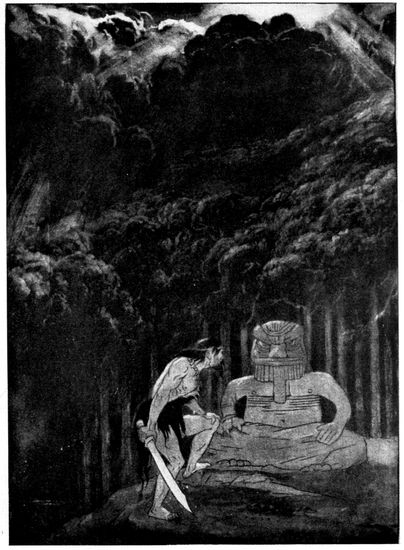
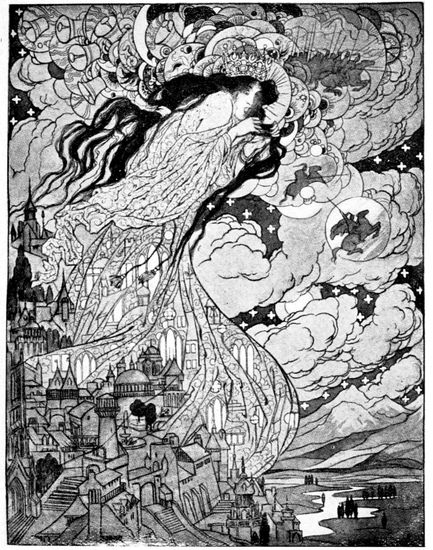
WE WOULD GALLOP THROUGH AFRICA
BY
Lord Dunsany
With Illustrations by
S. H. SIME
BOSTON
JOHN W. LUCE & COMPANY
Preface
I hope for this book that it may come into
the hands of those that were kind to my
others and that it may not disappoint them.
To the Editor of the Saturday Review my
thanks are due for permission to republish
here those of the following tales which
have appeared in his columns, and, more
than that, for the opportunity afforded me
by his review of reaching a wider public
than my books have attained to yet.
Toldees, Mondath, Arizim, these
are the Inner Lands, the lands
whose sentinels upon their
borders do not behold the
sea. Beyond them to the east
there lies a desert, for ever untroubled by
man: all yellow it is, and spotted with
shadows of stones, and Death is in it, like
a leopard lying in the sun. To the south
they are bounded by magic, to the west by
a mountain, and to the north by the voice
and anger of the Polar wind. Like a great
wall is the mountain to the west. It comes
up out of the distance and goes down into
the distance again, and it is named Poltarnees,
Beholder of Ocean. To the northward
red rocks, smooth and bare of soil, and
without any speck of moss or herbage, slope
up to the very lips of the Polar wind, and
there is nothing else there but the noise of
2his anger. Very peaceful are the Inner
Lands, and very fair are their cities, and
there is no war among them, but quiet and
ease. And they have no enemy but age,
for thirst and fever lie sunning themselves
out in the mid-desert, and never prowl into
the Inner Lands. And the ghouls and
ghosts, whose highway is the night, are kept
in the south by the boundary of magic.
And very small are all their pleasant cities,
and all men are known to one another
therein, and bless one another by name as
they meet in the streets. And they have a
broad, green way in every city that comes
in out of some vale or wood or downland,
and wanders in and out about the city between
the houses and across the streets;
and the people walk along it never at all,
but every year at her appointed time Spring
walks along it from the flowery lands,
causing the anemone to bloom on the green
way and all the early joys of hidden woods,
or deep, secluded vales, or triumphant
downlands, whose heads lift up so proudly,
far up aloof from cities.
Sometimes waggoners or shepherds walk
along this way, they that have come into
3the city from over cloudy ridges, and the
townsmen hinder them not, for there is a
tread that troubleth the grass and a tread
that troubleth it not, and each man in his
own heart knoweth which tread he hath.
And in the sunlit spaces of the weald and
in the wold’s dark places, afar from the
music of cities and from the dance of the
cities afar, they make there the music of
the country places and dance the country
dance. Amiable, near and friendly appears
to these men the sun, and as he is genial to
them and tends their younger vines, so they
are kind to the little woodland things and
any rumour of the fairies or old legend.
And when the light of some little distant
city makes a slight flush upon the edge of
the sky, and the happy golden windows of
the homesteads stare gleaming into the dark,
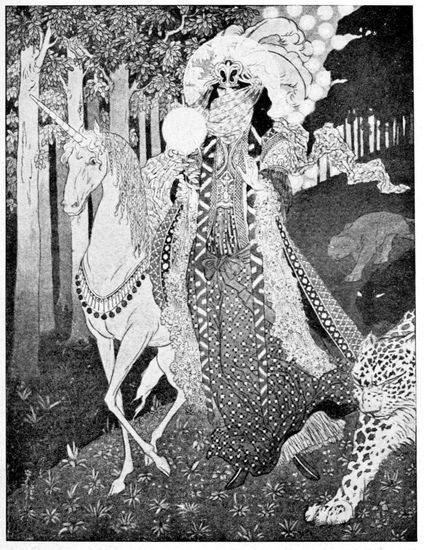
then the old and holy figure of Romance,
cloaked even to the face, comes down out
of hilly woodlands and bids dark shadows
to rise and dance, and sends the forest
creatures forth to prowl, and lights in a
moment in her bower of grass the little glowworm’s
lamp, and brings a hush down over
the grey lands, and out of it rises faintly on
4far-off hills the voice of a lute. There are
not in the world lands more prosperous and
happy than Toldees, Mondath, Arizim.
From these three little kingdoms that are
named the Inner Lands the young men stole
constantly away. One by one they went,
and no one knew why they went save that
they had a longing to behold the Sea. Of
this longing they spoke little, but a young
man would become silent for a few days,
and then, one morning very early, he would
slip away and slowly climb Poltarnees’s
difficult slope, and having attained the top
pass over and never return. A few stayed
behind in the Inner Lands and became old
men, but none that had ever climbed Poltarnees
from the very earliest times had ever
come back again. Many had gone up Poltarnees
sworn to return. Once a king sent
all his courtiers, one by one, to report the
mystery to him, and then went himself;
none ever returned.
ROMANCE COMES DOWN OUT OF HILLY WOODLANDS
Now, it was the wont of the folk of the
Inner Lands to worship rumours and legends
of the Sea, and all that their prophets discovered
of the Sea was writ in a sacred book,
and with deep devotion on days of festival or
5mourning read in the temples by the priests.
Now, all their temples lay open to the west,
resting upon pillars, that the breeze from the
Sea might enter them, and they lay open on
pillars to the east that the breezes of the
Sea might not be hindered but pass onward
wherever the Sea list. And this is the legend
that they had of the Sea, whom none in the
Inner Lands had ever beholden. They say
that the Sea is a river heading towards Hercules,
and they say that he touches against
the edge of the world, and that Poltarnees
looks upon him. They say that all the
worlds of heaven go bobbing on this river
and are swept down with the stream, and
that Infinity is thick and furry with forests
through which the river in his course sweeps
on with all the worlds of heaven. Among
the colossal trunks of those dark trees, the
smallest fronds of whose branches are many
nights, there walk the gods. And whenever
its thirst, glowing in space like a great sun,
comes upon the beast, the tiger of the gods
creeps down to the river to drink. And the
tiger of the gods drinks his fill loudly, whelming
worlds the while, and the level of the
river sinks between its banks ere the beast’s
6thirst is quenched and ceases to glow like a
sun. And many worlds thereby are heaped
up dry and stranded, and the gods walk
not among them evermore, because they
are hard to their feet. These are the worlds
that have no destiny, whose people know
no god. And the river sweeps onwards ever.
And the name of the river is Oriathon, but
men call it Ocean. This is the Lower Faith
of the Inner Lands. And there is a Higher
Faith which is not told to all. According to
the Higher Faith of the Inner Lands the
river Oriathon sweeps on through the forests
of Infinity and all at once falls roaring over
an Edge, whence Time has long ago recalled
his hours to fight in his war with the gods;
and falls unlit by the flash of nights and
days, with his flood unmeasured by miles,
into the deeps of nothing.
Now as the centuries went by and the one
way by which a man could climb Poltarnees
became worn with feet, more and more men
surmounted it, not to return. And still they
knew not in the Inner Lands upon what
mystery Poltarnees looked. For on a still
day and windless, while men walked happily
about their beautiful streets or tended flocks
7in the country, suddenly the west wind
would bestir himself and come in from the
Sea. And he would come cloaked and grey
and mournful and carry to someone the
hungry cry of the Sea calling out for bones
of men. And he that heard it would move
restlessly for some hours, and at last would
rise suddenly, irresistibly up, setting his
face to Poltarnees, and would say, as is the
custom of those lands when men part
briefly, “Till a man’s heart remembereth,”
which means “Farewell for a while;” but
those that loved him, seeing his eyes on
Poltarnees, would answer sadly, “Till the
gods forget,” which means “Farewell.”
Now the King of Arizim had a daughter
who played with the wild wood flowers,
and with the fountains in her father’s court,
and with the little blue heaven-birds that
came to her doorway in the winter to shelter
from the snow. And she was more beautiful
than the wild wood flowers, or than all
the fountains in her father’s court, or than
the blue heaven-birds in their full winter
plumage when they shelter from the snow.
The old wise kings of Mondath and of
Toldees saw her once as she went lightly
8down the little paths of her garden, and,
turning their gaze into the mists of thought,
pondered the destiny of their Inner Lands.
And they watched her closely by the stately
flowers, and standing alone in the sunlight,
and passing and repassing the strutting
purple birds that the king’s fowlers had
brought from Asagéhon. When she was of
the age of fifteen years the King of Mondath
called a council of kings. And there
met with him the kings of Toldees and
Arizim. And the King of Mondath in his
Council said:
“The call of the unappeased and hungry
Sea (and at the word ‘Sea’ the three kings
bowed their heads) lures every year out of
our happy kingdoms more and more of our
men, and still we know not the mystery of
the Sea, and no devised oath has brought
one man back. Now thy daughter, Arizim,
is lovelier than the sunlight, and lovelier
than those stately flowers of thine that
stand so tall in her garden, and hath more
grace and beauty than those strange birds
that the venturous fowlers bring in creaking
waggons out of Asagéhon, whose feathers
are alternate purple and white. Now, he
9that shall love thy daughter, Hilnaric, whoever
he shall be, is the man to climb Poltarnees
and return, as none hath ever before,
and tell us upon what Poltarnees
looks; for it may be that thy daughter is
more beautiful than the Sea.”
Then from his Seat of Council arose the
King of Arizim. He said: “I fear that
thou hast spoken blasphemy against the
Sea, and I have a dread that ill will come of
it. Indeed I had not thought she was so
fair. It is such a short while ago that she
was quite a small child with her hair still
unkempt and not yet attired in the manner
of princesses, and she would go up into the
wild woods unattended and come back with
her robes unseemly and all torn, and would
not take reproof with humble spirit, but
made grimaces even in my marble court all
set about with fountains.”
Then said the King of Toldees:
“Let us watch more closely and let us
see the Princess Hilnaric in the season of
the orchard-bloom when the great birds go
by that know the Sea, to rest in our inland
places; and if she be more beautiful than
the sunrise over our folded kingdoms when
10all the orchards bloom, it may be that she
is more beautiful than the Sea.”
And the King of Arizim said:
“I fear this is terrible blasphemy,
yet will I do as you have decided in
council.”
And the season of the orchard-bloom appeared.
One night the King of Arizim called
his daughter forth on to his outer balcony
of marble. And the moon was rising
huge and round and holy over dark woods,
and all the fountains were singing to the
night. And the moon touched the marble
palace gables, and they glowed in the land.
And the moon touched the heads of all the
fountains, and the grey columns broke into
fairy lights. And the moon left the dark
ways of the forest and lit the whole white
palace and its fountains and shone on the
forehead of the Princess, and the palace
of Arizim glowed afar, and the fountains
became columns of gleaming jewels and
song. And the moon made a music at his
rising, but it fell a little short of mortal ears.
And Hilnaric stood there wondering, clad in
white, with the moonlight shining on her
forehead; and watching her from the shadows
11on the terrace stood the kings of Mondath
and Toldees. They said:
“She is more beautiful than the moonrise.”
And on another day the King of Arizim
bade his daughter forth at dawn, and they
stood again upon the balcony. And the sun
came up over a world of orchards, and the
sea-mists went back over Poltarnees to the
Sea; little wild voices arose in all the thickets,
the voices of the fountains began to
die, and the song arose, in all the marble
temples, of the birds that are sacred to the
Sea. And Hilnaric stood there, still glowing
with dreams of heaven.
“She is more beautiful,” said the kings,
“than morning.”
Yet one more trial they made of Hilnaric’s
beauty, for they watched her on
the terraces at sunset ere yet the petals of
the orchards had fallen, and all along the
edge of neighbouring woods the rhododendron
was blooming with the azalea. And
the sun went down under craggy Poltarnees,
and the sea-mist poured over his
summit inland. And the marble temples
stood up clear in the evening, but films of
12twilight were drawn between the mountain
and the city. Then from the Temple ledges
and eaves of palaces the bats fell headlong
downwards, then spread their wings and
floated up and down through darkening
ways; lights came blinking out in golden
windows, men cloaked themselves against
the grey sea-mist, the sound of small songs
arose, and the face of Hilnaric became a
resting-place for mysteries and dreams.
“Than all these things,” said the kings,
“she is more lovely: but who can say
whether she is lovelier than the Sea?”
Prone in a rhododendron thicket at the
edge of the palace lawns a hunter had waited
since the sun went down. Near to him was
a deep pool where the hyacinths grew and
strange flowers floated upon it with broad
leaves, and there the great bull gariachs
came down to drink by starlight, and, waiting
there for the gariachs to come, he saw
the white form of the Princess leaning on her
balcony. Before the stars shone out or the
bulls came down to drink he left his lurking place
and moved closer to the palace to see
more nearly the Princess. The palace lawns
were full of untrodden dew, and everything
13was still when he came across them,
holding his great spear. In the farthest
corner of the terraces the three old kings
were discussing the beauty of Hilnaric and
the destiny of the Inner Lands. Moving
lightly, with a hunter’s tread, the watcher
by the pool came very near, even in the still
evening, before the Princess saw him.
When he saw her closely he exclaimed suddenly:
“She must be more beautiful than the
Sea.”
When the Princess turned and saw his
garb and his great spear she knew that he
was a hunter of gariachs.
When the three kings heard the young
man exclaim they said softly to one another:
“This must be the man.”
Then they revealed themselves to him,
and spoke to him to try him. They said:
“Sir, you have spoken blasphemy against
the Sea.”
And the young man muttered:
“She is more beautiful than the Sea.”
And the kings said:
“We are older than you and wiser, and
14know that nothing is more beautiful than
the Sea.”
And the young man took off the gear of
his head, and became downcast, and knew
that he spake with kings, yet he answered:
“By this spear, she is more beautiful
than the Sea.”
And all the while the Princess stared at
him, knowing him to be a hunter of gariachs.
Then the King of Arizim said to the
watcher by the pool:
“If thou wilt go up Poltarnees and come
back, as none have come, and report to us
what lure or magic is in the Sea, we will
pardon thy blasphemy, and thou shalt have
the Princess to wife and sit among the
Council of the Kings.”
And gladly thereunto the young man
consented. And the Princess spoke to him,
and asked him his name. And he told her
that his name was Athelvok, and great joy
arose in him at the sound of her voice. And
to the three kings he promised to set out on
the third day to scale the slope of Poltarnees
and to return again, and this was the oath
by which they bound him to return:
“I swear by the Sea that bears the worlds
15away, by the river of Oriathon, which
men call Ocean, and by the gods and their
tiger, and by the doom of the worlds, that
I will return again to the Inner Lands,
having beheld the Sea.”
And that oath he swore with solemnity
that very night in one of the temples of the
Sea, but the three kings trusted more to
the beauty of Hilnaric even than to the
power of the oath.
The next day Athelvok came to the
palace of Arizim with the morning, over
the fields to the East and out of the country
of Toldees, and Hilnaric came out along
her balcony and met him on the terraces.
And she asked him if he had ever slain a
gariach, and he said that he had slain three,
and then he told her how he had killed his
first down by the pool in the wood. For
he had taken his father’s spear and gone
down to the edge of the pool, and had lain
under the azaleas there waiting for the stars
to shine, by whose first light the gariachs
go to the pools to drink; and he had gone
too early and had had long to wait, and the
passing hours seemed longer than they were.
And all the birds came in that home at
16night, and the bat was abroad, and the
hour of the duck went by, and still no
gariach came down to the pool; and Athelvok
felt sure that none would come. And
just as this grew to a certainty in his mind
the thicket parted noiselessly and a huge
bull gariach stood facing him on the edge
of the water, and his great horns swept out
sideways from his head, and at the ends
curved upwards, and were four strides in
width from tip to tip. And he had not seen
Athelvok, for the great bull was on the far
side of the little pool, and Athelvok could
not creep round to him for fear of meeting
the wind (for the gariachs, who can see
little in the dark forests, rely on hearing and
smell). But he devised swiftly in his mind
while the bull stood there with head erect
just twenty strides from him across the
water. And the bull sniffed the wind cautiously
and listened, then lowered its great
head down to the pool and drank. At that
instant Athelvok leapt into the water and
shot forward through its weedy depths
among the stems of the strange flowers
that floated upon broad leaves on the surface.
And Athelvok kept his spear out
17straight before him, and the fingers of his
left hand he held rigid and straight, not
pointing upwards, and so did not come to
the surface, but was carried onward by the
strength of his spring and passed unentangled
through the stems of the flowers. When
Athelvok jumped into the water the bull
must have thrown his head up, startled at
the splash, then he would have listened and
have sniffed the air, and neither hearing
nor scenting any danger he must have remained
rigid for some moments, for it was
in that attitude that Athelvok found him
as he emerged breathless at his feet. And,
striking at once, Athelvok drove the spear
into his throat before the head and the
terrible horns came down. But Athelvok
had clung to one of the great horns, and
had been carried at terrible speed through
the rhododendron bushes until the gariach
fell, but rose at once again, and died standing
up, still struggling, drowned in its own
blood.
But to Hilnaric listening it was as though
one of the heroes of old time had come back
again in the full glory of his legendary youth.
And long time they went up and down
18the terraces, saying those things which
were said before and since, and which lips
shall yet be made to say again. And above
them stood Poltarnees beholding the Sea.
And the day came when Athelvok should
go. And Hilnaric said to him:
“Will you not indeed most surely come
back again, having just looked over the
summit of Poltarnees?”
Athelvok answered: “I will indeed come
back, for thy voice is more beautiful than
the hymn of the priests when they chant
and praise the Sea, and though many tributary
seas ran down into Oriathon and he
and all the others poured their beauty into
one pool below me, yet would I return
swearing that thou wert fairer than they.”
And Hilnaric answered:
“The wisdom of my heart tells me, or
old knowledge or prophecy, or some strange
lore, that I shall never hear thy voice again.
And for this I give thee my forgiveness.”
But he, repeating the oath that he had
sworn, set out, looking often backwards
until the slope became too steep and his
face was set to the rock. It was in the
morning that he started, and he climbed all
19the day with little rest, where every foot-hole
was smooth with many feet. Before
he reached the top the sun disappeared
from him, and darker and darker grew the
Inner Lands. Then he pushed on so as to
see before dark whatever thing Poltarnees
had to show. The dusk was deep over the
Inner Lands, and the lights of cities twinkled
through the sea-mist when he came to
Poltarnees’s summit, and the sun before
him was not yet gone from the sky.
And there below him was the old wrinkled
Sea, smiling and murmuring song. And he
nursed little ships with gleaming sails, and
in his hands were old regretted wrecks, and
masts all studded over with golden nails
that he had rent in anger out of beautiful
galleons. And the glory of the sun was
among the surges as they brought driftwood
out of isles of spice, tossing their golden
heads. And the grey currents crept away
to the south like companionless serpents
that love something afar with a restless,
deadly love. And the whole plain of water
glittering with late sunlight, and the surges
and the currents and the white sails of ships
were all together like the face of a strange
20new god that has looked a man for the first
time in the eyes at the moment of his death;
and Athelvok, looking on the wonderful
Sea, knew why it was that the dead never
return, for there is something that the dead
feel and know, and the living would never
understand even though the dead should
come and speak to them about it. And
there was the Sea smiling at him, glad with
the glory of the sun. And there was a
haven there for homing ships, and a sunlit
city stood upon its marge, and people
walked about the streets of it clad in the unimagined
merchandise of far sea-bordering
lands.
An easy slope of loose crumbled rock
went from the top of Poltarnees to the
shore of the Sea.
For a long while Athelvok stood there
regretfully, knowing that there had come
something into his soul that no one in the
Inner Lands could understand, where the
thoughts of their minds had gone no farther
than the three little kingdoms. Then, looking
long upon the wandering ships, and the
marvellous merchandise from alien lands,
and the unknown colour that wreathed the
21brows of the Sea, he turned his face to the
darkness and the Inner Lands.
At that moment the Sea sang a dirge at
sunset for all the harm that he had done in
anger and all the ruin wrought on adventurous
ships; and there were tears in the
voice of the tyrannous Sea, for he had
loved the galleons that he had overwhelmed,
and he called all men to him and all living
things that he might make amends, because
he had loved the bones that he had
strewn afar. And Athelvok turned and set
one foot upon the crumbled slope, and then
another, and walked a little way to be
nearer to the Sea, and then a dream came
upon him and he felt that men had wronged
the lovely Sea because he had been angry
a little, because he had been sometimes
cruel; he felt that there was trouble among
the tides of the Sea because he had loved
the galleons who were dead. Still he walked
on and the crumbled stones rolled with
him, and just as the twilight faded and a
star appeared he came to the golden shore,
and walked on till the surges were about
his knees, and he heard the prayer-like
blessings of the Sea. Long he stood thus,
22while the stars came out above him and
shone again in the surges; more stars came
wheeling in their courses up from the Sea,
lights twinkled out through all the haven
city, lanterns were slung from the ships,
the purple night burned on; and Earth, to
the eyes of the gods as they sat afar, glowed
as with one flame. Then Athelvok went
into the haven city; there he met many
who had left the Inner Lands before him;
none of them wished to return to the people
who had not seen the Sea; many of them
had forgotten the three little kingdoms, and
it was rumoured that one man, who had
once tried to return, had found the shifting,
crumbled slope impossible to climb.
Hilnaric never married. But her dowry
was set aside to build a temple wherein
men curse the ocean.
Once every year, with solemn rite and
ceremony, they curse the tides of the Sea;
and the moon looks in and hates them.
Blagdaross
23
On a waste place strewn with
bricks in the outskirts of a
town twilight was falling. A
star or two appeared over the
smoke, and distant windows
lit mysterious lights. The stillness deepened
and the loneliness. Then all the outcast
things that are silent by day found
voices.
An old cork spoke first. He said: “I
grew in Andalusian woods, but never listened
to the idle songs of Spain. I only grew
strong in the sunlight waiting for my
destiny. One day the merchants came and
took us all away and carried us all along
the shore of the sea, piled high on the backs
of donkeys, and in a town by the sea they
made me into the shape that I am now.
One day they sent me northward to Provence,
and there I fulfilled my destiny. For
they set me as a guard over the bubbling
24wine, and I faithfully stood sentinel for
twenty years. For the first few years in
the bottle that I guarded the wine slept,
dreaming of Provence; but as the years
went on he grew stronger and stronger,
until at last whenever a man went by the
wine would put out all his might against
me, saying: ‘Let me go free; let me go
free!’ And every year his strength increased,
and he grew more clamorous when
men went by, but never availed to hurl me
from my post. But when I had powerfully
held him for twenty years they brought
him to the banquet and took me from my
post, and the wine arose rejoicing and leapt
through the veins of men and exalted their
souls within them till they stood up in their
places and sang Provençal songs. But me
they cast away—me that had been sentinel
for twenty years, and was still as strong
and staunch as when first I went on guard.
Now I am an outcast in a cold northern
city, who once have known the Andalusian
skies and guarded long ago Provençal suns
that swam in the heart of the rejoicing
wine.”
An unstruck match that somebody had
25dropped spoke next. “I am a child of the
sun,” he said, “and an enemy of cities;
there is more in my heart than you know of.
I am a brother of Etna and Stromboli; I
have fires lurking in me that will one day
rise up beautiful and strong. We will not
go into servitude on any hearth nor work
machines for our food, but we will take our
own food where we find it on that day when
we are strong. There are wonderful children
in my heart whose faces shall be more
lively than the rainbow; they shall make a
compact with the North wind, and he shall
lead them forth; all shall be black behind
them and black above them, and there
shall be nothing beautiful in the world but
them; they shall seize upon the earth and
it shall be theirs, and nothing shall stop
them but our old enemy the sea.”
Then an old broken kettle spoke, and
said: “I am the friend of cities. I sit
among the slaves upon the hearth, the little
flames that have been fed with coal. When
the slaves dance behind the iron bars I sit
in the middle of the dance and sing and
make our masters glad. And I make songs
about the comfort of the cat, and about the
26malice that is towards her in the heart of
the dog, and about the crawling of the
baby, and about the ease that is in the lord
of the house when we brew the good brown
tea; and sometimes when the house is very
warm and slaves and masters are glad, I
rebuke the hostile winds that prowl about
the world.”
And then there spoke the piece of an old
cord. “I was made in a place of doom, and
doomed men made my fibres, working without
hope. Therefore there came a grimness
into my heart, so that I never let anything
go free when once I was set to bind it.
Many a thing have I bound relentlessly
for months and for years; for I used to
come coiling into warehouses where the
great boxes lay all open to the air, and one
of them would be suddenly closed up, and
my fearful strength would be set on him
like a curse, and if his timbers groaned
when first I seized them, or if they creaked
aloud in the lonely night, thinking of woodlands
out of which they came, then I only
gripped them tighter still, for the poor
useless hate is in my soul of those that
made me in the place of doom. Yet, for all
27the things that my prison-clutch has held,
the last work that I did was to set
something free. I lay idle one night in the
gloom on the warehouse floor. Nothing
stirred there, and even the spider slept.
Towards midnight a great flock of echoes
suddenly leapt up from the wooden planks
and circled round the roof. A man was
coming towards me all alone. And as he
came his soul was reproaching him, and I
saw that there was a great trouble between
the man and his soul, for his soul would not
let him be, but went on reproaching him.
“Then the man saw me and said, ‘This
at least will not fail me.’ When I heard
him say this about me, I determined that
whatever he might require of me it should
be done to the uttermost. And as I made
this determination in my unaltering heart,
he picked me up and stood on an empty
box that I should have bound on the morrow,
and tied one end of me to a dark
rafter; and the knot was carelessly tied,
because his soul was reproaching him all the
while continually and giving him no ease.
Then he made the other end of me into a
noose, but when the man’s soul saw this it
28stopped reproaching the man, and cried out
to him hurriedly, and besought him to be
at peace with it and to do nothing sudden;
but the man went on with his work, and
put the noose down over his face and
underneath his chin, and the soul screamed
horribly.
“Then the man kicked the box away
with his foot, and the moment he did this
I knew that my strength was not great
enough to hold him; but I remembered
that he had said I would not fail him, and
I put all my grim vigour into my fibres and
held him by sheer will. Then the soul
shouted to me to give way, but I said:
“‘No; you vexed the man.’
“Then it screamed to me to leave go of
the rafter, and already I was slipping, for
I only held on to it by a careless knot, but
I gripped with my prison grip and said:
“‘You vexed the man.’
“And very swiftly it said other things to
me, but I answered not; and at last the
soul that vexed the man that had trusted
me flew away and left him at peace. I
was never able to bind things any more,
for every one of my fibres was worn and
29wrenched, and even my relentless heart
was weakened by the struggle. Very soon
afterwards I was thrown out here. I have
done my work.”
So they spoke among themselves, but all
the while there loomed above them the
form of an old rocking-horse complaining
bitterly. He said: “I am Blagdaross.
Woe is me that I should lie now an outcast
among these worthy but little people. Alas!
for the days that are gathered, and alas
for the Great One that was a master and
a soul to me, whose spirit is now shrunken
and can never know me again, and no
more ride abroad on knightly quests. I
was Bucephalus when he was Alexander,
and carried him victorious as far as Ind.
I encountered dragons with him when he
was St. George, I was the horse of Roland
fighting for Christendom, and was often
Rosinante. I fought in tourneys and went
errant upon quests, and met Ulysses and
the heroes and the fairies. Or late in the
evening, just before the lamps in the nursery
were put out, he would suddenly mount
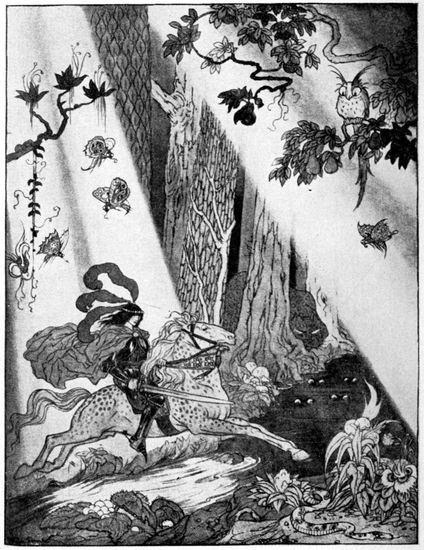
me, and we would gallop through Africa.
There we would pass by night through
30tropic forests, and come upon dark rivers
sweeping by, all gleaming with the eyes of
crocodiles, where the hippopotamus floated
down with the stream, and mysterious craft
loomed suddenly out of the dark and furtively
passed away. And when we had
passed through the forest lit by the fireflies
we would come to the open plains, and
gallop onwards with scarlet flamingoes flying
along beside us through the lands of
dusky kings, with golden crowns upon their
heads and sceptres in their hands, who
came running out of their palaces to see us
pass. Then I would wheel suddenly, and
the dust flew up from my four hoofs as I
turned and we galloped home again, and
my master was put to bed. And again he
would ride abroad on another day till we
came to magical fortresses guarded by
wizardry and overthrew the dragons at the
gate, and ever came back with a princess
fairer than the sea.
“But my master began to grow larger in
his body and smaller in his soul, and then
he rode more seldom upon quests. At last
he saw gold and never came again, and I
was cast out here among these little people.”
31But while the rocking-horse was speaking
two boys stole away, unnoticed by their
parents, from a house on the edge of the
waste place, and were coming across it looking
for adventures. One of them carried a
broom, and when he saw the rocking-horse
he said nothing, but broke off the handle
from the broom and thrust it between his
braces and his shirt on the left side. Then
he mounted the rocking-horse, and drawing
forth the broomstick, which was sharp and
spiky at the end, said, “Saladin is in this
desert with all his paynims, and I am Cœur
de Lion.” After a while the other boy said:
“Now let me kill Saladin too.” But Blagdaross
in his wooden heart, that exulted
with thoughts of battle, said: “I am
Blagdaross yet!”
The Madness of Andelsprutz
32
I first saw the city of Andelsprutz
on an afternoon in
spring. The day was full of
sunshine as I came by the way
of the fields, and all that
morning I had said, “There will be sunlight
on it when I see for the first time the
beautiful conquered city whose fame has
so often made for me lovely dreams.” Suddenly
I saw its fortifications lifting out of
the fields, and behind them stood its belfries.
I went in by a gate and saw its
houses and streets, and a great disappointment
came upon me. For there is an air
about a city, and it has a way with it, whereby
a man may recognize one from another
at once. There are cities full of happiness
and cities full of pleasure, and cities full of
gloom. There are cities with their faces to
33heaven, and some with their faces to earth;
some have a way of looking at the past
and others look at the future; some notice
you if you come among them, others glance
at you, others let you go by. Some love
the cities that are their neighbours, others
are dear to the plains and to the heath;
some cities are bare to the wind, others
have purple cloaks and others brown cloaks,
and some are clad in white. Some tell the
old tale of their infancy, with others it is
secret; some cities sing and some mutter,
some are angry, and some have broken
hearts, and each city has her way of greeting
Time.
I had said: “I will see Andelsprutz arrogant
with her beauty,” and I had said: “I
will see her weeping over her conquest.”
I had said: “She will sing songs to me,”
and “she will be reticent,” “she will be all
robed,” and “she will be bare but splendid.”
But the windows of Andelsprutz in her
houses looked vacantly over the plains like
the eyes of a dead madman. At the hour
her chimes sounded unlovely and discordant,
some of them were out of tune, and
the bells of some were cracked, her roofs
34were bald and without moss. At evening
no pleasant rumour arose in her streets.
When the lamps were lit in the houses no
mystical flood of light stole out into the
dusk, you merely saw that there were
lighted lamps; Andelsprutz had no way
with her and no air about her. When the
night fell and the blinds were all drawn
down, then I perceived what I had not
thought in the daylight. I knew then that
Andelsprutz was dead.
I saw a fair-haired man who drank beer
in a cafe, and I said to him:
“Why is the city of Andelsprutz quite
dead, and her soul gone hence?”
He answered: “Cities do not have souls
and there is never any life in bricks.”
And I said to him: “Sir, you have
spoken truly.”
And I asked the same question of another
man, and he gave me the same answer, and
I thanked him for his courtesy. And I
saw a man of a more slender build, who had
black hair, and channels in his cheeks for
tears to run in, and I said to him:
“Why is Andelsprutz quite dead, and
when did her soul go hence?”
THE SOUL OF ANDELSPRUTZ
35And he answered: “Andelsprutz hoped
too much. For thirty years would she
stretch out her arms toward the land of
Akla every night, to Mother Akla from
whom she had been stolen. Every night
she would be hoping and sighing, and
stretching out her arms to Mother Akla.
At midnight, once a year, on the anniversary
of the terrible day, Akla would send
spies to lay a wreath against the walls of
Andelsprutz. She could do no more. And
on this night, once in every year, I used to
weep, for weeping was the mood of the city
that nursed me. Every night while other
cities slept did Andelsprutz sit brooding
here and hoping, till thirty wreaths lay
mouldering by her walls, and still the armies
of Akla could not come.
“But after she had hoped so long, and
on the night that faithful spies had brought
the thirtieth wreath, Andelsprutz went
suddenly mad. All the bells clanged hideously
in the belfries, horses bolted in the
streets, the dogs all howled, the stolid conquerors
awoke and turned in their beds
and slept again; and I saw the grey shadowy
form of Andelsprutz rise up, decking
36her hair with the phantasms of cathedrals,
and stride away from her city. And the
great shadowy form that was the soul of
Andelsprutz went away muttering to the
mountains, and there I followed her—for
had she not been my nurse? Yes, I went
away alone into the mountains, and for
three days, wrapped in a cloak, I slept in
their misty solitudes. I had no food to eat,
and to drink I had only the water of the
mountain streams. By day no living thing
was near to me, and I heard nothing but
the noise of the wind, and the mountain
streams roaring. But for three nights I
heard all round me on the mountain the
sounds of a great city: I saw the lights of
tall cathedral windows flash momently on
the peaks, and at times the glimmering
lantern of some fortress patrol. And I saw
the huge misty outline of the soul of Andelsprutz
sitting decked with her ghostly
cathedrals, speaking to herself, with her
eyes fixed before her in a mad stare, telling
of ancient wars. And her confused speech
for all those nights upon the mountain was
sometimes the voice of traffic, and then of
church bells, and then of the bugles, but
37oftenest it was the voice of red war; and
it was all incoherent, and she was quite mad.
“The third night it rained heavily all
night long, but I stayed up there to watch
the soul of my native city. And she still
sat staring straight before her, raving; but
her voice was gentler now, there were more
chimes in it, and occasional song. Midnight
passed, and the rain still swept down
on me, and still the solitudes of the mountain
were full of the mutterings of the poor
mad city. And the hours after midnight
came, the cold hours wherein sick men die.
“Suddenly I was aware of great shapes
moving in the rain, and heard the sound of
voices that were not of my city nor yet of
any that I ever knew. And presently I discerned,
though faintly, the souls of a great
concourse of cities, all bending over Andelsprutz
and comforting her, and the ravines
of the mountains roared that night with the
voices of cities that had lain still for centuries.
For there came the soul of Camelot
that had so long ago forsaken Usk; and there
was Ilion, all girt with towers, still cursing
the sweet face of ruinous Helen; I saw
there Babylon and Persepolis, and the
38bearded face of bull-like Nineveh, and
Athens mourning her immortal gods.
“All these souls of cities that were dead
spoke that night on the mountain to my
city and soothed her, until at last she
muttered of war no longer, and her eyes
stared wildly no more, but she hid her face
in her hands and for some while wept
softly. At last she arose, and, walking
slowly and with bended head, and leaning
upon Ilion and Carthage, went mournfully
eastwards; and the dust of her highways
swirled behind her as she went, a ghostly
dust that never turned to mud in all that
drenching rain. And so the souls of the
cities led her away, and gradually they disappeared
from the mountain, and the
ancient voices died away in the distance.
“Never since then have I seen my city
alive; but once I met with a traveller who
said that somewhere in the midst of a great
desert are gathered together the souls of
all dead cities. He said that he was lost
once in a place where there was no water,
and he heard their voices speaking all the
night.”
But I said: “I was once without water
39in a desert and heard a city speaking to
me, but knew not whether it really spoke
or not, for on that day I heard so many
terrible things, and only some of them were
true.”
And the man with the black hair said:
“I believe it to be true, though whither
she went I know not. I only know that
a shepherd found me in the morning faint
with hunger and cold, and carried me down
here; and when I came to Andelsprutz it
was, as you have perceived it, dead.”
Where the Tides Ebb and Flow
40
I dreamt that I had done a
horrible thing, so that burial
was to be denied me either
in soil or sea, neither could
there be any hell for me.
I waited for some hours, knowing this.
Then my friends came for me, and slew
me secretly and with ancient rite, and lit
great tapers, and carried me away.
It was all in London that the thing was
done, and they went furtively at dead of
night along grey streets and among mean
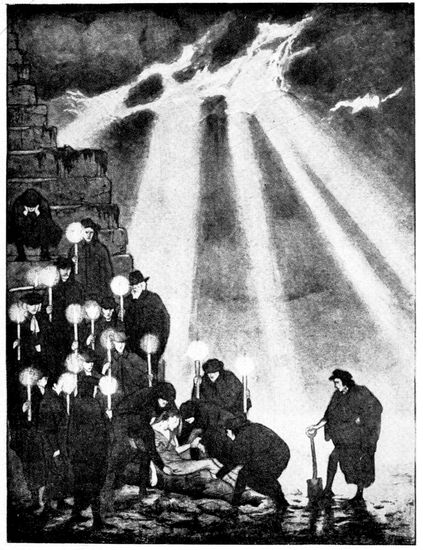
houses until they came to the river. And
the river and the tide of the sea were
grappling with one another between the
mud-banks, and both of them were black
and full of lights. A sudden wonder came
into the eyes of each, as my friends came
near to them with their glaring tapers.
41All these things I saw as they carried me
dead and stiffening, for my soul was still
among my bones, because there was no
hell for it, and because Christian burial
was denied me.
They took me down a stairway that was
green with slimy things, and so came slowly
to the terrible mud. There, in the territory
of forsaken things, they dug a shallow
grave. When they had finished they laid
me in the grave, and suddenly they cast
their tapers to the river. And when the
water had quenched the flaring lights the
tapers looked pale and small as they bobbed
upon the tide, and at once the glamour of
the calamity was gone, and I noticed then
the approach of the huge dawn; and my
friends cast their cloaks over their faces,
and the solemn procession was turned into
many fugitives that furtively stole away.
Then the mud came back wearily and
covered all but my face. There I lay
alone with quite forgotten things, with
drifting things that the tides will take no
farther, with useless things and lost things,
and with the horrible unnatural bricks that
are neither stone nor soil. I was rid of feeling,
42because I had been killed, but perception
and thought were in my unhappy
soul. The dawn widened, and I saw the
desolate houses that crowded the marge
of the river, and their dead windows peered
into my dead eyes, windows with bales
behind them instead of human souls. I
grew so weary looking at these forlorn
things that I wanted to cry out, but could
not, because I was dead. Then I knew, as
I had never known before, that for all the
years that herd of desolate houses had
wanted to cry out too, but, being dead,
were dumb. And I knew then that it had
yet been well with the forgotten drifting
things if they had wept, but they were
eyeless and without life. And I, too, tried
to weep, but there were no tears in my dead
eyes. And I knew then that the river
might have cared for us, might have caressed
us, might have sung to us, but he
swept broadly onwards, thinking of nothing
but the princely ships.
THE TERRIBLE MUD
At last the tide did what the river would
not, and came and covered me over, and
my soul had rest in the green water, and
rejoiced and believed that it had the Burial
43of the Sea. But with the ebb the water
fell again, and left me alone again with the
callous mud among the forgotten things
that drift no more, and with the sight of all
those desolate houses, and with the knowledge
among all of us that each was dead.
In the mournful wall behind me, hung
with green weeds, forsaken of the sea, dark
tunnels appeared, and secret narrow passages
that were clamped and barred. From
these at last the stealthy rats came down
to nibble me away, and my soul rejoiced
thereat and believed that he would be free
perforce from the accursed bones to which
burial was refused. Very soon the rats
ran away a little space and whispered among
themselves. They never came any more.
When I found that I was accursed even
among the rats I tried to weep again.
Then the tide came swinging back and
covered the dreadful mud, and hid the
desolate houses, and soothed the forgotten
things, and my soul had ease for a while
in the sepulture of the sea. And then the
tide forsook me again.
To and fro it came about me for many
years. Then the County Council found
44me, and gave me decent burial. It was the
first grave that I had ever slept in. That
very night my friends came for me. They
dug me up and put me back again in the
shallow hole in the mud.
Again and again through the years my
bones found burial, but always behind the
funeral lurked one of those terrible men
who, as soon as night fell, came and dug
them up and carried them back again to
the hole in the mud.
And then one day the last of those men
died who once had done to me this terrible
thing. I heard his soul go over the river
at sunset.
And again I hoped.
A few weeks afterwards I was found
once more, and once more taken out of
that restless place and given deep burial
in sacred ground, where my soul hoped
that it should rest.
Almost at once men came with cloaks
and tapers to give me back to the mud, for
the thing had become a tradition and a rite.
And all the forsaken things mocked me in
their dumb hearts when they saw me carried
back, for they were jealous of me
45because I had left the mud. It must be
remembered that I could not weep.
And the years went by seawards where
the black barges go, and the great derelict
centuries became lost at sea, and still I
lay there without any cause to hope, and
daring not to hope without a cause, because
of the terrible envy and the anger
of the things that could drift no more.
Once a great storm rode up, even as far
as London, out of the sea from the South;
and he came curving into the river with the
fierce East wind. And he was mightier
than the dreary tides, and went with great
leaps over the listless mud. And all the
sad forgotten things rejoiced, and mingled
with things that were haughtier than they,
and rode once more amongst the lordly
shipping that was driven up and down.
And out of their hideous home he took my
bones, never again, I hoped, to be vexed
with the ebb and flow. And with the fall
of the tide he went riding down the river
and turned to the southwards, and so went
to his home. And my bones he scattered
among many isles and along the shores of
happy alien mainlands. And for a moment,
46while they were far asunder, my soul was
almost free.
Then there arose, at the will of the moon,
the assiduous flow of the tide, and it undid
at once the work of the ebb, and gathered
my bones from the marge of sunny isles,
and gleaned them all along the mainland’s
shores, and went rocking northwards till
it came to the mouth of the Thames, and
there turned westwards its relentless face,
and so went up the river and came to the
hole in the mud, and into it dropped my
bones; and partly the mud covered them and
partly it left them white, for the mud cares
not for its forsaken things.
Then the ebb came, and I saw the dead
eyes of the houses and the jealousy of the
other forgotten things that the storm had
not carried thence.
And some more centuries passed over the
ebb and flow and over the loneliness of
things forgotten. And I lay there all the
while in the careless grip of the mud, never
wholly covered, yet never able to go free,
and I longed for the great caress of the
warm Earth or the comfortable lap of the
Sea.
47Sometimes men found my bones and
buried them, but the tradition never died,
and my friends’ successors always brought
them back. At last the barges went no
more, and there were fewer lights; shaped
timbers no longer floated down the
fair-way, and there came instead old
wind-uprooted trees in all their natural
simplicity.
At last I was aware that somewhere near
me a blade of grass was growing, and the
moss began to appear all over the dead
houses. One day some thistledown went
drifting over the river.
For some years I watched these signs
attentively, until I became certain that
London was passing away. Then I hoped
once more, and all along both banks of the
river there was anger among the lost things
that anything should dare to hope upon
the forsaken mud. Gradually the horrible
houses crumbled, until the poor dead things
that never had had life got decent burial
among the weeds and moss. At last the
may appeared and the convolvulus. Finally,
the wild rose stood up over mounds that
had been wharves and warehouses. Then
48I knew that the cause of Nature had
triumphed, and London had passed away.
The last man in London came to the wall
by the river, in an ancient cloak that was
one of those that once my friends had
worn, and peered over the edge to see that
I still was there. Then he went, and I
never saw men again: they had passed
away with London.
A few days after the last man had gone
the birds came into London, all the birds
that sing. When they first saw me they
all looked sideways at me, then they went
away a little and spoke among themselves.
“He only sinned against Man,” they
said; “it is not our quarrel.”
“Let us be kind to him,” they said.
Then they hopped nearer me and began
to sing. It was the time of the rising of
the dawn, and from both banks of the river,
and from the sky, and from the thickets
that were once the streets, hundreds of
birds were singing. As the light increased
the birds sang more and more; they grew
thicker and thicker in the air above my
head, till there were thousands of them
singing there, and then millions, and at
49last I could see nothing but a host of flickering
wings with the sunlight on them, and
little gaps of sky. Then when there was
nothing to be heard in London but the
myriad notes of that exultant song, my soul
rose up from the bones in the hole in the
mud and began to climb up the song heavenwards.
And it seemed that a laneway
opened amongst the wings of the birds,
and it went up and up, and one of the
smaller gates of Paradise stood ajar at the
end of it. And then I knew by a sign that
the mud should receive me no more, for
suddenly I found that I could weep.
At this moment I opened my eyes in bed
in a house in London, and outside some
sparrows were twittering in a tree in the
light of the radiant morning; and there
were tears still wet upon my face, for one’s
restraint is feeble while one sleeps. But
I arose and opened the window wide, and,
stretching my hands out over the little
garden, I blessed the birds whose song had
woken me up from the troubled and terrible
centuries of my dream.
Bethmoora
50
There is a faint freshness in the
London night as though some
strayed reveller of a breeze
had left his comrades in the
Kentish uplands and had entered
the town by stealth. The pavements
are a little damp and shiny. Upon one’s
ears that at this late hour have become very
acute there hits the tap of a remote footfall.
Louder and louder grow the taps, filling
the whole night. And a black cloaked
figure passes by, and goes tapping into the
dark. One who has danced goes homewards.
Somewhere a ball has closed its
doors and ended. Its yellow lights are
out, its musicians are silent, its dancers
have all gone into the night air, and Time
has said of it, “Let it be past and over, and
among the things that I have put away.”
Shadows begin to detach themselves from
51their great gathering places. No less silently
than those shadows that are thin and
dead move homewards the stealthy cats.
Thus have we even in London our faint
forebodings of the dawn’s approach, which
the birds and the beasts and the stars
are crying aloud to the untrammelled fields.
At what moment I know not I perceive
that the night itself is irrecoverably overthrown.
It is suddenly revealed to me
by the weary pallor of the street lamps
that the streets are silent and nocturnal
still, not because there is any strength in
night, but because men have not yet arisen
from sleep to defy him. So have I seen
dejected and untidy guards still bearing
antique muskets in palatial gateways, although
the realms of the monarch that they
guard have shrunk to a single province
which no enemy yet has troubled to overrun.
And it is now manifest from the aspect
of the street lamps, those abashed dependants
of night, that already English mountain
peaks have seen the dawn, that the
cliffs of Dover are standing white to the
morning, that the sea-mist has lifted and
is pouring inland.
52And now men with a hose have come
and are sluicing out the streets.
Behold now night is dead.
What memories, what fancies throng one’s
mind! A night but just now gathered out
of London by the hostile hand of Time.
A million common artificial things all
cloaked for a while in mystery, like beggars
robed in purple, and seated on dread
thrones. Four million people asleep, dreaming
perhaps. What worlds have they gone
into? Whom have they met? But my
thoughts are far off with Bethmoora in her
loneliness, whose gates swing to and fro.
To and fro they swing, and creak and creak
in the wind, but no one hears them. They
are of green copper, very lovely, but no one
sees them now. The desert wind pours sand
into their hinges, no watchman comes to ease
them. No guard goes round Bethmoora’s
battlements, no enemy assails them. There
are no lights in her houses, no footfall in her
streets; she stands there dead and lonely
beyond the Hills of Hap, and I would see
Bethmoora once again, but dare not.
It is many a year, as they tell me, since
Bethmoora became desolate.
53Her desolation is spoken of in taverns
where sailors meet, and certain travellers
have told me of it.
I had hoped to see Bethmoora once
again. It is many a year ago, they say,
when the vintage was last gathered in from
the vineyards that I knew, where it is all
desert now. It was a radiant day, and the
people of the city were dancing by the
vineyards, while here and there one played
upon the kalipac. The purple flowering
shrubs were all in bloom, and the snow
shone upon the Hills of Hap.
Outside the copper gates they crushed
the grapes in vats to make the syrabub.
It had been a goodly vintage.
In little gardens at the desert’s edge men
beat the tambang and the tittibuk, and
blew melodiously the zootibar.
All there was mirth and song and dance,
because the vintage had been gathered in,
and there would be ample syrabub for the
winter months, and much left over to exchange
for turquoises and emeralds with
the merchants who come down from Oxuhahn.
Thus they rejoiced all day over
their vintage on the narrow strip of cultivated
54ground that lay between Bethmoora
and the desert which meets the sky to the
South. And when the heat of the day
began to abate, and the sun drew near to
the snows on the Hills of Hap, the note
of the zootibar still rose clear from the
gardens, and the brilliant dresses of the
dancers still wound among the flowers.
All that day three men on mules had been
noticed crossing the face of the Hills of
Hap. Backwards and forwards they moved
as the track wound lower and lower, three
little specks of black against the snow.
They were seen first in the very early
morning up near the shoulder of Peol
Jagganoth, and seemed to be coming out
of Utnar Véhi. All day they came. And
in the evening, just before lights come out
and colours change, they appeared before
Bethmoora’s copper gates. They carried
staves, such as messengers bear in those
lands, and seemed sombrely clad when the
dancers all came round them with their
green and lilac dresses. Those Europeans
who were present and heard the message
given were ignorant of the language, and
only caught the name of Utnar Véhi. But
55it was brief, and passed rapidly from mouth
to mouth, and almost at once the people
burnt their vineyards and began to flee
away from Bethmoora, going for the most
part northwards, though some went to the
East. They ran down out of their fair
white houses, and streamed through the
copper gate; the throbbing of the tambang
and the tittibuk suddenly ceased with the
note of the zootibar, and the clinking kalipac
stopped a moment after. The three
strange travellers went back the way they
came the instant their message was given.
It was the hour when a light would have
appeared in some high tower, and window
after window would have poured into the
dusk its lion-frightening light, and the
copper gates would have been fastened up.
But no lights came out in windows there
that night and have not ever since, and those
copper gates were left wide and have never
shut, and the sound arose of the red fire
crackling in the vineyards, and the pattering
of feet fleeing softly. There were no
cries, no other sounds at all, only the rapid
and determined flight. They fled as swiftly
and quietly as a herd of wild cattle flee
56when they suddenly see a man. It was
as though something had befallen which
had been feared for generations, which
could only be escaped by instant flight,
which left no time for indecision.
Then fear took the Europeans also, and
they too fled. And what the message was
I have never heard.
Many believe that it was a message from
Thuba Mleen, the mysterious emperor of
those lands, who is never seen by man,
advising that Bethmoora should be left
desolate. Others say that the message was
one of warning from the gods, whether
from friendly gods or from adverse ones
they know not.
And others hold that the Plague was
ravaging a line of cities over in Utnar Véhi,
following the South-west wind which for
many weeks had been blowing across them
towards Bethmoora.
Some say that the terrible gnousar sickness
was upon the three travellers, and that
their very mules were dripping with it,
and suppose that they were driven to the
city by hunger, but suggest no better reason
for so terrible a crime.
57But most believe that it was a message
from the desert himself, who owns all the
Earth to the southwards, spoken with his
peculiar cry to those three who knew his
voice—men who had been out on the sand-wastes
without tents by night, who had
been by day without water, men who had
been out there where the desert mutters,
and had grown to know his needs and his
malevolence. They say that the desert had
a need for Bethmoora, that he wished to
come into her lovely streets, and to send
into her temples and her houses his storm-winds
draped with sand. For he hates the
sound and the sight of men in his old evil
heart, and he would have Bethmoora silent
and undisturbed, save for the weird love
he whispers at her gates.
If I knew what that message was that
the three men brought on mules, and told
in the copper gate, I think that I should
go and see Bethmoora once again. For a
great longing comes on me here in London
to see once more that white and beautiful
city; and yet I dare not, for I know not the
danger I should have to face, whether I
should risk the fury of unknown dreadful
58gods, or some disease unspeakable and slow,
or the desert’s curse, or torture in some
little private room of the Emperor Thuba
Mleen, or something that the travellers
have not told—perhaps more fearful still.
Idle Days on the Yann
59
So I came down through the
wood to the bank of Yann
and found, as had been prophesied,
the ship Bird of the
River about to loose her cable.
The captain sate cross-legged upon the
white deck with his scimitar lying beside
him in its jewelled scabbard, and the sailors
toiled to spread the nimble sails to bring
the ship into the central stream of Yann,
and all the while sang ancient soothing
songs. And the wind of the evening descending
cool from the snowfields of some
mountainous abode of distant gods came
suddenly, like glad tidings to an anxious
city, into the wing-like sails.
And so we came into the central stream,
whereat the sailors lowered the greater sails.
60But I had gone to bow before the captain,
and to inquire concerning the miracles,
and appearances among men, of the most
holy gods of whatever land he had come
from. And the captain answered that he
came from fair Belzoond, and worshipped
gods that were the least and humblest, who
seldom sent the famine or the thunder, and
were easily appeased with little battles.
And I told how I came from Ireland, which
is of Europe, whereat the captain and all
the sailors laughed, for they said, “There
are no such places in all the land of dreams.”
When they had ceased to mock me, I
explained that my fancy mostly dwelt in
the desert of Cuppar-Nombo, about a beautiful
blue city called Golthoth the Damned,
which was sentinelled all round by wolves
and their shadows, and had been utterly
desolate for years and years, because of
a curse which the gods once spoke in anger
and could never since recall. And sometimes
my dreams took me as far as Pungar
Vees, the red walled city where the fountains
are, which trades with the Isles and
Thul. When I said this they complimented
me upon the abode of my fancy, saying
that, though they had never seen these
cities, such places might well be imagined.
For the rest of that evening I bargained
with the captain over the sum that I
should pay him for my fare if God and
the tide of Yann should bring us safely
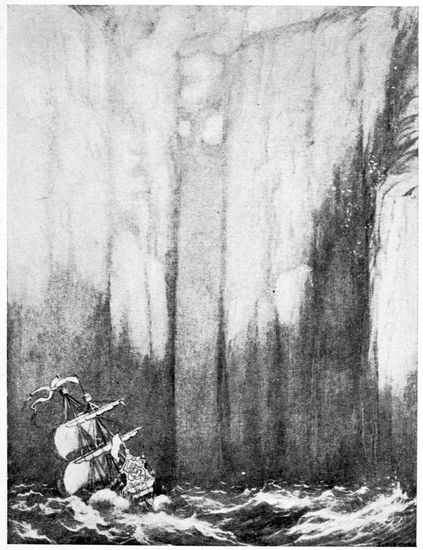
as far as the cliffs by the sea, which
are named Bar-Wul-Yann, the Gate of
Yann.
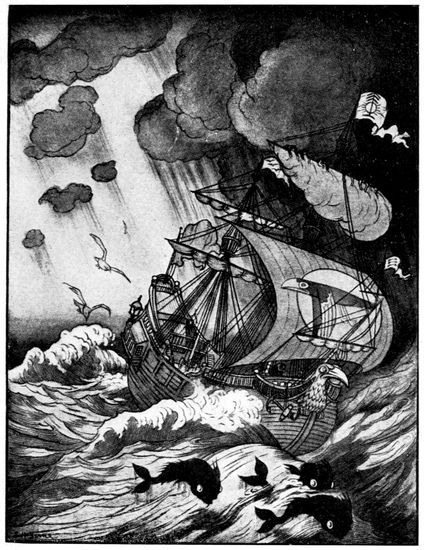
BIRD OF THE RIVER
61And now the sun had set, and all the
colors of the world and heaven had held
a festival with him, and slipped one by one
away before the imminent approach of
night. The parrots had all flown home to
the jungle on either bank, the monkeys in
rows in safety on high branches of the trees
were silent and asleep, the fireflies in the
deeps of the forest were going up and down,
and the great stars came gleaming out to
look on the face of Yann. Then the sailors
lighted lanterns and hung them round the
ship, and the light flashed out on a sudden
and dazzled Yann, and the ducks that
fed along his marshy banks all suddenly
arose, and made wide circles in the upper
air, and saw the distant reaches of the
Yann and the white mist that softly cloaked
62the jungle, before they returned again into
their marshes.
And then the sailors knelt on the decks
and prayed, not all together, but five or six
at a time. Side by side there kneeled
down together five or six, for there only
prayed at the same time men of different
faiths, so that no god should hear two men
praying to him at once. As soon as any
one had finished his prayer, another of
the same faith would take his place. Thus
knelt the row of five or six with bended
heads under the fluttering sail, while the
central stream of the River Yann took
them on towards the sea, and their prayers
rose up from among the lanterns and
went towards the stars. And behind them
in the after end of the ship the helmsman
prayed aloud the helmsman’s prayer, which
is prayed by all who follow his trade upon
the River Yann, of whatever faith they
be. And the captain prayed to his little
lesser gods, to the gods that bless Belzoond.
And I too felt that I would pray. Yet
I liked not to pray to a jealous God there
where the frail affectionate gods whom the
heathen love were being humbly invoked;
63so I bethought me, instead, of Sheol Nugganoth,
whom the men of the jungle have
long since deserted, who is now unworshipped
and alone; and to him I prayed.
And upon us praying the night came
suddenly down, as it comes upon all men
who pray at evening and upon all men
who do not; yet our prayers comforted our
own souls when we thought of the Great
Night to come.
And so Yann bore us magnificently onwards,
for he was elate with molten snow
that the Poltiades had brought him from
the Hills of Hap, and the Marn and Migris
were swollen full with floods; and he bore
us in his might past Kyph and Pir, and
we saw the lights of Goolunza.
Soon we all slept except the helmsman,
who kept the ship in the mid-stream of
Yann.
When the sun rose the helmsman ceased
to sing, for by song he cheered himself in
the lonely night. When the song ceased
we suddenly all awoke, and another took
the helm, and the helmsman slept.
We knew that soon we should come to
Mandaroon. We made a meal, and Mandaroon
64appeared. Then the captain commanded,
and the sailors loosed again the
greater sails, and the ship turned and left
the stream of Yann and came into a harbour
beneath the ruddy walls of Mandaroon.
Then while the sailors went and gathered
fruits I came alone to the gate of Mandaroon.
A few huts were outside it, in
which lived the guard. A sentinel with a
long white beard was standing in the gate,
armed with a rusty pike. He wore large
spectacles, which were covered with dust.
Through the gate I saw the city. A deathly
stillness was over all of it. The ways
seemed untrodden, and moss was thick on
doorsteps; in the market-place huddled
figures lay asleep. A scent of incense came
wafted through the gateway, of incense
and burned poppies, and there was a hum
of the echoes of distant bells. I said to
the sentinel in the tongue of the region of
Yann, “Why are they all asleep in this
still city?”
He answered: “None may ask questions
in this gate for fear they wake the people
of the city. For when the people of this
city wake the gods will die. And when
65the gods die men may dream no more.”
And I began to ask him what gods that
city worshipped, but he lifted his pike because
none might ask questions there.
So I left him and went back to the Bird
of the River.
Certainly Mandaroon was beautiful with
her white pinnacles peering over her ruddy
walls and the green of her copper roofs.
When I came back again to the Bird of
the River, I found the sailors were returned
to the ship. Soon we weighed anchor,
and sailed out again, and so came once
more to the middle of the river. And now
the sun was moving toward his heights,
and there had reached us on the River
Yann the song of those countless myriads
of choirs that attend him in his progress round
the world. For the little creatures that
have many legs had spread their gauze
wings easily on the air, as a man rests his
elbows on a balcony and gave jubilant,
ceremonial praises to the sun, or else they
moved together on the air in wavering
dances intricate and swift, or turned aside
to avoid the onrush of some drop of water
that a breeze had shaken from a jungle
66orchid, chilling the air and driving it before
it, as it fell whirring in its rush to the earth;
but all the while they sang triumphantly.
“For the day is for us,” they said, “whether
our great and sacred father the Sun shall
bring up more life like us from the marshes,
or whether all the world shall end to-night.”
And there sang all those whose notes are
known to human ears, as well as those
whose far more numerous notes have been
never heard by man.
To these a rainy day had been as an
era of war that should desolate continents
during all the lifetime of a man.
And there came out also from the dark
and steaming jungle to behold and rejoice
in the Sun the huge and lazy butterflies.
And they danced, but danced idly, on the
ways of the air, as some haughty queen of
distant conquered lands might in her poverty
and exile dance, in some encampment
of the gipsies, for the mere bread to live by,
but beyond that would never abate her
pride to dance for a fragment more.
And the butterflies sung of strange and
painted things, of purple orchids and of
lost pink cities and the monstrous colours
67of the jungle’s decay. And they, too, were
among those whose voices are not discernible
by human ears. And as they floated
above the river, going from forest to forest,
their splendour was matched by the inimical
beauty of the birds who darted out to
pursue them. Or sometimes they settled
on the white and wax-like blooms of the
plant that creeps and clambers about the
trees of the forest; and their purple wings
flashed out on the great blossoms as, when
the caravans go from Nurl to Thace, the
gleaming silks flash out upon the snow,
where the crafty merchants spread them
one by one to astonish the mountaineers
of the Hills of Noor.
But upon men and beasts the sun sent
a drowsiness. The river monsters along
the river’s marge lay dormant in the slime.
The sailors pitched a pavilion, with golden
tassels, for the captain upon the deck, and
then went, all but the helmsman, under a
sail that they had hung as an awning
between two masts. Then they told tales
to one another, each of his own city or of
the miracles of his god, until all were fallen
asleep. The captain offered me the shade
68of his pavilion with the gold tassels, and
there we talked for awhile, he telling me
that he was taking merchandise to Perdóndaris,
and that he would take back to
fair Belzoond things appertaining to the
affairs of the sea. Then, as I watched
through the pavilion’s opening the brilliant
birds and butterflies that crossed and recrossed
over the river, I fell asleep, and
dreamed that I was a monarch entering his
capital underneath arches of flags, and all
the musicians of the world were there,
playing melodiously their instruments; but
no one cheered.
In the afternoon, as the day grew cooler
again, I awoke and found the captain buckling
on his scimitar, which he had taken off
him while he rested.
And now we were approaching the wide
court of Astahahn, which opens upon the
river. Strange boats of antique design were
chained there to the steps. As we neared
it we saw the open marble court, on three
sides of which stood the city fronting on
colonnades. And in the court and along
the colonnades the people of that city
walked with solemnity and care according
69to the rites of ancient ceremony. All in
that city was of ancient device; the carving
on the houses, which, when age had broken
it, remained unrepaired, was of the remotest
times, and everywhere were represented in
stone beasts that have long since passed
away from Earth—the dragon, the griffin,
and the hippogriffin, and the different species
of gargoyle. Nothing was to be found,
whether material or custom, that was new
in Astahahn. Now they took no notice at
all of us as we went by, but continued their
processions and ceremonies in the ancient
city, and the sailors, knowing their custom,
took no notice of them. But I called, as
we came near, to one who stood beside the
water’s edge, asking him what men did in
Astahahn and what their merchandise was,
and with whom they traded. He said,
“Here we have fettered and manacled
Time, who would otherwise slay the gods.”
I asked him what gods they worshipped
in that city, and he said, “All those gods
whom Time has not yet slain.” Then he
turned from me and would say no more,
but busied himself in behaving in accordance
with ancient custom. And so, according
70to the will of Yann, we drifted onwards
and left Astahahn. The river widened below
Astahahn, and we found in greater
quantities such birds as prey on fishes. And
they were very wonderful in their plumage,
and they came not out of the jungle, but flew,
with their long necks stretched out before
them, and their legs lying on the wind behind,
straight up the river over the mid-stream.
And now the evening began to gather
in. A thick white mist had appeared over
the river, and was softly rising higher.
It clutched at the trees with long impalpable
arms, it rose higher and higher, chilling
the air; and white shapes moved away into
the jungle as though the ghosts of shipwrecked
mariners were searching stealthily
in the darkness for the spirits of evil that
long ago had wrecked them on the Yann.
As the sun sank behind the field of
orchids that grew on the matted summit
of the jungle, the river monsters came
wallowing out of the slime in which they
had reclined during the heat of the day,
and the great beasts of the jungle came
down to drink. The butterflies a while
since were gone to rest. In little narrow
71tributaries that we passed night seemed
already to have fallen, though the sun which
had disappeared from us had not yet set.
And now the birds of the jungle came
flying home far over us, with the sunlight
glistening pink upon their breasts, and
lowered their pinions as soon as they saw
the Yann, and dropped into the trees. And
the widgeon began to go up the river in
great companies, all whistling, and then
would suddenly wheel and all go down
again. And there shot by us the small and
arrow-like teal; and we heard the manifold
cries of flocks of geese, which the sailors
told me had recently come in from crossing
over the Lispasian ranges; every year
they come by the same way, close by the
peak of Mluna, leaving it to the left, and
the mountain eagles know the way they
come and—men say—the very hour, and
every year they expect them by the same
way as soon as the snows have fallen upon
the Northern Plains. But soon it grew so
dark that we saw these birds no more, and
only heard the whirring of their wings, and
of countless others besides, until they all
settled down along the banks of the river,
72and it was the hour when the birds of the
night went forth. Then the sailors lit the
lanterns for the night, and huge moths
appeared, flapping about the ship, and at
moments their gorgeous colours would be
revealed by the lanterns, then they would
pass into the night again, where all was
black. And again the sailors prayed,
and thereafter we supped and slept, and
the helmsman took our lives into his care.
When I awoke I found that we had
indeed come to Perdóndaris, that famous
city. For there it stood upon the left of
us, a city fair and notable, and all the
more pleasant for our eyes to see after
the jungle that was so long with us. And
we were anchored by the market-place, and
the captain’s merchandise was all displayed,
and a merchant of Perdóndaris stood looking
at it. And the captain had his scimitar
in his hand, and was beating with it
in anger upon the deck, and the splinters
were flying up from the white planks; for
the merchant had offered him a price for
his merchandise that the captain declared
to be an insult to himself and his country’s
gods, whom he now said to be great and
73terrible gods, whose curses were to be
dreaded. But the merchant waved his
hands, which were of great fatness, showing
the pink palms, and swore that of himself
he thought not at all, but only of the
poor folk in the huts beyond the city to
whom he wished to sell the merchandise
for as low a price as possible, leaving no
remuneration for himself. For the merchandise
was mostly the thick toomarund
carpets that in the winter keep the wind
from the floor, and tollub which the people
smoke in pipes. Therefore the merchant
said if he offered a piffek more the poor
folk must go without their toomarunds
when the winter came, and without their
tollub in the evenings, or else he and his
aged father must starve together. Thereat
the captain lifted his scimitar to his own
throat, saying that he was now a ruined
man, and that nothing remained to him
but death. And while he was carefully
lifting his beard with his left hand, the
merchant eyed the merchandise again, and
said that rather than see so worthy a
captain die, a man for whom he had conceived
an especial love when first he saw
74the manner in which he handled his ship,
he and his aged father should starve together
and therefore he offered fifteen piffeks
more.
When he said this the captain prostrated
himself and prayed to his gods that they
might yet sweeten this merchant’s bitter
heart—to his little lesser gods, to the gods
that bless Belzoond.
At last the merchant offered yet five
piffeks more. Then the captain wept, for
he said that he was deserted of his gods;
and the merchant also wept, for he said
that he was thinking of his aged father, and
of how he soon would starve, and he hid
his weeping face with both his hands, and
eyed the tollub again between his fingers.
And so the bargain was concluded, and
the merchant took the toomarund and tollub,
paying for them out of a great clinking
purse. And these were packed up into
bales again, and three of the merchant’s
slaves carried them upon their heads into
the city. And all the while the sailors had
sat silent, cross-legged in a crescent upon
the deck, eagerly watching the bargain,
and now a murmur of satisfaction arose
75among them, and they began to compare
it among themselves with other bargains
that they had known. And I found out
from them that there are seven merchants
in Perdóndaris, and that they had all come
to the captain one by one before the bargaining
began, and each had warned him privately
against the others. And to all the
merchants the captain had offered the wine
of his own country, that they make in fair
Belzoond, but could in no wise persuade
them to it. But now that the bargain was
over, and the sailors were seated at the
first meal of the day, the captain appeared
among them with a cask of that wine, and
we broached it with care and all made
merry together. And the captain was
glad in his heart because he knew that he
had much honour in the eyes of his men
because of the bargain that he had made.
So the sailors drank the wine of their native
land, and soon their thoughts were back
in fair Belzoond and the little neighbouring
cities of Durl and Duz.
But for me the captain poured into a
little glass some heavy yellow wine from a
small jar which he kept apart among his
76sacred things. Thick and sweet it was,
even like honey, yet there was in its heart
a mighty, ardent fire which had authority
over souls of men. It was made, the captain
told me, with great subtlety by the
secret craft of a family of six who lived
in a hut on the mountains of Hian Min.
Once in these mountains, he said, he followed
the spoor of a bear, and he came
suddenly on a man of that family who had
hunted the same bear, and he was at the
end of a narrow way with precipice all about
him, and his spear was sticking in the bear,
and the wound not fatal, and he had no
other weapon. And the bear was walking
towards the man, very slowly because his
wound irked him—yet he was now very
close. And what the captain did he would
not say, but every year as soon as the snows
are hard, and travelling is easy on the Hian
Min, that man comes down to the market
in the plains, and always leaves for the
captain in the gate of fair Belzoond a vessel
of that priceless secret wine.
And as I sipped the wine and the captain
talked, I remembered me of stalwart noble
things that I had long since resolutely
77planned, and my soul seemed to grow
mightier within me and to dominate the
whole tide of the Yann. It may be that
I then slept. Or, if I did not, I do not now
minutely recollect every detail of that morning’s
occupations. Towards evening, I
awoke and wishing to see Perdóndaris before
we left in the morning, and being unable to
wake the captain, I went ashore alone.
Certainly Perdóndaris was a powerful city;
it was encompassed by a wall of great
strength and altitude, having in it hollow
ways for troops to walk in, and battlements
along it all the way, and fifteen
strong towers on it in every mile, and
copper plaques low down where men could
read them, telling in all the languages
of those parts of the Earth—one language
on each plaque—the tale of how an army
once attacked Perdóndaris and what befel
that army. Then I entered Perdóndaris
and found all the people dancing, clad in
brilliant silks, and playing on the tambang
as they danced. For a fearful thunder-storm
had terrified them while I slept,
and the fires of death, they said, had
danced over Perdóndaris, and now the
78thunder had gone leaping away large and
black and hideous, they said, over the
distant hills, and had turned round snarling
at them, showing his gleaming teeth, and
had stamped, as he went, upon the hilltops
until they rang as though they had been
bronze. And often and again they stopped
in their merry dances and prayed to the
God they knew not, saying, “O, God that
we know not, we thank Thee for sending
the thunder back to his hills.” And I
went on and came to the market-place,
and lying there upon the marble pavement
I saw the merchant fast asleep and breathing
heavily, with his face and the palms
of his hands towards the sky, and slaves
were fanning him to keep away the flies.
And from the market-place I came to a
silver temple and then to a palace of onyx,
and there were many wonders in Perdóndaris,
and I would have stayed and seen them all,
but as I came to the outer wall of the
city I suddenly saw in it a huge ivory
gate. For a while I paused and admired
it, then I came nearer and perceived the
dreadful truth. The gate was carved out
of one solid piece!
79I fled at once through the gateway and
down to the ship, and even as I ran I
thought that I heard far off on the hills
behind me the tramp of the fearful beast
by whom that mass of ivory was shed,
who was perhaps even then looking for
his other tusk. When I was on the ship
again I felt safer, and I said nothing to
the sailors of what I had seen.
And now the captain was gradually awakening.
Now night was rolling up from the
East and North, and only the pinnacles
of the towers of Perdóndaris still took the
fallen sunlight. Then I went to the captain
and told him quietly of the thing I had
seen. And he questioned me at once about
the gate, in a low voice, that the sailors
might not know; and I told him how the
weight of the thing was such that it could
not have been brought from afar, and the
captain knew that it had not been there a
year ago. We agreed that such a beast
could never have been killed by any assault
of man, and that the gate must have been
a fallen tusk, and one fallen near and
recently. Therefore he decided that it were
better to flee at once; so he commanded,
80and the sailors went to the sails, and others
raised the anchor to the deck, and just as
the highest pinnacle of marble lost the last
rays of the sun we left Perdóndaris, that
famous city. And night came down and
cloaked Perdóndaris and hid it from our
eyes, which as things have happened will
never see it again; for I have heard since
that something swift and wonderful has
suddenly wrecked Perdóndaris in a day—towers,
and walls, and people.
And the night deepened over the River
Yann, a night all white with stars. And
with the night there rose the helmsman’s
song. As soon as he had prayed he began
to sing to cheer himself all through the
lonely night. But first he prayed, praying
the helmsman’s prayer. And this is what I
remember of it, rendered into English with
a very feeble equivalent of the rhythm
that seemed so resonant in those tropic
nights.
To whatever god may hear.
Wherever there be sailors whether of
river or sea: whether their way be dark
or whether through storm: whether their
peril be of beast or of rock: or from enemy
81lurking on land or pursuing on sea: wherever
the tiller is cold or the helmsman stiff:
wherever sailors sleep or helmsmen watch:
guard, guide, and return us to the old
land, that has known us: to the far homes
that we know.
To all the gods that are.
To whatever god may hear.
So he prayed, and there was silence.
And the sailors laid them down to rest for
the night. The silence deepened, and was
only broken by the ripples of Yann that
lightly touched our prow. Sometimes some
monster of the river coughed.
Silence and ripples, ripples and silence
again.
And then his loneliness came upon the
helmsman, and he began to sing. And he
sang the market songs of Durl and Duz,
and the old dragon-legends of Belzoond.
Many a song he sang, telling to spacious
and exotic Yann the little tales and trifles
of his city of Durl. And the songs welled
up over the black jungle and came into
the clear cold air above, and the great
bands of stars that look on Yann began to
82know the affairs of Durl and Duz, and of
the shepherds that dwelt in the fields between,
and the flocks that they had, and
the loves that they had loved, and all the
little things that they hoped to do. And
as I lay wrapped up in skins and blankets,
listening to those songs, and watching the
fantastic shapes of the great trees like to
black giants stalking through the night, I
suddenly fell asleep.
When I awoke great mists were trailing
away from the Yann. And the flow of
the river was tumbling now tumultuously,
and little waves appeared; for Yann had
scented from afar the ancient crags of
Glorm, and knew that their ravines lay
cool before him wherein he should meet
the merry wild Irillion rejoicing from fields
of snow. So he shook off from him the
torpid sleep that had come upon him in
the hot and scented jungle, and forgot its
orchids and its butterflies, and swept on
turbulent, expectant, strong; and soon
the snowy peaks of the Hills of Glorm came
glittering into view. And now the sailors
were waking up from sleep. Soon we all
eat, and then the helmsman laid him down
83to sleep while a comrade took his place, and
they all spread over him their choicest
furs.
And in a while we heard the sound that
the Irillion made as she came down dancing
from the fields of snow.
And then we saw the ravine in the Hills
of Glorm lying precipitous and smooth before
us, into which we were carried by the
leaps of Yann. And now we left the steamy
jungle and breathed the mountain air; the
sailors stood up and took deep breaths of
it, and thought of their own far-off Acroctian
hills on which were Durl and Duz—below
them in the plains stands fair Belzoond.
A great shadow brooded between the
cliffs of Glorm, but the crags were shining
above us like gnarled moons, and almost
lit the gloom. Louder and louder came the
Irillion’s song, and the sound of her dancing
down from the fields of snow. And soon
we saw her white and full of mists, and
wreathed with rainbows delicate and small
that she had plucked up near the mountain’s
summit from some celestial garden of the
Sun. Then she went away seawards with
the huge grey Yann and the ravine widened,
84and opened upon the world, and our rocking
ship came through to the light of the day.
And all that morning and all the afternoon
we passed through the marshes of
Pondoovery; and Yann widened there, and
flowed solemnly and slowly, and the captain
bade the sailors beat on bells to overcome
the dreariness of the marshes.
At last the Irusian mountains came in
sight, nursing the villages of Pen-Kai and
Blut, and the wandering streets of Mlo,
where priests propitiate the avalanche with
wine and maize. Then night came down
over the plains of Tlun, and we saw the
lights of Cappadarnia. We heard the Pathnites
beating upon drums as we passed
Imaut and Golzunda, then all but the
helmsman slept. And villages scattered
along the banks of the Yann heard all that
night in the helmsman’s unknown tongue
the little songs of cities that they knew not.
I awoke before dawn with a feeling that
I was unhappy before I remembered why.
Then I recalled that by the evening of the
approaching day, according to all foreseen
probabilities, we should come to Bar-Wul-Yann,
and I should part from the captain
85and his sailors. And I had liked the man
because he had given me of his yellow wine
that was set apart among his sacred things,
and many a story he had told me about his
fair Belzoond between the Acroctian hills and
the Hian Min. And I had liked the ways
that his sailors had, and the prayers that
they prayed at evening side by side, grudging
not one another their alien gods. And
I had a liking too for the tender way in
which they often spoke of Durl and Duz,
for it is good that men should love their
native cities and the little hills that hold
those cities up.
And I had come to know who would
meet them when they returned to their
homes, and where they thought the meetings
would take place, some in a valley
of the Acroctian hills where the road comes
up from Yann, others in the gateway of
one or another of the three cities, and others
by the fireside in the home. And I thought
of the danger that had menaced us all
alike outside Perdóndaris, a danger that,
as things have happened, was very real.
And I thought too of the helmsman’s
cheery song in the cold and lonely night,
86and how he had held our lives in his careful
hands. And as I thought of this the helmsman
ceased to sing, and I looked up and
saw a pale light had appeared in the sky,
and the lonely night had passed; and the
dawn widened, and the sailors awoke.
And soon we saw the tide of the Sea
himself advancing resolute between Yann’s
borders, and Yann sprang lithely at him
and they struggled awhile; then Yann and
all that was his were pushed back northward,
so that the sailors had to hoist the
sails and, the wind being favorable, we
still held onwards.
And we passed Góndara and Narl and
Haz. And we saw memorable, holy Golnuz,
and heard the pilgrims praying.
When we awoke after the midday rest
we were coming near to Nen, the last of
the cities on the River Yann. And the
jungle was all about us once again, and
about Nen; but the great Mloon ranges
stood up over all things, and watched the
city from beyond the jungle.
Here we anchored, and the captain and
I went up into the city and found that the
Wanderers had come into Nen.
87And the Wanderers were a weird, dark
tribe, that once in every seven years came
down from the peaks of Mloon, having
crossed by a pass that is known to them
from some fantastic land that lies beyond.
And the people of Nen were all outside
their houses, and all stood wondering at
their own streets. For the men and women
of the Wanderers had crowded all the ways,
and every one was doing some strange
thing. Some danced astounding dances
that they had learned from the desert wind,
rapidly curving and swirling till the eye
could follow no longer. Others played upon
instruments beautiful wailing tunes that
were full of horror, which souls had taught
them lost by night in the desert, that strange
far desert from which the Wanderers
came.
None of their instruments were such
as were known in Nen nor in any part
of the region of the Yann; even the horns
out of which some were made were of
beasts that none had seen along the river,
for they were barbed at the tips. And
they sang, in the language of none, songs
that seemed to be akin to the mysteries of
88night and to the unreasoned fear that
haunts dark places.
Bitterly all the dogs of Nen distrusted
them. And the Wanderers told one another
fearful tales, for though no one in
Nen knew ought of their language yet they
could see the fear on the listeners’ faces,
and as the tale wound on the whites of
their eyes showed vividly in terror as the
eyes of some little beast whom the hawk
has seized. Then the teller of the tale
would smile and stop, and another would
tell his story, and the teller of the first
tale’s lips would chatter with fear. And if
some deadly snake chanced to appear the
Wanderers would greet him as a brother,
and the snake would seem to give his greetings
to them before he passed on again.
Once that most fierce and lethal of tropic
snakes, the giant lythra, came out of the
jungle and all down the street, the central
street of Nen, and none of the Wanderers
moved away from him, but they all played
sonorously on drums, as though he had
been a person of much honour; and the
snake moved through the midst of them
and smote none.
89Even the Wanderers’ children could do
strange things, for if any one of them met
with a child of Nen the two would stare
at each other in silence with large grave
eyes; then the Wanderers’ child would
slowly draw from his turban a live fish or
snake. And the children of Nen could do
nothing of that kind at all.
Much I should have wished to stay and
hear the hymn with which they greet the
night, that is answered by the wolves on
the heights of Mloon, but it was now time
to raise the anchor again that the captain
might return from Bar-Wul-Yann upon
the landward tide. So we went on board
and continued down the Yann. And the
captain and I spoke little, for we were
thinking of our parting, which should be
for long, and we watched instead the
splendour of the westering sun. For the
sun was a ruddy gold, but a faint mist
cloaked the jungle, lying low, and into it
poured the smoke of the little jungle cities,
and the smoke of them met together in the
mist and joined into one haze, which became
purple, and was lit by the sun, as
the thoughts of men become hallowed by
90some great and sacred thing. Some times
one column from a lonely house would rise
up higher than the cities’ smoke, and gleam
by itself in the sun.
And now as the sun’s last rays were
nearly level, we saw the sight that I had
come to see, for from two mountains that
stood on either shore two cliffs of pink
marble came out into the river, all glowing
in the light of the low sun, and they
were quite smooth and of mountainous
altitude, and they nearly met, and Yann
went tumbling between them and found
the sea.
And this was Bar-Wul-Yann, the Gate of
Yann, and in the distance through that barrier’s
gap I saw the azure indescribable
sea, where little fishing-boats went gleaming
by.
And the sun set, and the brief twilight
came, and the exultation of the glory of
Bar-Wul-Yann was gone, yet still the pink
cliffs glowed, the fairest marvel that the
eye beheld—and this in a land of wonders.
And soon the twilight gave place to the
coming out of stars, and the colours of
Bar-Wul-Yann went dwindling away. And
the sight of those cliffs was to me as some
chord of music that a master’s hand had
launched from the violin, and which carries
to Heaven or Faëry the tremulous spirits of
men.
THE GATE OF YANN
91And now by the shore they anchored
and went no further, for they were sailors
of the river and not of the sea, and knew
the Yann but not the tides beyond.
And the time was come when the captain
and I must part, he to go back again to his
fair Belzoond in sight of the distant peaks
of the Hian Min, and I to find my way by
strange means back to those hazy fields
that all poets know, wherein stand small
mysterious cottages through whose windows,
looking westwards, you may see the
fields of men, and looking eastwards see
glittering elfin mountains, tipped with snow,
going range on range into the region of
Myth, and beyond it into the kingdom of
Fantasy, which pertain to the Lands of
Dream. Long we regarded one another,
knowing that we should meet no more, for
my fancy is weakening as the years slip by,
and I go ever more seldom into the Lands
of Dream. Then we clasped hands, uncouthly
92on his part, for it is not the method
of greeting in his country, and he commended
my soul to the care of his own
gods, to his little lesser gods, the humble
ones, to the gods that bless Belzoond.
The Sword and the Idol
93
It was a cold winter’s evening
late in the Stone Age; the sun
had gone down blazing over
the plains of Thold; there
were no clouds, only the chill
blue sky and the imminence of stars; and
the surface of the sleeping Earth began to
harden against the cold of the night. Presently
from their lairs arose, and shook
themselves and went stealthily forth, those
of Earth’s children to whom it is the law to
prowl abroad as soon as the dusk has fallen.
And they went pattering softly over the
plain, and their eyes shone in the dark,
and crossed and recrossed one another in
their courses. Suddenly there became manifest
in the midst of the plain that fearful
94portent of the presence of Man—a little
flickering fire. And the children of Earth
who prowl abroad by night looked sideways
at it and snarled and edged away;
all but the wolves, who came a little nearer,
for it was winter and the wolves were
hungry, and they had come in thousands
from the mountains, and they said in their
hearts, “We are strong.” Around the fire
a little tribe was encamped. They, too,
had come from the mountains, and from
lands beyond them, but it was in the
mountains that the wolves first winded
them; they picked up bones at first that
the tribe had dropped, but they were closer
now and on all sides. It was Loz who had
lit the fire. He had killed a small furry
beast, hurling his stone axe at it, and had
gathered a quantity of reddish brown stones,
and had laid them in a long row, and
placed bits of the small beast all along it;
then he lit a fire on each side, and the stones
heated, and the bits began to cook. It
was at this time that the tribe noticed that
the wolves who had followed them so far
were no longer content with the scraps of
deserted encampments. A line of yellow
95eyes surrounded them, and when it moved
it was to come nearer. So the men of the
tribe hastily tore up brushwood, and felled
a small tree with their flint axes, and
heaped it all over the fire that Loz had
made, and for a while the great heap hid
the flame, and the wolves came trotting in
and sat down again on their haunches much
closer than before; and the fierce and
valiant dogs that belonged to the tribe
believed that their end was about to come
while fighting, as they had long since
prophesied it would. Then the flame caught
the lofty stack of brushwood, and rushed
out of it, and ran up the side of it, and
stood up haughtily far over the top, and
the wolves seeing this terrible ally of Man
revelling there in his strength, and knowing
nothing of his frequent treachery to his
masters, went slowly away as though they
had other purposes. And for the rest of
that night the dogs of the encampment
cried out to them and besought them to
come back. But the tribe lay down all
round the fire under thick furs and slept.
And a great wind arose and blew into the
roaring heart of the fire till it was red no
96longer, but all pallid with heat. With the
dawn the tribe awoke.
Loz might have known that after such
a mighty conflagration nothing could remain
of his small furry beast, but there
was hunger in him and little reason as he
searched among the ashes. What he found
there amazed him beyond measure; there
was no meat, there was not even his row
of reddish brown stones, but something
longer than a man’s leg and narrower than
his hand, was lying there like a great flattened
snake. When Loz looked at its thin
edges and saw that it ran to a point, he
picked up stones to chip it and make it
sharp. It was the instinct of Loz to sharpen
things. When he found that it could not
be chipped his wonderment increased. It
was many hours before he discovered that
he could sharpen the edges by rubbing
them with a stone; but at last the point
was sharp, and all one side of it except near
the end, where Loz held it in his hand.
And Loz lifted it and brandished it, and
the Stone Age was over. That afternoon
in the little encampment, just as the tribe
moved on, the Stone Age passed away,
97which, for perhaps thirty or forty thousand
years, had slowly lifted Man from among
the beasts and left him with his supremacy
beyond all hope of reconquest.
It was not for many days that any other
man tried to make for himself an iron
sword by cooking the same kind of small
furry beast that Loz had tried to cook.
It was not for many years that any thought
to lay the meat along stones as Loz had
done; and when they did, being no longer
on the plains of Thold, they used flints or
chalk. It was not for many generations
that another piece of iron ore was melted
and the secret slowly guessed. Nevertheless
one of Earth’s many veils was torn
aside by Loz to give us ultimately the
steel sword and the plough, machinery and
factories; let us not blame Loz if we think
that he did wrong, for he did all in ignorance.
The tribe moved on until it came
to water, and there it settled down under a
hill, and they built their huts there. Very
soon they had to fight with another tribe,
a tribe that was stronger than them; but
the sword of Loz was terrible and his tribe
slew their foes. You might make one
98blow at Loz, but then would come one
thrust from that iron sword, and there was
no way of surviving it. No one could
fight with Loz. And he became the ruler
of the tribe in the place of Iz, who hitherto
had ruled it with his sharp axe, as his
father had before him.
Now Loz begat Lo, and in his old age
gave his sword to him, and Lo ruled the
tribe with it. And Lo called the name of
the sword Death, because it was so swift
and terrible.
And Iz begat Ird, who was of no account.
And Ird hated Lo because he was of no
account by reason of the iron sword of Lo.
One night Ird stole down to the hut of
Lo, carrying his sharp axe, and he went
very softly, but Lo’s dog, Warner, heard
him coming, and he growled softly by his
master’s door. When Ird came to the
hut he heard Lo talking gently to his
sword. And Lo was saying, “Lie still,
Death. Rest, rest, old sword,” and then,
“What, again, Death? Be still. Be still.”
And then again: “What, art thou hungry,
Death? Or thirsty, poor old sword?
Soon, Death, soon. Be still only a little.”
99But Ird fled, for he did not like the
gentle tone of Lo as he spoke to his sword.
And Lo begat Lod. And when Lo died
Lod took the iron sword and ruled the tribe.
And Ird begat Ith, who was of no account,
like his father.
Now when Lod had smitten a man
or killed a terrible beast, Ith would go
away for a while into the forest rather
than hear the praises that would be given
to Lod.
And once, as Ith sat in the forest waiting
for the day to pass, he suddenly thought he
saw a tree trunk looking at him as with
a face. And Ith was afraid, for trees should
not look at men. But soon Ith saw that
it was only a tree and not a man, though
it was like a man. Ith used to speak to
this tree, and tell it about Lod, for he
dared not speak to any one else about him.
And Ith found comfort in talking about
Lod.
One day Ith went with his stone axe
into the forest, and stayed there many days.
He came back by night, and the next
morning when the tribe awoke they saw
something that was like a man and yet
100was not a man. And it sat on the hill
with its elbows pointing outwards and
was quite still. And Ith was crouching
before it, and hurriedly placing before it
fruits and flesh, and then leaping away
from it and looking frightened. Presently
all the tribe came out to see, but dared
not come quite close because of the fear
that they saw on the face of Ith. And
Ith went to his hut, and came back
again with a hunting spear-head and
valuable small stone knives, and
reached out and laid them before the
thing that was like a man, and then
sprang away from it.
And some of the tribe questioned Ith
about the still thing that was like a man,
and Ith said, “This is Ged.” They then
asked, “Who is Ged?” and Ith said, “Ged
sends the crops and the rain; and the sun
and the moon are Ged’s.”
Then the tribe went back to their huts,
but later in the day some came again, and
they said to Ith, “Ged is only as we are,
having hands and feet.” And Ith pointed
to the right hand of Ged, which was not
as his left, but was shaped like the paw of
101a beast, and Ith said, “By this ye may
know that he is not as any man.”
Then they said, “He is indeed Ged.”
But Lod said, “He speaketh not, nor
doth he eat,” and Ith answered, “The
thunder is his voice and the famine is his
eating.”
After this the tribe copied Ith, and
brought little gifts of meat to Ged; and
Ith cooked them before him that Ged
might smell the cooking.
One day a great thunder-storm came
trampling up from the distance and raged
among the hills, and the tribe all hid away
from it in their huts. And Ith appeared
among the huts looking unafraid. And
Ith said little, but the tribe thought that
he had expected the terrible storm because
the meat that they had laid before Ged
had been tough meat, and not the best
parts of the beasts they slew.
And Ged grew to have more honour
among the tribe than Lod. And Lod was
vexed.
One night Lod arose when all were
asleep, and quieted his dog, and took his
iron sword and went away to the hill.
102And he came on Ged in the starlight,
sitting still, with his elbows pointing outwards,
and his beast’s paw, and the mark
of the fire on the ground where his food
had been cooked.
And Lod stood there for a while in great
fear, trying to keep to his purpose. Suddenly
he stepped up close to Ged and lifted
his iron sword, and Ged neither hit nor
shrank. Then the thought came into Lod’s
mind, “Ged does not hit. What will Ged
do instead?”
And Lod lowered his sword and struck
not, and his imagination began to work
on that, “What will Ged do instead?”
And the more Lod thought, the worse
was his fear of Ged.
And Lod ran away and left him.
Lod still ruled the tribe in battle or in
the hunt, but the chiefest spoils of battle
were given to Ged, and the beasts that
they slew were Ged’s; and all questions
that concerned war or peace, and questions
of law and disputes, were always brought
to him, and Ith gave the answers after
speaking to Ged by night.
At last Ith said, the day after an eclipse,
103that the gifts which they brought to Ged
were not enough, that some far greater
sacrifice was needed, that Ged was very
angry even now, and not to be appeased
by any ordinary sacrifice.
And Ith said that to save the tribe from
the anger of Ged he would speak to Ged
that night, and ask him what new sacrifice
he needed.
Deep in his heart Lod shuddered, for
his instinct told him that Ged wanted
Lod’s only son, who should hold the iron
sword when Lod was gone.
No one would dare touch Lod because
of the iron sword, but his instinct said
in his slow mind again and again, “Ged
loves Ith. Ith has said so. Ith hates the
sword-holders.”
“Ith hates the sword-holders. Ged loves
Ith.”
Evening fell and the night came when
Ith should speak with Ged, and Lod became
ever surer of the doom of his race.
He lay down but could not sleep.
Midnight had barely come when Lod
arose and went with his iron sword again
to the hill.
104And there sat Ged. Had Ith been to
him yet? Ith whom Ged loved, who hated
the sword-holders.
And Lod looked long at the old sword
of iron that had come to his grandfather
on the plains of Thold.
Good-bye, old sword! And Lod laid it
on the knees of Ged, then went away.
And when Ith came, a little before dawn,
the sacrifice was found acceptable unto
Ged.
The Idle City
105
There was once a city which
was an idle city, wherein men
told vain tales.
And it was that city’s custom
to tax all men that would
enter in, the toll of some idle story in
the gate.
So all men paid to the watchers in the
gate the toll of an idle story, and passed
into the city unhindered and unhurt. And
in a certain hour of the night when the
king of that city arose and went pacing
swiftly up and down the chamber of his
sleeping, and called upon the name of the
dead queen, then would the watchers fasten
up the gate and go into that chamber to
the king, and, sitting on the floor, would
tell him all the tales that they had gathered.
106And listening to them some calmer mood
would come upon the king, and listening
still he would lie down again and at last
fall asleep, and all the watchers silently
would arise and steal away from the
chamber.
A while ago wandering, I came to the
gate of that city. And even as I came
a man stood up to pay his toll to the
watchers. They were seated cross-legged
on the ground between him and the gate,
and each one held a spear. Near him two
other travellers sat on the warm sand waiting.
And the man said:
Now the city of Nombros forsook the
worship of the gods and turned towards
God. So the gods threw their cloaks over
their faces and strode away from the city,
and going into the haze among the hills
passed through the trunks of the olive
groves into the sunset. But when they had
already left the earth, they turned and
looked through the gleaming folds of the
twilight for the last time at their city; and
they looked half in anger and half in regret,
then turned and went away for ever. But
they sent back a Death, who bore a scythe,
107saying to it: “Slay half in the city that forsook
us, but half of them spare alive that
they may yet remember their old forsaken
gods.”
But God sent a destroying angel to show
that He was God, saying unto him: “Go
down and show the strength of mine arm
unto that city and slay half of the dwellers
therein, yet spare a half of them that they
may know that I am God.”
And at once the destroying angel put
his hand to his sword, and the sword came
out of the scabbard with a deep breath,
like to the breath that a broad woodman
takes before his first blow at some giant
oak. Thereat the angel pointed his arms
downwards, and bending his head between
them, fell forward from Heaven’s edge,
and the spring of his ankles shot him
downwards with his wings furled behind
him. So he went slanting earthward through
the evening with his sword stretched out
before him, and he was like a javelin that
some hunter hath hurled that returneth
again to the earth: but just before he
touched it he lifted his head and spread
his wings with the under feathers forward,
108and alighted by the bank of the broad
Flavro that divides the city of Nombros.
And down the bank of the Flavro he
fluttered low, like to a hawk over a new-cut
cornfield when the little creatures of the
corn are shelterless, and at the same time
down the other bank the Death from the
gods went mowing.
At once they saw each other, and the
angel glared at the Death, and the Death
leered back at him, and the flames in the
eyes of the angel illumined with a red glare
the mist that lay in the hollows of the
sockets of the Death. Suddenly they fell
on one another, sword to scythe. And
the angel captured the temples of the gods,
and set up over them the sign of God, and
the Death captured the temples of God,
and led into them the ceremonies and sacrifices
of the gods; and all the while the
centuries slipped quietly by going down the
Flavro seawards.
And now some worship God in the temple
of the gods, and others worship the gods
in the temple of God, and still the angel
hath not returned again to the rejoicing
choirs, and still the Death hath not gone
back to die with the dead gods; but all
through Nombros they fight up and down,
and still on each side of the Flavro the city
lives.
THE SILENCE OF GED
109And the watchers in the gate said, “Enter
in.”
Then another traveller rose up, and said:
“Solemnly between Huhenwāzi and Nitcrāna
the huge grey clouds came floating.
And those great mountains, heavenly Huhenwāzi,
and Nitcrāna, the king of peaks,
greeted them, calling them brothers. And
the clouds were glad of their greeting for
they meet with companions seldom in the
lonely heights of the sky.
“But the vapours of evening said unto
the earth-mist, ‘What are those shapes
that dare to move above us and to go
where Nitcrāna is and Huhenwāzi?’
“And the earth-mist said in answer unto
the vapours of evening, ‘It is only an
earth-mist that has become mad and has
left the warm and comfortable earth, and
has in his madness thought that his place
is with Huhenwāzi and Nitcrāna.’
“‘Once,’ said the vapours of evening,
‘there were clouds, but this was many and
110many a day ago, as our forefathers have
said. Perhaps the mad one thinks he is the
clouds.’
“Then spake the earth-worms from the
warm deeps of the mud, saying ‘O, earth-mist,
thou art indeed the clouds, and there
are no clouds but thou. And as for Huhenwāzi
and Nitcrāna, I cannot see them, and
therefore they are not high, and there are
no mountains in the world but those that
I cast up every morning out of the deeps
of the mud.’
“And the earth-mist and the vapours
of evening were glad at the voice of the
earth-worms, and looking earthward believed
what they had said.
“And indeed it is better to be as the
earth-mist, and to keep close to the warm
mud at night, and to hear the earth-worm’s
comfortable speech, and not to be a wanderer
in the cheerless heights, but to leave
the mountains alone with their desolate
snow, to draw what comfort they can
from their vast aspect over all the cities
of men, and from the whispers that
they hear at evening of unknown distant
Gods.”
111And the watchers in the gate said,
“Enter in.”
Then a man stood up who came out of the
west, and told a western tale. He said:
“There is a road in Rome that runs
through an ancient temple that once the
gods had loved; it runs along the top of a
great wall, and the floor of the temple lies
far down beneath it, of marble, pink and
white.
“Upon the temple floor I counted to the
number of thirteen hungry cats.
“Sometimes,” they said among themselves,
“It was the gods that lived here,
sometimes it was men, and now it’s cats.
So let us enjoy the sun on the hot marble
before another people comes.
“For it was at that hour of a warm afternoon
when my fancy is able to hear the
silent voices.
“And the fearful leanness of all those
thirteen cats moved me to go into a neighbouring
fish shop, and there to buy a quantity
of fishes. Then I returned and threw
them all over the railing at the top of the
great wall, and they fell for thirty feet,
and hit the sacred marble with a smack.
112“Now, in any other town but Rome, or
in the minds of any other cats, the sight
of fishes falling out of heaven had surely
excited wonder. They rose slowly, and all
stretched themselves, then they came leisurely
towards the fishes. ‘It is only a
miracle,’ they said in their hearts.”
And the watchers in the gate said,
“Enter in.”
Proudly and slowly, as they spoke, drew
up to them a camel, whose rider sought for
entrance to the city. His face shone with
the sunset by which for long he had steered
for the city’s gate. Of him they demanded
toll. Whereat he spoke to his camel, and
the camel roared and kneeled, and the man
descended from him. And the man unwrapped
from many silks a box of divers
metals wrought by the Japanese, and on
the lid of it were figures of men who gazed
from some shore at an isle of the Inland
Sea. This he showed to the watchers, and
when they had seen it, said, “It has seemed
to me that these speak to each other thus:
“Behold now Oojni, the dear one of the
sea, the little mother sea that hath no
storms. She goeth out from Oojni singing
113a song, and she returneth singing over her
sands. Little is Oojni in the lap of the
sea, and scarce to be perceived by wondering
ships. White sails have never wafted
her legends afar, they are told not by
bearded wanderers of the sea. Her fireside
tales are known not to the North, the
dragons of China have not heard of them,
nor those that ride on elephants through Ind.
“Men tell the tales and the smoke ariseth
upwards; the smoke departeth and the
tales are told.
“Oojni is not a name among the nations,
she is not known of where the merchants
meet, she is not spoken of by alien lips.
“Indeed, but Oojni is little among the
isles, yet is she loved by those that know
her coasts and her inland places hidden
from the sea.
“Without glory, without fame, and without
wealth, Oojni is greatly loved by a
little people, and by a few; yet not by few,
for all her dead still love her, and oft by
night come whispering through her woods.
Who could forget Oojni even among the
dead?
“For here in Oojni, wot you, are homes
114of men, and gardens, and golden temples
of the gods, and sacred places inshore from
the sea, and many murmurous woods. And
there is a path that winds over the hills to
go into mysterious holy lands where dance
by night the spirits of the woods, or sing
unseen in the sunlight; and no one goes
into these holy lands, for who that love
Oojni would rob her of her mysteries, and
the curious aliens come not. Indeed, but
we love Oojni though she is so little; she
is the little mother of our race, and the
kindly nurse of all seafaring birds.
“And behold, even now caressing her,
the gentle fingers of the mother sea, whose
dreams are afar with that old wanderer
Ocean.
“And yet let us forget not Fuzi-Yama,
for he stands manifest over clouds and
sea, misty below, and vague and indistinct,
but clear above for all the isles to watch.
The ships make all their journeys in his
sight, the nights and the days go by him
like a wind, the summers and winters
under him flicker and fade, the lives of
men pass quietly here and hence, and
Fuzi-Yama watches there—and knows.”
115And the watchers in the gate said
“Enter in.”
And I, too, would have told them a tale,
very wonderful and very true; one that
I had told in many cities, which as yet
had no believers. But now the sun had
set, and the brief twilight gone, and ghostly
silences were rising from far and darkening
hills. A stillness hung over that city’s
gate. And the great silence of the solemn
night was more acceptable to the watchers
in the gate than any sound of man. Therefore
they beckoned to us, and motioned
with their hands that we should pass untaxed
into the city. And softly we went
up over the sand, and between the high
rock pillars of the gate, and a deep stillness
settled among the watchers, and the stars
over them twinkled undisturbed.
For how short a while man speaks, and
withal how vainly. And for how long he
is silent. Only the other day I met a
king in Thebes, who had been silent already
for four thousand years.
The Hashish Man
116
I was at dinner in London the
other day. The ladies had
gone upstairs, and no one sat
on my right; on my left there
was a man I did not know,
but he knew my name somehow apparently,
for he turned to me after a while, and said,
“I read a story of yours about Bethmoora
in a review.”
Of course I remembered the tale. It
was about a beautiful Oriental city that
was suddenly deserted in a day—nobody
quite knew why. I said, “Oh, yes,” and
slowly searched in my mind for some more
fitting acknowledgement of the compliment
that his memory had paid me.
I was greatly astonished when he said,
“You were wrong about the gnousar sickness;
it was not that at all.”
117I said, “Why! Have you been there?”
And he said, “Yes; I do it with hashish.
I know Bethmoora well.” And he
took out of his pocket a small box full of
some black stuff that looked like tar, but
had a stranger smell. He warned me not
to touch it with my finger, as the stain
remained for days. “I got it from a
gipsy,” he said. “He had a lot of it, as
it had killed his father.” But I interrupted
him, for I wanted to know for
certain what it was that had made desolate
that beautiful city, Bethmoora, and
why they fled from it swiftly in a day.
“Was it because of the Desert’s curse?”
I asked. And he said, “Partly it was the
fury of the Desert and partly the advice
of the Emperor Thuba Mleen, for that
fearful beast is in some way connected
with the Desert on his mother’s side.”
And he told me this strange story: “You
remember the sailor with the black scar,
who was there on the day that you described
when the messengers came on mules
to the gate of Bethmoora, and all the
people fled. I met this man in a tavern,
drinking rum, and he told me all about
118the flight from Bethmoora, but knew no
more than you did what the message was,
or who had sent it. However, he said he
would see Bethmoora once more whenever
he touched again at an eastern port,
even if he had to face the Devil. He often
said that he would face the Devil to find
out the mystery of that message that
emptied Bethmoora in a day. And in the
end he had to face Thuba Mleen, whose
weak ferocity he had not imagined. For
one day the sailor told me he had found a
ship, and I met him no more after that in
the tavern drinking rum. It was about
that time that I got the hashish from the
gipsy, who had a quantity that he did not
want. It takes one literally out of oneself.
It is like wings. You swoop over distant
countries and into other worlds. Once I
found out the secret of the universe. I
have forgotten what it was, but I know
that the Creator does not take Creation
seriously, for I remember that He sat in
Space with all His work in front of Him
and laughed. I have seen incredible things
in fearful worlds. As it is your imagination
that takes you there, so it is only by your
119imagination that you can get back. Once
out in æther I met a battered, prowling
spirit, that had belonged to a man whom
drugs had killed a hundred years ago; and
he led me to regions that I had never
imagined; and we parted in anger beyond
the Pleiades, and I could not imagine my
way back. And I met a huge grey shape
that was the Spirit of some great people,
perhaps of a whole star, and I besought It
to show me my way home, and It halted
beside me like a sudden wind and pointed,
and, speaking quite softly, asked me if I
discerned a certain tiny light, and I saw
a far star faintly, and then It said to me,
‘That is the Solar System,’ and strode
tremendously on. And somehow I imagined
my way back, and only just in time,
for my body was already stiffening in a
chair in my room; and the fire had gone
out and everything was cold, and I had to
move each finger one by one, and there
were pins and needles in them, and dreadful
pains in the nails, which began to thaw;
and at last I could move one arm, and
reached a bell, and for a long time no one
came, because every one was in bed. But
120at last a man appeared, and they got a
doctor; and he said that it was hashish
poisoning, but it would have been all
right if I hadn’t met that battered, prowling
spirit.
“I could tell you astounding things that
I have seen, but you want to know who
sent that message to Bethmoora. Well, it
was Thuba Mleen. And this is how I
know. I often went to the city after that
day that you wrote of (I used to take hashish
of an evening in my flat), and I always
found it uninhabited. Sand had poured
into it from the desert, and the streets were
yellow and smooth, and through open,
swinging doors the sand had drifted.
“One evening I had put the guard in
front of the fire, and settled into a chair
and eaten my hashish, and the first thing
that I saw when I came to Bethmoora was
the sailor with the black scar, strolling
down the street, and making footprints in
the yellow sand. And now I knew that I
should see what secret power it was that
kept Bethmoora uninhabited.
“I saw that there was anger in the
Desert, for there were storm clouds heaving
121along the skyline, and I heard a muttering
amongst the sand.
“The sailor strolled on down the street,
looking into the empty houses as he went;
sometimes he shouted and sometimes he
sang, and sometimes he wrote his name
on a marble wall. Then he sat down on a
step and ate his dinner. After a while he
grew tired of the city, and came back up
the street. As he reached the gate of green
copper three men on camels appeared.
“I could do nothing. I was only a consciousness,
invisible, wandering: my body
was in Europe. The sailor fought well
with his fists, but he was over-powered and
bound with ropes, and led away through
the Desert.
“I followed for as long as I could stay,
and found that they were going by the
way of the Desert round the Hills of Hap
towards Utnar Véhi, and then I knew
that the camel men belonged to Thuba
Mleen.
“I work in an insurance office all day,
and I hope you won’t forget me if ever
you want to insure—life, fire, or motor—but
that’s no part of my story. I was
122desperately anxious to get back to my flat,
though it is not good to take hashish two
days running; but I wanted to see what
they would do to the poor fellow, for I had
heard bad rumours about Thuba Mleen.
When at last I got away I had a letter to
write; then I rang for my servant, and told
him that I must not be disturbed, though I
left my door unlocked in case of accidents.
After that I made up a good fire, and sat
down and partook of the pot of dreams.
I was going to the palace of Thuba
Mleen.
“I was kept back longer than usual by
noises in the street, but suddenly I was up
above the town; the European countries
rushed by beneath me, and there appeared
the thin white palace spires of horrible
Thuba Mleen. I found him presently at
the end of a little narrow room. A curtain
of red leather hung behind him, on which
all the names of God, written in Yannish,
were worked with a golden thread. Three
windows were small and high. The Emperor
seemed no more than about twenty, and
looked small and weak. No smiles came
on his nasty yellow face, though he tittered
continually. As I looked from his low
forehead to his quivering under lip, I
became aware that there was some horror
about him, though I was not able to perceive
what it was. And then I saw it—the
man never blinked; and though later
on I watched those eyes for a blink, it
never happened once.
THUBA MLEEN
123“And then I followed the Emperor’s
rapt glance, and I saw the sailor lying on
the floor, alive but hideously rent, and the
royal torturers were at work all round him.
They had torn long strips from him, but
had not detached them, and they were
torturing the ends of them far away from
the sailor.” The man that I met at dinner
told me many things which I must omit.
“The sailor was groaning softly, and every
time he groaned Thuba Mleen tittered. I
had no sense of smell, but I could hear and
see, and I do not know which was the
most revolting—the terrible condition of
the sailor or the happy unblinking face of
horrible Thuba Mleen.
“I wanted to go away, but the time was
not yet come, and I had to stay where I
was.
124“Suddenly the Emperor’s face began
to twitch violently and his under lip quivered
faster, and he whimpered with anger,
and cried with a shrill voice, in Yannish,
to the captain of his torturers that there
was a spirit in the room. I feared not,
for living men cannot lay hands on a spirit,
but all the torturers were appalled at his
anger, and stopped their work, for their
hands trembled with fear. Then two men
of the spear-guard slipped from the room,
and each of them brought back presently
a golden bowl, with knobs on it, full of
hashish; and the bowls were large enough
for heads to have floated in had they been
filled with blood. And the two men fell
to rapidly, each eating with two great
spoons—there was enough in each spoonful
to have given dreams to a hundred men.
And there came upon them soon the hashish
state, and their spirits hovered, preparing
to go free, while I feared horribly, but ever
and anon they fell back again to the bodies,
recalled by some noise in the room. Still
the men ate, but lazily now, and without
ferocity. At last the great spoons dropped
out of their hands, and their spirits rose and
125left them. I could not flee. And the
spirits were more horrible than the men,
because they were young men, and not yet
wholly moulded to fit their fearful souls.
Still the sailor groaned softly, evoking little
titters from the Emperor Thuba Mleen.
Then the two spirits rushed at me, and
swept me thence as gusts of wind sweep
butterflies, and away we went from that
small, pale, heinous man. There was no
escaping from these spirits’ fierce insistence.
The energy in my minute lump of the drug
was overwhelmed by the huge spoonsful
that these men had eaten with both hands.
I was whirled over Arvle Woondery, and
brought to the lands of Snith, and swept
on still until I came to Kragua, and beyond
this to those bleak lands that are
nearly unknown to fancy. And we came
at last to those ivory hills that are named
the Mountains of Madness, and I tried
to struggle against the spirits of that frightful
Emperor’s men, for I heard on the
other side of the ivory hills the pittering
of those beasts that prey on the mad, as
they prowled up and down. It was no fault
of mine that my little lump of hashish
126could not fight with their horrible spoonsful....”
Some one was tugging at the hall-door
bell. Presently a servant came and told
our host that a policeman in the hall wished
to speak to him at once. He apologised to
us, and went outside, and we heard a man
in heavy boots, who spoke in a low voice to
him. My friend got up and walked over
to the window, and opened it, and looked
outside. “I should think it will be a fine
night,” he said. Then he jumped out.
When we put our astonished heads out of
the window to look for him, he was already
out of sight.
Poor Old Bill
127
On an antique haunt of sailors,
a tavern of the sea, the light of
day was fading. For several
evenings I had frequented
this place, in the hope of hearing
something from the sailors, as they sat
over strange wines, about a rumor that had
reached my ears of a certain fleet of galleons
of old Spain still said to be afloat in the
South Seas in some uncharted region.
In this I was again to be disappointed.
Talk was low and seldom, and I was about
to leave, when a sailor, wearing ear-rings
of pure gold, lifted up his head from his
wine, and looking straight before him at
the wall, told his tale loudly:
(When later on a storm of rain arose
and thundered on the tavern’s leaded panes,
128he raised his voice without effort and
spoke on still. The darker it got the clearer
his wild eyes shone.)
“A ship with sails of the olden time was
nearing fantastic isles. We had never seen
such isles.
“We all hated the captain, and he hated
us. He hated us all alike, there was no
favouritism about him. And he never
would talk a word with any of us, except
sometimes in the evening when it was
getting dark he would stop and look up
and talk a bit to the men he had hanged at
the yard-arm.
“We were a mutinous crew. But Captain
was the only man that had pistols.
He slept with one under his pillow and
kept one close beside him. There was a
nasty look about the isles. They were
small and flat as though they had come
up only recently from the sea, and they
had no sand or rocks like honest isles, but
green grass down to the water. And there
were little cottages there whose looks we
did not like. Their thatches came almost
down to the ground, and were strangely
turned up at the corners, and under the
low eaves were queer dark windows whose
little leaded panes were too thick to see
through. And no one, man or beast, was
walking about, so that you could not know
what kind of people lived there. But
Captain knew. And he went ashore and
into one of the cottages, and someone lit
lights inside, and the little windows wore
an evil look.
LITTLE COTTAGES ... WHOSE LOOKS WE DID NOT LIKE
129“It was quite dark when he came aboard
again, and he bade a cheery good-night to
the men that swung from the yard-arm,
and he eyed us in a way that frightened
poor old Bill.
“Next night we found that he had
learned to curse, for he came on a lot of
us asleep in our bunks, and among them
poor old Bill, and he pointed at us with a
finger, and made a curse that our souls
should stay all night at the top of the
masts. And suddenly there was the soul
of poor old Bill sitting like a monkey at
the top of the mast, and looking at the
stars, and freezing through and through.
“We got up a little mutiny after that,
but Captain comes up and points with his
finger again, and this time poor old Bill
130and all the rest are swimming behind the
ship through the cold green water, though
their bodies remain on deck.
“It was the cabin-boy who found out
that Captain couldn’t curse when he was
drunk, though he could shoot as well at
one time as another.
“After that it was only a matter of
waiting, and of losing two men when the
time came. Some of us were murderous
fellows, and wanted to kill Captain, but
poor old Bill was for finding a bit of an
island, out of the track of ships, and leaving
him there with his share of our year’s provisions.
And everybody listened to poor
old Bill, and we decided to maroon Captain
as soon as we caught him when he couldn’t
curse.
“It was three whole days before Captain
got drunk again, and poor old Bill and all
had a dreadful time, for Captain invented
new curses every day, and wherever he
pointed his finger our souls had to go; and
the fishes got to know us, and so did the
stars, and none of them pitied us when we
froze on the masts or were hurried through
forests of seaweed and lost our way—both
131stars and fishes went about their businesses
with cold, unastonished eyes. Once when
the sun had set and it was twilight, and the
moon was showing clearer and clearer in
the sky, and we stopped our work for a
moment because Captain seemed to be
looking away from us at the colours in
the sky, he suddenly turned and sent our
souls to the Moon. And it was colder
there than ice at night; and there were
horrible mountains making shadows; and
it was all as silent as miles of tombs; and
Earth was shining up in the sky as big as
the blade of a scythe, and we all got homesick
for it, but could not speak nor cry.
It was quite dark when we got back, and
we were very respectful to Captain all the
next day, but he cursed several of us again
very soon. What we all feared most was
that he would curse our souls to Hell, and
none of us mentioned Hell above a whisper
for fear that it should remind him. But
on the third evening the cabin-boy came and
told us that Captain was drunk. And we
all went to his cabin, and we found him
lying there across his bunk, and he shot
as he had never shot before; but he had
132no more then the two pistols, and he would
only have killed two men if he hadn’t
caught Joe over the head with the end of
one of his pistols. And then we tied him
up. And poor old Bill put the rum between
Captain’s teeth, and kept him drunk
for two days, so that he could not curse,
till we found a convenient rock. And
before sunset of the second day we found
a nice bare island for Captain, out of the
track of ships, about a hundred yards long
and about eighty wide; and we rowed him
along to it in a little boat, and gave him
provisions for a year, the same as we had
ourselves, because poor old Bill wanted to
be fair. And we left him sitting comfortable
with his back to a rock singing a sailor’s
song.
“When we could no longer hear Captain
singing we all grew very cheerful and made
a banquet out of our year’s provisions, as
we all hoped to be home again in under
three weeks. We had three great banquets
every day for a week—every man had more
than he could eat, and what was left over
we threw on the floor like gentlemen. And
then one day, as we saw San Huëlgédos,
133and wanted to sail in to spend our money, the
wind changed round from behind us and
beat us out to sea. There was no tacking
against it, and no getting into the harbor,
though other ships sailed by us and anchored
there. Sometimes a dead calm
would fall on us, while fishing boats all
around us flew before half a gale, and
sometimes the wind would beat us out to
sea when nothing else was moving. All
day we tried, and at night we laid to and
tried again next day. And all the sailors
of the other ships were spending their
money in San Huëlgédos and we could not
come nigh it. Then we spoke horrible
things against the wind and against San
Huëlgédos, and sailed away.
“It was just the same at Norenna.
“We kept close together now and talked
in low voices. Suddenly poor old Bill
grew frightened. As we went all along the
Siractic coast-line, we tried again and
again, and the wind was waiting for us in
every harbour and sent us out to sea.
Even the little islands would not have us.
And then we knew that there was no landing
yet for poor old Bill, and every one
134upbraided his kind heart that had made
them maroon Captain on a rock, so as not
to have his blood upon their heads. There
was nothing to do but to drift about the
seas. There were no banquets now, because
we feared that Captain might live his year
and keep us out to sea.
“At first we used to hail all passing ships,
and used to try to board them in the boats;
but there was no rowing against Captain’s
curse, and we had to give that up. So we
played cards for a year in Captain’s cabin,
night and day, storm and fine, and every
one promised to pay poor old Bill when we
got ashore.
“It was horrible to us to think what a
frugal man Captain really was, he that
used to get drunk every other day whenever
he was at sea, and here he was still
alive, and sober too, for his curse still kept
us out of every port, and our provisions
were gone.
“Well, it came to drawing lots, and Jim
was the unlucky one. Jim only kept us
about three days, and then we drew lots
again, and this time it was the nigger. The
nigger didn’t keep us any longer, and we
135drew again, and this time it was Charlie,
and still Captain was alive.
“As we got fewer one of us kept us longer.
Longer and longer a mate used to last us,
and we all wondered how ever Captain did
it. It was five weeks over the year when,
we drew Mike, and he kept us for a week,
and Captain was still alive. We wondered
he didn’t get tired of the same old curse;
but we supposed things looked different
when one is alone on an island.
“When there was only Jakes and poor
old Bill and the cabin-boy and Dick, we
didn’t draw any longer. We said that the
cabin-boy had had all the luck, and he
mustn’t expect any more. Then poor old
Bill was alone with Jakes and Dick, and
Captain was still alive. When there was
no more boy, and the Captain still alive,
Dick, who was a huge strong man like
poor old Bill, said that it was Jakes’ turn,
and he was very lucky to have lived as
long as he had. But poor old Bill talked
it all over with Jakes, and they thought it
better that Dick should take his turn.
“Then there was Jakes and poor old
Bill; and Captain would not die.
136“And these two used to watch one another
night and day, when Dick was gone
and no one else was left to them. And
at last poor old Bill fell down in a faint and
lay there for an hour. Then Jakes came
up to him slowly with his knife, and makes
a stab at poor old Bill as he lies there on
the deck. And poor old Bill caught hold
of him by the wrist, and put his knife into
him twice to make quite sure, although it
spoiled the best part of the meat. Then
poor old Bill was all alone at sea.
“And the very next week, before the
food gave out, Captain must have died on
his bit of an island; for poor old Bill heard
Captain’s soul going cursing over the sea,
and the day after that the ship was cast on
a rocky coast.
“And Captain’s been dead now for over
a hundred years, and poor old Bill is safe
ashore again. But it looks as if Captain
hadn’t done with him yet, for poor old Bill
doesn’t ever get any older, and somehow or
other he doesn’t seem to die. Poor old Bill!”
When this was over the man’s fascination
suddenly snapped, and we all jumped
up and left him.
137It was not only his revolting story, but
it was the fearful look in the eyes of the
man who told it, and the terrible ease with
which his voice surpassed the roar of the
rain, that decided me never again to enter
that haunt of sailors—the tavern of the
sea.
The Beggars
138
I was walking down Piccadilly
not long ago, thinking of
nursery rhymes and regretting
old romance.
As I saw the shopkeepers
walk by in their black frock-coats and their
black hats, I thought of the old line in
nursery annals, “The merchants of London,
they wear scarlet.”
The streets were all so unromantic, dreary.
Nothing could be done for them, I thought—nothing.
And then my thoughts were
interrupted by barking dogs. Every dog
in the street seemed to be barking—every
kind of dog, not only the little ones but the
big ones too. They were all facing East
towards the way I was coming by. Then
I turned round to look and had this vision,
in Piccadilly, on the opposite side to the
houses just after you pass the cab-rank.
139Tall bent men were coming down the
street arrayed in marvellous cloaks. All
were sallow of skin and swarthy of hair,
and the most of them wore strange beards.
They were coming slowly, and they walked
with staves, and their hands were out for
alms.
All the beggars had come to town.
I would have given them a gold doubloon
engraven with the towers of Castille, but
I had no such coin. They did not seem
the people to whom it were fitting to offer
the same coin as one tendered for the use
of a taxicab (O marvellous, ill-made word,
surely the pass-word somewhere of some
evil order). Some of them wore purple
cloaks with wide green borders, and the
border of green was a narrow strip with
some, and some wore cloaks of old and
faded red, and some wore violet cloaks, and
none wore black. And they begged gracefully,
as gods might beg for souls.
I stood by a lamp-post, and they came
up to it, and one addressed it, calling the
lamp-post brother, and said, “O lamp-post,
our brother of the dark, are there many
wrecks by thee in the tides of night? Sleep
140not, brother, sleep not. There were many
wrecks an it were not for thee.”
It was strange: I had not thought of the
majesty of the street lamp and his long
watching over drifting men. But he was
not beneath the notice of these cloaked
strangers.
And then one murmured to the street:
“Art thou weary, street? Yet a little longer
they shall go up and down, and keep thee
clad with tar and wooden bricks. Be
patient, street. In a while the earthquake
cometh.”
“Who are you?” people said. “And
where do you come from?”
“Who may tell what we are,” they
answered, “or whence we come?”
And one turned towards the smoke-stained
houses, saying, “Blessed be the
houses, because men dream therein.”
Then I perceived, what I had never
thought, that all these staring houses were
not alike, but different one from another,
because they held different dreams.
And another turned to a tree that stood
by the Green Park railings, saying, “Take
comfort, tree, for the fields shall come again.”
141And all the while the ugly smoke went
upwards, the smoke that has stifled Romance
and blackened the birds. This, I
thought, they can neither praise nor bless.
And when they saw it they raised their
hands towards it, towards the thousand
chimneys, saying, “Behold the smoke. The
old coal-forests that have lain so long in
the dark, and so long still, are dancing now
and going back to the sun. Forget not
Earth, O our brother, and we wish thee
joy of the sun.”
It had rained, and a cheerless stream
dropped down a dirty gutter. It had come
from heaps of refuse, foul and forgotten;
it had gathered upon its way things that
were derelict, and went to sombre drains
unknown to man or the sun. It was this
sullen stream as much as all other causes
that had made me say in my heart that
the town was vile, that Beauty was dead in
it, and Romance fled.
Even this thing they blessed. And one
that wore a purple cloak with broad green
border, said, “Brother, be hopeful yet, for
thou shalt surely come at last to the delectable
Sea, and meet the heaving, huge, and
142travelled ships, and rejoice by isles that
know the golden sun.” Even thus they
blessed the gutter, and I felt no whim to
mock.
And the people that went by, in their
black unseemly coats and their misshapen,
monstrous, shiny hats, the beggars also
blessed. And one of them said to one of
these dark citizens: “O twin of Night himself,
with thy specks of white at wrists and
neck like to Night’s scattered stars. How
fearfully thou dost veil with black thy hid,
unguessed desires. They are deep thoughts
in thee that they will not frolic with colour,
that they say ‘No’ to purple, and to lovely
green ‘Begone.’ Thou hast wild fancies
that they must needs be tamed with black,
and terrible imaginings that they must be
hidden thus. Has thy soul dreams of the
angels, and of the walls of faëry that thou
has guarded it so utterly, lest it dazzle
astonished eyes? Even so God hid the
diamond deep down in miles of clay.
“The wonder of thee is not marred by
mirth.
“Behold thou art very secret.
“Be wonderful. Be full of mystery.”
143Silently the man in the black frock-coat
passed on. And I came to understand
when the purple beggar had spoken, that
the dark citizen had trafficked perhaps with
Ind, that in his heart were strange and
dumb ambitions: that his dumbness was
founded by solemn rite on the roots of
ancient tradition: that it might be overcome
one day by a cheer in the street or
by some one singing a song, and that when
this shopman spoke there might come clefts
in the world and people peering over at the
abyss.
Then turning towards Green Park, where
as yet Spring was not, the beggars stretched
out their hands, and looking at the frozen
grass and the yet unbudding trees they,
chanting all together, prophesied daffodils.
A motor omnibus came down the street,
nearly running over some of the dogs
that were barking ferociously still. It was
sounding its horn noisily.
And the vision went then.
Carcassonne
144
In a letter from a friend whom I have never seen,
one of those that read my books, this line was
quoted—“But he, he never came to Carcassonne.”
I do not know the origin of the line,
but I made this tale about it.
When Camorak reigned at Arn,
and the world was fairer, he
gave a festival to all the
Weald to commemorate the
splendour of his youth.
They say that his house at Arn was
huge and high, and its ceiling painted blue;
and when evening fell men would climb up
by ladders and light the scores of candles
hanging from slender chains. And they
say, too, that sometimes a cloud would
come, and pour in through the top of one
of the oriel windows, and it would come
145over the edge of the stonework as the sea-mist
comes over a sheer cliff’s shaven lip
where an old wind has blown for ever and
ever (he has swept away thousands of
leaves and thousands of centuries, they are
all one to him, he owes no allegiance to
Time.) And the cloud would re-shape itself
in the hall’s lofty vault and drift on through
it slowly, and out to the sky again through
another window. And from its shape the
knights in Camorak’s hall would prophesy
the battles and sieges of the next season of
war. They say of the hall of Camorak
at Arn that there hath been none like it
in any land, and foretell that there will be
never.
Hither had come in the folk of the Weald
from sheepfold and from forest, revolving
slow thoughts of food, and shelter, and
love, and they sat down wondering in that
famous hall; and therein also were seated
the men of Arn, the town that clustered
round the King’s high house, and was all
roofed with the red, maternal earth.
If old songs may be trusted, it was a
marvellous hall.
Many who sat there could only have
146seen it distantly before, a clear shape in
the landscape, but smaller than a hill.
Now they beheld along the wall the weapons
of Camorak’s men, of which already the
lute-players made songs, and tales were
told at evening in the byres. There they
descried the shield of Camorak that had
gone to and fro across so many battles, and
the sharp but dinted edges of his sword;
there were the weapons of Gadriol the
Leal, and Norn, and Athoric of the Sleety
Sword, Heriel the Wild, Yarold, and Thanga
of Esk, their arms hung evenly all round
the hall, low where a man could reach them;
and in the place of honour in the midst,
between the arms of Camorak and of
Gadriol the Leal, hung the harp of Arleon.
And of all the weapons hanging on those
walls none were more calamitous to Camorak’s
foes than was the harp of Arleon.
For to a man that goes up against a strong
place on foot, pleasant indeed is the twang
and jolt of some fearful engine of war that
his fellow-warriors are working behind him,
from which huge rocks go sighing over his
head and plunge among his foes; and
pleasant to a warrior in the wavering fight
147are the swift commands of his King, and a
joy to him are his comrades’ distant cheers
exulting suddenly at a turn of the war.
All this and more was the harp to Camorak’s
men; for not only would it cheer his
warriors on, but many a time would Arleon
of the Harp strike wild amazement into
opposing hosts by some rapturous prophecy
suddenly shouted out while his hand swept
over the roaring strings. Moreover, no
war was ever declared till Camorak and his
men had listened long to the harp, and were
elate with the music and mad against peace.
Once Arleon, for the sake of a rhyme, had
made war upon Estabonn; and an evil king
was overthrown, and honour and glory
won; from such queer motives does good
sometimes accrue.
Above the shields and the harps all
round the hall were the painted figures of
heroes of fabulous famous songs. Too
trivial, because too easily surpassed by
Camorak’s men, seemed all the victories
that the earth had known; neither was any
trophy displayed of Camorak’s seventy
battles, for these were as nothing to his
warriors or him compared with those
148things that their youth had dreamed
and which they mightily purposed yet
to do.
Above the painted pictures there was
darkness, for evening was closing in, and
the candles swinging on their slender chain
were not yet lit in the roof; it was as though
a piece of the night had been builded in to
the edifice like a huge natural rock that
juts into a house. And there sat all the
warriors of Arn and the Weald-folk wondering
at them; and none were more than
thirty, and all were skilled in war. And
Camorak sat at the head of all, exulting
in his youth.
We must wrestle with Time for some
seven decades, and he is a weak and puny
antagonist in the first three bouts.
Now there was present at this feast a
diviner, one who knew the schemes of
Fate, and he sat among the people of the
Weald and had no place of honour, for
Camorak and his men had no fear of Fate.
And when the meat was eaten and the bones
cast aside, the king rose up from his chair,
and having drunken wine, and being in the
glory of his youth and with all his knights
149about him, called to the diviner, saying,
“Prophesy.”
And the diviner rose up, stroking his
grey beard, and spake guardedly—“There
are certain events,” he said, “upon the
ways of Fate that are veiled even from a
diviner’s eyes, and many more are clear to
us that were better veiled from all; much I
know that is better unforetold, and some
things that I may not foretell on pain of
centuries of punishment. But this I know
and foretell—that you will never come to
Carcassonne.”
Instantly there was a buzz of talk telling
of Carcassonne—some had heard of
it in speech or song, some had read of
it, and some had dreamed of it. And
the king sent Arleon of the Harp down
from his right hand to mingle with the
Weald-folk to hear aught that any told
of Carcassonne. But the warriors told of
the places they had won to—many a hard-held
fortress, many a far-off land, and
swore that they would come to Carcassonne.
And in a while came Arleon back to
the king’s right hand, and raised his harp
and chanted and told of Carcassonne.
150Far away it was, and far and far away,
a city of gleaming ramparts rising one
over other, and marble terraces behind the
ramparts, and fountains shimmering on the
terraces. To Carcassonne the elf-kings
with their fairies had first retreated from
men, and had built it on an evening late
in May by blowing their elfin horns. Carcassonne!
Carcassonne!
Travellers had seen it sometimes like a
clear dream, with the sun glittering on its
citadel upon a far-off hill-top, and then
the clouds had come or a sudden mist;
no one had seen it long or come quite
close to it; though once there were some
men that came very near, and the smoke
from the houses blew into their faces, a
sudden gust—no more, and these declared
that some one was burning cedarwood there.
Men had dreamed that there is a witch
there, walking alone through the cold
courts and corridors of marmorean palaces,
fearfully beautiful still for all her four-score
centuries, singing the second oldest
song, which was taught her by the sea,
shedding tears for loneliness from eyes that
would madden armies, yet will she not call
151her dragons home—Carcassonne is terribly
guarded. Sometimes she swims in a marble
bath through whose deeps a river tumbles,
or lies all morning on the edge of it to dry
slowly in the sun, and watches the heaving
river trouble the deeps of the bath. It
flows through the caverns of earth for
further than she knows, and coming to
light in the witch’s bath goes down through
the earth again to its own peculiar sea.
In autumn sometimes it comes down
black with snow that spring has molten in
unimagined mountains, or withered blooms
of mountain shrubs go beautifully by.
When there is blood in the bath she
knows there is war in the mountains; and
yet she knows not where those mountains
are.
When she sings the fountains dance up
from the dark earth, when she combs her
hair they say there are storms at sea, when
she is angry the wolves grow brave and all
come down to the byres, when she is sad
the sea is sad, and both are sad for ever.
Carcassonne! Carcassonne!
This city is the fairest of the wonders
of Morning; the sun shouts when he beholdeth
152it; for Carcassonne Evening weepeth
when Evening passeth away.
And Arleon told how many goodly perils
were round about the city, and how the
way was unknown, and it was a knightly
venture. Then all the warriors stood up
and sang of the splendour of the venture.
And Camorak swore by the gods that had
builded Arn, and by the honour of his
warriors that, alive or dead, he would come
to Carcassonne.
But the diviner rose and passed out of
the hall, brushing the crumbs from him
with his hands and smoothing his robe as
he went.
Then Camorak said, “There are many
things to be planned, and counsels to be
taken, and provender to be gathered. Upon
what day shall we start?” And all the
warriors answering shouted, “Now.” And
Camorak smiled thereat, for he had but
tried them. Down then from the walls
they took their weapons, Sikorix, Kelleron,
Aslof, Wole of the Axe; Huhenoth, Peacebreaker;
Wolwuf, Father of War; Tarion,
Lurth of the War-cry and many another.
Little then dreamed the spiders that sat
153in that ringing hall of the unmolested
leisure they were soon to enjoy.
When they were armed they all formed
up and marched out of the hall, and Arleon
strode before them singing of Carcassonne.
But the folk of the Weald arose and
went back well-fed to their byres. They
had no need of wars or of rare perils. They
were ever at war with hunger. A long
drought or hard winter were to them
pitched battles; if the wolves entered a
sheepfold it was like the loss of a fortress,
a thunder-storm on the harvest was like
an ambuscade. Well-fed, they went back
slowly to their byres, being at truce with
hunger: and the night filled with stars.
And black against the starry sky appeared
the round helms of the warriors as
they passed the tops of the ridges, but in
the valleys they sparkled now and then as
the starlight flashed on steel.
They followed behind Arleon going south,
whence rumours had always come of Carcassonne:
so they marched in the starlight,
and he before them singing.
When they had marched so far that they
heard no sound from Arn, and even inaudible
154were her swinging bells, when
candles burning late far up in towers no
longer sent them their disconsolate welcome;
in the midst of the pleasant night
that lulls the rural spaces, weariness came
upon Arleon and his inspiration failed. It
failed slowly. Gradually he grew less sure
of the way to Carcassonne. Awhile he
stopped to think, and remembered the way
again; but his clear certainty was gone,
and in its place were efforts in his mind to
recall old prophecies and shepherd’s songs
that told of the marvellous city. Then as
he said over carefully to himself a song
that a wanderer had learnt from a goatherd’s
boy far up the lower slope of ultimate
southern mountains, fatigue came down
upon his toiling mind like snow on the
winding ways of a city noisy by night,
stilling all.
He stood, and the warriors closed up to
him. For long they had passed by great
oaks standing solitary here and there, like
giants taking huge breaths of the night air
before doing some furious deed; now they
had come to the verge of a black forest;
the tree-trunks stood like those great columns
155in an Egyptian hall whence God in
an older mood received the praise of men;
the top of it sloped the way of an ancient
wind. Here they all halted and lighted a
fire of branches, striking sparks from flint
into a heap of bracken. They eased them
of their armour, and sat round the fire,
and Camorak stood up there and addressed
them, and Camorak said: “We go to war
with Fate, who has doomed that I shall not
come to Carcassonne. And if we turn
aside but one of the dooms of Fate, then the
whole future of the world is ours, and the
future that Fate has ordered is like the
dry course of an averted river. But if
such men as we, such resolute conquerors,
cannot prevent one doom that Fate
has planned, then is the race of man enslaved
for ever to do its petty and allotted
task.”
Then they all drew their swords, and
waved them high in the firelight, and
declared war on Fate.
Nothing in the sombre forest stirred or
made any sound.
Tired men do not dream of war. When
morning came over the gleaming fields a
156company that had set out from Arn discovered
the camping-place of the warriors,
and brought pavilions and provender. And
the warriors feasted, and the birds in the
forest sang, and the inspiration of Arleon
awoke.
Then they arose, and following Arleon,
entered the forest, and marched away to
the South. And many a woman of Arn
sent her thoughts with them as they played
alone some old monotonous tune, but their
own thoughts were far before them, skimming
over the bath through whose deeps
the river tumbles in marble Carcassonne.
When butterflies were dancing on the
air, and the sun neared the zenith, pavilions
were pitched, and all the warriors rested;
and then they feasted again, and then
played knightly games, and late in the afternoon
marched on once more, singing of
Carcassonne.
And night came down with its mystery
on the forest, and gave their demoniac
look again to the trees, and rolled up out
of misty hollows a huge and yellow moon.
And the men of Arn lit fires, and sudden
shadows arose and leaped fantastically
157away. And the night-wind blew, arising
like a ghost, and passed between the tree-trunks,
and slipped down shimmering
glades, and waked the prowling beasts still
dreaming of day, and drifted nocturnal birds
afield to menace timorous things, and beat
the roses against cottagers’ panes, and
whispered news of the befriending night,
and wafted to the ears of wandering men
the sound of a maiden’s song, and gave a
glamour to the lutanist’s tune played in
his loneliness on distant hills; and the deep
eyes of moths glowed like a galleon’s lamps,
and they spread their wings and sailed their
familiar sea. Upon this night-wind also
the dreams of Camorak’s men floated to
Carcassonne.
All the next morning they marched, and
all the evening, and knew they were nearing
now the deeps of the forest. And the
citizens of Arn kept close together and
close behind the warriors. For the deeps of
the forest were all unknown to travellers,
but not unknown to those tales of fear
that men tell at evening to their friends, in
the comfort and the safety of their hearths.
Then night appeared, and an enormous
158moon. And the men of Camorak slept.
Sometimes they woke, and went to sleep
again; and those that stayed awake for
long and listened heard heavy two-footed
creatures pad through the night on paws.
As soon as it was light the unarmed men
of Arn began to slip away, and went back
by bands through the forest. When darkness
came they did not stop to sleep, but
continued their flight straight on until they
came to Arn, and added there by the tales
they told to the terror of the forest.
But the warriors feasted, and afterwards
Arleon rose, and played his harp, and led
them on again; and a few faithful servants
stayed with them still. And they marched
all day through a gloom that was as old as
night, but Arleon’s inspiration burned in
his mind like a star. And he led them till
the birds began to drop into the tree-tops,
and it was evening and they all encamped.
They had only one pavilion left to them
now, and near it they lit a fire, and Camorak
posted a sentry with drawn sword
just beyond the glow of the firelight. Some
of the warriors slept in the pavilion and
others round about it.
159When dawn came something terrible had
killed and eaten the sentry. But the
splendour of the rumours of Carcassonne
and Fate’s decree that they should never
come there, and the inspiration of Arleon
and his harp, all urged the warriors on; and
they marched deeper and deeper all day
into the forest.
Once they saw a dragon that had caught
a bear and was playing with it, letting it run
a little way and overtaking it with a paw.
They came at last to a clear space in
the forest just before nightfall. An odour
of flowers arose from it like a mist, and
every drop of dew interpreted heaven unto
itself.
It was the hour when twilight kisses
Earth.
It was the hour when a meaning comes
into senseless things, and trees out-majesty
the pomp of monarchs, and the timid
creatures steal abroad to feed, and as yet
the beasts of prey harmlessly dream, and
Earth utters a sigh, and it is night.
In the midst of the wide clearing Camorak’s
warriors camped, and rejoiced to see
the stars again appearing one by one.
160That night they ate the last of their
provisions, and slept unmolested by the
prowling things that haunt the gloom of
the forest.
On the next day some of the warriors
hunted stags, and others lay in rushes by
a neighboring lake and shot arrows at
water-fowl. One stag was killed, and some
geese, and several teal.
Here the adventurers stayed, breathing
the pure wild air that cities know not; by
day they hunted, and lit fires by night, and
sang and feasted, and forgot Carcassonne.
The terrible denizens of the gloom never
molested them, venison was plentiful, and
all manner of water-fowl: they loved the
chase by day, and by night their favourite
songs. Thus day after day went by, thus
week after week. Time flung over this encampment
a handful of noons, the gold and
silver moons that waste the year away;
Autumn and Winter passed, and Spring
appeared; and still the warriors hunted
and feasted there.
One night of the springtide they were
feasting about a fire and telling tales
of the chase, and the soft moths came
161out of the dark and flaunted their colours
in the firelight, and went out grey
into the dark again; and the night wind
was cool upon the warriors’ necks, and
the camp-fire was warm in their faces,
and a silence had settled among them
after some song, and Arleon all at once rose
suddenly up, remembering Carcassonne.
And his hand swept over the strings of
his harp, awaking the deeper chords, like
the sound of a nimble people dancing their
steps on bronze, and the music rolled away
into the night’s own silence, and the voice
of Arleon rose:
“When there is blood in the bath she
knows there is war in the mountains, and
longs for the battle-shout of kingly men.”
And suddenly all shouted, “Carcassonne!”
And at that word their idleness was gone
as a dream is gone from a dreamer waked
with a shout. And soon the great march
began that faltered no more nor wavered.
Unchecked by battles, undaunted in lonesome
spaces, ever unwearied by the vulturous
years, the warriors of Camorak held
on; and Arleon’s inspiration led them still.
They cleft with the music of Arleon’s harp
162the gloom of ancient silences; they went
singing into battles with terrible wild men,
and came out singing, but with fewer
voices; they came to villages in valleys full
of the music of bells, or saw the lights at
dusk of cottages sheltering others.
They became a proverb for wandering,
and a legend arose of strange, disconsolate
men. Folks spoke of them at nightfall
when the fire was warm and rain slipped
down the eaves; and when the wind was
high small children feared the Men Who
Would Not Rest were going clattering past.
Strange tales were told of men in old grey
armour moving at twilight along the tops
of the hills and never asking shelter; and
mothers told their boys who grew impatient
of home that the grey wanderers were once
so impatient and were now hopeless of
rest, and were driven along with the rain
whenever the wind was angry.
But the wanderers were cheered in their
wandering by the hope of coming to Carcassonne,
and later on by anger against
Fate, and at last they marched on still because
it seemed better to march on than
to think.
163For many years they had wandered and
had fought with many tribes; often they
gathered legends in villages and listened to
idle singers singing songs; and all the
rumours of Carcassonne still came from the
South.
And then one day they came to a hilly
land with a legend in it that only three
valleys away a man might see, on clear
days, Carcassonne. Tired though they were
and few, and worn with the years which
had all brought them wars, they pushed on
instantly, led still by Arleon’s inspiration
which dwindled in his age, though he made
music with his old harp still.
All day they climbed down into the first
valley and for two days ascended, and came
to the Town That May Not Be Taken In
War below the top of the mountain, and
its gates were shut against them, and there
was no way round. To left and right steep
precipices stood for as far as eye could see
or legend tell of, and the pass lay through
the city. Therefore Camorak drew up his
remaining warriors in line of battle to wage
their last war, and they stepped forward
over the crisp bones of old, unburied armies.
164No sentinel defied them in the gate, no
arrow flew from any tower of war. One
citizen climbed alone to the mountain’s
top, and the rest hid themselves in sheltered
places.
Now, in the top of the mountain was
a deep, bowl-like cavern in the rock, in
which fires bubbled softly. But if any cast
a boulder into the fires, as it was the custom
for one of those citizens to do when enemies
approached them, the mountain hurled up
intermittent rocks for three days, and the
rocks fell flaming all over the town and all
round about it. And just as Camorak’s
men began to batter the gate they heard a
crash on the mountain, and a great rock fell
beyond them and rolled into the valley.
The next two fell in front of them on
the iron roofs of the town. Just as they
entered the town a rock found them crowded
in a narrow street, and shattered two of
them. The mountain smoked and panted;
with every pant a rock plunged into the
streets or bounced along the heavy iron
roof, and the smoke went slowly up, and
up, and up.
When they had come through the long
165town’s empty streets to the locked gate
at the end, only fifteen were left. When
they had broken down the gate there were
only ten alive. Three more were killed
as they went up the slope, and two as they
passed near the terrible cavern. Fate let
the rest go some way down the mountain
upon the other side, and then took three
of them. Camorak and Arleon alone were
left alive. And night came down on the
valley to which they had come, and was
lit by flashes from the fatal mountain; and
the two mourned for their comrades all
night long.
But when the morning came they remembered
their war with Fate, and their
old resolve to come to Carcassonne, and
the voice of Arleon rose in a quavering song,
and snatches of music from his old harp,
and he stood up and marched with his face
southwards as he had done for years, and
behind him Camorak went. And when at
last they climbed from the third valley,
and stood on the hill’s summit in the golden
sunlight of evening, their aged eyes saw
only miles of forest and the birds going
to roost.
166Their beards were white, and they had
travelled very far and hard; it was the time
with them when a man rests from labours
and dreams in light sleep of the years that
were and not of the years to come.
Long they looked southwards; and the
sun set over remoter forests, and glowworms
lit their lamps, and the inspiration
of Arleon rose and flew away for ever, to
gladden, perhaps, the dreams of younger
men.
And Arleon said: “My King, I know no
longer the way to Carcassonne.”
And Camorak smiled, as the aged smile,
with little cause for mirth, and said: “The
years are going by us like huge birds, whom
Doom and Destiny and the schemes of God
have frightened up out of some old grey
marsh. And it may well be that against
these no warrior may avail, and that Fate
has conquered us, and that our quest
has failed.”
And after this they were silent.
Then they drew their swords, and side
by side went down into the forest, still
seeking for Carcassonne.
I think they got not far; for there were
167deadly marshes in that forest, and gloom
that outlasted the nights, and fearful beasts
accustomed to its ways. Neither is there
any legend, either in verse or among the
songs of the people of the fields, of any
having come to Carcassonne.
In Zaccarath
168
“Come,” said the King in sacred
Zaccarath, “and let our prophets
prophesy before us.”
A far-seen jewel of light was
the holy palace, a wonder to
the nomads on the plains.
There was the King with all his under-lords,
and the lesser kings that did him
vassalage, and there were all his queens
with all their jewels upon them.
Who shall tell of the splendour in which
they sat; of the thousand lights and the
answering emeralds; of the dangerous
beauty of that hoard of queens, or the
flash of their laden necks?
There was a necklace there of rose-pink
pearls beyond the art of dreamer to imagine.
Who shall tell of the amethyst chandeliers,
169where torches, soaked in rare Bhyrinian oils,
burned and gave off a scent of blethany?[1]
1. The herb marvellous, which, growing near the summit
of Mount Zaumnos, scents all the Zaumnian range, and is
smelt far out on the Kepuscran plains, and even, when the
wind is from the mountains, in the streets of the city of
Ognoth. At night it closes its petals and is heard to breathe,
and its breath is a swift poison. This it does even by day
if the snows are disturbed about it. No plant of this has
ever been captured alive by a hunter.
Enough to say that when the dawn came
up it appeared by contrast pallid and
unlovely and stripped all bare of its glory,
so that it hid itself with rolling clouds.
“Come,” said the King, “let our prophets
prophesy.”
Then the heralds stepped through the
ranks of the King’s silk-clad warriors who
lay oiled and scented upon velvet cloaks,
with a pleasant breeze among them caused
by the fans of slaves; even their casting-spears
were set with jewels; through their
ranks the heralds went with mincing steps,
and came to the prophets, clad in brown and
black, and one of them they brought and
set him before the King. And the King
looked at him and said, “Prophesy unto us.”
And the prophet lifted his head, so that
his beard came clear from his brown cloak,
170and the fans of the slaves that fanned
the warriors wafted the tip of it a
little awry. And he spake to the King,
and spake thus:
“Woe unto thee, King, and woe unto
Zaccarath. Woe unto thee, and woe unto
thy women, for your fall shall be sore and
soon. Already in Heaven the gods shun
thy god: they know his doom and what is
written of him: he sees oblivion before him
like a mist. Thou hast aroused the hate
of the mountaineers. They hate thee all
along the crags of Droom. The evilness of
thy days shall bring down the Zeedians on
thee as the suns of springtide bring the
avalanche down. They shall do unto Zaccarath
as the avalanche doth unto the hamlets
of the valley.” When the queens
chattered or tittered among themselves, he
merely raised his voice and still spake on:
“Woe to these walls and the carven things
upon them. The hunter shall know the
camping-places of the nomads by the marks
of the camp-fires on the plain, but he shall
not know the place of Zaccarath.”
A few of the recumbent warriors turned
their heads to glance at the prophet when
171he ceased. Far overhead the echoes of his
voice hummed on awhile among the cedarn
rafters.
“Is he not splendid?” said the King.
And many of that assembly beat with
their palms upon the polished floor in token
of applause. Then the prophet was conducted
back to his place at the far end
of that mighty hall, and for a while musicians
played on marvellous curved horns,
while drums throbbed behind them hidden
in a recess. The musicians were sitting
cross-legged on the floor, all blowing their
huge horns in the brilliant torchlight, but
as the drums throbbed louder in the dark
they arose and moved slowly nearer to the
King. Louder and louder drummed the
drums in the dark, and nearer and nearer
moved the men with the horns, so that their
music should not be drowned by the drums
before it reached the King.
A marvellous scene it was when the
tempestuous horns were halted before the
King, and the drums in the dark were
like the thunder of God; and the queens
were nodding their heads in time to the
music, with their diadems flashing like
172heavens of falling stars; and the warriors
lifted their heads and shook, as they lifted
them, the plumes of those golden birds
which hunters wait for by the Liddian
lakes, in a whole lifetime killing scarcely
six, to make the crests that the warriors
wore when they feasted in Zaccarath. Then
the King shouted and the warriors sang—almost
they remembered then old battle-chants.
And, as they sang, the sound of
the drums dwindled, and the musicians
walked away backwards, and the drumming
became fainter and fainter as they
walked, and altogether ceased, and they
blew no more on their fantastic horns.
Then the assemblage beat on the floor with
their palms. And afterwards the queens
besought the King to send for another
prophet. And the heralds brought a singer,
and placed him before the King; and the
singer was a young man with a harp. And
he swept the strings of it, and when there
was silence he sang of the iniquity of the
King. And he foretold the onrush of the
Zeedians, and the fall and the forgetting of
Zaccarath, and the coming again of the
desert to its own, and the playing about of
173little lion cubs where the courts of the
palace had stood.
“Of what is he singing?” said a queen to
a queen.
“He is singing of everlasting Zaccarath.”
As the singer ceased the assemblage beat
listlessly on the floor, and the King nodded
to him, and he departed.
When all the prophets had prophesied
to them and all the singers sung, that royal
company arose and went to other chambers,
leaving the hall of festival to the pale and
lonely dawn. And alone were left the lion-headed
gods that were carven out of the
walls; silent they stood, and their rocky
arms were folded. And shadows over their
faces moved like curious thoughts as the
torches flickered and the dull dawn crossed
the fields. And the colours began to change
in the chandeliers.
When the last lutanist fell asleep the
birds began to sing.
Never was greater splendour or a more
famous hall. When the queens went away
through the curtained door with all their
diadems, it was as though the stars should
174arise in their stations and troop together
to the West at sunrise.
And only the other day I found a stone
that had undoubtedly been a part of Zaccarath,
it was three inches long and an inch
broad; I saw the edge of it uncovered by
the sand. I believe that only three other
pieces have been found like it.
The Field
175
When one has seen Spring’s
blossom fall in London, and
Summer appear and ripen and
decay, as it does early in cities,
and one is in London still,
then, at some moment or another, the country
places lift their flowery heads and call to
one with an urgent, masterful clearness,
upland behind upland in the twilight like
to some heavenly choir arising rank on
rank to call a drunkard from his gambling-hell.
No volume of traffic can drown the
sound of it, no lure of London can weaken
its appeal. Having heard it one’s fancy is
gone, and evermore departed, to some
coloured pebble a-gleam in a rural brook,
and all that London can offer is swept from
one’s mind like some suddenly smitten
metropolitan Goliath.
The call is from afar both in leagues and
176years, for the hills that call one are the hills
that were, and their voices are the voices
of long ago, when the elf-kings still had
horns.
I see them now, those hills of my infancy
(for it is they that call), with their faces
upturned to the purple twilight, and the
faint diaphanous figures of the fairies peering
out from under the bracken to see if
evening is come. I do not see upon their
regal summits those desirable mansions,
and highly desirable residences, which have
lately been built for gentlemen who would
exchange customers for tenants.
When the hills called I used to go to them
by road, riding a bicycle. If you go by
train you miss the gradual approach, you
do not cast off London like an old forgiven
sin, nor pass by little villages on the way
that must have some rumour of the hills;
nor, wondering if they are still the same,
come at last upon the edge of their far-spread
robes, and so on to their feet, and
see far off their holy, welcoming faces.
In the train you see them suddenly round a
curve, and there they all are sitting in the
sun.
177I imagine that as one penetrated out
from some enormous forest of the tropics,
the wild beasts would become fewer, the
gloom would lighten, and the horror of
the place would slowly lift. Yet as one
emerges nearer to the edge of London, and
nearer to the beautiful influence of the
hills, the houses become uglier, the streets
viler, the gloom deepens, the errors of civilisation
stand bare to the scorn of the fields.
Where ugliness reaches the height of its
luxuriance, in the dense misery of the place,
where one imagines the builder saying,
“Here I culminate. Let us give thanks to
Satan,” there is a bridge of yellow brick,
and through it, as through some gate of
filigree silver opening on fairyland, one
passes into the country.
To left and right, as far as one can see,
stretches that monstrous city; before one
are the fields like an old, old song.
There is a field there that is full of king-cups.
A stream runs through it, and along
the stream is a little wood of oziers. There
I used often to rest at the stream’s edge
before my long journey to the hills.
There I used to forget London, street by
178street. Sometimes I picked a bunch of
king-cups to show them to the hills.
I often came there. At first I noticed
nothing about the field except its beauty
and its peacefulness.
But the second time that I came I thought
there was something ominous about the
field.
Down there among the king-cups by
the little shallow stream I felt that something
terrible might happen in just such a
place.
I did not stay long there, because I
thought that too much time spent in London
had brought on these morbid fancies
and I went on to the hills as fast as I could.
I stayed for some days in the country
air, and when I came back I went to the
field again to enjoy that peaceful spot before
entering London. But there was still
something ominous among the oziers.
A year elapsed before I went there again.
I emerged from the shadow of London
into the gleaming sun, the bright green
grass and the king-cups were flaming in
the light, and the little stream was singing
a happy song. But the moment I stepped
179into the field my old uneasiness returned,
and worse than before. It was as though
the shadow was brooding there of some
dreadful future thing, and a year had
brought it nearer.
I reasoned that the exertion of bicycling
might be bad for one, and that the moment
one rested this uneasiness might result.
A little later I came back past the field
by night, and the song of the stream in
the hush attracted me down to it. And
there the fancy came to me that it would
be a terribly cold place to be in in the starlight,
if for some reason one was hurt and
could not get away.
I knew a man who was minutely acquainted
with the past history of that locality,
and him I asked if anything historical
had ever happened in that field. When he
pressed me for my reason in asking him
this, I said that the field had seemed to
me such a good place to hold a pageant in.
But he said that nothing of any interest had
ever occurred there, nothing at all.
So it was from the future that the field’s
trouble came.
For three years off and on I made visits
180to the field, and every time more clearly it
boded evil things, and my uneasiness grew
more acute every time that I was lured to
go and rest among the cool green grass
under the beautiful oziers. Once to distract
my thoughts I tried to gauge how
fast the stream was trickling, but I found
myself wondering if it flowed faster than
blood.
I felt that it would be a terrible place to
go mad in, one would hear voices.
At last I went to a poet whom I knew,
and woke him from huge dreams, and put
before him the whole case of the field. He
had not been out of London all that year,
and he promised to come with me and
look at the field, and tell me what was
going to happen there. It was late in July
when we went. The pavement, the air,
the houses and the dirt had been all baked
dry by the summer, the weary traffic dragged
on, and on, and on, and Sleep spreading
her wings soared up and floated from
London and went to walk beautifully in
rural places.
When the poet saw the field he was
delighted, the flowers were out in masses
181all along the stream, he went down to the
little wood rejoicing. By the side of the
stream he stood and seemed very sad.
Once or twice he looked up and down it
mournfully, then he bent and looked at the
king-cups, first one and then another, very
closely, and shaking his head.
For a long while he stood in silence, and
all my old uneasiness returned, and my
bodings for the future.
And then I said, “What manner of field
is it?”
And he shook his head sorrowfully.
“It is a battlefield,” he said.
The Day of the Poll
182
In the town by the sea it was
the day of the poll, and the
poet regarded it sadly when
he woke and saw the light of it
coming in at his window between
two small curtains of gauze. And
the day of the poll was beautifully bright;
stray bird-songs came to the poet at the
window; the air was crisp and wintry, but
it was the blaze of sunlight that had deceived
the birds. He heard the sound of
the sea that the moon led up the shore,
dragging the months away over the pebbles
and shingles and piling them up with the
years where the worn-out centuries lay; he
saw the majestic downs stand facing mightily
southwards; he saw the smoke of the town
float up to their heavenly faces—column
after column rose calmly into the morning
as house by house was waked by peering
183shafts of the sunlight and lit its fires for the
day; column by column went up toward the
serene downs’ faces, and failed before they
came there and hung all white over houses;
and every one in the town was raving mad.
It was a strange thing that the poet did,
for he hired the largest motor in the town
and covered it with all the flags he could
find, and set out to save an intelligence.
And he presently found a man whose face
was hot, who shouted that the time was not
far distant when a candidate, whom he
named, would be returned at the head of
the poll by a thumping majority. And by
him the poet stopped and offered him a seat
in the motor that was covered with flags.
When the man saw the flags that were on
the motor, and that it was the largest in the
town, he got in. He said that his vote
should be given for that fiscal system that
had made us what we are, in order that the
poor man’s food should not be taxed to
make the rich man richer. Or else it was
that he would give his vote for that system
of tariff reform which should unite us closer
to our colonies with ties that should long
endure, and give employment to all. But
184it was not to the polling-booth that that
motor went, it passed it and left the town
and came by a small white winding road
to the very top of the downs. There the
poet dismissed the car and led that wondering
voter on to the grass and seated himself
on a rug. And for long the voter talked
of those imperial traditions that our forefathers
had made for us and which he should
uphold with his vote, or else it was of a
people oppressed by a feudal system that
was out of date and effete, and that should
be ended or mended. But the poet pointed
out to him small, distant, wandering ships
on the sunlit strip of sea, and the birds far
down below them, and the houses below the
birds, with the little columns of smoke that
could not find the downs.
And at first the voter cried for his polling-booth
like a child; but after a while he grew
calmer, save when faint bursts of cheering
came twittering up to the downs, when the
voter would cry out bitterly against the
misgovernment of the Radical party, or else
it was—I forget what the poet told me—he
extolled its splendid record.
“See,” said the poet, “these ancient
185beautiful things, the downs and the old-time
houses and the morning, and the grey
sea in the sunlight going mumbling round
the world. And this is the place they have
chosen to go mad in!”
And standing there with all broad England
behind him, rolling northward, down
after down, and before him the glittering sea
too far for the sound of the roar of it, there
seemed to the voter to grow less important
the questions that troubled the town. Yet
he was still angry.
“Why did you bring me here?” he said
again.
“Because I grew lonely,” said the poet,
“when all the town went mad.”
Then he pointed out to the voter some
old bent thorns, and showed him the way
that a wind had blown for a million years,
coming up at dawn from the sea; and he
told him of the storms that visit the ships,
and their names and whence they come,
and the currents they drive afield, and the
way that the swallows go. And he spoke
of the down where they sat, when the
summer came, and the flowers that were
not yet, and the different butterflies, and
186about the bats and the swifts, and the
thoughts in the heart of man. He spoke
of the aged windmill that stood on the
down, and of how to children it seemed
a strange old man who was only dead
by day. And as he spoke, and as the
sea-wind blew on that high and lonely
place, there began to slip away from the
voter’s mind meaningless phrases that had
crowded it long—thumping majority—victory
in the fight—terminological inexactitudes—and
the smell of paraffin lamps
dangling in heated schoolrooms, and quotations
taken from ancient speeches because
the words were long. They fell away,
though slowly, and slowly the voter saw a
wider world and the wonder of the sea.
And the afternoon wore on, and the winter
evening came, and the night fell, and all
black grew the sea; and about the time
that the stars come blinking out to look
upon our littleness, the polling-booth closed
in the town.
When they got back the turmoil was
on the wane in the streets; night hid the
glare of the posters; and the tide, finding
the noise abated and being at the flow,
187told an old tale that he had learned in
his youth about the deeps of the sea, the
same which he had told to coastwise ships
that brought it to Babylon by the way of
Euphrates before the doom of Troy.
I blame my friend the poet, however
lonely he was, for preventing this man
from registering his vote (the duty of every
citizen); but perhaps it matters less, as it
was a foregone conclusion, because the
losing candidate, either through poverty or
sheer madness, had neglected to subscribe
to a single football club.
The Unhappy Body
188
“Why do you not dance with us
and rejoice with us?” they
said to a certain body. And
then that body made the confession
of its trouble. It said:
“I am united with a fierce and violent soul,
that is altogether tyrannous and will not
let me rest, and he drags me away from
the dances of my kin to make me toil at
his detestable work; and he will not let
me do the little things, that would give
pleasure to the folk I love, but only cares
to please posterity when he has done with
me and left me to the worms; and all the
while he makes absurd demands of affection
from those that are near to me, and is
too proud even to notice any less than he
demands, so that those that should be kind
to me all hate me.” And the unhappy
body burst into tears.
And they said: “No sensible body cares
189for its soul. A soul is a little thing, and
should not rule a body. You should drink
and smoke more till he ceases to trouble
you.” But the body only wept, and said,
“Mine is a fearful soul. I have driven him
away for a little while with drink. But he
will soon come back. Oh, he will soon
come back!”
And the body went to bed hoping to rest,
for it was drowsy with drink. But just
as sleep was near it, it looked up, and there
was its soul sitting on the windowsill, a
misty blaze of light, and looking into the
street.
“Come,” said that tyrannous soul, “and
look into the street.”
“I have need of sleep,” said the body.
“But the street is a beautiful thing,”
the soul said vehemently; “a hundred of
the people are dreaming there.”
“I am ill through want of rest,” the body
said.
“That does not matter,” the soul said
to it. “There are millions like you in the
earth, and millions more to go there. The
people’s dreams are wandering afield; they
pass the seas and the mountains of faëry,
190threading the intricate passes led by their
souls; they come to golden temples a-ring
with a thousand bells; they pass up steep
streets lit by paper lanterns, where the
doors are green and small; they know their
way to witches’ chambers and castles of
enchantment; they know the spell that
brings them to the causeway along the
ivory mountains—on one side looking downward
they behold the fields of their youth
and on the other lie the radiant plains of
the future. Arise and write down what
the people dream.”
“What reward is there for me,” said the
body, “if I write down what you bid me?”
“There is no reward,” said the soul.
“Then I shall sleep,” said the body.
And the soul began to hum an idle song
sung by a young man in a fabulous land
as he passed a golden city (where fiery
sentinels stood), and knew that his wife
was within it, though as yet but a little
child, and knew by prophecy that furious
wars, not yet arisen in far and unknown
mountains, should roll above him with their
dust and thirst before he ever came to that
city again—the young man sang it as he
191passed the gate, and was now dead with
his wife a thousand years.
“I cannot sleep for that abominable
song,” the body cried to the soul.
“Then do as you are commanded,” the
soul replied. And wearily the body took a
pen again. Then the soul spoke merrily as
he looked through the window. “There is
a mountain lifting sheer above London,
part crystal and part mist. Thither the
dreamers go when the sound of the traffic
has fallen. At first they scarcely dream
because of the roar of it, but before midnight
it stops, and turns, and ebbs with all
its wrecks. Then the dreamers arise and
scale the shimmering mountain, and at its
summit find the galleons of dream. Thence
some sail East, some West, some into the
Past and some into the Future, for the
galleons sail over the years as well as over
the spaces, but mostly they head for the
Past and the olden harbours, for thither
the sighs of men are mostly turned, and the
dream-ships go before them, as the merchantmen
before the continual trade-winds
go down the African coast. I see the galleons
even now raise anchor after anchor;
192the stars flash by them; they slip out of
the night; their prows go gleaming into
the twilight of memory, and night soon lies
far off, a black cloud hanging low, and
faintly spangled with stars, like the harbour
and shore of some low-lying land seen
afar with its harbour lights.”
Dream after dream that soul related as
he sat there by the window. He told of
tropical forests seen by unhappy men who
could not escape from London, and never
would—forests made suddenly wondrous by
the song of some passing bird flying to
unknown eeries and singing an unknown
song. He saw the old men lightly dancing
to the tune of elfin pipes—beautiful dances
with fantastic maidens—all night on moonlit
imaginary mountains; he heard far off
the music of glittering Springs; he saw the
fairness of blossoms of apple and may
thirty years fallen; he heard old voices—old
tears came glistening back; Romance
sat cloaked and crowned upon southern hills,
and the soul knew him.
One by one he told the dreams of all
that slept in that street. Sometimes he
stopped to revile the body because it worked
193badly and slowly. Its chill fingers wrote as
fast as they could, but the soul cared not
for that. And so the night wore on till the
soul heard tinkling in Oriental skies far
footfalls of the morning.
“See now,” said the soul, “the dawn
that the dreamers dread. The sails of light
are paling on those unwreckable galleons;
the mariners that steer them slip back into
fable and myth; that other sea the traffic
is turning now at its ebb, and is about to
hide its pallid wrecks, and to come swinging
back, with its tumult, at the flow. Already
the sunlight flashes in the gulfs behind the
east of the world; the gods have seen it
from their palace of twilight that they
built above the sunrise; they warm their
hands at its glow as it streams through
their gleaming arches, before it reaches the
world; all the gods are there that have
ever been, and all the gods that shall be;
they sit there in the morning, chanting
and praising Man.”
“I am numb and very cold for want of
sleep,” said the body.
“You shall have centuries of sleep,”
said the soul, “but you must not sleep
194now, for I have seen deep meadows with
purple flowers flaming tall and strange
above the brilliant grass, and herds of pure
white unicorns that gambol there for joy,
and a river running by with a glittering
galleon on it, all of gold, that goes from an
unknown inland to an unknown isle of the
sea to take a song from the King of Over-the-Hills
to the Queen of Far-Away.
“I will sing that song to you, and you
shall write it down.”
“I have toiled for you for years,” the
body said. “Give me now but one night’s
rest, for I am exceeding weary.”
“Oh, go and rest. I am tired of you.
I am off,” said the soul.
And he arose and went, we know not
whither. But the body they laid in the
earth. And the next night at midnight the
wraiths of the dead came drifting from their
tombs to felicitate that body.
“You are free here, you know,” they
said to their new companion.
“Now I can rest,” said the body.
TRANSCRIBER’S NOTES
Silently corrected typographical errors.
Retained anachronistic and non-standard spellings as printed.