Translated from the Original Manuscript
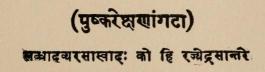
Ah! lotus infinite! ah! wild sweet Blue!
Sense, in thy azure ocean dipped, must die.
Introduction
The sun goes down, for those alone, who
stand on a revolving sphere: and so, in
Nature's universal life, Death is but a dissolving
view, a word without a meaning: real only to
the accidental unit, to whose local and
momentary combination it sets a term. Death is a
thing of nought, phenomenal, kaleidoscopic:
a juggle of the Mother of Illusion, Prakriti or
Máyá, whose magic scene not only never dies,
but like her own wild animals, sleeps even
with an open eye. You never catch her
napping. And often, when you think that you
have done it, she winks at you, just as it were
to show you your mistake. As sometimes, on
a hot midsummer day, when the delicate blue
smoke from cottage chimneys rises straight
into the air, and Nature holds her breath: you
think, she is asleep: and all at once, there
comes a little whisper, and a ripple passes
over all the golden ears of corn, and in another
moment, all is still. Or on a cliff that
overhangs a glassy sea, you lie and dream, and
think, the very water sleeps: and then, a
sudden change of colour flushes the ocean opal
for only a single instant, and is gone. Or in
a wood at noon, you listen to the silence, and
a rustle suddenly quivers in the trees, and dies
away. Murmurs and echoes: moments and
emotions of the pulses of the world: hints and
indications, still, small voices more significant
than storms, of the never-sleeping thrill and
throb of universal action.
"Every tremor gravitation excites in any
planet is immediately transmitted to the
farthest limits of the system, in oscillations
corresponding in their periods with the causes that
produce them, like sympathetic notes in music,
or vibrations from the deep tones of an
organ.... The human frame may be
regarded as an elastic system, the different
parts of which are capable of receiving the
tremors of elastic media, and of vibrating in
unison with their innumerable undulations."
So far sober modern science, never dreaming
that it is exactly reproducing (translate
the thing only from physics into ethics) the
old Hindoo idea, that moral conservation of
energy, whose fundamental axiom it is, that
no ACTION, good or bad, however small, is
or ever can be lost, but like a stone thrown
into the water, generates innumerable
consequences, running in all directions to infinity,
producing permanent impressions and effects,
that follow and fatally determine, eternal and
indelible, the fortunes of their DOER, through
the series of interminable births and deaths:
births that are no beginning, and deaths that
are not an end. Thus do we go on making for
ourselves our weal or woe: and as we go, the
hounds of deeds long buried in oblivion are on
our track.
Doubtless a little story might have a more
delicious name than the one before us: but
doubtless it never had. We may understand
it either of a young woman or the moon: and
in either case, it means more things than one.
I. The new moon, seen for a single instant,
in the sky, or on the lotus, or on the forehead
of Maheshwara. II. A beauty with eyes like
a great blue lotus, or the colour of heaven.
For all these things have a quality in common,
the mystic blue.
Strange, how deep an impression the colour
blue seems to have made upon the Indian
mind. Gods and peacocks, creepers and
lotuses, clouds and pools and skies and seas,
elephants and maidens' glances are all mixed
up together in their language by their
"participation" in this "Platonic idea," this
transcendental blue. Something of this, indeed,
is readily intelligible in every land: but in
India, it is more so. The blue is bluer, there.
Wouldst the poet understand, Travel in the
poet's land. I will not say, with Goethe,
Kenst thou that land: but simply tell the
reader something that I saw at Mahabaleshwar
in 1903.
The month of May, and with it, the hot
weather, was drawing to a close. The woods
were green, but very, very dry, and all their
ferny fringes by the red road-sides were parched
and powdered thick with ruddy dust. Each
morning, when I stood in my verandah, looking
down the valley, I could see a floor of cloud,
now rolled out like a table-cloth, now tossing
like a troubled sea, now floating, wreath on
wreath, like a ballet dancer's gauzy flounces,
half opaque and half transparent, over the
distant Konkan, three thousand feet and more
below, waiting for the rising sun to touch it
with a rosy blush and kiss it, into invisibility.
And every evening, just as he went away, the
hot haze hanging like a filmy veil about the
hills thickened back into solidity, and beautiful
cold mists, reborn, rolled swiftly up the
valley, blotting out the picture, and hiding all
with their ghostly shifting curtain. And so,
from morn to night, and night to morning, it
went on, till lines of bullock carts began to
gather and wander down the hill, and people
were preparing to pack and flit and vanish:
for the monsoon was approaching, when no
one not a native of those parts can remain
upon the hill, unless he wishes to go mad.
And then it began to rain. Suddenly, like
the Day of Judgment, there fell from the sky
in a solid lump rain, like no rain that I had
ever seen before, with the roar of an avalanche
and the thunder of Indra and lightning that
hissed like a serpent, crashing and smashing
down on the roof as if it would break it in.
It was dark at midday, and deadly cold, for
there went up a mist from the earth, to meet
the flood from heaven, making as it were a
solid wall through which it was impossible to
see a yard. There was nothing to be done but
to sit and wait. So for five nights and days
that angry rain raged and hammered upon
the earth, and tore her with savage fury, growing
fiercer as it went on[1]: till all at once, just
as though the gates above had been suddenly
shut, it stopped, as abruptly as it had begun,
about five in the afternoon.
I went out, and wandered slowly up the
hill. The air was soft, and quite warm, and
heavy with the smell of smells, the fragrance
of fresh earth. Here and there, the paths
were gone, washed clean away, looking like
red skeletons of their former selves, with rock
for bones, all their earthy covering gone.
And here and there, a little off the road, a pale
orchid sheltered beneath a bough, or a dainty
cobra-lily, nestling snug under an overhanging
trunk, peeped with incomparable shy reserve
through some dark vista in the trees.
A mongoose ran across the road, stopped, just
half-way, to stare for an instant at me with
its startled weasel eye, and leaped into cover
on the opposite side.[2] In a few minutes I
gained a point of view, and turned to look,—over
a sea of green, and what a green!
For every leaf on every tree was washed
and wet, and glistened as if coated with fresh
paint. The rich glow of a yellow evening
sun deepened and intensified the wonderful
red colour of patches of naked rock, raw scars
laid bare by little slips of land on places on the
hill. Cascades of water shot spouting and
splashing into the valleys from innumerable
scarps and shelves along the heights; and as
I listened, I could hear the streams, hidden in
the dense foliage, rushing and gurgling down
the steep slopes, carrying with them as they
went all the loose soil and pebbles they could
find. And all along the ridges of the hills, to
right and left, on Elphinstone and Lodwick
points, hung brooding enormous masses of
white cloud, the purest, the strangest, the most
indescribably magnificent and beautiful clouds
that I ever saw, whiter than snow, brighter
than polished silver, save only where their
lower edges were charged with heavy rain,
fleeces of colossal milk-white rams, dipped by
the master painter, Deity, in giant vats of
purple ink. Down and away below them the
staircase of the Ghauts, long lines of broken
hill, were stepping away into the plain, with
every distant detail sharp and clear, cut as it
were in copper, till all merged in the far
horizon, on which a blink of burnished gold
flashed back from the unseen sea, lying right
in the eye of the setting sun. I listened, and
in the silence, broken only by the ruckle of
the rushing water, somewhere away upon the
hill, I heard a cock crow. And at that
moment, right above me, I looked and saw: a
mass of shining cloud swung slowly open, and
through the gap, in the deep abyss of heaven,
appeared a spot, a panel, a little lozenge, of
blue: pure, unsullied, silent, elemental, Indian
blue.
There, there, was the unearthly colour, the
colour of the mystic lotus, and the long-eyed
languishing Indian Gods. I knew in that
instant what Kalidas meant, when he compared
the virtue of the just to a patch of heaven
fallen down to earth, the blue celestial leaven
in this world of frenzied storm and weeping
rain. There was the azure paradox, the blue
that is all but black, dark, transparent, clear
as crystal, shut out from eyes that live in
plains by earth's encircling fog. But over
every mountain is peace, and the kosmic blue.
MAHABALESHWAR,
April, 1905.
Contents
PROLOGUE—A DEAD LOTUS
LOVE'S LOOKING-GLASS
I. Sky-Crystal
II. Sprung from the Mud
III. Purusha and Prakriti
IV. Bubbles
V. A Painted Lady
VI. Shadows
VII. Twilight
VIII. Quintessence
IX. Echoes and Regrets
EPILOGUE—THE BREAK OF A HEART
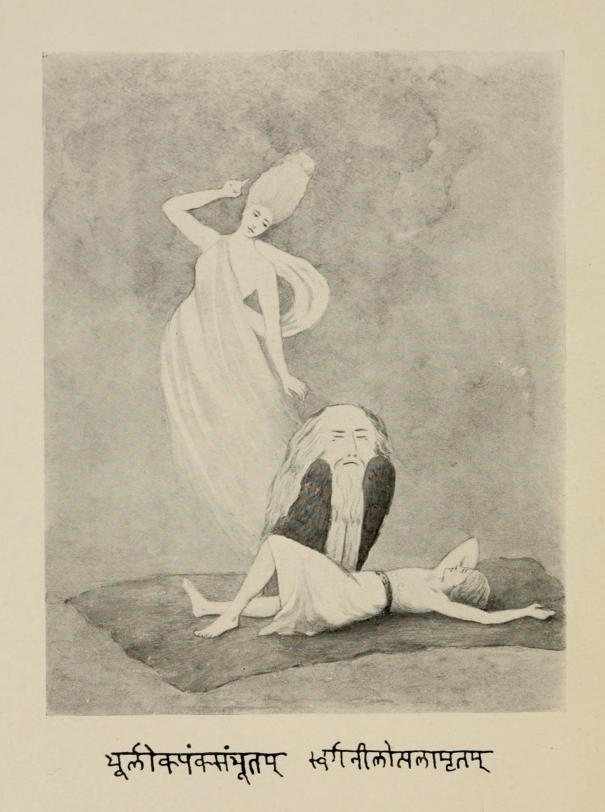
Note.—The words below the Vignette may be thus
translated:
Earth, the Root, and Heaven, the Hue;
Marsh of Mire, and Flower of Blue;
A Dead Lotus
I
To the pitchy dark of that awful wood,[1]
where plunging Ganges lost her way through
a night of a thousand years: when the lonely
Moon turned ashy pale, mocked by a million
moons that danced in the hollows of the
rushing waves: we bow.
On the edge of the great southern forest,
there lived, a thousand years ago, an aged
King and Queen, who counted all the world as
grass, for want of a son and heir. And finding
all other methods fruitless, in the end they
gave themselves wholly up to meditating,
night and day, on the sole of the Great God's
foot: until at last Maheshwara felt pity for
that childless couple, and revealed himself to
them both at once, in a double dream. So
when he asked them what they wanted, the
King asked simply for a son. But the Queen,
being smitten with deep devotion at the sight
of the Great God's moonlit hair, exclaimed:
O Boon Giver, let my son resemble thee, were
it only in a single fraction of an atom of his
being. Touch me now with the very end of
one of thy tangled locks of hair, and so shall
I become instinct with a tiny portion of thy
divinity. Then said Shiwa to himself: Even
a single jot of me will be much too powerful
for the rest of this human being's substance,
and disturb the balance of the whole. But be
it as this mother wills. For she has made her
choice, and I granted the boon beforehand.[2]
And I can see that he has to dree the weird[3]
of his former births.
Then he took from his head a single hair, and
broke it off, and placed it in her hand. And
then he disappeared, and that royal pair
awoke, and eagerly compared their dreams,
which corresponded in every particular. And
when they looked, lo! shut fast in the hand of
the Queen was a single hair, that glowed like
a wire of flame.[4]
Then full of joy, they worshipped the God:
and they placed that hair in a golden shrine,
and built around it a temple. And when in
course of time the Queen gave birth to a son,
they called him by a suitable name,
Rudrálaka.[5] And as the baby became a child, he
did not belie his name. For his thick dark
hair was shot with a tinge of gleaming red,
and in the sun it shone like fire, and it
resembled the mane of a horse. And as the boy
became a man, his strength became prodigious;
and his passions were wild and furious
and proportioned to his strength. And he
was as unruly and unmanageable as a young
colt of high spirit, and so full of wayward
obstinacy and headstrong self-will, that his
father said in private to his mother: Now, but
that the hair in thy hand was red, this son of
thine would seem to take after, not the Great
God himself, but his bull.[6]
And when his manhood was complete, like a
river in flood in the rainy season, it overflowed
all common bounds. And he ran wild among
men and women, overcoming all the men in
every feat of strength and agility, and like
a great black bee in a flower garden, rifling all
the women of their honey and their hearts and
their good behaviour, and playing havoc
among them, till the mischief created by his
own red hair began, as it were, to turn that of
his father and mother white. Then they said:
Come, we will marry him, and then no doubt
he will settle down and become clear, like
strong wine after fermentation, and turn into
a pillar of his family and the state. But as
soon as they proposed it, Rudrálaka laughed
in their faces. And he exclaimed: Who
carries a flower, when it is faded, and what are
women but flowers, fit only to be gathered,
in the moment of their bloom, and worn for
an hour and thrown away? And he is wise,
who knows how to get from the bee its honey,
and yet elude its sting. Now a maiden is
all honey, but a wife is a buzzing sting.
Moreover, women are like mountains, and like
snakes, and fire, and the mirage, beautiful in
the distance, and the further off, the better:
and like them, rugged, and biting, and
burning, and luring to destruction all who come
too near. But of all things this is worst, that
every woman wishes, like a king, to reign
alone, and is utterly unable to endure the very
name of rival, even in her dreams: so that every
husband has in his wife, either a despotic
tyrant, or an exasperated foe, whom nothing can
appease or soothe but absolute submission.
And thus his life is sapped and sucked and
drawn into the being of his wife, till it wholly
disappears, like that of a noble tree, embraced
and treacherously kissed into a premature
decay by a beautiful and clinging creeper. And
no matter how glorious the flower, I will not
be the tree: nor would I buy a wife, were she
ten thousand times more beautiful than
Rádhá, by the slavery even of a single day.
And what is the need to pay so dear for things
that are always ready to give themselves away
for nothing, and would rather give themselves
away than be bought at any price? For
women are always longing to give themselves
away, and care only for men that they do not
know: being forgetful of all kindness, and
unbound by obligation, and seeing in their
husband nothing but his faults; while every
passing stranger has their heart, as soon as
he appears, just as long as he is strange. For
Love is himself a stranger, and cannot
become familiar without ceasing to be Love:
and women live for Love alone, being, like
flowers, nothing but his instruments: and he
is like the amber, and they are like the grass.
So when they found that, in spite of all
that they could say, he would not be
persuaded, but that the more they tried, the
harder grew his obstinacy, his parents gave it
up. And soon afterwards, their hearts broke
with grief, and they died, leaving him
unmarried, and fearing for him, and the kingdom,
and their ancestors, and themselves, lest all
should go to ruin by reason of the incorrigible
perversity of this cutter of their race's stalk.[7]
And then, just as though he had only
waited for their death, no sooner had his two
parents gone away on the great road, than
this marriage-hating son of theirs went
hunting in the forest. And he rode a horse of
spirit like his own, which after a while broke
from control and fled at full speed, carrying
him in an instant out of sight of all his
attendants. And it brought him, deep in the
heart of the wood, to his destiny, in the form
of a woman, the daughter of an old ascetic,
whose beauty, like a deadly snake, bit and
slew, in a single moment, his antipathy to the
state of marriage, by the poison of its childlike
charm. And utterly beside himself, he wooed
her then and there, and brought her home
on his own horse, and made her his wife and
Queen. And she changed him so completely,
that he to whom a wife was slavery, became a
woman's willing slave: so much so, that he
could not bear to let her out of his sight even
for a single instant. And he became, like an
image of Arddhanári,[8] inseparable from his
wife, holding her in his arms night and day,
and chafing, like a wild animal kept without
food in a cage, if she left him only to drink
water. And the God of the flowery bow
laughed, to see his infatuation; and he said
softly to himself: A converted scoffer is, after
all, the best adorer: for even a very clever swan
would fail to separate this milk-and-water.[9]
But the King's subjects were overjoyed; and
they said: Now, then, his parents will be
happy. And if his passion is so violent, that
at present he utterly neglects his kingly
duties, no matter. For when it has become cool,
he will be the very crest-jewel of his race.
And then, while he was entirely bewitched
and enthralled by his passion for his new
young moon of a bride, some neighbouring
kings, his hereditary enemies, hearing of his
condition, and seizing their opportunity,
combined together, and attacked him. And after
a while, his subjects on the frontier, being
ruined, paid no taxes. So driven by necessity,
he said to his wife, with a sigh: There is no
help for it, and now I must absolutely leave
thee for a little while, to pull these thorns up
by the roots: for if not, the kingdom will be
destroyed. Yet only for a very little while:
for I will return almost before I have started.
And collecting his army, he put himself at its
head, and threw himself upon those kings,
and scattered them like leaves in a storm of
wind, and reduced them to beg for mercy: for
he was beside himself with rage, seeing in
them not so much enemies of his kingdom as
causes of his unwilling separation from his
wife. And having speedily gained his object,
he sent relays of horses, and posted them at
intervals all the way from his camp to his
capital. And then at last, one morning, he
mounted a horse, and started with but one
attendant, and a heart on fire, to return to his wife.
So they rode, all day long, at full speed:
stopping only as long as was necessary to let
them leap from one horse to another, as if
wishing to rival the sun in his course; till that
unhappy companion of the King was almost
dead from fatigue, for he was not supported
like his master by the burning desire to arrive.
But the King rode on as it were in a dream,
seeing nothing before him but the edge of the
far horizon, and the image of his wife beyond.
And so the day went by, and as the sun was
going down, they drew near to the capital, and
saw its walls before them, away on the distant
plain. And the King uttered a shout, and
he drove his spurs deep into the flanks of his
flying horse, and left his follower far behind.
And he rode into the city like a whirlwind, and
dashed through its streets, scattering the
people, and spurning them as it were from his
horse's hoofs. And he reached his palace, and
rode through the gates into the court, and
threw himself to the ground. And he stood
on the palace steps, and called aloud with a
joyous voice: Ho! go quickly, and tell the
Queen that the King has come, and waits only
for her permission, to kneel at her lotus-feet.
Then the guards, who stood around, gazed
at the King and at each other, in silence and
dismay. And as they waited, there came to
the King an old chamberlain, who stood before
him with joined hands, and stooping; and his
face was grey with fear. And he said, with
a shaking voice: Let the King show mercy.
Has he not met the couriers? The Queen died
of a burning fever, only three days ago.
And the King fell to the earth, as though
one had struck him on the head with an iron
club.
II
And they took him up, and carried him in,
and laid him on a bed. And there he
remained, like a dead man, and for so long, that
they begun to doubt whether he were not dead
indeed. But at last, the physicians by their
remedies brought him back to the body. But
his reason had fled. For he raved and fought,
struggling with the strength of a giant, and
biting like a wild beast, tearing his own hair,
and shouting for his wife. And he threw
himself upon his attendants, and handled them so
that they feared for their lives: and he ran
through the palace hunting for his wife, and
calling her by name. And when he could
not find her, he fell on all whom he met,
and beat them, and came so near to
killing many, that at last his ministers
took counsel, and caused him to be bound.
So after raging for many days, taking
neither food nor drink, he fell into a burning
fever, as if he wished to follow his wife by
the very road she went herself; and he lay for
many weeks on the very threshold of the door
of death. But his strength was such that he
could not die. And so, after a long while, he
came back, very slowly, and as it were against
his will, to life and to himself: and little by
little recovered health, and took once more to
his kingly duties, and the bearing of the
burden of the state. But it was, as if his better
part had died, refusing to be parted from his
wife, in the other world, and leaving behind
in this only so much of his soul as was
necessary to enable him to live at all. For he
never moved from his palace, roaming about
its rooms, always silent, and always alone, with
his head sunk down upon his breast, and his
sad eyes fixed upon the ground: and over his
dark face there never passed the whiteness of a
smile: for his dead wife's shadow lay across it,
and her figure moved before him night and
day; and her sweetness, not to be forgotten,
and never to return, rankled in his heart like
a thorn, and goaded it, and gnawed it, and
festered in his soul: and sleep forsook his eyes,
which were wild, and haggard, and such that
all who saw them feared him, and were wary
in his presence: for every now and then he
broke out into paroxysms of grief mixed with
laughter, during which he seemed, as it were,
not to know what he was doing, and was as
dangerous to approach as a wild mother
elephant robbed by hunters of her calf. And so
he lived, and months went by, and the grey
hairs came before their time and settled in his
head, and sowed as it were its fire with the
ashes of grey grief: and age saw her
opportunity, and began unheeded and unhindered
to furrow wrinkles in his brow, and dig deep
corners at the ends of his stern shut lips.
III
Now it happened, on a day, when the Great
God was roaming through the sky with Umá
in his arms, that they passed close by the moon.
And suddenly, they heard in the stillness a
mournful voice, like the note of a chakrawákí
bewailing her lost mate, exclaiming at
intervals: Alas! alas! So they stopped and
alighted on the surface of the cold-rayed orb,
and wandered about in his camphored air,
guided by the sound, till they came all at once
upon a Siddhá.[1] And she was sitting under
a sandal tree, leaning her head against the
trunk, with large tears in her great blue eyes,
and a cloud of dark dishevelled hair floating
about her bare white bosom, whose two colossal
pearls rose and fell, heaving and fretting
as if regretting their absent ocean home. Then
filled with compassion and curiosity, Umá
exclaimed: What can be the meaning of this
sighing Siddhá? And Maheshwara divined
the truth. But he said: Ask her. Thereupon
Párwatí said: O thou lotus lady, what is thy
trouble? And the Siddhá said: O Daughter
of the Mountain, I have attained, by superfluity
of merit, to this position of a Siddhá,
which notwithstanding is only a grief and no
pleasure to me. For I remember my former
birth, and I can see my husband, sorrowing
for my absence away below. And now I
would give all that remains of my unexhausted
stock of accumulated merit for a single
moment of the time that is past, did it last no
longer than the twinkling of an eye. For
what is the use of my Siddháhood, or anything
else, without my lord? Or why am I cursed
with reminiscence, and not rather rewarded
with oblivion? For memory binds my soul,
and links it like a red hot chain to the burning
fire of a dead delight.
Then Párwatí said in private to the God:
Canst thou not do something for this lovely
Siddhá? And Maheshwara replied: This is
the nature of women, that for the sake of their
single lover, they would annihilate the three
worlds. But what has pity to do with the
constitution of the universe? Or how can
time return again, and all be thrown into
confusion, simply to allow two foolish lovers to
meet once more? So there is nothing
whatever to be done. But Párwatí coaxed him
and cajoled him, knowing the power of her two
white arms, until at last he said: Since I can
refuse thee nothing, and thou art absolutely
set upon it, I will, to please thee, cause these
two unhappy persons to re-enact their little
drama, and taste again the nectar of that love
which they so much regret: but only in a
dream. For dreams were established by the
Creator for this very reason, that a remedy
might be found for the irrevocable nature of
reality. For that must be as it has been, and
cannot be recalled or changed: but anything
may happen in a dream. And yet, this pair
of lovers would be wiser, were they content to
let alone, and leave things as they are. For
they will but make their misery more, by the
very means they wish to take to lessen and
remove it. But be that as it may.
And then, he cast upon the Siddhá a kindly
glance. And he said: Silly child, that wouldst
be wiser than those who framed the three
great worlds, be now consoled. Thou shalt,
at least, have thy way, for a little while, and
meet the lord of thy heart again, halfway
between heaven and earth.
And hearing this, the Siddhá fell before
him, and took his foot, and kissed it, and
placed it in her bosom. And she said: O
saviour of the shipwrecked that are sinking in
the waves of time, O send me thy succour soon,
for I am like one dying of thirst in the desert
for the blue water of my husband's arms.
IV
And at that very moment, the King her husband
on the earth was sitting in his palace hall,
musing on her memory, and dreaming of the
past, and listening to the musicians, playing
before him as he sat. So as they played, as
luck would have it, they fell upon an air, which
ran into his heart, and pierced it like a
poisoned needle: for it was the favourite air of his
vanished Queen. And as he listened, the tears
came rushing into his eyes, blinding them with
love-longing and the blackness of despair.
And he started up, and called aloud, in a voice
of thunder: Away! begone! Wretches, have ye
conspired together to break my heart in two?
And instantly, those unlucky players stopped
affrighted, and fled before his wrath like hares.
And as all shrank before him, the domestic
chaplain came forward, and said politely: O
King, without are waiting certain merchants,
jewellers, who have come here by appointment,
to lay their jewels at thy feet.
Then the King said, with a sigh: What are
all their gems to me? And yet, no matter: let
them all come in.
So in came all the merchants, and showed
the King each what he had. And the King
went up and down, saying sadly to himself:
Now every pleasure is a pain, and every joy,
a grief. For what are jewels to me, now that
she is no more, on whom I would have hung
them till she sank beneath their weight? And
then, as if in irony, he took the jewels and
began to put them on himself. And taking
from the merchants all they had, he hung
himself all over, loading himself with gorgeous
gems, with emeralds and rubies, and pearls and
amethysts and diamonds, and sapphires, and
every other stone, till he flashed as it were with
a thousand hues, and resembled an incarnation
of the spoiling of the sea.
So as he went from one merchant to another,
adding to his store, he came suddenly
on an old merchant, who stood a little apart
from the rest, with nothing visible to sell. And
his head was of enormous size, and bare,[1] and
bald on the top, and from its sides long thick
white hair ran down over his shoulders, and
mingled with his beard. And his face was
wrinkled all over, like the skin of a withered
fruit. And the King stopped and considered
him, amazed at the extraordinary size of his
head, which resembled a monstrous gourd.
And then he said: Ha! merchant: thou art
idle. Where are thy valuables, and what is
thy commodity? Doubtless that must be a
treasure, which thou keepest wrapped away so
carefully from common eyes. But come,
produce it: that I may add it to all these. Then
said the merchant: All these are well enough:
and yet, the thing that I have brought the
King is more than all together, and yet
again, less than the least. Then the King
said: Of what, then, art thou a seller? And
the merchant said: O King, I am a seller of
dreams.
And the King looked at him awhile, and was
seized with sudden laughter. And he
exclaimed: What is this, and who ever heard of
a seller of dreams? Art thou mad, or art thou
only an old buffoon? Then that old merchant
fixed his eyes upon the King. And he said:
O King, who can tell, whether he is mad or
not? But as for me, know, that mine are no
common dreams, but they are such as many
would give all they had, and more than all
they had, to dream. For I can make the past
present, and I can find that which is lost, and
join together whom time has parted, and turn
regret to laughing joy: and I can mend the
broken-hearted, and bring love's fierce
emotion back, and into faded flowers of passion
I can breathe again their old sweet bloom, and
make to echo in living ears the music of lips
that have long been dead.
And as he spoke, the King stood, and his
heart rose up into his mouth. For the words
of the old merchant played on it, as if it were
a lute, and tugged at it like a cord; and the
memory of his wife surged suddenly in his
soul, and swept it like a wind. And all at
once, he seized that old man by the throat,
with hands that trembled with the ecstasy of
rage, and shook him like a leaf. And his voice
faltered with passion, as he said: Old fool, dost
thou mock me? Dost thou promise, without
performing? Beware! for thou art playing
with a fire that will shrivel thee like a blade of
grass.
Then said the old merchant, with laughter
in his wrinkled eyes: O King, thou art a child,
not recognising thy physician, and seeking a
quarrel with the only one who can give thee a
medicine suited to thy case. For I am a
physician, not of the body, but of the soul. So
now, tell me: wilt thou buy from me a dream,
or not? And the King looked at him for a
moment; and he drew a long breath, and the
tears stood in his eyes. And he said: Sell me
indeed a dream, such as I wish, and thou hast
described, and I tell thee this, that I will not
haggle with thee over the price. Then the old
man laughed softly, and he said: Maháráj, who
ever speaks of the price, before he has seen and
tried the goods? First, thou shalt have thy
dream; and as to the price, we will leave it:
and thou thyself shalt name it, at the end.
For maybe, didst thou know the price, thou
wouldst hesitate to buy at all.
Then he put his hand into his breast, and
drew out a little flask. And he held that little
crystal flask up in the air, looking for a ray
of light. And when he could not find one,
that old man muttered under his breath: Sun,
sun, send me a ray. And at that very
moment, there shot into the room a ray of light,
right on the little flask. And then that old
man said: O King, see! this is a little of the
very essence of the nectar of the cold-rayed
moon, where I have been this morning, to
fetch it from that lord of herbs. And the
King looked, and lo! there danced in that little
flask a liquor that laughed and bubbled, and
its deep blue was exactly the same as the
colour of his dead wife's eyes. And like them,
it smiled at him, changing from hue to hue,
till it seemed to him that those very eyes were
looking straight into his own, out of the little
flask. And quickly he put out his hand, and
snatched it, and took the stopper from its
mouth. And there came from it a perfume
that carried to his nostrils the scent of his
dead wife's hair. And his brain reeled, and
he put it hastily to his lips, to drink. And as
he did so, suddenly there came into his head
a thought. And he paused in the very act,
looking at that old merchant, out of the corner
of his eye. And he said to himself: Ha! What
if this old seeming merchant were an emissary
of those foes of mine, whom I defeated, to give
me a deadly draught? Or even so, what
matter? Let me drink quickly, the more poisonous,
the better. For life without her will not
be worse, even when turned to death.
And then, at a single gulp, he drank the
contents of the flask. And instantly, he sank
back, and lay on the cushions on which he fell,
buried in a magic sleep.
But as soon as he saw that the King slept,
that old merchant stooped down, and squatted
quickly on the floor, with his two hands
grounded between his feet, and his knees
reaching to his ears. And there he remained,
with closed eyes, couched in the pitcher
posture like a lonely, water-watching crane, and
still, as if he had been painted on the wall.
Love's Looking-Glass
I
SKY-CRYSTAL
But the King's soul rose out of his body,
like a snake escaping from its slough. And
he hovered for only a single instant, over that
empty shell of him, lying, loaded with
priceless gems, on the floor below, and then shot
up into the blue sky, like a flame parted from
its wick. And as he flew like a thought
through space, going like the wind he knew
not where, the King said to himself: Ha! so
then, I was not deceived. Certainly, that old
impostor was not a merchant, but a secret
agent of my foes, and now I am dead, beyond
a doubt. And that delicious poison was as
speedy as it was beautiful and sweet. And
now I can say farewell to life without regret.
And yet I should like to know, where in the
world I can be going.
So as he floated in the air, bathed in
unutterable peace, there came over his mounting
soul a feeling of supreme disdain and loathing
for his body that was lying down below. And
he said to himself, as he closed his eyes:
Ah! joy, for I have left behind that wretched
sheath, with all its poor surroundings and its
miserable mundane ties. I have emerged, as
it were, from a charnel ground, and surely that
divine liquor was, as that old vendor said, a
very potent essence of nectar and celestial
wine, mixed of the icy camphor and the oozy
juices of the moon.[1] For I feel like one
intoxicated, and I swim, as it were, in perfume,
whose pungent and excessive sweetness
almost robs me of my giddied sense; and I lie
on the azure ether as if on a silken couch,
poised as it were between earth and heaven,
and yet I seem to soar like some earth-despising
spirit-roamer in the sky.
Then after a while, he opened his eyes, and
looked round, and saw himself alone in the
vault of space, surrounded by the stars. And
he was rushing like a comet[2] through the
mansions of the moon, and he saw Chitrá, and
Swáti, and Rohini and the Hunter,[3] and the
rest, and far in the north, the polar star. And
he looked down on the Seven Rishis,[4] and saw,
far below him, the icy summits of the Snowy
Mountain, with the yellow digit of the moon
clinging to the peak of Kailas, like the earth
of old on the horn of the holy Boar.[5]
And then suddenly, memory pierced him
like a needle. And he cried out: Alas! I am
still alone, and in this respect, even death has
brought no change. And what then is the
use of death, if it does not restore me to my
wife? And what is the use of this rushing
speed? For I am hurrying, against my will,
into the very zenith of infinite space.
And even as he spoke, he stopped, and
hung in the air like a fleck of cloud. And
strange! as if the very thought had produced
her, suddenly he found his wife in his arms.
And as her own arms glided around his neck,
and her bosom beat against his own, his hair
stood on end with amazement and delight.
And he heard the beating of his own heart,
throbbing like thunder through the realms of
space. And just as he was going to speak,
she stopped his mouth by kissing him with
soft lips opening into a smile, and eyes that
reflected the colour of the sky. And she said:
Quick, let us lose no time. Then he said:
Ah! couldst thou die, leaving me without thee
in that hell below? Then she said again:
How can mortals disobey, when destiny
decrees? It was from necessity that I left thee,
and not from choice. But let us quickly make
the most of a little time, granted only by the
favour of the God who has the moon in his
hair, and destined to end and disappear almost
as soon as it has begun. Dost thou remember
how we met, and saw each other first of all,
away in the wood below? Come back now
once more with me, and let us live and love
again, and taste the nectar of repetition,
before we part to meet no more.
And instantly the King lost his senses, and
lay in a dream within a dream. And as they
floated in each other's arms, between the
heaven and the earth, the past rose up out of
the dark, before him, spread like a picture
before his eyes and breathed like a tale into his
ear.
II
SPRUNG FROM THE MUD
And once again, he rode through the forest
at headlong speed, and the trees flew by him
like frightened shadows, while his horse ran
on, and carried him swiftly whither it would,
into the forest depths. And then at last, it
stopped short, on the very edge of a great
river, close to an aged banyan tree, whose
hanging roots dropped from the branches to
the ground, and with their network almost hid
a little ruined shrine, whose roof their pillars
pierced and split, and whose steps ran down
into the stream beneath their sacred shade,
where the quiet water was littered thick with
lotus flowers and floating withered leaves.
And there he fell from his horse's back and
threw himself upon the ground: and he and
his horse together slaked their intolerable
thirst, with neither eyes nor ears for aught,
till they had drunk their fill. And then, with a
wisp of leaves and grass, he began to wipe the
foam and sweat from the quivering limbs of
that noble horse, dearer to him, till that very
moment, than anything else on earth.
So as he stood, wholly intent on his horse
and his work, he heard behind him a little
rustle, and a low cry. And he looked round.
And in that instant, like a flash of lightning,
he utterly forgot his horse, and himself, and
everything else in the three worlds.
For there, standing a little way off, under
that old root-dropping fig, was one who
resembled the guardian spirit of that virgin
forest's enchanted beauty, caught in the very
act of changing into a feminine form, and
leaving him in doubt as he gazed, whether she
was a woman or a tree, or a being mixed of
both. For the coarse red bark that clothed
her left bare her arms and feet, which were
shaped like those of Hari's darling,[1] and it
cased and swathed her soft round limbs,
allowing them to escape, like the calyx of a new
young flower, or a rough hard husk on the
very point of bursting open, by reason of the
ripeness of the tempting fruit of womanhood,
hardly to be held within. And a spray of
blue convolvulus[2] hung twining all about her,
trailing like a creeper from her hair, which was
twisted up into a great dark knot on the very
top of her pretty head, and hung there like a
purple bank of thunder-cloud, out of whose
shadow her great blue eyes looked round as
the moon with wonder at the thing they saw
before them. And her chin was very pointed,
shaped like a pippal leaf, and over it the
mind-born god had set the seal of his bow in her
face, black in the twin-arch of her brow, and
red in her juicy bimbá lips. And astonishment
flushed her cheeks, like fruits, with a spot
of damask blush, like bloom. And a single
lotus, red as blood, nestled in the little hollow
dip between the mounds of her rising breasts,
upland hills where the robber Love lay lurking,
to spoil the traveller of his heart. And
the sweeping curve of her heavy hips stole the
eyes of the King away from her slender
clasp-inviting waist, till it came to an end in the
nook of her inward-bending knee. And her
left hand rested gently on a pillar of the tree,
while her right was stretched before her,
bending back, palm upwards, with all its fingers
spread, till the tip of its forefinger just touched
her lower lip. And Love fished for the
King's soul with her lovely wrist and arm, and
took it in their net. And she was standing
bolt upright, poised like a flower on her left
foot's toes, with her right foot just behind it,
exactly like a graceful fawn suddenly frozen
into stone when running at its utmost speed
by the sight of danger in its path. For she
stood absolutely still, save that the lotus on
her breast was lifted quickly up and down by
the flutter of the maiden-wave on which it swam.
So they two stood, still as death, each
thunderstruck by the other's vision, like a
panther and its prey.[3] And then at last, after
a time that seemed to each in spite of its
length but a single instant, for each was lost
in the other, standing on the threshold of
Love's dream-bower where years are moments
and time lies dead, she spoke, and broke the
spell. And she said, softly: It is a man.
Surely, thou art a man? And the King said,
with a smile: O maid, what else? Then she
said again: And thy companion, what is he?
And the King said: He is a horse. Then she
clapped her hands together, and exclaimed,
as she held them joined: Ah! stand still a
little longer, and let me watch both him and thee.
For I have never seen before, either a horse or
a man. So he stood still as she desired; and
as she watched him, he watched her. And her
blue eyes rested on him, and entered into his
soul, and shook it so, that he began to tremble
all over with the horror of extreme delight.
And he said to himself: I too, I too, see a
woman, for the very first time in all my life;
which, till this very moment, has been wasted
and empty and worthless, and contemptible
and without a point. Ha! I am like a dark
black night, that has suddenly been flooded
with the rapture of a golden sun. O hail! O
bright great God, in the form of that
blue-eyed beautiful thing before me, that fills me
with astonishment and laughter and supreme
delight. And presently he said: O thou with
the blue flowers in thy hair and the blue
wonder in thy enormous eyes, that resemble those
of a child, how can it be that in a world so
full of them, thou shouldst never yet have set
those eyes on either a man or a horse?
Then she started as if from a dream. And
she came up close to him, and raised her hand,
as though she would touch his arm: and barely
touched it, with a touch like that of a leaf,
which struck the King like a heavy blow. And
she said, looking up at him, doubtfully: But
O thou great, beautiful, deep-voiced man, how
should I see either? For out of this wood I
never was, and into it nothing ever comes, and
in it are only its own trees, with the flowers,
and the river, and the forest beasts, and my
father and myself. Then the King said: Thy
father? And is not he a man? And she
said: Nay, if thou art, he is not. For he is
old, very old, and smaller even than myself,
and his hair and beard are thin and white, and
his arms and legs are rough as bark, and dry
and thin as sticks. And he sits always stiff
and silent, plunged in meditation, resembling
the stump of an ancient tree: and it is the same
as if he were not alive.[4] And if thou wilt, I
will show him to thee, a little way within the
wood: and yet, it were better not, for it would
but distract his meditation. But thou art tall
and straight and strong, and glorious, and
young like me: and yet far bigger than myself! for
see! how even on tiptoe I reach hardly
to thy shoulder. And thy hair is like the lion's
mane, and thou art like him to look at, and
wonderful in every way, and such as I could
never have believed. For often I have thought
of men, and wondered what they could be like,
but never dreamed of one like thee. Look
only at my hand, and thine, or at my arm, or
foot, and thine, and see how small and weak[5] a
thing I am, compared with thee!
And the King looked at her, as she spoke;
and when she ended, he began to laugh for
very joy. And he said: O beautiful little
blue-eyed creature, thou dost not know thy own
strength, nor where it lies, but how as to thy
mother? Hadst thou, indeed, a mother, or
didst thou not rather grow, like a flower, out
of some forest tree? Then she said: Nay, I
had a mother: but alas! long ago she went
away, before I can remember. For she was a
heavenly Apsaras, whom Indra sent down
here below, to tempt my father in this wood,
and turn him from his penance.[6] And she
came and stayed with him awhile, and
afterwards she went away, flying up to heaven,
and leaving me behind her with my father in
the wood. And the King said: I do not
blame thy father: what wonder, indeed, if she
overcame his resolution, did she resemble her
future daughter, even a very little? And thy
words require no other witness to their truth,
except thyself. For beyond a doubt thou art
the very daughter of an Apsaras. Then she
said: And hast thou ever seen an Apsaras?
And the King laughed, and he said: Nay, not
until this moment. But come now, let me
only tether my horse to yonder tree, and then,
if thou wilt, we will sit and talk together.
And I will be thy playfellow, and will tell thee
things that thou dost not know, and thou shall
tell me of nothing but thyself.
Then she said joyfully: Ah! tie him, and
come quickly. And the King stood looking
at her for a moment, and then he said: Sweet
Blue-eyes, and art thou not afraid of me?
And she looked at him enquiringly, with no
shadow of suspicion, and said: Of what should
I be afraid? For art thou not a man, and
which of the Creator's creatures injures its
own kind? And the King gazed into her soul,
through the window of her clear and smiling
eyes, and again he laughed aloud for sheer
delight. And he said to himself: Ha! exquisite
is her intoxicating simplicity, in that she does
not know, that man alone is the exception to
her rule. And then he said: Sweet forest
flower, what if I were tempted to pluck thee,
and carry thee away with me on my horse?
And yet, fear nothing: for thou art very right,
and I am, of all the Creator's creatures, the
one who would be most loth to do thee harm.
And men were made strong by the Creator
for this very reason, to guard such wonderful
weak things as thee. And he said to himself:
Now, let my followers only not find me till
the evening, and by the favour of the Deity, I
will win the trust of this bewitching maiden,
and get her to come away with me. Or if not,
I will stay in the wood with her for ever,
becoming for her sake like one of these forest
trees, rooted to the spot.
And then he took his horse, and tied him to
the tree. And then they went together and
sat down upon the moss-grown steps that ran
down into the river: he on one, and she on
another, just below.
III
PURUSHA AND PRAKRITI
And then, for a little while, he sat in silence,
looking now at the river, and now at her. But
she gazed at him with great eyes that never
left him for a moment, and saw nothing but
himself. And suddenly he said to her:
Blue-eyes, Blue-eyes, how long is it, since I met
thee in the wood? Then she said: It is but a
single moment. Then he said: Thou art
utterly mistaken: it is more than many thousand
years. And as she looked at him in wonder,
he exclaimed: Ha! there it is again, and O
how beautiful thou art! O thine eyes are full
of wonder and my soul is full of joy. Dear
child, see, yonder is the river, flowing as it has
been flowing ever since it first began; and here
am I, to thee the first and only man, for thou
hast never seen another, and there art thou,
for me the only woman, and her very type
and soul. And like the ancient Soul of Man,[1]
I have been wandering about, forlorn and
wretched and lonely in the dark without thee,
and now at last I have found in thee my Prakriti,
since thou art the very spirit of the beauty
of this wood, incarnate in a woman's lovely
form. And as I look at thee, laughter seems
to fill my soul, for joy that I have found thee,
and I feel as if, like thee, I had suddenly
become a child, whereas before I was a man.
And all this has come about in the moment
since we met, a moment which is like a door,
opening on one life, and closing on another,
and it resembles the beginning and the end.
Then she said: I do not understand thee:
yet speak on, without stopping: for I could
look at thee and listen to thy voice, for ever.
And the King said: Blue-eyes, if thou dost
not understand, no matter: and possibly I am
speaking at random words without a meaning,
for thy great eyes deprive me of my reason,
and I know not very well what I say. But
now it is thy turn. And tell me, what dost
thou do with thyself alone in this empty wood?
Hast thou companions other than myself?
Then she said: I have for companions the deer
of the forest, and the parrots that live in this
great tree, and the peacock that thou seest
yonder on the temple wall, and the crows that
come to eat the daily offering, and the flowers
which I water and wear woven in my hair.
And I have many things to do. For
sometimes I ramble in the wood, and hunt for
flowers, and watch the monkeys and the
squirrels that play in the trees: and when I am
tired, I sit still, playing with my hair, and
rolling and unrolling it, for it is longer than I
am myself and a trouble and a hindrance to
me, till I knot it up thus out of the way on the
top of my head, like my father's.[2] And
sometimes I go and see my father, but I am afraid
of him, for though his body is there, his soul is
almost always absent from the body. And
sometimes I sit by the river, when the wind is
still, and watch in its mirror the clouds that
float in the blue sky far below, like the swans
upon its wave. And the river itself is a
friend to me, for every day I bathe in it, and
I often sit and wonder whence it comes and
where it goes, and look to see what it carries
down: and in the rainy season it changes, and
grows red and angry, and murmurs and
chafes, and swells till it reaches to the very
foot of the tree. And sometimes when the
moon is full, I hide in the hollow trees at night;,
and peep out at the elephants as they wander
down to drink. And the King said: But do
the other animals not molest thee? Then she
said: Nay, for they dare not: for they all
know my father well, who understands their
language, and has warned them. And they
fear him, lest he should curse them if they
harmed me, and keep them from ever rising up
into humanity, being prisoned for ever by the
power of his curse in the dungeon of their
creeping[3] bodies. And the King said, with
emphasis: Aye! they who should injure thee
would indeed deserve to be immured for all
eternity in the lowest of all living forms. And
I thank thy excellent old father for preserving
thee under the shadow of his awful curse. And
yet, for all this, surely thy life was lonely?
Didst thou never long for a companion of thine
own kind, such a playfellow, for instance, as myself?
Then she said: Though I knew it not before,
yet now that thou art come, I see that I was
lonely. For often I used to watch myself
reflected in the water, and talk to my image, and
wish that it could answer me. And sometimes
in the moonlight I would play with my
shadow, and wish, oh! so much, that it could
come to life. And often I used to long, not
knowing what I wanted; but now I am very
sure that it was thou. And when I look at
thee, and hear thy voice, I cannot understand
how I could have lived without thee. For
thou art like another self, made visible in a
human form: and yet thou art other, and more
than that first self, which is I.
And the King gazed at her, with fire in his
veins. And he said to himself: She is innocence
itself, in a virgin form of matchless and
incomparable beauty, and speaks without
understanding the meaning of her own words.
For love lies hiding, lurking in her soul, and
yet she does not know it. And yet, though
she does not, I know well, and only too well,
now, what it is to be in love: for she burns my
heart like a flame, all the more, that she is
utterly unconscious of the power of her own
beauty. And then he said: Blue-eyes, canst
thou tell me this? Say, wouldst thou rather
that I were in very truth the double of thyself,
like thy image in the water, a woman, and
not a man? And she answered, without
hesitation: Nay, it is better as it is. And the
King trembled with joy. And he said: Yet
why? Then she pondered for a while, and
then she said: I cannot tell. And yet I feel,
that I would rather have thee different from
myself than the same; and yet I know not
why. But what does it matter, why? since
it is better as it is. And the King said with
emotion: Sweet, thou art right. Aye! it is
far better, and it does not matter why.
And as he spoke, there came a murmur, and
a rushing sound in the air. And he looked up
in terror, and listened, and exclaimed:
Ah! what is that? Then she said: It is nothing
but the sighing of the wind in the hollows of
the young bamboos.
IV
BUBBLES
And the King sighed also, with relief: for
he feared that his followers had found him in
the wood. And then he said: Blue-eyes, hast
thou a name? Then she said: I have only the
name which was my mother's. And the King
said: What was that? Then she said: Long
ago, when my father first saw my mother in
the wood, she was standing by a bush, which
had just burst into blossom all over, as if by
the touch of her foot.[1] And the bees were
humming and bustling eagerly all about it
and her, as if they wished to kiss her,
and my father saw it, and he called her by a
name of his own, that has come by inheritance
also to me. For my father has never called
me anything else. And the King said: And
what then was the name? And she said:
Alichumbitá.[2] And the King clapped his hands,
and exclaimed: Certainly, thy father is
admirable, and thy name appropriate. And sure I
am, that there must be more than the name of
relationship between that happy bush and thee.
And I am tempted to believe that thy story
of an Apsaras was false, and that thou hadst
for a mother no other than the very indwelling
spirit of that sweetly-scented, bee-haunted
bush. Then she said: Nay, my mother was an
Apsaras. And the King exclaimed: How
shall I believe thee? For already I am
beginning to doubt whether thou ever hadst
either mother or father, and wert not rather
directly compounded by the Deity himself in
the form of a bee, going from flower to flower,
and culling thy composition out of every
flower's fragrant essence and every blossom's
painted bloom. And she said laughing: And
what then was thy composition? And the King
looked at her joyously, and said: The Deity
was thy creator, and thou art mine. For I
never lived until this moment, and this is all
thy doing. Thou hast found me like an empty
shell, and filled me with colour and emotion
and the salt of beauty and the sound of
laughter and the tossing to and fro of the
waves of pleasure and delight. Now put me
to thy ear, and I shall echo like the sea. Then
she said: Once more, I do not understand.
And the King said: O ocean, no matter. But
thy shell must murmur, being full of thee,
whether it will or no. And yet, this at least
now thou dost surely understand, that I was
right, and that ages have elapsed, since we met
each other a little while ago in the wood. For
I have utterly forgotten every fragment of my
life that went before, and as I said, I have
begun to live, only since I saw thy face. And
thou hast discovered that thy life in the wood
was very lonely till I came. And it is as
though we had both been sleeping, and had
just waked up. And now we are playfellows,
and I will be King, and thou shall be Queen.
Or hast thou never heard of kings and
queens? Then she said: Nay, I have heard.
For formerly, before my father became so
utterly devoted to asceticism, he used to tell
me stories. And in almost every story, there
was a king and queen. Then the King said:
And if then I were king, wouldst thou come
away with me and be my queen? And she
laughed, and said: But what sort of queen
should I be, that know nothing of the duties
and behaviour of a queen?
Then he said: Sweet little Queen, although
thou dost not know it, thy qualifications for
the post of queen are such that they could not
be surpassed. And the duties are easy to be
learned, and the pleasures more than thou
couldst dream. Only come with me, and I
will show thee what they are. Or if thou
wilt, I will draw thee a picture in the air, and
hold it up before thee, to show thee as in a
mirror thy life as a queen, and give thee a
foretaste of its nectar. Hast thou never watched
the bubbles on the surface of the stream?
Dost thou not know how every bubble is like
a little heaven, and glows for a moment with
every colour of the sky, and bursts: but the
sky remains? So is it with my picture. For
like a bubble, it will burst as soon as painted,
being only words: but the heaven which it
shows thee in its mirror shall be thine, as long
as life endures.
Then she said: Draw, then, thy picture, and
let me see thy heaven. And she settled
herself to listen, leaning her cheek upon her hand,
and looking at the King so sagely that he
shook with agitation, so intense was his desire
to take her in his arms. And he exclaimed:
Blue eyes, come and be my Queen, and I will
put thee in a palace, and build it for thee
seven stories high, of ebony and sandalwood,
and of silver and of gold. O come and be my
Queen, and thou shalt walk on pavements more
worthy of thy little feet than this rough
ground, on marble of many colours, and on
floors of precious stones. Only be my Queen,
and I will strip thee of thy bark, and wrap
thee in silky webs and tissues coloured like
the rainbow, till like the moon behind a filmy
cloud, thy symmetry shall borrow beauty from
tell-tale veils of gossamer and envelopes of
woven gauze. Ah! come with me and be my
little Queen, and I will load thy neck and arms
with jewels, and thou shall play with heaps of
pearl, and coral, and all the riches of the sea.
Aye, shouldst thou prick thy finger, I will
mend it with a ruby, and shouldst thou drop
a tear, I will redeem it with a diamond, and
try in vain to match, with turquoise or
lapis-lazuli or opal, the colour of thine eyes.
Ah! come, and slaves shall serve my dainty Queen
with food on golden plates, and snow cold
drinks in crystal cups, and when thou wilt,
pour music in thy little ear. And elephants
shall carry thee about, or thou shall ride on
horses, or float on silent pools starred like the
sky with a multitude of lotuses, or lie on
couches softer than a flower, fanned in the
heat of noon with scented leaves, or listening
at midnight to the moonstones, oozing as they
swing in the window's trellised frames. Ah!
Blue-eyes, come and be my Queen, for I
cannot do without thee, and all that I have said
is nothing, for it is only the casket for thy
soul. For I will be there, and serve thee all
day long upon my knees. Ah! I will take thy
soul, and steep it in elixir, and drown it in the
perfume and the fragrance of stories and of
dreams, and dye it with the colour strained
from the subtle essences of far-off lakes of
passion and emotion, lying in the distant land
beyond the blue horizon where the earth and
heaven meet. Aye! I would turn the three
worlds upside down, only to be near thee, and
watch the shadow of the pleasures I would find
there reflected in thine eyes, O thou naïvest and
most exquisite of queens.
And she watched him as he spoke, and when
he stopped, she continued to look at him in
silence. And then to his amazement, she
dropped her eyes, and the colour rose a very
little in her cheek, that was overshadowed by
her long soft lashes, and she said: Nay, thou
art only laughing at me, knowing my
inexperience. And as thou saidst, thy words are
only bubbles, beautiful, and bursting as they
jostle one another, and delusive. Nor is this
the kind of queen that I would be. And the
King said, with curiosity: And what then, O
maiden difficult to please, is thy conception of
a queen? And she waited for a moment, and
she said, keeping her eyes fixed upon the
ground: Once my father told me of a queen
very different from thine. And I cannot tell
thee the story as he told it, for I am not a
pundit, as is he. But he told me of a king,
who was set upon by enemies and driven from
his throne. And when all the world
abandoned him, a single friend remained to him,
and that one was his queen: who followed him
in exile, and lived with him in poverty, and
wandered through the world behind him like
his shadow, enjoying never one of the pleasures
thou hast mentioned, but sharing all his
evil fortune, a pleasure infinitely greater than
them all. And when he died, she would not
stay behind him, but followed him through the
fire, into the other world.
V
A PAINTED LADY
And the King listened with amazement, and
when she ended, he looked at her with eyes that
glistened, and a heart that swelled towards her
as she sat with downcast eyes, as if ashamed
of her words, before him on the ground. And
he struck his hands together, and exclaimed to
himself: Ha! very wonderful is the way of the
Creator, who teaches all his creatures the
law of their behaviour, without the means
of any master. For this mud-born[1] pure
white lotus of a maiden has understood
without assistance and as it were by
native instinct, the whole duty of a faithful
wife, even before she has so much as
seen a man. And then he said: Sweet little
ascetic, apt pupil of a wise old father, whom
thou dost resemble not only in thy hair, thou
hast administered reproof to me, deservedly.
And whereas I thought, in my folly, to
instruct thee, it was I that received a lesson, in
this matter of the way of queens. And now
I see, that I spoke more truly than I knew,
when I said that thou wert admirably fitted to
be a queen. Now, therefore, thou art my
guru, and I am thy disciple, and thou shalt
teach me all that I do not know. Begin then,
my pretty little guru: give me lessons, for I
need them. And she laughed, and blushed,
and said: Again thou art laughing at me: for
how could a simple forest maiden teach
anything to one, who like thyself, had lived in
cities, and mixed with other men and women?
And the King said quickly: Ah! dear Blue-eyes,
just for that very reason is it that thou
hast already taught me many things that I
never knew before. For they who live in
cities have their souls tainted as it were and
poisoned by bad associations, whereas thine
is as pure as the flowers in thy hair. And
therefore, as thou hast taught me about queens,
teach me also about kings. What should he
be like, whom thou wouldst be willing to
follow through the world?
And she looked at him for a moment, and
then she dropped her eyes, and turned away
her head, and was silent. And as he watched
her, the King saw the colour rising on her
neck, till it reached the roots of her dark hair,
like the flush of eve climbing the snowy
summit of Himalaya, when day is dead. And he
said to himself in ecstasy: Ha! so this pure
digit of the ice-cold moon, even in the solitary
darkness of the night, before the dawn of love,
has dreamed of a sun which she has never seen.
And O that I could dare to think myself the
sunny lover corresponding to her dream,
destined to touch her soul, as my question did her
body, into red! But let me beware, lest I
scare my timid fawn by a too abrupt approach.
And then he said: Dear little blue-eyed Queen,
forgive me, if I roused thy maiden shame by a
rash and ill-mannered curiosity. It is enough
for me to know, that the king of thy pure
fancy must be worthy of his queen: and as
much above all other men, as thou art
different and above all other women.
And then, with her eyes still fixed upon the
ground, she began to draw upon the step with
her foot. And she said softly: And in what
do I differ from all other women? And the
King said: Blue-eyes, ask me rather in what
respect thou art the same. For thy points of
difference are so many, that it would take long
to tell them all. But notwithstanding, if thou
wilt, I will try, and paint thy portrait for thee
in contrast to the others, and hold thy image
up before thee, reflected on the mirror of my
soul. And she said: Try: for I desire to learn
how I differ from the others. Then he said:
Look, then, at me, that I may see thee before
I begin. And she raised her eyes, and looked
straight at him, blushing a very little, and then
smiled, and looked down, and waited as he
spoke.
Then the King said: Blue-eyes, every
woman is a woman, and so art thou: and this is
what thou hast, in common with all others of
thy sex. And yet, in every special property
of woman thou hast something of thine own,
which marks thee like a seal, and stamps thee
as a thing distinct and peculiar, and other than
them all. For others have blue eyes, but
thine are bluer, and other lips are red, but
thine are redder, and other brows are black,
but thine is blacker, and other smiles are white,
but thine, O thine is like a snowflake or the
petal of a new young lotus bud. Dark, dark
is hair, but thine is like the midnight, and
many feet are small, but not as thine are.
And O thy arms are softer and more rounded,
and thy waist is more enticing, and the two
proud swelling sister milky foes upon thy
breast, more erect and more provoking: and
yet thy step is lighter and thy walk is more
bewitching and thy voice's murmur sweeter
and thy laughter more delicious and thy soul
fresher and more frank and thy heart it may
be harder than that of any woman that I have
ever seen. Moreover, all others of thy sex
are tame, and thou art wild. Then she said:
What is the distinction, for I do not
understand? And the King said: Sweet, I cannot
tell thee: and yet it is a difference far greater
than all the others put together. For all
things that are tame are, as it were, an
incarnation and embodiment of the littleness of
men: but all things that are wild, as thou art,
are, as it were, a portion of the Deity. For
thy behaviour differs from that of other
women, as does a wild vine gadding at its will
from the trained flowers in a king's garden,
and thy great blue eyes are utterly without
hypocrisy, and resemble those of a falcon or a
child. And thou thyself art like the young
beautiful heifer of a wild white bull. And I
know not how to tell thee what I mean, when
I say that thou art wild: and yet it is just this
very quality in thee which drives me to
distraction. But see, now, the evening as it
falls, and the water of the great river flowing
with its surface unruffled by any breath of
wind: see, how the cranes here and there upon
the brink are mirrored in its water, and yonder
pair of swans are, as it were, echoed by
another pair that swim below them upside down;
and the peacock on the temple wall glitters in
the last rays of the sun with emerald and blue
and gold: now thou seemest, as it were, a part
of it all, and as it were the soul of all this
body, and like a jewel in its proper setting,
and at one with all the creatures of the wood.
And I begin to fear, lest thou shouldst
suddenly plunge into the water, and disappear,
leaving me alone.
And as he spoke, there came again a murmur
and a rustle in the air. And he listened
and exclaimed with anxiety: Ha! what is that?
Then she said: It is only the beating of the
wings of the waterfowl returning to their
roost for the night.
VI
SHADOWS
And the King drew a deep breath, like a
man saved from a great danger. And she
saw it, and said to him: Thou art afraid. Of
what art thou afraid? And the King said:
Ah! dear Blue-eyes, I am indeed afraid, but
of this alone, lest something should occur to
cut short our conversation. And shall I not
be afraid of death? For as my life began
with the commencement of our converse, so
its end will be my death. And like a miser,
the very treasure that I worship fills me with
despair, because the fear of losing it mixes
with the joy of its possession, and I start at
every noise. And as I said before, more than
anything I fear lest thou shouldst suddenly
escape into the water. And I am sorely
tempted to take hold of thee, and tie thee like
my horse to the tree, to prevent thee from
escaping.
Then she laughed and exclaimed: There is
no need: for I have no desire to escape from
thee. And how could I plunge into the
water, unless I were a fish? Then he said: Dear,
did thy father never tell thee of the nymphs
that have their homes beneath the water? Or
hast thou forgotten what he said? Or is it
as I said, that thou thyself art one of them,
seeking to deceive me? And she said: But
what should lead thee to believe it? And he
said: Every reason. For they are all
marvellously beautiful, as thou art, and like thee,
they suddenly appear, seated by pools and
streams, and lure unhappy travellers like me
to ruin and destruction. Then she said: And
by what means do they destroy them? And
the King said: Blue-eyes, by showing
themselves for but an instant, and then
disappearing, never to return, carrying away with them
the hearts of their miserable victims, and
leaving them instead inconsolable regret, and
lovelorn longing for the beauty whose
momentary vision robbed them of their soul.
Therefore beware! and let me warn thee, that once
having shown thyself, thou art absolutely
bound to remain with me for ever: otherwise
I shall be utterly undone. For if not, thou
wert very wrong ever to have shown thyself at
all, and deservest to be punished as a deceiver
and a Thag.
Then she laughed, with laughter that was
music to the King's ear. And she said, softly:
But this is very hard: for how can those poor
water-women help it, and is it any fault of
theirs if they happen to be seen by those who
happen to pass by and are not blind? Nor
was it my fault, if I was seen by thee: rather
was it thine, for coming into my wood upon
thy horse. Then the King said: Blue-eyes, I
blame thee not at all, always provided that
thou dost not jump into the water, or leave
me in any other way. And she said: But is
it not rather I that have to be afraid, lest thou
shouldst leave me? Is it my sex only that
deceives, and are there no water-men, as well
as water-women? And the King said eagerly:
Ah! dear Blue-eyes, and would it be a grief to
thee, if I should go away? And she waited
a little while, before she replied. And then
she said, looking at him with playful eyes:
Didst thou not say thyself that this world was
full of men? And if, then, one has come into
the wood to-day, another may to-morrow.
And the King started, and he looked at her
with rapture. And he said to himself: Ha! she
is provoking me, and ah! she is delicious.
Surely the very elements must have in them
the nature of a woman, since even in this empty
wood, this intoxicating maiden has somehow
or other managed to acquire the coquetry of
her sex: most of all charming there, where it
was least to be expected. And then he said
aloud: Dear little daughter of an Apsaras, let
thine other man beware, whoever he may be: for
I will set guards about the wood, like a ring,
to put to death whoever they may find.
Then she looked at him a little while, and
she said: See, I have told thee all I have to
tell, but thou hast told me absolutely nothing.
Art thou then a king, to speak of placing
guards about the wood? And the King said
to himself: Ha! she is clever, and has caught
me in a trap. And yet I will not tell her who
I am, for if she knew, she might be dazzled by
my kingdom, and fall in love with that, rather
than with me. And he said: Surely, as we
agreed in the beginning, if thou art a queen,
I must be a king. And I will not allow any
other man to tamper with my queen. And I
am of good caste, and a Rajpoot, and not
ashamed of my family. But what if I were
in very truth a king, and banished: wouldst
thou follow me through the world, as thou
saidst? And she laughed and said: Nay, but
I am not yet thy queen, and to follow thee is
not my duty, but that of thy Queen or Queens.
And the King looked at her narrowly, and
said to himself: Is she speaking at random, or
can it be that she is curious, or jealous, and
anxious to discover whether she has a rival?
And he said: Blue-eyes, King or not, this is
certain, that I neither have nor will have any
queen or queens whatever but thyself. Nor
have I ever seen any woman in the world, till
I came into this wood, that I would wish to
make my wife. And therefore tell me, for as
yet thou hast not answered: if I were a king
indeed, wouldst thou come away and be my
Queen?
And she said: I am of good family, and not
independent[1]; and it is not for myself, but for
my father to dispose of me. And then, the
very instant she had spoken, she uttered a
sharp cry, and started to her feet, and stood.
And the King leaped up in terror, exclaiming:
Alas, what is the matter? For he thought she
had been bitten by a snake. But he looked
and saw nothing. And he drew near her, and
saw that she was deadly pale, and drooping
like a flower left without water in the heat of
noon. And he said again, with anxiety:
Alichumbitá: what is it? But she never
answered, but stood silent, gazing at the river, as
though he were not there.
And the King stood just beside her, looking
at her with affection and alarm. And now
the light was changing into darkness, for the
sun had sunk behind the western mountain,
and on the trees across the river the disc of
the full-moon was sitting waiting like a thief
watching the lord of day away before stealing
silently up into his domain. And far away
down the river, a solitary star was shining in
the south, below in the black water, and above
in the dark blue sky, over which great bats
were flapping noiselessly, like dusky ghosts
coming by night to haunt the spots they loved
as living birds. And the voices of the forest
day had died away, and in their place the
insects of the night were calling to one another
to begin: and all about the shadows in the
trees the fireflies were flitting in and out.
And the King heard his horse whinnying and
pawing on the ground, impatient at being tied
so long, and fretting to be gone.
VII
TWILIGHT
And still as she did not move, at last the
King broke silence. And he said: Dear, I
know not what is wrong, but I would give my
life, to save thee from even a very little pain.
And now the day is done, and very soon it will
be night. Dost thou not hear the horse,
calling, and telling me it is time to be away? And
yet I cannot leave thee, if I would. And now
again I ask thee, wilt thou not come away with
me from this dark wood, and live and play
with me for ever, as we have done to-day?
For in the time that we have been together,
thou hast taken absolute possession of my
soul, and filled it with thyself, leaving no other
room in it, so that everything except thee is
utterly ousted and forgotten and obliterated.
And I feel as if I had known thee, not for an
hour, but for a hundred thousand years: and
it cannot be but that we were King and Queen
in many births before, and destined by reason
of the depth of our devotion to meet again in
this one also. And I will make thy life all
that I said, and more: and I will be thy father
and thy mother and thy other self, reflecting
thee as in a mirror, joyous when thou art
joyous, and sad when thou art sad. And if thou
dost regret to leave thy father and the wood,
no matter: for I will bring thee back to it,
as often as thou wilt. And we will make this
little temple as it were a pleasure arbour, to
last us till we die, and remind me for ever of
the moment when I saw thy two great eyes,
like two great blue lotus flowers, looking at
me, out of the magic shadow of the wood.
And then all at once, she burst into a
passion of tears. And she said sobbing: Now
thou must go away, almost as soon as thou art
come. Why didst thou come into the wood,
only to destroy me? For till I saw thee, I
was happy, and I took pleasure in the river,
and the flowers and the trees: but now they
are all become hateful in my eyes. For I
cannot bear to let thee go, and be without thee:
and yet I cannot keep thee, or go with thee
from the wood. And the King said, in
despair: Alas! and why canst thou not come
away? Then she said: As my father wishes
me to marry, so I must. But thy coming took
me by surprise, and robbed me of my reason:
and lost in the joy of thy discovery, and
watching thee, and listening to thy voice, I had
utterly forgotten everything but thee; and I
suddenly remembered, as I told thee of my
father, all about it, and now it is a grief to
me that ever I saw thee in the wood. And
now all is over, and everything is changed,
and thou must go away at once, and leave me
to forget, if I can, that ever I have seen thee.
For I cannot disobey my father, or bring
discredit on my family, by having anything to
do with thee: for I am intended for another.
And the King exclaimed: Ah! no! it cannot
be. Surely thou art raving. Or who can it
be, for whom thou art preserved by thy father,
as a deposit and a trust? And he said to
himself: Only let me learn who it is, and I will
find him, no matter who and where he is, and
rid the earth of him, and get her for myself.
Then she said: Far away in the north, on the
edge of the wood, there is a King, Rudrálaka
by name: and one day he will come into the
wood and claim me for his bride. For so it
was revealed to my father, when he enquired
of my mother, long ago, to whom he should
give me, when I was of age. And my mother
went to Indra, and asked him; and Indra
asked Maheshwara, who knows the present,
the future, and the past. And how can he be
deceived, or how can that which he foretold
fail to come to pass? And now I see very well
that it was a crime in me, ever to have had
anything to do with thee: and in the madness
produced by thy appearance, I have acted in
a manner unworthy of my caste: for I am the
promised bride of another man. And now
there is nothing but for thee to go away as
quickly as thou canst, and forget that ever
thou didst see me in the wood.
And the King stood still behind her as she
spoke, filled with amazement and relief. And
he watched her weeping, with pride and
delight; and he said to himself: Certainly she is
of good family, and its very crest-jewel, and
like a diamond of pure water; for she will not
come away with me, but is faithful to her duty,
even against her will. But once again I will
test her, like gold in the fire, before I tell her
who I am. But what, if she does not stand
the test? Why, then I will forgive her: for
how could I blame her for yielding and
allowing herself to be defeated in my cause? But
if she stands firm, and resists me, then I shall
know that my pearl is priceless, and my
emerald without a flaw.
And then he said aloud: Out upon this
Rudrálaka, for he is like a cloud that has suddenly
intervened, to cast a dark and horrid shadow
over our sunny garden of delight, and an
obstacle which only the lord of obstacles can
move. And what is this Rudrálaka, to
prevail over the lord of the elephant face in
conjunction with the God who has flowers for his
bow?[1] And cannot I persuade thee to forget,
one whom thou hast never even seen, and who
is to thee nothing but a name? And who
knows even whether he exists at all, and is not
merely a dream of thy father's, an illusion
brought into his aged head by weakness
arising from severe emaciation? And wilt thou
then sacrifice thy happiness and mine to a
dream? And he waited for a moment, and he
said: See, thou art undecided, wavering
between thy duty and my love, like a flower
shaken by opposing breezes. A flower thou
art, and a flower shall decide for thee. And
this red lotus, which has lingered so long near
thy heart that it must know it, and resembles
it in colour, shall be the oracle of thy destiny.
And he leaned over her, and took very gently,
without touching her, the lotus on her breast,
and drew it away, while she offered no resistance.
And he said: One petal is for thee, and
one for me. Now will I pluck the petals one
by one, first for thee, and second for myself.
And if thine is the last, thou shalt stay, and I
will go away without thee: and if mine, thou
shall cast away Rudrálaka, like the stalk when
it is stripped of the leaves, and forget him, and
come with me and be my wife.
And then, one by one, he began to strip the
red lotus of its leaves, and let them fall upon
the ground, saying as he did so: This, for thee:
this, for me. And as he counted, she watched
him, with tears sparkling in her eyes, till only
one remained. And he held it out towards
her, saying, with a smile: This, for me. And
then, all at once she broke into a laugh that
was mingled with sobs and sorrow and
indignation. And she exclaimed: Ah! thou art
cunning, and thou art very cruel. Thou
knewest very well that there were but sixteen
petals on the lotus,[2] and that thine must be the
last. And thou art unkind, prolonging my
torture, and striving, by unfairness, and
temptation, to recall my resolution: yet if I did,
thou wouldst only think the worse of me, even
though thine would be the gain. Go, go
quickly, for I may not come away with thee.
And as she spoke, she turned paler than the
Kumuda that opens in the dusk, and
staggered. And she leaned against a pillar of
the tree, and her eyes shone in the moonlight,
and she said very quietly: Go now, take thy
horse, and go away; and go very quickly: for
the decision is too hard for me, and I cannot
bear it very long. And it would be a stain on
thee, to tempt any longer the wife of another
man.
And the King gazed at her, struck with
admiration and amazement. And he said to
himself: Ha! where is the simple forest maiden
who sat to listen at my feet, for in her place
I see one whose virtue I have roused, and who
orders me to go with the dignity of an insulted
queen? And I stand before her like a
culprit, rejoicing inwardly at the failure of my
own attempt. And as he stood, lost in
wonder at her moonlit unearthly beauty, and
ready to fall and worship at her feet, suddenly
there fell upon his ear a murmur and a rustle
in the air. And he listened, and all at once
the horse began to neigh; for it was the
trample of horses and the thunder of their
hoofs. And as they looked, lo! a band of
horsemen issued from the wood, and came
towards them; and in a moment they were
surrounded by the attendants of the King.
VIII
QUINTESSENCE
And then, with a cry, Alichumbitá sprang
back, and stood in dismay, on the very brink
of the river, looking from the King to his
followers and back again. And the King
watched her with ecstasy, and he said to
himself: Now could I almost forgive my
attendants for this exasperating interruption. For
she looks like a stag whose retreat has been cut
off by the hunters, standing at bay, with
every graceful limb quivering and poised on
the very verge of instant action, striking terror
as it were into even the hearts of her pursuers
by her magnificent defiance, and cowing them
by the startled pride of her haughty and yet
timid eyes, and holding them as it were
spellbound by the beautiful agitation incarnate in
her form, and reaching its supreme expression
in the deep heave of her glorious bosom. And
I can see that my followers are divided in
their minds: for all their respect for me cannot
prevent them from transferring their
allegiance to her, and doing homage to the true
deity manifest in her lovely shape. Ha! beauty
is the real ruler of the three worlds, and
all others are usurpers and pretenders and
emptiness and show. For if I were unknown
to them, my followers would pay me no
regard at all: whereas they have all become
slaves to my mistress, as I did myself, by a
single glance at her goddess mien.
And then, as his attendants dismounted
from their horses, and stood before him in
attitudes of respect, the King called to his
chief huntsman. And he said to him: Tell
this lady who they are that stand before her.
Then that huntsman said with deference:
Lady, we are a very few of the devoted
followers of King Rudrálaka: and having hunted
for him all day long, we pray now to be
forgiven, if we have succeeded at last in finding
him only to be troublesome by our intrusion.
And the King said: Now go, taking my
horse; and wait for me a little way off, yet
not beyond a call. Then those huntsmen all
retired, stealing glances as they went at the
King's companion, and vanished again within
the wood.
And when they were gone, the King stood
awhile in silence, gazing with affection at
Alichumbitá, who was lost in confusion and
astonishment. And then he said: Blue-eyes,
now thou hast heard. And will thou now do
thy duty, and obey thy father, and justify the
Great God's foresight, and come away with thy
true husband and be his Queen? Or hast
thou still a horror of King Rudrálaka?
Ah! forgive me for trying thee, a thing which I
cannot, nevertheless, regret. For thou wert
proof against my bribes, and hast doubled the
worth of thy wondrous beauty by exhibiting
the quality of its inner soul. And she stood
for a moment, changing colour, first red, and
then white, as if the blood which had mantled
in her face had like those huntsmen withdrawn
again into the wood of her heart from modesty
at the sight of him. And as he took her by
the hand, she hid her face against his breast,
laughing as she wept, and raining as it were
nectar with her tears into the heart of the
King. So they stood together in the silence,
while the King stroked her dark hair gently
with his left hand. And at last he said: Sweet
little Queen, thou hast seen men enough now,
for one day. Know, that they are all thy
servants, from the King down.
And suddenly, she raised her face, and
looked at him with eyes that were full of smiles
and tears and shyness and playfulness and blue
colour and the tremble of the moon. And she
said: Canst thou tell of what I thought, as I
looked upon all those men? And he said: Of
what? Then she said: They seemed to me to
be worthy only to be servants to such as thee:
and I saw that it was as I had thought, and
that mine was a man even among men. And
then she stopped, and she said again in a low
voice: Now, if thou wilt, I wilt give thee an
answer to that question of thine which I left
unanswered. And the King said: Which?
And she said: Dost thou not remember? Thou
didst ask me, what was he like whom I would
follow through the world. Now canst thou
guess, or shall I tell thee? And the King
leaned over her, bending her a little back as
she lay in his strong arms, and as she closed
her eyes, he kissed her trembling lips, which
shrank a little from the touch of his own. And
after a while, he looked, and saw heaven
reflected in the eyes of his wife beneath him, and
beyond them, their two shadows, clinging
together, black on the moonlit ground. And
suddenly he pointed, and said to her: See, thy
wish is gratified, and thy shadow has come to
life. And she put both her arms round his
neck, and drew him down, and kissed him
again. And she said: It is not my shadow,
but it is I myself that have come to life, and
thou art the life that has come to me. And
hadst thou gone away without me, I should
not be living now: for I would have thrown
myself into the river, the moment I was alone.
And the King said, with a smile: Did I not
tell thee, that I feared lest thou shouldst
plunge into the river? And she laughed, and
said: Let me go, and see. And they looked
at each other for a moment, and laughed
without a reason. And they embraced each other
passionately, and the King said: Give me now
another kiss. So she did. And he said: Now
another, and another. And so they continued,
she giving and he receiving; while the night
passed away.
And at last he said: Now I must carry my
property away with me, for thou art no longer
thy father's but mine. And we will come
again, and tell thy father, but in the meantime,
I will take thee, for never will I part from
thee again. And she said: Do with me as
thou wilt: so only that thou dost not leave me.
Then he said: Blue-eyes, thou hast seen a
horse to-day for the first time, and now thou
shalt ride one also. And she said with a
smile: But how can I ride without falling?
Then he said: Fear nothing. Dost thou think
that I would trust my treasure on a horse
alone? But that good horse, which brought
into the wood to-day a single rider, shall carry
back a pair. And he has run a race to-day
that will have robbed him of his fire. Wait,
now, there, for a little while, till I return: and
beware! that thou dost not jump into the
water. And as she smiled, they kissed each other
again with insatiable lips. And then he went
towards the wood, and shouted for his men.
And when they came, he gave them orders,
and they brought his horse, and prepared him
as he said, placing for her reception soft
rugs upon his back. And the King mounted,
and he said: Watch me when I go, and
follow me at a distance. And then he rode
back to where she waited for him by the river bank.
Then he came close up to her and said:
Give me now thy left hand, and place thy little
foot on mine, and I will lift thee up before
me. So she stretched out to him her hand,
shrinking from the horse as it tossed its head
and trampled the ground, and seeking with
timidity for an opportunity to place her foot
upon his own. So as she waited, gazing at
the horse with doubtful eyes, the King
laughed. And he exclaimed: This way will
not do, and now I must make another. And
suddenly, he turned the horse towards her with
his knee, and letting fall the reins, he leaned
from the saddle and caught her in his arms,
and lifted her up before him. And at that
moment the horse started off, and the King
felt for the reins with his left hand, holding
her in his right arm, while she clung to his
neck for fear of falling. And for a while
the King let the horse go, for the sweetness
of her terrified embrace was such that he
said to himself: Ah! could this only last for
ever!
Then after a while, he checked the horse,
and brought him to a walk. And as they
went slowly through the forest, now in the
shadow and now in the moonlit glades, he let
the reins fall on his horse's neck, and took his
wife in both his arms, kissing her lips that
kissed him again, and murmuring inarticulately
words without a meaning, and filling
his soul to the very brim with the intoxication
of her shadowy eyes and the perfume of her
hair that hung about her escaping from its
knot. And suddenly, there came as it were
night over his eyes. And he felt her slipping
from his embrace, which closed in vain on
empty air. And before him her face wavered
and flickered, and it lit up like a dying lamp
for a single instant with vivid brightness, and
then went out and disappeared.
IX
ECHOES AND REGRETS
And in an instant, he saw before him, no
wood and no horse. But he found himself
floating as at first like a cloud in the blue sky,
with his wife still in his arms. And he said:
Ha! how is this? I lost thee but now in the
forest, and here we are together in the sky.
But I seem to have but just awoken from a
dream. And wert thou then with me in my
dream? Then she said: Yes. And as she
spoke, she caught him in a convulsive grasp,
for she knew that the end was come. And as
she gazed at him with agony in her eyes, he
said: Ah! dost thou remember how we rode
together, and lingered as I brought thee home,
in that delicious wood? Dost thou remember
how we laughed, and how we wept for joy?
Dost thou remember how at last thou didst fall
asleep from sheer fatigue, and I carried thee
sleeping home? Dost thou remember how I
sat and watched thee in thy sleep, and how at
thine awakening thou wast frightened,
forgetting where thou wert? Dost thou
remember, how everything was new to thee, and
strange, and how all day long I laughed for
joy to see thee, my plaything and my pretty
child? Dost thou remember how we played
at King and Queen, counting the whole world
as a straw, and never parting, night or day?
Dost thou remember how thou wast by day,
the sun, and by night, the moon, of all the
hours, lighting up my gloomy palace with the
blaze of thy beauty and the soft light of thy
love? Dost thou remember how thy voice
echoed in my empty halls, and thy laughter
filled up all its corners with music and delight?
Dost thou remember how I used to follow thee
about from room to room, and how sometimes,
rogue! thou wouldst hide from me, to drive me
to despair? Dost thou remember that last
night, when I parted from thee to go to war,
leaving my soul behind? But ah! alas! for
the day, when I rode like a whirlwind into
the court, and they told me of thy death!
And as he spoke, there shot through his
heart a mortal pang like a sharp sword. And
at that instant, his wife vanished, and he felt
himself falling, falling like a heavy stone, down
through empty space. And he uttered a
fearful cry, for he understood that he was
returning swiftly back to earth. And struggling
with vain and frenzied grief and rage, he
screamed aloud, in the ecstasy of despair:
Ah! my wife! my wife! Ah! not to earth! ah! not
again! not without thee! not without thee!
Epilogue
But in the meanwhile, the King's attendants
sat on in the palace hall, waiting while the
King slept. And he slept on, while they
waited, and they watched him lying very still,
on his couch upon the floor.
So as they watched and waited, the day
slowly passed away. And hour succeeded
hour, as the sun moved steadily on to his home
behind the western hill. And all the while, the
old merchant remained motionless in his place,
stiller even than the sleeping King, for he
never even breathed. So they watched and
waited on, till for very weakness their souls
were almost parting from their bodies, and
slumber began to steal over their eyes. And
day began to turn to twilight, and the
darkness began as it were to gather and creep out
of the corners of the room, in which was heard
no sound, save the deep breathing of the
sleeping King.
And suddenly, like a flash of lightning,
there rang through that silent room a cry,
that pierced those weary watchers' ears like
the point of a molten spear; for it resembled
the cry of a woman, forced by the agony of
abject fear into the very mouth of death. And
as they bounded to their feet, and looked
towards the King, there burst from his heart
another cry, and yet another. And they saw
his body, like a worm, writhing and quivering
as it lay; and all at once he leaped from the
couch and stood erect, and staggered across
the floor.
And he stood there, swaying like a reed,
and gazing straight before him, seeing
nothing, with open eyes, that were dazed with the
depth of their own despair. And every limb
of his body shook, and drops of sweat stood
on his brow, and his breath came hard and fast
and hoarse, from a chest that heaved and
trembled like the bosom of a frightened girl.
So he stood, while they all watched him, silent
and aghast, and listening as it were to the
beating of their own hearts.
So as they watched him, holding their
breath, he began to wail like a child. And he
wept aloud, with great sobs, that shook him
from head to foot, till the tears rose and stood
in the eyes of all that saw him, as if drawn
from their sources by the sight of his own,
which fell on the ground like rain. And all at
once, he stopped short. And he looked up,
and stared before him, with weeping and
imploring eyes, that hunted as it were among
them for something they could not find.
And as they watched him silently, spellbound
by those troubled eyes, they saw their
expression alter, and over them pass a dreadful
change, till like a fire they shone with scorn
and hatred and disdain. And he stepped
forward, and spat at them all as they stood before
him, stretching out both his arms. And as
he did so, his gaze was as it were caught by
the glitter of the glancing gems that hung
upon his wrists. And he looked at them for
a moment, and suddenly he took those jewels
and tore them from his hands and arms, and
from his neck and breast. And he broke them
all to pieces, snapping asunder cords and
chains, and tossed all over the palace hall
pearls and rubies and all the rest, till they
rattled on the floor like hail. And when he had
no more jewels to tear, he fell upon his clothes;
and he stripped them off him with giant
strength, and rent them into bits and shreds,
till he stood before them breathing hard,
dripping with sweat, and bleeding, as naked as he
was born.
And as his eyes ran over them all as they
shrank before him, they fell suddenly upon the
old merchant, who sat still in the self-same
place, never having stirred. So when the
King saw him, suddenly he began to laugh,
with laughter that was divided from sobbing
by only a single hair. And he exclaimed:
Ha! old vendor, art thou there, waiting for thy
price? For now my dream is over, and it
only remains to pay. Take for thy dream,
my whole kingdom, and all that it contains.
And even so, thou art unpaid: for such a
dream could not be ransomed, even by the three
great worlds.
And then, with anguish in his eyes, he threw
his arms to heaven. And he uttered a long
low cry, like the howl of a dog whose lord is
dead, and turned, and ran out of the hall.
And they stood, like pictures on a wall,
while the sound of his disappearing steps died
away upon their ears. And then in an
instant, the hall was filled with tumult. But the
King's physician rushed forward. And he
exclaimed: The King's frenzy has come again,
and much I fear, that it will never again
depart. But as for this old merchant, who has
given the King a deadly drug, let him not
escape. Seize him, and let him answer for the
madness of the King.
Then the guards surrounded that old
merchant, but he never moved or stirred. And
suddenly, seized with anger, the captain of
the guards stooped down, and seized him by
the beard, to drag him roughly to his feet.
And lo! that old man's head came off his neck,
and hung by the beard in his hand. And they
looked, and saw, that the body was hollow, and
empty, and without a soul, like the trunk of a
withered tree.
Then they gazed at one another, with open
mouths, and eyes that were dull with fear.
And after a while, the chaplain spoke. And
he said slowly: Surely this was an old
Rákshasa, playing with the King's life. Or who
knows? For it may be, the Deity took this
form, to punish the King, by means of a
dream, for the sins of a former birth.
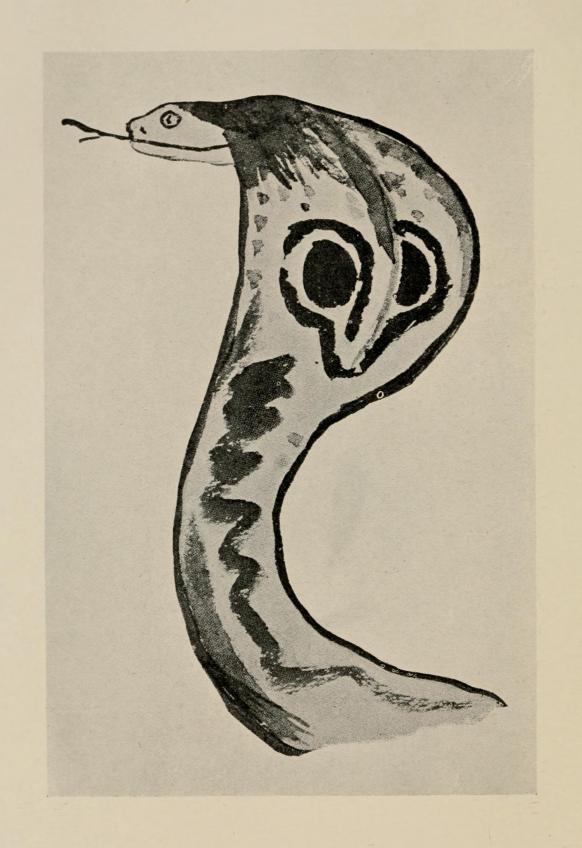
Frontispiece