INVOCATION[1].
May the kindly three-eyed god[2], who stained his
throat deep-purple by the draught of deadly poison
which he swallowed for the preservation of the world,
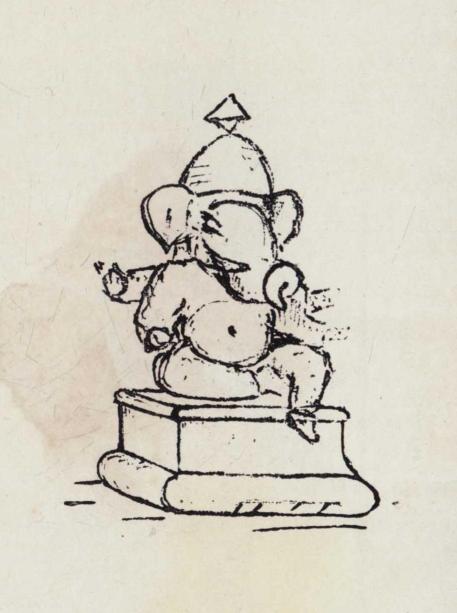
preserve you. May the Elephant-faced One[3] sweep
away with his trunk all impediments to my thoughts,
and may Wání[4] inspire into my mind for every
thought its proper word.
There lived formerly, in a certain country, a
king, called Súryakánta[5]. And his armies, guided
by Valour and Policy, had penetrated in all
directions to the shore of the ocean, and his intellect
had gone to the further shore of all the sciences,
so that one thing only was unknown to him, woman,
and the love of woman. He was, as it were, the
very incarnation of the spirit of misogyny,
beautiful exceedingly himself, to scorch with the hot
rays of his glory the despairing hearts of all fair
women who might chance to cast eyes upon him,
yet himself cold as snow to their own melting
glances. And as time went on, his ministers
became full of concern for the future of the kingdom,
for they said: The King has no son, and if he
should die, everything will go to ruin for want of
an heir. So they took counsel among themselves,
and sending for them wherever they could find
them, they threw in his way temptations in the
form of beautiful women, raining on him as it were
showers of the quintessence of all the female beauty
in the world. But all was of no avail: for no
matter what shape it took, the celestial loveliness
of those ladies made no more impression on the
King's mind than a forest leaf falling on the back
of a wild elephant. Then the ministers fell into
despair, exclaiming: Truly there is a point at
which virtues become vices. It is well for a King
to avoid the wiles of women; but out on this
woman-hating king! the kingdom will be undone
for him. And they took counsel again among
themselves, and made representations to the King,
exhorting him to marriage. But he would not
listen to anything they could say. So being at
their wits' end, they caused it to be bruited about
without the King's knowledge, by means of their
spies, that they would give a crore[6] of gold pieces
to any one who could produce a change in the mind
of the King, and inspire him with an inclination
for marriage. But though many charlatans
presented themselves and performed incantations and
other such devices, no one could be found able to
effect the desired end. On the contrary, the King's
hostility to the other sex increased so much, that
he punished every woman who came within the
range of his sight by banishing her from the
kingdom. And in their fear lest the kingdom
should be wholly deprived of its women, the
ministers had to place spies about the King, who ran
before him wherever he went, and made all the
women keep out of his way. And this task was
as difficult as standing on the edge of a sword,
for all the women in the kingdom were drawn to
see him by love and curiosity as if he were a
magnet[7] and they so many pieces of iron.
Then one day there came to the capital a certain
painter[8]. And he, as soon as he arrived, made
enquiries as to the wonders of that city. Then
the people told him: The greatest wonder in our
city is our King, Súryakánta, himself. For though
he is a king, nothing will induce him to have
anything to do with women, from the peacock of whose
beauty he flies as if he were a snake. And yet
he is himself like a second god of love, so that
here is the marvel: that one whom the Fish-bannered
god[9] has created as a sixth weapon to cleave
the hearts of the female sex should have no
curiosity to exert his power. Should the sun refuse
to warm, or the wind to blow? But when the painter
heard this he laughed, and said: I possess a charm
that would act like the sun upon its gem[10]. And
one of the spies of the ministers heard him, and
went and told them of his arrival and his brag.
And they immediately summoned that painter and
questioned him, telling him the whole state of the
case, and promising him the reward if he could
make his words good. And the painter said:
Contrive that the King shall send for me, and leave
the rest to me.
So the ministers went and told the King: Sire,
there has arrived in your capital a painter, whose
equal in skill is not to be found in the three worlds.
And when the King heard it he was delighted, for
he was himself skilled in the art of painting and all
other arts; and he caused the painter to be brought
into his presence. But he, when he came, was
amazed at the extraordinary beauty of the King,
and he exclaimed: O King, you have caused me
to obtain the fruit of my birth in bestowing on me
the priceless boon of a sight of your incomparable
beauty. And now only one more thing remains.
I implore your Majesty to let me make a copy of
it, in order that in future I may never be without
it. For the sun warms even when reflected in a
poor mirror. Then the King said: Show me first
specimens of your skill. But beware that you show
me no women, otherwise it will be worse for you.
So the painter showed him a collection of pictures
of all the countries in the world, but among them
he had secretly placed the portrait of a woman.
And as the King was turning over the pictures, one
by one, he suddenly came upon that portrait. But
the moment he looked at it, he fell to the ground
in a swoon.
Then the painter laughed, and said to the ministers:
The cure is effected: pay the physician his
fee. But they replied: We must first be sure that
the patient is really cured. The painter replied:
You will soon find that out. Look to the King,
and restore him, and see what he says when he
comes to himself and finds that I am not here. For
in the meanwhile I will go out of the room.
Then the ministers summoned attendants, who
fanned the King with palm-leaves, and sprinkled
him with water scented with sandal. And the King
revived, and instantly looking round, exclaimed:
The painter, the painter! The ministers said: Sire,
he is gone. But when the King heard that, he
changed colour, and his voice trembled, and he
said: If you have allowed him to escape, I will
have you all trampled to death by elephants before
the sun goes down. So they went out quickly and
found the painter, and fetched him in again before
the King. And he fell at the King's feet, saying:
May the King forgive me! Alas! my evil fortune
must have mixed up that lady's portrait among my
other pictures, to bring me to destruction. But the
King said: O most admirable of all painters, past,
present, or to come, know that you have conferred
a benefit upon me by exhibiting that portrait to
me, which I could not repay even with my whole
kingdom. And beyond doubt, that lady must have
been my wife in a previous existence, for emotions
such as these point unmistakeably to a former life.
Now then, tell me, of what land is her father the
king? For certain I am, that it is a portrait, for
such beauty as hers could not have been conceived
by any mortal brain. None but the Creator
himself could have fashioned her. Then the painter
smiled, and said: O King, be warned by me. Dismiss
this lady from your mind, and think of her
no more; otherwise my carelessness may turn out
to have been the cause of your ruin. But the King
said: Painter, no more. Choose, either to tell me
who she is, and be loaded with gold; or not; an
I will load you with chains, and imprison you in
a loathsome dungeon, with neither food nor water,
till you do.
Then the painter said: King, since there is no
help for it, and your fate will have it so, learn,
that this is the portrait of Anangarágá[11], the daughter
of a brother of the King of the Nagas[12], who lives
by herself in a palace in the forest, two months'
journey from here. And what her beauty is, you
yourself partly know by personal experience of the
effect which even in a picture it produced upon you:
yet what picture could be equal to the reality? For
every one that sees her instantly falls in love with
her, and many swoon away, as you did, and there
are some who have even died. And yet the Creator,
when he made her a casket of beauty so inimitably
lovely, placed within it a heart of adamant, so hard,
that it laughs at all the efforts of the flowery-arrowed
god to pierce it. For innumerable suitors have
sought her in marriage, coming from all the quarters
of the world, and she receives them all with scornful
indifference, yet entertains them magnificently for
twenty-one days, on this condition, that every day
they ask her a riddle[13]. And if any suitor should
succeed in asking her something that she cannot
answer, then she herself is to be the prize; but if
within the stipulated time he fails, then he becomes
her slave, to be disposed of how she will. And no
one has ever yet succeeded in asking her anything
she cannot answer; for she is of superhuman
intelligence, and learned in all the sciences; but of
the countless suitors who have tried and failed, some
she has sent away, and others she retains about her
person as slaves, pitilessly showing them every day
that beauty which is for ever unattainable to them,
so that their lot is infinitely worse than that of
beasts. And therefore, O King, I warned you, lest
the same thing should happen also to you. O be
wise, and shun her, before it is too late. For I
think that no lot can be more wretched than that
of those who are doomed to everlasting regret, for
having lost what nevertheless they see ever before
them, as it were within their reach.
Then King Süryakánta laughed aloud, and he
said: Painter, your judgment is not equal to your
skill in your own art. For there is a lot infinitely
more miserable, and it is that of one who passes
his whole life in regret for an object which, with
daring and resolution, he might have attained. Let
me rather pine for ever miserable in the
contemplation of such beauty, than weakly abandon my
chance of enjoying it. Then the King gave that
painter three crores of gold pieces, as the price of
the portrait of the Princess, which he took away
from him; and, after allowing him to paint his own
portrait, dismissed him. And he said to his ministers:
Make all ready: for this very night I start in quest
of the Princess Anangarágá. Then his ministers
deliberated together, and said to each other:
Certainly, if the King should fail in his object and never
return, the kingdom will be ruined. Yet, the same
will be the case if he remains here, and scorning the
society of all other women, never has a son. Therefore
it is better as it is. For of two evils, the least
is a good. Moreover, he may possibly succeed.
So that very night, burning with the fierce fire of
impatience, the King transferred the burden of his
government to the shoulders of his ministers, and set
out, with the portrait of his beloved, to win or lose
her. And he would have taken nobody with him.
But as he was preparing to depart, his boon
companion, Rasakósha[14], said to him: Sire, would you
go alone? And the King said: My friend, I may
fail, and never return. Why should I drag others
with me into the jaws of destruction? I will go by
myself. Then Rasakósha said: King, what are you
about? You leave yourself behind, if you leave me.
That half of you which inhabits your own body is
altogether gone upon[15] the Princess, and wholly
intent upon her, so as to think of nothing else:
then how will you baffle her, without that other
half of you which lives in me, and is always ready
for your service? And what am I to do without my
better half? And even if you do fail, what will you
do without me? for even prosperity without a friend
is tasteless[16]: how much more adversity! Then the
King said: Well, be it so. Come, let us be off.
But Rasakósha said: Did I not say that your mind
was wandering? Would you start on such a perilous
adventure, without first securing the aid of
Wináyaka[17]? Who ever succeeded in anything that
neglected him? And the King said: It is true. In
my eagerness I had almost forgotten him. So he
praised Ganésha, saying: Hail, O thou lord of the
Elephant Face, whose trunk is uplifted in the dance!
Hail to thee, before whom obstacles melt away like
the mists of night before the morning sun! Hail to
thee, aided by whom even the weak triumph over
the strong! Hail to thee, without whom all prudence
is vain, and all wisdom, folly! Hail, O thou whose
basket ears flap like banners of victory in the wind!
Then they set out on their journey. And they
fared on day and night through the forest, full of
wild beasts, apes, and Shabaras[18] as the sea is of
jewels: but the King in his preoccupation for many
days neither spoke nor ate nor drank, living only
on air and the portrait of the Princess, which night
and day he devoured with his eyes.
Then one day, as they rested at noon beneath the
thick shade of a Kadamba[19] tree, the King gazed for
a long time at the portrait of his mistress. And
suddenly he broke silence, and said: Rasakósha,
this is a woman. Now, a woman is the one thing
about which I know nothing. Tell me, what is the
nature of women? Then Rasakósha smiled, and
said: King, you should certainly keep this question
to ask the Princess; for it is a hard question. A
very terrible creature indeed is a woman, and one
formed of strange elements. Apropos, I will tell you
a story: listen.
In the beginning, when Twashtri[20] came to the
creation of woman, he found that he had exhausted
his materials in the making of man, and that no
solid elements were left. In this dilemma, after
profound meditation, he did as follows. He took
the rotundity of the moon, and the curves of
creepers, and the clinging of tendrils, and the
trembling of grass, and the slenderness of the reed,
and the bloom of flowers, and the lightness of leaves,
and the tapering of the elephant's trunk, and the
glances of deer, and the clustering of rows of bees[21],
and the joyous gaiety of sunbeams, and the weeping
of clouds, and the fickleness of the winds, and the
timidity of the hare, and the vanity of the peacock,
and the softness of the parrot's bosom, and the
hardness of adamant, and the sweetness of honey,
and the cruelty of the tiger, and the warm glow
of fire, and the coldness of snow, and the chattering
of jays, and the cooing of the kókila[22], and the
hypocrisy of the crane, and the fidelity of the
chakrawáka; and compounding all these together,
he made woman, and gave her to man. But after
one week, man came to him, and said: Lord, this
creature that you have given me makes my life
miserable. She chatters incessantly, and teases me
beyond endurance, never leaving me alone: and she
requires incessant attention, and takes all my time
up, and cries about nothing, and is always idle; and
so I have come to give her back again, as I cannot
live with her. So Twashtri said: Very well: and
he took her back. Then after another week, man
came again to him, and said: Lord, I find that
my life is very lonely since I gave you back that
creature. I remember how she used to dance and
sing to me, and look at me out of the corner of
her eye, and play with me, and cling to me; and
her laughter was music, and she was beautiful to
look at, and soft to touch: so give her back to me
again. So Twashtri said: Very well: and gave her
back again. Then after only three days, man came
back to him again, and said: Lord, I know not how
it is; but after all, I have come to the conclusion
that she is more of a trouble than a pleasure to me:
so please take her back again. But Twashtri said:
Out on you! Be off! I will have no more of this.
You must manage how you can. Then man said:
But I cannot live with her. And Twashtri replied:
Neither could you live without her. And he turned
his back on man, and went on with his work. Then
man said: What is to be done? for I cannot live
either with or without her[23].
And Rasakósha ceased, and looked at the King.
But the King remained silent, gazing intently at the
portrait of the Princess.
And thus travelling on, day by day, through the
forest, at length they drew near to the palace of the
Princess Anangarágá.
Then, when the towers of the palace rose over
the trees, and gleamed like gold on their eyes in the
beams of the morning sun, King Süryakánta
suddenly exclaimed: Ha! I am undone. And
Rasakósha said: How is that? Then the King said:
Alas! I have been absolutely possessed by the
image of my beloved, night and day, waking and
sleeping, so that I have thought of nothing in the
world beside. And now here we are at the end
of our journey, but at the beginning of difficulties.
For as to what I shall ask the Princess, I have not
the shadow of an idea. And if the thought of her
has such power to bewilder me at a distance, the
sight of her will utterly deprive me of my reason,
so that I am lost already. Then Rasakósha said:
O King, this is exactly why the Princess has
hitherto baffled all her lovers. The spell of her
beauty robs them of their intellect, and chains up
their invention, and thus they fall an easy prey.
But fortunate are you, that while your best half has
been absent from its body, your other half[1] has
been watching over the empty case. Be under no
concern: but when we are introduced into the
presence of the Princess, tell her that you speak
by my mouth, and leave all to me. So the King
was relieved, and dismissing all other subjects from
his mind, he again became wholly immersed in
meditating on his mistress.
Then drawing nearer by degrees, at length they
entered the precincts of the palace. And there they
were met by warders, who enquired who they were.
And they went and announced to the Princess that
King Súryakánta had arrived as a suitor for her hand.
So she sent chamberlains and others, who conducted
the King to a pleasure-house of white marble in
a garden beautiful with a lake and crystal baths,
shady with trees, perfumed with breezes loaded with
the fragrance of flowers, and musical with the songs
of innumerable birds. There they passed the day.
But the King, consumed with the fever of his burning
desire to see the Princess, had neither eyes nor
ears for anything but the portrait.
And when the sun set, King Süryakánta and
Rasakósha went to the palace of the Princess, and
entered the hall of audience, whose floor, inlaid with
slabs of dark-blue crystal, reflected their feet, and
whose walls flashed back from the facets of their
jewels the light of innumerable lamps. And there
they saw Anangarágá, sitting on a golden throne,
clad in a robe of sea-green, and a bodice studded
with coral, looking like Lakshmi[2] fresh from ocean.
And her eyes were as long as a row of bees, and
their lashes jet black with collyrium, and her lips
were like freshly painted vermilion, and from her
high bosom came the fragrance of sandal. And
round her slender waist was a girdle of gold, and
on her wrists and ankles gold bangles and anklets,
and the soles of her little feet were red with lac,
and in her black hair was a gold tiara in the form
of a snake, with eyes of rubies, and a tongue of
emerald. And in the radiance of her beauty she
looked scornfully at the King, and, turning away her
head, said, without waiting to be addressed: Propose
your question. But the King, struck by the
thunderbolt of her stupefying loveliness, sank mute and
trembling upon a couch opposite to her, and gazed
at her like a bird fascinated by a serpent. Then
Rasakósha came forward, and prostrated himself at
her feet, and said: Lady, this unworthy mortal is
the King's mouth. Is it permitted him to speak?
So the Princess said: Proceed. Then Rasakósha
rose up, and stood before her, and began:
Lady, there lived formerly, in a certain country,
a Chárwáka[3], who was about to be married. And
while he was making preparations for the ceremony,
one of his friends came to him, and gave him advice,
saying: Propitiate Genésha, in order that nothing
untoward may occur to interfere with your marriage.
Then that Chárwáka laughed in derision, and
replied: My good Sir, you are a fool. Do I not
know that knaves and fools invented the Wédas,
and instituted the sacrificial rites for their own
advantage? All these foolish tales about the gods
are merely the dreams of madmen, or the livelihood
of rogues. As for this Ganésha that you speak of,
what is the use of him? Or how can there be a man
with the head of an elephant? And what has he
to do with success? He, who forms his plans with
prudence, and executes them with wisdom, may
count on success. Out on your Ganésha! I will
ensure my own success.
So he spoke, but that lord of the Elephant Face
heard him, and laughed to himself, gently waving
his trunk. And the Chárwáka went on with his
preparations. But when all was ready, and the
lucky day fixed, then on the morning of that day
Ganapati spoke to a certain cow that used to wander
at will about the streets, saying: Cow, go and drop
your sacred excrement on that Chárwáka's doorstep.
And the cow went and did so. And when the
Chárwáka came forth from his house, he put his
foot on the cow-dung, and slipped and fell, and
broke his leg. So they took him up and carried
him in again. And before his leg was cured, his
bride died.
Then his friend came to him again, and said:
See what comes of neglecting to worship Ganapati.
But the Chárwáka answered: Go to; you are an
idiot. Who could possibly foresee that a miserable
cow would cast its dung on my doorstep? What
has Ganapati to do with it? Does he, forsooth! look
after and direct the excretions of all the cows
in the world? A pleasant idea, to be sure! So
saying, he drove his friend away, refusing to listen
to him. And when his leg was well, he found
another bride, and made preparations for another
marriage. And he hired a band of sweepers to go
before him and sweep all clean before his feet. But
when the day came, Ganapati sent for a crow that
eat the daily offerings, and said to him: Crow, there
is a Chárwáka going to be married to-day. Now,
there is an arch over a certain street, beneath which
he will pass: and on it there is an image of myself,
of stone, which is very old, and the rain and heat
have loosened and cracked it, so that it is on the
point of falling. Do you watch, therefore, and when
you see the Chárwáka passing under, then seat
yourself upon me, and I will fall. So the crow
flew off, and watching his opportunity, seated
himself upon the stone image of Ganapati; and it fell
on the Chárwáka as he passed below, and broke his
arm. So they took him up and carried him back
to his house. And before his arm was well, his
bride died.
Then his friend came once more to him and said:
Is this your wisdom? What did I tell you? Is it not
plain now, who it is that is thwarting your efforts?
Then the Chárwáka flew into a rage, and said:
Enough of your babbling! I will get married in
spite of Ganapati. But what can be anticipated in
this miserable city, whose cows befoul the streets, and
whose buildings are tumble-down. I will provide
against any similar accident happening again. So
when he was well, he discovered another bride, and
again made preparations for his wedding. And he
arranged to go to the bride's house by a circuitous
route outside the walls of the city, avoiding the
streets altogether. But on the morning of the day,
Ganapati went to Indra, and said: Wajradhara[4],
there is a Chárwáka going to get married to-day.
But he must pass over a certain water-course, which
is now dry. Lend me your rain-clouds, for I must
teach this infidel a lesson. So Indra sent his clouds,
and rained furiously on the hills. And as the
Chárwáka was passing over the water-course, the river
rose suddenly, and swept down in torrents from the
hills and carried him away and drowned him.
And Ganapati saw it and smiled. But on a
sudden he wept violently.
Now tell me, Princess, why did the lord of
obstacles laugh and weep? And Rasakósha ceased.
Then the Princess answered: He laughed when he
thought of the folly, blindness, and insolence of that
miserable infidel. But suddenly great pity came
over him, when he remembered the terrible punishment
that awaited that foolish fellow in the future,
and all those who like him prepare by their own
actions a fearful retribution in other lives and
another world: and so he wept[5].
And when the Princess had said this, she rose
up and went out, dismissing the King without
looking at him, with a wave of her hand: and the
King's heart went with her. But the King and
Rasakósha returned to their own apartments.
Then the King said to Rasakósha: My friend,
although the Princess has answered your question,
and you have lost me a day, yet I forgive you, for
the sake of the wave of her hand which she made
as she went away. Oh! it resembled the bowing
of a blossom-loaded spray of creeper in a breeze.
But if it were not for the portrait, it would be
utterly impossible for me to endure the torture of
separation from her till to-morrow. And he passed
the night in a state of intoxication[1], drunk with the
beauty of the Princess, gazing incessantly at the
portrait. And he said: Certainly, this painter was
master of his art. This is no picture, but a mirror.
There is the very scorn on her lip. And when at
last the sun rose, the King rose also, and passed the
day with Rasakósha in the garden, longing for the
moment of reunion. Then when the sun set, they
went again to the hall of audience. And there
they saw the Princess, clad in a red robe, with
a bodice studded with pearls, and her crown and
other ornaments, sitting on her throne. And the
King trembled as she looked at him, and he sank
upon a couch, speechless and fascinated, gazing at
her loveliness. Then Rasakósha came forward, and
standing before her, began again:
Lady, once upon a time there lived, in the country
of a king called Dharmásana[2], an old Brahman
who had three sons. And he possessed nothing in
the world but nineteen cows. And when he was
about to die, he called his sons around him, and
said to them: My sons, I am in the mouth of death,
therefore listen attentively to what I am going to
say. All that I have to give you is these cows.
Divide them amongst you; and let the eldest of
you take half of them; and the next, a quarter of
them; and the youngest, a fifth part of them. But
if there should be any remainder left over, you must
all three of you eat it; if not, all the cows are to
be given to the King, and my curse will rest upon
you, for disobedience to my last wishes. And
having said this, that old Brahman died. And his
sons performed his obsequies, and burned him in
accordance with the rites.
Then they assembled together for the division of
the property. And the eldest brother said: Half
of these cows, that is, nine cows and a half, are
mine. And the next brother said: One quarter
of these cows, that is, four cows and three-fourths
of a cow, belong to me. Then the youngest said:
One-fifth of these cows, that is, three cows and
four-fifths of a cow, are mine. Then the eldest said:
But the sum of all these, added together, amounts
only to eighteen cows and a fraction. Thus there
will remain over a portion of the last cow. And in
that case we must eat it. But how is it possible
for Brahmans to eat the flesh of a cow? Or even,
how are we to take various portions of any cow,
and leave it still alive[3]? But then, what is to be
done? For unless we share in our due proportions,
all the cows are to go to the King, and our father's
curse will fall upon us. And yet what can have
been the meaning of our father in placing us in so
terrible a dilemma? Thus they disputed among
themselves, and the day passed away, but not the
difficulty, and night found them still arguing without
any solution of the matter.
Now, Princess, tell me, how is this to be settled,
so as to satisfy equally the father, the three brothers,
and the King? And Rasakósha ceased. But the
Princess bent down her head, and remained a
moment in meditation, while the King's soul almost
quitted his body. Then after a while, raising her
head, she replied: Let the brothers borrow another
cow. Then of the twenty cows, let the eldest take
half, or ten cows; the next, a quarter, or five cows;
and the youngest, a fifth, or four cows. Then let
them return the borrowed cow. Thus the nineteen
cows will be exhausted without leaving a remainder,
and the father satisfied: each brother will receive
more than under their own division; and finally, the
King will be pleased. For he was a just King:
and what could displease such a king more than
that, in his dominions, Brahmans should kill and
eat cows, or disregard their father's orders[4]. Rather
would he lose, not nineteen cows, but
ten millions[5].
And when the Princess had said this, she rose up
and went out, casting a glance, as she went, at the
King, whose heart went with her. But the King
and Rasakósha returned to their own apartments.
Then the King said to Rasakósha: My friend,
though the Princess has answered your question,
and yet another day has been lost, yet I forgive
you, for the sake of the glance she gave me as she
went away. Oh! it was cooling to my burning soul
as the drops of rain to the parched and thirsty
earth. And but for the portrait, it is certain that
my life could not last till the morning. Thus the
King lamented, and passed the night in a state of
longing, gazing at the portrait of his beloved. And
when at last the sun rose, he rose also, and passed
the day with Rasakósha in the garden, longing for
the moment of reunion. And when the sun set,
they went again to the hall of audience. And there
they saw the Princess, clad in a yellow robe, and
a bodice studded with diamonds, and her crown
and other ornaments, sitting on her throne. And
she looked intently at the King, who sank upon
a couch, speechless and fascinated, gazing at her
loveliness. Then Rasakósha came forward, and
stood before her, and began again:
Lady, in a former age there was a king who died
of a fever. And his heir was a baby, too young
to speak or walk. Now that king had a brother,
who desired the kingdom for himself. And in order
to compass this object, he determined to make away
with the little Rájá, thinking to himself: There will
be no difficulty in this, for he is but a baby, and
can easily be put to death in a thousand ways.
So one night he persuaded the child's attendants,
by means of an immense bribe, to leave him alone
in his room. And he hired an assassin to kill him,
posting him in a secret place within the palace, and
telling him: At such an hour, enter the king's room,
where you will find him alone, and kill him. But
this assassin was a Rajpoot from the Deccan,
who had but just come to that city, and did not
know who the king was. And expecting a man,
at the appointed hour he entered the king's room,
and saw nothing but a baby playing on the floor
with a fruit. And the fruit, escaping from its hands,
rolled to the feet of the assassin as he came in.
And the little Rájá put out his hand, and cried,
Bhó, Bhó. So the assassin rolled it back, and the
baby laughed and clapped its hands. Thus they
remained, playing with the fruit, till the guards
came in and found that assassin. And when they
asked him who he was, he said: I have a message
from my master to the king. Then they laughed,
and said: The king is dead: there is the king. But
he was amazed, and said: Then I must return and
tell the news to my master. For how can I deliver
a message to one who cannot even speak? And
they suffered him to depart, and he went out, and
fearing for his own life, left that city without delay.
Then the king's brother, finding that his plot had
failed, hired a whole band of robbers. And watching
his opportunity, he posted them by the side of
a road leading to a temple, and said: There will
come by this road a baby, magnificently dressed,
and ornamented with jewels, attended by servants.
Fall on them and plunder them, and if you please,
kill them, but make sure that you kill the baby.
But while they waited, in the meanwhile some other
robbers, attracted by the richness of the little Rájá's
ornaments, set upon his retinue. And killing all
his servants but one, who fled naked, they stripped
the little Rájá of all he had on him, but left him
alone alive, saying: He cannot tell any one, let him
live. So they hastily departed. Then that fugitive
crept back, and finding the baby in the road, picked
it up, and wrapping it in a cloth, carried it home.
And he passed before the eyes of the gang that
was waiting to kill the baby Rájá, but they thought
that he was some beggar, and took no notice of
him. And thus a second time the child escaped.
Then the king's brother bribed a cook, who put
deadly poison into the little Rájá's milk. And it
was given to him in a crystal goblet. And he took
it in both hands, and put it to his mouth, to drink;
and at that instant, one of the attendants standing
before him sneezed. And the little Rájá dropped
the goblet, and began to crow and clap his hands
in delight; but the goblet fell to the ground and
broke into a thousand pieces, and all its contents
were spilled upon the floor. Thus he escaped the
third time. And before the king's brother could
form another plot, he was himself slain by the
husband of a woman of the Kshatriya caste, whom
he had carried off and dishonoured.
Now tell me, Princess, how was it that the
schemes of that villain could never succeed against
the little king, being but a mere child? And
Rasakósha ceased. Then the Princess said: It was its
very childhood that baffled him. For just as a
stone, lying openly on the ground, is more secure
than a costly jewel, though protected by adamantine
bars, because it is worthless and arouses no cupidity;
so is a thing so feeble that none would attack it
more powerfully protected by its very feebleness
than strength possessed of many enemies though
defended by a thousand guards. No antidote so
good, as the absence of poison: no virtue so good,
as the absence of beauty: no fortification so good,
as the absence of enemies: and no guard so potent
as the helplessness of a child. For where are the
enemies of the fragile lotus?
And when the Princess had said this, she rose
up and went out, looking back as she went at the
King, whose heart went with her. But the King and
Rasakósha returned to their own apartments.
Then the King said to Rasakósha: My friend,
your question was again answered by the Princess,
and of my days now three are gone, yet freely do
I forgive you, for the sake of the glance she gave
me as she went away. Oh! it snared my soul as
it were in a net. And but for the portrait to keep
me alive during the period of separation, beyond
question I should never see the light of day. So
he passed the night in a state of lovelorn recollection[1],
an enemy to sleep, gazing at the portrait.
And when the sun rose, he rose also, and got
somehow or other through the day, by the help of
Rasakósha and the garden. Then when the sun
set, they went again to the hall of audience. And
there they saw the Princess, clad in a sable robe and
a bodice studded with sapphires, and her crown and
other ornaments, sitting on her throne. And she
looked kindly at the King, who sank trembling upon
a couch, speechless and fascinated, under the spell
of her beauty. Then Rasakósha came forward, and
standing before her, began again:
Lady, there lived formerly in a certain country
two brothers, Brahmans, called Bimba and
Pratibimba[2], who were twins. And I think that the
Creator, when he made one, had gone under water
to make the other. For the moon does not more
closely resemble her own image in a lake, nor one
leaf on a branch another, than each of them did the
other. Between them, when they were children, the
sole point of distinction was the charm tied for that
purpose round their necks; and when they grew up,
those who saw them together imagined that their
own eyes had become enemies, and were each giving
a separate reflection of the self-same object. And
as their external forms, so were their voices, and
their internal dispositions: they corresponded in
every atom, from the extremity of the skin to the
inmost recesses of the heart.
Now one day it happened that Bimba saw a young
woman[3] at the spring festival. And she looked at
him at the same moment. And then and there the
god of love penetrated their hearts, employing their
mutual glances as his weapon. So having discovered
her family and place of residence, Bimba used to
go and visit her three days in every week. But in
the excess of his own happiness, proud of the
extraordinary beauty of his love, he could not contain
himself, nor endure to keep the secret of his own
good fortune. So he told his brother the whole
story; and contriving a suitable opportunity, he
exhibited to him his mistress, who was all
unconscious of what he was doing. But Pratibimba, being
as he was but the double of his brother, instantly
conceived an equally violent passion for her. And
without scruple—for what has love to do with
honour?—he used to go himself, on the other three
days of the week, to visit her. But she in the
meanwhile, believing him to be Bimba himself, for she
could not see any difference, only rejoiced in gaining
as she thought the company of her lover twice as
often as before.
But when some time had passed by, it fell out
that Bimba, not being able to endure separation,
went to visit his mistress on one of his brother's
days. And when he got there, he saw Pratibimba,
who had arrived before him, and was lying asleep
on a couch while his beloved fanned him with a palm
leaf. But she, when she saw Bimba come in, uttered
a shriek of astonishment and terror, which woke
Pratibimba. And while she looked in amazement
from one to the other, Bimba rushed upon
Pratibimba, mad with jealousy and howling with rage,
while Pratibimba did the same to him. And
grappling with one another, they rolled upon the floor,
fighting and kicking each other, till, hearing the
shrieks of the woman, the King's officers came in
and separated them, and carried them all three to
the judge. Then Bimba said: This man is my
brother, and he has stolen my beloved from me.
But Pratibimba said: No, she is mine: it is you
that are the thief. Then Bimba howled: I was first,
and you are a villain. And Pratibimba echoed his
words[4]. So the judge said to the woman: Which
of them is your lover? But she answered: Sir,
I cannot tell which is which, nor did I ever know
that there were two till to-day.
So now tell me, Princess, how shall the judge
distinguish between them? And Rasakósha ceased.
Then the Princess said: Let him take all three
apart, and ask each to describe in detail the
circumstances under which he saw the woman first.
For though the impostor may have heard that it was
at the spring festival, yet the eye that saw, aided by
the heart that remembers, will convict the ear that
only heard.
And when she had said this, the Princess rose up
and went out, smiling at the King over her shoulder,
and she drew away the King's heart after her.
But the King and Rasakósha returned to their own
apartments.
Then the King said to Rasakósha: My friend,
though my mistress guessed your question, and now
four days have gone, yet I forgive you, for the sake
of the smile she gave me when she went away.
Oh! it irradiated the gloom of my soul like as the
moonlight illuminates the forest glades: and when
she disappeared, darkness again prevailed. But for
the portrait, I were a dead man before morning.
And he passed the night in a state of impatience,
gazing at the portrait. Then when the sun rose, he
rose also, and passed the day by the help of
Rasakósha and the garden. And when the sun set, they
went again to the hall of audience. And there they
saw the Princess, clad in a pale red[1] robe, and
a bodice studded with emeralds, and her crown and
ornaments, sitting on her throne. And she dropped
her eyes when she saw the King, who sank with
a beating heart upon a couch, speechless and
fascinated, under the spell of her beauty. Then
Rasakósha came forward and stood before her, and began
again:
Lady, in former times there was a king, who made
war upon a neighbouring king, and went out and
fought a great battle with him. Now there was in
his army a certain Kshatriya, who, fighting all day
long in that battle, after slaying multitudes of the
enemy with his single arm, at length grew tired and
faint from exhaustion. And perceiving this, many
of the enemy set upon him at once, and overpowered
him, and after mangling him with innumerable
wounds, left him for dead upon the ground. But
when the moon rose, that Kshatriya recovered his
senses, and as it were came back to life. And he
dragged himself with difficulty as far as a neighbouring
village. And then his strength failed, and
sinking down exhausted at the door of a certain
house, he struck one great blow upon it, and fell
down senseless.
Now there lived in that house a Brahman woman,
whose husband was away from home. And she was
beautiful as a jasmine blossom, and pure as snow,
and her name was Suwarnashílá[2]. And hearing the
knock, in the dead of night, she was frightened; but
she looked out of a small round window, and saw
in the bright moonlight a man lying still at her door.
Then she thought: This may be a snare.
Alas! the neighbours praise me for my beauty, and to
whom is not beauty an object of cupidity? Or how
can beauty, like a great pearl, be safe when its
guardian is away? Then she looked again, and saw
a dark stream trickling from the body along the
white ground. And her heart was filled with
compassion, and she thought: Doubtless the man is
wounded, and perhaps dying. The greater[3] sin
would be, to leave him to die at my door. So she
summoned her maid, and went out, and took in the
wounded man, and dressed his wounds and nursed
him, keeping him in her house till he was well.
Then that Kshatriya, seeing her daily, was burned
to a cinder by the glory of her beauty, and he made
evil proposals to her. But she stopped her ears, and
would not listen to him, but said: What! would you
repay benefits with treachery and ingratitude? Know,
that to a virtuous woman her husband is a god.
Depart, and let me alone. Then finding that he
could not prevail upon her, the Kshatriya said to
her: It is you, not your husband, that is the divinity.
Your beauty would turn even a holy ascetic from his
penance. And though I owe you my life, yet you
have robbed me of it again. And now I must depart
quickly, otherwise my passion will master me, for
love is stronger than gratitude. Then he went away
hurriedly, but with reluctance, somewhere else.
But when the husband returned, a certain barber's
wife, who was jealous of Suwarnashílá for her
beauty, met him and said: Happy are those who
possess treasures. In your absence another man
has been wearing your crest-jewel. So the husband,
burning with jealousy, went home and asked his
wife. And she said: It is true, but listen; and
she told him the whole story. But he would not
believe her. Then she extended her hand to the
fire, and said: I appeal to the fire, if I have ever
been faithless to you for a moment, even in a dream.
And the fire shot up, and a bright flame licked the
roof, and two tongues of flame crept out and kissed
that saint, one on the mouth, and the other on the
heart. But blinded with jealousy and rage, the
husband said: This is a trick. And taking his
sword, he said to his wife: Follow me. So she
said: As my lord pleases. Then he led her away
into the forest, and there he tied her to a tree, and
cut off her hands and her feet, and her nose and
her breasts, and went away and left her. And after
a while she died alone in the forest, of cold and
pain and loss of blood.
But that Kshatriya heard of what he had done.
And filled with rage and despair, he went to that
husband, and said to him: O fool, know, that you
have murdered a saint. And but that I know that
life will henceforth be a punishment to you worse
than any death, I would slay you where you
stand. But as it is, live, and may your guilt bring
you death without a son. Then the husband,
learning the truth, and discovering the villainy of
that lying barber's wife, was filled with remorse.
And he abandoned the world, and went to the
Ganges to expiate his guilt. But the Kshatriya
killed himself with his own sword.
So now tell me, Princess, why does fate inflict
such terrible punishment on the innocent[4]? And
Rasakósha ceased. Then the Princess said: Can
emancipation be attained, save by those who are
worthy of it? And how can gold[5] be tested, save
by fire? And Suwarnashílá stood the test, and
proved her nature: and doubtless she has her
reward. For even death is not so sure as the
consequences of even the minutest action.
Then a bodiless voice[6] fell from the sky, and said
aloud: Well spoken, dear child. And the Princess
rose up and went out, looking at the King with
glistening eyes, and the heart of the King went
with her. But the King and Rasakósha returned
to their own apartments.
Then the King said to Rasakósha: My friend,
though your question was again answered by the
Princess, and now five days are lost, yet fully do
I forgive you, for the sake of the tear that glistened
in her eye as she went away. O! it was like
a drop of dew in the blown flower of a blue lotus.
It is beyond a doubt that but for the portrait my
life would fail before the morning. And he passed
the night in a state of stupefaction, gazing at the
portrait of his mistress. Then when the sun rose,
he rose also, and got through the long hours of day
with difficulty by the help of Rasakósha and the
garden. And when at length the sun set, they went
again to the hall of audience. And there they saw
the Princess, clad in a blood-red robe and a bodice
studded with opals, and her crown and other
ornaments, sitting on her throne. And she was looking
for the King when he came in, and the King sank
upon a couch, speechless and fascinated, under the
spell of her beauty. Then Rasakósha came forward
and stood before her, and began again:
Lady, there was once a king who had three
queens, of such indescribable beauty, that at night
in the light fortnight it was impossible to decide
which of the four was the true moon. And one
night, when the king was sleeping in the hot season
on the terrace of his palace in the company of his
queens, he woke up while they were asleep. And
rising up, he stood in the moonlight looking down
upon his sleeping queens. And he said to himself:
Various indeed is the form assumed by the beauty
of woman. But I wonder which of my queens is
the most beautiful of the three. So he went from
one to the other, considering them attentively. And
one queen lay on her back in the full light of the
moon, with one arm over her head, and one breast
raised, and every now and then a light breeze stirred
and lifted her garment, disclosing it. And another
lay in the shadow of the trellis-work with alternate
stripes of shadow and light turning her into curves
of ebony and ivory. And the third lay all in deep
shadow, save that a single streak of moonlight fell
softly on the shell of her little ear. So the king
wandered all night from one to another, puzzling
over his difficulty, thinking each queen to be the
most beautiful till he came to another. And before
he had decided it, the sun rose.
Then when, after performing his daily ceremonies,
he was going to take his seat on his throne, his
prime minister, named Nayanétri[1] said to him:
O king, why are your royal eyes red with want
of sleep? So the king said: Nayanétri, last night
it came into my head to ask myself, which of my
three queens was the most beautiful. And I could
not sleep for my perplexity, and even now I have
not been able to solve the problem. Then
Nayanétri said: O king, be content that you have
queens between whom there is no distinction in
beauty, and no cause of jealousy. Idle curiosity
destroys peace of mind and produces evil. But
the king said: I am determined, at whatever cost,
to settle this point.
So finding that the king's heart was set upon
the matter, Nayanétri said to him: King, ministers
are like riders: a horse which they cannot restrain
they must at any rate guide, or it will be the worse
for both. Since it is absolutely necessary for you
to decide between your queens in respect of beauty,
listen to me. There has recently arrived in your
capital a dissolute young Brahman called Kántígraha[2],
who is famous in the three worlds as a
judge of female beauty. Send for him, and let him
see your queens, and he will certainly tell you which
is the most beautiful. For a swan cannot more
accurately separate milk from water[3], than he can
distinguish the shades of beauty.
Accordingly the king, much pleased, had Kántígraha
fetched; and as they stood conversing, he
caused his three queens to pass in order through
the room. And when the first queen passed, the
Brahman stood as if rooted to the ground. And
when the second passed, he trembled slightly. And
when the third passed, he changed colour. Then
when all had gone, the king said: Brahman, tell
me, for you are a judge, which of those three is
the most beautiful? But Kántígraha said to himself:
If I tell the king, I may displease him, by slighting
his favourite: moreover, the other two queens will
certainly hear of it, and have me poisoned. So he
bowed, and said: King, I must have time to decide:
give me leave till to-morrow. So the king
dismissed him. And Kántígraha went quickly away,
intending to quit that city before nightfall, yet with
reluctance, for he said to himself: There is one of
those queens I would give much to enjoy.
But Nayanétri, who could read the heart from the
external signs, said to the king: King, this Brahman
means to give you the slip, for he is afraid, and will
probably endeavour to leave the city before night.
But I can tell you what to do, so as to discover
his opinion. So the king did as his minister told
him. And discovering which of his queens was the
most beautiful, he loved her the best, so that the
other two, being jealous, poisoned her. And the
king, discovering it, put them to death. Thus
through curiosity he lost all his queens, as
Nayanétri predicted.
So now tell me, Princess, what did the king do
to discover the opinion of Kántígraha? And
Rasakósha ceased. Then the Princess said: He need
not have done anything: the third queen was the
most beautiful. For the first queen's beauty
astounded that Brahman; that of the second struck
him with awe: but that of the third touched his
heart. However, Nayanétri wished to make sure.
And so, knowing the character of Kántígraha, he
caused the king to send him false letters, one from
each queen, feigning love and appointing a meeting,
but all for the same hour. And he, being only one,
would go to that queen whom he judged most
beautiful, and be caught by the guards set to watch
by the king. For the actions of men are a surer
indication of their hearts than their words.
And when the Princess had spoken, she rose up
and went out, with a look of regret at the King,
whose heart went with her. But the King and
Rasakósha returned to their own apartments.
Then the King said to Rasakósha: My friend,
though the Princess has again baffled you, and now
six days are lost, yet I forgive you, for the sake
of the opportunity that your story gave my
beloved of exhibiting her wonderful intelligence.
Oh! she has the soul of Brihaspati in a woman's body.
But my heart was racked by the regret in her
glance as she went away. And even with the
portrait, I cannot understand how I shall endure the
period of separation. So he passed the night in
a state of restlessness, gazing at the portrait. And
when the sun rose, he rose also, and managed to
get through the day, aided by Rasakósha and the
garden. Then when the sun set, they went again
to the hall of audience. And there they saw the
Princess, clad in a robe of azure and a bodice
studded with crystal, and her crown and other
ornaments, sitting on her throne. And she sighed
when she saw the King, who sank upon a couch,
speechless and fascinated, under the spell of her
beauty. Then Rasakósha came forward and stood
before her, and began again:
Lady[1], there was in former times a rogue, who
had lost his all by gambling with other rogues like
himself, and who became an ascetic in order to
make a living by seeming piety. So he smeared
his body with ashes, and matted his hair into a
knot, and put on a yellow rag and a necklace of
bones and a rosary, and went about hither and
thither in the world practising hypocritical
asceticism when anybody was looking at him, and
begging. And one day, when he was sitting by the
roadside, the daughter of the king of that country
passed by on her elephant. And the wind blew
aside the curtain of her howdah, and revealed her
to his eyes. And she struck him with the fever
of fierce desire, so that he uttered an ejaculation,
and exclaimed: The fruit of my birth certainly
lies in obtaining possession of that beauty. But
how is it to be done?
So after meditating profoundly on the matter for
a long time, he went to a large tree just outside
the king's palace, and hung himself up like a bat[2],
head downwards, from a branch. And thus he
remained for hours, muttering to himself. And this
he continued to do every day, so that the people
came in crowds to see him. And news was carried
to the king that a great ascetic had come, and
was practising penance in a tree in front of his
palace. So the king, much pleased, and thinking
himself fortunate, went to examine him, and the
ascetic blessed him, upside down, from the tree.
Then the king was delighted, and sent food and
other offerings to the rogue.
Then one day it happened that the king's
daughter, whose name was Hasamúrtí[3], came by
on her elephant, and saw the ascetic hanging like
a bat in the tree. And the sight tickled her and
she laughed aloud; and the ascetic heard her. So
getting down from the tree, he went to the king.
And having effected an entrance, he said to him:
King, your daughter laughs at me, thus disturbing
my devotions in the tree. Now in former times
many great sages, irritated by scorn or neglect,
have cursed the offenders, and inflicted terrible
punishments on them. But I am long-suffering,
and will spare your daughter. Nevertheless, I am
about to curse your kingdom, so that no rain
will fall on it for twenty years. Now the king
was a great simpleton. And when he heard this,
he was dreadfully alarmed: and he prayed so
earnestly to the ascetic that the rogue, pretending
to be mollified, said: Well, for this time I will
abandon my design of cursing your kingdom.
Only beware that it does not occur again. Then
he went back to his tree, and the king scolded his
daughter in private.
But the very next day the king's daughter passed
again by the tree. And seeing the ascetic hanging,
in spite of her promises to her father, her former
hilarity returned upon her mind, and she laughed
louder and longer than before. So the ascetic went
again to the king, who, pale with terror, managed
with difficulty and the most abject apologies once
more to appease his wrath. And he returned to
his tree, and the king again scolded his daughter,
who promised never to offend again.
Then for two days Hasamúrtí went and came
by another road, to avoid the opportunity of giving
offence to the ascetic. But on the third day she
forgot, and once more came past the tree, and saw
him hanging. And suddenly, as if inspired by
Shiwa himself[4], she burst into a peal of laughter,
and she continued to laugh as if she was mad,
even after she had entered the palace.
So the ascetic got down from the tree, and went
to the king. And he said: O king, certainly your
kingdom is doomed, and your daughter is possessed
by an evil spirit. For she has laughed at me again,
even worse than before, and cancelled years of my
reward, by disturbing my meditations. Now
therefore, prepare to suffer the extremities of my
vengeance. Then the king, at his wits' end, said:
Holy man, is there absolutely no remedy? The
ascetic replied: Am I ever to be disturbed in my
devotions? There is none; your daughter is clearly
incurable. But the king said: Can nothing be done
to cure her? Do you know no potent spell to
conquer her malady? Then that rogue, inwardly
delighted, said: Well, I will do this, out of mercy
I will see your daughter, and perform incantations
over her. And if I can drive out the evil spirit
of unseasonable laughter that possesses her, it is
well: but if not, nothing remains but the curse.
So the king carried him to his daughter's
apartments, and said to his daughter: My daughter,
your laughter incessantly disturbs this holy man
at his devotions. And now he has come, out of
mercy, to exorcise the laughing demon that
possesses you: otherwise, my kingdom, cursed by him,
will perish for want of rain. Then the ascetic said:
Let all others depart, and leave me in private with
the king's daughter. But the king said aside to
the ascetic: Sir, my daughter must not be left
alone with any man. Then the ascetic replied:
Fear nothing on my account: I am not a man:
it is many years since I sacrificed my manhood[5]
to the Dweller in the Windhya hills.
But Hasamúrtí heard him, and she said to herself:
My father is a fool, and doubtless this man
has some design against my honour. He shall find
I can do more than laugh. So she said to her
father: Have no fear: this is a holy man. But
she secretly stationed all her maids in readiness
in the next room. Then when the ascetic found
himself alone with the king's daughter, his evil
passion rose to such a pitch that he could scarcely
contain himself. Nevertheless he drew a circle,
with trembling hands, and placing the king's
daughter in it, he muttered awhile, and then said:
My daughter, you must have the quarters of heaven
for your only garments[6], or the spell will not work.
Remove your clothes. But Hasamúrtí said:
Reverend Sir, it is impossible. Then he caught hold
of her. But she clapped her hands, and her maids
ran in and seized him. And she said: Examine
this ascetic, and see whether he is a man or not.
So they did so, and said, laughing: Madam, he
is very much a man indeed. Then Hasamúrtí said:
Take this knife, and deprive him of his manhood.
And they did as she commanded them.
Then Hasamúrtí said to him: Now go, for the
incantation is finished. And if you please, complain
to the king, my father: I have the evidence to
convict you. So the maids released that ascetic.
But he, as soon as they let him go, began to laugh,
and continued to laugh till he reached the king.
And he said: O king, do not hinder me: we have
successfully performed the incantation, and see, I
have caught the laughing demon, and am carrying
him away. And he went away laughing, with death
in his heart.
So now tell me, Princess, why did that ascetic
laugh? And Rasakósha ceased. Then the Princess
frowning slightly, replied: He laughed, in the
cowardice of his soul, with exultation at having
escaped from those maids as from the mouth of
death: counting the failure of his scheme and the
loss of his manhood as nothing, in comparison with
the preservation of bare life. For cowards count
the loss of life as the greatest of evils: but the
great-souled esteem it as the least, and would forfeit
it a thousand times, rather than fail in the object
at which they aim.
And when she had said this, the Princess looked
significantly at the King, and rose up and went
out, and the King's heart went with her. But
the King and Rasakósha returned to their own
apartments.
Then the King said to Rasakósha: My friend,
though my beloved has answered your question, and
now seven of my days are gone, yet I forgive you,
not only for the sake of her frown—oh! it played
on her face like a dark ripple over the surface of
a lake—but still more for the sake of her words.
For surely she meant to encourage me in my suit.
Oh! she is a paragon of wisdom, and yet it is just
her wisdom that makes her inaccessible. Even
the portrait scarcely suffices to keep my soul alive
during the long hours of separation. Thus he
passed the night in a state of trepidation, gazing
at the portrait. And when the sun rose, he rose
also, and got somehow or other through the day
by the help of Rasakósha and the garden. Then
when the sun set, they went again to the hall of
audience. And there they saw the Princess, clad
in a saffron robe and a bodice studded with
carbuncles, and her crown and ornaments, sitting on
her throne. And she smiled at the King as he came
in, and he sank upon a couch, speechless and
fascinated, under the spell of her beauty. Then
Rasakósha came forward and stood before her, and
began again:
Lady, there lived formerly in a certain country
a very stupid Brahman householder, who inadvertently
committed a deadly sin. And his spiritual
adviser told him, that his guilt could be cleansed
and his sin atoned for, only by going and spending
the remainder of his life bathing in the Ganges.
So he handed over his goods to his son, and set
out, with his pot and staff, on his pilgrimage to the
Ganges. And after travelling for some days, he came
to the bank of a small mountain streamlet, whose
waters in the hot season were all but dry. And
he said to himself: Doubtless this is the sacred
Ganges. So he took up his abode on the banks
of that stream, bathing every day in such water
as he could find. And thus he remained for five
years.
Then one day there passed by that way a
Páshupata[1] ascetic. And he said to the Brahman: My
son, what are you doing here? So he replied:
Reverend Sir, I am performing penance, for the
expiation of sin, on the banks of the Ganges. Then
the ascetic said: What has this miserable puddle
to do with the Ganges? And the Brahman said:
Is this, then, not the Ganges? And the ascetic
laughed in his face, and said: Truly, old as I am,
I did not think that there had been folly like this
in the world. Wretched man, who has deluded
you? The Ganges is hundreds of miles away, and
resembles this contemptible brook no more than
Mount Méru resembles an ant hill.
Then the Brahman said: Reverend Sir, I am
much obliged to you. And taking his pot and
staff, he went forward, till at length he came to
a broad river. And he rejoiced greatly, saying:
This must be the sacred Ganges? So he settled
on its bank, and remained there for five years
bathing every day in its waters. Then one day there
came by a Kápálika[2], who said to him: Why do
you remain here, wasting precious time over a river
of no account or sanctity, instead of going to the
Ganges? But the Brahman was amazed, and said:
And is this, then, not the Ganges? Then the
Kápálika replied: This the Ganges! Is a jackal
a lion, or a Chándála[3] a Brahman? Sir, you are
dreaming.
Then the Brahman said sorrowfully: Worthy
Kápálika, I am indebted to you. Fortunate was
our meeting. And taking his pot and staff, he went
forward, till at length he came to the Nermada.
And thinking: Here, at last, is the sacred Ganges;
he was overjoyed; and he remained on its banks
for five years, bathing every day in its waters.
But one day he observed on the bank near him,
a pilgrim like himself, casting flowers into the river,
and calling it by its name. So he went up to him
and said: Sir, what is the name of this river? And
the pilgrim answered: Is it possible that you do not
know the holy Nermada? Then the Brahman sighed
deeply. And he said: Sir, I am enlightened by
you. And he took his pot and staff, and went
forward.
But he was now very old and feeble. And long
penance had weakened his frame and exhausted
his energies. And as he toiled on in the heat of
the day over the burning earth, the sun beat on his
head like the thunderbolt of Indra, and struck him
with fever. Still he gathered himself together and
struggled on, growing weaker and weaker day by
day, till at last he could go no further, but fell down
and lay dying on the ground. But collecting all
his remaining strength, with a last desperate effort
he dragged himself up a low hill in front of him.
And lo! there before him rolled the mighty stream
of Ganges, with countless numbers of pilgrims doing
penance on its banks and bathing in its stream.
And in his agony he cried aloud: O Mother
Ganges! alas! alas! I have pursued you all my
life, and now I die here helpless in sight of you.
So his heart broke, and he never reached its shore.
But when he got to the other world, Yama said
to Chitragupta[4]; What is there down against him?
And Chitragupta said: I find against him a terrible
sin. But that he has expiated by fifteen years'
penance on the banks of Ganges. Then that
Brahman was amazed, and said: Lord, you are mistaken.
I never reached the Ganges. And Yama smiled.
Now tell me, Princess, what did Yama mean by
his smile? And Rasakósha ceased. Then the
Princess said: Yama is just, and cannot err: and
Chitragupta cannot be deceived. But what is this whole
world but illusion! And just as penance performed
in an improper spirit, even on the actual banks
of Ganges, would be no true penance, so that poor
simple Brahman's penance, performed in the belief
that he had reached the Ganges, was counted by
that holy One as truly so performed. For men
judge by the fallacious testimony of the senses, but
the gods judge by the heart.
And when the Princess had said this, she rose
up and went out, smiling at the King, whose heart
went with her. But the King and Rasakósha
returned to their own apartments.
Then the King said to Rasakósha: My friend,
the Princess is again victorious, and now eight days
are lost, yet I cannot but forgive you, for the sake
of the smile she gave me when she went away.
Oh! it gleamed on my soul like the dazzling
whiteness of a royal swan illuminated by the sun on the
Mánasa lake. Alas! even the portrait will scarce
enable me to live till the morning. And the King
passed the night in a state of bewilderment, gazing
sorrowfully at the portrait. Then when the sun
rose, he rose also, and got through the long day
by the help of Rasakósha and the garden. And
when the sun set, they went again to the hall of
audience. And there they saw the Princess, clad
in a purple robe, with a bodice of burnished gold,
and her crown and ornaments, sitting on her throne.
And she looked at the King with joy, and the King
sank upon a couch, speechless and fascinated, under
the spell of her beauty. Then Rasakósha came
forward and stood before her, and began again:
Lady, in a certain city there was a wealthy
merchant, who possessed a very beautiful wife; and he
loved her more than his own soul. But she was
of light conduct, and walked in a path independent
of her husband[1], and looked after other men, and
her virtue under temptation was like a blade of
grass in a forest conflagration. And though out of
his great love for her, that merchant forgave her
all her faults, she only despised him for it, and
disliked him the more.
And one day, she looked out of her window, and
saw in the street a handsome young Rajpoot. And
smitten with passion, she instantly left her husband
and her home, and ran away with him. But when
he found that she had gone, that merchant, her
husband, in his despair almost abandoned the body.
But the hope that she would one day return kept
him alive: hope alone binds those whom separation
has made miserable to the world. Nevertheless,
from the day she departed, all other things became
abominable in his eyes. And neglecting his
business, he sank into poverty, and became an object
of contempt and derision to his friends. And
forsaking all occupation or pleasure, he remained alone
in his empty house, with the image of his runaway
wife in his heart, night and day. And thus he
lived for three years, every hour of which seemed
to him as long as a kalpa, in the black darkness
of desolation.
But she, in the meanwhile, after living with that
Rajpoot for some time, grew tired of him, and left
him for another paramour, and him again for
another, flitting from one to another like a bee from
flower to flower. And it happened that one night,
when she was living with a certain merchant's son,
he, in the new ardour of his admiration for her
beauty, suddenly stooped down to kiss her feet.
But not being aware of his intention, she drew her
foot abruptly away, and it caught on the jewel of
a ring in his ear, and was torn. And even though
it was cured, the scar remained.
And one day, when three years had gone by, her
husband, the merchant, was sitting by himself in his
deserted house, gazing with the eye of his heart[2]
at the image of his wife, when there came a knock
at the door. And as his servants had all long ago
left him, for he had no money to give them, he
went to open it himself. And when he did so,
he looked, and there before him was his wife.
She was worn, and old, and the flower of her beauty
was gone, and she was clothed in rags and dusty
with travel, and she looked at her husband with
eyes dim with tears and shame and fear, as she
leaned against the doorpost, faint from hunger and
thirst and fatigue. But when he saw her, his heart
stopped, and his hair stood on end, and he uttered
an exclamation of wonder and joy. And taking her
in his arms, he carried her in, and put her on the
bed which she had abandoned and disgraced; and
fetching food and water, with feet that stumbled
from the ecstasy of his joy, he washed the dust off
her, and dispelled her anxiety and fear, and revived
her heart, and uttered no reproaches, but blessed
her for her return, with laughter and tears; and it
was as though she had never been away, even in
a dream. And as he was gently cherishing her,
and shampooing her all over to soothe her fatigue,
his eye fell on the scar that had remained on her
foot from the wound caused by the merchant's son.
And putting his finger on it, he said to her with
a smile of compassion: Poor wounded foot, it has
found a resting-place at last. But she looked at
him silently, with large eyes, and suddenly she
laughed, and then and there her heart broke and
she died. And he, when he found that she was
dead, fell down on the floor at her feet, and followed
her.
So now, tell me, Princess, why did that woman's
heart break? And Rasakósha ceased. Then the
Princess said: It broke with grief. For when she
saw that her husband repaid her evil conduct with
kindness, and remembered the occasion that had
caused that wound upon her foot, repentance came
suddenly and flowed into her, like a river too great
for her heart to hold it, and it split and broke,
and she died.
And when she had spoken, the Princess rose up
and went out slowly, looking regretfully at the
King, whose heart went with her. But the King
and Rasakósha returned to their own apartments.
Then the King said to Rasakósha: My friend,
now nine days are gone, and I begin to fear: and
certainly, I never will forgive you if I lose my
darling. For she looks at me now, not as she used
to look, but kindly, as if she also felt the pang of
separation. Now, therefore, devise some cunning
question that she cannot answer, while I endeavour
by means of the portrait to keep my soul from
parting from my body till to-morrow. So the King
passed the night in a state of doubtful perplexity,
gazing at the portrait. And when the sun rose, he
rose also, and got somehow through the day, aided
by Rasakósha and the garden. And when the sun
set, they went again to the hall of audience. And
there they saw the Princess, clad in a robe of
dazzling white, and a bodice studded with amethysts,
and her crown and other ornaments, sitting on her
throne. And she looked at the King and drew
a long breath, and the King sank upon a couch,
speechless and fascinated, under the spell of her
beauty. Then Rasakósha came forward and stood
before her, and began again:
Lady[1], there lived formerly in a certain village,
a tawny-haired wrestler, who kept in his house a
pet. And one day he returned home and found
that it had gone out. So he ran out into the street
to look for it. And seeing a man sitting at the
corner of the street, he asked him: Have you seen
my pet? The man said: Had it a string tied round
its neck? The wrestler said: Yes. Then the man
said: It went this way. So the wrestler went on, and
enquired again. And one said: I saw it standing
on two legs, endeavouring to climb that wall. Then
another said: And I saw it on all fours crawling
along by the wall. And a third said: And I saw
it, on three legs, scratching its head with the fourth.
So going still further, he met a washerman, who
told him: It came this way and made faces at its
own face in the water. And going still further, he
met a fruit-seller, who said: I saw it sitting under
that tree, pulling out the feathers of a bleeding
crow[2], and I gave it a handful of monkey nuts.
Then going on, he met two men conversing
together, and he asked them. And one said: I saw
it with another of its own species searching for fleas
in its hair. And the other said: What was the
colour of the hair[3]? The wrestler answered: The
same as mine. So the other replied: It is over
yonder in the tree, swinging on a branch.
So now tell me, Princess, what kind of creature
was that wrestler's pet? And Rasakósha ceased.
Then the Princess smiled and said: It was no ape,
but a child; perhaps his own son.
And when she had said this, she rose up and went
out, as if with difficulty, looking reproachfully at
the King, whose heart went with her. But the King
and Rasakósha returned to their own apartments.
Then the King said to Rasakósha: My friend,
though the Princess is still unconquered, and ten
of my days are gone, yet I would have forgiven
you, had you not made this day's story so short.
For no sooner had it begun than it ended; and now
not only is my delight cut short, but, like a thirsty
man who has drunk insufficiently, I have not had
enough to last me till I see my beloved again. At
least endeavour to lengthen your stories, otherwise
I am wholly undone. For now must I endure
another night of separation, by the feeble aid of the
portrait, which loses its power daily by contrast with
the original. Thus the King spent the night in
a state of fearfulness, gazing at the portrait. And
when the sun rose, he rose also, and hardly got
through the day with the assistance of Rasakósha
and the garden. Then when the sun set, they went
again to the hall of audience. And there they saw
the Princess, clad in a robe of emerald hue, and a
bodice studded with moonstones, and her crown
and other ornaments, sitting on her throne. And
she looked at the King affectionately, and he sank
upon a couch, speechless and fascinated, under the
spell of her beauty. Then Rasakósha came forward
and stood before her and began again:
Lady, there lived formerly, in a certain country,
a king. And he had a domestic chaplain, who was
smitten with an evil passion for another man's wife.
And she was a wicked woman and returned his love.
But owing to the watchful jealousy of her husband,
they could find no opportunity for private interviews.
So at last, finding himself unable to visit his
beloved in his own person, that chaplain adopted
the following scheme. He feigned great friendship
for her husband, and paid him many attentions.
And being an adept in Yóga, he cultivated his
goodwill by exhibitions of his superhuman power. And
one day he said to him: I know by my art how
to enter other people's bodies, and I can cause you
to do the same, if you have any curiosity about it.
Than that foolish husband, not perceiving his
intention, eagerly consented.
So the chaplain took him away one night to the
cemetery, and there by means of spells and magic
power he caused both of them to abandon the body.
But no sooner had the husband quitted his body than
the chaplain entered it himself. And without losing
a moment, he hurried away, rejoicing in the success
of his stratagem, to the house of his beloved in the
form of her husband. But the husband, finding
himself deprived of his own body, exclaimed: Alas!
I am undone. But having no other resource he was
obliged against his will to enter the body of the
chaplain, which lay empty near him. And he
returned slowly from the cemetery, full of grief,
homewards. But as chance would have it, his mind
being wholly occupied with other reflections, his feet
led him as it were of their own accord to the house
of the chaplain, whose body he was occupying.
In the meantime, his wife, consumed by the fever
of desire, and unable any longer to endure separation,
seized the opportunity afforded by her husband's
absence, and went like an abhisáriká[1], to the
house of her Brahman lover. And so it happened,
that when the chaplain arrived at her house, she
was not there. So he remained there, cursing his
fate, and devoured by impatience, all night long.
But she on her part arrived at his house, just before
her husband, in the form of the chaplain, came there
also. And when he went in, he was astonished to
see his own wife. But she, not recognising who
he was, but imagining him to be her lover, ran
towards him and threw her arms round his neck,
exclaiming: At last I have you. And that foolish
husband was so delighted, for for a long time his
wife had treated him coldly, that he forgot
everything in the joy of the moment, and remained with
her all night, enjoying the company of his own wife.
Then in the morning she rose up early while
he was still asleep, and went secretly back to her
own house. And the chaplain, on his part, wearied
out with waiting, and in a very bad humour, left
her house before she arrived, and returned home.
And when he got there, he saw, to his astonishment,
the husband in his body, lying asleep on his bed.
So he woke him and said angrily: What are you
doing in my bed? Then the husband replied: What
do you mean by running away with my body?
The chaplain said: Enough of this! I have
suffered the tortures of hell in your abominable body,
and I have a good mind to burn it. So the husband
trembled for fear, and said humbly: I had no body
but yours to enter, and I was cold; give me back
mine, and take your own as soon as possible. So
the chaplain carried him away to the cemetery, and
by his magic power caused them to quit their
bodies, and each re-entered his own.
But no sooner had the husband got back into his
own body than he woke as it were from a dream,
and remembered all: and he exclaimed: Rogue of
a Brahman, it was you my wife embraced. But
the chaplain replied: What have I had to do with
your wife? But mad with rage, the husband laid
hold of him, and dragged him to the king's officers.
And he fetched his wife, and told the judge the
whole story, and said: Punish these wicked persons:
for they have robbed me of my honour. Then the
chaplain said: I have not touched your wife. And
she said: Of what are you complaining? Was it
not yourself that I embraced[2]? But the judge was
puzzled, and did not know what to say.
Now, Princess, decide for him. And Rasakósha
ceased. Then the Princess said: The chaplain was
a rogue, and intended wickedness, yet he was not
amenable to the pains of law; for though he had
planned, he had not executed, his scheme. And
the woman, though she had done wrong, yet did
it under the eye and sanction of her own husband,
who acquiesced in and approved of her act. But
that husband, whose passions were so little under
control that he could aid and abet his wife in soiling
his own honour, well knowing what he was about,
deserves nothing but contempt and derision as the
author of his own misfortune. Therefore let all
three be dismissed unpunished.
And when the Princess had spoken, she rose up
and went out, reluctantly, and the King's heart went
with her. But the King and Rasakósha returned
to their own apartments.
Then the King said to Rasakósha: My friend,
though I hear but little of your stories, for the
beauty of my beloved holds me spellbound and
stops my ears, yet methinks her intelligence must
be more than human, for as yet even you have not
succeeded in posing it. And now eleven of my
days are gone, and only ten remain. Never will
I forgive you if I lose her. For day by day her
looks grow kinder, and the moment of separation
more appalling, and the efficacy of the portrait less
potent to soothe me in her absence, so that it is
doubtful whether I can live till to-morrow. And
the King passed the night in a state of sickness
gazing at the portrait. And when the sun rose, he
rose also, and passed the day with difficulty, aided
by Rasakósha and the garden. Then when the sun
set, they went again to the hall of audience. And
there they saw the Princess, clad in a robe of rose
colour, and a bodice studded with ox-eyes[1], and her
crown and other ornaments, sitting on her throne.
And she leaned eagerly forward to see the King
come in, and he sank upon a couch, speechless and
fascinated, under the spell of her beauty. Then
Rasakósha came forward and stood before her, and
began again:
Lady, there was once a lordly elephant, the leader
of a forest herd. And he rushed through the forest,
like a thunderbolt of Indra, and the rain of ichor
poured down from his mighty temples in streams,
as he broke down the bushes and young trees in
his charge. And then, having sported to his heart's
content, he marched slowly through the glades like
a mountain, with his herd behind him. And coming
to an ant-hill, he drove his tusks into it, and cast
up the earth. And then going onward, he stood
at rest in a little pool, and drenched his sides with
clear water collected in his trunk: and running his
tusks into a bank, he stood leaning against a lord
of the forest[2], swaying gently to and fro, with his
eyes shut, and his basket-ears cocked, and his trunk
hanging down. And the ivory of his tusks showed
against his great dark-blue body like a double row
of white swans against a thunder-cloud.
But meanwhile, the ants were thrown into confusion
by his destruction of their hill, which killed
many thousands of them. And they said: What! are
we to die for the wanton sport of this rogue
of an elephant? So they determined to send a
deputation to the elephant, to demand reparation.
And they chose seven of the wisest among them,
So the ambassadors went and crawled in a row up
the bole of the great tree against which the king
of the elephants was leaning, till they reached the
level of his ear. Then they delivered their
message, saying: O king of the elephants, the ants
have sent us to demand reparation from you for
causing the death of great numbers of their caste.
If not, there is no resource but war. But when the
elephant heard this, he looked sideways out of the
corner of his eye, and saw the row of ants upon the
trunk of the tree. And he said to himself: This
is a pleasant thing. What can these contemptible
little ants do to us elephants? And taking water
in his trunk, he discharged it with a blast against
them, and destroyed them.
But when the ants saw the destruction of their
ambassadors, they were enraged. And waiting till
night, they crept out of the ground in innumerable
myriads while the elephants were asleep, and gnawed
the skin of their toes and the soles of their feet,
old and young[3]. Then when in the morning the
elephants began to move, they found their feet so
sore as to be almost useless. So trumpeting with
rage and pain they rushed about the forest destroying
the ant-hills. But they could not reach the
ants, who crept into the earth, while the more they
ran about the worse grew their feet. So finding all
their efforts useless, they desisted: and fearing for
the future, they resolved to conclude peace with
the ants. But not being able to find any, they sent
a mouse, who went underground, and carried their
message to the ants. But the ants replied: We
will make no peace with the elephants, unless they
deliver up their king to be punished for slaying our
ambassadors. So the mouse went back to the
elephants, and told them. And seeing that there was
no help for it, they submitted.
Then the king of the elephants came alone into
the forest, with drooping ears, to deliver himself up
to the ants. And the ants said to the Shami[4]
creeper: Bind this evil-doer, or we will gnaw your
roots and destroy you. So the creeper threw its
arms round the elephant, and bound him so tightly
that he could not stir. And then the ants crawled
out in myriads and buried him in earth, till he
resembled a mountain. And the worms devoured
his flesh, and nothing but his bones and his tusks
remained. So the ants remained unmolested in the
forest, and the elephants chose another king.
So now tell me, Princess, what is the moral[5] of
this story? And Rasakósha ceased. Then the
Princess pondered awhile and said: Even united,
the weak are not always stronger than the strong.
For an elephant is still an elephant, and an ant but
an ant. But the strength of the strong is to be
estimated by their weakness[6]. For if the elephants
had known this, and protected their feet, they might
have laughed at all that the ants could do to them,
and even a single elephant would have been more
than a match for all the ants in the world.
And when the Princess had said this, she rose up
and went out slowly, looking sorrowfully at the
King, whose heart went with her. But the King
and Rasakósha returned to their own apartments.
Then the King said to Rasakósha: My friend,
unless I am blinded by love and egoism, the
Princess exhibits signs of a disposition to favour me.
But alas! now twelve of my days are gone, and
only nine remain. Oh beware! lest you lose me
my beloved. And even the portrait now brings
me no relief, for day by day it grows less like her.
It looks at me with scorn, but she with tenderness.
Even with it, I know not how I shall endure
separation till the morning. So the King spent the
night in a state of lassitude, gazing at the portrait.
And when the sun rose, he rose also, and passed
the long hours of day with the help of Rasakósha
and the garden. Then when the sun set,
they went again to the hall of audience. And there
they saw the Princess, clad in an orange-tawny robe,
and a bodice studded with rubies, and her crown
and other ornaments, sitting on her throne. And
a shadow fled as it were from her face when she
saw the King, and he sank upon a couch, speechless
and fascinated, under the spell of her beauty. Then
Rasakósha came forward and stood before her, and
began again:
Lady, once upon a time, the master of a caravan
was crossing the great desert. And as he went
along, he suddenly looked up, and saw before him
in the distance the walls of a great city, with a
beautiful lake of heavenly blue before it. And he
was amazed; and with a soul on fire with longing
for the nectar of that lake and that city, he urged
on his camels in that direction. But he could not
reach it: and suddenly it disappeared, and he
found himself alone in the desert, with the sun and
the sand, and no water and no city. Then he said:
This is a wonderful thing. I would not lose that
city for all my wealth. Then his followers said to
him: Sir, this is a delusion: it is the mirage: there
is no such city and no water. But he would not
believe them. And remaining where he was in
the desert, he waited till next day. And at the
same hour he saw it again. So he mounted his
swiftest camel, and pursued it for hours far into
the desert, but he could not overtake it: but as
before, it disappeared.
Then he abandoned his journey and encamped
in the desert. And day after day he gave chase
to that beautiful city with its water, but never got
any nearer to it. But the more he pursued it, the
more his yearning to reach it grew upon him, so
that at last he forgot everything else in the world.
And meanwhile his affairs went to ruin through
neglect. And hearing of his proceedings his
relations came to him in the desert, and said: What is
this that you are doing? What madness has smitten
you? Do you not know that this is the mirage, and
that you are wasting your time in pursuing
phantoms while your wealth goes to ruin? But he
answered: What are words in comparison with the
testimony of the eyes? Do I not see the city and
its water as I see you yourselves? Then how can
it be a delusion? Then his relations flew into a
rage, and said: You fool, it is the mirage. But
he said: If it is nothing, then how can I see it?
Explain this to me. But they could not. So they
abused him and laughed at him, and went away
leaving him alone in the desert. And he remained
there, spending his all in purchasing camels, and
every day pursuing that city till it disappeared.
And this he continued to do, till his wealth was
exhausted, and his camels died, and he himself was
lost and died in the desert, and the sun whitened
his bones.
Then his story went abroad, and the people said:
What difficulty is there in this? The sun of the
desert made him mad. But his relations said: Out
on this madman! he has destroyed us with his folly.
And a certain ascetic heard the story: and he
laughed to himself, and said: Trashy trishy washy
wishy[1]. Says the pot to the pipkin: Out on you,
miserable clay!
Now tell me, Princess, what did that ascetic
mean? And Rasakósha ceased. Then the Princess
said: His relations blamed the madness of that
caravan-leader, in that he took mirage for
reality, not knowing that they were themselves no
less mad, in taking this world and its perishable
wealth for reality, and pursuing, as he did,
phantoms. For what is this world but illusion? Thus
they resembled pots of clay abusing clay pipkins
for being made of clay.
And when the Princess had spoken she rose up
and went out slowly, looking at the King sadly,
and the King's heart went with her. But the King
and Rasakósha returned to their own apartments.
Then the King said to Rasakósha: My friend,
this day also is lost, and now but eight days remain
behind. And each day the moment of separation
becomes more terrible, and the period of absence
more insupportable: while the virtue of the portrait
wanes, like the moon, threatening to leave my soul
in total darkness. And yet what is a single night
of separation to the whole of my life, if I lose her!
So the King passed the night in a state of anxiety,
gazing at the portrait. Then when the sun rose,
he rose also, and managed to get through the day
with the help of Rasakósha and the garden. And
when the sun set, they went again to the hall of
audience. And there they saw the Princess, clad
in a robe of cloth of silver, and a bodice studded
with beryls, and her crown and other ornaments,
sitting on her throne. And her bosom heaved
when she saw the King, who sank upon a couch,
speechless and fascinated, under the spell of her
beauty. Then Rasakósha came forward and stood
before her, and began again:
Lady, there was in former times a king, who
collected rarities from all quarters, purchasing them
at no matter what price: and his palace was the
resort of merchants of every land, who flowed into
it like the rivers into the sea. And one day there
came a merchant, who said to him: O king, I
bring you a thing which has not its peer for rarity
or beauty in the three worlds. And I procured it
for you, knowing your generosity, at the risk of
my life. Then he took from a chest a cup, made
of the tusk of an elephant, white as snow, but
round its rim ran a blood-red ring. And he said:
This is the cup out of which Bimboshthá[1], the
daughter of the King of Lanka[2], a Rákshasi famous
in the three worlds for her incomparable beauty,
drank every day. So exquisitely is she formed that
it seems as if the separate perfections of all other
women have been collected together to make her
members. But the apex and crest-jewel of all her
charms is her mouth. The very soul of vermilion
is pale compared with her lips; redder than blood
themselves, they banish all blood from the faces of
all who behold them, pallid with passion at the
sight of them. And whatever she touches with them
bears ever afterwards the stain, like the stain of
fruit: and as you see, the edge of this cup has
been turned by the touch of her lips to a colour
which nothing in creation can parallel. And I
bribed her doorkeeper to steal it, for an immense
sum of money, and came away fearing for my life;
and now it is a present to your Majesty. Then
the king, overjoyed by the singularity and
extraordinary beauty of that cup, ordered his treasurer
to pay to the merchant ten times the amount he
had given the doorkeeper, and dismissed him.
But it happened that the king's son was present
at their conversation, and heard what the merchant
said. And an overpowering passion instantly came
upon him for that lady of the ruddy lips. And
thinking of nothing else, he went to bed at night,
and fell asleep, and dreamed a dream. He thought
that he mounted a horse, and rode without
ceasing at full gallop, till he came to the shore of
the sea. And there dismounting in haste, he
entered a ship, and set sail for Lanka. And the ship
carried him swiftly over the sea, and on arriving,
he leaped out, and ran quickly through the streets,
till he came to the palace of the daughter of the
Rakshas. And as he reached it, that instant the
sun set on one side of the sky, and the moon rose,
like another sun, in the opposite quarter, and, lit
up with his[3] radiance all the front of the palace.
And he looked, and lo! there on the terrace he
saw before him that daughter of the Rakshas,
illuminated by the amorous moon, whom she rivalled
in beauty; and on the yellow disc of her face her
two lips shone like two leaves of fire. And the
king's son, unable to bear the lustre of their beauty,
fell down in a swoon. But in his swoon he saw
before him those lips without intermission, and they
swelled up till they became like two huge
mountains, and then, breaking into innumerable pairs
which filled the sky like the stars, they crowded
in upon him, and he felt them gently kissing him
all over. And on a sudden, he saw the palace again
before him, and he entered it, and saw the daughter
of the Rakshas at the end of a long hall, and he
ran up to her and sank down at her feet. But she,
bending over him, approached her lips to his cheek.
And as they came nearer and nearer, they suddenly
became a pair of hideous jaws, with lips thin and
green as a blade of grass, and a double row of teeth
white as ivory and sharp as saws, and a black pit
between. And as they loomed larger and larger
upon him out of the darkness, he uttered a loud
shriek—and awoke.
So now tell me, Princess, why did that King's son
shriek? And Rasakósha ceased. Then the Princess
said with a smile: He was afraid of being bitten.
And when she had spoken, she rose up and went
out, looking with longing eyes at the King, whose
heart went with her. But the King and Rasakósha
returned to their own apartments.
Then the King said to Rasakósha: My friend, that
merchant was a liar; for no lips in the world could
match the beauty of those of my beloved. Alas! that
the sweetness of her smile should be the means of
conveying such bitterness to my soul, as she
answers your questions with unerring dexterity, and so
annihilates my hopes each day. And now but
seven days remain, and the thought of losing her
is like poison in the draught of nectar which I drink
daily from her beauty. Even the portrait is
becoming hateful to me, for it mocks me with its scorn,
and assuredly my life will be extinct before the
morning. So the King passed the night in a state
of wretchedness, gazing at the portrait. And when
the sun rose, he rose also, and got somehow through
the day, by the help of Rasakósha and the garden.
Then when the sun set, they went again to the hall
of audience. And there they saw the Princess, clad
in a copper-coloured robe, and a bodice of burnished
silver, and her crown and other ornaments, sitting
on her throne. And her eyes sparkled when she
saw the King, who sank upon a couch, speechless
and fascinated, under the spell of her beauty. Then
Rasakósha came forward and stood before her, and
began again:
Lady, once upon a time a young and handsome
bee, that had till then grown up at home and been
fed by his parents, set out for the first time in his
life on an expedition to fetch flower-nectar for the
purpose of making honey. And attracted by its
fragrance he flew to a red lotus, growing on a pool
in the forest, and was about to drain her of her
sweetness. But the lotus closed her flower, and
would not let him enter, saying: O bee, you come
here, after the manner of your caste, insolently
pushing into me, and seeking to rob me of my nectar,
expecting to get all for nothing. Learn that you
must buy my nectar of me. Then the bee buzzed
and said: What shall I give you for it? What is
there that you can want? Is it not enough for you
to blow and bloom on this pool, scenting the air?
Then the lotus said: There is still something
wanting. Out upon you, foolish bee! You, a bee, not
to know what I want! Go away, and find out, and
then come back to me, if you want any of my
nectar.
Then the bee buzzed violently in anger, and flew
away, to find out what the lotus wanted. And he
saw a beetle busily grubbing in the earth at the
foot of a tree. So he said: O beetle, tell me what
the lotus wants. But the beetle answered: What
is a lotus to me? Go elsewhere; I have no leisure.
So the bee flew off and saw a spider, building a web
in a branch. And he asked him. And the spider
said: What she wants is doubtless a fly. But the
bee thought: It cannot be a fly. This spider judges
others by himself. And seeing a cloud floating in
the air above him, he flew up and asked it: O cloud,
what does the lotus want? The cloud said: Rain-drops.
So the bee flew back and offered water to
the lotus. But she said: I get that from the cloud
and from the pool, not from you. Try again. So
he flew away, and saw a sunbeam playing on a
blade of grass, and asked it what the lotus wanted.
The sunbeam said: Warmth. So the bee flew back
bringing with him a fire-fly, and tried to warm the
lotus. But she said: I get warmth from the sun,
not from you. Try again. Then the bee flew off
again, and saw an owl blinking in a tree; and he
buzzed in his ear and roused him, and said: O owl,
tell me what the lotus wants. The owl said: Sleep.
And the bee flew back, and said to the lotus: I will
lull you to sleep by humming to you, and fanning
you with my wings. But the lotus answered: I
get sleep from the night, not from you. Try again.
Then the bee in despair flew away, crying aloud:
What in the world can this niggardly and capricious
lotus want of me? And as fate would have it, his
cry was overheard by an old hermit, who lived in
the forest, and knew the language of all beasts and
birds. And he called to the bee, and said: O thou
dull-witted bee, this is what the lotus wants: and
he told him Then the bee was delighted, and flew
away to the lotus, and gave her what she wanted
And she opened her flower, and he went in and
stole her nectar.
Now tell me, Princess, what did the bee give the
lotus? And Rasakósha ceased. And the Princess
blushed[1], and said: He gave her a kiss.
And when she had spoken, she rose up and went
out without looking at the King, and the King's
heart went with her. But the King and Rasakósha
returned to their own apartments.
Then the King said to Rasakósha in ecstasy and
despair: My friend, though owing to the answer
of the Princess five days only now remain to me,
yet I would not have had to-day's answer otherwise
for all my kingdom; and freely do I forgive you.
Oh! her confusion when she spoke almost broke
my heart in twain, and if I dared, I would venture
to think that she does not view me with indifference.
But alas! how am I to survive the period of
separation! For all virtue has gone out of the portrait,
and from snow to cool my fever, it has now become
a fire to increase it. And the King passed the
night in a state of apprehension, alternately gazing
at and flinging aside the portrait. And when the
sun rose, he rose also, and hardly managed to get
through the day with the aid of Rasakósha and
the garden. And when the sun set, they went again
to the hall of audience. And there they saw the
Princess, clad in a robe of pearl-grey, and a bodice
studded with agates, and her crown and other
ornaments, sitting on her throne. And she looked shyly
at the King, who sank upon a couch, speechless and
fascinated, under the spell of her beauty. Then
Rasakósha came forward and stood before her, and
began again:
Lady, outside the wall of a certain city there was
an old sacred banian tree. And in its hollow root
there lived a black cobra. And every day it used
to come out and lie in the sun before the tree,
coiled round upon itself, and the people brought
it offerings of milk and sweetmeats.
Now in that city there lived a very rich jewel
merchant, who had a very beautiful daughter. And
she was very fond of gems and precious stones, of
which she possessed a very great number. But there
was one which she had not got, and that was the jewel
in the head of a snake. And this she desired so
much that she thought all her other jewels of no
account in comparison with it. And she heard of
the sacred cobra, and being filled with cupidity, she
hired a man of the Dómba caste to go by night
and kill it, and bring her the gem in its hood. And
when she had obtained it, she considered that she
had obtained the fruit of her birth, and she valued
it above all her other jewels, and wore it
incessantly as a crest-jewel in her hair.
But Wásuki[1] heard of the slaughter of his subject,
and he was wroth, and determined to punish the
criminal. So he assumed the form of a man, and
went to that city. And he made enquiries, till at
length he discovered that a certain merchant's
daughter possessed the hood-gem of a snake. Then
the lord of snakes assumed the form of a young
and handsome jewel merchant. And he hired
a house, close to that of the jewel merchant, and
giving out that he was travelling on business, he
lived magnificently, and gave feasts and banquets
to all whom he met. And becoming acquainted
with that jewel merchant, he charmed him by his
wealth and accomplishments, and gave him many
rare and inestimable jewels. And finally, he asked
him for the hand of his daughter in marriage. And
the merchant joyfully consented, thinking that
nowhere in the world could he find such another
son-in-law. And when he told his daughter, she
was beside herself with delight, for she had seen
that young merchant from a window, and heard of
his great wealth and accomplishments; and she
thought she was going to get as it were the very
ocean itself for a husband[2].
Then an auspicious day was chosen, and the
preparations for the wedding went on: and every day
the lord of snakes sent baskets of jewels to his bride,
whose senses almost left her in her joy. And at
last the day came, and the nuptial ceremony was
over, and the bridegroom went with his bride into
the nuptial chamber. And he lifted her on to the
marriage bed, and called her by her name. And
as she turned towards him, he approached her
slowly, with a smile on his face. And she looked
and saw, issuing from his mouth and disappearing
alternately, a long tongue, thin, forked, and
quivering like that of a snake.
And in the morning the musicians played to
waken the bride and bridegroom. But the day
went on, and they never came forth. Then the
merchant, her father, and his friends, after waiting
a long time, became alarmed, and went and broke
the door, which was closed with a lock. And there
they saw the bride lying dead in the bed, alone, and
on her bosom were two small marks. And they
saw no bridegroom. But a black cobra crept out
of the bed, and disappeared through a hole in the
wall[3].
So now, Princess, tell me, what was there in the
snake's hood-jewel to make that merchant's daughter
so desirous of it? And Rasakósha ceased. Then
the Princess said: The attraction lay not in the
jewel itself, nor its magic properties. But in this
that she had not got it. For this is the nature of
women, that they make light of what they have,
and sigh for what they have not got.
And when the Princess had spoken, she rose up
and went out, looking at the King with a deep
sigh, and the King's heart went with her. But the
King and Rasakósha returned to their own apartments.
Then the King said to Rasakósha: My friend,
all doubt is over: my doom is sealed: for the
intellect of the Princess is invincible. And yet
unless my desire blinds me, she intended that sigh
to point at me the significance of her words.
Oh! the fear of losing her almost deprives me of my
reason, and breaking loose like a must elephant
from every restraint I shall destroy you, as he does
his friend the mahout, by the most terrible of deaths.
And yet my own lot will be worse than any death:
for I shall die by inches, starving in the sight of
food. Out upon the portrait that has brought me
to ruin, and on the painter that painted it! For
now I see clearly that it is not in the least like
her; for she is kind, and only compelled by destiny
in the form of her own intellect to ruin hopes that
she would perhaps otherwise encourage. So the
King passed the night in a state of exhaustion,
averting his gaze forcibly from the portrait. And
when the sun rose, he rose also, and passed the day
with difficulty in the garden, aided by Rasakósha.
Then when the sun set, they went again to the
hall of audience. And there they saw the Princess,
clad in a robe of russet[1] and a bodice studded with
amber[2], and her crown and other ornaments, sitting
on her throne. And she looked at the King with
eyes whose lids were red with want of sleep, and
he sank upon a couch, speechless and fascinated,
under the spell of her beauty. Then Rasakósha
came forward and stood before her, and began again:
Lady[3], there was once a king, who laughed at
his kingly duties, and passed his time in evil
courses, lying in bed, neglecting Brahmans, drinking
wine, hunting, and idling in the society of fair
women. And whosoever ventured to remonstrate
with him, him he straightway banished from his
kingdom. And as time went on, he grew worse
and worse, for dissatisfaction and satiety came over
him, and the only refuge open to him from their
torture lay in drowning reflection by still more
abominable orgies.
Then it happened that one day he went a-hunting.
And the ardour of the chase drew him far out of
his way, so that when the sun fell, he was deep
in the forest, far from his palace. And while he
was considering where he should pass the night,
he came upon the hut of an aged hermit. So
leaving his followers in the forest, he remained in the
hut of that hospitable hermit for the night. And
after making his supper on roots and fruits, he lay
down to sleep on a bed of leaves and Kusha grass.
And in his sleep he had a vision. He thought
he found himself on the bank of a great river, lit
up by the sun where he stood, but emerging from
black darkness, and running into it again in a
circle. And he held in his hand a seed. And
digging a hole, he planted that seed, and watered
it from the river, and it became a shoot, and grew
rapidly into a tall tree. And the tree put forth
leaves, and blossoms, and at last a single fruit.
And the fruit grew larger and larger, till it was
as big as a gourd: and it became green as an
emerald, and then red as a ruby, and shone in the
sun: and its weight caused it to sink down within
reach of his hand. So he put out his hand, and
plucked, and ate it.
And in an instant he saw a colossal hand
stretched out of the darkness, and it grasped him
and whisked him away, and suspended him over
an abyss by a slender string. And looking down,
he gazed into unfathomable depths, and looking
up, he saw a vulture pecking at the string with its
beak; and an icy chill froze his heart, while burning
fire tortured his extremities, and black darkness
enveloped him: and it seemed to him that infinite
ages passed in each instant of ineffable agony.
Then on a sudden he awoke with a cry, and saw
only that old hermit standing in the moonlight that
fell through the roof, meditating, and muttering to
himself.
Then he lay down again on the bed, and slept
and dreamed again. And again it seemed to him
that he planted a seed, and watered it on the bank
of that river: and again it became a tree, and put
out leaves and blossoms and a fruit, which as before
grew green and red, and sank down into his hand.
And he plucked and ate it again. And in an
instant, a feeling of inexpressible bliss flowed in upon
his soul, and he sank into a deep sleep, and lay as
if he were dead, till that old hermit roused him in
the morning with the sun streaming in through the
door of the hut.
Then that king went home and changed his ways.
So now tell me, Princess, why? And Rasakósha
ceased. Then the Princess said: He was afraid.
For the tree was the tree of his own evil actions,
and the eating of its fruit the ripening of their
consequences, dooming him to a punishment of which
the agony he endured in his dream was but a
faint shadow. But had he lived otherwise, and
accumulated virtue rather than vice, he would have
obtained ultimately the bliss of emancipation,
resembling the deep sleep which came upon him and
obliterated his individuality, the second time he
slept.
And when the Princess had spoken, she turned
and looked at the King with tears in her eyes, and
rose up and went out, and the King's heart went
with her. But the King and Rasakósha returned
to their own apartments.
Then the King said to Rasakósha: My friend,
now in very truth am I eating the fruit of my own
crimes in a former birth, since four days only
remain; and well did you say that I am suspended
by the heels over an unfathomable abyss, with ice
at my heart. For only too well do I see that the
Princess will stand the test, seeing that the sharp
arrows of your cunning questions rebound from
her as if, instead of a jewelled bodice, she was clad
in a coat of mail. And the nectar of the portrait
has become a poison, which will certainly put an
end to me before morning. So the King passed
the night in a state of despondency, with his back
to the portrait. And when the sun rose, he rose
also, and hardly contrived to pass the day by the
help of Rasakósha and the garden. Then when the
sun set, they went again to the hall of audience.
And there they saw the Princess, clad in a robe
of Indian red[1], and a bodice studded with sea-gems,
and her crown and other ornaments, sitting on her
throne. And she looked at the King, and drooped
her head like a flower, and the King sank upon
a couch, speechless and fascinated, under the spell
of her beauty. Then Rasakósha came forward and
stood before her, and began again:
Lady, a certain lover was bewailing the death of
his mistress, and he exclaimed: O Death, thou art
strong; but O Love, thou art stronger. And it
happened that Yama[2] heard him. So he said to
the god who has a row of bees for a bowstring[3]:
Hear what nonsense that foolish fellow is prattling.
But Kamadéwa replied: It is not nonsense, but the
truth. I am the stronger. So a dispute arose
between them, as to which of them was the stronger.
And after a while, Kamadéwa said: What is the
use of talking? Let us put the matter to the test,
and make trial of our power. And Yama said:
So be it. And they chose for the subjects of their
experiments three things: a hero, a nyagródha[4] tree,
and the heart of a sage.
Then Yama went first to the tree, and smote its
roots with death. But as fast as they died, the
branches, inspired by Káma, let down roots from
above, and they struck into the earth, and became
new trunks, and grew up and produced new
branches, which did the same continually. So after
a while Yama was tired and stopped, and there
was the tree as strong as ever.
Then Kámadéwa said: See, I have conquered.
But Yama said: Wait and see. And he went to
the hero, and struck him down when he was fighting
in the front of the battle, and he died. But Smara[5]
inspired the people of that country; and they
mourned for that hero, and built him a splendid
pillar; and poets sang his glorious deeds, and
mothers called their children by his name, and they
worshipped him as an incarnation of deity in the
temples.
Then Kámadéwa said: See, again I have
conquered. Acknowledge that I am the stronger.
But Yama said: Wait and see. And he went to
the sage, as he was practising terrible austerities
in the forest, and struck his heart and killed it.
But even as he did so, Desire sprang up in it[6] again
ever anew, and ever fresh attachments to the objects
of sense, and so the battle went on continually in
the heart of that sage, as it alternately became
dead to the world, and then again alive, and
subject to the influence of the pleasures of mundane
existence.
Then Kámadéwa said: See, once more I am
proved to be the strongest. The victory is mine.
Confess that you are beaten. But Yama said: For
all that I am the stronger, and that lover was a
babbler. And Kámadéwa laughed at him and
mocked him.
So now tell me, Princess, which is the stronger?
And Rasakósha ceased. Then the Princess turned
very pale[7], and said in a low voice: Kámadéwa is
cunning, and like a dishonest gambler, loaded his
dice to win. For in particular instances and limited
times, he appears to be the stronger. And therefore
it was that he challenged Yama, knowing very well
that all instances must of necessity be limited to
a place and time. But nevertheless Yama is
stronger than he. For he is unlimited, being Time
itself without beginning or end[8], and that power,
whose nature it is to be unsusceptible of bounds,
can no more be exhibited by particular instances
than the ceaseless flow of Ganges can be contained
in a single jar.
And when the Princess had spoken, she rose up
and went out, looking at the King with eyes of
sorrow, and the King's heart went with her. But
the King and Rasakósha returned to their own
apartments.
Then the King said to Rasakósha: My friend,
now I may offer water[1] to my happiness, and this
is the beginning of the end. For three days only
now remain to me, and these will assuredly follow
in the footsteps of their predecessors, and so shall
I[2]. Then will my sun set for ever. Alas! I read
my fate in the sorrow that filled my beloved's eyes,
as she looked at me like a frightened fawn. O that
she were either less beautiful or less intelligent, for
in the union of these two virtues lies my destruction.
Away with the portrait, which burns me like a fire.
So the King passed the night in a state of delirium,
paying no heed to the portrait. And when the
sun rose, he rose also, and passed the day, half
living and half dead, in the garden with Rasakósha.
And when the sun set, they went again to the hall
of audience. And there they saw the Princess, clad
in a robe of cloth of gold and a bodice studded with
turquoises, and her crown and other ornaments,
sitting on her throne. And she looked at the King
with eyes in which joy and grief fought for the
mastery: and the King sank upon a couch, speechless
and fascinated, under the spell of her beauty.
Then Rasakósha came forward and stood before her
and began again:
Lady, there was once a Brahman named Kritákrita[3],
who neglected the study of the Wédas, and
walked in the black path, abandoning all his duties[4],
and associating with gamblers, harlots, and outcasts.
And he frequented the cemeteries at night, and
became familiar with ghosts and vampires and dead
bodies, and impure and unholy rites and incantations.
And one night, amid the flaming of funeral
pyres and the reek of burning corpses, a certain
Vampire[5] of his acquaintance said to him: I am
hungry: bring me fresh meat to devour, or I will
tear you in pieces. Then Kritákrita said: I will
bring it, but not for nothing. What will you give
me for it? The Vampire replied: Bring me a newly
slain Brahman, and I will teach you a spell for
raising the dead. But Kritákrita said: That is not
enough. And they haggled in the cemetery about
the price. At last that abandoned Brahman said:
Throw in a pair of dice that will enable me always
to win at play, and I will bring you the flesh you
require. So the Vampire said: Be it so. Then
Kritákrita went away, and knowing no other
resource secretly murdered his own brother, and
brought him to the cemetery at midnight. And
the Vampire kept his word, giving him the dice,
and teaching him the spell.
Then some time afterwards, Kritákrita said to
himself: I will try the efficacy of this spell that
the Vampire has taught me. So he procured the
body of a dead Chandála[6], and taking it at the dead
of night to the cemetery, placed it on the ground,
and began to recite the spell. But when he had got
halfway through, he looked at the corpse, and saw
its left arm, and leg, and eye moving horribly with
life, the other half being still dead. And he was
so terrified at the sight, that he utterly forgot the
rest of the spell, and leaped up and ran away. But
the corpse jumped up also, and a vampire entered
its dead half, and it rushed rapidly after him,
shuffling on one leg, and rolling its one eye, and yelling
indistinctly: Underdone, overdone, undone[7]! But
Kritákrita fled at full speed to his house, and getting
into bed lay there trembling. And after a while he
fell asleep. And then suddenly he awoke, hearing
a noise, and he looked and saw the door open, and
the corpse of that dead Chándála came in, and
shuffled swiftly towards him on its left leg, rolling
its left eye, with its dead half hanging down beside
it, and crying in a terrible voice: Underdone,
overdone, undone! And Kritákrita sprang out of bed, and
ran out by another door, and mounting a horse, fled
as fast as he could to another city a great way off.
And there he thought: Here I am safe. So he
went day by day to the gambling hall, and playing
with his dice, won great sums of money, and lived
at his ease, feasting himself and others. But one
night, when he was sitting among the gamblers in
the gambling hall, throwing the dice, he heard
behind him a noise of shuffling. And he looked
round, and saw, coming swiftly towards him on one
leg, the corpse of that dead Chándála, with its dead
half rotting and hanging down, and its left eye
rolling in anger, and calling out in a voice of thunder:
Underdone, overdone, undone! And he rose up with
a shriek, and leaped over the table, and fled away
by an opposite door and left that city, and ran as
fast as he could, constantly looking behind him
through the forest for many days and nights, never
daring to stop even to take breath, till he reached
another city a long way off. And there he
remained, disguised and concealed, as it were in a
hole. But all the gamblers in that gambling saloon
died of fear.
And after some time he again accumulated wealth
by gambling in that city, and lived in extravagance
at his ease. But one night, when he was sitting
with an hetæra whom he loved, in the inner room
of her house, he heard the noise of shuffling. And
he looked round, and saw once more the corpse of
that dead Chándála coming swiftly towards him on
one leg, with its dead half, from whose bones the
flesh had rotted away, hanging down, and its left
eye blazing with flames of rage, calling out with
a voice like the scream of Ráwana: Underdone,
overdone, undone! Then that hetæra then and there
abandoned the body in her terror. And Kritákrita
rose up, and ran out by a door, which led out upon
the balcony, while the Chándála hastened after him.
And finding no other outlet, Kritækrita flung himself
down into the street, and was dashed to pieces, and
died.
So now tell me, Princess, what did that corpse
mean by his words? And Rasakósha ceased. Then
the Princess said: There is no difficulty in this.
Woe to the feeble souls that have not courage to
carry through what they have the presumption to
begin! They do indeed either too little or too much,
and are themselves their own undoing. For the
strong in virtue avoid sin altogether: while the
daring in vice face the consequences of their own
conduct: those attain heavenly rewards, and these
the good things of this world; but the coward souls
who are too weak to be either virtuous or vicious
are punished by that very weakness in the form of
their consciousness of guilt, and lose both worlds.
And when the Princess had spoken, she rose up
and went out, looking and yet as it were not looking
at the King, whose heart went with her. But the
King and Rasakósha returned to their own apartments.
Then the King said to Rasakósha: My friend,
I have been bitten by the beauty of this incomparable
woman as by a black cobra, and now the poison
works. I have but two more days to live. For
certain it is that her answer to your last question
will be my sentence of death, and equally certain
it is, that she will give that answer; for her
intellect is like the edge of a sharp sword, which
while it cuts the knot of the problem will at the
same moment pierce me to the heart. And the
King passed the night in a state of despair, leaving
his bed untouched. And when the sun rose, he
rose also, and went out alone into the garden and
wandered about, dreading the setting of the sun
yet longing for reunion with his beloved, till his soul
was almost riven in twain with opposite emotions.
And he reproached Wináyaka, saying: O thou of
the Ruddy Trunk, I have been deceived by thee:
and instead of clearing my road to success, thou hast
blocked it by an insurmountable obstacle in the
form of this lady's piercing acuteness of understanding.
And then he said: This is no time for despair.
Let me not, like Kritákrita, leave my work half
finished, but rather endeavour myself to discover
some riddle that she cannot answer. And yet what
hope is there that where Rasakósha has failed, I
should succeed? For the Princess is not more skilful
in answering his questions, than he in composing
them, being as it were a very ocean of stories in
human form. Or rather, no mortal, but only a god,
could pose the ingenuity of this lovely lady. Then
he prayed to Saraswatí, saying: O goddess of
speech, my only refuge is in thy favour. O befriend
me, and either cloud the mind of my beloved with
temporary bewilderment, or else reveal to me some
puzzle which she will be unable to answer. Truly,
my puzzle is worse than hers.
And on the instant, Saraswatí put a thought into
his heart. And he sprang up with a shout of joy,
exclaiming: Ha! I am favoured. Victory to
Saraswatí. The Princess is mine. And he ran quickly
to find Rasakósha, whom he discovered buried in
profound meditation on a story for the coming
evening, and said: My friend, away with meditation.
[Greek: Eureka][1]! I will myself propose a riddle to the
Princess this evening. Then Rasakósha said: O
King, I congratulate you. But still, in a matter of
such importance, let us risk nothing by presumptuous
confidence. So propound your riddle to me
first that we may make trial of its difficulty. Then
King Súryakánta laughed in delight, and said:
Your very doubt shows that it is unanswerable.
My own case is the very problem. I will go to
the Princess, and ask her what I ought to do.
And if she tells me, then I will ask her to-morrow
what she tells me to-day: and if she does not tell
me, then she is mine according to the terms of the
agreement, to-day: and so in either alternative, the
bird[2] is caged.
Then Rasakósha said with a smile: Victory to
your Majesty. Truly wonderful is the power of
love: like a stone it at once blunts and sharpens
the edge of intellect. For it formerly blinded you
to everything in the world, and now it has sharpened
your sight so as to discover what has escaped
us all this time, though lying as it were on the road
before us. But unless I am deceived by the external
signs, I predict that the god of love will also
blind the Princess; or rather, that she will throw
herself gladly into the cage. For none are so easily
caught as those who wish to be; and though the
Princess has been adamant to my questions, she
will be soft as a flower to yours.
Then in his impatience the King could hardly
endure the remainder of the day, burning with
desire to put his question to the Princess. But at
last the sun set. Then Rasakósha said: O King,
go you alone to the hall of audience. For my
absence will do you more service to-day than my
presence did before. There are cases, when a friend
shows his friendship rather by his absence than his
presence. Apropos, I will tell you a story: Listen.
But the King said: My friend, this is no time for
stories, even though told by you. And though I
will go alone to-night, without you, yet know, that
should I achieve success by the favour of Saraswatí
and the Lord of obstacles, I shall nevertheless owe
it to you rather than myself. For not only have
you sustained my life daily, during the hours of
separation, but your stories have been as it were
a ladder, by which I have ascended step by step
to the window of my beloved's chamber. And does
not the lowest rung of the ladder contribute equally
with the highest to the attainment of the summit
of hope? Then Rasakósha laughed, and said: O
King, it is well. Now go, and though you have
not heard my story, yet I have attained in some
measure the end I had in view in proposing it.
For you have kept the Princess waiting, and
expectation increases desire. Good luck be with you!
Then the King left him and went very quickly
by himself to the hall of audience. And his right
arm throbbed as he drew near the door, and
rejoicing at the omen, he went in. And there he saw
Anangarágá, clad in a robe of the hue of indigo[3],
and a bodice rainbow-hued like the neck of a
pigeon, and studded with yellow sunstones, and her
crown and other ornaments: but she had left her
throne, and come towards the door, and was looking
with anxiety for the King. But when she saw him
she blushed[4], and returned in confusion to her
throne. And King Súryakánta went up to her, and
fell down before her and took her by the hand, and
said: Lady, there was once a King, who became
suitor to a Princess, lovely like thyself, on this
condition, that if he could ask her a question that she
could not answer, she should be his. Now tell me,
O thou lovely incarnation of wisdom, what should
he ask her?
And instantly the Princess rose up quickly, and
exclaimed in delight: O clever one, thou hast
guessed. And she threw round his neck the necklace
of her arms, and so chose him as her husband[5].
And she said: See, thy image is reflected a
thousand times in these gems that resemble thee; yet
look in my eyes, and thou shalt see thyself through
them reflected in my heart. Then the King looked
into her eyes, and saw himself reflected in them like
the sun in a deep lake. And he whispered in the
shell of her ear: Thou hast robbed me of myself:
give me back myself in thy form. Then the
Princess said, in a low voice, looking down: Would'st
thou take my sweetness for nothing? What did the
bee give the lotus? And the King trembled with
passion, and putting his hand beneath her chin, he
raised her face and kissed her on her ruby mouth.
And in that moment he forgot everything, and he
felt his life surging through him like a wave of the
sea, and he became blind and deaf, and tottered
on his feet. Then Anangarágá roused him from
his stupor by saying: Wert thou afraid of losing
me? And he said: O my beloved, I am saved from
the mouth of death. Then she laughed low, and
said: There was no cause for fear. For had I again
answered a question to-day, I would have refused
to answer to-morrow, even though thou hadst asked
me nothing but my own name. But I could scarcely
endure to wait till to-morrow, and it is better as it
is. Then the King said: And why, O thou rogue,
didst thou not refuse to answer before, and save
me from torture? And Anangarágá said: It was
torture also to me. And yet I know not why,
but there was nectar in the poison, and know, O my
lord, that this is the nature of women, that they
love to torment their lover, and refuse him what
they themselves most of all desire.
Then King Súryakánta almost swooned away
from excess of joy. And he said: Come, let us
leave this place, which is hateful to me as the scene
of my sufferings, and let us return without delay
to my capital. And the Princess said: As my lord
pleases.
Then the King sent Rasakósha, with all the
retinue of the Princess, on before. But he himself
set out at night alone with his bride. And they
rode on slowly, side by side, through the forest in
the moonlight, he on a white horse, and she on a
black, looking like the beauty of day and night
incarnate in mortal form. And at midnight they
stopped to rest in the forest. And the King lifted
Anangarágá from her horse, and placed her in a
bower of creepers under a great tree. And the
moon shone with warm rays through the interstices
of the leaves as through the marble trellis of a
palace terrace. And there on a bed of leaves and
flowers, he made her his wife by the Gándharwa[6]
marriage rite. And he played with the nooses of
her blue-black hair, through which her eyes shone
like moonstones in the moonlight; and he wove
red ashóka flowers in her hair, and hung blue lotuses
on her bosom, and put a girdle of white lotuses
round her waist, and tied anklets of jasmine blossoms
on her feet. And in the ecstasy of his passion,
bewildered by her beauty, he exclaimed: Well
are thou called Anangarágá, O my beloved; and
yet a single name is insufficient to describe the
infinite variety of thy thousand-rayed loveliness.
Thou art Mrigalóchaná, for thine eyes are lustrous
and frightened like the antelope's; and Nílanaliní,
for thy dark hair is like a pool for the lotuses of
thine eyes; and Madanalílálólatá, for those eyes
dance with the tremulous light of love; and
Shashilékhá, for thou art fair and fragile as a digit of
the moon; and Bujalatá, for thy arms are curved
and cling like creepers; and Kusumayashtí, for thy
body is straight and slender like the stalk of a
flower; and Kambukanthí, for thy neck is like a
shell; and Rajanícháyá, for the sheen of thy beauty
is like that of the night; and Láwanyamúrtí, for
thou art the very incarnation of the perfection of
loveliness: and Manóháriní, for thou ravishest my
soul; and Madalaharí, for thou art a wave of the
sea of intoxication; and Alipriyá, for the bees
resort to the honey of thy lips, mistaking them for
a flower; and Wajrasúchí, for thy intellect is like
a diamond needle: and Hémakumbhiní, for thy
bosom resembles a pair of golden gourds; and
Pulinákrití, for the curves of thy hips are like the
swell of a river bank; and Nánárúpiní, for thy
beauty is infinite; and Bhrúkutíchalá, for the play
of thy brows is like the lightning in the clouds; and
yet all these names are powerless to paint thy
celestial and overpowering fascination, which
maddens me as I gaze at it. Then Anangarágá said,
with a smile: O my lord, thou hast omitted, among
all these names, the only one that really belongs
to me. And the King said: What is that? Then
she said: Thou art my deity, and I am possessed
by thee in every particle of my being; and
therefore call me Nílírágá, for my devotion[7] to thee
shall be constant and indelible as the dye of indigo.
And know, O sun of my soul, that without this
all the beauty of women is but nectar-poison.
Then the King's heart almost broke in his joy,
and he exclaimed: Ha! I have obtained the fruit
of my birth. All else is nothingness and futility.
What can the future hold for me but this, or its
absence, which would be worse than a thousand
deaths? And he prayed to the all powerful and
self-existent One[8], saying: O Mahéshwara, let this heaven
continue for ever, and let the chain of my existence
be broken at this point! Or rather, let Time be
destroyed for me, and let me remain, beyond its
influence, for evermore in this present, this moment
of union with my beloved!
And that moon-crested god heard him, and
granted his wish. And he shot at that pair of
lovers, as they slept in one another's arms in the
moonlit creeper bower, a glance of his third eye,
and reduced them to ashes. But he said: The
chain of their existence cannot yet be broken,
for they have not yet earned emancipation by
penance and austerities. But they shall meet again,
and be husband and wife, in another birth.
Printed by
MORRISON & GIBB LIMITED
Edinburgh