CABLE. (Cable, Fr.; Ankertau, Germ.) A strong rope or chain, connecting the
ship with the anchor for the purpose of mooring it to the ground. The sheet
anchor cable is the strongest, and is used at sea; the stream cable is more slender,
being used chiefly in rivers. A cable’s length is 120 fathoms. The greatest improvement
in mooring vessels has been the introduction of the chain cable, which,
when duly let out, affords in the weight of its long catenary curve, an elastic
tension and play to the ship under the pressure of wind. The dead strain upon
the anchor is thus greatly reduced, and the sudden pull by which the flukes or
arms are readily snapped is in a great measure obviated. The best iron cables are
chains made of links, bound and braced by rods across their middle. Experience has
taught that the ends of these links wear out much sooner than the sides. To remedy
this evil, Mr. Hawkes, iron manufacturer, obtained a patent in July, 1828, for constructing
these anchor chains with links considerably stouter at the ends than in the middle.
With this view, he forms the short rods of iron, of which the links are to be made, with
swells or protuberances about one third of their length from each of their ends, so that
when these are welded together, the slenderer parts are at the sides, and the thicker at
the ends of the elliptic links. Such rods as the above are formed at once by rolling,
swagging, or any other means. When the link is welded, it may be strengthened, by
a brace or stretcher fixed across the middle.
The first avowed proposal to substitute iron cables for cordage in the sea service, was
made by Mr. Slater, surgeon of the navy, who obtained a patent for the plan in 1808,
though he does not seem to have had the means of carrying it into effect; a very general
misfortune with ingenious projectors. It was Captain Brown of the West India
merchant service who, in 1811, first employed chain cables in the vessel Penelope, of
400 tons burden, of which he was captain. He made a voyage in this ship from England
to Martinique and Guadaloupe and home again, in the course of four months, having
anchored many times in every variety of ground without any accident. He multiplied
his trials, and acquired certain proofs that iron might be substituted for hemp in making
cables, not only for mooring vessels, but for the standing rigging. Since this period
chain cables have been universally introduced into all the ships of the royal navy, but
the twisted links employed at first by Brown, have been replaced by straight ones, stayed
in the middle with a cross rod, the contrivance of Mr. Brunton, which was secured by
patent in this country and in France; but the latter patent was suffered to fall from not
being acted upon within the two years specified by law.
The first thing to be considered in the manufacture of iron cables is, to procure a
material of the best quality, and, in using it, always to keep in view the direction of the
strain, in order to oppose the maximum strength of the iron to it. The best form
of the links may be deduced from the following investigation.
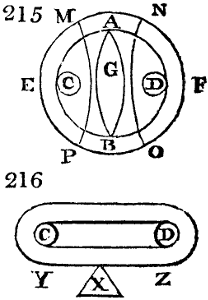
Let A B fig. 215. be a circular link or ring, of one inch rod iron, the
outer circumference of the ring being 15 inches, and the inner 9.
If equal opposite forces be applied to the two points of the link
C D, pulling C towards E, and D towards F, the result will be, when
the forces are sufficiently intense, that the circular form of the link
will be changed into another form with two round ends and two
parallel sides, as seen in fig. 216. The ratio of the exterior to the
interior periphery which was originally as 15 to 9, or 5 to 3, is no
longer the same in fig. 216. Hence there will be a derangement in
the relative position of the component particles, and consequently
their cohesion will be progressively impaired, and eventually destroyed.
In fig. 215. the segment M N of the outside periphery being
equal to 3 inches, the corresponding inside segment will be 3⁄5 of it, or 14⁄5 inches. If
this portion of the link, in consequence of the stretching force, comes to be extended
into a straight line, as shown in fig. 216., the corresponding segments, interior
and exterior, must both be reduced to an equal length. The matter contained in the
3 inches of the outside periphery must therefore be either compressed, that is, condensed
into 14⁄5 inch, or the inside periphery, which is only 14⁄5 inch already, must be extended to
3 inches; that is to say, the exterior condensation and the interior expansion must take
place in a reciprocal proportion. But, in every case, it is impossible to effect this contraction
of one side of the rod, and extension of the other, without disrupture of the
link.
Let us imagine the outside periphery divided into an infinity of points, upon each of
which equal opposite forces act to straighten the curvature: they must undoubtedly occasion
the rupture of the corresponding part of the internal periphery. This is not the sole
injury which must result; others will occur, as we shall perceive in considering what
passes in the portion of the link which surrounds C D, fig. 216., whose length is 41⁄2 inches
outside, and 21⁄10 inside. The segments M P and N O, fig. 215., are actually reduced to semi-circumferences,
which are inside no more than half an inch, and outside as before.
There is thus contraction in the interior, with a quicker curvature or one of shorter
radius in the exterior. The derangement of the particles takes place here, in an order
inverse to that of the preceding case, but it no less tends to diminish the strength of that
portion of the link; whence we may certainly conclude that the circular form of cable
links is an extremely faulty one.
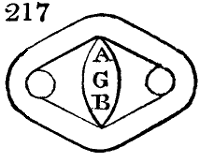
Leaving matters as we have supposed in fig. 215., but suppose that G is a rod introduced
into the mail, hindering its two opposite points A B from approximating. This circumstance
makes a remarkable change in the results. The link pulled as
above described, must assume the quadrilateral form shown in fig. 217.
It offers more resistance to deformation than before; but as it may
still suffer change of shape, it will lose strength in so doing, and cannot
therefore be recommended for the construction of cables which are
to be exposed to very severe strains.
Supposing still the link to be circular, if the ends of the stay comprehended a larger
portion of the internal periphery, so as to leave merely the space necessary for the plan
of the next link, there can be no doubt of its opposing more effectively the change of
form, and thus rendering the chain stronger. But, notwithstanding, the circular portions
which remain between the points of application of the strain and the stay, would tend
always to be straightened, and of consequence to be destroyed. Besides, though we
could construct circular links of sufficient strength to bear all strains, we ought still to
reject them, because they would consume more materials than links of a more suitable
form, as we shall presently see.
The effect of two opposite forces applied to the links of a chain, is, as we have seen,
to reduce to a straight line or a straight plane every curved part which is not stayed;
whence it is obvious that twisted links, such as Brown first employed, even with a stay
in their middle, must of necessity be straightened out, because there is no resistance in
the direction opposed to the twist. A cable formed of twisted links, for a vessel of 400
tons stretches 30 feet, when put to the trial strain, and draws back only 10 feet. This
elongation of 20 feet proceeds evidently from the straightening of the twist in each link,
which can take place only by impairing the strength of the cable.
From the preceding remarks, it appears that the strongest links are such as present, in
their original form, straight portions between the points of tension; whence it is clear
that links with parallel sides and round ends, would be preferable to all others, did not
a good cable require to be able to resist a lateral force, as well as one in the direction of
its length.
Let us suppose that by some accident the link fig. 216. should have its two extremities
pulled towards Y and Z, whilst an obstacle X, placed right opposite to
its middle, resisted the effort. The side of the link which touches X,
would be bent inwards; but if as in fig. 218., there is a stay A G B, the
two sides would be bent at the same time; the link would notwithstanding
assume a faulty shape.
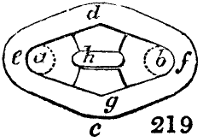
In thus rejecting all the vicious forms, we are naturally directed to that which deserves
the preference. It is shown in fig. 219. This link has a cast-iron stay with large ends,
it presents in all directions a great resistance to every
change of form; for let it be pulled in the direction a b,
against an obstacle c, it is evident that the portions d e
and d f, which are supported by the parts g e and g f,
cannot get deformed or be broken without the whole link
giving way. As the matter composing g e and g f cannot
be shortened, or that which composes d e and d f be lengthened, these four sides will
remain necessarily in their relative positions, by virtue of the large-ended stay h, whose
profile is shown in fig. 220.
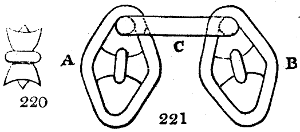
We have examined the strength of a link in every direction,
except that perpendicular to its plane. Fig. 221.
represents the assemblage of three links in the above
predicament; but we ought to observe, that the obstacle
C, placed between the links A B, must be necessarily
very small, and could not therefore resist the
pressure or impact of the two lateral links.
Process of manufacturing iron cables.—The implements
and operations are arranged in the following order:—
1. A reverberatory furnace (see Iron), in which a number of rods or round bars of
the best possible wrought-iron, and of proper dimensions, are heated to bright ignition.
2. The cutting by a machine of these bars, in equal lengths, but with opposite
bevels, to allow of the requisite crossing and splicing of the ends in the act of welding.
3. The bending of each of these pieces by a machine, so as to form the links; the last
two operations are done rapidly while the iron is red-hot.
4. The welding of the links at small forge fires, fitted with tools for this express
purpose, and the immediate introduction of the stay, by means of a compound lever
press.
5. Proving the strength of the cables by an hydraulic press, worked by two men turning
a winch furnished with a fly wheel.
The furnace is like those used in the sheet-iron works, but somewhat larger, and needs
no particular description here.
Figs. 222. and 223. are a plan and elevation of the shears with which the rods are cut into
equal pieces, for forming each a link. It is moved at Mr. Brunton’s factory by a small
steam engine, but, for the sake of simplicity, it is here represented worked by four or
more labourers, as it may be in any establishment. These must be relieved however
frequently by others, for I believe each shears’ machine is calculated to require nearly
one horse in steam power. It is portable and must be placed in the neighbourhood of
both the furnace and bending machine.
A and B are the two cast-iron limbs of the shears. The first is fixed and the second
is movable by means of a crank shaft C, driven by a heavy fly-wheel weighing 7 or 8 cwt.
The cutting jaws G are mounted with pieces of steel which are made fast by bolts, and
may be changed at pleasure.
E, the bar of iron to be cut. It is subjected, immediately upon being taken out of the
fire, to the shears, under a determinate uniform angle, care being taken not to let it
turn round upon its axis, lest the planes of the successive incisions should become unequal.
F is a stop which serves to determine, for the same kind of chain, the equality of
length in the link pieces.
Figs. 224, 225, 226. plan and elevations of the machine for bending the links into an
elliptic form. It is represented at the moment when a link is getting bent upon it.
A is an elliptic mandrel of cast-iron; it is fixed upon the top of a wooden pillar
B, solidly supported in the ground. C is the jaw of the vice, pressed by a square-headed
screw against the mandrel A.
D part of the mandrel comprehended between X and Y, formed as an inclined plane, so
as to preserve an interval equal to the diameter of the rod between the two surfaces that
are to be welded together.
E rectangular slots (shears) passing through the centre of the nut of the mandrel, in
which each of the pins F may be freely slidden.
G horizontal lever of wrought-iron six feet long. It carries at H a pulley or friction-roller
of steel, whose position may be altered according to the diameter of the links. It
is obvious that as many mandrels are required as there are sizes and shapes of links.
The piece of iron intended to form a link being cut, is carried, while red-hot, to the
bending machine, where it is seized with the jaw of the vice C, by one of its ends, the
slant of the cut being turned upwards; this piece of iron has now the horizontal direction
m n; on pushing the lever G in the line of the arrow, the roller H will force m n to
be applied successively in the elliptic groove of the mandrel; thus finally the two faces
that are to be welded together will be placed right opposite each other.
The length of the small diameter of the ellipse ought to exceed by a little the length
of the stay-piece, to allow of this being readily introduced. The difference between
the points F, E is equal to the difference of the radii vectores of the ellipse. Hence
it will be always easy to find the eccentricity of the ellipse.
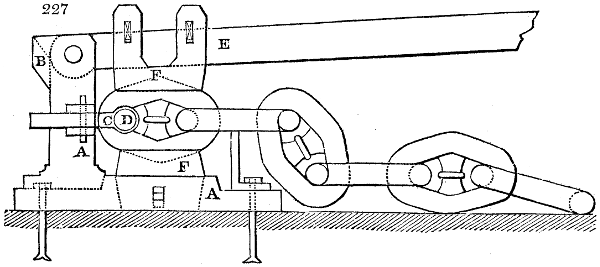
Fig. 227. is a lever press for squeezing the links upon their stays, after the links are
welded. This machine consists of a strong cast-iron piece A, in the form of a square, of
which one of the branches is laid horizontally, and fixed to a solid bed by means of
bolts; the other branch, composed of two cheeks, leaving between them a space of two
inches, stands upright. These two cheeks are united at top, and on the back of their
plane by a cross piece B. C, a rectangular staple, placed to the right and left of the
cheeks through which is passed the mandrel D, which represents and keeps the place of
the following link. E, is a press lever, 6 feet long. F, clamp and counterclamp, between
which the link is pressed at the moment when the stay is properly placed. There are
other clamps, as well as staples C, for changing with each changed dimension of links.
The links bent, as we have seen, are carried to the forge hearth to be welded, and to
receive their stay; two operations performed at one heating. Whenever the welding is
finished, while the iron is still red-hot, the link is placed upright between the clamps
F; then a workman introduces into the staple the mandrel D, and now applies
the stay with a pair of tongs or pincers, while another workman strikes down the
lever E forcibly upon it. This mechanical compression first of all joins perfectly the
sides of the link against the concave ends of the stay, and afterwards the retraction of
the iron on cooling increases still more this compression.
If each link be made with the same care, the cable must be sound throughout. It
is not delivered for use however till it be proved by the hydraulic press, at a draw-bench
made on purpose. The press is an horizontal one, having the axis of its ram in the
middle line of the draw-bench, which is about 60 feet long, and is secured to the body
of the press by strong bolts.
The portion of chain under trial, being attached at the one end to the end of the ram
of the press, and at the other to a cross-bar at the extremity of the draw-bench, two
men put the press in action, by turning the winch which works by a triple crank three
forcing pumps alternately; the action being equalized by means of a heavy fly-wheel.
As long as the resistance does not exceed the force of two men, the whole three pumps
are kept in play. After a while one pump is thrown out of geer and next another,
only one being worked towards the conclusion. The velocity of the ram being retarded
first one third and next two thirds, gives the men a proportional increase of mechanical
power.
The strength of two average men thus applied being computed, enables us to know at
every instant the resistance opposed by the chain to the pressure of the ram. The strain
usually applied to the stronger cables is about 500 tons.
The side beams of the draw-bench are of cast-iron, 6 inches in diameter; the different
pieces composing it are adjusted to each other end-wise by turned joints. Props
also of cast-iron support the beams two feet asunder, and at the height of 30 inches
above the ground. The space between them is filled with an oak plank on which the
trial chain is laid.
Strength of iron-cables compared to hemp cables:—
Iron Cables.
Diameter of Iron Rod. |
Hemp Cables.
Circumference of Rope. |
Resistance. |
| Inches. |
Inches. |
Tons. |
| 0 |
7⁄8 |
9 |
|
12 |
| 1 |
|
10 |
|
18 |
| 1 |
1⁄8 |
11 |
|
26 |
| 1 |
1⁄4 |
12 |
|
32 |
| 1 |
5⁄16 |
13 |
|
35 |
| 1 |
3⁄8 |
14 |
to 15 |
38 |
| 1 |
1⁄2 |
16 |
|
44 |
| 1 |
5⁄8 |
17 |
|
52 |
| 1 |
3⁄4 |
18 |
|
60 |
| 1 |
7⁄8 |
20 |
|
70 |
| 2 |
|
22 |
to 24 |
80 |
It would be imprudent to put hemp cables to severer strains than those indicated in
the preceding table, drawn up from Brunton’s experiments; but the iron cables of the
above sizes will support a double strain without breaking. They ought never in common
cases however to be exposed to a greater stress. A cable destined for ships of a
certain tonnage, should not be employed in those of greater burden. Thus treated it
may be always trusted to do its duty, and will last longer than the ship to which it belongs.
A considerable part of this decided superiority which iron cables have over hemp
ones, is undoubtedly due to the admirable form contrived by Brunton. Repeated
experiments have proved that his cables possess double the strength of the iron rods
with which they are made—a fact which demonstrates that no stronger form can be
devised or is in fact possible.
One of the most valuable qualities of iron cables is their resisting lateral as well as
longitudinal strains as explained under figs. 219. and 221.
Vessels furnished with such cables have been saved by them from the most imminent
peril. The Henry, sent out with army stores during the peninsular war, was caught
on the northern coast of Spain in a furious storm. She run for shelter into the Bay of
Biscay among the rocks, where she was exposed for three days to the hurricane. She
possessed fortunately one of Brunton’s 70 fathom chain cables, which held good all the
time, but it was found afterwards to have had the links of its lower portion polished
bright by attrition against the rocky bottom. A hemp cable would have been speedily
torn to pieces in such a predicament.
In the contracts of the Admiralty for chain cables for the British navy, it is stipulated
that “the iron shall have been manufactured in the best manner from pig iron, smelted
from iron-stone only, and selected of the best quality for the purpose, and shall not have
received in any process whatever subsequent to the smelting, the admixture of either the
cinder or oxides produced in the manufacture of iron; and shall also have been puddled
in the best manner upon iron bottoms, and at least three times sufficiently drawn out at
three distinct welding heats, and at least twice properly fagotted.”
The following is a table of the breaking proof of chain cables, and of the iron for the
purpose of making them, also of the proofs required by her majesty’s navy for chains.
| Size of Bolt. |
Proof of Bolt. |
Proof of Chain. |
Navy
Proof of Chain. |
| Inches. |
Tons. |
Cwt. |
Tons. |
Cwt. |
Tons. |
| |
1⁄2 |
5 |
7 |
8 |
11 |
4 |
1⁄2 |
| |
5⁄8 |
8 |
7 |
13 |
4 |
5 |
1⁄2 |
| |
3⁄4 |
12 |
1 |
19 |
5 |
10 |
7⁄8 |
| |
7⁄8 |
16 |
4 |
26 |
5 |
13 |
3⁄4 |
| 1 |
|
21 |
8 |
34 |
5 |
18 |
|
| 1 |
1⁄8 |
27 |
2 |
48 |
15 |
22 |
3⁄4 |
| 1 |
1⁄4 |
33 |
10 |
53 |
11 |
28 |
1⁄2 |
| 1 |
3⁄8 |
40 |
10 |
65 |
0 |
34 |
|
| 1 |
1⁄2 |
48 |
4 |
77 |
0 |
40 |
1⁄2 |
| 1 |
5⁄8 |
56 |
11 |
90 |
10 |
47 |
1⁄2 |
| 1 |
3⁄4 |
65 |
12 |
105 |
0 |
55 |
1⁄8 |
| 1 |
7⁄8 |
75 |
6 |
120 |
10 |
63 |
1⁄4 |
| 2 |
|
85 |
14 |
137 |
0 |
72 |
|
| 2 |
1⁄8 |
96 |
15 |
155 |
0 |
81 |
1⁄4 |
In Brunton’s cable the matter in the link is thrown very much into one plane; the
link being of an oval form, and provided with a stay. As there are emergencies in which
the cable must be severed, this is accomplished in those of iron by means of a bolt and
sheckle (shackle), at every fathom or two fathoms; so that by striking out this bolt or
pin, this cable is parted with more ease than a hempen one can be cut.
CACAO, BUTTER OF. See Cocoa, and Oils, Unctuous.
CADMIUM, is a metal discovered about the beginning of the year 1818. It occurs
chiefly in Silesia in several ores of zinc; and may be readily recognized by means of
the blowpipe; for at the first impression of the reducing or smoky part of the flame, the
ores containing cadmium stain the charcoal all round them with a reddish yellow circle
of oxide of cadmium. The Silesian native oxide of zinc contains from 11⁄2 to 11 per
cent. of cadmium.
The cadmium may be extracted by dissolving the ore in sulphuric acid, leaving
the solution acidulous, and diluting it with water, then transmitting through it a
stream of sulphuretted hydrogen, till the yellow precipitate ceases to fall. This
powder which is sulphuret of cadmium, is to be dissolved in concentrated muriatic
acid, the excess of which is to be expelled by evaporation; and the muriatic
salt being dissolved in water, carbonate of ammonia is to be added in excess, whereby
the cadmium separates as a carbonate, while the small portion of adhering copper
or zinc is retained in solution by the ammonia. Herapath has shown that, in distilling
zinc per descensum (see Zinc), the first portions of gaseous metal which are disengaged
burn with a brown flame and deposit the brown oxide of cadmium.
Cadmium has the colour and lustre of tin; and is susceptible of a fine polish. Its
fracture is fibrous; it crystallizes readily in regular octahedrons, and when it suddenly
solidifies, its surface gets covered with fine mossy vegetations. It is soft, easily bent,
filed, and cut, soils like lead any surface rubbed with it. It is harder and more tenacious
than tin, and emits a creaking sound when bent, like that metal. It is very ductile,
and may be drawn out into fine wire, and hammered into thin leaves without
cracking at the edges. Its specific gravity, after being merely melted, is 8·604; and
8·6944 after it has been hammered. It is very fusible, melting at a heat much under
redness; indeed at a temperature little exceeding that of boiling mercury, it boils and
distils over in drops. Its vapours have no smell. It is but slightly altered by exposure
to air. When heated in the atmosphere, it readily takes fire, and burns with a brownish
yellow smoke which is destitute of smell. In strong acids it dissolves with disengagement
of hydrogen, and forms colourless solutions. Chromate of potash causes no precipitate
in them, unless zinc or lead be present.
There is only one oxide of cadmium, the brown above-mentioned. Its specific gravity
is 8·183. It is neither fusible nor volatile at a very high temperature. When in
the state of a hydrate it is white. The oxide of cadmium consists of 87·45 parts of
metal, and 12·55 oxygen in 100 parts. Berzelius states its atomic weight to be 55·833
to hydrogen 1·000. Its sulphuret has a fine orange yellow colour, and would form a
beautiful pigment, could the metal be found in sufficient quantity for the purposes of
art. The sulphate is applied to the eyes by surgeons for removing specks of the cornea.
CAFEINE. A chemical principle discovered in coffee, remarkable for containing
much azote. See Coffee.
CAJEPUT OIL is obtained from the leaves of the tree called Melaleuca Leucadendron
by Linnæus, which grows upon the mountains of Amboyna, and in other of
the Molucca islands. It is procured by distillation of the dried leaves along with
water, is prepared in great quantities in the island of Banda, and sent to Holland
in copper flasks. Hence as it comes to us, it has a green colour. It is very limpid,
lighter than water, of a strong smell resembling camphor, and pungent taste like
cardamoms. When rectified the copper remains in the retort, and the oil comes over
colourless. It is used in medicine as a stimulant. See Oils Ethereous.
CALAMANCO. A sort of woollen stuff of a shining appearance, chequered in
the warp, so that the checks are seen only upon one side.
CALAMINE. A native carbonate of zinc. See Zinc.
CALCAREOUS EARTH. (Terre calcaire, Fr.; Kalkerde, Germ.) Commonly
denotes lime, in any form; but, properly speaking, it is pure lime.
CALCAREOUS SPAR. Crystallized native carbonate of lime.
CALCEDONY. A hard mineral of the siliceous family, often cut into seals.
Under it may be grouped common calcedony, heliotrope, chrysoprase, plasma, onyx,
sardonyx, and sard.
CALCHANTUM. The ancient name of native copperas or sulphate of iron.
CALCINATION, is the chemical process of subjecting metallic bodies to heat
with access of air, whereby they are converted into a pulverulent matter, somewhat
like lime in appearance, called calx in Latin. The term calcination, however, is now
used when any substance whatever is exposed to a roasting heat.
CALCIUM. The metallic basis of lime. See Lime.
CALC-SINTER. The incrustations of carbonate of lime upon the ground, or the
pendulous conical pieces called stalactites, attached to the roofs of caverns, are so called.
CALC-TUFF. A semi-hard irregular deposit of carbonate of lime, formed from
the waters of calcareous springs.
CALCULUS. The stony-looking morbid concretion, occasionally formed in the
bladder of urine, gall-bladder, cystic duct, kidneys, and other parts of living animals.
Its examination belongs to medical chemistry.
CALENDER, (Calandre, Fr.; Kalander, Germ.) a word derived from the Greek
kalindros (cylinder), is the name of a machine, consisting of two or more cylinders, revolving
so nearly in contact with each other that cloth passed through between them is smoothed,
and even glazed, by their powerful pressure. It is employed either to finish goods for the
market, or to prepare cotton and linen webs for the calico-printer, by rendering their surfaces
level, compact, and uniform. This condensation and polish, or satinage, as the French
call it, differ in degree according to the object in view, and may be arranged into three
distinct series. 1. For goods which are to receive the first impression by the block,
a very strong pressure is required; for, upon the uniformity of the polish, the neatness
and regularity of the printing, and the correspondence of its members, depend. In
many establishments the calico is passed twice through the calender before being sent
to the tables. 2. The pieces already dyed up at the madder bath, or otherwise, and
which remain to be filled in with other colours, or grounded-in, as it is technically styled,
must receive a much less considerable gloss. This is a principle every where admitted
and acted upon, because the outline of the figured design being deranged by the
washing, and sometimes in consequence of the peculiar texture of the cloth, the printer,
in order to apply his grounding blocks properly, and to fit them to the contours of the
figures already impressed, is obliged to stretch the piece sometimes in the direction of
the warp, and sometimes of the weft, which would be impossible if they had been hard
glazed by the calender. 3. The degree of glazing given to finished goods depends upon
the taste of purchasers, and the nature of the article; but it is, in general, much less
than for the first course of block-printing.
The most complete calender probably in existence is that used by some of the
eminent calico-printers of Alsace, as contrived by M. Charles Dollfus, and constructed
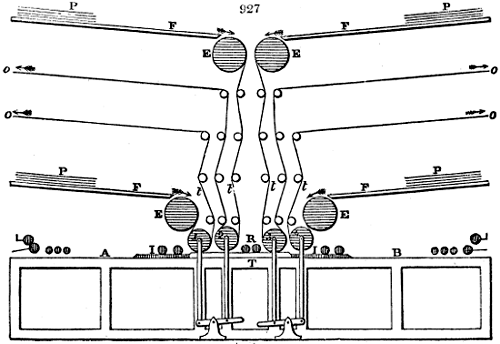
by MM. Witz, Blech, and Co. 1. It passes two pieces at once, and thus does double the
work of any ordinary machine. 2. It supersedes the necessity of having a workman to
fold up the goods, as they emerge from the calender, with the aid of a self-acting folder.
3. It receives, at pleasure, the finished pieces upon a roller, instead of laying them in
folds; and, by a very simple arrangement, it hinders the hands of the workmen from
being caught by the rollers.
Calenders, in consequence of the irregular demand for foreign orders and shipments,
are worked very irregularly, being sometimes overloaded with duty, and at others
altogether unemployed. A machine which can, when required, turn out a double
quantity of goods must, therefore, be a desirable possession. For the first course of
the printers, where high calendering is necessary, the goods are usually passed twice
through between two paper cylinders, to give that equality of surface which could not
be obtained by one passage, however strong the pressure; and therefore the simplification
of this calender will prove no economy. Besides, in order to increase the pressure to
the requisite degree, the cylinders would need to be made bulging at their middle part,
and with such cylinders common smoothing could not be given; for the pieces would
be glazed in the central line, and rough towards the edges. For pieces already printed
in part, and requiring only to be grounded-in for other colours, the system of double
effect has fewer objections, as a single passage through the excellent calender described
under Bleaching, page 134., is found to answer very well.
The most remarkable feature of M. Dollfus’s machine is its being managed by a single
workman. Six or eight pieces are coiled upon the feed-roller, and they are neither pasted
nor stitched together, but the ends are merely overlapped half a yard or so. The
workman is careful not to enter the second piece till one third or one half of the first
one has passed through on the other side, to prevent his being engrossed with two ends
at a time. He must, no doubt, go sometimes to the one side and sometimes to the
other of the machine to see that no folds or creases occur, and to be ready for supplying
a fresh piece as the preceding one has gone through. The mechanism of the folder in
the Alsace machine is truly ingenious: it performs extremely well, really saves the
attendance of an extra workman, and is worthy the attention of manufacturers intent
upon economising hand labour. The lapping-roller works by friction, and does its duty
fully better than similar machines guided by the hand.
The numerous accidents which have happened to the hands of workmen engaged in
calenders should direct the attention towards its effective contrivance for preventing
such misfortunes. These various improvements in the Alsace machine may be easily
adapted to the ordinary calenders of almost every construction.
The folder is a kind of cage, in the shape of an inverted pyramid, shut on the four
sides, and open at top and bottom: the top orifice is about five inches, the bottom one
an inch and a half: the front and the back, which are about four feet broad, are made
of tin-plate or smooth pasteboard, and the two sides are made of strong sheet-iron; the
whole being bolted together by small bars of iron. Upon the sheet-iron of the sides,
iron uprights are fixed, perforated with holes, through which the whole cage is supported
freely by means of studs that enter into them. One of the uprights is longer than the
other, and bears a slot with a small knob, which, by means of the iron piece, joins the
guide to the crank of the cylinder, and thereby communicates to the cage a seesaw
movement: at the bottom extremity of the great upright, there is a piece of iron in
the shape of an anchor, which may be raised, or lowered, or made fast, by screws.
At the ends of this anchor are friction-rollers, which may be drawn out or pushed back
and fixed by screws: these rollers lift alternately two levers made of wood, and fixed to
a wooden shaft.
The paws are also made of wood: they serve to lay down alternately the plies of the
cloth which passes upon the cage, and is folded zigzag upon the floor, or upon a board
set below the cage: a motion imparted by the seesaw motion of the cage itself. See
Stretching Machine.
To protect the fingers of the workmen, above the small plate of the spreading-board
or bar, there is another bar, which forms with the former an angle of about 75°: they
come sufficiently near together for the opening at the summit of the angle to allow the
cloth to pass through, but not the fingers. See Bulletin de la Société Industrielle de
Mulhausen, No. 18.
I shall now describe, more minutely, the structure of the powerful but less complicated
calender mechanisms employed in the British manufactories.
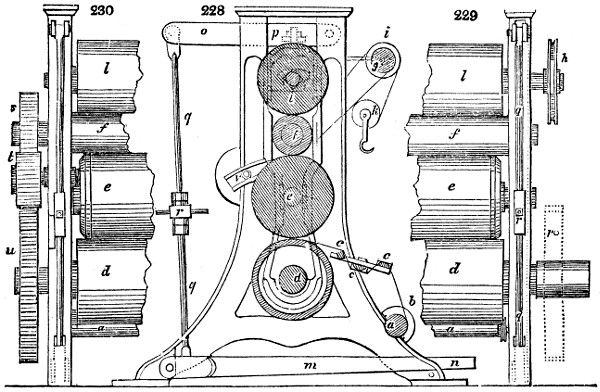
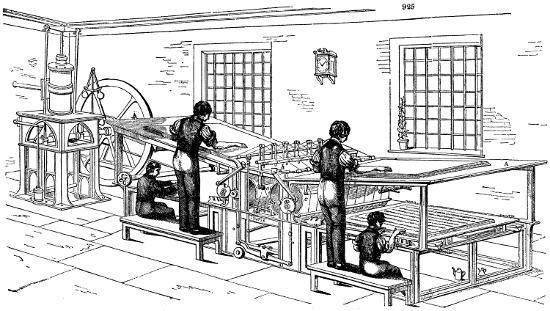
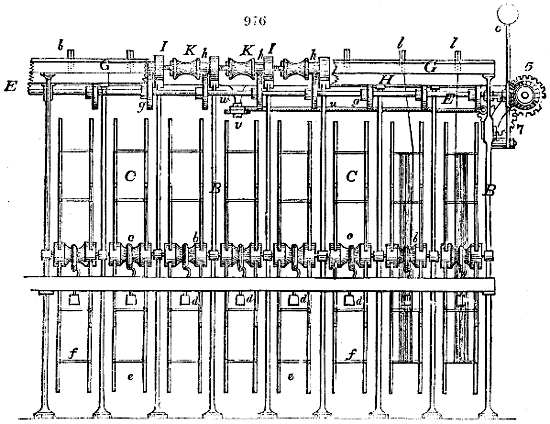
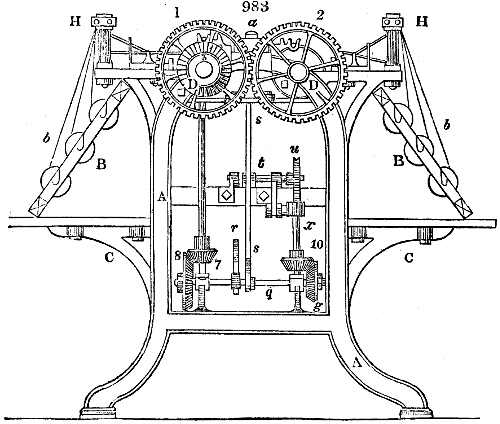
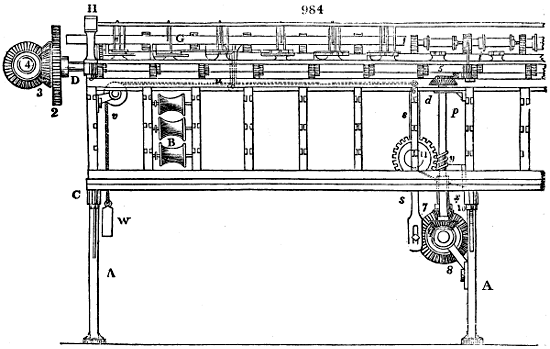
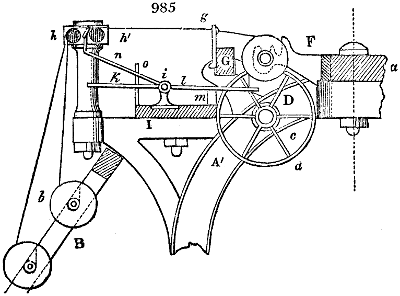
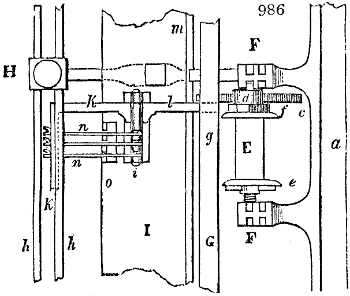
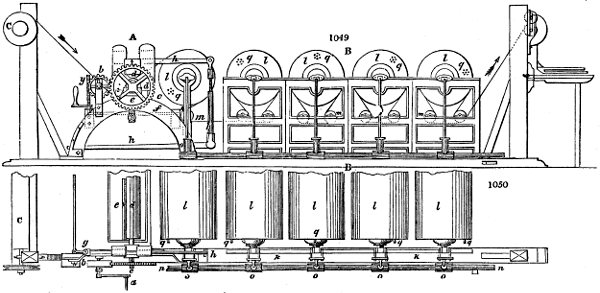
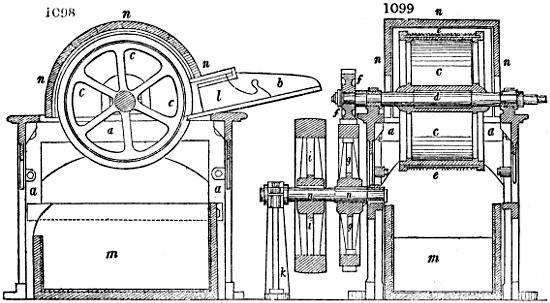
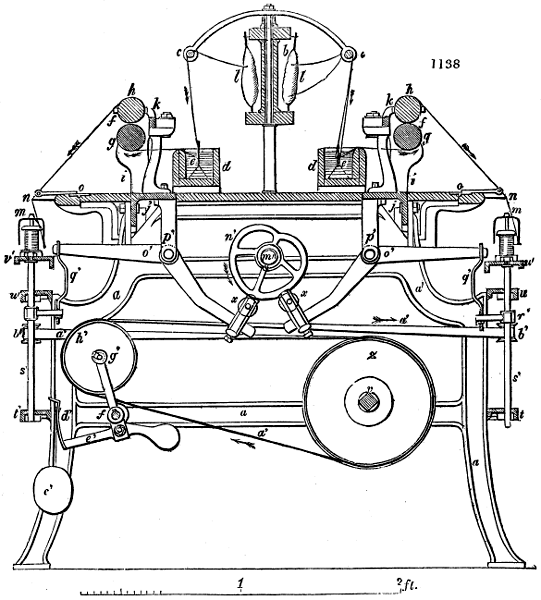
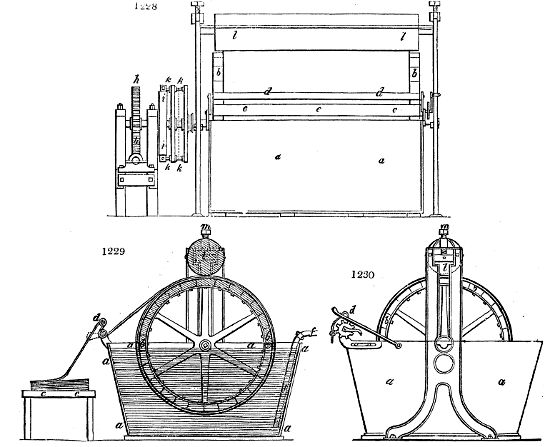
A front elevation of a four-rollered calender (five rollers are often introduced) for glazing
goods is given in fig. 228. d l are two pasteboard or paper cylinders, each 20 inches in diameter,
whose structure will be presently described: f is a cast-iron cylinder turned perfectly
smooth (its fellow is often placed between e and d): it is eight inches in diameter outside,
four inches inside, with two inches thickness of metal. e is another pasteboard cylinder,
fourteen inches in diameter: the strong cast-iron frame contains the bushes in which
the journals of the rollers turn. o p, is one of the pair of levers for communicating a
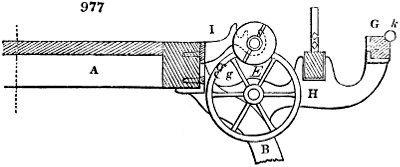
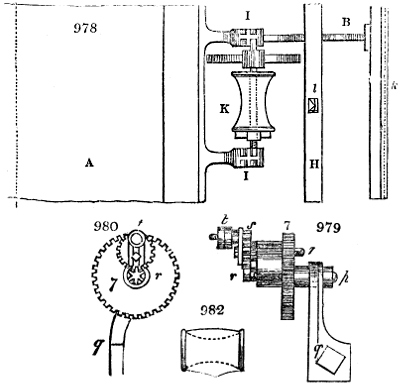
graduated pressure according to the quality of the goods. Fig. 229, 230. are end views of
the same machine to show the working geer. The wheel s, on the end of the upper iron
cylinder, is ten inches in diameter; that on the end of the fellow iron cylinder below
(when it is present) is thirteen inches; both are connected by the larger carrier wheel
t. The lower wheel u is one third larger than the upper wheel, and therefore receives
from the carrier wheel t, a proportionally slower motion, which it imparts to the central
pasteboard roller e, lying upon it, causing it to move one third more slowly than the
upper pasteboard roller. Thus a sort of sliding motion is produced, which, by rubbing
their surfaces, glazes the goods.
The iron rollers are made hollow for the purpose of admitting either a hot roller of
iron, or steam when hot calendering is required. The other cylinders used formerly to
be made of wood, but it was liable to many defects. The advantage of the paper roller
consists in its being devoid of any tendency to split, crack, or warp, especially when
exposed to a considerable heat from the contact and pressure of the hot iron rollers.
The paper, moreover, takes a vastly finer polish, and, being of an elastic nature, presses
into every pore of the cloth, and smooths its surface more effectually than any wooden
cylinder, however truly turned, could possibly do.
The paper cylinder is constructed as follows:—The axis of the cylinder is a strong
square bar of the best wrought iron, cut to the proper length. Upon this bar a strong
round plate of cast iron is first put, somewhat less in diameter than the cylinder when
finished. A quantity of thick stout pasteboard is then procured, and cut into round
pieces an inch larger in diameter than the iron plate. In the centre of the plates, and
of every piece of the pasteboard, a square hole must be cut to receive the axis; and, the
circle being divided into six equal parts, a hole must also be cut at each of the divisions,
an inch or two within the rim. These pieces of pasteboard being successively put
upon the axis, a long bolt of malleable iron, with a head at one end, and screwed at the
other, is also introduced through each of the holes near the rim; and this is continued
until a sufficient number of pasteboards are thus placed to form a cylinder of the
length required, proper allowance being made for the compression which the pasteboard
is afterwards to undergo. Another round plate is then applied, and, nuts being put
upon the screws, the whole are screwed tight, and a cylinder formed. This cylinder is
now to be placed in a stove, exposed to a strong heat, and must be kept there for at least
several days; and, as the pasteboard shrinks by exposure to the heat, the screws must
be frequently tightened until the whole mass has been compressed as much as possible.
When the cylinder is thus brought to a sufficient degree of density it is removed from
the stove; and, when allowed to cool, the pasteboard forms a substance almost inconceivably
dense and hard. Nothing now remains but to turn the cylinder; and this is an
operation of no slight labour and patience. The motion in turning must be slow, not
exceeding about forty revolutions in a minute; the substance being now so hard and
tough that tools of a very small size must be used to cut, or rather scrape it, until it
is true. Three men are generally employed for the turning, even when the motion of
the cylinder is effected by mechanical power, two being necessary to sharpen tools, for
the third who turns, as quickly as he blunts them.
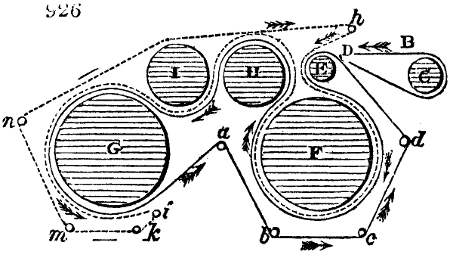
Let us suppose it to be a five-rollered machine: when a person stands in front of
the calender, the cloth coming from behind above the uppermost cylinder 1, passes between
1 and 2: proceeding behind 2, it again comes to the front between 2 and 3:
between 3 and 4 it is once more carried behind, and, lastly, brought in front between
4 and 5, where it is received, and smoothly folded on a clean board, or in a box, by a
person placed there for the purpose. In folding the cloth at this time, care must be
taken that it may be loosely done, so that no mark may appear until it be again folded
in the precise length and form into which the piece is to be made up. The folding may
be done either by two persons or by one, with the aid of two sharp polished spikes
placed at a proper distance, to ascertain the length of the fold, and to make the whole
equal. When folded into lengths, it is again folded across upon a smooth clean table,
according to the shape intended, which varies with the different kinds of goods, or the
particular market for which the goods are designed.
When the pieces have received the proper fold, the last operation previous to packing
them is the pressing. This is commonly performed by placing a certain number of pieces,
divided by thin smooth boards of wood, in a common screw press, similar to those used
by printers for taking out the impression left by the types in the printing-press. Besides
the wooden boards, a piece of glazed pasteboard is placed above and below every
piece of cloth, that the outer folds may be as smooth and glossy as possible. The
operation of the common screw press being found tedious and laborious, the hydraulic
press is now in all well mounted establishments had recourse to. See Hydraulic
Press.
No improvements that have taken place in calendering can exceed the power and facility
of the water press: one of these presses may be worked by two men, who can
with great ease produce a pressure of 400 tons; but, in considerable establishments, the
presses are worked by power. See Bandanna.
The appearance and finish of the goods, in consequence of such an immense weight
acting on them, are materially improved.
The press is also used for the purpose of packing; whereby the bale is rendered
much more compact than formerly. It is commonly roped, &c., while in this compressed
state; the dimensions, are therefore, greatly diminished from what they would
otherwise be by any other method. For instance, the same quantity of goods packed
in a bale are from one third to one half less bulky than if they were packed in a box
with the utmost force of the hands.
For lawns and muslins of a light texture, the operation of smoothing requires a different
process in some respects than close heavy fabrics. They only require to be slightly
smoothed to remove any marks which they may have received at the bleaching; and, as
their beauty depends rather on their transparency than their closeness, the more the cylindrical
form of the yarn is preserved the better. They are therefore put through a
small machine, consisting of three rollers or cylinders; and, as the power required to
move this is small, the person who attends it generally drives it by a small winch; or
the same effect may be produced by passing the muslins between only two or three rollers
of the above calender, lightly loaded.
In the thick fabrics of cloth, including those kinds which are used for many parts of
household furniture, as also those for female dress, the operation of glazing is used both
to add to the original beauty of the cloth, and to render it more impervious to dust or
smoke. The glazing operation is performed entirely by the friction of any smooth
substance upon the cloth; and, to render the gloss brighter, a small quantity of bleached
wax is previously rubbed over the surface. The operation of glazing by the common
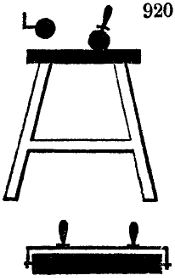
plan is very laborious, but the apparatus is of the most simple kind. A table is mounted
with a thick stout cover of level and well-smoothed wood, forming an inclined plane;
that side where the operator stands at work being the lowest. The table is generally
placed near a wall, both for convenience in suspending the glazing apparatus, and for the
sake of light. A long piece of wood is suspended in a groove formed between two longitudinal
beams, placed parallel to the wall, and fixed to it. The groove resembles
exactly the aperture between the shears of a common turning lathe. The lever, of which
the groove may be supposed to be the centre or fulcrum, is faced at the bottom with a
semi-cylindrical piece of finely polished flint, which gives the friction to the cloth stretched
upon the table below. Above the flint are two cross handles, of which the operator
lays hold, and moves them backward and forward with his hands, keeping the flint pressing
slightly upon the cloth. When he has glazed a portion equal to the breadth of the
flint, he moves his lever between the shears sidewise, and glazes a fresh part: thus he
proceeds from one side or selvage of the cloth to the other: and when all which is upon
the table is sufficiently glazed, he draws it over, and exposes a new portion to the same
operation. To preserve the cloth at a proper tension, it may be wound smoothly upon
a roller or beam, which being set so as to revolve upon its own axis behind the table,
another roller to receive the cloth may be placed before, both being secured by a catch,
acting in a ratchet wheel. Of late years, however, a great part of the labour employed
in glazing cloth has been saved, as the common four or five bowl calender has been altered
to fit this purpose by direct pressure.
As a matter of accommodation, the different processes of packing, cording of boxes,
sheeting of trunks, and, in general, all the arrangements preparatory to shipments, and
also the intimations and surveys necessary for obtaining drawbacks, debentures, or
bounties, according to the excise laws, are generally conducted at the calender houses
where goods are finished. These operations sufficiently account for the general meaning
attached to the word.
CALICO-PRINTING (Impression d’Indiennes, Fr.; Zeugdruckerei, Germ.) is the
art of impressing cotton cloth with topical dyes of more or less permanence. Of late
years, silk and woollen fabrics have been made the subjects of a similar style of
dyeing. Linens were formerly stained with various coloured designs, but since the
modern improvements in the manufacture of cotton cloth they are seldom printed, as
they are both dearer, and produce less beautiful work, because flax possesses less affinity
than cotton for colouring matters.
This art is of very ancient date in India, and takes its English name from Calicut, a
district where it has been practised with great success from time immemorial. The
Egyptians, also, appear from Pliny’s testimony to have practised at a remote era some of
the most refined processes of topical dyeing. “Robes and white veils,” says he, “are
painted in Egypt in a wonderful way. They are first imbued, not with dyes, but with
dye-absorbing drugs, by which, though they seem to be unaltered, yet, when immersed
for a little while in a cauldron of the boiling dye-liquor, they are found to become
painted. Yet, as there is only one colour in the cauldron, it is marvellous to see many
colours imparted to the robe, in consequence of the influence of the excipient drug. Nor
can the dye be washed out. A cauldron, which would of itself merely confuse the colours
of cloths previously dyed, is thus made to impart several pigments from a single dye-stuff,
painting as it boils.” The last expression pingitque dum coquit, is perfectly graphic
and descriptive of calico-printing.
The cotton chintz counterpanes of great size, called pallampoors, which have been
manufactured in Madras from the earliest ages, have in like manner peculiar dye-absorbing
drugs applied to them with the pencil, as also wax, to protect certain parts of the
surface from the action of the dye, and are afterwards immersed in a staining liquor, which,
when wax is applied, is usually the cold indigo-vat, but without the wax is a hot liquor
similar to the Egyptian. M. Koechlin Roder, of Mulhouse, brought home lately from
India a rich collection of cloths in this state of preparation, which I saw in the
cabinet of the Société Industrielle of that interesting emporium of calico-printing.
The native implements for applying the wax and colouring bases are placed alongside
of the cloths, and form a curious picture of primeval art. There is among
other samples an ancient pallampoor, five French yards long, and two and a half broad,
said to be the labour of Hindoo princesses, which must have taken a lifetime to execute.
The printing machinery of great Britain has begun to supersede, for these
styles of work, the cheapest hand labour of India.
Calico-printing has been for several hundred years practised by the oriental methods
in Asia Minor and the Levant, but it was unknown as an English art till 1696,
when a small print-ground was formed upon the banks of the Thames, near Richmond,
by a Frenchman; probably a refugee from his own country, in consequence of the
revocation of the edict of Nantes. Some time afterwards, a considerable printing
work was established at Bromley Hall, in Essex, and several others sprung up successively
in Surrey, to supply the London shops with chintzes, their import from India
having been prohibited by act of parliament in 1700. The silk and woollen weavers,
indeed, had all along manifested the keenest hostility to the use of printed calicoes,
whether brought from the East or made at home. In the year 1680 they mobbed the
India House in revenge for some large importations then made of the chintzes of
Malabar. They next induced the government, by incessant clamours, to exclude altogether
the beautiful robes of Calicut from the British market. But the printed goods,
imported by the English and Dutch East India companies, found their way into this
country, in spite of the excessive penalties annexed to smuggling, and raised a new alarm
among the manufacturing population of Spitalfields. The sapient legislators of that day,
intimidated, as would appear, by the East London mobs, enacted in 1720 an absurd sumptuary
law, prohibiting the wearing of all printed calicoes whatsoever, either of foreign or
domestic origin. This disgraceful enactment, worthy of the meridian of Cairo or
Algiers, proved not only a death blow to rising industry in this ingenious department
of the arts, but prevented the British ladies from attiring themselves in the becoming
drapery of Hindostan. After an oppressive operation of ten years, this act was repealed
by a partially enlightened set of senators, who were then pleased to permit what they
called British calicoes, if made of linen warp, with merely weft of the hated cotton, to be
printed and worn, upon paying a duty of no less than sixpence the square yard. Under
this burden, English calico-printing could not be expected to make a rapid progress.
Accordingly, even so lately as the year 1750, no more than 50,000 pieces of mixed
stuff were printed in Great Britain, and that chiefly in the neighbourhood of London;
whereas a single manufacturer, Mr. Coates of Manchester, now-a-days will turn off
nearly twenty times that quantity, and there are very many others who manufacture
several hundred thousand pieces per annum. It was not till about 1766 that this art
migrated into Lancashire, where it has since taken such extraordinary development;
but it was only after 1774 that it began to be founded upon right principles, in consequence
of the repeal of that part of the act of 1730 which required the warp to be made
of linen yarn. Henceforth the printer, though still saddled with a heavy duty of 3d.
the square yard, was allowed to apply his colours to a homogeneous web, instead of the
mixed fabric of linen and cotton substances, which differ in their affinities for dyes.
France pursued for some time a similar false policy with regard to calico-printing, but
she emerged sooner from the mists of manufacturing monopoly than England. Her
avowed motive was to cherish the manufacture of flax, a native product, instead of that
of cotton, a raw material, for which prejudice urged that money had to be exported.
Her intelligent statesmen of that day, fully seventy years ago, replied, that the money
expended in the purchase of cotton was the produce of French industry, beneficially
employed, and they therefore took immediate measures to put the cotton fabrics upon a
footing of equality. Meanwhile the popular prejudices became irritated to such a degree,
by the project of permitting the free manufacture and sale of printed cottons, that every
French town possessed of a chamber of commerce made the strongest remonstrances
against it. The Rouen deputies declared to the government, “that the intended measure
would throw its inhabitants into despair, and make a desert of the surrounding
country;” those of Lyons said, “the news had spread terror through all its work-shops:”
Tours “foresaw a commotion likely to convulse the body of the state:” Amiens
said, “that the new law would be the grave of the manufacturing industry of France;”
and Paris declared that “her merchants came forward to bathe the throne with their tears
upon that inauspicious occasion.”
The government persisted in carrying its truly enlightened principles into effect, and
with so manifest advantage to the nation, as to warrant the inspector-general of manufactures
to make, soon afterwards, the following appeal to those prejudiced bodies:—“Will
any of you now deny that the fabrication of printed cottons has occasioned a vast
extension of the industry of France, by giving profitable employment to a great many
hands in spinning, weaving, bleaching, and printing the colours? Look only at the
dyeing department, and say whether it has not done more good to France in a few years
than many of your other manufactures have in a century?”
The despair of Rouen has been replaced by the most signal prosperity in the cotton
trade, and especially in printed calicoes, for the manufacture of which it possesses 70
different establishments, producing upwards of a million of pieces of greater average size
and price than the English. In the district of the Lower Seine, round that town, there
are 500 cotton factories of different kinds, which give employment to 118 thousand
operatives of all orders, and thus procure a comfortable livelihood to probably not less
than half a million of people.
The repeal, in 1831, of the consolidated duty of 31⁄2d. per square yard upon printed
calicoes in Great Britain is one of the most judicious acts of modern legislation. By
the improvements in calico-printing, due to the modern discoveries and inventions in
chemistry and mechanics, the trade had become so vast as to yield in 1830 a revenue of
2,280,000l. levied upon 8,596,000 of pieces, of which, however, about three fourths were
exported, with a drawback of 1,579,000l. 2,281,512 pieces were consumed in that year
at home. When the expenses of collection were deducted, only 350,000l. found their
way into the exchequer, for which pitiful sum thousands of frauds and obstructions were
committed against the honest manufacturer. This reduction of duty enables the consumer
to get this extensive article of clothing from 50 to 80 per cent. cheaper than
before, and thus places a becoming dress within the reach of thousands of handsome
females in the humbler ranks of life. Printed goods, which in 1795 were sold for two
shillings and three-pence the yard, may be bought at present for eight-pence. In fact a
woman may now purchase the materials of a pretty gown for two shillings. The repeal
of the tax has been no less beneficial to the fair dealers, by putting an end to the contraband
trade, formerly pursued to an extent equally injurious to them and the revenue.
It has, moreover, emancipated a manufacture, eminently dependent upon taste, science,
and dexterity, from the venal curiosity of petty excisemen, by whom private improvements,
of great value to the inventor, were in perpetual jeopardy of being pirated and
sold to any sordid rival. The manufacturer has now become a free agent, a master of
his time, his workmen, and his apparatus; and can print at whatever hour he may receive
an order; whereas he was formerly obliged to wait the convenience of the excise
officer, whose province it was to measure and stamp the cloth before it could be packed,—an
operation fraught with no little annoyance and delay. Under the patronage of parliament,
it was easy for needy adventurers to buy printed calicoes, because they could
raise such a sum by drawbacks upon the export of one lot as would go far to pay for
another, and thus carry on a fraudulent system of credit, which sooner or later merged
in a disastrous bankruptcy. Meanwhile the goods thus obtained were pushed off to
some foreign markets, for which they were, possibly, not suited, or where they produced,
by their forced sales a depreciation of all similar merchandize, ruinous to them and who
meant to pay for his wares.
The principles of calico-printing have been very profoundly studied by many of the French
manufacturers, who generally keep a chemist, who has been educated in the Parisian
schools of science, constantly at work, making experiments upon colours in a well-mounted
laboratory. In that belonging to M. Daniel Kœchlin, of Mulhausen, there are upwards
of 3000 labelled phials, filled with chemical reagents, and specimens subservient to dyeing.
The great disadvantage under which the French printers labour is the higher price they
pay for cotton fabrics, above that paid by the English printers. It is this circumstance
alone which prevents them from becoming very formidable rivals to us in the markets of
the world. M. Barbet, deputy and mayor of Rouen, in his replies to the ministerial
commission of inquiry, rates the disadvantage proceeding from that cause at 2 francs per
piece, or about 5 per cent. in value. In the annual report of the Société Industrielle of
Mulhausen, made in December, 1833, the number of pieces printed that year in Alsace
is rated at 720,000, to which if we add 1,000,000 for the produce of the department of
the Lower Seine, and 280,000 for that of St. Quentin, Lille, and the rest of France, we
shall have for the total amount of this manufacture 2,000,000 of pieces, equivalent to
nearly 2,400,000 pieces English; for the French piece usually measures 331⁄2 aunes, = 41
yards nearly; and it is also considerably broader than the English pieces upon
an average. It is therefore probable that the home consumption of France in printed
goods is equal in quantity, and superior in value, to that of England. With regard to
the comparative skill of the workmen in the two countries, M. Nicholas Kœchlin, deputy
of the Upper Rhine, says, that one of his foremen, who worked for a year in a
print-field in Lancashire, found little or no difference between them in that respect. The
English wages are considerably higher than the French. The machines for multiplying
production, which for some time gave us a decided advantage, are now getting into
very general use among our neighbours. In my recent visit to Mulhausen, Rouen, and
their environs, I had an opportunity of seeing many printing establishments mounted
with all the resources of the most refined mechanisms.
The calico-printing of this country still labours under the burden of considerable taxes
upon madder and gallipoli oil, which have counteracted the prosperity of our Turkey red
styles of work, and caused them to nourish at Elberfeld, and some other places on the
continent, whither a good deal of the English yarns are sent to be dyed, then brought
back, and manufactured into ginghams, checks, &c., or forwarded directly thence to our
Russian customers. This fact places our fiscal laws in the same odious light as the
facility of pirating printer’s patterns with impunity does our chancery laws.
Before cloth can receive good figured impressions its surface must be freed from
fibrous down by Singeing, and be rendered smooth by the Calender. See these articles.
They are next bleached, with the exception of those destined for Turkey red. See
Bleaching and Madder. After they are bleached, dried, singed, and calendered, they
are lapped round in great lengths of several pieces, stitched endwise together, by means
of an apparatus called, in Manchester, a candroy, which bears on its front edge a rounded
iron bar, transversely grooved to the right and left from the centre, so as to spread out
the web as it is drawn over it by the rotation of the lapping roller. See a figure of
this bar subservient to the cylinder printing-machine.
Four different methods are in use for imprinting figures upon calicoes: the first is by
small wooden blocks, on whose face the design is cut, which are worked by hand; the second
is by larger wood-cut blocks, placed in either two or three planes, standing at right angles
to each other, called a Perrotine, from the name of its inventor; the third is by flat copper
plates, a method now almost obsolete; and the fourth is by a system of copper cylinders,
mounted in a frame of great elegance, but no little complexity, by which two, three,
four, or even five colours may be printed on in rapid succession by the mere rotation
of the machine driven by the agency of steam or water. The productive powers of this
printing automaton are very great, amounting for some styles to a piece in the minute,
or a mile of cloth in the hour. The fifth colour is commonly communicated by means
of what is called a surface cylinder, covered with wooden figures in bas-relief, which,
by rotation, are applied to a plane of cloth imbued with the thickened mordants.
The hand blocks are made of sycamore or pear-tree wood, or of deal faced with these
woods, and are from two to three inches thick, nine or ten inches long, and five broad, with
a strong box handle on the back for seizing them by. The face of the block is either
carved in relief into the desired design, like an ordinary wood-cut, or the figure is formed
by the insertion edgewise into the wood of narrow slips of flattened copper wire. These
tiny fillets, being filed level on the one edge, are cut or bent into the proper shape, and
forced into the wood by the taps of a hammer at the traced lines of the configuration.
Their upper surfaces are now filed flat, and polished into one horizontal plane, for the
sake of equality of impression. As the slips are of equal thickness in their whole depth,
from having been made by running the wire through between the steel cylinders of a
flatting mill, the lines of the figure, however much they get worn by use, are always
equally broad as at first; an advantage which does not belong to wood-cutting. The
interstices between the ridges thus formed are filled up with felt-stuff. Sometimes a
delicate part of the design is made by the wood-cutter, and the rest by the insertion of
copper slips.
The colouring matter, properly thickened, is spread with a flat brush, by a child, upon
fine woollen cloth, stretched in a frame over the wax cloth head of a wooden drum or
sieve, which floats inverted in a tubful of old paste, to give it elastic buoyancy. The
inverted sieve drum should fit the paste tub pretty closely. The printer presses
the face of the block on the drum head, so as to take up the requisite quantity of
colour, applies it to the surface of the calico, extended upon a flat table covered
with a blanket, and then strikes the back of the block with a wooden mallet, in
order to transfer the impression fully to the cloth. This is a delicate operation,
requiring equal dexterity and diligence. To print a piece of cloth 28 yards long,
and 30 inches broad, no less than 672 applications of a block, 9 inches long and 5
inches broad, are requisite for each colour; so that if there are 3 colours, or 3 hands, as
the French term it, no less than 2016 applications will be necessary. The blocks
have pin-points fixed into their corners, by means of which they are adjusted to their
positions upon the cloth, so as to join the different parts of the design with precision.
Each printer has a colour-tub placed within reach of his right hand; and
for every different colour he must have a separate sieve. Many manufacturers cause
their blocks to be made of three layers of wood, two of them being deal with the
grain crossed to prevent warping, and the third sycamore for engraving.
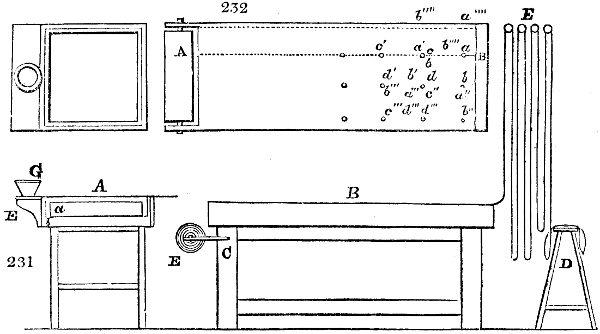
The printing shop is an oblong apartment, lighted with numerous windows at each
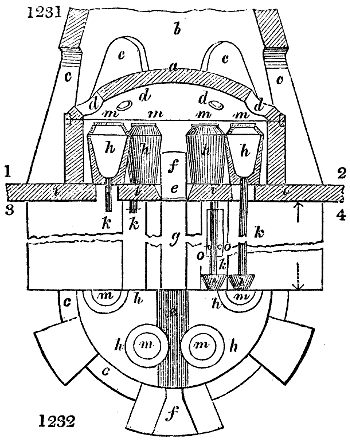
side, and having a solid table opposite to each window. The table B, fig. 231. is formed
of a strong plank of well-seasoned hard wood, mahogany, or marble, with a surface truly
plane. Its length is about 6 feet, its breadth 2 feet, and its thickness 3, 4, or 5 inches.
It stands on strong feet, with its top about 36 inches above the floor. At one of its
ends there are two brackets C for supporting the axles of the roller E, which carries the
white calico to be printed. The hanging rollers E are laid across joists fixed near the
roof of the apartment above the printing shop, the ceiling and floor between them being
open bar work, at least in the middle of the room. Their use is to facilitate the
exposure, and, consequently, the drying of the printed pieces, and to prevent one figure
being daubed by another. Should they come to be all filled, the remainder of the
goods must be folded lightly upon the stool D.
The printer stretches a length of the piece upon his table A B, taking care to place
the selvage towards himself, and one inch from the edge. He presents the block
towards the end, to determine the width of its impression, and marks this line A B, by
means of his square and tracing point. The spreader now besmears the cloth with the
colour, at the commencement, upon both sides of the sieve head; because, if not uniformly
applied, the block will take it up unequally. The printer seizes the block in his right
hand, and daubs it twice in different directions upon the sieve cloth, then he transfers it
to the calico in the line A B, as indicated by the four points a b c d, corresponding to
the four pins in the corners of the block. Having done so, he takes another daub of
the colour, and makes the points a b fall on c d, so as to have at the second stamp
a′ b′, covering a b and c′ d′; and so on, through the rest, as denoted by the accented
letters. When one table length is finished, he draws the cloth along, so as to bring a
new length in its place.
The grounding in, or re-entering (rentrage), of the other colours is the next process.
The blocks used for this purpose are furnished with pin-points, so adjusted that, when
they are made to coincide with the pin-points of the former block, the design will be
correct; that is to say, the new colour will be applied in its due place upon the flower
or other figure. The points should not be allowed to touch the white cloth, but should
be made to fall upon the stem of a leaf, or some other dark spot. These rentrages are
of four sorts:—1. One for the mordants, as above; 2. one for topical colours; 3. one
for the application of reds; and, 4., one for the application of resist pastes or reserves.
These styles have superseded the old practice of pencilling.
The Perrotine is a machine for executing block-printing by mechanical power; and
it performs as much work, it is said, as 20 expert hands. I have seen its operation, in
many factories in France and Belgium, in a very satisfactory manner; but I have
reason to believe that there are none of them as yet in this country. Three wooden
blocks, from 21⁄2 to 3 feet long, according to the breadth of the cloth, and from 2 to 5
inches broad, faced with pear-tree wood, engraved in relief, are mounted in a powerful
cast-iron frame work, with their planes at right angles to each other, so that each
of them may, in succession, be brought to bear upon the face, top, and back of a
square prism of iron covered with cloth, and fitted to revolve upon an axis between the
said blocks. The calico passes between the prism and the engraved blocks, and
receives successive impressions from them as it is successively drawn through by a
winding cylinder. The blocks are pressed against the calico through the agency of
springs, which imitate the elastic pressure of the workman’s hand. Each block receives
a coat of coloured paste from a woollen surface, smeared after every contact with a
mechanical brush. One man, with one or two children for superintending the colour-giving
surfaces, can turn off about 30 pieces English per day, in three colours, which
is the work of fully 20 men and 20 children in block printing by hand. It executes
some styles of work to which the cylinder machine, without the surface roller, is
inadequate.
The copper-plate printing of calico is almost exactly the same as that used for
printing engravings on paper from flat plates, and being nearly superseded by the next
machine, need not be described.
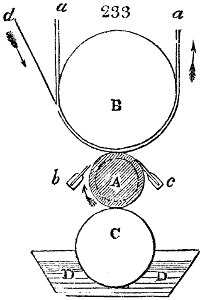
The cylinder printing machine consists, as its name imports, of an engraved copper
cylinder, so mounted as to revolve against another cylinder lapped in woollen cloth, and
imbued with a coloured paste, from which it derives the means of communicating
coloured impressions to pieces of calico passed over it. Fig. 233.
will give the reader a general idea of this elegant and expeditious
plan of printing. The pattern is engraved upon the
surface of a hollow cylinder of copper, or sometimes gun-metal,
and the cylinder is forced by pressure upon a strong
iron mandrel, which serves as its turning shaft. To facilitate
the transfer of the impression from the engraving to the cotton
cloth, the latter is lapped round another large cylinder, rendered
elastic by rolls of woollen cloth, and the engraved cylinder
presses the calico against this elastic cushion, and thereby prints
it as it revolves. Let A be the engraved cylinder mounted upon
its mandrel, which receives rotatory motion by wheels on its
end, connected with the steam or water power of the factory.
B is a large iron drum or roller, turning in bearings of the end
frames of the machine. Against that drum the engraved cylinder
A is pressed by weights or screws; the weights acting steadily, by levers, upon its
brass bearings. Round the drum B the endless web of felt or blanket stuff a a, travels in
the direction of the arrow, being carried round along with the drum B, which again is
turned by the friction of contact with the cylinder A. c represents a clothed wooden roller,
partly plunged into the thickened colour of the trough D D. That roller is also made
to bear, with a moderate force, against A, and thus receives, by friction, in some cases,
a movement of rotation. But it is preferable to drive the roller C from the cylinder A,
by means of a system of toothed wheels attached to their ends, so that the surface speed
of the wooden or paste roller shall be somewhat greater than that of the printing cylinder,
whereby the colour will be rubbed, as it were, into the engraved parts of the latter.
As the cylinder A is pressed upwards against B, it is obvious that the bearers of the
trough and its roller must be attached to the bearings of the cylinder A, in order to
preserve its contact with the colour-roller C. b is a sharp-edged ruler of gun-metal or
steel, called the colour doctor, screwed between two gun-metal stiffening bars; the edge
of which wiper is slightly pressed as a tangent upon the engraved roller A. This ruler
vibrates with a slow motion from side to side, or right to left, so as to exercise a
delicate shaving action upon the engraved surface, as this revolves in the direction of the
arrow. c is another similar sharp-edged ruler, called the lint doctor, whose office it is
to remove any fibres which may have come off the calico in the act of printing, and
which, if left on the engraved cylinder, would be apt to occupy some of the lines, or at
least to prevent the colour from filling them all. This lint doctor is pressed very
slightly upon the cylinder A, and has no traverse motion.
What was stated with regard to the bearers of the colour trough D, namely, that they
are connected, and moved up and down together with the bearings of the cylinder A,
may also be said of the bearers of the two doctors.
The working of this beautiful mechanism may now be easily comprehended. The
web of calico, indicated in the figure by the letter d, is introduced or carried in along
with the blanket stuff a a, in the direction of the arrow, and is moved onward by the
pressure of the revolving cylinder A, so as to receive the impression of the pattern engraved
on that cylinder.
Before proceeding to describe the more complex calico-machine which prints upon
cloth, 3, 4, or 5 colours at one operation, by the rotation of so many cylinders, I shall
explain the modern methods of engraving the cylinder, which I am enabled to do by the
courtesy of Mr. Locket, of Manchester, an artist of great ingenuity in this department,
who politely allowed me to inspect the admirable apparatus and arrangements of his
factory.
To engrave a copper cylinder 3 or 4 inches in diameter, and from 30 to 36 inches long
with the multitude of minute figures which exist in many patterns, would be a very
laborious and expensive operation. The happy invention made by Mr. Jacob Perkins,
in America, for transferring engravings from one surface to another by means of steel
roller dies, was with great judgment applied by Mr. Locket to calico-printing, so long
ago as the year 1808, before the first inventor came to Europe with the plan. The
pattern is first drawn upon a scale of about 3 inches square, so that this size of figure
being repeated a definite number of times, will cover the cylinder. This pattern is next
engraved in intaglio upon a roller of softened steel, about 1 inch in diameter, and 3 inches
long, so that it will exactly occupy its surface. The engraver aids his eye with a
lens, when employed at this delicate work. This roller is hardened by heating it to a
cherry-red in an iron case containing pounded bone-ash, and then plunging it into cold
water; its surface being protected from oxidizement by a chalky paste. This hardened
roller is put into a press of a peculiar construction, where, by a rotatory pressure, it
transfers its design to a similar roller in the soft state; and as the former was in intaglio,
the latter must be in relievo. This second roller being hardened, and placed in an appropriate
volutory press, is employed to engrave by indentation upon the full-sized copper
cylinder, the whole of its intended pattern. The first roller engraved by hand is called
the die; the second, obtained from it by a process like that of a milling tool, is called the
mill. By this indentation and multiplication system, an engraved cylinder may be had
for seven pounds, which engraved by hand would cost fifty or upwards. The restoration
of a worn-out cylinder becomes extremely easy in this way; the mill being preserved, need
merely be properly rolled over the copper surface again.
At other times, the hard roller die is placed in the upper bed of a screw press, not unlike
that for coining, while the horizontal bed below is made to move upon strong rollers
mounted in a rectangular iron frame. In the middle of that bed a smooth cake or flat
disc of very soft iron, about 1 inch thick, and 3 or 4 inches in diameter, is made fast
by four horizontal adjusting screws, that work in studs of the bed frame. The die being
now brought down by a powerful screw, worked by toothed wheel-work, and made to
press with force upon the iron cake, the bed is moved backwards and forwards, causing
the roller to revolve on its axles by friction, and to impart its design to the cake. This
iron disc is now case-hardened by being ignited amidst horn shavings in a box, and then
suddenly quenched in water, when it becomes itself a die in relievo. This disc die is
fixed in the upper part of a screw press with its engraved face downwards, yet so as to be
movable horizontally by traverse screws. Beneath this inverted bed, sustained at its
upper surface by friction-rollers, a copper cylinder 30 inches long, or thereby, is mounted
horizontally upon a strong iron mandrel, furnished with toothed wheels at one of its
ends, to communicate to it a movement upon its axis through any aliquot arcs of the
circle. The disc die being now brought down to bear upon the copper cylinder, this is
turned round through an arc corresponding in length to the length of the die; and thus,
by the steady downward pressure of the screw, combined with the revolution of the cylinder,
the transfer of the engraving is made in intaglio. This is I believe the most convenient
process for engraving, by transfer, the copper of a one-cylinder machine. But
when 2, 3, or 4 cylinders are to be engraved with the same pattern for a two, three, or
four-coloured machine, the die and the mill roller plan of transfer is adopted. In this
case, the hardened roller die is mounted in the upper bed of the transfer press, in such a
way as to be capable of rotation round its axis, and a similar roller of softened steel is
similarly placed in the under bed. The rollers are now made to bear on each other by
the action of the upper screw, and while in hard contact, the lower one is caused to revolve,
which, carrying round the upper by friction, receives from it the figured impression
in relief. When cylinders for a three-coloured machine are wanted, three such mills
are made fac-similes of each other; and the prominent parts of the figure which belong
to the other two copper cylinders are filed off in each one respectively. Thus three differently
figured mills are very readily formed, each adapted to engrave its particular figure
upon a distinct copper cylinder.
Some copper cylinders for peculiar styles are not graved by indentation, as just
described, but etched by a diamond point, which is moved by mechanism in the most
curious variety of configurations, while the cylinder slowly revolves in a horizontal line
beneath it. The result is extremely beautiful, but it would require a very elaborate set
of drawings to represent the machinery by which Mr. Locket produces it. The copper
is covered by a resist varnish while being heated by the transmission of steam through its
axis. After being etched, it is suspended horizontally by the ends, for about five minutes,
in an oblong trough charged with dilute nitric acid.
With regard to the two and three-coloured machines, we must observe, that as the
calico in passing between the cylinders is stretched laterally from the central line of the
web, the figures engraved upon the cylinders must be proportionally shortened, in their
lateral dimensions especially, for the first and second cylinder.
Cylinder printing, though a Scotch invention, has received its wonderful development
in England, and does the greatest honour to this country. The economy
of labour introduced by these machines is truly marvellous; one of them, under
the guidance of a man to regulate the rollers, and the service of a boy, to supply
the colour troughs, being capable of printing as many pieces as nearly 200 men and
boys could do with blocks. The perfection of the engraving is most honourable to
our artisans. The French with all their ingenuity and neat-handedness can produce
nothing approaching in excellence to the engraved cylinders of Manchester,—a painful
admission, universally made to me by every eminent manufacturer in Alsace, whom I
visited in my late tour.
Another modification of cylinder printing, is that with wooden rollers cut in relief: it
is called surface printing, probably because the thickened colour is applied to a tense
surface of woollen cloth, from which the roller takes it up by revolving in contact with
the cloth. When the copper cylinders, and the wooden ones, are combined in one apparatus,
it has got the appropriate name of the union printing machine.
In mounting three or more cylinders in one frame, many more adjustments become
necessary than those described above. The first and most important is that which
ensures the correspondence between the parts of the figures in the successive printing
rollers, for unless those of the second and subsequent engraved cylinders be accurately
inserted into their respective places, a confused pattern would be produced upon the cloth
as it advances round the pressure cylinder B, figs. 233, 234.
Each cylinder must have a forward adjustment in the direction of rotation round its
axis, so as to bring the patterns into correspondence with each other in the length of the
piece; and also a lateral or traverse adjustment in the line of its axis, to effect the correspondence
of the figures across the piece; and thus, by both together, each cylinder
may be made to work symmetrically with its fellows.
Fig. 234. is a cross section of a four-colour cylinder machine, by which the working parts
are clearly illustrated.
A A A is a part of the two strong iron frames or cheeks, in which the various rollers are
mounted. They are bound together by the rods and bolts a a a a.
B is the large iron pressure cylinder, which rests with its gudgeons in bearings or
bushes, which can be shifted up and down in slots of the side cheeks A A. These bushes
are suspended from powerful screws b, which turn in brass nuts, made fast to the top of
the frame A, as is plainly shown in the figure. These screws serve to counteract the
strong pressure applied beneath that cylinder, by the engraved cylinders D E.
C D E F are the four printing cylinders, named in the order of their operation. They
consist of strong tubes of copper or gun-metal, forcibly thrust by a screw press upon the
iron mandrels, round which as shafts they revolve.
The first and last cylinder C and F are mounted in brass bearings, which may be shifted
in horizontal slots of the frame A. The pressure roller B, against whose surface they
bear with a very little obliquity downwards, may be nicely adjusted to that pressure by
its elevating and depressing screws. By this means C and F can be adjusted to B with
geometrical precision, and made to press it in truly opposite directions.
The bearings of the cylinders D and E are lodged also in slots of the frame A, which
point obliquely upwards, towards the centre of B. The pressure of these two print
cylinders C and F is produced by two screws c and d, which work in brass nuts, made fast
to the frame, and very visible in the figure. The frame-work in which these bearings
and screws are placed, has a curvilinear form, in order to permit the cylinders to be
readily removed and replaced; and also to introduce a certain degree of elasticity.
Hence the pressure applied to the cylinders C and F, partakes of the nature of a spring;
a circumstance essential to their working smoothly, on account of the occasional inequalities
in the thickness of the felt web and the calico.
The pressure upon the other two print cylinders D and E is produced by weights
acting with levers against the bearings. The bearings of D are, at each of their ends,
acted upon by cylindrical rods, which slide in long tubular bosses of the frame, and press
with their nuts g at their under end upon the small arms of two strong levers G, which lie
on each side of the machine, and whose fulcrum is at h (in the lower corner at the left
hand). The long arms of these levers G, are loaded with weights H, whereby they are
made to press up against the bearings of the roller D, with any degree of force, by screwing
up the nut g, and hanging on the requisite weights.
The manner in which the cylinder E is pressed up against B, is by a similar construction
to that just described. With each of its bearings, there is connected by the
link k, a curved lever I, whose fulcrum or centre of motion is at the bolt l. To the
outer end of this lever, a screw, m, is attached, which presses downwards upon the link n,
connected with the small arm of the strong lever k, whose centre of motion is at o. By
turning therefore the screw m, the weight L, laid upon the end of the long arm of the
lever K (of which there is one upon each side of the machine), may be made to act or
not at pleasure upon the bearings of the cylinder E.
In tracing the operation of this exquisite printing machine, we shall begin with the
first engraved cylinder C. Its bearings or bushes shift, as was already stated, in slots of
the frame A. Each of them consists of a round piece of iron, to which the end of the
screw c is joined, in the same way as at d, in the opposite side. In each of these iron
bearings, a concave brass is inserted to support the collar of the shaft, and in a dovetailed
slit of this brass, a sliding piece is fitted, upon which a set or adjusting screw in
the iron bearing acts, and which, being forced against the copper cylinder C, serves to
adjust the line of its axis, and to keep it steady between its bearings, and true in its
rotatory motion. Upon the iron bearing a plate is screwed, provided with two flanges,
which support the colour trough q, and the colour roller M. This trough, as well as the
others to be mentioned presently, is made of sheet copper in the sides and bottom, and
fixed upon a board; but its ends are made of plates of cast copper or gun-metal to serve as
bearings to the colour roller M. The trough and its roller may be shifted both together
into contact with the printing cylinder C, by means of the screw r. Near s, seen above the
roller, C, and t below it, are sections of the two doctors, which keep the engraved cylinders
in sound working condition; the former being the colour doctor, and the latter the
lint doctor. Their ends lie in brasses, which may be adjusted by the screws u and V,
working in the respective brackets, which carry their brasses, and are made fast to the
iron bearings of the cylinder.
The pressure of the colour doctor is produced by two weights w (see high up on the
frame work), which act on a pair of small levers x, (one on each side of the machine,)
and thus, by means of the chains, tend to lift the arms y, attached to the end axles of the
doctor. The pressure of the lint doctor upon the cylinder C, is performed by the screw
z, pressing upon an arm which projects downwards, and is attached to the axle of that
doctor.
The bearings of the second printing cylinder D, consist at each end of a mass of iron
(removed in the drawing to show the mechanism below it), which shifts in the slanting
slot of the frame A. In each of these masses there is another piece of iron, which slides
in the transverse direction, and may be shifted by the adjusting screw a′ fixed to it, and
working in a nut cast upon the principal bearing above described. To the inner bearings,
which carry the brasses in which the shaft lies, are screwed the two curved arms b′ b′ to
which are attached the bearings, &c., for the colour trough, and the doctors. In these
brasses there are also dovetailed pieces, which slide and are pressed by set screws furnished
with square heads in the iron secondary bearings, which serve, as before said, to
adjust the printing cylinder in the line of its axis, while other screws adjust the distance
of the cloth upon which the second colour is printed, and the line of contact with the
cylinder B.
N, is the colour roller of D, and d′ the colour trough, which rests by its board upon the
lever e′; whose centres of motion f′, are made fast to the curved arms b′, fixed at the
bearings of the cylinder, and whose ends are suspended by screws g′; whereby the colour
roller N, may be pressed with greater or less force to the cylinder D. h′ and i′ are the
two doctors of this cylinder; the former being the colour, the latter the lint doctor.
They rest, as was said of the cylinder C, in brasses which are adjustable by means of
screws, that work in the studs or brackets by which the brasses are supported. These
brackets must of course be screwed to the secondary bearing-pieces, in order that they
may keep their position, into whatever direction the bearings may be shifted. k′ and
l′ are these set screws for the colour and lint doctors. The pressure of the former upon
the cylinder D, is produced by weights m′, acting upon levers n′, and pressing by rods
or links o′, upon arms attached to each end of the axis of the doctor. (See the left hand
side of the figure near the bottom). The lint-doctor i′, is pressed in a similar way at
the other side upon the cylinder D, by the weights acting upon levers p′, and by rods q′
upon arms fixed at each end of the axis of the doctor.
The bearings of the third printing cylinder E, are of exactly the same construction as
that above described, and therefore require no particular detail. The lint doctor s, is
here pressed upon the engraved cylinder by screws t′, working in the ends of studs or
arms fixed upon each end of the axis of the doctor, and pressing upon flanges cast upon
the brackets in which the brasses of the doctor’s axis lie, which are made fast to the
bearings of the cylinder E.
The bearings of the fourth copper cylinder F, are also constructed in a similar way.
Each consists of a first bearing, to which is joined the end of the screw d, by which it
is made to slide in a slot of the frame. Another bearing, which contains the brass for
the shaft of the cylinder, can be shifted up and down in a transverse direction by a screw
z′, of the second bearing, working in a nut cast upon the first bearing. To this secondary
bearing, plates are made fast by the screws v′ v′ to the inside, to carry the studs or
brackets of the doctors x′ and y′. In the brasses of the cylinder shaft, dovetailed pieces
are made to slide, being pressed by set screws w′, against the engraved cylinder F, similar
to what has been described for adjusting the cylinders to one another. This cylinder has
no separate colour roller, nor trough, properly speaking, but the colour doctor y′ is made
concave to serve the purpose of a trough in supplying the engraved lines of the cylinder
with colour. With this view the top plate of the doctor is curved to contain the coloured
paste, and it is shut up at the ends by pieces of wood made to fit the curvature of the doctor.
Its pressure against the engraved surface is produced by weights a′′, acting at the ends
of arms b′′, attached to the ends of the axis of the doctor. The pressure of the lint
doctor x′ is given by screws c′′, working in arms attached to the ends of the axis of the
doctor, and pressing upon the flanges d′′, cast upon the brackets which carry the brasses
for the axis of the doctor. These brasses are themselves adjustable, like those of all the
other cylinders, by set screws in the brackets, which work in the nuts formed in the
brasses.
e′′ e′′, is the endless web of felt stuff which goes round the cylinder B, and constitutes
the soft elastic surface upon which the printing cylinders C, D, E, and F exercise their
pressure. This endless felt is passed over a set of rollers at a certain distance from the
machine, to give opportunity for the drying up of any colouring paste which it may
have imbibed from the calico in the course of the impressions. In its return to the machine
in the direction of the arrow, it is led over a guide roller o, which is thereby made
to revolve. Upon the two ends of this, and outside of the bearings which are fixed upon
the tops of the frame A, are two eccentrics, one of which serves to give a vibratory traverse
movement to the colour doctors s′, h′, and r′ of the three cylinders, C, D, and E
whilst the other causes the colour doctor y′ of the cylinder F, to make lateral vibrations.
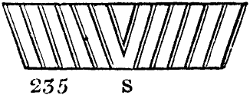
Q is one of a pair of cast-iron brackets, screwed on at the back of the side-frames or
cheeks A A, to carry the roller filled with white calico R, ready for the printing operations.
Upon the end of the shaft whereon the calico is coiled, a pulley is fixed, over which a
rope passes suspending a weight in order to produce friction, and thereby resistance to
the action which tends to unwind the calico. In winding it upon that and similar
rollers, the calico is smoothed and expanded in breadth by being passed over one or
more grooved rods, or over a wooden bar S, fig. 235. the surface of
which is covered with wire, so as to have the appearance of a
united right and left-handed screw. By this device, the calico,
folded or creased at any part, is stretched laterally from the
centre, and made level. It then passes over the guide-roller
o, where it comes upon the surface of the felt e′′ e′′, and thence proceeds under its
guidance to the series of printing cylinders.
Three and four-colour machines, similar to the above, are now at work in many establishments
in Lancashire, which will turn off a piece of 28 yards per minute, each of
the three or four cylinders applying its peculiar part of the pattern to the cloth as it
passes along, by ceaseless rotation of the unwearied wheels. At this rate, the astonishing
length of one mile of many-coloured web is printed with elegant flowers and other figures
in an hour. When we call to mind how much knowledge and skill are involved
in this process, we may fairly consider it as the greatest achievement of chemical and
mechanical science.
Before entering upon the different styles of work which constitute calico printing, I
shall treat, in the first place, of what is common to them all, namely, the thickening of
the mordants and colours. This is an operation of the greatest importance towards the
successful practice of the art. Several circumstances may require the consistence of the
thickening to be varied; such as the nature of the mordant, its density, and its acidity.
A strong acid mordant cannot be easily thickened with starch; but it may be by roasted
starch, vulgarly called British gum, and by gum arabic or senegal. Some mordants
which seem sufficiently inspissated with starch, liquefy in the course of a few days; and
being apt to run in the printing-on make blotted work. In France, this evil is readily
obviated, by adding one ounce of spirits of wine to half a gallon of colour; a remedy
which the English excise duties render too costly.
The very same mordant, when inspissated to different degrees, produces different tints
in the dye-copper; a difference due to the increased bulk from the thickening substance;
thus, the same mordant, thickened with starch, furnishes a darker shade than when
thickened with gum. Yet there are circumstances in which the latter is preferred, because
it communicates more transparency to the dyes, and because, in spite of the washing,
more or less of the starch always sticks to the mordant. The gum has the inconvenience,
however, of drying too speedily, and of also increasing too much the volume of the
mordants; by both of which causes it obstructs their combination with the stuff, and the
tints become thin or scratchy.
The substances generally employed as thickeners, are the following:—
- Wheat starch.
- Flour.
- Roasted starch.
- Gum senegal.
- Gum tragacanth.
- Salep.
- Pipe-clay, mixed with gum senegal.
- Sulphate of lead.
- Sugar.
- Molasses.
- Glue.
After thickening with gum, we ought to avoid adding metallic solutions in the liquid
state; such as nitrate of iron, of copper, solutions of tin, of subacetate of lead, &c.; as
they possess the property of coagulating gum. I shall take care to specify the nature
and proportion of thickening to be employed for each colour; a most important matter,
hitherto neglected by English writers upon calico printing.
The atmosphere of the printing shops should never be allowed to cool under 65° or
70° F.; and it should be heated by proper stoves in cold weather, but not rendered too
dry. The temperature and moisture should therefore both be regulated with the aid of
thermometers and hygrometers, as they exercise a great influence upon all the printing
processes, and especially upon the combination of the mordant with the cloth. In the
course of the desiccation, a portion of the acetic acid evaporates with the water, and subacetates
are formed, which combine with the stuff in proportion as the solvent principle
escapes; the water as it evaporates carries off acetic acid with it, and thereby aids the fixation
of bases. These remarks are peculiarly appropriate to delicate impressions by the
cylinder machine, where the printing and drying are both rapidly effected. In the lapis
lazuli style, the strong mordants are apt to produce patches, being thickened with pipe-clay
and gum, which obstruct the evaporation of the acids. They are therefore apt to
remain, and to dissolve a portion of the mordants at their immersion in the blue vat, or
at any rate, in the dung bath. In such a case a hot and humid air is indispensable,
after the application of the mordants; and sometimes the stuffs so impregnated, must be
suspended in a damp chamber. To prevent the resist pastes becoming rapidly crusty,
substances apparently useless are mixed with them, but which act beneficially by their
hygrometric qualities, in retarding the desiccation. Oil also is sometimes added with
that view.
It is often observed that goods printed upon the same day, and with the same mordant,
exhibit inequalities in their tints. Sometimes the colour is strong and decided in one
part of the piece, while it is dull and meagre in another. The latter has been printed
in too dry an atmosphere. In such circumstances a neutral mordant answers best,
especially if the goods be dried in a hot flue, through which humid vapours are in constant
circulation.
In padding, where the whole surface of the calico is imbued with mordant, the drying
apartment or flue, in which a great many pieces are exposed at once, should be so constructed
as to afford a ready outlet to the aqueous and acid exhalations. The cloth ought
to be introduced into it in a distended state; because the acetic acid may accumulate in the
foldings, and dissolve out the earthy or metallic base of the mordant, causing white and
gray spots in such parts of the printed goods. Fans may be employed with great
advantage, combined with Hot Flues. (See this article.)
In the colour laboratory, all the decoctions requisite for the print work should be
ready prepared. They are best made by a steam heat, by means of copper boilers of a
cylindric form, rounded at the bottom, and encased within a cast-iron cylinder, the steam
being supplied to the space between the two vessels, and the dye-stuff and water being
introduced into the interior one, which for some delicate purposes may be made of tin,
or copper tinned inside. A range of such steam apparatus should be placed either along
one of the side walls, or in the middle line of the laboratory. Proper tables, drawers,
phials, with chemical reagents, measures, balances, &c., should also be provided. The
most useful dye-extracts are the following:—
Decoction of logwood, of Brazil wood, of Persian berries, of quercitron bark, of nut-galls,
of old fustic, of archil or cutbear, of cochineal, of cochineal with ammonia, of
catechu.
The following mordants should also be kept ready prepared:—
1. Aluminous mordant.
1. Take 50 gallons of boiling water.
1. Take 100 lbs. of alum.
1. Take 10 lbs. of soda crystals.
1. Take 75 lbs. of acetate of lead.
The soda should be added slowly to the solution of the alum in the water, and when
the effervescence is finished, the pulverized acetate of lead is put in and well stirred about
till it be all dissolved and decomposed. During the cooling, the mixture should be
raked up a few times, and then allowed to settle. The supernatant liquor is the mordant;
it has a density of 11° or 111⁄2° Baumé. It serves for reds and pinks, and enters into the
composition of puce and lilac.
2. Aluminous mordant.
2. Take 50 gallons of water.
2. Take 100 lbs. of alum.
2. Take 10 lbs. of soda crystals.
2. Take 100 lbs. of acetate of lead;—operate as above directed.
The supernatant liquor here has a density of 12° Baumé; it is employed for lapis
resists or reserves, and the cylinder printing of madder reds.
3. Aluminous mordant.
3. Take 50 gallons of water.
3. Take 100 lbs. of alum.
3. Take 6 lbs. of soda crystals.
3. Take 50 lbs. of acetate of lead;—operate as above directed.
This mordant is employed for uniform yellow grounds.
4. Aluminous mordant.
This is made by adding potash to a solution of alum, till its earth begins to be
separated, then boiling the mixture to precipitate the subsulphate of alumina, which is to
be strained upon a filter, and dissolved in acetic acid of moderate strength with the aid
of heat. This mordant is very rich in alumina, and marks 20° B.
5. Aluminous mordant.
5. Take 121⁄2 gallons of water.
5. Take 100 lbs. of alum.
5. Take 150 lbs. of liquid pyrolignite of lime at 111⁄2° Baumé.
This mordant is made with heat like the first; after cooling, some alum crystallizes,
and it marks only 121⁄2° B.
A mordant is made by solution of alum in potash, commonly called—
6. Aluminate of potash. The caustic lye is prepared by boiling together for an hour
100 gallons of water, 200 lbs. of potash, and 80 lbs. of quicklime; the mixture is then
allowed to settle, the supernatant liquor is decanted, and evaporated till its density be
35° B. In 30 gallons of that lye at a boiling heat, 100 lbs. of ground alum are to be
dissolved. On cooling, crystals of sulphate of potash separate. The clear liquor is to
be decanted off, and the crystals being washed with a little water, this is to be added to
the lye. About 33 gallons of mordant should be obtained.
Mordant for Black.
The pyrolignite of iron called iron liquor in this country, is the only mordant used in
calico-printing for black, violet, puce, and brown colours. The acetate of alumina, prepared
from pyrolignous acid, is much used by the calico-printers under the name of red
or yellow liquor, being employed for these dyes.
We may observe that a strong mordant, like No. 2., does not keep so well as one of
mean density, such as No 1. Too much mordant relatively to the demands of the
works should therefore not be made at a time.
There are eight different styles of calico-printing, each requiring different methods of
manipulation, and peculiar processes.
1. The madder style, to which the best chintzes belong, in which the mordants are
applied to the white cloth with many precautions, and the colours are afterwards brought
up in the dye-bath. These constitute permanent prints.
2. The padding or plaquage style, in which the whole surface of the calico is imbued
with a mordant, upon which afterwards different coloured figures may be raised, by the
topical application of other mordants joined to the action of the dye-bath.
3. The reserve style, where the white cloth is impressed with figures in resist paste,
and is afterwards subjected first to a cold dye, as the indigo vat, and then to a hot dye-bath,
with the effect of producing white or coloured spots upon a blue ground.
4. The discharge or rongeant style, in which thickened acidulous matter either pure
or mixed with mordants, is imprinted in certain points upon the cloth, which is afterwards
padded with a dark-coloured mordant, and then dyed, with the effect of showing bright
figures on a darkish ground.
5. China blues; a style resembling blue stone-ware, which requires very peculiar treatment.
6. The decolouring or enlevage style; by the topical application of chlorine or chromic
acid to dyed goods. This is sometimes called a discharge.
7. Steam colours; a style in which a mixture of dye extracts and mordants are
topically applied to calico, while the chemical reaction which fixes the colours to the fibre
is produced by steam.
8. Spirit colours; produced by a mixture of dye extracts, and solution of tin, vulgarly
called spirit by dyers. These colours are brilliant but fugitive.
I. The madder style; called by some dip colours. The true chintz patterns belong to
it; they have from 5 to 7 colours, several of which are grounded-in after the first dye
has been given in the madder bath.
In dyeing with madder; sumach, fustic or quercitron, is sometimes added to the bath,
in order to produce a variety of tints with the various mordants at one operation.
1. Suppose we wish to produce flowers or figures of any kind containing red, purple,
and black colours, we may apply the three mordants at once, by the three-colour cylinder
machine, putting into the first trough acetate of alumina thickened; into the second,
acetate of iron; and into the third, a mixture of the two; then drying in the air for a
few days to fix the iron, dunging, and dyeing up in a bath of madder and sumach. If
we wish to procure the finest madder reds and pinks, besides the purple and black, we
must apply at first only the acetate of alumina of two densities, by two cylinders, dry,
dung, and dye up, in a madder bath. The mordants of iron liquor for the black, and of iron
liquor mixed with the aluminous for purple, must be now grounded-in by blocks, taking
care to insert these mordants into their precise spots: the goods being then dried with
airing for several days, and next dunged, are dyed up in a bath of madder and sumach.
They must be afterwards cleared by branning. See Bran, Dunging, and Madder.
2. Suppose we wish to produce yellow with red, pink, purple and black; in this case
the second dye-bath should contain quercitron or fustic, and the spots intended to be
yellow should receive the acetate of alumina mordant.
3. The mordant for a full red may be acetate of alumina, of spec. grav. 1·055 thickened
with starch, and tinged with Brazil wood; that for a pale red or pink, the same at spec.
gravity 1·014, thickened with gum; that for a middling red, the same at spec. gravity,
1·027, thickened with British gum; and for distinction’s sake, it may be tinged yellow
with Persian berries. The mordant for black is a pyrolignous acetate of iron, of specific
gravity 1·04; for purple the same, diluted with six times its volume of water; for
chocolate, that iron liquor mixed with acetate of alumina, in various proportions according
to the shade wanted. Sumach is mixed with the madder for all these colours except for the
purple. The quantity of madder required varies according to the body of colour to be put
upon the cloth, being from one pound per piece to three or even four. The goods must
be entered when the copper is cool, be gradually heated during two or three hours, up to
ebullition, and sometimes boiled for a quarter of an hour; the pieces being all the while
turned with a wince from the one side of the copper to the other. (See Wince.) They
are then washed and boiled in bran and water for ten or fifteen minutes. When there
is much white ground in the chintz, they must be branned a second or even a third time,
with alternate washing in the dash-wheel. To complete the purification of the white,
they are spread upon the grass for a few days; or what is more expeditious, and equally
good if delicately managed, they are winced for a few minutes in a weak solution of
chloride of lime.
4. In the grounding-in for yellow, after madder reds, the aluminous mordant being
applied, &c., the piece is dyed, for about an hour, with one pound of quercitron bark, the
infusion being gradually heated to 150° or 160°, but not higher.
5. A yellow is sometimes applied in chintz work after the other colours are dyed, by
means of a decoction of Persian berries mixed with the aluminous mordant, thickened
with flour or gum, and printed-on with the block; the piece, when dry, is passed
through a weak carbonated alkaline water, or lime water, then washed and dried for
the market.
6. Black mordant.—Take half a gallon of acetate of iron, of spec. grav. 1·04, 4 ounces
of starch, and 4 ounces of flour. The starch must first be moistened with the acetate,
then the flour must be added, the rest of the acetate well mixed with both, and the
whole made to boil over a brisk fire for five minutes, stirring meanwhile to prevent
adhesion to the bottom of the pot. The colour must be poured into an earthen pipkin,
and well mixed with half an ounce of gallipoli oil. In general, all the mordants,
thickened with starch and flour, must be boiled, for a few minutes. With British gum
or common gum, they must be heated to 160° F., or thereby, for the purpose merely of
dissolving them. The latter should be passed through a sieve to separate the impurities
often present in common gum.
7. Puce mordant.—Take a quart of acetate of alumina and acetate of iron, each of spec.
grav. 1·04, mixed and thickened like the black, No. 6. To give the puce a reddish
tinge, the acetate of alumina should have a specific gravity of 1·048, and the iron
liquor only 1·007.
Red mordants are thickened with British gum, and are sufficiently coloured with the
addition of any tingeing decoction.
8. Violet mordants.—These consist either of a very weak solution of acetate of iron,
of spec. gravity 1·007, for example; or of a little of the stronger acetate of 1·04,
mixed with acetate of alumina, and a little acetate of copper, thickened with starch or
British gum. The shades may be indefinitely varied by varying the proportions of the
acetates.
When black is one of the colours wanted, its mordant is very commonly printed-on
first, and the goods are then hung upon poles in the drying-room, where they are aired
for a few days, in order to fix the iron by its peroxidizement; the mordants for red,
violet, &c., are then grounded in, and the pieces are dyed up, after dunging and
washing, in the madder bath, into which, for certain shades, sumach, galls, or fustic, is
added. The goods are brightened with a boil in soap water; occasionally also in a
bath, containing a small quantity of solution of tin or common salt. The following
mode of brightening is much extolled by the French, who are famous for their reds
and roses.
1. A soap boil of forty minutes, at the rate of 1 pound for every 2 pieces. Rinse in
clear water.
2. Pass through chloride of soda solution of such strength that two parts of it
decolour one part of Gay Lussac’s test liquor. See Chloride of Lime and Indigo.
Wince the pieces through it for 40 minutes. Rinse again.
3. Pass it again through the soap bath, No. 1.
4. Brighten it in a large bath of boiling water, containing 4 pounds of soap, and
1 pound of a cream-consistenced salt of tin, containing nearly half its weight of the
muriate of tin, combined with as much nitric acid of spec. grav. 1·288. This strong
nitro-muriate having been diluted with a little water, is to be slowly poured into
the bath of soap water, and well mixed by stirring. The pieces are now put in,
and winced through it for one half, or three quarters of an hour.
5. Repeat the soap boil, No. 1. Rinse and dry.
9. Grounding in of Indigo blue.
Take half a gallon of water of 120° F., 8 ounces of ground indigo, and 8 ounces
of red sulphuret of arsenic (orpiment), 8 ounces of quicklime, mix together, and heat
the mixture to the boiling point; withdraw from the fire, and add, when it is lukewarm,
6 ounces of carbonate of soda, stir and leave the whole at rest till the next day. Then
decant the clear liquor, and thicken every quart of it with half a pound of gum. This
colour ought to be green, and be preserved in a close vessel. When used it is put
into a pot with a narrow orifice, the pencil is dipped into it, wiped on the edge of the
pot, and immediately applied by hand. This plan is tedious, and is nearly superseded
by the following grounding blue.
Take half a gallon of caustic soda lye of spec. grav. 1·15, heated to 120° F.
12 ounces of hydrate of protoxide of tin, obtained by precipitating it from the muriate
of tin by solution of potash.
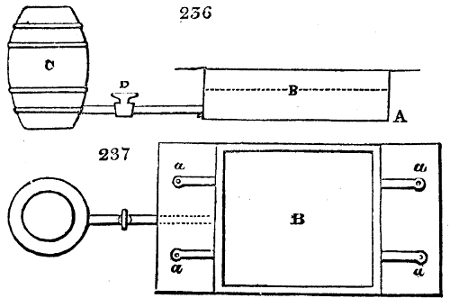
8 ounces of ground indigo; heat these mixed ingredients to the boiling point, then
move the pot off and on the fire two or three times in succession, and finally thicken,
with 3 pounds of raw sugar. In order to apply this by the block, the following
apparatus is employed, called the canvass frame; figs. 236. 237. It is formed of a copper
case or box A, in which is laid a frame B, filled with pretty stout canvass. The box
communicates by a tube with the cistern C, mounted with a stop-cock D. Fig. 237.
represents the apparatus in plan: A, the box; B, the canvass, with its edges a a a a,
fixed by pin points to the sides. The colour is teared (tiré), or spread even, with a
wooden scraper as broad as the canvass. In working with this apparatus, the colour
being contained in the vessel C is drawn off into the case A, by opening the stop-cock D,
till it rises to the level of the canvass. The instant before the printer daubs the block
upon the canvass, the tearer (tireur), boy or girl, runs the scraper across it to renew its
surface; and the printer immediately transfers the colour to the cloth. In this kind
of printing great skill is required to give evenly impressions. As the blue is usually
applied to somewhat large designs, it is very apt to run; an inconvenience counteracted
by dusting fine dry sand upon the cloth as soon as it is blocked. The goods must
be washed within 24 hours after being printed.
10. Topical grounding blue for the cylinder press.
Take 31⁄2 gallons of caustic soda lye of spec. grav. 1·15.
Take 31⁄2 lbs. of ground indigo.
Take 5 lbs. of precipitated protoxide of tin (as above).
Boil the mixed ingredients for ten minutes, take them from the fire, and add, first,
3 lbs. of Venice turpentine; then 11 lbs. of gum.
Put this mixture into the colour trough, print with it, and after two days wash in
the dash-wheel; then pass it through a soap bath, along with a little soda, to brighten
the blue, and to take off its greyish tint.
The use of the turpentine is easily explained; it serves to exclude the atmospherical
oxygen, and prevent the regeneration of the indigo blue, before it is spread upon
the cloth.
After the application to white calico of a similar blue, into which a little acid muriate
of tin has been put, the goods are dipped for ten minutes in thin milk of lime, shaking
the frame all the time. They are then washed, and cleared with a soap boil. The following
colour remains long in the deoxidized state from its containing 8 ounces of indigo, 10
ounces of hydrated protoxide of tin, and 11⁄2 pounds of solution of muriate of tin, to 2
quarts of soda lye of 1·15, thickened with 21⁄2 pounds of gum. This blue may be
applied by either the block or the cylinder.
11. Topical Prussian blue for grounding.
2 quarts of water with 8 ounces of starch, are to be mixed and boiled; add 21⁄4 ounces of a
liquid Prussian blue colour, prepared by triturating three quarters of an ounce of that
pigment with as much muriatic acid, leaving the ingredients to react upon each other for
24 hours, and then adding three quarters of an ounce of water.
Add 4 ounces of liquid perchloride of tin (oxymuriate).
Mix all together, and pass through a searce. This colour is not very fast; cloth
printed with it will bear only rinsing.
12. Prussian blue figures are impressed as follows:—
Dissolve 8 ounces of sulphate of iron, and as much acetate of lead, separately in 2 quarts
of boiling water; mix well, and settle. Take one quart of this clear liquor reduced to
spec. grav. 1·02, one quart of mucilage containing 3 pounds of gum, coloured with a
little prussiate of potash, mix into a mordant, and print it on with the cylinder. Two
days afterwards wash in tepid water containing a little chalk, and then pass the cloth
through a solution of prussiate of potash in water, sharpened with a little muriatic acid,
till it takes the desired hue. Finally rinse.
II. The padding or plaquage style, called foulard also by the French. See Padding.
Any mordant whatever, such as the acetates of alumina, or of iron, or their mixture,
may be applied to the piece by the padding machine, after which it is dried in the HOT-FLUE,
washed, dunged, dyed, washed, and brightened.
Colours from metallic oxides are very elegantly applied by the padding process.
Thus the iron buff, the manganese bronze, and the chrome yellows and greens are given.
1. Iron buff or chamois.
Take 50 gallons of boiling water;
Take 150 pounds of sulphate of iron; dissolve along with
Take 10 pounds of alum; which partly saturate by the gradual addition of
Take 5 pounds of crystals of soda; and in this mixture dissolve
Take 50 pounds of pyrolignous acetate of lead. Allow the whole to settle, and draw off
the clear supernatant liquid.
For furniture prints this bath should have the spec. grav. 1·07.
The calico being padded in it, is to be dried in the hot-flue; and after 48 hours suspension
is to be washed in water at 170° containing some chalk, by the wince apparatus.
It is then washed, by the same apparatus, in hot water, containing a pailful of soda lye
of spec. grav. 1·04.
For light tints the padding liquor should be reduced to the spec. grav. 1·01. The
dye in either case may be brightened by wincing through a weak solution of chloride of
lime.
Nitrate of iron diffused through a body of water may be also used for padding, with
alternate washings in water, and a final wincing in a weak alkaline lye.
With a stronger solution, similar to the first, the boot-top colour is given.
2. The bronze or solitaire.
The goods are to be padded in a solution of the sulphate or muriate of manganese,
of a strength proportional to the shade desired, dried in the hot-flue, and then raised
by wincing them in a boiling-hot caustic lye, of spec. grav. 1·08, and next through a
weak solution of chloride of lime, or soda. They are afterwards rinsed. Instead of
passing them through the chloride, they may be merely exposed to the air till the manganese
attracts oxygen, then rinsed, and dried.
When the manganese solution has the density of 1·027, it gives a light shade; at the
density of 1·06, a shade of moderate depth, and at 1·12 a dark tint.
The texture of the stuff is apt to be injured during the oxidation of the manganese.
3. Carmelite is obtained by padding in a mixture of muriate or sulphate of manganese
and acetate of iron, then proceeding as above.
4. Copper green is given by padding in a mixed solution of sulphate and acetate of
copper with a little glue, drying in the hot-flue, and next day padding in a caustic lye
of spec. grav. 1·05. The goods are then rinsed, and padded through a solution made
with 8 ounces of arsenious acid combined with 4 ounces of potash diluted with 2 gallons
of water. They are finally rinsed and dried.
5. Olive and cinnamon colours are given by padding through mixed solutions of the
acetate of iron and sulphate of copper; drying, and padding in a caustic lye of spec.
grav. 1·05.
6. Green and solitaire form a pleasing umber, or hellebore shade, which may be obtained
by padding through a mixed solution of manganese and aceto-sulphate of copper
and raising the shades, as above prescribed.
7. Chrome yellow.
Pad in a solution of bichromate of potash containing 8 ounces of it to the gallon of water;
then dry with moderate heat, and pad in a solution of acetate or nitrate of lead, containing
6 or 8 ounces in the gallon of water; wash, and dry. Or we may pad first in a
solution of acetate of lead containing a little glue; dry, and pad in solution of bichromate
of potash. Then rinse. The last process is apt to occasion cloudiness. To
obtain a light lemon tint, we must pad in a solution of acetate of lead of double the above
strength, or 16 ounces to the gallon, then wince the pieces through weak milk of lime,
rince, pad through bichromate of potash, rinse, and dry.
8. Chrome orange.
Pad through a mixed solution of the subacetate and acetate of lead, three times in
succession, and dry in the hot-flue; then wince for ten minutes through weak milk of
lime; rinse; wince for a quarter of an hour in a warm solution of bichromate of potash;
and finally raise the colour by wincing the goods through hot lime water.
9. Prussian blue.
Pad in the preceding chamois liquor of the spec. grav. 1·007; dry in the hot-flue;
wince well in chalky water at 160° F., and then dye by wincing in the following
liquor:—
Dissolve 5 ounces of prussiate of potash, in 25 gallons of water heated to 90° or 100°,
adding 2 ounces of sulphuric acid; afterwards rinse, and brighten in a very dilute
sulphuric acid.
10. Green is given by padding goods, previously dyed in the indigo vat, in a solution
of acetate of lead containing a little glue; and then padding them in a warm solution of
bichromate of potash; finally rinsing and drying.
III. Resist pastes or reserves; these are subservient to the cold indigo vat, and they
may be distributed under four heads; 1. fat reserves; 2. reserves with bases of metallic
salts; 3. coloured reserves capable of assuming different tints in the dyeing; 4. reserves
with mordants, for the cloth to be afterwards subjected to a dyeing bath, whereby variously
coloured figures are brought up on a blue ground, so as to resemble the mineral
called lazulite; whence the name lapis or lapis lazuli.
1. The fatty resists are employed in the printing of silk; which see infra.
2. With regard to reserves the following general observations may be made. After printing-on
the paste, the goods must be hung up in a chamber, rather humid than too dry,
and left there for a certain time, more or less, according to the nature of the reserve. In
dipping them into the blue vat, if the reserve be too dry, it is apt to swell, scale off, and
vitiate the pattern. This accident is liable to happen also when the vat is deficient in
lime, especially with deep blues.
1. Simple white resist paste for a full body of blue.
Take 1 gallon of water, in which are to be dissolved,
1 pound of binacetate of copper (distilled verdigris), and 3 libs. of sulphate of copper.
This solution is to be thickened with
2 libs. of gum senegal, 1 lib. of British gum, and 4 libs. of pipe-clay; adding afterwards, 2 ounces of nitrate of copper—as a deliquescent substance.
2. White reserve for light blues.
Take 1 gallon of water, in which dissolve
4 ounces of binacetate of copper,
1 lib. of sulphate of copper; and thicken this solution with
2 libs. of gum senegal, 1 lib. of British gum, and 4 libs. of pipe-clay.
3. White reserve for the cylinder machine.
Take 11⁄2 gallons of water; in which dissolve
21⁄2 libs. of binacetate of copper,
10 libs. of sulphate of copper; and add to the solution
6 libs. of acetate of lead; then thicken with
10 libs. of gum; adding afterwards 10 libs. of sulphate of lead.
After printing-on this reserve, the goods are to be hung up for two days, then dipped
till the proper blue tint be obtained. Finally they must be winced through dilute sulphuric
acid to clear up the white, by removing the cupreous tinge.
3. Coloured reserves.
1. Chamois reserve.
Take 1 gallon of the chamois bath (No. 1. page 226, at bottom); to which add
8 ounces of nitrate of copper,
24 ditto of muriate of zinc; thicken with
6 pounds of pipe clay, and 3 libs. of gum senegal.
After printing-on this paste, the goods must be hung up for five or six days in a
somewhat damp room. Then after having dipped them in the vat, they are to be steeped
in water for half an hour, and slightly washed. Next wince for half an hour, through
water at 100° F. containing 2 pounds of soda crystals per 30 gallons. Rinse and dry.
2. Chrome yellow reserve.
Take 1 gallon of water; in which dissolve
3 libs. of nitrate of lead,
1 lib. of binacetate of copper; to the solution, add
1⁄2 lib. of subacetate of lead; and thicken the mixed solution with
3 libs. of gum.
6 libs. of pipe clay. Grind all the ingredients together, and pass through a searce.
After treating the goods as in No. 1., they must be winced for half an hour in a solution
containing 5 ounces of bichromate of potash, per piece of calico, and also in a
dilute muriatic bath, till the chrome yellow become sufficiently bright.
A chrome orange reserve may be made by introducing a larger proportion of subacetate
of lead, and passing the reserve printed goods through weak milk of lime, as
already prescribed for producing an orange by chrome.
The basis of the resist pastes used at Manchester is sometimes of more complex composition
than the above; since, according to the private information I received from
an extensive calico printer, they contain “china clay” (instead of pipe-clay which often
contains iron) strong solution of sulphate of copper, oil, tallow, and soap; the whole
incorporated by trituration with heat.
In the Lancashire print-works, a little tartaric acid is added to the nitrate of lead,
which prevents the colour from taking a dingy cast.
4. Reserves with mordants, or the lazulite style.
1. Black upon a blue ground.
At Manchester the black pattern is printed-on with a mixture of iron liquor and extract
of logwood, and the resist paste by the cylinder machine; in France the black is
given by the following recipe:—
Take 1 gallon of decoction of galls of spec. grav. 1·04, mixed and boiled into a paste with
14 ounces of flour; into the paste, when nearly cold, there are added,
8 ounces of an acetated peroxide of iron, made by adding 1 lib. acetate of lead to 3
libs. of nitrate of iron, spec. grav. 1·56.
1⁄8 ounce of gallipoli oil.
This topical black forms a fast colour, and resists the fine blue vat, weak potash lye,
bichromate of potash, boiling milk of lime, dunging and maddering.
The preceding answers best for the block; the following for the cylinder,—
2. Take 1 gallon decoction of galls of spec. grav. 1·056.
18 ounces of flour, mix, boil into a paste, to which, when cool, add
8 ounces of the aceto-nitrate of iron of the preceding formula, and
1 quart of iron liquor of spec. grav. 1·110.
In Lancashire a little prussiate of potash is sometimes added to nitrate of iron and
decoction of logwood; and the goods are after washing, &c. finished by passing through a
weak solution of bichromate of potash. The chromic acid gives depth and permanence
to the black dye, being supposed to impart oxygen to the iron, while it does not affect
any of the other colours that may happen to be impressed upon the cloth, as solution of
chloride of lime would be apt to do. The solution of the bichromate deepens the spirit
purples into blacks, and therefore with such delicate dyes becomes a very valuable
application. This interesting fact was communicated to me by an eminent calico-printer
in Lancashire.
Having premised the composition of the topical black dye, we are now prepared to
apply it in the lazulite style.
1. Black resist.
Take 1 gallon of the above black without the flour,
2 ounces of sulphate of copper,
1 ounce of muriate of ammonia, dissolve and thicken with
4 pounds of pipe-clay and 2 pounds of gum.
Another good formula is the following:—
Take 1 gallon of iron liquor of 1·056 spec. grav. dissolve in it,
2 ounces of binacetate of copper,
8 ounces of sulphate of copper; and thicken as just described.
2. Puce reserve paste, contains acetate of alumina mixed with the iron liquor.
3. Full red reserve.
Take 1 gallon of acetate of alumina, (made with 50 gallons water, 100 libs. alum, 10 libs.
soda crystals, and 100 libs. acetate of lead; the supernatant liquid being of spec. grav. 1·085); dissolve in it
4 ounces of corrosive sublimate; thicken with
2 pounds of gum senegal,
4 pounds of pipe-clay, and mix in 8 ounces of gallipoli oil.
4. Reserve paste for a light red.
Take 1 gallon of the weaker sulpho-acetate of alumina formerly prescribed; dissolve in it
4 ounces of corrosive sublimate; and thicken with
4 pounds of pipe-clay, and 2 pounds of gum; adding to the mixture
8 ounces of oil.
5. Neutral resist paste.
Take 1 gallon of water; in which dissolve,
31⁄4 libs. of binarseniate of potash, and
12 ounces of corrosive sublimate; thicken with
3 libs. of gum, and 6 libs. of pipe-clay, adding to the paste 16 ounces of oil.
6. Carmelite reserve paste.
Take 1 half gallon of acetate of alumina spec. grav. 1·014; (see second aluminous mordant p. 223).
1 half gallon iron liquor of spec. grav. 1·027; dissolve in them
4 ounces of sulphate of copper, 4 ounces of verdigris, and 1 ounce of nitrate of copper; thicken with
2 libs. of gum,
4 libs. of pipe-clay.
7. Neutral reserve paste.
Take 1 gallon of water; dissolve in it,
44 ounces of binarseniate of potash, and
12 ounces of corrosive sublimate; thicken with
3 libs. of gum,
6 libs. of pipe-clay,
16 oz. of oil.
To explain fully the manipulation of the lazulite style, we shall suppose that the
calicoes are printed with the following reserves, taken in their order:—
- Black reserve, No. 1. above.
- Full red reserve, No. 3.
- Light red reserve, No. 4.
- Neutral reserve, No. 7.
Four days after printing-on these reserves, the goods must be twice dipped in the blue
vat, ten minutes in and ten minutes out each time; but more dips may be given
according to the desired depth of shade. The cloth must be afterwards rinsed in
running water for half an hour. The next process is to remove the paste; which is
done by wincing the goods in a bran bath, lowered to 150°, during twenty minutes.
They are then winced for five minutes in a bath of water slightly sharpened with vinegar.
When well cleansed, they are ready for the madder bath. The lapis goods are finally
cleared in a bran bath, by exposure on the grass, and a soap boil.
The lazulite style is susceptible of many modifications.
8. Deep blue ground, with light blue, carmelite, and white figures.
- Print-on the white reserve, No. 1.
- Dip in the strongest blue vat; rinse and dry.
- Ground-in with the block, the carmelite reserve (containing the mixed acetates of iron and alumina.)
- Ground-in the neutral reserve.
- Dip for the light blue; rinse.
- Dung, dye, and clear, as above.
By varying the proportions of the reserve mordants, and the dye stuffs, as madder,
quercitron, &c. a great variety of effects may be produced.
9. Deep green ground, with buff and white figures.
- Print-on the white reserve.
- Dip in the blue vat; rinse and dry.
- Pad in the buff liquor, as formerly prescribed.
- Ground in upon the buff spots, the discharge, No. 2. presently to be described.
- Wash away the paste in chalky water.
- Wince through a boiling alkaline lye, to raise the buff iron colour.
IV. The Discharge style; first, of simple discharges.
1. Discharge for block printing.
Take 1 gallon of lemon or lime-juice, of spec. grav. 1·09, in which dissolve
1 pound of tartaric acid,
1 pound of oxalic acid, and thicken the solution with
4 pounds of pipe or china clay, and 2 pounds of pulverised gum; as soon as the gum is dissolved, the mixture must be put through a searce.
2. Another discharge is made of half the above acid strength.
3. A third with one half of the solid acids of the second.
4. Take 1 gallon of water, in which dissolve with heat
1 pound of cream of tartar adding, to facilitate the solution,
1 pound of warm sulphuric acid of spec. grav. 1·7674; after 24 hours mix
4 libs. of pipe or China clay, and three libs. of gum with the decanted clear liquor.
In some cases British gum is used alone, as a thickener.
5. Discharge for the cylinder machine.
Take 1 gallon of lime juice, of spec. grav. 1·085; dissolve in it
3 pounds of tartaric acid, and one pound of oxalic acid; thicken with
6 pounds of gum senegal, or 5 pounds of British gum.
6., 7. A stronger and weaker discharge is made of the same materials; and one is made
without the tartaric acid.
Second; combination of discharges with mordants.
1. Black, red, lilac, and white figures upon an olive ground.
The olive being given in a madder bath, and the ground well whitened (see Madder),
the cloth is padded in a weak buff mordant; and upon the parts that are to remain
white, the weakest simple discharge No. 3. is printed-on by the cylinder; (in some works
the discharge paste is applied and made dry before padding through the iron liquor;)
the goods are cleared of the paste in a tepid chalky water, then dyed in a quercitron
bath, containing a little glue, and cleared in a bran bath.
Discharge mordants upon mordants may be regarded as a beautiful modification of the
preceding style. Example.
A violet ground or impression, with red and white.
1. Pad with an acetate of iron of 1·004; or print-on with the cylinder, iron liquor
of 1·027 thickened with British gum.
2. Print-on a red mordant, strongly acidulated with lime juice of 1·226.
3. Ground in the discharge No. 2.; dry.
4. Clear off the paste in chalky water.
5. Dung, madder, and brighten.
6. Ground-in the topical colours at pleasure.
V. China blues.
Take 16 pounds of coarsely ground indigo, and
4 pounds of sulphuret of arsenic; dissolve 22 pounds of sulphate of iron in 6
gallons of water; introduce these three matters into the indigo mill, and grind them for
three days. If it be wished to have a thickened blue, this mixture must have pounded
gum added to it, but if not, 5 gallons of water are added. This colour may be called
blue No. 1.
The following table exhibits the different gradations of China blue:—
| Course. |
Quantity
by measure of
No. 1. |
Quantity
by measure of
water or mucilage. |
| No. |
1 |
1 |
0 |
| |
2 |
11 |
1 |
| |
3 |
10 |
2 |
| |
4 |
8 |
4 |
| |
5 |
6 |
6 |
| |
6 |
4 |
8 |
| |
7 |
2 |
10 |
| |
8 |
2 |
12 |
| |
9 |
2 |
14 |
| |
10 |
2 |
16 |
| |
11 |
2 |
18 |
| |
12 |
2 |
20 |
I shall now give examples of working this style by the block and cylinder:—
Impression of a single blue with small dots.
For the block, blue No. 5. thickened with starch.
For the cylinder, No. 4. thickened with gum.
Impression of two different blues with the block.
First blue, No. 4. with starch.
Second blue, No. 9. with gum.
Impression of three blues with the block.
First blue, No. 5. with starch.
Second blue, No. 7. with starch.
Third blue, No. 10. with gum.
After printing-on the blues, the pieces are hung up for two days in a dry and airy
place, but not too dry; then they are dipped as follows:—Three vats are mounted,
which may be distinguished by the numbers, 1., 2., 3.—
No. 1. 300 pounds of lime to 1,800 gallons of water.
No. 2. Solution of sulphate of iron of spec. grav. 1·048.
No. 3. Solution of caustic soda of spec. grav. 1·055; made from soda crystals, quicklime,
and water, as usual.
The pieces being suspended on the frames, are to be dipped in the first vat, and left
in it ten minutes; then withdrawn, drained for five minutes; next plunged into the
second vat for ten minutes, and drained also for five, &c. These operations will be most
intelligible when put into the form of a table:—
| Dip in the 1st vat. |
During 10 minutes. |
Drain during 5 minutes. |
| 2 |
— |
— |
| 1 |
— |
— |
| 2 |
— |
— |
| 3 |
— |
— |
| 2 |
— |
— |
| 1 |
— |
— |
| 2 |
— |
— |
| 1 |
— |
— |
| 2 |
— |
— |
| 3 |
— |
— |
In the dipping of China blues, care should be taken to swing the frames during the
operation; and when the last dip is given, the piece is to be plunged upon its frame into
a fourth vat, containing dilute sulphuric acid of spec. grav. 1·027. This immersion
is for the purpose of removing the oxide of iron, deposited upon the calico in the alternate
passages through the sulphate of iron and lime vats. They are then rinsed an hour in
running water, and finally brightened in the above dilute sulphuric acid, slightly tepid.
Sometimes they are subjected to a soap bath, at the temperature of 120°. By the
addition of nitrate of lead to the indigo vat, the blue becomes more lively. Some use
the roller dyeing apparatus for running the pieces through the respective baths instead
of the square frames. (See Wincing.) But the frame-dip gives the most evenly dyes,
and preserves the vats in good condition for a much longer time.
The various phenomena which occur in the dipping of China blues, are not difficult
of explanation with the lights of modern chemistry. We have, on the one hand, indigo
and sulphate of iron alternately applied to the cloth; by dipping it into the lime, the
blue is deoxidized, because a film of the sulphate of iron is decomposed, and protoxide
of iron comes forth to seize the oxygen of the indigo, to make it yellow-green, and
soluble, at the same time, in lime-water. Then, it penetrates into the heart of the
fibres, and, on exposure to air, absorbs oxygen, so as to become insoluble and fixed
within their pores. On dipping the calico into the second vat of sulphate of iron, a
layer of oxide is formed upon its whole surface, which oxide exercises an action only
upon those parts that are covered with indigo, and deoxidizes a portion of it; thus
rendering a second dose soluble by the intervention of the second dip in the lime-bath.
Hence we see that while these alternate transitions go on, the same series of deoxidizement,
solution, and re-oxidizement recurs; causing a progressively increasing fixation
of indigo within the fibres of the cotton. A deposit of sulphate of lime and oxide of
iron necessarily falls upon the cloth, for which reason the frame should be shaken in the
lime water vat, to detach the sulphate; but, on the contrary, it should be held motionless
in the copperas bath, to favour the deposition of as much protoxide upon it as possible.
These circumstances serve to account for the various accidents which sometimes befall
the China blue process. Thus the blues sometimes scale off, which may proceed from
one of two causes:—1. If the goods are too dry before being dipped, the colour swells,
and comes off in the vats, carrying along with it more or less indigo. 2. If the
quantity of sulphate of lime formed upon the cloth be considerable, the crust will fall
off, and take with it more or less of the blue; whence arise inequalities in the impression.
The influence of temperature is important; when it falls too low, the colours take a
gray cast. In this case it should be raised with steam.
VI. The decolouring or enlevage style; not by the removal of the mordant, but the
destruction of the dye. The acid, which is here mixed with the discharge paste, is
intended to combine with the base of the chloride, and set the chlorine free to act upon
the colour. Among the topical colours for this style are the following:—
1. Black.—Take one gallon of iron liquor of spec. grav. 1·086.
1. Black.—One pound of starch; boil together, and while the paste is hot, dissolve in it
1. Black.—One pound of tartaric acid in powder; and when cold, add
1. Black.—Two pounds of Prussian blue, prepared with muriatic acid, see p. 226.
1. Black.—Two ounces of lamp black, with four ounces of oil.
2. White discharge.—Take one gallon of water; in which dissolve
2. White discharge.—One pound and a half of oxalic acid,
2. White discharge.—Three pounds of tartaric acid; add
2. White discharge.—One gallon of lime juice of spec. grav. 1·22; and thicken with
2. White discharge.—Twelve pounds of pipe clay, and six pounds of gum.
3. Chrome-green discharge.—
3. Chrome-green disTake one gallon of water, thicken with 18 ounces of starch; boil
3. Chrome-green disand dissolve in the hot paste
3. Chrome-green disTwo pounds and a half of powdered nitrate of lead,
3. Chrome-green disOne pound and a half of tartaric acid,
3. Chrome-green disTwo pounds of Prussian blue, as above.
4. Blue discharge.—Take one gallon of water, thicken with
4. Blue discharge.18 ounces of gum; while the boiled paste is hot, dissolve in it
4. Blue discharge.Two pounds of tartaric acid, and mix one pound of Prussian blue.
5. Chrome-yellow discharge.—This is the same as the chrome-green given above, but
without the Prussian blue.
6. A white discharge on a blue ground, requires the above white discharge to be
strengthened with 8 ounces of strong sulphuric acid, per gallon.
7. White discharge for Turkey red needs to be very strong.
7. Take one gallon of lime juice of sp. grav. 1·086; dissolve in it
7. Five pounds of tartaric acid; thicken with
7. Eight pounds of pipe-clay, four pounds of gum; then dissolve in the mixture
7. Three pounds of muriate of tin in crystals; and add, finally,
7. Twenty-four ounces of sulphuric acid.
8. Yellow discharge for Turkey red.—
8. Yellow Take one gallon of lime juice of spec. grav. 1·086; in which dissolve
8. Yellow Four pounds of tartaric acid,
8. Yellow Four pounds of nitrate of lead; thicken the solution with
8. Yellow Six pounds of pipe-clay, and three pounds of gum.
9. For green discharge, add to the preceding 24 ounces of Prussian blue, as above.
The decolouring or chlorine bath is usually formed of wood lined with lead, and
has an area of about 5 feet square, with a depth of 6 feet. A square frame, mounted
with a horizontal series of rollers at top and bottom, may be let down by cords, at
pleasure, into the cistern. The pieces are introduced and guided in a serpentine path,
round the upper and lower rollers alternately, by a cord.
This bath is filled with a solution of chloride of lime, of the spec. grav. 1·045, whose
decolouring strength is 65° by Gay Lussac’s indigo chlorometer. It ought to be made
turbid by stirring before putting in the goods, which should occupy three minutes in
their passage. The piece is drawn through by a pair of squeezer cylinders at the end of
the trough, opposite to that at which the piece enters. With black, white, and blue
impressions of all shades, the goods are floated in a stream of water for an hour; then
rinsed and dried. When there is yellow or green, the pieces must be steeped in water,
then merely washed by the wince, and passed through solution of bichromate of potash,
containing from 3 to 5 ounces of the salt per piece. Here the pieces are winced during
15 or 20 minutes, rinsed, and next passed through dilute muriatic acid to clear the
ground; then rinsed and dried.
Discharge by the intervention of the chromic acid.
After having dipped the pieces to the desired shade, they are padded in a solution of
bichromate of potash; dried in the shade without heat; and then printed with the
following mordant:—
- Take 1 gallon of water; dissolve in it
- 2 pounds of oxalic and 1 pound of tartaric acid; thicken with
- 6 pounds of pipe clay, and 3 pounds of gum; lastly, add
- 8 ounces of muriatic acid.
After the impression, the pieces are winced in chalky water, at 120° F., then washed,
and passed through a dilute sulphuric acid.
M. Daniel Kœchlin, of Mulhausen, the author of this very ingenious process, considers
the action of the bichromate here as being analogous to that of the alkaline
chlorides. At the moment that the block applies the preceding discharge to the bichromate
dye, there is a sudden decoloration, and a production of a peculiar odour.
The pieces padded with the bichromate must be dried at a moderate temperature,
and in the shade. Whenever watery solutions of chromate of potash and tartaric acid
are mixed, an effervescence takes place, during which the mixture possesses the power
of destroying vegetable colours. This property lasts no longer than the effervescence.
VII. Steam colours.—This style combines a degree of brilliancy with solidity of
colour, which can hardly be obtained in any other way, except by the chintz dyes.
The steam apparatus, employed for fixing colours upon goods, may be distributed under
five heads:—1. the column; 2. the lantern; 3. the cask; 4. the steam-chest; and,
5. the chamber.
The column is what is most generally used in this country. It is a hollow
cylinder of copper, from three to five inches in diameter, and about 44 inches long,
perforated over its whole surface with holes of about one sixteenth of an inch,
placed about a quarter of an inch asunder. A circular plate, about 9 inches diameter,
is soldered to the lower end of the column, destined to prevent the coil of cloth from
sliding down off the cylinder. The lower end of the column terminates in a pipe,
mounted with a stop-cock for regulating the admission of steam from the main steam-boiler
of the factory. In some cases, the pipe fixed to the lower surface of the disc is
made tapering, and fits into a conical socket, in a strong iron or copper box, fixed to a
solid pedestal; the steam pipe enters into one side of that box, and is provided, of
course, with a stop-cock. The condensed water of the column falls down into that
chest, and may be let off by a descending tube and a stop-cock. In other forms of the
column, the conical junction pipe is at its top, and fits there into an inverted socket
connected with a steam chest, while the bottom has a very small tubular outlet, so that
the steam may be exposed to a certain pressure in the column, when it is encased
with cloth.
The pieces, after being printed with the topical colours presently to be described, and
dried, are lapped round this column, but not in immediate contact with it; for the copper
cylinder is first enveloped in a few coils of blanket stuff; then with several coils of
white calico; next with the several pieces of the printed goods, stitched endwise; and
lastly, with an outward mantle of white calico. In the course of the lapping and
unlapping of such a length of webs, the cylinder is laid in a horizontal frame, in which
it is made to revolve. In the act of steaming, however, it is fixed upright, by one of
the methods above described. The steaming lasts for 20 or 30 minutes, according to
the nature of the dyes; those which contain much solution of tin admit of less steaming.
Whenever the steam is shut off, the goods must be immediately uncoiled, to prevent the
chance of any aqueous condensation. I was much surprised, at first, on finding the
unrolled pieces to be free from damp, and requiring only to be exposed for a few
minutes in the air, to appear perfectly dry. Were water condensed during the process, it
would be apt to make the colours run.
Steam colours are all topical, though, for many of them, the pieces are previously
padded with mordants of various kinds. Some manufacturers run the goods before
printing them through a weak solution of the perchloride of tin, with the view of brightening
all the colours subsequently applied or raised upon them. I shall now illustrate
steam calico-printing by some examples, kindly furnished me by a practical printer near
Manchester, who conducts a great business with remarkable success.
Steam blue.—Prussiate of potash, tartaric acid, and a little sulphuric acid, are dissolved
in water, and thickened with starch; then applied by the cylinder, dried at a
moderate heat, and steamed for 25 minutes. They are rinsed and dried after the
steaming. The tartaric acid, at a high temperature, decomposes here a portion of the
ferrocyanic acid, and fixes the remaining ferrocyanate of iron (Prussian blue) in the fibre
of the cloth. The ground may have been previously padded and dyed; the acids will
remove the mordant from the points to which the above paste has been applied, and bring
out a bright blue upon them.
Steam purple.—This topical colour is made by digesting acetate of alumina upon
ground logwood with heat; straining, thickening with gum senegal, and applying the
paste by the cylinder machine.
Steam pink.—A decoction of Brazil-wood with a small quantity of the solution
of muriate of tin, called, at Manchester, new tin crystals[15], and a little nitrate of copper to
assist in fixing the colour; properly thickened, dried, and steamed for not more than 20
minutes, on account of the corrosive action of muriate of tin when the heat is too strong.
Cochineal pink.—Acetate of alumina is mixed with decoction of cochineal, a little
tartaric acid and solution of tin; then thickened with starch, dried, and steamed.
Steam brown.—A mixed infusion of logwood, cochineal, and Persian berries, with
cream of tartar, alum (or acetate of alumina), and a little tartaric acid, thickened, dried,
and steamed.
Green, blue, chocolate, with white ground, by steam.—Prussiate of potash and tartaric
acid, thickened, for the blue; the same mixture with berry-liquor and acetate of alumina,
thickened, for the green; extract of logwood with acetate of alumina and cream of
tartar, thickened, for the chocolate. These three topical colours are applied at once by
the three-colour cylinder machine; dried and steamed. Though greens are fixed by the
steam, their colour is much improved by passing the cloth through solution of bichromate
of potash.
In France, solution of tin is much used for steam colours.
VIII. Spirit or Fancy colours.—These all owe their vivacity, as well as the moderate
degree of permanency they possess, to their tin mordant. After printing-on the topical
colour, the goods must be dried at a gentle heat, and passed merely through the rinsing
machine. Purple, brown, or chocolate, red, green, yellow, blue, and white discharge; any
five of these are printed on at once by the five-colour cylinder machine. See Rinsing
Machine.
Chocolate, is given by extract of Brazil-wood, extract of logwood, nitromuriate of tin,
with a little nitrate of copper; all mixed, thickened, and merely printed-on.
Red, by extract of Brazil-wood and tin, with a little nitrate of copper.
Green, by prussiate of potash, with muriate of tin and acetate of lead, dissolved,
thickened, and printed-on.
The goods after rinsing must be passed through solution of bichromate of potash, to
convert the Prussian blue colour into green, by the formation of chrome yellow upon it.
Blue.—Prussian blue ground up with solution (nitromuriate) of tin; thickened, &c.
Yellow.—Nitrate of lead dissolved in solution of tartaric acid, thickened, tenderly
dried, passed through the bichromate vat or padding machine, washed and dried.
This yellow is pretty fast; though topical, it can hardly, therefore, be called a fancy
colour.
When purple is to be inserted instead of the above blue, extract of logwood with tin is
used in the place of the Prussian blue. Tartaric acid is a useful addition to tin in
brightening fancy colours.
Chocolate.—A good topical chocolate is made by digesting logwood with liquid acetate
of alumina, adding a little cream of tartar to the infusion; thickening, applying by the
cylinder, drying, washing, then passing through solution of bichromate of potash, which
serves to darken and fix the colour.
I shall conclude my account of the printing of cotton goods with some miscellaneous
formulæ, which were given me by skilful calico-printers in Lancashire.
Prussian blue is prepared for topical printing by grinding it in a handmill, like that
for grinding pepper or coffee, and triturating the powder with solution of muriate of tin.
Green.—The deoxidized indigo vat liquor is mixed with a little pearlash, and
thickened with gum. This is applied by the cylinder or block to goods previously
padded with nitrate of lead; the goods, after being dried, are passed through milky lime-water,
rinsed, and then winced or padded through the bichromate of potash bath.
Another green.—Nitrate of lead, prussiate of potash, and tartaric acid, dissolved, and
mixed with a little sulphate, nitrate, and muriate of iron; this mixture is either thickened
for cylinder printing, or used in its liquid state in the padding trough. The goods subjected
to one of these two processes are dried, padded in weak solution of carbonate of
potash, which serves to precipitate the oxide of lead from the nitrate; they are finally
padded with bichromate of potash, which induces a yellow upon the blue, constituting a
green colour of any desired tint, according to the proportion of the materials.
Chocolate and black, with white discharge; a fast colour.—The cloth is padded with
acetate of alumina, and dried in the hot flue; it is then passed through a two-colour
machine, the one cylinder of which prints-on lime-juice discharge, thickened with gum
senegal; the other a black topical dye (made with logwood extract and iron liquor).
The cloths are now hung up to be aired during a week, after which they are dunged, and
dyed up with madder, fustic, and quercitron bark, heated with steam in the bath.
Blue, white, and olive or chocolate.—1. Pad with the aluminous mordant; 2. Apply
thickened lemon juice for discharge by the cylinder; 3. Dung the goods after they
are thoroughly dried; 4. Pass them through the bath of madder, fustic, and quercitron,
which dye a brown ground, and leave the discharge points white; then print-on a reserve
paste of China clay and gum with sulphate of copper; dry, dip in the blue vat, which
will communicate an olive tint to the brown ground; or a chocolate, if madder alone had
been used.
When a black ground is desired, with white figures, the acid discharge paste should be
printed-on by the cylinder, and dried before the piece is padded in the iron liquor. By
following this plan the whites are much purer than when the iron is first applied.
Green, black, white.—The black is first printed-on by a mixture of iron liquor, and
infusion (not decoction) of logwood; then resist or reserve paste is applied by the block,
and dried; after which the goods are blued in the indigo vat, rinsed, dried, passed
through solution of acetate of lead; next, through milky lime water; lastly, through a
very strong solution of bichromate of potash.
Turkey red, black, yellow.—Upon Turkey red cloth, print with a strong solution of
tartaric acid, mixed with solution of nitrate of lead, thickened with gum; dry. The
cloth is now passed through the chloride of lime bath, washed, and chromed. Lastly,
the black is printed-on by the block as above, with iron liquor and logwood.
Black ground dotted white, with red or pink and black figures.—1. Print-on the
lime juice discharge-paste by the cylinder; dry; 2. Then pad with iron liquor,
containing a little acetate of alumina, and hang up the goods for a few days to fix
the iron; 3. Dye in a logwood bath to which a little madder has been added; clear
with bran. The red or pink is now put in by the block, with a mixture of extract of
Brazil-wood, nitromuriate of tin, and nitrate of copper, as prescribed in a preceding
formula.
Orange or brown; black; white; pink.—The black is topical, as above; it is printed-on,
as also the lemon-juice discharge and red mordant, with muriate of tin (both
thickened), by the three-colour machine. Then, after drying the cloth, a single-cylinder
machine is made to apply in diagonal lines to it a mixture of acetate of iron and alumina.
The cloth, being dried and dunged, is next dyed in a bath of quercitron, madder, and
fustic.
Here the orange is the result of the mordant of tin and alumina; the brown, of the
alumina and iron; white, of the citric acid discharge. The tin mordant, wherever it has
been applied, resists the weaker mordant impressed in the diagonal lines. The pink is
blocked-on at the end.
Orange brown, or aventurine; black and white.—The topical black (as above), and
discharge lemon juice, are printed-on by the two-colour machine; then the cloth is
subjected to the diagonal line cylinder, supplied with the alumino-iron mordant. The
cloth is dried, dunged, and dyed in a bath of bark, madder, and fustic.
The manganese or solitaire ground admits of a great variety of figures being easily
brought upon it, because almost every acidulous mordant will dissolve the oxide of
manganese from the spot to which it is applied, and insert its own base in its place; and
of course, by dyeing such mordanted goods in various baths, any variety of coloured
designs may be produced. Thus, if the paste of nitrate of lead and tartaric acid solution
be applied, and the goods after drying be passed first through lime water, and then
through a chrome bath, bright yellow spots will be made to appear upon the bronze
ground.
Manganese bronze, buff and green; all metallic colours.—Pad-on the manganese
solution, and dry; apply the aceto-sulphate of iron, of spec. grav. 1·02, and Scheele’s
green (both properly thickened), by the two-colour machine. The goods are next to
be dried, and padded through a cold caustic lye of spec. grav. 1·086. They are then
rinsed, and passed through a weak solution of chloride of lime, to raise the bronze,
again rinsed, and passed through a solution of arsenious acid to raise the green.
Scheele’s green for the calico-printer is made as follows:—
Take 1 gallon of water, in which dissolve with heat,
5 pounds of sulphate of copper, and 1 pound of verdigris. When the two salts
are dissolved, remove the kettle from the fire, and put into it 1 quart of solution of
nitrate of copper, and 5 pounds of acetate of lead. Stir the mixture to facilitate the
decomposition, and allow the pigment to subside.
It must be thickened with 21⁄2 libs. of gum per gallon, for pencilling; or 12 oz. of starch
for the block. The goods printed with this paste are to be winced through a caustic lye,
till a fine sky-blue be produced; then washed well and rinsed. They are now to be
passed through water, containing from half an ounce to an ounce of white arsenic per
piece; 4 turns are sufficient; if it be too long immersed, it will take a yellow tint.
Catechu has been considerably employed by calico-printers of late years, as it affords
a fine permanent substantive brown, of the shade called carmelite by the French. The
following formula will exemplify its mode of application:—
Take 1 gallon of water;
1 pound of catechu in fine powder; reduce by boiling to half a gallon, pass the
decoction through a fine sieve, and dissolve in it 4 ounces of verdigris; allow it then
to cool, and thicken the solution with 5 ounces of starch; while the paste is hot,
dissolve in it 5 ounces of pulverized muriate of ammonia.
Print-on this paste, dry, and wash. It is a fast colour.
I shall subjoin the prescriptions for two fancy cochineal printing colours.
Amaranth by cochineal.—Pad the pieces in the aluminous mordant of spec. grav. 1·027,
page 224.
Dry in the hot flue; and after hanging up the goods during 3 days, wince well through
chalky water, and then dye, as follows:—
For each piece of 28 or 30 yards, 8 ounces of cochineal are to be made into a decoction
of 2 gallons in bulk, which is to be poured into a kettle with a decoction of 3 ounces
of galls, and with 2 ounces of bran. The pieces are to be entered, and winced as in the
madder bath, during two hours and a half; then washed in the dash wheel. On mixing
with the amaranth bath a certain quantity of logwood, very beautiful lilacs and violets
may be obtained.
Mixture of quercitron and cochineal.—Pad in the aluminous mordant, and dye with 2
libs. of quercitron, and 4 ounces of cochineal, when a capuchin colour will be obtained. If
we pad with the following mordant; viz. 1 gallon of acetate of alumina of 1·056 spec.
grav., and 1 of iron liquor of 1·02 spec. grav., and dye with 1 pound of quercitron,
and 1 ounce of cochineal, we shall obtain a shade like boot-tops, of extreme vivacity.
Two ounces of cochineal will print a long piece of calico with rich pink figures, having
acetate of alumina for a mordant. As the ground is hardly tinged by the dye, it neither
needs nor admits of much clearing.
I have already mentioned that goods are sometimes padded with solution of perchloride
of tin before printing-on them the steam colours, whereby they acquire both permanence
and vivacity. I have also stated that the salts of tin at a high temperature are apt to
corrode the fibre of the stuff, and therefore must be used with discretion. This danger
is greatly lessened by adding to the perchloride of tin a sufficient quantity of caustic
potash lye to form a stannate of potash. The goods are padded through this substance,
diluted with water, dried with a moderate heat, and then immersed in very dilute sulphuric
acid, which saturates the potash, and precipitates the tin oxide within the pores of
the cloth. Calico thus prepared affords brilliant and permanent colours by the steam
process, above described.
Printing of silks or woollen stuffs, such as merinoes and mousselin de laine, as also of mixed
stuffs of silk and wool, such as chalys.—All these prints are applied, not by the cylinder
but the block, and are fixed by the application of steam in one of four ways; 1. By the
lanthorn; 2. By the cask; 3. By the chest; or 4. By the chamber.
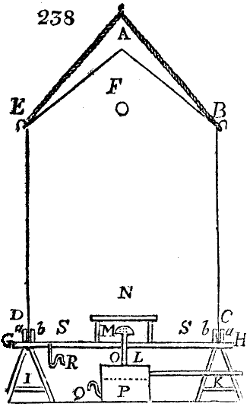
1. By the lanthorn.—In this mode of exposure to steam, the goods are stretched upon
a frame; and therefore the apparatus may be described under two heads; the lanthorn and
the frame. The former is made of copper, in the shape of a box A B C D E, fig. 238., open
below, and with a sloping roof above, to facilitate the trickling down of the water condensed
upon the walls. The sides B C D E are 41⁄2 feet high, 6 feet long, and 4 feet wide.
The distance of the point A from the line E B is 2 feet. At F is a brass socket, which
may be stopped with a cork; and there is a similar one at the other side. This kind
of penthouse may be raised by means of a pully with cords fixed to the four angles
of the roof E B; and it rests upon the table G H, a little larger than the area of the box,
which stands upon the four feet I K. Round the borders of the table there is a
triangular groove a b, for receiving the lower edges of the box, and it is stuffed steam-tight
with lists of cloth. Through the centre of the table, the two-inch steam pipe M
passes; it is surmounted with an hemispherical rose pierced with numerous holes for
the equal distribution of the steam. Right above it, a disc N is placed upon four feet.
The tube L communicates with a box P, which has a syphon Q
to let off the condensed water. At the upper part of this box
the tube L terminates which brings the steam. The little table
G H slopes towards the part G, where the syphon R is placed
for drawing off the water.
The frame has such dimensions, that it may stand in the four
corners of the table at S S, as pointed out by the dotted lines.
The second part embraces an open square frame, which is
formed by spars of wood 2 inches square, mortised together;
and is 3 feet 8 inches wide, 5 feet 8 inches long, and 4 feet 3
inches high; it is strengthened with cross bars. Upon the two
sides of its breadth, two rows of round brass hooks are placed,
about half an inch apart; they are soldered to a copper plate
fixed to uprights by means of screws.
Before hanging up the goods, a piece of cloth 3 feet 8 inches
long, and 4 feet wide, is placed upon the row of hooks; and 3
feet of it are left hanging out.
One foot within, the hooks pass through the cloth. A similar one is fitted to the other
side. This cloth is intended to cover the goods hung upon the hooks; and it is kept
straight by resting upon strings. The pieces are attached zig-zag from one hook to
another. When the frame is filled, the bag is put within the cloths; it has the same
rectangular shape as the frame. The pieces are in this way all encased in the cloth; a
bit of it being also put beneath to prevent moisture affecting that part.
When shawls are framed, they are attached with pins; and if they be too large, they
are doubled back to back, with the fringes at top.
These arrangements being made, the frame is set upon the table, the penthouse is placed
over it, and the steam is admitted during from 35 to 45 minutes, according to circumstances.
The orifice F is opened at first to let the air escape, and when it begins to discharge
steam it is stopped. The frame is taken out at the proper time, the bag is
removed, the cloths are lifted off, and the goods are spread out for airing. Three frames
and six bags are required for a constant succession of work. The above apparatus is particularly
suitable for silks.
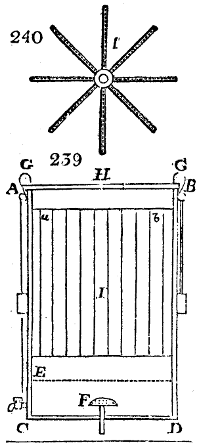
2. The drum.—This is the most simple mode of steaming. The apparatus is a drum
of white wood, 2 inches thick, fig. 239.; the bottom is pierced with a hole which admits
the steam-pipe F, terminating in a perforated rose. Four inches from the bottom there
is a canvass partition E, intended to stop any drops of water projected from the tube F,
and also to separate the condensed water from the body of the apparatus. The drum is
covered in by a wooden head H, under which the goods are placed. It is made fast either
by bolts, or by hooks, G G, thus  , to which weighted cords are
hung. The frame 1, fig. 240. rests upon a hoop, a a, a few inches
from the edge. The goods are hung upon the frame in the ordinary
way, and then wrapped round with flannel. The frame is
studded with pin points, like that of the indigo vat, fixed about
5 inches asunder. From 20 to 30 minutes suffice for one steaming
operation. The upper part of the frame must be covered
also with flannels to prevent the deposition of moisture upon it.
At the bottom of the drum there is a stopcock to let off the condensed
water. According to the size of the figure, which is 3
feet 2 inches, 50 yards may be hung up single; but they may be
doubled on occasion.
, to which weighted cords are
hung. The frame 1, fig. 240. rests upon a hoop, a a, a few inches
from the edge. The goods are hung upon the frame in the ordinary
way, and then wrapped round with flannel. The frame is
studded with pin points, like that of the indigo vat, fixed about
5 inches asunder. From 20 to 30 minutes suffice for one steaming
operation. The upper part of the frame must be covered
also with flannels to prevent the deposition of moisture upon it.
At the bottom of the drum there is a stopcock to let off the condensed
water. According to the size of the figure, which is 3
feet 2 inches, 50 yards may be hung up single; but they may be
doubled on occasion.
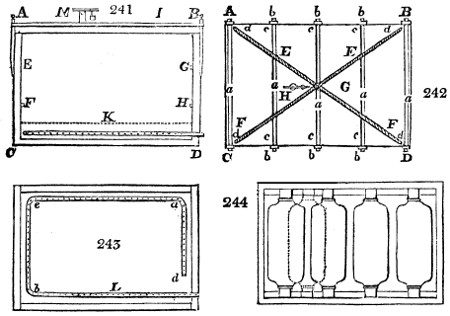
3. The box.—This steaming
apparatus is convenient from the
large quantity of goods admissible
at a time: it answers best
for woollen stuffs. From 12 to
16 pieces, of 36 yards each, may
be operated upon at once; and
from 240 to 260 shawls. It is
formed of a deal box, A B C D, fig.
241., 4 feet wide, 6 long, and 3
high; the wood being 4 inches thick. It is closed by a cover of the same substance, I,
which is made steam-tight at the edges by a list of felt. The lid is fastened down by 5
cross bars of iron, a a a a a, which are secured by screws, c c c c c, fig. 242. The ends of
these cross bars are let into the notches, b b b b b, on the edge of the box. The safety
valve M, fig. 241., is placed upon the lid. For taking off the lid, there are rings at the four
corners, d d d d, bearing cords, F F F F. These join at the centre into one, which passes
over a pulley. Eight inches from the bottom of the box there is a horizontal canvass partition,
beneath which the steam is discharged from the pipe L, fig. 243. There are two
ledges, E F G H, at the sides for receiving the bobbins. The tube L runs round the box, as
shown by the letters d a e b: the end d is shut;
but the side and top are perforated with many
holes in the direction towards the centre of the box.
Fig. 244. shows the arrangement of the lower set
of bobbins: that of the upper set is shown by the
dotted lines: it is seen to be in an alternate position,
one lying between two others. They are
formed of pieces of deal 4 inches broad, 1 inch
thick, and of a length equal to the width of the
box. They are first wrapped round with 5 or 6
turns of doubled flannel or calico: the piece of
goods is laid over it upon a table, and then
wrapped round. At the end of the piece, several
folds of the covering must be put, as, also, a roll
of flannel. The two ends must be slightly tied
with packthread. When these flat bobbins are
arranged in the box, the steam is let on them, and
continued about 45 minutes: it is then shut off,
the lid is removed, and the pieces are unrolled.
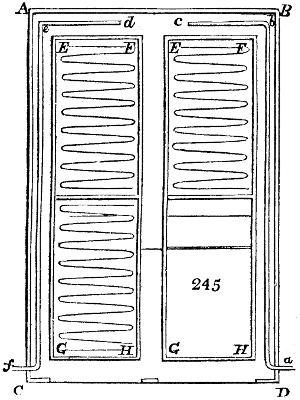
4. The chamber.—The interior height of the
chamber, A B C D, fig. 245., is 9 feet, the length 12
feet, and the breadth 9 feet. The steam is introduced
into it by two pipes, a b c, d e f. Their two ends,
d c, are shut; but their sides are all along perforated
with small holes. The frames E F G H, E F G H, are
moveable, and run upon rollers: they are taken out
by front doors, which are made of strong planks,
shut by sliding in slots, and are secured by strong
iron bars and pressure screws. The cross rods,
E F G H, are provided with hooks for hanging up the pieces. There is a safety-valve in the
top of this large chamber. The dimensions of the frame are 10 feet long, 3 feet wide,
and 7 high. Three feet and a half from the upper part of the frame, a row of hooks
is fixed for hanging on a double row of pieces, as shown in the figure. Over the frame,
woollen blankets are laid to protect it from drops of water that might fall from the
roof of the chamber. When the hooks are two thirds of an inch apart, 24 pieces, of 28
yards each, may be suspended at once. The period of steaming is from 45 to 60
minutes.
Muslins and silks do not require so high a temperature as woollen goods. When the
stuffs are padded with colour, like merinos and chalys, they must not be folded together,
for fear of stains, which are sometimes occasioned by the column in steam calico-printing,
where the end which receives the first impression of the steam is seldom of the same
shade as the rest of the roll of goods. The duration of the steaming depends upon
the quantity of acid in the mordant, and of saline solution in the topical colour; the
more of which are present, the shorter should be the steaming period. A dry vapour is
requisite in all cases; for when it becomes moist, from a feeble supply or external condensation,
the goods become streaky or stained by the spreading of the colours.
1. Black figures are given by decoction of logwood thickened with starch, to which
a little oxalic acid is added while hot, and, after it is cold, neutralised solution of nitrate
of iron.
2. Dark blue for a ground.—Decoction of logwood, and archil thickened with starch;
to which, while the paste is hot, a little soluble Prussian blue is added; and, when it is
cold, neutralised nitrate of iron; see supra.
3. Deep poppy or ponceau colour.—Cochineal boiled in starch water, with oxalic acid
(or tartaric), and perchloride of tin.
4. Rose.—Cochineal infusion; oxalic acid; perchloride of tin; thickened with gum.
5. Dark amaranth.—Decoctions of archil and cochineal, thickened with starch: to
the paste, alum and perchloride of tin are added.
6. Capuchin colour.—Quercitron and cochineal thickened with starch; to the paste
add oxalic acid, and perchloride of tin.
7. Annotto orange.—Dissolve the annotto in soda lye, of spec. grav. 1·07, at a boiling
heat; add aluminate of soda, and thicken with gum.
8. Golden yellow.—Decoction of Persian berries thickened with starch; to which some
alum and muriate of tin are added, with a little perchloride of tin and oxalic acid.
9. Lemon yellow.—Persian berries; starch; alum.
10. An ammoniacal solution of cochineal is used for making many violet and mallow
colours. It is prepared by infusing cochineal in water of ammonia for 24 hours; then
diluting with water, heating to ebullition, and straining.
11. Fine violet is given by ammoniacal cochineal, with alum and oxalic acid; to which
a little aceto-sulphate of indigo is added, and gum for thickening. The following blue
may be used instead of the solution of indigo. The mallow tint is given by adding a
little perchloride of tin to the above formula, and leaving out the blue.
12. Dark blue.—Soluble Prussian blue; tartaric acid; alum; thicken with gum.
13. Emerald green.—One quart of decoction, equivalent to 1 pound of Persian
berries; 1 quart of infusion of quercitron, of spec. grav. 1·027; in which dissolve 12
ounces of alum in powder; and add 6 ounces of the following blue bath for greens;
thicken with 20 ounces of gum.
14. Blue bath for greens. Half a gallon of water at 140° F., 1 pound of soluble
Prussian blue, 3 ounces of tartaric acid, and 2 ounces of alum.
I. Printing of Silks.—1. Of the madder style. This is one of the most difficult to execute,
requiring both much skill and experience. The first step is the removal of the gum. A copper
being nearly filled with water, the pieces, tied up in a linen bag, are put into it, with a
quarter of a pound of soap for every pound of silk, and are boiled for 3 hours. If the silk
be Indian, half an ounce of soda crystals must be added. When the goods are taken
out, they are rinsed in the river, then passed through water at 140° F., holding 8
ounces of crystallised soda in solution, as a scourer. They are next rinsed in cold
water, and steeped in water very faintly acidulated with sulphuric acid, during 4
hours, then rinsed, and dried.
Preparation of Mordants.—1 gallon of boiling water; 2 pounds of alum; dissolve:
1 pound of acetate of lead; 4 ounces of sal-ammoniac; 1 of chalk; mix well together;
after decomposition and subsidence, draw off clear.
1. Red.—1 gallon of the above mordant, thickened with 14 ounces of starch, and tinged
with decoction of Brazil wood. If dark red be wanted, dissolve, in a gallon of the
above red, 4 ounces of sulphate of copper.
2. Black.—1 gallon of iron liquor, of 1·056 spec. grav.; thicken with 14 ounces of
starch; and dissolve in the hot paste 2 ounces of sulphate of copper.
3. Violet. Take 1 gallon of iron liquor of 1·04 spec. grav.;
3. Violet. 2 ounces of cream of tartar; 2 ounces of nitre; 2 ounces of copperas;
3. Violet. 1 ounce of alum: dissolve, and mix the solution with
3. Violet. 1 gallon of gum water, containing 6 libs. of gum.
4. Puce. Half a gallon of red mordant; half a gallon of iron liquor of 1·07;
4. Puce. 7 ounces of starch for thickening colour with logwood.
Manipulation of the above colours.—Print-on the black, then the puce, next the violet,
and, lastly the red. Dry in the hot flue, and, 48 hours after the impression, wash away
the paste. The copper employed for dyeing is of a square form: a boil is given with
bran, at the rate of 4 libs. per piece of the foulards: cold water is added to lower the
temperature to 130° F. The pieces must be entered with the printed surface undermost,
and winced for half an hour, taking care to keep them expanded and well covered
with the liquor: they are then taken out and rinsed. When grounds are to be made
on the foulards, 2 ounces of sumach must be added per piece.
Maddering.—Suppose 48 pieces are to be grounded with madder. 12 pounds of
madder must be put into the copper, 1 pound of sumach, and 6 pounds of bran; the
bath must be tepid when the pieces are entered: it must be heated to 104° F. in 20 minutes,
and to the boiling point in an hour and a half. The goods must be briskly winced all
the time, and finally turned out into cold water.
When they come out of the madder bath they are much loaded with colour. They are
cleared by a boil of half an hour in bran, then turned out into cold water, and rinsed. A
copper must be now mounted with 3 pounds of soap, 1 ounce of solution of tin, and 2
pailsful of bran, in which the goods are to be boiled for half an hour, then rinsed, and
passed through a very dilute sulphuric acid bath. Then rinse, and dry. By following
this process a light salmon ground is obtained.
II. Steam colours upon silk.—The same plan of operations may be adopted here as is
described for calico-printing; the main difference being in the method of mordanting
the stuffs. After boiling in soap water, in the proportion of 4 ounces per pound of silk,
the goods are washed in cold water, and then in hot water at 140°; they are next rinsed,
passed through weak sulphuric acid, rinsed, squeezed between rollers, and afterwards steeped
in a bath containing 8 ounces of alum per gallon, where they remain for four hours, with
occasionally wincing. They are now rinsed, and dried. The subsequent treatment resembles
that of steam-colour printed cottons.
Black.—Take a gallon of decoction, made with 4 libs. of logwood, with which
Black.—14 ounces of starch are to be combined: mix in
Black.—2 ounces of powdered nut-galls: boil, and pour the colour into a pipkin containing
Black.—2 ounces of tartaric acid; 2 ounces of oxalic, both in powder, and
Black.—2 ounces of olive oil. Stir the colour till it is cold, and add
Black.—8 ounces of nitrate of iron, and 4 ounces of nitrate of copper.
The red, violet, lilac, yellow colours, &c. are the same as for steam colours upon cotton.
Topical colours are also applied without mordanting the silk beforehand. In this case
a little muriate of tin is introduced. Thus, for
Yellow.—Take 1 gallon of a decoction, made with 4 libs. of Persian berries: dissolve
in it 8 ounces of salt of tin (muriate), and 4 ounces of the nitro-muriatic
solution of tin. Thicken with 2 pounds of gum.
Printing of foulard pieces. The tables which serve for the impression of silk goods are so
constructed as to receive them in their full breadth. Towards the part between the colour
or sieve tub and the table, the roller is mounted upon which the piece is wound. This roller,
A B, fig. 246., has a groove, C, cut out parallel to its axis.
Into this a bar is pressed, which fixes the end of the
piece. The head, B, of the roller is pierced with several
holes, in which an iron pin passes for stopping its rotation
at any point, as is shown at B. At the other end
of the table there is placed a comb, fig. 247., which
is supported by pivots A B at its ends. The teeth of the comb are on a level with the
cloth.
The piece is arranged for printing as follows:—It is unwound, and its end is brought
upon the teeth of the comb, and made to pass into them by slight taps with a brush.
It is now stretched, by turning round the roller, and fixing it by the pin-handle.
After tracing the outline, the printing blocks are applied. Care should be taken, in
the course of printing, always to fix the teeth of the comb in the middle line between
two handkerchiefs. The operation of grounding-in is much facilitated by this plan of
extension.
The pieces are washed in running water, and must be rapidly dried. The subsequent
dressing is given by gum tragacanth: they are dried upon a stretching frame, and then
folded up for the market.
III. Mandarining of silk stuffs and chalys.—This style of printing depends upon the
property which nitric acid possesses of giving to silk and woollen stuffs a yellow colour.
The first step is the scouring with a soap boil, as already described.
The designs are printed-on as also above described.
The swimming or colour-tub is usually double, and serves for two tables; instead of
being placed, therefore, at the end of the table, it is put between two, and, consequently,
behind the printer. It is formed of a
copper chest, fig. 248., A B C D, in which steam
may circulate, introduced by the pipe I; the
excess being allowed to escape by the tube J,
as also the water of condensation. The frame
is placed in the hollow box K K. Between two
such frames there is a plate of copper, L, which
closes the box; it serves for laying the plates in
order to keep them hot. At E and H are prolongations of the box, in which are set
the vessels F G for holding the reserve paste.
Preparation of the reserve or resist paste.—Melt in a kettle 21⁄2 libs. of rosin; 1
lib. of suet: mix well, and put it into the basins F G. By means of steam the
reserve is kept melted, as well as the false colour upon which the sieve floats.
The piece of silk being laid upon the table, and the reserve spread upon the frame,
the printer heats his block, which should be mounted with lead, if the pattern
will permit, upon the little table L. He takes up the colour from the frame, and transfers
it instantly to the piece. He must strike the block lightly, and then lift it, lest, by
its cooling, it might stick to the silk. When the table pattern is completed, he dusts it
over with sand, and proceeds to another portion of the silk. The piece must not be
taken out of the stretch till it is quite dry, which requires usually 6 hours. Let us
consider first the most common case, that of a white upon an orange ground. We shall
afterwards describe the other styles, which may be obtained by this process. The piece,
being printed and dry, must next be subjected to the mandarining operation.
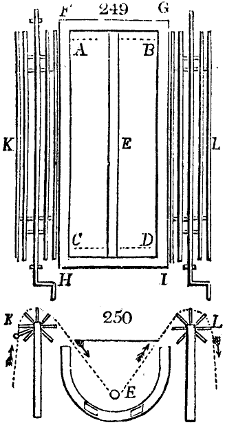
The apparatus here employed consists of a sandstone trough
A B C D, fig. 249. Upon the two sides, A C, B D, of this trough
are fixed two wooden planks, pierced with a hole an inch from
the bottom to receive the roller E, under which the piece passes.
In this trough the acid mixture is put. That trough is put into
a wooden or copper trough, F G H I. Into the latter, water
is put, which is heated by means of steam, or a convenient
furnace. Before and behind are placed two winces, or reels,
K L: one serves to guide the piece in entering into the trough,
and the other in its leaving it. The piece falls immediately
into a stream of cold water, or, failing that, into a large back,
containing a mixture of chalk and water. The two winces are
moved by handles: the velocity is proportioned to the action of
the acid. The wince L ought to be higher than K, to allow the
acid to drain off. Fig. 250. shows a section of the apparatus.
The temperature of the acid mixture ought to be maintained
between 95° and 100° F.; for if it be raised higher, the resist
would run the risk of melting, and the impression would
become irregular and blotty.
The proportions of the acid mixture are the following:—1
gallon of water; and 1 gallon of nitric acid, of spec. grav. 1·288, which may be
increased with the strength of the silk. It should be a little weaker for chalys. For
the strong greens it may be 2 measures of acid of 1·288 to 1 measure of water. The
duration of the passage through the acid should be 1 minute at most.
Mixture of orange colour, and clearing away of the resist.—The goods, on coming
out of the mandarining apparatus, are rinsed in running water; then boiled in
soap water, quickened with a little soda, at the rate of 2 libs. of the former and
4 oz. of the latter for a piece of 30 yards. They must be worked by the wince for half
an hour. They are now rinsed in cold water, then passed through hot, again rinsed, and
dried. I shall give some examples of the mode of manufacture, which is undoubtedly
one of the most curious applications of chemical ingenuity.
1. Orange ground with white figures.
(1.) Print-on the fat reserve; (2.) mandarine; (3.) brighten the orange, and clear.
2. Orange ground, with blue figures.
(1.) Dip in the indigo vat as for calico; (2.) print-on the fat resist to preserve the
blue; (3.) mandarine; 4. clear, and brighten the orange by the boil.
3. Orange ground, with blue and white figures.
(1.) Print-on the resist to preserve the white; (2.) dip in the vat, rinse, and dry; (3.)
ground-in the fat resist to preserve the blue; (4.) mandarine; (5.) cleanse, and brighten.
4. Full green ground, and white figures.
(1.) Print-on the resist; (2.) mandarine, and rinse without drying; (3.) dip in
the blue vat; (4.) cleanse, and brighten.
5. Full green ground, and blue figures.
(1.) Dip a pale blue, rinse, and dry; (2.) print-on the fat resist; (3.) mandarine,
wash and dry; (4.) dip full blue; (5.) clean, and brighten.
6. Full green ground, with white and blue figures.
(1.) Print-on the resist; (2.) dip a pale blue, and dry; (3.) ground-in the fat
resist; (4.) mandarine and rinse; (5.) dip a full blue; (6.) clean, and brighten.
7. Full green ground, with white, blue, and orange figures.
(1.) Print-on the fat reserve; (2.) dip a pale blue, and dry; (3.) ground-in the
reserve; (4.) mandarine, rinse, and dry; (5.) ground-in the reserve; (6.) dip a full
blue; (7.) clean, and brighten.
If blue grounds with white figures be wanted, the resist must be applied, and then
the goods must be dipped in the blue vat: the resist is afterwards removed by a boil in
soap-water.
The above processes are applicable to chalys.
The property which nitric acid possesses of staining animal matters yellow, such as
the skin, wool, and silk, is here applied to a very elegant purpose.
Of the bronze or solitaire style by mandarining.—The mandarining mixture, is
1 gallon of nitric acid, of 1·17 spec. grav.; mixed with 3 pints of solution of
nitrate of iron, of spec. grav. 1·65. If the quantity of nitrate of iron be increased, a
darker tint will be obtained. The temperature of the mixture should be 94° F. The
pieces, after mandarining, are let fall into water, and steeped for an hour.
In order to raise the bronze, and clear away the fat resist, the goods must be boiled
in a bath of soap and soda, as described for orange.
1. Bronze ground, with white figures.
(1.) Print on the fat resist; (2.) dip in the blue vat, and dry; (3.) pad in a decoction
of logwood, of 4 libs. per gallon; dry, taking care to turn over the selvages; (4.)
mandarine, and steep in water for an hour; (5.) cleanse, and pass through soap.
2. Bronze ground, with blue figures.
(1.) Dip in the blue vat, and dry; (2.) print-on the fat resist; (3.) pad in the
above decoction of logwood, and dry; (4.) mandarine, and steep an hour; (5.)
cleanse, and brighten.
3. Bronze ground, with white and blue.
(1.) Print-on the fat resist; (2.) dip in the blue vat, and dry; (3.) ground-in
the fat resist; (4.) pad in the logwood liquor, and dry; (5.) mandarine, and steep for
an hour; (6.) cleanse, and give the brightening boil with soap.
This style of manufacture may be executed on chalys; and is capable of producing
beautiful effects, which will in vain be sought for by other means.
With silks, advantage may be derived from various metallic solutions which possess
the property of staining animal substances; among which are nitrate of silver, nitrate of
mercury, and muriate of iron. The solutions of these salts may be thickened with gum,
and printed-on.
An orange upon an indigo vat ground.—After the blue ground has been dyed, orange
figures may be produced by printing-on the following discharge paste:—
1 gallon of water, made into a paste with 1 pound of starch: when cold, add to
it from 16 to 24 ounces of nitric acid, of spec. grav. 1·288. After fixing the colour by
steam, the orange is brightened with a soap boil.
An orange upon a Prussian-blue ground.—The dye is first given by Prussian blue in
the ordinary way, and then the following discharge is printed-on:—
A caustic lye being prepared, of 1·086 specific gravity, dissolve in a gallon of it 2
pounds of annotto, and thicken with 3 pounds and a quarter of gum. Two days
after the impression of this paste, pass the goods through steam, and wash them in
running water. With these two designs, the logwood and gall black, formerly described,
may be associated, to produce a rich effect.
To the preceding practical instructions for printing calicoes, silks, woollens, and
mixed fabrics, made of the two latter, a few annotations may be added.
When an uniform colour is to be applied to both sides of the cloth, the padding process
is employed; but, when only one side is to be thus coloured, diagonal lines are cut
very closely to each other upon the cylinder, which transfer so much colour from the trough
to the cloth passed under it as to make the surface appear uniformly stained. This
process is called mattage by the French. Mordants or topical dyes, to be applied in this
way, should not be much thickened.
The doubler is the piece of felt or blanket stuff placed between the cloth to be printed,
and the block printing table, or the cylinders. It should be kept very clean; because,
were it soiled with acetate of iron, it would spoil all the light shades made with acetate
of alumina.
Filters for the colour shop of a print house are best made of wool, formed into a substantial
conical cap by felting. A filter ought to be set apart for each different dye
stuff.
When the goods after dyeing are washed, by being held by the selvage, dipped, and
shaken in a stream of water, the process is called giving a list by the French (donner
une lisière). The piece is transferred alternately from one hand to another.
Stains. When we observe stains produced by mordants, upon spots where no colour
is to come, we must, before dunging the goods, apply a little of the lime juice, or tartaro-oxalic
acid discharge paste, to the place. If, on the contrary, the stains are not perceived till
after the maddering, we must then apply to it first a strong solution of chloride of lime
with a pencil, next a solution of oxalic acid mixed with a little muriatic with another
pencil, and immediately afterwards wash with water. Every madder stain will be
effaced by this means.
Rust stains are removable by a mixture of oxalic and muriatic acids.
Indigo stains by the combined action of chloride of lime and muriatic acid.
Topical yellow stains, or yellow dyes, by the same combination.
Metallic greens and Scheele’s green by the acid alone.
Chrome green, and Prussian blue. The blue may be taken out by a caustic alkali;
after which the goods must be washed: the residuary rust stain may be removed by the
mixture of oxalic and muriatic acids. The above methods refer to cotton and linen.
The stains on silk and woollen stuffs should be removed before fixing the colours by the
soap boil; which may generally be done by scratching with the finger, with the aid of a
little water.
For a direct calico green, see oxide of Chrome.
Mr. Hudson, of Gale, near Rochdale, obtained a patent, in December, 1834, for a
mechanism which furnishes a continual and regular supply of colour to the sieve or tear
(tiré, Fr.) into which the printer has to dip his block, for the purpose of receiving the
colour about to be transferred to the fabric in the operations of printing calicoes or paper
hangings. The contrivance consists in a travelling endless web, moved by power, which,
by passing progressively from the colour vat over the diaphragm, brings forward continuously
an equable supply of the coloured paste for the workman’s block.
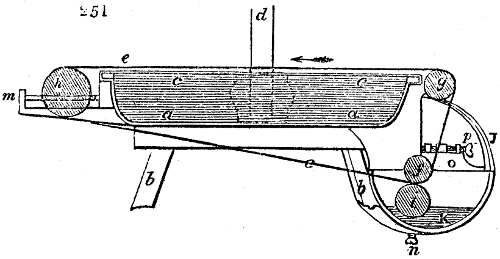
Fig. 251. represents the
construction of this ingenious
apparatus, shown
partly in section. a a is a
vessel of iron, supported
upon wooden standards b b,
over the upper surface of
which vessel a sheet or
diaphragm, c c, of oiled
cloth, or other suitable
elastic material, is distended,
and made fast at
its edges by being bent
over a flange, and packed
or cemented to render the joints water-tight. A vertical pipe d is intended to conduct
water to the interior of the vessel a, and, by a small elevation of the column, to create
such upward pressure as shall give to the diaphragm a slight bulge like the swimming
tub.
An endless web, e e e, passing over the surface of the diaphragm, is distended over three
rollers, f g h, the lower of which, f, is in contact with the colour-roller i in the colour-trough
K. On the axle of the roller i a pulley wheel is fixed, which allows the roller to
be turned by a band from any first mover; or the roller may receive rotatory motion by a
winch fixed on its axle. On this said axle there is also a toothed wheel, taking into
another toothed wheel on the axle of the roller f; hence, the rotation of the colour-roller
i in the one direction will cause the roller f to revolve in the opposite, and to carry
forward the endless web e e e, over the elastic diaphragm, the web taking with it a stratum
of colour received from the roller i, evenly distributed over its surface, and ready
for the printer to dip his block into.
The axles of the rollers f and g turn in stationary bearings; but the axle of h is
mounted in sliding nuts, which may be moved by turning the screws m, for the purpose
of tightening the endless web. The axle of the colour-roller i turns in mortises, and
may be raised by screws n, in order to bring its surface into contact with the endless
web. To prevent too great a quantity of colour being taken up, the endless web passes
through a long slit, or parallel aperture, in a frame o, which acts as a scraper or doctor,
and is adjustable by a screw p, to regulate the quantity of colour carried up. The contents
of the vessel a, and of the colour-trough K, may be discharged when required by a
cock in the bottom of each. See Paper Hangings, for the Fondu style.
CALOMEL. (Chlorure de Mercure, Fr.; Versüsstes Quecksilber, Germ.) The
mild protochloride of mercury. The manufacture of this substance upon the great scale
may be performed in two ways. The cheapest and most direct consists in mixing
11⁄8 part of pure quicksilver with 1 part of pure nitric acid, of sp. grav. from
1·2 to 1·25; and in digesting the mixture till no more metal can be dissolved, or
till the liquid has assumed a yellow colour. At the same time, a solution of 1 part
of common salt is made in 32 parts of distilled water, to which a little muriatic acid is
added; and, when heated to nearly the boiling point, it is mixed with the mercurial solution.
The two salts exchange bases, and a protochloride of mercury precipitates in a
white powder, which, after being digested for some time in the acidulous supernatant
liquor, is to be washed with the greatest care in boiling water. The circumstances which
may injure the process are the following:—1. When less mercury is employed than the
acid can dissolve, there is formed a deuto-nitrate of mercury, which forms some corrosive
sublimate with the common salt, and causes a proportional defalcation of calomel. 2. If
the liquors are perfectly neutral at the moment of mixing them, some subnitrate of mercury
is thrown down, which cannot be removed by washing, and which gives a noxious
contamination to the bland calomel. The acid prescribed in the above formula obviates
this danger.
The second manner of manufacturing calomel is to grind very carefully 4 parts of
corrosive sublimate (bi-chloride of mercury) with 3 parts of quicksilver, adding a little water
or spirits to repress the noxious dust during the trituration. The mass is then introduced
into a glass globe, and sublimed at a temperature gradually raised. The quicksilver
combines with the deutochloride, and converts it into the protochloride, or calomel. The
following formula, upon the same principle, was recommended to the chemical manufacturer
in Brande’s Journal, for July, 1818:—
“Prepare an oxysulphate of mercury, by boiling 25 pounds of mercury with 35 pounds
of sulphuric acid to dryness. Triturate 31 pounds of this dry salt with 20 pounds 4
ounces of mercury, until the globules disappear, and then add 17 pounds of common
salt. The whole is to be thoroughly mixed, and sublimed in earthen vessels. Between
46 and 48 pounds of pure calomel are thus produced: it is to be washed and levigated
in the usual way.” The above is the process used at Apothecaries’ Hall, London. The
oxysulphate is made in an iron pot; and the sublimation is performed in earthen vessels.
The crystalline crust or cake of calomel should be separated from the accompanying
gray powder, which is nearest the glass, and consists of mercury mixed with corrosive
sublimate.
An ingenious modification of the latter process, for which a patent, now expired, was
obtained by Mr. Jewell, consists in conducting the sublimed vapours over an extensive
surface of water contained in a covered cistern. The calomel thus obtained is a superior
article, in an impalpable powder, propitious to its medical efficacy.
The presence of corrosive sublimate in calomel is easily detected by digesting alcohol
upon it, and testing the decanted alcohol with a drop of caustic potash, when the characteristic
brick-coloured precipitate will fall, if any of the poisonous salt be present.
To detect subnitrate of mercury in calomel, digest dilute nitric acid on it, and test the
acid with potash, when a precipitate will fall in case of that contamination. As it is
a medicine so extensively administered to children at a very tender age, its purity ought
to be scrupulously watched.
118 parts of calomel contain 100 of quicksilver.
CALORIC. The chemical name of the power or matter of heat.
CALORIFÈRE OF WATER. (Calorifère d’eau, Fr.; Wasser-Heitzung, Germ.)
In the Dictionnaire Technologique, vol. iv., published in 1823, we find the following
description of this apparatus, of late years so much employed in Great Britain for heating
conservatories, &c. by hot water circulating in pipes:—
“This mode of heating is analogous to that by stove pipes: it is effected by the circulation
of water, which, like air, is a bad conductor, but may serve as a carrier of caloric
by its mobility. We may readily form an idea of the apparatus which has been employed
for this purpose. We adapt to the upper part of either a close kettle, or of an ordinary
cylindric boiler A, fig. 252, a tube B, which rises to a certain
height, then descends, making several sinuosities with a gentle
slope till it reaches the level of the bottom of the boiler, to
whose lowest part, as that which is least heated, it is fitted at C.
At the highest point of the tube F we adapt a vertical pipe, destined
to serve as an outlet to the steam which may be formed if
the temperature be too much raised: it serves also for the
escape of the air expelled from the water by the heat; and it
permits the boiler to be replenished from time to time as the
water is dissipated by evaporation; lastly, it is a tube of safety.
“The apparatus being thus arranged, and all the tubes as
well as the boiler filled with water, if we kindle fire in the grate
D, the first portions of water heated, having become specifically
lighter, will tend to rise: they will actually mount into the
upper part of the boiler, and, of course, enter the tube B F: at
the same time an equivalent quantity of water will re-enter the
boiler by the other extremity C of the tube. We perceive that
these simultaneous movements will determine a circulation in
the whole mass of the liquid, which will continue as long as heat is generated in the
fire-place; and if we suppose that the tubes, throughout their different windings, are
applied against the walls of a chamber, or a stove-room, the air will get warmed by
contact with the hot surfaces; and we may accelerate the warming by multiplying these
contacts in the mode indicated.
“This calorifère cannot be employed so usefully as those with heated air, when
it is wished to heat large apartments. In fact, the passage of heat through metallic
plates is in the ratio of the difference of temperature and quantity of the heating surfaces.
In the present case, the temperature of the water, without pressure, in the tubes, must be
always under 100° C. (212° F.), even in those points where it is most heated, and less
still in all the other points, while the temperature of the flues in air stoves, heated directly
by the products of combustion, may be greatly higher. In these stoves, also, the pipes
may without inconvenience have a large diameter, and present, consequently, a large heating
surface; whereas, with the water calorifère, the pressure exercised by the liquid upon
the sides of the tubes being in the ratio of the surfaces, we are obliged, in order to avoid
too great pressure, to employ a multitude of small tubes, which is expensive. Lastly, if
the hot-water circulation is to be carried high, as may be often necessary in lofty buildings,
the pressure resulting from the great elevation would call for proportional thickness
in the tubes and the boiler: for these reasons, and others which we shall state in treating
of heating by steam, it appears that water cannot be advantageously substituted for air
or steam in the applications above stated; yet this mode of heating presents very decided
advantages where it is useful to raise the temperature a small number of degrees in a
uniform manner.” See Incubation, artificial.
“M. Bonnemain applied, with much success, these ingenious processes of heating
by the circulation of water, to maintain a very equal temperature in hot-houses (serres-chaudes),
in stoves adapted to artificial incubation, and in preserving or quickening vegetation
within hot-houses, or outside of their walls, during seasons unpropitious to horticulture.
“Since the capacity of water for heat is very great, if the mass of it in a circulation-apparatus
be very considerable, and the circulation be accelerated by proper arrangements,
as by cooling the descending tube exterior to the stove-room, we may easily obtain by
such means a moderately high and uniform temperature, provided the heat generated in
the fire-place be tolerably regular. We may easily secure this essential point by the aid
of the fire-regulator, an instrument invented by M. Bonnemain, and which is described
under the article Incubation, because there its use seems to be indispensable.”
From the above quotation, and, more especially, from the evidence adduced in the
article Incubation, we see how little claim the Marquis de Chabannes, or any of his
followers, can have to invention in their arrangements for heating apartments by the
calorific motions of the particles of water, enclosed in pipes of any kind.
CAMBRIC. (Batiste, Fr.; Kammertuch, Germ.) A sort of very fine and rather
thin linen fabric, first made at Cambray. An excellent imitation of this fabric is made
in Lancashire, woven from fine cotton yarn hard twisted. Linen cambric of a good
quality is also now manufactured in the United Kingdom from power-spun flax.
CAMLET OR CAMBLET. A light stuff, much used for female apparel. It is
made of long wool hard spun, sometimes mixed in the loom with cotton or linen yarn.
CAMPHOR, or CAMPHIRE. This immediate product of vegetation was known
to the Arabs under the names of kamphur and kaphur, whence the Greek and Latin
name camphora. It is found in a great many plants, and is secreted, in purity, by
several laurels: it occurs combined with the essential oils of many of the labiatæ; but
it is extracted, for manufacturing purposes only, from the Laurus camphora, which
abounds in China and Japan, as well as from a tree which grows in Sumatra and Borneo,
called, in the country, Kapour barros, from the name of the place where it is most
common. The camphor exists, ready formed, in these vegetables, between the wood
and the bark; but it does not exude spontaneously. On cleaving the tree Laurus
sumatrensis, masses of pure camphor are found in the pith.
The wood of the laurus is cut into small pieces, and put, with plenty of water, into
large iron boilers, which are covered with an earthen capital or dome, lined within with
rice straw. As the water boils, the camphor rises with the steam, and attaches itself as
a sublimate to the stalks, under the form of granulations of a grey colour. In this state
it is picked off the straw, and packed up for exportation to Europe.
Formerly Venice held the monopoly of refining camphor, but now France, England,
Holland, and Germany refine it for their own markets. All the purifying processes
proceed on the principle that camphor is volatile at the temperature of 400° F. The
substance is mixed, as intimately as possible, with 2 per cent. of quicklime, and the
mixture is introduced into a large bottle made of thin uniform glass, sunk in a sand
bath. The fire is slowly raised till the whole vessel becomes heated, and then its upper
part is gradually laid bare in proportion as the sublimation goes on. Much attention
and experience are required to make this operation succeed. If the temperature be
raised too slowly, the neck of the bottle might be filled with camphor before the heat
had acquired the proper subliming pitch; and, if too quickly, the whole contents might
be exploded. If the operation be carried on languidly, and the heat of the upper part
of the bottle be somewhat under the melting point of camphor, that is to say, a little
under 350° F., the condensed camphor would be snowy, and not sufficiently compact
and transparent to be saleable. Occasionally, sudden alternations of temperature cause
little jets to be thrown up out of the liquid camphor at the bottom upon the cake
formed above, which soil it, and render its re-sublimation necessary.
If, to the mixture of 100 parts of crude camphor and 2 of quicklime, 2 parts of
bone-black, in fine powder, be added, the small quantity of colouring matter in the
camphor will be retained at the bottom, and whiter cakes will be produced. A spiral
slip of platina foil immersed in the liquid may tend to equalise its ebullition.
By exposing some volatile oils to spontaneous evaporation, at the heat of about 70° F.,
Proust obtained a residuum of camphor; from oil of lavender, 25 per cent. of its weight;
from oil of sage, 121⁄2; from oil of marjoram, 10.
Refined camphor is a white translucid solid, possessing a peculiar taste and smell.
It may be obtained, from the slow cooling of its alcoholic solution, in octahedral
crystals. It may be scratched by the nail, is very flexible, and can be reduced into powder
merely by mixing it with a few drops of alcohol. Its specific gravity varies from 0·985
to 0·996. Mixed and distilled with six times its weight of clay, it is decomposed, and
yields a golden yellow aromatic oil, which has a flavour analogous to that of a mixture
of thyme and rosemary; along with a small quantity of acidulous water tinged with
that oil, charcoal remains in the retort. In the air, camphor takes fire on contact of an
ignited body, and burns all away with a bright fuliginous flame.
Camphor is little soluble in water; one part being capable of communicating smell
and taste to 1000 of the fluid. 100 parts of alcohol, spec. grav. 0·806, dissolve 120
parts of camphor, at ordinary temperatures. It is separated, in a pulverulent state, by
water. Ether and oils, both expressed and volatile, also dissolve it.
When distilled with eight parts of aquafortis, camphor is converted into camphoric
acid. Camphor absorbs 144 times its volume of muriatic acid gas, and is transformed
into a colourless transparent liquid, which becomes solid in the air, because the acid
attracts humidity, which precipitates the camphor. One part of strong acetic acid
dissolves two parts of camphor. By my analysis, camphor consists of 77·38 carbon,
11·14 hydrogen, and 11·48 oxygen. Berzelius’s numbers are certainly erroneous.
CAMWOOD. An article imported from Sierra Leone, which seems to possess similar
dyeing powers with Brazil or Nicaragua wood.
CANDLE. (Chandelle, Fr.; Kerze, Licht, Germ.) I shall first briefly describe the
ordinary manufacture of candles. They are either dipped or moulded. But the first
part of the process is the sorting of the tallow. Mutton suet with a proportion of
ox-tallow is selected for mould candles, because it gives them gloss and consistence.
Coarser tallow is reserved for the dipped candles. After being sorted, it is cut into
small pieces, preparatory to being melted or rendered; and the sooner this is done after
the fat is taken from the carcase the better, because the fibrous and fleshy matters mixed
with it promote its putrefaction. Tallow is too commonly melted by a naked fire
applied to the bottom of the vessel, whereas it should be done either in a cold set pan,
where the flame plays only round the sides a little way above the bottom, or in a steam-cased
pan. After being fused a considerable time, the membranous matters collect at
the surface, constituting the cracklings used sometimes for feeding dogs, after the fat
has been squeezed out of it by a press. The liquid tallow is strained through a sieve into
another copper, where it is treated with water at a boiling temperature in order to wash
it. After a while, when the foul water has settled to the bottom, the purified tallow is
lifted out, by means of tinned iron buckets, into tubs of a moderate size, where it concretes,
and is ready for use.
It is a remarkable circumstance, that the wicks for the best candles are still cotton
rovings imported from Turkey, notwithstanding the vast extension and perfection of
cotton-spinning in this country. Four or more of these Turkey skeins, according to the
intended thickness of the wick, are wound off at once into bottoms or clues, and afterwards
cut by a simple machine into lengths corresponding to those of the candles to be
made. Mr. Colebank obtained a patent, in June, 1822, for a machine for cutting, twisting,
and spreading wicks, which, though convenient, does not seem to have come into
general use. The operations are performed upon a series of threads at once. The
apparatus is placed in a box, in front of which the operator sits. A reel extends across
the box, at the hinder part, upon which the cotton threads have been previously wound:
from this reel they are drawn off in proper lengths, doubled, and cut by an ingenious
mechanism. By dipping the wicks into the melted tallow, rubbing them between the palms
of the hands, and allowing the tallow which adheres to harden, they may be arranged
with facility upon the broaches for the purpose of dipping. The dipping room is furnished
with a boiler for melting the tallow, the dipping mould, or cistern, and a large
wheel for supporting the broaches. From the ceiling of the workshop a long balance-shaped
beam is suspended, to one end of which a wooden frame is attached for holding
the broaches with the wicks arranged at proper distances. The opposite arm is loaded
with a weight to counterbalance the wooden frame, and to enable the workman to
ascertain the proper size of the candles. The end of the lever which supports the frame
is placed immediately above the dipping cistern; and the whole machine is so balanced
that, by a gentle pressure of the hand, the wicks are let down into the melted tallow as
often as may be required.
The following convenient apparatus for dipping candles has been long in use at Edinburgh.
In the centre of the dipping-room a strong upright post A A, fig. 253., is erected,
with turning iron pivots at its two ends. Near its middle, six mortises are cut at small
distances from one another, into each of which is inserted a long bar of wood B B, which
moves vertically upon an iron pin, also passing through the middle of the shaft. The
whole presents the appearance of a large horizontal wheel with twelve arms. A complete
view of two of them only is given in the figure. From the extremity of each arm is
suspended a frame, or port, as the workmen call it, containing 6 rods, on each of which
are hung 18 wicks, making the whole
number of wicks upon the wheel 1296.
The machine, though apparently
heavy, turns round by the smallest effort
of the workman; and each port,
as it comes in succession over the dipping-mould,
is gently pressed downwards,
by which means the wicks are
regularly immersed in melted tallow.
As the arms of the lever are all of the
same length, and as each is loaded
with nearly the same weight, it is
obvious that they will all naturally
assume a horizontal position. In
order, however, to prevent any oscillation
of the machine in turning
round, the levers are kept in a horizontal
position by means of small
chains a a, one end of which is fixed
to the top of the upright shaft, and
the other terminates in a small square
piece of wood b, which exactly fills
the notch c in the lever. As one end of the levers must be depressed at each dip,
the square piece of wood is thrown out of the notch by the workman pressing down
the handle D, which communicates with the small lever e, inserted into a groove in
the bar B. In order that the square piece of wood, fixed in one extremity of the chain,
may recover its position upon the workman’s raising the port, a small cord is attached
to it, which passes over a pulley inserted in a groove near c, and communicates with
another pulley and weight, which draws it forward to the notch. In this way the
operation of dipping may be conducted by a single workman with perfect ease and
regularity, and even dispatch. No time is lost, and no unnecessary labour expended, in
removing the ports after each dip; and, besides, the process of cooling is much accelerated
by the candles being kept in constant motion through the air. The number of
revolutions which the wheel must make, in order to complete one operation, must
obviously depend upon the state of the weather and the size of the candles; but it is
said that, in moderately cold weather, not more than two hours are necessary for a single
person to finish one wheel of candles of a common size. Upon the supposition, therefore,
that six wheels are completed in one day, no less a number than 7776 candles will be
manufactured in that space of time by one workman.
I shall next describe the process of moulding, which, if possible, is even less complicated
in its details than that of dipping. The moulds are made of some metallic
substance, usually pewter, and consist of two parts. The shaft or great body of the mould
is a hollow cylinder, finely polished in the inside, and open at both extremities. The top
of the mould is a small metallic cup, having a moulding within-side, and a hole to admit
the wick. The two parts are soldered together, and when united, as will readily be
imagined, have the shape of a moulded candle. A third piece, called the foot, is sometimes
added; it is a kind of small funnel, through which the liquid tallow runs into the
mould, and, being screwed to the opposite extremity of the shaft, is removable at pleasure.
This additional piece may certainly be useful in very mild weather; since, by removing
it, the candles may be drawn more easily from the moulds; but, in general, it may be
dispensed with.
Eight or twelve of these moulds, according to their size, are fixed in a frame, which
bears a great resemblance to a wooden stool, the upper surface of which forms a kind of
trough. The top of the moulds points downwards, and the other extremity, which is
open, is inserted into the bottom trough or top of the stool, and made quite level with its
upper surface. In order to introduce the wicks into the mould, the workman lays the
frame upon its side on an adjoining table, and holding in his left hand a quantity of wicks,
previously cut to the proper length, he introduces into the mould a long wire with a
hooked point. As soon as the hook of the wire appears through the hole in the top of
the mould, he attaches to it the looped end of the wick, and, immediately drawing back
the wire, carries the wick along with it. In this manner each mould in succession is
furnished with a wick. Another workman now follows, and passes a small wire through
the loop of each wick. This wire is obviously intended to keep the wick stretched, and
to prevent it from falling back into the mould upon the frame being placed in the proper
position for filling. The frame is then handed to the person that fills the moulds, who
previously arranges the small wires in such a manner that each wick may be exactly in
the middle of the mould.
The moulds are filled by running tallow into each of them, or into the trough, from a
cistern furnished with a cock, and which is regularly supplied with tallow of the proper
temperature from an adjoining boiler. When the workman observes that the moulds are
nearly half filled he turns the cock, and, laying hold of that portion of the wick which hangs
out of the mould, pulls it tight, and thus prevents any curling of the wick, which might
injure the candles: he then opens the cock, and completes the process of filling. The frame
is now set aside to cool; and when the tallow has acquired a proper consistence, which the
workman easily discovers by a snapping noise emitted by the candles upon pressing his
thumb against the bottom of the moulds, he first withdraws the small wires which kept the
wicks tense, and then, scraping off the loose tallow from the top of the frame with a small
wooden spade, he introduces a bodkin into the loop of the wick, and thus draws each
candle in succession from its mould. The candles are now laid upon a table for the
inspection of the exciseman, and afterwards removed to the storehouse. Previous to
storing them up, some candle-makers bleach their candles, by exposing them to the air
and dews for several days. This additional labour can be necessary only when the dealer
is obliged to have early sales; for if the candles are kept for some months, as they
ought to be, before they are brought to market, they become sufficiently whitened by
age.
Wax candles.—Next to tallow, the substance most employed in the manufacture
of candles is wax. Wax candles are made either by the hand or with a ladle. In the
former case, the wax, being kept soft in hot water, is applied bit by bit to the wick, which
is hung from a hook in the wall; in the latter, the wicks are hung round an iron circle,
placed immediately over a large copper-tinned basin full of melted wax, which is poured
upon their tops, one after another, by means of a large ladle. When the candles have by
either process acquired the proper size, they are taken from the hooks, and rolled upon
a table, usually of walnut-tree, with a long square instrument of box, smooth at the
bottom.
A few years ago I made a set of experiments upon the relative intensities of light, and
duration of different candles, the results of which are contained in the following
table.
Number in
a pound. |
Duration
of a
candle. |
Weight
in
grains. |
Consump-
tion per
hour
in grains. |
Propor-
tion of
light. |
Economy
of light. |
Candles
equal one
Argand. |
| |
h. |
m. |
|
|
|
|
|
| 10 |
mould |
5 |
9 |
|
682 |
132 |
12 |
1⁄4 |
68 |
|
5 |
·7 |
| 10 |
dipped |
4 |
36 |
|
672 |
150 |
13 |
|
65 |
1⁄2 |
5 |
·25 |
| 8 |
mould |
6 |
31 |
|
856 |
132 |
10 |
1⁄2 |
59 |
1⁄2 |
6 |
·6 |
| 6 |
ditto |
7 |
2 |
1⁄2 |
1160 |
163 |
14 |
2⁄3 |
66 |
|
5 |
·0 |
| 4 |
ditto |
9 |
3 |
·6 |
1707 |
186 |
20 |
1⁄4 |
80 |
|
3 |
·5 |
| Argand oil flame |
— |
— |
512 |
69 |
·4 |
100 |
|
|
A Scotch mutchkin, or 1⁄8 of a gallon of good seal oil, weighs 6010 gr., or 131⁄10 oz.,
avoirdupois, and lasts in a bright Argand lamp 11 hours 44 minutes. The weight of
oil it consumes per hour is equal to 4 times the weight of tallow in candles 8 to the
pound, and 1⁄7 the weight of tallow in candles 6 to the pound. But, its light being
equal to that of 5 of the latter candles, it appears from the above table that 2 pounds
weight of oil, value 9d. in an Argand, are equivalent in illuminating power to 3 pounds
of tallow candles, which cost about two shillings. The larger the flame in the above
candles the greater the economy of light.
In June, 1825, M. Gay Lussac obtained a patent in England for making candles from
margaric and stearic acids, improperly called stearine, by converting tallow into the above
fat acids by the following process:—Tallow consists, by Chevreul’s researches, of stearine,
a solid fat, and elaine, a liquid fat; the former being in much the larger proportion.
When tallow is treated with an alkaline body, such as potash, soda, or lime, it is saponified;
that is, its stearine and elaine become respectively stearic and elaic acids, and, as such,
form compounds with these bases. When by the action of an acid, such as the sulphuric
or muriatic, these combinations are decomposed, the fats reappear in the altered form of
stearic and elaic acids; the former body being harder than tallow, and of a texture,
somewhat like spermaceti, the latter body being fluid, like oil. “The decomposition of the
soap should be made,” says the patentee, “in a large quantity of water, kept well stirred
during the operation, and warmed by steam introduced in any convenient way. When
the mixture has been allowed to stand, the acid of the tallow or fat will rise to the
surface, and the water being drawn off will carry the alkaline or saline matters with it;
but, if the acids of the tallow should retain any portion of the salts, fresh water may be
thrown upon it, and the whole well agitated, until the acids have become perfectly free
from the alkaline matters; and, when allowed to cool, the acids will be formed into a
solid mass. This mass is now to be submitted to considerable pressure in such an apparatus
as is employed in expressing oil from seeds; when the liquid acid will run off in the
form of a substance resembling oil, leaving a solid matter, similar, in every respect, to
spermaceti, which is fit for making candles.”
The wick to be used in the manufacture of these improved candles, and which forms
one of the features of this invention, is to be made of cotton yarn, twisted rather hard,
and laid in the same manner as wire is sometimes coiled round the bass strings of
musical instruments. For this purpose, straight rods or wires are to be procured, of
suitable lengths and diameters, according to the intended size of the candles about to be
made; and these wires, having been covered with cotton coiled round them, as described,
are to be inserted in the candle moulds as the common wicks are; and when the candle
is made, and perfectly hard, the wire is to be withdrawn, leaving a hollow cylindrical
aperture entirely through the middle of the candle. See Stearine.
CANE-MILL. See Mill and Sugar.
CANNON. For the composition of these implements of destruction, see Bronze.
CANVASS (Canevas, Fr.; Segeltuch, Germ.) It has been found that sails of ships
made with the selvages and seams of the canvass running down parallel to their edges, are
very apt to bag, and become torn in the middle, from the strain to which they are subjected
by the pressure of the wind. To obviate this inconvenience, a mode of making sails, with
the seams and selvages running diagonally, was proposed by Admiral Brooking, and a
patent granted to him for the same on 4th of September, 1828. The invention of
Messrs. Ramsay and Orr, which we are about to describe, has a similar object, viz., that
of giving additional strength to sails by a peculiar manner of weaving the canvass of which
they are made.
The improvement proposed under their patent of March, 1830, consists in weaving
the canvass with diagonal threads; that is, placing the weft yarn, or shoot, in weaving, at
an oblique angle to the warp yarns, instead of making the decussation of the warp, or
weft threads, or yarns, at right angles to each other, as in the ordinary mode of weaving.
To accomplish this object the loom must be peculiarly constructed; that is, its
warp and work beams must stand at an oblique angle with the sides of the loom, and the
batten and slay must be hung in a peculiar manner, in order to beat up the weft, or
shoot, in lines ranging diagonally with the warp. No drawing is shown of the method
by which this arrangement of the loom is to be made, but it is presumed that any weaver
would know how to accomplish it: the invention consisting solely in producing sail
cloth with the threads, or yarns, of the weft ranging diagonally at any desired angle with
the direction of the warp thread.
CAOUTCHOUC, GUM-ELASTIC, OR INDIAN-RUBBER, (Federharz, Germ.)
occurs as a milky juice in several plants, such as the siphonia cahuca, called also hevea
guianensis, cautschuc, jatropha elastica, castilleja elastica, cecropia pellata, ficus religiosa and
indica, urceolaria elastica, &c. It is, however, extracted chiefly from the first plant, which
grows in South America and Java. The tree has incisions made into it through the bark
in many places, and it discharges the milky juice, which is spread upon clay moulds, and
dried in the sun, or with the smoke of a fire, which blackens it.
The juice itself has been of late years imported. It is of a pale yellow colour, and
has the consistence of cream. It becomes covered in the bottles containing it with a
pellicle of concrete caoutchouc. Its spec. grav. is 1·012. When it is dried it loses 55
per cent. of its weight: the residuary 45 is elastic gum. When the juice is heated it
immediately coagulates, in virtue of its albumen, and the elastic gum rises to the
surface. It mixes with water in any proportion; and, when thus diluted, it coagulates
with heat and alcohol as before.
The specific gravity of caoutchouc is 0·925, and it is not permanently increased by
any degree of pressure. By cold or long quiescence it becomes hard and stiff. When
the milky juice has become once coherent, no means hitherto known can restore it to
the emulsive state. By long boiling in water it softens, swells, and becomes more
readily soluble in its peculiar menstrua; but when exposed to the air it speedily resumes
its pristine consistence and volume. It is quite insoluble in alcohol; but in ether, deprived
of alcohol by washing with water, it readily dissolves, and affords a colourless
solution. When the ether is evaporated, the caoutchouc becomes again solid, but is
somewhat clammy for a while. When treated with hot naphtha, distilled from native
petroleum, or from coal tar, it swells to 30 times its former bulk; and if then triturated
with a pestle, and pressed through a sieve, it affords a homogeneous varnish, which being
applied by a flat edge of metal or wood to cloth, prepares it for forming the patent
water-proof cloth of Mackintosh. Two surfaces of cloth, to which several coats of the
above varnish have been applied, are, when partially dried, brought evenly in contact, and
then passed between rollers, in order to condense and smooth them together. This double
cloth is afterwards suspended in a stove-room to dry, and to discharge the disagreeable
odour of the naphtha.
Caoutchouc dissolves in the fixed oils, such as linseed oil, but the varnish has not the
property of becoming concrete upon exposure to air.
It has been lately asserted that caoutchouc is soluble in the oils of lavender and sassafras.
It melts at 248° F., and stands afterwards a much higher heat without undergoing
any further change. When the melted caoutchouc is exposed to the air, it becomes
hard on the surface in the course of a year. When kindled it burns with a bright flame
and a great deal of smoke.
Neither chlorine, sulphurous acid gas, muriatic acid gas, ammonia, nor fluosilicic acid
gas, affect it, whence it forms very valuable flexible tubes for pneumatic chemistry.
Cold sulphuric acid does not readily decompose it, nor does nitric acid, unless it be somewhat
strong. The strongest caustic potash lye does not dissolve it even at a boiling heat.
Caoutchouc, according to my experiments, which have been confirmed by those of Mr.
Faraday, contains no oxygen, as almost all other solid vegetable products do, but is a mere
compound of carbon and hydrogen, in the proportion, by my results, of 90 carbon to 10
hydrogen, being three atoms of the former to two of the latter. Mr. Faraday obtained
only 87·2 carbon, from which I would infer that some of the carbon, which in this substance
is difficult to acidify by peroxide of copper, had escaped its action. It is obvious
that too little carbonic acid gas may be obtained, but certainly not more than corresponds
to the carbon in the body. No carbon can be created in the process of ultimate
analysis by pure peroxide of copper such as I employed; and I repeated the ignition
after attrition of the mixture used in the experiment. Melted caoutchouc forms a very
excellent chemical lute, as it adheres very readily to glass vessels, and withstands the corrosive
action of acid vapours. This substance is much used for effacing the traces of plumbago
pencils, whence it derived the name of Indian-rubber. It has been lately employed
very extensively for making elastic bands or braces. The caoutchouc bottles are skilfully
cut into long spiral slips, which are stretched, and kept extended till nearly deprived of
their elasticity, and till they form a thread of moderate fineness. This thread is put into a
braid machine, and covered with a sheath of cotton, silk, linen, or worsted. The clothed
caoutchouc is then laid as warp in a loom, and woven into an elegant riband. When
woven, it is exposed, upon a table to the action of a hot smoothing iron, which restoring
to the caoutchouc all its primitive elasticity, the riband retracts considerably in length,
and the braiding corrugates equally upon the caoutchouc cores. Such bands possess a
remarkable elasticity, combined with any desired degree of softness. Sometimes cloth
is made of these braided strands of caoutchouc used both as warp and as weft, which is
therefore elastic in all directions. When a light fabric is required, the strands of caoutchouc,
either naked or braided, are alternated with common warp yarns. For this mixed
fabric a patent has been obtained. The original manufacturer of these elastic webs is
a major in the Austrian service, who has erected a great factory for them at St. Denys,
near Paris. See Elastic Bands.
Mr. William Henry Barnard, in the course of some experiments upon the impregnation
of ropes with caoutchouc, at the factory of Messrs. Enderby at Greenwich, discovered that
when this substance was exposed to
a heat of about 600° F. it resolved
itself into a vapour, which, by
proper refrigeratory methods, was
condensable into a liquid possessing
very remarkable properties, to
which the name caoutchoucine has
been given. For this invention
“of a solvent not hitherto used in
the arts” Mr. Barnard obtained a
patent, in August, 1833. His
process for preparing it is described
in his specification as follows:—I
take a mass of the said caoutchouc,
or Indian rubber, as imported, and
having cut it into small lumps,
containing about two cubic inches
each (which I prefer), I throw these
lumps into a cast-iron still (which
I find adapted for the purpose, and
a diagram of which is annexed to,
and forms part of, this my specification),
with a worm attached; fig. 254., A is the still, B the cover ground to a metallic
fit, to admit of a thermometer to take the temperature; C the fire-place, D the ash-pit,
E the worm-tub and worm, F the brick-work of the still, G a roller and carriage, in conjunction
with a crane, or other means, to raise the cover to take out the residue, and to
charge the same; H the chain.
I then apply heat to the still in the usual manner, which heat is increased until the
thermometer ranges at 600 degrees of Fahrenheit, or thereabouts. And, as the thermometer
ranges progressively upwards to 600 degrees of Fahrenheit, a dark-coloured oil
or liquid is distilled over, which I claim as my said invention, such liquid being a
solvent of caoutchouc, and other resinous and oleaginous substances. When the thermometer
reaches 600 degrees, or thereabouts, nothing is left in the still but dirt and
charcoal.
I have found the operation of distillation to be facilitated by the addition of a portion
of this oil, either previous or subsequent to rectification, as hereinafter mentioned, in the
proportion of one third of oil to two thirds of caoutchouc.
I afterwards subject the dark-coloured liquid thus distilled to the ordinary process
of rectification, and thereby obtain fluids varying in specific gravity, of which the
lightest hitherto has not been under 670, taking distilled water at 1000, which fluids I
also claim as my said invention.
At each rectification the colour of the liquid becomes more bright and transparent,
until at the specific gravity of 680, or thereabouts, it is colourless and highly volatile.
In the process of rectification (for the purpose of obtaining a larger product of the oil
colourless) I put about one third of water into the still. In each and every state the
liquid is a solvent of caoutchouc, and several resinous and oleaginous substances, and
also of other substances (such as copal), in combination with very strong alcohol.
Having experienced much difficulty in removing the dirt which adheres to the bottom
of the still, I throw into the still, lead and tin in a state of alloy (commonly called solder),
to the depth of about half an inch, and, as this becomes fused, the dirt which lies on the
surface of it is more easily removed.
Objections have been made to the smell of this liquid:—I have found such smell removed
by mixing and shaking up the liquid with nitro-muriatic acid, or chlorine, in the
proportion of a quarter of a pint of the acid (of the usual commercial strength) to a
gallon of the liquid.
The discovery of the chemical solvent, which forms the subject of the patent above
described, has excited considerable interest in the philosophic world, not only from its
probable usefulness as a new article of commerce, but also from two very extraordinary
characteristics which it is found to possess, viz., that, in a liquid state, it has less specific
gravity than any other liquid known to chemists, being considerably lighter than
sulphuric ether, and, in a state of vapour, is heavier than the most ponderous of the
gases.
Its elementary constituents are,
| Carbon |
6·812 |
8 proportions. |
| Hydrogen |
1·000 |
7 ditto. |
This new material (when mixed with alcohol) is a solvent of all the resins and particularly
of copal, which it dissolves, without artificial heat, at the ordinary temperature of the atmosphere;
a property possessed by no other solvent known; and hence it is peculiarly useful
for making varnishes in general. It also mixes readily with oils, and will be found to be a
valuable and cheap menstruum for liquefying oil-paints; and without in the slightest
degree affecting the most delicate colours, will, from its ready evaporation, cause the
paint to dry almost instantly.
Cocoa-nut oil, at the common temperature of the atmosphere, always assumes a concrete
form; but a portion of this caoutchoucine mixed with it will cause the oil to become
fluid, and to retain sufficient fluidity to burn in a common lamp with extraordinary
brilliancy.
Caoutchoucine is extremely volatile; and yet its vapour is so exceedingly heavy, that
it may be poured, without the liquor, from one vessel into another like water.
CAPERS. The caper is a small prickly shrub, cultivated in Spain, Italy, and the
southern provinces of France. The flowers are large roses of a pretty appearance, but
the flower buds alone are the objects of this cultivation.
They are plucked before they open, and thrown into strong vinegar slightly salted,
where they are pickled. The crop of each day is added to the same vinegar tub, so
that in the course of the six months during which the caper shrub flowers, the vessel gets
filled, and is sold to persons who sort the capers, (the smallest being most valued) by
means of copper sieves. This metal is attacked by the acid, wherefrom the fruit acquires
a green colour, much admired by ignorant connoisseurs.
The capers, as found in the French market, are distinguished into five sorts; the
non-pareille, the capucine, the capote, the second, and the third; this being the decreasing
order of their quality, which depends upon the strength of the vinegar used in
pickling them, as also the size and colour of the buds.
The caper shrub grows in the driest situations, even upon walls, and does not disdain
any soil; but it loves a hot and sheltered exposure. It is multiplied by grafts made in
autumn, as also by slips of the roots taken off in spring.
CAPSTAN. (Cabestan, Fr.; Spille, Germ.) A machine whereon the cable is wound
successively in weighing the anchor of a vessel. It is a species of wheel and axle; the
axle being vertical, and pierced with holes near its top for the insertion of the ends of
horizontal levers, called handspikes, which represent the wheel. These are turned by
the force of men moving in a circle. The power applied to the lever is to the resistance
to be overcome, (the weight of the anchor, for example,) when the forces are in
equilibrio, as the radius of the cylinder round which the cable is coiled is to the circumference
described by the power.
It is manifest that the radius of the axle must be augmented in this computation by
half the diameter of the cable, which is supposed to lie always one coil thick upon it.
The force of a man, thus applied, has been commonly estimated as equal to the traction
of 27 pounds hanging over a pulley.
Friction being so variable a quantity in capstans, renders the exact calculation of its
mechanical effect somewhat uncertain.
A stout man, stationed near the bottom of the axle, holds fast the loose part of the
cable, which has already made two or three turns; and, being aided by its friction upon
the wood, he both prevents it from slipping backwards, and uncoils each turn as it is
progressively made.
Mr. Hindmarsh, master mariner of Newcastle, obtained a patent, in February, 1827,
for a contrivance to enable a capstan or windlass to be occasionally worked with increased
mechanical advantage. With this view, he placed toothed wheel-work, partly in the
drum-head of the capstan, and partly in the upper part of the barrel, upon which the
cable is coiled and uncoiled in successive portions.
The drum-head, and also the barrel, turn loosely upon a central spindle, independent
of each other, and are connected together either by the toothed geer, or by bolts. On
raising or withdrawing the connecting pinion from the toothed wheels, and then locking
the drum-head and barrel together, the capstan works with a power equal only to that
exerted by the men at the capstan-bars, as an ordinary capstan; but on lowering the
pinion into geer with the wheel-work, and withdrawing the bolts which locked the
drum-head to the barrel, the power exerted by the men becomes increased in proportion
to the diameter and numbers of teeth in the wheels and pinions.
Fig. 255. is the external appearance of this capstan. Fig. 256. a horizontal view of the
toothed geer at the top of the barrel. The barrel, with the whelps a a, turns loosely upon
a verticle spindle fixed into
the deck of the vessel. The
drum-head b also turns loosely
upon the same spindle. The
circular frame c c, in fig. 256.,
in which the axes of the
toothed wheels d d d are
mounted, is fixed to the central
spindle. The rim e e e,
with internal teeth, is made
fast to the top of the barrel;
and the pinion f, which slides
upon the spindle, is connected
to the drum-head.
When it is intended to work
the capstan with ordinary
power, the pinion f is raised
up into the recess of the drum-head,
by means of a screw g,
fig. 255., which throws it out
of geer with the toothed wheels,
and it is then locked up by a
pin z: the bolts h h are now
introduced, for the purpose of fastening the drum-head and barrel together, when it
becomes an ordinary capstan.
But when it is required that the same number of men shall exert a greater power,
the bolts h are withdrawn, and the pinion f lowered into geer, with the toothed wheels.
The rotation of the drum-head, then carrying the pinion round, causes it to drive the
toothed wheels d d d; and these working into the toothed rim e e, attached to the barrel,
cause the barrel to revolve with an increased power.
Thus, under particular circumstances, a smaller number of men at the capstan or
windlass (which is to be constructed upon the same principle) will be enabled to haul
in the cable and anchor, or warp off the vessel, which is an important object to be
effected.
In 1819, Captain Phillips obtained a patent for certain improvements in capstans, a
part of which invention is precisely the same as this in principle, though slightly varied
in its adaptation.
James Brown, ship-rigger, in his capstan, patented in 1833, instead of applying the
moving power by handspikes, having fixed two rims of teeth round the top of the capstan,
acts upon them by a rotatory worm, or pinions turned by a winch.
Fig. 257. is an elevation of this capstan, and fig. 258. is a horizontal top view. a is an
upright shaft, fixed firmly to the deck, serving as an axle round which the body of the
capstan revolves. A frame c, fixed to the top of a stationary shaft a, above the body of
the capstan, carries the driving apparatus.
The upper part of the body of the capstan has a ring of oblique teeth d formed round
its edge; and above this, on the top of the capstan, is a ring of bevel teeth e. A horizontal
shaft f, mounted in the top frame c, has a worm or endless screw, which takes into
the teeth of the ring d; and a short axle g, having its bearings in the central shaft a,
and in the frame c, carries a bevel pinion, which takes into the bevel teeth of the ring c.
The bearings of the shaft f, in the top frame, are in long slots, with angular returns,
something like the fastening of a bayonet, which is for the purpose of enabling the shaft
to be readily lifted in and out of geer with the teeth of the ring d: the outer bearing of
the axle g of the bevel pinion is also supported in the frame c, in a similar way, in
order to put it in and out of geer with the teeth of the bevel ring e. A mode of shifting
these is essential; because the two toothed rings, and their driving worm and pinion,
give different speeds, and, of course, cannot be both in operation at the same time.
The worm of the shaft f, being placed in geer with the teeth of the ring d, on applying
rotatory power thereto, by means of winches attached to the ends of the shaft, the
barrel or body of the capstan will be made to revolve with a slow motion, but with
great power; and thus two men at the winches will do the same work as many men
with capstan bars in the ordinary way.
If a quicker movement than that of the endless screw is desired, then the driving power
may be applied by a winch to the axle g of the bevel pinion, that pinion being put into
geer with the bevel ring e, and the endless screw withdrawn. It should, however, be
here remarked, that the patentee proposes to employ two short axles g, placed opposite to
each other, with bevel pinions acting in the bevel-toothed ring, though only one is
shown in the figure to avoid confusion. He also contemplates a modification of the
same contrivance, in which four short axles g, placed at right angles, with pinions taking
into a bevel ring, may be employed, and made effective in giving rotatory motion to the
barrel of a capstan by means of winches applied to the outer ends of the axle, and turned
by the labour of four men.
CARAT or CARACT is a weight used by goldsmiths and jewellers. See Assay
and Diamond.
CARBON, (Carbone, Fr.; Kohlenstoff, Germ.) in a perfectly pure state, constitutes
diamond. Carbonaceous substances are usually more or less compound, containing hydrogen,
or sometimes oxygen, and azote, along with earthy and metallic matters. Carbon,
tolerably pure, abounds in the mineral kingdom; and, in a combined state, it forms a
main constituent of vegetable and animal bodies. Anthracite is a mineral charcoal,
differing from common pit-coal in containing no bitumen, and, therefore, burning without
flame or smoke. Coke is the carbonaceous mass which remains after pit-coal has
been exposed to ignition for some time out of contact of air; its volatile parts having
been dissipated by the heat. It is a spongy substance, of an iron-black colour, a somewhat
metallic lustre, and does not easily burn unless several pieces are kindled together.
With a good draught, however, it produces a most intense heat. Wood charcoal is obtained
by the calcination of wood in close vessels, as described under the article Acetic
Acid, or in piles of various shapes, covered with loam, to screen it from the free action
of the atmosphere, which would otherwise consume it entirely. See Charcoal. Such
carbon is a solid, without smell or taste, and bears the strongest heats of our furnaces
without suffering any change, provided air be excluded: it is a bad conductor of heat,
but conducts electricity very well. When burned, it unites with oxygen, and forms carbonic
acid, the fixed air of Dr. Black, the choke-damp of the miner. When this carbonic
acid is made to traverse red hot charcoal it dissolves a portion of it, and becomes
carbonic oxide, which contains only one half of its volume of oxygen; whereas carbonic
acid consists of one volume of oxygen combined with one volume of the vapour
of carbon, the two being condensed into one volume. If the specific gravity of oxygen,
= 1·1025, be deducted from that of carbonic acid, = 1·5245, the difference, = 0·422,
will be the specific gravity of the vapour of carbon; as well as the proportion present in
that weight of the acid.
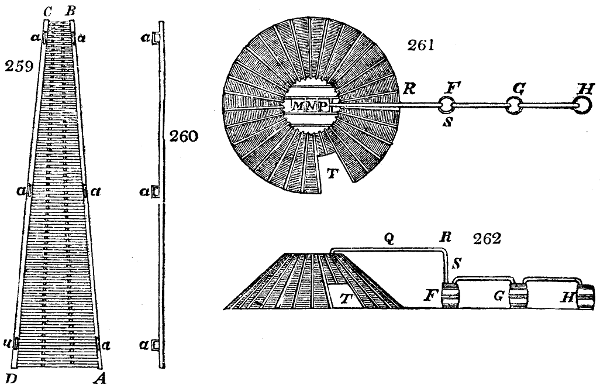
Charcoal obtained by the action of a rapid fire in close vessels is not so solid and
so good a fuel as that which is made in the ancient way by the slow calcination of pyramidal
piles covered with earth. One of the most economical ovens for making wood
charcoal is that invented by M. Foucauld, which he calls a shroud, or abri. To construct
one of these, 30 feet in diameter at the base, 10 feet at its summit, and from 8 to 9 feet
high, he forms, with wood 2 inches square, a frame 12 feet long, 3 feet broad at one end,
and one foot at the other. The figure will explain the construction. The uprights,
A B and C D, of this frame are furnished with three wooden handles a a a, and a′ a′ a′,
by means of which they can be joined together, by passing through two contiguous
handles a wooden fork, the frame being previously provided with props, as shewn in
fig. 259, and covered with loam mixed with grass. A flat cover of 10 feet diameter, made
of planks well joined, and secured by four cross bars, is mounted with two trap doors,
M N, fig. 261., for giving egress to the smoke at the commencement of the operation;
a triangular hole P, cut out in the cover, receives the end of a conduit Q R S, (figs. 262.
and 261.) of wood formed of three deals, destined to convey the gases and condensed
liquids into the casks F G H. Lastly, a door T, which may be opened and shut at pleasure,
permits the operator to inspect the state of the fire. The charcoal calcined by this
abri, has been found to be of superior quality.
When it is wished to change the place where the abri is erected, and to transport it to
a store of new-felled timber, the frame is taken down, after beating off the clay which
covers it, the joints are then cut by a saw, as well as the ends of the forks which fixed
the frames to one another. This process is economical in use, simple and cheap in
construction; since all the pieces of the apparatus are easily moved about, and may be
readily mounted in the forests. For obtaining a compact charcoal, for the use of artisans,
this mixed process of Foucauld is said to be preferable to either the close iron cylinder
or the pile.
For making gunpowder-charcoal the lighter woods, such as the willow, dogwood, and
alder answer best; and in their carbonization care should be taken to let the vapours freely
escape, especially towards the end of the operation, for when they are re-absorbed, they
greatly impair the combustibility of the charcoal.
By the common process of the forests, about 18 per cent. of the weight of the wood is
obtained; by the process of Foucauld about 24 per cent. are obtained, with 20 of crude
pyrolignous acid of 10 degrees Baumé. By the process described under Acetic Acid,
27 of charcoal, and 18 of acid at 6 degrees, are procured from 100 parts of wood, besides
the tar. These quantities were the results of careful experimenting, and are greater than
can be reckoned upon in ordinary hands.
Charcoal for chemical purposes may be extemporaneously prepared by calcining pieces
of wood covered with sand in a crucible, till no more volatile matter exhales.
The charcoal of some woods contains silica, and is therefore useful for polishing metals.
Being a bad conductor of heat, charcoal is employed sometimes in powder to encase
small furnaces and steam-pipes. It is not affected by water; and hence, the extremities
of stakes driven into moist ground are not liable to decomposition. In like manner
casks when charred inside preserve water much better than common casks, because they
furnish no soluble matter for fermentation or for food to animalcules.
Lowitz discovered that wood charcoal removes offensive smells from animal and vegetable
substances, and counteracts their putrefaction. He found the odour of succinic
and benzoic acids, of bugs, of empyreumatic oils, of infusions of valerian, essence of
wormwood, spirits distilled from bad grain, and sulphureous substances were all absorbable
by freshly calcined charcoal properly applied. A very ingenious filter has been constructed
for purifying water, by passing it through strata of charcoal of different fineness.
When charcoal is burned, one third of the heat is discharged by radiation, and two
thirds by conduction.
The following table of the quantity of charcoal yielded by different woods was published
by Mr. Mushet, as the result of experiments carefully made upon the small scale.
He says, the woods before being charred were thoroughly dried, and pieces of each kind
were selected as nearly alike in every respect as possible. One hundred parts of each
sort were taken, and they produced as under:—
| Lignum Vitæ |
afforded |
26·0 of charcoal of a greyish colour, resembling coke. |
| Mahogany |
25·4 tinged with brown, spongy and porous. |
| Laburnam |
24·5 velvet black, compact, very hard. |
| Chesnut |
23·2 glossy black, compact, firm. |
| Oak |
22·6 black, close, very firm. |
| Walnut |
20·6 dull black, close, firm. |
| Holly |
19·9 dull black, loose and bulky. |
| Beech |
19·9 dull black, spongy, firm. |
| Sycamore |
19·7 fine black, bulky, moderately firm. |
| Elm |
19·5 fine black, moderately firm. |
| Norway Pine |
19·2 shining black, bulky, very soft. |
| Sallow |
18·4 velvet black, bulky, loose and soft. |
| Ash |
17·9 shining black, spongy, firm. |
| Birch |
17·4 velvet black, bulky, firm. |
| Scottish Pine |
16·4 tinged with brown, moderately firm. |
Messrs. Allen and Pepys, from 100 parts of the following woods, obtained the quantities
of charcoal as under:—
| Beech |
15·00 |
| Mahogany |
15·75 |
| Lignum Vitæ |
17·25 |
| Oak |
17·40 |
| Fir |
18·17 |
| Box |
20·25 |
It is observable that the quantities obtained by Messrs. Allen and Pepys are in general
less than those given by Mr. Mushet, which may be owing to Mr. Mushet not having
applied sufficient heat, or operated long enough, to dissipate the aqueous matter of the
gaseous products.
To those persons who buy charcoal by weight, it is important to purchase it as soon
after it is made as possible, as it quickly absorbs a considerable portion of water from
the atmosphere. Different woods, however, differ in this respect. Messrs. Allen and
Pepys found that by a week’s exposure to the air, the charcoal of
| Lignum Vitæ |
gained |
9·6 |
per cent. |
| Fir |
13·0 |
ditto. |
| Box |
14·0 |
ditto. |
| Beech |
16·3 |
ditto. |
| Oak |
16·5 |
ditto. |
| Mahogany |
18·0 |
ditto. |
The following is a tabular view of the volumes of the different gases which were absorbed
in the course of 24 hours, by one volume of charcoal, in the experiments of
M. Theodore de Saussure, which were conducted in a way likely to produce correct
results. Each portion of charcoal was heated afresh to a red heat, and allowed to cool
under mercury. When taken from the mercury, it was instantly plunged into the
vessel of gas.
| Ammoniacal gas |
90 |
|
| Muriatic acid gas |
85 |
|
| Sulphurous acid |
65 |
|
| Sulphuretted hydrogen |
55 |
|
| Nitrous oxide |
40 |
|
| Carbonic acid gas |
35 |
|
| Bicarburetted hydrogen |
35 |
·00 |
| Carbonic oxide |
9 |
·42 |
| Oxygen gas |
9 |
·25 |
| Nitrogen |
7 |
·50 |
| Carburetted hydrogen |
5 |
·00 |
| Hydrogen gas |
1 |
·75 |
Neumann, who made many experiments on charcoal, informs us that for the reduction
of the metallic oxides, the charcoal of the heavier woods, as that of the oak and the
beech, is preferable, and that, for common fuel, such charcoal gives the greatest heat, and
requires the most plentiful supply of air to keep it burning; while those of the lighter
woods preserve a glowing heat with a much less draught of air; and that for purposes
where it is desirable to have a steady and a still fire, charcoal should be employed which
has been made from wood previously divested of its bark, since it is the cortical part
which crackles and flies off in sparks during combustion, while the coal of the wood itself
seldom does.
For making crayons of charcoal, the willow is the best wood that can be employed,
as the softness is uniform in all its parts. Its durability may be seen in several of our old
churchyards, where the letters made with lamp-black are still perfect, though the white
lead with which the body of the stones was painted is entirely destroyed.
This property of carbon is shewn, however, in a more striking manner by the writings
that were found in the ruins of Herculaneum, which have retained their original blackness
for two thousand years. The ancients wrote with ink made from ground charcoal.
If it be required to purify any carbonaceous matter, to render it fitter for delicate
pigments, this may be done by first calcining it in a close vessel, and then lixiviating it
in water slightly acidulated by nitric acid.
The incorruptibility of charcoal was well known to the ancients, and they availed
themselves of this property upon all important occasions.
About sixty years ago a quantity of oak stakes were found in the bed of the Thames,
in the very spot where Tacitus says that the Britons fixed a vast number of such stakes,
to prevent the passage of Julius Cæsar and his army. These stakes were charred to a
considerable depth, had retained their form completely, and were firm at the heart.
Most of the houses in Venice stand upon piles of wood, which have all been previously
charred for their preservation. In this country, estates were formerly marked out by
charred stakes driven to a considerable depth into the ground. See Bone-black,
Charcoal, and Graphite.
CARBONATED WATER, is water either pure, or holding various saline matters
in solution, impregnated with carbonic acid gas. For general sale in this country, the
water usually contains a little soda, which being charged with the gas, is called Soda
water; see this article for a description of an excellent machine for the manufacture of this
fashionable beverage.
CARBONATES. Saline compounds in definite proportions, of carbonic acid, with
alkalis, earths, and the ordinary metallic oxides.
The carbonates principally used in the arts and manufactures are those of ammonia,
copper, iron, lead, lime, magnesia, potash, soda. Native carbonate of copper is the beautiful
green mineral called Malachite.
Carbonates are easily analyzed by estimating either by weight or measure the quantity
of carbonic acid which they evolve under the decomposing action of somewhat dilute
sulphuric, nitric, or muriatic acid; for as they are all compounds of acid, and base in
equivalent proportions, the quantity of acid will indicate the quantity of base. Thus,
as pure limestone consists of 56 of lime and 44 of acid, in 100 parts, if upon examining a
sample of limestone we find it to give out only 22 per cent. of carbonic acid gas, during
its slow solution in muriatic acid, we are sure that there are only 28 parts of lime present.
I have described, in the Annals of Philosophy, for October, 1817, a simple form
of apparatus for analyzing the carbonates with equal readiness and precision. The
simple rule by measure to which I was led, may be thus stated: From the bulk of evolved
gas, expressed in cubic inches and tenths, deduct 1⁄20, the remainder will express the proportion
of real limestone present in the grains employed. Pure magnesian limestone yields
very nearly a cubic inch of the gas for every grain in weight.
CARBONATE OF AMMONIA. A salt called in modern chemistry sesquicarbonate,
to denote its being composed of one and a half equivalent primes of carbonic
acid, and one of ammonia. It consists by my analysis of 55·89 carbonic acid, 28·86
ammonia, and 15·25 water, in 100 parts. It is generally prepared by mixing from 11⁄4 to
11⁄2 parts of well-washed dry chalk, with 1 of sal-ammoniac, introducing the mixture into
an earthen or cast-iron retort, or subliming pot, and exposing it to a heat gradually
raised to redness. By double decomposition, the ammonia is volatilized in combination
with the carbonic acid of the chalk, and the vapours are received in a condensing
receiver made either of glass, stone ware, or lead. The chlorine of the sal-ammoniac
remains in the retort, associated with the basis of the chalk in the state of chloride of
calcium. Some ammonia gas escapes during the process.
The saline mass thus sublimed is purified by a second sublimation in glass, or salt-glazed
earthen vessels. The salt may be obtained, by the above method carefully conducted,
in rhomboidal octahedrons, but it is generally made for the market in a compact
semi-crystalline white cake. It has a pungent ammoniacal smell, a hot, pungent, alkaline
taste, a strong alkaline reaction, and dissolves in two parts of cold water. It must
be kept in well-closed vessels, as by exposure to the air a portion of its ammonia exhales,
and it passes into the state of the scentless bi-carbonate. It is employed much in medicine,
chemical analysis, and by the pastry-cooks to give sponginess to their cakes in
consequence of its volatilization from their dough in the oven. See Sal-Ammoniac.
For the other carbonates used in the arts, see their respective bases; copper, lead,
lime, &c.
CARBONIC ACID (Acide carbonique, Fr.; Kohlensäure, Germ.), consists of
1 prime equivalent of carbon = 6·125 + 2 of oxygen = 16·026, whose joint sum =
22·151, represents the atomic weight or combining ratio of this acid, in the neutral or
protocarbonate salts. Its composition by volume is stated under Carbon. Its natural
form is a gas, whose specific gravity is 1·5245, compared to atmospheric air 1·000; and
being so dense, it may be poured out of one vessel into another. Hence it was called
at first aërial acid. From its existing copiously, in a solid state, in limestones and the
mild alkalies, it was styled fixed air by its proper discoverer, Dr. Black. About one
volume of it exists in 1000 volumes of common atmospheric air, which may be made
manifest by the crust of carbonate it occasions upon the surface of lime water. Carbonic
acid gas is found accumulated in many caverns of volcanic districts, and particularly
in the grotto dei cani at Pausilippo, near Puzzuoli; being disengaged in such
circumstances by the action of subterranean fire, and, possibly, of certain acids, upon
the limestone strata. It often issues from fountains in copious currents, as at Franzensbrunn,
near Eger, in Polterbrunnen; near Trier; and Byrreshorn. This acid gas
occurs also frequently in mines and wells, being called choke damp, from its suffocating
quality. Its presence may, at all times, be detected, by letting down a lighted candle,
suspended from a string, into the places suspected of containing this mephitic air. It
exists, in considerable quantities, in the water of every pump well, and gives it a fresh
and pleasant taste. Water, exposed some time to the air, loses these aerial particles, and
becomes vapid. Many springs are highly impregnated with carbonic acid gas, and
form a sparkling beverage; such as the Selterswasser, from Selters upon the Lahn, in
the grand duchy of Nassau; of which no less than two millions and a half of bottles
are sold every year. A prodigious quantity of a similar water is also artificially
prepared in Great Britain, and many other countries, under the name of aërated or
soda water.
Carbonic acid occurs in nature, combined with many salifiable bases; as in the
carbonates of soda, baryta, strontia, magnesia; the oxides of iron, manganese, zinc,
copper, lead, &c. From these substances it may be separated, generally speaking, by
strong ignition, or, more readily, by the superior affinity of muriatic, sulphuric, or
nitric acid, for the earth or metallic oxide. It is formed whenever vegetable or animal
substances are burned with free access of air, from the union of their carbonaceous
principle with atmospheric oxygen. It is also formed in all cases of the spontaneous
decomposition of organic substances, particularly in the process of fermentation; and
constitutes the pungent, noxious, heavy gas thrown off, in vast volumes, from beer vats.
See Distillation and Fermentation. Carbonic acid is also generated in the breathing
of animals; from 4 to 5 per cent., in volume, of the inhaled oxygen being converted,
at each expiration, into this gas, which contaminates the air of crowded apartments,
and renders ventilation essential to health, and even to life: witness the horrible
catastrophe of the Black-hole at Calcutta.
Carbonic acid gas is destitute of colour, has a sourish, suffocating smell, an acidulous
pungent taste, imparts to moist, but not dry, litmus paper, a transient reddish tint, and
weighs per 100 cubic inches, 461⁄2 grains; and per cubic foot, 8031⁄2 grains; a little more
than 33⁄4 oz. avoirdupoid. A cubic foot of air weighs about two thirds of that quantity,
or 527 grains. It may be condensed into the liquid state by a pressure of 40 atmospheres,
and this liquid may be then solidified by its own sudden spontaneous evaporation.
If air contain more than 15 per cent. in bulk of this gas, it becomes unfit
for respiration and combustion, animal life and candles being speedily extinguished
by it.
Before a person ventures into a deep well, or vault containing fermenting materials,
he should introduce a lighted candle into the space, and observe how it burns. Carbonic
acid, being so much denser than common air, may be drawn out of cellars or
fermenting tubs, by a pump furnished with a leather hose, which reaches to the bottom.
Quicklime, mixed with water, may be used also to purify the air of a sunk apartment
by its affinity for, or power of, absorbing this aërial acid. See Mineral Waters and
Soda Water.
CARBONIC OXIDE. See the article Carbon.
CARBUNCLE. A gem highly prized by the ancients; most probably a variety of
the noble garnet of modern mineralogists.
CARBURET OF SULPHUR, called also sulphuret of carbon, and alcohol of
sulphur, is a limpid volatile liquid, possessing a penetrating fetid smell, and an acrid
burning taste. Its specific gravity is 1·265; and its boiling point is about 112° Fahr. It
evaporates so readily, and absorbs so much heat in the vaporous state, that if a tube
containing quicksilver, surrounded with lint dipped in this liquid, be suspended in the
receiver of an air-pump, on making the vacuum, the quicksilver will be congealed. It
consists of 15·8 carbon and 84·2 sulphur, in 100 parts; being two equivalent primes of
the latter to one of the former.
CARBURETTED HYDROGEN. A compound of carbon and hydrogen, of
which there are several species—such as oil-gas, coal-gas, olefiant gas, oil of lemons,
otto of roses, oil of turpentine, petroleum, naphta, naphthaline, oil of wine, caoutchoucine
and caoutchouc.
CARDS, PLAYING. (Cartes à jouer, Fr.; Karten, Germ.) Mr. de la Rue obtained, in
February, 1832, a patent for certain improvements in the manufacture of playing cards,
which he distributed under three heads: first, printing the pips, and also the picture or
court-cards, in oil colours by means of types or blocks; secondly, effecting the same in
oil colours by means of lithography; and thirdly, gilding or silvering borders, and other
parts of the characters, by the printing process, either by types, blocks, or lithography.
In the ordinary mode of manufacturing playing cards, their devices are partly produced
by copperplate printing, and they are filled up with water colours by the means called
stencilling.
The patentee does not propose any material alteration in the devices or forms upon
the cards, but only to produce them with oil colours; and, to effect this, he follows
precisely the same mode as that practised by calico printers.
A set of blocks or types properly devised, are produced for printing the different pips
of hearts, diamonds, spades, and clubs, or they are drawn, as other subjects, in the usual
way upon stone. The ink or colour, whether black or red, is to be prepared from the
best French lamp-black, or the best Chinese vermillion ground in oil, and laid on the
types and blocks, or on the stone, in the same way as printers’ ink, and the impressions
taken-on to thick drawing paper by means of a suitable press in the ordinary manner of
printing.
The picture or court-cards are to be produced by a series of impressions in different
colours, fitting into each other exactly in the same way as in printing paper hangings,
or silks and calicoes, observing that all the colours are to be prepared with oil.
For this purpose a series of blocks or types are to be provided for each subject, and
which, when put together, will form the whole device. These blocks are to be used
separately, that is, all the yellow parts of the picture, for instance, are to be printed at
one impression, then all the red parts, next all the flesh colour, then the blue portions,
and so on, finishing with the black outlines, which complete the picture.
If the same is to be done by lithography, there must be as many stones as there are
to be colours, each to print its portion only; and the impression, or part of the picture
given by one stone, must be exactly fitted into by the impression given from the next
stone, and so on until the whole subject is complete.
A superior kind of card is proposed to be made, with gold or silver devices in parts
of the pictures, or gold or silver borders round the pips. This is to be effected by
printing the lines which are to appear as gold or silver, with gilders’ size, in place of
ink or colour; and immediately after the impression has been given, the face of the card
is to be powdered over with gold dust, silver, or bronze, by means of a soft cotton or
wool dabber, by which the gold, silver, or bronze will be made to adhere to the picture,
and the superfluous portions of the metal will wipe off by a very slight rubbing. When
the prints are perfectly dry, the face of the card may be polished by means of a soft
brush.
If it should be desirable to make these improved cards to resemble ivory, that may be
done by preparing the face of the paper in the first instance with a composition of size and
fine French white, and a drying oil, mixed together to about the consistence of cream;
this is to be washed over the paper, and dried before printing, and when the cards are
finished, they will exactly resemble ivory.
The only thing remaining to be described, is the means by which the successive impressions
of the types, blocks, or stones forming the parts of the pictures, are to be
brought exactly to join each other, so as to form a perfect whole design when complete;
this is by printers called registering, and is to be effected much in the usual way, by
points in the tympan of the press, or by marks upon the stones.
The parts of the subject having been all accurately cut or drawn to fit, small holes are
to be made with a fine awl through a quire or more of the paper at once, by placing
upon the paper a gauge-plate, having marks or guide-holes, and by observing these, the
same sheet laid on several times, and always made to correspond with the points or
marks, the several parts of the picture must inevitably register, and produce a perfect
subject.
CARD CUTTING. Mr. Dickinson’s patent machine for cutting cards, consists of
a pair of rollers with circular revolving cutters, the edges of which are intended to act
against each other as circular shears, and the pasteboards in passing between these
rollers are cut by the circular shears into cards of the desired dimensions. These rollers
are mounted in suitable standards, with proper adjustments, and are made to revolve by
a band and pulley connected to the axle of a crank, or by any other convenient
means.
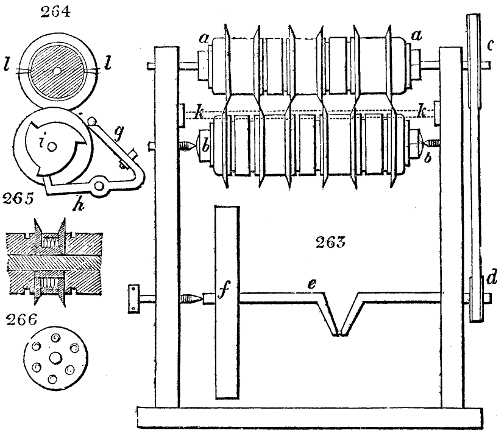
Fig. 263. is a front view of
this machine; a a and b b
are the two rollers, the
upper one turning upon
an extended axle, bearing
in the standards, the lower
one upon pivots. These
rollers are formed by a
series of circular blocks,
between a series of circular
steel cutters, which
are slidden on to iron
shafts, and held together
upon their axle by nuts
screwed up at their ends.
The accurate adjustment
of the cutters is of the
first importance to their
correct performance; it is
therefore found necessary
to introduce spiral springs
within the blocks, in order
to press the cutters up to
their proper bearings. A section of one of the blocks is shewn at fig. 265, and an end
view of the same at fig. 266, with the spiral springs inserted.
At the outer extremity of the axle of the roller a, a rigger c, is attached, whence
a band passes to a pulley d, on the crank shaft e, to which a flywheel f, is affixed, for the
purpose of rendering the action uniform. Rotatory motion being given to the crank
shaft, the upper roller is turned, the lower roller moving at the same time by the friction
against the edges of the cutters.
Fig. 264 is an end view of the rollers, showing the manner in which the pasteboards
are guided and conducted between the cutters. In the front of the machine a movable
frame g, is to be placed, for the purpose of receiving the pasteboards, preparatory to
cutting them into cards, and a stop is screwed to this frame for the edge of the pasteboard
to bear against, which stop is adjustable to suit different sizes. From the back
part of this frame an arm h, extends, the extremity of which acts against the periphery
of a ratchet wheel i, fixed at the end of the roller b, and hence, as the roller goes round,
the frame is made to rise and fall upon its pivots, for the purpose of guiding the pasteboard
up to the cutters; at the same time a rod k, hanging in arms from the sides of the
standards (shewn by dots in fig. 263), falling upon the pasteboard, confines it, while the
cutters take hold, and racks, corresponding with the indentations of the rollers, are
placed as at l l, by means of which the cards, when cut, are pushed out of the grooves.
As various widths of cards will require to be cut by this machine, the patentee proposes
to have several pairs of rollers ready adjusted to act together, when mounted in
the standards, in preference to shifting the circular cutters, and introducing blocks of
greater or less width.
The second part of the invention is a machine for pasting the papers, and pressing
the sheets together to make pasteboard. This machine consists of several reels (we
suppose rollers are intended) on which the paper is to be wound, along with a paste
trough, and rotatory brushes. The several parts of this machine, and their operations
in making pasteboard, are described in the specification, but the patentee having
omitted the letters of reference in the drawing which he has enrolled, it becomes
difficult to explain it.
As far as we are enabled to understand the machine, it appears, that damped paper is
to be wound upon two rollers, and conducted from thence over two other rollers; that
two fluted rollers revolving in the paste trough are to supply paste to two circular brushes,
and that by those brushes the papers are to be pasted upon one side, and then pressed
together, to make the pasteboard; after this, the pasteboard is to be drawn on to a
table, and to remain there until sufficiently dry to be wound upon other rollers. By
comparing this description with the figure, perhaps the intended operations of the
machine may be discovered, it is the best explanation we are enabled to give.
CARDS, (Cardes, Fr.; Karden, Ger.) are instruments which serve to disentangle
the fibres of wool, cotton, or other analogous bodies, to arrange them in an orderly lap
or fleece, and thereby prepare them for being spun into uniform threads. The fineness
and the levelness of the yarn, as well as the beauty of the cloth into which it enters,
depend as much upon the regularity and perfection of the carding, as upon any subsequent
operations of the factory. The quality of the carding depends more upon that of
the cards than upon any attention or skill in the operative; since it is now nearly an
automatic process, conducted by young women called card-tenters.
Cards are formed of a sheet or fillet of leather pierced with a multitude of small holes,
in which are implanted small staples of wire with bent projecting ends called teeth.
Thus every piece of wire is double toothed. The leather is afterwards applied to a flat
or cylindrical surface of wood or metal, and the co-operation of two or more such surfaces
constitutes a card. The teeth of cards are made thicker or slenderer, according as
the filaments to be carded are coarser or finer, stiffer or more pliant, more valuable or
cheaper. It is obviously of great importance that the teeth should be all alike, equably
distributed, and equally inclined over the surface of the leather, a degree of precision
which is scarcely possible with handwork. To judge of the difficulty of this manipulation
we need only inspect the annexed figures. The wire must first be bent at right
angles in c and d, fig. 268, then each branch must receive a second bend in a and b at a
determinate obtuse angle, invariable for each system of cards. It is indispensable that
the two angles c a e and d b f be mathematically equal, not only as to the twin teeth of one
staple, but through the whole series; for it is easy to see that if one of the teeth be more
or less sloped than its fellow, it will lay hold of more or less wool than it, and render
the carding irregular. But though the perfect regularity of the teeth be important, it
is not the sole condition towards making a good card. It must be always kept in view
that these teeth are to be implanted by pairs in a piece of leather, and kept in it by the
cross part c d. The leather must therefore be pierced with twin holes at the distance
c d; and pierced in such a manner, that the slope of the holes, in reference to the
plane of the leather, be invariably the same; for otherwise the length of the teeth would
vary with this angle of inclination, and the card would be irregular.
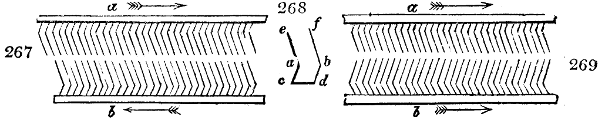
A third condition essential towards producing perfect regularity, is that the leather
ought to be of the same thickness throughout its whole surface, otherwise the teeth,
though of the same length and fixed at the same angle, would be rendered unequal by
the different thicknesses of the leather, and the operation of carding would be in consequence
extremely defective. Fig. 267. shows the card-teeth acting against each other, as
indicated by the arrows in two opposite directions; in fig. 269. they work one way.
Of late years very complex but complete and well-acting machines have been constructed
for splitting the leather or equalizing it by shaving, for bending and cutting the
wires, and implanting them in the leather, into holes pierced with perfect regularity.
Card machines which fashion the teeth with great precision and rapidity, and pierce the
leather, have been for a considerable time in use at Halifax, in Yorkshire, a town famous
for the excellence of its card-cloth, as also at Leeds, Glasgow, and several other places.
The wires and the leather thus prepared are given out by the manufacturer to women
and children, who put them together.
1. The simplest machine for equalizing the leather which can be employed, is that
which I saw operating in MM. Scrive’s automatic card factory at Lille, the most magnificent
I believe in the world, where the leather was drawn forwards by a roller over a
solid horizontal table, or bed, and passed under a nicely adjusted vertical blade, which
shaved it by a scraping motion to a perfectly uniform thickness. About one half the
weight of the leather is lost in this process, and in the subsequent squaring and trimming.
The machine for making cards, invented I believe by a Mr. Ellis of the United States,
for which a first patent was obtained in this country by Joseph Cheeseborough Dyer, Esq.
of Manchester, in 1811, and a second and third with further improvements in 1814,
and 1824, is one of the most elegant automatons ever applied to productive industry.
It is however necessarily so complicated with different mechanisms as to render its
representation impracticable in such engravings as are compatible with the scope of
this dictionary. I must therefore content myself with the following general description
of its constituent parts.
The first thing to be done after having, as above, prepared the long sheets or fillets of
leather, of suitable length, breadth, and thickness, for making the cards, is to stretch the
leather, and hold it firmly; which is accomplished by winding the fillet of leather upon
the roller or drum, like the warp roller of a loom, and then conducting it upwards between
guide rollers, to a receiving or work roller at top of the machine, where the
fillet is held fast by a cramp, by which means the leather is kept stretched.
Secondly, the holes are pierced in the leather to receive the wire staples or teeth of the
card, by means of a sliding fork, the points of which are presented to the face of the leather;
while the fork is made to advance and recede continually, by the agency of levers
worked by rotatory cams upon a revolving main shaft.
The points of the fork being thus made to penetrate into the leather, the holes for receiving
the staples are pierced, at regular distances, and in correct order, by shifting the
leather fillet so as to bring different parts of its surface opposite to the points of the sliding
fork. This is done by cams, or indented wheels and gear, which shift the guide rollers
and confining drums laterally, as they revolve, and consequently move the fillet of leather
at intervals a short distance, so as to present to the points of the fork or piercer at every
movement, a different part of the surface of the leather.
Thirdly, the wire of which the teeth or points of the card are to be made, is supplied
from a coil on the side of the machine, and is brought forward at intervals, by a pair
of sliding pincers, which are slidden to and fro through the agency of levers actuated
by rotatory cams upon the main shaft. The pincers having advanced a distance equal to
the length of wire intended to form one staple, or two points, this length of wire is
pressed upon exactly in the middle by a square piece of steel, and being there confined,
a cutter is brought forward, which cuts it off from that part of the wire held in the pincers.
The length of wire thus separated and confined, is now, by a movement of the machine,
bent up along the sides of the square steel holder, and shaped to three edges of the square,
that is, formed as a staple; and in the same way, by the continued movements of the
machine, a succession of pieces of wire are cut off, and bent into staples for making the
teeth of the card as long as the mechanism is kept in action.
Fourthly, the wire staple thus formed is held with its points or ends outwards, closely
contiguous to the forked piercer described above, and by another movement of the mechanism,
the staple is protruded forward, its end entering into the two holes made
previously in the leather by the sliding of the fork.
While the wire staple is being thus introduced into the leather, its legs or points are
to be bent, that is, formed with a knee or angle, which is the fifth object to be effected.
This is done by means of a small apparatus consisting of a bar or bed, which bears up
against the under side of the wire staple when it has been passed half-way into the
holes in the leather, and another bar above it, which being brought down behind the
staple, bends it over the resisting bar to the angle required; that is, forms the knee in each
leg. A pusher now acts behind the staple, and drives it home into the leather, which
completes the operation.
The leather being thus conducted, and its position shifted before the piercer progressively,
a succession of the above described operations of cutting the wire, forming the
staple, passing it into the leather, and bending its legs to the angular form, produces
a sheet of card of the kind usually employed for carding or combing wool, cotton, and
other fibrous materials. It may be necessary to add, that as these wire staples are required
to be set in the leathers sometimes in lines crossing the sheet, which is called
ribbed, and at other times in oblique lines, called twilled, these variations are produced
by the positions of the notches or steps upon the edge or periphery of the cam or
indented wheel, which shifts the guide rollers that hold the fillet or sheet of leather as
already described.
CARMINE, (Eng. and Fr.; Karminstoff, Ger.), is, according to Pelletier and Caventou,
a triple compound of the colouring substance, and an animal matter contained in
cochineal, combined with an acid added to effect the precipitation. The preparation of this
article is still a mystery, because upon the one hand, its consumption being very limited,
few persons are engaged in its manufacture, and upon the other, the raw material being
costly, extensive experiments on it cannot be conveniently made. Success in this business
is said to depend not a little upon dexterity of manipulation, and upon knowing
the instant for arresting the further action of heat upon the materials.
There is sold at the shops different kinds of carmine, distinguished by numbers, and
possessed of a corresponding value. This difference depends upon two causes, either
upon the proportion of alumina added in the precipitation, or of a certain quantity of
vermillion put in to dilute the colour. In the first case the shade is paler, in the second,
it has not the same lustre. It is always easy to discover the proportion of the adulteration.
By availing ourselves of the property of pure carmine to dissolve in water of ammonia,
the whole foreign matter remains untouched, and we may estimate its amount by drying
the residuum.
To make Ordinary Carmine.
Take 1 pound of cochineal in powder;
Take 3 drachms and a half of carbonate of potash;
Take 8 drachms of alum in powder;
Take 3 drachms and a half of fish-glue.
The cochineal must be boiled along with the potash in a copper containing five pailfuls
of water (60 pints); the ebullition being allayed with cold water. After boiling a
few minutes the copper must be taken from the fire, and placed on a table at such an
angle as that the liquor may be conveniently transvased. The pounded alum is then
thrown in, and the decoction is stirred; it changes colour immediately, and inclines to a
more brilliant tint. At the end of fifteen minutes the cochineal is deposited at the
bottom, and the bath becomes as clear as if it had been filtered. It contains the colouring
matter, and probably a little alum in suspension. We decant it then into a copper of
equal capacity, and place it over the fire, adding the fish-glue dissolved in a great deal of
water, and passed through a searce. At the moment of ebullition, the carmine is perceived
to rise up to the surface of the bath, and a coagulum is formed, like what takes
place in clarifications with white of egg. The copper must be immediately taken from
the fire, and its contents be stirred with a spatula. In the course of fifteen or twenty
minutes the carmine is deposited. The supernatant liquor is decanted, and the deposit
must be drained upon a filter of fine canvas or linen. If the operation has been well
conducted, the carmine when dry crushes readily under the fingers. What remains after
the precipitation of the carmine is still much loaded with colour, and may be employed
very advantageously for carminated lakes. See Lake.
By the old German process carmine is prepared by means of alum without any other
addition. As soon as the water boils the powdered cochineal is thrown into it, stirred
well, and then boiled for six minutes; a little ground alum is added, and the boiling is
continued for three minutes more; the vessel is removed from the fire, the liquor is filtered
and left for three days in porcelain vessels, in the course of which time a red matter falls
down, which must be separated and dried in the shade. This is carmine, which is sometimes
previously purified by washing. The liquor after three days more lets fall an
inferior kind of carmine, but the residuary colouring matter may also be separated by
the muriate of tin.
The proportions for the above process are 580 parts of clear river water, 16 parts of
cochineal, and 1 part of alum; there is obtained from 11⁄2 to 2 parts of carmine.
Another carmine with tartar.—To the boiling water the cochineal is added, and after
some time a little cream of tartar; in eight minutes more we add a little alum, and continue
the boiling for a minute or two longer. Then take it from the fire and pour it
into glass or porcelain vessels, filter and let it repose quietly till the carmine falls down.
We then decant and dry in the shade. The proportions are 8 pounds of water, 8 oz.
of cochineal, 1⁄2 oz. of cream of tartar, 3⁄4 oz. of alum, and the product is an ounce of
carmine.
The process of Alxon or Langlois.—Boil two pails and a half of river water (30 pints),
throw into it, a little afterwards, a pound of cochineal, add a filtered solution of six
drachms of carbonate of soda and a pound of water, and let the mixture boil for half an
hour; remove the copper from the fire, and let it cool, inclining it to one side. Add
six drachms of pulverized alum, stir with a brush to quicken the solution of the salt, and
let the whole rest 20 minutes. The liquor, which has a fine scarlet colour, is to be carefully
decanted into another vessel, and there is to be put into it the whites of two eggs
well beat up with half a pound of water. Stir again with a brush. The copper is replaced
on the fire, the alumina becomes concrete, and carries down the colouring matter
with it. The copper is to be taken from the fire, and left at rest for 25 or 30 minutes to
allow the carmine to fall down. When the supernatant liquor is drawn off, the
deposit is placed upon filter cloth stretched upon a frame to drain. When the carmine has
the consistence of cream cheese, it is taken from the filter with a silver or ivory knife
and set to dry upon plates covered with paper, to screen it from dust. A pound of
cochineal gives in this way an ounce and a half of carmine.
Process of Madame Cenette of Amsterdam, with salt of sorrel.—Into six pails of river
water boiling hot throw two pounds of the finest cochineal in powder, continue the
ebullition for two hours and then add 3 oz. of refined saltpetre, and after a few minutes
4 oz. of salt of sorrel. In ten minutes more take the copper from the fire and let it
settle for four hours; then draw off the liquor with a syphon into flat plates and leave it
there for three weeks. Afterwards there is formed upon the surface a pretty thick mouldiness,
which is to be removed dexterously in one pellicle by a slip of whalebone. Should
the film tear and fragments of it fall down, they must be removed with the utmost care.
Decant the supernatant water with a syphon, the end of which may touch the bottom of
the vessel, because the layer of carmine is very firm. Whatever water remains must be
sucked away by a pipette. The carmine is dried in the shade, and has an extraordinary
lustre.
Carmine by the salt of tin, or the Carmine of China.—Boil the cochineal in river water,
adding some Roman alum, then pass through a fine cloth to remove the cochineal, and
set the liquor aside. It becomes brighter on keeping. After having heated this liquor,
pour into it drop by drop solution of tin till the carmine be precipitated. The proportions
are one pailful of water, 20 oz. of cochineal and 60 grains of alum, with a solution
of tin containing 4 oz. of the metal.
To revive or brighten carmine.—We may brighten ordinary carmine, and obtain a very
fine and clear pigment, by dissolving it in water of ammonia. For this purpose we leave
ammonia upon carmine in the heat of the sun, till all its colour be extracted, and the
liquor has got a fine red tinge. It must be then drawn off and precipitated, by acetic
acid and alcohol, next washed with alcohol, and dried. Carmine dissolved in ammonia
has been long employed by painters, under the name of liquid carmine.
Carmine is the finest red colour which the painter possesses. It is principally
employed in miniature painting, water colours, and to tint artificial flowers, because it is
more transparent than the other colours. For Carminium, see Cochineal.
CARPET. (Tapis, Fr.; Teppich, Germ.) A thick woollen fabric of variegated
colours, for covering the floors of the better sort of apartments. This luxurious manufacture
took its origin in Persia and Turkey, whence the most beautiful patterns were wont
to come into Europe; but they have been for some time surpassed by the workmanship
of France, Great Britain, and Belgium. To form a just conception of the elegant
and ingenious processes by which carpets are made, we should visit the royal establishment
of the Gobelins at Paris, where we would see the celebrated carpet manufactory
of the Savonnerie, which has been transported thither. A detailed set of engravings
of this art is given by Roland de la Platière in the first and second volumes of the
Encyclopédie Méthodique, to which I must refer my readers, as a due exposition of its
machines and operations would far exceed the scope of the present volume.
The warp, says M. Roland, being the foundation of the fabric, ought to be of fine
wool, equally but firmly spun, and consist of three yarns twisted into one thread. The
yarns that are to form the velvety surface of the carpet, ought also to be of the best
quality, but soft and downy in their texture, so that the dye may penetrate every
filament. Hemp, or linen yarns, are likewise employed in this manufacture, as a woof,
to bind the warp firmly together after each shoot of the velvety threads. Thus we see
that good carpeting consists essentially of two distinct webs woven at the same time,
and firmly decussated together by the woof threads. Hence the form of the pattern is
the same upon the two sides of the cloth, only the colours are reversed, so that what was
green upon one side becomes red or black upon the other, and vice versâ. The smaller
the figures the more frequent the decussations of the two planes, and the firmer and more
durable the fabric.
The carpet manufacture, as now generally practised, may be distributed into two
systems—that of double fabrics, and that cut in imitation of velvet. Of late years the
Jacquard loom has been much used in weaving carpets, the nature of which will be
found fully explained under that title.
For the sake of illustration, if we suppose the double carpets to be composed of only
two colours, the principle of weaving will be easily understood; for it is only necessary
to raise the warp of each web alternately for the passage of the shuttle, the upper web
being entirely above when the under web is being woven, or decussated, and vice versâ.
In a Brussels carpet the worsted yarn raised to form the pile, and make the figure, is
not cut; in the Wilton the pile is cut to give it a velvety aspect and softness. In the
imperial Brussels carpet the figure is raised above the ground, and its pile is cut,
but the ground is uncut; and in the royal Wilton, the pile is both raised higher
than in the common Wilton, and it is cut, whereby it has a rich cushion-like
appearance. The cloth of all these superior carpets consists of woollen and linen,
or hemp; the latter being put upon a beam, and brought, of course, through heddles
and a reed; but as its only purpose is to bind together the worsted fabric, it should
not be visible upon the upper face of the carpet. The worsted yarn is wound upon
small bobbins or pirns, with a weight affixed to each, for giving proper tension to
the threads. Their number varies, for one web, from 1300 to 1800, according as the
carpet is to be 27 or 36 inches wide; and, they are placed, in frames, behind the loom,
filled with differently coloured yarn, to correspond with the figure. This worsted warp
is then drawn through the harness, heddles, and reed, to be associated with the linen
yarn in the compound fabric.
In Kidderminster carpeting, both warp and weft appear upon the face of the cloth,
whereas, in the Brussels style, only the warp is seen, its binding weft being fine hempen
or linen threads. The three-ply imperial carpet, called the Scotch, is coming very
much into vogue, and is reckoned by many to be little inferior in texture, look, and
wear to the Brussels. Kilmarnock has acquired merited distinction by this ingenious
industry. In this fabric, as well as in the two-ply Kidderminster, the weft predominates,
and displays the design; but, in the French carpets, the worsted warp of the web shows
the figure. Plain Venetian carpets, as used for stairs and passages, are woven in simple
looms, provided merely with the common heddles and reed. The warp should be a
substance of worsted yarn, so heavy as to cover in the weft completely from the view.
Figured Venetian carpets are woven in the two-ply Kidderminster looms, and are
provided with a mechanism to raise the pattern upon the worsted warp. The weft is
an alternate shoot of worsted and linen yarn, and must be concealed.
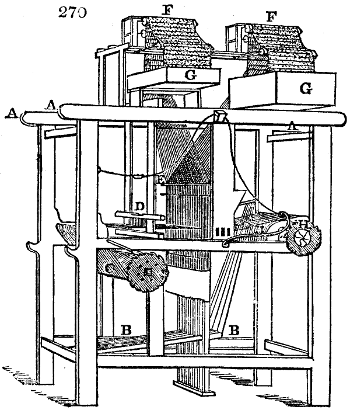
The following figure and description will explain the construction of the three-ply
imperial Scotch and two-ply Kidderminster carpet loom, which is merely a modification
of the Jacquard métier. The Brussels carpet-loom, on the contrary, is a draw-boy loom
on the damask plan, and requires the
weaver to have an assistant. Fig. 270.
A A A, is the frame of the loom, consisting
of four upright posts, with caps
and cross rails to bind them together.
The posts are about six feet high. C C,
the cloth-beam, is a wooden cylinder,
six inches or thereby in diameter, of
sufficient length to traverse the loom,
with iron gudgeons in the two ends,
which work in bushes in the side frame.
On one end of this beam is a ratchet
wheel, with a tooth to keep it from
turning round backwards by the tension
of the web. D, the lay, with its reed,
its under and upper shell, its two lateral
rulers or swords, and rocking-tree above.
There are grooves in the upper and
under shell, into which the reed is fitted.
E, the heddles, or harness, with a double
neck attached to each of the tower or
card mechanisms F F, of the Jacquard
loom. The heddles are connected and
work with the treddles B B, by means of cords, as shown in the figure. G G are wooden
boxes for the cards. H, the yarn, or warp beam.
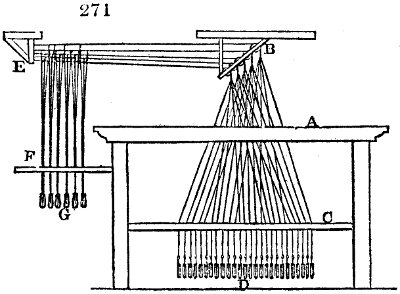
In draw-looms of every kind, there is no sinking of any portion of the warp, as in
plain cloth-weaving; but the plane of the warp is placed low, and the threads under
which the shuttle is to pass are raised, while all the rest remains stationary. The
harness part of this carpet loom is moved by an assistant boy or girl, who thus allows
the weft to be properly decussated, while the weaver attends to working the front
mounting or heddles. Fig. 271., A represents
the frame of a carpet draw-loom;
B is a box or frame of pulleys, over
which the cords of the harness pass, and
are then made fast to a piece of wood,
seen at E, which the weavers call a table.
From the tail of the harness the simples
descend, and to the end of each is attached
a small handle G, called a bob.
These handles being disposed in pairs,
and their regularity preserved by means
of a perforated board C, it is merely
necessary to pull every handle in succession;
the weaver, at the same time,
working his treddles with his feet, as
in any other loom. The treddles are
four in number, the fabric being that of plain or alternate cloth, and two treddles
allotted for each web. The harness part of the carpet draw-loom is furnished
with mails, or metallic eyes, to save friction; two threads being drawn through
each eye. The design or pattern of a carpet is drawn upon cross-rule paper, exactly
in the same way as every other kind of fancy-loom work, and is transferred
from the paper to the mounting by the rules for damask weaving. Suppose that
a double web is so mounted that every alternate thread of the one may be raised, so as
to form a sufficient shed-way for the shuttle, without depressing the other in the least.
Then suppose another web placed above the former, at such a distance that it will
exactly touch the convexity of those threads of the former, which are raised. Then, if
the threads of the latter web are sunk while the others are raised, the two would be
entirely incorporated. But if this be only partially done, that is, at particular places,
only those parts immediately operated upon will be affected by the action of the apparatus.
If the carpet is a two-coloured pattern, as black and red, and if upon the upper
surface, as extended in the loom, red flowers are to be represented upon a black ground,
then all those species of design paper which are coloured may be supposed to represent
the red, and those which are vacant the black. Then counting the spaces upon the
paper, omit those which are vacant, and cord those which are coloured, and the effect
will be produced. But as the two webs are to be raised alternately, whatever is corded
for the first handle must be passed by for the second, and vice versâ; so that the one will
form the flower, and the other the ground.
The board by which the simples are regulated appears at F. D shows the weights.
CARTHAMUS, or safflower (carthamus tinctorius), (Carthame, Fr.; Färber distel,
Germ.), the flower of which alone is used in dyeing, is an annual plant cultivated in
Spain, Egypt, and the Levant. There are two varieties of it—one which has large
leaves, and the other smaller ones. It is the last which is cultivated in Egypt, where it
forms a considerable article of commerce.
Carthamus contains two colouring matters, one yellow and the other red. The first
alone is soluble in water; its solution is always turbid: with re-agents it exhibits the
characters usually remarked in yellow colouring matters. The acids render it lighter,
the alkalies deepen it, giving it more of an orange hue: both produce a small dun precipitate,
in consequence of which it becomes clearer. Alum forms a precipitate of a deep
yellow, in small quantity. The solution of tin and the other metallic solutions cause
precipitates which have nothing remarkable in them.
The yellow matter of carthamus is not employed; but in order to extract this portion,
the carthamus is put into a bag, which is trodden under water, till no more colour can
be pressed out. The flowers, which were yellow, become reddish, and lose in this operation
nearly one half of their weight. In this state they are used.
For extracting the red part of carthamus, and thereafter applying it to stuff, the
property which alkalies possess of dissolving it is had recourse to, and it is afterwards
precipitated by an acid.
The process of dyeing consists, therefore, in extracting the colouring matter by means
of an alkali, and precipitating it on the stuff by means of an acid. It is this fecula which
serves for making the rouge employed by ladies.
As to this rouge, the solution of carthamus is prepared with crystallised carbonate of
soda, and it is precipitated by lemon juice. It has been remarked that lemons, beginning
to spoil, were fitter for this operation than those which were less ripe, whose juice retained
much mucilage. After squeezing out the lemon juice, it is left to settle for some
days. The precipitate of carthamus is dried at a gentle heat upon plates of stone-ware;
from which it is detached and very carefully ground with talc, which has been reduced
to a very subtile powder, by means of the leaves of shave-grass (presle), and successively
passed through sieves of increasing fineness. It is the fineness of the talc, and the greater
or less proportion which it bears to the carthamus precipitate, which constitute the difference
between the high and low priced rouges.
Carthamus is used for dyeing silk, poppy, nacarat (a bright orange-red), cherry, rose
colour, and flesh colour. The process differs according to the intensity of the colour, and
the greater or less tendency to flame colour that is wanted. But the carthamus bath,
whose application may be varied, is prepared as follows:
The carthamus, from which the yellow matter has been extracted, and whose lumps
have been broken down, is put into a trough. It is repeatedly sprinkled with cendres
gravelées (crude pearl ashes), or soda (barilla) well powdered and sifted at the rate of
6 pounds for 120 lbs. of carthamus; but soda is preferred, mixing carefully as the alkali
is introduced. This operation is called amestrer. The amestred carthamus is put into
a small trough with a grated bottom, first lining this trough with a closely woven cloth.
When it is about half filled, it is placed over the large trough, and cold water is poured
into the upper one, till the lower becomes full. The carthamus is then set over another
trough, till the water comes from it almost colourless. A little more alkali is now
mixed with it, and fresh water is passed through it. These operations are repeated
till the carthamus be exhausted, when it turns yellow.
After distributing the silk in hanks upon the rods, lemon juice, brought in casks from
Provence, is poured into the bath till it becomes of a fine cherry colour; this is called
turning the bath (virer le bain). It is well stirred, and the silk is immersed and turned
round the skein-sticks in the bath, as long as it is perceived to take up the colour. For
ponceau (poppy colour), it is withdrawn, the liquor is run out of it upon the peg, and it
is turned through a new bath, where it is treated as in the first. After this it is dried and
passed through fresh baths, continuing to wash and dry it between each operation, till it
has acquired the depth of colour that is desired. When it has reached the proper point,
a brightening is given it by turning it round the sticks seven or eight times in a bath of
hot water, to which about half a pint of lemon juice for each pailful of water has been
added.
When silk is to be dyed ponceau or flame colour, it must be previously boiled as for
white; it must then receive a slight foundation of annotto, as explained in treating
of this substance. The silk should not be alumed.
The nacarats, and the deep cherry colours, are given precisely like the ponceaux, only
they receive no annotto ground; and baths may be employed which have served for the
ponceau, so as to complete their exhaustion. Fresh baths are not made for the latter
colours, unless there be no occasion for the poppy.
With regard to the lighter cherry-reds, rose colour of all shades and flesh colours, they are
made with the second and last runnings of the carthamus, which are weaker. The deepest
shades are passed through first.
The lightest of all these shades, which is an extremely delicate flesh colour, requires
a little soap to be put into the bath. This soap lightens the colour, and prevents it from
taking too speedily, and becoming unevenly. The silk is then washed, and a little
brightening is given it, in a bath which has served for the deeper colours.
All these baths are employed the moment they are made, or as speedily as possible,
because they lose much of their colour upon keeping, by which they are even entirely
destroyed at the end of a certain time. They are, moreover, used cold, to prevent the
colour from being injured. It must have been remarked in the experiments just described,
that the caustic alkalies attack the extremely delicate colour of carthamus, making
it pass to yellow. This is the reason why crystals of soda are preferred to the other alkaline
matters.
In order to diminish the expense of the carthamus, it is the practice in preparing the
deeper shades to mingle with the first and the second bath about one fifth of the
bath of archil.
Dobereiner regards the red colouring matter of carthamus as an acid, and the yellow
as a base. His carthamic acid forms, with the alkalies, colourless salts, decomposed by the
tartaric and acetic acids, which precipitate the acid of a bright rose-red. Heat has a remarkable
influence upon carthamus, rendering its red colour yellow and dull. Hence, the
colder the water is by which it is extracted, the finer is the colour. Light destroys
the colour very rapidly, and hitherto no means have been found of counteracting this
effect. For this reason this brilliant colour must be dried in the shade, its dye must be
given in a shady place, and the silk stuffs dyed with it must be preserved as much as
possible from the light. Age is nearly as injurious as light, especially upon the dye
in a damp state. The colour is very dear, because a thousand parts of carthamus contain
only five of it.
In preparing the finest rouge, the yellow colouring matter being separated by washing
with water, the red is then dissolved by the aid of alkali, and is thrown down on linen
or cotton rags by saturating the solution with vegetable acid. The colour is rinsed out
of these rags, dissolved anew in alkalis, and once more precipitated by lemon juice. The
best and freshest carthamus must be selected. It is put into linen bags, which are placed
in a stream of water, and kneaded till the water runs off colourless. The bags are then
put into water soured with a little vinegar, kneaded till the colour is all expelled, and
finally rinsed in running water. By this treatment the carthamus loses nearly half its
weight. 6633 cwts. of safflower were imported into the United Kingdom in 1835, of
which 2930 cwts. were retained for internal consumption.
CASE-HARDENING, is the name of the process by which iron tools, keys, &c.,
have their surfaces converted into steel.
Steel when very hard is brittle, and iron alone is for many purposes, as for fine keys,
far too soft. It is therefore an important desideratum to combine the hardness of a
steely surface with the toughness of an iron body. These requisites are united by the
process of case-hardening, which does not differ from the making of steel, except in the
shorter duration of the process. Tools, utensils, or ornaments, intended to be polished,
are first manufactured in iron and nearly finished, after which they are put into an iron
box, together with vegetable or animal charcoal in powder, and cemented for a certain
time. This treatment converts the external part into a coating of steel, which is usually
very thin, because the time allowed for the cementation is much shorter than when the
whole substance is intended to be converted. Immersion of the heated pieces into water
hardens the surface, which is afterwards polished by the usual methods. Moxon in his
Mechanic Exercises, p. 56., gives the following receipt for case-hardening:—“Cow’s horn
or hoof is to be baked or thoroughly dried and pulverised. To this add an equal
quantity of bay salt; mix them with stale chamber-lye or white wine vinegar: cover
the iron with this mixture, and bed it with the same in loam, or enclose it in an iron box:
lay it on the hearth of the forge to dry and harden: then put it into the fire, and blow
till the lump have a blood-red heat, and no higher, lest the mixture be burnt too much.
Take the iron out, and immerse it in water to harden.” I consider the vinegar to be
quite superfluous.
I shall now describe the recent application of prussiate (ferrocyanate) of potash to this
purpose. The piece of iron, after being polished, is to be made brightly red-hot, and
then rubbed or sprinkled over with the above salt in fine powder, upon the part intended
to be hardened. The prussiate being decomposed, and apparently dissipated, the iron is
to be quenched in cold water. If the process has been well managed, the surface of the
metal will have become so hard as to resist the file. Others propose to smear over the
surface of the iron with loam made into a thin paste with a strong solution of the prussiate,
to dry it slowly, then expose the whole to a nearly white heat, and finally
plunge the iron into cold water, when the heat has fallen to dull redness. See
Steel.
CASHMERE or CACHEMERE, a peculiar textile fabric first imported from the
kingdom of Cashmere, and now well imitated in France and Great Britain. The
material of the Cashmere shawls is the downy wool found about the roots of the hair of
the Thibet goat. The year 1819 is remarkable in the history of French husbandry for
the acquisition of this breed of goats, imported from the East under the auspices of their
government, by the indefatigable courage and zeal of M. Jaubert, who encountered every
fatigue and danger to enrich his country with these valuable animals, aided by the
patriotism of M. Ternaux, who first planned this importation, and furnished funds for
executing it at his own expence and responsibility. He placed a portion of the flock
brought by M. Jaubert, at his villa of Saint Ouen, near Paris, where the climate seemed
to be very favourable to them, since for several successive years after their introduction
M. Ternaux was enabled to sell a great number of both male and female goats. The
quantity of fine fleece or down afforded by each animal annually, is from a pound and a
half to two pounds.
The wool imported into Europe comes by the way of Casan, the capital of a government
of the Russian empire upon the eastern bank of the Wolga; it has naturally a
grayish colour, but is easily bleached. Its price a few years back at Paris was 17 francs
per kilogramme; that is, about 6 shillings the pound avoirdupois. The waste in picking,
carding, and spinning, amounts to about one third of its weight.
The mills for spinning Cachemere wool have multiplied very much of late years in
France, as appears from the premiums distributed at the exposition of 1834, and the
prices of the yarn have fallen from 25 to 30 per cent. notwithstanding their improved
fineness and quality. There is a fabric made with a mixture of Cachemere down and
spun silk, which is becoming very general. One of the manufacturers, M. Hindenlang,
exhibited samples of Cachemere cloth woven with yarn so fine as No. 130 for warp, and
No. 228 for weft.
Messrs. Pollino, brothers, of Paris, produced an assortment of Cachemere pieces from 22
to 100 francs the yard, dyed of every fancy shade. Their establishment at Ferté-Bernard
occupies 700 operatives, with an hydraulic wheel of 60 horse power.
The oriental Cashmere shawls are woven by processes extremely slow and consequently
costly; whence their prices are very high. They are still sold in Paris at from 4,000 to
10,000 francs a piece; and from 100 to 400 pounds sterling in London. It became
necessary therefore either to rest satisfied with work which should have merely a surface
appearance, or contrive economical methods of weaving, to produce the real Cachemere
style with much less labour. By the aid of the draw-loom and still better of the Jacquard
loom, M. Ternaux first succeeded in weaving Cachemere shawls perfectly similar to the
oriental in external aspect, which became fashionable under the name of French Cachemere.
But to construct shawls altogether identical on both sides with the eastern, was a
more difficult task, which was accomplished only at a later period by M. Bauson of
Paris.
In both modes of manufacture, the piece is mounted by reading-in the warp for the
different leaves of the heddles, as is commonly practised for warps in the Jacquard looms.
The weaving of imitation shawls is executed, as usual, by as many shuttles as there are
colours in the design, and which are thrown across the warp in the order established by
the reader. The greater number of these weft yarns being introduced only at intervals
into the web, when the composition of the pattern requires it, they remain floating loose
at the back of the piece, and are cut afterwards, without affecting in the least the quality
of the texture; but there is a considerable waste of stuff in the weaving, which is worked
up into carpets.
The weaving of the imitation of real Cachemere shawls is different from the above.
The yarns intended to form the weft are not only equal in number to that of the colours
of the pattern to be imitated, but besides this, as many little shuttles or pirns (like those
used by embroiderers) are filled with these yarns, as there are to be colours repeated in
the breadth of the piece; which renders their number considerable when the pattern is
somewhat complicated and loaded with colours. Each of these small bobbins or shuttles
passes through only that portion of the flower in which the colour of its yarn is to appear,
and stops at the one side and the other of the cloth exactly at its limit; it then returns
upon itself after having crossed the thread of the adjoining shuttle. From this reciprocal
intertexture of all the yarns of the shuttles, it results, that although the weft is
composed of a great many different threads, they no less constitute a continuous line in
the whole breadth of the web, upon which the lay or batten acts in the ordinary way
We see therefore that the whole art of manufacturing this Cachemere cloth consists in
avoiding the confusion of the shuttles, and in not striking up the lay till all have fulfilled
their function. The labour does not exceed the strength of a woman, even though
she has to direct the loom and work the treddles. Seated on her bench at the end
opposite to the middle of the beam, she has for aids in weaving shawls from 45 to 52
inches wide, two girl apprentices, whom she directs and instructs in their tasks. About
four hundred days of work are required for a Cachemere shawl of that breadth. For
the construction of the loom, see Jacquard.
In the oriental process all the figures in relief are made simply with a slender pirn
without the shuttle used in European weaving. By the Indians the flower and its
ground are made with the pirn, by means of an intertwisting, which renders them in some
measure independent of the warp. In the Lyons imitation of this style, the leaves of
the heddles lift the yarns of the warp, the needles embroider as in lappett weaving, and
the flower is united to the warp by the weft thrown across the piece. Thus a great deal
of labour is saved, the eye is pleased with an illusion of the loom, and the shawls cost
little more than those made by the common fly shuttle.
Considered in reference to their materials, the French shawls present three distinct
classes, which characterise the three fabrics of Paris, Lyons, and Nimes.
Paris manufactures the French Cachemere, properly so called, of which both the warp
and the weft are the yarn of pure Cachemere down. This web represents with fidelity
the figures and the shades of colour of the Indian shawl, which it copies; the deception
would be complete if the reverse of the piece did not show the cut ends. The Hindoo
shawl, also woven at Paris, has its warp in spun silk, which reduces its price without
impairing its beauty much.
Lyons however has made the greatest progress in the manufacture of shawls. It excels
particularly in the texture of its Thibet shawls, the weft of which is yarn spun with a
mixture of wool and spun silk.
Nimes is remarkable for the low price of its shawls, in which spun silk, Thibet down,
and cotton, are all worked up together.
The value of shawls exported from France in the following years was:—
| |
1831. |
1832. |
1833. |
| |
Francs. |
Francs. |
Francs. |
| Woollen |
1,863,147 |
2,070,926 |
4,319,601 |
| Cachemere down |
433,410 |
655,200 |
609,900 |
| Spun silk |
401,856 |
351,152 |
408,824 |
It appears that M. J. Girard at Sèvres, near Paris, has succeeded best in producing
Cachemere shawls equal in stuff and style of work to the oriental, and at a lower price.
They have this advantage over the Indian shawls, that they are woven without seams, in
a single piece, and exhibit all the variety and the raised effect of the eastern colours.
Women and children alone are employed in his factory.
CASK, (Tonneau, Fr.; Fass, Germ.) manufacture of by mechanical power.
Mr. Samuel Brown obtained a patent in Nov., 1825, for certain improvements in
machinery for making casks, which seems to be ingenious and worthy of record. His
mechanism consists in the first place of a circular saw attached to a bench, with a sliding
rest, upon which rest each piece of wood intended to form a stave of a cask is fixed;
and the rest being then slidden forward in a curved direction, by the assistance of an
adjustable guide, brings the piece of wood against the edge of the rotatory saw, and causes
it to be cut into the curved shape required for the edge of the stave. The second feature
is an apparatus with cutters attached to a standard, and traversing round with their
carrier upon a centre, by means of which the upper and lower edges of the cask are cut
round and grooved, called chining, for the purpose of receiving the heads. Thirdly, an
apparatus not very dissimilar to the last, by which the straight pieces of wood designed
for the heads of the cask are held together, and cut to the circular figure required, and
also the bevelled edges produced. And fourthly, a machine in which the cask is made
to revolve upon an axis, and a cutting tool to traverse for the purpose of shaving the
external part of the cask, and bringing it to a smooth surface.
The pieces of wood intended to form the staves of the cask, having been cut to their
required length and breadth, are placed upon the slide-rest of the first mentioned machine,
and confined by cramps; and the guide, which is a flexible bar, having been previously
bent to the intended curve of the stave and fixed in that form, the rest is then slidden
forward upon the bench by the hand of the workman, which as it advances (moving in a
curved direction) brings the piece of wood against the edge of the revolving circular
saw, by which it is cut to the curved shape desired.
The guide is a long bar held by a series of movable blocks fitted to the bench by
screws, and is bent to any desired curve by shifting the screws: the edge of the slide-rests
which holds the piece of wood about to be cut, runs against the long guide bar, and of
consequence is conducted in a corresponding curved course. The circular saw receives
a rapid rotatory motion by means of a band or rigger from any first mover; and the piece
of wood may be shifted laterally by means of racks and pinions on the side-rest, by the
workman turning a handle, which is occasionally necessary in order to bring the piece
of wood up to, or away from, the saw.
The necessary number of staves being provided, they are then set round within a
confining hoop at bottom, and brought into the form of a cask in the usual way, and
braced by temporary hoops. The barrel part of the cask being thus prepared, in order
to effect the chining, it is placed in a frame upon a platform, which is raised up by a
treddle lever, that the end of the barrel may meet the cutters in a sort of lathe above: the
cutters are then made to traverse round within the head of the barrel, and, as they proceed,
occasionally to expand, by which means the bevels and grooves are cut on the
upper edge of the barrel, which is called chining. The barrel being now reversed, the
same apparatus is brought to act against the other end, which becomes chined in like
manner.
The pieces of wood intended to form the heads of the cask are now to be cut straight
by a circular saw in a machine, similar to the first described; but in the present instance
the slide-rest is to move forward in a straight course. After their straight edges are
thus produced, they are to be placed side by side, and confined, when a scribing cutter
is made to traverse round, and cut the pieces collectively into the circular form desired
for heading the cask.
The cask having now been made up, and headed by hand as usual, it is placed between
centres, or upon an axle in a machine, and turned round by a rigger or band with a
shaving cutter, sliding along a bar above it, which cutter being made to advance, and
recede as it slides along, shaves the outer part of the cask to a smooth surface.
CASSAVA. Cassava bread, conaque, &c., are different names given to the starch
of the root of the Manioc (Jatropha Manihot, Linn.), prepared in the following manner
in the West Indies, the tropical regions of America, and upon the African coast. The
tree belongs to the natural family of the euphorbiaceæ.
The roots are washed, and reduced to a pulp by means of a rasp or grater. The pulp
is put into coarse strong canvas bags, and thus submitted to the action of a powerful
press, by which it parts with most of its noxious juice (used by the Indians for poisoning
the barbs of their arrows). As the active principle of this juice is volatile, it is easily
dissipated by baking the squeezed cakes of pulp upon a plate of hot iron. Fifty pounds
of the fresh juice, when distilled, afford, at first, three ounces of a poisonous water, possessing
an intolerably offensive smell; of which, 35 drops being administered to a slave
convicted of the crime of poisoning, caused his death in the course of six minutes, amid
horrible convulsions.[16]
The pulp dried in the manner above described concretes into lumps, which become
hard and friable as they cool. They are then broken into pieces, and laid out in the sun
to dry. In this state they afford a wholesome nutriment, and are habitually used as such
by the negroes, as also by many white people. These cakes constitute the only provisions
laid in by the natives, in their voyages upon the Amazons. Boiled in water with
a little beef or mutton they form a kind of soup similar to that of rice.
The Cassava cakes sent to Europe (which I have eaten with pleasure) are composed
almost entirely of starch, along with a few fibres of the ligneous matter. It may be
purified by diffusion through warm water, passing the milky mixture through a linen
cloth, evaporating the strained liquid over the fire, with constant agitation. The starch
dissolved by the heat, thickens as the water evaporates, but on being stirred, it becomes
granulated, and must be finally dried in a proper stove. Its specific gravity is 1·530—that
of the other species of starch.
The product obtained by this treatment is known in commerce under the name of tapioca;
and being starch very nearly pure, is often prescribed by physicians as an aliment
of easy digestion. A tolerably good imitation of it is made by heating, stirring, and
drying potato starch in a similar way.
The expressed juice of the root of manioc contains in suspension a very fine fecula, which
it deposits slowly upon the bottom of the vessels. When freed by decantation from the supernatant
liquor, washed several times and dried, it forms a beautiful starch, which
creaks on pressure with the fingers. It is called cipipa, in French Guyana; it is
employed for many delicate articles of cookery, especially pastry, as also for hair powder,
starching linen, &c.
Cassava flour, as imported, may be distinguished from arrow-root and other kinds
of starch, by the appearance of its particles viewed in a microscope. They are
spherical, all about 1-1000th of an inch in diameter, and associated in groups; those of
potato starch are irregular ellipsoids, varying in size from 1-300th to 1-3000th of an
inch; those of arrow-root have the same shape nearly, but vary in size from 1-500th to
1-800th of an inch; those of wheat are separate spheres 1-1000th of an inch.
CASSIS, the black currant (ribes nigra, Linn.), which was formerly celebrated
for its medicinal properties with very little reason.
The only technical use to which it is now applied is in preparing the agreeable liqueur
called ratafia, by the following French recipe:—Stone, and crush three pounds of black
currants, adding to the magma one drachm of cloves, two of cinnamon, four quarts of spirit
of wine, at 18° Baumé (see Aréomètre of Baumé), and 21⁄2 pounds of sugar. Put the
mixture into a bottle which is to be well corked; let it digest for a fortnight, shaking
the bottle once daily during the first eight days; then strain through a linen cloth, and
finally pass through filtering paper.
CASTING OF METALS. (See Founding.) Casts from elastic moulds.—Being
much engaged in taking casts from anatomical preparations, Mr. Douglas Fox, Surgeon,
Derby, found great difficulty, principally with hard bodies, which, when undercut, or
having considerable overlaps, did not admit of the removal of moulds of the ordinary
kind, except with injury. These difficulties suggested to him the use of elastic moulds,
which, giving way as they were withdrawn from complicated parts, would return to
their proper shape; and he ultimately succeeded in making such moulds of glue, which
not only relieved him from all his difficulties, but were attended with great advantages,
in consequence of the small number of pieces into which it was necessary to divide
the mould.
The body to be moulded, previously oiled, must be secured one inch above the surface
of a board, and then surrounded by a wall of clay, about an inch distant from its sides.
The clay must also extend rather higher than the contained body: into this, warm melted
glue, as thick as possible so that it will run, is to be poured, so as to completely cover
the body to be moulded; the glue is to remain till cold, when it will have set into an
elastic mass, just such as is required.
Having removed the clay, the glue is to be cut into as many pieces as may be necessary
for its removal, either by a sharp-pointed knife, or by having placed threads in
the requisite situations of the body to be moulded, which may be drawn away when the
glue is set, so as to cut it out in any direction.
The portions of the glue mould having been removed from the original, are to be placed
together and bound round by tape.
In some instances it is well to run small wooden pegs through the portions of glue, so
as to keep them exactly in their proper positions. If the mould be of considerable size, it is
better to let it be bound with moderate tightness upon a board to prevent it bending
whilst in use; having done as above described, the plaster of Paris, as in common casting,
is to be poured into the mould, and left to set.
In many instances wax may also be cast in glue, if it is not poured in whilst too hot;
as the wax cools so rapidly when applied to the cold glue, that the sharpness of the impression
is not injured.
Glue has been described as succeeding well where an elastic mould is alone applicable;
but many modifications are admissible. When the moulds are not used soon
after being made, treacle should be previously mixed with the glue (as employed by
printers) to prevent it becoming hard.
The description thus given is with reference to moulding those bodies which cannot
be so done by any other than an elastic mould; but glue moulds will be found greatly
to facilitate casting in many departments, as a mould may be frequently taken by this
method in two or three pieces, which would, on any other principle, require many.
CASTOR. (Eng. and Fr.; Biber, Germ.) The castor is an amphibious quadruped,
inhabiting North America; also found in small numbers in the islands of the
Rhone. In the arts, the skin of this animal is employed either as a fur or as affording
the silky hair called beaver, with which the best hats are covered. Beaver skins, which
form a very considerable article of trade, are divided into 3 sorts: 1. The fresh beaver
skins from castors, killed in winter before shedding their hair; these are most in request
among the furriers, as being the most beautiful. 2. The dry or lean beavers are
the skins of the animals killed during the moulting season; they are not much esteemed,
as the skin is rather bare. 3. The fat castors: these are the skins of the first sort, which
have been worn for some time upon the persons of the savages and have got imbued with
their sweat. The last are principally used in the hat manufacture. In France, the
marine otter has been for many years substituted in the place of the castor or
beaver.
CASTOR or CASTOREUM. This name is given to a secretion of the castors,
contained in pear-shaped cellular organic sacs, placed near the genital organs of both the
male and female animals. It is a substance analogous to civet and musk, of a consistence
similar to thick honey. It has a bitter acrid taste; a powerful, penetrating, fetid, and very
volatile smell; but, when dried, it becomes inodorous. Several chemists, and in particular
Bouillon Lagrange, Laugier, and Hildebrandt have examined castor; and found
it to be composed of a resin, a fatty substance, a volatile oil, an extractive matter, benzoic
acid, and some salts.
The mode of preparing it is very simple. The sacs are cut off from the castors when they
are killed, and are dried to prevent the skin being affected by the weather. In this state,
the interior substance is solid, of a dark colour, and a faint smell; it softens with heat,
and becomes brittle by cold. Its fracture betrays fragments of membranes, indicating its
organic structure. When chewed, it adheres to the teeth somewhat like wax; it has a
bitter, slightly acrid, and nauseous taste.
The castor bags, as imported, are often joined in pairs by a kind of ligature. Sometimes
the substance which constitutes their value is sophisticated; a portion of the castoreum
being extracted, and replaced by lead, clay, gums, or some other foreign matters.
This fraud may be easily detected, even when it exists in a small degree, by the absence
of the membranous partitions in the interior of the bags, as well as by the altered smell
and taste.
The use of castoreum in medicine is considerable, especially in nervous and spasmodic
diseases, and it is often advantageously combined with opium.
CASTORINE. A chemical principle lately discovered to the amount of a few parts
per cent. in Castoreum.
CASTOR OIL. The expressed oil of the seeds of the Palma Christi, or Ricinus
communis, a native tree of the West Indies and South America; but which has been cultivated
in France, Italy, and Spain. Bussy and Lecanu discovered in it 3 species of
fatty matters, obtained partly by saponification, and partly by dry distillation—the margaritic,
ricinic, and elaiodic acids. None of these has been separately applied to any
use in the arts.
The quantity of castor oil imported in 1835 into the United Kingdom, was
1,109,307 libs.; retained for home consumption, 670,205 libs. See Oils.
CATECHU, absurdly called Terra Japonica, is an extract made from the wood of
the tree mimosa catechu, which grows in Bombay, Bengal, and other parts of India. It
is prepared by boiling the chips of the interior of the trunk in water, evaporating the
solution to the consistence of syrup over the fire, and then exposing it in the sun to
harden. It occurs in flat rough cakes, and under two forms. The first, or the Bombay,
is of uniform texture, of a dark red colour, and of specific gravity 1·39. The second
is more friable and less solid. It has a chocolate colour, and is marked inside with red
streaks. Its specific gravity is 1·28.
According to Sir H. Davy, these two species are composed as follows:—
| |
Bombay. |
Bengal. |
| Tannin |
54 |
·5 |
48 |
·5 |
| Extractive |
34 |
·0 |
36 |
·5 |
| Mucilage |
6 |
·5 |
8 |
|
| Insoluble matters, sand and lime |
5 |
|
7 |
|
| |
100 |
·0 |
100 |
·0 |
Areka nuts are also found to yield catechu; for which purpose they are cut into
pieces watered in an earthen pot with solution of nitre, and have a little of the bark of
a species of mimosa added to them. The liquor is then boiled with the nuts, and affords
an inspissated decoction.
Good catechu is a brittle, compact solid, of a dull fracture. It has no smell, but a
very astringent taste. Water dissolves the whole of it, except the earthy matter, which
is probably added during its preparation. Alcohol dissolves its tannin and extractive.
The latter may be oxidized, and thus rendered insoluble in alcohol, by dissolving the
catechu in water, exposing it for some time to a boiling heat, and evaporating to
dryness.
The tannin of catechu differs from that of galls, in being soluble in alcohol, and more
soluble in water. It precipitates iron of an olive colour, and gelatine in a mass which
gradually becomes brown.
It has been long employed in India for tanning skins, where it is said to effect this object
in five days. I have seen a piece of sole leather completely tanned by it in this country in
ten days, the ox-hide having been made into a bag, with the hair outside, and kept filled
with the solution of catechu. In India it has also been used to give a brown dye to
cotton goods, and of late years it has been extensively introduced into the calico print-works
of Europe. The salts of copper with sal ammoniac cause it to give a bronze
colour, which is very fast; the proto-muriate of tin, a brownish yellow; the per-chloride
of tin, with the addition of nitrate of copper, a deep bronze hue; acetate of alumina
alone, a reddish brown, and, with nitrate of copper, a reddish olive gray; nitrate of iron,
a dark brown gray. For dyeing a golden coffee brown, it has entirely superseded
madder; one pound of it being equivalent to six pounds of this root.
A solution of one part of catechu in ten parts of water, which is reddish brown,
exhibits the following results with—
| Acids |
A brightened shade. |
| Alkalis |
A darkened shade. |
| Proto-sulphate of iron |
Olive brown precipitate. |
| Per-sulphate of iron |
Olive green do. |
| Sulphate of copper |
Yellowish brown. |
| Alum |
A brightening of the liquor. |
| Per-nitrate of iron |
Olive green precipitate. |
| Nitrate of copper |
Yellowish brown do. |
| Nitrate of lead |
Salmondo. |
| Proto-nitrate of mercury |
Milk-coffee do. |
| Muriate of alumina |
Brown yellow. |
| Muriate of tin |
Do. do. |
| Per-chloride of tin |
Do.darker. |
| Corrosive sublimate |
Light chocolate do. |
| Acetate of alumina |
Brightening of the liquor. |
| Acetate of copper |
Copious brown precipitate. |
| Acetate of lead |
Salmon coloureddo. |
| Bichromate of potash |
Copious browndo. |
Pure tannin may be obtained from catechu, by treating it with sulphuric acid and carbonate
of lead; but this process has no manufacturing application.
CATGUT, (Corde à boyau, Fr.; Darmsaite, Germ.) the name absurdly enough
given to cords made of the twisted intestines of the sheep. The guts being taken while
warm out of the body of the animal, are to be cleared of feculent matter, freed from any
adhering fat, and washed in a tub of water. The small ends of all the intestines are
next to be tied together, and laid on the edge of the tub, while the body of them is left
to steep in some water, frequently changed, during two days, in order to loosen the
peritoneal and mucous membranes. The bundle of intestines is then laid upon a
sloping table which overhangs the tub, and their surface is scraped with the back of a
knife, to try if the external membrane will come away freely in breadths of about half
the circumference. This substance is called by the French manufacturers filandre, and
the process filer. If we attempt to remove it by beginning at the large end of the
intestine, we shall not succeed. This filandre is employed as thread to sew intestines,
and to make the cords of rackets and battledores. The flayed guts are put again into fresh
water, and after steeping a night, are taken out and scraped clean next day, on the
wooden bench with the rounded back of a knife. This is called curing the gut. The
large ends are now cut off, and sold to the pork-butchers. The intestines are again
steeped for a night in fresh water, and the following day in an alkaline lixivium made
by adding 4 ounces of potash, and as much pearlash, to a pail of water containing about
3 or 4 imperial gallons. This lye is poured in successive quantities upon the intestines,
and poured off again, after 2 or 3 hours, till they be purified. They are now drawn
several times through an open brass thimble, and pressed against it with the nail, in order
to smooth and equalize their surface. They are lastly sorted, according to their sizes, to
suit different purposes.
Whip-cord is made from the above intestines, which are sewed together endwise by the
filandre, each junction being cut aslant, so as to make it strong and smooth. The cord
is put into the frame, and each end is twisted separately; for whip-cord is seldom made
out of two guts twisted together. When twisted it is to be sulphured (see Sulphuring)
once or twice. It may also be dyed black with common ink, pink with red ink,
which the sulphurous acid changes to pink, and green with a green dye which the
colour dealers sell for the purpose. The guts take the dyes readily. After being well
smoothed, the cord is to be dried, and coiled up for sale.
Hatter’s cords for bowstrings.—The longest and largest intestines of sheep, after being
properly treated with the potash, are to be twisted 4, 6, 8, 10, or 12 together, according
to the intended size of the cord, which is usually made from 15 to 25 feet long. This cord
must be free from seams and knots. When half dry, it must be exposed twice to the
fumes of burning sulphur; and, after each operation, it is to be well stretched and
smoothed; it should be finally dried in a state of tension.
Clockmaker’s cord.—This cord should be extremely thin, and be therefore made from
very small intestines, or from intestines slit up in their length by a knife fitted for the
purpose; being a kind of lancet surmounted with a ball of lead or wood. The wet gut
is strained over the ball which guides the knife, and the two sections fall down into a
vessel placed beneath. Each hand pulls a section. Clockmakers also make use of
stronger cords made of 2 or more guts twisted together.
Fiddle and harp strings.—These require the greatest care and dexterity on the part
of the workmen. The treble strings are peculiarly difficult to make, and are best made
at Naples, probably because their sheep, from their small size and leanness, afford the
best raw material.
The first scraping of the guts intended for fiddle-strings must be very carefully performed;
and the alkaline lyes being clarified with a little alum, are added, in a progressively stronger
state from day to day, during 4 or 5 days, till the guts be well bleached and swollen.
They must then be passed through the thimble, and again cleansed with the lixivium;
after which they are washed, spun, or twisted and sulphured during two hours. They are
finally polished by friction, and dried. Sometimes they are sulphured twice or thrice
before being dried, and are polished between horse-hair cords.
It has been long a subject of complaint, as well as a serious inconvenience to musicians,
that catgut strings cannot be made in England of the same goodness and strength
as those imported from Italy. These are made of the peritoneal covering of the intestines
of the sheep; and, in this country, they are manufactured at Whitechapel, and
probably elsewhere in considerable quantity; the consumption of them for harps, as
well as for the instruments of the violin family, being very great. Their chief fault is
weakness; whence it is difficult to bring the smaller ones, required for the higher notes,
to concert pitch; maintaining at the same time, in their form and construction, that
tenuity or smallness of diameter, which is required to produce a brilliant and clear tone.
The inconvenience arising from their breaking when in use, and the expense in the
case of harps, where so many are required, are such as to render it highly desirable to improve
a manufacture which, to many individuals may, however, appear sufficiently contemptible.
It is well known to physiologists, that the membranes of lean animals are far more
tough than of those animals which are fat or in high condition; and there is no reason to
doubt that the superiority of the Italian strings arises from the state of the sheep in that
country. In London, where no lean animals are slaughtered, and where, indeed, an
extravagant and useless degree of fattening, at least for the purpose of food, is given to
sheep in particular, it is easy to comprehend why their membranes can never afford a
material of the requisite tenacity. It is less easy to suggest an adequate remedy; but a
knowledge of the general principle, should this notice meet the eyes of those interested in
the subject, may at least serve the purpose of diminishing the evil and improving the manufacture,
by inducing them to choose in the market the offal of such carcases as appear
least overburthened with fat. It is probable that such a manufacture might be advantageously
established in those parts of the country where the fashion has not, as in
London, led to the use of meat so much overfed; and it is equally likely, that in the
choice of sheep for this purpose, advantage would arise from using the Welch, the Highland,
or the Southdown breeds, in preference to those which, like the Lincoln, are prone
to excessive accumulations of fat. It is equally probable, that sheep dying of some
of the diseases accompanied by emaciation, would be peculiarly adapted to this
purpose.
That these suggestions are not merely speculative is proved by comparing the strength
of the membranes in question, or that of the other membranous parts, in the unfattened
Highland sheep, with that of those found in the London markets.
CATHARTINE. The name proposed by MM. Feneulle and Lassaigne for a chemical
principle, which they suppose to be the active constituent of senna.
CAUSTIC. Any chemical substance corrosive of the skin and flesh; as potash, called
common caustic, and nitrate of silver, called lunar caustic, by surgeons.
CAVIAR. The salted roe of certain species of fish, especially the sturgeon. This
product forms a considerable article of trade, being exported annually from the town of
Astrachan alone, upon the shores of the Caspian sea, to the amount of several hundred
tons. The Italians first introduced it into Eastern Europe from Constantinople, under
the name of caviale. Russia has now monopolized this branch of commerce. It is prepared
in the following manner:—
The female sturgeon is gutted; the roe is separated from the other parts, and cleaned
by passing it through a very fine searce, by rubbing it into a pulp between the hands:
this is afterwards thrown into tubs, with the addition of a considerable quantity of salt;
the whole is then well stirred, and set aside in a warm apartment. There is another
sort of caviar, the compressed, in which the roe, after having been cured in strong brine, is
dried in the sun, then put into a cask, and subjected to strong pressure.
CAWK. The English miner’s name for sulphate of baryta, or heavy spar.
CEDRA, (Cedrat, Fr.) is the fruit of a species of orange, citron, or lemon, a tree which
bears the same name. Its peel is very thick, and covered with an epidermis which encloses
a very fragrant and highly prized essential oil. The preserves flavoured with it
are very agreeable. The citrons are cut into quarters for the dry comfits, but are put whole
into the liquid ones. The liquorist-perfumer makes with the peel of the cedra an excellent
liqueur; for which purpose, he plucks them before they are quite ripe; grates
down the peel into a little brandy, or cuts them into slices, and infuses these in the
spirits. This infusion is distilled for making perfume; but the flavour is better when
the infusion itself is used. See Essences, Liquorist, Perfumery.
CELESTINE. Native sulphate of strontia, found abundantly near Bristol, in the
red marl formation. It is decomposed, by ignition with charcoal, into sulphuret of
strontia, which is converted into nitrate by saturation with nitric acid, evaporation, and
crystallization. This nitrate is employed for the production of the red light in theatrical
fire-works.
CEMENTATION. A chemical process, which consists in imbedding a solid
body, in a pulverulent matter, and exposing both to ignition in an earthen or metallic
case. In this way, iron is cemented with charcoal to form steel, and bottle glass with
gypsum powder, or sand, to form Reaumur’s porcelain.
CEMENTS. (Ciments, Fr.; Cämente, Kitte, Germ.) Substances capable of taking the
liquid form, and of being in that state applied between the surfaces of two bodies, so as to
unite them by solidifying. They may be divided into two classes, those which are applied
through the agency of a liquid menstruum, such as water, alcohol, or oil, and those which
are applied by fusion with heat.
The diamond cement for uniting broken pieces of china, glass, &c. which is sold as a
secret at an absurdly dear price, is composed of isinglass soaked in water till it becomes
soft, and then dissolved in proof spirit, to which a little gum resin, ammoniac, or galbanum,
and resin mastic are added, each previously dissolved in a minimum of alcohol.
When to be applied, it must be gently heated to liquefy it; and it should be kept for
use in a well-corked phial. A glass stopper would be apt to fix so as not to be removable.
This is the cement employed by the Armenian jewellers in Turkey for glueing
the ornamental stones to trinkets of various kinds. When well made it resists
moisture.
Shell-lac dissolved in alcohol, or in a solution of borax, forms a pretty good cement.
White of egg alone, or mixed with finely sifted quick lime, will answer for uniting
objects which are not exposed to moisture. The latter combination is very strong, and
is much employed for joining pieces of spar and marble ornaments. A similar composition
is used by copper-smiths to secure the edges and rivets of boilers; only bullock’s
blood is the albuminous matter used instead of white of egg. Another cement in which
an analogous substance, the curd or caseum of milk is employed, is made by boiling
slices of skim-milk cheeses into a gluey consistence in a great quantity of water, and
then incorporating it with quicklime on a slab with a muller, or in a marble mortar.
When this compound is applied warm to broken edges of stoneware, it unites them very
firmly after it is cold.
A cement which gradually indurates to a stony consistence may be made by mixing
20 parts of clean river sand, two of litharge, and one of quicklime, into a thin putty
with linseed oil. The quicklime may be replaced with litharge. When this cement is
applied to mend broken pieces of stone, as steps of stairs, it acquires after some time a
stony hardness. A similar composition has been applied to coat over brick walls, under
the name of mastic.
The iron-rust cement is made of from 50 to 100 parts of iron borings, pounded and
sifted, mixed with one part of sal-ammoniac, and when it is to be applied moistened with
as much water as will give it a pasty consistency. Formerly flowers of sulphur were used,
and much more sal-ammoniac in making this cement, but with decided disadvantage, as
the union is effected by the oxidizement, consequent expansion and solidification of the
iron powder, and any heterogeneous matter obstructs the effect. The best proportion of
sal-ammoniac is, I believe, one per cent. of the iron borings. Another composition of the
same kind is made by mixing 4 parts of fine borings or filings of iron, 2 parts of potter’s
clay, and 1 part of pounded potsherds, and making them into a paste with salt and
water. When this cement is allowed to concrete slowly on iron joints, it becomes very
hard.
For making architectural ornaments in relief, a moulding composition is formed of
chalk, glue, and paper paste. Even statues have been made with it, the paper aiding the
cohesion of the mass.
Mastics of a resinous or bituminous nature which must be softened or fused by heat are
the following:—
Mr. S. Varley’s consists of sixteen parts of whiting sifted and thoroughly dried by a
red heat, adding when cold a melted mixture of 16 parts of black rosin and 1 of bees’-wax,
and stirring well during the cooling.
Mr. Singer’s electrical and chemical apparatus cement consists of 5 lbs. of rosin, 1 of
bees’-wax, 1 of red ochre, and two table-spoonsful of Paris-plaster, all melted together.
A cheaper one for cementing voltaic plates into wooden troughs is made with 6 pounds
of rosin, 1 pound of red ochre, 1⁄2 of a pound of plaster of Paris, and 1⁄4 of a pound of linseed
oil. The ochre and the plaster of Paris should be calcined beforehand, and added
to the other ingredients in their melted state. The thinner the stratum of cement that
is interposed, the stronger generally speaking is the junction.
Boiled linseed oil and red lead mixed together into a putty are often used by coppersmiths
and engineers, to secure joints. The washers of leather or cloth are smeared with
this mixture in a pasty state.
The resin mastic alone is sometimes used by jewellers to cement by heat cameos of
white enamel or coloured glass to a real stone, as a ground to produce the appearance of
an onyx. Mastic is likewise used to cement false backs or doublets to stones to alter
their hue.
Melted brimstone either alone, or mixed with rosin and brick dust, forms a tolerably
good and very cheap cement.
Plumber’s cement consists of black rosin one part, brick dust two parts, well incorporated
by a melting heat.
The cement of dihl for coating the fronts of buildings consists of linseed oil, rendered
dry by boiling with litharge, and mixed with porcelain clay in fine powder, to give it the
consistence of stiff mortar. Pipe-clay would answer equally well if well dried, and any
colour might be given with ground bricks, or pottery. A little oil of turpentine to thin
this cement aids its cohesion upon stone, brick, or wood. It has been applied to sheets of
wire cloth, and in this state laid upon terraces, in order to make them water tight; but
it is little less expensive than lead.
The bituminous or black cement for bottle corks consists of pitch hardened by the addition
of rosin and brick-dust.
In certain localities where a limestone impregnated with bitumen occurs, it is dried,
ground, sifted, and then mixed with about its own weight of melted pitch, either mineral,
vegetable, or that of coal tar. When this mixture is getting semifluid, it may be moulded
into large slabs or tiles in wooden frames lined with sheet iron, previously smeared over
with common lime mortar, in order to prevent adhesion to the moulds, which, being in
movable pieces, are easily dismounted so as to turn out the cake of artificial bituminous
stone. This cement is manufactured upon a great scale in many places, and used for
making Italian terraces, covering the floors of balconies, flat roofs, water reservoirs, water
conduits, &c. When laid down, the joints must be well run together with hot irons. The
floor of the terrace should be previously covered with a layer of Paris plaster or common
mortar, nearly an inch thick, with a regular slope of one inch to the yard. Such bituminous
cement weighs 144 pounds the cubic foot; or a foot of square surface, one inch
thick, weighs 12 pounds. Sometimes a second layer of these slabs or tiles is applied
over the first, with the precaution of making the seams or joints of the upper correspond
with the middle of the under ones. Occasionally a bottom bed, of coarse cloth or gray
paper, is applied. The larger the slabs are made, as far as they can be conveniently
transported and laid down, so much the better. For hydraulic cements, see Mortar.
CERASIN. The name given by Dr. John to those gums which swell, but do not
dissolve in water; such as gum tragacanth. It is synonymous with Bassorine,
which see.
CERATE from cera, wax. An unguent, of rather a stiff consistence, made of oil, or
lard and wax, thickened occasionally with pulverulent matters.
CERINE. A substance which forms from 70 to 80 per cent. of bees’-wax. It may
be obtained by digesting wax, for some time, in spirit of wine, at a boiling temperature.
The myricine separates, while the cerine remains dissolved, and may be obtained from
the decanted liquor by evaporation. Cerine is white, analogous to wax, fusible at
134° F., hardly acted upon by hot nitric acid, but is readily carbonized by hot sulphuric
acid. When treated with caustic alkaline lye, it is converted into margaric acid
and ceraïne.
CERIUM. A peculiar metal discovered in the rare mineral, called cerite, found
only in the copper mine of Bastnaes, near Riddarhytta, in Sweden. Cerium, extracted
from its chloride by potassium, appears as a dark red or chocolate powder, which
assumes a metallic lustre by friction. It does not conduct electricity well, like other
metals; it is infusible; its specific gravity is unknown. It has been applied to no use
in the arts.
CERUSE. A name of white lead. See Lead.
CETINE. The name given by Chevreul to spermaceti.
CHAINWORK is a peculiar style of textile fabric, to which hosiery and tambouring
belong. See Hosiery.
CHALK. (Craie, Fr.; Kreide, Germ.) A friable carbonate of lime, white, opaque,
soft, dull, or without any appearance of polish in its fracture. Its specific gravity varies
from 2·4 to 2·6. It usually contains a little silica, alumina, and oxide of iron. It
may be purified by trituration, and elutriation. The siliceous and ferruginous
matters subside first, and the finer chalky particles floating in the supernatant liquid,
may be decanted with it, and obtained by subsidence. When thus purified, it is called
whitening and Spanish white, in England; schlemmkreide, in Germany; blanc de
Troyes, and blanc de Meudon, in France. Pure chalk should dissolve readily in dilute
muriatic acid, and the solution should afford no precipitate with water of ammonia.
CHALK—Black. A mineral, called also drawing-slate.
CHALK—French. Steatite, or soap stone; a soft magnesian mineral.
CHALK—Red. A clay coloured with the peroxide of iron, of which it contains
about 17 per cent.
CHARCOAL. The fixed residuum of vegetables exposed to ignition out of
contact of air. In the article Carbon, I have described the general properties of
charcoal and the simplest mode of making it. I shall here detail the best systems
of manufacturing this product upon the continent of Europe.
To carbonize wood under a movable covering, the plan of meiler, or heaps, is employed
very much in Germany. The wood is arranged either in horizontal layers, or in nearly
vertical ones, with a slight slope, so as to form conical rounded heaps of different sizes.
The former are called lying meiler, fig. 272.; the latter standing meiler, figs. 273. and 274.
Both are distributed in much the same way.
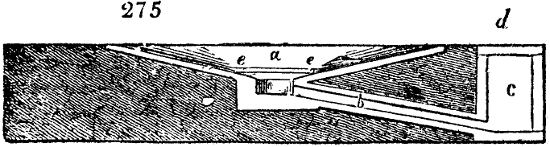
In districts where the wood can be transported into one place by means of rivers, or
mountain slides, a dry flat space must be pitched upon, screened from storms and floods,
which may be walled round, having a slight declivity made in the ground, towards the
centre. See fig. 275. Into this space the tarry acid will partially fall, and may be
conducted outwards, through a covered gutter beneath, into a covered tank. The
mouth of the tank must be shut, during the coaking, with an iron or stone slab, luted
with clay. A square iron plate is placed over the inner orifice of the gutter, to prevent
it being choked with coal ashes.
Fig. 275. represents a walled meiler
station; a, the station; b, the
gutter; c, the tank, which is covered
with the slab d; e, a slab
which serves to keep the gutter
clear of coals. The cover of the heaps is formed of earth, sand, ashes, or such other
matter as may be most readily found in the woods. They should be kindled in the
centre. From 6 days to 4 weeks may be required for charring a heap, according to its
size; hard wood requiring most time; and the slower the process, the better and
greater is the product, generally speaking.
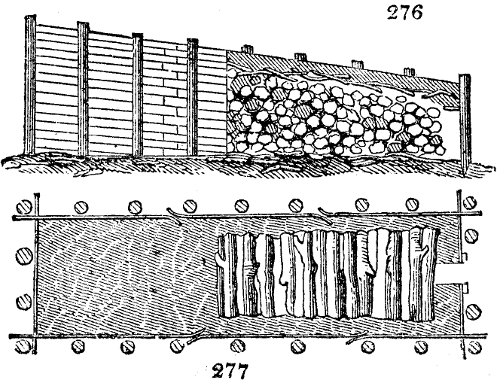
Charring of wood in mounds
(Haufe or liegende werke) figs. 276.
and 277. differs from that in the
meiler, because the wood in the
haufe is successively charred, and
the charcoal is raked out by little
and little. The product is said
to be greater in this way, and also
better. Uncleft billets, 6 or 8
feet long, being laid over each
other, are covered with ashes, and
then carbonized. The station is
sometimes horizontal, and sometimes
made to slope. The length
may be 24 feet, the breadth 8
feet; and the wood is laid crosswise.
Piles are set perpendicularly to support the roof, made of boughs and leaves,
covered with ashes. Pipes are occasionally laid within the upper part of the mounds,
which serve to catch and carry off some of the liquid products into proper tanks.
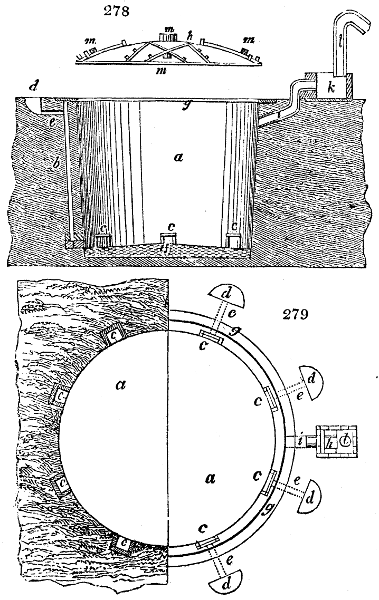
Fig. 278. is a vertical section,
and fig. 279. a half bird’s-eye view,
and half cross section, at the height
of the pit-bottom, of Chabeaussière’s
kiln for making wood charcoal.
a is the oven; b, vertical
air-pipes; c c, horizontal flues for
admitting air to the kiln; d d,
small pits which communicate by
short horizontal pipes e e, with the
vertical ones; f, the sole of the
kiln, a circle of brickwork, upon
which the cover or hood h reposes;
i, a pipe which leads to the cistern
k; l, the pipe destined for carrying
off the gaseous matter; m m, holes
in the iron cover or lid.
The distribution of the wood is
like that in the horizontal meilers,
or heaps; it is kindled in the central
vertical canal with burning
fuel, and the lid is covered with
a few inches of earth. At the beginning
of the operation all the
draught flues are left open, but
they are progressively closed, as
occasion requires. In eight kilns
of this kind, 500 decasters of oak
wood are carbonized, from which
16,000 hectolitres of charcoal are
obtained, equal to 64,000 pounds
French, being about 25 per cent.;
besides tar and 3000 velts of
wood vinegar, of from 2° to 3°.
Baumé.
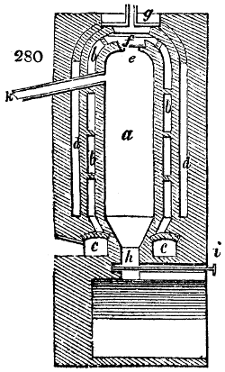
At Crouy upon the Ourcq, near Meaux, there is a well constructed kiln for making
turf-charcoal. It resembles most nearly a tar-kiln. In fig. 280. a is the cylindrical
coaking place, whose surrounding walls are heated by
the flame which passes through the intermediate space
b. The place itself is divided by partitions of fire tiles
into three stages, through the apertures in which the
flames of the fire c c, rise, and heat the exterior of the
coaking apartment. In order to confine the heat, there
is in the enclosing walls of the outer kiln a cylindrical
hollow space d, where the air is kept stagnant. Through
the apertures left in the upper end at e, the turf is introduced;
they are then shut with an iron plate f,
which is covered with ashes or sand. The fire-place
opens above this aperture, and its outlet is provided
with a moveable iron cover g, in which there is a small
hole for the issue of the gases. The sole of the kiln
consists of a cast iron slab h, which may be raised by
means of a hook i upon it. This is drawn back after
the carbonization is completed, whereby the charcoal
falls from the coaking space into a subjacent vault. The
volatile products are carried off by the pipe k, and led
into the condensing cistern; the gases escaping to the
fire-place where they are burned. The iron slab is protected from the corrosion of the
acid vapours by a layer of coal ashes.
CHICA is a red colouring principle made use of in America by some Indian tribes
to stain their skins. It is extracted from the bignonia chica by boiling its leaves in
water, decanting the decoction, and allowing it to settle and cool, when a red matter
falls down, which is formed into cakes and dried. This substance is not fusible, and,
when burned, diffuses the same odour as animal bodies do. It is insoluble in cold water,
very soluble in alcohol and ether, but, after the evaporation of these liquids, it is recovered
unchanged. Fats and unctuous oils both dissolve it. It is soluble in carbonated
and caustic alkaline lyes, from which it is precipitated by the acids without alteration.
An excess of alkali, however, speedily decomposes it. Nitric acid transforms it into
oxalic acid, and a bitter matter. Chlorine makes it white.
The savages mix this pigment with the fat of the cayman or alligator, and rub their
skins with the mixture. It may probably be turned to account in the arts of civilized
nations.
CHIMNEY. (Cheminée, Fr.; Schornstein, Germ.) Chimney is a modern invention
for promoting the draught of fires and carrying off the smoke, introduced into
England so late as the age of Elizabeth, though it seems to have been employed in
Italy 100 years before. The Romans, with all their luxurious refinements, must have
had their epicurean cookery placed in perpetual jeopardy from their kitchen fires, which,
having no vent by a vertical tunnel in the walls, discharged their smoke and frequently
their flames at the windows, to the no small alarm of their neighbours, and annoyance
of even the street passengers.
Chimneys in dwelling houses serve also the valuable purpose of promoting salubrious
circulation of air in the apartments, when not foolishly sealed with anti-ventilating stove-chests.
The first person who sought to investigate the general principles of chimney draughts,
in subserviency to manufacturing establishments, was the celebrated Montgolfier. As the
ascent of heated air in a conduit depends upon the diminution of its specific gravity, or,
in other words, upon the increase of its volume by the heat, the ascensional force may
be deduced from the difference between the density of the elastic fluid in the interior of
the chimney, and of the external air; that is, between the different heights of the internal
and external columns of elastic fluid supposed to be reduced to the same density. In
the latter case, the velocity of the gaseous products of combustion in the interior of
the chimney is equal to that of a heavy body let fall from a height equal to the difference
in height of the two aerial columns.
To illustrate this position by an example, let us consider the simple case of a chimney
of ventilation for carrying off foul air from a factory of any kind; and suppose that
the tunnel of iron be incased throughout with steam at 212 degrees Fahr. Suppose
this tunnel to be 100 yards high, then the weight of the column of air in it will be to
that of a column of external air 100 yards high, assumed at 32° F. inversely as its expansion
by 180°; that is, as 1000 is to 1·375; or as 72·727 is to 100. The column of
external air at 32° being 100 yards, the internal column will be represented by 72·727;
and the difference = 27·27, will be the amount of unbalanced weight or pressure, which
is the effective cause of the ventilation. Calculating the velocity of current due to this difference
of weight by the well-known formula for the fall of heavy bodies, that is to say,
multiplying the above difference, which is 27·27, by the constant factor 19·62, and extracting
the square root of the product; thus, √19·62 × 27·27 = 23·13 will be the velocity
in yards per second, which, multiplied by 3, gives 69·39 feet. The quantity of air which
passes in a second is obtained of course by multiplying the area or cross section of the
tunnel by this velocity. If that section is half a yard, that is = a quadrangle 21⁄4 feet
by 2, we shall have 23·13 × 0·5 = 11·565 cubic yards, = 3121⁄4 cubic feet.
The problem becomes a little more complicated in calculating the velocity of air which
has served for combustion, because it has changed its nature, a variable proportion of its
oxygen gas of specific gravity 1·111, being converted into carbonic acid gas of specific
gravity 1·524. The quantity of air passed through well-constructed furnaces may, in
general, be regarded as double of what is rigorously necessary for combustion, and the
proportion of carbonic acid generated, therefore, not one half of what it would be were
all the oxygen so combined. The increase of weight in such burned air of the temperature
of 212°, over that of pure air equally heated, being taken into account in the
preceding calculation, will give us about 19 yards or 57 feet per second for the velocity
in a chimney 100 yards high incased in steam.
Such are the deductions of theory; but they differ considerably from practical results,
in consequence of the friction of the air upon the sides of the chimneys, which varies likewise
with its form, length, and quality. The direction and force of the winds also exercise
a variable influence upon chimney furnaces differently situated. In chimnies made of
wrought iron, like those of steam boats, the refrigeration is considerable, and causes a
diminution of velocity far greater than what occurs in a factory stalk of well-built brick
work. In comparing the numbers resulting from the trials made on chimneys of different
materials and of different forms, it has been concluded that the obstruction to the
draught of the air, or the deduction to be made from the theoretical velocity of efflux,
is directly proportional to the length of the chimneys and to the square of the velocity,
and inversely to their diameter. With an ordinary wrought-iron pipe, of from 4 inches
to 5 inches diameter, attached to an ordinary stove, burning good charcoal, the difference
is prodigious between the velocity calculated by the above theoretical rule, and that observed
by means of a stop-watch, and the ascent of a puff of smoke from a little tow,
dipped in oil of turpentine thrust quickly into the fire. The chimney being 45 feet
high, the temperature of the atmosphere 68° Fahr., the velocity per second was,—
| Trials. |
By
theory. |
By
experiment. |
Mean temperature
of chimney. |
| 1 |
26·4 |
feet |
5 |
|
feet |
190 |
° Fahr. |
| 2 |
29·4 |
|
5 |
·76 |
|
214 |
|
| 3 |
34·5 |
|
6 |
·3 |
|
270 |
|
To obtain congruity between calculation and experiment, several circumstances must
be introduced into our formulæ. In the first place, the theoretical velocity must be
multiplied by a factor, which is different according as the chimney is made of bricks,
pottery, sheet iron, or cast iron. This factor must be multiplied by the square root of
the diameter of the chimney (supposed to be round), divided by its length, increased by
four times its diameter. Thus, for pottery, its expression is 2·06
√DL + D; D being the diameter,
and L the length of the chimney.
A pottery chimney, 33 feet high, and 7 inches in diameter, when the excess of its mean
temperature above that of the atmosphere was 205° Fahr., had a pressure of hot air
equal to 11·7 feet, and a velocity of 7·2 feet per second. By calculating from the last
formula, the same number very nearly is obtained. In none of the experiments did the
velocity exceed 12 feet per second, when the difference of temperature was more than
410° Fahr.
Every different form of chimney would require a special set of experiments to be
made for determining the proper factor to be used.
This troublesome operation may be saved by the judicious application of a delicate
differential barometer, such as that invented by Dr. Wollaston; though this instrument
does not seem to have been applied by its very ingenious author in measuring the
draughts or ventilating powers of furnaces.
If into one leg of this differential syphon, water be put, and fine spermaceti oil into
the other, we shall have two liquids, which are to each other in density as the numbers
8 and 7. If proof spirit be employed instead of water, we shall then have the relation
of very nearly 20 to 19. I have made experiments on furnace draughts with the instrument
in each of these states, and find the water and oil syphon to be sufficiently sensible: for
the weaker draughts of common fire-places the spirits and oil will be preferable
barometric fluids.
To the lateral projecting tube of the instrument, as described by Dr. Wollaston, I
found it necessary to attach a stop-cock, in order to cut off the action of the chimney,
while placing the syphon, to allow of its being fixed in a proper state of adjustment,
with its junction line of the oil and water at the zero of the scale. Since a slight deviation
of the legs of the syphon from the perpendicular, changes very considerably the
line of the level, this adjustment should be made secure by fixing the horizontal pipe
tightly into a round hole, bored into the chimney stalk, or drilled through the furnace
door. On gently turning the stop-cock, the difference of atmospherical pressure corresponding
to the chimney draught, will be immediately indicated by the ascent of the
junction-line of the liquids in the syphon. This modification of apparatus permits the
experiment to be readily rectified by again shutting off the draught, when the air will
slowly re-enter the syphon; because the projecting tube of the barometer is thrust into
the stop-cock, but not hermetically joined; whereby its junction line is allowed to
return to the zero of the scale in the course of a few seconds.
Out of many experiments made with this instrument, I shall content myself with
describing a few, very carefully performed at the breweries of Messrs. Trueman, Hanbury,
and Buxton, and of Sir H. Meux, Bart., and at the machine factory of Messrs.
Braithwaite; in the latter of which I was assisted by Captain Ericsson. In the first
trials at the breweries, the end of the stop-cock attached to the differential barometer
was lapped round with hemp, and made fast into the circular peep-hole of the furnace
door of a wort copper, communicating with two upright parallel chimneys, each 18 inches
square, and 50 feet high. The fire was burning with fully its average intensity at the
time. The adjustment of the level being perfect, the stop-cock orifice was opened, and
the junction level of the oil and water rose steadily, and stood at 11⁄4 inches, corresponding
to 1·258 = 0·156 of 1 inch of water, or a column of air 10·7 feet high. This difference
of pressure indicates a velocity of 26 feet per second. In a second set of experiments,
the extremity of the stop-cock was inserted into a hole, bored through the chimney
stalk of the boiler of a Boulton and Watt steam-engine of twenty-horse power. The
area of this chimney was exactly 18 inches square at the level of the bored hole, and its
summit rose 50 feet above it. The fire-grate was about 10 feet below that level. On
opening the stop-cock, the junction line rose 21⁄4 inches. This experiment was verified
by repetition upon different days, with fires burning at their average intensity, and consuming
fully 12 lbs. of the best coals hourly for each horse’s power, or nearly one ton
and a third in twelve hours. If we divide the number 21⁄4 by 8, the quotient 0·28 will
represent the fractional part of 1 inch of water, supported in the syphon by the unbalanced
pressure of the atmosphere in the said chimney; which corresponds to 191⁄4 feet
of air, and indicates a velocity in the chimney current of 35 feet per second. The
consumption of fuel was much more considerable in the immense grate under the wort
copper, than it was under the steam-engine boiler.
In my experiments at Messrs. Braithwaite’s factory, the maximum displacement of
the junction line was 1 inch, when the differential oil and water barometer was placed
in direct communication with a chimney 15 inches square, belonging to a steam boiler,
and when the fire was made to burn so fiercely, that, on opening the safety-valve of the
boiler, the excess of steam beyond the consumption of the engine, rushed out with such
violence as to fill the whole premises. The pressure of one-eighth of an inch of water
denotes a velocity of draught of 23·4 feet per second.
In building chimneys, we should be careful to make their area rather too large than
too small; because we can readily reduce it to any desired size, by means of a sliding
register plate near its bottom, or a damper plate applied to its top, adjustable by wires
or chains, passing over pulleys. Wide chimneys are not so liable as narrow ones to
have their draught affected by strong winds. In a factory, many furnace flues are
often conducted into one vertical chimney stalk, with great economy in the first
erection, and increased power of draught in the several fires.
Vast improvements have been made in this country, of late years, in building stalks
for steam boilers and chemical furnaces. Instead of constructing an expensive, lofty
scaffolding of timber round the chimney, for the bricklayers to stand upon, and to
place their materials, pigeon-holes, or recesses, are left at regular intervals, a few feet
apart, within the chimney, for receiving the ends of stout wooden bars, which are
laid across, so as to form a species of temporary ladder in the interior of the tunnel.
By means of these bars, with the aid of ropes and pulleys, every thing may be progressively
hoisted, for the building of the highest engine or other stalks. An expert
bricklayer, with a handy labourer, can in this way raise, in a few weeks, a considerable
chimney, 40 feet high, 5 feet 8 inches square outside, 2 feet 8 inches inside at the base,
28 inches outside, and 20 inches inside at the top. To facilitate the erection, and at
the same time increase the solidity of an insulated stalk of this kind, it is built
with three or more successive plinths, or recedures, as shown in fig. 281. It is necessary
to make such chimneys thick and substantial near the base, in order that they
may sustain the first violence of the fire, and prevent the sudden dissipation of the
heat. When many flues are conducted into one chimney stalk, the area of the latter
should be nearly equal to the sum of the areas of the former, or at least of as many of
them as shall be going simultaneously. When the products of combustion from any
furnace must be conducted downwards, in order to enter near the bottom of the main
stalk, they will not flow off until the lowest part of the channel be heated by burning
some wood shavings or straw in it, whereby the air syphon is set agoing. Immediately
after kindling this transient fire at that spot, the orifice must be shut by which
it was introduced; otherwise the draught of the furnace would be seriously impeded.
But this precaution is seldom necessary in great factories, where a certain degree of
heat is always maintained in the flues, or, at least, should be preserved, by shutting
the damper plate of each separate flue, whenever its own furnace ceases to act.
Such chimneys are finished at top with a coping of stone-slabs, to secure their brickwork
against the infiltration of rains, and they should be furnished with metallic
conducting rods, to protect them from explosions of lightning.
When small domestic stoves are used, with very slow combustion, as has been
recently proposed, upon the score of a misjudged economy, there is great danger of the
inmates being suffocated or asphyxied, by the regurgitation of the noxious burned air.
The smoke doctors who recommend such a vicious plan, from their ignorance of
chemical science, are not aware that the carbonic acid gas, of coke or coal, must be heated
250° F. above the atmospheric air, to acquire the same low specific gravity with it. In
other words, unless so rarefied by heat, that gaseous poison will descend through the orifice
of the ash-pit, and be replaced by the lighter air of the apartment. Drs. Priestley and
Dalton have long ago shown the co-existence of these two-fold crossing currents of air,
even through the substance of stone-ware tubes. True economy of heat, and salubrity,
alike require vivid combustion of the fuel, with a somewhat brisk draught inside of the
chimney, and a corresponding abstraction of air from the apartment. Wholesome
continuous ventilation, under the ordinary circumstances of dwelling houses, cannot
be secured in any other way. Were these mephitic stoves, which have been of late
so ridiculously puffed in the public prints, generally introduced, the faculty would
need to be immediately quadrupled to supply the demand for medical advice; for
headaches, sickness, nervous ailments, and apoplexy, would become the constant inmates
of every inhabited mansion. The phenomena of the grotto of Pausilippo might then
be daily realised at home, among those who ventured to recline upon sofas in such carbonated
apartments; only instead of a puppy being suffocated pro tempore, human beings
would be sacrificed, to save two-penny worth of fuel per diem.
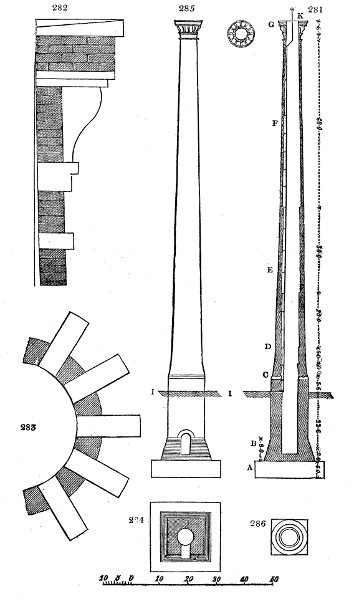
The figures upon the preceding page represent one of the two chimneys, recently
erected at the Camden Town station, for the steam boilers of the two engines of 60
horse-power each, belonging to the London and Birmingham Railway Company.
These engines draw their train of carriages up the inclined plane of Hampstead Hill.
The chimneys were designed by Robert Stephenson, Esq., engineer to the Company,
executed by William Cubitt, Esq., of Gray’s Inn Road,—and do equal honour to
both gentlemen, being probably the most elegant and substantial specimens of this style
of architecture in the world. In the section, fig. 281.,
A represents a bed of concrete, 6 feet thick, and 24 feet square.
B, brick footings set in cement; the lower course 19 feet square.
C, Bramley-fall stone base, with a chain of wrought iron let into it.
D, a portion, 15 feet high, curved to a radius of 113 feet, built entirely of Malm
paviours, (a peculiarly good kind of bricks.)
E, shaft built of Malm paviours in mortar.
F, ditto, built from the inside, without exterior scaffolding.
G, the cap ornamented, (as shown in the plan alongside,) with Portland stone, the
dressings being tied together with copper cramps and an iron bond.
Fig. 282. represents the mouldings of the top, upon an enlarged scale.
Fig. 283., a plan of the foundation, ditto.
Fig. 284., ditto, at the level of the entrance of the flue, as seen in
Fig. 285., the elevation of the chimney.
Fig. 286., plan at the ground level I, in fig. 281. and 285.
K, fig. 281., the lightning conducting rod.
CHINTZ is a peculiar style of fast-printed calico, in which figures of at least five
different colours are impressed upon a white or light coloured ground.
CHLORATE OF POTASH, commonly called oxymuriate of potash. This interesting
saline compound has become the object of a pretty extensive manufacture, in
consequence of its application to make matches for procuring instantaneous light, and a
detonating powder for fire-arms. It may be prepared both in the humid and dry way.
Having made a strong solution of purified potash, or carbonate of potash, with from
two to three parts of water, we pass through it in a Woulfe’s apparatus a current of chlorine
gas, till it ceases to absorb any more. Chloride of potash and chloride of potassium
alone are formed as long as there is an excess of alkali in the solution; but afterwards in
the further reaction of the materials, the chloride passes into the state of a chlorate, and,
as such, precipitates from the solution. During the first half of the operation, that is, till
the potash be about one half saturated with chlorine, as indicated by litmus paper ceasing
to be darkened and beginning to be blanched, only the chloride of potassium or muriate
of potash falls. The process should be interrupted at this point in order to remove the
salt, to wash it, to add the washings to the liquor, and then to transmit the gas freely through
the solution. As the operation advances, less muriate of potash is formed, and at length
nothing but the pure chlorate is separated in crystals. When finally the bubbles of
gas pass through without being sensibly absorbed, the process is known to be completed;
the liquid may then be allowed to settle, and be poured off from the crystals of chlorate
of potash, which are purified from the muriate by dissolving them in three times their
weight of boiling water, and filtering the solution while hot. On its cooling, the chlorate
will separate in pearly-looking crystalline plates. It may be rendered quite pure
by a second crystallization, in which state it does not affect solution of nitrate of silver.
The above potash lye usually gets a reddish tint in the course of the process in consequence
of a little manganesic acid coming over with the chlorine, but it gradually loses
this colour as the saturation becomes complete, when the solution turns yellow. The
tubes for conveying the gas should be of large diameter, if they be plunged into the
saline solution, because the crystallization which takes place in it is apt to choke them
up. This inconvenience may however be obviated by attaching to the end of the glass
tube, a tube of caoutchouc terminated in a small glass funnel, or simply the neck of a
caoutchouc bottle with a part of its body, whose width will not be readily closed with a
saline crust. The residuary lixivium may be used against another operation, or it may
be evaporated down to half its bulk and set aside to crystallize, whereby some more
chlorate will be obtained, mixed indeed with muriate and carbonate, from which however
it may be separated by a second crystallization. In general the pure chlorate obtained
does not exceed one tenth the weight of the potash employed; because in thus treating
potash with chlorine, five-sixths of it are converted into muriate of potash and only one
sixth into chlorate, and a part of the latter adheres to the muriate, or is lost in the mother
waters of the crystallizations.
The chlorate of potash may be more conveniently manufactured, like that of lime, in
the dry way. St. Romer patented at Vienna the following method for that purpose in
1821:—Ten pounds of crystallised peroxide of manganese are to be finely pulverised,
mixed with ten pounds of plumbago, and thirty pounds of common salt, and put into the
leaden retort represented in fig. 287. p. 287. From the middle of the helmet-shaped
lid of this vessel, a lead tube, two feet long and two inches wide, conducts to the receiver,
which is a square earthen pan, hard glazed both within and without, of the same capacity
with the retort. The end of the tube must be made fast to a frame at the height of
six inches above the bottom of the receiver. Upon its inner sides four inches apart,
brackets are to be fixed for supporting a series of laths or shelves of white wood, on which
a number of little paper or paste-board boxes are to be laid. In these boxes ten pounds
of the purest carbonate of potash, prepared from tartar, are to be spread. The receiver
must now be covered with a lid made tight by a water lute. Twenty pounds of
concentrated sulphuric acid previously diluted with sixteen pounds of water, and then
cooled, are to be poured upon the mixed materials in the retort, the lid immediately
secured, with the tube adjusted in the receiver. The whole must be allowed to operate
spontaneously without heat for twelve hours. At the end of this time the retort is to be
surrounded with a water bath and steadily heated during twelve hours, and then left to
cool for six hours. The apparatus must now be opened, the cakes of chlorate of potash
removed, and freed from muriate by solution and crystallization.
M. Liebig proposes the following process for obtaining chlorate of potash:—
Heat chloride of lime in water till it ceases to destroy vegetable colours. In this case a
mixture of chloride of calcium and chlorate of potash is obtained. This is to be dissolved
in hot water, and to the solution concentrated by evaporation, chloride of potassium is
to be added, and then suffered to cool. After cooling, a quantity of crystals of chlorate
of potash is obtained, which are to be redissolved and crystallized again to purify them.
M. Liebig considers that this will be a cheap process for obtaining chlorate of potash.
From 12 ounces of chloride of lime, of so bad a quality that it left 65 per cent. of insoluble
matter, he obtained an ounce of chlorate of potash.
The only difficulty to overcome in this process is, from the chloride of lime not being
so easily decomposed by heat as is generally supposed; a solution of it may be kept boiling
for an hour without losing its bleaching power. The best method is to form a thin
paste with chloride of lime and water, and then to evaporate it to dryness. If it be required
to prepare it by passing chlorine into cream of lime, it is advantageous to keep
it very hot.
The chlorate of potash which separates from the solution by crystallization, has not
the form of scales which it usually possesses, but is prismatic: whether this is occasioned
by some admixture has not been ascertained; but on re-crystallizing, it is obtained in
the usual form.
The solution ought not merely to be left to cool, in order to procure crystals, for
the crystallization is far from being terminated even after complete cooling; crystals
continue to be deposited for 3 or 4 days.
The following modification of the process for making chlorate of potash is that of M.
Vée. A solution of chloride of lime marking 18° or 20° Baumé, is to be set upon the
fire in a lead or cast iron pot, and when it begins to get hot, there is to be dissolved in
it, a quantity of chloride of potassium sufficient to raise the hydrometer 3 or 4 degrees.
It must be then concentrated as quickly as possible till it marks 30° or 31°, taking care
that it does not boil over by the sudden extrication of oxygen. The concentrated liquor
is set aside to crystallize in a cool place; where a deposit of chlorate of potash forms,
mixed with chloride of potassium. The mother waters being evaporated to the density
of 36°, afford another crop of crystals, after which they may be thrown away.
The salts obtained at the first crystallization are to be re-dissolved, and the solution
being brought to 15° or 16° is to be filtered, when it will afford upon cooling pure chlorate
of potash.
Chlorate or oxymuriate of potash has a cooling, somewhat unpleasant and nitrous
taste. It does not bleach. At 60° F. 100 parts of water dissolve six parts of it, and at
its boiling point or 220°, sixty parts. When heated to dull ignition in a glass retort it
gives out 39·15 per cent. of its weight of oxygen, and becomes thereby chloride of
potassium. When strongly triturated in a mortar it crackles, throws out sparks, and becomes
luminous. It deflagrates upon red-hot cinders like nitre: when triturated along with
sulphur, or phosphorus, it detonates with great violence, not without danger to the hands
of the operator, if they be not protected by a thick glove. Similar detonations may be
produced with cinnabar or vermillion, sulphuret of potassium, sugar, volatile oils, &c.;
but they can be effected only by the smart blow of a heated hammer and anvil. A
mixture of sugar or starch with chlorate of potash is readily inflamed by a drop of sulphuric
acid, and this experiment is the basis of the preparation of the oxygenated matches,
as they have been commonly called. The following formula forms a good paste for
tipping the said matches, made of narrow slips of either wood or card. Thirty parts of
the chlorate in fine powder are to be mixed gently with a spatula upon paper with ten
parts of flowers of sulphur well levigated, eight of sugar, five of gum arabic, and enough
of vermillion to give the whole a rose tint. We begin by mixing tenderly together
the sugar, the gum, and the salt previously pulverised; we then add as much water as shall
reduce the mixture to a thin paste, and lastly introduce the sulphur; after which all must
be well incorporated. The points of the matches, either previously tipped with sulphur
or not, are to be dipped in that paste, so as to get coated with a little of it, and are lastly
laid in a warm place till they become thoroughly dry. To kindle one of them, it must
be touched with strong sulphuric acid, which for this purpose is usually kept in a small
well-stoppered phial, and thickened with amianthus. Aspen is reckoned the best wood
for matches.
Of late years a detonating priming for fire-arms has been much used with the percussion
locks. The simplest formula for making it is to take ten parts of gunpowder, to
lixiviate it with water, and to mix the residuum, while moist, with five parts and a
quarter of chlorate of potash, reduced to an extremely fine powder. The paste may be
made pretty thin, for the salt is sparingly soluble in the cold water, and it mixes best
when tolerably fluid. This powder when dry is dangerous to handle, being very apt to
explode. But this danger is guarded against by letting fall a drop of the paste into each
copper percussion cap, and leaving it to dry there. In the detonation of this powder, besides
muriate of potash, there are generated a little sulphate of potash and chlorine gas,
which rust the metal very fast. For which reason fulminate of mercury is now preferred by
many sportsmen as a detonating powder. See Fulminate.
CHLORATES, compounds of chloric acid with the salifiable bases. The only acid
belonging to this class of any manufacturing importance is the following:
CHLORIC ACID; the acid constituent of the preceding salt; it consists of one
equivalent prime of chlorine = 35·476, + 5 of oxygen, = 40·065; of which the sum
75·535 is the prime equivalent of the acid.
CHLORINE; the most energetic of the undecompounded bodies, or chemical
elements as they are usually called, exists, under ordinary circumstances, as a greenish
yellow gas, but, when exposed to a pressure of 4 atmospheres, it becomes a yellow
transparent liquid. In the first state, its density compared to air, reckoned 1·000, is
2·47; in the second, its density compared to water, 1·000, is 1·33. No degree of cold,
hitherto tried, has liquefied the gas when dry. It is obtained by putting into a glass
retort a mixture of 3 parts of common salt, with 2 parts of peroxide of manganese, and
pouring upon it 2 parts of sulphuric acid diluted with its own weight of water; or, more
conveniently, by pouring moderately strong muriatic acid upon peroxide of manganese in
a retort; and in either case applying the gentle heat of a spirit lamp or a water bath, while
the beak of the retort is plunged under brine upon the shelf of the pneumatic trough.
The gas issues, and may be received in the usual way into inverted glass jars, or phials;
but the first which comes over being mixed with the air of the retort, must be rejected.
It has a peculiar smell, and irritates the nostrils most violently when inhaled, as also the
windpipe and lungs. It is eminently noxious to animal life, and, if breathed in its undiluted
state, would prove instantly fatal. It supports the combustion of many bodies,
and indeed spontaneously burns several without their being previously kindled. The
resulting combinations are called chlorides, and act most important parts in many manufacturing
processes.
Water absorbs, at the ordinary temperature of the atmosphere, about double its volume
of chlorine, and acquires the colour, smell, and taste of the gas, as well as its power
of destroying or bleaching vegetable colours. When this aqueous chlorine is cooled to
36° F. dark yellow crystalline plates appear in it of the hydrate of chlorine, which are
composed in 100 parts of 27·7 chlorine, and 72·3 water. If these crystals be heated
to about 45° they liquefy, and the gas flies off.
Chlorine has a powerful affinity for hydrogen, not only combining with it rapidly in
the gaseous, but seizing it in many of its liquid and solid combinations, as in volatile
oils, which it inflames, and in yellow wax, cotton, and flax, which it whitens. The compound
of chlorine and hydrogen gases is muriatic acid gas. Manganese, when mixed
with liquid muriatic acid, as in the above process, abstracts the hydrogen, and lets the
chlorine gas go free. When chlorine is passed into water, it decomposes some of it, seizes
its hydrogen to form a little muriatic acid, and enables its oxygen to unite either with the
chlorine, into chlorous acid, or with the remaining water, and to constitute oxygenated
water. Hence, aqueous chlorine, exposed to the sunbeam, continually evolves oxygen,
and, ere long, becomes muriatic acid.
This watery compound acts in a powerful way upon coloured vegetable fibres, extracting
their hydrogen or colouring element by the twofold affinities of the chlorine and oxygen
for it.
Hence chlorine, as a bleaching agent, requires to be tempered by the quiescent affinity
of some alkaline base, potash or lime. Malaria, or morbific and putrescent miasmata,
consist chiefly of hydrogenous matter as their basis, and are best counteracted by chlorine,
where it can be conveniently applied.
Chlorides of Potash, Soda, and Lime.—These are the most important preparations
through which chlorine exercises its peculiar powers upon the objects of manufactures.
When a weak solution of caustic potash or soda is saturated with chlorine, it affords a
bleaching liquor which is still used by some bleachers and calico-printers for their most
delicate processes; but the price of the alkalis has led to the disuse of these chlorides as a general
means, and has occasioned an extensive employment of chloride of lime. Upon the
manufacture of this interesting compound I made an elaborate series of experiments
several years ago, and published the results in the 13th volume of Brande’s Journal, for
April 1822. I have no reason to suppose, from any thing that has been published since,
that the processes there described have been essentially improved, or that any errors,
either theoretical or practical, of any moment, exist in that memoir. I shall therefore
first present my readers with a brief abstract of it, and then make such observations as
subsequent inquiries suggest.
In the researches which I made, at many different times, upon the nature of the chloride
of lime, I generally sought to combine the information flowing from both synthesis and
analysis; that is, I first converted a known portion of hydrate of lime into bleaching-powder,
and then subjected this chloride to analysis.
Two hundred grains of the atomic proto-hydrate of pure lime were put into a glass
globe, which was kept cold by immersion in a body of water at 50°. A stream of
chlorine, after being washed in water of the same temperature in another glass globe,
connected to the former by a long narrow glass tube, was passed over the calcareous
hydrate. The globe with the lime was detached from the rest of the apparatus from
time to time, that the process might be suspended as soon as the augmentation of weight
ceased. This happened when the 200 grains of hydrate, containing 151·9 of lime, had
absorbed 130 grains of chlorine. By one analytical experiment it was found, that dilute
muriatic acid expelled from 50 grains of the chloride, 20 grains of chlorine, or 40
per cent.; and by another, from 40 grains, 16·25 of gas, which is 40·6 per cent. From
the residuum of the first 39·7 grains of carbonate of lime were obtained by carbonate
of ammonia; from that of the second, 36·6 of ignited muriate of lime. The whole
results are therefore as follows:—
| |
Synthesis. |
1st
Analysis. |
2d
Analysis. |
Mean. |
|---|
| Chlorine |
39·39 |
40·00 |
40·62 |
40·31 |
| Lime |
46·00 |
44·74 |
46·07 |
45·50 |
| Water |
14·60 |
15·26 |
13·31 |
14·28 |
| |
100·00 |
100·00 |
100·00 |
100·00 |
Though the heat generated by the action of the dilute acid had carried off in the analytical
experiments a small portion of moisture with the chlorine, yet their accordance
with the synthetic experiment is sufficiently good to confirm the general results. The
above powder appears to have been a pure chloride, without any mixture of muriate.
But it exhibits no atomic constitution in its proportions.
To 200 grains of that hydrate of lime 30 grains of water being added, the powder
was subjected to a stream of chlorine in the above way, till saturation took place. Its
increase of weight was 150 grains.
It ought to be remarked, that in this and the preceding experiment, there was no appreciable
pneumatic pressure employed to aid the condensation of the chlorine. In the
last case, we see that the addition of 30 grains of water has enabled the lime to absorb
20 grains more of chlorine, being altogether a quantity of gas nearly equal to that of
the dry lime. Thus, an atom of lime seems associated with 7⁄9 of an atom of chlorine.
Analysis by muriatic acid confirmed this composition. It gave
| Chlorine |
39·5 |
= 51·8 cubic inches. |
| Lime |
39·9 |
| Water |
20·6 |
| |
100·0 |
A great variety of apparatus has been at different times contrived for favouring the
combination of chlorine with the slacked lime for the purposes of commerce. One of
the most ingenious forms, is that of a cylinder, or barrel, furnished with narrow wooden
shelves within, and suspended on a hollow axis by which the chlorine was admitted, and
round which the barrel was made to revolve. By this mode of agitation, the lime-dust
being exposed on the most extensive surface, was speedily impregnated with the gas to
the requisite degree. Such a mechanism I saw at MM. Oberkampf and Widmer’s celebrated
fabrique de toiles peintes, at Jouy, in 1816. But this is a costly refinement, inadmissible
on the largest scale of British manufacture. The simplest, and, in my
opinion, the best construction for subjecting lime-powder to chlorine, is a large chamber
8 or 9 feet high, built of siliceous sandstone, having the joints of the masonry secured
with a cement composed of pitch, resin, and dry gypsum in equal parts. A door is
fitted into it at one end, which can be made air-tight by strips of cloth and clay lute.
A window on each side enables the operator to judge how the impregnation goes on
by the colour of the air, and also gives light for making the arrangements within at the
commencement of the process. As water lutes are incomparably superior to all others
where the pneumatic pressure is small, I would recommend a large valve or door on this
principle to be made in the roof, and two tunnels of considerable width at the bottom of
each side wall. The three covers could be simultaneously lifted off by cords passing
over a pulley, without the necessity of the workman approaching the deleterious gas,
when the apartment is to be opened. A great number of wooden shelves, or rather
trays, 8 or 10 feet long, 2 feet broad, and 1 inch deep, are provided to receive the riddled
slacked lime, containing generally about 2 atoms of lime to 3 of water. These shelves
are piled one over another in the chamber, to the height of 5 or 6 feet, cross bars below
each keeping them about an inch asunder, that the gas may have free room to circulate
over the surface of the calcareous hydrate.
The alembics for generating the chlorine, which are usually nearly spherical, are in
some cases made entirely of lead, in others of two hemispheres, joined together in the
middle, the upper hemisphere being lead, the under one cast-iron. The first kind of
alembic is enclosed for two-thirds from its bottom, in a leaden or iron case, the interval
of two inches between the two being destined to receive steam from an adjoining boiler.
Those which consist below of cast-iron, have their bottom directly exposed to a very
gentle fire; round the outer edge of the iron hemisphere a groove is cast, into which the
under edge of the leaden hemisphere fits, the joint being rendered air-tight by Roman
or patent cement. In this leaden dome there are four apertures, each secured by a
water-lute. The first opening is about 10 or 12 inches square, and is shut with a
leaden valve, with incurvated edges, that fit into the water channel at the margin of the
hole. It is destined for the admission of a workman to rectify any derangement in the
apparatus of rotation, or to detach hard concretions of salt from the bottom.
The second aperture is in the centre of the top. Here a tube of lead is fixed, which
descends nearly to the bottom, and down through which the vertical axis passes. To
its lower end the cross bars of iron, or of wood, sheathed with lead, are attached, by
whose revolution the materials receive the proper agitation for mixing the dense manganese
with the sulphuric acid and salt. The motion is communicated either by the
hand of a workman applied from time to time to a winch at top, or it is given by connecting
the axis with wheel work, impelled by a stream of water or a steam-engine.
The third opening admits the syphon-formed funnel, through which the sulphuric acid
is introduced; and the fourth is the orifice of the eduction-pipe.
Manufacturers differ much from each other in the proportion of their materials for
generating chlorine. In general, 10 cwt. of salt are mixed with from 10 to 14 cwt. of
manganese, to which mixture, after its introduction into the alembic, from 12 to 14 cwt.
of sulphuric acid are added in successive portions. That quantity of oil of vitriol must,
however, be previously diluted with water, till its specific gravity becomes about 1·6.
But, indeed, this dilution is seldom actually made, for the manufacturer of bleaching-powder
almost always prepares his own sulphuric acid for the purpose, and therefore
carries its concentration no higher in the leaden boilers than the density of 1·65, which
from my table of sulphuric acid, indicates 1⁄4th of its weight of water, and therefore 1⁄3d
more of such acid must be used.
The fourth aperture, I have said, admits the eduction pipe. This pipe is afterwards
conveyed into a leaden chest or cylinder, in which all the other eduction pipes also
terminate. They are connected with it simply by water-lutes, having a hydrostatic
pressure of 2 or 3 inches. In this general diversorium the chlorine is washed from
adhering muriatic acid, by passing through a little water, in which each tube is immersed,
and from this the gas is let off by a pretty large leaden tube, into the combination
room. It usually enters in the top of the ceiling, whence it diffuses its heavy
gas equally round.
Four days are required, at the ordinary rate of working, for making good marketable
bleaching-powder. A more rapid formation would merely endanger an elevation of
temperature, productive of muriate of lime, at the expense of the bleaching quality. But
skilful manufacturers use here an alternating process. They pile up, first of all, the
wooden trays only in alternate shelves in each column. At the end of two days the
distillation is intermitted, and the chamber is laid open. After two hours the workman
enters, to introduce the alternate trays covered with fresh hydrate of lime, and at the
same time rakes up thoroughly the half-formed chloride in the others. The door is then
secured, and the chamber, after being filled for two days more with chlorine, is again
opened, to allow the first set of trays to be removed, and to be replaced by others, containing
fresh hydrate, as before. Thus the process is conducted in regular alternation;
thus, to my knowledge, very superior bleaching-powder is manufactured, and thus the
chlorine may be suffered to enter in a pretty uniform stream. But for this judicious
plan, as the hydrate advances in impregnation, its faculty of absorption becoming
diminished, it would be requisite to diminish proportionately the evolution of chlorine,
or to allow the excess to escape to the great loss of the proprietor, and, what is of more
consequence, to the great detriment of the health of the workmen.
The manufacturer generally reckons on obtaining from one ton of rock-salt, employed
as above, a ton and a half of good bleaching-powder. But the following analysis of the
operation will show that he ought to obtain two tons.
When a mixture of sulphuric acid, common salt, and black oxide of manganese are
the ingredients used, as by the manufacturer of bleaching-powder, the absolute proportions
are, upon the oxygen scale of equivalents:—
| 1 |
atom muriate of soda |
7 |
·5 |
29·70 |
100·0 |
| 1 |
atom peroxide of manganese |
5 |
·5 |
21·78 |
73·3 |
| 2 |
atoms oil of vitriol 1·846 |
12 |
·25 |
48·52 |
163·3 |
| |
25 |
·25 |
100·00 |
|
And the products ought to be:—
| Chlorine disengaged |
1 |
atom. |
4 |
·5 |
17·82 |
| Sulphate of soda |
1 |
— |
9 |
·0 |
35·64 |
| Proto-sulphate of manganese |
1 |
— |
9 |
·5 |
37·62 |
| Water |
2 |
— |
2 |
·25 |
8·92 |
| |
25 |
·25 |
100·00 |
These proportions are, however, very different from those employed, by many, nay
I believe by all manufacturers; and they ought to be so, on account of the impurity
of their oxide of manganese. Yet making allowance for this, I am afraid that many
of them commit great errors in the relative quantities of their materials.
From the preceding computation, it is evident that 1 ton of salt with 1 ton of the
above native oxide of manganese properly treated, would yield 0·59 of a ton of chlorine,
which would impregnate 1·41 tons of slaked lime, producing 2 tons of bleaching-powder,
stronger than the average of the commercial specimens; or allowing for a little loss,
which is unavoidable, would afford 2 tons of ordinary powder, with a little more slaked
lime.
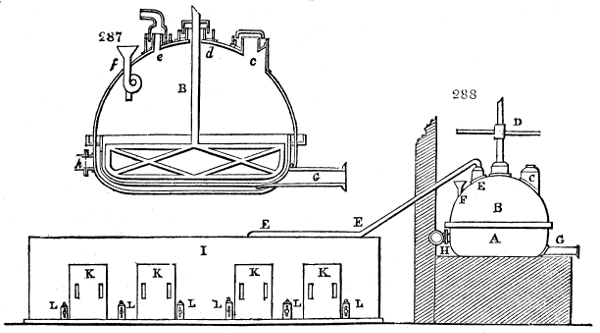
Fig. 287. represents a retort of lead, well adapted to the evolution of chlorine from the
mixture of salt, manganese, and sulphuric acid, or from manganese and muriatic acid.
The interior vessel is cast in lead, and it has round its bottom part a cast-iron steam
case. The salt and manganese are introduced by the aperture C, and the sulphuric
acid by the syphon funnel F. The contact of these three substances is continually
renewed by the agitator or stirrer B, which consists of wrought or cast iron sheathed
with lead. e is the gas discharge pipe. The residuums are drawn off by the bottom
discharge pipe G. The heating case receives its steam by the pipe h.
The chlorine gas fig. 288. is conveyed from the retort B into the chamber I, by the tube
E E E. This chamber is divided into four compartments, to receive the gas disengaged
from four retorts, like the above. The bottom of it is covered with a stratum three
or four inches thick of quicklime, newly slaked and sifted, which is stirred about from
time to time, by the rakes L L L L. When the saturation is sufficient, the chloride of
lime is taken out by the doors K K K K. The size of this apparatus allows 2 cwt. of
manganese, and its equivalent quantity of salt and sulphuric acid, or of muriatic acid,
to be introduced at once into the retort. D is the handle of the agitator.
The same form of retort will suit perfectly well to prepare chlorine for making
liquid chloride of lime, which is preferred by many bleachers and calico-printers who
have conveniences for preparing it themselves. The most concentrated solutions of the
dry chloride of lime do not mark more than 6° B. (sp. grav. 1·04), and discolour only
50 volumes of Gay Lussac’s solution of indigo, whilst the chloride made in the humid
way marks from 8° to 9° B. (about 1·060), and discolours 80 volumes of the same
solution.
In the chloride of lime apparatus, most generally used by the skilful calico-printers
of Mulhausen, the mixture of muriatic acid and manganese is put into glass globes,
with long necks, heated upon a sand-bath. The chlorine is conveyed by glass tubes
into a cylindrical stone cistern, containing milk of lime. The furnace of the sand
baths is made of cast iron, and has brick partitions, to give each retort its own fire.
The smoke of all these fires goes off by a flue into sheet iron pipes. The cistern is
made of siliceous sandstone. Its cover is of wood, coated with a resinous cement; and
it fits at its edges into grooves cut in the stone. A wheel serves to agitate the liquid
continually; its paddles being kept at two inches distance from the sides of the cistern.
The milk of lime is introduced by a funnel, and the chloride is drawn off by a
discharge pipe. I think the lead retort and agitator used in this country greatly
preferable to the experimental laboratory plan described above. In all such apparatus
we should avoid giving any pressure to the tubes or vessels, and should not
therefore dip the extremities of the gas pipes beneath the surface of the liquid, but
rather facilitate the combination of the chlorine and the lime, by enlarging the surfaces
of contact and by agitating. Intermediate vessels containing water, or the chemical
cascade of M. Clement, are very useful for absorbing any muriatic acid which may
be disengaged along with the chlorine, and thereby preventing the needless formation of
muriate of lime in the chambers or cisterns of impregnation.
When the solution of the chloride of lime is mixed with hydrate of lime, it bears,
without decomposing, a pretty high temperature, provided it be not too long continued;
it may even, in certain cases, be raised to near the boiling point without suffering a
marked loss of its discolouring power; but when the chloride is deprived of that
excess of lime, it is decomposed in a short time, even at a heat of 110° F.
When chlorine is admitted to milk of lime, it infallibly produces some muriate of
lime; but the quantity is kept at a minimum by constantly presenting an excess of
lime to the gas with the agitator, and by keeping the temperature as low as possible.
Hence the influx of gas should not be so rapid as to generate much heat. An automatic
agitator, moved by steam or water power, is therefore much better than one driven by the
hand of the operator, who is apt to intermit his labours. If the liquor becomes hot
at the end of the process, it should be immediately drawn off into large stone bottles,
and cooled. The rose-colour, which sometimes supervenes, is due to a minute quantity
of manganese. The strongest liquid chloride of lime that can be prepared will not
discolour more than 80 times its volume of Gay Lussac’s indigo test.
On acting upon cotton cloth with a concentrated solution of chloride of lime, at from
110° to 120° F., pure carbonic acid gas is disengaged, and the texture of the cloth is
injured. Here the hydrogen of the water and the cotton being seized by the chlorine,
the liberated oxygen combines with the carbon to form carbonic acid. In the discharge
troughs where printed calicoes are passed through strong solutions of chloride of lime,
stalactitic crusts of carbonate of lime come to be formed in this way.
The chlorometre of Gay Lussac consists of a test solution of indigo and a graduated
tube. One part of the best indigo, passed through a silk sieve, is to be dissolved in
nine parts of concentrated sulphuric acid, by the aid of a water-bath heat applied for
six hours. The sulphate of indigo is now to be diffused through such a body of water
that one volume of chlorine gas shall discolour exactly ten times its volume of this dilute
solution. The test liquor should be protected from the agency of light.
Mr. Crum, of Thorniebank, near Glasgow, has lately modified Dr. Dalton’s copperas
test for chloride of lime, and made it convenient to the practical man. The Doctor justly
considered that the more chlorine any bleaching powder contains, the more of the green
sulphate of iron will it convert into the red sulphate, so that we have only to add successive
portions of the chloride to a given weight of the dissolved copperas, and note
the point at which all the iron gets peroxidized. See Bleaching.
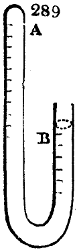
Besides the method of analysis already quoted from my memoir on the manufacture
of the chloride of lime, another occurred to me long ago, which I often practised as an
easy and expeditious test. Chlorine decomposes ammonia. If therefore water of
ammonia, faintly tinged with litmus, be added slowly to a solution of a given weight of
chloride of lime, the colour will continue to disappear till the chlorine be all neutralized
by the reaction of the hydrogen of the ammonia. The quantity of liquid ammonia
of a certain strength requisite to neutralize in this way, a certain volume, say, one cubic
inch, or a thousand grain measures of chlorine gas, may be assumed as the standard of
such a chlorometer. As chlorine or chloride of lime, when mixed with water of
ammonia, causes the disengagement of azote, the quantity of this gas evolved may
also be made the foundation of an accurate and convenient chlorometer. The two substances
should be mixed over mercury, in a graduated syphon tube. The shut
end A and the open end B are both graduated to one scale; for example, to hundredths
of a cubic inch, or to grain or 10 grain measures. The tube is to be
filled with mercury, and then 10 measures of it are to be displaced at the open
end, by inserting a wooden plug. This space, being filled with the solution
of chloride of lime, is to be turned up into the shut end by covering the open
end with the finger, and inverting the tube; a few drops of water may be sent
through to wash the mercury. The ammonia being now let up, will cause
a reaction, and evolve a quantity of azote, equivalent to the chlorine present.
The action may be quickened by holding the sealed end of the tube obliquely
over a lamp heat. The mercury is protected from the chlorine by the ammonia;
and should any notion be entertained of such an action, the ammonia
may be let up first. I have made innumerable researches over mercury with
a detached apparatus of that kind, which combines precision with rapidity of
result. It was by a similar mercurial syphon that I analyzed the carbonates, as
described in the first edition of my Dictionary of Chemistry, twenty-one years ago.
M. Gay Lussac takes, as the basis of his indigo chlorometer, the fact, that one pound
of pure crystallized peroxide of manganese is capable of affording, with muriatic acid,
0·7964 parts of a pound of chlorine; or one kilogramme yields 2511⁄4 litres; that is,
one pound yields 2511⁄4 pound measures. Hence 3·98 grammes of that manganese are
capable of affording 1000 gramme measures, or 1 litre of chlorine; or, in round
numbers, 4 grains will yield 1000 grain measures. This quantity of gas, being received
into that volume of milk of lime, constitutes therefore Gay Lussac’s primary standard.
The small retort in which the manganese and muriatic acid are put, ought to be heated
to ebullition, to discharge every particle of chlorine. To prevent the manganese, in
this experiment, from sticking to the bottom in a cake, it has been proposed to mix it
previously with a little plumbago. See Chlorometry.
For preparing the chlorides of potash and soda, the same apparatus may be
employed as for the liquid chloride of lime. The alkaline solutions should be weak,
containing not more than a pound to the gallon of water. Potash liquor saturated
with chlorine, is much employed at Paris for whitening linen, under the name of the
water of Javelle, the place where it was first made as a manufacture. One hundred
parts of chlorine are said to saturate 133 parts of pure potash, and 195 of the carbonate;
but the latter should not be used for preparing the bleaching fluid, as the carbonic
acid resists the combination of the chlorine. A chloride of carbonate of soda has
been lately recommended as a disinfecting substance against contagious miasmata or
fomites. One hundred parts of chlorine will saturate 150 of the dry carbonate,
and 405 of the crystallized. M. Payen prepares this medicinal chloride by adding 138
parts of carbonate of soda to a liquid, consisting of water 1800, chloride of lime 100,
at 98° of strength, by Gay Lussac’s standard. The chloride of lime is to be dissolved,
and the sediment well washed; the carbonate of soda, dissolved by heat, is to be poured
into the solution, the precipitate allowed to subside, the clear fluid decanted, and the
solid matter washed upon a filter. The collected solutions are neutral chloride of soda.
Sixty-two parts of the carbonate of soda are then to be dissolved in the remainder of the
water, and added to the preparation; the whole being thus filtered, a limpid liquor is
obtained, indicating 5° by the hydrometer of Baumé.
The chloride of magnesia was long ago proposed by Sir H. Davy for bleaching
linen, as being preferable to chloride of lime, because the resulting muriate of
magnesia was not injurious to the fibre of cloth, as muriate of lime may be, under
certain circumstances. I prepared a quantity of chloride of magnesia, by exposing a
hydrate of that earth in the chlorine chamber of a large manufactory of chloride of
lime at Glasgow, and obtained a compound possessed of considerable discolouring
powers; but I found that the chlorine was so feebly saturated by the base, that it
destroyed the colours of fast-dyed calicoes as readily as chlorine gas or chlorine water did,
and was therefore dangerous for common bleaching, and destructive in clearing the
grounds of printed goods, which is one of the most valuable applications of the
calcareous and alkaline chlorides. The occasion of my making these experiments
was the importation of a considerable quantity of magnesite, or native atomic carbonate
of magnesia, from the district of Madras, by an enterprising friend of mine. Encouraged
by the encomiums bestowed on the chloride of magnesia by many chemical writers, he
expected to have benefited both the country and himself, by bringing home the earthy
base of that compound, at a moderate price; but was disappointed to his cost.
Dr. Thomson is of opinion that the bleaching compound of lime and chlorine is not
a chloride of lime, but a combination of chlorous acid with lime and of chlorine with
calcium; consisting in its most concentrated state of
| 3 atoms of chloride of calcium |
= |
21 |
| 1 atom of chlorite of lime |
= |
11 |
| |
32 |
So that about one third of the weight is chlorite of lime, to which alone the bleaching
powers of the substance are owing. He admits a fact, rather inconsistent with this opinion,
that bleaching powder does not attract moisture from the atmosphere with nearly so
much rapidity as might be expected from a mixture containing two thirds of its weight
of so deliquescent a salt as muriate of lime; unless this indeed be prevented by the
chloride and chlorite being united into a double salt, which is a mere conjecture without
either proof or analogy. And further, when dilute sulphuric or muriatic acid is poured
upon bleaching powder, a profusion of chlorine is given out immediately, which he also
admits to be inconsistent with the notion of its being a mixture of chloride of calcium
and chlorite of lime, for no such evolution takes place when the above acids are mixed
with solutions of chloride of calcium and chlorate of potash. Though I am of opinion that
bleaching powder is simply a chloride of lime, in which the lime corresponds to the water in
the aqueous chlorine, yet I cannot see the truth or appositeness of his last reason, because
chlorine is certainly given out when chlorate of potash is acted upon by dilute muriatic
acid, as any man may prove by adding to a mixture of these two substances a vegetable
colour; for it will be speedily blanched. Dr. Thomson considers the chloride which is
at present made in Mr. Tennant’s great factory, as containing one atom of chlorine associated
with one atom of lime, or, taking his numbers, as consisting of
| Hydrate of lime |
4 |
·625 |
| Chlorine |
4 |
·5 |
Or nearly equal weights of the chlorine and the base; indicating a surprising degree
of excellence in the preparation. The average commercial samples of bleaching
powder from different factories which I examined some years ago, did not possess nearly
that strength; but varied in their quantity of chlorine from 20 to 28 per cent. In my
synthetic experiments related above, the greatest quantity of chlorine that would combine
with the atomic hydrate of lime, was in the proportion of 130 to 200; but there is no
doubt that if the lime contains additional water, it will condense more gas. I have never
seen a chloride of lime of the strength mentioned by Dr. Thomson, and I should think
there must be some fallacy in his statements. I have recorded in the paper above quoted
an experiment which proves that with additional moisture, a chloride of lime may be obtained
of the following composition:—
| Chlorine |
39·5 |
| Lime |
39·9 |
| Water |
20·6 |
| |
100·0 |
In the article Bleaching, of the Encyclopædia Britannica, Dr. Thomson deduces
from a test trial of Mr. Crum, that the best bleaching powder is a compound of 1 atom
chlorite of lime = 11, 3 atoms chloride of calcium = 21, and 8 atoms of water = 9. “But,”
adds he, “in general the whole lime is not accurately saturated with chlorine. Accordingly,
when the bleaching powder is dissolved in water a small residue almost always remains
undissolved. Unless the powder be fresh made, a portion of chlorite is always
converted into chloride of calcium. It is probable therefore that the best bleaching
powder, as it comes into the hands of the bleachers, consists of
| 1 |
atom chlorite of lime |
11 |
|
| 3 |
atoms chloride of calcium |
21 |
|
| 6 |
atoms water |
6 |
·75 |
| |
Impurity |
2 |
·25 |
| |
41 |
·00 |
“If we consider the bleaching powder as a compound of chlorine and lime, our mode of
calculating will not be altered. Instead of 1 atom chlorite of lime, and 3 atoms chloride
of calcium, we shall have 4 atoms chloride of lime, 6 atoms water, and 2·25 of impurity
as before.” In such ambiguity does this able chemist place this interesting compound,
for theoretical reasons, of which I cannot see the value. Surely there is no difficulty in
conceiving chlorine to exercise a direct attractive force towards the hydrate of lime, as it
is known to do towards each of its elementary constituents, the oxygen and the calcium.
Such refinements as the preceding tend merely to mystify a plain matter. Even the
chlorous acid here brought into play to form the ideal chlorite, is by his own admission
a hypothetical being. “When chlorate of potash” says Dr. Thomson, “is mixed with
sulphuric acid, and made into small balls the size of a pea, if we expose these balls to a
heat somewhat lower than that of boiling water, a bright yellowish green gas separates,
which may be received over mercury. Its smell is peculiar and aromatic. Water absorbs
at least seven times its volume of it. It destroys vegetable blues. Its constituents are,
| 1 volume chlorine |
2 |
·5 |
or |
4 |
·5 |
| 2 volumes oxygen |
2 |
·222 |
or |
4 |
. |
Thus this compound consists in weight of chlorine 4·5, oxygen 4 = 8·5. It has been called
quarteroxide of chlorine, but it is more probably a teroxide. It has been supposed by some
to possess acid properties, and has therefore been called chlorous acid. But this is only
as yet a hypothesis.”
Surely this by the Doctor’s own showing is very slender authority for renouncing our
long-received doctrines concerning the constitution of bleaching powder. I shall
conclude by remarking that the ultra-atomists are now in a dilemma about this substance;
M. Welter, and many French chemists calling it a sub-chloride, of 1 atom
of chlorine to 2 atoms of lime, and Dr. Thomson showing that Mr. Tennant, the greatest
and best manufacturer of it, has produced it in the state of a chloride, or 1 atom of each.
The fact is, in chloride of lime, as in water of ammonia, alcohol, and muriatic acid,
there is no sufficient reason for definite proportion in any term short of saturation, and
therefore we shall find that chloride in every gradation of strength from 1 per cent. of
chlorine up to 40 per cent.—the strongest which I succeeded in preparing, though
I passed a constant stream of chlorine in great excess over a pure hydrate of lime
for upwards of 24 hours, with frequent renewal of the surface; indeed, till it refused
to absorb any more gas, as indicated by its remaining stationary in weight.
CHLOROMETRY; Chlorometrie, is the name given by the French to the process for
testing the decolouring power of any combination of chlorine, but especially of the
commercial articles, the chlorides of lime, potash, and soda. M. Gay Lussac proposed
many years ago the following graduated method of applying indigo to this purpose. As
indigo varies much in its dyeing quality, and of consequence in the proportion of chlorine
required for its decoloration, he assumes as the unity of blanching power, one litre of
chlorine gas, measured at the mean pressure of 29·6 inches, and at the temperature of
melting ice. This volume of gas, when combined with a determinate quantity of water,
is employed to test the standard solution of indigo. For this purpose a solution in sulphuric
acid of any sample of indigo is taken, and diluted with water to such a degree
that 10 measures of it, in a graduated tube, are decoloured by that one measure of combined
chlorine gas. Each measure of indigo solution so destroyed is called a degree,
and this measure being divided into five parts, the real test of chlorine is given to fiftieths,
which is sufficiently nice. For the standard of the assays, a chloride of lime as pure
and fully saturated as possible is taken, and dissolved in such a quantity of water, that
the solution shall contain, or be equivalent to, one volume of chlorine gas. Calculation
proves that this condition is exactly fulfilled by dissolving 4938 grammes of the said
chloride in half a litre of water; or in English measures, 5 gr. very nearly in 500 grain
measures of water. This solution, which serves for a type, indicates 10° in the assay,
or proof; that is to say, each single volume destroys the colour of 10 volumes of the
dilute indigo solution. It may be remarked, that a greater degree of precision is in
general attainable with a weak solution of chlorine or a chloride, for example at 4° or 5°,
than with one much stronger; consequently if, after a preliminary trial, the standard
considerably exceeds 10°, a given volume of water must be added to the solution,
and then the above proof must be taken. If the volume of water added was double,
the number of degrees afterwards found must be tripled, to obtain the true title
of the chloride. It is, however, to be observed that the degree of decoloration
varies with the time taken in making the mixture; the more slowly the chlorine
is added to the indigo, the less of it escapes into the atmosphere, and the more
effective it becomes in destroying the colour. The best mode of obtaining comparable
results, is to pour suddenly into the test quantity of chlorine the whole volume of the
indigo solution likely to be decoloured; but it is requisite to find approximately beforehand,
what quantity of indigo-blue will probably be destroyed. When it comes to the
verge of destruction, it is green; but yellowish-brown when entirely decomposed.
I have tried the indigo test in many ways, but never could confide in it. The sulphuric
solution of indigo is very liable to change by keeping, and thus to lead to erroneous
results. The method of testing the chlorides by green sulphate of iron, described
under bleaching, is in my opinion preferable to the above.
M. Gay Lussac has recently proposed another proof of chlorine, founded on the same
principle as that by green vitriol, namely, the quantity of it requisite to raise a metallic
substance from a lower to a higher stage of oxidizement. He now prescribes as the
preferable plan of chlorometry, to pour very slowly from a graduated glass tube, a
standard solution of the chloride, to be tested upon a determinate quantity of arsenious acid
dissolved in muriatic acid, till the whole arsenious be converted into the arsenic acid. The
value of the chloride is greater the less of it is required to produce this effect. It is easy
to recognize, by a few drops of solution of indigo, the instant when all the arsenious
acid has disappeared; for then the blue tint is immediately effaced, and cannot be restored
by the addition of a fresh drop of the indigo solution.
In graduating the arsenical chlorometer, M. Gay Lussac takes for his unity the decolouring
power of one volume of chlorine at 32° Fahr., and divides it into 100 parts.
Suppose that we prepare a solution of chlorine containing its own volume of the gas, and an
arsenious solution, such, that under a like volume, the two solutions shall reciprocally
destroy each other. Let us call the first, the normal solution of chlorine, and the second,
the normal arsenious solution. We shall fix at 10 grammes the weight of chloride of lime
subjected to trial; and dissolve it in water, so that the total volume of the solution shall
be a litre (1000 grammes measure), including the sediment. If we take a constant
volume of this solution, 10 centimetres cube (10 gramme measures), for example, divided
into 100 equal parts, and pour into it gradually the arsenious solution (measured
by like portions), till the chlorine be destroyed, the bleaching power will be
proportional to the number of portions of the arsenious solution, which the chloride
shall have required. If the chloride has destroyed 100 portions of the arsenious solution,
its title will be 100; if it has destroyed 80 portions, its title will be 80, &c. and so forth.
On pouring the acidulous arsenious solution into the chloride of lime, this will become
very acid; the chlorine will be emitted abundantly, and the proof will be quite incorrect.
If, on the contrary, we pour the solution of the chloride of lime into the arsenious solution,
this evil will not occur, since the chlorine will always find plenty of arsenious acid
to act upon, whatever be the dilution of the one or the other; but in this case, the standard
of the chlorine is not given directly, as it is in the inverse ratio of the number of
portions which are required to destroy the measures of the arsenious solution. If 50
portions of the chloride have been required, the proof will be 100 × 10050 = 200°; if 200
have been required, the proof will be 100 × 100200 = 50°, &c. This evil is not, however,
very serious, since we have merely to consult a table, in which we can find the proof
corresponding to each volume of the chloride employed for destroying the constant
measure of the arsenious solution. The arsenious solution should be slightly tinged with
sulphate of indigo, so as to show, by the disappearance of the colour, the precise point or
instant of its saturation with chlorine, that is, its conversion into arsenic acid. If the
arsenious acid be pure, the normal solution may be made directly by dissolving 4·439
grammes of it in muriatic acid (free from sulphurous acid), and diluting the solution
till it occupies one litre, or 1000 grammes measure. Annales de Chimie et Physique,
LX. 225.
CHOCOLATE. Is an alimentary preparation of very ancient use in Mexico, from
which country it was introduced into Europe by the Spaniards in the year 1520, and
by them long kept a secret from the rest of the world. Linnæus was so fond of it, that
he gave the specific name, theobroma, food of the gods, to the cacao tree which produced
it. The cacao-beans lie in a fruit somewhat like a cucumber, about 5 inches long and
31⁄2 thick, which contains from 20 to 30 beans, arranged in 5 regular rows with partitions
between, and which are surrounded with a rose-coloured spongy substance, like
that of water-melons. There are fruits, however, so large as to contain from 40 to 50
beans. Those grown in the West India islands, Berbice and Demerara, are much
smaller, and have only from 6 to 15; their development being less perfect than in
South America. After the maturation of the fruit, when their green colour has changed
to a dark yellow, they are plucked, opened, their beans cleared of the marrowy substance,
and spread out to dry in the air. Like almonds, they are covered with a thin
skin or husk. In the West Indies they are immediately packed up for the market
when they are dried; but in the Caraccas they are subjected to a species of slight fermentation,
by putting them into tubs or chests, covering them with boards or stones,
and turning them over every morning, to equalize the operation. They emit a good
deal of moisture, lose the natural bitterness and acrimony of their taste by this process,
as well as some of their weight. Instead of wooden tubs, pits or trenches dug in the
ground are sometimes had recourse to for curing the beans; an operation called earthing
(terrer). They are lastly exposed to the sun, and dried. The latter kind are reckoned
the best; being larger, rougher, of a darker brown colour, and, when roasted, throw off
their husk readily, and split into several irregular fragments; they have an agreeable
mild bitterish taste, without acrimony. The Guiana and West India sorts are smaller,
flatter, smoother-skinned, lighter coloured, more sharp and bitter to the taste. They
answer best for the extraction of the butter of cacao, but afford a less aromatic and
agreeable chocolate. According to Lampadius, the kernels of the West India cacao
beans contain, in 100 parts, besides water, 53·1 of fat or oil, 16·7 of an albuminous
brown matter, which contains all the aroma of the bean, 10·91 of starch, 73⁄4 of gum or
mucilage, 0·9 of lignine, and 2·01 of a reddish dye stuff somewhat akin to the pigment of
cochineal. The husks form 12 per cent. of the weight of the beans; they contain no fat,
but, besides lignine, or woody fibre, which constitutes half their weight, they yield a
light brown mucilaginous extract by boiling in water. The fatty matter is of the consistence
of tallow, white, of a mild agreeable taste, called butter of cacao, and not apt to
turn rancid by keeping. It melts only at 122° Fahr., and should, therefore, make tolerable
candles. It is soluble in boiling alcohol, but precipitates in the cold. It is
obtained by exposing the beans to strong pressure in canvass bags, after they have been
steamed or soaked in boiling water for some time. From 5 to 6 ounces of butter may
be thus obtained from a pound of cacao. It has a reddish tinge when first expressed,
but it becomes white by boiling with water.
The beans, being freed from all spoiled and mouldy portions, are to be gently roasted
over a fire in an iron cylinder, with holes in its ends for allowing the vapours to escape;
the apparatus being similar to a coffee-roaster. When the aroma begins to be well
developed, the roasting is known to be finished; and the beans must be turned out,
cooled, and freed by fanning and sifting from their husks. The kernels are then
to be converted into a paste, either by trituration in a mortar heated to 130° F., or
by the following ingenious and powerful machine. The chocolate paste has usually
in France a little vanilla incorporated with it, and a considerable quantity of sugar,
which varies from one third of its weight to equal parts. For a pound and a half of
cacao, one pod of vanilla is sufficient. Chocolate paste improves in its flavour by keeping,
and should therefore be made in large quantities at a time. But the roasted beans
soon lose their aroma, if exposed to the air.
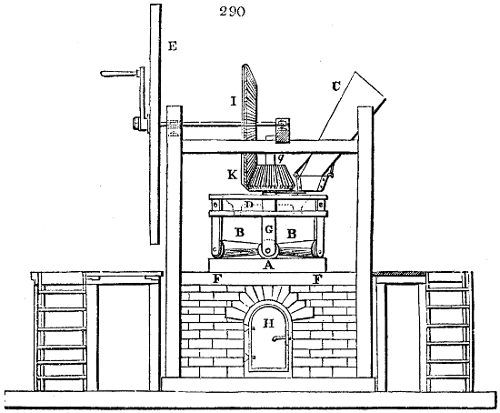
Fig. 290. represents the chocolate mill. Upon the sole A, made of marble, six conical
rollers B B, are made to run by the revolution of the upright axis or shaft q, driven by
the agency of the fly wheel E and bevel wheels I K. The sole A rests upon a strong
iron plate, which is heated by a small stove, introduced at the door H. The wooden
frame work F, forms a ledge, a few inches high, round the marble slab, to confine
the cocoa in the act of trituration. C is the hopper of the mill through which the
roasted beans are introduced to the action of the rollers, passing first into the flat
vessel D to be thence evenly distributed. After the cacao has received the first trituration,
the paste is returned upon the slab, in order to be mixed with the proper quantity
of sugar, and vanilla, previously sliced and ground up with a little hard sugar. When
the chocolate is sufficiently worked, and while it is thin with the heat and trituration,
it must be put carefully into the proper moulds. If introduced too warm, it will be
apt to become damp and dull on the surface; and, if too cold, it will not take the
proper form. It must be previously well kneaded with the hands to ensure the expulsion
of every air bubble.
In Barcelona, chocolate mills on this construction are very common, but they are
turned by a horse-gin set to work in the under story, corresponding to H in the above
figure. The shaft G is, in this case, extended down through the marble slab, and is
surrounded at its centre with a hoop to prevent the paste coming into contact with it.
Each of these horse-mills turns out about ten pounds of fine chocolate in the hour, from
a slab two feet seven inches in diameter.
Chocolate is flavoured with cinnamon and cloves, in several countries, instead of the
more expensive vanilla. In roasting the beans the heat should be at first very slow, to
give time to the humidity to escape; a quick fire hardens the surface, and injures the
process. In putting the paste into the tin plate, or other moulds, it must be well
shaken down to insure its filling up all the cavities, and giving the sharp and polished
impression so much admired by connoisseurs. Chocolate is sometimes adulterated
with starch; in which case it will form a pasty consistenced mass when treated with
boiling water. The harder the slab upon which the beans are triturated, the better;
and hence porphyry is far preferable to marble. The grinding rollers of the mill should
be made of iron, and kept very clean.
CHROMATES, saline compounds of chromic acid with the bases. See Chromium.
CHROMIC ACID; see Chromium.
CHROMIUM. The only ore of this metal, which occurs in sufficient abundance
for the purposes of art, is the octohedral chrome-ore, commonly called chromate of iron,
though it is rather a compound of the oxides of chromium and iron. The fracture of
this mineral is uneven; its lustre imperfect metallic; its colour between iron-black and
brownish-black, and its streak brown. Its specific gravity, in the purest state, rises
to 4·5; but the usual chrome-ore found in the market varies from 3 to 4. According
to Klaproth, this ore consists of oxide of chromium, 43; protoxide of iron, 34·7;
alumina, 20·3; and silica, 2; but Vauquelin’s analysis of another specimen gave as
above, respectively, 55·5, 33, 6, and 2. It is infusible before the blowpipe; but it acts
upon the magnetic needle, after having been exposed to the reducing smoky flame. It
is entirely soluble in borax, at a high blowpipe heat, and imparts to it a beautiful
green colour.
Chrome-ore is found at the Bare Hills, near Baltimore, in Maryland; in the Shetland
isles, Unst and Fetlar; the department of Var, in France, in small quantity; and
near Portsoy, in Banffshire; as also in Silesia and Bohemia.
The chief application of this ore is to the production of chromate of potash, from
which salt the various other preparations of this metal used in the arts are obtained.
The ore, freed, as well as possible, from its gangue, is reduced to a fine powder, by
being ground in a mill under ponderous edge-wheels, and sifted. It is then mixed
with one third or one half its weight of coarsely bruised nitre, and exposed to a
powerful heat, for several hours, on a reverberatory hearth, where it is stirred about
occasionally. In the large manufactories of this country, the ignition of the above
mixture in pots is laid aside, as too operose and expensive. The calcined matter is raked
out, and lixiviated with water. The bright yellow solution is then evaporated briskly,
and the chromate of potash falls down in the form of a granular salt, which is lifted
out from time to time from the bottom with a large ladle, perforated with small holes,
and thrown into a draining-box. This saline powder may be formed into regular crystals
of neutral chromate of potash, by solution in water and slow evaporation; or it may be
converted into a more beautiful crystalline body, the bichromate of potash, by treating
its concentrated solution with nitric, muriatic, sulphuric, or acetic acid, or, indeed, any
acid exercising a stronger affinity for the second atom of the potash than the chromic
acid does.
Bichromate of potash, by evaporation of the above solution, and slow cooling, may be
obtained in the form of square tables, with bevelled edges, or flat four-sided prisms.
They are permanent in the air, have a metallic and bitter taste, and dissolve in about one
tenth of their weight of water, at 60° F.; but in one half of their weight of boiling water.
They consist of chromic acid 13, potash 6; or, in 100 parts, 68·4 + 31·6. This salt is
much employed in calico-printing and in dyeing; which see.
Chromate of lead, the chrome-yellow of the painter, is a rich pigment of various
shades, from deep orange to the palest canary yellow. It is made by adding a limpid
solution of the neutral chromate (the above granular salt), to a solution, equally limpid,
of acetate or nitrate of lead. A precipitate falls, which must be well washed, and carefully
dried out of the reach of any sulphuretted vapours. A lighter shade of yellow is
obtained by mixing some solution of alum, or sulphuric acid, with the chromate, before
pouring it into the solution of lead; and an orange tint is to be procured by the addition
of subacetate of lead, in any desired proportion.
For the production of chromate of potash from chrome ore, various other processes
have been recommended. The following formulæ, which have been verified in practice,
will prove useful to the manufacturers of this important article:—
| I. |
Two parts of chrome ore, containing about 50 per cent. of protoxide of chromium: |
| |
One part of saltpetre. |
| II. |
Four parts of chrome ore, containing 34 per cent. of protoxide of chromium. |
| |
Two parts of potashes. |
| |
One part of saltpetre. |
| III. |
Four parts of chrome ore,cont—ining34per cent. of pro— |
| |
Two of potashes. |
| |
Four tenths of a part of peroxide of manganese. |
| IV. |
Three parts of chrome ore. |
| |
Four parts of saltpetre. |
| |
Two parts of argal. |
Some manufacturers have contrived to effect the conversion of the oxide into an
acid, and of course to form the chromate of potash, by the agency of potash alone, in a
calcining furnace, or in earthen pots fired in a pottery kiln.
After lixiviating the calcined mixtures with water, if the solution be a tolerably pure
chromate of potash, its value may be inferred, from its specific gravity, by the following
table:—
| At specific gravity |
1·28 |
it contains about |
50 |
per cent. of the salt. |
| |
1·21 |
|
33 |
|
| |
1·18 |
|
25 |
|
| |
1·15 |
|
20 |
|
| |
1·12 |
|
16 |
|
| |
1·11 |
|
14 |
|
| |
1·10 |
|
12 |
|
In making the red bichromate of potash from these solutions of the yellow salt, nitric
acid was at first chiefly used; but, in consequence of its relatively high price, sulphuric,
muriatic or acetic acid has been frequently substituted upon the great scale.
There is another application of chrome which merits some notice here; that of its green
oxide to dyeing and painting on porcelain. This oxide may be prepared by decomposing,
with heat, the chromate of mercury, a salt made by adding to nitrate of protoxide of mercury,
chromate of potash, in equivalent proportions. This chromate has a fine cinnabar
red, when pure; and, at a dull red heat, parts with a portion of its oxygen and its
mercurial oxide. From M. Dulong’s experiments it would appear, that the purest
chromate of mercury is not the best adapted for preparing the oxide of chrome to be
used in porcelain painting. He thinks it ought to contain a little oxide of manganese
and chromate of potash, to afford a green colour of a fine tint, especially for pieces that
are to receive a powerful heat. Pure oxide of chrome preserves its colour well enough
in a muffle furnace; but, under a stronger fire, it takes a dead-leaf colour.
The green oxide of chrome has come so extensively into use as an enamel colour for
porcelain, that a fuller account of the best modes of manufacturing it must prove acceptable
to many of my readers.
That oxide, in combination with water, called the hydrate, may be economically
prepared by boiling chromate of potash, dissolved in water, with half its weight of
flowers of sulphur, till the resulting green precipitate ceases to increase, which may be
easily ascertained by filtering a little of the mixture. The addition of some potash
accelerates the operation. This consists in combining the sulphur with the oxygen of
the chromic acid, so as to form sulphuric acid, which unites with the potash of the
chromate into sulphate of potash, while the chrome oxide becomes a hydrate. An
extra quantity of potash facilitates the deoxidizement of the chromic acid by the formation
of hyposulphite and sulphuret of potash, both of which have a strong attraction
for oxygen. For this purpose the clear lixivium of the chromate of potash is sufficiently
pure, though it should hold some alumina and silica in solution, as it generally does.
The hydrate may be freed from particles of sulphur by heating dilute sulphuric acid
upon it, which dissolves it; after which it may be precipitated, in the state of a
carbonate, by carbonate of potash, not added in excess.
By calcining a mixture of bichromate of potash and sulphur in a crucible, chromic
acid is also decomposed, and a hydrated oxide may be obtained; the sulphur being
partly converted into sulphuret of potassium, and partly into sulphuric acid (at the
expense of the chromic acid), which combines with the rest of the potash into a
sulphate. By careful lixiviation, these two new compounds may be washed away, and
the chrome green may be freed from the remaining sulphur, by a slight heat.
Liebig and Wöhler have lately contrived a process for producing a subchromate of
lead of a beautiful vermillion hue. Into saltpetre, brought to fusion in a crucible at
a gentle heat, pure chrome yellow is to be thrown by small portions at a time. A
strong ebullition takes place at each addition, and the mass becomes black, and continues
so while it is hot. The chrome yellow is to be added till little of the saltpetre
remains undecomposed, care being taken not to overheat the crucible, lest the colour
of the mixture should become brown. Having allowed it to settle for a few minutes,
during which the dense basic salt falls to the bottom, the fluid part, consisting of
chromate of potash and saltpetre, is to be poured off, and it can be employed again in
preparing chrome yellow. The mass remaining in the crucible is to be washed with
water, and the chrome red being separated from the other matters, is to be dried after
proper edulcoration. It is essential for the beauty of the colour, that the saline solution
should not stand long over the red powder, because the colour is thus apt to become of
a dull orange hue. The fine crystalline powder subsides so quickly to the bottom after
every ablution, that the above precaution may be easily observed.
As Chromic Acid will probably ere long become an object of interest to the calico
printer, I shall describe here the best method of preparing it. To 100 parts of yellow
chromate of potash, add 136 of nitrate of barytes, each in solution. A precipitate of the
yellow chromate of barytes falls, which being washed and dried would amount to 130
parts. But while still moist it is to be dissolved in water by the intervention of a little
nitric acid, and then decomposed by the addition of the requisite quantity of sulphuric
acid, whereby the barytes is separated, and the chromic acid remains associated with the
nitric acid, from which it can be freed by evaporation to dryness. On re-dissolving the
chromic acid residuum in water, filtering and evaporating to a proper degree, 50 parts
of chromic acid may be obtained in crystals.
This acid may also be obtained from chromate of lime, formed by mixing chromate of
potash and muriate of lime; washing the insoluble chromate of lime which precipitates,
and decomposing it by the equivalent quantity of oxalic acid, or for ordinary purposes
even sulphuric acid may be employed.
Chromic acid is obtained in quadrangular crystals, of a deep red colour; it has a very
acrid and styptic taste. It reddens powerfully litmus paper. It is deliquescent in the air.
When heated to redness, it emits oxygen and passes into the deutoxide. When a little of
it is fused along with vitreous borax, the compound assumes an emerald green colour.
As chromic acid parts with its last dose of oxygen very easily, it is capable in certain
styles of calico printing of becoming a valuable substitute for chlorine where this more
powerful substance would not from peculiar circumstances be admissible. For this ingenious
application, the arts are indebted to that truly scientific manufacturer, M. Daniel
Kœchlin, of Mulhouse. He discovered that whenever chromate of potash has its acid
set free by its being mixed with tartaric or oxalic acid, or a neutral vegetable substance,
(starch or sugar for example), and a mineral acid, a very lively action is produced, with
disengagement of heat, and of several gases. The result of this decomposition is the active
reagent, chromic acid, possessing valuable properties to the printer. Watery solutions
of chromate of potash and tartaric acid being mixed, an effervescence is produced which
has the power of destroying vegetable colours. But this power lasts no longer than the
effervescence. The mineral acids react upon the chromate of potash only when
vegetable colouring matter, gum, starch, or a vegetable acid are present, to determine the
disengagement of gas. During this curious change carbonic acid is evolved; and when it
takes place in a retort, there is condensed in the receiver a colourless liquid, slightly
acid, exhaling somewhat of the smell of vinegar, and containing a little empyreumatic
oil. This liquid heated with the nitrates of mercury or silver reduces these metals.
On these principles M. Kœchlin discharged indigo blue by passing the cloth through a
solution of chromate of potash, and printing nitric acid thickened with gum upon certain
spots. It is probable that the employment of chromic acid would supersede the
necessity of having recourse in many cases to the more corrosive chlorine.
The following directions have been given for the preparation of a blue oxide of chrome.
The concentrated alkaline solution of chromate of potash is to be saturated with weak
sulphuric acid, and then to every 8 lbs. is to be added 1 lb. of common salt, and half-a-pound
of concentrated sulphuric acid; the liquid will now acquire a green colour. To be
certain that the yellow colour is totally destroyed, a small quantity of the liquor is to
have potash added to it, and filtered; if the fluid is still yellow, a fresh portion of salt
and of sulphuric acid is to be added: the fluid is then to be evaporated to dryness, redissolved,
and filtered; the oxide of chrome is finally to be precipitated by caustic potash.
It will be of a greenish-blue colour, and being washed, must be collected upon a filter.
Chromate of Potash, adulteration of, to detect. The chromate of potash has the
power of combining with other salts up to a certain extent without any very sensible
change in its form and appearance; and hence it has been sent into the market falsified
by very considerable quantities of sulphate and muriate of potash, the presence of
which has often escaped observation, to the great loss of the dyers who use it so extensively.
The following test process has been devised by M. Zuber, of Mulhouse.
Add a large excess of tartaric acid to the chromate in question, which will decompose
it, and produce in a few minutes a deep amethyst colour. The supernatant liquor
will, if the chromate be pure, afford now no precipitate with the nitrates of barytes or
silver; whence the absence of the sulphates and muriates may be inferred. We must,
however, use dilute solutions of the chromate and acid, lest bitartrate of potash be precipitated,
which will take place if less than 60 parts of water be employed. Nor must
we test the liquid till the decomposition be complete, and till the colour verge rather
towards the green than the yellow. Eight parts of tartaric acid should be added to one
of chromate to obtain a sure and rapid result. If nitrate of potash (saltpetre) is the
adulterating ingredient, it may be detected by throwing it on burning coals, when
deflagration will ensue. The green colour is a certain mark of the transformation of the
chromic acid partially into the chrome oxide; which is effected equally by the sulphurous
acid and sulphuretted hydrogen. Here this metallic acid is disoxygenated by the
tartaric, as has been long known. The tests which I should prefer, are the nitrates of
silver and baryta, having previously added so much nitric acid to the solution of the suspected
chromate, as to prevent the precipitation of the chromate of silver or baryta.
The smallest adulteration by sulphates or muriates will thus be detected.
CINNABAR; the native red sulphuret of mercury. It occurs sometimes crystallized
in rhomboids; has a specific gravity varying from 6·7 to 8·2; a flat conchoidal
fracture; is fine grained; opaque; has an adamantine lustre, and a colour passing from
cochineal to ruby red. The fibrous and earthy cinnabar has a scarlet hue. It is met
with disseminated in smaller or larger lumps in veins, which are surrounded by a black
clay, and is associated with native quicksilver, amalgam with iron-ore, lead-glance,
blende, copper-ore, gold, &c. Its principal localities are Almaden in Spain, Idria in
the Schiefergebirge, Kremnitz and Schemnitz in Hungary; in Saxony, Bavaria,
Bohemia, Nassau, China, Japan, Mexico, Columbia, Peru. It consists of two primes
of sulphur, = 32·240, combined with one of mercury, = 202,863; or in 100 parts of
12·7 sulphur + 87·3 mercury. It is the most prolific ore of this metal; and is easily
smelted by exposing a mixture of it with iron or lime to a red heat in retorts. Factitious
cinnabar is called in commerce Vermillion, which see, as also Mercury.
CINNAMON. (Cannelle, Fr.; Zimmt, Germ.) Is the inner bark of the laurus cinnamomum,
a handsome-looking tree, which grows naturally to the height of 18 or 20 feet,
in Java, Sumatra, Ceylon, and other islands in the East Indian seas. It has been transplanted
to the Antilles, particularly Guadaloupe and Martinique, as well as Cayenne,
but there it produces a bark of very inferior value to the Oriental.
Cinnamon is gathered twice a year, but not till after the tree has attained to a certain
age and maturity. The young twigs yield a bark of better quality than the larger
branches. The first and chief harvest takes place from April to August; the second,
from November to January. After having selected the proper trees, all the branches
more than three years old are cut off; the epidermis is first removed with a two-edged
pruning knife, then a longitudinal incision is made through the whole extent of the
bark, and lastly, with the bluntest part of the knife, the true bark is carefully stripped
off in one piece. All these pieces of bark are collected, the smaller ones are laid within
the larger, and in this state they are exposed to the sun, whereby in the progress of
drying, they become rolled into the shape of a quill. These convoluted pieces are
formed into oblong bundles of 20 or 30 lbs. weight, which are placed in warehouses,
sorted and covered with mats. Good cinnamon should be as thin as paper, have its
peculiar aromatic taste, without burning the tongue, and leave a sweetish flavour in the
mouth. The broken bits of cinnamon are used in Ceylon for procuring the essential
oil by distillation. 445,367 lbs. of cinnamon were imported into this kingdom in 1835,
of which 16,604 only were retained for internal consumption.
CITRIC ACID. (Acide citrique, Fr.; Citronensäure, Germ.) Scheele first procured
this acid in its pure state from lemon juice, by the following process. The juice put into a
large tub, is to be saturated with dry chalk in fine powder, noting carefully the quantity
employed. The citrate of lime which precipitates being freed from the supernatant foul
liquor, is to be well washed with repeated affusion and decantation of water. For every 10
pounds of chalk employed, nine and a half pounds of sulphuric acid, diluted with six
times its weight of water, are to be poured while warm upon the citrate of lime, and
well mixed with it. At the end of twelve hours, or even sooner, the citrate will be all
decomposed, dilute citric acid will float above, and sulphate of lime will be found at
the bottom. The acid being drawn off, the calcareous sulphate must be thrown on a
canvass filter, drained, and then washed with water to abstract the whole acid.
The citric acid thus obtained may be evaporated in leaden pans, over a naked fire till
it acquires the specific gravity 1·13; after which it must be transferred into another vessel,
evaporated by a steam or water bath till it assumes a syrupy aspect, when a pellicle
appears first in patches, and then over the whole surface. This point must be watched
with great circumspection, for if it be passed, the whole acid runs a risk of being spoiled
by carbonization. The steam or hot water must be instantly withdrawn, and the concentrated
acid put into a crystallizing vessel in a dry, but not very cold apartment. At
the end of four days, the crystallization will be complete. The crystals must be drained,
re-dissolved in a small portion of water, the solution set aside to settle its impurities,
then decanted, re-evaporated, and re-crystallized. A third or fourth crystallization may
be necessary to obtain a colourless acid.
If any citrate of lime be left undecomposed by the sulphuric acid, it will dissolve in
the citric acid, and obstruct its crystallization, and hence it will be safer to use the
slightest excess of sulphuric acid, than to leave any citrate undecomposed. There should
not however be any great excess of sulphuric acid. If there be, it is easily detected by
nitrate of barytes, but not by the acetate of lead as prescribed by some chemical authors;
because the citrate of lead is not very soluble in the nitric acid, and might thus be confounded
with the sulphate, whereas citrate of barytes is perfectly soluble in that test
acid. Sometimes a little nitric acid is added with advantage to the solution of the
coloured crystals, with the effect of whitening them.
Twenty gallons of good lemon juice will afford fully ten pounds of white crystals of
citric acid.
Attempts were made both in the West Indies and Sicily, to convert the lime and
lemon juice into citrate of lime, but they seem to have failed through the difficulty of
drying the citrate for shipment.
The crystals of citric acid are oblique prisms with four faces, terminated by dihedral
summits, inclined at acute angles. Their specific gravity is 1·617. They are unalterable
in the air. When heated, they melt in their water of crystallization; and at a
higher heat, they are decomposed. They contain 18 per cent. of water, of which one
half may be separated in a dry atmosphere, at about 100° F., when the crystals fall into
a white powder.
Citric acid in crystals is composed by my analysis of carbon, 35·8, oxygen 59·7, and
hydrogen 45; results which differ very little from those of Dr. Prout, subsequently
obtained. I found its atomic weight to be 8·375, compared to oxygen 1,000. I cannot
account for Berzelius’s statements relative to the composition of this acid.
Citric acid in somewhat crude crystals is employed with much advantage in calico-printing.
If adulterated with tartaric acid, the fraud may be detected by adding potash
to the solution of the acid, which will occasion a precipitate of cream of tartar.
CIVET. (Civette, Fr.; Zibeth, Germ.) This substance approaches in smell to
musk and ambergris; it has a pale yellow colour, a somewhat acrid taste, a consistence
like that of honey, and a very strong aromatic odour. It is the product of two small
quadrupeds of the genus viverra (v. zibetha and v. civetta), of which the one inhabits
Africa, the other Asia. They are reared with tenderness, especially in Abyssinia.
The civet is contained in a sac, situated between the anus and the parts of generation,
in either sex. The animal frees itself from an excess of this secretion by a contractile
movement which it exercises upon the sac, when the civet issues in a vermicular
form, and is carefully collected. The negroes are accustomed to increase the secretion
by irritating the animal; and likewise introduce a little butter, or other grease, by the
natural slit in the bag, which mixes with the odoriferous substance, and increases its
weight. It is employed only in perfumery.
According to M. Boutron-Chalard, it contains a volatile oil, to which it owes its
smell, some free ammonia, resin, fat, an extractiform matter, and mucus. It affords, by
calcination, an ash, in which there are some carbonate and sulphate of potash, phosphate
of lime, and oxide of iron.
CLAY (Argile, Fr.; Thon, Germ.) is a mixture of the two simple earths, alumina
and silica, generally tinged with iron. Lime, magnesia, with some other colouring metallic
oxides, are occasionally present in small quantities in certain natural clays.
The different varieties of clay possess the following common characters:—
1. They are readily diffusible through water, and are capable of forming with it a
plastic ductile mass, which may be kneaded by hand into any shape. This plasticity
exists, however, in very different degrees in the different clays.
2. They concrete into a hard mass upon being dried, and assume, upon exposure to
the heat of ignition, a degree of hardness sometimes so great as to give sparks by collision
with hardened steel. In this state they are no longer plastic with water, even
when pulverised. Tolerably pure clays, though infusible in the furnace, become readily
so by the admixture of lime, iron, manganese, &c.
3. All clays, even when previously freed from moisture, shrink in the fire in virtue
of the reciprocal affinity of their particles; they are very absorbent of water in their
dry state, and adhere strongly to the tongue.
4. Ochrey, impure clays emit a disagreeable earthy smell when breathed upon.
Brongniart distributes the clays into:—
1. Fire-clays, (argiles apyres, Fr.; feuerfeste, Germ.)
2. Fusible, (schmelzbare, Germ.)
3. Effervescing (brausende, Germ.), from the presence of chalk.
4. Ochrey (ocreuses, Fr.; ockrige, Germ.)
Fire-clay is found in the greatest abundance and perfection for manufacturing purposes
in,
1. Slate-clay. (Thon-schiefer, Germ.) Its colour is gray or grayish-yellow. Massive,
dull, or glimmering from admixture of particles of mica. Fracture slaty, approaching
sometimes to earthy. Fragments tabular. Soft, sectile, and easily broken. Sp. gr. = 2·6.
Adheres to the tongue, and breaks down in water. It occurs along with pit coal; which
see. Slate-clay is ground, and reduced into a paste with water, for making fire-bricks;
for which purpose it should be as free as possible from lime and iron.
2. Common clay or loam.—This is an impure coarse pottery clay, mixed with iron
ochre, and occasionally with mica. It has many of the external characters of plastic
clay. It is soft to the touch, and forms, with water, a somewhat tenacious paste;
but is in general less compact, more friable, than the plastic clays, which are more
readily diffusible in water. It does not possess the property of acquiring in water
that commencement of translucency which the purer clays exhibit. Although soft
to the touch, the common clay wants unctuosity, properly so called. The best example
of this argillaceous substance is afforded in the London clay formation, which
consists chiefly of bluish or blackish clay, mostly very tough. Those of its strata which
effervesce with acids partake of the nature of marl. This clay is fusible at a strong heat,
in consequence of the iron and lime which it contains. It is employed in the manufacture
of bricks, tiles, and coarse pottery ware.
3. Potter’s clay, or Plastic clay.—This species is compact, soft, or even unctuous to
the touch, and polishes with the pressure of the finger; it forms, with water, a tenacious,
very ductile, and somewhat translucent paste. It is infusible in a porcelain kiln,
but assumes in it a great degree of hardness. Werner calls it pipe-clay. Good plastic
clay remains white, or if gray before, becomes white in the porcelain kiln.
The geological position of the plastic clay is beneath the London clay, and above the
sand which covers the chalk formation. The plastic clay of the Paris basin is described as
consisting of two beds separated by a bed of sand. The lower bed is the proper plastic
clay. The plastic clay of Abondant, near the forest of Dreux, analysed by Vauquelin,
gave—
Silica, 43·5; alumina, 33·2; lime, 0·35; iron, 1; water, 18.
This clay is employed as a fire clay for making the bungs or seggars, or coarse earthenware
cases, in which china ware is fired.
The plastic clay of Dorsetshire and Devonshire supplies the great Staffordshire potteries.
It is gray coloured, less unctuous than that of Dreux, and consequently more
friable. It becomes white in the pottery kiln, and is infusible at that heat. It causes
no effervescence with nitric acid, but falls down quickly in it, and becomes higher coloured.
Its refractoriness allows of a harder glaze being applied to the ware formed
from it without risk of the heat requisite for making the glaze flow, affecting the biscuit
either in shape or colour. “Most of the plastic clays of France,” says M. Brongniart,
“employed for the same ware, have the disadvantage of reddening a little in a somewhat
strong heat; and hence it becomes necessary to coat them with a soft glaze, fusible by
means of excess of lead at a low heat, in order to preserve the white appearance of the
biscuit. Such a glaze has a dull aspect, and cracks readily into innumerable fissures by
alternations of hot and cold water.” Hence one reason of the vast inferiority of the
French stone-ware to the English.
4. Porcelain clay or Kaolin earth.—The Kaolins possess very characteristic properties.
They are friable in the hand, meagre to the touch, and difficultly form a paste
with water. When freed from the coarse and evidently foreign particles interspersed
through them, they are absolutely infusible in the porcelain kiln, and retain their white
colour unaltered. They harden with heat like other clays, and perhaps in a greater degree;
but they do not acquire an equal condensation or solidity, at least when they are
perfectly pure. The Kaolins in general appear to consist of alumina and silica in nearly
equal proportions. Most of the Kaolin clays contain some spangles of mica which betray
their origin from disintegrated granite.
This origin may be regarded as one of their most distinctive features. Almost all
the porcelain clays are evidently derived from the decomposition of the felspars, granites,
and principally those rocks of felspar and quartz, called graphic granite. Hence, they
are to be found only in primitive mountain districts, among banks or blocks of granite,
forming thin seams or partings between them. In the same partings, quartz and mica
occur, being relics of the granite; while some seams of Kaolin retain the external form
of felspar.
The most valuable Kaolins have been found:—
In China and Japan. The specimens imported from these countries appear pretty
white; but are more unctuous to the touch, and more micaceous than the porcelain clays
of France.
In Saxony. The Kaolin employed in the porcelain manufactories of that country
has a slight yellow or flesh colour, which disappears in the kiln, proving as Wallerius
observed, that this tint is not owing to any metallic matter.
In France, at Saint-Yriex-la-Perche, about 10 leagues from Limoges. The Kaolin
occurs there in a bed, or perhaps a vein of beds of granite, or rather of that felspar rock
called Pe-tun-tse, which exists here in every stage of decomposition. This Kaolin is
generally white, but sometimes a little yellowish with hardly any mica. It is meagre
to the touch, and some beds include large grains of quartz, called pebbly by the China
manufacturers. This variety, when ground, affords, without the addition of any fusible
ingredient, a very transparent porcelain.
Near Bayonne. A Kaolin possessing the lamellated structure of felspar, in many
places. The rock containing it is a graphic granite in every stage of decomposition.
In England, in the county of Cornwall. This Kaolin or China clay is very white,
and more unctuous to the touch than those upon the continent of Europe mentioned
above. Like them it results from the decomposition of the felspars and granites, occurring
in the middle of these rocks. Mr. Wedgewood found it to contain 60 of alumina
or pure clay, and 40 of silica, in 100 parts.
Pure clay, the alumina of the chemist, is absolutely infusible; but when subjected to
the fire of a porcelain kiln, it contracts into about one half of its total bulk. It must,
however, be heated very cautiously, otherwise it will decrepitate and fly in pieces, owing
to the sudden expansion into steam of the water combined with its particles, which is
retained with a considerable attractive force. It possesses little plasticity, and consequently
affords a very short paste, which is apt to crack when kneaded into a
cake.
It is not only infusible by itself, but it will not dissolve in the fusible glasses;
making them merely opaque. If either lime or silica be added separately to pure clay,
in any proportion, the mixture will not melt in the most violent furnace; but if alumina,
lime, and silica be mixed together, the whole melts, and the more readily, the nearer the
mixture approaches to the following proportions:—1 of alumina, 1 of lime, and 3 of
sand. If the sand be increased to five parts, the compound becomes infusible. These
interesting facts show the reciprocal action of those earths which are mixed most commonly
in nature with alumina.
Iron in small quantity, but in a state not precisely determined, though probably of
protoxide, does not colour the clays till they are subjected to a powerful heat. There
are very white clays, such as those of Montereau, which do not become red till calcined
in the porcelain kiln; the oxide of iron contained in them, which colours them in that
case, was previously imperceptible. It appears from this circumstance, that the clays
fit for making fine white stone ware, as also the Kaolins adapted to the manufacture of
porcelain, are very rare.
Iron, in larger proportion, usually colours the clays green or slate-blue, before they
have been heated. Such clays, exposed to the action of fire, become yellow or red according
to the quantity of iron which they contain. When the iron is very abundant,
it renders the clays fusible; but a little lime and silica must also be present for this effect.
The earthenware made with these ferruginous clays, can bear but a moderate
baking heat; it is thick, porous, and possesses the advantage merely of cheapness, and
of bearing considerable alternations of temperature without breaking.
Alumina and the very aluminous natural clays which possess most plasticity, are apt
to crack in drying, or to lose their shape. This very serious defect for the purposes of
pottery is rectified, in some measure, by adding to that earth a certain quantity of sand
or silica. Thus, a compound is formed which possesses less attraction for water, and
dries more equably from the openness of its body. The principal causes of the distortion
of earthenware vessels, are the unequal thickness of their parts, and quicker desiccation
upon one side than another. Hard burnt stone-ware ground to powder, and incorporated
with clay, answers still better than sand for counteracting the great and irregular
contraction which natural pottery paste is apt to experience. Such ground biscuit is
called cement; and its grains interspersed through the ware, may be regarded as so many
solutions of continuity, which arrest the fissures.
The preceding observations point out the principles of those arts which employ clay
for moulding by the wheel, and baking in a kiln. See Porcelain and Pottery.
CLOTH, MANUFACTURE OF. See Textile Fabrics, Weaving, Wool.
CLOTH-BINDING. Nothing places in so striking a point of view the superior
taste, judgment, and resources of London tradesmen over those of the rest of the world,
than the extensive substitution which they have recently made of embossed silks and
calicoes for leather in the binding of books. In old libraries, cloth-covered boards
indeed may occasionally be seen, but they have the meanest aspect, and are no more
to be compared with our modern cloth-binding, than the jupon of a trull, with the ballet
dress of Taglioni. The silk or calico may be dyed of any shade which use or fancy may
require, impressed with gold or silver foil in every form, and variegated by ornaments
in relief, copied from the most beautiful productions in nature. This new style of
binding is distinguished not more for its durability, elegance, and variety, than for the
economy and dispatch with which it ushers the offspring of intellect into the world.
For example, should a house eminent in this line, such as that of Westleys, Friar-street,
Doctors’-commons, receive 5000 volumes from Messrs. Longman & Co. upon
Monday morning, they can have them all ready for publication, within the incredibly
short period of two days; being far sooner than they could have rudely boarded them
upon the former plan. The reduction of price is not the least advantage incident to
the new method, amounting to fully 50 per cent. upon that with leather.
The dyed cloth being cut by a pattern to the size suited to the volume, is passed
rapidly through a roller press, between engraved cylinders of hard steel, whereby it receives
at once the impress characteristic of the back, and the sides, along with embossed
designs over the surface in sharp relief. The cover thus rapidly fashioned, is as rapidly
applied by paste to the stitched and pressed volume; no time being lost in mutual adjustments;
since the steel rollers turn off the former, of a shape precisely adapted to the
latter. Hard glazed and varnished calico is moreover much less an object of depredation
to moths, and other insects, than ordinary leather has been found to be.
COBALT. This metal being difficult to reduce from its ores, is therefore very little
known, and has not hitherto been employed in its simple state in any of the arts; but its
oxide has been extensively used on account of the rich blue colour which it imparts to
glass, and the glaze of porcelain and stone-ware. The principal ores of cobalt are
those designated by mineralogists under the names of arsenical cobalt and gray cobalt.
The first contains, in addition to cobalt, some arsenic, iron, nickel, and occasionally silver,
&c. The other is a compound of cobalt with iron, arsenic, sulphur, and nickel.
Among the gray cobalts, the ore most esteemed for its purity is that of Tunaberg in
Sweden. It is often in regular crystals which possess the lustre and colour of polished
steel. The specific gravity of cobalt pyrites is 6·36 to 4·66. The Tunaberg variety
afforded to Klaproth, cobalt, 44; arsenic, 55·5; sulphur, 0·5: so that it is an arseniuret.
Others, however, contain much sulphur as well as iron. It imparts at the blowpipe
a blue colour to borax and other fluxes, and gives out arsenical fumes.
The ore being picked to separate its concomitant stony matters, is pounded fine
and passed through a sieve; and is also occasionally washed. The powder is then
spread on the sole of a reverberatory furnace, the flue of which leads into a long horizontal
chimney. Here it is exposed to calcination for several hours, to expel the sulphur
and arsenic that may be present; the former burning away in sulphurous acid gas,
the latter being condensed into the white oxide or arsenious acid, whence chiefly the
market is supplied with this article. This calcining process can never disengage the
whole of these volatile ingredients, and there is therefore a point beyond which it is
useless to push it; but the small quantities that remain are not injurious to the subsequent
operations. The roasted ore is sifted anew; reduced to a very fine powder, and
then mixed with 2 or 3 parts of very pure siliceous sand, to be converted into what is
called zaffre. With this product glasses are generally coloured blue, as well as enamels
and pottery glaze. In the works where cobalt ores are treated, a blue glass is prepared
with the zaffre, which is well known under the name of smalt or azure blue.
This azure is made by adding to the zaffre 2 or 3 parts of potash, according to its richness
in cobalt, and melting the mixture in earthen crucibles. The fused mass is
thrown out while hot into water; and is afterwards triturated and levigated in mills
mounted for the purpose. There remains at the bottom of the earthen pot a metallic
lump, which contains a little cobalt, much nickel, arsenic, iron, &c. This is called
speiss.
As it is the oxide of cobalt which has the colouring quality, the calcination serves the
purpose of oxidizement, as well as of expelling the foreign matters.
A finer cobalt-oxide is procured for painting upon hard porcelain, by boiling the cobalt
ore in nitric acid, which converts the arsenic into an acid, and combines it with the different
metals present in the mineral. These arseniates being unequally soluble in nitric
acid, may be separated in succession by a cautious addition of carbonate of soda or potash;
and the arseniate of cobalt as the most soluble remains unaffected. It has a
rose colour; and is easily distinguishable, whence the precipitation may be stopped at
the proper point. The above solution should be much diluted, and the alkali should
be cautiously added with frequent agitation.
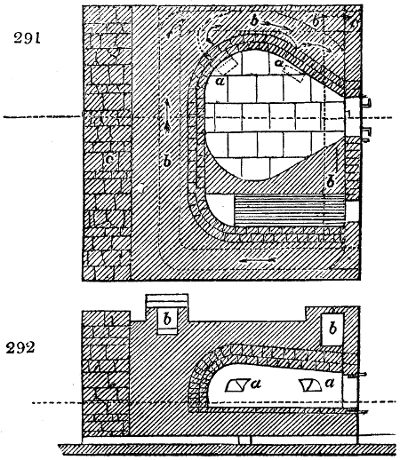
The cobalt ores, rich in nickel, are exposed to slow oxidizement in the air, whereby
the iron, cobalt, arsenic, and sulphur get oxygenated by the atmospheric moisture, but
the nickel continues in the metallic state. This action of the weather must not be
extended beyond a year, otherwise the nickel becomes affected, and injures the cobalt
blue. The ore hereby increases in weight, from 8 to 10 per cent. Fig. 291. is a
longitudinal section of the furnace: fig. 292., a horizontal section upon a level with the
sole of the hearth. It is constructed for wood fuel, and the hearth is composed of
fire-bricks or tiles. The vapours and gases disengaged in the roasting, pass off
through the flues a a, into the channels b b, and thence by c into the common vent, or
poison chamber. See the representation of the poison tower of Altenberg, under the
article Arsenic. The flues are cleared out by means of openings left at suitable
situations in the brick-work of the chimneys.
The azure manufacture is carried
on chiefly in winter, in order that
the external cold may favour the
more complete condensation of the
acids of arsenic. From 3 to 5 cwt.
of Schlich (pasty ore), are roasted
at one operation, and its bed is laid
from 5 to 6 inches thick. After two
hours, it must be turned over; and
the stirring must be repeated every
half hour, till no more arsenic is
observed to exhale. The process
being then finished, the ore must be
raked out of the furnace, and another
charge introduced.
The duration of the roasting is
regulated partly by the proportion
of sulphur and arsenic present, and
partly by the amount of nickel;
which must not be suffered to become
oxidized, lest it should spoil
the colour of the smalt. The latter
ores should be but slightly roasted,
so as to convert the nickel into speiss.
The roasted ore must be sifted in a
safety apparatus. The loss of weight
in the roasting amounts, upon the
average, to 36 per cent. The roasted
ore has a brownish gray hue, and is
called safflor in German, and is distributed
into different sorts. F F S
is the finest safre; F S, fine; O S,
ordinary; and M S, middling. These
varieties proceed from various mixtures
of the calcined ores. The
roasted ore is ground up along with
sand, elatriated, and, when dry, is
called zaffre. It is then mixed with
a sufficient quantity of potash for
converting the mixture into a glass.
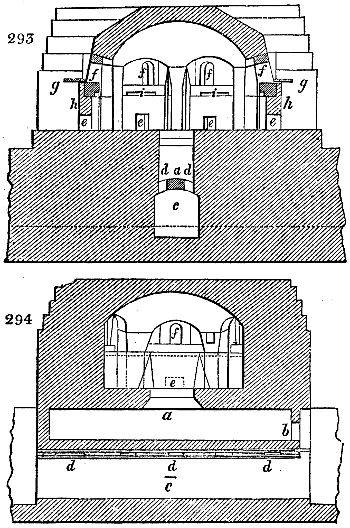
Figs. 293. and 294. represent a
round smalt furnace, in two vertical
sections, at right angles to each
other. The fire-place is vaulted or
arched; the flame orifice a, is in the
middle of the furnace; b is the feed
hole; c, a tunnel which serves as an
ash-pit, and to supply air; d, openings
through which the air arrives
at the fuel, the wood being placed
upon the vault; e, knee holes for
taking out the scoriæ from the pot
bottoms; f, working orifices, with
cast-iron plates g, in front of them.
Under these are the additional outlets
h. The smoke and flame pass
off through the orifices i, which terminate
in expanded flues, where the
sand may be calcined or the wood
may be baked. Eight hours are
sufficient for one vitrifying operation,
during which the glass is stirred
about several times in the earthen melting pots.
The preparation of the different shades of blue glass are considered as secrets in the
smelting works; and marked with the following letters:—F F F C, the finest; F C,
fine; M C, middling; O C, ordinary. A melting furnace, containing 8 pots of glass;
produces in 24 hours, from 24 cwts. of the mixture, 19 cwts. of blue glass; and from
1⁄2 to 3⁄4 cwt. of scoriæ or speiss (speise). The composition speise, according to Berthier,
is,—nickel, 49·0; arsenic, 37·8; sulphur, 7·8; copper, 1·6; cobalt, 3·2 in 100.
Nickel, arsenic, and sulphur, are its essential constituents; the rest are accidental, and
often absent. The freer the cobalt ore is from foreign metals, the finer is the colour,
and the deeper is the shade; paler tints are easily obtained by dilution with more
glass. The presence of nickel gives a violet tone.
The production of smalt in the Prussian states amounted, in 1830, to 74521⁄2 cwts.;
and, in Saxony, to 9697 cwts.; in 1825, to 12,310 cwts.
One process for making fine smalt has been given under the title Azure; I shall introduce
another somewhat different here.
The ore of cobalt is to be reduced to very fine powder, and then roasted with much
care. One part, by weight, is next to be introduced, in successive small portions, into
an iron vessel, in which three parts of acid sulphate of potassa has been previously
fused, at a moderate temperature. The mixture, at first fluid, soon becomes thick
and firm, when the fire is to be increased, until the mass is in perfect fusion, and all
white vapours have ceased. It is then to be taken out of the crucible with an iron
ladle, the crucible is to be recharged with acid sulphate of potash, and the operation
continued as before, until the vessel is useless. The fused mass contains sulphate of
cobalt, neutral sulphate of potassa, and arseniate of iron, with a little cobalt. It is to
be pulverized, and boiled in an iron vessel, with water, as long as the powder continues
rough to the touch. The white, or yellowish white residue, may be allowed to separate
from the solution, either by deposition or filtration. Carbonate of potassa, free from
silica, is then to be added to the solution, and the carbonate of cobalt thrown down is
to be separated and well washed, if possible, with warm water; the same water may be
used to wash other portions of the fused mass. The filtered liquid which first passes,
is a saturated solution of sulphate of potassa: being evaporated to dryness in an iron
vessel, it may be reconverted into acid sulphate by fusing it with one half its weight of
sulphuric acid: this salt is then as useful as at first.
The oxide of cobalt thus obtained, contains no nickel; so little oxide of iron is
present, that infusion of galls does not show its presence; it may contain a little
copper, if that metal exists in the ore, but it is easily separated by the known
methods. Sometimes sulphuretted hydrogen will produce a yellow brown precipitate
in the solution of the fused mass; this, however, contains no arsenic, but is either
sulphuret of antimony or bismuth, or a mixture of both.
It has been found advantageous to add to the fused mass, sulphate of iron, calcined
to redness, and one tenth of nitre when the residue is arseniate of iron, and contains
no arseniate of cobalt. There is then no occasion to act upon the residue a second
time for the cobalt in it.
This process is founded on the circumstances that the sulphate of cobalt is not
decomposed by a red heat, and that the arseniates of iron and cobalt are insoluble
in all neutral liquids. It is quite evident that to obtain a perfect result, the excess
of acid in the bisulphate of potassa must be completely driven off by the red heat
applied.
110,646 lbs. of smalts were imported into the United Kingdom in 1835, and 96,949
were retained for home consumption. In 1834, only 16,223 lbs. were retained.
In 1835, 322,562 lbs. of zaffres were imported, and 336,824 are stated to have been
retained, which is obviously an error. 284,000 lbs. were retained in 1834.
COCCULUS INDICUS, or Indian berry, is the fruit of the Menispermum Cocculus,
a large tree, which grows upon the coasts of Malabar, Ceylon, &c. The fruit is
blackish, and of the size of a large pea. It owes its narcotic and poisonous qualities to
the vegeto-alkaline chemical principle called picrotoxia, of which it contains about one-fiftieth
part of its weight. It is sometimes thrown into waters to intoxicate or kill
fishes; and it is said to have been employed to increase the inebriating qualities of ale
or beer. Its use for this purpose is prohibited by act of parliament, under a penalty of
200l. upon the brewer, and 500l. upon the seller of the drug.
COCHINEAL was taken in Europe at first for a seed, but was proved by the observations
of Lewenhoeck to be an insect, being the female of that species of shield-louse,
or coccus, discovered in Mexico, so long ago as 1518. It is brought to us from
Mexico, where the animal lives upon the cactus opuntia or nopal. Two sorts of cochineal
are gathered—the wild, from the woods, called by the Spanish name grana silvestra;
and the cultivated, or the grana fina, termed also mesteque, from the name of a Mexican
province. The first is smaller, and covered with a cottony down, which increases its
bulk with a matter useless in dyeing; it yields, therefore, in equal weight, much less
colour, and is of inferior price to that of the fine cochineal. But these disadvantages
are compensated in some measure to the growers by its being reared more easily, and
less expensively; partly by the effect of its down, which enables it better to resist rains
and storms.
The wild cochineal, when it is bred upon the field nopal, loses in part the tenacity
and quantity of its cotton, and acquires a size double of what it has on the wild opuntias.
It may therefore be hoped, that it will be improved by persevering care in the rearing
of it, when it will approach more and more to fine cochineal.
The fine cochineal, when well dried and well preserved, should have a gray colour,
bordering on purple. The gray is owing to the powder, which naturally covers it, and
of which a little adheres; as also to a waxy fat. The purple shade arises from the
colour extracted by the water in which they were killed. It is wrinkled with parallel
furrows across its back, which are intersected in the middle by a longitudinal one;
hence, when viewed by a magnifier, or even a sharp naked eye, especially after being
swollen by soaking for a little in water, it is easily distinguished from the factitious,
smooth, glistening, black grains, of no value, called East India cochineal, with which it
is often shamefully adulterated by certain London merchants. The genuine cochineal
has the shape of an egg, bisected through its long axis, or of a tortoise, being rounded
like a shield upon the back, flat upon the belly, and without wings.
These female insects are gathered off the leaves of the nopal plant, after it has ripened
its fruit, a few only being left for brood, and are killed, either by a momentary immersion
in boiling water, by drying upon heated plates, or in ovens: the last become of an
ash-gray colour, constituting the silver cochineal, or jaspeada; the second are blackish,
called negra, and are most esteemed, being probably driest; the first are reddish brown,
and reckoned inferior to the other two. The dry cochineal being sifted, the dust, with
the imperfect insects and fragments which pass through, are sold under the name of
granillo.
Cochineal keeps for a long time in a dry place. Hellot says that he has tried some
130 years old, which produced the same effect as new cochineal.
We are indebted to MM. Pelletier and Caventou for a chemical investigation of
cochineal, in which its colouring matter was skilfully eliminated.
Purified sulphuric ether acquired by digestion with it a golden yellow colour, amounting
by Dr. John to one tenth of the weight of the insect. This infusion left, on evaporation,
a fatty wax of the same colour.
Cochineal, exhausted by ether, was treated with alcohol at 40° B. After 30 infusions
in the digester of M. Chevreul, the cochineal continued to retain colour, although the
alcohol had ceased to have any effect on it. The first alcoholic liquors were of a red
verging on yellow. On cooling, they let fall a granular matter. By spontaneous
evaporation, this matter, of a fine red colour, separated, assuming more of the crystalline
appearance. These species of crystals dissolved entirely in water, which they tinged of
a yellowish-red.
This matter has a very brilliant purple-red colour; it adheres strongly to the sides of
the vessels; it has a granular and somewhat crystalline aspect, very different, however,
from those compound crystals alluded to above; it is not altered by the air, nor does it
sensibly attract moisture. Exposed to the action of heat, it melts at about the fiftieth
degree centigrade (122° Fahr.). At a higher temperature it swells up, and is decomposed
with the production of carburetted hydrogen, much oil, and a small quantity of
water, very slightly acidulous. No trace of ammonia was found in these products.
The colouring principle of cochineal is very soluble in water. By evaporation, the
liquid assumes the appearance of syrup, but never yields crystals. It requires of this
matter a portion almost imponderable to give a perceptible tinge of bright purplish red to
a large body of water. Alcohol dissolves this colouring substance, but, as we have already
stated, the more highly it is rectified the less of it does it dissolve. Sulphuric ether
does not dissolve the colouring principle of cochineal; but weak acids do, possibly
owing to their water of dilution. No acid precipitates it in its pure state. This
colouring principle, however, appears to be precipitable by all the acids, when it is
accompanied by the animal matter of the cochineal.
The affinity of alumina for the colouring matter is very remarkable. When that
earth, newly precipitated, is put into a watery solution of the colouring principle, this is
immediately seized by the alumina. The water becomes colourless, and a fine red lake
is obtained, if we operate at the temperature of the atmosphere; but if the liquor has
been hot, the colour passes to crimson, and the shade becomes more and more violet,
according to the elevation of the temperature, and the continuance of the ebullition.
The salts of tin exercise upon the colouring matter of cochineal a remarkable action.
The muriatic protoxide of tin forms a very abundant violet precipitate in the liquid.
This precipitate verges on crimson, if the salt contains an excess of acid. The muriatic
deutoxide of tin produces no precipitate, but changes the colour to scarlet-red. If
gelatinous alumina be now added, we obtain a fine red precipitate, which does not pass
to crimson by boiling.
To this colouring principle the name carminium has been given, because it forms the
basis of the pigment called carmine.
The process followed in Germany for making carmine, which consists in pouring a
certain quantity of solution of alum into a decoction of cochineal, is the most simple of
all, and affords an explanation of the formation of carmine, which is merely the carminium
and the animal matter precipitated by the excess of acid in the salt, which has
taken down with it a small quantity of alumina; though it appears that alumina ought
not to be regarded as essential to the formation of carmine. In fact, by another process,
called by the name of Madame Cenette of Amsterdam, the carmine is thrown down, by
pouring into the decoction of cochineal a certain quantity of the binoxalate of potash.
When carbonate of soda is added, then carminated lake also falls down. That carmine
is a triple compound of animal matter, carminium, and an acid appears from the circumstance,
that liquors which have afforded their carmine, when a somewhat strong
acid is poured into them, yield a new formation of carmine by the precipitation of the
last portions of the animal matter. But whenever the whole animal matter is thrown
down, the decoctions, although still much charged with the colouring principle, can
afford no more carmine. Such decoctions may be usefully employed to make carminated
lakes, saturating the acid with a slight excess of alkali, and adding gelatinous
alumina. The precipitates obtained, on adding acids to the alkaline decoctions of
cochineal, are therefore true carmines, since they do not contain alumina; but the small
quantity of alumina which is thrown down by alum in the manufacture of carmine,
augments its bulk and weight. It gives, besides, a greater lustre to the colour, even
though diluting and weakening it a little.
The carmines found in the shops of Paris were analysed, and yielded the same products.
They are decomposed by the action of heat, with the diffusion at first of a very
strong smell of burning animal matter, and then of sulphur. A white powder remained,
amounting to about one-tenth of the matter employed, and which was found to be
alumina. Other quantities of carmine were treated with a solution of caustic potash,
which completely dissolved them, with the exception of a beautiful red powder, not
acted on by potash and concentrated acids, and which was recognized to be red sulphuret
of mercury or vermillion. This matter, evidently foreign to the carmine, appears to
have been added, in order to increase its weight.
The preceding observations and experiments seem calculated to throw some light on
the art of dyeing scarlet and crimson. The former is effected by employing a cochineal
bath, to which there have been added, in determinate proportions, acidulous tartrate of
potash, and nitro-muriatic deutoxide of tin. The effect of these two salts is now well
known. The former, in consequence of its excess of acid, tends to redden the colour,
and to precipitate it along with the animal matter: the latter acts in the same manner,
at first by its excess of acid, then by the oxide of tin which falls down also with the
carmine and animal matter, and is fixed on the wool, with which it has of itself a strong
tendency to combine. MM. Pelletier and Caventou remark, that “to obtain a beautiful
shade, the muriate of tin ought to be entirely at the maximum of oxidizement; and it
is in reality in this state that it must exist in the solution of tin prepared according to
the proportions prescribed in M. Berthollet’s treatise on dyeing.”
We hence see why, in dyeing scarlet, the employment of alum is carefully avoided,
as this salt tends to convert the shade to a crimson. The presence of an alkali would
seem less to be feared. The alkali would occasion, no doubt, a crimson-coloured bath;
but it would be easy in this case to restore the colour, by using a large quantity of tartar.
We should, therefore, procure the advantage of having a bath better charged with
colouring matter and animal substance. It is for experience on the large scale to determine
this point. As to the earthy salts, they must be carefully avoided; and if the
waters be selenitish, it would be a reason for adding a little alkali.
To obtain crimson, it is sufficient, as we know, to add alum to the cochineal bath, or
to boil the scarlet cloth in alum water. It is also proper to diminish the dose of the
salt of tin, since it is found to counteract the action of the alum.
The alkalies ought to be rejected as a means of changing scarlet to crimson. In fact,
crimsons by this process cannot be permanent colours, as they pass into reds by the
action of acids.
According to M. Von Grotthuss, carmine may be deprived of its golden shade by
ammonia, and subsequent treatment with acetic acid and alcohol. Since this fact was
made known, M. Herschel, colour maker at Halle, has prepared a most beautiful
carmine.
The officers of Her Majesty’s Customs have lately detected a system of adulterating
cochineal, which has been practised for many years upon a prodigious scale by a mercantile
house in London. I have analyzed about 100 samples of such cochineal, from which
it appears that the genuine article is moistened with gum-water, agitated in a box or
leather bag, first, with sulphate of baryta in fine powder, afterwards with bone or ivory
black, to give it the appearance of negra cochineal, and then dried. By this means about
12 per cent. of the worthless heavy spar is sold at the price of cochineal, to the enrichment
of the sophisticators, and the disgrace and injury of British trade and manufactures.
The specific gravity of genuine cochineal is 1·25; that of the cochineal loaded with
the barytic sulphate 1·35. It was taken in oil of turpentine and reduced to water as
unity, because the waxy fat of the insects prevents the intimate contact of the latter
liquid with them, and the ready expulsion of air from their wrinkled surface. They are
not at all acted upon by the oil, but are rapidly altered by water, especially when they
have been gummed and barytified.
The quantities of cochineal imported into the United Kingdom in the following years,
were:—
| |
1827. |
1828. |
1829. |
1830. |
1831. |
1832. |
1833. |
1834. |
1835. |
| Libs. |
320,722 |
258,032 |
288,456 |
316,589 |
244,371 |
388,478 |
359,381 |
410,387 |
418,320 |
The quantities re-exported were:—
| Libs. |
145,756 |
158,109 |
153,738 |
100,059 |
168,329 |
138,270 |
130,732 |
265,490 |
352,023 |
Humboldt states that so long ago as the year 1736, there was imported into Europe
from South America cochineal to the value of 15 millions of francs. Its high price had
for a long time induced dyers to look out for cheaper substitutes in dyeing red, and
since science has introduced so many improvements in tinctorial processes, both madder
and lac have been made to supersede cochineal to a very great extent. Its price has, in
consequence of this substitution, as well as from more successful modes of cultivation,
fallen very greatly of late years. At present it is only 7s. per lib. in London. See
Scarlet Dyeing.
COCOA, STEARINE, AND ELAINE. Mr. Soames obtained a patent in September
1829, for making these useful articles, by the following process:
He takes the substance called cocoa-nut oil, in the state of lard, in which it is imported
into this country, and submits it to a strong hydraulic pressure, having made it up in
small packages, 3 or 4 inches wide, 2 feet long, and 1 or 11⁄2 inches thick. These packages
are formed by first wrapping up the said substance in a strong linen cloth, of close texture,
and then in an outward wrapper of strong sail cloth. The packages are to be
placed side by side, in single rows, between the plates of the press, allowing a small
space between the packages for the escape of the elaine.
The temperature at which the pressure is begun, should be from about 50 to 55 degrees,
or in summer as nearly at this pitch as can be obtained, and the packages of the said substance
intended for pressure, should be exposed for several hours previously to about the
same temperature. When the packages will no longer yield their oil or elaine freely
at this temperature, it is to be gradually raised; but it must at no time exceed 65 degrees,
and the lower the temperature at which the separation can be effected, the better
will be the quality of the oil expressed.
When the packages are sufficiently pressed, that is, when they will give out no more
oil, or yield it only in drops at long intervals, the residuum in them is to be taken out and
cleansed and purified, which is done by melting it in a well-tinned copper vessel, which
is fixed in an outer vessel, having a vacant space between, closed at the top, into which
steam is admitted, and the heat is kept up moderately for a sufficient time to allow the
impurities to subside; but if a still higher degree of purity is required, it is necessary
to pass it through filters of thick flannel lined with blotting paper.
Having been thus cleansed or purified, it is fit for the manufacture of candles, which
are made by the ordinary process used in making mould tallow candles. Having thus
disposed of the stearine, or what is called the first product, he proceeds with the elaine
or oil expressed from it, and which he calls the second product, as follows: that is to
say, he purifies it by an admixture, according to the degree of its apparent foulness, of
from 1 to 2 per cent. by weight of the sulphuric acid of commerce, of about 1·80 specific
gravity, diluted with six times its weight of water. The whole is then to be violently
agitated by mechanical means, and he prefers for this purpose the use of a vessel
constructed on the principle of a common barrel churn. When sufficiently agitated, it
will have a dirty whitish appearance, and is then to be drawn off into another vessel, in
which it is to be allowed to settle, and any scum that rises is to be carefully taken off.
In a day or two the impurities will be deposited at the bottom of the oil, which will
then become clear, or nearly so, and it is to be filtered through a thick woollen cloth,
after which it will be fit for burning in ordinary lamps and for other uses.
The process of separating the elaine from the stearine, by pressure, in manner aforesaid,
had never before been applied to the substance called cocoa-nut oil, and consequently
no product had heretofore been obtained thereby from that substance, fit for being manufactured
into candles in the ordinary way, or for being refined by any of the usual
modes, so as to burn in ordinary lamps, both which objects are obtained by this method
of preparing or manufacturing the said substance.
Candles well made from the above material are a very superior article. The light
produced is more brilliant than from the same sized candle made of tallow; the flame is
perfectly colourless, and the wick remains free from cinder, or any degree of foulness
during combustion.
COFFEE. The coffee is the seed of a tree of the family rubiaceæ, and belongs to
the Pentandria monogynia of Linnæus. There are several species of the genus, but the
only one cultivated is the Coffæa Arabica, a native of Upper Ethiopia and Arabia Felix.
It rises to the height of 15 or 20 feet; its trunk sends forth opposite branches in pairs
above and at right angles to each other; the leaves resemble those of the common laurel,
although not so dry and thick. From the angle of the leaf-stalks small groups of white
flowers issue, which are like those of the Spanish jasmine. These flowers fade very
soon, and are replaced by a kind of fruit not unlike a cherry, which contains a yellow
glairy fluid, enveloping two small seeds or berries convex upon one side, flat and furrowed
upon the other in the direction of the long axis. These seeds are of a horny or
cartilaginous nature; they are glued together, each being surrounded with a peculiar
coriaceous membrane. They constitute the coffee of commerce.
It was not till towards the end of the 15th century that the coffee tree began to be cultivated
in Arabia. Historians usually ascribe the discovery of the use of coffee as a beverage
to the superior of a monastery there, who, desirous of preventing the monks from
sleeping at their nocturnal services, made them drink the infusion of coffee upon the report
of shepherds, who pretended that their flocks were more lively after browsing on the
fruit of that plant. The use of coffee was soon rapidly spread, but it encountered much
opposition on the part of the Turkish government, and became the occasion of public
assemblies. Under the reign of Amurath III. the mufti procured a law to shut all the
coffee-houses, and this act of suppression was renewed under the minority of Mahomet
IV. It was not till 1554 under Solyman the Great that the drinking of coffee was accredited
in Constantinople; and a century elapsed before it was known in London and
Paris. Solyman Aga introduced its use into the latter city in 1669, and in 1672 an
Armenian established the first café at the fair of Saint Germain.
When coffee became somewhat of a necessary of life from the influence of habit
among the people, all the European powers who had colonies between the tropics, projected
to form plantations of coffee trees in them. The Dutch were the first who transported
the coffee plant from Moka to Batavia, and from Batavia to Amsterdam. In
1714 the magistrates of that city sent a root to Louis XIV. which he caused to be
planted in the Jardin du Roi. This became the parent stock of all the French coffee
plantations in Martinique.
The most extensive culture of coffee is still in Arabia Felix, and principally in the
kingdom of Yemen, towards the cantons of Aden and Moka. Although these countries
are very hot in the plains, they possess mountains where the air is mild. The
coffee is generally grown halfway up on their slopes. When cultivated on the lower
grounds it is always surrounded by large trees which shelter it from the torrid sun, and
prevent its fruit from withering before their maturity. The harvest is gathered at three
periods, the most considerable occurs in May, when the reapers begin by spreading
cloths under the trees, then shaking the branches strongly, so as to make the fruit drop,
which they collect, and expose upon mats to dry. They then pass over the dried berries
a very heavy roller, to break the envelopes, which are afterwards winnowed away
with a fan. The interior bean is again dried before being laid up in store.
In Demerara, Berbice, and some of our West India islands, where much good coffee
is now raised, a different mode of treating the pulpy fruit and curing the beans is
adopted. When the cherry-looking berry has assumed a deep-red colour it is gathered,
and immediately subjected to the operations of a mill composed of two wooden rollers,
furnished with iron plates, which revolve near a third fixed roller called the chops.
The berries are fed into a hopper above the rollers, and falling down between them and
the chops, they are stripped of their outer skins and pulp, while the twin beans are separated
from each other. These beans then fall upon a sieve, which allows the skin and
the pulp to pass through, while the hard beans accumulate and are progressively slid
over the edge into baskets. They are next steeped for a night in water, thoroughly
washed in the morning, and afterwards dried in the sun. They are now ready for the
peeling mill, a wooden edge wheel turned vertically by a horse yoked to the extremity
of its horizontal axis. In travelling over the coffee, it bursts and detaches the coriaceous
or parchment-like skin which surrounds each hemispherical bean. It is then freed
from the membranes by a winnowing machine, in which four pieces of tin made fast to
an axle are caused to revolve with great velocity. Corn fanners would answer better
than this rude instrument of negro invention. The coffee is finally spread upon mats
or tables, picked clean, and packed up for shipment.
The most highly esteemed coffee is that of Moka. It has a smaller and a rounder
bean; a more agreeable taste and smell than any other. Its colour is yellow. Next
to it in European reputation is the Martinique and Bourbon coffees; the former is
larger than the Arabian and more oblong; it is rounded at the ends; its colour is greenish,
and it preserves almost always a silver gray pellicle, which comes off in the roasting.
The Bourbon coffee approaches nearest to the Moka from which it originally sprung.
The Saint Domingo coffee has its two extremities pointed, and is much less esteemed
than the preceding.
The coffee tree flourishes in hilly districts where its root can be kept dry, while its
leaves are refreshed with frequent showers. Rocky ground, with rich decomposed
mould in the fissures, agrees best with it. Though it would grow, as we have said, to
the height of 15 or 20 feet, yet it is usually kept down by pruning to that of five feet
for increasing the production of the fruit, as well as for the convenience of cropping.
It begins to yield fruit the third year, but is not in full bearing till the fifth,
does not thrive beyond the twenty-fifth, and is useless in general at the thirtieth.
In the coffee husbandry, the plants should be placed eight feet apart, as the trees throw
out extensive horizontal branches, and in holes ten or twelve feet deep to secure a constant
supply of moisture.
Coffee has been analysed by a great many chemists, with considerable diversity of
results. The best analysis perhaps is that of Schrader. He found that the raw beans
distilled with water in a retort communicated to it their flavour and rendered it turbid,
whence they seem to contain some volatile oil. On reboiling the beans, filtering, and
evaporating the liquor to a syrup, adding a little alcohol till no more matter was precipitated,
and then evaporating to dryness, he obtained 17·58 per cent. of a yellowish-brown
transparent extract, which constitutes the characteristic part of coffee, though it
is not in that state the pure proximate principle, called cafeine. Its most remarkable
reaction is its producing, with both the protoxide and the peroxide salts of iron, a fine
grass green colour, while a dark green precipitate falls, which re-dissolves when an acid
is poured into the liquor. It produces on the solution of the salts of copper scarcely
any effect, till an alkali be added, when a very beautiful green colour is produced which
may be employed in painting. Coffee beans contain also a resin, and a fatty substance
somewhat like suet. According to Robiquet, ether extracts from coffee beans nearly 10
per cent. of resin and fat, but he probably exaggerates the amount. The peculiar substance
cafeine contained in the above extract is crystallizable. It is remarkable in
regard to composition, that after urea and the uric acid, it is among organic products
the richest in azote. It was discovered and described in 1820 by Runge. It does not
possess alkaline properties. Pfaff obtained only 90 grains of cafeine from six pounds
of coffee beans. There is also an acid in raw coffee to which the name of cafeic acid
has been given. When distilled to dryness and decomposed, it has the smell of roasted
coffee.
Coffee undergoes important changes in the process of roasting. When it is roasted
to a yellowish brown it loses, according to Cadet, 121⁄2 per cent. of its weight, and is in
this state difficult to grind. When roasted to a chestnut brown it loses 18 per cent.,
and when it becomes entirely black, though not at all carbonised, it has lost 23 per cent.
Schrader has analyzed roasted coffee comparatively with raw coffee, and he found in
the first 121⁄2 per cent. of an extract of coffee, soluble in water and alcohol, which possesses
nearly the properties of the extract of the raw coffee, although it has a deeper
brown colour, and softens more readily in the air. He found also 10·4 of a blackish
brown gum; 5·7 of an oxygenated extract or rather apothème soluble in alcohol, insoluble
in water; 2 of a fatty substance and resin; 69 of burnt vegetable fibre, insoluble.
On distilling roasted coffee with water, Schrader obtained a product which contained
the aromatic principle of coffee; it reddened litmus paper, and exhaled a strong and
agreeable odour of roasted coffee. If we roast coffee in a retort, the first portions of
the aromatic principle of coffee condense into a yellow liquid in the receiver; and these
may be added to the coffee roasted in the common way, from which this matter has
been expelled and dissipated in the air.
Chenevix affirmed that by the roasting of coffee a certain quantity of tannin possessing
the property of precipitating gelatine is generated. Cadet made the same observation,
and found, moreover, that the tannin was most abundant in the lightly roasted
coffee, and that there was nearly none of it in coffee highly roasted. Payssé and
Schrader, on the contrary, state that solution of gelatine does not precipitate either the
decoction of roasted coffee or the alcoholic extract of this coffee. Runge likewise asserts
that he could obtain no precipitate with gelatine; but he says that albumen precipitates
from the decoction of roasted coffee the same kind of tannin as is precipitated
from raw coffee by the acetate of lead, and set free from the lead by sulphuretted hydrogen.
With these results my own experiments agree. Gelatine certainly does not
disturb clear infusion of roasted coffee, but the salts of iron blacken it.
Schrader endeavoured to roast separately the different principles of coffee, but none
of them exhaled the aromatic odour of roasted coffee except the horny fibrous matter.
He therefore concludes that this substance contributes mainly to the characteristic taste
of roasted coffee, which cannot be imitated by any other vegetable matter, and which,
as we have seen, should be ascribed chiefly to the altered cafeic acid. According to
Garot we may extract the cafeine without alteration from roasted coffee by precipitating
its decoction by subacetate of lead, treating the washed precipitate with sulphuretted
hydrogen, and evaporating the liquid product to dryness.
Of late years, much ingenuity has been expended in contriving various forms of
apparatus for making infusions of coffee for the table. I have tried most of them, and
find, after all, none so good as a cafetière à la Belloy, the coffee biggin, with the perforated
tin plate strainer, especially when the filtered liquor is kept simmering in a close
vessel, set over a lamp or steam pan. The useful and agreeable matter in coffee is
very soluble: it comes off with the first waters of infusion, and needs no boiling.
To roast coffee rightly we should keep in view the proper objects of this process,
which are to develop its aroma, and destroy its toughness, so that it may be readily
ground to powder. Too much heat destroys those principles which we should wish to
preserve, and substitutes new ones which have nothing in common with the first, but
add a disagreeable empyreumatic taste and smell. If, on the other hand, the rawness
or greenness is not removed by an adequate heat, it masks the flavour of the bean, and
injures the beverage made with it. When well roasted in the sheet iron cylinders set
to revolve over a fire, it should have a uniform chocolate colour, a point readily hit by
experienced roasters, who now manage the business very well for the principal coffee
dealers both of London and Paris, so far as my judgment can determine. The development
of the proper aroma is a criterion by which coffee roasters frequently regulate
their operations. When it loses more than 20 per cent. of its weight, coffee is sure
to be injured. It should never be ground till immediately before infusion.
COKE, is carbonized pitcoal. See Charcoal; and Pitcoal at the end.
COLCOTHAR OF VITRIOL, (Rouge d’Angleterre, Fr.; Rothes Eisenoxyd,
Germ.) is the brown-red peroxide of iron, produced by calcining sulphate of iron with
a strong heat, levigating the resulting mass, and elutriating it into an impalpable powder.
A better way of making it so as to complete the separation of the acid, is to mix
100 parts of the green sulphate of iron with 42 of common salt, to calcine the mixture,
wash away the resulting sulphate of soda, and levigate the residuum. The sulphuric
acid in this case expels the chlorine of the salt in the form of muriatic acid gas, and saturates
its alkaline base produced by the chemical reaction; whence an oxide will be
obtained free from acid, much superior to what is commonly found in the shops. The
best sort of polishing powder called jewellers’ red rouge or plate powder is the precipitated
oxide of iron prepared by adding solution of soda to solution of copperas, washing,
drying, and calcining the powder in shallow vessels with a gentle heat, till it assumes
a deep brown red colour. See Iron.
COLOPHANY, black rosin, the solid residuum of the distillation of turpentine,
when all the oil has been worked off.
COLOURING MATTER. (Matière colorante, Fr.; Farbstoff, Germ.) See
Dyeing, the several dye-stuffs and pigments.
COLUMBIUM, a peculiar metal extracted from a rare mineral brought from Haddam
in Connecticut. It is also called Tantalium from the mineral tantalite and yttrotantalite,
found in Sweden. It has hitherto no application to the arts. It combines
with two successive doses of oxygen; by the second it becomes an acid.
COLZA, is a variety of cabbage, the brassica oleracea, whose seeds afford, by pressure,
an oil much employed in France and Belgium for burning in lamps, and for many
other purposes. This plant requires a rich but light soil; it does not succeed upon
either sandy or clayey lands. The ground for it must be deeply ploughed and well
dunged. It should be sown in July, and be afterwards replanted in a richly manured
field. In October it is to be planted out in beds, 15 or 18 inches apart. Colza may
also be sowed in furrows 8 or 10 inches asunder.
Land which has been just cropped for wheat is that usually destined to colza; it may
be fresh dunged with advantage. The harvest takes place in July, with the sickle, a
little before the seeds are completely ripe, lest they should drop off. As the seed is
productive of oil, however, only in proportion to its ripeness, the cut plants are allowed
to complete their maturation, by laying them in heaps under airy sheds, or placing
them in a stack, and thatching it with straw.
The cabbage stalks are thrashed with flails, the seeds are winnowed, sifted, spread
out in the air to dry; then packed away in sacks, in order to be subjected to the oil
mill at the beginning of winter. The oil-cake is a very agreeable food to cattle, and
serves to fatten them. It is reckoned to defray the cost of the mill.
Colza impoverishes the soil very much, as do, indeed, all the plants cultivated for the
sake of their oleaginous seeds. It must not, therefore, be come back upon again for six
years, if fine crops be desired. The double ploughing which it requires, effectually
cleans the ground. See Oils, Unctuous.
COMB, the name of an instrument made of a thin plate either plane or curved of
wood, horn, tortoise-shell, ivory, bone, or metal, cut out upon one or both of its sides
or edges, into a series of somewhat long teeth, not far apart; which is employed for
disentangling, laying parallel and smooth the hairs of man, horses, or other animals.
A thin steel saw bow, mounted in an iron or wooden handle, is the implement used
by the comb-maker to cut the bone, ivory, and wood into slices of from a twelfth to a
quarter of an inch thick, and of a size suitable to that of the comb. The pieces of
tortoise-shell as found in commerce are never flat, or, indeed, of any regular curvature,
such as the comb must have. They are therefore steeped in boiling water sufficiently
long to soften them, and set to cool in a press between iron or brass moulds, which impart
to them the desired form which they preserve after cooling. After receiving their
outline shape, and curvature, by proper flat files or fine rasps, the place of the teeth is
marked with a triangular file, and then the teeth themselves are cut out with a double
saw, composed of two thin slips of tempered steel, such as the main-spring of a watch,
notched with very fine sharp teeth. These slips are mounted in a wooden or iron stock
or handle, in which they may be placed at different distances to suit the width of the
comb teeth. A comb-maker, however, well provided in tools, has an assortment of
double saws set at every ordinary width. The two slips of this saw have their teeth in
different planes, so that when it begins to cut, the most prominent slip alone acts, and
when the teeth of this one have fairly entered into the comb, the other parallel blade
begins to saw. The workman, meanwhile, has fixed the plate of tortoise-shell or ivory
between the flat jaws of two pieces of wood, like a vice made fast to a bench, so that
the comb intended to be cut is placed at an angle of 45° with the horizon. He now
saws perpendicularly, forming two teeth at a time, proceeding truly in the direction of
the first tracing.
A much better mode of making combs is to fix upon a shaft or arbour in a lathe
a series of circular saws, with intervening brass washers or discs to keep them at suitable
distances; to set in a frame like a vice, in front of these saws, the piece of ivory or horn
to be cut; and to press it forward upon the saws at an angle of 45 degrees, by means
of a regulated screw motion. When the teeth are thus cut, they are smoothed and polished
with files, and by rubbing with pumice stone and tripoli.
Mr. Bundy, of Camden Town, obtained a patent so long ago as 1796, for an apparatus
of that kind, which had an additional arbour fitted with a series of circular saws, or
rather files, for sharpening the points of the comb teeth.
More recently, Mr. Lyne has invented a machine in which, by means of pressure, two
combs are cut out at once with chisels from any tough material, such as horn or tortoise-shell,
somewhat softened at the moment by the application of a heated iron to it. The
piece of horn is made fast to a carriage, which is moved forwards by means of a screw
until it comes under the action of a ratchet-wheel, toothed upon a part of its circumference.
The teeth of this wheel bring a lever into action, furnished with a chisel or
knife, which cuts out a double comb from the flat piece, the teeth of which combs are
opposite to each other. By this means no part of the substance is lost, as in sawing out
combs. The same carriage may be used, also, to bear a piece of ivory in the hard state
towards a circular saw, on the principles above explained, with such precision, that from
80 to 100 teeth can be formed in the space of one inch by a proper disposition of the
tool.
Bullocks’ horns, after the tips are sawed off, are roasted in the flame of a wood
fire, till they are sufficiently softened; when they are slit up, pressed in a machine between
two iron plates, and then plunged into a trough of cold water, whereby they are
hardened. A paste of quicklime, litharge, and water is used to stain the horn to resemble
tortoise-shell. See Horn.
COMBINATION (Combinaison, Fr.; Verbindung, Germ.); a chemical term
which denotes the intimate union of dissimilar particles of matter, into a homogeneous
looking compound, possessed of properties generally different from those of the separate
constituents.
COMBUSTIBLE (Eng. and Fr.; Brennstoff, Germ.); any substance which exposed
in the air to a certain temperature, consumes spontaneously with the emission
of heat and light. All such combustibles as are cheap enough for common use go under
the name of Fuel; which see. Every combustible requires a peculiar pitch of temperature
to be kindled, called its accendible point. Thus phosphorus, sulphur, hydrogen,
carburetted hydrogen, carbon, each takes fire at successively higher heats.
COMBUSTION (Eng. and Fr.; Verbrennung, Germ.) results in common cases
from the mutual chemical reaction of the combustible, and the oxygen of the atmosphere,
whereby a new compound is formed; the heat and light evolved being most probably
produced by the rapid motions of the particles during the progress of this combination.
COMPOUND COLOURS. If the effects of the colouring particles did not vary
according to the combinations which they form, and the actions exercised upon them by
the different substances present in a dyeing bath, we might determine with precision
the shade which ought to result from the mixture of any two colours, or of the ingredients
affording these colours separately. Though the chemical action of the mordants,
and of the liquor in the dye-bath often changes the results, yet theory may always predict
them within a certain degree. It is not the colour appropriate to the dye-stuffs
which is to be considered as the constituent part of compound colours, but that which
they must assume with a certain mordant and dye-bath. Our attention ought therefore
to be directed principally to the operation of the chemical agents employed.
1. The mixture of blue and yellow dyes produces green. D’Ambourney, indeed,
says that he has extracted a fast green from the fermented juice of the berries of the
buckthorn (rhamnus frangula), but no dyer would trust to such a colour.
2. The mixture of red and blue produces violet, purple, columbine (dove-colour),
pansy, amaranth, lilac, mallow, and a great many other shades, determined by the nature
and tone of the red and blue dye-stuffs, as well as their relative proportions in the
bath.
3. The mixture of red and yellow produces orange, mordoré, cinnamon, coquelicot,
brick, capuchin; with the addition of blue, olives of various shades; and with duns instead
of yellows, chestnut, snuff, musk, and other tints.
4. Blacks of the lighter kinds constitute grays; and, mixed with other colours, produce
marrone (marroons), coffees, damascenes. For further details upon this subject,
see Calico Printing, Dyeing, as also the individual colours in their alphabetical
places.
CONCRETE. The name given by architects to a compact mass of pebbles, sand
and lime cemented together, in order to form the foundations of buildings. Semple
says that the best proportions are 80 parts of pebbles, each about 7 or 8 ounces in
weight, 40 parts sharp river sand, and 10 of good lime; the last is to be mixed with
water to a thinnish consistence, and grouted in. It has been found that Thames ballast,
as taken from the bed of the river, consists nearly of 2 parts of pebbles to 1 of sand, and
therefore answers exceedingly well for making concrete; with from one-seventh to one-eighth
part of lime. The best mode of making concrete, according to Mr. Godwin,
is to mix the lime, previously ground, with the ballast in a dry state; sufficient water
is now thrown over it to effect a perfect mixture, after which it should be turned over at
least twice with shovels, or oftener; then put into barrows, and wheeled away for use
instantly. It is generally found advisable to employ two sets of men to perform this
operation, with three in each set; one man to fetch the water, &c., while the other two
turn over the mixture to the second set, and they, repeating the process, turn over the
concrete to the barrow-men. After being put into the barrows, it should at once be
wheeled up planks, so raised as to give it a fall of some yards, and thrown into the
foundation, by which means the particles are driven closer together, and greater solidity
is given to the whole mass. Soon after being thrown in, the mixture is observed
usually to be in commotion, and much heat is evolved with a copious emission of
vapour. The barrow-load of concrete in the fall spreading over the ground, will form
generally a stratum of from 7 to 9 inches thick, which should be allowed to set before
throwing in a second.
Another method of making concrete, is first to cover the foundation with a certain
quantity of water, and then to throw in the dry mixture of ballast and lime. It is next
turned and levelled with shovels; after which more water is pumped in, and the
operation is repeated. The former method is undoubtedly preferable.
In some cases it has been found necessary to mix the ingredients in a pug-mill,
as in mixing clay, &c. for bricks. For the preparation of a concrete foundation, as the
hardening should be rapid, no more water should be used than is absolutely necessary to
effect a perfect mixture of the ingredients. Hot water accelerates the induration. There
is about one-fifth of contraction in volume in the concrete, in reference to the bulk of
its ingredients. To form a cubical yard of concrete, about 30 feet cube of ballast and
31⁄2 feet cube of ground lime must be employed, with a sufficient quantity of water.
CONGELATION (Eng. and Fr.; Gefrierung, Germ.); the act of freezing
liquids. Many means are supplied by chemistry of effecting or promoting this process,
but they do not constitute any peculiar art or manufacture. See Ice-House.
COOLING OF FLUIDS. In Mr. Derosnes’s method, the cooling agents employed
are a current of atmospheric air, and warm water of the same or nearly the same
temperature as that of the vapours which are to be operated upon.
Fig. 295. represents merely a diagram of the general features of an apparatus constructed
upon the principles proposed to be employed, which will serve to explain the
nature of this improvement.
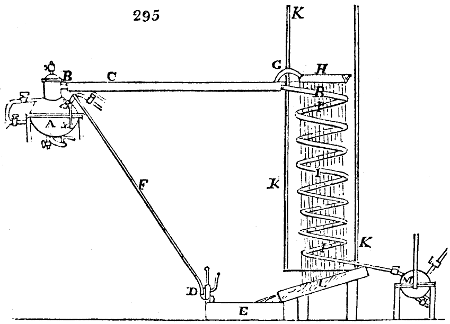
Let A be the source of
the vapours, or the vessel,
boiler, alembic, or closed
pan that contains the
liquid or syrup to be evaporated
or concentrated.
The pipe B, through which
the vapour passes as it
rises in the boiler, is surrounded
by another tube
C, of larger diameter, closed
at both ends. A pump D,
draws from the reservoir E,
warm water, which water
has been heated by its previous
and continual passage
through the apparatus
in contact with the
surface of the vapour pipes.
This pump forces the water by the pipe F, into the annular space or chamber between the
pipes B and C, in which chamber, by its immediate contact with the pipe B, it acquires the
temperature of the vapours intended to be refrigerated. The pipe G conveys the water from
the pipe C, into the annular colander or sieve H, which has a multitude of small holes pierced
through its under part, and from whence the warm water descends in the form of a
continued shower of rain. To the end of the pipe B, a distiller’s worm I I, is connected,
which is placed beneath the colander H. The entire length of the worm-pipe should
be bound round with linen or cotton cloth, as a conductor of the heat, which cloth will
be continually moistened by the rain in its descent from the colander. As this water
has been heated in passing along the tube C, the shower of rain descending from the
colander will be at a higher temperature than that of the atmosphere, and, consequently,
by heating the surrounding air as it descends, a considerable upward draft will
be produced through the coils of the worm-pipe.
If the colander and the worm-pipe are enclosed within a chimney or upright tube, as
K K, open at top and bottom, a current of ascending air will be produced within it by
the descending shower of hot water, similar in effect to that which would be produced
in a chimney communicating with a furnace, or to that of the burner of an argand
lamp. Consequently, it will be perceived that in opposition to the descending rain, a
strong upward current of air will blow through that part of the cylinder K K, which is
beneath the colander. When the air first enters the lower aperture of the chimney or
tube K, it is of the same temperature and moisture as the external atmosphere; but in
its passage up the tube it meets with a warmer and damper atmosphere, caused by the
heat given out from the hot fluid continually passing through the pipes, and by the hot
shower of rain, and also by the steam evolved from the surfaces of the coils of the worm,
which are continually wetted by the descending rain, the evaporation being considerably
augmented by the cloth bound round the worm-pipe, retaining the water as it descends
in drops from coil to coil.
The atmosphere within the tube being of a higher temperature than without, a
current of air constantly ascends and escapes at the upper aperture K, and its place is
supplied by fresh air from the surrounding atmosphere, entering the tube below. The
fresh air thus admitted at the bottom of the tube being cold and dry, will be suited to
take up the heat and moisture within, because the water within the tube being in a
state of dispersion as rain, presents to the air many points, or a very extended surface,
and also because it is of a higher temperature than the air; and, besides, cold dry air is
continually renewed, and a source of warmth is furnished by the latent caloric to the
steam, as fast as it is evolved. Thus a portion of the descending rain, or water, is
evaporated, and the effect of this evaporation is to subtract caloric not only from the
water held in contact with the coils of the worm-pipe by the cloth enveloping it, but also
from the hot vapours which pass through the worm. This process of evaporation has,
therefore, a cooling power, which is but slight in the lower part of the chimney or tube
K; because the temperature of the water, or rain, and of the worm, at this part, are of
a lower temperature; but its refrigerating power increases as it rises towards the
colander, and there it acquires its maximum of intensity, so that at any point between
the lower aperture of the cylinder and the colander, the current of air is always a little
cooler than the atmosphere of the region through which it passes (that is, at its maximum);
and in passing this region of higher temperature, it is not only put in equilibrium
of temperature, but also made to take up an additional quantity of aqueous
vapours, which equalises the new temperature it acquires with its capacity of saturation.
The cooling caused by the evaporation acts in an incessant and progressive manner from
the lower aperture of the cylinder to the under side of the colander; and this cooling
not only acts as an agent of the evaporation which the current of air cools, but it refrigerates
also, because it becomes warmed in abstracting caloric from the vapours or
liquids passing through the worm; and this refrigeration acts also incessantly and progressively
from the lower part of the tube or chimney to the colander.
The patentee states, in conclusion, that “the velocity or force of the current of air
that passes through the chimney or tube K, can be accelerated by artificial means, either
by conducting the air and vapour passing from the upper aperture of the cylinder into
the chimney or flues of a furnace, or by means of a revolving, forcing, or exhausting
fan, or ventilator, or any other contrivance which will produce an increased current of
air, but which it is not necessary to be particularly described, as I only wish to explain
the principles of a simple apparatus, constructed in any convenient form; and I would
remark, that the area of the lower aperture through which the air is introduced into the
chimney or tube K, and also the area of the upper aperture, or that through which it
passes to the atmosphere, should be in accordance with the effect intended to be obtained.
“It is further to be remarked, that in order to obtain from this apparatus the best
effect, the velocity of the current of air must be itself a maximum; and as the speed or
velocity of the current of air is owing to and determined by the excess of the temperature
of the descending water, or rain, and of the coils of the worm to that of the
exterior atmosphere, it ensues that the temperature of the water, or rain, must be a
maximum. But this excess of temperature is a maximum only when the source of the
rain is at the same temperature as the vapours to be condensed: if less warm, it would
attract less air; or, if warmer, it would augment the temperature of the vapours intended
to be condensed. Consequently, the shower of water employed in the tube K, as the
agent for cooling, bestows its maximum of effect when it is as warm as the vapours to
be condensed; therefore, I may express this proposition, viz., ‘That in refrigerating
with water, less of it may be expended when it is warm than when it is cold, and that
the least quantity of water will be evaporated when it is as warm as the aqueous or
spirituous vapours upon which it is to operate.’
“This proposition may appear strange, nevertheless it is conformable to the laws of
nature; and appears only strange, because until now warm water has not been employed
with currents of air for refrigerating.
“Hence it is necessary to raise the temperature of the water in the colander to the temperature
of the vapours to be condensed: therefore, I cause the lukewarm water, pumped
from the reservoir E, to circulate in the chamber C. In this circulation it also begins to
act as a refrigerating medium, taking up a portion of heat from the vapours that pass
through the pipe B, and afterwards it acts as a further condenser in the cylinder, in the
way described. Finally, the portion of this water that is still in the fluid state, after
having fallen down from coil to coil, arrives lukewarm to the inclined surface L, which
conducts it into the reservoir E, from whence it is pumped up into the chamber C, as
before described.
“The tube or chimney K, may have more or less altitude; the higher it is the greater
is the current produced. The force or velocity of the current of air can be governed by
the areas of the introduction and exit apertures. If the cylinder rises only to the height
of the sieve, the effect is much less than when it is prolonged beyond this height. I
would further remark, that if the cylinder was removed, a slight effect might be produced,
provided that a current of air be preserved in the cylindrical space limited by the
coils of the worm, and also if the current was produced between the coils; or a central
passage might be formed in an apparatus of another shape than that above described.
“I have only shown the application of the worm, because intending only to explain
the principles of this method of condensing and refrigerating.
“The small quantity of water wasted in this manner of condensation, (that is, that
portion passed off to the atmosphere in the form of vapours, at the upper aperture of the
cylinder K,) may be replaced by a small stream of cold water, which may be brought to
the apparatus, and perhaps most conveniently introduced into the reservoir E, or into
the chamber between the pipes B and C. When operating upon aqueous vapours, the
waste of water is always less in weight than that of the vapours liquefied. When this
apparatus is applied to the purposes of distillation, the end of the worm should terminate
in a vessel M, which is to receive the produce of the condensation. It will be
seen that this improved process is applicable to various purposes, where condensation or
refrigeration is required; for instance, in the boiling or concentration of sugar; to condensing
and refrigerating distilled vapours, or steam, or saline liquids, either in vacuum
or not; to cooling brewers’ worts; and to the refrigeration of other liquors, or any
other processes, when it may be required.”
I have inserted the specification of this patent verbatim. M. Derosne has busied
himself during a long life with a prodigious number of ingenious little contrivances for
clarifying and boiling syrups, distillation, &c., but he has in this invention taken a
bolder flight, having secured the exclusive privilege of condensing vapours, and cooling
liquors, with hot water, in preference to cold. No man at all versant in the scientific
doctrines, or the practical applications of caloric, will ever seek to meddle with his monopoly
of such a scheme. He may find, perhaps, some needy coppersmith ready to espouse
that or any other equally foolish project, provided a productive job can be made of it,
against credulous customers.
For some rational methods of cooling liquors, and condensing vapours, see Refrigeration,
Still, and Sugar.
COPAL, a resin which exudes spontaneously from two trees, the Rhus copallinum,
and the Elæocarpus copalifer, the first of which grows in America, and the second in
the East Indies. A third species of copal tree grows on the coasts of Guinea, especially
on the banks of some rivers, among whose sands the resin is found. It occurs in
lumps of various sizes and of various shades of colour, from the palest greenish yellow to
darkish brown. I found its specific gravity to vary in different specimens from 1·059 to
1·071, being intermediate in density between its two kindred resins, animé and amber.
Some rate its specific gravity so high as 1·139, which I should think one of the errors with
which chemical compilations teem. Copal is too hard to be scratched by the nail,
whence the excellence of its varnish. It has a conchoidal fracture, and is without smell
or taste. When exposed to heat in a glass retort over a spirit lamp it readily melts
into a liquid, which being further heated boils with explosive jets. A viscid oily-looking
matter then distils over. After continuing the process for some time, no succinic acid
is found in the receiver, but the copal blackens in the retort. Anhydrous alcohol
boiled upon it, causes it to swell, and transforms it by degrees into an elastic viscid
substance. It is not soluble in alcohol of 0·825 at the boiling point, as I have ascertained.
Copal dissolves in ether, and this ethereous solution may be mixed with alcohol
without decomposition. Caoutchoucine acts very slightly upon it by my experiments,
even at the boiling temperature of this very volatile fluid; but a mixture of it
with alcohol of 0·825 in equal parts dissolves it very rapidly in the cold into a perfectly
liquid varnish. Alcohol holding camphor in solution also dissolves it, but not nearly so
well as the last solvent. According to Unverdorben, copal may be completely dissolved
by digesting one part of it for 24 hours with one part and a half of alcohol (probably anhydrous),
because that portion of copal which is insoluble in alcohol, dissolves in a very
concentrated solution of the soluble portion. Oil of petroleum and turpentine dissolve
only 1 or 2 per cent. of raw copal. By particular management, indeed, oil of turpentine
may be combined with copal, as we shall describe under the article Varnish.
Fused copal possesses different properties from the substance in its solid state; for
it then may be made to combine both with alcohol and oil of turpentine.
Unverdorben has extracted from the copal of Africa, five different kinds of resin, none
of which has however been applied to any use in the arts.
The ultimate constituents of copal by my analysis are, carbon 79·87, hydrogen 9·00,
oxygen 11·1; being of hydrogen 7·6 in excess above the quantity necessary to form
water with the oxygen. Of copal and animé, 551,166 libs. were imported in 1835.
COPPER is one of the metals most anciently known. It was named from the
island of Cyprus, where it was extensively mined and smelted by the Greeks. It has a
reddish brown colour inclining to yellow; a faint but nauseous and rather disagreeable
taste; and when rubbed between the fingers it imparts a smell somewhat analogous
to its taste. Its specific gravity is from 8·8 to 8·9. It is much more malleable
than it is ductile; so that far finer leaves may be obtained from it than wire. It melts
at the 27th degree of Wedgewood’s pyrometer, and at a higher temperature it evaporates
in fumes which tinge the fire of a bluish green. By exposure to heat with access of air,
it is rapidly converted into black scales of peroxide. In tenacity it yields to iron; but
surpasses gold, silver, and platinum, considerably in this respect.
In mineralogy, the genus copper includes about 13 different species, and each
of these contains a great many varieties. These ores do not possess any one general
exterior character by which they can be recognized; but they are readily distinguished by
chemical re-agents. Water of ammonia digested upon any of the cupreous ores in a pulverized
state, after they have been calcined either alone or with nitre, assumes an
intense blue colour, indicative of copper. The richest of the ordinary ores appear
under two aspects; the first class has a metallic lustre, a copper red, brass yellow, iron
gray, or blackish gray colour, sometimes inclining to blue; the second is without metallic
appearance, has a red colour, verging upon purple, blue, or green, the last tint
being the most usual. Few copper ores are to be met with, indeed, which do not betray
the presence of this metal by more or less of a greenish film.
1. Native copper, occurs in crystals, branches and filaments, its most common locality
being in primitive rocks. It is found abundantly in Siberia, at the mines
of Tourinski, in those of Hungary, of Fundo-Moldavi in Gallicia, of Fahlun in Sweden,
of Cornwall, &c. The gangues of native copper are granite, gneiss, mica-slate, clay-slate,
quartz, carbonate or fluate of lime, sulphate of barytes, &c. The most remarkable
masses of native copper hitherto observed were; first, one in Brazil, 14 leagues
from Basa, which weighed 2616 pounds; and secondly, another which Dr. Francis-le-Baron
discovered in America to the south of Lake Superior. It was nearly 15 feet
in circumference.
2. Sulphuret of Copper, the vitreous ore of Brochant. The texture of this ore is
compact: its fracture, conchoidal, surface sometimes dull; colour, iron black or lead
gray, often bluish, iridescent, or reddish from a mixture of protoxide. It is easily
melted even by the heat of a candle; but more difficult of reduction than protoxide.
This ore yields to the knife, assuming a metallic lustre when cut. Its density varies
from 4·8 to 5·34. Its composition according to Klaproth is 78·5 copper, 18·5 sulphur,
with a little iron and silica. Its equivalent constitution by theory is 80 copper + 20
sulphur = 100; whence 78·5 of metal should be associated with 19·6 of sulphur. This
ore is therefore one of the richest ores, and forms very powerful veins, which likewise contain
some orange protoxide. It is to be found in all considerable copper districts; in
Siberia, Saxony, Sweden, and especially Cornwall, where the finest crystals occur.
3. Copper Pyrites, resembles in its metallic yellow hue, sulphuret of iron; but the
latter is less pale, harder, and strikes fire more easily with steel. It presents the most
lively rainbow colours. Its specific gravity is 4·3. It contains generally a good deal
of iron; as the following analysis will show; copper 30, sulphur 37, iron 33, in 100
parts. According to Hisinger, the Swedish pyrites contains 63 of copper, 12 of iron,
and 25 of sulphur. These ores occur in primitive and transition districts in vast masses
and powerful veins; and are commonly accompanied with gray copper, sulphuret of
iron, sparry iron, sulphurets of lead, and zinc.
4. Gray Copper, has a steel gray colour, more or less deep, either shining or dull;
fracture uneven; a distinct metallic lustre; difficult of fusion at the blowpipe; it communicates
to glass of borax a yellowish-red colour. Its density in crystals is 4·86. Its
composition is very variable; consisting essentially of copper, iron, antimony, and sulphur.
The exploration of this ore is profitable, in consequence of the silver which it
frequently contains. It occurs in primitive mountains; and is often accompanied
with red silver ore, copper pyrites, and crystallized quartz.
5. Protoxide of Copper, or red oxide of Copper: its colour is a deep red, sometimes
very lively, especially when bruised. It is friable, difficult of fusion at the blowpipe,
reducible on burning charcoal, soluble with effervescence in nitric acid, forming a green
liquid. Its constitution when pure, is 88·9 copper + 11·1 oxygen = 100.
6. Black oxide of Copper, is of a velvet black, inclining sometimes to brown or blue;
and it acquires the metallic lustre on being rubbed. It is infusible at the blowpipe.
Its composition is, copper 80 + oxygen 20; being a true peroxide.
7. Hydrosilicate of Copper, consists essentially of oxide of copper, silica, and water.
Its colour is green; and its fracture is conchoidal with a resinous lustre, like most minerals
which contain water. Its specific gravity is 2·73. It is infusible at the blowpipe
alone, but it melts easily with borax.
8. Dioptase Copper, or Emerald Malachite; a beautiful but rare cupreous mineral,
consisting of oxide of copper, carbonate of lime, silica, and water in varying proportions.
9. Carbonate of Copper, Malachite; is of a blue or green colour. It occurs often
in beautiful crystals.
10. Sulphate of Copper, Blue Vitriol, similar to the artificial salt of the laboratory.
The blue water which flows from certain copper mines, is a solution of this salt. The
copper is easily procured in the metallic state by plunging pieces of iron into it.
11. Phosphate of Copper, is of an emerald green, or verdigris colour with some spots
of black. It presents fibrous or tuberculous masses with a silky lustre in the fracture.
It dissolves in nitric acid without effervescence, forming a blue liquid; melts at the
blowpipe, and is reducible upon charcoal, with the aid of a little grease, into a metallic
globule. Its powder does not colour flame green, like the powder of muriate of copper.
12. Muriate of Copper, is green of various shades; its powder imparts to flame a
remarkable blue and green colour. It dissolves in nitric acid without effervescence;
and is easily reduced before the blowpipe. Its density is 3·5. By Klaproth’s analysis
it consists of oxide of copper 73, muriatic acid 10, water 17.
13. Arseniate of Copper. It occurs in beautiful blue crystals. Before the blowpipe
it melts exhaling fumes of a garlic odour, and it affords metallic globules when in
contact with charcoal. See more upon the ores at the end of this article.
In the article Metallurgy, I have described the mode of working certain copper
mines; and shall content myself here with giving a brief account of two cupreous formations,
interesting in a geological point of view; that of the copper slate of Mansfeldt,
and of the copper veins of Cornwall.
The curious strata of bituminous schist in the first of these localities, are among the
most ancient of any which contain the exuviæ of organised bodies not testaceous. From
among their tabular slabs the vast multitudes of fossil fish were extracted, which have
rendered the cantons of Mansfeldt, Eisleben, Ilmenau, and other places in Thuringia
and Voigtland so celebrated. Many of the fish are transformed into copper pyrites.
Here, also, have been found the fossil remains of the lizard family, called Monitors.
Such is the influence of a wise administration upon the prosperity of mines, that the
thin layer of slate in this formation, of which 100 pounds commonly contain but one
pound and a half of copper, occasionally argentiferous, has been for several centuries the
object of smelting works of the greatest importance to the territory of Mansfeldt and
the adjoining country.
The frequent derangements which this metallic deposit experiences, led skilful directors
of the under-ground operations at an early period to study the order of superposition
of the accompanying rocks. From their observations, there resulted a system
of facts which have served to guide miners, not only in the country of Mansfeldt, but
over a great portion of Germany, and in several other countries where the same series
of rocks, forming the immediate envelope of the cupreous schists, were found to occur
in the same order of superposition.
Of the English copper works.—The deposits of copper in Cornwall occur always as
veins in granite, or in the schistose rocks which surround and cover it; and hence, the
Cornish miners work mostly in the granite or greenish clay slate; the former of which
they call growan, the latter killas. But tin is sometimes disseminated in small veins in
porphyry or elvan, which itself forms great veins in the above rocks. No stratification
has been observed in Cornwall.
The copper veins are abundant in the killas and rare in the granite; but most numerous
near the line of junction of the two rocks. The different kinds of mineral veins
in Cornwall may be classed as follows:—
1. Veins of elvan; elvan courses, or elvan channels.
2. Tin veins, or tin lodes; the latter word being used by the Cornish miners to signify
a vein rich in ore, and the word course, to signify a barren vein.
3. Copper veins running east and west; east and west copper lodes.
4. Second system of copper veins, or contra copper lodes.
5. Crossing veins; cross courses.
6. Modern copper veins; more recent copper lodes.
7. Clay veins; of which there are two sets, the more ancient, called Cross-Fluckans;
and the more modern, called Slides.
There are therefore three systems of copper veins in Cornwall; of which the first is
considered to be the most ancient, because it is always traversed by the two others, and
because, on the contrary, it never cuts them off. The width of these veins does not exceed
6 feet, though occasional enlargements to the extent of 12 feet sometimes take
place. Their length is unknown, but the one explored in the United Mines has been
traced over an extent of seven miles. The gangue of these veins is generally quartz,
either pure, or mixed with green particles analogous to chlorite. They contain
iron pyrites, blende, sulphuret, and several other compounds of copper, such as the carbonate,
phosphate, arseniate, muriate, &c. The most part of the copper veins are
accompanied with small argillaceous veins, called by the miners fluckan of the lode. These
are often found upon both sides of the vein, so as to form cheeks or salebandes.
When two veins intersect each other, the direction of the one thrown out becomes an
object of interest to the miner and geologist. In Saxony it is regarded as a general fact
that the rejected portion is always to the side of the obtuse angle; this also holds generally
in Cornwall, and the more obtuse the angle of incidence, the more considerable the
out-throw.
The great copper vein of Carharack, in the parish of Gwenap, is a most instructive
example of intersection. The power of this vein is 8 feet; it runs nearly from east to
west, and dips towards the north at an inclination of 2 feet in a fathom. Its upper part
is in the killas, its lower part in the granite. The vein has suffered two intersections;
the first results from encountering the vein called Steven’s fluckan, which runs from
north-east to south-west, throwing it out several fathoms. The second has been caused
by another vein, almost at right angles to the first, and which has driven it 20 fathoms out
to the right side. The fall of the vein occurs, therefore, in one case to the right, and in
the other to the left; but in both instances, it is to the side of the obtuse angle. This
disposition is very singular; for one portion of the vein appears to have ascended, while
another has sunk.
The mining works in the copper veins are carried on by reverse steps; see Mines.
The grand shafts for drainage and extraction are vertical, and open upon the roof side
of the vein, traversing it to a certain depth. These pits are sunk to the lowest point of
the exploration; and, in proportion as the workings descend, by means of excavations
in the vein, the pits are deepened and put into communication towards their bottom with
each new gallery of elongation, by means of transverse galleries. At present, the main
shafts are fully 160 fathoms deep. Their horizontal section is oblong, and is divided into two
compartments; the one destined for extraction, the other for the pumps. Their timbering
has nothing remarkable, but is executed with every attention to economy, the whole
wood employed in these mines being brought from Norway.
The descent of the workmen is effected by inclined shafts scooped out of the vein;
the ladders are slightly inclined; they are interrupted every 10 fathoms by floors; the
steps are made of iron, and, to prevent them from turning under the foot, the form of a
miner’s punch or jumper has been given them, the one end being round, and the other
being wedge-shaped.
The ore is raised either by means of horse-gins, or by steam-engine power most frequently
of high pressure. I shall take the Consolidated Mines as an example.
The draining, which is one of the most considerable sources of expense, both from
the quantity of water, and from the depth of the mine, is executed by means of sucking
and forcing pumps, the whole piston-rods of which, 120 feet long, are attached to a
main-rod suspended at the extremity of the working beam of a steam-engine.
On this mine three steam-engines are erected of very great power, for the purpose of
drainage; the one called the Maria engine is of the first-rate force, and most improved
construction. The cylinder is 90 inches in internal diameter, and the length of the
stroke is 9 feet 11 inches. It works single stroke, and is encased in a coating of bricks
to prevent dissipation of the heat. The vapour is admitted at the upper end of the
cylinder during the commencement of the fall of the piston, at a pressure capable of
forming an equilibrium with a column of 60 inches of mercury. The introduction of
the steam ceases whenever the piston has descended through a certain space, which may
be increased or diminished at pleasure. During the remainder of the descent the piston
is pressed merely by this vapour in its progressive expansion, while the under side of
the piston communicates with the condenser. It ascends by the counterweight at the
pump end of the working beam. Hence, it is only during the descent of the piston,
that the effective stroke is exerted. Frequently the steam is admitted only during the
sixth part of the course of the piston, or 18 inches. In this way the power of the engine
is proportioned to the work to be done; that is, to the body of water to be raised.
The maximum force of the above engine is about 310 horses; though it is often made
to act with only one third of this power.
The copper mines of the isle of Anglesey, those of North Wales, of Westmoreland,
the adjacent parts of Lancashire and Cumberland, of the south west of Scotland, of
the Isle of Man, and of the south east of Ireland, occur also in primitive or transition
rocks. The ores lie sometimes in masses, but more frequently in veins. The mine of
Ecton in Staffordshire, and that of Cross-gill-burn, near Alston-moor in Cumberland,
occur in transition or metalliferous limestone.
The copper ores extracted both from the granitic and schistose localities, as well as
from the calcareous, are uniformly copper pyrites more or less mixed with iron pyrites;
the red oxide, carbonate, arseniate, phosphate, and muriate of copper, are very rare in
these districts.
The working of copper in the isle of Anglesey may be traced to a very remote era. It
appears that the Romans were acquainted with the Hamlet mine near Holyhead; but
it was worked with little activity till about 70 years ago. This metalliferous deposit
lies in a greenish clay slate, passing into talc slate; a rock associated with serpentine and
euphotide (gabbro of Von Buch). The veins of copper are from one to two yards
thick; and they converge towards a point where their union forms a considerable mass
of ore. On this mass the mine was first pierced by an open excavation, which is now
upwards of 300 feet deep, and appears from above like a vast funnel. Galleries are
formed at different levels upon the flank of the excavation to follow the several small
veins, which run in all directions, and diverge from a common centre like so many radii.
The ore receives in these galleries a kind of sorting, and is raised by means of hand
windlasses, to the summit of a hill, where it is cleaned by breaking and riddling.
The water is so scanty in this mine that it is pumped up by a six-horse steam-engine.
A great proportion of it is charged with sulphate of copper. It is conveyed into reservoirs
containing pieces of old iron; the sulphate is thus decomposed into copper of
cementation. The Anglesea ore is poor, yielding only from 2 to 3 per cent. of copper:
a portion of its sulphur is collected in roasting the ore.
Mechanical preparation of the copper ores in Cornwall.—The ore receives a first sorting,
either within the mine itself, or at its mouth, the object of which is to separate all
the pieces larger than a walnut. These are then reduced by the hammer to a smaller
size; after which the whole are sorted into four lots, according to their relative richness.
The fragments of poor ore are pounded in the stamps so that the metallic portion
may be separated by washing.
The rich ore is broken into small bits, of the size of a nut, with a flat beater, formed
of a piece of iron 6 inches square and 1 inch thick, adapted to a wooden handle. The
ore to be broken is placed upon plates of cast-iron; each about 16 inches square and 11⁄2
inch thick. These iron plates are set towards the edge of a small mound about a yard
high, constructed with dry stones rammed with earth. The upper surface of this
mound is a little inclined from behind forwards. The work is performed by women,
each furnished with a beater; the ore is placed in front of them beyond the plates; they
break it, and strew it at their feet, whence it is lifted and disposed of to the smelting-houses.
Inferior ores, containing a notable proportion of stony matters, are also broken with
the beater, and the rich parts are separated by riddling and washing from the useless
matters.
The smaller ore is washed on a sieve by shaking it in a stream of water, which carries
away the lighter stony pieces, and leaves the denser metalliferous. They are then
sorted by hand. Thus by beating, stamping, and riddling in water, the stony substances
are in a great measure separated. The finer ground matter is washed on a plane table,
over which a current of water is made to flow. Finally, the ore nearly fine is put into a large
tub with water, and briskly stirred about with a shovel, after which it settles in the order
of richness, the pure metallic ore being nearest the bottom. The stamps used for copper
ore in Cornwall are the same as those used for tin ores, of which we shall speak in treating
of the latter metal, as well as of the boxes for washing the fine powder or slime.
These in fact do not differ essentially from the stamping mills and washing apparatus
described in the article Metallurgy. Crushing rolls are of late years much employed.
See Lead and Tin.
Cornwall being destitute of coal, the whole copper ore which this county produces
is sent for smelting to South Wales. Here are 15 copper works upon the Swansea and
Neath, which pursue a nearly uniform and much improved process, consisting in a series
of calcinations, fusions, and roastings, executed upon the ores and the matters resulting
from them.
The furnaces are of the reverberatory construction; they vary in their dimensions and
in the number of their openings, according to the operations for which they were intended.
There are 5 of them:—1. The calcining furnace or calciner; 2. The melting
furnace; 3. The roasting furnace or roaster; 4. The refining furnace; 5. The heating
or igniting furnace.
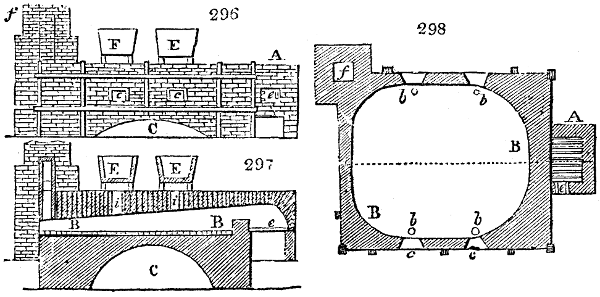
1. The calcining furnace rests upon a vault, C, into which the ore is raked down after
being calcined; it is built of bricks, and bound with iron bars, as shown in the elevation,
fig. 296. The hearth, B B, figs. 296. and 298. is placed upon a level with the lower horizontal
binding bar, and has nearly the form of an ellipse, truncated at the two extremities of
its great axis. It is horizontal, bedded with fire-bricks set on edge, so that it may be removed
and repaired without disturbing the arch upon which it reposes. Holes, not visible
in the figure, are left in the shelves before each door, c c, through which the roasted ore is
let fall into the subjacent vault. The dimensions of the hearth B B are immense, being
from 17 to 19 feet in length, and from 14 to 16 in breadth. The fire-place, A, fig. 298., is
from 41⁄2 to 5 feet long, and 3 feet wide. The bridge or low wall, b, fig. 302., which separates
the fire-place from the hearth, is 2 feet thick; and in Mr. Vivian’s smelting-works is
hollow, as shown in the figure, and communicates at its two ends with the atmosphere,
in order to conduct a supply of fresh air to the hearth of the furnace. This judicious
contrivance will be described in explaining the roasting operation. The arched roof of
the furnace slopes down from the bridge to the beginning of the chimney, f, fig. 296,
298., its height above the hearth being at the first point about 26 inches, and from 8 to
12 at the second.
Such great calcining furnaces have 4 or 5 doors, c c c c, fig. 298., one for the fire-place,
as shown at the right hand in fig. 297., and 3 or 4 others for working the ore upon the
reverberatory hearth. If there be 3, 2 of them are placed between the vertical binding
bars upon one side, and a third upon the opposite side of the furnace; if there be 4, 2
are placed upon each side, facing one another. These openings are 12 inches square,
and are bound with iron frames. The chimney is about 22 feet high, and is placed at
one angle of the hearth, as at f, fig. 298., being joined by an inclined flue to the furnace.
For charging it with ore there is usually placed above the upper part of the vault 2
hoppers, E E, in a line with the doors; they are formed of 4 plates of iron, supported in
an iron frame. Beneath each of them there is an orifice for letting the ore down into
the hearth.
These furnaces serve for calcining the ore, and the matts or crude coppers: for the latter
purpose, indeed, furnaces of two stories are sometimes employed, as represented in fig. 301.
The dimensions of each floor in this case are a little less than the preceding. Two doors,
c c, correspond to each hearth, and the workmen, while employed at the upper story,
stand upon a raised movable platform.
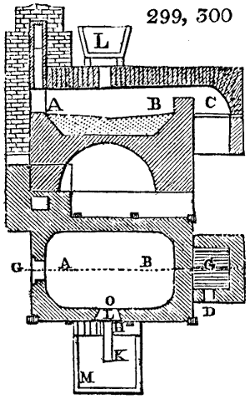
2. Melting furnace, figs. 299 and 300.—The form of the
hearth is also elliptical, but the dimensions are smaller than
in the calcining furnace. The length does not exceed 11 or 111⁄2
feet, and the breadth varies from 7 to 8. The fire-place is
however larger in proportion, its length being from 31⁄2 feet
to 4, and its breadth from 3 to 31⁄2; this size being requisite
to produce the higher temperature of this furnace. It has
fewer openings, there being commonly three; one to the
fire-place at D, a second one, O, in the side, kept generally
shut, and used only when incrustations need to be scraped
off the hearth, or when the furnace is to be entered for
repairs; and the third or working-door, G, placed on the
front of the furnace beneath the chimney. Through it the
scoriæ are raked out, and the melted matters are stirred and
puddled, &c.
The hearth is bedded with infusible sand, and slopes
slightly towards the side door, to facilitate the discharge of
the metal. Above this door there is a hole in the wall of the
chimney (fig. 300.) for letting the metal escape. An iron gutter, O, leads it into a pit, K,
bottomed with an iron receiving-pot, which may be lifted out by a crane. The pit M is
filled with water, and the metal becomes granulated as it falls into the receiver. The
melting furnaces are surmounted by a hopper, L, as shown in fig. 299.
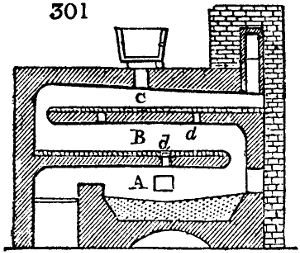
Melting furnaces are sometimes used also for calcination.
There are some such near Swansea, which serve this double
purpose; they are composed of 3 floors (fig. 301.) The floor
A is destined for melting the calcined ore; the other two,
B C, serve for calcination. The heat being less powerful,
upon the upper sole C, the ore gets dried upon it, and begins
to be calcined—a process completed on the next floor.
Square holes, d, left in the hearths B and C, put them in
communication with each other, and with the lower one A;
these perforations are shut during the operation by a sheet
of iron, removable at pleasure.
The hearths b and c are made of bricks; they are horizontal at top and slightly vaulted
beneath; they are 2 bricks thick, and their dimensions are larger than those of the inferior
hearths, as they extend above the fire-place. On the floors destined for calcination
the furnace has two doors on one of its sides: on the lower story there are also two; but
they are differently collocated. The first, being in the front of the furnace, serves for
drawing off the scoriæ, for working the metal, &c.; and the second, upon the side, admits
workmen to make necessary repairs. Below this door the discharge or tap-hole A is
placed, which communicates by a cast-iron gutter with a pit filled with water. The
dimensions of this furnace in length and breadth are nearly the same as those of the
melting furnace above described; the total height is nearly 12 feet. It is charged by
means of one or two hoppers.
3. Roasting furnace.—The furnaces employed for this purpose are in general analogous
to the calcining ones; but in the smelting works of Hafod, the property of Messrs.
Vivian, these furnaces, alluded to above, present a peculiar construction, for the purpose
of introducing a continuous current of air upon the metal, in order to facilitate its oxidizement.
This process was originally invented by Mr. Sheffield, who disposed of his
patent right to Messrs. Vivian.
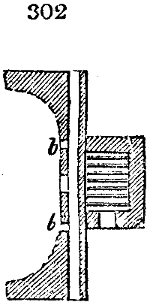
The air is admitted by a channel, c c, through the middle of the fire-bridge, fig. 302, and
extending all its length; it communicates with the atmosphere at its two ends c c;
square holes, b b, left at right angles to this channel, conduct the air into the furnace.
This very simple construction produces a powerful effect in the roasting operation.
It not only promotes the oxidizement of the metals, but burns the smoke, and
assists in the vaporisation of the sulphur; while by keeping the bridge cool it preserves
it from wasting, and secures uniformity of temperature to the hearth.
4. Refining furnace.—In this, as in the melting furnace, the sole slopes towards
the door in front, instead of towards the side doors, because in the refining furnace the
copper collects into a cavity formed in the hearth towards the front door, from which it
is lifted out by ladles; whereas, in the melting furnaces, the metal is run out by a tap-hole
in the side. The hearth sole is laid with sand; but the roof is higher than in the
melting furnace, being from 32 to 36 inches. If the top arch were too much depressed,
there might be produced upon the surface of the metal a layer of oxide very prejudicial
to the quality of the copper. When the metal in that case is run out, its surface solidifies
and cracks, while the melted copper beneath breaks through and spreads irregularly
over the cake. This accident, called the rising of the copper, hinders it from being
laminated, and requires it to be exposed to a fresh refining process, when lead must be
added to dissolve the oxide of copper. This is the only occasion upon which the addition
of lead is proper in refining copper. When the metal to be refined is mixed with
others, particularly with tin, as in extracting copper from old bells, then very wide furnaces
must be employed, to expose the metallic bath upon a great surface, and in a thin
stratum, to the oxidizing action of the air.
The door G, fig. 300., upon the side of the refining furnace, is very large, and is shut
with a framed brick door, balanced by a counter-weight. This door being open during
the refining process, the heat is stronger at B than at A (figs. 299, 300.)
5. Heating furnaces, being destined to heat the pigs or bars of copper to be laminated,
as well as the copper sheets themselves, are made much longer in proportion to their
breadth. Their hearth is horizontal, the vault not much depressed; they have only one
door, placed upon the side, but which extends nearly the whole length of the furnace:
this door may be raised by means of a counter-weight, in the same way as in the furnaces
for the fabrication of sheet-iron and brass.
Series of operations to which the ore is subjected.—The ores which are smelted in the
Swansea works are cupreous pyrites, more or less mingled with gangue (vein-stone).
The pyrites is composed of nearly equal proportions of sulphuret of copper and sulphuret
of iron.
The earthy matters which accompany the pyrites are usually siliceous, though in some
mines the metalliferous deposit is mixed with clay or fluate of lime. Along with these
substances, pretty uniformly distributed, tin and arsenical pyrites occur occasionally
with the copper; and though these two metals are not chemically combined, yet they
cannot be separated entirely in the mechanical preparations. The constituent parts of
the ore prepared for smelting are, therefore, copper, iron, sulphur, with tin, arsenic,
and earthy matters in some cases. The different ores are mixed in such proportions
that the average metallic contents may amount to 81⁄2 per cent. The smelting process
consists in alternate roastings and fusions. The following description of it is chiefly
taken from an excellent paper, published by John Vivian, esq., in the Annals of Philosophy
for 1823.
In the roasting operation the volatile substances are disengaged mostly in the gaseous
state, while the metals that possess a strong affinity for oxygen become oxidized. In
the fusion the earthy substances combine with these oxides, and form glassy scoriæ or
slags, which float upon the surface of the melted metal.
These calcinations and fusions take place in the following order:—
1. Calcination of the ore. 2. Melting of the calcined ore. 3. Calcination of the
coarse metal. 4. Melting of the calcined coarse metal. 5. Calcination of the fine
metal (second matt). 6. Melting of the calcined fine metal. 7. Roasting of the
coarse copper. In some smelting works, this roasting is repeated four times; in
which case a calcination and a melting are omitted. In the Havod works, however,
the same saving is made without increasing the number of roastings. 8. Refining or
toughening the copper.
Besides these operations, which constitute the treatment of copper properly speaking,
two others are sometimes performed, in which only the scoriæ are melted. These may
be designated by the letters a and b. a is the re-melting of the portion of the scoriæ
of the second process, which contain some metallic granulations. b is a particular melting
of the scoriæ of the fourth operation. This fusion is intended to concentrate the
particles of copper in the scoriæ, and is not practised in all smelting works.
First operation. Calcination of the ore.—The different ores, on arriving from Cornwall
and other districts where they are mined, are discharged in continuous cargoes at
the smelting works, in such a way, that by taking out a portion from several heaps at
a time, a tolerably uniform mixture of ores is obtained; which is very essential in
a foundry, because, the ores being different in qualities and contents, they act as
fluxes upon each other. The ore thus mixed is transported to the works in wooden
measures that hold a hundred-weight. The workmen entrusted with the calcination
convey the ore into the hoppers of the calcining furnace, whence it falls into the hearth;
other workmen spread it uniformly on the surface by iron rakes. The charge of a furnace
is from three tons to three tons and a half. Fire is applied and gradually increased,
till, towards the end of the operation, the temperature be as high as the ore can support
without melting or agglutinating. To prevent this running together, and to aid the
extrication of the sulphur, the surfaces are renewed, by stirring up the ore at the end of
every hour. The calcination is usually completed at the end of 12 hours, when the
ore is tumbled into the arch under the sole of the furnace. Whenever the ore is cold
enough to be moved, it is taken out of the arch, and conveyed to the calcined heap.
The ore in this process hardly changes weight, having gained in oxidizement nearly
as much as it has lost in sulphur and arsenic; and if the roasting has been rightly managed,
the ore is in a black powder, owing to the oxide of iron present.
Second operation. Fusion of the calcined ore.—The calcined ore is likewise given to
the melters in measures containing a hundred-weight. They toss it into hoppers, and
after it has fallen on the hearth, they spread it uniformly. They then let down the
door, and lute it tightly. In this fusion there are added about 2 cwt. of scoriæ proceeding
from the melting of the calcined matt, to be afterwards described. The object
of this addition is not only to extract the copper that these scoriæ may contain, but especially
to increase the fusibility of the mixture. Sometimes also, when the composition
of the ore requires it, lime, sand, or fluor spar is added; and particularly the last
fluxing article.
The furnace being charged, fire is applied, and the sole care of the founder is to keep
up the heat so as to have a perfect fusion; the workman then opens the door, and
stirs about the liquid mass to complete the separation of the metal (or rather of the
matt) from the scoriæ, as well as to hinder the melted matter from sticking to the sole.
The furnace being ready, that is, the fusion being perfect, the founder takes out the
scoriæ by the front door, by means of a rake. When the matt is thus freed from the
scoriæ, a second charge of calcined ore is then introduced to increase the metallic bath;
which second fusion is executed like the first. In this way, new charges of roasted ore
are put in till the matt collected on the hearth rises to a level with the door-way, which
happens commonly after the third charge. The tap hole is now opened; the matt
flows out into the pit filled with water, where it is granulated during its immersion;
and it collects in the pan placed at the bottom. The granulated matt is next conveyed
into the matt warehouse. The oxidation with which the grains get covered by
the action of the water, does not allow the proper colour of the matt or coarse metal to
be distinguished; but in the bits which stick in the gutter, it is seen to be of a steel
gray. Its fracture is compact, and its lustre metallic. The scoriæ often contain
metallic grains; they are broken and picked with care. All the portions which include
some metallic particles are re-melted in an accessory process. The rejected scoriæ
have been found to be composed of siliceous matter 59, oxide of copper 1, oxide
of tin 0·7.
In this operation, the copper is concentrated by the separation of a great part of the
matters with which it was mixed or combined. The granulated matt produced, contains
in general 33 per cent. of copper; it is therefore four times richer than the ore;
and its mass is consequently diminished in that proportion. The constituent parts are
principally copper, iron, and sulphur.
The most important point to hit in the fusion just described, is to make a fusible
mixture of the earths and the oxides, so that the matt of copper may, in virtue of its
greater specific gravity, fall to the under-part, and separate exactly from the slag. This
point is attained by means of the metallic oxides contained in the scoriæ of the fourth
operation, of which 2 cwt. were added to the charge. These consist almost entirely of
black oxide of iron. When the ores are very difficult to melt, a measure of about half
a hundred-weight of fluor spar is added; but this must be done with precaution, for
fear of increasing the scoriæ too much.
The business goes on day and night. Five charges are commonly put through hands
in the course of 24 hours; but when all circumstances are favourable, that is to say,
when the ore is fusible, when the fuel is of the first quality, and when the furnace is in
good condition, even six charges a day have been despatched.
The charge is a ton and a half of calcined ore, so that a melting furnace corresponds
nearly to a calcining furnace; the latter turning out nearly 7 tons of calcined ore in 24
hours.
The workmen are paid by the ton.
Third operation. Calcination of the coarse metal, or the matt.—The object of this
operation is principally to oxidize the iron, an oxidation easier to execute, than in the first
calcining, because the metal is now disengaged from the earthy substances, which screened
it from the action of the air.
This calcination is executed in the furnace already represented, fig. 296, 297, 298.
page 318. exactly in the same way as the ore was calcined. The metal must be perpetually
stirred about, to expose all its surfaces to the action of the hot air, and to hinder the
clotting together. The operation lasts 24 hours; during the first six, the fire should be very
moderate, and thereafter gradually increased to the end of the calcination. The charge
is, like that of the first, 3 tons and a half.
Fourth operation. Melting of the calcined coarse metal, or calcined matt.—In the
fusion of this first calcined matt, some scoriæ of the latter operations must be added,
which are very rich in oxide of copper, and some crusts from the hearth, which are likewise
impregnated with it. The proportion of these substances varies according to the
quality of the calcined matt.
In this second fusion, the oxide of copper contained in the scoriæ, is reduced by the
affinity of the sulphur, one portion of which passes to the state of acid, while the other
forms a subsulphuret with the copper become free. The matt commonly contains a sufficient
quantity of sulphur to reduce the oxide of copper completely; but if not, which
may happen if the calcination of the matt has been pushed too far, a small quantity of
uncalcined matt must be introduced, which, by furnishing sulphur, diminishes the
richness of the scoriæ, and facilitates the fusion.
The scoriæ are taken out by the front door, by drawing them forward with a rake.
They have a great specific gravity; are brilliant with metallic lustre, very crystalline,
and present, in the cavities, crystals like those of pyroxene; they break easily into very
sharp-edged fragments. They contain no granulated metal in the interior; but it
sometimes occurs, on account of the small thicknesses of the stratum of scoriæ, that
these carry off with them, when they are withdrawn, some metallic particles.
These scoriæ, as we have already stated, under the fusion of the roasted ore, are in
general melted with it. In some cases, however, a special melting is assigned to them.
The matt obtained in this second fusion is either run out into water like the first, or
moulded into pigs (ingots), according to the mode of treatment which it is to undergo.
This matt, called by the smelters fine metal when it is granulated, and blue metal when it
is in pigs, is of a light grey colour, compact, and bluish at the surface. It is collected
in the first form when it is to be calcined anew; and in the second, when it must
immediately undergo the operation of roasting. Its contents in copper are 60 per cent.
This operation, which is but sometimes had recourse to, lasts 5 or 6 hours. The charge
is 1 ton.
(b) Particular fusion of the scoriæ of the fourth operation.—In re-melting these scoriæ,
the object is to procure the copper which they contain. To effect this fusion, the scoriæ
are mixed with pulverized coal, or other carbonaceous matters. The copper and several
other metals are deoxidized, and furnish a white and brittle alloy. The scoriæ resulting
from this melting are in part employed in the first melting, and in part thrown away.
They are crystalline, and present crystals often in the cavities, which appear to belong
to bisilicate of iron. They have a metallic lustre, and break into very sharp-edged
fragments. The white metal is melted again, and then united to the product of the
second fusion.
Fifth operation. Calcination of the second matt, or fine metal of the smelter.—This is
executed in precisely the same way as that of the first matt. It lasts 24 hours; and the
charge is usually 3 tons.
Sixth operation. Melting of the calcined fine metal.—This fusion is conducted like
that of the first matt. The black copper, or coarse copper, which it produces, contains
from 70 to 80 per cent. of pure metal; it is run into ingots, in order to undergo the
operation of roasting.
The scoriæ are rich in copper; they are added to the fusion of the calcined coarse
metal of the fourth operation.
In the smelting houses of Messrs. Vivian, at Hafod, near Swansea, the fifth and sixth
operations have been omitted of late years. The second matt is run into pigs, under the
name of blue metal, to be immediately exposed to the roasting.
The disposition of the canal a a′, fig. 302., which introduces a continuous current of air
to the hearth of the furnace, accelerates and facilitates the calcination of the matt; an
advantage which has simplified the treatment, by diminishing the number of calculations.
Seventh operation. Roasting of the coarse copper, the product of the sixth operation.
The chief object of this operation is oxidizement; it is performed either in an ordinary
roasting furnace, or in the one belonging to fig. 302., which admits a constant current of
air. The pigs of metal derived from the preceding melting are exposed, on the hearth
of the furnace, to the action of the air, which oxidizes the iron and other foreign metals
with which the copper is still contaminated. The duration of the roasting varies from
12 to 24 hours, according to the degree of purity of the crude copper. The temperature
should be graduated, in order that the oxidizement may have time to complete, and
that the volatile substances which the copper still retains may escape in the gaseous form.
The fusion must take place only towards the end of the operation.
The charge varies from a ton and a quarter to a ton and a half. The metal obtained
is run out into moulds of sand. It is covered with black blisters, like steel of cementation;
whence it has got the name of blistered copper. In the interior of these pigs, the copper
presents a porous texture, occasioned by the ebullition produced by the escape of the
gases during the moulding. The copper being now almost entirely purged from the
sulphur, iron, and the other substances with which it was combined, is in a fit state to be
refined. This operation affords some scoriæ; they are very heavy, and contain a great
deal of oxide of copper, sometimes even metallic copper.
These scoriæ, as well as those of the third melting and of the refining, are added to
the second fusion, as we have already stated, in describing the fourth operation.
In some works, the roasting is repeated several times upon the blue metal, in order to
bring it to a state fit for refining. We shall afterwards notice this modification of the
treatment.
Eighth operation. Refining or toughening.—The pigs of copper intended for refining
are put upon the sole of the refining furnace through the door in the side. A slight heat
is first given, to finish the roasting or oxidation, in case this operation has not already
been pushed far enough. The fire is to be increased by slow degrees, so that, by the end
of 6 hours, the copper may begin to flow. When all the metal is melted, and when the
heat is considerable, the workman lifts up the door in the front, and withdraws with a
rake the few scoriæ which may cover the copper bath. They are red, lamellated, very
heavy, and closely resemble protoxide of copper.
The refiner takes then an assay with a small ladle, and when it cools, breaks it in a
vice, to see the state of the copper. From the appearance of the assay, the aspect of the
bath, the state of the fire, &c., he judges if he may proceed to the toughening, and what
quantity of wooden spars and wood charcoal he must add to render the metal malleable,
or, in the language of the smelters, bring it to the proper pitch. When the operation of
refining begins, the copper is brittle or dry, and of a deep red colour approaching to
purple. Its grain is coarse, open, and somewhat crystalline.
To execute the refining, the surface of the metal is covered over with wood charcoal,
and stirred about with a spar or rod of birch wood. The gases which escape from the
wood, occasion a brisk effervescence. More wood charcoal is added from time to time,
so that the surface of the metal may be always covered with it, and the stirring is continued
with the rods, till the operation of refining be finished; a circumstance indicated
by the assays taken in succession. The grain of the copper becomes finer and finer,
and its colour gradually brightens. When the grain is extremely fine, or closed, when
the trial pieces half cut through and then broken, present a silky fracture, and when the
copper is of a fine light red, the refiner considers the operation to be completed; but he
verifies still further the purity of the copper, by trying its malleability. For this purpose,
he takes out a sample in his small ladle, and pours it into a mould. When the
copper is solidified, but still red-hot, he forges it. If it is soft under the hammer, if it
does not crack on the edges, the refiner is satisfied with its ductility, and he pronounces
it to be in its proper state. He orders the workmen to mould it; who then lift the
copper out of the furnace in large iron ladles lined with clay, and pour it into moulds
of the size suitable to the demands of commerce. The ordinary dimensions of the ingots
or pigs are 12 inches broad, 18 long, and from 2 to 21⁄2 thick.
The period of the refining process is 20 hours. In the first six, the metal heats, and
suffers a kind of roasting; at the end of this time it melts. It takes four hours to reach
the point at which the refining, properly speaking, begins; and this last part of the
process lasts about 4 hours. Finally, 6 hours are required to arrange the moulds,
cast the ingots, and let the furnace cool.
The charge of copper in the refining process depends upon the dimensions of the furnace.
In the Hafod works, one of the most important in England, the charge varies from
3 to 5 tons; and the quantity of pure copper manufactured in a week is from 40 to 50 tons.
The consumption of fuel is from 15 to 18 parts of coal, for one part of refined copper
in pigs.
When the copper offers difficulties in the refining, a few pounds of lead are added to
it. This metal, by the facility with which it scorifies, acts as a purifier, aiding the
oxidation of the iron and other metals that may be present in the copper. The lead
ought to be added immediately after removing the door to skim the surface. The
copper should be constantly stirred up, to expose the greatest possible surface to the
action of the air, and to produce the complete oxidation of the lead; for the smallest
quantity of this metal alloyed in copper, is difficult to clear up in the lamination; that
is to say, the scale of oxide does not come cleanly from the surface of the sheets.
The operation of refining copper is delicate, and requires, upon the part of the workmen,
great skill and attention to give the metal its due ductility. Its surface ought to
be entirely covered with wood charcoal; without this precaution, the refining of the
metal would go back, as the workmen say, during the long interval which elapses in the
moulding; whenever this accident happens, the metal must be stirred up anew with the
wooden pole.
Too long employment of the wooden rod gives birth to another remarkable accident,
for the copper becomes more brittle than it was prior to the commencement of the refining;
that is, when it was dry. Its colour is now of a very brilliant yellowish red,
and its fracture is fibrous. When this circumstance occurs, when the refining, as the
workmen say, has gone too far, the refiner removes the charcoal from the top of the
melted metal; he opens the side door, to expose the copper to the action of the air, and
it then resumes its malleable condition.
Mr. Vivian, to whom we owe the above very graphic account of the processes, has
explained, in a very happy manner, the theory of refining. He conceives, we may conclude,
that the copper in the dry state, before the refining, is combined with a small portion
of oxygen, or, in other words, that a small portion of oxide of copper is diffused
through the mass, or combined with it; and that this proportion of oxygen is expelled
by the deoxidizing action of the wood and charcoal, whereby the metal becomes malleable.
2. That when the refining process is carried too far, the copper gets combined with
a little charcoal. Thus copper, like iron, is brittle when combined with oxygen and
charcoal; and becomes malleable only when freed entirely from these two substances.
It is remarkable, that copper, in the dry state, has a very strong action upon iron; and
that the tools employed in stirring the liquid metal become very glistening, like those
used in a farrier’s forge. The iron of the tools consumes more rapidly at that time,
than when the copper has acquired its malleable state. The metal requires, also, when
dry, more time to become solid, or to cool, than when it is refined; a circumstance depending,
probably, upon the difference in fusibility of the copper in the two states, and
which seems to indicate, as in the case of iron, the presence of oxygen.
When the proper refining point has been passed, another very remarkable circumstance
has been observed; namely, that the surface of the copper oxidizes more difficultly,
and that it is uncommonly brilliant; reflecting clearly the bricks of the furnace
vault. This fact is favourable to the idea suggested above, that the metal is in that case
combined with a small quantity of carbon; which absorbs the oxygen of the air, and
thus protects the metal from its action.
Copper is brought into the market in different forms, according to the purposes which
it is to serve. What is to be employed in the manufacture of brass is granulated. In
this condition it presents more surface to the action of zinc or calamine, and combines
with it more readily. To produce this granulation, the metal is poured into a large
ladle, pierced with holes, and placed above a cistern filled with water, which must be
hot or cold, according to the form wished in the grains. When it is hot, round grains
are obtained analogous to lead shot; and the copper in this state is called bean shot.
When the melted copper falls into cold water perpetually renewed, the granulations are
irregular, thin, and ramified; constituting feathered shot. The bean shot is the form employed
in brass making.
Copper is also made into small ingots, about 6 ounces in weight. These are intended
for exportation to the East Indies, and are known in commerce by the name of Japan
copper. Whenever these little pieces are solidified, they are thrown, while hot, into cold
water. This immersion slightly oxidizes the surface of the copper, and gives it a fine red
colour.
Lastly, the copper is often reduced into sheets, for the sheathing of ships, and many
other purposes. The Hafod works possess a powerful rolling mill, composed of four
pairs of cylinders. It is moved by a steam engine, whose cylinder has 40 inches
diameter. See the representation of the rolling mill of the Royal Mint, under
Gold.
The cylinders for rolling copper into sheets are usually 3 feet long, and 15 inches in
diameter. They are uniform. The upper roller may be approached to the under one,
by a screw, so that the cylinders are brought closer, as the sheet is to be made thinner.
The ingots of copper are laid upon the sole of a reverberatory furnace to be heated;
they are placed alongside each other, and they are formed into piles in a cross-like arrangement,
so that the hot air may pass freely round them all. The door of the furnace
is shut, and the workman looks in through a peep-hole from time to time, to see if they
have taken the requisite temperature; namely, a dull red. The copper is now passed
between the cylinders; but although this metal be very malleable, the ingots cannot be
reduced to sheets without being several times heated; because the copper cools, and acquires,
by compression, a texture which stops the progress of the lamination.
These successive heatings are given in the furnace indicated above; though, when the
sheets are to have a very great size, furnaces somewhat different are had recourse to.
They are from 12 to 15 feet long, and 5 wide. See Brass.
The copper, by successive heating and lamination, gets covered with a coat of oxide,
which is removed by steeping the sheets for a few days in a pit filled with urine; they
are then put upon the sole of the heating furnace. Ammonia is formed, which acts on the
copper oxide, and lays bare the metallic surface. The sheets are next rubbed with a piece
of wood, then plunged, while still hot, into water, to make the oxide scale off; and lastly,
they are passed cold through the rolling press to smooth them. They are now cut
square, and packed up for home sale or exportation.
The following estimate has been given by MM. Dufrénoy and Elie de Beaumont of
the expense of manufacturing a ton of copper in South Wales.
| |
£ |
s. |
d. |
| 121⁄2 tons of ore, yielding 81⁄2 per cent. of copper |
55 |
0 |
0 |
| 20 tons of coals |
8 |
0 |
0 |
| Workmen’s wages, rent, repairs, &c. |
13 |
0 |
0 |
| |
76 |
0 |
0 |
The exhalations from the copper smelting works are very detrimental to both vegetable
and animal life. They consist of sulphurous acid, sulphuric acid, arsenic and arsenious acids,
various gases and fluoric vapours, with solid particles mechanically swept away into the air,
besides the coal smoke. Mr. Vivian has invented a very ingenious method of passing the
exhalations from the calcining ores and matts along horizontal flues or rather galleries of
great dimensions, with many crossings and windings of the current, and exposure during
the greater part of the circuit to copious showers of cold water. By this simple and
powerful system of condensation, the arsenic is deposited in the bottoms of the flues,
the sulphurous acid is in a great measure absorbed, and the nuisance is remarkably
abated.
The following figures represent certain modifications of the copper calcining and
smelting copper furnaces of Swansea.
Fig. 304. is the section of the roasting furnace lengthwise; fig. 303. the ground plan;
in which a is the fire-door; b the grate; c the fore-bridge; d the chimney; e e working
apertures on each of the
long sides of the furnace,
through which the ore is
introduced, spread, and
turned over; f f cast-iron
hoppers; g g openings in
the vaulted roof; h the
hearth-sole; i i holes in
this; k a vaulted space
under the hearth. The
hearth has a suitable oval
shape, and is covered with
a flat arch. Its length is
16 feet, breadth 131⁄2, mean
height 2 feet.
Fig. 305. is a longitudinal section of the melting furnace; fig. 306. the ground plan
in which a is the fire door; b the grate; c the fire bridge; d the chimney; e the side
openings; f the working doors; g the raking-out hole; h iron spouts, which conduct
the melted metal into pits filled with water.
The melting furnace is altogether smaller; but its firing hearth is considerably larger
than in the roasting furnace. The long axis of the oval hearth is 14 feet; its short
axis 10 feet; its mean height 2 feet.
The principal ore smelted at Chessy
is the azure copper, which was discovered
by accident in 1812. Red copper ore,
also, has come into operation there since
1825. The average metallic contents of
the richest azure ore are from 33 to 36
per cent.; of the poorer, from 20 to 24.
The red ore contains from 40 to 67 parts
in 100. The ore is sorted, so that the
mean contents of metal may be 27 per
cent., to which 20 per cent. of limestone
are added; whence the cinder will
amount to 50 per cent. of the ore. A
few per cents. of red copper slag, with
some quicklime and gahrslag, are added
to each charge, which consists of 200
pounds of the above mixture, and 150
pounds of coke. When the furnace (fourneau à manche, see the Scotch smelting hearth,
under Lead), is in good action, from 10 to 14 such charges are worked in 12 hours.
When the crucible is full of metal at the end of this period, during which the cinder
has been frequently raked off, the blast is stopped, and the matt floating over the
metal being sprinkled with water and taken off, leaves the black copper to be treated
in a similar way, and converted into rosettes. The refining of this black copper is
performed in a kind of reverberatory furnace.
The cinders produced in this reduction process are either vitreous and light blue,
which are most abundant; cellular, black, imperfectly fused from excess of lime; or,
lastly, red, dense, blistery, from defect of lime, from too much heat, and the passage of
protoxide into the cinders. They consist of silicate of alumina, of lime, protoxide of
iron; the red contain some silicate of copper.
The copper-refining
furnace at Chessy, near
Lyons, is of the kind
called Spleiss-ofen (split
hearths) by the Germans.
Fig. 307. is a section
lengthwise in the dotted
line A B of fig. 308., which
is the ground plan.
The foundation-walls
are made of gneiss; the
arch, the fire-bridge, and
the chimney, of fire-bricks.
The hearth, a, is
formed of a dense mixture
of coal-dust, upon a
bottom of well-beat clay
b, which reposes upon a
bed of brickwork c. Beneath
this there is a slag
bottom d; e is the upper,
and f the under discharge
hole. The hearth is egg-shaped;
the longer axis
being 8 feet, the shorter
61⁄2 feet: in the middle it is 10 inches deep, and furnished with the outlets g g, which
lead to each of the Spleiss-hearths h h, fig. 308. These outlets are contracted with fire-bricks
i i, till the proper period of the discharge. The two hearths are placed in communication
by a canal h; they are 31⁄2 feet in diameter, 16 inches deep; are floored
with well-beat coal ashes, and receive about 27 cwt. for a charge.
l is the grate; m, the fire-bridge; n, the boshes in which the tuyères lie; o, the
chimney; p, the working door through which the slags may be drawn off. Above
this is a small chimney, to carry off the flame and smoke whenever the door is
opened.
The smelting post or charge, to be purified at once, consists of 60 cwt. of black
copper, to which a little granular copper and copper of cementation is added; the
consumption of pit-coal amounts to 36 cwt. As soon as the copper is melted, the
bellows are set a-going, and the surface of the metal gets soon covered with a
moderately thick layer of cinder, which is drawn off. This is the first skimming or
decrassage. By and by, a second layer of cinder forms, which is in like manner
removed; and this skimming is repeated, to allow the blast to act upon fresh metallic
surfaces. After 4 or 5 hours, no more slag appears, and then the fire is increased.
The melted mass now begins to boil or work (travailler), and continues so to do, for
about 3⁄4 of an hour, or an hour, after which the motion ceases, though the fire be kept
up. The gahrproof is now taken; but the metal is seldom fine in less than 3⁄4 of an
hour after the boil is over. Whenever the metal is run off by the tap-hole into the
two basins i i, called SPLIT-HEARTHS, a reddish vapour or mist rises from its surface,
composed of an infinite number of minute globules, which revolve with astonishing
velocity upon their axes, constituting what the Germans called spratzen (crackling) of
the copper. They are composed of a nucleus of metal, covered with a film of protoxide,
and are used as sand for strewing upon manuscript. The copper is separated, as usual, by
sprinkling water upon the surface of the melted metal, in the state of rosettes, which are
immediately immersed in a stream of water. This refining process lasts about 16 or 17
hours; the skimmings weigh about 50 cwt.; the refuse is from 15 to 17 per cent.; the
loss from 2 to 3 per cent. The gahrslag amounts to 11 cwt.
The refining of the eliquated copper (called darrlinge) from which the silver has been
sweated out by the intervention of lead, can be performed only in small hearths. The
following is the representation of such a furnace, called, in German, Kupfergahrheerd.
Fig. 309. is the section lengthwise; fig. 310. is the section across; and fig. 311. is the
ground plan, in which a is the hearth-hollow; b, a massive wall; c, the mass out of
which the hearth is formed; d, cast-iron plates covering the hearth; e, opening for
running off the liquid slag; f, a small wall; g, iron curb for keeping the coals
together.
The hearth being heated with a bed of charcoal, 3⁄4 cwt. of darrlinge are laid over it,
and covered with more fuel: whenever this charge is melted, another layer of the coal
and darrlinge is introduced, and thus in succession till the hearth become full, or
contain from 21⁄4 to 21⁄2 cwt. In Neustadt 71⁄2 cwt. of darrlinge have been refined in one
furnace, from which 5 cwt. of gahrcopper has been obtained. The blast oxidizes the
foreign metals, namely, the lead, nickel, cobalt, and iron, with a little copper, forming
the gahrslag; which is, at first, rich in lead oxide, and poor in copper oxide; but, at the
end, this order is reversed. The slag, at first blackish, assumes progressively a copper
red tint. The slag flows off spontaneously along the channel e, from the surface of the
hearth. The gahre is tested by means of a proof rod of iron, called gahr-eisen, thrust
through the tuyère into the melted copper, then drawn out and plunged in cold water.
As soon as the gahrspan (scale of copper) appears brownish red on the outside, and
copper red within, so thin that it seems like a net-work, and so deficient in tenacity
that it cannot be bent without breaking, the refining is finished. The blast is then
stopped; the coals covering the surface, as also the cinders must be raked off the copper,
after being left to cool a little; the surface is now cooled by sprinkling water upon it,
and the thick cake of congealed metal (rondelle) is lifted off with tongs, a process called
schleissen (slicing), or sheibenreissen (shaving), which is continued till the last convex cake
at the bottom of the furnace, styled the kingspiece, is withdrawn. These rondelles are
immediately immersed in cold water, to prevent the oxidation of the copper; whereupon
the metal becomes of a cochineal red colour, and gets covered with a thin film of
protoxide. Its under surface is studded over with points and hooks, the result of
tearing the congealed disc from the liquid metal. Such cakes are called rosette copper.
When the metal is very pure and free from protoxide, these cakes may be obtained very
thin, one 24th of an inch for example.
The refining of two cwts. and a half of darrlinge takes three quarters of an hour, and
yields one cwt. and a half of gahr copper in 36 rosettes, as also some gahrslag. Gahr
copper generally contains from 11⁄2 to 21⁄2 per cent. of lead, along with a little nickel,
silver, iron, and aluminum.
Smelting of the Mansfeldt copper schist, or bituminous Mergelschiefer.—The cupreous
ore is first roasted in large heaps, of 2000 cwts., interstratified with brush-wood, and
with some slates rich in bituminous matter, mixed with the others. These heaps are
3 ells high, and go on burning 15 weeks in fair and 20 in rainy weather. The bitumen
is decomposed; the sulphur is dissipated chiefly in the form of sulphurous acid; the metal
gets partially oxidized, particularly the iron, which is a very desirable circumstance
towards the production of a good smelting slag. The calcined ore is diminished one-tenth
in bulk, and one-eighth in weight; becoming of a friable texture and a dirty yellow
gray colour. The smelting furnaces are cupolas (schachtofen), 14 to 18 feet high; the
fuel is partly wood charcoal, partly coke from the Berlin gas-works, and Silesia. The
blast is given by cylinder bellows, recently substituted for the old barbarous Blasebälgen,
or wooden bellows of the household form.
The cupreous slate is sorted, according to its composition, into slate of lime, clay, iron,
&c., by a mixture of which the smelting is facilitated. For example, 1 post or charge may
consist of 20 cwt. of the ferruginous slate, 14 of the calcareous, 6 of the argillaceous, with
3 of fluor spar, 3 of rich copper slags, and other refuse matters. The nozzle at the
tuyère is lengthened 6 or 8 inches, to place the melting heat near the centre of the
furnace. In 15 hours 1 fodder of 48 cwts. of the above mixture may be smelted,
whereby 4 to 5 cwts. of matte (crude copper, called Kupferstein in Germany) and a
large body of slags are obtained. The matte contains from 30 to 40 per cent. of copper,
and from 2 to 4 loths (1 to 2 oz.) of silver. The slags contain at times one-tenth their
weight of copper.
The matte is composed of the sulphurets of copper, iron, silver, zinc, along with some
arsenical cobalt and nickel. The slaty slag is raked off the surface of the melted matte
from time to time. The former is either after being roasted six successive times,
smelted into black copper; or it is subjected to the following concentration process. It
is broken to pieces, roasted by brushwood and coals three several times in brick-walled
kilns, containing 60 cwts., and turned over after every calcination; a process of four
weeks’ duration. The thrice roasted mass, called spurrost, being melted in the cupola
fig. 313. with ore-cinder, yields the spurstein, or concentrated matte. From 30 to 40 cwts.
of spurrost are smelted in 24 hours; and from 48 to 60 per cent. of spurstein are obtained,
the slag from the slate smelting being employed as a flux. The spurstein contains from
50 to 60 per cent. of copper, combined with the sulphurets of copper, of iron, and
silver.
The spurstein is now mixed with dünnstein (a sulphuret of copper and iron produced
in the original smeltings) roasted six successive times, in a quantity of 60 cwts., with
brushwood and charcoal; a process which requires from 7 to 8 weeks. The product of
this six-fold calcination is the Gahrrost of the Germans (done and purified); it has a
colour like red copper ore, varying from blue gray into cochineal red; a granular fracture;
it contains a little of the metal, and may be immediately reduced into metallic
copper, called kupfermachen. But before smelting the mass, it is lixiviated with water,
to extract from it the soluble sulphate, which is concentrated in lead pans, and
crystallized.
The lixiviated gahröste mixed with from 1⁄4 to 1⁄5 of the lixiviated dünnsteinrost, and 1⁄6 to 1⁄10
of the copper slate slag, are smelted with charcoal or coke fuel in the course of 24 hours,
in a mass of 60 or 80 cwts. The product is black copper, to the amount of about 1⁄4 the
weight, and 1⁄6 of dünnstein, or thin matte. This black copper contains in the cwt. from
12 to 20 loths (6 to 10 oz.) of silver. The dünnstein consists of from 60 to 70 per
cent. of copper combined with sulphur, sulphuret of iron and arsenic; and when thrice
roasted, yields a portion of metal. The black copper lies undermost in the crucible of
the furnace, above it is the dünnstein, covered with the stone slag, or copper cinder,
resulting from the slate-smelting. The slags being raked off, and the crucible sufficiently
full, the eye or nozzle hole is shut, the dünnstein removed by cooling the
surface, and breaking the crust, which is about 1⁄4 to 1⁄2 inch thick. The same method is
adopted for taking out the black copper in successive layers. For the de-silvering of
this, and similar black coppers, see Silver.
Fig. 312. is a vertical section
through the form or tuyère in
the dotted line A B of fig. 314.
Fig. 313. is a vertical section in
the dotted line C D of fig. 315. a
is the shaft of the furnace, b the
rest, c c the forms; d the sole or
hearth-stone, which has a slope
of 3 inches towards the front
wall; e e, &c. casing walls of fire
bricks; f f, &c. filling up walls
built of rubbish stones; g g a
mass through which the heat is
slowly conducted; h h the two
holes through one or other of
which alternately the product of
the smelting process is run off
into the fore-hearth. Beneath
the hearth-sole there is a solid
body of loam; and the fore-hearth
is formed with a mixture
of coal-dust and clay; k is the
discharge outlet. Fig. 314. is a
horizontal section of the furnace
through the hole or eye in the
dotted line E F of fig. 312.; fig.
315. a horizontal section of the
shaft of the furnace through the
form in the dotted line G H of figs. 312 and 313. The height of the shaft, from the line
E F to the top, is 14 feet; from E to G, 25 inches; from c to the line below b, 2 feet;
from that line to the line opposite g g, 2 feet. The width at the line g g is 3 feet 3 inches,
and at c 26 inches. The basins i i, fig. 314., are 3 feet diameter, and 20 inches deep.
The refining of copper is said to be well executed at Seville, in Spain; and, therefore,
some account of the mode of operating there may be acceptable to the reader.
The first object is to evaporate in a reverberatory furnace all the volatile substances,
such as sulphur, arsenic, antimony, &c., which may be associated with the sulphur;
and the second, to oxidize and to convert into scoriæ the fixed substances, such as iron,
lead, &c., with the least possible expense and waste. The minute quantities of gold
and silver which resist oxidation cannot be in any way injurious to the copper. The hearth
is usually made of a refractory sand and clay with ground charcoal, each mixed in equal
volumes, and worked up into a doughy consistence with water. This composition is
beat firmly into the furnace bottom. But a quartzose hearth is found to answer better,
and to be far more durable; such as a bed of fire-sandstone.
Before kindling the furnace, its inner surface is smeared over with a cream-consistenced
mixture of fire-clay and water.
The cast pigs, or blocks of black or crude copper, are piled upon the hearth, each successive
layer crossing at right angles the layer beneath it, in order that the flame may
have access to play upon the surface of the hearth, and to heat it to a proper pitch
for making the metal flow.
The weight of the charge should be proportional to the capacity of the furnace, and
such that the level of the metallic bath may be about an inch above the nozzle of the
bellows; for, were it higher, it would obstruct its operation, and were it too low, the
stream of air would strike but imperfectly the surface of the metal, and would fail to
effect, or would retard at least, the refining process, by leaving the oxidation and volatilization
of the foreign metals incomplete.
As the scoriæ form upon the surface, they are drawn off with an iron rabble fixed to
the end of a wooden rod.
Soon after the copper is melted, charcoal is to be kindled in three iron basins lined
with loam, placed alongside the furnace, to prepare them for receiving their charge of
copper, which is to be converted in them, into rosettes.
The bellows are not long in action before the evaporation of the mineral substances
is so copious, as to give the bath a boiling appearance; some drops rise up to the roof
of the reverberatory, others escape by the door, and fall in a shower of minute spherical
globules. This phenomenon proves that the process is going on well; and, when it
ceases, the operation is nearly completed. A small proof of copper, of the form of a
watch-case, and therefore called montre, is taken out from time to time, upon the round
end of a polished iron rod, previously heated. This rod is dipped two or three inches
into the bath, then withdrawn and immersed in cold water. The copper cap is detached
from the iron rod, by a few blows of a hammer; and a judgment is formed from its
thickness, colour, and polish, as to the degree of purity which the copper has acquired.
But these watches need not be drawn till the small rain, above spoken of, has ceased to
fall. At the end of about 11 hours of firing, the numerous small holes observable in
the first watch samples begin to disappear; the outer surface passes from a bright red
to a darker hue, the inner one becomes of a more uniform colour, and always less and
less marked with yellowish spots. It will have acquired the greatest pitch of purity
that the process can bestow, when the watches become of a dark crimson colour.
Care must be taken to stop this refining process at the proper time; for, by prolonging
it unduly, a small quantity of cupreous oxide would be formed, which, finding
no oxygen to reduce it, would render the whole body of copper hard, brittle, and incapable
of lamination.
The basins must now be emptied of their burning charcoal, the opening of the tuyère
must be closed, and the melted copper allowed to flow into them through the tap-hole,
which is then closed with loam. Whenever the surface is covered with a solid crust, it
is bedewed with water; and as soon as the crust is about 11⁄2 inch thick it is raised upon
hooks above the basin, to drain off any drops, and then carried away from the furnace.
If these cakes, or rosettes, be suddenly cooled by plunging them immediately in water,
they will assume a fine red colour, from the formation of a film of oxide.
Each refining operation produces, in about 12 hours, 17⁄10 tons of copper, with the
consumption of about 4⁄5 of a ton of dry wood.
Care should be taken that the copper cake or rosette be all solidified before plunging
it into water, otherwise a very dangerous explosion might ensue, in consequence of the
sudden extrication of oxygen from the liquid metal, in the act of condensation. On
the other hand, the cake should not be allowed to cool too long in the air, lest it get
peroxidized upon the surface, and lose those fine red, purple, and yellow shades, due to
a film of the protoxide, which many dealers admire.
When a little oxide of antimony and oxide of copper are combined with copper, they
occasion the appearance of micaceous scales in the fractured faces. Such metal is hard,
brittle, yellowish within, and can be neither laminated nor wire-drawn. These defects
are not owing to arsenic, as was formerly imagined; but, most probably, to antimony
in the lead, which is sometimes used in refining copper. They are more easily prevented
than remedied.
According to M. Frèrejean, proprietor of the great copper works of Vienne, in
Dauphiny, too low a temperature or too much charcoal, gives to the metal a cubical
structure, or that of divergent rays; in either of which states it wants tenacity. Too
high a temperature, or too rapid a supply of oxygen, gives it a brick red colour, a
radiated crystallization without lustre, or a very fine grain of indeterminate form; the
last structure being unsuitable for copper that is to be worked under the hammer or in
the rolling-press. The form which indicates most tenacity is radiated with minute
fibres glistening in mass. Melted copper will sometimes pass successively through
these three states in the space of ten minutes.
Fig. 316. represents a roasting mound of copper pyrites in the Lower Hartz, near Goslar,
where a portion of the sulphur is collected. It is a vertical section of a truncated quadrangular
pyramid. A layer of wooden billets is arranged at the base of the pyramid in
the line a a.
C, a wooden chimney which stands in the centre of the mound with a small pile of
charcoal at its bottom, c; d d are large lumps of ore surrounded by smaller pieces; f f,
are rubbish and earth to form a covering.
A current of air is admitted under
the billets by an opening, in the middle
of each of the four sides of the base
a a, so that two principal currents of
air cross under the vertical axis C of
the truncated pyramid, as indicated in
the figure.
The fire is applied through the chimney C; the charcoal at its bottom c, and the pile
a a are kindled. The sulphureous ores d, f, are raised to such a high temperature as to
expel the sulphur in the state of vapour.
In the Lower Hartz a roasting mound continues burning during four months. Some
days after it is kindled the sulphur begins to exhale, and is condensed by the air at the
upper surface of the pyramid. When this seems impregnated with it, small basins l l
are excavated, in which some liquid sulphur collects; it is removed from time to time
with iron ladles, and thrown into water, where it solidifies. It is then refined and cast
into roll brimstone.
A similar roasting mound contains, in the Lower Hartz, from 100 to 110 tons of ore
and 730 cubic feet of wood. It yields in four months about one ton and a half of
sulphur from copper pyrites. Lead ore is treated in the same way, but it furnishes less
sulphur.
There are usually from 12 to 15 roasting heaps in action at once for three smelting
works of the Lower Hartz. After the first roasting two heaps are united to form a
third, which is calcined anew, but under a shed; the ores are then stirred up and roasted
for the third time, whence a crude mixture is procured for the smelting-house.
The most favourable seasons for roasting in the open air are spring and autumn; the
best weather is a light wind accompanied with gentle rain. When the wind or rain
obstruct the operation, this inconvenience is remedied by planks distributed round the
upper surface of the truncated pyramid over the sulphur basins.
Manufacturing assays of copper.—The first thing is to make such a sample as will
represent the whole mass to be valued; with which view, fragments must be taken from
different spots, mixed, weighed, and ground together. A portion of this mixture being
tried by the blow-pipe, will show, by the garlic or sulphurous smell of its fumes, whether
arsenic, sulphur, or both, be the mineralizers. In the latter case, which often occurs,
100 gr. or 1000 gr. of the ore are to be mixed with one half its weight of saw-dust,
then imbued with oil, and heated moderately in a crucible till all the arsenical fumes be
dissipated. The residuum being cooled and triturated, is to be exposed in a shallow
earthen cup to a slow roasting heat, till the sulphur and charcoal be burned away. What
remains being ground and mixed with half its weight of calcined borax, one-twelfth its
weight of lamp black, next made into a dough with a few drops of oil, is to be pressed
down into a crucible, which is to be covered with a luted lid, and to be subjected, in a
powerful air furnace, first to a dull red heat, and then to vivid ignition for 20 minutes.
On cooling and breaking the crucible, a button of metallic copper will be obtained. Its
colour and malleability indicate pretty well the quality, as does its weight, the relative
value of the ore. It should be cupelled with lead, to ascertain if it contains silver or
gold. See Assay, and Silver.
If the blow-pipe trial showed no arsenic, the first calcination may be omitted; and if
neither sulphur nor arsenic, a portion of the ground ore should be dried, and treated
directly with borax, lamp black and oil. It is very common to make a dry assay of
copper ores, by one roasting and one fusion along with 3 parts of black flux; from the
weight of the metallic button the richness of the ore is inferred.
The humid assay is more exact, but it requires more skill and time.
The sulphur and the silica are easily got rid of, by the acids which do not dissolve
them, but only the metallic oxides and the other earths. These oxides may then be
thrown down by their appropriate reagents, the copper being precipitated in the state of
either the black oxide, or pure metal. 105 parts of black oxide represent 100 of copper.
Before entering upon the complete analysis of an ore, preliminary trials should be made,
to ascertain what are its chief constituents. If it be sulphuret of copper, or copper
pyrites, without silver or lead, 100 grains exactly of its average powder may be weighed
out, treated in a matras with boiling muriatic acid for some time, gradually adding a
few drops of nitric acid, till all action ceases, or till the ore be all dissolved. The insoluble
matter found floating in the liquid contains most of the sulphur; it may be separated
upon a filter, washed, dried, and weighed; then verified by burning away. The incombustible
residuum, treated by muriatic acid, may leave an insoluble deposit, which is
to be added to the former. To the whole of the filtered solutions carbonate of potash is
to be added; and the resulting precipitate, being washed, and digested repeatedly in
water of ammonia, all its cupric oxide will have been dissolved, whenever the ammonia
is no longer rendered blue.
Caustic potash, boiled with the ammoniacal solution, will separate the copper in the
state of black oxide; which is to be thrown upon a filter, washed, dried, and weighed.
The matter left undissolved by the ammonia, consists of oxide of iron, with probably a
little alumina. The latter being separated by caustic potash, the iron oxide may be
also washed, dried, and weighed. The powder which originally resisted the muriatic
acid, is silica.
Assay of copper ores, which contain iron, sulphur, silver, lead, and antimony.
100 grains of these ores, previously sampled, and pulverized, are to be boiled with
nitric acid, adding fresh portions of it from time to time, till no more of the matter be
dissolved. The whole liquors which have been successively digested and decanted off,
are to be filtered and treated with common salt, to precipitate the silver in the state of
a chloride.
The nitric acid, by its reaction upon the sulphur, having generated sulphuric acid,
this will combine with the lead oxidized at the same time, constituting insoluble sulphate
of lead, which will remain mixed with the gangue. Should a little nitrate of lead
remain in the liquid, it may be thrown down by sulphate of soda, after the silver has
been separated. The dilute liquid being concentrated by evaporation, is to be mixed
with ammonia in such excess as to dissolve all the cupric oxide, while it throws down
all the oxide of iron and alumina; which two may be separated, as usual, by a little
caustic potash. The portion of ore insoluble in the nitric acid, being digested in
muriatic acid, every thing will be dissolved except the sulphur and silica. These
being collected upon a filter, and dried, the sulphur may be burned away, whereby the
proportion of each is determined.
Ores of the oxide of copper, are easily analyzed by solution in nitric acid, the addition
of ammonia, to separate the other metals, and precipitation by potash. The native carbonate
is analyzed by calcining 100 grains; when the loss of weight will shew the
amount of water and carbonic acid; then that of the latter may be found, by expelling
it from another 100 grains, by digestion in a given weight of sulphuric acid. The
copper is, finally, obtained in a metallic state by plunging bars of zinc into the solution
of the sulphate.
The native arseniates of copper are analyzed by drying them first at a moderate heat;
after which they are to be dissolved in nitric acid. To this solution, one of nitrate of
lead is to be added, as long as it occasions a precipitate; the deposit is to be drained upon
a filter, and the clear liquid which passes through, being evaporated nearly to dryness, is
to be digested in hot alcohol, which will dissolve every thing except a little arseniate
of lead. This being added to the arseniate first obtained, from the weight of the whole,
the arsenic acid, constituting 35 per cent., is directly inferred. The alcoholic solution
being now evaporated to dryness, the residue is to be digested in water of ammonia, when
the cupric oxide will be dissolved, and the oxide of iron will remain. The copper is
procured, in the state of black oxide, by boiling the filtered ammoniacal solution with
the proper quantity of potash.
The analysis of muriate of copper—atacamite—is an easy process. The ore being
dissolved in nitric acid, a solution of nitrate silver is added, and from the weight of the
chloride precipitated, the equivalent amount of muriate or chloride of copper is given;
for 100 of chloride of silver represent 93 of chloride of copper, and 43·8 of its metallic
basis. This calculation may be verified by precipitating the copper of the muriate
from its solution in dilute sulphuric acid, by plates of zinc.
The phosphate of copper may be analyzed either by solution in nitric acid, and precipitation
by potash; or by precipitating the phosphoric acid present, by means of
acetate of lead. The phosphate of lead thus obtained, after being washed, is to be
decomposed by dilute sulphuric acid. The insoluble sulphate of lead being washed,
dried, and weighed, indicates by its equivalent the proportion of phosphate of lead, as
also of phosphate of copper; for 100 of sulphate of lead correspond to 92·25 phosphate
of lead, and 89·5 phosphate of copper; and this again to 52·7 of the black oxide.
Copper forms the basis of a greater number of important ALLOYS than any other metal.
With zinc it forms Brass in all its varieties; which see.
Bronze and Bell Metal are alloys of copper and tin. This compound is prepared
in crucibles when only small quantities are required; but in reverberatory hearths, when
statues, bells, or cannons are to be cast. The metals must be protected as much as possible
during their combination from contact of air by a layer of pounded charcoal, otherwise
two evils would result, waste of the copper by combustion, and a rapid oxidizement
of the tin, so as to change the proportions and alter the properties of the alloy. The
fused materials ought to be well mixed by stirring, to give uniformity to the compound.
See Bronze.
An alloy of 100 of copper and 4·17 of tin has been proposed by M. Chaudet for the
ready manufacture of medals. After melting this alloy he casts it in moulds made of
such bone-ash as is used for cupels. The medals are afterwards subjected to the action
of the coining press, not for striking them, for the mould furnishes perfect impressions,
but for finishing and polishing them.
By a recent analysis of M. Berthier, the bells of the pendules, or ornamental clocks,
made in Paris, are found to be composed, of copper 72·00, tin 26·56, iron 1·44, in 100
parts.
An alloy of 100 of copper and 14 of tin is said by M. Dussaussy to furnish tools,
which hardened and sharpened in the manner of the ancients, afford an edge nearly equal
to that of steel.
Cymbals, gongs, and the tamtam of the Chinese are made of an alloy of 100 of copper
with about 25 of tin. To give this compound the sonorous property in the highest
degree it must be subjected to sudden refrigeration. M. D’Arcet, to whom this discovery
is due, recommends to ignite the piece after it is cast, and to plunge it immediately
into cold water. The sudden cooling gives the particles of the alloy such a disposition
that, with a regulated pressure by skilful hammering, they may be made to slide
over each other, and remain permanently in their new position. When by this means
the instrument has received its intended form, it is to be heated and allowed to cool
slowly in the air. The particles now take a different arrangement from what they
would have done by sudden refrigeration; for instead of being ductile they possess such
an elasticity, that on being displaced by a slight compression, they return to their primary
position after a series of extremely rapid vibrations; whence a very powerful
sound is emitted. Bronze, bell-metal, and probably all the other alloys of tin with copper
present the same peculiarities.
The alloy of 100 of copper with from 60 to 33 of tin forms common bell-metal. It is
yellowish or whitish gray, brittle, and sonorous, but not so much so as the preceding.
The metal of house-clock bells contain a little more tin than that of church-bells, and
the bell of a repeater contains a little zinc in addition to the other ingredients.
The bronze-founder should study to obtain a rapid fusion, in order to avoid the causes
of waste indicated above. Reverberatory furnaces have been long adopted for this operation;
and among these, the elliptical are the best. The furnaces with spheroidal domes
are used by the bell-founders, because their alloy being more fusible, a more moderate
melting heat is required; however, as the rapidity of the process is always a matter of
consequence, they also would find advantage in employing the elliptical hearths (see the
form of the melting furnace, as figured under Smelting of copper ores.) Coal is now universally
preferred for fuel.
The alloy of 100 of copper with 50 of tin, or more exactly of 32 of the former with
141⁄2 of the latter, constitutes speculum metal, for making mirrors of reflecting telescopes.
This compound is nearly white, very brittle, and susceptible of a fine polish with a
brilliant surface. The following compound is much esteemed in France for making
specula. Melt 2 parts of pure copper and 1 of grain-tin in separate crucibles, incorporate
thoroughly with a wooden spatula, and then run the metal into moulds. The
lower surface is the one that should be worked into a mirror.
Mr. Edwards, in the Nautical Almanack for 1787, gave the following instructions for
making speculum metal.
The quality of the copper is to be tried by making a series of alloys with tin, in the
proportion of 100 of the former to 47, to 48, to 49, and to 50 of the latter metal;
whence the proportions of the whitest compound may be ascertained. Beyond the last
proportion, the alloy begins to lose in brilliancy of fracture, and to take a bluish tint.
Having determined this point, take 32 parts of the copper, melt, and add one part of brass
and as much silver, covering the surface of the mixture with a little black flux; when
the whole is melted, stir with a wooden rod, and pour in from 15 to 16 parts of
melted tin (as indicated by the preparatory trials), stir the mixture again, and immediately
pour it out into cold water. Then melt again at the lowest heat, adding for
every 16 parts of the compound 1 part of white arsenic, wrapped in paper, so that it
may be thrust down to the bottom of the crucible. Stir with a wooden rod as long as
arsenical fumes rise, and then pour it into a sand mould. While still red hot, lay the
metal in a pot full of very hot embers, that it may cool very slowly, whereby the danger
of its cracking or flying into splinters is prevented.
Having described the different alloys of copper and tin, I shall now treat of the method
of separating these metals from each other as they exist in old cannons, damaged
bells, &c. The process employed on a very great scale in France during the Revolution,
for obtaining copper from bells, was contrived by Fourcroy; founded upon the chemical
fact that tin is more fusible and oxidizable than copper.
1. A certain quantity of bell metal was completely oxidized by calcination in a
reverberatory furnace; the oxide was raked out, and reduced to a fine powder.
2. Into the same furnace a fresh quantity of the same metal was introduced; it was
melted, and there was added to it one half of its weight of the oxide formed in the first
operation. The temperature was increased, and the mixture well incorporated; at the
end of a few hours, there was obtained on the one hand copper almost pure, which subsided
in a liquid state, and spread itself upon the sole of the hearth, while a compound of
oxide of tin, oxide of copper, with some of the earthy matters of the furnace collected
on the surface of the metallic bath in a pasty form. These scoriæ were removed with
a rake, and as soon as the surface of the melted copper was laid bare, it was run out.
The scoriæ were levigated, and the particles of metallic copper were obtained after
elutriation. By this process, from 100 pounds of bell metal, about 50 pounds of copper
were extracted, containing only one per cent. of foreign matters.
3. The washed scoriæ were mixed with 1⁄8 their weight of pulverised charcoal; the
mixture was triturated to effect a more intimate distribution of the charcoal; and it was
then put into a reverberatory hearth, in which, by aid of a high heat, a second reduction
was effected, yielding a fluid alloy consisting of about 60 parts of copper and 20 of tin;
while the surface of the bath got covered with new scoriæ containing a larger proportion
of tin than the first.
4. The alloy of 60 of copper with 40 of tin was next calcined in the same reverberatory
furnace, but with stirring of the mass. The air in sweeping across the surface of the bath,
oxidized the tin more rapidly than the copper; whence proceeded crusts of oxide that
were skimmed off from time to time. This process was continued till the metallic alloy
was brought to the same standard as bell metal, when it was run out to be subjected to
the same operations as the metal of No. 1.
The layers of oxide successively removed in this way were mixed with charcoal, and
reduced in a fourneau à manche, or Scotch lead smelting furnace.
I shall not prosecute any further the details of this complicated process of Fourcroy;
because it has been superseded by a much better one contrived by M. Bréant. He
employed a much larger quantity of charcoal to reduce the scoriæ rich in tin; and increased
the fusibility by adding crushed oyster-shells, bottle glass, or even vitrified scoriæ,
according to the nature of the substance to be reduced; and he treated them directly
in a reverberatory furnace.
The metal, thus procured, was very rich in tin. He exposed it in masses on a sloping
hearth of a reverberatory furnace, where, by a heat regulated according to the proportions
of the two metals in the alloy, he occasioned an eliquation or sweating out of the tin.
Metallic drops were seen to transpire round the alloyed blocks or pigs, and, falling like
rain, flowed down the sloping floor of the furnace; on whose concave bottom the metal
collected, and was ladled out into moulds. When the alloy, thus treated, contained lead,
this metal was found in the first portions that sweated out. The purest tin next came
forth, while the last portions held more or less copper in solution. By fractioning the
products, therefore, there was procured:
- 1. Tin with lead.
- 2. Tin nearly pure.
- 3. Tin alloyed with a little copper.
A spongy mass remained, exhibiting sometimes beautiful crystallizations; this mass,
commonly too rich in copper to afford tin by liquation, was treated by oxidizement. In
this manner, M. Bréant diminished greatly the reductions and oxidations; and therefore
incurred in a far less degree the enormous waste of tin, which flies off with the draught
of air in high and long continued heats. He also consumed less fuel as well as labour,
and obtained purer products of known composition, ready to be applied directly in
many arts.
He treated advantageously in this manner more than a million of kilogrammes
(1000 tons) of scoriæ, for every 2 cwts. of which he paid 40 centimes (four-pence), while
several million kilogrammes of much richer scoriæ had been previously sold to other
refiners at 5 centimes or one sous.
I have said that the ancients made their tools and military weapons of bronze.
Several of these have been analyzed, and the results are interesting.
An antique sword found in 1799, in the peat moss of the Somme, consisted of copper
87·47; tin 12·53, in 100 parts.
The bronze springs for the balistæ, according to Philo of Byzantium, were made of
copper 97, tin 3.
Hard and brittle nails afforded by analysis, 92 of copper, and 8 of tin.
Of three antique swords found in the environs of Abbeville, one was found to consist
of 85 of copper to 15 of tin. The nails of the handle of this sword were flexible; they
were composed of copper 95, tin 5.
Another of the swords consisted of 90 of copper and 10 of tin; and the third, of 96
copper, with 4 tin.
A fragment of an ancient scythe afforded to analysis 92·6 copper, and 7·4 tin.
The process of coating copper with tin, exemplifies the strong affinity between the
two metals. The copper surface to be tinned is first cleared up with a smooth sandstone;
then it is heated and rubbed over with a little sal ammoniac, till it be perfectly
clean and bright: the tin, along with some pounded rosin, is now placed on the copper,
which is made so hot as to melt the tin, and allow of its being spread over the surface with
a dossil or pad of tow. The layer thus fixed on the copper is exceedingly thin; Bayen
found that a copper pan, 9 inches in diameter and 31⁄4 inches deep, being weighed
immediately before and after tinning, became only 21 grains heavier. Now as the
area tinned, including the bottom, amounted to 155 square inches, 1 grain of tin had
been spread over nearly 71⁄2 square inches; or only 20 grains over every square foot.
Copper and Arsenic form a white-coloured alloy, sometimes used for the scales of
thermometers and barometers; for dials, candlesticks, &c. To form this compound,
successive layers of copper clippings and white arsenic are put into an earthen crucible;
which is then covered with sea salt, closed with a lid, and gradually heated to redness.
If 2 parts of arsenic have been used with 5 of copper, the resulting compound commonly
contains one tenth of its weight of metallic arsenic. It is white, slightly
ductile, denser, and more fusible than copper, and without action on oxygen at ordinary
temperatures; but, at higher heats, it is decomposed with the exhalation of arsenious
acid. The white copper of the Chinese consists of 40·4 copper; 31·6 nickel; 25·4
zinc; and 2·6 iron. This alloy is nearly silver white; it is very sonorous, well
polished, malleable at common temperatures, and even at a cherry red, but very brittle
at a red-white heat. When heated with contact of air, it oxidizes, burning with a
white flame. Its specific gravity was 8·432. When worked with great care, it may
be reduced to thin leaves, and to wires as small as a needle. See German Silver,
infra.
Tutenag, formerly confounded with white copper, is a different composition from
the above. Keir says it is composed of copper, zinc, and iron; and Dick describes it
as a short metal, of a grayish colour, and scarcely sonorous. The Chinese export it, in
large quantities, to India.
Copper, White, or German silver. M. Gersdorf, of Vienna, states, that the proportions
of the metals in this alloy should vary according to the uses for which it is
destined. When intended as a substitute for silver, it should be composed of 25 parts
of nickel, 25 of zinc, and 50 of copper. An alloy better adapted for rolling, consists of
25 of nickel, 20 of zinc, and 60 of copper. Castings, such as candlesticks, bells, &c.,
may be made of an alloy, consisting of 20 of nickel, 20 of zinc, and 60 of copper; to
which 3 of lead are added. The addition of 2 or 21⁄2 of iron (in the shape of tin plate?)
renders the packfong much whiter but, at the same time, harder and more brittle.
Keferstein has given the following analysis of the genuine German silver, as made
from the original ore found in Hildburghausen, near Suhl, in Henneberg:—
| Copper |
40·4 |
| Nickel |
31·6 |
| Zinc |
25·4 |
| Iron |
2·6 |
| |
100·0 |
Chinese packfong, according to the same authority, consists of 5 parts of copper,
alloyed with 7 parts of nickel, and 7 parts of zinc.
The best alloy for making plummer blocks, bushes, and steps for the steel or iron
gudgeons, and pivots of machinery to run in, is said to consist of 90 parts of copper,
5 of zinc, and 5 of antimony.
A factitious protoxide of copper, of a fine red colour, may be made by melting
together, with a gentle heat, 100 parts of sulphate of copper, and 59 of carbonate of
soda in crystals, and continuing the heat till the mass become solid. This being
pulverized, and mixed exactly with 15 parts of copper filings, the mixture is to be
heated to whiteness, in a crucible, during the space of 20 minutes. The mass, when
cold, is to be reduced to powder, and washed. A beautiful metallic pigment may be
thus prepared, at the cost of 2s. a pound.
All the oxides and salts of copper are poisonous; they are best counteracted by administering
a large quantity of sugar, and sulphuretted hydrogen water.
The following scientific summary of copper ores in alphabetical order may prove
acceptable to many readers, amid the present perplexing distribution of the native metallic
compounds in mineralogical systems.
1. Arseniate of Copper.
A. Erinite, rhomboidal arseniate of copper, micaceous copper, kupferglimmer.
Emerald green; specific gravity 4·043; scratches calc-spar; yields water by heat;
fusible at the blowpipe, and reducible into a white metallic globule. Soluble in nitric
acid; the solution throws down copper by iron. It consists of arsenic acid 33·78;
oxide of copper 59·24; water 5; alumina 1·77. It is found in Cornwall, Ireland,
Hungary.
B. Liroconite; octahedral arseniate of copper; lens ore, so called from the flatness
of the crystal. Blue; specific gravity 2·88; scratches calc-spar. It consists of arsenic
acid 14; oxide of copper 49; water 35. It is found in Huel-Mutrel, Huel-Gorland,
Huel-Unity, mines in Cornwall.
C. Olivenite; right prismatic arseniate of copper; olive-ore. Dull green; specific
gravity 4·28; scratches fluor; yields no water by heat; fusible at the blowpipe into
a glassy bead, enclosing a white metallic grain. It consists of arsenic acid 45, oxide
of copper 50·62. It affords indications of phosphoric acid, which the analysts seem to
have overlooked. It occurs in the above and many other mines in Cornwall.
D. Aphanese. Trihedral arseniate of copper. Bluish green, becoming gray upon
the surface; specific gravity 4·28; scarcely scratches calc-spar; yields water with heat;
and traces of phosphoric acid.
The fibrous varieties called wood copper, contain water, and resemble the last species
in composition.
2. Carbonate of Copper.
A. Azurite; kupferlazur. Blue. Crystallizes in oblique rhomboidal prisms; specific
gravity 3 to 3·83; scratches calc-spar, is scratched by fluor; yields water with heat,
and blackens. Its constituents are, carbonic acid 25·5; oxide of copper 69·1; water
5·4. The Chessy and Banat azurite is most profitably employed to make sulphate of
copper.
B. Malachite; green carbonate or mountain green. Crystallizes in right rhomboidal
prisms; specific gravity 3·5; affords water with heat, and blackens. It consists of carbonic
acid 18·5; oxide of copper 72·2; water 9·3.
C. Mysorine; anhydrous carbonate of copper. Dark brown generally stained green
or red; conchoidal fracture; soft, sectile; specific gravity 2·62. It consists of carbonic
acid 16·7; oxide of copper 60·75; peroxide of iron 19·5; silica 2·10. This is a rare
mineral found in the Mysore.
3. Chromate of Copper and Lead; vauquelinite. Green of various shades; specific
gravity 6·8 to 7·2; brittle; scratched by fluor; fusible at the blowpipe with froth and
the production of a leaden bead. It consists of chromic acid 28·33; oxide of lead 60·87;
oxide of copper 10·8. It occurs at Berezof in Siberia along with chromate of lead.
4. Dioptase; silicate of copper; emerald copper. Specific gravity 3·3; scratches
glass with difficulty; affords water with heat, and blackens; infusible at the blowpipe.
It consists of silica 43·18; oxide of copper 45·46; water 11·36. This rare substance
comes from the government of Kirgis.
The silicate of Dillenberg is similar in composition.
5. Gray copper ore called Panabase, from the number of metallic bases which it
contains; and Fahlerz. Steel gray; specific gravity 4·79 to 5·10; crystallizes in regular
tetrahedrons; fusible at the blowpipe, with disengagement of fumes of antimony and
occasionally of arsenic; swells up and scorifies, affording copper with soda flux. Is acted
upon by nitric acid with precipitation of antimony; becomes blue with ammonia;
yields a blue precipitate with ferrocyanide of potassium; as also indications frequently
of zinc, mercury, silver, &c. Its composition which is very complex is as follows:
sulphur 26·83; antimony 12·46; arsenic 10·19; copper 40·60; iron 4·66; zinc 3·69;
silver 0·60. Some specimens contain from 5 to 31 per cent. of silver. The gray copper
ores are very common; in Saxony; the Hartz; Cornwall; at Dillenberg; in Mexico;
Peru, &c. They are important on account both of their copper and silver. Tennantite
is a variety of Fahlerz. It occurs in Cornwall. Its constituents are, sulphur 28·74;
arsenic 11·84; copper 45·32; iron 9·26.
6. Hydrated silicate of Copper; or Chrysocolla. Green or bluish green; specific
gravity 2·03 to 2·16; scratched by steel; very brittle; affords water with heat, and
blackens; is acted upon by acids, and leaves a siliceous residuum. Solution becomes
blue with ammonia. Its constituents are silica 26; oxide of copper 50; water 17;
carbonic acid 7.
7. Muriate of Copper. Atakamite; green; crystallizes in prisms; specific gravity
4·43. Its constituents are, chlorine 15·90; copper 14·22; oxide of copper 54·22;
water 14·16; oxide of iron 1·50. The green sand of Peru, collected by the inhabitants
of Atakama, is this substance in a decomposed state.
8. Oxide of Copper.
A. Black, or Melaconise; a black earthy looking substance found at Chessy and
other places. It is deutoxide of copper.
B. Protoxide or red oxide of copper; ziegelerz. Crystallizes in the regular octahedron;
specific gravity 5·69; scratches calc-spar; fusible at the blowpipe into the black
oxide; and reducible in the smoke of the flame to copper; acted upon by nitric acid
with disengagement of nitrous gas; solution is rendered blue by ammonia. Its constituents
are oxygen 11·22; copper 88·78. It occurs near Chessy, and upon the eastern
slope of the Altai mountains.
9. Phosphate of Copper. Dark green; crystallizes in octahedrons; specific gravity
3·6 to 3·8; scratches calc-spar; yields water with heat; and affords metallic copper
with soda flux; acted on by nitric acid. Its constituents are, phosphoric acid 28·7;
oxide of copper 63·9; water 7·4. It occurs at the mines of Libethen in Hungary.
10. Pyritous Copper; Kupferkies; a metallic looking substance, of a bronze-yellow
colour, crystallizing in octahedrons which pass into tetrahedrons; specific gravity 4·16;
fusible at the blowpipe into beads attractable by the magnet, and which afterwards
afford copper with a soda flux; soluble in nitric acid; solution is rendered blue by
ammonia, and affords an abundant precipitate of iron. Its composition is, sulphur 36;
copper 34·5; iron 30·5; being a combined sulphuret of these two metals. This is the
most important metallurgic species of copper ores. It occurs chiefly in primitive formations,
as among gneiss and mica slate, in veins or more frequently masses in very
many parts of the world—Cornwall, Anglesea, Wicklow, &c. It is found among the
early secondary rocks, in Shetland, Yorkshire, Mansfeldt, &c. The finest crystallized
specimens come from Cornwall, Derbyshire, Freyberg, and Saint Marie-aux-Mines in
France.
11. Seleniate of Copper; Berzeline. Is of metallic aspect; silver white; ductile;
fusible at the blowpipe into a gray bead, somewhat malleable; is acted upon by nitric
acid; consists of selenium 40; copper 64.
12. Sulphate of Copper; Cyanose. Blue; soluble, &c. like the artificial sulphates,
which see.
Brochantite is a subsulphate of copper observed in small crystals at Ekaterinenbourg
in Siberia.
13. Sulphuret of Copper; Kupferglanz. Of a steel gray metallic aspect; crystallizes
in rhomboids; specific gravity 5·69; somewhat sectile, yet brittle; fusible with intumescence
at the blowpipe, and yields a copper bead with soda; soluble in nitric acid;
becomes blue with ammonia, but lets fall scarcely any oxide of iron. Its constituents
are, sulphur 19; copper 79·5; iron 0·75; silica 1·00. It occurs in small quantities in
Cornwall, &c.
The chemical preparations of copper which constitute distinct manufactures are,
Blue or Roman vitriol; for which see Sulphate of Copper; Scheele’s green and Schweinurth
green, Verditer, and Verdigris. See these articles in their alphabetical places.
COPPER, Statistics of.—Copper ores may be imported into Great Britain for
smelting, from any country, and under any flag. On arrival of the cargo at Swansea
or elsewhere, a bond is given at the Custom-house, which binds the party to return the
quantity of copper which the lot of ores shall be ascertained to contain, into bond within
a limited period, or pay thereon the duty as foreign copper, which is 27l. per ton.
The cargo of ore is then weighed out by the custom-house officer, and samples are
taken which are sent to two assay-masters in Cornwall, the highest produce of the
two being entered as that of the cargo. This fixes the quantity of copper that must be
exported under the bond.
The copper produced from foreign ores must then find a market, as cake or pig copper,
in France, Holland, Germany, Italy, the United States of America, &c. At Calcutta, it
is subject to a duty of 6 per cent.; and at Bombay, to a duty of 10 per cent. ad valorem.
The export of British unwrought copper to the continent of Europe, and to the
United States of America, was formerly inconsiderable. These countries drew the bulk
of their supplies either from the north of Europe, or direct from South America in pig
copper. In point of fact, the copper derived from the import of foreign ores for smelting,
has produced for itself a new market, as the following table, taken from the official
returns will show.
Export of unwrought copper from Great Britain to all parts, except Asia:—
| Years ending Jan. 5th. |
1830 |
881 |
tons. |
| — |
1831 |
857 |
— |
| — |
1832 |
1326 |
— |
| — |
1833 |
2471 |
— |
| — |
1834 |
2523 |
— |
| — |
1835 |
3267 |
— |
| — |
1836 |
4083 |
— |
| — |
1837 |
2546 |
— |
In the last year, that ended with 5th January, 1838, the export of unwrought copper
was about 5000 tons.
Let any candid and practical man consider attentively this table, and compare it with
the import of foreign ores for the same period, and with the gradual advance in the
value of copper; and then let him, if he can, avoid the conclusion that the admission of
foreign ores for smelting was a great boon conferred upon the British copper mines, for
it made this country what it now is, the regulator and distributor of the copper produce
of the world—the country to which all others consuming and not producing copper,
must look for a regular, certain, and economical supply. We want the admission merely
under proper and safe regulations, of foreign copper for refining, to draw to this country
the whole supply of copper for the world, by which prices would be regulated and maintained,
and our copper-mining interests put beyond the reach of successful rivalry.
This country did not furnish any supply of unwrought copper to the continent of
Europe, or to the United States of America, which was worthy of notice, before the year
1830; in fact, previous to that time, we imported considerable quantities of foreign
copper for re-exportation to India. It is easy to explain how the produce of foreign
ores, being prohibited from export in any other shape, has, in fact, opened for itself a
new debouché, and this is illustrated by the table, showing the growth of the export of
unwrought copper from 1830. To prove that this is not merely a simultaneous advance
in the export of all sorts of copper, a corrected table is subjoined from the official returns,
comprising the whole export, and divided so as to illustrate the operation of the copper
produce of foreign ores upon our foreign copper trade.
Copper exported:—
| Years ending |
Wrought. |
Unwrought. |
Total. |
| To all parts. |
To India. |
To all parts. |
To all parts. |
| |
Tons. |
Tons. |
Tons. |
Tons. |
| 5th January, |
1825 |
- |
- |
- |
- |
960 |
|
|
| 1826 |
- |
- |
- |
- |
|
1⁄2 |
|
| 1827 |
- |
- |
- |
- |
130 |
|
|
| 1828 |
- |
- |
- |
- |
1329 |
|
|
| 1829 |
- |
- |
- |
- |
1079 |
|
|
| 1830 |
5327 |
1801 |
2682 |
|
8,009 |
|
| 1831 |
6172 |
2317 |
3150 |
|
9,322 |
|
| 1832 |
5171 |
2423 |
3714 |
|
8,885 |
|
| 1833 |
5855 |
2312 |
4569 |
|
10,424 |
|
| 1834 |
5417 |
1769 |
4019 |
|
9,436 |
|
| 1835 |
4787 |
2104 |
5283 |
|
10,072 |
|
| 1836 |
5948 |
1993 |
5935 |
|
11,883 |
|
| 1837 |
6105 |
1588 |
3909 |
|
10,014 |
[17] |
Production of Copper in Great Britain:—
| Years. |
Ores. |
Metal. |
| |
Tons. |
Tons. |
| 1771-1781 |
28,185 |
3380 |
|
| 1781-1791 |
32,854 |
4123 |
|
| 1791-1801 |
48,034 |
4083 |
|
| 1801-1811 |
67,533 |
6060 |
|
| 1811-1816 |
78,237 |
7181 |
|
| 1816 |
83,058 |
7045 |
|
| 1817 |
75,016 |
6608 |
|
| 1818 |
80,525 |
6714 |
|
| 1819 |
92,234 |
7214 |
|
| 1820 |
92,672 |
7364 |
|
| 1821 |
98,803 |
8163 |
|
| 1822 |
106,723 |
9331 |
|
| 1826 |
128,459 |
— |
| 1827 |
— |
12,381 |
|
| 1828 |
153,600 |
12,169 |
|
| 1829 |
— |
11,994 |
|
| 1830 |
— |
13,097 |
|
| 1831 |
— |
14,480 |
|
| 1832 |
— |
14,463 |
[18] |
Quantity of Copper produced in the several districts of Great Britain and Ireland:—
| With Ores from— |
1828. |
1829. |
1830. |
1831. |
1832. |
| |
Tons. |
Tons. |
Tons. |
Tons. |
Tons. |
| Cornwall |
1966 |
9763 |
10,890 |
12,218 |
12,099 |
| Devonshire |
434 |
318 |
368 |
312 |
249 |
| Other parts of England |
71 |
36 |
10 |
31 |
42 |
| Island of Anglesea |
738 |
901 |
815 |
809 |
852 |
| Other parts of Wales |
259 |
172 |
237 |
123 |
237 |
| Ireland |
706 |
790 |
768 |
972 |
974 |
| Isle of Man |
— |
4 |
9 |
15 |
12 |
Total copper from the
ores of the United Kingdom |
12,169 |
11,994 |
13,097 |
14,480 |
14,465 |
Copper smelted from
Foreign ores |
— |
30 |
124 |
100 |
56 |
| General total |
12,169 |
12,024 |
13,221 |
14,580 |
14,521 |
Statistics of Copper for Cornwall in 1837.—The total quantity of ore sold was 142,089
tons (of 21 cwts.), yielding an average produce of eight per cent.; the quantity of fine
copper being 11,209 tons 1 cwt.; and the average price of the ore 5l. 15s. 6d.; the
total amount of the sales for the twelve months being 822,516l. The standard upon
the 5th of January was 127l. 16s.; this was the highest for the year. Upon the 22d of
June it was at the lowest, being only 93l. 18s. It went up again to 120l. 10s. upon the
5th of October; but declined with some slight fluctuation to 107l. 18s. upon the 28th
of December. The largest quantity sold at any one ticketing, was 4670 tons, upon the
4th of May: and the smallest 1088, upon the 17th of August. The highest produce
was nine and five-eighths per cent. upon the 13th of July; and the lowest, seven, upon
the 26th of January. The greatest weekly total was 25,887l., upon the 2nd of November,
and the least 5694l. upon the 17th of August. The average sum per week was
15,817l.[19]
Table of the produce of Copper Ores and fine Metal in Cornwall, from 1800 to 1830.
| Years. |
Ores. |
Metal. |
Value of Ore. |
Metal. |
Average
Standard. |
| |
Tons of
21 Cwts |
Tons. |
Cwt. |
|
Per Cent.
of Ore. |
Price
per Ton. |
| |
|
|
£ |
s. |
d. |
|
£ |
s. |
d. |
| 1800 |
55,981 |
5187 |
0 |
550,925 |
0 |
0 |
9 |
1⁄4 |
133 |
3 |
6 |
| 1801 |
56,611 |
5268 |
0 |
476,313 |
0 |
0 |
9 |
1⁄4 |
117 |
8 |
0 |
| 1802 |
53,937 |
5228 |
15 |
445,094 |
0 |
0 |
9 |
5⁄8 |
110 |
18 |
0 |
| 1804 |
64,637 |
5374 |
18 |
507,840 |
11 |
0 |
8 |
3⁄8 |
136 |
5 |
0 |
| 1806 |
79,269 |
6863 |
10 |
730,845 |
6 |
0 |
8 |
5⁄8 |
138 |
5 |
0 |
| 1808 |
67,867 |
6795 |
13 |
495,303 |
10 |
0 |
10 |
|
100 |
7 |
0 |
| 1810 |
66,048 |
5682 |
19 |
570,035 |
8 |
0 |
8 |
1⁄2 |
132 |
5 |
0 |
| 1812 |
71,547 |
6720 |
7 |
549,665 |
6 |
0 |
9 |
3⁄8 |
111 |
0 |
0 |
| 1814 |
74,322 |
6369 |
13 |
627,501 |
10 |
0 |
8 |
1⁄2 |
130 |
12 |
0 |
| 1816 |
77,334 |
6697 |
4 |
447,959 |
17 |
0 |
8 |
5⁄8 |
98 |
13 |
0 |
| 1818 |
86,174 |
6849 |
7 |
686,005 |
4 |
0 |
7 |
7⁄8 |
134 |
15 |
0 |
| 1820 |
91,473 |
7508 |
0 |
602,441 |
12 |
0 |
8 |
1⁄8 |
113 |
15 |
0 |
| 1822 |
104,523 |
9140 |
8 |
663,085 |
13 |
0 |
8 |
3⁄4 |
104 |
0 |
0 |
| 1824 |
99,700 |
7823 |
15 |
587,178 |
0 |
0 |
7 |
7⁄8 |
110 |
0 |
0 |
| 1826 |
117,308 |
9026 |
12 |
788,971 |
15 |
0 |
7 |
5⁄8 |
123 |
3 |
0 |
| 1828 |
130,366 |
9921 |
1 |
756,174 |
16 |
0 |
7 |
5⁄8 |
112 |
7 |
0 |
| 1829 |
124,502 |
9656 |
10 |
717,334 |
0 |
0 |
7 |
3⁄4 |
109 |
14 |
0 |
| 1830 |
143,296 |
11,224 |
19 |
887,900 |
0 |
0 |
7 |
3⁄4 |
114 |
4 |
0 |
| 1834 |
150,617 |
12,271 |
14 |
893,402 |
15 |
0 |
8 |
1⁄8 |
106 |
11 |
0 |
| 1835 |
Produce of Copper Mines in Cornwall, (on the authority of John Taylor, Esq. F.R.S.)
| Years. |
Ore. |
Metal. |
Value. |
Produce. |
Standard. |
| |
Tons. |
Tons. |
£. |
s. |
d. |
Per Cwt. |
|
| 1831 |
144,402 |
12,044 |
806,090 |
15 |
6 |
8 |
1⁄4 |
100 |
| 1832 |
137,357 |
11,948 |
825,612 |
6 |
0 |
8 |
5⁄8 |
100 |
| 1833 |
138,300 |
11,191 |
858,708 |
10 |
0 |
8 |
1⁄8 |
111 |
| 1834 |
143,296 |
11,226 |
887,902 |
0 |
0 |
7 |
3⁄4 |
114 |
| 1835 |
150,617 |
12,270 |
893,402 |
14 |
0 |
8 |
1⁄8 |
106 |
| 1836 |
140,981 |
11,647 |
957,752 |
8 |
6 |
8 |
1⁄4 |
115 |
| 1837 |
140,753 |
10,832 |
908,613 |
15 |
0 |
7 |
5⁄8 |
120 |
An account of the quantities of Foreign wrought and unwrought Copper, and Copper
Ore imported and exported, and of British wrought and unwrought Copper exported
from the United Kingdom; together with the quantities and value of Copper Ore smelted
in Cornwall and Swansea, and the quantity of Copper produced in those places; and in
the county of Devon; together with the market prices of sheet and cake Copper, in the
year ending 5th January, 1835.
| |
Quan-
tity. |
Value. |
| Foreign Copper imported:— |
|
|
£ |
s. |
d. |
| Unwrought in bricks or pigs, rose and cast copper |
Cwts. |
|
5,389 |
|
|
| Part wrought, viz., bars, rods, or ingots, hammered or raised |
|
|
1,968 |
|
|
| Wrought plates and coin |
|
|
2 |
|
|
| Wr — htold for re-manufacture |
|
|
493 |
|
|
| Copper ore Foreign |
|
|
278,900 |
|
|
| Manufactures of copper, entered by weight |
|
|
650 |
|
|
| Manufactur — f copper, entered at value |
|
— |
5,353 |
0 |
0 |
| Foreign Copper exported, viz.:— |
|
|
|
| Unwrought, in bricks and pigs, rose and cast copper |
Cwts. |
|
6,898 |
|
|
| Part wrought, viz., bars, rods, or ingots, hammered or raised |
|
|
2,013 |
|
|
| Old, fit only for re-manufacture |
|
|
265 |
|
|
| Smelted in the United Kingdom from foreign ore |
|
|
55,456 |
|
|
| Manufactures of copper, entered by weight |
|
|
650 |
|
|
| Manufactur — f copper, entered at value |
|
— |
112 |
0 |
0 |
| |
|
|
| BRITISH COPPER. |
|
|
| Exported, unwrought, in bricks and pigs |
Cwts. |
|
63,252 |
|
|
| E—rtedwrought sheets, nails, &c. |
|
|
103,433 |
|
|
| Exported, —ughtwire |
|
|
56 |
|
|
| Exported, —ughtof other sorts |
|
|
15,197 |
|
|
| E—rtedTotal of British copper exported |
|
|
182,225 |
|
|
| Ores sold in Cornwall:— |
|
|
|
| Quantity of ore |
Tons |
|
150,617 |
|
|
| Value of ditto |
|
— |
893,403 |
0 |
0 |
| Quantity of metal |
Tons |
|
12,270 |
|
|
| Standard |
|
— |
106 |
11 |
0 |
| Produce per cent. |
|
|
8 |
1⁄2 |
|
| Ores sold, &c. in Swansea:— |
|
|
|
| Quantity of ore |
Tons |
|
28,746 |
|
|
| Value of ditto |
|
— |
223,958 |
0 |
0 |
| Quantity of metal |
Tons |
|
2,832 |
|
|
| Standard |
|
— |
101 |
18 |
0 |
| Produce per cent. |
|
|
9 |
7⁄8 |
|
| Copper sold in Devonshire {oremetal} |
Tons |
{ |
5,114455 |
|
|
| Total quantity of copper raised in the United Kingdom, exclusive of Anglesea and Staffordshire, and deducting 1083 tons of metal, value 88,207l., the produce of 4985 tons of foreign ore sold at Swansea, included above. |
14,474 |
|
|
COPPERAS. (Couperose verte, Fr.; Eisenvitriol, Germ.) Sulphate of iron.
CORAL, (Corail, Fr.; Koralle, Germ.) is a calcareous substance, formed by a
species of sea polypus, which constructs in concert immense ramified habitations, consisting
of an assemblage of small cells, each the abode of an animal. The coral is therefore
a real polypary, which resembles a tree stripped of its leaves. It has no roots, but a foot not
unlike a hemispherical skull-cap, which applies closely to every point of the surface upon
which it stands, and is therefore difficult to detach. It merely serves as a basis or support
to the coral, but contributes in no manner to its growth, like the root of an ordinary
tree; for detached pieces have been often found at the bottom of the sea in a state of
increase and reproduction. From the above base a stem usually single proceeds, which
seldom surpasses an inch in diameter, and from it a small number of branches ramify in
very irregular directions, which are studded over with cells, each containing an insect.
The polypi, when they extend their arms, feelers, or tentacula, resemble flowers, whence,
as well as from the form of the coral, they were classed among vegetable productions.
They are now styled zoophytes by the writers upon Natural History.
The finest coral is found in the Mediterranean. It is fished for upon the coasts of
Provence, and constitutes a considerable branch of trade at Marseilles. The coral is attached
to the submarine rocks, as a tree is by its roots, but the branches, instead of
growing upwards, shoot downwards towards the bottom of the sea; a conformation
favourable to breaking them off and bringing them up. For this kind of fishing, eight
men, who are excellent divers, equip a felucca or small boat, called commonly a coralline.
They carry with them a large wooden cross, with strong, equal, and long arms,
each bearing a stout bag-net. They attach a strong rope to the middle of the cross,
and let it down horizontally into the sea, having loaded its centre with a weight sufficient
to sink it. The diver follows the cross, pushes one arm of it after another into the hollows
of the rocks, so as to entangle the coral in the nets. Then his comrades in the boat
pull up the cross and its accompaniments.
Coral fishing is nearly as dangerous as pearl fishing, on account of the number of sharks
which frequent the seas where it is carried on. One would think the diving-bell in its
now very practicable state might be employed with great advantage for both purposes.
Coral is mostly of a fine red colour, but occasionally it is flesh-coloured, yellow, or
white. The red is preferred for making necklaces, crosses, and other female ornaments.
It is worked up like precious stones. See Lapidary.
CORK, (Liége, Fr.; Kork, Germ.) is the bark of the quercus liber, Linn., a species of
oak-tree, which grows abundantly in the southern provinces of France, Italy, and Spain.
The bark is taken off by making coronal incisions above and below the portions to be
removed; vertical incisions are then made from one of these circles to another, whereby
the bark may be easily detached. It is steeped in water to soften it, in order to be flattened
by pressure under heavy stones, and next dried at a fire which blackens its surface.
The cakes are bound up in bales and sent into the market.
There are two sorts of cork, the white and the black; the former grows in France and
the latter in Spain. The cakes of the white are usually more beautiful, more smooth,
lighter, freer from knots and cracks, of a finer grain, of a yellowish gray colour on both
sides, and cut more smoothly than the black. When this cork is burned in close vessels
it forms the pigment called Spanish black.
This substance is employed to fabricate not only bottle corks, but small architectural
and geognostic models, which are very convenient from their lightness and solidity.
The cork-cutters divide the boards of cork first into narrow fillets, which they afterwards
subdivide into short parallelopipeds, and then round these into the proper conical
or cylindrical shape. The bench before which they work is a square table, where 4
workmen are seated, one at every side, the table being furnished with a ledge to prevent
the corks from falling over. The cork-cutter’s knife is a broad blade, very thin, and fine
edged. It is whetted from time to time upon a fine-grained dry whetstone. The workman
ought not to draw his knife edge over the cork, for he would thus make misses, and
might cut himself, but rather the cork over the knife edge. He should seize the knife
with his left hand, rest the back of it upon the edge of the table; into one of the notches
made to prevent it from slipping, and merely turns its edge sometimes upright and sometimes
to one side. Then holding the squared piece of cork by its two ends, between his
finger and his thumb, he presents it in the direction of its length to the edge; the cork is
now smoothly cut into a rounded form by being dexterously turned in the hand. He next
cuts off the two ends, when the cork is finished and thrown into the proper basket alongside,
to be afterwards sorted by women or boys.
Of late years a much thicker kind of cork boards have been imported from Catalonia,
from which longer and better corks may be made. In the art of cork-cutting the French
surpass the English, as any one may convince himself by comparing the corks of their
champagne bottles with those made in this country.
Cork, on account of its buoyancy in water, is extensively employed for making floats
to fishermen’s nets, and in the construction of life-boats. Its impermeability to water has
led to its employment for inner soles to shoes.
When cork is rasped into powder, and subjected to chemical solvents, such as alcohol,
&c., it leaves 70 per cent. of an insoluble substance, called suberine. When it is treated
with nitric acid, it yields the following remarkable products:—White fibrous matter
0·18, resin 14·72, oxalic acid 16·00, suberic acid (peculiar acid of cork) 14·4 in 100
parts.
Machine cork-cutting.—A patent was obtained some years ago by Sarah Thomson for
this purpose. The cutting of the cork into slips is effected by fixing it upon the sliding
bed of an engine, and bringing it, by a progressive motion, under the action of a circular
knife, by which it is cut into slips of equal widths. The nature or construction of a
machine to be used for this purpose may be easily conceived, as it possesses no new mechanical
feature, except in its application to cutting cork. The motion communicated
to the knife by hand, steam, horse, or other power, moves at the same time the bed also,
which carries the cork to be cut.
The second part of the invention, viz. that for separating the cork into square pieces,
after it has been cut in slips as above, is effected by a moving bed as before, upon which
the slips are to be placed and submitted to the action of a cutting lever, which may be
regulated to chop the cork into pieces of any given length.
The third part of the invention, viz., that for rounding or finishing the corks, consists
of an engine to which is attached a circular knife that turns vertically, and a carriage or
frame upon its side that revolves upon an axle horizontally.
This carriage or frame contains several pairs of clamps, intended respectively to hold
a piece of the square cut cork by pressing it at the ends, and carrying it lengthways perpendicularly;
which clamps are contrived to have a spindle motion, by means of a pinion
at the lower end of their axles, working into a spur-wheel.
The machinery, thus arranged, is put in motion by means of bands and drum-wheels,
or any other contrivance which may be found most eligible; and at the same time that
the circular knife revolves vertically, the frame containing the clamps with the pieces of
cork, turns horizontally, bringing the corks, one by one, up to the edge of the knife, when,
to render each piece of cork cylindrical, the clamps, as above described, revolve upon their
axes, independently of their carriage, by which means the whole circumference of the
cork is brought under the action of the knife, the superfluous parts are uniformly pared
off, and the cork finished smooth and cylindrical.
CORROSIVE SUBLIMATE; bichloride of mercury.
CORUNDUM; or Telesie; a very hard genus of aluminous minerals, to which the
gems, sapphire, ruby, salamstein, and adamantine spar belong.
COTTON DYEING. (Teinture de Coton, Fr.; Baumwollenfärberei, Germ.)
Cotton and linen yarns and cloths have nearly the same affinity for dyes, and
may therefore with propriety be treated, in this respect, together. After they have
acquired the proper degree of whiteness (see Bleaching) they are still unfit to
receive and retain the dyes in a permanent manner. It is necessary, before dipping
them into the dye-bath, to give them a tendency to condense the colouring particles
within their cavities or pores, and to communicate such chemical properties as will
fix these particles so that they will not separate, to whatever ordinary trial they may
be subjected. All the colours which it would be desirable to transfer to these stuffs unfortunately
do not possess this permanence. Men of science engaged in this important art have
constantly aimed at the discovery of some new processes which may transfer into the class
of fast colours those dyes which are at present more or less fugitive. Almost all the
goods manufactured of cotton, flax, or hemp, are intended to be washed, and ought,
therefore, to be so dyed as to resist the alkaline and soapy solutions commonly used in
the laundry. Vitalis distinguished dyed cottons into three classes; 1. the fugitive, or
fancy-coloured (petit teint), which change their hue or are destroyed by one or two
boils with soap; 2. those which resist five or six careful washings with soap, are good dyes,
(bon teint); and those which were still more durable, such as Turkey reds, may be
called fast colours (grand teint). The colours of Brazil wood, logwood, annotto, safflower,
&c., are fugitive; those made with madder without an oily base, are good; and
those of madder with an oily mordant, are fast. It is, however, possible to point out
certain processes for giving these different orders of dyes a greater degree of fixity.
I shall describe, in the five following paragraphs, the operations conducive to the
fixation of colours upon cotton and linen.
1. Galling. Either gall nuts alone, or sumach alone, or these two substances united,
are employed to give to cotton the fast dye preparation. 2 or 3 ounces of galls for every
pound of cotton, being coarsely pounded, are to be put into a copper containing about
30 gallons of water for every 100 pounds of cotton, and the bath is to be boiled till the bits
of galls feel pasty between the fingers. The fire being withdrawn, when the bath becomes
moderately cool, it is passed through a hair-cloth sieve. If during this operation the
liquor should become cold, it must be made once more as hot as the hand can bear. A
portion of it is now transferred into another vessel, called a back, in which the cotton
is worked till it be well penetrated with the decoction. It is then taken out, wrung at
the peg or squeezed in a press, and straightway hung up in the drying house. Some
more of the fresh decoction being added to the partially exhausted liquor in the back,
the process is resumed upon fresh goods.
The manipulation is the same with sumach, but the bath is somewhat differently
made; because the quantity of sumach must be double that of galls, and must be
merely infused in very hot water, without boiling. When galls and sumach are both
prescribed, their baths should be separately made and mixed together.
2. Aluming. Alum is a salt which serves to prepare cotton for receiving an indefinite
variety of dyes. Its bath is made as follows: For 100 pounds of scoured cotton, about
30 gallons of water being put into the copper, are heated to about 122° F., when 4
ounces of alum, coarsely pounded, are thrown in for every pound of cotton, and instantly
dissolved. Whenever the heat of the bath has fallen to about 98° F., the cotton is well
worked in it, in order that the solution may thoroughly penetrate all its pores. It is
then taken out, wrung at the peg or squeezed in the press, and dried in the shade. The
solution of alum is of such constant employment in this kind of dyeing, that it should
be made in large quantities at a time, kept in the alum tun, where it can suffer no
deterioration, and drawn off by a spigot or stop-cock as wanted.
There are certain colours which require alum to be deprived of a portion of its acid
excess, as a supersalt; which may be done by putting 1 ounce of crystals of soda into
the tun for every pound of alum. But so much soda should never be used as to cause
any permanent precipitation of alumina. When thus prepared, it is called saturated
alum, though it is by no means neutral to litmus paper; but it crystallizes differently
from ordinary alum.
Cotton does not take up at the first aluming a sufficient quantity of alum; but it
must receive a second, or even a third immersion. In every case the stuff should be
thoroughly dried, with an interval of one or two days between each application; and it
may even be left for 10 or 12 hours moist with the alum bath before being hung in the
air. When the cotton is finally dry, it must be washed before being plunged into the dye
bath; otherwise, the portion of alum, not intimately combined with the cotton, but
adhering externally to its filaments, would come off by the heat, mix with the bath,
alter the colour by dissolving in it, and throw it down to the bottom of the copper, in
the form of a lake, to the great loss of the dyer. Madder reds, weld yellows, and some
other colours, are more brilliant and faster when acetate of alumina, prepared with
acetate of lead, alum, and a little potash, is used, than even saturated alum. This
mordant is employed cold, and at 4° Baumé.
3. Mordants. See this article in its alphabetical place.
4. Dye baths, are distinguished into two classes; the colouring bath, and the dyeing
bath. The former serves to extract the colouring matters of the different substances,
with the exception of madder, which is always used in substance, and never as an
extract, infusion, or decoction. In all these cases, when the colour is extracted, that is,
when the dye bath is completed by the degree of heat suited to each substance, it is then
allowed to cool down a certain way, and the cotton is worked or winced through it, to
get the wished-for tint. This is what is called the dye bath. Several colouring baths
are made in the cold; and they serve to dye also in the cold; but the greater part
require a heat of 90° or 100° to facilitate the penetration of the stuffs by the colouring
particles. The description of the several dye baths is given under the individual dyes.
5. Of the washing after the dyeing.—The washing of the cottons after they have
received the dyes, is one of the most important operations in the business. If it is not
carefully performed, the excess of colour not combined with the fibres, is apt to stain
whatever it touches. This inconvenience would be of little consequence, if the friction
carried off the colour equally from all the points; but it does not do so, and hence the
surface appears mottled. A well-planned dye house should be an oblong gallery, with
a stream of water flowing along in an open conduit in the middle line, a series of dash
wheels arranged against the wall, at one side, and of dyeing coppers, furnished with self-acting
winces or reels, against the other. In such a gallery, the washing may be done
either by hand, by the rinsing machine, or by the dash wheel, according to the quality
of the dye, and the texture of the stuffs. And they may be stripped of the water either
by the jack and pin, by the squeezing roller, or by the press. Wooden pins are placed in
some dye-houses on each side of the wash cistern or pool. They are somewhat conical,
11⁄2 foot high, 31⁄2 inches in diameter at the base, 11⁄2 at the top, are fixed firmly upright,
and at a level of about 3 feet above the bottom of the cistern, so as to be handy
for the workmen. See Brazil wood, Fustic, Madder, Black Dye, Brown Dye,
&c., as also Bleaching, Bran, Calico Printing, Dunging, Dyeing, &c.
COTTON MANUFACTURE. (Filature de Coton, Fr.; Baumwollespinnerei,
Germ.) Cotton is a filamentous down, which invests the seeds of the plant called
gossypium by Linnæus, and placed by him in the class monadelphia and order
monandria, but belonging to the natural family of malvaceæ. It has a cup-shaped
calyx, obtusely five-toothed, inclosed in a three-cleft exterior calyx; the leaflets
are united at their base, of a heart shape and toothed; stigmas three to five; capsule
three to five celled and many-seeded; seeds bearing a downy wool. Thirteen
species are described by Decandolle, but their characters are very uncertain, and no
botanist can assign to a definite species of the plant, the very dissimilar staples of the
cotton filaments found in commerce. The leaves are generally palmate and hairy; and
the blossoms are large, and of a beautiful yellow. The gossypium religiosum of
Tranquebar has white blossoms in some of its varieties, to which, probably, the white
cotton of Rome, cultivated in the Jardin des Plantes at Paris, belongs. The filaments
differ in length, flexibility, tenacity, and thickness, in different cottons, whence the
great differences of their value to the cotton-spinner, as the prices current in the market
show. Thus, at Liverpool, on the 1st of December, 1835, the following values were
assigned to the following cottons:—
| |
s. |
d. |
|
s. |
d. |
| Sea-island |
1 |
6 |
|
to |
2 |
6 |
|
| Demerara and Berbice |
0 |
9 |
|
|
1 |
0 |
|
| Pernambuco |
0 |
10 |
3⁄4 |
|
1 |
1 |
1⁄2 |
| Egyptian |
0 |
11 |
1⁄2 |
|
1 |
2 |
1⁄2 |
| New Orleans |
0 |
7 |
1⁄8 |
|
1 |
0 |
|
| Bahia |
0 |
8 |
1⁄4 |
|
0 |
10 |
|
| Upland Georgia |
0 |
7 |
1⁄8 |
|
0 |
11 |
1⁄2 |
| West Indian |
0 |
7 |
3⁄4 |
|
0 |
9 |
|
| Surat |
0 |
6 |
1⁄8 |
|
0 |
8 |
|
| Madras |
0 |
6 |
1⁄2 |
|
0 |
8 |
|
| Bengal |
0 |
5 |
1⁄4 |
|
0 |
6 |
1⁄2 |
But it is to be observed, that there are varieties of the Sea-island Georgian cotton,
so highly prized by the spinner of fine yarn, as to fetch 3s., 4s., or even 5s. per pound.
The filaments of cotton, when examined with a good microscope, are seen to be more
or less ribbon-like, and twisted; having a breadth varying from 1⁄800 of an inch in the
strongest Smyrna or candle-wick cotton of the Levant, to 1⁄2500 of an inch in the finest
Sea-island.
The main distinction between cottons in the pod, is that of the black seeded, and the
green seeded; for the former part with their downy wool very readily to a pair of
simple rollers, made to revolve nearly in contact, by the power of the human arm;
while the latter retain the wool with much force, and require to be ginned, as the
operation is called, by a powerful revolving circular saw-mechanism, usually driven by
horse or water power. After the cotton wool is thus separated from the seeds, it is
packed in large canvas bags, commonly with the aid of a screw or hydraulic press, into a
very dense bale, for the convenience of transport. Each of the American bags contains
about 340 lbs. of cotton wool. When this cotton is delivered to the manufacturer, it is
so foul and flocky, that he must clean and disentangle it with the utmost care, before
he can subject it to the carding operation.
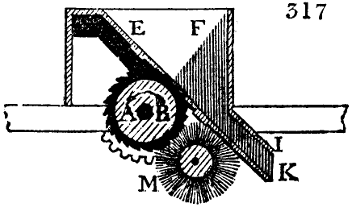
Fig. 317. A B, is a roller, about 9 inches in diameter,
which revolves in the direction of the arrow. This
cylinder consists of a parallel series of oblique pointed
circular saws made fast to one axis, and parted from
each other by wooden rings nearly one inch and a half
in thickness. Above the cylinder is a kind of hopper
E F, into which ginner throws the seed cotton, which
falls upon a grating, up though which small segments
of the saw-teeth project, so as to lay hold of the fibres in their revolution, and pull them
through, while the seeds being thus separated, roll down the slope of the grid, to be
discharged from the spout I K. M is a cylindrical brush placed below the grating,
which revolves against the saw teeth, so as to clear them of the adhering cotton
filaments.
The willow, which was originally a cylindrical willow basket, whence its name, but is
now a box made of wood, with revolving iron spikes, is the first apparatus to which
cotton wool is exposed, after it has been opened up, picked, and sorted by hand or a
rake, in what is called a bing. The willow exercises a winnowing action, loosens the
large flocks, and shakes out much of the dirt contained in them. The frame of the
willow is about 2 feet wide, and turns with its spikes at the rapid rate of 600 revolutions
per minute, whereby it tosses the cotton about with great violence. The heavy impurities
fall down through the grid bottom. It is exposed, however, for only a few
minutes to the action of this machine. For factories which work up chiefly the coarser
and fouler cottons of India, and Upland Georgia, the conical self-acting willow, as
constructed by Mr. Lillie at Manchester, is much employed. In it, the cotton is put
in at the narrow end of the truncated cone, which, being spiked, and revolving rapidly
within a nearly concentric case upon a horizontal axis, wafts it on towards the wide end,
while its impurities are partly shaken out through the grid or perforated bottom, and
partly sucked up through revolving squirrel wire cages, by the centrifugal action of a
fan. This is a powerful automatic engine, deserving the study of the curious, and is
as safe as it is powerful. The cone of this huge machine makes from 400 to 600 turns
per minute, and will clean 7200 pounds, or 24 bags, in a day.
After shaking out the grosser impurities by the willow, the cotton spinner proceeds
to separate each individual filament of cotton wool from its fellow, so as to prepare it
for carding, and to free it from every particle of foreign matter, whether lighter or
heavier than itself. This second operation is performed by what are called batting
(beating), scutching, and blowing machines, which are all now much the same, whatever
difference of signification the name may have. Indeed, each machine not only
beats, scutches, but blows. Fig. 318. exhibits
a longitudinal section of a good
blowing engine of modern construction.
The machine is about 18 or 19 feet long,
and three feet across within the case. The
whole frame is made of cast-iron, lined
with boards, forming a close box, which has
merely openings for introducing the raw
cotton wool, for taking out the cleansed
wool, and removing the dust as it collects
at the bottom. These doors are shut during
the operation of the machine, but may be
opened at pleasure, to allow the interior to
be inspected and repaired.
The introduction of the cotton is effected
by means of an endless cloth or double
apron, which moves in the direction of
the arrow a a, at the left end of the figure,
by passing round the continually revolving
rollers at b and c. The two rollers at e,
being the ones which immediately introduce
the cotton into the jaws, as it were,
of the machine, are called the feed rollers.
The batting arm, or revolving diameter,
f e, turns in the direction of the arrow, and
strikes the flocks violently as they enter, so
as to throw down any heavy particles upon
the iron grating or grid at n, while the
light cotton filaments are wafted onwards
with the wind, from the rotation of the
scutcher in the direction of arrow a′, along
the second travelling apron, upon which the
squirrel cage cylinder presses, and applies
the cotton in the form of a lap. Above the
cylindric cage h, which turns in the direction
of its arrow, there is a pipe k, the
continuation of the case i. This pipe,
though broken off in the figure, communicates
by a branch pipe with an air-sucking
fan ventilator, not seen in this
figure, but explained under Foundry. The
cage h, by its rotation, presses down, as we
have said, the half-cleaned cotton upon the
cloth a′, which carries it forward to the
second scutcher f′, by the second set of
feed rollers e′. The second scutcher throws
down the heavy dust upon the second
grid n′, through which it falls upon the
bottom of the case. The first scutcher
makes about 1280 strokes of each of its
two arms in a minute; the second 1300.
The feed rollers for each are fluted. The feed cloth is either sustained by a board, or
is made of parallel spars of wood, to secure it against bagging, which would render the
delivery of the cotton irregular. The feed rollers make 8 turns in the minute, and as
their diameter is 11⁄2 inches, they will introduce 8 times their circumference, or 37·7
inches of the cotton spread upon the apron in that time. Upon every 12th part of an
inch of the cotton, therefore, nearly 3 blows of the scutcher arm will be applied. The
second feed rollers move relatively with more slowness, so that for every 2·4 blows of
the scutcher, only one twelfth of an inch of cotton wool is presented.
The fan is inclosed in a cylindrical case. The wings or vanes revolve from 120 to
150 times in the minute; and while they throw the air out with nearly this velocity
at their excentric outlet in the circumference, they cause it to enter, with equal
velocity, at the centre. With this centre the squirrel cage is connected by a pipe, as
above stated. The sound filaments
of the cotton are arrested by
the sieve surface of the cylindric
cage, and nothing but the broken
fragments and the light dust can
pass through.
The cotton wool in the blowing
machine is wafted by the second
scutcher into the space x, w w,
provided with a fine grid bottom;
or it is sometimes wound up
there by rollers into a lap.
In fig. 318. an additional ventilator
is introduced beneath at
m, o o, to aid the action of the
scutchers in blowing the cotton
onwards into the oblong trough
a. The outlet of that fan is at
t; and it draws in the air at its
axis q. u and v, are two doors
or lids for removing the cleaned
cotton wool. This last fan is
suppressed in many blowing machines,
as the scutching arms
supply a sufficient stream of air.
The dotted lines show how the
motion is transmitted from the
first mover at s, to the various
parts of the machine. 6′ 6′ represent
the bands leading to the
main shafting of the mill. A
machine of this kind can clean
fully 600 pounds of short-stapled
cotton wool in a day, with the
superintendence of one operative,
usually a young woman, to distribute
the cotton upon the first
feed cloth.
The second Blowing machine
is usually called a lap machine,
because, after blowing and scutching
the cotton, as above described,
it eventually coils the fleece upon
a wooden roller at the delivering
end of the apparatus. It is
sometimes also called a spreading
machine. A section of it is
shown in fig. 319. The breadth
of this machine is about 3 feet as
the lap formed is prepared for
the usual breadth of the breaker
cards, namely 3 feet. Where the
cards are only 18 inches broad,
the lap machine is also made of
the same breadth. In the figure we see the feed-cloth, the scutching barrel, the
squirrel suction, and spreading cage, and the rollers for coiling up the lap. The
lever shown below is for removing the pressure weight from the axis of the lap
rollers, when a full one is to be removed, and replaced by an empty one. m, at the top,
is the commencement of the pipe which leads to the suction fan, or ventilator. The
thickness of the lap in this machine must be nicely regulated, as it determines, in a
great measure, the grist of the card ends, and even the rovings. In 12 hours such a
lap machine will prepare 650 pounds of cotton.
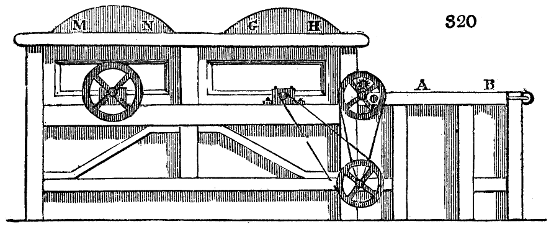
Fig. 320. is the first scutching machine, now never seen except in the oldest factories.
A B is the feed cloth; G H and M N are the two scutcher frames.
Carding is the next operation in a cotton factory. Cards are destined to disentangle
the individual filaments from each other, and to lay them lengthwise, instead of being
doubled up and convoluted, as they usually are in leaving the blowing and lap
machines. Carding consists in the mutual action of two opposite surfaces, which are
studded thick with oblique angled hooks. The wires of which these hooks are made must
be very hard drawn in order to render them stiff and elastic. The middle part of the
figures shows one of the staples or double teeth, the structure of which has been partly
explained under Card. Suppose a, fig. 321. to be a piece of a card fillet, and b to be
another piece, each being made fast with pins to a board; the teeth of these two cards
are set in opposite directions, but are very near together, and parallel. Now suppose
a flock or tuft of cotton placed between two such bristling surfaces. Let a be moved
in the direction of its arrow, and let b be moved in the opposite direction, or even let it
remain at rest. Every filament of the cotton will be laid hold of by each set of teeth,
when their surfaces are thus drawn over each other; the teeth of a will pull them in a
forward direction, while those of b will tend to retain them, or to pull them backwards.
The loops or doublings will, by both movements, be opened or drawn out, so that the
flocks will be converted into rows of parallel filaments, lying alongside or before each
other. Each tooth will secure to itself one or more of them, and by the friction of its
sides, as well as the hooks of its points, will draw them to their utmost elongation.
Though one stroke of the opposite cards be inadequate to produce this equable arrangement,
yet many repeated strokes must infallibly accomplish the end in view, of laying
the fibres parallel.
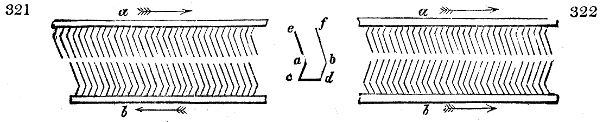
Let us suppose this end effected, and that all the fibres have been transferred to the
card a, a transverse stroke of b will draw over to it a certain number of them, and indeed
at each stroke there will be a new partition between the two cards, with increased
parallelism, but still each card will retain a great deal of the cotton. To make one
card strip another, the teeth of one of them must be placed in a reverse position, as
shown in fig. 322.
If a be now drawn in the direction of its arrow along the face of b, it will inevitably
comb out all, or almost all, the filaments from it, since the hooks of b have, in this position,
no power of retaining them. Even the doubled fibres or loops will slip over the
sloping point of b, in obedience to the traction of a. By considering these two relative
positions of the cards, which take place in hand cards, simply by reversing one of them,
any person will be able to understand the play of a cylinder card against its flat top, or
against another cylinder card, the respective teeth being in what we may call the teazing
position of fig. 321.; and also the play of a cylinder card against the doffer cylinder,
in what may be called the stripping position of fig. 322.
Cylinder cards, so essential to the continuity and dispatch of cotton factory labour,
were the ingenious invention of Lewis Paul of Northampton, but were greatly improved
and brought into nearly their present operative state by Sir Richard Arkwright. A
carding engine consists of one or more cylinders, covered with card-leather (sometimes
called card cloth), and a set of plane surfaces similarly covered, made to work against
each other, but so that their points do not come into absolute contact. Some cards
consist entirely of cylinders, the central main cylinder being surrounded by a series of
smaller ones called urchins or squirrels. These are used solely for preparing the coarser
stapled cotton, and sheep’s wool for the wool spinner.
Fig. 323. represents a card of excellent construction, which may be called a breaker
and finisher, as it is capable of working up the fleece roll of the lapping machine directly
into a card-end or riband fit for the drawing machine. In fine spinning mills
there are always, however, two cards; one coarser, called a breaker, which turns off
the cotton in a broad fleece of extreme thinness, which is lapped round a cylinder;
and constitutes the material presented to the finisher card, which has teeth of a finer
construction.
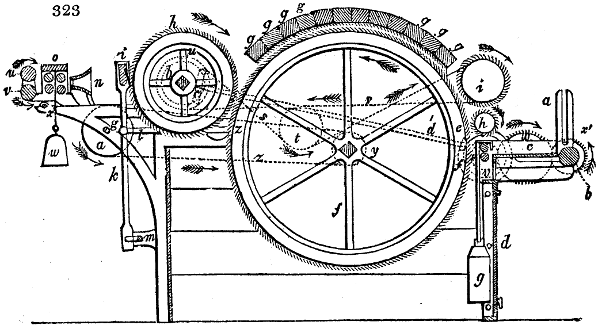
a is one of the two upright slots, which are fixed at each side of the engine for receiving
the iron gudgeons of the wooden cylinders round which the fleece of the lapping
machine is rolled. The circumference of this coil rests upon a roller b, which is made to
turn slowly in such a direction as to aid the unfolding of the lap by the fluted cylinders
e. The lap proceeds along the table seen beneath the letter c, in its progress to the fluted
rollers, which are an inch and one-sixth in diameter, and have 28 flutings in their circumference.
g is a weight which hangs upon the axis of the upper roller, and causes
it to press upon the under one: f is the main card drum; g g g, the arch formed by
the flat top cards; h, the small card cylinder for stripping off the cotton, and therefore
called the doffer, as we have said; i, the doffer-knife or comb for stripping the fleecy
web from the doffer; k l q m, the lever mechanism for moving these parts. At d there is
a door for permitting the tenter to have access to the interior of the engine, and to remove
whatever dirt, &c. may happen to fall into it. In fig. 324. we see the manner of fixing
the flat tops g g over the drum; and for making the matter clearer, three of the tops
are removed. Upon the arched cast-iron side of the frame, a row of strong iron pins k
are made fast in the middle line; and each top piece has, at each of its ends, a hole,
which fits down upon two such opposite pins. l l are screws whose heads serve as
supports to the tops, by coming into contact with the bottom of the holes, which are not
of course bored through the wood of the tops. By turning the heads of these screws a
little the one way or the other, the pins may be lengthened or shortened in any degree,
so as to set the tops very truly in adjustment with the drum teeth revolving beneath
them, h′ is the small runner or urchin, and i′ the large runner; both of which are
spirally covered from end to end with narrow card fillets, in the same manner as the
doffer. The main drum is on the contrary covered with card cloth, in strips laid on
parallel to its axis, with interjacent parallel smooth leather borders. The teeth of these
several cards are set as represented in the figure, and their cylinders revolve as the arrows
indicate. The runners as well as the doffer cylinder may be set nearer to or farther
from the drum f; but the screws intended for this adjustment are omitted in the drawings,
to avoid confusion of the lines.
The card-end or fleece taken off the doffer h by the crank and comb mechanism i k m,
passes through the tin plate or brass funnel n, fig. 323., whereby it is hemmed in and
contracted into a riband, which is then passed through between a pair of drawing rollers
o. It is next received by the rollers u v, which carry it off with equable velocity,
and let it fall into the tin cans placed below, or conduct it over a friction pulley, to be
wound along with many other card-ends upon a lap roller or large bobbin. The latter
mechanism is not shown in this figure. A sloping curved tin or brass plate, channelled or
ridged along its surface, conducts the card ribands separately; there are two smooth
iron rollers for condensing the several ribands, and a wooden pin round which the
ribands are lapped, resting between two leather-covered rollers, one of which receives
motion from mill geering, and imparts it by friction to the lap roller over it. The iron
ends of the lap roller lie in upright slots, which allow them freedom to rise as the roller
gets filled with fleece.
The two pairs of rollers at o, effect the extension of the card-end, and reduce its size.
The under rollers are made of iron and fluted; the upper ones are also made of iron,
but they are covered with a coat of leather, nicely glued on over a coat of flannel, which
two coats render them both smooth and elastic. Two weights, w, press the upper cylinders
steadily down upon the under ones. Between the first and second pair there is a
certain interval, which should be proportioned to the length of the cotton staple. The
second, or that furthest from the funnel, revolves with greater velocity than the first, and
therefore turns out a greater length of riband than it receives from its fellow; the consequence
is a corresponding extension of the riband in the interval between the two
pairs of rollers.
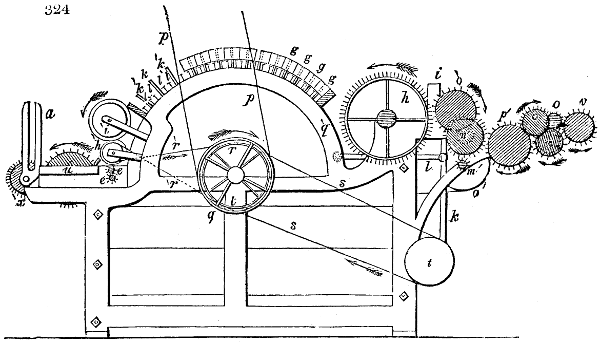
The motions of the several parts of the engine are effected in the following way. The
band, p p, fig. 324., which comes down from the pulley upon the main shaft near the ceiling
of the work-room, drives, by means of the pulley q, the drum f, fig. 323., with a velocity of
from 120 to 140 revolutions in a minute. From another pulley r, on the axis of the drum,
the axis of t is driven by the band s working round the pulley t on its end. This shaft
drives the crank and lever mechanism of the stripper knife i. A third pulley of the same
size as r is fixed just within the frame to the other end of the drum, and from it a crossed
or close band r′ goes to a pulley upon the small runner h′, to give this its rapid rotation.
Upon the opposite end of the engine in fig. 323., these wheels and pulleys are marked
with dotted lines. Here we may observe, first, a pulley y upon the drum, and a pulley
a′, which receives motion from it by means of the band z. The axis of a′, carries
in front a pinion m′, which sets in motion the wheel n′. The latter imparts motion,
by means of a pinion and intermediate wheel o′, to the wheel h on the doffer
cylinder, and consequently to that cylinder on the one hand; and it turns, by the carrier
wheel p′, a wheel x, whose axis is marked also with x in fig. 323., upon the other
hand. The axis of x′, fig. 323., carries, towards the middle of the engine, a very broad
wheel, which is represented by a small dotted circle. The toothed wheel v of the smooth
roller v′, fig. 323., and the two toothed wheels o o, fig. 324., of the under rollers o o, fig.
323., work into that broad wheel. The wheel of the second or delivery fluted roller is
seen to be smaller than that of the first, by which means the difference of their velocities
is obtained. The large runner i is driven from the main drum pulley, by means of the
band s′, and the pulley u′, fig. 323. The said band is crossed twice, and is kept in
tension by the pulley t′, round which it passes. The motion of the fluted rollers e, which
feed in the cotton fleece, is effected by means of a bevel wheel b′ on the end of the
doffer, which works into a similar wheel c′ on the oblique axis d′ (dotted lines across the
drum), of the pinion e′ upon the lower end of the same axis which turns the wheel f′,
upon the under feed roller.
Each of the feed rollers, fig. 324., bears a pinion e e at one end, so that the upper roller
turns round with the under one. The roller b, fig. 323., is set in motion by means of
its wheel x′; which is driven by a wheel v′ on the other end of the under feed roller,
through the intervention of the large carrier wheel w′. The original or first motion of
b must be as quick as that of the fluted feed rollers e, in order that the former may uncoil
as much lap as the latter can pass on.
The annexed table exhibits the proper velocities of the different cylinders and rollers
of the carding engine, which, however, are not invariable, but may be modified according
to circumstances, by changing the pinions e′, fig. 323., and w′, according to the quality
or length of the cotton staple. The velocities stated in the table will be obtained
when the pulley a′, fig. 323., is made greater than y in the proportion of 3 to 2, and the
wheels and pinions have the following number of teeth: m′, 18; n′, 50; its pinion, 18;
h, 128; x, 24; the broad wheel upon the shaft of x, 37 teeth; the wheel o of the first
fluted roller, 35; that of the second, 21; v, 44; b′ and e′, 54; e′, 10;
f′, 63.
| Names of the parts. |
Diameter
in inches. |
Circum-
ference
in inches. |
Revolutions
in one
minute. |
Velocity. |
| Drum f |
35 |
|
109 |
·9 |
130 |
|
142 |
·87 |
| Doffer h |
14 |
|
43 |
·96 |
4 |
·38 |
192 |
·5 |
| Runner or urchin i′ |
6 |
·25 |
19 |
·62 |
5 |
· |
98 |
·1 |
| Ditto h′ |
3 |
·5 |
11 |
· |
470 |
· |
5170 |
· |
| Fluted feed roller e |
1 |
·167 |
3 |
·664 |
0 |
·696 |
2 |
·55 |
| First drawing roller o |
1 |
· |
3 |
·14 |
68 |
·71 |
215 |
·75 |
| Second ditto |
1 |
·167 |
3 |
·664 |
114 |
·52 |
419 |
·6 |
| Smooth delivery roller v |
2 |
·5 |
7 |
·85 |
54 |
·66 |
429 |
·08 |
The operation of the runners, h′ and i′, becomes very plain on comparing their speed
with one another and with that of the main-drum, and taking into account the direction
of the card teeth. The cotton wool, taken off from the feed-rollers by the drum, is
caught by the opposite teeth of the large runner i′, which, on account of its slower surface
rotation (98 inches per minute) may be considered to be at rest with reference to the
drum, and therefore, by holding the cotton in its teeth, will commence its carding. The
small runner h′, in consequence of its greater surface velocity (5170 inches per minute)
will comb the cotton-wool back out of the teeth of the large runner, but it will
give it up in its turn to the swifter teeth of the drum, which, in carrying it forwards,
encounters the teeth of the top cards, and delivers up the filaments to their keeping for
some time. We thus see how essential the runners are to the perfection as well as to
the acceleration of the carding process for ordinary cotton wool, though for the slenderer
and longer filaments of the sea-island kind they are not so well adapted. In cleaning
the carding-engines the little runner must be looked to every time that the drum is examined.
The large runner and the doffer require to be cleaned together. The quantity
of cotton spread upon the feed-cloth, the velocity of it, and of the drawing-rollers, must
all be carefully adjusted to the grist of the yarn intended to be spun.
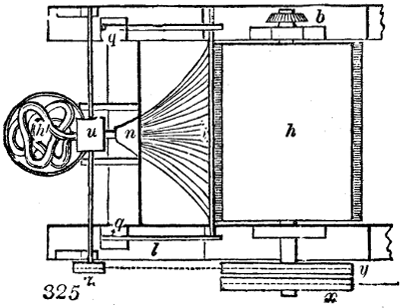
Suppose the sizes and velocities to be as represented in the preceding table, that the
engine is a double card 36 inches broad, and that it is furnished with a lap from the lap-machine
of which 30 feet in length weigh 5 lbs. In one minute the surface of the feed-rollers,
e, passes 2·55 inches of that lap onwards; in the same time the main drum f will
work it off. To card the whole 30 feet, therefore, 141 minutes, or 2 hours and 21 minutes
will be required. In this time the circumference of the rollers, u v, moves through a
space of 141 × 42,908 in. = 5042 ft., and delivers a card-end of that length, weighing
5 lbs., minus 6 per cent. for waste, that is 4 lbs. 111⁄2 oz. One pound will form a riband
1072 feet long, being, according to the English mode of counting, about number 1⁄3, or
0·357. The extension of the cotton-fleece to this degree proceeds as follows:—In the
141 minutes which the feed-rollers take to introduce the 30 feet of lap, the doffer, h,
makes 617·58 revolutions, and the comb, or doffer knife, i, detaches from the doffer
teeth, a thin fleecy web of 2262 feet in length. The first drawing pair of fluted rollers,
by its quick motion, with the aid of the funnel,
m, converts this fleece into a riband 2535 feet
long. The second pair of the fluted rollers extends
this riband to 4390 feet, since their surface
velocity is greater than the first pair in that
proportion. The slight elongation (of only 112
feet, or about 1⁄44) which takes place between
the delivery fluted rollers and the smooth cylinders,
v, u, serves merely to keep the card-end
steadily upon the stretch without folding. Fig.
325. is a plan of the card and the fleece, where
h is the cylinder, n is the funnel, u the pressing
rollers, and h′ the card-ends in the can.
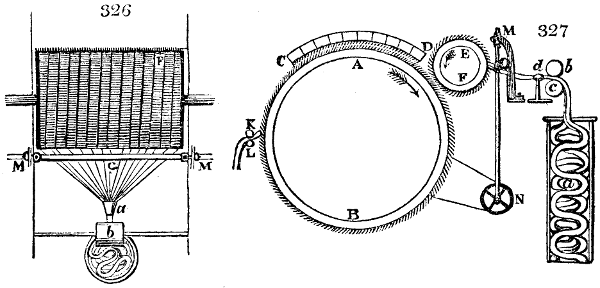
Figs. 326, 327. represent skeletons of the old cards to facilitate the comprehension of
these complex machines. Fig. 326. is a plan; F is the main drum; M M is the doffer
knife or comb; G, the carded fleece hemmed in by the funnel a, pressed between the
rollers b, and then falling in narrow fillets into its can. Fig. 327. K L are the feed
rollers; A B, the card drum; C D, the tops; E F, the doffer card; M N, the doffer knife;
d, b, c, the card-end passing between compressing rollers into the can a.
The drawing and doubling are the next operation. The ends, as they come from the
cards, are exceedingly tender and loose, but the filaments of the cotton are not as yet laid
so parallel with each other as they need to be for machine spinning. Before any degree
of torsion therefore be communicated, a previous process is required to give the filaments
a level arrangement in the ribands. The drawing out and doubling accomplish this purpose,
and in a manner equally simple and certain. The means employed are drawing-rollers,
whose construction must here be fully explained, as it is employed in all the following
machines; one example of their use occurred, indeed, in treating of the cards.
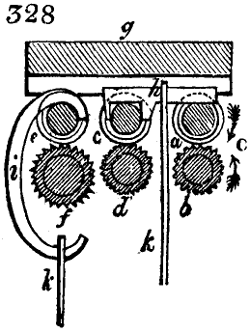
Let a and b, fig. 328., represent the section of two rollers lying
over each other, which touch with a regulated pressure, and turn in
contact upon their axes, in the direction shown by the arrows.
These rollers will lay hold of the fleecy riband presented to them at
a, draw it through between them, and deliver it quite unchanged.
The length of the piece passed through in a given time will be equal
to the space which a point upon the circumference of the roller
would have percured in the same time; that is, equal to the periphery
of one of the rollers multiplied by the number of its entire
revolutions. The same thing holds with regard to the transmission
of the riband through between a second pair of rollers,
c, d, and a third, e, f. Thus the said riband issues from the third pair exactly the
same as it entered at a, provided the surface speed of all the rollers be the same.
But if the surface speed of c and d be greater than that of a and b, then the first-named
pair will deliver a greater length of riband than the last receives and transmits to
it. The consequence can be nothing else in these circumstances than a regulated drawing
or elongation of the riband in the interval betwixt a, b, and c, d, and a condensation
of the filaments as they glide over each other, to assume a straight parallel direction. In
like manner the drawing may be repeated by giving the rollers, e, f, a greater surface
speed than that of the rollers, c and d. This increase of velocity may be produced,
either by enlarging the diameter, or by increasing the number of turns in the same time,
or finally by both methods conjoined. In general the drawing-machine is so adjusted,
that the chief elongation takes place between the second and third pairs of rollers, while
that between the first and second is but slight and preparatory. It is obvious, besides,
that the speed of the middle pair of rollers can have no influence upon the amount of
the extension, provided the speed of the first and third pair remains unchanged. The
rollers, a, b, and c, d, maintain towards each other continually the same position, but they
may be removed with their frame-work, more or less, from the third pair, e, f, according
as the length of the cotton staple may require. The distance of the middle point from
b and d, or its line of contact with the upper roller, is, once for all, so calculated, that it
shall exceed the length of the cotton filaments, and thereby that these filaments are never
in danger of being torn asunder by the second pair pulling them while the first holds
them fast. Between d and f, where the greatest extension takes place, the distance must
be as small as it can be without risk of tearing them in that way; for thus will the uniformity
of the drawing be promoted. If the distance between d and f be very great, a
riband passing through will become thinner, or perhaps break in the middle; whence we
see that the drawing is more equable, the shorter is the portion submitted to extension at
a time, and the nearer the rollers are to each other, supposing them always distant
enough not to tear the staple.
The under rollers b d f are made of iron, and, to enable them to lay firmer hold of the
filaments, their surfaces are fluted with triangular channels parallel to their axes. The
upper rollers, a c e, are also made of iron, but they are smooth, and covered with a double
coating, which gives them a certain degree of softness and elasticity. A coat of
flannel is first applied by sewing or gluing the ends, and then a coat of leather in the
same way. The junction edges of the leather are cut slanting, so that when joined by
the glue (made of isinglass dissolved in ale) the surface of the roller may be smoothly
cylindrical. The top rollers are sometimes called the pressers, because they press by
means of weights upon the under ones. These weights are suspended to the slight rods
k k′; of which the former operates on the roller e alone, the latter on the two rollers
a and e together. For this purpose the former is hung to a C shaped curve i, whose
upper hook embraces the roller e; the latter to a brass saddle h, which rests upon a and
c. A bar of hard wood, g, whose under surface is covered with flannel, rests, with merely
its own weight, upon the top rollers, and strips off all the loose hanging filaments. Similar
bars with the same view are made to bear up under the fluted rollers b d f, and
press against them by a weight acting through a cord passing over a pulley. Instead of
the upper dust-covers, light wooden rollers covered with flannel are occasionally
applied.
Were the drawing of a riband continued till all its fibres acquired the desired degree
of parallelism, it would be apt, from excessive attenuation, to tear across, and thereby
to defeat the purpose of the spinner. This dilemma is got rid of in a very simple way,
namely, by laying several ribands together at every repetition of the process, and incorporating
them by the pressure of the rollers. This practice is called doubling. It is an exact
imitation of what takes place when we draw a tuft of cotton wool between our fingers and
thumb in order to ascertain the length of the staple, and replace the drawn filaments
over each other, and thus draw them forth again and again, till they are all parallel
and of nearly equal length. The doubling has another advantage, that of causing the
inequalities of thickness in the ribands to disappear, by applying their thicker to their
thinner portions, and thereby producing uniformity of substance.
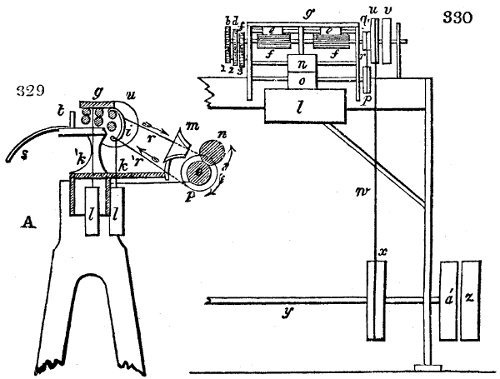
The drawing frame, as shown in section in figs. 328. 330., and in a back view in fig.
329., will require, after the above details, little further explanation. l l are the weights which
press down the top rollers upon the under ones, by means of the rods k k′ and hook i. Each
fluted roller is, as shown at f, fig. 329., provided in the middle of its length with a thinner
smooth part called the neck, whereby it is really divided into two fluted portions, represented
by e e in the figure. Upon this middle neck in the pressure rollers, the hook i and the
saddle h immediately bear, as shown in the former fig. 328. The card-ends, to the number
probably of six, are introduced to the drawing frame either from tin cans, placed at e e, fig.
330., and at A, fig. 329., or from lap-bobbins; and, after passing through it, the ribands or slivers
are received either into similar tin cans, as g, or upon other lap-bobbins upon the other
side. These appendages may be readily conceived, and are therefore not exhibited in all
the drawings. Three of the slivers being laid together, are again introduced to the one
fluted portion a b, fig. 328., and three other slivers to the other portion. The sloping
curved tin or brass plate s, fig. 329., with its guide pins t, serves to conduct the slivers
to the rollers. When the two threefold slivers have passed through between the three
pairs of rollers, and been thereby properly drawn, they run towards each other in an
oblique direction, behind the last roller pair e f, fig. 328., and unite, on issuing through the
conical funnel m, fig. 329., into a single riband or spongy sliver; which is immediately
carried off with equable velocity by two smooth cast-iron rollers, n o, fig. 329. and 330.
and either dropped into a can, or wound upon a large bobbin. The surface speed of
these rollers is made a trifle greater than that of the delivery drawing rollers, in order to
keep the portion of sliver between them always in an extended state. Four fluted drawing
portions are usually mounted in one drawing frame, which are set a-going or at rest together.
To save all unnecessary carrying of the cans from the back to the front of
the frame, the drawing heads are so placed, that the first and third, discharge their slivers
at the one side, and the second and fourth at the other. By this arrangement, the cans
filled behind one head, are directly pushed aside in front of the next drawing head;
by which alternate distribution the work goes on without interruption.
The fast pulley u, fig. 330., by which the whole machine is driven, derives its motion
from the main shaft of the mill by means of the band w. The similar pulley x, which
sits loose upon the axis, and turns independently of it, is called the loose pulley; both
together being technically styled riggers. When the operative desires to stop the machine,
he transfers the band from the fast to the loose pulley by means of a lever, bearing a fork
at its end, which embraces the band. Upon y, four pulleys such as x are fixed, each of
which sets in motion a drawing head, by means of a band like w going round the pulleys
x and u. On account of the inverted position of the heads, which requires the
motion of u to be inverted, the bands of the first and third heads are open, but those of
the second and fourth are crossed. Every head is provided with a loose pulley v, as well
as the fast pulley u, in order to make the one stop or move without affecting the others.
The shaft of the pulley u is the prolonged shaft of the backmost fluted roller f. It carries
besides a small pulley q, which, by means of the band r, and the pulley p, fig. 329., sets
in motion the undermost condensing roller o. The upper roller n, presses with its whole
weight upon it, and therefore turns by friction. The toothed wheel-work, by which the
motions are communicated from the backmost fluted roller to the middle and front ones,
are seen in fig. 330.
The wheel f, fig. 328., of 20 teeth, works in a 44-toothed carrier-wheel, on whose
axis there are two smaller wheels; 2 with 26 teeth, and 1 with 22 teeth. The wheel d, fig.
330., of the middle roller, and the wheel b of the front roller, are set in motion by other
carrier wheels; the first has 27 teeth, and the last 40. For every revolution of b, the
roller d makes nearly 13⁄4 turns, and the roller f, 4 revolutions. The top rollers revolve,
as we have stated, simply by the friction of contact with the lower ones. Now suppose
the diameter of the rollers b and d to be 1 inch or 12 lines, that of f, 11⁄4 inches or 15
lines, the surface velocities of the three pairs of rollers in the series will be as 1, 13⁄4, and 5.
Every inch of the cotton sliver will be therefore extended between the first and second
pair of rollers into 13⁄4 inches, and between the second and third or delivery pair into
5 inches; and after the sliver has passed through all the four drawing heads, its length
will be increased 625 times = 5 × 5 × 5 × 5.
The further the drawing process is pushed, the more perfectly will its object be accomplished;
namely the parallelism of the filaments. The fineness of the appearance
of the sliver after the last draught depends upon the number of doublings conjointly
with the original fineness and number of drawings. The degree of extension may be
increased or diminished, by changing the wheels in fig. 330., for others with a different
number of teeth. Thus the grist or fineness of the sliver may be modified in any desired
degree; for, when the subsequent processes of the mill remain the same, the finer
the drawings the finer will be the yarn. For spinning coarse numbers or low counts, for
example, six card-ends are usually transmitted through the first drawing head, and converted
into one riband. Six such ribands again form one in the second draught; six
of these again go together into the third sliver; and this sliver passes five-fold through the
last draught. By this combination 1080 of the original card-ends are united in the
finished drawn sliver = 6 × 6 × 6 × 5. The fineness of the sliver is, however, in consequence
of these doublings not increased but rather diminished. For, by the drawing, the card-end
has been made 625 times longer, and so much smaller; by the doubling alone it
would have become 1080 times thicker; therefore the original grist is to the present as
1, to the fraction 625⁄1080; that is, supposing 1072 feet of the riband delivered by the card
to weigh one pound, 625 feet, the sliver of the last drawing, will also weigh a pound,
which corresponds in fineness to number 0·24, or nearly 1⁄4.
The rearmost or last drawing roller has a circumference of nearly 4 inches, and
makes about 150 revolutions per minute; hence, each of these drawing heads may
turn off 35,000 feet of sliver in 12 hours.
Some manufacturers have lately introduced a double roller beam, and a double
draught at the same doubling, into their drawing frames. I have seen this contrivance
working satisfactorily in mills where low counts were spun, and where the tube roving
frame was employed; but I was informed by competent judges, that it was not advisable
where a level yarn was required for good printing calicoes.
The loss which the cotton suffers in the drawing frame is quite inconsiderable. It
consists of those filaments which remain upon the drawing rollers, and collect, in a great
measure, upon the flannel facing of the top and bottom cleaner bars. It is thrown
among the top cleanings of the carding engine. When from some defect in the rollers,
or negligence in piecing the running slivers, remarkably irregular portions occur
in the ribands, these must be torn off, and returned to the lap machine to be carded
anew.
The fifth operation may be called the first spinning process, as in it, the cotton sliver
receives a twist; whether the twist be permanent as in the bobbin and fly frame, or be
undone immediately, as in the tube-roving machine. In fact, the elongated slivers of
parallel filaments could bear little further extension without breaking asunder, unless
the precaution were taken to condense the filaments by a slight convolution, and at the
same time to entwine them together. The twisting should positively go no further
than to fulfil the purpose of giving cohesion, otherwise it would place an obstacle in the
way of the future attenuation into level thread. The combination of drawing and
twisting is what mainly characterizes the spinning processes, and with this fifth operation
therefore commences the formation of yarn. As however a sudden extension to
the wished-for fineness is not practicable, the draught is thrice repeated in machine
spinning, and after each draught a new portion of torsion is given to the yarn, till at
last it possesses the degree of fineness and twist proportioned to its use.
The preliminary spinning process is called roving. At first the torsion is slight in
proportion to the extension, since the solidity of the still coarse sliver needs that cohesive
aid only in a small degree, and looseness
of texture must be maintained to facilitate
to the utmost the further elongation.
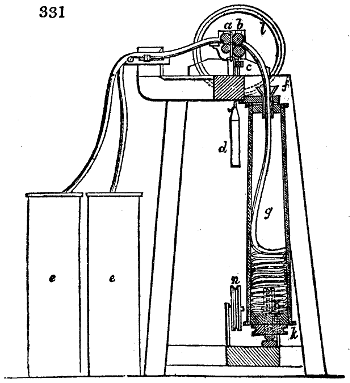
Fig. 331. is a section of the can roving
frame, the ingenious invention of Arkwright,
which till within these 14 years
was the principal machine for communicating
the incipient torsion to the spongy
cord furnished by the drawing heads. It
differs from that frame in nothing but
the twisting mechanism; and consists of
two pairs of drawing rollers, a and b, between
which the sliver is extended in the
usual way; c are brushes for cleaning the
rollers; and d is the weight which presses
the upper set upon the lower. The wiping
covers (not shown here) rest upon a b.
The surface speed of the posterior or second
pair of rollers is 3, 4, or 5 times greater
than that of the front or receiving pair,
according to the desired degree of attenuation.
Two drawn slivers were generally united into one by this machine, as is shown
in the figure, where they are seen coming from the two cans e e, to be brought together
by the pressure rollers, before they reach the drawing rollers a b. The sliver, as it escapes
from these rollers, is conducted into the revolving conical lantern g, through the funnel
f at its top. This lantern-can receives its motion by means of a cord passing over a
pulley k, placed a little way above the step on which it turns. The motion is steadied
by the collet of the funnel f, being embraced by a brass busk. Such a machine generally
contained four drawing heads, each mounted with two lanterns; in whose side
there was a door for taking out the conical coil of roving.
The motion imparted to the back roller by the band pulley or rigger m, was conveyed
to the front one by toothed wheel work.
The vertical guide pulley at bottom n, served to lead the driving band descending
from the top of the frame round the horizontal whorl or pulley upon the under end of
the lantern. The operation of this can-frame was pleasing to behold; as the centrifugal
force served both to distribute the soft cord in a regular coil, and also to condense a
great deal of it most gently within a moderate space. Whenever the lantern was filled,
the tenter carried the roving to a simple machine, where it was wound upon bobbins by
hand. Notwithstanding every care in this transfer, the delicate texture was very apt to
be seriously injured, so as to cause corresponding injuries in every subsequent operation,
and in the finished yarn. Messrs. Cocker and Higgins, of Salford, had the singular
merit, as I have said, of superseding that beautiful but defective mechanism, which
had held a prominent place in all cotton mills from almost the infancy of the factory
system, by the following apparatus.
The Bobbin and Fly frame is now the great roving machine of the cotton manufacture;
to which may be added, for coarse spinning, the tube roving frame. Of such a
complicated machine as the bobbin and fly frame, it is not possible to give an adequately
detailed description in the
space due to the subject in this
Dictionary. Its mechanical combinations
are however so admirable
as to require such an account as
will make its functions intelligible
by the general reader.
Fig. 332. exhibits a back view
of this machine; and fig. 333. a
section of some of the parts not
very visible in the former figure.
The back of the machine is the
side at which the cotton is introduced
between the drawing rollers.
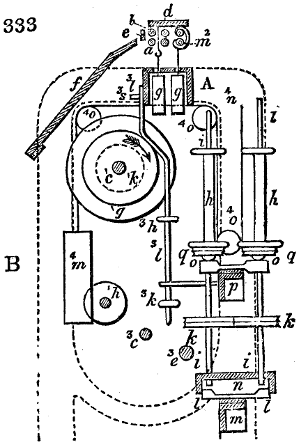
The cans, or lap-bobbins filled
with slivers at the drawing frame,
are placed in the situation marked
B, fig. 333., in rows parallel with
the length of the machine. The
sliver of each can or the united
slivers of two contiguous cans are
conducted upwards along the surface
of a sloping board f, and
through an iron staple or guide e,
betwixt the usual triple pair of
drawing rollers, the first of which
is indicated by a, b. In fig. 332.,
for the purpose of simplifying the
figure, the greater part of these
rollers and their subordinate parts
are omitted. After the slivers
have been sufficiently extended
and attenuated between the rollers,
they proceed forwards, towards the
spindles i i i, where they receive the
twist, and are wound upon the
bobbins h. The machine delineated
contains thirty spindles, but
many bobbin and fly frames contain
double or even four times that
number. Only a few of the spindles
are shown in fig. 332., for
fear of confusing the drawing.

With regard to the drawing functions of this machine, I have already given abundant
explanation, so far as the properties and operation of the rollers are concerned. The
frame-work of this part of the machine, called the roller-beam, is a cast iron bench, upon
which nine bearers c, are mounted for carrying the rollers. The fluted rollers a a a, fig.
334., are constructed in four pieces for the whole length, which are parted from each
other by thinner smooth cylindric portions z, called necks. Seven such partings for
four rollers, and one parting for two rollers, constitute together the 30 fluted rollers of
which the whole series consists. The coupling of these roller subdivisions into one
cylinder, is secured by the square holes x, and square pins y, fig. 334., which fit into the
holes of the adjoining subdivision.
The top or pressure rollers b, are
two-fold over the whole set; and the
weighted saddle presses upon the
neck w, which connects every pair,
as was already explained under fig. 329. These weights g, g, fig. 333., are applied in
this as in the drawing frame; d, are the bars faced with flannel for cleaning the top
rollers. A similar bar is applied beneath the rollers, to keep the flutings clean.
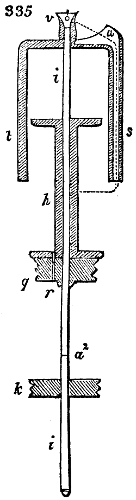
The structure and operation of the spindles i, may be best understood by examining
the section fig. 335. They are made of iron, are cylindrical from
the top down to a2, but from this part down to the steel tipt rounded
points they are conical. Upon this conical portion there is a pulley
k, furnished with two grooves in its circumference, in which the cord
runs that causes the spindle to revolve. The wooden bobbin h, is
slid upon the cylindrical part, which must move freely upon it, as
will be presently explained. To the bobbin another two-grooved
pulley or whorl q is made fast by means of a pin r, which passes
through it; by removing this pin, the bobbin can be instantly taken
off the spindle. The upper end of the spindle bears a fork s t,
which may be taken off at pleasure by means of its left-handed
screw; this fork or flyer, has a funnel-formed hole at v. One arm
of the fork is a tube s, u, open at top and bottom; the leg t, is
added merely as a counterpoise to the other. In fig. 333., for the
sake of clearness, the forks or flyers of the two spindles here represented
are left out; and in fig. 332. only one is portrayed for the
same reason. It is likewise manifest from a comparison of these
two figures that the spindles are alternately placed in two rows, so
that each spindle of the back range stands opposite the interval
between two in the front range. The object of this distribution
is economy of space, as the machine would need to be greatly longer
if the spindles stood all in one line. If we suppose the spindles and
the bobbins (both of which have independent motions) to revolve
simultaneously and in the same direction, their operation will be
as follows: The sliver properly drawn by the fluted rollers, enters
the opening of the funnel v, proceeds thence downwards through
the hole in the arm of the fork, runs along its tube u, s, and then
winds round the bobbin. This path is marked in fig. 335. by a
dotted line.
The revolution of the spindles in the above circumstances effects the twisting of the
sliver into a soft cord; and the flyer s, t, or particularly its tubular arm s, lays this cord
upon the bobbin. Were the speed of the bobbins equal to that of the spindles, that is,
did the bobbin and spindle make the same number of turns in the same time, the
process would be limited to mere twisting. But the bobbin anticipates the flyers a
little, that is, it makes in a given time a somewhat greater number of revolutions than
the spindle, and thereby effects the continuous winding of the cord upon itself.
Suppose the bobbin to make 40 revolutions, while the spindle completes only 30; 30 of
these revolutions of the bobbin will be inoperative towards the winding-on, because the
flyers follow at that rate, so that the cord or twisted sliver will only be coiled 10 times
round the bobbin, and the result as to the winding-on will be the same as if the spindle
had stood still, and the bobbin had made 40 - 30 = 10 turns. The 30 turns of the
spindles serve, therefore, merely the purpose of communicating twist.
The mounting and operation of the spindles are obviously the same as they are upon
the household flax wheel. In the bobbin and fly frame there are some circumstances
which render the construction and the winding-on somewhat difficult, and the mechanism
not a little complicated. It may be remarked in the first place, that as the cord is wound
on, the diameter of the bobbin increases very rapidly, and therefore every turn made
round it causes a greater length of roving to be taken up in succession. Were the
motions of the bobbins to continue unchanged in this predicament, the increased
velocity of the winding-on would require an increased degree of extension, or it would
occasion the rupture of the cord, because the front fluted rollers move with uniform
speed, and therefore deliver always the same length of sliver in the same time. It
is therefore necessary to diminish the velocity of the bobbins, or the number of their
turns, in the same proportion as their diameter increases, in order that the primary
velocity may remain unchanged. Moreover, it is requisite for the proper distribution
of the cord upon the bobbin, and the regular increase of its diameter, that two of its
successive convolutions should not be applied over each other, but that they should be
laid close side by side. This object is attained by the up and down sliding motion of the
bobbin upon the spindle, to the same extent as the length of the bobbin barrel. This
up and down motion must become progressively slower, since it increases the diameter
of the bobbin at each range, by a quantity equal to the diameter of the sliver. What
has now been stated generally, will become more intelligible by an example.
Let it be assumed that the drawing rollers deliver, in 10 seconds, 45 inches of
roving, and that this length receives 30 twists. The spindles must, in consequence,
make 30 revolutions in 10 seconds, and the bobbins must turn with such speed, that
they wind up the 45 inches in 10 seconds. The diameter of the bobbin barrels being
11⁄2 inches, their circumference of course 41⁄2 inches, they must make 10 revolutions more
in the same time than the spindles. The effective speed of the bobbins will be thus
30 + 10 = 40 turns in 10 seconds. Should the bobbins increase to 3 inches diameter,
by the winding-on of the sliver, they will take up 9 inches at each turn, and consequently
45 inches in 5 turns. Their speed should therefore be reduced to 30 + 5 = 35
turns in 10 seconds. In general, the excess in number of revolutions, which the
bobbins must make over the spindles, is inversely as the diameter of the bobbins.
The speed of the bobbins must remain uniform during the period of one ascent or
descent upon the spindle, and must diminish at the instant of changing the direction
of their up and down motion; because a fresh range of convolutions then begins with
a greater diameter. When, for example, 30 coils of the sliver or roove are laid in one
length of the bobbin barrel, the bobbin must complete its vertical movement up or
down, within 30 seconds in the first case above mentioned, and within 60 seconds in
the second case.
The motions of the drawing rollers, the spindles, and bobbins, are produced in the
following manner:—A shaft c′, fig. 332. and 333., extending the whole length of the
machine, and mounted with a fly wheel d′, is set in motion by a band from the running
pulley upon the shaft of the mill, which actuates the pulley a′. b′ is the loose pulley
upon which the band is shifted when the machine is set at rest. Within the pulley a′,
but on the outside of the frame, the shaft c′ carries a toothed wheel b2 with 50 teeth,
which by means of the intermediate wheel c2 turns the wheel d2 upon the prolonged
shaft of the backmost fluted roller (m2, fig. 333.) This wheel d2 has usually 54 teeth;
but it may be changed when the roove is to receive more or less twist; for as the
spindles revolve with uniform velocity, they communicate the more torsion the less
length of sliver is delivered by the rollers in a given time. Upon the same shaft with
d2, a pinion e2 of 32 teeth is fixed, which works in a wheel f2 of 72 teeth. Within
the frame a change pinion g2 is made fast to the shaft of f2. This pinion, which has
usually from 24 to 28 teeth, regulates the drawing, and thereby the fineness or number
of the roving. It works in a 48-toothed wheel h2 upon the end of the backmost fluted
roller a, fig. 333. The other extremity of the same roller, or, properly speaking, line of
rollers, carries a pinion l2, furnished with 26 teeth, which, by means of the broad
intermediate wheel k2, sets in motion the pinion i′2 of 22 teeth upon the middle roller.
When the diameter of all the drawing rollers is the same, suppose 1 inch, their proportional
velocities will be, with the above number of teeth in the wheel work, if g2 have
24 teeth, as 1 : 1·18 : 4·5; and the drawn sliver will have 41⁄2 times its original length.
The front or delivery roller of the drawing frame is of late years usually made 11⁄4 or
13⁄8 inches in diameter. If 625 feet of the sliver from the drawing frame weighed one
pound, 2790 feet of the roving will now go to this weight, and the number will be
1·12; that is, 1 hank and 12 hundredths to the pound. The front pair of fluted
rollers makes about 90 revolutions, and delivers 282·6 inches of roving in the minute,
when of one inch diameter.
The spindles i, (fig. 332. and 333.), rest, with their lower ends, in steps l, which are
fixed in an immoveable beam or bar m. To protect it from dust and cotton filaments,
this beam is furnished with a wooden cover n, in which there are small holes for the
passage of the spindles right over the steps. In fig. 332., two of the eight covers n, which
compose the whole range m, are removed to let the steps be seen. The cylindrical part
of each spindle passes through a brass ring o; and all these 30 rings, whose centres
must be vertically over the steps l, are made fast to the copping beam p. This beam
is so called, because it is destined not merely to keep the spindles upright by the rings
attached to it, but, at the same time, to raise and lower along the spindles the bobbins
which rest on these rings; for which purpose the two racks, or toothed bars m2 m2,
made fast to it, are designed, as will be presently explained. To effect the revolution
of the spindles, there are attached to the main shaft c′ two whorls or pulleys e′ f′, each
bearing four grooves of equal diameter. Each of these pulleys puts one half of the
spindles in motion, by means of a cord, which, after going round the whorls k, turns
four times about the pulleys of the shaft c′. Two guide pulleys h′, each four-grooved,
and two others i′, with a single groove, which turn independently of the others, upon
the above shaft, serve to give the whorl cords the proper direction, as well as to keep
them tight. The spindles revolve 200 times or thereby in the minute; and therefore
impart two turns or twists to every three inches of the roving.
The revolution of the bobbins is independent of that of the spindles, although it likewise
proceeds from the shaft c′, and differs from it in being a continually retarded
motion. The simplest method of effecting this motion, is by means of the wooden or
tin plate cone k′′, which revolves equally with the shaft c′, and at the same time slides
along it.
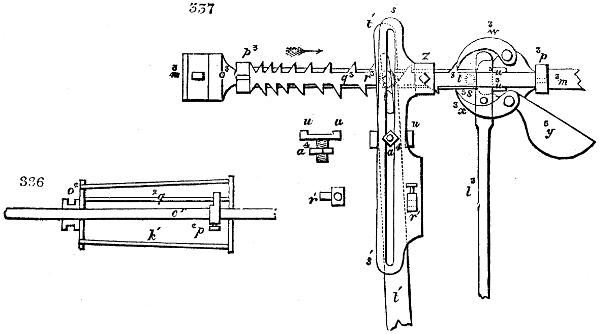
The manner in which this operates is shown in section in fig. 336. Here, we perceive
the rod q2, which extends from the base towards the narrow end of the truncated
cone, and p2 a forked bearer or carrier made fast to the shaft c′ by a screw, which
compels the cone by means of that rod, to obey the movements of c′. In the large end
of the cone there is an aperture, through which the bearer can be got at. The smaller
end carries outside a projection o2, provided with a groove, which is embraced by the
forked end of a rod q′, fig. 337., that serves to shove the cone along upon the shaft c′.
Directly under the cone, there is an upright round pillar p′, upon which the holder o′
of the two guide pulleys l′ is adjustable. A bar r2 placed along-side of the holder,
prevents its turning round, but allows it to slide along p′ by friction. The weight of the
holder and the pulley is sufficient to distend the endless band n′, which runs from the
cone k′, through under the pulley l′, and round the small drum m′ on the shaft s2. A
pulley or whorl t2 with four grooves, is made fast by means of a tube to this shaft, and
slides along it backwards and forwards, without ever ceasing to follow its revolutions.
The shaft possesses for this purpose a long fork, and the interior of the tube a corresponding
tongue or catch. There is besides upon the tube beneath the pulley, at u2, a
groove that goes round it, in which the staple or forked end of an arm like v2, fig. 333.,
made fast to the copping beam p, catches. By the up and down movement of that
beam, the pulley t2 takes along with it the arm that embraces the tube, which therefore
rises and falls equally with the bobbins h′, and their pulleys or whorls q. This is
requisite, since the bobbins are made to revolve by the pulleys t2, by means of 2 endless
cords or bands.
The most intricate part of the mechanism is the adjustment, by which the revolution
of the bobbins is continually retarded, and their up and down, or copping motion, along
the spindles, is also retarded in like proportion. The vertical pulley f′, (towards the
left end of the shaft c′) has at its right side a somewhat larger disc or sheave g′,
with a perfectly uniform, but not a very smooth surface. Upon this sheave, a smaller
horizontal pulley x′ rubs, whose upper face is covered with leather to increase the friction.
The under end of the shaft y2 of the pulley x′ turns in a step, which is so connected with
the arm v′ of the large bent lever t′ v′, that it always stands horizontally, whatever
direction the arms of that lever may assume. The shaft y2 is steadied at top by an
annular holder or bush, which embraces the fast arm x2 with its forked end. Upon its
opposite side, this arm carries a pulley y2, upon which a cord goes, that is made fast to
the holder of the shaft y2, and loaded with the weight z′. The weight presses the
pulley x′ against the surface of g′, in such wise as to effect the degree of friction necessary
in order that the revolution of g′ may produce an uninterrupted revolution in x′. A
pinion w′, whose length must be equal at least to the semi-diameter of the sheave g′, is
placed upon the under end of the shaft y2. It has 22 teeth, and takes into a 62-toothed
horizontal wheel z2. Upon the upper end of this wheel the conical pinion a3 is made
fast, which may be changed for changing the speed, but usually has from 28 to 30 teeth.
By this pinion the conical wheel b3 is turned, which has 30 teeth, and whose shaft is c3.
This shaft carries upon its opposite end a six-leaved pinion, d3, which takes into the
calender wheel f3, formed with cogs like a trundle, upon the long shaft e3. In fig. 338.
the wheel f3 is exhibited with its pinion d3. Here we may remark that in the circumference
of the wheel there is a vacant place, g3, void of teeth. When by the motion of
the wheel, the pinion comes opposite to this opening, it turns round about the last tooth
of the wheel, falls into the inside of the toothed circle marked by the dotted lines, and
thus gives now an inverse movement to the wheel f3, while itself revolves always in the
same direction. This reversed motion continues till the opening g3 comes once more
opposite to the pinion, when this turns round about the last tooth of that side, and begins
again to work in the exterior teeth. Thus, by the uniform motion of d3 and its
dependent parts, the wheel f3, with its shaft e3, revolves alternately to the right hand
and the left. That this result may ensue, the shaft c3 of the pinion must be able to
slide endwise, without losing its hold of a3 and b3. This adjustment is effected by
placing the end of the said shaft, nearest b3, in a box or holder i3, in which it can turn,
and which forms a vertical tube to this box, as a downward prolongation which is fixed
to the tail of the conical pinion a3. Fig. 339. shows this construction in section upon
an enlarged scale. The second bearer of the shaft nearest d3, must possess likewise the
means of lateral motion. When therefore the pinion d3 shifts through the opening
of the wheel f3 outwards or inwards, its shaft c3, makes a corresponding small angular
motion upon the pivot of a3, by means of the tube i3; a3 and b3 remain thereby completely
in geer with one another.
The above-described alternate revolutions of the wheel f3 serve to produce the up
and down motions of the bobbins. The shaft e3 has for this purpose two pinions n2 n2,
which work in the rack teeth m2 m2 of the copping rail p, and thus alternately raise and
sink it with the bobbins which rest upon it. The weight of the copping beam and all
its dependent parts, is poised by two counterweights m4, whose cords run over the
pulleys o4 o4 o4, fig. 332., and have their ends made fast to the frame, so as to make the
upwards motion as easy as the downwards. The two upper pulleys out of the three of
each weight, are fixed to the frame; the under one, round which the cord first runs, is
attached to the copping beam, rising and falling along with it.
As long as the friction disc x′ remains at the same height, the pulley g′ derives its
motion from the same circle of the said disc, and the up and down motion of the copping
beam is also uniform. But when that disc ascends so as to describe with its edge a small
circle upon the face of g′, its motion must become proportionally more slow. This is the
method, or principle of retarding the copping motions of the bobbins. It has been shown,
however, that the rotation of the bobbins should be also retarded in a progressive manner.
This object is effected by means of the cone k′, which, as the band n′ progressively
approaches towards its smaller diameter, drives the pulleys or whorls q of the bobbins
with decreasing speed, though itself moves uniformly quick with the shaft c′. To effect
this variation, the cone is shifted lengthwise along its shaft, while the band running
upon it remains continually in the same vertical plane, and is kept distended by the
weight of the pulley o′. The following mechanism serves to shift the cone, which may
be best understood by the aid of the figures 340., 341., and 337. A long cast iron bar m3,
which bears two horizontal projecting puppets, o3 o3, is made fast to the front upright
face of the copping beam A. Through the above puppets a cylindrical rod n3 passes freely,
which is left out in fig. 337., that the parts lying behind it may be better seen. Upon
this rod there is a kind of fork, p3 p3, to which the alternating rack bars q3 are made
fast. The teeth of these racks are at unequal distances from each other, and are so
arranged, that each tooth of the under side corresponds to the space between two teeth
in the upper side. Their number depends upon the number of coils of roving that may
be required to fill a bobbin; and consists in the usual machines of from 20 to 22. The
rod n3 may be shifted in the puppet o3, like the fork p3 of the rack-rod, upon the rod
n3, and along the surface of m3, where two wings u3 u3 are placed, to keep the fork in
a straight direction. Upon the bar m3, there are the pivots or fulcra of two stop catches
w3 x3, of which the uppermost presses merely by its own weight, but the undermost by
means of a counterweight y3, against the rack, and causes them thus to fall in between
the teeth. In fig. 341., v3 shows the pivot of the catch or detent w3 by itself, the
detent itself being omitted, to render the construction plainer. A pushing rod l3, upon
which there is a pin above at s3, that passes behind the rack rod, between this and
the bar m3, has for its object to remove at pleasure the one or the other of the two
catches; the upper, when the upper end of the rod pushes against it; the under, by
means of the above mentioned pin s3. Both the catches are never raised at once, but
either the under or the upper holds the rack bar fast, by pressing against one of the
teeth. The vertical motion up or down, which the rod l3 must take to effect the lifting
of the catches, is given to it from the copping beam p; since upon it a horizontal arm
v2, fig. 341., is fixed, that lays hold of that rod. Upon the pushing rod are two rings,
h3 and k3, each made fast by a screw. When the copping beam is in the act of going
up, the arm v3 at the end of this movement, pushes against the ring h3, raises up the
rod l3, and thus removes the catch w3, fig. 337., from the teeth of the rod q3, before
which it lies flat. At the descent of the copping rail, v2 meets the ring k3, when the
motion in this direction is nearly completed, draws down the rod l3 a little, by means of
the same, and thereby effects the removal of the catch x3, fig. 337., from the rod q3.
Every time that one of the catches is lifted, the rack recovers its freedom to advance a
little bit in the direction of the arrow; so far, namely, till the other catch lays hold upon
the tooth that next meets it. The reason is thus manifest why the teeth of the upper
and under sides of the bar q3 are not right opposite to each other, but in an alternate
position.
From the rack-bar, the sliding of the cone k′, and the raising of the shaft y2, each by
minute steps at a time, is produced as follows:—
A large rectangular lever t1, v1, whose centre of motion is at p4, has at the upper end
of its long arm t1, a long slot through which a stud r3 upon the rack q3 goes (fig. 340.,
341., 337.,) so that the lever must follow the motions of the rack bar. The end of the
short arm of the lever bears, as already mentioned, the step of the shaft y2; hence the
friction disc x1 will be raised in proportion as the rack bar advances, and will come
nearer to the middle point of g1; consequently, its revolution and the shifting of the
bobbins will become slower. Upon the cylindrical rod n3, the piece s1 s1 furnished
with a long slot is made fast, by means of a tube z3, (fig. 337.) and a screw. A fork
u u, which by means of the screw nut a4 is made fast in the slot, embraces the arm t1 of
the bent lever; and a tube r1 rivetted to the surface of s1, is destined to take up the draw
rod q1 of the cone k1, fig. 337. A weight f4, whose cord b4 is made fast to the cylindrical
rod n3, endeavours to draw this rod continually in the direction of the arrow. In
consequence of this arrangement, every time that the pushing bar l3 lifts up one of the
catches, the cone k1, the lever t1 v1, and by it the rack bar q3, are set in motion. It is
obvious, that the motion of the cone may be made greater or less, according as the
fork u u is fixed further up or down in the slot of s1.
The number of the teeth upon the bar q3 is so ordered, that the bobbins are quite full
when the last tooth has reached the catch and is released by it. The rack bar, being restrained
by nothing, immediately slides onwards, in consequence of the traction of the
weight f4 and brings the machine to repose by this very movement, for which purpose
the following construction is employed. A rectangular lever which has its centre of
motion in g4 is attached to the side face of the beam A, and has at the end of its horizontal
arm a pulley d4, over which the cord b4 of the counterweight f4 is passed. The
end of the perpendicular arm is forked and embraces the long and thin rod k4, to whose
opposite end the fork l4 is made fast. Through this fork the band which puts the
machine in motion passes down to the pulley a1. With the bent lever another rod c4 is
connected at h4, which lies upon the puppet e3 with a slot at e4, and hereby keeps the
lever g4 in its upright position notwithstanding the weight f4. In the moment when,
as above stated, the rack bar q3 becomes free, the arm p3 of its fork pushes in its rapid
advance against the under oblique side of e4, raises this rod, and thereby sets the lever g4
free, whose upright arm bends down by the traction of the weight, drives the rod k4
before it into the ring i4 fastened to it, and thus by means of the fork l4 shifts the band
upon the loose pulley b1. But the machine may be brought to repose or put out of geer
at any time merely by shifting the rod k4 with the hand.
The operation of the bobbin and fly frame may be fully understood from the preceding
description. A few observations remain to be made upon the cone k1, the rack-bar
q3, and the speed of the work.
When we know the diameter of the empty bobbins, and how many turns they should
make in a given time in order to wind-on the sliver delivered by the fluted rollers and the
spindles; when we consider the diameters of the spindle pullies q, and t2, as also the drum.
m1, fig. 332., we may easily find the diameter which the cone must have for producing
that number of turns. This is the diameter for the greatest periphery of the base. The
diameter of the smaller is obtained in the same way, when the diameter of the bobbins
before the last winding-on, as well as the number of turns necessary in a given time, are
known.
A bobbin and fly frame of the construction just described delivers from each spindle
in a day of twelve hours, from 6 to 8 lbs of roving of the fineness of 11⁄2 English counts.
One person can superintend two frames, piece the broken slivers, and replace the full
bobbins by empty ones. The loss of cotton wool in this machine consists in the
portions carried off from the torn slivers, and must be returned to the lapping machine.
The fine bobbin and fly frame does not differ essentially from the preceding machine.
The rovings from the coarse bobbin and fly frame are placed in their bobbins in a frame
called the creel, behind and above the roller beam, two bobbins being allowed for one
fluted portion of the rollers. These rovings are united into one, so as to increase the
uniformity of the slivers.
The invention of the beautiful machine above described is due to Messrs. Cocker and
Higgins of Manchester, and as lately improved by Henry Houldsworth, junr. Esq., it
may be considered the most ingeniously combined apparatus in the whole range of productive
industry.
In the fine roving frame the sliver is twisted in the contrary direction to that of the
coarse roving frame. For this reason the position of the cone is reversed, so as to present
in succession to the band or strap, diameters continually greater, in order that the
rotation of the bobbins may be accelerated in proportion as their size is increased,
because here the flyer and the bobbin turn in the same direction, and the winding-on
is effected by the precession of the bobbin; but if the winding-on took place by its falling
behind, as in the coarse bobbin and fly frame, that is, if the flyer turned less quickly
than the bobbin, the rotatory speed of the bobbin would be uniformly retarded; in
which case the cone would be disposed as in the coarse frame.
When by any means whatever an uniform length of thread is delivered by the rollers
in a given time, the bobbin must wind it up as it is given out, and must therefore turn
with a speed decreasing with the increase of its diameter by successive layers of thread.
Hence proceeds the proposition, that the velocity of the bobbin must be in the inverse
ratio of its diameter, as already explained.
With respect to the bobbin and fly frame, the twist is given to the sliver by
means of a spindle or flyer which turns in the same direction with the bobbin, but
quicker or slower than it, which establishes two predicaments. The first case is where
the flyer turns faster than the bobbin. Here the winding-on goes in advance, as in
the coarse roving frame, or as in throstle spinning, where the yarn is wound on
merely in consequence of the friction of the lower disc or washer of the bobbin upon the
copping rail, and of the drag of the yarn. The second case is where the flyer revolves
more slowly than the bobbin. Here the winding goes on in arrear, and as the bobbin
turns faster, it must receive a peculiar motion, which is uniformly retarded in the ratio
of its increase of diameter. This is the case with the fine bobbin and fly frame. When
the cone is placed as in fig. 332, the winding-on, in either the coarse or fine frame, results
from the difference, whether greater or less, between the rotatory speed of the flyer and
bobbin.
The motion of the bobbin and spindle is simultaneous, and takes place in the same
direction, with a difference varying more or less with the varying diameters of the
bobbins. To render the matter still clearer, suppose for a moment the spindle to be
motionless, then the bobbin must revolve with such a speed, as to lap-on the roving as
fast as the rollers deliver it. The sliver comes forward uniformly; but the bobbin, by
its increase of diameter, must revolve with a speed progressively slower. Now, suppose
the spindle set a-whirling, it is obvious that the bobbin must add to the movement
requisite for winding-on the sliver, that of the spindle in the case of winding-on in
arrear, or when it follows the flyers, and subtract its own motion from the twisting
motion of the spindles, in the case of winding-on in advance, that is, when the bobbin
precedes or turns faster than the flyers; for the diameter of the bobbin being 11⁄2
inch, 10 turns will take up 45 inches. Deducting these 10 turns from the 30 made
by the spindle in the same time, there will remain for the effective movement of the
bobbin only 20 turns; or when the diameter of the bobbin becomes 3 inches, 5 turns
will take up the 45 inches, if the spindle be at rest; but if it makes 30 turns in the
time, the effective velocity of the bobbin will be 25 turns, = 30 - 5. Hence in the
fine bobbin and fly frame, the number of turns of the spindle, minus the number of
turns made by the bobbin in equal times, is in the inverse ratio of the diameter of the
bobbin. We thus perceive, that in the coarse frame the bobbin should move faster
than the spindle, and that its speed should always diminish; whilst in the fine frame
the bobbin should move slower than the spindle, but its speed should always increase.
It is easy to conceive, therefore, why the cones are placed in reverse directions in the
two machines. Not that this inversion is indispensably necessary; the cone of the fine
roving frame might, in fact, be placed like that of the coarse roving frame; but as the
torsion of the roving becomes now considerable, and as on that account the bobbin
would need to move still faster, which would consume a greater quantity of the moving
power, it has been deemed more economical to give its movement an opposite direction.
We mentioned that the twist of the sliver in the fine roving frame was the reverse of
that in the coarse; this is a habit of the spinners, for which no good reason has been
given.
The divisions of the rack-bar, and the successive diameters of the cone, must be
nicely adjusted to each other. The first thing to determine is how much the rack
should advance for every layer or range of roving applied to the bobbin, in order that
the cone may occupy such a place that the strap which regulates the pulley barrel may
be at the proper diameter, and thus fulfil every condition. The extent of this progressive
movement of the rack depends upon the greater or less taper of the cone, and
the increase which the diameter of the bobbin receives with every traverse, that is,
every layer of roving laid on. But care should be taken not to taper the cone too
rapidly, especially in the fine roving frame, because in its progress towards the smaller
end, the strap would not slide with certainty and ease. We have already shown that
the number of effective turns of the bobbin is inversely, as the diameter of the bobbin,
or directly, as the successive diameters of the different points of the cone.
H. Houldsworth, jun. Esq. has introduced a capital improvement into the bobbin and
fly frame, by his differential or equation-box mechanism, and by his spring fingers,
which, by pressing the soft sliver upon the bobbin, cause at least a double quantity to
be wound upon its barrel. With the description of his patent equation-box, I shall
conclude the description of the bobbin and fly frame.
Fig. 342. represents a portion of a fly frame with Mr. Houldsworth’s invention.
a a a are the front drawing rollers, turning upon bearings in the top of the machine,
and worked by a train of toothed wheels, in the way that drawing rollers are usually
actuated.
From the drawing rollers, the filaments of cotton or other material, b b, are brought
down to, and passed through the arms of the flyers c c, mounted on the tops of the
spindles d d, which spindles also carry the loose bobbins e e. In the ordinary mode of
constructing such machines, the spindles are turned by cords or bands passing from a
rotatory drum round their respective pulleys or whirls f, and the loose bobbins e, turn
with them by the friction of their slight contact to the spindle, as before said; in the
improved machine, however, the movements of the spindles and the bobbins are independent
and distinct from each other, being actuated from different sources.
The main shaft of the engine g, turned by a band and rigger A as usual, communicates
motion by a train of wheels h, through the shaft i, to the drawing rollers at the
reverse end of the machine, and causes them to deliver the filaments to be twisted.
Upon the main shaft g, is mounted a cylindrical hollow box or drum-pulley, whence
one cord passes to drive the whirls and spindles f and d, and another to drive the
bobbins e.
This cylindrical box pulley is made in two parts, k and l, and slipped upon the axle with
a toothed wheel m, intervening between them. The box and wheel are shewn detached
in fig. 343., and partly in section at fig. 344. That portion of the box with its pulley
marked l, is fixed to the shaft g; but the other part of the box and its pulley k, and the
toothed wheel m, slide loosely round upon the shaft g, and when brought in contact and
confined by a fixed collar n, as in the machine shewn at fig. 342., they constitute two
distinct pullies, one being intended to actuate the spindles, and the other the bobbins.
In the web of the wheel m, a small bevel pinion o, is mounted upon an axle standing
at right angles to the shaft g, which pinion is intended to take into the two bevel pinions
p and q, respectively fixed upon bosses, embracing the shaft in the interior of the boxes k
and l. Now it being remembered that the pinion q, and its box l, are fixed to the shaft
g, and turn with it, if the loose wheel m be independently turned upon the shaft, with a
different velocity, its pinion o, taking into q, will be made to revolve upon its axle, and
to drive the pinion p, and pulley box k, in the same direction as the wheel m; and this
rotatory movement of the box k and wheel m, may be faster or slower than the shaft g,
and box l, according to the velocity with which the wheel m is turned.
Having explained the construction of the box pullies k and l, which are the peculiar
features of novelty claimed under this patent, their office and advantage will be seen by
describing the general movements of the machine.
The main shaft g, being turned by the band and rigger A, as above said, the train of
wheels h, connected with it, drives the shaft i, which at its reverse end has a pinion (not
seen in the figure,) that actuates the whole series of drawing rollers a. Upon the shaft
i there is a sliding pulley r, carrying a band s, which passes down to a tension pulley t,
and is kept distended by a weight. This band s, in its descent, comes in contact with
the surface of the cone u, and causes the cone to revolve by the friction of the band
running against it. The pulley r is progressively slidden along the shaft i, by means of
a rack and weight not shewn, but well understood as common in these kind of machines,
and which movement of the pulley is for the purpose of progressively shifting the band
s from the smaller to the larger diameter of the cone, in order that the speed of its
rotation may gradually diminish as the bobbins fill by the winding-on of the yarns.
At the end of the axle of the cone u a small pinion v is fixed, which takes into the
teeth of the loose wheel m, and, as the cone turns, drives the wheel m round upon the
shaft g, with a speed dependent always upon the rapidity of the rotation of the cone.
Now the box pulley l, being fixed to the main shaft g, turns with one uniform speed,
and by cords passing from it over guides to the whorls f, drives all the spindles and
flyers, which twist the yarns with one continued uniform velocity; but the box pulley k,
being loose upon the shaft, and actuated by the bevel pinions within, as described, is
made to revolve by the rotation of the wheel m, independent of the shaft, and with a
different speed from the pulley box l; cords passing from this pulley box k, over guides
to small pullies under the bobbins, communicate the motion, whatever it may be, of the
pulley box k, to the bobbins, and cause them to turn, and to take up or wind the yarn
with a speed derived from this source, independent of, and different from, the speed of
the spindle and flyer which twist the yarn.
It will now be perceived, that these parts being all adjusted to accommodate the
taking up movements to the twisting or spinning of any particular quality of yarn
intended to be produced, any variations between the velocities of the spinning and
taking up, which another quality of yarn may require, can easily be effected, by merely
changing the pinion v, for one with a different number of teeth, which will cause the
wheel m, and the pulley box k, to drive the bobbins faster or slower, as would be required
in winding-on fine or coarse yarn, the speed of the twisting or spinning being the
same.
The rovings or spongy cords, of greater or less tenuity, made on the bobbin and fly,
or tube roving frame, are either spun immediately into firm cohesive yarn, or receive a
further preparation process in the stretching frame, which is, in fact, merely a mule-jenny,
without the second draught and second speed, and therefore need not be described
at present, as it will be in its place afterwards.
The finishing machines of a cotton mill, which spin the cohesive yarn, are of two
classes; 1. the water-twist or throstle, in which the twisting and winding are performed
simultaneously upon progressive portions of the roving; and, 2. the mule, in which the
thread is drawn out and stretched, with little twist, till a certain length of about 5 feet
is extended, then the torsion is completed, and the finished thread is immediately
wound upon the spindles into double conical coils called cops.
The water-twist frame, so called by its inventor, Sir R. Arkwright, because it was first
driven by water, is now generally superseded by the throstle frame, in which the mechanical
spinning fingers, so to speak, are essentially the same, but the mode of communicating
the motion of the mill-geering to them is somewhat different. Fig. 345. exhibits a
vertical section of the throstle. This machine is double, possessing upon each side of
its frame, a row of spindles with all their subsidiary parts. The bobbins, filled with
rovings from the bobbin and fly, or the tube frame, are set up in the creel a a, in two
ranges, b, c, d, are the three usual pairs of drawing rollers, through which the yarn
is attenuated to the proper degree of fineness, upon the principles already explained.
At its escape from the front rollers, every thread runs through a guide eyelet e of wire,
which gives it the vertical direction down towards the spindles f, g. The spindles which
perform at once and uninterruptedly the twisting and winding-on of the thread delivered
by the rollers, are usually made of steel, and tempered at their lower ends. They
stand at g in steps, pass at v through a brass bush or collet which keeps them upright,
and revolve with remarkable speed upon their axes. The bobbins h, destined to take
up the yarn as it is spun, are stuck loosely upon the spindles, and rest independently of
the rotation of the spindles upon the copping beam l, with a leather washer between.
Upon the top of the spindles an iron-wire fork, called a fly or flyer, i, k, is made
fast by a left-hand screw, and has one of its forks turned round at the end into a little
ring. The branch of the flyer at f is tubular, to allow the thread to pass through, and to
escape by a little hole at its side, in order to reach the eyelet at the end of that fork.
From this eyelet i, it proceeds directly to the bobbin. By the twirling of the spindle,
the twisting of the portion of thread between the front roller d, and the nozzle f, is
effected. The winding-on takes place in the following way:—Since the bobbin has no
other connection with the spindle than that of the thread, it would but for it remain
entirely motionless, relatively to the spindle. But the bobbin is pulled after it by the
thread, so that it must follow the rotation of the spindle and fly. When we consider
that the thread is pinched by the front roller d, and is thereby kept fully upon the
stretch, we perceive that the rotation of the bobbin must be the result. Suppose now
the tension to be suspended for an instant, while the rollers d, deliver, for example, one
inch of yarn. The inertia or weight of the bobbin, and its friction upon the copping
beam l, by means of the leather washer, will, under this circumstance, cause the bobbin
to hang back in a state of rest, till the said inch of yarn be wound on by the whirling
of the fly i, and the former tension be restored. The delivery of the yarn by the drawing
rollers, however, does not take place inch after inch, by starts, but at a certain continuous
rate; whence results a continuous retardation or loitering, so to speak, of the
bobbins behind the spindles, just to such an amount that the delivered yarn is wound
up at the same time during the rotation.
This process in spinning is essentially the same as what occurs in the fine bobbin
and fly frame, but is here simplified, as the retardation regulates itself according to
the diameter of the bobbin by the drag of the thread. In the fly frame the employment
of this tension is impossible, because the roving has too little cohesion to bear the
strain; and hence it is necessary to give the bobbins that independent movement of
rotation which so complicates this machine.
The up and down motion of the bobbins along the spindles, which is required for
the equal distribution of the yarn, and must have the same range as the length of the
bobbin barrels, is performed by the following mechanism. Every copping rail l,
is made fast to a bar m, and this, which slides in a vertical groove or slot at the end of
the frame, is connected by a rod n, with an equal-armed, moveable lever o. The rod p
carries a weight r, suspended from this lever; another rod q, connects the great lever o
with a smaller one s, t, upon which a heart-shaped disc or pulley u, works from below at t.
By the rotation of the disc u, the arm t, being pressed constantly down upon it by the
reaction, the weight r must alternately rise and fall; and thus the copping rail l must
obviously move with the bobbins h up and down; the bobbins upon one side of the frame
rising, as those upon the other sink. Strictly considered, this copping motion should
become slower as the winding-on proceeds, as in the fly roving frame; but, on account
of the smallness of the finished thread, this construction, which would render the
machine complicated, is without inconvenience neglected, with the result merely that
the coils of the yarn are successively more sparsely laid on, as the diameter of the
bobbin increases.
The movement of the whole machine proceeds from the shaft of a horizontal drum,
which drives the spindles by means of the endless bands x x. Each spindle is mounted
with a small pulley or wharf w, at its lower part, and a particular band, which goes
round that wharf or whorl, and the drum y. The bands are not drawn tense, but hang
down in a somewhat slanting direction, being kept distended only by their own weight.
Thus every spindle, when its thread breaks, can readily be stopt alone, by applying a slight
pressure with the hand or knee, the band meanwhile gliding loosely round the whorl.
The velocities of rotation of the three drawing rollers are, according to this arrangement,
in the proportion of 1 : 11⁄2 : 8; and as their diameters are the same, namely, one
inch, the elongation of the yarn in spinning is eight-fold. If, for example, the roving
was of the number 41⁄2, the yarn would become No. 36. The extension of the thread
may be changed by changing the wheels of the drawing rollers. To perceive the
power of this change, let us put, for example, in the place of the 18-toothed wheel of
the back rollers, a wheel with 16 teeth; we shall find that the elongation will amount,
in that case, only to 71⁄2 times, whence the number of the yarn would come out 32 = 71⁄2 ×
41⁄2. The extension by the throstle is extremely various; it amounts, in some cases, to
only 4 times; at others to 10, 12, or even 15.
The copping motion of the bobbins is produced in consequence of a bevel pinion
working in a small bevel wheel upon an upright shaft; while this wheel gives a slow
motion by means of a worm screw to the wheel of the heart-shaped pulley u, fig. 345.
The driving pulley makes about 600
turns in a minute; and as the diameter of
the drum y, fig. 345., is six times the diameter
of the spindle wharves w, it will
give 3600 turns to the spindle in that time.
If the pulley be driven faster, for example
700 times in a minute, it will increase the
revolutions of the spindles to 4200. The
degree of twist which will be thereby imparted
to the yarn, depends, with like speed
of spindles, upon the rate at which the soft
yarn is delivered by the drawing rollers;
for the quicker this delivery, the quicker is
the winding-on, and the less twist goes into
a given length of yarn. If, for example,
the front rollers d, turn 24 times in a
minute, giving out of course 72 inches of
yarn in this time, upon which the 3600
revolutions of the spindle are expended,
there will be 50 twists to every inch of
yarn. By changing the wheel-work of
fig. 345., or by sticking greater or smaller wharves upon the spindles, the proportion
between their velocity and that of the drawing rollers, and thence the degree of twist
can be modified at pleasure.
The number of spindles in a throstle frame 12 feet long, is about 60 on each side.
The drawing rollers are coupled together as in the bobbin and fly frame, so that each
row forms one continuous cylinder. There is a complete roller beam on each side;
each of the rollers of the front row is pressed by its top rollers with a weight of ten or
twelve pounds; but those of the middle and back rows bear weights of only one pound.
In the throstles, there is a guide bar which traverses a small way horizontally to the left
and right, in front of the roller beam, to lead the thread along different points of the
rollers, and thus prevent the leather of the top ones from being grooved by its constant
pressure in one line.
For the service of 240 spindles, in two double frames, one young woman, and an assistant
piecer are sufficient. They mend the broken ends, and replace the empty bobbins
in the creel with full ones, and the full bobbins of the throstle by empty ones. The
average quantity of yarn turned off in a week of 69 hours is about 24 hanks per spindle
of 30′s twist. Throstle yarn is of a firm wiry quality, adapted to the warps of fustians
and other strong stuffs, as well as to the manufacture of stockings and sewing thread.
There are many modifications of the throstle system besides the one above described;
the most celebrated of which are Danforth’s, called the American throstle, Montgomery’s,
and Gore’s. I must refer for an account of them to my work entitled “The
Cotton Manufacture of Great Britain,” where they are minutely described and illustrated
with accurate figures.
Mule-spinning.—The general principles of the mule have been already stated. This
machine is so named because it is the offspring, so to speak, of two older machines, the
jenny and the water-frame. A mule is mounted with from 240 to 1000 spindles, and
spins of course as many threads.
Fig. 346. represents the
original jenny of Hargreaves,
by which one
person was enabled to
spin from 16 to 40
threads at once. The
soft cords of rovings
wound in double conical
cops upon skewers were
placed in the inclined
frame at C; the spindles
for first twisting and
then winding-on the
spun yarn were set upright
in steps and bushes
at A, being furnished
near their lower ends with whorls, and endless cords, which were driven by passing round
the long-revolving drum of tin plate E. D is the clasp or clove, having a handle for
lifting its upper jaw a little way, in order to allow a few inches of the soft roving to be
introduced. The compound
clove D being now
pushed forward upon its
friction wheels to A, was
next gradually drawn
backward, while the spindles
were made to revolve
with proper speed by
the right hand of the
operative turning the flywheel
B. Whenever one
stretch was thereby spun,
the clove frame was slid
home towards A; the
spindles being simultaneously
whirled slowly
to take up the yarn,
which was laid on in a
conical cop by the due
depression of the faller
wire at A with the spinner’s
left hand.
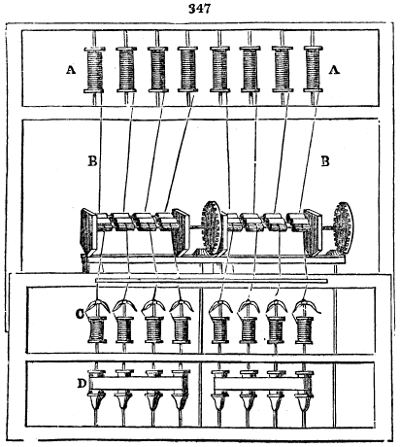
Fig. 347. is a diagram
of Arkwright’s original
water-frame spinning
machine, called afterwards
the water-twist
frame. The rovings mounted upon bobbins
in the creel A A, have their ends led
through between the three sets of twin
rollers below B B, thence down through
the eyelet hooks upon the end of the flyers
of the spindles C, and finally attached to
their bobbins. The spindles being driven
by the band D D upon their lower part, continuously
twist and wind the finished yarn
upon the bobbins; constituting the first
unremitting automatic machine for spinning
which the world ever saw.
Contrast with the above admirable system,
the primitive cotton wheel of India, as
represented in the annexed figure 348. By
the aid of mechanical fingers, one Englishman
at his mule can turn off daily more
yarn and of far finer quality than 200 of
the most diligent spinsters of Hindostan.
Fig. 349., is a transverse section of the mule, in which its principal parts are shown.
The machine consists of two main parts; a fixed one corresponding in some measure
to the water-frame or throstle, and a moveable one corresponding to the jenny.
The first contains in a suitable frame the drawing roller-beam and the chief moving
machinery: the second, is called the carriage, in which the remainder of the moving
mechanism and the spindles are mounted.
The frame of the fixed part consists of two upright sides, and two or more intermediate
parallel bearings, upon which the horizontal roller beam a, the basis of the drawing rollers
is supported, b, c, d, are the three ranges of fluted iron rollers; e, f, g, are the upper iron
rollers covered with leather; h, the wooden wiper-rollers covered with flannel, which
being occasionally rubbed with chalk, imparts some of it to the pressure rollers beneath,
so as to prevent the cotton filaments adhering to them. The rollers are made throughout
the whole length of the mule in portions containing six flutings, which are coupled
together by squared ends fitted into square holes.
The skewers upon which the bobbins containing the rovings from the bobbin and fly
or stretching frame, are set up, are seen at a1, a1, a1, arranged in three rows in the
creel z. The soft threads unwound from these bobbins, in their way to the drawing
rollers, pass first through eyelets in the ends of the wire arms b1, then through the
rings or eyes of the guide bar w, and enter between the back pair of rollers. The
number of these bobbins is equal to the number of spindles in the mule, and twice as
great as the number of fluted portions of the rollers; for two threads are assigned to
each portion.
The carriage consists of two cast-iron side pieces, and several cast-iron intermediate
similar pieces, such as f2, which all together are made fast to the planks b2, c2, d2. The
top is covered in with the plank k2. The carriage runs by means of its cast-iron grooved
wheels, upon the cast-iron railway l2, which is fixed level on the floor.
The spindles stand upon the carriage in a frame, which consists of two slant rails x2,
x2, connected by two slender rods y2, and which frame may be set more or less obliquely.
The lower rail carries the brass steps for the points of the spindles b3; upon the upper
rail brass slips are fixed pierced with holes through which the tops of the spindles play.
The spindles are as usual made of steel, perfectly straight, turned truly round, and are
all arranged in one plane. To each of them a small wooden or cast-iron whorl g2 is
made fast. They are distributed into groups of 24, and the whorls are arranged at
such different heights, that only two of them in each group are upon a level with each
other. A small brass head h2, which every spindle has beneath the upper slant rail of
the frame x2, prevents their sitting down into the step, during their rotation, or
sliding off their cop of yarn.
c3 are drums, mounted in the carriage in a plane at right angles to the plane in
which the spindles are placed. At top they have a double groove for a cord to run
in, and the motion which they receive from the great fly wheel, or rim of the mule (not
visible in this view) they impart to the spindles. Such a drum is assigned to every 24
spindles; and therefore a mule of 480 spindles contains 20 drums. In the middle of
the carriage is seen the horizontal pulley k3, furnished with three grooves, which stands
in a line with the drums c3.
The motion is given to the drums c3, upon the right hand half of the carriage by a
single endless band or cord which proceeds from the middle groove of the pulley k3.
The rotation of the spindles is produced by a slender cord, of which there are 12 upon
each drum c3; because every such cord goes round the drum, and also every two wharves
which stand at the same level upon the spindles. It is obvious that the drums, and
consequently the spindles, must continue to revolve as long as the main rim of the mule
is turned, whether the carriage be at rest or in motion upon its railway.
If we suppose the carriage to be run in to its standing point, or to be pushed home
to the spot from which it starts in spinning, its back plank d2 will strike the post q3
upon the fixed frame, and the points of the spindles will be close in front of the roller
beam. The rollers now begin to turn and to deliver threads, which receive immediately
a portion of their twist from the spindles; the carriage retires from the roller beam
with somewhat greater speed than the surface speed of the front rollers, whereby the
threads receive a certain degree of stretching, which affects most their thicker and less
twisted portions, and thereby contributes greatly to the levelness of the yarn. When
the carriage has run out to the end of its course, or has completed a stretch, the fluted
rollers suddenly cease to revolve (and sometimes even beforehand, when a second
stretch is to be made), but the spindles continue to whirl till the fully extended threads
have received the proper seconder after-twist. Then the carriage must be put up, or run
back towards the rollers, and the threads must be wound upon the spindles.
This is the order of movements which belong to the mule. It has been shown how
the rotation of the spindles is produced.
For winding-on the yarn the carriage has a peculiar apparatus, which we shall now
describe. In front of it, through the whole extent to the right hand as well as the left,
a slender iron rod, d5, runs horizontally along, in a line somewhat higher than the middle
of the copping portion of the spindles, and is supported by several props, such as
e5. Upon each end of the two rods, d5, there is an arm, g5; and betwixt these arms an
iron wire, called the copping wire, f5, is stretched, parallel with the rod d5. For the
support of this wire, there are several slender bent arms h5 extended from the rod d5
at several points betwixt the straight arms g5. The rod d5 has, besides a wooden
handle at the place opposite to where the spinner stands, by which it can be readily
grasped. This movement is applied at the left division of the machine, and it is communicated
to the right by an apparatus which resembles a crane’s bill. The two arms,
g5, in the middle of the machine, project over the rods d5, and are connected by hinges
with two vertical rods j5, which hang together downwards in like manner with two arms
i5, proceeding from a horizontal axis k5.
By means of that apparatus the yarn is wound upon the spindles in the following
manner. As long as the stretching and twisting go on, the threads form an obtuse angle
with the spindles, and thereby slide continually over their smooth rounded tips
during their revolution, without the possibility of coiling upon them. When, however,
the spinning process is completed, the spinner seizes the carriage with his left hand and
pushes it back towards the roller beam, while with his right hand he turns round the
handle of the rim or fly wheel, and consequently the spindles. At the same time, by
means of the handle upon the rod d5, he moves the copping-wire, f5, so that it presses
down all the threads at once, and places them in a direction nearly perpendicular to
the spindles; as shown by the dotted line y5. That this movement of the copping wire,
however, may take place without injury to the yarn, it is necessary to turn the rim beforehand
a little in the opposite direction, so that the threads may get uncoiled from the
upper part of the spindles, and become slack; an operation called in technical language,
the backing off. The range upon which the threads should be wound, in order to form
a conical cop upon the spindle, is hit by depressing the copping wire to various angles,
nicely graduated by an experienced eye. This faller wire alone is not, however, sufficient
for the purpose of winding-on a seemly cop, as there are always some loose threads
which it cannot reach without breaking others.
Another wire called the counter-faller, l5, must be applied under the threads. It may
be raised to an elevation limited by the angular piece p5; and is counterpoised by a very
light weight m5, applied through the bent lever n5, which turns upon the fulcrum o5. This
wire, which applies but a gentle pressure, gives tension to all the threads, and brings them
regularly into the height and range of the faller f5. This wire must be raised once
more, whenever the carriage approaches the roller beam. At this instant a new stretch
commences; the rollers begin again to revolve, and the carriage resumes its former
course. These motions are performed by the automatic machinery.
There is a little eccentric pulley mechanism for moving the guide beam to and fro
with the soft yarns, as they enter between the back rollers. On the right hand
end of the back roller shaft, a worm screw is formed which works into the oblique teeth
of a pinion attached to the end of the guide beam, in which there is a series of holes for
the passage of the threads, two threads being assigned to each fluted roller. In the
flat disc of the pinion, an eccentric pin stands up which takes into the jointed lever
upon the end of the guide beam, and as it revolves, pushes that beam alternately to the
left and the right by a space equal to its eccentricity. This motion is exceedingly slow,
since for each revolution of the back roller, the pinion advances only by one tooth out
of the 33 which are cut in its circumference.
After counting the number of teeth in the different wheels and pinions of the mule, or
measuring their relative diameters, it is easy to compute the extension and twist of the
yarns; and when the last fineness is given to ascertain their marketable value. Let the ratio
of speed between the three drawing rollers be 1 : 13⁄22 : 71⁄2; and the diameter of the back and
middle roller three quarters of an inch: that of the front roller one inch; in which case
the drawing is thereby increased 11⁄3 times, and 71⁄2 × 11⁄3 = 10. If the rovings in the creel
bobbins have been No. 4. the yarn, after passing through the rollers, will be No. 40. By
altering the change pinion (not visible in this view) the fineness may be changed within
certain limits, by altering the relative speed of the rollers. For one revolution of the
great rim or fly wheel of the mule, the front roller makes about 6-tenths of a turn, and
delivers therefore 22·6 lines or 12ths of an inch of yarn, which, in consequence of
the tenfold draught through the rollers, corresponds to 2·26 lines of roving fed in at the
back rollers. The spindles or their whorls make about 66 revolutions for one turn of
the rim. The pulleys or grooved wheels on which the carriage runs, perform 0·107
part of a turn while the rim makes one revolution, and move the carriage 24·1 lines
upon its rails, the wheels being 6 inches in diameter.
The 22·6 lines of soft yarn delivered by the front rollers, will be stretched 11⁄2 lines
by the carriage advancing 24·1 lines in the same time. Let the length of the railway,
or of each stretch be 5 feet, the carriage will complete its course after 30 revolutions of
the rim wheel, and the 5 feet length of yarn (of which 561⁄2 inches issue from the drawing
rollers, and 31⁄2 inches proceed from the stretching) is, by the simultaneous whirling of
the spindles, twisted 1980 times, being at the rate of 33 twists for every inch. The second
twist, which the threads receive after the carriage has come to repose, is regulated according
to the quality of the cotton wool, and the purpose for which the yarn is spun.
For warp yarn of No. 40 or 50, for example, 6 or 8 turns of the rim wheel, that is, from
396 to 528 whirls of the spindles for the whole stretch, therefore from 7 to 9 twists
per inch will be sufficient. The finished yarn thus receives from 40 to 42 twists per
inch.
One spinner attends to two mules, which face each other, so that he needs merely
turn round in the spot where he stands, to find himself in the proper position for the
other mule. For this reason the rim wheel and handle, by which he operates, are not
placed in the middle of the length of the machine, but about two fifths of the spindles
are to the right hand and three fifths to the left; the rim wheel being towards his right
hand. The carriage of the one mule is in the act of going out and spinning, while that
of the other is finishing its twist, and being put up by the spinner.
The quantity of yarn manufactured by a mule in a given time, depends directly
upon the number of the spindles, and upon the time taken to complete every stretch of
the carriage. Many circumstances have an indirect influence upon that quantity, and
particularly the degree of skill possessed by the spinner. The better the machine, the
steadier and softer all its parts revolve, the better and more abundant is its production.
When the toothed wheels do not work truly into their pinions, when the spindles shake
in their bushes, or are not accurately made, many threads break, and the work is
much injured and retarded. The better the staple of the cotton wool, and the more
careful has been its preparation in the carding, drawing, and roving processes, the more
easy and excellent the spinning will become: warmth, dryness, cold, and moisture
have great influence on the ductility, so to speak, of cotton. A temperature of 65° F.,
with an atmosphere not too arid, is found most suitable to the operations of a spinning
mill. The finer the yarn, the slower is the spinning. For numbers from 20 to 36,
from 2 to 3 stretches of warp may be made in a minute, and nearly 3 stretches of weft;
for numbers above 50 up to 100, about 2 stretches; and for numbers from 100 to 150,
one stretch in the minute. Still finer yarns are spun more slowly, which is not
wonderful, since in the fine spinning mills of England, the mules usually contain
upwards of 500 spindles each, in order that one operative may manage a great number
of them, and thereby earn such high wages as shall fully remunerate his assiduity
and skill.
In spinning fine numbers, the second speed is given before the carriage is run out to
the end of its railway; during which course of about six inches, it is made to move very
slowly. This is called the second stretch, and is of use in making the yarn level by
drawing down the thicker parts of it, which take on the twist less readily than the
thinner, and therefore remain softer and more extensible. The stretch may therefore
be divided into three stages. The carriage first moves steadily out for about 4 feet,
while the drawing rollers and spindles are in full play; now the rollers stop, but the
spindles go on whirling with accelerated speed, and the carriage advances slowly, about
6 inches more; then it also comes to rest, while the spindles continue to revolve for a
little longer, to give the final degree of twist. The acceleration of the spindles in the
second and third stages, which has no other object but to save time, is effected by
a mechanism called the counter, which shifts the driving band, at the proper time, upon
the loose pulley, and, moreover, a second band, which had, till now, lain upon its loose
pulley, upon a small driving pulley of the rim-shaft. At length, both bands are
shifted upon their loose pulleys, and the mule comes to a state of quiescence.
The SELF-ACTOR MULE, or the IRON MAN, as it has been called in Lancashire, is an
invention to which the combinations among the operative spinners obliged the masters
to have recourse. It now spins good yarn up to 40 s with great uniformity and
promptitude, and requires only juvenile hands to conduct it, to piece the broken yarns,
to replace the bobbins of rovings in the creel, and to remove the finished cops from the
spindles.
The self-acting mules were first constructed, I believe, by Messrs. Eaton, formerly of
Manchester, who mounted ten or twelve of them in that town, four at Wiln, in Derbyshire,
and a few in France. From their great complexity and small productiveness,
the whole were soon relinquished, except those at Wiln. M. de Jong obtained
two patents for self-acting mules, and put twelve of them in operation in a mill at Warrington,
of which he was part proprietor; but with an unsuccessful result. I saw the
débris of one of M. de Jong’s self-actors in the factory of M. Nicolas Schlumberger, at
Guebwiller, in Alsace, where the machine had been worked for three months, without
advantage, under the care of the inventor, who is a native of that valley.
The first approximation to a successful accomplishment of the objects in view, was an
invention of a self-acting mule, by Mr. Roberts, of Manchester; one of the principal
points of which was the mode of governing the winding-on of the yarn into the form of
a cop; the entire novelty and great ingenuity of which invention was universally
admitted, and proved the main step to the final accomplishment of what had so long
been a desideratum. For that invention a patent was obtained in 1825, and several
headstocks upon the principle were made, which are still working successfully.
In 1830, Mr. Roberts obtained a patent for the invention of certain improvements;
and by a combination of both his inventions, he produced a self-acting mule, which is
generally admitted to have exceeded the most sanguine expectations, and which has
been extensively adopted. There are, probably, at present, upwards of half a million
of spindles of Messrs. Sharp, Roberts, and Co.’s construction, at work in the United
Kingdom, and giving great satisfaction to their possessors. The advantages of these
self-actors are the following:—
The saving of a spinner’s wages to each pair of mules, piecers only being required,
as one overlooker is sufficient to manage six or eight pairs of mules. The production
of a greater quantity of yarn, in the ratio of from 15 to 20 per cent. The yarn
possesses a more uniform degree of twist, and is not liable to be strained during the
spinning, or in winding-on, to form the cop; consequently fewer threads are broken in
these processes, and the yarn, from having fewer piecings is more regular.
The cops are made firmer, of better shape, and with undeviating uniformity; and,
from being more regularly and firmly wound, contain from one third to one half more
yarn than cops of equal bulk wound by hand; they are consequently less liable to
injury in packing or in carriage, and the expense of packages and freight (when
charged by measurement) is considerably reduced.
From the cops being more regularly and firmly wound, combined with their superior
formation, the yarn intended for warps less frequently breaks in winding or reeling,
consequently there is a considerable saving of waste in those processes.
Secondly, the advantages connected with weaving.
The cops being more regularly and firmly wound, the yarn, when used as weft,
seldom breaks in weaving; and as the cops also contain a greater quantity of weft,
there are fewer bottoms, consequently there is a very material saving of waste in the
process of weaving.
From those combined circumstances, the quality of the cloth is improved, by being
more free from defects caused by the breakage of the warp or weft, as well as the
selvages being more regular.
The looms can also be worked at greater speed; and, from there being fewer stoppages,
a greater quantity of cloth may be produced.
That the advantages thus enumerated, as derivable from the use of self-acting mules,
have not been overrated, but, in many instances, have been considerably exceeded, I
have, by extensive personal inquiry and observation, had ample opportunity of ascertaining.
Statement of the quantity of yarn produced on Messrs. Sharp, Roberts, and Co.’s
self-acting mules, in twelve working hours, including the usual stoppages connected
with spinning, estimated on the average of upwards of twenty mills:—
| No. of Yarn. |
No. of Twist. |
No. of Weft. |
| 16 |
4 |
1⁄2 |
hanks |
4 |
7⁄8 |
hanks per spindle. |
| 24 |
4 |
1⁄4 |
— |
4 |
5⁄8 |
— |
| 32 |
4 |
|
— |
4 |
3⁄8 |
— |
| 40 |
3 |
3⁄4 |
— |
4 |
1⁄8 |
— |
Of the intermediate numbers the quantities are proportionate.
Results of trials made by Messrs. Sharp, Roberts, and Co., at various mills, to
ascertain the comparative power required to work self-acting mules, in reference to
hand-mules, during the spinning, up to the period of backing off.
Particulars of the trials referred to, and their results:—
At what Mill, and the
Description of Mule. |
No.
and kind
of Yarn. |
Diameter
of
Pulley
or
Rim
Wheel. |
Revo-
lutions
of
Pulley
or
Rim
Wheel. |
Re-
quired
Force
for
Motion. |
Total
Force
Employed
in
Spinning. |
| Messrs. Birley and Kirk. |
Weft. |
Ins. |
|
lbs. |
lbs. |
| Self-acting mule, 360 sps. |
30 to 34 |
12 |
58 |
30 |
|
|
5463 |
|
| [20]Hand mule, 180 sps. |
ditto |
15 |
36 |
26 |
|
|
3669 |
|
- |
| |
|
|
|
|
× 2 = |
7338 |
| |
|
|
|
|
|
| Messrs. Leech and Vandrey. |
Twist. |
|
|
|
|
| [21]Self-acting mule, 324 sps. |
36 |
12 |
70 |
36 |
|
|
7912 |
|
| Hand mules, 324 sps. |
36 |
29 |
58 |
16 |
1⁄2 |
|
7273 |
|
| |
|
|
|
|
|
| Messrs. Duckworth & Co. |
Twist. |
|
|
|
|
| Self-acting mule, 324 sps. |
40 |
12 |
62 |
33 |
|
|
6421 |
|
| Hand mule, 324 sps. |
40 |
47 |
36 |
15 |
1⁄2 |
|
6646 |
|
The mode adopted to make the trials was as follows, viz.:
A force, indicated by weight in pounds, was applied to the strap working upon the
driving-pulley of the respective mules, sufficient to maintain the motion of the mule
whilst spinning, which weight, being multiplied by the length of strap delivered by
each revolution of the pulley, and again by the number of revolutions made by the
pulley whilst spinning, gave the total force in pounds, applied to the respective mules
whilst spinning; for instance, suppose a mule to be driven by a pulley 12 inches
diameter (3·14 ft. in circumference), such pulley making 58 revolutions during the spinning
as above, and that it required a force equal to 30 lbs. weight to maintain the motion
of the mule, then 30 lbs. × 3·14 feet circumference of pulley × 58 revolutions in spinning
= 5463 lbs. of force employed during the spinning, to the period of backing off.
Mr. James Smith, of Deanstone cotton works in Scotland, obtained a patent for the
invention of a self-actor, in February, 1834. He does not perform the backing-off by
reversing the rotation of the spindle, as in common mules, or as in Mr. Roberts’, but by
elevating the counterfaller wire, which, being below the ends of the yarn or thread,
along the whole extent of the carriage, thereby pulls off or strips the spiral coils at the
point of the spindle, instead of unwinding them, as of old. This movement he considers
to be of great importance towards simplifying the machinery for rendering the
mule self-acting; and the particular way in which he brings the stripper into action is
no doubt ingenious, but it has been supposed by many to strain the yarn. He claims
as his invention the application and adaptation of a mangle wheel or mangle rack to the
mule, for effecting certain successive movements, either separately or in conjunction; he
claims that arrangement of the carriages of a pair of mules, by which the stretch is
caused to take place over part of the same ground by both carriages, and thereby the
space required for the working of a pair of mules is greatly diminished; and he
claims the application of a weight, spring, or friction, for balancing the tension of the
ends of the threads.
A patent was granted, in April, 1835, to Mr. Joseph Whitworth, engineer in Manchester,
for some ingenious modifications of the mechanism of the mule, subservient to
automatic purposes. His machinery is designed, first, to traverse the carriage in and
out, by means of screws or worm-shafts, which are placed so as to keep the carriage
parallel to the drawing rollers, and prevent the necessity of squaring bands, hitherto
universally employed; secondly, his invention consists in an improved manner of working
the drums of a self-acting mule by geer; thirdly, in the means of effecting the
backing off; fourthly, in the mechanism for working the faller-wire in building
the cops; and fifthly, in the apparatus for effecting the winding of the yarns upon
the spindles. As regards the throstles and doubling frames, his improvements apply,
first, to the peculiar method of constructing and adapting the flyers and spindles, and
producing the drag; and, secondly, to the arrangement of the other parts of the doubling
machinery.
See Lace-Making, Singeing, Textile Fabric, Thread Manufacture, and
Weaving.
The Imports of Cotton Wool for home consumption into the United Kingdom were
in the year ending 5th January,
| |
1836. |
1837. |
| |
lbs. |
lbs. |
| From the British possessions in America |
1,346,220 |
1,041,434 |
| Fro—the Bdo.h possedo.ns in>East Indies |
43,404,058 |
34,060,055 |
| Fro—the United States of America |
287,346,721 |
309,027,306 |
| Fro—the Brazil |
26,879,779 |
20,822,509 |
| Fro—the Egypt |
5,184,743 |
7,465,774 |
| Otherwise imported |
6,789,603 |
5,602,602 |
| Total |
370,951,124 |
378,019,680 |
| |
£ |
£ |
| The Exports of Cotton Manufactures |
18,511,692 |
13,625,464 |
| The export—of CottonYarn |
6,120,366 |
6,953,467 |
COURT PLASTER, is a considerable object of manufacture. It is made as
follows:
Black silk is strained and brushed over ten or twelve times with the following preparation:—Dissolve
1⁄2 an ounce of balsam of benzoin in 6 ounces of rectified spirits of
wine; and in a separate vessel dissolve 1 ounce of isinglass in as little water as may be.
Strain each solution, mix them, and let the mixture rest, so that any undissolved parts
may subside; when the clear liquid is cold it will form a jelly, which must be warmed
before it is applied to the silk. When the silk coated with it is quite dry, it must be
finished off with a coat of a solution of 4 ounces of China turpentine in 6 ounces of
tincture of benzoin, to prevent its cracking.[22]
CRAPE. (Crêpe, Fr.; Krepp, Germ.) A transparent textile fabric, somewhat
like gauze, made of raw silk, gummed and twisted at the mill. It is woven with any
crossing or tweel. When dyed black, it is much worn by ladies as a mourning dress.
Crapes are crisped (crepés) or smooth; the former being double, are used in close
mourning, the latter in less deep. White crape is appropriate to young unmarried
females, and to virgins on taking the veil in nunneries. The silk destined for the
first is spun harder than for the second; since the degree of twist, particularly of the
warp, determines the degree of crisping which it assumes after being taken from the
loom. It is for this purpose steeped in clear water, and rubbed with prepared wax.
Crapes are all woven and dyed with the silk in the raw state. They are finished with
a stiffening of gum water.
Crape is a Bolognese invention, but has been long manufactured with superior
excellence at Lyons in France, and Norwich in England. There is now a magnificent
fabric of it at Yarmouth, by power-loom machinery.
There is another kind of stuff, called crepon, made either of fine wool, or of wool and
silk, of which the warp is twisted much harder than the weft. The crepons of Naples
consist altogether of silk.
CRAYONS. (Eng. and Fr.; Pastelstifte, Germ.) Slender, soft, and somewhat
friable cylinders, variously coloured for delineating figures upon paper, usually called
chalk drawings. Red, green, brown, and other coloured crayons, are made with fine
pipe or china clay paste, intimately mixed with earthy or metallic pigments, or in
general with body or surface colours, then moulded and dried. The brothers Joel, in
Paris, employ as crayon cement the following composition: 6 parts of shell-lac, 4 parts
of spirit of wine, 2 parts of turpentine, 12 parts of a colouring powder, such as Prussian-blue,
orpiment, whitelead, vermillion, &c., and 12 parts of blue clay. The clay being
elutriated, passed through a hair sieve, and dried, is to be well incorporated by trituration
with the solution of the shell-lac in the spirit of wine, the turpentine, and the
pigment; and the doughy mass is to be pressed in proper moulds, so as to acquire the
desired shape. They are then dried by a stove heat.
In order to make cylindrical crayons, a copper cylinder is employed, about 2 inches
in diameter, and 11⁄2 inches long, open at one end, and closed at the other with a perforated
plate, containing holes corresponding to the sizes of the crayons. The paste is
introduced into the open end, and forced through the holes of the bottom by a piston
moved by a strong press. The vermicular pieces that pass through are cut to the
proper lengths, and dried. As the quality of the crayons depends entirely upon the
fineness of the paste, mechanical means must be resorted to for effecting this object in
the best manner. The following machine has been found to answer the purpose exceedingly
well.
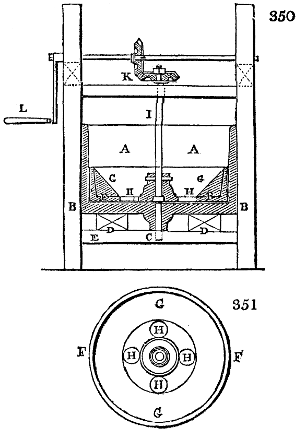
Fig. 350. is a vertical section through the centre of the crayon mill. Fig. 351. is a
view of the mill from above. A, the mill tub, whose bottom B must be a hard flat plate
of cast iron; the sides A being of wood or iron at pleasure. In the centre of the bottom
there is a pivot C, screwed into a socket cast upon the bottom, and which may be
strengthened by two cross bars D, made fast to the frame E. F, the millstone of cast-iron,
concave, whose diameter is considerably smaller than that of the vessel A; it is
furnished within with a circular basin of wood G, which receives the materials to be
ground, and directs them to the holes H, which allow them to pass down between the
under part of the muller, and the bottom of the tub, to undergo trituration.
By the centrifugal motion, the paste is driven towards the sides of the vessel, rises
over the sides of the muller, and comes again through the holes H, so as to be repeatedly
subjected to the grinding operation. This millstone is mounted upon an upright shaft
I, which receives rotatory motion from the bevel wheel work K, driven by the winch L.
The furnace in which some kinds of crayons, and especially the factitious blacklead
pencils are baked, is represented in fig. 352. in a front elevation; and in fig. 353., which
is a vertical section through the middle of the chimney.
A A, six tubes of greater or less size, according as the substance of the crayons is a
better or worse conductor of heat. These tubes, into which the crayons intended for
baking are to be put, traverse horizontally the laboratory B of the furnace, and are supported
by two plates C, pierced with six square holes for covering the axes of the tubes
A. These two plates are hung upon a common axis D; one of them, with a ledge, shuts
the cylindrical part of the furnace, as is shown in the figure. At the extremity of the
bottom, the axis D is supported by an iron fork fixed in the brickwork; at the front it
crosses the plate C, and lets through an end about 4 inches square to receive a key, by
means of which the axis D may be turned round at pleasure, and thereby the two plates
C, and the six tubes A, are thus exposed in succession to the action of the fire in
an equal manner upon each of their sides. At the two extremities of the furnace are
two chimnies E, for the purpose of diffusing the heat more equably over the body of the
crayons. F, fig. 352., is the door of the fire-place, by which the fuel is introduced; G,
fig. 353., the ash-pit; H, the fire-place; I, holes of the grate which separate the fire-place
from the ash-pit; K, brickwork exterior to the furnace.
General Lomet proposes the following composition for red crayons. He takes
the softest hematite, grinds it upon a porphyry slab; and then carefully elutriates it.
He makes it into a plastic paste with gum arabic and a little white soap, which he
forms by moulding, as above, through a syringe, and drying, into crayons. The proportions
of the ingredients require to be carefully studied.
CRAYONS, lithographic. Various formulæ have been given for the formation of
these crayons. One of these prescribes, white wax, 4 parts; hard tallow-soap, shell-lac,
of each 2 parts; lamp black, 1 part. Another is, dried tallow soap and white wax, each
6 parts; lamp black, 1 part. This mixture being fused with a gentle heat, is to be cast
into moulds for forming crayons of a proper size.
CREOSOTE, or the flesh-preserver, from κρεας and σωζω, is the most important of the
five new chemical products obtained from wood tar by Dr. Reichenbach. The other four,
paraffine, eupione, picamar, and pittacal, have hitherto been applied to no use in the arts,
and may be regarded at present as mere analytical curiosities.
Creosote may be prepared either from tar or from crude pyrolignous acid. The tar
must be distilled till it acquires the consistence of pitch, and at the utmost till it begins
to exhale the white vapours of paraffine. The liquor which passes into the receiver
divides itself into 3 strata, a watery one in the middle, placed between a heavy and a light
oil. The lower stratum alone is adapted to the preparation of creosote.
1. The liquor being saturated with carbonate of potash, is to be allowed to settle, and
the oily matter which floats at top is to be decanted off. When this oil is distilled, it
affords at first, products lighter than water, which are to be rejected, but the heavier oil
which follows is to be separated, washed repeatedly by agitation, with fresh portions of
dilute phosphoric acid, to free it from ammonia, then left some time at rest, after which
it must be washed by water from all traces of acidity, and finally distilled along with
a new portion of dilute phosphoric acid, taking care to cohobate, or pour back the distilled
product repeatedly into the retort.
2. The oily liquid thus rectified is colourless; it contains much creosote, but at the
same time some eupione, &c. It must therefore be mixed with potash lye at 1·12 sp.
grav., which dissolves the creosote. The eupione floats upon the surface of that solution,
and may be decanted off. The alkaline solution is to be exposed to the air, till it
blackens by decomposition of some foreign matter. The potash being then saturated
with dilute sulphuric acid, the creosote becomes free, when it may be decanted or
syphoned off and distilled.
3. The treatment by potash, sulphuric acid, &c., is to be repeated upon the brownish
creosote till it remains colourless, or nearly so, even upon exposure to air. It must
be now dissolved in the strongest potash lye, subjected to distillation anew, and lastly,
re-distilled with the rejection of the first products which contain much water, retaining
only the following, but taking care not to push the process too far.
In operating upon pyrolignous acid, if we dissolve effloresced sulphate of soda in it to
saturation, at the temperature of 167° F., the creosote oil will separate, and float upon
the surface. It is to be decanted, left in repose for some days, during which it will part
with a fresh portion of the vinegar and salt. Being now saturated while hot, with carbonate
of potash and distilled with water, an oily liquor is obtained, of a pale yellow
colour. This is to be rectified by phosphoric acid, &c., like the crude product of
creosote from tar.
Creosote is apparently composed of 76·2 carbon, 7·8 hydrogen, and 16·0 oxygen, in
100 parts. It is an oily looking liquid, slightly greasy to the touch, void of colour,
having an acrid burning taste, and capable of corroding the epidermis in a short time.
It possesses a penetrating disagreeable smell, like that of highly smoked hams, and when
inhaled up the nostrils, causes a flow of tears. Its specific gravity is 1·037, at 58° F.
Its consistence is similar to that of oil of almonds. It has no action upon the colours
of litmus or turmeric, but communicates to white paper a stain which disappears spontaneously
in a few hours, and rapidly by the application of heat.
It boils without decomposition at 398° F., under the average barometric pressure,
remains fluid at 16° F., is a non-conductor of electricity, refracts light powerfully, and
burns in a lamp with a ruddy smoky flame.
When mixed with water at 58° F. it forms two different combinations, the first being
a solution of 1 part of creosote in 400 of water; the second, a combination of 1 part of
water with 10 parts of creosote. It unites in all proportions with alcohol, hydric ether,
acetic ether, naphtha, eupione, carburet of sulphur, &c.
Creosote dissolves a large quantity of iodine and phosphorus, as also of sulphur with
the aid of heat, but it deposits the greater part of them in crystals, on cooling. It combines
with potash, soda, ammonia, lime, baryta, and oxide of copper. Oxide of mercury
converts creosote into a resinous matter, while itself is reduced to the metallic state.
Strong sulphuric and nitric acids decompose it.
Creosote dissolves several salts, particularly the acetates, and the chlorides of calcium
and tin; it reduces the nitrate and acetate of silver. It also dissolves indigo blue; a
remarkable circumstance. Its action upon animal matters is very interesting. It
coagulates albumen, and prevents the putrefaction of butcher’s meat and fish. For this
purpose these substances must be steeped a quarter of an hour in a weak watery solution
of creosote, then drained and hung up in the air to dry. Hence Reichenbach has inferred
that it is owing to the presence of creosote, that meat is cured by smoking; but he is not
correct in ascribing the effect to the mere coagulation of the albumen, since fibrine alone,
without creosote, will putrefy in the course of 24 hours, during the heats of summer. It
kills plants and small animals. It preserves flour paste unchanged for a long time.
Creosote exists in the tar of beech-wood, to the amount of from 20 to 25 per cent.,
and in crude pyrolignous acid, to that of 11⁄2.
It ought to be kept in well-stoppered bottles, because when left open, it becomes
progressively yellow, brown, and thick.
Creosote has considerable power upon the nervous system, and has been applied to
the teeth with advantage in odontalgia, as well as to the skin in recent scalds. But its
medicinal and surgical virtues have been much exaggerated. Its flesh-preserving quality
is rendered of little use, from the difficulty of removing the rank flavour which it
imparts.
CRUCIBLES; (Creusets, Fr.; Schmelztiegel, Germ.) are small conical vessels,
narrower at the bottom than the mouth, for reducing ores in docimasy by the dry
analysis, for fusing mixtures of earthy and other substances, for melting metals, and
compounding metallic alloys. They ought to be refractory in the strongest heats, not
readily acted upon by the substances ignited in them, not porous to liquids, and capable
of bearing considerable alternations of temperature without cracking; on which account
they should not be made too thick. The best crucibles are formed from a pure fire clay,
mixed with finely ground cement of old crucibles, and a portion of black-lead or graphite.
Some pounded coak may be mixed, with the plumbago. The clay should be
prepared in a similar way as for making pottery ware; the vessels after being formed
must be slowly dried, and then properly baked in the kiln. Crucibles formed of a
mixture of 8 parts in bulk of Stourbridge clay and cement, 5 of coak, and 4 of graphite,
have been found to stand 23 meltings of 76 pounds of iron each, in the Royal Berlin
foundry. Such crucibles resisted the greatest possible heat that could be produced, in
which even wrought iron was melted, equal to 150° or 155° Wedgewood; and bore
sudden cooling without cracking. Another composition for brass-founding crucibles is
the following:—1⁄2 Stourbridge clay; 1⁄4 burned clay cement; 1⁄8 coak powder; 1⁄8 pipe
clay. The pasty mass must be compressed in moulds. The Hessian crucibles from
Great Almerode and Epterode are made from a fire clay which contains a little iron,
but no lime; it is incorporated with siliceous sand. The dough is compressed in a
mould, dried, and strongly kilned. They stand saline and leaden fluxes in docimastic
operations very well; are rather porous on account of the coarseness of the sand, but are
thereby less apt to crack from sudden heating or cooling. They melt under the fusing
point of bar iron. Beaufay in Paris has lately succeeded in making a tolerable imitation
of the Hessian crucibles with a fire clay found near Namur in the Ardennes.
Berthier has published the following elaborate analyses of several kinds of crucibles:—
| |
Hes-
sian. |
Beau-
fay. |
English
for
Cast
Steel. |
St.
Etienne
for
Cast
Steel. |
Glass
Pots
at
Ne-
mours. |
Bohe-
mian
Glass
Pots. |
Glass
Pots,
of
Creu-
sot. |
| Silica |
70 |
·9 |
64 |
·6 |
63 |
·7 |
|
65 |
·2 |
67 |
·4 |
68 |
·0 |
68 |
·0 |
| Alumina |
24 |
·8 |
34 |
·4 |
20 |
·7 |
|
25 |
·0 |
32 |
·0 |
29 |
·0 |
28 |
·0 |
| Oxide of Iron |
3 |
·8 |
1 |
·0 |
4 |
·0 |
|
7 |
·2 |
0 |
·8 |
2 |
·2 |
2 |
·0 |
| Magnesia |
trace |
- |
- |
- |
- |
trace |
trace |
0 |
·5 |
trace |
| Water |
- |
- |
- |
- |
10 |
·3 |
[23] |
- |
- |
- |
- |
- |
- |
1 |
·0 |
Wurzer states the composition of the sand and clay in the Hessian crucibles as
follows:—
| Clay; |
silica |
10·1; |
alumina |
65·4; |
oxides of iron and manganese |
1·2; |
lime |
0·3; |
water |
23 |
| Sand; |
|
95·6; |
|
2·1; |
|
1·5; |
|
0·8 |
Black lead crucibles are made of two parts of graphite and one of fire clay; mixed
with water into a paste, pressed in moulds, and well dried; but not baked hard in the
kiln. They bear a higher heat than the Hessian crucibles, as well as sudden changes of
temperature; have a smooth surface, and are therefore preferred by the melters of gold
and silver. This compound forms excellent small or portable furnaces.
Mr. Anstey describes his patent process for making crucibles, as follows: Take two
parts of fine ground raw Stourbridge clay, and one part of the hardest gas coak, previously
pulverized, and sifted through a sieve of one-eighth of an inch mesh (if the coak
is ground too fine, the pots are very apt to crack). Mix the ingredients together with
the proper quantity of water, and tread the mass well. The pot is moulded by hand upon
a wooden block, supported on a spindle which turns in a hole in the bench; there is a
gauge to regulate the thickness of the melting pot, and a cap of linen or cotton placed
wet upon the core before the clay is applied, to prevent the clay from sticking partially to
the core, in the taking off; the cap adheres to the pot only while wet, and may be
removed without trouble or hazard when dry. He employs a wooden bat to assist in
moulding the pot; when moulded it is carefully dried at a gentle heat. A pot dried as
above, when wanted for use, is first warmed by the fire-side, and is then laid in the furnace
with the mouth downwards (the red coaks being previously damped with cold
ones in order to lessen the heat); more coak is then thrown in till the pot is covered,
and it is now brought up gradually to a red heat. The pot is next turned and fixed
in a proper position in the furnace, without being allowed to cool, and is then charged
with cold iron, so that the metal, when melted, shall have its surface a little below the
mouth of the pot. The iron is melted in about an hour and a half, and no flux or addition
of any kind is made use of. A pot will last for fourteen or even eighteen successive
meltings, provided it is not allowed to cool in the intervals; but if it cool, it will
probably crack. These pots it is said can bear a greater heat than others without
softening, and will, consequently, deliver the metal in a more fluid state than the best
Birmingham pots will. See a figure of the crucible mould under Steel.
CRYSTAL, is the geometrical form possessed by a vast number of mineral and saline
substances; as also by many vegetable and animal products. The integrant particles of
matter have undoubtedly determinate forms, and combine with one another, by the
attraction of cohesion, according to certain laws, and points of polarity, whereby they
assume a vast variety of secondary crystalline forms. The investigation of these laws
belongs to crystallography, and is foreign to the practical purpose of this volume.
Instructions are given under each object of manufacture which requires crystallization,
how to conduct this process; see Borax, Salt, &c.
CUDBEAR was first made an article of trade in this country, by Dr. Cuthbert
Gordon, from whom it derived its name, and was originally manufactured on a great
scale by Mr. G. Mackintosh at Glasgow, nearly 60 years ago. Cudbear or persio is a
powder of a violet red colour, difficult to moisten with water, and of a peculiar but not
disagreeable odour. It is partially soluble in boiling water, becomes red with acids, and
violet blue with alkalis. It is prepared in the same way as archil, only toward the
end the substance is dried in the air, and is then ground to a fine powder, taking care to
avoid decomposition, which renders it glutinous. In Scotland they use the lichen tartareus,
more rarely the lichen calcareus, and omphalodes; most of which lichens are imported
from Sweden and Norway, under the name of rock moss. The lichen is suffered
to ferment for a month, and is then stirred about to allow any stones which may be present
to fall to the bottom. The red mass is next poured into a flat vessel, and left to
evaporate till its urinous smell has disappeared, and till it has assumed an agreeable
colour verging upon violet. It is then ground to fine powder. During the fermentation
of the lichen, it is watered with stale urine, or with an equivalent ammoniacal liquor of
any kind, as in making archil.
CUPELLATION; is a mode of analyzing gold, silver, palladium, and platinum, by
adding to small portions of alloys, containing these metals, a bit of lead, fusing the
mixture in a little cup of bone earth called a cupel, then by the joint action of heat and
air, oxidizing the copper, tin, &c., present in the precious metals. The oxides thus produced,
are dissolved and carried down into the porous cupel in a liquid state, by the
vitrified oxide of lead. See Assay, Gold, and Silver.
CURRYING OF LEATHER, (Corroyer, Fr.; Zurichten, Germ.) is the art of
dressing skins after they are tanned, for the purposes of the shoe-maker, coach and harness
maker, &c., or of giving them the necessary smoothness, lustre, colour, and suppleness.
The currier’s shop has no resemblance to the tanner’s premises, having a quite different
set of tools and manipulations.
The currier employs a strong hurdle about a yard square, made either of basket twigs,
or of wooden spars, fixed rectangularly like trellis work, with holes 3 inches square,
upon which he treads the leather, or beats it with a mallet or hammer, in order to soften
it, and render it flexible.
The head knife, called in French couteau a revers, on account of the form of its edge,
which is much turned over, is a tool 5 or 6 inches broad, and 15 or 16 long; with
two handles, one in the direction of the blade, and the other perpendicular to it, for the
purpose of guiding the
edge more truly upon
the skin. The pommel
(paumelle) is so called
because it clothes the
palm of the hand, and
performs its functions.
It is made of hard wood,
and of a rectangular
shape, 1 foot long, 5
inches broad, flat above
and rounded below. It is
furrowed over the rounded
surface with transverse
parallel straight grooves.
These grooves are in
section sharp-edged isosceles
triangles. Fig.
354. and 355., represent
the pommel in an
upper and under view. The flat surface is provided with a leather strap for securing
it to the hand of the workman. Pommels are made of different sizes, and
with grooves of various degrees of fineness. Cork pommels are also used, but they
are not grooved. Pommels serve to give grain and pliancy to the skins.
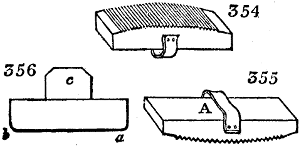
The stretching iron, fig. 356., is a flat plate of iron or copper, fully a fourth of an
inch thick at top, and thinning off at bottom in a blunt edge, shaped like the arc of a
circle of large diameter, having the angles a and b rounded, lest in working they should
penetrate the leather. The top c is mounted with leather to prevent it from hurting the
hands. A copper stretching knife is used for delicate skins. The workman holds this
tool nearly perpendicular, and scrapes the thick places powerfully with his two hands,
especially those where some tan or flesh remains. He thus equalizes the thickness of
the skin, and renders it at the same time more dense and uniform in texture. This tool
is of very general use in currying.
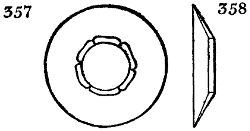
The round knife, fig. 357. and 358. (lunette in French), is a circular knife from 10 to
12 inches in diameter, with a round 4 or 5 inch hole in its centre, for introducing the
hands and working it. It is concave, as shown in the section fig. 358., presenting the
form of a spherical zone. The concave part is that applied to the skin. Its edge is not
perfectly straight; but is a little turned over on the side opposite to the skin, to prevent
it from entering too far into the leather.
The currier first slopes off with
the head knife from the edges, a portion
equal to what he afterwards removes
with the round one. By this
division the work is done sooner and
more exactly. All the oiled or greased
skins are dressed with the round knife.
The cleaner is a straight two-handled
knife two inches broad, of which
there are two kinds, a sharp-edged and a blunt one. Fig. 359.
The mace is made of wood, having a handle 30 inches long, with a cubical head or
mallet; upon the two faces of which, parallel to the line of the handle, there are 4 pegs
of hard wood turned of an egg-shape, and well polished, so as not to tear the moistened
leather when it is strongly beat and softened with the mace.
The horse or trestle, fig. 360., consists of a strong wooden frame, A B C D, which serves as
a leg or foot. Upon the middle of this frame there are two uprights, E F, and a strong
cross beam, G, for supporting the thick plank H, upon which the skins are worked. This
plank may be set at a greater or less slope, according as its lower end is engaged in one
or other of the cross bars, I I I I, of the frame. In the figure, a skin K is represented upon
the plank with the head knife upon it, in the act of being pared.
A cylindrical bar fixed horizontally at its ends to two buttresses projecting from the
wall, serves by means of a parallel stretched cord, to fix a skin by a coil or two in order
to dress it. This is accordingly called the dresser. The tallow cloth is merely a mop
made of stout rags, without the long handle; of which there are several, one for wax,
another for oil, &c. Strong-toothed pincers with hook-end handles, drawn together
by an endless cord, are employed to stretch the leather in any direction, while it is being
dressed. The currier uses clamps like the letter U, to fix the edges of the leather to his
table. His polisher is a round piece of hard wood, slightly convex below, with a handle
standing upright in its upper surface, for seizing it firmly. He first rubs with sour beer,
and finishes with barberry juice.
Every kind of tanned leather not intended for soles or such coarse purposes, is
generally curried before being delivered to the workmen who fashion it, such as shoemakers,
coachmakers, saddlers, &c. The chief operations of the currier are four:—
1. Dipping the leather, which consists in moistening it with water, and beating it
with the mace, or a mallet upon the hurdle. He next applies the cleaners, both blunt
and sharp, as well as the head knife, to remove or thin down all inequalities. After the
leather is shaved, it is thrown once more into water, and well scoured by rubbing the
grain side with pumice stone, or a piece of slaty grit, whereby it parts with the bloom, a
whitish matter, derived from the oak bark in the tan pit.
2. Applying the pommel to give the leather a granular appearance, and correspondent
flexibility. The leather is first folded with its grain side in contact, and rubbed strongly
with the pommel, then rubbed simply upon its grain side; whereby it becomes extremely
flexible.
3. Scraping the leather. This makes it of uniform thickness. The workman holds
the tool nearly perpendicular upon the leather, and forcibly scrapes the thick places with
both his hands.
4. Dressing it by the round knife. For this purpose he stretches the leather upon
the wooden cylinder, lays hold of the pendent under edge with the pincers attached to
his girdle, and then with both hands applies the edge of the knife to the surface of the
leather, slantingly from above downwards, and thus pares off the coarser fleshy parts of the
skin. This operation requires great experience and dexterity; and when well performed
improves greatly the look of the leather.
The hide or skin being rendered flexible and uniform, is conveyed to the shed or drying
house, where the greasy substances are applied, which is called dubbing (daubing), or
stuffing. The oil used for this purpose is prepared by boiling sheep-skins or doe-skins,
in cod oil. This application of grease is often made before the graining board or pommel
is employed.
Before waxing, the leather is commonly coloured by rubbing it with a brush dipped
into a composition of oil and lamp black on the flesh side, till it be thoroughly black; it is
then black-sized with a brush or sponge, dried, tallowed with the proper cloth, and
slicked upon the flesh with a broad smooth lump of glass; sized again with a sponge;
and when dry, again curried as above described.
Currying leather on the hair or grain side, termed black on the grain, is the same in
the first operation with that drest on the flesh, till it is scoured. Then the first black
is applied to it while wet, by a solution of copperas put upon the grain, after this has
been rubbed with a stone; a brush dipped in stale urine is next rubbed on, then an iron
slicker is used to make the grain come out as fine as possible. It is now stuffed with
oil. When dry, it is seasoned; that is, rubbed over with a brush dipped in copperas
water, on the grain, till it be perfectly black. It is next slicked with a good grit-stone,
to take out the wrinkles, and smooth the coarse grain. The grain is finally raised with
the pommel or graining board, by applying it to the leather in different directions.
When thoroughly dry, it is grained again in two or three ways.
Hides intended for covering coaches are shaved nearly as thin as shoe hides, and
blacked upon the grain.
CUTLERY. (Coutellerie, Fr.; Messerschmidwaare, Germ.) Three kinds of steel
are made use of in the manufacture of different articles of cutlery, viz. common steel,
shear steel, and cast steel. Shear steel is exceedingly plastic and tough. All the edge
tools which require great tenacity without great hardness are made of it, such as table
knives, scythes, plane-irons, &c.
Cast steel is formed by melting blistered steel in covered crucibles, with bottle glass,
and pouring it into cast-iron moulds, so as to form it into ingots: these ingots are then
taken to the tilt, and drawn into rods of suitable dimensions. No other than cast
steel can assume a very fine polish, and hence all the finer articles of cutlery are made
of it, such as the best scissors, penknives, razors, &c.
Formerly cast steel could be worked only at a very low heat; it can now be made so
as to be welded to iron with the greatest ease. Its use is consequently extended to
making very superior kinds of chisels, plane-irons, &c.
Forging of table knives.—Two men are generally employed in the forging of table
knives; one called the foreman or maker, and the other the striker.
The steel called common steel is employed in making the very common articles; but
for the greatest part of table knives which require a surface free from flaws, shear steel
is generally preferred. That part of the knife termed the blade, is first rudely formed
and cut off. It is next welded to a rod of iron about 1⁄2 inch square, in such a manner
as to leave as little of the iron part of the blade exposed as possible. A sufficient
quantity of the iron now attached to the blade, is taken off from the rod to form the
bolster or shoulder, and the tang.
In order to make the bolster of a given size, and to give it at the same time shape
and neatness, it is introduced into a die, and a swage placed upon it; the swage has a
few smart blows given it by the striker. This die and swage are, by the workman,
called prints.
After the tangs and bolster are finished, the blade is heated a second time, and the
foreman gives it its proper anvil finish; this operation is termed smithing. The blade
is now heated red-hot, and plunged perpendicularly into cold water. By this means it
becomes hardened. It requires to be tempered regularly down to a blue colour: in
which state it is ready for the grinder.
Mr. Brownill’s method of securing the handles upon table-knives and forks, is, by
lengthening the tangs, so as to pass them completely through the handle, the ends of
which are to be tinned after the ordinary mode of tinning iron; and, when passed
through the handle, the end of the tang is to be spread by beating, or a small hole
drilled through it, and a pin passed to hold it upon the handle. After this, caps of
metal, either copper plated, or silver, are to be soldered on to the projecting end of the
tang, and while the solder is in a fluid state, the cap is to be pressed upon the end of
the handle and held there until the solder is fixed, when the whole is to be cooled by
being immersed in cold water.
Mr. Thomason’s patent improvements consist in the adaptation of steel edges to the
blades of gold and silver knives. These steel edges are to be attached to the other
metal of whatever quality it may be, of which the knife, &c. is made, by means of
solder, in the ordinary mode of effecting that process. After the edge of steel is thus
attached to the gold, silver, &c., it is to be ground, polished, and tempered by immersion
in cold water, or oil, after being heated. This process being finished, the other parts
of the knife are then wrought and ornamented by the engraver or chaser, as usual.
A patent was obtained in 1827, by Mr. Smith of Sheffield, for rolling out knives at
one operation.
In the ordinary mode of making knives, a sheet of steel being provided, the blades
are cut out of the sheet, and the backs, shoulders, and tangs, of wrought iron, are
attached to the steel blades, by welding at the forge. The knife is then ground to the
proper shape, and the blade polished and hardened.
Instead of this welding process, the patentee proposes to make the knives entirely of
steel, and to form them by rolling in a heated state between massive rollers; the shoulders
or bolsters, and the tangs for the handles being produced by suitable recesses in
the peripheries of the rollers; just as rail-way rails are formed. When the knife is to
be made with what is called a scale tang, that is a broad flat tang, to which the handle
is to be attached in two pieces, riveted on the sides of the tang, the rollers are then only
to have recesses cut in them, in a direction parallel to the axis for forming the bolster.
The plate of steel having been heated, is to be pressed between the two rollers, by
which the blades and the parts for the scale tangs will be pressed out flat and thin, and
those parts which pass between the grooves or recess will be left thick or protuberant,
forming the bolster for the shoulder of the blade. But if the tangs are to be round in
order to be fixed into single handles, then it will be necessary also to form transverse
grooves in the rollers, that is, at right angles to those which give shape to the bolsters,
the transverse grooves corresponding in length to the length of the intended tang.
When the plates of steel have been thus rolled, forming three or more knives in a
breadth, the several knives are to be cut out by the ordinary mode of what is called
slitting, and the blades and shoulders ground, hardened, and polished in the usual way.
Forks are generally a distinct branch of manufacture from that of knives, and are
purchased of the fork makers by the manufacturers of table knives, in a state fit for receiving
the handles.
The rods of steel from which the forks are made, are about 3⁄8ths of an inch square.
The tang and shank of the fork are first roughly formed. The fork is then cut off,
leaving at one end about 1 inch of the square part of the steel. This part is afterwards
drawn out flat to about the length of the prongs. The shank and tang are now
heated, and a proper form given to them by means of a die and swage. The prongs are
afterwards formed at one blow by means of the stamp; this machine is very similar to
that used in driving piles, but it is worked by one man. It consists of a large anvil
fixed in a block of stone nearly on a level with the ground. To this anvil are attached
two rods of iron of considerable thickness, fixed 12 inches asunder, perpendicularly to
the anvil, and diagonally to each other. These are fastened to the ceiling. The hammer
or stamp, about 100 lbs. in weight, having a groove upon either side corresponding to
the angles of the upright rods, is made to slide freely through its limited range, being
conducted by its two iron supporters. A rope is attached to the hammer, which goes
over a pulley on the floor of the room above, and comes down to the person who works
the stamp: two corresponding dies are attached, one to the hammer, and the other to
the anvil. That part of the fork intended to form the prongs, is heated to a pretty white
heat and placed in the lower die, and the hammer containing the other die is made to
fall upon it from a height of about 7 or 8 feet. This forms the prongs and the middle
part of the fork, leaving a very thin substance of steel between each prong, which is
afterwards cut out with an appropriate instrument called a flie-press. The forks are now
annealed by surrounding a large mass of them with hot coals, so that the whole shall
become red hot. The fire is suffered gradually to die out, and the forks to cool without
being disturbed. This process is intended to soften, and by that means to prepare them
for filing. The inside of the prongs are then filed, after which they are bent into their
proper form and hardened. When hardened, which is effected by heating them red-hot
and plunging them into cold water, they are tempered by exposing them to the degree
of heat at which grease inflames. See Stamps.
Penknives are generally forged by a single hand, with the hammer and the anvil simply.
The hammer in this trade is generally light, not exceeding 31⁄2 lbs. The breadth
of the face, or the striking part, is about one inch; if broader, it would not be convenient
for striking so small an object. The principal anvil is about 5 inches, and 10
upon the face, and is provided with a groove into which a smaller anvil is wedged. The
smaller anvil is about 2 inches square upon the face. The blade of the knife is first
drawn out at the end of the rod of steel, and as much more is cut off along with it as
is thought necessary to form the joint. The blade is then taken in a pair of tongs, and
heated a second time to finish the joint part, and at the same time to form a temporary
tang for the purpose of driving into a small haft used by the grinder. Another heat
is taken to give the blade a proper finish. The small recess called the nail hole, used
in opening the knife, is made while it is still hot by means of a chisel, which is round
on one side, and flat upon the other.
Penknives are hardened by heating the blade red hot, and dipping them into water up
to the shoulder. They are tempered by setting them side by side, with the back downwards
upon a flat iron plate laid upon the fire, where they are allowed to remain till
they are of a brown or purple colour.
The blades of pocket knives, and all that come under the denomination of spring
knives, are made in the same way.
The forging of razors is performed by a foreman and striker, as in making table
knives.
They are generally made of cast steel. The rods, as they come from the tilt, are about
1⁄2 inch broad, and of a thickness sufficient for the back of the razor.
There is nothing peculiar in the tools made use of in forging razors: the anvil is a
little rounded at the sides, which affords the opportunity of making the edge thinner,
and saves an immense labour to the grinder.
Razors are hardened and tempered in a similar manner to penknives. They are,
however, left harder, being only let down to yellow or brown colour.
The forging of scissors is wholly performed by the hammer, and all the sizes are made
by a single hand. The anvil of the scissor-maker weighs about 11⁄2 cwt.; it measures,
on the face, about 4 by 11 inches. It is provided with two gates or grooves for the reception
of various little indented tools termed by the workman bosses; one of these
bosses is employed to give proper figure to the shank of the scissors; another for
forming that part which has to make the joint; and a third is made use of for giving
a proper figure to the upper side of the blade. There is also another anvil placed on
the same block, containing two or three tools called beak-irons, each consisting of an
upright stem about 6 inches high, at the top of which a horizontal beak projects; one
of these beaks is conical, and is used for extending the bow of the scissors; the other is
a segment of a cylinder with the round side upwards, containing a recess for giving a
proper shape and smoothness to the inside of the bow.
The shank of the scissors is first formed by means of one of the bosses, above described,
leaving as much steel at the end as will form the blade. A hole is then punched
about 1⁄4 inch in width, a little above the shank. The blade is drawn out and finished,
and the scissors separated from the rod a little above the hole. It is heated a third
time, and the small hole above mentioned is extended upon the beak-irons so as to form
the bow. This finishes the forging of scissors. They are promiscuously made in this
way, without any other guide than the eye, having no regard to their being in pairs.
They are next annealed for the purpose of filing such parts of them as cannot be
ground, and afterwards paired.
The very large scissors are made partly of iron, the blades being of steel.
After the forging, the bow and joints, and such shanks as cannot be ground, are
filed. The rivet hole is then bored, through which they are to be screwed or riveted
together. This common kind of scissors is only hardened up to the joint. They
are tempered down to a purple or blue colour. In this state they are taken to the
grinder.
Grinding and polishing of cutlery.—The various processes which come under this denomination
are performed by machinery, moving in general by the power of the steam-engine
or water-wheel.
Grinding wheels or grinding mills are divided into a number of separate rooms;
every room contains six places called troughs; each trough consists of a convenience for
running a grindstone and a polisher at the same time, which is generally occupied by
a man and a boy.
The business of the grinder is generally divided into three stages, viz. grinding,
glazing, and polishing.
The grinding is performed upon stones of various qualities and sizes, depending on
the articles to be ground. Those exposing much flat surface, such as saws, fenders, &c.
require stones of great diameter, while razors, whose surface is concave, require to be
ground upon stones of very small dimensions. Those articles which require a certain
temper, which is the case with most cutting instruments, are mostly ground on a wet
stone; for which purpose the stone hangs within the iron trough, filled with water to
such a height that its surface may just touch the face of the stone.
Glazing is a process following that of grinding: it consists in giving that degree of
lustre and smoothness to an article which can be effected by means of emery of the
various degrees of fineness. The tool on which the glazing is performed, is termed a
glazer. It consists of a circular piece of wood, formed of a number of pieces in such
a manner that its edge or face may always present the endway of the wood. Were it
made otherwise, the contraction of the parts would destroy its circular figure. It is
fixed upon an iron axis similar to that of the stone. Some glazers are covered on the
face with leather, others with metal, consisting of an alloy of lead and tin; the latter
are termed caps. In others, the wooden surface above is made use of. Some of the
leather-faced glazers, such as are used for forks, table knives, edge tools, and all the
coarser polished articles, are first coated with a solution of glue, and then covered with
emery. The surfaces of the others are prepared for use by first turning the face very
true, then filling it with small notches by means of a sharp-ended hammer, and lastly
filling up the interstices with a compound of tallow and emery.
The pulley of the glazer is so much less than that of the stone, that its velocity is
more than double, having in general a surface speed of 1500 feet in a second.
The process of polishing consists in giving the most perfect polish to the different
articles. Nothing is subjected to this operation but what is made of cast steel, and has
been previously hardened and tempered.
The polisher consists of a circular piece of wood covered with buff leather, the surface
of which is covered from time to time, while in use, with the crocus of iron, called also
colcothar of vitriol.
The polisher requires to run at a speed much short of that of the stone, or the glazer.
Whatever may be its diameter, the surface must not move at a rate exceeding 70 or 80
feet in a second.
CYANATES; saline compounds of cyanic acid with the bases potash, soda, ammonia,
baryta, &c. The first is prepared by calcining at a dull red heat, a mixture of
ferro-cyanide of potassium (prussiate of potash) and black oxide of manganese. The
cyanates have not hitherto been applied to any use in the arts.
CYANHYDRIC Acid; another name for the hydrocyanic or prussic acid. See
Prussian Blue and Prussic Acid.
CYANIDES; compounds of cyanogen with the metals; as cyanide of potassium,
sodium, barium, calcium, iron, mercury. The last is the only one of importance in a
manufacturing point of view, since from it prussic acid is made.
CYANIDES, FERRO. Double compounds of cyanogen with iron, and of cyanogen
with another metal, such as potassium, sodium, barium, &c. The ordinary yellow
prussiate of potash has this constitution, and is called the ferro-cyanide.
CYANOGEN. A gaseous compound of two prime equivalents of charcoal = 12,
and one of azote = 14 = 26; hydrogen being the radix or, 1. It consists of two volumes
of vapour of carbon, and one volume of azote, condensed into one volume; and has
therefore a density equal to the sum of the weights of these 3 gaseous volumes = 1·815.
Cyanogen is readily procured by exposing the cyanide of mercury to a dull red heat in
a retort; the gas is evolved and may be collected over mercury. Its smell is very
sharp and penetrating; it perceptibly reddens tincture of litmus; it is condensable by
pressure at a low temperature into a liquid; and by a still greater degree of cold, it is
solidified. When a lighted taper is applied to a mixture of cyanogen and oxygen, an
explosion takes place; carbonic acid is formed, and the azote is set at liberty.
For a connected view of the various compounds of cyanogen employed in the arts,
see Prussian Blue.
CYDER; (Cidre, Fr.; Apfelwein, Germ.) the vinous fermented juice of the apple.
The ancients were acquainted with cyder and perry, as we learn from the following passage
of Pliny the naturalist: “Wine is made from the Syrian pod, from pears and apples of every
kind.” Book xiv. chap. 19. The term cyder or cidre in French, at first written sidre, is
derived from the latin word sicera, which denoted all other fermented liquors except grape
wine. Cyder seems to have been brought into Normandy by the Moors of Biscay, who had
preserved the use of it after coming into that country from Africa. It was afterwards spread
through some other provinces of France, whence it was introduced into England, Germany,
and Russia. It is supposed that the first growths of Normandy afford still the
best specimens of cyder. Devonshire and Herefordshire are the counties of England
most famous for this beverage.
Strong and somewhat elevated ground, rather dry, and not exposed to the air of the
sea, or to high winds, are the best situations for the growth of the cyder apple. The
fruit should be gathered in dry weather. The juice of apples is composed of a great
deal of water; a little sugar analogous to that of the grape; a matter capable of causing
fermentation with contact of air; a pretty large proportion of mucilage, with malic acid,
acetic acid, and an azotized matter in a very small quantity. The seeds contain a bitter
substance and a little essential oil; the pure parenchyma or cellular membrane constitutes
not more than two per cent. of the whole. After the apples are gathered, they are left
in the barn-loft for fifteen days or upwards to mellow; some of them in this case, however,
become soft and brown. This degree of maturation diminishes their mucilage,
and developes alcohol and carbonic acid; in consequence of which the cyder suffers no
injury. There is always however a little loss; and if this ripening goes a little further
it is very apt to do harm, notwithstanding the vulgar prejudice of the country people to
the contrary. Too much care, indeed, cannot be taken to separate the sound from the
spoiled apples; for the latter merely furnish an acid leaven, give a disagreeable taste to
the juice, and hinder the cyder from fining, by leaving in it a certain portion of the
parenchyma, which the gelatinous matter or the fermentation has diffused through it.
Unripe apples should be separated from the ripe also, for they possess too little saccharum
to be properly susceptible of the vinous fermentation.
In France, where cyder making is most scientifically practised, it is prepared by
crushing the apples in a mill with revolving edge-stones, turned in a circular stone
cistern by one or two horses. When the fruit is half mashed, about one fifth of its
weight of river water is added, or the water of lakes. The latter have been found by
experience to be preferable to other water.
In some places a mill composed of two cast-iron fluted cylinders placed parallel to
each other under the bottom of a hopper, is employed for crushing the apples. One of
the cylinders is turned by a winch, and communicates its motion in the opposite direction
by means of the flutings working into each other. Each portion of the fruit must
be passed thrice through this rude mill in order to be sufficiently mashed; and the same
quantity of water must be added as in the edge stone mill.
After the apples are crushed they are usually put into a large tub or tun for 12 or 24
hours. This steeping aids the separation of the juice, because the fermentative motion
which takes place in the mass breaks down the cellular membranes; but there is
always a loss of alcohol carried off by the carbonic acid disengaged, while the skins
and seeds develope a disagreeable taste in the liquid. The vatting might be suppressed
if the apples were so comminuted as to give out their juice more readily. With slight
modifications, the process employed in rasping and squeezing the beet-roots might in
my opinion be applied with great advantage to the cyder manufacture. See Sugar.
After the vatting, the mashed fruit is carried to the press and put upon a square wicker
frame or into a hair bag, sometimes between layers of straw, and exposed stratum super
stratum to strong pressure till what is called a cheese or cake is formed. The mass
is to be allowed to drain for some time before applying pressure, which ought to
be very gradually increased. The juice which exudes with the least pressure
affords the best cyder; that which flows towards the end acquires a disagreeable taste
from the seeds and the skins. The must is put into casks with large bungholes, where
it soon begins to exhibit a tumultuous fermentation. The cask must be completely
filled, in order that all the light bodies suspended in the liquid when floated to the top
by the carbonic acid may flow over with the froth; this means of clearing cyder is
particularly necessary with the weak kinds, because it cannot be expected that these
matters in suspension will fall to the bottom of the casks after the motion has ceased.
In almost every circumstance besides, when no saccharine matter has been added to the
must, that kind of yeast which rises to the top must be separated, lest by precipitation
it may excite an acid fermentation in the cyder. The casks are raised upon gawntrees
or stillions, in order to place flat tubs below them to receive the liquor which flows over
with the froth. At the end of two or three days, for weak cyders which are to be
drunk somewhat sweet, of 6 or 10 days or more for stronger cyders, with variations for
the state of the weather, the fermentation will be sufficiently advanced, and the cyder may
be racked off into other casks. Spirit puncheons preserve cyder better than any other,
but in all cases the casks should be well seasoned and washed. Sometimes a sulphur
match is burned in them before introducing the cyder, a precaution to be generally
recommended, as it suspends the activity of the fermentation, and prevents the formation
of vinegar.
The cyder procured by the first expression is called cyder without water. The cake
remaining in the press is taken out, divided into small pieces, and mashed anew, adding
about half the weight of water, when the whole is carried back to the press and treated
as above described. The liquor thus obtained furnishes a weaker cyder which will not
keep, and therefore must be drunk soon.
The cake is once more mashed up with water, and squeezed, when it yields a liquor
which may be used instead of water for moistening fresh ground apples.
The processes above described, although they have been long practised, and have
therefore the stamp of ancestral wisdom, are extremely defective. Were the apples
ground with a proper rotatory rasp which would tear all their cells asunder, and the
mash put through the hydraulic press in bags between hurdles of wicker-work, the
juice would be obtained in a state of perfection fit to make a cyder superior to many
wines. An experimental process of this kind has been actually executed in France
upon a considerable scale, with the best results. The juice had the fine flavour of the
apple, was fermented by itself without any previous fermentation in the mash, and
afforded an excellent strong cyder which kept well.
When the must of the apples is weak or sour, good cyder cannot be made from it
without the addition of some saccharine matter. The syrup into which potato farina is
convertible by diastase (saccharine ferment), see Starch and Sugar, would answer well
for enriching poor apple juice.
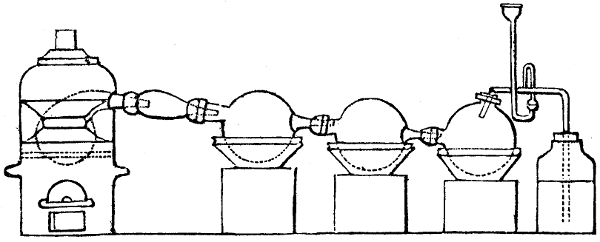
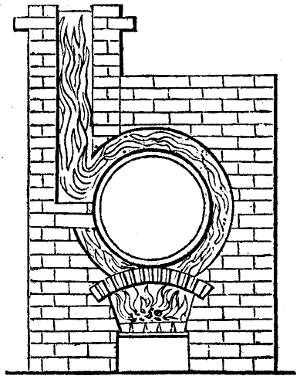
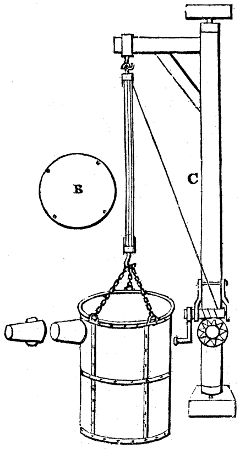
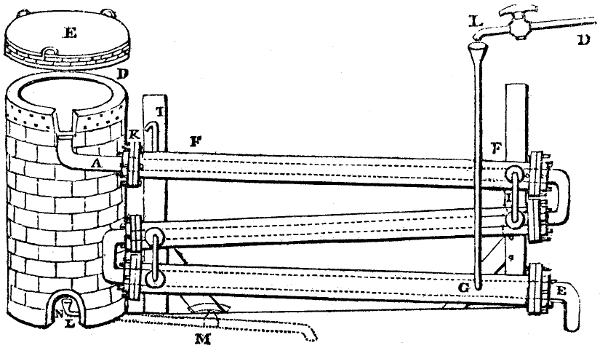
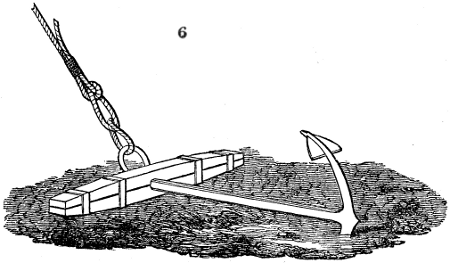
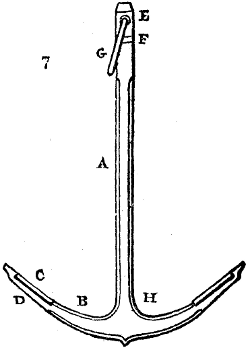
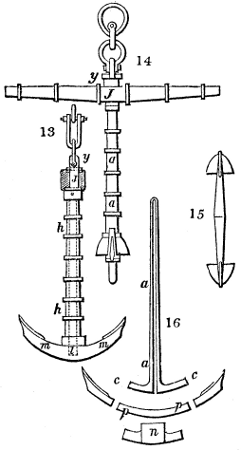
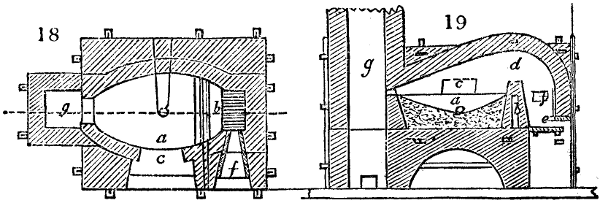
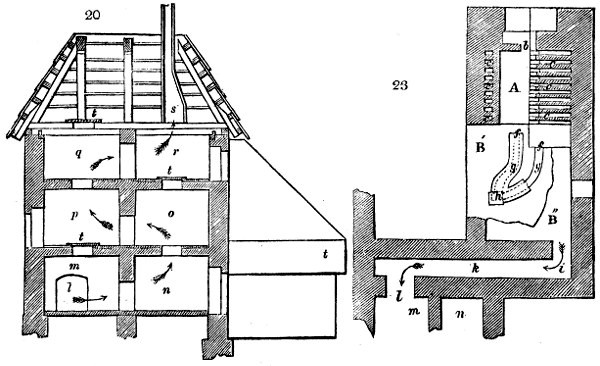
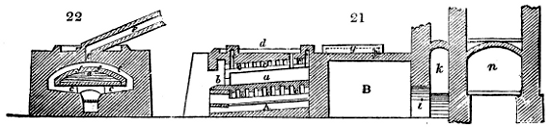
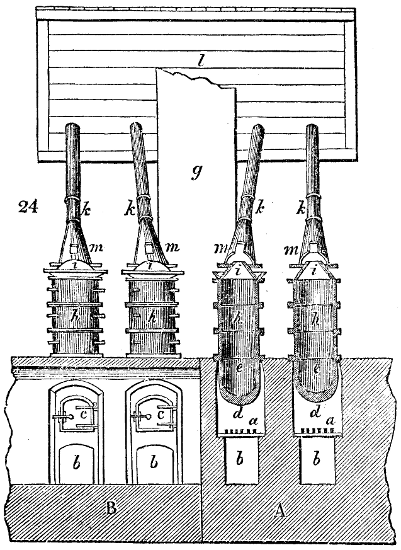
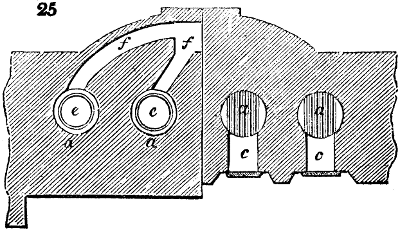
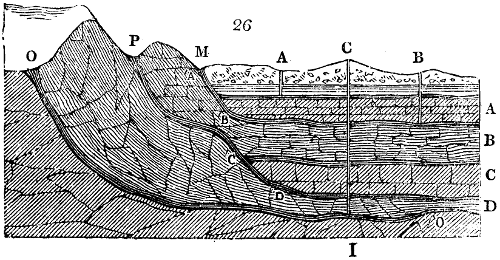
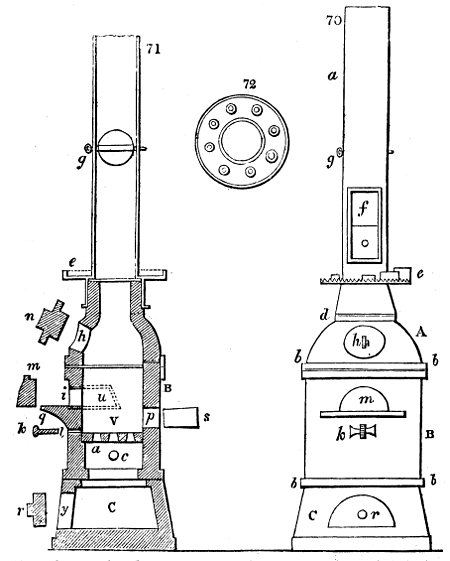
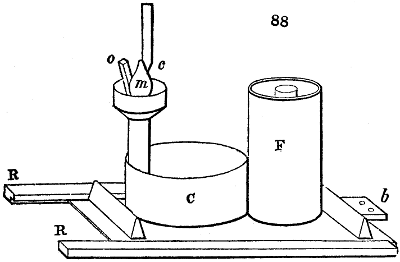

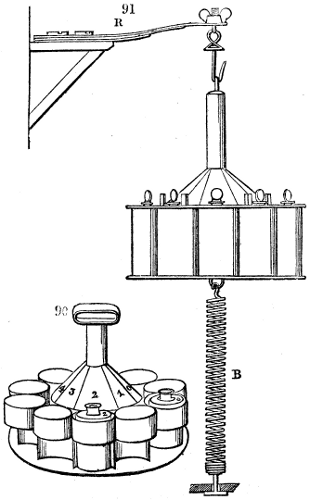
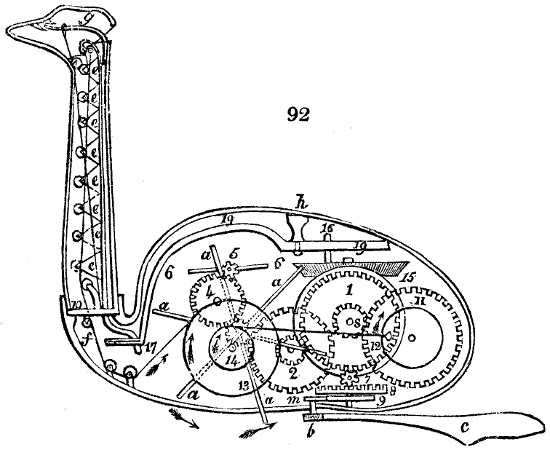
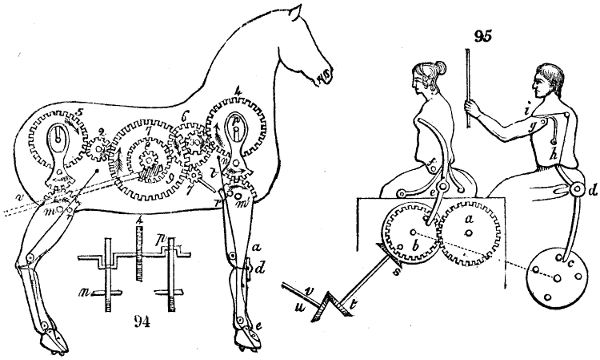
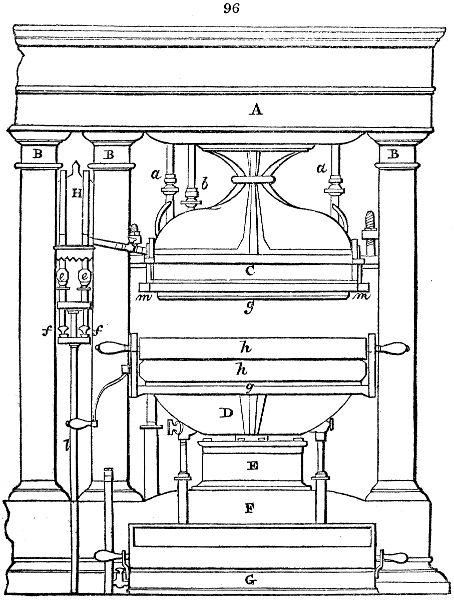
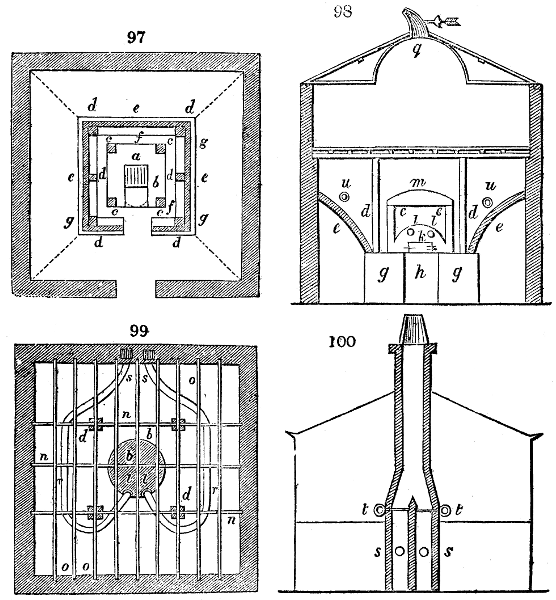
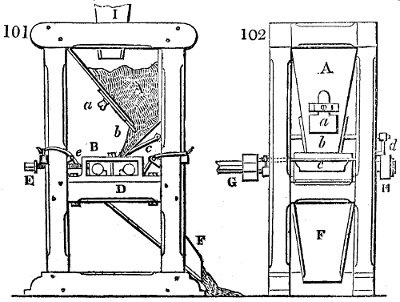
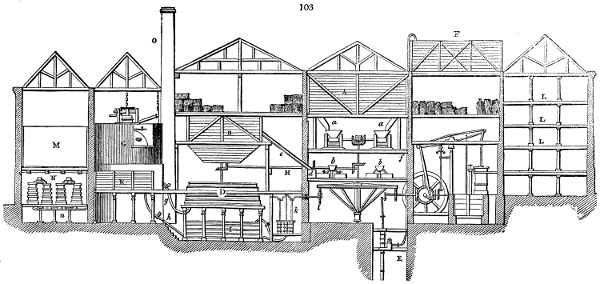
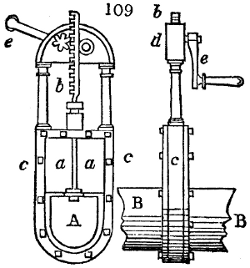
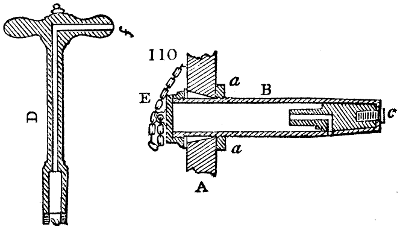
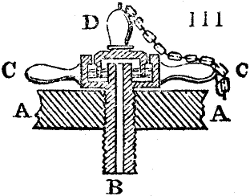
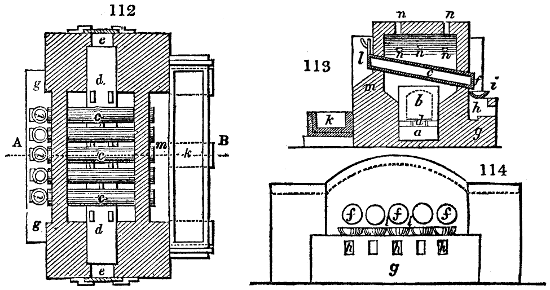
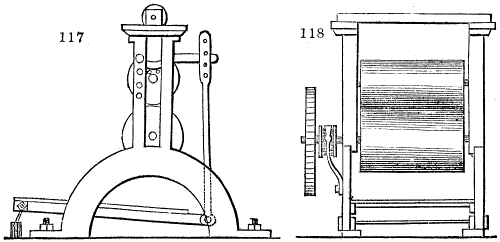
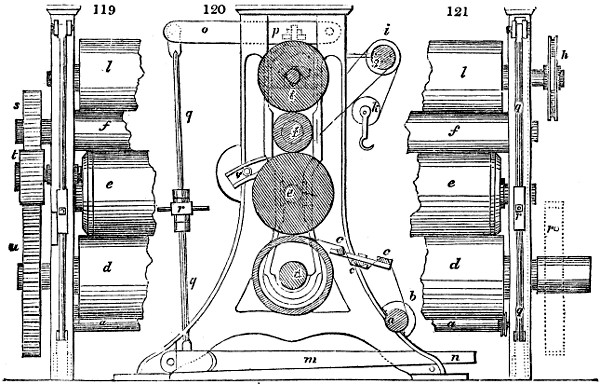
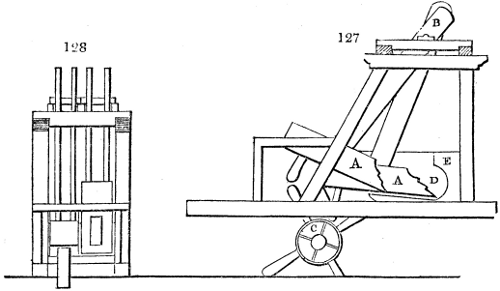
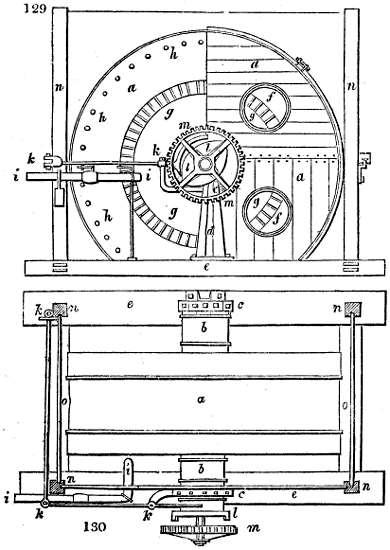
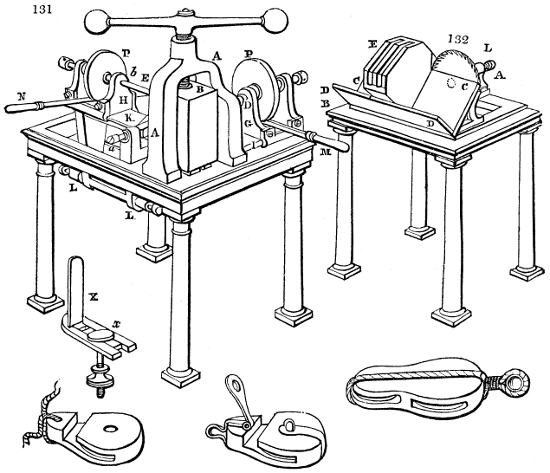
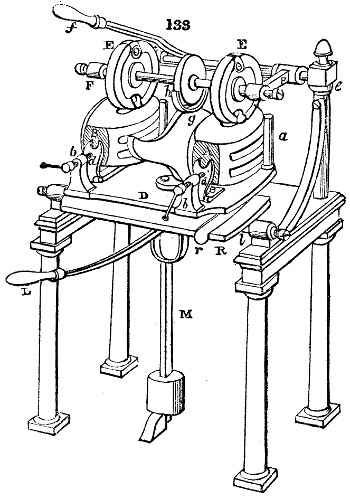
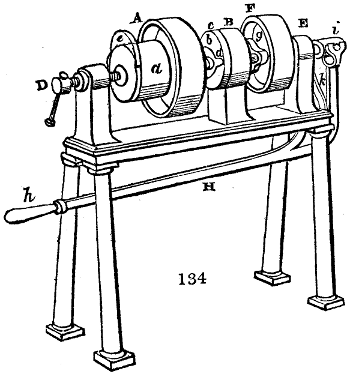
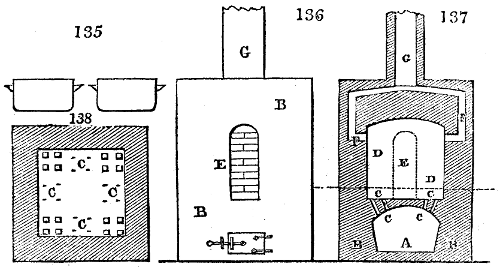
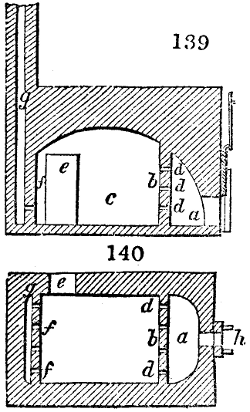
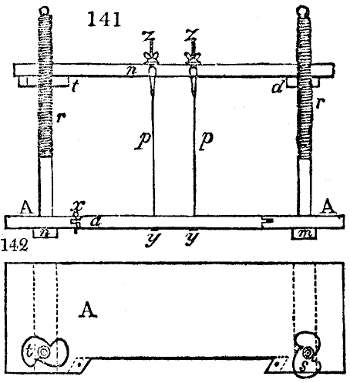
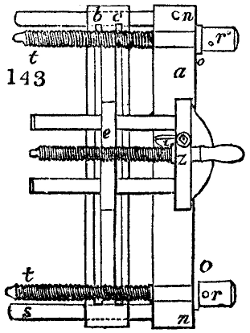
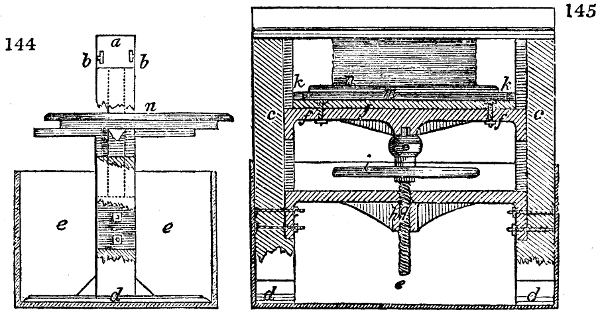
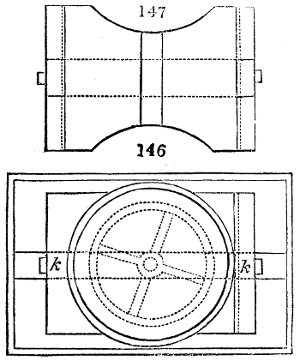
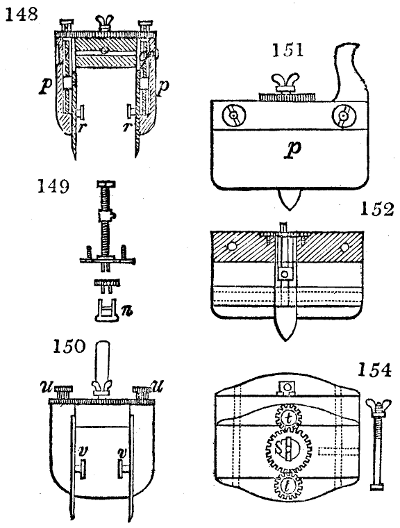
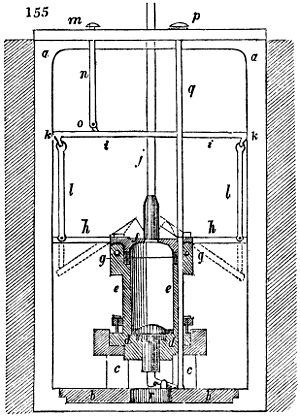
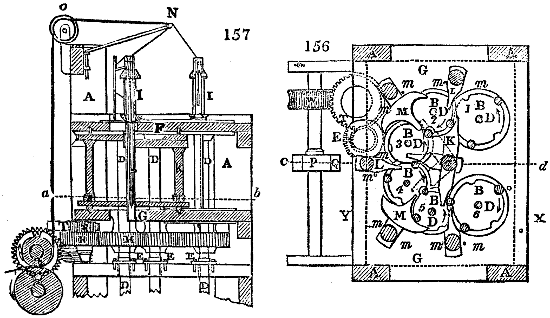
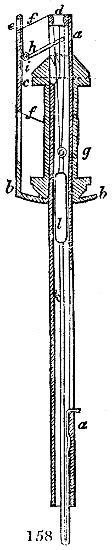
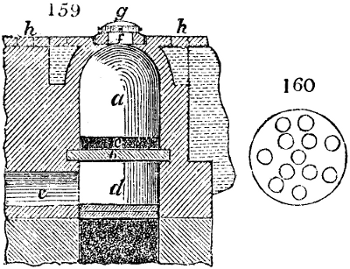
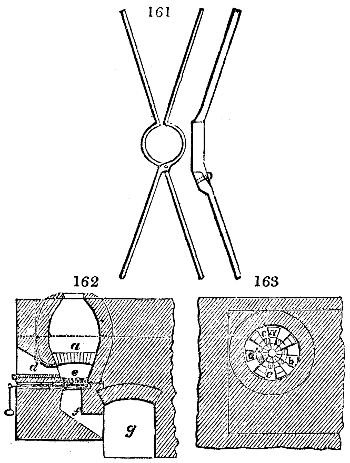
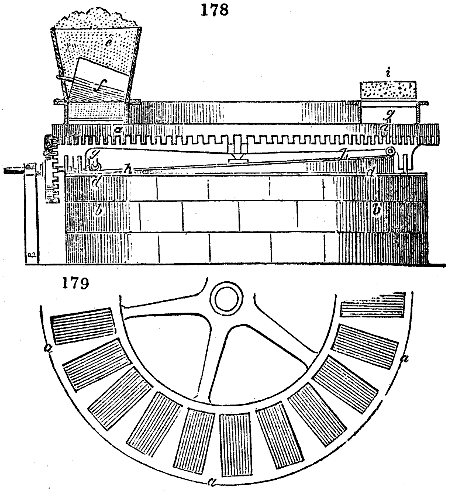
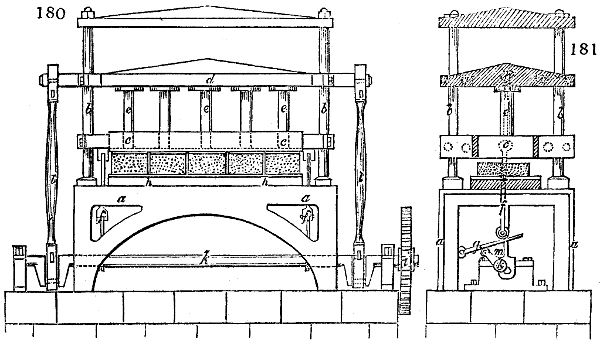
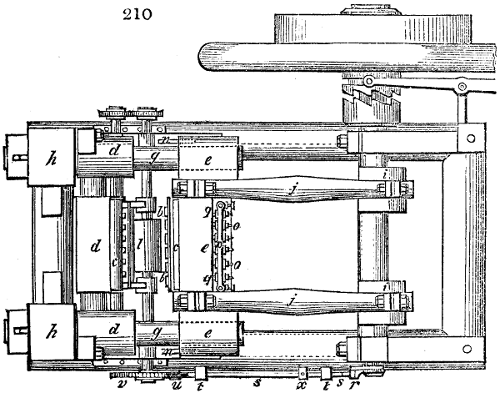
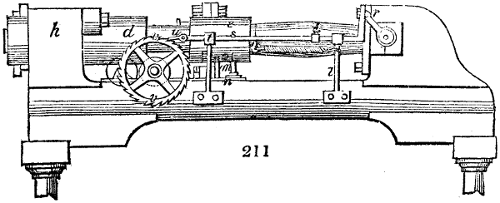
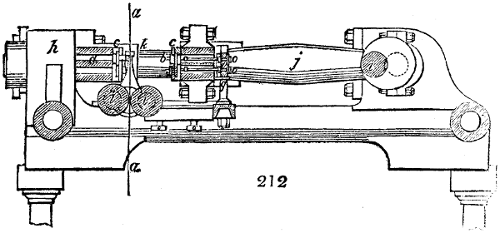
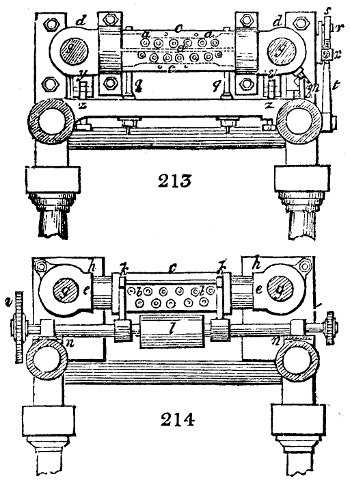
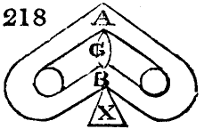
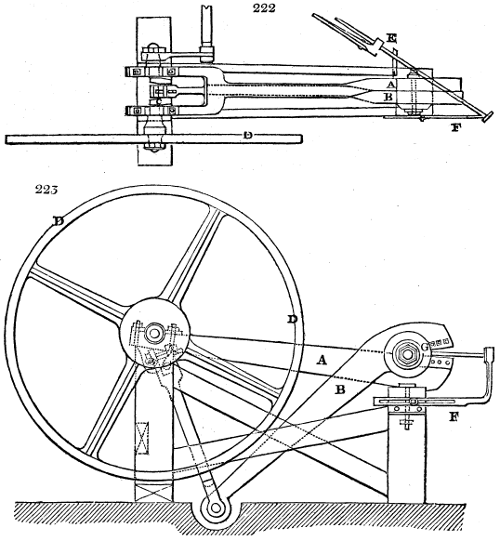
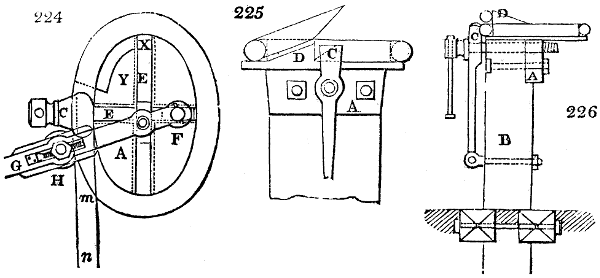
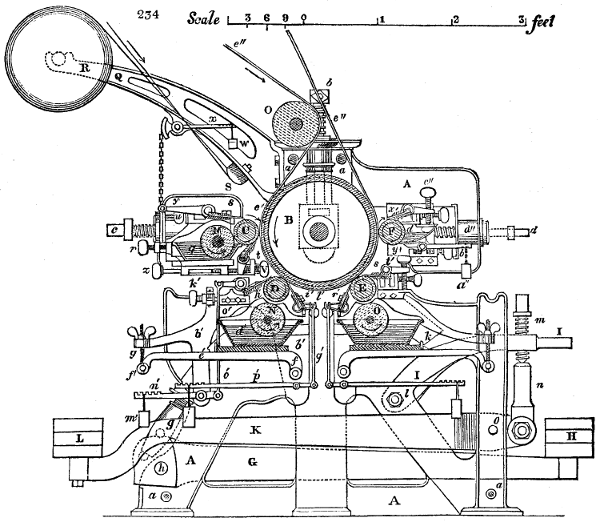
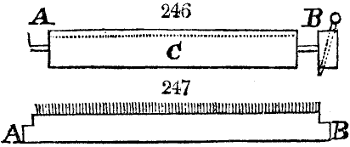
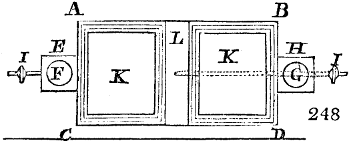
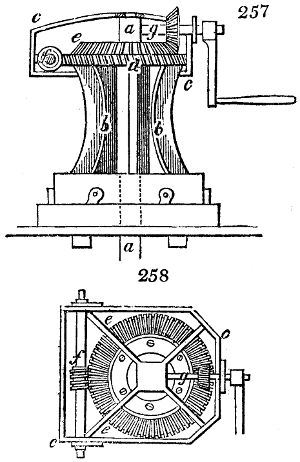
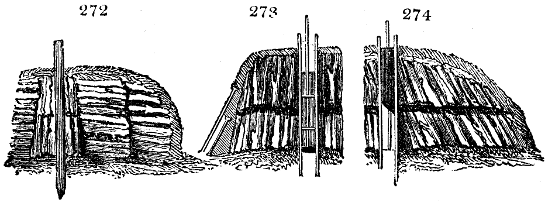
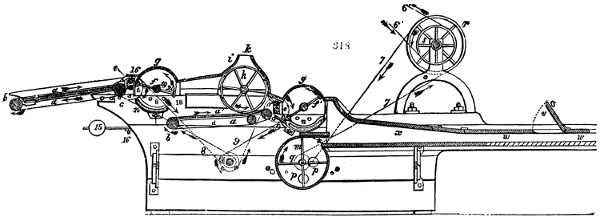
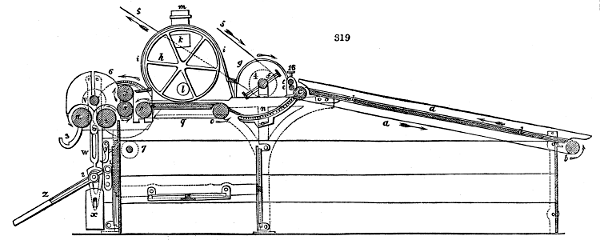
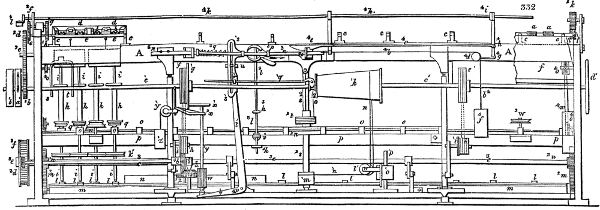
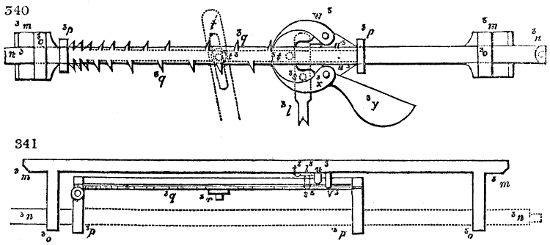
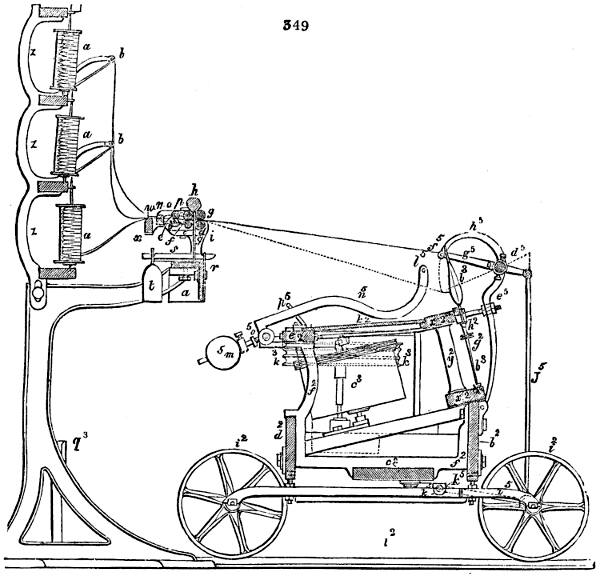
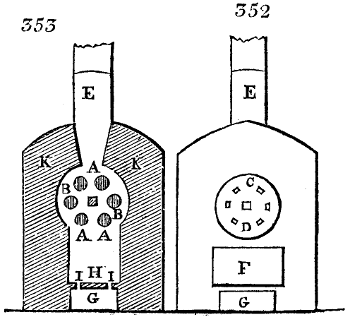

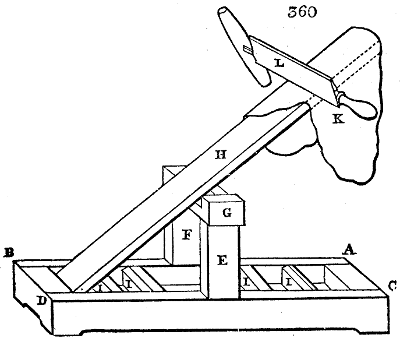
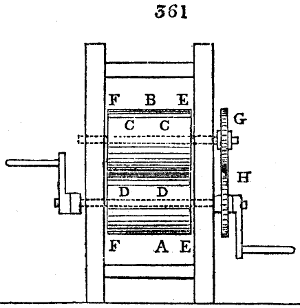
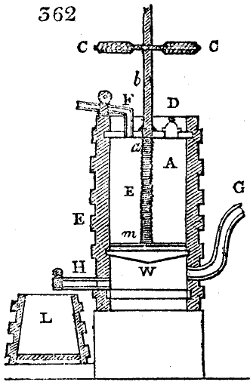
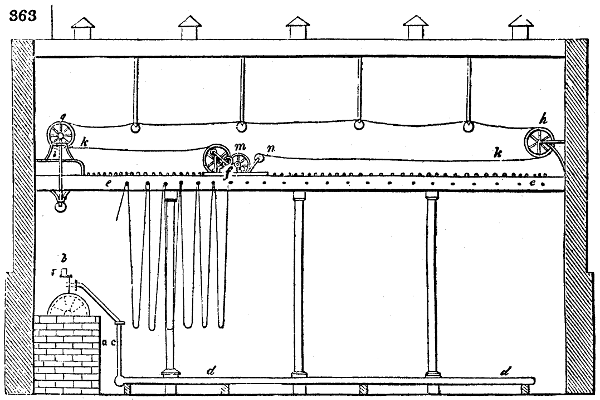
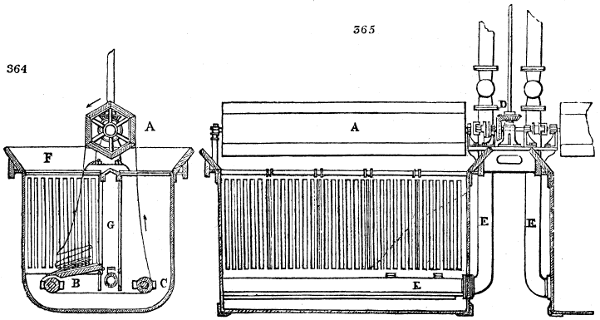
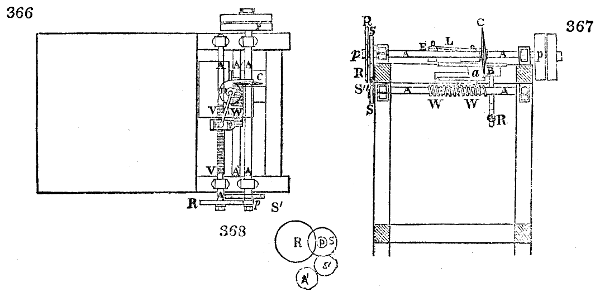
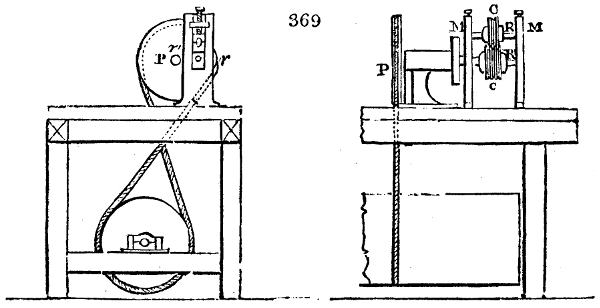
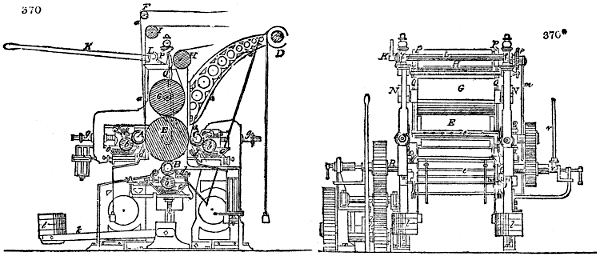
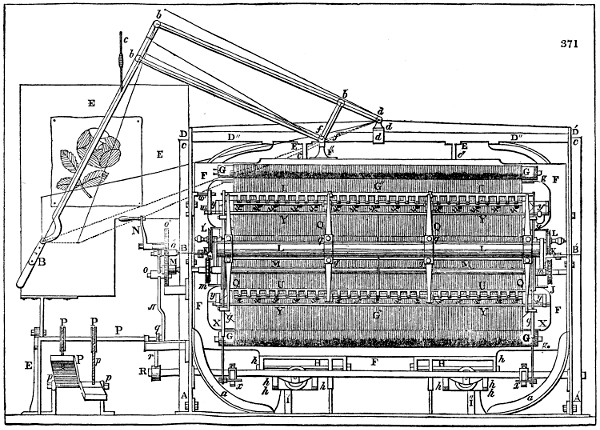
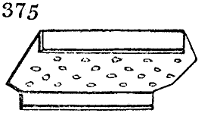
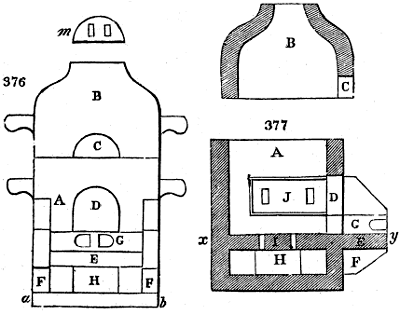
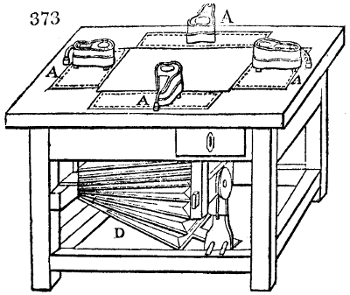
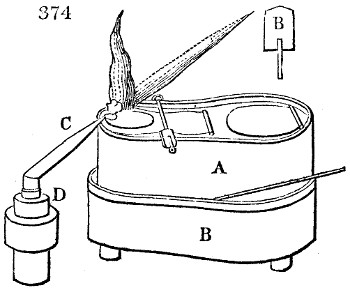
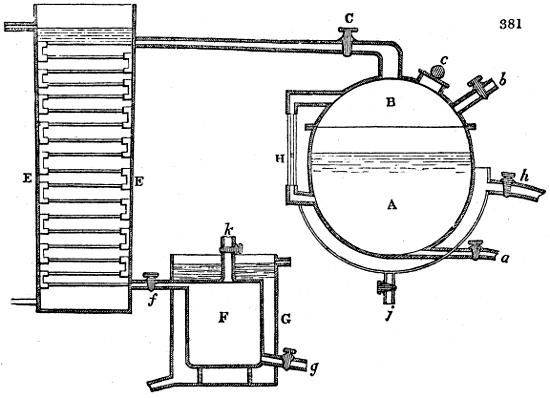
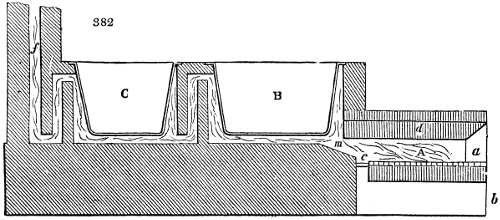
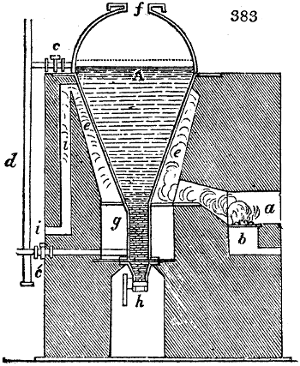
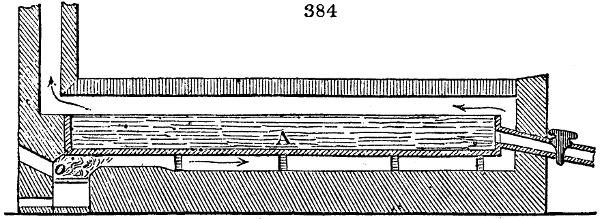
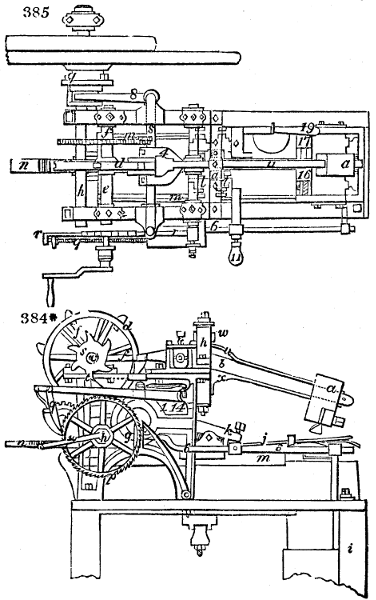
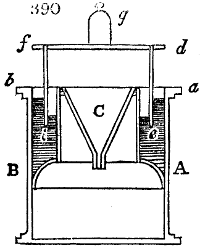
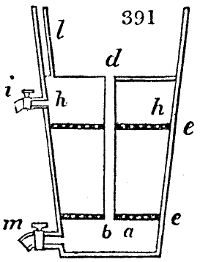
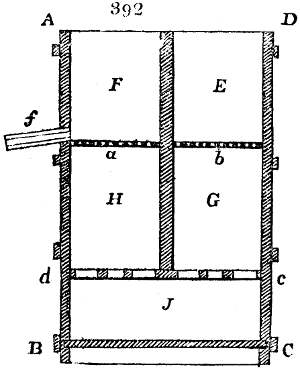
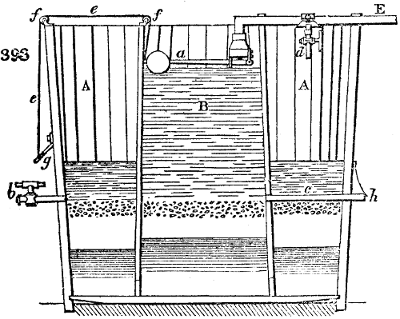
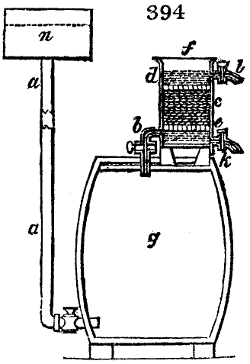

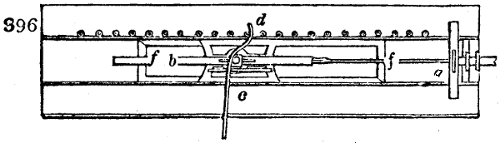
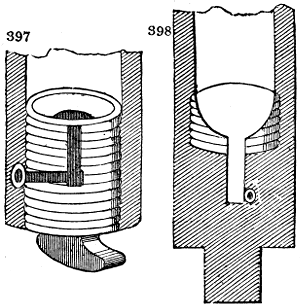
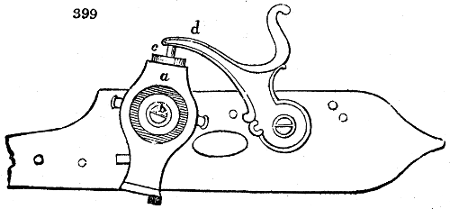
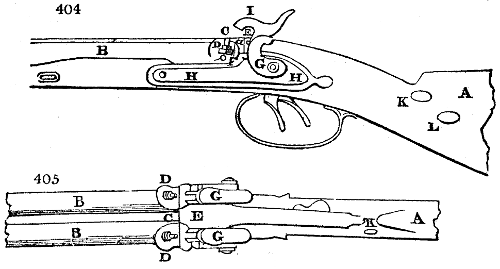
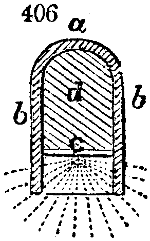
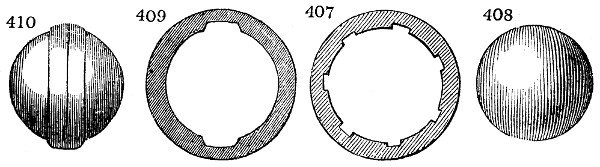
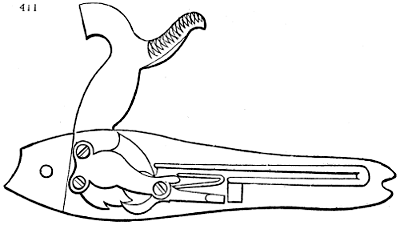
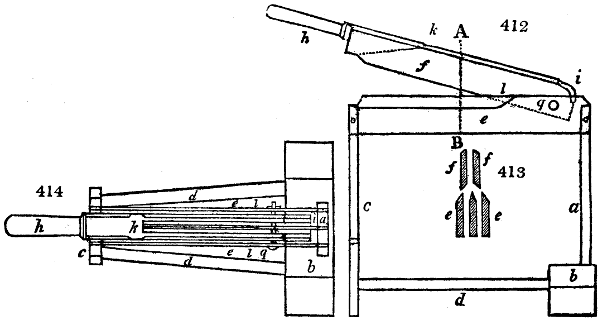
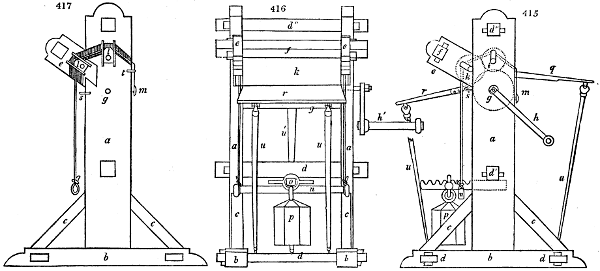
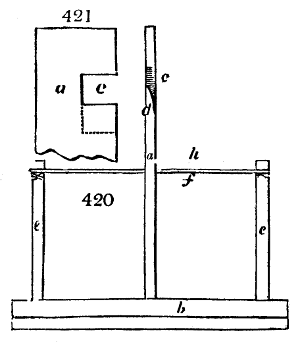
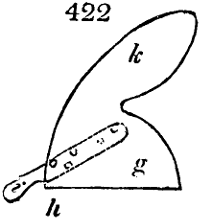
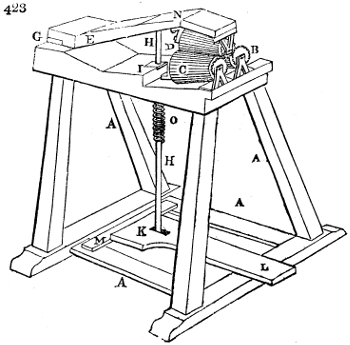
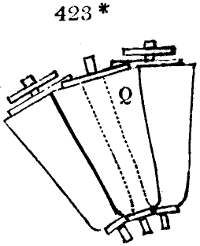
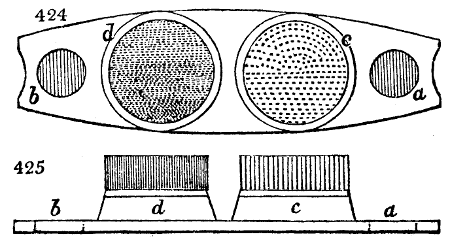
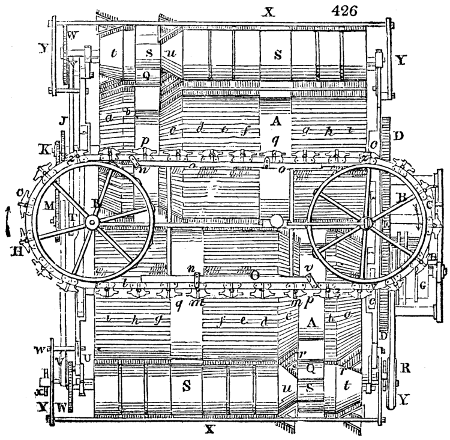
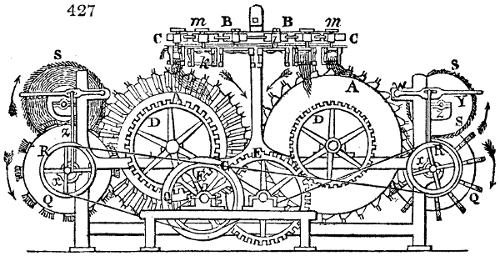
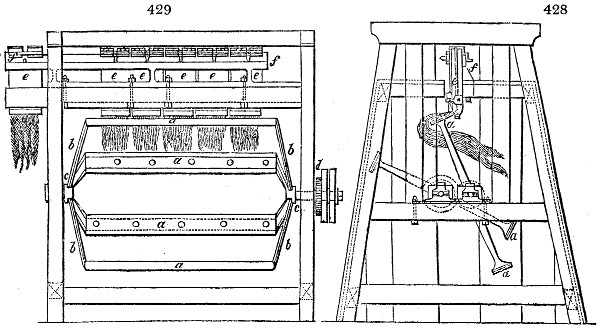
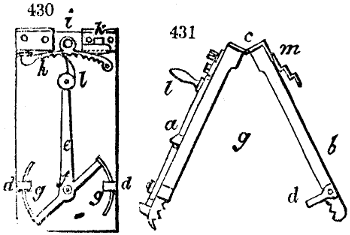
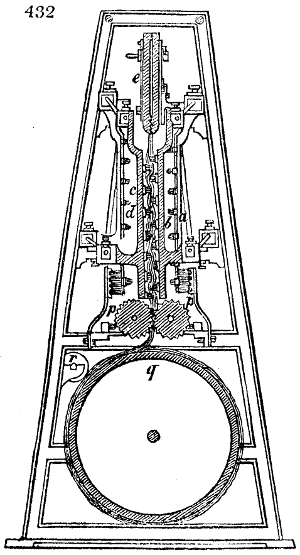
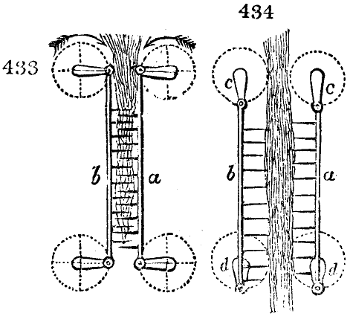
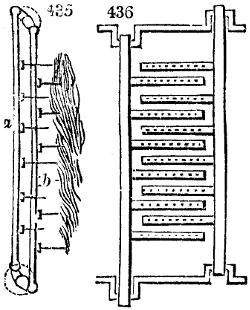
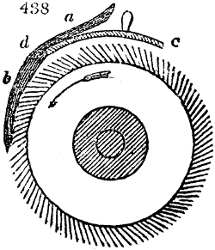
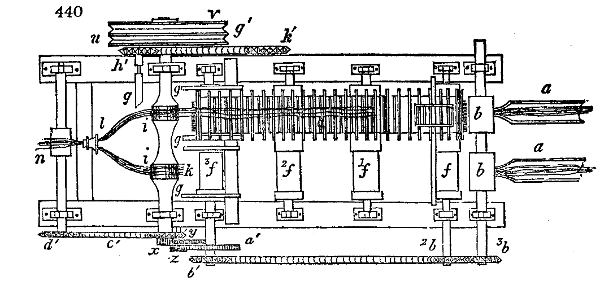
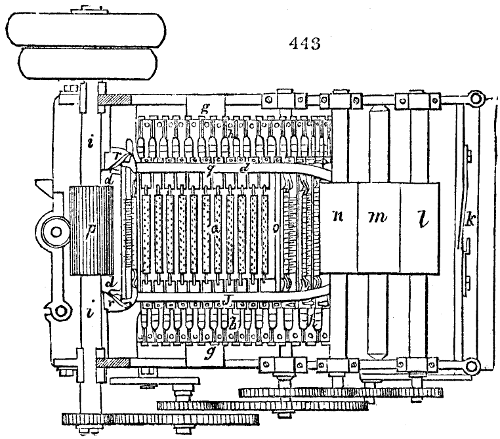
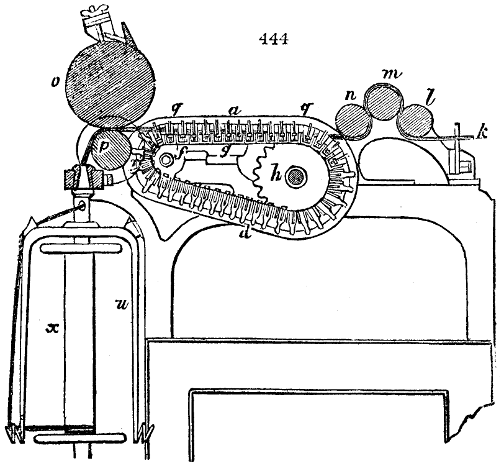
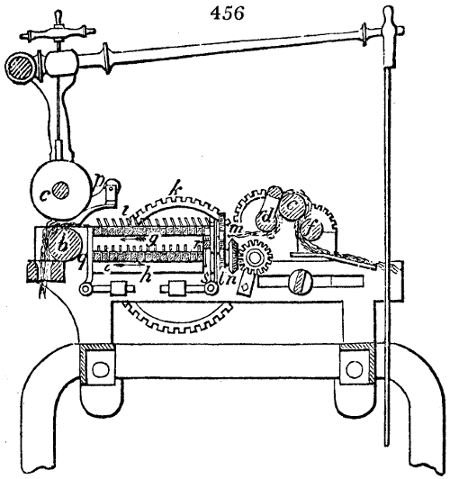
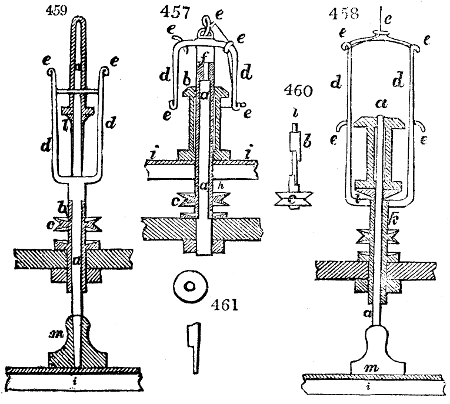
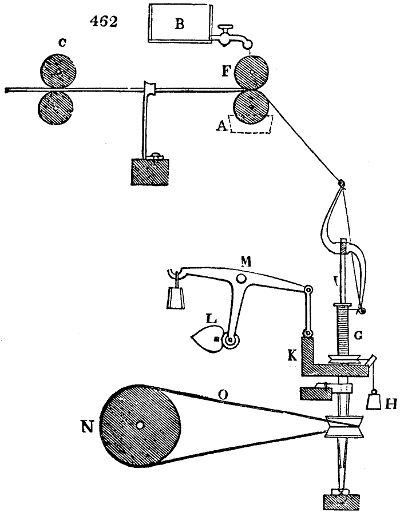
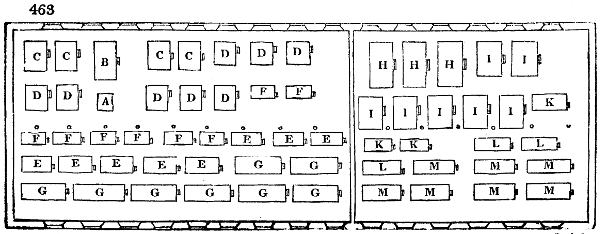
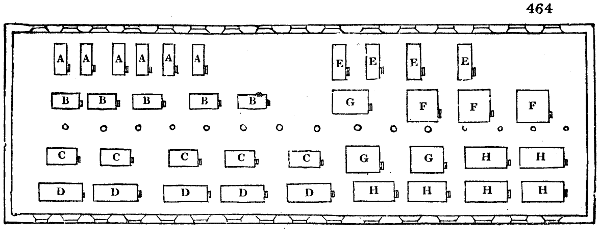
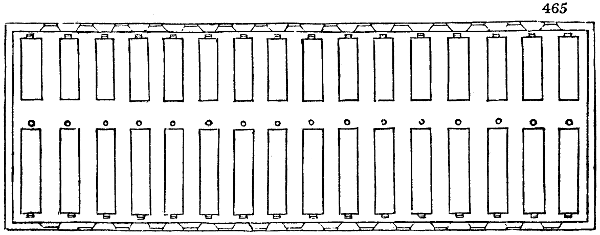
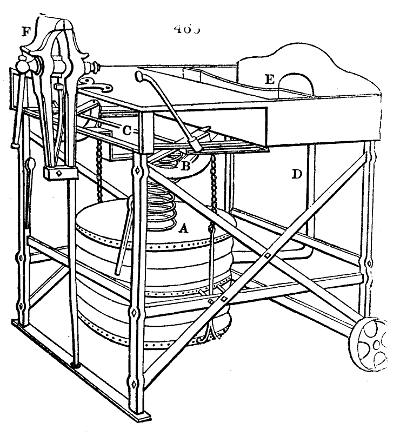
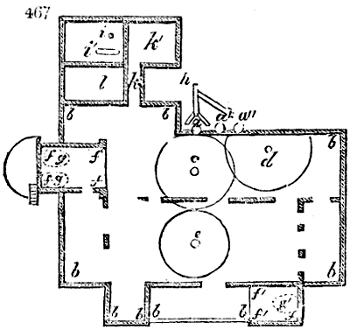
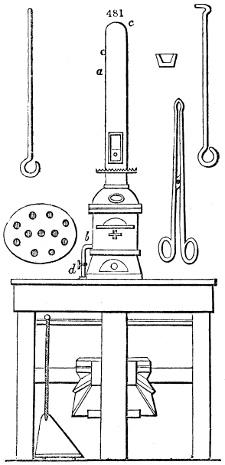
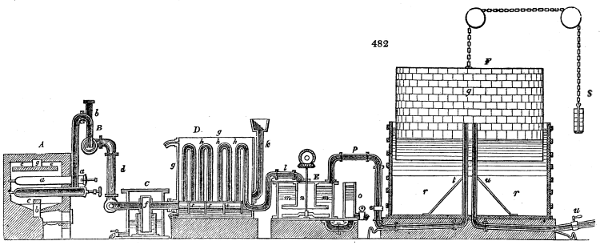
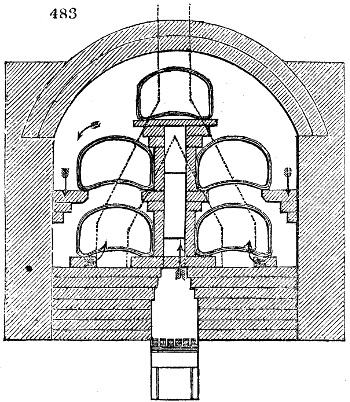
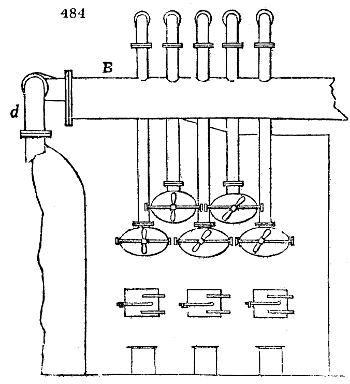
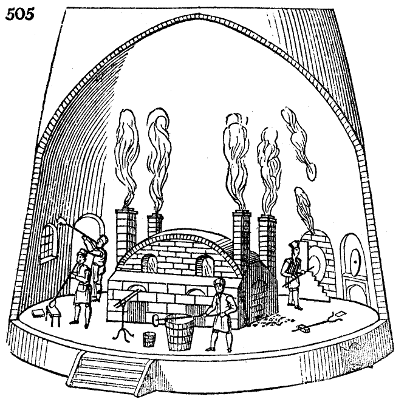
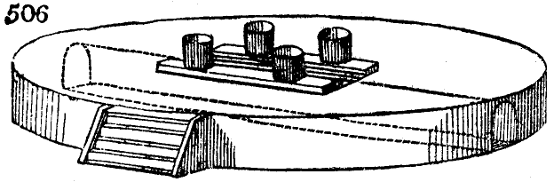
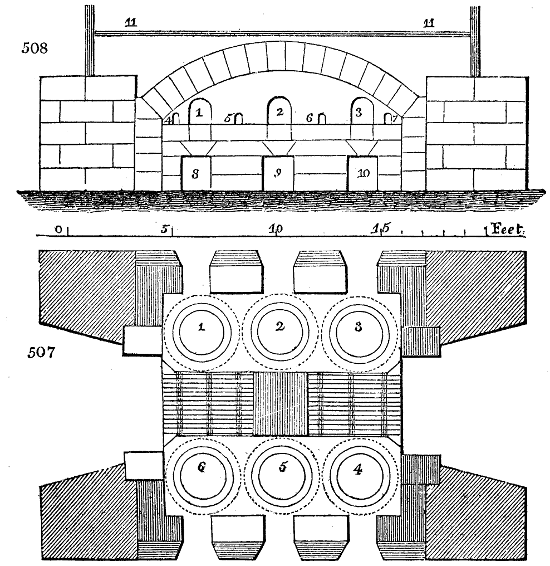
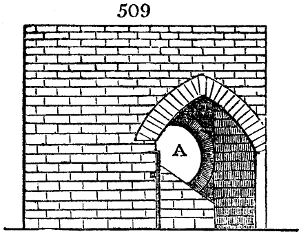
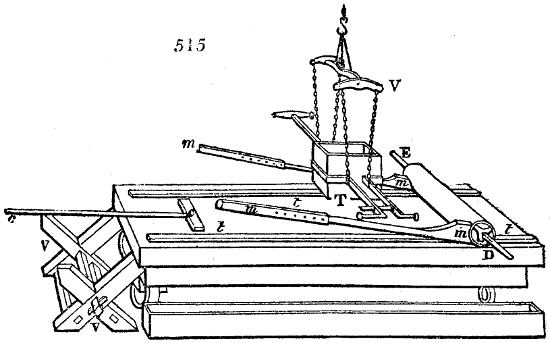
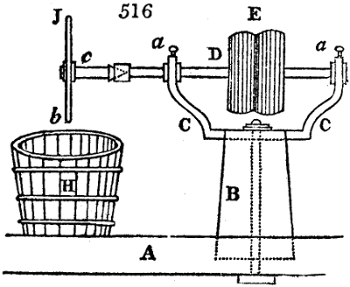
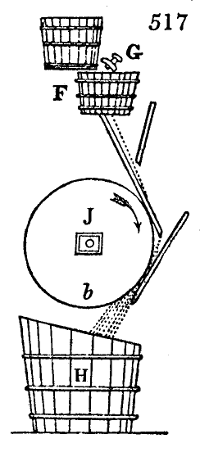
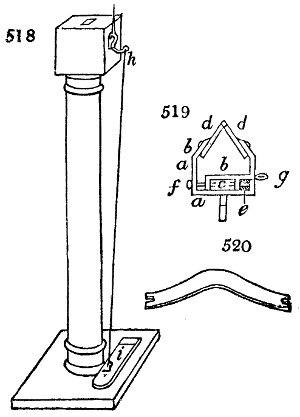
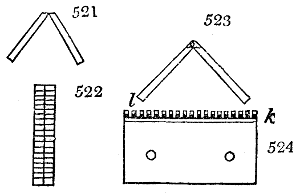
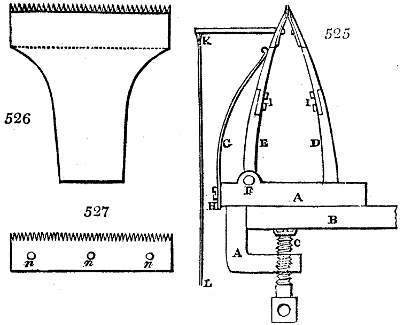
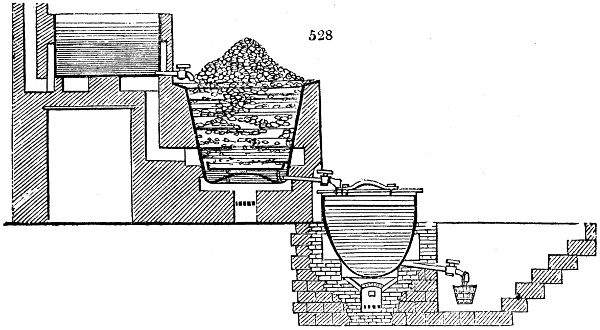
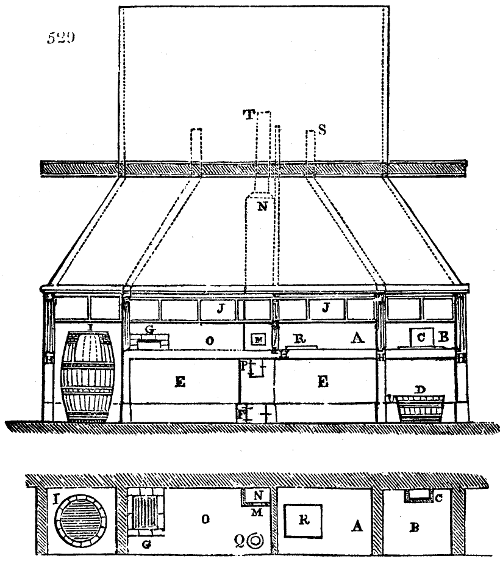
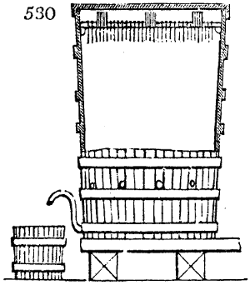
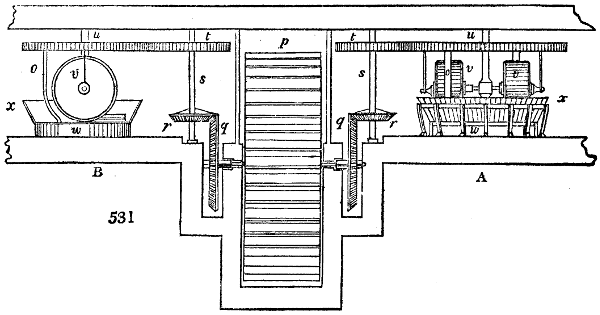
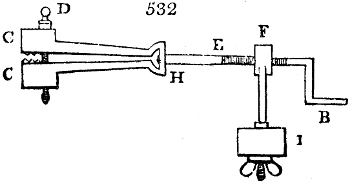
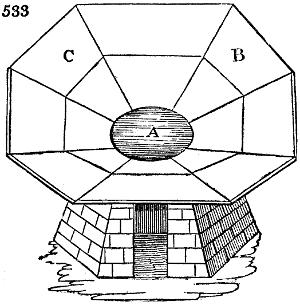
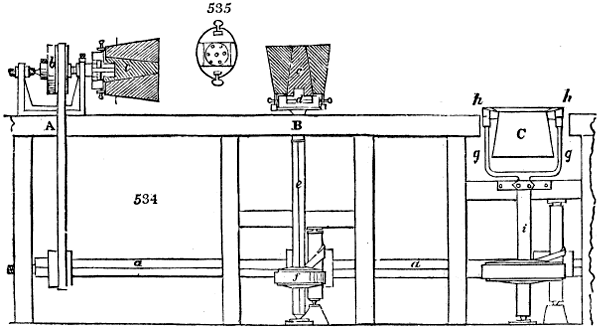
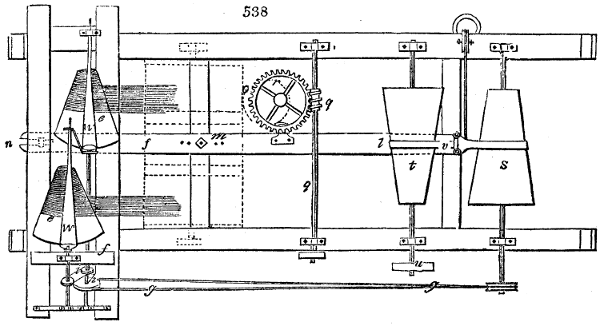
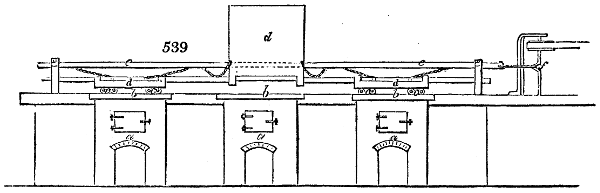
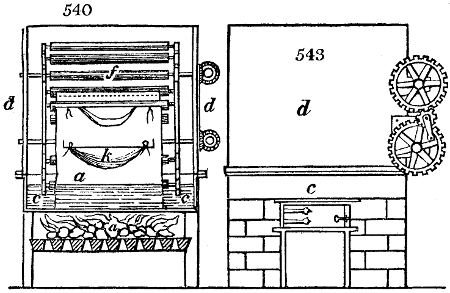
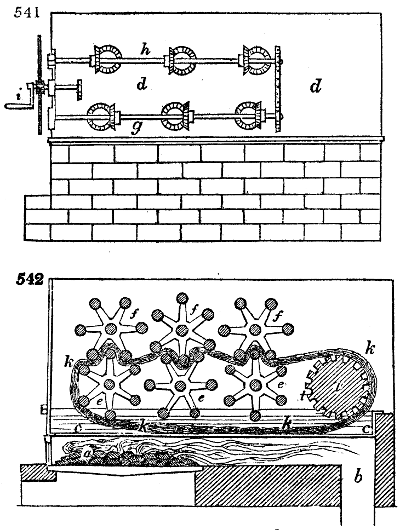
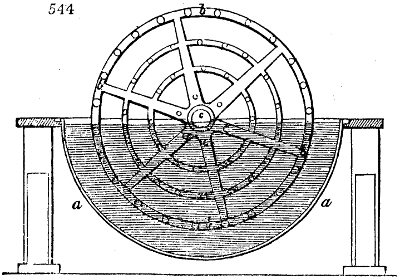
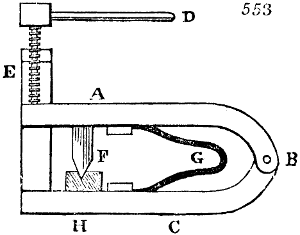
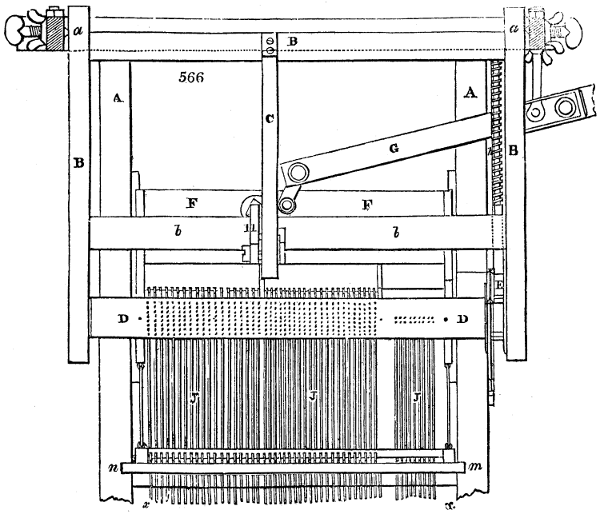
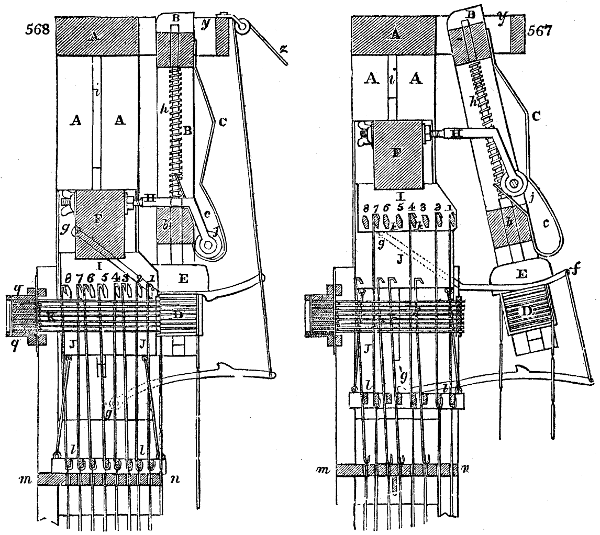
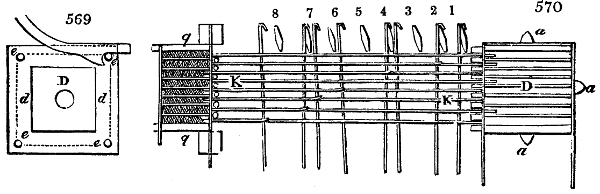

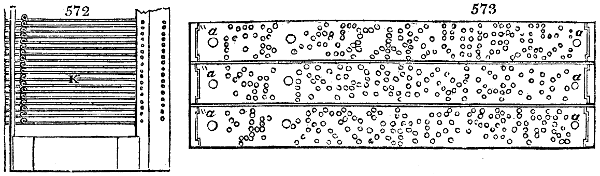
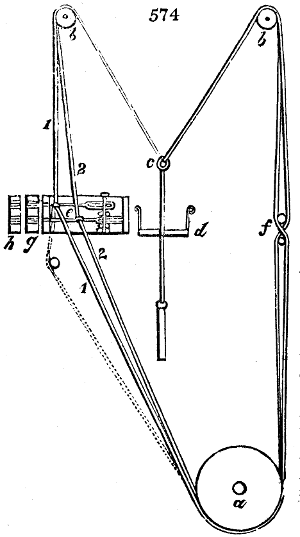
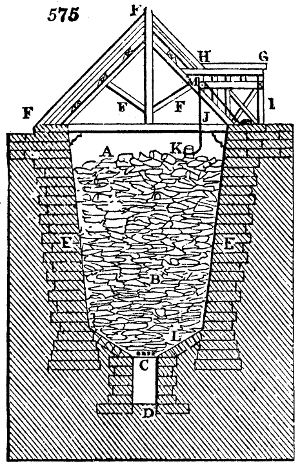
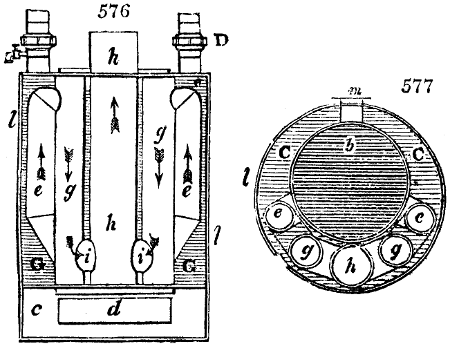
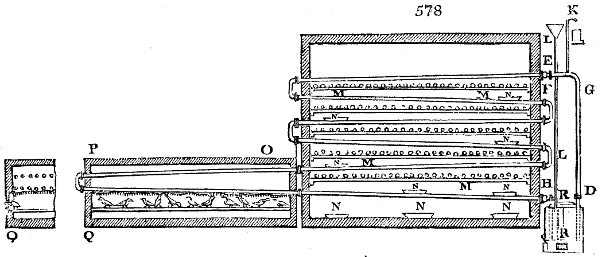
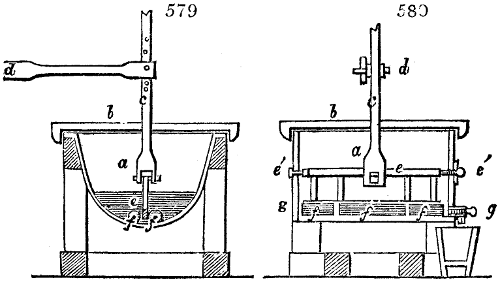
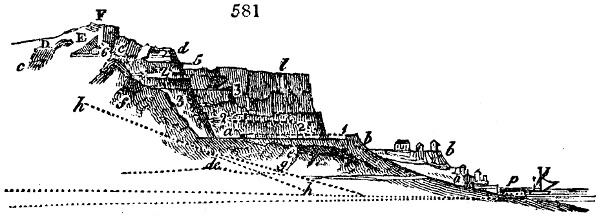
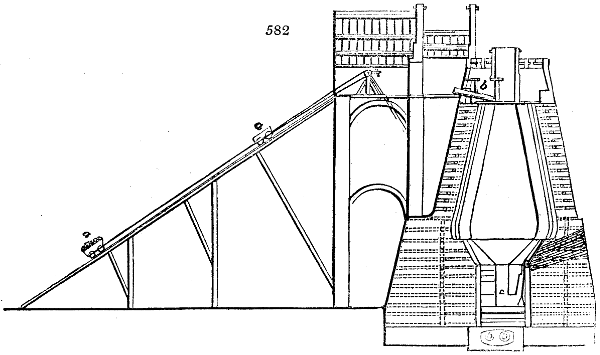
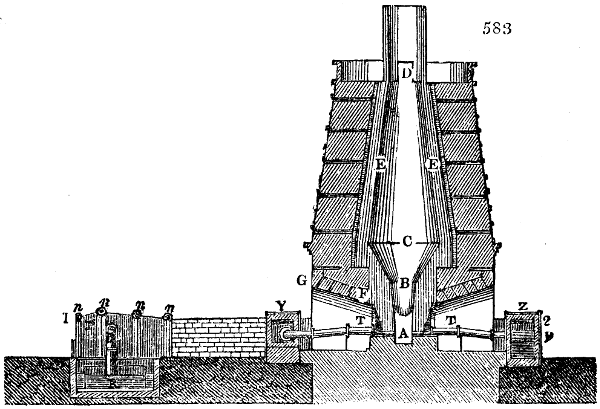
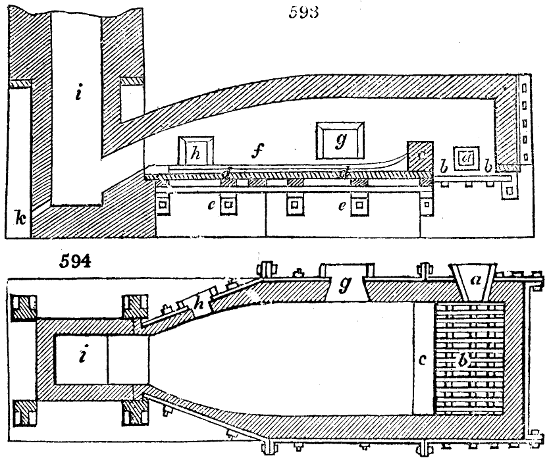
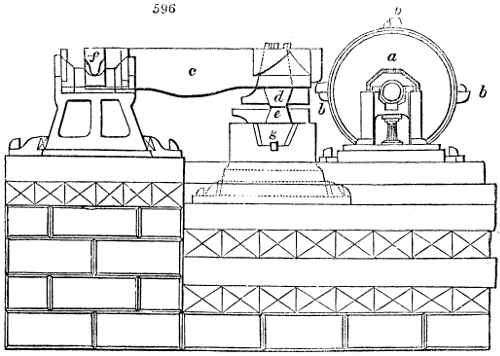
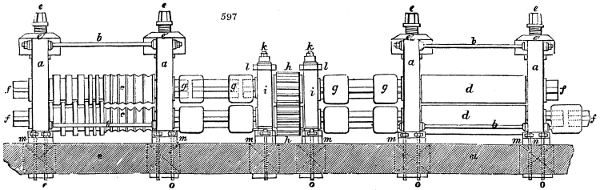
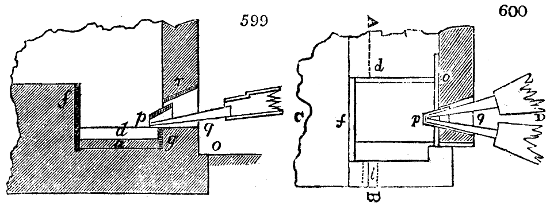
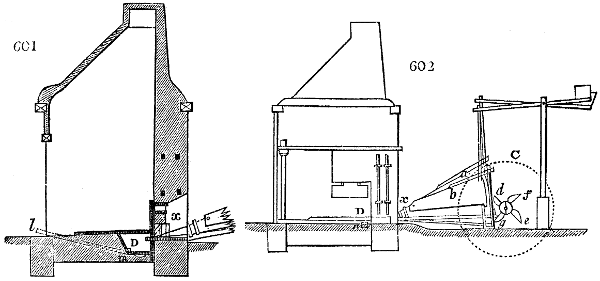
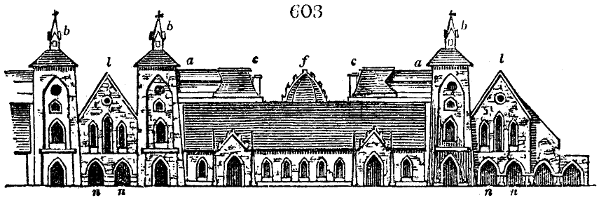
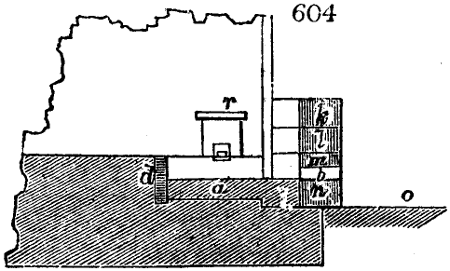
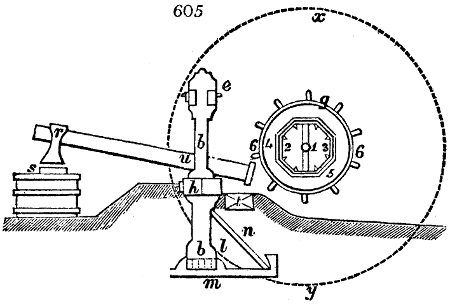
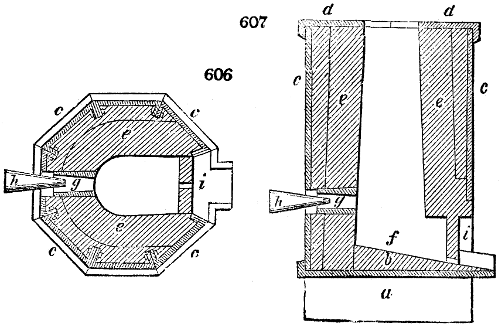
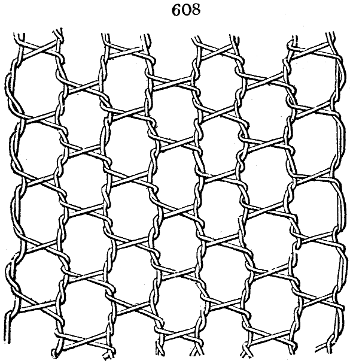
 represents the bolts or teeth, the sign
  the back line of carriages, and the
sign
the back line of carriages, and the
sign  the front line of carriages.
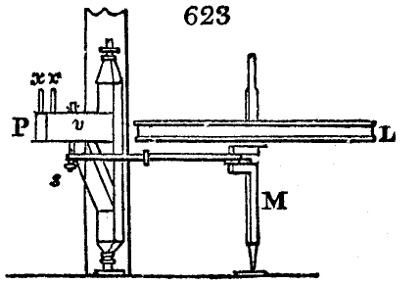
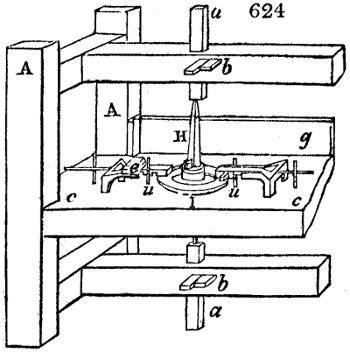
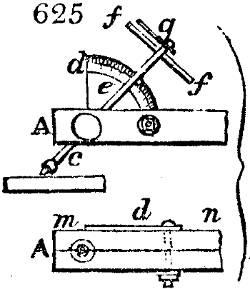
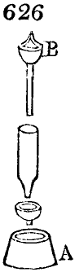
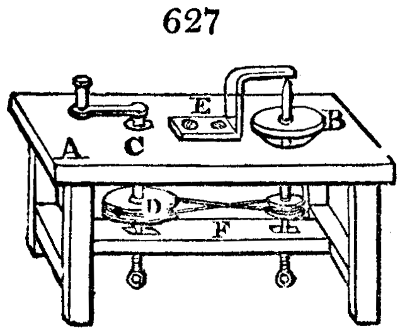
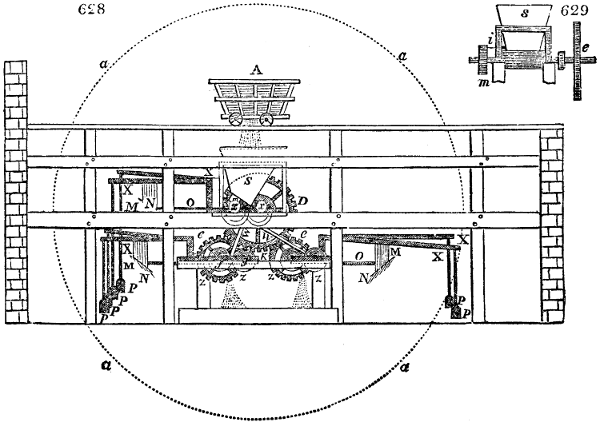
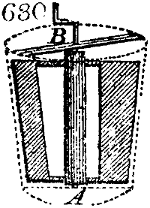
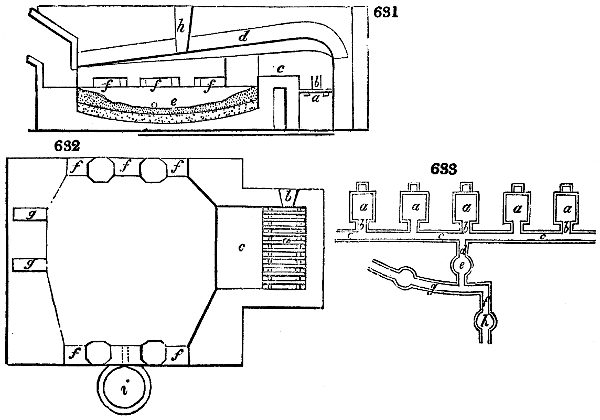
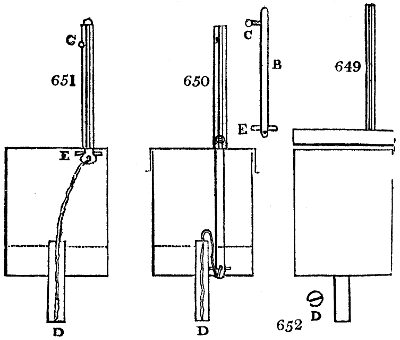
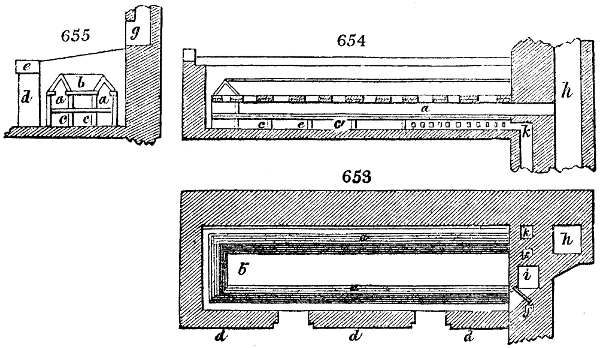
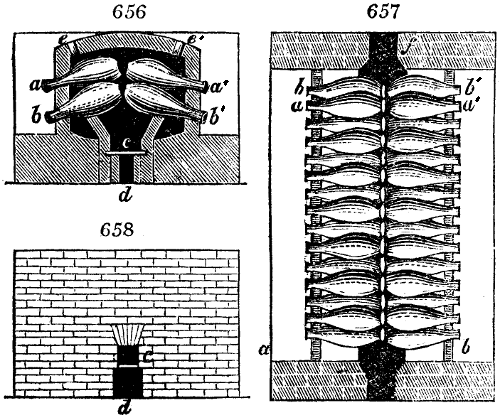
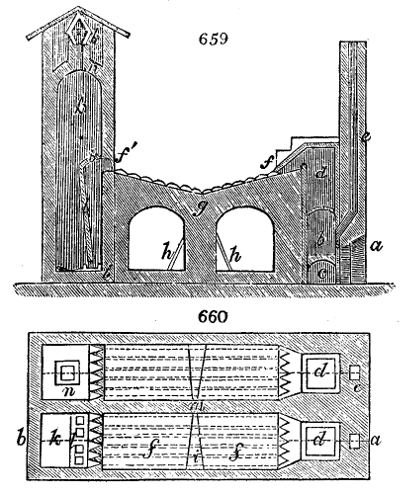
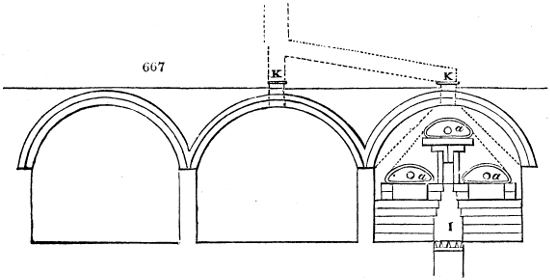
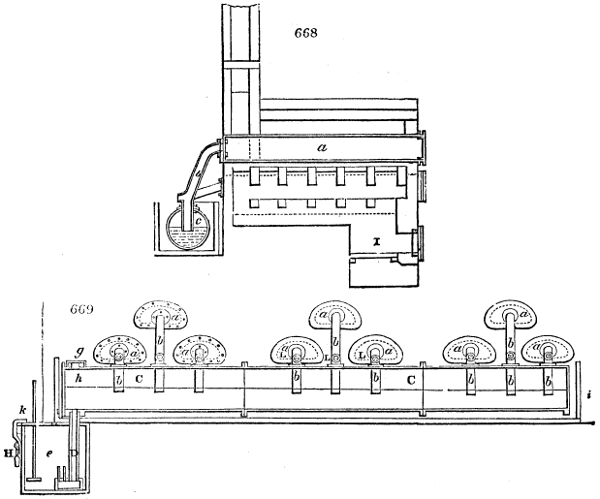
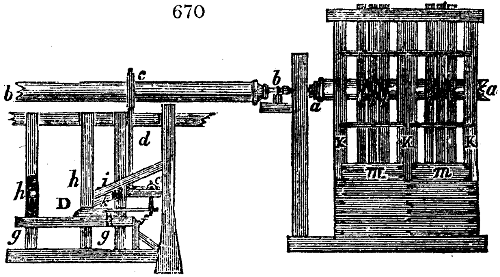
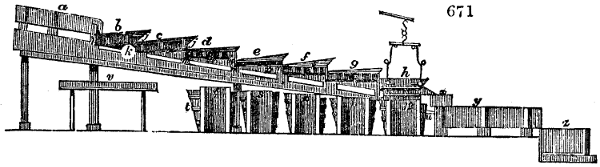
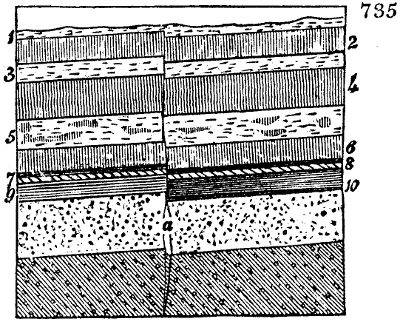
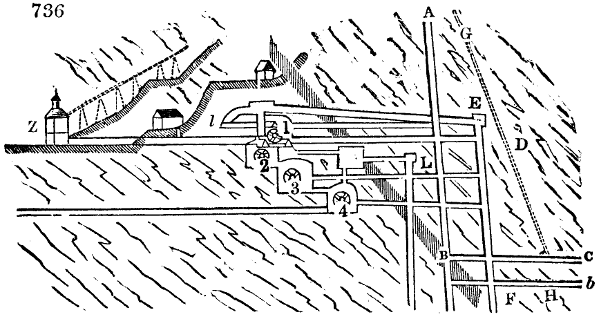
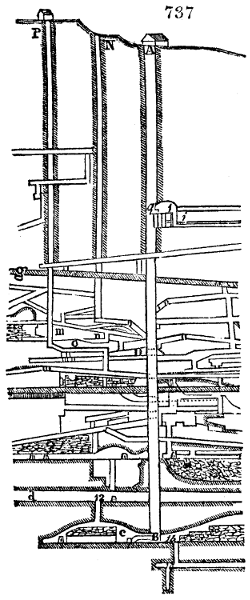
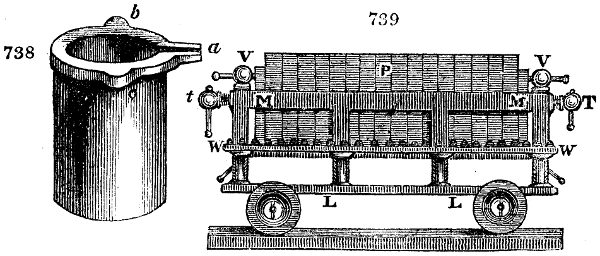
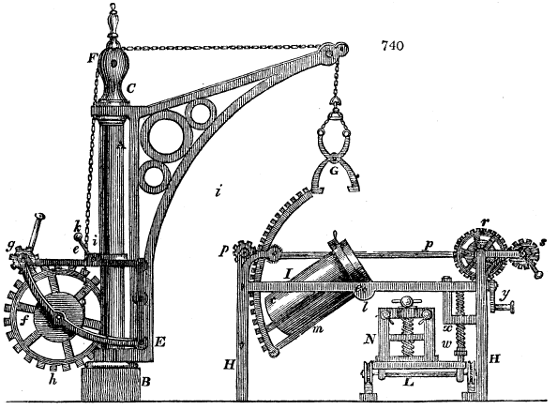
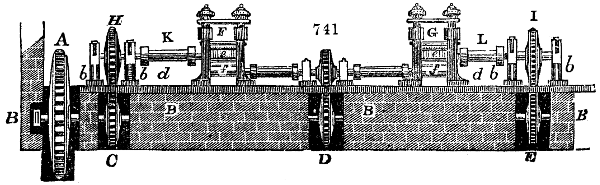
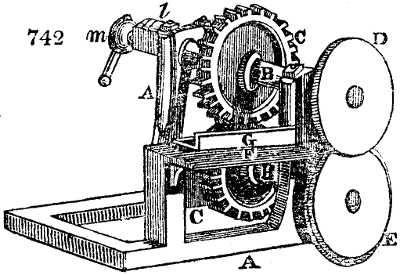
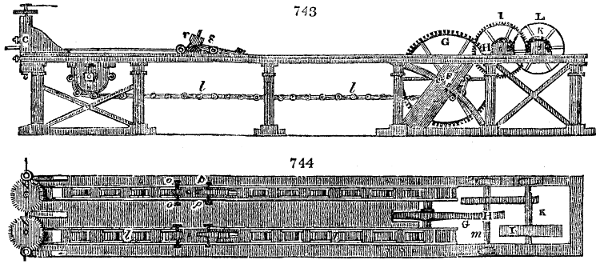
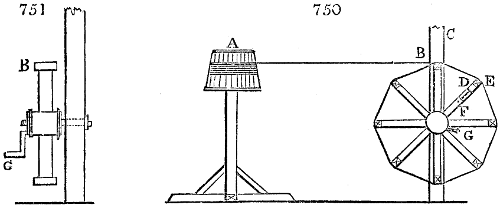
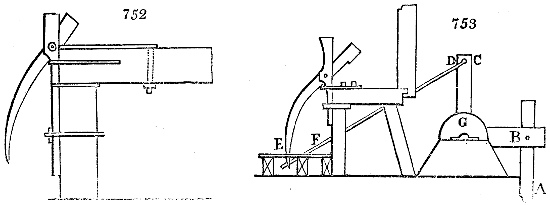
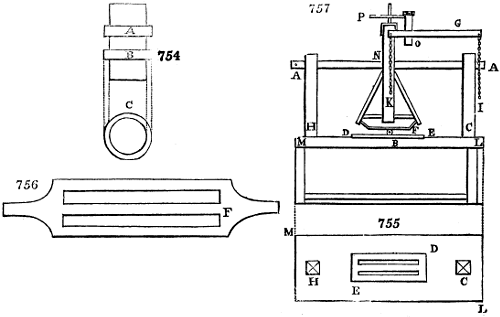
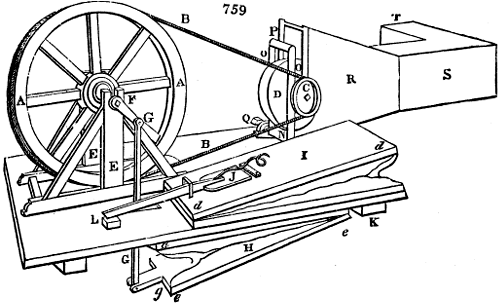

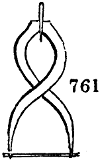
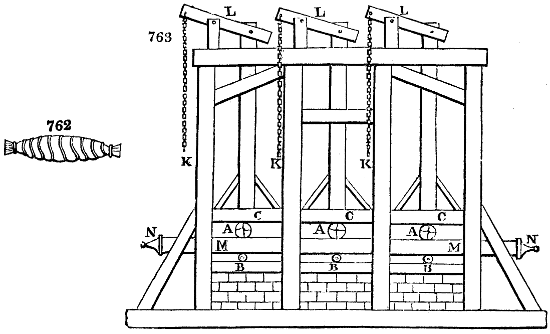
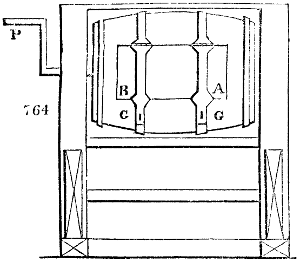
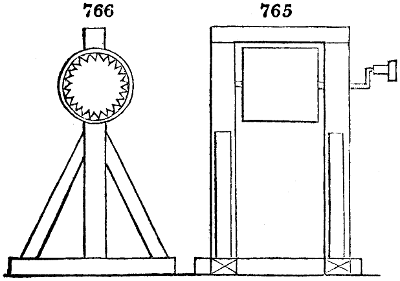
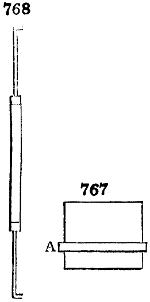

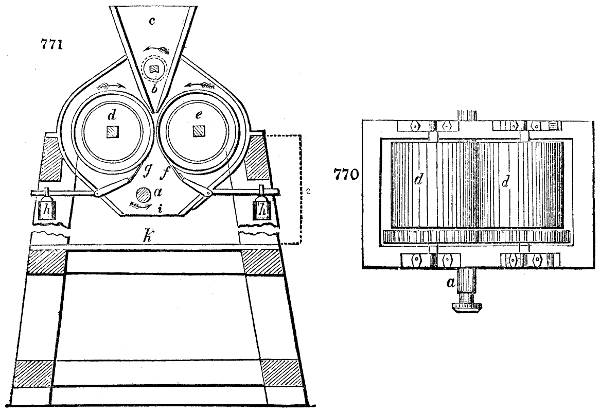
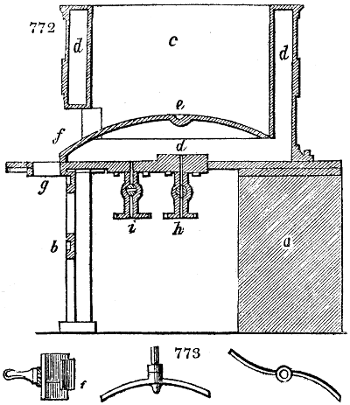
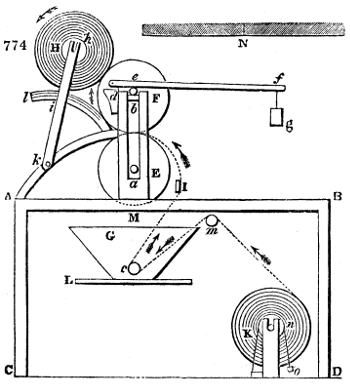
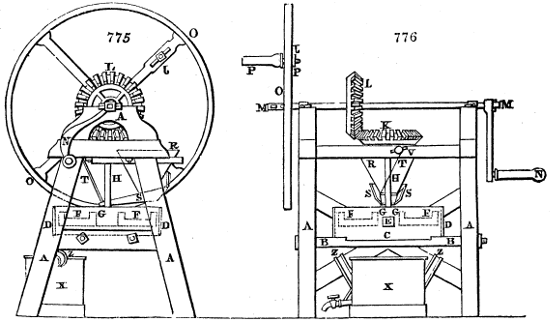
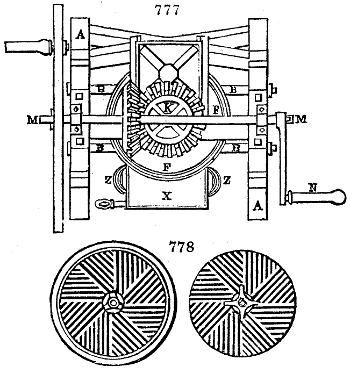
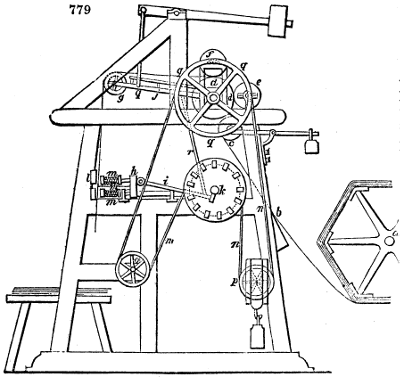
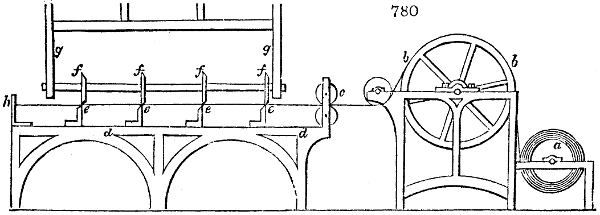
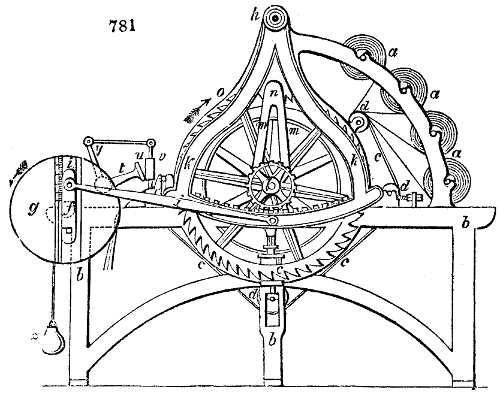
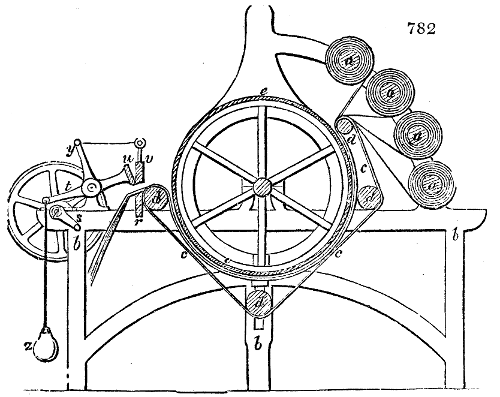
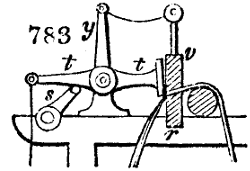
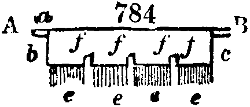
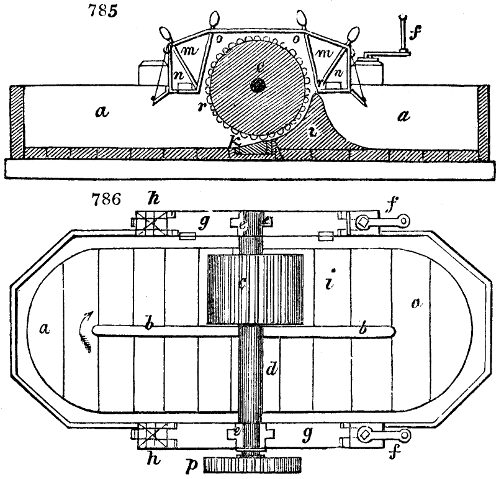
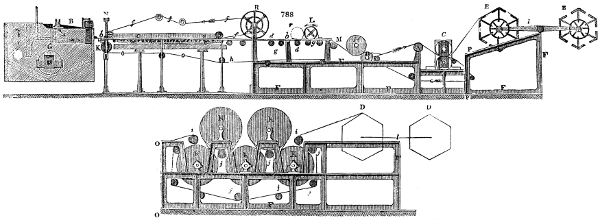
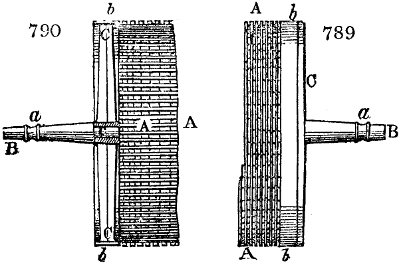
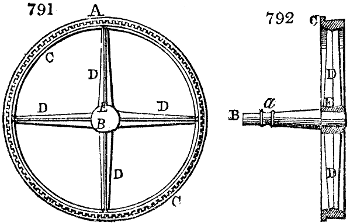
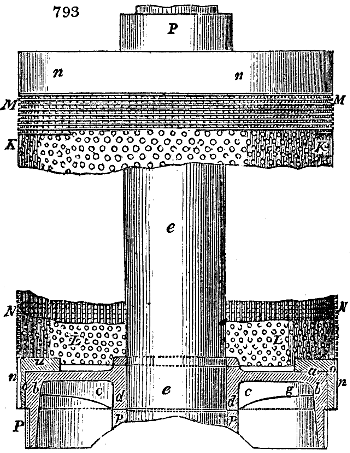
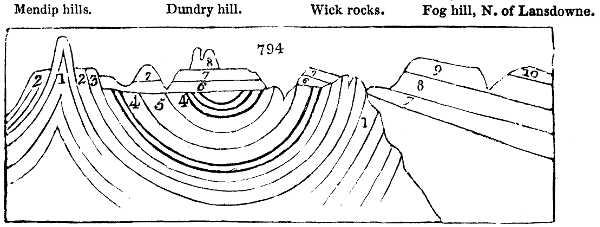

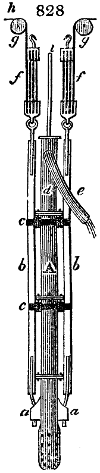
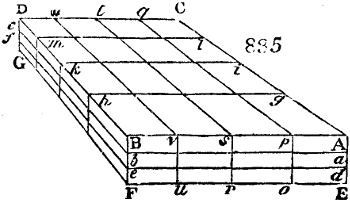
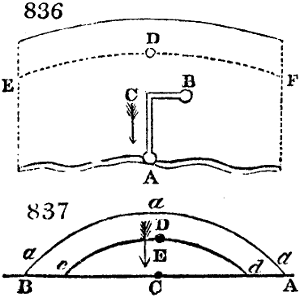
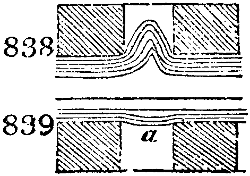
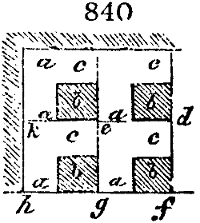

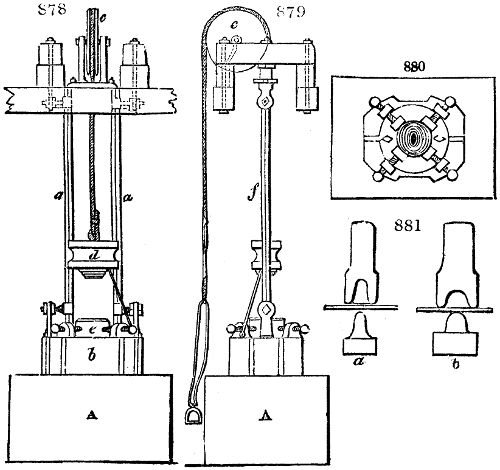
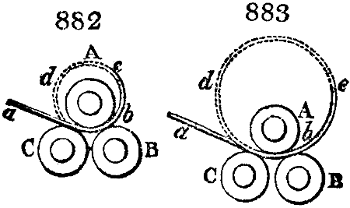
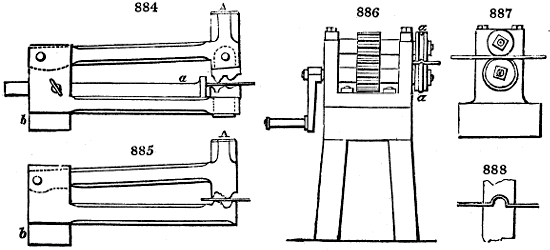

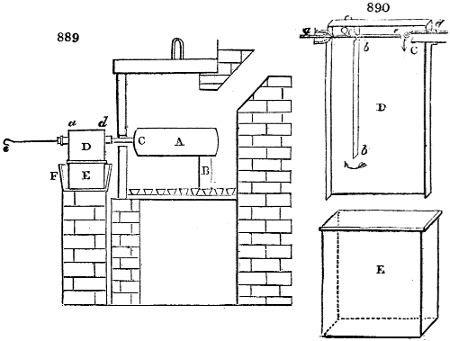
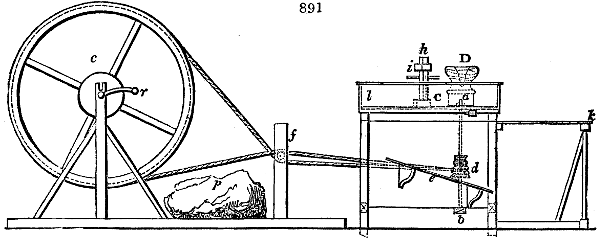
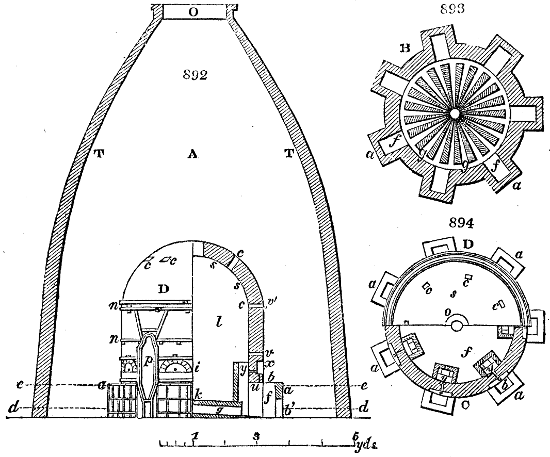
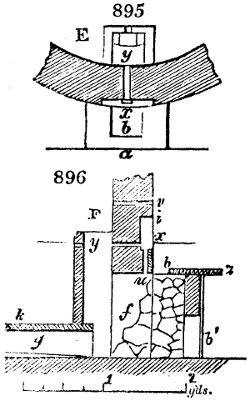
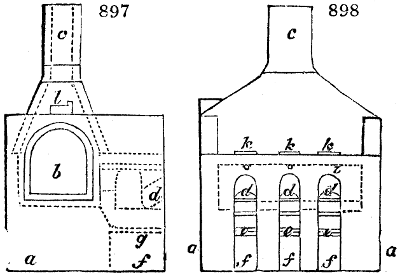
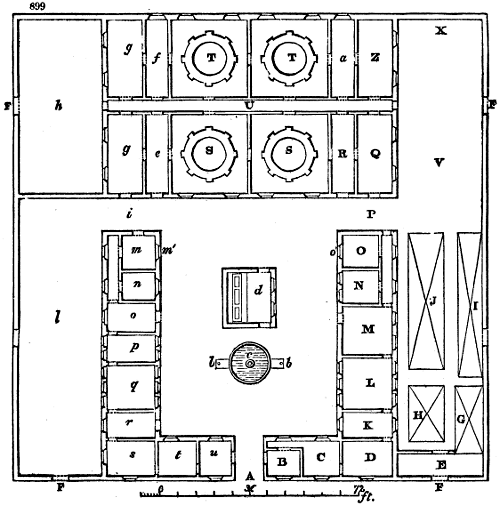
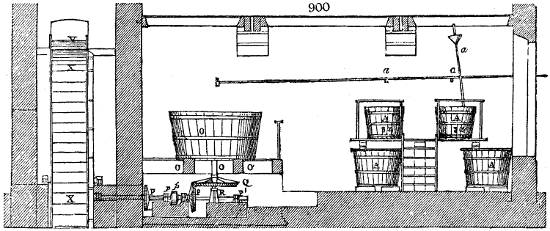
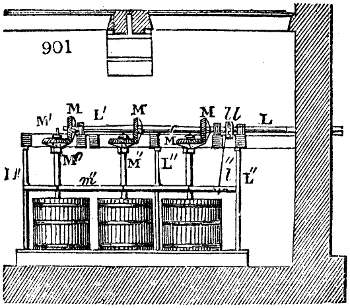
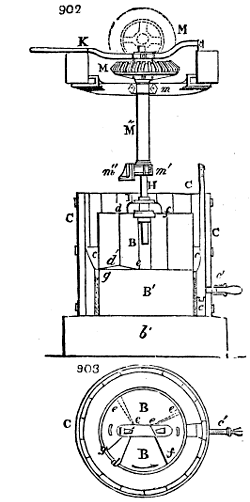
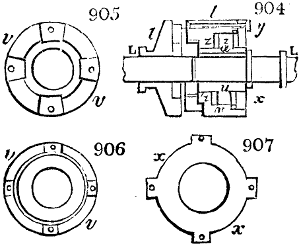
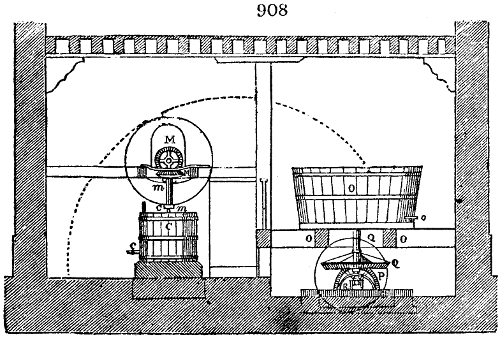
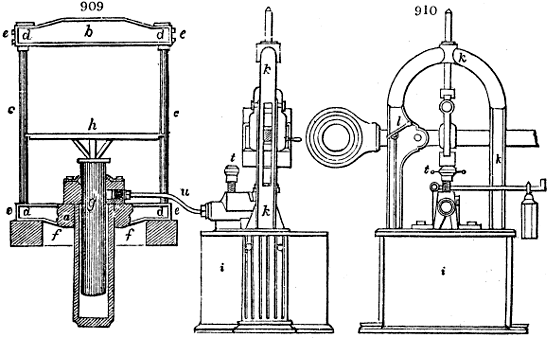
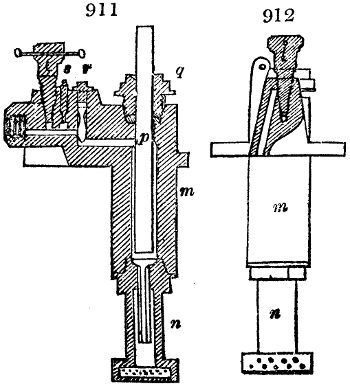
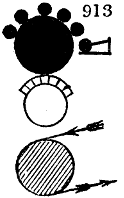
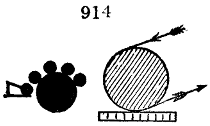
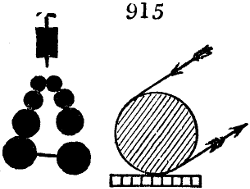
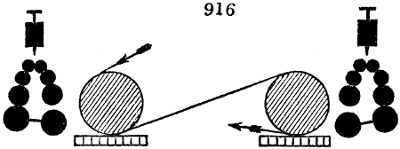
 ;
and the sheet was turned over or reversed in the course of its passage. At the first
paper cylinder it received the impression from the first form, and at the second it
received it from the second form; whereby the machine could print 750 sheets of book
letter-press on both sides in an hour. This new register apparatus was erected for Mr.
T. Bensley, in the year 1815, being the only machine made by Mr. König for printing
upon both sides. See
;
and the sheet was turned over or reversed in the course of its passage. At the first
paper cylinder it received the impression from the first form, and at the second it
received it from the second form; whereby the machine could print 750 sheets of book
letter-press on both sides in an hour. This new register apparatus was erected for Mr.
T. Bensley, in the year 1815, being the only machine made by Mr. König for printing
upon both sides. See