A diary of the wreck of His Majesty's ship Challenger, on the western coast of South America, in May, 1835
Whole book · 9 sections
TRANSCRIBER’S NOTE
Some minor changes to the text are noted at the end of the book.
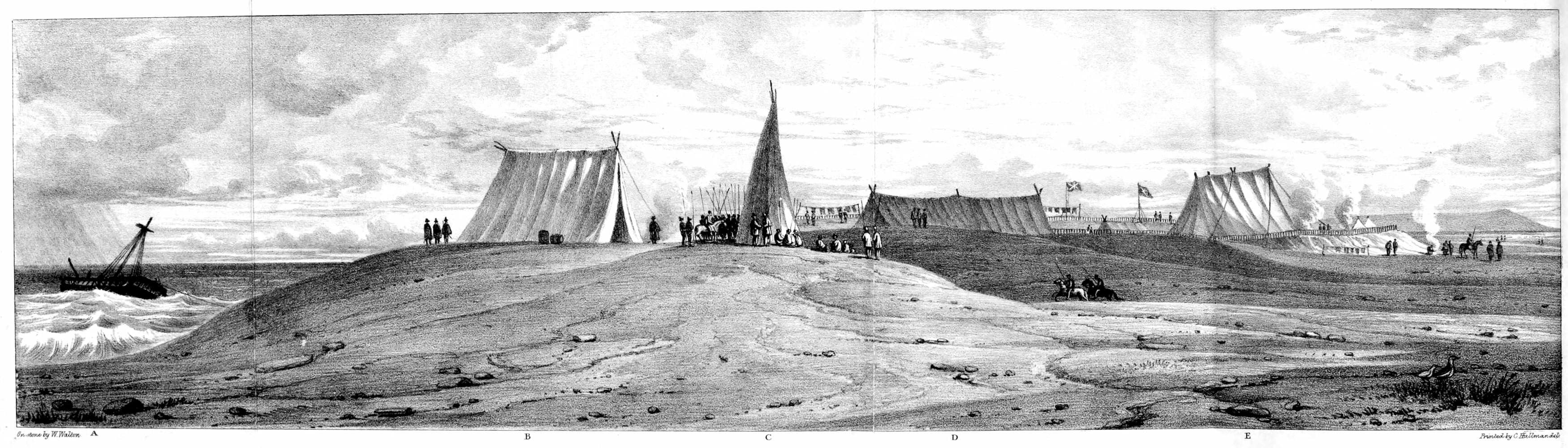
ENCAMPMENT AT MOLGUILLA, CHILI.
On stone by W. Walton
A. Wreck of H. M. Ship ChallengerB. Tent for the Chilenos from AraucoC. Tent put up for Cheuquante’s IndiansD. Ship’s Company TentE. Tent for Captn. & Officers
Printed by C Hullmandel
A DIARY OF THE WRECK OF HIS MAJESTY’S SHIP CHALLENGER, ON THE WESTERN COAST OF SOUTH AMERICA, In May, 1835.
WITH AN ACCOUNT OF
THE SUBSEQUENT ENCAMPMENT OF THE OFFICERS
AND CREW,
DURING A PERIOD OF SEVEN WEEKS,
ON THE
SOUTH COAST OF CHILI.
LONDON:
PRINTED FOR
LONGMAN, REES, ORME, BROWN, GREEN, & LONGMAN,
PATERNOSTER-ROW.
1836.
London:
Printed by A. Spottiswoode,
New-Street-Square.
A DIARY OF THE WRECK OF HIS MAJESTY’S SHIP CHALLENGER.
On the first day of April, 1835, His Majesty’s
ship Challenger sailed from Rio Janeiro for the
Pacific, with orders to touch at the port of
Concepçion in our way to Valparaiso, at which
place we hoped either to find the commodore
commanding on the western coasts of South
America, or directions for our further proceedings.
Valparaiso and Concepçion are the two
principal seaports of the republic of Chili; the
former being the most important, as receiving
the great bulk of manufactures, and other numerous
and various exports from Europe.
The object of the Challenger’s calling at Concepçion,
situated about 300 miles south of Valparaiso,
and laying in the route of the latter
port, was for the purpose of procuring a supply
of wood and water, for which Concepçion offers
peculiar facilities.
The first part of our voyage was a series of
calms, with light variable winds; and our progress
to the southward was slow, until we reached
the latitude of 31° south. We then began to
experience fresh westerly and southerly winds,
which, with little variation, continued until we
had arrived in the vicinity of Cape Horn. Nothing
had occurred worthy of notice, except that
numerous flying-fish were seen as far south as the
latitude of 40°. Off the Cape, in latitude 60°,
after a short interval of calm, a number of what
we only know by the name of black fish attracted
our attention by the peculiarity of their movements,
and the closeness of their approach to the
ship; and we experienced a severe gale, which
began in the south, and gradually veered to
S.S.W. and S.W., accompanied by an unusually
high sea, with constant hail squalls.
May 4.—The wind blew violently from S.
and S.S.W., with a heavy sea and hard squalls
of hail and snow. It was of consequence to
draw the ship to the westward, and to this
end we carried our close-reefed main-topsails
and reefed foresail; the wind being about two
points abaft the beam; the ship behaving remarkably
well, but lurching deeply; and on one
occasion she made so heavy a plunge, that a
long lee sea came in over all, staving in the lee
quarter gallery, moving the sheet-anchor, floating
our spars in the lee channels, and actually
wetting the legs of several persons who were
securing their holdfast under the weather bulwarks.
We looked on this as a hint to batten
down our main-deck hatchways; to take the
canvass off her; and, as night was closing in, the
main-topsail and foresail were furled, and the
ship eventually hove-to, under the fore and main-staysails;
the latter having been, in our first
attempt to set it, blown to leeward by the carrying
away of our staysail stay. In this breeze
a heavy sea struck the bows and cutwater,
and with a most singular result, for it carried
away the crown of our figure-head from the
forehead upwards; and the ominous remark of
the person who reported the circumstance to
the officer of the watch was, “Sir, she has lost
her brains.” The weather continued stormy,
with heavy squalls of hail, with little intermission,
till the 6th and 7th of May; when we experienced
a severe gale off the entrance of the
Straits of Magellan, and under the double-reefed
courses, which was as much sail as the masts
and yards would bear; and, in a long high sea,
the good qualities of the ship called forth the
undivided praise of all on board.
May 17.—In latitude 41°, and longitude
80° 43′ W., the weather appeared to have undergone
a change for the better. The barometer,
which had been for several weeks very low, now
rose to the height usually shown on the coasts of
Peru, and the northern parts of the coast of
Chili; and many were the mutual congratulations
exchanged on board, on our having at length got
into fine moderate weather, securing, as we conceived
the ultimate object in view, that of arriving
at the port of Concepçion, then only two
days’ sail in distance from us. Good observations
were obtained on this day, the results of which
were found to agree closely with our estimation
as shown by the dead reckoning. The topgallant
masts were sent aloft, together with the
studding-sail booms, and a variety of gear, which,
during our stormy weather, had been sent on deck
to relieve the masts and ship; and all the necessary
sail was made in the direction of our destined
port. The wind S.W.; the course steered N.N.E.
May 18.—The weather became thick, with
a fresh wind. The 19th produced little change,
except that we were enabled to get a good set of
sights of the sun for our chronometers, by which,
with our latitude by dead reckoning, we worked
out our longitude, the correctness of which we
had no reason whatever to doubt. At noon Concepçion
bore from us N. 52°, 41° E., 146 miles.
At 5 P.M. the ship was hove-to, the chain cables
bent, and the usual preparation made on approaching
an anchorage. The deep-sea lead
was tried in upwards of 200 fathoms, but without
striking soundings. Sail was again made in
the ship, treble-reefed topsails, courses, and fore-topmast
staysail.
At 8 P.M., after a careful examination of
the ship’s place on the charts, directions were
given to haul the ship to the wind on the larboard
tack. This was done at about 10 minutes
after 8 o’clock, and it allowed her to lay along
shore, N. half E., the wind being about W.N.W.,
reducing her rate of going to about four knots;
at which pace it was proposed to allow her to
continue, until daylight permitted us to bear up,
and again make sail for our destination, Talcuhuana
Bay, the anchorage of Concepçion. The
weather at this time was still hazy, the wind
moderate, the water smooth, and stars appearing
occasionally overhead, with an expected moon
at midnight, promising us a quiet fine night: but
the Almighty had ordered it otherwise, and a
most awful and perilous shipwreck awaited us.
At about 9 45′ P.M., the look-out men having
been visited but a few minutes before, breakers
were seen at the same moment by them and the
officer of the watch, who also remarked a new
and peculiar motion in the movement of the
ship. The helm was instantly put down, and
the watch hurried to their stations to tack the
ship; the captain, calling for the hands to be
turned up as he flew upon deck, and as the ship
had answered the helm though rising to a very
high sea, and was coming round, hauled the
after-yards. Orders were given to stand by the
anchors; but almost immediately afterwards the
order “to keep fast the anchors,” and haul the
head-yards. In accomplishing this latter operation
a high surf struck the bows; the ship, lifting
to the heavy swell, got sternway, and struck with
a dreadful crash, her keel taking the rocks about
midships: another sea followed, which threw her
on her starboard beam-ends, the surf at the same
time breaking over and into the ship with a force
sufficient to wash the men from the decks. Most
miraculously, however, no serious accident now
occurred, nor was any greater injury sustained
than by the men at the helm, who were thrown
over the wheel, and severely bruised. We were
now at the mercy of the heaviest surf it is possible
to conceive; the ship labouring in a most
fearful manner, falling over on either broadside,
and righting herself as the weight and force of
the sea affected her; and the warning orders were
reiterated to hold on, and keep out of the way
of the masts, which were every moment expected
to fall. The masts, however, stood, though
many of the loftier back-stays, stay, and braces,
came down, but, fortunately, without injury to
any one.
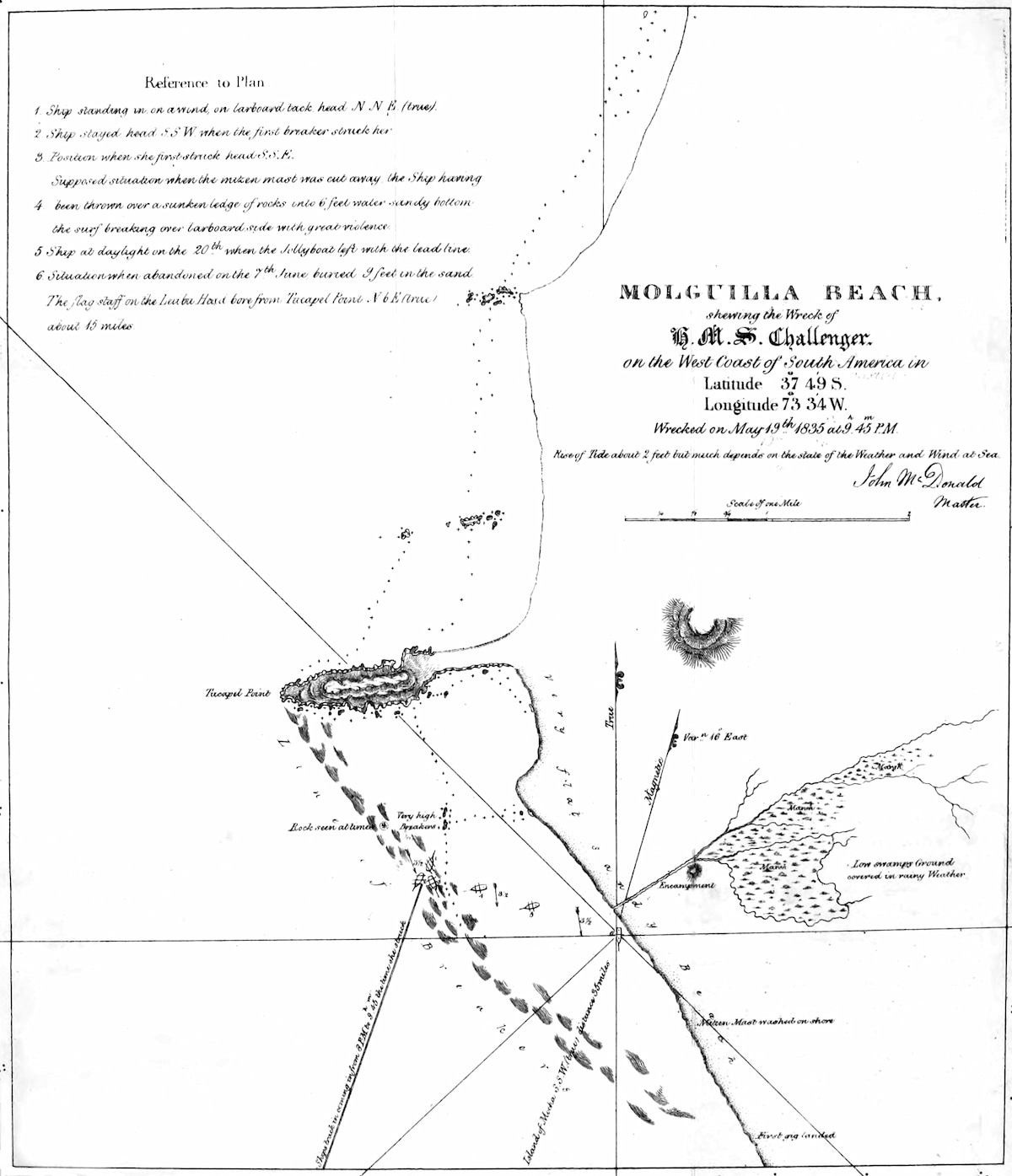
MOLGUILLA BEACH, shewing the Wreck of H.M.S. Challenger. on the West Coast of South America in
Latitude 37° 49′ S.
Longitude 73° 34′ W. Wrecked on May 19th 1835 at 9.45 P.M. Rise of Tide about 2 feet but much depends
on the state of the Weather and Wind at Sea.
Reference to Plan
Ship standing in on a wind, on larboard tack head N.N.E. (true).
Ship stayed head S.S.W. when the first breaker struck her.
Position when she first struck head S.S.E.
Supposed situation when the mizen mast was cut away, the Ship having
been thrown over a sunken ledge of rocks into 6 feet water sandy bottom
the surf breaking over larboard side with great violence.
Ship at daylight on the 20th when the Jollyboat left with the lead line.
Situation when abandoned on the 7th June, buried 9 feet in the sand.
The flat staff on the Leubu Head bore from Tucapel Point N b E (true) about 15 miles.
A few minutes had been sufficient to place us
in this most frightful and truly awful situation;
a situation requiring the greatest degree of firmness,
as well as promptitude of action. A thick
dense fog, which hung on the water, gave us no
warning of the silent and terrible rollers; the
first of which, on being discovered, launched us
amongst the breakers, which were now roaring
with fury around us, drenching to the skin every
individual on the deck as they broke with violence
into the ship. The brilliancy of the surf
and spray, added to the sad and gloomy character
of the night, made our frightful situation the more
apparent; and, for a considerable interval of time,
so heavily did the ship continue to strike, that it
appeared impossible for any human power to
prevent her from going to pieces, or to conceal
from ourselves the appalling prospect of a watery
grave for every soul on board.
By the important decision of keeping fast the
anchors, and cutting away the mizzen-mast, the
ship appeared to be relieved abaft, and to be
thrown over rocks into what we fancied to be a
shoal; whereas; if she had been at all checked
by an anchor, all must have perished on the spot
where she struck. A heavy surf continued to
roll in on us, the spray breaking high over us on
the decks: the hand-leads, however, satisfied us
that we were on sand, through which the weight
of the sea was forcing the ship; and, as she providentially
took up a position with her bow to
the surf, hope began to dawn amongst us of the
ship’s holding together, and hence a chance for
the safety of our lives, when daylight should
assist us in discovering the means of attempting
it. Another danger had also excited our apprehensions,
from an appearance of dark water
astern of us, inside the surf, apparently rendering
it indispensable to drop our anchors to hold
the ship on the sand, to avoid foundering in
deep water: for we had become aware of the
impossibility of keeping her afloat, as she had
been seriously bilged about midships, the tanks
and chain cables rising to the lower deck as the
ship worked in the sand in which she was now
embedded. The leads, however, continuing to
assure us that she still bedded with tolerable
firmness, the anchors were kept fast; the prudence
and good fortune of which step daylight
fully disclosed to us. On her first striking
amongst the breakers, the rudder was carried
away, the gun-room beams and cabin deck forced
up, and a vast body of water coming in astern
flooded the gun-room and lower deck: many of
the timbers on the starboard side were heard to
break with a fearful crash.
The excellent conduct and good discipline of
all on board, in this extremity of danger, merited
the highest praise. Although every heart must
have felt the hopelessness of our situation, there
was evinced that steady attention to the orders
which were given, free from confusion or the
slightest disobedience. How frequently did we
afterwards remark on the fatal result that must
inevitably have followed any rash attempt which,
under the influence of terror, might have been
made, to quit the wreck, and, I trust, with feelings
of humble thankfulness to the providential
mercy which had thus far preserved and directed
us.
The main-deck ports had been caulked in for
our voyage round Cape Horn, and had fortunately
not been started. The main-deck hatchways
were battened down; but it was necessary
to scuttle the lower deck, from the quantity of
water taken in over all. From the drawing of
the ship through the sand, the hand-pumps constantly
going, enabled us to keep her sufficiently
free to allow us to get up a considerable quantity
of dry biscuit, which was put into some of our
empty water-casks: some ball-cartridges were
also got up, and placed in the dryest situation
on the main-deck. Yet, at this time, so slender
was the hope of saving ourselves, or any thing
belonging to us, that the ship’s accounts, with a
private packet or two, were secured in a cask, to
be thrown overboard, with the chance of its
reaching the shore, and telling the fate of the
poor Challenger.
Towards midnight, some officers and men
thought they perceived land astern; and, on the
starboard quarter, many were the eyes which
eagerly sought out a gleam for their deliverance.
We now attempted, by means of blue
lights and rockets thrown in the direction, to
ascertain the existence of land, but without success.
The moon having at length risen, we, at
about 2 30′ A.M., after anxiously watching the
dispersion of some heavy clouds, got sufficient
moonlight to make certain the sight of land.
Those who witnessed that moment will long remember
the joy and emotion which it gave rise
to; for the horrors of the preceding four hours
had been surcharged with the torturing apprehension
of lingering death. Dark and desponding
must be that mind which, at such a crisis,
could not derive some solace in the hope of succour
from that omnipotent Being, who governs
the storm, and alone has the power to save.
The weather continued dark and gloomy,
with occasional drizzling rain, but little wind,
though squally-looking clouds were passing rapidly
over our heads—a high irregular surf
breaking on all sides around us with a noise and
roar not to be forgotten. The dangerous nature
of the surf made it evident that no common
boat could pass through it in safety; and the
ship having become, in a measure, less laboursome,
the jolly-boat and gig were prepared as
life-boats by lashing to them small boats’ breakers
and spars, to be ready for use on the return of
daylight.
May 20.—At daylight the shore presented a
long, low, flat sandy beach, with a tremendous
surf rolling in on it, extending to the southward
a distance interminable to the eye; in the W.N.W.
direction an elevated promontory of land extended
out to the westward, with a reef of scattered
rocks, distant from us between two and
three miles. To land the crew was the first object
to which our attention was directed. The
only mode to effect this appeared to be by succeeding
in establishing a means of communication
by a rope, or hawser, whence to raft the
crew from the ship to the beach, the nearest distance
to which was about two cable-lengths.
With this view the jolly-boat was lowered over
the stern into the surf under the charge of Mr.
A. Booth, mate, and a volunteer crew of seven
men; and, after a long struggle, they succeeded
in reaching the beach with the end of the deep
sea lead-line; but, owing to the strong set of the
current along shore to the southward, the spot on
which they landed was at least half a mile distant
from that part of the beach immediately astern and
nearest the ship. The jolly-boat was no sooner
washed upon the beach, than the crew, thoroughly
drenched, began the labour of endeavouring to
tauten the line in the direction astern of the ship;
but, after many fruitless attempts to do so, it was
evident to us on board that a second boat, with
more assistance, was absolutely necessary to effect
this object. The bite of the line was much
checked by the current and masses of shifting
sand, caused by the immense back-set off the
beach. It was now the gig was launched over
the stern by means of the spanker-boom, rigged
as a derick, and secured to the stump of the
mizzen-mast, with a topping lift to the mainmasthead,
and hung ready to drop at a favourable
moment into the surf: she was the captain’s
gig, and considered to possess qualities likely to
ensure equal success with the boat that had
already reached the shore, being carefully fitted
in a similar manner.
Into the gig went Mr. Gordon, midshipman,
a most zealous volunteer, who had anxiously
sought the dangerous attempt of going in the
first boat: with him were six volunteer seamen.
One of the six, serving his time on board for
having been a smuggler, and possessed of great
activity and strength, was placed in the charge
and management of the steer-oar, the nature of
the surf rendering a rudder useless. On leaving
the stern of the ship, cheered by all on board,
they passed over a roller or two in security, and
the superior management of the steer-oar appeared
to promise certain success. But, alas!
another and another terrific roller followed, the
gig broached-to, was instantly capsised, and
whirled over and over. This heartrending sight
again damped the hopes of all; and what added
to the cruel and distressing situation of those
in the ship, was the impossibility of rendering
the least assistance to our poor shipmates, now
struggling with death in the dangerous surf.
Most anxiously were our glasses directed to the
spot, when occasionally, as they drifted to the
southward, their heads were at moments visible.
By this melancholy accident perished Mr. Gordon,
a most excellent young man, possessed of
every quality to fit him for the highest station in
his profession. He was much esteemed by his
captain, not only for his efficiency, but for his
many estimable qualities. He was greatly beloved
by his brother shipmates, and much regretted
by all. John Edwards, an excellent
seaman, was also lost by this sad event. Their
bodies were never found, and were supposed to
have either been carried out to sea by the back-set,
or buried in the sand. The others of the
crew of the gig were taken out of the water by
the crew of the jolly-boat, nearly exhausted, and
more than three quarters of a mile to the southward.
At about 6 A.M. this morning (20th), a ship
was discovered through the haze about three
or four miles outside the breakers, standing in
for the land. Seeing the danger of her situation,
one of the after main-deck ports was
opened, two guns fired as a signal to her, and
an ensign hoisted to the main-topmast crosstrees,
with the union downwards: she tacked,
and stood off, hoisting Swedish colours. The
rollers broke outside us, to a distance of at least
a mile and a quarter, and it was impossible for
her to render us any assistance: little doubt existed
amongst us, that we were the hapless beacon
of her danger: another hour’s dark might
have placed her alongside us.
A three and a half inch hawser had, after
much labour, been dragged to the beach: we
had now constructed two rafts, by lashing on
empty casks strong cross spars, yards, and mess
tables; and about 11 A.M. it was determined to
try the first by sending a lieutenant and seven
men, a kedge-anchor, a stout hawser, and a
hawling line, which reached the shore with difficulty,
far to the southward, and was thrown so
high on the beach, and so shaken, that she could
not again be launched this day. About 2 P.M.
the second raft was hoisted over, and, with the
first lieutenant, assistant surgeon, captain’s clerk,
several of the junior midshipmen, who were
secured to the raft by life lines, and thirteen
seamen, making a total in number of nineteen
persons, were successful in landing in safety.
The weight and draft of this raft, from its load
(having, in addition to the passengers, several
articles of provisions and arms), made the operation
of getting a footing on the beach, from
the back set of the surf; a critical one; and
it was on this occasion that a small body of
Indians, on horses, many of whom had been
first seen approaching from the hills soon after
daylight, dashed into the water, and with their
lazos assisted the landing of those on it. One
of the most active of the party was an Indian
woman.
Our kedge anchor was now buried, and the
stout hawser hauled on board, and hove taut,
and an attempt to make a second trip with the
last raft; but it was upset in the surf, under the
stern, and one seaman who had jumped upon it
was a long time in great peril of being washed
off it, whilst it drifted back to the beach, the slip
rope which had attached it to the hawser, by
which it had been hove off, having parted. At
3 P.M. the ship appeared to have neared the
shore, and it was determined to lash some stout
spars to the cutter, and launch her. She landed
safely, though nearly filled with water, having
conveyed on shore officers, seamen, and marines,
to the number of thirteen. It was now nearly
dusk, and the whole number landed scarcely
exceeded fifty persons. All hands were greatly
exhausted, from fatigue both of mind and body,
were drenched with wet, and required rest. The
comfortless situation of those on shore, on a
barren sand, wet through, with scanty refreshment,
and a bitter cold frosty night, may be
imagined; great anxiety also existing as to the
fate of their shipmates on board. A watch was
kept on the beach throughout the night, whilst
others got shelter under the rafts, and on the
side of a mound of sand, at some little distance.
To those in the ship an equal share of excessive
fatigue and mental anxiety had rendered rest
from labour most necessary. The ship continued
buried in the sand, and was comparatively quiet,
although at intervals labouring, and feeling most
sensibly the weighty shocks of the unceasing
rollers. A watch attended throughout the night
to observe the lead lines; the anchors were kept
ready in the event of its being found necessary
to drop them, in order to retain the ship’s bows in
their position towards the rollers; and the pumps
kept working. Much had been done during the
past day not yet mentioned: the danger as well
as difficulty of communication with the shore had
occasioned a vast quantity of the bedding and
clothes of the crew to be thrown overboard,
attached to pieces of spars, which, on being
washed on shore, were received by those on the
beach. In addition to these articles were casks
filled with bread, casks of salt pork, and a great
number and variety of other things. Amongst
these a quantity of segars, which had been put
into empty bottles and securely corked, were
washed up in good condition.
Captain Seymour had hastily written a letter
to His Majesty’s consul at Concepçion, from
which place we hoped we were not very distant,
of which the assistant surgeon, who spoke a
little Spanish, and the clerk of the Challenger,
had volunteered to be the bearers. They had
landed in the second raft; and to find a fit person
to conduct these gentlemen, in an unknown
country, through thick woods, across rivers,
along roads in places almost impassable, was an
object of the greatest interest and importance,
and which the suspicious countenances of the
Indians, who had become numerous around us,
and to whom we could not make ourselves
understood, afforded little promise of accomplishing.
By a most providential circumstance
Camilo Hermosillo, a Spanish Chilino from the
neighbourhood of the frontier town of Arauco,
had come to the southward to purchase cattle,
and hearing of a wreck, had accompanied an
Indian cacique to the spot of our misfortune.
This honest man gave the clue to all our future
correspondence.
After much negotiation, and being piqued on
his Castilian blood, and with fair promises of
reward, Camilo undertook to become the guide,
and procure the horses necessary for a journey
to Concepçion. We were indebted to the zealous
exertions of Mr. Sarjeant, the purser, for our
success, which is to be attributed, in a great
measure, to his perfect knowledge of the Spanish
language and character.
From Camilo we obtained the first outline of
our situation. We were informed that the name
of the spot on which we were wrecked was Molquilla,
in the province of Arauco, sixty leagues
south of Concepçion, and about thirty-five miles
from the island of Mocha; and by observations
afterwards taken on shore with our artificial horizon,
in latitude 37° 48′ 48″ south, and longitude
73° 34′ 30″ west. It lies at the extreme
southern verge of that portion of the Araucanian
Indian territory in which the Indians tacitly
acknowledge the authority of the Chilian government;
and under its influence the caciques
had, for the previous twelve months, been carrying
on a war of extermination against the more
southern Indians of Tucapel, Tercia, and Imperial.
We also learnt that, on the 20th of February
last, the city of Concepçion had been
totally destroyed by an earthquake, since which
shocks had been continually felt upon the coast
in the vicinity, and of which we had soon experience.
The position on the beach where the
landing had been made was described as untenable;
and it was recommended to take the
highest elevation that the small sand-hills on
the extensive flat around us afforded, as a security
from the rising of the sea, which in three
days after rose far above the spot on which our
first communication with Camilo took place, and
level with the base of the small sand-hill of
scarcely ten feet elevation on which we were
encamped.
With the assistance of the Indian cacique,
horses were procured; and with the greatest
satisfaction we saw from the ship our two shipmates,
with their guide, at half past four, depart
on their journey to Concepçion, the Indians
retiring to the hills on the approach of dusk.
In the ship, six larboard after-main-deck guns
had been thrown overboard to counteract an
inclination which she had to fall over on her
larboard broadside, the fore-topmast cut away,
and the main-topmast struck, and the sails cut
from the yards, and sent on deck ready to transport
to the shore for tents.
May 21.—At daylight all hands were labouring
hard in working the rafts between the shore
and the ship. So powerfully had the surf acted
on the hull of the ship during the night, that she
was forced one half the distance that we had
been, on the 20th, nearer the beach; and hence
our future operations, though still harassing
from the breaking in of the surf, were rendered
free from danger. The weather proving fine,
the sick were landed during the morning: we
had three in cots, who were hoisted over the
stern, and secured on a heap of bedding and
casks sufficiently high to prevent more than a
little spray from reaching them. They were
carried up to the mound of sand on which the
choice had fallen as the site of our camp. Numerous
Indians came from the neighbouring hills
to reconnoitre us, with the Cacique Cheuquante,
with a considerable retinue of them and a Spanish
interpreter, offering assistance against the
southern Indians, of whom they evinced a great
dread. Although the disinterestedness of these
offers were prudently estimated, policy enjoined
address and conciliation to cultivate their confidence
and good opinion; and the captain, who
had observed the increase of Indians, landed
about 2 P.M. to organise the crew and construct
a camp, and keeping in view these considerations,
accepted the services of a few as look-out men.
A large tent was erected on the mound of
sand for the crew, composed of two topsails, a
main course, and some studding sails, and near it
a smaller one for the captain and officers. Into
this latter tent were conveyed all the small arms
which had been landed, cutlasses, pikes, and
some ball cartridges, together with any other
articles, which time and labour had allowed us
to collect and bring up for the night. The spot
on which we had fixed for our encampment was
distant from the wreck about half a mile: the
beach, which we learnt was about forty-five miles
in extent, formed the line of sea boundary to the
swampy, sandy marsh, in which was situated the
mound which held our camp. This flat extended
inland to a chain of irregular hills, distant four
or five miles, on which were visible patches of
trees and underwood. From these hills ran, in
the direction of the sea, a small stream of good
fresh water, which passed immediately at the
base of the mound on which we were encamped.
This stream proved to us a blessing of inestimable
value, for our stock of water on board had
become damaged soon after our misfortune, from
the overflowing of the sea-water into the tanks;
and to have sent to any distance for water, in our
increasing apprehension of the conduct of the
Indians, would have added much to our embarrassment.
Before the night had closed in on
the 21st, we had, by the construction of tents,
secured a tolerable shelter for all who were on
shore. An officer, with an appointed number
of men, remained on board the wreck to attend
to the working of the pumps, the tautening of
the hawsers, and to watch the labouring of the
hull, the surf continuing to roll in with its
usual overpowering force, the noise of which on
shore, during the night, was quite stunning.
The weather throughout the day had been tolerably
fine, the wind moderate from the N.W., and
the night threatened to be cold and frosty. On
the approach of night, the Indians, who had
been numerous, moved off in various directions
towards the hills: they usually came in the
morning, in groups, on horseback and on foot,
from six to eight in a party, making the shortest
route to our camp which the standing pools of
water, which were numerous, would allow.
Before the crew were permitted to partake of
any refreshment, the arms were distributed to
be dried, cleaned, and prepared for use, and all
were cautioned as to their conduct to be observed
towards the Indians. The scene of our
encampment on this night it is not in the power
of any one to imagine, who was not witness to it.
The exhaustion from incessant labour throughout
the day was evident in all; not an article of
clothing or bedding had reached the shore, without
having experienced the drenching effects of
the surf, and the heaps of innumerable articles
that were scattered on all sides, formed a melancholy
contrast to our customary order and regularity
in our poor lost ship. Bounded in our rear
by a marsh, which the rainy season, now at hand,
would convert into a lake; the ocean in our
front, rising occasionally within little more than
a hundred yards of our camp, and from which
the effects of an earthquake, (slight, indeed,
compared to that which so recently occurred at
Talcahuana, where the sea rose thirty feet,) might
have swept us away; and the probability of a visit
from the hostile southern Indians, who the preceding
year had plundered of every article the
unfortunate crews of four merchantmen, wrecked
upon the coast, left us only the uncheering prospect
of equivocal hospitality from our northern
neighbours,—a barbarous race who murder the
adults, and sell for slaves the infant children, of
their captured enemies. Fires were made, and
some salt pork cooked for our suppers; each also
receiving an allowance of rum. A watch, consisting
of an officer, a midshipman, and a proportion
of the men under arms, was established
for the night, and rest anxiously sought for on
the sand under our canvass.
May 22.—Daylight saw all hands, who were
not disabled from previous exhaustion, hard at
work in tautening the hawsers from the wreck
to the shore, working the pumps, and getting
on shore our stream-anchor, which, after some
difficulty, was buried in the sand, and backed
with a gunslide: to it we bent the chain and
hemp stream-cables, which were brought to the
capstan on board; and, by keeping a strain on
them, the hull continued, from the force of the
sea, and daily becoming lighter, to near the shore.
We now worked hard to secure whatever provisions
we could get at, spars and sails to strengthen
our tents, and arms and ammunition for our
protection against molestation on the part of the
Indians.
One of our nine-pounder long guns was also
got up and pointed over the stern of the ship, so
as to cover our camp, as well as give protection
to the ship. The weather to-day was cold and
frosty, with fog: the surf appeared to be forming
a ridge of sand outside the bows of the ship; the
hull at times working a good deal, particularly
in her lower frame, the stanchions and bulkheads
in the lower deck and holds having given
way, and the chain-lockers displaced. She was
in sand to the depth of eight or nine feet. The
fore-yard was got over the side, and drifted to
the beach. Many stores and provisions were
collected, and taken to the encampment, with
several articles of comfort, such as tea, which
had escaped damp, wine, and cooking utensils;
likewise the coppers for the ship’s company’s
cooking.
A party had erected another large tent for
the captain and officers, their previous tent being
now appropriated to the warrant officers and
stores. At one end of the officers’ tent was
placed the dingy, now converted into a powder
magazine. The state of our arms was particularly
examined into in the course of the day,
and the camp as much organised as circumstances
had as yet permitted us. The Indians had been
numerous throughout the day, but not unfriendly,
and many exchanges had been made between
them and the crew, of apples, fowls, and potatoes,
for wet clothes, or any description of metal: still
we were far from feeling easy about them, from
their known savage and wild character. Several
of the Cacique Cheuquante’s Indians arrived, with
their long spears, and had collected close to us,
as our accepted look-outs against their brethren
the hostile Indians, who were in force beyond
the neighbouring hills, but kept in check by an
opposing party, under the influence of the government
of Chili, in command of the Cacique
Colissi. With Cheuquante’s Indians was the
Spanish interpreter before mentioned,—Rafael
Lobo, a half-bred Indian, who assumed an authority
over them, and with whom we had afterwards
much communication. A vast quantity
of scattered articles was collected from the
beach, and brought within the limits of our
camp. An armed watch was at dusk placed
round the tents, and twenty-five men, under the
command of the second lieutenant, Mr. Collins,
remained on board in charge of the wreck.
May 23.—began with fog, and moderate
northerly wind. The operation of tautening the
cables was attended to as the wreck continued
to be forced farther on the beach. Several more
of the main-deck guns having been thrown overboard,
assisted this. To aid the landing heavy
articles, the lower yards were secured with hanging
lashings to the stern, and pointed towards
the beach. On these were lashed cross spars;
and eventually a rough platform was established,
which proved of infinite utility in our operation
of clearing the wreck. The chain-pumps were
occasionally worked to get at the store-rooms and
holds, which had become flooded as high as the
situation of the hull in the sand allowed, the
depth of water in the holds averaging from seven
to nine feet. Cheuquante’s Indians had increased
their number of spears to twenty-seven, and with
them were a numerous body of straggling Indians,
who had collected from all directions, in numbers
exceeding our force. Some apprehension
was felt by the crew lest they might become
victims to treachery. This immediately reached
the captain’s ear, who, without loss of time,
summoned the men and officers in camp around
him, explained to them the better motives of the
Indians, yet pointing out the propriety of observing
distance with them, and that his orders
would exclude them from communication with
our camp; that his determination was to assume
the best possible state of defence, and to maintain
our position, in the event of an attack, until
information might arrive from the consul at
Concepçion, to govern our movements; and
that, as British seamen, he felt confident they
would show, by obedience and good conduct,
their title to that character. This short and
well-timed address dissipated their misgivings,
and forcibly exemplified the general confidence
which the mild exercise of authority is calculated
to inspire. The men were satisfied, returned
cheerfully to their tents, and their hardships
and privations in camp, although extended
to a period of seven weeks, never afterwards excited
a murmur. The constant and laborious
operation of landing the stores and provisions,
the men being constantly wet through, from
the breaking-in of the surf, may, at least by the
naval reader, be comprehended: our exertions,
however, enabled us to rely on our own resources
for subsistence as well as defence. No sooner
had we begun to examine our situation with reference
to strengthen it, than Rafael Lobo expressed
great apprehensions and alarm that an
attack from the hostile Indians, or, as he termed
them, “Enemigos” Indians, would be made
upon us, and urgently advised our removing two
leagues distant to the northward; for, said
he, if we remained in our present position, they
would have an advantage, from our exposed
situation in a flat plain, and, to use his own
meaning, the mounted Indians would ride over
us. Captain Seymour consented, therefore, to
send two officers with him, for the purpose of
examining the ground; but the disadvantage of
being at such a distance from the wreck was
greater than any slight security that would be
afforded us by changing our present position.
He was therefore told by the captain his determination
to defend the ground he now occupied;
and with that view he proceeded to strengthen it
by every means in his power.
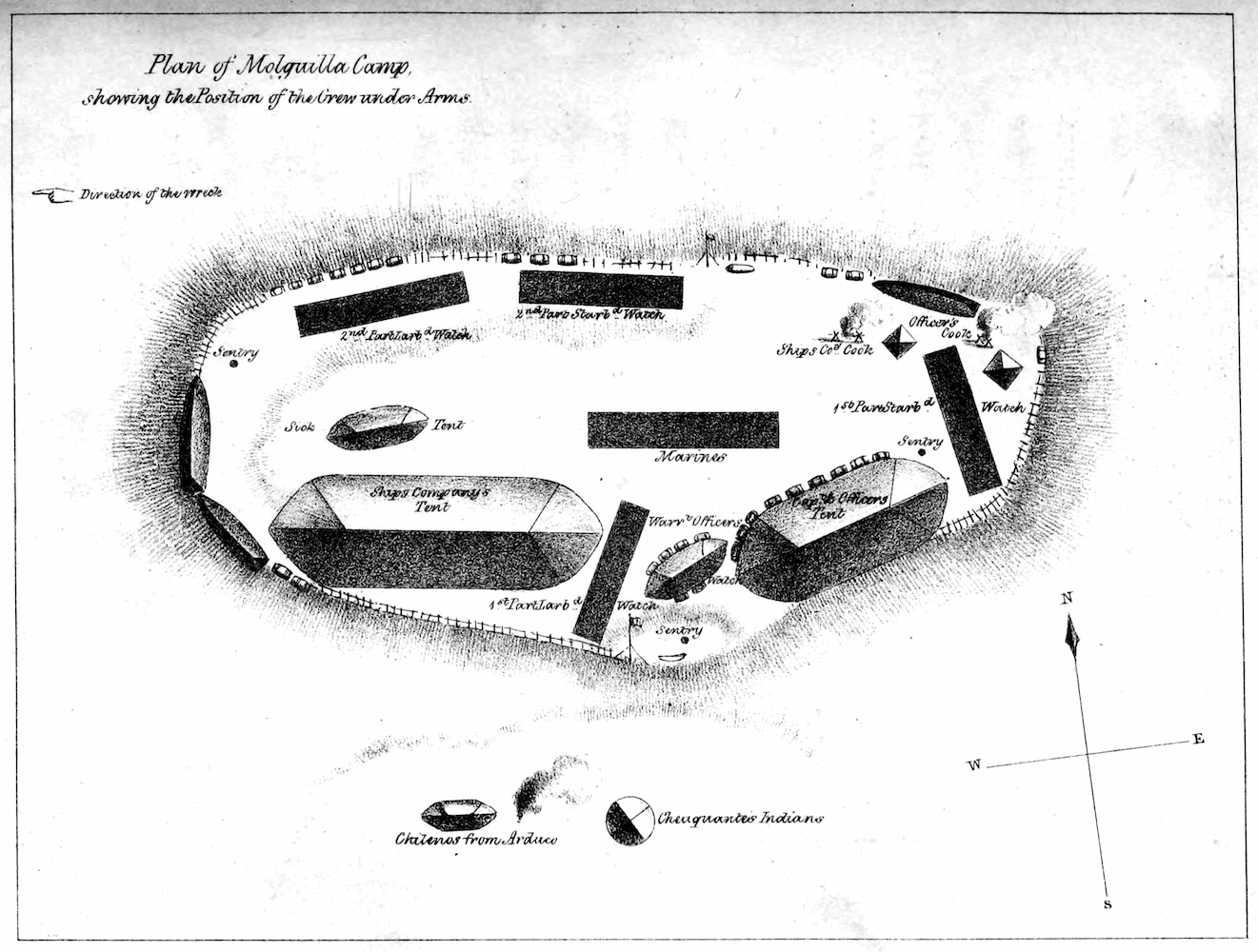
Plan of Molguilla Camp,
showing the Position of the Crew under Arms.
An offer was made to Rafael Lobo to put up
a small tent, at a little distance south of our
camp, for shelter for himself and his armed party
of Indians, which was accepted. It may not be
here misplaced to give a slight sketch of the history
and character of the savages amongst whom
it had been our fate to be thrown. The population
of the province of Arauco in Chili is by
far the most warlike in the whole of South
America: all the valour and experience of the
Spanish arms, in the days of their greatest glory,
failed in their obstinate and repeated endeavours
to subdue the Indians of Arauco, who have
maintained their independence to the present
day, and are denominated by the Spaniards
“The unconquerable Araucanos.” A beautiful
epic poem in the Spanish language, written by
Don Alonso de Ervilla y Zunija, published in
1590, describes the battles in which he was actively
engaged. His descriptions of the wonderful
valour and perseverance of those valiant
Indians would appear exaggerated, did not their
protracted and heroic resistance against the best
men of Spain, at a period when every Spanish
soldier was a hero, fully justify the truth of the
narration. The greatest part of the Araucanos
are, to the present day, engaged in a war of extermination
with the Chilino Spaniards.
The Araucano Indian is strong-built and active,
with long shaggy dark hair hanging all round
his head, as low as his shoulders; and when attacking
an enemy, it is allowed partially to cover
his face: his person is on these occasions frequently
smeared over with mare’s blood. His
legs are bare to the knees; he wears a kind of
short loose drawers, made of Indian manufacture,
with a poncho of the same material; rides
a horse of poor appearance, but great capacity,
with large spurs of iron, if he can get them,
secured to his bare heel with hide straps; his
stirrups are only large enough to admit his great
toe. Under his poncho, round his waist, is a
large knife, often as broad as an English billhook;
a set of bolas[1]; and attached to his saddle
is his lasso. His spear is a long bamboo staff,
with a sharp iron point on its end, which, from
its length (twenty-five feet or more), is very flexible,
and when in use is kept constantly moving,
so that the eye of the adversary cannot discover
the intended spot of thrust. The women are often
mounted in a similar manner, with the addition
of a sort of wrapper round the upper part of
the legs. Their cunning is very great. They
are very dirty; and they appear, in point of civilisation,
a most degraded race of savages. Their
principal food is potatoes, sometimes a little
meat, frequently the flesh of mares; and they
eat many of the numerous kinds of nuts and
berries which abound on the hills in the interior
of their country. Salt is an article much in request
amongst them. It was not uncommon to
see a group of them squatted round a grass net
of boiled potatoes, with a lump of rock-salt, which
they constantly passed from mouth to mouth,
round their circle, each taking a hearty suck. The
surf continued heavy, and, at intervals, affected
the wreck a good deal. The evening closed in
with foggy damp weather: the arms were examined,
and the watches on board, as well as in
the camp, mustered preparatory for the night.
Sunday, May 24.—The necessary operation of
heaving in on our stern-fasts was early attended
to. The hull had, during the night, been labouring
heavily, and was a good deal displaced from
her position of yesterday: the wind was northerly,
and the rollers broke so heavily, that the
surf passed over its usual mark, and rolled far
up towards the mound of sand on which we
were encamped; moving the boats, and several
articles which were laying, as was supposed, on
a spot free from the approach of the surf. This
day had been set apart as a day of rest; and we
were about to make arrangements for performing
divine service, when a party of horsemen were
seen approaching from the direction of Arauco.
They proved to be twelve men belonging to the
militia established there, under the charge of
Don Bernardino Hermosillo, a captain in that
corps, who brought a letter for Captain Seymour
from Mr. Jagoe, one of the officers despatched
to Concepçion, reporting their progress, and that
every facility would be given in the further
course of their destination. It appeared that
our shipmates were received at Arauco with great
kindness by the Chilian authorities, who immediately
ordered to Molquillo (the place of wreck)
the above party, with a view, as the Spanish despatch
of Don José Bustermente to the minister
of the interior afterwards expressed, “to prevent
robbery and extortion, and to advise and
aid in resisting any attack that the Indians might
be induced to make from the attraction this misfortune
might present to them for pillage.” To
send a force capable of ensuring protection to
us was not in their power. This party was accompanied
by the Cacique Pinoleo, his wife and
daughter, with an escort of several Indians, all
mounted; he presented the captain with a small
ox, supposing us to be straitened for provisions.
We offered them a little rum and water,
and biscuit; and, after a long interview, the
cacique and party retired to the tent of Rafael
Lobo, and eventually to the hills. Pinoleo is a
fine powerful-looking man, but understood to be
very absolute and passionate. The captain had,
in thanking him for his present, regretted his
having nothing to offer him in return for his
kindness; which caused him to rise, and, with
great vehemence of expression, in his Indian
language, to declaim against the supposition that,
in our condition he should seek for a return.
Pinoleo is the brother of Colissi, the cacique,
who, with the aid of 100 carbineers of Arauco,
was fighting and keeping in check Cadin, the
hostile cacique of Jucapel and Tirua. He was
the most civilised-looking of the caciques which
we had occasion to meet. He wore a cloth cap
with a gold-lace band; had a very large set of
bolas round his waist, under his poncho, with the
usual knife. His wife (who, we were informed,
was one of many) and daughter were much
ornamented with glass bead necklaces, and small
silver plates, bits of brass or other metal, strung
round their heads and necks: they wore, over
their feet and legs, boots made of the skins
of a colt’s legs, the hair inside, the knee part
forming the heel of the foot, and the rest so
shaped as to prove a convenient part of dress.
A small handkerchief bound round their heads,
and a band of braided beads in the form of a
crown, confined their hair. They managed their
horses equally as well as the men, riding in the
same manner. The captain, and one or two of
the officers, found a few presents for the ladies,
which caused much pleasure to their party. We
shortly after heard that, in a fit of drunkenness,
Pinoleo had killed this wife, by knocking her on
the head with his bolas: this occurred at the
hut of a poor Indian, who had taken pains to
entertain Pinoleo and party, as liberally as his
means would allow, at supper. On this Indian
he called for an indemnification for the loss of
his wife, and the payment of a sum of dollars,
which had led to the misunderstanding with his
wife; but, not having it in his power to satisfy
the cacique, he was forced to fly from his lands,
his property of cattle becoming the prey of
Pinoleo. Such is the present state of justice between
man and man in the province of Arauco.
Our worthy shipmate, Mr. Sarjeant, the purser,
with his intimate knowledge of the Spanish language,
was the source of all our communication
with the Chilinos, and, through an interpreter,
with the Indians: his valuable assistance was of
vital importance to all; but his patience was
sadly tried, from the unceasing calls made on his
attention as spokesman.
A tent was erected outside our line of camp
for our new force of Chilinos; who zealously
commenced the important service of establishing
a line of scouts, in the direction of the hostile
Indians, amongst the hills to the southward.
Don Bernardino liked not the vicinity of our
Indian look-out, aware, as he stated he was to us,
of their frequent acts of treachery. To his party
we spared a daily proportion of our provisions,
which, in addition to an occasional forage to the
northward, which some of them made, fully satisfied
their wants. Through Don Bernardino we
were enabled to obtain, from some one of the
caciques, a bullock or two, which were driven
down to our camp for beef; and from the hills
were brought, by the daily straggling Indians, a
moderate number of fowls, with potatoes and
apples, for which the officers and crew bartered
whatever they had to spare that attracted the
rapacity of the Indian. The weather, towards
night, became thick, the surf sounding loud and
heavily. Our usual precautions were taken in
watching through the night.
May 25.—We were roused just before one
this morning by Don Bernardino, who came to
the camp with information, brought by a horseman
just arrived, that the Indians had yesterday
been fighting near us, and might shortly be expected;
recommending us to be on our guard
against their insidious mode of attack, particularly
about daybreak, and, like them, “to sleep
by day and watch by night.” The seamen and
marines were instantly under arms. The captain
made his disposition of our force, by putting the
seamen in quarter watches, the marines forming
a fifth body, each under an officer. Rockets and
blue lights, and fire-balls, which we had made,
were in readiness to throw amongst the horses.
Fires were kept in, torches burnt, and all hands
paraded the camp till daylight, when tea was
made for the ship’s company, and an hour or two
of rest permitted. The party on board, under
the second lieutenant, were equally on the alert,
firing an occasional great gun, double-shotted, to
aid the demonstration of our watchfulness. The
ship had been so uneasy during the night, that
the best bower-anchor had been dropped, to
steady her bow to the surf. Anxiety was expressed
by the party of Chilinos for us to move
from our present encampment to the entrance
of a small river, twenty miles to the northward
of us, as adding much to our safety from the
Indians, from its defensible situation, and being
the nearest spot from which any approach could
be made from sea to afford us relief; the difficulties
of a more distant land journey being
impracticable under the circumstances in which
we were placed, and the necessity of only moving
with our arms, provisions, and several sick. Don
Bernardino had, in the first moment of his arrival,
urged our moving, pointing out the danger of
remaining, not only on account of the hostile
Indians, but the liability of the flat on which we
were being overflowed by the sea, as well as
flooded by the heavy rains which, at that season
of the year, might be hourly expected to fall;
also stating that, though they might possibly be
able to collect horses and mules, to assist our
movement, whilst the weather remained dry, yet
that, as they must necessarily come from a
great distance, and from the neighbourhood of
Arauco, the first rains would drive them to their
homes again, fearing the impassable state of the
country. At night a strong armed watch was
on the look-out in the camp, and scouts kept at
the distance of a few miles, in the direction of
the hostile Indians.
Light winds from the southward, with occasional
fog. The evident necessity of strengthening
our position, as a precaution against the
liability of an attack from the Indians, caused
all hands, after attending to the cables attached
to the wreck, to be employed in forming such
a barricade around our tents as might prove at
least a check to the approach of cavalry. The
result of this day’s labour, to those who witnessed
it, will long be with proud satisfaction
called to mind, as a proof of what the stimulated
energies of British seamen can accomplish: they
forgot their former fatigue, and, “turning-to”
with a good will, boats, cordage, casks, and every
description of stores useful for defence, were
carried on their shoulders, or laboriously dragged
over the heavy sand; and the fortified state of
our camp, by digging trenches, constructing barriers
and platforms for our two boat-guns, which
we had got out of the ship, and bringing aft the
long-bow guns on board, so as to flank our encampment,
reflected the greatest credit on every
individual who shared in this day’s labour. Our
works were afterwards improved; and, though
the known bravery of the Indians is not to be
despised, they would have bought a severe lesson
by attacking us. Still, regret must have attended
any sacrifice in such bootless warfare; and we
have just reason to conclude that their knowledge
of our prepared state constituted our security
from molestation. The surprise of the numerous
straggling Indians, who were lookers-on at
our laborious efforts, was evidently very great,
and, it is certain, excited a strong feeling of
respect towards us.
It has been already observed, that the seamen
were divided into four quarter watches; three of
them commanded by a lieutenant, and the master
in charge of the fourth. A fair and equal division
of the fire-arms was made: those who had no
musket had a pistol, cutlas, or pike. Each quarter
watch had their appointed station, to form in when
called out under arms. The marines formed in
the centre of the camp, and intended to act, as
necessary, in support of the weakest point.
It was understood that silence was strictly to
be kept, and not a shot fired until orders were
given from the captain. All were regularly mustered,
under arms, every night before supper;
the arms discharged and reloaded, and the necessary
steps taken to ensure their readiness for
use. The two boat cannonades were each in
charge of a quarter watch. At night every body
slept with their arms by their side. Besides the
sentinels, who called out the half hours throughout
the night, a watchword was established,
and an officer and midshipman were constantly
moving about the encampment and visiting the
posts. Such were the precautions used in our
endeavours to secure our camp. The Indians,
who brought from the hills each his grass-net of
apples, potatoes, or fowls, to exchange with us
for whatever we had, were requested to carry on
their marketing in a small mound of sand, about
100 yards from us; and we put up a staff, with a
cross, to indicate the spot, getting an interpreter
to explain what we wished: for it was of infinite
consequence to prevent an acquaintance with
our camp. They smiled at our arrangement,
but were not displeased, and for some time they
adhered to our desire with tolerable regularity.
The Indians had brought each day some supply
of poultry, which the crew obtained from them,
at first, at an easy rate of exchange, and they
willingly received buttons or bits of metal in
return: the eagerness, however, of the sailor to
add the luxury of a fowl to his mess of salt meat
caused the cunning Indian to demand articles of
dress: an old shirt was what they coveted much;
and a jacket was also among the articles eagerly
sought for. On each of our batteries was fixed
a flag-staff, to which a union-jack was secured,
and kept constantly flying. A full supply
of grape, canister, and round shot was piled
on each platform, which was composed of cannonade
slides sunk into the sand. These guns,
as well as those on the stern of the wreck, were
almost every evening discharged and reloaded,
preparatory for the night. None could go in or
out of the encampment without being seen by
the sentinels; and at night the watchword was
demanded of all who moved out of their tents.
Don Bernardino kept us constantly on the alert
with regard to the Indians. He had, with the
consent of Captain Seymour, despatched an express
to the governor of the frontier town of
Arauco, begging him to use his authority in
collecting seventy horses and thirty mules, to be
driven down to the coast to assist in transporting
our provisions and baggage to the Rio Leubu,
that being the spot from whence we could alone
hope to be relieved.
Tuesday, May 26.—Light north-westerly winds
and clear weather. Observations were taken, by
means of a false horizon, by the master and
master-assistant, for a latitude and longitude of
the encampment, which gave the latitude 37° 48′
48″ s., and longitude 73° 34′ 30″ w. The wreck
bore from the camp s.w. by w. We now felt a
great satisfaction and security in our barricade.
Our sick list numbered about ten, who were unfit
for active work. Several of the ten were laid up
from over work or rheumatic attacks, the result
of their being constantly wet in labouring at the
wreck.
On board the Challenger, at the time of her
disaster, was a Spaniard, who had been engaged
in the affair of the Falkland Islands, and was
one of the Gauchos who had been taken as concerned
in the murders committed there in 1833.
He had been released, and was a passenger from
Rio de Janeiro, to be landed at Valparaiso; but
he had frequently exhibited such symptoms of
mental derangement, that it became necessary to
secure him in his hammock. On the day the
evening of which we were wrecked, he had
been unusually unruly, and was therefore placed
under restraint. In the moment of the greatest
danger, on the striking of the ship amongst the
breakers, one of the first who ran on deck was
the Spaniard, with scarcely any covering on him.
He must have broken away from the lashings
which secured him, appeared perfectly sane, and
prepared to assist in the duties of the ship; and,
singular to relate, on no occasion afterwards,
during the whole time of our stay on the shores
of Chili, was there observed any return of wildness.
He was very useful in the camp, from his
skill in cutting out and applying the hides of the
bullocks to the fabrication of moccassins.
Wednesday, May 27.—The wind northerly,
with thick weather and fog. One watch was
occupied at the wreck, getting out any undamaged
articles of provisions, private property, or
stores that could be got at. The quantity of
water in the holds, however, prevented much
being done. About mid-day, the Cacique Pinoleo,
with his wife and daughter, and several
followers, arrived at our camp. He was on his
road to join his brother, the Cacique Colissi,
who had sent for more assistance to make head
against the hostile Indians, with whom he had
been fighting. After collecting and mustering
the Indians around our camp, and treating us
with their war-whoop, he left us to join his brother,
strengthening his force with the greater
part of Rafael Lobo’s Indians. The daily routine
of mustering under arms, with every precaution
against a surprise during the night, was
duly attended to. The night was damp and
foggy.
Thursday, May 28.—The weather moderate,
the wind northerly, with a damp fog. Except the
necessary attention to the stream-cable fasts, and
the working of the pumps, the crew were allowed a
respite from their previous daily hard labours, the
occupation of to-day being the arrangement of
the interior of the tents, and the examination of
their clothes and bedding, and likewise cleaning
and sweeping inside the barricade, and making
storage of the provisions. By the captain’s order
a survey was taken by the second lieutenant,
Mr. Collins, Mr. M’Donald, the master, and
Mr. Barclay, the carpenter, to ascertain, if possible,
the principal damage received in the hull
of the wreck. Towards sunset it was observed
that the stern-post was left dry in the drawback
of the surf; and, from the forming of a sand-bank
outside the ship, the iron stock of the best
bower-anchor was at times visible about half
the ship’s length ahead of her. The current
through the surf to the southward along shore
appeared unusually strong; the weather to
seaward dark and gloomy, with the appearance
of an approach of a strong northerly gale. At
5 A.M. mustered under arms, and supplied what
ammunition was necessary; discharged the arms,
and reloaded; and likewise on board the wreck.
A messenger arrived from the governor of
Arauco to Don Bernardino, acknowledging our
request to have horses and mules collected for
our removal to the banks of the Rio Leubu, and
promising the exertion of all his authority to forward
so important an object. The wind increased
as the night advanced.
May 29.—The weather dry, but with strong
breezes, and cloudy from the northward; an
unusually heavy surf rolling in on the beach,
breaking with great violence and height on
the breakers to seaward: the ship very uneasy,
so much so as to threaten a separation of the
decks from the lower body of the ship; to relieve
her the foremast was cut away, and driven
up on the beach to the southward, and the larboard
sheet-anchor let go, the mainmast and
bowsprit being the only spars now standing. A
second small anchor was got on shore to assist in
steadying the wreck, with the fore-gaugers and
chain-messenger bent to it and hove taut. As
the duty permitted, the officers and men were
allowed to stroll to some little distance from the
camp; and, with one of the Chilinos as a guide
and interpreter, a party was occasionally made,
in accordance with inclination, as well as appetite,
in search of game of any description that
might assist in adding to and varying our dinner.
Persuaded by Don Bernardino, who furnished
horses, the captain, with Mr. Sarjeant and a
guide, rode for an hour two or in the direction
of the ground pointed out by Rafael Lobo, and
as far as the Cacique Cheuquante’s residence,
over the hills north of us, distant about two
leagues. There they found one of Pinoleo’s
wives and a daughter, and attendants. They
passed on their road one of the few evidences of
a burial-ground which was seen by us. It was a
spot of ten or twelve yards square, securely
fenced by trunks of large trees piled round, the
ends being rudely morticed into each other. The
beauty and luxuriance of the country on the
hills was a great contrast to the barren sandy
flat on which we were situated. The variety
and size of the evergreens were most striking.
Many trees which bore fruit were also pointed
out as much esteemed and eaten by the Indians:
some cranberries were also gathered. Abundance
of partridges were seen. At 4 P.M. Mr.
Lane, the assistant-surgeon, arrived from Concepçion,
bringing the welcome intelligence that
his companion, Mr. Jagoe, with the consul,
Mr. Rouse, were on their road to us, and hoped
to reach our camp on the next day. Mr. Rouse
was bringing with him several mules laden with
articles which he considered we might have need
of, as spirits and bread; not knowing of our
success in saving out of the ship sufficient provisions
for the present support of all. These
mules delayed his movements; he, therefore,
very properly, had pushed Mr. Lane on with a
safe guide to convey to the captain, with as little
delay as possible, a reply to his letter, naturally
supposing the anxious suspense we were under
to hear from him. The consul was also bringing
some presents, to conciliate the good-will of the
caciques on the road and around our encampment.
Towards sunset our camp was put in
movement by the appearance, through the distant
haze to the southward, of an approach of
several groups of horsemen, and a mounted scout
was sent by Don Bernardino to reconnoitre.
They turned out to be some of Cheuquante’s
Indians, who were returning from the late battles
fought by Colissi against the hostile Indians.
Towards night it blew a heavy gale: its effect
on the sand, which we were on, was most inconvenient
and annoying, finding its way into every
thing inside the tents.
Saturday, May 30.—Strong gales from the
northward, with heavy rains, which penetrated the
tents a good deal, causing many attempts on the
part of the sleepers, during the night, to discover
the driest spot inside to lie down on. Daylight saw
a crowded group huddled together in the centre
of the tent, as being the most free from rain.
It was necessary to turn all hands on the pumps
to clear the holds of as much water as possible,
in order to endeavour to get at the remainder of
the provisions, which might have escaped injury.
The heavy surf which broke this day on the ship
made her very uneasy. Amongst the articles
secured to-day, out of the after-hold, were a
quantity of salt provisions and other articles,
many of which were too much damaged for use,
the whole of the lower frame of the ship having
been a long time under the influence of sea-water.
The provisions and spirits were carefully transported
to the camp; the latter placed in the
officers’ tent; the former ranged outside of it, in
a trench, and covered with sand, thus securing
and steadying the tent.
At 12 30′ P.M. we experienced a severe shock
of an earthquake, causing a very strong vibration
to every article in our tents, and instantly
arousing several who were asleep, resting from
fatigue. An account of the whole of the provisions
saved was carefully taken, and such
daily issues made to the crew, under the management
of Mr. Sarjeant, the purser, as the
quantity of the various species would admit of.
The precaution of securing a large proportion
of our bread, at the moment of our disaster, and
putting it into casks, proved of the greatest consequence
to us; for, although it ran short, the
third, and afterwards, as long as it lasted, a
fourth, of the established daily allowance was of
infinite service to us. The powder cases from
the magazines, many of which were got out,
were discovered not in every instance to have
resisted the wet; yet we fortunately had an
ample supply for all our necessities. The weather
broke a little towards the evening, but with
frequent squalls, attended by heavy rain.
Sunday, May 31.—The wind still northerly
and fresh, with heavy rain, rendering our camp
and tents very uncomfortable. The marsh and
flat round us was much flooded, and gave us
some idea of what we might expect, should the
winter rains commence before we were enabled
to quit our present spot, which had, in several
points of view, the appearance of an island. The
little stream of water which skirted the base of
our camp rose amongst the hills inland, in which
direction it partook of the character of a small
river; and a few small fish were occasionally to
be seen jumping in its deepest parts. Its increase
after rain was considerable; resuming its ordinary
size and force on the return of dry weather.
At the camp, in the absence of washing apparatus,
it became the scene of each morning’s ablution;
and was on every account of inestimable
value to us, for it was of excellent quality. A
walk on the banks of the little stream could be
extended to three or four miles, and yet continuing
in sight of our camp, from the flatness
of the ground. Duck and widgeon constantly
sprang up from under the banks, which were
towards the hills, covered with myrtles, rushes,
and a gigantic weed peculiar to the marshes of
that part of Chili.
On the north side of the stream the officers
had, as duty permitted them, gone out with their
guns, and seldom returned without a supply of
partridges and wild ducks, excellent in flavour,
and most acceptable to our numerous mess, which
included the officers of all grades, our excellent
shipmate, Mr. Sarjeant, being the caterer, and
fulfilling, under circumstances, so laborious and
troublesome this duty, in a manner deserving the
hearty thanks of his messmates. Anxious on
every account to advance the necessary and
evident object of moving to the banks of the
Rio Leubu, and desirous of ascertaining the
nature of that spot by an eyewitness of our own,
in order that, on the arrival of the consul, no
time might be lost in deciding on our future
operation as concerned the Leubu, the captain
at 10 A.M. despatched two officers, with a guide
from the Chilino party, to examine the entrance
of that river, with reference to forming an encampment
there, and to the possibility of being
able to embark from it. Every hour now sensibly
proved to us the impossibility of remaining
on our present ground. We had been dependent
on the wreck for fire-wood, the quantity of
which we had burnt was very great. Our spars,
from their usefulness as tent-poles and as part
of the barricades, we could not suffer to be cut
up; parties, therefore, daily foraged the ship
and beach for whatever was to be got at to supply
the wants of the cooks: our distance from
the wood on the hills was too great to send there,
besides the risk of separating our force. The
surf continued heavy, and the appearance of the
weather to seaward squally and unsettled; the
ship was working very much in her top sides,
and sinking deep forward.
A pest, which eventually became very destructive
and annoying to us, had now begun to
trouble us, in the shape of a multitude of a large
kind of mouse: our provisions, stores, clothes,
tents, all suffered from their constant attacks,
and the freedom with which they visited the
sleepers almost exceeded belief.
At 5 30′ P.M. the British consul, Henry William
Rouse, Esq. from Concepçion, arrived at
our barricade, accompanied by Colonel Don G.
J. Valenzuela, the governor and military commandant
of Arauco, with Mr. Jagoe. They had
had a severe journey, from the effects of the
heavy rain that had fallen in a country where the
existence of a road is unknown. Their arrival
was hailed with joy as the dawn of our deliverance,
and gave us fresh stimulus to exertion.
They were fatigued, and gladly partook of what
we had to offer them, which included some good
wine we had got out of the wreck; and sought
some early rest, deciding on the morrow to concert
measures for our moving towards the Rio
Leubu. The governor expressed himself highly
pleased at the manner in which we had barricaded
ourselves. We were indebted, for the governor
of Arauco’s presence, to the high esteem in
which Mr. Rouse is held, amongst the authorities,
throughout the country which surrounds
Concepçion, where he is much beloved. On
Mr. Rouse’s arrival at Arauco, the governor, to
whom he is known, insisted on accompanying
him to Molquilla, urging the benefit which his
authority and presence might be of in assisting
him on a journey, if not of danger, at least of
great discomfort, and having interviews with the
different caciques who were considered friendly
to the Chilian government. The reader may
possibly feel an interest in knowing what occurred
during the journey performed by our two
shipmates to Concepçion, and on their return.
Mr. Jagoe’s account of it is nearly as follows:—
“The captain had put me in charge of a letter
to the British consul at Concepçion, with directions
to take it, or find means of transmitting it:
he also spoke to Mr. Lane on the same subject.
We therefore consulted together as to the best
manner of executing this mission, on which so
much depended.
“We attempted to communicate with the Indians
(who by this time were collecting on the
beach, and who evidently seemed inclined to be
friendly, and disposed to render assistance to the
party on shore), but to no purpose, as we could
not make ourselves understood. Happily for us,
at this moment a Chilino rode up: he possessed
a pleasing countenance, and to him we communicated
our wish to be guided to Concepçion,
and inquired the distance, which, to our great
surprise, we found to be 180 miles. I introduced
Mr. Sarjeant (who understands the Spanish
language thoroughly) to this Chilino, who,
after a few preliminary remarks, agreed to conduct
us to Concepçion for a stipulated sum, furnishing
horses and all necessaries on the road:
but as this Chilino’s horses were at his petraro,
eight leagues from the beach, he stood our guarantee
for eight dollars with the cacique Cheuquante,
for the hire of two horses to take us
there; and about half-past 4 three horses arrived,
equipped in perfect Indian style, when, after
some slight refreshment of biscuit and rum, we
took leave of our fellow-sufferers. We rode
along the beach about a league, then turned off
for the interior, pursuing our way to the foot of
some low hills, until we came to the cacique
Cheuquante’s dwelling, at about 6 o’clock, at
which time it was nearly dark. There we met
Don Rafael Lobo, an Indian apparently of Spanish
blood from his countenance. He speaks the
Spanish language well, and acts as interpreter,
and holds the commission of lieutenant of the
friendly Indians of the district of Tucapel, and
appears to have much influence over them. He
urged us much to remain the night. We were
much questioned whether we belonged to a
merchant ship; if the cargo was saved; of what
it consisted; and when we were going to land
it: to which Mr. Lane replied, that she was a
vessel of war, laden with “powder and ball;”
which, on communicating to the group of Indians
surrounding us, they held up their hands,
howled, and scratched their savage heads, expressive
either of astonishment or disappointment.
After exchanging our horses, which was
the object of our coming here, we continued our
way by the side of a thickly-wooded mountain,
until the road, if such it maybe called, the horses
being knee-deep in water, turned off through this
forest. We had not proceeded more than a hundred
yards, when the guide called out, ‘Yo he
perdido el camino,’ (I have lost the road.) It was
at this time quite dark. Such were our prospects,
on a cold freezing night, without a dry thread,
and Mr. Lane without shoes. The guide rode
about two hours, endeavouring to regain the
road, or find an opening through almost impenetrable
wood, whilst we remained on one spot,
occasionally striking sparks with a flint and steel
to show our position. At last, fatigued and
weary with disappointment, he returned, and pronounced
sorrowfully that he had quite lost the
road, and we must make up our mind to wait for
daylight. Not knowing more of our guide than
might be judged of by inexperienced physiognomists,
we thought it prudent, in spite of his
pleasing countenance, to retire to some distance
from him: here we laid down, with our heads
on each other’s knees, to keep them out of the
wet, giving the signal to turn when either became
so insufferably cold or cramped as to require
relief. During the night we were alarmed
by the frightful neighing of our horses, which
our guide informed us was occasioned by the
approach of the pinna, a small lion of South
America, which is reported to be an enemy to
horses, but not to man. In the confusion our
guide’s horse got away, and he was a considerable
time before he found it; and we heard no
more of the intruders. To prevent any further
accident, we secured the long bridles of our
horses to our arms, in such a manner as made it
impossible they could escape without our knowledge,
should we be so fortunate as to sleep.
Shortly after this we were again alarmed by the
barking of dogs, and trampling of horses approaching,
as we supposed, in the road we had
lost.
“We distinctly heard the voices of Indians,
and, if we had known their language, might have
been in possession of their intentions: we had
no doubt but that they were the party we left
at the raucho, who endeavoured to prevail on
us to stop the night, and that they were in search
of us. When they were so near as to hear if
we uttered a word, our guide, in a low tone, said
‘Hush!’ and when the horses made a rustling
noise amongst the bushes, he evaded suspicion
by grunting like a pig. We asked no questions,
but remained in a state of indescribable anxiety
till daylight, the 21st, when, wet, cold, hungry,
and miserable, we rubbed ourselves to circulate
the blood and reanimate our almost frozen
limbs. Some time was lost in searching for Mr.
Lane’s coat, which had been lost when Camilo’s
horse took fright, as we could make no use of it
as a covering or protection from the weather, it
having been washed on shore, and consequently
thoroughly wet. On finding the coat, we saddled
our horses, mounted, and discovered the
road to be only ten yards from us, and that we
had not more than a hundred yards of the forest
to pass through. We continued our journey at
seldom less speed than a canter; these horses
having a peculiar sort of pace, which they can
maintain for a length of time almost incredible
to an English traveller. We came to a branch
of the river Leubu, about twenty or thirty miles
inland: with little difficulty we crossed it on
horseback; and our guide’s horse being fagged,
he took mine, fixed his lasso to the saddle, rode
after a few horses which were grazing near us,
and in a few minutes entrapped one of the poor
animals in that never-failing lasso: this was accomplished
in less than ten minutes, and we
continued our way across the country till we
came to the Rio Leubu. (We had gone to some
distance out of our way for the purpose of
getting this horse.) Here we dismounted, unsaddled
our horses, and hailed an Indian woman
on the other side of the river, distant about
fifty yards, to know if she had any means of
conveying us over. She pointed to something
in the shape of a canoe, lying on the bank of the
river, filled with mud and water, which, with the
assistance of another woman, she managed to
turn bottom up, when it proved to be nothing
more than a trough, in which they kept their
apples for making chiahi, or cider (a very common
beverage amongst them): after partially
cleaning it, stopping the holes with mud, they
floated it, and one of the women embarked,
and, with a long pole, shoved it up the river on
one side; and when the river turned, she allowed
the current to sweep it across, which nothing but
her local knowledge of its windings could have
enabled her to accomplish. I was the first nominated
by our guide to trust to this conveyance,
and accordingly slid down the bank (for it
was impossible to walk), and introduced myself
to the goddess of the deep, by the friendly
Indian expression of ‘Mai mai,’ which serves
for ‘how do you do?’ ‘good bye,’ ‘very good,’
and is the beginning of every friendly conversation.
I embarked, after relieving myself of all
incumbrances, such as jacket, waistcoat, &c. thus
preparing myself to swim, if necessary; and,
standing upright, balanced myself, much to the
satisfaction of my waterwoman. Mr. Lane and
Camilo (our guide) came over in the same way,
each bringing his saddle gear. Previous to embarkation
our guide drove the horses into the
river, over which they swam without difficulty;
and, on landing, the lasso was thrown over their
necks, which immediately stopped them. Here
we went into a raucho, where our waterwoman
assumed the character of hostess, and appeared
to keep an Indian eating-house, from the quantity
of dried beef hanging about the raucho, and
some boiling in an earthenware pot on the fire,
which she served up in a wooden bowl, when it
proved to be cascuella, made from cherqui and
ahi (capsicums) boiled together. As a substitute
for spoons we used muscle-shells, and for
bread we had heated corn, beaten between stones,
and moistened with water, something about the
consistency of birdlime. Our beverage was a
mixture of water and roasted barley, pounded;
which, being put into a bullock’s horn and
violently stirred, produces an effervescence, in
which state it is drank. I need not say, however
foreign as this was to our usual fare, we
made a hearty meal, not having eaten any thing
substantial since the night of the wreck. This
repast occupied us about ten minutes; after
which we lighted our pajitas, and resumed our
journey towards the patraco of our guide, called
Eurihuillin, from the river of that name, which
runs through it. Here we dismounted, and our
guide, with the assistance of his major-domo,
went out and caught fresh horses, while we sat
by the fire drying our clothes, amused by the
interesting interrogations of two old dames, the
major-domo’s wife and wife’s sister, who were
feeding us with roasted apples and potatoes.
Our guide came in with his trousers very
much torn; and knowing that I had a needle
and some thread about me, applied to have them
repaired. This I was most ready to do, in return
for the kind treatment we had received, and the
essential services he had rendered us. He then
killed a sheep, which was cut in halves, and put
under our saddles, as provisions for the journey.
About one we again mounted, leaving directions
for the horses to be returned to the Indian from
whom we had borrowed them, took leave of our
kind hostesses, and galloped off on our fresh
steeds, much invigorated; but before night
things we realtered—we were for galloping,
and they for walking. About two leagues from
our guide’s residence, we crossed the river Euriheullin,
which forms the boundary of this part
of his portraco, which is about twelve miles in
length, and as many in breadth, and consists
principally of coarse grazing ground in its primitive
state, with plenty of wood. For this estate
he pays sixteen dollars a year to the widow of a
cacique. His stock consists of about 100 bullocks,
and as many sheep; the former valued at
sixteen dollars, and the latter at six reals each.
A man’s rank or station in life is here generally
estimated by the number of cattle he possesses,
together with the quality of the poncho or mantle
he rides in, without reference to the appearance
of any other part of his dress: from this we
judged our guide to be above mediocrity. During
this day we rode from eighty to ninety miles,
over a rich and beautiful country, where Nature
has bestowed her favours with a liberal hand on
an indolent and savage race, who are strangers
to every kind of agriculture beyond the cultivation
of a few potatoes, for which they prepare a
fresh spot of ground every year. This will account
for the fine specimens we have met with
in this country.
About 4 o’clock this afternoon, I lost my
sword, from my carelessness in forgetting to
buckle my belt, after looking at my watch on
horseback. We were an hour looking for it;
and this delay occasioned our being benighted
on a thickly wooded mountain, where we encountered
many difficulties from the intricacies
of the passes, and the quantity of water we had
to wade through; but as our guide knew this
part of the road much better than that of the
preceding day, we surmounted them all, and
reached the Indian pueblo of Albarada at 9
o’clock. Here we went into a large rancho,
crowded with dirty figures of both sexes, and all
sizes; besides a number of dogs, which were
kicked out, and a place near the fire cleared for
us. We sat down cross-legged, enjoying tobacco
and chichi, whilst supper was preparing, which
was soon done, as they appear to have the pot
always boiling, and also plenty of potatoes at
hand, which they prepare in the most dexterous
manner, with the edge of a muscle shell. Meanwhile
the grey-headed dirty señora of the family
was engaged, with the guide, in cutting up one
of the halves of the sheep, and putting it into
the boiler with potatoes and ahi. In the course
of an hour it was served up in the usual way;
and, after inviting the señor and señora of the
party, we brandished our muscle shells in style,
having become adepts in an art in which we were
novices but yesterday. We made a hearty meal,
and having drunk a sufficient quantity of chichi,
we prepared our comfortless beds, having only
our saddle gear on which to rest our weary limbs.
These we placed close by the fire, and lay down
to rest, surrounded by dogs and dirty children:
however, after our excessive fatigue, we slept
tolerably well.
At daylight, the 22d, we arose, and got rid of
some of those intolerable pests, pulgas or fleas
(with which we were covered), by taking off and
shaking our jackets: we then each took a roasted
potato, saddled our horses, and mounted. The
ground was frozen very hard, and the air exceedingly
cold. We had not gone far when
my horse showed symptoms of weakness, or disinclination
to proceed, which obliged us to go a
considerable distance out of the way, to a cacique
known to our guide, to procure another.
We had not only to go out of our way, but down
a very steep mountain, the horses sliding the
greatest part of the way on their haunches, when
we came to a beautiful valley, rendered still
more lovely by the splendid beams of the newly
risen sun. Here, by the side of the river, were
scattered a few huts or ranchos, out of one of
which came the cacique, who hailed us with that
friendly phrase, “Mai, mai,” which we obsequiously
returned. Our guide told him the nature
of our expedition, and the cause of our
visit, when he immediately introduced us to the
inmates of his dwelling (all women, the caciques
being allowed a plurality of wives). He despatched
his peons or servants for a horse, while we sat
by the fire smoking pajitas, or eating roasted
potatoes, occasionally making ourselves understood
by the women, to whom we offered some
snuff, which, from having been wet, was become
caked: this they readily accepted, and were
about to put it into “the general receptacle,”
when I stopped them, and made them understand
that it was not to be eaten, by taking a pinch
myself. They followed my example, but in a
most strange manner, by forcing it up their nostrils,
and laughing hideously at the ridiculous
use thus made of their “smelling apparatus.”
Being gratified with the pleasing excitement this
pungent powder produced, they begged me to
put some in a paper for them: this I was most
happy to do, as it was the first opportunity we
had (even in this small way) of showing our gratitude
for the many and great kindnesses we had
received. My horse being brought and saddled,
we mounted, leaving directions for the disposal
of the fagged horse. We then purchased a goose,
which we gave in charge to the guide, lighted
our pajitas, and took leave. We ascended this
steep mountain in a manner more like going up
stairs than any thing else I can compare it to,
the heavy rains having given it the appearance of
steps; the only support to the horses’ feet being
the roots of trees, which intersected the path,
and made a tolerably firm footing: we laid down
on our horses’ necks to escape being dragged off
by the Arcania shrubs, which formed a canopy
over our heads. These are chiefly evergreens,
some having beautiful flowers. We particularly
noticed a large crimson bell-shaped flower, growing
as a parasitical shrub, which covered the tops
of the tallest trees, and striking the eye of the
inexperienced traveller with its incomparable
beauty. About eleven we arrived at Arauco, the
frontier town of Chili, which is situated twenty
leagues south of Concepçion, on the extremity
of an extensive marsh, about six leagues in
length, bounded on one side by the Pacific Ocean,
and on the other by hills, backed by the Cordilleras.
This town (which formerly was nothing
more than an Indian pueblo, till the Chilinos, by
incessant warfare and stratagem, subdued the Indians,
and advanced thus far into their territory,)
is garrisoned by a few Chilino troops, under the
command of Lieutenant-Colonel Señor Don Geronimo
José Valenzuela, who was at this time
at Concepçion. As soon as we entered the town,
the knowledge of our arrival having reached the
second in command, Major Don José Sylva, he
ran to us, and embraced us as officers in distress,
and took us to his quarters, and introduced us
to five or six officers, to whom, with himself, we
shall ever be indebted for the most Castilian-like
kindness and hospitality, which, if I were
not an Englishman, I ought to say could not
be surpassed. With these gentlemen we dined:
they informed us that they would immediately
despatch the brother of our guide, Don Bernardino
Hermosillo, a captain in their militia cavalry,
with a party of twelve men, to guard the
wreck at Molquilla; at the same time telling us
that their reason for sending so small a number
was, because the Indians, so far south as the
place where the ship had been wrecked, had
acknowledged the government of Chili, and
were at present assisting them, or rather themselves,
by carrying on an interminable and
murderous warfare with the tribes who were disaffected
towards the government: the small
force they were about to send was merely to act
as scouts, to make known the position of the hostile,
and to prevent treachery on the part of the
friendly tribes, the place of the shipwreck being
on the extreme verge where they acknowledged
the government of Chili, and where their desperate
battles are fought. We took this opportunity
of informing Captain Seymour how far we
had advanced on our journey; and Major Don
José Sylva availed himself of our going to Concepçion
for communicating to their government
what he had done for the protection of the
wreck.
At 2 P.M. we bade a reluctant adieu to
these hospitable fellows, deeply impressed with
a sense of their kindness and our obligation.
We rode along the marsh, observing here and
there a rancho, with a spot of cultivated ground,
till we arrived at a cluster of ranchos (scarcely
deserving the name of a pueblo) about three
miles from Lianco, called Caremfranque, after
the river which runs near it. Here we were introduced
to the family of our guide, who all ran
and embraced their parent with affection, and
heard from him all the particulars connected with
us. Fresh horses were brought by one of the
peons, whilst our guide changed his dress and
put on a better poncho. It has already been
observed, that this part of the habiliment tends
to point out the station of life of him who wears
it: it is due to our guide to make known that his
was a very good one, confirming his respectability
and the good character given of his
honesty by the officers at Arauco: we can only
add that, with the essential service of guiding us to
the consul (which we trust will be the foundation
of relief to the shipwrecked crew), he has shown
us the most christian-like kindness and attention,
entitling him to the friendly appellation of “old
Camilo,” instead of “our guide.” Taking leave
of his kind family, we crossed the river Cacampuqune
and came to a few scattered ranchos,
named, after an old Spanish fort in its vicinity,
“Fuerte viejo Colerico.” Here we were introduced
to a Chilian señorita, a pretty brunette,
gaudily dressed, and informed by “old Camilo”
that we should stop at her house for the night,
and, by starting the next morning early, should
most probably reach Concepçion in good time,
as we were only ten leagues from it. Gratified
by this pleasing information, we dismounted, and
after begging pardon for our dirty appearance,
supper was ordered by “old Camilo:” it was
soon prepared, and served up in the Chilian style
by our industrious hostess, who, of course, supped
with us. During conversation, she told us that
there were some Englishmen in the village, and
sent for them: they soon made their appearance,
and in the course of conversation we discovered
them to be North Americans. They made us a
present of a dirty pipe and a small quantity of
tobacco, which they called real Virginia: this
was no treat, as we preferred the pajitas made
with mild tobacco, wrapped in the Indian corn-leaf,
and presented by our charming hostess, who
was an adept in making them. After enjoying
our aquaediente and pajitas, we retired to bed
and slept soundly; and arose much refreshed
at daylight on the 23d. We were delayed
until seven o’clock for the horses; and if the
nature of our mission had not been so important,
we might have said the loss of time was
not to be regretted, as our kind hostess was
busily engaged in supplying us with maté. At
7 we took leave, promising to call on our way
back. We hurried over a high hill or mountain
called the “Luro di Villagu,” and by the Indians
“Muguana”—(this being the place
where they defeated the Spaniards and gained
their independence)—then over a plain of six
leagues and upwards in length, with here and
there a cultivated spot, and many lakes covered
with water-fowl. We arrived at the pueblo of
San Pedro, on the southern side of the Bio-bio,
immediately opposite Concepçion.
Here “old Camilo’s” attention was called to
the means of conveying us across the river, while
we stopped at the house of an old dame to whom
he introduced us: she kindly brought us water,
and we washed, leaving our linen to undergo
the same process, as we were covered with fleas.
Camilo returned, and told us the launch would
not be ready for some hours, and recommended
our taking breakfast, which we were too happy
to agree to: we sat down and made a hearty
meal.
About 2 o’clock we embarked in a flat-bottomed
oblong launch, with nearly a dozen
passengers, two bullocks, four horses, six pigs,
and several sacks of wheat. This conveyance
was kept under command, against a strong current,
by an immense oar which answered the
purpose of a rudder. A man was stationed at
each end of the launch with a long pole, which,
on first starting, was made use of a little, but
when in deep water she was merely kept end on
to the current by means of the rudder, until we
approached the shallow water on the northern
side, which covers an extensive flat of sand. On
grounding, the horses, bullocks, and pigs disembarked,
and the launch being again afloat, was,
by the assistance of the poles, shoved some distance
over the flat, but still a considerable way
from the beach. We disembarked, by mounting
our horses from the launch, and entered the city
of Concepçion (situated on the Bio-bio), which
we found in a state of complete ruin, not a single
building standing, and the inhabitants living in
tents or wooden houses, which some of the more
opulent had been able to erect, as temporary residences.
We learned that it had been destroyed
by an earthquake, on the 20th of February last:
the fatal shock which produced this devastation
was felt at mid-day, without giving the slightest
warning, when every house and public building
fell; and it appears miraculous that only a
hundred lives were lost. The port of Talcahuana
felt the shock with equal severity. The sea is
reported to have risen upwards of fifty feet immediately
after the earthquake, breaking up on
the ruins, inundating the flat on which the
town was situated, and sweeping every thing
before it, barely giving the inhabitants time to
effect their escape to the hills.
About half-past 3 P.M., in one of these temporary
wooden houses, we found H. W. Rouse,
Esq., His Majesty’s Consul; and I need not say
how happy we were to introduce ourselves to
him, and deliver the Captain’s letter. From our
shabby dress and dirty appearance, he for a
moment eyed us with suspicion; but having
opened the letter, his countenance assumed an
expression of benevolence and pity. He shook
hands with us, called for wine and water; and we
immediately saw in him all those characteristics
which endear us to one another. He then left
us to consult the Intendenté, and deliver the
letter we brought from the officers at Arauco:
he did not return till 6, when we dined; and the
circumstances attending the wreck formed the
subject of our conversation, as Captain Seymour’s
letter put him only in possession of the bare fact.
At 11 we each took a tepid bath, and “turned
in” to comfortable beds, the Consul having previously
left us to pay his last visit to a dying
native, and did not return till 4 in the morning,
when he awoke me, and related a few particulars
connected with his visit, and the customs
of the people in such a case. This story was not
at all calculated to strengthen the nerves of a
person whose whole system had recently been
severely shaken, nor calculated to prepare him
for the shock of an earthquake which at this moment
threatened destruction. This shock roused
me; under the influence of great alarm, I jumped
out of bed, and was about to escape from the
house, when the Consul called out, “It’s over!”
and I returned to my bed, but too much frightened
to expect more sleep. The Consul told us
they had been visited with shocks, more or less
severe, ever since the great earthquake, which
amongst the natives appears to mark an epoch,
as in conversation they date every thing so
many days before or after “the earthquake.”
The 24th and 25th were employed in busily
writing with the Consul, who determined on
accompanying us to the wreck; and requested
our whole assistance in preparing despatches for
the Consul-general at Santiago, and other persons
likely to be the means of affording relief to
the unfortunate crew. I need not say that our
undivided attention to this and other services
was commanded by this gentleman, in order to
expedite our return to the wreck, which was his
most anxious desire, his whole head and soul
being in the hope of relieving or rendering assistance
to his distressed countrymen, fully aware
that even if they had all succeeded in reaching
the shore in safety, there was great danger to be
apprehended of an attack by the Indians, should
they come upon them by surprise, or if they had
not been able to save the means of defence
against that vindictive race of savages, who on
former disasters had plundered the unfortunate
crews of four vessels wrecked upon their coast,
and who were more particularly to be feared at
this season of the year, as that intoxicating drink
chichi is plentiful; and when excited by this
beverage they make desperate attacks on horseback,
armed with spears of bamboo from twenty
to thirty feet in length, and are not an enemy to
be trifled with.
May 26.—The despatches, having been completed
at a late hour last night, were sent off
this morning at 4 o’clock by an extraordinary
courier, who was to be rewarded for his services
according to his expedition: if he reached Santiago
in seven days, he was to have forty-five
dollars, but if in less time, five dollars more for
every day less than seven, and decreased in the
same proportion for every day more than seven.
We were, until five in the afternoon, engaged in
preparing for our journey to the wreck, purchasing
presents to conciliate the Indians, indigo
and other articles to traffic with them, and hiring
mules, horses, and servants, to take charge of and
guard the numerous things the Consul thought
might be of service to the crew, whom he supposed
might be destitute. We left Concepçion
at half-past five, and rode to the bank of
the river, intending to cross and sleep at San
Pedro that night; but to our disappointment the
launch had gone over, and we were obliged to
return to the Consul’s house, where we dined
and retired early, purposing to start at daybreak
next morning.
Wednesday, 27.—Arose, took an early
breakfast, and crossed the river. We were delayed
at San Pedro till 2 P.M. in arranging loads
for the mules, hiring horses, &c.; at sunset had
only reached the extreme end of the plain before
described.
We stopped at the house of a gentleman well
known to the Consul, but who at this time was
at Santiago. His major-domo, however, offered
the use of the house to the Consul, which he
declined accepting, or putting him to any trouble
more than to prepare a supper, and allow us
to arrange our beds inside the corridor. We
made a hearty supper; Camilo messing with us,
and treated as a valuable friend by the Consul,
who placed every confidence in his honesty, and,
from his better knowledge of the country people
and Indians, intrusted to him the entire arrangement
of the journey. After supper, in the course
of conversation, it was agreed that Mr. Lane and
Camilo should precede us with letters to Captain
Seymour and the commandant of Arauco, acquainting
them with our proceedings. The
letters were written, and we retired to rest.
At daylight, on the 28th, Mr. Lane and Camilo
set out, the former to be guided by Camilo’s
son, Antonio. The Consul and myself proceeded
at 9 on our journey, but found some difficulty
in getting the mules on, the rains having
rendered the roads almost impassable, the mules
constantly falling, and requiring to be relieved
of their burdens. Came to Colcura; and, in
passing through Fuerte Viejo, I waved my hand
to the pretty brunette; and, about 9, after
a long and tedious journey, came to the Rio
Carampanque, which we crossed about 10
o’clock; arrived at Camilo’s house, where we
supped on roasted turkey, cascuella, and the
roasted seeds of the Araucano pine; enjoyed our
pipes, and retired to rest.
Friday, 29.—In no hurry to rise this morning:
breakfasted at 10, and occupied three hours
in loading the mules and hiring horses and additional
mules for the conveyance of the shipwrecked
crew. At 2 in the afternoon we took
leave of Camilo’s family, and proceeded towards
Arauco, where we arrived about 3; and dined
with the Commandant Valenzuela, and the officers
who were so kind to us on our way up.
After dinner, a meeting of the friendly caciques
was held at this gentleman’s house; when, through
the means of an interpreter, they intimated to
the Consul and Commandant their friendly disposition
towards the shipwrecked crew, and their
readiness to assist them. The Consul presented
each of them with a jacket, some indigo, tobacco,
and Jew’s harps, together with some
trinkets for their wives. The Commandant having
made up his mind to accompany us to the
wreck, we started at 5 o’clock, and about sunset
came to a few ranchos on the top of a hill, called
Mitmessin: here we supped, and retired to bed;
but passed a miserable night, in consequence of
its blowing a gale from the northward, and the
rancho being neither wind nor water tight.
Saturday, 30.—Arose and breakfasted; it
still blowing hard, and raining heavily: our
anxiety greatly increasing for the safety of the
crew. At 10 took leave of our friends, and arrived
at the Indian pueblo of Albarado at 11,
and went to the rancho at which we slept on our
way up. Here we found the people celebrating
a festival—singing and dancing in a frightfully
savage manner, all more or less intoxicated with
chichi. They would not allow us to proceed
until we acknowledged our friendship by partaking
of some of their chichi. We then lit our
pajitas, and, about 3, crossed the river, which
we found running very rapidly, the current being
increased by the heavy rains. I stopped a few
minutes at the house of Camilo’s major-domo:
the inmates welcomed my return; but I was
obliged to hurry my visit, and rejoin the party.
We arrived at Lumaco at 6, having passed the
troop of mules, which were to remain at the
major-domo’s house should night overtake them.
We dismounted perfectly drenched, it having
rained incessantly during the day, dried our
clothes by the fire, supped, and retired to rest,
with the consolation that we were only a short
day’s journey from the wreck.
Arose at daybreak, it still blowing and raining;
waited till 10 for the mules, when they arrived.
The servants having breakfasted, at half-past 11
we mounted, and at 2 came to the Rio Leubu,
which we crossed in a much better conveyance
than we did in our way up; the Consul having
brought a large batsa, and a man to manage it,
in the hope of assisting the shipwrecked crew
in transporting parties and baggage across the
rivers. The Consul, Camilo, and myself having
crossed, we hurried on our way to the wreck,
leaving the mules to follow.
About 5 we arrived; and I introduced the
Captain to the Consul, who presented the Commandant,
and was gratified by the kind welcome
of my shipmates and fellow-sufferers, who hailed
us as the harbingers of their deliverance from
the wretchedness and privations they had endured;
and those only who have been placed in
similar circumstances can imagine the delightful
feelings produced by such a meeting: having
left them surrounded by danger, and now finding
them encamped in comparative safety on a
mound of sand about 200 yards from the unfortunate
ship.
Monday, June 1.—Wind light from the north.
Several pieces of the ship’s bottom were picked
up on the beach. The officers sent to examine
the entrance of the Rio Leubu returned, bringing
a favourable report on the objects in view.
The Consul, with the governor, being convinced
of the absolute necessity of instantly removing
from our present encampment, the Captain and
officers met in the presence of the Consul, for
the purpose of drawing up a statement of the
reasons which caused such a course (of abandoning
the wreck) imperative. The opinion of all
on this subject was unanimous.
The nature of the resolutions at this meeting
will be understood by a perusal of them; they
are signed by each person then present, and
were prepared as a public document for the information
of the Admiralty, if called for. Captain
Seymour, feeling it his duty to protect the
wreck as long as circumstances would permit,
in order that a communication might be made
to the senior officers for his decision on the case,
also addressed a letter, through the Consul, to the
governor of Arauco, requesting his authority,
with a force from him to guard it from the
inroads of the Indians, until the pleasure of the
Commodore could be received. The reply to
this request from the governor states his inability,
from various insurmountable difficulties, to
give the assistance asked for.
The decision of moving to the entrance of the
Rio Leubu drew the attention of all to the necessary
preparations. The crew were, therefore,
variously employed in packing provisions for
carriage on mules, a number of which, with many
horses, had followed or accompanied the governor
of Arauco. The sail-makers were employed
in making small tents of a transportable size, the
carpenters fitting poles for them; and spars
were prepared to form sledges for the conveyance
of heavy articles and casks, to be drawn by
oxen, which we hoped, through the interference
of the governor and the friendly caciques, to
have driven down to our encampment for that
purpose.
The officers examined into the state of the
men’s clothing, and gave directions for every
thing to be packed ready for a moment’s warning;
and they were allowed to furnish themselves
with bags, where wanted, out of certain sails, or
canvass appropriated to that purpose. The crew,
as well as the officers, being much distressed for
shoes, the hides of the bullocks which we had
been furnished with were carefully portioned out
in pieces of a size to make moccassins, which,
being laced on tight to the foot, soon assumed a
form, and proved a convenient and excellent
substitute in so important a want; and, during
the latter part of our sojourn on the shores of
Chili, were used almost universally.
At 1 P.M. Lieutenant Collins, with Mr. Macdonald,
the master, was sent to the entrance of
the Rio Leubu, to make a more particular examination,
with reference to the safety of a ship’s
approach to it. The former, furnished with a
passport from the governor of Arauco, and a
guide, was to proceed on to Concepçion, with a
letter from Captain Seymour to the senior or
naval officer there, or elsewhere, stating our intention
of proceeding to the Rio Leubu, there
to await succours for our removal by sea. Lieutenant
Collins was furnished with an order from
the Captain to this effect: that if he found, on
his arrival at Concepçion, there appeared no
early prospect of any naval officer having it in
his power to come to our assistance, he was to
use his endeavours to hire a vessel capable of
embarking the crew, and bring her himself to
our relief.
At sunset the weather was moderate and
cloudy. The usual daily muster under arms
was gone through, and preparation made for
the night, on board the wreck as well as on
shore.
Tuesday, June 2.—Light winds from the east,
and fine weather. Mr. Macdonald returned from
the entrance to the Leubu, confirming its advantages
in favour of our measure of encamping
there, as well as for embarkation. At noon,
Lieutenant Tause, with an armed party to the
number of about thirty men, including two midshipmen,
started for the newly destined site of
encampment, taking under their escort from
thirty to forty mule-loads of provisions, tents,
and various articles of baggage. We were most
fortunate in a continuance of a few days of fine
weather, as rain would almost have put a stop
to our march, from the obstacles offered on the
road. In one instance we had a mile to cut
through an aged forest, whose solitude would
appear to have reigned unbroken for centuries.
The governor of Arauco was most attentive and
vigilant in acquiring a knowledge of the movement
and position of the hostile Indians, and
constant spies were despatched to the hills south
of us. A good number of mules and horses had
been collected and driven to the vicinity of our
camp, and great exertions were made, therefore,
by all to expedite our march. Several of the
caciques had consented to allow their bullocks
to be yoked to assist the transport of our heavy
baggage. Pinoleo, his wife and daughter, and
followers, took another look at us this day, but
did not remain any length of time, though they
accepted a little rum and water previous to
returning to the hills.
June 3.—Fine weather, light wind from N.E.
We this day loaded about sixty mules, and, with
poles lashed together, on which were secured
casks, and other heavy articles, made up loads
for eleven yokes of oxen; the whole of which
started for the Leubu: a party of men in advance,
to cut down the trees and clear the road
for them. The difficulties which the oxen had
to overcome, in dragging heavy loads through
swampy ground and thick abrupt woods, were
very great, and could only have been overcome
by the steady perseverance and patience so characteristic
of the Indians who guided them.
Five caciques now arrived from different directions,
and with many followers, for the purpose
of having a formal interview with the Governor
of Arauco, the Consul, and Captain. They were,
Cheuquante, cacique of Molquilla; Pinoleo, cacique
of Lumuco; Antinao, cacique of Arauco;
Currinir, cacique of Tucapel; and Udalevi, cacique
of Arauco (father of Antinao). Rafael
Lobo was also present: he is the accredited interpreter
for the Chilian government amongst the
Indians of the district of Arauco, and is allowed
to style himself Teuciente de la Reduçion di
Tucapel. This interview was highly interesting,
as displaying much of the character and manners
peculiar to the Araucanian Indians: it lasted
almost three hours; an interpreter, accustomed
to the office, on the part of the governor, undertaking
to make and receive the various communications
that passed. The Indian language is
not unpleasant, and reminded us a good deal of
that of the South Sea Islands. Their mode of address,
however, is very singular, in short abrupt
sentences, on the latter words of which was laid
a loud and peculiar emphasis. Before the conclusion
of the meeting the Consul spread out
his bundle of presents, consisting of strings of
coloured glass beads, papers of indigo, tobacco,
cotton printed handkerchiefs, and Jew’s harps,
the whole of which were appropriately distributed,
and received by the Indians with great apparent
satisfaction, as offered by Mr. Rouse, the Consul,
in the name of His Majesty the King of Great
Britain. With the caciques came the infant
child of one of them: the mode in which it was
brought was singular. It was placed in a rude
wooden box, framed something like a wooden
coal-scuttle, contrived so as to make a snug fit
for its little imprisoned inmate, whose head only
was visible over the edge of the front; the back
formed the handle, by which it was slung, by
hide straps, to the Indian woman who took
charge of it, and who, mounted on horseback,
conveyed it away. On taking leave, the caciques
went through the ceremony of a parting embrace
with the governor, Consul, and Captain;
which was by putting the right arm over the
left shoulder, the left arm round the waist, under
the right arm, the head resting on the right
shoulder, and the contrary. They finally accepted
from the Consul a small cask of Concepçion
wine, with which they retired to the hills
to drink.
June 4.—The weather continued quiet and
fine. The Captain, taking with him a guide,
started early this morning to examine the progress
and position of our new encampment at
the entrance of the Leubu. Advantage was
taken of this day to transport our sick, eight in
number, to the camp: they were mounted on
the quietest horses we could procure, and made
their journey very comfortably under the charge
of Mr. Lane, the assistant-surgeon. The Captain
returned towards sunset, highly satisfied
with the judicious selection, by Mr. Tause the
first lieutenant, of the spot, on which his exertions
had made great progress towards the erection
of tents for the reception of the crew,
provisions, and stores. An attempt was made
to-day to drag the cutter on spars beyond the
promontory of land W.N.W. of the wreck, distant
about a league, with the intention of watching
an opportunity, if the surf should ever permit
it, to launch her, under the shelter of a reef of
rocks, and take her round to the entrance of the
Leubu; but it was not persisted in, from the
little chance of success; the strength and exertions
of the crew being, also, of much more consequence
for other purposes. The governor of
Arauco had procured a small ox, which he presented
to the Captain, and which we killed for the
mess. Towards the evening a messenger arrived
with despatches from Arauco for the
governor, informing him that a body of 600
hostile Indians, under the cacique Cadin, were
within two days’ march of us, and that 2000
more were assembled on the hills to support
them. This intelligence, with other reports,
was sufficient to keep us on the alert, and increased
our desire to leave our present encampment
for one where, we hoped, we should feel
less apprehension of being molested. Spies were
immediately sent in the direction of the hostile
Indians. The usual preparations were made for
the night, with a muster, and discharge and reload,
of the small arms.
June 5.—Northerly winds and fine weather,
with occasional fog. Busily employed in forwarding
baggage to the Leubu, as our means of
carriage permitted. The caciques came again in
a body with their followers to pay another visit
to us; occupying, most inconveniently, much of
the valuable time of some of our party. A few
more presents were found for them. A sort of
apology was made to the governor for the unruly
drunken conduct of a connection of one of the
caciques on their former visit, when the interpreter
drew his sword, and threatened to cut
him down if he did not desist from interrupting
him. The penitent Indian afterwards made himself
very useful, in conducting and influencing
other Indians in the transport with oxen of our
baggage to the Leubu. The dress of the caciques
was, in both their visits, not very different
from their followers, except in the case of Pinoleo,
whose costume has been already described,
and Cheuquante, who looked not very unlike one
of the monkies which the Savoyard boys exhibit
in the streets of London; he having, by some
means or other, furnished himself with what was
meant for a cocked hat, with a cockade, a blue
coatee with red cuffs and collar, and a very long
sabre, and adding to his ridiculous appearance
by his evident self-satisfaction.
A supply of rum and water, in a small cask,
was given them; on which they took the hint,
and retired to the hills.
June 6.—Moderate breeze from S.W., with
thick foggy weather: the crew busily employed
in collecting every useful article to pack for our
newly destined camp; a party in the wreck
clearing every part that could be got at of all
worth the difficulty of transporting to the Leubu.
The governor of Arauco earnestly requested that
we would destroy any powder which we had
saved over the full supply we moved with, lest it
should fall into the hands of the Indians, when
it would be turned to the serious disadvantage
of the Chilian arms; he not having it in his
power to take safe custody of it. Several cases
of large-grained powder were consequently blown
up, to the astonishment of the wonder-stricken
Indians. A detachment of sixteen loaded mules
again started this day for the Leubu. Sad complaints
began to be made of the mice, and bitter
denunciations against them; but their numbers
overpowered every effort on our part to get rid
of them. It was now not uncommon, in the
morning, on putting on what had been a jacket,
or other whole garment, at night, to discover the
disappearance of a large portion of it,—the
effects of the mice during the interval. To the
canvass they were most destructive, eating large
holes in all parts of our tents. Our force having
been now much divided, we were most anxious
to make a final march of all to our new camp.
Our usual precautions were exercised in examining
the arms and mustering watches.
Sunday, June 7.—Fresh breezes, and cloudy
from the southward. It had been our intention
this day to have abandoned our Molquilla encampment;
but the failure of the means of carriage,
the mules not having returned from the
Leubu, prevented our accomplishing it. The
tents were struck at daylight, cut up, and placed
ready for transport. An express had reached
the governor, requiring his return to his command
at Arauco, and announcing that the second in
authority there, the major of the troops, was on his
road, by the concurrence of the Chilian government,
to relieve him. This major arrived about
mid-day. It being evident that it would be only
by getting a detachment away to-day to Leubu
that the final abandonment of Molquilla could
be accomplished on the morrow, all the mules
that were on the spot were laden and forwarded;
and about 2 P.M. the captain, with Mr. Sarjeant,
the major, and six men, quitted the now dismantled
camp for the Leubu; having previously
appointed a strong rear-guard, under the third
lieutenant, Mr. W. K. Stephens, with Mr. Rouse,
the Consul, consisting of a full quarter-watch,
twelve marines, the surgeon, Mr. Mould, the
second master, a mate, and a midshipman, to
guard the few remaining stores, and to proceed
as early as possible the next day to join our new
camp. Great was the satisfaction felt by all at
quitting a spot the scene of which embittered
every recollection. The Captain and officers, on
clearing the wreck, had got on shore the remains
of their cabin furniture, which proved very acceptable
presents to the governor and Chilino
party, the late earthquake having destroyed the
little they could previously boast of. The journey
to the Leubu began by passing the promontory
along the beach, on the north, to a distance of
three leagues; then up an abrupt grassy slope
to a thick forest of very old timber, ascending
through it, for a mile and a half or two miles, to
an open level country, from two to three leagues,
covered with several species of dwarf myrtles
and coarse grass, to a second and third patch of
wood, and eventually to a short steep descent to
a swamp, the western side of which skirted the
slope and hill on which was situated our Leubu
encampment: seventeen or eighteen miles was
considered the whole distance.
June 8.—Southern bank of the entrance of
the Rio Leubu. Fair weather, with light S.E.
winds. The whole number of cargoes that were
transported from Molquilla were 279 mule and
61 bullock-loads. The situation of our present
encampment was the direct opposite of the last.
From a flat deep sand, we were now on a steep
declivity in the niche of a thick wood; the soil
greasy and slippery, and in wet weather it was
difficult to preserve a footing. The river Leubu
ran into a bay about 200 yards below us. The
system which had been practised at Molquilla
was adhered to here; the men being carefully
mustered every night at sunset, and their arms
reported ready for immediate use: sentinels
being placed at different points of the camp to
prevent any Indian from entering it. Our tents
were now reduced in size, and therefore more
numerous. The crew was divided into one large
tent, and ten small circular ones; four or five of
the latter form being allotted for the captain and
officers. The consul had brought a small tent
with him, one in which he had been some time
living at Concepçion after the earthquake. In
the course of the day the party from Molquilla
arrived; and we were once more united in our
full force, and confiding in a hope that from this
spot we should, ere long, be relieved. Two of the
seamen who had lost their way in the fog on the
hills, during their march from Molquilla, also had
come into the camp. We had felt a little uneasy
about them, and two Chilino guides on horseback
had been despatched in search of them.
They had passed the night in the woods. A
pet English sheep, which had been saved and
carefully protected by many friends amongst
the crew, had also moved with them. He
marched with them half the distance, with a pair
of saddle-bags, which his friends had made for
him, across his back, containing a supply, as
Jack termed it, of provisions for his journey: on
becoming tired, he was carried on a horse to his
journey’s end. The evident intelligence displayed
by this animal, on first landing from the
raft, was very striking; he no sooner got on the
beach than, turning to the wreck, he bleated in
a most unusual and extraordinary manner. He
had no fear of the Indian dogs, and would attack
any that offered to come into the camp. His
daily custom was to attend the grog tub, and he
was sure of collecting a dinner from all quarters.
“Jack,” as he was called by his messmates,
was a Southdown sheep, taken from Portsmouth
in 1833, as part of the Captain’s live stock. After
passing over above 55,000 miles, in the course of
two years, he was landed from the Conway, with
the Challenger’s crew, at Portsmouth in 1835;
and has now a run on his native soil for the
remainder of his life.
VIEW OF THE LEİİBU CAMP FROM THE NORTH BANK OF THE RIVER.
C Hullmandel’s Lithography
The weather, which had so long befriended
us, now began to threaten with those heavy
rains, the effects of which we were afterwards to
feel so severely; the tents proving very inadequate
to protect us from them. The evening
cleared the weather, and a bright moon was
visible. The note of the horned plover was
loudly heard. In allusion to this bird, we were
told by the major, Signor Sylva, who had been on
many expeditions against the Indians, that they
had a superstition regarding the horned plover;
which was, that if the note was heard on the
right, it was to them a bad omen, and the contrary
if heard on the left. The inmates of
each tent had worked hard during the past day,
to discover the means of keeping off the damp
from below, as well as from above.
Tuesday, June 9.—Squally weather, with
showers of rain; the wind N.W. A few Indians
made their appearance at the camp, bringing,
tied to their saddles, some nets of potatoes and
apples for barter: also Rafael Lobo, with a present
to the captain of some avellanos (a species
of nut, the kernels of which the Indians roast,
and are not unlike a small chesnut); and to establish
a claim of some reward, for having given
us his protection and assistance against the hostile
Indians at Molquillo, as he then had assumed
the command of the armed Indians, and had
sent spies out to the southward. The seine,
which had been carefully preserved, and brought
to the Leubu, was this day tried in the river, but
with no great success. At night, we afterwards
found the attempts were more productive of
luck. The few fish we caught were highly acceptable.
The crew’s employment for this day
was draining the ground round their tents; a
party bringing stones from the beach at the entrance
of the river, to lay as a footpath through
the camp,—the rain having rendered it almost
impossible to walk, from the swampy state of the
ground; and in cutting down trees to form a barricade
round the encampment. The greatest
regularity was observed in the hours of breakfast,
dinner, supper; and such issues of provisions
made as the state of our store-tent, and
the destruction of the mice, would permit. We
had brought the ship’s bell with us, which was
under the charge of the sentinel posted at the
entrance of our camp, and who struck it regularly
on receiving the time from the officer on
guard. The lights in the ship’s company’s tents
were reported as put out every night at 8,
and the midshipmen and warrant officers’ at 9.
None of the crew were allowed to go outside
the barricade after 6 P.M. Having some spare
canvass, with abundance of timber surrounding
us, two tents were put up in the form of a house,
with a good sloping roof, which we covered, and
used, one as a mess tent for the Captain and
officers, the other for the warrant officers and
midshipmen. This description of tent we found
superior in point of dryness to the usual form,
and, after a short interval, others were put up
by the officers: one was occupied by the captain,
and shared with Mr. Sarjeant; and in another
were four or five of the officers. However,
though each day saw some of us endeavouring
to give dryness to our habitation, the damp and
wet proved unconquerable.
Signor Sylva made himself very useful to us,
whenever his authority with the Chilinos or
friendly Indians was called for. He expressed
great satisfaction at being associated with British
officers after a service of twenty-three years, a
part of which time he had been campaigning
against the Araucanian Indians. He related to
us many histories of their undaunted courage,
as well as some cruel acts of treachery which
they had been guilty of towards the Chilinos,
by deceiving them in an assurance of a friendly
disposition towards Chili. The information
which Signor Sylva gave, together with that
from other sources, put the Indian population
at about 40,000: scattered over a vast tract
of country, mustering 8000 fighting men, but
rarely bringing against the Chilinos more than
from 2000 to 3000 at any one time.
On examining and taking an account of our
stores, baggage, and provisions, the cunning of
the Indians proved to have been too much for
us. We discovered that there had been a great
number of articles plundered on the road from
Molquilla, particularly clothing and small parcels
of private property. They had also attempted
to secrete a cask of spirits, by dropping
it in the woods, and not making their appearance
at the camp. We, however, sent a party
out, and, with a few mules, found the rum, and
brought it away in small barrels.
On a high headland, immediately above the
camp, we erected a flag-staff, on which we kept
a flag constantly flying, and a strict look-out to
seaward. This hill had a commanding view,
not only of the sea, but over the surrounding
country, including the river and camp; and was
peculiarly adapted to our purpose, as a spot to
establish our look-out. The ascent to it from
the camp was abrupt and laborious, though only
at a short distance. It was to be got at more
easily by making a little circuit through the
wood in the rear of us. The timber which composed
the forests with which we were encircled
was principally myrtle and evergreen oaks, and
of great variety. Large tracts of land were
free from timber; and the soil was filled with
various bulbous roots, several specimens of
grasses, abundance of strawberry plants, and an
infinity of flowering shrubs and creepers.
The lateness of the season unfortunately prevented
our seeing in flower much of what has
been enumerated. On the north side of the
river a plain extended to the hills, on which
were several patches of maize growing, and a
herd of horses and a few sheep grazing. Two
Indian huts were also situated there, the inmates
of which attended to the care of the stock and
labour of the cultivated parts.
This plain was rented by a Chilian of Arauco
from the Indian proprietor. The land is exceedingly
rich; and, whenever the time arrives that
Chili is able to extend her authority over the
Indian territory, the result of even a moderate
attention to agricultural pursuits must prove
most beneficial. At present, the system pursued
by the Chilian farmer, who is fully alive
to the value of the Indian land, is, by fair
means and persuasion, or bribery, to induce the
caciques to allow him to rent his land, which
they do for a mere trifle; the only use now
made of it is as a run, for the increase of
their cattle, which is the most important part
of a Chilian land-owner’s property,—a Chilino’s
riches being estimated in proportion to
the number of cattle he possesses. The price
of a bullock is about sixteen dollars. The
policy of the government of Chili appears to
be, to exterminate the race of Indians, and get
forcible possession of the whole country south
of their present frontier. In some instances
the caciques have allowed a sale of a portion of
their land, on obtaining the consent of their
neighbours; but there exists a great jealousy of
their doing so. The mice continued their destructive
and annoying visits.
The morning after our first detachment had
reached the banks of the Rio Leubu, one of the
boys, furnished with a tin pot, sought out a
spring of fresh water, which ran at the foot of
the slope on which we were entrenching ourselves,
for the purpose of drinking. An Indian
rode up, and earnestly supplicated, by signs, his
desire to drink. The boy handed the tin to him,
which he no sooner got possession of, than he
turned his horse, galloped off, and, swimming
the river, was soon lost sight of amongst the
opposite hills. At Molquilla, many articles
thrown from the wreck, when washed on shore,
were taken off the beach, under the ponchos of
the Indians. The cunning mode in which they
loaded themselves was very characteristic: they
were seen to get off their horses, and lay down
by the side of the longed-for object, which they
gradually gathered up under their ponchos, and
secured possession of by mounting their horses
and galloping off to the hills.
Wednesday, June 10.—Fair quiet weather:
the crew employed in strengthening our barricade,
draining the camp, cutting wood, and
drying their beds and clothing. The damp from
the ground in our tents was very great, and some
few complaints of rheumatism were heard. At
6 30′ A.M. we had a very severe shock of an
earthquake. We saw but few Indians at our
present camp, as compared with the numbers
who used to surround us at Molquilla. As
duty permitted, the officers were allowed to go
out with their guns, by which we benefited in a
supply of game for our mess, which was highly
acceptable; and the important objects of a diversion
of mind and health were gained by exercise
over the surrounding country. We began
to feel uneasy at not hearing, from some quarter,
of a chance of relief; but we had been told by
our friend Mr. Rouse, the Consul, on his first
joining us, that we ought to make up our minds
to pass the winter where we were, knowing the
impassable state of the country at this season of
the year lying between us and Concepçion, as
well as Santiago; and hence a difficulty of communication
with those to whom we might look
for succour. At noon, a party of officers crossed
the river in a balsa, which had been brought by
the consul, with the hope of its being useful to
us. They shot over the country north of us with
tolerable success. Amongst the occupations for
the crew, was the construction of a pier or wharf
at the entrance of the river, by filling up the
space between some scattered rocks; and intended
to facilitate our embarkation, whenever
that wished-for event might occur. The look-out
hill was kept constantly occupied, and reports
made regularly from it by the midshipmen
stationed there. The mice continued most troublesome:
the little bread we had left decreased
every night from their visits, as well as our
supply of sugar and peas; nor did the tents or
clothing escape. It was difficult to get sleep at
night in consequence of their rambles. No
plan could prevent their getting into our beds,
not even when raised on stakes, or in a cot slung
off the ground. Their feet were formed like a
lizard’s, and enabled them to climb in all directions,
and along the smallest line or bough of a
tree. Covered mole buttons seemed greatly to
attract them, and one night would suffice them
to run off with any number. In our inquiries
of the natives, and others around us, as to the
cause of such myriads of mice, we were told
that the Indians supposed it originated from the
effects of the late earthquake; having a tradition
of a similar result on a former convulsion of the
earth. Our supplies of potatoes and poultry were
become scanty, from having consumed all that
the immediate neighbourhood could furnish; it
was become necessary to send to a distance for
what could be collected. Don Bernardino procured
for us two bullocks. The produce of our
guns often formed a large part of our dinner: we
were quite safe from want, having a good supply
of salt beef and pork; our bread was, however,
almost consumed, and we could only serve out
to all one quarter of the daily allowance (a
quarter of a pound). This shortly failed us, and
potatoes became the substitute.
June 12.—The wind southerly, and fine weather.
The crew airing clothing and beds, completing
our pier, cutting wood for the cooks, and clearing
the camp. A party of the officers shot over the
country surrounding us, to the southward, with
tolerable success; bringing in several partridges,
snipes, and a few widgeons. At 5 P.M. the captain
received, by way of Arauco, through the
governor there, a letter from Lieutenant Collins,
stating his inability to procure any vessel to come
to our relief, and his intention to take an opportunity
of returning with his guide to rejoin us at
the Leubu, as he could get no intelligence whatever
relative to the movements of any man-of-war
on the coast. This was disheartening; but,
as letters had been despatched to Santiago, we
hoped, through the medium of the Chilian government,
soon to have some satisfactory communication.
Towards evening, after the usual
muster of the arms had been gone through, a
tolerably successful haul of the seine was got.
June 13.—The morning cloudy, the wind
northerly; the tents very damp: a few small fires
were lighted in, and at the entrance of, some of
them, to endeavour to dry them. The caciques
Cheuquante and Rafael Lobo paid us a visit to see
what they could get from us, bringing an offering
of some avellanos, which was their usual bait.
They gave us the account of Pinoleo having
killed the wife we saw at Molquilla. We this
day received the two boat cannonades, which we
had dismounted, and put in charge of some of
the Chilino party, to be dragged over to us by
four bullocks: they were now mounted one at
each end of our encampment. The crew variously
employed, cutting wood and stacking it on
the flag-staff hill for signal-fires, and about the
barricade round the camp. A small vessel was
this day seen, from the hill, in the offing, passing
to the southward. The weather, towards night,
became dark and threatening, and the wind fresh
in gusts from the northward.
June 14.—Strong winds from the northward,
with heavy rain, which continued throughout
the day, wetting the tents very much and causing
excessive damp. The people employed in
endeavouring to make better shelter for themselves.
At 5 P.M. less rain, but moist and
foggy: a good deal of surf falling into the bay
below us outside the river. In the evening,
mustered as usual. The weather cleared towards
night, but continued to threaten more rain.
June 15.—Heavy rain during the night; wind
about N.N.W., 8 A.M. The weather clearing,
the Captain wrote a letter, which was forwarded
to Concepçion, through the governor of Arauco,
by a Chilino going in that direction, addressed
to the senior or any naval officer; stating our
situation, the ill success of Lieutenant Collins in
hiring a vessel, and begging immediate relief.
Repaired our flag on the hill, which the strong
wind had blown away. As the weather permitted,
all hands airing and drying clothes and
bedding. The mice very troublesome, though
we calculated that we destroyed at least 500
daily. The weather became squally towards the
evening, with rain, thunder, and lightning.
June 16.—A bright morning, which was
gladly hailed by all, and eager advantage taken
of it to air and dry the numerous wet articles
throughout the camp. Our small boat, the
Dingy, had been dragged over from Molquilla,
and was of great use on the river. It accidentally
got adrift to-day, with a man in her, who,
without the paddles, was carried past the entrance
of the river, by the rapid current setting
out, and narrowly escaped being dashed to pieces,
by the surf, on the rocks outside: she was,
however, secured eventually without any bad
result.
Mustered under arms at sunset; discharged
and reloaded them, as well as the cannonades.
At 6 30′ P.M. Lieutenant Collins arrived, with a
guide, on the opposite side of the river, whence
we sent the balsa, and brought him over. The
only information he brought was, a report that
a man-of-war was expected at Valparaiso, where
she would hear of our disaster, and, doubtless,
take steps for our immediate succour. Several
rats, of the opossum species, were seen about
the camp, and a young one taken.
June 17.—Fine weather; the wind light and
variable. Employed the crew in various ways;
drying clothes, cutting wood, and ditching to
drain the ground in front of the camp. A strong
shooting party started over the hills above us, to
the southward. At 8 P.M., the officer of the
watch having reported that five guns were heard
to seaward, and being ever anxious to attract
the attention of any one passing near, to show our
position, we fired five shot from our cannonades,
accompanying each with a rocket, and lighted a
large fire on the hill, where we also burnt a blue
light: nothing, however, was seen, though many
of us ran to the hill, in all haste, to discover
the supposed sail; we therefore concluded that
the noise of the sea on the rocks, below the hill,
might have given rise to the mistake.
June 18.—Fine weather, with light variable
winds. All hands employed in airing and drying
bedding, &c., and as otherwise necessary.
A party were despatched to reconnoitre the state
of the wreck, which was found much displaced,
from the effects of the late gales; and the flat,
on which our camp had stood, showed marks of
having been much overflowed. Many Indians
were searching round the wreck, and stared hard
at our party: they had their horses ready to decamp.
Nothing in sight from our look-out hill.
The glories of Waterloo were this day not forgotten
by us, even in this wild and distant spot;
the health of the Duke of Wellington being
drank, with cheers, in the officers’ tent. Our
companion, Signor Sylva, the Chilian major of
Arauco, had heard of Napoleon and of the
Duke of Wellington, and was quite eloquent on
this occasion.
June 19.—Fine morning; wind variable.
Mustered; examined, and took an account of
the ship’s company’s clothing and bedding. The
store-tent was this day examined, and an attack
made on the mice. A shooting party went out
to try the ground on the south bank of the
Leubu; which, about a league from the entrance,
begins to be thickly wooded on each
side, presenting some very picturesque windings.
On the tops of the hills overhanging the river,
the views, inland, are very extended; and ranges
of hills can be traced, till lost amongst the chain
of the Andes; but not a vestige of a habitation
is to be seen. A Chilino was detected, to-day, in
attempting to introduce a strong spirit, peculiar
to the province of Arauco, into the camp; and,
knowing the threat which the Captain had, through
Signor Sylva, held out against such a transaction,
attempted to make his escape across the
river; but his horse, being tired, failed him: the
skin of spirits was, therefore, taken possession of,
and emptied in the mud. Nothing in sight from
the hill. The bay below us being smooth, the
Dingy was sent out to sound, and found a depth
of water for anchorage from nineteen to five
fathoms, in a direction between the two points
which formed it. The seine was hauled outside
the river, and several fine fish, of the carbinu
tribe, taken.
June 20.—Dark and cloudy weather, with
showers of rain. Employed the ship’s company
in making a road to the pier, laying on stones,
and ditching it on each side. Though our sick
list had happily continued low in number, there
were many amongst the crew who were suffering
from rheumatic attacks, the effects of the constant
exposure to damp. Another reconnoisance
was made of the wreck, which continued much
as it had been in the former visit. Many Indians,
strangers to us, from the southward, were
engaged in examining it. The annoyance of the
mice continued incessant, frequently obliging
the crew to rise in the night to drive them from
their beds, and preventing the possibility of getting
rest. A few fish were again taken in the
evening. At night, the weather moderate and
cloudy: wind N.W.
June 21.—Cloudy, foggy morning. Mustered
the crew by the open list. The Consul despatched
a man to Concepçion, viâ Arauco, with
letters. A brig hove in sight this morning from
the signal-post; but, though we used all our endeavours
to attract her attention, they were unsuccessful;
and we had the disappointment of
losing sight of her at dusk. The night promised
to be calm and quiet.
June 22.—Moderate and cloudy weather,
with an appearance of rain: the wind northerly.
The crew employed road-making, and clearing
up our camp. The Captain and a party of officers
crossed the river; rode to the opposite
point of the bay, to see a curious cavern, known
to the Indians as having formerly given shelter
to the notorious pirate and rebel, Benivedes,
and his party, and who were for some time succoured
by them against the wrath of the Chilian
forces. The road to this cave was a difficult
one, through an almost impassable wood, and
down a steep declivity from the hills above it.
It was large, and sufficiently spacious to contain
1000 or 1500 men.
The party, on their return, visited the Indians
in the huts on the plain north of the river; and
succeeded, under the authority and assistance of
Sylva, in extracting from them a couple of fine
turkeys, with which they returned to the camp:
they sat some time in the huts, and got some
well-roasted potatoes from the inmates. A mother,
half naked, was suckling her naked infant;
and poultry and dogs were moving about in all
directions: a pile of maize straw was heaped, in
a particular form, on one side, which appeared
to be the sleeping place for the whole party, and
common to all, and very dirty. The influence
of Don Bernardino had procured us the luxury
of milk; several cows having been driven down
and swam across the river, and established at the
huts immediately below our encampment, near
the entrance of the Leubu, in one of which
resided the old Indian proprietor of the ground
which we were on.
June 23.—It blew a gale of wind from the
northward during the night, with heavy rain,
causing a good deal of surf to roll into the bay.
It continued raining hard till towards the evening,
when it became foggy, with less wind.
The crew suffered much from the wet state of
their tents and clothing, and the confinement
occasioned by the rains. The want of warm
clothing was much felt: every possible substitute
was resorted to; one of which was, the turning
the blankets of those who were fortunate enough
to possess one into ponchos, by putting the
head through a hole cut in the middle, and
which, with the addition of a belt, was the
usual dress of the sentinels and watch.
An occasional visit was made to our old Indian
landlord, the landed proprietor over many
miles of land around us: his family consisted of
eight or ten in number of either sex, subject to
his control; they lived in what appeared to us
great misery, dirt, and smoke, with mud outside
their hut a foot deep. A little ground
maize, some shell fish, or potatoes, appeared
to form their food. Several small patches of
ground were cleared and tilled by them for
raising grain and potatoes; but during our stay
little attention was paid to these objects. Indolence
is certainly allied to the character of the
Indian. The old proprietor was never met
without receiving from him the friendly sentence
of salutation of “Mai, mai;” and in
his manner, he appeared to have a great respect
towards us. Our tents felt the gale very much,
and the rain penetrated on all sides. The bay
was also rough and unquiet, with a good deal of
surf breaking on the beach. The evening was
cloudy, with rain. At 11 30′ P.M. we were joyfully
surprised by a hail from the opposite bank
of the river in our own language, which elated all
with a hope, that the time had now arrived when
we might look for the means of at length abandoning
our tedious and comfortless encampment.
The Dingy was immediately launched, and
passed over to the north side, and returned with
Captain Fitzroy, of his Majesty’s sloop Beagle,
a German pilot, a servant, and their guide.
Captain Fitzroy, to whom we owe a debt of
great gratitude for his zealous exertions in our
behalf, had arrived at Concepçion in his Majesty’s
ship Blonde, Commodore Mason, C. B.,
and had volunteered to come overland, and take
back to the commodore a report of our situation.
The state of weather, and season of the
year, had rendered his journey difficult and
perilous, from the unusually flooded state of
several rivers which he had to pass on his route.
He had experienced many falls, from the difficulty
of preserving the path through the woods
in the dark, during the latter part of his journey.
We now heard that the Commodore had arrived
at Concepçion on the 20th, from Valparaiso,
where our disaster had only been known
on the 17th, a month after the event: that
he had hired, to despatch to our relief, an American
schooner (the Carmen) from Concepçion,
and that we might expect to see her off the
Leubu in the course of a few days. We did
our best to find supper, a sleeping place, and
dry clothes for Captain Fitzroy and his companions.
It is not to be sufficiently expressed
how much joy and cheerfulness was at once diffused
throughout the camp.
Our relief we now looked forward to as near
at hand.
June 24.—It rained hard during the night,
but towards morning it cleared off. After examining
the state of our situation, and consulting
with Captain Seymour as to the expediency
of the Blonde’s immediately proceeding to our
assistance, Captain Fitzroy set off without delay
on his journey, to return to Concepçion, and
was fortunately favoured by an interval of fine
weather.
Our sick list had increased but little; yet it
was evident that many amongst the crew, as well
as officers, were suffering greatly from the constant
exposure to wet and damp. That it was
not more felt is a matter of surprise: happily we
had enough food and spirits, though our bread
had failed us; and we had saved a cask of tobacco,
which permitted smoking to be generally
practised by all of us, and the benefit which
arose from it was evidently great. The crew
were employed in cutting and stacking wood
for signal fires on the hill above the camp,
and in drying clothes and clearing the camp: a
party also thatching, with boughs of trees, the
sentry boxes, to afford the men some shelter
from the weather. We this morning received
a report that the Indians had set fire to the
wreck, and that it had burnt to the water’s edge.
Towards night the weather became cloudy, with
showers of rain.
June 25.—Hard rain during the night, but
clearing since daylight. Signor Sylva, who had
rendered himself of use in all cases where
his authority was necessary, this day took his
departure for Arauco, with our consent that he
should do so; his presence now with us not
being of sufficient consequence to detain him
longer from his command at Aruaco: the influence
of Mr. Rouse, the Consul, still with us,
ensuring on all occasions the countenance and
aid of the Chilian government, if wanted. Our
friend Sylva found our rum particularly cordial
to his taste, and his desire to have a small supply
for his journey was granted. The crew was
employed in drying bedding, &c., and scrubbing
hammocks. We received a supply of potatoes,
and a few cheeses, which we found very acceptable.
Nothing in sight from the hills. The
seine was hauled in the river, but without success.
Erected a hut on the hill near the flag-staff,
for the shelter of the party who were
now posted regularly there throughout the night,
to keep the signal fires supplied with fuel.
Three midshipmen were permanently established
in this hut, which was large enough to
hold the party of men who joined them every
evening, at dusk, to arrange the fires. Some of
the officers, who were rambling over the hills
above the camp, discovered the skulls and skeletons
of several Indians. They were accounted
for by the Chilians, as some of the many who
fell in the time of the rebel Benivedes, who,
with the Indians to assist him, had made this
neighbourhood the scene of many battles against
the Chilinos.
June 26.—It rained throughout the night,
and drenched the camp, causing most serious
discomfort to the sick and invalids. Two officers
were despatched to ascertain the truth of
the report of the burning the wreck, which was
confirmed on their return, scarcely a vestige remaining.
The force of the surf had washed up
on the beach several of the tanks, which the Indians
were examining. The crew employed in
drying and airing clothes and bedding. The
mice continued their destructive attacks on us.
At 5 P.M. a sail was reported to be in sight
from the hill in the N.N.W. direction, and
there existed little doubt that it was the schooner
Carmen, on her way to find us. Most unfortunately,
the weather becoming foggy and
squally, she was soon lost sight of, and our only
hope of attracting her attention was by making
large fires, which was immediately done, and
kept burning all night, but with ill success. A
fine condor was shot by one of the midshipmen
on the hill. It was one of several which were
constantly hovering over our camp. Some of
our sick began to exhibit symptoms of fever, and
caused us to feel an increasing anxiety to be relieved;
for we could not ensure a dry bed for a
sick person, and the surgeon was much abridged
in the necessary medicines. At sunset, mustered
under arms. The night squally, with hard rain.
June 27.—Continued heavy rain, with thunder
and lightning, causing the greatest possible
discomfort to us; the weather so bad, that the
crew could be employed only in their tents, and
were suffering much from the wet. The fires
had, with great difficulty, been kept burning
during the night. The evening still dark,
cloudy, and threatening.
June 28.—No improvement in the weather,
the rain falling heavily. Our camp in a deplorable
condition, and the crew prevented from
employment and exercise. The sick not improving,
and several instances of despondency
amongst them. The night promising no prospect
of fairer weather.
June 29.—Wind N.W. and N. Still raining,
and with no appearance of its clearing.
Our camp in a worse state than ever, and
our situation becoming hourly more serious and
anxious, from our want of comfort and protection
for the sick, whose numbers were increasing.
Towards evening it rained less heavily, and the
crew were employed in cutting fire-wood for the
cooks and the hill. At night it was dark and
cloudy, with a dense fog.
June 30.—Wind northerly and N.W. Drizzling
rain, with fog: nothing in sight from
the hill. The necessity of drying clothes and
bedding had become so great, that the crew were
employed in lighting large fires in the neighbouring
wood, to endeavour to effect this object; and,
though a novel one, and in a damp fog, it succeeded
tolerably well. The officers could not
now stroll far, and our supply of game was at an
end. Occasional visits to the Indian hut below
us were sometimes paid. To day, our little old
Indian proprietor was squatted before his fire in
the centre of his hut, which was full of smoke,
poultry, and dogs, making a net, for holding potatoes
or apples, out of strips of coarse rushes,
that grow abundantly in the neighbourhood. A
native of Arauco rents of him land to the extent
of from 4000 to 6000 acres, for the value of ten
dollars annually; used as a run for a few horses
and cattle, but liable to a visit from the more
southern or hostile Indians. Two or three of
the grown up females usually paid a daily visit to
a spring situated in the wood joining our camp,
with calabashes, and aided each other in washing
their heads and hair, to which they appeared to
pay great attention; a considerable time being
occupied in the examination and arrangement of
the back hair, which was dark and very long,
bound up in the form of the old-fashioned queue,
with a band comprised of coloured worsted
threads, and allowed to hang down the back, and
terminating with many little ornaments of brass
or glass beads. Mustered, as usual. The
weather dark and foggy.
July 1. 1835.—Wind northerly. The weather
thick and misty. The crew had again recourse
to lighting large fires in the wood, to dry their
bedding and clothes. Nothing yet in sight from
our look-out. Our sick list numbered about
eleven, who were seriously ill, but many more
were complaining from rheumatism; but the
hope, which was kept alive, of our being succoured
made them bear their pains patiently. Mustered
our arms as usual, and prepared and lighted the
signal fires on the hills. The evening proved
dark and foggy.
July 2.—Wind N.W. and N. The weather
remained thick, with rain at times. Nothing
visible in the offing: and our hope of
seeing the schooner at an end. As the weather
permitted, the crew were occupied in preparing
wood for the camp and hill fires. A supply of
potatoes arrived from the northward for us, and
proved most seasonable, as our stock was nearly
exhausted. One addition was made to our sick
list; Mr. Lane, the assistant surgeon, was
amongst the seriously ill with fever. A portion
of clothing, &c., was dried by fire during the
day. The weather cleared towards evening, and
at intervals the moon was seen, which, for a
length of time, with us, had been a rare occurrence.
July 3.—Wind north-westerly and calm; the
morning thick and foggy, but inclined to clear
at times on the horizon at sea, with a prospect of
better weather. At 1 30′ P.M. two guns were
distinctly heard from the look-out hill, by the
captain and several officers who were there, in
the south direction, and apparently not more
distant than six or eight miles. Several of us
walked along the cliff bordering on the sea, for
some miles to the southward, watching anxiously
for the weather to clear away, and discover a sail;
but nothing was seen. The mice continued our
enemies, and habit in their case did not overcome
the annoyance they were to us; at night
particularly, in disturbing our sleep. One of the
sentinels was taken ill to-day on his post. No
further increase of our sick list. A party of the
officers gathered enough wild turnip-tops for our
mess dinner, which proved very acceptable. At
sunset, discharged arms and cannonade, and reloaded
for the night. All anxiously looking for
some relief. A part of our stock of blue lights
was placed in the hut on the hill, in case they
might be wanted as signals to any ship appearing
at sea.
July 4.—Wind light and westerly. This
was the first clear morning we had witnessed for
many days, and it cheered us to see once again
the sunshine. Some more turnip-tops were
gathered for our dinner to-day on the hills; this,
though apparently trifling, was in our situation
very acceptable. Discharged arms as usual at
sunset, and reloaded for the night.
An altitude obtained to-day on the sand at
the entrance of the Leubu gave us a latitude of
37° 36′ S., which proved to be many miles
north of our situation as shown on the old
Spanish chart. A tolerable haul of fish was got
outside the river. The crew busily employed in
airing and drying their clothes and bedding, and
in holding themselves prepared at any moment
to embark; orders to that effect having been
given for some days past, as well as preparations
made for moving our baggage from the camp to
the pier. The necessity of separating our sick
from their companions, who were still in health,
caused us to set about erecting a large hut in
imitation of that of the Indians, endeavouring, if
possible, to thatch it in a similar manner with
the common rushes that grow in great abundance
very near us, and thus afford to the sick
shelter from the rains. To this end the united
strength of our carpenters and the greater part
of our crew was employed in felling trees of a
convenient size to form uprights for the sides
and rafters, for the purpose of a good sloping
roof; cutting and collecting also the rushes for
thatch; and so earnestly did we set about the
work, that the whole frame of the hut, which
was secured together with strands of rope-yarns,
was near its completion by the evening. Several
flocks of parrots visited us this morning, and
continued their flight and noise round our
camp for some hours: two of them were shot.
Don Bernardino complained to us of the difficulty
he found in getting a supply of potatoes,
arising from the great distance they had to be
brought, and in many instances the ravages
committed on the crops by the mice. Our sick
list remained stationary; several of the crew
were in a weak state, and with the assistant-surgeon
and three midshipmen were most
seriously ill, with what now looked like typhus
fever. At sunset went through our daily muster;
the weather cloudy, but dry; wind light
and variable.
July 5.—The wind light from the southward,
and the weather clear. At 7 30′ A.M. a
sail was reported in sight from the look-out on
the hill: this joyful sound opened the ears of
all; and when, after a most anxious examination,
through the few glasses we possessed, she was
pronounced to be a man-of-war, it was received
by a cheer throughout the camp, and every
heart expanded with joy at the gladdening
prospect at length opened to us. Large fires
were lighted on the hill, and all possible demonstration
made to show our position. About
10 A.M. we had the satisfaction of making out
His Majesty’s ship Blonde, and observing her
hoist her colours, and fire two guns as a signal
that we were seen. Orders were now given to
prepare for embarkation; all hands were therefore
employed in removing to the pier our
heavy baggage, in which we were much expedited
by our having made several sledges adapted to
this purpose, and dragged by the crew. Towards
noon four boats were seen to leave the
Blonde, but the distance they had to row prevented
their reaching our little landing place
inside the entrance of the river until it was too
late to risk any embarkation. The first boat
that arrived brought our tried friend Captain
Fitzroy, who, agreeing with Captain Seymour on
the propriety of deferring our operations until
daylight next morning, immediately returned
to the Blonde to communicate to Commodore
Mason the arrangement that had been made,
fortunately getting to the ship soon after dark,
taking with him a second boat’s crew of the
Challenger’s men, to supply the place of those
who were to remain on shore with the three
boats, which we had hauled up on the banks of
the Leubu, and secured for the night. Captain
Seymour had also sent an officer with Captain
Fitzroy, to give to the Commodore every information
he might require as to our condition
and readiness for embarkation.
During the day there arrived on the north
bank of the Leubu a guard of thirty infantry
from Arauco, under the command of an officer,
sent by the authorities there to be at our service:
however, as most happily our period of encampment
was about to be put an end to, they
bivouacked on the opposite bank of the river, the
officer crossing and taking up his quarters with
us, and receiving our thanks for his exertions in
our cause, and a letter from the Consul to the
government authorities at Arauco, expressive of
our warm acknowledgment for their kind attention
towards us. Some showers of rain fell
in the evening, but the night promised fair and
clear weather.
July 6.—Wind S.E., with clear weather. Nothing
could have happened more providentially
for us than the favourable manner in which we
were this day circumstanced with regard to
the wind and weather, and which permitted the
Blonde at 9 A.M. to anchor off the point below
our signal hill. We had at daylight launched
and loaded the Blonde’s three boats, and immediately
despatched them; had struck the tents,
lashed up our bedding and clothing, and brought
all to the pier, ready to put into the boats as they
arrived.
Many of the sick were sent off in the fastest
rowing boat of those which were first despatched.
Towards the middle of the day, the
Commodore landed and visited the remains of
our camp, and by 6 P.M. every one, with the
whole of our baggage, was embarked, the last
two boats having taken off the Captain, Mr.
Rouse the Consul, and five officers with the
marines, who had, as consistent with our previous
system of caution, been retained to the
last as a rear-guard, and only discharged their
muskets as they left the scene of our long and
cheerless encampment.
It can fall to the lot of few to experience the
varied sensations occasioned by our sudden
transition to a man-of-war, and our restoration
to those comforts to which we had so long been
strangers; allied, it is to be hoped, with thankful
hearts to the Almighty for the abundant mercies
vouchsafed towards us. We shall long cherish
recollections of the very kind attentions paid by
the officers of the Blonde to our wants and
comforts. We were under weigh soon after dusk
for Concepçion.
July 7.—When about to enter the port of
Concepçion, we observed a schooner to leeward,
under jury-masts: on going to her relief she
proved to be the Carmen, which the Commodore
had despatched from this port to our assistance.
In her way to the Leubu, that river being incorrectly
laid down in the chart, she had run
past it; and having been dismasted in a heavy
squall, and drifted into the current which had
proved fatal to the Challenger, was for some
time in danger of sharing her fate on the Isle of
Mocha. The Blonde towed her into Talcuhuana
Bay, where and at Concepçion we were eyewitnesses
to the wide-spreading devastation occasioned
by the late earthquake. The Commodore,
with Captains Seymour and Fitzroy, made
visits to the Chilian authorities at Concepçion,
for the purpose of thanking them for the attentions
and assistance we had experienced, connected
with our shipwreck.
An old English inhabitant of the city of
Concepçion described the earthquake as having
taken place at a time when he was in the street
fronting his house, overlooking the labour of
some workmen in building a wall that was to
enclose it. It was a clear sunny morning, and
about twenty minutes after eleven: he suddenly
found himself unable to stand from the heaving
of the earth, which increased so much that he
fell to the ground; and there, on his knees and
hands to steady himself, he remained in a dense
cloud of dust, which precluded the possibility
of seeing any of the surrounding objects, until
the first dreadful shock had passed. The shrieks
and cries of the inhabitants, which had accompanied
the destruction of the city, continued to
be heard far and near; and the scene which
presented itself, on the clearing of the dust
caused by the falling of the buildings, was one
of the most appalling desolation. Parents and
children, relations and friends, were searching
for each other in that distraction of mind which
terror, anxiety, and apprehension for their safety
at such a calamitous moment created. Not a
building remained standing of the late city of
Concepçion: high and low, rich and poor, were
mingled in an overwhelming destruction. The
ruins of a church and a convent, erected by the old
Spaniards on a most magnificent and substantial
scale, and which had withstood for ages the frequent
shocks of previous earthquakes, with which
the southern continent of America is so peculiarly
afflicted, were scattered on all sides, and presented
to the beholder a most striking and fearful
assurance of the vanity, as well as the instability,
of all that is created by the hand of man.
At Talcuhuana, the village which is situated
on the border of the bay forming the anchorage
for shipping, communicating with Concepçion,
and about six miles from that city, the sea rose
between thirty and forty feet, and came in, in
one great wave immediately following the movement
of the earth; landed a schooner at the
back of the houses; and retiring, swept every
thing before it; the inhabitants only escaping to
the hills with their lives. Numerous articles
were found on an island at the entrance of the
bay of Talcuhuana, twelves miles distant from
the village; and, most singular to relate, amongst
them, lying on a sandy beach, was a large window
frame, recognised by its owner, with the
sash and glass unbroken. Several volcanos were
seen to rise outside the bay, which, after burning
with violence for twenty minutes or more,
sank again below the surface of the water.
Our informant was a man of seventy-five
years, married, but had no family; he had experienced,
in the course of his long life, the
most severe reverses of fortune; and had retired
from the coast of Peru, with the little resources
his labours had allowed him to collect, to end
his days on a small spot of ground he had purchased
in the city of Concepçion. With the
destruction of the city perished the greatest
portion of his property; yet, despite of such a
misfortune, there was visible that beautiful contentedness
of mind which is alone to be derived
from an acquiescence in whatever affliction the
hand of the Almighty is pleased to send us. It
must not be omitted to mention, that Mrs. ——,
the wife of this gentleman, recovering from the
panic of fear, got out from the ruins of their
house a part of that day’s dinner, which was
eaten, in thankfulness and tranquillity, under a
tree in the court-yard adjoining the remains of
their dwelling.
The effects of this calamitous earthquake were
not confined to the immediate neighbourhood of
Concepçion, but were also particularly severe at
the island of Juan Fernandez, distant 300 miles
in a W.N.W. direction. The sea, there, advanced
as in Talcuhuana Bay, and totally destroyed the
few buildings which were in the occupation of the
military governor and Chilian garrison. On the
sea retiring, a volcano rose in the anchorage,
and continued burning for some time. It was
also reported that the island had sunk many feet
below its former level.
The island of Santa Maria, situated near the
spot of the Challenger’s wreck, was found, on
examination, to have been upheaved ten feet;
and the anchorage which had previously existed
between it and the main land was no longer
considered safe.
On the 9th we sailed from Concepçion, taking
leave of Mr. Rouse, our worthy Consul, who
left us, carrying with him the warm esteem and
respect of all. During the whole time since
his entering into communication with us, we had
benefited by his able services: added to his
official tact, his urbanity and kind disposition
had endeared him to all classes; and should his
assistance be called for under a calamity similar
to our own, the unfortunate will find an efficient
friend in the British Consul at Concepçion.
After touching at Valparaiso, where two of our
sick companions were sent to sick quarters, and
performing the melancholy duty of burying Mr.
Lane, the assistant-surgeon, who had sunk under
the effects of typhus fever, the officers and
part of the Challenger’s crew embarked on board
His Majesty’s ship Convoy at Coquimbo; whence
we sailed on the 22d July, cheered by the
Blonde, and our own pleasing anticipations of
soon meeting the congratulations of our friends,
and the sympathy of our generous countrymen.
Including our stay of one week at Rio de
Janeiro, we completed our passage to Spithead
in eighty-four days, during which the inconveniences
of a crowded ship were obviated by
the attentions to our accommodation, and the
arrangements kindly made by Captain Eden.
Amongst the sick during this period, of whom
the young gentlemen formed a large portion, Mr.
Fry, a supernumerary clerk, died; the others,
with a few exceptions, shortly became convalescent.
The misfortune of the Challenger may not
be without a moral bearing. Our costly experience
may prove useful to future navigators
upon this dangerous coast. With the civilised
portion of the inhabitants of a country of growing
commercial importance, the British character
has been upheld; and the many relics of our
disaster left with the rude natives, during our
long sojourn amongst them, will tend to perpetuate
the event; and in their remote traditions
may figure, as a leading tale, the fate of the
“Desafiador,” and the adventures of her crew
on the plains of Molquilla.
It remains but to add the result of the Court
Martial, which was held on the 19th of October,
on board His Majesty’s ship Victory, at Portsmouth
harbour, by order of the Lords Commissioners
of the Admiralty, for the trial of Captain
Seymour, the officers, and crew of His Majesty’s
late ship Challenger, for their conduct in the loss
of that ship.
The sentence pronounced on that occasion,
so honourable to the feelings of all, was as follows:—
“The Court is of opinion, that the cause of
the loss of His Majesty’s late ship Challenger
was by the ship being then by an unusual
and unexpected current, set between
noon of the 17th of May last to the time
of her wreck, on the 19th of the same
month, thirty-four miles of latitude to the
southward, which latitude, by dead reckoning,
up to the time of taking the sights,
being used to work the sights of the chronometer,
on the morning of the 19th of May,
placed the ship sixty miles to the N.W. of
her actual position at that time. The
Court is further of opinion, that no blame
whatever is attached to Captain Michael
Seymour, nor to the said John MacDonald,
nor to any of the officers or ship’s company
of His Majesty’s late ship Challenger, on the
occasion of the loss of the said ship; and the
Court doth therefore fully acquit the said
Captain Michael Seymour, the said Mr.
J. MacDonald, and the surviving officers
and ship’s company of His Majesty’s said
late ship Challenger, and they are hereby
fully acquitted accordingly. The Court
cannot close its proceedings without expressing
the high sense it entertains of the
conduct of Captain Michael Seymour, his
surviving officers and ship’s company,
when placed in circumstances of the greatest
danger, as well as afterwards during a period
of seven weeks that they remained on a
wild and inhospitable coast, strongly marking
the advantages of that steady discipline
that has raised the British navy to the confidence
of the country, and which, in this
instance (as well as in many others), has
been the cause of the preservation of the
lives and health of the crew, and of their
arrival, with two melancholy exceptions, in
safety to their own country.”
The President then rose and said, “Captain
Seymour, I have much pleasure in returning you
your sword, and may you continue to wear it
with honour to yourself and advantage to your
country.—Mr. MacDonald, I have equal pleasure
in returning you yours.”
The Court Martial excited a great degree of
interest, in which sympathy for the officers and
ship’s company of the Challenger for the hardships
they had endured had a considerable
share.
APPENDIX.
APPENDIX.
At the encampment on the beach of Molquilla, in front
of and near to the wreck of His Majesty’s ship Challenger,
Michael Seymour, Esq., Captain, on the first
day of June, 1835, at a meeting held by the undersigned
captain and officers of His Majesty’s said
ship, in the presence of Henry William Rouse, Esq.,
His Majesty’s Consul in the province of Concepçion,
to take into consideration the actual situation and
condition of the said ship, the state of her remaining
stores, provisions, and furniture, as well those still on
board, as those landed, for the purpose of adopting
such measures as would be most proper, under existing
circumstances, for the benefit of his Majesty’s service,
and the health and security of the crew; after full and
mature deliberation, the following resolutions were agreed
to unanimously:—
First,—That the condition and situation of the hull
of the said ship since the moment of her striking the
ground on the 19th ultimo up to the present period (as
proved by repeated surveys taken) has afforded no kind
of hope that any exertions could have removed her
from the beach where she now lies; and even were this
possible, she would not swim from the injury she has
received. Also, that neither vessels nor boats can with
any kind of safety approach the wreck; neither can
boats live in the surf outside.
That from the period of the ship grounding, a high
rolling sea, commencing at nearly a mile to seaward, has
continued with more or less violence to drive her further
on the beach; she now lies imbedded in sand at a
depth of about ten feet, the drawback of the surf leaving
her at times nearly dry as far as the gangways. To
steady her in her present position, a stream chain has
been bent to an anchor buried in the sand on the beach;
and by working the hand and chain pumps, various
descriptions of provisions and small stores, which have
withstood the effects of wet, have been got out of the
holds, and landed for present consumption. The whole
frame of the ship is much loosened, the fastenings of the
iron knees on the main and lower decks, with the butts
and scarphs of the shelves, clumps, and waterways on
both decks have started; the copper much wrinkled
throughout, many sheets being forced off about the fourteen
foot draught; the rudder is gone, the pentles short
off, and the deck and deck transern started. The great
serious injury done to the ship is from about the main
chain lockers, to the fore hatchway, where she is bilged,
the keel, keelson, and flooring being forced up, the supporters
in the holds upset, and when labouring in the
surf, previously to her driving so far up on the beach,
the lower midship parts, with the chain cables and
tanks, worked as if about to separate from the upper
body of the ship. Several pieces of the bottom planking,
which appear to be of her garboard streak, and
above it, have been washed up on the shore.
Secondly,—That many of the stores have been thrown
overboard to lighten the ship, or to save the crew; of
the remainder, most are damaged, and the sails, ropes,
and spars, from absolute necessity, have been consumed
or rendered useless by the injury received in forming
barricades for defence against the Indians, and shelter
for the crew. A few of the heavier stores remain on
board: such as spare topmasts, topsail-yards, hemp and
chain cables, eight or ten guns, &c.; but under the circumstances
above mentioned, the only useful objects to
be borne in mind are the preservation of the lives of
the crew, and the salvage of as many stores, provisions,
and furniture as possible: for these purposes an encampment
has been formed on the beach in the only situation
capable of any defence from the Indians, protected
by, and itself protecting, the wreck.
Thirdly,—That this encampment, however, is open
to many objections. It is situated on a low mound of
sand, nearly surrounded by marshy flats, exposed to
the overflowings of the sea, and even to be swept away
by its rising; a calamity which we understood afflicted
Talcuhuano, and many parts of this coast, after the
great earthquake on the 20th of February last. It is
now the middle of winter, and heavy and continued
rains must be hourly expected. Swarms of large mice
threaten the tents and provision with destruction. The
position is consequently both unhealthy and insecure. Reports,
too, are frequently brought to the encampment of
attacks meditated by the more southern Indians, which
tend to harass the men by making it necessary to keep
them under arms. Should such an attack be successful,
the only retreat is into a heavy broken surf on the rear, in
which no boat can live; or if the Indian attack fail, the
tents might be burnt in the encounter, and the encampment
blockaded and starved out, before the only aid, if
aid might be expected, could arrive from the garrison
of Arauco, said to be distant about ninety miles.
Fourthly,—That all these considerations forbid the
hope of maintaining the present position near the wreck,
until assistance can be received from any of His Majesty’s
ships: as from the report of the country people, and of
His Majesty’s Consul, confirmed by the examination
made by supernumerary Lieutenant Rothery, it appears
that the mouth of the river Leubu seems to afford an
anchorage and facilities for commanders of ships coming
to the aid of the crew of His Majesty’s ship Challenger,
this meeting is unanimously of opinion, that to preserve
the lives of the crew, and as the best means of saving as
much as possible of the stores, provisions, and furniture
of the ship, it is absolutely necessary immediately to
abandon the wreck, and remove with the crew, and such
stores, provisions, and furniture as may be transportable,
to some convenient situation at the mouth of the Leubu;
that this course will be attended with the least expense
to the public, for the mouth of the Leubu is distant
only about twenty miles, and half the road is over a
hard sandy beach, presenting less difficulties than by
way of Arauco to the port of Talcuhuano, said to be
distant about 150 miles, and over roads known to be
exceedingly bad, and almost impassable in the winter
season.
Fifthly,—That this meeting would, therefore, recommend
in addition to the foregoing, that the second lieutenant
and master should be sent to examine a second time the
mouth of the Leubu; and should the report of those officers
confirm that of supernumerary Lieutenant Rothery
as to the before-mentioned capabilities of the mouth of
the Leubu, then that Lieutenant Collins should proceed
with all despatch to the port of Talcuhuano, there to
act upon the orders and instructions, a copy of which
is hereunto annexed under the No. 1., and that the
master should return to the wreck to confirm its capabilities
for the objects in view.
Sixthly,—In this stage of proceedings His Majesty’s
Consul repeated what he had previously mentioned in
the course of discussion; namely, that the government
of Chili was in actual state of warfare with a part of the
Araucano tribes, who occupy the central part of the
Indian territory, and that a great deal of disaffection
towards Chili prevailed amongst the southern tribes of
the coast about the rivers Tirua and Imperial; a disaffection
which kept in a constant state of alarm the small
garrisons in the ruined fort of Arauco: that from the
most correct intelligence recently obtained, it appeared
that a Cacique, named Cadin, at the head of about 2000
Indians from Tirua and Imperial, had actually been on
his march to attack and plunder the wreck, when his progress
was accidentally arrested by the march of the
friendly Cacique Colissi at the head of a formidable
party from the interior: that this accidental circumstance
had certainly averted immediate danger; but as
Colissi had retired to Puren after contenting himself with
the insignificant plunder of a small tribe of his enemies,
it would not be prudent to consider the encampment
as secure from attack: that true it was, the government
of Concepçion had directed the military commandant of
Arauco to detach a force sufficient to protect the wreck;
but it was well known that officer was in no condition to
afford any effectual assistance in this manner; and that
it would be as well to take into consideration what kind
of enemies the Araucanos were, the distance of Molquilla
from the Chilian frontier, and the advanced state
of the season, which rendered the roads to Arauco
exceedingly difficult, and almost impassable for shipwrecked
seamen, and the transportation of stores. His
Majesty’s Consul added, that he concurred in the correctness
of all the preceding observations as to the situation
of the encampment.
Whereupon it was also resolved, that the Consul
should be requested to make application to the military
commandant of Arauco, now present at the encampment
with a few militia, soliciting, that whenever it became
necessary to abandon the wreck, he would be pleased to
station there a force sufficient for its protection, and that
of the remaining stores, until such time as the senior
officer in the Pacific should be able to take measures for
saving as much as possible; and also that public notice
should be given to the effect, that all persons who might
succeed in saving any part of the wreck or its remaining
stores for the benefit of His Majesty’s government,
would be rewarded with the customary salvage upon
bringing the same to a place of security, and delivery to
any of His Majesty’s Consuls.
To the truth of the aforegoing we are ready to make
oath when required, and in witness whereof we hereunto
subscribe our names to this and two others of the same
tenor and date, at the place, and on the day, month, and
year first and before mentioned in the presence of His
Majesty’s Consul aforesaid, who has also subscribed his
name hereto.
M. Seymour, Captain. H. Tause, Senior Lieutenant. W. J. Collins, Second Lieutenant. W. K. Stephens, Third Lieutenant. Geo. Alex. Rothery, Supernumerary Lieutenant. John M’Donald, Master. John Arnold Mould, Acting-Surgeon. J. P. Sarjeant, Purser. A. S. Booth, Mate (in charge of a watch). J. W. Lane, Assistant-Surgeon. Joseph Jagoe, Clerk. Alex. Barclay, Carpenter.
H. W. Rouse, Esq.,
H. M. Consul in the Province of Concepçion.
(Copy.)—Mem. No. I.
The object of your journey to Concepçion is to inform
yourself of the most immediate mode by which the
crew of His Majesty’s ship Challenger can be transported
by sea from the mouth of the river Leubu to Talcuhuana.
On your arrival at Concepçion, you will inform yourself
of the probability of any man-of-war having been
at Valparaiso at the time the news of our misfortune
may have reached that place.
If, on mature consideration and inquiry, you see no
hope of a man-of-war having it in her power to come
shortly to our relief, you will proceed, in conjunction
with the advice of any person competent to judge of
the most ready means of chartering a merchant vessel,
or secure a vessel calculated to come to the river Leubu
without a moment’s delay, to embark the officers and
crew, and such articles that may be saved from the
wreck to the port of Talcuhuana.
You will arrange with the master of such vessel, and
make all the necessary examinations as to the equipment
of her sails and ground tackle, as well as soundness
of hull, to answer the object in view.
It is to be expressly understood by the master of such
vessel, that in conducting her to the river Leubu, he is
to be subject to your sanction and control.
You will avail yourself of any opportunity of communicating
with His Majesty’s Consul-general at Santiago
as to the purport of your operations at Concepçion,
for the information of the senior officer in the Pacific.
You will likewise take charge of certain despatches
for the senior officer in the Pacific, and His Majesty’s
Consul-general at Santiago, to be forwarded by the
first opportunity from Concepçion.
1st June, 1835.
(Signed) M. Seymour, Captain.
To Lieutenant Walter J. Collins, H. M. Ship Challenger.
(Translation.)—H. W. Rouse.
British Consulate,
Molquilla, June 6th, 1835.
Sir,
The captain of His Britannic Majesty’s ship Challenger,
wrecked on this beach, by letter dated yesterday
has notified to me the necessity he is under of abandoning
the hull and remaining property of the vessel referred
to, in consequence of a conviction of being unable
longer to protect them, or to transport them to the
mouth of the Leubu, where he proposes to establish
himself with his people and such effects as he may be
able to transport, until an opportunity offers itself for
embarking by sea.
He likewise desires me to beg you will take the steps
most proper for doing what he is unable to do.
I therefore address you, requesting that if other points
of service do not forbid, you will, in compliance with the
instructions received from the military commandant of
the lower frontier and acting intendant of Concepçion,
station in the most convenient situation a force sufficient
to protect the hull and remaining property of the vessel
shipwrecked, until such time as the senior officer of His
Majesty’s ships and vessels in the Pacific may have it in
his power to adopt those measures most proper for the
salvage.
I trust, also, you will be pleased to order inquiries to
be set on foot whether there be any persons in the subdelegation
of Arauco desirous of entering into an agreement
for the salvage of the property in question; and
that public notice be given throughout the whole subdelegation
under your command, to make known, that
those persons who may have it in their power to save
the whole or any part of the property, and lodge it in a
place of security, in order that it may be obtained possession
of by any of His Britannic Majesty’s Consuls,
will be indemnified with the part of salvage fixed by the
laws of Chili.
In addition to what is already mentioned, I think to
entreat your humane good offices in favour of the officers
and crew, so that they may receive all possible protection
during their forced residence at the mouth of Leubu.
With this view I have the honour to subscribe
myself,
Your attentive sincere Servant,
(Signed)H. W. Rouse,
His Britannic Majesty’s Consul
in the Province of Concepçion.
To the Military Commandant of the Fort of Arauco, Lieutenant-Colonel Geronimo St. Valenzuela, now at Molquilla.
(Translation.)—H. W. Rouse.
Office of the Military
Commandant of Arauco,
Molquilla, June 7th, 1835.
Sir,
I have received your esteemed note of yesterday’s
date, wherein you ask for a party of troops sufficient to
guard the hull and remaining property of His Britannic
Majesty’s ship of war “Challenger,” wrecked on these
shores; that I inquire whether there be any persons
inclined to enter into an agreement for the salvage of
the useful parts of said ship, and that public notice be
given throughout the subdelegation, in order that those
who can save any articles, or the whole, by placing them
in security, and that the Consul or authority of that
nation may be able to dispose of them shall be indemnified
according to the laws of Chili; and recommending
the protection of the officers and crew who have
removed, with what has been saved, to encamp at the
mouth of the Leubu.
In reply, I say, that with regard to the first, I will
believe both you and the captain of the vessel will do
me and government the justice to be convinced, that
it would be most satisfactory to be able to furnish at this
point the party of troops asked for; but in this respect
the thing is too impossible to be able to do it; by
reason of the great distance of thirty odd leagues between
the place of shipwreck and the frontier fort of
Arauco; by reason of the isolated state of the spot, and
its utter want of resources for sheltering the soldiers, and
for keeping their arms and equipments fit for service;
the vessel being wrecked on an open and bad beach,
far from every point at which the soldiers could fortify
themselves for their own defence, and for the safety of
the vessel against the barbarous enemies; especially
when you yourself have seen the official letter of the
3d instant, by which I am informed of the near approach
of said enemies, in number 2600, to invade these frontiers.
I might likewise observe to you, that the garrison
under my command in Arauco only consists at present
of ninety-nine infantry, six artillerymen, and three
officers. In the fort you will have seen the totally
ruined walls,—a consequence of the earthquake of the
20th of February last. To divide that small force for a
long period to so isolated a spot, were to expose that
force, and perhaps the whole subdelegation under my
charge; and even supposing it were allowable to detach
the whole force in defence and for security of the
vessel, that force would always be very much exposed
to a sudden misfortune from the enemies referred to
(who are only distant a day and a half’s march from
this place), without our obtaining the object we proposed.
Add to which, that at this time of winter, the
river swells to the greatest degree, and the roads become
impassable between Arauco and this place, as you yourself
will understand, since you have travelled over them
in my company upon the present occasion, when they
are still somewhat practicable.
With regard to the second, I have summoned the
persons most proper for the object, and no one has
been found daring enough to remain longer here, because
they are aware of the severity of the season and
the danger from the barbarians: and consequently, on
no conditions will any one take an interest in the salvage
of the remaining property of the vessel.
But with regard to the third, upon my return to the
fort, I will take care to cause the public notice asked for
to be circulated throughout the whole subdelegation.
With reference to your recommendation in favour of
the officers and crew who have removed to the mouth of
Leubu, I can assure you, that the most active steps will
be taken for the benefit of the whole in the best manner
possible, and, as you can testify, has been done up to
the present moment; but for the reasons already stated,
it were as well you reminded these gentlemen of the
propriety of the greatest watchfulness in their new camp,
to guard against the enterprises which might be meditated
by the barbarians. I should, moreover, mention
to you, for the information of the captain in question,
that the intelligence I expect to be brought to me this
day or to-morrow by two couriers I have sent to Tucupal,
will decide whether I shall order an approach to be
made to the before-mentioned encampment at the mouth
of Leubu, where he proposes remaining, by a part of
my troops, accompanied by the militia cavalry, hitherto
occupied in conducting the cargo saved, with such more
as it may be in my power to assemble. With this view,
I repeat to you my greatest respect and esteem.
(Signed) Geronimo St. Valenzuela.
His Britannic Majesty’s Consul, H. W. Rouse, Esq.
List of Officers on board His Majesty’s late Ship Challenger.
Michael Seymour, Captain. Hector Tause, First Lieutenant. Walter J. Collins, Second Lieutenant. William K. Stephens, Third Lieutenant. G. A. Rothery, Supernumerary Lieutenant. John M’Donald, Master. J. P. Sarjeant, Purser. John A. Mould, Acting Surgeon. John W. Lane, Assistant Surgeon. G. Horwood, Acting Second Master. R. Hoops, Mate. A. S. Booth, Mate. R. C. H. Gordon, Midshipman. F. Howard Vyse, Ditto. Edward Crouch, Ditto. Roger L. Curtis, Ditto. James H. Luscombe, Ditto. J. Jagoe, Clerk. —— Fry, Supernumerary Clerk. J. Parker, Master’s Assistant. R. Read, Ditto. L. W. Peyton, Volunteer. G. F. Day, Ditto. Alex. Barclay, Carpenter. J. Walker, Gunner. W. Warren, Boatswain.
THE END.
London:
Printed by A. Spottiswoode,
New-Street-Square.
FOOTNOTES:
[1] Balls, about the size of a billiard ball, attached with a
string; used in warfare, and for the purpose of killing game.
TRANSCRIBER’S NOTE
Obvious typographical errors and punctuation errors have been
corrected after careful comparison with other occurrences within
the text and consultation of external sources.
Some hyphens in words have been silently removed, some added,
when a predominant preference was found in the original book.
Except for those changes noted below, all misspellings in the text,
and inconsistent or archaic usage, have been retained.
Page 16. “ariticles” replaced by “articles”.
Page 16. “beech” replaced by “beach”.
Page 21. “Tucapal” replaced by “Tucapel”.
Page 67. “punblo” replaced by “pueblo”.
Page 96. “abo t” replaced by “about”.