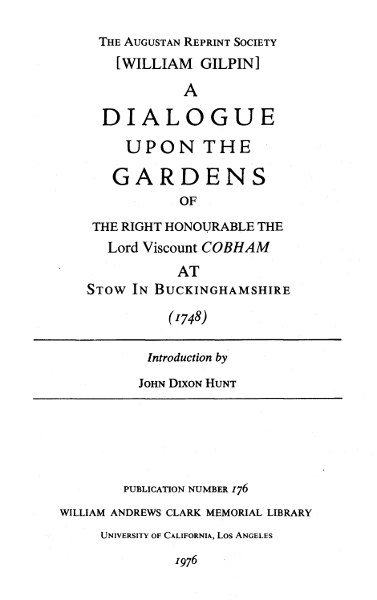
The facsimile of [William Gilpin's] A
Dialogue Upon The Gardens ... At Stow
(1748) is reproduced from a copy (Shelf Mark:
577.e.26[3]) in the British Library. The total
type-page (p. 7) measures 156 x 94 mm.
A
UPON THE
OF
THE RIGHT HONOURABLE THE
LORD VISCOUNT COBHAM,
AT
Stow in Buckinghamshire.
Here Order in Variety we see,
Where all Things differ, yet where all agree.
Mr. Pope.
LONDON:
Printed for B. Seeley, Bookseller in Buckingham, and
Sold by J. and J. Rivington, in St. Paul's Church-Yard.
M DCC XLVIII.
[Price One Shilling.]
THE
ADVERTISEMENT.
We read of a great Prince of Antiquity, who would suffer his Portrait
to be taken only by the greatest Artist. And he thought justly without
question: A great Object ought ever to be handled by a great Master. But
yet I am apt to think that if Apelles had not offered his Service, the
Monarch, rather than have had his Form unknown to Posterity, would have
been glad to have employed some meaner Hand.——If Stow had been as
fortunate in this Particular as Alexander, I need not now have taken up
my Pencil: But as this charming Landskip is yet untouched by a Titian,
or a Poussin, a mere Bungler has been tempted to venture upon it.
But in Excuse for the Meaning of the Performance it may be said, that
it is not designed to be considered as a finished Piece: This View was
not taken upon the Spot, as it ought to have been, but only from my
Memory and a few loose Scratches; if the Public therefore will call it
only a rough Draught, or at best a coloured Sketch, my Ambition will be
fully satisfied. The Curious therefore must purchase it rather from
their necessity than its Merit; as they do meaner Engravings of the
Cartoons, where Dorigny's are not to be had: "'Tis true, Gentlemen, says
the Print-seller, they are far from being good, but take my Word for
it, you will meet with no better."
A
DIALOGUE
UPON THE
Gardens of the Right Honourable
the Lord Viscount Cobham, &c.
Polypthon was a Gentleman engaged in a way of Life, that excused him
two Months in the Year from Business; which Time he used generally to
spend in visiting what was curious in the several Counties around him.
As he had long promised his Friend Callophilus to pass away his
Vacancy, at some time or other, in Buckinghamshire, he determined upon
it this Year; and accordingly paid him a Visit at * * *. Stow was one
of the first Places where his Curiosity carried him; and indeed he had
scarce got his Foot within the Garden-door, before he broke out into
the following Exclamation.
Why, here is a View that gives me a kind of Earnest of what my
Expectation is raised to!
It is a very fine one indeed (replied Callophilus:) I do not wonder it
should catch your Sight: The old Ruin upon the left of the Canal, the
Opening to the Pyramid, the View towards the House, the River, the
beautiful Disposition of the Trees on the other side of it, and that
venerable old Temple, make a fine Variety of Objects. But your Eye is so
taken up with Views at a distance, that you neglect something here at
hand very well worth your notice. What do you think of these two
Pavilions?
Polypth. Why really they are light, genteel Buildings enough. I like
these rough Paintings too; they are done in a very free, masterly
Manner. Pray, Sir, do you know the Stories?
Calloph. They are both taken from Pastor Fido; the disconsolate
Nymph there, poor Dorinda, had long been in love with Sylvio, a
wild Hunter, of barbarous Manners, in whose Breast she had no reason to
believe she had raised an answering Passion. As she was roving in the
Woods, she accidentally met his Dog, and saw her beloved Hunter himself
at a distance hollowing, and running after it. She immediately calls the
Hound to her, and hides it amongst the Bushes. Sylvio comes up to her,
and enquires very eagerly after his Dog: The poor Nymph puts him off,
and tries all her Art to inspire him with Love, but to no purpose; the
cold Youth was quite insensible, and his Thoughts could admit no other
Object but his Dog. Almost despairing, she at length hopes to bribe his
Affections, and lets him know she has his Dog, which she will return if
he will promise to love her, and give her a Kiss; Sylvio is overjoyed
at the Proposal, and promises to give her ten thousand Kisses. Dorinda
upon this brings the Dog: but alas! see there the Success of all her
Pains: the Youth transported at the Sight of his Dog, throws his Arms
round its Neck, and lavishes upon it those Kisses and Endearments, in
the very Sight of the poor afflicted Lady, which she had been flattering
herself would have fallen to her share.—On this other Wall Disdain and
Love have taken different Sides; the Youth is warm, and the Nymph is
coy: Poor Myrtillo had long loved Amarillis; the Lady was engaged to
another, and rejected his Passion. Gladly would he only have spoke his
Grief, but the cruel fair One absolutely forbid him her Presence. At
length a Scheme was laid by Corisca, the young Lover's Confidant, which
was to gain him Admission into his dear Amarillis's Company. The Lady
is enticed into the Fields with some of Corisca's Companions, (who
were let into the Plot) to play at Blindman's Buff, where Myrtillo was
to surprize her. See there he stands hesitating what use to make of so
favourable an Opportunity, which Love has put into his Hands.——If you
have satisfied your Curiosity here, let us walk towards the Temple of
Venus. But hold: we had better first go down towards that Wilderness,
and take a View of the Lake.
Polypth. Upon my Word here is a noble Piece of Water!
Calloph. Not many Years ago I remember it only a Marsh: it surprized
me prodigiously when I first saw it floated in this manner with a Lake.
Observe, pray, what a fine Effect that old Ruin has at the Head of it:
Its Ornaments too, the Cascade, the Trees and Shrubs, half concealing,
and half discovering the ragged View, and the Obelisk rising beyond if,
are Objects happily disposed.
Polypth. Yes, indeed, I think the Ruin a great Addition to the Beauty
of the Lake. There is something so vastly picturesque, and pleasing to
the Imagination in such Objects, that they are a great Addition to every
Landskip. And yet perhaps it would be hard to assign a reason, why we
are more taken with Prospects of this ruinous kind, than with Views of
Plenty and Prosperity in their greatest Perfection: Benevolence and
Good-nature, methinks, are more concerned in the latter kind.
Calloph. Yes: but cannot you make a distinction between natural and
moral Beauties? Our social Affections undoubtedly find their Enjoyment
the most compleat when they contemplate, a Country smiling in the midst
of Plenty, where Houses are well-built, Plantations regular, and every
thing the most commodious and useful. But such Regularity and Exactness
excites no manner of Pleasure in the Imagination, unless they are made
use of to contrast with something of an opposite kind. The Fancy is
struck by Nature alone; and if Art does any thing more than improve
her, we think she grows impertinent, and wish she had left off a little
sooner. Thus a regular Building perhaps gives us very little pleasure;
and yet a fine Rock, beautifully set off in Claro-obscuro, and garnished
with flourishing Bushes, Ivy, and dead Branches, may afford us a great
deal; and a ragged Ruin, with venerable old Oaks, and Pines nodding over
it, may perhaps please the Fancy yet more than either of the other two
Objects.—Yon old Hermitage, situated in the midst of this delightful
Wilderness, has an exceeding good Effect: it is of the romantick Kind;
and Beauties of this sort, where a probable Nature is not exceeded, are
generally pleasing.——This Opening will lead us again into the
Terrace.——That large Building, the Inscription lets you see, is a
Temple dedicated to Venus.
Polypth. Upon my Word a Master has been at work here! I cannot say I
have met with any modern Touching, this long time, that has pleased me
better. I see very little to be cavilled at, with regard either to the
Design, Colouring, or Drawing. These Stories are taken from the
Fairy-Queen I dare say; they look like Spencer's Ideas.
Calloph. Yes: that Lady is the fair Hellinore, who having left a
disagreeable Husband, and wandering in the Woods, was met by the polite
Sett of Gentry she is dancing with: She likes their Manner of Life, and
resolves to enjoy it with them. Her old Spouse Malbecco is
inconsolable for his Loss: he wanders many Days in search of her, and at
length finds her (you see him at a distance peeping from behind a Tree)
revelling with a beastly Herd of Satyrs. When the Evening comes on, he
follows the Company to their Retirement, takes a commodious stand, and
to his great Torment sees every thing that passes among them. After they
were all laid asleep, he creeps gently to his Lady, and you see him in
the other Painting offering to be reconciled to her again, if she will
return back with him. But Hellinore threatens to awake the Satyrs, and
get him severely handled if he does not immediately leave her. Upon
which the poor Cuckold is obliged to fly, and soon after runs
distracted.
Polypth. This loose Story, these luxurious Couches, and the
Embellishments round the Walls, give the Place quite a Cyprian Air,
and make it a very proper Retreat for its incontinent Inhabitant upon
the Roof.——But let us move forward towards yon cubico-pyramidical
Building. It looks like a mighty substantial one: I fancy it is Sir
John's; he is generally pretty liberal of his Stone. However, it
terminates this Terrace extremely well: the Ascent up to it too has a
good Effect.——Pray, do you know what that Field there, upon the right,
is to be improved into?
Calloph. I am surprized the Beauty of it, in its present Form, does
not strike you at first sight. It is designed, like a Glass of Bitters
before Dinner, to quicken your Appetite for the elegant Entertainment
that is to follow. For my part, I assure you, I find it a very great
Relief to my Eye, to take it from these grand Objects, and cast it for a
few Minutes upon such a rural Scene as this. Do not you think that
Haycock contrasts extremely well with this Temple? Such Oppositions, in
my Opinion, are highly pleasing.——That Building there is called, The
Belvidere. Whatever you may think of it, from this Stand, it has its
Use, I assure you, in several Prospects in the Gardens.——There is a
very good Copy of the Roman Boxers.
Polypth. I like its Situation extreamly: it terminates these Alleys,
and that Opening from the Terrace, very beautifully; much better, I
think, than the fighting Gladiator, and Sampson killing the
Philistine, do that other vast Terrace; the Objects there, in my
Opinion, are too small for the Distance: Here both are justly
proportioned.
Calloph. Your Criticism, I think, is rather too refined: I cannot see
what occasion there is always for a confined View; a more open one
sometimes makes Variety.
Polypth. You mistake me: I am not against a Prospect's being bounded
even by the blue Hills in the Country. All I mean is this, that where
Objects are set up to terminate a View, they ought to be of such a
Nature as to afford Pleasure at any Distance they are designed to be
viewed from. These Statues I have been mentioning, are Objects so small,
that at one end of the Terrace it is impossible to make out what is
offered you at the other.——I have too much Envy in my Temper, you must
know, to bear to see any thing perfect; and I came in here fully
determined to cavil, if I saw the least Grounds. But this is a sad
Place, I find, for a malicious Spirit to enter: He whose chief
Entertainment is finding fault, will here meet with a very slender
Repast: As the Devil did at Sight of the Creation, in spite of Envy
he must cry out,
Terrestrial Heaven!—--
With what Delight could I have walk'd thee round,
If I could joy in ought: Sweet Interchange
Of Hill, and Valley, Rivers, Woods, and Plains!
Now Land, now Sea, and Shores with Forest crown'd,
Rocks, Dens, and Caves.——
But what have we got here?
Calloph. This is the Building we took notice of from the Temple of
Venus. I know you are no Friend to a cloathed Statue; so I question
whether you will meet with any thing here to your Taste.
Polypth. There is something extremely grand and noble, I have always
thought, in several of the old cloathed Statues, and particularly in
some of the Roman consular ones; yet I must confess I am always better
pleased when I find them without their Finery. Marble, tho' admirably
fitted to express the Roundness of a Muscle, very often fails when it
attempts to give you the Folds of Drapery. The Ancients, it must be
owned, even in their Draperies are often successful; but amongst our
modern Attempts in this Way, how many horrid Pieces of Rock-work have I
beheld!
----—— ——atram
Desinet in rupem mulier——
Michael Angelo, whenever he found himself obliged to cloath his
Statues, used to do it with wet Linnen; which is unquestionably the most
advantageous kind of Cloathing for a Statue.
Calloph. Since you are not to be pleased here, let us pass on to
something else. There is no Occasion to turn down to that Pyramid; it is
an Object not designed to be viewed at a Yard's Distance; but you will
see its Use by and by, in a Variety of beautiful Views: Let us pursue
our Walk along this Terrace.
Polypth. Why here we entirely lose sight of the Garden; our elegant
Prospects are all vanished: I cannot conceive what this impertinent
Hedge does here.
Calloph. Did you never experience in a Concert vast Pleasure when the
whole Band for a few Moments made a full Pause? The Case is parallel:
You have already had a great many fine Views, and that you may not be
cloyed, this Hedge steps in to keep your Attention awake. One Extreme
recommends another: The Moralists observe, that a little Adversity
quickens our Relish for the Enjoyment of Life; and it is the Man of
Taste's Care not to distribute his Beauties with too profuse a Hand, for
a Reason of the same kind.
Let not each Beauty every where be spy'd,
Where half the Skill is decently to hide.
But if you must have something to look at, the Park there upon your left
Hand affords you some very fine Views. I like that Equestrian Statue
extremely: It is, in my Opinion, a very beautiful Circumstance. What a
Number of fine Vistas it terminates thro' the Trees, varying its
Appearance in each of them.—There you have a charming View struck out
towards the Temple of Ancient Virtue.
Polypth. Methinks that Statue of the Faun stands a little aukwardly:
He might at least, I should think, have fixed himself in the Middle of
the Semi-circle.
Calloph. You do not certainly attend to his Use: He stands there to
receive the Eye placed at the other End of that Opening.—That elegant
little Building I think they call Nelson's Seat.
Polypth. The Painting is done masterly enough: The Inscriptions, I
see, explain the Designs. Those Boys fixing the Trophies are prettily
imagined. From hence that round Building terminates the View extremely
well. Let us walk to it.
Calloph. Hold——turn to the Right a little: We must first pay a Visit
here to the Temple of Bacchus.
Polypth. We have had a pretty long Walk, suppose we sit down here a
Moment: These Walls seem to promise us some Entertainment.
Calloph. Here, Sir, you see represented the Triumphs and Happiness of
Drunkenness. Those musical Ladies too are not improper Companions to
this mirthfully-disposed Deity.
Polypth. Some of those smaller Figures are really done extremely well:
And those two Vases are delightfully touched. I cannot say I am so much
pleased with the jolly Inhabitant: Even Bacchus himself certainly
never made so enormous a Figure.
Calloph. I am admiring the fine View from hence: So great a Variety of
beautiful Objects, and all so happily disposed, make a most delightful
Picture. Don't you think this Building too is a very genteel one, and is
extremely well situated? These Trees give it an agreeable, cool Air, and
make it, I think, as elegant a Retreat for the Enjoyment of a Summer's
Evening, as can well be imagined.——But it is mere trifling to sit
here: Let us walk towards the Rotunda.——This little Alley will carry
us to Dido's Cave.
Polypth. Dido's Cave! why 'tis built of hewn Stone! Here she is
however, and her pious Companion along with her.
Calloph. Those two Cupids joining their Torches, I never see but I
admire extremely: they are very finely painted.
Polypth. I think they are indeed. But let us be a little complaisant,
and not interrupt these kind Lovers too long. I want to see this
Rotunda.
Calloph. There then you have it: I hope you cannot complain of an
heavy Building here. I do not know any Piece of Stone-work in the whole
Garden that shews itself to more Advantage than this does, or makes a
more beautiful Figure in a Variety of fine Views from several Parts of
the Garden: Several Parts of the Garden likewise return the Compliment,
by offering a great many very elegant Prospects to it. There you have an
Opening laid out with all the Decorations of Art; a spacious Theatre;
the Area floated by a Canal, and peopled with Swans and Wild-ducks: Her
late Majesty is the principal Figure in the Scene, and around her a
merry Company of Nymphs and Swains enjoying themselves in the Shade.
Polypth. I must confess I cannot very much admire——
Calloph. Come; none of your Cavils.—Observe how this View is
beautifully contrasted by one on the opposite Side of a different kind;
in which we are almost solely obliged to Nature. You must know I look
upon this as a very noble Prospect! The Field is formed by that
Semi-circle of Trees into a very grand Theatre. The Point of Sight is
centred in a beautiful manner by the Pyramid, which appears to great
Advantage amongst those venerable Oaks: Two or three other Buildings,
half hid amongst the Trees, come in for their Share in the Prospect, and
add much to the Beauty of it.
Polypth. I agree with you entirely; nor do I think this other View
inferior to it. That Variety of different Shades amongst the Trees; the
Lake spread so elegantly amongst them, and glittering here and there
thro' the Bushes, with the Temple of Venus as a Termination to the
View, make up a very beautiful Landskip.
Calloph. Here is a Vista likewise very happily terminated by the
Canal, and the Obelisk rising in the Midst of it. There is another close
View likewise towards Nelson's Seat.
Polypth. Upon my Word, we have a Variety of very elegant Prospects
centred in this Point. I could sit here very agreeably a little longer.
Calloph. Nay, if you are inclined to rest, come along with me: I'll
carry you to where you may indulge your Humour with great Propriety.
Deep in the Retirement of that Wood, the God of Sleep has reared his
Habitation, where he will afford you every Convenience to make a Nap
agreeable——It comes into my Head that I forgot to carry you to a
little Place, which it is hardly worth while to travel back to from this
Distance: It is called St. Austin's Cave, and answers its Title very
well; it appears quite Cell-like, stands retired, and is made of no
other Materials but Roots and Moss. In the Inside a Straw Couch offers
you an hard Seat, and the Walls three humorous Inscriptions, in Monkish
Verse. You may buy them, bound up with Copies of all the other
Inscriptions, in a Six-penny Pamphlet, that will be offered us at the
Inn.——There, Sir, is the Temple of Sleep.
Polypth. Why really I must confess Ovid himself could scarce have
buried the senseless God in an happier Retirement. This gloomy Darkness,
these easy Couches, and that excellent Epicurean Argument above the
Door, would incline me wonderfully to indulge a little, if these
beautiful Ornaments did not keep my Attention awake. There is wanting
too a purling Stream, to sing a Requiem to the Senses; tho' the Want is
in some measure made up by the drowsy Lullibies of that murmuring Swarm,
which this Shade has invited to wanton beneath it. You would laugh at
me, or I should certainly throw myself down upon one of these Couches;
I am persuaded I should need no Opium to close my Eyes.
Calloph. I own sleeping is a Compliment as much due to this Place, as
Admiration and Attention are to Raphael at Hampton-Court. But try if
your Curiosity cannot keep you awake. Come, leave these drowsy Abodes,
they are infectious; like luscious Food they will blunt your Appetite
before the Entertainment is half over. Walk down that Alley, and pop
your Head into the first Door you come to.
Polypth. What the D——l have we got here? What wretched Scrawler has
been at work upon these Walls?
Calloph. I assure you, Sir, I look upon this as a very great
Master-piece. You must know this House is inhabited by a Necromancer;
and that Inscription lets you see the Hand that has been employed to
paint it. The Composition, Drawing, and Pencilling, I can allow you, are
not the most elegant; yet if the Design and Figures are the Artist's
own, I can assure you he has shewn excellent Humour, and an exceeding
good Invention. That Consultation is well imagined; and so are these
Witches and Wizards; their Employments likewise, their Forms and
Attitudes are well varied.——But I see this is a Scene not suited to
your Taste: Our next, I hope, will please you better.
Polypth. Pray, what Building is that before us? I cannot say I dislike
the Taste it is designed in. It seems an Antique.
Calloph. It is the Temple, Sir, of Ancient Virtue; the Place I am now
conducting you to. You will meet within it a very illustrious Assembly
of great Men; the wisest Lawgiver, the best Philosopher, the most divine
Poet, and the most able Captain, that perhaps ever lived.
Polypth. You may possibly, Sir, engage yourself in a Dispute, by
fixing your Epithets in such an absolute manner; there are so many
Competitors in each of these Ways, that altho' Numbers may be called
truly eminent, it will be a difficult matter to fix Pre-eminence upon
any.
Calloph. You will hardly, I fancy, dissent from me, when I introduce
you to these great Heroes of Antiquity: There stands Lycurgus; there
Socrates; there Homer; and there Epaminondas. Illustrious Chiefs,
who made Virtue their only Pursuit, and the Welfare of Mankind their
only Study; in whose Breasts mean Self-interest had no Possession. To
establish a well-regulated Constitution; to dictate the soundest
Morality, to place Virtue in the most amiable Light; and bravely to
defend a People's Liberty, were Ends which neither the Difficulty in
overcoming the Prejudices, and taming the savage Manners of a barbarous
State; the Corruptions of a licentious Age, and the Ill-usage of an
invidious City; neither the vast Pains of searching into Nature, and
laying up a Stock of Knowledge sufficient to produce the noblest Work of
Art; nor popular Tumults at Home, and the most threatning Dangers
Abroad, could ever tempt them to lose Sight of, or in the least abate
that Ardency of Temper with which they pursued them.
Polypth. A noble Panegyric upon my Word! why, Sir, these great Spirits
have inspired you with the very Soul of Oratory. However, in earnest, I
confess your Encomium is pretty just; and I am apt to believe that if
any of those worthy Gentlemen should take it into his Head to walk from
his Nitch, it would puzzle the World to find his Equal to fix in his
Room.——That old Ruin, I suppose, is intended to contrast with this new
Building.
Calloph. Yes, Sir, it is intended to contrast with it not only in the
Landskip, but likewise in its Name and Design. Walk a little nearer, and
you will see its Intention.
Polypth. I can see nothing here to let me into its Design, except this
old Gentleman; neither can I find any thing extraordinary in him, except
that he has met with a Fate that he is entirely deserving of, which is
more than falls to the Share of every worthless Fellow.
Calloph. Have you observed how the Statue is decorated?
Polypth. O! I see the whole Design: A very elegant Piece of Satyr,
upon my Word! This pompous Edifice is intended, I suppose, to represent
the flourishing Condition, in which ancient Virtue still exists; and
those poor shattered Remains of what has never been very beautiful
(notwithstanding, I see, they are placed within a few Yards of a
Parish-church) are designed to let us see the ruinous State of decayed
modern Virtue. And the Moral is, that Glory founded upon true Worth and
Honour, will exist, when Fame, built upon Conquest and popular Applause,
will fade away. This is really the best thing I have seen: I am most
prodigiously taken with it.
Calloph. I intend next to carry you to a Scene of another kind. I am
going to shew you the Grotto, a Place generally very taking with
Strangers.——I thought that Piece of Satyr would catch your Attention:
I hope likewise you will be as well pleased here. This Gate will carry
us into the romantic Retirement. What do you think of this Scene?
Polypth. Why really, Sir, it is quite a Novelty: This Profusion of
Mirrors has a very extraordinary Effect: The Place seems divided into a
thousand beautiful Apartments, and appears fifty times as large as it
is. The Prospects without are likewise transferred to the Walls within:
And the Sides of the Room are elegantly adorned with Landskips, beyond
the Pencil of Titian; with this farther Advantage, that every View, as
you change your Situation, varies itself into another Form, and presents
you with something new.
Calloph. Don't you think that serpentine River, as it is called, is a
great Addition to the Beauty of the Place?
Polypth. Undoubtedly it is. Water is of as much Use in a Landskip, as
Blood is in a Body; without these two Essentials, it is impossible there
should be Life in either one or the other. Yet methinks it is a
prodigious Pity that this stagnate Pool should not by some Magic be
metamorphosed into a crystal Stream, rolling over a Bed of Pebbles. Such
a quick Circulation would give an infinite Spirit to the View. I could
wish his Lordship had such a Stream at his Command; he would shew it, I
dare say, to the best Advantage, in its Passage thro' the Gardens. But
we cannot make Nature, the utmost we can do is to mend her.——I
have heard a Scotch Gentleman speak of the River, upon which the Town
of Sterling stands, which is as remarkable a Meander as I have ever
heard of. From Sterling to a little Village upon the Banks of this
River, by Land it is only four Miles, and yet if you should follow the
Course of the Water, you will find it above twenty.——There is an House
likewise that stands upon a narrow Isthmus of a Peninsula, formed by
this same River, which is mighty remarkable: The Water runs close to
both Ends of it, and yet if you sail from one to the other, you will be
carried a Compass of four Miles.——Such a River winding about this
Place, would make it a Paradise indeed!
As we are got into the North, I must confess I do not know any Part of
the Kingdom that abounds more with elegant natural Views: Our
well-cultivated Plains, as you observed before, are certainly not
comparable to their rough Nature in point of Prospect. About three Years
ago I rode the Northern Circuit: The Weather was extremely fine; and I
scarce remember being more agreeably entertained than I was with the
several charming Views exhibited to me in the northern Counties.
Curiosity indeed, rather than Business, carried me down: And as I had my
Time pretty much to myself, I spent it in a great measure in hunting
after beautiful Objects. Sometimes I found myself hemmed within an
Amphitheatre of Mountains, which were variously ornamented, some with
scattered Trees, some with tufted Wood, some with grazing Cattle, and
some with smoaking Cottages. Here and there an elegant View likewise was
opened into the Country.——A Mile's riding, perhaps, would have carried
me to the Foot of a steep Precipice, down which thundered the whole
Weight of some vast River, which was dashed into Foam at the Bottom, by
the craggy Points of several rising Rocks: A deep Gloom overspread the
Prospect, occasioned by the close Wood that hung round it on every
Side.—I could describe to you a Variety of other Views I met with
there, if we here wanted Entertainment in the Way of Landskip. One,
however, I cannot forbear mentioning, and wishing at the same time that
his Lordship had such Materials to work with, and it could not be but he
would make a most noble Picture.——The Place I have in view is upon the
Banks of the River Eden (which is indeed one of the finest Rivers I
ever saw). I scarce know a fitter Place for a Genius in this Way to
exert itself in. There is the greatest Variety of garnished Rocks,
shattered Precipices, rising Hills, ornamented with the finest Woods,
thro' which are opened the most elegant Vales that I have ever met with:
Not to mention the most enchanting Views up and down the River, which
winds itself in such a manner as to shew its Banks to the best
Advantage, which, together with very charming Prospects into the
Country, terminated by the blue Hills at a Distance, make as fine a
Piece of Nature, as perhaps can any where be met with.
Calloph. I admire your Taste in Landskip extremely; you have marked
out just such Circumstances as would take me most in a View. I am I find
almost as enthusiastic a Lover of Nature as you are. Yet tho' I can
allow her to have an excellent Fancy, I do not think she has the best
Judgment. Tho' Nature is an admirable Colourist, her Composition
is very often liable to Censure. For which Reason I am for having her
placed under the Direction of Art: And the Rule I would go by should
be Mr. Pope's;
—Treat the Goddess like a modest Fair,
Not over-dress, nor leave her wholly bare.
Suppose, therefore, we leave your romantic Nature, and continue our View
of her here, where she is treated according to this Prescription of the
Poet.——That Building is called the Temple of Contemplation; those
Bas-relief Heads it is adorned with, are, I assure you, extremely good
ones.
Polypth. Pray, Sir, what kind of a Building have we yonder, that
struck our Sight as we crossed that Alley?
Calloph. We will walk up to it if you please: It is a Chinese House.
Polypth. A mighty whimsical Appearance it makes truly.
Calloph. In my Opinion it is a pretty Object enough, and varies our
View in a very becoming manner. Its cool stand upon the Lake, and those
canvas Windows, designed as well to keep out the Sun, as let in the Air,
give us a good Notion of the Manner of living in an hot Country. It is
finely painted in the Inside: Will you look into it?
Polypth. Finely painted indeed! Our Travellers tell us the Chinese
are a very ingenious People; and that Arts and Sciences flourish amongst
them in great Beauty. But for my Part, whenever I see any of their
Paintings, I am apt, I must confess, in every thing else to call their
Taste into question. It is impossible for one Art to be in Perfection,
without introducing the rest. They are all Links of the same Chain:
If you draw up one, you must expect the rest will follow. Cognoscitur
ex socio, is an old Rule you know in judging of Men; and I believe it
may be applied with as much Propriety in judging of Arts. It is hardly
to be imagined that any Art, perfect in its Kind, would claim any
Kindred, or even bear to keep Company with such a wretched Art of
Painting as prevails amongst the Chinese: Its whole Mystery consists
in dawbing on glaring Colours: Correctness of Drawing, Beauty of
Composition, and Harmony of colouring, they seem not to have even the
least Notion of.
Calloph. I like your Reflections extremely. We should certainly have
some more elegant Productions from China, if they were able to answer
the Character I have sometimes heard given of them. They have very
little of true, manly Taste, I fancy, among them: Their Ingenuity lies
chiefly in the knick-knack Way; and is, I imagine, pretty much of the
Dutch Kind.——Hold, Sir: This Way if you please. We will walk again
towards the River, and pursue it to the Canal.——It is divided, you
see, into three Parts; one takes its Rise from the Grotto; another from
the Pebble Bridge (as it is called) which is, I think, a pretty Object;
and the third issues from a dark Wood.——There, Sir, let me present you
to an illustrious set of your gallant Countrymen. This Place is called
the Temple of British Worthies; and is gloriously filled, you see,
with the greatest Wits, Patriots, and Heroes, that are to be met with in
our Chronicles.
Unspotted Names, and memorable long!
If there be Force in Virtue, or in Song.
Does not your Pulse beat high, while you thus stand before such an
awful Assembly? Is not your Breast warmed by a Variety of grand Ideas,
which this Sight must give Birth to?——There you have a View of the
calm Philosophers, who sought Virtue in her Retirement, and benefited
Mankind by Thought and Meditation.——Some took the human Mind for their
Theme, examined the various Powers it is endowed with, and gave us, to
know ourselves.——Others took Nature for their Subject, looked thro'
all her Works, and enlarged our Notions of a God——While others, warmed
with a generous Resentment against Vice and Folly, made Morality their
Care: To the cool Reasoner serious Philosophy, without any Ornament but
Truth, was recommended: To the gayer Disposition the moral Song was
directed, and the Heart was improved, while the Fancy was delighted: To
those who were yet harder to work upon, the Force of Example was made
use of: Folly is put to the Test of Ridicule, and laughed out of
Countenance, while the moral Scene, like a distorting Mirror, shews the
Villain his Features in so deformed a Manner, that he darts at his own
Image with Horror and Affright.——On the other Side you are presented
with a View of those illustrious Worthies, who spent their Lives in
Action; who left Retirement to the cool Philosopher, entered into the
Bustle of Mankind, and pursued Virtue in the dazling Light in which she
appears to Patriots and Heroes. Inspired by every generous Sentiment,
these gallant Spirits founded Constitutions, stemmed the Torrent of
Corruption, battled for the State, ventured their Lives in the Defence
of their Country, and gloriously bled in the Cause of Liberty.
Polypth. What an happy Man you are, thus to find an Opportunity of
moralizing upon every Occasion! What a noble View you have displayed
before me; when perhaps if I had been alone, I should have entertained
myself no otherwise than in examining the Busts; or if I read the
Inscriptions, they would only have drawn a Remark from me, that they
were well wrote.—The Assembly yonder on the opposite Side of the Water,
will be, I suppose, the next Subject for your Rapsody. Pray what Titles
are those Gentry distinguished by? At this Distance I can hardly find
out whether they are Philosophers or Milk-maids.
Calloph. Why, Sir, you have there a View of the Kingdom of
Parnassus: That Assembly is composed of Apollo, and his
Privy-council. But as I believe they will hardly pay us, by any Beauty
in their Workmanship, for our Trouble, should we go round and make them
a Visit; it is my Advice that we walk directly from hence to the Temple
of Friendship, and so return by that Terrace back again to those Parts
of the Garden that remain yet unseen.
Polypth. With all my Heart: But let us turn in here, I beseech you,
and walk as much in the Shade as possible, for the Day grows vastly
warm.
Calloph. I am ready to follow you amongst the Trees, not more out of
Complaisance than Inclination: I like a cool Retreat as well as you.
When I plan a Garden, I believe, I shall deal much in shady Walks;
wherever I open a grand Terrace, I intend to lengthen out by its Side a
close Vista: through the one I shall lead Strangers, in the other enjoy
my Friends. I am a great Admirer of walking in a Shade; it is a kind of
Emblem of the most agreeable Situation in Life, the retired one: Every
fantastic View is hid from us, and we may if we please, be Poets, or
Philosophers, or what we will. I own I admire the Taste of these buzzing
Insects, sporting themselves in the Shade; a glaring Sun-shine neither
in the World, nor in a Walk, is agreeable to my Way of thinking.
Polypth. If all the World thought as you do, we should have neither
Statesmen to mend our Laws, nor Coblers to mend our Shoes: We should
all run and hide ourselves amongst Trees, and what then would become of
Society?
Calloph. If I thought you did not willfully mistake my Meaning, I
would take the Trouble of telling you that I am an Advocate for no other
Retirement than such as is consistent with the Duties of Life. A Love
for which kind of Retirement, properly qualified, is Health to the
Mind; but when it is made up unskillfully, it throws us into a fatal
Lethargy, from whence begins the Date of an useless Life. Every
virtuous Mind, in a greater or a less Degree, has a turn this Way, and
the best, I believe, ought to be at the most Pains to guard against
carrying this Inclination into the Extreme.
Polypth. And yet the Annals of most Nations let us see that their
greatest Men have often indulged it; and much for the Benefit of Mankind
too; witness many of the illustrious Worthies we have just been
visiting: You forget the Panegyric you bestowed upon them.
Calloph. No, Sir: But do you remember that I placed these cool
Reasoners on the best Side of a Comparison with those who entred into
the World, and spent their Lives in Action? On the contrary, this latter
kind of Men have always stood fairest in my Esteem. The Life of a
Recluse I would recommend to none but a Valetudinarian. We were intended
to assist each other as much as we are able. For my Part, it has always
been my Opinion, that one good Man does more Service in the World,
than a thousand good Books.——But we'll drop our Argument at present,
because I see we have finished our Walk.
Polypth. Is that Building the Temple of Friendship? I cannot say that
I extremely admire it: But I hope I shall meet with more Entertainment
within, than I am able to do without——Well: This is elegant I must
confess.
Calloph. Ay, look round, and tell me if you are not struck by several
very beautiful Objects. Those Busts I assure you are all pretty well
done, and some of them extremely well.
Polypth. So they are indeed: But I am chiefly intent upon the
Painting, which I am much taken with: It is by the same Hand, I dare
say, with that in the Temple of Venus. That Emblem of Friendship
above the Door, those of Justice and Liberty, and those other Ornaments
upon the Walls, are well touched. What is that Painting upon the
Cieling? I do not rightly understand it.
Calloph. Why, Sir, it is a Piece of Satyr: I am sure you will like it
if you will give yourself the Trouble to examine it: It is in your Taste
I know exactly.——There you see sits Britannia; upon one Side are
held the Glory of her Annals, the Reigns of Queen Elizabeth and
Edward III. and on the other is offered the Reign of——, which she
frowns upon, and puts by with her Hand.
Polypth. Excellent, upon my Word! Faith, this is good! Never accept
it, honest Lady, till Corruption is at an End, and public Spirit
revives.
Calloph. With so little Malevolence as I know you are possessed of, I
do not think I ever met with any body in my Life so eager to catch at
any thing to blame; or to whom an Opportunity of that kind afforded a
more seeming real Pleasure than it does to you.——But I know it
proceeds from an honest Nature.——Well: Suppose we continue our
Walk.——I look upon that Statue as one of the finest in the World: I
would give all the Money in my Pocket for a Sight of the Original.
Polypth. The Posture always to me appears a little too much strained.
I can scarce throw myself into such an Attitude. Yet it is fine I must
confess.
Calloph. You have the best View of it, Sir, from hence. Most of the
Engravings I have met with give us the back View, but I think the Statue
appears infinitely to the best Advantage when taken in Front. The Air of
the Head is delightful, and cannot be hid without depriving the Figure
of half its Life.——I am leading you now to that genteel Piece of
Building which goes by the Name of the Palladian Bridge.
Polypth. I have seen, I think, something like it at my Lord
Pembroke's.
Calloph. I believe, Sir, the Model was taken from thence. Tho' if I
remember right, the Roof is there supported by Pillars on both Sides.
Polypth. I think it is.——But what have we got there? You are taking
me past something curious.
Calloph. I beg your Pardon: Indeed I had almost forgot the Imperial
Closet: And I wonder I should, for I assure you I have the greatest
Veneration for its Inhabitants.—There, Sir, is a noble Triumvirate.
Titus, Trajan, and Aurelius, are Names which want not the Pomp of
Title to add a Lustre to them.
Polypth. I wish you could persuade all the Kings in Europe to take
them as Patterns. But, God knows, public Spirit is now at a low Ebb
amongst us: There is more of it in that single honest Sentiment, Pro
me: si merear, in me, than I believe is to be found in this degenerate
Age in half a Kingdom.
Calloph. I see, my good Friend, you can moralize upon Occasion too.
Polypth. Moralize! The D——l take me, if I would not this Moment, in
spite of—
Calloph. Nay, come, don't grow serious: You know I have long since
laid it down as a Rule, to stop my Ears when you get into your political
Vein. I am not now to learn that there is no keeping you within the
Bounds of Temperance upon that Topic.
Polypth. Well then, let us have something else to talk about.——Yon
Wall at this Distance seems to promise us some Bass-relief.
Calloph. Yes, Sir; you are there presented with a View of the
different Quarters of the World, bringing their various Products to
Britannia. It is a pretty Ornament enough for a Bridge, which, like
the Art of Navigation, joins one Land to another.
Polypth. I can't say I much admire the Workmanship. There is a great
Degree of Aukwardness in several of the Figures.
Calloph. Why really I am so far of your way of thinking, that I must
own I am no great Admirer of this kind of Work, except it be extremely
fine.——The best thing in this Way, that ever I met with, is a Piece of
Alt-relief which his Lordship keeps within Doors. We shall scarce, I
believe have time now, but we must take an Opportunity of seeing it
before you leave the Country. You will meet with likewise in those
Apartments several very good Pictures: I remember spending an Afternoon
about half a Year ago, in a very agreeable Manner amongst them. But this
Piece of Alt-relief struck me beyond every thing. The Story is
Darius's Tent; and it is so charmingly told, that I have had, I can
tell you, a meaner Opinion of Le Brun upon that Subject, ever since I
have seen it: The Composition is so just, the Figures so graceful and
correct, nay, the very Drapery so free and easy, that I declare I was
altogether astonished at the Sight of it.
Polypth. Well; I shall find some Opportunity of paying it a Visit.
There is so much Art required, and so much Difficulty attends doing any
thing in this Way as it ought to be, that when we do meet with a good
Piece of Workmanship of this kind, it affords us an extreme
Pleasure.——So, Sir William, have I met you here! I should rather
have expected to have seen you among the British Worthies.——This
same Penn, Sir, I assure you, is a great Favourite of mine. I esteem
him one of the most worthy Legislators upon Record. His Laws, I am told,
act still with great Force in Pensylvania, and keep the honest,
inoffensive People there in extreme good Order.
Calloph. Our Sailors mention his Colony as a very happy Set of People;
they live entirely at Peace amongst themselves; and (bred up in a
strict Observance of Probity) without any Knowledge of an Art Military
amongst them, are able to preserve the most sociable Terms with their
Neighbours.——These Busts seem to have escaped your Observation.
Polypth. No, Sir, I am not so incurious as to suffer any thing that
has been in Italy to slip my Notice: Some of those particularly that
stand on the Side next Rawleigh, I was exceedingly taken with.
Calloph. Pray what is your Opinion of checquered Marble's being made
use of in Busts?
Polypth. Why, Sir, I never see any of these party-coloured Faces, but
I am moved with Indignation at the Sculptor's ridiculous Humour. It is
so absurd a Taste, that I cannot conceive how it should ever enter into
a Workman's Head, to make every Feature of a Man's Face of a different
Colour; and it amazes me, I assure you, that we meet with daily so many
Instances of such Absurdity.——In several Parts of the Garden, I have
had various Views of that old Gothic Building; we are now at last I
hope moving towards it. I am so wonderfully pleased with its outward
Appearance, that I shall be disappointed if I don't meet something
answerable within.
Calloph. Why, Sir, as old as it looks, I assure you it is not yet
finished. You will meet with nothing ornamental in the Inside; so I
would have you persuade yourself it has already done all in its Power to
entertain you. And upon my Word I think it has done a great deal:
Without it, I am sure this Part of the Garden would be quite naked and
lifeless; nor would any other Part appear with so much Beauty. It puts
one in Mind of some generous Patriot in his Retirement; his own
Neighbourhood feels most the Effects of that Bounty, which in some
measure spreads itself over a whole Country.
Polypth. I like this Disposition within, I assure you, altogether as
well as its Form without.——There are two or three Pieces of the best
painted Glass that I have any where met with: Those little historical
Pieces are exceedingly beautiful; and so are those Landskips
likewise.——This Hill I think appears rather too naked.
Calloph. Throw your Eye over it then, and tell me if you are not
ravished with the View before you. Nothing certainly in the kind can be
more beautiful or great, than that pompous Pile rising in so
magnificent a manner above the Wood. The Building cannot possibly be
shewn to greater Advantage: The Appearance it makes presents you with
an Idea sufficiently grand; yet your Imagination cannot be persuaded but
that it is in fact much grander, and that the Wood hides a great Part of
what is to be seen from your Eye. This is a most delightful manner of
pleasing: A grand Object left to a good Imagination to improve upon,
seldom loses by its Assistance. Our View likewise is greatly added to in
point of Beauty, by those several other smaller Buildings which offer
themselves, some only half hid amongst the Branches, and others just
peeping from amongst tufted Trees, which make very beautiful little
garnished Dishes in this most elegant Entertainment.
Polypth. As you have thus painted the near Objects, let my Pencil, I
beg, come in for a few rough Touches in the backgrounds: Without
something of an Offskip, your Man of Art, you know, seldom esteems his
View perfect. And in this Landskip there are as many beautiful Objects
thrown off to a Distance as can well be imagined: That Variety of fine
Wood; that bright Surface of Water, with the pointed Obelisk in the
Midst of it; those two Pavilions upon the Banks of the Canal; and the
still more distant View into the Country, are Objects which, in my
Opinion, make no small Addition to the Beauty of your Landskip; or, to
carry on your Allusion, may very well come in as a second Course in your
Entertainment.——Our Attention, I think, in the next Place, is demanded
by this venerable Assembly. That old Gentleman there sits with great
Dignity: I like his Attitude extremely: If I understood the Runic
Character, I might have known probably (for this Inscription I fancy
would inform me) by what Title he is distinguished. But the Gracefulness
of his Posture discovers him to have been nothing less than an Hero of
the first Rank. He puts me in Mind of a Roman Senator, sitting in his
Curule Chair to receive the Gauls.
Calloph. Why, Sir, you have done him great Honour I must own; but you
have not yet honoured him according to his Dignity: He is nothing less,
Sir, I assure you, than the Representative of a Saxon Deity. You see
here
Thor and Woden fabled Gods——
with the whole System of your Ancestor's Theology. Walk round the
Assembly, they will smile upon a true Briton, and try if you can
acknowledge each by his distinct Symbol.
Polypth. I must confess they do not to me seem accoutered like Gods:
For my Part, I should rather suspect them to be Statues of Heroes and
Lawgivers, metamorphised into Divinities by the Courtesy of the Place: I
shall not however go about to dispute their Titles; but like my good
Ancestors before me, acquiesce piously in what other People tell
me.——Tho' I cannot say but that Lady there, bearing the Sun (who
represents I suppose Sunday) looks whimsical enough; and makes just
such an Appearance as I could imagine the misled Conception of an
enthusiastic Saxon might mould his Deities into. But in these other
Figures I must own I cannot see Superstition at all characterized, which
you may observe generally forms its Objects of Worship into the most
mis-created things that can possibly enter the Imagination of Man.
Calloph. Why, Sir, amongst the Greeks and Romans, you may observe
several very well-shaped Deities: The Hercules, the Apollo, and the
Venus, are at this Day Standards of Beauty.
Polypth. Yes; but I am apt to attribute this rather to the Imagination
of their Sculptors, than their Priests. To shew Art, rather than to
express Religion, was the Point aimed at in these enchanting Pieces of
Workmanship.——But when Superstition acted without Controul; when the
fantastic Notions of Priests were put into the Hands of ordinary
Workmen, even amongst the polite Greeks and Romans themselves, Lord!
what misshapen Monsters crouded into Temples, and reared themselves
aloft above Altars! Search other Countries likewise, Egypt and
Africa, China and Japan, or any Place either ancient or modern,
where Superstition prevails, and I dare engage in the whole Catalogue of
their Deities you will scarce meet with one that bears any thing like
the human Shape.
Calloph. Why their Demi-Gods, or canonized Heroes, of which all pagan
Nations had Abundance, were generally I fancy represented in the human
Form. And these Saxon Divinities, I suppose, pretend not to any
superior Rank——But however, as no Degree of Veneration is exacted
from you, you may I think let them rest quietly upon their Pedestals,
without any farther Molestation.——We have a good View into the
Country from hence. Those Woods are extremely elegant in their kind; we
must certainly contrive to take a Ride thither some Evening. They are
laid out in a very fine Manner, and cut into very beautiful Ridings.
Polypth. Ay, that is the kind of Improvement that takes most with me
(let us step in here a Moment, we are caught I see in a Shower). I am
altogether of the Poet's Opinion, that
'Tis Use alone that sanctifies Expence.
Were I a Nobleman, I should endeavour to turn my Estate into a Garden,
and make my Tenants my Gardiners: Instead of useless Temples, I would
build Farm-houses; and instead of cutting out unmeaning Vistas, I would
beautify and mend Highways: The Country should smile upon my Labours,
and the Public should partake in my Pleasures. What signifies all this
ostentatious Work? Is any Man the better for it? Is it not Money most
vilely squandered away?
Calloph. So far from it, that I assure you, considered even in a
public Light, I look upon it as an Expence that may very properly be
said to be sanctified by Use.
Polypth. I suppose you are going to tell me that it feeds two or
three poor Labourers; and when you have said this, I know not what more
you can say to defend it. But how is it possible for a Man to throw away
his Money without doing some Service in the World?
Calloph. How? Why by spending it in gaming, to the Encouragement of
Cheats and Sharpers: By squandering it away upon Lusts and Appetites, in
the Support of Stews and Bawdy-houses: Or by Dealing it out in Bribes,
in opposition to Honesty, and to advance Corruption. In Arts like these,
what Numbers consume their Wealth! It is not enough for them to prevent
Mankind's being benefited by their affluent Circumstances; but they do
their utmost, while they diminish their Fortunes, to make all they can
influence as worthless as themselves. So that I assure you I should look
upon it as a very great Point gained, if all our Men of Fortune would
only take care that their Wealth proves of no Disservice to Mankind.
Tho' I am far from desiring they should stop there: I would have them
endeavour to turn it into some useful Channel. And in my Opinion, it is
laid out in a very laudable Manner, when it is spent, as it is here, in
circulating thro' a Variety of Trades, in supporting a Number of poor
Families, and in the Encouragement of Art and Industry.
Polypth. Well, Sir, I confess Wealth thus laid out, is beneficial to a
Country; but still you keep from the Point: I ask whether all these good
Ends would not be answered, and more too, were this Wealth laid out
according to my Scheme, in public Works, or something of an useful
Nature.
Calloph. And so you have no Notion of any Use arising from these
elegant Productions of Art: You cannot conceive how they should be of
any Service to the Public. Why you are a mere Goth, an unpolished
Vandal; were you impowered to reform the Age, I suppose I should see
you, like one of those wild misguided People, coursing furiously round
the Land, and laying desolate every thing beautiful you met with. But in
my Opinion, Sir, these noble Productions of Art, considered merely as
such, may be looked upon as Works of a very public Nature. Do you think
no End is answered when a Nation's Taste is regulated with regard to
the most innocent, the most refined, and elegant of its Pleasures? In
all polite Countries the Amusements of the People were thought highly
deserving a Legislator's Inspection. To establish a just Taste in these,
was esteemed in some measure as advancing the Interest of Virtue: And
can it be considered as a Work entirely of a private Nature, for a
superior Genius to exert itself in an Endeavour to fix a true Standard
of Beauty in any of these allowed and useful kinds of Pleasure? In the
Way of Gardening particularly, the Taste of the Nation has long been so
depraved, that I should think we might be obliged to any one that would
undertake to reform it. While a Taste for Painting, Music, Architecture,
and other polite Arts, in some measure prevailed amongst us, our Gardens
for the most Part were laid out in so formal, aukward, and wretched a
Manner, that they were really a Scandal to the very Genius of the
Nation; a Man of Taste was shocked whenever he set his Foot into them.
But Stow, it is to be hoped, may work some Reformation: I would have
our Country Squires flock hither two or three times in a Year, by way of
Improvement, and after they have looked about them a little, return Home
with new Notions, and begin to see the Absurdity of their clipped Yews,
their Box-wood Borders, their flourished Parterres, and their lofty
Brick-walls.——You may smile, but I assure you such an Improvement of
public Taste, tho' there is no Occasion to consider it as a matter of
the first Importance, is certainly a Concern that ought by no means to
be neglected. Perhaps indeed I may carry the Matter farther than the
generality of People; but to me I must own there appears a very visible
Connection between an improved Taste for Pleasure, and a Taste for
Virtue: When I sit ravished at an Oratorio, or stand astonished before
the Cartoons, or enjoy myself in these happy Walks, I can feel my Mind
expand itself, my Notions enlarge, and my Heart better disposed either
for a religious Thought, or a benevolent Action: In a Word, I cannot
help imagining a Taste for these exalted Pleasures contributes towards
making me a better Man.
Polypth. Good God! what an Enthusiast you are! Polite Arts improve
Virtue! an Assertion indeed for a Philosopher to make. Why are they not
always considered as having a natural Tendency to Luxury, to Riot, and
Licentiousness?
Calloph. No more, in my Opinion, than a wholesome Meal has to a
Surfeit, or reading the Scriptures to Heresy: All things are capable, we
know, of Abuse; and perhaps the best things the most capable: And tho'
this may indeed argue a Depravity in us, yet it by no means, I think,
argues a Tendency in them to deprave us. However, (to let what I have
yet said stand for nothing) I can tell you one very great Piece of
Service arising to the Country from Wealth laid out in this elegant
manner, which you seem so much to grumble at; and that is, the Money
spent in the Neighbourhood by the Company daily crouding hither to
satisfy their Curiosity. We have a kind of a continual Fair; and I have
heard several of the Inhabitants of the neighbouring Town assert, that
it is one of the best Trades they have: Their Inns, their Shops, their
Farms, and Shambles, all find their Account in it: So that, in my
Opinion, viewed in this Light only, such Productions of Art may be
considered as very great Advantages to every Neighbourhood that enjoys
the lucky Situation of being placed near them.——To this Advantage
might be added, the great Degree of Pleasure from hence derived daily to
such Numbers of People: A Place like this is a kind of keeping open
House, there is a Repast at all times ready for the Entertainment of
Strangers. And sure if you have any Degree of Benevolence, you must
think an useful End answered in thus affording an innocent
Gratification to so many of your Fellow-creatures. A Sunday Evening
spent here, adds a new Relish to the Day of Rest, and makes the Sabbath
appear more chearful to the Labourer after a toilsome Week. For my
Part, I assure you I have scarce experienced a greater Pleasure than I
have often felt upon meeting a Variety of pleased Faces in these Walks:
All Care and Uneasiness seems to be left behind at the Garden-door, and
People enter here fully resolved to enjoy themselves, and the several
beautiful Objects around them: In one Part a Face presents itself marked
with the Passion of gaping Wonder; in another you meet a Countenance
bearing the Appearance of a more rational Pleasure; and in a third, a
Sett of Features composed into serene Joy; while the Man of Taste is
seen examining every Beauty with a curious Eye, and discovering his
Approbation in an half-formed Smile.—To this I might still add another
Advantage, of a public Nature, derived from these elegant Productions of
Art; and that is their Tendency to raise us in the Opinion of
Foreigners. If our Nation had nothing of this kind to boast of, all our
Neighbours would look upon us a stupid, tasteless Set of People, and not
worth visiting. So that for the Credit of the Country, I think,
something of this kind ought to be exhibited amongst us. Our public
Virtues, if we have any, would not, I dare say, appear to less Advantage
when recommended by these Embellishments of Art.
Polypth. I wonder you should not know me better than to imagine I am
always in earnest when I find fault. My Thoughts and yours, I assure
you, agree exactly upon this Subject. I only wanted to engage you in
some Discourse till the Shower was over; and as the Sky seems now quite
clear, if you will, we'll venture out, and visit what we have yet to
see.
Calloph. You are a humorous Fellow: This is not the first time you
have made me play my Lungs to no purpose.——As we walk along this
Terrace, you may observe the great Advantage of low Walls: By this means
the Garden is extended beyond its Limits, and takes in every thing
entertaining that is to be met with in the range of half a County.
Villages, Works of Husbandry, Groups of Cattle, Herds of Deer, and a
Variety of other beautiful Objects, are brought into the Garden, and
make a Part of the Plan. Even to the nicest Taste these rural Scenes
are highly delightful.
Polypth. Nay you may add, that whoever has no Relish for them, gives
Reason for a Suspicion that he has no Taste at all.
Straight mine Eye hath caught new Pleasures,
Whilst the Landskip round it measures;
Russet Lawns, and Fallows gray.
Where the nibbling flocks do stray;
Mountains, on whose barren Breast
The labouring Clouds do often rest;
Meadows trim with Daisies pide,
Shallow Brooks, and Rivers wide:
Towers and Battlements it sees
Bosom'd high in tufted Trees,
Where perhaps some Beauty lies,
The Cynosure of neighbouring Eyes.
Hard by a Cottage Chimney smokes,
From betwixt two aged Oaks.
Calloph. Can you repeat no more? I could have listened with great
Pleasure if you had gone on with the whole Piece. It is quite Nature:
That View of an old Castle, bosom'd high in tufted Trees, pleases me
exceedingly: And the two following Lines,
Where perhaps some Beauty lies,
The Cynosure of neighbouring Eyes,
give it an elegant, romantic Air; and add greatly to the Idea before
conceived.——But to pursue our former Argument: It must be owned indeed
that these Walks want such Openings into the Country as little as any
Place can well be imagined to do; yet even Stow itself, I assure you,
is much improved by them. They contrast beautifully with this more
polished Nature, and set it off to greater Advantage. After surfeiting
itself with the Feast here provided for it, the Eye, by using a little
Exercise in travelling about the Country, grows hungry again, and
returns to the Entertainment with fresh Appetite. Besides, there is
nothing so distasteful to the Eye as a confined Prospect (where the
Reasonableness of it does not appear) especially if a dead Wall, or any
other such disagreeable Object steps in between. The Eye naturally loves
Liberty, and when it is in quest of Prospects, will not rest content
with the most beautiful Dispositions of Art, confined within a narrow
Compass, but (as soon as the Novelty of the Sight is over) will begin to
grow dissatisfied, till the whole Limits of the Horizon be given it to
range through.
Polypth. The Eye, according to your Account, seems to be something
like a Bee: Plant as many Flowers as you will near its Hive, yet still
the little Insect will be discontented, unless it be allowed to wander
o'er the Country, and be its own Caterer.——I have got a few very
severe Exclamations at my Tongue's End, which I will not vent till you
have told me the Architect's Name, who has loaded the Ground with that
monstrous Piece of Building, tho' I believe I can guess him without
your Information.
Calloph. Suffer me to intercede in his Behalf. You are so unmerciful a
Reprover, that I have not Patience to hear you. The Room above is
designed, I am told, to be fitted up in a very elegant manner; but as
very little is yet done to it, we shall find nothing I fancy to answer
the Trouble of going up Stairs.——This Part of the Garden, you see, is
yet unfinished. If we have the Pleasure of your Company in this Country
next Year, you will see I dare say great Alterations here. That Base
is to shoot up into a lofty Monument: And several of those Objects you
see before you are to take new Forms upon them.
Polypth. Yonder likewise seems to be a Monument[19] rising: Pray who is
it intended to do Honour to?
Since this View of the Gardens was taken, the Monument here
spoken of has been finished. The following Lines are a Translation of
its Inscription, which in the Original is wrote in Latin.
As a Monument
To testify both his Applause and Grief,
Richard Lord Viscount Cobham
Erected this Naval Pillar to the Memory of his Nephew
Captain Grenville,
Who commanding a Ship of War in the British Fleet
Under Admiral Anson,
In an Engagement with the French, was
Mortally wounded upon the Thigh
By a Fragment of his shattered Ship;
Yet with his last Breath had the Bravery to cry out,
How much more desireable is it thus to meet Death,
"Than, convicted of Cowardice, to meet Justice!"
May this noble Instance of Virtue
Prove instructive to an abandoned Age,
And teach Britons how to act
In their Country's Cause!
Calloph. Why, Sir, it is intended to do Honour to a Gentleman, who has
done Honour to his Country: It is dedicated to the Memory of Captain
Grenville, and joins with the Nation in applauding a Man, who pushed
forwards by Honour, and a Love for his Country, met Danger and Death
with the Spirit of a Roman.——Well, how do you like the Plan which
you see laid out before you?
Polypth. As far as I can judge of the future Landskip from this
Sketch, it will be an admirable one. I am extremely taken with it. That
Bason has a very fine Effect.—I could return back the same Round with
great Pleasure, but my Watch informs me that Mr.——, has been
expecting us this half Hour.
Calloph. Is it so late? The Time has stole off very slily. However you
need be under no Apprehensions; that honest Gentleman is seldom very
hasty in his Motions.
Having thus finished their Round, our two Gentlemen directed their Faces
back again towards the Gate.
Polypthon, notwithstanding the sour Humour he had given so many
Evidences of in his Walk, began now to relent, and could talk of nothing
but the agreeable Entertainment that had been afforded him. Sometimes he
would run out into the highest Encomiums of the many beautiful
Terminations of the several Walks and Vistas; and observe how many Uses
each Object served, and in how many different Lights it was made to vary
itself. "For Instance, says he, the Pavilion you shewed me from the
Temple of Venus, terminates that Terrace in a very grand Manner; and
makes likewise a very magnificent Appearance, where it corresponds with
another of the same Form, at the Entrance into the Park: Yet the same
Building, like a Person acquainted with the World, who can suit his
Behaviour to Time and Place, can vary itself upon occasion into a more
humble Shape, and when viewed thro' a retired Vista, can take upon it
the lowly Form of a close Retreat."——When he had enlarged pretty
copiously upon this Subject, he would next launch out into the highest
Praises of the vast Variety of Objects that was every where to be met
with: "Men of all Humours, says he, will here find something pleasing
and suited to their Taste. The thoughtful may meet with retired Walks
calculated in the best Manner for Contemplation: The gay and chearful
may see Nature in her loveliest Dress, and meet Objects corresponding
with their most lively Flights. The romantic Genius may entertain itself
with several very beautiful Objects in its own Taste, and grow wild with
Ideas of the inchanted kind. The disconsolate Lover may hide himself in
shady Groves, or melancholy wander along the Banks of Lakes and Canals;
where he may sigh to the gentle Zephyrs; mingle his Tears with the
bubbling Water; or where he may have the best Opportunity, if his Malady
be grown to such an Height, of ending his Despair, and finishing his
Life with all the Decency and Pomp of a Lover in a Romance. In short,
says he, these Gardens are a very good Epitome of the World: They are
calculated for Minds of every Stamp, and give free Scope to Inclinations
of every kind: And if it be said that in some Parts they too much
humour the debauched Taste of the Sensualist, it cannot be denied on
the other hand, but that they afford several very noble Incitements to
Honour and Virtue."——But what beyond all other things seemed most to
please him, was the amicable and beautiful Conjunction of Art and
Nature thro' the whole: He observed that the former never appeared
stiff, or the latter extravagant.
Upon many other Topicks of Praise Polypthon run out with great Warmth.
Callophilus seemed surprized, and could not forbear asking him, By
what means his Opinions became so suddenly changed? "Why, says he, Sir,
I have said nothing now that contradicts any thing I said before. I own
I met with two or three Objects that were not entirely to my Taste,
which I am far from condemning for that Reason; tho' if I should, it is
nothing to the purpose, because I am now taking a Survey of the whole
together; in which Light I must confess I am quite astonished with the
View before me. Besides, I hate one of your wondering Mortals, who is
perpetually breaking out into a Note of Admiration at every thing he
sees: I am always apt to suspect his Taste or his Sincerity. It is
impossible that all Genius's can alike agree in their Opinions of any
Work of Art; and the Man who never blames, I can scarce believe is
qualified to commend. Besides, finding fault now and then, adds Weight
to Commendation, and makes us believed to be in earnest. However,
notwithstanding what you may think of my frequent Cavils, I assure you,
with the greatest Sincerity, I never before saw any thing of the kind at
all comparable to what I have here seen: I shall by no means close this
Day with a Diem perdidi; nor would the Roman Emperor himself, I
believe, have made the Reflection if he had spent his condemned Hours in
this Place."
By this time the Gentlemen were come to the Gate, thro' which
Polypthon assured his Friend he passed with the greatest Reluctance,
and went growling out of this delightful Garden, as the Devil is said to
have done out of Paradise.
WILLIAM ANDREWS CLARK
MEMORIAL LIBRARY
UNIVERSITY OF CALIFORNIA, LOS ANGELES
The Augustan Reprint Society
PUBLICATIONS IN PRINT