A DEBT OF HONOR.
Our story opens in a cabin among the foothills
of Colorado. It was built of logs, and was not
over twelve feet in height. In the center was a
door, with a small window on each side. Through
the roof rose a section of funnel, from which
issued a slender cloud of smoke.
Let us enter.
The interior of the cabin is a surprise—being
comfortably furnished, while a carpet covers the
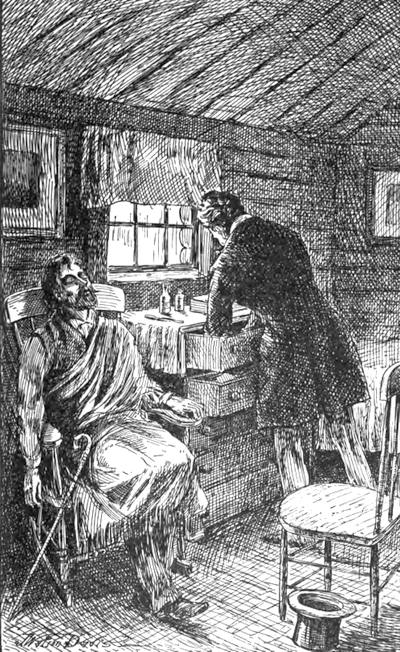
floor. On one side is a bureau, a few portraits
are on the walls, a pine bedstead and an easy-chair,
in which is reclining a man of middle age
whose wasted form and hollow cheeks attest the
ravages of consumption. From time to time he
looked wistfully toward the door, saying in a low
voice: “Where is Gerald? He is gone a long
time.”
Five minutes later the sound of hoofs was heard
outside, and a boy of sixteen galloped up from
the canyon on the left, and, jumping off at the
portal, tethered his pony and pushed open the
door of the cabin. He was a marked contrast to
the sick man, for he was strongly made, with the
hue of health in his ruddy cheeks, and a self-reliant,
manly look upon his attractive face.
“How do you feel, father?” he asked gently.
The sick man shook his head.
“I shall never be any better, Gerald,” he answered
slowly.
“Don’t look on the dark side,” said Gerald.
“See, I have brought you some medicine.”
He took from the side pocket of his sack coat
a bottle, which he placed on the table.
“There, father, that will do you good,” he said
in a cheerful tone.
“It may relieve me a little, Gerald, but I am
past permanent help.”
“Don’t say that, father!” said the boy, much
moved. “You will live a long time.”
“No; I shall deceive myself with no such expectation.
Don’t think I fear death. It has only
one bitterness for me.”
The boy looked at his father inquiringly, anxiety
wrinkling his brow.
“It is,” resumed the sick man, “that I shall
leave you unprovided for. You will have to fight
the battle of life alone.”
“I am young and strong.”
“Yes, but I would like to have left you in better
condition. It is possible I may do so. I
wrote some time since to a man who is rich and
prosperous, and is under great obligations to me,
telling him about you and asking him, as I had
a right to ask him, to befriend you.”
Gerald looked surprised.
“Why has he never helped you?” he asked.
“Because—well, I have not perhaps urged the
matter sufficiently,” he said.
“You say you did this man a service,” said
Gerald.
“Yes. I think the time has come when I should
tell you what that service is. Let me say in the
outset that I saved his reputation at the expense
of my own. It was, I am afraid, a mistake, for it
ruined my life. But I was strongly tempted!”
He paused. Gerald listened with painful interest.
“You never told me much of your early life,
father,” he said.
“You have wondered, no doubt, why I left
civilization and buried myself-and you-in this
out-of-the-way place?”
“Yes, father, I have wondered, but I did not
like to ask you.”
“It is the fault of one man.”
“The man whom you expect to befriend me,
father?”
“Yes.”
“I don’t think I should like to be indebted to
such a man,” said Gerald, and a stern expression
settled on his young face. “I should not wish to
accept any favors at his hands.”
“Nor would you. It would not be a favor,
but the payment of a sacred debt. It would be
reparation for a great wrong.”
“But, father, the reparation ought to have
been made to you, not to me.”
“You are right, Gerald, but it is too late now.”
“Why did you not take steps before to have
this wrong righted?”
“Because the world has misjudged me, and
might misjudge me yet. This man should have
needed no prompting. He should have saved me
all trouble, and when he saw my life ruined, and
my health shattered, he ought to have done what
he could to pay me for the great service I did for
him. I am afraid I was weak to yield to the
temptation to help him in the first place.”
“Don’t say that, father,” put in Gerald.
“Yes, I will not try to disguise the truth from
you,” went on the old man. “I was too pliant
in this man’s hands. To be sure I committed no
crime, but then I allowed a false impression about
myself to get abroad, and I sometimes think that—that
all that has happened since has been my
punishment.”
“No, no, that cannot be true, father,” broke
in the son. “I am sure all the fault was on the
other side. But have you never seen the man
since?”
“No, Gerald.”
There was silence in the little cabin for a
brief while then. The boy was desirous to hear
more, but the father seemed absorbed in meditation.
“Father,” finally said Gerald.
“Yes, my son,” rejoined the sick man, turning
his gaze back to the boy by his side.
“Do you think the person of whom you speak
is likely to befriend me?”
“I do not know. He has behaved so ungenerously
about the whole matter. That is what
makes me anxious.”
“Will you tell me the name of this man,
father?”
“His name is Bradley Wentworth, and he
lives in the town of Seneca, Illinois, where he
has large investments, and is a prominent man.”
“Do you mind telling me how he injured you,
father?”
“That is my wish and my duty while I yet
live. Fifteen years ago, when we were both
young men, we were in the employ of Dudley
Wentworth, the uncle of Bradley. We were
both in the office, he occupying the more lucrative
position. I was married and had a modest, but
comfortable, home in Seneca, in the State of Illinois.
He too had been three years married, and
had a son two years old.”
“Were you friends?”
“Not intimate friends, but we were on friendly
terms. He had extravagant habits and spent
more money than I—a family man—could afford
to do. I had bought a house and lot, for which
I agreed to pay the sum of two thousand dollars.
I was paying this by slow degrees, but my salary
was small, when the great temptation of my life
came.”
The sick man paused in exhaustion, but soon
proceeded.
“One evening Bradley Wentworth came to my
house in a strange state of excitement, and called
me to the door, I asked him in, but he declined.
‘I want you to take a walk with me, Lane,’ he
said. I demurred, for it was a cold, damp
evening, and suggested that it would be better to
sit down by the fire, inside.
“‘No, no,’ he said impatiently, ‘what I have
to say is most important, and it must be kept a
profound secret.’
“Upon this I agreed to his proposal. I took
my hat, told your mother that I would soon return,
and went out with Wentworth. We had
proceeded but a few rods when he said, ‘Lane,
I’m in a terrible scrape.’
“‘What is it?’ I asked.
“‘Last week I forged a check on my uncle for
five hundred dollars. It was paid at the bank.
To-morrow the bank will send in their monthly
statement, and among the checks will be the one
I forged—’
“‘Good heavens! what induced you to do it?’
I asked.
“‘I was in a tight place, and I yielded to sudden
temptation,’ he answered bitterly.
“‘I advise you to go to your uncle early to-morrow
and make a clean breast of it.’
“‘It would not do,’ he replied, ‘the old man
has the strictest ideas of honor, and he would
never forgive me.’
“‘It’s a bad position to be in,’ I said gravely.
“‘The worst possible. You know that I am
generally recognized as my uncle’s heir, and he is
worth three hundred thousand dollars. You see
that if my uncle finds out what has happened I
am a ruined man, for he will dismiss me from
his employment with a tarnished name.’
“‘Indeed I feel for you, Bradley,’ I said.
“‘You must do more,’ he replied; ‘you must
save me.’
“‘But how can I do that?’
“‘By taking my crime upon yourself. You
must acknowledge that you forged the check.’
“‘What do you mean?’ I demanded sharply.
‘You want me to ruin my own prospects?’
“‘It isn’t the same thing to you. You won’t
lose your inheritance, but only your place.’
“‘Only my place! How then can I live?
Why should I dishonor my own name and lose
my reputation for you?’
“‘Because I will make it worth your while.
Listen.’
“Then he proceeded to make me an offer. If
I would consent to take his guilt upon myself,
he agreed to pay over to my wife five hundred
dollars annually out of his salary of fifteen hundred
dollars, and when he inherited his uncle’s estate,
he furthermore agreed to pay over to me twenty
thousand dollars. It was this finally won me
over to his plan. To a poor man, struggling
along on a small salary, and with no hope of getting
rich, twenty thousand dollars was a dazzling
temptation. It would make me comfortable for
life. Besides, as he urged, I should not have to
wait for it long, for his uncle was already seventy-one
years old. Still, the service that I was called
upon to perform was so distasteful that I held out a
long time. At last he sank on his knees, and implored
me in the name of friendship to consent.
After much hesitation, I agreed to do so upon
one condition.
“‘Name it!’ he said, in feverish excitement.
“‘That you will sign a paper admitting that
you forged the check, and that I have agreed,
though innocent, to bear the blame, in order to
screen you from your uncle’s anger.’
“Wentworth hesitated, but, seeing that I was
firm, he led me to his own room and drew up the
paper.
“‘Of course,’ he said, ‘this paper is not to be
used.’
“‘Not unless you fail to carry out your agreement.’
“‘Of course,’ he said in an airy manner.
“We then talked over the details of the scheme.
It was decided that I should leave town the next
morning, and start for Canada. I began to realize
what I had done, and wished to beg off, but
he implored me not to desert him, and I weakly
yielded. Then came the hardest trial of all.
You were an infant, and I must part from you
and your mother for a time at least. I must
leave the village under a cloud, and this seemed
hard, for I had done no wrong. But I thought
of the fortune that was promised me, and tried to
be satisfied.
“I did not dare to tell your mother of the compact
I had made. I simply told her that I was
going away on business for a few days, and did
not care to have my destination known. I told
her that I would shortly write her my reasons.
She was not satisfied, but accepted my assurance
that it was necessary, and helped me
pack. Early the next morning I took a north
bound train, and reached Montreal without hindrance.
“I waited anxiously, and in a few days received
the following letter:
“‘My Dear Lane:
“‘The murder’s out! The forged check has
fallen into my uncle’s hands, and he was in a great
rage, you may be sure. Of course suspicion at
once fell upon you on account of your hasty flight.
My uncle was at first resolved upon having you
arrested, but I succeeded in calming him down.
“The man must have been mad,” he said. “He
has ruined himself.” I pleaded for mercy, and
he has authorized me to say that he will not prosecute
you, but he expects you some day to make
good the loss. This is out of consideration for
your wife and child. You are therefore at liberty
to come back to the United States and obtain employment.
He will not interfere with you. Of
course I will see that the note is paid by installments
and let him think that the money comes
from you.
“‘My dear friend, you have done me an inestimable
service. He would not have been as lenient
with me. At any rate, he would have disinherited
me. Now I am high in favor, and mean to retain
the favor. I shall not be insane enough
again to risk the loss of a fortune by weakly
yielding to temptation. I have had a close shave,
and am sensible of it. I am sorry that your sacrifice
was necessary, but some day, probably not
many years distant, you will be richly paid.
Meanwhile I have prevailed upon my uncle to
hush up the matter and not let it leak out.
“‘I advise you to go to Chicago or some other
Western city and obtain employment. Then you
can send for your family and wait patiently till
the tide turns and you become a moderately rich
man.
“‘Bradley Wentworth.’”
“This letter comforted me. I went to Chicago
and succeeded in securing a position yielding me
the same income as the one I had given up. I
sent for my wife, but did not venture to explain
to her fully my reasons for leaving Seneca. I
feared that she would say something that might
injure Bradley Wentworth, so loyal was she to
me.”
“Did Mr. Wentworth send you the five hundred
dollars he promised you annually?” asked
Gerald.
“Yes; he would not have dared to omit doing
so, for I had his written confession, and this, if
made known to his uncle, would have lost him
the estate. He wrote me, however, in a complaining
tone, asking me to let him reduce the
sum to three hundred dollars, but this I positively
refused to do. I felt that my sacrifice was worth
at least all that I had stipulated to receive.
“Five years passed, and old Mr. Wentworth
died at the age of seventy-six. As was expected,
the whole of his large estate-three hundred and
twenty thousand dollars-was left to his nephew.
“I waited anxiously for Bradley to redeem his
promise. Three or four weeks passed, and I
heard nothing. I sat down, therefore, and wrote
to him, demanding that he should carry out his
agreement.
“Here is the letter I received in reply.”
The sick man drew from his pocket a much worn
document and handed it to Gerald, who read it
with indignation.
“Mr. Warren Lane.
“Dear Sir:
“I have received from you a letter, asking me
to send you twenty thousand dollars, alleging
that some years since I promised to give you that
sum upon the death of my uncle. What I may
have promised while in a state of great excitement
I do not remember. I certainly don’t consider
myself responsible for any rash and inconsiderate
words, and I am surprised that an honorable
man should seek to hold me to them. I am
quite sure that my deceased uncle would not approve
any such gift to a stranger. I consider
myself a steward of the large fortune I have inherited,
and should not feel justified in sending
you such a considerable portion of it. I think
upon reflection you will see the justice of my
position.
“I believe you claim to have some papers that
you think may injure me. I don’t think you
will find among them any written promise to
give you twenty thousand dollars. If, however,
you will send or bring the papers you have, I
will, out of kindness to an old acquaintance, give
you a thousand dollars for them. That is all
that I will consent to do, and I strongly advise
you to accept this generous offer. After all you
did not suffer from losing your place in my uncle’s
office. I need only refer you to the annual sum
which I sent you regularly, pinching myself to
do it.
“Trusting you will see the matter in a reasonable
light and accept the very liberal offer which
I have made you, though in nowise bound to do
so, I am,
“Yours sincerely,
“Bradley Wentworth.”