IT was early on a bright June
morning of the year 1599.
The household of Christopher
Mountjoy, the wig-maker, at
the corner of Silver Street in
Cripplegate, was already up
and astir. Mountjoy, his wife
and daughter, and his apprentice, Stephen
Bellott, were each refreshing themselves with
a hasty mouthful—one could not term it
breakfast—before beginning their day's work.
For town wig-makers were busy folk, then as
now. Every fashionable dame wore "transformations,"
and some noble ladies, like the
late Queen of Scots and—breathe it low—the
great Elizabeth herself, changed the colour
of their tresses every day.
Breakfast, in 1599, was a rite "more
honoured in the breach than in the
observance." Most people, having supped
with exceeding heartiness the previous night,
ignored breakfast altogether: especially as
dinner would occur some time between 10 and
12 a.m. Those who could not go long without
food had no idea of a regular sit-down meal
during that precious morning hour which "has
a piece of gold in its mouth." They contented
themselves with beaten-up eggs in muscadel
wine, as now the Mountjoy family; who, being
of French origin, boggled somewhat at the only
alternative—a very English one—small ale and
bread-and-butter.
To these good folk, standing up and
swallowing their morning draught, entered their
well-to-do lodger, Mr. William Shakespeare,
up betimes like them—for he was a very busy
person,—and shared their jug of eggs and
muscadel. Mr. Shakespeare was thirty-five
years of age, "a handsome, well-shap't man,"
in the words of his friend Aubrey,—his eyes
light hazel, his hair and beard auburn. He still
retained, in some degree, the complexion which
accompanies auburn hair, and this imparted a
tinge of delicacy to his sensitive and mobile
face. He was already slightly inclined to
embonpoint: for in the seventeenth century
people aged soon, and thirty-five was much
more like forty-five nowadays.
In all company, with all people, Shakespeare
was charmingly pleasant-spoken. He
had long since shed any provincial gaucherie,
and was of an exquisite courtesy, "of a
very ready and pleasant smooth wit,"—again
to quote his intimates, "a good-natured
man, of a great sweetness in his bearing, and a
most agreeable company." Moreover, that
indefinable ease of bearing, which accrues with
success, was evident in the gracious bonhomie
of his mien. For, after many years of stress
and struggle, many hard bouts with fortune,
innumerable humiliations and adverse events,
he was now prosperous, popular, possessed of
this world's goods. Although a self-made man
in every sense of the word,—although still a
member of that despised theatrical profession
against which the pulpit thundered, at which
the decent citizen looked askance,—he was a
distinctly marked personality, not to be ignored.
He was part proprietor of the Globe Theatre, the
Blackfriars, and the Rose,—he had house property
in Southwark and Blackfriars, lands and houses
at Stratford-upon-Avon. He had obtained a
coat-of-arms for his family from the College of
Heralds, thus constituting himself legally a
"gentleman"; he was the brilliant author of
immensely popular plays. And he was reputed
to earn at the rate of £600 per annum—which
would be now worth nearly eight times as much.
Such was the man who presently sauntered
out into the summer sunlight, this June morning,
and went leisurely westward towards Holborn.
He strolled along, thoughtfully ruminating the
day's work before him, but courteously alert to
every greeting from passing acquaintances in the
streets. He encountered, as he went, warm and
invigorating scents, which floated round each
corner—and rose, for the nonce, above the malodours
of the open gutter—pleasant midsummer
perfumes which were exhaled, in the clear and
smokeless air of those days, from a multiplicity
of blossoming London gardens. For every
house had its private garden, large or small.
Every householder garnished his dwelling-rooms
with flowers, instead of ornaments of potter's
ware or metal: the floors were still strewn
with leaves and grasses, and the doorways
often decked with boughs. Cherries and
strawberries were ripening in the ancient
monastery gardens, among the majestic precincts
of ruined priories: blackbirds were
singing in the trees. If the actual dewy
freshness of the Warwickshire water-meadows
were not present in the London air—if the wild
roses of the Avon-side did not bloom in Holborn—yet
Shakespeare had only to close his eyes one
moment, to project himself back into his boyhood's
scenes. For London was emphatically a
"garden city," encircled by forests, and fields,
and farms, and wooded hills; and the ecstatic
sweetness of an English June was wafted over
its cobbled thoroughfares.
Of all seasons, this was the most enjoyable
to Shakespeare—because of his passion for flowers.
He delighted to make long luscious lists of
flowers—their very names were a pleasure to
him, each fraught with its own special significance.
He loved to write of
Daffodils,
That come before the swallow dares, and take
The winds of March with beauty; violets dim,
But sweeter than the lids of Juno's eyes,
Or Cytherea's breath: pale primroses....
The crown-imperial,—lilies of all kinds,
The flower-de-luce being one.
—to collect, in imagination,
Roses, their sharp spines being gone,
Not royal in their scent alone,
But in their hue.
Maiden pinks of odour faint,
Daisies smell-less yet most quaint,
And sweet thyme true;
"Carnations and streaked gillyflowers," and all
the lovely company of the garden, were a joy
to him; and equally so the wild flowers in
woodlands where "the wild thyme grows, And
oxlips and the nodding violet blows," over
which the south wind breathes softly, "stealing
and giving odour." Beneath the tangled woodbines
and musk-roses, the poet could linger in
fantasy, if not in fact,—in dream, if not in
deed. A passionate enjoyment of wild nature
distinguished him pre-eminently above all his
town-bred compeers. Trees and birds and
forest brooks, but flowers especially, claimed
an equal place with music in his affections.
Beauty of sight and sound appealed, with magic
power, to the man on whom the robuster joys failed
to make any permanent mark. For towards
all the salient characteristics of the Elizabethan
age,—the volcanic vigour, the incandescent
longing for adventure, the magnificent dare-devilry
of seamanship, the fierce and splendid
valour, inciting men to desperate deeds,—William
Shakespeare was strangely impassive
and unimpressionable. The wave of Elizabethan
ardour surged past, and left him not
even sprinkled by its spray. He was quite
content to go on clothing with new flesh—glowing
and Giorgione-like—the antique
bones of old romances; to infuse new life
into forgotten mediæval episodes, crudely
treated by his predecessors, the men who
supplied stock plays for travelling companies.
He preferred some ardent love-scene in the
rich, dim gardens of Verona to all the
opulent possibilities of the New World: some
pageantry in Venice or in Athens to any
present splendour of the Elizabethan court.
He secretly revelled, with conscious and justifiable
pride, in pouring forth imperial passages
of words, reverberant with rolling sound; but
frequently, for the sheer pleasure of musical
effect, as it would seem, he introduced those
exquisite lyrics,—bird-like in their careless
spontaneity, flower-like in their grace and
daintiness,—which float like flakes of thistledown
above his plays. These songs say all
that need be said: they condense into a few
swift words the essential spirit of a whole
drama. So in Othello:
"My mother had a maid call'd Barbara,"
says Desdemona, standing unwittingly upon the
threshold of death,
"She had a song of 'willow';
An old thing 'twas, but it expressed the future,
And she died singing it. That song, to-night,
Will not go from my head."
The most apparently casual and irrelevant
ditties of Shakespeare's dramas, in like manner,
"express the future" of the story.
"Come unto these yellow sands,
And there take hands"....
So, eventually, Ferdinand and Miranda avow
their mutual love beside the lapping of the
long blue waves.
"Under the greenwood tree
Who loves to lie with me,"—
might be the very leit-motiv of As You Like It.
"Sigh no more, ladies,—ladies, sigh no more,
Men were deceivers ever:
One foot on sea, and one on shore,
To one thing constant never,"—
—here you have the treachery of Don John,
and the vacillating mistrust of Claudio,
succinctly summed up.
"Journeys end in lovers' meeting,
Every wise man's son doth know,"—
thus the Clown in Twelfth Night becomes
mouthpiece of the dénouement which was never
long in doubt.
To every man his métier: and that of
William Shakespeare was not to be the mouthpiece
of those "spacious times," tingling with
sensation, with excitement, with huge enterprise.
Exhibiting, throughout, the curious
patient persistence of the essential Midlander,
he had worked his way right up from the
bottom rung of the ladder. The ill-mated
young man of twenty-three, who had left
Stratford with a travelling company of players
in 1587,—who had (whether conscious or
unconscious of his genius) plodded industriously
onward as a literary hack of drama—tinkering,
adapting, re-shaping and re-writing the stale
old stock plays, until they suffered a change
"into something rich and strange,"—whose
colossal greatness his contemporaries were not
great enough to appreciate;—that same man
was now arriving—like so many other Midlanders—at
a point where criticism could not
touch him. He had gained no giddy pinnacle
of sudden success, but a safe and solid summit
of assured position. That he should attain it
in his own way, and after his own methods,—that,
after all, was his business. There were
plenty of other poets to utter Arma virumque
cano. William Shakespeare preferred to link
himself with thoughts of Italy, and fairy-folk,
and "the sea-coast of Bohemia,"—with youth
and palaces and forests, and fortunate or
frustrate love. His range and scope were
enormous, if he cared: his output astonishing,
if he chose.... Meanwhile, it was mid-summer
and there were roses....
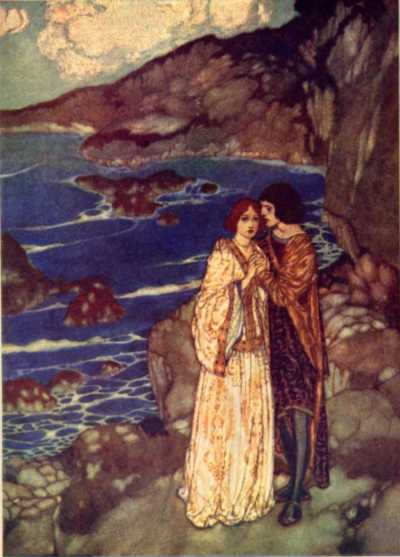
"Ferdinand and Miranda avow their mutual love,
beside the lapping of the long blue waves."
Ferdinand. Here's my hand.
Miranda. And mine, with my heart in't.
(The Tempest).
FERDINAND AND MIRANDA.
Painting by Edmund Dulac.
Moving meditatively along Holborn, he
presently encountered his old friend Gerard
the botanist, whose Herball had been published
two years before,—who stood at the head of
his profession for knowledge and achievement.
He lived in Holborn, where he had not only
a fine garden-ground, but a fruit-ground in
Fetter Lane, which he superintended for the
surgical society of which he was a member.
"Well met, Will!" said the grave and
reverend herbalist, "no other man in London
would I more gladly welcome: for that thou
hast a most worthy apprehension of the seemliness
of plants and herbs. Country blood,
country blood, good sir! Come, now, into my
poor enclosure and let me regale thee with
new and marvellous things.... What! it is
but eight o' the clock! The paltry playhouse
shall not claim thee yet awhile. What are all
Euripides his dramas, in comparison with that
wherewith I shall rejoice thine eyes?"
And, seizing the poet's hand, Gerard drew
him through a side-door into his beloved garden.
"Behold!" he exclaimed, "the Apple of Love,
Pomum Aureum!"—and, with ineffable pride,
he pointed out some slowly-ripening tomatoes.
"These grow in Spain, Italy and such hot
countries, from whence myself have received
seeds for my garden, where, as thou seest, they
do grow and prosper.... Howbeit there be
other golden apples, which the poets do fable
growing in the gardens of the daughters of
Hesperus. These,"—he added regretfully,
"I have not."
"Master Gerard, there shall no golden
apples ever come to England worthy to compare
with yours," remarked the dramatist,
luxuriously inhaling the warm June scents
shut closely within sun-baked walls, and gazing
down the coloured vistas and aisles of bloom.
"Here's flowers for you!" he murmured to
himself,
"Here's a plenty of sweet herbs!
Hot lavender, mints, savory, marjoram,
The marigold that goes to bed with the sun,
And with him rises weeping: these are flowers
Of middle summer. And I think they are given
To men of middle age."
"Sithee here again," continued Gerard,
well launched upon his favourite topic, "this
plant, which is called of some Skyrrits of Peru,
is generally called of us, Potatus or Potatoes,"—and
he waved his hand towards a bed of
sweet potatoes. "Of these roots may be made
conserves, toothsome, wholesome and dainty,
and many comfortable and restorative sweetmeats.
Other potatoes there be, which some
do use with salt,—but of these I have no
present apprehension."
Shakespeare was not paying attention to
the potatoes. On his knees beside a strawberry
bed, he looked up with a laughing face.
"Methinks I would rather fresh fruit than
conserves," said he, filling his mouth with
much satisfaction.
"Then, of the Indian pot-herb, tobacco,"
the botanist proceeded, "give me joy that I
have had good fortune in three kinds thereof,—the
Henbane of Peru, the Trinidada Tobacco,
and the pigmy or dwarfish sort. But, indeed,
this same tobacco is by no means to be
commended as a fume or smoking-medicine.
The juice, boiled with sugar into a syrup, is a
sovereign cure for many maladies. I pray you,
good Master Shakespeare," said he, earnestly
seizing the other's arm and punctuating his
words with a gentle see-saw movement, "believe
me, that any other herb of hot temperature
will suffice for pipe-smoking—rosemary, thyme,
winter savory, sweet marjoram and such-like."
"Faith, I am no great smoker," replied
Shakespeare, as with a dexterous jerk he
eluded his friend and dived down an alley of
damask roses. "Here," said he, "I shall play
the robber,—" He gathered a rose and set it
behind his ear in the most approved Court fashion.
"I would fain linger all day among these
manifold sweetnesses," he added, "but alack!
I have need to hasten now. I pray you, therefore,
give me leave to depart." The herbalist,
talking volubly, accompanied him to the door.
The playwright turned down towards
Blackfriars: on his way he entered an apothecary's
shop, and, heedless of Master Gerard's
warnings, purchased a "rich smoke" at sixpence
a pipeful—(equivalent to, perhaps, four shillings
of our money). This was no cheap and
adulterated mixture, such as the "groundlings"
used, but the very best procurable: and, to
emphasise its recherché quality, it was kept in a
lily-pot, minced on a maple-block, served out
with silver tongs, and lighted from a little fire
of juniper shavings. Shakespeare, having thus
filled his long clay pipe, proceeded to the Blackfriars
shore, where he took a ferry-boat across
to Bankside in Southwark and entered the
Globe Theatre, of which he was part proprietor.
It may here be explained that, every theatre
having recently been banished from the City as
the very quintessence of disreputability and root
of all evil, the exiled players had taken refuge
south of the river, in Bankside: which, being
a quarter singularly ill-famed, was considered
by all reputable citizens a most appropriate
situation for them. The Globe, like other
public playhouses of the period, was roofless:
three stories high, with boxes all round in
tiers, the ground tier paled with oaken boards
and fenced with strong iron pikes. The stage,
which had a "shadow" or cover over it, was
some 40 ft. wide and extended to the middle
of the yard or pit. At the back of the stage
was a balcony, over the entrance from the
"tiring-house" or dressing-rooms. It was
lighted, if necessary, by branched candlesticks,
while "cressets" (tarred ropes' ends in cages)
were set in front of the boxes.
The Globe company of about ten actors,
Burbage, Heminge, Condell, Field and the rest,
were entering by ones and twos, with the boys
who played women's parts: last of all, the orchestra
of ten performers, the largest in London,
dawdled in, and took up their instruments—chiefly
drums and trumpets. The rehearsal commenced—the
play of Hamlet, with Burbage in
the title-rôle. Shakespeare, though necessarily
present, paid but little attention to the business in
hand. In studied and self-conscious acting he
had no interest whatsoever. His theory was the
same as Ben Jonson's, that a man should act
"freely, carelessly, and capriciously, as if one's
veins ran with quicksilver, and not utter a phrase
but shall come forth in the very brine of conceit,
and sparkle like salt in fire." But
this was too high a criterion to impose upon his
company. He therefore left them chiefly to
their own devices, under the capable management
of Burbage, and remained himself in the
tiring-room, employed upon his usual morning's
avocation, revising and revivifying old "stock"
plays, and considering fresh MSS., which
arrived in vast numbers—and accepting as
much as he could. For he was incapable of
jealousy: he "did his greatness easily," and was
the kindest of friends, the most indulgent of
critics, to would-be dramatic authors. His
acquaintance with Ben Jonson had originated
in "a remarkable piece of humanity and good-nature."
Jonson, unknown and unaccredited,
had offered a play to the theatre. "But the
persons into whose hands it was put, after
turning it carelessly and superficially over,
were just upon returning it to him, with an
ill-natured answer, that it would be of no
service to their company, when Shakespeare
luckily cast his eye upon it, and found something
so well in it, as to encourage him to read
it through, and afterwards to recommend Ben
Jonson and his writings to the public." (Rowe)
Similar experiences befell many a budding
stage writer: Shakespeare's singular sweetness
of disposition led him to be lavish of praise as
of money. He was "always willing to touch
up this man's play, or write in an act for that
one." And of no other man did he utter a
cruel or an injurious word. "A kinder gentleman
treads not the earth," his intimates might
have said of him, as he of Antonio.
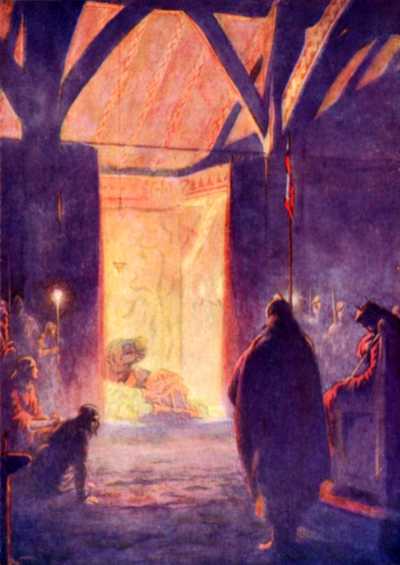
"The young gallants were glad when the Play-scene
was over."
Hamlet. He poisons him in the garden for his estate. His
name's Gonzago.
(Hamlet).
THE PLAY-SCENE IN HAMLET.
Painting by W. G. Simmonds.
Yet it might almost be averred that
William Shakespeare found himself a dramatist
by accident. He accepted from the first the
conditions of a life despised and contemned, the
life of the actor classed with rogues and
vagabonds, banished with contumely into
ignominious neighbourhoods. "He looked upon
the half-art of acting with disdain and
disgust": he saw his worst plays performed
much more frequently than his best. By
nature a poet pur et simple, of a delicate,
fastidious, bookish temperament, one who
continually corrected his best verses with endless
pains and critical scrupulosity—he had
been thrown into the rowdy pot-house company
of second-rate actors, and was accused by
jealous rivals of being "an upstart crow,"
swelled out with inordinate vanity—or gibed
at, by those who professed themselves his
friends, as a slovenly and careless writer—or
openly contemned by the very lackeys and
menials, should he receive a call to Court.
And this was only one of the darker sides to
the life of this gentle-natured, cheerful,
seemingly successful man. The others, as we
shall presently perceive, were, in some sense,
infinitely more tragic.
The rehearsal over, and the hungry actors
pouring forth to obtain their dinner at the
nearest taverns or cookshops, Shakespeare
(who had, as we know, already broken fast)
re-crossed the river and paced quietly up towards
St. Paul's Churchyard, to visit the
booksellers' shops. The Signs of the White
Greyhound, the Angel, the Spread Eagle, the
Green Dragon, the Flower de Luce, and so on,
were the recognised rendezvous for men of
letters, and Shakespeare's own earlier works,
such as Venus and Adonis, Lucrece, Henry IV,
and Richard II, were issued at several of
these shops. Here he could foregather with
learned and literary friends; here he could sit
and study the latest books; here, in short, he
was no longer the actor, but the author. And
it may be noted in passing, that Shakespeare's
literary confrères respected him, not as the
permanent dramatist of the Globe, the transmuter
of old lead into gold of Ophir—but as a
lyrical poet, an authentic "maker" of beautiful
verse. "The Muses would speak Shakespeare's
fine filed phrase if they could speak English,"
so ran the encomium of his admirers. His
"sugared sonnets," they declared, were of surpassing
excellence and charm. "His facetious
(pleasant) grace in writing," as they termed
it, "which approves (proves) his art," was
that of the sonneteer, not the playwright. That
state and majesty, that knowledge of human
nature, which distinguish his dramatic work,
seemed, to his contemporaries, quite foreign
to the man they knew, the witty, gracious,
graceful poet.
After a short look-in at his favourite bookshops,
Shakespeare proceeded to another popular
rendezvous—the middle aisle of St. Paul's.
This was no sequestered haunt of studious folk,
but a busy promenade where all sorts and
conditions of men met freely, by appointment
or otherwise: here one might encounter the
down-at-heels adventurer, the "masterless man
or penniless companion," side by side with the
rubicund citizen, the opulent merchant, and the
country gentleman whose talk was of hawks and
hounds. Every condition of character, every
variety of type, was here for Shakespeare's
sharp eyes to scan: every fragment of conversation
that fell upon his keen ears was
noted down almost automatically. Friends
and acquaintances many were here to be
encountered: the popular writer received
salutations on every hand, and those who
might benefit by his well-known laxity of purse
were not slow to avail themselves of it.
Money frequently changed hands before
Shakespeare passed out of the Cathedral. He
had the customary careless generosity of stage-folk,
and the fact that he was reputed to spend
as much as he earned was doubtless largely due
to his lavish freehandedness. Nobody could
look into that kindly face and expect a No to
any asking.
But now it was striking twelve on every
clock in the City, and he turned into Cheapside
to the Mermaid, which stood between Friday
Street and Bread Street. In those days, few
except the upper classes dined at home. The
"restaurant habit" of the twentieth century
prevailed among middle-class townsfolk—especially
those who were only lodgers, or
visitors in London: and the cook-shops,
ordinaries, and taverns laid themselves out to
provide such hearty dinners as were necessary
to people who had only two meals a day.
Upon the table to which Shakespeare sat
down there were a stewed rabbit, a roast
capon, a salmon stuck with cloves, and a piece
of boiled beef; a jug of ale, a flagon of white
wine (sack or canary) and a quart of claret.
Honey was poured over the meat, and the
wine-cups were half full of sugar. For the
Elizabethans loved "sugar and spice and all
things nice." Every dish was highly seasoned,
highly sweetened, and spiced to what we
should call a nauseating point. Cooked
vegetables were but little used: these strong
meat-eaters disdained them; potatoes were not
yet indispensable articles of diet. Herbs, fruits,
and roots, in fact, played a very secondary part
in town fare, though poor folk in country places
must needs make shift with these. The plates
were of bread, the dishes of wood, and the wine
was poured into small green clay pots.
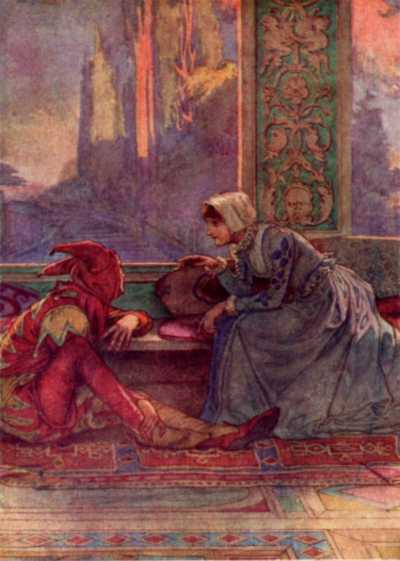
"The whimsical, delightful, happy-go-lucky humour
which he has put into the mouths of so many merry
folk."
Clown. Well, God give them wisdom, that have it; and
those that are fools, let them use their talents.
(Twelfth Night).
THE CLOWN AND MARIA.
Painting by W. Heath Robinson.
Shakespeare did not linger over his dinner.
Naturally no great eater, and by the robust,
full-blooded Elizabethans considered a very
poor drinker, he was lost in thought. That
customary flow of scintillating wit, which made
him the life and centre of a crowd—that
nervous, excitable, impatient brilliance which
often characterized him in company—seemed
awhile to have forsaken him. To the irrelevant
ups and downs of the artistic temperament he
was singularly subject. Various familiar friends
passed in and out, with loud and jolly greetings:
Mr. Will Shakespeare was hail-fellow-well-met
with all men, from carters to courtiers.
But to-day Mr. Will Shakespeare only smiled
at them with a humorous, pensive air, and
retired yet further into himself.
What was saddening and silencing him?
Had a sudden distaste for his occupation seized
upon his sensitive mind? Had some slight been
put upon him by careless young nobles, such as
my lords Pembroke or Southampton, who take
up a man one day and drop him the next?
Had he received ill news from Stratford, as
when the tidings arrived, three years ago, of
the death of his only little son? Or was
he simply cogitating one of his "sugared
sonnets"?
Thus the quidnuncs of the Mermaid
questioned among themselves: and there was
much surmising, and putting of heads together,
and wagering upon the thoughts of Master
Shakespeare's melancholy: for of a surety he
had lost his wonted flow of spirits. But only
one or two men guessed truly at the secret
troubles that sat heavy on his cheerful,
mercurial mind.
Seventeen years ago, at the age of eighteen,
Shakespeare had made a hasty and ill-assorted
marriage. Anne Hathaway, his senior
in years, his inferior in position, was no fit
mate for the impetuous, ambitious youth. A
father at nineteen, with neither employment
nor source of income, he had chafed and
fretted for five years against the consequences
of his own rash folly: at twenty-three, he
found the position intolerable. He quitted
Stratford, and had never returned, save for
brief and flying visits. Nor had he ever
brought up his wife and children to London.
He was maintaining them in comfort, he was
purchasing a fine house in Stratford, whither
he would eventually retire and play the parts
of husband and father. But—blame him or
not, as you will—there are limits beyond
which human nature cannot be forced: and
the illiterate, ill-tempered, incompatible Anne
Hathaway was the skeleton in Shakespeare's
cupboard: not to be explained away—the thought
of whom left a bitter taste at the bottom of
every pleasure.
So far, things were bad enough; but there
was even worse to follow. The lad whose
calf-love had flung him into ill-considered
matrimony was now a mature man—and two
years ago he discovered, for the first time,
what the love of mature manhood can be like.
With equal folly, equal recklessness, to his first
affair, he had conceived a desperate and hopeless
affection for a woman who exactly reversed
the previous conditions—for she was very much
younger than himself, better educated, and of
much superior rank. The "dark lady" of
Shakespeare's sonnets, upon whom he lavished
all his golden wealth of phrase, laying open the
most intimate secrets of human love, and scorn,
and anguish—was (in all probability) Mary
Fitton, a girl of nineteen, maid of honour to the
Queen. Proud, high-spirited, vivacious—unquestionably
beautiful, although "in the old age
black was not counted fair"—aristocratic, grande
dame to the finger-tips: in every respect the
antithesis of countrified, shrewish, repellent
Anne Hathaway—yet the "dark lady" was
inherently wanton, false, and faithless. Shakespeare
recognised this, but it made no difference
to the strength and intensity of his passion:
So true a fool is love, that in your will,
Though you do anything, he thinks no ill.
In sonnet after sonnet he expressed his despair,
his patience of contempt or injury. No such
sounding of the whole diapason of love—no such
revealing of a tortured human heart—has ever
been put before the world.
Not marble, nor the gilded monuments
Of princes, shall outlive this powerful rhyme.
And he depicted various features of this woman,
in various rôles, in play after play: he could
not shut her out. Whether he pilloried her
dark beauty as Cressida or Cleopatra—whether
he masked her wit and spirit under the name
of Beatrice or Rosalind—whether he alternately
implored or inveighed against her in the Sonnets—he
was enthralled by so magnetic a fascination
that it influenced his art at all points. Shakespeare
the man—Shakespeare the artist—was
obsessed by—bound fast in—a hopeless infatuation
for a woman whom he knew to be
unworthy.
Here, indeed, was sufficient matter for
musing. But the poet's unhappy reveries were
cut short by the appearance of a young man—his
brother Edmund, who had recently arrived
in London and obtained a small acting post at
the Blackfriars Theatre. He addressed the
older man with a mixture of respect and boyish
naïveté. "Good Will, lend me a groat or so—ere
I perish of sheer hunger. Six long hours
have I laboured at their plaguy rehearsal, and
I have not a penny to my pocket. In faith, I
never starved like this in Stratford. I swear I
will repay thee two days hence!"
The elder brother, with his easy, tolerant
air waved the lad to a seat, and shouted for the
drawer, or waiter. "Anon, anon, Sir!" and
that functionary hastened up. The Mermaid
was emptying now, and the attendants were less
hurried and flurried. Shakespeare ordered in
a second dinner—for, little though he had eaten,
the food was cold: and, patting his brother
affectionately on the shoulder, slipped a handful
of money into his hand. "Ay, marry, thou
hast a good Warwickshire hunger and thirst,
Ned," said he, "let it not cry out upon thee in
vain. For me, I am away to the Globe. They
play Hamlet there to-day, and needs must I be
present." He did not wait for thanks, but, with
his peculiarly pleasant smile, slipped out of the
Mermaid, and made haste towards his theatre.
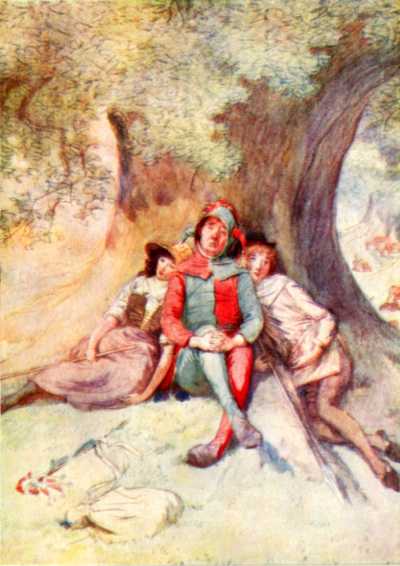
"Like the three wanderers in Arden, against the
bole of a huge oak."
Touchstone. The more fool I, to be in Arden!
(As You Like It).
ROSALIND, CELIA AND TOUCHSTONE.
Painting by Hugh Thomson.
The Globe was already crowded when he
arrived, although the play did not begin till
three (there were no evening performances in
those days, except in noblemen's private
theatres). Burbage, the favourite tragedian, as
Hamlet, drew a great following: but the
humble part played by the author himself as
Rosencrantz was a succès d'estime rather than
a genuine one—for Mr. William Shakespeare
was no very wonderful actor. "A fellowship
in a cry of players" held little glamour for him.
The man who could imagine, with every vivid
circumstance of detail, the sinister and foreboding
atmosphere of Elsinore, had little
admiration for the "strutting and bellowing"
of the players who interpreted his visions....
On either side of the stage sat the young
noblemen, the poetasters, and the shorthand
writers who worked for private publishers.
In the boxes—priced up to half-a-crown (about
£1 of our present money) were various
aristocratic and wealthy patrons of the play.
The "groundlings" obtained standing room in
the pit for a penny (say 6d.) and were
vociferous in their applause of the sanguinary
scenes, of the Gravediggers, and of the grosser
jests. Everyone who could afford it, smoked:
the "classes," rich authentic tobacco, and the
"masses," men and women alike, an adulterated
mixture of coltsfoot and other "hot"
herbs. As for the middle classes, the merchant-folk,
tradesmen, and bourgeoisie in general, they
were chiefly conspicuous by their absence.
Strongly pervaded by a growing flavour of
Puritanism, and having a wholesome decent
horror of "play-acting" as something undoubtedly
congruous with all dissolute ways and ill-living,
the middle classes avoided Bankside like
the pestilence. Had they been present, they
would have been sorely put to it to understand
what in the world Mr. Shakespeare,
through the mouth of Hamlet, was gibing at.
Was he decrying actors? Was he contemning
audiences? Was he scorching, with bitter disdain,
all who wrote for, or acted in, or crowded
into playhouses?... The young gallants,
uncomfortable and uncertain, were glad when
the Play-scene was over, and one arrived at
more familiar matters of battle, murder, and
sudden death. Too much metaphysics about
this Hamlet fellow, so they held. A dramatist
should stick to his last, and not drag his hearers
into deep waters of conjecture, where a man
might well flounder for ever....
The play was over. Some few adventurous
spirits from the audience approached the tire-room
door: Heminge held it warily ajar. "I
would speak with your author: where is he?"—"I
would have a word with Mr. Shakespeare:
is he within?" "Not this way, I assure you,
sir: we are not so officiously befriended by him,
as to have his presence in the tiring-house, to
prompt us aloud, stamp at the book-holder,
swear for our properties, curse the poor tireman,
rail the music out of time, and sweat for every
venial trespass we commit."—"Was it not Mr.
Shakespeare, then, that played the part of
Rosencrantz?" enquired the bewildered ones.
"Close the door!" thundered Burbage from
within. Followed a sound of bolts and bars....
Meanwhile, Mr. Shakespeare had disappeared
from the malodorous precincts of the Globe—for
the adjacent bear-gardens were notorious
for evil effluvia—had crossed the river, and was
making his way to the Mermaid, where he
arrived about six. A plentiful supper was
already being partaken of: the rooms were full
of steam and savoury smells. Supper was a
smaller meal than dinner, but in no way stinted.
Lettuces and radishes were usually served first,
and afterwards a variety of highly flavoured
dishes. Pigeons stuffed with green gooseberries,
fiercely-seasoned herring-pies, roast
pork with green sorrel sauce—mustard, horseradish,
ginger, and honey ad lib, and sweet
dishes innumerable. Shakespeare did justice to
his food, and took copious draughts of light
sweet wine: the morning's melancholy had
passed away, and was succeeded by an almost
feverish gaiety. The artificial stimulus of the
theatre had produced a temporary excitement
in him—he was flushed, brilliant, loquacious. As
his repartees flashed rapier-like across the room,
Ben Jonson smiled grimly, seated at the head
of the table, and a score of kindred souls, who
surrounded it, relished the verve and sparkle of
their favourite comrade. Jonson was a man
of great size, of immense strength and personal
courage—masterful, domineering, jealous. He
recognised and allowed the extraordinary
genius of Shakespeare—but always with many
detractions, "insinuating his incorrectness, or
a careless manner of writing, and a want of
judgment." That the Stratford shopkeeper's
son, utterly unequipped in scholarship or training,
should stand so high in popular estimation
above himself—the University graduate of great
learning—was acutely annoying to Jonson: it
may be, too, that, with the littleness of certain
minds, he had never forgiven Shakespeare
for doing him a good turn in the matter of
his comedies. At any rate he resented the
Warwickshire man's unparalleled quickness,
brightness, and flexibility of tongue; and every
evening he inaugurated a duel of words, which
almost invariably resulted in a "draw," and
which was the delight of those privileged to
be present. "At the Mermaid," says Fuller,
one of these favoured auditors, "many were
the wit-combats between Shakespeare and Ben
Jonson, which two I beheld like a Spanish
great galleon and English man of war. Master
Jonson (like the former) was built far higher
in learning, solid, but slow in his performance.
Shakespeare, like the English man of war,
lesser in bulk, but lighter in sailing, could turn
with all sides, tack about, and take advantage
of all winds by the quickness of his wit and
invention." And thus it befell that the frequenters
of the Mermaid—such notabilities
as Raleigh, Fletcher, Marlowe, Beaumont,
Greene,—were accustomed to hear these two
great poets disputing, and to join the tournament,
in words (as Beaumont put it)
So nimble and so full of subtle flame,
As if that everyone from whence they came
Had meant to put his whole wit in a jest,
And had resolved to live a fool the rest
Of his dull life.
Hours passed swiftly away in this congenial
manner. The amazing fluency and readiness
of Shakespeare showed no sign of flagging: the
whimsical, delightful, happy-go-lucky humour,
which he has put into the mouths of so many
merry folk, was still at its most laughter-provoking
stage,—when suddenly, by one of
his customary revulsions of feeling, he was
seized by a great distaste for the heated
apartment, the flaring light, the stale odours
of wine and ale. Like Cassius, he had "poor,
unhappy brains for drinking," and the endless
potations due at a city tavern were
singularly unsuited to his taste. He felt that
he would give a thousand bursts of Mermaid
applause, "for an acre of barren ground, long
heath, brown furze," anything that was out in
the clean pure air. Though he was a thorough
townsman outwardly, the ineradicable instincts
of a countryman tore at his heart. He hankered
after rural doings and the rough deep speech of
the shires. He did not pause to explain the
cause of this sudden yearning to men who
could hardly be expected to understand it. He
simply followed his own immediate inclination.
Making a hasty and inadequate excuse, he
escaped into the street; and, setting off northward
and alone, he struck up across the fields.
The delicate scent of hay was wafted warmly
round him. Every hedgerow was a blaze of
blossom, roses, honeysuckle, elder; every
brook was fringed with meadowsweet and
loosestrife. Among these exquisitely calm
surroundings, what worth had the sordid and
squalid matters of the stage, with its petty
ambitions, its puny failures or successes? The
boisterous conviviality of the Mermaid, the
dazzling interchange of thrust and parry, his
own reputation as a "fellow of infinite jest,"
and a nobly-endowed poet, all sank away into
nothing, as the midsummer twilight, a glimmering
grey translucence, slowly replaced the
splendours of the day.
"O Jupiter, how weary are my spirits!"
sighed Shakespeare, like his own Rosalind,
as, flinging himself beneath the broad
and leafy boughs, he became submerged in
the infinite, the maternal peace of Nature.
Shortly, as darkness deepened, he would return
to his lonely room in Silver Street, challenged
by the watch and replying in some gay jest:
shortly he would toss upon a sleepless bed,
consumed by violent and varied emotions, until
the cooler wind that comes with dawn should
soothe him into rest. But now he lay, like the
three wanderers in Arden, against the bole of
a huge oak, watching the glow-worms gleaming
around and the stars stealing forth above him:
until the floor of Heaven was "all o'erlaid with
patines of bright gold," and the day, by that
celestial sign, was ended.
Printed by Percy Lund, Humphries & Co., Ltd.
Bradford and London.