 here are few figures which
appeal more picturesquely to the
imagination than that of the
ploughman-poet—swarthy, stalwart,
black-eyed,—striding along
the furrow in the grey of a
dreary dawn. Yet Burns was
far from being a mere uncultured peasant, nor
did he come of peasant stock. His forefathers
were small yeoman farmers, who had risked
themselves in the cause of the Young Pretender:
they had a certain amount of family pride
and family tradition. Robert Burns had been
educated in small schools, by various tutors, and
by his father, a man of considerable attainments.
He had acquired some French and Latin,
studied mensuration, and acquainted himself
with a good deal of poetry and many theological
and philosophical books.
here are few figures which
appeal more picturesquely to the
imagination than that of the
ploughman-poet—swarthy, stalwart,
black-eyed,—striding along
the furrow in the grey of a
dreary dawn. Yet Burns was
far from being a mere uncultured peasant, nor
did he come of peasant stock. His forefathers
were small yeoman farmers, who had risked
themselves in the cause of the Young Pretender:
they had a certain amount of family pride
and family tradition. Robert Burns had been
educated in small schools, by various tutors, and
by his father, a man of considerable attainments.
He had acquired some French and Latin,
studied mensuration, and acquainted himself
with a good deal of poetry and many theological
and philosophical books.
|
|
Click to ENLARGE
|
| |
|
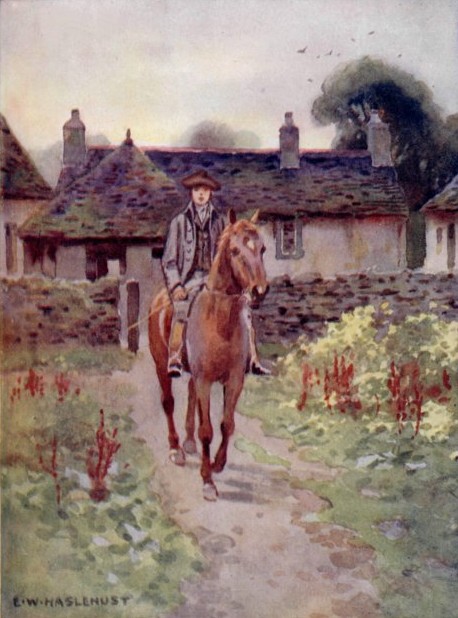
Painting by E. W. Haslehust. |
| THE HOME OF BURNS. |
|---|
| |
The man in hodden grey and rough top boots who
might be seen going out on dusky mornings from his
little farmstead of Ellisland near Dumfries. |
So that the man who may be seen going
out this dusky morning from his little farmstead
of Ellisland near Dumfries—the dark and
taciturn man in hodden grey and rough top
boots—is not precisely a son of the soil. He is
a hard worker in the field by dint of necessity,
but his strenuous and impetuous mind is set
upon other thoughts than the plough, as he
drives his share along the Nithsdale uplands. It
is exactly the season of the year that he delights
in. "There is scarcely any earthly object,"
he has written, "which gives me more—I do
not know if I should call it pleasure, but something
that exalts me, something that enraptures
me—than to walk in the sheltered side of a
wood or high plantation on a cloudy winter's
day, and hear the stormy wind howling among
the trees, or raving over the plains…. I
take a peculiar pleasure in the season of winter,
more than the rest of the year…. There is
something that raises the mind to a serious
sublimity, favourable to everything great and
noble." And there is also something secretly
akin to the poet's wild and passionate soul. For
this is not a happy man, but an embittered one,
and ready to "rail on Lady Fortune in good
set terms." He takes the storm-wind for an
interpreter:
| 'The sweeping blast, the sky o'ercast,' |
| The joyless winter day, |
| Let others fear, to me more dear |
| Than all the pride of May: |
| The tempest's howl, it soothes my soul, |
| My griefs it seems to join; |
| The leafless trees my fancy please, |
| Their fate resembles mine! |
| |
| Thou Power Supreme, whose mighty scheme |
| These woes of mine fulfil, |
| Here firm I rest; they must be best, |
| Because they are Thy will! |
| Then all I want—O do Thou grant |
| This one request of mine!— |
| Since to enjoy Thou dost deny, |
| Assist me to resign. |
His brief meteoric reign of popularity in
Edinburgh is now at an end: from being a
popular idol of society, caressed and fêted,
he has been let to sink back into his native
obscurity. And, being poignantly proud,
he suffers accordingly. The consciousness of
genius burns within him, a flame that devours
rather than illumines: and he finds vent for his
bitterness, as he treads the clogging fallow, in
the immortal lines: A Man's a Man for a' that.
| Is there for honest poverty |
| That hings his head, an' a' that; |
| The coward-slave—we pass him by, |
| We dare be poor for a' that! |
| For a' that, an' a' that, |
| Our toils obscure an' a' that, |
| The rank is but the guinea's stamp, |
| The Man's the gowd for a' that. |
| |
| What though on hamely fare we dine, |
| Wear hoddin grey, an' a' that; |
| Gie fools their silks, and knaves their wine, |
| A Man's a Man for a' that, |
| For a' that, an' a' that, |
| Their tinsel show an' a' that; |
| The honest man, tho' e'er sae poor, |
| Is king o' men for a' that; |
| ..... |
| |
| A prince can mak a belted knight, |
| A marquis, duke, an' a' that; |
| But an honest man's aboon his might, |
| Gude faith, he mauna fa' that! |
| For a' that, an' a' that, |
| Their dignities an' a' that; |
| The pith o' sense, an' pride o' worth, |
| Are higher rank than a' that. |
| |
| Then let us pray that come it may |
| (As come it will for a' that), |
| That Sense and Worth, o'er a' the earth, |
| Shall bear the gree an' a' that, |
| For a' that, an' a' that; |
| It's coming yet for a' that, |
| That man to man, the world o'er, |
| Shall brothers be for a' that. |
|
Presently, however, the sweet influences of
the clear air, the pleasant smell of upturned
earth, the wholesome sight and sounds of
morning, soothe the poet's rugged spirit: he
becomes attuned to the calmer present, and
forgetful of the feverish past. Burns has
never been given to depicting the shows and
forms of nature for their own sake: he only
uses them as a stage for the setting of a central
human interest. In short, he "cares little,"
it has been said, "for the natural picturesqueness
in itself: the moral picturesqueness touches
him more nearly." And all sentient life is dear
to him—not human life alone. Hence, one
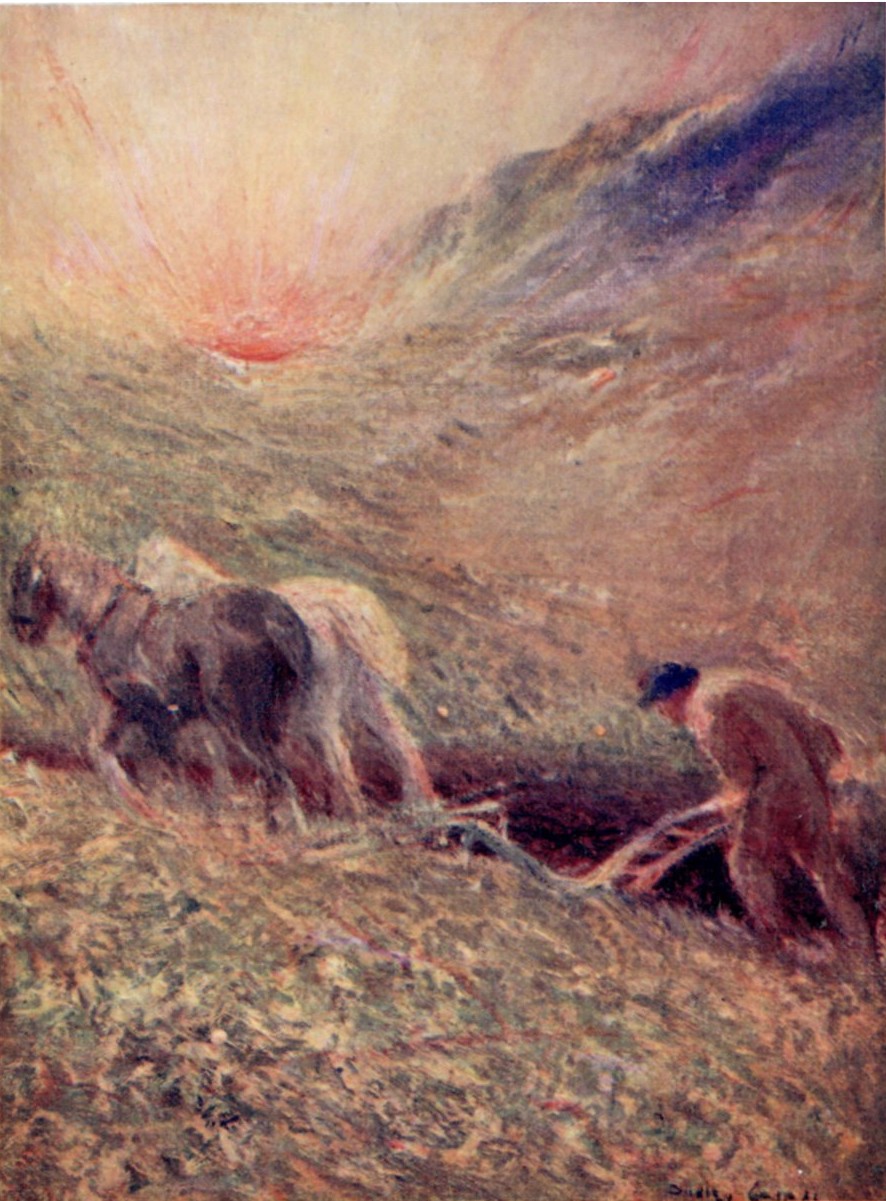
sees him wince and shrink, as his ploughshare
destroys the daisy.
|
|
Click to ENLARGE
|
| |
|
Painting by Dudley Hardy. |
| THE MOUNTAIN DAISY. |
|---|
| |
| Wee, modest, crimson-tippèd flower, |
| Thou's met me in an evil hour, |
| For I maun crush amang the stoure |
| Thy slender stem: |
| To spare thee now is past my power, |
| Thou bonnie gem. |
| Wee, modest crimson-tippèd flow'r, |
| Thou'st met me in an evil hour; |
| For I maun crush amang the stoure |
| Thy slender stem: |
| To spare thee now is past my pow'r, |
| Thou bonie gem. |
| |
| Alas! it's no thy neibor sweet, |
| The bonie lark, companion meet, |
| Bending thee 'mang the dewy weet, |
| Wi' spreckl'd breast! |
| When upward-springing, blithe, to greet |
| The purpling east. |
| |
| Cauld blew the bitter-biting north |
| Upon thy early humble birth; |
| Yet cheerfully thou glinted forth |
| Amid the storm, |
| Scarce rear'd above the parent-earth |
| Thy tender form. |
| ..... |
| |
| There, in thy scanty mantle clad, |
| Thy snawie bosom sun-ward spread, |
| Thou lifts thy unassuming head |
| In humble guise; |
| But now the share uptears thy bed, |
| And low thou lies! |
| ..... |
| |
| Ev'n thou who mourn'st the Daisy's fate, |
| That fate is thine—no distant date; |
| Stern Ruin's ploughshare drives elate, |
| Full on thy bloom, |
| Till crush'd beneath the furrow's weight |
| Shall be thy doom! |
| (To a Mountain Daisy.) |
Or he becomes thoughtful and abstracted
beyond his wont, after turning up a mouse's
nest with the plough; and sternly recalls his
"gaudsman" or ploughboy, who would kill the
little creature out of pure thoughtlessness. He
muses upon the irony of fate: and the world is
the richer for his musings.
| Wee, sleeket, cowrin, tim'rous beastie, |
| O, what a panic's in thy breastie! |
| Thou need na start awa sae hasty, |
| Wi' bickerin brattle! |
| I wad be laith to run an' chase thee, |
| Wi' murderin' pattle! |
| ..... |
| |
| Thou saw the fields laid bare and waste, |
| An' weary winter coming fast, |
| An' cozie here, beneath the blast, |
| Thou thought to dwell— |
| Till crash! the cruel coulter past |
| Out thro' thy cell. |
| ..... |
| |
| But, Mousie, thou art no thy lane, |
| In proving foresight may be vain; |
| The best-laid schemes o' mice an' men |
| Gang aft agley, |
| An' lea'e us nought but grief an' pain, |
| For promised joy! |
| (Lines to a Mouse.) |
But nothing is too trivial to evade this large
and universal sympathy of his. "Not long ago,
one morning, as I was out in the fields sowing
some grass seeds, I heard the burst of a shot
from a neighbouring plantation, and presently a
poor little wounded hare came crippling by me.
You will guess my indignation at the inhuman
fellow who could shoot a hare at this season,
when they all of them have young ones." It is
on record that he threatened to throw the
culprit—a neighbouring farmer's son—into the
Nith to reward his inhumanity.
The ploughing is finished for the day, but
the poet must now needs betake himself to those
official duties as an exciseman, which are
perhaps even less congenial to him than agricultural
pursuits. He has to cover some two
hundred miles' riding every week; he is forced
to earn a scanty living for himself and his
family, by incessant physical and mental work.
The iron has entered into his soul—here and
there it crops up in hard metallic outbursts:
though for the most part, he is unrivalled in
spontaneous gaiety of song. And old sorrows
come upon him as he rides alone…. He
considers the present time to be the happiest
of his life. He has an excellent wife, and
bonnie bairns: friends many and faithful:
comparative immunity from financial troubles: a
popularity such as no other Scottish poet has
attained; yet memories of the past remain,
which are never to be obliterated in oblivion.
And chief among these is the greatest sorrow
that has befallen him—the loss of his one true
love, his cherished Highland Mary.
| Ye banks and braes and streams around |
| The castle o' Montgomery! |
| Green be your woods, and fair your flowers, |
| Your waters never drumlie: |
| There Simmer first unfald her robes, |
| And there the langest tarry; |
| For there I took the last Farewell |
| O' my sweet Highland Mary. |
| |
| How sweetly bloom'd the gay, green birk, |
| How rich the hawthorn's blossom, |
| As underneath their fragrant shade |
| I clasp'd her to my bosom! |
| The golden Hours on angel wings, |
| Flew o'er me and my Dearie; |
| For dear to me, as light and life, |
| Was my sweet Highland Mary. |
| ..... |
| |
| O pale, pale now, those rosy lips, |
| I aft hae kiss'd sae fondly! |
| And clos'd for ay, the sparkling glance |
| That dwalt on me sae kindly! |
| And mouldering now in silent dust, |
| That heart that lo'ed me dearly! |
| But still within my bosom's core |
| Shall live my Highland Mary. |
Burns has been an easy and inconstant
lover all his days: devoted, for the nonce, to
every girl he met. But Mary was on a pinnacle
apart—unequalled, irreplaceable; and still he is
continually dreaming of her—dreaming in
tender and melodious verse.
|
|
Click to ENLARGE
|
| |
|
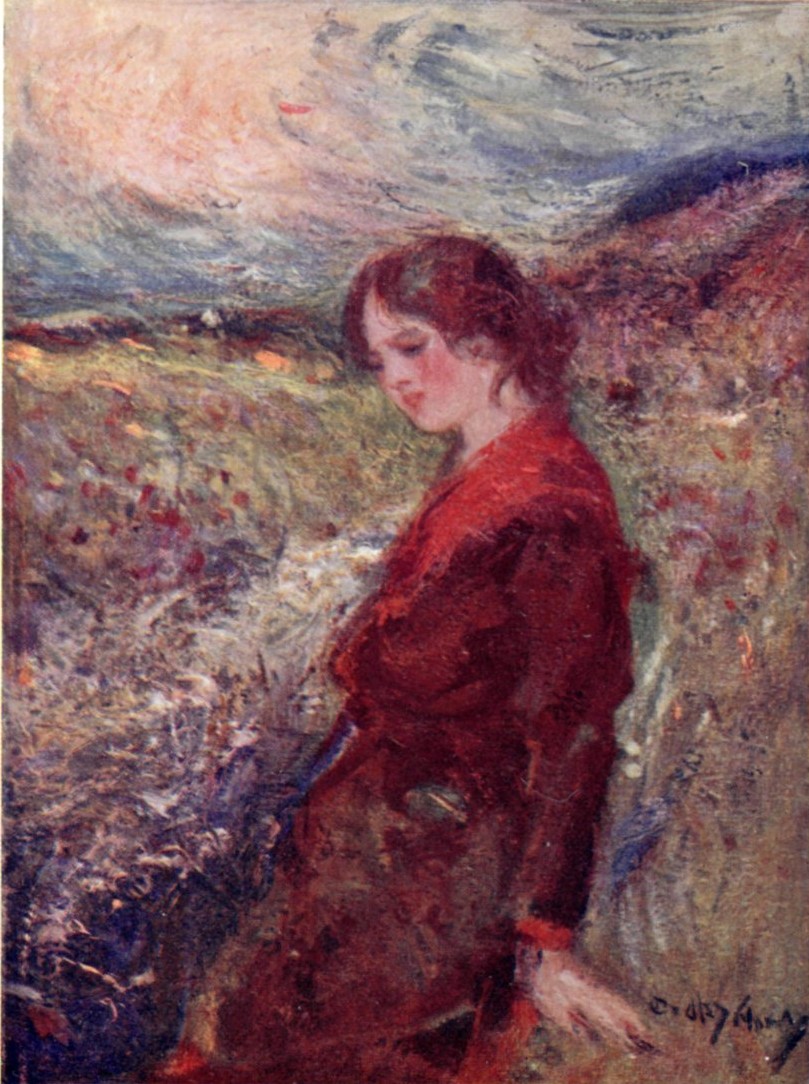
Painting by Dudley Hardy. |
HIGHLAND MARY.
|
|---|
| The golden Hours, on angel wings, |
| Flew o'er me and my Dearie, |
| For dear to me as light and life |
| Was my sweet Highland Mary, |
| Thou ling'ring star, with less'ning ray, |
| That lov'st to greet the early morn, |
| Again thou usher'st in the day |
| My Mary from my soul was torn. |
| O Mary! dear departed shade! |
| Where is thy place of blissful rest? |
| See'st thou thy lover lowly laid? |
| Hear'st thou the groans that rend his breast? |
| |
| That sacred hour can I forget, |
| Can I forget the hallow'd grove, |
| Where by the winding Ayr we met, |
| To live one day of parting love! |
| Eternity will not efface |
| Those records dear of transports past, |
| Thy image at our last embrace, |
| Ah! little thought we 'twas our last! |
| (To Mary in Heaven.) |
But now, hard upon the scent of smugglers
across the Nithsdale moors, exchanging cheery
greetings with cottagers here and there, the
tramp of his horse's hoofs inspires him to a gayer
measure. The clouds, which have overhung
his mind all the forenoon, roll away: and his
mercurial spirit seizes any pleasure that the
moment may afford. The nearest to hand is the
ready ripple of rhythm in light short songs that
fairly bubble over with gaiety. For there is
nothing of the midnight oil about Robert Burns—his
poems come swiftly and spontaneously to
him, as naturally as music to a blackbird: they
have indeed the same quality as the carols of
birds—careless, happy, tuneful. Any casual
impression sets our poet singing: the mere
glance of a merry blue eye at a window, and
he is away on the praises of one immediately
present lassie, or of innumerable others absent.
| Chorus:—Green grow the rashes, O; |
| Green grow the rashes, O; |
| The sweetest hours that e'er I spend, |
| Are spent among the lasses, O. |
| |
| There's nought but care on ev'ry han', |
| In every hour that passes, O: |
| What signifies the life o' man, |
| An' 'twere na for the lasses, O. |
| Green grow, etc. |
| |
| The war'ly race may riches chase, |
| And riches still may fly them, O; |
| An' tho' at last they catch them fast, |
| Their hearts can ne'er enjoy them, O. |
| Green grow, etc. |
| |
| But gie me a cannie hour at e'en |
| My arms about my dearie, O; |
| An' war'ly cares, and war'ly men, |
| May a' gae tapsalteerie, O! |
| Green grow, etc. |
| |
| For you sae douce, ye sneer at this; |
| Ye're nought but senseless asses, O: |
| The wisest man the warl' e'er saw, |
| He dearly lov'd the lasses, O. |
| Green grow, etc. |
| |
| Auld Nature swears, the lovely dears |
| Her noblest work she classes, O: |
| Her prentice han' she try'd on man, |
| An' then she made the lasses, O. |
| Green grow, etc. |
|
Sometimes a flower in the hedgerow opens
out to him a new and exquisite signification.
| My Luve is like a red red rose |
| That's newly sprung in June; |
| My Luve is like the melodie |
| That's sweetly play'd in tune. |
| |
| As fair art thou, my bonie lass, |
| So deep in luve am I; |
| And I will luve thee still, my Dear, |
| Till a' the seas gang dry. |
| |
| Till a' the seas gang dry, my Dear, |
| An' the rocks melt wi' the sun; |
| And I will luve thee still, my Dear, |
| While the sands o' life shall run. |
| |
| And fare-thee-weel, my only Luve! |
| And fare-thee-weel awhile! |
| And I will come again, my Luve, |
| Tho' 'twere ten thousand mile! |
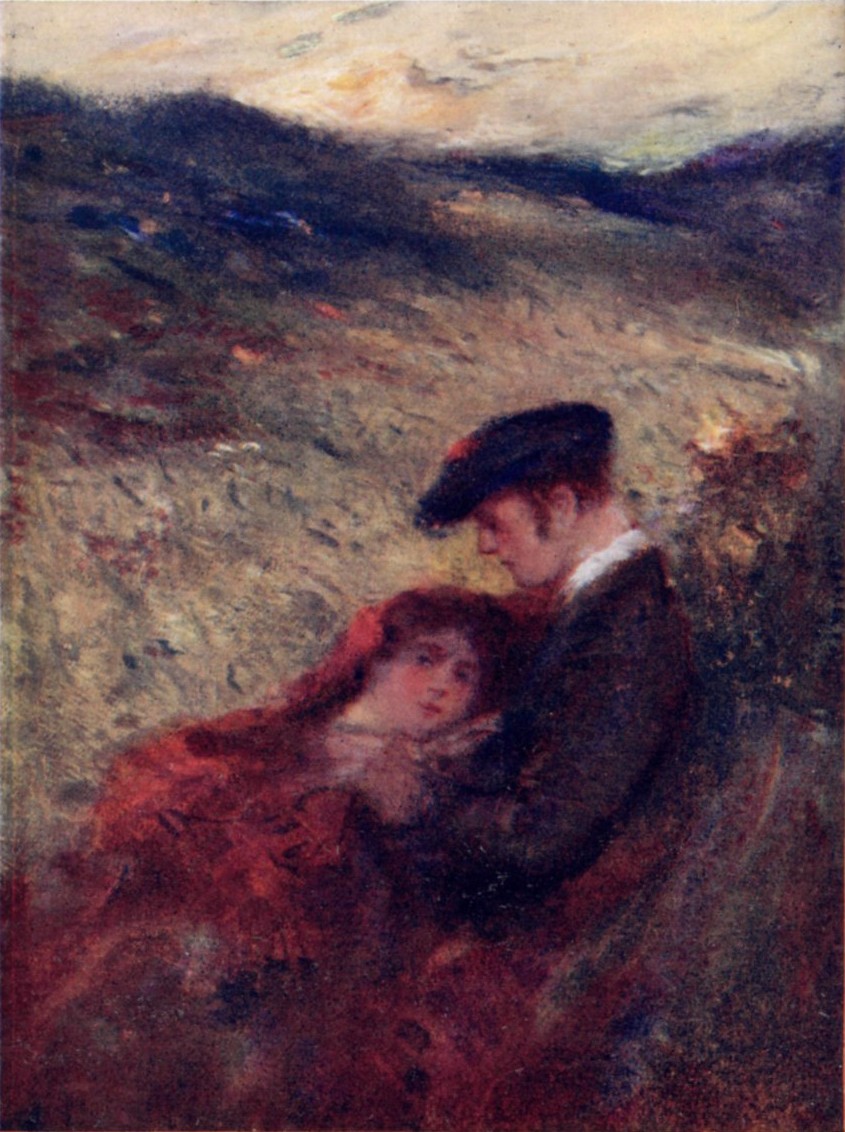
|
|
Click to ENLARGE
|
| |
|
Painting by Dudley Hardy. |
O WERT THOU IN THE CAULD BLAST.
|
|---|
| O wert thou in the cauld blast, |
| On yonder lea, on yonder lea; |
| My plaidie to the angry airt, |
| I'd shelter thee, I'd shelter thee; |
| Or did misfortune's bitter storms |
| Around thee blaw, around thee blaw, |
| Thy bield should be my bosom, |
| To share it a', to share it a'. |
Or, as he meets the wind—still bleak,
though now it is midday,—a cold wind charged
with latent snow,—its chilly breaths are crystallized
into a very jewel of song.
|
| O wert thou in the cauld blast, |
| On yonder lea, on yonder lea, |
| My plaidie to the angry airt, |
| I'd shelter thee, I'd shelter thee; |
| Or did Misfortune's bitter storms |
| Around thee blaw, around thee blaw, |
| Thy bield should be my bosom, |
| To share it a', to share it a'. |
| |
| Or were I in the wildest waste, |
| Sae black and bare, sae black and bare, |
| The desert were a Paradise, |
| If thou wert there, if thou wert there; |
| Or were I Monarch o' the globe, |
| Wi' thee to reign, wi' thee to reign, |
| The brightest jewel in my crown |
| Wad be my Queen, wad be my Queen. |
Presently he turns his horse's head towards
Dumfries. It is market-day in the town, and
a score of friends give him clamorous welcome.
They may not fully appreciate Rob's mental
equipments, but they greet him as the best of
good companions: and in a little while he forms
the leading spirit of some excited group, discussing
matters social and political. For Burns
takes the keenest interest in current events:
and, though most of his poems may be of a
more ephemeral interest, he is capable, when
deeply stirred, of expressing himself with a stern
and lofty patriotism. It may be inspired by
the events of the present: it often is evoked by
glories of the past.
| Scots, wha hae wi' Wallace bled, |
| Scots, wham Bruce has aften led, |
| Welcome to your gory bed, |
| Or to Victorie! |
| Now's the day, and now's the hour; |
| See the front o' battle lour; |
| See approach proud Edward's power— |
| Chains and Slaverie! |
| Wha will be a traitor knave? |
| Wha can fill a coward's grave? |
| Wha sae base as be a Slave? |
| Let him turn and flee! |
| ..... |
| |
| Lay the proud Usurpers low! |
| Tyrants fall in every foe! |
| Liberty's in every blow!— |
| Let us Do—or Die!!! |
Seated in the inn among his cronies, "as
market-days are wearing late," the dour and
bitter looks of the poet are exchanged for
glowing eyes and laughing lips, while he recites
some of the lines which he has wedded to old
and familiar melodies. As Moore, a little later,
secured for the Irish airs a world-wide
reputation, by supplying them with words of a
more popular character than their own—so
Burns re-wrote the songs of his country.
Thousands of people who never heard of "The
Highland Watch's Farewell" have carolled that
melody to his delightful verses,
| My heart is sair—I dare na tell, |
| My heart is sair for Somebody; |
| I could wake a winter night |
| For the sake o' Somebody: |
| Oh-hon! for Somebody! |
| Oh-hey! for Somebody! |
| I could range the world around, |
| For the sake o' Somebody. |
| |
| Ye Powers that smile on virtuous love, |
| O, sweetly smile on Somebody! |
| Frae ilka danger keep him free, |
| And send me safe my Somebody! |
| Oh-hon! for Somebody! |
| Oh-hey! for Somebody! |
| I wad do—what would I not? |
| For the sake o' Somebody. |
As time wears by, Burns pulls out a manuscript
from his pocket, and reads his latest
poem to a hilarious audience: a very masterpiece,
they acclaim it. The legend and the
scenery are awhile familiar to them: but they
have never heard the tale told thus before, as
Burns has immortalized it in "Tam o' Shanter."
| … As bees flee hame wi' lades o' treasure, |
| The minutes wing'd their way wi' pleasure: |
| Kings may be blest, but Tam was glorious, |
| O'er a' the ills o' life victorious! |
| |
| But pleasures are like poppies spread, |
| You seize the flow'r, its bloom is shed; |
| Or like the snow falls in the river, |
| A moment white—then melts for ever; |
| Or like the Borealis race, |
| That flit ere you can point their place; |
| Or like the Rainbow's lovely form |
| Evanishing amid the storm. |
| Nae man can tether Time nor Tide, |
| The hour approaches Tam maun ride— |
| That hour, o' night's black arch the key-stane, |
| That dreary hour he mounts his beast in; |
| And sic a night he takes the road in, |
| As ne'er poor sinner was abroad in. |
| ..... |
| |
| Weel mounted on his grey meare Meg |
| (A better never lifted leg), |
| Tam skelpit on thro' dub and mire, |
| Despising wind, and rain, and fire; |
| Whiles holding fast his guid blue bonnet, |
| Whiles crooning o'er an auld Scots sonnet, |
| Whiles glow'ring round wi' prudent cares, |
| Lest bogles catch him unawares; |
| Kirk-Alloway was drawing nigh, |
| Whare ghaists and howlets nightly cry. |
| ..... |
| |
| … The lightnings flash from pole to pole, |
| Near and more near the thunders roll, |
| When glimmering thro' the groaning trees, |
| Kirk-Alloway seemed in a bleeze, |
| Thro' ilka bore the beams were glancing, |
| And loud resounded mirth and dancing. |
| ..... |
| |
| … And, wow! Tam saw an unco sight! |
| |
| Warlocks and witches in a dance: |
| Nae cotillion, brent-new frae France, |
| But hornpipes, jigs, strathspeys, and reels, |
| Put life and mettle in their heels. |
| (Tam o' Shanter.) |
But now it is time that Burns, like his
hero, should take the homeward road. He
calls for his horse, parts from his boisterous
comrades, and rides out into the wintry evening.
Nithsdale is a land of lovely sunsets: and
against the rose and gold of heaven, the poet
sees the homely cottage-smoke of earth, thin
spirals of blue vapour, speaking of happy
hearths and labour ended. It is several years
since Burns, standing with Douglas Stewart
upon the Braid Hills, declared that to him the
worthiest object in the whole bright morning
landscape was the cluster of smoking cottages.
But still he regards them with affection
and enjoyment: and chiefly his eyes are bent
towards that quiet homestead which holds
his own dear folk. All the peace which that
stormy heart can find is set and centred there:
despite all previous fugitive fancies for Jessie,
and Peggie, and Phemie, and the rest, he has
found calm happiness with his Jean, the most
devoted of wives.
| Of a' the airts the wind can blaw, |
| I dearly like the west, |
| For there the bonie lassie lives, |
| The lassie I lo'e best: |
| There's wild-woods grow, and rivers row, |
| And mony a hill between: |
| But day and night my fancy's flight |
| Is ever wi' my Jean. |
| |
| I see her in the dewy flowers, |
| I see her sweet and fair, |
| I hear her in the tunefu' birds, |
| I hear her charm the air: |
| There's not a bonie flower that springs, |
| By fountain, shaw, or green; |
| There's not a bonie bird that sings, |
| But minds me o' my Jean. |
She comes out into the twilight to meet him,
and his emotion shapes itself, on the instant,
into song.
| This is no my ain lassie, |
| Fair tho' the lassie be; |
| Weel ken I my ain lassie, |
| Kind love is in her e'e. |
| |
| I see a form, I see a face, |
| Ye weel may wi' the fairest place; |
| It wants, to me, the witching grace, |
| The kind love that's in her e'e. |
| |
| She's bonnie, blooming, straight, and tall, |
| And lang has had my heart in thrall; |
| And aye it charms my very saul, |
| The kind love that's in her e'e. |
| |
| A thief sae pawkie is my Jean, |
| To steal a blink, by a' unseen; |
| But gleg as light are lovers' een, |
| When kind love is in the e'e. |
| |
| It may escape the courtly sparks, |
| It may escape the learnèd clerks; |
| But weel the watching lover marks |
| The kind love that's in her e'e. |
The servants, sitting at the same table,
according to Scottish farm custom, share his
simple evening meal: and subsequently,
before the children's bedtime, the master speaks
with seriousness to his household, and reads
aloud some passages from the Holy Book.
| Their master's and their mistress's command, |
| The younkers a' are warned to obey; |
| And mind their labours wi' an eydent hand, |
| An' ne'er, tho' out o' sight, to jauk or play; |
| "And O! be sure to fear the Lord alway, |
| "And mind your duty, duly, morn and night; |
| "Lest in temptation's path ye gang astray, |
| "Implore His counsel and assisting might: |
| "They never sought in vain that sought the Lord aright." |
| ..... |
| |
| Then homeward all take off their several way, |
| The youngling cottagers retire to rest: |
| The parent-pair their secret homage pay, |
| And proffer up to Heaven the warm request, |
| That He who stills the raven's clam'rous nest, |
| And decks the lily fair in flow'ry pride, |
| Would in the way His wisdom sees the best, |
| For them and for their little ones provide; |
| But chiefly, in their hearts with grace divine preside. |
| (The Cotter's Saturday Night.) |
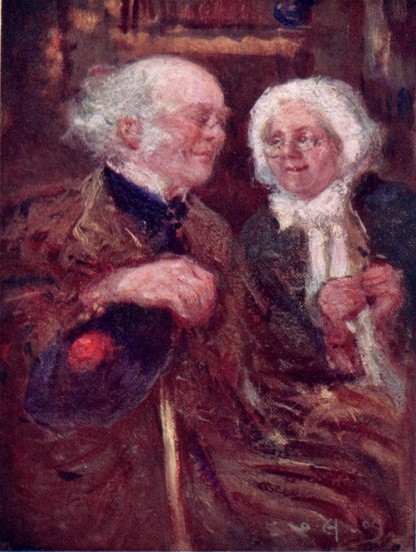
|
|
Click to ENLARGE
|
| |
|
Painting by Dudley Hardy. |
JOHN ANDERSON, MY JO.
|
|---|
| John Anderson, my jo, John, |
| We clamb the hill thegither; |
| And monie a canty day, John, |
| We've had wi' ane anither: |
| Now we maun totter down, John, |
| But hand in hand we'll go, |
| And sleep thegither at the foot, |
| John Anderson, my jo. |
Now, in the quiet house, the man at last is
free to take up his pen. He is writing hard,
daily, or rather nightly: every week sees a
parcel of manuscript despatched to his publisher.
The thoughts which have crowded tumultuously
upon him all day long, may at last be set down
and conserved: for poetry, as Wordsworth
says, "is emotion remembered in tranquillity."
The grave and swarthy face bends above the
paper in the candlelight—varying expressions
chase each other across the mobile mouth and
eyes. Sometimes the theme is one of poignant
pathos.
| Ae fond kiss and then we sever; |
| Ae fareweel, and then forever! |
| Deep in heart-wrung tears I'll pledge thee, |
| Warring sighs and groans I'll wage thee. |
| Who shall say that Fortune grieves him, |
| While the star of hope she leaves him? |
| Me, nae cheerful twinkle lights me; |
| Dark despair around benights me. |
| |
| I'll ne'er blame my partial fancy, |
| Naething could resist my Nancy. |
| But to see her was to love her; |
| Love but her, and love for ever. |
| Had we never lov'd sae kindly, |
| Had we never lov'd sae blindly, |
| Never met—or never parted, |
| We had ne'er been broken-hearted! |
| |
| Fare-thee-weel, thou first and fairest! |
| Fare-thee-weel, thou best and dearest! |
| Thine be ilka joy and treasure, |
| Peace, Enjoyment, Love, and Pleasure! |
| Ae fond kiss, and then we sever! |
| Ae fareweel, alas! for ever! |
| Deep in heart-wrung tears I'll pledge thee, |
| Warring sighs and groans I'll wage thee. |
| (Parting Song to Clarinda.) |
Again the music changes to the sprightliest
vivaciousness, to tell how "last May a braw
wooer came down the lang glen," or to sing the
"dainty distress" of the maiden enamoured of
Tam Glen.
| My heart is a-breaking, dear Tittie, |
| Some counsel unto me come len', |
| To anger them a' is a pity, |
| But what will I do wi' Tam Glen? |
| |
| I'm thinking, wi' sic a braw fellow, |
| In poortith I might mak a fen'; |
| What care I in riches to wallow, |
| If I mauna marry Tam Glen! |
| |
| There's Lowrie the Laird o' Dumeller— |
| "Gude-day to you"—brute! he comes ben: |
| He brags and he braws o' his siller, |
| But when will he dance like Tam Glen! |
| |
| My Minnie does constantly deave me, |
| And bids me beware o' young men; |
| They flatter, she says, to deceive me, |
| But wha can think sae o' Tam Glen! |
| |
| My daddie says, gin I'll forsake him, |
| He'll gie me gude hunder marks ten; |
| But, if it's ordain'd I maun take him, |
| O wha will I get but Tam Glen! |
| |
| Yestreen at the Valentine's dealing, |
| My heart to my mou gied a sten; |
| For thrice I drew ane without failing, |
| And thrice it was written "Tam Glen!" |
| |
| The last Halloween I was waukin |
| My droukit sark-sleeve, as ye ken, |
| His likeness came up the house staukin, |
| And the very grey breeks o' Tam Glen! |
| |
| Come, counsel, dear Tittie! don't tarry; |
| I'll gie ye my bonnie black hen, |
| Gif ye will advise me to marry |
| The lad I lo'e dearly, Tam Glen! |
But here comes a knock at the door, to
stop the flow of inspiration: it is not an unwelcome
visitor, but an old friend, who, returning
after many years from foreign parts, has learned
of "Rob's" amazing leap into fame. Strangers,
drawn by curiosity and admiration, are not
infrequent visitors: "It was something to have
dined or supped in the company of Burns."
But this is a different matter: and the warm
impulsive heart responds to it, in words which
have never been forgotten.
| Should auld acquaintance be forgot, |
| And never brought to mind? |
| Should auld acquaintance be forgot, |
| And auld lang syne! |
| |
| For auld lang syne, my dear, |
| For auld lang syne, |
| We'll tak a cup o' kindness yet, |
| For auld lang syne. |
| |
| And surely ye'll be your pint-stowp! |
| And surely I'll be mine! |
| And we'll tak a cup o' kindness yet, |
| For auld lang syne. |
| |
| We twa hae run about the braes, |
| And pou'd the gowans fine; |
| But we've wander'd mony a weary fitt, |
| Sin' auld lang syne. |
| |
| We twa hae paidl'd i' the burn, |
| Frae morning sun till dine; |
| But seas between us braid hae roar'd |
| Sin' auld lang syne. |
It is late, very late, when the visitor departs:
the stars are frosty, the ground hard. The
spell of newly-roused remembrances lies heavy
still upon Burns's heart: and as he turns to rest,
and sees the peaceful sleeping forms of his wife
and little children, tender and calm desires well
up within him. He can conceive no higher
happiness than comes of a serene old age, in
the company of those dear ones: and a picture
rises before him of old folk gently descending to
a longer rest, side by side together.
| John Anderson, my jo, John, |
| When we were first acquent; |
| Your locks were like the raven, |
| Your bonie brow was brent; |
| But now your brow is beld, John, |
| Your locks are like the snaw; |
| But blessings on your frosty pow, |
| John Anderson, my jo. |
| |
| John Anderson, my jo, John, |
| We clamb the hill thegither; |
| And mony a cantie day, John, |
| We've had wi' ane anither: |
| Now we maun totter down, John, |
| And hand in hand we'll go, |
| And sleep thegither at the foot, |
| John Anderson, my jo. |
Printed by Percy Lund, Humphries & Co., Ltd.,
Bradford and London.
|
TRANSCRIBER'S NOTE
The words belore and bedtine were changed to before and bedtime
in the phrase:
before the children's bedtime
The word divnie was corrected to divine in the line:
But chiefly, in their hearts with grace divine preside.
|


