It is an April morning in 1844,
in the town of Leipzig,—calm,
cool, and fraught with exquisite
promise of a prolific spring,—when
the Herr Professor
Doctor Robert Schumann,
rising before six o'clock as is his wont, very
quietly and noiselessly in his soft felt
slippers, dresses and goes downstairs. For
he does not wish to disturb or incommode
his sleeping wife, whose dark eyes are still
closed, or to awaken any of his three little
children.
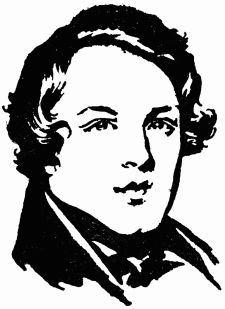
The tall, dignified, well-built man, with his
pleasant, kindly expression, and his air of
mingled intellect and reverie, bears his whole
character written large upon him,—his transparent
honesty, unflagging industry, and
generous, enthusiastic altruism. No touch of
self-seeking about him, no hint of ostentation
or conceit: he is still that same reticent and
silent person, of whom it was said some
years ago by his friends,
"Herr Schumann is a right good man,
He smokes tobacco as no one can:
A man of thirty, I suppose,
And short his hair, and short his nose."
That, indeed, is the sum total of his outward
appearance: as for the inward man, it is
not to be known save through his writings.
Literature and music are the only means of
expression, of communication with others,
which are possessed by this modest, pensive,
reserved maestro, upon whom the sounding
titles of Doctor and Professor sit so strangely.
In the unparalleled fervour and romance
of his compositions,—in the passionate heart-opening
of his letters,—in the sane, wholesome,
racy colloquialism of his critiques,—the real
Robert Schumann is unfolded. Otherwise he
might remain a perennial enigma to his nearest
and dearest: for even in his own family circle,
tenderly and dearly as he adores his wife and
children, his lips remain sealed of all that they
might say: and the fixed, unvarying quietude
of his face but rarely reveals the least suggestion
of his deeper feelings.
Yet, at the present time, were you to
search the world around, you should hardly
find a happier man than this, in his own serene
and thoughtful way. For, in his own words,
"I have an incomparable wife. There is no
happiness equal to that. If you could only
take a peep at us in our snug little artist
home!" Clara Wieck, whom he has known
from her childhood, whom he struggled, and
agonised, and fought for against fate, for five
long years of frustration and disappointment,
is not only his beloved wife and the mother of
his little ones,—she is his fellow-worker and
co-artist, and literal helpmate in every department
of life. She has "filled his life with
sunshine of love,"—and, "as a woman," he
declares, "she is a gift from heaven....
Think of perfection, and I will agree to it!"
But, beyond that, she has poured her beautiful
soul into every hungry cranny of his artistic
sense. "For Clara's untiring zeal and energy
in her art, she really deserves love and encouragement....
I will say no more
of my happiness in possessing a girl with whom
I have grown to be one through art, intellectual
affinities, the regular intercourse of years,
and the deepest and holiest affection. My
whole life is one joyous activity."
The annals of art, indeed, hold no more
lovely record of a union between natural
affinities. That of Robert and Elizabeth
Barrett Browning perhaps approximates most
closely to that of Robert and Clara Schumann.
But whereas in the former case both husband
and wife were alike engaged upon the same
branch of literature,—poetry,—and a certain
sense of sadness was apt to embitter the success
of the wife, because of the unpopularity (in
those days) of the husband,—Schumann is
solely and pre-eminently a composer, and Clara
solely and absorbingly a pianist. No shadow
of artistic rivalry can fall upon their delight,
nor darken their pleasure in each other's
achievements. Schumann's most impassioned
and characteristic productions have been definitely
inspired by Clara, ever since the days
when, as a child of nine, she listened to his
fantastic fairy-tales, and her exquisite playing
thrilled him with a desire to think in music.
And Clara, who has never made a mere show
of her marvellous executive skill, but has
"consecrated it to the service of true art
alone,"—is never happier than when interpreting
her husband's works.
It is, in short, necessary to deal with
Schumann as a whole,—as a man who has
fulfilled the triple destiny for which Nature
intended him,—as individual, husband, and
father,—before one can even approximately
understand this silent, studious dreamer, whose
one ideal of happiness is to sit at home and
compose.
Schumann considers this early morning
hour the most precious of his day, from a
working standpoint. He seats himself at his
desk, and places his two treasures where they
shall catch his eye conspicuously; for he
regards them more or less as charms and
talismans to bring out the best that is in him.
They are, a steel pen which he found lying on
Beethoven's grave at Vienna, and the MS.
score of Schubert's C-major Symphony, which
he obtained by a lucky chance. He regards
these with a mixture of sentiment and humorous
toleration of his own mysticism: but he
cherishes them none the less, and often casts a
reassuring glance in their direction, as he
covers sheet after sheet of paper with his
shockingly illegible handwriting. "Poets and
pianists," says he with resignation, "almost
always write with a dog's paw. The printers
will make it out somehow." He is engaged
upon his work in connection with the Neue
Zeitschrift für Musik (New Musical Times),
which he originally founded, and of which he
has been some nine years Editor. During all
these years he has contributed to its pages those
admirable reviews and appreciations which are
so utterly unlike anything heretofore attempted
in the realm of musical criticism. "There is
no quality to be desired in a musical critic that
Schumann does not possess:" and in addition
to technical equipments of every kind, keen
insight and an almost prophetic quality in his
predictions, he has the priceless gift too often
denied to the critic,—that of superabundant
sympathy. His hands are ever thrown out to
welcome the young and timid genius, even as
they are clenched, so to speak, with threatening
fists towards Philistinism, charlatanism and
mediocrity. He loves to praise rather than to
blame, and to detect the germs of coming greatness
in some obscure, unsuspected artist. He
takes into his regard the personal equation
wherever possible, and does not separate the
musician from the man: for, he says, "the
man and the musician in myself have always
struggled to manifest themselves simultaneously....
I speak with a certain diffidence of works,
of the precursors of which I know nothing.
I like to know something of the composer's
school, his youthful aspirations, his exemplars
and even of the actions and circumstances of
his life, and what he has done hitherto."
As his pen travels rapidly over the pages,
the reason of his cramped and crabbed handwriting
is only too evident. Schumann's right
hand is crippled. In an evil hour of his youth,
while yet he was consumed with the ambition
of a would-be virtuoso, he experimented, with
artificial restrictions, upon one of his right-hand
fingers, intending thus to strengthen the rest by
assiduous practice ... with the result that
he lamed his hand for ever. This disastrous
attempt deprived the world of a good pianist,
but conferred upon it a great composer: for it
is possible that the executive would have
superseded the creative ability within him.
Nevertheless, he confesses that, "My lame
hand makes me wretched sometimes ... it
would mean so much if I were able to play.
What a relief to give utterance to all the music
surging within me! As it is, I can barely play
at all, but stumble along with my fingers all
mixed up together in a terrible way. It causes
me great distress."
Thus, you perceive, he is considerably
debarred from expressing himself in sounds, no
less than in words: he must perforce retire
more and more within himself. The ease with
which he writes is balanced by the difficulty
with which he speaks: and bitterly he has
complained, "People are often at a loss to
understand me, and no wonder! I meet
affectionate advances with icy reserve, and
often wound and repel those who wish to help
me.... It is not that I fail to appreciate the
very smallest attention, or to distinguish every
subtle change in expression and attitude: it is
a fatal something in my words and manner
which belies me."
He is, indeed, only paralleled by the Lotus
Flower of his own delicious song,—shrinking
from the daylight of publicity, and softly
unfolding to the gentle rays of love.
The Lotus flower is pining
Under the sun's red light:
Slowly her head inclining,
She dreams and waits for the night.
The moon, who is her lover,
Awakes her with his rays,
And bids her softly uncover
Her veiled and gentle gaze.
Now glowing, gleaming, throbbing,
She looks all mutely above,—
She is trembling, and sighing, and sobbing,
For love and the pangs of love.
(
Heine.)
And here she enters the room, this woman
who is literally his alter ego, and the small
prattle of children is audible in the awakening
house. Madame Schumann is, in her husband's
words, a "pale, not pretty, but attractive"
young woman of twenty-six, "with black eyes
that speak volumes,"—slender, vivacious,
affectionate: the exact complement of Robert
in all respects. It is easy to perceive in them,
at the first glance, "two noble souls distinguished
by fastidious purity of character—two buoyant
minds concentrated to the service of the same
art." The heavily-thoughtful face of the
composer lights up with sudden sunshine.
"Come and sit beside me, my dear, sweet
girl!" says he. "Hold your head a little to the
right, in the charming way you have, and let
me talk to you a little. Upon my word,
Clärchen, you look younger than ever this
morning. You cannot be the mother of three.
You cannot be the celebrated pianist. You
are just the queer, quaint little girl you were
ten years ago, with strong views of your own,
beautiful eyes, and a weakness for cherries!"
This is a very long speech for Schumann, and
his wife looks at him with a shade of anxiety—such
anxiety as she is never wholly free from.
For the words which she wrote in her diary
on her wedding day were more prophetic than
even she may yet recognise: "My responsibilities
are heavy—very heavy; give me
strength to fulfil them as a good wife should.
God has always been and will continue to be
my helper. I have always had perfect trust
in Him, which I will ever preserve." She, and
she alone, is aware of all those mysterious
clouds of melancholia, those strange sounds of
inexplicable music, which brood at times above
her darling husband—friend, comrade and lover
in one. She, and she only, can banish, as
David did from Saul, the terrible phases of
irrational depression, and exorcise the evil
power which is always lurking ambushed in
Schumann's outwardly happy life.
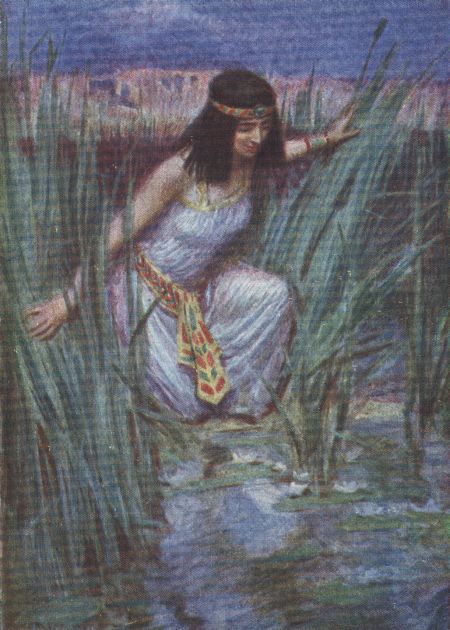
THE LOTUS-FLOWER.
The Lotus flower is pining
Under the sun's red light:
Slowly her head inclining,
She dreams and waits for the night.
(Die Lotos-Blume).
"See," says he, with modest pride, "what
a vast amount of work I have completed this
morning!"
"You are a most diligent creature,
Robert!" she tells him, "and yet I cannot but
wish sometimes, that this literary work were
off your mind—that you had more time to
devote towards composing, which is your true
métier. I want all the world to understand
how great a master you are—I am jealous of
every minute spent upon the Neue Zeitschrift!"
"Don't be too ambitious for me, Clärchen:
I desire no better place than a seat at the piano
with you close by."
"That does not satisfy me," says the
impetuous little lady, "I want you to be recognised
and applauded by all men. When I am
rendering your divine compositions, I feel as
though all the while I were declaring: 'Just
hear this!—Just listen to that!—This is by
Robert Schumann, the greatest genius in
Germany: it is an honour to me to be
allowed to perform such works.'"
"My dear, those compositions are my poor,
weak way of expressing my thoughts about you!
The battles which you have cost me, the joy
you have given me, are all reflected by my
music. You are almost the sole inspiration of
my best—the Concerto, the Sonata, the Davidsbündler
dances, the Kreisleriana, the Novelletten.
Why, dearest, in the Novelletten are my
thoughts of you in every possible position and
circumstance and all your irresistibleness!...
No one could have written the Novelletten,
unless he had gazed into such eyes and touched
such lips as yours. In short, another may do
better work, but nothing just like these."
"That, indeed, I feel," replies Clara with
a little sigh, "and the very significance of their
meaning, I believe, forbids my doing full justice
to their amazing difficulties. You need a pianist
like Liszt, my Robert, to interpret you to the
best advantage."
"I have every admiration for Liszt's
wonderful playing, with its diapason of all the
moods between the extremes of fiery frenzy,
and utmost delicacy. But his world is not mine—not
ours, Clärchen. Art, as we know it—you
when you play, I when I compose—has an
intimate charm that is worth far more to us
than all Liszt's splendour and tinsel."
They embrace with the warmth and sweetness
of perfect mutual comprehension: and she
prevails upon him to descend from cloudy
Olympian editorial heights, so far as to refresh
himself with a modest Frühstück or breakfast,
and a brief gambol with the little ones—for he
has that devotion to tiny children characteristic
of all great men. Never, perhaps, has any
composer so thoroughly entered into childish
griefs and fears and pleasures—the April
shower and shine of babyhood—than Schumann
in his Kinderscenen. The consummate musician
who has surmounted every difficulty, acquainted
himself with every method of his art—the man
who has mastered the forms of symphony,
chamber-music, pianoforte and vocal music to
their farthest present limits—here stands forth
as the exponent of little innocent every-day
emotions. By the Fireside, Bogeys, A Child's
Petition, From Foreign Lands, Blindman's Buff,
and so on, the simple titles run. "They are
descriptive enough, you see, and as easy as
winking!" he has told his wife. And they are
the very breath of childhood,—they "dally
with the innocence of love, like the old age."
Nobody could have imagined them but a man
who had eternal youth in his heart. "The
dissonances are as softly blended as if a child
had actually poured forth its pure soul."
It may readily be imagined with what looks
askance the composer of the Kinderscenen is
favoured by his academic and hide-bound
contemporaries. "Romanticism run mad"—"modernism
gone crazy;"—"discordant
innovations;"—"new-fangled nonsense"—there
are few terms too harsh for Herr
Schumann; and sometimes he is contemptuously
ignored as beyond all possibility of classification.
Already sufficiently outré, in the opinion of all
conventional musicians, by his adoption of the
cyclical form, rather than the orthodox classical,
for his abstract pianoforte music—"the whole
becoming organic by means of the intimate
connection between the various parts;"—already
sufficiently outlandish, in the estimation
of the average conservative critic, by what is
condemned as his grotesquerie and bizarrerie of
treatment: Schumann is not careful to answer
his opponents, or to defend himself from any
charges of lèse-majesté against the imperial art
which he serves. That wide and genial
tolerance which he extends towards all new
composers, he does not demand or even expect
for himself. Nevertheless, as he allows, "I
used to be quite indifferent to the amount of
notice I received, but a wife and children put
a different complexion upon everything. It
becomes imperative to think of the future."
And he is aware that his own personal idiosyncrasies
are the strongest obstacle in his way;
for he is unable to push or praise himself in the
least, and the lordly egotism by dint of which
other composers win, or command, a hearing,
has been entirely omitted from the making of
this dumb genius. He knows no professional
jealousy, he never speaks ill of a soul;—but
then, one might say that he hardly ever spoke
at all. He is almost unknown in society,—partly
because he really has no interest whatever
apart from music, partly owing to his silent
manner and retiring disposition. It is on record
that one day after Madame Schumann had been
playing with tremendous success at one of the
smaller German courts, the Serene Highness
who was ruler there enquired of her with great
affability, "whether her husband were also
musical?" And with his fellow-musicians he
is so invincibly taciturn that conversation is
almost a farce. Even Wagner, whose powers
of loquacity are almost illimitable, resents being
reduced to the utterance of an absolute monologue.
"When I came to see Schumann," he
grumbles, "I related to him my Parisian
experiences, spoke of the state of music in
France, then of that in Germany, spoke of
literature and politics,—but he remained as good
as dumb for nearly an hour. Now, one cannot
go on talking quite alone. An impossible man!"
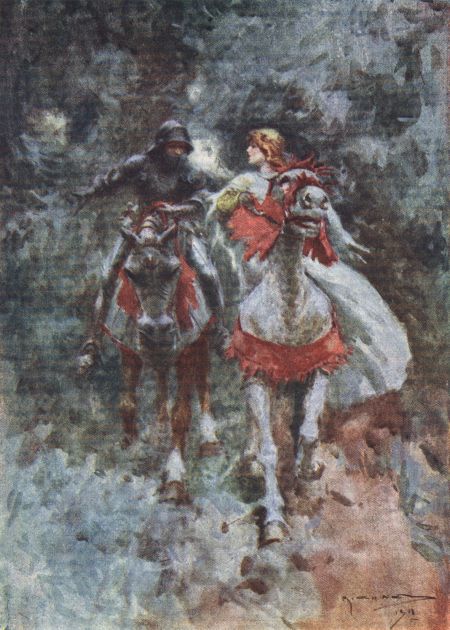
THE KNIGHT AND THE LORELEI.
The hour is late, the night is cold,—
Who through the forest rides so bold?
The wood is wide,—thou art alone,—
O lovely maid, be thou my own!
(Waldesgesprach).
The fact is, that the "impossible man"
dwells apart in a world of his own, a world
peopled by the best folk he has ever encountered
either in the flesh or the spirit, and a world
where the austerest canons and noblest aspirations
of his great art are upheld on a very
different plane from that of Leipzig. He has the
highest possible view of his vocation and what
it should entail. "To send light into the depths
of the human heart, that is the artistic calling,"
he has declared.... "The artist is to choose
for his companions those who can do something
beyond playing passably on one or two instruments—those
who are whole men and can
understand Shakespeare and Jean Paul....
People say, 'It pleased,' or 'It did not please,'—as
if there were nothing higher than pleasing
the public!"... A man with such notions
as these, in the first half of the nineteenth
century, must of necessity live and move to a
great extent in an ideal atmosphere of his own:
and Schumann, to do so the more literally, has
created his own company in that "spiritual and
romantic league," the Davidsbund, which exists
only in his imagination, but exercises considerable
vigour none the less.
The Davidsbund is a mystical community of
kindred souls, each enlisted, with or without his
knowledge, under the banner of "a resolve to
do battle in the cause of musical progress,
against Philistinism in every form." One can
only vaguely compare it to the Pre-Raphaelite
Brotherhood in England. "Mozart was as
much a member of it as Berlioz now is," so
declares its founder. Chopin, Julius Knorr,
Schuncke, Carl Banck and others, without any
form of enrolment, are members of the Davidite
fraternity. New names and old are added
from time to time, in the friendly columns of
the Neue Zeitschrift für Musik, which is the
organ of the league: and especially Schumann
himself appears under a number of noms de
guerre, representing the manifold facets of his
identity. As Florestan, he speaks for "the
turbulent and impulsive side of his nature, full
of imaginative activity;" as Eusebius, he
expresses those gentle, thoughtful, sensitive
qualities which sit so lovably upon him. As
Meister Raro, calmly logical, he stands between
both the above, and, "acting as arbitrator,
sums up their opposing criticisms," much as his
father-in-law Friedrich Wieck the great professor
might do. To light-hearted, humorous,
almost frivolous critiques he signs himself
Jeanquirit: and last, not least of the "Davidites,"
he introduces Mendelssohn as Meritis, and
embodies varying traits of his beloved Clara
as Zilia, Chiarina, and Cecilia.... Call it
feather-brained, fantastic, ridiculous, if you will,
the Davidsbund has a very definite meaning, and
fulfils a very noble purpose. For, to use its
inventor's own phrase, "In every age there is
a secret band of kindred spirits. Ye who are
of this fellowship, see that ye weld the circle
firmly, that so the truth of Art may shine ever
more and more clearly, shedding joy and
blessing far and near."
That remarkable power of expressing the
personalities of his friends in music, which has
been Schumann's from youth, stands him in
good stead for the depicting of various "Davidites":
he could show the peculiar characteristics
of any one of them in a few moments, on the
pianoforte, whereas years would not suffice him
to give a verbal explanation. This power of
portrayal is noticeable in the very construction
of his songs,—such as, for instance, The Two
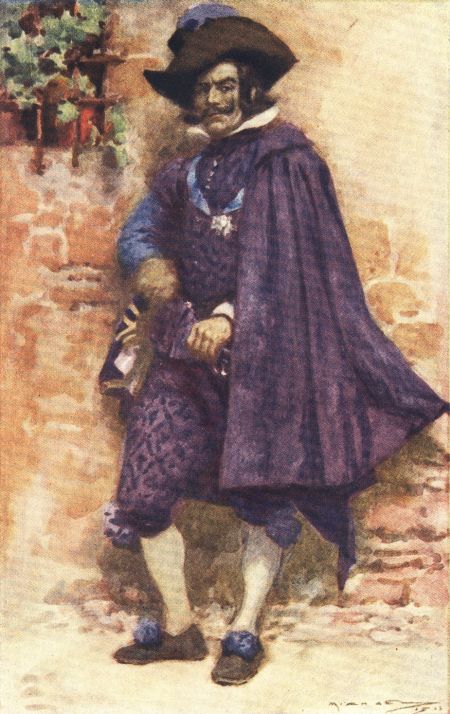
Grenadiers, or Freedom, or The Hidalgo, with its
essentially Spanish arrogance.
My days I spend in courting,
With songs and hearts a-sporting,
Or weaponed for a fight!
The fragrant darkness daring,
I gaily forth am faring,
To roam the streets by night,
For love or war preparing,
With bearing proud and light....
The moon her light is flinging,
The powers of Love are springing,
And sombre passions burn ...
Or wounds or blossoms bringing,
To-morrow I'll return!
While o'er the horizon darkling,
The first faint star is sparkling,
All prudence cold I spurn,—
Or wounds or blossoms bringing,
To-morrow I'll return!
In the course of the morning Schumann,
reluctantly leaving a mass of unfinished MSS.
upon his desk and pianoforte, betakes himself
to his duties at the Conservatorium, where he
has been professor for about a year. Conscientious
and painstaking in tuition as in all else, he
is not naturally a good teacher. He seems to
be devoid of the priceless power of imparting
verbal instruction, or of imparting the secret of
the system whereby a desired effect shall be
attained. His habitual and increasing melancholy
reserve rises up like a barrier between
himself and his pupils: his reticence chills and
bewilders them. His own musical education
has been an entirely personal matter, and not
wrought out upon the accepted scholastic lines.
Moreover, intercourse with musical people has
always "appealed to Schumann far more, and
with greater success, than dry lessons in
thorough bass and counterpoint." Hence,
whilst he appears almost unable to assist the
novice in the beginning, or tadpole stage, he is
able to afford invaluable help and stimulating
criticism to those young artists with whom he
may come in contact, and who adore him for
his sympathetic kindness. The violinist Joachim
never forgot how, as a boy of thirteen, he
played the Kreutzer sonata with his host at the
house of Mendelssohn. Lonely and silent all
the while, Schumann remained in a corner of the
room; but subsequently, while Joachim was
sitting near him, he leaned forward and pointed
to the stars, shining down into the room through
the open window. He patted the lad's knee
with gentle, friendly encouragement. "Do
you think they know up there" he queried,
"that a little boy has been playing down here
with Mendelssohn?"—This question was the
very essence of Schumann,—romantic, mystical,
full of tender dreams.
His composition-lessons over, he conducts
a part-singing class. Orchestral conducting is
abhorrent to him; it is "too defiant and conspicuous
a task." He cannot make his meaning
clear by word of mouth: and in gesture he is
singularly deficient. But in part-singing he is
an excellent instructor, because he is seated at
the piano and can indicate there the suggestion
which he fails to convey viva-voce. Even now,
in the wreck of his abilities as a pianist, it is
possible to imagine what he might have been:
he can produce an extraordinary depth and
richness of tone, seeming to obtain some of his
effects by unusual and almost illegitimate means.
His accentuation is very slight, and he uses both
pedals too frequently and too freely. Notwithstanding
these peculiarities, however, the same
indefinable magic pervades his piano-playing as
his compositions.
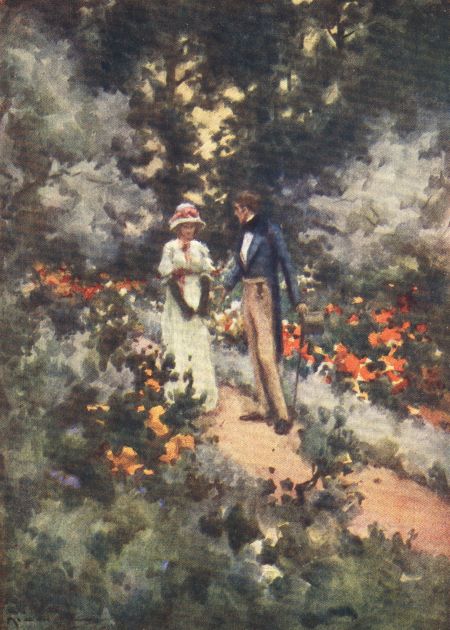
I WILL NOT CHIDE.
I will not chide, although my heart should break,
Though all my hopes have died, lost Love, for thy dear sake—
I will not chide.
(Ich grolle nicht).
Nervous, excitable, uneasy, the master
draws a breath of relief when the class is dismissed.
The pleasant Hebraic face of Mendelssohn
nods in at his door in passing. The two
musicians are so busily engaged, that often they
hardly exchange a word for weeks together.
Mendelssohn, the recipient of many a generous
and whole-hearted encomium from his devotee
Schumann, does not return this fraternal
enthusiasm. To his well-balanced mind, the
silent moody man and his productions are too
wild, too eccentric, too uncanny. He regards
them, at times, with a species of grudging
admiration: at others, he sides in heart, if not
in speech, with the current opinion of the town.
"Opposition to all artistic progress has always
been a distinctive characteristic of Leipzig
musical society," and therefore horror-stricken
hands are uplifted at the editor of the Neue
Zeitschrift für Musik, his heretical doctrines, and
still more heretical deeds. The good people of
the Thomas-School Choral Society, the audience
at the Gewandhaus concerts, the subscribers to
opposition musical papers, regard Herr
Schumann very much as the knight regarded
the lady at the close of his own magnificent
Waldesgesprach.
"The hour is late, the night is cold,—
Who through the forest rides so bold?
The wood is wide,—thou art alone,—
O lovely maid, be thou my own!"
"Great is the craft and guile of men,
With grief my heart is rent in twain;
Far sounds the bugle to and fro,—
Away! my name thou dost not know!"
"Thy steed and thou so bright array'd,
So wondrous fair, thou lovely maid,—
—I know thee now! God! let me fly!
Thou art the fairy Lorelei!"
"Thou know'st me now—my towers do shine
Deep mirror'd in the dark blue Rhine,—
The wind blows cold, the day is o'er,—
Thou shalt escape me never more!"
In the afternoon, Schumann, back at home,
is occupied with creative work. This, perhaps,
is the most congenial part of his day: for, as it
has been said of him, he sees life musically, and
whatever happens to impress him takes the
form of music. Steadily, deliberately, of set
purpose, and yet with the authentic fire of
divine inspiration infusing his smallest effort, he
has conquered, one by one, in every field of
creative art. His finest pianoforte works were
composed during the wretched years of strain
and stress whilst he was waiting to marry Clara,
held apart from her by her jealous and inexorable
father, until (again like the Brownings) the
lovers took matters into their own hands and
were married in sudden and in secret. Three
of his four great symphonies saw the light in
one year, 1841,—an achievement truly colossal.
Last year, 1843, he was studying and perfecting
himself in chamber music. His life, outwardly
so uneventful, has been abnormally prolific in
brain-work: and that of no fatal fluency or
shallow meretriciousness, but conceived upon
the highest possible plane. "The more clearly
we examine Schumann's ideas," says Liszt,
"the more power and life do we discover in
them: and the more we study them, the more
are we amazed at the wealth and fertility which
had before escaped us." And his own theories
of art are bound to evolve themselves thus:—for
"Only think," he has written, "what
circumstances must be combined to produce
the beautiful in all its dignity and splendour.
We need,—1st, lofty deep purposes and ideality
in a composition; 2nd, enthusiasm in description;
3rd, masterly execution and harmony of
action, closely combined; 4th, innate desire for
giving and receiving, a momentarily favourable
mood (on both sides, that of listener and performer);
5th, the most fortunate conjunction
of the relatives of time, as well as of the more
especial question of place and other accessories;
6th, sympathy of impression, feelings and ideas—a
reflection of artistic pleasure in the eyes of
others."
And these definitions apply in all their
detail to the outcome of Schumann's happiest
year of all,—the year after his union with Clara,—the
time when like a bird he burst into infinite
ecstasy of melody, and eclipsed himself with the
number, variety and bewildering beauty of his
vocal compositions. That perfect balance
between words and music, that power of
identifying himself with the poet whose words
he "sets," which pre-eminently differentiates
Schumann from all other musicians, was born
of "hopes fulfilled and mutual love." There
are no songs which can compare with his, in
passionate intensity and depth of emotion. It
may be that only the skilled and sympathetic
musician can interpret them with full effect:
but the least expert auditor can be poignantly
affected by them. Especially is this the
case with his treatments of Heine,—the one
poet par excellence in whom he discovers all he
can desire of power, of pathos and of passion.
"The lyrics Die Lotos-blume (The Lotus-flower)
and Du bist wie eine Blume (Thou art like unto a
flower) are among the most perfect things found
in the realms of song, in their enchanting truth
and delicacy of sentiment"; and "not one of all
those subtle touches ... which make Heine's
poetry what it is, has been lost upon
Schumann." Ich grolle nicht (I will not chide)
is unapproachable in its white-heat of uttermost
despair.
I will not chide, although my heart should break,
Though all my hopes have died, lost Love, for thy dear sake—
I will not chide.
Though thou be bright bedeck'd with diamond-shine,
No ray of joy illumines that heart of thine,
I know full well!
I will not chide, although my heart should break,—
I saw it all in dreaming,
I saw the night that thro' thy soul is streaming,
I saw the snake that on thy heart doth feed,
I saw, my love, how sad thou art indeed,—
I will not chide!
Die Beiden Grenadieren (The Two Grenadiers),
with Schumann's favourite Marseillaise
introduced in such masterly fashion at the end,
remains an unrivalled utterance of manly and
patriotic grief.
To France were returning two Grenadiers,
In Russia they long did languish,
And as they came to the German frontier,
They hung down their heads with anguish.
'Twas then that they heard the story of woe,
That France was forlorn and forsaken,
Besieged and defeated, and crushed by the foe,
And the Emp'ror, their Emp'ror was taken!
* * * * *
"My cross of honour and crimson band
Lay on my heart right surely;
My musket place within my hand,
And gird my sword securely:
So will I lie there and harken, dumb,—
Like sentry when hosts are camping,—
Till I hear the roar of the cannon come,
And the chargers above are tramping!
"Above me shall ride then my Emp'ror so brave,
While swords are flashing and clashing,
While sabres are fiercely contending,—
In that hour of his need I will rise from the grave,
The cause of my Emp'ror defending!"
And in his song-cycle Frauen-lieben und
Leben (Woman's Life and Love) he has evinced
"extraordinary depths of penetration into a
side of human character which men are generally
supposed incapable of understanding—the
intensity and endurance of a pure woman's
love."... Yet who should know it if he
does not?...
Towards evening, various folk drop in by
ones and twos,—musical acquaintances, it need
hardly be said, for there is no other topic than
that of their art which they can discuss with
Robert Schumann. The discussion may possibly
be on their part only, with a man like this, of
whom it is told that one day he went into a
friend's house, whistling softly sotto voce,—and,
with nothing but a cheery nod, walked to the
piano and opened it,—played a few chords,—made
a modulation, and returned to the original
key,—shut the piano, gave another courteous
nod, and—exit, in utter silence! He is, indeed,
capable of sitting for hours in the midst of a
merry chattering company, completely lost in
thought, employed upon the evolution of some
musical thought. But when he does speak, his
words are all altruistically ardent, full of eager
praise and joyful appreciation for the great
names of music, whose excellencies he loves to
point out. "The great masters, it is to them
I go," he avows with the humility of a child,—"to
Gluck the simple, to Händel the complicated,
and to Bach the most complicated of all." His
admiration of "John Sebastian" is boundless.
"I always flee to Bach, and he gives me fresh
strength and desire for life and work....
The profound combinations, the poetry and
humour of the new school of music principally
emanate from Bach."
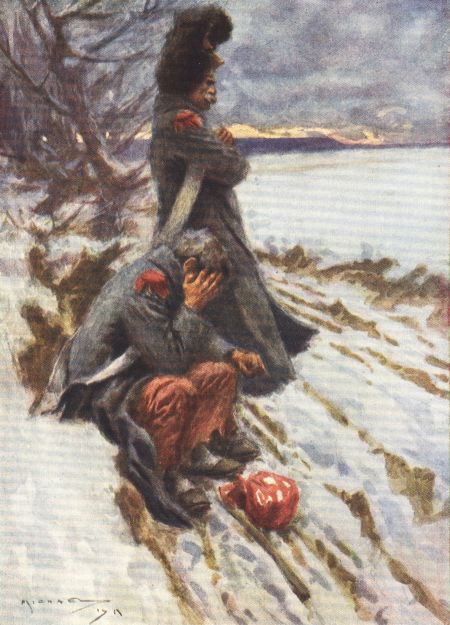
THE TWO GRENADIERS.
To France were returning two Grenadiers,
In Russia they long did languish,
And as they came to the German frontier,
They hung down their heads with anguish.
(Die Beiden Grenadieren).
Mozart is to him, as to all great artists, a
veritable divinity. "Do not put Beethoven,"
says he, "too soon into the hands of the young:
steep and strengthen them in the fresh animation
of Mozart.... The music of the first act of
Figaro I consider the most heavenly that Mozart
ever wrote." And with his customary absolute
freedom from professional envy, he terms
Mendelssohn "the Mozart of the nineteenth
century," and will not even sit in the same room
with anyone who disparages him. He has upheld
with noble enthusiasm the merits of such rising
stars as Chopin, Heller, Gade, Sterndale-Bennett,
Berlioz, Franz, and Brahms. He has, it may be
said, only one bête noir, the blatant and flamboyant
Meyerbeer. Regarding Wagner, his
opinion is in abeyance. "Wagner is a man of
education and spirit ... certainly a clever
fellow, full of crazy ideas, and audacious to a
degree.... Yet he cannot write or think of
four consecutive lines of beautiful, hardly of
good, music." So Schumann has delivered
himself at one time; but he is ready to revoke
this judgment, and to declare, "I must take
back one or two things I said after reading the
score of Tannhäuser; it makes quite a different
effect on the stage. Much of it impressed me
deeply."
When his guests depart, Schumann accompanies
them a little way, that he may, according
to his invariable custom, spend an hour or so of
the evening at Popper's Restaurant. There,
should his friend Verhulst be present, he enjoys
what is for him a free and animated conversation—otherwise,
among the chink of glasses and
clank of plates, he remains aloof and meditative.
Evening darkens slowly into the calm
spring night,—that Frühlingsnacht which he has
set forth in such exquisite music—as he regains
his home and rejoins his wife. She is practising
softly lest the children awaken, but rises with a
smile of joy, and receives her husband as though
he had been a year away. Side by side, holding
each others' hands, they sit by the window and
inhale the sweet April air. A sense of beatitude
encompasses them.
"Hast thou done well to-day, Robert?"
she enquires.
"Well? Yes—very well: better than I
hoped or expected. A soft voice seemed to
whisper to me whilst I worked, 'It is not in vain
that thou art writing.'... But in such an
hour as this, my Clara, I long more deeply to
give expression to my holiest thoughts. To
apply his powers to sacred music must always
be the loftiest aim of an artist. In youth we
are all too firmly rooted to earth with its joys
and sorrows: but with advancing age, our
branches extend higher. And so I hope the
time for my efforts in this direction is not far
distant."
"It is, then, at present, eluding you—the
study of sacred music?"
"It demands a power of treating the chorus—a
knowledge of superb ensemble and massive
effects to which I have not yet attained." And
he heaves a sigh as of one faced with mighty
problems. For to this man, "from whom the
knowledge of no emotion in the individual heart
is withheld, it is a matter of extreme difficulty
to give expression to ... those feelings
which affect the whole of mankind in common."
"For you, who can realize human love so
devoutly, there should be no eventual hindrance
to the expression of love towards God," says
the little dark-eyed woman, pressing his hand
with warm devotion.
"You yourself are the concrete expression
of love towards God," the composer murmurs,
gazing down at her in the twilight—"you and
your music together. If I once said I loved you
because of your goodness, it is only half true.
Everything is so harmoniously combined in
your nature, that I cannot think of you apart
from your music—and so I love you one with
the other." A sudden spasm contracts his face
as he speaks—he turns his head wildly to and
fro.
"Robert!" she exclaims, "what is the
matter? You shuddered—your hand has gone
cold and clammy. What ails you?"
"What are those distant wind-instruments?"
he asks in awestruck tones. "What are they
playing? Don't you hear? Such harmonies
are too beautiful for earth...."
Clara strains her ears into the stillness.
"There is nothing—nothing audible whatever,"
she asseverates. "Robert, you are ill—you
have overworked your head—"
"I have heard them before ... beautiful,
beautiful!—Ah! now they are silent!" and he
passes his hand over his brow with a bewildered
air.
"Come, dearest, you are overwearied—come
and sleep sweetly." Schumann permits
himself to be led away from the window by his
anxious wife: slowly he regains his composure.
"My little treasure!" he whispers, clasping
her tenderly, "what should I be without your
loving care of me? Clärchen ... Schumann ...
I wonder whether an angel imagined the
names together?"
"May that angel guard thee, Robert," says
she, "and all that is thine and mine, for ever."
The open piano glistens whitely in the
darkness: she closes it as they leave the room.
Printed by Percy Lund, Humphries & Co., Ltd.
Bradford and London. 4880
Transcriber's notes:
Punctuation has been normalized.
Page 10: "Barret" changed to "Barrett."
"Elizabeth Barrett Browning".
Page 21: "pevote" changed to "devote."
"... more time to devote towards composing".
Page 23: "frühstück" changed to "Frühstück."
"... a modest Frühstück or breakfast".
Page 45: "blume" changed to "Blume."
"The lyrics Die Lotos-blume".