Toward morning I heard somebody scream. I was dreaming that I was with
Luke in the grove, and that he touched my hand, and that it was me that
screamed. I heard it again and again, with another noise. Then I woke
up. It wasn't me. It was somebody else.
I sat up in bed and shook Ma. She snores, and I couldn't hardly wake
her. By the time she sat up I heard Pa move. When we got to the stairs I
heard him at the back door.
"What's wanted?" I heard him say.
"Quick, quick! Lemme in! Lemme in!" I heard from outside. I knew it was
Mis' Bingy. We got down-stairs just as Pa opened the door, and she come
in. Everything about her was blowing—her long hair and her outing
nightgown and the baby's shawl. She could hardly breathe, and she leaned
against the door and tried to lock it. I went and locked it for her.
She sat down, and the baby was awake and crying, so she jounced it up
and down, without knowing she was doing it, while she told what was the
matter. She twisted up her hair, and I didn't think she knew she done
that, either. She had on a blue calico waist to a work dress, over her
nightgown, and her bare feet were in shoes, with the laces dangling. Ma
took one look at her, and went and put on the teakettle. She said
afterward she never knew she done that, either.
Mis' Bingy told us what happened. She had been laying awake up-stairs
when he come home. He called her, and she didn't answer. Then he brought
a flatiron and beat at the door. Then he yelled that he'd bring the ax.
When he went for it, she slipped out of her bedroom and locked the door,
and hid in the closet under the stairs till she heard him run up 'em.
Then she started.
"He'll kill me," she says. "He said he'd kill me. I've never known him
like this before."
Pa come back from his room, part dressed.
"I'll go and get the constable," he says.
"Oh," says Mis' Bingy, "don't arrest him! Don't do that!"
"Lookin' for to be killed?" says Pa. "And us, too, for a-harborin' you
here?"
She fell to crying then, and the baby cried. Mis' Bingy said things to
herself that we couldn't understand. Ma come and brought her a cup of
hot water with the tea that was left in the teapot poured in it. Ma had
a calico skirt around her shoulders, and she was in her bare feet.
"He'll kill you," Ma says to Pa, "on your way to the constable. I
wouldn't go past that house for anything, to-night."
I remember how anxious she looked at him. She was anxious, like Mis'
Bingy'd been when she said not to arrest Keddie.
Pa muttered, but he didn't go out. In a little while, Ma said best get
some rest, so we went up to the room again, and took Mis' Bingy. Her and
Ma laid down on the bed, and I got the canvas cot that was folded up in
there. My feet stuck out, and I couldn't go to sleep. But the funny
thing to me was that both Ma and Mis' Bingy went to sleep in a little
while.
I laid there, waiting for it to get light. The window was a little bit
gray, and off in the wood-lot I could hear a bird wake up and go to
sleep again. I liked it. Early in the morning always seemed to me like
some other time. Things acted as if they was something else. Even the
bureau looked different.... Pretty soon the sky changed, and the dark
was thin enough so I could see Ma and Mis' Bingy. Ma's light-colored
hair had got all around her face. I thought how young she looked asleep.
She looked so little and soft. She looked as if she'd be nice. I guess
she would have been if she hadn't had so much to do. I never remembered
her when she didn't have too much to do, except once when she broke her
arm; and her arm hurt her so that she was cross anyway. Once, when the
boys bought her a plaid silk, she was nice for two days; but then
wash-day come and spoiled it again, and she couldn't get back.
Ma never had much. I don't believe any of us know her like she'd be if
she had things to do with, and didn't have to work so hard, and Pa and
the boys wasn't all the time picking on her. They all say mean things. I
do, too, of course. I always dread our meals. We don't scrap over
anything particular, but everything that comes up, somebody's always got
some lip to answer back. And Ma's easy teased and always looking for
slaps. That's me, too; I'm easy teased, though I don't look for it.
Laying there asleep, Ma seemed like somebody I didn't know, and I felt
sorry for her. She was having a rotten life.
And Mis' Bingy. The bandage was off her head, and I saw the big red
mark. She was awful thin and blue-looking, with cords in her neck. She
was young, not more than thirty. Ma was old; Ma was forty, and, awake,
she looked it. I could see Mis' Bingy's bare arm, and it was strong as
an ox. It laid around the baby, that was sleeping on her chest. I liked
to look at it. But I thought about her life, too, and I wondered how
either Ma or her kept going at all. And what made them willing to.
Neither of 'em was having a real life. Look what love had brought them
to....
And there was me, starting in the same way, with Luke.
It was broad daylight by then, so I could see around the room. There
wasn't a carpet, and the plaster was cracked. So was the pitcher, that
was just for show, anyhow, because we washed in the kitchen. I'd tried
to fill it for a while, but Ma said it was putting on. In a little bit
we would all be sprucing up in the kitchen, with Ma trying to get
breakfast and everybody yipping out at everybody else.
And I'd just fixed it so's that all my life would be the same thing as
their lives.
I slipped out of bed and began to dress. It wasn't Sunday, but I opened
the drawer where my underclothes were, and took out them that had lace
edging. I put on my best shoes and my white stockings. Then I went out
in the hall closet and got down my new muslin that I'd worn only once
that summer, and I took it over my arm and went down in the kitchen.
When I was all ready I went through the door that opened stillest, and
outdoors.
Out there was as different as if it didn't belong. You thought of the
fresh smell of it before you thought of anything else. Nothing about it
had been used. And the thin sunshine come right at you, slanting. Over
the porch the morning-glories were all out. I pulled off a whole great
vine of 'em and put it around my neck. Then I ran. I wasn't going to go
anywheres or do anything. But I was clean and dressed up, and outdoors
was just as good as anybody else has.
I went down the road toward the sun. It seemed as if I must be going
toward something else, better than all I knew. I felt as if I was a
person, living like persons live. I wondered why I hadn't done this
every morning. I wondered why everybody didn't do it. I kind of wanted
to be doing it together with somebody. Everybody I knew done things so
separate. I wisht everybody was with me.
I wanted to sing. So I did—the first thing that come into my head. I
put my head back, so's I could see the two rows of the trees ahead,
almost meeting, and the thick blue between them. And then I sung the
first thing that come into my head, and I sung it to the top of my
voice:
"O Mother dear, Jerusalem,
When shall I come to Thee?
When shall my sorrows have an end?
Thy joys when shall I see?
O happy harbor of God's saints!
O sweet and pleasant soil!
In thee no sorrow can be found,
Nor grief nor care nor toil."
And when I got to the end of the verse somebody said:
"I don't believe you can possibly mind if I thank you for that?"
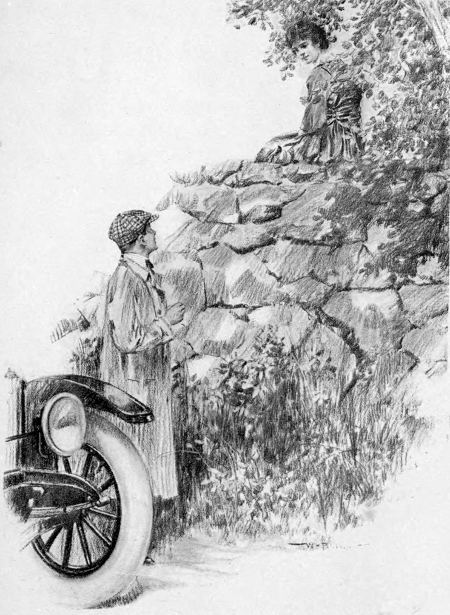
The man must have been sitting by the road, because he was right there
beside me, standing still, with his hat in his hand.
I says, "I can't sing. I just done that for fun."
"That's what was so delightful," he says. And then he says, "Are you
going to the village? May I walk along with you?"
"No, I ain't going to town," I says. "I ain't going anywheres much. But
you can walk where you want to. The road's free."
He walked side of me. I looked at him. He was good-looking. He was so
clean—that was the first thing I noticed about him. Clean, and sort of
brown and pink, with nothing more on his face than was on mine, and yet
he looked manly. He was big. He had a wide way with his shoulders, and
he held his head nice. I liked to look at him, so I did look.
And all at once I says to myself, What did I care so I got some fun out
of it. Other girls was always doing this. Lena Curtsy would have talked
with him in a minute. Maybe I could get him to ask me to go to a show. I
couldn't go, but I thought I'd like to make him ask me.
"Was you lonesome?" I ask', looking at him.
He didn't say anything. He just looked at me, smiling a little. I
thought I'd better say a little more. I wanted him to know I wasn't a
stick, but that I was in for fun, like a city girl.
"You don't look like a chap that'd be lonesome very long," I says. "Not
if you can get acquainted this easy."
He kept looking at me, and smiling a little.
"Tell me," he says, "do you live about here?"
"Me? Right here. I'm the original Maud Muller," I says.
"And what do you do besides rake hay?" he says.
I couldn't think what else Maud Muller done. I hadn't read it since
Fifth Reader. So I says:
"Well, she don't often get a chance to talk with traveling gentlemen."
"That's good," he says, "but—I wouldn't have thought it."
I see he meant because I done it so easy and ready, so I give him as
good as he sent.
"Wouldn't you?" I says. "Well, I s'pose you get a chance to flirt with
strange girls every town you strike."
He looked at me again, not smiling now, but just awfully interested. I
see I was interesting him down to the ground. Lena Curtsy couldn't have
done it better.
"Flirt," he says over. "What do you mean by 'flirt'?"
I laughed at him. "You're a pretty one to ask that," I says, "with them
eyes."
"Oh," he says serious, "then you like my eyes?"
"I never said so," I gave him. "Do you like mine?"
"Let me look at them," he said.
We stopped in the road, and I looked him square in the eye. I can look
anybody in the eye. I looked at him straight, till he laughed and moved
on. He seemed to be thinking about something.
"I think I like you best when you sing," he said. "Won't you sing
something else?"
"Sure," I says, and wheeled around in the road, and kind of skipped
backward. And I sung:
"Oh, oh, oh, oh! Pull down the blinds!
When they hear the organ play-ing
They won't know what we are say-ing.
Pull down the blinds!"
I'd heard it to the motion-picture show the week before. I was thankful
he could see I was up on the nice late tunes.
"I wonder," says the man, "if you can tell me something. I wonder if you
can tell me what made you pick out this song to sing to me, and what
made you sing that other song when you were alone?"
All at once the morning come back. Ever since I met him I'd forgot the
morning and the sun, and the way I'd felt when I started out alone. I'd
just been thinking about myself, and about how I could make him think I
was cute and up-to-date. Now it was just as if the country road opened
up again, and there I was on it, opposite the Dew Drop Inn, just being
me. I looked up at him.
"Honest," I says, "I don't know. I guess it was because I wanted you to
think I was fun."
He looked at me for a minute, straight and deep.
"By Jove!" he says, and I didn't know what ailed him. "Have you had
breakfast?" he ask', short.
"No," I says.
"You come in here with me and get some," he says, like an order.
He led the way into the yard of the Dew Drop Inn. There's a grape arbor
there, and some bare hard dirt, and two or three tables. Nobody was
there, only the boy, sweeping the dirt with a broom. We sat down at the
table in the arbor. It was pleasant to be there. A house wren was
singing his head off somewhere near. A woman come out and sloshed water
on the stone at the back door and begun scrubbing. A clock in the bar
struck six.
Joe Burkey, that keeps the Inn, come out and nodded to me.
"Joe," I says, "did Keddie Bingy come back here?"
Joe wiped his hands on the cloth on his arm, and then brushed his
mustache with it, and then wiped off the table with it.
"I don't know nothin' about K. Bingy," says Joe. "I t'run him out o' my
place last night, neck and crop, for bein' drunk and disorderly. I
ain't seen him since."
I looked up at Joe's little eyes. They looked like the eyes of the wolf
in the picture in our dining-room. Joe's got a fat chin, and a fat
smile, but his eyes don't match them.
"You coward and you brute," I says to him, "where did Keddie Bingy get
drunk and disorderly?"
Joe begun to sputter and to step around in new places. The man I was
with brought his hand down on the table.
"Never mind that," he says, "what you've to do is bring some breakfast.
What will you have for your breakfast, mademoiselle?" he says to me.
"Why," I says, "some salt pork and some baking powder biscuit for me,
and some fried potatoes and a piece of some kind of pie. What kind have
you got?"
"Apple and raisin," says Joe, sulky. But the man I was with he says:
"Suppose you let me order our breakfast. Will you?"
"Suit yourself, I'm sure," says I. "I ain't used to the best."
The man thought a minute.
"Back there a little way," he says, "I crossed something that looked
like a trout stream. Is it a trout stream?"
"Sure," says Joe and I together.
"How long," says the man, "would it take that boy there to bring in a
small catch?"
"My!" I says, "he can do that quicker'n a cat can lick his eye. Can't
he, Joe?"
"Very well," says the man. "We will have brook trout for breakfast. Make
a lemon butter for them, please, and use good butter. With that bring us
some toast, very thin, very brown and very hot, with more good butter.
Have you some orange marmalade?"
"Sure," says Joe, "but it costs thirty cents a jar; I open the whole—"
"Some orange marmalade," says the man. "And coffee—I wonder what that
good woman there would say to letting me make the coffee?"
"Her? She'll do whatever I tell her," says Joe. "But we charge extra
when guests got to make their own coffee."
"And now," says the man, getting through with that, "what can you bring
us while we wait? Some peaches?"
"The orchard," says Joe, "is rotten wid peaches."
"Good," says the man. "Now we understand each other. If mademoiselle
will excuse me, we will set the coffee on its way."
I set and waited, thinking how funny it was for a man to make the
coffee. All Pa ever done in his life to help about the cooking was to
clean the fish.
I went and played with a kitten, so's not to have to talk to Joe. I
didn't know what I might say to him. When I come back the table was laid
with a nice clean cloth and napkins that were ironed good and dishes
with little flowers on. When the woman come out to the well, I ask' her
if I could pick some phlox for the table. She laughed and said yes, if I
wanted to. So I got some, all pink. I was just bringing it when the man
come back.
"Stand there, just for a minute," he says.
I done like he told me, by the door of the arbor. I thought he was going
to say something nice, and I hoped I'd think of something smart and
sassy to say back to him. But all he says was just:
"Thank you. Now, come and sit down, please."
We fixed the flowers. Then Joe brought a basket of beautiful peaches,
and we took what we wanted. The man took one, and sat touching it with
the tips of his fingers, and he looked over at me with a nice smile.
"And now, my child," he says, "tell me your name."
I always hate to tell folks my name. In the village they've always made
fun of it.
"What do you want to bother with that for?" I says. "Ain't I good enough
without a tag?"
He spoke almost sharp. "I want you to tell me your name," he says.
"I want you to tell me your name," he said
So I told him. "Cosma Wakely," I says.
He looked funny. "Really?" he says. "Cosma?"
"But everybody calls me 'Cossy,'" I says quick. "I know what a funny
name it is. My grandmother named me. She was queer."
"Cossy!" he says over. "Why, Cosma is perfect."
"You're kiddin' me," I says. "Don't you think I don't know it."
He didn't say he wasn't.
"Ain't you going to tell me your name?" I says. "Not that I s'pose
you'll tell me the right one. They never do."
"My name," he says, "is John Ember."
"On the square?" I asked him.
"Yes," he says. He was a funny man. He didn't have a bit of come-back.
He took you just plain. He reminded me of the way I acted with Luke. But
usually I could jolly like the dickens.
"You travel, I guess," I says. "What do you travel for?"
He laughed. "If I understand you," he said, "you are asking me what my
line is?"
I nodded. I'd just put the pit in my mouth, so I couldn't guess
something sassy, like pickles.
"I have no line," he says. "It's an area."
"Huh?" I says—on account of the pit.
"I travel," says he, "for the human race. But they don't know it."
"Sure," I says, when I had it swallowed, "you got to sell to everybody,
I know that. But what do you sell 'em?"
He shook his head.
"I don't sell it," he says. "They won't buy it. I shall always be a
philanthropist. The commodity," says he, "is books."
"Oh!" I says. "A book agent! I'd have taken you for a regular salesman."
"I tell you I don't sell 'em," he says. "Nobody will buy. I just write
'em."
I put down my other peach and looked at him.
"An author?" I says. "You?"
"Thank you," says he, "for believing me. Nobody else will. Now don't
let's talk about that. Do you mind telling me something about yourself?"
"Oh," I says, "I've got a book all made out of wrapping paper. It ain't
wrote yet, it's in the bottom drawer. But I'm going to write one."
"Good!" he says. "Tell me about that, too."
I don't know what made me, except the surprise of finding that he was
what he was, instead of a traveling man. But the first thing I knew I
was telling him about me; how I'd stopped school when I was fourteen,
and had worked out for a little while in town; and then when the boys
got the job in the blast furnace, I came home to help Ma. I told him how
the only place I'd ever been, besides the village, was to the city,
twice. Only two things I didn't tell him at first—about what home was
like, and about Luke. But he got them both out of me. Because I wound up
what I was telling him with something I thought was the thing to say.
Lena Curtsy always said it.
"I've just been living at home for four years now," I said. "I s'pose
it's the place for a girl."
I remember how calm and slow he was when he answered.
"Why no," he says. "Your home is about the last place in the world a
girl of your age ought to be."
"What do you know about my home?" I asked him quick.
"I don't mean your home," he says. "I mean any home, if it's your
parents' home. If you can't be in school, why aren't you out by this
time doing some useful work of your own?"
"Work," I says. "I do work. I work like a dog."
"I don't mean doing your family's work," he said. "I mean doing your own
work. Of course you're not going to tell me you're happy?"
"No," I says, "I ain't happy. I hate my work. I hate the kind of a home
I live in. It's Bedlam, the whole time. I'm going to get married to get
out of it."
"So you are going to be married," he says. "What's the man like—do you
mind telling me that?"
I told him about Luke, just the way he is. While I talked he was eating
his peaches. I'd been through with mine quite a while now, so I noticed
him eat his. He done it kind of with the tips of his fingers. I liked to
watch him. He sort of broke the peach. The juice didn't run down. I
remembered how I must have et mine, and I felt ashamed.
Before I was all through about Luke, Joe come in with the trout, and
some thin, crispy potatoes on the platter, and the toast and the
marmalade; and Mr. Ember went to see about the coffee. He brought it out
himself, and poured it himself—and it smelled like something I'd never
smelled before. And now, when he begun to eat, I watched him. I broke my
toast, like he done. I used my fork on the trout, like him, and I
noticed he took his spoon out of his cup, and I done that, too, though
I'd got so I could drink from a cup without a handle and hold the spoon
with my finger, like the boys done. I kept tasting the coffee, too,
instead of drinking it off at once, even when it was hot, like I'd
learned the trick of. I didn't know but his way just happened to be his
way, but I wanted to make sure. Anyway, I never smack my lips, and Luke
and the boys do that.
"Now," he said, "while we enjoy this very excellent breakfast, will you
do me the honor to let me tell you a little something about me?"
I don't see what honor that would be, and I said so. And then he told me
things.
I'm sorry that I can't put them down. It was wonderful. It was just like
a story the teacher tells you when you're little and not too old for
stories. It turned out he'd been to Europe and to Asia. He'd done things
that I never knew there was such things. But he didn't talk about him,
he just talked about the things and the places. I forgot to eat. It
seemed so funny that I, Cossy Wakely, should be listening to somebody
that had done them things. He said something about a volcano.
"A volcano!" I says. "Do they have them now? I thought that was only
when the geography was."
"But the geography is, you know," he says. "It is now."
"Did that big flat book all mean now?" I says. "I thought it meant long
ago. I had a picture of the Ark and the flood and the Temple, and when
the stars fell—"
"Oh, the fools!" he says to himself; but I didn't know who he meant, and
I was pretty sure he must mean me.
All the while we were having breakfast, he talked with me. When it was
over, and he'd paid the bill—I tried my best to see how much it was, so
as to tell Lena Curtsy, but I couldn't—he turned around to me and he
says:
"The grass is not wet this morning. It's high summer. Will you walk with
me up to the top of that hill over there in the field? I want to show
you the whole world."
"Sure," I says. "But you can't see much past Twiney's pasture from that
little runt of a hill."
We climbed the fence. He put his hand on a post and vaulted the wire as
good as the boys could have done. When he turned to help me, I was just
doing the same thing. Then it come over me that maybe an author wouldn't
think that was ladylike.
"I always do them that way," I says, kind of to explain.
"Is there any other way?" says he.
"No!" says I, and we both laughed. It was nice to laugh with him, and it
was the first time we'd done it together.
The field was soft and shiny. There was pretty cobwebs. Everything
looked new and glossy.
"Great guns!" I says. "Ain't it nice out here?"
"That's exactly what I've been thinking," says he.
We went along still for a little ways. It come to me that maybe, if I
could only say some of the things that moved around on the outside of my
head, he might like them. But I couldn't get them together enough.
"It makes you want to think nice thoughts," I says, by and by.
"Doesn't it?" he says, with his quick, straight look. "And when it does,
then you do."
"I don't know enough," I says. "I wisht I did."
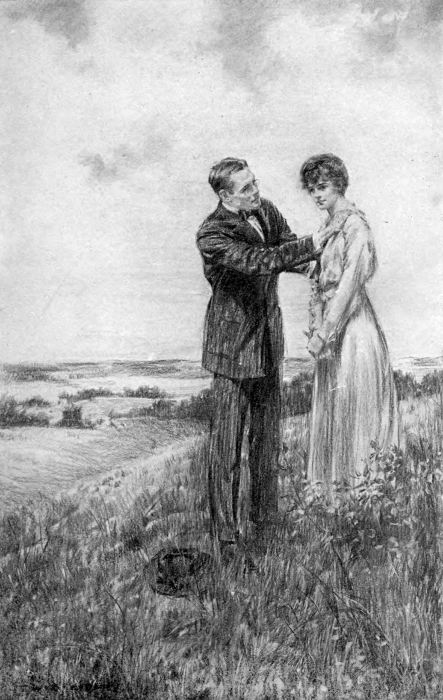
I'll never, never forget when we come to the top of the little hill. He
stood there with nothing but the sky, blue as fury, behind him.
"Now look," he says. "There's New York, over there."
"You can't see New York from here!" I says. "Not with no specs that was
ever invented."
He went right on. "Down there," he says, "are St. Louis and Cincinnati
and New Orleans. Across there is Chicago. And away on there are two days
of desert—two days, by express train!—and then mountains and a green
coast, and San Francisco and the Pacific. And then all the things we
talked about this morning: Japan and India and the Alps and London and
Rome and the Nile."
I wondered what on earth he was driving at.
"Which do you want to do," says he, "go there, and try to find these
places? You won't find them, you know. But at least, you'll know they're
in the world. Or live down there in a little farm-house like that one
and slave for Luke?"
"But I can't even try to find them places," I says. "How could I?"
"Maybe not," he says. "Maybe not. I don't say you could. All I mean is
this, Why not think of your life as if you have really been born, and
not as if you were waiting to be born?"
"Oh," I says, "don't you s'pose I've thought of that? But I can't get
away."
"Yes, you can," he says, looking at me, earnest. "Yes, you can. If you
just say the word."
I was as tall as he was, and I looked right at him, with all the
strength I had.
"Do you think," I says, "that because I'm from the country I ain't on to
all such talk as that? Do you think I don't know what them kind of
hold-outs means? We ain't such fools as you think we are, not since
Hattie Duffy thought she was going to Paris, and ended in the bottom of
a pond. They's only one way any of us ever gets to see any of them
things, and don't you think we're fooled unless we want to be. No, sir.
We ain't that fresh."
He scared me the way he whirled round at me.
"You miserable little creature!" he said. "What are you talking about?"
"Well," I says, "don't you ever think I—"
Then he done a funny thing. He drew a deep breath, and took his hat off
and looked up at the sky and off over the fields.
"After all," he said, "thank God this is the way you are beginning to
take it! When a country girl can protect herself like that, it is
growing safe for her to be born. Listen to me, child," he says.
He had me puzzled for fair by then. I just listened.
"Just now," he says, "I called you a miserable little creature. That was
because you quite naturally mistook me for one of the wretched hunters
whom women have been trying to evade since the beginning. Well, I was
wrong to call you that. Instead, I applaud your magnificent ability to
take care of yourself. I applaud even more in the incident—but I won't
bother you with that."
I kept trying to see what he meant.
"Now you must," he said, "try to understand me. What I meant to say to
you was that with the whole world to choose from, you are, in my
opinion, quite wrong to settle down here to your farm and your Luke and
the drudgery you say you loathe, without ever giving yourself a chance
to choose at all. Perhaps you would come back and settle here because
you wanted to.... I hope you would do that, under somewhat different
conditions. But don't settle here because you're trapped and can't get
out."
"But I can't get out—" I was beginning, but he went on:
"I know perfectly well that a great part of the world would think that I
ought not to be talking to you like that. They would say that you are
'safe' here. That you and Luke would have a quiet, contented life. But I
care nothing at all for such safety. I think that unreasonable
contentment leads to various kinds of damnation. If you were an ordinary
girl I should not be talking to you like this. I should not have the
courage—yet; not while life treats women as it treats them now. But in
spite of your vulgarity, you are a remarkable woman."
"In spite of what?" I says.
"I mean it," he says, "and you must let me tell you, because you seem to
be, in all but one thing, a fine straightforward creature. But in the
way you treat men, you are vulgar, you know. Not hopelessly, just
deplorably. Now tell me the truth. Why did you pretend to flirt with me?
For that isn't your natural manner. You put it on. Why did you do that?"
I could tell him that well enough.
"Why," I says, "I guess it was the same as the singing. I wanted you to
know I wasn't a stick. I wanted you to think I was lively and fun. It's
the way the girls do. I can't do it as good as they do, I know that."
"Promise me," he says, "that if ever you do get out, you'll be the fine
and straightforward one—not the other one."
"I shan't get out," I says. "I can't get out."
"'I can't get out,'" he says over. "'I can't get out.' It's a great
mistake. If you feel it in you to get out, then you'll get out. That's
the answer."
"I do," I says. "I always have. I wake up in the mornings...."
I'll never know what it was that come over me. But all of a sudden, the
me that laid awake nights and thought, and the me that had come out in
the sun that morning was the only me I had, and it could talk.
"Oh," I says, "don't you think I'm the way I seemed back there on the
road. I'm different; but I'm the only one that knows that. I like nice
things. I'd like to act nice. I'd like to be the way I could be. But
there ain't enough of me to be that way. And I don't know what to do."
He took both my hands.
"And I don't know what you're to do," he said. "That is the part you
must find for yourself. It's like dying—yet a while, till they get us
going."
We stood still for a minute. And then I saw what I hadn't seen
before—what a grand face he had. He wasn't like the handsome men on
calendars or on cigar boxes, or on the signs. He was like somebody else
I hadn't ever seen before. His face wasn't young at all, but it looked
glad, and that made it seem young.
"I wish you wouldn't ever go way," I says.
"I ought to be miles from here at this moment," he says. "Now see here
... I want to give you these."
He took two cards out of his pocket, and wrote on them.
"This one is mine," he says. "If you do come to the city, you are surely
to let me know that you are there. And if you take this other card to
this address here, this gentleman may be able to give you work. Now
good-by. I'm going to cut through the meadow, and I suppose you'll be
going back."
He put out his hand.
"Don't go," I says. "Don't go. I shan't ever find anybody to talk to
again."
"That's part of your job, you know," he says. "Remember you have a
job. Good-by, child."
He went off down the slope. At the foot of it he stopped.
"Cosma!" he shouts, "don't ever let them call you anything else, you
know!"
"I won't," I says. "Honest, I won't, Mr. Ember."
I watched him just as far as I could see him. On the road he turned and
waved his hand. When he was out of sight I started to go back home. But
when I see things again, I'll never forget the lonesomeness. Things was
like a sucked-out sack. I laid down in the grass—I haven't cried since
the last time Pa whipped me, six years ago, but I thought I was going to
cry now. Then I happened to think that was the way I'd have done before
I met him; but it wasn't the way I must do now. Instead, I got up on to
my feet and I started for home on the run. It was like something was
starting somewheres, and I had to hurry.