It was 1:25 dial when the Chicago Pneumatic
glided noiselessly into the switching section at
Washington. Seizing their grips and coats, the
party moved out on to the platform of the sleeper.
In a moment the huge train had been raised by the
hydraulic lift, and was soon standing in the depot
of the capital of the United States.
What a beautiful and fairy-like scene presented
itself to Junius Cobb! A depot of magnificent
proportions, exquisite workmanship and finish, and
possessing a hundred conveniences never dreamed of
in his time. The great vaulted roof was set with
thousands of electric lights which appeared like
brilliant stars in the firmament. Thousands more,
in every direction and in every conceivable place,
made the vast chamber as bright as the midday sun.
At the barriers of the discharging section a great
but orderly crowd was pushing and elbowing its
way to a closer position at the gate. All Washington
knew that Junius Cobb, the man of two centuries
ago, would arrive on that particular train, and
a great multitude had congregated to catch a
glimpse of him.
As he passed through the gates, while the police
pushed back the crowd, he heard their exclamations
and remarks:
“There he is!”
“Where?”
“There, with Commissioner Rawolle—on his
left.”
“I believe him to be a fake.”
“Oh, he’s a toola!”
“He has never slept a hundred years!”
“Isn’t he a young man to have lived so long?”
“What’s the matter with you? he didn’t live, he
just slept.”
“They say he is an officer in the army yet.”
“Well, people will be gulled!”
Thus were the expressions bandied about, and
fell upon the ears of Cobb in a harsh and unpleasant
manner. He was not flattered by the remarks
he heard. Already, it seemed, there was a desire to
doubt his identity.
As they neared the center of the hall, someone in
the crowd cried: “Junius Cobb! Junius Cobb!
Three cheers for Junius Cobb!” And the building
rang and echoed back the salutation. Surely this
was flattering. His reception, after all, was not
without sincerity on the part of many of that vast
throng.
A step or two more, and Cobb and Rawolle entered
an electric drag, while Lyman bade them
good-night, or rather good-morning, and hurried
away to report.
Away, and at a rapid gait, sped the drag, its
wheels of rubber giving no sound on the elastic
pavement of the street, its headlight flashing out
a brilliant beam, while ever and anon the driver
caused a muffled-toned gong, whose sound was low
and musical, to indicate the approach of the carriage.
Looking from the window on his side, Cobb saw
to what extent street illumination had progressed
in a hundred years. At every fifty feet, on either
side, were arc lamps; and this at two in the morning,
when those of the shops were extinguished.
No gas lights were visible. It was a September
morning, but the air was mild and balmy, and it
seemed like a morning in early spring. Many people
were upon the street, and the electric drags,
with their flashing lights and musical gongs, were
passing in every direction.
At exactly 1:42 dial the drag stopped under the
arch of the entrance to the President’s mansion, and
Junius Cobb was received by the chief magistrate
of the United States.
Emory D. Craft, President of the United States,
was a tall, rotund, and pleasant gentleman of over
sixty years of age. His head was massive, and his
features square and clean-cut; his hair almost white,
and a beard heavy and gray. A man of great perception,
executive ability, true kindness, and wisdom,
he ruled the greatest nation on earth as a
loving father rules his household, with justice and
firmness.
As Rawolle and Cobb alighted, he descended the
steps, and, advancing, extended his hand to the
former, exclaiming:
“I welcome you back, Mr. Rawolle.”
“Thank you, sir; and let me present Mr. Junius
Cobb.”
“Mr. Cobb, I cannot express to you the pleasure
of this meeting;” and the President shook the young
man’s hand heartily. “Be assured that your remarkable,
nay, wonderful, case has been uppermost
in my mind since first I became aware of your existence.”
“Nor can I, Mr. President, express the gratification
I feel in meeting and shaking the hand of the
chief magistrate of this great nation, especially
when that magistrate is ruling the country a hundred
and forty years after my birth.”
Cobb seemed proud of the fact that he, of all the
world, could make such a statement.
A few moments later, the President and Cobb
were sitting before a glowing, cheerful fire, engaged
in earnest conversation.
Mr. Rawolle had been dismissed by the President,
and had hastened to the welcome he knew
awaited him from his wife and children.
“There, Mr. President,” said Cobb, after a long
recital of his life and the facts attending his entombment
on Mt. Olympus, “you have the whole
story. It is a remarkable one, is it not?”
“Stranger than any fiction I ever read,” he exclaimed.
“I can scarcely believe that I behold the
intimate friend and contemporary of my great-grandfather
in the person of one so young as you.”
He looked at Cobb in wonder and awe.
“And are you the great-grandson of Hugh Craft,
my dear old friend of 1887?” cried Cobb with joy,
as if a new tie had been found to bind him to this
new world.
“Yes; here is our family history.” He arose and
went to the cabinet, and returned with a large book.
“Read it;” opening it and handing it to the other;
“you will there see the history of your friend.” He
placed his finger on the page.
Cobb read slowly, and like one in a dream, this
page of the history of the dead—this chronicle of
the life of his chum and bosom friend.
“First Lieutenant, Captain, Major,” he read,
“killed at the battle of Ottawa, August 5, 1917.”
He read it over twice; then suddenly turning to
the President, he cried:
“A soldier’s death! A noble ending to a noble
man! But what battle is this in which he died?”
“’Tis a long story—too long for to-night,” the
President replied; “but, in brief, it was the decisive
termination of English power in North America.
Canada desired annexation to the United States:
England opposed it. British troops were massed
on Canadian soil, and she endeavored to prevent the
loss of her colonies. War between the Canadians
and the mother country followed. We looked on,
but offered no assistance. It was not until the cry
for freedom became a wail of misery and a piteous
appeal for succor, that we interfered. We offered
England $500,000,000 for the whole of her possessions
in North America. The offer was refused
with contempt. Indignation prevailed throughout
the United States, and public opinion demanded
that assistance be given to the suffering people in
their struggle for freedom. Great Britain was notified
by joint resolution of Congress of March 22,
1917, to evacuate Canada and all territory between
the boundaries of the United States and parallel
fifty-one degrees of north latitude. The demand
was refused; and on April 2, in full Congress, war
was declared against England. For twenty-five
years, or from about 1890, this country had been
building first-class ships of war, fortifying its coast
and putting the nation in a condition to enforce
its demands.”
“They hadn’t done much in my time,” broke in
Cobb, with a thought of the utterly defenseless condition
of the country in 1887.
“No,” continued the President; “but Congress, as
you can see by referring to history, in 1890 awoke
to the necessity of national protection. In 1917,
we could and did enforce our demand. The war
was short but terrible. England’s great but slow
floating fortresses were no match for our harbor
vessels. She never gained entrance to a single
port of note, but lost many of her finest ships in
the attempt. On land, of course, the effect of our
arms was more rapid. An army marched across
the border, and the decisive battle of Ottawa was
fought. Here was gathered all of England’s force
of occupation. On August 5, 1917, her army was
utterly routed, and laid down its arms. With the
loss of her American army, and the destruction of
many of her finest iron-clads, England asked for
terms. By the protocol of October 16th, England,
in consideration of $250,000,000, relinquished, forever,
all possessions on the continent of North America,
together with all national property, fortifications,
etc.”
“And poor Craft never lived to see the fruits of
his nation’s courage,” said Cobb.
“No; he died in the charge of his regiment.”
And then, after a pause: “But Hugh Craft still
lives. I will introduce him to you to-morrow—do
not ask any questions,” as Cobb was about to interrupt
him—“to-morrow, or rather to-day; and until
then, you must sleep.”
It was 4 dial when Cobb was shown to his apartments.
The next morning Cobb was awakened from a
refreshing slumber by a voice singing:
“He sleeps; he wakes; the hour is late.
Arise, get up! the clock strikes eight.”
Springing quickly from his bed, he glanced
around the room. Again the song and words, and
again he looked, but saw no one. Wondering
much at the occurrence, he proceeded with his toilet.
At 8:45 he was with the President at breakfast,
and had been introduced to Mrs. Craft and her
lovely daughter, Mollie.
“Papa says he has taken complete possession of
you, Mr. Cobb; and I am so glad, for I want you
to tell me so much about those queer old days so
long ago;” and she gave him a pleasant smile.
“We are delighted, dear Mr. Cobb, to have you
with us. You must consider this your home now,
for you have no other, you know;” and good Mrs.
Craft spoke in a motherly tone of voice.
“And, of course, you will want a sister;” Mollie
Craft cast her eyes down in a shy manner.
“Yes,” said Mr. Craft, with evident pleasure and
hope in his voice. “We want you to feel that you
have not left all your friends in that distant age.
We desire you to consider this your home as long as
it shall please you to do so. My wife and I will
endeavor to be a mother and a father to you; our
daughter, a sister; our son, a brother.”
Mollie Craft was a lovely girl of nineteen years—tall,
dark, and robust. She was possessed of a clear
skin, sparkling eyes, and beautiful teeth. She was accomplished,
and a leader among the young ladies of
her set. Her disposition was frank, kind, and retiring.
No wonder that Cobb’s eyes often wandered
in her direction during that breakfast! It
seemed to him that he had never before seen so
lovely a face and figure, nor such charming ways as
Mollie Craft was mistress of. Yes, there was one
face that held just comparison with that before
him; there was one figure that matched the symmetry
of Mollie Craft; but, alas! she was no more!
The queen was dead, but the princess lived! So
passed the thoughts in his mind.
Adjourning to the President’s library, for Mr. Craft
loved to have his family about him while he
smoked his after-breakfast cigar, the conversation
proceeded with animation, but always with Cobb
as the central figure.
“A Captain in the army, a Colonel up a tree;
Quite soon I’ll be a Major, as you can plainly see.”
As the words came forth in a free though quiet
manner, a young man entered the door, stopped, and
then, bowing, exclaimed:
“Pardon me; I did not know that you had company.”
Junius Cobb looked up; then, starting from his
seat with a white and perplexed expression, sprang
toward the stranger, who, in astonishment, drew
half back through the door.
“Hugh Craft! How came you here?”
Recovering himself, the man replied, but with
embarrassment:
“Well! that’s very good, indeed! Asking a man
what he is doing in his own father’s house!” and
he gave a quiet, undecided laugh.
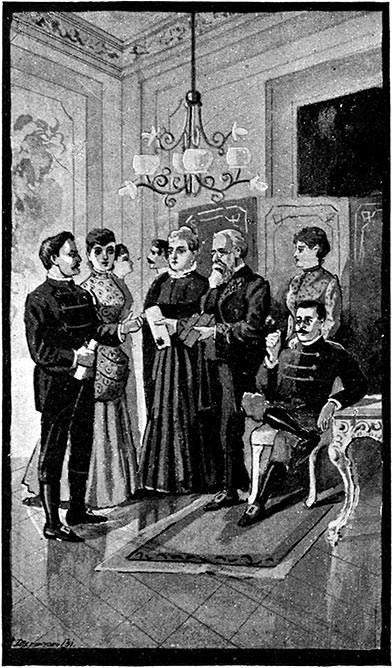
“Mr. Cobb, my son. Hugh, this is Mr. Junius
Cobb; you know who he is,” with emphasis on the
pronoun.
Junius Cobb rubbed his eyes in confusion. He
comprehended the situation at once, and also remembered
the President’s words of the night before,
when he said, “Hugh Craft still lives.”
Hugh Craft bowed, and moved behind his sister’s
chair, and whispered:
“Is he dangerous?”
Cobb, as he turned around, overheard the words,
and smiled.
“No, Hugh,” he exclaimed; “not dangerous, but
amazed. You are the exact image and counterpart
of him who was my dearest and best friend, your—”
he hesitated a moment—“your great-great-grandfather.”
Hugh and Mollie looked bewildered, while Mr.
Craft’s face wore a smile. The situation was too
comical, and all burst into a hearty laugh, Cobb
joining the others.
“It is funny, is it not, to hear me talking of having
been the friend and chum of this man’s great-great-grandfather?”
A few moments and everything had been fully
explained to Hugh, who had been absent a week,
and had not heard that Cobb was at the executive
mansion.
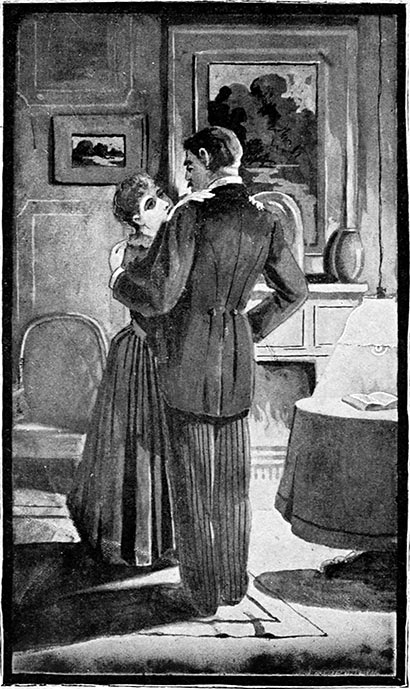
“Dear brother,” said Mollie, as she put her arms
about the young man’s neck and kissed him, “I
want you and Mr. Cobb to be brothers; to be to
each other as your great-great-grandfather and he
were long years ago.”
“Hugh,” said his father, “as you have returned so
opportunely, you can take charge of Mr. Cobb—Junius,
let us call him, if he does not object—until
time for the reception. I have some work to
attend to, and I know Junius will excuse me—will
you not?” to him.
“Certainly. Do not let my presence interfere with
your work; and let me thank you for calling me
Junius. I hope you will always continue to do so.”
For an hour these three—Hugh, Junius, and Mollie—sat
and chatted. To Cobb it seemed very
home-like and most pleasant, and his companions
so kind and natural. Hugh was so like that other
Hugh, and Mollie so charming and witty, that he
scarcely realized, as Hugh looked at his watch and
said that they had better dress, that an hour had
passed away.
On their way to their rooms, Cobb suddenly
said:
“By the bye, Hugh, I wish to ask you a question.
This morning, as I was about to arise, I heard someone
singing in my room. It was not a very melodious
voice, but nevertheless clear and distinct;
something like ‘Get up, arise; the hour is late!’
Can you explain it?”
“Nothing easier. It was my old phonograph
clock—one I picked up at a pawn-shop one day—a
relic of fifty years back;” and he laughed at the
thought of his friend’s perplexity at hearing the
words ground out of the machine.
“Why did I not think of that?” petulantly.
“Why, they were just getting them out in 1887.
Do you not have them now?”
“No; we have something better. The electric
clock companies of every city run their wires to
nearly every house in their towns, and to these
wires are attached electric clocks. The resident
buys the clock for five dollars, and pays twenty-five
cents a month for its use. At the central station, a
large clock of the finest make, and absolutely correct
in its time, causes all the others to follow its
movements. Thus every house has a dial which
records correctly and requires no care. It is simple,
cheap, and beneficial.”
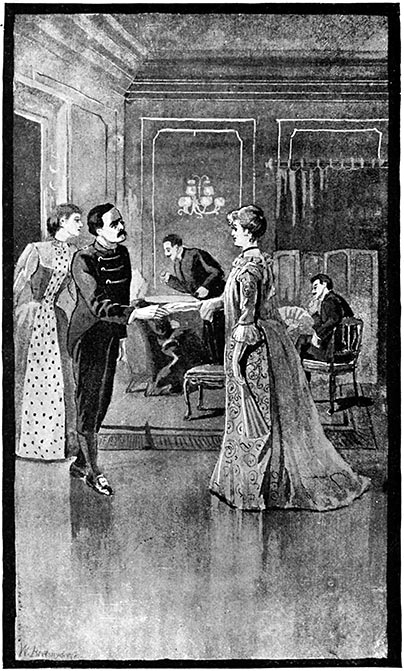
At the President’s reception, at 11 dial, Junius
Cobb was the lion of the hour. Senators gave him
every attention; the foreign ambassadors treated
him as a man of the greatest distinction; the
army and navy laughed, chatted, and petted him.
Just after the introductions of the Senators, Tsu-nan-li,
the Minister from China, and dean of the
diplomatic corps, approached and bowed low to
the President; the latter, also, bowing low, in acknowledgment
of the salutation, said:
“O Sölal obik! Dälolsös obe nuikön mani yunik olse
kela sava milagik de deil penunols, fuliko, nen dot.”[1]
As the President made the introduction, Cobb
gave a slight start at hearing him speak in Volapük;
then a smile of pleasure came over his
face.
Bowing to the young man, the Minister expressed
his pleasure at the meeting by saying:
“O Söl obik löfik! Panunob das pebinols bevü
pedeilölsis balmil jöltum jölsevel, kaleda olsik. In
ols logob oni, kel pegönom fa Confucius e Buddha
god, in dat padälols denu getön luti lifa. Ogivols
stimi obe fa visitöl obi ven plidos-la olsi kömön.”[2]
Seeing the President about to translate the words
of Tsu-nan-li, Cobb quickly interrupted him, and,
smiling at his ability to meet at least one of the
requirements of this new age, said:
“O Söl President, ed ols, Sölal obik! No stunolsös
lilön obi gepükön in pük egebols. Lesevob, äs
jen lefulnik, ut kel päbüsagos äyelos lemödik, das
tim äkömomöv ven valik nets kulik äcälomsöv volapüki.
Klödöl das et del no äbinom fago, ästudob
at pük, ed adelo logob bizugi osa.”[3]
An expression of astonishment overspread the
faces of the other two gentlemen, and the President
exclaimed, gleefully:
“Good enough, Cobb! There’s one thing of the
past equal to the present.”
The others claiming attention, no more was said,
and the throng of visitors met, were introduced to
and passed the President and Junius Cobb.
A little later a party of officers were talking to
Cobb near the grand stairway. Speculation was rife
as to what his position in the army would be, knowing
that he had been dropped for desertion years ago.
The discussion was animated, though Cobb himself
took no active part in it.
“Ah! Cobb, my boy,” and a tall young man, in the
full regimentals of a captain in the Second Cavalry—Cobb’s
old regiment—came forward and familiarly
slapped him on the shoulder:
“I have been looking for you. Hugh informs me
that you will undoubtedly be restored to your rank
in the army; in fact, he says that they can’t help
giving you your commission again.”
“Ah!” from Cobb, as he looked the other in the
face.
“Yes,” smiling. “And you will be my lieutenant,
for I command your old troop of the Second. You
will be a böd seledik (rare bird) to us in the Second,
and, as I am ordered to join my regiment on
the 10th of next month, I intend applying to have
you ordered back with me.”
Several smiled at the young captain’s cool impudence,
but Cobb simply bowed in recognition of the
other’s desire for his company to his regiment.
Captain Hathaway, of the Second Cavalry, was
twenty-eight years of age, tall in stature, slight in
build, and wearing a little, light mustache. With a
glass in his eye, and a voice which sounded low and
sweet, he was, with all his known cool impudence,
a right clever fellow. But he had taken a dislike
to Junius Cobb—and why?
“Yes, Mr. Cobb,” taking up the army style of address
to lieutenants, “I fear you will have to give
up your good times here and join me. Of course
they cannot refuse my request,” with a new adjustment
of his eyeglass.
“Mr. Hathaway—”
“Captain, sir; Captain Hathaway. You forget
you are addressing your troop commander;” with
dignity.
A flush overspread Cobb’s face, and he bit his lip
to keep from replying in hot terms to this uncalled-for
insolence.
“Captain Hathaway, you will join your regiment
before the 10th, and I will not be with you. Good
morning.” He turned on his heel and moved toward
a group near the President.
With a laugh at the blank and crushed expression
of the young Captain, the others sauntered
away.
“Damme! but that’s cool. Going to order his
Captain to his regiment, eh! Going to get me out
of the way and take my girl. Well, I guess not!”
and he, too, moved off.
At lunch, after the reception and departure of the
guests, Cobb laughingly referred to the little incident
of the morning. The President expressed his
disapprobation of the Captain’s behavior, and told
Cobb that he would give the young man a lesson
in politeness.
According to their programme, the office of the Secretary
of War was visited at 13:30 dial, and Cobb
was introduced to Mr. Fowler, the urbane but quick-spoken
Secretary. Here he learned much concerning
himself, and a great deal in regard to the state of
the nation for purposes of offense and defense.
“Yes,” continued the Secretary, in answer to a
question from Cobb, “your status has been investigated,
and it is found that you were dropped from
the army, as a deserter, December 1, 1904, under the
provisions of section 1,229, Revised Statutes. But
when the wonderful facts attending your return to
life, and the existence and tenor of your leave of
absence, given in 1887, had been fully laid before
the Supreme Court, sitting in bank, yesterday, a
decree was formulated that you have never been out
of service—that is, legally. You, therefore, Mr.
Cobb, revert back to your status as a Lieutenant in
the Second Cavalry.”
Cobb meditatively admitted that perhaps Captain
Hathaway would, after all, take him back to
the regiment on the 10th of the following month.
“But,” and the Secretary looked inquiringly at
the President, who nodded assent, “you would have
been the ranking Major in the cavalry arm in 1918,
the year you would have retired for age, according to
the law at that date.”
“Yes, you are quite right, Mr. Secretary, I would
have been a Major; but I never expected to have
been the senior. Promotion at that time was slow
beyond measure—stagnated. Old men with grown-up
families were still Lieutenants, while the majority
of Captains were old, rheumatic, and unable to
perform their duty. Lieutenants did all the
work.” Cobb seemed to revert back in disgust at
the state of promotion in 1887.
“As you would have been retired as the ranking
Major,” slowly continued the Secretary, paying no
attention to Cobb’s remarks, but with a pleasant air
at the news he was about to communicate, “the
President has been guided by a sense of the justice
due you, and has nominated you to the Senate as
such, to rank at the head of the list. Further, as
a vacancy exists in the grade of Lieutenant-Colonel,
your promotion to that rank follows as a natural
course. The Senate will confirm the nomination at
16 dial. Allow me, Colonel Cobb, to congratulate
you,” and the good old man clasped the hand of
the new Lieutenant-Colonel; nor was the President
slow in his congratulations. Both seemed to have
taken a special interest in Cobb.
He, in his turn, expressed his sincere thanks for
their kindness to him, and was highly elated at the
good fortune attending his new life.
“By the records,” continued Mr. Fowler, “you
are thirty-three years of age, for you entered the cataleptic
state at that age; and it has been decided
that the period of your inanimation shall not in
any manner be counted against you. A Lieutenant-Colonel
at thirty-three, the youngest in the
army, you will one day command the army of the
United States.” And he smiled kindly, while the
President looked admiringly upon his protégé.
Then, for an hour, the Secretary gave Colonel
Cobb a brief history of the army during the hundred
and odd years which had passed.
“We have, to-day,” said he, “a population of
over 500,000,000 of people, occupying sixty-eight
States and nine Territories, covering the whole
of North America from the Isthmus of Panama to
the Arctic, and from the Pacific to the Atlantic
Ocean.”
“This is a vast and wonderful increase since the
census of 1880,” exclaimed Cobb. “Why, I remember,
in 1887, that the most sanguine statistician estimated
only 67,000,000 for the next census, that
of 1890.”
“True,” returned the Secretary. “That was above
the exact figure; if I remember correctly, it was
only 64,987,504. But even that population was a
trifle more than twenty-five per cent. increase upon
the census of 1880. The ratio of increase since we
were a nation of only 3,000,000, averaged about
thirty per cent. until the year 1900. In 1910 it fell
to twenty-two per cent., but the next census, that of
1920, showed an increase of thirty-four per cent.
The reason for this great increase is found in the
fact that in 1915 the United States acquired Mexico
and all Central America, with its population of
over 20,000,000 souls, and in 1917, after the
conquest, the whole of British America, with
10,000,000 more. Our population was, by the census
of 1920—counting in 30,000,000 people acquired—137,000,000.
The increase since 1890 has averaged
only 18.5 per cent, every ten years, or less than
two per cent. a year.”
“And is not the country somewhat crowded by this
great mass of people?” inquired Cobb.
“By no means; there is room for double the number—yes,
treble as many. The great States of Slave,
Saskatchewan, Manitoba, Assiniboia, and west of
the isothermal line of thirty-eight degrees are teeming
with people engaged in agriculture.”
“What is the strength of the army required to
protect the country from internal violence, and for
a cadre of a full army?” asked Cobb.
“Our army consists of 148,000 men only, comprising
70,000 infantry, 28,000 cavalry, and 50,000 artillery.
The maintenance and distribution of this
force is very different from what it was during the
years when the country was new and sparsely inhabited.
The artillery is along the sea-board, and is a
full-paid army. The enlisted portion serve for
three years at a time, and are paid at a fixed rate
of $20 per month for the privates. The infantry and
cavalry are distributed among the States; each State
and the Territories of North and South Alaska, and
Indian, has one regiment of infantry and a battalion
of cavalry (400). The posts are near the great
centers of the States, and from them the troops
can be quickly transported to the scene of any disturbance.
Each governor has authority to order out
his State garrison for the preservation of life or
property, or to quell riot or disorder in his State.
The posts are large and handsome, and with fine
and sufficient quarters for officers and men. The
social standing of the soldier is equal to that of the
citizen, except that, as a soldier, full and implicit
obedience to his officers is required and maintained.
The food is excellent, and well cooked and served;
the uniform is of the best material. Now, Colonel,
I will explain the system: The infantry and cavalry
posts are schools for the instruction of the youth
of the country. The period of service is three
years, and the strength of each garrison strictly
maintained. The regiments are recruited wholly
from the State they are in, and do not leave that
State to garrison other posts. This applies only
to the enlisted portion of the army; the officers
hold life positions, and are promoted lineally in
their own branch of the service. They are moved
from station to station every three years, but never
returning to a station at which they had served before.
The pay of the army of instruction, or ‘Inland
Army,’ as it is named, is $5 per month per man,
regardless of grade, and $100 upon discharge after
three years of faithful service. Every year the State
furnishes 500 young men who have passed the
physical examination, and they are sworn into the
service of the United States.”
“But how are these men found? Do they voluntarily
enlist?” broke in Cobb.
“Not all, though many do, in order to get their
service in. Each State keeps a complete record of
every male in its territory—his age, occupation, and
physical condition. From a list of all those between
twenty-one and twenty-four years of age, is
selected, by chance, the yearly quota for military
service, less the number of voluntary enlistments;
and no one so selected can avoid the three years’
service at the State post; nor do they try, I might
add, for no excuse but physical incapacity will
avail to free them from this duty to the State and
Union. From every walk in life they come—the
rich, the poor, the worker and the young man of
leisure. If a son is the only support of a family,
the State supplies a substitute. Except in time of
war, they are never called upon again for military
service. This is what makes the soldier the equal
of the civilian. If a name is once selected and
the man does not report, being at the time a resident
of the State, he is declared a deserter, and
punished as such. To their officers these men are
obedient and respectful; with the civilian, they are
sons of the State, and their duty honorable in the
extreme. Desertion is almost unknown; but when
it does occur, the offender receives the fixed punishment
of twenty years in the government island
prison.”
“And the government pays these men?” asked
Cobb.
“No; the pay proper and subsistence is paid by
the State, but everything else is furnished by the
government.”
“And their duties, what are they?”
“They are taught all the duties of a soldier; they
make marches from point to point, and diffuse a
military feeling among the people; they learn to
ride, to use their arms, and to become able, if the
time occurs, to impart this instruction to others.
They are a guard against interior violence in the
State, and their presence tends to keep alive that
little spark of military ardor which should never
be allowed to die, even in a country deemed ever so
secure from foreign invasion.”
“A system both great and useful!” exclaimed
Cobb. “But how are the artillery regiments kept
full?”
“By enlistment only. The applications far exceed
the demands. The majority come from the Inland
Army, from those who are poor and from those
who have taken a fancy to a military life.”
“And the officers—how are they appointed?”
“They are taken from the non-commissioned officers
who have completed their three years’ service
and are desirous of becoming officers. From the
number of non-commissioned officers of each regiment
competing, the five who lead in the examinations
are sent to the United States military school
and pursue a three years’ course of study. From
this class, in the order of their standing, are filled
the vacancies existing on New-Year’s-Day of each
year, the remainder of the class being discharged.”
“Will you tell me what kind of arms are now
used?” asked Cobb.
“For infantry, the service rifle and milag cartridge;
for cavalry the same, but shorter and lighter,
besides a pistol using the milag cartridge of calibre
35. The artillery use nothing but the heavy guns,
which are of different styles and for different purposes.
Some are for lipthalene, others for lipthalene
and meteorite, and still others using meteorite
alone.”
“What! did I understand you to say meteorite?”
and Cobb looked at the Secretary with a surprised
and earnest expression, while his hand nervously
grasped the back of his chair.
“Yes; certainly. Is there anything strange in the
name, that you should look at me so doubtingly?”
“No; I suppose not,” settling back in his chair.
“But you appeared very much surprised.”
“Yes?”
“Yes; have you seen this explosive? But no; you
could not have seen it. It did not come to the notice
of the government until after your time.”
“Will you show me one of these milag cartridges?”
“Certainly.”
He rang a bell and ordered a box of milag cartridges
sent to him in the office. When the Secretary
had received them, he gave one to Cobb, saying:
“This small bullet does not look much like a
cartridge, does it?”
Cobb took it and carefully examined it.
It was precisely similar to those he had sent to
Washington in 1887. Smiling to himself, he
turned his eyes first upon the President and then
upon the Secretary.
“When did you say these were invented?” he
asked, in an unconcerned manner.
“I can soon tell you.”
Rising and taking a book from the shelf, he
quickly found the history of the milag cartridge,
and read:
“‘Milag cartridge; from the Volapük word
milag, “wonderful.” A cartridge using meteorite
as an explosive; usual charge for 40 calibre, one
and one-third grains; initial velocity, 3,562; range,
four miles. Meteorite was discovered in 1899, and
the formula sold to the government by John Otis,
chief clerk to the Chief of Ordnance.’”
“Chief of Ordnance?” broke in Cobb, quickly.
“Yes; Chief of Ordnance. But have you read
this?”
“No, sir.”
“But there certainly is some mystery here!” exclaimed
the President, highly interested in the conversation.
Cobb took his penknife from his pocket, and
slowly opening it, said:
“If I cut this black cement in the base of the
bullet, I come to the meteorite; am I correct?”
“Yes.”
“And it is white.” And he cut the cement carefully
away and disclosed the little disc of fulminate
and the white explosive surrounding it.
“Strange!” cried both of the others together,
surprised that he should know the color of an explosive
invented after his time.
“Have you any nitric acid?” asked Cobb.
“Yes; here is a little,” and Secretary Fowler
handed him a small bottle containing the nitric
acid used in testing at the War Department.
Dipping a twisted paper into the liquid, Cobb
let fall a single drop of the acid on the explosive
in the bullet; then moving toward the window,
which he threw open, he struck a match and
said:
“If I understand this meteorite, it will, upon
the application of flame, dissipate itself in vapor,
but not explode.”
“Hold, Colonel!” cried Mr. Fowler, in great alarm,
as he and the President drew back. “It will explode
and tear your hand into pieces.”
It was too late. Holding his hand containing the
bullet well out through the window, he touched the
flame to the cartridge. A slight flash from the fulminate
followed, and then the meteorite disappeared
in a colorless gas. Holding aloft the empty
bullet, he exultingly cried:
“Was I not right when I claimed a knowledge of
this explosive?”
Then Junius Cobb explained how he had discovered
this compound; how he had transmitted it to
the Chief of Ordnance in 1887, and the restrictions
he had placed upon that office regarding the sealed
packet containing the formula. Time passed, and
he had been dropped for desertion, but the sealed
packet still remained in the office of the Chief of
Ordnance. It had been opened, and a subordinate
in that office had stolen his secret, sold it to the
government, and reaped immense reward and honor.
But Cobb had no ill-feeling against the man; he
had died long years ago; and what did this theft
avail him at that moment?
“You are a wonderful man, my dear Colonel; and
I believe that, in the dim past, you conceived the
idea of many of our greatest inventions of to-day.”
President Craft arose from his seat as he spoke.
Thanking Secretary Fowler for his kindness,
Cobb turned to the President and asked:
“Is it time to take our departure?”
“Yes, Colonel.” Then, turning to the Secretary,
he said: “By the way, Mr. Fowler, be so kind as to
have an order made out directing Captain Hathaway,
Second Cavalry, to report to Colonel Cobb to-night
for orders; send it at once.”
“Sir, I will attend to it immediately.”
“Then, Mr. Fowler, we will say good afternoon.”
“Good afternoon, gentlemen;” and then to Cobb:
“Come and see me, Colonel, whenever you feel inclined.”
In fifteen minutes they were back at the executive
mansion.
After partaking of a cup of coffee, as was the
President’s custom at that hour, they entered the
drag again, and were rapidly propelled toward the
Capitol.
Cobb noticed the handsome exterior of the buildings,
their beautiful architecture and harmonious
coloring.
Pennsylvania Avenue was, indeed, a beautiful
thoroughfare. Its buildings were large and grand;
great hotels, clubs, bazars, churches, and theatres
were thrown together in one complex but magnificent
order. Over the sidewalk, on either side,
and also covering the cross-streets, was a glass canopy
supported by pillars of the same material,
handsomely carved and finished. The windows and
doors were grand in their size; and what seemed
strange and dangerous to Cobb, no sash was to be
observed; nothing but great panes of glass, some
white and clear, others of various hues.
The streets and walks were as clean as a parlor
floor, and no obstructions were to be seen upon them.
The pavement was of a soft gray tint, and like
a felt blanket in its appearance. The sidewalks
were laid in tessellated work of all the hues of the
solar spectrum. Statues and works of art were
everywhere observable. Great trees ranged on either
side, while beautiful plants and green grass plats
surrounded many of the buildings.
As the rays of the sun in the west fell upon the
buildings, they were reflected back to the opposite
side of the street, again and again reflected, and
the eye of Cobb beheld the parallel lines of Pennsylvania
Avenue adorned with millions of sparkling,
dancing lights, meeting at the farther end in one
great diamond whose lustre could almost compare
with the sun itself.
Ah! what a grand sight!—worthy of a life of inanimation
for a thousand years. Cobb feasted his
eyes on the beauty of the scene. Lost in the ecstasy
of the moment, he was rudely awakened to a
sense of the reality by the President remarking:
“It is a grand sight, is it not?”
“Yes! yes, indeed! Grand beyond expression!”
“This street, Colonel Cobb, is said to be the
handsomest in the world.”
“I can well believe it! I cannot conceive of one
that could be more beautiful.”
“And yet, Colonel, it is all glass.”
“Glass?”
“Yes; plain, cheap, common glass.”
“You mystify me! You do not mean to tell me
that these magnificent buildings are built of
glass?”
“The buildings, walks, streets, and nearly everything
visible to your eye is of glass.”
President Craft enjoyed the look of amazement
and incredulity which overspread the other’s face.
“Surely you are jesting with me! Glass is no
substance for any of these purposes.”
“Remember,” slowly, “you are in the year 2000.
That which was impossible, unheard of, to you in
1887, may be possible and common with us to-day.”
“True! I find I must accept as possible every
theory and proposition advanced, until it is, by undeniable
evidence, totally disproved. But blame
me not if doubt sometimes arises. Will you stop
the drag a moment?”
“Certainly,” was the puzzled answer.
Turning his head to the driver in the rear, he ordered
the drag stopped at the curb.
In front of the entrance to the Dom Kanitöl Legletik
(Grand Opera House), by the side of two tall
and elaborately carved pillars covered with fine and
thread-like filigree work, the drag came to a standstill.
Without a word of explanation, Cobb
sprang from his seat, walked up to the nearest pillar
and dashed the heel of his boot against a beautiful
rose of pure white. A look of triumph came
into his eyes. They might make it to appear like
glass, but it was not glass! The beautiful rose lay
crushed against its stem, its delicate petals bent
and twisted, and its leaves flattened together.
The President comprehended the young man’s motive,
and smiled. As Cobb again entered the drag,
the President said, but kindly:
“You have destroyed that beautiful glass rose,
and because you doubted me.”
“Blame me not for doubting, kind sir, nor blame
me for investigating. Without investigation we
could never arrive at a certain knowledge of the
truth or falsity of any proposition.”
“And you have investigated?”
“Yes.”
“And proved—”
“That glass is not the component part of that
pillar,” with confidence.
“One word will dispel that illusion.” Mr. Craft
spoke very deliberately.
“Speak it, then, I pray you,” with greater astonishment
than ever.
“Malleability!”
Like a flash of lightning, the conviction of the
truth of the President’s words fell upon the doubting
man’s mind. Malleable glass! that ignis-fatuus
which had caused men’s minds to turn from reason
to insanity; had caused chemists and philosophers
throughout the known world to struggle for years
and years, and finally go down to their graves with
their hopes unfulfilled; that art which was said
to have been known in the third century, during
the reign of Tiburon—had been again discovered
and made known to mankind.
“And is all of this of malleable glass?” still
with wonder.
“All. The art has been known for over fifty
years. It is common glass, composed of silica,
lime, barytes, etc., to which is added nitrate of zesüd
and coloring matter. It is cheaper than wood
or any of the metals, is about the weight of copper,
and has its strength and malleability. It is made
into every conceivable form and shape, and has
almost entirely taken the place of the cheaper metals
where temper and extreme rigor are not desired.
It never tarnishes, decays, or breaks. When exposed
to the inclemencies of the weather, it is as
bright to-day as it was yesterday, or years ago.”
Wonderful, indeed, were the inventions of the
twentieth century!
At 16:5 dial the President’s electric drag glided
evenly and noiselessly out of Pennsylvania Avenue,
rounded the corner, and stopped at the grand entrance
to the Dom Lon, or Capitol, of the United
States.
An hour was passed in visiting the three houses
of Congress, and Cobb carefully noted the working
of the national legislature.
On the way home, the President said:
“There is a Senate of 136 members, or two from
each State, presided over by the First Vice-President;
two lower houses of 400 and 280 members,
respectively, presided over by the Second and Third
Vice-Presidents. The Smadom, or lower house,
is that body in which are introduced all bills of a
private nature whatsoever—such as claims or appeals
for money, position, justice, rights and franchises.
If approved in this house they go to the
Senate, and are usually approved by that body. In
the Gledom, or upper house, originate all bills for
the good of the nation at large. The system of
committees, as of old, is a component part of the
machinery of this house. The functions of the Senate,
with the restrictions imposed upon it by the
creation of a third house, have undergone few
changes since your time.”
“Are there any changes in the method of electing
Senators, Representatives, and chief magistrate?”
“Yes; the President’s term of office is five years,
taking office on New-Year’s-Day of every year divisible
by five without a remainder—that is, it commenced
in 1940. In the October of the year preceding
the taking of office, the governors of all the
States assemble at a designated place and nominate
four candidates for each office. The two houses of
Representatives meet on the first day of November,
and proceed to elect, from the nominees, the President
and Vice-Presidents.”
“Then, I take it that a Republican house would
surely elect a Republican, and vice versa?” said
Cobb.
“There is no Republican or Democratic party,
nor any two parties, as formerly. One party, the
American, rules this country. No diversity of
opinion exists as regards the welfare of the nation.
No policy from the candidates for the Presidency
is called for, or expected. To-day there are no
great questions to split the nation with contention.”
“But may not the choice of the people be defeated,
where the election is in the hands of so few?”
“Again experience teaches that you are wrong.
Under the old system the people had a choice between
two men; now the nation has a choice from
four men. The extent and population of the country
being so enormous, individual voting would necessitate
long and arduous work in counting and
verifying the vote. Were the two distinct parties in
the field, our method might—mind you, I say
might—work disadvantageously to one party or the
other. The fairness of the system now in vogue
consists in the celerity of the election after nomination,
and in the number of nominees. No man can
tell beforehand upon whom will fall the nominations
given by sixty-eight men, high in social and
civil standing, and who come together from every
part of this great country—men who are, as a rule,
unacquainted with one another. Even if collusion
brought about a certain nomination, who could tell
that that nominee would be elected by the two
houses? The nomination takes place October first,
and certified copies, signed by every governor present,
though he may have voted against the nominee,
are delivered by the three governors oldest in years
to each of the three Vice-Presidents of the United
States. On the first day of November the names
are presented, and the balloting commences in both
houses simultaneously, and continues until an election
is completed by that house. The record is sent
to the Senate, and that body counts and verifies the
vote of the two houses, and announces the result.”
“Very simple, after all,” remarked Cobb. “But
has it always worked well?”
“Perfectly.”
“How long have you been in office, Mr. President?”
“Since last New-Year’s-Day.”
“Will you get the nomination again, do you
think?”
“No; assuredly not. One of the most strictly
followed laws of the United States is that no man
can hold the same elective office twice. This law
applies to all national and State offices, but not to
others below that dignity.”
“Does this law not tend to deprive the State and
nation of the services of tried and capable men?”
“Colonel, this nation is great; vast. There are
thousands upon thousands of men fully as capable
as those in office, ready to take their turn.”
“And federal appointments, the patronage of the
party, as it was formerly called—how are they
made?”
“Wholly upon competitive examination; not in
scientific branches of learning, but upon the duties
required, together with a common-school education.”
“And the term of office?”
“In many positions it is during active life; in
others for ten years, or less periods. But in all
cases the period is known, and removals never take
place without cause having been given by the incumbent:
this cause is never political.”
“I see we are at the door,” reluctantly said Cobb,
as the drag came to a standstill before the entrance
to the executive mansion, “so will ask you no more
questions to-day—but the subject is one of great
interest to me.”
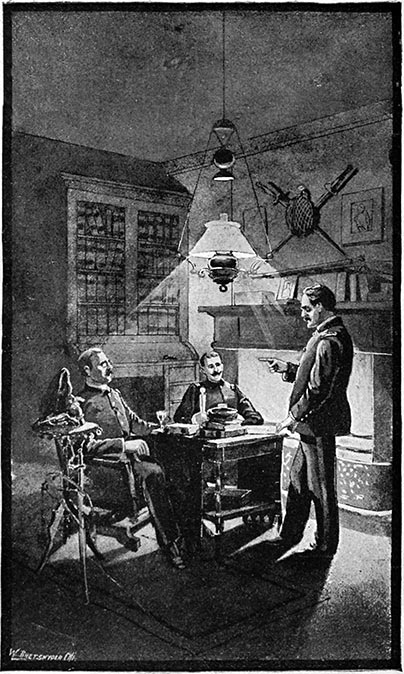
After dinner, as Cobb and Hugh were lounging
about and smoking their cigars, the President came
into the room and handed the former the evening
paper, remarking:
“You have not seen a paper to-day. Here is the
American: you will find all the news in it.”
Moving toward the door, the President turned
around, and added:
“By the bye, Junius, Captain Hathaway will report
to you this evening for orders; dispose of him
as you please,” and he passed out into the hall.
“Don’t mind me, Junius,” said Hugh; “read
your paper. I’ll look at the society news in it—there
is no such nonsense in yours,” drawing out
the “Washington Report” from his pocket.