To the Worthy Gentlemen my surviving Owners, the Worshipful
Christopher Shuter Esq., Sir John Hawkins Kt., John Romsey
Esq.; Capt. Philip Freake, Mr. James Hollidge, Francis
Rogers, Thomas Goldney, Thomas Clements, Thomas Coutes, John
Corsely, John Duckinfield, Richard Hawksworth, William Saunders,
John Grant, Laurence Hollister, and Daniel Hickman, Merchants
in Bristol.
Gentlemen,
AS you did me the Honour to approve my Proposals for the following
Voyage, and generously fitted out two Ships, in which you gave me the
principal Command; I no sooner resolv’d to publish my Journal, than I
determin’d to chuse you for my Patrons: and thereby to take an
opportunity of expressing my Gratitude to you, who had the Courage to
adventure your Estates on an Undertaking, which to Men less discerning
seem’d impracticable.
I heartily congratulate you on the Success and Profit of this Long and
Hazardous Voyage; which might have been greater, but the following
Sheets will show it was not my fault.
I shall only add on this Head, that I used my utmost Endeavours to
promote your Interest, which was always prefer’d to my own.
I make no doubt, it will be to your lasting Honour, that such a Voyage
was undertaken from Bristol at your Expence; since it has given the
Publick a sufficient Evidence of what may be done in those Parts, and
since the Wisdom of the Nation has now agreed to establish a Trade to
the South-Seas, which, with the Blessing of God, may bring vast Riches
to Great Britain.
I wish you intire Health and Happiness, and am,
Gentlemen,
Your most Humble Servant,
WOODES ROGERS.
By Captain Woodes Rogers,
Commander in Chief.
THO others, who give an Account of their Voyages, do generally attempt
to imitate the Stile and Method which is us’d by Authors that write
ashore, I rather chuse to keep to the Language of the Sea, which is more
genuine, and natural for a Mariner. And because Voyages of this sort
have commonly miscarry’d, ’tis necessary that I should keep to my
Original Journal; that the Methods we took to succeed in our Designs,
may appear from time to time in their native Light: Therefore without
any disguise I shall publish the Copies of all our material Regulations
and Agreements, and keep to the usual Method of Sea-Journals, omitting
nothing that happen’d remarkable to our selves, or that may serve for
Information or Improvement to others in the like Cases. Every day’s
Transactions begin at the foregoing Day about twelve a clock, and end at
the same Hour the following Day carrying that Date.
Since Custom has likewise prevail’d for Sailors to give an Account of
such Countries upon whose Coasts they touch or pass by, I shall so far
comply with it as to give a Description of those that occur’d in the
Course of my Navigation, especially of such as are or may be of most use
for enlarging our Trade; wherein I have consulted the best Authors upon
the Subject, and the Manuscript Journals of others, as well as inform’d
my self by Inquiry upon the Spot, and from those that have been in the
respective Countries I treat of.
1708. August 2. Yesterday about four in the Afternoon we weigh’d from
Kingroad near Bristol, on board the Duke frigate, whereof Capt.
Woodes Rogers was Commander, in Consortship with the Dutchess, Capt.
Stephen Courtney Commander; both private Men of War, bound to Cork
in Ireland, and thence to the Southward a cruising; the Duke Burden
about 320 Tuns, having 30 Guns and 117 Men; and the Dutchess Burden
about 260 Tuns by Measure, 26 Guns and 108 Men; both well furnish’d with
all Necessaries on board for a distant Undertaking.
We had in Company the Scipio, Peterborough frigate, Prince Eugene,
Bristol Galley, Berkely Galley, Beecher Galley, Pompey Galley,
Sherstone Galley, and Diamond Sloop. At ten at night having little
Wind, we made the Signal for the Fleet to anchor, between the Holms
and Minehead. We lay near two hours, and about twelve we fir’d a Gun,
and all came to sail, a fine Gale at S E and E S E. We ran by Minehead
at six in the morning, having stem’d the Flood from the place we
anchor’d at. We came up with a Sloop about ten a clock; but she could
not hold way with the Fleet, being all light and clean Ships, and good
Sailors.
From Kingroad to Cork.
August 3. The Wind veer’d to the N E and E N E. Our Ship and the
Dutchess did not sail so well as the major part of the Gallies, our
Masts and Rigging being all unfit for the Sea, our Ships out of trim,
and every thing in disorder, being very indifferently mann’d;
notwithstanding our Number, we had not 20 Sailors in the Ship, and it’s
very little better on board the Dutchess; which is a Discouragement,
only we hope to get some good Sailors at Cork. We saw a Sail at five
last night, the Dutchess gave chase, and came near her; she seem’d a
large Ship, but we lost sight of her at eight a clock. Being inform’d
at Bristol that the Jersy, a French Man of War carrying 46 Guns,
was cruising betwixt England and Ireland, it oblig’d us to keep our
Hammocks up, and a clear Ship for a Fight, all night. About two this
morning the rest of the Fleet that lay a-stern of us came up, and we
kept an easy Sail, with a Light out all Night; but when Day came, we saw
nothing, so that this prov’d a false Alarm: which happen’d well for us,
since had it been real, we should have made but an indifferent Fight,
for want of being better mann’d.
Aug. 4. The Bristol Galley, Berkley Galley, Prince Eugene, and
the Beecher Galley, being bound to the Westward, left us at six in the
Evening; little Wind at E S E. and smooth Water.
Aug. 5. We saw the Land, and finding we had overshot our Port, came to
an anchor at twelve a clock off of the two Rocks call’d the Sovereigns
Bollacks[85] near Kinsale, being calm.
Aug. 6. About eight last night we weigh’d with the Flood, a small Gale
at East; it came on to blow, and veer’d to the Northward. We had a
Kinsale Pilot on board, who was like to have endanger’d our Ship, it
being dark and foggy. Before day he would have turn’d us into the next
Bay to the Westward of Cork, had not I prevented it; which provok’d me
to chastise him for undertaking to pilot a Ship, since he understood his
Business no better. The rest of our Company, except the Diamond and
Sherstone Galley, got into Cork before us; only our Consort staid in
the Harbour’s Mouth till we came up with her.
Aug. 7. Yesterday at three in the Afternoon we came to an anchor with
our Consort in the Cove, Wind at N N E.
Aug. 8. Came in the Arundel a Queen’s Ship, and order’d us to strike
our Pendant; which we immediately did, all private Commission Ships
being oblig’d by their Instructions to pay that Respect to all her
Majesty’s Ships and Fortifications.
Aug. 9. Yesterday Afternoon came in the Hastings with the Fleet
under her Convoy, which we left in Kingroad: as also the Elizabeth,
a Merchant-Ship of 500 Tuns, about 26 Guns, and well mann’d, with a
Fleet under her Convoy from Leverpool, bound to the Westward, with us
and the Hastings, &c. Fair Weather, the Wind Southerly.
Aug. 10. We were well pleas’d with the Men Mr. Noblett Rogers[86]
got for us at Cork; upon which we clear’d several of those brought
from Bristol, and some of ’em run away, being ordinary Fellows, and
not fit for our Employment.
Aug. 11. It blow’d fresh and dirty Weather; we had four Lighters from
Cork to discharge our Ships, that we might have them well stow’d, and
the Provisions in the bottom when they came aboard us. We lengthen’d our
Mizen-Mast four Foot and a half, by placing it on a Step on the
Gun-Deck; got our Fore-Mast forward, and did what we could in order to
be in a better trim than before, against we had better Men to work the
Ship, who lay all ready to come aboard from Cork.
Aug. 12. Blew fresh, and dirty Weather; we clear’d and run near forty
of our fresh-water Sailors. The Shoreham, Capt. Saunders,[87] came
hither to convoy a Fleet back to Bristol.
Aug. 16. Continu’d dirty Weather, so that we could not have an
Opportunity to heel our Ship and clean her Bottom; and were forc’d to
keep our Provisions cover’d in the Lighter, and Men to watch ’em. This
Morning, about ten, one Boat loaded with Men came down from Cork to
us. The Fellows appear’d to be brisk, but of several Nations; and I sent
to Mr. Rogers to stop the rest till we were ready, our Ships being
pester’d.
Aug. 28. Nothing happen’d worth notice since the 16th, but that we had
good Weather to clean and tallow our Ships five Streaks below the
Water-Line, and to take in our Provisions and Men, &c. This Morning we
fell down to the Spit-end by the Hastings Man of War, as our Consort
did the night before. When I came without the Spit-end, I saluted the
Hastings with seven Guns; they return’d five, and I three for Thanks.
We had now above double the number of Officers usual in Privateers, and
a large Complement of Men to each Ship. We took this Method of doubling
our Officers to prevent Mutinies, which often happen in long Voyages,
and that we might have a large Provision for a Succession of
At Cork in Ireland.
Officers in each Ship, in case of Mortality. Our Ship was now so full
that we sent our Sheet-Cable and other new Store Cordage to Mr. Noblett
Rogers at Cork, to make room for our Men and Provisions; having three
Cables besides, and being willing rather to spare that, than any thing
else we had aboard. Our Crew were continually marrying whilst we staid
at Cork, tho they expected to sail immediately. Among others there was
a Dane coupled by a Romish Priest to an Irish Woman, without
understanding a word of each other’s Language, so that they were forc’d
to use an Interpreter; yet I perceiv’d this Pair seem’d more afflicted
at Separation than any of the rest: The Fellow continu’d melancholy for
several days after we were at Sea. The rest understanding each other,
drank their Cans of Flip[88] till the last minute, concluded with a
Health to our good Voyage, and their happy Meeting, and then parted
unconcern’d.
I think it necessary to set down here the Names of all the Officers in
both Ships, with the Number of our Men; because it is proper, that the
Persons whom this Journal concerns, should be known.
Officers of the Duke
Woodes Rogers, Captain, a Mariner; Thomas Dover, a Doctor of
Physick, second Captain, President of our Council, and Captain of the
Marines; Carleton Vanbrugh, Merchant, now our Owners Agent; Robert
Fry, a Mariner, chief Lieutenant; Charles Pope, second Lieutenant;
Thomas Glendall, third Lieutenant; John Bridge, Master; William
Dampier, Pilot for the South-Seas, who had been already three times
there, and twice round the World; Alexander Vaughan, chief Mate;
Lanc. Appleby, second Mate; John Ballet, rated third Mate, but
design’d Surgeon, if occasion; he had been Captain Dampier’s Doctor,
in his last unfortunate Voyage round the World; Samuel Hopkins, being
Dr. Dover’s Kinsman and an Apothecary, was both an Assistant to him,
and to act as his Lieutenant, if we landed a Party any where under his
Command during the Voyage; George Underhill and John Parker, two
young Lawyers design’d to act as Midshipmen; John Vigor, a
Reformado,[89] to act as Capt. Dover’s Ensign when ashore; Benj.
Parsons and Howel Knethel, Midshipmen; Richard Edwards, Coxswain of
the Pinnace, to receive Midshipmens Pay; James Wasse, Surgeon;
Charles May, his Mate; John Lancy, Assistant; Henry Oliphant,
Gunner, with eight Men call’d the Gunner’s Crew; Nath. Scorch,
Carpenter; John Jones, his Mate, with three Assistants; Giles Cash,
Boatswain; and John Pillar, his Mate; John Shepard, Cooper, with two
Assistants; John Johnson, Thomas Young, Charles Clovet, and John
Bowden, all four Quarter-Masters; John Finch, late wholesale Oilman
of London, now Ship’s Steward; Henry Newkirk, Sail-maker; Peter
Vandenhende, Smith and Armourer; William Hopkins, Ship’s Corporal,
Capt. Dover’s Serjeant, and Cook to the Officers; Barth. Burnes,
Ship’s Cook.
Officers of the Dutchess
Stephen Courtney, Captain, a Mariner; Edward Cook, second Captain;
William Stretton, chief Lieutenant; John Rogers, second Lieutenant;
John Connely, third Lieutenant; William Bath, Owners Agent; George
Milbourn, Master; Robert Knowlman, chief Mate; Henry Duck, second;
Simon Hatley, third; James Goodall, fourth; and William Page,
fifth Mate: With all other inferior Officers much the same as aboard the
Duke. Most of us, the chief Officers, embrac’d this Trip of
Privateering round the World, to retrieve the Losses we had sustain’d by
the Enemy. Our Complement of Sailors in both Ships was 333, of which
above one Third were Foreigners from most Nations; several of her
Majesty’s Subjects on board were Tinkers, Taylors, Hay-makers, Pedlers,
Fidlers, &c. one Negro, and about ten Boys. With this mix’d Gang we
hop’d to be well mann’d, as soon as they had learnt the Use of Arms, and
got their Sea-Legs, which we doubted not soon to teach ’em, and bring
them to Discipline.
Septemb. 1. We took sailing Orders, the better to keep Company with
the Hastings and Fleet: and after having agreed with our Consort,
Captain Courtney, on Signals between us, which are so common that I
need not insert them here, and appointed places of Rendevouz in case of
Separation, and how long to lie for each other at every place; about ten
this Morning, we came to sail with the Hastings and about 20 Merchant
Ships, bound to the Southward and Westward, Wind at N by W. We should
have sail’d yesterday, but could not weigh and cast our Ships clear of
the rest; some at that time drove, and the Sherstone Gally run quite
ashore on the Spit. In the night it grew moderate
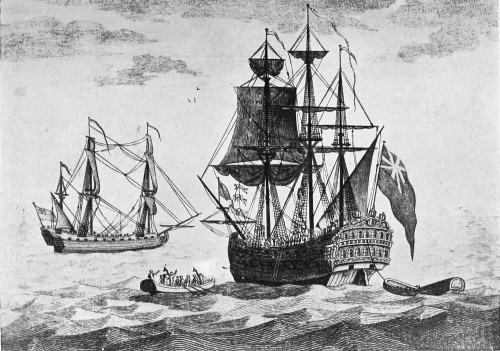 CROSSING THE TROPIC: SAILORS BEING DUCKED AT THE YARD ARM
From a scarce print in the Macpherson collection.
Departure from Cork.
Weather, and Captain Paul got her off to sail with us. Our Holds are
full of Provisions; our Cables, a great deal of Bread, and Water-Casks
between Decks; and 183 Men aboard the Duke, with 151 aboard the
Dutchess: so that we are very much crouded and pester’d Ships, not fit
to engage an Enemy without throwing Provision and Stores overboard.
Septemb. 2. We and our Consort stood out of the Fleet to chase a Sail
we saw to Windward. Our ships sail’d as well as any in the Fleet, not
excepting the Man of War; so that we began to hope we should find our
heels, since we go so well tho deep loaden and pester’d. We found the
Chase to be a small Vessel coming into the Fleet from Baltimore, one
Hunt Master, call’d the Hope Gally, a small French-built Snow
belonging to Mr. James Vaughan of Bristol, bound for Jamaica. Wind
at N by W. Moderate Weather.
Septemb. 3. The Wind very veerable from the W S W. to the N W. blow’d
strong with Squalls, so that we reef’d often, and our Ship was a little
leaky in her upper Works.
Septemb. 4. It blew fresh this Morning, but not so much Wind as
Yesterday, and the Water smoother. Captain Paul made a Signal for me,
Capt. Courtney, and Capt. Edwards Commander of the Scipio; and
after speaking with him, he sent his Boat for us, being larger than
ours. We with Capt. Dover and Mr. Vanbrugh went in her, and din’d
with Capt. Paul aboard his Ship, where we were very handsomly treated.
He propos’d to me and Consort when he left the Fleet, which would be
very soon, to cruise a few days together off Cape Finister, after
having ask’d us what we wanted that he could supply us with. He gave us
Scrubbers, Iron Scrapers for our Ships Bottom, a speaking Trumpet, and
other things that we wanted: but he would accept nothing from us,
because our Voyage would be long; but told us, he should be well pleas’d
if our Owners return’d him the same Necessaries for his Ship when he
return’d. Wind from the N N W. to the N W by W. moderate.
Septemb. 5. We came from on board Capt. Paul to our own Ships,
yesterday at six in the Afternoon; and now thought it fit to discover to
our Crew whither we were bound, that if any Disorders should have risen
upon it, we might have exchang’d our Malecontents whilst in Company with
one of her Majesty’s Ships. But I found no Complaint on board the
Duke, except from one Fellow who expected to have been Tything-Man
that year in his Parish, and said his Wife would be oblig’d to pay
Forty Shillings in his Absence: but seeing all the rest willing, he was
easily quieted, and all Hands drank to a good Voyage. I and Capt.
Courtney writ to our Owners, Alderman Batchelor and Company, in the
same Letter, a Method we design’d to continue in the whole Voyage, for
all things that related to it. A brisk Gale and clear Weather.
Sept. 6. The Hastings and we parted at six last night. The reason
why we did not keep him longer Company, was our Ships being very full,
and our Consort unwilling to lose time so near home; so that we were
oblig’d to break Measures with Capt. Paul. I excus’d it to him, and
saluted him, which he answer’d, and wish’d us a prosperous Undertaking.
Wind N. by W. and clear Weather. Our Ship does not sail so well as she
did two days before. The Crown Gally of Biddiford keeps us Company
bound for the Maderas. Wind from N N W. to N by E.
Sept. 8. Every thing now begins to come into Order, we having been
hitherto in some Confusion, as is usual in Privateers at first setting
out. We had a good Observation. Moderate Weather, Wind at W N W. Lat.
40. 10. N. This day the chief Officers din’d on board me, and the next
day on board the Dutchess.
Sept. 9. Now we begin to consider the Length of our Voyage, and the
many different Climates we must pass, and the excessive Cold which we
cannot avoid, going about Cape Horne; at the same time we had but a
slender Stock of Liquor, and our Men but meanly clad, yet good Liquor to
Sailors is preferable to Clothing. Upon this we held our first
Committee, to debate whether ’twas necessary for us to stop at Madera,
as follows.
At a Committee held on Board the Duke Frigate, resolv’d by the
General Consent of the following Persons:
From Cork to the Southward.
THAT both the Ships Duke and Dutchess do touch at Madera, to make
a larger Provision of Liquors, the better to carry on our long
Undertaking, being but meanly stor’d for so large a Number of Men as are
in both Ships; and in case of Separation between this Place and Madera,
then to meet at the Island St. Vincent, one of the Cape de Verd
Islands, to wood and water our Ships. But if we miss of one another at
that Island, or that the first Ship finds it inconvenient for stopping,
then to proceed to Praia on St. Jago, another of the same Islands;
to wait at both these Islands fourteen Days: And then if the missing
Ship does not appear, the other to proceed to the Isle of Grande, in
Latitude 23 deg. 30 m. S. on the Coast of Brazil, there to wait
three Weeks; and then if we don’t meet, let the single Ship proceed on
the Voyage, according to the Orders given from our Owners. This is our
Opinion this 9th day of September, 1708.
| Thos. Dover President, | Charles Pope, |
| Stephen Courtney, | Carleton Vanbrugh, |
| Woodes Rogers, | Tho. Glendall, |
| Edward Cooke, | John Bridge, |
| William Dampier, | John Ballet. |
| Robert Frye, | |
Sept. 10. At six in the Morning we saw a Sail; after speaking with our
Consort, we both chas’d. I gave the Dutchess about a mile start of us,
in order to spread the more. It blew fresh, with a great Sea; and the
Chase being to Windward, we crouded extravagantly. Wind at N W.
Sept. 11. At three yesterday Afternoon we came up with the Chase, who
bore down right upon us, shewing Swedish Colours. I fir’d twice at her
before she brought to, then went aboard her with my Yall,[90] Captain
Courtney’s Boat being just before me. We examin’d the Master, and
found he came round Scotland and Ireland. We suspected he had
Contraband Goods on board, because some of the Men we found drunk, told
us they had Gunpowder and Cables; so we resolv’d to examine her
strictly, put 12 Men on board her, and kept the Swedes Master and 12
of his Men on board our Ships. This Morning, after we had examin’d the
Men, and searched the Ship, we found it difficult to be prov’d whether
she was a Prize: And not willing to hinder time to carry her into any
Harbour to examine her farther, we let her go without the least
Embezelment. The Master gave me two Hams, and some rufft dry’d Beef, and
I gave him a dozen Bottles of Red-Streak Cyder. They saluted us at
parting with four Guns: She belong’d to Stadt near Hamburg, and was
a Frigate built Ship of 22 Guns, about 270 Tuns. While I was on board
the Swede yesterday, our Men mutiny’d, the Ringleaders being our
Boatswain, and three other inferior Officers. This Morning the chief
Officers having kept with me in the after-part of the Ship, we confin’d
the Authors of this Disorder, in which there was not one Foreigner
concern’d. We put ten of the Mutineers in Irons, a Sailor being first
soundly whip’d for exciting the rest to join him. Others less guilty I
punish’d and discharg’d, but kept the chief Officers all arm’d, fearing
what might happen; the Ship’s Company seeming too much inclin’d to
favour the Mutineers, made me the easier forgive. Some beg’d Pardon, and
others I was forc’d to wink at; however, they began to find their Design
frustrated, which was to make a Prize of the Swede, who they alledg’d
had much Contraband Goods aboard, tho we could see none; yet they
obstinately insisted, that we apparently gave away their Interest, by
letting her go without plundering her. I labour’d to convince them of
the necessity of our making Dispatch, and that if we could make her a
Prize, it would unman our Ships too much to send her into any Port,
besides other Disadvantages it might procure to our selves and Owners
should we be mistaken; which pacify’d the major part. Our Consort’s Men
were at first very uneasy, but finding the Malecontents quell’d aboard
our Ship, they all kept quiet.
Sept. 12. Yesterday the Wind was very little and veerable, and we had
an Observation, 34 deg. 30 min. N.
Sept. 13. Those in Irons discover’d others who were Ringleaders in the
Mutiny, whom we also punish’d, and confin’d one of them in Irons with
the rest. Alexander Wynter was made Boatswain instead of Giles Cash,
one of the Mutineers. Fair pleasant Weather, little Wind at N W by W.
Arrival among the Canary Isles.
Sept. 14. I agreed with the Captain of the Crown Galley to carry my
Boatswain (who was the most dangerous Fellow among the Mutineers) in
Irons with him to Maderas. I did not at his first Confinement think of
sending him off; but this day a Sailor came aft to the Steeridg Door,
with near half the Ship’s Company of Sailors following him, and demanded
the Boatswain out of Irons. I desir’d him to speak with me by himself on
the Quarter-Deck, which he did, where the Officers assisted me, seiz’d
him, and made one of his chief Comrades whip him. This Method I thought
best for breaking any unlawful Friendship amongst themselves; which,
with different Correction to other Offenders, allay’d the Tumult; so
that now they begin to submit quietly, and those in Irons beg Pardon,
and promise Amendment, This Mutiny would not have been easily lay’d,
were it not for the number of our Officers, which we begin to find very
necessary to bring our Crew to Order and Discipline, which is always
very difficult in Privateers, and without which ’tis impossible to carry
on any distant Undertaking like ours. Fine pleasant Weather, and
moderate Gales.
It being little Wind, and contrary, we agreed to pass by Maderas, and
cruise a little amongst the Canary Islands for Liquor, to prevent Loss
of time: So we took leave of the Crown Galley, who was bound into
Madera.
Sept. 15. Last night we sent Giles Cash aboard her in Irons, with
several Letters by the Commander at large to our Owners. We parted at
twelve a Clock at night. Fair Weather, very little Wind from W N W. to N
by E. had a very good Observation. Latitude 31 deg. 29 min. N.
Sept. 16. I discharg’d the Prisoners from their Irons, upon their
humble Submission and strict Promises of good Behaviour for time to
come. While they continu’d in Irons they had Centries over them, and
were fed with Bread and Water. Those that were Officers we restor’d to
their Places, and every body was order’d to obey them; John Pillar the
Boatswain’s Mate was advanc’d to be Boatswain, so that we are all quiet
again. About eight this morning we saw Land, and found it to be
Salvage’s Island, bearing S S W. distant eight Leagues, Latitude 29
deg. 45 min. Wind very little, and veerable, with fair clear Weather.
Sept. 17. Moderate Gales of Wind; the Salvages at a distance is not
unlike the Island Lundy in Bristol Channel, about two miles long, a
high Island. This Morning we saw the Rock, that appear’d to us a good
League to the S W. of the Island, and took it to be a Sail till we came
near it. Little Wind between the N N E. and the West.
Sept. 18. At four yesterday in the Afternoon we came in sight of Pico
Teneriff, bearing S W by W. distant about eight Leagues; steer’d S S E.
and S E by S. for Grand Canaries. This Morning about five a clock we
spy’d a Sail under our Lee Bow, between the Islands of Grand Canaries
and Forteventura; we chas’d her, and at 7 came up with her. Our
Consort being a little a Head, fir’d a Gun, and made her bring to; she
prov’d a Prize, being a Spanish Bark about 25 Tuns, belonging to
Oratava on Teneriff, and bound to Forteventura with about 45
Passengers; who rejoic’d when they found us English, because they
fear’d we were Turks. Amongst the Prisoners were four Fryars, and one
of them the Padre Guardian for the Island Forteventura, a good honest
old Fellow. We made him heartily merry, drinking King Charles the
Third’s[91] Health; but the rest were of the wrong sort. We us’d them
all very well, without searching them, &c. Fresh Gales and fair
Weather, Wind from the N N E. to the E S E.
Sept. 19. After we had took the Prize, we stood to the Westward for
Teneriff, in order to have her ransom’d; where our Agent Mr.
Vanbrugh press’d to go ashoar with some of the Prisoners. At eleven
last night the Wind being at N E. when we were very near the Shore, we
could hardly weather Cape Nago, the Eastermost part of Teneriff,
till the Wind veer’d to the Northward. We stood off till Day: In the
Morning it prov’d moderate, so we stood in for Oratava, and sent the
Spanish Master of the Bark to it in his Boat, being mann’d with some
of the Prisoners. Mr. Vanbrugh still insisting to go ashore, I
consented, tho against my Judgment, and he went with them to treat for
the Ransom of the Hull of the Bark; her small Cargo, which consisted in
two Butts of Wine, and one Hogshead of Brandy, and other small matters,
we design’d for our own use in both Ships, the Agents of each being to
take an account of it the first Opportunity. Fresh Gale of Wind at N E.
Sept. 20. About eight this Morning came a Boat off from Oratava with
a Flag of Truce, and brought a Letter signifying that unless we would
immediately restore the Bark and Cargo, Mr. Vanbrugh should be
detain’d. I sent to Capt. Courtney, who agreed with me on an Answer.
We stood in with our Ships within a League of the Town, to tow in the
Boat for Dispatch, and about eleven they went ashore again. Wind at N E
by E. very fresh.
The Letter sent us was as follows:
Capt. Rogers and Capt. Courtney;
Gentlemen,
Port Oratava, 20 Sept. 1708.
‘YOUR Lieutenant coming ashore, and having given an account to our
Governor of your having taken a Boat belonging to this place bound
to Forteventura; we must inform you that her Majesty is
graciously pleas’d to allow a Trade between her Subjects and the
People of these Islands, whereof we suppose you are not ignorant;
and that it is approv’d of not only by his Catholick Majesty, but
also by the most gracious Christian King, who has sent
Amongst the Canary Isles.
express Orders unto his Consul here, that none of his Men of War or
others shall molest any Ship trading to these Islands: and there
has been actually an Example of a Ship belonging to the Subjects of
her Britannick Majesty, which was taken by a French Privateer,
and upon due Application to the French Consul, the Ship was
restor’d. Wherefore we are all of Opinion, that there can be no
room for your making a Prize of this Spanish Bark; for it will be
extremely prejudicial to her Majesty’s Subjects that reside here,
and likewise to those in England trading hither, by prohibiting
of all future Trade, by making more than sufficient Reprisal upon
our Effects here, and perhaps on our Persons, by reason of the
evident Breach on our part of the stipulated Trade which has been
concerted with us. Wherefore we must once more desire you to
restore the Spanish Bark, as you will answer the contrary before
her Majesty, who has so far approv’d of the private Trade, that she
was pleas’d to allow of two Men of War (viz. the Dartmouth Capt.
Cock, and the Greyhound Capt. Hariot) the last year, who had
express Orders to molest in no manner of way any Vessel belonging
to the Spaniards; which accordingly they observ’d. Wherefore as
you have a due Regard to what is so much the Interest of her
Majesties Subjects, we expect at the return of this Boat, that you
will make Restitution of the said Bark, otherwise Mr. Vanbrugh
will not be permitted to go off, and there will be extravagant
Reprisals made upon our Estates and Persons, which we expect you
will take into your Consideration: and we cannot omit to let you
know, that there is now a Spanish Bark actually in England,
which is daily expected with other English Ships to load Wine,
which they will not be admitted to do, in case you don’t restore
this Bark. We don’t doubt but the People here out of Complaisance
will make you some acknowledgment of a Refreshment.
| Gentlemen, |
| Your very humble Servants, |
| J. Pouldon, | Vice-Consul, J. Crosse, |
| Bernard Walsh, | G. Fitz-Gerald. |
‘Pray excuse Haste, that we have not time to transcribe.
‘The rest of the Merchants are in the City where our Governor
generally resides, being about six Leagues hence.
Our Answer was thus:
On board the Duke Frigat,
Sept. 20.
Gentlemen,
‘WE have yours, and observe its Contents; but having no
Instructions given us with our Commission relating to Spanish
Vessels trading amongst these Islands, we can’t justify the parting
with this Bark on your single Opinions. It was Mr. Vanbrugh’s
misfortune to go ashore; and if he is detain’d, we can’t help it.
To have convinc’d us satisfactorily of what you say, you ought to
have sent us a Copy of her Majesty’s Orders or Proclamation; but we
doubt there’s no such thing in this case. If Mr. Vanbrugh is
unjustly detain’d, we’ll carry the Prisoners we have on board to
the Port we are bound to, let the Consequence be what it will. We
are requir’d to be accountable no farther than we are oblig’d by
our Instructions, which we have given sufficient Security already
to follow, and don’t fear a Premunire when we comply with them.
We know Fishing-Boats are excus’d on both sides, and all trading
Vessels from Rio la Hache to the River of Chagre in the
Spanish West-Indies. We admire the Master and Passengers should
be so ignorant of a thing so necessary to be known by ’em, for we
never had the least word or intimation from them of what you write.
The Example you give us of a Trade here allow’d by the French
King and Duke of Anjou, we don’t admire at, because it is for the
Benefit of the Spaniards; and we know the English Ships are
protected no farther than in Anchor-Ground: and since we took this
Vessel at Sea, we shan’t part with her unless on our own Terms. If
you are positive in what you wrote us, and conscious what detriment
it will be to the English Trade, you have no way to prevent it,
but immediately to ransom this Bark; and if it be her Majesty of
Great Britain’s Pleasure, and we are better inform’d in
England, then we can justify our Conduct to the Gentlemen that
imploy’d us, and you will be again reimbursed. We shall wait but a
short time for an Answer, having Water and Provisions for our
selves and Prisoners to the English Settlements, where we are
bound. We are apprehensive you are oblig’d to give us this Advice
to gratify the Spaniards; and with Respect are,
Gentlemen,
Your Humble Servants,
Woodes Rogers,
Stephen Courtney.
Amongst the Canary Isles.
‘If you send us Mr. Vanbrugh, and the Man with him, we’ll send
you the Prisoners; but we’ll not part from the Bark, unless
ransom’d: tho the Value is not much, we will not be impos’d on. We
desire you to use all manner of Dispatch without loss of time,
which we can’t allow, nor answer it to our Employers.
Sept. 21. At six last night the Spanish Boat came again to us with
dilatory Answers to our last, insisting on behalf of the Spaniards,
that the Goods should be return’d ’em, tho they consented to ransom the
Bark. To which we immediately return’d an Answer; for we were angry at
their Tediousness and our ill Treatment, our time being precious,
because we were inform’d that they expected every hour a small Privateer
that usually cruis’d off of Madera, as also a Spanish Ship from the
West-Indies design’d for Santa Cruz: So that it look’d like a
Design, to keep us here in suspence till these Ships might get safely
in, on the other side of the Island. Our Answer was to this effect: That
had it not been out of respect to our Officer on shore, we would not
have staid one minute, but would now stay till Morning for their Answer,
and take a Cruise among the Islands some time longer than we intended,
in order to make a Reprisal; and tho we could not land our Men, would
visit the Town with our Guns by eight next morning: adding, that we
hop’d to meet with the Governor’s Frigat, and should repay his Civility
in his own way, but wonder’d that they being Englishmen should trifle
with us. The Letter had its effect; for this Morning at eight a clock we
stood in close to the Town, and spy’d a Boat coming off, which prov’d to
be one Mr. Crosse an English Merchant, and Mr. Vanbrugh our Agent
with him, with Wine, Grapes, Hogs, and other Necessaries, for the Ransom
of the Bark. Upon his coming up, we immediately went to work, discharg’d
the Bark, and parted the small Cargo between our two Ships. We treated
Mr. Crosse as well as we could, and at his desire gave the Prisoners
back as much as we could find of what belong’d to their Persons;
particularly to the Fryars their Books, Crucifixes, and Reliques. We
presented the old Padre Guardian with a Cheese, and such as were
strip’d, with other Clothes. So that we parted, very well satisfy’d on
all sides. Mr. Crosse told us the Spaniards ashore were very
inquisitive whither we were bound; and understanding by the Prisoners
that our Ships were sheath’d, and so full of Provisions, they suspected
we design’d for the South-Sea: and he inform’d us that four or five
French Ships from 24 to 50 Guns sail’d thence about a month before on
the same Voyage. But we did not think fit to own there, that we were
bound to any other place than the English West-Indies. These Islands
being so well known, I need not add any Description of them. We saw the
Pike of Teneriff plain but once while there, it being generally
clouded; you may often see the Top above the Clouds, when the rest is
all cover’d with them. Now we are indifferently well stock’d with
Liquor, and shall be the better able to endure the Cold when we get the
Length of Cape Horn, which we are inform’d has always very cold bad
Weather near it.
Sept. 22. Last night just as we had finish’d with Mr. Crosse, and
deliver’d the Spaniards their Bark, we spy’d a Sail to the Westward of
the Island between three and four in the Evening. We immediately made
what Sail we could, and steer’d W by N. along the Shore. At eight a
clock we were in sight of Gomera bearing S S W. distant three Leagues,
Palma W by N. distant five Leagues. We lost sight of the Sail before
Night, spoke with our Consort, and agreed to keep between Palma and
Gomera in our Voyage; it being uncertain to meet with the Chase the
next day, since last night she was near five Leagues from us, so that we
believ’d she might get into a place of safety, if an Enemy, before we
could see her. Besides, there came on a stiff Gale, which put us quite
out of hopes of seeing her again to advantage. Fair Weather, fresh Gales
at N E by N.
Sept. 23. About five yesterday in the afternoon, when at least 36
Leagues distant, we saw the Pico Teneriff very plain. Fine pleasant
Weather, fresh Gales with smooth Water, Wind at N E by E.
Sept. 24. We sent our Boat for Capt. Courtney, Capt. Cook, Mr.
Stratton, and Mr. Bath their Agent, who staid and din’d with us; and
whilst they were aboard, we held a Council, the Result of which was as
follows.
At a Committee by Desire of Capt. Woodes Rogers, Capt. Thomas
Dover, and Capt. Stephen Courtney, held on board the Duke.
Differences with Mr. Carleton Vanbrugh.
WE have examin’d all Letters and Proceedings that happen’d at and after
the taking the Spanish Bark, and the Reason of both Ships Stay off of
Teneriff, and amongst the Canary Islands; and we do approve of all
that was transacted and wrote: the major part of us having at the time
when ’twas done advis’d the Commanders to it. Witness our Hands,
| Tho. Dover, Pres. | William Stratton, |
| Steph. Courtney, | Robert Frye, |
| Woodes Rogers, | Charles Pope, |
| Will. Dampier, | Thomas Glendal, |
| Edward Cook, | John Bridge, |
| Carl. Vanbrugh, | John Ballet. |
| William Bath, | |
Whilst the Committee were together, Mr. Vanbrugh complain’d I had not
treated him as I ought: upon which I offer’d to refer it to all present,
that we might not have needless Misunderstandings at the beginning of
our Voyage; and they came to the following Resolution.
WHEREAS there has been some Difference between Capt. Woodes Rogers
and Mr. Carleton Vanbrugh the Ship’s Agent; it being refer’d to the
Council, we adjudg’d the said Mr. Vanbrugh to be much in the wrong. In
witness whereof, we have set our Hands, the 24th of Sept. 1708.
| Tho. Dover, Pres. | William Bath, |
| Stephen Courtney, | Charles Pope, |
| William Dampier, | Thomas Glendal, |
| Edward Cook, | John Bridge, |
| Robert Frye, | John Ballet. |
| William Stratton, | |
Sept. 25. This day, according to custom, we duck’d[92] those that had
never pass’d the Tropick before. The manner of doing it was by a Rope
thro a Block from the Main-Yard, to hoist ’em above half way up to the
Yard, and let ’em fall at once into the Water; having a Stick cross thro
their Legs, and well fastned to the Rope, that they might not be
surpriz’d and let go their hold. This prov’d of great use to our
fresh-water Sailors, to recover the Colour of their Skins which were
grown very black and nasty. Those that we duck’d after this manner three
times, were about 60, and others that would not undergo it, chose to pay
Half a Crown Fine; the Money to be levy’d and spent at a publick
Meeting of all the Ships Companys, when we return to England. The
Dutch Men and some English Men desir’d to be duck’d, some six,
others eight, ten, and twelve times, to have the better Title for being
treated when they come home. Wind N W by W. and veering to the Northward
and Eastward.
Sept. 26. Yesterday in the Afternoon we sold the loose Plunder of the
Bark amongst the Sailors by Auction. Fair Weather, moderate Gales at N N
E. had a very good Observ. Lat. 21. 33. N.
Sept. 29. Betwixt nine and ten at night, a Sailor going up to furl the
Main-Top-Gallant Sail, fell suddenly without any noise from the Main-Top
over board, occasion’d as I suppos’d by a Fit. At nine this morning we
saw Land, and suppos’d it to be Sal one of the Cape De Verd Islands,
bearing S E by S. distant about 12 Ls.[93] At twelve a clock at noon it
bore E S E. dist. 4 Ls. fair Weather, smooth Water, fresh Gales at N E.
Lat. 17. 5. N. Long. W. from London, 23. 16.
Sept. 30. After being satisfy’d the Island was Sal, we stood from it
W and W by N. for St. Vincent. At four a clock Sal bore E by S. 1/4
S. dist. 10 Ls. At six St. Nicholas bore S W by W. dist. 8 Ls. We went
with an easy Sail till four this Morning, and lay by to make the
Islands, because we had none aboard either Ship that was acquainted with
’em. When day broke, we saw the Islands all in a range, much as is laid
down in the Draughts. At ten a clock we anchored in the Bay of St.
Vincent in five fathom Water. ’Tis a fine Bay: The Northmost Point bore
North near a mile dist. and the Westermost Point bore West dist. about
two miles: Monk’s Rock, which is like a Sugar-Loaf, high and round,
and bold on every side, lies almost in the Entrance of this fine sandy
Bay on the West-side of the Island: But nearest the North Point of the
Bay, Sailors must be careful as they come in, not to run too near under
the high Land of the North Point, for fear of being becalm’d, and sudden
Flaws coming every way upon ’em. There being a small Shoal about three
Ships length almost without the Point, but giving it a small birth it’s
bold enough. We ran within two Cables length of the first round Point,
next to the long sandy Bay, and came to an anchor in clean sandy Ground.
Monk’s Rock bore N W by N. dist. 3/4 Mile; the Body of the Island St.
Antonio bore N W 1/2 N. dist. nine Miles.
Arival at St. Vincent.
This is a fine Bay and good Landing, but the best at the Northermost
Point. The Wood lies in the middle of the sandy Bay, and the Water
between the North Point and the place where we anchor’d. There is good
Anchoring all over the Bay, and the Monks-Rock will direct any
Stranger into it, there being no other like it about this Island on the
side opposite to St. Antonio. It blows here a constant Trade-Wind
betwixt the E by N. and the N N E. except in the Months of October,
November, December, and January, it sometimes blows Southerly with
Tornadoes and Rain.
October 1. We clear’d our Ship yesterday, but it blow’d too hard to
row our Boat-Loads of empty Butts ashoar; and we could do but little to
Wooding and Watering, till this morning we were forc’d to get a Rope
from the Ship to the watering-place, which is a good half-mile from our
anchoring-place, and so haul’d our empty Casks ashore by Boat-loads, in
order to have ’em burnt and clean’d in the Inside, being Oil-Casks; and
for want of cleaning, our Water stunk insufferably. I borrow’d a Cooper
from the Dutchess, and having five of my own, made quick dispatch.
Octob. 3. We sent our Boat over to St. Antonio, with Joseph
Alexander, a good Linguist, and a respectful Letter to the Governour,
who accounts himself a Great Man here, tho very poor, to get in Truck
for our Prize-Goods what we wanted; they having plenty of Cattel, Goats,
Hogs, Fowls, Melons, Potatoes, Limes, ordinary Brandy, Tobacco, Indian
Corn, &c. Our People were very meanly stock’d with Clothes, and the
Dutchess’s Crew much worse; yet we are both forc’d to watch our Men
very narrowly, and punish several of ’em, to prevent their selling what
Clothes they have for Trifles to the Negroes, that came over with little
things from St. Antonio’s. The People at all these Islands rather
chuse Clothing or Necessaries of any sort than Mony, in return for what
they sell. The Letter sent by the Linguist to the Governour of St.
Antonio’s, Senior Joseph Rodriges, was as follows:
Honourable Sir,
‘THE Bearer hereof is one of our Officers, whom we have sent to wait
upon your Honour with our due Respects, and to acquaint you with our
Arrival in the Bay of St. Vincent; and further, that being Subjects
and Servants of her Majesty the Queen of Great Britain, a High Ally
and Confederate of his Sacred Majesty the King of Portugal, and
having several Necessaries which we suppos’d the Inhabitants of your
Island may want, and supposing they can accommodate us per contra, we
are desirous of an immediate Traffick with them. We arriv’d three days
ago, but being Strangers were unacquainted in these parts, and not
sooner inform’d of your Honour’s Residence in the neighbouring Islands;
else we had been earlier with our Respects: and if not too great a
Favour, we should be proud to see your Honour on board. Our Stay cannot
exceed two days more, so that Dispatch is necessary. We have Mony or
Goods of several kinds, to pay or exchange for what they bring. The
Bearer can inform your Honour of the publick Occurrences of Europe,
and the great Successes of the Confederate Arms against the French and
Spaniards; which, no doubt must soon be follow’d with a lasting Peace,
which God grant. We subscribe our selves with much Respect,
Your Honour’s most Obedient
Humble Servants,
Woodes Rogers,
Stephen Courtney.
Octob. 4. Our Boat return’d this Morning; but the Landing-place being
far from the inhabitable part of St. Antonio, they brought nothing but
a few Limes and Fowls, and left our Linguist behind to get what we
wanted. We struck two of our Gun-room Guns into the Hold, being useless
in their place, and the Ship having too much top-weight, and not very
stiff. We had plenty of Fish here, but not very good. Wind at N N E.
Octob. 5. Our Boat went to St. Antonio to see for our Linguist,
according to appointment. We heel’d and clean’d our Ships, and got a
great deal of Wood and Water aboard. Wind at N E. fine Weather.
Octob. 6. Our Boat return’d with nothing but Limes and Tobacco, and no
News of our Linguist. But soon after there came another Boat belonging
to that part of the Island where the Governour lives, with his
Deputy-Governour, a Negro, who brought Limes, Tobacco, Oranges, Fowls,
Potatoes, Hogs, Bonanoes, Musk and Water-Melons, and Brandy, which we
bought of him, and paid in such Prize-Goods as we had left of the Bark’s
Cargo cheap enough. They are poor People, and will truck at any Price
for what they want, in such Payments as they can make.
In the Bay of St. Vincent.
Octob. 7. We sent our Boat at Three this Morning to see if our
Linguist was return’d. The Deputy-Governour told us he promis’d him to
wait at the Water-side all that night where we put him ashore, and that
there were Cattel for us if we would fetch ’em. We were ready to sail: A
good Wind at N E. and a fresh Gale.
Octob. 8. Our Boat return’d yesterday in the Afternoon with two good
black Cattel, one for each Ship, but no News of our Linguist; upon which
we consulted with the Officers of both Ships, and all unanimously
agreed, that we had better leave him behind, than to wait with two Ships
for one Man that had not follow’d his Orders. We held a Committee on
board the Dutchess to prevent Embezlements in Prizes, and to hinder
Feuds and Disorders amongst our Officers and Men for the future, because
the small Prize had shew’d us, that without a Method to be strictly
observ’d in Plunder, it might occasion the worst of Consequences to both
Ships, and such Quarrels as would not easily be laid. So with the
Consent and Approbation of the Officers appointed for a Committee, we
unanimously agreed on it, to prevent those Mutinies and Disorders
amongst the Men of both Ships, who were not yet reconcil’d since the
taking the small Canary-Prize. They all insisted there was never any
Privateer’s Crew hinder’d from Plunder, so that we were forc’d to agree
on the following Instrument of a Dividend, when we should meet with any
Prize. And that the things we deem’d to be Plunder, according to custom
in Privateering, should tend as little as possible to the disadvantage
of the Owners, we did for that end take care by the second Article in
the said Instrument and Agreement with the Men, to reserve the Power of
adjudging what should be deem’d Plunder, unto the superior Officers and
Agents exclusive of the Crew, &c. For we found it would be next to a
miracle to keep the Men in both Ships under Command, and willing to
fight resolutely on occasion, if we held ’em to the Letter of Agreement
with the Owners, which was not duly consider’d of at home. We had a
particular Regard however to the Sentiments of the Owners, deliver’d on
this head in Discourses at several times with divers of the Committee,
as my self, Capt. Dover, Capt. Courtney, Mr. Robert Frye, and Mr.
Carleton Vanbrugh; and particularly in Kingroad to the Men, at the
time of signing of their Instrument. By all which we judg’d that the
Owners could not but approve of the Measures that we took on this
occasion, and that the good effects of ’em would abundantly answer our
Intentions. Altho the Officers and Men did voluntarily allow Capt.
Courtney and me 5 per Cent. each, out of the Value of all Plunder,
it was much less than our Due; and we would have been glad to have let
all alone, provided we could with the Advice of our chief Officers in
both Ships have contriv’d any other Method to be safe in the Prosecution
of our Designs with our Men, and have kept them to their Duty on all
occasions, at so great a distance from home: without their being easy,
we must unavoidably have run into such continual Scenes of Mischief and
Disorder, as have not only tended to the great Hindrance, but generally
to the total Disappointment of all Voyages of this nature, that have
been attempted so far abroad in the Memory of Man. The Agreement we made
was as follows.
At a Committee held on board the Dutchess the 8th of October,
1708. it is agreed by the Officers and Men of both Ships to the
sundry Particulars following.
Impr.
THAT all Plunder on board each Prize we take by either Ship,
shall be equally divided between the Company of both Ships, according to
each Man’s respective whole Share, as ship’d by the Owners or their
Orders.
2. That what is Plunder shall be adjudg’d by the superior Officers and
Agents in each Ship.
3. That if any Person on board either Ship do conceal any Plunder
exceeding one Piece of Eight in value, 24 hours after the Capture of
any Prize, he shall be severely punish’d, and lose his Shares of the
Plunder. The same Penalty to be inflicted for being drunk in time of
Action, or disobeying his superior Officer’s Commands, or concealing
himself, or deserting his Post in Sea or Land-Service; except when any
Prize is taken by Storm in Boarding, then whatsoever is taken shall be
his own, as followeth: A Sailor or Landman 10 l. Any Officer below the
Carpenter 20 l. A Mate, Gunner, Boatswain, and Carpenter 40 l. A
Lieutenant or Master 70 l. And the Captains 100 l. over and above
the Gratuity promis’d by the Owners to such as shall signalize
themselves.
4. That publick Books of Plunder are to be kept in each Ship attested
by the Officers, and the Plunder to be apprais’d by Officers chosen, and
divided as soon as possible after the Capture. Also every Person to be
sworn and search’d so soon as they shall come aboard, by such Persons as
shall be appointed for that purpose: The Person or Persons refusing,
shall forfeit their shares of the Plunder as above.
In the Bay of St. Vincent.
5. In consideration that Capt. Rogers and Capt. Courtney, to make
both Ships Companies easy, have given the whole Cabin-Plunder (which in
all probability is the major part) to be divided as aforesaid; we do
voluntarily agree, that they shall have 5 per Cent. each of ’em, over
and above their respective Shares, as a Consideration for what is their
Due of the Plunder aforesaid.
6. That a Reward of twenty Pieces of Eight shall be given to him that
first sees a Prize of good Value, or exceeding 50 Tuns in Burden.
7. That such of us who have not sign’d already to the Articles of
Agreement indented with the Owners, do hereby oblige our selves to the
same Terms and Conditions as the rest of the Ships Company have done;
half Shares and half Wages, &c.
To which Articles of Agreement we have set our Hands, as our full
Intent and Meaning, without any Compulsion.
Sign’d by the Officers and Men of both Ships.
Octob. 8. At seven in the Evening (after having put the
Deputy-Governour ashore, where he must lie in a Hole of the Rocks, there
being no House on that part of the Island) we came to sail: our Consort
got before us, and lay with a Light for us. There were several Negroes
on the Island, that came from St. Nicholas and St. Antonio to make
Oil of Turtle, there being very good green Turtle at this time of the
Year, which I sometimes gave our Men to eat. They have likewise wild
Goats, but in no great plenty; wild Asses, Guinea-Hens and Kerlews,
and abundance of Sea-Fowls. Capt. Dampier, and others aboard each
Ship, that had formerly stopt at St. Jago, another of these Cape de
Verd Islands, told us, that tho this Island is not often frequented by
Ships, yet it is preferable to St. Jago for stopping outward, because
’tis a much better Road for Ships, and more convenient for Water and
Wood, and has better Landing. The Island is mountainous and barren, the
plainest part lies against this sandy Bay where we rode. The Wood that
grows in it is short, and for no use but Firing. They have very large
Spiders here, which weave their Webs so strong betwixt the Trees, that
’tis difficult to get thro ’em. Where we water’d, there’s a little
Stream that flows down the Hill from a Spring, and is very good, but in
other parts ’tis brackish. This Island was formerly inhabited, and had a
Governor, but is now only frequented in the Season for catching
Tortoises by the Inhabitants of the other Islands, who are for the most
part Negroes and Mulattoes, and very poor. The Stock of wild Goats in
this Island is almost destroy’d by the People of St. Nicholas and St.
Antonio. The Heats are excessive to us who came newly from Europe, so
that several of our Men began to be sick, and were blooded. Some of our
Officers that went ashore a hunting, could meet no Game but a wild Ass,
which after a long Chase they got within shot and wounded; yet he
afterwards held out so as to tire them, and they return’d weary and
empty-handed.
These Islands are so well known, that I need not say much of ’em. They
are ten in number, of which St. Jago, St. Nicholas Bonavist, St.
Antonio, Brava Mayo, and Fuego are inhabited: The latter is so
nam’d from a Volcano. St. Jago is much the largest and best, and the
Seat of the chief Governour. It produces a small matter of Indico, Sugar
and Tobacco; which, with their Goat-Skins and others, they send to
Lisbon. The Capital is of the same Name, and the See of a Bishop.
There is also a Town call’d Ribera Grande, which is said to consist of
500 Houses, and has a good Harbour towards the West. The Air of this
Island is not very wholesom, and the Soil uneven. Their Valleys produce
some Corn and Wine. Their Goats are fat and good Meat, and the she ones
are said to bring three or four Kids at a time once in four months. St.
Nicholas is the best peopled next to St. Jago. The Island Mayo has
a great deal of Salt naturally made by the Sun from the Sea-Water, which
is left from time to time in Pits on shore: It’s known they load many
Ships with that Commodity in a Year, and are able to furnish some
thousands, had they Vent for it. The fine Marroquin Leather is made of
their Goats-Skins. The other inhabited Islands afford more or less of
Provisions. They have their Name from Cape Verd on the African
Coast, from whence they lie about 160 Leagues to the Westward. The
Portuguese settled here in 1572. We had very hot Weather here. On the
8th a brisk Gale at E N E. At nine last night St. Antonio’s bore N W
by N. dist. 3 Ls. from whence we took our Departure for the Isle of
Grande in Brazile.
Octob. 9. Fair Weather, brisk Gale of Wind at N E. We saw abundance of
flying Fish. At 12 a clock being near the Lat. 14 N. we hal’d up S E. by
S. to get well to the Eastward, expecting as usual to meet with
Southerly Winds, when near the Equinoctial. Had an Observ. Lat. 12. 53.
Octob. 10. Fair Weather, moderate Gales of Wind at N E by E. These 24
hours we met with several great Riplings as if a Current, which had it
been calm we would have try’d.
From St. Antonio to the Southward.
Octob. 11. Wind and Weather as before till seven last night, when we
had much Lightning follow’d by a hard Shower of Rain, and a Calm ensu’d.
Such Weather is customary as we draw near the Line.
Octob. 14. Cloudy Weather, with moderate Gales from the S S W. to the
S W. by W. all last night; but this morning cloudy Weather, with hard
Showers of Rain. This day we put up the Smith’s Forge, and he began to
work on such things as we wanted.
Octob. 21. Yesterday I din’d on board Captain Courtney. Nothing
remarkable happen’d since the 14th, but veerable Winds and frequent
Showers of Rain, with Calms. We agreed with our Consort, if possible, to
stop at the Isle Trinidado, and not to water and refresh at Brazile,
for fear of our Mens deserting, and losing our time.
Octob. 22. Close cloudy Weather all night, with Squalls of Rain. At
ten this morning it clear’d up: Capt. Courtney came aboard of us, and
sent back his Boat for Capt. Cook, with Orders to bring Mr. Page,
second Mate, with him, to be in the room of Mr. Ballett, that we
exchang’d out of our Ship. Page disobeying Command, occasion’d Capt.
Cook, being the superior Officer aboard, to strike him; whereupon
Page struck him again, and several Blows past: but at last Page was
forc’d into the Boat, and brought on board of us. And Capt. Cook and
others telling us what Mutiny had pass’d, we order’d Page on the
Fore-Castle into the Bilboes.[94] He begg’d to go into the Head to ease
himself; under that pretence the Corporal and the rest left him for a
while: upon which he leapt over board, thinking to swim back to the
Dutchess, it being near calm, and the Captains out of the Ship.
However, the Boat being along side, we soon overtook him, and brought
him on board again. For which and his abusive Language he was lash’d to
the Main-Geers[95] and drub’d; and for inciting the Men to Mutiny, was
afterward confin’d in Irons aboard the Duke.
Octob. 28. At five last night we were on the Equinoctial, and spy’d a
Sail about 4 Leagues dist. to Windward, bearing S. by E. and thinking
she had not seen us, we lay by in her way from six a clock till half an
hour past ten, hoping to meet her if bound to the West-Indies; but it
growing dark, and she having, as we suppose, seen us before night, and
alter’d her Course, we saw no more of her. This day we began to read
Prayers in both Ships Mornings or Evenings, as Opportunity would permit,
according to the Church of England, designing to continue it the Term
of the Voyage. Cloudy Weather, moderate Gales at S E by S.
Octob. 29. This Morning I let Mr. Page out of Irons on his humble
Submission, and acknowledging his Fault, with Promises of Amendment.
Fair pleasant Weather, with a fresh Gale.
Novemb. 1. This Morning between one and four a clock the Sea seem’d to
be in a Breach as far as we could see, being a Moon-light Night. The
Watch being surpriz’d, call’d me up; for they suppos’d it to be
something extraordinary, and hove the Lead: but finding no Ground, were
all easy, and afterwards believ’d that it was the Spawn of Fish floating
on the Water. Fair Weather, with moderate Gales.
Novemb. 2. This Morning two Persons being accus’d of concealing a
Peruke of the Plunder in the Canary Bark, two Shirts, and a Pair of
Stockings; and being found guilty, I order’d them into the Bilboes:
After which they begg’d pardon, promis’d Amendment, and were discharg’d.
Pleasant Weather and moderate Gales of Wind from E S E to S E by S. Had
an Observ. Lat. 7. 50. S.
Nov. 4. Yesterday about four in the Afternoon we spoke with our
Consort, and agreed to bear away for the Island of Grande in
Brazile, it being uncertain to fetch the Island of Trinidado; and
besides, by the time we could get the length of it, being generally
close Weather, and the Sun in the Zenith, we might miss so small an
Island; which would prove a great loss of time to us. Close Weather,
with a fresh Gale of Wind at S E by E.
Nov. 13. Nothing remarkable since the fourth. We have had the Winds
very veerable. Now we draw near the Land, the Wind veers to the
Northward, and often strong Gales with hazy Weather. About eleven last
night we made a Signal to our Consort, and both lay by, thinking our
selves to be near the Land. This morning came on moderate Weather, and
we made sail again. Wind at N by E.
Nov. 14. This Morning at five we made the Land of Brazile very
plain, bearing N W. We had several Soundings on the Sand call’d in the
Maps Bonfunda, from 28 to 50 Fathom Water; brown fair Sand, with grey
Stones amongst it. We had several Showers of Rain with very little Wind
from N N E. to N by W. Lat. 22. 9. S.
Make the Land of Brazile.
Nov. 15. At ten a clock last night we had a heavy Turnado with
Lightning, which fell as if it had been liquid. While this Storm held,
which was not above an hour, we had all our Sails furl’d; yet the Ship
lay along very much. Wind at S W. but afterwards calm, and little Wind.
The Sun being near the Zenith here at this time, occasions such Weather.
As soon as Day appear’d, we saw the Land bearing West about 7 Ls. dist.
a small Breeze at N N W. We stood in with it, but could not be certain
what Land it was: we had sundry Soundings from 40 to 50 Fathom Water,
coarse Sand.
Nov. 16. Yesterday Evening having a brave Breeze at E. we stood in
with the Land, and suppos’d it to be the Island of Cape Frio. It makes
the Southermost Land of several other Islands; is high and uneven. This
Island appears in two Hills to the Southward: The least looks like a
Saddle, and appears at a distance like two Islands, but as you draw near
it, you see that it joins.
Nov. 17. This Morning, the Weather being calm, our Pinnace went ashore
with Capt. Dampier into a sandy Bay about two Leagues off; they
brought aboard a large Tortoise which our People eat. The Tortoises on
this Coast have a strong Taste. Foggy Weather, and very little Wind from
the East to the S W. sometimes calm.
Nov. 19. Yesterday in the Afternoon we came to an anchor in 22 Fathom
Water. The East End of the large Island, which we took to be Grande,
bore W S W dist. about 4 Ls. and there’s a high woody Point at the West
end of the low sandy Bay, which at last we run by, about one League and
a half from us. We sent our Pinnace ashore well-mann’d to this Point,
with Capt. William Dampier, in order to be certain whether it was the
Entrance of Grande between the two Lands. The Boat return’d about ten
a clock at night, with a Confirmation that it was the Island of
Grande, as we had suppos’d: So we immediately weigh’d with a small
Breeze; but it soon falling calm, we came to anchor again: then weigh’d
with another small Breeze, and row’d and tow’d; by the help of which, at
twelve a clock we came to an anchor in the middle of the Entrance of the
Island of Grande in 11 Fathom water. The Entrance goes in W by S. a
remarkable white Rock on the Larboard side of the Bay bore S E. about a
mile and a half. ’Tis a long Entrance near 5 Leagues from the place we
anchor’d at.
Nov. 20. Yesterday at one a clock in the Afternoon we sent our Boats
in, with a Lieutenant in one Boat, and Capt. Dampier in the other, to
sound all the way to our watering-place, and see if no Enemy lay there.
I borrow’d the Dutchess Yall, and kept her a-head sounding; but having
a Breeze against us, we got little ground. This morning at four we
weigh’d again with the Wind at N E. and got both into the Bay on the
West side of the Isle of Grande, but could not reach the Cove where we
design’d to water: heavy Showers of Rain took us. At eleven we row’d and
tow’d into the Cove, where our Consort had been an hour before us: A
Portuguese Boat came from a small Cove on our Starboard side as we
came in, and told us they had been rob’d by the French not long
before.
Nov. 21. Yesterday Afternoon it rain’d so hard that our Men could not
work. At four a clock Capt. Courtney put eight of his Men in Irons for
disobeying Command; and knowing ’em to be Ringleaders, was willing to
secure them whilst here, where they could run away. About six a clock it
began to clear up, and our Pinnace with Capt. Cook and Lieutenant
Pope went to Angre de Reys, as it’s call’d in Sea-Draughts, but the
Portuguese call it Nostra Seniora de La Conception, a small Village
about three Leagues distant, to wait on the Governour, and acquaint him
with our Arrival, with a Present of Butter and Cheese, to procure his
Friendship if any of our Men should run away. The Boat return’d at
twelve at night, and told us that when they came near the Town it was
almost dark; that the People suspecting they were French, fir’d on ’em
several times, but did no hurt, and when they came ashore begg’d their
pardon. The Fryars invited them to the Convent, and told ’em they were
often plunder’d by the French, or they should not have been so ready
to fire at ’em. The Governour was gone to Riojanero, a City about 12
Ls. distant, but expected back every day. This morning our Men went in
our Boat to hall our Fishing-Net, and caught some very good Fish much
better than those at St. Vince.
Nov. 22. Yesterday Afternoon we got our empty Casks ashore, and sent
our Carpenter with a Portuguese to look out Wood for Trusle-Trees,[96]
our Main and Fore Trusle-Trees being both broke: but the Weather prov’d
so wet and sultry, that we could do little or nothing. Here are
abundance of
At the Isle of Grande in Brazile.
Graves of dead Men; and the Portuguese tell us, that two great
French Ships homeward bound from the South Seas, that water’d in
this same place about nine months before, had bury’d near half their Men
here; but God be thank’d ours are very healthy. At this place the
French South-Sea Ships generally water both out and homewards. This
Morning we had several Canoes from the Town, with Limes, Fowls, Indian
Corn, &c. to exchange for such things as we could spare. We treated
’em all very civilly, and offer’d a Gratuity to such as would secure our
Men if any of ’em run away: they all promis’d to give us good
Information, and assist us in searching after ’em.
Nov. 23. This was a fair pleasant Day, but violent hot. We heel’d the
Dutchess both sides by us, we had a great deal of Wood cut, caught
excellent Fish with our Lines, and had several Canoes from the Town,
which inform’d us of a Brigantine at an anchor in the Entrance where we
came in. I sent our Pinnace mann’d and arm’d to know what she was, and
found her a Portuguese laden with Negroes for the Gold Mines. Our Boat
return’d and brought a Present, being a Roove[97] of fine Sugar and a
Pot of Sweet-meats from the Master, who spoke a little English, and
had formerly sail’d with ’em. The Way that leads to these Gold Mines is
not far from this Place by Water, but the Portuguese say they lie
several days Journy up in the Country; and some will tell you ’tis ten
or fifteen days, others a month’s Travel from the Town of Sanetas,
which is the Sea-Port; for they are cautious how they discover the
Truth: but there is certainly abundance of Gold found in this Country.
They told us, the French often surprize their Boats, and that at one
time when the French staid to water, which could not exceed a month,
they took of Gold above 1200 l. weight (in Boats from the Mines bound
to Rio-Janero, because the Way is not good by Land.)
Nov. 24. Yesterday in the Afternoon we clean’d one side by the
Dutchess, and this Morning the other side, gave the Ships great Lists;
and having Men enough, whilst our Ship was cleaning, we let the Pinnace
with Capt. Dover, Mr. Vanbrugh, and others, go to take their
pleasure, but to return by twelve a clock, when we should want our Boat.
When they return’d, they brought with them a monstrous Creature which
they had kill’d, having Prickles or Quills like a Hedghog, with Fur
between them, and the Head and Tail resembled those of a Monkey. It
stunk intolerably, which the Portuguese told us was only the Skin;
that the Meat of it is very delicious, and they often kill’d them for
the Table. But our Men being not yet at very short Allowance, none of
’em had Stomach good enough to try the Experiment: so that we were
forc’d to throw it overboard, to make a sweet Ship. Soon after came
several Canoes with Portuguese in ’em, whom we treated very civilly.
Nov. 25. This Day was fair, but very hot. We had three or four Canoes
aboard, one of which had three Fathers belonging to the Franciscan
Convent at Angre de Reys. We had got a great deal of Water and Wood
aboard, with new Trusle-Trees fix’d to the head of the Fore-Mast.
At the Isle of Grande.
Nov. 26. Yesterday Afternoon we rigg’d the Fore-Mast again, and got
almost all our Water on board. Last night one Michael Jones and James
Brown, two Irish Landmen, run into the Woods, thinking to get away
from us; tho two such Sparks run away the 25th from the Dutchess,
and in the night were so frighted with Tygers, as they thought, but
really by Monkeys and Baboons, that they ran into the water, hollowing
to the Ship till they were fetch’d aboard again. About four this Morning
the Watch on the Quarter-Deck spy’d a Canoe, and call’d her to come on
board; but they not answering, and trying to get away, made us suspect
they had either got our Men that run away last Evening, or were coming
by Agreement to fetch ’em off the Island, which was uninhabited. We
immediately sent the Pinnace and Yall after ’em; the Pinnace coming up
near the Canoe, fir’d to stay ’em, but to no purpose; at last they
wounded one of the Indians that row’d in the Canoe. He that own’d and
steer’d her was a Fryar, and had a Quantity of Gold which he got at the
Mines, I suppose by his Trade of confessing the Ignorant. The Fryar had
just ran the Canoe ashore on a little Island full of Wood as our Boats
landed, and afterwards told us he hid some Gold there. A Portuguese
that would not run away with the Father, because he had no Gold to hide,
knew our People to be English, and call’d the Father back. The Man
that was wounded could not move, and was brought by our Men, with the
Father and several Slaves that row’d the large Canoe, on board our Ship,
where our Surgeon dress’d the wounded Indian, who died in two hours
time. I made the Father as welcome as I could, but he was very uneasy at
the Loss of his Gold and the Death of his Slave, and said he would seek
for Justice in Portugal or England.
Nov. 27. Yesterday in the Afternoon the Dutchess weigh’d, and tow’d
out of the Cove about a mile, and came to anchor to wait for us: Their
Boats returning to the Cove to fetch what was left, they spy’d two Men
waiting under the side of a Wood by the Shore, for a Portuguese Canoe
to get ’em off; but our Boats landed on each side of the Point, where
they were not seen, found ’em to be the Men that left us the Evening
before, and brought ’em to us. I order’d ’em both to be severely whip’d,
and put in Irons.
This Morning Capt. Courtney and I, with most of our Officers, except
those which we left to do what little remain’d unfinish’d on board the
Ships, went in our Boat to Angre de Reys, it being the Day kept for
the Conception of the Virgin Mary, and a high Day of Procession
amongst these People. The Governour Signior Raphael de Silva Lagos, a
Portuguese, receiv’d us very handsomly. He ask’d us if we would see
the Convent and Procession: we told him our Religion differ’d very much
from his. He answer’d we were welcome to see it, without partaking in
the Ceremony. We waited on him in a Body, being ten of us, with two
Trumpets and a Hautboy, which he desir’d might play us to Church, where
our Musick did the Office of an Organ, but separate from the Singing,
which was by the Fathers well perform’d. Our Musick play’d, Hey Boys up
go we![98] and all manner of noisy paltry Tunes: and after Service our
Musicians, who were by that time more than half drunk, march’d at the
head of the Company, next to them an old Father and two Fryars carrying
Lamps of Incense with the Host, next came the Virgin Mary on a Bier
carry’d on four Mens shoulders, and dress’d with Flowers and
Wax-Candles, &c. After her came the Padre Guardian of the Convent, and
then about forty Priests, Fryars, &c. Next was the Governour of the
Town, my self, and Capt. Courtney, with each of us a long Wax-Candle
lighted: Next follow’d the rest of our Officers, the chief Inhabitants,
and junior Priests, with every one a lighted Wax-Candle. The Ceremony
held about two hours, after which we were splendidly entertain’d by the
Fathers of the Convent, and then by the Governour at the Guard-House,
his Habitation being three Leagues off. It’s to be noted, they kneel’d
at every Crossway, and turning, walk’d round the Convent, and came in at
another Door, kneeling and paying their Devotion to the Image of the
Virgin and her Wax-Candles. They unanimously told us, they expected
nothing from us but our Company, and they had no more but our Musick.
The Town consists of about sixty low Houses built of Mud, cover’d with
Palmetto Leaves, and meanly furnish’d. They told us they had been
plunder’d by the French, or perhaps they hid their Plate and other
best Movables, because they were in doubt whether we were Friends or
Enemies. They have two Churches and a Franciscan Monastery tolerably
decent, but not rich in Ornaments: They have also a Guard-house, where
there are about 20 Men commanded by the Governour, a Lieutenant, and
Ensign. The Monastery had some black Cattel belonging to it, but the
Fathers would sell us none.
The Fish we saw in the Road were Sharks, so well known that I need not
describe them. 2. Pilot-Fishes, so call’d because they commonly attend
the Sharks, find out their Prey for ’em, and are never devour’d by ’em.
3. The Sucking-Fish, so call’d because of a Sucker about two inches long
on the top of their Heads, by the Slime of which they stick so fast to
Sharks and other large Fish, that they are not easily pull’d off. 4.
Parrot-Fish, so nam’d because their Mouths resemble the Beak of a
Parrot. 5. A Rock-Fish, which is very good, and much like our Cod. 6.
Silver-Fish in great plenty: ’tis a deep-body’d bright Fish, from 12 to
18 inches long, and very good Meat: But there are so many sorts of good
Fish here, that we can’t describe ’em all.
At the Isle of Grande
Nov. 28. Yesterday in the Afternoon we left Angre de Reys; when we
got aboard, we found the Main-Mast rigg’d, with every thing ready. This
Morning we got our Ship out by our Consort, and the Wind being out of
the way, and but little, we went with our Boat to the Town, to get
Liquors for the Voyage, and bring the Gentlemen of the Town aboard our
Ships, where we treated ’em the best we could. They were very merry, and
in their Cups propos’d the Pope’s Health to us; but we were quits with
’em, by toasting that of the Archbishop of Canterbury: to keep up the
Humour, we also propos’d William Pen’s to them; and they lik’d the
Liquor so well, that they refus’d neither. We made the Governour and the
Fathers of the Convent a handsom Present of Butter and Cheese from both
Ships, in consideration of the small Presents and yesterday’s Favours
from ’em, and as a farther Obligation on ’em to be careful of our
Letters, which we took this opportunity to deliver into their own hands.
I shall say no more of our Letters, but that they contain’d every thing
material since my coming out, with two Postscripts wrote by Capt.
Dover and Capt. Courtney, to put it out of doubt amongst all those
concern’d, that we join’d heartily in prosecuting our long Undertaking,
and that our Officers behav’d themselves to satisfaction; which may
clear up some Difficulties started amongst the Gentlemen at home before
we sail’d, that were a great Hindrance and Discouragement to us in the
beginning, because Mismanagement and Misunderstanding amongst the
Officers never fail of ill Effects to the Voyage, and of spoiling the
Men; which is an irrecoverable Loss.
Nov. 29. Yesterday in the Afternoon our Yall went to Town to get
Necessaries for our next long Voyage, because we were to run near 2000
Leagues before we could expect any Recruit of Liquors, unless by
extraordinary good fortune. In the Evening it came on blowing with thick
Showers of Rain, which prevented the Governour and the rest from going
ashore that night. This Morning the Governour and Company were carry’d
ashore: at parting we saluted ’em with a Huzza from each Ship, because
we were not overstock’d with Pouder. After which all the Officers of the
Committee met on board the Dutchess, where we enquir’d into the true
Cause of the aforesaid Indian’s Death, and protested against Mr.
Vanbrugh (who was the Occasion) for commanding our Ships Pinnace as he
did in chase of the Canoe unknown to me, and without my Order. At the
same time I desir’d to have the Committee’s Hands, if they approv’d what
I had transacted since my leaving the Canary Islands, which they very
readily sign’d, as also the Protest against Mr. Vanbrugh’s unadvis’d
Management; for I was sensible that good Order and Discipline in
Privateers was the only Method to support my self and the other
Officers, and keep up our Authority, which is so essential towards
acting with Success and Vigour on all occasions. This made it highly
necessary in the Infancy of our Undertaking to prevent Innovations in
Command, which inevitably confound the most promising Designs. Therefore
I thought it a fit time now to resent ignorant and wilful Actions
publickly, and to shew the Vanity and Mischief of ’em, rather than to
delay or excuse such Proceedings; which would have made the Distemper
too prevalent, and brought all to remediless Confusion, had we indulg’d
conceited Persons with a liberty of hazarding the fairest Opportunities
of Success. The above-mention’d Resolves of the Committee follow.
At a Committee held on board the Dutchess riding at the Island
Grande on the Coast of Brazile, by Request of Capt. Tho.
Dover President, Capt. Woodes Rogers, and Capt. Stephen
Courtney, 29 Novemb. 1708.
WE have examin’d, and do approve of all the Proceedings and
Transactions since our being at the Canary Islands, both as to the
punishing of Offenders, and acting in all cases for the best of our
intended Voyage, and that we found it actually necessary to sell part of
the Goods taken in the Prize amongst the Canary Islands here, to
purchase some Liquor and other Necessaries for our Men as they go about
Cape Horn, they being very meanly clothed, and ill provided to endure
the Cold; and we have and do hereby desire the Agent of each Ship to
take particular Cognizance of what such Goods are sold and dispos’d of
for; and agree that all possible Dispatch hath been made both here and
at St. Vincent. In acknowledgment of which we have set our Hands the
Day and Year above-written.
| Tho. Dover, Pres. | William Stratton, |
| Woodes Rogers, | William Bath, |
| Stephen Courtney, | Charles Pope, |
| William Dampier, | John Rogers, |
| Edward Cook, | John Connely, |
| Robert Frye, | Geo. Milbourne, |
| Carleton Vanbrugh, | John Ballet. |
At the Isle of Grande.
MEmorandum, That on the 26th Day of November, 1708. a little
before break of Day, a Canoe coming near the Ship Duke, as she
rode at Anchor at the Island of Grande on the Coasts of Brazile;
they hal’d her, she not answering, they fir’d at her; upon which
she row’d away, and the Captain order’d the Boat to get ready and
pursue her: And Mr. Carleton Vanbrugh, Agent of the said Ship,
putting off the Boat, without the Order of his Captain, or before
any Commanding Officer was in pursuit of her, fir’d, or order’d to
be fir’d, at her several Muskets at a distance: But coming nearer,
he order’d the Men to fire into the Boat; and the Corporal firing,
as we have reason to believe, kill’d an Indian, and took the
Canoe, and sent her away with two of the Duke’s Men, the Corporal
and a Padre, and afterwards brought the rest of the People in the
Ship’s Pinnace; since which time we are inform’d by the Padre,
Master of the dead Indian, that he lost a quantity of Gold to the
Value of 200 l. which he says he carry’d ashore, and hid in hopes
to preserve (he taking them for Frenchmen by their firing and
chasing) which could not afterwards be found, altho, he says, he
does verily believe it was not taken by any of the Ships People,
but alledges it was lost by means of their chasing and surprizing
him. Whatever Damages may arise from the above-mention’d Action on
the account of killing the Indian, or Loss of the Gold that the
Padre says he has lost, We the Commanders and Officers of Ship
Duke and Dutchess Consorts, do in behalf of our selves, and the
rest of the Ships Company, protest against the unadvis’d Actions of
the aforesaid Mr. Carleton Vanbrugh, for proceeding without any
Order from the Captain of the same Ship, and acting contrary to
what he was ship’d for. In witness whereof we have set our Hands
the 29th day of November, 1708.
| Tho. Dover, Pres. | William Stratton, |
| Woodes Rogers, | William Bath, |
| Steph. Courtney, | John Rogers, |
| Will. Dampier, | Thomas Glendal, |
| Edward Cook, | John Connely, |
| Robert Frye, | Geo. Milbourne, |
| Charles Pope, | John Ballet. |
Nov. 30. The Wind continuing out of the way, last night we held a
Committee on board the Dutchess, and agreed to remove Mr. Carleton
Vanbrugh from the Ship Duke; which Agreement is as follows:
MEmorandum, This 30th of Novemb. 1708. We the underwritten
Officers belonging to the Ships Duke and Dutchess, appointed as
a Committee by the Owners of both Ships, do find it necessary for
the Good of our intended Voyage, to remove Mr. Carleton Vanbrugh
from being Agent of the Duke Frigate, to be Agent of the
Dutchess, and to receive Mr. William Bath Agent of the Dutchess
in his Place. This is our Opinion and Desire, in acknowledgment of
which we have hereunto set our Hands in the Port of the Island of
Grande on the Coast of Brazile, the Day above-written.
| Tho. Dover, Pres. | Robert Frye, |
| Woodes Rogers, | Charles Pope, |
| Stephen Courtney, | Tho. Glendall, |
| William Dampier, | John Bridge. |
| Edward Cooke, | |
Nov. 30. About ten this morning we both weigh’d, in order to go out on
the other side of Grande, which I think is the fairest Outlet, tho
they are both very large, bold and good. We went out E S E. the Wind at
N E. and in two hours came to an Anchor again, it proving calm, and a
Current against us.
Dec. 1. Yesterday at two in the Afternoon we weigh’d again, with a
Breeze at N E. but at five a Gale came up at S S W. and blew very strong
with Rain, insomuch that we were forc’d to bear away, and come to an
Anchor close under the Island of Grande, in fourteen Fathom Water. It
rain’d hard all night, but towards morning little Wind. About ten this
morning we weigh’d Anchor, and steer’d away S W. At twelve it was calm,
and we anchor’d again. Just before we anchor’d, we spy’d a small Vessel
close under the Shore, near the West-end of Grande. We sent our Boat
to examine her, and found it to be the same Brigantine our Boats were
aboard of six days before, and from whence I had the Present. I gave the
Master an Half-hour Glass, and other small things of little Value, for
which he was very thankful.
Dec. 2. I wrote a long Letter to my Owners, which Captain Dover and
Captain Courtney also underwrote, and gave it the Master of this
Brigantine, who promis’d to forward it by the first Conveyance for
Portugal; so that now I had sent by four Conveyances. At ten this
morning we sail’d, Wind at W N W. row’d and tow’d till twelve, and came
to an Anchor to the Southward of Grande, our Men continuing healthy.
Description of Grande.
Dec. 3. Yesterday in the afternoon we sail’d with a brisk Gale of Wind
at E by N. At six a clock in the Evening, the S W Point of Grande bore
W N W. distant five Leagues. The small Three-Hummock Island without
Grande, which is seen as you go in both ways to it, bore N E 1/2 N.
dist. 5 Ls. the Westermost Point of the Main bore W by S. dist. 9 Ls.
from whence we departed for the Island of Juan Fernandez. The rest of
these 24 hours a good Gale from E by N. to the E S E. This I observ’d
when we came from Cape Frio to Grande, more than I have yet noted:
About 13 Leagues to the Eastward of the Isle of Grande is a high round
Rock, a good League without the Land, as it appear’d to us; within it is
high mountainous Land, which we are inform’d is the Entrance to
Rio-Janeiro: and as we came to the Westward, we open’d a sandy Bay
with low sandy Land in the middle, and high Land on each side clear to
the Points; it’s about 3 Leagues over, and deep. Next to this Bay, as
we came to the Westward, open’d another low sandy Bay, not quite so
deep, but above twice as wide. The Westermost Point is indifferent high,
and full of Trees, which makes the Eastermost Point as we enter’d
Grande; from whence it runs in West and Northerly about 4 Ls. There is
no such Bay to the Eastward as Rio-Janeiro between that and Cape
Frio. This is a certain Mark not to miss Grande, which might easily
be done by a Stranger, the Latitude being near the same for 40 Leagues
within Cape Frio; but Grande lies out near two Points farther
Southerly, as you come to it from the Eastward, than any other Land
between that and Cape Frio. We kept but an indifferent Account of the
Ship’s Way from Cape Frio, being nothing but fluttering Weather; but
the Portuguese Master told me it is not less than 34 Ls. We kept
continual Soundings, and had always Ground from one League to ten off
the Shore, from 20 to 50 Fathom Water: Very even and gradual Soundings,
with soft blue clayish Sand, till we got the Length of Grande; then we
had harder Ground, mix’d with small Stones and red Sand. The Shore runs
hither nearest West.
The Island Grande is remarkable high Land, with a small Notch, and a
Tip standing up on one side in the middle of the highest Land, easy to
be seen if clear; and there’s a small Island to the Southward without
it, which rises in three little Hummocks; the nearest Hummock to the
Island Grande is the least. As we came in and out, we saw it, and it
appears alike on both sides: there is also a remarkable round white Rock
that lies on the Larboard side nearest to Grande, between it and the
Main at the Entrance going in. On the Starboard side there are several
Islands, and the Main is much like Islands, till you get well in. The
best way, when you open the Coves that are inhabited on the Starboard
side going in, is to get a Pilot to carry you to the watering Cove
within Grande; otherwise send in a Boat to the fresh-water Cove, which
lies round the inner Westermost Point of the Island, and near a League
in: the Passage is between small Islands, but room enough and bold; it’s
the second Cove under the first high Mount and round, behind the first
Point you see when you are in between the two Islands. This is the Cove
where we water’d. There are two other Coves very good, with some
Shoal-Banks between them, but no Shoal-Ground before we come to this
Cove. We sounded all the Passage in, and seldom found less than ten
Fathom Water, but had not time to know or sound the rest of the Coves.
The Town bears N E. about 3 Ls. dist. from this Cove. The Island of
Grande is near about 9 Ls. long high Land, and so is the Main within
it. All you see near the Water-side is thick covered with Wood. The
Island abounds with Monkeys and other wild Beasts, has plenty of good
Timber, Fire-wood, and excellent Water, with Oranges and Lemons, and
Guavas growing wild in the Woods. The Necessaries we got from the Town
were Rum, Sugar, and Tobacco, which they sell very dear, tho not good to
smoke, ’tis so very strong. We had also Fowls and Hogs, but the latter
are scarce; Beef and Mutton are cheap, but no great quantity to be had;
Indian Corn, Bonanoes, Plantanes, Guavas, Lemons, Oranges, and
Pine-Apples they abound with; but have no Bread except Cassado (the same
sort as is eaten in our West-Indies) which they call Farana depau,
i.e. Bread of Wood. They have no kind of Salleting. We had fine
pleasant Weather most of the time we were here, but hot like an Oven,
the Sun being right over us. The Winds we did not much observe, because
they were little and veerable; but commonly between the North and the
East.
We clear’d an ordinary Portuguese here, call’d Emanuel de Santo, and
shipt another, whose Name was Emanuel Gonsalves.
I had Newhoff’s[99] Account of Brazile on board, and by all the
Enquiry and Observation I could make, found his Description of the
Country, its Product and Animals, to be just; particularly of that
Monster call’d Liboya, or the Roebuck-Serpent, which I enquir’d after,
thinking it incredible till the Portuguese Governour told me there are
some of them 30 foot long, as big as a Barrel, and devour a Roebuck at
once, from whence they had their name. I was also told that one of these
Serpents was kill’d near this place a little before our Arrival. Tygers
are very plenty here on the Continent, but not so ravenous as those in
India.
The Product of Brazile is well known to be Red Wood, Sugars, Gold,
Tobacco, Whale-Oil, Snuff, and several sorts of Drugs. The Portuguese
build their best Ships here: The Country is now become very populous,
and the People delight much in Arms, especially about the Gold Mines,
where those of all sorts resort, but mostly Negroes and Molattoes. ’Tis
Account of Brazile.
but four years since they would be under no Government, but now they
have submitted: some Men of Repute here told me the Mines increase very
fast, and that Gold is got much easier at these Mines than in any other
Country.
This is all I can affirm from my own Observation concerning this
Country, which was discover’d first by the famous Americus Vespucius,
Anno 1500. when he call’d it Santa Cruz; but the Portuguese
afterwards nam’d it Brazile, from the red Wood of that name which
grows here. It’s situate in the Torrid Zone, and extends from the
Equinoctial to the Lat. of 28 South. The Extent from East to West is
uncertain, therefore I can determine nothing concerning it. The
Portuguese divide it into fourteen Districts or Captainships, six of
which, being the Northern part, were subdu’d by the Dutch about the
Year 1637. and a Peace concluded, allowing it to be call’d Dutch
Brazile, which extended from North to South about 180 Leagues: And
since it is not usual for the Dutch to lose their Settlements abroad,
it mayn’t be amiss to give a brief Account how they were outed of this
profitable Country. In 1643 the Face of the Dutch Affairs there began
to alter for the worse, the Magazines of their West-India Company were
exhausted by several Expeditions against Angola, &c. and receiving no
Supplies from Holland as usual, the great Council at the Receife,
their Capital in Brazile, was forc’d to make use of what was due to
the Company, for paying the Garisons and Civil Officers, and by
consequence to force their conquer’d Debtors the Portuguese to prompt
Payment. This oblig’d the Debtors to borrow Mony at 3 or 4 per Cnt.
per Month, which impoverished them so in a little time, that they were
neither able to pay Principal nor Interest. The Portuguese immers’d
themselves in Debt to the Company, because of their hopes that the
Fleets coming from Portugal would quickly subdue the Dutch, and pay
off all scores. Besides, there happen’d a great Mortality among the
Portuguese Negroes, which they purchas’d from the Dutch at 300
Pieces of Eight per head. This compleated their Ruin; which, together
with their Hatred to the Dutch on account of Religion, made them
resolve on a general Revolt.
The Dutch at the same time were engag’d in a War with Spain at home,
and Count Maurice,[100] who was Governour of Dutch Brazile, was
recall’d just in the height of the Plot. The Dutch had several
Discoveries of it, and an account of Portuguese Commissions, importing
that this Revolt was undertaken for the Honour of God, the Propagation
of the Roman Faith, the Service of the King, and common Liberty. They
complain’d of this to the Portuguese Government in Brazile, who told
them they would cultivate a good Correspondence with them, according to
the Orders of the King their Master; and wrote so to the Dutch
Council, yet still carry’d on the Conspiracy, till at last the Rebellion
broke out. The Dutch renew’d their Complaints, but the Portuguese
Government deny’d their having any hand in it, till in 1645 they openly
invaded the Dutch, on pretence at first of appeasing the Revolts of
the Portuguese in the Dutch Provinces, according to the Tenour of
the Peace; but afterwards when they had got footing, they alledg’d the
Dutch had murder’d many of the Portuguese in cool Blood; and then
carry’d on the War till 1660, when the Dutch were forc’d to abandon
Brazile in the following Conditions: That the Crown of Portugal
should pay the States Eight hundred thousand Pounds in Mony or Goods,
and that the Places taken on each side in the East-Indies should
remain to the present Possessors; and that a free Trade should be
allow’d the Dutch in Portugal, and at their Settlements in Africa
and Brazile, without paying any more Custom than the Portuguese. But
other Agreements have been since made between the two States, and the
Portuguese remain in full possession of this fine Country, without
allowing the Dutch to trade to it. This they fancy makes them
sufficient amends for the Loss of their large Conquests in India,
taken from them by the Dutch East-India Company; the Portuguese
being now the least Traders thither, after enjoying the whole
East-India Trade for above one hundred Years.
Account of Brazile.
Newhoff, who gave the best Account of Brazile at that time, assigns
the following Causes for so easy a Reconquest of it by the Portuguese:
1. The Dutch took no care to have sufficient Colonies of their own
Natives, nor to keep strong Garisons in the Country. 2. They left the
Portuguese in possession of all their Sugar-Mills and Plantations,
which hinder’d the Dutch from getting any considerable Footing in the
open Country. 3. The Plantations and Sugar-Mills that fell into their
hands by Forfeiture or otherwise, they sold at such excessive Rates, and
laid such Taxes on the Product, that the Dutch did not care to
purchase them. 4. The States of Holland, instead of reinforcing the
Garisons of Brazile, according to Prince Maurice’s Advice, reduc’d
them lower, notwithstanding all the Remonstrances of the Company to the
contrary; for they were so intent upon their Conquests in the
East-Indies, that they seem’d willing to be rid of Brazile, which is
now a vast and populous Country, and employs a great number of large
Ships yearly from Portugal, who carry home an immense Treasure of
Gold, besides all other Commodities of that Country.
Whilst Prince Maurice was in Brazile, the Dutch fitted Ships
thence for Chili, which arriv’d there: but wanted a sufficient Force
to withstand the Spaniard, while they could be recruited, or gain an
Interest amongst the Natives, which they might have easily done, could
they have settled, because at that time the Spaniards had not
conquer’d the Indians of Chili; so the Dutch being too weak, were
forc’d to return without effecting any thing. I shall conclude this Head
with a brief Account of the Natives of Brazile from Newhoff, whose
Authority, as I have said already, I found upon Inquiry to be very good.
They are divided into several Nations, and speak different Languages.
They are generally of a middling Size, well-limb’d, and their Women not
ill-featur’d. They are not born black, but become so by the Heat of the
Sun. They have black Eyes, black curl’d Hair, and have their Noses made
flat when young. They come soon to Maturity, yet generally live to a
great Age, without much Sickness; and many Europeans live here to
above a hundred Years old, which is ascrib’d to the Goodness of the
Climate. The Portuguese cut off such multitudes of ’em, that they
perfectly hate that Nation, but were civil enough to the Dutch because
they treated them kindly. Such as live next the Europeans, wear Shirts
of Linen or Callico, and the chief of ’em affect our Apparel; but those
within Land go for the most part naked, covering their Privities
slightly with Leaves or Grass fasten’d about them with a string, and the
Men exceed the Women in Modesty. Their Hutts are built of Stakes, and
cover’d with Palm-tree Leaves. Their Dishes and Cups are made of
Calabasses, being the Shells of a sort of Pompions. Their chief
Furniture is Hammocks of Cotton made like Network, and these they fasten
to sticks, and use them for Beds; and when they travel, tie them to
Trees. The Wives follow their Husbands to War and elsewhere, and carry
their Luggage in a Basket, with a Child hung about them in a piece of
Callico, a Parrot or an Ape in one hand, and leading a Dog by a string
in the other; while the idle Lubber carries nothing but his Arms, which
are Bows and Arrows, Darts or Wooden Clubs. They know nothing of
Arithmetick, but count their Years by laying by a Chesnut in the Season.
Those who inhabit the inland Parts know scarce any thing of Religion;
yet they have a sort of Priests, or rather Conjurers, who pretend to
foretel what’s to come. They have a Notion of a Supreme Being more
excellent than the rest; some reckon this to be Thunder, and others
Ursa Minor, or some Constellation. They fancy that after Death their
Souls are transplanted into Devils, or enjoy all sorts of Pleasures in
lovely Fields beyond the Mountains, if they have kill’d and eat many of
their Enemies; but those that never did any thing of moment, they say
are to be tormented by Devils. These People are much afraid of
Apparitions and Spirits, and make Offerings to pacify ’em. Some of ’em
are mightily addicted to Sorcery, to revenge themselves upon their
Enemies; and they have others who pretend to cure those that are so
bewitch’d. The Castilians converted some of ’em, but the Dutch
Ministers were more successful, till they were hinder’d by the Revolt of
the Portuguese. The Brazilian Women are very fruitful, have easy
Labour, retire to the Woods where they bring forth alone, and return
after washing themselves and their Child; the Husbands lying a bed the
first 24 hours, and being treated as if they had endur’d the Pains.[101]
The Tapoyars, who inhabit the inland Country on the West, are the most
barbarous of the Natives, taller and stronger than the rest, and indeed
than most Europeans. They wear little Sticks thro their Cheeks and
Under-Lips, are Maneaters, and use poison’d Darts and Arrows. They
change their Habitations according to the Season, and live chiefly by
Hunting and Fishing. Their Kings and Great Men are distinguish’d by the
manner of shaving their Crowns, and their long Nails. Their Priests are
Sorcerers, make them believe that the Devils appear to ’em in form of
Insects, and perform their diabolical Worship in the night, when the
Women make a dismal howling, which is their chief Devotion. They allow
Polygamy, yet punish Adultery by Death; and when young Women are
marriageable, but courted by no body, their Mothers carry ’em to their
Princes, who deflower ’em; and this they reckon a great Honour. Some of
these People were much civiliz’d by the Dutch, and very serviceable
Account of the River Amazons.
to them, but still kept under Subjection to their own Kings. For the
extraordinary Animals, Plants, &c. of Brazile, I refer to Newhoff;
being sensible that the Descriptions of such things are not my Province,
but I thought it convenient to give this Hint for the Diversion of such
Readers as may relish it better than a Mariner’s bare Journal.
The River of the Amazons being the Northern Boundary of Brazile, I
shall describe it here.
According to most Geographers it rises in the Mountains of Peru, and
is compos’d at first of two Rivers, one of which begins about Lat. 9. S.
and the other about 15. The Sansons call the latter Xauxa or
Maranhon, which communicates its Name to the other. ’Twas call’d
Amazons, not because of any Nation of Virago’s, who as some fancy are
govern’d by a Queen, and have no Commerce with our Sex; but at certain
times, when they make an Appointment with the Males of neighbouring
Nations, and if they prove with Child, keep the Daughters and send away
the Sons, as the Greeks fabled of their Amazons. But the true Reason
of the Name is, that the Spaniards, who first discover’d it, were told
of such a terrible barbarous Nation of Women by some of the Natives, on
purpose to frighten them, and that they did actually on several places
of this River find their Women as fierce and warlike as the Men; it
being their Custom to follow their Husbands, &c. to War, on purpose to
animate them, and to share in their Fate, as we find was antiently
practis’d by the Women of Gaul, Germany, and Britain.
But to return to the Course of the River. The Sansons[102] give us a
Map of it from the Discoveries of Texeira, who sail’d up and down the
same in 1637, 1638, and 1639. The River, he says, begins at the foot of
a Chain of Mountains nam’d Cordelera, about 8 or 10 Ls. East of
Quito in Peru. It runs first from West to East, turns afterwards
South; and then after many Windings and Turnings holds its main Course
East, till it falls into the Atlantick Sea. Its Fountains and Mouth
are very near under the Equator, and the main of its Stream is in the
4th and 5th deg. of S. Lat. The Rivers which fall into it on the North
side, rise about one or two deg. N. Lat. and those on the South side,
some of them begin in 10, some in 15, and others in the 21 ft of S. Lat.
Its Channel from Junta de los Reyos about 60 deg. from its Head, till
it is join’d by the River Maranhon, is from one to two Leagues in
breadth. From thence, say the Sansons, ’tis from 3 to 4, but grows
larger as it advances towards the Atlantick, into which it falls by a
Mouth from 50 to 60 Leagues broad, betwixt Cape Nort on the Coast of
Guaiana, and Cape Zaparara on the Coast of Brazile. Its Depth from
Junta de los Reyos to Maranhon is from 5 to 10 fathom, from thence
to Rio Negro from 12 to 20, and from thence to the Sea from 30 to 50,
and sometimes a great deal more. ’Tis always of a good depth near the
Shore, and has no Sand-Banks till it come towards the Sea. Its running
in a continu’d Descent from West to East, makes the sailing down it very
easy; and the East Winds, which last most part of the day, are very
commodious for those who sail up this River. From the Fountain to its
Mouth ’tis 8 or 900 Leagues in a direct Line, but the Windings and
Turnings make it about 1200. Some compute it at 1800, and others 1276;
but then they derive its Source from the Lake Lauricocha near
Guanuco in Peru about Lat. 10. Authors differ whether this River or
La Plata be the greatest, which I shall not take upon me to determine.
The Rivers which run into it on the right and left, have their Courses
from 100 to 600 Leagues in length, and their Banks are well inhabited by
multitudes of People of different Nations, not so barbarous as those of
Brazile, nor so polite as the Natives of Peru. They live chiefly
upon Fish, Fruit, Corn and Roots; are all Idolaters, but pay no great
Respect to their Idols, nor perform any publick Worship to them, except
when they go upon Expeditions.
Texeira[103] and his Fellow-Discoverers say, that most of those
Countries enjoy a temperate Air, tho in the middle of the Torrid Zone.
This is probably owing to the multitude of Rivers with which they are
water’d, the East Winds which continue most of the day, the equal Length
of the Days and Nights, the great numbers of Forests, and the annual
Inundations of the Rivers, which fructify this Country, as that of the
Nile does Egypt. Their Trees, Fields, and Flowers are verdant all
the Year, and the Goodness of the Air prevents their being infested so
much with Serpents and other dangerous Insects as Brazile and Peru.
In the Forests they have Store of excellent Honey, accounted very
medicinal. They have Balm good against all Wounds. Their Fruit, Corn,
and Roots, are not only in greater plenty, but much
Account of the River Amazons.
better than any where else in America. They have vast number of Fish
of all sorts in the Rivers and Lakes; and among others, Sea-Cows, which
feed on the Banks, and Tortoises of a large Size and delicate Taste.
Their Woods abound with Venison, and afford Materials for building the
largest Ships. They have many Trees of five or six fathom round in the
Trunk, and inexhaustible Stores of Ebony and Brazile Wood, Cocoa,
Tobacco, Sugar-Canes, Cotton, a Scarlet Dye call’d Rocon, besides Gold
and Silver in their Mines and the Sand of their Rivers.
The Nations who inhabit about this and the other Rivers that run into
it, are reckon’d by Sanson and others 150, and their Villages so thick
in many places, that most of ’em are within Call of one another. Among
those People, the Homagues who live towards the Head of this great
River, are mostly noted for their Manufactures of Cotton; the
Corosipares for their Earthen Ware; the Surines who live betwixt
Lat. 5 and 10. and Long. 314 and 316, for their Joyners Work; the
Topinambes who live in a great Island of this River, about Lat. 4. and
Longit. 320. for their Strength. Their Arms in general are Darts and
Javelins, Bows and Arrows, with Targets of Cane or Fish-Skins. They make
war upon one another to purchase Slaves for their Drudgery, but
otherwise they treat them kindly enough.
Among the Rivers that fall into it on the North side, the Napo,
Agaric, Putomaye, Jenupape, Coropatube, and others, have Gold in
their Sands. Below Coropatube there are Mines of several sorts in the
Mountains. In those of Yagnare there are Mines of Gold; in Picora
there are Mines of Silver; on the River Paragoche there are precious
Stones of several sorts; and Mines of Sulphur, &c. near other Rivers.
Those of Putomaye and Caketa are large Rivers: the latter is divided
into two Branches; one falls into the Amazons River, by the name of
Rio Negro, which is the largest on the North side; and the other,
call’d Rio Grande, falls into the Oronoko. The chief Rivers that
fall into it on the South side, are Maranhon, Amarumaye, Tapy,
Catua, Cusignate, Madere or Cayane, and many other large ones.
The Sansons add, that on this River, about 200 Leagues from the Sea,
there is a Bosphorus or Strait of one mile broad; that the Tide comes up
hither, so that it may serve as a Key to all the Trade of those
Countries: But the Portuguese being already possess’d of Para on the
side of Brazile, Corupa and Estero on the side of Guaiana, and
Cogemina an Island at the mouth of it; they may, by fortifying the
Island of the Sun, or some other place in its chief Outlet, be Masters
of all the Trade.
William Davis[104] a Londoner, who liv’d in this Country some time,
gives us this further Account of it, and of the Inhabitants about this
River. They have Store of excellent Wild-Fowl in their Woods, and among
others, Parrots as many as we have Pidgeons in England, and as good
Meat. Their Rivers and Lakes abound with Fish, but such as catch them
must be upon their guard against Crocodiles, Alligators, and
Water-Serpents. The Country is subject to frequent and violent Storms of
Rain, Thunder, and Lightning, which commonly hold 16 or 18 hours; and
the Inhabitants are terribly pester’d with Muskettoes. There are
abundance of petty Kings, who live upon their particular Rivers, on
which they decide their Quarrels with Canoes, and the Conqueror eats up
the Conquer’d; so that one King’s Belly proves another’s Sepulcher. The
Regalia by which they are distinguish’d, is a Crown of Parrots Feathers,
a Chain of Lion’s Teeth or Claws about their Necks or Middles, and a
Wooden Sword in their hands. Both Sexes go quite naked, and wear their
Hair long; but the Men pluck theirs off on the Crown. He says ’tis a
question whether the Womens Hair or Breasts be longest. The Men thrust
pieces of Cane thro the Foreskin of their Pudenda, their Ears and
Under-Lips, and hang Glass-Beads at the Gristle of their Noses, which
bob to and fro when they speak. They are thievish, and such good
Archers, that they kill Fish in the water with their Arrows. They eat
what they catch without Bread or Salt. They know not the Use of Mony,
but barter one thing for another, and will give twenty Shillings worth
of Provisions, &c. for a Glass-Bead or a Jews-Harp.
I come next to the Discovery of this River. When Gonsales Pizarro,
Brother to Francis that conquer’d Peru, was Governour of the North
Provinces of that Country, he came to a great River where he saw the
Natives bring Gold in their Canoes to exchange with the Spaniards.
This put him upon a compleat Discovery of that River from its Fountains
to its Mouth. In order to this, he sent out Capt. Francisco de
Orellana[105] in 1540. with a Pinnace and Men: Some say
Account of the River Amazons.
he went also himself, and sail’d down the River Xauxa or Maranhon 43
days, but wanting Provisions, commanded Orellana to go in quest of
some down the River, and to return as soon as he could; but Orellana
being carry’d down 200 Leagues thro a desert Country, the Stream was so
rapid, that he found it impracticable to return, and therefore sail’d on
till he came to that which is properly call’d the River of the
Amazons. He had spent all his Provisions, and eat the very Leather on
board; so that seven of his Men died of Want. In January that Year,
after sailing 200 Leagues further, he came to a Town on the Bank of the
River, where the People were afraid of him, but at last furnish’d him
with Provisions; and here he built a large Brigantine. He set out again
the 2d of Febr. and 30 Leagues further was almost cast away by the
violent Stream of a River which run into that of the Amazons on the
right side. He sail’d above 200 Leagues further, and was invited ashore
in the Province of Aparia, where he discours’d several of their
Caciques, who forewarn’d him of his Danger by the Amazons. He staid
here 35 days, built a new Brigantine, and repair’d the other. He sail’d
again in April thro a desert Country, where he liv’d upon Herbs and
toasted Indian Wheat. On the 12th of May he arriv’d at the
populous Country of Machiparo, where he was attack’d by many Canoes
full of Natives arm’d with long Shields, Bows and Arrows; but fought his
way thro them till he came to a Town where he took Provisions by Force,
after two hours fight with some thousands of the Natives whom he put to
flight, and had 18 of his Men wounded, but all recover’d. He put off
again, and was pursu’d two days by 8000 Indians in 130 Canoes, till he
was past the Frontiers of that Country. Then he landed at another Town
340 Leagues from Aparia, which being abandon’d by the Natives, he
rested there three days, and took in Provisions. Two Leagues from hence
he came to the mouth of a great River with three Islands, for which he
call’d it Trinity River. The adjacent Country seem’d very fruitful,
but so many Canoes came out to attack him, that he was forc’d to keep
the middle of the Stream. Next day he came to a little Town, where he
took Provisions again by force, and found abundance of curious earthen
Ware finely painted, and several Idols of monstrous shapes and sizes. He
also saw some Gold and Silver, and was told by the Inhabitants that
there was abundance of both in the Country. He sail’d on 100 Leagues
further, till he came to the Land of Pagnana, where the People were
civil, and readily furnish’d him with what he wanted.
On Whitsunday he pass’d by a great Town divided into many Quarters,
with a Canal from each to the River. Here he was attack’d by Canoes, but
soon repuls’d them with his Fire-Arms. He afterwards landed, and took
Provisions at several Towns. He met with the Mouth of a River, the Water
as black as Ink, and the Stream so rapid, that for 20 Leagues it did not
mix with that of the Amazons. He saw several small Towns in his
Passage, enter’d one by force, which had a Wall of Timber, and took
abundance of Fish there. He pursu’d his Voyage by many great Towns and
well-inhabited Provinces, by which time the River was grown so wide,
that they could not see the one side from the other. Here he took an
Indian, by whose Information he suppos’d this to be the proper Country
of the Amazons. He sail’d on by many other Towns, and landed at one,
where he found none but Women. He took abundance of Fish there, and
resolv’d to have staid for some time; but the Men coming home in the
Evening, they attack’d him, so that he ship’d off, and continu’d his
Voyage. He saw several great Towns with pav’d Roads between Rows of
Fruit-Trees into the Country, and landed for Provisions. The Inhabitants
oppos’d him; but their Leader being kill’d, they fled and left him at
liberty to carry off Provisions. From hence he sail’d to an Island for
Rest, and was inform’d by a Female he had taken Prisoner, that there
were Men like themselves in that Country, and some white Women, whom he
conceiv’d to be Spaniards: she told him they were entertain’d by a
Cacique. After several days sail, he came to another great Town, near
which the Indian told him those Whites did live. He kept on his
Course, and after four days came to another Town, where the Natives were
civil, furnish’d him with Provisions; and here he saw abundance of
Cotton Cloth, and a Place of Worship hung with Weapons and two Mitres
resembling those of a Bishop. He went to a Wood on the other side in
order to rest, but was soon dislodg’d by the Natives. He saw several
large Towns on both sides the River, but did not touch at them. Some
days after they came to a Town where he got Provisions. After doubling a
Point, he saw other large Towns, where the People stood ready on the
Banks to oppose him. He offer’d ’em Toys in order to please them, but in
vain. He continu’d his Voyage, and on the Banks saw several Bodies of
People.
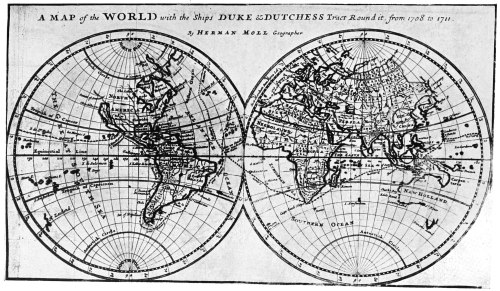 THE TRACK OF THE DUKE AND DUTCHESS ROUND THE WORLD
Reproduction of the frontispiece to the first edition of Woodes
Rogers’s book.
Account of the River Amazons.
He stood into them, and landing his Men, the Natives fought with great Resolution, ten
or twelve being white Women of an extraordinary Size, with long Hair and
all naked but their Pudenda, who seem’d to be their Commanders. They
were arm’d with Bows and Arrows; and seven of ’em being kill’d, the rest
fled. Orellana had several Men wounded; and finding that multitudes of
the Natives were marching against him, he sail’d off, reckoning that he
had now made 1400 Leagues during his Voyage, but still did not know how
far he was from the Sea. He afterwards came to another Town, where he
met with the like Opposition: several of his Men were wounded, and his
Chaplain lost an Eye. Here he observ’d several Woods of Oak and
Cork-Trees: He call’d this Province by the name of St. John’s, because
he came to it on that Saint’s Day. He sail’d on till he met with some
Islands, where he was attack’d by 200 Canoes with 30 or 40 Men in each,
abundance of Drums, Trumpets, and Pipes, &c. but he kept them off with
his Fire-Arms. These Islands appear’d to be high, fruitful, and
pleasant, and the largest of ’em about 50 Leagues long; but he could
take in no Provisions, because the Canoes continually pursu’d him.
When he came to the next Province, he perceiv’d many large Towns on the
Larboard side of the River: Multitudes of Natives came in their Canoes
to gaze on him, and his Indian Prisoner inform’d him that these
Countries abounded with Gold and Silver. Orellana was here oblig’d to
barricade his Boats to cover his Men, because one of ’em was kill’d by a
poison’d Arrow. As he sail’d on, he came to inhabited Islands, and
perfectly discern’d the Tide. Here he was attack’d by multitudes of
Canoes, and lost some more Men by poison’d Arrows. There were many Towns
on the Starboard side of the River, and he found other inhabited
Islands, where he got Provisions, but was attack’d and beat off when he
landed on the Continent, till he came near the mouth of the River, where
the People readily furnish’d him. He sail’d 200 Leagues among the
Islands, where he found the Tide strong, and at last in August that
Year found a Passage to the Sea of about 50 Ls. wide, where the Tide
rises five or six fathom, and the fresh Water runs 20 Leagues into the
Sea; Esquire Harcourt,[106] in his Voyage to Guiana, says 30 Ls. and
that the fresh Water there is very good. He was mightily distress’d for
want of Rigging and Provisions till he came to the Island of Cubagua,
from whence he went to Spain to give the King an Account of his
Discovery. The Manuscripts taken by Capt. Withrington[107] say that
Orellana was about a Year and half upon this River.
When he reported his Discoveries, the King of Spain sent him back with
a Fleet and 600 Men to take possession of this River in 1544, some say
1549, but the Project came to nothing: for the Captain himself, after he
had sail’d up 100 Ls. died with 57 of his Men by the Unhealthiness of
the Air; and some of them sail’d 60 Ls. higher, where they were friendly
entertain’d by the Natives, but being too few to pursue the Discovery,
they return’d to the Island Margarita, where they found Orellana’s
Lady, says Heerera, who told them that her Husband died of Grief for
the Loss of so many of his Men by Sickness and the Attacks of the
Indians. And thus they return’d re infecta: so that Orellana
receiv’d no other Advantage for his Danger and Expence, but the Honour
of the first Discovery, and having the River call’d by his name in some
Authors. Ovalle says that he lost half his Men at the Canaries and
Cape Verd, and his Fleet was reduc’d to two large Boats before he came
back to the River; so that he was too weak to attempt a further
Discovery.
The Manuscripts taken by Capt. Withrington say the second Person who
attempted it was Leus de Melo a Portuguese, by order of his
Sovereign King John III. to whom the Country from the mouth of this
River to that of La Plata belong’d, according to the Partition agreed
on betwixt the Portuguese and the Spaniards. He had ten Ships and
800 Men, but lost eight of his Ships at the mouth of the River; so that
he went to the Island Margarita, from whence his Men were dispers’d
all over the Indies. Two or three Captains from the Kingdom of New
Granada attempted it afterwards by Land, but without Success.
In 1560. those of Peru try’d it another way. The Viceroy sent Pesdro
de Orsua, a Native of Navarre, with 700 Men to the Head of this
River, where he built Pinnaces and Canoes; and having furnish’d himself
with Provisions, and taken 2000 Indians with many Horses on board, he
imbark’d on the
Account of the River Amazons.
River Xauxa or Maranhon. He sail’d till he came to a plain Country,
where he began to build a Town: but his Men not being us’d to such
Labour, and fatigu’d by the hot and rainy Seasons, they murmur’d, tho
they had Provisions enough, and a great prospect of finding Store of
Gold. The Mutineers were headed by Lopez de Agira a Biscayner, who
had been an old Mutineer in Peru; and being join’d by Ferdinand de
Guzman a Spanish Soldier, and one Saldueno who was enamour’d on
Orsua’s beautiful Lady, they murder’d him when asleep, with all his
Friends and chief Officers. Then they proclaim’d Guzman their King,
but 20 days after he was also murder’d by Lopez, who assum’d the Title
to himself. Being a Fellow of mean Birth, he murder’d all the Gentlemen
in company, lest any of them should rival him; and having form’d a Guard
of Ruffians about him, he became so jealous of his new Dignity, and was
so conscious of what he deserv’d, that when any of the Men talk’d
together, he concluded they were plotting against him, and sent his
Ruffians to murder them. Abundance of the rest and the Women falling
sick, he barbarously left them to the mercy of the Natives, and sail’d
to the Island Margarita with 230 Men. He was “well entertain’d by the
Governour, who took him to be one of the King’s Officers; but this
ungrateful Villain did speedily murder him and his Friends, ravag’d the
Island, forc’d some Soldiers to go along with him, and pretended to
conquer the Indies; but was defeated, taken and hang’d by the
Governour of New Granada. The Wretch murder’d his own Daughter that
she might not be insulted by his Enemies, and then attempted to murder
himself, but was prevented. Thus concluded that fatal Expedition.
The Sansons say the next Attempt was by those of Cusco in 1566. but
it came to nothing; for their Leaders fell out and fought with one
another, which made the rest a Prey to the Natives: or that only
Maldonado one of their Captains and two Priests escap’d to carry home
the News.
Two of the Generals of Para and Governours of Maranhon were the next
that renew’d the Attempt by the King’s Command, but met with so many
cross Accidents that they could not effect it.
In 1606. two Jesuits set out from Quito, thinking to reduce the
Country on this River by their Preaching: but one of them was kill’d by
the Natives, and the other narrowly escap’d, says Ovalle.
The next Discovery was by Capt. John de Palacios. Authors differ as
to the time; but most agree ’twas in 1635. He set out from Quito with
a few arm’d Men and Franciscan Fryars, sail’d down the River till he
came to Annete, where he was kill’d in 1636. and most of his
Companions return’d, except two Monks and five or six Soldiers, who
sail’d down in a little Vessel as far as Para the Capital of
Brazile; where they acquainted Texeira the Portuguese Governour
with their Discovery: who upon their Information sent 47 Canoes with 70
Spaniards and 1200 Indians to sail up the River under Texeira the
Sailor. He set out in October 1637. and met with several Difficulties,
which occasion’d many of the Indians to forsake him; but he went on,
and sent a Captain with eight Canoes to make Discoveries before him.
This Captain arriv’d June 24. 1638. at a Spanish Town built at the
Conflux of the Rivers Huerari and Amazons, and dispatch’d a Canoe to
acquaint Texeira with it. This encourag’d him to proceed till he came
to the Mouth of the River Chevelus, where it falls into the Amazons,
and there he left part of his Men under a Captain, and the rest at
Junta de los Rios under another; while himself with a few went forward
to Quito. The other Captain arriv’d there some time before, and both
were well receiv’d by the Spaniards, to whom they reported their
Discovery in September 1638. The Men he left behind were well
entertain’d by the Natives at first, but quarrelling with them
afterwards, suffer’d much for want of Provisions, and had little but
what they took by force.
Upon the News of this Discovery, the Count de Chinchon Viceroy of
Peru sent Orders from Lima to furnish Texeira with all Necessaries
for his Return down the River, and appointed Father d’Acugna, Rector
of the College of Cuenca, and another Jesuit, to attend him and carry
the News to Spain. They set out in February 1639. and arriv’d at
Para in December following; from whence d’Acugna went to Spain,
and publish’d his Account of this River in 1640.
Account of the River Amazons.
The Sum of his Discovery, besides what has been mention’d already, is as
follows. There’s a Tree on the Banks of this River call’d Andirova,
from whence they draw an Oil that is a Specifick for curing Wounds.
There’s plenty of Iron-Wood, so nam’d because of its Hardness, Red-Wood,
Log-Wood, Brazile, and Cedars so large, that Acugna says he measur’d
some that were 30 span round the Trunk. They have Timber enough to build
Ships, make Cordage of the Barks of Trees, and Sails of Cotton, but want
Iron. They make Hatchets of Tortoise-shells, or hard Stones ground to
an Edg; and Chizzels, Planes, and Wimbles of the Teeth and Horns of wild
Beasts. Their chief Directors are Sorcerers, who are the Managers of
their hellish Worship, and teach them how to revenge themselves on their
Enemies by Poison and other barbarous methods. Some of them keep the
Bones of their deceas’d Relations in their Houses; and others burn them
with all their Movables, and solemnize their Funerals first by mourning,
and then by excessive drinking. Yet the Father says they are in general
good-natur’d and courteous, and many times left their own Hutts to
accommodate him and his Company. Some of these Nations, particularly the
Omaguas, whose Country is 260 Leagues long, and the most populous on
the River, are decently clad in Rayment of Cotton, and trade in it with
their Neighbours. Some of the other Nations wear Plates of Gold at their
Ears and Nostrils; and their Joiners are so expert, that they make
Chairs and other Houshold Furniture in the shapes of several Animals
with great Art.
The Jesuits of Quito in Peru have engrav’d a Map of this River, in
which they give the following Account, viz. That ’tis the greatest in
the known World: That tho it be call’d by the name of Amazons or
Orellana, its true name is Maranhon: That it rises from the Lake
Lauricocha, as we have mention’d already, runs 1800 Leagues, and falls
into the North Sea by 84 Mouths: That near the City Borja it is pent
up by a Strait call’d El-Pongo, not above 13 Fathom wide and 3 Ls.
long; where the Stream is so rapid, that Boats run it in a quarter of an
hour. The Truth of this must be submitted to the Judgment of the Reader,
but it seems very improbable, since none of those who sail’d up and down
this River describe it thus: besides, ’twere impossible to sail up
against so rapid a Stream without a Tide, which the Sansons say comes
up to this Strait; but they make it a mile broad, and by consequence not
so rapid. The Jesuits add, that both Banks from the City Jaen in the
Province of Bracamoros, where it begins to be navigable, down to the
Sea, are cover’d with Woods of very tall Trees, among which there’s
Timber of all colours, abundance of Sarsaparilla, and the Bark they
call Cloves, which is us’d by Dyers and Cooks. In the neighbouring Woods
there are many Tygers, wild Boars, and Buffaloes, &c. The Jesuits
began their Mission upon this River in 1638. have their Capital at the
City of St. Francis of Borja in the Province of Manos, 300 Leagues
from Quito; and their Mission extends along three other Rivers as far
as the Province of the Omaguas, whither they make sometimes long and
dangerous Voyages in Canoes. They give an account of eight of their
number that have been murder’d by the Barbarians, the last of them in
1707. Besides Borja and its Dependencies, they have 39 Towns founded
mostly by their own Labour and Charge, but we shan’t insist on their
Names. Their Converts they reckon at 26000, and the Missionaries about
18. They add, that they have contracted Amity with several numerous
Nations, whose Conversion they hope for.
The Portuguese have some Towns at the Mouth of this River, and a Fort
on Rio Negro; so that of late years they have traded much upon it,
and, as several Spaniards inform’d me, during the last Peace they
extended their Commerce as far as Quito and many other Places in
Peru. I have insisted the longer on this River, because it is of so
great Fame, and may be of mighty Advantage for Trade.
The River of La Plata being the South Boundary of Brazile, within
the Limits of the South-Sea Company, and lying conveniently for
opening a great Trade from the North-Sea with Peru, Chili, and other
vast Countries; I shall give a Description of it here, from the best
Authors.
The first European who discover’d it, seems to have been Juan Dias de
Solis, who sailing from Spain in 1512. some say 1515. run along the
Coast of Brazile till he came to this River, says Ovalle. With him
agree the Manuscripts taken on some Spanish Priests in this River by
Capt. Withrington, publish’d in Harris’s Collections[108]; where we
are told, De Solis obtain’d the Government of this River, but was
murder’d by the Natives with most of his Men in 1515. The next who came
hither was Sebastian Cabot in 1526. but his Men being mutinous, he had
not the desir’d Success, tho he sail’d 150, some say 200 Leagues up this
River; and purchasing many Pieces of Gold and Silver Plate from the
Natives, who call’d this River Parama, he call’d it the River of
Plate, because he thought it to be the Product of the Country, which was
afterwards found to be a Mistake. Yet upon his Report, in 1530. when he
return’d, the Emperor Charles V. sent Don Peter Mendoza, one of his
chief Grandees, with 2200 Men besides Mariners, to plant a Colony here
in
Account of the River La Plata.
1535. and they had so great hopes of finding Mines of Gold and Silver,
that above thirty Heirs of noble Families went on the Expedition; and
sailing 50 Leagues up the River, where the Air was good, he founded a
Town, which from thence was call’d Buenos-Ayres. They built a Fort,
and enlarg’d the Town; but as they were carrying on their Work, the
Natives attack’d them, and overpowering them with Numbers, kill’d 250,
among whom were several of the chief Men. This oblig’d the Spaniards
to keep within their Fort, where they suffer’d much by Famine. Mendoza
return’d towards Spain, but died miserably, with many of his
Companions, for want of Provisions by the way. His Deputy-Governour
Oyola sail’d up into Paraguay, in quest of a Country said to abound
with Gold and Silver; but was treacherously slain by the Natives, with
all his Followers.
Irala who was his Deputy, and left at Buenos-Ayres, contracted a
Friendship with some of the Natives call’d Guaranians. In 1538. he
built Assumption in their Country, which is now the Metropolis of
Paraguay, and left Buenos-Ayres for a time. Assumption lies on the
Banks of the River Paraguay, in S. Lat. 25. 240 Leagues from the Sea,
and 40 from the Mouth of the River Paraguay, where it falls into La
Plata, These Rivers after they join continue their natural Colour for
several miles, La Plata being clear, and Paraguay muddy. The latter
is by much the most considerable River, and the adjacent Country abounds
with Mines of Gold and Silver, and is navigable above 200 Leagues. The
River Uruquay falls into Paraguay on the right side, and runs a
Course of 300 Leagues, according to Sepp the Jesuit, who in his Voyage
says ’tis as big as the Danube at Vienna. In short, as to this River
La Plata, Authors are not agreed. Some of the Jesuits who are
Missionaries in those Countries think it to be the same with that call’d
Paraguay higher up in the Country, and that it has a Communication
with the North-East Coast of Brazile by the River St. Meary, which
rises out of the same Lake, and runs N E. as Paraguay or Plata runs
S. and afterwards to the S E. when it falls into the Sea. Be that how it
will, here are many Rivers which fall into the same Channel on both
sides. But that which is commonly call’d La Plata, begins near the
Town of that Name about S. Lat. 19. and after running N. a little way,
takes its Course S E. till it join the River Paraguay. So that I chuse
rather to trust to the Account given us by Mr. White our Linguist, who
having dwelt long in that Country, told me this River derives its Name
from the Town of La Plata, a sort of Metropolis to which there lies an
Appeal from other Jurisdictions. He adds, that ’tis a pretty Town, has
fourteen Churches with a Cathedral, and four Nunneries, and lies
North-west from Buenos-Ayres about 500 Leagues, which requires
commonly two months and a half’s Travel.
All are agreed that La Plata is very large at the Mouth, where some
account it 50, and others 30 Leagues broad. The Mouth of it is dangerous
because of Sands, and therefore requires Pilots. Knivet,[109] in his
Description of the West-Indies, says, the best way to avoid those
Sands is to keep near the North Shore till you come to a high Mountain
white at top; and then to sail 4 Ls. South, to another small Hill on the
North side, near which you must sail. This brings you into a fair Bay,
where you must still keep along shore: and after passing the West Point
of this Bay, you come to the River Maroer, and then there are no more
Shoals between that and Buenos-Ayres.
La Plata runs into the Sea about S. Lat. 35. and sometimes overflows
the Country for several miles, when the Natives put their Goods into
Canoes, and float about till the Inundation assuages, and then they
return to their Habitations. Ovalle gives the following Account of
this River, viz. That it runs with such a mighty Stream into the Sea,
as makes it fresh for a great way: That the Water of this River is very
sweet, clears the Voice and Lungs, and is good against all Rheums and
Defluxions: That the People who dwell about it have excellent Voices,
and are all inclin’d to Musick: That it petrifies the Branches of Trees,
and other things which fall into it; and that Vessels are naturally
form’d of its Sand, which are of various Figures, look as if they were
polish’d by Art, and keep Water very cool. It breeds great store of
excellent Fish of divers sorts, and most beautiful Birds of all kinds
are seen on its Banks. Sepp informs us, that this River and Uraguay
abound so with Fish, that the Natives catch great numbers of them
without any other Instrument than their Hands: one of the choicest,
call’d the Kings-Fish, is small without Bones, and taken only in Winter.
Our Author, says he never saw any European Fish in this latter, except
one that the Spaniards call Bocado; and that the Fish are larger
here than ours, of a dark or yellow colour, and well tasted; which he
ascribes to the nature of
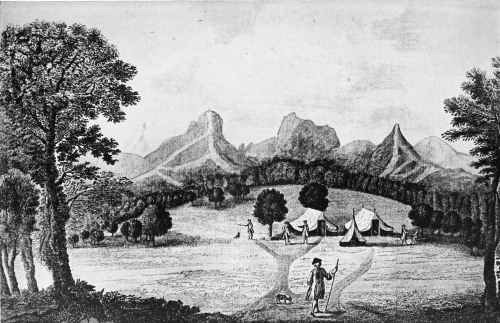 THE ISLANDS OF JUAN FERNANDEZ, WHERE ALEXANDER SELKIRK
WAS FOUND
Account of the River La Plata.
the Water, that tho drunk in great quantities even after raw Fruit,
helps Digestion, and never does any hurt. The Plains about this River
are so large and even, without any Obstruction to the Sight, that the
Sun seems to rise and set in them. Their way of travelling in those
Plains is by high Carts cover’d with Hoops and Cows-Hides like our
Waggons, with Conveniency for Travellers to sleep in the bottom; which
is so much the better, because they travel most by night to avoid the
Heat. They are drawn by Oxen, which are frequently so pinch’d by
Drought, that when they come towards any Water, which they smell at a
great distance, they run furiously to it, and drink up the very Mud
which they raise with their Feet. This obliges Travellers to furnish
themselves with Water and other Provisions for their Journy; there being
no Water to be had, except by Rain: so that Travellers are frequently as
much distress’d for want of Water as the Oxen, and can scarce get any
that’s clear at the Watering-places, tho they send before-hand, because
the Oxen run with so much haste to it that they make it all in a puddle:
Ovalle says, that in this case Travellers are forc’d to stop their
Noses and shut their Eyes when they drink it. The Journy thro these
Plains is at least 14 or 20 days, without any place of shelter, or any
Firing to dress their Victuals but the dry’d Dung of Cattle. Yet there
are several Lakes and Ponds where Inns might be fix’d, but ’tis
neglected because there’s no settled Trade that way.
It remains to give some account of the Towns upon the River Plata and
on the Road to Potosi. 1. Buenos-Ayres lies upon the River 50
Leagues from the Sea, about Lat. 36. Our Linguist inform’d me that ’tis
the Residence of a Spanish Governour, is defended by a Stone Fort
mounted with 40 Guns, and is generally garison’d by 4 or 500 Men. The
Harbour is pretty good, but troublesom in a N W. and W. Wind. The River
is 7 Ls. broad there, and navigable by Ships 60 Ls. above the Town, but
no further, because of a great Cataract. The Town has one Cathedral, and
five other Churches: The Portuguese had a Settlement over against this
Town, but were dislodg’d by the Spaniards at the beginning of this
War; since which time the French drive a Guinea Trade hither for
Negroes, who are sent over Land to Peru and Chili, and yield them
vast Profit. The Trade from hence to Spain is in Hides and Tallow,
Silver from Peru, and Gold and Silver from Chili. All European
Goods yield a good Price here. They have plenty of Fruit-Trees about
the Town of all kinds, both of the hot and cold Climates; and have
store of Wheat and other European Grain, besides Indian Corn.
Thousands of Cattel of all sorts run wild in the Neighbourhood, and they
furnish Peru with 50000 Mules per ann. In short, this place lies
very convenient for Commerce in Silver and Gold, and the other
Commodities of Peru and Chili, which the French have now begun to
engross. They sent three Ships to those parts and the South-Sea, under
M. de Beauchesne Gouin[110] of St. Malo in 1698, of whose Progress I
shall give a further account from a Copy of his Journal, as I go on with
my Description of the Coasts. Their Winter here is in May, June, and
July, when ’tis cold by night, but warm enough by day, the Frost never
being violent, nor the Snow considerable in those parts.
Father Sepp,[111] who was here in 1691. tells us in his Voyage from
Spain to Paraquaria or Paraguay, that Buenos-Ayres has only two
Streets built crosswise; that there are four Convents, one of which
belongs to the Jesuits; that their Houses and Churches are built of
Clay, and not above one Story high; that the Jesuits have taught them of
late to burn Lime, and make Tiles and Bricks, with which they now begin
to build. The Castle is likewise of Clay, encompass’d with an earthen
Wall and a deep Trench, and defended by 900 Spaniards; tho in case of
necessity above 30000 Indian Horse might be arm’d out of the several
Cantons, where they have been train’d by the Jesuits: But this boasting
Account I can’t believe. They have in the Neighbourhood whole Woods of
Peach, Almond, and Fig-Trees, which they propagate by putting the
Kernels in the Ground: they grow so fast as to produce Fruit the first
Year, and their Timber is us’d for Fewel. The adjacent Pastures are so
fat and large, that many thousands of Beeves feed together; so that any
one when he pleases goes into the Field, throws a Rope about their
Horns, brings ’em home and kills ’em. They are very large, generally
white, and being so numerous, are valu’d only for their Hides, Tallow,
and Tongues; the rest being expos’d to the Birds and Beasts of Prey,
which are very numerous, and frequently destroy the Calves. The Natives
feed most on Beef half-raw without Bread or Salt, and in such quantities
that they throw
Account of the River La Plata.
themselves naked into cold Water, that they may retain the natural Heat
within their Entrails to help Digestion; and sometimes they lie down
with their Stomachs in hot Sand: but their Gluttony in devouring so much
raw Flesh fills them so with Worms, that they seldom live till 50 Years
old. There are such numbers of Partridges here, and so tame, that they
knock them down with sticks as they walk in the fields. The
Missionaries, who are absolute Masters of the Natives in the
neighbouring Cantons of Paraguay, &c. suffer none of ’em to come
nearer Buenos-Ayres than two or three Leagues, on pretence that they
would be corrupted by the ill Example of the Spaniards; and under that
same pretence they won’t suffer the Spaniards to settle in their
Missions, which extend above 200 Leagues up the River; nor do they allow
Merchants who trade thither to stay above a few days; the true cause of
which is, they are not willing that the Laity should be privy to the
Wealth they heap up there, in a Country which abounds with Gold, nor be
Witnesses to their splendid, or rather luxurious way of living.
Sometimes Complaints of this Procedure of the Jesuits have been made to
the Spanish Governours, but they find a way to bribe them to silence.
This I was inform’d of by those who have been among them, and am
confirm’d in it by Father Sepp: He does not dissemble that the
Missionaries have a Despotical Power over the Natives, tho he gives it
another Turn, and pretends that ’tis necessary in order to convert and
force them to work. He says the Jesuits are Captains, teach them the Use
of Arms, and how to draw up into Squadrons and Battallions; which he
boasts they can do as well as the Europeans. The Jesuits obtain’d this
Power, on the specious Pretence of reducing those Indians to the
Obedience of the Spaniards, which they would not submit to till within
these few Years. This Management is so much the more easily carry’d on,
because the Ecclesiastical Government there is lodg’d in the hands of
one Bishop only and three Canons; and the Missionaries being compos’d of
all Nations, few of them have any natural Affection to the Spanish
Government. This is the more to be observ’d, because the Jesuits being
an intriguing Society, and generally in the French Interest, it would
seem to be the Concern of the Allies to recover the Trade of those
Countries from the House of Bourbon with all possible speed, left by
making themselves Masters of the vast Treasures of Peru and Chili,
they be enabled at last to compleat their Design of an Universal
Monarchy. Father Sepp says, that Silver in 1691. was cheaper here than
Iron; that for a Twopenny Knife one may have a Crown, for a Hat of two
Shillings 10 or 12 Crowns, and for a Gun of ten or twelve Shillings 30
Crowns; that Provisions are so plenty here, that a fat Cow may be bought
for the Value of 10 d. or 12 d. a good Ox for a few Needles, a stout
Horse for about 2 s. that he has seen two given for a Knife not worth
6 d. and that he and his Company had 20 Horses for a few Trifles that
did not cost them a Crown; being only a few Needles, Fish-Hooks, sorry
Knives, Tobacco, and a little Bread. He mentions a Cataract in the River
Uruquay, which he says Providence has plac’d here for the advantage of
the poor Indians against the Avarice of the Spaniards; who not being
able to go further with their Vessels, have been hitherto confin’d to
Buenos-Ayres, and could not settle in those Cantons, tho very
inviting, because of the vast Profit they might draw from them. This he
reckons a great Happiness to the Natives, who being a simple People,
would not only be soon infected with the Vices of the Spaniards, but
enslav’d by ’em: for, says he, they make no difference betwixt Pagan and
Christian Natives, but treat them promiscuously like Dogs. He adds, that
this Province of Paraquaria or Paraguay exceeds in bigness
Germany, France, Italy, and the Netherlands put together;
(wherein I doubt he exceeds:) That they have no Cities, and are govern’d
by 80 Colleges of Jesuits, in which there are no more than 160 Persons;
and that these Colleges are from 100 to 600 Miles distant from one
another. There’s one Plain of 200 Leagues long betwixt Buenos-Ayres
and Corduba in Tucuman, without so much as a Tree or Cottage, and
yet it contains the best Pastures in the World, fill’d with Cattel of
all sorts which have no Owners.
Account of the River La Plata.
He describes the Natives thus: The Men are not quite so tall as
Europeans, but have thick Legs and large Joints. Their Faces are
round, flattish, and of an Olive Colour; and their Arms are Bows and
Arrows. Some of the strongest have many Scars on their Bodies,
occasion’d by Wounds which they gave themselves when young, that these
Scars may be remaining Proofs of their Courage. Their Hair is black,
long, and as strong as that of a Horse. The Women look more like Devils
than rational Creatures, with their Hair loose over their Foreheads, and
the rest twisted in Locks behind, which hang as low as their Hips. Their
Faces are wrinkled, their Arms, Shoulders and Breasts naked; and their
Ornaments are Fish-Bones made like Scales of Mother-of-Pearl about
their Necks, Arms and Hands. The Wives of their Caciques or petty
Princes wear a sort of Triple Crowns of Straw. The Caciques wear
Doe-Skins hanging over their shoulders; the rest only a piece of a Skin
wrap’d about their middle, and hanging down before to their knees. The
Boys and Girls are quite naked. They have holes in their Ears and Chins,
in which they put Fish-Bones, or a colour’d Feather tied by a thred, and
Feathers of several colours fasten’d to a string round their Necks. They
wrap their Infants as soon as born in a Tyger’s Skin, give them the
Breast for a little while, and then half-raw Meat to suck. He says, the
Men at the death of their nearest Relations cut off a Finger of their
own left Hand; and if it be a handsom Daughter, they make a Feast and
drink out of her Skull. They live in Straw Hutts without Roofs, and
their Utensils are a few Sticks for Spits, and Pumpkins hollow’d out, in
which they eat their Meats. Their Beds are the Hides of Oxen or Tygers,
spread on the ground; but the Caciques, and those of Note, lie in a Net
fasten’d to two Poles for Hammocks, at some distance from the ground,
being a Security against wild Beasts and Serpents. Our Author says that
he sent well-boil’d Meat to several of them when sick, which they
receiv’d thankfully; but afterwards gave it to their Dogs, because they
lik’d their own Cookery better.
It is now time to see how the Missionaries live among those Flocks over
whom they assume the Pastoral Care. Father Sepp tells us, that he and
other new Missionaries were welcom’d by some of them with 20 Musicians
in a Train, abundance of Boats equip’d like Galleys lin’d with
Firelocks, and having Drums, Trumpets, and Hautboys on board. The
Missionaries brought ’em Sweatmeats, and all sort of Fruit; and the
Indians diverted them by wrestling in the Water, and Salvoes of their
Fire-Arms, &c. They conducted them thro a green Triumphal Arch to the
Church, where the Women were so earnest at their Devotion, that not one
of them cast an eye upon our Father and his Companions: so that here
were a Militant and a Triumphant Church both together. When the Devotion
was over, the chief of the Indians welcom’d the Father and the rest of
the Missionaries, by a short but very pathetick Speech; and one of the
Indian Women did the like with wonderful Elegancy, says the Jesuit,
who it seems is not against Women speaking in the Church. That and the
next day they spent in Mirth and Jollity, and in the Evening were
diverted by four Dances; 1. By Boys, who danc’d with Pikes and Lances.
2. By a couple of Fencing-Masters. 3. By six Seamen. 4. By six Boys on
horseback, who afterwards gave them a kind of Tournament, the place
being illuminated by Ox-Horns fill’d with Suet, for they have no Oil nor
Wax. On Whitsunday, which happen’d soon after, the Missionaries went
to Church, and return’d Thanks for so many Converts; as certainly they
had reason, since they are such merry ones.
These Cantons, he says, are 26, and have but one or two Missionaries
apiece, tho they contain from 3000 to 6000 People each, and sometimes
more; so that they must either have too much work, or perform it very
slightly, especially if they be so ignorant as our Father says, that if
they be neglected one day, they scarce know how to make the Sign of the
Cross the next: And besides all the Pastoral Work, the Missionaries must
act the part of Clerks, and clean the Church-Ornaments and Plate; for
these poor Wretches are uncapable of doing it. To be short, says he, the
Missionary must be Cook, Nurse, Doctor, Architect, Gardiner, Weaver,
Smith, Painter, Baker, Potter, Tile-maker, and every thing else that is
necessary in a Commonwealth. This he supposes will appear incredible
(and he’s certainly in the right) but he says ’tis the naked Truth; the
Natives being so stupid, that unless he plainly shew his Indian Cook
how much Salt he must put in each Pot, he would put all into one, tho
ever so much; and he must see them wash the Vessels, unless he would be
poison’d: yet this Father, for all his other hard work, must look after
his Garden, Orchard, and Vineyard, where he has all sorts of Flowers,
Herbs, Roots and Fruits, and so many Vines as produce 500 large Casks of
Wine in a Year, if not prevented by multitudes of Pismires, Wasps,
Birds, or by the North Winds, which sometimes make Wine so dear, that a
Cask yields 20 or 30 Crowns; and after all, ’tis not to be preserv’d
from turning sour without a great mixture of Lime. The chief Distemper
of the Natives is the Worms before-mention’d, the bloody Flux
[dysentery] and spotted Fever, which frequently carry off great numbers.
The Medicines which the Missionaries give against Worms, is a Vomit of
Tabacco-Leaves; and after that, sour Lemon-Juice with those of Mint and
Rue put into Milk.
Account of the River La Plata.
These Cantons or Towns, he says, are generally upon an Ascent near the
Rivers Uruguay and Paraguay, and contain young and old from 6000 to
8000 Souls. Each Canton has a Church and a square Market-place near it,
the rest being divided into Streets of Clay-Hutts cover’d with Straw,
only of late they begin to use Tiles. They have no Windows, Chimneys, or
different Apartments; and over the Fire-place they hang their Beds at
night. Their Doors are Ox-Hides; and since all lie together in one Room,
with their Dogs, Cats, &c. the Missionaries are entertain’d with very
ungrateful Scents, besides Smoke, when they go to visit them. He says,
in the main they are very patient under Distempers, and the Death of
Relations; that they seek after no Riches but a present Maintenance;
that their young Women are marriageable at 14, and the Men at 16, when
the Missionaries take care to match them, otherwise they will pair
themselves. There are no Disputes here about Dowries, Jointures, or
Marriage-Settlements; the Agreement consists only in two Articles,
viz. The Woman promises to fetch what Water the Husband wants from the
River, and he engages to provide the Kitchin with Fewel. The
Missionaries furnish them with Hutts, the Wedding-Clothes and Dinner.
The Wedding-Suit is five yards of coarse woollen Stuff for each, the
Dinner is a fat Cow, and the Bed some Ox-hides. He presents them also
with a little Salt and a few Loaves, and then they treat their Parents.
The Women court here, come to the Missionary, and tell him they have a
mind to such a Man, if he will give his Consent; which if he do, the
Match is made, and the Missionary is both Priest and Father.
How mean soever the Natives live, the Priests have enough of Splendor
and Plenty. Their Churches and Steeples are lofty, have four or five
Bells apiece, most of ’em a couple of Organs, Altars, and Pulpits richly
gilt, Images well painted, plenty of Silver Candlesticks, Chalices, and
other Church-Plate; and the Ornaments of the Priests and Altars are as
rich as in Europe. They teach the Natives to sing and play on all
Musical Instruments both for Devotion and War; so that according to the
Jesuits they go now more merrily to Heaven than formerly they did to
Hell, and the good Fathers divert themselves with Sets of Musicians on
the Banks of the Rivers and in charming Islands. Nor can we wonder that
they live so merrily, since they fare so well; for besides all sorts of
delicious Fruits and Preserves, they have plenty of Fowl, Fish, and
Venison of all sorts, as well as ordinary Butchers Meat; only the
Tygers, which are very numerous, frequently put in for a share with
them, invade their Flocks and their Followers: but if you’ll believe
our Father, they never attack the Clergy, they have such a Respect for
their Cloth, and are so civil to Europeans, that they’l charge the
Indians in their Company, and let them go scot-free; and the Serpents,
which likewise abound here, are charm’d by Ave Mary’s into the like
Good-Manners. The Priests use Honey for their Sallets, for they have no
Oil, so that they are very hard put to it. They had Silver in such
plenty, says the Father, that old Shoes and Hats were much more
valuable. And as if the Missionaries had not Work enough otherwise,
Father Sepp tells us, the Natives when they kill their Cows bring ’em
to the good Jesuits to allow each their share; and to be sure the Hides
fall to the Missionaries, for he says the three Ships which brought him
and his Companions from Spain, carry’d back 300000 Ox-Hides, which
they had for nothing, and each Hide he says would yield ’em six Crowns
at home. A good Horse-shoe he says is here worth six Horses, and the Bit
of a Bridle worth three. An Ell of Linen is worth four or five Crowns;
for they have no Hemp or Flax, but store of Cotton: and one Sheep, Lamb
or Kid, is for the sake of the Wool worth three Oxen or Cows. Tho the
Natives, he says, are so dull that they can’t do the most frivolous
thing without direction, yet they are so good at Imitation, that if you
give them Models, they will make any thing very well. Thus he says the
Indian Women after ripping a piece of Bone-Lace with a Needle, will
make one by the same pattern very exactly; and so the Men do Trumpets,
Hautboys, Organs, or Watches; and copy Pictures, Printing and Writing to
admiration.
Account of the River La Plata.
But they are so lazy that they must be forc’d to their work by blows, at
the direction of the Missionaries, who tho they convert ’em themselves,
make them cudgel one another. This they take very patiently, give no ill
Language, but cry Jesu Maria! and thank the good Fathers into the
bargain for taking such care of ’em; so that they have learnt
Passive-Obedience to perfection. But to make them amends, our Author
says the Missionaries teach their young ones to dance as well as to sing
in the Church, when they are habited in rich Apparel: so that they are
extremely taken with the Ornaments of our Religion, says he, which
raises in them a high Esteem and Affection; and indeed ’twould be a
wonder if it should not. The Missionaries do now take care to instruct
both Sexes in all necessary Employments, Reading, Writing, &c. They
have also taught ’em to make Images, especially of our Lady of
Ottingen; and very good reason, for if we believe Sepp, she has done
abundance of Miracles there. The Fathers wear Caps like a Bishop’s, and
black Linen Cassocks when they go abroad; and instead of Canes use
Crosses, which have a peculiar Virtue to knock Serpents o’ the head.
The Soil is so fruitful that it produces a hundred fold, tho sorrily
manur’d. The Natives sow nothing but Turky Wheat, and scarce enough of
that, they are so lazy: and are likewise such bad Husbands, that they
would eat all at once, did not the Missionary force ’em to lay it up in
his Barn, where he distributes it to ’em as they want, and so he does
their Flesh. They have no Mills, but pround their Wheat in a Mortar, and
make it into Cakes which they bake on Coals, or boil with their Meat.
The Fathers have white Bread for themselves, which the Natives value so
much, that they will give two or three Horses for a Loaf; and of these
the Missionaries have good store, for they have always 40 or 50 Acres
sow’d with Wheat for themselves: Land, Corn, Cattel, and every thing is
theirs; so that they call all the People their Sons and Daughters, and
perhaps there’s just cause enough to give many of ’em that Title. These
Lords Proprietors assign every Family their number of Cows and Oxen to
till their Ground, and to eat; tho one would think they might have
enough for the taking, without asking any body’s leave: and yet our
Father says he has been forc’d to chide his Parishioners for killing and
eating their Oxen, and roasting them with their wooden Plows in the very
Field while they were tilling the Ground; for which they pleaded in
excuse that they and their Wives were hungry and weary: and yet there
was no great reason for the latter, since their Plows, says our Author,
don’t enter above three inches into the Ground. They need no Hay for
their Cattel, since they go up to the knees in Grass all the year. This
is the way of living in those Cantons, which the Missionaries call
Reductions, because, if you’ll believe ’em, they have reduc’d them to
Christianity by their Preaching, tho the Spaniards could never do it
by their Arms.
Our Linguist told me that the Road from Buenos-Ayres to Chili is
only passable in the Summer Months, when Commodities are purchas’d at
that Town, and transported by Land to Chili.
On that Road about 100 Leagues N. W. from Buenos-Ayres lies the City
of Cordoua, which is the See of a Bishop, has ten Churches, and an
University. ’Twas founded in 1573. says F. Techo, by a Native of
Cordoua in Old Spain, when there were 60000 Archers reckon’d in its
Territory, about 8000 of whom continu’d in subjection, but the others
revolted. ’Tis now the Metropolis of the Province, and the Jesuits have
a Chappel in their College there, which for Riches and Beauty may vie
with the best in Europe. The Natives of this Country were very
barbarous, made use of Sorcery to satisfy their Revenge, and of Philtres
of their own Blood to gratify their Lust. Both Sexes daub’d their Faces
with strange Colours, and each Village was govern’d by a Sorcerer, who
pretended to be their Physician. To shew their Courage, they would draw
Arrows thro the Skins of their Bellies, and they fought Duels with sharp
Stones, standing foot to foot, and holding down their Heads to receive
the Blows from one another by turns. He that struck first was reckon’d
the most fearful: It was accounted disgraceful to dress their Wounds,
and the Conqueror was applauded by hideous Shouts from the Spectators.
’Twas a long time before the Missionaries could reform those barbarous
Customs.
Another Town on this Road is Mendosa, where they make large quantities
of Wine, Brandy, and Oil.
So much for that part of this vast Country which lies towards Chili
and Brazile: I shall next come to that part which lies towards Peru,
and particularly the Road to Potosi and the Mines.
Santa-Fe is the next Spanish Settlement of note to Buenos-Ayres,
from which it lies 80 Leagues N W. at the mouth of a River which falls
into La Plata. The Country betwixt this Town and Buenos-Ayres is
fruitful, well inhabited by Spaniards and Indians, and produces
Wheat from forty to an hundred fold, and abounds with Cattel. The Town
is encompass’d with a River, and built of Brick. Our Prisoners and
Linguist told us that there are Mines of Gold and Silver in the
Neighbourhood, but the Spaniards don’t care to open them, because the
Conveniency of sailing up the River might encourage Enemies to invade
and take them from ’em. This Town was built by the Spaniards when they
first settled, for the Defence of this River.
Account of the River La Plata.
St. Jago de l’Istero 200 Leagues N W. from Santa-Fe, is a pretty
Town govern’d by a Corregidore, has three Churches, and lies on the
River that runs down to Santa-Fe. Hither the Plate is brought from
Potosi on Mules, because the Roads are bad; and from hence it is
carry’d to Buenos-Ayres by Waggons. Next to this Town lies St. Miquel
de Toloman 200 Leagues N W. Then Salta 150 Leagues. This Town
contains six Churches. Then Ogui 50 Leagues further, which has five
Churches.
Potosi is next, lies N. of the Tropick of Capricorn about S. Lat.
21. Long. 73. Our Linguist tells us the City is large, has ten Churches
govern’d by an Arch-Priest. The Town stands at the bottom of that call’d
the Silver Hill, which is round like a Sugar-Loaf. There are 1500 or
2000 Indians constantly at work in the Mines here; they have two Reals
a day, and are paid every Sunday. The Mines are a hundred fathom deep,
and the Silver is grown much scarcer of late. Provisions are scarce at
this Town, and they have no Firing but Charcoal, which is brought from
30 to 50 Ls. distance. They have great Frosts and Snow here in May,
June, and July. Knivet in his Remarks says, in his time they were
well supply’d here with all things from the South-Sea, and that the
Natives in the adjoining Country traffick’d in Gold and precious Stones;
and hundreds of ’em ply’d upon the Road to carry Passengers from Town to
Town in Nets fasten’d to Canes, and supported by two or more Men; which
was the easiest way of travelling, and they desir’d no other Reward but
a Fish-Hook and a few Glass-Beads. They have also Sheep of an
extraordinary Size, with large Tails, upon which they carry’d Jars of
Oil and Wine. He says the rich Oar when taken out of these Mines looks
like Black Lead, then they grind it by certain Engines, and wash it thro
fine Sieves into pav’d Cisterns. They make the Indians and other
Slaves work quite naked in the Mines, that they mayn’t hide any thing.
The Curious who would know more of the Manners of the Natives, or the
History and particular Product of this large Country, may find it in
Gemelli,[112] Father Sepp, and Father Techo,[113] but this is
enough for my purpose, to shew what a vast Field of Trade may be open’d
here, and how dangerous it may prove to all Europe, if the House of
Bourbon continue possess’d of that Trade.
Some being of Opinion that our South-Sea Company may possess
themselves, by virtue of the late Act, of the River de la Plata, as
far up that River and Country as they please, either in the Provinces of
Paraguay or Tucuman; I shall give a further Description of those
large Provinces, after taking notice that according to several of our
Draughts Paraguay lies both on the E. and W. side of the River La
Plata; according to others, entirely on the E. side, and Tucuman on
the W. side. The Sansons make Paraguay 720 miles from S. to N. and
480, where broadest, from E. to W. and place it betwixt S. Lat. 14 & 24.
Long. 315 & 325. but the Breadth is not equal. Father Techo says the
River Paraguay, which gives name to the Country, is one of the
greatest in America, receives several other large Rivers, runs 300
Leagues before it falls into the Parana, about 200 from the Sea is
navigable, and together with the Parana forms the River La Plata.
The word Paraguay in the Language of the Country signifies the Crown’d
River, because the Inhabitants wear Crowns of Feathers of several
beautiful Colours, which they have from the Birds that abound in that
Country. I shall not insist upon the several Nations that inhabit it,
among whom the Garanians are the chief, and submitted first to the
Spaniards; but growing weary of the Slavery they subjected them to,
revolted, and were with much difficulty subdu’d after their Leaders were
cut off, about 1539. The chief Discovery of this Country is owing to
Dominick Irala, who in the Reign of the Emperor Charles V. was sent
by the Governour Alvar Nunez Cabeca de Vaca with 300 chosen Men, and
went 250 Leagues up this River, to endeavour a Communication with
Peru, but was oppos’d by some of the Natives, of whom 4000 were
kill’d, and 3000 taken in a Battel. The Governour went afterwards on the
Discovery himself, and sailing up the River, came to a delicious Island,
which his Men call’d Paradise, and would have settled there, but he
dissuaded them, and advancing to the Borders of Peru, found a large
Town of 8000 Houses deserted by the Inhabitants, who were affrighted
with the noise of the Spanish Fire-Arms. ’Tis said they found in this
Town a great Market-place, with a wooden Tower in form of a Pyramid
built in the middle, and a monstrous Serpent kept in it by which the
Devil pronounc’d Oracles: this Serpent they kill’d with their Fire-Arms.
But a Difference happening betwixt the Officers and Soldiers about
dividing the Booty, they return’d to Assumption without pursuing the
Discovery any further.
Account of the River La Plata.
This Province, till that of Tucuman was taken from it, contain’d all
the Country betwixt Brazile and Peru. Our Author adds, that besides
the Towns above-mention’d the Spaniards built here Corientes on the
Conflux of the Paraguay and Parana, which is but a small Town, no
way suiting the Dignity of those two Rivers: That 100 Leagues up the
Parana, in the Province of Guirana, the Spaniards built two little
Towns call’d Villarica and Guaira; that on the upper part of the
Paraguay they built Xeres and another Villarica, to join
Paraguay on that side to the further Provinces; and lastly, the City
of Conception on the Marshes of the red River which falls into
Parana, and was of great use to curb the fierce Nations in the
Neighbourhood. He adds, that all these Towns were first planted by a
Race of the noblest Families in Spain. He mentions an extraordinary
Herb here call’d Paraguay by the name of the Country; it grows in
marshy Grounds, and the Leaves being dry’d and powder’d, and mix’d with
warm Water, the Spaniards and Natives drink it several times a day,
which makes them vomit, and strengthens their Appetite. They look upon
it as a sort of Catholicon, use it so much that they can’t live without
it; and this Custom has so much overspread the neighbouring Provinces,
that the Inhabitants will sell any thing to purchase it, tho the
excessive Use of it occasions the same Distempers as the immoderate Use
of Wine. They did so fatigue the Natives to gather and powder this Herb,
that multitudes of ’em died; and this, with other slavish Employments,
did much dis-people the Country. The Natives live mostly by Fishing,
Hunting, and Shooting.
Account of the River La Plata.
Tucuman is 300 Leagues long, but varies much in breadth. ’Tis
inhabited by four Nations: The furthest South have no fix’d Dwellings,
live by Fishing and Hunting, and carry about Mats to serve them for
Tents. The North People live in Marshes, and feed most on Fish. The
Southern People are the tallest, but the Northern the fiercest; and many
of them live in Caves, but those nearest Peru in Villages. They are
all very slothful, and have store of Brass and Silver, but make little
use of them. They have large Sheep which carry their Burdens, and their
Wool is almost as fine as Silk. They have many Lions, not so large and
fierce as those of Africa, but their Tygers are fiercer than those of
other Countries. Their two chief Rivers are Dulce and Salado, so
call’d from the sweet and salt Taste of their Waters. They have
multitudes of Springs and Lakes, some of which have a petrifying
quality. The Country was formerly very populous, but their Numbers are
much decreas’d since the Spaniards planted among them. They easily
subdu’d this Country, which was govern’d by abundance of petty Princes
continually at war with one another. This Province was first discover’d
in 1530. by one Cæsar a Soldier belonging to Sebastian Cabot, and
three more, at the time when Pizarro took Atabalipa the Great Inga
of Peru. In 1540. the Viceroy of Peru, Vaca de Castro, assign’d
this Country to John Rojas as a Reward for his Services. He went
thither with 200 Spaniards, but was kill’d on the Frontiers by a
poison’d Arrow, and his Men under Francis Mendoza march’d thro to the
River of Plate. Mendoza being kill’d as going up that River by
Mutineers, John Nunez Prada was sent hither by the Viceroy Peter
Gasca, subdu’d the Indians, built the Town of St. Michel on the
Banks of the River Escava, and settled Fryars there. This Province was
afterwards subjected to Chili; and Francis d’Acquire being sent
thither with 200 Spaniards, destroy’d St. Michel, and built St.
Jago, now the Metropolis of Tucuman, on the River Dulce, in S. Lat.
28. says Techo, but others place it on the River Salado. ’Tis the
same Town I have already describ’d. In 1558. Tarita being made
Governour of this Province, built the City of London near the Borders
of Chili, about Lat. 29. calling it so out of compliment to Q. Mary
of England, at that time marry’d to Philip II. of Spain. This Town
serv’d to curb the Natives. Tarita did likewise rebuild St. Michel,
and reduc’d the Country so much, that 80000 Indians who submitted to
Spain were muster’d in the Territory of St. Jago. The Spaniards,
as was usual in those days, fighting with one another about the Command
of the Provinces, Tarita was drove out in 1561. by Castaneda; so
that most of the Natives revolted, till 1563. that Francis d’Acquire
reduc’d ’em again, and built Esteco above-mention’d. But the
Spaniards contending afterwards with one another about the Government,
many of their Settlements were destroy’d; so that in Techo’s time the
chief Places remaining in this Country were St. Jago, Cordoua, St.
Michel, Salta or Lerma, Xuxui or St. Salvador, Rioja,
Esteco or Nuestra Señora de Talavera, London, and a few other
small Garisons. He says that in this Country it does not rain in Winter,
but in Summer they have thick Mists and Rains enough. The Jesuits are
the chief Missionaries here, and settled in the principal Towns. He
adds, that near the City Conception, which is ninety Leagues from St.
Jago, the Natives were call’d Frontones, because they made the
Fore-part of their Heads bald. Their Arms were a Club at their Girdle,
Bows and Arrows, and Staves set with Jawbones of Fishes. They went
naked, and painted their Bodies to make them look terrible. They were
continually at War among themselves about the Limits of their Land, and
they fix’d the Bodies of their slain Enemies in Rows to the Trunks of
Trees, that others might be afraid of invading their Borders.
He adds, that the Country about St. Michael is well peopled, abounds
with Woods, and all sorts of European and other Fruits, so that it was
call’d The Land of Promise; but they are much infested with Tygers,
which the Natives kill with great dexterity. Guaira a Province of
Paraguay is very hot, because for the most part under the Tropick of
Capricorn; is very fruitful, but subject to Fevers and other Diseases:
yet when the Spaniards came hither in 1550, they are said to have
found 300000 People in this Country, but they say there’s scarce a fifth
part of that number now; and the Natives very miserable, having no Meat
but the Flesh of wild Beasts nor Bread but what they make of the Root
Mandiosa. There are Stones here which breed in an oval Stone-Case,
about the bigness of a Man’s Head. Our Author says, they lie under
ground, and when they come to maturity, break with a noise like Bombs,
and scatter abundance of beautiful Stones of all colours; which at first
the Spaniards took to be of great Value, but did not find ’em so. The
other remarkable Product of this Country is a Flower call’d
Granadillo, which the Jesuit says represents the Instrument of our
Saviour’s Passion, and produces a Fruit as big as a common Egg, the
Inside of which is very delicious. 2. A Fruit call’d Guembe, which is
very sweet, but has yellow Kernels, which if chew’d, occasions a sharp
Pain in the Jaws. 3. Dates, of which they make Wine and Pottage. 4. Wild
Swine which have their Navel on their backs, and if not cut off
immediately when the Beast is kill’d, corrupts the whole Carcase. 5.
Abundance of wild Bees, several sorts of which yield store of Honey and
Wax. 6. Snakes which dart from the Trees, and twist themselves about Men
or Beasts, and soon kill ’em if they be not immediately cut in pieces.
7. Macaqua Birds, so call’d because of an Herb which they eat as an
Antidote when hurt by Snakes, which lie and watch for them in the
Marshes. They frequently fight those Snakes, for which Nature has
provided them with sharp Beaks for a Weapon, and strong Wings to serve
them as a Buckler. Our Author mentions the River Paranapan, which runs
thro this Country, is almost as large as the Paraguay, and falls into
the Parana. Its Banks on both sides are cover’d with tall Trees,
especially Cedars, of so vast a Bulk that they make Canoes out of a
single Trunk, which row with twenty Oars. The Jesuits built the Towns of
Loretto and St Ignatius, and two more near the Conflux of this River
and the Pyrapus, about 1610, and eleven more have since been built in
that Province, where they have brought over many of the Inhabitants to
their Religion. They kill’d many of the Spaniards at first, and then
eat them. These Towns are plac’d by the Sansons about Lat. 22. and
betwixt Long. 325, and 330.
Account of the River Oronoco.
Our Author not being distinct in describing the Provinces of Paraguay
and Tucuman, but sometimes confounding one with the other, I shall
only add a few things more relating to those Countries in general. He
mentions a People call’d Guaicureans who live on the Banks of
Paraguay near the City Assumption, maintain themselves by Fishing
and Hunting, and eat all manner of Serpents and wild Beasts without
hurt. They have Tents of Mats, which they remove at pleasure. They dawb
one side of their Bodies with stinking Colours, scarify their Faces to
make them look terrible, suffer no Hair to grow on their Bodies; and
instead of a Beard fasten a Stone of a finger’s length to their Chin,
and make their Deformity the Standard of their Valour. Their chief
Delight is in Drunkenness and War; and to acquire the Title and Dignity
of Soldiers, they must endure to have their Legs, Thighs, Tongues, &c.
bored with an Arrow; and if they flinch in the least, are not allow’d
that Quality: and therefore they inure their Children from their Youth
to all sorts of Hardship, and to run Thorns and Briars into their Flesh
by way of Pastime. They honour their Commanders so much, that when they
spit they receive it into their hands, stand about them when they eat,
and observe all their Motions. They chose to fight by night, because
they knew nothing of Order, but made their Onsets like Beasts. They
either kill’d or sold their Prisoners, if at Man’s Estate, and the young
ones they bred in their own way. They lurk’d in Marshes and Woods by
day, keeping Spies abroad; and thus they plagu’d the Spaniards for
above a hundred years, till they were civiliz’d by some Missionaries.
They would not allow their Women to paint with a Clay-colour till they
had tasted human Flesh; and therefore when they kill’d Enemies, would
divide them among the young Women, or give them the Corpse of their own
Dead. They planted Trees over their Graves, adorn’d them with Ostrich
Feathers, and met there at certain times, howling in a most barbarous
manner, and performing many lewd and hellish Ceremonies. They worship
Parrots as Gods, and have a sort of Bears call’d Ant-Bears: They have
long Heads, Snouts much longer than those of Swine, and Tongues like
Spears, which they thrust into the Ant-Hills, and lick up those Insects,
which are as big as the top of one’s finger, and being toasted over the
fire, are eat by the Natives and Spaniards too as a Dainty.
Father Techo mentions another People nam’d Calchaquins in this
Country, whom he supposes to have been of Jewish Descent, because when
the Spaniards came first here, they found that many of them had
Jewish Names, and something of their Habit and Customs. Our Author
draws a Parallel in several Instances; but this, as well as his
Arguments to prove that St. Thomas the Apostle planted Christianity in
this Country, will scarce obtain Credit among the Learned. I refer the
Curious who would know more of those things to our Author, who brings
down what he calls the History of this Country as low as 1645. which is
the latest Account we have yet printed, except Father Sepp’s
abovemention’d, which brings it to 1691. of which I have given the
Substance already.
Before I go further, I shall give some account of the River Aranoca or
Oronoco, which is the Northern Boundary of our South-Sea Company’s
Limits. The Head of it, according to our Maps, is about N. Lat. 3. and
in Long. 77. It runs Eastward about 840 miles, about 60 miles N. of the
Equator, then runs N. about 420. and turning NE. about 120, falls into
the Sea about N. Lat. 9. So that its whole Course is about 1370 miles,
including Turnings and Windings; for it runs almost the whole Breadth of
that part of America, since it rises within 160 miles of the
South-Sea.
Mr. Sparrey,[114] who was left in the adjoining Country by Sir Walter
Raleigh in 1595. gives the following Account of this River. He says it
is also call’d Barequan, is a great River, and others call it Pariæ.
It falls into the Sea by sixteen Mouths; but according to Sansons Map,
what Sparrey calls Mouths are a number of Islands which lie near the
Shore at the Entrance of the River, and the chief of those Mouths nam’d
Capuri lies furthest South. They say it has 9 foot water at full Sea,
and but 5 at Ebb: It flows but a small time, when it rises apace, and
the Ebb continues 8 hours. There are several other ways of entring this
River, for which I refer to Sparrey; as also for the other Rivers
which fall into it on both sides. He attempted a Passage to Peru this
way, but in vain. He says that in this Search he enter’d the great River
Papemena, which is six Leagues broad, and came to a pleasant Island
call’d Athul, where the Climate is temperate, the Island is well
water’d, and abounds with Fish, Fowls, and other Animals for Food. It
has many Woods that abound with delicate Fruit all the Year. There’s
store of Cotton, Balsam, Brazile Wood, Lignum Vitæ, Cypress Trees,
several Minerals and fine Stones, but for want of Skill he could not
judg of the Value of ’em. This Island was not then inhabited, because of
the Cannibals nam’d Caribbes in the Neighbourhood. He is of opinion,
that Westward from Oronoco Gold might be found; but it was dangerous
to go far into the Country, because the Natives were continually in
Arms. He adds, that in the Country of Curae, part of the Province of
Guiana, which lies on the S. and E. of Oronoco, there was plenty of
Gold; but it was dangerous seeking for it in the Sands of the Rivers,
because of Crocodiles. He talks also of Pearl or Topazes found here, but
dubiously. At Camalaha South of Oronoco, he says, there was then a
Fair for Women Slaves, where he bought 8 for a coarse red-hafted Knife,
the eldest of whom was not above 18 years old. The Inhabitants, he says,
are generally swarthy. We have few modern Accounts of this River,
because it is not much frequented for Trade; and therefore I shall say
no more of it, but return to my Journal.
Nothing remarkable happen’d till Decemb. 6. when we had close cloudy
Weather, with Showers; Wind at E. by N. We saw a large Bird call’d
Alcatros, who spread their Wings from eight to ten foot wide, and are
much like a Gannet.
Dec. 7. Rainy Weather, with Thunder and Lightning, a brisk Gale from E
by N. to N E. This day I remov’d one of the Boatswain’s Mates, and put
Rob. Hollanby one of our best Sailors in his place.
From Grande towards Juan Fernandez.
Dec. 10. Yesterday I exchang’d Benjamin Long, one of the Boatswain’s
Mates, with Tho. Hughes Boatswain’s Mate on board the Dutchess; he
being mutinous there, they were willing to be rid of him.
Dec. 13. We had a strong Gale of Wind at S W. Yesterday in the
Afternoon we reef’d our Main-Sail, which was the first time since we
left England.
Dec. 15. The Colour of the Water being chang’d very much, we founded,
but had no Ground: so that this Change is probably occasion’d by the
nature of the Ground at bottom. We find it much colder in this Lat.
which is 43. 30 S. than in the like degree N. tho the Sun was in its
furthest Extent to the Southward: which may be ascrib’d partly to our
coming newly out of warmer Climates, which made us more sensible of the
Cold; or ’tis probable the Winds blow over larger Tracts of Ice than in
the same Degrees of N. Latitude.
Dec. 18. Cold hazy rainy Weather. Yesterday in the Afternoon one of
the Dutchess’s Men fell out of the Mizen-Top down on the Quarter-Deck,
and broke his Skull: They desir’d the Advice of our Surgeon, and I went
on board with our two, where they examin’d the Wound, but found the Man
irrecoverable; so that he died, and was buried next day. Brisk Gales
from the W N W. to the W by S.
Dec. 19. Cold airy Weather: We saw several Grampusses, and a great
number of uncommon sort of Porpusses, black on their Back and Fins, and
white underneath, with sharp white Noses; they often leap’d a good
height out of the Water, turning their white Bellies uppermost: they
were much of the shape and bigness of our Porpusses. We also saw many
Seals.
Dec. 20. This day, according to what our Committee agreed at Grande,
we exchang’d Mr. Vanbrugh for Mr. Bath Agent of the Dutchess. Easy
Gales of Wind, but very veerable. This morning at four we had a very
thick Fog, when we were caught in Stays,[115] and lost sight of the
Dutchess, tho we made all the noise agreed on between us. At nine a
clock it clear’d up, being very little Wind, and we were within a League
of them.
Dec. 21. Easy Gales of Wind, but very veerable. We have seen a deal of
Rock-Weed for some days past, of a great length and generally round in
large Branches. Lat. 48.50. S.
Dec. 22. Fair Weather with Rain, Wind very veerable. The Water is
generally discolour’d. We had a good Observ. Lat. 49.32. S.
Dec. 22. At ten this morning, we saw Land, bearing S S E. dist. 9 Ls.
It appear’d first in three, afterwards in several more Islands. At
twelve it bore S. 1/2 W. the West End dist. 6 Ls. a long Tract of Land.
We saw most of that which appear’d at first to be Islands, join with the
low Lands. The Wind being Westerly, and blowing fresh, we could not
weather it; but was forc’d to bear away and run along Shore from 3 to 4
Ls. dist. It lay as near as we could guess E N E. and W S W. This is
Falkland’s Land, describ’d in few Draughts, and none lay it down
right, tho the Latitude agrees pretty well. The middle of it lies in
Latitude 51.00. S. and I make the Longitude of it to be 61. 54. West
from London. The two Islands extend about two Degrees in Length, as
near as I could judg by what I saw.
Dec. 24. Last night we reefed both Courses; it blowing strong, lay by
from eight till three in the Morning, with our Heads to Northward, Wind
at W by S. because we could not tell how far Falkland Islands ran to
the Eastward. Between two and three a clock yesterday in the Afternoon
we ran by a high round large white remarkable Rock, which appear’d by it
self near 3 Ls. without the Land; which is not unlike Portland, but
not so high, and the Rock like that call’d the Fastneste to the
Westward of Cape Clear in Ireland. At four yesterday in the
Afternoon the North-East End bore S E by S. 7 Ls. the white Rock bore S.
3 Ls. At six the Eastermost Land in sight bore S.E. 7 Ls. All this Land
appear’d with gentle Descents from Hill to Hill, and seem’d to be good
Ground, with Woods and Harbours. At three a clock we made sail, steering
S E. Lat. 52. S.
From Grande towards Juan Fernandez.
Dec. 25. Yesterday Noon we saw the Land again, and find it to trim
away Southerly from the white Rock. A strong Gale of Wind at S W. At six
a clock in the Evening we lost sight of the Land, but could not come
near enough to see if it was inhabited; and spy’d a Sail under our
Lee-Bow bearing S E. from us, dist. about 4 Ls. We immediately let our
Reefs out, chas’d and got ground of her apace: we kept sight till ten at
night, when we lost her. We spoke with our Consort, and were both of
opinion that the Chase would, as soon as she lost sight of us, if
homeward bound, bear away to the Northward; so we ran North till
Dawning: then we stood to the Westward till it was light, and our
Consort kept on with an easy Sail. When it was full light we saw
nothing, being thick hazy Weather: we bore away, and were with our
Consort again by five a clock. Between six and seven it clear’d up: we
saw the Chase bearing about S by E. between 3 and 4 Ls. from us. It
falling calm, we both got out our Oars, row’d and tow’d, with our Boats
a-head, and made pretty good way; had a small Breeze at North, so we set
all the Sail we could, and by twelve a clock had gain’d very much ground
of the Chase. We had an Observ. Lat. 52.40.
Dec. 26. We kept on rowing and towing till about six in the Evening;
and perceiving we approach’d her, I went in the Boat to speak with Capt.
Courtney, and agree how to engage her, if a great Ship, as she
appear’d to be; and also adjusted Signals, if either of us should find
it proper to board her in the night. I return’d aboard as soon as
possible, when we had a fine Breeze: we got in our Boats and Oars, and
made all possible Sail after the Chase, kept in sight of her till past
ten a clock, bearing S S W. of us, when it came on thick again; we kept
her open on the Larboard, and the Dutchess on the Starboard-Bow, and
being short Nights, we thought it impossible to lose one another. At one
a clock this Morning my Officers persuaded me to shorten Sail, telling
me we should lose our Consort if we kept on: I was prevail’d with to do
so, and in the Morning had a very thick Fog, so that I could see neither
our Consort nor Chase till an hour after ’twas full Light. When it
clear’d up, we saw our Consort on our Larboard-Bow; we fir’d a Gun for
her to bear down, but immediately we saw the Chase ahead of her about
four miles, which gave us new Life. We forthwith hal’d up for them; but
the Wind soon veering a-head, had a great disadvantage in the Chase. We
ran at a great rate, being smooth Water; but it coming on to blow more
and more, the Chase outbore our Consort: so she gave off, and being to
Windward, came down very melancholy to us, supposing the Chase to have
been a French homeward-bound Ship from the South-Seas. Thus this
Ship escap’d; which, considering that we always out-went her before, is
as strange as our first seeing of her in this place, because all Ships
that we have heard of bound out or home this way, kept within
Falkland’s Island. At twelve a clock we saw a little plain low Island,
which bore W N W. dist. 4 Ls. not mark’d in any of our Charts. The Wind
has been very veerable since six a clock last night, from the N N E to
the S. where it now is. Lat. 53.11. S.
Dec. 27. Strong Gales, with Squalls from the South to the West. The
Dutchess put her Guns into the Hold again, that she took up in the
Chase. Yesterday at two in the Afternoon we put about, and stood off to
the Eastward from the little low Island: because we could but just
weather it, we were not willing to come too near it. Lat. 54.15. S.
Dec. 30. Fresh Gales of Wind at West, hazy Weather mix’d with small
Rain. We had an Observ. Lat. 58.20.
January 1. Fresh Gales of Wind from the W N W. to the W S W. with
Fogs, but indifferent smooth Water. This being New-Year’s Day, every
Officer was wish’d a merry New-Year by our Musick; and I had a large Tub
of Punch hot upon the Quarter-Deck, where every Man in the Ship had
above a Pint to his share, and drank our Owners and Friends Healths in
Great Britain, to a happy new Year, a good Voyage, and a safe Return.
We bore down to our Consort, and gave them three Huzza’s, wishing them
the like.
Jan. 2. Fresh Gales from the W S W. to the N W. with Fogs. Clothes and
Liquor were now an excellent Commodity amongst our Ships Company, who
are but meanly stor’d: We had six Taylors at work for several weeks to
make them Clothing, and pretty well supply’d their Wants by the spare
Blankets and red Clothes belonging to the Owners; and what every Officer
could spare, was alter’d for the Mens Use. The like was done on board
the Dutchess.
From Grande towards Juan Fernandez.
Jan. 5. Just past twelve Yesterday it came on to blow strong: We got
down our Fore-Yard, and reef’d our Fore-Sail and Main-Sail; but there
came on a violent Gale of Wind, and a great Sea. A little before six we
saw the Dutchess lowering her Main-Yard: the Tack flew up, and the
Lift unreev’d, so that the Sail to Leeward was in the water and all
a-back, their Ship took in a great deal of Water to Leeward; immediately
they loos’d their Sprit-Sail, and wore her before the Wind: I wore after
her, and came as near as I could to ’em, expecting when they had gotten
their Main-Sail stow’d they would take another Reef in, and bring to
again under a two-reef’d Main-Sail, and reef’d and ballanc’d Mizen, if
the Ship would not keep to without it: but to my surprize they kept
scudding to the Southward. I dreaded running amongst Ice, because it
was excessive cold; so I fir’d a Gun as a Signal for them to bring to,
and brought to our selves again under the same reef’d Main-Sail. They
kept on, and our Men on the look-out told me they had an Ensign in their
Maintop-Mast Shrouds as a Signal of Distress, which made me doubt they
had sprung their Main-Mast; so I wore again, our Ship working exceeding
well in this great Sea. Just before night I was up with them again, and
set our Fore-Sail twice reef’d to keep ’em Company, which I did all
night. About three this morning it grew more moderate; we soon after
made a Signal to speak with them, and at five they brought to: when I
came within haile, I enquir’d how they all did aboard; they answer’d,
they had ship’d a great deal of Water in lying by, and were forc’d to
put before the Wind, and the Sea had broke in the Cabin-Windows, and
over their Stern, filling their Steerage and Waste, and had like to have
spoil’d several Men; but God be thank’d all was otherwise indifferent
well with ’em, only they were intolerably cold, and every thing wet. At
ten we made sail, Wind at W N W. and moderate. Lat. 60,58.
Jan. 6. Raw cold Weather, with some Rain. A great Sea from the N W.
little Wind from the N N W. to the West. I and Capt. Dampier went in
the Yall on board the Dutchess, to visit ’em after this Storm; where
we found ’em in a very orderly pickle, with all their Clothes drying,
the Ship and Rigging cover’d with them from the Deck to the Main-Top:
They got six more Guns into the Hold, to make the Ship lively.
Jan. 7. Fresh Gales of Wind, with hazy Weather and some small Rain.
Yesterday about three in the Afternoon John Veale a Landman died,
having lain ill a Fortnight, and had a Swelling in his Legs ever since
he left Grande. At nine last night we bury’d him; this is the first
that died by Sickness out of both Ships since we left England. Several
of the Dutchess’s Men had contracted Illness by the Wet and Cold. Wind
from the N N W. to the W N W.
Jan. 10. Strong Gales of Wind, with Squalls of Rain and Hail, and a
great Sea from the W. We lay by with our Head to the Southward till 12
last night, then came to sail under three-reef’d Courses,[116] and
sometimes the Maintop-Sail low set, Wind from the W. to the N. and
thence to the N.W. We have no Night here. Lat. 61.53. Long. W. from
Lond. 79.58 being the furthest we run this way, and for ought we know
the furthest that any one has yet been to the Southward.
Jan. 14. Moderate Gales with cloudy Weather, Wind veerable. This day
the Dutchess bury’d a Man that died of the Scurvy.
Jan. 15. Cloudy Weather, with Squalls of Rain, fresh Gales at S W. We
had an Observ. Lat. 56. S. We now account our selves in the South-Sea,
being got round Cape Horne. The French Ships that came first to
trade in these Seas came thro the Straits of Magellan: but Experience
has taught them since, that it is the best Passage to go round Cape
Horne, where they have Sea-room enough; the Straits, being in many
places very narrow, with strong Tides and no Anchor-ground.
Here I think it proper to give an Account of the first Discovery of the
South-Sea, of the Passage to it by the Straits of Magellan, of the
chief of those who have pass’d those Straits, and a short Description of
the Country on both sides of ’em.
An Account of the Discovery of the South-Sea, and of the Straits
of Magellan, &c. from Ovalle and other Authors.
Account of the Discovery of the South-Sea.
THE first European who discover’d the South-Sea, was Basco or
Vasco Nuñes de Balboa a Spaniard, in 1513. He was the first who
landed on the Isthmus of Darien, and made war with their Caciques or
Princes; who not being able to resist his Fire-Arms, and perceiving that
the chief Design of the Spaniards was to find Gold, one of the
Caciques told Vasco, that since they were so fond of that which he and
his Countrymen valu’d so little, he would conduct them over the
Mountains to another Sea, upon which they might find a Country where the
People had all their Utensils of Gold. This was the first notice the
Spaniards had of the South-Sea. Vasco march’d on till he came near
the top of the highest Mountain, where he order’d his Men to halt,
because he would have the honour of first discovering that Sea himself:
which having done, he fell down on his knees and thank’d God for his
Success, and call’d it the South-Sea, in opposition to that on the
other side the Continent, Having pass’d these Mountains, he march’d down
till he came to the Coast, and took possession of it in the name of the
King of Spain. When he return’d back, he found a new Spanish
Governour in Darien call’d Pedrarias; who being his Enemy because he
envy’d the King’s making him Governour and Admiral of the South-Sea,
he falsly accus’d him of Treason and cut off his Head, and sent Gaspar
Morales and Francis Pizarro to compleat the Discovery, with a good
number of Men, and large Dogs that were as terrible to the Indians as
the Spaniards Fire-Arms. Here they discover’d the Isle of Pearls, and
forc’d the Natives to fish for them, and then discover’d the rest of the
Coast. The first who found a Passage from the North-Sea was Ferdinand
Magaillans, who in 1519 sail’d on purpose by Commission from the
Emperor Charles V. to discover it. In Lat. 52. S. he found the
Passage, which from him has been since call’d the Straits of Magellan.
Pigafetta an Italian, who made the Voyage with him, says that in S.
Lat. 49-1/2. at Port St. Julian, they found Giants whose Waste a
middle-siz’d Man could scarce reach with his Head: they were clad with
the Skins of Beasts as monstrous as themselves, arm’d with huge Bows and
Arrows, and of a Strength proportionable to their Bulk, yet
good-natur’d: One of them seeing himself in a Looking-Glass on board the
Ship, was so frighten’d that he run backward, and tumbled down several
Men that stood behind him. The Crew gave Toys to some of them, at which
being mightily pleas’d, they suffer’d them to put Shackles about their
Arms and Legs, which they took for Ornaments; but when they found
themselves fast, bellow’d like Bulls. One of them, he says, made his
Escape from nine Men, after they had got him down and ty’d his hands.
Other Voyagers say they have seen such Giants in those parts,
particularly Mr. Candish, Sebald de Wert in 1599. and Spilberg in
1614. but the Reader may believe of this Story what he pleases.
Pigafetta says the Straits were 110 Ls. long, in some places very
wide, and in others not above half a League over. Magaillans pass’d
’em in Novemb. 1520. and being overjoy’d, he call’d the Cape from
whence he first saw the South-Sea the Cape of Desire. After rambling
almost four months in the South-Sea, where he suffer’d extreme Want,
and lost many of his Men, he sail’d to the Ladrones Islands, and
foolishly engaging 7000 Natives in Mathan, which is one of them, he
was kill’d. One of his Ships forsook him as he pass’d the Straits, and
return’d to Spain: of the other four, only the Ship Victoria
return’d to St. Lucar near Sevil, under the Command of John
Sebastian Cabot, who was nobly rewarded by the Emperor.
In 1539 Alonso de Camargo a Spaniard pass’d the same Straits, and
arriv’d at the Port of Arequipa in Peru; but much shatter’d, having
lost one of his Ships, and another leaving him, return’d to Spain.
After him several other Spaniards pass’d the same way, and they
planted a Colony and Garison at the North End, to block up the Passage
to other Nations; but without success, the Garison being all starved or
destroy’d by the Indians.
The 15th of Novemb. 1577. the famous Sir Francis Drake set out
from Plymouth with five Sail, and having touch’d at several places by
the way, enter’d the Straits the 21st of August following. He found
them very dangerous, because of the many Turnings, contrary Winds, and
sudden Blasts from high Mountains cover’d with Snow on both sides, and
their Tops reaching above the Clouds, and no anchoring but in some
narrow River or Creek. The 24th he came to an Island in the Straits,
where there were so many Fowls call’d Penguins, that his Men kill’d
3000 in a day, which serv’d them for Provisions. The 6th of
September he enter’d the South-Sea, where he met with dreadful
Storms, and one of his Ships was drove back into the Straits, thro which
she return’d to England; as Sir Francis Drake did July 24. 1580.
being the first Sea-Captain that ever sail’d round the World, and
brought his Ship home, which was accounted a great Honour to the
English Nation.
July 1. 1586. Mr. Tho. Candish, afterwards Sir Thomas,[117] sail’d
from Plymouth with three Ships, and the 6th of January after
enter’d the Straits, having met with a severe Storm near the mouth of
’em. He took the Remainders of a Spanish Garison there, who from 400
were reduc’d to 23 by Famine; and those of King Philip’s City, which
had been built in the Straits, were in the same miserable Condition, so
that they abandon’d the Place. They found Cannibals in some part of the
Straits, who had eat many of the Spaniards, and design’d the like to
the English, had they not been kept off by their Guns. Mr. Candish
was stop’d here a considerable while by a furious Storm and bad Weather,
which reduc’d him to Want of Provisions, till the 24th of February
that he got into the South-Sea, and bought Provisions of the
Indians. Mr. Candish return’d to England, after having sail’d
round the World, the 9th of September next Year. He again attempted
the Passage of the same Straits in 1591, but without Success;
Account of the Straits of Magellan.
as Mr. Fenton[118] did in 1582. as Floris did at the same time; the
Earl of Cumberland in 1586. Mr. Chidley in 1589. and Mr. Wood in
1596. Sir Richard Hawkins pass’d them in 1593. but was taken by the
Spaniards; and Mr. Davis[119] the Discoverer to the N W. pass’d and
repass’d those Straits, but was forc’d back by contrary Winds. So that
our Countrymen, tho they did not all succeed in the Attempt, yet have
been the most fortunate in passing them of any other Nation: for the
Dutch pass’d them in 1597. with five Ships, of which only one
return’d. Five other Dutch Ships pass’d them in 1614. when they lost
one of them. In 1623. the Dutch Nassaw Fleet, so call’d because the
Prince of Orange was the greatest Adventurer, attempted it with
fifteen brave Ships, and 2 or 3000 Men; but were repuls’d, wherever they
came to land, by the Spaniards, so that they could not settle there.
Other Nations attempted it likewise, and particularly Don Garcia de
Loaisa, a Knight of Malta and a Spaniard, with seven Ships and 450
Men; and tho he pass’d the Straits, he died himself, and all his Ships
were afterwards taken by the Portuguese or others. Vargas Bishop of
Placentia sent 7 Ships to attempt it, one of which only succeeded,
went to Arequipa a Port on the South-Sea, and discover’d the
Situation of the Coast of Peru; but went no further. Ferdinand
Cortez, the Conqueror of New Spain, sent two Ships and 400 Men in
1528. to discover the way to the Moluccas thro the Straits, but
without success. Two Genoese Ships were the first that attempted it in
1526, after Magellan, but could not effect it. Sebastian Cabot try’d
it also by Commission from Don Emanuel King of Portugal, but could
not do it. Americus Vespusius was sent by the same Prince, but could
neither find the Straits nor the River of La Plata. Simon Alcasara a
Spaniard attempted it likewise with several Ships and 440 Men, but
came back without performing it, his Men having mutiny’d. All these
Attempts by the Spaniards, &c. happen’d before Sir Francis Drake
perform’d it.
In the Reports made of those Straits upon Oath to the Emperor Charles
V. those who attempted this Passage give the following Account, viz.
That from the Cape of 11000 Virgins at the Entrance of the North Sea,
to the Cape of Desire at the Entrance of the South-Sea, is 100
Spanish Ls. that they found in this Strait three great Bays of about
7 Leagues wide from Land to Land, but the Entrances not above half a
League, and encompass’d with such high Mountains, that the Sun never
shines in them, so that they are intolerably cold, there being a
continual Snow, and the Nights very long: That they found good Water
with Cinamon-Trees, and several others, which tho they look green burnt
in the Fire like dry Wood: That they found many good sorts of Fish, good
Harbours with 15 fathom Water, and several pleasant Rivers and Streams:
That the Tides of both Seas meet about the middle of the Straits with a
prodigious Noise and Shock; but some of the Portuguese, who had pass’d
the Straits, say they are only high Floods which last about a month,
rise to a great height, and sometimes fall so low and ebb so fast, that
they leave Ships on dry ground. The Reader may find more of this in
Herrera’s History: but others differ in their Accounts, and
particularly Spilberg a Dutchman, who mentions a Port here that he
call’d Famous, by way of Eminency, the adjacent Soil producing Fruit
of various Colours and excellent Taste, and affording Brooks of very
good Water. He mentions 24 other Ports besides those that he did not
see, and particularly the Piemento or Pepper-Harbour, so call’d
because of the Trees which grow there of an Aromatick Smell, whose Bark
tastes like Pepper, and is more hot and quick than that of the
East-Indies. The Spaniards having brought some of it to Seville,
it was sold there for two Crowns a pound.
The last of our Countrymen who pass’d them was Sir John
Narborough,[120] who set out from the Thames, May 15. 1669. with
two Ships. He had K. Charles II’s Commission, was furnish’d out at his
Majesty’s Charge, and enter’d the Straits October 22. following. He
says, that from the Entrance of this Strait to the Narrow there’s good
Anchorage, and not much Tide, but in the Narrow the Tide runs very
strong. The Flood sets into the Straits, and the Ebb out, keeping its
Course as on other Coasts. It rises and falls near 4 Fathom
perpendicular, and it is high Water here on the Change of the Moon at
eleven a clock. When he came to the Narrow, he found the Tide very
strong, which endanger’d the running of his Ships upon the steep Rocks
on the North side. From the first Narrow to the second is above 8 Ls.
and the Reach betwixt them 7 Ls broad. He found a Bay on the North
Account of the Straits of Magellan.
side at the Point of the second Narrow, where one may ride in 8 Fathom
Water in clear sandy Ground half a mile from the Shore. In the Channel
of the second Narrow he found 38 Fathom Water, and several Bays and
Cliffs with little Islands. He exchang’d several Trifles with the
Natives for Bows and Arrows, and their Skin-Coats. They were of a middle
Stature, well limb’d, with round Faces, low Foreheads, little Noses,
small black Eyes and Ears, black flaggy Hair of an indifferent Length,
their Teeth white, their Faces of an Olive-Colour, daub’d with Spots of
white Clay and Streaks of Soot, their Bodies painted with red Earth and
Grease, their Clothing of the Skins of Seals, Guianacoes and Otters,
wrapt about them like the Scotch Highlanders Plads. They had Caps of
the Skins of Fowls with the Feathers on, and pieces of Skins on their
feet to keep them from the ground. They are very active and nimble, and
when about Business go quite naked; only the Women have a piece of Skin
before them, and differ from the Men in Habit only by want of Caps, and
having Bracelets of Shells about their Necks. They seem to have no
manner of Government nor Religion, live by Hunting and Fishing, and are
arm’d with Bows and Arrows; the latter 18 Inches long, and headed with
Flint Stones. These People Sir John found in Elizabeth-Isle, which
lies near the second Narrow. In Port Famine Bay, S. Lat. 53. 35. he
found good Wood and Water, and abundance of Piemento Trees. Their
Language is guttural and slow. Sir John is of opinion, that the
Mountains contain Gold or Copper. He computes the whole Length of the
Straits at 116 Leagues. For the rest we refer to him.
I have insisted the longer on these Straits, partly because they are so
much talk’d of, and partly to justify our going to the South-Seas by
the way of Cape Horne, which is far more safe: so that in all
probability the Straits of Magellan will be little frequented by
Europeans in time to come.
The Land on the North side of the Straits is call’d Patagonia, and
that on the South Terra del Fuego, because of the numerous Fires and
the great Smoke which the first Discoverers saw upon it. It extends the
whole Length of the Straits, and lies from East to West about 130
Leagues, according to Ovalle; and before the Discovery of the Straits
of St. Vincent, otherwise call’d Le Maire’s Straits, was suppos’d to
join to some part of the Terra Australis. Ovalle says, that on the
Continent of Chili, near the Straits of Magellan, there’s a People
call’d Cessares, who are suppos’d to be descended from part of the
Spaniards that were forc’d ashore in the Straits, when the Bishop of
Placentia sent the Ships abovemention’d to discover the Molucca
Islands. ’Tis suppos’d they contracted Marriages with some Indian
Nation, where they have multiply’d, and taught them to build Cities and
the Use of Bells. Ovalle says, that when he wrote the History of
Chili, he receiv’d Letters and other Informations that there is such a
Nation in those parts, and that one of the Missionaries had been in the
Country with Captain Navarro, and found the People to be of a white
Complexion with red in their Cheeks; by the Shape of their Bodies they
seem’d to be Men of Courage and Activity, and by the Goodness of their
Complexion ’twas probable they might be mix’d with a Race of
Flemmings, who had been ship-wreck’d in those parts. But there being
no farther Account of these People since Ovalle’s Account of Chili
in the Year 1646. we believe this Relation to be fabulous.
Account of the Straits of Magellan.
M. de Beauchesne Gouin, who is the last that attempted the Passage of
the Straits of Magellan, that we have heard of, came to an anchor at
the Virgins Cape in the mouth of this Strait the 24th of June
1699. and the Wind being contrary, he lay at anchor betwixt the
Continent and Terra del Fuego. He weighed again, the Winds being still
contrary, and on the third of July anchor’d at Port Famine in the
Straits, where the Spaniards had built a Garison, but were forc’d to
quit it for want of Provisions. He observes, that from the Mouth of the
Straits to this place, the Climate seem’d to be as temperate as in
France, tho now the coldest Season of the Year in those parts. He
found abundance of Wood for Firing, but the greatest Inconveniency he
met with there, was from the great Storms of Snow, tho it did not lie
long, being carry’d off by Rains which come from the West. He is of
opinion that a Settlement might easily be made here, in a part of the
Country extending above 20 Leagues; and that he was inform’d the Islands
of St. Elizabeth in the Straits are proper enough for Corn and Cattel,
if planted with them. He sent his Sloop ashore on Terra del Fuego,
where he saw Fires, and found the savage Natives by 50 or 60 together in
Companies, and some of them came aboard his Ship that lay 5 Ls. from the
shore. They were very peaceable and friendly, but more miserable than
our Beggars in Europe, having no Clothes but a strait Coat of wild
Beasts Skins, that comes no lower than their knees, and pitiful Hutts
made up of Poles cover’d with Skins of Beasts; and this is all the
shelter they have against the Extremity of the Weather. They came in
such multitudes to beg from him, as soon made him weary of their
Company; so that he weigh’d again the 16th of August, and stopt at
Port Galand to leave some Letters there for those who were to follow
him from France, as had been agreed on. And here he observes, that
both the Climate and the Navigation of the Straits are very unequal; and
that from this place to the Entrance of the South-Sea there’s nothing
but extraordinary high Mountains on each side, from whence come very
impetuous and frightful Torrents, and scarce any place for Anchorage to
be found, or one Day without either Rain or Snow. He adds, that he found
an Island opposite to the Mouth of the Strait of St. Jerom, that is
set down in none of our Maps. This Island, he says, has two good
Harbours, which may be of great consequence to those who pass this way.
He took possession of it, call’d it by the name of the Island Louis le
Grand; the largest Harbour he nam’d Port Dauphin, and the lesser,
which is very convenient, Port Philippeaux. After having given this
Character of those Straits, he says one may be sure of a Passage thro
them, provided it be in the proper Season, but ’tis very difficult in
the Winter. He came out of those Straits into the South-Sea on the
21st of January, 1700. and went to view the Harbour of San
Domingo, which he says is the Spanish Frontier, and the only Place
where a new Settlement can be made there, the rest being all possess’d
already. He arriv’d there the 3d of February, 1700. and on the 5th
anchor’d on the East of an Island call’d by different Names, but the
latest Authors call it St. Magdalens Island. He sent his first
Lieutenant to view and take possession of it, who brought him word that
it was a very pleasant place, and shew’d him some fine beautiful Shrubs
and Pease-Blossoms that he found upon the East side of it; from whence
he conjectures that it may be a proper place to inhabit, tho he owns
that the Climate is very moist, and they have frequent Rains and Mists,
which he ascribes to the high Mountains. He made ready to discover four
other Islands, which lie in view of this Isle and the Main Land, and
sounded as he went on, but durst not venture to go among ’em with so
large a Ship, because there blew a strong North-West Wind, follow’d by a
thick Mist, which made him lose sight of Land; so that to his great
sorrow he could not compleat the Discovery of that Frontier. He adds,
that ’tis full of high Mountains down to the very Sea; but was
afterwards inform’d by a Spaniard who winter’d in those parts, that
there’s a very good Harbour for Ships to ride in, where they may be
moor’d to tall Trees, and that there are very few Inhabitants on this
Coast, but some wandring Savages, like those on the Straits of
Magellan.
This and the other Journals convince me intirely that the best way to
the South-Sea is round Cape Horne, the Route we pursu’d in our
Voyage.
Besides what I said from my own Observation, to prove how extensive a
Trade we might have in those Seas, I shall add the following
Observations from M. de Beauchesne; who says, that tho he was look’d
upon as a Free-Booter, and that the then Spanish Governours on those
Coasts were forbid to trade or suffer the People to trade with any but
their own Subjects in those Seas, and that at Valdivia and other
places they fir’d at him when he approach’d their Harbours, and deny’d
so much as to sell him any Provisions, or to suffer him to wood or
water; yet at Rica some particular Persons traded with him to the
Value of 50000 Crowns, and told him, That that place was not so proper
for them to act so manifestly contrary to Law, but if he went to a place
more retir’d, they would buy all he had, tho both his Ships were full of
Goods. Accordingly, when he came to Hilo, a great number of Merchants
bought all that he had of Value at good rates. He owns that the Cloth he
had on board was half rotten, that the Merchants were vex’d at their
Disappointment, and express’d their Resentment that he should come to
those parts so ill provided: but in other places the People bought all
to the very Rags he had on board, and brought him Provisions in
abundance to sell, tho they were forbid doing so on pain of Death; and
the Officers themselves conniv’d at it.
He return’d by the way of Cape Horne in 58 deg. 15 min. January
1701. and had as good a Passage and Season as could be desir’d, but saw
no Land on either side till the 19th of January 1701. when he
discover’d a small Island about 3 or 4 Ls. round, in Lat. 52. odd min.
not mark’d in our Maps, with strong Currents near it; and on the 20th
he came to the Isle of Sebald de Wert, which is a marshy Land with
some rocky Mountains, no Trees, but abundance of Sea-Flow.
Account of the Straits of Le Maire.
It is proper here likewise to give an Account of the Straits of Le
Maire, so call’d from James Le Maire an Amsterdam Merchant, their
Discoverer in 1615. They lie in S. Lat. 55. 36. and are form’d by the
Terra del Fuego on the West, and an Island by the Dutch call’d
Staten-landt, or the Country of the States, on the E. The Straits are
8 Leagues wide, with good Roads on each side, and plenty of Fish and
Fowl. The Land on both sides is high and mountainous. The Discoverers
saw very large Fowls bigger than Sea-Mews, and their Wings when extended
above a Fathom long each. They were so tame that they flew into the
Ships, and suffer’d the Sailors to handle them. In Lat. 57. they saw two
barren Islands, which they call’d Barnevelt; and the South Cape of
Terra del Fuego, which runs out in a Point to Lat. 57. 48. they nam’d
Cape Horne. Some compute this Strait to be only 5 Leagues in Length.
Ovalle[121] says, that in 1619 the King of Spain being inform’d that
Le Maire had discover’d these Straits, he sent two Vessels to make a
further Discovery of ’em. These Ships came to the East side of the
Straits of Magellan, where the Crew found a sort of Giants higher by
the Head than any Europeans, who gave them Gold in exchange for
Scissars and other Bawbles; but this can’t be rely’d on. They went thro
this Strait in less than a day’s time, it being not above 7 Leagues in
length.
I return now to my Journal.
Jan. 16. Fresh Gales of Wind with cloudy Weather. These 24 hours we
had extraordinary smooth Water, as if we were close under Land:
Indifferent warm Weather. Wind from the W S W. to W by N.
January 20. Yesterday at three in the Afternoon we saw high Land
bearing E by N. dist. about 10 Ls. being the Land about Port St.
Stephen’s on the Coast of Patagonia in the South-Sea, describ’d in
the Draughts. S. Lat. 47.
Jan. 22. Fair Weather, with fresh Gales of Wind from W by S. to the W
N W. Last night George Cross died; he was a Smith by Trade, and
Armourer’s Mate. We and the Dutchess have had a great many Men down
with the Cold, and some with the Scurvey; the Distemper that this Man
died of. The Dutchess had always more sick Men than we, and have so
now: They buried but one Man that died of Sickness, and tell us they
hope the rest will recover. We have but one Man whose Life we doubt of,
tho most want a Harbour. This day Capt. Courtney and Capt. Cook
din’d with us. At two a clock we saw the Land on the Coast of
Patagonia, being very high, distant about 14 Ls. Lat. 44. 9. S.
Jan. 26. Fresh Gales with Clouds and Rain. We spoke with our Consort
this day, who complains their Men grow worse and worse, and want a
Harbour to refresh ’em; several of ours are also very indifferent, and
if we don’t get ashore, and a small Refreshment, we doubt we shall both
lose several Men. We are very uncertain of the Latitude and Longitude of
Juan Fernandez, the Books laying ’em down so differently, that not one
Chart agrees with another; and being but a small Island, we are in some
doubts of striking it, so design to hale in for the main Land to direct
us.
Jan. 27. Fair Weather, smooth Water, pleasant Gales of Wind, veerable
from the W. to the N W. had a good Amplitude, found the Variation to be
10 deg. Eastward. This is an excellent Climate. Lat. 36. 36. S.
Jan. 28. We have had moderate Weather. At six a clock we saw the Land,
the Eastermost appearing like an Island, which we agree to be the Island
of St. Mary on the Coast of Chili: it bore E by N. dist. 9 or 10 Ls.
Our Consort’s Men are very ill; their want of Clothes, and being often
wet in the cold Weather, has been the greatest cause of their being more
sick than our Ships Company.
Jan. 31. These 24 hours we had the Wind between the S. and S W by W.
At seven this morning we made the Island of Juan Fernandez; it bore W
S W. dist. about 7 Ls. at Noon W by S. 6 Ls. We had a good Observ. Lat.
34. 10. S.
We Make the Isle of Juan Fernandez.
February 1. About two yesterday in the Afternoon we hoisted our
Pinnace out; Capt Dover with the Boats Crew went in her to go ashore,
tho we could not be less than 4 Ls. off. As soon as the Pinnace was
gone, I went on board the Dutchess, who admir’d our Boat attempted
going ashore at that distance from Land: ’twas against my Inclination,
but to oblige Capt. Dover I consented to let her go. As soon as it was
dark, we saw a Light ashore; our Boat was then about a League from the
Island, and bore away for the Ships as soon as she saw the Lights. We
put out Lights abroad for the Boat, tho some were of opinion the Lights
we saw were our Boats Lights; but as Night came on, it appear’d too
large for that. We fir’d one Quarter-Deck Gun and several Muskets,
showing Lights in our Mizen and Fore-Shrouds, that our Boat might find
us, whilst we ply’d in the Lee of the Island. About two in the Morning
our Boat came on board, having been two hours on board the Dutchess,
that took ’em up a-stern of us: we-were glad they got well off, because
it begun to blow. We are all convinc’d the Light is on the shore, and
design to make our Ships ready to engage, believing them to be French
Ships at anchor, and we must either fight ’em or want Water, etc.
Febr. 2. We stood on the back side along the South end of the Island,
in order to lay in with the first Southerly Wind, which Capt. Dampier
told us generally blows there all day long. In the Morning, being past
the Island, we tack’d to lay it in close aboard the Land; and about ten
a clock open’d the South End of the Island, and ran close aboard the
Land that begins to make the North-East side. The Flaws[122] came heavy
off shore, and we-were forc’d to reef our Top-sails when we open’d the
middle Bay, where we expected to find our Enemy, but saw all clear, and
no Ships in that nor the other Bay next the N W. End. These two Bays are
all that Ships ride in which recruit on this Island, but the middle Bay
is by much the best. We guess’d there had been Ships there, but that
they were gone on sight of us. We sent our Yall ashore about Noon, with
Capt. Dover, Mr. Frye, and six Men, all arm’d; mean while we and the
Dutchess kept turning to get in, and such heavy Flaws came off the
Land, that we were forc’d to let fly our Topsail-Sheet, keeping all
Hands to stand by our Sails, for fear of the Wind’s carrying ’em away:
but when the Flaws were gone, we had little or no Wind. These Flaws
proceeded from the Land, which is very high in the middle of the Island.
Our Boat did not return, so we sent our Pinnace with the Men arm’d, to
see what was the occasion of the Yall’s stay; for we were afraid that
the Spaniards had a Garison there, and might have seiz’d ’em. We put
out a Signal for our Boat, and the Dutchess show’d a French Ensign.
Immediately our Pinnace returned from the shore, and brought abundance
of Craw-fish, with a Man cloth’d in Goat-Skins, who look’d wilder than
the first Owners of them. He had been on the Island four Years and four
Months, being left there by Capt. Stradling in the Cinque-Ports; his
Name was Alexander Selkirk a Scotch Man, who had been Master of the
Cinque-Ports, a Ship that came here last with Capt. Dampier, who
told me that this was the best Man in her; so I immediately agreed with
him to be a Mate on board our Ship. ’Twas he that made the Fire last
night when he saw our Ships, which he judg’d to be English. During
his stay here, he saw several Ships pass by, but only two came in to
anchor. As he went to view them, he found ’em to be Spaniards, and
retir’d from ’em; upon which they shot at him. Had they been French,
he would have submitted; but chose to risque his dying alone on the
Island, rather than fall into the hands of the Spaniards in these
parts, because he apprehended they would murder him, or make a Slave of
him in the Mines, for he fear’d they would spare no Stranger that might
be capable of discovering the South-Sea. The Spaniards had landed,
before he knew what they were, and they came so near him that he had
much ado to escape; for they not only shot at him but pursu’d him into
the Woods, where he climb’d to the top of a Tree, at the foot of which
they made water, and kill’d several Goats just by, but went off again
without discovering him. He told us that he was born at Largo in the
County of Fife in Scotland, and was bred a Sailor from his Youth.
The reason of his being left here was a difference betwixt him and his
Captain; which, together with the Ships being leaky, made him willing
rather to stay here, than go along with him at first; and when he was at
last willing, the Captain would not receive him. He had been in the
Island before to wood and water, when two of the Ships Company were left
upon it for six Months till the Ship return’d, being chas’d thence by
two French South-Sea Ships.
Account of Alexander Selkirk.
He had with him his Clothes and Bedding, with a Firelock, some Powder,
Bullets, and Tobacco, a Hatchet, a Knife, a Kettle, a Bible, some
practical Pieces, and his Mathematical Instruments and Books. He
diverted and provided for himself as well as he could; but for the first
eight months had much ado to bear up against Melancholy, and the Terror
of being left alone in such a desolate place. He built two Hutts with
Piemento Trees, cover’d them with long Grass, and lin’d them with the
Skins of Goats, which he kill’d with his Gun as he wanted, so long as
his Powder lasted, which was but a pound; and that being near spent, he
got fire by rubbing two sticks of Piemento Wood together upon his knee.
In the lesser Hutt, at some distance from the other, he dress’d his
Victuals, and in the larger he slept, and employ’d himself in reading,
singing Psalms, and praying; so that he said he was a better Christian
while in this Solitude than ever he was before, or than, he was afraid,
he should ever be again. At first he never eat any thing till Hunger
constrain’d him, partly for grief and partly for want of Bread and
Salt; nor did he go to bed till he could watch no longer: the Piemento
Wood, which burnt very clear, serv’d him both for Firing and Candle, and
refresh’d him with its fragrant Smell.
He might have had Fish enough, but could not eat ’em for want of Salt,
because they occasion’d a Looseness; except Crawfish, which are there as
large as our Lobsters, and very good: These he sometimes boil’d, and at
other times broil’d, as he did his Goats Flesh, of which he made very
good Broth, for they are not so rank as ours: he kept an Account of 500
that he kill’d while there, and caught as many more, which he mark’d on
the Ear and let go. When his Powder fail’d, he took them by speed of
foot; for his way of living and continual Exercise of walking and
running, clear’d him of all gross Humours, so that he ran with wonderful
Swiftness thro the Woods and up the Rocks and Hills, as we perceiv’d
when we employ’d him to catch Goats for us. We had a Bull-Dog, which we
sent with several of our nimblest Runners, to help him in catching
Goats; but he distanc’d and tir’d both the Dog and the Men, catch’d the
Goats, and brought ’em to us on his back. He told us that his Agility in
pursuing a Goat had once like to have cost him his Life; he pursu’d it
with so much Eagerness that he catch’d hold of it on the brink of a
Precipice, of which he was not aware, the Bushes having hid it from him;
so that he fell with the Goat down the said Precipice a great height,
and was so stun’d and bruis’d with the Fall, that he narrowly escap’d
with his Life, and when he came to his Senses, found the Goat dead under
him. He lay there about 24 hours, and was scarce able to crawl to his
Hutt, which was about a mile distant, or to stir abroad again in ten
days.
He came at last to relish his Meat well enough without Salt or Bread,
and in the Season had plenty of good Turnips, which had been sow’d there
by Capt. Dampier’s Men, and have now overspread some Acres of Ground.
He had enough of good Cabbage from the Cabbage-Trees, and season’d his
Meat with the Fruit of the Piemento Trees, which is the same as the
Jamaica Pepper, and smells deliciously. He found there also a black
Pepper call’d Malagita, which was very good to expel Wind, and against
Griping of the Guts.
He soon wore out all his Shoes and Clothes by running thro the Woods;
and at last being forc’d to shift without them, his Feet became so hard,
that he run every where without Annoyance: and it was some time before
he could wear Shoes after we found him; for not being us’d to any so
long, his Feet swell’d when he came first to wear ’em again.
After he had conquer’d his Melancholy, he diverted himself sometimes by
cutting his Name on the Trees, and the Time of his being left and
Continuance there. He was at first much pester’d with Cats and Rats,
that had bred in great numbers from some of each Species which had got
ashore from Ships that put in there to wood and water. The Rats gnaw’d
his Feet and Clothes while asleep, which oblig’d him to cherish the Cats
with his Goats-flesh; by which many of them became so tame, that they
would lie about him in hundreds, and soon deliver’d him from the Rats.
He likewise tam’d some Kids, and to divert himself would now and then
sing and dance with them and his Cats: so that by the Care of Providence
and Vigour of his Youth, being now but about 30 years old, he came at
last to conquer all the Inconveniences of his Solitude, and to be very
easy. When his Clothes wore out, he made himself a Coat and Cap of
Goat-Skins, which he stitch’d together with little Thongs of the same,
that he cut with his Knife. He had no other Needle but a Nail; and when
his Knife was wore to the back, he made others as well as he could of
some Iron Hoops that were left ashore, which he beat thin and ground
upon Stones. Having some Linen Cloth by him, he sow’d himself Shirts
with a Nail, and stitch’d ’em with the Worsted of his old Stockings,
which he pull’d out on purpose. He had his last Shirt on when we found
him in the Island.
At his first coming on board us, he had so much forgot his Language for
want of Use, that we could scarce understand him, for he seem’d to speak
his words by halves. We offer’d him a Dram, but he would not touch it,
having drank nothing but Water since his being there, and ’twas some
time before he could relish our Victuals.
He could give us an account of no other Product of the Island than what
we have mention’d, except small black Plums, which are very good, but
hard to come at, the Trees which bear ’em growing on high Mountains and
Rocks. Piemento Trees are plenty here, and we saw some of 60 foot high,
and about two yards thick; and Cotton Trees higher, and near four fathom
round in the Stock.
In the Road of Juan Fernandez.
The Climate is so good, that the Trees and Grass are verdant all the
Year. The Winter lasts no longer than June and July, and is not then
severe, there being only a small Frost and a little Hail, but sometimes
great Rains. The Heat of the Summer is equally moderate, and there’s not
much Thunder or tempestuous Weather of any sort. He saw no venomous or
savage Creature on the Island, nor any other sort of Beast but Goats,
&c. as above-mention’d; the first of which had been put ashore here on
purpose for a Breed by Juan Fernando a Spaniard, who settled there
with some Families for a time, till the Continent of Chili began to
submit to the Spaniards; which being more profitable, tempted them to
quit this Island, which is capable of maintaining a good number of
People, and of being made so strong that they could not be easily
dislodg’d.
Ringrose[123] in his Account of Capt. Sharp’s Voyage and other
Buccaneers, mentions one who had escap’d ashore here out of a Ship which
was cast away with all the rest of the Company, and says he liv’d five
years alone before he had the opportunity of another Ship to carry him
off. Capt. Dampier talks of a Moskito Indian that belong’d to Capt.
Watlin,[124] who being a hunting in the Woods when the Captain left
the Island, liv’d here three years alone, and shifted much in the same
manner as Mr. Selkirk did, till Capt. Dampier came hither in 1684,
and carry’d him off. The first that went ashore was one of his
Countrymen, and they saluted one another first by prostrating themselves
by turns on the ground, and then embracing. But whatever there is in
these Stories, this of Mr. Selkirk I know to be true; and his
Behaviour afterwards gives me reason to believe the Account he gave me
how he spent his time, and bore up under such an Affliction, in which
nothing but the Divine Providence could have supported any Man. By this
one may see that Solitude and Retirement from the World is not such an
unsufferable State of Life as most Men imagine, especially when People
are fairly call’d or thrown into it unavoidably, as this Man was; who in
all probability must otherwise have perish’d in the Seas, the Ship which
left him being cast away not long after, and few of the Company escap’d.
We may perceive by this Story the Truth of the Maxim, That Necessity is
the Mother of Invention, since he found means to supply his Wants in a
very natural manner, so as to maintain his Life, tho not so
conveniently, yet as effectually as we are able to do with the help of
all our Arts and Society. It may likewise instruct us, how much a plain
and temperate way of living conduces to the Health of the Body and the
Vigour of the Mind, both which we are apt to destroy by Excess and
Plenty, especially of strong Liquor, and the Variety as well as the
Nature of our Meat and Drink: for this Man, when he came to our ordinary
Method of Diet and Life, tho he was sober enough, lost much of his
Strength and Agility. But I must quit these Reflections, which are more
proper for a Philosopher and Divine than a Mariner, and return to my own
Subject.
We did not get to anchor till six at night, on Febr. 1. and then it
fell calm: we row’d and tow’d into the Anchor-ground about a mile off
shore, 45 fathom Water, clean Ground; the Current sets mostly along
shore to the Southward. This Morning we clear’d up Ship, and bent our
Sails, and got them ashore to mend, and make Tents for our sick Men. The
Governour (tho we might as well have nam’d him the Absolute Monarch of
the Island) for so we call’d Mr. Selkirk, caught us two Goats, which
make excellent Broth, mix’d with Turnip-Tops and other Greens, for our
sick Men, being 21 in all, but not above two that we account dangerous;
the Dutchess has more Men sick, and in a worse condition than ours.
In the Road of Juan Fernandez.
Febr. 3. Yesterday in the Afternoon we got as many of our Men ashore
as could be spar’d from clearing and fitting our Ship, to wood and
water. Our Sail-makers are all mending our Sails, and I lent the
Dutchess one to assist them. This Morning we got our Smiths Forge put
up ashore, set our Coopers to work in another place, and made a little
Tent for my self to have the Benefit of the Shore. The Dutchess has
also a Tent for their sick Men; so that we have a little Town of our own
here, and every body is employ’d. A few Men supply us all with Fish of
several sorts, all very good; as Silver-fish, Rock-fish, Pollock,
Cavallos, Oldwives, and Craw-fish in such abundance, that in a few hours
we could take as many as would serve some hundreds of Men. There were
Sea-Fowls in the Bay as large as Geese, but eat fish. The Governour
never fail’d of getting us two or three Goats a day for our sick Men, by
which with the help of the Greens and the Goodness of the Air they
recover’d very fast of the Scurvy, which was their general Distemper.
’Twas very pleasant ashore among the green Piemento Trees, which cast a
refreshing Smell. Our House was made by putting up a Sail round four of
’em, and covering it a-top with another Sail; so that Capt. Dover and
I both thought it a very agreeable Seat, the Weather being neither too
hot nor too cold.
We spent our time till the 10th in refitting our Ships, taking Wood on
board, and laying up Water, that which we brought from England and
St. Vincent being spoil’d by the badness of the Casks. We likewise
boil’d up about 80 Gallons of Sea-Lions Oil, as we might have done
several Tuns, had we been provided with Vessels, &c. We refin’d and
strain’d it for the use of our Lamps and to save our Candles, tho
Sailors sometimes use it to fry their Meat, when straiten’d for want of
Butter, &c. and say ’tis agreeable enough. The Men who work’d ashore
on our Rigging eat young Seals, which they prefer’d to our Ships
Victuals, and said was as good as English Lamb; tho for my own part I
should have been glad of such an Exchange.
We made what haste we could to get all Necessaries on board, being
willing to lose no time; for we were inform’d at the Canaries that
five stout French Ships were coming together to these Seas.
Febr. 11. Yesterday in the Evening having little or nothing to do with
the Pinnance, we sent her to the South End of the Island to get Goats.
The Governour told us, that during his stay he could not get down to
that end from the Mountains where he liv’d, they were so steep and
rocky; but that there were abundance of Goats there, and that part of
the Island was plainer. Capt. Dampier, Mr. Glendal, and the
Governour, with ten Men, set out in company with the Dutchess’s Boat
and Crew, and surrounded a great parcel of Goats, which are of a larger
sort, and not so wild as those on the higher part of the Island where
the Governour liv’d; but not looking well to ’em, they escap’d over the
Cliff: so that instead of catching above a hundred, as they might easily
have done with a little precaution, they return’d this Morning with only
16 large ones, tho they saw above a thousand. If any Ships come again to
this Island, the best way is to keep some Men and Dogs at that part of
the Island, and sending a Boat to them once in 24 hours they may victual
a good Body of Men; and no doubt but amongst those Goats they may find
some hundreds with Mr. Selkirk’s Ear-mark.[125]
Febr. 12. This Morning we bent the remaining Sails, got the last Wood
and Water aboard, brought off our Men, and got every thing ready to
depart. The Island of Juan Fernandez is nearest of a triangular form,
about 12 Leagues round; the South-west side is much the longest, and has
a small Island about a mile long lying near it, with a few visible Rocks
close under the shore of the great Island. On this side begins a Ridge
of high Mountains that run cross from the S W to the N W of the Island;
and the Land that lies out in a narrow Point to the Westward, appears to
be the only level Ground here. On the N E. side ’tis very high Land, and
under it are the two Bays where Ships always put in to recruit. The best
Bay is next the middle on this side the Island, which is to be known at
a distance by the highest Table Mountain right over this Bay. You may
anchor as near as you will to the shore, and the nearer the better. The
best Road is on the Larboard side of the Bay, and nearest the Eastermost
Shore: provided you get well in, you cannot mistake the Road. The other
Bay is plain to be seen under the North end, but not so good for Wood,
Water, or Landing, nor so safe for riding. In this Bay, where we rode,
there’s plenty of good Water and Wood: the best Water is in a small Cove
about a good Musket-shot to the Eastward of the place I have describ’d.
You may ride from a Mile to a Bow-shot off the Shore, being all deep
Water and bold, without any danger round the Island, but what is visible
and very near in. This Bay where we rode is open to near half the
Compass; the Eastermost Land in sight bore E by S. dist. about a mile
and a half, and the outermost Northwest Point of the Island lies
something without our Bay, and bears N W by W. dist. a good League. We
were about a mile off the Shore, and had 45 fathom Water, clean sandy
Ground; we design’d to have ran farther in, and new moor’d, but Mr.
Selkirk inform’d us that this Month proves the fairest in the Year,
and that during Winter and Summer, the
Account of Juan Fernandez.
whole time he was here, he seldom knew the Wind to blow off from the
Sea, but only in small Breezes that never brought in a Sea, nor held two
hours: but he warn’d us to be on our guard against the Wind off shore,
which blew very strong sometimes. The Bay is all deep Water, and you may
carry in Ships close to the Rocks, if occasion require. The Wind blows
always over the Land, and at worst along shore, which makes no Sea. It’s
for the most part calm at night, only now and then a Flaw blows from the
high Land over us. Near the Rocks there are very good Fish of several
sorts, particularly large Craw-fish under the Rocks easy to be caught;
also Cavallies, Gropers, and other good Fish in so great plenty any
where near the Shore, that I never saw the like, but at the best fishing
Season in Newfoundland. Piemento is the best Timber, and most
plentiful on this side the Island, but very apt to split till a little
dry’d: we cut the longest and cleanest to split for Fire-wood. The
Cabbage-Trees abound about three miles in the Woods, and the Cabbage
very good; most of ’em are on the tops of the nearest and lowest
Mountains. In the first Plain we found store of Turnip-Greens, and
Water-Cresses in the Brooks, which mightily refresh’d our Men, and
cleans’d ’em from the Scurvey: the Turnips, Mr. Selkirk told us, are
good in our Summer Months, which is Winter here; but this being Autumn,
they are all run to Seed, so that we can’t have the benefit of any thing
but the Greens. The Soil is a loose black Earth, the Rocks very rotten,
so that without great care it’s dangerous to climb the Hills for
Cabbages: besides, there are abundance of Holes dug in several places by
a sort of Fowls like Puffins, which fall in at once, and endanger the
wrenching or breaking of a Man’s Leg. Mr. Selkirk tells me, in July
he has seen Snow and Ice here; but the Spring, which is in September,
October, and November, is very pleasant, when there’s abundance of
good Herbs, as Parsly, Purslain, Sithes in great plenty, besides an Herb
found by the water-side, which prov’d very useful to our Surgeons for
Fomentations; ’tis not much unlike Feverfew, of a very grateful Smell
like Balm, but of a stronger and more cordial Scent: ’tis in great
plenty near the Shore. We gather’d many large Bundles of it, dry’d ’em
in the shade, and sent ’em on board, besides great quantities that we
carry’d in every Morning to strow the Tents, which tended much to the
speedy Recovery of our sick Men, of whom none died but two belonging to
the Dutchess, viz. Edward Wilts and Christopher Williams.
Mr. Selkirk tells me, that in November the Seals come ashore to
whelp and ingender, when the Shore is so full of them for a stone’s
throw, that ’tis impossible to pass thro them; and they are so surly,
that they’l not move out of the way, but like an angry Dog run at a Man,
tho he have a good Stick to beat them: so that at this and their
whelping Seasons ’tis dangerous to come near them, but at other times
they’l make way for a Man; and if they did not, ’twould be impossible to
get up from the Water-side: they lin’d the Shore very thick for above
half a mile of ground all round the Bay. When we came in, they kept a
continual noise day and night, some bleeting like Lambs, some howling
like Dogs or Wolves, others making hideous noises of various sorts; so
that we heard ’em aboard, tho a mile from the Shore. Their Fur is the
finest that ever I saw of the kind, and exceeds that of our Otters.
In the Road of Juan Fernandez.
Another strange Creature here is the Sea-Lion: The Governour tells me he
has seen of them above 20 foot long and more in compass, which could not
weigh less than two Tun weight. I saw several of these vast Creatures,
but none of the above-mention’d Size; several of ’em were upward of 16
foot long, and more in bulk, so that they could not weigh less than a
Tun weight. The Shape of their Body differs little from the Sea-Dogs or
Seals, but have another sort of Skin, a Head much bigger in proportion,
and very large Mouths, monstrous big Eyes, and a Face like that of a
Lion, with very large Whiskers, the Hair of which is stiff enough to
make Tooth-pickers. These Creatures come ashore to engender the latter
end of June, and stay till the end of September; during all which
time they lie on the Land, and are never observ’d to go to the Water,
but lie in the same place above a Musket-shot from the Water-side, and
have no manner of Sustenance all that time that he could observe. I took
notice of some that lay a week, without once offering to move out of the
place whilst I was there, till they were disturb’d by us; but we saw few
in comparison of what he informs us he did, and that the Shore was all
crouded full of them a Musket-shot into the Land. I admire how these
Monsters come to yield such a quantity of Oil. Their Hair is short and
coarse, and their Skin thicker than the thickest Ox-Hide I ever saw. We
found no Land-Bird on the Island, but a sort of Black-Bird with a red
Breast, not unlike our English Black-Birds; and the Humming Bird of
various Colours, and no bigger than a large Humble Bee. Here is a small
Tide which flows uncertain, and the Spring-Tide flows about seven foot.
I shall not trouble the Reader with the Descriptions of this Island
given by others, wherein there are many Falshoods; but the Truth of this
I can assert from my own knowledg. Nor shall I insert the Description of
the Cabbage and Piemento Trees, being so well known and so frequently
done, that there’s no manner of need for it. I have insisted the longer
upon this Island, because it might be at first of great use to those who
would carry on any Trade to the South-Sea.
Febr. 13. At a Committee held on board the Dutchess the 13th of
February, 170-8/9, it was agreed as follows:
“Resolv’d to steer from Juan Fernandez N E by E. for the Land; and
when come within six Leagues of the Shore, to keep that distance,
steering along Shore to the Northward.
“The next Place we design’d to stop at, to build our Boats and land our
Men, is the Island of Lobos de la Mar. In case of losing Company, to
wait for each other 20 Leagues to the Northward of the place where we
accounted we were when we separated.
“Then to lie at six Leagues distance from the Shore the space of four
days, and to proceed with an easy Sail for Lobos, in case of not
meeting; taking special care of the Rocks call’d Ormigos, lying about
that distance off from Callo, the Sea-port of the City of Lima.
“In case of seeing one or more Sail, the Signal for chasing, if not out
of call, is to clew up our Maintop-gallant Sheets, with the Yards aloft.
And the general method we design to take in chasing, is, for the Ship
that sails best, or is nearest the Chase, to chase directly after the
Sail discover’d, and the other to keep to or from the Shore at a
convenient distance, as occasion shall require, to prevent being known.
And if the Ship that is nearest the Chase believes her to be too big for
one Ship alone, then to make the same Signal, or any other plainer to be
distinguish’d than the Signal for the Chase: And if either Ship comes up
with the Chase, and have her in possession or under command, if in the
day, to show a white Jack on the Maintop-Mast head; and if in the
night, to make two false Fires, and carry as plain Lights as possible.
“To leave off Chase, the Signal by night is one good Light at the
Maintop-Mast head; and to fire no Gun, but in a Fog, or very thick
Weather, either night or day, to prevent being discover’d.
“To leave off Chase by day, the Signal is to haul down the Top-sails,
keeping out our Maintop-gallant Stay-Sail; and in case of losing
Company, we refer our selves to our weekly Signals to discover each
other.
“In case either Ship in Chase or otherways should run into any danger of
Shoal-Water or other kind, then the Ship in such danger is to fire a Gun
with a Shot, and to stand from it.
“In case of a Separation, each Ship as they enter Lobos to carry an
English Pennant at the Foretop-Mast head; and if the other happens to
be there, she must show her English Colours. And if either Ship anchor
short of the Road, she shall put out three Lights, viz. at the
Maintop-Mast head, Poop, Boltsprit end.
“Either Ship arriving at Lobos, and not finding his Consort there, he
is immediately to set up two Crosses, one at the Landing-place nearest
the farther end of the Starboard great Island going in, with a
Glass-Bottle hid under ground 20 Yards directly North from each Cross,
with Intelligence of what has happen’d since parting, and what their
further Designs are. This to be done and in readiness, that if they give
Chase, or be forc’d out by the Enemy, the missing Ship may not want
Intelligence from her Consort.”
We began this Method at Cork, to secure the best place we could
possible to rendevouz at; hoping by this means and our Signals always to
keep Company, and know each other thro the whole Voyage. These
Directions being something particular, made me insert them in the
Journal.
Febr. 13. Yesterday in the Afternoon we sent our Yall a fishing, and
got near 200 large Fish in a very little time, which we salted for our
future spending. This Morning we concluded what we began last night,
being the foregoing Agreement to direct our Affairs from this place; and
as all our Success depends on a strict Secrecy, the Precautions may not
be useless.
Sailing from the Coasts of Chili.
Febr. 14. Yesterday about three in the Afternoon we weigh’d, had a
fair pleasant Gale at S S E. Mr. Vanbrugh came on board our Ship
again, and exchang’d with Mr. Bath, I hope for the best. Course N.
Lat. 32. 32. Long. W. from London, 83. 06.
Febr. 16. Had moderate Gales of Wind with Calms. This Morning I went
on board the Dutchess, with Capt. Dover and Capt. Dampier, and
din’d there. Wind at S.
Febr. 17. Most part of this 24 hours was calm, and cloudy Weather.
About ten a clock we hoisted our Boat out, and fetch’d Capt Courtney
and Capt. Cook to dine with us: whilst they were on board, we settled
and sign’d the following Instrument, one for each Ship, further to
secure our Methods, and to regulate the Affair of Plunder, which if well
follow’d will prevent the bad effects of so dangerous an Obstacle to our
good Proceedings; which has prov’d too hard a Task for all others in our
time that have gone out on the same account, so far from Great
Britain: which I believe is chiefly owing either to want of Unity or
good Measures. God be thank’d we have a good Concord between each Ships
Company hitherto.
At a Committee held by the Officers of the Duke and Duchess, 17
Febr. 1708/9.
| Mr. George Underhill, | Mr. David Wilson, |
| Mr. Lanc. Appleby, | Mr. Sam. Worden: |
YOU being chosen by the Officers and Men on board the Duke, to be
Managers of the Plunder which we may take in our Cruising at Sea on the
Coast of New Spain, ’tis our Order that Mr. Lanc. Appleby and Mr.
Samuel Warden do go and continue aboard the Dutchess, in the place of
two other Men from them; who are to search all Persons that return from
such Prize or Prizes that may be taken by either Ship: as also all
Persons that the Captains of either Ship shall give leave, whose Advice
you are continually to follow, and apply to them for Assistance, if
occasion require; and immediately to inform of any Persons belonging to
either Ship, that shall be perceiv’d to use clandestine Methods to hide
Plunder, or endeavour to avoid the searching them.
If the Ships Duke and Dutchess are separated when any Prize it
taken, then one of you is to be on board the Prize, and the other to
remain on board the Ship; and in each place be very strict, and keep an
exact Account of what comes to your hands, and as soon as possible
secure it in such manner as the Captain of either Ship shall direct:
still observing the Command of the superior Officer on board the Prize,
who is also to assist you to the utmost of his power.
If any Person not concern’d in this Order, nor employ’d in the same by
Capt. Courtney, concerns himself with the Plunder, except the
Commanding Officer, you are to forbid him; and if he disobeys, to give
immediate Information of such Person or Persons.
You are not to incumber the Boats with Chests or Plunder out of any
Prize at first coming aboard, but mind what you see. And the first thing
you are to do, is to take account of what you find aboard that is
Plunder, and remove nothing without the Captains of either Ship’s
Orders; or in case of their Absence, of the chief Officer or Officers of
either Ship that shall be aboard the Prize, to avoid Trouble and
Disturbance.
You are by no means to be rude in your Office, but to do every thing as
quiet and easy as possible; and to demean your selves so towards those
employ’d by Capt. Courtney, that we may have no manner of Disturbance
or Complaint: still observing that you be not overaw’d, nor deceiv’d of
what is your Due, in the behalf of the Officers and Men.
The Persons appointed to be Managers by the Dutchess, were the
underwritten,
| John Connely, | Simon Fleming, |
| Simon Hatley, | Barth. Rowe. |
To whom the foregoing Orders were also given, and sign’d by the
Committee.
| Tho. Dover, President, | Carleton Vanbrugh, |
| Woodes Rogers, | John Bridge, |
| Stephen Courtney, | William Stratton, |
| William Dampier, | John Rogers, |
| Edward Cooke, | John Connely, |
| Robert Frye, | William Bath, |
| Charles Pope, | Geo. Milbourne, |
| Tho. Glendall, | John Ballet. |
Febr. 17. Capt. Courtney and Capt. Cooke being aboard, we agreed
that Mr. Appleby should appear for the Officers on board the
Dutchess, and Samuel Worden for the Men: Mr. Simon Hatley and
Simon Fleming were to have the like Charge on board of us, to manage
the Plunder according to the foregoing Orders.
Our Approach near Lima.
Febr. 18. About three Yesterday afternoon, we saw the Main dist. 9 Ls.
it’s very high Land, with several Islands.
Febr. 28. Yesterday afternoon we came within about 6 Ls. of very high
Land. This Morning we put both Pinnaces in the Water, to try them under
Sail, having fix’d them with each a Gun after the manner of a
Patterero,[126] and all things necessary for small Privateers; hoping
they’l be serviceable to us in little Winds to take Vessels. Wind at S.
and S by E.
March 1. Having little Wind and smooth Water, we heel’d both Ships and
tallow’d.
Mar. 2. We are in sight of Land, dist. 12 or 14 Ls. Within the Country
there’s a vast high Ridge of Mountains, nam’d Cordilleras, all along
this Course; some parts I believe are full as high, if not higher, than
the Pico Teneriff, with Snow on the top. We had a good Observ. Lat.
17. 03. Longit. 70. 29. West from London.
March 4. Fine pleasant Weather, with fresh Gales of Wind. This day we
came to an Allowance of three Pints of Water a Man per day, tho we had
a good stock aboard. My reason for it was, that we might keep at Sea
some time and take some Prizes, and not be forc’d to discover our selves
by watring, before we attempted any thing ashore; because an Enemy being
once discover’d, there’s nothing of Value, as I’m informed, puts to Sea
from one end of the Coast to the other. They have great Conveniences of
giving notice by Expresses and strict Orders for all Officers on the
Shore to keep Lookers-out upon every Head-Land.
Mar. 8. Fine pleasant Weather, a brisk Gale at S E. At three this
Morning we lay by, and at six saw the Land dist. about 14 Ls. after
which I made sail. The Dutchess had a Boy fell out of the Mizen-top
down on the Deck, and broke his Leg; of which he is in a fair way to
recover. Lat. 12. 31. Longit. 84. 58.
Mar. 9. Fair Weather, a moderate Gale at S E. We go under an easy
Sail, in hopes of seeing rich Ships either going or coming out of
Lima, being now near it. We keep about 7 Ls. from Shore, to prevent
our being discover’d. We shall not lie long here, but design to go for
Lobos to build our Boats, and get things ready to land at Guiaquil.
Mar. 10. Pleasant Weather, moderate Gales at S E. This Morning,
perceiving white Rocks at a distance which look’d like Ships, we brought
to, and sent our Boats under the shore, having kept them ready a-stern
four days, that if we saw a Sail near the Shore, they might take them,
to prevent their discovering us to those on the Continent.
Mar. 13. Fair Weather, moderate Gales at S E. This Morning we ran near
Land, and the Dutchess kept in the Offing, to see if we could meet any
of the Traders; there being, as I am inform’d, Ships of good Value
sometimes on this Coast. Our Men begin to repine, that tho come so far,
we have met with no Prize in these Seas.
Mar. 14. The Nights are very cold in comparison of the Days, which are
warm enough, but not so hot as I expected in this Latitude. Here’s never
any Rain, but great Dews in the night, almost equivalent to it, tho the
Air be generally serene. At eight last night we hal’d up N N W. for the
Island Lobos.
Mar. 15. We saw Land yesterday, and supposing it was Lobos, stood
off and on all night. In the Morning it prov’d very hazy till ten, when
we saw it again right a-head; we stood nearer till we were convinc’d it
was not Lobos, but the main Land of Peru within it: so we stood off
at twelve, and had a good Observ. Lat. 6. 55.
Mar. 16. Yesterday afternoon we spy’d a Sail; our Consort being
nearest, soon took her. She was a little Vessel of about 16 Tun
belonging to Payta, and bound to Cheripe for Flower, with a small
Sum of Money aboard to purchase it. The Master’s Name was Antonio
Heliagos, a Mustees, begotten between an Indian and a Spaniard:
his Company was eight Men, one of them a Spaniard, one a Negro, and
the rest Indians. We ask’d them for News, and they assur’d us that all
the French ships, being seven in number, sail’d out of these Seas six
months ago, and that no more were to return; adding, That the
Spaniards had such an Aversion to them, that at Callo the Sea-Port
for Lima they kill’d so many of the French, and quarrel’d so
frequently with ’em, that none were suffer’d to come ashore there for
some time before they sail’d from thence. After we had put Men aboard
the Prize, we hal’d off close on a Wind for Lobos, having shot within
it; and had we not been better inform’d by the Crew of the Prize, might
have endanger’d our Ships, by running in farther, because there are
Shoals between the Island and the Main. The Prisoners tell us there had
been no Enemy in those parts since Capt. Dampier, which is above four
Years ago. They likewise inform’d us that Capt. Stradling’s[127] Ship
the Cinque-Ports,
Arrival at Lobos.
who was Dampier’s Consort, founder’d on the Coast of Barbacour,
where he with six or seven of his Men were only sav’d; and being taken
in their Boat, had been four Years Prisoners at Lima, where they liv’d
much worse than our Governour Selkirk, whom they left on the Island
Juan Fernandez. This Morning we saw the Island Lobos, which bore
South about 4 Ls. at Noon it bore S by W. dist. 6 miles. We sent our
Pinnace thither mann’d and arm’d, to see if there were any Fishermen
upon it and secure ’em, lest they should discover us to the People on
the Main.
Mar. 17. Yesterday about five in the Evening we got well into anchor,
but found no body at the Island. We had 20 fathom Water, clean Ground in
the Thorow-fair between the two Islands, above a Cable’s length from
each Shore. ’Tis a bold going in and a good Road, the Wind blowing
constantly over Land. We resolv’d here to fit out our small Bark for a
Privateer, she being well built for sailing; and this Morning we had her
into a small round Cove in the Southermost Island, where we haul’d her
up dry on the Land. The Carpenters also got the Timber ashore, to build
our Boat for landing Men.
Mar. 18. In the Evening we launch’d our small Privateer, having
clean’d her Bottom well, call’d her the Beginning, and appointed Capt.
Cooke to command her. We got a small spare Mast out of our Ship, which
made her a new Main-Mast, and our Mizen-top Sail was alter’d to make her
a Main-Sail. The Dutchess heel’d, and clean’d their Ship. This Morning
I got all our sick Men ashore, and built Tents for them: the Dutchess
also landed hers. We agreed to stay the building of our Boat and fitting
out the Privateer, while the Dutchess cruis’d about the Island, and in
sight of the Main.
Mar. 19. Yesterday afternoon we sent the Yall a fishing, got the Bark
rigg’d, and almost ready, with four Swivel-Guns and a Deck near
finish’d. This Morning the Dutchess sail’d a cruising, and appointed
to meet the Bark off the South-East End of the Island.
Mar. 20. The Bark being got ready, this Morning we victual’d her out
of our Ship, and put 20 of ours, and 12 of our Consorts Men aboard her
well arm’d. I saw her out of the Harbour with our Pinnance, she looks
very pretty, and I believe will sail well in smooth Water, having all
Masts, Sails, Rigging, and Materials, like one of the Half-Galley’s
fitted out for her Majesty’s Service in England: They gave our Ship’s
Company three Huzza’s, and we return’d them the like at parting. I told
Capt. Cooke, if we should be forc’d out of the Road, or give Chase
hence, we would leave a Glass-Bottle bury’d near a remarkable great
Stone, that I show’d him, with Letters in it, to give an account how it
was with us, of the occasion of our Departure, and where to meet again:
I bid him acquaint Capt. Courtney with it.
Mar. 22. This Morning a Spaniard belonging to us, nam’d Silvester
Ramos, died suddenly, and we buried him at night. Most of our Men are
healthy, except two or three who are ill of the Scurvey.
Mar. 23. This Morning we began to scrub our Ship, and clear’d
abundance of Barnacles off her Bottom, almost as large as Muscles. A
Ship grows foul very fast in these Seas.
Mar. 25. We caught plenty of very good Fish. The Seals are numerous
here, but not so many as at Juan Fernandez: A large one seiz’d a stout
Dutchman, had like to have pull’d him into the Water, and bit him to
the bone in several places, in one of his Arms and Legs.
Mar. 26. This Morning the Dutchess came in with a Prize call’d the
Santa Josepha, bound from Guiaquil to Truxillo, Burden about 50
Tuns, full of Timber, with some Cocou, and Coco-Nuts, and Tobacco which
we distributed among our Men: The Dutchess and Beginning took her
between this Island and the Main; she had very little of Value on board.
Mar. 27. This Morning we gave our Ship a good heel, and tallow’d her
low down. A Dutchman belonging to the Dutchess died of the Scurvy
ashore, and was buried on the Island.
Mar. 30. Yesterday afternoon we got the second Prize (which we call’d
the Increase) aboard us, and clean’d her. We brought all off shore,
and launch’d our new Boat to tow at our stern, and at ten a clock came
to sail, after we had put Mr. Stratton to command the Beginning, and
all our sick Men and a Doctor of each Ship aboard the Increase, of
which Mr. Selkirk, our second Mate, was appointed Master.
Description of Lobos.
By Observation we had here, this Island lies in Lat. 6. 50. S. the
Variation 3. 30. Easterly; and I reckon it lies in the Longitude of 87.
35. West from London. The two largest Islands, call’d Lobos de la
Mar (to distinguish them from others call’d Lobos de la Terra, within
2 Ls. of the Land) are about 16 Ls. from the Main, and 6 Miles in
length. There’s another small Island close by the Eastermost to
Windward, not half a mile long, with some Rocks and Breakers near the
Shore, all round and off of each side of the Entrance to the Road, which
is bold and has no visible Danger. There’s a Passage for Boats to
Windward, to come into the Road, which is to the Leeward of these
Islands in a Sound between them. ’Tis not half a mile broad, but above a
mile deep has from 10 to 20 fathom Water, and good Anchor-ground:
there’s no coming in for Ships, but to Leeward of the Islands. We went
in with a small Weather-Tide, tho I never perceiv’d it flow above 3 foot
whilst we lay here. The Wind commonly blows Southerly, veering a little
to the Eastward: on the Eastermost Island (which was on our Larboard
side as we lay at anchor in the Sound) there is a round Hummock, and
behind it a small Cove very smooth, deep, and convenient enough for a
Ship to careen in; there we haul’d up, and fitted our little Frigat. The
highest part of the Island appears in the Road not much higher than a
large Ship’s Top-Mast head. The Soil is a hungry white clayish Earth,
mix’d with Sand and Rocks. There’s no fresh Water, or green things on
the Islands: Here’s abundance of Vultures, alias Carrion-Crows, which
look’d so like Turkeys, that one of our Officers at landing bless’d
himself at the sight, and hop’d to fare deliciously here. He was so
eager, that he would not stay till the Boat could put him ashore, but
leap’d into the Water with his Gun, and getting near enough to a parcel,
let fly at ’em; but when he came to take up his Game, it stunk
insufferably, and made us merry at his Mistake. The other Birds here are
Penguins, Pellicans, Boobys, Gulls, and a sort of Fowls like Teal, that
nestle in holes on the Land. Our Men got Loads of ’em, which they
skin’d, and prais’d them for very good Meat. We found abundance of
Bull-Rushes and empty Jars that the Spanish Fishermen had left ashore.
All over this Coast they use Jars instead of Casks, for Oil, Wine, and
all other sorts of Liquids. Here’s abundance of Seals and some
Sea-Lions; the Seals are much larger than at Juan Fernandez, but the
Fur not so fine. Our People kill’d several with a design to eat their
Livers; but one of our Crew, a Spaniard, dying suddenly after eating
’em, I forbad the use of ’em. Our Prisoners told us, they accounted
those old Seals very unwholesom. The Wind always blowing fresh over the
Land, brought an ugly noisom Smell aboard from the Seals ashore; which
gave me a violent Head-Ach, and every body else complain’d of this
nauseous Smell; we found nothing so offensive at Juan Fernandez.
Our Prisoners tell us, they expect the Widow of the late Vice-Roy of
Peru would shortly embark for Aquapulco, with her Family and Riches,
and stop at Payta to refresh, or sail near in sight as customary, in
one of the King’s Ships of 36 Guns; and that about eight months ago
there was a Ship with 200000 Pieces of Eight aboard, the rest of her
Cargo Liquors and Flower, which had pass’d Payta for Aquapulco: she
would have been a welcome Prize to us, but since she is gone, it’s not
worth while to follow her. Our Prisoners added, That they left Signior
Morel in a stout Ship with dry Goods for Lima, recruiting at
Payta, where he expected in few days a French-built Ship, belonging
to the Spaniards, to come from Panama richly laden, with a Bishop
aboard. Payta is a common Recruiting-place to those who go to or from
Lima, or most Ports to Windward, in their Trade to Panama, or any
part of the Coast of Mexico. Upon this Advice we agreed to spend as much
time as possible cruising off of Payta, without discovering our
selves, for fear of hindring our other Designs.
At these Islands Capt. Dampier in his last Voyage left his Ship the
St. George at anchor, and went to the East-Indies in a Spanish
Brigantine with about 25 Men: After he had plunder’d Puna in 1704. and
water’d his small Bark near it, he endur’d many Hardships, and for want
of his Commission to show (which he lost at Puna) he was imprison’d,
and had all his Goods seiz’d in the Indies by the Dutch.
Before we came hither, we held a Committee, and publish’d an Order in
both Ships, forbidding our Officers or Men on severe Penalties to hold
any Correspondence, or talk any thing that in the least concerns the
Voyage, with our Prisoners; which was strictly observ’d, to prevent the
Discovery of our Designs to the Spaniards.
April 1. Small Gales, fair clear Weather. This Morning I went in our
Yall on board the Dutchess, and afterwards spoke with the Beginning.
We agreed how to act, in case we see more than one Sail at a time to
chase.
From Lobos to the Northward.
April 2. Yesterday in the Afternoon we were surpriz’d with the Colour
of the Water, which look’d as red as Blood for several miles, occasion’d
by the Spawn of Fish. This Morning at Daybreak we spy’d a Sail about 2
Ls. to Windward: We immediately hoisted out and mann’d our Pinnace,
commanded by Mr. Frye my chief Lieutenant, who by eight in the Morning
took the Ship; she was call’d the Ascension, built Galeon-fashion,
very high with Galleries, Burden between 4 and 500 Tun, two Brothers
being Commanders, viz. Joseph and John Morel. She was laden with
dry Goods and Timber, had above 50 Negroes, and several Passengers bound
from Panama to Lima.
April 3. We immediately mann’d this Prize, took some of the
Spaniards out of her, and put in Mr. Frye Commander. We found a good
stock of fresh Provisions on board. In the Evening we saw another Sail,
which the Beginning took, and brought her to the rest this Morning:
She was a Vessel of 35 Tuns, laden with Timber from Guiaquil to
Chancay near Lima; the Master’s Name was Juan Guastellos, the Crew
11 white Men and 1 Negro. We agreed with the Dutchess and Beginning
when and where to meet; and having all our Stations appointed, they left
us. We were inform’d by the Prisoners, that the Bishop of Chokeaqua, a
Place far up the Country in the South Parts of Peru, was to have come
from Panama in this Vessel for Lima, in his way to the said
Bishoprick; but the Ship springing a Leak at Panama, he went on board
a French-built Ship belonging to the Spaniards that was following
them for Lima, but would stop at Payta to recruit, as the Morels
had done. Being near that place, we resolve to watch narrowly in order
to catch the Ship with his Lordship.
April 4. About six in the Evening we parted with Mr. Frye in the
great Prize, having order’d him with the two other Prizes to keep
together, and ply about 8 Ls. off shore in sight of the Hummocks call’d
the Saddle of Payta, because they appear in that shape with low Land
betwixt ’em. We stood in for the Shore, and next Morning saw a Ship to
Leeward, and gave chase; she made a Signal, by which we knew her to be
the Dutchess; but being at a distance, and we not having kept out our
Signal long enough, they did not see it. We kept on sail till we came
near her, which made them clear their Ship in order to fight: I did this
to surprize them, and at Noon went on board.
April 5. I kept the Dutchess company till the Evening; and whilst I
was on board her, the Beginning came down to us. We agreed on an exact
Station; the Beginning to keep close in with Payta, the Dutchess 8
Ls. to Leeward, and I to lie right off of Payta about 7 or 8 Ls. a
little to Windward. Just as the sun set I left them; they fancy’d they
saw a Sail, and chas’d in great haste: but we saw nothing except the
blowing of a Whale, of which there are abundance on this Coast. Wind
from the S E by S. to the E S E.
April 6. We came up with our three Prizes about four a clock in the
Afternoon, and found all in good order. Mr. Frye had fitted out the
great Boat we built at Lobos, which we call a Launch, with Sails and
Oars, ready to give chase if they saw any thing in little Winds, having
Men enough for that end, in these peaceable Seas, where they are in no
fear of an Enemy.
April 7. At eight this Morning the Saddle of Payta bore E N E. 7 Ls.
at Noon N E. dist. 10 Ls. I went on board the Galeon to Mr. Frye, and
station’d him again, leaving Signals for the other two, if he saw ’em;
and after having din’d on a good Quarter of Mutton and Cabbage with him,
which is a great Rarity to us here, I came on board, in order to leave
him the second time.
Mr. Vanbrugh threatning to shoot one of our Men at Lobos, only for
refusing to carry some Carrion-Crows that he shot, and having lately
abus’d Capt. Dover, as he said; the latter desir’d a Committee might
be call’d to examine into Mr. Vanbrugh’s Conduct, and we came to the
following Issue: That Mr. Vanbrugh had committed sundry
Misdemeanours, and according to our Orders, we not believing him a fit
Person to be one of the Committee, had chosen Mr. Samuel Hopkins in
his stead. Which was sign’d, and agreed to by all the Committee in both
Ships.
At the same time, while we were together, we had a second Committee;
which concluded as follows.
WE have examin’d and do approve of all the Proceedings and
Transactions since our leaving the Island of Grande on the Coast
of Brazile, both as to punishing Offenders, our Dispatch at Juan
Fernandez, and staying at Lobos to build our Boat, and acting in
all cases for the best of our intended Voyage to this time. In
Testimony of which, we have set our Hands the Day and Year
above-written.
Sign’d by all the chief Officers in both Ships.
April 11. Yesterday afternoon we all met aboard the Duke, to consult
how to act; for beginning to grow short of Water, we can’t keep the Sea
much longer.
From Lobos to the Northward.
April 12. This Morning we came to a full Resolution to land and
attempt Guiaquil. In order thereunto we fix’d two Barks, put
Ammunition and Arms on board them, with our four Quarter-Deck Guns and
Field-Carriages. And for the Management of this Expedition, we held a
Committee, and resolv’d on the following Particulars.
At a Committee held on board the Duke-Frigot
WE have consulted and examin’d sundry Pilots taken in Prizes, and had
several Meetings on this Occasion, being provided with convenient
Vessels to carry our Men, Guns, Arms, and other Necessaries to
Guiaquil: We resolve to attempt it, having also consulted the most
secret way of managing our Attempts on it without discovery. We do
approve and appoint Capt. Tho. Dover, Capt. Woodes Rogers, and
Capt. Stephen Courtney, to command the Men design’d to land in three
equal Parties; except 21 Men with Capt. William Dampier and Mr. Tho.
Glendall, who are to manage and take care of the Guns, Ammunition,
Provisions, &c. which we agree to be lodg’d in a convenient place, as
near as possible to the best Landing-place nearest the Water-side, in
order to take care and help ship off the Effects that we may take in the
Town; who are also to serve either Commander, where most wanted.
We leave the Management of this Expedition wholly to the prudent
Conduct of the above Commanders, whom we heartily wish and desire to
consult each other on all occasions, as the most promising Method to
succeed and keep our Designs secret; which is the only way to prevent
the Enemies removing their Wealth, or giving us a vigorous Reception.
This is our Opinion; in witness whereof we have set our Hands, the
12th of April 1709.
Sign’d by all the chief Officers in both Ships.
Memorandum,
WE have considered the Opinion of the foregoing Committee sign’d this
Day, and do jointly concur with them, and accordingly design to
prosecute it with our Lives and Fortunes to the utmost of our Power and
Judgment. Witness our Hands, this 12th Day of April 1709.
| Tho. Dover, Presid. | Stephen Courtney. |
| Woodes Rogers, | |
April 13. We appointed an Officer to every ten Men, to prevent
Disorders, and stragling ashore.
The Committee having agreed on our Method of Command, left it to us
jointly and vigorously to attack the Enemy ashore; we knew that
Misfortunes attend Sailors when out of their Element: and hearing that
they began to murmur about the Encouragement they were to expect for
Landing, which they alledg’d was a risque more than they were ship’d
for; to prevent their Desertion, which we had reason to apprehend, since
they were a mix’d Gang of most European Nations, we the Commanders
agreed on the most plausible Methods we could then think of, to form a
good Discipline among ’em, if possible, and to give ’em all needful
Encouragement, that we might depend on their good Order and Bravery; and
therefore came to the following Resolves.
WHEREAS as it is agreed to land and take the Town of Guiaquil, we
fully resolve to do it with all manner of Privacy and Dispatch; and that
we our selves and our Men may have full Encouragement to attempt it
bravely and cheerfully, we publish this following Order.
Imprim. All manner of Bedding and Clothes without stripping, all manner
of Necessaries, Gold Rings, Buckles, Buttons, Liquors, and Provisions
for our own expending and use, with all sorts of Arms and Ammunition,
except great Guns for Ships, is Plunder, and shall be divided equally
amongst the Men of each Ship, with their Prizes, wither aboard or
ashore, according to the whole Shares.
Sailing towards Guiaquil.
2. It is also agreed, that any sort of wrought Silver or Gold
Crucifixes, Gold and Silver Watches, or any other Movables found about
the Prisoners, or wearing Apparel of any kind, shall likewise be
Plunder: Provided always we make this Reserve, that Mony and Womens
Ear-Rings, with loose Diamonds, Pearls, and precious Stones be excepted.
And if any thing is short and omitted in this Publication, we do hereby
declare, that when this Expedition is over, every particular Man shall
have a Hearing; or the Persons already appointed for the Company of both
Ships, may come to us, and insist on what is or ought to be deem’d
Plunder, either more or less than what is here inserted; and that a
general Committee of the Officers of both Ships shall immediately meet,
and at once resolve if any mors is or ought to be Plunder. And that we
shall give all manner of Encouragement, without Fraud to the Owners, or
Prejudice to our selves, Officers, and Men, in the same manner as agreed
on at the Island of St. Vincent on this head: Provided always that our
Intent and Meaning for the Mens Encouragement be not made liable to a
Construction prejudicial to the Owners, or Ships Companies Interest; and
that under pretence of the aforesaid Movables allow’d to be Plunder, no
Person whatsoever do seize on, or clandestinely hide any wrought or
unwrought Gold or Silver, Pearls, Jewels, Diamonds, and other precious
Stones, which are not found about the Prisoners, or their wearing
Apparel; which shall be accounted a high Misdemeanour, and punish’d
severely: And that no Person do presume to keep any Plunder, but
immediately deliver it to his Officers publickly, and carry it directly
to the Place appointed for Plunder.
In case this or any other Town, Fort, Ships, or the like, be taken in
this Expedition by Storm, then the same Encouragement shall be allow’d
each Man, as agreed on at St. Vincent, over and above the Gratuity
promis’d by the Owners, to such as shall signalize themselves in time of
Action, as by their Instrument appears. But if any Party of ours, or the
whole, or any separate Body shall be engag’d with the Enemy on shore,
and become Victors, then all Prisoners, the Mony, Arms, and Movables
about ’em, are immediately on that place to be brought to the Officer or
Officers of that Body or Party, and put into a general Stock, to be
divided proportionately amongst those only of our Men that were engag’d
in that Action, who are to enjoy the whole Reputation and Right of it to
themselves.
And tho there had been nothing yet taken worth a Division of Plunder,
we don’t question but the effecting this good Enterprize will equally
encourage us all, and that we shall gladly and expeditiously get the
Wealth of the Town brought to the places appointed on shore. There shall
at the same time be several Places appointed, and Men to receive
Plunder, and a sufficient time before we leave the Town allow’d to ship
it off by it self, and Men appointed to take care and an account of it;
which, with all other Plunder, shall be enter’d in publick Books: and
when we come on board, we hope and design to divide it equally, to the
Satisfaction of all concern’d.
And to prevent all manner of pernicious and mischievous Ill-Conduct
that may accrue by Disorders on shore, we pressingly remind you, that
any Officer or other that shall be so brutish as to be drunk ashore in
an Enemy’s Country, shall not only be severely punish’d, but lose all
share of whatsoever is taken in this Expedition. The same Punishment
shall be inflicted on any that disobeys Command, or runs from his Post,
discourages our Men, or is cowardly in any Action, or presumes to burn
or destroy any thing in the Town without our Order, or for mischief
sake; or that shall be so sneakingly barbarous to debauch themselves
with any Prisoners on shore, where we have more generous things to do,
both for our own Benefit and the future Reputation of our selves and our
Country. We shall always take care to keep Prisoners of the best Note,
as Pledged for our Men that may be accidentally missing: for as soon as
any Man is wanting, we shall engage the Spaniards to bring him to us,
or give a satisfactory account of him. But we desire no Man to trust to
this, or be a moment from his Officers and Post. And if all the
foregoing Rules be strictly follow’d, we hope to exceed all other
Attempts of this nature before us in these Parts; and not only to enrich
and oblige our selves and Friends, but even to gain Reputation from our
Enemies. Dated and sign’d on board the Duke, the 13th of April,
1709.
| Tho. Dover, Pres. | Stephen Courtney. |
| Woode Rogers. | |
April 14. This Morning we got all our Arms, Ammunition, and
Provisions, with part of our Men, &c. aboard. Our Bark being the
largest, we took in part of Capt. Courtney’s Men; and his Bark
carrying the rest, we stood into the great Bay of Guiaquil all night,
designing to leave the Ships a good distance at Sea, for fear of being
discover’d from the Town call’d Tombes, which lying on the Starboard
side going in, would ruin our Design. Wind at South, but very little.
Lat. 4. 23. 85. 42.
Sailing towards Guiaquil.
April 15. At Break of Day we saw a Ship between us and the Land: being
calm, we sent off both our Pinnaces mann’d and arm’d. But our Men
expecting no Resistance from that Ship, they hurry’d from us, left out
their Swivel-Gun, and carry’d but a slender Stock of Arms with them. My
Brother John Rogers being unfortunately aboard our Ship, to assist me
in getting ready, because he was to be Lieutenant of my Company ashore,
he stept into our Boat. I had before this oppos’d his landing, which he
resented as a Slight; and this hinder’d me stopping him now, tho it was
not his business, he being second Lieutenant of our Consort, and we
having Officers enough of our own for that Service: but Mr. Frye, who
commanded the Boat, being related to us, was the occasion of my
Brother’s Willingness to go as a Volunteer with him. The Dutchess’s
Pinnace was worse provided than ours, and had not Arms enough for their
Men, as Capt. Cooke told me afterwards. About nine a clock our Boat
came within shot of the Ship, which prov’d to be the French-built Ship
belonging to Lima, the same we have been a cruising for. They hoisted
their Spanish Ensign in its place, and a Flag at their Top-Mast-Head;
which our Boats took to be the Bishop’s Banner, because it was broad,
made of white Sattin and fring’d, which was unusual Colours in Ships.
They fir’d a Gun at our Boat, which lay still above half an hour before
the Dutchess Pinnace came up, she not rowing so well as ours. When
they came up, Capt. Cooke, Mr. Frye, and my Brother consulted how to
begin the Attack with advantage: They agreed that our Boat should ply
her under the Stern, and the other on the Bow, till they could get near
enough to board at once. But when they came up, the Spaniards brought
a Gun right aft, and upwards of twenty small Arms pointed into the
Boats; so that the Fight began before they could reach the Station
agreed on, and both were forc’d to engage the Enemy abaft, where they
had five Guns mounted. Our People were constrain’d to fall a-stern
twice, after the loss of one Man kill’d and three wounded. The Boats and
Sails were much damag’d by the Enemies Partridge-shot,[128] yet they
again attempted to come up and board her. At this Attack my unfortunate
Brother was shot thro the Head, and instantly died, to my unspeakable
Sorrow: but as I began this Voyage with a Resolution to go thro it, and
the greatest Misfortune or Obstacle shall not deter me, I’ll as much as
possible avoid being thoughtful and afflicting my self for what can’t be
recall’d, but indefatigably pursue the Concerns of the Voyage, which has
hitherto allow’d little Respite. Our Men, upon this Disaster, left
engaging, and put all their spare Men and Arms into the Dutchess’s
Boat; who was to keep between the Enemy and the Shore, to prevent them
from landing their Riches. Our Ships having little Wind, were yet at a
distance; and our Boat came aboard after noon, with two dead and three
wounded Men.
April 16. We got possession of the Spanish Ship about two yesterday
in the afternoon. She had upwards of 50 Spaniards and above 100
Negroes, Indians, and Molattoes on board. They would not strike till
within half-shot of our Ships: The Dutchess being somewhat nearest,
fir’d two Shot over her, and then she struck, and bore down to us. But
we miss’d the Bishop, who ten days before landed at Point St. Hellena,
with his Attendants, Plate, &c. designing to stop at Guiaquil. This
Morning we saw a small Sail under the shore; we sent our Pinnace and the
Beginning, who brought her off to us: she prov’d a small Bark from
Payta with Soap, Cassa, Fistula, and Leather. About twelve we read the
Prayers for the Dead, and threw my dear Brother overboard, with one of
our Sailors, another lying dangerously ill. We hoisted our Colours but
half-mast up: We began first, and the rest follow’d, firing each some
Volleys of small Arms. All our Officers express’d a great Concern for
the Loss of my Brother, he being a very hopeful active young Man, a
little above twenty Years of Age.
April 17. We made ready to go ashore, and read the Encouragement
agreed on the 13th to the Men, who all express themselves well pleas’d
with the Undertaking, and were so forward to land, that they make all
the Interest possible to go ashore; not considering that we must secure
a safe Retreat, by leaving a sufficient number on board our Ships to man
’em and guard our Prisoners: but it was a proof of their Courage, since
the Advantage was alike, either to stay on board or go ashore. To
prevent their stragling when landed, we gave each Man a Ticket, that he
might remember what Company he belong’d to; and appointed the best and
soberest Man we could pick to command every ten Men under the Captains.
Capt. Courtney and I being willing to compliment our President Capt.
Dover, agreed that he should have the Preference in Command at our
Landing: being a considerable Owner in our Ship, he had an equal third
part of the Men allotted to be under his Command whilst ashore; we were
afterwards to take it in turns.
The Isle of Puna.
April 18. Yesterday Afternoon Capt. Courtney and I settl’d every
thing on board our Ships and Prizes, and got all the Men design’d for
Landing on board the Barks. We proportion’d the rest, and put Irons on
board every Ship, because having many more Prisoners than we could leave
Men to guard ’em, we must have ’em well secur’d. We agreed to leave on
board the Duke 42 Men and Boys, sick and well, Robert Fry Commander;
37 aboard the Dutchess, Edward Cook Commander; 14 aboard the
Galleon, John Bridge Master; 14 aboard the Havre de Grace, Robert
Knowlman Master; and 4 aboard the Beginning, Henry Duck Master: The
whole being 111, and 201 were design’d for the Shore. The Prisoners on
board are above 300, more than one half Spaniards and Indians, the
rest Negroes. The Captain and 7 of the chief Spaniards taken in the
last Prize I carried aboard our Bark to go with us to the Town, fearing
they might be dangerous Persons to leave behind us. Last Midnight we
left the Ships, every thing being in good order aboard both
Imbarkations. We were, when we parted, about 9 Leagues distant from the
Island Sancta Clara, and not less than 36 from Guiaquil. We order’d
Capt. Cook and Fry to keep at Sea undiscover’d 48 Hours, and then to
make the best of their way to Point Arena, and stay there at an Anchor
till our Return, having engag’d Sen. Morell and another Spaniard to
be their Pilots. About 12 this Day we pass’d by the Island Sancta
Clara, having little Wind, and the Weather very hot. This Island
appears like a Corps extended, therefore the Spaniards call it
Mortho; it’s not above two Miles long: We left it on the
Starboard-side, which is not the Ships Channel; for none enter that way
but Barks, by reason of Shoals both on the Island and towards the Main,
within it, to the Northward.
About 10 last Night we came to an Anchor in sight of Point Arena with
both Barks, not being able to stem the Tide. At 4 in the Morning we
weigh’d, when Capt. Courtney and I, with our Boats and 40 Men, left
the Barks, and order’d ’em to lie at Puna one Tide after us, that we
might have time to surprize Guiaquil before they should appear in
sight of it to alarm them; for we had notice, that they keep a Look-out
a League below the Town. We reach’d about half way to Puna, and landed
on the Island, where we staid during the Ebb Tide, and hid our Boats
under the Mangrove Branches. This Island is not passable, being full of
thick Mangroves and Swamps, that swarm with Musketo’s.
April 20. Yesterday in the Evening we rowed and towed one another with
the Flood, that if seen in the Night, we might look like Drift Timber.
We had an excellent Indian Pilot, that advis’d us to come to a
Graplin[129] about 11 at Night, to lie in our Boats about a Mile short
of the Town, and to surprize ’em by Break of Day. We took his Advice,
but just as we got in by the Town, saw two Lights by the Water-side in
Bark Logs, which we secured with all the Canoes; but an Indian
escaping, he alarm’d the People about the Church, who ran into the Woods
before we could reach the Houses: However we secur’d the Lieutenant that
governs here, with his Family, and about 20 others, who assur’d us there
could be no body to give notice of us to Guiaquil, now we had secur’d
them, and the rest being fled to the Woods. We sent some of our Men, who
took the Look-outs at their Posts, and cut all their Canoes and
Bark-Logs to pieces there, and also at the Town., The Day was hot, and
two of our Men finding Liquors in the Houses, got drunk betimes. This
Place has about 30 Houses, and a small Chappel. We found a Spanish
Paper here, that gave us some Uneasiness; it was directed to the
Lieutenant who had the chief Command here, and orderd him to keep a
strict Watch, signifying that they had notice of Capt. Dampier’s
coming Pilot to a Squadron into these Seas. The Copy of this Paper was
sent from Lima to all inhabited Places on the Coast of Peru,
signifying, that the French were on the first notice to fit out after
us; and the Bark that came from Paita told us of two great Ships that
lay in Callo Road, and one at Pisco, besides two in Conception, a
Port of Chili; being all French Frigats from 40 to 50 Guns and
upwards, notwithstanding the Report of their not coming into these Seas
any more. But to our great Satisfaction we are certain, that we were not
discover’d before this, and that it’s next to impossible any sufficient
Force can arm out from Lima, to be here in less than 24 Days, by which
time we hope to finish, and be gone where they cannot find us. But since
we perceive their Accounts of us imperfect, and that they believe a
Squadron comes under Capt. Dampier’s Pilotage, and he being known by
the People, because he surprized this Village when last in these Seas;
we agreed amongst our selves how to improve this Spanish Story of a
Squadron, which I hope will not only hinder their fitting out from
Lima, but even alarm them there. The Substance of this Spanish
Advice Paper, in English, is as follows.
To the Lieutenant General Don Hieronimo Boza y Soliz,
Corregidore and Judge of the City of St. Jago de Guiaquil, under
the Jurisdiction of the Captain General for his Majesty.
“I Have a Letter I received from his Excellency the Lord Marquis de
Castel dos Reys, Viceroy, Governour, and Captain General of these
Kingdoms, with the Copy of another of the tenor following.
Before Guiaquil.
“In the Packet with Letters from Spain, which I have received, there
are Orders from his Majesty, giving an account of a Squadron of 7 Sail,
getting ready at London by several Lords, from 44 to 74 Guns each, to
sail to the South Sea, under the Conduct of an English-man nam’d
Dampier: That they are first to sail for Ireland in April to
victual there, and afterwards to possess themselves of an Island and
Harbour in these Seas, and particularly the Island of Juan Fernandez.
You are to give an account to all those Provinces where ’tis necessary,
that they may take proper Measures to guard the Coasts and Harbors.
Order Don Hieronimo, as soon as he receives this, to give notice of it
to the People on all the Coasts under his Jurisdiction to withdraw their
Cattle and Provisions, and that he don’t neglect to put this in
execution; that so the Enemies finding no Provision, may be oblig’d to
retire from these Seas, whither they can’t bring Provision enough to
maintain them for so long a Voyage. And let the said Don Hieronimo
place Guards on all the Coasts, and in all the Sea-ports where ’tis
necessary, with Orders to be vigilant, and carefully to observe every
Sail that comes into any Port, and give an account of their Numbers with
the utmost dispatch to Don Hieronimo the Corregidore, that he may send
the same from one Corregidore to another till it come to the Viceroy’s
hands, without fail, all along the Coasts belonging to Don Hieronimo,
and particularly that those he has given Orders to, do immediately
dispatch ’em for the King’s Service. This I trust he will do to all that
can give notice of the Enemies Motions, that it may be impossible for
’em to get Provisions on the Coast, when ’tis well guarded, or in the
Villages of his Jurisdiction; and I trust to his Activity and Zeal for
the Royal Service in a Matter of such weight and consequence; and that
he also give notice if there be on the Coasts or Ports in his
Jurisdiction any French Ships, as we hear there is in these Seas, and
give ’em warning of the Enemy’s Squadron, take a Certificate that he
gave ’em such notice, and send it to me, that they mayn’t pretend to
have been surpriz’d, if the Enemy get any advantage of ’em. God preserve
Don Hieronimo, &c.
| Lima, March | | El. Marq. de Castel de los Reyos. |
| 20, 1709. | | Don. Hieronimo Boza de Solis, &c. |
“The like Orders are sent to the Lieutenant General, and the other
Officers belonging to the Sea Coast, and the Lieutenant of Puna,
&c.”
April 21. At 2 Yesterday Afternoon I left Capt. Courtney and Capt.
Dampier at Puna, and went in quest of the Barks, admiring they did
not come in sight, they being now a Tide and half behind. I carried with
me the Lieutenant of Puna, and went with the great Launch and our
Pinnace, designing to join Capt. Courtney and Capt. Dampier again,
who are to lie all Night in the River, to prevent being discover’d by
any Advice going up before us to Guiaquil. I found the Barks about 4 a
Clock 4 Leagues below Puna: They had been with us according to
Appointment, but last Night were misinform’d by the Pilot aboard the
Dutchess’s Bark, who brought ’em to anchor with a fair Wind below that
Place, thinking they had got the Length of it; our Bark’s Pilot (who was
the best) being with us in the Boats. We got other Pilots at Puna, and
left him aboard the Bark, where I punish’d one that I brought aboard
drunk from Puna, and had him severely whipt before the whole Company
as a Terror to the rest. I was not aboard above half an hour before low
Water, and had just time to imbark Capt. Dover and part of his Company
in the Launch, and as many more as we could carry in our Pinnace to get
before the Barks up the River. We rowed till 12 at Night, judg’d it High
Water, and came to a Graplin: We saw Lights, which we took to be Puna.
It blow’d fresh, was very dark, with a small rolling Sea, and the Boat
being deep laden and cram’d with Men, I had rather be in a Storm at Sea
than here; but in regard we are about a charming Undertaking, we think
no Fatigue too hard. At Daybreak we saw a Bark above us in the River; we
thought it to be a Stranger, and sent our Pinnace to her: I was in the
Launch behind a Shole, which we were forc’d to go round to get into the
Channel where the Bark was. By 8 a Clock I was aboard her, and found it
to be our Bark, which the honest Pilot had brought so high the last
Tide. We have no sight of the Dutchess’s Bark since we left her last
Night. About 10 we came up with Capt. Courtney and Capt. Dampier,
who told us they had kept a good Look-out, and that nothing had pass’d
them up the River. About Noon it was High-water; we lay with the Boats
under the Mangroves all the Ebb, and the Bark off in the River. We were
now about half way up to Guiaquil from Puna, and might have gone
farther, but that there was a Plantation or Farm a little higher, which
would have discover’d us, and alarm’d the Town, should we have gone
higher before Night.
At Guiaquil.
At Guiaquil.
April 22. It was very hot Yesterday, and we were pester’d and stung
grievously by the Muskitoes, as we lay under the Mangroves. At 6 in the
Evening the Bark and Boats made way up the River. By 12 at Night we were
in sight of the Town with all the Boats, in which we had 110 Men. We saw
a very great Fire on the top of an adjoining Hill, and Lights in the
Town. In half an hour we were a-breast of it, and ready to land, but saw
abundance of Lights appear at once coming down the Hill, and the Town
full of ’em. We enquir’d of the Indians, our Pilots, whether it was
any Saint’s Day, or what might be the Occasion of it, and they answer’d
us, that it must be an Alarm. It was very dark whilst we lay still
driving on the River, being just High-water, we heard a Spaniard from
the Shore, talking loudly that Puna was taken, and that the Enemy were
coming up the River. This made us conclude it was an Alarm. Immediately
after we heard their Bells making a confused Noise, and then a Volly of
Small Arms, and two Great Guns. Above an Hour was spent in Debate
betwixt Capt. Dover, Capt. Courtney, and my self, whether we should
land. I asked the Consent of the Lieutenants in all the Boats about
Landing, telling ’em I suppos’d this to be the first Alarm, and that we
had best land during their Consternation; but they differ’d in opinion,
and few were for landing in the Night. I asked Capt. Dampier how the
Buccaneers behav’d themselves in such Cases, and he told me they never
attack’d any large Place after it was alarm’d. It drew near two in the
Morning, and the Ebb run so strong, that the great Boat and Yall could
not row up to Land; so that it being too late to attempt the Town, I
advised to fall down the River out of sight of it, to meet our Barks,
and land with the Morning Flood. Upon this all our Boats drove down with
the Ebb about a League below the Town, where we lay till Daybreak, and
saw our Bark, Mr. Glendall Commander, brought by the honest Indian
Pilot a Mile above us, for we had passed by him in the Night: We rowed
back to him, and recruited our Men as well as we could. We found the
Water fresh there, and drank of it, tho’ yesterday it was a little
brackish. The Bark lay against a Wood of tall Trees close by the Shore,
and we kept a File of Musketeers with their Arms pointing into the Wood,
with Orders to fire if they saw any Men; and we kept firing a Musket now
and then into the Woods, to prevent Ambuscades. About 3 our Yall and
Launch came aboard, for they could not row back with us to the Bark,
till the Tide slacken’d, and the Flood was coming. At 10 we saw the
Dutchess’s Bark come in sight; immediately I order’d the Anchor to be
got up to fall on the Town, which was about two Miles from us; but Capt.
Dover oppos’d it, press’d that we might have a Consultation with as
many of the Officers as were present, and to lie in the Boat astern of
the Bark, that what was debated might not be overheard by the rest of
our Company. We immediately assembled there accordingly, and Capt.
Dover insisted on the Difficulty of attempting the Enemy now they had
been so long alarm’d; alledging we should but throw away our own and our
Mens Lives, or else weaken our selves so much, as might occasion the
Loss of the remaining part of the Voyage, that chiefly brought us from
England, and was our greatest Dependance: That the Town appeared
large, and consequently was much more able to hold out than we to attack
it; and tho’ the Spaniards in these Parts had no extraordinary
fighting Character, yet if they armed the Mullatto’s, as they generally
did on the like Occasions, we might find the Attempt very desperate,
with other Objections not fit to recite here. He concluded, that our
best Method would be to send a Trumpeter with Proposals to the Enemy to
trade with us for the Cargoes of Negroes and other Goods aboard our
Prizes, that an immediate Meeting should be appointed, the Prices for
the Negro’s and Goods fix’d, and good Hostages given us for the
Performance within a limited Time, and if they agreed to this, that we
would not land. This Proposal I withstood by the best Arguments I could,
and urged our landing immediately, least the Enemy gaining Time by our
Delays, might send off their Wealth, and get leisure to strengthen
themselves, so as to bid us defiance. This being put to the Vote, the
Majority was for landing, and as an Obligation on Capt. Dover, who was
a part Owner in our Ships, we agreed he should lead on the Attack as he
requested, and if he took the Town, he should give the Watchword that
Night, and Capt. Courtney and I to take it in turns after him: But
this Resolution did not hold; for Capt. Dover reflected on me, and
said I should be answerable for all the Damage that might happen to us
on our Landing. By these Reflections, and some other Peoples
Indifferency, I had reason to doubt the Consequence of attempting the
Enemy with Success, since we were so divided amongst our selves;
therefore at length I yielded to send two of our Prisoners, instead of a
Trumpeter, as Capt. Dover first propos’d, with the foregoing
Proposals. The other Prisoners in our Bark oblig’d themselves for the
Return of these two in less than an Hour; and this Method every one
seem’d to be pleas’d with; so we put the Captain of the French-built
Ship, and the Lieutenant of Puna ashore in our Boat, and charged them
to return from the Shore in less than an Hour, otherwise we would land.
In the mean while we ran up with the other Bark, and lay against the
Middle of the Town at an Anchor. As we sail’d up we saw 4 Barks put off
from the Town to go higher up the River, and just as the limited Hour
was past, we sent our Boats well mann’d and arm’d after them, who soon
took and brought ’em to us. Mean while our Prisoners returned in a Boat
from the Town, with the Spanish Master le Camp, who discoursed with
us, and told us, that at his Return ashore the Corregidore or Governour,
with another Gentleman, would come off and treat with us. We soon put
him ashore again, and quickly after came off the Corregidore with
another Gentleman. Capt. Dover and I met them in our Boat, with a
Linguist, and carried them aboard one of the Barks that our Boats had
taken as they endeavour’d to escape up the River.
At Guiaquil.
April 23. We did nothing yesterday in the Afternoon, but secure the
Barks, and treat with the Governour. Several of our Prisoners told us
they did not doubt to find Credit here, and that they would also deal
with us; so that we were in hopes of more Profit by selling our Cargo’s
and Negro’s than if we had ransack’d the Town. The Corregidore and we
had verbally agreed for the Goods by the Lump, at 140 Pieces of Eight
per Bale, one sort with another, and talked of the Price for other
things. We parted about Five in the Afternoon, he having desir’d to go
ashore, that he might prevail with the other Gentlemen to agree with
him, and promis’d to meet us three Commanders on board one of our Prizes
at 8 in the Evening. We order’d our Linguist to get Candles lighted, and
the best Entertainment we could provide for them; but the Time being
elapsed, and they not appearing, it gave us great reason to suspect we
were trick’d; therefore we sent our Boats again above the Town, and
alarm’d them afresh in the Night. Our Centinels hail’d a Boat after
Midnight, that came aboard us with a Gentleman, who told us he was sent
from the Corregidore with a Present of 2 Bags of Flower, 2 Sheep and 2
Hogs ready kill’d, 2 Jars of Wine and 2 of Brandy; and to assure us the
Governour had been with us according to Appointment, but that one of the
chief Merchants concern’d was absent; yet he would come off in the
Morning by 7 a Clock, on board one of the new Ships next the Shore,
where he desir’d us to meet him, and requested us to believe he was a
Man of Honour; for tho’ he had been considerably reinforced since he
left us, and that more Men were continually coming into the Town, he
resolved to discharge yesterday’s Promise, and therefore hoped we would
forbear offering any Hostilities above the Town, because the Women and
Children were there in Sanctuary, with little or no Wealth to prompt us
to plunder them. We the 3 Commanders return’d our humble Service to the
Corregidore, and our kind Thanks for his Present, being sorry we had
nothing to oblige him with by way of Return; but desir’d he might be
told from us, that we all admir’d at his not keeping his Word according
to Appointment, and still depended that he would convince us he was a
Man of Honour, by meeting us at 7 in the Morning where we agreed last
Night, otherwise our Treaty was at an end. We were all uneasy till 7 in
the Morning, when we saw a Flag of Truce aboard the new Ship, and
supposing the Governour to be there, we mann’d our Pinnace, and sent our
Linguist to give our Promise, that if the Corregidore came aboard the
Bark our Prize, he should be at liberty to return. Upon this he with
three more came aboard, and we order’d our 2 Frigats Barks to go close
under the Shore next the best Part of the Town, and that every thing
should be kept in readiness for Landing, lest we should not agree with
these Gentlemen. Nothing else was transacted this Morning, but our
Conference with these Men: Our first Proposals were 50000 Pieces of
Eight Contribution for the Town, and we would deliver them their 2 new
Ships that lay near the Shore, and 6 Barks, provided they would oblige
themselves to buy our two Prizes Cargoes of Goods and Negroes, and gave
us sufficient Hostages for Payment within 9 Days. The latter they gave
us some Hopes of complying with, if we would take their Words and two
Hostages, which we thought too little; for tho’ they came to our Price
for the Goods, they would not give near that Sum for the Town and Ships,
alledging they were not yet in our Power, and consequently not liable to
so large Contributions; adding, that they had Men and Arms sufficient in
the Town, and Ships to protect them. We all concluded by their dilatory
Treaty, that they only design’d to trick us, and gain Time; upon which
we gave ’em this Answer: That the Ships we could have in a Minute, or
set them on fire; that we did not fear taking the Town at pleasure; that
we look’d upon it as much our own, as if it was in our Possession, and
must have the Money or good Hostages; otherwise before Night we would
set it on fire. By Noon the Corregidore and the other Gentlemen agreed
with us to buy both Cargoes, and to give Hostages for 40000 Pieces of
Eight for the Town, 2 new Ships, and 6 Barks: But neither of us were to
sign this Agreement till it was confirm’d by the chief Men of the Town
ashore, which the Corregidore was to procure in an hours time.
April 24. About One Yesterday Afternoon the Governour was put ashore
in my Pinnace: Some insisted on our stopping him, because not long
before an Indian came in a Canoe from the Master le Camp, and the
other Officers ashore, to know whether the Governour had agreed. Because
our Barks lay near the Shore the Spaniards kept to Arms, expecting we
might fall on them suddenly; and said they wanted nothing but him, and
if he could not come, his Orders when to begin the Fight with us, if we
did not agree. This Message was deliver’d in our Hearing, and occasion’d
Disputes among us about keeping him Prisoner; those who were for it
urg’d, that if he went ashore the Enemy would certainly fight us, and
that as he had broke with us last Night, we might break with him now;
but I was utterly against it, since we had given him our Word of Honour
to the contrary; and at last we agreed, and sent him ashore. The three
Gentlemen staid with us as Hostages, upon request of the Corregidore,
neither they nor we doubting but the Agreement would be ratified ashore.
The Time allotted for Answer being past, a Messenger from the Town came
to inform us, they could raise but 30000 Pieces of Eight, and not a word
of the Trade; so we sent our Linguist and a Prisoner with our final
Answer, that if they did not in half an hour send us three more good
Hostages for the 40000 Pieces of Eight agreed on, we would take down our
Flag of Truce, land, and give no Quarter, and fire the Town and Ships.
In the mean time we saw the Spaniards quit the new Ships, and we took
possession of them; our Messenger returned, and in half an hour 3 Men
more from the Town came to the Bank against our Barks, holding out a
white Handkerchief to parley again: They told us their Resolution was to
give us 32000 Pieces of Eight, and no more; so we order’d our Linguist
to tell ’em we had done treating, and bid the Spaniards ashore retire
forthwith, and keep out of shot of us, if they design’d to save their
Lives. We all at once hal’d down our White Flag of Truce, and let fly
our English and Field Colours. I order’d 2 of our Guns of about 600
Weight each, mounted on Field Carriages, into the Great Launch to land
before their Faces, and we fill’d our 3 Boats full of Men. I went in our
Pinnace, Capt. Dover in the Launch, and Capt. Courtney in his
Pinnace, the 3 Boats landing about 70 Men: We towed the Launch ashore,
Mr. Glendal, 3d Lieutenant of our Ship, tarried aboard our Bark with
10 Men, to ply our Guns over our Heads into the Town as we landed. The
Enemy drew up their Horse at the End of the Street which fronted our Men
and Barks, and also lin’d the Houses with Men within half Musket-shot of
the Bank where we landed. They made a formidable Show in respect to our
little Number that was to attack them. We landed, and fired every Man on
his Knee at the Brink of the Bank, then loaded, and as we advanced,
call’d to our Bark to forbear firing, for fear of hurting our Men. We
who landed kept loading and firing very fast; but the Enemy made only
one Discharge, and retir’d back to their Guns, where their Horse drew up
a second time; we got to the first Houses, and as we open’d the Streets,
saw 4 Guns pointing at us before a spacious Church; but as our Men came
in sight, firing, the Horse scower’d off. This encourag’d me to call to
our Men to run and seize the Guns, and I immediately hasten’d towards
’em with 8 or 10 of our Men till within Pistol-shot of the Guns, when we
all fir’d, some at the Gunner, and others at the Men in Arms in the
front of the Church, where they appear’d very numerous; but by the time
we had loaded, and more of our Men came in sight, the Enemy began to
run, and quitted the Guns, after they had fired them with round and
Partridge Shot, one of the last was discharg’d at us very near, but
Thanks to God did us no Hurt, and they had not Time to relade them. We
that were foremost ran into the Church, and seized about 10 or 12
Prisoners. By that time many of our Men were coming up, and Capt.
Courtney and Capt. Dover, with the rest of their Company came all to
the Church, where I staid to secure that Post with a few Men, the rest
march’d with them to the other End of the Town. From the Time we landed
till we took their Guns, and Possession of the Church (which lies above
a Furlong from the Water-side) I believe was not much above half an
hour: I posted Capt. Dampier and above 25 Men with the Guns, which we
turned on the Enemy, who run clear out of the Town. By this time the
remaining part of our Men were landed, and joined me at the Church; then
I marched after Capt. Courtney and Capt. Dover with this latter
Gang; for most of those that got to the Church with me first I could not
stop, after I had secur’d the Guns; so that 7 of them ran into the
Valley and Woods adjoining to pursue the Spaniards, and having Cowards
to deal with came well back; but being offended at their Boldness, I
 SEARCHING THE LADIES OF GUIAQUIL
From a scarce print in the Macpherson Collection.
At Guiaquil.
reprimanded them, and they promis’d never to be guilty of the like Folly
again. All the Men in general behav’d themselves with great Courage, but
like Sailors could be kept under no Command as soon as the first Piece
was fired; however it happen’d much better than we could expect, for now
the Attack is over, they keep handsomely together, and forbear
immoderate Drinking. I overtook Capt. Dover and Capt. Courtney at
the other End of the Town, and left Capt. Dover to keep guard at a
Church there; as I march’d back with Capt. Courtney, I left him in the
Middle of the Town at another Church, and I came to my first Post at the
Church where the Guns were planted, and sent Capt. Dampier with his
Men to reinforce Capt. Courtney and Capt. Dover. Thus we were in
quiet possession of the Town by Sun-set, and posted our Guards, having
had no Opposition after the Enemy quitted the great Church. In the
Evening I went on board our Barks, settl’d a good Watch, and secur’d the
Spaniards the Corregidore left behind him; then I return’d ashore to
the Church. Capt. Dover set the Houses on fire that fronted the Church
where he was posted, which burnt all Night and the next Day. There was a
Hill near his Quarter, and thick Woods within half Shot of the Church;
so that the Enemy were almost continually popping at him all Night. He
told me that the next Day some Parties appear’d out of the Woods; but
when he fired a Volley at ’em, they retir’d, our Quarters were quiet,
and out of hearing all Night. The Enemy might have done him Mischief,
had they been couragious, since we were not near enough to assist him in
the Night. For the Town being long, we could not keep the whole without
dividing at such a distance; but his firing the Houses cover’d the worst
part of his Quarters that Night, which was of great service to him.
Capt. Courtney relieved him at Day-break, and they both quitted Capt.
Dover’s Quarters, as being too much expos’d to the Enemy. An Indian
that I had taken Prisoner told us, that he knew of much Money up the
River in Bark-logs and Houses; upon which Capt. Courtney and I last
Night detached 21 Men out of our Companies, and sent ’em in his Boat up
the River under the Command of his new second Lieutenant Mr. Connely:
I would fain have sent both Pinnaces to make the best use of our time,
and seize that Wealth, finding little or none in the Town; but the rest
would by no means consent to it, lest the Enemy might engage us next
Morning, and then we should want our Boats and Men. When I could not
possibly prevail for another Boat, and Men enough to mann both Pinnaces,
I desired Capt. Courtney’s Boat might go, because the largest, and she
was mann’d out of both our Companies. In the Morning we began with Iron
Crows and Mauls to break open the other two Churches, and all the
Store-houses, Cellars, &c. which was soon done, for no body was left
at home, nor much of Value to be found, but Flower, Peas, Beans, and
Jars of Wine and Brandy in great Plenty. We began to carry it to the
Water-side; but having sultry hot, wet and unhealthful Weather, and our
Men being fatigued, they became so weak that they could not work very
well at this new Imployment. They would fain have had the boarded Floor
of the Church taken up to look amongst the Dead for Treasure, fancying
the Spaniards might hide their Money there; but I would not suffer it,
because of a contagious Distemper that had swept off a great Number of
People here not long before; so that the Church Floor was full of
Graves. We have yet found but two of the Enemy kill’d in the Town, and
one Prisoner, who was slightly wounded in the Head; but this Day I heard
15 of ’em were kill’d and wounded, amongst whom was the chief Gunner, an
Irish-man, that fired the last Gun at us, who had lived some Years
amongst ’em. On our side we had but two Men wounded, one of ’em Yerrick
Derrickson, a Dutch-man, belonging to my Company, was shot thro’
between the lower Part of his Neck and Shoulder, but I believe not
mortal; and one John Martin a Portuguese, mortally wounded aboard
the Bark, occasion’d by a Cohorn Shell, which split as soon as fired out
of our Cohorn Mortar.[130] The Spaniards Force being variously
reported by our Prisoners, I’ll not insert it till I am better inform’d.
The Fatigue I have had since I left our Ships in this hot Weather has
weaken’d and disorder’d me very much.
April 25. We kept our Colours flying on the Tower of the Church, Capt.
Dover keeping Guard there all Day, whilst I and Capt. Courtney took
care to get every thing we found useful carried to the Water-side.
Yesterday in the Afternoon we sent the Lieutenant of Puna and another
Prisoner into the Country, with Proposals to ransom the Town, a great
part of the Enemy being in the Woods about a League from us; they have
but ordinary Quarters, because of the great Rain. Their Horses being in
Parties, and continually
At Guiaquil.
in sight, alarm us several times in a day. The Prisoners return’d to us
in the Evening with an ambiguous Answer; but desir’d they might go again
in the Morning to prevent burning the Town. About 10 last Night the Boat
return’d that we had sent up the River, having been from us about 24
Hours; they were 7 Leagues up, and 16 of ’em landed at 6 several Places,
the other 5 kept the Boat, having a Swivel Gun to defend themselves. At
one place they separated, and Mr. Connely with 3 others rambled so far
in the Woods to look for Wealth, that after 3 hours search they could
not find the Way back to the rest, but by Accident met again, and got to
the Boat. William Davis, one of my Men, was shot through the hinder
part of the Neck by the Enemy, the Wound not dangerous, and none of the
rest hurt; they chased 35 Horsemen well arm’d, that were coming to help
those of Guiaquil. The Houses up the River were full of Women, and
particularly at one place there were above a Dozen handsom genteel young
Women well dress’d, where our Men got several Gold Chains and Ear-rings,
but were otherwise so civil to them, that the Ladies offer’d to dress
’em Victuals, and brought ’em a Cask of good Liquor. Some of their
largest Gold Chains were conceal’d, and wound about their Middles, Legs,
and Thighs, &c. but the Gentlewomen in these hot Countries being very
thin clad with Silk and fine Linnen, and their Hair dressed with Ribbons
very neatly, our Men by pressing felt the Chains, &c. with their Hands
on the Out-side of the Lady’s Apparel, and by their Linguist modestly
desired the Gentlewomen to take ’em off and surrender ’em. This I
mention as a Proof of our Sailors Modesty, and in respect to Mr.
Connely and Mr. Selkirk the late Governour of Juan Fernandoes, who
commanded this Party: For being young Men, I was willing to do ’em this
Justice, hoping the Fair Sex will make ’em a grateful Return when we
arrive in Great Britain, on account of their civil Behaviour to these
charming Prisoners. They call’d at this House for Provisions as they
return’d down the River, and being so civil at first, they gave their
fair Landladies no Uneasiness nor Surprize at a 2d Visit: They took a
large empty Bark, but left her up the River, and brought with ’em in
Gold Chains, Ear-rings and Plate, I believe above 1000 l. Value, with
a Negro that had been serviceable in discovering part of the hidden
Treasure; but they all agree that the Want of another Boat lost much
more than they got; for while they search’d and plunder’d one Side, the
Canoes and Bark-logs did cross the River, and carry the People and
Purchase out of their reach, for want of another Boat to prevent it.
They also inform’d us, that in the Places where they had been above the
Town, they saw more than 300 arm’d Horse and Foot in several Parties; so
that we apprehended the Enemy design’d to gain Time by pretending to
ransom, till with a vast Odds they might attack us, and reckon’d
themselves sure of Victory; but we for fear of being surprized, agreed
to assemble in a Body at every Alarm, which was beat several times a day
on the sight of large Parties, tho’ it hinder’d our Business. We found 5
Jars of Powder, some Match and Shot, with a good Quantity of ordinary
Arms, 3 Drums, with several Swords and Launces, in the Church, where I
pick’d up the Corregidore’s Gold-headed Cane, and another Captain’s with
a Silver Head; for among the Spaniards none carry a Cane but the chief
Officers, and of those none under a Captain must wear a Cane with a
Silver or Gold Head: So that those Gentlemen were much in haste to leave
the Badges of their Office behind them. After Capt. Dover had quitted
his Post yesterday Morning, one of our Men came to tell me, that the
Enemy was coming down the Hill that way upon us: We beat an Alarm, and
leaving part of our Men with the Guns, I march’d with the rest, and met
Capt. Courtney and part of his Company on the Bridge retiring: He told
me the Enemy was numerous and well arm’d in the North End of the Town; I
desir’d him to join us, and we would visit them; he left his chief
Lieutenant and the rest of his Men at Arms in his Quarters, and we went
together with 70 Men to face the Enemy. As we march’d forward, they
retir’d only now and then they shot at us out of the Woods. We look’d
into the two Churches, and several Houses, but found nobody. The Woods
were very thick, and join’d to the Backs of the Houses, from whence we
had several Shot all round us, which we return’d at a venture, but none
of ’em touched us, which was a very great Providence, for it was really
strange that they miss’d us. Capt. Courtney and I could not agree to
keep that End of the Town, so we march’d back again, took what we lik’d
best into our Boats, and carried it aboard the Barks.
At Guiaquil.
April 26. About one Yesterday in the Afternoon our Prisoners return’d
with an Offer of 30000 Pieces of Eight for the Town, with their Ships
and Barks, to be paid in 12 Days, which we don’t approve of, nor should
we stay so long for a greater Sum. By these Delays they design to gain
Time, that if they don’t fight us, they may draw their Forces from
Lima; for we know an Express was dispatch’d thither immediately on our
Arrival. This Morning we sent our final Answer, viz. that they should
see the Town all on fire by 3 in the Afternoon, if they did not agree,
and give us sufficient Hostages for the above-mention’d Sum, to be paid
within 6 Days. During which time we would grant a Cessation of Arms
between Guiaquil and Puna, where we expected they would meet us, and
purchase our Cargoes. A French man belonging to my Company, whom I
sent with others, by request of Capt. Courtney, to strengthen his
Quarters, being put Centinel last Night, shot Hugh Tidcomb, one of
their Men, so that he died. The Accident happen’d by a too severe Order
at their Quarters to shoot any in the Night that did not answer; and
neither this Man nor the Centinel, as I am informed, understood how to
ask or answer the Watch-word, by which Neglect a Man was unaccountably
lost. Mr. Gardner, one of their Officers, and 9 Men more, yesterday in
the Afternoon engag’d at the North-end of the Town with a Party of
Spaniards, whom they chased into the Woods, but following ’em too far,
were attack’d by others, and one of our Men shot through the Calf of his
Leg, and another of them, while he stopt to relade his Piece, was shot
against the Middle of the Pole-ax that hung at his Side, which made an
Impression on the Iron, and bruised the Part under it, so that it prov’d
a Piece of Armour well placed. The other Man who was wounded in the Leg,
by his Irregularity and hard drinking fell into a Fever that carried him
off. At the same time Mr. Stratton, Capt. Courtney’s chief
Lieutenant, having his Pistols hanging at his Side, one of them
unluckily discharg’d it self against the Outside of the thickest part of
his Leg, and left a Bullet in the Flesh; but there’s little Danger of
his Life: He being by this Accident disabled to make a quick Retreat, if
occasion requir’d, his Captain immediately order’d him on board the
Bark. Upon these Accidents, and perceiving the Enemy to increase and
grow bolder, Capt. Courtney brought his Company to my Quarters. Last
Night we all lay in the Church, round which we kept Centinels within a
Musket-shot; the Centinels, as customary, calling to each other every
Quarter of an Hour, to prevent their sleeping, and our being surprized
in the Night. Every Man kept his Arms and Ammunition in exact Order by
him, and was strictly charged to rise at the least Alarm. We unhung a
small Church Bell, and sent it aboard for our Ships Use. We have done
little this 24 Hours towards shipping off Goods, because the Enemy were
continually popping at us from the Woods. The Weather was very wet, hot
and faint, the Streets deep and slippery, and the Ways to the Water-side
very bad, which mightily incommoded us.
April 27. Yesterday about 2 in the Afternoon our Prisoners returned
with two Men on Horseback from the Enemy’s sorry Camp, and told us the
Agreement was concluded as we last proposed, that if we suspected them,
they would stay for Hostages, and that the Lieutenant of Puna, who as
a Messenger forwarded the Treaty, with an old Gentleman already on board
our Bark, were to be the other two. We contented our selves with the
latter, and let the two Strangers return to their Camp with our
Messenger, who was to bring back the Agreement sign’d; but they sent
another back to us, signifying that we had omitted to take notice that
the Town was taken by Force of Arms, which we afterwards inserted both
in the Spanish and English Paper. This Morning the Spanish
Agreement was brought back sign’d by ’em, and we sent ours in English
sign’d to them as follows:
“WHereas the City of Guiaquil, lately in subjection to Philip V.
King of Spain, is now taken by Storm, and in the Possession of the
Capts. Thomas Dover, Woodes Rogers, and Stephen Courtney,
commanding a Body of Her Majesty of Great Britain’s Subjects: We the
underwritten are content to become Hostages for the said City, and to
continue in the Custody of the said Capts. Tho. Dover, Woodes
Rogers, and Stephen Courtney, till 30000 Pieces of Eight shall be
paid to them for the Ransom of the said City, 2 new Ships, and 6 Barks;
during which time no Hostility is to be committed on either Side between
this and Puna. The said Sum to be paid at Puna in six Days from the
Date hereof, and then the Hostages to be discharg’d, and all the
Prisoners to be deliver’d immediately, otherwise the said Hostages do
agree to remain Prisoners till the said Sum is discharg’d in any other
Part of the World. In witness whereof we have voluntarily set our Hands
this 27th Day of April, Old Stile, and the 7th of May, S.N. in
the Year of our Lord, 1709.”
At Guiaquil.
The two Hostages lay this Night at our Quarters, and we ship’d ’em off,
with all we had got together, by 11 a Clock, and march’d towards our
Barks with our Colours flying, while the Spaniards return’d to their
Houses. I march’d on the Rear with a few Men, and pick’d up Pistols,
Cutlashes and Pole-axes, which shew’d that our Men were grown very
careless, weak, and weary of being Soldiers, and that ’twas time to be
gone from hence. The hardest Work we had was to get the Guns down to the
Water, the Earth being so soft, that they who help’d to carry them sunk
half Leg deep. To make it as easy as I could, I contriv’d a Frame of
Bamboe Canes, under which 60 Men could stand, and bear equal Weight on
their Shoulders. Tho’ they were large 4 Pounders, the Gun and the Frame
did not exceed 15 C. Weight; but had not the Prisoners we took help’d us
(tho’ it had been an easy Task in a cold Country) I could hardly have
pick’d Men enough of our own for the Work. John Gabriel, one of my
Company, a Dutch-man was missing.
April 28. Yesterday in the Afternoon we settl’d every thing on board
the Barks as well as we could, and separated our Men aboard the Prizes,
where we had put most of our Town Goods and Plunder, being about 230
Bags of Flower, Beans, Peas and Rice, 15 Jars of Oil, about 160 Jars of
other Liquors, some Cordage, Iron Ware, and small Nails, with about 4
half Jars of Powder, about a Tun of Pitch and Tar, a Parcel of Clothing
and Necessaries, and as I guess about 1200 l. in Plate, Ear-rings,
&c. and 150 Bales of dry Goods, 4 Guns, and about 200 Spanish
ordinary useless Arms and Musket Barrels, a few Packs of Indigo, Cocoa
and Anotto, with about a Tun of Loaf-Sugar. We left abundance of Goods
in the Town, besides Liquors of most sorts, and Sea-Stores, with several
Warehouses full of Cocoa, divers Ships on the Stocks, and 2 new Ships
unrigg’d, upwards of 400 Tun, which cost above 80000 Crowns, and then
lay at Anchor before the Town. We are also to deliver 4 Barks ashore,
and leave two here to bring down the Ransom. By this it appears the
Spaniards had a good Bargain; but this Ransom was far better for us
than to burn what we could not carry off. About 2 yesterday Afternoon
our Dutch-man that was missing rose out of his Brandy-wine Fit, and
came aboard; he was disturb’d by the honest Man of the House where he
lay, who first called in his Neighbours, and cautiously seized his Arms,
then gently rais’d him, and when his Eyes were open, told him there was
his Arms again, and bid him hasten aboard to us. This is the only Man
that I know of since we took Guiaquil, who had so much transgressed
our Orders by drinking beyond his bearing. This Morning about 8 we
weighed, and sailed with all our Barks, and at parting made what Shew
and Noise we could with our Drums, Trumpets and Guns, and thus took our
Leave of the Spaniards very cheerfully, but not half so well pleased
as we should have been, had we taken ’em by Surprize: For I was well
assur’d from all hands, that at least we should then have got above
200000 Pieces of Eight in Money, wrought and unwrought. Gold and Silver,
besides Jewels, and a greater Plenty of such Necessaries as we now
found, tho’ the Place has not been poorer these 40 Years, by reason that
a sudden Fire about 18 Months ago had destroy’d the better half of the
Town, which is now mostly rebuilt. Before I go any further, ’tis proper
to describe the Town.
At Guiaquil.
’TIS the Metropolis of its Province, about a Mile and half long, and
divided into Old and New, joined by a wooden Bridge above half a Mile in
Length, but passable only by People on foot. There are some Houses at a
distance on each side the Bridge, and those of both Towns may be about 4
or 500 in the whole, besides 5 Churches, and the Inhabitants about 2000
in all. Their chief Church is that of St. Jago or St. James the
Apostle, which has 7 Altars, and before it a handsom Square; the others
are those of St. Augustin, St. Francis, St. Dominick, and St.
Ignatius. The latter belongs to the Jesuits. Before that of St.
Dominick, which is not quite finished, there is also a Square, with a
Half-moon, upon which they formerly planted Guns, but none were mounted
there when we took it. Three of these Churches were very lofty, one of
them of Stone, and all adorn’d with Altars, carv’d Work, Pictures, &c.
and there was an Organ in that of St. Augustin; but the Priests and
their Scholars had carry’d off all the Plate belonging to those
Churches, and retir’d with it into the Woods before we landed. Some of
the Houses of the Town were very high, several built of Brick, but most
of them of Timber, and the meaner sort of Bamboes. There is but one
regular Street along the Side of the River to the Bridge, and from
thence along the Old Town. The Situation is in a low boggy Soil, so
dirty in Winter, that without the Bridge they could scarce go from one
House to another. The Town is govern’d by a Corregidore, who is their
chief Magistrate and appointed by the King. His Name was Don Jeronymo
Bos, a young Man of about 24 Years of Age, and a Native of the
Canaries. The Town is well seated for Trade, and building of Ships,
for which they have Sheds to cover the Workmen from the Sun. It lies 14
Leagues up from Point Arena, and 7 from Puna. The River is large,
receives several others, has many Villages and Farm Houses on its Banks,
with abundance of Mangroves and Sarsaparilla, which impregnates its
Water, and makes it good against the French Pox, but in the Time of
Floods it is unwholesome, because of the poysonous Roots and Plants
wash’d down from the Mountains. They have Plenty of Provisions, black
Cattle, Sheep, Goats, Swine, Poultry, several sorts of Ducks unknown in
Europe, and Store of Horses. The Water of the River is fresh at low
Water, almost as far as Puna. An Englishman who had liv’d here some
time, came over to us, inform’d us of many Particulars, and told us that
in December last they had 3 Weeks Rejoycings for the Birth of the
Prince of Asturias, when they muster’d 1100 Foot and 500 Horse in
Arms, besides a much greater Number that had none; but most of those
Troops came from the adjacent Country. During this Solemnity, they
baited many Bulls to Death, after the manner of Spain, and run at the
Ring, &c. which are their chief Diversions: He told us likewise that
Ships are frequently built here for the King. The Hostages inform’d us,
that during the Treaty, 80000 Dollars of the King’s Money was sent out
of the Town, besides their Plate, Jewels, and other Things of greatest
Value: But they were robb’d of a great deal by the Blacks, to whom they
had given it in the Hurry to carry off: We took several of ’em with
stoln Goods, as we went the Rounds by Night; and therefore we made a
Signal to the Inhabitants to return, as we march’d off, that they might
not suffer any more Loss by those Villains.
The French, by their Commerce in these Seas, as the Spaniards in
general told us, damage their Trade so much, that their Sea-ports are
sensibly impoverish’d, and this Town was much richer 6 Years go than
now. A mile below I took my Leave of the Barks, with the Pinnace double
mann’d, designing to get before them to the Ships at Point Arena. The
Day came on very hot, and we saw many Alligators in the River.
Apr. 29. Last Night I reached Puna, and met Mr. Duck and Mr.
Hatley in the Beginning, and an empty Bark which the Duke’s Yall
had taken in our Absence; the Spaniards having run ashore and left
her at Anchor off of Point Arena. Our People were concern’d at our
being absent so long, and hearing no News of us, the Scarcity of Water
had made ’em give the Prisoners but a Pint a Day for some time; and they
sunk the last small Prize we took coming from Payta, to prevent the
Prisoners running away with her, for they had not Men to spare for
manning her themselves. By Day-light I got aboard, where I found all our
People overjoyed at our Meeting again, after 12 Days Absence on an
Undertaking subject to so many fatal Accidents, which we happily
escaped. Captain Cook and Frye were very uneasie in our Absence, and
had their full Share of Care and Fatigue. They usually gave the
Prisoners Liberty by Day, but kept their Arms always ready, and the
after Part of the Ships to themselves: At Night they shut ’em up in the
Fore-Castle, or between Decks; but aboard the Prize, which was not so
secure, they put them in Irons every Evening, and let ’em out in the
Morning; but never suffer’d any Correspondence between the Prisoners in
the several Ships, by which Means they neither knew their own Strength,
nor our Weakness, any further than in the respective Ships they were
confin’d to. Roger Booth, one of the Dutchess’s Men, who was wounded
through his Wind-pipe, in the Engagement with the Havre de Grace, died
the 20th Instant. William Essex, a stout Sailor, one of our
Quarter-Masters, being wounded in the Breast in the same Fight, died the
24th Instant: So that out of both Ships we lost 4 Good Men, including my
dear Brother, by that Engagement. Mr. James Stratton, a Quarter-Master
belonging to the Dutchess, that was wounded at the same time, by a
Musket-Ball in his Thigh, is now out of Danger, The wounded in these
Parts, are more frequently attended with Fevers, and other dangerous
Accidents, than in Europe.
At Guiaquil.
Apr. 30. About 3 Yesterday Afternoon a Sail from under the Main
appear’d in sight running up the Channel to Guiaquil; Capt. Cooke
sent the Havre de Grace’s Boat in pursuit of her, but my Pinnace
sailing better, followed and took her before Sun set: She was a Bark of
above 30 Tuns, from Sania, call’d the Francisco la Salma, Senior
Jacomo de Brienas Master, with 6 Men on board: She was laden with
about 270 Bags of Flour, Beans and Pease; near 200 Sugar-Loaves; several
Frails of Quinces, Marmalet, Sugar-plumbs, and other Sweetmeats, with a
good Quantity of large Pomegranates, Apples and Onions; a little of this
Country Cheese, and dried Beef: They had been out 7 Days, and heard
nothing of us; but confirm’d the Story of an English Squadron
expected in these Seas, and that there were several stout French Ships
in their Harbours, particularly two at Lima, and one at Pisco,
besides others in the Harbours of Chili: That at Chenipe, whence
they came, being the Sea-port to Sania, there was a strict Order
lately sent from Lima to the chief Officer there, to be on his Guard,
and keep continual Watch in the same Manner as I have before noted, in
the Order we found directed to the Lieutenant or Governour of Puna.
This Morning, at 7, the Beginning came to an Anchor by us, from
Puna, with a few Jarrs of Water, which we mightily wanted.
Mr. Goodall and others told me, there were no other Barks coming down
but what went up with his, from the Ships for Water, and that he did not
know the Reason why the rest stay’d there: He told me, he had a Letter
from Capt. Courtney to his Second, Capt. Cook, but no Message or
Letter from him or Capt. Dover to me; adding, he heard one of them say
that they expected this Bark would meet the Ships half way coming up to
Puna, and that they looked for me hourly. This unexpected Story
surpriz’d me, but I suppos’d they might now have some Hopes of disposing
our Cargo to the Spaniards at Guiaquil, which occasion’d their
Staying, and Expectation of my Return. I discours’d it with Capt.
Cooke and Mr. Frye, and saw Capt. Courtney’s Letter, but not a
Word of Advice to me: However, I resolved to hasten away the
Beginning, with some Negroes (the most troublesome Goods we had) to
dispose of, that they might be at Puna before me. I began to unmore
the Havre de Grace, in order to go up with the Flood, hoping to sell
her Cargo, or good Part of it, while our Ships took in Water, resolving
to save as much Time as possible. Mean while the other Water Bark
arriv’d, but without any manner of Advice to me when those above
design’d to come down, or to send the Men that were so much wanting
aboard, to put things in order for our going to Sea.
May 1. Yesterday, in the Afternoon, I took Sen. Morell for a Pilot,
and weigh’d with the Havre de Grace, but having little Wind, and being
neep Tides, I did not get one Third of the Way up to Puna, with that
Flood: I was likewise but ill mann’d; because I was obliged to leave the
Pinnace and Crew that came down with me for the Security of our Ship. We
weigh’d again with the Morning Flood, and met the Dutchess’s Bark
coming down, but without the least Advice to me from the 2 Captains at
Puna, which farther confirm’d me that they waited for my Company, and
the Ship, to sell her Goods: I was pleas’d at the Thoughts of this, for
I concluded, that had it been otherwise, one, or both of them, would
have come down, or have sent all the Barks, except one to stay for the
Ransom. We were forced to anchor again before high Water; and the Tide
shot us over towards the Island. There is a Shole Sand above half Way up
to Puna, near mid Channel, over on that side, which ’tis difficult to
avoid, unless we have a commanding Gale to keep in the Channel which is
nearest the Main; ’tis the Starboard Shore as you go up, and there are
gradual Soundings on both sides to the Shoal on the Larboard side, or
the main Land on the Starboard side, keeping between 4 and 7 Fathom
Water; the Coast clear of all is N. E. up the Channel, bearing about two
large Leagues off Point Arena, where it’s bold, and all athwart, till
we get 2 Leagues higher than Point Arena; and as we come against, or a
little above, the white Chalky Cliff, near the Point or upper End, and
the highest part of the Island of Puna, we must hall over for the
Island, and come to an Anchor before the Houses, that are plain to be
seen, when we get above the high Point, which is easily known, because
all the Land on the Island is even with the Water, and elsewhere there’s
nothing to be seen but Trees, down to the River. We must keep nearest
the Starboard Shore, going up, which is the only Channel for Ships; ’Tis
above 8 Leagues from Point Arena to the Town of Puna; which lies on
the upper End of the Island of that Name.
May 2. We got up to an Anchor before Puna, by 10 this Morning, where
I found 4 of the Barks that came down from Guiaquil. Capt. Dover and
Courtney came on Board, and contrary to Expectation told me, they had
not heard one Word from the Spaniards since we left them. This being
the last Day appointed for Payment, a Boat came and brought us upwards
of 22000 Pieces of 8, in part of the Ransom, which we immediately
receiv’d, and dispatch’d the Boat back, telling them, we design’d to
leave this Place in the Morning, and would carry off the Hostages, if
they did not come time enough with the rest of the Mony to prevent it.
At Guiaquil.
May 3. Yesterday in the Afternoon Capt. Courtney took Charge of the
Havre de Grace, and I agreed to follow him in the Morning, to Point
Arena, after I had ship’d off 7 live Black Cattel, some Sheep, Hogs
and Fowls, with a good Quantity of Plantains, about 80 Jarrs and some
Casks of Water, 24 Packs of Cocoa, 2 Sails, and 4 large Brass
Patereroes. Two Barks sail’d about Midnight with the Marquiss. I
began again early in the Morning, and by 9 got all aboard. We agreed to
leave the Lieutenant of Puna here, giving him 4 old sick Negroes, and
a damag’d Bail of Goods for what we had taken from him, being a Man we
had some Respect for: We also parted very friendly with several of our
Prisoners we took at Sea, particularly an old Padre that I had treated
civilly at my own Table, ever since we took him, for which he was
extremely thankful.
About a League before the Town I saw the Havre de Grace at Anchor,
near the Edge of a Shoal, and the Dutchess’s Pinnace coming from her,
with Captains Courtney, Dover, and Dampier, who had quitted the
Havre de Grace, and desired to exchange with me, which I did.
May 5. I went aboard the Havre de Grace about 2 in the Afternoon,
and got her out of Danger into the Channel, but came to an Anchor again,
by the Advice of Senior Morell and the Indian Pilot: I encourag’d
’em and the Men to assist me as much as possible to get her under Sail,
because we were in hast to be gone, but there being little Wind, I could
not make use of half the Ebb, before I was again in shole Water, and
came to an Anchor, where for the want of Wind we lay for the rest of
these 24 Hours.
May 5. This Morning I got the Length of our Ships again, and soon
after Day went aboard the Duke, being quite sick by my long Fatigue.
Capt. Courtney came to me aboard, and we agreed to throw the Timber
and great Boat between Decks in the Galeon overboard, to make room for
the Flour and Guiaquil Goods which were yet in the Barks. We gave the
Flour Prize to the Prisoners whom we let go, to carry to the Inhabitants
of Guiaquil, and took in as much Water as we could get. Most of it was
fetch’d half Way above Puna, in the River towards Guiaquil, and tho’
but very indifferent, we had not half enough for want of Time.
May 6. Our Hostages are very uneasy, fearing the Mony will not come in
Time to redeem them, and it’s worse than Death, they say, to be carried
to Great Britain. We got all aboard last Night, by 7 a Clock, our
People being fatigued. I was willing to rest my self and them one Night
before we sailed; but Capt. Courtney was in too much hast, and my
Second, Capt. Dover, and my Pilot Dampier forsook me to go along
with him. They sailed at Midnight with the Havre de Grace, leaving me
and the rest at Anchor. Mr. Connely, who went in the Bark for Water,
did not return till the Morning, when we saw our Consort and Prize at
Anchor; for the Weather falling calm, they did not get 2 Leagues from us
that Ebb. At high Water, about 10 this Morning, all the rest of us came
to sail. Our small Bower Cable was cut with the foul Ground, and we lost
our Anchor.
I endeavour’d, but in vain, to convince the other Captains that we were
not yet in any danger from the Enemy, because it was not possible that
the French and Spaniards could have Notice of us, and arm out time
enough from Lima to attack us.
May 7. Yesterday, about 4 in the Afternoon, we came to an Anchor
again, in 13 Fathom Water, about 4 Leagues below Point Arena. At 2
this Morning, with a very small Breeze, we came to sail: Sometime after
Senior Morell, that went with us up to Guiaquil from Puna, and a
Gentleman of that Town related to our Prisoners, brought us about 3500
Pieces of 8, in Plate, towards the Ransom: they came as far as Point
Arena in a Boat, and thence follow’d in one of the 4 Barks that we
left by Agreement.
May 8. Yesterday, in the Afternoon, we discharg’d all our Prisoners,
except the Morells, a little Dutchman, and a Gentleman’s son of
Panama, with our Indian Pilots, that I took aboard to amuse the
People of Guiaquil that we should return thither, and 2 more that
desir’d to stay with us, besides the 3 Ransomers. The Gentleman that
came from Guiaquil had a Gold Chain and some other Moveables, with
which he purchased the Beginning of us, and we gave the Captain of the
Havre de Grace 3 Negroe Women, and Senior Morell, and Senior
Ignatius, one a piece, and to all of them good part of their waring
Apparel: So that we parted very friendly. They told us, A Prisoner we
put a shore at Puna, call’d Senior Don Pedro Sinfuegos, was a Man of
great Credit at Guiaquil; that he had got a good Sum together, before
they came thence in order to buy Goods of us, and that they expected him
in less than 12 Hours; adding, that there were several others coming
down to trade with us, but the Majority of our Officers would not
believe ’em, being resolved to make the utmost Dispatch for the
Gallapagos Islands: They press’d to know where they might meet us to
trade, but every one was against informing them of the Place where we
design’d to rendezvous, lest they should discover it to the Enemies
Ships of War.
Description of Guiaquil.
At 8 last Night we came to an Anchor in 16 Fathom Water. The Island
Sancta Clara bore N. E. by N. 5 Leagues. At 2 this Morning we weighed
with the Flood, Wind at S. W. at 6 the Island bore N. by E. 4 Leagues
distance.
THE City or Town of Guiaquil is the Metropolis of a Province of that
Name in Peru, govern’d by a President with 5 or 6 Orderes, which makes
a Royal Audiencia or chief Court of Judicature, accountable only to
the Viceroy in military Affairs. Every Province has a Government of the
same Nature.
These Governors are commonly appointed, or, to speak more properly,
purchase their Offices in Old Spain, for Life, or good Behaviour; and
in case any die, or misbehave themselves, the Vice-roy may name another
during his Time, which ought to be but 5 Years; but sometimes he gets
these Officers of his own placing confirm’d by an Order from Spain,
which is a considerable Part of the Vice-roy’s unknown Profits. The late
Vice-roy continued 14 Years, several new ones having died by the Way.
The King of Spain himself scarce lives in more Splendor than his
Vice-roy in the City of Lima, where the chief Courts of Judicature are
kept, and Appeals are brought thither from all Courts and Provinces of
this extensive Kingdom. I should not here mention the vast Wealth the
late Vice-roy obtain’d during his Government; the Sum being so large
that I thought it fabulous, but that I was inform’d of it by so many
Hands, who told me, that about 4 Years ago he died at least worth
8000000 Pieces of 8, and left it to his Widow and Children, but the
greatest Part to his eldest Son, the Conde de la Monclo, besides vast
Sums he gave away in Charity, during his Life-time, and the many
Churches, Fryaries, and Nunneries that he built.
He left a better Character behind him than any Vice-roy had done for an
Age past. The Conde, his eldest Son, waits here, expecting to succeed
the present Vice-roy of Peru or Mexico, if the Government holds in
Old Spain; but I and every Englishman ought earnestly to hope, that
K. Charles III. will happily recover that Monarchy, and gratefully
place a Vice-roy here that will shew himself as good a Friend to the
English Trade, as the present Vice-roy does to the French; for he
openly espouses their Interest, and encourages them; whereas the
Spaniards say, he racks and heavily oppresses their own Countrymen.
The Corregidore that last died at Guiaquil, tho’ he had possess’d the
Office but 5 Years, had rak’d together 300000 Pieces of 8, tho’ his Post
was not allow’d to exceed above 2000 Pieces of 8 per Annum; but all
the Corregidores make vast Advantages by Seizures, and trading privately
themselves.
The Trade to and from Mexico is forbid here, under the severest
Penalty, especially transporting Quick-silver from Peru thither,
because Quantities are brought from Old Spain, which is impos’d on the
Refiners at great Rates. Here are many Ships employ’d coasting in this
Kingdom; but a Trade is so severely prohibited between ’em and Mexico,
that all the Commodities with Silver and Gold in Returns, may have
little other Circulation in these vast Countries, but by the Flota and
Galeons to and from Old Spain. Yet notwithstanding the Severity us’d
against private Traders, by the Vice-roys and Corregidores, there are
some that use it, who have no Mercy shew’d ’em if caught, all being
seiz’d in the King’s Name, tho’ his Majesty has little or no Share of
it; All such Seizures (as I am told) being divided amongst these
Officers, and the poor Sufferer banish’d or confin’d to a Goal.
Description of Guiaquil.
All English and Dutch Goods, except what comes by the Galeons, are
prohibited here, so that the private Traders, after they have by stealth
purchased ’em in the North Seas, must vend ’em in like manner all over
Peru, and if the wholesale Merchants have not a good Certificate from
the Commerce of Sevilia, that their Commodities came by the Flota or
Galeons; whenever the Goods are question’d, they must disown them, for
fear of a worse Punishment, unless they have a good Interest in the
Vice-roy, which costs dear to purchase, and preserve; so that the Trader
makes little Profit, but where the chief Officers have a feeling: yet
tho’ these mercenary Vice-roys are so severe on others, they themselves
employ the Corregidores to negotiate a Trade for them by a 3d Hand,
which cannot be done to the Purpose, without being publickly known; so
that Ships are constantly imployed on their Account, and carry
Quick-silver and all manner of prohibited Goods to and from Mexico out
of By-ports. Thus, being their own Judges, they get vast Estates, and
stop all Complaints in Old Spain, by Bribes. The Goods they trade for
have a free Passage and Sale through the Continent, whilst others, if
they do but offer at it, are punish’d as above.
Their other Ways of getting Money unjustly are too many; but in short,
in my Opinion, there’s no Country naturally more rich, nor any People
more terribly oppress’d.
The Spaniards say, and I believe, not without Reason, That a Vice-roy,
after purchasing his Place with all that he has, and quitting Old
Spain as poor as Job, comes here like a hungry Lion, to devour all
that he can; and that every Officer under him in the Provinces (who are
ten times more than are necessary) are his Jackals to procure Prey for
him, that they may have a Share of it themselves.
To this we may add, the Burthen of a numerous and luxurious Clergy, that
indulge their Pride, Sloth, Effeminacy and Bigottry, more than in the
Romish Countries of Europe: So that were this Country possess’d by
an industrious and well govern’d People, we might have reason to fear,
that Silver and Gold would become so plentiful, and by consequence of so
little Value, that the World would be at a Loss to find a less
troublesome and more acceptable Species to satisfy Avarice and Luxury.
The River of Guiaquil, from about 2 Leagues above Puna to Point
Arena, is so broad, that a Man can scarce see cross the Channel; the
Land down to the Water-side, is low and cover’d with Mangrove Trees; the
Tide flows above 3 Fathom, and an East and West Moon, as near as I could
guess, makes High-water at Puna. The Tide has a quick Current, much
stronger than in the Thames, and I believe the Ebb is little inferior
to that at Bristol, and the Water as thick, and as much discolour’d.
Not being able to describe the Channel plain enough to direct Strangers,
I shall give a View of it from a Spanish Draught; for I had not time
enough to draw the Channel, or found it all along. There’s need of a
good Pilot to carry a Vessel to the Town. The River is 14 Leagues
navigable beyond it, and the Tide flows 20 Leagues above it, but Canoes
and Bark-Logs go much higher.
The Province abounds with several sorts of good Timber, which makes it
the chief Country of Peru for building and repairing Ships; there’s
seldom less than 6 or 7 at a time on the Stocks before the Town of
Guiaquil. The chief Commodity this City and its Province afford is
Cocoa, which is so plentiful, as to supply most Places on the South
Sea; they say there’s never less exported in a Year than 30000
Cargaus, each Cargau 81 Pound Weight, and sometimes double the Quantity:
It was purchas’d generally at half a Ryal per Pound, but now much
cheaper, so that the Cargau may be bought for 2 Pieces of Eight and a
half. Their coasting Trade is for Salt and Salt Fish, from Point Santa
Helena, and most vended at Quito and other distant Places within
Land. A vast quantity of Timber is laden here for Truxillo, Chancay,
Lima, and other Sea-ports, where ’tis scarce; it pays a great Freight,
and is a profitable Trade: They export also from hence Rice, Cotton, and
some dry’d Jerkt Beef. There are no Mines of Silver or Gold in this
Province, but Plenty of all sorts of Cattle, and very cheap, especially
on the Island Puna, where we supply’d our selves with what we could
stow conveniently. Here’s no other Corn but Indian, so that all their
Flower is brought from Truxillo, Cheripe, and other Places in the
Windward Parts, it blows here always Southerly. They are also supplied
with several sorts of Woollen Cloth, and very good strong Bays made at
Quito; their Wine, Brandy, Oil, Olives and Sugar, &c. come from
Piscola, Nasca, and other Places to Windward. All sorts of
European Goods come hither from Panama, whither they are brought
over Land from Portobello out of the North Seas; so that the Number of
Ships that come and go from hence, without including the Coasters, are
no less than 40 Sail every Year, which shows that the Port of Guiaquil
is no mean Place of Trade in this Part of the World. A Market is also
kept on Bark-Logs and Boats in the River every day before the Town, with
all that the Country affords in great plenty.
Having thus given an account of the Wealth and Trade of the Town and
Province from my own Knowledge, or good Information, I shall now proceed
to give a further Account of the Strength and Government of the
Province. The Corregidore is Governour in all Civil and Military Affairs
of the whole; the next is his Lieutenant, call’d by the Spaniards
Lieutenant General, and all the chief Officers reside in or near
Guiaquil.
Description of Guiaquil.
Their Method of trying Civil and Criminal Causes being different from
ours, I shall give as clear an Idea of it as I can. When any Court is
held, or urgent Affair happens, the following Persons are summon’d to
the Council in Guiaquil. First, the Corregidore, the Lieutenant
General, 2 Alcaldes or Justices, who are generally Men vers’d in the
Law, and serve in the nature of Mayors and Justices by turns every
Year; the next is the Algozil Major, with 8 Regidores or Common
Council-men, who supply the room of the superior Officers, in case of
Absence or Death, till the Viceroys Pleasure be known, and always give
their Votes in publick Affairs; in Cases of Law they are a standing
Jury, and the Corregidore is Judge, but generally follows the Advice of
the Alcalds. The Plaintiff or Defendant may appeal after Trial to the
Supream Court of Lima, which is encourag’d by the Gentlemen of the
Law, who improve Suits to such a Degree, that tho’ they are almost as
numerous as the Clergy, yet they are a thriving Society, seldom want
Imployment, and have large Fees. There are 2 Attorneys call’d Clerks of
the Court, and 4 Algozils or Serjeants. All Lawyers are allow’d to
practise here, and have a Sallary from the King besides their Fees, and
since Money abounds here, many of ’em don’t scruple taking Fees on both
Sides.
The Inquisition rages worse here than in Old Spain; their chief Court
is at Lima, but 4 Officers from that Court are settl’d at Guiaquil,
besides 24 Clergy belonging to the Town, who inform against any Person
that they suspect of Opinions contrary to the Roman Church, and with a
violent Zeal prosecute ’em almost without any Formality. The Offenders
are speedily sent to the chief Court at Lima, where nothing but a
great deal of Money can save ’em, if found guilty in the least degree.
Their Military Men affect great Titles, and their Strength is as
follows.
The Corregidore is General, Don Hieronimo Boso.
Master le Camp, Don Christopher Ramadeo de Areano.
Serjeant Major, Don Francisco Gantes.
Commissaria de la Cavalaria, Don Antonio Calabria.
They have 5 Dons all Captains of Infantry, and each of ’em a large
Company: One Don is a Captain of near 200 Horsemen, and there are
Lieutenants, Ensigns, Serjeants, Corporals and Drummers to each Company,
as customary among the Spaniards. By the most reasonable Computation
of their Force, they could in a few days bring together 900 armed Horse
and Foot Militia; and I was inform’d by them they had not less than 500
of these in a Body before we landed, and beat ’em out of the Town, there
being always that Number ready in the Towns and adjacent Parts upon an
Alarm. These and many more form’d a sorry Camp within a League of us in
the Woods, whilst with about 160 Men we kept the Town till they
ransom’d it. An English-man that run over to us after the Fight, who
had lived 2 Years in the Town, and saw their Force, told us there were
many more than what the Spaniards acknowledge by the abovemention’d
Account, and that he saw at one time, a few Months before, upwards of
1100 Horse and Foot drawn up and muster’d before the Town.
Their other Towns are govern’d by Lieutenants deputed by the
Corregidore; above half of ’em border on the same River and its
Branches, so that they can join those of the Capital in 2 Tides, tho’ at
several Leagues distance. These Towns and Lieutenancies are as follow.
A LIST of the Lieutenancy of this Province.
| | Leagues. |
| Y Aquache, govern’d by a Lieutenant, distant from Guiaquil | 7 |
| Bava | 12 |
| Pemocho has 6 Brass Guns of 16 Pound Ball, both govern’d —by the same Lieutenant. | 14 |
| |
| Puna, | —By the same Lieutenant— | 9 |
| Naranghal, | 14 |
| Machala, | 14 |
| Daule, a Lieutenant | 7 |
| Point St. Hellena, | —by the same Lieut.— | 30 |
| Colonche, | 20 |
| Chongong, | 7 |
| Chandoe, | 10 |
| |
| Sheba, | —by the same Lieut.— | 21 |
| Babaoya, | 16 |
| Chilintoam, | 14 |
| |
| Porto Vaco, | —by the same Lieut.— | 34 |
| Charapeto, | 36 |
| Peco Assaa, | 25 |
| Manta, | 40 |
| Hepe Hapa, | 30 |
Porto Vaco was formerly the Metropolis of the Province, before the
Government was removed to Guiaquil.
At Guiaquil.
In the Towns and the whole Province the Spaniards compute at least
10000 Inhabitants; but I believe there are many more. They are
distinguish’d by themselves into 11 Classes or Sorts, which being
particular, and worth remarking, I shall add a Description of them, for
the Information of such as have not been in those Parts.
The first and chief is the original Spaniards, never yet mix’d with
other People (at least as they pretend) and these are most respected.
2. The Mustees, begot by Spaniards on Indian Women.
3. Fino Mustees, their Children married again with the Spaniards.
4. Terceroons de Indies, their Children again mix’d with the
Spaniards.
5. Quarteroons de Indies, their Posterity again mix’d with the
Spaniards. These last are allowed to be Primitive Spaniards again.
6. Mullattoes, begot by a Spaniard, or any European, on a Negro
Woman.
7. Quarteroon de Negroes, again mixt with the Spaniards, and
esteem’d no better than Mullattoes.
8. Terceroon de Negroes, a third Mixture with the Spaniards, still
call’d Mullattoes, because they will not allow ’em the Privilege or
Title of Spaniard after once debas’d with the Negro Breed, tho’ some
of ’em are as white as themselves; but they can’t get off the ugly Name
of Mullatto, unless they hide their Descent, which is no hard Task, if
they remove their Abode to another Place where they are not known, which
is often practis’d and conniv’d at by the Fathers of the Church, to
increase the Number of good Catholick Spaniards.
9. The 9th Sort is Indians, who are all of a dark Olive-tawny Colour;
these (tho’ the true and antient Proprietors of the Country) are placed
a Class below the worst of the Spanish Descendants, which are
generally begot without Marriage on their Servants and Slaves.
10. Negroes.
11. All the Species and Breeds between the Negroes and Indians are
call’d Sambos, tho’ by mixing their Breed as they do, they commonly
differ little or nothing to the Eye from the Spanish mix’d
Descendants.
These 11 are the common Sorts, tho’ some of ’em seem not very regularly
distinguish’d: But they have rung Changes so often in those Peals of
Generation, that there is no End of their Distinctions. The Spaniards
are the fewest by far of all the Inhabitants; and were it not for those
Mixtures, which the Fathers of the Church keep united, the Indians
might again take possession of their Country, for the Spaniards would
be too few to keep it, and much more uncapable of peopling it. Few of
those Prisoners that fell into our hands were healthy and sound; near
half of the Spaniards discover’d publickly to our Doctors their
Malady, in order to get Physick from them against the French Disease,
which is so common here, that they reckon it no Scandal to be deep in
the Powdering Tub; and the Heat of the Country facilitating the Cure,
they make very light of it. All the Spaniards I discours’d allow that
this rich Country is not a tenth peopled, nor are half the Indians far
within Land civilized, tho’ they affirm their King has in the West
Indies more Subjects of several Colours, than in all Spain, or the
rest of his Dominions in Europe (which may be true) and I believe they
are such Subjects, as no Christian King can boast of; for the King of
Spain is able to match the Skins of his Americans to any Colour,
with more Variety and Exactness than a Draper can match his Cloth and
Trimming.
The Account that the French Buccaneers, alias Pirates, gave of this
Place, is so false, that there’s not the least Truth in it; so that by
their Description it would not appear to be the same Place, had they not
left infamous Marks of their being here: For when they took the Town of
Guiaquil about 22 Years ago, they discover’d little or no Bravery in
the Attack (tho’ they lost a great many Men) and committed a great deal
of Brutishness and Murther after they had the Place in their Power,
which was above a Month here and at Puna. The Seasons here are
improperly call’d Winter and Summer; the Winter is reckon’d from the
Beginning of December to the last of May, and all that Season is
sultry hot, wet and unhealthy. From the latter End of May to
December ’tis serene, dry and healthy, but not so violently hot as
what they call Winter.
Their Cocoa is ripe, and mostly gather’d between June and August,
and of the other Fruits natural to these Climates, some are ripe and
others green all the Year. But I return to my Journal, and the Account
of our Voyage to the Gallapagoes Islands.
From Guiaquil towards the Gallapagos.
May 11. A fresh Gale at S.S.W. We had upwards of 20 Men that fell ill
within these 24 Hours, and our Consort near 50, of a malignant Fever,
contracted as I suppose at Guiaquil, where I was informed, that about
a Month or 5 Weeks before we took it, a contagious Disease which raged
there swept off 10 or 12 Persons every Day for a considerable time; so
that the Floors of all the Churches (which are their usual Burial
Places) were fill’d so fast, that they were obliged to dig a large and
deep Hole of about a Rod square, close by the great Church, where I kept
Guard; and this Hole was almost fill’d with Corps half putrified. The
Mortality was so very great, that many of the People had left the Town,
and our lying so long in the Church surrounded with such unwholsom
Scents, was enough to infect us too.
Capt. Courtney was taken ill, and Capt. Dover went on board the
Dutchess to prescribe for him.
May 14. This Day we saw a great many Albacores in pursuit of Flying
Fish, and a very large Albacore[131] leap’d into one of our Boats. We
have now about 50 Men down, and the Dutchess upwards of 70; but I hope
the Sea Air (which is very fresh) will make the Climate more healthy.
May 15. At 6 last Night Mr. Samuel Hopkins, Dr. Dover’s Kinsman
and Assistant, died; he read Prayers once a Day ever since we pass’d the
Equinox in the North Sea: He was a very good temper’d sober Man, and
very well beloved by the whole Ship’s Company.
May 17. This Morning we saw the Land bearing S. S. W. about 10 Leagues
distant. It seems a large Island, and high Land: We tack’d and stood E.
by S. Wind at S. by E. to turn up to Windward for the Island. Our Men in
both Ships continue very ill; we have near 60 sick, and the Dutchess
upwards of 80. We had a good Observation, Lat. 00°. 37´´. S.
May 18. At 6 last Night the End of the Island bore S. by E. distant
about 5 Leagues. Edward Downe died at 12 at Night. When Day broke we
were within 4 Leagues of 2 large Islands almost joining together, having
passed the other that we saw yesterday. We sent our Boat ashore to look
for Water, and agreed with our Consort where to meet in case of
Separation. They turn’d towards an Island we saw to Windward, and left
us to try this Island for Water: All our Prizes were to stay near us
under Sail by a remarkable Rock.
May 19. Yesterday in the Afternoon the Boat return’d with a melancholy
Account, that no Water was to be found. The Prizes we expected would
have lain to Windward for us by the Rock, about 2 Leagues off Shore; but
Mr. Hatley in a Bark, and the Havre de Grace, turn’d to Windward
after our Consort the Dutchess; so that only the Galleon and the Bark
that Mr. Selkirk was in staid for us. We kept plying to Windward all
Night with a Light out, which they follow’d. At 5 in the Morning we sent
our Boat ashore again to make a further Search in this Island for Water.
About 10 in the Morning James Daniel our Joiner died. We had a good
Observation, Lat. 00° 32´´. S.
May 20. Yesterday in the Evening our Boat return’d, but found no
Water, tho’ they went 3 or 4 Miles up into the Country: They tell me the
Island is nothing but loose Rocks, like Cynders, very rotten and heavy,
and the Earth so parch’d, that it will not bear a Man, but breaks into
Holes under his Feet, which makes me suppose there has been a Vulcano
here; tho’ there is much shrubby Wood, and some Greens on it, yet
there’s not the least Sign of Water, nor is it possible, that any can be
contain’d on such a Surface. At 12 last Night we lost sight of our
Galleon; so that we have only one Bark with us now.
May 21. Yesterday in the Afternoon came down the Dutchess and the
French Prize. The Dutchess’s Bark had caught several Turtle and
Fish, and gave us a Part, which was very serviceable to the sick Men,
our fresh Provisions that we got on the main Land being all spent. They
were surpriz’d as much as we at the Galleon, and Hatley’s Bark being
out of Sight, thinking before they had been with us. We kept Lights at
our Top-mast’s Head, and fir’d Guns all Night, that they might either
see or hear how to join us, but to no Purpose.
Capt. Courtney being not yet quite recover’d, I went on board the
Dutchess, and agreed with him and his Officers, to stay here with the
Havre de Grace and Bark, whilst I went in quest of the missing Prizes.
At 6 in the Morning we parted, and stood on a Wind to the Eastward,
judging they lost us that way. Here are very strange Currents amongst
these Islands, and commonly run to the Leeward, except on the Full Moon
I observed it ran very strong to Windward; I believe ’tis the same at
Change.
May 22. Yesterday at 3 in the Afternoon we met with the Galleon under
the East Island, but heard nothing of Mr. Halley’s Bark. At 9 last
Night Jacob Scronder a Dutch-man, and very good Sailor, died. We
kept on a Wind in the Morning to look under the Weather Island for Mr.
Hatley, and fired a Gun for the Galleon to bear away for the Rendevouz
Rock, which she did.
At the Gallapagos Islands.
May 23. Yesterday at 3 in the Afternoon we saw the Weather Island near
enough, and no Sail about it. We bore away in sight of the Rock, and saw
none but our Galleon; we were in another Fright what became of our
Consort, and the 2 Prizes we left behind; but by 5 we saw ’em come from
under the Shore to the Leeward of the Rock. We spoke with ’em in the
Evening; we all bewail’d Mr. Hatley,[132] and were afraid he was lost:
We fir’d Guns all Night, and kept Lights out, in hopes he might see or
hear us, and resolved to leave these unfortunate Islands, after we had
view’d two or three more to Leeward. We pity’d our 5 Men in the Bark
that is missing, who if in being have a melancholy Life without Water,
having no more but for 2 Days, when they parted from us. Some are afraid
they run on Rocks, and were lost in the Night, others that the 2
Prisoners and 3 Negroes had murder’d ’em when asleep; but if otherwise,
we had no Water, and our Men being still sick, we could stay little
longer for them. Last Night died Law. Carney of a malignant Fever.
There is hardly a Man in the Ship, who had been ashore at Guiaquil,
but has felt something of this Distemper, whereas not one of those that
were not there have been sick yet. Finding that Punch did preserve my
own Health, I prescribed it freely among such of the Ships Company as
were well, to preserve theirs. Our Surgeons make heavy Complaints for
want of sufficient Medicines, with which till now I thought we abounded,
having a regular Physician, an Apothecary, and Surgeons enough, with all
sorts of Medicines on board. Our Owners believed so too, and did often
at home set forth the uncommon Advantage we had in being so carefully
provided for this tedious Voyage; but now we found it otherwise, and had
not sufficient Medicines to administer for the Recovery of our sick Men,
which so many being sick in both Ships, makes it a melancholy Time with
us.
May 21. Yesterday at 5 in the Afternoon we ran to the Northward, and
made another Island, which bore N. W. by W. distant 5 Leagues; and this
Morning we sent our Boat ashore, to see for the lost Bark, Water, Fish
or Turtle. This Day Tho. Hughes a very good Sailor died, as did Mr.
George Underhill, a good Proficient in most parts of the Mathematicks
and other Learning, tho’ not much above 21 Years old: He was of a very
courteous Temper, and brave, was in the Fight where my Brother was
kill’d, and served as Lieutenant in my Company at Guiaquil. About the
same time another young Man, call’d John English, died aboard the
Haver de Grace, and we have many still sick. If we had staid in the
Harbour, we should in all probability have lost near half of our Men. We
had a good Observation, Lat. 00°. 14´´. N.
May 25. Yesterday at 6 in the Evening our Boat return’d from the
Island without finding any Water, or seeing the Bark. About 4 in the
Morning we stood to another Island, that bore about N. E. distant 4
Leagues, and the Dutchess went to view another to the S. W. of it.
Last Night Peter Marshal a good Sailor died. This Morning our Boat
with Mr. Selkirk’s Bark went to another Island to view it. We had an
Observation, Lat. 00°. 35´´. N.
May 26. Last Night our Boat and Bark return’d, having rounded the
Island, found no Water, but Plenty of Turtle and Fish. This Morning we
join’d the Dutchess, who had found no Water. About 12 a Clock we
compar’d our Stocks of Water, found it absolutely necessary to make the
best of our way to the Main for some, then to come off again; and so
much the rather, because we expected that 2 French Ships, one of 60,
and another of 40 Guns, with some Spanish Men of War, would suddenly
be in quest of us.
May 27. At 6 last Night the Body of the Eastermost Island bore S. E.
by S. distant 4 Leagues, from whence we took our Departure for the Main.
Last Night died Paunceford Wall, a Land-man. A fresh Gale at S. E.
with cloudy Weather.
From the Gallapagos Islands towards Peru.
May 30. Fair Weather with moderate Gales from the S. S. E. to the S.
by E. We are forced to water the Bark and Galleon every Day with our
Yall: ’Tis a very great Trouble to hoist our Boat out daily; now that
our Men are so very weak. Senior Morell, and the other Prisoners, tell
us, that it frequently proves Calm between these Islands and the Terra
firma, at this time of the Year, which if it should now happen, but for
a few Days, would very much incommode us for Want of Water. Had we
supplied our selves well at Point Arena, we should, no doubt, have had
time enough to find the Island S. Maria de l’Aquada, reported to be
one of the Gallapagos, where there is Plenty of good Water, Timber,
Land and Sea Turtle, and a safe Road for Ships. This was the Place we
intended for, and would have been very suitable to our Purpose, which
was to lie some Time concealed. It’s probable there is such an Island,
because one Capt. Davis,[133] an Englishman, who was a buccaneering
in these Seas, above 20 Years ago, lay some Months and recruited here to
Content: He says, that it had Trees fit for Masts; but these sort of
Men, and others I have convers’d with, or whose Books I have read, have
given very blind or false Relations of their Navigation, and Actions in
these Parts, for supposing the Places too remote to have their Stories
disprov’d, they imposed on the Credulous, amongst whom I was one, till
now I too plainly see, that we cannot find any of their Relations to be
relied on: Therefore I shall say no more of these Islands, since by what
I saw of ’em, they don’t at all answer the Description that those Men
have given us.
Nothing more remarkable happen’d till the 6th of June, but that
Thomas Morgan, a Welch Land-man, died the 31st of May; George
Bishop, another Land-man, the 4th of June; and that we had Advice
from some of our Men on board the Galeon, that the Prisoners and Blacks
there had form’d a Plot to murder the English, and run away with the
Ship in the Night. We examin’d the Spaniards who positively denied it;
yet some of the Blacks own’d there had been such a Discourse betwixt
some Negroes and Indians, but they did not believe they were in
earnest: So we contented our selves to disperse those Prisoners into
several Ships, as the best Way to break the Cabal.
June 6. Yesterday at 4 a Clock in the Afternoon we spied a Sail, and
at the same time saw the Land, the Dutchess being a Mile a Head, gave
chase first, we followed, and about 7 in the Evening the Dutchess took
her; we immediately sent our Boat aboard, and took out some of the
Prisoners. She was a Vessel of about 90 Tun, bound from Panama to
Guiaquil, call’d the St. Thomas de Villa nova and St. Demas, Juan
Navarro Navaret Commander. There were about 40 People aboard, including
11 Negro-Slaves, but little of European Goods, except some Iron and
Cloth. Captain Courtney sent to tell me, the Prisoners he had knew
nothing of our being in these Seas, and brought no News from Europe,
but confirm’d the Story that they expected the Arrival of a Squadron
from England, my Lord Peterborough, Admiral and General, by Sea and
Land, which was dreaded every Day, and that they were inform’d he
design’d to secure some Port in the North Sea, and send part of his
Squadron to the South Sea. They had a Passenger of Note on board, call’d
Don Juan Cardoso, he was going to be Governour of Baldivia, and said
he had been taken not long before in the North Sea, by Jamaica
Cruisers. We bore away by Agreement for the Island Gorgona. This
Morning we saw Gallo, near the Shore, a small Island, and the Main to
the North of it, which by the Shore is low Land. Our late Prize ran
aboard the Havre de Grace, and lost her Main Top-mast, but did little
Damage to the other Ship. The Dutchess took the Prize into a Tow. We
had a good Observation. Lat. 2°. 00´´. N.
June 7. Yesterday at 2 in the Afternoon we made the Island of
Gorgona; about 4 the Body bore E. N. E. 5 Leagues.
June 8. Yesterday at 4 in the Afternoon we got to an Anchor, about a
good Cable’s Length from the Shore in 30 Fathom Water, on the East side
of the Island; the Southermost point of it in sight bore S. E. about 3
Miles, and the Rocks off the North Point bore N. half W. a Mile and a
half.
June 8. At 8 this Morning we spied a Sail to the Southward of the
Island, between it and the Main; our Pinnace being a-shore for Water,
the Dutchess’s Boat went first after her, ours followed on the other
side of the Island, that if the Prize bore away, she might meet her on
the West Side. In the mean time I took in Water from the Island.
In Gorgona Road.
June 9. Yesterday in the Afternoon our Boats return’d and brought the
Prize with them, being a small Bark of about 35 Tuns, call’d the Golden
Sun; she belong’d to a Creek within this Island, on the Main, and was
bound for Guiaquil, Andros Enriques Master, with 10 Spaniards and
Indians, and some Negroes; no Cargo but a very little Gold Dust, and
a large Gold Chain, together about 500 l. value, which were secur’d
aboard the Dutchess. The Prize design’d to purchase Salt and Brandy
with ’em. The Prisoners said they had no Notice of us, so that News does
not spread in this Country so fast as we believ’d, especially this Way;
the Land being, as I am informed, full of Woods and Rivers, and bad for
Travellers or Posts. About 6 in the Evening there was a Consultation on
board the Dutchess, with some of my Officers, Capt. Dover and
others; being discompos’d I was not with them, but resolved to act in
consortship, according to their Agreement. After they had examin’d the
Prisoners, they resolved to go to Malaga, an Island which had a Rode,
where we design’d to leave our Ships, and with our Boats row up the
River, for the rich Gold Mines of Barbacore, call’d also by the
Spaniards, the Mines of St. Juan, from a Village about two Tides up
the River of that Name; there we design’d to surprize Canoes, as fitter
than our Boats to go against the Stream; for this Time of the Year being
subject to great Rains, which makes a strong Fresh down the River, our
Pilot, an old Spaniard, did not propose to get up to the Mines in less
than 12 Days. I had often before suspected his Knowledge, but according
to their Resolutions on board the Dutchess we came to sail about 12 a
Clock at Night, and steer’d N. E. for the Place. In the Morning I
discours’d Captain Morrel, as I had done several Times before, and all
the rest of the Prisoners, who agreed that this Island, call’d Malaga,
was an unfrequented Place, and not fit for Ships, that ever they heard
of. I had also 2 Prisoners aboard, that were taken in the last Prize,
who had been at the said Island very lately; I examin’d ’em separately,
and they agreed, that a Ship could not be safe there, and the Place
being so narrow, ’twas impossible to get in, but with the Tide, which
ran very strong; that the Entrance was full of Shoals, and had not Water
enough, but at Spring Tides, for our Ships to get out or in; besides
that if a Ship gets loose (as we must moar Head and Stern) she would
turn all adrift, and very much endanger the whole; they added that the
River was so narrow before we could get to the Mines, that the Indians
and Spaniards might fell Trees a cross, and cut off our Retreat, there
being thick Woods on the Banks of the River, from whence the Indians
would gall us with their poison’d Arrows; for those about the Mines were
in Amity with the Spaniards, and a bold and a very numerous People.
Upon this Information I was surpriz’d that the Council had not inform’d
themselves better before they resolved on going to this Place, and
immediately sent Mr. White our Linguist with the two Prisoners, on
board the Dutchess, to undeceive Capt. Courtney and his Officers,
and to desire his Company with some of the rest without Loss of Time,
that we might agree how to act for our Safety and Interest, and not to
proceed farther on this hazardous Enterprize.
June 10. Yesterday Afternoon Capt. Courtney and Capt. Cook came
aboard us. We immediately agreed to return to Gorgona, to refit our
Prizes, and that there we would come to a final Resolution. We saw the
Island at 6 in the Evening, bearing S. W. Distance about 8 Leagues. In
the Night, we had much Rain with Lightning and Squalls of Wind, by which
the Havre de Grace lost her main Top-mast. This Morning died Jonathan
Smyth, a Smith by Trade, and Armourer’s Mate of our Ship. I went on
board the Havre de Grace and Dutchess, and lent them what was
necessary for their Assistance. Our Men being very much fatigued, many
of them sick, and several of our Good Sailors dead, we are so weak, that
should we meet an Enemy in this Condition, we could make but a mean
Defence. Every thing looks dull and discouraging, but it’s in vain to
look back or repine in these Parts.
June 11. We had good Soundings, but came no nearer the Shore than 36
Fathom Water, it being uncertain Soundings, and dangerous for Ships to
venture within that Depth here.
June 12. Had rainy Weather, with little or no Wind. At 8 this Morning
saw the Island of Gorgona; bore S. half W. distant about 9 Leagues. We
impatiently long to be there again, at an Anchor, being in an ordinary
Condition to keep the Sea, tho’ when there, we are open to all
Advantages against us, if the Enemy is out after us, which we expect,
and that this is a Place they will search, but having no other Place so
convenient, we must run the Risque of it.
June 13. About 4 in the Morning we came to an Anchor again at
Gorgona, in 40 Fathom Water, and most of both Ships Officers having
some Thoughts of Careening[134] here. We held the following Committee:
GORGONA: 13 June, 1709.
At a Committee held on Board the Duke.
WE have agreed on Mr. Lancelot Appleby to succeed Mr. Samuel
Hopkins, and Mr. Robert Knowlesman to succeed Mr. John Rogers,
who being deceased, these we approve as the fittest Men to be
Members of a Committee in their Places; and having at the same time
consider’d the Necessity of cleaning our Ships, we do desire Capt.
Courtney to use all manner of Dispatch to get ready for a Careen,
and that the Men and Officers assist him as much as possible, and
then he to assist the Duke, as soon as his Ship is compleated,
and off the Careen, because one Ship
At Gorgona.
ought to be in a Readiness to protect the other, whilst on a
Careen, in case we be attack’d by the Enemy.
| Tho. Dover, Pres. | Wm. Stratton, |
| Woodes Rogers, | Cha. Pope, |
| Step. Courtney, | Tho. Glendall, |
| Wm. Dampier, | John Connely, |
| Edw. Cooke, | John Bridge. |
| Rob. Frye, | |
While we were together, we agreed to fit out the Havre de Grace with
twenty Guns, and put Men out of each Ship aboard her, under Captain
Cook’s Command, resolving to carry her home with us, and to make a
third Ship to cruise in our Company, whilst in these Seas.
June 14. I proposed before, we should careen at Port a Penees,
because it was an unfrequented Place, and good Harbour, where we might
lie sometime undiscover’d, and from thence go to the Bay of Panama,
when ready; but considering our present Condition, every body seem’d
most inclinable to stay here, which I the more readily agreed to,
because it was pleasing to the rest, and that, if any Casualty happen’d,
I might not be reflected on, if I had over-perswaded them to go
elsewhere. We began, according to agreement, to careen the Dutchess
first, and I to lye on the Guard the mean while, in case of being
attack’d, which we had reason to fear, having been so long from
Guiaquil. The Dutchess began to make ready for a Careen. Captain
Courtney and I went a fishing together, and had pretty good Luck, Fish
being plenty here.
June 15. We had indifferent fair Weather, but very sultry. We put all
our sick Men, with our Consort’s on board the Galeon, being about 70 in
Number, besides sick Officers, whom we put on board the Havre de
Grace.
June 16. We built a Tent a-shore for the Armourer and Cooper; set
several Men to cutting of Wood, and clearing a Place for the sick Mens
Tents.
Nothing remarkable pass’d from the 16th, but that we had frequent
Thunder, Lightning and Rain, which retarded our Careening the
Dutchess, till the 21st that we finish’d her, and began upon our Ship:
We were forc’d to carry most of our Stores ashore, for want of Barks,
which are full of the Dutchess’s Provisions and Materials. We seldom
miss catching good Fish daily, and keep a Boat and Men imploy’d for that
purpose, there being very little Refreshment in the Island. We spent
till the 25th in careening; the Sea swelling into the Road hinder’d us
heaving our Keel wholly out; however we clean’d within less than 2
Streaks of the Keel; and being upright again,
June 28. We got our Provisions aboard, and mounted all our Guns; so
that in 14 Days we had calk’d our Ships all round, careen’d, rigg’d and
stow’d them again, both fit for the Sea; which was great Dispatch,
considering what we had to do was in an open Place, with few Carpenters,
and void of the usual Conveniencies for careening. The Spaniards our
Prisoners being very dilatory Sailors, were amazed at our Expedition,
and told us, they usually take 6 Weeks or 2 Months to careen one of the
King’s Ships at Lima, where they are well provided with all
Necessaries, and account it good Dispatch.
June 29. Yesterday in the Afternoon we built a Tent ashore for the
Sick, who are now much better than when we came to the Island, neither
the Weather nor the Air here being half so bad as the Spaniards
represented, which made us think ’twould be worse than we found it. This
Morning we got the sick Men into their Tents, and put the Doctors ashore
with them: We unloaded the Havre de Grace, and chose a Place very easy
to lay her ashore, to clean her Bottom. A clear Sand about a Mile and
half from the Place where we rode, near the South End of the Island.
June 30. I went to her this Morning, and left Capts. Courtney and
Cooke, with the Carpenters, &c. to grave her Bottom, whilst I took
the most experienced Prisoners, and walked through the Island (which is
every where full of Wood) to look out Masts for her. The Spaniards
knew best what Wood was most fit for this Purpose here. We found one
Tree proper to be a Fore-mast, having before that cut down a great Tree
big enough, but a wrong sort of Wood. All the Timber here is too heavy,
but we must use it, her old Masts and Yards being unserviceable, her
Sails rotten, and very little of her Cordage fit to be us’d; so that
it’s near equal to rigging out a-new. She is a very sharp Ship, but lies
easy on soft red Sand, which is dry at little more than half Tide. The
Worms had not much damag’d her Bottom, but her Rudder and Cut-water[135]
were eaten to pieces. It flows 15 Foot at Spring Tides.
July 1. We have Men imploy’d in our Tents ashore, to prepare the
Rigging as fast as possible; a Rope-maker at work to make twice-laid
Cordage, and a Smith, Block-maker
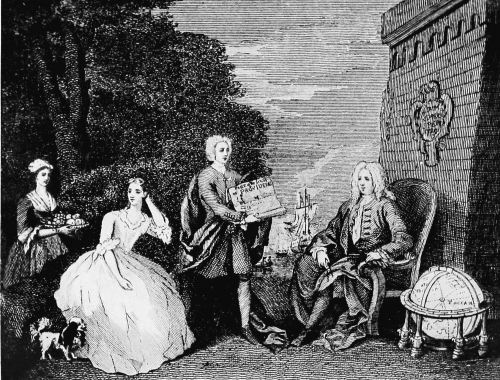 CAPTAIN WOODES ROGERS, WITH HIS SON AND DAUGHTER, 1729
From the engraving by W. Skelton, after the painting by Hogarth.
At Gorgona in Peru.
and Sail-maker at the same time; so that we want no Tradesmen to fit her
out. Necessity makes us of all Trades on this occasion.
The Natives of Old Spain are accounted but ordinary Mariners, but here
they are much worse; all the Prizes we took being rather cobled than
fitted out for the Sea: So that had they such Weather as we often meet
with in the European Seas in Winter, they could scarce ever reach a
Port again, as they are fitted, but they sail here hundreds of Leagues.
The French us’d her as a Victualling Ship, and sold her at Lima, as
they have done several others, for 4 times the Money they cost in
Europe. ’Tis certainly a good Method they took at first trading
hither, to bring a Victualling Ship with no other Goods but Provisions
and Stores along with ’em. Generally one of these small Ships comes out
with two Traders, and since in six, nine, or 12 Months time, which they
stay in these Seas, they expend their Provisions, and lessen their Men
by Mortality or Desertion, they sell their Victualling Ship, and being
recruited with Men and Provisions out of her, they return well
victualled and mann’d to France. But now they put into Chili, where
they sell the remaining Part of their Cargo, and salt up a new Stock of
Provisions for their homeward bound Passage, so that they need bring no
more Victuallers.
July 2. We had Showers of Rain, with Thunder and Lightning last Night,
and few Nights are without Rain, but ’tis pretty dry in the day-time.
This day I got a fine Tree for the Main-mast; the Island is so cover’d
with Trees, that we are forced to clear a Place for a Yard to work in.
The Wood that we us’d for Masts and Yards is 3 sorts, but the best is
Maria Wood, of the Colour and Grain of our English Oak, all of the
Cedar Kind, good Timber, but very heavy. There are several other sorts
fit for Masts, but Care must be taken not to use any that is
short-grain’d, or soft and white when green.
July 3. The Prize Flower we took in Bags being much damag’d by the
Rats, I order’d the Coopers to put it up in 36 Casks: The little
English Bread we have left is eaten as hollow as a Honeycomb, and so
full of Worms, that it’s hardly fit for Use. Last Night we met aboard
our Ship to consult of the quickest Method for Dispatch, and the
Officers agreed each to take his Share of looking after the Ships, and
forwarding the several Workmen: So that most of our little Commonwealth
being ashore very busy, ’twas a Diversion for me to oversee the several
Companies at work in our Yard, from Break of Day till Night, which
otherwise in this hot Country would have been very burthensome to me.
We were imploy’d till the 9th in refitting the Havre de Grace, and
when finish’d call’d her the Marquis. We saluted each of the other
Ships with 3 Huzzas from on board her, distributed Liquor among the
Company, drank her Majesty’s and our Owners Healths, and to our own good
Success. The Ship look’d well, so that we all rejoic’d in our new
Consort to cruize with us. The next thing we did was to clear Mr.
Selkirk’s Bark to carry our Prisoners to the Main, who being 72 in
Number, were very chargeable to maintain; but we could not discharge
them sooner, lest they should have allarm’d the Country, and inform’d
the French and Spanish Men of War where to find us. But being now
almost ready to depart, we call’d a Committee, and came to the following
Resolutions.
At a Committee held on board the Duke, riding at Anchor in the Road
of Gorgona, July 9, 1709.
WE think it convenient to turn all our Prisoners ashore, in a Bark
already provided for that purpose, and at the same time to Plunder
the Settlements on the Main opposite to this Island, and do desire
Capt. Thomas Dover, Mr. Robert Fry, and Mr. William Stratton
to command the Bark and 45 Men on the same Expedition, and to make
what Dispatch they can, and return hither with such Refreshments,
&c. as they can get for our sick Men.
| Tho. Dover, Pres. | William Stratton, |
| Woodes Rogers, | Cha. Pope, |
| Stephen Courtney, | John Connely, |
| William Dampier, | John Ballett, |
| Edw. Cooke, | John Bridge, |
| Robert Frye, | Lan. Appleby. |
After this we gave them the following Instructions.
| Capt. Tho. Dover, | |
| Mr. Robert Frye, | |
| Mr. W. Stratton, | Gorgona, 9 July, 1709. |
Gentlemen,
At Gorgona.
WE having agreed with you in a Committee, That you take a Bark
under your Care, and transport our Prisoners to the Main, and
having order’d about 45 Men under your Command to proceed with
you, and attempt the Plundering where you judge convenient: We only
recommend the utmost Dispatch, and that you keep in mind, we hope
to be ready in 8 Days, and shall earnestly expect you as much as
possible within that Time. Other things relating to this you’ll
know better how to act than we can here direct.
Should a powerful Enemy attempt us in your Absence, we’ll be
certain to leave a Glass Bottle buried at the Root of the Tree
whence the Fore-mast was cut, to acquaint you, then Quibo is the
Place we will wait for you at, if we are well, and you must leave a
Glass Bottle at this Place in case we return hither again: But this
we don’t expect, if once chas’d away.
| Woodes Rogers, | Tho. Glendall, |
| Stephen Courtney, | John Connely, |
| William Dampier, | Geo. Milbourne, |
| Edward Cooke, | John Bridge, |
| William Bath, | John Ballett, |
| Cha. Pope, | |
July 10. Early this Morning we put our 72 Prisoners aboard the Bark.
We had several times discours’d our Prisoners, the two Morells, and
Don Antonio about ransoming the Goods, and were in hopes of selling
them to advantage, but deferr’d coming to Particulars, till now that we
plainly saw, unless they could have the Cargoes under a quarter Value,
they would not deal with us. I propos’d going to Panama, and to lie 6
Days as near it as they pleas’d, till they brought the Money we should
agree for at a moderate Rate; provided they left a Hostage aboard us,
whom on failure we would carry to England. To this they would have
agreed, provided we would take 60000 Pieces of Eight for all the Prize
Goods. Then I propos’d their ransoming the Galleon, and putting good
part of the Goods aboard her, provided one of them three and another
they could procure would be Hostages for the Sum. They answer’d, That
neither of them would go Hostage to England for the World. Then I
propos’d delivering the Galleon and Cargo to them here, provided 2 of
them would be Ransomers to pay us the Money at any other Place but
Panama or Lima, in Six Days, if they would give us 120000 Pieces of
Eight, being the lowest Price we could take for all the Prizes and
Goods, Negroes, &c. They told us that Trade with Strangers, especially
the English and Dutch, was so strictly prohibited in those Seas,
that they must give more than the prime Cost of the Goods in Bribes, to
get a License to deal with us: So that they could not assure us of
Payment, unless we sold the Goods very cheap; therefore not finding it
worth our Time, and knowing the Danger we must run in treating with
them, we desisted, and order’d them all ashore, still hoping that this
would necessitate the Morells and Navarre to get Money for us, and
prevent our burning the Ships, and what we can’t carry away. Every one
now wish’d we had kept some others of the topping Prisoners, to have
try’d whether they had a better Foundation and Method to trade; the
Goods being of little value to us here, and we must fill our Ships so
full, that we fear ’twill spoil our sailing.
July 11. Yesterday our Bark and 2 Pinnaces sail’d with our chief
Prisoners. Don Antonio, the Fleming, Sen. Navarre, and the
Morells, who did not expect to part with us so suddenly, but by
continuing with us, and knowing we could not carry away all the Prizes
and Goods, they hop’d we should of course have freely given them what we
could not keep. We apprehended that was the principal Reason of their
not closing with our Terms, which were advantageous to them. Besides,
should we have been attack’d, they believ’d we must then put them in
possession of their Ships, which were of no use for fighting. But to
obviate all their Hopes of benefiting themselves at this easy Rate,
without our participating of their Money, the Magnet that drew us
hither, I made them sensible at parting, that as we had treated them
courteously like generous Enemies, we would sell them good Bargains for
whatever Money they could bring us in 10 Days time, but that we would
burn what we did not so dispose of or carry away. They beg’d we would
delay burning the Ships, and promis’d to raise what Money they could,
and return within the time to satisfy us.
One of the chief Prisoners we now parted with was Don Juan Cardoso,
design’d Governor of Baldivia, a brisk Man of about 35 Years of Age;
he had serv’d as a Collonel in Spain, had the Misfortune to be taken
in the North Seas by an English Privateer near Portobello, and
carried to Jamaica, from whence he was sent back to Portobello: He
complain’d heavily of the Usage he met with from the Jamaica
Privateer; but we parted very good Friends, and he returned us his
hearty Thanks, and a Stone Ring for a Present to one of the Dutchess’s
Lieutenants that had lent him his Cabbin while he was sick on board.
In Gorgona Road.
We allow’d Liberty of Conscience on board our floating Commonwealth to
our Prisoners, for there being a Priest in each Ship, they had the
Great Cabbin for their Mass, whilst we us’d the Church of England
Service over them on the Quarter-deck, so that the Papists here were the
Low Churchmen.
July 13. This Morning our Vessels return’d from landing our Prisoners,
and brought off 7 small Black Cattle, about 12 Hogs, 6 Goats, some Limes
and Plaintains, which were very welcome to us; they met with little else
of Value in the Village they were at, and the others being far up the
River, they did not think it worth while to visit them. The Country
where they landed was so poor, that our Men gave the Prisoners and
Negroes, some Bays, Nails, &c. to purchase themselves Subsistance. The
Inhabitants ashore had notice of our taking Guiaquil, and were jealous
of our being at this Island, because they heard our Guns, when we fired
in order to scale them after careening. This Place bears S.E. about 7
Leagues from the Body of Gorgona, is low Land and full of Mangrove
Trees; but within the Country the Land is very high. The River is hard
to be found without a Pilot, and has Shole Water for above 2 Leagues
from Shore, There are some poor Gold Mines near it, but the Inhabitants
agree that those of Barbacore are very rich, tho’ difficult to be
attempted, as we were informed before.
July 16. Yesterday about Noon came aboard one Michael Kendall, a
free Negro of Jamaica, who had been sold a Slave to the Village we
plunder’d; but not being there when our People were ashore, he follow’d
them privately in a small Canoe; and the Account he gave of himself was,
that when the last War was declared at Jamaica, he embark’d under the
Command of one Capt. Edward Roberts, who was join’d in Commission from
the Governour of Jamaica with Capts. Rash, Golding and
Pilkington; they had 106 Men, and design’d to attempt the Mines of
Jaco at the Bottom of the Gulph of Darien: There were more
Commanders and Men came out with them, but did not join in this Design.
They had been about 5 Months out, when they got near the Mines
undiscover’d; they sail’d 15 Days up the River in Canoes, and travel’d
10 Days by Land afterwards. By this time the Spaniards and Indians
being alarm’d, laid Ambushes in the Woods, and shot many of them. The
Enemy having assembled at least 500 Men, and the English being
diminish’d to about 60, including the Wounded; the Spaniards sent them
a Flag of Truce, and offer’d them their Lives after a small Skirmish,
wherein the English lost 4, and the Enemy about 12 Men. The English
being in want of Provisions, quite tir’d out, and not knowing their Way
back, agreed to deliver their Arms, on condition to be us’d as Prisoners
of War. Having thus yielded, the Spaniards and Indians carried them
in Canoes 3 Days up the River, that leads to the same Mines they
design’d to attempt, treated them very well, and gave them the same Food
that they eat themselves; but the 4th Day, when they came to a Town
beyond the Mines, and thought all Danger had been past, an Order came
from the chief Spanish Officer to cut them all off, which the
Indians and Spanish Troops did, as those poor disarm’d Wretches sat
at Victuals; so that in this barbarous manner they were all massacred in
a few Minutes, except a Scots, a French, and an English Boy, with
12 free Negroes, which at the Intercession of a Priest they kept for
Slaves. This Man being one of ’em, happen’d to be sold, first to the
Mines, where he says he clear’d at least 3 Pieces of Eight a day for his
Master, and from thence he was sold to this Place. By this we may see
what a mighty Advantage the Spaniards make of their Slaves to imploy
at these Mines, which are accounted the richest in New Spain. The rest
of the free Negroes being farther up the Country, could have no
Opportunity to escape. This is enough to shew what merciless and
cowardly Enemies we have to deal with in these Parts of the World. I
have heard of many such Cruelties in the Spanish Parts of America,
to the eternal Scandal of those who encourage or connive at them.
July 17. About 10 this Morning, the two Morells, Mr. Navarre, and
his Son in law, our old Prisoners came in a large Canoe, with some Money
to ransom what they could of us: We told them of the Barbarity of their
Countrymen, and of the different Treatment they met with from us; and
that we had reason to apprehend, that if we became Prisoners here, that
few of us would ever return to our native Country.
In Gorgona Road.
July 18. A Negro belonging to the Dutchess was bit by a small brown
speckl’d Snake, and died within 12 Hours, notwithstanding the Doctor
us’d his utmost Endeavours to save him. There’s abundance of Snakes on
this Island, and the Spaniards say some are as thick as the Middle of
a Man’s Thigh. I saw one as big as my Leg, and above 3 Yards long; their
Bite proves generally mortal. Yesterday in the Afternoon we had a
Consultation, and agreed that the small Bark we took belonging to the
Main right against this Island, should be given the Lieutenant’s
Brother that we plunder’d, and who came over with our Bark; for being a
Man in some Authority ashore, we hope this Favour will have some
Influence on ’em to trade with us whilst we are here. This Morning Mr.
Morell and Navarre went a second time in our Bark for Money. One of
the same sort of Snakes that kill’d the Negro was found on our
Forecastle this Morning, and kill’d by our Men; we suppose it came
aboard on the Cable, they being often seen in the Water.
July 19. We continued discharging the Galleon, and lading the
Marquiss, and put a Part aboard of us and the Dutchess. We found in
the Marquiss near 500 Bales of Pope’s Bulls, 16 Reams in a Bale. This
took up abundance of Room in the Ship; we throw’d most of them overboard
to make room for better Goods, except what we used to burn the Pitch of
our Ships Bottoms when we careen’d ’em. These Bulls are imposed upon the
People, and sold here by the Clergy from 3 Ryals to 50 Pieces of Eight
a-piece, according to the Ability of the Purchaser. Once in two Years
they are rated, and all the People obliged to buy them against Lent;
they cannot be read, the Print looking worse than any of our old
Ballads, yet the Vulgar are made believe it’s a mortal Sin to eat Flesh
in Lent, without being licensed by one of these Bulls, the Negro Slaves
not being exempted. This is one of the greatest Branches of Income the
King of Spain has in this Country, being a free Gift from the Pope to
him, as the Spaniards and Natives told us. We should have made
something of them, if we had taken the Bishop before mentioned; but now
they are of no use to us.
July 20. At Noon Navarre return’d with a little more Money, some
Limes, Fowls, &c. He told us he had left Mr. Morell to get more, and
that he would be soon with us.
July 21. We sent aboard the Marquiss 2 of our Main Deck Guns, and
the Dutchess did the like, which with 4 we took at Guiaquil, and 12
taken in the same Ship, make 20 good ones. The Carriages are all new, or
very much repair’d, and as good and strong as if mounted in England.
Another Canoe came with Limes, Guavas, and other Fruit, and brought a
little Money to trade with us. The Main here is a poor Country, and I
believe we might have pick’d up a good Quantity of Money any where else
on this Coast, notwithstanding their severe Orders against trading with
us.
July 22. Two of our Negroes, and three of the Dutchess’s ran into
the Woods to hide themselves, and go to the Spaniards after we are
gone: We caught one of ’em to day, and punish’d him severely.
July 23. At 6 last Night our Stream Cable broke, and we lost our
Anchor: The Ground here is a black Mud, which in all hot Countries rots
Cables in a very little time. We have often Thunder, Rain and Lightning
all the Night, tho’ clear dry Days. This is accounted by the Spaniards
the worst part of all the Coast for wet dirty Weather. We have had
enough of it, but God be thank’d are now pretty well, there not being
above 30 Persons in all our Ships unhealthy.
July 24. We caught our Negroes that ran away, and one of the
Dutchess’s, Hunger having brought ’em out of the Woods.
July 25. I put 35 Men aboard the Marquiss, and Capt. Courtney 26,
so that her Complement will be 61 White Men, and 20 Negroes. Captain
Edward Cooke Commander, and our Second Lieutenant, Mr. Charles Pope,
his Second. We design to agree, that the Captain with his Officers and
Men shall have equal Wages with others in the like Posts, to encourage
them.
July 26. Last Night the Marquiss sprung a Leak, and made 8 Inches
Water in an Hour; but the Carpenters stopt it. A Canoe came from the
Main, and bought some Negroes of us.
July 27. At 8 this Morning, the Canoe return’d, with Mr. John
Morell, who desir’d he might go ashore to his Brother, and forward his
getting of more Money to deal with us for Goods, since he saw that we
were resolved to leave nothing of Value behind us.
In Gorgona Road.
July 28. Yesterday Afternoon, Mr. John Morell return’d, having met
his Brother coming with what Money he could get; he told us the Country
being alarm’d, he had much ado to get Leave to come to us; that the
Governour of Barbacore was at the Water-side, with above 200 Men
commanded by himself, to prevent our Landing, or that any thing should
be brought to us; and that all the Shore was lined with Men for that
End. We have took out of the Galleon 320 Bails of Linnen, Woolen, a
little Silks, and most Sorts of Goods, usually in Bails, besides Boxes
of Knives, Scizzars, Hatchets, &c. The Dutchess and Marquiss have
also taken what they can; so that all our 3 Ships are full. We found
aboard the Galeon a great Quantity of Bones in small Boxes, ticketed
with the Names of Romish Saints, some of which had been dead 7 or 800
Years; with an infinite Number of Brass Medals, Crosses, Beads, and
Crucifixes, religious Toys in Wax, Images of Saints made of all sorts
of Wood, Stone, and other Materials, I believe in all near 30 Tun, with
150 Boxes of Books in Spanish, Latin, &c. which would take up much
more Stowage than 50 Tuns of other Goods: All this came from Italy,
and most from Rome, design’d for the Jesuits of Peru; but being of
small Value to us, we contented our selves to take only a Sample of most
Sorts to shew our Friends in England, and left the rest. A large
wooden Effigies of the Virgin Mary being either dropt or thrown over
board, from the Galeon, and drove ashoar near the North Point of the
Island, the Indians that came in the Canoes with Senior Morell,
&c. from the main Land, being then a Fishing, took up the Image, and
brought her in the Canoe to the Shoar just over against our Ship, where
we gave our Prisoners Liberty to walk that Day: As soon as they saw her,
they cross’d and bless’d themselves, and fancied that this must be the
Virgin Mary come by Water from Lima or Panama, to relieve them in
their Necessity: They then set it up on the Shoar, and wip’d it dry with
Cotton; and when they came aboard, told us, that tho’ they had wip’d her
again and again, she continued to sweat very much; and all but those
employ’d in wiping her, stood around devoutly amaz’d, praying and
telling over their Beads: They also shew’d the Cotton to our Linguist
and the Ransomers, wet by the excessive Sweat of the holy Virgin, as
they fondly seem’d to believe, and kept it as a choice Relick. The
Morells perceiving me laugh at the Story, they told me a much
stranger, in order to convince me, viz. That a few Years ago, at a
Procession in the Cathedral Church of Lima, which was at that time
very richly furnished, and worth some Millions of Pieces of 8 in Gold,
Silver and Jewels; the Image of the Virgin was more richly adorn’d with
Pearls, Diamonds and Gold, than the rest; and those Ornaments being left
in the Church, according to Custom, till the Night after Procession,
without any Guard, because the People concluded that none durst be so
sacrilegiously impious as to rob the Church; an unfortunate Thief,
resolving at once to enrich himself, got into the Church at Midnight,
and made up to the Image; but whilst he was going to take off a rich
String of Pearls from the Virgin’s Wrists, she caught him fast by the
Arm, and held him, till being found in that Posture he was apprehended
and executed. This Story was confirm’d as an unquestionable Truth by all
the other Prisoners, who assured us, That all the Fathers of the Church
at Lima confidently affirm the same, as well as a considerable Number
of Lay-Brethren, who (they say) were Eye-Witnesses of it; so that it
passes amongst them as currant, as an Article of their Faith: By this we
may see how the Belief of those false Miracles, by the Cunning of the
Romish Clergy in these Parts, obtains Credit among those Men who are
not so easily imposed on in their worldly Affairs. Thus I am apt to
believe those Gentlemen invented the Story of the sweating Miracle, out
of Zeal to their Church, and thinking thereby to deter us from carrying
away any more of the Relicks out of Senior Morell’s Galeon. Before
this, when I heard such Stories, I took ’em to have been invented meerly
to ridicule the Romanists, but when I heard such silly Stories related
by 8 grave Men, of a handsome Appearance and good Reputation amongst the
Spaniards, I was convinc’d of the Ignorance and Credulity of the
Papists.
July 29. Having for a long time been importun’d by the Companys of
each Ship, to divide what we was forc’d to agree to as Plunder, we
resolved on a Committee to be called to morrow to settle that Affair,
which we did in the following Manner.
At a Committee on board the Duke, the 29th Day of July, 1709.
It’s agreed, that the following Articles shall regulate Plunder,
and be in part a Satisfaction allow’d by the Committee of the
Duke and Dutchess, for past Services, more than each Man’s
Agreement with the Owners.
Impr.
GOLD Rings found in any Place, except in a Gold-smith’s Shop, is
Plunder. All Arms, Sea Books and Instruments, all Cloathing and
Moveables, usally worn about Prisoners, except Women’s Ear-rings,
unwrought Gold or Silver, loose Diamonds, Pearls or Money; all
Plate in use aboard Ships, but not on Shoar, (unless about the
Persons of Prisoners) is Plunder.
In Gorgona Road.
All manner of Clothes ready made, found on the upper Deck, and
betwixt Decks, belonging to the Ships Company and Passengers, is
Plunder also, except what is above limited, and is in whole Bundles
and Pieces, and not open’d in this Country, that appears not for
the Persons use that owns the Chest, but design’d purposely for
Merchandize, which only shall not be plunder. And for
Encouragement, we shall allow to James Stratton 40 Rupees to buy
him Liquor in India, in Part of Amends for his smart Money. To
William Davis and Yerrick Derrickson 20 Rupees each, as smart
Money, over and above their Shares. We also give the Boats Crews
over and above their Shares, that were engag’d with the Marquis,
when taken, four Bails of Goods, to be sold when and where they
think convenient; which Bail, shall be 1 of Serges, 1 of Linnen,
and 2 of Bays; and this over and above their respective Shares.
Also a good Suit of Clothes to be made for each Man that went up
the River above Guiaquil, the last time in the Dutchess’s
Pinnace.
In witness whereof, We have hereunto set our Hands the Day and
Year above-mentioned.
| Tho. Dover, Pres. | John Connely, |
| Woodes Rogers, | William Bath, |
| Stephen Courtney, | Tho. Glendal, |
| William Dampier, | Geo. Melbourne, |
| Edw. Cooke, | John Bridge, |
| Rob. Frye, | John Ballett, |
| William Stretton, | Lan. Appleby. |
The Cause why we delay’d adjusting what should be Plunder so long, was
the unreasonable Expectations of some among us: This made us wait till
now we had a proper Opportunity, and could better insist on our Owner’s
Interest: Besides, we were not willing that any Difference should arise
about this knotty Affair, when the Prisoners were on board, nor till we
had finish’d the Rigging of our Ships, lest it should have put a full
Stop to our Business, or at least have hinder’d our Proceeding
chearfully.
July 30. We over hall’d our Plunder-Chests, and what was judged to be
Plunder, (by Men appointed with the Owners Agents) was carried aboard
the Galeon, which was kept clear between Decks, in order to divide it.
Mr. Frye and Mr. Pope were to be Appraisers for the Duke, and Mr.
Stratton and Mr. Connely for the Dutchess, so I hope to get over a
troublesome Job peaceably.
July 31. Mr. Navarr’s Bark grew leaky, and Benjamin Parsons, one
of our Midshipmen, that had charge of her, ran her a-shore without
Orders, at high Water, thinking to have stop’d her Leak at low Water,
and got her off the next Tide; but contrary to his Expectation, the
Vessel strain’d and sunk; so that we had much ado to get out what we had
a-board her Time enough; and were forced to leave in her 10 Bails of
damag’d Bays, and a great deal of Iron Work, which we gave Senior
Navarr, in part of Payment for what we have received of him from the
Settlement on the Main.
August 1. The Officers we appointed to praise the Plunder met on
board the Galeon, and valued the Cloathing, in order to divide it
amongst the Officers and Men of each Ship, according to their respective
Shares.
August 2. We continued appraising the Plunder, and found it a very
troublesome Task.
August 3. Capt. Cooke told me they had discover’d another Leak, and
was troubled at so many Leaks in a Harbour; so that I began to dread
that all our Labour and Time was lost on the Marquiss, but hop’d for
the best.
August 4. Yesterday in the Afternoon they made an End of appraising
the Clothes at a very low rate, amounting to upwards of 400l. and the
Silver-handled Swords, Buckles, Snuff-Boxes, Buttons, and Silver Plate
in use aboard every Prize we took, and allow’d to be Plunder at 4s.
6d. per Piece of 8, amounted to 743l. 15s. besides 3 ℔ 12℥ of
Gold, which was in Rings, Gold, Snuff-boxes, Ear-rings, and Gold Chains,
taken about Prisoners. This I believe to be an exact Account.
In Gorgona Road.
This Morning we had like to have a Mutiny amongst our Men: The Steward
told me, that several of them had last Night made a private Agreement,
and that he heard some Ring-leaders by way of Encouragement, boast to
the rest, that 60 Men had already signed the Paper. Not knowing what
this Combination meant, or how far it was design’d, I sent for the chief
Officers into the Cabin, where we arm’d our selves, secured two of the
chief of those mutinous Fellows, and presently seized two others. The
Fellow that wrote the Paper we put in Irons; by this time all Hands were
upon Deck, and we had got their Agreement from those who were in the
Cabin, the Purport of which was to oblige themselves, not to take their
Plunder, nor to move from thence till they had Justice done them, as
they term’d it. There being so many concern’d in this Design, Captains
Dover and Fry desired I would discharge those in Confinement upon
their asking Pardon, and faithfully promising never to be guilty of the
like, or any other Combination again. The Reason we shewed ’em this
Favour was, that there were too many guilty to punish them at once: And
not knowing what was design’d a-board the Dutchess and Marquiss, we
were of Opinion they had concerted to break the Ice first a-board the
Duke, and the rest to stand by them. Upon this I us’d what Arguments I
could offer, shew’d them the Danger and Folly of Combinations, and
exhorted them to believe they would have Justice in England, should
any thing seem uneasy to them now, or in the whole Course of the
Voyage; adding that we had done all that we could for their good, and
would continue our Endeavours, not doubting their good Intentions,
provided they were not mis-led. With these and other healing Arguments,
all appear’d easy and quiet, and every Man seem’d willing to stand to
what had been done, provided the Gentlemen that were Officers, and not
Sailors, amongst us, had not such large Shares, which they alledg’d was
unreasonable, and that they could not possibly in a Privateer deserve
what they were allow’d in proportion to the rest of the Ships Company:
This we did in part yield to, in order to appease those Malecontents, by
making some Abatements on Mr. White’s, Mr. Bath’s, and Mr.
Vanbrugh’s Shares; so that we hoped this difficult Work would, with
less Danger than we dreaded, be brought to a good Conclusion: For
Disputes about Plunder is the common Occasion of Privateers Quarrelling
amongst themselves, and ruining their Voyages. Sailors usually exceed
all Measures when left to themselves, and account it a Privilege in
Privateers to do themselves Justice on these Occasions, tho’ in every
thing else I must own, they have been more obedient than any Ship’s
Crews engag’d in the like Undertaking that ever I heard of. Yet we have
not wanted sufficient Tryal of our Patience and Industry in other
things; so that if any Sea-Officer thinks himself endowed with these two
Virtues, let him command in a Privateer, and discharge his Office well
in a distant Voyage, and I’ll engage he shall not want Opportunities to
improve, if not to exhaust all his Stock. Had Capt. Courtney and I
kept what is always allow’d to be Plunder in Privateers, and not
voluntarily given our Parts amongst the Men, but for a greater and more
generous Design in view, (viz. The Good of the Voyage) our Parts of
the Plunder would have been above 10 times so much as now it is, because
very little valuable Plunder was taken out of any Place but the Great
Cabbins; and all this in every Prize is of right due to the Commander
that takes it; but if we had acted thus, we foresaw the fatal
Consequences that we must have suffer’d by it, for the Officers and
Crews would plunder unaccountably, as is too often practis’d in
Privateers to keep their Men together, tho’ but meanly to their Duty; so
that we (to preserve a good Discipline) gave an eminent Example to them,
of preferring the common Interest before our own, to our particular
Loss.
We have had lately almost a general Misunderstanding amongst our Chief
Officers, and some great Abuses which I suppose sprung at first from
several unhappy Differences arising at and before our Attempt on
Guiaquil. This made me so particularly relate all that pass’d material
in that Attempt, so that I doubt not any ones contradicting this Journal
to my Disadvantage; yet in Differences of this kind amongst the Sailors
we all join, and I hope agree: Tho’ I long for a Reconciliation and good
Harmony amongst Us, which is so essential to the Welfare of the Voyage;
but not being willing to make the Reader a Party-taker, or trouble his
Patience to read over unreasonable Feuds, I have left ’em as much as
possible out of my Journal.
Capt. Morell, that went for the Main to get Victuals, return’d. The
Negro we caught first and punished, we kept in Irons, but this Night
miss’d him. We suppose he got his Irons off, and swam ashore.
We had the following Committees, confirmed the Officers of the
Marquiss, agreed to sell the Bark and her Cargo, got off all our Wood
and Water, and made Preparation for Sailing. We design to leave the
Launch we built at Lobos with Sen. Morells and Navarre, being of
no farther use to us, tho’ hitherto she had done us very good Service.
Here follows what we agreed on in Council.
At a Committee held on board the Dutchess, riding at Gorgona,
August 6. 1709.
WE whose Names are hereunto subscribed, appointed as a Committee
on board the Ships Duke and Dutchess, do hereby impower and
order Capt. Cooke to command the Marquiss, Mr. Charles Pope
Lieutenant, Mr. Robert Knowlman Master, Mr. William Page Chief
Master, Joseph Parker Second Mate, Mr. John Ballet Doctor,
Benjamin Long Boatswain, George Knight Gunner, Edward Gormand
Carpenter, and other Officers as the Captain shall direct aboard
the Marquiss: Each of the above Officers, or the others, on their
good Behaviour, to have such Wages as those in the same Offices on
board the Duke and Dutchess, and to cruise on this Coast in our
Company, or where else Capt. Cooke shall think convenient, in his
Return to Bristol, should he be unfortunately separated from us.
Witness our Hands.
| Tho. Dover, Pres. | Tho. Glendall, |
| Woodes Rogers, | John Connely, |
| Stephen Courtney, | William Bath, |
| William Dampier, | Geo. Milbourne, |
| Robert Frye, | John Bridge, |
| William Stratton, | Lan. Appleby. |
In Gorgona Road.
Memorandum,
WE have now done careening, fixing, and loading our Ships, with
the Marquiss, and taken all manner of Goods out of our Prizes, as
much as our Ships can carry, having received a valuable
Consideration of Mr. Morell and Navarre, the Masters of our 2
Prizes, we are all of opinion we had best leave them in possession
of their Ships, and what Negroes we can’t carry hence; our present
Circumstances and the Condition of the Prizes not allowing us to
remove them from this Place, could we make ever so great advantage
of ’em elsewhere. So judge it our present Interest to ply to
Windward, to try for other Purchases and Sale of the Goods, and if
possible to take or buy Provisions. We all agree to land one of
the Guiaquil Hostages at Manta, in order to procure Money to
pay for the Ransom of the Town, and a Bark we have sold the same
Man, laden with Prize Goods, Witness our Hands this 6th of
August, 1709.
| Tho. Dover, Pres. | William Stratton, |
| Woodes Rogers, | Tho. Glendall, |
| Stephen Courtney, | John Connely, |
| William Dampier, | William Bath, |
| Edw. Cooke, | John Ballett, |
| Robert Frye, | Lan. Appleby. |
| Cha. Pope, | |
I drew up the following Agreement, to which we Officers swore on the
Holy Evangelists, because I thought it the most proper Method to prevent
the Confusions which were like to happen among us, because of the
Jealousies that were entertain’d of one another, and came to such a
height, that I fear’d a Separation.
WE having made a solemn Agreement, do this Instant sign
voluntarily, and give each other our Oaths on the Holy Bible; and
as we hope for Forgiveness of Sins, and Salvation by the alone
Merits and Intercession of our Blessed Lord Jesus Christ, to keep
severely and strictly this serious concerted Memorandum. First we
agree to keep company, and assist each other on all Occasions, and
with all Necessaries, as far as our Abilities reach, and our common
Safety requires. Secondly, that in case we engage at any time with
the Enemy, we design it in Consortship, and that each Commander and
Second in each Ship, hereto subscribed, shall on all Occasions,
without the least Reserve, and to the utmost of his Power, be
forward and ready to assist, rescue or defend each other, with the
utmost Dispatch, Bravery and Conduct, even to the apparent Hazard
of his Ship and all that is dear to him: Well knowing all of us,
that on whatever Occasion should either of our Ships be deserted by
the other two, and taken or lost in these barbarous and remote
Parts, it’s very improbable ever the Men will get home, and the
Survivors would be in as bad, if not in a worse Condition than the
Dead.
On these and the like Considerations we do hereby solemnly agree
never to desert each other in time of Need, if possibly we can
avoid it, and to be to the utmost of our Power and Knowledge alike
brave in attacking or defending our selves against the Enemy to the
last Extremity.
But if we are so unfortunate to see one Ship inevitably perish,
then the two remaining (after they have us’d their utmost
Endeavours for the distress’d Ship, and find all past Recovery) may
then agree on the best Methods for their own Security. The like for
one Ship if two are lost, but for no other Reason to desert this
firm and solemn Agreement of Consortship; and to shew that none of
us is so unbecoming a Man as to shrink back, or slight this
agreement in time of Action, we agree it shall not be alter’d
without the Consent of all us three Commanders, and the major part
of the Officers hereto subscrib’d, and to a Duplicate in each Ship
of the same Date in Gorgona, the sixth Day of August, 1709.
| Tho. Dover, Pres. | William Stretton, |
| Woodes Rogers, | Charles Pope, |
| Stephen Courtney, | John Connely, |
| Edward Cooke, | Tho. Glendale. |
| Rob. Fry, | |
From Gorgona towards Manta, in Peru.
Another Paper was also drawn up for every Man to swear what Clothes,
Goods, &c. he had received of the Agents, and to restore whatever he
had taken without the Agents Knowledge, in order to a just distribution
of the Plunder, and every one was to oblige himself in a Penalty of
20s. for every Shilling Value that should be found about him
conceal’d, besides the former Penalty agreed on of losing his Share of
any Prize or Purchase for concealing above the Value of half a Piece of
Eight; and for the Incouragement of Discoveries the Informer was to have
half the Penalty, and the Protection of the Commanders. This Paper was
objected against by several of the Officers, who insisted, that there
ought to be a greater Latitude allowed them to advantage themselves,
since they had ventured their Lives hither on so difficult an
Undertaking, which made us defer the signing it till a better
Opportunity; for unless such Agreements as these had been constantly
promoted, as occasion required, the Temptation of Interest wou’d have
made us fall into irrecoverable Confusions abroad, which generally end
in a Separation, or worse.
Aug. 7. We gave Sen. Morell and Navarre their Ships, and all the
Goods we could not carry away, for what Money our Agents receiv’d of
’em, tho’ they expected to have had ’em at an easier Rate. We came to
sail this Morning; the dividing the Plunder has took up more Time than
we were willing to spare; but ’twas absolutely necessary to do it. We
took Sen. Navarre with us before we came to sail: I went ashore, and
shew’d Sen. Morell how we left things between his Ship and the other
Prize. Mr. Navarre left his Son-in-law in charge of this Vessel and
Goods, then came with me on board our Ships, expecting to have the Bark
betwixt him and our Ransomers, if they paid us at Guiaquil. Wind
veerable in the South West Quarter, a Lee Current.
August 8. Yesterday at 6 in the Evening the Island of Gorgona bore
S. by E. distant 6 Leagues. Just before Night we took our Men out of the
Bark, and left her in possession of an old Indian Pilot, and some
Negroes and Indian Prisoners, putting our ordinary Ransomer aboard to
go in her, as we agreed on before we came out. I and Capt. Dover
sign’d a Paper to protect them from being seiz’d by the Spaniards, if
they should lose Company with us; but order’d them not to stir from us.
I also desir’d the Spaniards aboard the Duke, who had agreed for
her, strictly to charge the Crew in the Bark not to leave us willingly,
which they did, because our Agreement was not in Writing, but only
Verbal, promising us 15000 Pieces of Eight for the Bark and her Cargo,
including the Remainder of the Towns Ransom, we designing to have it
under their hand in Spanish and English to morrow, before we would
wholly let go the Bark: But this Morning, to our surprize, the Bark was
out of sight. The Marquiss is very crank, and sails heavy on a Wind.
We held the following Committee to endeavour to help the Marquiss’s
sailing.
At a Committee held on board the Dutchess at Sea, off the Island
Gorgona, August 8th, 1709.
Memorandum,
THE Marquiss not answering our Expectations, but proving crank
and sailing heavy: We now advise Capt. Cooke to heave the
Dutchess’s two heavy Guns overboard, and 20 Boxes of Snuff, with
two spare Top-masts, and bring his Ship more by the Stern, stowing
every thing as low as possible in the Ship, to endeavour to make
her stiffer, and if he finds any thing more necessary for the
Benefit of the Ship, we desire him to do it. Witness our Hands.
Signed by the Majority of our Council.
Amongst our Prisoners taken on board Sen. Navarre’s Ship from
Panama, there was a Gentlewoman and her Family, her eldest Daughter a
pretty young Woman of about 18, was newly married, and had her Husband
with her. We assign’d them the Great Cabin aboard the Galleon, and none
were suffer’d to intrude amongst them, or to separate their Company; yet
the Husband (I was told) shew’d evident Marks of Jealousy, the
Spaniards Epidemick Disease; but I hope he had not the least Reason
for it amongst us, my third Lieutenant Glendall alone having charge of
the Galleon and Prisoners: For being above 50 Years of Age, he appear’d
to be the most secure Guardian to Females that had the least Charm, tho’
all our young Men have hitherto appear’d modest beyond Example among
Privateers; yet we thought it improper to expose them to Temptations. At
this time Lieut. Connely, who behav’d himself so modestly to the
Ladies of Guiaquil, was some days in possession of Navarre’s Ship
before we stopt here, to remove these Prisoners aboard the Galleon,
where he gain’d their Thanks and publick Acknowledgments for his
Civilities to these Ladies, and even the Husband extols him. We had
notice these Ladies had some conceal’d Treasure about them, and order’d
a Female Negro that we took, and who spoke English, to search them
narrowly, and found some Gold Chains and other things cunningly hid
under their Clothes. They had before deliver’d to Capt. Courtney Plate
and other things of good Value. We gave them most of their wearing
Apparel and Necessaries, with 3 Female Mullatto Slaves, and parted very
friendly. They confess’d to our People, who put them ashore, that we had
been much civiller than they did expect, or believe their own Countrymen
would have been in the like case, and sent back the Husband with Gold to
purchase some Goods and two Slaves of us. I come next to the Description
of Gorgona.
From Gorgona towards Manta, in Peru.
Gorgona is 3 Leagues in Length, N. E. and S. W. but narrow. It’s about
6 Leagues from the Main, full of Wood and tall Trees, one of ’em call’d
Palma Maria, of which the Spaniards make Masts, and use a Balsam
that flows from it for several Diseases. The Island appears at a
distance indifferent high, and in 3 Hummocks. There is Riding for Ships
all over against the North East Side; but in some places foul Ground,
and shoal’d near the Shore, particularly on the South East Side, and
near the South West End, where there’s a small Island almost joining,
with Shoal Ground, and Breakers near a Mile to the Eastward from that
End. Capt. Dampier has been here several times, but never rode where
we did, which is the best and only good Road in the Island. The
Spaniards told us of strange Storms and heavy Turnadoes of Wind about
this Island; but we found it otherwise, and had only frequent Showers
and Thunder: But in the time of Breezes, which the Spaniards call our
Winter Months, and in Spring, till the Beginning of May, here are now
and then Northerly strong Breezes of Wind, and then I believe the Road
must be shifted to the other Side of the Island, which may be at that
time the best Riding; but this we had no Time to try, neither do I think
it half so bad as these puny Mariners tell us. About this Island are
several remarkable Rocks, at the South West End there’s one looks like a
Sail half a Mile off shore; at the North East End there are several high
ones, round and steep, near a Cable’s Length off Shore, where the
Sea-Fowls breed. The Beasts and Insects, we saw in this Island are
Monkeys, Guinea Pigs, Hares, Lizards, Lion Lizards, which change their
Colours, and are fine Creatures to look at, several Species of great and
small Snakes, and so numerous, that ’tis dangerous for a Man to walk the
Island, for fear of treading on them. There’s great Variety of Plants
and Trees peculiar to these hot Climates, and little or nothing
resembling what we have in Great Britain; but it being out of my Road
to describe such things, I refer ’em to such whose Talents lie that way.
Here are also several sorts of Fish unknown in our Seas, besides Mullets
in great Plenty, but hard to be caught with Hook and Line, which I
suppose is occasion’d by the Clearness of the Water, so that they easily
see the Hook and avoid it. Here’s also some white Coral, and abundance
of Oysters, and as I am told by the Prisoners, good Pearls in them. We
caught an ugly Creature here, which I suppose may be of the Monkey Kind,
because it look’d like one of the middling sort, but with this
difference; his Hair was thicker and longer, his Face, Eyes and Nose
less, and more wrinkled and deformed; his Head of the same Shape, but
his Ears not so large; his Teeth longer and sharper, his hinder Parts
more clumsey, and his Body thicker in proportion, with a very short
Tail, and instead of 5 Claws like Fingers as a Monkey has, he had only
3 on each Paw, with the Claws longer and sharper. We let one of ’em go
at the lower part of the Mizon Shrowds, and it was about 2 Hours getting
to the Mast Head, which a Monkey would have performed in less than half
a Minute; he mov’d as if he had walk’d by Art, keeping an equal and slow
Pace, as if all his Movements had been directed by Clock-work, within
him. The Spaniards call it a Sloth, and not improperly; they say it
feeds on the Leaves of a certain lofty Tree, and when it has clear’d
one, before it can get down and walk a little Way to find and climb
another, would grow lean and be almost starved.
I saw no Land Birds here; because I suppose the Monkeys destroy their
Nests and Eggs: We shot many of them, and made Fricassees and Broth for
our sick Men; none of our Officers would touch them, Provisions being
not yet so scarce; but Capt. Dampier, who had been accustomed to such
Food, says he never eat any thing in London that seemed more delicious
to him than a Monkey or Baboon in these Parts.
August 9. I propos’d sending the Marquiss to India, and thence to
Brazil; and then we could add to our own Stock of Bread and salt
Provisions, and if she got well to Brazil, would vend her Goods at an
extraordinary Rate, to the Advantage of the Voyage, and we two should be
strong enough to wait for the Manila Ship, but Capts. Dover and
Courtney did not think it reasonable.
August 10. We got to wind-ward very slowly, here being a constant
Current, which runs down to Leward into the Bay of Panama.
From Gorgona towards Manta, in Peru.
August 11. Yesterday Afternoon I went aboard the Dutchess, and
carried with me Doctor Dover; we discoursed about parting with Capt.
Cooke, and giving him only a Sailing Crew to go for Brazil, and sell
his Cargo; but finding the Majority against my Proposition, I dropt it,
tho’ I fear we shall repent it, were there no other Reasons but to save
Provisions. Capt. Cooke came to us a-board the Dutchess, to put in
Execution the Order of the 8th instant, where we agreed as before to
throw 2 of the heaviest Guns over-board he had out of the Dutchess,
being less valuable than the Goods between Decks, and what Lumber they
had besides, which he did, and we perceive his Ship much stiffer, and
sails better; our Consort, Capt. Courtney and his Officers, with some
of mine, are uneasie at parting with the Bark, so that if we come up
with her, we must take to her again for Peace sake.
August 12. Yesterday Evening, the Island of Gorgona was in sight,
and bore E. half S. about 13 Leagues. At 6 this Morning, we met with the
Bark, and put Mr. Selkirk aboard her, with his Crew. At 9 this
Morning, we sent our Boat for Capt. Courtney and Capt. Cooke, when
we had a second Consultation, which again concluded with keeping the
Marquiss and Bark: Tho’ I was of Opinion, they’d be rather a Detriment
than Furtherance to us in any thing, so long as the Marquiss sails so
heavily, besides the Benefit of more Provisions that would have been
left for us that must stay behind.
August 13. In the Evening last Night, we saw the Island of Gallo,
bearing S. by E. distant 6 Leagues. We have a strong Current runs to
Leward, so that we lost Ground, and at 8 this Morning was again in sight
of Gorgona, bearing N. E. by E. distant about 12 Leagues; had rainy
Weather all Night, with Thunder and Lightning, but indifferent fair in
the Morning. Wind veerable in the S. W. Quarter. This Coast is more
subject to hot Weather than any other Part of Peru.
August 15. We sounded several Times in the Night, and had Ground in
about 50 Fathom Water, not above two Leagues off Shore.
August 16. This Day I muster’d our Negroes aboard the Duke, being
about 35 lusty Fellows; I told them, That if we met the Spaniards or
French, and they would fight, those that behav’d themselves well
should be free Men; 32 of ’em immediately promis’d to stand to it, as
long as the best Englishman, and desired they might be improv’d in the
Use of Arms, which some of them already understood; and that if I would
allow ’em Arms and Powder, these would teach the rest. Upon this, I made
Michael Kendall, the Jamaica free Negro, who deserted from the
Spaniards to us at Gorgona, their Leader, and charged him to be
continually exercising them, because I did not know how soon we might
meet an Enemy: I took down the Names of those that had any, and such as
wanted I bestow’d Names on them, and to confirm our Contract made them
drink a Dram all round to our good Success; at the same time I gave ’em
Bays for Clothes, and told them they must now look upon themselves as
Englishmen, and no more as Negro Slaves to the Spaniards, at which
they express’d themselves highly pleas’d: I promise my self good
Assistance from them, if need be, having this Proverb on their Side,
that Those who know nothing of Danger fear none; and for our own Parts,
we must not submit to be Prisoners, tho’ forced to engage at the
greatest Disadvantage, but every one resolve to stand to the last, for
if taken we shall be worse than Slaves.
August 18. At 6 this Morning we saw a Sail, which bore W. N. W. of us;
we and the Dutchess gave Chace, and took her in about an Hour. The
Dutchess had kept her Company ever since 12 at Night, and thought her
to be our Bark. She was a Vessel of about 70 Tun, bound from Panama to
Lima, but was to stop at Guiaquil. They had very little aboard
besides Passengers, for they knew of our being in these Seas: The best
of her Cargo was about 24 Negroes, Men and Women. I sent our Agent
aboard, to examine the Prize.
August 19. After Dinner aboard the Dutchess, we examin’d the
Prisoners; they could tell us little News from Europe, but said there
came Advices by a Packet to Portobell from Spain, and by a French
Ship from France, not long before they came out of Panama; that all
was kept private, only they heard in Panama, that his Royal Highness
Prince George of Denmark was dead,[136] which we were not willing to
believe, but drank his Health at Night, which can do him no Hurt if he
is dead. We read several Letters from Panama, by which we understood,
that when they heard of our taking Guiaquil, they kept their Gates
shut Day and Night for above a Week, and that the Inhabitants kept Guard
on their Walls, being afraid we should attack them next, and by what I
can guess, we might have taken that Town as well as Guiaquil, had we
but double our Number of Men. They had various Conjectures about us when
at Panama, and were continually allarm’d, not knowing where to expect
us.
August 20. At 10 in the Morning we bore down to the Dutchess, who
had Spanish Colours flying, to make a sham Fight to exercise our Men
and the Negroes in the Use of our great Guns and small Arms. Here I must
not forget a Welchman that came to me, and told me, He took the Ship
we were going to engage for the Dutchess, till he saw the Spanish
Colours, and that being over-joyed with the Hopes of a good Prize, he
had loaded his Musket with Shot, and design’d to fire amongst the
thickest of ’em, which he would certainly have done, had he not been
forbid. By this it appears, that blundering Fools may have Courage.
During this sham
In Tecames Road.
Engagement, every one acted the same Part he ought to have done, if in
earnest, firing with Ball excepted. Our Prisoners were secured in the
Hold by the Surgeons, who had their Instruments in order, and to imitate
Business for them, I order’d red Lead mixt with Water to be thrown upon
two of our Fellows, and sent ’em down to the Surgeons, who, as well as
the Prisoners in the Hold of the Ship, were very much surpriz’d,
thinking they had been really wounded, and the Surgeons actually went
about to dress them, but finding their Mistake, it was a very agreeable
Diversion.
August 23. Yesterday, at one in the Afternoon, we tack’d and stood for
the Shore, but at two we drew near discolour’d Water, and sounded, had
but 8 Fathom, and very near an ugly Shoal, which the Spaniards tell me
runs off about 2 Leagues from the Shore, off a high white Cliff, 3
Leagues to the N. of Tecames. At 6 last Night, Cape St. Francisco
bore S. by W. distant about 6 Leagues. We sounded again, and had 40
Fathom Water. We stood off at Night, and at 6 in the Morning tack’d for
the Shore. The Wind is here always more Southerly, as we draw near the
Equinox.
August 24. At 10 this Morning, I went with Captain Dover aboard the
Dutchess, where we agreed to send the Bark into Tecames, being now
under our Lee, and we to follow them. We order’d our Linguist to buy
Provisions of the Indians there, and put several Men well arm’d
a-board, to keep the Bark till our Ship could arrive near enough to
protect her, if occasion, in Case of an Attack.
August 25. About 2 Yesterday in the Afternoon we bore away for
Tecames, after the Barks. I went aboard the Dutchess, and found our
Pilot, and most of the Spaniards, who are generally ignorant,
uncertain whether it was the Port under our Lee, tho’ I never saw more
remarkable Land; this made us the more timerous, and me in particular,
because Capt. Dampier, who was here last Voyage, and said he had
pass’d near it very often, was full as dubious as our selves, that never
saw it: This occasion’d me to hurry aboard our own Ship to secure her;
for I doubted our being near Shoals, because the Water was very thick
and white. Capt. Courtney sent his Pinnace a Head sounding, and we
follow’d, he having then all the Pilots aboard. We kept the Lead
sounding from 40 to 13 Fathom Water, very uneven Depths, till we came
within 2 Leagues of the Anchoring place. We had every Cast about 14
Fathom Water, and saw the Houses by the Water-side; then I was easy and
satisfied. Before we got in, the Barks were at Anchor, and our
Linguist, Mr. White, without Orders, ventur’d a-shore with a Spanish
Prisoner; we design’d that the Prisoner alone should discourse the
Indians, and try to trade for a Refreshment: It was Night as they
landed, just against the Houses where the Indians lay in Ambush, with
Fire-Arms, Bows, Arrows, and Lances, among the Trees, and fir’d several
Times at our Boats, tho’ they told the Indians in Spanish, that they
were Friends, and call’d to them often to forbear firing. Our Men having
the good Luck to escape being shot, they hid themselves all Night,
whilst we feared they were either kill’d or taken; but at Day-light they
call’d again to the Indians, and prevail’d with them to trade for what
we wanted, provided their Padre would give Consent, he lived about 6
Leagues off, and they promis’d to send and ask his Leave. Our Linguist
told them we had a Padre aboard, whom we esteemed, and he would absolve
them, if they traded with us: Upon this, they desired we would permit
him to come a-shoar, which we granted.
In Tecames Road.
August 26. The Padre aboard, who was zealous to conclude this Treaty
with the Indians to our Content, went this Morning a-shore, and
return’d a-board in the Evening; while he was a-shore, he writ a Letter
to the Priest of the place in our Favour, earnestly recommending a
Trade, and expressing the many Civilities we shewed to him and the other
Spanish Prisoners, beyond their Expectation, adding that we were
sensible of the smallest Favours, and would not fail of making very
grateful Returns. He convinc’d the Inhabitants ashore, and also inform’d
the Padre, how easily we could land, and burn the Church and Houses, and
lay waste all the adjacent Parts; but that we were full of Charity, and
very kind to those in our Power. This wrought so well on the People,
that they promis’d faithfully they would only wait till to morrow, and
if the Padre did not consent, would notwithstanding trade with us. They
brought with them a naked Indian, who like a Savage view’d very
narrowly every Part of our Ship; he was wonderfully taken with the Great
Cabbin, where he lay on his Side, scarce satisfy’d after an Hour’s
gazing wildly about him, till giving him a Dram of Brandy, and a few
Toys to be rid of this Visitant, I obligingly led the Gentleman out, and
giving him old Bays for Clothing, our Yall carried him ashore, to
influence the rest by our kind Usage of him. At the same time all the
rest of our Boats full of Casks, with the Men well arm’d, went up the
Creek between us and the Village, for fresh Water, where they
accidentally met one of the chief Indians painted, and armed with Bows
and Arrows: He came friendly, and advised them to go higher up the
River, otherwise the Water would be brackish: They offer’d him a Dram
out of a Quart Bottle of strong Brandy; he drank the major Part of it at
once, and went away extreamly pleas’d, telling them we should be
supply’d with what we wanted from the Village.
August 27. Last Night the Boats came from the Village Laden with
Water, and brought a Letter from the Tecames Padre, assuring us he
would not obstruct our Trade. The Inhabitants also told us, that Cattle,
Hogs and Plantains would be ready for us, and desir’d we should bring
ashore Bays and other Goods to pay for ’em, which we did, and this
Morning our Boats return’d with Black Cattle and Hogs, leaving Capt.
Navarre, one of our chief Prisoners, and Mr. White our Linguist, to
deal with the Indians. This Morning we began to heel and clean our
Ships Bottoms, and sent several of our best Sailors, and two Carpenters,
to assist the Marquiss. Ashore our Men keep one half at Arms, while
the rest load the Boats, left the Indians, who are generally
treacherous, should watch an Opportunity to fall on ’em. Our People that
came off the Shore took particular notice, that the red Paint with which
the Indians were at first daub’d, was a Declaration of War, and after
we had amicably treated with them, they rub’d it off, but still kept
their Arms. We sent them 3 large Wooden Spanish Saints, that we had
out of Morell’s Ship, to adorn their Church, which they accounted a
great Present; and I sent a feather’d Cap to the chief Indian’s Wife,
which was likewise very well accepted, and I had a Present of Bows and
Arrows in requital.
August 28. Yesterday in the Afternoon we made an end of heeling and
cleaning our Ship; our Boats brought from the Shore at several times
Water, Plantains, and other Provisions, with Hogs, and 2 Black Cattle.
Our Linguist and Prisoner manage their Business beyond Expectation,
selling very ordinary Bays at 1 Piece of Eight and half per Yard, and
other things in proportion, so that we have Provisions very cheap.
August 29. Capt. Cooke buried one John Edwards, a Youth, who died
of a Complication of Scurvey and the Pox, which he got from a loathsome
Negro, whom we afterwards gave to the Prisoners, that she might do no
further Mischief on board.
In the Afternoon we concluded how to proceed from this Place as
follows.
At a Committee held on board the Duke the 29th of August, 1709. in
Tecames Road.
WE have consider’d our mean Stock of Provisions, and that our Time is
far spent; therefore do think it for the good of the Voyage to part with
several Negroes, besides those taken in the last Prize, and to make as
good a Contract as we can with two or more of the substantial Prisoners,
and to return their Produce to Alderman Batcheller and Company, our
Owners in Bristol, in the best manner we can, having no other Method
to make an advantage of them; we now being design’d to cruize for the
Manila Ship: But if any Accident parts us, then our Place of Rendevouz
is in the Latitude of Cape Corientes in sight of Land. It is likewise
agreed to sell the Hull of the last Prize, to carry the small Bark with
us, and to turn one of the Guiaquil Prisoners ashore here, in order to
save Provisions.
| Tho. Dover, Pres. | William Stratton, |
| Woodes Rogers, | Tho. Glendall, |
| Stephen Courtney, | John Connely, |
| William Dampier, | John Bridge, |
| Edw. Cooke, | John Ballett, |
| Robert Frye, | Lan. Appleby. |
| Cha. Pope, | |
Then we found it necessary to agree as follows.
August 29. 1709.
IN consideration of the great Risque that Capt. Edward Cooke and
Capt. Robert Frye ran in attacking the Marquiss, when in the Hands
of the Spaniards, we do in behalf of the Owners agree to give Capt.
Cooke the Black Boy Dublin, and Capt. Frye the Black Boy Emanuel
of Martineco, as a free Gift.
| Tho. Dover, Pres. | Charles Pope, |
| Woodes Rogers, | John Connely, |
| Stephen Courtney, | John Bridge, |
| William Dampier, | John Ballet, |
| William Stratton, | Lan. Appleby. |
In Tecames Road.
August 30. Yesterday Peter Harry a Frenchman, and Lazarus Luke a
Portuguese, both good Sailors, ran from our Yall ashore. This Peter
Harry was he who shot a Centinel at Guiaquil as beforemention’d. We
did not punish him, because he was a Foreigner, and did not well
understand English, but suppose he was afraid of a Prosecution in
England. Yesterday Evening at the abovemention’d Committees aboard
our Ship, after a long dispute, some Measures were agreed on contrary to
my Expectations. If we had not grown irresolute since we left Gorgona,
but continued our Design to put our old Ransomer ashore at Manta, and
part with our Clog the Marquiss, which I so earnestly press’d the
9th instant, by this time in all human probability we should have made
good our Bargain to the advantage of the Voyage, besides getting
Provisions and Necessaries that we shall mightily want. The Goods that
we might have vended there for ready Money, I fear will rot before we
get the like Opportunity, Time being now so far spent, we must proceed
as we agreed for the Gallapagos to get Turtle to lengthen our
Provisions, and then for the Coast of Mexico to look for the Manila
Ship bound for Acapulca. The 2 Negroes given to Capt. Cooke and Mr.
Frye in the Committee yesterday, is not an equivalent Gratuity for the
Risques they voluntarily ran when they attack’d the Havre de Grace,
now call’d the Marquiss. Such Actions ought sometimes to be
particularly rewarded among us, else we may lose great Opportunities of
Advantage, for want of due Encouragement to personal Bravery, and in
this Action where there was but a few concerned, ’twas a fit and cheap
way of encouraging the rest, without Offence to any. We put our young
Padre ashore, and gave him, as he desir’d, the prettiest young Female
Negro we had in the Prize, with some Bays, Linnen, and other things, for
his good Services in helping to promote our Trade for Provisions here.
We sent also a Male Negro and Piece of Bays to the Tecames Padre, in
acknowledgment of his Kindness. The young Padre parted with us extremely
pleas’d, and leering under his Hood upon his black Female Angel, we
doubt he will crack a Commandment with her, and wipe off the Sin with
the Church’s Indulgence. The Indians ashore promise to bring our Men
to us, if they can find ’em, we having offer’d ’em a large Gratuity to
do it.
August 31. Yesterday in the Afternoon we put ashore our useless
Negroes, I having concluded with Sen. Navarre, and taken the best
Methods we could to be paid at Jamaica for them, he had also 4 Bales
of Bays, and one Piece of Camlet, and became obliged to our Owners for
3500 Pieces of Eight, to be remitted by way of Portobello, with the
English trading Sloops to Jamaica; which if he do, ’tis much better
than to turn the Negroes ashore as Prisoners of War, as otherwise we
must have done to save Provisions. Capt. Courtney took one Obligation,
and I the other, he having sign’d a Duplicate to us. We had the best
Opinion of this Man’s Honesty and Ability, which made us trust him
solely. In the Evening we clear’d our Prisoners, and put them all aboard
the Prize, which we left in the Road with only one ordinary Anchor and
Hawser, and no Rigging, except what belong’d to the Fore-sail and
Fore-yard, which we left them to run the Vessel at High Water into the
River. We turn’d ashore here our least responsible Hostage for
Guiaquil, resolving to keep but two, which must be carried home.
According to the last Conclusion in a Committee of the 29th instant,
we came to sail at 6 this Morning. Capt. Cooke lost 2 Spanish
Negroes, which he supposed swam ashore from his Ship in the Night. A
fresh Gale at S. S. W. At Noon Cape St. Francisco bore S. by W. 1/2 W.
distant about 6 Leagues.
Description of Tecames.
The Land to the Northward, which is the Limits of the Bay of Tecames,
is a long bluff high Point, and looks white down to the Water. The next
Land to the Southward of Tecames is also white Cliffs, but not so
high. I saw no Land on any part of the Shore, like those white Cliffs.
Between them, which is about 3 Leagues, the Land is lower, full of Wood,
and trimming inward makes a small Bay, and the Village of Tecames lies
in the Bottom, consisting of 7 Houses and a Church, all low built of
split Bamboes, cover’d with Palmetto Leaves, and standing on Posts, with
Hog-sties under them. These Houses have notch’d Pieces of Timber instead
of Stairs to get up to ’em. The Village lies close by the Water-side,
and may be seen when the Bay is open above 4 Leagues. ’Tis suppos’d they
had sent off their best Furniture on notice of our Approach, for there
was nothing of Worth in their Houses nor Church. The Women had only a
Piece of Bays tied about their Middle. The Men are dextrous at hunting
and fishing. There is a large Village about 4 Leagues off, where the
Padre resides, and several Indians live between these Villages. The
next River, 3 Leagues to the Northward, is very large, and call’d Rio
de las Esmeraldas, but shoal’d; the Country about is thinly inhabited
by Indians, Mullattoes and Samboes. By the Village of Tecames
there’s a River into which a Boat may enter at half Tide; it flows here
above 3 Fathom Water, the Flood runs to the Northward, and the Ebb to
the Southward; there is an infinite Number of Plantains for 3 Days
Journey into the Country, the nearest are about a League from the
Houses, and were brought to our Boats down this River in their Canoes.
Here runs a great Surf on the Shore, so that were it not in these Parts
of the World, it would be but an ordinary Road. Ships generally come in
from the Southward, or at least directly in with the Southermost white
Land, and then bear away, because (as we were inform’d) there is an ugly
Shole runs off the Northernmost white Land, about 2 Leagues into the
Sea, being the Place where we had but 8 Fathom Water on the 23d
instant, as I noted before. We now came in from abreast off Cape St.
Francisco, Lat. 1°. 00´´. N. and this lies in about E.N.E. near 6
Leagues from Cape St. Francisco. We came no nearer than half a League
of the Shore, because there is a small Shole off of a Point about half
way between Tecames; and the Cape, which is an indifferent high
Promontory, and as we made it, falls down like Stairs to the Water. We
had good clean Ground where we rode near half a League from the Shore in
7 Fathom Water, but a League into the Bottom of the Bay, where the
Houses lie, there’s not above 3 Fathom a good Musket-shot from the
Shore. There is another River enters in by a single House between us and
Tecames Village, where we fetch’d our Water about 2 Leagues up this
River; and it’s very narrow, and shoal’d all from the Entrance; we went
in on half Flood. Here’s Sea and Land Breezes, as well as on all this
Coast near the Main Land; the Sea Breeze at W. and W.S.W. the Land
Breeze at S. and S. by E. The Sea Breeze comes generally in the
Afternoon, and holds till Midnight, when comes the Land Breeze, which
dies away calm towards the Middle of the Day. There’s a Rock under Water
at quarter Flood, and a Shoal above a Cable’s Length off Shore, from the
first Point as you go in for the narrow River where we water’d. A Ship
ought not to come to an Anchor near the Shore, if High Water, in less
than 6 Fathom, because at certain times, and out of course, as the
Indians told us, the Tide ebbs exceeding low. It’s dry Weather here,
tho’ showry to the Northward, being the Limits of the Rains at this time
of the Year. From June to December ’tis always dry, and from the
Beginning of January to the last of May there are Showers now and
then.
The Indians about this Place are sometimes barbarous to the
Spaniards, as our Prisoners tell us. Our People saw here about 50
armed with Bows and Arrows, and some good Fire-Arms; they are worse to
engage than double the Number of Spaniards, so that it would have been
folly in us to land Men here, where there is so little to be got; and
the Indians with poison’d Arrows and Fire-Arms would line the Bushes
down to the Water-side, and no doubt we should have lost many of our
Men, had we landed by force; so that we are all extremely obliged to Mr.
White our Linguist, for negotiating a Trade in so peaceable a manner
with these poor mischievous Wretches, which must in Justice be ascrib’d
to his good Management, he accomplishing it voluntarily with the Danger
of his Life.
’Twas off this Cape that Sir Francis Drake in 1578. took the rich
Plate Prize; and Sir Richard Hawkins was taken by the Spaniards in
this Bay off of Tecames in 1594. both in Queen Elizabeth’s Time.
Sept. 1. At 6 this Morning Cape St. Francisco bore S. E. distant 10
Leagues, from whence we take our Departure. Had fair Weather, Wind at S.
W. by S. We saw many Water-snakes, one of ’em crawl’d up the Side of
Capt. Cooke’s Ship, but was beat off by his Men. The Spaniards say
their Bite is incurable.
Sept. 6. This day I had Capt. Courtney, Capt. Cooke, and Capt.
Dampier aboard, who dined with us. Capt. Cooke complain’d of his
Ship being crank, and that we need not have tack’d so near the Shore,
since we might easily fetch the Gallapagos without Tacking. All agree
to this except our Pilot, who is very positive of seeing other Islands
about 100 or 110 Leagues from the Main under the Equinox. He tells us he
was at them formerly when he was a Buccaneer, and has describ’d ’em in
one of the Volumes he calls his Voyages, and says that those Islands we
were at lay to the Westward of them; but he must be mistaken, or we had
seen them in the last Runs to and from these Islands.
Sept. 8. We are run over and beyond where our Pilot affirm’d the
Islands were, and no sight of them; so we all agree that the Islands he
was at when a buccaneering can be no other but those we were at, and are
going to now; the nearest part of them lies 165 Leagues to the Westward
of the Main Land.
Sept. 10. The 8th we made one of the Gallapagos Islands, and in
the Morning hoisted out our Pinnace; Capt. Dover and Mr. Glendall went
in her for the Shore. The Dutchess’s Pinnace return’d very soon laden
with Turtle.
Arrival among the Gallapagos Islands.
Sept. 11. Yesterday we came to an Anchor in about 30 Fathom Water,
about 2 Miles off Shore, being rocky at bottom. In letting go the Anchor
the Buoy Rope was immediately cut off, and our Ship drove; so that we
thought our Cable was also cut, but after driving about half a Mile the
Ship rode very well. In the Evening our Boats that left us after we came
to an Anchor, return’d laden with excellent good Turtle: We sent our
Yawl and some Men ashore to turn those Creatures in the Night, but to no
purpose, because we afterwards found they only came ashore in the Day. I
sent away our Pinnace, and Lieut. Frye to sound out a better anchoring
Place, while we hove up the Anchor, and came to sail. Our Boat return’d,
and by 10 a Clock we had our Ship again to an Anchor within less than a
Mile off the Shore, right against a white sandy Bay. The outermost great
Rock being near the Middle of the Island, bore N. by E. distant 6 Miles;
the little Rock appearing like a Sail bore W. by S. about 4 Miles. Here
we rode very smooth in good sandy Ground; the Wind amongst these Islands
generally blows from the S. E. to the S. by W. I went ashore in the
Pinnace, and carried Men to walk round the Sandy Bay to get Turtle. The
Island is high like the rest, but some low Land on this side down to the
Sea; it’s very rocky, dry and barren, with out Water, like those we have
already seen.
Sept. 12. This Morning I sent to the Dutchess, who was at an Anchor
a good distance from us, to know how they were stock’d with Turtle. At
10 the Boat return’d with an Account they had about 150 Land and Sea
Turtle, but not generally so large as ours: We had no Land Turtle as
yet, but about 150 Sea Turtle; the Marquiss had the worst Luck.
Sept. 13. The Dutchess’s People having inform’d us where they got
their Land Turtle, I sent our Pinnace, which at Night return’d with 37,
and some Salt they found in a Pond; and the Yawl brought 20 Sea Turtle,
so that we are very full of them. Some of the largest of the Land Turtle
are about 100 Pound Weight, and those of the Sea upwards of 400: The
Land Turtle lay Eggs on our Deck; our Men brought some from the Shore
about the bigness of a Goose’s Egg, white, with a large thick Shell
exactly round. These Creatures are the ugliest in Nature, the Shell not
unlike the Top of an old Hackney Coach, as black as Jet, and so is the
outside Skin, but shrivel’d and very rough; the Legs and Neck are long,
and about the bigness of a Man’s Wrist, and they have Club Feet as big
as one’s Fist, shaped much like those of an Elephant, with 5 thick Nails
on the Fore Feet, and but 4 behind; the Head little, and Visage small,
like a Snake, and look very old and black; when at first surpriz’d, they
shrink their Neck, Head and Legs under their Shell. Two of our Men,
with Lieut. Stratton, and the Trumpeter of the Dutchess, affirm,
they saw vast large ones of this sort about 4 Foot high; they mounted 2
Men on the Back of one of them, who with its usual slow Pace carried
them, and never minded the Weight: They suppos’d this could not weigh
less than 700 Pound. I don’t affect giving Relations of strange
Creatures so frequently done by others already in print; but where an
uncommon Creature falls in my way, I shall not omit it. The Spaniards
tell us they know of none elsewhere in these Seas. This Morning we began
heeling our Ship, and found that abundance of Worms had entered the
Sheathing; we scrub’d, clean’d, and tallow’d as low as we could.
Sept. 14. Yesterday Afternoon we sent a Boat ashore for Wood, they
brought off the Rudder and Boltsprit of a small Bark; we fancy’d it
might be Mr. Hattley’s that we lost amongst these Islands when here
before, but on view perceiv’d it to be much older. We also found 2 Jars,
and a Place where Fire had been made on the Shore, but nothing to give
us farther Hopes of poor Mr. Hattley. Our Pinnace came aboard and
brought about 18 Bushells of Salt, and 18 Land Turtle more; the Men
commend them for excellent Food, especially the Land Turtle, which makes
very good Broth, but the Flesh never boils tender: for my own part, I
could eat neither sort yet. Having got as much Turtle on board, as we
could eat while good, we agreed to make the best of our Way to the Coast
of Mexico, and this Morning our Consort and the Marquiss were under
Sail by 8 a Clock, but we lying farther in were becalm’d, and could not
follow them. We caught a good quantity of Fish here, which we split and
salted for our future Spending. About 12 a Clock, being calm, we weighed
our Anchor, and with the Help of our Boats and Ships Oars got off the
Shore.
Sept. 15. We had a fine Breeze, came up to the rest, and agreed to lye
by with our Heads to the Eastward, till Midnight, being in sight of the
Island and Rock where we lost poor Hattley, when last here. In the
Morning we stood to the Westward amongst the Islands.
Departure from the Gallapagos Islands.
Sept. 16. At 4 a Clock in the Afternoon we sent our Yawl for Capt.
Cooke and Capt. Courtney, with whom we agreed to bear away, seeing
so many Islands and Rocks to the Westward, we did not care to incumber
our selves amongst them in the Night. By 6 we found the Remedy worse
than the Disease, and at Mast head could see all low Rocks almost
joining from Island to Island, that we seem’d Land-lock’d for three
Parts of the Compass, and no Way open but to the S.E. from whence we
came, so we resolv’d to return that Way, and made short Trips all Night,
keeping continual Sounding for fear of Shoals, and had from 40 to 60
Fathom Water. In the Morning we had got far enough to Windward to
return. We could have no Observation by the Sun, being in our Zenith,
tho’ we find the Weather here much colder than in any Latitude within 10
Degrees of each side the Equinox.
Sept. 17. Yesterday Afternoon I went a-board the Marquiss, being
brought too between the two Islands, in sight of the rendezvous Rock I
have so often mention’d: Mean while the Dutchess (not being so well
provided with Turtle as we) sent her Boat a-shore on another Island,
where they got her Lading of excellent Turtle, leaving a vast Number
a-shore that they could not bring away. We have as many a-board as we
have Room for, being, as we suppose, enough to last us to the Tres
Marias, if they live. At 7 we all join’d, and agreed to lie by, till 2
in the Morning, when we again jogg’d on with an easy Sail till
Day-break. We were a-breast of the Thorowfare, where we tried for Water
the last time. I order’d a Gun to be fir’d at a venture, to see if it
were possible Mr. Hattley could be there alive, and then seeing or
hearing us, might make a Smoak a-shore, as a Signal, but we had no such
good Luck; so that our Hopes of him are all vanish’d, and we finally
conclude, that we can do no more for him than we have done already.
The 18th and 19th we saw several more Islands, one of ’em a large one,
which we suppos’d reach’d near the Equinoctial, and abundance of small
Islands betwixt us; the 19th at Noon, we had an indifferent good
Observation. Lat. 2°. 2´´. N.
The Gallapagos Islands need no further Description than I have at
several Places given of them; only that I believe, as others before have
observed, that the Turtle come a-shore in the sandy Bays of these
Islands, all the Year round.
We saw in all (some that we searched and others that we viewed at a
Distance, at both times) no less than 50, but none that had the least
Appearance of fresh Water. The Spanish Reports agree that there is but
one that has any; which lies about Lat. 1°. 30´´. S. Sen. Morell tells
me, that a Spanish Man of War employed to cruize for Pyrates, was once
at an Island that lies by it self in the Lat. 1°. 20 or 30´´. S. They
call it S. Maria de l’Aquada, a pleasant Island and good Road, full
of Wood, and Plenty of Water and Turtle, of both sorts, with Fish, &c.
lying about 140 Spanish Leagues West from the Island Plata, but I
believe it’s at least 30 Leagues more, and that it’s no other but the
same Island, where Capt. Davis the English Buccaneer recruited, and
all the Light he has left to find it again is, that it lies to the
Westward of those Islands he was at with the other Buccaneers, which as
I have before examin’d, can be no other than these Islands we have been
twice at. We had no occasion to look for this Island the second Trip,
tho’ I believe it’s easy to find it without farther Directions. Here’s
most sorts of Sea Birds amongst these Islands and some Land Birds,
particularly Hawks of several sorts, and Turtle Doves, both so very tame
that we often hit them down with Sticks. I saw no sort of Beasts; but
there are Guanas in abundance, and Land Turtle almost on every Island:
’Tis strange how the latter got here, because they can’t come of
themselves, and none of that sort are to be found on the Main. Seals
haunt some of these Islands, but not so numerous, nor their Fur so good
as at Juan Fernando’s. A very large one made at me 3 several times,
and had I not happen’d to have a Pike-staff pointed with Iron in my
Hand, I might have been kill’d by him; (one of our Men having narrowly
escap’d the Day before.) I was on the level Sand when he came
open-mouth’d at me out of the Water, as quick and fierce as the most
angry Dog let loose. I struck the Point into his Breast, and wounded him
all the three times he made at me, which forc’d him at last to retire
with an ugly Noise, snarling and shewing his long Teeth at me out of the
Water: This amphibious Beast was as big as a large Bear.
Sept. 22. The Marquiss had sprung a large Leak, for want of good
Caulking at first in Gorgona: I went aboard with our Carpenter, who
assisted theirs, and with a Piece of Lead nail’d over the Leak (being in
the Water’s Edge) soon stopt it, and we made Sail again in a little
time. Wind at S. by E. We had a good Observation. N. Lat. 6°. 9´´. Every
Day as we leave the Equinoctial more distant the Heat encreases very
much.
Arrival at the Island Tres Marias.
October 1. Yesterday we made the main Land of Mexico; it bore N. E.
distant about 10 Leagues. We hoisted out our Yawl, and fetch’d aboard
Capt. Cooke, and his Lieutenant Mr. Pope, Capt. Courtney and Capt.
Dampier; the latter says he knows this high Land; but the Latt.
directs us all to know it. Capt. Dampier, near this Place, five Years
past, met the Manila Ship in the St. George, and had a Fight at a
Distance, but he says for want of Men could not board her, and after a
short Dispute, was forced to let her alone. We hall’d off the Shore, W.
N. W. not caring to be near enough to be seen from the Land, to allarm
the Coast too soon. We had often Showers of Rain, Wind at S.S.E.
Octob. 2. Most part of this 24 Hours we had Squalls and then little
Wind at S.S.E. intermixt with sultry hot Weather. Our Men begin to be
unhealthy again, two having lately dropt down on the Deck, but after
bleeding came pretty well to themselves. We agreed with our Consort to
lie by from 8 at Night till day break. At Noon it clear’d up, and we saw
the Land, at least 8 Leagues off, tho’ we seem’d just under it, it was
so very high. We made Cape Corientes bearing N.E. about 8 Leagues, by
which we judge according to our Observation at Noon, that it lies in
Lat. 20°. 10´´. N. We know it to be Cape Corientes, because we could
see no Land to the Northward of it, and that it was a Head-land. Capt.
Dampier has been here also, but it’s a long Time ago. We all agreed it
was the Cape, and that we had best hall off N. W. to look for the
Islands Tres Marias, which are not far from this Cape, but we are not
certain of their Situation.
Octob. 4. Yesterday Afternoon, at 4, the Cape bore E. N. E. about 10
Leagues. We kept on under an easy Sail all Night. In the Morning we saw
2 Islands, being very clear Weather, at least 14 Leagues distant, one
bearing N. by W. and the other N. by E. At Noon we had a good
Observation. Lat. 20°. 45´´. N.
Tho’ our Men have their Fill of Land and Sea Turtle, which keeps them
from the Scurvy, yet I find them weak, it being but a faintly Food,
except they had sufficient Bread or Flower with it, they having but a
Pound and a Quarter of Bread or Flower, for five Men a Day, to prolong
our Stock of Bread against we come to live wholly on our salt
Provisions, and then must be forced to allow more.
Octob. 6. In the Morning we sent Lieutenant Frye in the Pinnace
ashore on the Eastermost Island, to try whether there was any good Road
or convenience for us to recruit there. At 9 they return’d, and told me
the Island had foul Ground near half a Mile from the Shore; bad
Anchoring, worse Landing, and no fresh Water; but Wood enough. A
melancholy Story, our Water growing short. We hall’d on a Wind, for the
middle Island, which Capt. Dampier, I do believe, can remember he was
at, when he belong’d to Captain Swann,[137] and found Water. Being
little Wind we sent our Boat towards the Island, to view it before we
could get thither with the Ship.
Octob. 7. The Dutchess’s People, and our Pinnace had been ashore at
several Places on the S. E. side of the Island, and found bitter Water
at every Place. Our Ship got soon to an Anchor near the Dutchess, in
11 Fathom Water and sandy Ground, about a Mile and a half off Shore.
Octob. 8. Those that had been on the Island saw no Sign of Peoples
being lately there, but found a human Skull above Ground, which we
suppose to have been one of the two Indians Capt. Dampier tells us
were left here by Capt. Swann, about 23 Years ago; for Victuals being
scarce with these Buccaneers, they would not carry the poor Indians
any farther, but, after they had served their Turns, left them to make a
miserable End on a desolate Island. We kept a Light out all Night, and a
great Fire in the Island, that if the Marquiss and Bark, who had left
Company, saw it, and had a Gale, they might come into Anchor Ground. But
having no sight of them at Day-break, I went on board our Consort, and
propos’d my going out to look after ’em; but they made Light of it and
thought it needless, believing they would be in after us, without any
Assistance. The Recruit of Cattle, Hogs, and Plantains, at Tecames,
held to the Gallapagos, and we have fed on the Turtle we got there
ever since, excepting these two last Days. This accidental Stock of
fresh Food has been some Refreshment to our Men, and prolongs our Stock
of European Provisions. Now Bread or Flower will be the first thing
wanting. We had little Wind Northerly, and often calm.
Octob. 9. Yesterday I sent Lieut. Glendall to view the other side of
the Island, and he brought me back word it was much better than this,
with sandy Bays, and signs of Turtle in the Sand, which he believed came
ashore the last Night. I sent back the Boat and Men to try to get
Turtle; and this Morning they came back with their Boats Load of very
good ones, and left another lading behind them ready turn’d; they also
had found indifferent good Water on the N. E. side of the Island, which
rejoiced us to be so unexpectedly supplied; for the other Water on this
side the Island,
At Anchor at St. Marias Islands.
had purg’d those that drank it aboard the Dutchess like Physick. We
had no sight yet of the Bark or Marquiss. ’Tis very hot, with an Air
of Wind Northerly, but almost calm. Our Consort has sent their Pinnace
in quest of the missing Ships.
Octob. 10. Lieut. Connely of the Dutchess, that went in quest of
’em return’d without any News. And we having begun trimming our Ship,
and stripping the Rigging; the Dutchess desired to go and look for
them, mean while we were to employ our People to cut Wood and get a
Stock of Turtle against their Return. We found an excellent Run of Water
on the other side of the Island, and sent our Pinnace to view the
Westermost Island, to see if either of the missing Ships had got into
Anchor here.
Capt. Dover being willing to remove aboard the Dutchess, I desired
our Officers to make the following Memorandum.
Tres S. Maria Islands.
WE the under-written, appointed part of a Committee now present on
board the Duke, do certify, that Capt. Dover requested to go on
board the Dutchess; and desired us to take notice it was his own
Choice so to do. Witness our Hands, this 10th Day of October, 1709.
| Stephen Courtney, | Robert Frye, |
| Woodes Rogers, | Thomas Glendall, |
| William Dampier, | Lanc. Appleby. |
At the same time the following Agreement was made where to meet with the
Dutchess, and they took a Copy with them.
IN case we aboard the Duke don’t see the Dutchess return in 10
Days, then to be ready to sail, and first look in the Latitude
20°. N. in sight of the Land: If not to be found there, to run
off the Land farther into Sea, and then in sight again, but no
nearer than within 6 Leagues of the Land, to prevent Discovery. We
are to bring all full of Water and Turtle for a second Recruit, to
keep a continual Look-out for them, and leave a Signal at the South
End of this Island.
Octob. 11. According to this Agreement Capt. Dover went himself, and
sent his Servant with his Necessaries aboard the Dutchess. In the
Evening they came to sail, and carry’d above 100 large Turtle that we
brought to them in our Boats for victualling, to save Salt Provisions.
We hope the Current, that has hitherto run to Leeward, will quickly
shift, and facilitate their Return, that we may not be obliged to follow
them. I order’d 6 Yards of red and white Bays to be join’d together, to
spread it as a Signal on the Island for directing them to a Letter from
me in a Bottle by it, should we unexpectedly quit the Place in her
Absence.
Octob. 12. Last Night our Pinnace, which had been in quest of the
missing Ships, return’d from the Westermost Island, and saw no Sign of
the Ships. Our People tell us, they heard aboard the Dutchess, that
the Bark had not 2 Days Water when they left them, which made me very
uneasy lest she should go to the Main after Water, which would discover
us, and might prove the Occasion of losing her also.
Yesterday we put Negroes ashore to cut Wood for the absent Ships, and
last Night our Boat came off, and brought but 3 out of 10, 7 having run
away into the Woods: Immediately we dispatch’d several Men round the
Island with Arms, to endeavour to catch ’em when they come down out of
the Woods to get Food at the Sea-side. These Negroes had an Antipathy
against Michael Kendall the Jamaica Negro, and design’d to have
kill’d him, had not one of those that came aboard given him timely
Notice of it. A Negro amongst the Runaways could write well, which made
me get our Ransomers to write 3 Spanish Papers of Encouragement to
incline the Fugitives upon sight of ’em to return, promising that Negro
his Freedom and every thing else he or the rest of them could reasonably
desire. These Papers we nail’d up against Trees by the Brook side, where
they will be sure to see them. My Reason for so doing was to prevent
these Fellows from giving notice of us on the Coast, if they reach’d the
Main on Bark Logs, which they could make with the Hatchets they had to
cut Wood for us. If this Method fails of Success, ’tis in vain to hope
for finding them by searching the Island, every part of it being full of
thick Woods and Prickles, which make it unpassable. On the sandy Shore
we began to imploy our Rope-makers to spin Twine for the Dutchess and
Marquiss, who complain their Stock is short. Our people found another
Spring of excellent Water on the other side of the Island.
At Anchor at St. Marias Islands.
Octob. 13. Yesterday Afternoon the Dutchess came in sight, with the
Bark in Tow, and soon after we saw the Marquiss. We kept a Light out,
that they might the better find us. In the Morning we saw them at Anchor
between the 2 Islands. I weigh’d in their sight, and put out our Ensign
for ’em to follow us to the Watering Place on the other side of the
Island, which they did accordingly. The Wind continues Northerly, with a
Lee Current.
Octob. 14. Yesterday in the Afternoon we came to an Anchor in 16
Fathom Water off the N. E. Side of the Island. I went immediately in our
Pinnace aboard the Dutchess, that was then under Sail with the Bark in
Tow, 2 Leagues from us. About 4 they and the Marquiss came to an
Anchor; I told them of our Negroes deserting us, which had prevented our
getting a good Stock of Wood in their Absence, and we agreed to keep all
our Negroes on board the Ships, and narrowly watch ’em to prevent their
Desertion for the future.
Mr. Duck, who was Master of the Bark, told me the Day they lost sight
of us their Water was expended, and two of the Bark’s Crew in a very
small Canoe left her almost out of sight of Land, and being smooth calm
Weather, fortunately got aboard the Marquiss to acquaint Capt. Cooke
they had no Water, upon which he bore down to them, and took her in
Towe. Had he not done this, the Bark must have run for the Main Land to
get Water, which might have alarm’d the Enemy, and endanger’d the Loss
of the Vessel and Men. They were not above 8 Leagues off the Island, but
it being hazey Weather, and having little Wind, and a Lee Current, they
could not get in, or see us.
Octob. 15. We could not get to the Watering Place near the N. W.
Corner of the Island, till 7 last Night, when we anchor’d in 7 Fathom
Water, clean sandy Ground, about half a Mile from the Shore; the
Westermost Point bore W. by N. about 3 Miles, and the Eastermost E. by
S. 6 Miles. The Body of the Westermost Island bore N. W. distant 4
Leagues. This Morning we got our empty Casks ashore, and began filling
Water. Had we not very fair Weather at this Season, and little Wind,
this Place would be but an ordinary Road.
Octob. 16. Capt. Courtney sent me word, that the Marquiss, who has
been again missing, was well moored at the S. E. Side of the Island, and
could not easily turn it hither; so we agreed she should lie there, and
we would water her from hence with our Boats.
Octob. 18. Lieutenant Fry went in the Pinnace last Night to view the
Weather Island, and he returned this Morning, and told me there was a
Road, but not very good and that he could find no Water.
Octob. 19. We hal’d the Sain [Sein], and caught some Fish. This
Morning we found some Bail Goods damaged, which we believe they received
before we had ’em; we unpack’d and dry’d ’em, and sold what was most
damaged amongst the Ships Company, repacking and stowing away the rest.
Very hot Weather, and a little Air of Wind North.
Octob. 23. We began this Morning to take aboard our Turtle, and the
Remainder of our Wood and Water, designing in the Evening to return, and
anchor on the S. E. Side of the Island, to join the Marquiss, and
agree on a Station to cruize for the Manila Ship. Our Men shot a Snake
ashore, and brought it aboard dead; I saw it measured 15 Inches round,
and near 10 Foot long; some of ’em are much larger; this was of a hazle
colour, and spotted, called by the Spaniards here a Leopard Serpent.
Octob. 24. All the Officers met aboard the Dutchess, and sign’d a
Duplicate of every Conclusion in all Committees since we have been in
these Seas. Many of the Resolutions wrote on board this Ship were in my
Custody, and others wrote aboard the Dutchess in Capt. Courtney’s;
but it was thought advisable that each of us should have all the Copies
signed alike. While we were together, we agreed on a Station to lie for
the Manila Ship; but I lately proposed parting, and to meet again at
Cape Corientes, or any other appointed Station, and for us in the
Duke to cruize off the same Place where Capt. Dampier met the
Manila Ship in the St. George, or else the Marquiss and Dutchess
to take that Station, and I would go to Cape St. Lucas; since by
either Method we should have 2 Chances for the Prize, and get
Provisions, which we begin to want very much. This Method might prove
much better than to be at one Place, where we could not be supply’d with
Provisions; but the Officers of the Dutchess and Marquiss seeming
unwilling to part Companies, and the Majority thinking Cape St. Lucas
the properest Place to lie for the Manila Ship bound for Acapulco, I
drew up our Resolution, which was signed by the whole Council, who on
this Occasion were altogether.
At a Committee held on board the Dutchess at the Islands Tres
Marias, October 24. 1709.
Description of Tres Marias.
WE whose Names are hereunto subscribed, being Members of a
Committee appointed to manage the Affairs of the Duke, Dutchess
and Marquiss, having recruited our Ships at these Islands, and
being in a readiness to put to Sea again; We have examin’d the
Opinion of Capt. Dampier, appointed Pilot by the Owners of the
Ships Duke and Dutchess in Bristol, and have been well
informed from all the Intelligences we have frequently had from
Prisoners since our being in the South Seas, and do now finally
determine to cruize off Cape St. Lucas, the Southermost Cape of
California, in such Methods, and with such Signals to each other,
as shall be agreed on in our next Committee.
We resolve with the utmost Care and Diligence to wait here the
coming of the Manila Ship belonging to the Spaniards, and bound
for Acapulco; whose Wealth on board her we hope will prompt every
Man to use his utmost Conduct and Bravery to conquer. This is our
Opinion the Day above.
| Tho. Dover, Pres. | John Connely, |
| Woodes Rogers, | William Bath, |
| Stephen Courtney, | Tho. Glendall, |
| Edw. Cooke, | Geo. Milbourne, |
| William Dampier, | Robert Knowlman, |
| Robert Frye, | John Bridge, |
| William Stratton, | John Ballett, |
| Cha. Pope, | Lan. Appleby. |
Being all supply’d with Wood, Water, and Turtle, we came to sail at
Eleven this Forenoon, Wind at N. by W. a fine Gale; but e’er I proceed
with my Journal, I will give a short Description of these Islands.
The Islands of Tres Marias lie N. W. in a Range at equal Distances
from each other, about 4 Leagues asunder: The largest Island is the
Westermost, appears to be high double Land, and about 5 Leagues in
Length; the middle Island about 3 Leagues the longest way, and the
Eastermost scarce 2 Leagues; these are also middling high Lands, and
full of Trees. Near the least Island are 2 or 3 small broken white
Islands, one of the outermost of these appear’d so much like a Ship
under Sail at a distance, that we gave the usual Signal for a Chase, but
soon found our Mistake.
These Islands have abundance of different sorts of Parrots, Pigeons,
Doves, and other Land Birds, of which we kill’d great Numbers, with
excellent Hares, but much less than ours. We saw abundance of Guanas,
and some Raccoons; the latter bark’d and snarl’d at us like Dogs, but
were easily beat off with Sticks.
I think the Water more worthy of Remark than any thing we saw here,
because we found but two good Springs, which ran down in large Streams
near others, that were very bitter and disagreeable, which I suppose
might proceed from Shrubs and Roots that grow in the Water, or from some
Mineral.
The Turtle here is very good, but of a different Shape from any I have
seen; and tho’ vulgarly there’s reckon’d but 3 sorts of Turtle, we have
seen 6 or 7 different sorts at several Times, and our People have eat of
them all, except the very large hooping or logger-head Turtle (as they
are call’d) found in Brazil in great plenty, and some of them above
500 l. Weight. We did not eat of that sort, because then our
Provisions were plentiful, which made those Turtles to be slighted as
coarse and ordinary Food. Those at the Gallapagos Islands, both He’s
and She’s, I observed came ashore in the Day-time, and not in the Night,
quite different from what I have seen or heard of the rest.
All that we caught in this Island was by turning ’em in the Night, and
were She’s, which came ashore to lay their Eggs, and bury them in the
dry Sand: One of these had at least 800 Eggs in its Belly, 150 of which
were skin’d, and ready for laying at once. I could not imagine that
Turtle were 6 Weeks in hatching, as some Authors write, considering the
Sun makes the Sand so very hot wherever these Eggs are found, and
instead of a Shell they have nothing but a very thin Film. In order
therefore to be better informed, I order’d some of our Men ashore to
watch carefully for one, and suffer her to lay her Eggs without
disturbance, and to take good notice of the Time and Place. Accordingly
they did so, and assur’d me they found the Eggs addled in less than 12
Hours, and in about 12 more they had young ones in ’em, compleatly
shap’d, and alive. Had we staid a little longer, I might have given my
self and others a thorough Satisfaction in this quick Production of
Nature. From hence I am inclinable to credit the Report of divers of our
Sailors, who assert, that where they have found Eggs in the Sand, and
look’d for ’em 3 Days after in the same place, they found nothing but
Films; this shews that the young ones are hatch’d within that time. They
assured me also, that they had observed oftener than once, that the
young Brood run out of the Sand every day directly for the Sea in great
Numbers, and quicker than the old ones.
At Anchor at Tres Marias.
At this time here was little Fish about the Shores of this Island, and
of the same sorts mention’d at other Places in these Seas; but the
Plenty of Turtle at this time supplies that Defect. We the chief
Officers fed deliciously here, being scarce ever without Hares, Turtle
Doves, Pigeons, and Parrots of various Sizes and Colours, many had
white or red Heads, with Tufts of Feathers on their Crowns. I wish
’twould hold, but ’tis in vain to tantalize our selves; for we must soon
fare otherwise, and take to our old Food of almost decay’d Salt Pork and
Beef, which we must prize, and heartily wish we had more on’t. We found
good Anchor Ground about this middle Island, and gradual Soundings from
20 to 4 Fathom Water close by the Shore. Between this and the least
Island ’tis about the same Depth; where we were between them I found no
Shole, but what was visible, as a Rock off the S. W. Point, and a Shole
off the N. E. Point of the same, with another at a greater distance from
that Point off the least Island, but neither runs above half a Mile from
the Shore. I know no Danger about them, but what with Care might be
easily avoided.
Where we rode we could see Spots of high Land, which I suppose was the
Continent join’d by low Land between it; the Northermost bore N. by E.
half E. about 16 Leagues distance: I take it to be the Starboard
Entrance into the Gulph or Strait of California; the nearest Land to
us bore E.N.E. about 12 Leagues, and the Southermost E. S. E. at least
17 Leagues, very high, which I believe is the next Headland to the
Northward of Cape Corientes. I had but two Opportunities to see it
just at Sun-rising, because ’twas very hazey during our Stay here, so
that I might err in the Distance; but the best Directions for these
Islands is thus: We account the nearest bears N.N.W. from Cape
Corientes 28 Leagues, and that it lies in the Lat. 21°. 15´´. N. and
Longit. 111°. 40´´. West from London. I return to my Journal.
Octob. 28. At 6 this Evening the Westermost Island bore E.N.E. 15
Leagues. The Wind has been very little, and veerable, with a great Swell
out of the N.W. I sent our Yawl with a Lieutenant aboard the Dutchess
and Marquiss, with whom we agreed to spread as we ran to the
Northward, that the Acapulco Ship might not pass us, if they should
arrive sooner than we expected: We agreed to be to the Leeward, the
Marquiss to Windward, and the Dutchess between us, and all to keep
in sight of each other. I order’d our Surgeons and Mr. Vanbrugh to see
the Inside of the Physick Chest that Capt. Dover left us, and take an
Inventory of what was in it. We saw no more of the Islands.
Octob. 29. Still easy Gales, and sometimes quite calm, and extream
hot. We can hardly keep our Ground against the Current, that runs strong
to the Southward. We are in the same Latitude, and I judge about the
same Place we were 2 Days ago.
Octob. 30. This Morning one of our Negro Women cry’d out, and was
deliver’d of a Girl of a tawny Colour; Mr. Wasse our chief Surgeon was
forced to discharge the Office of a Midwife in a close Cabbin provided
for that Purpose; but what we most wanted was good Liquor, to keep up,
or imitate the Womens laudable Custom of a refreshing Cup, on such an
Occasion. I accidentally found a Bottle of thick strong Peru Wine, a
good Part of which was given to the sick Woman, who desir’d more than we
could spare her. She had not been full 6 Months amongst us, so that the
Child could belong to none of our Company. But to prevent the other
she-Negro (call’d Daphne) from being debauch’d in our Ship, I gave her
a strict Charge to be modest, with Threats of severe Punishment, if she
was found otherwise. One of the Dutchess’s black Nymphs having
transgressed this Way, was lately whip’d at the Capston. This I mention
to satisfy the censorious, that we don’t countenance Lewdness, and that
we took those Women aboard, only because they spoke English, and
begg’d to be admitted for Landresses, Cooks and Semstresses.
Nov. 1. This Day we saw high Land, being the Point of California. By
Noon the Westermost in sight bore W. by N. 8 Leagues, and the
Northermost N. half W. about 10 Leagues. We had an Observation Lat. 22°.
55´´. Long. 113°. 38´´. W. from London.
Nov. 2. The Westermost Land we set yesterday Noon, we make to be Cape
St. Lucas, the Southermost Head-land of California. We agreed on
Signals and Stations; and to spread S.W. into the See, off of this Cape
that now bore N. by W. from us.
Cruising off Cape St. Lucas.
Nov. 3. Our Stations being concluded, I was to be the outermost Ship,
the Dutchess in the middle, and the Marquiss next the Land; with the
Bark to ply and carry Advice from Ship to Ship: The nearest Ship to be 6
Leagues at least, and 9 at most from the Land: By this Agreement, we
could spread 15 Leagues, and see any thing that might pass us in the
Day, within 20 Leagues of the Shore. And to prevent the Ships passing in
the Night, we were to ply to Windward all Day, and drive at Night.
Whilst we were together, we at last settled the Form of our Agreement
for each Ship; that all the Ships Companies might sign it, for every one
to give an Account of all Plunder he has received, that he may be
charged with what’s more than his Share; and those (now or for the
future suspected or accus’d of Concealment) when demanded shall give
their Oaths before the Commanders, to the Truth of their Accounts, and
if any one was found to conceal above the Value of half a Piece of 8. he
is to be severely punished, and fined 20 Times its Value: This we did to
deter every one from fraudulent Practices, which if we should happily
take this Ship, might also prevent Disorders.
Nov. 4. I order’d a Sailor into Irons, for threatning the Cooper; and
one Peter Clark, an ill abusive Fellow, I order’d to have the like
Punishment, because he had wished himself aboard a Pirate, and said he
should be glad that an Enemy, who could over-power us, was a-long-side
of us.
Nov. 5. Yesterday in the Afternoon the Dutchess being near, I sent
our Yawl aboard with Lieut. Glendall, to agree more exactly on some
remarkable Land, that each of us knowing the same Land Mark, might the
better keep our Stations. We agreed also, that the Marquiss should now
be in the middle, and the Dutchess next the Shore, as being the
properest Stations. This Morning we put all manner of Lumber and Chests
down, designing to keep all as clear as possible, that we might not be
in a Hurry if near the Acapulco Ship.
Nov. 6. This Day ended our Stock of Turtle we had at the Marias;
being all Shes, with Eggs in them, they would not keep so long as those
we had at the Gallapagos Islands: We have for some Days thrown more
dead Turtle overboard than we kill’d for eating.
Nov. 7. Yesterday I went aboard the Marquiss, and desir’d them to
tell Capt. Courtney, when he came off the Shore, that we would take
the inner Birth, and exchange again for the same Number of Days, that we
might have equal Chances for seeing the Manila Ship; because I now
think the inner Birth the likeliest. Sir Thomas Cavendish, in Queen
Elizabeth’s Time, took the Manila Ship in this Place on the 4th of
November.
Nov. 12. Yesterday Afternoon, all our Ships Company sign’d the
before-mention’d Agreement, finally to settle Plunder. At the same time
we sign’d another Agreement, to prevent gaming and wagering: some of our
Crews having already lost most of their Clothes, and what else they
could make away with. To prevent those loose and dissolute Courses, we
sign’d both Agreements as follows.
WE the Officers, Seamen and Landmen belonging to the Ship Duke,
having made several former Agreements concerning the equal sharing
of Plunder, do now desire and agree, That each Man give an exact
Account of all Clothes, Goods of Value, or Necessaries of any kind
he had, over and above his Dividend deliver’d him at Gorgona, or
had purchased of others since, to be rightly charged to him in his
Account of Plunder, by the Agents appointed; and to restore
whatever he had taken without the Agents Knowledge, and to prevent
any Persons detaining and concealing any Goods or Riches of any
kind, now or for the future, more than their respective Shares, in
order to a right Distribution of Plunder, except Arms, Chests,
Knives, Roman Relicks, Scizzars, Tobacco, loose Books, Pictures,
and worthless Tools and Toys, and Bedding in use, which are not
included in this Agreement; and those that have already only things
of this kind, are not liable to a Penalty: We do voluntarily sign
this, and offer our selves to be obliged firmly by these Presents,
to be under the Penalty of 20 Shillings for every Shilling value
taken hid or conceal’d by any of us, or removed out of any Prize
without written Orders from the Commanders publickly; and that none
but the Agents already named, or to be named hereafter, shall
detain in Possession any Plunder; but whatever is found conceal’d
shall be valued, and the Persons that hid it to be fin’d as
aforesaid, which Penalty we acknowledge to be laid on us by our own
Desire, Consent, and Approbation, over and above the former Penalty
agreed on, That any Person shall loose his share of every Prize or
Purchase taken, whether Cargo or Plunder, that conceals of either
the Value of half a Piece of 8. and this to remain in Force, to the
End of the Voyage.
And to encourage Discoveries of such Concealments, what-ever
Person discovers the Fraud of any, who shall be so imprudent as to
detain more than his due, in any Goods that has not been shar’d
before as Plunder, or purchas’d of the Owners Agent or Commanders;
the Informer of such Fraud shall have one Half given him gratis,
out of the Offenders Shares and Wages; the other Half for the use
of the Ships Company as Plunder; which Information shall be
encouraged by the Commanders of each Ship, in order to prevent
Frauds, as long as this Voyage holds; and that ever hereafter
Accounts shall be made up, and the Plunder immediately adjudg’d to
prevent Confusion.
Cruising off Cape St. Lucas.
We likewise agree, That if any of us hereafter shall without
farther Proof be accus’d of concealing Plunder or Goods of Value,
belonging to any Prize, he shall, on request, before a Committee of
all or either of the Ships Commanders and chief Officers,
voluntarily make Affidavit to answer fully and satisfactorily to
such Questions as shall then and there be demanded of him, in
order to prevent fraudulent Concealments, and on his Refusal,
agrees to be punish’d or degraded, and to be subject to such
Penalty as a general Committee shall think fit to inflict on him or
them. Every one hereunto subscribed is within 3 Days from the Date
hereof to settle his Account of Plunder; after which time, this
Instrument is in full Force and not before.
Sign’d by the Officers and Men
of each Ship.
The Agreement to prevent Gaming was as follows.
WE the Ship’s Company belonging to the Ship Duke now in the
South Seas, being Adventurers so far to improve our Fortunes in a
private Man of War, under the Command of Capt. Woodes Rogers, who
has a lawful Commission from his Royal Highness Prince George of
Denmark,[138] and considering the apparent Hazard of our Lives in
these remote Parts; do mutually agree to prevent the growing Evil
now arising amongst us, occasion’d by frequent Gaming, Wagering,
and abetting at others Gaming, so that some by chance might thus
too slightly get Possession of what his Fellow-Adventurers have
dangerously and painfully earn’d. To prevent this intolerable
Abuse, we shall forbear and utterly detest all Practices of this
kind for the future during the whole Voyage, till our safe Arrival
in Great Britain, where good Laws of this kind take place, and
designing effectually to confirm this our Desire and Agreement, We
do jointly remit all sorts of Notes of Hand, Contracts, Bills, or
Obligations of any kind whatsoever, that shall any ways pass,
directly or indirectly, sign’d by either of us after the Date
hereof, provided the Sum in each Note be for Gaming, Wagering, or
Abetting any way whatsoever by any of us; and to prevent our being
misled for the future, all manner of Obligations of this kind, and
for this Consideration, shall be wholly invalid, and unlawful here,
and in Great Britain or Ireland; And throughly to secure this
Method, we farther jointly agree, that no Debt from this Time
forward shall be lawfully contracted from Man to Man amongst us,
unless by the Commanders Attestation, and enter’d on the Ship’s
Book, it shall appear done publickly and justly to prevent each
others Frauds being conniv’d at amongst us; And that none of us may
fraudulently do ill things of this kind for the future, and make a
Pretence to Ignorance, We have all publickly and voluntarily set
our Hands, desiring the true Intent and Meaning hereof may take
place without the least Evasion, it being (as we very well know)
for our common Interest and publick good, that not one of us
employ’d on this dangerous and remote Undertaking, might be so
unhappy to arrive at his wish’d for Country and Habitation poor and
dejected: And being throughly sensible of the Necessity of this
Agreement, we have set our Hands.
Sign’d by all the Officers and Men in each Ship in sight of
California, Nov. 11. 1709.
Nov. 13. The Water being discolour’d, and we near the Shore, we hove
the Lead but found no Ground.
Nov. 17. Yesterday we sent the Bark to look for Water on the Main, and
this Morning they return’d, having seen wild Indians who padled to
them on Bark Logs; they were fearful of coming near our People at first,
but were soon prevail’d with to accept of a Knife or two and some Bays,
for which they return’d 2 Bladders of Water, a Couple of live Foxes, and
a dear Skin. Till now we thought the Spaniards had Missionaries among
those People, but they being quite naked, having no sign of European
Commodities, nor the least Word of Spanish; we conclude they are quite
savage. We dispatch’d the Bark and Boat a second Time with odd Trifles,
in hopes to get some Refreshment from ’em.
Nov. 19. Before Sun set last Night we could perceive our Bark under
the Shore, and having little Wind she drove most part of the Night, that
she might be near us in the Morning. We sent our Pinnace, and brought
the Men aboard, who told us, that their new Acquaintance were grown very
familiar, but were the poorest Wretches in Nature, and had no manner of
Refreshment for us. They came freely aboard to eat some of our Victuals;
and by Signs invited our Men ashore; the Indians swam a-shore in the
Water to guide the Bark Logs, that our Men were on, there being too much
Sea to land out of our Boat: After they got safe on Shore the Indians
led each of our Men betwixt two of ’em, up the Bank, where there was an
old naked Gentleman with a Deer-skin spread on the Ground, on which they
kneeled before our People, who did the like, and wip’d the Water off
their Faces, without a Cloth; those that led them from the Water-side,
took the same Care of ’em for a quarter of a Mile, and led them very
slowly thro’ a narrow Path to their Hutts, where they found a dull
Musician rubbing two jagged Sticks a-cross each other, and humming to
it, to divert and welcome their new Guests. After the Ceremonies were
over, our People sat on the
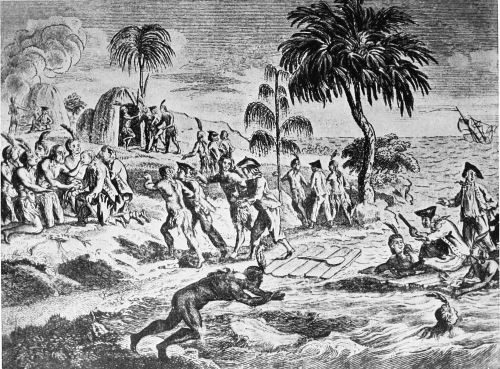 WOODES ROGERS LANDING ON THE COAST OF CALIFORNIA
From a print in the Macpherson Collection.
Cruising off Cape St. Lucas.
Ground with them, eat broil’d Fish, and were attended back in the same
manner, with the Indian Musick. The Savages brought a Sample of every
thing they had except their Women, Children, and Arms, which we find are
not common to Strangers: Their Knives made of Sharks Teeth, and a few
other of their Curiosities, our People brought aboard to me, which I
have preserved to shew what Shifts may be made.
Nov. 21. Last Night we saw a Fire ashore, which we interpreted to be a
Signal from the Inhabitants, that they had got something extraordinary
for us; and we wanting Refreshments, sent our Bark and Boat this Morning
with one of our Musicians, to shew that we could at least equal them in
Musick.
Nov. 22. Our Boat return’d and brought an Account, that they had found
a very good Bay, with a fresh Water River, and that they saw near 500
Indians, who lived there in small Hutts, but had no Recruit for us,
besides a little Fish. They met them as customary, and pilotted the Bark
to that Place, which we suppose was the same that Sir Thomas Cavendish
recruited at in Queen Elizabeth’s Time, Anno 1588.
Nov. 23. Our main Top-Gallant-Mast being broke, we got up another, but
the Rope breaking the Mast fell down upon the Deck, amongst the Men, but
by God’s Providence hurt no body. At 8 last Night our Ship sprung a
Leak; so that we were forced to keep one Pump a going.
Nov. 25. Capt. Courtney came aboard in his Yawl, and complain’d his
Stock of Water was almost spent; I agreed with him to send in our
Pinnace, and a Bark, to supply them with Water.
Nov. 26. This Morning our Pinnace return’d from Shore, brought 3
Barrels of Water, and 2 very large Fish from the Indians, which serv’d
most of the Ships Company. Those that came from the Shore observed the
Indians were not so friendly to our Men as customary.
Nov. 27. They refus’d to let them come ashore after it was Night,
which could not be to prevent their thieving, because the miserable
Wretches had nothing to lose; yet they are jealous to keep what they
have; and though they make no Use of their Land, might be afraid of
Rivals.
Nov. 28. Yesterday in the Afternoon we heard the Marquiss fire a
Gun, which was answer’d by the Dutchess, who had the middle Birth. We
tackt immediately, and made all possible Sail, supposing they had seen a
Stranger; the Marquiss stood to us towards the Shore, and we soon met
her; by 4 a Clock I was aboard them, and enquiring into the Cause of the
Alarm, was surpriz’d to hear they took us for the Manila Ship, and the
Gun they fired was to alarm the Dutchess to give chase, as she had
done all the day, tho’ not regarded by us, who knew the Marquiss, and
admir’d they could mistake the Duke. Immediately each Ship return’d to
his Station; soon after our Main-tye gave way, and our Main-yard came
down at once, but did no other Damage. This Morning we saw the Bark
coming off Shore, where she had been becalm’d; being longer wanting than
usual, we were afraid they were cut off by the Indians. We got our
Bale Goods up from abaft to see for the Leak, but all to no purpose; we
found some of the Bales that had receiv’d old Damages, which we dry’d
and re-pack’d, and sold what was damaged among the Ship’s Company.
Nov. 29. Last Night our Lazareto[139] Door being broke open, and
losing Bread and Sugar, this Morning I order’d a Search, and found the
Thief; I blam’d the Steward for his Remisness; he told me he lay next
the Door, with the Key fastned to his Privy Parts, because he had it
once stoln out of his Pocket, I suppose by the same Thief, who was so
dextrous to get it now without disturbing him; but not being ingenious
enough to fasten it to the same Place, he was discover’d. His Mess-mate
was also guilty, but knowing his Friends in Bristol, I was unwilling
to punish him, tho’ Provisions being scarce, it makes the Crime the
greater, for we expect no Recruit till we get to the East Indies. I
order’d the first to be severely whipt at the Geers,[140] and the other
and a Dutchman to be afterwards left with him in Irons.
Dec. 9. Mr. Duck the Master of the Bark came aboard, and presented
me with some Dolphins he had from the Indians. I order’d our Master to
go with him, and endeavour, if possible, to discover the Shore along to
the Northward, to find out a better Harbour than that where the
Indians lived, and if they met with the Dutchess, to tell Capt.
Courtney, I thought it convenient for one of the Ships to go into the
Bay we had already discover’d, and there to take in Water and Wood,
&c. so to fit our Ships by turns to save time, and consequently
Provisions, which begin to grow short with us. We were now something
dubious of seeing the Manila Ship,
Cruising off Cape St. Lucas.
because it’s near a Month after the time they generally fall in with
this Coast.
Dec. 14. Yesterday I went aboard the Dutchess, where ’twas agreed
the Marquiss should go into the Harbour and refit with all manner of
Dispatch. In the mean time we to keep the outer Birth, and the
Dutchess to be betwixt us and the Shore, and to cruize but 8 Days
longer, without we had a Prospect of the Manila Ship, because our
Provisions grow short.
Dec. 20. Having compar’d our Stock of Bread, and of what would serve
to prolong it, we agreed that a Committee should be held, and that every
one should give his Opinion in Writing, whether we should attempt taking
a Town to victual us, and so continue the Cruize for some time longer;
or to make all possible Dispatch to refit, and sail hence for the Island
Guam, one of the Ladrones, and there if possible to get a fresh
Recruit. My Opinion was as follows.
On board the Ship Duke, cruising off Cape St. Lucas in California,
this 19th of December, 1709.
EIght Days ago I was with Capts. Courtney and Cooke, and
computed what Bread there might be left aboard the 3 Ships; and we
all agreed there might be 64 Days Bread of all sorts for each Ship,
when equally divided.
| Since which Time there is 8 Days spent, so that there should be left no more than
|
56 Days Bread, |
| But on a Rumage of both Ships Duke
and Dutchess, and strictly computing
every thing that will help prolong
our Bread, we hope to make |
14 Days more Bread, |
| Which may be in all 70 Days Bread to come, |
| We must expect before we can get fitted
hence to spend at least 9 Days, and
add to that our Passage to Guam,
which we can’t think will be less than
50 Days, is
—— |
59 Days Bread, |
| | 11 |
By this Account, which is the utmost,—11 Days Bread will be left
when we come to Guam.
I am of opinion now we have search’d each others Ships to prevent
Frauds, that there can be no more than 11 Days Bread left when we
come to Guam, as above, except we shorten our Allowance very
much, which we can’t do till driven to the last Extremity, our
Allowance being very small already; but if we should have an
unexpected long Passage from hence to Guam, it will go hard with
us at the present Allowance, besides we are not certain of a
Recruit at Guam.
By the foregoing Account it’s plain what Flower and Bread-kind we
have left, and the risque we must now run to get to the
East-Indies, with so mean a Stock. This I doubt not will be full
Satisfaction to our Imployers, that we have prolonged our Cruize to
the utmost Extent, in hopes to meet the Rich Manila Ship: But
since Fortune has not favour’d us, we must think of other Methods
to promote our Safety and Interest. Except we resolve to take a
Town here to victual us, ’tis evident we can’t cruize, and ’tis my
Opinion, that now our Time is so far spent, we ought to attempt
nothing more in these Seas, lest our too long Stay might be the
Loss of all, because the Worm has already entred our Sheathing, For
these and other Reasons, I think it highly necessary, that from
this Instant we make all manner of Dispatch to fit, and sail hence
for the Island of Guam, one of the Ladrones Islands, and there,
if possible, to get a fresh Recruit, and consult how farther to
proceed for the Interest of our Imployers, and our own Advantage
and Reputation. This I give as my Opinion aboard the Dutchess,
this 20th of December, 1709.
Woodes Rogers.
This my Opinion being perused with the rest, we came to the following
Resolve.
WE the Officers present in a Committee on board the Dutchess,
having farther considered our short Store of Bread and Bread-kind,
and finding it too little to continue our Cruize longer here for
the Manila Ship, do therefore now agree to get a Harbour, and
there to recruit with the utmost dispatch, and sail for the Island
of Guam, or any other Place where we can revictual. We design to
consult farther of our next Proceedings, when in Harbour. This is
our present Opinion. Witness our Hands this 20th of December,
1709.
Signed by the Officers of the Committee.
The Manilla Ship.
At signing this in the Committee we all looked very melancholy and
dispirited, because so low in Provisions, that if we should not reach
Guam in the limited Time, or accidentally miss it, we shall not have
enough till we arrive at any other Place.
Necessity forces us to design from hence to Guam, and thence to the
East Indies; for if we had Provisions to go back round Cape Horne,
and to stop in Brazil, and there to sell our Europe Prize Goods, it
might be much more for our Advantage, and be sooner at Great Britain.
Dec. 21. Pursuant to Yesterday’s Agreement we made the best of our Way
into the Harbour call’d by Sir Tho. Cavendish Port Segura, where the
Marquiss was refitting; but having Calms most part of the Afternoon,
and a Current setting to Leeward, we rather lost than got ground.
Towards Morning there sprung up a Gale, and we found our selves to
Leeward of the Port, tho’ we took all Advantages of the Wind: But to our
great and joyful Surprize, about 9 a Clock the Man at Mast-head cry’d
out he saw a Sail besides the Dutchess and Bark, bearing West half
South of us, distant about 7 Leagues. We immediately hoisted our Ensign,
and bore away after her, the Dutchess soon did the same; but it
falling calm, I order’d the Pinnace to be mann’d and arm’d, and sent her
away to make what she was: Some were of opinion ’twas the Marquiss
come out of the Harbour, and to confirm this, said they could discern
the Sail to have no Foretop mast; so the Boat being not out of call,
return’d back, and we put a Cap[141] in her for the Marquiss, then
sent her away again, by which time it was Noon. The Cape then bore
N.N.E. of us, distant about 5 Leagues.
Dec. 22. We had very little Wind all Yesterday Afternoon; so that we
near’d the Ship very slowly, and the Boat not returning kept us in a
languishing Condition, and occasion’d several Wagers, whether ’twas the
Marquiss or the Acapulco Ship. We kept sight of our Boat, and could
not perceive her to go aboard the Ship, but made towards the
Dutchess’s Pinnace, who was rowing to them; they lay together some
time, then the Dutchess’s Boat went back to their Ship again, and ours
kept dogging the Stranger, tho’ at a good distance, which gave us great
hopes that ’twas the Manila Ship. I sent Mr. Frye aboard the
Dutchess in our Yawl, to know what News, and if the Ship was not the
Marquiss, to agree how to engage her. We then hoisted a French
Ensign, and fired a Gun, which the Stranger answer’d. Mr. Frye
At Anchor on the Coast of California.
return’d with the joyful News that it was the Ship we had so impatiently
waited for, and despair’d of seeing her. We agreed the 2 Pinnaces should
tend her all Night, and keep showing false Fires, that we might know
whereabouts they and the Chase was; and if we were so fortunate to come
up with her together, agreed to board her at once. We made a clear Ship
before Night, had every thing in a Readiness to engage her at Day-break,
and kept a very good Look-out all Night for the Boat’s false Fires,
which we saw and answer’d frequently. At Day-break we saw the Chase upon
our Weather-Bow, about a League from us, the Dutchess a-head of her to
Leeward near about half as far. Towards 6 our Boat came aboard, having
kept very near the Chase all Night, and receiv’d no Damage, but told us
the Dutchess pass’d by her in the Night, and she fired 2 Shot at them,
but they return’d none. We had no Wind, but got out 8 of our Ships Oars,
and rowed above an Hour; then there sprung up a small Breeze. I order’d
a large Kettle of Chocolate to be made for our Ship’s Company (having no
spiritous Liquor to give them;) then we went to Prayers, and before we
had concluded were disturb’d by the Enemy’s firing at us. They had
Barrels hanging at each Yard-Arm, that look’d like Powder Barrels, to
deter us from boarding ’em. About 8 a Clock we began to engage her by
our selves, for the Dutchess being to Leeward, and having little Wind,
did not come up. The Enemy fired her Stern Chase upon us first, which we
return’d with our Fore Chase several times, till we came nearer, and
when close aboard each other, we gave her several Broadsides, plying our
Small Arms very briskly, which they return’d as thick a while, but did
not ply their great Guns half so fast as we. After some time we shot a
little a-head of them, lay thwart her Hawse close aboard, and plyed them
so warmly, that she soon struck her Colours two thirds down. By this
time the Dutchess came up, and fired about 5 Guns, with a Volley of
Small Shot, but the Enemy having submitted, made no Return. We sent our
Pinnace aboard, and brought the Captain with the Officers away, and
having examin’d ’em, found there was another Ship came out of Manila
with them, of a bigger Burthen, having about 40 Brass Guns mounted, and
as many Patereroes; but they told us they lost her Company 3 Months ago,
and reckon’d she was got to Acapulco before this time, she sailing
better than this Ship. This Prize was call’d by the long Name of Nostra
Seniora de la Incarnacion Disenganio, Sir John Pichberty Commander;
she had 20 Guns, 20 Patereroes, and 193 Men aboard, whereof 9 were
kill’d, 10 wounded, and several blown up and burnt with Powder. We
engag’d ’em about 3 Glasses, in which time we had only my self and
another Man wounded. I was shot thro’ the Left Cheek, the Bullet struck
away great part of my upper Jaw, and several of my Teeth, part of which
dropt down upon the Deck, where I fell; the other, Will. Powell, an
Irish Land-man, was slightly wounded in the Buttock. They did us no
great Damage in our Rigging, but a shot disabled our Mizen Mast. I was
forced to write what I would say, to prevent the Loss of Blood, and
because of the Pain I suffer’d by speaking.
Dec. 23. After we had put our Ships to rights again, we stood in for
the Harbour, which bore N.E. of us, distant about 7 Leagues. Our
Surgeons went aboard the Prize to dress the wounded Men.
Dec. 24. About 4 Yesterday Afternoon we got to an Anchor in Port
Segura in 25 Fathom Water, found the Marquiss in a sailing Posture,
and all the Company much overjoy’d at our unexpected good Fortune. In
the Night I felt something clog my Throat, which I swallow’d with much
Pain, and suppose it’s a part of my Jaw Bone, or the Shot, which we
can’t yet give an account of, I soon recover’d my self; but my Throat
and Head being very much swell’d, have much ado to swallow any sort of
Liquids for Sustenance. At 8 the Committee met aboard us, and agreed
that the Dutchess and Marquiss should immediately go out, and cruize
8 Days for the other Ship, being in hopes she had not pass’d us; in the
mean time we and the Prize to stay and refit, and dispatch the Prisoners
away in the Bark, and if we could get Security from the Guiaquil
Hostages for the Payment of the Remainder of the Ransom, to let ’em go
likewise. We lie land-lockt from the E. by N. to the S. S. E. distant
from the Eastermost Point about 4 Mile, from the Southermost Rock about
half a Mile, and near the same Distance off Shore. The Committee we held
resolv’d as follows.
On board the Duke riding in Port Segura on the Coast of
California, Dec. 24. 1709.
HAving Information from the Prisoners taken on board the Prize the
22d instant, bound from Manila to Acapulco, that they came out
in company with another Ship bound for the same Port from which
they parted in Lat. 35. N. It is resolved that Capt. Courtney
in the Dutchess, and Capt. Cooke in the Marquiss, do
forthwith go out upon a Cruise for 8 Days, to look after the said
Ship.
Signed by the Majority of the Council.
Capt. Courtney, Cooke, and their Officers of the Council, would not
agree that the Duke and Dutchess should go out as I desir’d, with
most of the Men belonging to the Marquiss divided between them, in
order to cruise for the biggest Acapulco Ship, which we were in hopes
had not passed us; and by being thus well mann’d, might if they meet her
carry her by boarding at once, and that in the mean time the Marquiss
with a very small number of Men might be sufficient to stay in the Port,
and send off the Bark with the Prisoners.
But there having been some Reflections amongst the Sailors because the
Dutchess did not engage this Prize before the Duke came up, it made
them obstinate to cruize for her without us, and the Officers of our
Consorts being agreed, made the Majority of our Council; so that
according to the foregoing Committee we were obliged to stay in the
Harbour against our Will.
Dec. 25. Last Night the Dutchess and Marquiss went out: We put 10
good Hands aboard the Dutchess, that if they should be so fortunate as
to see the Great Ship, they might be the better able to attack her. In
the Morning we began to put part of the Goods aboard the Bark into the
Prize, in order to send the Prisoners away. Capt. Dover and Mr.
Stretton, who were aboard the Prize, came to me, and we all agreed to
send off the Guiaquil Hostages, the Captain of the Manila Ship (who
was a French Chevalier) having given us 5 Bills of Exchange for the
same, payable in London for 6000 Dollars, being 2000 more than the
Ransom Money, for which we allow’d him the Benefit of the Bark and
Cargo, the Captain and Hostages giving us Certificates, that it was a
Bargain concluded at their own Requests, and very much to their
advantage. Sir John Pichberty being, we hope, a Man of Honour, will
not suffer his Bills to be protested, since we have so generously
trusted him, tho’ a Prisoner, without a Hostage, which is always
demanded for less Sums.
Dec. 25. We plac’d two Centries to keep a good Lookout upon the Top of
a Hill, with Orders if they saw 3 Sail in the Offing, to make 3
Waffs[142] with their Colours.
Dec. 26. Yesterday Afternoon the Centrys made 3 Waffs,
Cruising off Cape St. Lucas.
and we immediately sent the Yawl to them for better Satisfaction, and
found there were 3 Sail out at Sea; upon which we immediately put all
the Prisoners aboard the Bark, taking away her Sails, and fetched our
Men aboard, leaving only 22 Hands belonging to us, aboard the Prize, to
help refit and look after her. The Prisoners, who were about 170, being
secur’d aboard our Bark, without Arms, Rudder, Sails, or a Boat, and
moar’d near a Mile from our Prize, a few more of our Men than was
sufficient to give them Victuals and Drink, might have guarded them very
safely; yet for the more Security, we left a Lieutenant of each Ship,
and the above Men well arm’d aboard our Prize, and immediately weigh’d
in order to go and assist our Consorts to attack the great Ship, which
then came in sight. Capt. Dover thought fit to go on board the Prize,
and exchange Posts with one of the Lieutenants that guarded the
Prisoners, and sent him to us in his stead. I was in so weak a
Condition, and my Head and Throat so much swell’d, that I yet spoke in
great Pain, and not loud enough to be heard at any distance; so that all
the rest of the chief Officers, and our Surgeons, would have perswaded
me to stay in the Harbour in Safety aboard our Prize. We weigh’d our
Anchors, and got under Sail by 7 a Clock: We saw Lights several times in
the Night, which we took to be our Consorts Boats making false Fires. In
the Morning at Day-break we saw 3 Sail to Windward of us, but were so
far distant, that we could not make which were our Consorts, and which
the Chase, till about 9 a Clock, when we saw the Dutchess and Chase
near together, and the Marquiss standing to them with all the Sail she
could crowd. We made what Sail we could, but were to Leeward of them 3
or 4 Leagues, and having a scant Wind, made little Way. At Noon they
bore S.E. of us, being right to Windward about 3 Leagues.
Engaging the bigger Manila Ship.
In the Afternoon we saw the Marquiss come up with the Chase, and
engage her pretty briskly; but soon fell to Leeward out of Cannon-shot,
and lay a considerable Time, which made us think she was some way or
other disabled. I order’d the Pinnace to be mann’d, and sent her away to
her, that if what we suspected prov’d true, and we had not Wind to get
up with them before Night, our Boat might dog the Chase with Signals
till the Morning, that she might not escape us and the other Ships; but
before the Boat could get up with them, the Marquiss made sail and
came up with the Chase, and both went to it again briskly for 4 Glasses
and upwards: Then the Ship which we took to be the Dutchess stretch’d
a-head to Windward of the Enemy, I suppose to fix her Rigging, or stop
her Leaks; mean while the other kept her in play till she bore down
again, and each firing a Broadside or two, left off, because ’twas dark:
They then bore South of us, which was right in the Wind’s Eye, distant
about 2 Leagues. By Midnight we were pretty well up with them, and our
Boat came aboard, having made false Fires, which we answer’d: They had
been on board the Dutchess and Marquiss, and told me the former had
her Foremast much disabled, and the Ring of an Anchor shot away, with
several Men wounded, and one kill’d, having receiv’d a Shot in their
Powder Room, and several in their upper Works, but all stopt. They
engag’d the Ship by themselves the Night before, which was what we took
to be the Boats Lights, being out of the hearing of the Guns. At that
time they could perceive the Enemy was in disorder, her Guns not being
all mounted, and consequently their Netting-deck and Close Quarters
unprovided; so that had it been my good Fortune in the Duke to
accompany the Dutchess, as I desired, we all believe we might then
have carried this great Ship; or if they in the Dutchess had thought
of taking most of the Men out of the Marquiss, who did not sail well
enough to come up to their Assistance at first, they alone might very
probably have taken her by Boarding at once, before the Spaniards had
experienc’d our Strength, being afterwards so well provided, as
encouraged them to lie driving, and give us all Opportunity to board
them when we pleas’d. Capt. Cooke sent me word, that the Marquiss
had fired near all her Shot and Powder, but had escap’d very well both
in Masts, Rigging and Men. I sent our Boat with 3 Barrels of Powder, and
Shot in proportion, and Lieut. Frye, to consult our Consorts how to
engage the Enemy to the best advantage at Break of Day. The Chase had
made Signals to our Ship all the Day and Night, because she took us for
her Consort, which we had in possession, and after ’twas dark had edg’d
away to us, else I should not have been up with her, having very little
Wind, and that against us. In the Morning as soon as ’twas Day, the Wind
veering at once, put our Ship about, and the Chase fired first upon the
Dutchess, who by means of the Wind’s veering was nearest the Enemy;
she return’d it smartly: we stood as near as possible, firing as our
Guns came to bear; but the Dutchess being by this time thwart the
Spaniards Hawse, and firing very fast, those Shot that miss’d the
Enemy flew from the Dutchess over us, and betwixt our Masts, so that
we ran the risque of receiving more Damage from them than from the
Enemy, if we had lain on her Quarters and cross her Stern, as I
design’d, while the Enemy lay driving. This forced us to lie along side,
close aboard her, where we kept firing round Shot, and did not load with
any Bar or Partridge, because the Ship’s Sides were too thick to receive
any Damage by it, and no Men appearing in sight, it would only have been
a Clog to the Force of our Round Shot. We kept close aboard her, and
drove as she did as near as possible. The Enemy kept to their close
Quarters, so that we did not fire our Small Arms till we saw a Man
appear, or a Port open; then we fired as quick as possible. Thus we
continued for 4 Glasses, about which time we received a Shot in the Main
Mast, which much disabled it; soon after that the Dutchess and we
firing together, we came both close under the Enemy and had like to have
been all aboard her, so that we could make little use of our Guns. Then
we fell a-stern in our Birth along side, where the Enemy threw a
Fire-ball out of one of her Tops, which lighting upon our Quarter-deck,
blew up a Chest of Arms and Cartouch Boxes[143] all loaded, and several
Cartridges of Powder in the Steerage by which means Mr. Vanbrugh, our
Agent, and a Dutchman, were very much burnt; it might have done more
Damage, had it not been quench’d as soon as possible. After we got clear
of each other, the Dutchess stood in for the Shore where she lay
braced to, mending her Rigging, &c. The Marquiss fired several Shot,
but to little purpose, her Guns being small. We were close aboard
several times afterwards, till at last we receiv’d a second Shot in the
Main Mast not far from the other, which rent it miserably, and the Mast
settl’d to it, so that we were afraid it would drop by the board, and
having our Rigging shatter’d very much, we sheer’d off, and brought to,
making a Signal to our Consorts to consult what to do; in the interim we
got ordinary Fishes[144] for a port[145] to the Main mast, and fasten’d
it as well as we could to secure it at present. Capt. Courtney and
Capt. Cooke came aboard with other Officers, where we consider’d the
Condition the 3 Ships were in, their Masts and Rigging being much
damnified in a Place where we could get no Recruit, that if we engag’d
her again, we could propose to do no more than what we had already
done, which was evident did her no great Hurt, because we could perceive
few of our Shot enter’d her Sides to any purpose, and our Small Arms
avail’d less, there being not a Man to be seen above-board; that the
least thing in the World would bring our Main-mast, and likewise the
Dutchess Fore-mast by the board, either of which by its Fall might
carry away another Mast, and then we should lie a Battery for the Enemy,
having nothing to command our Ships with, so that by his heavy Guns he
might either sink or take us: That if we went to board her, we should
run a greater hazard in losing a great many Men with little Hopes of
Success, they having above treble the Number aboard to oppose us, and
there being now in all our 3 Ships not above 120 good Men fit for
boarding, and those but weak, having been very short of Provisions a
long time; besides we had the Disadvantage of a Netting-deck[146] to
enter upon, and a Ship every other way well provided; so that if we had
boarded her, and been forc’d off, or left any of our Men behind, the
Enemy by that means might have known our Strength, and then gone into
the Harbour and took possession of the Prize in spight of all we could
do to prevent it: Besides, our Ammunition was very short, having only
enough to engage a few Glasses longer. All this being seriously
consider’d, and knowing the Difficulty we should have to get Masts, and
the Time and Provisions we must spend before we could get ’em fitted,
’twas resolved to forbear attempting her further, since our battering
her signify’d little, and we had not Strength enough to board her:
Therefore we agreed to keep her company till Night, then to lose her,
and make the best of our way into the Harbour to secure the Prize we had
already took. We engag’d first and last about six or seven Hours, during
all which time we had aboard the Duke but eleven Men wounded, 3 of
whom were scorch’d with Gun-powder. I was again unfortunately wounded in
the Left Foot with a Splinter just before we blew up on the
Quarter-deck, so that I could not stand, but lay on my Back in a great
deal of Misery, part of my Heel-bone being struck out, and all under my
Ankle cut above half thro’, which bled very much, and weaken’d me,
before it could be dressed and stopt. The Dutchess had about 20 Men
killed and wounded, 3 of the latter and one of the former were my Men.
The Marquiss had none kill’d or wounded, but 2 scorch’d with Powder.
The
Engaging the bigger Manila Ship.
Enemy’s was a brave lofty new Ship, the Admiral of Manila, and this
the first Voyage she had made; she was call’d the Bigonia, of about
900 Tuns, and could carry 60 Guns, about 40 of which were mounted, with
as many Patereroes, all Brass; her Complement of Men on board, as we
were inform’d, was above 450, besides Passengers. They added, that 150
of the Men on board this great Ship were Europeans, several of whom
had been formerly Pirates, and having now got all their Wealth aboard,
were resolved to defend it to the last. The Gunner, who had a good Post
in Manila, was an expert Man, and had provided the Ship extraordinary
well for Defence, which made them fight so desperately; they had filled
up all between the Guns with Bales to secure the Men. She kept a
Spanish Flag at her Main-top mast Head all the time she fought us; we
shatter’d her Sails and Rigging very much, shot her Mizon-yard, kill’d
two Men out of her Tops, which was all the Damage we could see we did
’em; tho’ we could not place less than 500 Shot (6 Pounders) in her
Hull. These large Ships are built at Manila with excellent Timber,
that will not splinter; they have very thick Sides, much stronger than
we build in Europe. Whilst the Officers were aboard us, Capt.
Courtney and others desir’d that what we had agreed upon might be put
in Writing, and sign’d by as many as were present, to prevent false
Reflections hereafter, which was done as follows.
At a Committee held on board the Duke, after we had engag’d the
bigger Manila Ship, December 27. 1709.
WE having consider’d the Condition of all our 3 Ships, and that
our Masts are much damnified in engaging the Manila Ship, do
think it for the Interest of the whole to forbear any further
Attempts upon her, having no Probability of taking her, but to do
our endeavours to secure the Prize we have already took, which will
be much more for the Honour and Interest of our selves and Country.
This is our Opinion, in witness whereof we have set our Hands, the
Day and Year above-written.
| Woodes Rogers, | Lan. Appleby, |
| Stephen Courtney, | Charles Pope, |
| William Dampier, | Henry Oliphant, |
| Edw. Cooke, | Alex. Selkirk, |
| Rob. Frye, | John Kingston, |
| Tho. Glendall, | Nath. Scotch, |
| John Connely, | John Piller. |
| John Bridge, | |
Thus ended our Attempt on the biggest Manila Ship, which I have heard
related so many ways at home, that I thought it necessary to set down
every particular Circumstance of it, as it stood in my Journal. Had we
been together at first and boarded her, we might probably have taken
this great Prize; but after the Enemy had fixed her Netting-deck and
close Quarters, they valued us very little. I believe also we might have
burnt her with one of our Ships, but that was objected against by all
the Officers, because we had Goods of Value on board all our 3 Ships.
The Enemy was the better provided for us, because they heard at Manila
from our English Settlements in India, that there were 2 small Ships
fitted from Bristol, that design’d to attempt them in the South
Seas. This was told us by the Prisoners we took on board the other
Ship.
When I proposed parting Companies at the Tres Marias, and to cruise
for the Acapulco Ship from Manila with our Ship and Bark at one
Station, and the Dutchess and Marquiss at another, we then expected
but one Ship from Manila, and she not so well provided as the least
Ship now was; tho’ as we have found it, we might probably have been
better asunder, for then I make little question but we should have got
some Recruit of Provisions, and consequently our Men had been stronger
and better in heart to have boarded this great Ship at once, before they
had been so well provided; but since Providence or Fate will have it as
it is, we must be content.
Dec. 28. The Enemy lay braced to all the time the Council held, and
run out 4 Guns of her lower Teer, expecting we would have the other
Brush with her; but when we made sail, she fil’d and made away, W.N.W.
and we betwixt the S.S.E. and the S. close upon a Wind. At 6 a Clock we
sent the Pinnace with some Men into the Harbour to secure the Prize, not
knowing what might happen before we could get in with our Ships. We
unrigg’d the Main-top-gallant Mast, and got it down, securing our
Main-mast with Runners and Tackles every way we could contrive, had
little Wind all the Afternoon and Night, but this Morning a fresh Breeze
sprung up at E.S.E. and soon after we saw nothing more of the great
Ship.
At Anchor in Port Segura on California.
Jan. 1. After we arriv’d again at Port Segura, we dispatch’d the
Prisoners away in the Bark, and likewise the Guiaquil Hostages: having
got Security for the Money as aforesaid, we supplied them with Water and
Provisions enough to carry ’em to Acapulco; and gave Capt.
Pichberty and his chief Officers, with a Padre, their Clothes,
Instruments, Books, &c. So that they parted very friendly, and
acknowledged we had been very civil to ’em, of which they desired me to
accept the following Testimony;
WE, whose Names are hereto subscrib’d, do acknowledge, that ever
since we have been in the Hands of Capt. Woodes Rogers, and
Capt. Stephen Courtney, Commanders of the Duke and Dutchess,
two British private Men of War, we have been by them very
civilly treated; and whatsoever we have transacted or done, had
been voluntary, and by our Consent, and particularly in passing
Bills, and Obligations, thro’ the Hands of Sir John Pichberty,
for the Ransom of the Town of Guiaquil, and other valuable
Considerations. Witness our Hands on the Coast of California.
Jan. 1. 1709.
| Don John Pichberty, | Manuel de Punta. |
| Don Antonio Guttera, | Manuel Hemanes. |
I wrote a Letter to my Owners, to acquaint ’em with our good Success,
but could not be so full as I would, because I sent it by the Hand of an
Enemy. We spent our Time till the 7th, in refitting, wooding, and
watering; and were very glad to find as much Bread on board the Prize as
we hop’d might, with what we had left of our old Store, make enough to
subsist us in our next long Run. Capt. Courtney and his Officers, with
those on board the Marquiss, are too willing to complement Capt.
Dover with the chief Command of the Prize; which till now I thought he
would not have accepted, his Posts already being above a Commander of
any of our Prizes; but I and my Officers are against it; because we
believe Capt. Frye or others, are fitter Persons to take Charge of
her, which we insisted on; and Capts. Courtney and Cooke came to me,
where they agreed to a Paper that was drawn up while we were all
together, in such a Manner as I thought would have satisfied every one.
Capt. Courtney carried this Agreement to Capt. Dover to sign it, not
doubting but all would be content with what we had concluded; yet to our
Surprize, they spent the Remainder of the Day, and instead of making
Capt. Dover comply with it, undid all, and brought a Paper which
impower’d him to be sole Commander, without the least Restraint, of not
molesting those that should navigate the Ship, but to order every thing
as he should think fit.
Jan. 9. We fetch’d our 3 wounded Men from on board the Dutchess;
one of ’em was Tho. Young, a Welchman, who lost one of his Legs; the
other, Tho. Evans, a Welchman, whose Face was miserably torn; the
third, John Gold, wounded in the Thigh; and one died of his Wounds,
viz. Emanuel Gonsalves, a Portuguese: So that out of ten that went,
only 6 return’d safe. I sent a Letter to Capt. Courtney this Morning,
to know what Measures were going forward; having heard nothing from him
since the 7th Instant, and desired that there might be no loss of time,
but that the Committee might meet once more, to try if they would make
use of their unbyass’d Reason. They were than all aboard the Marquiss,
where I heard they had, ever since our last Meeting, concerted how to
frame a Protest against me, and my Officers of the Committee, which was
immediately answer’d by a Protest from us, both which are as follows.
KNOW all Men, by these Presents, That We, the Commanders of the
Ships Dutchess and Marquiss, and other Officers, being the
major Part of a Committee appointed by the Owners, for the
regulating the Affairs of the Ships Duke and Dutchess, private
Men of War, till their Return to Great Britain, as more largely
appears in their Orders and Instructions. Now, whereas we have
lately taken a rich Prize bound from Manila to Acapulco, and
the said Ship being safe at Anchor in a Bay near Cape St. Luke,
on California, We held a general Committee on board the Duke
the 6th Day of January 1709-10. for appointing a Commander and
other Officers for the said Prize, call’d by the Spaniards, when
in their Possession, Nostra Seniora del Incarnation de Singano,
but now named by us The Batchelor Frigate, wherein it was
carried by Majority of Votes for Capt. Thomas Dover, who came out
second Captain of the Duke, and President of this Committee, and
Owner of a very considerable Part of both Ships, Duke and
Dutchess, to command the said Prize, we thinking him the most
proper Person for the Interest of the Owners and Company; we
likewise proposing to put two of the best of our Officers on board,
to command under him, and manage the navigating Part of the said
Ship during the Voyage, with other substantial Officers and Men,
sufficient to work the Ship and take Care of her.
At Anchor in Port Segura.
Now whereas Capt. Woodes Rogers, Commander of the Duke, and
several of his Officers, Members of this Committee, did refuse to
sign to the Agreement of the said Committee (the Like never having
been refus’d by any before, when carried by Majority of Voices) to
acknowledge the said Capt. Thomas Dover Commander of the Ship
Batchelor Frigate; we do hereby, in the behalf of the Owners of
the Ships Duke and Dutchess, our selves and Company, Protest
against the unadvis’d Proceedings and Practice of the said Capt.
Woodes Rogers, and the rest of the Officers of the Committee, that
refus’d to sign and agree to the same, it being directly contrary
to the Owners Orders and Instructions, (Reference being had
thereto) and the Union and Peace of the Ships Companies (by them
likewise recommended). And whatever Damage may ensue, either by
Loss of Time, Want of Provisions, or Men sufficient to manage the
said Ship, or any Mutiny or Disagreement that may arise from hence
between the Ships Companies, or any other Disaster whatsoever, &c.
we do likewise Protest against, in the behalf of the Owners,
ourselves, and Company, as aforesaid; expecting from the said
Captain Woodes Rogers, and Officers of the Committee aforesaid,
full Satisfaction and Reparation of all Losses and Damages
whatsoever, that may happen to the said Ship during her Voyage to
Great Britain.
In witness whereof, we the Commanders and Officers, being the
major Part of the Committee, have set our Hands, this 9th Day of
January, 1709-10. on board the Marquiss, at Anchor near Cape
St. Luke, on California.
Sign’d by the Officers of the Dutchess and
Marquiss.
Which Protest was answer’d by another from our Ship.
WE the chief Officers in behalf of ourselves and the rest of the
Ship’s Company of the Duke, having taken a rich Spanish Prize,
in Consortship with the Dutchess and Marquiss, call’d Nostra
Seniora del Incarnacion de ingano, and did design to use the
securest Methods to carry her to Great Britain, both for our
Employers interest and our own Advantage. But being in a remote
part of the World, we offer’d and desired our Consorts to put one
or more able Officers in the principal charge of the aforesaid
Prize, it being so valuable that a Retaliation for all our Risques
and Hardships is in her Riches, which highly behoves us to be very
careful in preserving. But against all our Ships Company’s Consent,
(tho’ we are so nearly concern’d) our said Consorts Officers,
Capt. Stephen Courtney, Capt. Edward Cooke, Capt. William
Dampier, Mr. William Stretton, Mr. Charles Pope, Mr. John
Connely, Mr. George Milbourne, Mr. Rob. Knowlman, and Mr.
John Ballett, have sign’d an Instrument, and combin’d together, to
put Capt. T. Dover in Command of the said Ship.
We therefore (being inclin’d to Peace and Quietness aboard and
not to use any Violence to remove the said Captain Dover out of
the aforesaid forc’d Command, although he is utterly uncapable of
the Office) do hereby publickly Protest against the aforesaid
Commander, and every one of those that have already, or shall
hereafter combine to place him in. The Ship now being in safety, we
declare against all Damages that may arise or accrue to the said
Ship, or Cargo under his Command; and that the aforesaid Combiners,
who have put the Care of the said Ship under an uncapable Command,
we expect are accountable and liable to us for all Damages that may
happen. This is our publick Protest. Witness our Hands, aboard the
said Ship Duke, riding at Anchor in a Port of California, the
9th of January, 1709-10.
Sign’d by the Officers of the Duke.
’Twas our great Unhappiness, after taking a rich Prize, to have a
Paper-War amongst our selves. I am sorry to trouble the Reader with
these Disputes, which continued for two Days about a proper Commander
for this Prize; because it highly concern’d us to take the utmost
Precautions for her Safety, having a long Run through dangerous unknown
Passages, into the East Indies, and most of the Recompence for our
great Risques and Hardships lay in her Riches. I had always desired that
Capt. Dover might be aboard her, for being a considerable Owner, we
all agreed he was a very proper Person to take Care of her Cargo, and to
have all the Freedom and Accommodation that could be made for him in
that Ship, which was of such vast Consequence to us and our Employers,
that in their Instructions to me, they strictly charged me to use the
securest Methods to bring her safe home, in case we should be so
fortunate as we now are, to take one of the Acapulco Ships: So that
after the Protests were over on both sides, I desired they might
assemble together, and finally determine what the Majority would agree
on, that no Time might be lost. So all the Council met again on board
the Batchelor, to endeavour an Accommodation. I being very weak, and
in much Pain, was not able to stir, therefore sent my Opinion in
Writing, as follows.
At Anchor in Port Segura.
MY Opinion is, That ’tis not for the Safety of the rich Spanish
Prize, that Capt. Dover command her, because his Temper is so
violent, that capable Men cannot well act under him, and himself is
uncapable. Our Owners directed me to use the securest Method to
bring the Ship home, if we should have the good Fortune to take
her; and ’tis not so, if an ignorant Person have the Command: And
tho’ it may be pretended that he’ll not command the sailing Part,
there are other Parts necessary for a Commander; so that whosoever
had the Charge of one, ought to act wholly in the rest, or else
Confusion follows a mix’d Command, that would be very pernicious in
this Case; and which it highly concerns us to beware of. I am
content, and desire Capt. Dover may be aboard, and have Power to
take Care of the Cargo, and all the Liberty and Freedom in her, he
can in reason otherwise desire, and that none may have the like
Power on board the Prize but himself. This is my Opinion. Jan. 9.
1709-10.
Woodes Rogers.
This Dispute is against my Desire already put in Print, from the publick
Notes of the Voyage, otherwise I had left it wholly out of my Journal,
as I had done several other of our Differences, being unwilling to
trouble the Reader with the Contests that too often happen’d in the
Government of our sailing Common-wealth.
After a long Debate, they voted Mr. Frye and Mr. Stretton, both to
act in equal Posts, to take Charge of the navigating the Ship, tho’
under Capt. Dover, but they were to be no ways molested, hinder’d nor
contradicted in their Business by him, whose Duty ’twas to see that
nothing should be done contrary to the Interest of the Owners, and Ships
Companies, in the Nature of an Agent, almost in the same Manner I
proposed at first, only he had the Title of Chief Captain in that Ship,
which was so small a Difference, where Titles are so common, that we all
consented to it; and at the same time they chose Officers, agreeing that
we should put 30 Men aboard her, the Dutchess 25, and the Marquiss
13, which with 36 Manila Indians, call’d Las-Carrs, and other
Prisoners we have left, her Complement will be about 110 Men. The
Majority keeping to their first Agreement I was obliged to come into it,
according to my Instructions from our Owners; so that all our
Differences about this Affair were at an end, and we drank to our safe
Arrival in Great Britain.
The Council agreed as follows.
At a Council held on board the Batchelor Frigate, at Anchor in
Port Segura, on California, Jan. 10. 1709/10.
IT is agreed, by the Majority of this Council, that Capt. Robert
Frye and Capt. William Stretton, shall both act in equal Posts
in the sole Navigating, Sailing and Ingaging, if Occasion should
be, under Capt. Tho. Dover, on board the Batchelor Frigate, and
that the said Capt. Tho. Dover shall not molest, hinder or
contradict ’em in their Business; and we do appoint Alexander
Selkirk Master, Joseph Smith chief Mate, Benj. Parsons second
Mate, Charles May Surgeon, John Jones Carpenter, Rob.
Hollinsby Boatswain, Rich. Beakhouse Gunner, Peirce Bray
Cooper, James Stretton and Richard Hickman Midshipmen, Denis
Reading Steward, and all other inferior Officers, as the
Commanders shall think fit.
Sign’d by the Majority of our Council.
In the Morning we put 35 good Hands aboard her. The Dutchess and
Marquiss put no more than their Share. Mean while Capts. Courtney
and Cooke, and 2 or 3 more of the Committee came to me, where we
sign’d a Paper for Capt. Dover and the two Commanders, recommending
Peace and Tranquility amongst them. And that in case of Separation, the
Place of Rendezvous was to be Guam, one of the Ladrones Islands,
where we design’d to touch at, God willing, to get Provisions: Every
thing being thus settled, and all in a Readiness to sail; before I
proceed with the Relation of our Voyage from hence, I shall give an
Account of California.
California Described.
IT is not yet certainly known whether it be an Island, or joins to the
Continent, nor did either our Time or Circumstances allow us to attempt
the Discovery. I heard from the Spaniards, that some of their Nation
had sail’d as far up betwixt California and the Main, as Lat. 42 N.
where meeting with Shoal Water, and abundance of Islands, they durst not
venture any further: So that if this be true, in all Probability it
joins to the Continent, a little further to the Northward; for Shoal
Water and Islands is a general Sign of being near some main Land: but
the Spaniards having more Territories in this Part of the World than
they know how to manage, they are not curious of further Discoveries.
The Manila Ships bound to Acapulco often make this Coast in the
Latitude of 40 North, and I never heard of any that discover’d it
farther to the Northward. Some old Draughts make it to join to the Land
of Jesso, but all this being yet undetermin’d, I shall not take upon
me to affirm whether it’s an Island, or joins to the Continent. The
Dutch say, they formerly took a Spanish Vessel in those Seas, which
had sail’d round California, and found it to be an Island; but this
Account can’t be depended on, and I choose to believe it joins to the
Continent. There is no certain Account of its Shape or Bigness, and
having seen so little of it, I shall refer the Reader to our common
Draughts for its Scituation. What I can say of it from my own Knowledge
is, That the Land where we were is for the most part mountainous, barren
and sandy, and had nothing but a few Shrubs and Bushes, which produce
Fruit and Berries of several Sorts. Our Men who went in our Bark to view
the Country about 15 Leagues to the Northward, say it was there cover’d
with tall Trees. The Spaniards tell us of several good Harbours in
this Country, but we found none of them near this Cape. We frequently
saw Smoak in several Places, which makes us believe the Inhabitants are
pretty numerous. The Bay where we rode had but very indifferent
Anchoring Ground, in deep Water, and is the worst recruiting Place we
met with since I came out. The Wind at this Time of the Year generally
blowing over Land, makes it good Riding on the Starboard Side of the
Bay, where you ride on a Bank that has from 10 to 25 Fathom Water; but
the rest of that Bay is very deep, and near the Rocks on the
Larboard-side going in there’s no Ground.
During the Time of our Stay the Air was serene, pleasant, and healthful,
and we had no strong Gales of Wind, very little Rain, but great Dews
fell by Night, when ’twas very cool.
The Natives we saw here were about 300, they had large Limbs, were
straight, tall, and of a much blacker Complexion than any other People
that I had seen in the South Seas. Their Hair long, black, and straight,
which hung down to their Thighs. The Men stark naked, and the Women had
a Covering of Leaves over their Privities, or little Clouts made of Silk
Grass, or the Skins of Birds and Beasts. All of them that we saw were
old, and miserably wrinkled. We suppose they were afraid to let any of
their young ones come near us, but needed not; for besides the good
Order we kept among our Men in that respect, if we may judge by what we
saw, they could not be very tempting. The Language of the Natives was as
unpleasant to us as their Aspect, for it was very harsh and broad, and
they pronounc’d it so much in the Throat, as if their Words had been
ready to choak them. I design’d to have brought two of ’em away with me,
in order to have had some Account of the Country, when they had learn’d
so much of our Language as to enable them to give it; but being short of
Provisions, I durst not venture it. Some of them wear Pearl about their
Arms and Necks, having first notch’d it round, and fasten’d it with a
String of Silk Grass; for I suppose they knew not how to bore them. The
Pearls were mix’d with little red Berries, Sticks, and Bits of Shells,
which they look’d upon to be so fine an Ornament, that tho’ we had Glass
Beads of several Colours, and other Toys, they would accept none of
them. They coveted nothing we had but Knives, and other cutting
Instruments, and were so honest, that they did not meddle with our
Coopers or Carpenters Tools, so that whatever was left ashore at Night,
we found it untouch’d in the Morning.
We saw nothing like European Furniture or Utensils among ’em. Their
Huts were very low, and made of Branches of Trees and Reeds, but not
sufficiently cover’d to keep out Rain. They had nothing like Gardens or
Provisions about them. They subsisted chiefly on Fish while we were
here, which with the Miserableness of their Huts, that seem’d only to be
made for a time, made us conclude they had no fix’d Habitation here,
whatever they may have elsewhere, and that this was their Fishing
Season. We saw no Nets or Hooks, but wooden Instruments, with which they
strike the Fish very dextrously, and dive to admiration. Some of our
Sailors told me they saw one of ’em dive with his Instrument, and whilst
he was under Water put up his Striker with a Fish on the Point of it,
which was taken off by another that watch’d by him on a Bark Log. The
Reader may believe of this what he pleases, but I give it the more
credit, because I my self threw some rusty Knives overboard, on purpose
to try those Divers, who seldom miss’d catching a Knife before it could
sink about 3 or 4 Fathom, which I took to be an extraordinary Proof of
their Agility.
California Described.
Instead of Bread they us’d a little black Seed, which they ground with
Stones, and eat it by Handfuls; some of our Men thicken’d their Broth
with it, and say it tastes somewhat like Coffee. They have some Roots
that eat like Yams, a sort of Seeds that grow in Cods, and taste like
green Pease, a Berry which resembles those of Ivy, and being dry’d at
the Fire, eats like parch’d Pease. They have another like a large
Currant, with a white tartish Pulp, a Stone and a Kernel; this sort of
Fruit they seem to value much. They have also a Fruit which grows on the
prickle Pear-tree, tastes like Gooseberries, and makes good Sawce. They
have many other Seeds and Plants unknown to us, but I was not in a
condition to view or describe them.
They seem to have a Season of Hunting by the Skins of Deer, &c. we saw
among them: They paid a sort of Respect to one Man, whose Head was
adorn’d with Feathers made up in the Form of a Cap; in other respects
they seem’d to have all things in common; for when they exchang’d Fish
with us for old Knives, of which we had plenty, they gave the Knives to
any that stood next, and after they had enough, we could get no Fish
from them. They appear’d to be very idle, and seem to look after no more
than a present Subsistance. They stood and look’d upon our Men very
attentively, while they cut Wood and fill’d Water; but did not care to
lend us a Hand at either, or indeed to do any thing that requir’d hard
Labour. Their Arms are Bows and Arrows, with which they can shoot Birds
flying. Their Bows are about 7 Foot long, and of a tough pliant Wood
unknown to us, with Strings of Silk Grass; their Arrows about 4 Foot and
a half, made of Cane, and pointed with Fish Bones that they shape for
the purpose. Most of their Knives and other cutting Instruments are made
of Sharks Teeth. I saw 2 or 3 large Pearl in their Necklaces and
Bracelets, and the Spaniards told me they had Store of them from the
inner part of the Gulph of California, where they have Missionaries
planted among them. Our Men told me they saw heavy shining Stones
ashore, which look’d as if they came from some Mineral, but they did not
inform me of this till we were at Sea, otherwise I would have brought
some of ’em to have try’d what Mettal could be extracted out of ’em. The
Spaniards likewise inform’d me, that the Country in general within on
the main Land of Mexico, is pleasant and fruitful, and abounds with
Cattle and Provisions of all sorts. The Natives grew very familiar with
us, and came frequently aboard to view our Ships, which they mightily
admir’d. We saw no Boats or Canoes among them, nor any other Sailing
Craft, but Bark-Logs, which they steer’d with Paddles at each End. We
gave one of the Natives a Shirt, but he soon tore it in pieces, and gave
it to the rest of his Company to put the Seeds in which they us’d for
Bread. We saw no Utensils for Cookery about them, nor do I suppose they
have any; for they bury their Fish in a Heap of Sand, and make a Fire
over it, till they think it fit for eating. There were all the Fishes
usual in those Seas to be found in the Bay. The fresh Water here is
good, and they have abundance of Samphire. They make a Fire in the
middle of their Huts, which are very low and smoaky. We saw no
extraordinary Birds here. I am told by our People that have been ashore,
that they get Fire by rubbing two dry Sticks against each other, as
customary among the wild Indians.
The Entrance into the Harbour may be known by four high Rocks, which
look like the Needles at the Isle of Wight, as you come from the
Westward; the two Westermost in form of Sugar-loves. The innermost has
an Arch like a Bridge, through which the Sea makes its way. You must
leave the outermost Rock about a Cable’s Length on the Larboard side,
and steer into the deepest part of the Bay, being all bold, where you
may anchor from 10 Fathom to 20 or 25 Fathom Water. Here you ride
land-lockt from E. by N. back to the S. E. by S. yet it is but an
ordinary Road, if the Wind should come strong out of the Sea, which it
never did while we lay there.
I Shall next give a brief Account of Mexico from the best Information
and Authors. This Country lies betwixt Lat. 8. and 50 or 55 North, but
it is little known or inhabited by the Spaniards to the Northward of
35. ’Tis divided into Old and New, and the former is also called New
Spain, The Country in general includes all the West Side of Northern
America, as far as ’tis known. ’Tis divided into the Audiences, or
Jurisdictions of St. Domingo, Mexico properly so call’d,
Guadalajara or New Gallicia, and Guatimala; and these again are
subdivided into several Provinces, with which I shall not trouble the
Reader, since that is the Business of a Geographer, and not of a Sailor.
That part of it call’d New Spain is the best and most famous Part of
all North America, and the Name is sometimes extended by the
Spaniards to the whole.
Mexico Described.
The Air in general is mild, temperate and healthful, and the Soil so
fertile, that in some places it produces 100 for one of Corn, and of
Maiz 200; but the great Rains in Summer hinder their having good Oil and
Wine. Their most remarkable Plant is that call’d Maguey, which abounds
in this Country, and some of it we found in the Maria Islands; of the
Juice the Spaniards and Natives make a small Wine, Vinegar, and Honey;
and of the Leaves and other Parts they make Cordage, Thread, and Cloth
for Sacks and Shirts. They have great and small Cattle, and Fowl in such
plenty, that they frequently kill them only for the Skins and Feathers.
They have also excellent Horses of the best Spanish Breed. There are
few Gold Mines in this Country, but abundance of Silver, and tho’ not so
rich as those of Peru, are much easier to be work’d, with less Expence
of Money, and far less Danger of Mens Lives. Their other chief
Commodities are Iron, Steel, Copper, but none of ’em much wrought,
Hides, Wool, Cotton, Sugar, Silk, Cochineal, Scarlet-Dy, Feathers,
Honey, Wax, Balm, Amber, Ambergrise, Salt, abundance of Medicinal Drugs,
Cocoa, Cassia, Gold in the Sands of their Rivers, Figs, Oranges,
Citrons, and other Fruit peculiar to the Climate, besides all those
common in Europe; wild Beasts, and Fowl of all sorts, Chrystal,
Turquoises, Emeralds, Marcasites, Bezoar Stones, and Pepper. This must
be understood of Mexico in general; for all those Commodities are not
in one Province, but some have one sort and some another. Nor is the
Temper of the Climate every where the same, for those Places towards the
South Sea are warm, but in and about the Mountains ’tis cold; and in
some places they have continu’d Rains almost for 8 or 9 months in a
Year, and are much infected with Serpents, Moskitto’s, and other
Insects, especially near the Torrid Zone.
I shall not swell my Book with the fabulous Accounts of the Origin of
the antient Mexicans, which are shocking to common Sense, nor pretend
to give the Reader the History of their Kings, because ’tis not my
Business; besides ’twould puzzle the ablest Critick to distinguish
betwixt Truth and Falshood in those pretended Histories, preserv’d by
fanciful Hieroglyphicks, which will bear what Sense any Author pleases
to impose upon them. Therefore I shall only say in general, that the
Spanish Authors who write of those Countrys say the Kings of Mexico
were very potent, that they had 25 or 30 petty Kings their Tributaries,
that their ordinary Guards did usually consist of 2 or 3000 Men, and
that on occasion they could raise 2 or 300000; that their Palaces were
magnificent, their Temples sumptuous, and their Worship barbarous, it
being ordinary for them to sacrifice their Enemies, and sometimes their
own Subjects. The Natives of Old Mexico say they are not of that Race
of People, but that their Ancestors came from divers Nations, who
inhabited the Northern parts of the Continent, and particularly that
call’d New Mexico; and by the Account their Historians give of their
Travels to settle here, ’twould seem those who compos’d the Story had
heard something of the Travels of the Children of Israel in the
Wilderness, and design’d to write something like it; and by calling
their Leader Mexi, they would make his Name resemble that of Moses.
’Twas a long time before they united into one Monarchy; for Montezuma,
who reign’d when Fernando Cortez invaded them, was only the 9th in
their Catalogue. The Divisions among the Natives, and the Hatred which
the Neighbouring Princes bore to their Kings, made the Conquest of
Mexico much easier to the Spaniards than they expected; so that in
the Bishoprick of Los Angeles, &c. there are many thousands of
Indians exempted from extraordinary Taxes, because their Ancestors
assisted the Spaniards in the Conquest of the Country.
Mexico Described.
The Natives of Mexico, properly so call’d, are the most civiliz’d,
industrious and ingenious; they are noted for admirable Colours in their
Paintings, tho’ their Figures are not proportionable; they draw ’em with
the Feathers of their Cincons, a small Bird, which they say lives only
upon Dew. They make use of certain Characters instead of the Letters of
the Alphabet, by which they have preserv’d some Fragments of their
History. The Spanish Governour of Mexico, our Author says, with much
difficulty got it out of the Hands of the Natives, with an Explanation
in their own Language, and had it translated into Spanish. The Ship in
which ’twas sent to the Emperor Charles V. being taken by a French
Ship, the Manuscript fell into the Hands of Andrew Thevet at Paris,
from whose Heirs our Hackluyt, being then Almoner to the English
Ambassador, purchas’d it. Sir Walter Raleigh got it translated into
English, and the Learned Sir Henry Spelman prevail’d with Purchas
to get the Figures engraven. They represent Princes and others in
several Postures, and bring down their History from the Year 1324. to
the Beginning or Middle of the 16th Century, or thereabouts. This
History is divided into 3 Parts; the first contains little but an
Account of the Names and Conquests of their Princes, with a Summary of
their Vices and Virtues, so that it is not worth insisting upon. The
second has an Account of the Tributes paid by the People, which were
Proportions of the Product of the Country for Provisions, Clothes, Arms,
warlike Habits and Ornaments, Paper and Houshold Furniture. The third
gives an account of the Oeconomy, Customs and Discipline of the
Mexicans, which because they are odd enough, I shall give a short
Account of the most remarkable.
Four Days after a Child was born, the Midwife carried it to the Yard of
the House, laid it upon Rushes, and after washing it, desir’d 3 Boys,
who were there at a sort of Feast, to name it how they pleas’d. If it
was a Boy, she put into its Hand the Tools belonging to its Father’s
Imployment; and if a Soldier, his Arms. If ’twas a Girl, she put a
Distaff or other Utensils of Women by it. If the Boy was design’d for
the Church, they carried it to a Temple with Presents, when of a
sufficient Age, and left it with the High Priest to be educated; and if
design’d for War, they carried him to an Officer to teach him the Use of
Arms. The Parents corrected them by Blows, or pricking them with Needles
made of the Maguey Tree: The Father prick’d the Boys, if unlucky, all
over their Body, and the Mother prick’d her Daughters only in the Fists.
When Boys were pretty well grown, they ty’d ’em Hand and Foot, and laid
’em in muddy Water naked a whole Day, and then their Mothers took ’em
out and clean’d ’em at Night. When a Maid was to be married, the
Marriage-maker carried her on his Back to the Bridegroom’s House, 4
Women bearing Torches before her; the Bridegroom’s Friends receiv’d her
in the Yard or Court, carried her to a Room, and set her down by him on
a Mat, and ty’d the Skirts of their Garments together, offer’d Incense
to their Idols, and had 4 old Men and Women to be Witnesses; after a
Feast the Witnesses exhorted ’em to live well together, and so the
Ceremony concluded.
The Priests train’d up their Novices in sweeping the Temples, carrying
Branches, &c. to adorn them, to make Seats of Cane, to bring Needles
or Thorns of Maguey to draw Blood for Sacrifices, and Shrubs to keep a
perpetual Fire; and if they fail’d in their Duty, return’d to their
Parents, or were catch’d with Women, they prick’d ’em with those
Needles. One of the chief Priests went by Night to a Mountain, where he
did Penance, carried Fire and Perfume to sacrifice to the Devil, and was
always attended by a Novice; others of the Priests play’d on Musical
Instruments by Night, and some of ’em observ’d the Stars, and told the
Hours. The Novices arriv’d to the chief Dignities of the Priesthood by
degrees, and some of ’em always attended the Armies to encourage the
Men, and perform their Rites.
Those who train’d the Youth to War, punish’d their Scholars by throwing
burning Coals on their Heads, pricking them with Sticks of Pine
sharpen’d at one End, or by burning off their Hair. Their Kings rewarded
the Soldiers according to the Number of Prisoners they took, with
Military Habits of several Colours, or Posts in the Army, till they came
to the highest. Their Chief Priests were also Men of Arms, and capable
of all Military Preferments.
Their capital Punishments were Strangling or Stoning to Death. If a
Caicque or petty Prince rebell’d, all his Subjects shar’d in his
Punishment, except they found some Method to appease the King. They
punish’d Drunkenness in young Men by Death, but allow’d it in old Men
and old Women of 70. Highway-men and Adulterers they ston’d to Death.
They had Assemblies for publick Affairs, wherein the Great Master of the
Emperor or King’s Houshold exhorted the Youth to avoid Idleness, Gaming,
Drunkenness, and other Vices.
This is the Sum of what that Hieroglyphical History says of the antient
Mexicans.
As to the present Natives, most of ’em are subject to the Spaniards;
but in some of the Mountains and Northern Parts they are not reduc’d; so
that they frequently attack the Spaniards, when they meet with a
favourable Opportunity.
Mexico Described.
In that call’d New Mexico some of the Natives are very barbarous, and
much given to Arms, the Men wear nothing but Skins, and the Women scarce
any other Covering than their Hair; they live for the most part on raw
Flesh, and go together in Troops, changing their Habitation as the
Season requires, or for the Conveniency of Pasturage. Their Oxen and
Cows are large, with small Horns, their Hair almost like Wooll, long
before, and short behind, with a Bunch on their Backs, great Beards like
Goats, and their Fore Legs short; they are of an ugly Aspect, but very
strong; they are the principal Riches of the Natives, their Flesh serves
them for Diet, their Skins for Clothes and Coverings to their Huts, they
make Thred of their Hair, Bow-strings of their Nerves, Utensils of their
Bones, Trumpets of their Horns, keep their Drink in their Bladders, and
use their Dung for Firing, because they are scarce of Wood. They have
Sheep as large as our Asses, and Dogs so strong, that they make ’em
carry their Baggage. This Country is inhabited by People of different
Languages and Manners; some of them live in Cities, of which ’tis said
there are several that contain from 30 to 50000 Inhabitants; others
wander about in Herds like the Arabs or Tartars; but in short, this
Country is so little known, and Travellers differ so much in their
Accounts of it, that there’s not much to be depended upon.
I think it proper here to say something of the peopling of it. There are
many Opinions about the peopling of America, but the most reasonable
to me is, that it was peopled from Tartary by way of the North Pole,
where they suppose it to join with some part of Asia. This I think
very probable, because the Spaniards, who come yearly hither from
Manila or Luconia, one of the Philipine Islands in the East
Indies, are forced to keep in a high Latitude for the Benefit of
Westerly Winds, and have often sounded, finding Ground in Lat. 42. N. in
several Places of the Ocean betwixt the East Indies and America,
which makes me conclude that there must be more Land, tho’ none of ’em,
as I have heard of, ever saw any Continent till they fall in with
California, in about 38 or 39°. N. Lat. I have often admir’d that no
considerable Discoveries have yet been made in South Latitude from
America to the East Indies: I never heard the South Ocean has been
run over by above three or four Navigators, who varied little in their
Runs from their Course, and by consequence could not discover much. I
give this Hint to encourage our South Sea Company, or others, to go
upon some Discovery that way, where for ought we know they may find a
better Country than any yet discover’d, there being a vast Surface of
the Sea from the Equinox to the South Pole, of at least 2000 Leagues in
Longitude that has hitherto been little regarded, tho it be agreeable to
Reason, that there must be a Body of Land about the South Pole, to
counterpoise those vast Countries about the North Pole. This I suppose
to be the Reason why our antient Geographers mention’d a Terra
Australis Incognita, tho’ very little of it has been seen by any body.
The Land near the North Pole in the South Sea, from California to
Japan, is wholly unknown, altho’ the old Maps describe the Streights
of Anian, and a large Continent, it is but imaginary; for the Dutch
themselves, that now trade to Japan, say they do not yet know whether
it be an Island, or joins to the Continent.
Gemelli[147] having been in this Country in 1697, who is the latest
Traveller that has publish’d any thing about it, and his Accounts being
in the main confirmed to me by our Spanish Prisoners, I shall give a
brief Hint of what he says, especially of what relates to Trade and
Provisions.
Their best Product is Gold and Silver, Pearl, Emeralds, and other
precious Stones: He saw the Silver Mines of Pachma, 11 Leagues from
the City of Mexico: One of ’em he says is 225 English Yards deep,
the other 195: He adds, that in the Space of 6 Leagues there are about
1000 Mines, some laid aside, others still in use. There are many
thousands of People imploy’d to dig ’em, from some the Metal and the
Water is brought up by Engines, and from others the Metal is brought up
on Mens Backs to the great Danger of their Lives, besides Numbers that
are lost by the falling in of the Earth, and pestilential Damps: They go
down to them by notch’d Poles, which being wet and slippery, the poor
Indian Slaves many times fall, and break their Necks. Our Author says
he was in danger of doing the like, when he went to see them. He adds,
the Workmen inform’d him, that from one of the Veins, where near 1000
Men work’d per diem, they had in 10 Years Dug 40 Millions of Silver,
that 2 Millions had been laid out in Timber-work to support it, and that
it became so dangerous, as the Owner stop’d it up. I refer to him for
the Manner of separating the Metal from the Oar. Every Discoverer of a
Mine must pay the 5th of the Product to the King, who allows him only
60 Spanish Yards round from the Mouth, or all on one side, if he
pleases. Gemelli says there’s 2 Millions of Marks, of 8 Ounces each,
entred at Mexico in a Year from those Mines, besides what is stole,
and 700000 Marks of it are coin’d annually into Pieces of Eight there,
for which the King has a Ryal per Mark. There being Gold mix’d with
the Silver, they make use of Aqua Fortis to separate them. The
Officers of the Mint have very profitable Places, but I can’t insist
upon their Sallaries.
’Tis needless to be particular in describing the Birds and Beasts of
this Country; they having been so often done by others, I shall only
say, they have enough for Provisions,
Mexico Described.
and many of both sorts unknown to us. ’Tis the like as to their Fruits
and Plants, which serve them for Food and Physick; but I have not room
to be particular.
Mexico is the Capital City of this vast rich Country, and lies in N.
Lat. 19. 40. in the Middle of a Valley, which is 14 Spanish Leagues
long, and 7 broad, encompass’d by a Ridge of Mountains. The City is
surrounded by a Lake, and is square, with long, wide, and well pav’d
Streets, cross one another. ’Tis 2 Leagues round, and the Diameter half
a League. There are 5 Causeys or Banks through the Lake into the City,
which vies with the best in Italy for noble Structures and beautiful
Women, who prefer Europeans to their own Country-men; this occasions
irreconcilable Prejudices betwixt them, so that an European can scarce
pass the Streets without being insulted. The Inhabitants are about
100000, the major part Blacks, and Mulatto’s, because of the vast Number
of Slaves carried thither. Europeans seldom marry there, because
finding no way to get real Estates, they generally become Clergymen,
which takes up most of those that come from Old Spain. There are 22
Nunneries and 29 Friaries of several Orders within the City, and all
richer than they ought to be, says Gemelli. The Cathedral is exceeding
rich, maintains 10 Canons, 5 dignify’d Priests, 6 Demi-Canons, 6 half
Demi-Canons, 1 Chief Sacristain, 4 Curates, 12 Royal Chaplains, and 8
others chosen by the Chapter, besides many others nam’d by the King. The
Revenue of the Cathedral is 300000 Pieces of Eight per Annum. The
Climate here is uncertain, as through all the Country, being for most
part both cold and hot at the same time, viz. cold in the Shade, and
hot in the Sun, but is never excessive either way; yet the Inhabitants
complain of the Cold in the Mornings, and of the Heat from March till
July; from thence to September the Rains cool the Air, and from that
time till March the Rains are but small. The Indians reckon those
Nights cold, but the Europeans like the Climate well enough. Their
Water is very cool. The neighbouring Country produces 3 Harvests per
Ann. one in June, the 2d in October, and the 3d uncertain, as
the Weather proves. Maiz or Indian Corn is their chief Grain, the
earliest being sow’d in March, the latest in May. It yields a
wonderful Increase, and other Provisions being plentiful, one may live
well here for half a Piece of Eight per Day, and all the Year round
there’s Fruit and Flowers in the Market. There’s no Brass Money here,
and the least Piece of Silver is Three-pence; so that they buy Herbs and
small Fruit with Cocoa Nuts, 60 or 70 of which, as the Time goes, are
valu’d at 6d. I cannot insist on the particular Description of the
Churches and Monasteries. The Archbishop has 11 Suffragans under him,
whose Revenues in all amount to 5160000 Pieces of Eight. The Cathedral
founded by Fernando Cortez, who conquer’d this Country, was not
finished in 1697. ’tis carried on at the King’s Charge. They have
admirable Conveyances to let the Water run out of the Lake by Canals, to
prevent its overflowing the City, as sometimes it has done. The Expence
of these Canals is so prodigious, that it seems incredible; the Curious
may find it in Gemelli, as also an Account of the Royal Palace and
other Structures. I say nothing of the fabulous Accounts which the
Natives give of the Foundation of this City.
The present Habit generally wore by the Natives of this Country is a
short Doublet and wide Breeches, a Cloak of several Colours on their
Shoulders, which they cross under the Right Arm, and tye on the Left
Shoulder by the 2 Ends in a great Knot: Some wear Sandals, the rest go
bare footed and bare-legg’d, and all wear their Hair long, which they
will by no means part with. The Women wear a fine white Cotton Cloth,
and under it a thing like a Sack; they wear another upon their Backs,
with which they cover their Heads when abroad or in Church. The Natives
adorn their narrow Coats with Figures of Beasts, Birds and Feathers.
Both Sexes are of a dark Colour, but endeavour to make themselves fair
with pounded Herbs. They daub their Heads with thin Clay, to refresh
them, and make their Hair black. The Mestizzo, Mullatto, and black
Women, are most in Number, but not being allow’d to wear Veils, or the
Spanish Habit, and despising the Indian Garb, they wear a thing like
a Petticoat a-cross their Shoulders, or on their Heads, which makes ’em
look like so many Devils. The Blacks and Mullattoes are very insolent,
and so much increas’d, that if it ben’t prevented, they may at one time
or other endanger the Country. The Indians of most Parts of Mexico
are nothing so industrious as formerly, and the Spaniards say they are
cowardly, cruel, Thieves, Cheats, and so beastly, that they use Women in
common, without regard to the nearest Relations, lie on the bare Ground,
and are nasty in their Way of living, which perhaps may proceed from the
Slavery they are kept under, being worse treated than those
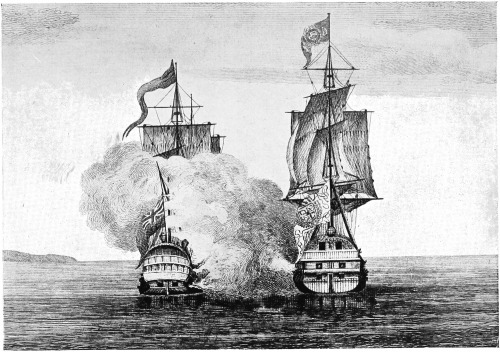 CAPTURE OF THE ACAPULCO GALLEON OFF THE COAST OF
CALIFORNIA
From a copper-plate engraving.
Mexico Described.
in the Mines. He adds that there’s scarce one fair dealing Man to be
found among 100 Mullattoes.
Acapulco lies in Lat. 17. bating some few Minutes, he says it is
rather like a poor Village of Fishermen, than fit to be the chief Mart
of the South Sea, and Port for China. The Houses are mean, built of
Wood, Mud and Straw, it is cover’d by high Mountains on the East side,
and very subject to Distempers from November till the End of May,
during which time they have no Rain, or very little. ’Tis as hot here in
January, as in our Dog-days; they are much pester’d with Gnats and
Earthquakes. He observes that it never rains in New Spain in a
Morning. This Town is dirty, and ill furnish’d with Provisions, so that
a Man can scarce live for a Piece of Eight per Day. Most of the
Inhabitants are Blacks and Mullattoes, for the Spanish Merchants are
gone as soon as their Business is over at the Fair, for Goods brought
hither from China and Peru. It has nothing good but the Harbour,
which is surrounded with High Mountains, and the Ships are moar’d to
Trees that grow on the Shore. It has two Mouths, the small one at N.W.
and the great at S.E. The Mouth is defended by 42 Brass Cannon. The
Castellan, who is chief Magistrate during the Fair, has 20000 Pieces of
8, from the Duties paid in the Harbour, and the Comptroller and other
Officers as much; the Curate has 14000 per Ann. tho’ the King allows
him but 180, but he exacts terribly on Baptisms and Burials, so that he
will scarce bury a rich Merchant under 1000. The Trade of this Place
being for many Millions, every one, in his Profession gets a great deal
in a short time; for a Black will scarce work for less than a Piece of 8
per diem, All the Dependance of the Inhabitants is on the Port, which
also maintains the Hospitals, Monasteries and Missionaries.
During the Fair, this Town resembles a populous City, because of the
great Concourse of Merchants from Peru and Mexico; then the
miserable Huts, in which there was nothing before but a few nasty
Mullattoes, are fill’d with gay Spaniards, and rich Merchants, and the
very Porters do generally earn 3 Pieces of 8 per Diem, by loading and
unloading of Goods, &c. but when this Trade is over, the Porters make
a sort of a Funeral, carry one of their Number about upon a Bier, and
pretend to bewail his Death, because their Harvest for Gain is then at
an End, till the next Year.
I shall not here say any thing further of the Seaports of Mexico,
because the Reader will find them in the Appendix, which gives a full
Account of all the noted Harbours in the South Sea, but shall add, that
the Trade of Mexico, on this Coast, is very little, compar’d with that
of Peru, because those of the former have their Goods brought to their
chief Ports in the N. Sea, directly from Europe; so that except when
the two Ships come yearly from Manila to Acapulco, they have little
Commerce in this Sea. I must here observe, that the Ships which come
from Manila use to be much richer than our Prize; for she waited a
long time for the Chinese Junks to bring Silk, which not arriving, she
came away with a Cargo mix’d with abundance of coarse Goods. The
Prisoners told me, that the Manila Ship did often return from
Acapulco, with 10 Millions of Dollars, and that the Officers never
clear’d less than from 20 to 30000 Dollars each in a Voyage; and the
Captain, whom they call General, seldom got less than 150 or 200000
Pieces of 8; so that it would have been an extraordinary Prize, could we
have met with them at the Time.
I think it proper to observe here, because it belongs to the Subject,
that when we arrived at the Texel in Holland, there were two
Spanish Ships there, bound for Cadiz, and on board of one of ’em a
Sailor, who told us he was aboard the large Spanish Ship from
Manila, when she arriv’d at Acapulco, very much disabled by the
Engagement she had with us off of California; that ’twas the Gunner
who made them engage us so resolutely at first, and forced them to
continue the Fight by keeping in the Powder-Room himself, and having
taken the Sacrament to blow up the Ship in case we had boarded and
over-power’d her. I was the more apt to believe this Man had seen the
Ship, and this Story might be true, because he related almost every
Passage of the Fight, as I have given it before in my Journal.
Mexico Described.
I shall also take Notice here that Capt. Stradling, who was taken
Prisoner in America, when his Ship stranded, and came off Prisoner in
a French Ship, some Months after we left the South Seas, inform’d me,
that the Corregidore of Guiaquil sent an Express to Lima, upon the
first Notice of our being in those Parts, that they then apprehended us
to be part of a Squadron of Men of War, and therefore lay still until
they had certain Advice of our Strength, and in about 3 Weeks after we
took the Town, they fitted out 3 Spanish Men of War, which was all
their South Sea Strength, against us; the biggest carried not above 32
Guns, but they were join’d by 2 French Ships, one of 50, and the
other of 36 Guns, and all well Mann’d. They stop’d at Payta, till Mr.
Hatley and his 4 Men, who lost Company with us at the Gallapagos
Islands, being in want of Provisions, and having had no Water for 14
Days, stood in for the Main, and landed near Cape Passao, almost under
the Equinox, among a barbarous sort of People, who are a mix’d Breed of
Negroes and Indians. They voluntarily surrendered themselves, being
in a starving Condition, yet those Brutish People, instead of giving
them Food, tied their Hands, then whipp’d them and hang’d them up, so
that they must unavoidably have lost their Lives, had not a Padre, who
liv’d in the Neighbourhood, came time enough by good Providence, to cut
’em down, and save them. There are several Letters from Mr. Hatley
since, which signify that he is a Prisoner at Lima. Capt. Stradling
likewise told me that the French Ship, which brought him to Europe,
was the very Ship that we chas’d in sight of Falkland Island, before
we passed Cape Horn. She had before attempted to sail round Cape
Horn, to the South Sea; but it being the wrong Season, she met with
bad Weather, and was forc’d to bear away to recruit at the River of La
Plata, and there wait for a more proper Season to go round Terra del
Fuego, into the South Sea. When we chas’d her, she had not above 100
healthful Men on board, so that had we been able to come up with her,
she must certainly have been our Prize.
Capt. Stradling told me they ran their Ship on an Island, and
afterwards surrendered Prisoners to the Spaniards, to save their
Lives, she being ready to sink; so that the Report I formerly mention’d,
that part of their Crew was drown’d in the Ship, proves a Mistake.
In Mexico, the Prisoners who are employ’d in cutting Logwood, have no
way to escape the Cruelty of the Spaniards, but to turn Papists, and
be baptized after their Manner; then they have the Liberty to chuse a
Godfather, who is generally a Man of Note, and they serve him as
Liverymen, &c. One Boyse, who fled to us at Guiaquil, was baptized
thus by an Abbot, in the Cathedral of Mexico, had Salt put in his
Mouth, and Oil poured upon his Head, and small parcells of Cotton, which
rub’d it off, were distributed as precious Relicks among the Penitents,
because taken off the Head of a converted Heretick, as they call them.
The native Spaniards enjoy all the Posts in the Church and
Monasteries, and admit no Indians, nor any mix’d Breed, to those
Preferments; which they think a necessary Piece of Policy, that they
may the better keep the Country in Subjection to Spain. Some of these
Prisoners who are forced to be pretended Converts, do now and then make
their Escape, tho’ it be dangerous to attempt it, for if taken they
are generally confin’d to the Workhouses for Life. There are several
Englishmen who were Prisoners in this Country, that, by Compliance,
have obtain’d their Liberty, with the Loss of their Religion in exchange
for Riches; particularly one Thomas Bull, who was born in Dover, and
taken in Campeche; he is a Clock-maker, has been 18 Years there, is
about 45 Years old, lives in the Province of Tabasco, and grown very
rich. One Capt. James Thompson, born in the Isle of Wight, has been
there about 20 Years, is about 50 Years old, grown rich, and commanded
the Mullattoes who took Capt. Packe, at the Beginning of the War. The
Person who told me this was a Comb-maker, and endeavour’d to escape from
La Vera Crux, but was taken, and sent Prisoner to Mexico, where he
came off to Peru, after he had his Liberty, by pretending he went to
buy Ivory to make Combs; he gave me a long Account of his Ramble amongst
the Indians, and says, he was at the Mouth of the River Missisippi,
which falls into the Gulph of Mexico, but could not pass it: He adds,
That the Indians, on the Bay of Pillachi, have murder’d several of
the Padres, out of an Aversion to the Spaniards, but show a great
Inclination to trade with the English. There are other Englishmen
who now live near the Bay of Campeche, as I was inform’d; one of ’em
is Tho. Falkner, he was born at the Hen and Chickens in Pall-mall,
where his Friends kept an Alehouse. He is married to an Indian Woman.
Such of them as won’t comply to turn Papists are kept in miserable
Slavery, either in the Mines or Workhouses at Mexico, which City he
says, is about as large as Bristol. Those that are put in Workhouses
are chain’d and imploy’d in carding Wool, rasping Logwood, &c. They
have more Manufactures of Woollen and Linnen in Mexico than in Peru.
Abundance of raw Silk is brought from China, and of late Years worked
up into rich Brocades equal to any made in Europe.
Mexico Described.
The Mullattoes and Indians, on light Occasions, are put into the
Workhouses, and kept there, till they pay their Debts or Tribute; but no
Spaniards, except for the worst of Crimes: There are many
Englishmen, who were taken cutting Logwood in the Bay of Campeche,
in several of these Workhouses, kept at hard Labour, and will end their
Days in Slavery, unless their Liberty be demanded by her Majesty at the
general Peace.
There’s abundance of Sheep in this Country, which yield excellent Wool,
of which, I am inform’d, the English Prisoners have taught them to
make Cloth, worth about 15s. a Yard in England, which there yields 8
Pieces of 8; They have also taught them to make Bays and other coarse
Woollen.
At Chopa in Mexico, about Lat. 12. N. there’s a great River which
sinks into the Earth at once, runs under the Mountains, and rises
bigger about 15 Leagues from the Place where it sunk. ’Tis twice as
large as the Thames. This River afterwards joins that of Tabasco,
and falls into the North Sea, as most of the great Rivers of this vast
Continent do, he told me, about this Place. There are high Mountains,
with Plains on the Top, where the Air is very temperate, and all our
European Fruits grow; whereas at the Bottom of these Mountains they
have none but the Fruits of hot Climates, tho’ ’tis not above 5 Leagues
asunder.
There are also Woods of Pines, &c. on those Mountains, among which
there are Flocks of harmonious Birds, which sing together in an
agreeable Consort, that resembles a fine Organ, so that Strangers are
amaz’d to hear such Musick strike up of a sudden in the Woods. There’s
also a strange Creature in those Woods, call’d by the Spaniards an
Ounce, much of the Form and Size of a Woolf-dog; but it has Talons, and
the Head is more like that of a Tyger: It kills Men and Beasts, which
makes travelling through the Woods dangerous; ’tis said to eat nothing
but the Heart of its Prey.
I had many more Relations from this Man, who had been 7 Years a Prisoner
in this Country; but they being too tedious, I shall add nothing more
concerning Mexico, but that the Worm is larger, and eats the Bottoms
of the Ships more on its Sea-Coasts, than any other Place where we were.
All the Coast from Guiaquil in Peru to the Northward, as far as the
Latitude of 20 in Mexico, ’tis reckon’d unhealthful, but the contrary
from Guiaquil to the Southward.
I Shall not trouble the Reader with the History of its Conquest by the
Spaniards, nor the fabulous Stories of its Incas or Princes, the
Curious may find them in the Spanish Writers, and for the Natives,
they are much the same as those I have described in other Parts.
PERU, properly so called, is about 1000 Leagues long, but the Breadth
various, from 100 to 300 Leagues. The best known Part of it lies on the
South Sea, and is divided into the 3 Audiences of Quito in the
North, Lima in the Middle, and La Plata in the South. The Air of
Quito is temperate enough, tho’ under the Line; the Soil is fruitful,
abounds with Cattle and Corn, and they have Mines of Gold, Silver,
Quick-silver and Copper; they have also Emeralds and Medicinal Drugs.
The Audience of Lima is most noted, because of its Capital of the same
Name, being the Residence of the Viceroy of Peru. This Country abounds
with Mines of Gold, Silver, Quicksilver, Vermilion, and Salt. The
Audience of La Plata I have already described in my Account of that
River. I shall only add, that tho’ the Silver Mines of Potosi be much
decay’d, yet some say the King of Spain has annually about 2 Millions
of Crowns per Annum for his Fifth; and that those of La Plata and
Porco, in the same Province, which were, upon discovery of the Mines
of Potosi, less used, may probably be open’d again to advantage; now
Goods are sold so cheap by the continual Supplies from France, that
the Indians, who were imploy’d in the Manufactures, must again work at
the Mines, their own coarse Goods being brought thither cheaper than
they can make ’em.
Peru Described.
The Spanish Writers in general say, that for 500 Leagues in Length,
from Tumbez to Chili, it never thunders, lightens nor rains, which
agrees with the Informations that I had from our Prisoners, viz. that
from Cape Blanco in S. Lat. 4. to Coquimbo, Lat. 30. it never rains,
but the Want of this is supply’d by great Dews, so that they have as
good Corn and Fruit, particularly Wheat, about Truxillo, as any in
Europe. In the Vallies near the Sea the Climate is hot, but temper’d
with Breezes from the Ocean and Mountains. In the Hilly part, far into
the Country, ’tis Winter, and very rainy, when ’tis Summer in the
Plains, though in the same Latitude. The Product, Beasts and Birds,
being much the same with other Parts of the South Sea Coast, I shall
not insist upon ’em.
They have their Cordage, Cotton, Cloth, Pitch and Tar from Chili and
Rio Lezo in Mexico, and tho’ the Country abounds with Provision,
’tis always dear near the Mines, because there Husbandry is neglected.
The Cordage they use is made of coarse Silk Grass, which is very tough,
draws small when strain’d, but grows twice as big when slack’d.
Capt. Stradling told me he travel’d the great Road from Quito
towards Cusco, in his way to Lima, which has Piles of Stone on each
side for some hundreds of Miles. When he and his Men were brought
Prisoners to Lima, the Spaniards put them in a close Dungeon, used
them very barbarously, and threaten’d to send them to the Mines, because
he attempted his Escape, and sail’d in a Canoe from Lima towards
Panama, near 400 Leagues, intending to cross the Isthmus, and to get
to Jamaica by some of our trading Sloops, but was taken and brought
back to Lima. Before he came thence he saw several of the Spaniards,
who had been our Prisoners, and said, they all own’d we had treated them
very civilly, which has in part taken off the bad Impression they had
conceiv’d of the English in those Parts; for not being used to War,
they account all alike that come to cruize, because of the unheard of
Cruelties and Debaucheries which were committed about 25 Years ago by
the Buccaneers in those Parts, which their Priests did improve to give
them an ill Idea of all those they think fit to call Hereticks, not
considering that most of those Disorders were committed by French
Buccaneers of their own Religion.
Having said so much of Peru in several Parts of my Journal, I need not
enlarge upon it here; the Spaniards extend it from Panama to
Coquimbo, which is about 800 Leagues, but the Breadth various. The
Gold Mines are most of ’em in the North Parts, betwixt Panama and the
Equinox.
Before the French traded hither round Cape Horne, there was a
considerable Commerce from Panama to all the Ports of the South Sea,
as I noted before; but now they have supplied the Country so much with
European Goods, and so cheap, that this Trade is in a manner sunk; so
that from hence forward there will be little sent over Land from
Panama to the North Sea, but the King’s Revenue. The Spaniards have
a great many Ships and small Vessels belonging to the several Ports of
Peru, which are chiefly imploy’d in carrying Timber, Salt, Salt-fish,
Wine, Brandy, Oil, and other Commodities, from one part of the Coast to
another, without which they could not well subsist; for this Country is
laid to be more populous and better inhabited than Mexico. They make
Woollen Cloth here of several sorts; I have seen some made at Quito
worth about 8s. per Yard, that is sold here for 5 Dollars. The
Indians do likewise make a coarse sort of Cotton Cloth; but since the
French furnish them better and cheaper, those Manufactures will come
to nothing, and the People must betake themselves to digging of Mines,
or what other Imployment they can get.
The Spanish Settlements in this Country, as well as in Mexico and
Chili, are not so full of Indians as formerly; for many of ’em are
gone to remote Parts, and live in Colonies by themselves, to avoid the
Slavery and Taxes impos’d on them by the Spaniards, for they were
oblig’d to pay from 8 to 14 Dollars per Ann. per Head to the King,
which had it been duly collected and faithfully paid, would have
amounted to the greatest Poll Tax in the World; but ’tis now lessen’d by
the removal of so many Natives as abovemention’d, and the Impoverishment
of the rest, who are sensible enough of their Oppression, but are so
dispirited, that they can do nothing to assert their Liberty, and they
are besides kept under by the Artifices of the Priests.
The Spaniards here are very profuse in their Clothing and Equipage,
and affect to wear the most costly things that can be purchas’d; so that
those who trade hither with such Commodities as they want, may be sure
to have the greatest Share of their Wealth.
Chili Described.
I come next to the Kingdom of Chili, which lies nearest to those who
shall think fit to attempt a Trade from England into the South Sea.
Father Ovalle, a Native of this Country, and Procurator for it at
Rome, agrees with our Maps, that it lies farthest South of any part of
America on that call’d the South or Pacifick Sea. He bounds it
with Peru on the North, the Straits of Magellan on the South,
Paraguay, Tucuman, and Patagonia on the East, and the South Sea
on the West. He begins it at S. Latitude 25, and extends it to Lat. 59,
which is near 500 Leagues. The Breadth of it varies, and the broadest
Place from East to West he makes about 150 Leagues, tho’ Chili
properly so call’d is not above 20 or 30 Leagues broad, from the Chain
of Mountains named Cordillera to the South Sea; but when the King of
Spain divided America into particular Governments, he added to
Chili the vast Plains of Cuio, which are of an equal Length, and
twice as broad as Chili it self. The Country in general Ovalle
places in the 3d, 4th and 5th Climates; the longest Day in the
3d is 13 Hours, and in the 5th above 14.
The first European who took possession of it was Don Diego
d’Almagro, a Spaniard, in 1535. He is said to march hither from
Peru by Order of the King of Spain, with a Body of Spanish Troops
and 15000 Indians and Blacks commanded by some Indian Princes, who
had submitted to the Spaniards. I shall not trouble the Reader with
the particular History of the Spanish Conquests till they reduced this
Country, which they may find at large in Ovalle, Herrera, and
others; but shall only say in general, that it was not totally in
subjection to the Spaniards till the Year 1640, when the Inhabitants
submitted to the Crown of Spain, on Condition that they should not be
given in Property as Slaves. The Spaniards, who sufficiently
experienc’d the Valour of this People, treat them with more Civility
than they do the rest of the Americans, on purpose to keep them in
Obedience, and for the most part they have submitted to the Church of
Rome.
The Sansons say that Chili, in the Language of the Country,
signifies Cold, which is so excessive in the Mountains call’d Sierra
Nevada, a part of the Cordillera, that it freezes Men and Cattle to
Death, and keeps their Corps from Putrefaction; so that Almagro lost a
great many of his Men and Horses as he past those Mountains. But the
Vallies toward the Sea are very healthful, the Climate temperate, and
the Soil excellent and fruitful, tho’ with some difference, according as
it lies nearer or further from the Equator; but the Coasts are subject
to strong Gales of Wind.
The Country is divided into 3 Quarters, and those 3 into 13
Jurisdictions. The Quarter of Chili proper extends from the River
Copiapo to that of Maule, and is hotter than Spain. The 2d
Quarter call’d Imperial, reaches from the River Maule to that of
Gallegos, and much resembles the Climate of Spain. The Proximity of
the Mountains on one side, and of the Sea on the other, makes it colder
than otherwise it would be; but it has Warmth enough to make it one of
the best Countries in America. The Valley of Copiapo is so fruitful,
that it frequently yields 300 for one single Measure, those of Guasco
and Coquimbo fall very little short of it, and that of Chili proper
is so excellent, that it gives Name to the whole Country by way of
Eminence.
I come now to give a brief View of what Ovalle, a Native, says to it
in general.
He tells us, that in Chili, properly so call’d, viz. the Country
betwixt the Mountains and the Sea, the Soil and Climate exceed those of
any part of Europe in Goodness, by the Confession of the Europeans
themselves: He says it is like the best part of Europe in every thing,
except the Opposition of the Seasons, it being Spring and Summer in the
one, when it is Autumn and Winter in the other; but in the Vallies the
Heat and Cold are not so excessive as in Europe, especially from Lat.
36, or thereabouts to Lat. 45, so that neither the Heat of the Day nor
the Cold of the Night can be complain’d of, from whence it is that the
Inhabitants make no difference between the Summer and Winter in their
Bedding and Clothes. He adds, that they are not troubled here with
Lightning, and seldom hear Thunder, except at a great distance. They
have no Storms of Hail in the Spring, and seldom above 2 or 3 rainy Days
together in the Winter, after which the Sky is serene without the least
Cloud. The North Winds bring the Clouds and Rain, and the South Winds
speedily make all clear. They have no poysonous or ravenous Creatures,
except a small sort of Lions, which sometimes prey on their Flocks, but
always fly from Men; nor are these Lions numerous, there being only a
few of them in the Woods and Desarts. He observes as a peculiar Property
of the Air of Chili, that no Bugs will live in it, tho’ they swarm in
Cuio on the other side of the Mountains. From the whole he infers,
that there is no Country in America so agreeable to European
Constitutions as Chili, and Air and Provisions are so like their own,
but rather better.
Chili Described.
The Spring begins about the Middle of our August, and lasts till the
Middle of November; then the Summer holds to the Middle of February,
the Autumn continues to the Middle of May, and the Winter from thence
to the Middle of August. During this Season the Trees are depriv’d of
their Leaves, and the Ground is cover’d with white Frosts, which are
dissolved about 2 hours after the Sun rises. The Snow falls seldom in
the Vallies, but in great Quantity in the Mountains, from whence it is
melted in the Summer, and fructifies the Vallies and Plains with
Rivulets. In the Spring the Fields are adorn’d with beautiful Flowers of
all Colours and sorts, and of an admirable Scent, from whence they
distil a fine Liquid called Angels Water, which makes a noble Perfume.
The choicest Flowers and Plants that we cultivate grow wild there; they
have Groves of Mustard Trees higher than a Man on Horseback, and the
Birds build their Nests in them. They have many Physical Plants and
Herbs, with which their Indian Physicians perform wonderful Cures,
when the Patients are despair’d of by our European Doctors, but they
are very shy of communicating those Secrets. Fruits and Seeds brought
hither from Europe thrive very well, but those of Mexico and Peru
don’t. They have all our sorts of Fruit in such abundance, that every
one may take what they please; so that none is sold, except a sort of
extraordinary large Strawberries, which they cultivate. They have Oats,
Wheat and Maiz in such plenty, that they are seldom troubled with Want
of Grain. Their Pastures are so rich, and their Cattle of all sorts so
numerous, that they don’t value the Flesh, but salt the Tongues and
Loins, and send ’em to Peru with the Hides and Tallow, which is a
great Branch of their Trade. They have Store of noble and generous
Wines, both white and red; their Vines are larger, and their Clusters of
Grapes much bigger than any in Europe. They have also plenty of
Olives, Groves of Cocoa Trees of several Leagues long. Almond-trees, and
such Store of Silk grass, which they use instead of Hemp, that they
furnish all the Coasts of the South Sea with Cordage for their Ships;
they have also great Quantities of Annise and Cummin-seed, Salt, Flax,
Wool, Leather, Timber, Pitch, Amber, &c. So that according to
Ovalle, Merchants may trade from hence to other Parts in the South
Sea, and especially to Lima, from 100 to 300 per Cent. Profit, of
which I have also been informed by our Prisoners. Though they have
abundance of Mulberry-trees, they breed no Silk-worms; so that the
Ladies, who are extravagant in their Apparel, impoverish the Country by
purchasing the richest Silks, tho’ they might easily have enough of
their own. They have plenty of Bees, yet have their Wax from Europe,
for want of Industry to improve their own, and they have Pepper and
other Spice from the East Indies, tho’ they have a kind of Spice of
their own, which might very well supply them. He adds, that the
Herbage, Fishing, Hunting, Wood for Fuel and Timber, and Salt Mines, are
here in common, so that every one may take what they please. They make
little use of their Mines of Lead and Quicksilver; for Peru has enough
of the latter to purify their Silver. Ovalle says the Gold Mines are
so many, that from the Confines of Peru to the Straits of Magellan
there is no part of the Country without ’em; but they are not so much
follow’d as in Peru, and they don’t so much apply themselves to the
Silver Mines, because those of Gold are wrought with less charge; their
Silver is dug from hard Rocks, ground to Powder in their Mills, and then
refin’d with Quicksilver, which is laborious as well as expensive;
whereas they have no other trouble with the Gold than to wash the Earth
from it; yet sometimes they follow the Veins of Gold through Rocks, when
they have hopes that they will grow larger, as they frequently do, and
one of these Veins is often enough to enrich the Discoverers. Gold is
not dug here in such Plenty, since the War betwixt the Spaniards and
Araucanos; but the Natives wait for the Winter Rains, which wash it
down from the Mountains, into Rivers, Ponds, &c. when the Women go
into the Water, feel out the Grains with their Toes, and make up as much
as supplys their present Necessities, as our Author says, but to me this
appears a very odd Way to get Gold. He tells us that he sent one of
those Grains to Seville, where being touch’d, it was found to be 23
Carats fine, without any manner of Purification. Most of the Bells and
great Guns us’d in Peru, are made of the Copper of this Country.
Chili Described.
He comes next to give an Account of the Chain of Mountains, named
Cordillera, from his own Observation, and what he has read in Authors:
He says they run from N. to S. from the Province of Quito to the
Straits of Magellan, which is above a Thousand Leagues, and accounts
them the highest Mountains in the World; they are generally 40 Leagues
broad, and intermix’d with Abundance of habitable Valleys: These
Mountains form 2 Ridges, the lowermost is cover’d with Woods and Groves,
but the higher barren, because of the excessive Cold and Snow on them.
The most remarkable Animals in these Mountains are, 1. that Species of
Hogs which have their Navels on their Backs, call’d Pecarys, these go in
great Herds, with each their Leader, and till he be kill’d, ’tis not
safe for Hunters to attack them, but when he falls, they immediately
disperse. 2. Wild Goats, whose Hair is as soft as Silk, and much us’d
for fine Hats. 4. Their Sheep call’d Guanacos, shap’d like Camels, but
of a far less Size, with Wool so fine that it is preferr’d to Silk for
Softness and Colour. He adds, that the ancient Yncas, or Princes, cut
two Roads through those Mountains, and if we may believe Herrera,[148]
one of them was pav’d for 900 Leagues from Cusco to Chili, ’twas 25
Foot broad, and at every 4 Leagues, there was a noble Structure, and at
each half League Couriers to relieve one another, in carrying Messages
from the State. He says, there are still a sort of Inns on this Road,
where Travellers find all Necessaries; but the Paths into the Mountains
are so narrow, that a single Mule can scarce pass them. The Ascent
begins at the very Shore of the Sea, but that which is properly call’d
the Mountains, requires three or four Days Journey to the Top of them,
where the Air is so very piercing and cold, that he found difficulty to
breath, when he pass’d them, so that he and his fellow Travellers were
obliged to breath quicker and stronger than ordinary and to apply their
Handkerchiefs to their Mouths, to break the extreme Coldness of the Air.
Herrera says, That those who pass them from Peru are troubled with
Reachings and Vomitings. Ovalle adds, That there are Meteors upon
those Mountains sometimes so high in the Air, that they resemble Stars,
and at other times so low, that they frighten the Mules and buz about
their Ears and Feet. He says, on the Top of those Mountains they can’t
see the Country below for Clouds, tho’ the Sky over their Heads is clear
and bright, and the Sun shines with admirable Beauty. When he pass’d the
highest Part of that which is properly call’d the Cordillera, he found
no Snow, tho’ in the beginning of Winter, whereas, in the lower Parts,
’twas so deep, that the Mules could scarce travel. He supposes the
Reason why there was no Snow on the Top is, that it reaches above the
middle Region of the Air. There are 16 Vulcanos in this Chain of
Mountains, which sometimes break out with dreadful Effects, cleave the
Rocks, and issue great Quantities of Fire, with a Noise resembling
Thunder. I refer to our Author for the particular Names and Places of
those Vulcanos. He doubts not but there are many rich Mines among those
Mountains, tho’ the Natives industriously conceal them, and make it
Death to discover them, which has defeated several Attempts of that
Nature by the Spaniards. The Natives have no occasion for those Mines
themselves, because they have Plenty of Provisions, which is all they
desire, and they are afraid that such Discoveries will occasion the
Spaniards to dispossess them, or to make them work in the Mines as
Slaves. He concludes this Head with an Account that very rich Mines were
discover’d at the Foot of those Mountains on the side of Cuio.
Those Mountains of the Cordillera are passable only in Summer, or in
the Beginning of the Winter. There are frightful Precipices, and deep
Rivers, at the sides of the narrow Passes, which frequently occasions
the Loss of Mules and Travellers. The Streams run with such Violence,
and so far below the Roads, that to look at them turns ones Head. The
Ascents and Descents are so steep, that they are difficult to pass on
Foot, but the Irksomeness of the Way is alleviated by the beautiful
Cascades which the Water naturally forms as it falls from the Rocks and
Mountains; and in some of the Valleys the Water springs up to a great
Height, like Fountains made by Art, amongst odoriferous Plants and
Flowers, which make an Agreeable Prospect. All these Streams and Springs
are so very cool, that a Man can’t drink above 2 or 3 Sips at once, nor
hold his Hand in them above a Minute. In some Places there are hot
Springs, good against many Distempers, and leave a green Tincture in the
Channels thro’ which they run. One of those Rivers, call’d Mendoca,
has a natural Bridge of Rock over it, from the Vault of which there
hangs several Pieces of Stone, resembling Salt, which congeal like
Icecles, as the Water drops from the Rock, and are form’d into several
Shapes and Colours. This Bridge is broad enough for 3 or 4 Carts to pass
a-breast. There’s another Bridge near this, call’d the Yncas, laid
over by Art, betwixt 2 Rocks, as some say, but our Author thinks it is
the Work of Nature: It is so very high from the River, that he could not
hear the Stream, which runs with great Rapidity, and though it be a
large River, it appear’d like a Brook when he look’d down from the
Bridge, which he could not do without being struck with Horror.
Chili Described.
Chili Described.
He comes next to describe the particular Rivers which run from these
Mountains; but I shall only mention the chief of them; and tho’ most of
them don’t run above 30 Leagues, yet some of them, towards their Mouths,
are navigable by Ships of the greatest Burthen. The first is that which
rises in the Confines of Peru, about S. Lat. 25. ’tis call’d the
River of Salt, because ’tis so salt that it can’t be drank, and
petrifies what’s thrown into it. 2. Copiapo, which rises in Lat. 26.
runs 20 Leagues from E. to W. and forms a Bay and a Harbour, at its
Entrance into the Sea. 3. Guasco rises in Lat. 28. and forms likewise
a Bay and Harbour. 4. The River of Coquimbo, which rises in Lat. 30,
forms a noble Bay and a Port, with beautiful Myrtles, and other Trees on
the Bank, that make a noble and a pleasant Grove. 5. Aconcagua, a
large deep River that rises about Lat. 33. runs thro’ several fruitful
Valleys. 6. Maypo rises about Lat. 33 and a half. It is so rapid, that
it admits no Bridge but one made of Cables; it enters the Sea with so
much Force, that its Waters form a Circle, and are distinguished a great
Way. It is brackish, noted for excellent Trouts, and the Sheep which
feed on its Banks, afford Mutton of a curious Relish. There are several
other Rivers which fall into it; the first is, that of St. Jago, alias
Mapocho; ’tis divided into several Streams, to water the District of
St. Jago, which sometimes it over-flows: Not far from the City it
sinks under Ground, and rises again in a Grove, about 2 or 3 Leagues
distant. 2. The River Poangue, its Water is extraordinary clear and
sweet, and flowing thro’ Veins of Metal, very much helps Digestion. It
runs for several Leagues under Ground, fructifies the Valley which lies
over it, and produces excellent Corn and Melons. The Banks of this River
are adorn’d with beautiful Trees. 3. The Rivers Decollina and Lampa,
which unite together within 10 or 12 Leagues off their Rise, and form
the noted Lake of Cudagues. It is so deep, that great Vessels may sail
in it, is about 2 Leagues long, and its Banks cover’d with Trees that
are verdant all the Year. It abounds with excellent Trouts and Smelts,
which are a great Conveniency to the City of St. Jago. 7. Rapel is
nothing inferior to Maypo, enters the Sea about Lat. 34. and a half,
and receives several other rapid Streams. The adjacent Country has
excellent Pastures for fattening of Cattle. 8. Delora rises in Lat. 34
three quarters, and is exactly like the former. 9. Maul, a great
River, which rises in Lat. 35. and bounds the Jurisdiction of St.
Jago. The Natives call all the Country betwixt those Rivers,
Promocaes, i.e. a Place of Dancing and Delight, which our Author says
is very just, for he never saw a more pleasant Country, nor one better
furnish’d with Provisions of all sorts. The Spaniards have many noble
Farms in these Parts. Near the Mouth of this River, there’s a Dock for
building of Ships, and a Ferry belonging to the King for the Conveniency
of Passengers. 10. Itata; ’tis 3 times as large and deep as the
Maul, and enters the Sea about Lat. 36. In most Places they pass it on
Rafts, and in some it is fordable. 11. Andalien, a River which runs
slow, and enters the spacious and pleasant Bay of Conception, at Lat.
36 three quarters. There’s another small River, which runs through the
middle of the City of Conception, a little above which it falls from a
high Rock, and gives the Inhabitants an Opportunity to form all sorts of
Water-works from it, among pleasant Groves of Lawrels, Myrtles, and
other odoriferous Plants. 12. Biobio, a famous River, which enters the
Sea, in Lat. 37. ’tis the largest in Chili, and is from 2 to 3 Mile
broad at its Mouth. Our Author says its Waters run thro’ Veins of Gold,
and Fields of Sarsaparilla, which make them very wholesom, and good
against several Distempers. This River is the Boundary betwixt the
Indians who are Friends to the Spaniards, and those who are their
Enemies, and make frequent Incursions upon them. This obliges the
Spaniards to keep many Garrisons in those Parts, but the Natives trust
to their Mountains. This River swells so much in the Winter, that it
becomes unpassable, and occasions a Cessation of Arms on both sides.
These People, says Ovalle, have given the Spaniards more trouble
than all the other Natives of America; so that they are forced to
maintain 12 Forts, well provided with Men and Cannon, besides the City
of Conception and Chillam, to over-aw the Natives. 13. Imperial, a
pleasant River, which falls into the Sea, about Lat. 39. after having
receiv’d many other Rivers, and among ’em two which run into the famous
Lake of Buren, where the Indians have an impregnable Fortress. 24.
Tolten, about 30 Miles from the River Imperial, is deep enough for
great Ships, where it enters the Sea. 15. About 8 Leagues farther, the
River Quenale enters the Sea, and is capable of small Barks. 16.
Valdivia, so called from Pedro de Valdivia, one of the Conquerors
and Governors of Chili, who built a Port and City, near the Mouth of
it, where great Ships may come up about 3 Leagues from the Sea. This
River opens to the North, and over-against the City lies the pleasant
Island of Constantine, with two others; the River is navigable on both
sides of the Island, but deepest on the South side. 17. Chilo, which
rises from a Lake at the Foot of the Cordillera, where there are Baths
good against the Leprosy and other Distempers. Our Author says so
little of the Rivers on the East side of the Cordillera, that we pass
them over.
Ovalle gives an Account of many remarkable Fountains, both hot and
cold, good against most Distempers; but I shall not insist on them. He
says, they have many Sea Lakes or Bays, which bring great Profit to the
Owners, because their Fisheries are more certain than those of the Sea;
and furnish most part of the Lenten Fair to the Inhabitants, and in the
hot Season abundance of Salt.
He adds, that in the Valley of Lampa, near St. Jago, there’s an
Herb, about a Foot high, resembling Sweet Basil. In Summer it is
cover’d with Grains of Salt, like Pearl, which is more savoury, and has
a finer Flavour than any other Salt. Our Author comes next to treat of
the Fertility of the Coast, which, he says, among other Fish produces
Shell-Fish in greater Quantities, larger than any where else, and 1.
Oisters, valuable both for their Meat and Pearls. 2. Choros, a fine Sort
of Shell-fish, which also breed Pearl. 3. Manegues, which have 2 round
Shells, the inside of which resembles Mother of Pearl. In short, he
says, the Sea throws up Shell-fish, in such Quantities, upon some Parts
of the Coast, that Ships may be loaded with them, and their Shells are
of such Variety of Colours and Shapes, that our European Virtusos
might from hence have a curious Collection, whereas the Indians only
burn them for Chalk. There are other Sorts of Fish on these Coasts, some
of which they call Sea-Stars, others Suns and Moons, because they
resemble those Planets, as they are usually painted, which are common
elsewhere, but not so large as here. These Fish reduc’d into Powder, and
drank in Wine, are an infallible Remedy against Drunkenness, and
frequently us’d for that end, because it creates an Abhorrence of Wine
in those who drink it, says our Author. He adds, that great Quantities
of Amber are found on this Coast, particularly, the grey sort, which is
the best. They have all other sorts of Fish, common to us in Europe,
besides others, peculiar to themselves.
He comes next to their Birds, and besides those which are common in
Europe, there are 1. Flamencos, bigger than Turkeys, their Feathers of
a white and scarlet Colour, of which the Natives make Ornaments, and
their Legs are so long that they walk thro’ Lakes and Ponds. 2. The
Child Bird, so call’d, because they look like a swadled Child, with its
Arms at Liberty: They are very good Meat. 3. Airones, so much valued
for the Feathers, to make Tufts, that formerly, they say, every Feather
upon their Heads cost 2 Reals. These Birds are rare. There are others
call’d Garcolos, whose Feathers are generally us’d by Soldiers. 4.
Voycas, from whose Notes the Indians pretend to foretel Death,
Sickness, or other Misfortunes; the Feathers on their Breasts are of a
deep scarlet Colour, and the rest brown. 5. Pinguedas, their Body is of
the size of an Almond; they feed upon Flowers, and shine like polish’d
Gold, mix’d with green; the Males have a lively Orange Colour, like Fire
on their Heads, and the Tails of those Birds are a Foot long, and 2
Inches broad. 6. Condores, which are white as Ermin; their Skins are
extreme soft and warm, and therefore us’d as Gloves. They have abundance
of Ostriches, and Variety of Hawks in this Country.
Ovalle comes next to treat of their Beasts. He says, they had no Cows,
Horses, Sheep, Hogs, House-Cats, nor common Dogs of any sort, Goats,
Asses, or Rabbits, till they were brought hither by the Spaniards, but
now all these are increas’d to a wonderful Degree by the Richness of
their Country and Pasture, so that one Cow frequently yields 150 lb
Weight of Tallow. Herrera says, that when the Spaniards came first
hither, a Horse was commonly sold for 1000 Crowns, but now they are so
plenty that they send them yearly to Peru. The most remarkable
Animals, which are not common with us, are, 1. Their Sheep, mention’d
before, shap’d like Camels, tho’ not so large: The Natives us’d them for
Ploughing and Carriage, before they had European Cattle: Their upper
Lips are slit, with which they spit at those who vex them, and wherever
their Spittle falls, it causes a Scab. They govern’d them by a kind of
Bridle put thro’ their Ears, and they would kneel like Camels, to take
on their Burden. 2. Wild Goats, which very much resemble those Sheep,
but are all of a red clear Colour, so very swift that they out-run
Horses, and are never to be tamed. They feed in great Herds, and are
hunted by Dogs, which easily catch the young ones, that are excellent
Meat. The Flesh of the old ones, dried and smoaked, is reckon’d the best
of its kind. These Creatures, especially the oldest, have Bezoar Stones,
in a Bag under their Belly. Our Author says, he brought one of those
Stones to Italy, which weigh’d 32 Ounces, and was as perfect an Oval
as if it had been form’d by a Turner; he gave the Indian who found it
70 Pieces of 8 for it.
Chili Described.
Their most remarkable Trees, besides what are common to Europe, are 1.
The Cinnamon Tree, so call’d, because the Bark resembles Cinnamon, in
such Plenty, that they cover their Houses with them: They keep their
Leaves all the Year, and resemble the Italian Lawrel Royal. 2. The
Guyac Tree grows in the Cordillera, is as hard and heavy as Iron: The
Decoction is good against many Diseases. 3. The Sandal Tree, that is
very odoriferous, a Preservative against infectious Distempers, and
therefore us’d by the Priests when they visit the Sick. 4. The Maguey,
whose Leaves are admirable against Burnings; the Fruit is like
Myrtle-Berries, and of an excellent Relish. 5. The Quelu, of whose Fruit
they make a very sweet Drink. 7. Iluigan, the Spaniards call it
Molde, ’tis of the Shape and Colour of Pepper: It grows on a small
Tree, and makes an agreeable Liquor, coveted by those of Quality. 8. The
Myrtilla which grows on the Mountains, from Lat. 37. and upwards:
Herrera says, its Fruit is a common Good to the Natives, not unlike a
Grape, and of this they make a Wine that exceeds all other Liquors. ’Tis
of a bright gold Colour, will bear more Water than any other Wine,
chears the Heart, and never offends the Stomach, but increases Appetite.
The Vinegar made of it exceeds all other sorts. Our Author adds, that
their Cypress, Cedar and Oak Trees are extraordinary good.
He comes next to the Islands of Chili. The first are those of Juan
Fernandez, already describ’d. The second are the Islands of Chiloe,
which lie about Lat. 43, and form an Archipelago of 40 Islands. He says
the Nature of the Climate is such, that it rains almost all the Year, so
that only Maiz or such other Grain can ripen here, as need little Sun.
The chief Diet of the Inhabitants is the Root Papas, which is larger
here than any where else. They have excellent Shell-fish, very good
Poultry and Hogs, some Beeves and Sheep. The Capital of this Country is
the City of Castra, which lies in the chief Island, and is garrison’d
by the Spaniards. Here they have great Store of Honey and Wax, and
some Gold Mines on the Coast. Their chief Manufacture is Clothing for
the Indians, and they have vast Woods of Cedar Trees of a prodigious
size, with the Planks of which they drive a great Trade to Chili and
Peru. 3. The Islands of Chonos, in Lat. 45. but of little Use,
because of the excessive Rains which drown the Soil. 4. The Fine Island,
which lies almost in the same Latitude with Val Paraiso and St.
Jugo: It has a safe Harbour for Ships, where they may ride in 20 or 30
Fathom Water. The Spaniards say ’tis a very beautiful Island, abounds
with Trees, wild Boars, and other Game, and excellent Water; and there’s
Plenty of Fish on the Coast. 5. The Island of Mocha, where the
Dutch, under Spilberg, found a very generous Reception by the
Natives, who furnish’d them with Plenty of Sheep, and other Provisions,
in exchange for Clothes, Axes, &c. The North side of it is plain and
low, but the South side rocky. 6. The Island of St. Maria, 13 Leagues
S.W. from the City of Conception, and 3 from Arauco: It is very
fruitful and temperate, lies about Lat. 37, and is well inhabited. 7.
The Islands of Pedro de Sarmiento, so call’d, because he discover’d
them, when in Pursuit of Sir Francis Drake. They are about 80 in
Number, and lie about Lat. 50. so that we suppose them to be those now
call’d The Duke of York’s Islands, which lie a little to the Northward
of the Straits of Magillan.
Sailing towards the Island of Guam.
Our Author comes next to Guio, the third Quarter of Chili, which
lies on the other side of the Cordillera, towards the East. ’Tis
divided into several Provinces, and quite differs in Temperature from
Chili. The Summer is excessive hot, and the Inhabitants so annoy’d
with Bugs and Muskettos, that they lie abroad in their Gardens and
Yards. They have almost perpetual Thunders and Lightnings, and are
mightily infested with poisonous Insects: These are the bad Qualities of
the Country, to compensate which, the Soil, in many places, if possible,
exceeds that of Chili in Fruitfulness; the Crops are richer, the
Fruits larger, and of a better Taste, because of the greater Heats. They
have Store of Corn, Wine, Flesh, and all the Fruits, Roots, and Herbs of
Europe, with large Plantations of Olives and Almonds. The Cold is not
so sharp in Winter as that of Chili, and the Air much clearer, so that
the Season is then very temperate: they have great Quantities of large
excellent Trouts, and other River Fish. Their peculiar Fruits are, 1.
Algaroba, of which they make a Bread so sweet, that Strangers can’t eat
it. They supply Tucuman and Paraguay with Figs, Pomgranates, Apples,
dry’d Peaches and Grapes, and excellent Wine and Oil. Ovalle says,
That in his time there were rich Mines of Gold and Silver discover’d
here, which were reckon’d to be better than those of Potosi, and that
in short it had all Necessaries for Life in as great abundance as any
other Country, and in general is very healthful. The Provinces of
Tucuman and Paraguay, which bound this Country we have already
describ’d.
Jan. 10. I now go on with my Journal, being on our Departure from
California, and returning to Great Britain. I shall not trouble the
Reader with every Day’s particular Transactions in this long and tedious
Passage, but only take notice of such Occurrences as are worth remark,
and to satisfy the Curious, shall subjoin a particular Table of each
Day’s Run, with the Latitude, Longtitude and Variation betwixt Cape St.
Lucas on California, and Guam, one of the Ladrones Islands. We
resolved to keep an exact Account of the Distance and Variation not
being certainly known to us from any former Voyagers.
Jan. 11. We weigh’d from Port Segura last Night, but were becalm’d
under the Shore till the 12th in the Afternoon, when there sprung up a
Breeze, which soon run us out of sight of the Land. We took our
Departure from Cape St. Lucas, which bore N. by E. at 12 a Clock,
distant about 15 Leagues. We were forc’d to go away with little or no
Refreshment, having but 3 or 4 Fowls, and a very slender Stock of
Liquor, which we got out of the Batchelor. Several of our Men were in
a weak Condition, besides my self, Mr. Vanbrugh, and the rest that
were wounded. We were forc’d to allow but 1 Pound and half of Flower,
and 1 small Piece of Meat to 5 in a Mess, with 3 Pints of Water a Man
for 24 Hours, for Drink and Dressing their Victuals. We struck down 10
of our Guns into the Hold, to ease the Ship; for being out of the way of
Enemies, they are altogether useless betwixt this and the East Indies.
On the 16th the Batchelor made a Signal to give us some Bread, they
having found a good Quantity of Bread and Sweet-meats aboard her, but
little of Flesh-kind: We had 1000 Weight of Bread for our Share, the
Dutchess as much, and the Marquiss 500 Weight; in lieu of which we
sent back to the Prize 2 Casks of Flower, one of English Beef, and one
of Pork, they having but 45 Days Provision aboard in Flesh. This Morning
Thomas Conner, a Boy, fell overboard, but the Launch being a-stern, we
cut her Moarings, and took him up just as he was tired with Swimming,
and ready to sink.
On the 26th in the Morning the Water was very much discolour’d, at
which being surprized, we immediately sounded, but found no Ground. We
spoke with the Dutchess, and agreed to go away W.S.W. till we got into
the Lat. of 13°, because our Spanish Pilot told us it was dangerous
going in 14, by reason of Islands and Shoals, where a Spanish Vessel
was lost some time ago, ever since which the Manila Ship, in her
Return from Acapulco, runs in Lat. 13. and keeps that Parallel till
they make the Island of Guam.
On the 28th the Steward missing some Pieces of Pork, we immediately
search’d, and found the Thieves, one of ’em had been guilty before, and
forgiven, on promise of Amendment, but was punish’d now, lest
Forbearance should encourage the rest to follow this bad Practice;
Provisions being so short, and our Run so long, may prove of ill
consequence. I order’d ’em to the Main Jeers, and every Man of the Watch
to give ’em a Blow with a Cat of Nine-tails, and their Messmates being
privy to the Theft, were put in Irons.
Feb. 1. We buried one Boyce, betwixt 40 and 50 Years of Age, whom we
brought from Guiaquil, where and in other Parts of New Spain he had
been a Prisoner above 7 Years, since he was taken in the Bay of
Campeachy.
On the 5th a Negro we named Deptford died, who being very much
addicted to stealing of Provisions, his Room was more acceptable than
his Company at this time. On the 6th we spoke with the Dutchess; I
was for augmenting the Mens Allowance in Meat, since we had such a
favourable Gale, which was like to continue; but Capt. Courtney
objected against it, alledging that if we miss’d Guam, we should all
be starved; so we deferr’d it a Week longer. We have had very bad luck
in fishing hitherto, having took only one Albicore since we came from
Cape St. Lucas.
Arrival at the Island of Guam.
On the 11th I agreed with Capt. Courtney to continue a W. by S.
Course till we get clear of the Rocks call’d the Bartholomews, which
are laid down in 13° and a half; but the Distance of them being
variously computed, makes us the more cautious, and keep a constant good
Look-out. On the 13th the Spanish Pilot we took in the Batchelor
died; we kept him, thinking he might be of use to us, if he recover’d of
his Wounds; but he was shot in the Throat with a Musket-ball, which
lodg’d so deep, the Doctors could not come at it. On the 14th we
agreed with Capt. Courtney to give half a Pound of Flower or Bread
more to a Mess. That same Day, in Commemoration of the ancient Custom in
England of chusing Valentines, I drew up a List of the fair Ladies
in Bristol, that were any ways related to or concern’d in the Ships,
and sent for my Officers into the Cabbin, where every one drew, and
drank the Lady’s Health in a Cup of Punch, and to a happy Sight of ’em
all; this I did to put ’em in mind of Home. On the 17th I was troubled
with a swelling in my Throat, which incommoded me very much, till this
Morning I got out a Piece of my Jaw Bone that lodg’d there since I was
wounded. Our Ship began to make more Water, so we clapt on a new Bonnet
where we took the old one off; but after many fruitless Attempts, were
forc’d to keep one Pump continually going, every two Men in the Watch
taking their Posts once an Hour; which Labour, with the want of
sufficient Food, make our People look miserably.
On the 18th we threw a Negro overboard, who died of a Consumption and
Want together. Our Men began to be very much out of order, and what adds
to their Weakness is our continual Pumping, nor can we pretend to make
any further Addition to their Allowance.
On the 25th Tho. Williams, a Welch Taylor, died; he was shot in
the Leg at engaging the 2d Manila Ship, and being of a weak
Constitution, fell into a Dysentery, which kill’d him. On the 26th we
caught a Couple of fine Dolphins, which were very acceptable to us,
having had but very indifferent Luck of Fish in this long Passage.
On March the 3d we buried a Negro call’d Augustine, who died of
the Scurvy and Dropsy. We agree to give 6 Negroes the same Allowance as
five of our own Men, which will but just keep those that are in health
alive.
On the 10th we made Land, being the Island Serpana, which bore N.W.
distant about 8 Leagues. The Dutchess made another Island to the
Westward, which bore W. by S. distant about 10 Leagues; the latter they
took to be the Island Guam, so we clapt upon a Wind, and stood for it.
March 11. This Morning we had sight of both Islands, the Northermost
bearing N.N.W. distant about 7 Leagues, and the Body of the Westermost
W.S.W. 5 Leagues. The Spaniards say there is a great Shoal between
these Islands, but nearest to Serpana. We ran along the Shore, being
satisfied it was the Island of Guam, from whence there came several
flying Prows to look at the Ships; they run by us very swift, but none
would venture aboard. At Noon the Westermost part of the Island bore
West, and at the same time we made a small low Island joining to Guam,
with a Shoal between it and Guam; the Island appear’d green and very
pleasant, off of it there runs a Spit of Sand to the Southward, but
keeping it a good Birth from you as you near it, there’s no Danger,
being gradual Soundings to the Shoal. After we were clear of it we
sprung our Luff, and stood in for the Harbour, which lies mid-way
betwixt this and the North part of the Island. There came heavy Flaws of
Wind off Shore, sometimes for us, and at other times against us; but we
got to an Anchor in the Afternoon in 12 Fathom Water, about half a Mile
off Shore, where there was a little Village. The small Island to the
Southward bore South of us, distant about 3 Leagues, and another small
one to the Northward bore N. N. W. about 2 Leagues. The Necessity of our
stopping at these Islands to get a Refreshment of Provisions, was very
great, our Sea Store being almost exhausted, and what we had left was
very ordinary, especially our Bread and Flower, which was not enough for
14 Days at the shortest Allowance. In order to recruit quietly, we
endeavour’d to get some of the Natives aboard that were in the Prows, to
keep ’em as Hostages in case of sending any of our Men to the Governour:
One of ’em, as we were turning into the Harbour with Spanish Colours,
came under our Stern. There were 2 Spaniards in the Boat, who asked
what we were, and from whence we came? Being answer’d in Spanish, that
we were Friends, and came from New Spain, they willingly came aboard,
and ask’d if we had any Letter to the Governour? We had one ready, but
before we could get it signed by all the Commanders, there came a
Messenger from the Governour, who demanded the same Account of us. We
immediately sent him away with 2 of our Linguists, detaining one of the
Spaniards till they return’d. The Letter was thus:
At the Island of Guam.
WE being Servants to Her Majesty of Great Britain, and stopping
at these Islands in our Way to the East Indies, will not molest
the Settlement, provided you deal friendly by us. We will pay for
whatever Provisions and Refreshments you have to spare, in such
manner as best agrees with your Conveniency, either in Money, or
any Necessaries you want. But if after this civil Request you deny
us, and do not act like a Man of Honour, you may immediately expect
such Military Treatment, as we are with ease able to give you. This
we thought fit to confirm under our Hands, recommending to you our
Friendship and kind Treatment, which we hope you’ll esteem, and
assure your self we then shall be with the strictest Honour,
Your Friends and humble Servants,
To the Honourable Governour
of the Island of Guam, March
23. 1709 |
W. Rogers.
S. Courtney.
E. Cooke. |
March 11. In the Morning we and the Dutchess mann’d our Pinnace, and
sent her ashore with a Flag of Truce, where they were entertained
curteously by the Natives, who promis’d to supply us with such
Provisions as they could spare, provided the Governour would give ’em
leave. About Noon our Linguist return’d, and brought with him 3
Spanish Gentlemen from the Governour, who in answer to our Letter sent
another, expressing all Readiness imaginable to accommodate us with what
the Island afforded, and that he had sent those Gentlemen to treat with
us. I immediately sent for Capt. Dover, Courtney, and Cooke, &c.
being not able to stir out of the Ship, and desir’d they would come and
consult with me how to act.
March 13. This Morning we had 4 Bullocks, 1 for each Ship, with some
Limes, Oranges, and Cocoa Nuts. Our Misunderstandings at California
have been very much augmented since by our Want of Provisions, one
Ship’s Company being jealous the other had most and best; but now being
arriv’d at a Place of Plenty, we are all indifferently well reconciled,
and an Entertainment was provided aboard the Batchelor for the
Spanish Gentlemen, where most of our Officers appointed to meet. I
being not able to move my self, was hoisted in a Chair out of the Ship,
and also out of the Boat into the Batchelor; there we had a good
Entertainment, and agreed, that on Thursday next a Representative for
each Ship should wait upon the Governour, and make him a handsome
Present for his Civility and Readiness to supply us.
March 15. This Morning we had another Entertainment aboard the
Marquiss, where I likewise went in the same manner as before.
March 16. This Morning our Pinnace went with several of our Officers
to accept of the Governour’s Invitation ashore, who received them with
all imaginable Friendship and Respect, having near 200 Men drawn up in
Arms at their Landing, and the Officers and Clergy of the Island to
conduct them to the Governour’s House, which was a very handsome Seat,
considering where we are: They entertain’d them with at least sixty
Dishes of several sorts, the best could be got on the Island, and when
they took their Leaves, each fired a Volley of Small Arms. They
presented the Governour, according as we had agreed, with 2 Negro Boys
dress’d in Liveries, 20 Yards of Scarlet Cloth-Serge, and 6 Pieces of
Cambrick, which he seem’d wonderfully pleas’d with, and promis’d to
assist us in whatever lay in his Power.
March 17. This Day we got our Dividend, being about 60 Hogs, 99 Fowls,
24 Baskets of Indian Corn, and 14 Bags of Rice, 44 Baskets of Yams,
and 800 Cocoa Nuts.
March 18. There was an Entertainment aboard us to day, where we had
most of our Officers, and 4 Spanish Gentlemen from the Governour. I
made ’em as welcome as Time and Place would afford, diverting ’em with
Musick, and our Sailors Dancing till Night, when we parted very
friendly. We got some more Bullocks on board, being small lean Cattle,
but what we gladly accepted of; each Ship had 14 in all.
March 20. This Morning each Ship had 2 Cows and Calves more, being the
last we are like to get. We had a Meeting on board the Marquiss, where
’twas agreed to make a handsome Present to the Governour’s Deputy, who
had the Fatigue to get our Provisions together, wherein he us’d all
possible dispatch. We gave him and the rest of the Gentlemen what they
esteem’d double the Value of what we received of them, which they
certify’d under their Hands, and that we had been very civil to them. We
also gave them the like Certificate, sign’d by all our Officers, to shew
to any English that might have occasion to recruit there, and parted
very friendly. Having finish’d that Affair, it was agreed, that we
should steer from hence a West and by South Course to go clear of some
Islands that lie in our way, and then thought it proper to steer
directly for the South East part of Mindanao, and from thence the
clearest Way to Ternate. It was also agreed, that our Ship being very
leaky, I should deliver to Capt. Courtney one Chest of Plate and
Money, to be put on board the Dutchess.
The Island of Guam Described.
March 21. At Break of Day we hoisted our Colours, and fired a Gun for
our Consorts to unmoar. In the meantime, with the Consent of the other
Officers I put an old Spaniard ashore, call’d Ant. Gomes Figuero,
whom we took in the 1st Bark in the South Seas, and design’d to
carry him to Great Britain, to condemn all our Prizes took there; but
he being now in all appearance not likely to live, we agreed to dismiss
him, he giving us a Certificate that he saw us attack and take several
Prizes, all Subjects to Philip V. King of Spain, &c. I gave him some
Clothes and other odd things to help him in his Sickness, then put him
ashore to the Deputy Governour, and the rest of the Spanish Officers,
who gave us a Certificate, that they receiv’d such a Person.
I shall here give a Description of the Isle of Guam.
THis Island is about 40 Leagues round; the Anchoring Place is on the W.
Side, and about the Middle there’s a large Cove, with several Houses
built after the Spanish Mode, with Accommodations for the Officers and
Crew of the Acapulco Ship, the Settlement being made here on purpose
for that Ship to recruit at, in her Way to Manila. There are about 300
Spaniards on this and the Neighbouring Islands; most of the Natives
are their Converts. They told us they have 8 Fathers, 6 of whom teach
School, besides performing their Offices as Clergymen. They have also
Schools taught by Mullattoes and Indians, who have learn’d the
Language, so that most of the Natives understand Spanish. The
Spaniards inform me, that there’s a Range of Islands from hence to
Japan. Among which there are several abound with Gold, and they were
now building a small Vessel to discover them, in order to get a Trade.
The Island of Guam it self abounds with Oranges, Lemons, Citrons, Musk
and Water Melons, which were brought hither by the Spaniards. The
Orange Trees thrive very well here. The Island is full of Hills and
Dales, and Streams of good Water. They have Plenty of Cattle, but small,
poor, and generally white. The Indico Plant grows wild in such
Abundance, that were they industrious, and had Coppers to boil it up,
they might have great Quantities of that Commodity; but being so remote
and out of the Way of Trade, they make no Use of it, nor do they improve
any thing but what contributes to their present Subsistance; and having
that, they are easie. Money is of so little Use, and so scarce among
them, that they could not raise 1000 Dollars in the whole Island to
purchase Commodities from us, which they would gladly have done. Here
are about 200 Soldiers, who receive their Pay from Manila by a small
Ship once per Ann. This Ship brings them Cloaths, Sugar, Rice, and
Liquor, for which she carries back most of the Money again. This has
made them of late sow Rice in their Valleys, and make other
Improvements. They abound with Hogs, which are the best Pork in the
World, because they feed altogether on Cocoa-Nutts, and Bread-Fruit,
which are plentiful here; and were not the Spaniards slothful, they
might have most Necessaries of their own Growth for the Maintenance of
Life.
Their Bread Fruit I thought the most remarkable Thing on the Island. I
saw some of it which was as large as Oranges, and much resembled them.
They tell me, that when ripe they are three Times as large, and grow in
many other Places near the Equinox in the East Indies. The Leaves are
almost as large as those of Figs, something like them, but of a brown
Colour. The Tree is large, and they have such Plenty of this Fruit in
the Season, that they fatten their Hogs with them. The Fruit has no
Stone, and by the Account they gave, the Inside resembles a dry Potato
or Yam, with which they likewise abound.
The Wind blows constantly a S. E. Trade here, except during the Westerly
Monsoons, which last from the Middle of June to the Middle of
August.
The Governour lives on the N. side of the Island, where there’s a small
Village, and a Convent, being the chief Habitation of the Spaniards.
They marry with the Natives, and had not above four Spanish Women on
the Island. The Indians are tall and strong, of a dark olive Colour,
go all naked, except a Clout about their Posteriors, and the Women have
little Petticoats. The Men are dextrous at flinging of Stones, which
they make of Clay, of an oval Form, burning them, till as hard as
Marble, and are so good Marks-men, that the Spaniards say, they seldom
miss hitting any Mark, and throw it with such a Force, as to kill a Man
at a considerable Distance. I heard of no other Weapons that they used,
but a Stick or Lance made of the heaviest Wood in the Island.
At the Island of Guam.
The Governour presented us with one of their flying Prows, which I shall
describe here because of the Odness of it. The Spaniards told me
’twould run 20 Leagues per Hour, which I think too large; but by what
I saw, I verily believe, they may run 20 Miles or more in the Time, for
when they viewed our Ships, they passed by us like a Bird flying. These
Prows are about 30 Foot long, not above 2 broad, and about 3 deep; they
have but one Mast which stands in the Middle, with a Mat Sail, made in
the Form of a Ship’s Mizen. The Yard is slung in the Middle, and a Man
sits at each End with a Paddle to steer her, so that when they go about,
they don’t turn the Boat as we do to bring the Wind on the other side,
but only change the Sail, so that the Tack and Sheet of the Sail are
used alike, and the Boat’s Head and Stern are the same, only they change
them, as Occasion requires, to sail either Way; for they are so narrow
that they could not bear any Sail, were it not for Booms, that run out
from the Windward Side, fasten’d to a large Log shap’d like a Boat, and
near half as long, which becomes contiguous to the Boat. On these Booms
a Stage is made above the Water, on a Level with the Side of the Boat,
upon which they carry Goods or Passengers. The greatest inconveniency in
sailing these Boats is before the Wind, for by the Out-layer, which is
built out on one Side, if the Wind presses any thing heavy on the
contrary Side, the Boat is over-set, which often happens; having brought
one of these Boats to London, it might be worth fitting up to put in
the Canal in St. James’s Park for a Curiosity, since we have none like
it in this Part of the World.
As soon as the Boat return’d from landing Senior Figuro, we put under
Sail, having a fine Breeze of Wind at E.N.E. We had generally fair
Weather here in the Day Time, and Showers commonly in the Night, but
very sultry. The Wind always off Shoar betwixt the E. and N.E. Our Decks
are filled with Cattle and Provender.
A Table of Runs.
According to Promise, I have here inserted my Run from California to
Guam.
A Table of each Days Run between Cape St. Lucas in California, and
the Island of Guam.
| 1709/10
January |
|
Course.
|
Dist.
|
Lat. by
Reck. &
Observat.
|
Long. W.
from
London.
|
Diff. Lon.
from Cape
S. Lucas.
|
Variation
Easterly. |
| | | | | N. | W. | W. | |
| 12 | E | S. 22 30 W. | 45 | 22 16 | 114 09 | 00 09 | 03 00 |
| 13 | F | S. 28 00 W. | 66 | 21 18 | 114 42 | 00 42 | 02 50 |
| 14 | G | S. 33 45 W. | 54 | 20 24 | 115 15 | 01 15 | 02 50 |
| 15 | A | S. 33 45 W. | 52 | 19 25 | 115 45 | 01 45 | 02 50 |
| 16 | B | S. 33 45 W. | 68 | 18 56 | 116 24 | 02 24 | 02 45 |
| 17 | C | S. 33 45 W. | 72 | 18 00 | 117 06 | 03 06 | 02 45 |
| 18 | D | S. 35 10 W. | 41 | 17 11 | 117 30 | 03 30 | 02 15 |
| 19 | E | S. 33 45 W. | 62 | 16 32 | 118 05 | 04 05 | 02 00 |
| 20 | F | S. 43 40 W. | 68 | 15 44 | 118 54 | 04 54 | 01 50 |
| 21 | G | S. 68 00 W. | 83 | 15 00 | 120 15 | 06 15 | 01 30 |
| 22 | A | W. 06 48 S. | 94 | 14 49 | 122 05 | 08 05 | 01 10 |
| 23 | B | W. 05 20 S. | 152 | 14 36 | 124 25 | 10 25 | 00 50 |
| 24 | C | W. 04 00 S. | 142 | 14 24 | 126 45 | 12 45 | 00 40 |
| 25 | D | W. 04 10 S. | 151 | 13 14 | 129 05 | 15 05 | 00 45 |
| 26 | E | W. 05 25 S. | 147 | 13 50 | 131 23 | 17 25 | 00 50 |
| 27 | F | W. 18 50 S. | 97 | 13 29 | 132 58 | 18 58 | 01 00 |
| 28 | G | W. | 88 | 13 29 | 134 41 | 20 41 | 01 10 |
| 29 | A | W. 03 00 S. | 122 | 13 22 | 136 48 | 22 48 | 01 15 |
| 30 | B | W. 04 00 N. | 146 | 13 27 | 139 21 | 25 21 | 01 25 |
| 31 | C | W. 04 00 N. | 160 | 13 32 | 142 07 | 28 07 | 01 30 |
| Feb. 1 | D | W. | 143 | 13 32 | 144 37 | 30 37 | 01 40 |
| 2 | E | W. 04 00 N. | 168 | 13 36 | 147 32 | 33 32 | 01 50 |
| 3 | F | W. 06 00 S. | 160 | 13 26 | 150 18 | 36 18 | 02 00 |
| 4 | G | W. | 156 | 13 26 | 153 02 | 39 02 | 02 10 |
| 5 | A | W. | 130 | 13 26 | 155 19 | 41 19 | 02 25 |
| 6 | B | W. | 137 | 13 26 | 157 43 | 43 43 | 02 30 |
| 7 | C | W. 02 00 S. | 161 | 13 25 | 160 31 | 46 31 | 02 50 |
| 8 | D | W. 08 00 N. | 144 | 13 41 | 163 00 | 49 00 | 03 00 |
| 9 | E | W. | 130 | 13 41 | 165 18 | 51 18 | 03 20 |
| 10 | F | W. 01 00 N. | 124 | 13 44 | 167 26 | 53 26 | 03 30 |
| 11 | G | W. 03 00 S. | 146 | 13 36 | 169 56 | 55 56 | 03 45 |
| 12 | A | W. 01 00 S. | 146 | 13 33 | 172 27 | 58 27 | 04 00 |
| 13 | B | W. 01 00 N. | 148 | 13 36 | 175 00 | 61 00 | 04 30 |
| 14 | C | W. 02 00 S. | 136 | 13 32 | 177 21 | 63 21 | 05 20 |
| 15 | D | W. 04 00 N. | 125 | 13 40 | 179 28 | 65 28 | 06 30 |
| 16 | E | W. 04 00 N. | 112 | 13 47 | 181 24 | 67 24 | 07 00 |
| 17 | F | W. 04 00 N. | 114 | 13 54 | 183 22 | 69 22 | 07 30 |
| 18 | G | W. 01 00 S. | 130 | 13 52 | 185 37 | 71 37 | 09 00 |
| 19 | A | W. 07 00 S. | 122 | 13 40 | 187 42 | 73 42 | 10 15 |
| 20 | B | W. 07 00 S. | 124 | 13 28 | 189 49 | 75 49 | 11 00 |
| 21 | C | W. 04 00 S. | 98 | 13 21 | 191 30 | 77 30 | 11 30 |
| 22 | D | W. 05 00 S. | 113 | 13 12 | 193 25 | 79 25 | 12 00 |
| 23 | E | W. 04 00 S. | 70 | 13 07 | 194 37 | 80 37 | 11 50 |
| 24 | F | W. 01 30 N. | 72 | 13 10 | 195 51 | 81 51 | 11 00 |
| 25 | G | W. 04 00 S. | 118 | 13 03 | 197 51 | 83 51 | 10 00 |
| 26 | A | W. 01 30 S. | 70 | 13 00 | 199 03 | 85 03 | 9 50 |
| 27 | B | W. 02 00 S. | 71 | 12 57 | 200 16 | 86 16 | 9 30 |
| 28 | C | W. 02 00 S. | 120 | 12 54 | 202 20 | 88 20 | 9 00 |
| Mar. 1 | D | W. 02 00 N. | 108 | 12 58 | 204 12 | 90 12 | 8 40 |
| 2 | E | W. 03 00 N. | 110 | 13 04 | 206 06 | 92 06 | 8 20 |
| 3 | F | W. 01 00 N. | 84 | 13 05 | 207 33 | 93 33 | 8 00 |
| 4 | G | W. | 88 | 13 05 | 209 04 | 95 94 | 7 50 |
| 5 | A | W. 02 00 S. | 106 | 13 02 | 211 54 | 96 54 | 7 30 |
| 6 | B | W. 02 48 N. | 105 | 13 07 | 212 42 | 98 42 | 7 10 |
| 7 | C | W. | 82 | 13 07 | 214 07 | 100 07 | 7 00 |
| 8 | D | W. 03 00 S. | 78 | 13 03 | 215 28 | 101 28 | 6 50 |
| 9 | E | W. 03 00 N. | 100 | 13 08 | 217 11 | 103 11 | 6 30 |
| 10 | F | W. 06 00 N. | 74 | 13 16 | 218 27 | 104 27 | 5 40 |
At 3 a Clock in the Afternoon the Island of Guam bore W. by S. distant
10 Leagues.
From the Island of Guam towards Ternate.
1710 March 22. At 6 last Night, the Body of the Island Guam bore E.
N. E. Dist. 8 Leagues, from whence we took our Departure, designing for
Ternate, one of the Melucca Islands belonging to the Dutch, and
distant from Guam, about 400 Leagues. We had a fresh Gale of Wind at
N. E. and N. E. by E. with fair Weather, but very sultry. Lat. 12. 45.
Var. 5. 30. E.
April 11. Nothing remarkable has occurr’d worth noting, but that we
have generally had a strong Current setting to the Northward. At Two
Yesterday Afternoon we made Land, bearing S. E. distant about 5 Leagues,
being a low flat Island, all green, and full of Trees. Lat. 2. 54. N.
This Island is not laid down in any Sea Chart; our Ship continues very
leaky.
April 14. Yesterday in the Afternoon we saw Land, bearing W. S. W. 12
Leagues, being very high. The Current has set to the Northward this 24
Hours very strong. Lat. 1. 54.
April 15. Yesterday in the Afternoon we made other Land, which bore W.
N. W. distant about 10 Leagues, and suppos’d it to be the N. E. Part of
Celebes. We saw 3 Water-Spouts; one of which had like to have broke on
the Marquiss, but the Dutchess by firing two Shot, broke it before
it reach’d her. We saw a very large Tree a-float, with a Multitude of
Fish about it; and 2 large Islands, the Southermost bearing S. W.
distant about 8 Leagues, and the Northermost W. N. W. 7 Leagues, both
being the same Land we saw Yesterday; and the latter we now suppose to
be the S. E. Part of Moratay [Mortai] and the other the N. Part of
Gilolo. At Noon the Southermost Land bore S. W. by S. 10 Leagues, and
the Westermost 5 Leagues. N. Lat. 02. 13.
April 17. We having a Westerly Gale, and the Current setting against
us, we gained little Ground in turning to get about Moratay. We had
indifferent fair Weather all Night and Morning, but standing pretty much
to the Southward, lost Sight of the Land, a strong Current setting to
the Northward.
April 23. We had very stormy Weather for most Part since the 17th,
the Marquiss and we suffer’d both in our Rigging. So that we begin to
despair of getting to Windward of this Island Moratay, to reach
Ternate, which is now near us; but we are obliged to keep Company with
the Marquiss and Batchelor, who sail but very indifferent upon a
Wind; and it’s the hardest upon our Ship’s Company, who are wearied
almost to Death with continual Pumping, the Leak having encreas’d upon
us since we came out of Guam, so that it is as much as 4 Men are able
to keep her free Half an Hour, all the Watch being oblig’d to come to it
once in 4 Hours.
April 29. We got 292 Lib. Weight of Bread from the Batchelor
Yesterday Afternoon, in Exchange for Meat we sent ’em, which with what
we had before, will last us about 20 Days, and not much longer. We begin
to be very much disheartned, because Captain Dampier, who has been
twice here, tells us, that if we can’t get Ternate, or find the Island
Tyla [Tulur], we can reach no Port or Place to recruit at, and that it
will be impossible to get Provisions for us on the Coast of New
Guinea, should we be forc’d to go thither; upon which I sent my Opinion
aboard of our Consorts, and desir’d they would call a Committee, and
agree how to proceed next; which they did as follows.
At a Committee held on Board the Batchelor Frigat, April 29,
1710.
IT is agreed to make the best of our Way to the Island of Tula, where
we are in Expectation of supplying our selves with Wood, Water and
Provisions, to cruize 10 or 12 Days for this Island, being uncertain
of its Scituation; and in Case the Wind should present sooner, that we
can fetch Ternate, then to make the best of our Way for it; but if the
Wind should not present for Ternate, nor the Island Tula, then, if
we see Occasion, to make the best of our Way to some Port in Mindanao.
And for all Opportunities in going about and carrying a Light, we leave
it to Captain Courtney in the Dutchess.
May 2. We shaped our Course for Ternate a second Time, being in all
Probability to the Westward of Gillolo, having made by our Reckoning 3
Degrees of Longitude to the Westward of Moratay.
May 3. About 8 this Morning we made Land, which we took to be some of
the Islands lying off the N. East Part of Celebes. It bore W. S. W. of
us, distant about 15 Leagues.
May 7. Fair Weather till 4 this Morning, when there came up a violent
Shower, with great Flashes of Lightning. At Break of Day we saw Land
trending from S. E. by S. to S. S. W. which at first appear’d like 5
Islands, but after it clear’d up, we plainly perceiv’d it was one
continued Land; we also saw other Lands to the Westward of that, which
bore W. by S. distant about 10 Leagues, and were of Opinion, that we
were got to the Eastward of Gillolo a second Time. We were the more
inclinable to believe this, because whenever we try’d the Current, we
generally found it set to the Eastward very strong, tho’ we little
thought it could have driven us so far back.
Sailing towards Gillolo, etc.
May 9. Yesterday in the Afternoon all the Officers met aboard us to
consult about the Land, and what Course to take; but being divided in
Opinions, we defer’d coming to a Resolution, till such Time as we were
better satisfy’d. We try’d the Current at 4 a Clock, when it set N. N.
W. after the Rate of 20 Miles in 24 Hours. We made no other Land all Day
than that we first saw, so stood on and off all Night, expecting a Gale
to run in with it in the Morning, but having Calms for the most Part,
and a Current setting against us, we still lost Ground, and made another
round high Hummock about Noon, which bore S. E. by E. distant 8 Leagues;
the Southermost Land bearing at the same Time S. by E. 7 Leagues, and
the Westermost W. by S. 8 Leagues.
May 10. I sent the Pinnace aboard the Marquiss with 12 Hogsheads and
a Barrel of Water, their Stock being almost spent, and in their Way
order’d ’em to speak with the Batchelor and Dutchess, to be
satisfy’d what Allowance of Pady (being Rice in the Husk) their Men
were at; because ours had a Notion they had more than we, I having
order’d ’em but a Pound and a Quarter for 5 Men, whereas before they had
two Pound. Upon Enquiry I found the Ship’s Companies far’d all alike;
but to make ’em easie, agreed with Capt. Courtney and the rest to make
it 2 Pound again; at which Allowance we have not above 12 Days at most,
being all the Bread Kind we have in the Ship.
May 12. We were satisfied that the many Islands and Land that we saw
for these several Days was the Straights of New Guinea; we spoke with
the Dutchess, who had been near that Land where we perceived the
greatest Opening, and they told us the Reason of their keeping in with
the Shore was with a Design to have anchored, but meeting with irregular
Soundings, did not think fit to adventure it. They sent their Boat
ashore to the Eastermost small Island, to see what they could meet with.
We stood within a Mile and half of the Shore, when the Water began to
discolour. We sounded and had 30 Fathom Water, and presently after but
6; so we went about, and stood off till the Dutchess’s Boat return’d,
who gave us an account that they had seen the Tracks of Turtle, and Mens
Feet, with Fire-places lately made. These Islands are in the same
Climate with the Spice Islands, and no doubt would produce Spice, if
planted. I went on board the Dutchess, and agreed with Capt.
Courtney to send the Pinnace ashore, standing on and off with our
Ships all Night. Lat. 00. 24. S. Long. 236. 25. West from London.
May 13. We kept turning to Windward this 24 Hours, betwixt the
Southermost long Track of Land we made first of all, and the Islands to
the Eastward of it, where we expected to find the Passage betwixt
Gillolo and New Guinea.
May 15. We being jealous of each other, who had the most Provisions,
we this Day met aboard the Batchelor, and carried an Account with us
of what each Ship had left, and on making a strict Rummage there, we
found more Rice than we expected; so that with the shortest Allowance we
may subsist at Sea above 3 Weeks longer. Each Ship’s Proportion of the
Provisions we had left being weigh’d, we then return’d to our Ships in a
better state than we expected.
May 18. We have passed several Islands, and are now in sight of what
we account the Point or Cape of New Guinea, and the South End of
Gillolo, which appears about 8 Leagues asunder, with some Islands near
each side; we have commonly little Wind, and very verable. This being
the Time that the S. East Monsoon begins, which made the Weather and
Wind very uncertain. Lat. 2. S.
May 20. The Dutchess generally kept a-head in the Night, with her
Pinnace a-head of her, because the Currents are so very uncertain, and
being in an unknown Track, we cannot be too careful in the Night. We are
still in sight of the High Lands of New Guinea, and several Islands to
the Northward, which we find laid down in no Draught, so we noted them
as we past by. This Way into India would not be half so dangerous as
it is imagined, were it well known. While we had any Breeze of Wind, in
the Day we towed our Prize. We made another long high Island trending
from S. by E. to W.S.W. distant about 12 Leagues, and crowded along
Shore to make what it was, judging it to be the Island Ceram. We
likewise made another Island to the Northward, which bore N. by W.
distant about 7 Leagues. S. Lat. 03.
May 21. Being close under it, I sent the Pinnace aboard the Dutchess
yesterday Afternoon to know what they made of the Land, and what they
design’d to do; their Boat met ours, and told ’em Capt. Dampier was of
the same Opinion with us, that it is the Island Ceram.
Sailing towards the Island of Bouton.
May 22. Had an ugly Gale of Wind, which drove us clear off the Island
we took to be Ceram. Since the 18th that we past the Streights of
New Guinea, we have had a Westerly Current, but before the Current
generally set to the Eastward. We have now dark gloomy Weather, with a
strong Gale of Wind at S. E. and S. E. by E. runs us out of sight of all
the Land. Our Ship is still very leaky, and we begin to be in the utmost
want of all manner of Refreshments and Necessaries, and doubtful where
to harbour or refit, the Land being unknown to us for want of good
Drafts, or an experienc’d Pilot. Lat. 3. 40. S. Long. 237. 21. W. from
London.
May 24. We were in expectation of making Land this Morning, being in
the Latitude of the Island Bouro, which is about 20 Leagues to the
S.W. of Ceram, and near the same Distance in a parallel with
Amboyna; the latter of which we design’d to have touch’d at, had the
Wind been favourable; but the S. E. Monsoon being now set in, we are
almost out of hopes of fetching it, and still doubtful what Islands we
pass’d by last, not agreeing whether it was Ceram or Bouro. We found
by our Observation at Noon, that we were in the Latitude of the
Southermost part of Bouro, and the Reason of our not seeing of it we
impute to the Current’s setting us to the Westward of it. S. Lat. 04.
30. Long. 237. 29. West from Lond.
May 25. I spared the Dutchess a But of Water, they having little or
none but what they catch when it rains. We came to a Resolution to spend
no more Time in search of Bouro, nor to wait for a Wind to carry us to
Amboyna, but to make the best of our way for the Straights of
Bouton, where if we arrived safe, we might get Provisions enough to
carry us to Batavia; pursuant to which Agreement we hall’d away S.W.
by S. for ’em, having a fresh Gale of Wind at East; but by 2 in the
Morning we fell in with a parcel of Islands to the Eastward of Bouton,
and had infallibly been ashore upon one of ’em, had not the Weather
cleared up at once. We made a Shift, and wore the Ships, then stood off
N. E. from the Land till Day-break, when we saw it trenting from S. by
E. to S. W. by S. about 6 Leagues distant, which made like a fine large
Bay, but as we stood in perceived an Opening, and that there were 2
Islands, with 3 lying thwart the Out-let to the Southward of both. We
hoisted out our Pinnace, and sent her ashore, the Dutchess did the
same; from whence they brought off some Cocoa Nuts, which were very
plentiful here, and told us there were Malayan Inhabitants, who seem’d
to be very friendly. We kept turning in with our Ships, and our Boats
sounding a-head, designing to anchor, if we could find any Ground, but
found none with 60 and 80 Fathom Line. We saw Land to the N.W. of us,
which we took to be the Island Bouton, being pretty high, and distant
8 or 10 Leagues. S. Lat. 05. 00. Long. 237. 51.
May 26. We could get no Anchor Ground all Yesterday Afternoon, tho’ we
run our Boltsprit almost ashore, and having the Current setting against
us, made it a tiresome Piece of work to fetch within the reach of the
Houses. At last some of the Inhabitants came off in a Canoe to our
Boats, as they were sounding a-head; they brought ’em aboard, and by
Signs we understood there was plenty of Provisions ashore. So I sent the
Pinnace and Yawl to see what they could meet with. In the mean time came
several Canoes full of Malayans, with Cocoa Nuts, Pumpkins, Indian
Corn, Fowls, &c. to truck with our People. Ashore they had Sheep and
Black Cattle in plenty. The Officers I sent were admitted into the
Presence of their King and Nobles, who were all bare-foot, and most
naked, save a Clout about their Posteriors; they seem’d to be very
courteous, and ready to supply us with what we wanted. We lay by and
drove till Morning (having little Wind) that we might be nearer the
other Ships, and resolve what to do. We found no Anchor-ground, but too
near the Shore, and the Current setting strong to the S. W. and driving
us out; which together with our having no Anchor-ground, if the Wind
should take us out of the Sea, made us desist to attempt any farther
here. We agreed to stand over for the Land to the Westward of us, the
Northermost part of which bore W. N. W. distant 9 Leagues, and the
Westermost W. by S. 10 Leagues. The Inhabitants call’d the Eastermost of
these Islands Vanseat, the other next to it Capota, and the
Westermost Cambaver. S. Lat. 05. 13. Long. 238. 11. W.
May 27. We stood from these Islands to the Westward, and ran along
Shore as near as we durst, to weather the Westermost Point of Land,
where we expected to find a Harbour, but as we near’d it, found a long
Tract of High Land, trending to the Southward, as far as S.W. by S.
At the Island of Bouton.
We agreed in Opinion that ’twas the Island Bouton, but that we had
over-shot the Straights. We made Sail to see if we could discover any
Land further to the Southward; but finding none, we jogg’d on, keeping
the Wind as near as possible, because of the Current, which sets strong
to the S.W. By 2 a Clock in the Morning we were hors’d near a small
Island, that bore S. S. W. of us about 2 Leagues; but having clear
Weather, we stood from it till Day-break, there being no other Land near
it that we saw, except that we came from, which we had open’d 5 Points
farther to the Westward. I was unwilling to act any farther without the
Consent of the Committee; so the major part of us met aboard the
Dutchess, where we agreed to stand back and make the Land plain, so as
to be fully satisfied what it was, and withal to find a Recruit of Water
and Wood before we proceed any farther, being in want of every thing. S.
Lat. 05. 50. Long. W. from London, 238. 38.
May 28. According to Agreement we stood back, and having a fresh
Breeze of Wind at East, came up with the Land, which trended from N. E.
by E. to N. We stood away with the Northermost, and by 6 a Clock brought
it to bear E. by N. distant about 2 Leagues, having open’d Land farther
to the Northward, which made like a Bay, and trimming to the Westward as
far as W. N. W. distant about 10 Leagues. We made little or no Sail all
Night, because the Batchelor and Marquiss were a-stern, and we were
not willing to run too far in with the Land in the Night. In the Morning
’twas calm, and being clear Weather, we made all the Land very plain
from W. S. W. to the E. S. E. making high double Land, with Islands
under it. Most of it look’d as if it was inhabited, being pretty thick
of Wood, and promised fair for other Refreshments, but we could find no
Anchor-ground hitherto.
May 29. A Breeze sprung up, and we ran farther in, keeping nearest the
Southern Shore, where we open’d a sandy Spit, off which we could
perceive blue Water like Shold-ground running a-cross the Bay near half
a League. A little to the Westward of this we got Ground in betwixt 30
and 40 Fathom Water, with good gradual Soundings, where we let go our
Anchor. The Dutchess and the rest standing over to the other side of
the Bay, could meet with no Ground, so they came back, and anchored by
us. S. Lat. 05. 41. Long. 238. 34. W. from London. A little before
this, our Boat we had sent returned from the Shore, having by Presents
engag’d a Canoe with some Malayans to come aboard with them, but for
want of a Linguist we were little the better. I sent to the
Batchelor, who had one, but Capt. Dover refus’d to let him come to
me, altho’ he had no use for him; then I sent a second time, that I
might know the best anchoring Place for our Ships, and treated the
People (who were impatient to be gone) with Sweet-meats and other things
they fancy’d, but could not keep ’em, or send them aboard the
Batchelor to secure her, seeing white Shole Water near us. But they
pass’d by us in danger of running on the Sholes, not knowing the best
anchoring Place, for want of the Linguist I so earnestly desir’d, to
understand the Malayans that had now left us. At parting they made
Signs, and pointed to the Land to the Northward, which they call’d
Booloo. Our Pilot, Capt. Dampier, says he has been formerly thro’
the Streights, and in his Book tells us of a Town near the South part of
’em, where the King resided, but he knew nothing of it now, except the
bare Story. Upon this we agreed to send one of the Pinnaces along with
him and the Linguist to find out the Town, being willing to venture him
to wait on his Majesty the King of Bouton to solicit for a Supply of
Provisions, which we would gladly pay for; and to make the better
Appearance, we sent Mr. Vanbrugh and Mr. Connely along with him. The
Water flows here above 15 Foot; there are Places near to the Town which
lie to the Northward about 6 Leagues, from whence we rode where a Ship
might, on Occasion, be laid a-shoar to refit; and we should have carry’d
the Duke there to stop her Leak, but were not willing to loose Time,
since we found it did not encrease more than one Pump could vent, which
we had Men enough to keep continually going.
The King of Bouton has several Galleys built after a peculiar Form,
and other small Imbarkations, on which, they say, he can imbark eight
Thousand Men on any Expedition; our People that were upon the Island
tell me, all their Towns are built on Precipices, and hard to get at,
and that the Chief City was built on the Top of a Hill, to which there
was only one Passage very steep. We found a watering Place from a Spring
out of the Rocks, but difficult to fill out of, because of its Ebbing
and Flowing here, almost 3 Fathom, which dries the Rock near the Shoar.
At Anchor at the Island of Bouton.
May 30. This Morning a Messenger came from the King, with a Letter
from our Officers that went to wait upon him, who were receiv’d very
courteously, and promis’d a Supply of Provisions, in Case we could come
to an Agreement. We show’d the Gentlemen Samples of what we had to
dispose of, which they seem’d very well pleas’d with, and having made
’em a Present of some odd Things, and entertain’d ’em as well as we
could, we dispatch’d ’em with a Letter of Directions to our Officers
what to do, and at their going off saluted ’em with 5 Guns and 3 Huzza’s
from each Ship. We made a Present to the King of a Bishop’s Cap, being
of little or no Value to us, but what he highly esteem’d and gratefully
accepted of. The Inhabitants began to come off fast enough with Indian
Corn, Cocoa-Nutts, Pumpkins, Fowles, &c. to truck with our People, but
they were very dear, compar’d with the other Islands we had been at.
June 1. We supply’d our selves indifferent well with Wood and Water,
and our Pinnace return’d from the Town, with a mysterious Account of
their Proceedings, and presently after Captain Dampier came with a
small Quantity of Provisions, as a Present to the Commanders, having
left our other two Officers to dispatch away what they could agree for.
June 2. This Morning there came 3 or 4 of the better Sort from the
Town, with a Portuguese Linguist that belong’d to Batavia, under
Pretence of looking upon Goods, and carrying Samples of ’em to their
King, but by their Trifling, we are afraid we shall get nothing of ’em
at last. We made much of the Portuguese, and gave him a small Present,
hoping he would influence the People to dispatch our Business. We sent
the Dutchess Pinnace with a Letter to our Officers, to hurry away as
fast as possible with what Provisions they had got, and to agree if they
could with the Portuguese Linguist for a Pilot, if they should give
him 10 or 20 Dollars or more for a Present.
June 3 and 4. Our Ships have done Watering and Wooding, and the
Country People have brought off much Provisions: so we conclude we are
pretty well supplied for a Fortnight or Three Weeks; which, with what we
had before, may carry us to Batavia, without any further Recruit from
the Town; so that if we had our Boat and Men, it would be much more for
our Interest to be gone, than to lie here, and spend time to no Purpose.
An Officer aboard our Ship, and other Officers and Men aboard Capt.
Courtney, began to be mutinous, and form a Conspiracy against us; but
we prevented it, by chastising their Leaders, whom we put in Irons, on
board different Ships, to break the Knot, which might otherwise have
ruin’d the Voyage.
June 5. The Dutchess’s Pinnace return’d with Mr. Connely, who
acquainted us with the dilatory Proceedings of the King of Bouton, who
having got a Quantity of Provisions together, would have oblig’d us to
take it at an extravagant Price, and detain’d Mr. Vanbrugh, till such
time as the Money was paid. In the Morning, there came some of his
Nobility, with about 4 Last of Rice, which (for Dispatch-sake) we
immediately agreed for, and a Cask of Rack, and after we had entertain’d
’em as well as Time and Place would afford, we sent ’em off in our
Pinnance. This Morning, the Portugueze Linguist came with some
Provisions of his own, to sell, without any News from our People, which
made us suspect they had some ill Design upon us, therefore we design’d
to keep him till the Boat return’d, but he got out of the Ship, before
we were aware, (he being jealous by his cold Reception, that we were
uneasy) and rowed away as fast as possible. I sent the Yawl after him,
which overtaking his Canoe, the Men all jumpt over board, but the
Dutchess’s Pinnace took ’em up, and our Boat brought the Portugueze
Linguist aboard us, where seeing he was likely to be confin’d, he sent
the Boat with the Men up to the Town, to desire our People might be
dismiss’d as soon as possible.
June 7. This Morning our Pinnace return’d with Mr. Vanbrugh, and all
our Men, having parted very friendly with his Majesty, but could not get
a Pilot for Money; however we resolv’d to stay no longer, and to trust
wholly to Almighty Providence for our future Preservation. We dismiss’d
the Portugueze Linguist, and began to unmoor our Ships.
We weigh’d on the 8th, about 4 in the Afternoon, and by six a Clock the
Westermost Land in sight bore W. N. W. 9 Leagues, and the Southermost
S.W. by S. distant 5 Leagues.
Sailing from Bouton to Batavia.
THE Island of Bouton is in Lat. 05. 20. S. and near about 30 Leagues
long; the King, they say, can raise fifty Thousand Men, and has all the
adjacent Islands under him; they boast of not valuing the Dutch, but I
am satisfied, their Poverty is their greatest Security; they speak the
Malayan Language, which is universal amongst all the Islands of
India. They are a well-set People, of a middle Stature, or rather
small, of a dark Olive Colour, with the most indifferent Features of any
People, that ever I saw; they profess the Mahometan Religion, but know
little of it, save Bathing; a few other Ceremonies, as Forbearance of
Hogs Flesh, keeping many Wives, &c. Here were several Mahometan
Missionaries that came from Arabia and Persia to propagate their
Doctrine; the Dutch have no Settlement here, but trade for Slaves and
a little Gold, the Climate being near the same with the Dutch Spice
Islands, I admire, they don’t raise Quantities of Spice, but no Sort of
it grows here, save a few Nutmegs.
June 9. In the Morning we made Land, from S. W. to N. W. by W. distant
about 8 Leagues, which we took to be the Islands of Zalayer [Salayer],
S. Lat. 5. 45. Long. W from Lond. 240°. 21´´. We likewise saw a Sail
to Windward of us, and taking it to be a Dutch Vessel, we hall’d
nearer the Wind, till 8 a Clock, then the Dutchess and we made Sail at
once, to speak with her, but the Wind abating soon after, and she making
the best of her Way from us, we mann’d our Pinnace, and sent it after
her. We made 3 Islands to the Northward of Zalayer, and the Looming of
other Land to the Westward of all, which we took to be the Southermost
part of Celebes.
June 10. Our Pinnaces came up with this small Vessel, who told them
they were bound for Macassar, a Dutch Factory on the South Part of
Celebes: The Pinnace took the Master of her aboard, (being a
Malayan) who promis’d to pilot us not only through the Streights of
Zalayer, but to Batavia, if we would keep it secret, for fear of the
Dutch. He sent his Vessel to lie in the narrow Passage, between the
Islands, till such Time as our Ships came up. About 4 a Clock we enter’d
the Streight, and came betwixt the Islands that are next to Zalayer.
And another little one to the Northward of that being the middlemost of
the three; where we found a good Passage, 3 Leagues over, all deep
Water, steering through N. W. by W. to give the Larboard Islands a good
Birth; then we made the Southermost Part of Celebes.
June 11. The Pilot promis’d to carry us thro’ the Channel the great
Dutch Ships generally went for Batavia, and by that Means avoid the
Shoals call’d the Brill and Bunker Ground; the Brill has very
uneven Soundings, and in many Places but 3 Fathom Water and less, so we
hall’d away to the Northward, keeping the Islands Celebes aboard, the
S. W. Part of which trents away in low Land, with high Mountains at the
back of it; and off the Point their lies a Rock pretty high and
remarkable; at 4 a Clock we came into Soundings, and had 10 Fathom the
first Cast; the Rock off the S. W. Point bore then N. distant about 6
Leagues, and we had an Island a head of us, from N. W. by W. to N. N. W.
being low and level, about 3 Leagues long, and near the same Distance
from the main as we enter’d betwixt ’em, it grew narrower. We stem’d
with the North Part of the Island, till we came within a League and half
of it, then steer’d North a little to weather a Spit of Sand, lying off
the Island, by which Means we open’d 3 small Keys; after we were clear
of the Shoal, we hall’d up N.W. about 7, and came to an Anchor under the
Island, behind the Spit of Sand, in 10 Fathom Water, very good clean
Ground. The Rock of Celebes then bore N. E. by N. 4 Leagues; the
Northermost of the Keys, W. 2 Leagues; and the middlemost W. S. W. 3
Leagues: The other being shut in with the long Island. We kept the Lead
going all the way constantly through, and had never less than 6 Fathom,
nor more than 10. As soon as it was Day we weigh’d, and went betwixt the
two small Keys, keeping nearest the Northernmost, sounding all the Way,
and had no more than 10 Fathom. The Water still deepning, being clear of
them, we hall’d away West, and then S. W. having a fresh Gale of Wind at
S. E. and S. E. by E. no Land in sight at Noon but Part of the high Land
of Celebes, which bore East, distant about 12 Leagues. It is well for
us, that we met with this Pilot, for having no good Charts, nor any one
acquainted with those Seas, we had run greater Hazards.
June 13. We made Land a second time, which bore S. W. by W. distant 6
Leagues.
June 14. We ran by the Island Madura, which is about 40 Leagues
long, lying East and West, on the N. Side of Java, the Land we made in
the Morning, being the N. E. part of it, which agreeing with the Pilot’s
Knowledge made us the more certain.
Sailing from Bouton towards Batavia.
June 15. In the Morning we fell in with the Coast of Java, near the
high Land of Japara, which bore W. by S. distant about 5 Leagues. We
had Soundings betwixt 10 and 20 Fathom good easy Ground, and saw
abundance of Fishing-boats, but all kept at a Distance. We got our Guns
out of the Hold, and scal’d them, in order to be in a Readiness against
we come to Batavia, where in all Probability we shall get in 2 or 3
Days more, it being not above 90 Leagues from this Place: By Noon we
brought the Land of Japara to bear S. by E. distant 4 Leagues, having
open’d a large deep Bay, with other high Land, further to the Westward,
which bore W. N. W. distant 9 Leagues, Lat. 6°. 19´´. S. Long. 248°.
47´´. W. from London.
June 16. We made a small high Hummock to the Westward of the high Land
we set yesterday Noon, which, at 6 a Clock bore W. by S. distant 5
Leagues. We hall’d off N. W. by W. and W. N. W. and in the Morning made
the Islands of Caraman Java [Crimon Java], which bore N. E. by N.
distant 3 Leagues, as also a ragged Island to the Eastward of it,
bearing E. N. E. 5 Leagues, and 5 small Keys to the Westward, which are
all call’d Caraman Java [Crimon Java]. We had Soundings most part of
this 24 Hours, betwixt 20 and 30 Fathom ouzy Ground. Lat. 6. 7. S. Long.
250. 14. W. from London.
June 17. We made the high Land of Cheribon, which bore S. W. In the
Morning we saw a great Ship right a head, and being very eager to hear
News, I sent our Pinnace aboard to know what she was. She prov’d a
Dutch Ship, about 600 Tuns, and 50 Guns, belonging to Batavia, and
was plying to some of the Dutch Factories for Timber. They told us of
Prince George’s Death, which we heard of in the South Seas, but gave
no Credit to it then; That the Wars continued in Europe; and that we
had good Success in Flanders, and but little else where. They likewise
told us, that ’twas about 30 Dutch Leagues from hence to Batavia; but
no Danger. We borrowed a large Draft, which was very useful to us, and
left ’em at Anchor. Towards Noon we made the Land, being very low, but
had gradual Soundings, by which we was satisfied in the Night how to
sail by the Sand.
June 20. In the Afternoon we saw the Ships in the Road of Batavia,
betwixt 30 and 40 Sail, great and small, and got happily to Anchor just
after Sun set, betwixt 6 and 7 Fathom Water, at the long desired Port of
Batavia. Lat. 6. 10 S. Long. 252. 51. W. from London. By our
Reckoning here, we alter’d our Account of Time, having, as customary,
lost almost one Day in running West so far round the Globe.
June 22. We waited on his Excellency the Governour-General, whom we
acquainted with the Necessity we lay under to refit our Ships. He was
pleased to see and approve of our Commissions, as Private Men of War,
and promis’d he would meet the Council, and soon resolve us how far he
could afford such Assistance as we desired.
June 30. I am still very weak and thin, but I hope to get Time and
Leisure to recover my Health. During these 10 Days, I was not able to go
much on board, and whenever I went, found, that till then I was a
Stranger to the Humours of our Ship’s Company. Some of them were hugging
each other, others blessing themselves that they were come to such a
glorious Place for Punch, where they could have Arack for 8 Pence per
Gallon, and Sugar for 1 Peny a Pound; others quarrelling who should make
the next Bowl, for now the Labour was worth more than the Liquor,
whereas a few Weeks past, a Bowl of Punch to them was worth half the
Voyage. 8 Days ago the Doctor cut a large Musket Shot out of my Mouth,
which had been there near 6 Months, ever since I was first wounded; we
reckon’d it a Piece of my Jaw-bone, the upper and lower Jaw being much
broken, and almost closed together, so that the Doctor had much ado to
come at the Shot, to get it out. I had also several Pieces of my Foot
and Heel-bone taken out, but God be thanked, am now in a fair way to
have the Use of my Foot, and to recover my Health. The Hole the Shot
made in my Face is now scarce discernable. I propos’d the calling of a
Committee to regulate our Affairs, wherein we agreed as follows.
At a Committee, held on board the Batchelor Frigat, June 30. 1710.
in the Road of Batavia.
Impr.
IT is agreed to pack and repack all Goods that appear
damag’d, and to let other Bails, that are not, nor have not been
apparently damag’d, to be only new cover’d with Wax cloth, or
Tarpawlins, if necessary, in every Ship, and that Mr. Vanbrugh
and Mr. Goodall be at every Place, and the rest of the Agents be
accountable to ’em, and they to leave a Duplicate of the whole with
the other two, and be always ready to give an Account to a general
Committee.
Transactions in Batavia Road.
2dly, That Capt. Courtney do provide the Ships with all manner
of Necessaries, as fast an wanting; and as soon as Captain Rogers
is in Health, that he assist in it, and that every one give a List
to ’em of what they want from time to time; that Mr. Charles Pope
do continue a-shore, and send off Provisions for all the Ships,
and keep a Book of the whole. Let every Ship take their daily turn
to divide the Meat, and send it off as early as possible, in a
Country Boat, and as near at he can no more nor less than 350 lb
weight; every other Day, or as often as he can conveniently. Let
him send off Greens, Carrots, Eggs, or any other small Refreshment,
more than the common Allowance, to be equally divided with the
Meat.
3dly, That a suitable Quantity of Rack and Sugar be sent aboard
each Ship, to give a Quart a Mess to the Ships Companies, but
whilst on the careen, the Allowance may be enlarg’d as the
commanding Officers think convenient.
4thly, If any thing not included is necessary to the Dispatch and
Out-set of our Ships, considering the Trouble and Loss of Time, to
meet in a whole Committee, we to prevent dilatory Proceedings,
unanimously leave such things to Capt. Thomas Dover, Capt.
Woodes Rogers, Capt. Stephen Courtney, and Capt. Edward Cooke,
who are to agree on a Time and Place to meet, and have the same
Power in this Affair as a whole Committee. That if any thing
required such Dispatch that the four cannot be present at a time,
then any three of them together, agreeing and signing what they
have done for the Satisfaction of the rest shall be sufficient; but
otherwise we desire them to act in conjunction.
5thly, We agree to continue Mr. Carleton Vanbrugh Agent of the
Duke. Mr. James Goodall Agent of the Dutchess, to make Mr.
John Viger Agent of the Batchelor, and Mr. Joseph Parker Agent
of the Marquiss, to keep a strict Account of what they can in
each Ship, and to preserve and take Care of the general Interest,
to the utmost of their Power.
6thly, We likewise agree to divide the Plunder on board the
Batchelor, and in order thereto, we appoint Capt. William
Dampier, and Mr. Thomas Glendall, to be Judges what ought to be
divided as Plunder, who are to govern themselves as near as
possible by our Resolutions, in a Committee of the 9th of July,
1709. And in order to dispatch Matters quietly without loss of
time, we appoint Mr. John Ballett, Mr. Lancelot Appleby, Mr.
Alexander Selkirk, and Mr. Joseph Smith, to act for the
Officers, in apprising and dividing the said Plunder, and we allow
the Sailors to agree on a Man from each Ship, who is to act in
conjunction with them, and in the whole to promote the general Good
with the utmost Sincerity and Dispatch. We also appoint Mr.
Carleton Vanbrugh, and Mr. James Goodall to be in the Place when
the Plunder is open’d or divided, and to receive what belongs to
the Cargo.
7thly, It’s farther resolved for our general Safety that all
trading be prohibited by any of us with the Inhabitants of this
City of Batavia, or this Island of Java, or any part of India.
And to the End that no Person may plead Ignorance, a Protest shall
be drawn up and published at the Mast of each Ship, prohibiting the
aforesaid Commerce, and protesting against all Damages arising
through the same, and the Person found guilty of it.
8thly, It is also agreed, That a Reward of 100 Rix-Dollars shall
be given to the Pilot we made use of from the Streights of Zelaya
to this Port.
9thly, It is further agreed, That the Marquiss shall go first
upon the careen; and then to be next followed by the Duke; the
Dutchess to be the last.
10thly, We have consider’d the Charge and Method of our Out-sett,
and do agree, in order to promote Dispatch, that 10000 Pieces of 8
be deliver’d to Capts. Dover, Rogers, Courtney, and Cooke, to
morrow being the 1st of July, 1710.
Sign’d by the Majority of our Council.
The Committee did likewise resolve on a Supply of Money to the Officers,
as follows.
At a Committee held in Batavia Road, July 1. 1710.
WE have resolved to supply these Officers of the Duke, Dutchess,
Marquiss, and Batchelor, with the following Sums, to provide
themselves with Necessaries in our long Passage to Europe.
| | Pieces of Eight. |
| To Captain Thomas Dover | 2000 |
| Captain Rogers, and Captain Courtney, for their present Expences | 400 |
| Captain Cook | 800 |
| Mr. Fry and Mr. Stretton | 1000 |
| Captain Dampier | 200 |
| Mr. Pope | 350 |
| Mr. Glendall, and Mr. Connely | 700 |
| Mr. Vanbrugh | 250 |
| Mr. Tho. Bridge, and Mr. Milbourne | 100 |
| Mr. Knowlman, and Mr. Selkirk | 80 |
| To the Three Doctors of the Duke, Dutchess, and Marquiss | 90 |
| To the Doctor of the Batchelor | 20 |
| To Mr. Goodall, and Mr. Appleby | 80 |
| Total |
6070 |
Transactions at Batavia.
All these Sums we order’d Mr. Vanbrugh and Mr. Goodall to
discharge out of the Money on Board the Duke or Dutchess, as
either Commanders shall think convenient, whenever the
above-mentioned Officers shall demand it, and the Receipts to Mr.
Vanbrugh and Mr. Goodall, so far as is here order’d, shall be
sufficient. Witness our Hands, July 1, 1710.
Signed by the
Majority of
our Council.
July 2. From the 22d of the last Month we lay leaky and in a very
ordinary Condition, not knowing when and how the General would please to
order us Assistance, according to our present Necessities, which were
then laid open to him; and this Day, to shew that we could sufficiently
vindicate and justifie all our Proceedings like honest Men, we gave in
an Abstract of our Voyage, from the Day we set sail out of King Road,
to the Day we arrived in Batavia, which they desir’d to see, before
they would assist us; so we gave it ’em as short as possible.
July 7. To Day our Men finished appraising and dividing the
Plunder-Cloth in the Batchelor; which being tolerable good, amounts to
about 400 l. Sterling.
July 8. This Day, after a great many dilatory Answers, we were at last
permitted to make Preparations for careening at Horn Island, which is
about 2 or 3 Leagues to the Northward of the Road, (but were by no Means
suffer’d to go to the Island Unrest, where all the Dutch Ships are
clean’d) being only allow’d 8 or 10 Malayan Caulkers and small Vessels
to put our Goods in. The Marquiss began to careen aboard her; but the
Carpenters having view’d her betwixt Wind and Water, finding her very
bad, and that she had but a single Bottom, eat to a Honey-comb by the
Worms, they judg’d her altogether unfit to go to Europe; whereupon I
desir’d the Committee to meet and agree to dispose of her, as follows.
IT is agreed, that having now discharged the Marquiss of her
Cargoe brought from the South Sea, and finding great Part thereof
perish’d thro’ the Weakness of the Ship, and Damage of the Worms,
which had eaten thro’ her Bends, and good Part of her Bottom like a
perfect Honey-Comb; we have consider’d our present Condition, with
the great Charge and Lost of Time to repair her here, and judging
our 3 Ships sufficient, and capable to carry the remaining Part of
her Cargoe: We, according to the best of our Judgment and
Information from a View made by the Carpenters, do believe it for
our Safety and Benefit for the Concern’d, to sell she said Ship
the Marquiss here, as soon as possible, for the most she will
yield; and we do appoint Capt. Woodes Rogers, Capt. Steph.
Courtney, Capt. Edw. Cook, and Capt. Tho. Dover, to treat of
and conclude the Sale, letting the Purchaser have sufficient Power
(as far as we are capable) to condemn her.
Sign’d by the Officers of the Committee.
July 20. The Marquiss being condemned to Sale, we had the Caulkers
aboard us to make all Manner of Dispatch for careening. Our Ship being
very leaky, we thought it high Time to wait on the Governour with the
following Representation, which we got put into Dutch, but could not
get the Sabandar to introduce us, as the Custom is here, therefore we
went our selves, and gave Presents to the Dutch Guards to let us in to
see the General; after an Hours waiting we were admitted, and deliver’d
him a Copy of our Commissions, and were promis’d Assistance, but find
it’s no more than what he can’t have a Pretence to deny us.
Our Memorial was as follows.
To His Excellency the Governour-General and Council of the Dutch
East-India Company.
ABout four Weeks ago we arriv’d here, and waited upon your
Excellency, acquainting you with our Circumstances, which according
to your Order we delivered the same Day in Writing to your
Sabandar, and have daily waited upon him for your Resolution
thereupon. He has since visited our several Ships, and we question
not but all Things appear’d to him agreeable to our
Representation.
We have lain some time ready with leaky Ships to go to the Place
appointed us to careen at, only waiting for a careening Vessel to
heave down by. Which we humbly crave you will be pleas’d to order
us.
Delays are very prejudicial to our Ships, that have been long
without the Benefit of a Friend’s Port. Which we earnestly request,
you’ll please to consider.
We have deferr’d troubling you, in daily Hopes of an Order for our
Assistance by the proper Officer, till we can no longer account for
our Loss of Time, without a direct Application.
We hope for a Continuance of the common Benefits and Refreshments,
and on our Parts shall persevere to behave our selves with all due
Regard and Respect to the Government and Customs of this City.
Batavia, July 20. 1710.
Woodes Rogers.
Steph. Courtney.
The Governour immediately order’d us a Vessel to careen, and we took our
Leaves.
July 23. We went over to Horn Island, having a Pilot to direct us,
and a Sampan[149] ready to heave down by, and take in our Guns,
Carriages, &c. anchor’d on the South side of the Island, in 5 Fathom
Water, about a Stone’s Cast off Shore, where we careen’d.
We continued refitting our Ships, and re-packing our Goods, with a great
deal of difficulty, till the 13th of September, during which time
nothing remarkable happen’d, but that, after I had refitted as well as I
could on Horn Island, I return’d to the Road of Batavia. Many of our
Men fell ill of Fevers and Fluxes, occasion’d, as I was inform’d, by
their drinking the Water upon the Island. We buried here John Bridge
our Master, as also the Gunner of the Dutchess, with another of her
Crew, and one belonging to the Batchelor. The Season being so far
spent, and the Wind blowing fresh on Horn Island, I could not go again
thither to careen my Ship, tho’ she needed it much; therefore we try’d
to get an Order to careen at Unrest, where the Dutch careen their
own, as we might have done ours, in a few Days, and with little Trouble.
I wrote from hence on the 21st of August to my Owners by the
Nathanael, an English E. India Ship bound directly for England, to
let them know of our safe Arrival here with our Effects, and that we
hoped to be with them in a very short time.
On the 15th we called a Committee, and came to the following
Resolutions.
Batavia, Sept. 15. 1710.
AT a Committee held then, it it agreed to divide the Money
received for a Quantity of Plate sold amongst the several Ships
Company, being what had been adjudged Plunder. Also that we should
make out a Request, and deliver it the first Opportunity to the
General, to the following Purpose, viz. to gain Leave, if
possible, to careen the Duke at Unrest, &c. Also for Leave to
set up the Marquiss for Sale here, and for a Supply of 10
Hogsheads of Dutch Beef and Pork, with a Permission to buy and
carry aboard some Rack and Sugar for the 3 Ships Stores for our
Company, &c.
It is also agreed to allow the following Particulars for the use
of the Officers in the Great Cabbin of each Ship, viz.
To each Ship as followeth.
- Two Firkins of Butter.
- Two Gallons of Sweet Oil.
- 400 Cask of Bread or Rusk.
- 100 Pound Weight of Flower.
- 400 Pound Weight of Tamarinds.
- Half a Leaguer[150] of Spelman’s Neep, or the best sort of
- Arrack.[151]
- 3 Cheeses.
- The Third part of a Leaguer of Cape Wine.
- 3 Peckel of fine Sugar.
- Also 60 Dollars of Spanish Money to buy small Necessaries.
Signed,
| Tho. Dover, Pres. | William Dampier, |
| Woodes Rogers, | Cha. Pope, |
| Steph. Courtney, | William Stretton, |
| Edw. Cooke, | John Connely. |
Rummaging to day in the Powder room, we found a Leak 3 or 4 Foot under
Water, which we did our best to stop.
All English Ships are allowed by the Government here half a Leaguer of
Arrack a Man for the Ships Use, and ’tis counted as part of the
Provisions, but our Boats are not suffer’d to bring the least thing off
Shore, without being first severely searched. This, tho’ we pay more,
will likewise hinder all manner of Traffick with any one here. Our chief
Transactions at Batavia.
Officers have also prevented it aboard, and narrowly watch our Crews; so
that I doubt they’ll want several Necessaries that this Place affords.
This we do to avoid giving the India Company in England any Pretence
to clamour against us at home, on account of our trading here without
their Permission. We requested the Governour to have Liberty to sell the
Marquiss by Inventory to the highest Bidder at a publick Sale; but the
Sabandar, or chief Custom-house Officer for Foreigners, told us it was
the Governour and Council’s Resolution to publish at the Sale, that if
any Dutch Freeman should purchase the Ship, they must either rip her
up or burn her. This we thought another great Hardship, that we could
not get Dutch Carpenters at Liberty to careen and refit her at
Unrest, nor get Freedom of Sale; so we drew up a Request, and got it
put in Dutch, resolving to wait on the General, to set forth the
Hardships we were under; and likewise requested to careen the Duke at
Unrest, where we might have Dutch Carpenters, that being the only
fit Place; now the Weather and Wind was changeable, and we could not do
it at any other Island: But when Capt. Courtney and I came to the
Castle, to wait on the General, the Guards told us, They had Orders,
that no Englishman should be admitted without the Sabandar, and that
they durst carry no Paper or Message from us to the Governour-General.
We waited till past the middle of the Day, and then address’d our selves
to one of the Rads of India, who us’d to listen to the English, when
any was impos’d on: He treated us very handsomly, with our Linguists,
Mr. Vanbrugh and Mr. Swart, at his House, and said, He believed we
had not Justice done us; but the Sabandar being the General’s near
Relation, he should make Enemies, if he appear’d in our Affair, and
could advise us no better than to try what we could do again with the
Sabandar, who we knew was inflexible; so we were forced to be silent
and let this drop, that we might dispatch for the Cape of Good Hope,
as fast as possible; the best Season for our Passage being now at hand.
July 30. The Plunder-Money was shar’d on the 24th Instant, which
amounted to 26 Shillings a-share, being what was adjudg’d as Plunder,
when at the Island Gorgona, to which I refer.
Octob. 7. This Week we made all Preparation for sailing, having got
most of our Stores aboard, and discharged the Marquiss, which was so
leaky that we sold her to Capt. John Opey, Commander of the Oley
Frigate, lately arriv’d from London, for 575 Dutch Dollars, being an
extraordinary Bargain; we had been offer’d much more before by another
Person, but then I could not prevail with the Majority of our Council to
consent to the Sale.
Octob. 12. At Day-break this Morning, we, our Consort and Prize,
weigh’d out of the Road, taking the first of the Land Breeze: About Noon
came too again, in 11 Fathom Water, about a Mile to the Northward of
Horn Island. We had several English Gentlemen a-board our Ships, who
favour’d us with their Company out of the Road, there being several that
arriv’d during our Stay here.
English Ships that arriv’d and sail’d hence during our Stay.
Frederick, Capt. Phrip, arriv’d June 23. sail’d July 29.
from Bencouli, bound to ditto.
Rochester, Capt. Stains, arriv’d July 6. sail’d the 21st,
from England, bound to China.
Nathanael, Capt. Neagers, arriv’d July 27. sail’d Aug. 27.
from Bencouli, bound to England.
Stringer, Capt. Pike, arriv’d Aug. 30. from England, bound
to China. We left her there, she having lost her Passage for
China.
Oley, Capt. Opie, arriv’d Sept. 9. from England, left there
behind us.
Here follows,
A Description of Batavia.
Altho’ this Place is well known, and has been so frequently describ’d,
yet being such a noble Settlement, and a Proof of the Industry of the
Dutch in these Parts; I can’t omit giving the following Account of it.
The Town lies on the N. W. side of the Island of Java, Lat. 5°. 50´´.
S. The Time we were here it was not very healthy. The East and West
Winds blow all the Year along the Shore, besides the ordinary Land and
Sea Winds, which qualifie the Air, and makes it pleasant, otherwise it
would be excessive hot. Their Summer begins in May, with continual
Breezes from the East, and a very clear Sky till the latter End of
October, or Beginning of November, when the Winter begins with hard
Rains, which holds sometimes 3 or 4 Days without Intermission. In
December the West Winds blow very violently, so that then there’s
little Trade on the Coast of Java. In February ’tis changeable
Weather, with sudden Thunderstorms. In March they begin to sow: June
is their pleasantest Month; in September they gather in their Sugar
and Rice; and in October they have Plenty of Fruit and Flowers, Plants
and Herbs of most Sorts: There’s a large fenny plain Country before the
City, but it’s well improv’d by the Dutch, and to the Eastward, ’tis
very full of Woods and Morasses. The City is four square, with a River
running through it, and fortified by a Stone Wall and 22 Bastions. About
10 Years past there was an Earthquake, which broke down part of the
Mountains, in the Country, and alter’d the Course of the River, so that
the Canals in and about Batavia, are not near so commodious as they
have been, nor the Entrance into the River so deep, and for want of a
strong Current of Water, to keep it open, they are forced to employ a
large Engine work’d with Horses, to preserve the Entrance of the River
navigable for small Vessels to come into the Canals of the City. It lies
on a Bay in and about which there are 17 or 18 Islands, which so break
off the Sea, that tho’ the Road is very large, yet it is safe. The Banks
of the Canals through the City are fac’d with Stone on both Sides, as
far as the Boom, which is shut up every Night, at 9 a Clock, and guarded
by Soldiers; there’s Channels cut out of the main River for smaller
Vessels, and every one that passes the Boom pays Custom. All the Streets
run in a streight Line, most of them being above 30 Foot broad, on each
side clear of the Canals, and pav’d next the Houses with Bricks. All the
Streets are very well built and inhabited, 15 of which have Canals, and
they reckon 56 Bridges on them, most of them made of Stone. The Country
Seats and Buildings round the City, are generally neat and well
contriv’d with handsom Gardens for Fruit and Flowers, and adorn’d with
Springs, Fountains, Statues, &c. The vast Quantity of Coco nut Trees,
every where afford delightful and profitable Groves. They have fine
Structures here, particularly the Cross Church, built of Stone, and the
inside very neat. There are 2 other Churches for the Dutch, and 2 for
the Portugueze Protestants; who are a mixed Breed of People. There is
one Church also for the Protestant Malayans. The Town-house is built
of Brick, in a Square, about the Center of the City; ’tis two lofty
Stories high, and very finely built, where all Courts of Advice are
held, and all Matters relating to the Civil Government of the City are
determin’d, and the Senators and Directors of military Affairs meet.
There’s an inner Court inclos’d with a high Wall, and a double Row of
Stone Pillars, where the Officers of Justice live. Here are Hospitals,
Spin-houses, and Rasp-houses, the same as in Amsterdam, with all other
publick Buildings, equal to most Cities in Europe. The Chinese have
also a large Hospital in this City for their Aged and Sick Persons, and
manage their Charity so well, that you never see a Chinese look
despicable in the street. The Dutch Women have greater Privileges in
India than in Holland, or any where else; for on slight Occasions
they are often divorc’d from their Husbands, and share the Estate
betwixt them. A Lawyer told me at Batavia, he has known out of 58
Causes, all depending in the Council-Chamber, 52 of them were Divorces.
Great Numbers of the Natives, who are Criminals, and not executed after
Condemnation, are chain’d by Pairs, and kept at hard Labour under a
Guard, perpetually clearing the Canals and Moats round the City, or any
other Labour for the publick. Three Leagues West from the Town, is the
Island Unrest, where all the Company’s Ships are refitted. There are
great Magazines of Naval Stores, defended by Platforms of Guns; and the
Castle at Batavia is Quadrangular, lies in a Level, and has 4 Bastions
and Courtins, fac’d with white Stones, and provided with Watch-houses.
In this Castle, or rather Citadel, the Dutch Governour-General, and
most of the Members of the Council of India, with the other Officers
of Batavia, have their Residence. The Governour’s Pallace is of Brick,
large and well built. In this Pallace is the Council-Chamber, the
Secretary’s Office and Chamber of Accounts. The great Hall is hung with
bright Armour, Ensigns, Flags, &c. taken by the Dutch here. The
Governour gives Audience to Strangers who are introduc’d to him by the
Sabandar, who is chief Custom-master. Here is also a Church within the
Castle, and an Armory with Apartments for all the Artificers belonging
to the Castle, which has 4 Gates, and all the Avenues well defended, the
whole being surrounded with Ditches and the Works well mounted with
Brass Cannon, as are the Bastions of the Town with Block-houses within
the Walls, so that they can fire upon Mutineers within, as well as upon
an Enemy without. The Out-works of the Town, of which there are several
every way at 4 Leagues Distance, are made of Earth, surrounded with
Ditches and Quick-set Hedges, which render them Arbours for Beauty, and
some of them fac’d with Brick. The Garrison on Duty is generally about
1000 strong, and all the Out-works are said to be furnish’d with a good
Stock of Provisions as well as the Castle; but the Soldiers are kept
much under, except the Governour’s Guards, who have large Privileges,
and make a fine Appearance. The Governour-General lives in as great
Splendor as a King; he has a Train and Guards, having a Troop of Horse,
and a Company of Foot, with Halberds, in Liveries of yellow Satin,
richly adorn’d with Silver Laces and Fringes, to attend his Coach when
he goes abroad. The Guards are as well equipp’d as most Princes in
Europe: His Lady has also her Guards and Train. He is chosen but for 3
Years, out of the 24 Counsellors call’d Rads of India, 12 of whom must
always reside in the City. The Chinese have the greatest Trade here,
farm most of the Excise and Customs, live according to their own Laws
and idolatrous Worship, and have a Chief that manages their Affairs with
the Company, who allow them great Privileges, and particularly a
Representative in Council, who has a Vote when any Chinese is tried
for Life: But these Privileges are allow’d only to such Chinese as
inhabit here, for others are not admitted to stay above 6 Months in the
Town, or on the Island Java. The other Strangers, who inhabit here,
besides Europeans, are Malayans, with some People from most part of
India. The Javanese, or ancient Natives are numerous, and said to be
barbarous and proud, of a dark Colour, with flat Faces, thin short black
Hair, large Eye-brows and Cheeks. The Men are strong limb’d, but the
Women small; the former have a Wrapper of Callicoe, 3 or 4 times round
their Bodies, and the latter from their Arm-pits to their Knees. The Men
have 2 or 3 Wives besides Concubines, and the Dutch say, they are much
addicted to lying and stealing: Those on the Coast are generally
Mahometans, but the others Pagans. The Women are not so tawny as the
Men, and many of them handsom, but in general amorous, and unfaithful to
their Husbands or others, being very apt to give Poison, which they do
very cunningly. It would be too tedious for me to describe all the
remarkable Things I saw at Batavia. In short, I was perfectly
surpriz’d, when I came hither, to see such a noble City, and Europeans
so well settled in the Indies. The Town is very populous, but not one
Sixth of them Dutch. The Chineze here go all bare-headed, with their
Hair roul’d up, and long Gowns, carrying Fans in their Hands. The
Dutch say they are more industrious and acute in Trade than
themselves. The Discipline and Order of the Dutch here, both in Civil
and Military Affairs, is admirable. They have all Necessaries for
Building and Careening Ships, as well as in Europe, and their Officers
as regular as in her Majesty’s Yards; whereas we have nothing like it in
India. They keep the Natives very much in Awe, being perfectly
despotical in their Government over them, because they say the Natives
are naturally so treacherous that they are obliged to punish them
severely, for small Faults; but they are favourable to the Chineze,
because of the great Trade they have by their Means, and that they pay
great Rents for their Shops, besides large Taxes, and from 16 to 30 per
Cent. for Money, which they frequently borrow of the Dutch. I was
told, there are about 80000 on the Island, who pay the Dutch a Dollar
a head, each Month, for Liberty to wear their Hair, which they are not
allow’d to do at home, since they were conquer’d by the Tartars. There
comes hither from China 14 or 16 large Junks yearly, being flat
bottom’d Vessels, from 3 to 500 Tuns a-piece. The Merchants come along
with their Goods, which are lodg’d in different Partitions in the
Vessel, like Ware-houses, for which they pay a certain Price, and not
for the Weight or Measure of their Cargo, as we do; so that they fill
them with what they please. They come in with an Easterly Monsoon, and
generally arrive in November or December, and return the Beginning
of June, so that the Dutch have all Chineze Commodities brought to
them cheaper than they can fetch them; and being conveniently situated
for the Spice Trade, they have all in their own Hands. Batavia wants
no Commodities that India affords. ’Tis Pity our East India Company
has no Settlement to which the Chineze might resort; which I presume
would turn to a much better Account than our going to China does,
where our Traders are but indifferently us’d. ’Tis about 5 Years since
we quitted Benjar, in the Island of Borneo, which, by all the
Accounts I had here, might, if well improv’d, have been as serviceable
to our East India Company as Batavia is to the Dutch, who have
seldom less than 20 Sail of Ships at the Isle of Java, from 30 to 50
and 60 Guns each, with Men enough for them on all Occasions, so that
they might easily drive us out of most Parts, if not all India, should
we ever have an unfortunate War with them. Their Soldiers are
Sailing from Batavia. very well
train’d, and there’s a Company always on Duty at every Gate of the City
and Citadel; and they have 7 or 8000 disciplin’d Europeans in and
about the City, who can be ready for Action, at a very short Warning:
’Tis the Metropolis of their Indian Settlements, and sends Governours
and Officers to all the rest: The late General, before we came hither,
had War with the Indians, which, I was inform’d, had like to have
spoil’d their Settlements; but at last, they divided the Natives amongst
themselves, brought them to a Peace on advantageous Conditions, and are
now pretty secure of the Sea-Coasts. There are many pleasant Seats about
the City, and the adjacent Country abounds with Rice, Sugar-Cane-fields,
Gardens and Orchards, Mills for Sugar, Corn, and Gun-powder; so that
this City is one of the pleasantest in the World. I don’t think it so
large as Bristol, but ’tis more populous: They have Schools for
Latin, Greek, &c. and a Printing House. They have lately begun to
plant Coffee here, which thrives very well, so that in a little time
they may be able to load a Ship or two; but I am told it is not so good
as that of Arabia.
Octob. 12. We, according to Order from our Owners to keep our Ships
full mann’d, if the War continued till our Return, ship’t here seventeen
Men, most of them Dutch; the Dutchess and Batchelor near the same
Number, so that we are all well mann’d; and tho’ we look’d upon our
Hardships to be over, several ran from us here that came out of
England with us, being stragling Fellows that can’t leave their old
Trade of Deserting, tho’ now they have a good Sum due to each of them,
so that their Shares are by Contract due to those that continu’d.
Octob. 17. We got to the watering Place on the Main, within Princes
Island to Java Head. The Chief of our Business here, was to get Water
and Wood for our Passage to the Cape of Good Hope, which we compleated
in 4 Days Time: But in the Interim a Misfortune befel us, which
occasion’d our Stay longer on Account of a Boat lent us by Capt. Pike,
Commander of the Stringer Gally, who followed us hither from
Batavia, after a Servant of his who was brought away by Captain
Dover in the Batchelor.
Octob. 23. The Boat was missing, but came back with all the Men safe,
and we return’d her to Captain Pike, who had his Servant, and took his
Leave of us.
We held the following Council just before we came to sail.
In a Committee on Board the Duke, Octob. 23. 1710. at Java
Head.
IT is agreed, that we make the best of our Way from hence to the
Cape of Good Hope; and if through Misfortune any Ship should loose
or part Company, either by bad Weather or otherwise, they are to go
to the Cape of Good Hope, and if they don’t find the other Ships,
to stay there 20 Days: But if within that Time the missing Ship or
Ships don’t appear, then to make their utmost Dispatch for the
Island St. Hellena; and if not there, to proceed thence according
to the Owners Orders for Great Britain.
Signed by the Majority of our Council.
Octob. 24. At 4 in the Afternoon Java Head bore N. E. by E. distant
10 or 12 Leagues, which being the last Sight we had of it, from that we
took our Departure.
Octob. 25. A fresh Gale of Wind at S. E. with fair Weather, but an
ugly swelling Sea. This Morning in Stowing our best Anchor, Joseph
Long, a Sailor, fell over Board, and being no Swimmer, before we could
get the Boat out to his Assistance, was lost.
Nothing remarkable happen’d till the 27th of December, but that my
Ship prov’d so leaky, that on the 31st of October she had near 3 Foot
Water in the Hold, and our Pumps being choak’d, we were in such Danger,
that we made Signals, and fir’d Guns for our Consorts to come to our
Relief, but had just suck’d her as the Dutchess came up. The 10th of
October, she sprung a new Leak, which we could not fully stop, tho’ we
us’d all our Endeavours, and at the same time I had been for the most
Part confin’d to my Cabbin by Illness, ever since I left Batavia. The
28th of December, Mr. James Wase our chief Surgeon died, and we
buried him decently next Day, with our Naval Ceremonies as usual, being
a very honest useful Man, a good Surgeon, and bred up at Leyden, in
the Study of Physick as well as Surgery. We made Land the 15th of
December, came in with the Shoar the 18th, and had Soundings in 60 and
70 Fathom, the Ground grey Grett, with small Stones and Shells; had a
strong Southerly Current, S. Lat. 34. 2. Lon. W. from London 334. 34.
At the Cape of Good Hope.
The 27th of December, we came up with Cape Falso, betwixt which and
the Cape of Good Hope, there’s a deep Bay, and about a 3d over from
the Cape, there’s a Shold which breaks for a good Distance, but plain
enough to be seen. By Noon we were a-breast of the Cape, and saw the
Table-Land S. Lat. 34. 14.
The 28th We had very hard Flaws of Wind off the High Land, till we came
within Sight of the Lions Head and Rump, two Hills over the Cape
Toun. This Day we arriv’d in the Harbour of the Cape, saluted the
Dutch Fort with 9 Guns, and were answer’d by 7. We anchor’d in 6
Fathom Water, about a Mile off Shoar, and found only one English Ship,
call’d the Donegal, Capt. Cliff Commander, homeward bound from
Mocha, and 2 Middleburgers outward bound for Batavia in the
Harbour, besides the Guard-Ship, and 2 or 3 Galliots.
The 29th. We moor’d our Ship, and got down our Yards and Topmasts to
guard against the hard Flaws of Wind off the Table-Land, which
frequently blow very fresh betwixt E. S. E. and S. E. We sent 16 sick
Men a-shoar. We spent till the 18th of January, 1710-11. in watering
and re-fiting, and then held the following Committee.
On the 18th the Committee met a-shoar, and agreed as follows.
THE Three Ships wanting several Necessaries and Provisions, we agree,
that Captain Rogers and Captain Courtney do bring 100 Weight of Plate
a-shoar from either Duke or Dutchess, and 60 Ounces of unwrought Gold,
with all the coined Gold or Silver that is in both Ships. We likewise
empower them, in Conjunction with Captains Dover and Cook, to purchase
what Necessaries are wanting for the Whole, and to sell what Goods are
fit to be dispos’d of here, if not too much to our Disadvantage, rather
than exchange more Gold or Silver. We also desir’d they would agree for
a Cable and Anchor, now wanting for the Duke, in Place of her Sheet
Anchor and Cable, lately put aboard the Batchelor for her Security.
| Tho. Dover, Pres. | Robert Fry, |
| Woodes Rogers, | John Connely, |
| Steph. Courtney, | Lan. Appleby. |
| Wm. Dampier, | |
On the 1st of February, I offer’d some Proposals in Writing to
Captains Dover and Courtney, with the rest of the Committee, wherein
I told them ’twas my Opinion we should loose too much Time to stay for
the Dutch Fleet, in order to have the Benefit of their Convoy to
Holland, which would not only be out of our Way, but very tedious and
chargeable; and we having large Quantities of decaying Goods on Board,
the Time we should loose by waiting for the Dutch, might be
advantagiously imploy’d in Brazile, where we could lie in very little
Danger of the Enemy, and vend them at great Rates, and thence get to
Bristol through the North Channel, having the Summer before us.
Continuing in the Lat. of 55 or 56 Degrees, 2 or 300 Leagues, before we
get the Length of the North of Ireland, and by that Means might avoid
the Track of the Enemy. I earnestly press’d, that if they could not
agree to this, one of our Privateers might take this Run alone, and the
other keep with the Batchelor and Dutch Fleet, but the Majority was
against any Thing, but going Home with the Dutch Fleet altogether, so
that all I could do more was to remind them of examining the Goods
aboard the Batchelor, and to take out of her so much Goods in safe
Package, as would lie in the like Room of European Goods on Board the
Dutchess, That if any Accident should happen to the Batchelor, we
might have Part of her Value in another Bottom. I desir’d, if any
amongst them were not of this Opinion, they would give their Reasons to
the contrary in Writing; but we could agree to nothing. So I was forced
to yield to the Majority of a Committee to go home with the Dutch
Fleet, and having a good Conveyance by two Ships to advise our Owners, I
wrote ’em a full Account of all our Transactions since we left Grande,
and other Matters relating to the Voyage. And also sent what we had
agreed in the Committee to our Owners, which was as follows.
Gentlemen,
At the Cape of Good Hope.
THis is to acquaint you of our safe Arrival at the Cape of Good
Hope, December, 29, 1710. with our Prize the Acapulco Ship, call’d
Nuestra Señora de’l Incarnation y Disengano, commanded by Monsieur
John Pechberty, and now call’d by us the Batchelor Frigat, mounted
with 20 Great Guns, and 20 Brass Pattereroes, and mann’d with 116
Men, a firm Ship, and each of our Ships are mann’d with 120 Men
each, in Company with 3 English East-India Ships, and do expect 3
Sail more every Day. The Dutch Ships from Batavia (which are 12
Sail of stout Ships) are expected here every Hour, and six Sail
more from Ceilon, which Fleet we are resolved in Council to
accompany to Holland, except we have an Account of Peace, or
happen to meet with an English Convoy in crossing our Latitudes.
Our Ships are all fitted with every thing necessary, and only wait
for the Fleet, which we expect will sail by the last of March.
Hoping God will so direct us, that we shall come with Speed and
Safety to yourselves, and the rest of our Friends, to whom we
render all due Respects, and remain, Gentlemen,
Your most humble and most obedient Servants,
| Tho. Dover, Pres. | William Stretton, |
| Woodes Rogers, | Charles Pope, |
| Steph. Courtney, | Tho. Glendall, |
| Edward Cook, | John Connely, |
| Wm. Dampier, | John Ballett. |
| Robert Fry, | |
We being now likely to spend so much Time here, and the Duke having
been very leaky all the way betwixt Batavia and this Place, and
considering the long Passage we had to England, I moved to the Council
that we might go to Sardinia Bay to careen. ’Twas debated some time
before betwixt me and Capt. Courtney pro and con; and to be
farther satisfy’d, on the 13th Capts. Cook, Fry and Stretton
were appointed to come aboard, and we had a Survey of Carpenters
concerning the Leak. After some Rummage, they agreed ’twould be very
dangerous to attempt any thing within-board, and no other way but
Careening would do, which Capt. Dover and the Majority would not
consent to; so that we are forc’d to lie in as bad a condition as ever,
only now and then mitigate the Leak with a Bonnet,[152] which is of no
long continuance in the Harbour, much less when we come to Sea. This Day
about Noon the Batavia Fleet came in, being 11 Sail. The Fort saluted
the Flag with 21 Guns, and all the English Ships saluted likewise,
except mine, which being upon the Heel,[153] could not do it.
Feb. 26. Having been very weak, and kept my Chamber for several Days,
but now something better, I sent for most of my Officers ashore, that I
might be thoroughly satisfied what was wanting aboard, in order to go
home with the Dutch Fleet; and being too weak, and made uncapable of
assisting to get any thing, I deliver’d in the said Account to Capts.
Dover, Courtney and Cooke, with the rest of the Committee, that
we might not be hurried to Sea without Necessaries for Subsistance.
On the 27th we made a Rummage for Bale Goods to dispose of ashore,
having Leave of the Governour, and provided a Store-house, where Capt.
Courtney, with the Owners Agent took their turns weekly during the
Sale of them.
Nothing remarkable happen’d till the 3d of April, but that on the
13th of March 4 Dutch Ships came in from Ceylon, 3 of them
having lost their Main Masts, and being otherwise much damaged by a
violent Storm they met with in Lat. 18. S.
I took in more Water and Provisions, sent more Goods ashore to the
Storehouse, and disposed of 12 Negroes.
On the 28th of March a Portuguese Ship from Brasile came in with
advice, that 5 Stout French Ships attempted Rio Janiero, but were
repuls’d, and had a great Number of Men kill’d, and 400 taken Prisoners
by the Portuguese.
April 3. Being in a readiness to sail, the Flag came off Shore, was
saluted first by the Dutch, and then by all the English Ships; but a
contrary Wind prevented our sailing. Most of the Goods sold at the Cape
were taken out of the Duke, being in much worse Package than those
aboard the Dutchess and Batchelor; so that most of our Bales that
could be come at, have been open’d, and we find abundance of Damage, our
Ship having been so long leaky, that we have not a tight Place in the
Ship fit to secure dry Goods.
April 5. At Day-break this Morning the Flag hoisted a blue Ensign,
loos’d his Fore-top-sail, and fired a Gun as a Signal to unmoor: As we
were heaving in our Cable, it rubb’d against the Oakham, which had got
into the Leak, and occasion’d the Ship to be as leaky again as ever, she
having been indifferent tight for some time, and we were in hopes it
would have continu’d. About Noon I came aboard very thin, and in no
better Health than I was when I went first ashore at our Arrival here.
Presently after I went aboard the Flag, there being a Signal made for
all the English Commanders. We had before received our Orders, which
were very particular, and as obligatory to be punctually observed. About
4 in the Afternoon the Flag, Vice and Rear Admirals weigh’d, with part
of the Fleet, and fell down to Robins or Penguin Island, where they
lay for the rest of the Ships.
April 6. In the Afternoon we all weigh’d from Penguin Island, 16
Dutch and 9 English Ships, having a fresh Breeze at S. S. E.
At the Cape of Good Hope.
We buried ashore here, George Russel, a Foremast-man, Dec. 30. 1710.
John Glasson, dº. 5 Jan. Mr. Carleton Vanbrugh, Owners Agent, 3
Feb. Mr. Lancelot Appleby, 2d Mate, 21 dºo. and four deserted.
Here follows a List of the Ships that arrived during our Stay at the
Cape; all those homeward bound are now in company with us, except Capt.
Opie in the Olie, and a Dane that sailed in February, designed
home before us.
The Ships that arriv’d at the Cape while we were there.
Donnegall, Capt. Cliff, found here, from Mocha bound to
England.
A Dutch Ship, arriv’d Jan. 6, from Batavia, and bound
thither.
Loyal Bliss, Capt. Rob. Hudson, arriv’d Jan. 10. from
Bengall, bound to England.
A Dane, arriv’d Jan. 15. from Trincombar, bound to Denmark.
A Dutch Ship, arriv’d Jan. 16. from Zealand, bound for
Batavia.
Blenheim, Capt. Parrot, Jan. 22. arriv’d from Mocha, bound
to England.
Oley, Capt. Opie, arrived Jan. 25. from Batavia, bound for
England.
A Dutch Ship, arrived Feb. 4. from Holland, bound to
Batavia.
The Batavia Fleet, 11 Ships, arrived Feb. 22. bound to
Holland.
The Ceilon Fleet, 4 Ships, arrived March 7. bound for
Holland.
Loyal Cook, Capt. Clark, arrived March 12. from China,
bound for England.
Carleton, Capt. Litton, arrived March 17. from Batavia,
bound for England.
King William, Capt. Winter, arrived March 26. from Bengall,
bound to England.