Captain Bassett’s yacht-like schooner did not
sail that night. Long after the camp fire of the
spongers on the beach had fallen into a glow,
the Englishman and Andy were in talk in the
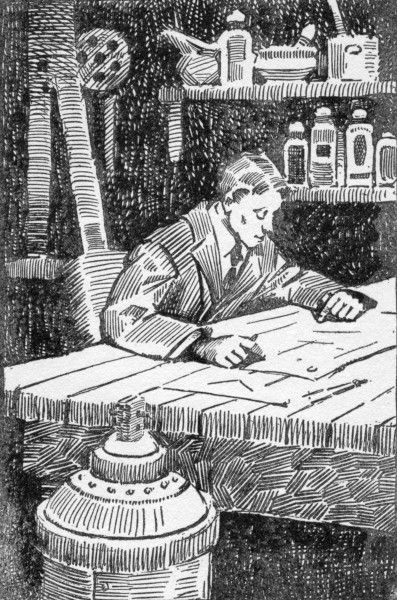
owner’s cabin. On the chart before them the
compasses were often in play between a dot
marked “Timbado Key” and the unnamed indentation
in a long island, where the boy had
written in pencil “Palm Tree Cove.”
At seven o’clock the next morning, two of the
black men had brought up the unloaded can of
gasoline. Andy had been taken ashore to the
Pelican, two of the more intelligent spongers
had been detailed to assist him, and the
schooner was heading out of the cove, its owner
on the after deck waving his Panama to the boy
on shore.
A box of cloth, screws, wire, a hammer and
saw, candles, tin pans, and three bamboo fishing
poles had been sent ashore with the young aviator.
Before the schooner had rounded the
point and laid a course to the west, the operator
of the aeroplane was busy. His shirt
sleeves rolled up, barefooted and hatless, the
boy did not seem to mind the semi-tropic sun.
After a solitary luncheon he was at his task
again. At three o’clock he paused—the Pelican
a weird and picturesque sight, her tanks newly
filled, her oil cups freshly primed. Whatever
her new mission, she was undoubtedly ready
for another flight.
Andy’s fishermen assistants viewed the altered
machine with silent awe. When they had
helped to wheel it into an advantageous location
for a new start and had been dismissed,
they hurried away, and the boy was alone.
From his actions, the hours were dragging.
Four and five o’clock passed with no signs of
a new flight. The impatient Andy made constant
references to the sun and his watch, with
now and then little alterations in the aeroplane’s
new equipment.
Frequently the boy also consulted a slip of
paper.
“North, northwest,” he would repeat, “and
twenty-five miles. At a minute and a half a
mile, that’s thirty-seven and one-half minutes.”
Thirty-eight minutes before Captain Bassett’s
calculation of sundown, at 6:35 P.M., the
eager boy at last sprang into his seat, set his
brake, turned on his power, and in thirty seconds
the low-hanging palm leaves behind him,
fluttering before his propellers, the now picturesque
Pelican was skimming over the wide
reach of Palm Tree Cove.
At one o’clock that afternoon Captain Bassett’s
schooner was tacking off Timbado Key.
When it dropped anchor off the makeshift of
a beach village that its navigator had visited
six years before, a few blacks emerged from the
hovels. But no one on the schooner came
ashore, and in the boat there were no signs of
activity. The white-costumed Englishman sat
and smoked under the awning. By mid-afternoon
the beach was thick with a curious group.
When the sun was low in the west, a few minutes
before seven o’clock, a small boat shot
out from the idle, anchored schooner. As it
grounded on the beach, the semi-savage blacks
who had watched the strange boat all afternoon,
moved forward. Captain Bassett, in spotless
white, sprang ashore. He paused only to light
a fresh cigar, and then, ignoring the motley
straggling group, he walked quickly to the steps
leading to the plateau.
Here, with only a glance over the sloping
sides of the basin and the stagnant pool at its
bottom—its heavy waters already iridescent in
the dying sun—he strode rapidly toward the
stockade. As he had seen it before, the king’s
home still stood—the signs of decay more evident,
but the totem palm trunks still erect.
No one blocked his passage, but he did not
enter the gate. Still swaying on the palm
trunks, he saw that which sent a chill through
him. He also saw, almost above, but apparently
guarding the gate, the big black who had
accosted him on the beach years before. The
man was heavier, there was a brutish kind of
fear on his face, but he yet carried in his belt
the one revolver the Englishman had seen on
the island.
“Tell the great thief Cajou the white man
is here.”
Captain Bassett uttered these words in a
tone that made the big black start.
“Him no walk,” was the answer in a hesitating
voice.
“Tell the great thief Cajou that the white
man brings death.”
“Him sick,” faltered the swarthy guardian.
Within the shadow of the filthy stockade
court, other men could now be seen. The white
man could see the glare of eyes as if beasts
were crouching in the fast-gathering night.
“Tell the great thief Cajou,” went on the
white man—his tone unchanged, cold and imperative,
“that to-night comes the Bird of
Death. He who was robbed of his pearl, to-night
brings fetich; to-night, the white man
brings death to the women and children of
thieves; to-night, out of the south, he commands
the Bird of Death.”
As he spoke, the Englishman observed almost
concealed behind those in the enclosure,
the old African. He was bent now, and as the
silent assembly fell back to give the grizzled
savage space, the white man saw that all he had
said had been heard and understood. Two
women supported the ruler of Timbado. Shaking
them aside, he felt his way to the gate on
his cane.
“White man come—white man go. No
come—no go more.”
“The great thief Cajou hears,” interrupted
the unmoving man in white. “To-night, the
white man brings fetich; to-night, out of the
sky, he brings death to those who steal and lie
and to the women and children of those who
lie—”
The tottering chief lunged forward on his
stick as if to grasp the white man. But the latter
did not move.
“Cajou no thief,” snarled the black. “Him
no white man pearl.”
Throwing his head back, the Englishman
placed his hands to his mouth and called loudly
into the now shadowed night.
“Come, Bird of Death,” he cried. Then,
with a sweep of his right arm toward the south,
he shouted: “Behold!”
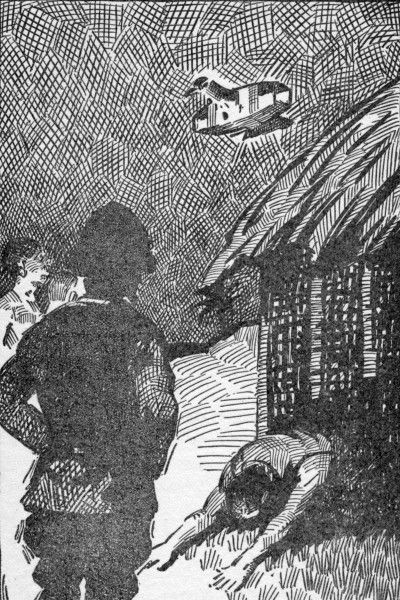
Sweeping majestically toward the palm totems
out of the already starry night, came an
object with the whirr of a flock of vultures.
Like a great bird, the descending shape already
spread its monstrous wings over the black pool.
Its long tail could be seen moving against the
starry sky, while the eyes and throat of its far-extended
head seemed to belch fire and smoke.
Back upon each other crowded those about
Cajou. Alone stood the old man, shaking and
aghast. Then out of the mouth of the giant
bird came a cry of rage and the hiss of a snake.
Wails and cries of fear rent the air; groveling
on their knees, the occupants of the stockade
tried to hide their heads; even the great black
threw himself behind the wall. Then the angry
blood-red eyes of the Bird of Death struck
toward the group, and even the doughty Cajou
reeled backward.
“Stop!” shouted the white man. “Stop,
Bird of Death! Go!” he cried.
As if balked of its prey, the great creature
of the air seemed to pause. Then, with an almost
human snarl, it shot to the left, circled
over the pool and began to mount the skies in
apparent flight.
For a moment the sobs and cries of the prostrate
were all that could be heard. The ruler
of the tropic key still stood, but shaking in
terror.
“White man go,” he mumbled at last. But
his defiance was gone. “Cajou no got white
man’s pearl.”
“You lie!” exclaimed the Englishman. Then
he held out his hand. “Give!” he commanded.
His tone seemed to wound the black man.
“No?” he added fiercely, as Cajou only
cringed.
“Cajou no pearl, no thief,” at last began the
African.
“Come, Bird of Death,” cried the white man
once more. “Eat the women and children of
the great thief. Come!”
As he spoke, he could see the blood-red eyes
turned toward him again; then he saw the
points of fire dip, and he knew the indistinguishable
object was once more hurtling toward the
stockade.
There were new cries of terror. Then the
hiss and snarl high above sounded again. Bigger
grew the glaring eyes of the Bird of Death,
and then out of its gaping throat came a stream
of fire. The roar of the returning object swept
before it.
“Eat black man; eat black man!” came a
voice out of the hollow sky.
Amid a hundred shrieks, a terror-stricken
form threw itself at the white man’s feet.
“Cajou lie; Cajou lie,” it wailed. “White
man make stop.”
“Come, Bird of Death!” roared the iron-nerved
Englishman.
“Eat black woman, eat black baby!” fell
again from the clouds.
One more look, and the prostrate Cajou
caught at the buttons on his faded coat, tore
the garment loose at the neck, and struck out
his palsied hand.
“Stop!” commanded the man in white, as he
shot up his arm to stay the avenging bird. He
could barely see the old man; but he felt the
outstretched hand. Grasping the object in it,
he found it still attached to a cord. With a
snap he tore it loose. His fingers closed on
what he knew was a small skin bag. Then with
a thrill he felt within the bag a pear-shaped
object. It required no look to tell him what it
was.
“Begone!” he cried. “Cajou saves his
people.”
As he spoke, he discharged his revolver over
the heads of the prostrate subjects of the outwitted
black man, and there was an answering
shout from the fiery Bird of Death as it swept
over the stockade. The Fiend of the Skies had
been thwarted once more by the fetich of the
white man and, with another hiss of rage, its
yawning throat yet spitting flames and smoke,
the Bird of Death turned and disappeared
seaward.
When it had passed, and Cajou and his
people looked again for the all-powerful white
man who had saved them, he was gone. None
followed the retreating ghostlike form of the
fetich maker, and as Captain Bassett felt his
way down the bluff steps, he could see fading
the red eyes of the air monster.
On the beach once more, his faithful men and
boat ready for him, he paused, drew the little
bag from his pocket and struck a match. There
was but one glance, and he threw the match
from him. Cajou had not deceived him this
time. The great pink pearl had come back to
its owner.
When the Pelican sailed away from Palm
Tree Cove on that eventful evening, thirty-seven
and one-half minutes before sunset, the
spongers, left in open-mouthed wonder, soon
began an important task. Dry driftwood and
fallen palm trees were collected until it was
wholly dark. Then fires were started on the
beach in two places, to the right and left of the
Pelican’s starting place. A few minutes after
eight o’clock, out of a louder and louder whirr
in the starlit skies, with a rush as of a rising
wind, the aeroplane darted beachward.
In the shadows, the daring young aviator,
stiff in muscle and worn with strain, landed in
the shallow water. As if newly alarmed, the
waiting spongers hung back. But the tired boy
sprang into the water, grasped the sinking machine,
and in a few moments a dozen willing
hands had drawn it high on the white sand.
With no attempt to dry his clothes, and with
only a glance at his watch in the glare of the
beach fires, the exhausted boy threw himself on
the sand alongside the aeroplane and was soon
unconscious.
When he awoke, it was day, and Captain Bassett
was standing over him.
“Come to the schooner,” said the Englishman
kindly, “get some breakfast and a bath
and finish your sleep in bed.”
Dazed for a moment, Andy rubbed his eyes,
and then sprang into a sitting posture.
“Did you get it?” he cried eagerly.
The captain smiled, nodded his head, and
then looked knowingly toward the spongers just
departing for their day’s work.
“I understand,” exclaimed the boy jubilantly.
“It was a peach of an idea. The old
Pelican was all right, wasn’t she?”
Again Captain Bassett smiled and assisted
the stiff boy to his feet.
“The idea was all right, but you did the business.
She don’t look so awful now, does she?”
and he pointed toward the still bedraggled aeroplane.
Both broke into laughter. Drooping on the
beach, lay the Pelican’s improvised neck and
bird head made of lashed bamboo poles. The
two suspended lanterns covered with red calico
curtains from the schooner were far from deceptive
in the sunlight. The band of red cloth
on a crude frame beneath these, behind which
had hung balls of coal oil soaked rags (the
throat of the marvelous bird) was sagging in
the sand.
“Here’s where I touched off the balls,” explained
Andy, still chuckling with amusement.
“My oil string fuse ran through these wire
loops.”
“When the wind blew the flames down,” said
the captain, “it was like a dragon spitting fire.
And that yell of yours! It wasn’t much like a
bird—it was most grewsome. Andy,” he added
suddenly and seriously, “of course, it isn’t necessary
to say you’ve done a big thing for me.”
“You don’t need to begin that,” exclaimed
the boy at once. “You’ve helped me and are
goin’ to help me some more. That’s enough.
But I’d like to see the pearl.”
Cautiously the Englishman took the bag from
his pocket. As the boy’s eyes fell on the lustrous,
pale rose-colored gem, he caught his companion’s
arm. In the shape of a flattened pear
and almost an inch and a half long, the tropic
jewel seemed to radiate a glow of life.
“What’s it worth?” whispered the dazed
boy.
“Twenty years of isolation in this desolate
world,” said the suddenly sobered Englishman.
“In money, it has no price. It is not for sale.”
There was no more rest for Andy that morning.
When the Pelican had been taken apart
and loaded on the schooner and Captain Bassett’s
crews of spongers had been embarked in
their small boats, it was noon. While luncheon
was served under the awning, the schooner
passed out of the cove on her way to Andros
Island.
Physically exhausted and his nerves unstrung,
Captain Bassett put Andy in his bunk
at once. When he awoke it was dark, the
schooner was cutting through a moonlit sea and
the boy knew it was late in the night. When he
awoke again it was day and the schooner was
tacking among almost countless islands.
A little later Andros Island was in sight.
Then a heavily-laden schooner, freighted with
baled sisal hemp and crates of oranges and pineapples,
was hailed by the incoming schooner.
“It’s one of my boats,” explained Captain
Bassett, “on her way to Nassau. We’ll send
your cablegram on it.”
“Why not put me aboard?” asked Andy,
again lively and full of vim.
“It can’t well take the aeroplane,” explained
the Englishman. “Besides, I want to take you
to Nassau myself. I’ll see you properly started
for your own country.”
That was why the daring young adventurer
was some days in the rear of his cablegram.
When, in a few days, he did reach the interesting
historic old town of Nassau, he was forced
to accept several more favors from his kindly
host. He saw no way of escaping a loan sufficient
to cover his passage by steamer and rail
back to Valkaria by way of Lake Worth, and
to pay the freight bill on his aeroplane.
“But I’ll return it,” insisted Andy.
“As you like,” responded his friend, “if
you’ll bring it yourself, and your father, and
mother, and spend a winter with me on Andros.”
“And Ba?” added the boy.
“I’ll take care of him as long as he lives, if
he’ll come,” was the Englishman’s answer.
When the big Florida-bound steamer had
made her way out past Hog Island and was in
the channel roll, the boy went below to inspect
his cabin. Pinned to the pillow on his bed was
an envelope addressed: “Mr. Andrew Leighton—to
be opened at sea.”
Tearing it open, a narrow strip of blue paper
dropped in Andy’s hands. It read: “Royal
Bank of Nassau. Pay to Andrew Leighton or
order £1,000. Monckton Bassett.”
The next story in The Aeroplane Boys Series tells how these
adventurous lads made use of a novel aircraft in hunting the wary
Rocky Mountain goats. The title is “Battling the Big Horn, or,
The Aeroplane Boys in the Rockies,” and every boy interested in
hunting will want to read it. These stories can be bought
wherever books are sold. For full list of titles in this series
see advertisement on page 2.
(Complete catalog sent postpaid on request.)
Good Books for Boys
The
Boy Fortune Hunters
Series
By FLOYD AKERS
The Boy Fortune Hunters in Alaska
The Boy Fortune Hunters in Panama
The Boy Fortune Hunters in Egypt
The Boy Fortune Hunters in China
The Boy Fortune Hunters in Yucatan
The Boy Fortune Hunters in the South Seas
Mr. Akers, in these new books, has at a single bound
taken front rank as a writer for boys. The stories are
full of adventure, yet clean, bright and up-to-date. The
first volume tells of the exciting scenes in the early days of
the Alaskan gold fields. The next book takes “The Boy Fortune
Hunters” to the “Canal Zone,” and the third story is
filled with stirring incidents in a trip through Egypt. The fourth
book relates exciting adventures in the Flowery Kingdom, and
the fifth and sixth stories detail further adventures in Yucatan
and among the South Sea Islands.
Illustrated 12mos. Uniform cloth binding, stamped
in three colors. Stunning colored wrapper.
Price 60 cents each
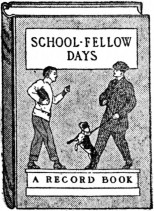
Every Boy Wants
School-Fellow Days
Designed by
Clara Powers Wilson
A record book suitable
for boys of the upper
grammar grades, through
high school, preparatory
school and military academy.
Striking illustrations,
printed in two
colors on specially made,
tinted paper with good
writing surface.
No. 9. Buckram Edition
Bound in fancy buckram with clever and appropriate
cover design, in three colors and gold. Large 8vo.
192 pages. Handsomely
boxed. Price $1.25
No. 10. Schoolmates Edition
Swiss Velvet Ooze. Silk marker. Striking
box. Price $2.00
MY GOLDEN SCHOOL DAYS. For school boys of all ages—with
places and departments for every important item of
interest—and containing appropriate verses and poems.
Printed in three delicate colors on specially made gray paper.
Symbolical cover in two colors and gold. Small 8vo. 100
pages—each decorated. Attractively
boxed. List Price, $0.60
Sold Wherever Books Are Sold
Complete catalog, postpaid, on request
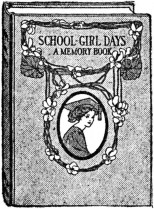
Every Girl Wants
SCHOOL-GIRL DAYS
Designed by
Clara Powers Wilson
A school memory book
appropriate for girls of
the upper grammar
grades through high
school, private school
and normal school. New
and exquisite illustrations,
printed in two
colors on specially made,
tinted paper, having a
good writing surface.
No. 7. Cloth Edition
Bound in fancy cloth with fetching cover design,
in five colors and gold. Large 8vo. 192 pages. In
beautiful box. Price $1.25
No. 8. Classmates Edition
Swiss Velvet Ooze. Silk Marker. Special
box. Price $2.00
MY GOLDEN SCHOOL DAYS. For school girls of all ages—with
places and departments for every important item of interest—and
containing appropriate verses and poems. Printed
in three delicate colors on specially made gray paper. Symbolical
cover in two colors and gold. Small 8vo. 100 pages—each
decorated. Attractively
boxed. List Price, $0.60
Sold Wherever Books Are Sold
Complete catalog, postpaid, on request
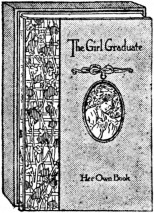
A Novelty Every Girl Wants
THE GIRL GRADUATE
HER OWN BOOK
Designed by
Louise Perrett and Sarah K. Smith
In which to keep the happy
record of school or college
days. There is a place for
everything dear to the girl
graduate—class flower,
colors, yell, motto, photographs,
autographs, jokes
and frolics, social events,
officers, teachers, invitations,
baccalaureate sermon, programmes,
presents, press
notices, class prophecy and
other “doings.”
Twentieth Edition—Revised and Improved
Uniquely decorated on every page with dainty designs in
delicate colorings on pearl gray stationery made especially for
this edition; cover to match with trellis of roses in tints;
decorations in gold. 8vo. 200 pages. Beautifully boxed. List Price, $1.50
VARSITY EDITION: Printed in gold ink and dainty colors
on special soft-tinted paper; cover inlay in five colors by John
R. Neill; box to
match. List Price, $2.50
DE LUXE EDITION: Full crimson leather; gold edges; silk
marker; in gift box. List Price, $3.00
COMMENCEMENT EDITION: Full levant; hand-made, hand-tooled
in gold; silk headbands, hand-made end sheets; gold
edges; boxed. List Price, $6.00
Sold Wherever Books Are Sold
Complete catalog, postpaid, on request
Best Books for Young Folk
The Daring Twins
By L. FRANK BAUM
The thousands of boys and girls who, as youngsters, read
Mr. Baum’s famous “Oz” books will be delighted with THE
DARING TWINS—a story, not of wonderland, but of real life—real
people. It is full of action—bright and exciting—the adventures
keeping the reader between laughter and tears. 12mo. Illustrated.
Fancy cloth binding. Beautiful Wrapper. Price $1.00 net.
The Aunt Jane Series
By EDITH VAN DYNE
Aunt Jane’s Nieces
Aunt Jane’s Nieces Abroad
Aunt Jane’s Nieces at Millville
Aunt Jane’s Nieces at Work
Aunt Jane’s Nieces in Society
Aunt Jane’s Nieces and Uncle John
“Aunt Jane’s Nieces” chronicles the real doings of real
girls in a most interesting manner. “Aunt Jane’s Nieces
Abroad” tells of a delightfully adventurous trip through Europe,
and the third volume describes their summer holiday on a farm
“at Millville.” In the fourth story the “Nieces” are shown at
work in the political arena. The fifth volume introduces the girls
to society and the last story relates further adventures of these
fascinating girls. Illustrated 12mos. Uniform cloth binding,
stamped in colors, with beautiful colored inlay. Price 60 cents each.
Annabel
By SUZANNE METCALF
A bright, swiftly-moving story of a young girl just blossoming
into womanhood, and of a boy struggling for a start in life.
12mo. Dainty cloth binding, with inlaid design
and six duotone illustrations. Price 60 cents.
Transcriber’s Notes:
Punctuation and spelling inaccuracies were silently corrected.
Archaic and variable spelling has been preserved.
Variations in hyphenation and compound words have been preserved.