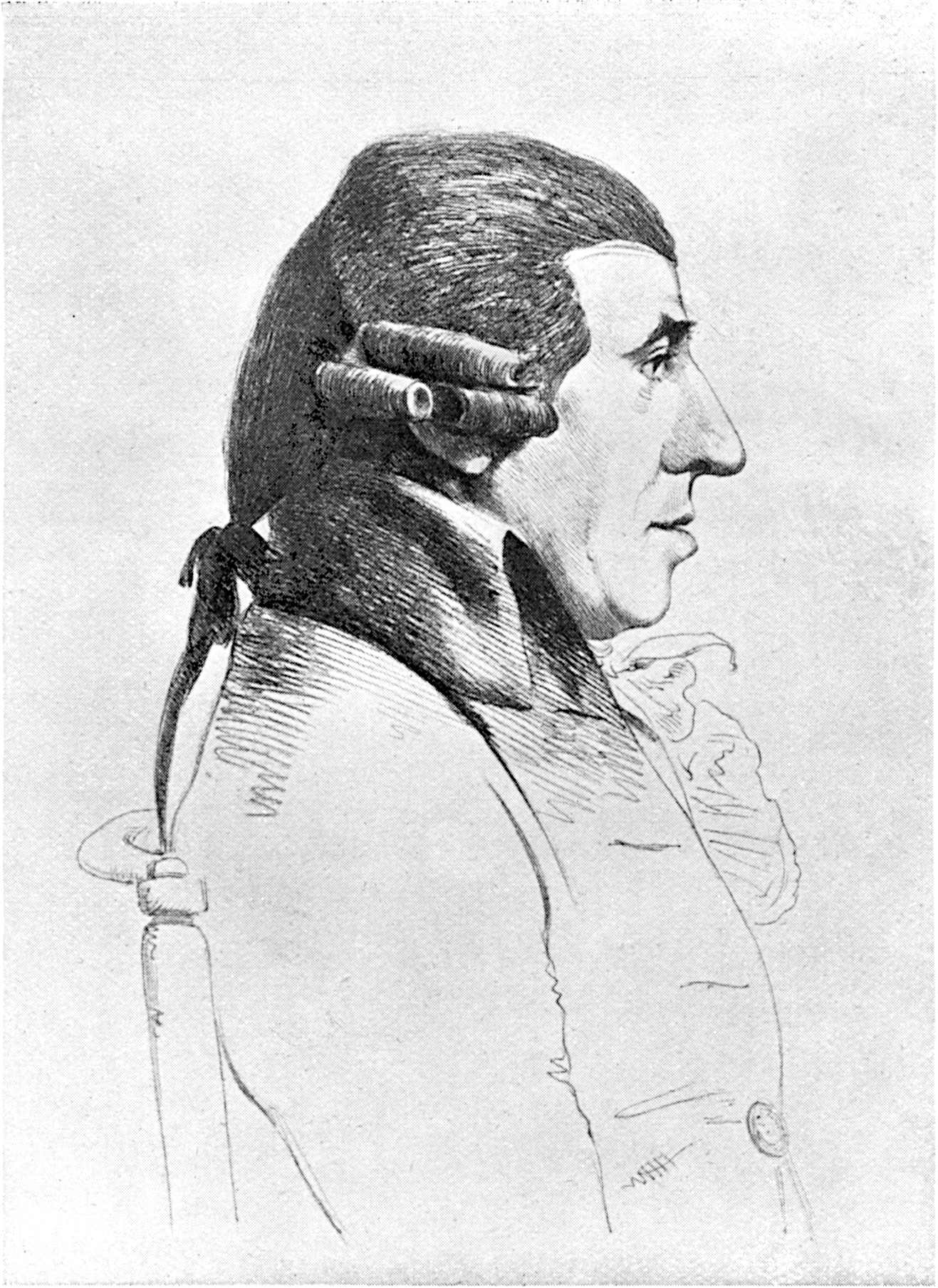
Joseph Haydn From an Engraving by W. Daniell after G. Dance, R.A.
NOTES TOWARD THE STUDY OF JOSEPH HAYDN
BY W. H. HADOW, M.A.
Fellow of Worcester College, Oxford
Author of “Studies in Modern Music”
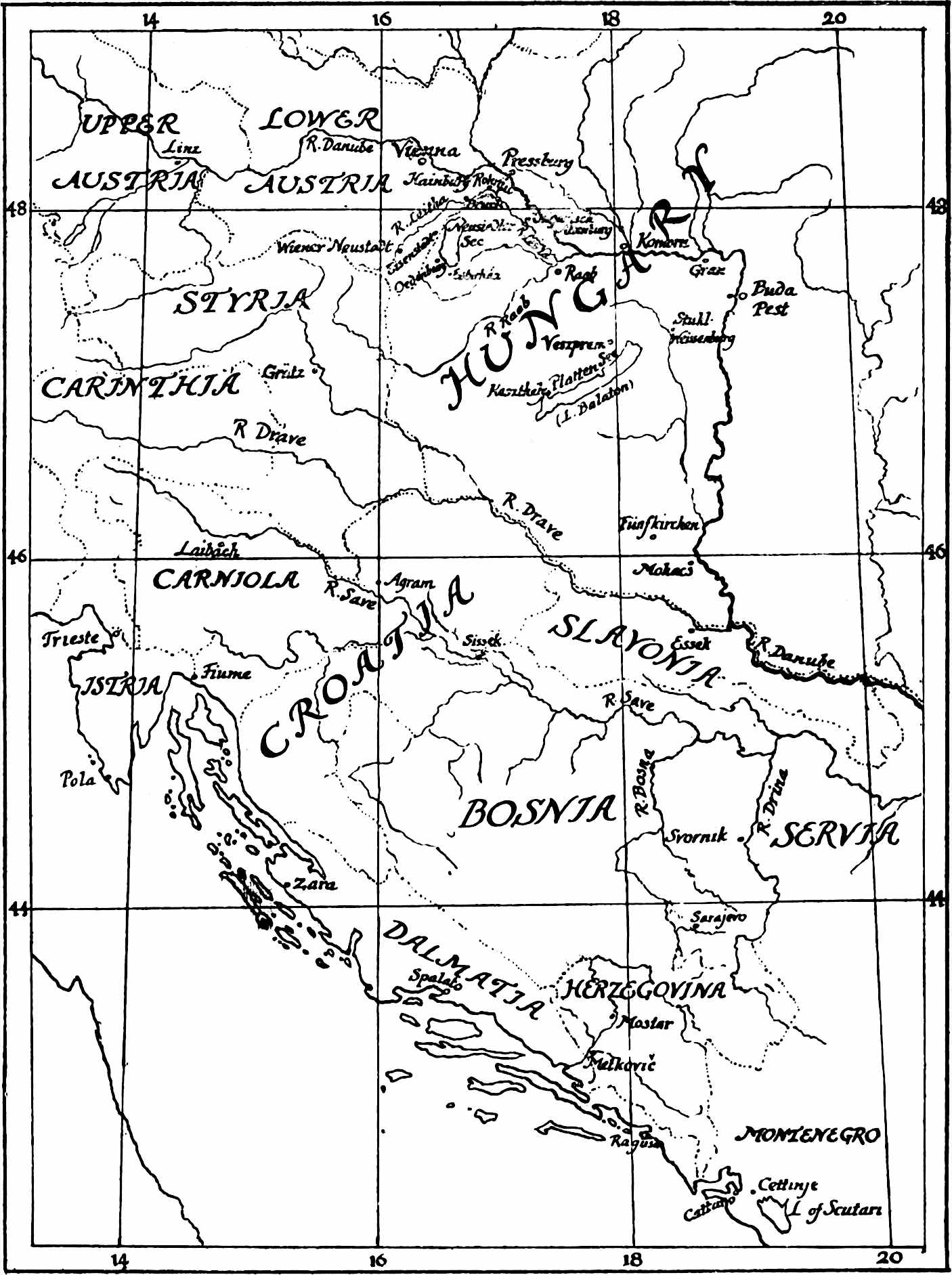
LONDON SEELEY AND CO. LIMITED
38 Great Russell Street 1897
TO W. R. MORFILL
A small return for much assistance and encouragement
PREFACE.
The materials for this essay have been almost entirely gathered
from two works by Dr. František Š. Kuhač, the one his collection of
South Slavonic Folksongs, the other a pamphlet upon Joseph Haydn.
Indeed, so greatly am I indebted to them that the essay would not
have been written had it been possible to present them to the reader
more directly. All that has been added is a certain rearrangement of
the data, a certain amount of commentary and exposition, and a few
supplementary facts which happen to have come within my reach. I should
state that during a recent visit to Croatia, I saw Dr. Kuhač, who most
kindly gave me full permission to make use of his results, and augmented
the gift with much valuable information.
It is not for me to determine how far the subject will be of interest
to English readers. We have somewhat forgotten Haydn: we do not always
attach great importance to abstract problems. But I venture to think
that the practical issue is not insignificant, and that in any case the
question of historical truth is one which demands some consideration
and regard. There is little need to say that I am myself convinced of
the point which I have endeavoured to make: if the facts have been
misinterpreted, at least the endeavour may invite discussion.
No doubt it will have to take its chance with those critics who would
censure it at the outset for prying too curiously behind the veil. From
such antagonists I beg, for two reasons, courteously to differ. In
the first place, this is not a question of irrelevant detail, but an
inquiry into the methods of a great artist, and into the character of
his work. Grant that it deals with a single aspect alone, it does not
therefore disregard or undervalue the others. And to suppose that Haydn
is depreciated by the acknowledgment of his debt to his age and country
is, I think, somewhat to misunderstand the conditions under which all
true “creative” art is produced. In the second place, if we accept
the historical statement as true, we do something to rescue a musical
nation from undeserved neglect. The race which has given to a master
not only birth but inspiration may surely claim from us something
better than the oblivion into which we have allowed its name to fall.
I wish to offer all due acknowledgment to Mr. L. Finkenstein for his
translation of Dr. Kuhač’s pamphlet.
Oxford, October 12, 1897.
A CROATIAN COMPOSER.
The study of Human Nature contains few problems more difficult or
more important than those which deal with distinctions of national
character. In most countries the original race, itself not always pure,
has been affected and modified by a hundred causes; by conquest, by
immigration, by intermarriage with neighbours, by all the circumstances
and conditions of historical development; and the result is commonly
a web of many diverse threads; in which we are fortunate if we can
explain the prevailing colour and the prevailing pattern. Sometimes, as
in our Indian Empire, the threads lie comparatively free, and puzzle us
more by their number and variety than by actual closeness of texture.
Sometimes, as in the Kingdom of Hungary, the interplay is so thorough
and so complex as almost to baffle analysis at the outset. And when to
this is added the influence of climate, of government, of religion, of
all that is implied in past record and traditional usage, it will be
seen that the question of causality is one which may well tax to their
utmost limit the skill and patience of the ethnologist.
But if the reasons are hard to trace, the fact is no longer open to
intelligible doubt. Physiology tells us that it manifests itself at
birth; history, that it has formed a channel for the whole course and
current of events. There is no crisis so great, there is no occurrence
so trivial, as not to exhibit in some degree its presence and efficacy
in the life of man. Nations at peace do not follow the same policy;
nations in conflict do not fight with the same weapons; the contrast
of laws and customs is so vivid that it has led some impatient
philosophers to consider all morality relative. And what is true of
the life as a whole is equally true of its specialisation in art and
literature. For these are pre-eminently the expression of the national
voice, as intimate as its language, as vital as the breath that it
draws, and every artist who has compelled the attention of the world at
large has done so by addressing it as the spokesman of his own people.
No doubt there are other factors in the case, the personal idiosyncrasy
that separates a man from his fellows, and again the general
principles, fewer perhaps than is commonly supposed, that underlie all
sense of rhythm and all appreciation of style. But to say this is only
to say that the artist is himself, and that he belongs to our common
humanity. In everything, from the conception of a poem to the structure
of a sentence, the national element bears its part with the other two;
it colours the personal temperament, it gives a standpoint from which
principles of style are approached, and wherever its influence is faint
or inconsiderable the work of the artist will be found to suffer in
proportion. It is hardly necessary to add that the law holds equally
good whether the race in question be pure or mixed. If the former,
it will move along a single line: if the latter, it will mark the
converging point of many; but in either case its operation is a sure
test of genuineness both in feeling and expression. Occasionally,
it may be, a careless public has been deceived by some trick of
imitation—by the Spanish comedies of Clara Gazul or the Persian Lyrics
of Mirza Schaffy; but such instances of deception no more traverse the
law than the Ireland forgeries or the pictures of Cariani. Some men are
born with a talent of mimicry: none have ever by its means attained to
greatness.
It may at once be admitted that this rule of national influence
is at present less firmly established in music than in poetry or
painting. In the two latter arts we have certain obvious externals
to aid investigation—broad and salient contrasts of language, wide
differences of scene and subject—with which music as such has little
or nothing to do. Her subject is usually vague and indeterminate, her
vocabulary is made up of a few scales, and for the rest we are told
that her genius is limited to the common emotions of mankind and the
common inheritance of pure form. But it is wholly false to infer that
music is independent of nationality. The composer bears the mark of
his race not less surely than the poet or the painter, and there is no
music with true blood in its veins and true passion in its heart that
has not drawn inspiration from the breast of the mother country.
Two main causes have retarded the acceptance of this truth. First,
the belief that national melody is entirely an affair of artifices
and mannerisms, that it is constituted by special turns of phrase and
figure—as though you could make a rose tree by tying roses to a Scotch
fir, or turn “Rule Britannia” into a Hungarian tune by ending it with
a Hungarian cadence. This, it may be said, simply misunderstands the
nature of the law which it criticises. No doubt a certain range of
expression belongs to each type of folksong. No doubt these accidents
of figure and phrase appear upon the surface, and are often useful as
indications, but it makes all the difference whether they grow
naturally in their place or lie there as mere lifeless appendages.
Even the foreign idioms which a great composer may occasionally employ
are only a graft let into the parent stock; the new growth is at
once modified by the influence of the old, and alters its character
to match its change of condition. And apart from these rare grafts
the phrase of a true master will always be found conformable to the
spirit that animates it, not because it constitutes the spirit, but
because it emanates as property from essence. The second error springs
from our loose and inaccurate methods of classification. That Mozart
was an Italian composer seems now to be taken as an accredited jest;
but it is more serious when we show our gratitude for the splendid
work that Germany has done by scoring to her account all that has
been accomplished by her neighbours. Schumann claims Chopin as a
fellow-countryman; we are so far from protesting that we add Liszt, for
whom “the great German master” was long a newspaper synonym, and even
hesitate about Smetana and Dvořák. It is true that classification is
often extremely difficult—records are imperfect, names are misleading,
histories are marred by want of ethnological knowledge; but the
admission of ignorance is not a very strong basis for dogmatic denial.
Critics who traverse a law, because they cannot see its applicability
to the facts, would do well to make sure at the outset that the facts
have been correctly observed.
The subject of the present essay is one of the most remarkable
instances of such misattribution. From the time of Carpani to that
of Dr. Nohl, Haydn’s biographers have been unanimous in describing
him as a German, born, as everybody knows, in Lower Austria, speaking
German as his native language, Teutonic in race, in character, in
surroundings. Yet the more we study him the more impossible it becomes
to regard his music as the work of a Teuton. It is undoubtedly affected
by his education and circumstances, by the early study of Emanuel Bach,
and the subsequent intercourse with Mozart, but when we penetrate to
the essential spirit of the man himself we find that its inherent
characteristics are no more German than they are Italian or French.
Haydn’s sentiment is of a kind without analogue among German
Composers—mobile, nervous, sensitive, a little shallow it may be, but
as pure and transparent as a mountain stream. His humour is a quality
in which he stands almost alone; it differs totally from the wit of
Mozart, or the grim jesting of Beethoven; it is quaint and playful,
rippling over the whole surface of the page, and equally removed from
satire and epigram. Again, he has less breadth and stateliness than
belong to the German temper, but he has far more versatility. He was
the most daring of pioneers, the most hazardous of experimentalists,
and, what is more noticeable, his experiments are rather the natural
outcome of a restless and vivid imagination than the efforts of a
deliberate and conscious reform. From the external side, too, the same
contrast is apparent. The shapes of his melodic phrases are not those
of the German folksong; his rhythms are far more numerous and varied;
his metres are often strange and unfamiliar. Throughout Western Europe
the four-bar line has almost uniformly been taken as the unit of
measurement, carrying with it the corresponding stanza of eight or
sixteen or thirty-two. In a hundred German or English folksongs it will
be strange if a single exception can be found: in a hundred melodies
from Haydn’s quartets it will be strange if the exceptions are not
as frequent as the instances. In a word, his range of stanza is far
wider than that known to the Germany of his day, and many of his most
characteristic tunes belong to another language and another scheme of
versification.
The evidence here briefly epitomised can only point to one of two
conclusions: either that the law of nationality is inapplicable to
Haydn, or that his assignment to the German race is an ethnological
error. The former alternative is unsatisfactory enough; the latter was
for many years put out of court by our inability to sustain the
onus probandi. But in 1878 Dr. Kuhač began to publish his great
collection of South Slavonic melodies,[1]
and in 1880 he supplemented it by a special pamphlet on Haydn’s relation to them.[2]
The main points of the thesis are three in number: first, that the Croatian
folk-tunes possess all the characteristics which have been noted as
distinctive in the melodies of Haydn; second, that many of them are
actually employed by him; and third, that the facts of his birth and
parentage afford strong presumptive proof that he was a Croatian by
race.[3]
If this contention can be established it strengthens an important law
with valuable and unexpected support, and it remains therefore that we
should bring forward a critical statement of the case, beginning, for
clearness’ sake, with the historical and biographical testimony, and so
bringing into prominence the special character of the compositions themselves.
First, then, we must consider whether the character of the Croatian
people is such as to render its claim to Haydn reasonable and
intelligible. It would be poor logic to illustrate our law by deriving
a great artist from an inartistic nation. And the question becomes
more pressing when we remember that Haydn’s whole family was musical,
that he learned his first lessons from his father and mother, that his
brother Michael long enjoyed a repute little inferior to his own. But
to answer it in the affirmative is to run counter to an established
belief. From Mrs. Western in “Tom Jones” to Barto Rizzo in “Vittoria”
everybody has had a fling at the Croats. We have come to regard them at
best as savages, and at worst as mercenary assassins. The associations
that we connect with their name are those of war and pillage, of fierce
onslaught and misused victory, of lives bartered for gain or spilled in
mere wantonness. Their art is a matter into which we have never dreamed
of inquiring, and we should as soon think of learning their language
as of accrediting them with a literature. To dispel this superstition
it is only needful that we should study the country. Few towns are
more charming than Agram, few regions more delightful than the long
fertile valley of the Save in which it lies. In the remoter districts
there is still much ignorance and much poverty, but civilisation is
spreading from the centre, and eliciting, not creating, the signs of
progress. The strongest impulse of the national life is loyalty to race
and Church. Recent events have shown us that outbreaks may readily be
provoked in religious and patriotic causes, but the temper that will
fight for them is not ignoble, and is not infrequently conjoined with
the inspiration that will make songs in their honour. And throughout
the country the love of music prevails.[4]
The men sing at their plough, the girls sing as they fill their
water-pots at the fountain; by every village inn you may hear the
jingle of the tambura, and watch the dancers footing it on the green.
Grant that the music is not always of a high order, that the tunes are
often primitive and the voices rude and uncouth, still the impetus is
there, and it only needs guidance and direction. Certainly the present
condition of the race does not disqualify it to be the parent of a
great composer.
It will be objected that this is only a present impression, and that it
tells us nothing of those days when, apparently, the whole raison
d’être of the population was to furnish fighting-men for the army
of Maria Theresa. In answer to this, two points must be made clear:
first, the state of Croatia proper during the past two centuries;
second, the position occupied at the same period by other members of
the Croatian race.[5]
The argument “e nihilo nihil” need hardly be stated here, though it will be
seen later that nothing has been added to the Croats except opportunity.
Throughout the eighteenth century the policy of the Austrian Government
was to repress as far as possible the Slavonic peoples that lay under
its rule. Bohemia, which had lost its independence at the Thirty Years’
War, was intellectually the “desert” which the Emperor Ferdinand had
wished to make it; and the same drastic measures, though for somewhat
different reasons, were applied to the subject races that fringed the
southern border. Croatia in particular was used merely as an outpost
against Turkish invasion: “purchased,” as Dr. Kuhač says, “with a
few empty political concessions,” but kept in reality under the close
discipline of a barrack-state. “We were not allowed,” he continues, “to
provide for our people the advantages of a real city, we had no centre
of intellectual life and progress, and it was considered a sufficient
privilege if the name of capital was bestowed upon one or other of our
towns.”[6]
Naturally, the Croatian nobles spent as little time as possible in
their own country. It was much more amusing to stay at Pressburg or
Vienna, where there were balls and theatres and pageants, and a man
could see life. And so it happened that even the chance of patronage
was denied, and the people sank to a state of apathy, their gifts
forgotten, their voice starved into silence. But about 1835, the poet
Ljudevit Gaj began, as Tyl was doing in Bohemia, to restore from its
suspended animation the intellectual life of his countrymen. He settled
their alphabet. He made their grammar. He collected the folksongs from
every village and hamlet, and enriched them with lyrics of his own. He
sowed dragon’s teeth over the length and breadth of the country, and
there sprang up as if by magic a crop of artists. Of course they were
not of any great European importance. Lisinski and Franz von Suppé
are the most famous among their musicians—but the whole lesson had
to be learned anew, and these men were the first pupils.[7]
And when the revolutions of 1848 gave fresh impulse to national life, a second
chapter opened in the Croatian renascence, and, under the patronage of
Bishop Strossmayer, there rose into being a new artistic generation.[8]
Here, again, the musicians rather lag behind the poets and the men of
letters; there was no conservatorium, there was no satisfactory method
of training, and the young talent was generally too poor to embrace the
opportunities which foreign lands afforded. But, if as yet the quality
of the work is slight and trivial, something at least should be said
about its extraordinary volume and facility. And it should be added
that the leaders of the present generation—Zajc, Vilhar, Faller, Dr.
Kuhač himself—are all making large use of the national melodies as material.
Meantime, while the fortunes of Croatia were at their lowest, an
event of earlier occurrence was producing important consequences. The
Southern Slavs had always been a migratory people. As early as 595 they
occupied the Tyrolean Pusterthal, where they have left their mark,
not only in the character of the inhabitants but in a large number of
local names[9];
later, under stress of Turkish invasion, they colonised Montenegro;
and in the fifteenth or sixteenth century a body of Eastern
Croats—Bosnen or Wasser-Kroaten, as the Germans called them—settled
in the district of Central Austria which extends from Lake Balaton
north-west to the Danube. The new home was eminently suited to the
development of the race. It was rich and fertile, with vine-clad hills
and broad stretches of alluvial plain, it was well wooded and well
watered, it extended to Pressburg, the second city in the empire, and
contained at least one other town of considerable note; it was within
easy reach of the great intellectual and artistic movements. There is
little wonder that this region soon came to be regarded as the focus of
Croatian life, and that the wealth which sought it for entertainment
attracted in due course the talent which sought it for livelihood.
The number of the original immigrants is unknown, but by the eighteenth
century they unquestionably formed the larger part of the population.
In 1780 Pressburg contained rather less than 28,000 inhabitants,
of whom about half are noted in the official census as Croats or
Slavonians; while the smaller towns and villages in the neighbourhood
were mainly occupied by the newcomers, and are still, despite German
and Magyar influence, largely affected by Slavonic traditions. One
curious and rather bewildering consequence is that almost every
place in the region has possessed two names, one the German, used
for official purposes; the other, Slavonic, for the benefit of the
population. And when we add that east of the Leitha the Slavonic
name is being ousted by the Hungarian, it will be seen that the
unsophisticated traveller may now and again be at some difficulty to
ascertain his route. An amusing instance fell under my own experience
during the summer of 1897. Wishing to make pilgrimages to Eisenstadt,
where Haydn was Kapellmeister, and to Željez, where Schubert taught
music to Countess Esterházy, I took a ticket at Vienna for the first
of these places, only to find, when my watch informed me of my
destination, that Eisenstadt and Željez were the same place, and that
the name upon the railway-station was Kis Martom.[10]
It is something more than a coincidence that among all districts of
Austria this area of Croatian settlement has been the most fruitful in
great musicians. Veit Bach, the grandfather of John Sebastian,
was born at Pressburg; so was Chopin’s great hero, Johann Nepomuk
Hummel. The Haydns came from a neighbouring village, the proper name
of which—Trstnik—was despairingly translated by the Germans into
Rohrau. Joseph Weigl was a native of Eisenstadt, so was Ivan Fuchs,
who succeeded Hummel as Prince Esterházy’s Kapellmeister. Liszt was
born at Rustnik, near Oedenburg, Joachim at Kitsee, Ludwig Strauss at
Pressburg, Carl Goldmark at Keszthely. And round this constellation
there gathers a whole nebula of lesser stars[11]
names unfamiliar, it may be, to English readers, but in their own
country accepted and recognised. Of course it is not claimed that all
these artists are of Croatian blood. Some unquestionably are not; but
there is at least an a priori likelihood that some of them
belonged to the race which was numerically dominant, especially as that
race was Slavonic and therefore musical, and on this general point a word
may perhaps be said before we proceed to particularise in the case of Haydn.
Now, apart from his, it should be noted that none of the names given
above are distinctively Slavonic in character. For this fact a simple
reason suffices. There had long been spreading through the world of
music a practice, originated in Europe by scholars and divines, of
taking a nom de guerre which should either represent the sound
or translate the meaning of the family name. Erasmus, Melanchthon,
Stephanus are familiar instances in the world of letters, and following
these august models Grobstimm became Baryphonus; Schneider, Sartorius;
Glareau, Loritius; and the like. Musicians for the most part seem
to have avoided Latin and taken in its place whatever language lay
ready to hand for display or convenience. Thus two famous Bohemians
called themselves Dussek and Gyrowetz; Beethoven’s father occasionally
appeared as Bethoff; and the list may be extended even to such
grotesques as Gionesi and Coperario. This device was specially
necessary to the Croatian who was aiming at a career. We know with what
diligence poor Abel, fresh from the German vowel sounds, endeavoured
to adapt his name to the requirements of a British public.[12]
The need of adaptation is still greater when the language is one which
hardly any foreigner can hope to pronounce. Thus it was that the Croatian
words tended to drop out altogether, and to be replaced by some rough
German or Italian equivalent; and so complete was the transformation
that we have to look twice before recognising Beethoven’s first violin
in Župančić, or finding in Trtić the composer of the “Trillo del
diavolo.”[13]
In like manner the words “Bach” and “Hummel” may very possibly have been
translations of Croatian names, names which are known to have existed
in Pressburg and which bear the same meaning; while the family of
Liszt, also claimed by Dr. Kuhač,[14]
may have been Slavonic in origin, though by the time of the great
pianist the Magyar element had predominated for about a century. At
any rate there can be no reasonable doubt as to the Slavonic origin of
Tartini, Dragonetti, Giornovichi, Zingarelli, and many other of Haydn’s
contemporaries. There may have been in them some intermixture of race,
but the parent stock was Croatian.
We cannot, then, assert that there is any antecedent improbability in
assigning Haydn to the Croats. They are a musical people, they formed
the chief population of the district where he was born, they have a
fair claim to other great musicians of his time. It follows that we
should discuss the biographical evidence, and see what is to be made
out of the record of Haydn’s family.
And here attention should be called to three points. First, that the
name Hajden or Hajdin (with its derivative Hajdenić, Hajdinović, &c.)
is of common occurrence throughout Croatia, and, in days when spelling
was roughly phonetic, may easily have appeared in Austrian official
documents as Haiden or Hayden, forms by which its pronunciation is
exactly represented. Now among all the variants assumed by the name
of the composer’s family,[15]
these two are the most frequent and the most authoritative.
His great-grandfather—the first member of the house who can be
traced—appears in the Hainburg register as Caspar Haiden; his
grandfather, once by obvious error called Thomas Hayrn, is usually
Hayden elsewhere, the contemporary monuments at Rohrau give Mathias
Haiden as the name of his father and Josephus Hayden as his own. He
himself seems to have used the dissyllabic form up to January, 1762,
when he signs for salary at Eisenstadt “Giuseppe Hayden”; in the
February of the same year he changes to the signature “Joseph Haydn”
which he afterwards habitually adopted. Even then the majority of
documents relating to him are conservative enough to retain the earlier
orthography, and the monument in Count Harrach’s park, which bears the
name Josephus Hayden, was erected as late as 1794. Indeed, there can
be little doubt that Haiden or Hayden was the family name, shortened
to suit the Viennese convention, as for the same reason Händel used to
be shortened to Händl.[16]
Secondly, the name, in one or other of its variants, is widely spread
over the whole district from Wiener-Neustadt to Oedenburg. Dr. Pohl
found it in some ten or a dozen villages, many of which are claimed
by Dr. Kuhač as Croatian, and in the country towns like Hainburg or
Eisenstadt it is of course more frequent still. There is no need to
remind the reader that this is precisely the region occupied, since
the sixteenth century, by the Slavonic immigrants. Thirdly, the home
of the entire Haydn family is situated at the centre of the district
in question. Caspar was born within sight of the Hainburg walls,
Thomas lived and died as a burgher of that town, Mathias, after a
brief period of travel, settled at Rohrau some ten miles away, and
the most adventurous of his brothers wandered no further afield than
Frankenmarkt or Ungarisch-Altenburg. It fits well enough with this
home-keeping temper that Joseph Haydn should have spent more than
threescore and ten years of his life inside a thirty mile radius from
his native place.
On the father’s side, then, Haydn would seem to belong to the Slavonic
race among whom he lived and worked.[17]
Again, his mother was a native of Rohrau, in her day a distinctively
Croatian village,[18]
and her maiden name of Koller—a vox nihili in German—is plausibly
regarded by Dr. Kuhač as a phonetic variant of the Croatian Kolar
“wheelwright.”[19]
Everything that we know about his look and character favour the
supposition of Slavonic descent. The lean ugly kindly face with high
cheek-bones, long nose, and broad prominent under lip, the keen grey
eyes softened by a twinkle of humour, the thin wiry figure, the strong
nervous hands; all these and their analogues may be seen to-day in any
village where Slavonic blood is still pure; and though of course they
afford no argument in themselves, they add a touch of corroborative
evidence which is worth noting. To the same cause may be traced that
intense love of sport which has left his name as a proverb at
Eisenstadt[20];
and something, too, of the conviviality which made him say that his
best evenings were those spent with his comrades at the “Engel.” His
talk, like his music, was full of that obvious fun which raises a
laugh by a sudden touch of the unexpected; so are hundreds of Croatian
ballads and aphorisms.[21]
The humour is sometimes primitive, as when a Croat will tell you, “It
is as true as that two and two make seven”; sometimes it reaches a
more respectable level, as the gibe at the Bosnian Brethren, “who were
ordered to abstain from something in Lent, and therefore took no water
in their wine.” But good, bad, or indifferent, it marks a distinctive
type of peasant character; and in remembering that Haydn was a genius
we need not forget that he was a peasant. The same holds good, too, of
his religious feeling. It is not without significance that we may turn
from one of his scores, with its “In Nomine Domini” at the beginning,
and its “Laus Deo” at the end, to read in our newspaper that another
Croatian village has risen in revolt upon the bare report of an
ecclesiastical change. His temper, it may be, had grown more equable
than that of his uneducated countrymen; it had not lost anything of
their loyalty.
The reasons which have led to this indication of detail may easily be
misunderstood. It is not, of course, contended that any race has the
monopoly of these characteristics, or that it differs ethically from
its neighbours except by the very important fact of the proportion in
which they are blended. But when it appears that the more we study
Haydn, and the more we study the Slavonic character, the closer becomes
the accord between them, when every feature of the one finds its
parallel in the prevailing qualities of the other, then we may surely
infer that to the antecedent probability some weight is added by this
estimate of internal evidence. And probability will strengthen to
certitude if we realise that Haydn’s music is saturated with Croatian
melody, that the resemblances are beyond question, beyond attribution
of coincidence, beyond any explanation but that of natural growth. Some
of his tunes are folksongs in their simplest form, some are folksongs
altered and improved, the vast majority are original, but display
the same general characteristics. He would stand wholly outside the
practice of the great composers if he wrote, by habitual preference,
in an idiom that was not his own.
His acquaintance with these folk-tunes must have begun from his
earliest years. His father, we know, was a good musician who used,
of an evening, to sit by the cottage door at Rohrau, singing to the
children until they plucked up their courage and joined in. And when
Frankh carried off the boy for his first experience of schooling, it
was only to Hainburg, the earlier home of the family, where he may well
have heard the same ballads breaking the quiet of the market-place, or
echoing under the great arch of the Wiener Thor. Then, no doubt, came a
change; the splendid apparition of George Reutter, the halo of Imperial
patronage, the ten years in the choir at St. Stephen’s, the sharp
struggle for existence when the boy’s voice broke, and he was turned
into the streets of Vienna to shift for himself. It is in every way
natural that his first composition should show little direct trace of
national influence. He was in his student period; like all students
he was dominated by the authority of his models, and for a time his
chief ambition was to master the form of Emanuel Bach, and emulate the
counterpoint of the Gradus ad Parnassum. But from the days when he
began to speak in his own voice the Slavonic qualities unmistakably
appear. There is the same general shape of melody, the same repetition
of phrases, the same oddity of rhythm and metre, the same fineness and
sensitiveness of feeling; and that not once or twice in a composition,
but throughout its entire length. The common employment of folksongs
dates from the Symphony in D major (1762) to the Salomon Symphonies of
1795; they find their way into everything—hymns, quartets,
divertimenti; not, of course, because Haydn had any need to take
them, but because he loved them too well to leave them out. It will
be remembered that for thirty years, from 1761 to 1790, he worked as
Prince Esterházy’s Kapellmeister in the very centre of the Croatian
colony. He must have heard these songs every day, he must have set
his life to their lilt and cadence; they were the melodies of his own
people, the echoes of his own thought. No one is surprised that Burns
should have gathered the Ayrshire peasant songs and transmuted them
into gold by the fire of his genius; it is not more wonderful that
Haydn should have enriched the treasures of Eisenstadt with metal from
his native mines, and as Heine pertinently puts it, the Temple is built
by the Architect, not by the stone-cutters who supply him with his materials.
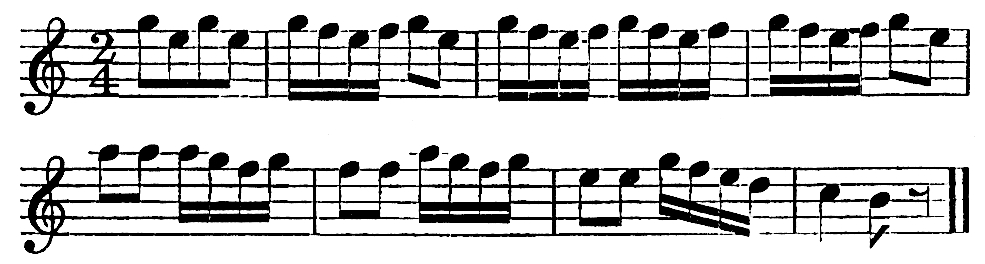
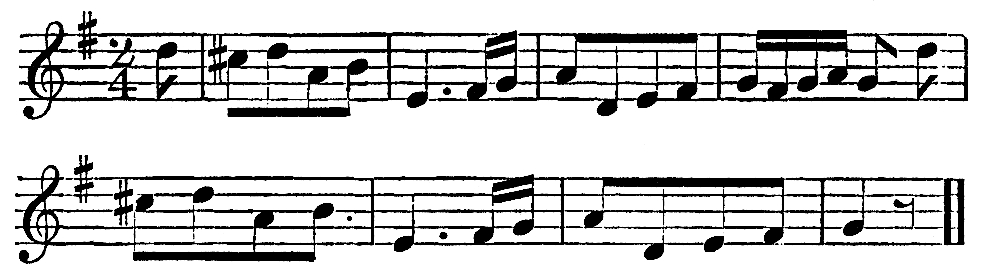
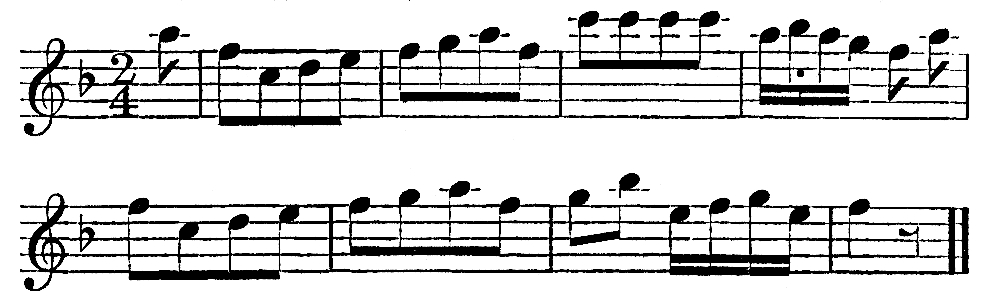
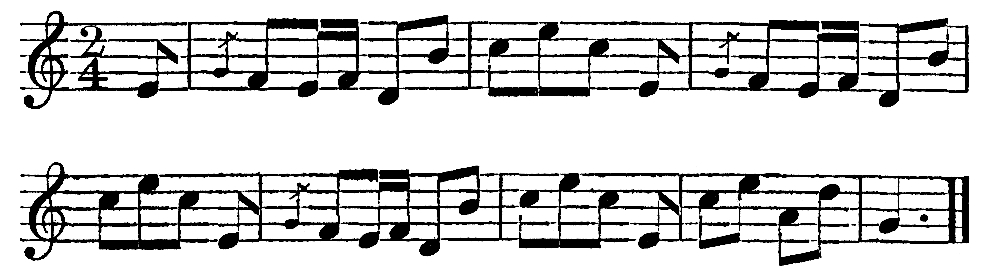
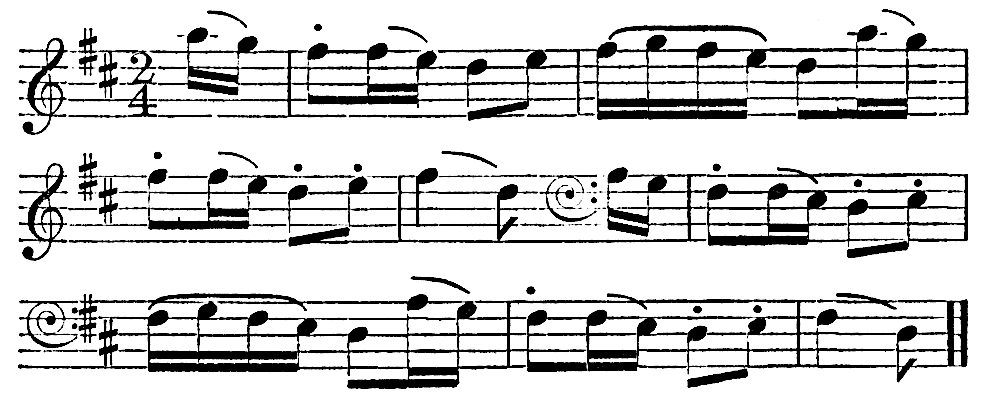
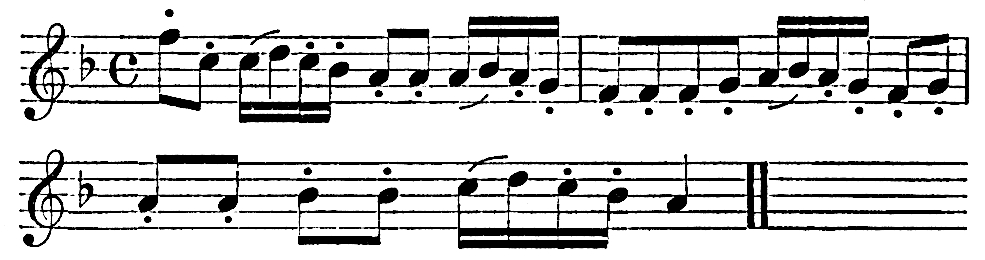
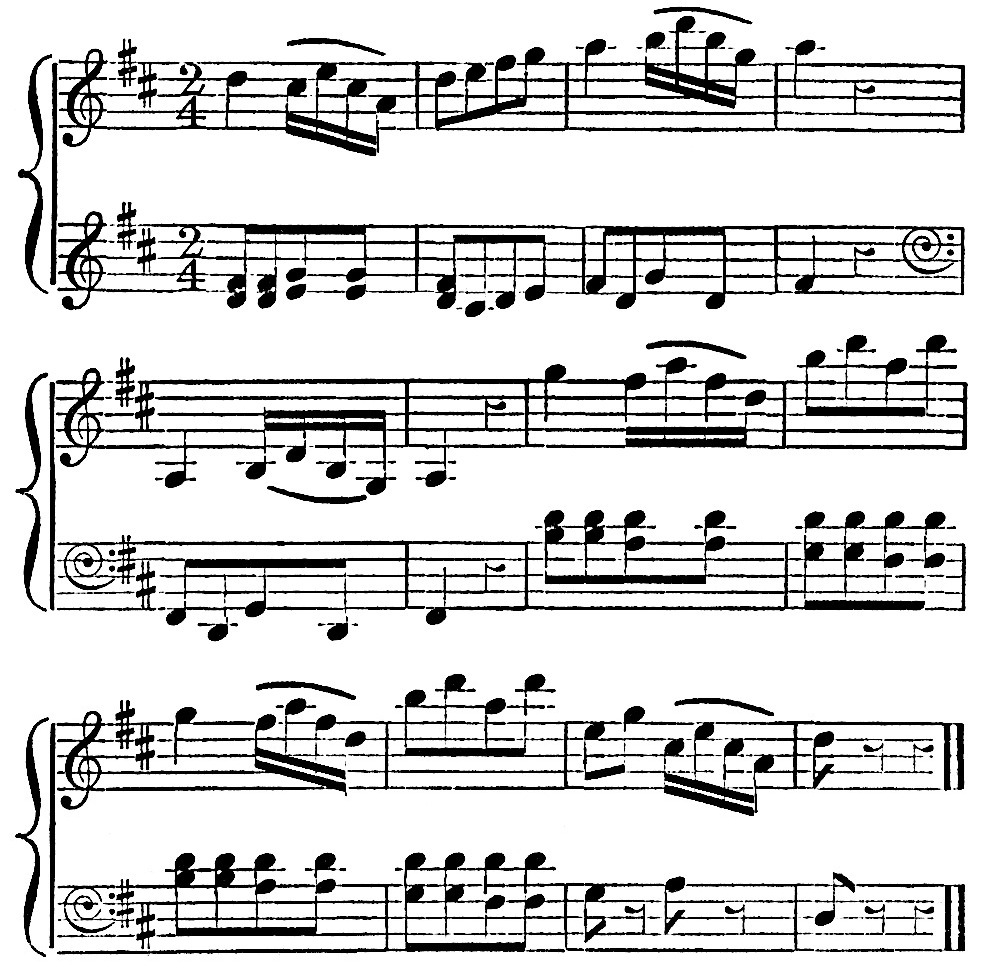
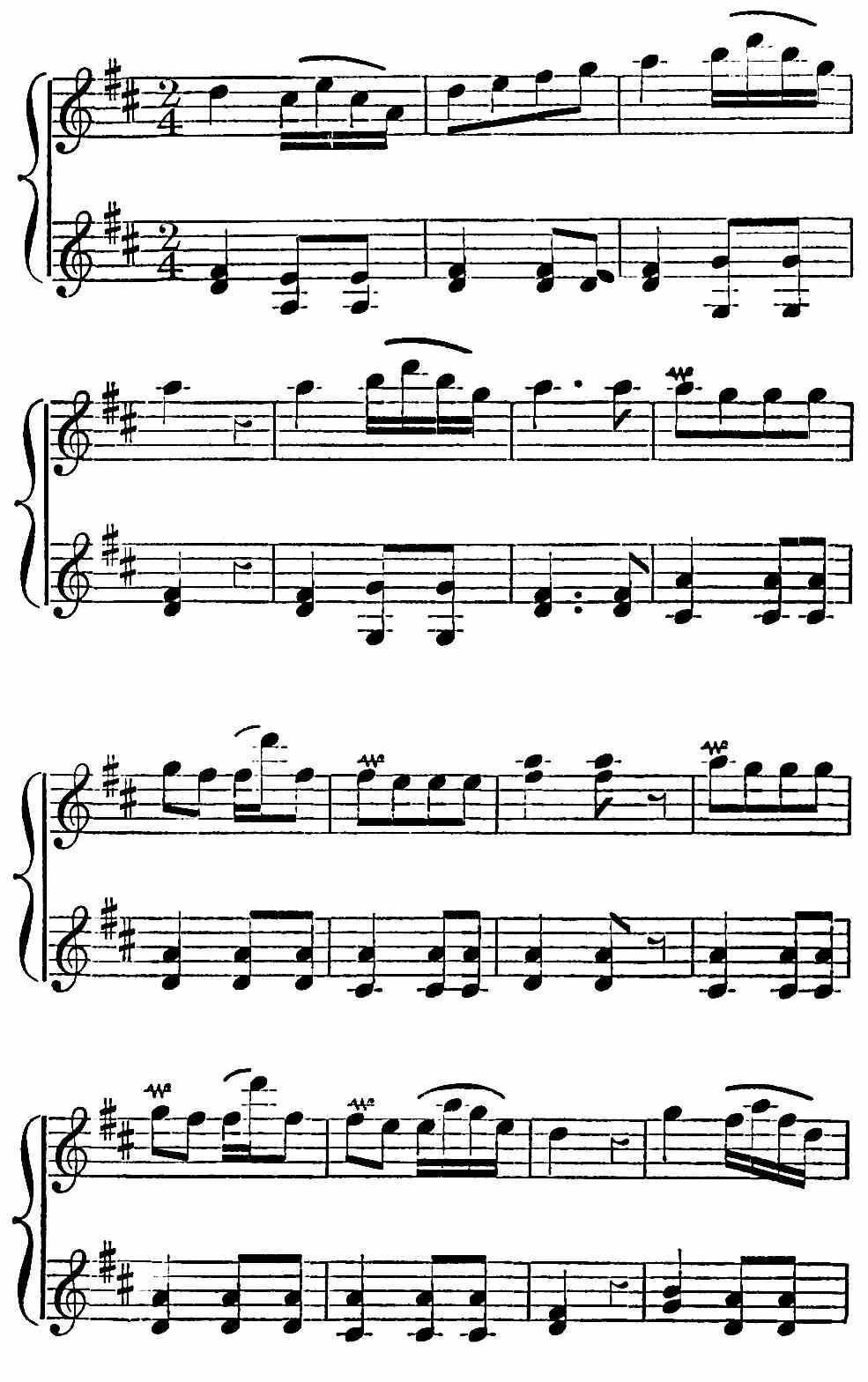
Among the numerous illustrations collected by Dr. Kuhač, the
following deserve special attention.
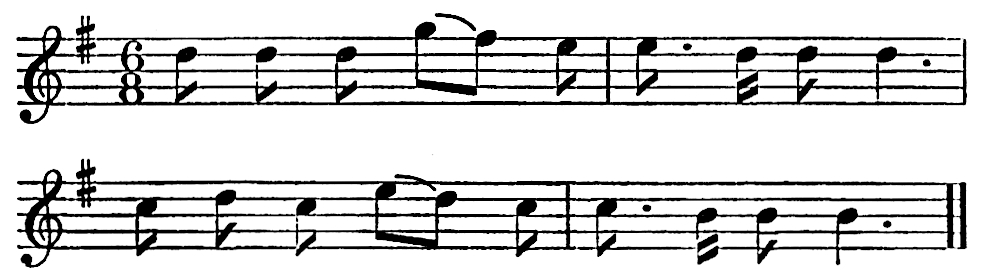
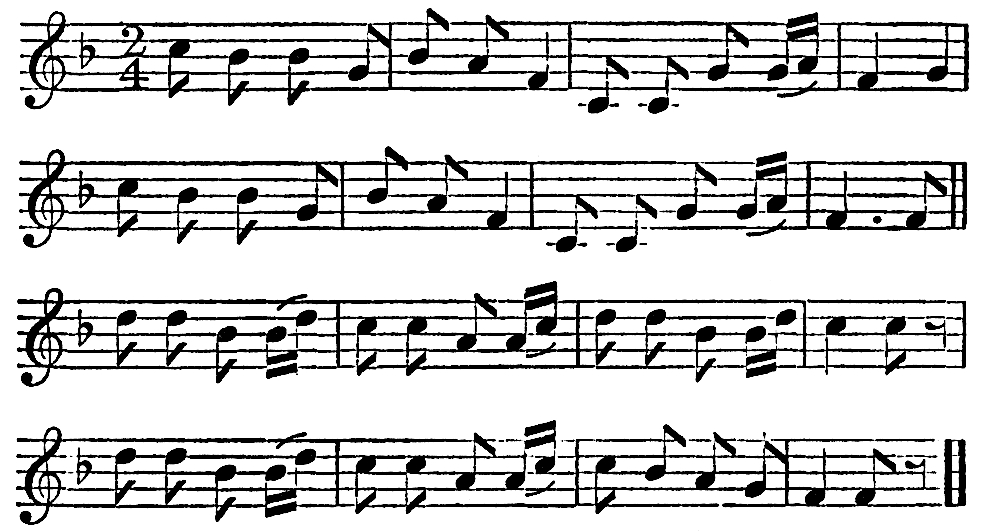
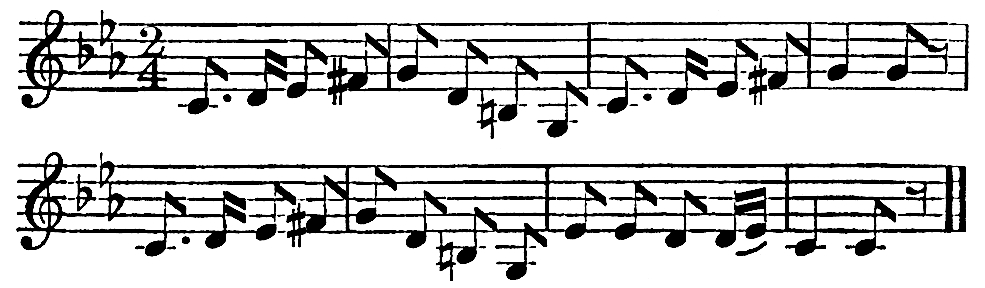
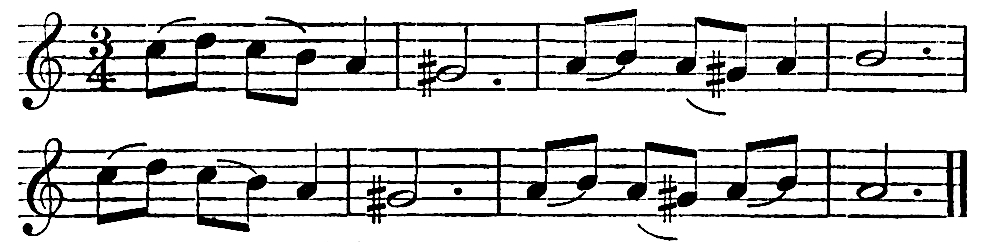
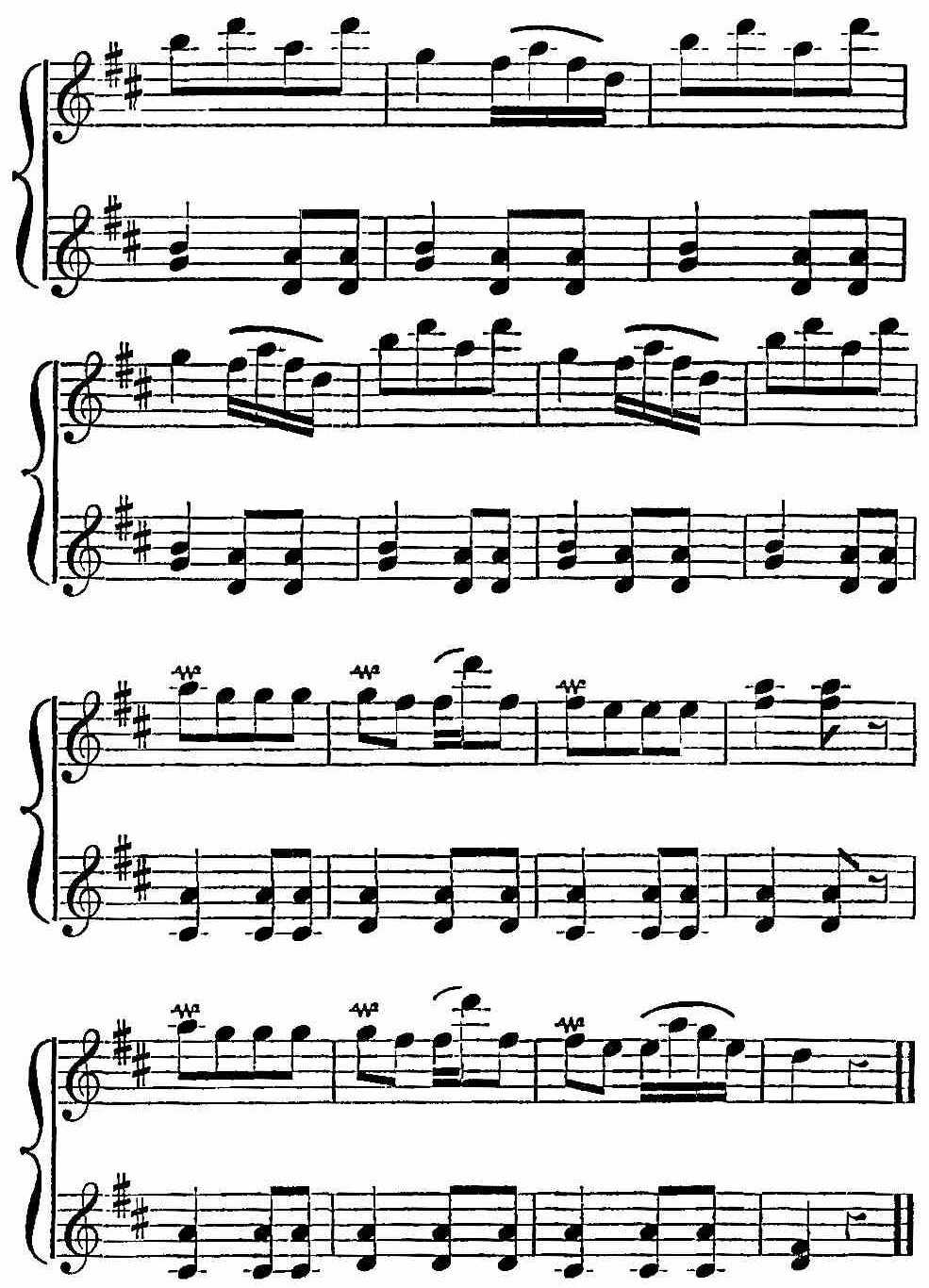
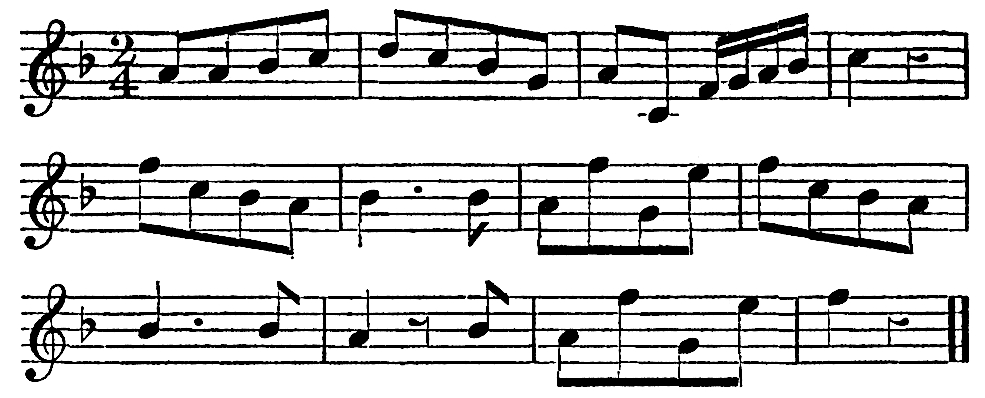
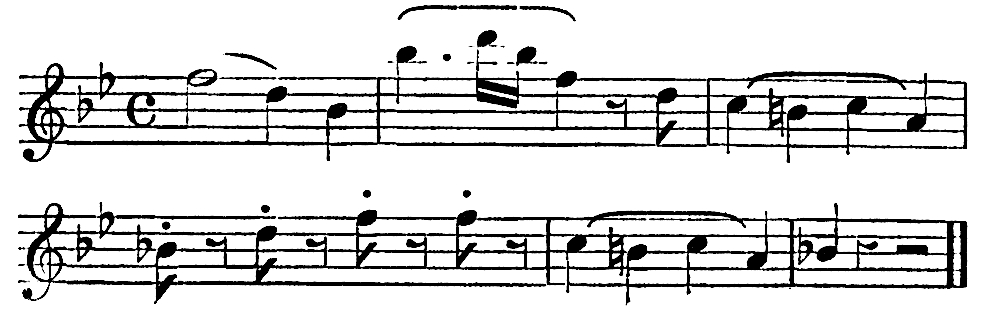
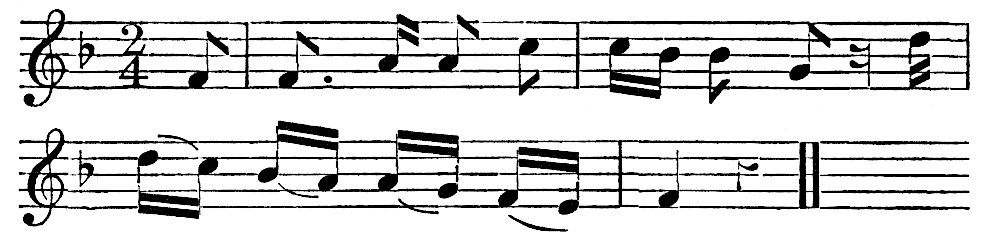
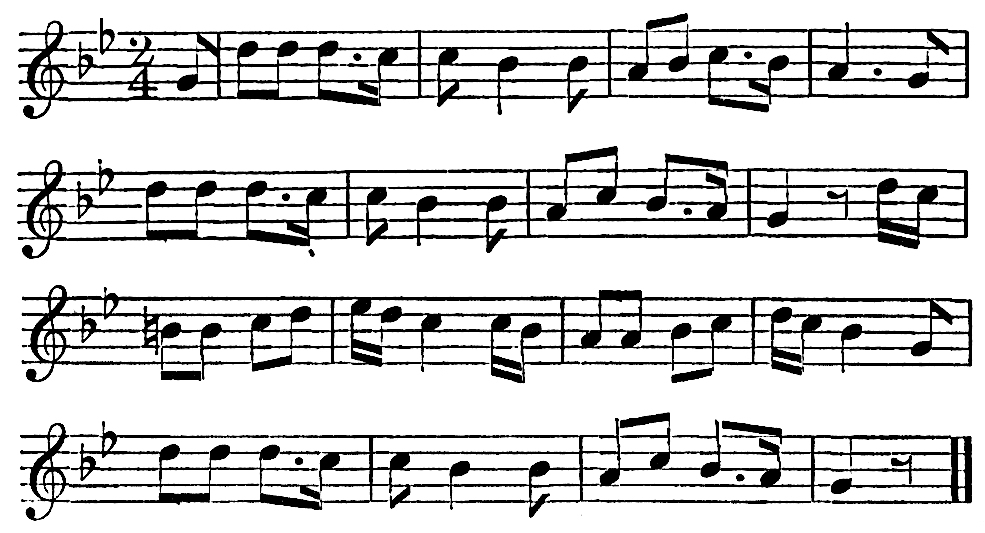
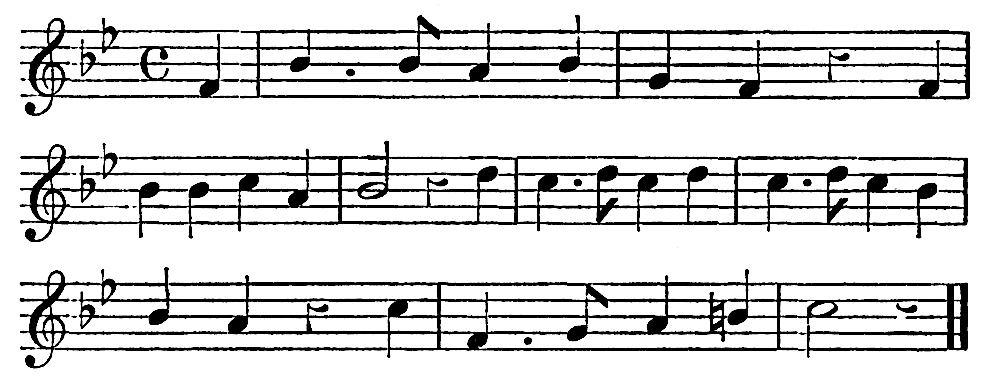
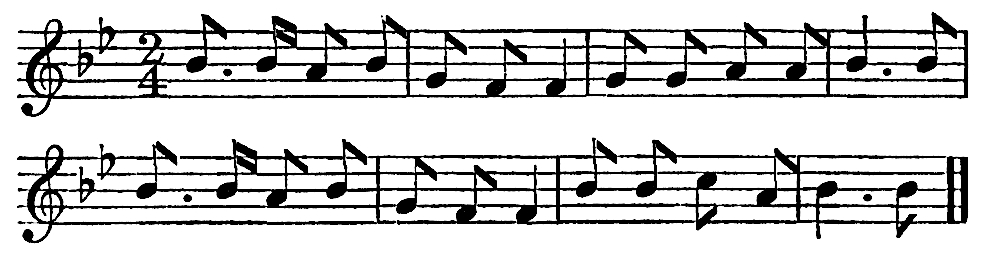
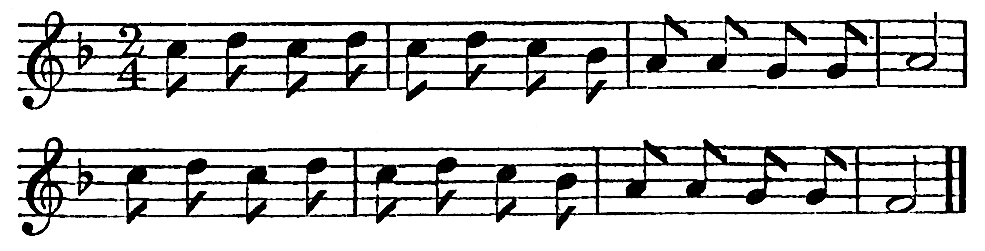
(1) The Cassation in G major
(1765)[22]
begins as follows:—
a melody noticeable for the breaking of the
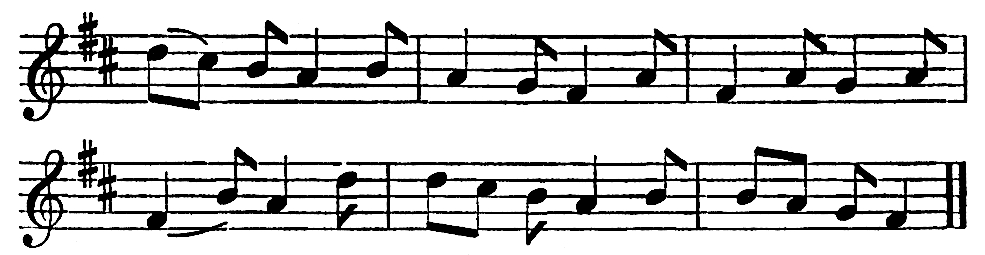
four-quaver rhythm by alternate bars of six. It can hardly be doubted
that when Haydn wrote this he had in his mind the old Slavonic drinking
song, “Nikaj na svetu”—
variants of which may still be heard in Croatia,
and in the Carinthian Zillerthal. Similar instances of slight
adaptation may be traced from the spring song, “Proljeće”—
which appears at the beginning of the D major Quartet (Op. 17, No. 6) as—
and from the dance-song “Hajde malo dere”—
which is thus altered by Haydn—
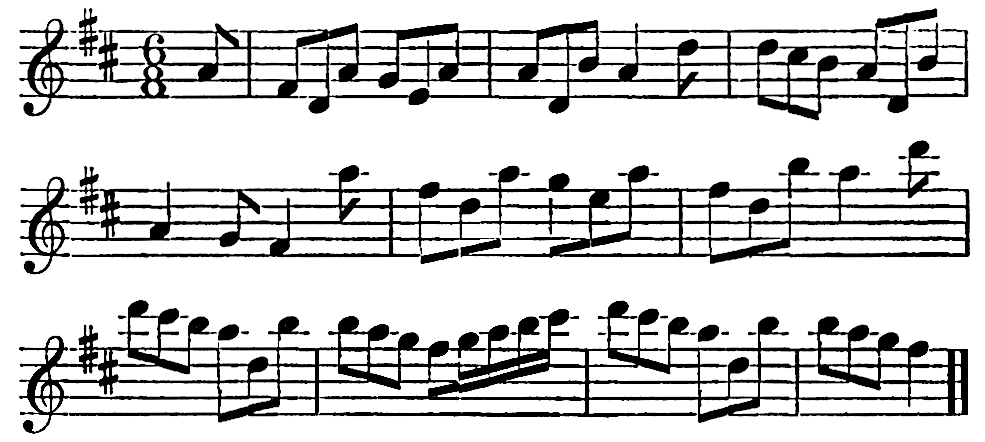
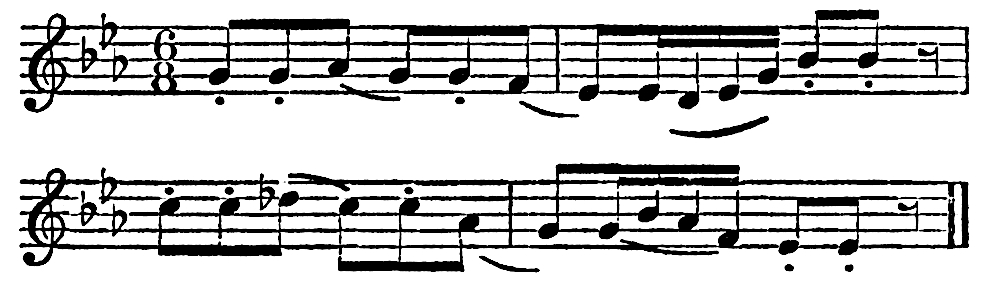
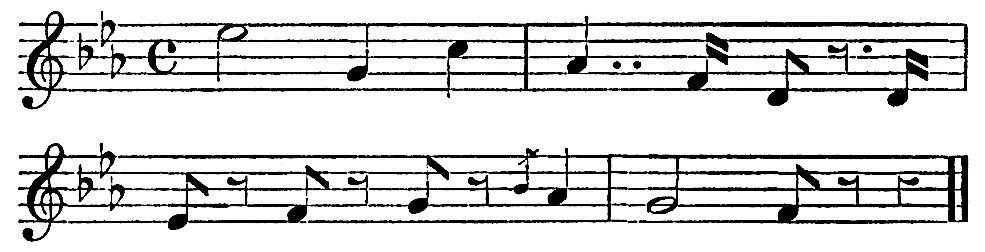
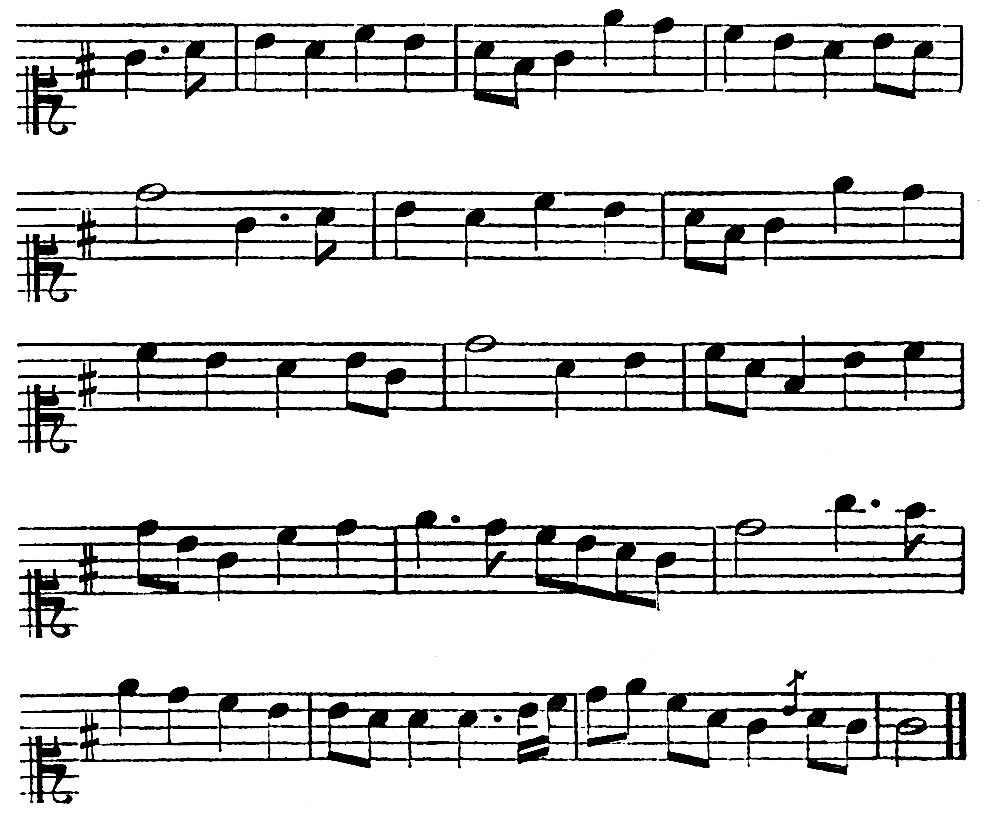
(2) The curious and characteristic finale of the D major Symphony
(Salomon, No. 7) is founded on the following theme:—
This is simply an amended version of the popular
ballad, “Oj Jelena,” which belongs to the district of Kolnov, near
Oedenburg, and is specially noted by Dr. Kuhač as being commonly sung
in Eisenstadt. Its tune, essentially Slavonic in rhythm and cadence,
runs thus:—
Variants of this melody are found in Croatia
proper, Servia, and Carniola.[23]
It is probable that the other movements of this symphony are equally
influenced by folksongs; in any case, no doubt can exist as to the
Symphony in E♭, “Mit dem Paukenwirbel.” The opening theme of the Allegro—
is noted by Dr. Kuhač as Croatian.[24] The Andante is founded on two
themes, the first minor—
the second major—
both of which are taken, and considerably improved, from two folksongs
of the Oedenburg district, (a) “Na Travniku”—
and (b) “Jur Postaje”—
while the principal tune of the Finale—
is that of the song “Divojčica potok gazi”—
which is common among the Croats, especially those of Haydn’s
district.[25]
Again, the Trio of the A major Symphony (No. 11 in Haydn’s Catalogue)
contains a Slavonic melody—
and the first movement of its successor (D major, No. 12)
suggests another—
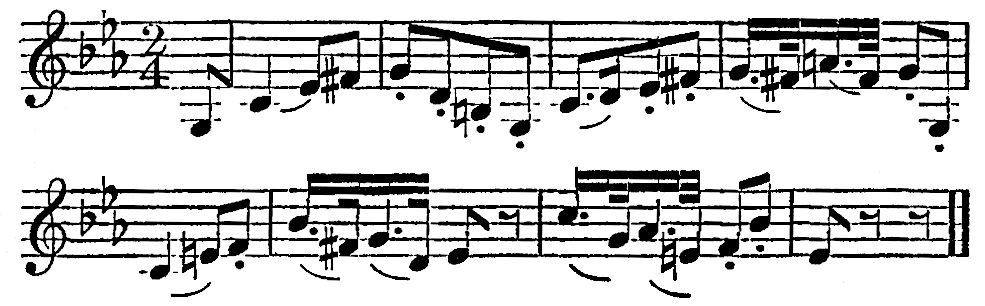
(3) There are several cases in which, without direct adaptation, Haydn
has shown the same tendency of thought or phrase as the Slavonic
folksongs. A favourite “curve” of his may be illustrated by the opening
of the B♭ Symphony (Salomon, No. 9)—
as well as by the Dalmatian Overture of Franz von Suppé and the tunes
(from Zara and Borištov) on which it was founded—e.g., the
ballad “Na placi sem stal”—
Another, even more beautiful, ends the opening
strain in the Adagio of the G major Quartet (Op. 77, No. 1)—
and appears also in the Croatian “Čuješ doro dobro moje”—
while the use of the unprepared dominant ninth,
constructed out of a dominant seventh by shifting the melody a third
higher, was not so common in Haydn’s day that we can afford to neglect
the resemblance of—
(4) These latter examples do not imply reminiscences, but at most a
general sympathy of temper. A good deal more, however, is involved in
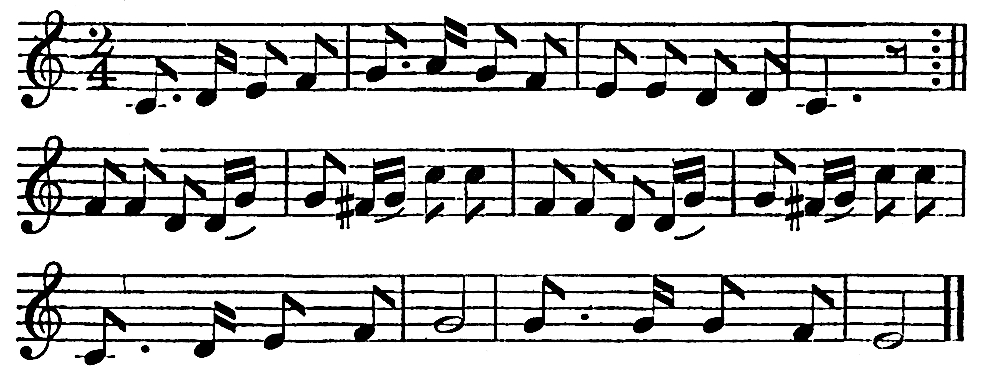
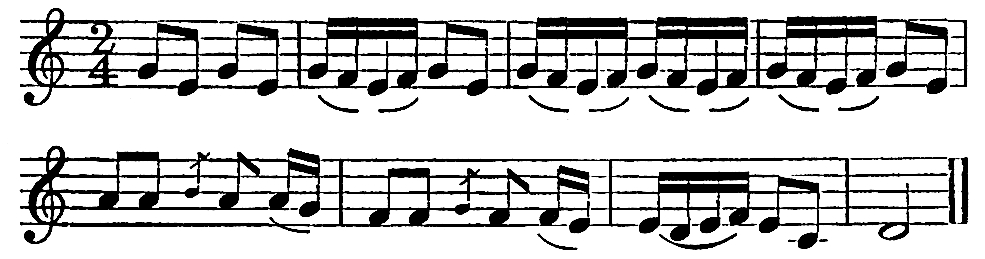
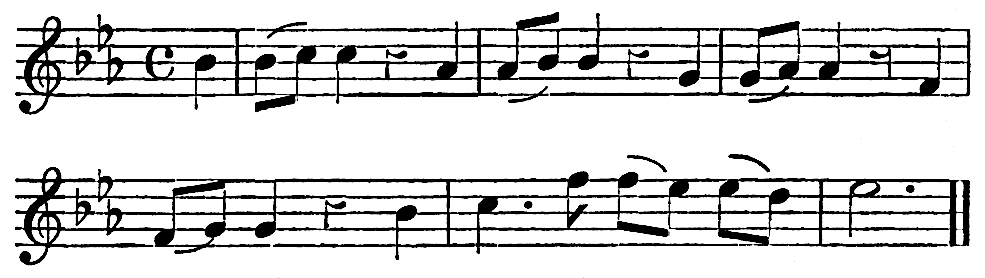
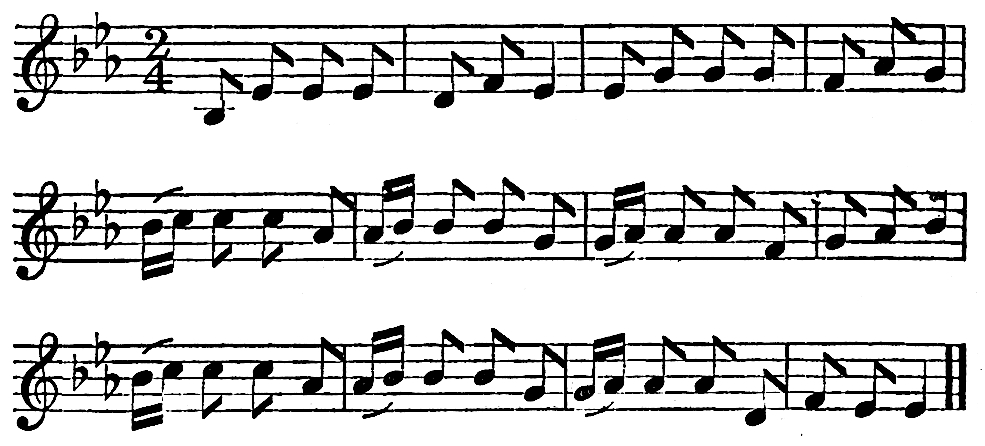
the treatment of Slavonic dance tunes. It is hardly too much to say
that what the Csardas was to Liszt the Kolo was to Haydn; with this
difference—that the earlier and greater musician has throughout made
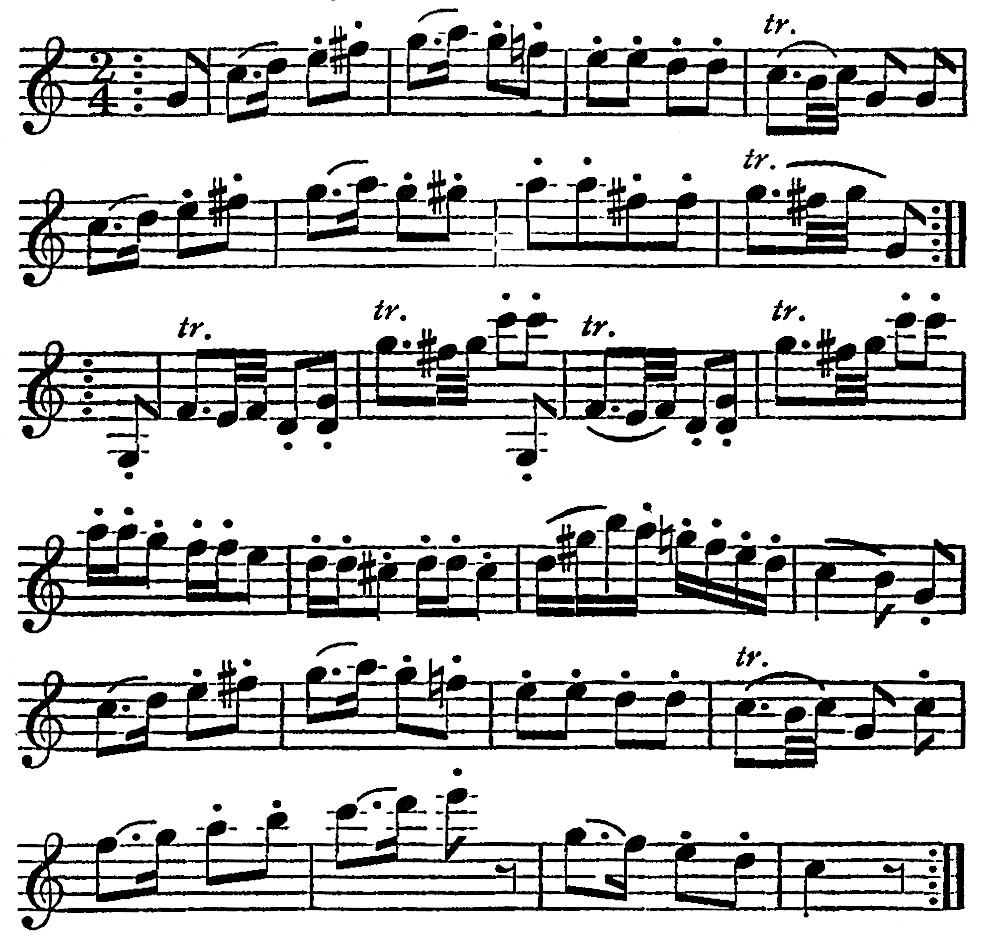
a finer use of his materials. The Kolo is a Slavonic measure, which I
have seen the children dance at Agram and the men at Sarajevo, bright
and cheery of movement, its tune in two-four time ingeniously varied by
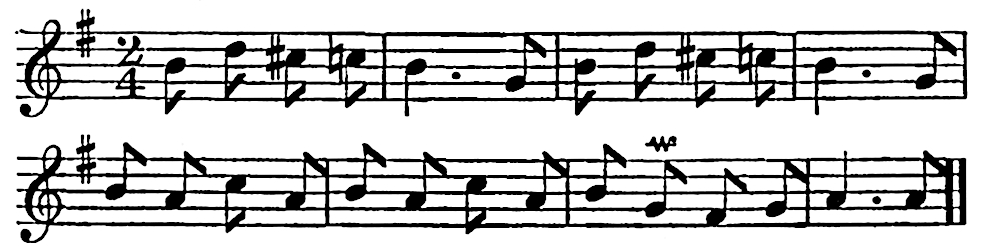
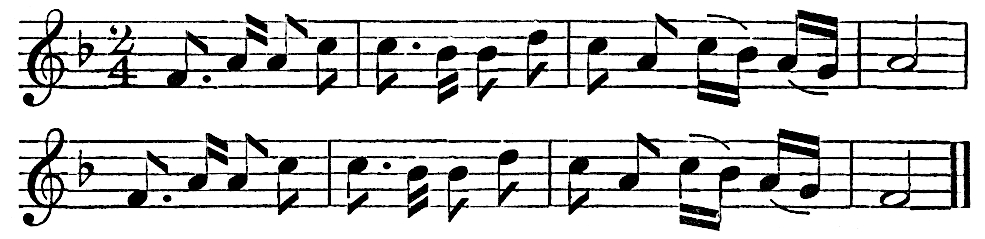
patterns of quaver and semiquaver figures. Here, for instance, is an
example well known in Bosnia and Dalmatia:—
and used with an amended cadence in the Finale of
the C major Quartet (Op. 33, No. 3):—
Here, again, is a similar dance-tune from Servia,
which opens the Symphony in D major (Haydn’s Catalogue, No. 4):—
and here another in the Finale of the G major
Quartet (Op. 77, No. 1):—
in which so wonderful an effect is produced by the
alternation of cold unison and glowing harmonies.
Many of Haydn’s characteristic melodies follow one or other of these
types: e.g., this from the Finale of the F major Quartet (Op.
74, No. 2)—
or this from the “Bear” Symphony:—
or this from the Finale of the Quartet in D (Op. 76, No. 5):—
while the metrical peculiarities of the Eastern or
Servian Slav may be illustrated by the following, from the Symphony in
F major (No. 1 in the Viennese edition):—
as they may, apart from the Kolo measure, in
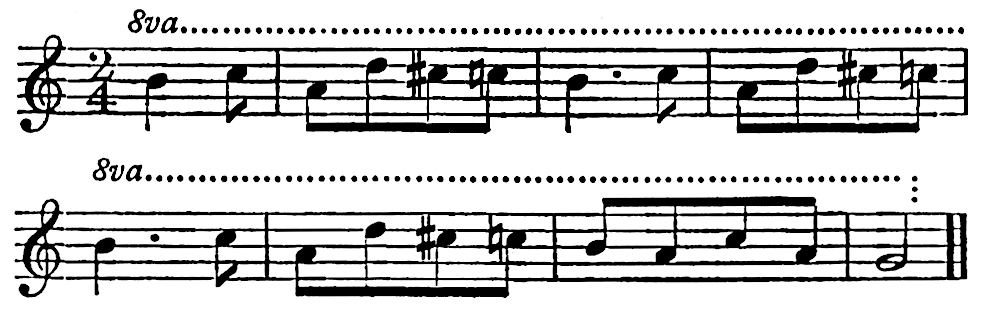
a hundred of his minuets and finales. Again, the early Pianoforte
Concerto in D major ends with an oddly named “Rondo à l’Hongrie”, the
principal subject of which is as follows:—
This melody, which contains no Magyar characteristics, either of
figure, scale, or stanza, is compressed from that of the Siri Kolo, as
commonly danced in Bosnia and Dalmatia. The complete tune runs:—
a typical rustic dance, which in Haydn’s
hands has gained not only by compression, but by a more artistic
accompaniment.
(5) In addition to the dance measure, Haydn has adopted other
instrumental forms, e.g., marches, bag-pipe melodies, and
the like. Here is one, with a strange rhythm, from the Pianoforte
Scherzando in F major:—
and here, from the Finale of the B♭ Symphony
(Salomon, No. 9), is the march which is commonly played in Turopol at
rustic weddings:—
Another Croatian march beginning—
has been identified by Dr. Kuhač from an
unpublished Symphony in A major, and there is a further example from
the Allegro of the B♭ Quartet (Op. 71, No. 1)—
(6) The two most remarkable instances are yet to come. According
to a well-known story, Prince Esterházy once discussed with his
Kapellmeister the question whether Church music could not be made
“at the same time religious and popular.” It is hard to realise
that Haydn’s Masses were ever regarded as too severe; in any case,
the Prince felt dissatisfied, and wanted a change. He had recently
returned from his annual pilgrimage to Maria Zell. He had heard there
music which pleased him, and he seems to have suggested that in the
Eisenstadt chapel there was too much counterpoint and too little
melody. Haydn listened, sent to Maria Zell for information, bided his
time, and, when next year the day of the pilgrimage was approaching,
wrote a “Mass” or Service to German words,[27]
despatched it to the famous church, had it secretly practised, and
finally found an excuse for slipping off on a holiday. The Prince came
back more dissatisfied than ever. “I have heard,” he said, “a service
of Church music composed and played in a style which you will never
equal.” “Your Highness,” answered Haydn, “the composition was mine, and
I was the organist.”
From this “Mass,” of which at present no other trace seems to be
discoverable, Dr. Kuhač quotes seven melodies on the authority of the
Dominican Alois Russwurm, who was a personal friend of Haydn, and by
whom the story was originally recorded.
The first, “Hier liegt vor Deiner Majestät,” is the opening theme of
the first number—
and comes from the Croatian tune—
The second, “Gott soll gepriesen werden”—
is the song “Ti jabuka,” as sung in Velik-Borištov—
The third, “Allmächtiger, vor Dir im Staube,”—
begins remarkably like the Slavonian drinking song, “Draga moja
gospodo.”[28]
The fourth, “O Vater, sieh vor Deinem Throne”—
may fairly be regarded as a variant of the Dalmatian
song, “Jedna Ciganka”—
The fifth, “Betrachtet ihn in Schmerzen”—
is almost identical in both parts with the following
Croatian melody:—
The sixth—“Nun ist das Lamm geschlachtet”—
is derived partly from two separate strains in
the Croatian and Slavonian versions of a convivial chorus—“Vivla compagnija”—
partly from a Croatian sacred song—“Stani gori gospodar.”
The seventh—“Dich wahres Oesterlamm”—which is the concluding phrase
of the canticle for the Celebration,—
borrows its exact sequence and its curious halting rhythm from the
Croatian “Miši prave svatove”—
Clearly, in Haydn’s vocabulary “popular” meant Slavonic.
It may be objected that this example proves nothing. Grant that Haydn
was living in a certain district, and that he was asked for once to
write in a popular style; what more natural than that he should adapt
himself to his surroundings, and use the idioms that he found in common
currency? A man readily drops into dialect when he is addressing a
rural audience, and does not become a countryman by seasoning his
discourse with a few country proverbs and metaphors. This rejoinder
would be of more effect if the “Mass” were an isolated phenomenon: it
somewhat loses weight when we remember that the music only turns to
Church use the tendencies that have already been noted in symphony and
quartet. Still, our case would undoubtedly be stronger if we could find
Haydn appealing, in the same tongue, to the Austrian Empire at large,
and using the native Slavonic for some great political or ceremonial
occasion. Here, at any rate, is a test which we may reasonably regard
as crucial, and which, if successfully applied, should go some way
towards settling the question.
Unfortunately, the Croatian melodies are not, as a rule, well suited
for such a purpose. They are bright, sensitive, piquant, but they
seldom rise to any high level of dignity or earnestness. They belong
to a temper which is marked rather by feeling and imagination than by
any sustained breadth of thought, and hence, while they enrich their
own field of art with great beauty, there are certain frontiers which
they rarely cross, and from which, if once crossed, they soon return.
One limitation in particular will have been observed by every student.
It frequently happens that a Croatian or Servian tune will begin with
a fine phrase, and then fall to an anti-climax—either losing sight
of its tonality, or wavering in its rhythm, or ending with a weak or
commonplace cadence. In almost all the examples quoted above, it is the
opening of the tune which Haydn has borrowed; its conclusion he has
nearly always improved or re-written.[29] And the reasons that impelled
him to this practice may be illustrated by the following variants, in
all of which are apparent the same touch of inspiration, and the same
weakness of development.
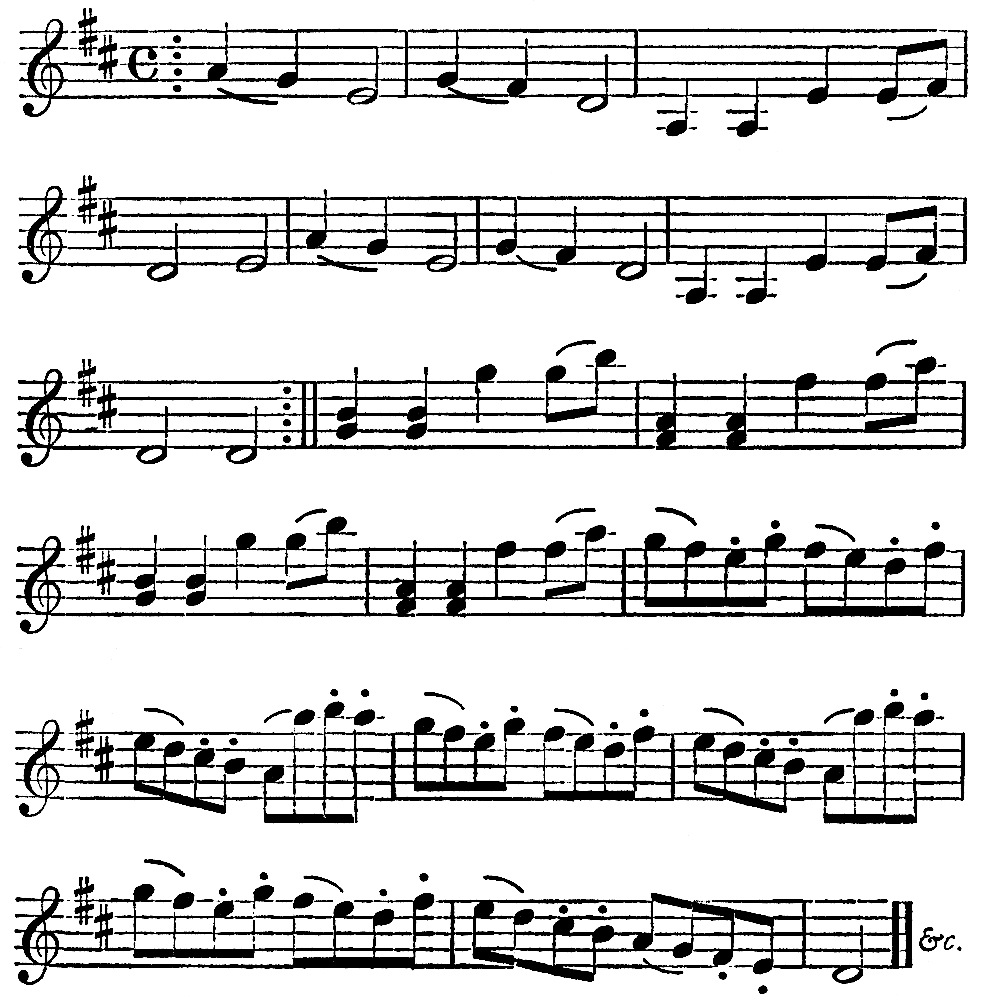
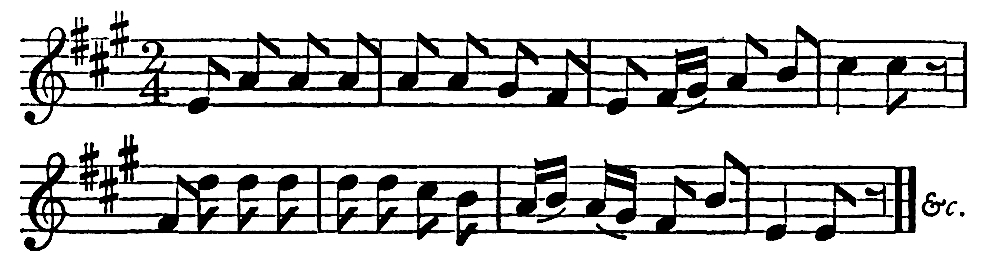
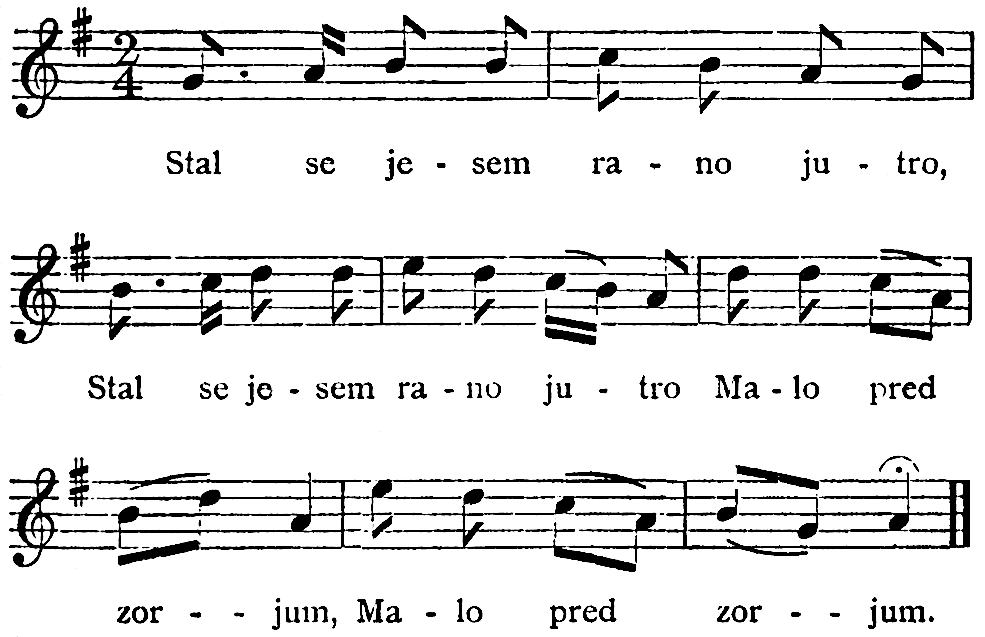
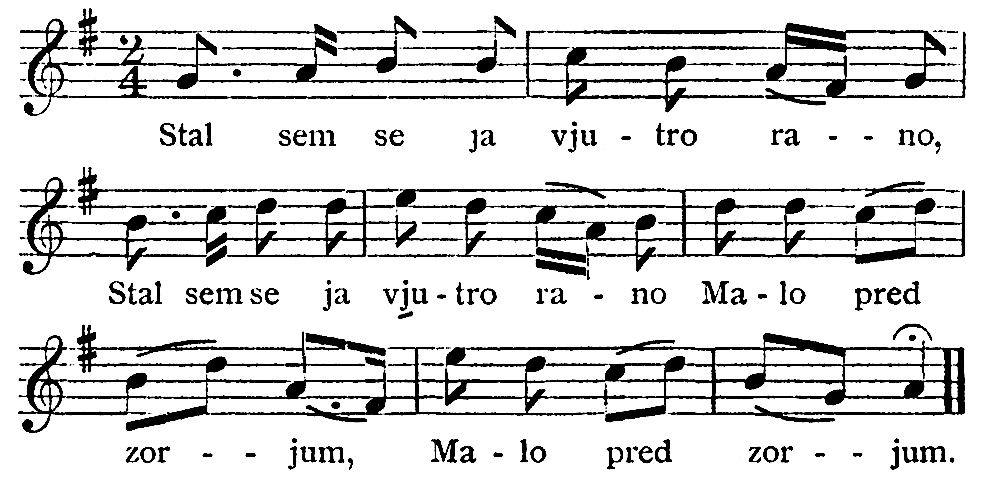
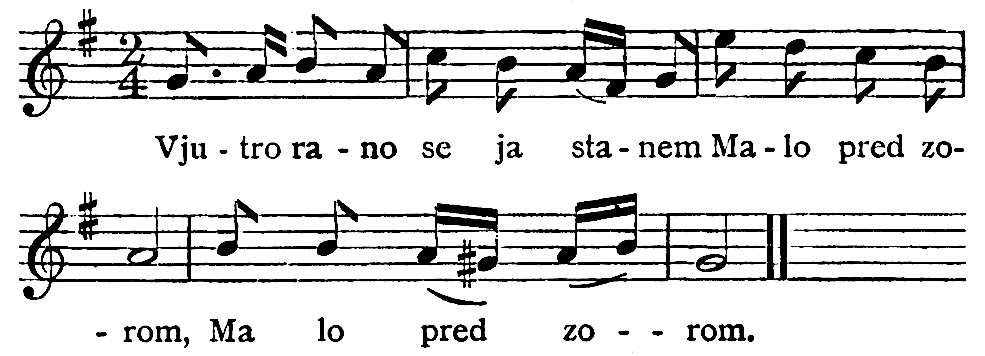
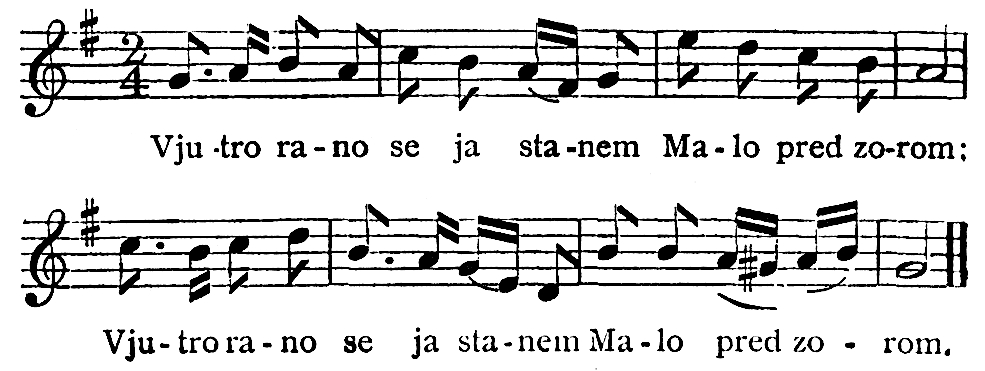
(a) The song “Stal se jesem,” as sung in Marija Bistric[30]—
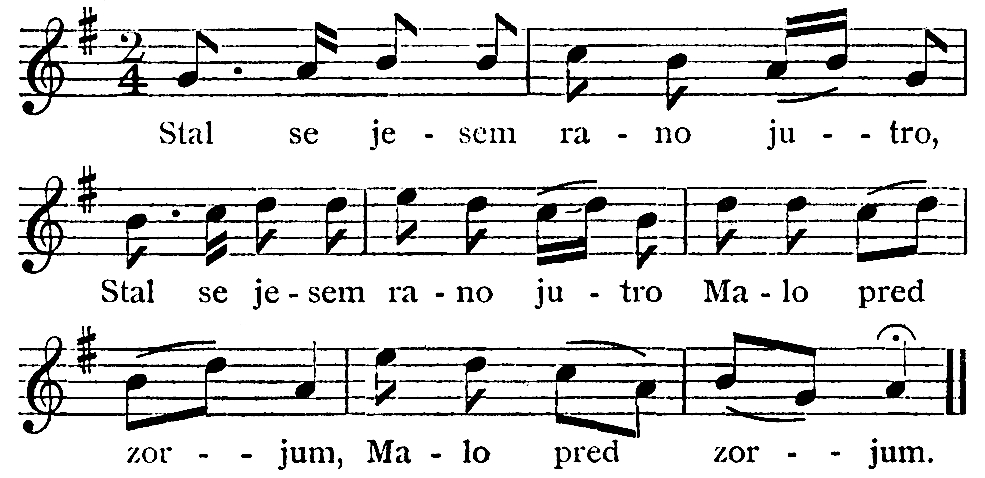
(b) The same song as it appears in the district of S. Ivan Zeline—
(c) The same as it appears at Medjumur (Murinsel)—
In these versions the last four bars appear to have been loosely
attached to the rest of tune; at any rate, they are often found, apart
from the first phrase, in Croatian carols and drinking songs. Again,
among other districts there has been some rearrangement of the words,
with corresponding changes in the music. Either the opening line is
not repeated, which leads to the excision of the third bar, and a
consequent alteration of cadence; e.g.—
(d) Variant from Kolnov (near Oedenburg)—
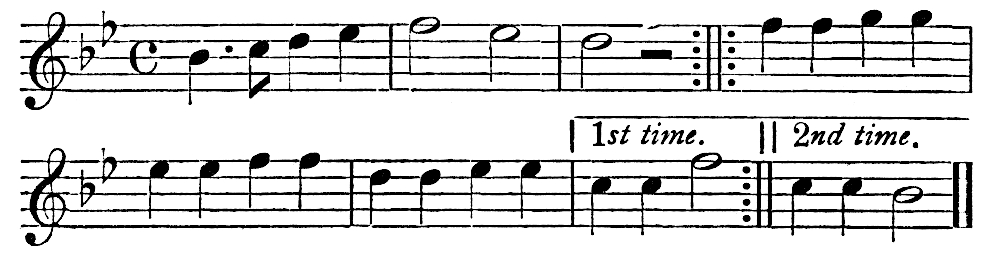
or it is inserted again after the second, so as
to give the stanza an alternation of masculine and feminine endings;
e.g.—
(e) Variant from Čembe—
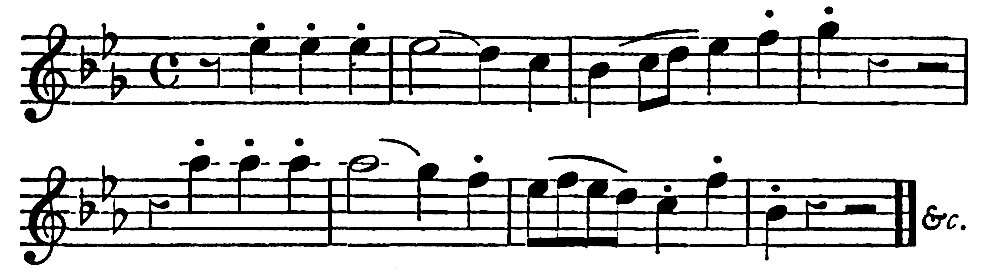
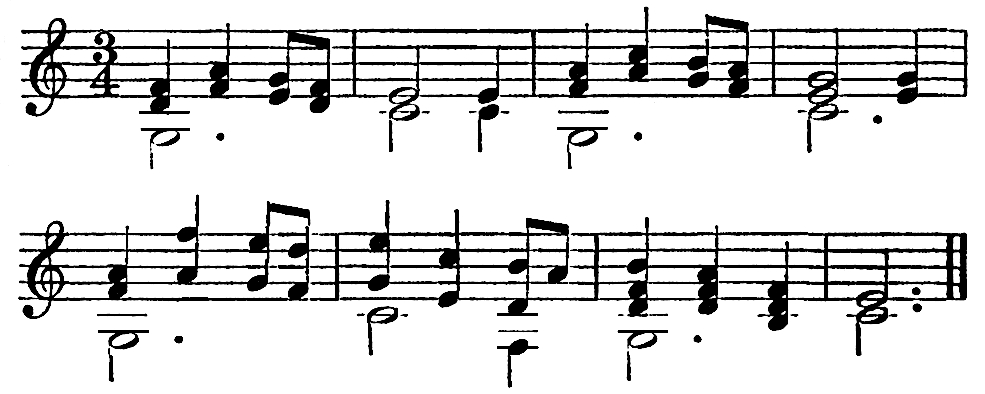
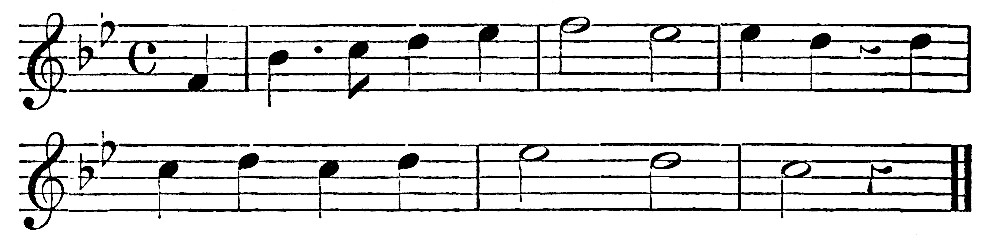
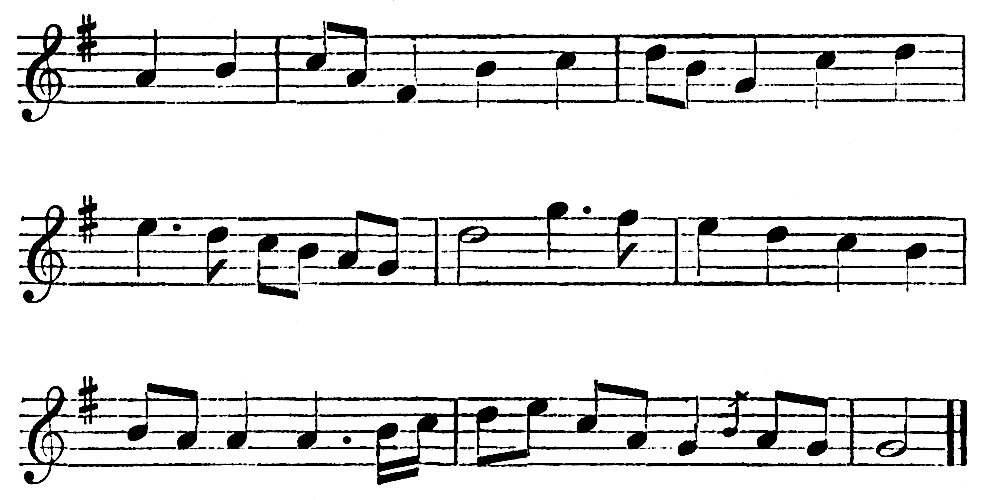
The rest is easily divined. When in 1797 Haydn was commissioned to set
the National Anthem, he must have had this tune before his eye, and
have determined to use it as the pedestal of the monumentum ære
perennius which his loyalty erected.[31]
And here a word may be said as to the manner in which the great tune
appears to have been written. It was no momentary inspiration, no
sudden impromptu that should come into existence at full growth; like
most of Beethoven’s music, it was made carefully, and by deliberate
weighing of alternatives. By a piece of singular good fortune, we are
for once admitted to the master’s workshop, and allowed to take our
lesson in melody by the observation of his practice.
Now the second strain of the folk-tune is too short to fit the second
line of the poem; accordingly, Haydn began by extending its cadence,
and instead of—
wrote—
following it with repeat-marks, after the common
method of primary form. Two other changes explain themselves. The
measure is dignified by the broader time-signature, and the accent
shifted from arsis to thesis by the rearrangement of the bars.
Otherwise, in the first half of the stanza the folk-tune remains
unaltered.
But for the second half it was manifestly insufficient. Both the
possible variants are too trivial, and one too brief, to afford the
requisite climax. As a natural consequence, Haydn discarded both, and
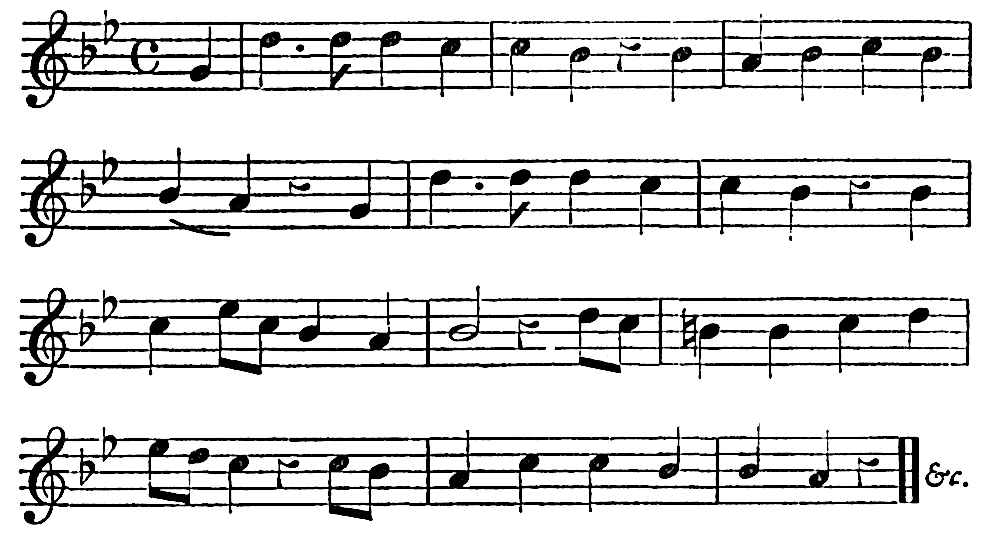
proceeded to supply their place with two original strains,
which in the Autograph sketch[32]
run as follows:—
Still, he was dissatisfied with the result, and it is easy to suggest
the reason. In the former of these two strains there is a passage which
carries tonic harmony—out of place at this stage of the tune—and
its cadence, moreover, rhymes awkwardly with that of the half-stanza.
The latter of the two comes down from its point of stress with a fine
sweeping movement, but, three bars from the end, breaks its melodic
curve into two distinct pieces, and so loses continuity of line. Both
were accordingly corrected, one on the same page, the bottom stave of
which bears, in hasty manuscript, the amended form—
the other, with a few more minute alterations, at
a later period of the work. And thus, of such diverse metal as Cellini
cast his “Perseus,” did Haydn beat out the melody by which he has given
voice to a nation’s patriotism.
It is to be hoped that these examples will not encourage any reader to
pursue Haydn with the cry of plagiarist. No accusation could be more
unfounded or more unreasonable. He poached upon no man’s preserve,
he robbed no brother-artist, he simply ennobled those peasant-tunes
with the thought and expression of which he was most nearly in accord.
The whole extent of his indebtedness is at most an occasional melody,
and is often but a single phrase; the treatment, the setting, the
workmanship belong as truly to him as Faust to Goethe, or Cymbeline to
Shakespeare. The master who has written a hundred and twenty first-rate
symphonies, and eighty-three first-rate quartets, may surely claim the
right to take his wealth where he finds it; and if we are churlish
enough to deny this, at least we may allow him the privilege of
speaking in his native tongue. To Haydn, the folk-tunes were little
more than the words of his accustomed speech, hardly obscured when
the Church asserted her contrapuntal dignity, and reappearing in
full significance when he returned to the untrammelled orchestra and
the freedom of the four magic strings. It is more important to note
how closely his special melodic gift is in sympathy with that of his
people. Many of the tunes quoted above are among those which a critic
would select as especially characteristic: there are literally hundreds
of his invention by which, in a more or less degree, the same qualities
are exhibited. No doubt he was not only the child of his nation, he
had his own personality, his own imaginative force, his own message to
deliver in the ears of the world. But through all these the national
element runs as a determining thread. That “les grands artistes n’ont
pas de patrie” is a sentence abundantly refuted by its very author; it
assuredly finds no support in the life of the Croatian peasant who has
made immortal the melodies of his race.
A new aspect of the question has been brought into prominence by
recent history. The course of policy pursued in our own day by the
Austrian Government is tending to reverse the relative importance of
the Croatian colony and of the mother country from which it sprang. On
the one hand, the central provinces are being steadily Germanised, the
Slavonic language is beginning to die out, the Slavonic blood to be
crossed by intermixture, and though yet the change is only in process,
there is no lack of indication that it is operative. Along the western
bank of the Leitha, German is now the prevailing speech, along the
eastern bank it is disputing the palm with Hungarian, and between them
the Slav, for all his tenacity, will some day be dislodged or absorbed.
Hardly any inhabitant speaks of Požun now; the name is either
Pozsony or Pressburg; Liesing has almost forgotten that it was once
Lešnik, and though Oedenburg[33]
still remains as a fortress, it is becoming more and more isolated as
the years advance. But, on the other hand, a wider range of opportunity
is being opened in Croatia proper. The impulse towards national life,
started as we have already seen by Ljudevit Gaj, is being wisely
fostered and encouraged by Imperial patronage; and Agram, which a
century ago was a little country town, is now assuming the state and
dignity of a capital. The University, founded in 1874, has already done
much for the study of art and letters; the old market-place has become
a fine square, with an opera-house in the centre; the waste ground
to the south has been laid out in public gardens, and enclosed with
galleries and museums. It is
natural that the present race should follow these changes with keen
enthusiasm; and should look forward eagerly and confidently to the days
of coming greatness. Nor even to a stranger are the evidences lacking.
The tone may be somewhat Chauvinist, the self-gratulation somewhat
indiscriminate, the record of present achievement a little wanting in
distinction; but as yet the movement is new, the resources are new,
the whole field has to be contested step by step. It would be idle to
expect another Haydn at present; the line has been broken, and must
rally before it can advance. Enough for the moment that there are force
and impetus and courage, that there is active and restless ability,
that there is an unswerving determination to win the day. Who knows in what
recruit’s knapsack the bâton of the field-marshal may be lying hidden?
For in all the music of this century there is no phenomenon more
remarkable than the steady progress of the Slavonic race. As early as
1818 an English critic was far-sighted enough to predict the advent of
Russia,[34]
and though his readers never lived to see the presage fulfilled, though
in his generation there appeared no greater name than that of Glinka,
yet our own day has verified his words beyond the possibility of cavil.
There may be some difference of opinion about Rubinstein, there can be
none about Borodin or Tschaikowsky, and the traditions which they set
are being ably followed by a whole school of younger composers. Toward
the middle of the century came Chopin, whose chief ambition, as he
himself said, was “to be the Uhland of his country,” and whose chief
work was to stamp with the impress of a classic his national strains of
polonaise and mazurka. Some thirty years ago Smetana’s brilliant comedy
laid the foundation on which Dvořák has built, and rescued from disuse
and oblivion the folksongs of Bohemia. It is not without interest that
we see another Slavonic nation re-entering the field. In one sense it
was the leader of them all, in another it is the latest accession to
their ranks, and its fortunes, as it tries to regain a lost position,
should be watched by us not only with encouragement, but with close and
intimate sympathy.
For, de nobis fabula narratur. Western Europe also knows of a
land which was once a leader in musical art, which forewent its trust,
which suffered its voice to be silenced, which allowed its musicians to
bid for popularity by adopting foreign names and foreign methods, which
is now striving, with better opportunities than any Slavonic nation can
possess, to recover the old ground, and recall the forgotten message.
If we disdain the comparison we may learn humility by reading the
estimate in which we have long been held by our neighbours. “English
music,” says a recent German historian, “may be said to end with
Purcell”; “English art,” say our French critics, “has long degenerated
into imitation”; and though our present leaders are nobly refuting the
charge, there is still with us too much of that cosmopolitan temper
which is among the most insidious of our enemies. No doubt times are
improving. In Leeds, in Birmingham, in Bristol, even in London, the
Englishman may get a hearing, though unless he write Royalty ballads he
will hardly find a publisher. But his audience is not yet attuned into
proper sympathy with his work. We still judge too much by reference to
alien ideals, we are still too indifferent to our own natural language,
and our own natural cast of thought. And, until we shake off this
indifference and learn to extend our patriotism to our art, we shall
never resume our place as a great musical nation.
There is no need that we should offer a less cordial welcome to our
foreign visitors, or a less cordial recognition of the immense service
that they have done. “Was macht dieser Fremde hier?” is not patriotism,
but discourtesy, a mark of the weakness which fears to meet the world
frankly upon equal terms. At the same time we have no right either to
neglect or to depreciate our own. A great artistic school is not built
in a single moment or in a single generation; the work is long, heavy,
difficult; it is easily discouraged, it is easily retarded, it needs
all the care and diligence that it can command. And there is one way,
and one only, in which we can bring it to a successful issue. Let us
cut our timber from our own forests, let us quarry our stone from the
bed-rock of our own nation, and then let our master-builders deal with
the matter as their genius shall determine.
A most hopeful sign is the revival of interest in our national
melodies. To the artists who have collected them, to the artists who
are making them familiar, our cordial gratitude is due. But it is not
enough to have them, we must use them; and it is not enough to use
them, we must learn how to catch their spirit. Haydn had a far slighter
material than ours, yet he could use it to a purpose which will be
remembered when all our exotic romances are forgotten. And now that
more than one English master is showing us the way, we have no excuse,
we have no pretext for withholding our allegiance any longer.
It is now some years since a few English writers began to advocate the
return to nationalism. Since then, much, no doubt, has been done, but
much still remains to do, and to us hearers a great part of the reform
is entrusted. We have listened to foreign tongues until our own sounds
odd and unfamiliar. We have sat so long at Trimalchio’s banquet that
we have no appetite left for our native fare. Extremes of passion,
extremes of languor, inordinate appeals to sense, all these are alien
from our national temper, and we are growing surfeited with them until
our taste is spoiled and our palate vitiated. It is just the same in
the world of letters. “No one reads Scott,” says one critic; “No one
wants Shakespeare,” says another; “give us d’Annunzio and Sudermann and
the Immoral Philosophy of Friedrich Nietzsche.” Fortunately English
ethics and English literature may be left to look after themselves;
they have both a continuity of tradition which will prevent them from
falling very far askew. But our art of music is being restored from the
heaps of ruin into which it was laid two centuries ago, and it is the
business of all who care for art or country to lend a hand. At least we
might try to discover what English music has to say, and estimate our
composers according to their capacity for saying it.
This position is strengthened by all evidence of musical history.
The same hand which made Germany a people enriched her with the
“Marseillaise of the Reformation,” and so founded the long dynasty of
her great composers. Art in France was at its lowest, when the chief
occupation of Paris was to dispute between the claims of the Bavarian
Gluck and the Italian Piccinni. Italy herself declined as she lost her
national character, the Slavonic peoples have advanced as they have
reasserted theirs. And what is true of nations is equally true of their
leaders. “The greatest genius,” says Emerson, “is the most indebted
man”; the man, that is, who can turn to the most noble and enduring use
the traditions of his age and country. So it was with Haydn. Nothing
can be more false than to regard him as merely a Court musician,
writing with ready and facile talent the pièces d’occasion
that were needed for the theatre or the reception-room. His life at
Eisenstadt gave him opportunity such as no composer had ever before
enjoyed, but the patronage was too enlightened and the character too
strong to be satisfied with work that was mannered or artificial. Under
the famous “livery of blue and silver” there beat the heart of a rustic
poet, full of kindliness, of drollery, of good-fellowship, of the love
of children and animals. His genius, trained by years of assiduous
labour, gave him a complete mastery over the inherited resources of
his art, his imagination extended them with fresh discoveries and
inventions. But throughout the whole his favourite themes are pastoral,
songs of the shepherd and the harvester, songs of country courtship,
songs of the vintage feast and the jovial holiday. It is little wonder
that he should speak in the language of his people, or recall the
phrases that had been familiar from his childhood.
Yet it is no patois that he uses, but the speech of a whole nation; a
living force that spreads wide and reaches to distant boundaries. Nor
is he great because he has chosen this or that topic, this or that form
of utterance; it is because he is great that there was no choice in the
matter. He could not have written of set habit in the German idiom; he
was Slav by race and Slav by temper, and his music is too genuine to
present itself in foreign guise. It is from this point of view that we
should understand him; not by loosely classifying him among a people
with whom he had little in common, but by regarding him as the true
embodiment of his own national spirit. The Greek proverb condemns a
man of two tongues: through the world of art the condemnation is still
in force, and at least some measure of it should fall on the ingenious
critics who call patriotism parochial, and justify their epithet by
obliterating frontiers.
APPENDICES.
APPENDIX A.
Croatian Musicians, 1835-1848.
(1) Composers:—
Lisinski.
Čačković.
Livadić.
Štoos.
Wiesner.
Mašek.
Rusan.
Baron Prandau.
Pintavić.
F. von Suppé.
Jaić.
(2) Singers:—
Countess Rubido.
Stazić.
Štriga.
Ledenig.
(3) Virtuosi, &c.:—
Ivan Padovec.
L. A. Zellner.
N.B.—The following rules of pronunciation should be observed.
r (as a semi-vowel) carries a very short vowel sound before the
consonant. Brlog = Berlog made as near a monosyllable as possible.
c = tz. Zajc is pronounced Zaitz.
č = ch soft (like ch in Church).
ć = ty in which the y is a consonant (as it is for instance in the word
“you”). The sound is half-way between the “te” in “righteous” and the
“tch” in “wretched.”
š = sch or sh. Pušovec
(see Appendix C) is pronounced Pushovetz.
ž = the French j, as in jour.
lj and nj are like the gli and gn in figlio, campagna.
The other letters are, roughly speaking, pronounced as in German,
except z, which = s in sehr; and s, which = ss in Strasse.
Corrupted (adaptation of sound: reasonably certain).
Bulgarelli.
Bugarin.
Bona.
Bunić.
Brusa.
Brusić.
Draghi.
Dragi.
Dragonetti.
Draganić.
Ferrich.
Ferić.
Gerlo.
Grlo.
Giornovichi.
Jarnović.
Jelich or Jael.
Jelić.
Kresnik.
Gresnik.
Henkel.
Kengelović.
Calinde.
Kalin.
Kannabich.
Kanabić.
Cola.
Kola.
Muzin.
Mužina.
Mazoleni.
Mazolić.
Mazzuranna.
Mašuranić.
Nachich or Nanchini.
Nakić.
Pollini.
Polić.
Desplanes.
Polinar.
Pisaroni.
Pisar.
Zappa.
Sapa.
Scalichius.
Skalić.
Smetenich.
Smetenić.
Tamparizza.
Tamparica.
Thern.
Trn.
Tartini.
Trtić.
Tuscan.
Tuskan.
Visochi.
Visoki.
Zingarelli.
Ciganin.
Zagitz.
Zaic.
Zuchetto.
Zuketić.
Schuppanzigh.
Zupančić.
APPENDIX G.
Variants of the Name “Haydn” within
the Limits of the Composer’s Family.
(a) Haiden:
Register of Caspar Haiden’s marriage, Hainburg, 1657.
Register of Joseph Haiden’s death, Hainburg, April 19, 1715.
Register of the composer’s baptism, Rohrau, April 1, 1732
(the father’s name is given as Mathias Haiden).
Register of his mother’s death, Rohrau, February 25, 1754.
(b) Hayden:
Register of Thomas Hayden’s death, Hainburg, September 4,
1701, and of his widow’s re-marriage, Hainburg, January 8, 1702.
Register of the composer’s marriage, (St. Stephen’s, Vienna,
November 26, 1760).
The composer’s signature (quittance for salary) Eisenstadt,
January, 1762.
Register of Mathias Hayden’s death, Rohrau, September 14,
1763, and the monument to him now in Rohrau Churchyard.
Frequent concert notices, both of the composer and his brother
Michael, the latter at Salzburg.
Habitual signature for many years of Michael Hayden.
The composer’s monument in Count Harrach’s Park at Rohrau.
(c) Haidin:
The name of the composer’s mother is so given on the monument
in Rohrau Churchyard.
(d) Heyden:
The composer’s name is so written throughout the “Convention und
Verhaltungs-Norma” under which he held his appointment
at Eisenstadt.
(e) Heiden:
Register of Thomas Heiden’s baptism, Hainburg, 1655.
(f) Hayd’n: Occasionally, though rarely,
(g) Haydtn:in concert programmes.
(h) Haydn:
Register of Mathias Haydn’s baptism, Hainburg, January 31, 1699.
The composer’s habitual signature after February, 1762.
Register of his wife’s death, Baden, March 20, 1800.
Diploma of the Freedom of Vienna, April 1, 1804.
Many notices and concert programmes.
Monument to the composer in the Einsiedeln Church at Eisenstadt.
(i) Haidn:
Register of Barbara Haidn’s baptism, Hainburg, January 2, 1658.
Frequent notices and concert programmes.
Letter of Beethoven, 1822.
(k) Hayrn:
Register of Thomas Hayrn’s marriage, Hainburg, November 23,
1687—his father’s name is also given as Caspar Hayrn;
see letters (a), (b), and (c).
(l) Hein:
Register of Mathias Hein’s marriage, Rohrau, November 24, 1728.
(m) Haden:
(n) Hädn:Occasional variants in registers and
(o) Hayn:documents at Hainburg, Rohrau, &c.,
(p) Hain:noted by Dr. Pohl.
(q) Heim:
Large crown 8vo., with Portraits on Copper. Price 7s. 6d.
Studies in Modern Music.
HECTOR BERLIOZ, ROBERT SCHUMANN, RICHARD WAGNER.
THIRD EDITION.
By W. H. HADOW, M.A., Fellow of Worcester College, Oxon.
“We have seldom read a book on musical subjects which has given us
so much pleasure as this one, and we can sincerely recommend it to all
who are interested in the art.”—Saturday Review.
“It is a real relief, amid the rambling and slipshod effusions
which constitute the bulk of musical belles lettres, to
encounter such a volume as these ‘Studies in Modern Music,’ by Mr. W.
H. Hadow. Mr. Hadow is himself a musician of no mean attainments; but
there is no parade of technical knowledge in his book. He writes like
a scholar and a gentleman, his style is felicitous and his critical
attitude at once sane and generous.”—Graphic.
“He writes with striking thoughtfulness and breadth of view, so
that his essays may be read with much interest by musicians. It is a
remarkable book, because, unlike the majority of musical treatises by
amateurs, it is full of truth and common sense.”—Athenæum.
“The essay on musical criticism is well worth anybody’s reading;
its general tendency is to extend the basis of modern criticism,
commensurably with the larger and wider scope of modern music, to
establish standards of musical value by which modern works can be more
justly measured than by the pedantic misapplication of once valid
rules. In his whole discourse on the subject Mr. Hadow gives evidence
of immense common sense, backed up by innate and cultivated artistic
perception.”—Atlantic Monthly.
BY THE SAME AUTHOR. With Portraits. Price 7s. 6d.
Studies in Modern Music.
SECOND SERIES.
FREDERICK CHOPIN, ANTONIN DVORÁK, JOHANNES BRAHMS. PRECEDED BY AN ESSAY ON MUSICAL FORM. SECOND EDITION.
“The three biographies are charming; and in each case the
author has something both true and new to say.”—NationalObserver.
“The development of form is described with many brilliant touches
and with complete grasp of the subject, and the book, which will
probably be considered to be even better than the former work, is most
heartily to be recommended to all who wish to attain the highest kind
of enjoyment of the best music.”—Times.
“Highly finished portraits are presented of the three modern
masters named, and the articles are distinguished by the same
musicianly knowledge and felicity of expression as those in the earlier
book.”—Athenæum.
“The amount of labour and research condensed into these pages is
really remarkable.”—Musical Times.
“There is not a word either in the historical or exegetical portions
of Mr. Hadow’s work which will not furnish agreeable suggestion to
the casual reader, and satisfaction to the student.”—St. James’s
Gazette.
London: SEELEY AND CO.,
Limited, 38, Great Russell Street, W.C.
Published in Two Editions, price Sixpence and One Shilling;
sewed; also in cloth, at Eightpence and Eighteenpence.
THE Choral
Service Book
FOR PARISH CHURCHES,
CONTAINING
THE FERIAL AND FESTAL RESPONSES, THE LITANY,
CHANTS ARRANGED FOR THE CANTICLES AND PSALTER,
AND MUSIC FOR THE COMMUNION SERVICE.
Compiled and Edited by J. W. ELLIOTT, Organist and Choirmaster of S. Mark’s, Hamilton Terrace, London.
The Book contains the following music for the Services of the Church:—
THE FERIAL RESPONSES AND THE LITANY.
With the Ancient Melody by John Marbeck.
Harmonised by J. W. Elliott.
THE FESTIVAL RESPONSES.
With the Harmonies by T. Tallis.
THIRTY CHANTS FOR THE VENITE.
TWELVE SETS OF CHANTS FOR EACH OF THE
OTHER CANTICLES.
TWELVE SETTINGS OF THE KYRIE ELEISON.
A SETTING OF THE COMMUNION SERVICE.
By Dr. J. Naylor.
TWO COMPLETE SETS OF CHANTS FOR THE PSALTER
SPECIAL SETTINGS OF THE PROPER PSALMS,
AND OF PSALMS FOR A FLOWER SERVICE
AND HARVEST FESTIVAL.
OPINIONS OF THE PRESS.
“It was a happy thought to combine in one book all the music
required for an ordinary choral service. Most of our living Church
musicians have been laid under contribution to this most excellent
collection.”—Musical Standard.
“In the selection of chants the compiler has been guided by an
excellent taste. The organist or choirmaster who uses this book will
find here not merely the familiar chants we should all be sorry to
miss, but many others but little known, and yet both beautiful and well
adapted to congregational use. The book is very skilfully arranged and
is clearly printed.”—Record.
“A very useful book. The intention of the editor is to promote
congregational singing, and therefore all music which is too
elaborate in character, or too high in pitch, has been rigorously
excluded.”—Church Bells.
“An abundant supply of chants, single and double. Mr. Elliott’s work
will assist organists in the choice of suitable chants.”—Church
Times.
“A great variety of chants, old and new, will also commend the book,
a set for the proper Psalms being especially useful. Altogether this is
a book safely to be recommended.”—Saturday Review.
London:
SEELEY AND CO., Limited, 38, Great Russell Street, W.C.
Footnotes:
[1]
Južno-slovjenske Narodne Popievke: Zagreb, 1878-1881.
[2]
Josip Haydn i Hrvatske Narodne Popievke; reprinted from
the Vienac, Zagreb, 1880.
[3]
As early as 1862 the Lumír put in a claim for Bohemia. This was a step
in the right direction, since it represented Haydn as a Slav, but the
evidence preponderates in favour of a more Southern origin.
[4]
Dr. Kuhač (Josip Haydn, p. 5) declares that one in every three of
the population “either sings, plays, or composes.” And there is a significant
Croatian proverb to the effect that “an age is known by its music.”
[5]
For the sake of clearness, it may be well to say that Croatia proper
means that district across the Save of which Agram (i.e. Zagreb)
is the capital; and that the same race occupies the entire territory
from the Drave to the Lake of Scutari; and from the Roumanian frontier
to the Adriatic. There is some Italian population in the extreme west,
e.g., at Zara; but most of this region is exclusively Slavonic,
and the Servo-Croatian language prevails with certain modifications
over the whole of it. There is also a considerable Croat population in
Istria, Carniola, Lower Austria, and the adjoining parts of Hungary.
[12]
He called himself successively Abel, Ebel, Ibel, and Eibel. But his
patrons always moved a stage in advance, even completing the circle by
pronouncing the diphthong as it is pronounced in the word “eight.”
[15]
Dr. Pohl gives fourteen variants, and even his list is not exhaustive.
There are at least six in documents relating to the composer himself.
See Appendix G.
[16]
See the announcement of “Alexander’s Feast” (Vienna, 1812) preserved in
the Gesellschaft library. Carpani spells the name Hendl.
[17]
It is fair to state that some etymologists derive the name Haiden from
the district “Auf der Haid” near Hainburg. But this is very unlikely.
The district is a narrow stretch of moorland, and could not account
for the prevalence of the name through the whole country-side, to say
nothing of the frequent occurrence in Croatia proper.
[18]
Its second title, “Trstnik,” is significant enough. And at the present
day it contain a good many Croats, especially among the poorer
inhabitants.
[19]
In like manner Pìlar has been Germanised into Piller, Solar into
Soller, Kresar into Kresser, and so on. See a list of such changes in
Kuhač’s Josip Haydn, pp. 17, 18.
[20]
To je lovac i ribar kao Haydn; i.e., as good a shot and
fisherman as Haydn.
[21]
See instances quoted by Dr. Kuhač, Josip Haydn, pp. 27-29.
[22]
Dr. Kuhač gives 1754 as the date of this work. If so, it is the
earliest known instance. The above date, which is more probably
correct, is that given by Dr. Pohl.
[23]
See Kuhač, “South Slavonic Popular Songs,” vol. iii. pp. 98-100.
[24]
See Kuhač, “South Slavonic Popular Songs,” vol. iii. p. 92.
[25]
See Kuhač, “South Slavonic Popular Songs,” vol. iii. p. 82.
[26]
Dr. Kuhač calls it the Sixth Quartet (“u Allegru šestoga
četverogudja”), but it is not the sixth in the Paris and London
edition, or in the Dresden, or in that of Peters.
[27]
This story is sometimes told of the Mariazeller Mass in C major
(Novello, No. 15). But first, the Mariazeller Mass was written by
commission for Anton Liebe von Kreutzner; second, it is set to the
usual Latin text; and third, it does not contain any of the popular
melodies in question.
[28]
The three-bar phrase is a common feature of early Slavonic melodies,
especially when conjoined with a second phrase of four bars in
irregular balance.
[29]
See in particular the song “Na travniku” (p. 46), and the first Kolo
tune (p. 50).
[30]
The musical stanza, in this song, goes to a half-stanza of
the words. The first is—
Stal se jesem rano jutro
i.e.,
In the early morning stood I
malo pred zorjum.
Close upon the dawn.
[31]
There is no need to discuss here the question of Telemann’s Rondo. If
its resemblance to Haydn’s tune be anything more than fortuitous, it is
probably referable to the same source. See Josip Haydn, p. 81.
[32]
Preserved in the Museum of the Gesellschaft Library at
Vienna. It is a small oblong sheet, similar to those on which Haydn
wrote his “Canons,” and contains, first, the complete sketch of the
melody—
and below it the third strain amended—
The improved version of the fourth strain is not there, but, curiously
enough, Pohl notes an anticipation of it in the Mariazeller Mass. See
Pohl’s Haydn, vol. ii. p. 333.
[33]
Its Croatian name, “Sopron,” is still in current use, and it contains
enough Slavonic inhabitants to employ their language in many of its
official notices.
[34]
The passage is worth quoting entire for more than one reason. “Nor
can we imagine the art is on the decline while so great a genius as
Beethoven lives. This author, though less perfect in other respects
than Haydn, exceeds him in power of imagination; and from recent
specimens of his unbounded fancy it is to be expected that he will
extend the art in a way never contemplated even by Haydn or Mozart. If
we were inclined to push our speculations further upon this point we
might refer to the very extraordinary discoveries that are now making
in Russia in the department of instrumental music. In the course of
twenty years it is probable that such effects will be produced in that
country as will lead to the most important results in the science of
sounds.”—W. Gardiner, in the translation of Stendhal’s “Letters on
Haydn,” 2nd edition (London, 1818), page 3.
[36]
The case of Liszt is somewhat apart from the others. The earliest form
of his name appears to be Listhius, which Dr. Kuhač claims with some
plausibility as Slavonic (naše gore list). But as early as 1747 the
Magyarised form appears in the person of Canon Johann Liszt; and there
can be little doubt that by the time of the great pianist’s birth
the family had become thoroughly Hungarian. There are, of course,
many Hungarian families in which Magyar and Slavonic strains are
united, and in the music of Liszt the Magyar element unquestionably
predominates.
[37]
According to the two meanings of the word Hummel.
Transcriber’s Notes:
The cover image was created by the transcriber, and is in the public domain.
New original cover art included with this eBook is granted to the public domain.
Deprecated spellings or ancient words were not corrected.
The illustrations and footnotes have been moved so that they do not break up
paragraphs and so that they are next to the text they illustrate.
Typographical and punctuation errors have been silently corrected.
Music Transcriber Notes
Tempo, dynamics, and instruments have been added by the transcribers where not indicated in the scores.
The third score on p. 60, "Betrachtet ihn in Schmerzen," is incorrect. The correct melody has been taken from a public domain score of Michael (not Joseph) Haydn's Deutches Hochamt.
Read A Croatian Composer (1897) by W. H. Hadow — Full Text Online Free | Open Old Books