INTRODUCTION
A LAND OF MOUNTAIN AND FLOOD
I stood
upon the salient bastion of an ancient
fortress towering high above a swift and placid
river. Below and around me swept line upon line
of crumbling walls and grass-grown moats, the scene
of many a bloody struggle in the evil days of old.
From a hundred grim embrasures peeped rusty
cannon, harmless now, and dark-eyed children
sported upon the battlements that once had belched
defiance and destruction to the foe across the stream.
For this old white town, cramped within its triple
ramparts, is the last vantage ground of Portugal;
and on the other side of the Miño straight before
me is Galicia, the unconquered land of the Gael, a
land of mountain and flood, of mist and sunlight,
such as are all the western promontories in which
the mysterious Celtic people have finally found a
home after ages of unrecorded wanderings.
The scene as I looked upon it from these old
battlements of Valença is as fair as any that Europe
can offer. Down in the valley on both sides of the
stream the maize-fields are reddening in the autumn
sun, and between them, and terraced on the hill
slopes above them, vines, heavy now with great
masses of black grapes, are trained over slender
posts of grey granite, forming endless arcades of
fruit and foliage. Then higher up, climbing the
steep skirts of the mountains, vast forests of darkling
pines throw into relief the majestic summits, bare and
boulder-strewn, upon which the ardent southern sunlight
glows and quivers, whilst deep purple shadows
fleck the tints of old rose and cinnamon where the
sunlight falls. Across the majestic iron bridge that
spans the Miño, the one modern note in all this
scene, there rises an ancient city clustered upon a
rise crowned by square battlemented towers. Some
old feudal fortress it would seem; but closer
acquaintance proves it to be a Christian cathedral
built at a time when bishops girt the sword and
donned their armour to fight the infidel and defend
their faith with their lives.
Tuy, the first city of Galicia, is a relic of a past
age. Its tortuous narrow streets, mere alleys a few
feet wide, are like those of the prehistoric Celtic
city of Citania in Portugal: deep channels worn in
the living rock and patched where necessary with
flat slabs. The city itself is as silent as the grave,
and the frowning old castle-cathedral, with its
tinkling bell calling to worship, almost alone indicates
the presence of the living. A mediæval
writer calls Tuy "lately a city of pagans," but for
well upon ten centuries now the brave old Romanesque
church has stood aloft unmoved like a cliff to
resist the incursions of the enemies of the Church.
But Tuy, quaint and suggestive of thought as it is,
can hardly be considered a typical Galician city;
for the best and most picturesque regions of Galicia
are those which surround the glorious fjords cut
deep into the land that entitles the little "Kingdom"
to be called the Norway of Spain.
The scenery up the Miño to Orense is, as Mr.
Wood has mentioned, one of the most fascinating
series of river views for fifty miles that Europe can
show. Foaming and tearing its way between dark
gorges, broadening here and there into smiling little
valleys, the mountains terraced almost to their
distant summits with mere steps upon which crops
are raised, the river passes through infinite phases
of beauty. But the towns, and even villages, are
few and far between in these wild regions, and the
suave and beautiful inland bays, with the sweet
valleys and soaring sierras that surround them, will
form for visitors the main attractions of Galicia.
I have here little to add to Mr. Wood's glowing
descriptions of many of the places he visited, except
to confirm them fully and completely from long
and intimate local knowledge. To come comfortably
and safely from brumous England in the
spring or autumn in less than sixty hours to this
enchanted land is almost like a sudden change of
world. This vivid light sharpening all the outlines
and vivifying the colours to almost fierce intensity,
can surely not emanate from the pale, misty sun we
left but two short days ago; these azure seas landlocked
by the eternal hills of pines and gilded
summits, seem a different element from the sullen
turgid grey of the Channel waves. And the
chaffering folk in the markets of Vigo clad in
brilliant colours, vehement in their bargaining as if
life depended upon the price of the glowing fruits
and glittering fish which they buy and sell; do
they belong to the same human family of sad-faced
people we have left behind us? Look at these
hardy fisherfolk, and still more at the husbandmen
and graziers in the inland valleys, and you will
recognise their close resemblance with some of our
own people. These, you will say, might well be
Connemara folk, and in many respects besides
personal appearance these Gallegos are like their
brother Celts in other western lands indented by
the sea. The bays of Western Ireland from
Donegal to Kerry; the lochs of Scotland from
Ross to Argyll; the waters that run deep into
the Breton land from St. Michel round to Morbihan,
all breed upon their banks and valleys men of the
same race as these, though none of them are so
untouched by outer influences, except in the matter
of language, as these Gallegos. Wanderers are
they and workers throughout their world: they
have none of the Castilian's haughty assumption of
superiority independent of circumstances. Throughout
the Peninsula, both in Spain and Portugal, in
many parts of eastern South America, wherever a
poor wage may be gained by hard work; harvesting
other people's crops, carrying other people's burdens,
there you will find the patient Gallego, hardy,
frugal, and honest, yearning like a true Celt for
his own home and his own kin again: sometimes,
indeed, though rarely, so overcome by the homesickness
as to be unable to resist the craving for
his native hill-side before even he has amassed the
few crowns that will enable him to provide some
little comfort for him and his.
This Celtic instinct and need to wander in search
of work in order to render less hard the lot of the
weaker ones left behind, is the main reason for the
almost universal labour of the women of Galicia in
tasks elsewhere usually allotted to men. The
constant drain of the best and strongest of the
male population of Galicia by emigration is the
saddest phase of Galician life. Something like
twenty thousand Gallegos emigrate to the Argentine
Republic every year. They are usually men of the
soil, crowded out by a vicious system of taxation
and the infinite subdivision of the soil amongst a
multitude of peasants owning their tiny crofts.
The soil and climate of Galicia are the best in
Spain and the people are by far the most laborious;
and yet it is calculated that three-quarters of the
poorer classes in the province are only kept alive by
remittances sent by the hardworking sons, husbands,
and brothers in America. Not less than eight
millions of pesetas (£280,000) thus finds its way,
mostly in very small sums, annually to those who
stay at home living upon the hard fare and keeping
the wolf from the door as best they may by constant
toil upon land or sea.
But a better time, it is hoped, is dawning for
this favoured land. The unrivalled fishing grounds
are providing now not only food for those who
live upon the shores. All along the Ria of Vigo
and elsewhere factories are working, preserving
and packing sardines for the markets in the world.
The abundant vegetables and fruits, which according
to the altitude upon the hill-sides may be
gathered from early spring to late autumn, are
likewise being preserved for export to countries
less abundant than this. Other industries, too,
are awakening after the stifled sleep of generations,
and if the burden of taxation upon land and labour
can be lightened in its incidence there may yet be
sunshine for the humble cottages of the Galician
valleys, and prosperity flowing from the labour of
Gallegos in their own land rather than from remittances
from abroad. The living of these poor,
patient folk is incredibly frugal; and like that of
their kinsmen in Western Ireland inferior in stamina.
Maize bread, and brona, a coarse millet bread, is the
staple food with potatoes, though wheat of the
finest quality can be grown; and the province
which provides cattle for the consumption of half
Spain, and once did a splendid trade in oxen with
England, feeds its own population mainly on fish,
varied by an occasional meal of cow-beef too poor
for export.
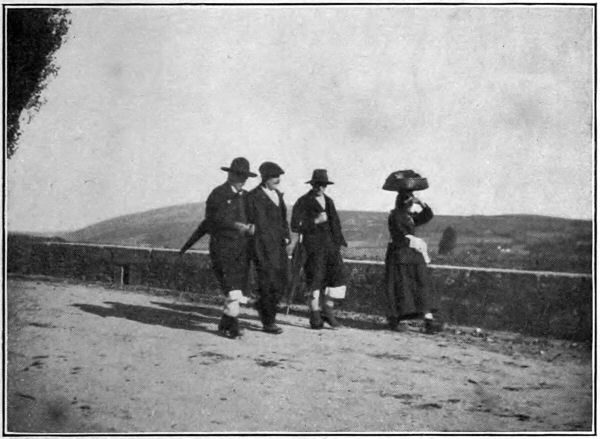
PEASANTS IN THEIR SUNDAY BEST
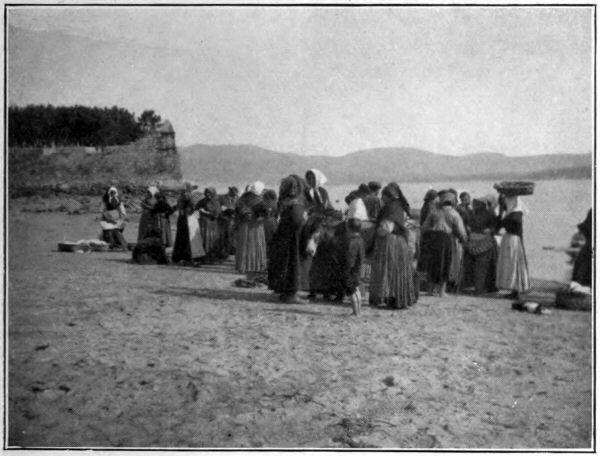
FISHWIVES
Of all this the casual visitor sees nothing, and
perhaps cares nothing. He drives through a
smiling land greener than Kerry, more sunny than
the overrated French Riviera: he lingers in
abundantly supplied markets, where all the fruits of
the earth and ocean seem spread in glowing heaps:
he spins in a comfortable motor-car along good
roads cut upon the steep sides of mountains, and at
every turn of the tortuous way admiring some new
enchanting prospect of far-flung valley, towering
cliffs or smiling fjord. The white cottages with
their attendant conical dovecots and tiny granaries,
their cobs of maize hung to ripen in fringe-like
rows from their verandahs, are, it is true, mean and
dark within; but they form a gracious note amidst
the lush green of never-failing vegetation. Not
even in the depth of winter is the landscape free
from flowers. In February the wallflowers are in
full bloom in the crannies of ancient masonry, and
the sweet-scented mimosa is bent down by the
weight of its masses of yellow flowers; a few weeks
later the starry white and crimson camellias grow
in the open with marvellous luxuriance, and by the
middle of April the cherries are ripe in the sheltered
valleys.
The air blows soft and moist from the sea
through most of the year, tempering the ardent sun
even in the height of summer; and this fact, which
accounts for the marvellous verdancy and fertility
of the soil, also brings with it frequent showers and
mists drifting up the Rias, especially in the winter
and early spring. But the rains are seldom of long
continuance, and the sunshine invariably follows
close upon them, drying everything with wonderful
rapidity and leaving the country more sparkling
and green than ever.
Through such a country as this the traveller
may go by motor-car or railway from one fjord to
another, rarely long out of sight of blue water most
of the way from Vigo to the bellisima Noya, by the
holy town of Padron, where the body of St. James
first took harbour on its miraculous voyage from
the Holy Land to the country that thenceforward
was to be its home. In old times it was part of
the great pilgrimage after worshipping at the shrine
of the Saint at Santiago to trudge on to Padron,
the Iria Flavia of the Romans, and the ancient
Galician verse says:
"Quien va á Santiago
E non va al Padron
O' faz romeria ó non."
Through the Middle Ages a stream of pilgrims
wended their way from all Christian lands to
Santiago. The innumerable stars of the Milky
Way are called by Spaniards "the road of Santiago,"
expressive of the vast concourse of the faithful that
flocked to the Galician shrine.
I have before me as I write a naïve relation of a
German priest, the envoy, by the way, of an
emperor seeking a Portuguese bride, who thought
it his duty on the way to worship at the sainted
tomb of Santiago. His narrative marks quaintly
the immense difference that has come over the
world since the mid-fifteenth century in which he
wrote. On arriving at Astorga the band of pilgrims
who travelled together, and of which he and his
colleague formed part, were advised to go no farther
for the present, as one of the great rieving territorial
nobles, who afterwards gave Ferdinand and
Isabella so much trouble to crush, was ravaging
Galicia and making war on the all-powerful favourite
of the King, Don Alvaro de Luna. The pilgrims
being very numerous, decided to run the risk, confiding
in the harmless and meritorious character of
their journey. Not far from Pontevedra, however,
they fell in with a strong force of freebooters, who
at once attacked them, wounding many and stripping
the whole company to the skin. On their knees,
and in mortal terror, the Emperor's envoys showed
their credentials and prayed for mercy, but no
attention was paid to them, though they invoked
Santiago and all the other saints in the calendar.
They were allowed, at last, to go on the way with
their companions, despoiled and, as the narrator
says, "full of pain, suffering and anguish, passing
through towns burnt and sacked by the marauders."
At last arriving at Pontevedra some kindness was
shown them, and, on foot still, the whole band
trudged on to Santiago. After visiting the shrine
there they walked, as in duty bound, "with certain
pilgrims from Ireland," to Padron, where beneath
the waves they were shown the stone ship that had
brought to the port the body of the apostle. Then
to another shrine at Finisterre also they went on
foot, and finally, their religious duty being ended,
they proceeded on their matrimonial mission to
Portugal.
The streets of Santiago can have changed but
little since those far-off days of pious pilgrimage,
when from all points of Christendom came the
countless thousands to expiate sins or seek salvation.
As the big omnibus from Cornes station bumps and
rumbles into the streets of the ancient city, almost
the only vehicle that ever invades them, a plunge is
made into the centuries of long ago. Narrow slab-paved
streets with dim arcades on both sides, above
which houses of unimaginable antiquity are reared.
Scallop shells adorn the fronts of many of them,
indicating that they were formerly pilgrims' lodgings,
and carved coats of arms with knightly casques
above remind us that in the old days nobles, too,
lived in the streets of the holy city. It looks
almost an anachronism for men and women in
modern garb to wander through these silent streets
and to tread the very slabs worn thin by the pilgrim
shoon of the centuries of faith so long ago.
Though lacking its sacred associations, Pontevedra
in its way is almost as quaint as Santiago. Standing
at the head of its lovely Ria, just where the
river Lerez joins the bay, it is surrounded by
gracious hills backed by the Sierra high aloft. No
words can exaggerate the luxuriant character of the
vegetation all around. As elsewhere, maize and
vines floor the valleys and lower slopes with abundant
fruit trees and a wilderness of flowers. Above are
the oaks, sycamores, and chestnuts, then higher still
the grave solemn pines, crowned at last by bare
rocky summits glittering and gilded in the sun.
The ancient Plaza and Calle Real of Pontevedra,
with arcade-arches so low that most Englishmen
have to stoop to enter them, must present the same
aspect as in the Middle Ages; these very houses
and arcades must have stood as now when Columbus
sailed in his Pontevedra ship to discover the New
World. Whether the great "admiral of the ocean
sea" was, as some have not hesitated to assert, of
Pontevedran origin himself it is difficult now to
decide; but certain it is that many of the Spanish
sea-dogs who guided the conquistadores into the
unknown were men from Pontevedra and the
adjoining port of Marin.
All Galicia is historic ground for Englishmen.
Its bays and harbours have been the resort of
our ships in peace and war from time immemorial,
and here in Pontevedra the English John
of Gaunt reigned for years as so-called King of
Castile in right of his wife the daughter of Peter
the Cruel. Here in the country round the Sotomayors,
the Sarmientos, the Fonsecas, and Montenegros
fought out their endless feuds in which the
warlike archbishops of Santiago took a frequent
part, until the great Isabella with iron hand and
virile energy crushed them all with her hermandad.
Here in the neighbourhood was born that Sarmiento
whom we in England know best, him of Gondomar,
who ruled our crowned poltroon James I. by bluff
and mother wit. To the Sarmientos too belonged
that Maria de Salinas as she is incorrectly called in
our annals, the devoted friend of Katherine of
Aragon, and the ancestress of the house of Willoughby
d'Eresby.
From Corunna, the Groyne, as our forbears
translated it, sailed those numerous futile fleets that
Philip destined to bring stubborn England to her
knees. From the great Armada down to the poor
squadron that sailed for Ireland when Elizabeth lay
dying, Corunna was the trysting-place for England's
foes. Here came the Desmonds, O'Donnells and
O'Sullivans, who hoped to set a Catholic Ireland
under the seal of Spain. Here landed the Irish
bishops and priests who went backwards and forwards
from Killibegs to Spain plotting and planning
for Ireland's emancipation: here Drake and Norris
in 1589 avenged the Armada by a bloody but
fruitless siege, greatly to Elizabeth's indignation.
I have told elsewhere[A] the not too creditable story
of this unauthorised siege in which the strong wine
of Galicia proved a worse enemy to the English
than the pikes and partisans of the brave Gallegan
peasants and their womenkind led by the redoubtable
heroine Maria Pita herself.
But all the blood feud has been forgotten long
ago. The splendid soldier of British blood whose
body lies buried upon the ramparts of Corunna
died for Spain, as did thousands of our countrymen
in that Titanic war to free the Peninsula from the
grip of Napoleon; and Gallegos, high and low,
have nothing but warm Celtic welcome for British
visitors to their beautiful and long-neglected land.
The British home fleet finds a frequent rendezvous
in the magnificent Bay of Arosa, where Villa Garcia
receives with open arms the sailors who come in
peace. This beautiful Villa Garcia and its adjoining
town of Carril, upon the line of railway
from Pontevedra to Santiago, are destined for great
things in the near future. Upon a charming wooded
island, Cortegada, a few cable-lengths only from the
shore, the new marine palace of the King of Spain
is to be built, and the English-born Queen will be
cheered by the sight of the fleets of her native land
lying within hail of her summer home.
Nothing more exquisite can be imagined than
a trip by sailing-boat or steam launch through this
lovely landlocked bay of Arosa. Defended in the
entrance by the storied isles of Ons, the great
inlet looks like a vast lake surrounded by mountains
on all sides. The water is so clear and pellucid
that the bottom can be clearly seen many fathoms
deep. A lofty island, that of Arosa, occupies a
position in the centre of the bay, and on the opposite
side, near the sandy promontory of Grove, the
pine-clad isle of La Toja, with its wonderful healing
hot wells within a few feet of the sea, possesses one
of the finest hotels in Spain.
For, whatever happens with the rest of the country,
this land of Galicia is going ahead at last. Gallegos
who have returned rich from the Argentina are showing
an increasing disposition to invest capital in native
enterprises, and the factories that are springing up
around Vigo are the result. Not only can La Toja
show an hotel of which any country in Europe might
be proud, but, at Mondariz, the establishment in the
high valley of the Tea, which Mr. Wood so justly
praises, is an hotel that will satisfy the most exacting
visitor. If only the terrible exodus of the
able-bodied male population can be checked by
making the lot of the peasant less cruelly hard than
it is, Galicia should be one of the most prosperous
regions in Europe.
As a proof that the present poverty and backwardness
are the result of political causes it may be
mentioned that thousands of Gallegos cross the
Miño every summer and autumn to labour in the
Portuguese fields and return with their hoarded
wage to help them through the winter at home,
much as the Irish harvester serves the English
farmer. There are reasons for the latter, for English
agricultural land is richer than Irish, and racial
causes operate in this case. But the land on the
south of the Miño is much the same as on the
north, the climate is identical, and the Gallegos and
people of North Portugal are of the same stock and
speak a similar tongue. And yet the North Portuguese
small farmer, well off and prosperous, can
afford to hire the man in a similar position across the
Spanish frontier to do his hard work, whilst in Galicia
women do the work of men in their husbands' absence.
The visitor whose aim is but to pass a pleasant
holiday of a few weeks in Galicia, especially without
a good knowledge of the language, cannot hope to
study the unspoilt people in their own homes.
Those whom he will meet in the seaports and along
the bays are to some extent sophisticated and
accustomed to deal with foreigners, but it would
well repay a scholar interested in Celtic folklore to
live amongst the peasants of some of the inland
valleys for a time, to gather some of the traditions
which are yet handed down from remote antiquity
amongst these primitive folk. Like all their race,
the Gallegos are shy and distrustful. Their superstitions
and rites are for them almost sacred things,
but with patience and tact many of their quaint
beliefs may still be gathered from them, as they
have been by the greatest of living Spanish women,
the Countess of Pardo Bazan, whose books upon her
native land of Galicia are redolent of the soil, as are
those of another distinguished Gallego, the Marquis
of Figueroa.
The peasant cultivators of the isolated valleys
and mountain slopes rarely come into the larger
centres of population. Each little local town has its
fortnightly market, where produce and cattle are
sold for money with which to pay the tax-collector
and to buy the simple necessaries not produced upon
the soil. To see the Galician peasant as he is, one
must study him at his local fair, and on one of his
long pilgrimages to a holy shrine. On these
occasions, as on similar occasions with the Irish
peasantry, he is for a time boisterously gay, given
to singing, dancing, and music, the latter being
produced from the native bagpipes, gaita, and
tambour. But in the long winter nights in his
dark cottage, with its smoky fire of vine-cuttings
and pine-cones, the Gallego, like his brother Celt
elsewhere, is moody, poetical and speculatively mystic.
In such surroundings as this the tale of wraiths and
demons goes shuddering round, for the Señor Cura,
who sternly reproves such talk when he hears it, is
safe in his lonely little parsonage adjoining the
village church.
But not alone of malevolent spirits is the conversation
around the cottage fire. Much communing
there is of America, and of kinsmen and friends
who are seeking a livelihood, and sometimes, but
rarely, finding not only that but a fortune in far
Argentina. How Tio Pedro, a returned Indiano
with pockets full of money, is coming to build a fine
house in his native valley; how poor Juanito has
returned ill and homesick without a dollar; how the
good lad Pepe sends the large sum of ten pesetas
every month to his old mother, who is looked up to
in consequence as quite a wealthy woman, and so on—talk
not very different, indeed, from that which
goes on around the turf fire of many a hill-side
cottage in Western Ireland.
And Galicia, like Ireland, is a land of saints and
soldiers. From its mountain fastnesses and those of
its neighbour Asturias, went forth those indomitable
Christians who saved Europe and the world from
the domination of Islam. This was the focus of
mystic religious fervour which made the mediæval
Spanish Christian ten times a man. Here the
ecstatic visions seen by star-gazing shepherds in the
night foretold the final victory of the Cross; here
the blazing emblem of the redemption miraculously
led the Christian hosts to combat; hither to this
land of fervid faith was wafted the body of the
apostle in its ship of stone, to give heart to his
own people; and from time immemorial the stoutest
priests and bishops of the Spanish Church have
issued from the race that alone of all Spaniards
held even the Roman legions at bay, and provided
the spiritual fervour that finally rolled back the
Moor. From Cæsar to Wellington great commanders
have borne testimony to the martial valour of
the Gallegos; and there are no bonnier fighters
even now in Spain than the thickset, stocky little
chaps who are drawn, usually much against their
will, to fill Spanish regiments in distant parts of the
country and in North Africa.
And yet with all their fine qualities, and in spite
of the fact that many of the most eminent writers,
thinkers, and administrators of Spain are natives
of Galicia, Gallegos are often held by Castilians
in derision. To the Gallego with his half-Portuguese
speech is attributed every story which
requires boorish stupidity as its subject, and
the "bull," which English people are fond of
calling Irish, depending as it does upon the mental
process being too rapid for vocal expression, is
considered by Castilians as the special characteristic
of the Gallego.
This is the people, and this is the land, which
Mr. Wood describes in the present volume, with
the aid of the excellent illustrations of Mr. Mason.
To those English travellers who, deserting the
beaten track of tourists, are tempted to see for
themselves this unspoilt pleasure-ground, a feast of
new and pleasant impressions may be confidently
promised. They will find a country of loch and
mountain that will make the Scottish Highlands
seem trivial and tame, they will find a climate as
soft as Munster and as warm as Italy, a vegetation
as green as that of Killarney without the chilling
mists of Ireland.
Drawbacks naturally there are. The country is
backward, and some of the smaller hotels are
lacking in the luxuries that English travellers
expect. But progress in these and other respects
is being made with giant strides. The great
English liners that carry passengers from England
to Vigo and Corunna in two days and a half are of
course excellent, and the principal hotels of Vigo,
Mondariz and La Toja, are all that can be desired.
The hostelries of Santiago and Pontevedra are being
greatly improved, and new modern hotels are in
project. The new Association in Galicia with a
branch in London for the purpose of rendering
the province agreeable to English visitors is already
hard at work stirring up local opinion in favour of
the reforms in accommodation and locomotion that
are needed, and every important interest and
authority in Galicia, from the Cardinal Archbishop
of Santiago to the local town councillors, are
pledged to do their utmost to make this sweet
"Corner of Spain" an attractive and fitting
resort for British seekers after health and
recreation.
MARTIN HUME,
Chairman of the London Committee of
the Galician Association.
CHAPTER I GALICIA AND ITS PEOPLE
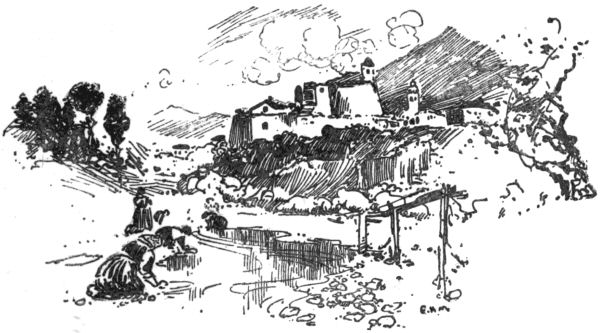
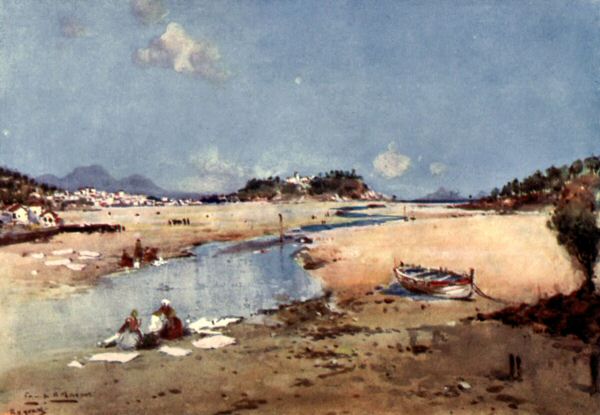
A GALICIAN LAUNDRY
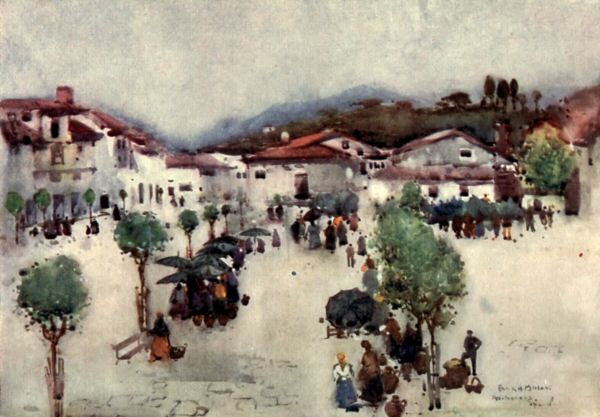

A GALICIAN MARKET-PLACE
Even
Spaniards are sometimes at a loss to say
which part of their kingdom is Galicia, just as
Londoners occasionally pause before locating Yorkshire.
The Englishman confesses either that he has
never heard of Galicia or does not know where the
country is. He imagines vaguely that it is situated
in Poland. There are, indeed, two Galicias,
one north of the Carpathians and the other, of
which I am writing, bounded by the Atlantic and
the Bay of Biscay. Galicia includes Corunna, which
is known to all good Englishmen because of the
burial on its ramparts of Sir John Moore. The
country, too, is associated with Columbus and the
Armada, for the explorer's own ship was built at a
Galician port, and the Armada finally sailed from
Corunna to conquer England. Spain's holiest city,
Santiago de Compostela, is in Galicia.
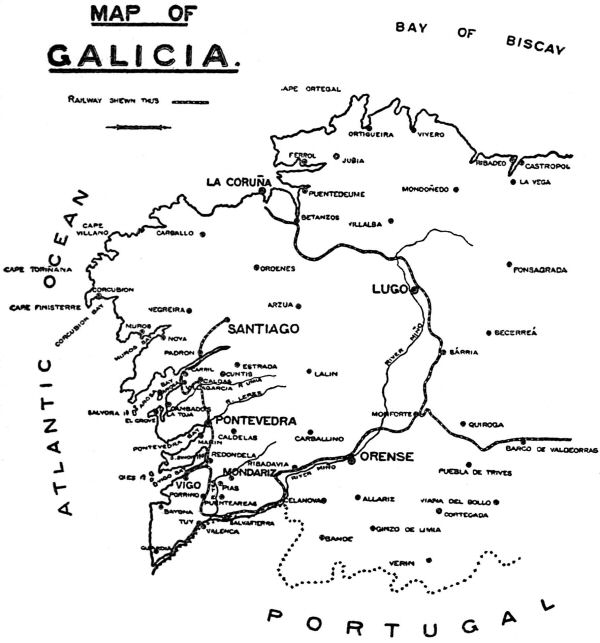
If you consult a map of Spain you will see
Galicia at the top corner, jutting boldly into the
Atlantic, with a coast-line, largely formed of glorious
inland bays, of two hundred and forty miles. No
other part of the Peninsula presents such a wonderful
and majestic frontage to the sea; nor does any
other Spanish province afford greater contrasts of
scenery and people.
This corner of Spain has a history which goes
back to the times of the Phœnicians, centuries before
St. James the Elder, who is to Galicia what Christ
is to Palestine, preached the Gospel on its rugged
shores. Romans and Moors tried in vain to conquer
Galicia, and in Santiago Cathedral there is a
tablet recording the triumph ten centuries ago of
Christians over Moslems at the battle of Clavijo.
There is a famous legend of this celebrated fight.
The Moors demanded from Galicia the tribute of a
hundred virgins, from whom they meant to benefit
their nation's stock, but the monstrous claim inspired
the native Christians with such a warlike
spirit that they slaughtered sixty thousand of the
infidels and drove the Moors out of the country.
Betanzos, an old-world town near Corunna, is
associated with this thousand-year-old belief, and
one of its quaint thoroughfares is called the Street
of the Hundred Maidens.
Galicia is a land of hills. They are seen as soon
as the coast is observed, and no journey can be
made without beholding them. The hills are not
high enough to be called mountains, but their
altitude in many cases gives them a noble and
dignified appearance. Richard Ford called Galicia
the Switzerland of Spain; but there are no hills in
the province to compare with even the range on Lake
Geneva, and nothing to equal the majestic Dent
du Midi; yet those north-western heights have
charms and beauties of their own, and in some
respects are more attractive than the hills of
Switzerland. The Alps allure the climber, but the
day is not remote when the sierras of Galicia will
irresistibly call those travellers who crave for
splendid panoramas and are fascinated by the
chance of sport. Wolves and wild boars still roam
about the lonely hills, remote from man, and there
is abundant fishing everywhere.
The country is well watered, a number of rivers,
of which the chief is the Miño, flowing into the
bays and the Atlantic through its hills and valleys.
In ordinary seasons the streams are insignificant,
but after heavy rains they develop into raging
torrents and thunder over their rocky beds. The
rivers, too, will rise swiftly and to great heights.
At the end of December 1909 Galicia, like the
rest of Europe, was swept by storms, and rivers rose
from twenty to twenty-five feet above their normal
level, destroying bridges, buildings, animals, and
human life. A Galician river in flood is a striking
spectacle, especially a stream like the Miño, which
even in ordinary seasons is a swift and turgid water.
The Miño separates Galicia from Portugal, acting
as a natural frontier from the southern extremity of
the province to San Gregorio. This river has been
well called the Glory of Galicia, and the tourist to
the country would be fully recompensed for his visit
even if he did nothing more than make the railway
journey along the Miño's splendid and impressive
banks.
Galicia's hills abound in granite, much of which is
easily accessible and workable. In many of the country
districts the peasants and small farmers, for the
sake of asking, are permitted to quarry for building
purposes and to secure those thin upright grey posts
which are such a singular feature of the vineyards.
It seems strange that in a land where trees are so
abundant and timber is to be had for the trouble of
felling preference should be given to granite; yet
the stone is easier and cheaper to work than timber,
and on the hills and roadsides men and women are
constantly quarrying the brittle substance. The way
of working and the tools employed are very simple.
Holes are chiselled at distances of about a foot;
then iron or wooden wedges are driven in and the
granite block is separated. The same system of
wedge-driving is employed in getting the props for
vineyards, and the long thin slabs come easily away.
Enormous numbers of these granite supports are
used, and long high walls are often seen, built of
slabs placed upright in the ground and so close
together that the structure looks like solid stone.
Much has been written of the poverty of the
Gallegans, as the people of Galicia are called, and
the sparsity of food and drink for many of the two
million people who compose the population of the
country; but the appearance of the strong and
healthy men and women does not confirm what
writers in that melancholy strain have put on
record. The very maize bread which forms the
basis of the peasant's food has been maligned; yet
no one ventures to belittle porridge as an article of
diet for the conquering Scot. The comely and
powerful fisher-lasses who travel the East Coast in
the herring season do not live in luxury, nor do
their sisters of Galicia, many of whom, in strength
and figure, are their equals. Where the fisher-girl
drinks coffee, tea, or cocoa, the Gallegan woman
takes wine; and she can buy a tumblerful of very
drinkable liquor, red or white, for a halfpenny; for
another halfpenny she can get a piece of bread
big enough for a sustaining meal. Even a Scotchwoman,
however canny, would be hard pressed to
make a midday meal at the cost of a penny.
Fruit, too, is so abundant that it may be had for
the picking, and vegetables are plentiful. There
are grapes everywhere; and though most of the
chickens and bacon go into the towns for sale, yet
there are so many fowls and pigs in Galicia that the
taste of poultry and pork is known throughout the
country. At noon on the roadside working men
and women make a far more varied meal than
the rough dinner of the British labourer. In
England, when the streets are fog-bound, and
navvies and road-makers are content to make shift,
while eating and drinking, with a warm ray or two
from a neighbouring watchman's fire, the Galician
worker is taking a midday meal on the shore of
some glorious bay or river, or on the hill-side in
romantic scenery—and in almost constant sunshine.
In every part of Galicia there are quaint round
pigeon-cots. Many of them are included in farm-buildings,
to which they give an added picturesqueness;
others are perched on summits of slopes, like
lonely watch-towers. There are no buildings in
England which have the appearance of these
Galician pigeon-houses, but there are a few in
Scotland, in the neighbourhood of Arbroath, with the
same characteristics. The Gallegan cannot afford to
cultivate pigeon-rearing as a hobby, and with him,
as with many Englishmen, the birds are kept for
eating purposes. Sentiment is vanquished by utility.
Maize-barns, or granaries, are universal. The
granaries are oblong, narrow structures, mostly built
of granite, but sometimes of timber, and raised on
walls or pillars about a man's height above the
level of the ground. They are noticeable features
of every landscape, and some of them are romantic-looking
buildings, with a cross at one gable and a
pinnacle at the other. In the autumn the granaries
are filled with the maize which has been gathered
from the fields and stripped and dried in the sun.
On village pavements, in fields, on the beach, and in
all sorts of odd corners the cereal is spread out to
dry, and makes glorious golden patches in the
sunshine. Women, helped by children, prepare the
maize for grinding into flour. Primitive methods of
grinding are employed, and crude ways of baking
and cooking, as you may see by entering a Galician
cottage and examining the open, chimneyless fireplace—the
big stone slab on which the fuel burns.
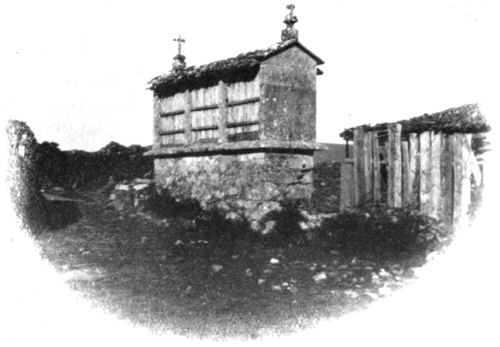
A GRANARY
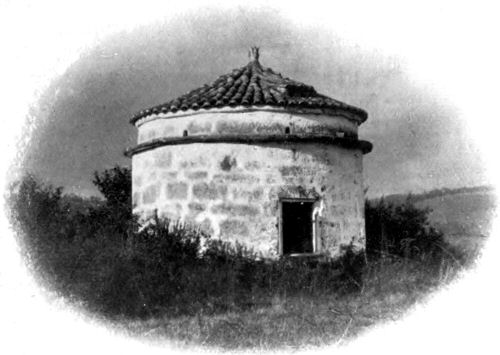
A PIGEON-COT
The cry of the night-watchman, the
sereno,
is of all
Galicia's old customs one of the strangest and most
famous. The
sereno
is a romantic figure, with his
Spanish cloak and gleaming pike—a weapon much
resembling the halberd carried by our Yeomen of
the Guard. While the English policeman in the dark
early hours is gloomily patrolling his beat, his fellow
in Galicia is pacing the quaint streets which differ
little in appearance from their aspect centuries
ago, and every hour he proclaims the time or in
other ways gives proof that he is about and doing
his duty. The ancient town of Pontevedra is
celebrated for the watchman's call. Hourly
throughout the night the
sereno
chants the time,
and the sonorous notes of his
"Ave María purísima,"
Gabriel's salutation to the Virgin, has a singular
effect upon the stranger, awake and listening in bed.
The accomplished
sereno
will not only cry the hour,
but will also, for the benefit of listeners, add interesting
items of news, as, for instance, that love-making
is proceeding on a neighbouring balcony.
The eerie chant lingers in one's memory, and may
be likened to the solemn cry from a steamer's
crow's-nest in mid-ocean of "Lights are burning
bright and all's well." In Santiago and elsewhere
the
sereno
still does duty in the night, but perhaps
the day is near when he will be ousted by the
commonplace policeman. In many of the towns
the watchman whistles every hour instead of
chanting. There are other cries in Galicia which
will interest the visitor, and amongst them is the
protracted musical announcements of the girls and
women of Corunna who are selling fish. They walk
along the pavement with wide, shallow baskets
poised gracefully on their heads, uttering a cry
which makes you marvel that human beings can
maintain it without bringing on that collapse of
the vocal cords which perhaps, in uncharitable
moments, you desire to see accomplished.
In Galicia, as on the Continent generally, the
policeman differs from his English prototype.
There, in addition to being a keeper of the peace,
he is a fighting man, liable to be called upon for
military service. The famous Civil Guard of Spain,
a force which bears the highest reputation, every
member being a specially selected man of thoroughly
good character, has its detachments in Galicia—the
striking-looking fellows with their glazed three-cornered
hats, rifles, swords, and revolvers. A couple
of them are on duty at the exit of every railway
station of importance, and on lonely country roads,
marching on each side, you will come across a pair,
carrying their rifles at the slope, prepared for action.
The purpose of this system of patrol is to lessen
the risk of both men being surprised at once.
The Civil Guards exercise a wide influence over
the people, and to them is largely due the present
peaceful state of the country. The total strength
of the force is twenty-five thousand men, of whom
five thousand are mounted. The cavalry are armed
with sabres, carabines, and revolvers. Comparison
has been made between them and the Royal Irish
Constabulary, and it is a very proper one, although
I think the Royal Irish is physically a finer body.
The Civil Guards have great powers, and are entitled
to take the law into their own hands in extremities,
such as shooting down an escaping prisoner or a
murderer caught in the act.
There is perfect security in travelling throughout
Galicia, either alone or in parties, and even in
the remotest districts the idea of personal danger,
from man or beast, does not enter the visitor's
mind. Probably there is not in North-West Spain
any greater risk incurred than would be experienced
by pedestrians from tramps on the highways of
North-West England.
The ordinary Galician policeman is very much like
a Spanish soldier in appearance, except in Corunna,
where he wears a helmet. His sword is ready to
his hand, and he often carries a revolver and a stick.
He is permitted to smoke on duty; and perhaps not
even the iron discipline of the Civil Guard would
compel the members of the force to abandon the
cigarette. A Galician policeman being at heart a
caballero—which is "gentleman"—will spare no
trouble to put a stranger on the right track, and will
not only direct him to the place he wishes to reach,
but will, in the friendliest manner, accompany him
as far as his duties will permit, smoking contentedly
and well pleased with life.
I saw only one policeman on stern duty in
Galicia, and that was in Vigo, where he was conducting
a belligerent lady to the police-station,
guiding her by a gentlemanly pressure on the arm.
She was loudly and volubly giving her version of
what had happened; and a crowd of bare-headed or
shawled friends added their voices to the confusion.
They were all probably swearing to things which
they could not possibly have seen. At Vigo also
I noticed a constable, old enough to be near the
superannuation stage, trying to preserve the peace
between an aged peasant and an ill-conditioned
juvenile who might have been his grandson. At
intervals the old man paused to cuff and persuade
the boy, and the policemen seemed to form one of
the little crowd which accompanied and watched
the performers. I followed them for a short distance;
then, as there was no prospect of an arrest,
I walked away.
The constable in every land attracts one's notice
and commands respect. Much at times depends
on him; also on chambermaids and waiters. Both
these types of servant compel attention in Galicia,
if only for their odd and interesting habits. A
Galician chambermaid, who from her appearance
might be anything from a respectable charwoman
to the mother of a promising family, does not know
the meaning of ceremony; at any rate she does not
stand upon it, and will break into your bedroom
with the morning coffee without warning, and
derive intense amusement from any timidity or
embarrassment due to her abrupt appearance. She
is too primitive to be disturbed by trifles, even such
as gazing upon her when she tucks up to sleep on a
couch in the hall of an hotel at the foot of the
main staircase—a post she occupies, apparently,
to meet the necessities of belated or early-going
travellers.
The Galician waiter is remote from the rest of
his kind. In the two palatial establishments which
the country possesses he figures, during the season,
either in orthodox swallow-tails or a livery approximating
to the garb of club attendants at
home, but generally speaking he is not so smart.
In the morning he presents a slovenly appearance,
because breakfast, as Englishmen understand it, is
either an unimportant or a non-existent meal, and
the waiter is reserving his energies for the feast that
counts, the lunch. The native is content to start
the day on coffee and a roll without butter—for
which omission he has reason for gratitude, because
Galician butter is neither good nor plentiful—or
on a small cup of chocolate and bread. If he
favours coffee he takes it from a basin, with which a
dessert-spoon is supplied, enabling him to deal with
the liquid as he would absorb soup, or he drinks
it, Christian fashion, by way of the vessel's rim.
The chocolate is a concoction so thick that a spoon
or bread will stand upright in it; yet the preparation
is delicious in the estimation of those who like
it, especially when taken with a frothy sugar, which
is served in a glass of water—a creation which
looks like frozen beaten white of egg, and is almost
large enough to fill the tumbler. With this
chocolate and bread the Spaniard bears the burden
of the day's battle until the real breakfast is served;
then indeed he makes up for any loss he may have
suffered after rising.
The midday meal is heavy and bewildering, from
the English point of view. Hors-d'œuvre will
begin the feast—excellent olives, sardines, anchovies,
appetising little salads and other oddments;
then come heavier dishes, succeeded by soup and
fish—all things reversed, as it seems, compared
with English order and arrangements. There is a
very palatable and wholesome dish called
caldo
gallego, a soup which is as peculiar to Galicia as is
bouillabaisse to Marseilles. Incidentally I may say
that I had bouillabaisse as good in a Galician hotel
as in one of the best hotels of France's southern
seaport where I tried it—a dish which would have
moved even Thackeray, its great admirer, to expressions
of applause.
"This Bouillabaisse a noble dish is—
A sort of soup, or broth, or brew,
Or hotch-potch of all sorts of fishes,
That Greenwich never could outdo;
Green herbs, red peppers, mussels, saffron,
Soles, onions, garlic, roach, and dace:
All these you eat at Terré's tavern,
In that one dish of Bouillabaisse."
You may not eat all these good things in the
Galicia bouillabaisse as Thackeray did at Terré's
tavern in Paris; but the caldo gallego is as rich
and varied in vegetables as bouillabaisse is in marine
delicacies. The caldo Gallego has the advantage
of freedom from that taint of garlic which is so
repellant to the English palate.
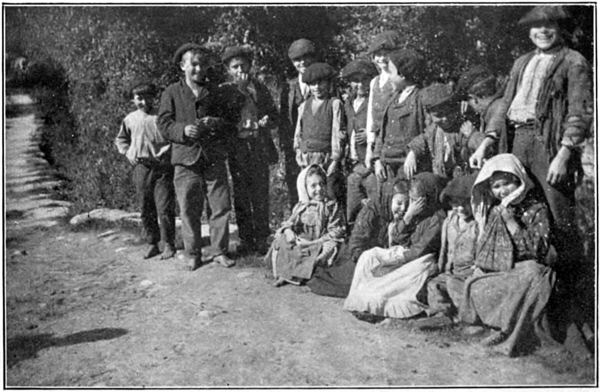
A MERRY ROADSIDE GROUP
A peculiarity of service in Galician public dining-rooms
is the piling up of plates before you. The
stack is gradually lessened as you get through the
courses. Free use may be made of your private
cutlery to help yourself to salt and pepper, after
the custom of the Continent. The wine is placed
on the table either in bottles or decanters. There
is a tendency to tire of the wine and crave for
English beer. This is obtainable in the principal
hotels and cafés, but only at a heavy charge, a
bottle of ale costing more than a bottle of ordinary
wine. Being specially brewed for export, the beer
is not equal to the article which is bought at home.
Very good Spanish lager can be had, especially in
Vigo, at the bar in the Calle Velazquez Moreno,
opposite the post and telegraph office. At that
place, also, excellent afternoon tea is served. To
my regret and financial loss, I did not discover
this welcome retreat until two or three days before
the Antony bore me from Galicia.
By the time déjeuner is served the waiter has
become himself. He has assumed a collar and a
dinner-jacket, and bustles round with every wish to
please his customers. He takes a real interest in
them, and, given proper treatment and consideration,
there is no trouble to which he will not go
to meet an expressed or implied wish. He can be
led like a lamb, but if any sign is shown of driving
him he displays the mule's unpleasant attributes.
I remember that at one hotel, into the dining-room
of which I wandered early in the mornings, an
elderly waiter, coatless and collarless, with a soiled
napkin over his arm, ignored my existence for a
day or two. He was performing the task of a
frotteur, skating, in melancholy, meditative fashion,
over the polished wooden floor, with a rag-bundle on
his right foot. He would slide past with an air
of almost grotesque seriousness, so intent on his
work that he failed to see me; at least that was
the impression made on my mind. Commands in
ordinary English to produce some breakfast failed
to move him; yet when, in due course, on entering
the room, I greeted him as a man, a brother, and
especially a caballero, he skated elegantly to the
mysterious region where the coffee was prepared, and
ceremoniously produced not only coffee and rolls, but
also butter. One morning I desired Rocquefort—to
his polite but palpable amazement—and thereafter
he conceived that no British breakfast was complete
without the cheese concomitant. At this hotel the
butter was very good—a native product with a
cheesy flavour; in other hotels Danish butter in
tins was provided. Galicia can produce first-rate
butter, yet the Gallegans go to Denmark for the
article, and bring it over land or sea—or both—in
tins. One of the remarkable things
about Galicia is that although the country is
so productive, still in many cases there are no
adequate systems of making the most of natural
resources.
A great change, however, is taking place, and
some of the richest and most enterprising public
men in North-West Spain are devoting themselves
with enthusiastic zeal to the task of awakening the
people and making them realise the immense possibilities
of the province. Energetic measures for
development are being taken by the Asociación
para el Fomento del Turismo en Galicia, of which
prominent members are Messrs. Miguel Fernandez
Lema, ex-Lord Mayor of Vigo; Manuel Olivie, the
Town Clerk, who is a well-known author; Eladio de
Lema, Director, El Faro de Vigo; Jaime Solar,
Director, Noticiero de Vigo and Vida Gallega;
Manuel Borrajo, President, Asociación de Cultura;
Angel Bernandez, writer and secretary of the Asociación
Fomento Turismo; Guillermo de Oya, President
of the Asociación, and Dr. Ildefonso Zabaleta,
Medical Officer of Health for Vigo Harbour. Mr.
Frederico Barreras Masso, one of Vigo's most distinguished
citizens, is doing much to bring Galicia
into closer union with Great Britain, and all these
efforts are being zealously fostered and supported by
residents like Mr. Ricardo Rodriguez Pastor, of
Corunna; Mr. Thomas Guyatt, the British Vice-Consul
at Corunna; and Mr. R. Walker, the British
Vice-Consul at Villa Garcia.
Most of Galicia's business is transacted in the
open air, and much of it concerns the handling of
live stock. In the larger towns, like Santiago,
there is a weekly cattle market, where dealers and
peasants assemble from the surrounding country,
travelling by diligence, bullock-cart, pony, mule, or
on foot, and making a wonderful congregation of
human beings, from the pure gipsy type to the
thorough Gallegan. Girls and women are everywhere,
driving cattle, carrying great round baskets
crammed with fowls, which are kept quiet and in
place because their legs are tied, or piloting pigs.
Native swine are not amenable to discipline, and the
custom is to tie a rope or piece of string to one of
the hind legs and let the beast go ahead. In the
market the squealing animals are imprisoned by this
method. Sometimes a quicker system is adopted—that
of conveying pigs in sacks slung pannier-wise
across the back of a mule or pony. This practice
does not apply to full-grown animals; it is the
smaller fry that are subjected to the indignity.
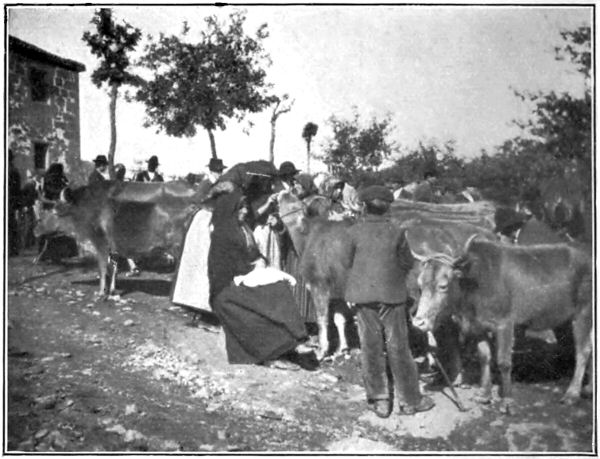
A CATTLE MARKET
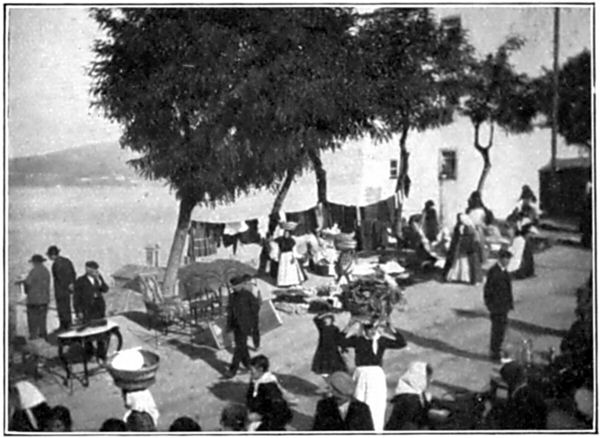
AN OPEN-AIR MARKET
At Santiago market a peasant drove a mule past
me with two sacks from the depths of which came
muffled screams. He shook the sacks, and from
each a little pig was shot to the ground, uttering
piercing squeals, then, after the hind leg had been
secured, settling into a continuous grunt of protest.
Bargaining and wrangling were going on all round
me, to the accompaniment of choruses of squeals
and grunts, crowing of cocks, cackling of hens, and
lowing of cattle. Business was conducted on simple
lines—prodding of pigs' ribs, examining of oxen's
mouths and other points, and lifting and calculating
the weight and general promise of table and
laying birds. Prices having been arranged, payment
was made; and I was surprised to see how many fat
silver dollars were poured from ancient purses and
money-bags by peasants whose appearance conveyed
the impression that they were almost destitute.
Pontevedra is a great cattle centre, and enormous
markets are held there two or three times a year.
Herds of cattle monopolise the roads at these
seasons, making motoring and driving a slow and
laborious business.
This universal open-air life is in marked contrast
to the dark and unwholesome dwellings of
the lower classes in Galicia. The cottages in the
country districts are in many cases mere hovels of
the most primitive type, often enough without
windows and admitting light only by the doorway.
Fowls and quadrupeds share the establishments with
their owners, and pigs grunt joyously in the room
where the master and mistress and children take
their rest—frequently on a bed as crude and
dirty as that on which the porkers sleep. In this
respect the Gallegan peasant somewhat resembles
his prototype who is found in country places in
Ireland which are remote from towns. In the
principal centres of population, however, the people
are much better housed and the municipalities
exercise a far more rigid sanitary supervision.
Most things are done in Galicia on the seductive
system of mañana—to-morrow. It is useless to
attempt to hurry people. Not even the demands
of telegraphy will rouse them to robust activity.
To send a telegram is a serious and impressive
undertaking. First you find your telegraph office,
which even in a city like Santiago is hidden in
the shadow of the cathedral. Then you enter,
and discover that you are in the wrong part of the
premises, being in the operating office. A cigar is
burning on the table, while the clerk to whom it
belongs is talking with his colleague, the transmitter
meanwhile tapping lazily. Even the instruments
seem to be possessed with the spirit of languor.
Finally an individual comes who, after showing
almost pained surprise at your unseemly energy,
conducts you to the proper place, and ceremoniously
gives you a telegraph form and a pencil. When
the message has been written and handed in, and
you have put down your payment, you reasonably
assume that the exhausting transaction is completed,
and that you are free to depart. Not so—you are
in Spain, where hurry is indecency. The change is
not ready, and when it does appear the coins are
accompanied by a triangular receipt torn from the
message, giving details of the telegram and the price
which has been paid for it. Then triumphantly
you go away, blessing Spain; but the fervour of
your benediction is nothing compared with your
expressions on learning that the telegram has not
been delivered in England because of a misread
address. It is useless either to wail or to protest,
since the one would be ineffective and the other
too late. Stamps are bought mostly at your hotel,
where the letter-box is kept to be emptied by
the postman. There are no street pillar-boxes in
Galicia. I saw one, a ramshackle, red-painted
structure, bearing a resemblance to a rabbit-hutch,
hung outside a general store-shop in a village, and
gathered that the enterprise shown in displaying
the receptacle was unexampled. When an ordinary
post office is not available it is customary to place
letters in the hotel box.
It cannot be said that Galicia is rich in works
of art. Some of the paintings which adorn the
churches are neither very good nor interesting, nor
are the examples in the castles such as to claim
more than passing notice. But travellers will
not journey to the country for the sake of seeing
what they can get so well at the Louvre, the
National Gallery, the Tate Gallery, the Wallace
Collection and elsewhere. They will go to see the
land and its people, and to wander through the
old-world streets and squares and market-places,
which have charms unrivalled in any region within
such easy reach of England.
Two things are inseparable from the Galician—his
cigarette and his umbrella. His tobacco is
cheap, and much of it is good, so that he can enjoy
at little cost the weed which is as much a man's
necessity as luxury. For cinco centimos, a coin
which sounds imposing, but whose value is less than
a halfpenny, he can get seven hand-made cigarettes.
True, when I bought two packets from a dark
Spanish lady in a darker shop she warned me that
they were known as "men-killers," but I have
smoked worse in England at a higher price. The
better qualities are relatively cheap. The Galician
cigarette is made of dark, dry, loose tobacco, rolled
in a gumless paper, with the ends folded to keep
the particles from escaping.
The umbrella answers two purposes—to keep the
rain off in wet weather and to serve as a shelter
from the sun. I observed men with umbrellas
slung at their sides under their coats, like swords,
and I suppose the crook-shaped handles were suspended
from hooks stitched to the waistcoats.
At every turn there is something unexpected in
Galicia. On going back to my hotel one night I
wished to develop some films. I had neither
chemicals nor means of doing the work, but learned
that in the village there was a competent operator
who would develop the exposures. I asked for
directions as to how and where I should find the
skilled performer. It was long before I learned
that he lived in a house at the top of the village.
A guide was needful, and he came—a waiter from
the hotel, carrying a paper lantern with a candle.
He led the way across a field, then up a rugged
path, puddled with recent rain, and from that to
the rocky, steep bed of a little stream running
down the side of a hill they call the Devil's
Boulders. The scene was such as may be found in
Morocco, when the Moor or negro who pilots you
carries his ancient lamp to light your path, or in
the Catskills, or the Middle West, where the same
friendly office has been performed for me in the darkness
when crossing lonely fields or penetrating woods.
Up the gulley for some hundreds of yards, now
stumbling on a small boulder, now plunging into
deep mire with a prickly, unseen bough unexpectedly
touching your face or hands—then a halt
at a gateway leading from the gulley, and a hail to
which there was no answer. Up the gulley still
farther, and a pause and rattle at another gate,
through which a light could be seen, and the
answering hail. Then came an elderly man with
a lighted candle and begged us to enter. We
descended two or three stone stairs, crossed a small
flagged yard, and went into a store-room, with
heaps of onions lying on the floor and other food
and articles dimly outlined by the candle and the
lantern. Thence we went into a comfortable living-room,
where a woman who was busy with her
mending smiled upon us, and a little girl gazed at
me something after the manner in which in the
days of our youth we believed that our forefathers,
as children, would have looked upon Napoleon if
they had seen him in the flesh. This was the house
of the photographer—a farmer; but he had no
means, he explained, of getting artificial light for
developing, and must wait till daylight before he
could fulfil his task. The films were left, and the
farmer led us through his vineyard to the gate.
Before we reached the gulley which was our homeward
path he explained that a clear little stream
ran through his grounds, and that in it he washed
his films, plates, and prints.
Vineyards are everywhere in Galicia, and some
of their wines are excellent, notably those from the
districts of Orense, Amandi, Valdeorras, and Rivero.
On the self-contained estate of Mondariz a first-rate
wine is grown which is provided free for
visitors. In most places the hotel charges include
wine. Occasionally the vintage is not palatable
enough to suit the traveller, but at a very small
cost a superior brand may be had to take the place
of the unsatisfactory product. A capital red wine
is served without charge at lunch and dinner on
board the Booth liners.
There is abundance of wine in the country; but
some of the peasants do not take it, preferring the
pure water from the hills. The vast majority,
however, are wine-drinkers; yet there is none of
that degrading drunkenness which one may see in
every part of Britain. I noticed only one intoxicated
person in Galicia, and that was on a Sunday
afternoon at Caldas, when an aged peasant, in
frilled knickers, was staggering down the road, as
near the middle as he could keep, but occasionally
lurching towards the gutter and the walls of the
houses. He was perfectly harmless, and very
affable, and occasionally paused and supported
himself against a house side and reproved the
juveniles who followed him and offered pointed
criticisms on his state. The spectacle was rare
enough to claim attention and provoke derision.
In England the toper would have been unnoticed.
In the principal towns there is at least one club,
and the stranger has no difficulty in getting admission
for the purpose of seeing the newspapers
and spending a pleasant hour. The English
clubman shrinks from the vulgar public gaze, but
in Galicia the member loves to be as near his
fellow-creatures as he can get. Usually he sits at
an open window on the street level, within easy
touching distance of the passer-by. The clubmen,
like all the residents of the country with whom the
visitor may come in contact, are most hospitably
disposed towards him.
The British tourist has become accustomed in
his own country to hotels which are more than
comfortable—they are luxurious—and when he is
abroad he expects their equal. In Galicia, until
recently, he could not get it; yet now, at
Mondariz and La Toja, he has the choice of
palatial establishments which are unrivalled in
Spain. The visitor may reach Galicia by way of
the Channel, spending about three days in trains,
or journey direct by sea, landing at the gate of
Galicia, which is Vigo. For that part of the
undertaking he is thoroughly equipped by the
Booth Steamship Company, Limited, whose powerful
and splendid modern vessels have the reputation
of being the most comfortable of all that cross the
Bay of Biscay.
CHAPTER II VIGO BAY AND HILLS
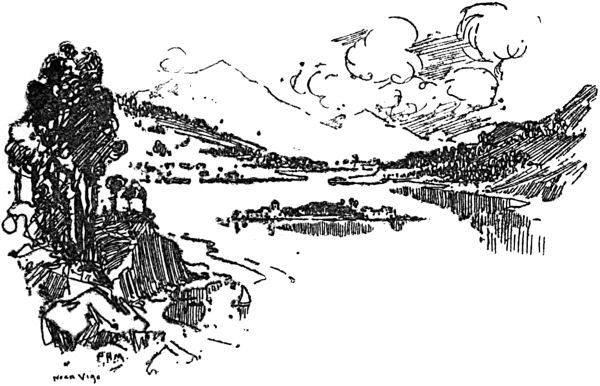
SAN SIMON'S ISLAND, VIGO BAY
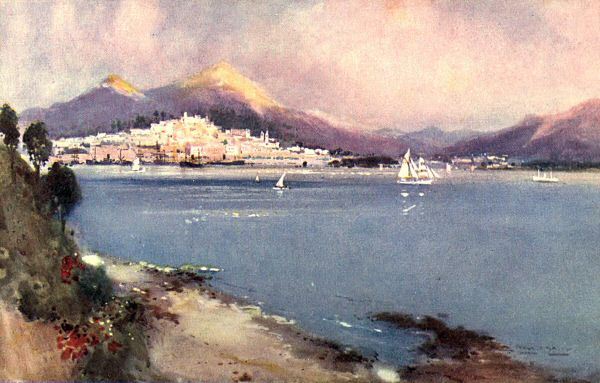
VIGO, GALICIA'S GATEWAY
Iron
cliffs confront you when you first behold
Galicia, for the earliest glimpse of North-West
Spain, when the Biscay has been crossed, is Cape
Villano, rising, stern and rugged, north of Finisterre.
The coast looks grim and cheerless, yet it is the
gate to one of Europe's warm and most romantic
regions. Every mile of it is linked with history,
and, hidden in what look like gloomy fastnesses of
the Atlantic, are sun-bathed, landlocked bays, of
which the best known are Vigo and Arosa, forming
two of the finest natural harbours in the world.
The Ambrose slipped past the Cies Islands, at the
seaward side of Vigo Bay, in the darkness of an
early autumn morning, and steamed up the placid
inland sea as day was breaking. In Galicia the
dawn and twilight are briefer and more splendid
than in England. The Cies Islands are some fifteen
miles from Vigo, and the Ambrose, steaming steadily,
will do the distance in an hour. Her masthead
and side lights were burning brightly as she passed
the lonely lumps of land which jut up like ragged
teeth on Galicia's seaboard; yet when her cable
rattled and her anchor dropped within a stone's-throw
of the jetty the sun was shining and the day
had fully broken. Through my porthole I had
seen the flashing light on the islands, and I had
hurried up on deck to watch the sun rise in the
east, beyond the church-topped hill which forms
one of the Seven Sisters. The Seven Sisters are
hills in the neighbourhood of Vigo, each being
crowned with a church and bearing a special name,
such as Nuestra Señora de Alba.
Vigo is Galicia's chief portal, and offers ready
means of access to the other parts of the province.
The town affords wonderful contrasts between the
old and new worlds which jostle up against each
other in every part of North-West Spain. You
are in a quaint, strange world as soon as you have
stepped ashore and are clear of the Customs and
free to roam. In the steep and narrow streets of
the old town people lead the primitive life of many
generations or centuries ago. Amongst them are
men clad in brigand fashion, with sombreros, and
shawls thrown over their shoulders—shawls so
showy and highly coloured that they might well do
duty as table-cloths. You may pass from such a
sight into the thoroughly modern technical school,
which, founded by private and philanthropic
enterprise, is equal to any institution of its size in
any corresponding English town, and is helped by
the municipality to the extent of three thousand
pounds a year. In the afternoon the señoritas may
learn dressmaking and millinery and modelling in
clay; in the evening the caballeros may grapple
with appropriate subjects, under competent guidance.
The working classes are educated free of charge, and
the better-to-do pay ten pesetas—equal to
eight shillings—a year for mental culture.
Just outside Vigo ploughs may be seen which are as
crude as those the conquering Romans used, yet in
the town there is a new flour-mill worked by
electric power, where the product of the plough is
turned into flour, and only a few men are needed to
attend to the machinery. Vigo offers many of the
contradictions between the very old and the
essentially new which are to be found in Galicia.
There is not much to see in the way of public
buildings; but there is the fish market, best
visited early in the morning, when the building is
crowded with women who are buying, selling, and
handling the catches which have been brought in
from the bay and the Atlantic; and the vegetable
market, where also the women are the principal
attendants. These two places give evidence of the
marvellous fecundity of land and sea. There is
abundance of fish and a bewildering display of
fruits and vegetables. Many of the creatures of
the sea are strange to English eyes, and not
agreeable to English palates. There is the revolting
devil-fish, and the more repulsive ink-fish;
yet both, when properly cooked, are far from
unappetising, and the tourist, by way of experiment,
may have the fortitude to try them.
The sword-fish makes an excellent course; and
there is a plentiful supply of oysters and other
shell-fish. The commonest fish of all, however,
is the sardine. It is larger and coarser than
the sardine with which English people are
familiar, being the size of a small herring, but
it makes a very good dish, and the finest
specimens, when cooked in oil or tomatoes, and
packed in tins, are delicious. In Vigo, for breakfast,
you may have a dish of big sardines, cooked to
your liking, which have formed part of the previous
night's catch.
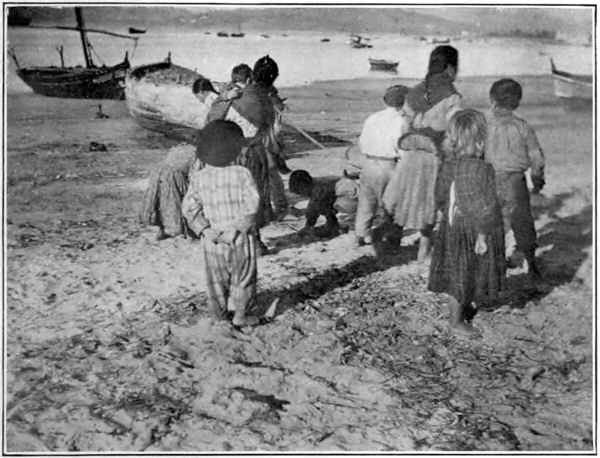
GALICIAN CHILDREN
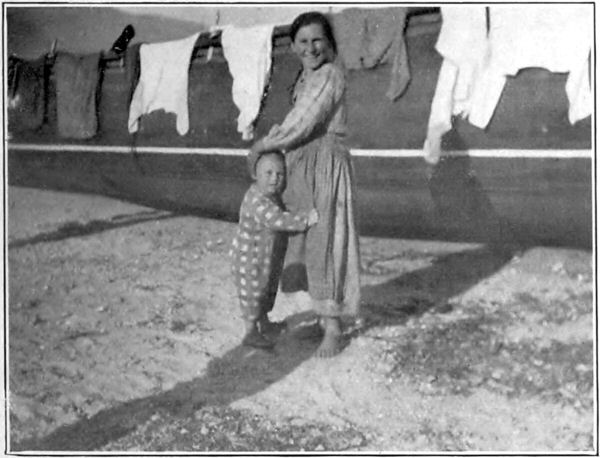
AFRAID OF THE CAMERA
Vigo's Alameda skirts the glorious bay, and
is a fine promenade along which one may stroll
and enjoy the scenery and study something of
the local life. The road is smooth and asphalted,
purely modern, yet on its perfect surface an
ancient bullock-cart will come, slowly drawn by
oxen. I watched one of these vehicles going
towards the Custom-house, pursued by an enterprising
Spanish child, who watched her chance
for a cheap ride. It is no hard matter, even
for an infant, to overtake a bullock-cart, and
the girl clambered up and experienced the fearful
joy of a stolen passage. The driver was somnolent,
and the journey looked promising, until he
was roused to action by the raising of the
Galician equivalent to the English alarm of
"Whip behind!" For a moment the infant
defied him, and apparently reflected unfavourably
on the driver's origin; but a swish of his long
driving-stick made her tumble off precipitately.
But her spirit was unchecked, and, pulling herself
together, she accompanied him at a safe
distance and continued her taunting criticism.
I took a snapshot of the fractious juvenile just
before she regained the asphalt, and while she
was telling her compatriot what she thought
of him; but an incompetent developer spoiled
the exposure, as he ruined many others. It is
a comforting reflection now—such is the mellowing
effect of time—that though he was unable
to appreciate the technical advice I gave him in
English, yet he also did not realise the force of
my additional remarks when I criticised his work—indeed,
when I left he raised his hat, and in
the politest and most polished manner wished
me, so I gathered, continued health and prosperity.
The Galician who has wronged you has a wondrous
gift for making you understand that you
are the offender.
A noble view of the surrounding scenery is
obtainable from the Castillo del Castro, whose
old fortifications are more than four hundred feet
above the level of the bay. As the castle is in
the nature of a fortress and sentries are on duty,
admission is not given to the public, but the visitor
may wander about freely, and the climb is worth
the trouble for the sake of the panorama.
Vigo has a strong and enterprising municipality,
and the city is giving evidence of what can be done by
earnest and united enterprise. On the opposite side
of the bay, for example, is a prosperous community
called Moyna. Eight or nine years ago the place
consisted of only a few houses; yet to-day the green
hill-side is dotted with white buildings, due to the
development of the fishing industry. Near it is a
little village nestling in a hollow at the foot of the
mountains which rise from the bay in a fertile
sweep; so sheltered is the spot and so balmy is the
atmosphere, so continuous and beneficent is the
sunshine, that from the water's edge to the summit
of the range, palm-trees, which are rare in Galicia,
flourish and orange-trees abound.
On every side there are majestic views, and at
the head of the bay, rising beautifully from the
calm blue water, is the island of San Simon. In
ordinary times this is the lazaretto, or quarantine
station, but for fifteen years it has not been
necessary for the buildings to be used for sickness
or suspected cases. San Simon is one of Spain's
three quarantine stations, the other two being at
Santander, on the Biscay coast, and at Port Mahón,
in the island of Minorca, in the Mediterranean.
The little island overlooks the inlet in which
treasure-ships were sunk two centuries ago, and
the buildings upon it are being modernised and
equipped with scientific apparatus at a cost of
£4000. The island is State property, but it is
administered from Vigo by the Director of Public
Health, with the co-operation of the mayor and
corporation. At the end of the war in Cuba
eight thousand repatriated soldiers were treated on
the island, and it speaks well for the healthiness of
the place, and the devotion of the Sisters of Mercy
and the skill of the doctors, that only sixty died.
There is a delightful avenue of boxwood-trees,
spoiled, unfortunately, by the foolishness of a former
housekeeper; excellent boating is to be had; and
just by the island there are first-rate oyster-beds
and plentiful fishing. In the sand a small fish is
found which has a habit of burying itself, and at
low water the women go forth and dig the creature
out of its burrow.
Nothing can be more peaceful and beautiful than
the sail down Vigo Bay at eventide, after spending
a few hours on the island; for the sun is setting in
the Western Ocean and flooding Vigo Bay with
golden light, against which the seaward hills and
Cies Islands stand outlined in a solemn purple.
Treasure from galleons of Spain lies buried in
Vigo Bay. The story goes that at the beginning of
the seventeenth century allied British and Dutch
ships, under Admirals Rooke and Stanhope, attacked
the famous Silver Fleet, which was lying at anchor,
and captured much of the gold and silver. Some
of the vessels which were not taken were sunk, and
their precious cargoes foundered with them. For
more than two hundred years the galleons have
rested at the bottom of the bay. Many efforts
have been made to recover the treasure, but Vigo
Bay is deep, and so far the attempts have not
succeeded. But the story is not strictly true, nor
is it correct to say that the treasure-ships were
destroyed just at the entrance of the bay. The
actual place of their ill-fortune was at the head of
the bay, towards San Simon's Island, where there is
a narrow channel. Two centuries ago there were
fortifications on each side of the channel, which is
called the Strait of Rande, and the ruins may still
be seen at the foot of the hills. At that time
Cadiz had the sole right to receive treasure
from Spain's foreign possessions, and to that port
a fleet of galleons laden with precious freight was
bound. But there was war with England and
Holland, and the treasure-ships, which were merchantmen,
and of lighter draught than the opposing
ships of war, were ordered to seek shelter at the
head of Vigo Bay; and thither they scurried, finding
refuge in the shallower water behind the entrance
of Rande. A chain was drawn across the strait
as an additional protection. For several weeks
the hunted vessels lay securely at their anchorage,
and meanwhile much of the treasure was taken
ashore for conveyance to Madrid.
Fifteen hundred treasure-laden waggons, drawn
by oxen, started for the capital. There is a saying
in Spain that he who handles butter will get greasy,
and by the time Madrid was reached the fifteen
hundred waggon-loads of gold and silver had
dwindled to five hundred; so that two-thirds of
the precious cargoes, having escaped the clutches of
the English and Dutch, had fallen into the not
less rapacious hands of Spaniards. The missing
treasure does not appear to have been recovered,
but in Vigo until quite lately walking-sticks and
other articles could be bought which had been
made from wood raised from the sunken galleons.
I asked if they were still to be purchased, and was
told that the supply had run out, though I
gathered that I should have no difficulty in getting
such a relic made to order, after the style, I
suppose, of momentoes of our own Royal George.
The hills surrounding Vigo Bay command most
glorious and extensive views. On one of them is the
Castle Mos, a summer residence of the Marquis de
la Vega de Armijo, the head of one of the noblest
families in Spain. As castles go, it is not large,
but by reason of its history and association the
building is amongst the most famous in Galicia.
The late King of Spain, Alfonso XII., visited it
three times, as a record in the castle testifies,
during the residence of the late Marquis, who was
Spain's Prime Minister, and died in Madrid in
1908. He was taken from the capital to the
castle, where he was buried beneath the floor of the
tiny private chapel in which he had so often
worshipped. The chapel is part of the interior.
Outside, within the walls, is a miniature theatre, in
which performers and audience were either members
of the family or visitors. There is a keep which
was built six hundred years ago. It forms the
oldest part of the castle, and the walls are so
enormously thick that to look through one of the
narrow windows is like gazing down a corridor.
The main room is a small armoury, beneath which
is a dark apartment, reached by a ladder from a
trap-door in the floor. This basement, now used
as a wine-cellar, was formerly a dungeon, and at
one time held a bishop prisoner. The castle has
been modernised inside, and in recent years restorations
have been made to the exterior; but neither
within nor without has anything been done to
make it hard for the visitor to picture accurately
the former house of a grandee of Spain. The old
keep is in perfect repair, and the inner and outer
walls stand as they were when wars raged fiercely
in Galicia. The muzzles of some small old guns
stick out of the embrasures, and you can raise and
lower them slightly, for their trunnions are fixed in
iron rings let into the walls, and one can realise
what a slow business artillery firing was in the days
when these quaint, open-breached ordnance were
used for fighting. I was told that the guns were
captured from the English in the days of Elizabeth.
The castle grounds are beautiful and extensive, and
full of charm and romance. There are some
magnificent eucalyptus-trees; fine examples of the
arbutus, whose fruit, something like strawberries, is
rich and delicious; orange-trees, from which, in
glorious November sunshine, I plucked sweet
tangerines; and the botanical curiosity popularly
known as the monkey-puzzler. Chestnuts abound
here, as in Galicia generally.
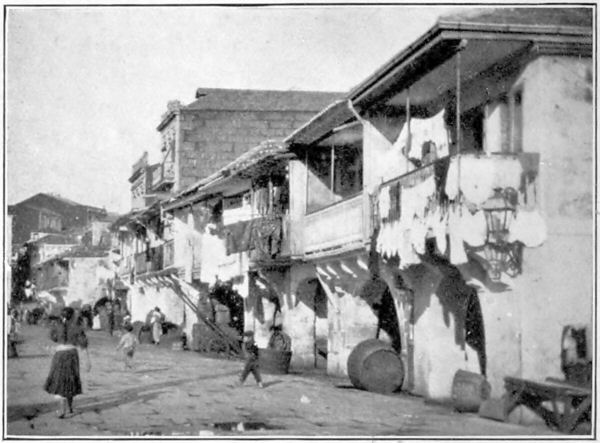
ON THE QUAY AT VIGO
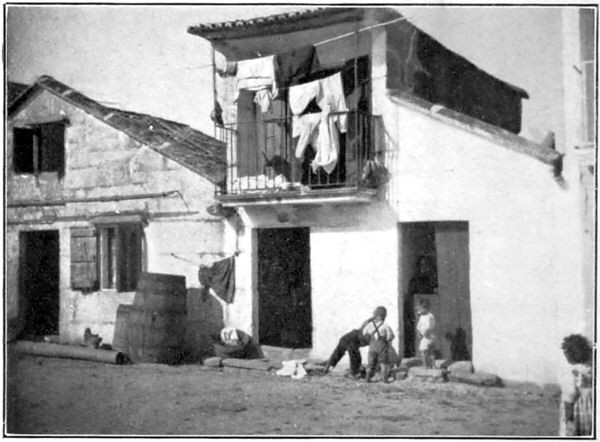
FISHERMEN'S COTTAGES AT CANGAS
Across Vigo Bay, looking like a white streak at
the foot of the hills, which are bare and bleak at
the tops, but fresh and green at their bases, lies the
little fishing town of Cangas. A small steamboat
which plies regularly between the two places makes
the journey across the blue water in half an hour,
and on stepping ashore at the primitive pier you
can realise what Vigo was like not many generations
ago. There is no plan in the arrangement of
Cangas; the houses are placed where they fit best,
and the streets follow the houses. Oil-lamps give
illumination to the straggling thoroughfares, yet
inside the quaint dwellings there is electric light.
Cangas has its old church, whose dimensions are out
of all proportion to the size of the town to the
English way of thinking, and smaller places of
worship, one on the sands, built in 1711.
The church, which is named after St. James, is
dark and bleak inside. I visited it the morning
after All Souls' Day, and saw in the middle of
the floor a high structure covered with black cloth
and ornamented on four sides with skulls and cross-bones
in white. Rising from the gloom, after
entering the church from the brilliant sunshine,
the reminder of the grave looked ghastly. The
air was heavy with the smell of incense, and
peasants were kneeling and praying. One old man
was wiping away his tears and gazing at some
object in the semi-darkness which I could not
clearly see. I walked up to it, and saw that a bier,
black-cloth-covered, with the skull and cross-bones
in white, was resting on the floor. On the bier
was an open black coffin, and at the head of the
rude, oblong box were two pillows covered with
dark velvet. On the top pillow was a grinning
skull; in the coffin was a khaki-coloured coarse
robe, like a friar's habit, and from the sleeves
peeped the bones that had once been arms. The
grave-clothes and the side of the bier were thick with
spots of candle-grease. A child came up as I bent
over the coffin, and she waggled the skull to and
fro with hideous effect, for it seemed to nod. She
looked at me and smiled. Here was all the
ghastliness of death without its glorious hope and
promise, a spectacle that was meant to awe and
overpower, yet a little girl was unaffected by the
grim reminder of her own end. Near me was a
door through which the sunshine slanted, and I
walked out into the free, refreshing air, and listened
to the song of another small maid who was nursing
a child. She was one of the prettiest children I
saw in Galicia, and was singing a song which I was
told was an urgent prayer to her lover to come
across the seas and rejoin her.
Most of the men of Cangas are engaged in the
sardine fisheries, and on the beach and afloat were
many of their fine open craft, which are rowed
by sixteen, eighteen, or twenty oars, and can be
propelled very rapidly.
At times the fishermen will contract to sell their
catch, whatever it may be, at a certain price, in
which case they are assured of some return for their
labour; at other times they will dispose of the fish
in the ordinary way, at market prices. On the
north side of Vigo Bay, as on the south, there are
factories where sardines and other fish are prepared
and packed for home and foreign use. One of the
most popular and interesting sights of Vigo is the
sardine factory of Messrs. Barreras, beautifully
situated at the edge of the bay, to the east of the
town. It is fascinating to watch the treatment of
the myriads of fishes from the time they are brought
in from the sea to the moment when the soldered
box is ready for packing. Only a few hours elapse,
sometimes, between the catching of the fish and
the exportation of the finished product. Messrs.
Barreras build their own steam fishing-boats entirely,
catch their own sardines, and carry out the various
processes of cleaning, cooking, tinning, and packing
them for home and foreign use. The sardine
trade is one of the most important of Vigo's
industries, and no visitor to Galicia should fail to
inspect one of these busy factories.
Sunday is the brightest day in the week in
Vigo, for then the band plays at noon and evening
in the Alameda, and the people promenade and
laugh and talk incessantly; the places of amusement
are open, and the theatre provides a satisfactory
finish for the day's enjoyment. So excellent
is the climate of the town that the band performances
take place in the open air even in the winter
months. For those who do not care for the public
entertainments there are two or three good clubs.
When ships of war visit Vigo the officers are made
honorary members of clubs, and find the institutions
very useful for seeing their country's newspapers.
I spent many interesting days in Vigo. Often,
in the darkness of the early morning, from the
balcony outside my bedroom at the
Hotel
Continental,
a stone's-throw from the bay, I watched
the mail-boats, tramps, and sailing-ships come
in from the sea, or the day break. A constant
charm about the watching was the impossibility
of foreseeing what would happen. One morning
I saw a Russian cruiser squadron, grey and silent,
steam up to its anchorage, and frequently afterwards,
at eight o'clock, I heard the strains of
the Russian National Anthem as the ensigns
were hoisted. The familiar music, used sometimes
in England as a hymn tune, mingled with
the shore noises of bullock-carts and timber-shifting
and the cries of men and women.
While the Russian squadron was in Vigo Bay
a seaman was killed by the explosion of some
acetylene on board his ship. On the following
afternoon he was buried with all the solemn
rites of his Church. At the head of the procession
walked a sailor carrying a basket, from
which he scattered flowers on the roadway;
following him were Russian priests in their white
silk vestments, chaplains from the squadron,
and brass eikons were borne aloft; the bandsmen
from the squadron played a funeral march,
and alternating with their music was the playing
of a solemn dirge by the band of the 37th
Regiment of the Line of Spain; there was the
firing party, with fixed bayonets, the admiral
and the officers from the ships and the ships' companies,
and the white coffin in the white funeral car,
drawn by four horses, and surmounted by a figure
of the Virgin. It was all very touching and impressive—another
of the unexpected sights of
this corner of Spain which is so old and yet so very
new.
Vigo is the port from which most of the
emigrants who leave Galicia sail, and at which
they land on returning to their native country.
Crowds of them may be seen frequently, with
their baggage and household belongings, waiting
on the quay for their ship to enter the bay,
or going off in barges or tenders to get on board.
The emigrants, mostly young men, are bound
for South America, where some of them do
very well, and come back to Galicia with capital
enough to buy land and settle as comfortable
farmers.
A most enjoyable journey can be made from
Vigo to Redondela, eight miles away. In situation
the town is considered one of the finest in
Spain, and it would be hard to picture anything
more beautiful and striking than its aspect
at night, as seen from either of the tall railway
viaducts. The larger of these is 118 feet high
and 348 yards long. The electric lamps give the
place the look of an enchanted city. You can
glance down the shore to Vigo itself, outlined by
lamps, high on the hill-side, whilst Redondela nestles
in a dike scores of feet below you as you rumble
over the viaduct, thankful for once that the
speed of the train is so slow. Redondela is on the
road from Vigo to Mondariz. Pretty women,
portly priests, and tales of war and treasure have
been long associated with the lively town.
Also within easy reach of Vigo is Puenteareas,
a small town which is celebrated mostly for its
very fine old bridge. During a brief halt at
this place in the evening I entered the church
in the public square just as service was beginning,
and was surprised to find the interior almost
crowded with worshippers, mostly women. After
the manner of the country, they carried all sorts
of articles with them.
Vigo has an enterprising and resourceful daily
press, and Galicia has its interests well represented by
an admirable illustrated monthly magazine. This is
the
Vida Gallega,
which gives to the matters of the
province that attention which at home is bestowed
upon current events by the London and provincial
weeklies. One morning, leaving early for Orense,
I observed a man at the first stopping-place alight
and promenade the platform with copies of the
Faro de Vigo, and at each station, during a period
of five hours, he jumped down and disposed of
his numbers. The train corresponded to our
own newspaper specials, and the method of distribution,
crude though it may be, is the beginning
of a system which in time may equal ours. The
journals were eagerly bought, the purchasers opening
them at once on the platform, and either
standing to read the news or absorbing the
contents of the columns as they walked away.
The journey from Vigo to Orense occupied five
hours; and there was the same time spent on the
return, which the newsvendor made. He started
at six, and arrived at Vigo late at night. That,
I was told, was his daily task; yet he seemed
perfectly cheerful and contented.
Vigo fascinated Borrow, who described it as a
small, compact place, surrounded with low walls,
with narrow, steep, and winding streets, and a rather
extensive faubourg stretching along the shore of the
bay. Vigo, he added, seemed to be crowded, and
resounded with noise and merriment. In that
respect there is little difference between the town
then and now; but in other directions there have
been vast changes. It can no longer be said that
Vigo has only a wretched posada to offer to
travellers, for it has the up-to-date and thoroughly
equipped
Hotel
Continental, facing the bay, an
establishment from whose balconies you may watch
the sun rise gorgeously above the hills, and see it
set in a blaze of colour behind the Cies Islands.
CHAPTER III SPAIN'S JERUSALEM
SANTIAGO, FROM THE ALAMEDA
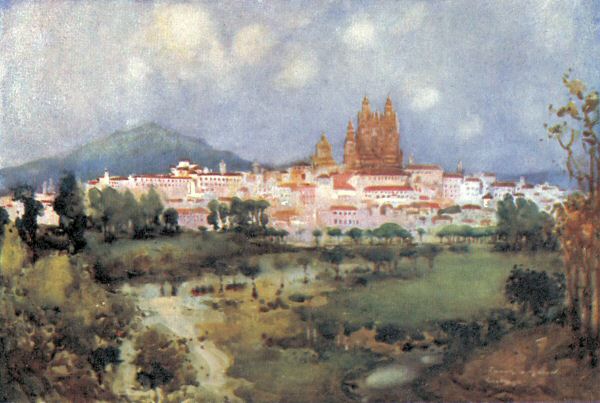
SANTIAGO DE COMPOSTELA
"Now
about that time Herod the King put forth
his hand to afflict certain of the church. And he
killed James the brother of John with the sword."
That is the Gospel story of the death of
St. James the Greater, son of Zebedee, in whose
memory the city of Santiago was founded, and
who remains the patron saint of Spain's Jerusalem.
Tradition has it that St. James journeyed through
Spain and preached the Gospel; while another
story states that after he was beheaded by Herod his
remains were taken to Galicia, and buried at the
place on which the cathedral of Santiago stands.
The saint's sepulchre was not known till the
ninth century, when it was revealed to a pious
bishop, Theodomir of Iria, by a star of wondrous
brilliance. At that time Santiago did not exist;
but the marvel of the prelate's discovery spread
throughout Spain, and wrought so powerfully upon
the reigning monarch, Alonso II., that he commanded
the immediate building of a chapel on the
site of the grave. The structure was begun, but
so amazing was the enthusiasm with which the
holy discovery was hailed that the original design
of a mere chapel developed into a scheme for a
cathedral, and the building was consecrated at the
end of the ninth century.
News travelled laggardly in those far-distant
days, yet while the cathedral was being built
devout believers everywhere became acquainted
with the tidings of the bishop's vision, and pilgrims
hastened to pay tribute to the holy tomb. From
every country in Europe the faithful travelled by
horse or on foot, many of them spending months
on the journey. Countless thousands worshipped
at the shrine and returned to their homes; unnumbered
thousands perished on the way to
Santiago or back; while multitudes who reached
the holy city never left it, for accommodation was
limited, and pestilence swept off the pilgrims
ruthlessly. At times the crowds were so enormous
that the cathedral had to remain open day and
night, so that they could find resting-places on its
extensive floors. The primitive medical and sanitary
appliances and remedies of the day were used
to ward off disease, and a great censer was kept
burning to purify the vitiated air of the cathedral.
Santiago is a city of romance, and my own first
sight of it was memorable. A night-watchman,
cloaked and leaning on his gleaming pike, watched
us as we stepped from the rickety diligence which
had jolted us from the railway station to the
Hotel
Suizo, near the cathedral, and within a stone's
throw of the university. It was nearly midnight,
and there was driving rain, which ran in torrents
down the crooked, narrow, flagged thoroughfares
which serve as streets. At the station the oil-lamps
dimly shone on the swimming platforms and
gloomily illuminated the big bare room in which
a statuesque pair of Civil Guards leaned on their
rifles and the Customs officers and passengers
mixed confusedly. There was an emigrant returned
from South America with a ponderous
trunk to open and examine. When it was passed
the huge box was hoisted on to the head of a
woman, and the emigrant's wife having been loaded
up with miscellaneous articles, the triumphant man
sallied forth, bearing no heavier burden than his
umbrella.
From the oil-lamped station we drove into the
mediæval streets, lit by electricity, and as the bells
began to chime the midnight hour the
sereno
strolled away on his rounds and the diligence
disgorged the travellers, peasants, Civil Guards, and
human oddments, who had clambered into and
outside it. Bells were chiming as I entered
Santiago; they rang, it seemed, throughout the
night, and at daybreak clanged to summon worshippers
to early Mass. The population numbers
less than thirty thousand, yet there are forty-six
churches, containing nearly three hundred altars,
with thirty-six religious and kindred institutions.
If priests and churches make a city good, then
Santiago must be a veritable holy of holies.
There are many wonderful and fascinating buildings
in this Jerusalem of Spain, but the glory of
them all is that vast structure whose twin towers
rise serenely to the blue sky, and whose golden
crosses burn and glitter in the sunshine. Not an
hour or a day, but many hours and many days
must be spent in the majestic minster before its
beauties can be adequately realised. Many books
and innumerable articles have been written about
it, but the greatest book of all is that marvellous
work entitled "Historia de la Santa A. M. Iglesia
de Compostela." The author is a canon, Antonio
López Ferreiro, who has already produced thirteen
volumes of his monumental undertaking, and is to
complete his task with a fourteenth. A dozen
years will have been needed for the publication,
which will surely almost rank in time to come
with Matteo's masterpiece, the Gate of Glory.
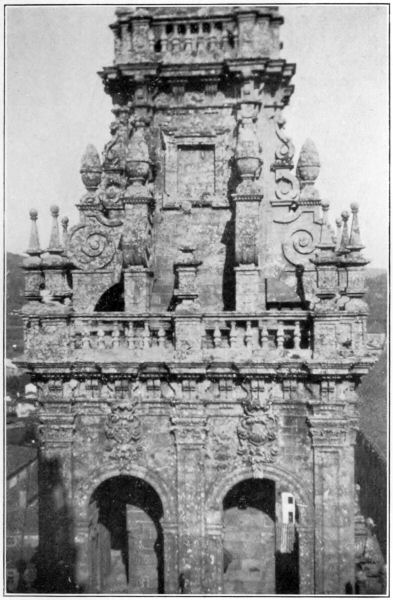
ONE OF SANTIAGO'S TWIN TOWERS
You enter the cathedral and look around in the
casual manner of the visitor who is pressed for
time and has a long programme to get through
before he starts on the home track; and not even
that amazing Gate of Glory which stands unrivalled
in Christendom may call for more than passing
notice. You may have spent an hour in the
building, and leave it thinking that you have seen
all, and you wander through the quaint, narrow,
twisted streets, gazing at the little shops, which are
only travesties of business places; at the women,
who are working ceaselessly, especially at the wells,
drawing water; at the men and boys who mingle,
and contrast the present with the passing, the
student and the peasant. You visit that particular
café which, in the afternoon, is infested by students
from the university when the strain of mental toil
is over, and may count a hundred of them, reckless,
rowdy, and full of life and carelessness, all playing
dominoes, thudding the bone pieces on the marble-topped
tables like little sledge-hammers working,
and filling the tobacco-laden air with deafening
cries. If the students in after-life put into legal
and medical work anything approaching the energy
they infuse into pastime, then fortunate indeed will
be their patients and clients. At eventide the
students become romantic and conduct their little
love affairs, and occasionally even in the unemotional
morning a young man may be seen hovering in the
neighbourhood of his adored one's dwelling. I saw
a youth at daybreak, outside my hotel, feverishly
pacing the flags. He wore patent leather boots,
very tight and small, and a large-checked overcoat,
a flagrant tie and a ridiculous little bowler hat.
For an hour he watched and waited; then from an
upper window a female voice was heard, and the
youth's face assumed a fatuously rapturous expression.
A few minutes afterwards the owner of
the voice descended, accompanied by her parents,
at the sight of whom the youth scuttled round the
corner, for the better-class young ladies in Galicia
are closely guarded when in public.
You leave the café and drift, and instinctively
you have made your way again to the cathedral
precincts, gazing at the windows of the box-like
shops in the building itself, in which the silversmiths
ply their craftsmanship and produce, amongst
other things, vast numbers of tiny silver scallop-shells,
one at least of which, obtainable for a few
coppers, the good pilgrim takes away from Santiago.
Unconsciously you re-enter the cathedral, and are
wandering about the vast incense-smelling nave and
transepts. Even to the unguided visitor there is
much to see, while the skilfully piloted stranger may
leisurely examine priceless relics and treasures and
behold many marvellous spectacles. I had the good
fortune to be shown round the cathedral during
two protracted visits by Canon Leopoldo Eijo Garay,
and to have the precious relics shown and explained
by Canon Martin, who has charge of the treasury.
There is the beautiful Biblioteca, with its ceiling
so cunningly and adroitly wrought in stone and
painted and gilded that it is difficult to believe that
the figures and ornamentation are not plaster.
The present King of Spain himself, when visiting
the apartment, declared his disbelief that the
decoration was carved from solid stone, and there is
pointed out a small patch of bare stonework from
which the colouring was rubbed to prove to his
Majesty that he was mistaken. You may enter a
loft where many old and modern tapestries are
hung to keep them from the ravages of moths and
atmosphere; go to another loft in which are stored
the grotesque giants' heads used in the procession
of St. James, carefully covered to preserve them
from dust, and inspect the large room in which the
tapestries and trimmings of the cathedral are kept
in order and repair. In another part of the cathedral,
in the nave, near the treasury, is a cupboard in
which clerical vestments are kept drawn on frames—vestments
that look like priceless cloth of gold.
Also to be seen are the ponderous silver maces
which are carried at the ceremonies in the minster,
and the giant censer in its sentry-box-like case. If
you are favoured you may lift the maces and try
to raise the top of the censer—and may succeed
in moving the silver mass a few inches from its
base.
In a dimly lighted room the treasure of the
cathedral is kept and Kings of Spain are buried.
With cunningly devised keys the doors are unlocked,
and the canon explains the meaning of the
silver and gold possessions, the very extent of
which is bewildering. Here are gifts from
sovereigns and potentates, each a wonder in itself,
yet so grouped as to form a perfectly harmonious
whole. Centuries of religious devotion are represented
in this one corner of the mighty edifice,
and it would be hard to estimate more than
approximately what is the value of the treasure,
though an expert might guess at the metals'
intrinsic worth.
A small Maltese cross in the centre of the
ornaments on the wall which faces the door
contains a piece of the true Cross, while above it
is a thorn from the Saviour's Crucifixion Crown.
Golden images and goblets, carvings, pictures,
fading gorgeous cushions, made by royal and noble
hands, with many other gifts in various form to the
Holy Mother Church from her sons and daughters,
are here, and the eye almost fails to take in what
the mind needs time to comprehend. More than
once the treasury has been raided by invaders; and
within the last two or three years sacrilegious
hands have been laid on one or two of the priceless
possessions of the cathedral, but the treasury is
now specially protected, and an ingenious clock is
used to record the movements of the watchmen who
are responsible for the safety of the relics and
riches. It is said that the whereabouts of some of
the lost treasures are known, and that they are not
far from America.
From the treasury one may go to the high
altar, above which is the gorgeous effigy of
St. James, the object of the last attention of the
Santiago pilgrims. The whole of the massive altar
decoration is solid silver, wrought in Salamanca,
and the candlesticks and ornaments around are of
the same metal, which has been used with the
lavishness of iron. In the centre is a small image
of the Virgin, with a halo of precious stones, and
many other gems flash as a lighted candle at the
end of a long stick is held out so that they may
be seen.
Eleven hundred pounds' weight of solid pure
silver—considerably more than half a ton—was
used by Salamanca craftsmen to make the wondrous
work amidst which the saint sits enshrined. At
this high altar no cleric below the rank of bishop
may celebrate Mass, except the canons of the
cathedral, without special power being granted by
the Pope. Changes are being made, even in
romantic, mediæval Santiago, and it is hoped that
something like five hundred thousand pesetas will
be raised to carry out alterations in the cathedral.
The figure of St. James adorns the centre of the
altar, with the right hand pointing to that sacred
little vault below in which reposes the great silver
casket containing the ashes of the Apostle; and
behind him is an unassuming box in which the
bones were hidden when Drake swooped down on
Santiago from the coast. The original figure was
made in the thirteenth century, and there it is
still, but with a massive silver garment clothing it,
a garment wrought in modern times by cunning
craftsmen of Madrid. Ford describes the original
figure as being of stone, but my own impression on
feeling it, which I did after the ponderous silver back
had been pulled away on its castors, was that the
material is wood.
At the back of the Apostle is a little platform,
which is approached by a few steps on each side.
Up these staircases the pilgrims walk, and, placing
their hands on the shoulders of the silver cape, kiss
the back of it—the gem-studded esclavina—and
return to the floor of the cathedral. Men and
women of all ranks and countries have visited that
tiny platform and leaned forward for a salutation,
and doubtless multitudes will journey thither still.
It may be that a band of the well-to-do classes will
visit the figure in the company, as I saw them, of
peasants who come into Santiago and make their
osculation and depart. These peasants, being able
to visit the sanctuary often, do not trouble to
acquire and take away that coveted document
which it is the wish of all true pilgrims to possess—the
compostela.
This is a parchmenty form,
containing an ornamental border, headed by a
figure of a pilgrim and flanked by columns of
scallop-shells. The border encloses a printed Latin
declaration to the effect that the pilgrim whose
name is written in has duly made the pilgrimage
and has received the certificate, after making
confession and receiving communion. The certificate
is signed by a canon, with the date of the
month and the year of the pilgrimage, and is
stamped with a blue seal. The acquisition of it
crowns the object of the journey to the holy city of
Galicia, and the
compostela
remains as evidence
that he has performed a ceremony which in other
days was almost as essential as legal documents in
proving a right to property.
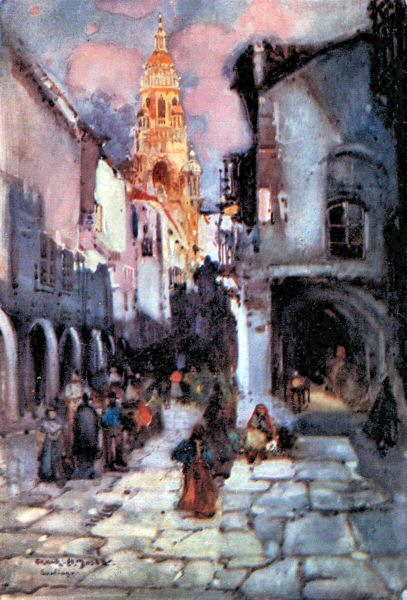
RUA DEL VILLAR, SANTIAGO
Two little metal doors behind the altar lead up
to the platform; another, hidden in the gloom
near them, gives access to that dark chamber in
which the faithful pray and worship at St. James's
holy shrine, and where the cardinal conducts his
own devotions. Electricity has been installed in
the vault, but there are days—amongst them
Sundays—when it is not used, and other days when
the current fails to work, and at these times
candles are employed to light the cavern-like
apartment, into which the sunshine never penetrates.
A few steps downwards, a few more along the narrow
stone passage, a turn to the right, and two or there
more steps—then you are in the cold and tiny
chamber which contains the famous silver coffin.
The Apostle's sepulchre is about three feet long
and two feet wide and the same in depth, though
the top slopes somewhat after the manner of a roof.
It is purely modern work, and was designed and
made in the cathedral by an expert whose son is
still associated with the building. There are figures
round the sides of the urn, beautifully wrought
images something like a foot in height, copied from
the finest details in the Gate of Glory.
The dim light of the candles reveals other relics
in this sacred spot—amongst them Roman mosaics
and various ancient fragments in glass cases. The
original walls of the vault, dating from the first
century, are visible. In some places the bricks and
stones have been faced with granite, but those that
are uncovered show little traces of the effects of the
two thousand years which have passed since they
were built upon each other.
Just as you instinctively return to the cathedral,
so, when you are in it, you wander to the Gate of
Glory and begin to realise why Santiagoans claim
that this masterpiece is peerless of its kind. The
sculptor who created it spent twenty years in carrying
out his purpose. During those two decades—1168-1188—Maestro
Matteo wrought in stone
that wondrous work of which a replica exists in
South Kensington Museum. Unfortunately the
Gate of Glory at Santiago is so placed that its real
significance and majesty are not apparent at a
glance, because the portico is within the building
itself, standing back a little distance from the
main entrance, which is opened only for important
ceremonials. Nor can the replica be seen to full
advantage in its present position. Other architectural
works are crowded up to it, and there is no
point from which the complete copy can be viewed.
Admirable though the replica is, yet it falls far
short of the original in beauty, because it is painted
a dirty drab, while the Gate itself still bears much
of the original rich colour with which it was
decorated. The replica was acquired in 1866 at a
cost of £2300, and now that there is so much room in
the magnificent new Museum no time should be lost
in removing the work. The reproduction would
form a noble decoration for one of the light and
splendid galleries of the extension at South
Kensington.
The Gate of Glory consists of three arches, the
centre one of which gives the title to the whole—La
Gloria. Twice life-size, the Redeemer is seated
in the centre of the arch, with St. James below Him,
seated also, and around Him are the Evangelists
and elders and angels, the whole being symbolic of
the Last Judgment and the victory of virtue
over vice. It is not so much the subject as the work
itself which will awe and fascinate the visitor: there
is so much prodigality of labour, such lavishness
of design, such an amazing whole contained in so
limited a space. The wondrous and magnificent
group over the central arch would in itself make
Santiago's Gate of Glory unrivalled amongst kindred
masterpieces.
Seven hundred years have passed since Matteo
finished his immortal work, yet in many ways that
work appears as perfect now as it was when he put
down his tools for the last time and gazed upon
that figure of himself which kneels and looks
towards the dim interior of the minster, as if in
thankfulness for the completion of his task.
In the exquisite central shaft of the Gate there
are some depressions into which the extended thumb
and fingers of one's right hand will fit. I was told
that these indentations had been worn into the stone
through contact with the hands of countless pilgrims
who believed that as a result they would be physically
strong for life; and that another performance
which has been extensively practised is to place
one's head on that of Matteo's figure; the faithful
being satisfied that thenceforward they will be
spared numerous mental afflictions. As there may
be hidden virtues in the superstitions I went
through both performances.
The visitor to Santiago who is fortunate may see
a spectacle which is unrivalled in the service of the
Catholic Church, and that is the swinging of the
largest silver censer in the world. At ten in the
morning of an October Friday I entered the
cathedral when High Mass was being celebrated.
There was much that was imposing in the procession
of the gorgeously vestmented clergy, from the two
bishops downward; near me, fastened to a sculptured
pillar, was the staff which was found with the body
of St. James, and there were priceless articles in
precious metals within view; but I had attention
only for the massive urn, which is six feet high.
The censer had been brought from its house in the
Biblioteca and placed in position in the middle of
the aisle, under the gorgeously decorated dome. It
was resting on the floor, and from the ring in the
top a stout rope ran upward to a combination of
pulleys supported on graceful iron standards secured
to four pillars. The free end of the rope was hung
on a neighbouring bracket. When the time came
to burn incense the rope was released and the fire
was lit. Immediately the dense, sickly sweet fumes
ascended and a master workman gave the signal for
hoisting. The man at the rope pulled downward,
and the censer swung at a height of about six feet,
clear of the adjacent altar-rails; then the leader
seized the silver mass and gave it a strong push, so
that it began to swing to and fro with a long, steady
sweep, the fumes rising and spreading in the dim
interior.
As the censer was swung it was hoisted higher;
then, each man seizing one of the cluster of smaller
ropes fastened to the main rope, a regular pulling
began, and the pulleys, acting like the ropes of a
church bell, caused the censer to make an immense
sweep to and fro. It was fascinating to watch the
growing of the sweep, until the arc described must
have been equal to a hundred feet. The censer
swung majestically until it seemed to strike the
vaulted roof; then the pulling ceased and the great
vessel was lowered. With unexpected quickness its
pace decreased, and as the heavy mass swung across
the railed space the master workman seized it again
and with unerring judgment piloted it to the floor,
a cloud of incense rising from the top and bright
flames showing in the interior of the vessel. Two
men, clothed like workmen, went to the censer, and,
putting a pole through the ring, carried it away
on their shoulders, the weight of metal being just
so much as they could bear with ease.
As I watched the long sweep of the enormous
urn I wondered what would happen if it broke
adrift and fell into the crowd of worshippers.
Legend says that at one time the censer actually
did leave its support and crash through the wall of
the cathedral, and that on the spot where it fell
a well sprang up, to the amazed joy and great
comfort of the faithful, who were thirsting for water.
Being a city of churches, Santiago is the home of
religious celebrations—or festivals, as they may be
called, for the people of the ancient city take life
joyfully, and to them the church fills the place of
the bull-ring and the theatre, neither of which
exists in Santiago as a permanent institution.
One afternoon I walked into the Church of San
Martin, which has some gorgeous altars, and learned
that there was to be the yearly observance of
the festival of
Rosario.
There is no distinction
of worshippers in Catholic churches, and rich and
poor alike were entering, wearing little medals and
bearing yard-long candles. They crossed themselves
devoutly and knelt and prayed on the bare,
bleak floor of the building, which is reached by
descending a flight of stairs. Children, ragged and
dirty, without either medal or candle, were clambering
over forms, other children, prim and proper,
brightly clad and clasping candles, were seated with
their mothers, and señoritas, some of them handsome,
knelt and crossed themselves and prayed—but
glancing slantingly as they did so to reckon up
their neighbours and the strangers. Officers and
privates of a line battalion entered, and a great
number of men, all bearing candles, and some
hurrying as if they had just left business and
were anxious to share in the ceremony. At
five o'clock the procession started, headed by
white-clad children bearing tiny banners, and
followed by the effigy of Our Lady of the Rosary,
shoulder-high, and the priests in their full vestments.
The women, bearing their candles, now
lighted, ranged up the sides of the open-air steps
as the procession advanced, some of them, the
younger, who were dressed in modern style, giggling
confusedly, but others, the poorer and more
primitive, very serious in their work. There was
fine full, resonant singing of the Ave María by
the priests and two laymen, accompanied by a
soldier and a civilian with bassoons; then, the
image having left the church, the band of the
12th Infantry, the famous Saragossa Regiment,
fell in and played as the procession at the slow
march went along the ancient streets to the Church
of San Domingo, where the last part of the service
was conducted—an old church made garish inside
with arc-lamps. It was a festival in which noise
shared largely, for rockets were exploding at
intervals, and the bells of every church we passed
clanged madly, pulled by boys who, against the sky,
looked like imps. A crowd followed the procession—a
strange mixture of well-to-do and poor, of
smartly dressed and shabbily clothed. Near me
was a handsome Spaniard in a charming frock and
Paris hat, side by side with a shawled peasant, and
a Spanish captain chatted gaily with a friend and
smoked a cigarette.
The festival of Our Lady of the Rosary may be
seen in any Catholic country, but Santiago has its
own particular celebrations in connection with the
cathedral, and of these by far the most famous is
the ceremony which takes place on St. James's
Eve, July 24. The people give themselves up to
enjoyment and merriment, and begin early on the
morning of the 24th. At eight o'clock bands
parade the principal streets, and their music is
succeeded by clanging bells and crashing rockets.
Amid the growing excitement and commotion there
starts that historical procession of giants which
crudely represents the arrival of the pilgrims of old
from all parts of the world.
These giants are created largely out of the
enormous artificial heads which I have mentioned.
The heads are carried elevated, so that, with the
garments that the bearers employ, colossal men
seem to walk along the streets. The procession
starts at noon, and for an hour the clock-tower
bell peals constantly and it is difficult to move
along the densely crowded thoroughfares.
The giants are not the only curious feature of
the celebration. There are also included in it a
number of dwarfs—cabezudos, signifying big-heads,
who strive, with great success, to entertain the
juveniles of Santiago by their antics and quaint
dances. There is constant mirth and music; and
later in the afternoon, in the Plaza del Hospital,
greasy poles are climbed, and country dances take
place, accompanied by the Galician bagpipes, which
give national and local airs—as well as they can be
played on such unmusical instruments.
From joy to joy and noise to noise the
Santiagoan arrives at darkness, and at nine o'clock
the rockets, bursting from a dozen mortars, open a
brilliant display of fireworks in front of the holy
basilica, accompanied by coloured illuminations of
the principal buildings and the crash of bells, the
shouts and laughter of the crowds and the music of
the bands. St. James's Eve ends in a chorus of
mirth and music, and the holiday-makers have
scarcely time to recover from the excitement of
the day before they are called upon to renew it.
Twenty-one mortars fired in the Plaza del
Hospital at seven o'clock in the morning begin the
festivities of St. James's Day. Simultaneously with
the crashing of the rockets all the bands in the
city burst into music. Two hours later the mayor,
the civil governor, the members of the corporation,
and the other principal local officials go to the
holy basilica, where they join the procession round
the cathedral and hear Mass between the choir and
the high altar, where the civil governor occupies a
seat as the king's representative.
By this time the cathedral, vast though it is,
can scarcely hold the crowds who throng the nave
and transepts. The cardinal celebrates the Mass,
at which the giant censer is used; and a solemn
feature of the performance is the ascent of the steps
of the high altar by the civil governor, who,
kneeling, offers in the name of the king a thousand
escudos of gold, equal to £400, an annual gift from
the monarch, at the same time pronouncing a
fervent prayer, which his Eminence answers. When
the present King of Spain visited Santiago he
personally discharged this interesting task. Mass
being finished, the cardinal pronounces the Papal
blessing, and to all who have officially shared in the
ceremony beautiful bouquets of flowers are given.
Then follows an old and remarkable act in the performance
at the high altar, before the holy Apostle,
of a dance by the giants. During the afternoon
both giants and dwarfs—gigantes
y cabezudos—show
themselves in the streets and public squares,
accompanied by bands and crowds of Santiago's
populace and country people.
In the evening, when the celebrations at the
cathedral are ended, a procession of virgins leaves
the Church of Santa Clara and enters the basilica
by the northern door, which is known as the
Gate of Jet, and there the cardinal, accompanied
by all the dignitaries of the church, receives
them.
For these two days in July each year Santiago
surrenders itself to revelry and enjoyment; then
the city resumes its peaceful, yet always bright
and interesting, life. The people have had their
giants and dwarfs, bands of music and mortars,
celebrations in the cathedral and their bells, and
have shown that in spite of all their woes and
burdens they still know how to live.
Not the least pronounced feature of the festival
has been the bells of Santiago. Some of them seem
to be always ringing. There are the calls to early
Mass at six in the morning, and the summonses to
other forms of worship throughout the day; and
whenever a procession passes a church the bells clang
out and mingle with the bursting of the rockets.
Some of the bells are mellow and melodious, but
others are like the ringing of a raucous hotel gong.
There is no music or method in them; a small boy
is stationed by the bells—you can see him at his
noisy work—and he hammers at his task, performing
it with extra frenzy when service-time is
reached.
In the cathedral the bell-ringer and his family
live near the belfry, to be ready to answer any
special call, to ring a peal or sound an alarm, for
the fire-bell is at the mother church; and there are
other special bells, such as that which is rung only
when a canon of the cathedral dies. One of the
largest of the bells of Santiago was struck not long
ago by lightning and was cracked. The crevice
is still visible, though attempts have been made
to fill it up with other metal. The bell dropped
from its support to the stonework inside the balustrade,
and there remains, out of action.
Pilgrims of old reached Santiago by the way of
blood and tears, for roads were bad and shoes and
sandals vanished on the weary journeys. Nowadays
pilgrims travel speedily and comfortably, and
organised bands set out for Spain's Jerusalem to see
its wonders and enjoy its charms. In 1909, for
the first time in nearly four centuries, an English
band of pilgrims, headed by the Archbishop of
Westminster, visited Galicia, by the Booth Line,
under the guidance of the Catholic Association,
and their banner is suspended in the cloisters of
the holy city's minster, while on many of their
walls at home are hung the coveted certificates of
pilgrimage.
Modern pilgrims may visit and revisit the cathedral;
and they may also wander at will about the
city, visiting the old Inquisition, near the Alameda,
now used for business purposes, and soon, perhaps,
to be converted into an hotel, the Archæological
Museum, formerly the old Convent of San Clemente,
the vast Seminary, the Town Hall, the Royal Hospital,
built four centuries ago for the accommodation
of pilgrims, the cattle market, and the city's lesser
churches, the most astonishing of which is the
Colegiata
de Sar, famous for its leaning columns and
twisted look. The palace adjoins the cathedral.
It is an unassuming building, and the audience
chamber, where I had the privilege of an interview
with Cardinal Herrera y de la Iglesia, makes no
pretence to splendour. The Cardinal is deeply
interested in the visits to Santiago of foreigners,
and spoke with enthusiasm of the excellent effect of
journeys to the city. Proud of its wonderful past,
he is alive to the necessity of modern improvements
in some respects, and doubtless some of these will
be carried out without in any way affecting the
city's fascination. The Museum contains many of
the ancient remains of Galicia, and in the Inquisition,
seldom visited or mentioned, there are
relics of the torture days; the Seminary bears
signs of the visit of the French under Soult in 1809,
when they raided the cathedral treasures and bore
off something like half a ton of precious metal-ware;
and in the Hospital you may see the well-kept
wards, the beautiful and extensive cloisters, and
the little ancient chapel. Strange though it may
seem to English people, yet you may stroll unchallenged
through the wards, and see how well
cared for are Galicia's sick and ailing. The Royal
Hospital at Santiago claims to be amongst the
very first of Spain's healing institutions. Even
in November, when I visited it, there was warm
sunshine in which the patients could sit or lie—different
indeed from the dreary deluges of rain with
which, as my home letters told me, England, and
particularly London, was afflicted. I know that
when, near Mondariz, I was lying on the bank of a
clear stream on the hot sand, in a flood of sunshine,
idly throwing pebbles in the rushing water, and
watching the peasant women crossing and recrossing
an old bridge near me, my countrymen in
England, whose southern shore was only two days'
sail away, were shivering in steely blasts and
maligning the land of their nativity. I know, too,
that in such unromantic and inclement weather at
home, I was seated on a green hillock to the south
of Spain's Jerusalem, smoking and watching the hot
sun glint on Santiago's gilded crosses. In such a
place you may rest and muse and gaze towards
the city, which is one of the most alluring in all
Christendom.
Fascinating though Santiago is by day, yet its
charms are not so subtle then as at night, when the
day's work is done and the people are walking in
the open air they love so well. There is no
wheeled traffic in the streets—only an occasional
bullock-cart or diligence is encountered—and the
long, broad flags, with their wide crevices, worn
smooth by generations of men and women and
children, re-echo the footsteps of the pedestrians.
The arc-lamps accentuate the quaintness of the
thoroughfares, and electric bulbs show up the
strange interiors of the little shops.
The streets are thronged, and there is a constant
chorus of talk and laughter. If the Santiagoans
have cares, surely they have left them in their
homes, for here you seem to come across nothing
that is gloomy or depressing. The modern hat
and dress are mingled with the mantilla and the
coloured shawl, and the high-heeled boot adds to
that chorus of sound the chief feature of which is
the clank of the wooden shoe, with the softer
accompaniment which comes from the thud of bare
feet.
Here and there inside the buildings is a simple
oil-lamp, and at times you see a small acetylene
lamp on a counter, showing up, perhaps, some of
the enormous round maize loaves which form the
basis of the poorer people's food. If you would
escape from the lighted streets and be alone, you
may slip down a narrow alley and find yourself in
an old-world thoroughfare, whose only light comes
from some open doorway, or the stars in the ragged
line of gables which open to the sky. If it is near
the time of full moon you may wander on—and
you will abruptly reach the cathedral, and see
above you the square twin towers and the gilded
spires. Again you are back at that wonderful
creation which for centuries has been the pride and
glory of Galicia.
The scallop-shell of Santiago has been mentioned.
It is seen wherever you may go—on the walls
of the cathedral, over the doors of numberless
little houses, and in multitudes, in tiny silver
representations, in the shops of jewellers. The
origin of the shell as an emblem is legendary. One
story goes that when the Apostle had been slain by
Herod his body was taken from Joppa back to
Galicia, to which it was borne by sea in a colossal
shell. The version adds that a man of high rank
who wished to accompany the remains to Galicia
was not able to go in the vessel; accordingly he rode
his horse into the sea and miraculously made his
way by water. When he emerged from the sea
both he and his horse were covered with scallop-shells.
The legends are picturesque if not convincing;
the fact remains that the scallop is the
emblem of St. James's pilgrimage now as it has been
since he gave his name to Spain's Jerusalem.
A road, newly cut, leads from Santiago to the
summit of a hill towards the west, and on the top
of that eminence there is a granite monument which
makes the fourteenth cross to be reached by the
devout visitor who wishes to complete the pilgrimage.
I do not know the name of either the
road or the eminence, but the one may be called
the Pilgrims' Road and the other the Pilgrims'
Hill. Nothing can exceed the solemn grandeur of
the prospect from the monument. If it is Sunday,
and eventide, the sound of distant bells will reach
you, and the golden crosses on the graceful spires
will glint; beyond the city, and around it, sweeping
in majestic curves, are the Galician hills, and behind
you more hills, ridge beyond ridge, with darkness
settling on them, so that they look like colossal
rollers in the Western Ocean when a heavy gale has
blown.
Covering an area which seems a mere oblong
speck on the enormous surface of the landscape,
Santiago stands supreme. It is the only living
thing in what appears to be a dead setting. There
is perfect Sabbath stillness in the air, and you see
the city now, when here and there a peasant slowly
climbs the winding road, as old-time pilgrims must
have looked upon it at the end of long and weary
journeys.
Behind you is Arosa Bay, one of the world's
finest anchorages, where modern fleets may safely
lie; near it is Finisterre, the grim promontory
which is made by all cautious mariners who voyage
north and south across the Biscay, and where Anson
won his famous victory, and past which Nelson
sailed to win his crowning triumph in Trafalgar
Bay. In Elizabeth's time Drake and Hawkins,
Raleigh and the other sea-dogs sailed along the rock-bound
coast intent on war and pillage, and Drake
reached that quaint city nestling in the hills whose
golden crosses glisten in the sun by day and whose
lights show clearly in the darkness after sunset; for
Middle Ages and modernity are linked at Santiago,
and the garish arc-lamp supplements the glimmer of
the candle.
CHAPTER IV THINGS SEEN
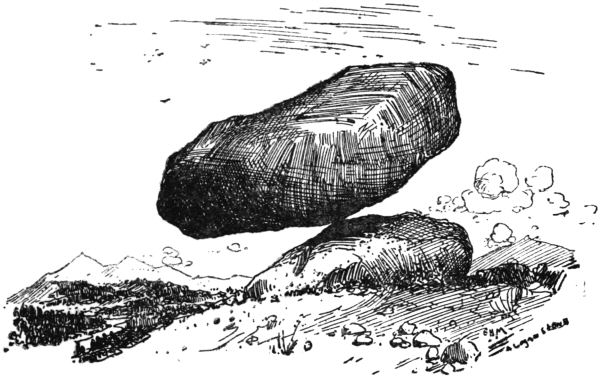
A LOGAN
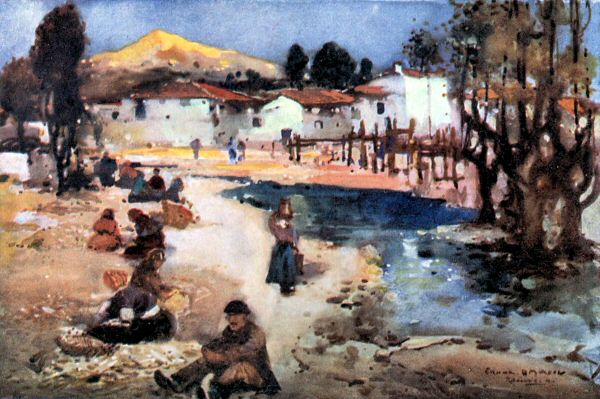
A GALICIAN VILLAGE
Galicia
is a land of sharp contrasts, and the things
seen include sights which cannot be witnessed in
any other country within such easy reach of London.
The bullock-cart creaks by the side of the railway,
the peasant with a Roman plough turns up the soil
within sound of the electrical machinery of a corn-mill,
the swift motor-car rushes past the old-world
diligence on the highway, and the incandescent
burner or electric lamp keeps company with the
ancient candle. Orange-groves abound and vineyards
carpet the landscape, while the stately liner
sends her bow-wave swishing at the bare feet of
fishwives who are handling catches as they were
handled in the days of Jesus. A peasant may prod
and drag his team of oxen past a modern school in
which his brother may be learning chemistry and his
sister millinery, and the old man who has never
learned to read and write listens to the machines
which print the newspaper whose symbols are to him
a mystery; the nun, a life-long prisoner in her gaol-like
convent, hears the booming of guns in ships of
war whose purpose is to keep and further liberty,
and the friar, tonsured, girdled, sandalled, kneels on
the cathedral floor beside a woman dressed in Parisian
gown and hat. These are amongst things seen by
the leisurely traveller, but even the hasty tourist
may make a passing acquaintance with many quaint
and fascinating customs and peoples. The pleasure-seeker
may have constant recreation and enjoyment,
the student of ancient cities and remains finds
material wherever he goes, and the lover of archæological
and ecclesiological memorials and structures
may carry out a long tour and find at the end that
he has only touched the fringe of the subject.
The easy-going visitor may constantly step aside
from the beaten path and encounter new aspects of
Gallegan life, and learn something interesting that
is not mentioned in even the best of guide-books.
I think the very impossibility, as it seems to be, of
getting at the real truth of some Galician matters
is one of the charms of going about the country.
Baedeker, omnipotent in travel, has missed many
things in North-West Spain, or omitted them as
being superfluous or unattractive, while details which
are published in his masterpieces are at variance with
other sources of information. For example, Baedeker
states that the population of Pontevedra is 8500,
but Murray gives the number as 21,000, a startling
and bewildering difference. The discrepancy, however,
is understandable, because it is one of the
hardest of all things in Galicia to get reliable
statistics. The Gallegan treats any demand for
census details as Englishmen deal with income-tax
papers.
Wandering off the high road and through some
vineyards and maize-fields not far from Caldas, I saw
a fine old house. This was at the village of San
Benito, where also I came across a quaint little
church connected with the house by a small bridge.
A few yards from the church, and just off the
highway, was a curious open-air platform, used
in connection with religious ceremonies at certain
seasons of the year; for even this tiny hamlet
attracts pilgrims, many of whom travel to get
a saintly cure for warts and such-like unromantic
ailments of the flesh. There was no difficulty
in obtaining permission to inspect the house,
which has a fine and well-preserved coat of arms
in the stonework outside, and to visit the adjoining
vineyards—indeed, I was well received,
under the impression that I was a person of importance
in the wine trade. The building is seven
hundred years old, and certainly looks its age,
both inside and outside; further, I was informed
the vineyards yield from nine to twelve pipes of red
and white wine yearly, according to the season;
and the average price obtained is 205 pesetas a
pipe.
After my inspection of the house and vineyards
I was pressed by the proprietor, with true Spanish
hospitality, to try the new vintage, which I did,
drinking the white, cider-like beverage from a
tumbler just as one would take water. I had
three samples, and although I was warned that
pains and penalties would follow I felt no ill-effect
whatever, and continued my journey stationward
with every possible good feeling towards my fellow-creatures
in Galicia. By that time I had left the
Spanish carriage in which I had been driving, and
walked in pleasant companionship along the road
towards Caldas station.
There was a wonderful peace in the air, for it
was Sunday evening, and work had ceased. The
peasants were out and about, the women sitting, the
men smoking and leaning against doors or walls,
and the children playing before being put into
their primitive beds. The chimes from neighbouring
churches mingled with the pleasant tinkle of
the bells worn by the two small horses which were
drawing the conveyance.
Darkness was falling quickly, and the stars were
shining beyond the hills and overhead. Peasants
were coming towards us, young men and young
women, laughing and chatting gaily, and some of
them singing sweet Gallegan songs. In England,
even in the villages, people of the same ages and
condition would have been bellowing banalities from
music-halls. The twilight was short and the road
and country were soon in almost perfect darkness, for
there were no lights or lamps of any sort. I reached
Caldas station in company with a little diligence
which dashed up in the gloom, indicated by
the voices of the driver and passengers and the
thudding of the ponies' hoofs and tinkle of their
bells, as well as by a tiny lamp in the interior of
the vehicle. There was practically no illumination
in the station, on the walls of which a melancholy
oil-lamp was suspended, serving just to outline the
figures of the waiting passengers. Nothing came
out of the vast surrounding darkness except the
occasional sounds of the peasants' songs, and there
was something so amazingly primitive and peaceful
in the evening and the place that it gave one almost
a shock to have a second oil-lamp turned up on the
platform and to hear the approaching train and see
the head-lights of the locomotive; yet after a few
miles had been covered I looked from the carriage
windows upon the bright electric lights of Redondela
station, and had time to take some wine and food
before re-entering a train and journeying back to
Vigo.
It is your duty, if only for the sake of experience,
to enter one of the wayside inns of Galicia, the
fondas and posadas at which your motor-car, motor-bus,
diligence, or carriage draws up in travelling.
It may be a place which is comparatively imposing,
with bottles of spirits and wines ranged temptingly
on shelves, and a right-angled counter containing
sundry articles of refreshment, with a dining-room
adjoining the bar, and all clean and attractive in
appearance; it may be an appalling establishment
from which you are fain to fly on swallowing
your drink and in which you are grateful to your
cigarette; or it may be a house which is neither
good nor bad, but incorrigibly indifferent. Go
into them all; there is something new and fresh
in each.
The first fonda I entered was at Porriño, and
that was on a Sunday. Next door was a barber's
shop, open to the air, with a priest reading a
newspaper while awaiting his turn for a shave.
The sign of the trade was a brass dish dangling
from a chain, in contradistinction to the impressive
tonsorial pole of British facial artists, of whom it
would be wrong in these levelling days to speak
as barbers. Peasants were entering the fonda, and
some, men and women, were seated at bare wooden
tables, breakfasting on bread and wine. At the
counter I bought for a penny an excellent aniseed
liqueur, and for the equivalent of a shilling came
away with a full large bottle of the spirit, which
experience proved more than rivalled cocoa in its
comforting and grateful qualities. Incidentally, on
re-entering the motor-bus, I saw a large dead rat
lying in the middle of the road. Three days later,
on returning to Porriño and the fonda, I noticed
that the carcase was still there—also a decayed and
dejected diligence on the pavement, a vehicle which
could, however, be galvanised into active service in
case of need. Porriño, however, is not a typical
Galician village, and is no more representative of
the charms and beauties of the country than Wigan
is of England.
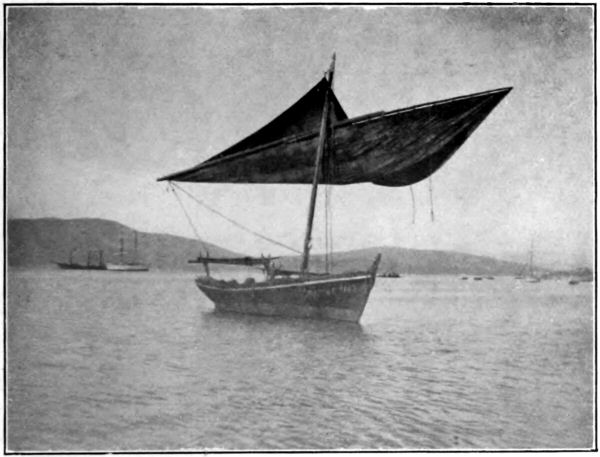
A GALICIAN FISHING-BOAT
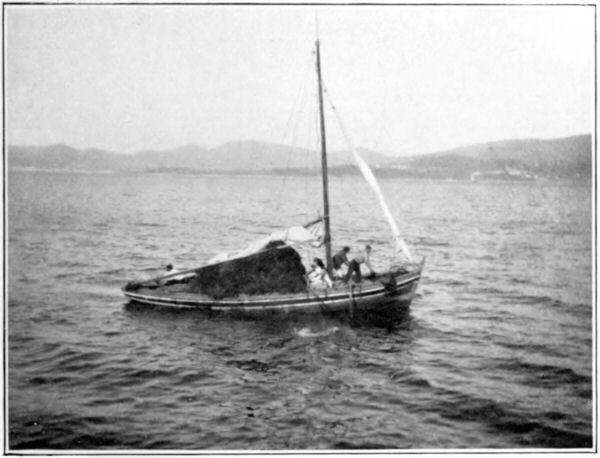
MEN AND WOMEN ROWING UP VIGO BAY
The visitor will often witness sights which, if
not exactly pleasant, are full of interest, as showing
something of the people's lives. I saw in corners
of vineyards or gardens the carcases of kids suspended;
and, driving down a village street, I
observed the body of an immense pig which had
been killed. The animal had been placed on the
stones in front of the door of a cottage, and a man
and his wife, helped by children, were heaping up
branches and faggots. When I returned this
material was burning, and on inquiry I was told
that this was the Galician method of removing the
bristles.
In Galicia you may travel in perfect comfort
and security along many of the roads and into
many of the towns which in Borrow's day, only
seventy years ago, were infested with murderers and
robbers, and the idea of danger and peril will never
so much as enter your mind—a state of peacefulness
which is largely due to those splendid fellows of
the Civil Guard; yet wherever he went Borrow
ran great risks to life and limb. Frequently he
took advantage of a military escort, and at one
time, travelling from Lugo to Corunna, he had the
support of a band of picturesque ruffians who had
all the appearance of banditti, and would have
created a sensation in a Drury Lane drama.
"They were all men in the prime of life," says
Borrow, "mostly of tall stature and of Herculean
brawn and limbs. They wore huge whiskers, and
walked with a fanfaronading air, as if they courted
danger, and despised it.... Their proper duty is
to officiate as a species of police and to clear the
roads of robbers, for which duty they are in one
respect admirably calculated, having been generally
robbers themselves at one period of their lives."
Alas! these romantic ruffians have disappeared
from Galician highways, and their nearest prototypes
to-day are harmless peasants adorned with
flowing side-whiskers, the style of decoration
favoured by respectable and inoffensive British
butlers.
To my lasting regret I did not thoroughly re-read
my Borrow until I returned from Galicia,
because Galicia fascinated him, and he covered
much of the ground that I personally traversed,
and looked upon many awesome sights which I,
in a spirit of modernity and commerce, would have
photographed.
At the bridge of Castellanos, "a spot notorious
for robbery and murder, and well adapted for both,"
Borrow passed "three ghastly heads stuck on poles
standing by the wayside; they were those of a
captain of banditti and two of his accomplices,
who had been seized and executed about two
months before. Their principal haunt was the
vicinity of the bridge, and it was their practice to
cast the bodies of the murdered into the deep black
water which runs rapidly beneath." Borrow added
that the three heads would always live in his
remembrance, particularly that of the captain,
which "stood on a higher pole than the other
two: the long hair was waving in the wind and the
blackened, distorted features were grinning in the
sun."
All this sounds very gruesome and barbarous;
yet such sights were common in England at the same
time, for those were the days of public executions
and gibbeting of corpses.
The things seen in Galicia do not include the
woeful exhibitions of ignorance of the native language
which are so common on the part of the
Englishman abroad, especially in France. Even
the hardy British matron who in Paris will address
the cabman as cochon refrains from speech in Galicia,
because no word of Spanish has formed part of her
education. Yet a working acquaintance with the
language can be easily obtained, for Spanish,
though of all modern tongues the least understood
by Englishmen, is the easiest to learn. Borrow
declared it to be the most sonorous tongue in
existence. In my own wanderings I had the
constant help and guidance of an excellent interpreter,
and the tourist would do well to avail himself
of such skilled assistance, which leaves him free
to enjoy the charms of the country and the customs
and peculiarities of the people. The system also
removes the need for travellers to adopt Borrow's
idea of making a foreigner understand them in his
own language; that method being to speak "with
much noise and vociferation, opening their mouths
wide." He protests that when his fellow-countrymen
attempt to speak the most sonorous of all
tongues they put their hands in their pockets and
fumble lazily, instead of applying them (their hands,
not their pockets) to the indispensable office of
gesticulation. "Well may the poor Spaniards
exclaim," he adds despairingly, "These English talk
so crabbedly that Satan himself would not be able
to understand them." To do my countrymen justice,
I am bound to say that, with a single exception, I
never heard them attempt to speak Spanish in
Galicia; and as for the isolated case, I was assured
that his Spanish was too bad to be intelligible.
CHAPTER V THE ATLANTIC COAST AND THE FRONTIER
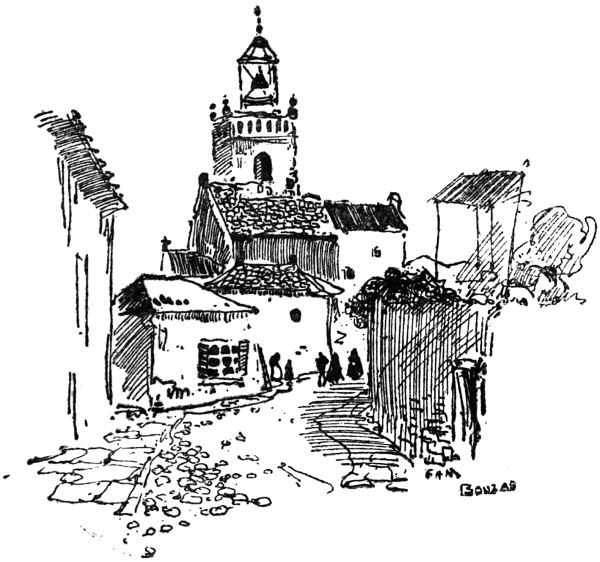
THE CHURCH AT BOUZAS, ON THE COAST
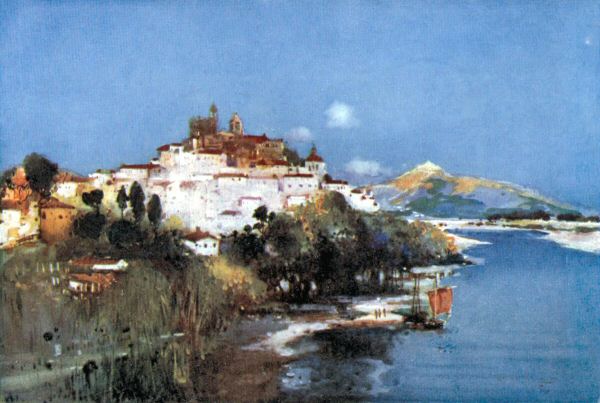
TUY, A HILL CITY ON THE FRONTIER
If
one could be high enough in air and had a
sufficient range of vision, one would see Galicia's
coast on the Atlantic side jutting into the ocean
something after the manner of the jagged teeth
of a colossal saw, from the fangs of Finisterre
to the greater fangs southward between Muros,
Arosa, Pontevedra, and Vigo Bays, and northward
to Cape Ortegal. But it is not necessary to soar
skyward to comprehend what Galicia's coast is like,
for that can be done from the promenade deck of a
liner and the tops of hills. The wild, romantic
scenery at Ferrol, Corunna, and remoter places like
Finisterre and Corcubion are in themselves enough
to fascinate the visitor who seeks majestic solitude
and primitive existence. Finisterre is a region in
which several famous British battles have been
fought. In 1747 Anson defeated a French
squadron off the promontory, a victory for which he
was made a peer. It was near Finisterre, too, that,
three months before Trafalgar, Sir Robert Calder
valiantly attacked the far superior French fleet
under Villeneuve and captured two of his ships;
and in these waters Sir Richard Strachan made
prizes of the ships under Dumanoir which had
escaped from Trafalgar.
Ferrol is one of the most striking natural harbours
in the world. It is best seen when entered
from the Atlantic. Nature has made a canal
in the iron cliffs by cutting a straight slit
something like a mile in length, and through
this amazing cleft vessels enter the noble sheltered
basin which forms the harbour. Ferrol
has one of the largest populations of Galicia's
towns—over 20,000—and is famous mostly for
its arsenal; the town, indeed, is Galicia's Portsmouth.
Naval officers and cadets and seamen
are met everywhere in the Calle Real and other
streets, and splendid views of the harbour and
dockyard are easily obtainable. In these days
Ferrol is very different from the town which
Borrow saw, for it was then suffering from the
blight which fell on Spain as the result of
Trafalgar.
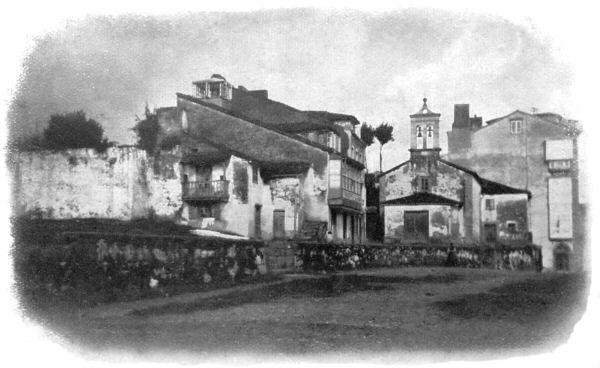
FERROL, THE SPANISH PORTSMOUTH
"Grass was growing in the streets, and misery
and distress stared me in the face on every
side ..." he wrote. "Only a few ill-paid and
half-starved workmen still linger about....
Half the inhabitants of Ferrol beg their bread."
But Ferrol to-day has a cheerful aspect, and vast
changes are being made with the help of foreign
capital and foreign engineers. Enormous modern
machinery plants are being installed, and there is
hope that in no very remote years Spain will be
able to build all her own ships of war. She is
exceptionally fortunate in the lavishness of Nature's
provision of safe and beautiful harbours for her
fleet's accommodation. The gigantic and costly
dredgers of the Mersey and the Thames are not
needed in the Galician bays. Ferrol has many
attractions in its neighbourhood for antiquaries,
who have found here some of the most interesting
of Galicia's Celtic remains. The district, too,
is reminiscent of St. James, who is credited with
the founding of the ex-Colegiata de Caaveiro, a
dozen miles to the east of the arsenal. This
building is one of the great ancient military
religious strongholds of the country, and possesses
dark, damp dungeons in which captives were not
able either to lie down or stand upright.
Borrow would be amazed if he could revisit
Ferrol and overlook that arsenal of which he gave
such a depressing description. He would find,
it is true, that the Spaniards proceed in the
leisurely fashion of his own generation, because
they retain a love of putting off for accomplishment
to-morrow the disagreeable duties of to-day.
They believe in the blessed mañana. For a long
time there has been at Ferrol a desultory kind of
shipbuilding, and a vessel is to be seen on which
the Spaniards have been at work for fifteen years.
She is still unfinished. Again mañana. But new
life and energy have been introduced into the
Atlantic arsenal, and under the guidance of three
great British engineering and shipbuilding firms a
very large amount of capital has been invested
for the purpose of reconstructing the arsenal and
the Spanish navy. The firms are Sir W. G.
Armstrong, Whitworth & Co., Ltd., Messrs. John
Brown & Co., Ltd., and Messrs. Vickers, Sons &
Maxim, Ltd., and a general control is exercised by
the Advisory Committee, who are the technical
guarantors of the Sociedad Española de Construccion
Naval, the Spanish company which has undertaken
the work. At present about 2000 workmen are
employed, more than 90 per cent. of whom are
Spaniards. The chief engineers of the undertaking
are mostly British. The programme of
reconstitution will extend over seven years, and
the total sum which is being spent is £7,000,000.
All the steel which is necessary for this great new
enterprise is being rolled at Bilbao. Three Dreadnoughts,
somewhat smaller in size than our own,
are being built at Ferrol, the cost of their construction
being included in the £7,000,000.
This Spanish arsenal has an excellent club for
artisans, an institution with a large membership.
The club is of a very complete character, and
combines the advantages of an educational establishment
with social enjoyments and sick-pay
benefits.
During the Napoleonic wars Ferrol was attacked
by Sir James Pulteney, who in July 1800 sailed
from England in command of a secret expedition
of 8000 men. The objective was the
coast of France; but Pulteney, finding the task
too big for him, made for Ferrol. He defeated
the Spaniards in two skirmishes and took possession
of the heights above the harbour. Then he
suddenly withdrew his forces, owing, according to
one story, to the fact that the enemy had been
greatly strengthened, but in reality, it seems,
because of secret instructions which had been given
to him to retire. In 1805, when Napoleon had
thirty-eight French ships of the line and thirty
Spanish, with 170,000 men, almost ready for the
invasion of England, Ferrol was one of the three
ports which Spain used for her fleet's requirements.
Just before Trafalgar Villeneuve took refuge in the
port to escape from the British, an act which
threw Napoleon into a transport of fury and made
him exclaim bitterly: "All hope is gone! That
Villeneuve, instead of entering the Channel, has
taken refuge in Ferrol! It is all over!"
When Moore had fallen at Corunna and the
town had been occupied by Soult he marched to
Ferrol, which he took, with seven ships of the line
and immense quantities of naval stores. The town
was held for several months, during which Soult
gave Marshal Ney the task of fighting in Galicia;
but the rugged country and the valour of the
Gallegans were too much for even the "bravest
of the brave," and, believing that he had been
deserted by Soult, Ney abandoned Corunna and
Ferrol and marched away from Galicia.
Within convenient access of Ferrol and only
two miles from Betanzos is the strikingly situated
town of Puentedeume. Formerly this place was
noted for a bridge which was a mile long and
possessed no fewer than fifty-eight arches; but
this was destroyed in 1868, and was replaced by a
modern structure. Betanzos is one of the quaintest
and most beautifully situated towns in Galicia.
It is full of historical charm, and in addition to
its old churches possesses the ruins of a Moorish
castle. The town rises from the banks of an inland
bay, and on the journey by road between Corunna
and Ferrol the visitor has an opportunity of seeing
Betanzos from all points of view. First he beholds
it from an altitude, nestling snugly in a hollow,
then he passes through its old romantic streets,
which are villainously paved and crooked, and sees
the town again from a height as he goes towards
Corunna or Ferrol.
The neighbourhood of Ferrol is to the sportsman
one of the most alluring parts of Galicia, for it
abounds in beasts and birds and fishes. Hawks and
eagles frequent the lonely valley of Caaveiro, deer
are numerous, and in the autumn and winter the
wild boar is hunted. Salmon and trout are caught
in enormous numbers, and wood-pigeons, partridges,
and other game are very plentiful.
Between Ferrol and Corunna communication is
maintained by steamer and diligence. The sea
route is far shorter and easier than the land
journey, the vessels in fair weather making the
trip in an hour and a half. But sometimes for
several days together the steamboats cannot run
because of strong winds or rough seas, and when I
visited Ferrol they had been kept in harbour for
three days owing to these causes. This meant
that storm-bound travellers who found it imperative
to reach Corunna to embark were forced to take
the diligence and make the long and tedious land
journey. To the easy-going visitor, however, that
journey is full of charm and interest, including
as it does Betanzos, and giving an opportunity of
inspecting the Castillo de Moeche, a noble old ruin
on the hill-side. There can be seen also on the
roadside, not far from Corunna, a modern mansion
in beautiful grounds, which was built in the hope
that the present King of Spain would take it as
a summer residence; but the monarch was not able
to accept the offer.
From Corunna to Vigo the coast is bold and
jagged, and though it does not present the imposing
appearance of Gibraltar, in the south of Spain,
or offer the majestic mountains of the east side of
the Peninsula, yet it has in its bays glories and
beauties which are not excelled by any of Spain's
other natural attractions. One of those bays at
least, Vigo, will be seen by all visitors who enter
Galicia in Booth liners, and there is danger that
they may omit some of the delights of the northern
fjords in favour of a journey down the Atlantic
coast to the point where the river Miño separates
Spain from Portugal.
To the frontier of Portugal there runs a carriage
road alongside the Atlantic, which is irresistible to
the motorist, the cyclist, the rider, and the walker.
The scenery is varied and beautiful, beginning with
Vigo and continuing to Guardia. On the one side,
when the southernmost point of Vigo Bay has been
passed, the pleasant village of Ramallosa is reached,
with its extensive view across the yellow sands, and
its venerable bridge with a weather-worn shrine in
the middle. Seven miles farther on, and only
fourteen from Vigo, is the little ancient town of
Bayona, famous chiefly for its old castle on the
wooded summit of the Atlantic shore.
There is no difficulty in getting permission to
inspect this romantic residence, which has some
delightful grounds from which magnificent views
are obtainable. The Atlantic billows sweep up the
rocks on the west side of the estate, and overlooking
the sea, on the battlements, is a curious stone table,
with stone seats, in the open air, with a cross which
is visible from a considerable distance over the
water.
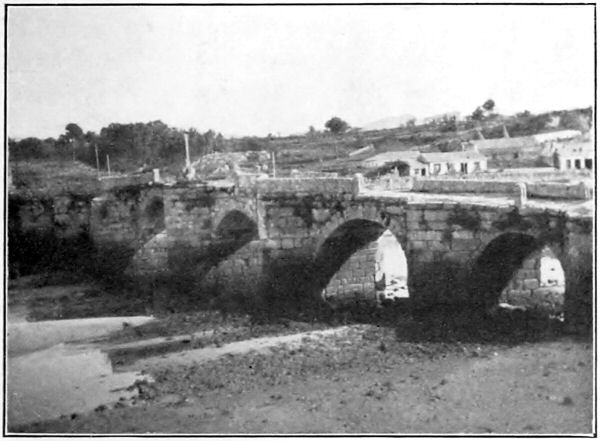
THE BRIDGE AT RAMALLOSA
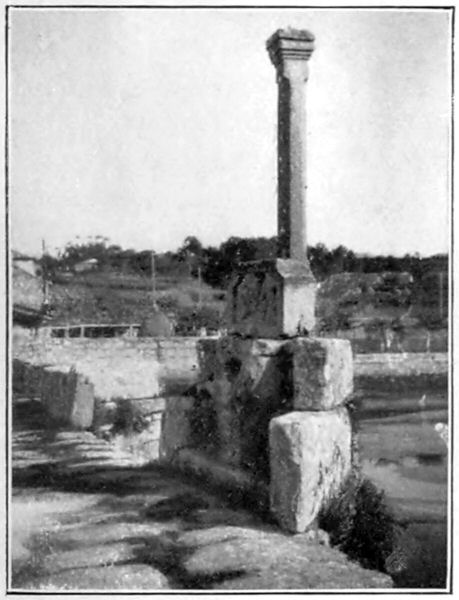
THE SHRINE ON THE BRIDGE
One of the most beautiful of all modern lighthouses
is to be erected near Bayona. The design
takes the form of a colossal figure of the Virgin,
who holds in her left hand a lantern which will be
lit by electricity. Her right hand supports a model
of a ship, sheltering against her bosom—symbol of
the protection which her friendly beams afford to
craft at sea. The rocky base of this remarkable
structure will have a number of steps leading from
the beach to a terrace from which the visitor may
get some glorious views of land and sea. The lighthouse
will be known as the Virgin of Bayona, and
will stand as a memorial to the creative ability of
its designer, an architect of Madrid named Señor
Antonio Palacios.
Still with the refreshing breeze of the Atlantic
meeting you—the ocean so near that the air is
salt-laden—the coast journey is continued to
Guardia, once a fortress of importance, but now a
ruined relic; then, Galicia's most southerly point
having been reached, a turn inland is made, and
there comes into view the Miño, on the other side
of which is Portugal. The river here is a fine
stream, and there is in the neighbourhood that
subtle interest and charm which characterise all
frontiers.
The Miño is skirted until an ancient city perched
upon a hill is seen on the north bank, and on the
south another city, battlemented, romantic, mediæval.
The one is Tuy, an ancient Spanish country town;
the other is Valença, an old Portuguese fortress.
These frontier towns have been the scenes of many
battles since the days when Witiza, a Gothic king,
lived and ruled in Tuy. Witiza resided there in
700; a few years later the Moors swept down upon
and wrecked the town; but the Spaniards recovered
it, and eventually, in the twelfth century, built the
cathedral which is Tuy's most striking feature.
No visitor can fail to notice the uncommon iron
belfry which stands out against the sky from the
surrounding houses, which at this place seem to be
packed exceptionally close together. Tuy has only
one considerable street, called the Alameda, and
offering no particular charm; indeed, the town's
greatest attraction is its beautiful situation and
proximity to Portugal.
The two nations, friendly and harmonious, have
a joint bridge across the Miño, and it is a very
pleasant little excursion to cross the river for a
peep at Portugal. The bridge is modern and very
long—400 yards. In the centre is a carriage road,
above which is the railway; and on each side of the
road is a footpath, from which very fine views are
had of Tuy, Valença, and the river and surrounding
landscape. At Tuy you may listen to the bells
of Portugal, and from the grey walls of Valença
fortress you may hearken to the chimes from the
iron belfry on the house-topped summit of the hill
on which the Spanish town is built.
Sentries allow you, being inoffensive visitors, to
cross the bridge unchallenged. The Spanish and
Portuguese guards take their duties easily, and are
much less business-like than British or German
troops. They more closely resemble the French
in appearance and conduct. It is different, of
course, if one attempts to take a photograph or
make a sketch in the region of a fort. The use
of the camera is not allowed in these places without
permission, nor may drawings or sketches be
made. My friend Mr. Frank H. Mason, in travelling
for the purpose of illustrating this book,
crossed the frontier to Valença, wishful from the
battlements to sketch Tuy. Before he could proceed
he found it necessary to interview the officer
commanding the Portuguese guard. Permission was
readily and politely given, but while the artist
secured the necessary details he was watched by
armed sentries who had been told off for the
purpose. It was a picturesque but unnecessary
proceeding, for there does not appear to be any
serious military secret about the defence of either
Tuy or Valença.
The Atlantic coast has been left behind and is
out of sight; but there is now an even more
astonishing panorama than the ocean-fringe itself
has offered, for the Miño runs through fertile,
striking, and romantic scenery for many miles, acting
as a frontier between Spain and Portugal.
Guillarey, a railway junction near Tuy, enables the
traveller to take train and steam along the bank
of one of the most picturesque iron roads in the
world.
Sixty miles away is the town of Orense, and for
fifty-five miles of that distance the railway hugs
the bank of the Miño, so closely at times that there
seems to be almost a prospect of the locomotive
and its carriages going into the water. From the
windows of the compartments there is an ever-changing,
fascinating scene; now of the river
rushing wildly over boulders, or going smoothly
to the sea; now of vineyard upon vineyard,
Spanish and Portuguese, rising in terraces on the
slopes of the hills, and of some old ruin or towering
landmark. At Salvatierra station there are
the ruins of an ancient fort, seemingly on the platform
itself; and across the river is Mongao, a
mediæval city, which can be reached by ferry.
Hereabouts is a famous wine-growing district, and
so fertile is the country that it is spoken of as
Galicia's granary. The river which is crossed by
the iron bridge at Salvatierra is the Tea, which at
this place runs into the Miño.
The scenery becomes grander and grander until
Arbo is passed, and then, eight miles farther on,
at Friera station, Portugal's highest mountain is
seen, the Outeiro Major, with an altitude of nearly
8000 feet, rising beyond the town of Melgaço,
situated on its slopes. A short distance beyond
this point the Portuguese frontier, indicated by a
few cottages, is left behind; but the character of
the scenery remains the same as far as Orense.
Before Orense is reached there is a chance of
seeing the old and picturesque town of Ribadavia,
where the river Aria, on the banks of which it
stands, joins the Miño. Ribadavia has a population
of 5000, and in the convent of Los Dominicos
possesses a building which was at one time a royal
palace, though probably a crude one, for it was
occupied by monarchs of Galicia when the country
was a separate kingdom. The town is very quaint,
and will form a halting-place for visitors who like
to spend a few hours examining it while awaiting
the return of the train from Orense. That town,
however, will offer more inducement than Ribadavia,
especially to those who have made a particular
point of journeying along the frontier and are not
disposed to go beyond.
Orense is a very ancient city, celebrated for its
bridge and warm baths, which for many centuries
have been looked upon as marvels. These baths,
or springs, have a temperature of about 150° Fahr.,
and as the water has practically neither taste nor
smell and does not appear to possess any medicinal
value, it is used for washing and all kinds of
domestic purposes, even including the cleansing of
slaughtered animals. There are three springs,
called Las Burgas, and they yield about thirty
gallons of hot water each minute.
The cathedral is an imposing building, with a
very gloomy interior, and although the structure
dates from the sixth century, still it will scarcely
call for more than passing attention from any one
who is not ecclesiologically inclined. There are,
however, some extensive and magnificent cloisters at
Orense, which may be viewed by permission, and
there is the bridge. This is a remarkable stone
structure, dating from the thirteenth century, with
a length of more than 1300 feet, and containing
seven arches. One of these, the central, known as
the Grand Arch, is 156 feet wide. It is pointed,
and the crown is 135 feet above the bed of the river—a
height which looks very considerable both from
the bank of the river and the walls of the bridge.
The Miño rises rapidly and to a great height,
and it was with the object of safeguarding the
bridge against the sudden inundations that the
arch was made so high. The bridge ascends from
each end to something of a point in the centre, and
is one of the wonders of Orense. A stone in the
bridge records the interesting fact that that particular
spot is exactly 555 kilometres—nearly 350
miles—from Madrid. Beyond the springs, the
cloisters, the cathedral, and the bridge, the town
has few attractions, but whatever it may lack in
the shape of bricks and stones and mortar is more
than counterbalanced by the glories and the
grandeur of the neighbouring scenery.
CHAPTER VI LOCOMOTION
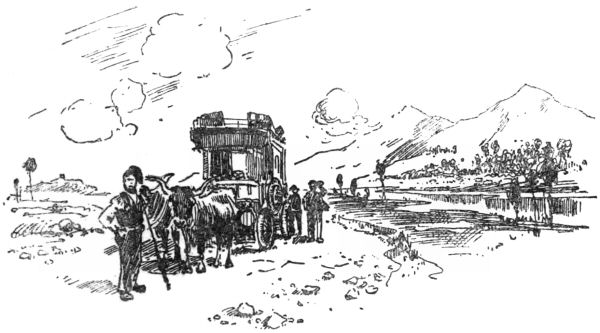
OXEN TOWING A BROKEN-DOWN MOTOR-BUS
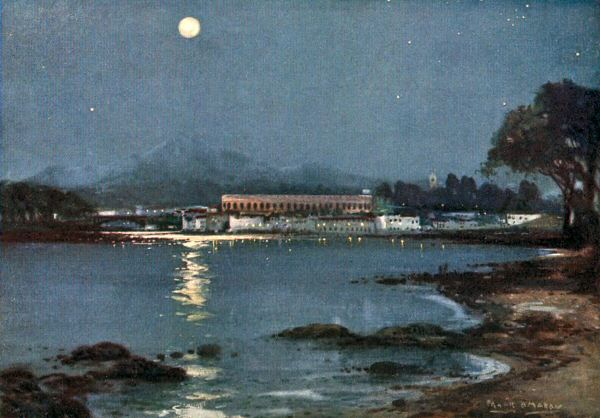
PONTEVEDRA BY NIGHT: THE BULL-RING
The
diligence is still the national vehicle of Galicia.
It is to be met on the high roads which run
between some of the chief towns, drawn by six or
nine or more mules, ponies, or horses; and no more
picturesque sight can be imagined than that of the
primitive conveyance in a country district lumbering
on its peaceful way in the hills or valleys,
crowded with men and women in peasant garb, and
the top piled high with miscellaneous goods and
baggage. The jingle of the bells gives the first
warning of the carriage's approach; then there is
the thud of the hoofs and the rumble of the wheels,
and the craning of heads from doors and windows.
Travellers who have spent days and nights in
them, cramped and crowded in berlina and interior
or coupé, suffering many miseries and inconveniences,
have dwelt on the perils and drawbacks of the
diligence, which has an unfriendly habit of capsizing
and killing or maiming its passengers, and whose
arrival at any given place is subject to the state
of road and weather and other circumstances.
The berlina is a small compartment in front,
running at right angles to the wheels, and ranks as
first class; the interior, second class, is behind, the
seats being arranged after the fashion of a London
bus; and the coupé, third class, is the top of the
vehicle in front of the baggage. In the good
weather, which prevails almost throughout the
year in Galicia, the coupé is by far the pleasantest
and cleanest of the three classes of accommodation;
and, perched high in front of the diligence, the
visitor has an uninterrupted view of the road, and
may enjoy the scenery and look upon objects
which are ceaseless in their fascination. Journeying
by diligence, despite its drawbacks and
discomforts, is one of the most convenient ways of
seeing Galicia, and if the traveller understands
Spanish there is every opportunity of learning the
names of places and buildings and getting explanations
of the meaning of unfamiliar customs. The
driver is seldom at a loss for words or information,
and what he does not know can be supplied
by the conductor or a friendly passenger.
Diligences, big and little, have their special
names, some of which would be impressive if the
vehicles were in keeping with them. Part of the
system of Galician driving is to make an uproar
from the box.
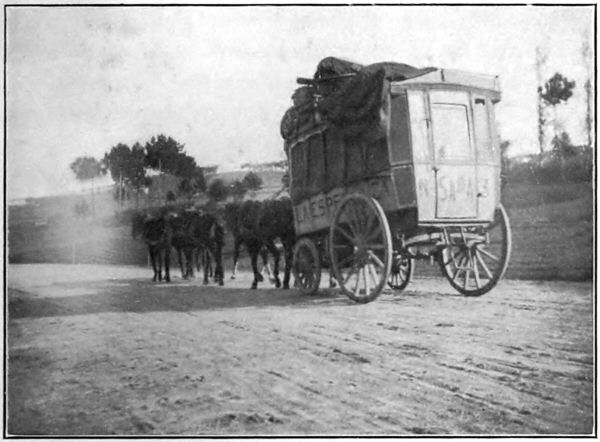
A DILIGENCE ON THE HIGHWAY
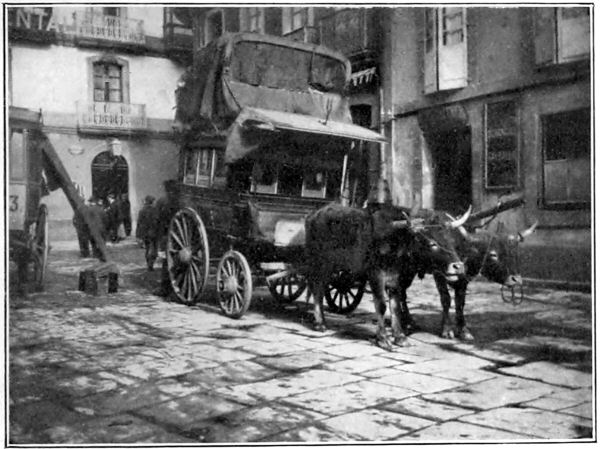
OXEN YOKED TO A DILIGENCE
One Sunday morning I mounted a ramshackle
contrivance called El Elegante, and took a seat
beside the driver, a brigand-looking person who was
unwashed and unshaved. Perched above me, under
the canvas hood, was a small Spanish boy, bare-footed,
bare-legged and bare-headed—almost, indeed,
bare-bodied, for his only clothing was a remnant of
shirt and precarious trousers, consisting mostly of
patches. He planted his feet on my shoulders to
steady himself. I would have reproved him, but
he had the air of a caballero, and the road saved
me the trouble of requesting that he should cast his
burden on the diligence. His feet were jerked off
their perch and we were all thrown tumultuously
about. Three wild-looking little ponies were harnessed
to the coach, and with a frantic shouting and
stamping the driver started them on their journey,
flicking his long whip and cursing and blessing
them by turns. Each animal, like the coach, has a
name, to which it seems to be entirely unresponsive.
The ponies were in no need whatever of a fillip, yet
the driver lashed out furiously, making a great pretence
of flogging them, but doing no real hurt, and
spending most of his time in disentangling the lash
from the harness. Nor was there any occasion for
him to break into frenzied shouts and lean forward
in a paroxysm of affected energy; but he did
both, and, judging from his looks at the end of the
journey, he was satisfied that the success of the
drive was due to his own exertions, and was not in
any way attributable to the quadrupeds.
The railway system of Galicia is imperfect.
Only three lines exist—the West of Galicia Railway,
worked by English capital, the system which
operates from Corunna, and the track which runs
along the bank of the Miño, and covers some
of the most wonderful scenery in the country. In
time other systems will be finished and in course of
operation; but progress marches slowly in Galicia,
and there is no hurry in the country. An old
Spanish proverb says that by the road of By-and-by
you will arrive at the town of Never; and
there is the favourite promise of mañana, which
means that certain things will be accomplished in
the fulness of time. Amongst them is the completion
of Galician railways. Fourteen years have
been spent on one railway between Betanzos and
other centres. The track is finished, but the
system is not complete, and to-day, where a train
should take you swiftly and smoothly across
country, you jolt and jostle in a diligence, or, if
you are fortunate, travel in a motor-car.
Aged engines draw Galicia's rolling-stock; yet
the carriages themselves are very comfortable. The
first-class compartments, by which alone the Booth
Steamship Company's tourists travel, are excellently
adapted to the country's needs. Many of
them are built on the English plan of small compartments,
but others are in the form of little
saloons capable of seating about a dozen passengers.
Seats after the manner of an ordinary English
compartment are at each end of the saloon, and
seats are on each side, leaving the centre free for the
baggage which Galicians cram into every railway
carriage when they get the chance.
These small saloons are about equal in size to
two English compartments, allowing for a broader
gauge rail in Spain, but there are many of the
eight-seated compartments which are common to
England and the Continent. In these coaches
the ordinary Continental system is adopted of
inserting small glass panes in the partitions, so
that travellers may look from one compartment
to the other. The plan has its objections in
the estimation of those who seek privacy, but it
gives comfort to the nervous and unprotected
passenger.
In England smoking-carriages are labelled; in
Galicia the forbidding notice is put on the vehicle
where smoking is not allowed. As a matter of
fact, you may smoke anywhere and everywhere in
Galicia, unless great pressure or sweetness is
brought to bear on some offender against the law.
Yet ladies travelling on railways may reasonably
hope to escape from suffering and annoyance, for
each Galician train has a first-class compartment
exclusively reserved for them. Frequently, even
in trains which were well filled, I observed that the
compartment "Reservado para Señoras" was empty,
the womenfolk preferring to travel with the men
and the tobacco smoke.
Starting a Galician train is a serious task.
Before you are allowed to enter the station your
bona fides as a traveller must be established. The
carriages are shunted to the platform perhaps half
an hour before the advertised time for leaving,
then at a later stage the locomotive is backed in
and coupled, and in due season, with no unseemly
haste, a man in a blouse perambulates the platform
and chants the Spanish equivalent for "Gentlemen,
please embark," which the caballeros do at their
leisure. The engine takes breath, as it were, and
a trumpet tootles; then the driver blows the
whistle, and if you are leave-taking you jump
frantically on board, only to learn that five minutes
pass before the train begins to move. A prolonged
blast from the locomotive is the preliminary
for a leisurely start—I even heard it suggested that
the signal exhausted the boiler so much that a
delay was needed to raise more steam.
Galician trains travel slowly, and there are
protracted waits at the intermediate stations—sometimes
long enough to allow the passenger to
view the surrounding scenery or stroll into the
adjacent town or village, certainly to give him a
chance of drinking a cup of coffee or glass of wine
or a liqueur at the refreshment-room, if one exists.
Failing that establishment, which is primitive and
unattractive from the English standpoint, a drink
of water may be obtained from an old woman who
walks about the platform with an earthenware
vessel. At
Filgueira
station I saw an aged dame,
wearing men's boots, dispensing water to passengers;
near her, on a balcony, was an unwashed but
picturesque Spaniard smoking a cigarette; and two
small girls came to the carriages selling a sweet
cake, made in the shape of a ring. I bought two
for a copper, and they proved excellent eating.
Young and old people of both sexes took their
duties easily, and the platelayers went about their
business leisurely, stepping off the single track long
before the warning signal of the whistle sounded,
and gazing meditatively at the passing and departing
train. There is little fear of the Galician
worker on the line sustaining injuries, because he
gets out of the way long before the train reaches
him—and the train would be hard pressed to
catch up even a retiring platelayer. The speed is
very limited, and once when I was travelling by
motor on a road which ran parallel with a track
the chauffeur easily outdistanced the train, and
shot triumphantly across the metals in front of the
engine.
Motor-cars are not numerous in Galicia, but
there are some very fine examples in use; and
despite adverse criticisms, many of the roads
in the north-west of Spain are excellent. The
highways, to begin with, are well made, but
after heavy rains they become lumpy and are
neglected; but in the neighbourhood of the large
towns they are well cared for, and cars run
smoothly and as fast as the driver cares to go, for
except in passing through towns and villages there
is no speed limit.
Public motor-cars, corresponding in size, power,
and appearance to the London motor-bus, run
regularly between Santiago and Corunna. The
berlina will seat eight persons, but not more than
half a dozen are booked as a rule. The accommodation
is equal to that of an English first-class
compartment, the entrances being at the sides, like
a railway carriage. The rear and larger part of the
vehicle is given to second-class passengers, who
enter at the end. In front there is room for two
or three people, and a passenger may sit beside the
driver and enjoy the air and scenery. The roof
of the conveyance is used for baggage, of which
a great quantity can be stowed. Each trunk or
package carried on the roof—and care is taken
that the passenger shall not burden the interior
with his belongings—has pasted on it a yellow
label bearing a written number. These motor-buses
usually cover the journey of forty miles
between Corunna and Santiago in three and a half
hours. A slower service, conducted by antique-looking
steam vehicles, requires five or six hours—about
half the time occupied by the diligence, which
you will easily overtake on the highway.
Occasionally the motor-bus will break down and
need slight repairs. The passengers in that case
may get out and stroll along the road, as I did.
Blackberries were plentiful in the hedges, and I
gathered and ate them, much to the astonishment
of some fellow-travellers. Spaniards will not eat
the fruit, but several of them gathered blackberries
and insisted upon my acceptance. I consumed
as many as I cared to eat, and as for the
rest, I left them, unobserved by the donors, for
the birds. One afternoon, near the frontier, I
passed a motor which had broken down, and to
which a pair of oxen had been yoked, to draw the
crippled vehicle away.
Railway train, diligence, and motor vehicle are
used by visitors and residents in Galicia, but there
are many districts, remote from towns, where the
mode of locomotion is by mule or donkey, with
occasional horse and pony. Everywhere the
peasant woman may be seen riding on a mule or
ass; and sometimes a string of mules will come
along, each bearing a brightly clad, laughing
woman of Galicia; or in a remote bridle-path in
the hills you have to step aside into a field or
hedge to make way for a handsome girl of the
country who is returning to her father's farm from
the nearest village, sitting contentedly on the
mule which picks its way easily along the rough
ground, which may be, and often is, the stony bed
of a little stream.
It is well to be prepared for minor shocks in
travelling. Your train may have left a station
at night, and you are dozing in the dimly lit
compartment. Suddenly you are fully awake, and
by the light of the oil-lamp see a figure outlined—a
man in corduroys standing almost menacingly
over you. He is not a brigand nor a hold-up;
he is merely the inspector wishing to see your
ticket. He has clambered to the door by way
of the footboard, and has opened it and entered
unseen. When he has done his task he leaves by
the same way, and proceeds to startle some other
unsuspecting and unready traveller. At other
times a man in semi-uniform, with a cap bearing
a small metal locomotive as a badge of office, will
fall upon you for the same purpose, and then
depart. At wayside stations you will see him
leaning from the door of a first-class compartment,
smoking a cigar or cigarette, and preparing to
resume his footboard tricks when the train is
again under way. But though the descent is
as unexpected as the same performances in American
trains, yet there is an entire absence of that
aggressive, domineering attitude which in some of
the United States railway officials is so offensive.
The Galician ticket-examiner doubtless believes
that, being a caballero, he is quite as good as you
are, just as the American official does—except
when he wishes you to know that he is better—but
he has a gentler way of showing it than his
compeer on the other side of the Atlantic.
In departing from a railway station, too, at
night, you may be startled by the sudden opening
of the door of the hotel bus, and the bursting in
upon you of a man with a lantern. He is merely
an octroi official, and his purpose is to see that
you have not hidden upon or about you such
dutiable goods as fowls and other eatables. The
octroi man may be seen in all parts of Galicia,
his headquarters usually being some strange little
abode on the roadside, roughly built of stones.
Probably no men in Galicia feel more acutely the
slowness and inconvenience of the locomotion of the
country than the commercial travellers, most of
whose time is spent in getting from place to place,
and not in the actual transaction of business. That
remark applies, of course, to the commercials of
England and the enterprising "drummers" of
America; but the business representative in Galicia
has to endure many hardships to which his foreign
brethren are strangers.
Late one night I entered an hotel in the company
of some travellers, and watched them as they took
their final meal. They were preparing to make a
night of it, and on asking the reason for the dissipation
I was told that one of the commercials had
to leave by a train which started at 2.45 A.M., that
he had resolved to sit up for it, and that his
comrades, in a spirit of compassion and conviviality,
had agreed to keep him company until he left the
hotel. One or two of them had to start at six
o'clock—and these were quite usual hours for men
on the road.
Time after time I met the same commercials in
trains, diligences, motor-buses, and hotels, and on
each occasion noticed that they had long ago
acquired the art of making themselves comfortable
in adverse circumstances, and had cultivated a fine
disregard of the feelings of others. There is something
in locomotion in North-West Spain which
seems to bring out the worst qualities in travellers,
and I found nothing more disagreeable and exasperating
than to be wedged into a sort of diligence
for conveyance to and from stations. In the darkness
of an early morning I was packed in the
corner of an aged conveyance and jostled over the
lumpy road without so much as a chance of escape,
for the very doorway and outside platform were
crammed with fellow-creatures, and the interior was
packed with people who were mostly corpulent and
unattractive. Once or twice it seemed as if the vehicle
would capsize, and it was a disquieting spectacle to
see a wall of feminine flesh bending forward as
if with the sinister purpose of extinguishing me.
In the gloom of one corner was a stout man, wearing
a linen uniform and smoking. I assumed that
he was a workman, perhaps a bill-poster, until, later,
he was seated opposite to me in a first-class compartment,
and I discovered that he was an officer.
It may be that you have your cycle with you, in
which case you may pedal in peace, but unless you
know the region well you must keep an ever-watchful
eye ahead, for many of the roads zigzag dangerously
along the mountain sides, and an uncontrolled
machine would bring about a swift disaster.
Brakes both good and strong, and at least two of
them, are necessary for the cyclist's safety and his
peace of mind in Galicia. That precaution would
apply especially to the ordinary visitor, man or
woman. There are those in the cycling world who,
even in risky and unknown neighbourhoods, neglect
precautions and scoff at danger. In many parts of
Galicia the scoffing may be followed by a catastrophe
the victim of which would scoff no more.
I saw only two or three cycles in Galicia, and
one of these was a freak made of wood. The
wheels were solid discs, after the fashion of the
wheels of a bullock-cart, and the whole of the frame
and fittings seemed to be of the same material,
unpainted, as if the masterpiece had been just
finished and was undergoing its trials. The work
was excellently done, and was a high tribute to the
patience and ingenuity of the producer, who had
clearly taken as his model an ordinary safety.
The machine was being ridden by a peasant lad in
a country village. When I first saw him he was
ahead, coasting slowly down the steep road; but
he observed the motor-car approach, and by the
time I passed him he had dismounted and dragged
his cherished possession up the hedge side out of
harm's way. As to cycling generally in Galicia,
it is quite feasible, for many of the roads are
suitable, but in most places the steep, rough
thoroughfares make the comfortable use of one's
machine impracticable.
CHAPTER VII MONDARIZ
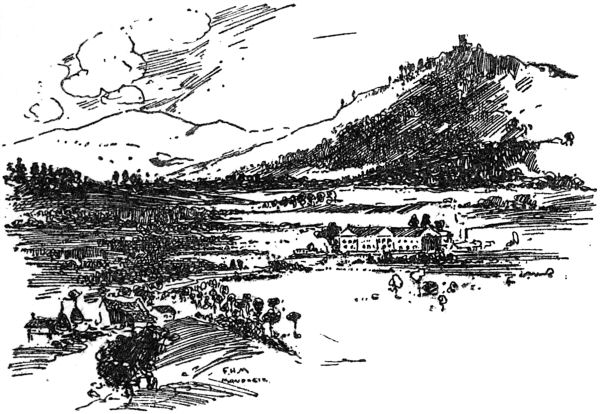
THE HILLS OF MONDARIZ
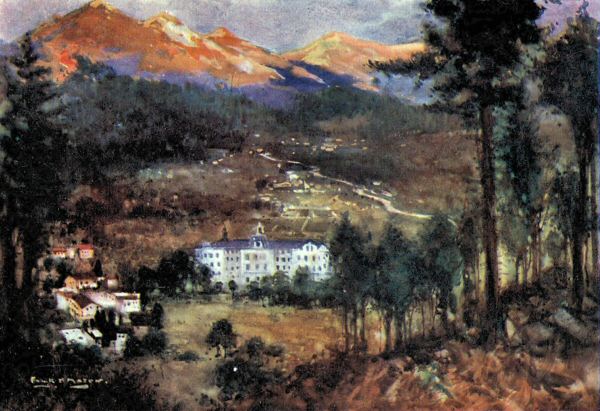
MONDARIZ
There
is one health and pleasure resort in Galicia
which is in the nature of an earthly paradise, and
that is Mondariz. The district has been long
famed for its beauty, charm, and grandeur, and
those curative waters on the success of which a
colossal and palatial hydropathic institution is conducted
by Messrs. Ramon and Enrique Peinador.
This hotel claims to be the finest and best in the
Peninsula; it is certainly the most remarkable in
many ways, and might almost be compared with a
Mauretania on land, it is so complete and self-contained.
In wandering through Galicia it is impossible not
to be struck by the number of medicinal facilities
that the country offers in the form of natural
springs, and the careful attention which has been
given to their development. Great labour has been
spent, as well as money, in connection with some
of these watering-places, and only by the application
of a large capital, incessant perseverance, and a
far-seeing sagacity could the Mondariz hydropathic
establishment be what Messrs. Peinador have made
it. Mondariz is not only a resort for those who
take medicinal waters in the ordinary way, but it
is also a great pleasure centre of Spain. In the
season Mondariz is the most brilliant place in
Galicia, and its pleasures are shared by visitors
from all parts of Spain and abroad. The attractions
of the institution and the district are rapidly
becoming known to English travellers.
The waters of Mondariz (Gandara and Troncoso,
as the springs are called) contain bicarbonate of
soda, and abundant medical evidence is available as
to their therapeutic value. Professor Augusto
Pi y Suñer,
of Seville University, in an exhaustive report
gives some striking facts concerning their tonic and
curative effect in many forms of illness. So that
visitors may take full advantage of the waters
Messrs. Peinador have constructed baths of every
description, and of beautiful design and admirable
workmanship. Lavishness of expenditure, indeed,
is one of the characteristics of the Mondariz
Hydro, and only by the adoption of such a bold
policy could the present great results have been
attained.
A handful of people a few years ago journeyed
to the vale in which Mondariz nestles, to take the
waters, and they found accommodation in little
châlets on the green slopes which abound in the
locality. The results were so remarkable that the
châlets could no longer house the visitors, and
finally the existing hotel was opened in 1897.
Six hundred people can be accommodated at the
hydro, yet in the season the vast establishment is
taxed to its utmost capacity to provide for the
visitors. The grace and beauty of the building are
noticeable as soon as the main hall is entered and
the grand staircase is seen. This gives access to
rooms some of which, especially the chief private
suites, are regal in their appointments. Mondariz
can give accommodation to a king as well as to an
ordinary tourist. The principal dining-room is of
enormous size, and there is a very large and handsomely
decorated salon in which dances and theatrical
performances and concerts take place. The kitchen
arrangements are of the most perfect modern type,
and possess the feature, somewhat unusual in hotels,
of being open at all times to public inspection.
But it is not merely in the hotel as a building
and establishment that interest centres at Mondariz;
it is in the completeness of the undertaking. The
industry of bottling the water is conducted in its
entirety. The neighbouring woods supply the
timber needed for the packing-cases, which are all
made on the estate; and so great is the demand
at home and abroad for the waters that in the
course of twenty-four hours 10,000 bottles are prepared.
The men and women who bottle and pack
work day and night in alternate shifts.
The hotel has its own fancy shops in the season,
for enterprising houses in Madrid send business
representatives to supply the wants of visitors,
delightful stalls and kiosks being arranged, bazaar-like,
in the grounds. Special vineyards, wine-making
premises, farms, kitchen and fruit and
flower gardens, as well as sheds and sties for
cattle and pigs, and great pens for poultry, are
amongst the other resources of Mondariz. The
estate also possesses its own printing establishment,
from which a newspaper is issued specially dealing
with the doings of the institution and its guests.
Fishing and shooting, driving, riding, walking, and
rowing—all these may be enjoyed on the hotel
estate, through which the trout-teeming Tea flows.
The walks in the pine-clad hills and along the
bridle-paths and little lanes of Mondariz are full of
charm and delight. A perfect holiday may, indeed,
be spent without leaving the estate, on which, to
give an atmosphere of completion, there is a
chapel.
From the verandah in front of the hotel, or the
balcony on to which the window of your bedroom
leads, or from your garden-chair under the palm-trees
you may watch the women of Galicia ride past
on mules or donkeys or walk to and fro with their
burdens, so that the very life of the people seems
to be brought to your notice without any exertion
on your part. On the extensive estate long and
enjoyable walks may be taken, and inspection
made of numerous historical remains which Messrs.
Peinador have brought together from various parts
of Galicia. A museum is in course of formation
in which many articles are already to be seen
bearing on Gallegan life and costume. By means
of the hotel motors very delightful excursions may
be undertaken to neighbouring towns and villages.
A regular service is maintained between Mondariz
and Vigo for the convenience of tourists by the
Booth Line.
A pump-room is being built at Mondariz from
designs prepared by the foremost of Spain's architects,
and when it is finished the building, judging
from the plans, will be amongst the finest in
existence. It will be a beautiful ornament to the
grounds and form the rendezvous for the water-drinkers,
just as the old pump-rooms at Bath,
Harrogate, Scarborough, and Buxton were the
central meeting-places for visitors. The pump-room
will be equipped with every modern appliance and
luxury, and yet within a stone's-throw there are
primitive cottages inhabited by something approximating
primitive man. That is another of Galicia's
sharp contrasts.
One of the chief features of the new building
will be the fine granite columns. These are made
entirely on the premises and are produced from the
estate. The huge granite blocks are quarried in
the neighbouring hills; bullocks draw them down
to the hotel grounds, where hotel workmen rough
them out, and turn them in the lathe and finish and
polish them. Other employés will put them in
position and complete the building, the estimated
time for constructing which is two years.
There are larger and more imposing hotels in
the world than the hydro at Mondariz; I have
seen them in London, Paris, New York, Chicago,
and elsewhere; but not even in America have I
visited an establishment which can lay claim to that
completeness of resource which characterises the
concern of Messrs. Peinador. Galicia from north
to south and east to west is fascinating, but there
is no place in the country which leaves more
abidingly pleasant memories than Mondariz.
The balanced stone of Arcos is within an easy
drive of Mondariz. This gigantic boulder is poised
on the top of another enormous rock in such a way
that it seems as if a touch or a strong wind would
send the mass headlong into the rough road below.
But the stone has been in that position for ages, and
is one of Nature's mysteries. The journey to this
wonderful logan affords a view of some of the wildest
and grandest scenery in the neighbourhood of
Mondariz. Much nearer the hydro, and making a
very charming walk, is the little village of San
Pedro, which forms one of the pleasantest sights
that the pedestrian can witness. Here and there,
on the banks of rushing streams, are stone-built
mills, primitive and tiny, where native millers carry
out their grinding operations with the water-wheel.
Galicia may be visited and something seen of
the people and country without going beyond the
confines of the hotel, for the estate is large and
wonderfully comprehensive. It possesses its own
hills and dales, where you may get good sport, even
its own river, the Tea, on which you may boat and
fish. You may see the process of wine-making,
from the growth of the grape to the bottling of the
juice, and the evolution of the chicken from the
egg to the poulet rôti or other form of table
delicacy. Fruits and vegetables in more shapes and
forms than I can either remember or understand
are produced on the estate, and in due season take
their places on the well-appointed tables. Nay,
even Galician peasant life is represented, and
without much trouble you may enter a cottage
and see what the life of the people really is. True,
the homes are better than the sordid hovels which
are common to Galicia, but the lives of the people
are practically the same. I went into one house,
and from the dark, primitive kitchen walked into
a sleeping-room with an embrasure-like window
which framed one of the most perfect landscapes I
ever saw—a picture the like of which few people
in England below noble rank can command from
their own possessions.
The ruined castle of Sobroso, which is within
pleasant walking and driving distance of Mondariz,
offers an exceptionally fine view of Galician landscape.
The country is a wealth of fascinating
colour. Hills rise up on every side—pine-clad and
lonely; some, if the day is doubtful, suffused in
sunshine, some a deep blue—so deep that the
details of the hills are lost and the mountain ranges
are smoky, mist-topped masses. The sun shines
and the warm rain drops softly. Peaceful little
farms nestle in the valleys, with the vineyards
terracing the slopes; bullocks, resting from their
labours, are browsing; goats are nibbling on the
green slopes; women are in the maize-fields, and
men are digging, trimming, turning, to make the
bounteous earth yield its supplies. It is a scene of
perfect peace and beauty, and the only sounds that
break the soothing silence are the laughing voices of
the women who are working in the fields, and that
strange creaking of the bullock-carts which is not
heard in any other part of Spain.
A long mile from the wooded base of Sobroso I
had watched a train of bullock-carts crawl up the
white high road—a train of seven, timber-laden,
making an extraordinary noise as they approached.
Amongst the drivers was an old woman, bare-footed,
who, as she trudged alongside her patient pair
of oxen, wove wool with a distaff which she carried
in her hands. Later, from Sobroso itself, I listened
to the distant noises of the bullock-train—a
musical creaking, groaning, and rasping—with a
sudden silence when the cattle were brought up
to rest. Sometimes the creaking would be like
church bells, at other times the sound resembled
the whistle of a locomotive. It was an uncanny
medley, like, and yet unlike, both bells and whistle,
and to be compared only with itself, for there is
nothing else like the creaking of the bullock-cart
of Galicia. They say that the noise is made
deliberately, to give warning, in narrow, dangerous
roads where there is no room to pass, that a
bullock-cart is coming; but they do not explain
how a driver, dulled and deafened by the uproar of
his own conveyance, hears the noises of a rival
vehicle.
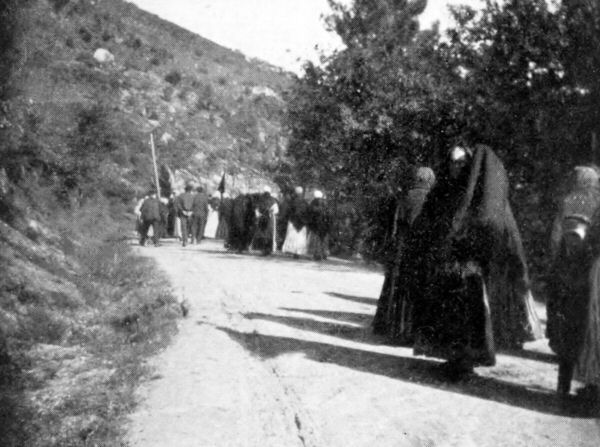
A PEASANT'S FUNERAL IN THE HILLS
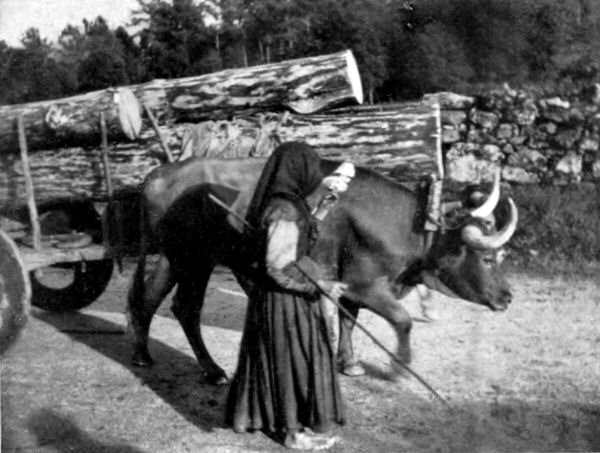
A PEASANT WOMAN, WITH HER DISTAFF, DRIVING A BULLOCK-CART
Down in the foreground is a white, peaceful
church, near it a tall, slender pillar of stone, surmounted
by an effigy of the crucified Redeemer on
the one side, and on the other a figure of the
Virgin and Child; on the tops of neighbouring
walls are crosses, emblems of that faith which all
Galicians have adopted, for here, as elsewhere in
Spain, there is one religion only, and it is that
of the Holy Mother Church. The whole scene is
wonderful and impressive, and the country has the
great merit of being almost untravelled by and
unknown to ordinary tourists.
From Sobroso's solitude you walk back to the
high road where your motor-car or Spanish cab
awaits you and resume your journey, or, being
untroubled by thoughts of time or vehicles, walk
onward in the strangely fascinating twilight of
Galicia. You pass the peasant women, and they
smile and murmur "Adios," and instinctively you
raise your hat in recognition of the salutation.
All roads near Mondariz lead to the hydro,
and an hour or two after you have descended
from the ruins of Sobroso you are in the great
dining-hall of the hotel or in its brilliant salon, or
are smoking in the verandah outside, in the pine-scented
air, with semi-tropical vegetation around
you. It is no exaggeration to speak of this great
undertaking as Mondariz the marvellous.
CHAPTER VIII GALICIA'S BURDEN-BEARERS
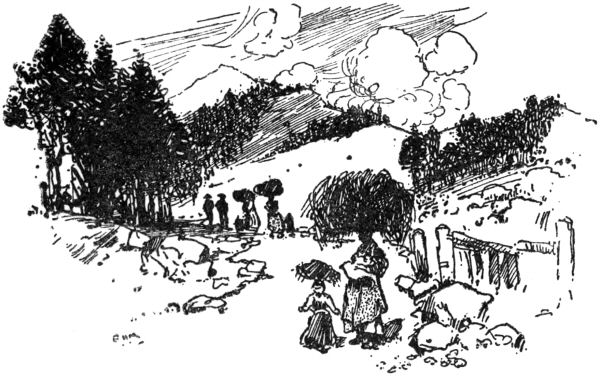
GATHERING FIREWOOD IN THE PINE HILLS
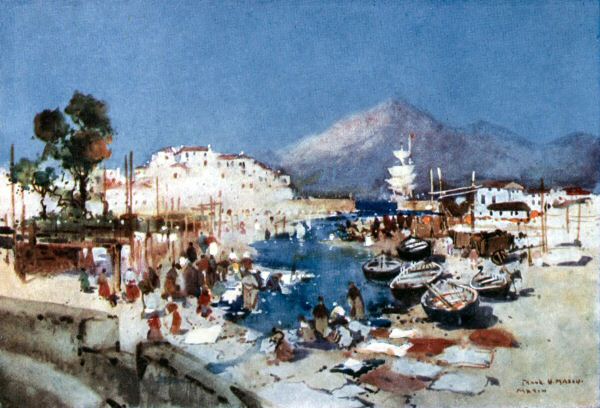
THE FISHING-TOWN OF MARIN
On
the road which runs from Vigo to Mondariz
I saw a woman walking with some great burden
on her head. She advanced quickly, with straight
and supple gait, but not till she was very near
did I notice what she carried. It was a full-sized
coffin, but so perfectly poised that the bearer did
not seem to feel its weight. She went past,
silent, heavy-eyed, and looking straight ahead,
her bare feet making no sound on the gravel of
the pavement.
That was one of the first of Galicia's burden-bearers
I saw, but the very first was when I landed
at Vigo and observed a woman on the Alameda
carrying an assortment of bedding on her head,
a mass which almost smothered her. A man,
apparently her husband, stalked in front, leading
the way, like a Red Indian before his squaw,
and bearing his share, according to Galician ethics,
of the family possessions, for under his left arm
was tucked a pillow and in his right hand he
carried an umbrella.
From the day when they can support any
burden at all the females of Galicia are taught
that to them is given the conveyance of any article,
however big and clumsy, which is not too big for
a human being to grapple with. Nothing more
astonishing can be seen in Galicia than the size
and weight of some of the loads which the women
carry on their heads, and frequently a woman
hurries along under a burden which a Billingsgate
or Covent Garden porter would refuse to have
planted on his crown.
Galician women have a passion for consigning
burdens to their heads. Size, shape, and weight
are immaterial. The burden may be a bedstead,
a coffin, a load of firewood or seaweed, an enormous
trunk packed with baggage, a bucket of water, a
huge basket of fish or vegetables, or some grotesque
article which could be easily carried in the hand.
Big or little, the method of conveyance is the same,
a small protecting pad being put between the
top of the head and the burden. A common,
almost universal, way of preparing the pad is to
take a handkerchief, usually a white one, from the
pocket, roll it into a ring, and then put it on the
crown of the head. The material prevents the
hard basket, bucket, box, or other burden from
being unduly felt, though many Galician women
have bald spaces due to the wearing away of the hair
by the circular pads. If the weight is not too heavy
a woman will hoist it up herself, but the custom is
to have the load lifted up and put in place.
There is a spirit of camaraderie in the burden-bearing,
and frequently a woman who is hurrying
along the street, flying light, will stop to hoist up a
burden on to a fellow-creature's head. Small girls
scurry along the pavement or roadway bearing
weights that are out of all proportion to their
strength and years, and to this early toil may
be attributed the spoiling of Galician figures.
The heavy weights and strain of carrying them
cause the women to walk with a curious twisting
movement of the hips, and to over-develop that
part of the body; but as a rule the carriage of
the Galician peasant woman is perfect, and many
have remarkably fine figures. Some of the women
appear to be enormously strong, and the great
majority look healthy and happy. Even when
near confinement they will continue their burden-bearing,
and I was told that often a child will
be born to a woman who has gone straight from
her work, and that in an incredibly short time
she will be at her task again. In this respect
the Galician peasant seems to be fit sister to the
Red Indian women, of whom it was said that
they would fall out of the line of march, and
having given birth to a son or daughter on the
prairie, pick the infant up and overtake their
companions.
Women in Galicia work in the houses, the fields,
the quarries, on the road, on the water. You may
see them driving bullock-carts, and pigs and cattle.
I observed a tiny girl who could not be more than
three years old piloting an enormous and fractious
sow, weeping copiously as she did so because the
stubborn pig refused to answer steering signals,
which were smart thuds on her fat sides; women
were helping men to pull a boat-load of seaweed
up Vigo Bay; three women and one man outside
Pontevedra were road-making with pickaxes; not
far away from them other women were filling
corves with coal, plying their shovels like navvies,
and women were unloading a stone-laden sloop,
tripping up a springy gangway with their stone-filled
baskets on their heads, and hurrying down
another plank for further loads. I saw women
stripping the husks from maize, quarrying granite
in the hills, working on hats and dresses, teaching
in little wayside schools, tending the sick in
hospital, and doing a hundred and one odd things
many of which are carried out by women in Great
Britain, but most of which fall only to the lot of
men.
On inquiring into the rate of wages paid to
women I was told that a female labourer gets
sevenpence daily for her work, which lasts from
sunrise to sunset, and she is as a rule supplied
with wine and maize-bread, although in some
places the bread has to be bought. In cold
weather the women are given a little brandy.
The wages seem small enough, but the cost of
living is in proportion to the income. A little
cottage may be had for a shilling a week, and
although the dwelling is far from being a desirable
human habitation from the English standpoint,
still it is not worse in some respects than many of
the appalling dens in which British labourers live.
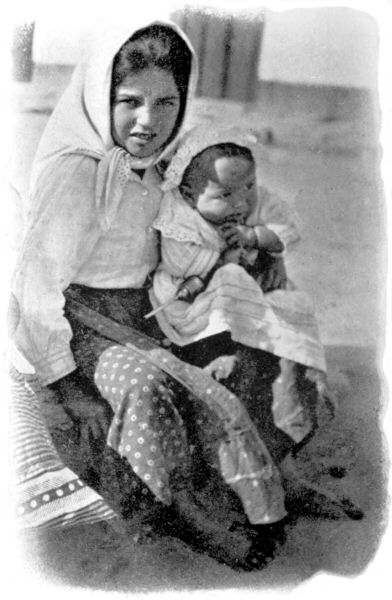
A MAID OF CANGAS
Women appeared on the railway side at every
level crossing when a train was passing, and, armed
with a staff as badge of office, held up the traffic,
vehicular and pedestrian. As a rule there was
neither, but the conscientious female went through
the solemn ceremony of standing sentry over the
gate or chain which separated the single track
from the highway until the train had passed, and
then lowering the sign of authority and opening
the gate or releasing the chain to indicate that
carts and human beings were at liberty to cross
the metals. Often enough this motherly protection
was witnessed only by a dilapidated Spanish
infant, who had nothing better to do than stroll
down to the railway and watch the train go
past.
These remarkable children are everywhere, and
some of them are very pretty, and as shy as they
are attractive. At the old bridge of Ramallosa I
wished to take a photograph of a little Spanish
maid who was hurrying towards me over the arches,
but her coyness was unconquerable, and in spite of
all allurements she refused to be a party to the
picture, and at last turned and fled precipitately.
At Cangas, on the north side of Vigo Bay, I
craftily secured a shot at a beautiful maid who
was hugging a fat and placid infant on the shore.
Being only a few feet away, I feigned deep interest
in a neighbouring sardine-boat, then, unexpectedly
confronting the little nurse, so that she should not
have time to pose, I secured her for the film. It was
not until I strolled away that the subtlety of the
performance struck her; then, for some reason best
known to herself, she burst into screams of laughter.
One of the charms of snapshots in Galicia is that
the subjects are quite unconscious. They do not
pose, because they do not understand.
Some of the Galician peasant women have a
strange way of dressing their hair. This consists
of plaiting a length of material of exactly the
same colour as the hair into the pig-tail or tails
to give the finished article a more generous and
impressive appearance. At first sight the custom
strikes one as tending to vanity; yet it is as
nothing, if men are to believe all they read, compared
with one's own countrywomen's practice of
enriching their own locks by adding to them, not
a piece of stuff or ribbon, but other people's shorn
tresses.
Women do most things—nearly, it seems, all
things—in this corner of Spain, but in no respect
are they more in evidence than in connection with
washing. Laundry work in England is synonymous
with everything that is hard and sordid, but in
Galicia it reaches something approaching a fine
art. Washing seems to be the national recreation
of Galicia. All day long and every day the
womenfolk are on the banks of streams and rivers,
standing, bending, or kneeling at their work, or
in public washhouses, such as Corunna possesses,
just below the place where Sir John Moore is
buried, or in some open ground in towns. At
Ferrol there is a huge trough around which the
women stand to their work. This is in the open
air. Vigo has a covered building near the bay for
laundry operations, but by far the greater part of
the work is done in sunshine, near the running water
by the side of glorious fields or at the edges of
green woods, and though the task may be laborious
the conditions of the toil are perfect.
There is incessant talk and laughter—one of the
brightest and most hilarious groups of women that
I saw in Galicia was at Ferrol, round the public
wash-tub. There were a score or so of them, busy
at work, but not too busy to turn and laugh at the
stranger; merry, but not so merry that they could
not find energy to break into joyful screams at some
playful jest from a passer-by. The spectacle was
one on which Samuel Pepys would have dwelt with
rapture, and the joke would have been recorded
with minute precision in his diary. There are
many odd things in Galicia which savour of the
England of the Restoration.
The washing is a simple task. The clothes are
taken to the water's edge, mostly in flat baskets,
such as those which are used for fish. The women
kneel over the running water, thoroughly soaking
and soaping the garments, which are then placed
on stones to be rubbed. After the rubbing there
is a careful rinsing and wringing. The articles
are then spread on the nearest hedges or grass or
stones to dry. A mother may bring her baby
with her, and leave the little creature sitting or
sleeping in the basket near her; the young boys
and girls will give a hand with the work; and if
it is after dinner an old woman may come up
with her tin and earthenware utensils and wash
them in the running water, which carries all impurities
towards the sea.
There is in most of us that faculty for enjoyment
which comes from watching, at our ease, fellow-creatures
toiling, and I will confess to the keen
satisfaction I felt at the quaint bridge of Marin, a
pleasant little run from Pontevedra, as I leaned
over the parapet smoking and watching the washers
in the stream below. The sun was shining hotly,
the sky was a clear blue, the little white houses
dotted the yellow sands, and the brown nets hung to
dry from the fishing-boats and fences. The women
sang at their labour, and the children sang as they
frolicked or helped their elders. It seemed like a
universal washing-day. Yet even washing in Galicia
is a romantic and picturesque performance, completely
free from the steamy, squalid smells of
laundry days in British homes and institutions.
CARRYING WATER
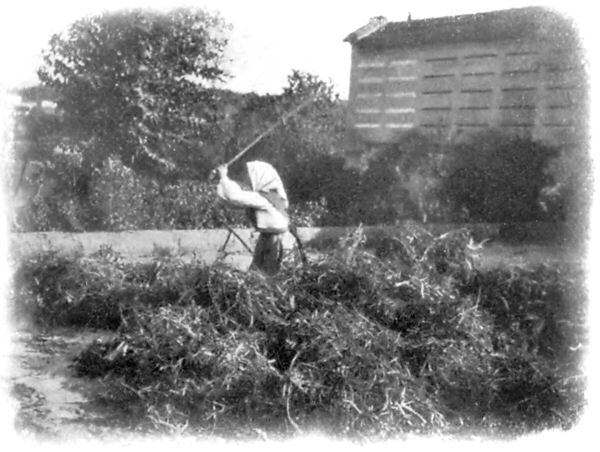
A WOMAN THRESHING BEANS
At Marin I leaned over the bridge and gazed
long at the workers by the stream, then turned
towards Pontevedra, walking up the road in the hot
sunshine. Ahead the road was filled with people,
moving slowly, and in their midst a banner and
some trappings flashed in the strong bright light,
and there came the strains of solemn music and the
wails of grief, for this was a Galician funeral. The
coffin was borne shoulder-high, with several priests
near it, and with them a man, like a peasant in his
Sunday clothes, playing a bassoon, on which he
accompanied some of the responses to the priests'
prayers. Women, mostly in black, of the poorest
class, with shawls on their heads, followed the
coffin closely. There were but few men present.
A halt was made for a few moments to rest and
change the bearers, and a peasant woman hurried
from her cottage with a small table on which they
could rest their burden. All the time there were
the prayers and the responses, mingled with the
strangely sweet and solemn music of the great reed
instrument, until the procession reached a spot at
which a branch of the road led to a little church on
the shore, whose bell was tolling and in whose
ground the burial was to take place. It was a
simple ceremony, shorn of pomp and circumstance,
and in perfect keeping with the wondrous peace and
beauty of the sun-bathed hills and water.
CHAPTER IX AROSA BAY AND LA TOJA
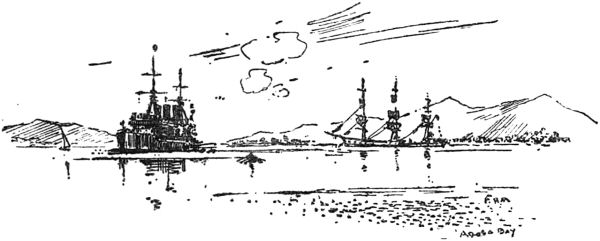
AROSA BAY
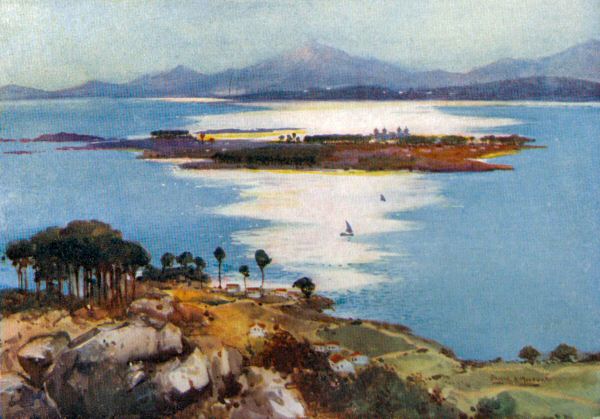
THE ISLAND OF LA TOJA
British
warships have made Arosa Bay their headquarters
for many years, and have found the landlocked
stretch of sea and the surrounding hills a
glorious and delightful region for sport and pleasure.
It is remarkable that the three great bays
on the coast of Galicia—Arosa, Pontevedra, and
Vigo—have their entrances protected by islands
which break the force of the Atlantic waves.
The Isle of Salvora is in the very mouth of
Arosa Bay, with small islands to the north of it as
satellites. There is a fine stretch of bay between
Salvora and Arosa Island, which is in the middle of
the bay itself. The warships anchor between Arosa
and the mainland, close to Villa Garcia, Carril, and
Cortegada.
Villa Garcia is renowned for its bathing and
fishing, and on its shore an excellently appointed
and large bathing establishment has been built.
The town is the headquarters of a British Vice-Consul,
whose residence is one of the most striking
features of the place. It is the old castle of the
Marquis of Villa Garcia, modernised, and abounding
in historical and antiquarian associations.
Roman remains have been discovered in recent
years on the estate by the present Vice-Consul, who
has formed a very interesting private collection,
and has contributed some valuable objects to the
Archæological Museum at Santiago. On the other
side of the road, only a few feet from the Consulate,
is a convent, with a church adjoining in which the
nuns worship. These religious prisoners go to and
from the church by way of a private passage, and
are never seen in public. The barred windows of
their cells frown on the Consulate like the windows
of a gaol.
Pilgrims in bygone years took this road to
Santiago, coming from Portugal; but to-day British
officers and sailors use it largely when they are
ashore for recreation. Perhaps from behind some
rusting bars sweet, pale-faced nuns may watch
them as they drive or walk, and may wonder what
sort of life it is that these men of the waters
lead—the fighters to whom the world is free and
open, while the silent watcher never gets beyond
the convent's narrow boundary. The nun's bed
consists of rough boards which, when she dies,
are turned up and nailed together to form her
coffin.
A pleasant walk from Villa Garcia is to Carril,
only a mile away, with a population of 3000
and a very busy harbour. A short sail is
to Cortegada, the beautiful island which the King
of Spain has chosen as his summer residence. Villa
Garcia, indeed, is a centre from which many excursions
may be made, either for sport in the hills
or the bay and rivers. From the little town it is
an easy train journey to Caldas de Reyes, where,
for three months in the year, July to September,
visitors take the warm mineral baths at the
excellent
Hotel
Acuña, delightfully situated at the
end of the bridge which crosses the river Umia.
The town is small, but very quaint. It has a
public hot spring, where the family washing may be
conducted or the family hot water obtained, but
the laundry work is done mostly on the river-side
by the bridge. You may lean over the bridge and
see in the limpid water the fish disport themselves.
The scenery in the locality is beautiful, especially
from the summits of the surrounding hills. The
waters of Caldas have neither taste nor colour, and
have a wonderful effect upon the skin. At Cuntis,
three miles from Caldas, in the hills, are warm
baths which at the Grand
Hotel
attract many
thousands of visitors yearly; while the little
town is picturesque and interesting, especially on
Sundays, when the peasant women crowd the
market-place, buying and selling and congregating
outside the business places which serve as general
stores.
Caldas is associated in my mind with the only
drunken man I saw in Galicia; also with a peasant's
funeral in the hills, and a charmingly situated
workhouse on the banks of the river. I do not
suppose that in Galicia they have old age
pensions, but as a last home few places could
rival in situation this white-walled building on
the grassy slopes of Umia.
The romantic and the practical are typified just
outside Caldas, where, amid impressive rocky scenery,
the Umia thunders in a fine cascade. It is fascinating
to sit or stand on the rocks and watch the
waterfall and listen to its roar; and for those who
do not greatly appreciate the charms of nature
there is at the side of the falls a modern structure
with a thorough electrical equipment which is
reminiscent of Niagara's power-houses, and supplies
light for many miles around.
The country is beautiful and varied, and from
Cuntis very fine views are obtainable, although in
this respect the neighbourhood has not the same
attractions as some of the hills near Vigo. From
the hills at Cuntis a view of the Portuguese
mountains is obtainable; but most of the tourists
to Galicia will postpone their inspection of the
Portuguese landmarks until they are nearer the
frontier.
Easily reached from Villa Garcia is El Padron,
a town of 10,000 inhabitants, at the head of the
bay, and full of historical associations. El Padron
(meaning "The Saint") is a very ancient little city—older,
indeed, than Santiago, and also imperishably
connected with St. James, for it was here that his
body was landed on being brought from the Holy
Land, and El Padron formerly shared some of
Santiago's glory as a city for pilgrims, but is
no longer a pilgrim city, nor, as it used to be, a
sanctuary for criminals flying from what passed for
justice. Borrow visited El Padron, and found it
a flourishing little town with an extensive commerce,
sending small vessels not only across the
Bay of Biscay, but also as far as London River.
He dwelt with satisfaction on a story which he
heard in Santiago concerning El Padron skippers
and the Scriptures. The English had presented
Bibles to the skippers, who happened to be in
London, and on their return to Galicia it was
observed that these enterprising mariners had
become very dogmatic in argument concerning
Holy Writ. Finally the cause of their wisdom
was discovered, and the Testaments were taken
from them and burnt, and the disputants were
punished and reprimanded.
St. James preached at El Padron, and on a spot
where he spoke a hermitage was built to which pilgrims
went in the days when the town attracted
them. According to the legend, when the Apostle's
body reached the town the miraculous boat containing
it found anchorage at the base of a Roman
statue, an event which is commemorated in El
Padron's coat of arms.
Though there is not much in El Padron to
induce the visitor to stay there, yet the town's
situation and romantic history make it an attractive
excursion centre. Pontevedra, however, a
few miles from Villa Garcia, offers many inducements
to the stranger to linger. The arcaded
streets are full of charm and history and many of
the old houses are admirably preserved. There are
about 20,000 inhabitants in Pontevedra, and,
like all other Galicians, they get into the open
air whenever they can and disport themselves on
the well-wooded Alameda, or, in the season, at the
bull-ring, a building which is a conspicuous feature
of the town. There is good hotel and café accommodation,
and many quaint sights are to be
witnessed. But the most pronounced memory of
Pontevedra is the
sereno's
haunting night-chant,
of which I have written elsewhere.
The vessel in which Columbus crossed the
Atlantic and discovered America was built at
Pontevedra. She was named the Santa Maria, and
was decked. The Pinta and the Niña, her little
consorts, were open, without decks amidships, but
with high bows and sterns, where cabins were built
for the accommodation of the crews. Some of the
ships of the Armada were assembled at Pontevedra
before the complete fleet sailed for England.
On the Carril road stand the ruins of the
Convent of San Domingo. The building has been
turned into an open-air archæological museum, but
enough of the original structure remains to give
a good idea of the convent in the days of its glory.
It was here that, rather more than a century ago,
a desperate battle took place between the French
troops and the peasants. The convent was founded
in the thirteenth century, and the ivy-clad remains,
on a typical sunny day, make a beautiful object to
inspect.
Pontevedra has its modern institutions, like
Vigo, but the arcaded streets and the ancient
houses are the great charms. The Church of San
Francisco is a prominent feature of the town,
occupying a commanding position, and a very
pleasant walk across the bridge to the other side
of the water may be taken, a point being reached
from which a striking view is obtained.
The country around Pontevedra is remarkably
picturesque and fertile, and has long been famous
for its grapes and oranges and citrons. In Borrow's
day the town was surrounded by a wall of hewn
stone, of which parts remain, although there is
nothing left of the turrets which formerly stood for
purposes of defence and observation. The river
Lerez runs into Pontevedra Bay, and a few miles
outside the town, forming an extensive enclosure, is
an estate, with the
Hotel
Mendez Nuñez, where the
Lerez waters are bottled for home and foreign use.
In the summer time marine excursions are run from
Pontevedra to the estate, the river being a pleasant
and enjoyable mode of travel. At that season the
stream is low and placid, but in time of storm and
heavy rains the Lerez swells rapidly and becomes a
roaring torrent. The Lerez rises in the Candan
Sierra, and in those wild and lonely hills the wolf
still roams, although he is seldom seen.
In this region, as well as on other parts of the
coast, the Benediction of the Sea is celebrated on
May Day. At that festival the parish priests bless
the waters which give such a rich harvest of fish,
and the fishermen and fishwives in large numbers
share in the religious ceremony.
There is one attraction of outstanding interest to
visitors to Arosa Bay, and that is the island of La
Toja. This beautiful little place stands like a gem
in the sheltered nook on the south side of the bay,
and from the mainland, the Grove Peninsula, only
two or three hundred yards distant, it presents a
scene which is almost fairy-like in its enchantment.
Most of the island is covered with pine-trees, and
nearly in the centre is a walk, from shore to shore,
through pine plantations, whilst a boulevard flanked
by pines runs almost parallel with the walk. On
every side there is the entrancing Galician landscape,
and that placid stretch of clear blue water
which is one of the British Fleet's most famous
foreign anchorages.
If you go from Villa Garcia by the steam-yacht
belonging to the hotel of La Toja there is
an hour's run across the bay between the mainland
and the Isle of Arosa, in sheltered waters—you
may, if you choose, take your own Spanish
fishing-boat, and your own time—or half an hour's
ferry from the old-world village of Cambados, with
its three-cornered castle. If you do not favour sail
or steam there is the road from Villa Garcia to
Cambados, through plane-lined avenues and fascinating
scenery, across the strikingly impressive long
Bridge of the Ferry over the Umia. Skirting the
shores of the cove in which La Toja nestles, you
reach a point from which a boat can row in a
few minutes to the island, and from which it will
soon be possible to drive or walk by a fine bridge
that is well advanced towards completion.
Between the pine-woods and the sea a great white
building rises, looking in the distance something
like a Moorish palace. This is the Grand
Hotel,
built of stone, brick, and iron, and facing the sea
and a delightful frontage which has been called the
Grand Avenue. Already the structure is of imposing
dimensions, but it is rapidly being enlarged,
and when finished will contain no fewer than 750
bedrooms, ranging from the ordinary comfortable
sleeping apartment to the luxurious room which
forms one of a suite, with private bathing accommodation.
Galicia is advancing rapidly, and one of the
most notable signs of the country's progress is the
development of such an institution as the Grand
Hotel
at La Toja. A famous Spanish architect
designed the buildings, and one of the most renowned
artists in Spain was commissioned to
execute some mural decorations in the interior.
Bizarre and unique paintings on the walls are
amongst the first things that command the visitor's
attention.
It is strange, in such a quiet and sequestered
spot, to enter an hotel which in its domestic
appliances, decorations, bathing and sanitary arrangements,
and situation can hold its own with
any kindred institution in Europe—indeed, an
eminent medical authority declared recently that
the island and its hotel are unrivalled even on the
Riviera. There are hot and cold springs at La
Toja, the supply from which is so copious that a
daily output of mineral waters is possible of nearly
700,000 gallons. From the mud emanating
from the hot springs and the salts extracted in
vacuo from the waters a very efficacious soap is
made, and this is one of La Toja's best-known
products.
Tourists in growing numbers, especially from
Spain and South America, visit La Toja yearly
during the season, which is brilliant and wonderfully
recuperative, for, in addition to the beauty
and health-giving qualities of the island's situation,
the natural mineral waters, muds, and salts
have established themselves in the medical world
as remarkable therapeutic agents. Sufferers from
even the most acute forms of skin and kindred
diseases have benefited so miraculously from visits
to the island that La Toja might almost seem to be,
in the estimation of some people, a second Lourdes.
So thorough and complete are the arrangements
that it is not necessary for the ordinary tourist to
see anything of the curative methods which are
adopted, and many visitors make prolonged stays
without being aware of the existence of the purely
medicinal aspect of La Toja.
Sportsmen at La Toja find in the wide sweep of
hill and dale and sea and river every chance of
satisfying gun and rod. Plover, snipe, and wild
duck are amongst the bags, and trout is good and
plentiful. Wild boar is to be had in the neighbouring
sierras, and it sometimes figures in the
menu at La Toja. I crossed from Cambados to
the island in a little Spanish fishing-boat, and a
revolver shot, fired by a Galician in the craft, sent
a swarm of wild birds skyward in a cloud.
Not the least of La Toja's glories are the
gorgeous sunsets—pictures so wondrous that at
least one traveller returns each year for the special
purpose of enjoying them. There are fishing,
shooting, and sailing expeditions in abundance, and
while some members of a party of visitors may be
enjoying these outings others are quietly undergoing
a cure as a result of treatment by La Toja
products. There are many other attractions and
amusements on the island for visitors, amongst
them being tennis, croquet, and other English
games seldom found in Spanish resorts, and in
addition excellent nine-hole golf-links have been
laid out and are now available for players. These
are the only links in Spain, where the game has
been practically unknown.
CHAPTER X CORUNNA AND ITS HERO
THE TORRE DE HÉRCULES, CORUNNA
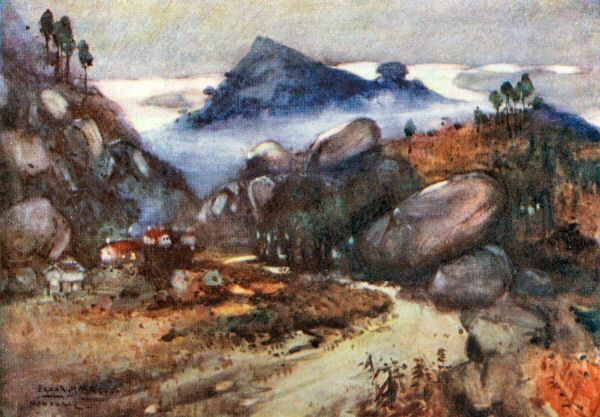
A ROAD IN THE HILLS
A century
has passed since Sir John Moore,
mortally wounded on the heights of Corunna, was
carried from the battlefield and buried on the
ramparts. Corunna to-day is a busy, thriving
seaport, and has much that will attract the
visitor's attention. There are the quaint old
twisted streets, typical of Galician towns, where
you may imagine yourself back in the days of
that immense Armada which sailed from the deep,
wide harbour to vanquish England, and can picture
Drake's swoop on the Galician coast ten years after
the British navy had shattered the fleet which had
been so proudly called Most Happy and Invincible.
When the Armada left Lisbon it consisted
of nearly 130 ships, with an aggregate tonnage
of 58,000, carrying 2400 guns, about 20,000
soldiers, 8000 mariners, and over 2000 rowers—30,000
in all. Some of the ships proved leaky
and were badly found, and owing to heavy
weather the Armada was forced to put into
Corunna for shelter. Enormous quantities of
provisions had been thrown overboard because
they were bad, and there was not enough water
to drink. Pestilence, too, had carried off many
of the sailors and soldiers. The huge fleet finally
left Corunna on July 12, 1588, and by that time
death and sickness had reduced the strength of
the fighters to 24,000.
Modern Corunna has its great tobacco factory,
employing several thousands of women and girls,
fine ornamental grounds, statues, and public buildings.
These may command only passing notice,
though greater attention will be given to the mule-drawn
trams and the diligences which run regularly
between Corunna and the surrounding towns and villages.
Nothing can more clearly give an idea of what
primitive travelling in Galicia means than to watch
the diligence from Ferrol, Finisterre, or Santiago
drive up with jingling bells and cracking of whips,
to put down weary passengers, and, the horses
having been unharnessed, to see the oxen draw the
coach to its departure-place. There are to be
seen, too, the miradores, glazed frontages for which
Corunna is celebrated. These vast stretches of windows
protect the houses from the strong winds
in winter and form bright and warm interior
verandahs. Most of the modern houses in Galicia
have these glass-protected verandahs in the top
story, where, in winter, the greater part of the
inhabitants' spare time is spent. The glazed exterior
allows the heat of the sun to be retained, and compensates
for the absence of fires. Corunna differs
from other Galician towns in having not only many
more modern buildings, but also in providing all the
stories with the miradores. The streets are lively
and busy, and some of the shops are very interesting.
There are several good cafés.
There is the harbour, with its shipping, the
magnificent scenery, the cemetery—worth a visit by
those who wish to compare the Spanish mode of
burial with the English—and the famous lighthouse
which is called La Torre de Hércules.
Corunna exports great quantities of onions and
sardines, chiefly to America, and in the streets you
may see enormous loads of the vegetable being
taken to the quays for shipment. But to the
ordinary visitor the ramparts and the heights of
Elviña are the great attractions, for on the one
Sir John Moore is buried, and on the other he
made his last stand in that retreat which for
sufferings and horror was not equalled by any of
the Peninsular campaigns.
It was at Corunna that the Duke of Wellington,
then Lieutenant-General Sir Arthur Wellesley,
landed on July 20, 1808, when he entered the
Peninsula to begin and see to a triumphant finish
the war which lasted six years and gave to England
an unparalleled series of victories. The French
by that time were masters of Spain, and it was
Wellesley's purpose to free the country from
Napoleon's tyranny. The Spaniards had risen
against their conquerors, and Wellesley found that
"no one dared to show that he was a friend to the
French." The Gallegans, brave and patriotic,
clamoured for arms, and Wellesley furnished the
Junta of Galicia with £200,000 and promised
the immediate despatch of military stores. He
sailed from Corunna on the night of the 21st,
and joined the fleet of transports and convoys
next day. On the 24th he reached Oporto in
the Crocodile. A few days later the troops landed,
"each with one shirt and one pair of shoes besides
those on them, combs, razor, and a brush, which
are to be packed up in their greatcoats." The
men landed with three days' bread and two days
meat, cooked. Three weeks after leaving Corunna
Wellesley won his first victory over the French, at
Roleia, with a loss on his own side of nearly 500
killed and wounded and on the French of 1500.
The opening shots of the war were fired by riflemen
of the 60th, now the King's Royal Rifle Corps,
and the 95th, now the Rifle Brigade. The Rifle
Corps has no fewer than sixteen Peninsular battle
honours, won by the famous 5th, or Jäger, Battalion—foreigners,
mostly Germans, who were in
British pay. Since its origin in 1800 the Rifle
Brigade has been composed entirely of British
troops. Throughout the war Wellington found
these riflemen of the utmost service, and he frequently
spoke of them in terms of praise.
Moore's retreat to Corunna was a tragedy from
start to finish. Spain was in what appeared to
be a hopeless state, and of all its provinces none
was more severely harassed than Galicia. War
had impoverished an already poor and burdened
country, and there were none of the resources available
which are needed for the successful conduct of a
great campaign. In 1807 the French army entered
Spain, and early in the following year Madrid
was captured by the conquering legions of the
Emperor. For a few weeks only the visitors remained
in peaceful possession; then there was a
rising in the capital, which began the long and
bloody fight to master Bonaparte. On May 2,
1808, the French troops and the Spanish populace
came into conflict, and for nearly three hours there
was incessant firing and slaughter, and many acts
were done which have become famous amongst
many famous deeds. A musket had been fired
from one of the houses, and a mameluke dashed
into the building. He was slain by a beautiful
girl, and she, in turn, was instantly cut down by
the assailant's comrades. A huntsman, who was
celebrated as a marksman, fired twenty-eight cartridges
against the French, bringing down a man
with each. He maintained his deadly fire until
his ammunition was finished; then, arming himself
with a dagger, he hurled himself against his
foes, and was killed as he struck at them.
That outrage in Madrid let loose the pent-up
passions of the Spaniards. They had, in the lonely
hills and valleys of their country, many chances
of retaliation, and they showed no mercy to the
Frenchmen who became their prisoners. Even the
sick and the medical attendants were butchered,
and some were done to death with incredible
barbarity. A French officer was returning from a
peaceful mission into Portugal, unconscious of the
fact that hostilities had broken out. He was
unarmed and unattached to a military force; but
he was a Frenchman, and that was looked upon by
his captors as proof sufficient for his doom. The
Spaniards seized and mutilated him; then, having
secured him, still living, between two planks, they
sawed him asunder.
In the autumn of 1808 Moore had taken command
of the army in Portugal, and had marched
into Spain to drive out Napoleon, who had sworn
that he himself would become the king of that
country. Unexpectedly encountering overwhelming
forces under Marshal Soult, Moore recognised
that his only hope of salvation lay in retreat, and
accordingly he resolved to fall back on Vigo and
embark his army in the transports which had
been ordered to assemble there to meet him.
Circumstances compelled him to alter his plans,
and finally to resolve to get on board ship at
Corunna.
Moore had rapidly covered 400 miles on his
way from Portugal to Spain, and found himself
in Galicia. There he learned that his allies, the
Spaniards, had been routed and dispersed. Anxious
to avoid confusion and unnecessary calls on an
impoverished country, he entreated the Spaniards
not to fall back in the same direction as himself;
but they did not accede to his wishes, and the result
was a hopeless overcrowding of the houses on the
line of retreat, and a call on the resources of the
land which could not be met.
Officers and men who fought in the Peninsula
and shared in the sufferings of that appalling
retreat to Corunna have put on record vivid
pictures of the terrible state of Moore's army.
When he reached Benavente he sent General
Crauford with 3000 men by way of Orense, nearly
a hundred and forty miles away, which offered a
shorter but harder road to the coast.
Moore's purpose was to prevent the French from
securing an advantage over him by employing a
light column. He himself took the longer but
better road which led through Astorga and Villa
Franca. At Astorga he was joined by Baird's
division, and Moore ordered the destruction of
everything which could check his retreat.
The rainy season had been succeeded by heavy
falls of snow, for Moore was high in the hills, and
the cold was intense, while the roads and fields by
which he had to march were almost impassable.
By that time the condition of the army was pitiful.
Typhus fever swept through the ranks, and the
roads were dotted with dead and dying men and
women and children. In those days women were
allowed to accompany British soldiers to war, and
Moore had even a larger proportion than usual with
him. The privations of the women and children
remain as the most terrible feature of a retreat
which stands almost unparalleled for suffering and
loss. There was no ammunition for the guns, none
for the muskets, and the soldiers were almost unshod
and in rags. In this respect there was little
difference between the pursuing French and the
retreating English.
At the beginning of December Moore had
20,000 men under him, and he was relentlessly
followed by an enemy in overwhelming force. Men
and horses fell and died on the march, and day by
day the flying army had had its strength reduced
by death and desertion. Whole regiments forsook
their colours and defied authority, in spite of the
punishment of death which was imposed for disobedience
and drinking. Whenever a wine-house
was reached the soldiers raided it, and forgot their
misery in debauchery.
The main body of the army kept a day's march
ahead of the reserve and the rearguard. On
New Year's morning 1809 the main body reached
Bembibre,
and immediately assailed the wine-shops.
So hopelessly drunk were many of the
troops when the rearguard came up that it was
impossible to arouse them to a sense of their peril
from the French cavalry who were harassing their
rear, and they had to be left behind in great
numbers. By that time the opposing armies had
been marching within sight of each other for many
miles, and the French horsemen swept on the drunken
mob and butchered it. Soult's dragoons thundered
in amongst the helpless crowd of British troops
and shrieking women and children, and without
distinction of sex or age put them to the sword.
A few soldiers, mangled and bleeding, escaped
from the massacre, and Moore ordered that they
should parade through the ranks and show their
wounds—a stern warning to the army of the
effect of drink and disobedience.
Believing that Astorga would be a resting-place,
the retreating army had kept up something
like order, and had been inspired by the hope of
battle; but there was no rest. Again everything
that was burdensome was abandoned, and the
terrible withdrawal was continued.
"From that hour," said Lord Londonderry,
"we no longer resembled a British army. There
was still the same bravery in our ranks, but it
was only at moments, when the enemy was expected
to come on, that our order and regularity
returned, and except in that single point we
resembled rather a crowd of insubordinate rebels in
full flight before victorious soldiers than a corps of
British troops moving in the presence of an enemy."
Moore himself, in the last despatch he ever wrote,
said he could not have believed that such complete
demoralisation could have overtaken a British
army.
Marvellous distances were traversed, notwithstanding
the difficult country and the bitter
weather. Villa Franca was reached on January 2,
after sixty miles had been covered in two days.
One march alone represented forty miles, but that
was continued by night as well as day, and was
marked by the abandonment of the dying and the
dead. The troops dropped by whole sections on
the road and died. "Not men only," wrote Lord
Londonderry, "but women and children were subject
to this miserable fate. Moore's army had
carried along with it more than the too large
proportion of women allotted by the rules of the
service to armies in the field, and these poor
wretches now heightened the horror of passing
events by a display of suffering even more acute
than that endured by their husbands. Some were
taken in labour on the road, and in the open air,
amid showers of sleet and snow, gave birth to
infants which, with their mothers, perished as soon
as they had seen the light. Others, carrying, some
of them, two children on their backs, toiled on, and,
when they came to look to the condition of their
burdens, they would probably find one or both
frozen to death."
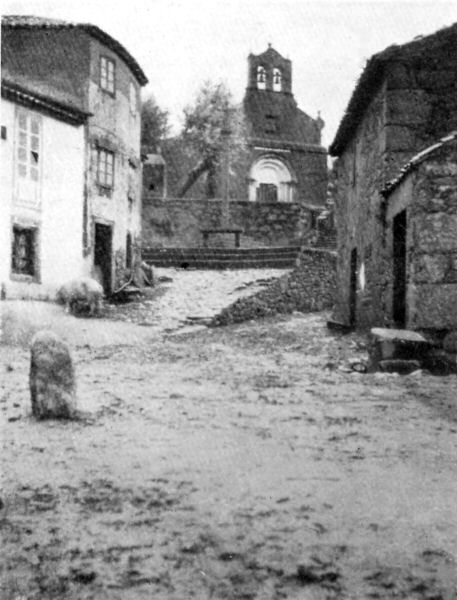
ELVIÑA, WHERE SIR JOHN MOORE WAS MORTALLY WOUNDED
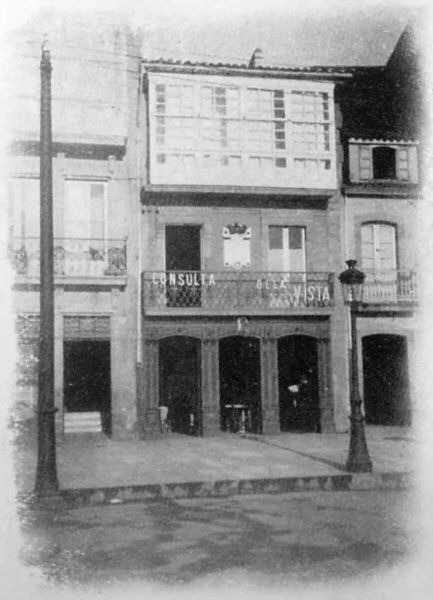
THE HOUSE, MODERNISED, IN WHICH SIR JOHN MOORE DIED
Guns, waggons, and even treasure were abandoned
on that fatal road. Dollars to the value of twenty-five
thousand pounds, which were in two bullock-carts,
could not be drawn any farther by the exhausted
oxen, and the casks containing the coins were stove
in, and the money thrown over a precipice. Some
of the ragged, starving soldiers lagged behind to
seize the money, and perished either by the French
sabres or the winter's cold. Sick and wounded
were abandoned in the waggons; and at last, on
January 11, the worn and famishing survivors of
the flying army reached the village of Elviña, on
the heights of Corunna, about two miles from the
town.
Moore went into Corunna and took up lodgings
in a little house facing the bay, and directed the
embarkation of his fugitives in the transports,
which arrived from Vigo on the 14th.
The French did not molest the embarkation
for two days, but on the 16th they advanced,
20,000 strong, to assault the 14,000 who alone
remained of Moore's worn-out troops. He had
done his best to bring his sorry remnant to the
coast, and he had triumphed. Now, at the end
of his retreat, he showed the superior French force
that as a fighter he was as dangerous as ever. He
destroyed bridges and ammunition, and blew up
4000 barrels of gunpowder—an explosion which
wrecked all the windows in Corunna—and used
every artifice he knew to prevent either his men
or his matériel from falling into the hands of
his foe. It seemed as if even now, at the end of
his tribulation, the British chief would get away
from Spain; but Soult forced him at the very last
to give battle, and on January 16, 1809, the worn
and harassed leader, from a piece of rocky ground
at Elviña, just beyond the village, directed the
battle which, beginning at about two o'clock in the
afternoon, continued furiously till darkness fell.
Time after time the Frenchmen charged the
shattered remnant of the hero's force; but as often
as they advanced they were driven back and
broken by the men who, with all their faults of
drink and insubordination, knew how to fight and
conquer.
All through the terrible retreat the British
soldier's prayer had been for a battle, and now that
his supplication was answered he proved himself a
true son of his country. Not even Soult's genius
and the valour of his overwhelming forces could
master the stubborn, sullen troops who held the
little church and streets of Elviña. Napoleon's
veterans were driven back, and when the day gave
place to night his famous marshal knew that the
army which he had harassed and pursued for so
many bitter days would escape.
Twice, with frantic valour, the French had taken
the village, and twice they had been hurled out of
it at the point of the bayonet by the Guards,
Highlanders, and linesmen under Moore. He had
covered his amazing retreat with a triumphant
victory; but in the very moment of success he was
struck down by a cannon-ball, which shattered his
left shoulder.
Moore fell from his horse, his arm hanging only
by a piece of skin, and his breast bared to the
lungs. Some soldiers took him up and put him,
conscious still, into a blanket, and bore him from
the field of battle to his lodgings. He knew that
the French were beaten, and, turning to an old
friend, he said: "You know that I always wished to
die this way." He lingered for a few hours at
his lodgings, and just before he passed away he
murmured: "I hope the people of England will be
satisfied. I hope my country will do me justice."
It was almost a repetition of the glorious death
of Nelson in Trafalgar Bay, 600 miles below
Corunna, on the Atlantic Coast, only three years
earlier.
The embarkation was still in progress and the
French guns were booming as the valiant British
rearguard filed in silence to the beach. The
victorious general died while the transports were
receiving the troops, and, wrapped only in his
military cloak, he was borne by men of the 9th
Foot, now the Norfolk Regiment, to the hastily
dug grave on the ramparts, where he was
buried, his farewell volleys coming from the
distant artillery. The officers' silk sashes with
which the body of the beloved commander was
lowered into the grave, and the prayer-book used at
the hasty funeral service, are preserved in the Royal
United Service Institution Museum, Whitehall.
When Moore was first laid to rest the ramparts
were little more than a wilderness. Soon after
the burial the body was exhumed and placed
where it now is. The grave is made of Galician
granite, the urn above is of white stone, and
common stone was used in the construction of the
enclosure.
The British victors sailed from Corunna, having
spiked their guns and buried them in the sand, and
when the French at last entered the town even the
sick and wounded had been taken safely off to sea.
Corunna cost Moore nearly a thousand men.
The French suffered far more heavily. During
the retreat the British casualties were 6000,
including deserters and stragglers, of whom 800
escaped into Portugal. Three hundred men
were drowned in the wrecks of two transports off
the English coast, and many died of disease after
landing.
Moore wished to be buried near the spot where
he died, and his grave is only a short walk from his
last quarters. The brave and noble Soult paid
homage to the hero who had perished in the hour
of triumph. A French gun is planted, muzzle
downward, in each corner of the enclosure, and
palm-trees rise gracefully from the soil. A few
yards away you may look through the ruined
embrasures and see the heights of Elviña and the
Atlantic into which the survivors of the great
retreat were sailing while their fallen leader was
being lowered to his resting-place upon Corunna's
ramparts.
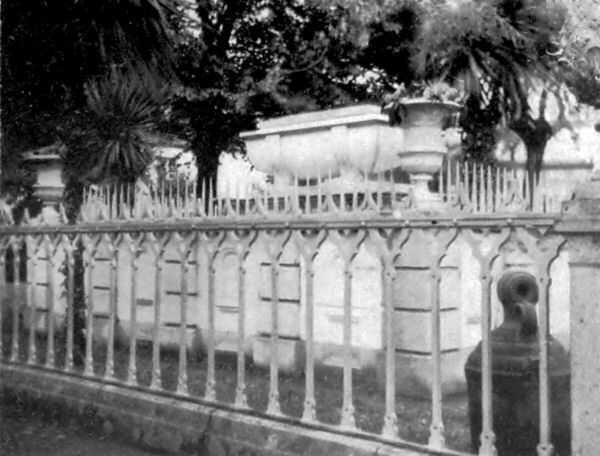
SIR JOHN MOORE'S TOMB AT CORUNNA
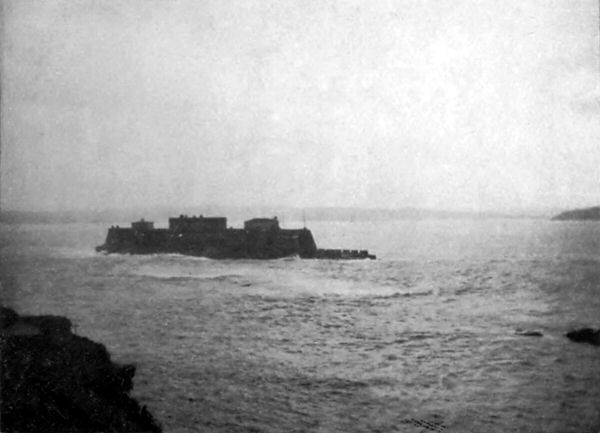
CORUNNA BAY, FROM THE RAMPARTS