In the first months of 1917 we were confident that
the last year of the war had come. The Battle of
the Somme had shown that the strongest German
lines were not impregnable. We had learned much:
the enemy had received a tremendous hammering;
and the success of General Gough's operations in
the Ancre valley promised well for the future. The
French, it was rumoured, were undertaking a grand
attack in the early spring. We were first to support
them by an offensive near Arras, and then we would
attack ourselves on a large scale somewhere in the
north. We hoped, too, that the Russians and
Italians would come to our help. We were told
that the discipline of the German Army was
loosening, that our blockade was proving increasingly
effective, and we were encouraged by stories of many
novel inventions. We possessed unbounded confidence
in our Tanks.
Late in February the colonel held a battalion
conference. He explained the situation to his
company commanders and the plan of forthcoming
operations.
As the result of our successes in the Ancre valley,
the German position between the Ancre and Arras
formed a pronounced salient. It was determined to
attack simultaneously at Arras and from the Ancre
valley, with the object of breaking through at both
points and cutting off the German inside the salient.
Colonel Elles had offered two battalions of tanks.
He was taking a risk. Officers and crews were only
half-trained. Right through the period of training
real tanks had been too scarce. Improved tanks
were expected from England, but none had arrived,
and he decided to employ again the old
Mark I. tank which had been used in the operations
on the Somme in the previous year. The two
battalions selected were "C" and "D."
When we examined the orders for the attack in
detail, I found that my company was destined to go
through with the troops allotted to the second
objective and take Mercatel and Neuville Vitasse.
It should have been a simple enough operation, as
two conspicuous main roads penetrated the German
lines parallel with the direction of my proposed
attack.
On March 9th I drove to Arras in my car with
Haigh, my second-in-command, and Jumbo, my
reconnaissance officer. We went by St Pol and the
great Arras road. The Arras road is a friend of
mine. First it was almost empty except for the
lorry park near Savy, and, short of Arras, it was
screened because the Germans still held the Vimy
Ridge. Then before the Arras battle it became more
and more crowded—numberless lorries, convoys of
huge guns and howitzers, smiling men in buses and
tired men marching, staff-cars and motor ambulances,
rarely, a waggon with slow horses, an old Frenchman
in charge, quite bewildered by the traffic. When
the battle had begun, whole Divisions, stretching
for ten miles or more, came marching along it, and
the ambulances streamed back to the big hospital at
St Pol. I saw it for the last time after the Armistice
had been signed, deserted and unimportant,
with just a solitary soldier here and there standing
at the door of a cottage. It is an exposed and
windy road. The surface of it was never good,
but I have always felt that the Arras road was
proud to help us. It seemed ever to be saying:
"Deliver Arras from shell and bomb; then leave
me, and I shall be content to dream again."...
We drove into Arras a little nervously, but it was
not being shelled, and, hungry after a freezing ride,
we lunched at the Hôtel de Commerce.
This gallant hotel was less than 2500 yards from
the German trenches. Across the street was a field
battery in action. The glass of the restaurant had
been broken, the upper stories had been badly
damaged, the ceiling of the dining-room showed
marks of shrapnel. Arras was being shelled and
bombed every night, and often by day; German
aeroplanes flew low over the town and fired down
the streets. The hotel had still carried on ever
since the British had been in Arras and before.
The proprietress, a little pinched and drawn, with
the inevitable scrap of fur flung over her shoulders,
presided at the desk. Women dressed in the usual
black waited on us. The lunch was cheap, excellently
cooked, and well served—within easy range
of the enemy field-guns. After the battle the hotel
was put out of bounds, for serving drinks in
forbidden hours. Indeed, A.P.M.'s have no souls.
It reopened later, and continued to flourish until
the German attack of April 1918, when the enemy
shelling became too insistent. The hotel has not
been badly hit, and, if it be rebuilt, I beseech all
those who visit the battlefields of Arras to lunch
at the Hôtel de Commerce—in gratitude. It is
in the main street just by the station.
We motored out of Arras along a road that was
lined with newly-made gun-pits, and, arriving at a
dilapidated village, introduced ourselves to the
Divisional staff. We discussed operations, and
found that much was expected of the tanks. After a
cheery tea we drove home in the bitter cold.
On the 13th March we again visited the Division.
I picked up the G.S.O. III. of the Division, called
on a brigadier, with whom I expected to work,
and then drove to the neighbourhood of the disreputable
village of Agny. We peeped at the
very little there was to be seen of the enemy
front line through observation posts in cottages
and returned to Arras, where we lunched excellently
with the colonel of an infantry battalion.
I left Jumbo with him, to make a detailed reconnaissance
of the Front....
The Arras battle would have been fought according
to plan, we should have won a famous
victory, and hundreds of thousands of Germans
might well have been entrapped in the Arras
salient, if the enemy in his wisdom had not retired.
Unfortunately, at the beginning of March he
commenced his withdrawal from the unpleasant
heights to the north of the Ancre valley, and,
once the movement was under way, it was predicted
that the whole of the Arras salient would be
evacuated. This actually occurred in the following
weeks; the very sector I was detailed to attack
was occupied by our troops without fighting.
Whether the German had wind of the great attack
that we had planned, I do not know. He certainly
made it impossible for us to carry it out.
As soon as the extent of the German withdrawal
became clear, my company was placed in reserve.
I was instructed to make arrangements to support
any attack at any point on the Arras front.
The Arras sector was still suitable for offensive
operations. The Germans had fallen back on the
Hindenburg Line, and this complicated system of
defences rejoined the old German line opposite
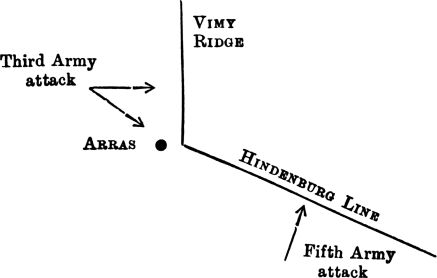
Arras. Obviously the most practical way of
attacking the Hindenburg Line was to turn it—to
fight down it, and not against it. Our preparations
for an attack in the Arras sector and on the Vimy
Ridge to the north of it were far advanced. It
was decided in consequence to carry out with
modifications the attack on the German trench
system opposite Arras and on the Vimy Ridge.
Operations from the Ancre valley, the southern re-entrant
of the old Arras salient, were out of the
question. The Fifth Army was fully occupied in
keeping touch with the enemy.
On the 27th March my company was suddenly
transferred from the Third Army to the Fifth
Army. I was informed that my company would
be attached to the Vth Corps for any operations
that might occur. Jumbo was recalled from Arras,
fuming at his wasted work, and an advance party
was immediately sent to my proposed detraining
station at Achiet-le-Grand.
On the 29th March I left Blangy. My car was
a little unsightly. The body was loaded with
Haigh's kit and my kit and a collapsible table.
On top, like a mahout, sat Spencer, my servant.
It was sleeting, and there was a cold wind. We
drove through St Pol and along the Arras road,
cut south through Habarcq to Beaumetz, and
plunged over appalling roads towards Bucquoy.
The roads became worse and worse. Spencer was
just able to cling on, groaning at every bump.
Soon we arrived at our old rear defences, from
which we had gone forward only ten days before.
It was joyous to read the notices, so newly obsolete—"This
road is subject to shell-fire"—and when
we passed over our old support and front trenches,
and drove across No Man's Land, and saw the
green crosses of the Germans, the litter of their
trenches, their signboards and their derelict equipment,
then we were triumphant indeed. Since
March 1917 we have advanced many a mile, but
never with more joy. Remember that from October
1914 to March 1917 we had never really advanced.
At Neuve Chapelle we took a village and four
fields, Loos was a fiasco, and the Somme was
too horrible for a smile.
On the farther side of the old German trenches
was desolation. We came to a village and found
the houses lying like slaughtered animals. Mostly
they had been pulled down, like card houses, but
some had been blown in. It was so pitiful that
I wanted to stop and comfort them. The trees
along the roads had been cut down. The little
fruit-trees had been felled, or lay half-fallen with
gashes in their sides. The ploughs rusted in the
fields. The rain was falling monotonously. It
was getting dark, and there was nobody to be
seen except a few forlorn soldiers.
We crept with caution round the vast funnel-shaped
craters that had been blown at each cross-road,
and, running through Logeast Wood, which
had mocked us for so many weeks on the Somme,
we came to Achiet-le-Grand.
Ridger, the town commandant, had secured the
only standing house, and he was afraid that it
had been left intact for some devilish purpose.
Haigh and Grant of my advance party were established
in a dug-out. So little was it possible in
those days to realise the meaning of an advance,
that we discovered we had only two mugs, two
plates, and one knife between us.
In the morning we got to work. A supply of
water was arranged for the men; there was only
one well in the village that had not been polluted.
We inspected the ramp by which the tanks would
detrain, selected a tankodrome near the station,
wired in a potential dump, found good cellars for
the men, and began the construction of a mess in
the remains of a small brick stable. Then Haigh
and I motored past the derelict factory of Bihucourt
and through the outskirts of Bapaume to the ruins
of Behagnies, on the Bapaume-Arras road. After
choosing sites for an advanced camp and tankodrome,
we walked back to Achiet-le-Grand across
country, in order to reconnoitre the route for tanks
from the station to Behagnies. After lunch, Haigh,
Jumbo, and I motored to Ervillers, which is beyond
Behagnies, and, leaving the car there, tramped to
Mory. Jumbo had discovered in the morning an
old quarry, hidden by trees, that he recommended
as a half-way house for the tanks, if we were
ordered to move forward; but the enemy was a
little lively, and we determined to investigate
further on a less noisy occasion.
That night we dined in our new mess. We had
stretched one tarpaulin over what had been the
roof, and another tarpaulin took the place of an
absent wall. The main beam was cracked, and
we feared rain, but a huge blazing fire comforted
us—until one or two slates fell off with a clatter.
We rushed out, fearing the whole building was
about to collapse. It was cold and drizzling. We
stood it for five minutes, and then, as nothing
further happened, we returned to our fire....
In some general instructions I had received from
the colonel, it was suggested that my company
would be used by the Vth Corps for an attack on
Bullecourt and the Hindenburg Line to the east
and west of the village. It will be remembered
that the attack at Arras was designed to roll up
the Hindenburg Line, starting from the point at
which the Hindenburg Line joined the old German
trench system. General Gough's Fifth Army, consisting
of General Fanshawe's Vth Corps and
General Birdwood's Corps of Australians, lay south-east
of Arras and on the right of the Third Army.
The Fifth Army faced the Hindenburg Line, and,
if it attacked, it would be compelled to attack
frontally.
The disadvantages of a frontal attack on an
immensely strong series of entrenchments were
balanced by the fact that a successful penetration
would bring the Fifth Army on the left rear of that
German Army, which would be fully occupied at
the time in repelling the onset of our Third Army.
The key to that sector of the Hindenburg Line
which lay opposite the Fifth Army front was the
village of Bullecourt.
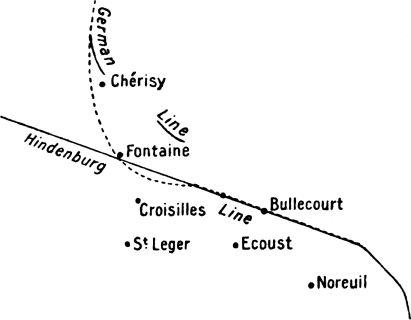
In the last week of March the Germans had
not taken refuge in their main line of defence, and
were still holding out in the villages of Croisilles,
Ecoust, and Noreuil.
We were attacking them vigorously, but with
no success and heavy casualties. On the morning
of the 31st March Jumbo and I drove again to
Ervillers and walked to Mory, pushing forward
down the slope towards Ecoust. There was a
quaint feeling of insecurity, quite unjustified, in
strolling about "on top." We had an excellent
view of our shells bursting on the wire in front
of Ecoust, but we saw nothing of the country we
wanted to reconnoitre—the approaches to Bullecourt.
Ecoust was finally captured at the sixth
or seventh attempt by the 9th Division on April 1st.
In the afternoon I paid my first visit to the
Vth Corps, then at Acheux, twenty miles back.
I motored by Bapaume and Albert over the Somme
battlefield. The nakedness of it is now hidden by
coarse grass and rough weeds, but in March of
1917 it was bare. There was dark-brown mud
for mile after mile as far as the eye could see—mud
churned and tortured until the whole surface
of the earth was pitted with craters. Mud overwhelmed
the landscape. Trees showed only against
the sky; dead men, old equipment, derelict tanks
blended with the mud. At Le Sars bits of walls
and smashed beams lay embedded in the mud.
At Pozières the mud held a few mud-coloured
bricks. I was glad when I came to Albert.
We took the Doullens road and found the Corps
well housed in the chateau at Acheux. I announced
the imminent arrival of my tanks, but the news
did not kindle the enthusiasm I had expected.
The Vth Corps had already used tanks and knew
their little ways. After tea I consulted with the
lesser lights of the staff. Satisfactory arrangements
were made for supplies, rations, and accommodation,
and I demanded and obtained the use of a troop
of Glasgow Yeomanry, on the plea that they were
required to cover the tracks of my tanks. I wanted
a horse to ride.
I decided to return by Puisieux-le-Mont. It
was apparent that the Albert-Bapaume road would
soon become uncomfortably crowded. I wanted
to reconnoitre the only alternative route, and at
the same time to inspect the village of Serre,
which, on paper, I had so often and so violently
attacked.
Never have I endured a more ghastly ride. In
comparison with the country on either side of the
Puisieux road, the Somme battlefield from the
highway between Albert and Bapaume was serenely
monotonous. After Mailly-Mailly the road became
a rough track, narrow and full of unfilled shell-holes.
Crazy bridges had been thrown across the
trenches. The sun was setting in a fiery sky, and
a reddish light tinged the pitiful tumbled earth,
and glittered for a moment on the desolate water
of the shell-holes. The crumbling trenches were
manned with restless dead. In the doubtful light
I thought a dead German moved. He lay on his
back, half-sunken in the slimy mud, with knees
drawn up, and blackened hand gripping a rusty
rifle. Mercifully I could not see his face, but I
thought his arms twitched.
It grew darker, and so narrow was the track that
I might have been driving over the black mud of
the battlefield. A derelict limber half-blocked the
road, and, swerving to avoid it, we barely missed
the carcass of a horse, dead a few days. Our progress
was slow. Soon we lit the lamps. The track
was full of horrible shadows, and big dark things
seemed to come down the road to meet us—shattered
transport or old heaps of shells. On either side of
the car was the desert of mud and water-logged
holes and corpses, face downward under the water,
and broken guns and mortars, and little graves, and
mile-long strands of rusty wire. Everywhere maimed
ghosts were rustling, and the plump rats were pattering
along the trenches.
It is unwise to go through a battlefield at night.
If they make the Somme battlefield a forest, no
man will be brave enough to cross it in the dark.
We came to lights in the ruins of a village, and
I stopped for a pipe and a word with my driver....
My tanks arrived at Achiet-le-Grand just after
dawn on April 1st. We had taken them over from
the central workshops at Erin, and had drawn there
a vast variety of equipment. The tanks had been
driven on to the train by an Engineer officer. The
railway journey had been delayed as usual, and the
usual expert—this time a doctor—had walked along
the train, when shunted at Doullens, and had pointed
out to his companion the "new monster tanks."
In the morning we hauled off the sponson-trolleys—their
use will be explained later—but we thought
it wiser to wait until dusk before we detrained the
tanks.
Tanks travel on flat trucks, such as are employed
to carry rails. They are driven on and off the
train under their own power, but this performance
requires care, skill, and experience. A Mk. I. or
a Mk. IV. tank is not too easy to steer, while the
space between the track and the edge of the truck
is alarmingly small. With two exceptions, my
officers had neither experience nor skill.
It was an anxious time—not only for the
company commander. The office of the R.T.O.,
at the edge of the ramp, was narrowly missed on
two occasions. Very slowly and with infinite care
the tanks were persuaded to leave the train and
move down the road to the tankodrome we had
selected. Then it began first to sleet and then to
snow, while an icy wind rose, until a blizzard was
lashing our faces.
In the old Mark I. tank it was necessary to detach
the sponsons, or armoured "bow-windows," on
either side before the tank could be moved by rail.
This was no easy matter. The tank was driven
into two shallow trenches. A stout four-wheeled
trolley was run alongside, and a sort of crane was
fitted, to which slings were secured. The sponson
was girt about with these slings, the bolts which
secured the sponson to the body of the tank were
taken out, and the sponson was lowered on to the
trolley.
My men, of whom the majority were inexperienced,
carried out the reverse process on a dark
night in a blizzard. Their fingers were so blue
with cold that they could scarcely handle their
tools. The climax was reached when we discovered
that we should be compelled to drill new holes in
several of the sponsons, because in certain cases
the holes in the sponsons did not correspond with
the holes in the tanks.
If the men never had a harder night's work, they
certainly never worked better. Half the tanks fitted
their sponsons and reached Behagnies by dawn.
The remainder, less one lame duck, were hidden
in Achiet-le-Grand until darkness once more allowed
them to move.
Every precaution was taken to conceal the tanks
from the enemy. My troop of Glasgow Yeomanry,
under the direction of Talbot, who had been a
sergeant-major in the Dragoons, rode twice over the
tracks which the tanks had made in order to obliterate
them by hoof-marks. At Behagnies the tanks were
drawn up against convenient hedges and enveloped
in tarpaulins and camouflage nets. In spite of our
efforts they appeared terribly obvious as we surveyed
them anxiously from one point after another. Our
subtle devices were soon tested. An enterprising
German airman flew down out of the clouds and
darted upon two luckless observation balloons to
right and left of us. He set them both on fire
with tracer bullets, came low over our camp, fired
down the streets of Bapaume, and disappeared into
the east. The sporting instinct of my men responded
to the audacity of the exploit, and they cheered him;
but for the next twenty-four hours I was wondering
if the camouflage of my tanks had been successful,
or if the attention of the airman had been concentrated
solely on the balloons. Presumably we were
not spotted, for while at Behagnies we were neither
shelled nor bombed.
The preparations for my first essay in tank-fighting
were beginning to bear fruit. Eleven tanks lay
within two short marches of any point from which
they were likely to attack, and my crews were busy
overhauling them. One crippled tank was hidden
at Achiet-le-Grand, but the mechanical defect which
had developed in her must have escaped the notice
of central workshops. Cooper6 was engaged night
and day in taking up supplies and making forward
dumps. The Corps had provided us with a convoy
of limbered waggons drawn by mules—the forward
roads were not passable for lorries—and the wretched
animals had little rest. We were ordered to be
ready by the 6th, and the order meant a fight
against time. Tanks consume an incredible quantity
of petrol, oil, grease, and water, and it was necessary
to form dumps of these supplies and of ammunition
at Mory Copse, our half-way house, and at Noreuil
and Ecoust. Night and day the convoy trekked
backwards and forwards under Cooper or Talbot.
Mules cast their shoes, the drivers were dog-tired,
the dumps at Noreuil and Ecoust were shelled,
both roads to Mory were blocked by the explosion
of delayed mines,—in spite of all difficulties the
dumps were made, and on the morning of the battle
the convoy stood by loaded, ready to follow the
tanks in the expected break through.
Haigh had ridden forward to Ecoust with a handful
of Glasgow yeomen in order to keep an eye on
the dump and reconnoitre the country between
Ecoust and the Hindenburg Line. He started in
the afternoon, joining an ammunition column on
the way. They approached the village at dusk.
The enemy was shelling the road and suspected
battery positions short of the first houses. The
column made a dash for it at full gallop, but a
couple of shells found the column, killing a team
and the drivers.
Haigh and his men wandered into a smithy and
lit a small fire, for it was bitterly cold. The shelling
continued, but the smithy was not hit. They passed
a wretched night, and at dawn discovered a cellar,
where they made themselves comfortable after they
had removed the bodies of two Germans.
The reconnaissances were carried out with Haigh's
usual thoroughness. Tank routes and observation
posts were selected—"lying-up" places for the tanks
were chosen. Everything was ready if the tanks
should be ordered to attack Bullecourt from the
direction of Ecoust.
On April 4th I was introduced to the Higher
Command. The Vth Corps had moved forward
from Acheux to the ruined chateau at Bihucourt.
There I lunched with the General, and drove with
him in the afternoon to an army conference at Fifth
Army Headquarters in Albert. The block of traffic
on the road made us an hour late, and it was interesting
to see how an Army commander dealt with
such pronounced, if excusable, unpunctuality in a
Corps commander.
The conference consisted of an awe-inspiring collection
of generals seated round a table in a stuffy
room decorated with maps. The details of the
attack had apparently been settled before we arrived,
but I understood from the Army commander's
vigorous summary of the situation that the Third
Army would not attack until the 7th. The greatest
results were expected, and the Fifth Army would
join in the fray immediately the attack of the Third
Army was well launched. As far as I was concerned,
my tanks were to be distributed along the
fronts of the Australian and Vth Corps. The conference
broke up, and the colonel and I were asked
to tea at the chateau. It was a most nervous
proceeding, to drink tea in the company of a
bevy of generals; but the major-general on my
right was hospitality itself, and the colonel improved
the occasion by obtaining the promise
of some more huts from the major-general, who
was engineer-in-chief of the Army. Eventually
we escaped, and the colonel7 drove me back to
Behagnies, where battalion headquarters lay close
by my camp.
On the night of the 5th, as soon as it was dusk,
my tanks moved forward. One by one they slid
smoothly past me in the darkness, each like a
patient animal, led by his officer, who flashed
directions with an electric lamp. The stench
of petrol in the air, a gentle crackling as they
found their way through the wire, the sweet purr
of the engine changing to a roar when they
climbed easily on to the road—and then, as they
followed the white tape into the night, the noise
of their engines died away, and I could hear only
the sinister flap-flap of the tracks, and see only
points of light on the hillside.
Tanks in the daytime climbing in and out of
trenches like performing elephants may appeal to
the humour of a journalist. Stand with me at night
and listen. There is a little mist, and the dawn
will soon break. Listen carefully, and you will
hear a queer rhythmical noise and the distant song
of an engine. The measured flap of the tracks grows
louder, and, if you did not know, you would think
an aeroplane was droning overhead. Then in the
half-light comes a tired officer, reading a map, and
behind him another, signalling at intervals to a grey
mass gliding smoothly like a snake. And so they
pass, one by one, with the rattle of tracks and the
roar of their exhaust, each mass crammed with
weary men, hot and filthy and choking with the
fumes. Nothing is more inexorable than the slow
glide of a tank and the rhythm of her tracks.
Remember that nothing on earth has ever caused
more deadly fear at the terrible hour of dawn than
these grey sliding masses crammed with weary
men....
My tanks were safely camouflaged in the old
quarry at Mory Copse before dawn on April 6th.
I joined them in the morning, riding up from the
camp at Behagnies on a troop-horse I had commandeered
from my troop of Glasgow Yeomanry.
The quarry was not an ideal hiding-place, as it
lay open to direct though distant observation from
the German lines; but the tanks were skilfully
concealed by the adroit use of trees, undergrowth,
and nets, the hill surmounted by the copse provided
an excellent background, and we were compelled
to make a virtue of necessity as the open
downs in the neighbourhood of Mory gave not
the slightest cover.8 The village itself was out of
the question: the enemy were shelling it with
hearty goodwill.
We lay there comfortably enough, though unnecessary
movement by day and the use of lights at
night were forbidden. No enemy aeroplane came
over, but a few shells, dropping just beyond the
copse on a suspected battery position, disturbed our
sleep. The tanks were quietly tuned, the guns were
cleaned, and officers were detailed to reconnoitre the
tank routes to Ecoust and Noreuil.
The offensive was postponed from day to day, and
we were growing a little impatient, when at dawn
on April 9th the Third Army attacked.
It had been arranged at the last Army Conference
that the Fifth Army would move when the offensive
of the Third Army was well launched. My tanks
were to be distributed in pairs along the whole front
of the army, and to each pair a definite objective
was allotted. I had always been averse to this
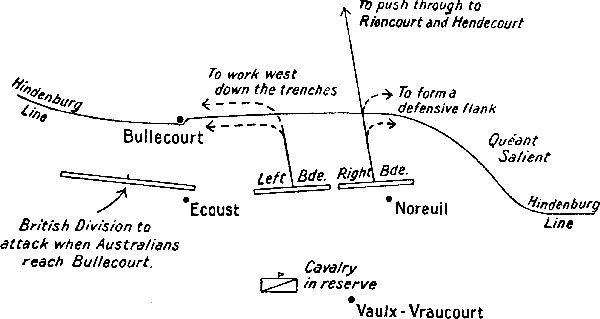
scattering of my command. The Hindenburg Line,
which faced us, was notoriously strong. Bullecourt,
the key to the whole position, looked on the map
almost impregnable. The artillery of the Fifth
Army was to the best of my knowledge far from
overwhelming, and gunners had told me that good
forward positions for the guns were difficult to find.
I realised, of course, that an officer in my subordinate
position knew little, but I was convinced
that a surprise concentration might prove a success
where a formal attack, lightly supported by a few
tanks scattered over a wide front, might reasonably
fail. I planned for my own content an attack in
which my tanks, concentrated on a narrow front of
a thousand yards and supported as strongly as
possible by all the infantry and guns available,
should steal up to the Hindenburg Line without a
barrage. As they entered the German trenches
down would come the barrage, and under cover of
the barrage and the tanks the infantry would
sweep through, while every gun not used in
making the barrage should pound away at the
German batteries.
I was so fascinated by my conception that on the
morning of the 9th I rode down to Behagnies and
gave it to the colonel for what it was worth. He
approved of it thoroughly. After a hasty lunch
we motored down to the headquarters of the Fifth
Army.
We found General Gough receiving in triumph
the reports of our successes on the Third Army
front opposite Arras.
"We want to break the Hindenburg Line with
tanks, General," said the colonel, and very briefly
explained the scheme.
General Gough received it with favour, and
decided to attack at dawn on the following morning.
He asked me when my tanks would require to start.
The idea of an attack within twenty-four hours was
a little startling—there were so many preparations
to be made; but I replied my tanks should move
at once, and I suggested air protection. General
Gough immediately rang up the R.F.C., but their
General was out, and, after some discussion, it was
decided that my tanks would have sufficient time to
reach the necessary position if they moved off after
dusk. We drove at breakneck speed to the chateau
near, which was occupied by the Australian Corps,
and were left by General Gough to work out the
details with the Brigadier-General of the General
Staff.
The colonel allowed me to explain the scheme
myself. All my suggestions were accepted; but the
concentration of men and guns that I had imagined
in my dreams was made impossible by the fact that
General Gough had ordered the attack for the
morrow.
I took the colonel's car and tore back to
Behagnies. I wrote out my orders while Jumbo,
helped by two reconnaissance officers who were
attached to us for instruction, rapidly marked and
coloured maps for the tank commanders. My
orders reached Swears, who was in charge at Mory
Copse, by 6.30 P.M., and by 8 P.M. the tanks were
clear of the quarry.
After dark I walked down the Bapaume road
and presented myself at the headquarters of the
Australian Division, with which my tanks were
operating. It was a pitch-black night. The rain
was turning to sleet.
Divisional Headquarters were in "Armstrong" or
small canvas huts, draughty and cold. I discussed
the coming battle with the staff of the Division and
Osborne, the G.S.O. II. of the Corps. We turned
in for a snatch of sleep, and I woke with a start—dreaming
that my tanks had fallen over a cliff into
the sea. At midnight I went to the door of the
hut and looked out. A gale was blowing, and
sleet was mingled with snow. After midnight I
waited anxiously for news of my tanks. It was a
long trek for one night, and, as we had drawn them
so recently, I could not guarantee, from experience,
their mechanical condition. There was no margin
of time for any except running repairs.
At one o'clock still no news had come. The
tanks had orders to telephone to me immediately
they came to Noreuil, and from Noreuil to the
starting-point was at least a ninety-minutes'
run.
By two o'clock everybody was asking me for
information. Brigade Headquarters at Noreuil had
neither seen tanks nor heard them, but they sent
out orderlies to look for them in case they had lost
their way. At Noreuil it was snowing hard, and
blowing a full gale.
My position was not pleasant. The attack was
set for dawn. The infantry had already gone
forward to the railway embankment, from which
they would "jump off." In daylight they could
neither remain at the embankment nor retire over
exposed ground without heavy shelling. It was
half-past two. I was penned in a hut with a couple
of staff officers, who, naturally enough, were irritated
and gloomy. I could do nothing.
The attack was postponed for an hour. Still no
news of the tanks. The faintest glimmerings of
dawn appeared when the telephone-bell rang. The
Australian handed me the receiver with a smile of
relief.
"It's one of your men," he said.
I heard Wyatt's tired voice.
"We are two miles short of Noreuil in the
valley. We have been wandering on the downs
in a heavy snowstorm. We never quite lost our
way, but it was almost impossible to keep the
tanks together. I will send in a report. The men
are dead-tired."
"How long will it take to get to the starting-point?"
I asked.
"An hour and a half at least," he replied wearily.
"Stand by for orders."
It was 1¼ hours before zero. The men were
dead-tired. The tanks had been running all night.
But the Australians were out on the railway embankment
and dawn was breaking.
I went to see the General, and explained the
situation briefly.
"What will happen to your tanks if I put back
zero another hour and we attack in daylight?" he
asked.
"My tanks will be useless," I replied. "They
will be hit before they reach the German trenches—particularly
against a background of snow."
He looked at his watch and glanced through the
window at the growing light.
"It can't be helped. We must postpone the
show. I think there is just time to get the boys
back. Send B. to me."
I called up Wyatt and told him that the men
were to be given a little sleep. The officers, after a
short rest, were to reconnoitre forward. I heard
orders given for the Australians to come back from
the railway embankment—later I learned that this
was done with practically no casualties—then I
stumbled down the road to tell the colonel.
I found him shaving.
"The tanks lost their way in a snowstorm
and arrived late at Noreuil. The attack was
postponed."
He looked grave for a moment, but continued his
shaving.
"Go and have some breakfast," he said cheerily.
"You must be hungry. We'll talk it over later."
So I went and had some breakfast....