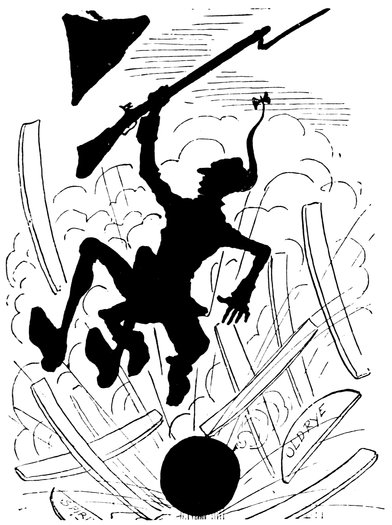
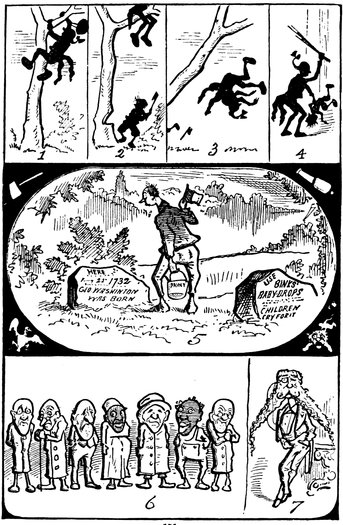
The cover image was created by the transcriber and is placed in the public domain.
The matter on the opposite page may be freely
translated as follows:
BY
LIVINGSTON HOPKINS.
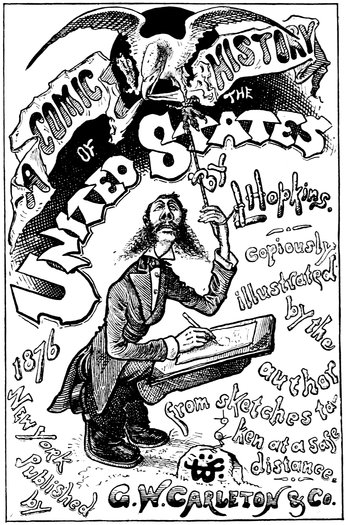
Copiously Illustrated by the Author from Sketches taken at a safe distance.
NEW YORK:
G. W. CARLETON & CO.
MDCCCLXXVI.
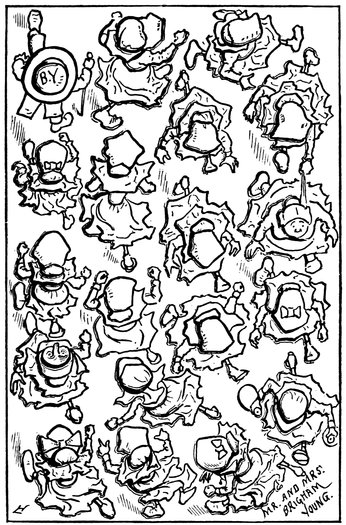
P.S.—The illustration opposite is intended to take the place of a gift
chromo, which we at first contemplated giving away with this book. It is
to some extent allegorical, and will be explained at some future time, if
necessary.
Copyrighted, 1876, by
G. W. CARLETON & CO.
John F. Trow & Son,
Printers and Stereotypers,
205–213 East 12th Street,
NEW YORK.
DEDICATION.
It seems the printer has left a blank place on this page
for a “dedication.” In the early stages of this work, it is
true, the author had thought of inscribing it to a wealthy
aunt, (who has no other incumbrances,) but on more mature
deliberation he has decided to send her instead a nice china
shaving mug appropriately inscribed in gold letters, “Forget
me Not.” It will look less pointed.
CONTENTS.
7
PAGE.
Chapter I.—A Few Stubborn Facts not wholly Unconnected with the Discovery of America
Chapter IV.—Having to his Entire Satisfaction Settled the Question as to who Discovered America, the Author Proceeds to Settle the Country Itself—John Smith is Mentioned—John Smith on the Rostrum—John Smith in Difficulties—The Plot Thickens as far as J. Smith is Concerned—The Death Penalty—Slow Music—**** Saved!
Chapter V.—Treats of the Early History of Massachusetts and Makes Mention of a Pilgrim Father or two, also Shows what a Good Memory the Author has for Dates
Chapter VI.—Connecticut—Indian Definition Extraordinary—What the Dutch Thought of the English, and what the English Thought of the Dutch—Story of the Charter Oak—Wooden Nutmegs Invented
Chapter IX.—Some Unreliable Statements Concerning the Early History of New York—Traces of a Great Undertaking—Advance in Real Estate—“Look Here upon this Picture and on This”
Chapter XIII.—Two Birds Killed with One Stone—A Colored Citizen Declares his Intentions—In Settling North and South Carolina the Author is Himself Unsettled
Chapter XIX.—Still Revolutionary—The First Fourth of July Takes Place—Declaration of Independence—An Able Document—Parliament is Much Moved and Gets out Yellow Handbills
9Chapter XX.—Revolutionary as Before—“Place None but Americans on Guard To-night”—Christmas Festivities—Almost a Victory—A Britisher Shows Washington Great Disrespect—Washington Crossing the Delaware
Chapter XXII.—Imprudent Conduct of Benedict Arnold—A Real Estate Speculation—$50,000 the Price of Liberty (Terms Cash)—Major André Seriously Compromised—Suspense—Evil Communications—A Tale-Bearing Yellow Dog
Chapter XXV.—This History Dabbles in Politics much against its Wishes—Preliminary Observations—A Chapter of Accidents and Presidents—“Lives of Great Men all Remind us”
Chapter XXVI.—Progress—Our Patent Office Report—Is Necessity the Mother of Invention?—A Case in Contradiction—Electrical Kite—The Cotton Gin—The First Railway Train—The First Steamboat—The Printing Press—The Atlantic Cable—Mormonism—An Apparatus—Art Matters
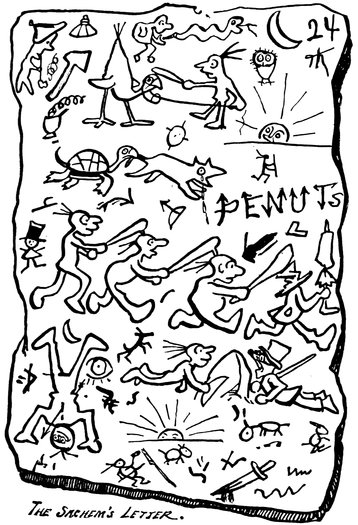
Chapter XXVII.—Some Aboriginal Ideas—Wise Men at Work—Mound Building from Force of Habit—Subterranean Miscellany—The Lost Tribe Theory Won’t Do—Autograph Specimen of Picture Writing—Light at Last—Picturesque Habits of the Indians
The compilation of a history of any country is a serious
matter, and should not be entered upon rashly. Before
undertaking the present work, therefore, the author deliberated
for twenty-nine years and six months, and then,
having consulted the best legal as well as medical
authorities, entered upon the task with fear and trembling.
He hired a vacant lot on Nassau street, and fenced it in,
and there, surrounded by the paraphernalia of literature
and art, he went to work with pen and pencil to jot down the
leading incidents of American history to the best of a somewhat
defective memory.
The illustrations have been our chief care, though the
letter-press will be found equally reliable. It was our original
plan to flavor these pages with a spice of romance, but
after a prolonged altercation with Mr. Carleton, our publisher,
we decided to adhere strictly to facts. If the reader
should happen to detect any slight anachronism in this work,
or has reason to suspect that the unities have been lost sight
12of in a single instance, he will please notify us as early as
possible.
When it first became noised abroad that we contemplated
bringing out an illustrated history of the United States we
were deluged with letters from a host of well-disposed persons,
such as Thomas Carlyle, James Parton, Wendell Phillips
and others of more or less literary ability, offering to “write
up” to our pictures. Mr. Carlyle said he could do it nights.
But the public was not to be trifled with, so we resolved to put
our shoulder to the literary as well as the artistic wheel, as
it were, and we flatter ourselves we have demonstrated in
these pages that truth is more of a stranger than fiction.
Our task is completed, and we lay aside pen and pencil,
feeling that we have done the State a service and that a
great load is off our mind. If the work we have just completed
shall run through several editions we shall feel that the
State has proved sufficiently grateful, and that a still greater
load is off our mind.
CHAPTER I.
13
A FEW STUBBORN FACTS NOT WHOLLY UNCONNECTED WITH THE DISCOVERY OF AMERICA.
The sun was just sinking below the western
horizon on the evening of September
11th, 1492, when a respectably dressed
personage of sea-faring appearance might
have been seen occupying an elevated position
in the rigging of a Spanish ship, and
gazing intently out over a vast expanse
of salt water upon what at first sight appeared
to be an apple dumpling of colossal
proportions, but which upon more careful
inspection subsequently turned out to be
a NEW WORLD.
14We will not keep the reader longer in
suspense; that sea-faring man was Christopher
Columbus, and the object which attracted
his attention was America!
This adventurous person had sailed from
the port of Palos, in Spain, on the 3d of
August with the avowed purpose of “seeing
the world;” and who, thinking he
might as well see a new world while he
was about it, sailed in the direction of
America.
15
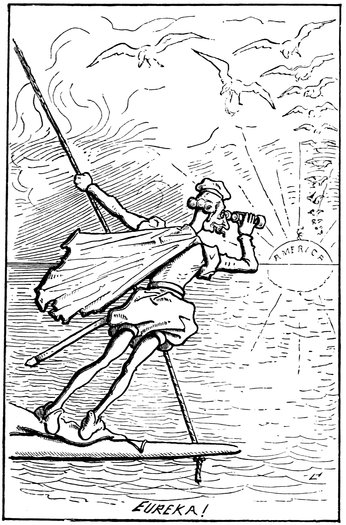
EUREKA!
For further particulars the reader is referred
to the accompanying sketch, which,
with startling fidelity, portrays the scene
at the thrilling moment when a new continent
bursts upon the bold navigator’s vision.
Pray cast your eye aloft and behold
the great Christopher discovering America
as hard as ever he can. The flashing eye,
16the dilating nostril, the heaving bosom, the
trembling limbs, the thrilling nerves, the
heroic pose, all vigorously set forth in a
style which speaks volumes—nay, whole
libraries for our artist’s graphic power and
knowledge of anatomy. We will next
trouble the reader to let the eye wander
off to the dim distance, where the new
world looms majestically up, and stands
out boldly against the setting sun, previously
alluded to, which illuminates the scene
with golden splendor, and bathes the new
born continent in a flood of dazzling light.
If the patient reader will be good enough
to examine this picture with a powerful
microscope, he will discover, standing upon
the utmost prominence of the new world,
and in imminent danger of falling off, a
citizen of the country who welcomes the
17stranger with uplifted tomahawk and a
wild war-whoop.
Lifting our eyes skyward we see the
American eagle soaring forth to meet the
great discoverer, with outstretched pinions,
and bringing his whole family with him.
We confess that we, for one, cannot gaze
upon this scene without envying Mr. Columbus
the luxury of his emotions and
wishing we knew where there was a new
world lying around loose that we might go
right off and discover it.
CHAPTER II.
18
IN WHICH THE EARLY LIFE OF THIS MAN COLUMBUS IS INQUIRED INTO—DISAPPOINTED PARENTS—THE BANE OF GENIUS—“POOH-POOH!”—CONVINCING ARGUMENTS.
Christopher Columbus was born at Genoa
in Italy, a country chiefly famous for
its talented organ-grinders. The youthful
Christopher soon made the melancholy discovery
that he had no talent in that direction.
His tastes then rather took a scientific
turn. This was a sad blow to his fond parents,
who did hope their son would take a
turn at the hurdy-gurdy instead.
His aged father pointed out that Science
19was low and unprofitable, Geology was a
humbug, Meteorology and Madness were
synonymous terms, and Astronomy ought
to be spelled with two S’s.
In vain his doting mother gently sought
to woo him to loftier aims, and, in the fondness
of a mother’s love, even presented him
with a toy barrel-organ which played three
bars of “Turn, sinner, turn,” in the hope
that it might change the whole current of
his life; but the undutiful child immediately
traded it off to another boy for a bamboo
fishing rod, out of which he constructed
a telescope, and he used to lie upon his
back for hours, far, far into the night,
catching cold and scouring the heavens with
this crude invention. One night his sorrow-stricken
parents found him thus, and they
knew from that moment that all was lost!
20
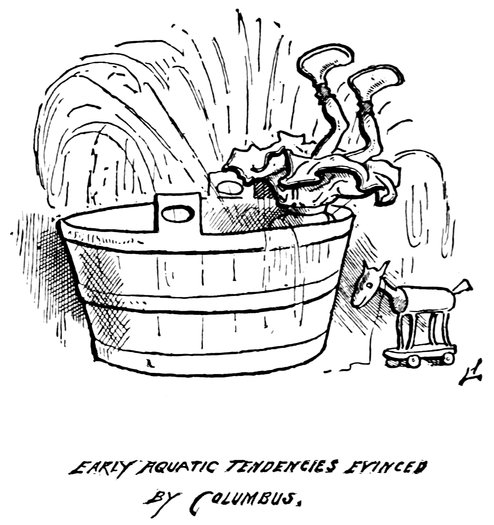
EARLY AQUATIC TENDENCIES EVINCED BY COLUMBUS.
21Our hero took to the water naturally
very early in life. Let the youth of America
remember this. Let the youth of every
land who contemplate discovering new
worlds remember that strong drink is fatal
to the discovery business; for it is our
candid opinion, that, had Christopher
Columbus taken to, say strong coffee in his
very earliest infancy, the chances are that
America would never have had a Centennial,
and these pages had never been written.
Two circumstances which the stoutest
heart among us cannot for a moment
contemplate without a shudder.
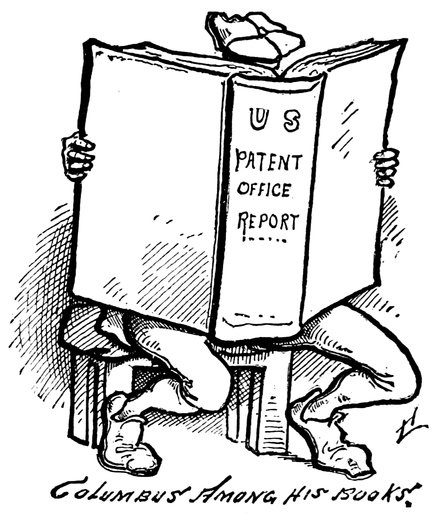
When Columbus reached man’s estate
he became a hard student, and spent the
most of his time in his library,
“Reading books that never mortal
Ever dared to read before.”
22
Columbus Among His Books.
23His mind, consequently, soared beyond
the pale of mere existing facts and circumstances,
and sought to fold its eager pinions
on lofty roosting places yet undiscovered.
And thus it was, that, after revolving
the matter in his mind for forty years or
more, Columbus arrived at the conclusion
that the earth was round, not flat, (as was the
popular belief at that time,) and boldly
said so in round terms. People called him
a lunatic, an original character, and other
harsh names, and otherwise pooh-pooh’d
the idea.
But Columbus not only adhered to his
theory, but went so far as to assert that by
sailing due west from Europe you would,
if you kept on sailing, bring up somewhere
in eastern Asia.
24
“Oh, come now, Christopher! really, this
25is going to far!” is what public opinion
said, and when our hero petitioned the
Italian Congress to fit out an expedition
and let him prove his theory, it magnanimously
offered to set him up in business
with a first-class barrel-organ and an educated
monkey cashier on condition of his
leaving the country once for all; but Columbus,
expressing his regret for his lack
of musical ability, declined this generous
offer and turned with a sigh to other governments
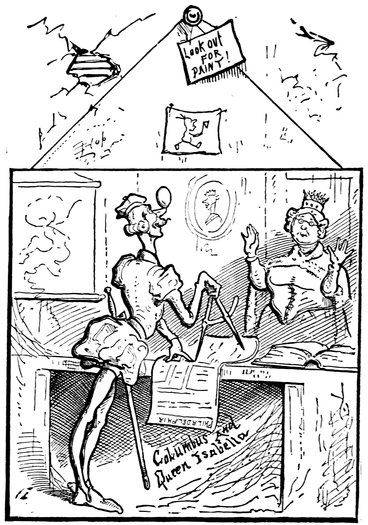
for assistance. Finally, after fifteen
years of effort, he succeeded in convincing
Queen Isabella of Spain that there
was an undiscovered country beyond the
seas, overflowing with milk and honey,
which it would be worth while to “work
up.” He proved his theory with the aid
of an egg, (which he made stand on end,)
26an old Boston City Directory, and a ground
plan of Philadelphia, (see school books,)
and demonstrated to the good lady’s entire
satisfaction that she might realize largely
by fitting out an expedition and let him at
its head go and discover it.
So conclusive were these arguments to
the mind of Queen Isabella that the good
old soul allowed him to fit out an expedition
at his own expense, and gave him
carte blanche to discover America as
much as he wanted to. We have seen how
well he succeeded. All this took place three
hundred and eighty-three years, four
months, and five days ago, but it seems to
us but yesterday.
Ah! how time flies!
CHAPTER III.
27
TREATS OF OTHER DISCOVERIES AND DOES GREAT CREDIT TO THE AUTHOR’S SENSE OF JUSTICE.
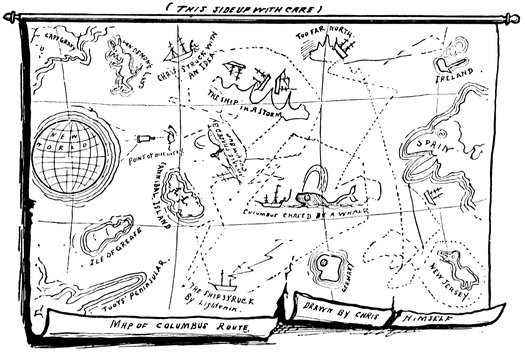
On the return of Columbus to Spain, he
published a map of his voyage in one of the
illustrated papers of the day. Through
the courtesy of the publishers of that paper
we are enabled to place this map before
our readers.
28
Map of COLUMBUS Route
DRAWN BY CHRIS HIMSELF
29Here it is translated from the original
Spanish. If the gentle reader can make
head or tail of it he is more gentle even than
we had at first supposed. The publication
of this map at the time naturally inspired
others with the spirit of adventure, and
discovering America became quite the
rage. Indeed, so common were voyages of
discovery to the New World, that only
one besides that of Columbus is deemed of
sufficient note to find a place in this history.
We allude to that of Americus
Vespucius.
This gentleman, who was a Florentine
by birth, made a voyage to South America
in 1499. He wrote sensational letters
to the papers describing his voyage and
the country, which were afterwards published
in book form by a German geographer,
who gave the name “America” to
the New World, but this history cheerfully
accords to [1]Christopher Columbus the imperishable
glory of finding out the roosting-place
of the American eagle.
1. Mr. Columbus is better known as the author of that
soul-stirring melody, “Hail Columbia!”
CHAPTER IV.
30
HAVING TO HIS ENTIRE SATISFACTION SETTLED THE QUESTION AS TO WHO DISCOVERED AMERICA, THE AUTHOR PROCEEDS TO SETTLE THE COUNTRY ITSELF—JOHN SMITH IS MENTIONED—JOHN SMITH ON THE ROSTRUM—JOHN SMITH IN DIFFICULTIES—THE PLOT THICKENS AS FAR AS J. SMITH IS CONCERNED—THE DEATH PENALTY—SLOW MUSIC—* * * * SAVED!
It was a century or more after the events
narrated in the last chapter before any attempt
was made to establish a colony in
America, or before civilization got any
permanent foothold.
31
32In 1606 a certain “London company”
got out a patent on Virginia, and the next
year sent over a ship-load of old bachelors
to settle its claim. They landed at Jamestown
in the month of May, and here the
wretched outcasts went into lodgings for
single gentlemen.
The whole country was a howling wilderness,
overrun with Indians, wild beasts
and Jersey mosquitoes.
These hardy pioneers had come to an
unexplored region with a vague, general
idea that they were to dig gold, trade
with the Indians, get enormously rich and
return home. So sanguine were they of
speedy success that they planted nothing
that year. The few sandwiches they had
brought with them were soon consumed,
the gold did not “pan out,” the Indians
drove very hard bargains, offering a ready
market for hair, but giving little or nothing
in return.
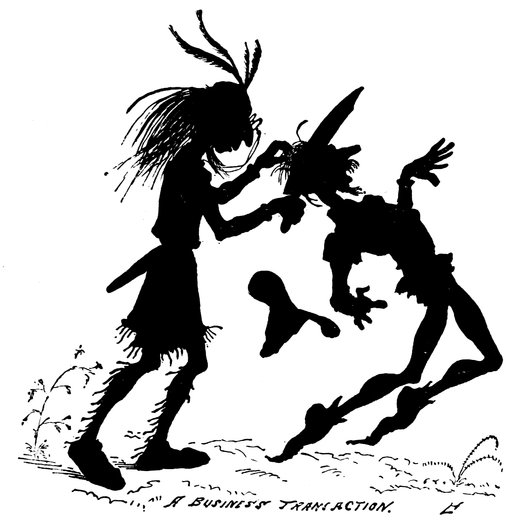
33
A BUSINESS TRANSACTION.
34To make matters worse, the Fevernager,
a terrible disease of the period, got among
them, and by fall only a handful of the colonists
remained, and these were a very shaky
lot indeed, with not clothing enough among
them to wad a shot-gun.
Among this seedy band was one John
Smith, who, being out of funds himself,
and a public spirited person withal, saw
that unless provisions could be obtained
shortly, the scheme of colonizing America
would be a failure.
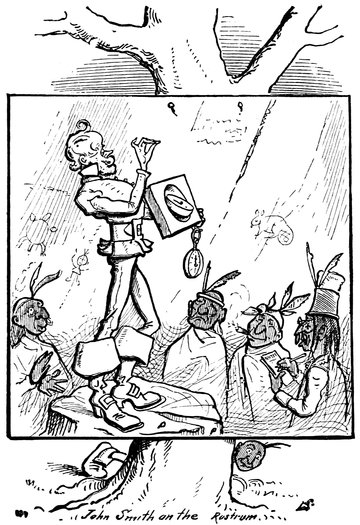
35
John Smith on the Rostrum.
He went into the lecture field, holding
forth to large and fashionable audiences,
composed of intelligent savages, upon the
science of navigation, illustrating his lecture
with an old mariner’s compass that indicated
all four of the cardinal points at once,
and a superannuated bulls-eye watch that
36would do nothing but tick. These simple-minded
children of nature listened with
attentive ears, and looked on with wondering
eyes, and came down largely with green
corn, sardines, silk hats, hard boiled eggs,
fall overcoats, pickled oysters, red handkerchiefs,
ice cream, dried herring, kid
gloves, pickled tripe, and other Indian
luxuries, which proved invaluable to the
starving, threadbare colonists. Thus it is
seen that Mr. Smith obtained on tick[2] what
he had no cash to pay for.
2. The reader may occasionally find this sort of thing in
these pages but he is entreated not to be startled.
Although Mr. Smith was regarded as a
talented man from a scientific point of view,
and was even mentioned in the native
papers as undoubtedly a god, yet he was
sometimes grossly misunderstood by these
37artless aborigines, and on one occasion they
arrested him on a general charge of hocus-pocus
or witchcraft, and carried him before
Chief Justice Powhatan to be tried for his
life.
The jury brought in a verdict of “guilty”
on all the counts, and the hapless Smith
was condemned to death. His counsel did
all they could to establish an alibi, but in
vain. It was a clear case; a fair trial had
been given their pale brother and he must
suffer the penalty. As a last resort, Mr.
Smith offered, first, his bull’s-eye watch,
and finally, the old mariner’s compass, for
his life, but Judge Powhatan could not see
the point. He had never seen a white man
die, and was panting for a new sensation.
He therefore ordered the entertainment to
proceed without more delay.
38Having previously had his scalp removed,
the doomed man thanked his captors
for all their kindness, and requesting the
executioner to make a good job of it, placed
his head upon the fatal block. The dread
instrument of death was uplifted, and Mr.
Smith was really apprehensive that his
time had come. He closed his eyes and
whistled the plaintive air,
“Who will care for my mother-in-law now?”
There was a hush of pleasant anticipation—a
deadly silence—you might have
heard a pin drop—indeed, you might have
heard ten pins drop.
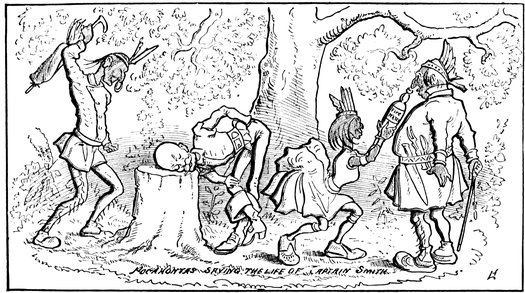
At this supreme moment Pocahontas, the
beautiful and accomplished daughter of
Judge Powhatan, appeared upon the scene,
tastefully dressed as a ballet girl, and using
39some pretty strong arguments with her
father, obtained from him a stay of proceedings,
and the prisoner’s life was spared.
Pocahontas saving the life of Captain Smith
40Powhatan apologized to Mr. Smith for
the loss of his hair, and handsomely offered
to buy him a wig. John admitted that it
was rather a closer shave than he had been
accustomed to, but at the same time he
begged the learned gentleman not to mention
it, and made the best of his way back
to Jamestown laden with presents, which
were subsequently stolen by the donors.
Many persons look upon this incident as
apocryphal, but we are prepared to assure
them upon personal knowledge of its
truthfulness. For, during a brief but
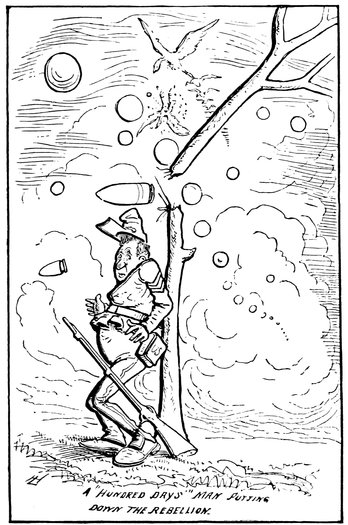
bloodless campaign in Virginia in 1864,
whither we had gone as a gory “hundred
day’s man” to put down the Rebellion, sixteen
41different identical spots were pointed
out to us where Pocahontas saved the life
of Captain Smith.
If there be any lingering doubt in the
mind of any one we point him in triumph
to any of our ably written city directories,
the careful perusal of which will convince
the most sceptical mind of Mr. Smith’s
safety.
Pocahontas afterwards married a young
English lord, (our American girls marry
titles whenever they get the chance,) and
at last accounts was doing very well.
Mr. Smith was elected president, by a
large majority, of the little colony, which
began to thrive henceforth, and was soon
reinforced by other adventurers from England.
42
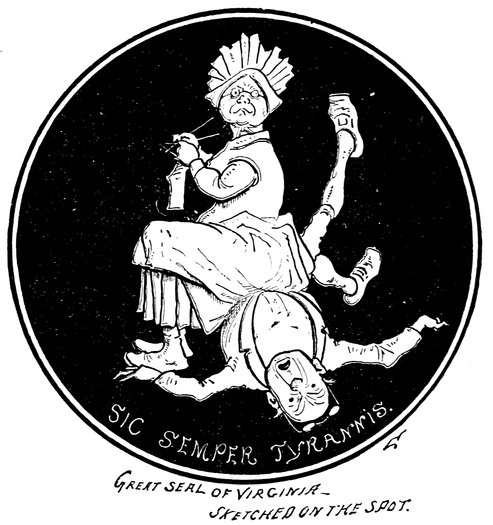
SIC SEMPER TYRANNIS.
Great seal of Virginia—sketched on the spot.
43In the fall of 1609 Mr. Smith was compelled
to return to England on account of
a boil on his neck, or to have a tooth
drawn, we forget which—but that is a mere
detail.
Virginia became a fixed fact, and in 1664
was ceded to the Crown of Great Britain,
which maintained jurisdiction over it until
about the year 1776. On page 42 we reproduce
the great Seal of Virginia. The
allegory is so strikingly and beautifully
obvious as to need no further elucidation.
CHAPTER V.
44
TREATS OF THE EARLY HISTORY OF MASSACHUSETTS AND MAKES MENTION OF A PILGRIM FATHER OR TWO, ALSO SHOWS WHAT A GOOD MEMORY THE AUTHOR HAS FOR DATES.
Massachusetts was first settled by Pilgrim
Fathers who sailed from England in the
year 1620 on board the May Flour, giving
directions to the captain to set them down
at some place where they could enjoy religious
freedom, trusting rather to his
knowledge of Navigation than of Theology
to land them at the right place.
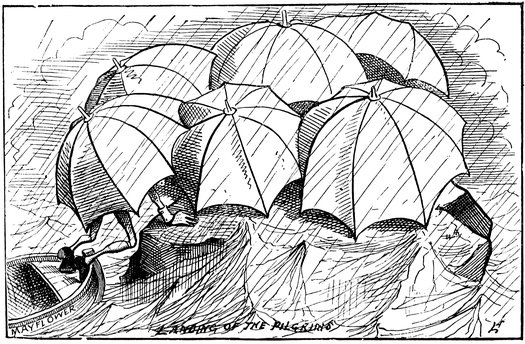
45
LANDING OF THE PILGRIMS
Thinking wild savages least likely to
entertain pronounced religious prejudices,
the captain of the May Flour bethought
46him of America, and landed them hap-hazard
at Plymouth, Massachusetts, on the 21st
of December, 1620. The Pilgrims made
themselves as comfortable on Plymouth
Rock as possible, and formed a treaty with
the Indians which lasted several days.
The accompanying sketch not only accurately
illustrates the event just narrated,
but gives us a faithful and striking portrait
of each of the Pilgrim Fathers, which will
be immediately recognized by all their
acquaintances. The drawing is made from
a photograph taken on the spot by an
artistic Pilgrim, who brought his camera
with him, hoping to turn a penny by photographing
the natives. We may here
incidentally remark that his first native
“subject,” dissatisfied with the result of a
“sitting,” scalped the artist and confiscated
47his camera, which he converted into a rude
sort of accordion. This instrument was
the cause in a remote way of the ingenious
native’s death, for he was promptly assassinated
by his indignant neighbors. Let the
young man over the way, who has recently
traded his mother’s flat-irons for a concertina,
take warning.
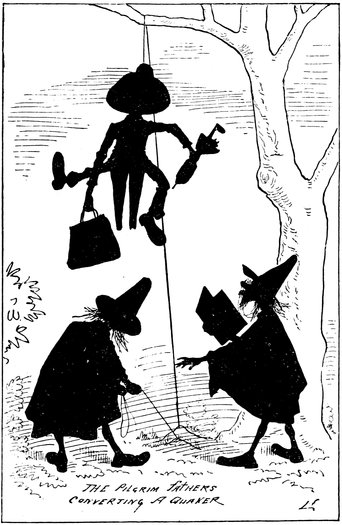
THE Pilgrim Fathers Converting A Quaker
48As some of our readers may not know
what a Pilgrim Father is, and as it is the
business of this book to make straight all
the crooked paths of history, we beg to
state that a Pilgrim Father is a fellow who
believes in hard-money piety, if we may be
allowed the expression, and with whom no
paper substitute will pass current. All
others are counterfeit, and none genuine
without the signature, “Puritan.”
Having come so far to enjoy religious
49freedom, the Puritans took it unkind if any
one ventured to differ with them. Our
illustration shows their style of reforming
Quakers in 1656. They used, as will be
seen, a very irresistible line of argument,
and the dissenting party thus “dealt” with
generally found it useless to combat old-established
prejudices.
It is not for the unimpassioned historian
to comment upon such a system of orthodoxy.
We will say, however, that the
Puritans meant well, and were on the
whole worthy sort of persons. At any
rate, Plymouth Rock was a success, and
may be seen to this day (with certain
modifications) in the identical spot where
the Pilgrim Fathers found it.
CHAPTER VI.
50
CONNECTICUT—INDIAN DEFINITION EXTRAORDINARY—WHAT THE DUTCH THOUGHT OF THE ENGLISH, AND WHAT THE ENGLISH THOUGHT OF THE DUTCH—STORY OF THE CHARTER OAK—WOODEN NUTMEGS INVENTED.
Connecticut is an Indian word and signifies
Long River. We know, because all
the Indian dictionaries we ever read right
through give this definition.
In 1636, if our memory serves us, Connecticut
was claimed by both the Dutch
and English, who had a long dispute about
it. Neither faction comprehended what
the dispute was about, as the Dutch did
not understand English nor the English
Dutch. All the Dutch knew was that
51their antagonists were tam Yankees, and
the latter were equally clear that theirs
were blarsted Dutchmen in the worst sense
of the word, and thus the matter stood
when, fortunately, an interpreter arrived
through whom the quarrel was conducted
more understandingly. It ended in favor
of the English.
The Dutch, it would appear, turned
out to be less blarsted than was at first
supposed, and, shaking the dust from
their wooden shoes, emigrated to New
Jersey.
In the year 1636 it occurred to King
Charles II to grant Connecticut a charter,
which, considered as a charter, was a great
hit. It gave the people the power to govern
themselves. Whenever a Connecticutian
traveled abroad folks said, “There goes
52the Governor of Connecticut,” and he really
felt himself a man of consequence.
This charter was afterwards annulled by
King James II on his accession to the
throne, who feared, no doubt, that the
people of Connecticut would govern themselves
too much, as the population was increasing
rapidly. He appointed a Governor
from among his poor relations and
sent him over to take charge of Connecticut.
Connecticut it seems rather took care of
him than otherwise. He varied the monotony
of a brief public career by making
sundry excursions on rail-back, if we may
be allowed the expression, under the auspices
of an excited populace. He found
the climate too hot to be agreeable, particularly
as his subjects presented him with a
53beautiful Ulster overcoat of cold tar
and goose feathers, and common politeness
compelled him to wear it. Need we say
the new Governor begged to be recalled?
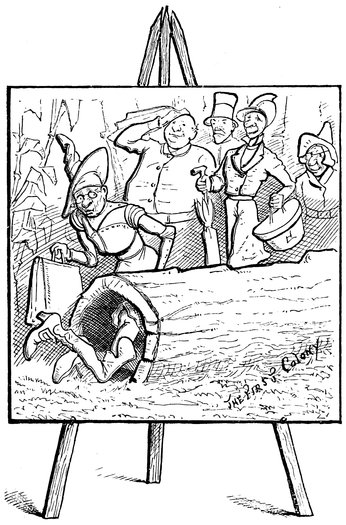
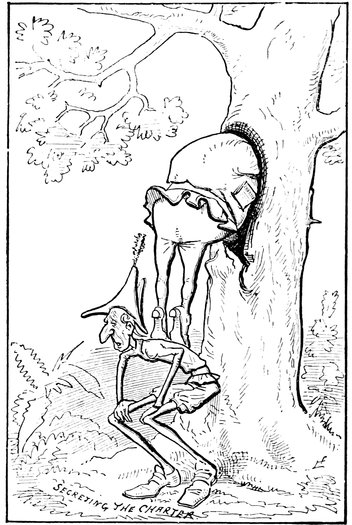
In the meantime the charter given by
Charles II was not destroyed. It was
taken care of by Captain Wadsworth, who
hid with it in a hollow oak tree, where he
remained until the death of the despotic
James, which, fortunately, was only about
four years, when King William, a real
nice man, ascended the throne, and he sat
down and wrote to Captain Wadsworth,
begging he would not inconvenience himself
further on his (William’s) account. It was
then that the Charter Oak gave back the
faded document and Captain Wadsworth,
both in a somewhat dilapidated condition.
54
SECRETING THE CHARTER.
While confined in the hollow tree the
55Captain beguiled the tedium of restricted
liberty by inventing the wooden nutmeg, a
number of which he whittled out of bits of
wood taken from the walls of his prison.
He subsisted almost exclusively upon these
during the four years of his voluntary incarceration,
and immediately after his
release got out a patent on his invention,
which he afterwards “swapped” off to a
professor in Yale College, who, we understand,
made a handsome fortune out of it.
Thus it ever is that patriotism and
self-abnegation for the public weal meets
with ample reward.
CHAPTER VII.
56
RHODE ISLAND—ROGER WILLIAMS “DEALT” WITH—A DESPERATE DISSENTER.
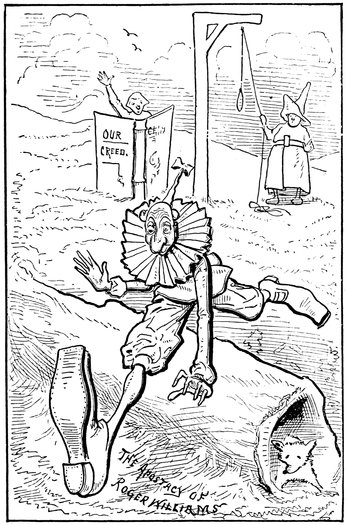
Rhode Island was first settled by a desperate
character named Roger Williams,
who was banished by the Puritans from
Massachusetts because he entertained certain
inflammatory views decidedly antagonistic
to the enjoyment of religious freedom,
namely: that all denominations of Christianity
ought to be protected in the new
colony.
57
THE Apostacy of Roger Williams
This, of course, was mere heresy upon the
face of it, and our forefathers proceeded to
“deal” with Brother Williams in the true
58Puritanic style, when the misguided man
bade them a hasty farewell and left on the
first train for Rhode Island.
He brought up in a camp of Narragansett
Indians, whom he found more liberal
in their religious views.
The blind and bigoted Williams, with a
few other renegades from the Puritan
stronghold, established a colony at the
head of Narragansett Bay, which they
called Providence.
Other settlements soon sprang up, and
the hardened sinner Williams went to
England and obtained a charter which
united all the settlements into one colony.
At the beginning of the Revolution
Rhode Island had a population of 50,000
blinded bigots.
CHAPTER VIII.
59
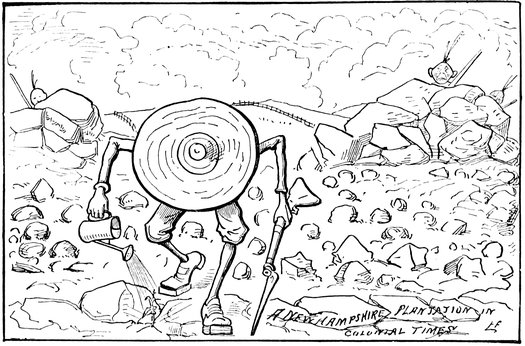
NEW HAMPSHIRE—SLIM PICKING—AN EFFECTIVE INDIAN POLICY—JOHN SMITH AGAIN COMES OUT STRONG.
New Hampshire was a sickly child from
the first, and of somewhat uncertain parentage.
It was claimed by many proprietors,
who were continually involved in lawsuits.
Its soil was not very fertile, and yielded
little else than Indians and lawyers. The
former were the most virulent of which any
of the colonies could boast, and the latter
were of the young and “rising” sort.
60
A NEW HAMPSHIRE PLANTATION IN COLONIAL TIMES
These two elements managed to make it
extremely lively for the average colonist,
who was scalped upon the one hand and
61“skinned” upon the other. At first the
horny-handed son of toil fondly hoped to
raise corn, but owing to the poverty of the
soil it was a day’s journey from hill to hill,
and as much as a man’s scalp was worth to
undertake to travel it. At harvest time
there was an immense crop of cobble stones
and no market for it.
Fortunately, in time the lawyers became
starved out, but two great drawbacks to
prosperity yet remained; sterility of soil
and hostile Indians.
But the time was at hand when both
these evils were to be remedied. His name
was Smith—John Smith, of course—who
readily undertook the contract of not only
exterminating the Indians, but of fertilizing
the soil.
To accomplish the first of these great
62ends, he disguised himself as a medicine
man, and went boldly among the noble red
men, inducting them into the mysteries of
the manufacture and consumption of New
England rum. He found them apt pupils,
and it was not long before every Red of
them, from the biggest sachem to the latest
papoose, could not only distill his own fire-water,
but drink it, too.
There was soon a very noticeable thinning
out in the ranks of the noble red men, and
a good deal was said about the setting sun.
The fire-water did its work thoroughly,
and the colonists were at length masters of
the situation so far as Indians were concerned.
The next thing was to make the land
productive. This was a more laborious
and tedious undertaking than the first, but
63John Smith was equal to the emergency.
He caused dirt to be carted from a neighboring
State until the rocky surface of
New Hampshire was completely covered
with a rich sandy loam a foot or two deep.
The people raised “some pumpkins” after
that, we are informed.
Thus was agriculture established on a
solid basis, and New Hampshire made
rapid progress.
All honor to John Smith.
CHAPTER IX.
64
SOME UNRELIABLE STATEMENTS CONCERNING THE EARLY HISTORY OF NEW YORK—TRACES OF A GREAT UNDERTAKING—ADVANCE IN REAL ESTATE—“LOOK HERE UPON THIS PICTURE, AND ON THIS.”
New York was discovered in 1609 by
one Henry Hudson, an Englishman by birth,
but to all intents and purposes a Dutchman,
being then in the service of Holland.
Immediately on his arrival he began the
work of building a bridge across the East
river, which, it is feared, he never was
able to finish. Traces of this quaint structure
are plainly to be seen to this day, and
have been known, time out of mind, as the
“New East River Bridge.”
65Manhattan Island, upon which New York
now stands, was settled by the Dutch, who
called it New Netherlands (afterwards
New Amsterdam). They bought it of the
Indians, paying for the entire island the
fabulous sum of twenty-five dollars, and
liquidated the purchase with fire-water;
but that was before the panic, when there
was more “confidence” in business circles
than now, and there had been as yet no
inflation talk.
New York has changed hands since then,
and we understand the property has enhanced
in value somewhat. We doubt
very much if the island could be bought
to-day for double the price originally paid
for it, even the way times are now.
66
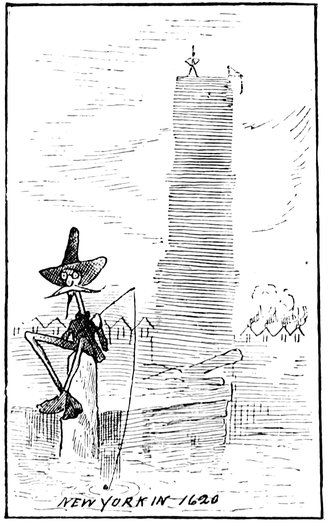
NEW YORK IN 1620
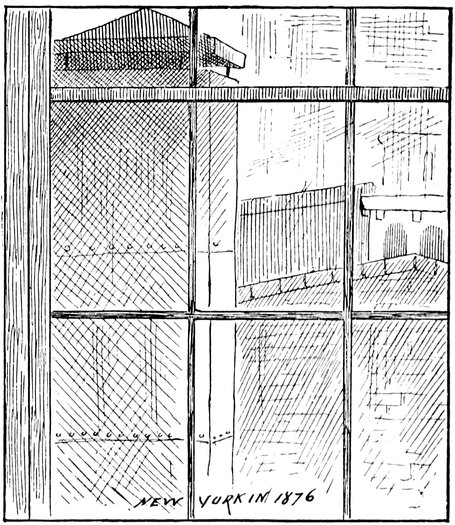
NEW YORK IN 1876
Any one comparing the two pictures
accompanying this chapter will see how
67marvelously we have improved since the
days of the Dutch. No. 1 is copied from
an old print, dating back to 1620, and is
warranted wholly reliable. It is undoubtedly
the Sabbath day, for in the foreground
is seen an influential citizen of the period,
who has come down to the Battery to
meditate and fish for eels. He is thinking
“How many ages hence will this, his lofty
scene, be acted over.” Presently he will
catch an eel.
Sketch No. 2 is of more recent origin,
and was taken from our artist’s window.
When this picture was first drawn the
Brooklyn pier of the bridge was plainly
discernible in the background. But since
then our landlord, who is a German, and
conducts a restaurant on Teutonic principles
on the ground floor, has humanely run up
68a vent-pipe from his kitchen opposite our
window, which necessarily excludes the
picturesque ruin of the bridge from view.
The reader will observe that nothing is
now visible but a tall square sheet iron
tube and an overpowering sense of garlic,
which destroy at once our view and our
appetite.
CHAPTER X.
69
A FLOOD OF HISTORICAL LIGHT IS LET IN UPON NEW JERSEY—ABORIGINES—THE FIRST BOARDING HOUSE—ORGAN-GRINDING AS A FINE ART.
Not many generations ago New Jersey
was a buzzing wilderness—howling would
be a misnomer, as the tuneful mosquito had
it all to himself.
“His right there was none to dispute.”
The tuneful mosquito was, in fact, your
true New Jersey aboriginal, and we do
not hesitate to assert that the wilderness
buzzed. But the time came at last when
the wilderness of New Jersey was to have
something else to do.
70
In the year (confound it! what year
71was it now?) a select company of colonists
landed at Hoboken, led by one Philip
Carteret. The latter carried with him a
large supply of agricultural implements to
remind the colonists that they must rely
mainly upon the cultivation of cabbages,
and devote their energies more or less to
the manufacture of Apple Jack for their
livelihood. But he soon saw his error, and
immediately cabled over for a supply of
mosquito nets to instill into their minds the
axiom that “self-preservation is the first
law of nature.”
Mr. Carteret opened a boarding house
in Hoboken, to be conducted on strictly
temperance principles, and devoted his
leisure to the civilizing of the aborigines;
but his efforts in this direction were
crowned with but partial success.
72It is an historical, but not the less melancholy
fact, that the aboriginal inhabitants
of any country become effete as civilization
advances. And thus it happens that,
although the mosquito has been handed
down to us in modern times, we only behold
him in a modified form. That he has
not yet entirely lost his sting, the compiler
of this work personally ascertained during
a four years’ exile in Hoboken. For all
that the Jersey mosquito of to-day is but
an echo, as it were, of his ancestor of
colonial times. How thankful should we
be then that we were not early settlers.
Hoboken is the capital of New Jersey,
and is principally inhabited by Italian
barons in disguise, who consecrate their
lives exclusively to the study of that king
of musical instruments, the barrel-organ.
73The Elysian Fields, just north of Hoboken,
is a sylvan retreat where the elite of
the adjacent cities congregate on Sunday
afternoons to play base-ball and strew
peanut shells o’er the graves of departed
car-horses.
CHAPTER XI.
74
PENNSYLVANIA SEEN THROUGH A GLASS DARKLY—WM. PENN STANDS TREAT—A STRIKING RESEMBLANCE—HOW TO PRESERVE THE HAIR.
The first colony of Pennsylvania was
founded in 1682 by Wm. Penn, a Quaker
gentleman of steady habits, who, with remarkable
foresight settled at Philadelphia,
because he thought it an eligible place
to hold a Centennial Exhibition. He took
out naturalization papers, and began by
studying the prejudices of the natives
with a view to getting upon the good
side of them. He smoked the calumet of
peace with them and treated them to hard
75cider, under the mellowing influence of
which they said he was like “Onas.” How
well he deserved this compliment the
reader will comprehend at once by reference
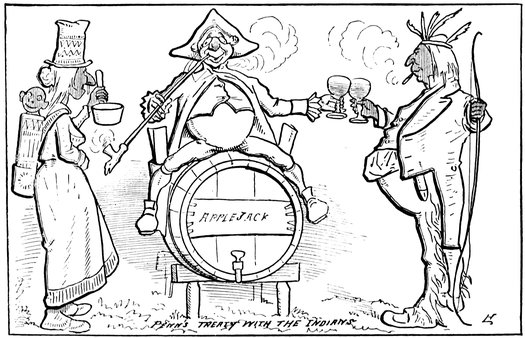
to the accompanying illustration.
The coincidence of resemblance is indeed
striking, though it must be admitted he is
not unlike a cigar sign either.
PENN’S TREATY WITH THE INDIANS
76Wm. Penn bought property in Philadelphia,
where he resided for thirty-six years,
getting along very well with the neighbors.
In proof of which we may mention that in
1718 he went back to England very well off
indeed, where he died and was buried in his
own hair.
CHAPTER XII.
77
MARYLAND SETTLED—WHAT’S IN A NAME?—PECULIAR MONETARY SYSTEM.
Lord Baltimore was the oldest inhabitant
of Maryland. He named it after Mrs. Charles
II, whose maiden name was Henrietta
Maria.
The name Henrietta Marialand was
found rather unhandy for so small a
province, so he afterwards cut it down to
Maryland.
The first settlement was made at the
mouth of the Potomac river by a colony
of English ladies and gentlemen. They
lived chiefly upon green corn and tobacco,
78which they cultivated in large quantities.
When they ran out of funds the latter staple
became their currency—the leaf tobacco
being the paper money or “greenbacks,” and
the same dried, mixed with molasses and
pressed into blocks or “plugs,” represented
specie or “hard money.” During the
growth of the crop it was customary for
the capitalist to dig up his stalks every
night before going to bed, (previously
watering them,) and lock them up in a
patent burglar-proof safe, getting up before
sunrise next morning to replant them.
The inflation or depression of the money
market depended more or less upon the
success of the tobacco crop, and as the soil
was new there was seldom a panic. One
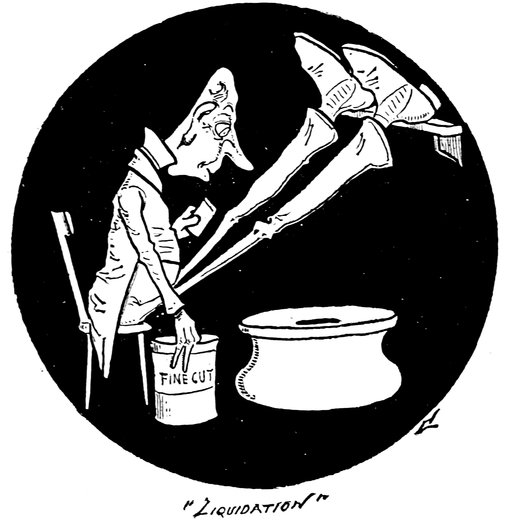
phase of the old Maryland monetary system
is graphically set forth on page 79.
79
“Liquidation”
CHAPTER XIII.
80
TWO BIRDS KILLED WITH ONE STONE—A COLORED CITIZEN DECLARES HIS INTENTIONS—IN SETTLING NORTH AND SOUTH CAROLINA THE AUTHOR IS HIMSELF UNSETTLED.
The early history of the Carolinas has
few cheerful phases. The first settlers
were Puritans, who, finding the business
unprofitable, sold out and went to speculating
in real estate. Preyed upon by speculators
and Indians, as Carolina was, few
inducements were held out to emigrants of
good moral character. Happily, however,
about the beginning of the eighteenth century
a distinguished colored gentleman poetically
but forcibly announced his intention
of emigrating to North Carolina “Wid de
banjo on his knee,”—or was it Alabama?
perhaps it was, but no matter. We are
positive as to the banjo at any rate. It is
a matter of regret that he selected so
unagricultural an instrument to begin life
with in a new colony.
81
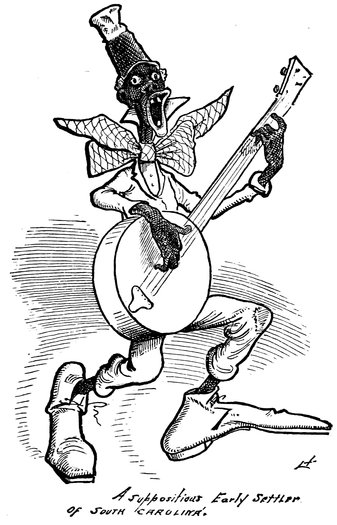
A suppositious Early Settler of South carolina.
82On page 81 we give a reliable portrait
of this individual of color.
83
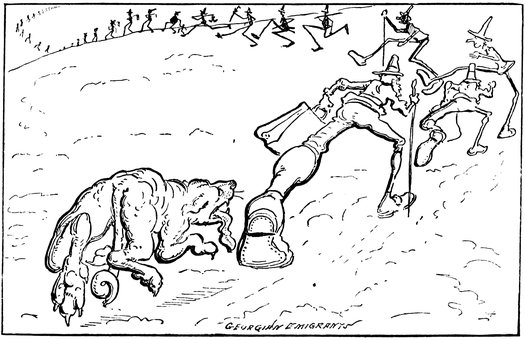
Georgian Emigrants
CHAPTER XIV.
84
GEORGIA—SLAVERY—A DARK SUBJECT.
Georgia was first settled in 1732 by one
hundred and twenty emigrants (not to
mention a surreptitious yellow dog that followed
them over) led by James Oglethorpe.
Civilization advanced but slowly at first
owing to the prohibition of rum and slavery.
Twenty years later, however, Georgia was
annexed to the Crown, and these two civilizing
influences were brought to bear upon
society. Georgia made rapid strides after
that.
CHAPTER XV.
85
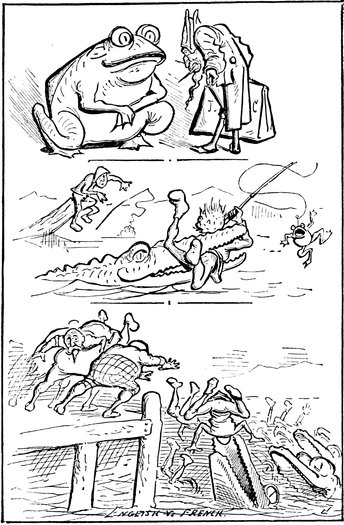
ENGLISH VS. FRENCH—PURSUIT OF BULL-FROGS UNDER DIFFICULTIES—TRUTH STRANGER THAN FICTION.
Although the English were the oldest
inhabitants, it would seem they were not
to hold their new possessions undisputed.
The fame of the fledgeling continent
spread abroad, and people all over the
world packed up their loins and girdled
their traveling bags for a journey hither.
Even France was suddenly seized with the
emigrating fever, and soon became England’s
principal rival in the new country.
She had heard of the American bull-frog
as being the largest in the world, and ere
86long the banks of the Mississippi from its
source to the Gulf were studded with huts
whose owners had left their homes in sunny
France in quest of frogs and freedom in
a foreign clime.
Perched on yonder oscillating snag in midstream,
or wading waist deep in the dismal
bayou, armed with fishing tackle, his bronzed
forehead furrowed with care and his hook
baited with red flannel, the sanguine Gaul
sought to tempt the sonorous bull-frog from
his native lair. Too often, alas! he surprised
the aggressive alligator in his native
lair, fatally mistaking him for a first-class
bull-frog of some rare species. Many an
unwary Frenchman was taken in thus, but
frogs were hunted with unabated vigor, and
every day brought ship-loads of enthusiastic
adventurers from the sunny land of France.
87So long as the Frenchmen confined
themselves to the frogs, (and the alligators
confined themselves to the Frenchmen,)
their English brethren tolerated them; but
when it came to starting opposition corner
groceries, and organizing competitive horse-railway
companies, (which the French occasionally
stepped aside from their legitimate
pursuits to do,) they became a positive
nuisance, you know. Besides the alligators
did not always discriminate between
English and French diet. If anything, the
epicures of the species seemed to give preference
to the former when any train of fortuitous
circumstances threw an occasional
Englishman in their way.
88
English vs french.
The duty of the English seemed plainly
indicated to them, and they, being in the
majority, were not slow in acting up to it,
89by bringing to bear upon their rivals what
may be termed an alligator policy. But we
leave the rest to our artist, who with a few
dashes of his pencil on page 88 has saved
us reams of manuscript and barrels of ink.
He merely wishes us to explain that the
parties on the wharf in the last picture are
English, with one exception.
CHAPTER XVI.
90
THE NAVIGATION ACTS—ILLICIT TOOTHPICKS—A CARGO OF TEA UNLOADED—PORK AND BEANS AS A BEVERAGE—RUMORS OF WARS.
Having seen civilization comfortably
settled in its new home, let us see how it
conducted itself.
In the year 1660 certain bills were lobbied
through the English Parliament which
were highly obnoxious to the American
colonies then established in Virginia.
These were called the Navigation Acts, and
prohibited the colonists from sending their
pigs to any other market than England,
nor allowed them to purchase any article
91of commerce, not even a toothpick, from
any other country, and even that commodity
must be ordered from the King himself
and delivered in English vessels. If any
ingenious colonist was caught whittling a
pine splinter or a lucifer match to a point
he was looked upon as an outlaw and taken
home to England in irons to answer the
charge of manufacturing illegal toothpicks.
The Navigation Acts were swallowed by
the colonists with wry faces for a century
or so, and they were beginning to get used
to it. But when one fine day the Mother
Country invented a new dish, called the
“Stamp Act,” and began to ladle it out
the docile colonists entered their gentle
protest.
The Stamp Act provided that the pigs
and toothpicks must all bear the government
92stamp—the stamps, of course, to be
paid for by the colonists.
The latter held town meetings, and the
district schoolmaster made inflammatory
speeches denouncing the British Parliament;
the provincial editor hurled defiance in the
face of the Crown in a double-leaded article,
which he marked with a blue lead pencil
and sent to the royal address with his
own handwriting. The Crown turned pale,
and immediately ordered the Stamp Act
to be repealed. It was hoped that this
concession would put an end to all hard
feelings that had for a long time existed
between Parliament and the Town Council
of Boston. But now the cry was raised of
“No Taxation without Representation,”
and when one day the news reached Boston
that there had been a duty imposed on tea,
93people took a sudden dislike for that beverage.
They said the stamps spoiled the
flavor for them, and refused to use it.
As a substitute they consoled themselves
with a peculiar infusion called porkinbeans,
a well-known Boston beverage.
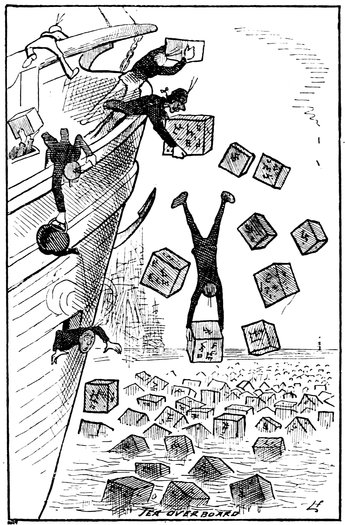
One day a ship-load of “Best English
Breakfast” arrived at the wharf, and all
Boston picturesquely arrayed in Indian
costume turned out to unload it. In the
excitement of the moment the caddies
were accidentally tossed over the wrong
side of the ship, the stamps having previously
been canceled by the absent-minded
citizens.
Great Britain immediately sent over
several ship-loads of troops, but these were
scarcely less obnoxious than the cargo of
stamped tea, especially as they asked some
94very embarrassing questions relative to the
careless unloading of said cargo.
Tea overboard
95Patrick Henry, a member of the Virginia
Legislature, took it upon himself to
return a rather evasive answer by “repeating
it, sir, WE MUST FIGHT!”
CHAPTER XVII.
96
REVOLUTIONARY—A ROW AT CONCORD—A MASTERLY RETREAT—THE BRITISH COUNT NOSES.
And we did fight.
The first gun was fired on the 19th of
April, 1775, at Concord, where a large and
select assortment of explosives for celebrating
the coming Fourth of July was stored
and guarded by a squad of minute-men.
A detachment of 3,000 British was sent
to destroy these explosives.
“Disperse ye Rebels!” is what the British
commander remarked.
97
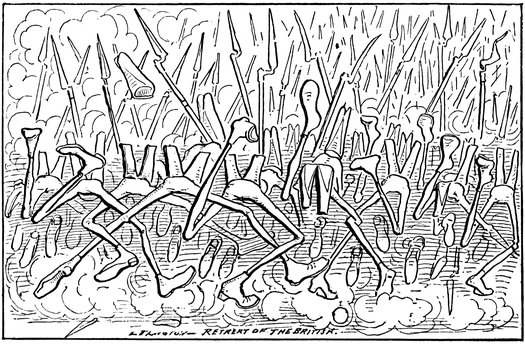
RETREAT OF THE BRITISH.
“You’re another!” promptly replied the
minute-men, and immediately obeyed the
98order to disperse. They placed an unexpected
construction upon it, however, for they
dispersed the British troops, who deemed it
expedient to saunter back to Charlestown,
where they found on counting noses that
they were short some two hundred and
eighty men.
This retreat of the British is one of the
most brilliant on record, and, if we can believe
the illustration on the opposite page,
was conducted in a somewhat informal
manner. The unstudied yet animated action
of the pedal extremities speaks of a pressing
engagement suddenly remembered that
must not be neglected. There are certain
anatomical peculiarities in this picture of
which the least said the better.
CHAPTER XVIII.
99
FULL ACCOUNT OF THE BATTLE OF BUNKER HILL—FALSE TEETH AND HEROISM—ARE REPUBLICS UNGRATEFUL?
About two months after the events narrated
in the last chapter the battle of
Bunker Hill took place, June 19, 1775. It
was conducted by General Bunker upon
the American side, while one General Hill
led the British.
On this memorable occasion the Americans
managed to destroy a thousand or so
of the enemy, and might have done better
had their supply of bullets held out.
These becoming exhausted the noble fellows
fell back upon the brass buttons of
100their uniforms, which they fired at the British
as long as there was a button left among
them.
The brave Bunker, when his stock of
buttons gave out, bethought him of his
false teeth. He removed them from his
mouth, and with fire in his eye and a
horse-pistol in his right hand, (holding
on his buttonless uniform with his left,)
he turned upon the enemy a galling fire
of “store” teeth, and every one of them
took effect, making sixteen of the red-coats
bite the dust.
In his official report of the battle which
he sent to Congress the heroic man avers:
that, if there had been a dentist handy to
extract ’em, he would have sacrificed every
dashed natural tooth in his head for the
cause of Liberty.
101
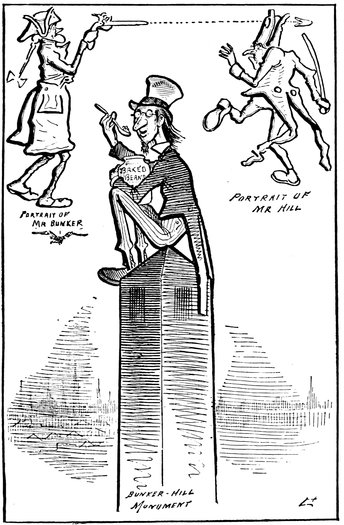
Portrait of Mr Bunker
Portrait of Mr Hill
Bunker-Hill Monument
102As a reward for his heroic conduct, Congress
had him measured for a new set of
elegant silver-mounted molars, which it
promised to present to him some day with
an appropriate inscription. And yet they
say Republics are ungrateful!
For further information regarding this
great battle, see illustration. There was
a monument erected upon the spot to
commemorate the battle, and should you
ever go to Boston you will probably be
asked, “Have you tried our baked beans,
and have you seen Bunker Hill monument?”
CHAPTER XIX.
103
STILL REVOLUTIONARY—THE FIRST FOURTH OF JULY TAKES PLACE—DECLARATION OF INDEPENDENCE—AN ABLE DOCUMENT—PARLIAMENT IS MUCH MOVED AND GETS OUT YELLOW HANDBILLS.
One hot sultry day in the summer of
1776 Thomas Jefferson eased his mind in
an essay called the Declaration of Independence,
which said in effect that the
United Colonies of America had saved up
money enough to start in business for themselves,
and henceforth there was to be no
connection with over the way. This document,
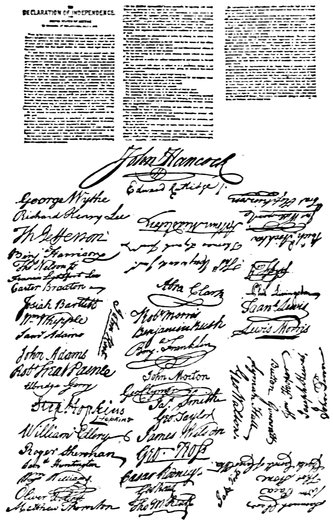
dated July 4, 1776, was signed by
John Hancock and a few other members
104of Congress who had learned to write, and
was duly published in all the daily papers.
We received a marked copy of one of the
papers in which it appeared at the time,
and with a sort of vague instinct that we
might find it useful some day, cut it out
and preserved it with religious care. We
reproduce it here in facsimile.
105It will be found to be a very readable article,
and we advise our readers to peruse it
carefully, if they have to skip all the rest
of the book. The gentlemen who signed the
Declaration have courteously furnished us
their autographs, which we also take the
liberty of placing before our readers.
When the attention of Parliament was accidentally
called to this article, in one of the
papers above alluded to, its feelings may be
more readily imagined than described. And
106when that quaint old fossil Disraeli put on
his spectacles and read it “out loud” there
was not a dry eye in the house. Parliament
cried like a child, or, more properly,
like a whole orphan asylum. Becoming
calmer after awhile they got out immense
illustrated yellow posters, representing an
enraged lion engaged in bitter discussion
with a sanguinary one-eared mule, and
after stating that this was the Lion and
the Unicorn, the poster went on to say
that the Americans were rebels and humbugs,
and further cautioned the public
against selling them goods on credit.
When these handbills were posted conspicuously
and profusely on every stone
wall, barn, and rail-fence in America, the
spirit of ’76 rose to several per cent. above
proof. War was declared, and General
107Washington was appointed commander-in-chief
of the Continental army.
He gave strict orders to place none but
Americans on guard, while England sent
more troops to America, and expected
every man to do his duty.
CHAPTER XX.
108
REVOLUTIONARY AS BEFORE—“PLACE NONE BUT AMERICANS ON GUARD TO-NIGHT”—CHRISTMAS FESTIVITIES—ALMOST A VICTORY—A BRITISHER SHOWS WASHINGTON GREAT DISRESPECT—WASHINGTON CROSSING THE DELAWARE.
One dark, cold winter’s night General
Washington issued very strict orders indeed
relative to guard mounting, and each sentinel
had to either show his naturalization
papers or give affidavit of American parentage.
The British hordes were encamped just
across the Delaware river in numbers greatly
superior to the Americans, and were only
waiting for the river to freeze over in order
109that they might skate across and capture
the entire Continental army. As there was no
immediate prospect of that, however, owing
to the mildness of the weather, and having
much spare time on their hands, the Britons
improved their minds by the study of High-low-Jack
and other branches of science.
It was Christmas night, and the whole
army had been celebrating the day in good
old English style. Every minion of them
had inhaled more or less commissary whisky,
and as night approached had succumbed
to its sedative qualities.
General Washington saw how it would
be, and announced his intention of spending
the evening out, without entering into further
particulars. He borrowed a log canoe
of one of the neighbors and paddled across
the river amid floating ice and made the
110whole army prisoners. The difficulty now
arose of getting the booty home. The
British army by actual count turned out to
be much larger than Washington had
anticipated, and he began to entertain serious
doubts as to whether the small canoe
would accommodate so many.
While he stood thus enjoying his triumph,
and deliberating as to what course
to pursue next, an able-bodied Britisher
manifested unmistakable symptoms of
returning animation by raising himself on
one elbow, and demanding in a loud voice of
the Father of his Country what the highly
colored blazes the blarsted old three-cornered
pig-tail meant by loafing about there, and
then ordered him in an incoherent manner
to “roll in another bar’l, and be quick about
it.”
111With that coolness of deliberation which
characterized all his public acts, Washington
hastily withdrew, leaving his prisoners
to be called for at some future time.
A few days later, taking advantage of a
sudden cold snap, he crossed the Delaware
once more, taking a small army with him to
assist in bringing his prisoners home. The
latter had so far recovered from the effects
of Christmas as to make a stout resistance,
and the battle of Trenton took place, resulting
in favor of the Americans.
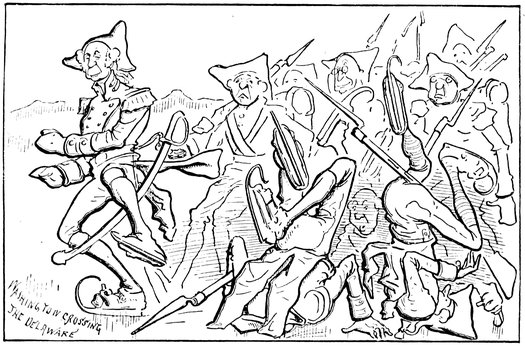
Washington crossing the Delaware furnished
a very good subject for a very bad
painting, which may be seen among other
bad paintings in the Rotunda of the Capitol
at Washington. At first sight this work of
art might be mistaken for an advertising
dodge of some enterprising ice company,
112but there is not the slightest doubt it is
meant to bear a historical, not a commercial
significance.
Washington crossing the delaware
113On page 112 will be found a reliable version
of the incident briefly sketched, which
our artist is willing to work up in oil for
the Government if Congress will make a
suitable appropriation and agree to furnish
a barrel of oil and a few acres of canvas.
Sealed proposals addressed to care of the
publishers of this work will be promptly
considered.
CHAPTER XXI.
114
MORE REVOLUTIONARY THAN EVER—LIVELY TIMES AT A WATERING-PLACE—THE STARS AND STRIPES INVENTED.
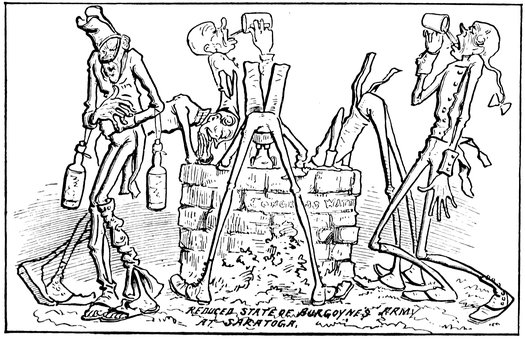
On the 17th of October, 1777, General
Washington surrounded and captured the
British army under Burgoyne at Saratoga,
where they had been spending the Summer,
and where it strikes us they had remained
rather late in the season.
115
REDUCED STATE OF BURGOYNE’S ARMY AT SARATOGA.
The British were entirely out of provisions,
and had been living exclusively on
congress water for some weeks past. Mr.
Burgoyne had written home to the Crown
that, if the war was to be successfully
116prosecuted in America, the army must be
supplied with something more filling for
the price than mineral water. But he
must have forgotten to mail the letter,
for no commissary stores arrived, and the
soldiers continued to subsist upon their
aqueous diet. They were consequently
greatly reduced and fell an easy prey to
the Americans.
That year Congress adopted the Stars
and Stripes as the flag of the United States,[3]
which (with the addition of other stars
from time to time) has been handed down
to grateful posterity, and to-day proudly
reveals to the youth of a free Republic the
whereabouts of the circus tent.
3. Note—This supplied a want long felt, as the army had
hitherto rallied round Mr. Washington’s red pocket handkerchief
tied to a broom handle.
CHAPTER XXII.
117
IMPRUDENT CONDUCT OF BENEDICT ARNOLD—A REAL ESTATE SPECULATION—$50,000 THE PRICE OF LIBERTY (TERMS CASH)—MAJOR ANDRÉ IS SERIOUSLY COMPROMISED—SUSPENSE—EVIL COMMUNICATION—A TALE-BEARING YELLOW DOG.
It was in the fall of 1780 that one Benedict
Arnold, being seriously inconvenienced
for want of funds, employed some very questionable
means of getting on his financial
legs again. After laying his head together
for a spell, he resolved to realize on some
real estate belonging to the colonial government,
and make a European tour on the
proceeds.
He secretly negotiated with the British
118Commander, Lord Clinton, (then at New
York,) for the sale of a few acres at West
Point, where he (Arnold) happened to be
in command, which he agreed to transfer
to the said Lord Clinton for and in
consideration of $50,000 to him, the said
Arnold, paid in hand.
119
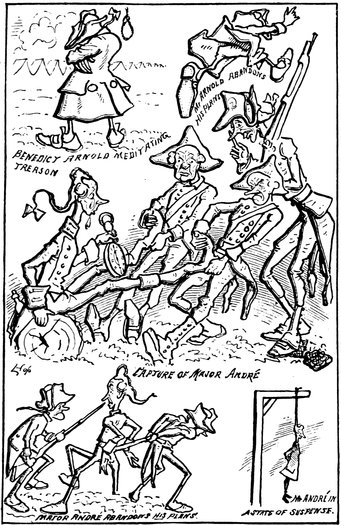
BENEDICT ARNOLD MEDITATING TREASON
Mr ARNOLD ABANDONS HIS PLANS
Capture of Major André
MAJOR ANDRÉ ABANDONS HIS PLANS.
M ANDRÉ IN A STATE OF SUSPENSE.
120It is true, the property was occupied by
Government as a military post of some
importance, and was the repository of valuable
stores and munitions of war, and
besides the nucleus of the American army
was garrisoned there. But Arnold was
too much of a man of business to let
a little drawback of that sort stand between
him and a bargain. He said he
would throw all these in if the other
party was willing. The other party good-naturedly
agreed to overlook all drawbacks,
and sent his man Friday, Major
André, to close the bargain and bring the
property home. After a very pleasant
interview with Arnold behind a haystack,
which resulted to the satisfaction of both,
Major André started for New York with
the title-deed for the newly acquired property
safely stowed away in his left coat-tail
pocket. He had proceeded some distance
on his journey when he was stopped by
three American gentlemen whom he met,
and who, with that unhappy inquisitiveness
to which their race is notoriously predisposed,
desired information as to whence he
had come, whither he was going, and what
“line” he was in.
The Major, with great ingenuity, replied
that he was a representative of the press
from New York, and had been to headquarters
121to interview General Washington
as to what he thought his chances were
in the coming presidential canvass, and
whether he, as an honest man, really considered
himself a fit person to be entrusted
with an army? and if it were true, as had
been represented, that he advocated the
introduction of the new breech-loading
umbrellas into the army as a military
measure? whether he was not afraid of
hurting himself with his sword, or putting
somebody’s eyes out by the careless habit
he had of pointing out beauties in the
landscape (see equestrian portraits) with
that weapon? also whether he had any
chewing tobacco?
However plausibly the Major’s account of
himself might strike most people, it failed
to satisfy those to whom it was addressed.
122They said they had at first merely
looked upon him as a suspicious character,
but now, by his own confessed connection
with the press, they could not regard him in
any other light than that of a very dangerous
person, to say the least, and they
must trouble him to turn his pockets
inside out.
With tears in his eyes he took from his
pockets an oroide watch, a jackknife, and
some Erie railway shares.
“Let me go hence,” he said, in a voice
choked with emotion, “and these shall be
your guerdons; there is just a guerdon
apiece. You can toss up among you for
the choice.”
But, although his captors happened to
be wealthy capitalists, they declined to add
to their means at the expense of honor.
123They said guerdons were out of their line,
and demanded to know if he (the Major)
could discern anything of a verdant tinge
in their optics. The Major could not for
the life of him. One of these low fellows
then hinted that he more than suspected
the true nature of their (now) prisoner, and
he must be investigated, and further, by a
very expressive pantomime (catching himself
by the throat, opening his eyes very
wide, protruding his tongue and breathing
hard) tried to convey some idea of what
would happen if his suspicions should prove
correct.
The gallant Major was never so mortified
in his life before. He began to wonder
what would ever become of him if these
vulgar persons into whose hands he had
fallen should really so far misconstrue his
124conduct as to condemn him for a spy?
He was not kept long in suspense. (See
illustration on page 119.)
There is one incident in connection with
André’s capture which has always been unaccountably
overlooked by other historians,
and which if we omitted in this place we
should feel that we had not conscientiously
discharged our duty.
When Major André found himself a captive
he felt that it would be very desirable
to communicate with Arnold before their
transactions should be made public. He also
saw the impossibility of reaching him by
telegraph, as that means of correspondence
was not to be invented until half a century
or more later, and to delay so long as that
125might be fatal. While casting about for
some means of giving warning to his
friend, his eye chanced to rest upon a specimen
of the canine species of the yellow
persuasion belonging to one of his captors,
and a ray of hope gleamed in upon his
soul.
They had halted for the night, intending
to proceed with the prisoner to headquarters
next morning, and preparations were
being made for supper. An empty tin
coffee-pot sat near the fire, and the yellow
dog sat near the tin coffee-pot blinking at
the fire, his mind evidently absorbed in
some abstruse canine problem. By a
curious, though perhaps natural association
of ideas, the Briton saw here the crude materials
for communicating with Arnold
ready to his hand.
126Pretending to make an entry in his diary
he hastily scribbled off these lines:
“Friend Benedict:
Owing to circumstances over which I have no
control, I am unable to take any further steps in that
little matter of ours at present; the boys have in
point of fact scooped me. You would have been a
better man in my place. Hoping to meet you in the
happy hunting grounds, I am yours, in limbo,
André.
P.S.—By the way, hadn’t you better drop in upon
our mutual friend General Clinton at New York and
remain with him for a few days until it blows over?
I only throw this out as a mere suggestion. Good
bye.
A.”
Watching his opportunity when his captors’
backs were turned, the Major slipped
127this epistle into the coffee-pot, clapped on
the lid, and, having diverted the canine’s
attention by means of a piece of salt pork,
which had been originally laid out for the
approaching meal, hastily appended the
tin vessel to his caudal extremity, and having
with nice precision turned the animal’s
nose in the direction of Arnold’s tent, he
gave the tail an agonizing twist, and—and
the party did without coffee that night.
The yellow dog came duly to hand, and
Mr. Arnold was not slow in acting upon
the hint contained in the message he
brought. With that long-headedness
which is the characteristic of the true man
of business he anticipated any investigation
of his conduct that might follow by resigning
and changing his residence at once.
We learn that he subsequently went to
128Europe, but up to the present writing has
not yet returned.
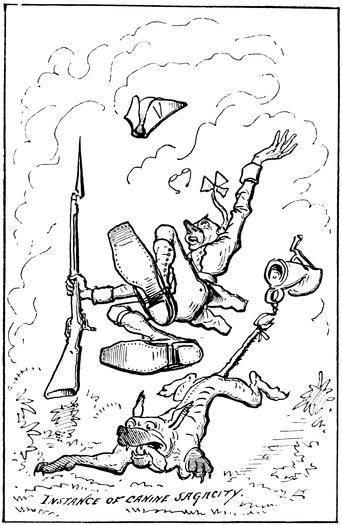
Instance of canine sagacity.
129If any one doubts the incident we have
just related about the way in which the
news of André’s capture reached Arnold,
he has only to narrowly scrutinize our
illustration, which treats of the moment
when the sagacious quadruped reaches the
American lines. With almost human intelligence
he overturns the sentinel, who,
doubtful of the nature of his business, has
challenged his further progress.
For Mr. Arnold’s own sake we regret the
imprudent course he pursued to improve
the state of his exchequer. It is true his
funds were low, and no one can blame him
for wanting to make a “raise.” But then
he ought to have remembered that there
are always honest as well as lucrative pursuits
130open to the deserving poor involving
but small investments; for instance, he
might have started a paper, peddled
matches, got an appointment in the Cabinet,
blacked boots, organized savings banks, or
written comic histories.
We are aware that these invaluable suggestions
come too late to apply specifically
to Mr. Arnold’s case, but we do hope that
all who have invested capital in this book
will shape their course by the few hints we
have here thrown out, and above all remember
that the plucking out of even the tail
feathers of the American Eagle for commercial
purposes is ever attended with
risk.
On a more thorough investigation of the
subject we learn that Benedict Arnold is
dead, and has been for some time; but he
lives in American history.
CHAPTER XXIII.
131
THE AFFAIRS OF THE REVOLUTION WOUND UP—CORNWALLIS STEPS DOWN AND OUT.
Cornwallis, commander of the British
forces, placed his sword at the disposal of
General Washington on the 19th of October,
1781, and took passage on the next
steamer for Europe.
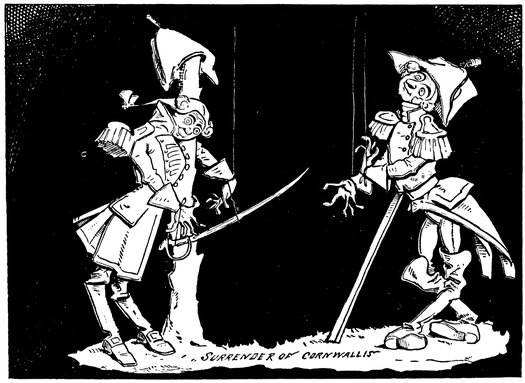
The final scene in the history of the war
for American liberty is graphically set
forth on page 132. It is copied from
a group of wax-works illustrative of that
event, and is, therefore, warranted reliable.
The war was now virtually over, but it
was not until two years later that England
132signed a quit-claim deed resigning all right
and title to its American property.
Surrender of Cornwallis
133The Continental army was disbanded,
and returning to their homes the soldiers
hammered their muskets and things into
plowshares and sold them to the farmers.
The battle fields were cut up into corner
lots, and a season of great prosperity began.
Washington was elected President of the
young Republic, and gave great satisfaction
in that capacity. His second term having
expired, he wrote an address of great
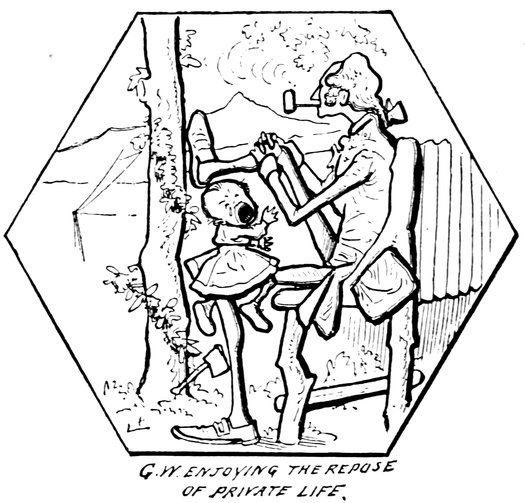
literary merit and retired to private life at
Mount Vernon. He ingeniously forged a
little hatchet out of his sword for his little
step-son, and taught him how to chop down
cherry trees with neatness and dispatch and
own up to it afterwards.
134
G. W. enjoying the repose of private life.
CHAPTER XXIV.
135
AN INCIDENT OF THE REVOLUTION.
It is always very noble and all that sort
of thing when a nation or individuals sacrifice
anything for a principle. Sometimes
such sacrifice meets with immediate reward
and sometimes the reward is delayed and
the parties making the sacrifice have to
wait indefinitely for their pay. A little
incident which befel an ancestor of ours
illustrates both these propositions to some
extent, and having a few moments to spare
we are tempted to relate it briefly, as
follows.
136
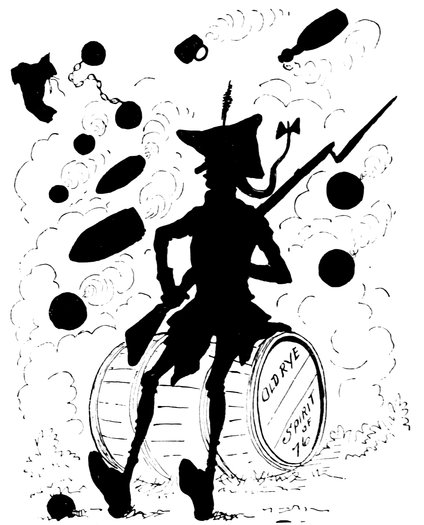
On one memorable occasion, in-pursuance of Washington’s famous order to place none but Americans on guard, an ancestor of ours was detailed to guard certain military stores. The missiles of destruction, it will be noticed, were flying about in a style that seemed more promiscuous than soothing to a nervous temperament.
137
Accidents will happen in the best regulated families, and it certainly was no fault of our ancestor that a shell, fired by unprincipled Britons, struck the military stores aforesaid, destroying them, but, beyond giving a severe shock to his nervous system, the projectile did our ancestor no harm as it did not explode.
138
As a reward for his valiant conduct, Washington begged our ancestor to accept the unexploded shell, which the latter resolved to preserve as a souvenir of the adventure and hand down to posterity.
139
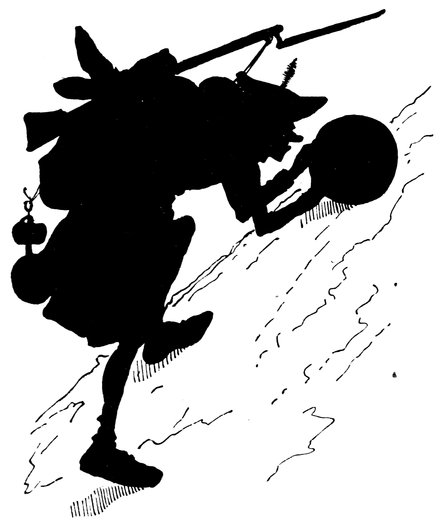
He carried it with him on many a weary march.
140
’Tis true he found it a serious inconvenience ofttimes.
141
But he remembered posterity and pressed on
142
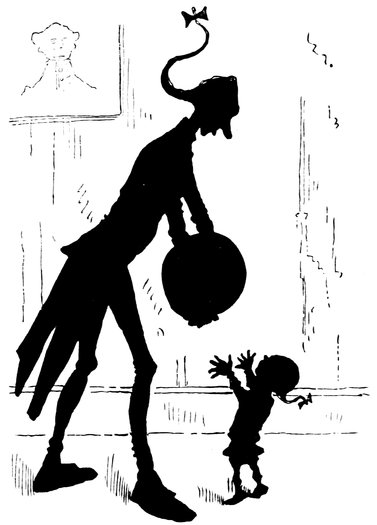
Here we see him handing the relic down to posterity.
143
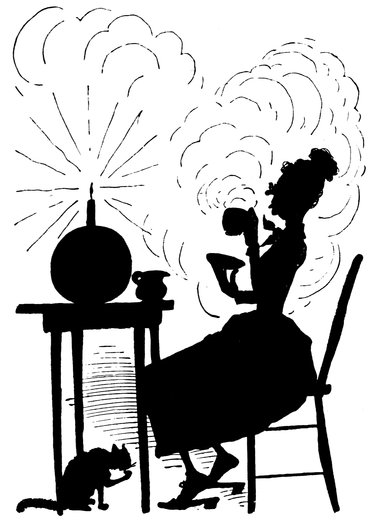
In after years posterity handed it over to an obnoxious female relative, who irreverently used it as a candlestick.
144
On one occasion obnoxious female relative imprudently went to sleep, allowing the candle to burn low in its socket.
145
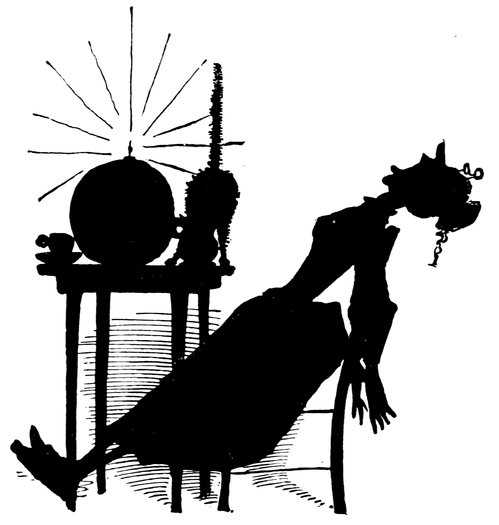
Need we say that posterity’s obnoxious female relative got what she had often given him,—a severe blowing up?
CHAPTER XXV.
146
THIS HISTORY DABBLES IN POLITICS MUCH AGAINST ITS WISHES—PRELIMINARY OBSERVATIONS—A CHAPTER OF ACCIDENTS AND PRESIDENTS—“LIVES OF GREAT MEN ALL REMIND US.”
We have always from childhood’s hour
instinctively recoiled from politics, and have
thus far managed to keep out of Congress.
If with equal success we can manage to
keep out of jail for the rest of our natural
existence we shall feel that life has not
altogether been a failure. (This is what
is called genuine broad American humor.
If the reader can find nothing in it to
excite his risibilities after a reasonable
trial his money will be refunded.)
147When it first reached the ears of the
present Administration through the Librarian
of Congress, to whom we applied for
a copyright, that we were about to publish
a history of our native land, we
received per return mail a letter signed
by the Administration, asking us if we
would accept the appointment of U. S.
Minister to the South Sea Islands. This
office had just been made vacant by the
circumstance of the last incumbent having
participated in a public banquet given in
honor of his arrival at his consulate, and
being himself the principal ingredient of
a certain savory ragout, his presence there,
it would seem, proved fatal, and it was his
place which we were invited to supply.
We returned a somewhat evasive answer.
We never voted but once in our life, and
148that was at a presidential election soon after
reaching our majority. We voted for ——,
but no matter. To offend party prejudice
at this time might be fatal to our hopes.
The day after the election we received a
bill of two dollars for “poll-tax,” which
the collector said we owed and we had better
pay or have our body lodged in the
county jail until we should call for it, and
settle up what was due on it to the State.
The unprincipled man had obtained our
address from the registry books, and this
our first ebullition of patriotism cost us two
dollars.
However much inclined we may be by
nature and experience to avoid the subject
of politics as a rule, it now becomes our duty
to make mention of certain exponents of
American politics, but whether to their advantage
149or disadvantage will depend entirely
upon the record they have left behind
them.
We take it for granted, (you may have
noticed that a great deal is taken for granted
in this book,) that the reader is already
acquainted with the duties of the President
of the United States. If not, let him lose
no time in reading up on the subject, for
we are all liable at any moment to be
nominated to the office, and it would be
dreadfully mortifying not to know how
to go to work.
We have seen in the preceding chapters
how liberty was planted on American soil,
but the crop must be watched and taken
care of, and for this duty the office of
President was created. Eighteen different
persons have successively undertaken the
150contract of guarding the crop sown by our
forefathers, and in one or two incidents, we
regret to say, these have turned out to be
mere scarecrows, and sorry ones at that.
This scathing remark is not intended to
apply to
George Washington,
who, as we have already shown, was the
first President of the United States, and
who did as well as could be expected for a
first attempt. In fact, George did well
whatever he undertook to do, and we have no
complaint to make in these pages against him.
On page 151 will be found some illustrated
particulars concerning this great man’s
life, which our readers, young and old, will
do well to imitate. The series of silhouettes
at the top of the page treat of the
Story of the Little Hatchet.
151
152No. 1. Here we see the Grandfather of
his Country climbing a cherry tree after
cherries.
No. 2. His little son (afterwards Father
of his Country) is here seen chopping at
said tree with his little hatchet.
No. 3. How should he know that the old
man was up said tree, and if so, what business
had he up there anyhow?
No. 4. “I’ll let you know,” is what the
old gentleman remarked. “I did it with
my little hatchet,” roared George as well
as he could from his embarrassing position,
“but I’ll never do so no more!”
Advice gratis. When you chop down
cherry trees wait until the old man goes
out of town.
No. 5. Gives us a fine view of the site of
153Washington’s birthplace, and shows what
an enterprising man Dr. Binks is.
No. 6. The crop of persons who have
missed and otherwise remember Washington
is pretty good this year.
No. 7. Here we have a party who does not
remember Washington to any great extent.
Thinks he has heard the name somewhere.
“O piteous spectacle!”
Washington’s immediate successor was
John Adams,
who was inaugurated March 4, 1797. He
displayed superior capacity for the position
by removing the national capital from
Philadelphia to Washington, where it has
remained ever since. It was a good riddance
for Philadelphia, but rather severe
on Washington.
154
MR. ADAMS REMOVING THE CAPITOL TO WASHINGTON
155Mr. Adams only served one term. He
was naturally a little piqued at not being
nominated the second time, and retiring to
Quincy, Mass., he started an opposition
post office, where he passed his declining
years.
Thomas Jefferson
was the third President of the United
States. He was a gentleman of fine literary
attainments, his most popular works
being the Declaration of Independence and
a humorous poem called “Beautiful Snow.”
He wrote the latter during the winter of
1798, (which was the most severe of any
within the memory of the oldest inhabitant,)
working on it of nights. He served
two terms, and in the Spring of 1809 went
to work on a farm, where he spent the sunset
of his days cultivating potatoes. He
said it was easier than being President, and
a great deal more respectable.
156
Thomas Jefferson destroying potato bugs.
157James Madison
next took charge of the helm of State, and
very unsettled weather he found it for a
new beginner.
During his Administration the country
became involved in another war with
Great Britain, growing out of certain liberties
taken by the latter with American vessels
upon the high seas.
Whenever an English man-of-war ran
short of hands its commander simply helped
himself from the crew of any American
merchantman he happened to encounter.
James Madison stood it as long as he could,
and then declared war. This was called
158the “War of Twelve,” (afterwards increased
to several thousand,) and lasted two years.
Commodore Perry met the enemy on the
Erie canal on the 10th of September, 1814,
and after a spirited naval battle they were
his property.
☞ See illustration.
James Monroe
woke up one fine morning in 1817 and found
himself President of the United States.
He set his wits to work and invented the
“Monroe Doctrine,” a neat and ingenious
contrivance for preventing any foreign
Power from starting branch houses in
America. He got it patented.
159
Perry’s victory on the erie canal.
160
NOTICE! Trespassing on These premises is STRICTLY Forbidden.
The monroe doctrine
Mr. Monroe declined a third term on account
of the cry of “Cæsarism” having
been raised by a rural journal. On retiring
161from public life Mr. Monroe entered upon
literary pursuits, and wrote some very able
dime novels. His master-piece, called “The
Poisoned Peanut, or the Ghostly Goblin of
the Gory Glen,” has been translated into
every language.
John Quincy Adams,
of Massachusetts, next tried on the presidential
shoes (1825). Business being dull, Mr.
Adams whitewashed the Presidential Mansion,
(a barrel of lime having been appropriated
by Congress,) since which time it
has been known as the White House.
Mr. Adams conducted himself in a gentlemanly
manner, kept good hours, and paid
his board regularly.
Andrew Jackson
was next called to the chair. Mr. Jackson
162lived chiefly upon hickory nuts, and it was
in recognition of this well-known fact that
he was affectionately nicknamed “Old
Hickory” by his admirers.
PRESIDENT ADAMS MAKES HIMSELF USEFUL
163He sometimes made use of very forcible
language, and on more than one occasion
was distinctly heard to swear, “by the
eternal Jingo, the Constitution must and
shall be preserved!”
Mr. Jackson had been elected on the
Democratic ticket.
In our illustration Mr. Jackson is seen
climbing a shell-bark hickory tree in quest
of his favorite luxury. The portrait is
striking. The shirt collar especially will
be recognized by all who held office under
this remarkable man.
164
Old mr: hickory.
165Martin Van Buren
was inaugurated March 4, 1837. A financial
crash, called the panic of ’37, immediately
followed, so it is to be feared that
Martin was a bad financier. If we had
been elected in his stead we would have
adopted an entirely different financial policy.
The disastrous results of Van Buren’s
Administration are painfully apparent in
the illustration on page 166.
Harrison—Tyler.
William Henry Harrison moved into the
White House March 4, 1841. He died just
one month after, and Vice-President John
Tyler stepped into his shoes. He put his
foot in it, however, and astonished the
party who had elected him (the Whigs) by
his vetoing talents. He rather overdid
it in the case of a bill passed by Congress
166to establish United States banks, and every
member of his Cabinet resigned excepting
Dan. Webster, who was then too busily engaged
on his dictionary to think of making
out a resignation.
HARD TIMES IN ’37
167President Tyler was a handsome man
but a bad manager.
James K. Polk
was elected on the Democratic ticket, by a
large majority, in 1844, and managed to get
into a row with Mexico by admitting Texas
into the Union soon after his accession
to the chair. Mexico set up a frivolous
claim to the territory, which, owing to the
prompt measures adopted by Mr. Polk, she
was unable to establish.
168
WEBSTER’S UNABRIDGED DICTIONARY
WHY DAN WEBSTER DID NOT RESIGN.
The war which followed between the
United States and Mexico was short but
169sanguinary, as the reader will admit on reference
to our illustration, which, aside from
its historical value, gives those of us who
have never served our country an excellent
opportunity of seeing how a battle is conducted
without incurring any unnecessary
risk. Whoever can look upon this fearful
scene of carnage without having the cold
chills run down his back must be stony
hearted indeed. We would not like to
board in the same block with such a person.
Even as we write we fancy we can smell
the sulphuric vapors of burning powder,
but that after all may be only the
German restaurant below getting dinner
ready.
With the exception of certain little eccentricities
of character, (hardly worth
mentioning,) Mr. Polk proved a very
170desirable tenant of the White House, and
on retiring left it in good repair.
BIRDS-EYE VIEW OF THE MEXICAN WAR.
171Taylor—Fillmore.
Zachary Taylor took the White House
off Mr. Polk’s hands, but only survived six
months.
Vice-President Millard Fillmore succeeded
him, and having by accident discovered
that there was a good deal of gold secreted
about California, recognized the importance
of admitting her into the Union lest some
foreign Power should take it into its head
to carry off the rich territory some dark
night. There was special danger to be apprehended
from China, which had already
begun to make excavations from below.
President Fillmore lost no time in taking
California in, and many ambitious young
gentlemen of culture went there and grew
172up with the country. In the work of art
on page 172, we behold one of the latter
journeying toward the setting sun, accompanied
by as many of the luxuries of civilization
as his limited means of transportation
will admit of.
A Young Gentleman OF Culture ON His WAY TO CALIFORNIA.
173There seem to be one or two incongruities
in this otherwise master-piece which
we are at a loss how to reconcile with
known laws of science. We allude more
particularly to the phenomenon of the sun
and moon shining simultaneously. But
for the artist’s usual respectful way of treating
serious subjects we should be inclined
to suspect that he was trifling with our
feelings. The worst of it is, the paradox
escaped our notice until after the plates had
been cast. We hope our artist will be able
to explain it away on his return from Rome.
174James Buchanan
next undertook to fill the vacancy. Nature
abhors a vacuum, and generally fills it with
wind if it can do no better. Republics
sometimes imitate her example, and the
election of Mr. Buchanan was a case in
point. He was chronically afflicted with
“squatter sovereignty,” and spent most of
his time in trying to comprehend American
politics.
During Buchanan’s Administration John
Brown and Sons undertook the contract
of exterminating slavery, and as an initial
step seized and burned the United States
Arsenal at Harper’s Ferry. But the firm
failed before the job was half completed.
Mr. Brown’s body now lies mouldering
in the grave, but it is due to him to state
that his soul goes marching on.
175
176On a previous page will be found John
Brown’s soul in the act of marching. Our
artist was unable to obtain a very exact
sketch as it was getting quite dark.
Lincoln—Johnson.
Abraham Lincoln was next voted into
the chair, which reminds us of a little anecdote.
Some years ago an Erie canal boat was
weighing anchor in the harbor of New York
preparatory to setting sail for Buffalo,
when the Captain was hailed by a weary
wayfarer, who said he wanted to go to
Buffalo, and having no money was willing
to work his passage. The heart of the
old salt was touched; a tear stole down
his weather-beaten cheek, and he allowed
the poor man to lead one of the mules on
the tow-path all the way to Buffalo.
177
A “HUNDRED DAYS” MAN PUTTING DOWN THE REBELLION.
178Abraham Lincoln was willing to work
his passage. He earned every cent of his
salary, and rendered services to humanity
which humanity will not soon forget. Soon
after his inauguration, in 1861, the Southern
rebellion broke out, which was eventually
put down by the “hundred days’ men.” On
page 179 will be found some cheerful particulars
of the war between the North and
South, the more somber details of which
we leave to other and abler pens and pencils.
179
Fort Sumter Fired upon
BATTLE OF Bull Run
EMANCIPATION
A 3 MONTHS MAN WISHING THIS CRUEL WAR WERE OVER
Capture of Jeff Davis.
180Vice-President Andrew Johnson succeeded
Mr. Lincoln, with somewhat doubtful
success. As Mr. Johnson was a tailor by
education he seemed to be the man of all
others cut out for the place; but his subsequent
conduct gave rise to conflicting opinions
on this subject. He became the unfortunate
proprietor of a “policy”[4] which
gave Congress a good deal of trouble.
Near the expiration of his official career he
got a leave of absence, and “swung around
the circle,” (as he himself expressed it,)
making speeches in which he compared
himself to Andrew Jackson and seriously
compromised himself by shamelessly admitting
that he had held every office in the
gift of the people, from Alderman of his
native village to President of the United
States.
4. Note.—We have tried in vain to procure a ground plan
of this “policy,” hence we are unable to furnish any illustration
to this branch of our subject.
During Mr. Johnson’s Administration he
had more woes on account of Congress
“Than wars or women have.”
Mr. Johnson would gladly have dispensed
181with Congress. Indeed, on one occasion
he made an attempt to impeach that body,
but failed by one vote.
Andy was very glad indeed at the expiration
of his term to get back to his goose.
As far as Congress was concerned the pleasure
was mutual.
Ulysses S. Grant
was put under bonds to keep the peace
March 4, 1869, and has been that way ever
since. It is but justice to Mr. Grant to state
that we have had good crops during his
Administration, which is now drawing to a
close. The New York Herald has offered
him a third term, but we have information
derived from private sources that he intends
fulfilling a life-long project of taking a
partnership on the Sun, which Mr. Dana
has kept open for him.
182
The Present Incumbent
183At the present writing it has not been
decided who will succeed Grant in the Executive
chair. We cannot permit our name
to be used in connection with the approaching
canvass for reasons already explicitly
stated; besides this is the Centennial year,
and we expect to have our hands full.
We have now placed the reader in possession
of all the facts worth knowing in
connection with the history of America
from its very earliest discovery up to ten
o’clock last night; but before finally releasing
his button-hole we beg to “show him
round” a little among our peculiar institutions,
and call his attention to a few evidences
of national greatness which may
never have struck him before.
Let us, then, turn over a new leaf and
open a new chapter.
CHAPTER XXVI. PROGRESS. — ELECTRICITY — THE COTTON-GIN — THE FIRST RAILWAY TRAIN. — THE FIRST STEAMBOAT — THE TEN-CYLINDER PRINTING PRESS. — THE ATLANTIC CABLE. — MORMONISM — AN APPARATUS — ART MATTERS.
184
OUR PATENT OFFICE REPORT—IS NECESSITY THE MOTHER OF INVENTION?—A CASE IN CONTRADICTION—ELECTRICAL KITE—THE COTTON GIN—THE FIRST RAILWAY TRAIN—THE FIRST STEAMBOAT—THE PRINTING PRESS—THE ATLANTIC CABLE—MORMONISM—AN APPARATUS—ART MATTERS.
Popular superstition has it that necessity
is the mother of invention. We are sorry to
deprive the world of an old saying, but we
happen to know a person to whom the
world is indebted for more useful inventions
than any other person of our acquaintance,
and her name is Accident. For instance,
185
FRANKLIN AND HIS KITE
186
was accidentally discovered by that famous
American statesman and philosopher, Benjamin
Franklin, while indulging in his
favorite pastime of flying a kite. He ascertained
that it was unsafe to fly a kite in
a thunder storm unless you have a lightning
rod attached to your spinal column. This
important discovery conferred upon society
the priceless boon of the lightning-rod man.
is an American invention, but whether it
compares favorably with “Old Tom” or
“London Dock” we are unable to say. We
do not believe in stimulants as a rule, yet
it cannot be denied that the introduction of
187the new-fangled gin greatly stimulated the
cultivation of cotton in America.
Cotton Gin.
188
America took the lead in railroad construction,
though the locomotive is claimed
as an English contrivance.
The first railway train was a somewhat
crude affair, but it succeeded in making a
sensation. The locomotive was built by
Peter Cooper, and he it was who ran the
machine on its experimental trip.
The passengers were a surgeon, a chaplain,
an editor, (names forgotten,) John Smith,
and another fellow, (all dead-heads.) Mr.
Cooper poked the fire, the other fellow
pushed behind, while John Smith urbanely
acted as cow-catcher. The clergyman rode
in the smoking-car and meditated on the
189probabilities of ever seeing his family again
this side of Jordan. The editor went to
sleep, while the doctor sat behind ready to
jump out and save himself in case of accident.
THE FIRST RAILWAY TRAIN
190After a delightful excursion of fifty miles
or so into the country the party returned
home—afoot.
was discovered by Robert Fulton September
4th, 1807. Our special artist was promptly
on the spot, and we are thus enabled to lay
before our readers all that is worth knowing
of this event in the picture opposite.
Newspapers have become a household
necessity in every well-regulated American
191family. They mould public opinion, and
are handy to light fires with. The universal
use of newspapers gave rise to the ten-cylinder
printing press, an American invention.
THE FIRST STEAM BOAT—FASTEST TIME ON RECORD.
192The publication of a daily newspaper is
one of the most lucrative professions of
the day, and we strongly advise our American
youth to abandon all idea of ever
becoming President, and save up all their
pennies to start newspapers with when
they grow up. An ably-conducted daily
newspaper brings from two and a half to
three cents per pound at the junk dealers,
when times are good. On page 193 are
some illustrated features of a well-conducted
newspaper office. The central picture
is full of tender pathos. The editor
and proprietor (evidently a man of slender
193means) is seen working off his edition, assisted
by his near relatives. Each individual,
from the proud wife and doting mother
to the infant at her breast, seems to attach
weight to the enterprise with a degree of enthusiasm
that ought to encourage any man.
THE PRESS ROOM.
BUSINESS DEPARTMENT.
FIGHTING EDITOR.
194
The Electro-Magnetic Submarine Trans-Atlantic
Anglo-American Telegraph Cable
is, perhaps, the most wonderful of all Yankee
notions. By its agency our great
morning dailies are able to get the most
unreliable foreign news at the low rate of
ten dollars per word. The only wonder is
how people on both sides of the water ever
got on so long without the cable.
On page 195 is a picture representing the
submarine cable, for which we cannot help
195suspecting the artist has drawn largely on
his imagination.
THE ATLANTIC CABLE.
196
is of doubtful origin. Some authorities
give the credit of its invention to Joseph
Smith, while others do not hesitate to
ascribe its origin to a gentleman whom the
mind naturally associates with sulphuric
gases. However that may be, Mormonism
is one of the institutions of the country,
and Brigham Young is its prophet, his
present address being Salt Lake City,
Utah.
Mr. Young makes a specialty of matrimony,
and has taken strict precautions to
guard against widowhood, as will be seen
by reference to our illustration, in which
are seen Mr. and Mrs. Young on their
bridal tour.
197
MR. AND MRS. BRIGHAM YOUNG.
198Brigham makes it a point of etiquette
to marry every unmarried lady to whom
he happens to be introduced, and his life is
a perennial honeymoon. To the merely
Gentile man, whose matrimonial experience
has been conducted on monogamic principles,
the hardihood of Mr. Young is simply
appalling.
to keep hens from setting is an effervescence
of the fertile brain of, well, no matter
who. It speaks for itself.
For further information on the interesting
subject of Yankee ingenuity we commend
the reader’s careful perusal of the
United States Patent Office Report, a
work unequaled for the brilliancy of its
conception and startling dramatic situations,
and which, for its conscientious
adhesion to facts, only has a rival in the
present work.
199
AN INGENIOUS INVENTION.
200
The visitor to the Capitol, at Washington,
will be struck with the paucity of
American art, as evinced by the specimens
of painting and sculpture to be seen in the
Rotunda and immediate vicinity of that
structure. Barrels of paint and whole
quarries of marble have been sacrificed by
an inscrutable Congress, whose sole object
seems to have been to frighten its constituency
away from the scene of its dark
plottings with grotesque Washingtons,
fantastic Lincolns, thinly-clad Indian ladies,
and unprincipled looking Puritans. Some
meritorious works of art, however, have
201lately found their way to the Capitol by
accident, but let us have more of them.
We humbly submit a few designs for
equestrian statuary, which only await a
misappropriation by Congress, as follows:
202
Plate I.—Statue for a great American military hero who always kept his face to the foe.
203
Plate II.—Is for another great military hero (a member of militia) who would have kept his face to the foe if circumstances had been favorable.
204
Plate III.—Equestrian statue of a public gentleman who kept his face wherever it suited his convenience.
205
Plate IV.—A statue (also equestrian) for a great politician of foreign origin who rose from humble beginnings to great achievements.
CHAPTER XXVII.
206
SOME ABORIGINAL IDEAS—WISE MEN AT WORK—MOUND BUILDING FROM FORCE OF HABIT—SUBTERRANEAN MISCELLANY—THE LOST TRIBE THEORY WON’T DO—AUTOGRAPH SPECIMEN OF PICTURE WRITING—LIGHT AT LAST—PICTURESQUE HABITS OF THE INDIANS.
The origin of the North American
Indian has always been shrouded in the
deepest mystery, and wise-heads of every
age and clime have sought to tear aside
the veil and show us our aboriginal brother
in his true colors.
Some of these learned gentlemen have
carried their zeal to the extent of renting
wigwams in the Indian country, and living
207among these primitive children of the forest,
hoping, by dint of listening at key-holes,
to overhear some remark dropped by them
that would reveal where they emigrated
from, but nothing came of it but premature
baldness to the wise-head so investigating.
Others again have comfortably settled
down into the belief that these singular
members of society are a revised edition of
the strayed or stolen tribes of Israel that
have so long been advertised for in vain.
In support of this theory the latter
class of philosophers has dived into side
hills, (supposed to have been thrown up by
an eccentric race of Indians known as
mound builders,) turning up every conceivable
article of second-hand Indian miscellany,
and asking the world to believe that
these mysterious “mounds” were simply
208subterraneous pawnbroker’s shops, built and
conducted in obedience to a well-known
national instinct, and that the articles they
contain are nothing more nor less than unredeemed
pledges “left” by impecunious prehistoric
ladies and gentlemen who were
compelled to resort to that means of raising
the wind.
On page 209 our artist shows us the exponents
of the latter theory at work, and
also gives us a singularly correct drawing
of some of the bric-a-brac which they have
unearthed. We will take the liberty of
explaining further, and tell all we know
concerning the supposed uses of these
mysterious articles.
A is supposed to be a surgical instrument.
B, an instrument of torture. C,
toilet article. D, lady’s ear ornament. E,
209ancient drinking vessel. F, tombstone, with
inscription. G, pottery. H, musical instrument.
I, skull of native (deceased).
MEN OF SCIENCE “WORKING” A MOUND.
210In the lower series we have: No. 1,
artist’s utensil. 2, uses unknown to the
author. 3, patent hen’s nest (badly out of
repair). 4, vinaigrette. 5, projectile. 6,
bracelet. 7, war club. 8, burglar’s tool
(very ancient). 9, cooking utensil.
After going carefully over this array of
evidence one naturally hesitates before looking
further for a theory. But, taking for
granted that the Indians really are a remnant
of those mislaid Israelites, the difficulty
next arises as to how the dickens
they got here, for when the Israelites were
first missed there was as yet no railway
communication between this country and
Asia, and unless they tunneled their way
211up through, via China, it is difficult to
account for their presence here.
In common with other great minds, we,
too, have devoted much of our spare time
to the effort of setting our red brother on
his legs before the world, and of tracing
his footprints back through the ages, but
until quite recently we have been uniformly
baffled. The fact is, our red
brother ought really to have kept a diary.
He would thus have saved us wise-acres
much trouble and unnecessary expense.
The next time we hope he will not overlook
this important detail.
As we said, all our efforts to trace the
Indians back to their origin had failed
until recently. We rejected the “remnant”
theory after a fair trial. We compared
this remnant with the original piece
212(so claimed), and found it a bad match.
In the face of strong evidence we renewed
our efforts, which were destined
to meet with reward, as will be seen presently.
A month or two since it luckily occurred
to us to address a letter to a skillful sachem,
(who happens to be an acquaintance of
ours, and is at present located out West,)
upon this interesting subject.
This gentleman, who is of the Choctaw
persuasion, and was christened Gimmechawtybackee,
(Billious Jake,) sent us a
most courteous and comprehensive reply,
which came to hand a few days since, and
which covers the whole ground in the most
lucid manner. We wonder we never
thought of it before.
213
The Sachem’s Letter.
214
215We here insert Billious Jake’s letter
verbatim. It is a master-piece of composition,
and sets the matter forever at rest.
(Daily papers please copy.)
Before changing the subject, we should
really like to pictorially look into the
habits of these strange victims of circumstances.
Examine page 214, if you please.
In No. 1 we see a stony-hearted savage
taking a very mean advantage of a white
captive, and torturing him to death in the
most horrible and deliberate manner. No.
2, an early settler pursued by a native.
No. 3, Indian barber. And lastly, in No.
4, we have an Indian gentleman journeying
towards the setting sun on dead-head principles.
“His faithful dog shall bear him company.”—Campbell.
CHAPTER XXVIII.
216
AMERICAN SCENERY.
Few countries can boast such a variety
of natural features as our own America.
To the intelligent tourist of unlimited
bank account this country affords abundant
material for the study of nature with
all the modern improvements, including
gas, hot and cold water, and an elevator
running every five minutes up to the fifteenth
floor. Terms invariably in advance.
Our illustration on the opposite page
conveys but a feeble idea of the magnitude
of some of the wonderful freaks of nature
217which the tourist “doing” American is
liable at any moment to stumble upon.
1. MAMMOTH CAVE KY.
2. NATURAL BRIDGE VA.
3. STREET SCENE.
4. PRAIRIE SCENE.
5. THE MAJESTY AND BEAUTY OF NIAGARA.
AMERICAN SCENERY
218In No. 1 we have the Mammoth Cave.
It takes its name from the gentleman
upon whose property it is located, and
who uses it as a sub-cellar in Winter,
and locks himself up in it during the
tax-gathering season. Our illustration
treats of the latter period. The Natural
Bridge (No. 2) is a marvel of architecture,
and is lavishly decorated with appropriate
inscriptions. No. 3 hardly comes under
the head of Natural Scenery, and would
appear to be rather a sudden change from
the sweet realms of nature to the busy
haunts of men; but contrast is everything,
and we turn from this turbulent scene to
one of delicious repose. No. 4, a Western
prairie. Here the eye wanders off over a
219rich and varied landscape of level country,
till finally in the distance it encounters
what? a vast spider? No. That is only
the setting sun, as we ascertained in a private
conversation with the artist. No. 5. We
hardly know how to treat this matter. In
writing about Niagara it is customary to
either rush madly into poetry or break
hysterically into exclamation points. We
had heard a great deal about the awful
majesty of Niagara Falls, and went there
to obtain, if possible, a personal interview,
intending to write it up in a style that
would bankrupt our printer. We say we
went there expecting much, but we found
that the half had not been told us. If it
had, we should have remained at home.
Perhaps the least said about it the better.
CHAPTER XXIX.
220
SOME WORD PAINTING ON THE SUBJECT OF THE AMERICAN EAGLE—THE AFFAIRS OF THIS STRANGE EVENTFUL HISTORY WOUND UP.
A work of this nature would be incomplete
without some slight allusion to the
American Eagle. With reference to that
ornithological specimen, we may remark
that the first century of his career has been
an eventful one. His wings have from
time to time been cropped by foreign foes
in a style that has made it unnecessary as
well as impossible to scorch them against
the sun. His tail feathers have been extracted
by internecine strife in a manner
221that has made it extremely difficult for him
to steer his majestic course amid the blue
ether of Freedom, and his flight at times
has been awkward and eccentric in the
extreme. In short, the plumage has been
plucked from various parts of his body by
divers evil-disposed persons to such an extent
as to make aerial navigation in a rarefied
atmosphere an uncomfortable, not to
say highly injurious pursuit.
PORTRAIT OF THE AMERICAN EAGLE.
222Notwithstanding all this we feel authorized
to inform the public that our national
fowl is as tough as a boarding-house spring
chicken; that he will continue to roost at
his present address until further notice,
spreading his wings from the Atlantic to
the Pacific, beneath the shadow of which
all persons of good character are invited to
come (references exchanged). Here every
223one, from the peon to the prince, if not satisfied
with his present situation, can find a
refuge, and by strict attention to business
become an Alderman of somebody else’s
native village and have canal boats named
after him, or, (by very strict attention to
business) even rise to be President[5] of
the United States!
5. Note—Since the above piece of rhetoric went to press we
have ascertained (quite accidentally) that persons are not
eligible to this office who have the misfortune to be born
abroad. Therefore we hastily append this postscript lest
any unsuspecting peon or prince who might chance to read
these pages be inveigled over here under a misapprehension.
If he comes now it must be on his own responsibility.
THE END.
2241876. 1876.
NEW BOOKS
AND NEW EDITIONS,
RECENTLY ISSUED BY
G. W. Carleton & Co., Publishers,
Madison Square, New York.
The Publishers, upon receipt of the price in advance, will send any book on this Catalogue by mail, postage free, to any part of the United States.
All books in this list [unless otherwise specified] are handsomely bound in cloth board binding, with gilt backs, suitable for libraries.
Mrs. Mary J. Holmes’ Works.
Tempest and Sunshine
$1 50
English Orphans
1 50
Homestead on the Hillside
1 50
’Lena Rivers
1 50
Meadow Brook
1 50
Dora Deane
1 50
Cousin Maude
1 50
Marian Grey
1 50
Edith Lyle (New)
1 50
Darkness and Daylight
1 50
Hugh Worthington
1 50
Cameron Pride
1 50
Rose Mather
1 50
Ethelyn’s Mistake
1 50
Millbank
1 50
Edna Browning
1 50
West Lawn (New)
1 50
Marion Harland’s Works.
Alone
$1 50
Hidden Path
1 50
Moss Side
1 50
Nemesis
1 50
Miriam
1 50
At Last
1 50
Helen Gardner
1 50
True as Steel (New)
1 50
Sunnybank
1 50
Husbands and Homes
1 50
Ruby’s Husband
1 50
Phemie’s Temptation
1 50
The Empty Heart
1 50
Jessamine
1 50
From My Youth Up
1 50
My Little Love (New)
1 50
Charles Dickens—15 Vols.—“Carleton’s Edition.”
Pickwick, and Catalogue
$1 50
Dombey and Son
1 50
Bleak House
1 50
Martin Chuzzlewit
1 50
Barnaby Rudge—Edwin Drood
1 50
Child’s England—Miscellaneous
1 50
David Copperfield
1 50
Nicholas Nickleby
1 50
Little Dorrit
1 50
Our Mutual Friend
1 50
Curiosity Shop—Miscellaneous
1 50
Sketches by Boz—Hard Times
1 50
Oliver Twist—and—The Uncommercial Traveler
1 50
Great Expectations—and—Pictures of Italy and America
1 50
Christmas Books—and—A Tale of Two Cities
1 50
Sets of Dickens’ Complete Works, in 15 vols.—[elegant half calf bindings].
60 00
Augusta J. Evans’ Novels.
Beulah
$1 75
Macaria
1 75
Inez
1 75
St. Elmo
2 00
Vashti
2 00
Infelice (New)
2 00
Miriam Coles Harris.
Rutledge.
$1 50
Frank Warrington.
1 50
Louie’s Last Term, etc.
1 50
Richard Vandermarck.
1 50
The Sutherlands.
1 50
St. Philip’s.
1 50
Round Hearts, for Children.
1 50
A Perfect Adonis. (New)
1 50
May Agnes Fleming’s Novels.
Guy Earlscourt’s Wife.
$1 75
A Terrible Secret.
1 75
Norine’s Revenge.
1 75
A New Book.
1 75
A Wonderful Woman.
1 75
A Mad Marriage.
1 75
One Night’s Mystery. (New)
1 75
Grace Mortimer.
The Two Barbaras.—A novel.
$1 50
Bosom Foes. (In press)
1 50
Julie P. Smith’s Novels.
Widow Goldsmith’s Daughter.
$1 75
Chris and Otho.
1 75
Ten Old Maids.
1 75
His Young Wife. (New)
1 75
The Widower.
1 75
The Married Belle.
1 75
Courting and Farming.
1 75
Captain Mayne Reid—Illustrated.
The Scalp Hunters.
$1 50
The Rifle Rangers.
1 50
The War Trail.
1 50
The Wood Rangers.
1 50
The Wild Huntress.
1 50
The White Chief.
1 50
The Tiger Hunter.
1 50
The Hunter’s Feast.
1 50
Wild Life.
1 50
Osceola, the Seminole.
1 50
A. S. Roe’s Select Stories.
True to the Last.
$1 50
The Star and the Cloud.
1 50
How Could He Help It?
1 50
A Long Look Ahead.
1 50
I’ve Been Thinking.
1 50
To Love and to be Loved.
1 50
Charles Dickens.
Child’s History of England.—Carleton’s New “School Edition.” Illustrated
$1 25
Hand-Books of Society.
Habits of Good Society.—The nice points of taste and good manners.
$1 50
Art of Conversation.—For those who wish to be agreeable talkers or listeners
1 50
Arts of Writing, Reading, and Speaking.—For self-improvement
1 50
New Diamond Edition.—Small size, elegantly bound, 3 volumes in a box
3 00
Mrs. Hill’s Cook Book.
Mrs. A. P. Hill’s New Cookery Book, and family domestic receipts.
$2 00
Famous Books—“Carleton’s Edition.”
Robinson Crusoe.—New 12mo edition, with illustrations by Ernest Griset
$1 50
Swiss Family Robinson.—New 12mo edition, with illustrations by Marckl
1 50
The Arabian Nights.—New 12mo edition, with illustrations by Demoraine
1 50
Don Quixote.—New 12mo edition, with illustrations by Gustave Doré
1 50
Victor Hugo.
Les Miserables.—An English translation from the original French. Octavo
$2 50
Les Miserables.—In the Spanish Language. Two volumes, cloth bound
5 00
Popular Italian Novels.
Doctor Antonio.—A love story of Italy. By Ruffini
$1 75
Beatrice Cenci.—By Guerrazzi. With a steel engraving from Guido’s Picture
1 75
M. Michelet’s Remarkable Works.
Love (L’amour).—English translation from the original French
$1 50
Woman (La Femme).—Do. Do. Do.
1 50
Joaquin Miller.
The One Fair Woman.—A new novel, the scene laid chiefly in Italy
$2 00
Joseph Rodman Drake.
The Culprit Fay.—The well-known fairy poem, with 100 illustrations
$2 00
Artemus Ward’s Comic Works.
A New Stereotype Edition.—Embracing the whole of his writings, with a Biography of the author, and profusely illustrated by various artists
$2 00
Josh Billings.
A New Stereotype Edition of the complete writings of Josh Billings. Four vols. in one, with Biography, steel portrait, and 100 comic illustrations
$2 00
Bessie Turner.
A Woman in the Case.—A new novel, with photographic portrait of author
$1 50
Wm. P. Talboys.
West India Pickles.—Journal of a Winter Yacht Cruise, with illustrations
$1 50
Dr. A. K. Gardner.
Our Children.—A Hand-book for the Instruction of Parents and Guardians
$2 00
C. H. Webb (John Paul).
Parodies and Poems.
$1 50
My Vacation.—Sea and Shore
1 50
Livingston Hopkins.
Comic Centennial History of the United States.—Profusely illustrated
$1 50
Allan Pinkerton.
The Model Town, etc.
$1 50
A New Book. (In Press) 1.
50
Mrs. M. V. Victor.
Passing the Portal.—A new story
$1 50
A New Book. (In press)
1 50
Ernest Renan’s French Works.
The Life of Jesus. $1.
75
Lives of the Apostles.
1 75
The Life of St. Paul.
1 75
The Bible in India.—By Jacolliot
2 00
Geo. W. Carlton.
Our Artist in Cuba.—Pictures
$1 50
Our Artist in Peru. Do.
1 50
Our Artist in Africa. (In press)
1 50
Our Artist in Mexico. Do.
1 50
Verdant Green.
A racy English college story—with numerous original comic illustrations.
$1 50
Algernon Charles Swinburne.
Laus Veneris, and Other Poems.—An elegant new edition, on tinted paper
$1 50
French Love-Songs.—Selected from the best French authors
1 50
Robert Dale Owen.
The Debatable Land Between this World and the Next.
$2 00
Threading My Way.—Twenty-five years of Autobiography
1 50
The Game of Whist.
Pole on Whist.—The late English standard work. New enlarged edition
$1 00
Mother Goose Set to Music.
Mother Goose Melodies.—With music for singing, and many illustrations.
$1 50
M. M. Pomeroy (“Brick.”)
Sense—(a serious book).
$1 50
Gold-Dust Do.
1 50
Our Saturday Nights.
1 50
Nonsense—(a comic book).
1 50
Brick-Dust Do
1 50
Home Harmonies. (In press)
1 50
Celia E. Gardner’s Novels.
Stolen Waters—(in verse).
$1 50
Broken Dreams Do.
1 50
A New Novel. (In press)
1 50
Tested (in prose).
1 75
Rich Medway’s Two Loves. Do.
1 75
Mrs. N. S. Emerson.
Betsey and I are Out.—Poems.
$1 50
Little Folks’ Letters.—Prose
1 50
Louisa M. Alcott.
Morning Glories—A beautiful child’s book, by the author of “Little Women.”
$1 50
Geo. A. Crofutt.
Trans-Continental Tourist from New York to San Francisco.—Illustrated
$1 50
Miscellaneous Works.
Johnny Ludlow.—A collection of entertaining English stories
$1 50
Glimpses of the Supernatural.—Facts, Records, and Traditions
2 00
Fanny Fern Memorials.—With a Biography by James Parton
2 00
How to Make Money; and How to Keep It.—By Thomas A. Davies
1 50
Tales from the Operas.—A collection of Stories based upon the opera plots
1 50
New Nonsense Rhymes.—By W. H. Beckett, with illustrations by C. G. Bush
1 00
Wood’s Guide to the City of New York.—Beautifully illustrated
1 00
The Art of Amusing.—A book of home amusements, with illustrations
1 50
A Book About Lawyers.—A curious and interesting volume. By Jefferson
2 00
A Book About Doctors. Do. Do. Do.
2 00
The Birth and Triumph of Love.—Full of exquisite tinted illustrations
1 00
Progressive Petticoats.—A satirical tale by Robert B. Roosevelt
1 50
Ecce Femina; or, the Woman Zoe.—Cuyler Pine, author “Mary Brandegee.”
1 50
Souvenirs of Travel.—By Madame Octavia Walton Le Vert
2 00
Woman, Love and Marriage.—A spicy little work by Fred Saunders
1 50
Shiftless Folks.—A brilliant new novel by Fannie Smith
1 75
A Woman in Armor.—A powerful new novel by Mary Hartwell
1 50
The Fall of Man.—A Darwinian satire. Author of “New Gospel of Peace.”
50
The Chronicles of Gotham.—A modern satire. Do. Do.
25
The Story of a Summer.—Journal Leaves by Cecelia Cleveland
1 50
Phemie Frost’s Experiences.—By Mrs Ann S. Stephens
1 75
Bill Arp’s Peace Papers.—Full of comic illustrations
1 50
A Book of Epitaphs.—Amusing, quaint, and curious (New)
1 50
Ballad of Lord Bateman.—With illustrations by Cruikshank, (paper)
25
The Yachtman’s Primer.—For amateur sailors. T. R. Warren, (paper)
50
Rural Architecture.—By M. Field. With plans and illustrations
2 00
What I Know of Farming.—By Horace Greely
1 50
Transformation Scenes in the United States.—By Hiram Fuller
1 50
Marguerite’s Journal.—Story for girls. Introduction by author “Rutledge.”
1 50
Kingsbury Sketches.—Pine Grove doings, by John H. Kinsbury. Illustrated
1 50
Miscellaneous Novels.
Led Astray.—By Octave Feuillet
$1 75
She Loved Him Madly.—Borys
1 75
Through Thick and Thin.—Mery
1 75
So Fair Yet False.—Chavette
1 75
A Fatal Passion.—Bomard
1 75
Manfred.—F. D. Guerazzi
1 75
Seen and Unseen.
1 50
Purple and Fine Linen.—Fawcett
1 75
Asses’ Ears. Do.
1 75
A Charming Widow.—Macquoid
1 75
True to Him Ever.—By F. W. R.
1 50
The Forgiving Kiss.—By M. Loth
1 75
Loyal Unto Death.
1 75
Kenneth, My King.—S. A Brock
1 75
Heart Hungry.—M. J. Westmoreland
1 75
Clifford Troupe. Do.
1 75
Silcott Mill.—Mrs. Deslonde
1 75
Ebon and Gold.—C. L. McIlvain
1 50
Robert Greathouse.—J. F. Swift
2 00
Charette.
1 50
Saint Leger.—Richard B. Kimball
1 75
Was He Successful? Do.
1 75
Undercurrents of Wall St. Do.
1 75
Romance of Student Life. Do.
1 75
Life in San Domingo Do.
1 50
Henry Powers, Banker. Do.
1 75
To-Day. Do.
1 75
Bessie Wilmerton.—Westcott
1 75
Cachet.—Mrs. M. J. R. Hamilton
1 75
Romance of Railroad.—Smith
1 50
Fairfax.—John Esten Cooke
1 50
Holt to Hilt. Do.
1 50
Out of the Foam. Do.
1 50
Hammer and Rapier. Do.
1 50
Warwick.—By M. T. Walworth
1 75
Lulu. Do.
1 75
Hotspur. Do.
1 75
Stormcliff. Do.
1 75
Delaplaine. Do.
1 75
Beverly. Do.
1 75
Miscellaneous Works.
Beldazzle’s Bachelor Studies.
$1 00
Little Wanderers.—Illustrated
1 50
Genesis Disclosed.—T. A. Davies
1 50
Commodore Rollingpin’s Log.
1 50
Brazen Gates.—A juvenile
1 50
Antidote to Gates Ajar.
25
The Snoblace Ball.
25
Northern Ballads.—Anderson
1 00
O. C. Kerr Papers.—4 vols. in 1
2 00
Victor Hugo.—His life
2 00
Beauty is Power.
1 50
Sandwiches.—Artemus Ward
25
Widow Spriggins.—Widow Bedott
1 75
Squibob Papers.—John Phœnix
1 50
TRANSCRIBER’S NOTES
Liberties were taken with interpreting the formatting of handwritten captions since
they were intentionally intended to be humorous and were written in a hodge podge of
styles.
Silently corrected typographical errors.
Retained anachronistic and non-standard spellings as printed.