Note: The name Mattias (under Zurbriggen) in the index, is not mentioned anywhere in the project except
in the index as follows:
Mattias, 18, 22, 53, 160, 295.
“The superiority of the mountains to the lowlands
is as immeasurable as the richness of a painted
window matched with a white one, or the wealth of
a museum compared with that of a small furnished
chamber.”
Ruskin.
“The king of day lingers lovingly about his white
throne in the Southern Alps, and from there he
burns his brilliant fires in the heavens above and
along the level world below.”
Rutherford Waddell.
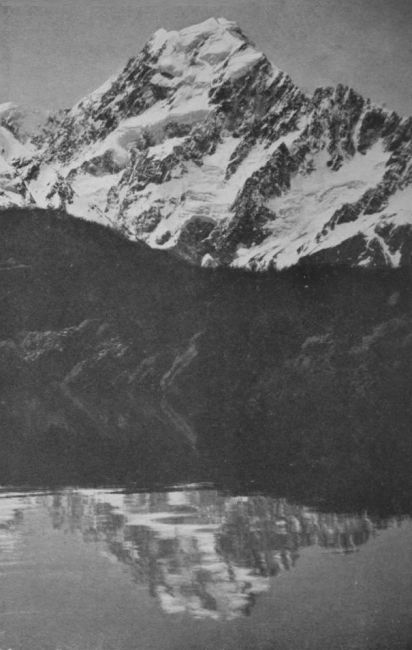
Mount Cook.
A CLIMBER
IN
NEW ZEALAND
BY
MALCOLM ROSS, A.C., F.R.G.S.
FORMERLY VICE-PRESIDENT OF THE NEW ZEALAND ALPINE CLUB
AUTHOR OF “AORANGI”, “IN TUHOE LAND”, ETC.
ILLUSTRATED
FROM PHOTOGRAPHS BY THE AUTHOR
LONDON
EDWARD ARNOLD
1914
[All Rights Reserved]
TO
MY WIFE
WHO IN CAMP AND BIVOUAC
REJOICED WITH US IN VICTORY
AND CHEERED US IN DEFEAT
PREFACE
Some of the material contained in the following pages
appeared in the London Times. My thanks are due
to the manager for allowing me to republish it.
Articles that have appeared in the Alpine Journal
and in some of the leading Australian and New
Zealand newspapers—notably the Otago Daily Times,
the Christchurch Press, the Wellington Post, the
New Zealand Times, the New Zealand Herald, the
Melbourne Age, and the Australasian—have also been
used. These articles have all been re-written or revised.
I am indebted to Dr. Teichelman for the interesting
illustration facing page 296, and to the Otago Witness
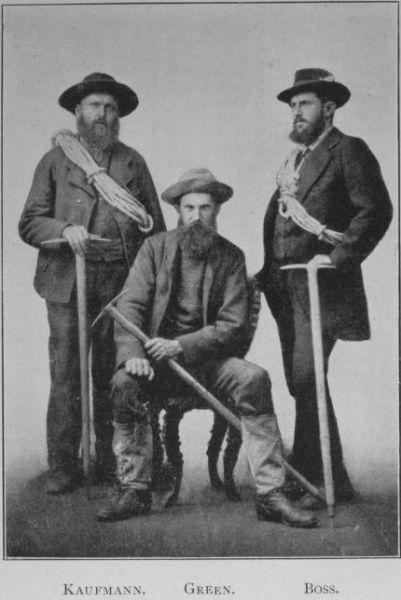
for the photograph of the Rev. Mr. Green, Boss, and
Kaufmann. The other illustrations are from my own
photographs. My thanks are also due to Mr. A. L.
Mumm, late Secretary of the Alpine Club, and author
of Five Months in the Himalaya, for the special
interest he has taken in the publication of this book.
Finally, I must record my great indebtedness to Lord
Bryce, the distinguished Author and Ambassador, and
a former President of the Alpine Club, for the
charming introductory note that he has written.
M. R.
London, February 7, 1914.
PREFATORY NOTE
BY THE RIGHT HON. VISCOUNT BRYCE
On the west side of the Southern Island of New
Zealand there rises from the sea a magnificent mass
of snowy mountains, whose highest peak, Aorangi or
Mount Cook, reaches an elevation of 12,347 feet.
Some of the loftiest summits are visible in the far
distance from the railway which runs down the east
coast of the island from Christchurch to Dunedin,
but to appreciate the full grandeur of the range it
must be seen either from out at sea or from points
north of it on the west coast. The view from the
seaport of Greymouth on that coast, nearly a hundred
miles from Aorangi, is not only one of the finest
mountain views which the world affords, but is almost
unique as a prospect of a long line of snows rising
right out of an ocean. One must go to North-Western
America, or to the Caucasus where it approaches the
Euxine, north of Poti, or possibly to Kamschatka
(of which I cannot speak from personal knowledge),
to find peaks so high which have the full value of
their height, because they spring directly from the
sea. The Andes are of course loftier, but they stand
farther back from the shore, and they are seldom
well seen from it.
In Southern New Zealand the line of perpetual
snow is much lower than it is in the Alps of Europe.
It varies, of course, in different parts of the range;
but generally speaking, a mountain 12,000 feet high
in New Zealand carries as much snow and ice as one
of 15,000 feet in the Swiss Alps, and New Zealanders
point with pride to glaciers comparable to the Aletsch
and the Mer de Glace. On the west, some of the great
ice-streams descend to within seven hundred feet of
sea-level, and below the line of perpetual snow the
steep declivities are covered with a thick and tangled
forest, extremely difficult to penetrate, where tree ferns
grow luxuriantly in the depths of the gorges. The
region is one of the wettest and most thickly wooded
in the world; and it is a region that might have
lain long unexplored, except in those few spots where
gold has been found, had it not been for the growth,
about seventy years ago, of the passion for mountaineering,
which has carried British climbers all over
the earth in search of places where their prowess
could find a field for its display. The first who
forced their way into it were some New Zealand
Government surveyors in 1862.
The first mountaineer to attempt Aorangi was
my friend the Rev. W. S. Green of Dublin (now one
of the most honoured veterans of our own Alpine
Club), who had all but reached the summit when
nightfall and bad weather forced him to turn back.
After him came some bold New Zealand climbers
and Mr. E. A. Fitzgerald. One of the former, Mr.
T. C. Fyfe, with his companions, George Graham
and J. Clark, reached the very top of Aorangi in
1894. Among these native mountaineers Mr. Malcolm
Ross has been one of the most daring and most persevering.
I had the pleasure, at Wellington, New Zealand,
a year and a half ago, of listening to a most interesting
description which he gave of his adventures and
those of his comrades, and could realize from it the
dangers as well as the hardships which the climber
has to face in New Zealand. The weather, on the
west coast especially, can be awful, for fierce storms
sweep up from the Tasman Sea, that most tempestuous
part of the Pacific, whose twelve hundred miles furnished
the twelve hundred reasons why New Zealand
declined to enter the Australian Federation. The
base of operations is distant, for no alpine hotels
and hardly any shelter huts have yet been built,
such as those which the Swiss, German-Austrian, and
Italian Alpine clubs have recently provided in their
mountain lands. The New Zealand climber, who has
been almost always his own guide, has sometimes to
be his own porter also. And the slopes and glens,
when one approaches the west coast, are covered with
so dense a growth of trees and shrubs that progress
is always slow and often difficult. No finer work
in conquering nature has been done by climbers anywhere
than here. But the guerdon was worth the
effort. The scenery is magnificent, with a character
that is all its own, for New Zealand landscapes are
unlike not only those of our northern hemisphere,
but those of South America also; and the youth
of the Islands have been fired by the ambition to
emulate those British mountaineers whose achievements
they admire, as well as by a patriotic love
for their own beautiful and fascinating land. I
hope that the fresh and vivid descriptions Mr.
Ross gives of the charms of New Zealand landscape,
and of the scope which its peaks and glaciers afford
for the energy and skill of those who find that
the European Alps have now little that is new to
offer, may draw to it more and more visitors from
Britain.
February 2, 1914.
CONTENTS
CHAPTER I
DESCRIPTIVE AND HISTORICAL
PAGE
Terra Incognita—An Experiment in Acclimatization—The Volcanic
Mountains—The Thermal Region—Volcano of Ngauruhoe—The
Southern Alps described—Physical and Economic Aspects—Influence
upon Character—The Early Explorers—Green’s
Historic Climb—First Ascents—Immunity from Accident
Across the Mackenzie Plains—The Alpine Lakes—The Cuisine en
route—A Jehu in a Rage—The Old Hermitage—A Passing
Storm—Provisioning a Camp—A Huge Moraine—Sub-Alpine
Vegetation—Adding to the Larder—Crossing an Alpine River—We
bivouac in the Valley—Feathered Visitors—In Tent in the
Wilds
First Sight of the Hochstetter Ice Fall—An Alpine Panorama—Bad
Weather—The Musings of a Lady Mountaineer—A Storm
in Camp—An Acrobatic Feat—Return to the Hermitage—A
Scramble on Sealy—First Meeting with Fyfe—An
Avalanche from Sefton—On the Mountain-Side
We arrange an Expedition—The Difficulties of Transport—Quicksands
in the Tasman River—The Manufacture of Ski—Flight
of our Porter—The Climb to the Bivouac Rock—Difficulties
with the Cooker—Preliminary Step-Cutting—Plans for a
Higher Bivouac
The Joys of High Bivouacking—Caught in a Storm—Thunder
and Lightning—We lower the Tent—A Cold Repast—Retreat—We
lose our Swags—New Fashions at the Old Hut—Other
Arrivals—A Cook in Trouble—Another Storm—I return
Home
Another Attack—Digging out the Frozen Tent—Camp on the
Plateau—Finding a New Route—Blocked by a Wall of Rock—Some
Acrobatic Performances—Defeat once more—Finding
the Lost Swags—Return to the Hut—A Fourth Attempt—Back
to the Plateau—Climbing by Lantern-Light—Loss of an
Ice-Axe—The Final Ice-Cap gained—Retreat once more—A
Terrible Storm
Green’s Route abandoned—Fyfe and Graham explore the Hooker
Side—Camp on the Ice—Serious Work at a Schrund—A
Long Couloir—Green’s Saddle gained—Difficult Rock-Work—Success
at Last—The Descent—Falling Stones
The Tararua Range—A Mountain Railway—Our Unknown Host—The
Charm of High Places—Through the Beech Forest—Insects
and Birds—Mr. and Mrs. Kohoperoa—A Botanist’s
Paradise—The Old and the New—A Reverie on a Hill-Top
The Valley of the Mueller—A Trying Moraine—Our al fresco Camp—A
Bivouac Dream—Retreat in the Rain—In the Valley of
the Tasman—Reflections on being one’s own Porter—The
Curious Kea—Dentistry at a Mountain Hut—An Evening
under a Rock
A Glacier Tramp—The Penguin Rocks—A Fairyland Grotto—Second
Breakfast and some Reflections—Rock Avalanches—Beautiful
Schrunds—A Sharp Arête—Scaling a Precipice—Zurbriggen’s
Axe—A Difficult Ice Slope—A Problem solved
by Rubber—On the Summit Ridge—A Splendid Panorama—The
Descent—The Bivouac again
Mount De la Bêche—Early Attempts—An Historic Bivouac—Heroic
Pluck and Endurance—View down the Valley—Reflections
under a Rock—Caught in the Mist—Provisions
run low—Moraines by Candle-light—Breakfast on a Summit—A
Scene in Cloudland—Crossing a Bergschrund—First
Ascent of the Minarets—A Quick Descent—Return to the Hut
We decide to make a New Pass—Bivouac at Malte Brun—A Start
by Moonlight—Early Morning on the Glacier—Dawn on the
Pass—Rotten Rock and Broken Ice—Some Difficult Climbing—An
Ice Fall and an Avalanche Shoot—We reach the
Whymper Glacier—A Cannonade from the Dome—We
explore New Country—West Coast Vegetation
An Uncomfortable Bivouac and a Frugal Meal—We start down
the Valley—Through the Virgin Forest—Grandeur of the
Scenery—An Interesting Discovery—Blocked by Gorges—A
Veritable Fairyland—We bivouac on the River Bank—A
Sleepless Night
An Adventure in the River—Dripping Mountaineers—The Sand-Flies
have an Innings—On Short Commons—Wild Cattle in
the Forest—Footprints on the Sands—Down the Broad Valley—A
Habitation at last—Fyfe goes into Hospital—An Exciting
Ride—Gillespie’s Beach—In a Miner’s Hat—Bivouac under
a Rock—I recross the Alps alone—Back at the Hermitage
Early Expeditions—A Lost Explorer—The Aborigines—The Great
Lakes—Primitive Navigation—The Grandeur of Te Anau—Over
MacKinnon’s Pass—Views from the Summit—Mount
Balloon in Dangerous Mood—A Bivouac in the Forest—Camp
Cookery—Down the Arthur River—In Milford Sound
Some Unexplored Country—Discovery of New Glaciers—Camp on
an Old Moraine—The Birds of Kiwi Land—A Spotless Glacier—Strange
Bergschrunds—Difficult Step-Cutting—Ice-Glazed
Rocks—An Exciting Glissade—Benighted—A Cold Bivouac—The
Southern Stars—The Cross and the Bear—A Dreary
Vigil—Camp again—Return Journey in the Rain—Countless
Waterfalls—A Concert in Camp—The Lost Explorers
Incidents en route—Digging out a Hut—On the Liebig Range—Dawn
on Mount Cook—A Minor Peak—Elie de Beaumont—Defeated
by the Weather—A Splendid Sunset—Keas again
Testing a Leg—A Moonlight Ride—We start for the Traverse—Avalanches—The
Rolling Mists—The Commissariat—The
Plateau by Moonlight—Schrunds in the Dusk—A 3000-Feet
Slope—On the Main Arête—Snow Ridges and Rocks—Magnificent
Views—The Final Slopes—The Summit gained
On the Summit of Aorangi—We commence the Descent—An Ice-Glazed
Rock Arête—Suspended over a Precipice—A Sloping
Chimney—An Ungraceful Descent—Graham loses his Hat—A
Cold Wind—Down a Frozen Slope—Falling Stones and Ice—An
Accident—Cutting Steps by Moonlight—The Final Bergschrund—Crevasses
by Candle-Light—Our Second Sunrise—The
Hermitage at last
Wandering through an English village, not so many
years ago, a friend chanced upon a dame’s school in
which New Zealand was being described as “some
small islands off the coast of Australia, infested with
rabbits”; and only three years ago my wife was
asked by a lady in the Lyceum Club, in London, if
the Maoris were still cannibals, and if there were tigers
in the jungle! It is not, perhaps, surprising, then,
that astonishment should still be expressed when the
statement is made that New Zealand has Alps and
glaciers vieing in grandeur and in beauty with those
of Switzerland. Distant fields are green, but seldom
white; and New Zealand is a Far Country. The New
Zealander, however, born and bred fifteen thousand
miles away, still calls England “Home.” Long may
he continue to do so! He knows more of England
than England knows of him, and in time of stress he
will cheerfully give, out of his slender means, a battle-cruiser
as an object-lesson to the world; or, in time of
danger, dye the veldt with his own red blood. And
there will be nothing of selfishness in the sacrifice,
as has sometimes been hinted to me by the Little
Englander.
But, reverting to the main question, this ignorance
in regard to the Outer Empire, which still prevails,
reminds one of the story told by a well-known author
on mountaineering, who once saw in the parlour of
a cottage in England a wonderful erection of what
appeared to be brown paper and shavings, built up in
rock-like fashion, covered with little toy-box trees and
dotted here and there with bits of mirror glass and
cardboard houses. “What,” inquired the visitor, “may
this be?” “That,” said the owner of the house, very
slowly, “is the work of my late ’usband—a representation
of the Halps, as close as ’e could imagine it, for
’e never was abroad.”
Like this lady’s “late ’usband,” there are many people
who have heard of our Alps and volcanoes, yet have
little idea of their size and importance. Let me
endeavour, by way of introduction,—which the non-Alpine
reader may skip if he likes,—to give some idea
of the character of these mountains and of their
history from a climber’s point of view.
The flora and fauna of the New Zealand mountains
are especially interesting, but it would need much
more space than is available within the limits of this
book to deal adequately with them. Such references
as I have made are only the passing comments of the
climber, and not, in any way, the studied dissections
of the scientist. But there is one matter, partly of
historic and partly of scientific interest, the facts
of which may very well be placed on record here. It
relates to an experiment in acclimatization that is, I
believe, unique in the history of the world.
I had often thought about the introduction of
chamois to the Southern Alps; but the difficulties of
capturing a sufficient number and of transporting them
from the heart of Europe half-way round the world
and through the tropic seas seemed so great as to make
the experiment almost impossible of achievement. But
some few years ago, when my friend Kontre-Admiral
Ritter Ludwig von Höhnel, then an honorary aide-de-camp
on the staff of the Emperor of Austria and
King of Hungary,—himself a famous chamois hunter,—was
in New Zealand, we talked the matter over.
Höhnel then said to me that if he could get some of
the curious New Zealand birds, such as the kiwi, the
weka, the kakapo, and the kea for His Majesty’s
Zoological Gardens at Schönbrunn, he believed that
the Emperor, in return, would send out some chamois
for the New Zealand Alps. This was too good a chance
to be missed, and I told him that, so far as the New
Zealand Government was concerned, I felt sure that
our side of the project was already as good as arranged.
Von Höhnel replied that he could not, of course, speak
for the Emperor, but he would do his best to persuade
him. Without more ado I took my friend along and
introduced him to Mr. T. E. Donne, then the head of
the Tourist Department, and he, being keenly interested
in acclimatization matters and also a sportsman,
promptly fell in with the idea, which was also readily
taken up and sanctioned by Sir Joseph Ward, at that
time the minister in charge of the Tourist Department.
In due course the birds were sent to Austria, and eight
chamois were forwarded to New Zealand via London
in 1907. The chamois arrived in New Zealand on
March 14th of the same year. They received the
utmost attention on the voyage, and stood the journey
very well. I went to see them on the arrival of the
steamer, and they appeared to be in fine condition.
Afterwards they were sent by steamer and train
and wagon to Mount Cook and liberated in their
new home in the Southern Alps. A few years ago
some of them were seen, by one of the guides, with
young at foot.
The other day, while in Vienna, I paid a visit to
Schönbrunn, and looked for the New Zealand birds. I
found that all but one had died. He was a sedate and
venerable kea, and very sad he looked, confined, as he
was, in an ordinary parrot cage. I said a few words
to him in his own kea language, and he cocked his
head knowingly on one side and eyed me curiously as
if he had heard the sounds before but had almost forgotten
them. For his own part, he seemed to have lost
the power of speech in kea language. I have no doubt
in the years gone by he was one of the young bloods
of Kea land who used to come home with the milk and
rouse us from our peaceful slumbers in the mountain
hut on the Great Tasman Glacier, and that I myself
had hurled both stones and imprecations at his wise-looking
head. But now I felt sad at heart when I saw
him cribbed, cabined, and confined in his little cage. It
seemed as if his death after all would be laid at my
door, and I longed to take him back with me to his
friends and relatives in his home in the Southern Alps.
But with the chamois it is different. They have a
new home more glorious than their old one, and for
years to come they must be protected from the gun of
the hunter. In these Southern Alpine solitudes they
can multiply and thrive in the land of the bird for
which they were exchanged, while he—poor fellow—pines
in his foreign cage.
The capturing of these chamois for New Zealand
resulted in the destruction of many others, which, in
their wild flight from their would-be captors, dashed
themselves to death over the precipices of their rocky
fastnesses, while others were maimed. There was
therefore an outcry in Austria against their capture.
Through the persistent efforts of the Admiral, however,
the experiment is to be repeated this year on a small
scale. I had the good fortune to meet him again in
Vienna the other day, and he was quite keen about
it, there being now, of course, a necessity for a change
of blood if the experiment is to be quite a success.
New Zealand owes to the Emperor Franz Josef and
to Rear-Admiral von Höhnel its best thanks for their
efforts in connexion with this novel essay.
The mountain system of New Zealand is as varied
as it is interesting. In the North Island there is a
series of volcanic mountains as fascinating, almost, as are
the Southern Alps. How the fire came to New Zealand
is told in Maori legend. The Maoris themselves looked
upon the higher volcanic mountains with superstitious
awe, and they considered them tapu, or sacred. No
white man, and certainly no Maori, dared set foot
upon them; and the fact that they were tapu prevented,
for a long time, the obtaining of scientific
knowledge regarding their craters and their summit
configuration generally. Their origin was attributed
to a famous tohunga, or high priest, who piloted one
of the canoes of the early migrants from Hawaiki,
the fabled home of the Maori people. This man, with
another high chief, took possession of all the country
between the Bay of Plenty and Mount Ruapehu. In
order to assure fruitful years, these two ascended the
neighbouring volcano of Ngauruhoe, and set up an
altar to make the necessary incantations. The cold
then, as now, was very bitter,—for the winds blow
keen from the adjacent snows,—and it seemed as if the
old tohunga would die, when happily the thought occurred
to him of sending for some of the sacred fire
that was in the keeping of one of his sisters in far-away
Hawaiki. She straightway came with the fire.
Wherever she halted in her underground travels
there fire remained, and where she came to the surface
to breathe there appeared boiling pools and geysers.
Thus there was a trail of fire and boiling pools all
along her route from White Island, down through all
the thermal region to Ngauruhoe and Ruapehu. The
fire revived the old man, and, in commemoration of
the event, he left it burning in Ngauruhoe. As a
sacrifice to the gods he cast his slave wife down the
crater, and the mountain has ever afterwards been
called by her name. The legend is picturesque, but
unsatisfying. Years afterwards a famous chief called
Te Heuheu was killed in a great landslip on the shores
of Lake Taupo. His body was being taken to burial
on the sacred mountain, when a terrific thunderstorm,
or an eruption, came on, and the bearers, hastily
depositing their burden in a cave, turned and fled.
This made the mountain still more sacred and the
early scientists dared not attempt to explore the
range. Both Hochstetter and Dieffenbach must have
been greatly disappointed that they were not allowed
to set foot upon these sacred mountains, because then,
as now, Ngauruhoe was the real centre of volcanic
energy in New Zealand.
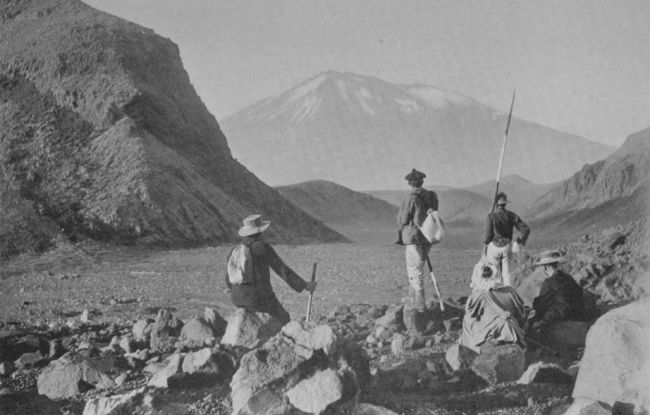
Ruapehu from Ngauruhoe.
It is, however, the thermal region in the vicinity
of Lakes Rotorua, Rotomahana, Tarawera, and Taupo
that is best known to the great majority of New
Zealanders and to the sight-seers, who, from all
parts of the civilized world, flock to this truly
wonderful region. All the thermal phenomena possible
seem to have been plentifully distributed throughout
this territory. The crowning glory of it all was the
Pink and White Terraces; but these, alas! are no
more, for on June 10, 1886, they were either blown
to bits or buried in the rain of mud and scoria that
came from the eruption of Tarawera, and made the
beautiful surrounding country a desolate wilderness.
The story of that eruption with its loss of life, both
Maori and European, has often been told, and there
is no need to repeat it here. Nature is gradually
reclothing the scarred hillsides, and even the bruised
and wounded trees have been healed by the hand of
time. The tourist wanders through the land just as
he did before the eruption, and the birds and the fish
killed or starved to death, as a result of the rain of
mud and stones and fiery bombs, have been replaced
by others of their kind. In this particular part of the
thermal region the main centre of activity remained
at the site of the old terraces, but during later years
it seems to have shifted to the region of the famous
but short-lived Waimangu geyser. This huge geyser
threw a column of boiling water, steam, mud, and
stones considerably over a thousand feet in air. In
August 1903 the geyser was the scene of a terrible
tragedy, an unusually severe eruption resulting in the
death of two young girls, another visitor, and the
guide, Joe Warbrick. The party had gone rather
close in order to get a photograph. The eruption
suddenly became terrific, and a great column of boiling
water, shooting out at an angle, swept them off the
hill into the overflow from the geyser. They were
carried down in boiling water for nearly a mile towards
Lake Rotomahana. The bodies were recovered
shortly afterwards. Within the last few years Waimangu
has become quiescent, but there is still great
activity near by at a spot that has been aptly named
Frying-pan Flat. There is much thermal activity too
on what is supposed to be the site of the old Pink
Terraces.
The completion of the North Island Main Trunk
Railway has now brought the volcanoes within easy
reach both of Wellington and Auckland, and year by
year Ruapehu, Ngauruhoe, and the Tongariro Range
are becoming favoured playgrounds for the more energetic
class of holiday-makers. Ngauruhoe is apparently
entering upon a period of renewed activity, and within
the last four or five years there have been some fine
volcanic displays from its crater. It is a perfect volcanic
cone, 7515 feet high, and terminates the Tongariro
Mountain Range to the southward—a range that has,
within comparatively recent times, been the scene of
tremendous volcanic energy. The desolate nature of
the country on the eastern side of the mountain, and
the vast extinct craters of the range itself, are now
silent witnesses of the fiery activity of bygone ages.
There are still several centres of great thermal
energy on the Tongariro Range. At the lower and
northern end Te Mari and Ketetahi are in a state of
almost perpetual turmoil, and clouds of steam rising
from their seething cauldrons are visible many miles
away. The Red Crater, near the middle of the Range,
is still hot in places, and jets of steam hiss through small
vents in the gloriously tinted rocks of its sides. At the
extreme southern end of the range is the active volcano
of Ngauruhoe. In winter-time its slopes are clothed in
snow and ice. Occasionally, for days at a time, it sends
a vast column of steam fully 3000 feet in the air, and
then it is a magnificent sight. At the period of greatest
activity the scene must have been almost beyond
description. Ngauruhoe was then, indeed, a hell unchained.
A New Zealand poet—Mr. D. M. Ross—has
graphically depicted such a scene as may well have been
witnessed by the original inhabitants of Maoriland—
“O’er Vassal Peaks thy smoky banners spread,
Splashed with red flame as ever on they sped
In serried ranks, squired by the lesser hills,
To purple realms of mystery; the day
Failed of her sun when thy red furnace flamed,
And night was all aglow when earthquakes played
Beneath thy heaving breast of startled snows.”
About two years ago a geologist saw lava in the
crater, and, later still, when the mountain was particularly
active, a glow as from molten lava appeared in
the sky. It would not be at all surprising if at any
time there were an eruption on a grand scale. Fortunately,
the surrounding country is so unproductive
as to be but sparsely settled, and therefore a serious
eruption would be more spectacular than destructive.
The Southern Alps extend in a series of ranges
from the north to the extreme south of the Middle
Island. In the south, the ranges, which run in different
directions, are intersected by the splendid fiords on
the one side and by the arms of the long, deep lakes
on the other. The mountain masses, in some places,
come sheer down to the water’s edge, and their bases
are far below the level of the lakes or of the sea.
Many of their lower slopes are densely wooded, while
their summits are capped with perpetual snow and
ice. In the region of Milford Sound they rise steeply
from the water’s edge, and their solid and sometimes
smooth granite walls seem uninviting to the foot of
the climber. Going farther north we have another
fine series of mountains in the region of Lakes Wakatipu
and Wanaka. Though not high, as heights go in the
European Alps or in the Himalaya, they are imposing
mountains. It is only within comparatively
recent years that passes have been discovered between
the lakes and the sounds; and although these passes
do not lead the traveller beyond the sub-Alpine
heights, they take him through scenery that is no less
remarkable for its beauty than for its grandeur—a
fitting introduction to those greater marvels in the
heart of the Southern Alps.
Northwards, from Mount Aspiring, which is at the
head of this jumble of southern mountains that spreads
itself through fiordland and lakeland, the Southern Alps
proper extend in an almost unbroken chain along the
western side of the Middle Island of New Zealand to
where Mount Cook, or Aorangi, rears his snow-crowned
ridge above the grim precipices and flanking glaciers,
and, dominating the landscape, gives an outlook from
sea to sea. Here we are amongst the monarchs of the
range, and the views are indescribably grand. There
is a glorious Alpine panorama stretching north and
south, and, though all the highest mountains have
been climbed, there are hundreds and hundreds of
untrodden peaks and passes still awaiting the foot of
the climber.
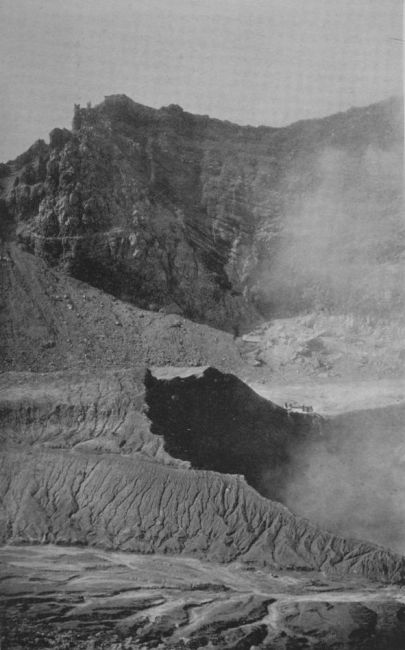
Crater of Ngauruhoe.
Travelling over the level lands in the south-bound
train from Christchurch on a summer’s day, one sees
wheat fence-high and golden in the sun, the grey-green
of oats in ear, the darker green of well-tilled
root crops, interspersed with clumps and lines of
English and Australian trees, making relieving
splashes of colour against the purple haze of the
foothills, and indicating a fertile soil. At intervals
we rumble over the long bridge of some snow-fed
river, with its great shingle flats and islands, and its
opalescent water forming many interlacing streams,
and we realize that the work done in the giant
laboratory of the Frost King, in the heart of the Alps,
is here finding its full fruition. We know also that
the planing glacier, the eroding torrent, and the
crumbling moraine are still at work. They are the
Mills of the Gods, slowly grinding, and though they
grind exceedingly small, they have made, in time,
through the agency of these great snow-fed rivers, a
land that is of a verity flowing with milk and honey—a
land that is already the granary of the islands.
Thus the Southern Alps have an important bearing
upon the economic possibilities of the country. Their
never-failing rivers, by means of irrigation, will make
possible a still more intense cultivation on the plains
of Canterbury and Otago. But beyond all this there
are possibilities almost undreamt of in the enormous
power from lake and river now running to waste. In
short, the Southern Alps may one day make New
Zealand not only the playground of Australasia, but
its manufactory as well. A return recently compiled,
giving the more important available water powers in
both islands, shows an average of 3,817,180 horse
power and 2,854,470 kilowatts. A considerable
number of these powers are suitable for general industrial
development, but the largest ones, being
mainly in the unsettled portions of the Middle Island,
and near the deep-water sounds, are particularly
suitable for utilization in connexion with electric-chemical
or electric-metallurgical industries. Finally,
the Southern Alps must not be despised from the
tourist point of view. They already bring many
visitors to New Zealand from all parts of the world;
and in years to come, when torrid Australia and the
sweltering Pacific number their population by many
millions, this splendid mountain chain both in summer
and in winter will have become the playground of the
new nations under the Southern Cross.
But apart altogether from the physical aspect and
the economic aspect, a splendid Alpine chain, such as
forms the backbone of the Middle Island of New Zealand,
is almost certain to have some influence upon the character
and physique of the nation, and more especially
upon the character and physique of a nation endowed
with those qualities of hardihood and adventure that
are such predominant features of the Anglo-Saxon
race. In an interesting article on “Mountaineering
as a Sport for Soldiers,” published in the Times in
1907, the writer—Mr. L. M. S. Amery—pointed out that
“there can be few better tests of the essential qualities
of leadership than a really critical moment on a mountain.
The man who can retain his judgment and confidence,
and keep up the spirits of his party, when the
way has already been lost, when all the rocks are coated
with new verglas, when fingers are numb with cold,
and when the guides begin to lose their heads and
jabber furiously in incomprehensible patois—he is the
man who (in warfare) is no less certain to keep his nerve
and sustain his subordinates when casualties are heaviest,
and the hope of support faintest.” Where there
are mountains and where there are British people there
will, of a surety, be climbing, and the sport develops
character and brings out qualities that are of first importance
in the affairs of everyday life as well as in
warfare. From this point of view, therefore, as well
as from the others mentioned, New Zealand has a
valuable asset in her mountains. It is an asset, too,
that is already being developed to some purpose.
The splendid mountain chain that forms the back-bone
of the Middle Island was, during the early period
of colonization, a terra incognita to all but a few
New Zealanders, and it is only within recent years
that the sons of those bold pioneers who travelled over
so many leagues of ocean to build themselves new
homes and to lay the foundation of a new and sturdy
nation have ventured into the heart of the Southern
Alps to wrest the secrets of the higher snows. The
age of conquest has been long delayed, but once
started, the conquerors have marched to victory with
even greater vigour than did their forefathers in the
European Alps. It took some little time to gain the
necessary experience, for the Antipodean climbers had
not only to learn the craft untaught by others, but they
had to be their own guides, their own step-cutters, and
even their own porters. With the first taste of victory
came the lust for other conquests, and, one by one, the
great peaks have fallen, till now there is not one first-class
mountain left unconquered, and already “traverses”
and new routes up old peaks are becoming
the fashion. Though the New Zealanders have won
for themselves many of the higher summits, there are
a number that have fallen before climbers from the
Motherland. The New Zealanders, however, did their
work without assistance, and it says much for the
courage, for the endurance, and for the resource of the
race that the sons of the pioneers have accomplished
this remarkable record without a single fatal accident,
and indeed without serious misadventure of any kind.
To an Englishman, and a member of the Alpine
Club, the Rev. William Spotswood Green, belongs the
credit of having initiated Alpine climbing in this the
farthermost part of our Outer Empire. It was his
work in the Southern Alps that fired the imagination
of that hardy band of young Colonial pioneers who,
like their forefathers in the Alps of Switzerland, were
destined to lead the way in Alpine conquest. Green
came with two experienced Swiss climbers,—Emil Boss
and Ulrich Kaufmann,—and though he was not successful
in reaching the actual summit of Mount Cook,
he very nearly got there. The story of his adventures
is simply and graphically told in his book, which must
ever remain a classic in New Zealand mountaineering
literature.
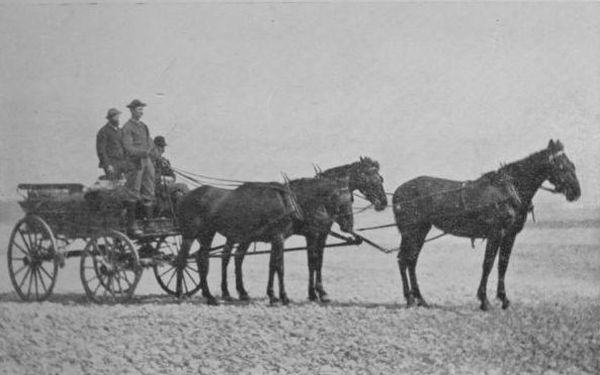
Mr. Green had many difficulties to contend against
before he got to Mount Cook. To begin with, his
wagonette came to grief in the Tasman and was swept
bodily down the river. Birch Hill station was then
the last human habitation on the way to the glacier
world, and it took a long time before a camp could be
established at the foot of the spur where now stands
the Ball Hut. The attempt to climb the mountain by
the main arête failed. The party got on to a narrow
arête along which they came to the first rock-tooth of
tottering splintered slate, which was climbed with great
difficulty and danger. The ridge connecting this with
the next spike was so loose that it trembled beneath
their feet and made further climbing madness. An
attempt by way of the eastern face of the mountain also
failed. The warmth of the sunshine caused many avalanches,
one of which nearly buried the party. A route
by way of the Great Plateau and the Linda Glacier
was, however, discovered. On March 1st the party
spent the night on the spur near the Bivouac Rock,
subsequently so much used by the New Zealanders.
They started next morning on their historic climb via
the Linda Glacier, and after some difficulties they
found themselves close to the foot of the arête connecting
Mount Cook with Mount Tasman. As the
party advanced along their route many avalanches
fell from Mount Tasman. A halt was made for
breakfast, and some of the impedimenta deposited.
The crevasses were numerous, and but for the fresh
snow would have barred the way. Three hours’ work
brought them to the head of the glacier, after which
they turned to the left, and, crossing the arête, reached
an ice-filled couloir, to gain which they had to do some
severe step-cutting. Here the real work began, and
the first and last view was got of the western sea.
After climbing up the couloir, they reached a wall of
ice, and decided, after a council of war, to try to cross
the couloir, which at first had been rejected as too
dangerous. The setting of the sun lessened the risk,
and, though it was an anxious time, the opposite side
was reached in safety. After all, the rocks were inaccessible,
and the party had to climb through a notch,
and thus reach the ice-slope beyond, down which swept
a stream of detached ice; and, as it was thawing and
getting late in the afternoon, the question of advancing
was discussed. But as the bivouac could not be gained
before dark, and what was presumed to be only an
hour’s work lay before the party, it was decided to go
on. Keeping close to the rocks, an icicled bergschrund
was reached but avoided by a detour to the left, and at
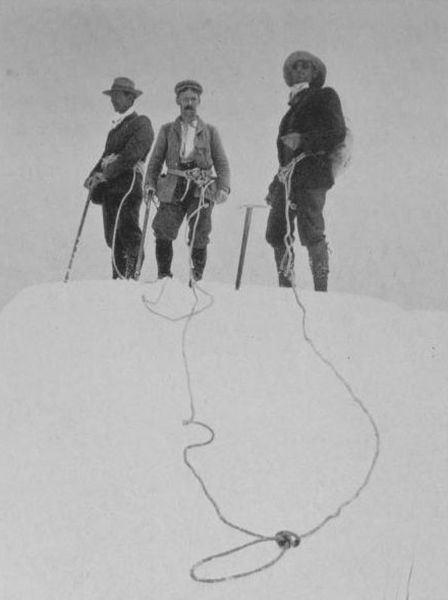
6 p.m. Mr. Green, Boss, and Kaufmann stepped on to
the crest of Aorangi. This was, they thought, too late
an hour to permit of their going on to the actual summit.
As there were no rocks at hand, no cairn could
be built, and they were forced to retreat, leaving no
record of their ascent. Until the rocks were reached
they had to descend backwards, with faces to the ice.
Beneath one or two fragments of rock were placed
Mr. Green’s handkerchief and Kaufmann’s match-box.
With great difficulty, and some danger, they lowered
themselves down the lower end of the ice-slope, and as
they crossed the couloir to the opposite rocks, night
closed in. In a little time the moon rose, enabling the
three men to find a partial shelter beneath the rock-ridge,
on a little ledge less than two feet wide and sloping
outward, and there they spent the nine hours of darkness,
stamping to keep up the circulation, and talking
and singing to drive away sleep, which would have
been fatal to them. Every quarter of an hour an avalanche
rumbled, there being a warm north-west wind,
which probably saved them from being frost-bitten.
At 5.30 the descent was recommenced, and the snow
was found to be very soft, one crevasse being almost
impassable. The plateau was completely changed in
aspect by an immense avalanche, but they found the
knapsack where it had been left, and enjoyed its contents
(although the bread was twenty days old), for
they had been twenty-two hours without food. In the
séracs they found their track obliterated, one avalanche
having covered an area of two hundred acres and filled
up a large crevasse. While they were crossing the
Great Plateau a grand avalanche fell from the Tasman
cliffs with a deafening crash. At 1 p.m. the bivouac
was reached, and a welcome cup of tea and half an
hour’s rest enjoyed. Then they returned to their camp
at the Ball Glacier in the Tasman Valley.
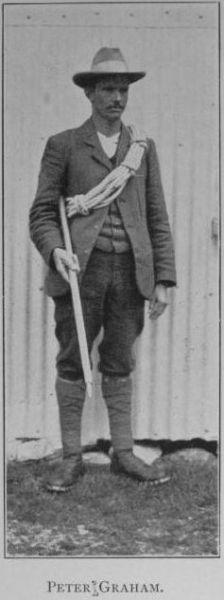
Peter Graham.
Kaufmann. Green. Boss.
Long before Mr. Green’s visit the early pioneers
had done considerable preliminary exploratory and
geological work, though they did no serious Alpine
climbing. Many of these, including Dr. von Haast,
have now passed away. As an indication of the
dangers these pioneers had to face, it may be mentioned
that out of quite a small band Mr. Howitt lost
his life in Lake Brunner in 1863, and Mr. G. Dobson
was murdered on the West Coast in 1866. Dr.
Sinclair was drowned in one of the branches of the
Rangitata River. He was buried at a place called
Mesopotamia, in the words of his friend, Dr. von Haast,
“near the banks of the river just where it emerges
from the Alps, with their perpetual snowfields glistening
in the sun. Amidst veronicas, senecios, and covered
with celmesias and gentians, there lies his lonely grave.”
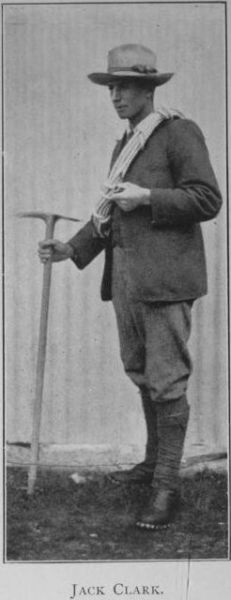
Jack Clark.
Following in Mr. Green’s footsteps came the Canterbury
Climbers. They tried Mount Cook by Green’s
route; but, like him, they failed, though on one occasion
Messrs. Mannering and Dixon made a heroic effort
and got within about a couple of hundred feet of the
summit.
The season of 1893-94 will ever be memorable
in the annals of New Zealand mountaineering, for that
was the season in which the first of the great peaks
fell. On March 7, 1895, Fyfe, by himself, made the
first ascent of that splendid rock peak Malte Brun
(10,241 feet); with Jack Clark and Dr. Franz Kronecker
(a tourist from Germany) he climbed Mount Darwin
(9700 feet); and with George Graham he ascended
Mount de la Bêche (10,040 feet) and the Footstool
(9073 feet). It was a fine performance for the young
New Zealanders, who had by this time acquired not
only the craft of climbing, but also of route-finding.
Meantime there had been no further serious attempt
upon Mount Cook, but early in the season 1894-95 the
New Zealanders were again at work, and, on Christmas
Day 1894, succeeded in making the first ascent of Mount
Cook. Their struggles, under adverse circumstances,
and their final success, are dealt with in another part
of this book.
That same season, Mr. E. A. Fitzgerald, a member
of the English Alpine Club, arrived with the famous
guide Zurbriggen to climb Mount Cook and other peaks.
The visitors spent some time in Christchurch, and on
their way to the theatre of operations they met the
victorious New Zealanders returning from their conquest.
Fitzgerald, however, continued his expedition,
and did some remarkably fine work, including the first
ascents of Mount Tasman (11,467 feet), Mount Sefton
(10,350 feet), Mount Haidinger (10,063 feet), and Mount
Sealy (8651 feet). To Mr. Fitzgerald also belongs the
honour of having discovered an easy pass from the
vicinity of Mount Cook to the West Coast—a pass
that others had been seeking for some time but had
failed to find.
There was no further serious climbing for a few
years, until Mr. T. C. Fyfe and the writer made the
first ascent of the Minarets (10,058 feet), an ascent of
Haidinger by the eastern face, and the first pass
between the head of the Great Tasman Glacier and
the West Coast. In 1905 our party made the first
traverse of Mount Cook. About the same time the
West Coast climbers Dr. Teichelman and the Rev.
Mr. Newton, with Mr. R. S. Low, a Scottish climber,
and guide Alex. Graham, came into prominence. They
commenced a series of ascents from the western side of
the range, on which the scenery is more varied and even
more imposing than it is on the eastern side. They
made the first ascent of St. David’s Dome (10,410 feet),
and made a new high pass over the main divide to the
Tasman. Some fine work was also accomplished that
season by Mr. H. Sillem, in company with the New
Zealand guides Clark and Graham. He ascended
Mount Cook, Malte Brun, the Footstool, and Sealy,
and succeeded in making the first ascent of Elie de
Beaumont (10,200 feet) and the southern peak of Mount
Cook (11,844 feet). In 1907 Dr. Teichelman and the
Rev. Mr. Newton, with Alex. Graham, made the first
ascent of Mount Douglas (10,107 feet) and of Torris
Peak (10,576 feet). Mounts Haast, Lendenfeld, Conway,
and Glacier Peak (all over 10,000 feet) also fell to them.
There were no high ascents made in 1908; but in the
1909 season the guides were kept busy. Mr. Claude
M‘Donald, a member of the Alpine Club, made the
first traverse of Malte Brun (10,421 feet), and Mr. L. M.
Earle, also a member of the Alpine Club, with three
guides, ascended Mount Cook by a new route from
the Hooker Valley. The climb was mostly on good
rocks, and is probably the easiest and shortest way to
the summit of the mountain. Several first ascents
of second-class peaks were made. In 1909-10 Captain
Head, an Englishman, with guides J. Clark and
A. Graham, made the first ascent of Mount Aspiring,
and, in company with Mr. L. M. Earle and the same
guides, Mount Sefton was ascended for the first time
from the western side.
No résumé of the work done in the Southern Alps
would be complete without reference to the magnificent
survey work and the measurements of glacier flow
made by Mr. T. N. Brodrick, C.E., of the New Zealand
Survey Department.
Mummery in his delightful book about his climbs in
the Alps and Caucasus says, humorously, that a mountain
passes through three phases, “An inaccessible peak,”
“The most difficult climb in the Alps,” and “An easy
day for a lady.” His classification has been proved true
in regard to the New Zealand as well as the European
Alps, and Mount Cook, which baffled Green and his
Swiss experts and the early New Zealand climbers, has
now been climbed by two women. Miss Du Faur, a
Sydney girl, in 1911 made the ascent by the Hooker
Rock route in company with the two guides Peter and
Alex. Graham, while Mrs. Lindon, an Englishwoman
resident in Australia, a year later, with Peter Graham
and D. Thomson, made the ascent of Mount Cook by
Green’s more difficult route. The conditions for both
ascents were perfect. Miss Du Faur has also climbed
Mount Tasman (11,475 feet), Mount Dampier (11,323
feet)—a first ascent—and several other peaks. This
season (1912-13), in company with Graham and
Thomson, she has succeeded in making a traverse of
the three peaks of Mount Cook from a high bivouac on
the Hooker side to the bivouac on the Tasman side—a
remarkable feat. On this trip the climbers were
favoured with glorious weather, and the conditions
were also good; otherwise the climb would have been
almost hopeless. The writer has looked down the long
icy knife edge that, with its bends and steep slopes and
cornices, joins the three peaks together, and has realized
the almost insuperable difficulties in the way of success,
except under ideal conditions. All honour, then, to the
two New Zealand guides and the young Australian girl
who have accomplished such a daring feat.
In connexion with this brief historical résumé of
mountain climbing in New Zealand and looking back
over this series of victories, won without a single fatal
accident, it remains only to pay a tribute—and it must
be a very high tribute—to the members of the Alpine
Club, whose precept and example we have so closely
followed. When I first started climbing, the Rev. Mr.
Green sent me an ice-axe and an article on the death-roll
of the Alps! What two more appropriate things
could he have forwarded to an amateur anxious to
learn the craft in a Far Country? I still have the
axe—a treasured possession—but I have long ago lost
the article! And it occurs to me, now, that by the
reader of these pages it may be laid to our charge that
in some of our expeditions we did not err on the side
of timidity. My answer to that will be that we were
always, or nearly always, doing pioneer work, and so
had to discover the dangers as well as the routes, and
that, generally, when the weather failed, when the
avalanches began to hiss down the slopes or crash from
the cliffs, or when the rocks began to fall, we either
waited or turned tail and fled. But, in any case, the
most critical would, surely, not have had us run no
risks at all. He is a poor soul—and there can be no
pride of race in him—who will shirk all danger. Two
years ago it was my privilege—at the invitation of my
friend Lord Islington—to give a lecture at Government
House, Wellington, before a famous historian and
ambassador who is one of a long line of distinguished
presidents of our Club, and, at the close of the lecture,
he—in one of those charming speeches which he so
easily makes—emphasized the necessity for the caution
that I myself had been preaching. But afterwards, at
supper, his wife came to me and said, “I like my
husband’s preaching to you about caution! Why,
when he climbed Ararat his only companion was his
ice-axe!” But she said it with a smile, and with
what I judged to be a feeling more of pride than
of reproach. So you see this fondness for a spice of
danger is in the blood, and cannot be altogether
eliminated in the old country any more than in the
new. And I will even go the length of saying that it
will be a sorry day for the race when it is no longer a
feature of British character.
Mount Cook has now been climbed by four routes.
It has been traversed from east to west over the
highest summit, and along the ridge from south to
north. The first ascent was made by New Zealanders
who had never seen a guide at work, and all the other
ascents but one have been made with guides who have
learnt their craft, untaught by others, in their native
land. All the high peaks have now been climbed, with
or without guides, Zurbriggen being the only foreign
guide who has ever stood on the summit of a New
Zealand Alp. And during all these years there has
been no fatal accident to mar the tale of success. But
what of the future? It is scarcely to be expected that
this immunity from accident will continue indefinitely.
There may come a day when some climber, caught in
bad weather, or endeavouring to achieve the impossible
by some new and more daring route, will meet
his fate on the higher snows, or leave his bones among
the beetling crags of the great precipices. One can only
express the hope that such a day may be long delayed,
and that, for many years to come, the steep white
slopes, the grim precipices, and the towering peaks will
continue as a health-giving playground, and resound
with the laughter born of the fun and frolic of the
hardy mountaineer. And whatever the future history
of these mountains may be, it can scarcely provide a
tale of more absorbing interest than is furnished by the
manly struggles of the pioneers who have climbed,
with some fair measure of success, in a Far Country.
CHAPTER II
IN THE OLDEN DAYS
“The bed was made, the room was fit,
By punctual eve the stars were lit;
The air was still, the water ran;
No need was there for maid or man,
When we put up, my wife and I,
At God’s great caravanserai.”
From an Old Play—slightly altered.
From the shoulder of the Hochstetter Dome down a
long valley between the giant snow peaks of the Mount
Cook Range on the one hand, and the rocky buttresses
of the Malte Brun and Liebig Ranges on the other,
swollen at intervals by tributary ice-streams, flowing
with imperceptible movement, comes the Great Tasman
Glacier—a veritable mer de glace—eighteen miles in
length. Some six miles from its terminal face the Ball
Glacier descends from the south-eastern shoulder of
Aorangi, and pours its huge slabs of broken ice and a
rubble of moraine into the parent stream. At the foot
of this glacier, in a hollow between the moraine of the
Tasman and the long southern arête of Mount Cook,
the Rev. William Spotswood Green, with Emil Boss
and Ulrich Kaufmann, pitched his fifth camp on the
occasion of his memorable expedition in 1882.
Thither, a somewhat young and inexperienced
mountaineer, in company with his wife, wended his
way a few years later. The proposed adventure
caused much critical comment in the family circle and
among our friends. Some said we were mad: others
envied us. Those were the delightful days of pioneering,
when the mountains were a sealed book to all but
a few faithful worshippers, and when adventures came,
freely and fully, without the seeking. There were no
motor-cars to run you up in a day from the confines of
civilization; there were no well-trodden tracks up the
valleys; the turbulent rivers were unbridged; guides
were a genus altogether unknown; and, at the end of
the long day’s journey, there was no sheltering hut
under which you could rest your weary limbs. You
were your own guide, your own porter, your own
tent-pitcher, and your own cook. They were days in
which we accomplished little in the matter of real
climbing; but they were days in which the blood was
strong and Hope flew ahead on swift wings—days that
are now gone, alas! never to return.
Previous to our visit no Englishwoman had ever
attempted this journey. To a foreigner—Frau von
Lendenfeld—belonged the honour of being the first
woman to traverse the Great Tasman Glacier. Frau
Lendenfeld, however, was a good mountaineer; and
it is given to few women to do such pioneering as she
did in the Southern Alps. We were mere amateurs at
the game. Still, we were not to be daunted by the
croakings of friends who prophesied that our bones
would soon be bleaching on the glaciers. Accordingly,
after a good deal of correspondence, much planning
and provisioning, and considerable consulting of maps
and photographs, we started on our eventful journey.
After a day in the train, we found ourselves at Fairlie
Creek. Next morning, having had an early breakfast,
we were bowling along a good gravel road, behind four
spanking greys, well driven, on our way to Mount
Cook.
Lunch at Lake Tekapo on a calm summer’s day,
after hours of coaching, was a delightful experience.
Afterwards, with your pipe alight, you stepped out
into the hotel garden, and, a few paces in front of you,
lapping a rocky shore, were the beautiful turquoise-green
waters of the lake, reflecting the clouds and the
mountains. Here horses were changed, and we started
off again on our long journey through the dreary
yellow tussock wastes of the Mackenzie Plains. Lake
Pukaki was our halting-place for the night. At sunset
we sighted its waters. Far up the valley, rising from
the Tasman Flats, towered the great mass of Mount
Cook, its final peak gleaming in the sunlight, and its
snows reflected in the lake at our feet—here distinctly,
and yonder more faintly, as the distant waters were
ruffled by a passing breeze. After some time spent in
a futile endeavour to get the dust out of our clothes
and our eyes and our ears, we dined on the rough fare
of the country. No delicate viands here! only the
oily mutton-chop, fried—think of it, ye later-day disciples
of Lucullus—in grease that boasted aloud of a
long acquaintanceship with the pan! And for drink
you had your choice of the everlasting boiled tea with
all the tannin in it, of a cloudy and somewhat sour-tasting
ale, or of an indifferent whisky. I know there
are Scotsmen who maintain that there may be good
whisky, and better whisky, and better whisky still,
though there can be no such thing as bad whisky;
but such enthusiastic patriotism as this could never
have extended to a back-blocks New Zealand inn in
the days when we first went a-pioneering. We had
one delicacy—jam. Yet, truth to tell, we were uncertain
whether it was stale strawberry or mouldy gooseberry.
My wife, after a microscopic examination, announced
that it was raspberry made from turnips! A diligent
cross-examination of the handmaiden—who, in the intervals
of conversation with the coach-driver in the
kitchen, fairly hurled the viands at us—elicited the
statement that it was gooseberry. She was rather
annoyed when doubts were expressed as to her veracity,
and we mildly suggested that it might be pineapple!
No, she was confident it was gooseberry.
How did she know? “Sure, she saw it on the label,
an’ if we didn’t belaive her we could go into the back-yard,
where she had thrown the tin, and see for
ourselves!”
The after-glow on Mount Cook, the glorious colouring
of which was mirrored in the lake, was some
atonement for the want of delicacy in the viands.
We were early on the road again next morning.
Crossing the Pukaki River on a ferry-boat, worked by the
current, we drove over the tussocky downs of Rhoboro’
Station, and entered what appeared to be the bed of
an old river, that had no doubt, at some distant date,
cut its way through this ancient lateral moraine, when
the glacier of the Tasman Valley was three or four
times its present size.
The road followed an old bullock-dray track, through
which morainic boulders reared their hard heads, and
not altogether in vain. Once, on this very road, a
thoughtful traveller, sorely bruised and battered after
some miles of jolting, stopped the coach and got down
to examine the wheels. The driver, a little puzzled,
asked what was the matter, and received the laconic
reply: “Oh, nothing. I merely wished to see if your
wheels were square.” For the first mile or two we
thought this story a joke; after a few more miles, we
began to think there might be some truth in it; and,
finally, we too found ourselves dubiously examining
the wheels. It is all very well when you are nicely
wedged in between a couple of really stout passengers;
but, when you have an angular tourist on your right
and an iron railing bounding your hip-joint on the left,
the world seems a very grey world indeed, and even
scenery ceases to excite. On this particular day, however,
our driver added to the excitement of the ride in
very material degree. He had that morning received
what is known in these parts as “the sack.” In other
words, he had lost his job, and he had not taken the
announcement with quite the grace of a Spanish
grandee. He confided to us with many adjectives—some
more forcible than polite—that he was “out for
a picnic,” and he did not care if he killed a tourist or
two. His main object in life now appeared to be to
get to his destination—in pieces, if necessary—about
an hour before the proper time, and at one stage it
seemed as if he might really kill a passenger, or, at
least, a horse, in the accomplishment of this quite unnecessary
feat. The crackings of his long whip were
accompanied by a variety of oaths, and other comments,
of a staccato but emphatic nature. The height of his
enjoyment appeared to be reached on a steep incline
leading towards the lake. Down this we rattled, over
stones and around sharp curves, at a pace that would
have done credit to Yuba Bill; and we said never a
word, but held our breath and the iron railing of the
trap, till, with a sigh of relief, we reached the bottom
safely and breathed freely again. To do him justice,
he did know how to handle his team, and, finally,
our admiration for the fellow as a driver began to
overshadow our contempt for him as a man and a
humanitarian.
During the next day’s drive there was no hostelry
at which we could obtain food and drink, so soon after
twelve o’clock we halted and had an al fresco luncheon
at a place known as “The Dog’s Grave.” There was
a little patch of scrub on the flat, where fuel was
obtainable, and a clear stream running past supplied
good water. Near at hand was the dog’s grave, with
a little tombstone, the whole enclosed with a stout
wooden railing. The dog belonged to the survey camp
established there some months previously, and his
master, grieving over his untimely demise, gave him
a decent funeral and a tombstone with an inscription
on it!
The latter part of the journey was over a very
rough road; but the splendid views ahead were some
compensation for the jolting we received. Our jehu,
true to his promise, landed us at the Hermitage an
hour ahead of contract time. This inn, prettily
situated at the foot of an old lateral moraine of the
Mueller Glacier, has since seen many vicissitudes, till,
finally, it passed into the hands of the Government.
It is now about to be pulled down, and another
building is being erected on a better site—none too
soon either, because the bursting of the glacier water
through the old moraine has flooded the rooms, and
caused damage such as to make the situation quite
unsafe.
Next day the fine weather with which we had been
favoured broke. High up in the heavens the storm-clouds
were being driven before the south-west wind,
while a lower current from the north-west was
wreathing the rain-clouds around the highest peaks
of Aorangi and Mount Sefton. It was a battle between
the two winds, but at last the north-wester triumphed.
A momentary glimpse was obtained of the highest
peaks of Mount Cook, and then the torn mists wound
themselves about it and hid it from view for the rest
of the day. The north-west wind struck us with
great force, and, as we peered over the edge of the
hill down on to the rock-covered surface of the Mueller
Glacier, we could scarce bear up against it. The
temperature quickly fell to 52 degrees, then the rain
came on.
By next morning the storm had abated, and the
sun shone out. I engaged a young shepherd, named
Annan, with a pack-horse, and, after arranging tents,
ice-axes, and provisions, we started to fix a camp some
fourteen miles up the Tasman Valley. There was an
anxious moment with the pack-horse in crossing the
Hooker River, now swollen with the recent rains, and,
as the animal struggled with loose boulders and
floating blocks of ice in mid-stream, we were quite
prepared to see the expedition come to a premature
and ignominious end. Annan, however, riding his
own horse, managed to pilot the pack-horse in safety
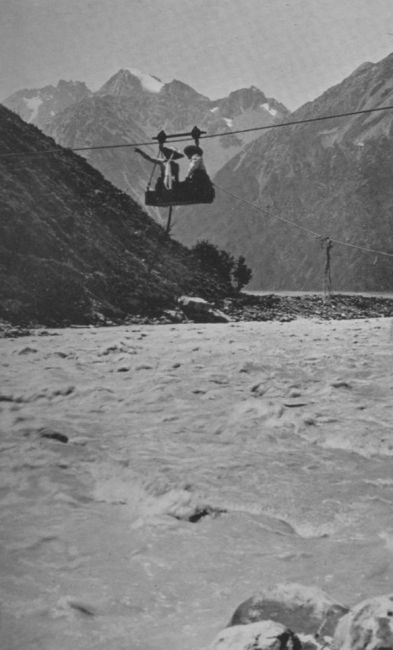
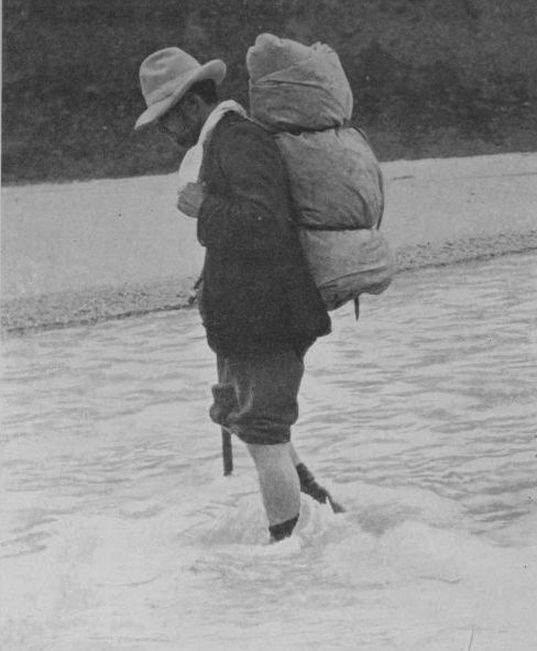
to the farther shore, while I got into a small wooden
cage, that dangled high above the roaring torrent,
and laboriously pulled myself over to the other side.
The pack-horse was taken as far as the terminal
moraine of the Tasman Glacier. Beyond this it was
impossible to proceed with the horses, and the packs
had now to be transferred to our own backs. They
looked, indeed, a goodly pile.
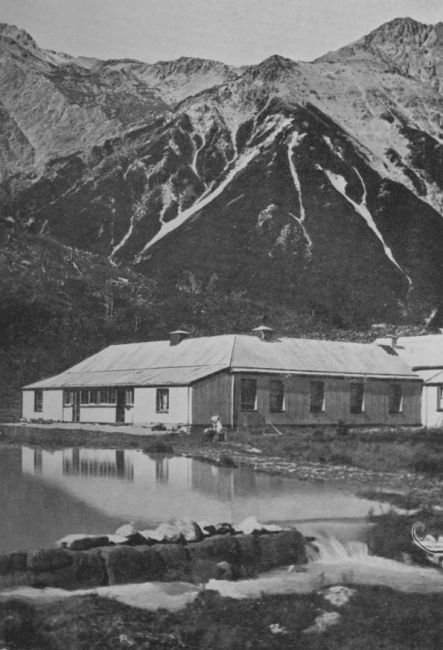
The Hermitage.
Twenty-five lb. of biscuits, 12 lb. of tinned meats,
2 loaves weighing 14 lb., 4 lb. of oatmeal, 8 lb. of
butter, 4 lb. of jam, 1 shoulder of mutton, 2 lb. of
onions, 2 lb. of tea, 1 lb. of cocoa, 1 lb. of coffee,
4 lb. of sugar, 1 lb. of salt, 4 tins of sardines, and a
few pots of Liebig constituted the bulk of our provisions.
In addition to this, there were the 2 tents,
3 sleeping bags, 1 opossum rug, 1 large sheet of
oiled calico, 2 ice-axes, 1 alpenstock, 100 feet of Alpine
rope, billies, spirit lamp, lantern, aneroid, thermometers,
and several other smaller articles, which all
went to make up weight. Before us was the long
moraine of the Great Tasman Glacier, and over this,
for a distance of seven or eight miles, all these articles
had to be carried on our backs. It was no joke. We
knew that the undertaking was rather a difficult one,
but had no idea how difficult it would be. Annan
selected from among the articles a swag weighing
about 50 lb. I made up one that would be probably
10 lb. lighter, and, covering up the remainder with
the oilcloth sheet, at three o’clock we started off,
hoping to reach Green’s Fifth Camp that evening.
Profiting by the experience of the Rev. Mr. Green
and Dr. von Lendenfeld, we made no attempt to
get on to the clear ice in the middle of the glacier,
but kept to the rocks on the side of the lateral
moraine that runs for miles parallel with the great
southern arête of Mount Cook. There was fair walking
for some little distance till we passed the group of
tarns of a peculiar greenish colour at the end of the
moraine. Then the rocks got rougher, and were piled
in wilder confusion as we proceeded.
Of this same route Mr. Green says: “The lateral
moraine, standing up like some great battlement
shattered in the war of the Titans, was composed
of huge cubes of sandstone and jagged slabs of slate,
some over 20 feet a side, and ready at any moment
to topple over and crush our limbs.” We found
scrambling over these rocks very hard work on such
a hot afternoon, but made good progress, and soon
found ourselves at the Blue Lake, where Mr. Green
weathered out a very severe storm on his first trip
up the Tasman. Just before reaching the lake there
was a bad bit of travelling through thick scrub,
which Annan had not looked forward to with any
great degree of pleasure; but on reaching the spot
we found that a large slip had come down from the
moraine, exposing the clear ice of the glacier, and
completely covering the scrub for a distance of about
100 yards with morainic accumulation. The ice was
quite near, from which it would appear that there
was more live moraine than Dr. von Lendenfeld
imagined. The slip gave us fairly good walking,
but we had some difficulty in getting through the
last bit of scrub at the Blue Lake. Beyond this we
had to cross the débris of a great talus fan that came
down from the mountain-side, and then we came to
a piece of level ground, between the moraine and the
mountain-side, which afforded the only real bit of
easy walking in the whole journey. This flat—about
a quarter of a mile long—was covered with large
tussocks, spear grass, veronicas, and a wealth of
celmesias. Ahead the moraine continued its course,
in the words of Mr. Green, “looking like some great
railway embankment in the symmetry of its outline.”
Here we made our first acquaintance with that strange,
curious, impudent, and interesting bird the kea. A
number flew down from the lower slopes of the great
mountain ridge and regarded us with a wondering
curiosity. I took the precaution to bag a brace as
a welcome addition to our larder, but with some
considerable measure of regret, for though in the
surrounding districts the keas kill the sheep in the
most cruel manner, they are nevertheless fascinating
and handsome birds. Our tent was pitched that
evening in a lonely spot between the moraine and
the great shoulder of Mount Cook, here clothed with
an interesting variety of sub-Alpine vegetation. For
this purpose we used the tent poles and the survey
chain left here by some of the early Alpine explorers.
We spent a cold night, and next day, while I returned
to the Hermitage for my wife, Annan swagged up the
rest of the provisions.
On the morning of Sunday the 1st April—rather
late in the season—my wife and I said good-bye to our
friends at the Hermitage, and started on foot for our
camp at the Ball Glacier. It was hard work pulling
the two of us across the river in the cage, as the pull
to the other side was an upward one; but, after much
exertion, and many splinters in my hands from the
rough Manila rope, the other side was reached in safety.
As we landed, two young fellows from the Hermitage
approached and beckoned us to send the cage back
across the river to them. This did not exactly suit
our book, as, in the event of their taking the cage back
with them, we should be stranded on the Tasman side.
So we tied it securely to the post on our side of the
river, and continued on our journey. But before we
had gone very far we were astonished to see one of the
young fellows commencing to scramble across the river
on the wire rope to get the cage, so that he might take
his companion over. One could not help admiring his
nerve and daring; but we were more concerned about
our own faring should he leave the cage on the wrong
side of the river for us. However, we proceeded on our
journey, and, after an hour’s march, reached a deserted
shepherd’s hut, where we found Annan with a billy of
refreshing tea awaiting our arrival.
The hut was rather an uninviting place, being dirty,
and having no door nor window, in addition to which
it was inhabited by rats. A short council of war was
held, and, as it was early in the day, and the walk up
the Tasman moraine on the morrow was rather a big
undertaking, we decided not to stay at the hut, but to
proceed as far as we could, and sleep out in one of the
hollows between the glacier and the mountain. Accordingly
we started for a point two miles distant, at
the edge of the glacier, where Annan and I had left part
of our stores on the way up. Having adjusted our
swags, we were soon on the march, scrambling over the
boulders of the moraine. Our progress was slow, both
Annan and myself having heavy swags, while my wife,
though displaying great pluck, had not yet got used to
the acrobatic feats necessary to the keeping of one’s
balance on the unstable boulders of the moraine.
We had a particularly lively time of it in the scrub
at the Blue Lake; and my wife’s jacket, which was tied
to my swag, had been torn off, and was lost among the
bushes.
It was a sweltering hot day, but we toiled on, and
towards evening reached the celmesia flat, where Mr.
Green had pitched his third camp. My wife was by
this time very tired, and so, while I gathered some sticks
and made the tea, she sat on a rock wrapped in the
’possum rug. Annan decided to go on to the camp and
come down again to have breakfast with us early next
morning. We were now close to the ice, and after tea,
as it began to get very cold, I set about to look for a
good spot for our bivouac. A hundred yards farther
on some scrubby totara bushes and a stunted Alpine pine
grew close in to the glacier, and under the latter, after
a hurried inspection, we decided to camp. Its branches
would be some protection against the wind, should it
come on to blow, and, in the event of rain, they would
also keep us fairly dry. Some branches were cut for a
mattress, and over that we put tussock grass. On top
of that we spread the waterproof sheet, and lying down
on that—with our clothes on, of course—pulled the
’possum rug over us and sought a well-earned repose.
We both dozed off, but presently were awakened by a
shrill scream. It was only the call of a kea far up the
mountain-side. Over the cold white snows on the
shoulder of Mount Cook, one solitary cloud hung, fringed
with the gold of the setting sun. Later the moon shone
brilliantly through the clear frosty air, and the peaks
became silhouettes against the horizon. A rock avalanche
rattled down the side of the glacier. From across the
narrow flat came the cry of the mountain parrot; and
a weka that had crept close to our heads under the
branches startled us with a loud screech. Then again
all was silent—silent as the tomb. Presently two other
visitors made a friendly call upon us: two tiny wrens—absurd
little things, with hardly the vestige of tails.
They perched on the branches just over our heads, so
close that we could have ruffled their feathers with our
breath. They hopped about from twig to twig, speaking
to us in their soft, low bird voices; and, having studied
us from every point of the compass, they decided to give
us up, and went off to roost in a totara bush. At last
we also went to sleep, and, making due allowance for
the hardness of our couch and the strange surroundings,
managed to get a fairly good night’s rest. When we
awoke in the morning the frost lay white on the bushes
around us, save within a radius of a foot or two, where
the heat from our bodies had melted it, or prevented it
from forming. The temperature had fallen to 26° Fahr.
On the way up we took down a reading of 80° in the
shade, so that there was thus a drop of no less than 54°
in a few hours! I was astir before sunrise, and on going
back to the Blue Lake for water to boil the billy the
garrulous Paradise ducks gave me a vituperative reception,
while the solitary mountain duck quacked a milder
remonstrance. A shot from my pistol made them think
discretion the better part of valour, and while the Paradise
ducks took wing the grey duck scuttled off down
stream in a great hurry. After a short search, I found
my wife’s jacket frozen hard to the bushes, and, filling
my billy, returned to the flat. On the way up I gave
a jodel that was answered by Annan far up the moraine,
and in a few minutes he had rejoined us. We breakfasted
together, and shortly after 9.30 were once more
on the march. All the way up the valley we had been
getting glorious glimpses of the Mount Cook chain, and
De la Bêche, with its sharp peak and minarets of spotless
snow, seemed to be ever beckoning us onward.
Towering in the distance above the dull grey line of the
great moraine, gleaming gloriously in the sunshine of
early morn, tinted with the soft rose of the after-glow,
or looming coldly in the mystic moonlight, this mountain
seemed ever beautiful in outline, majestic in form. Even
the moraine was interesting, clothed as it was, in places,
with a great variety of Alpine plants, while structurally
it was always something to marvel at, if not to swear at.
“It is,” says Dr. von Lendenfeld, “larger than the
moraines are in the European Alps, the cause being
the slower action of the New Zealand glaciers, and the
peculiarity of the rocks which surround them. There
are very few places to be found where the rocks are so
jointed as they are here. They are split along the
different joints into polyhedric masses by freezing water;
they fall on the glacier and are carried down the valley.
Ceteris paribus, the slower the glacier moves the more
moraine will accumulate. For miles no part of the
glacier is visible through the moraine.” The glacier
does not block up the whole valley, there being quite a
large space between it and the mountain-side, except,
in places, where great talus fans come down from the
corries to meet the live moraine of the glacier. Far
away on the right were the rocky peaks and hanging
glaciers of the Liebig and Malte Brun Ranges, and in
between them the Murchison Glacier, once a tributary
of the Tasman, but now shrunken up its own valley for
a considerable distance.
On our left we passed a high waterfall, and, nearing
a spot known as the Cove, came across a small iron
stove—a relic of the Lendenfeld expedition, abandoned
early in the journey as being, no doubt, a luxury too
heavy to be carried over this rough ground. We had
a rest at the Cove, and whiled away half an hour with
a shooting match, in which my wife proved herself
a good markswoman. A little farther on we had
luncheon—bread and sardines, with a pannikin of tea,
again being the bill of fare. After this, there was
some difficult scrambling over great rocks, many of
which were so loose that we dare not put our weight
on them for more than a second. We toiled on in
the heat of the afternoon, and reached the camp at
half-past three o’clock. While I pitched the second
tent Annan and my wife set about the camp cookery,
the latter making a glorious stew from mutton and
onions, with a few other ingredients. That was
twenty-three years ago, but the memory of the feast
remains with us still. No French chef ever made
ragout that was welcomed so eagerly, or that disappeared
so quickly. That night we piled on all the
clothes we could—in addition to those we had on.
We could hear the rocks rattling down the face of the
glacier just opposite our tent—a couple of hundred
yards distant—but King Frost held the glaciers themselves
in his cold grip, and there were no avalanches
after nightfall. Being too tired to pay much attention
to the screaming of the keas, we soon fell asleep.
CHAPTER III
IN THE OLDEN DAYS—concluded
“We walked in the great hall of life, looking up and around
reverentially. Nothing was despicable—all was meaning-full; nothing
was small, but as part of a whole whose beginning and end we
knew not.”—Carlyle.
Next morning, though the barometer had fallen
ominously, Annan and I set out to climb the Hochstetter
Dome. We toiled across the crumbling
moraines of the Tasman, the Ball, and the Hochstetter
Glaciers, and gained the clear, hummocky ice of the
latter—one of the finest sights in the Southern Alps.
It issues forth from the great ice plateau at the
foot of the higher precipices of Mount Cook, descending
in a wonderful cascade of broken ice for over
3000 feet. It cuts into the Tasman at an angle of about
45 degrees, and, the two glaciers flowing onward and
not pressing very closely together, there remains a
deep chasm between them. After proceeding a few
miles, we find that there are two series of crevasses—one
formed by the pressure of the Hochstetter Glacier
causing the ice on the western side to move faster than
that portion of the glacier abutting on the Malte Brun
Range, while another series is caused by the bending
round of the main ice stream in a grand sweep between
Malte Brun and De la Bêche, forming long crevasses
which run across the glacier on its convex side.
The sun shone out brightly, and the glare from
the white ice was so dazzling that we had to keep on
our goggles to avoid snow-blindness. A little beyond
the Hochstetter Ice Fall we halted to admire the view.
Down the valley we could see the lower part of the
Ball Glacier. Right in front lay the gleaming ice
slopes and dark precipices of Aorangi, towering up,
and culminating in the tent-shaped ridge 8000 feet
above us; and down from the great ice plateau,
between the south-eastern spur of Mount Cook and
the Tasman spur, the Hochstetter Ice Fall poured its
beautifully coloured cascade of broken ice, in spires and
cubes and pinnacles—a wonderful sight—till it joined
the Tasman, on which we now stood. Every few
minutes great masses of ice were broken off with the
superincumbent pressure, and went thundering down
with loud roar over a precipice on the left. Half a
mile farther on was the Freshfield Glacier, and over
the bold rocky spur on which it rested appeared the
ice cap of Mount Tasman. Then came the glorious
mass of the Haast Glacier, in sunshine and shadow;
and beyond this again other glaciers and peaks in
bewildering number and variety. The ruddy buttresses
of the Malte Brun Range bounded the view across the
glacier on the right. Words fail to do justice to a
scene of such exquisite beauty and grandeur.
“I tried vainly,” says the Rev. Mr. Green, “to
recall the view in Switzerland on the Great Aletsch
Glacier in front of the Concordia Hut to establish some
standard for comparison. Then I tried the Görner
Glacier, on the way to Monte Rosa, but the present
scene so completely asserted its own grandeur that
we all felt compelled to confess in that instant that
it surpassed anything we had ever beheld!”
While we were gazing the clouds increased, and a
chill wind sprang up. The higher peaks were becoming
obscured in the clouds. It was evident that a storm
was brewing. It would have been madness to tackle
the Hochstetter Dome, so we left our swags behind,
and, taking only the ice-axes and the rope, made a
bolt for De la Bêche, to see what we could of the
upper portion of the glacier. We made good progress
over hummocky ice, and at last, when opposite
De la Bêche, obtained a glimpse of the Lendenfeld
Saddle. A fine unnamed glacier coming from
the shoulder of Mount Spencer I named the Forrest
Glacier, after my wife, who, by her pluck and endurance,
had conquered all the difficulties that lay between us
and the enjoyment of this scene of Alpine grandeur.
Then we took a last longing look at the glorious
amphitheatre of mountains, and, turning our faces
campward, beat a hasty retreat. It was a pleasant
surprise to my wife to see us back in camp that afternoon.
But I had better let her tell her own story.
“In the morning,” she writes, “I was wakened by
Annan’s stentorian voice giving vent to a poetic and
sentimental ditty, of which the following is the only
verse he ever favoured us with:—
‘There’s the lion in his lair,
And the North Polar bear,
And the birds in the greenwood tree,
And the pretty little rabbits,
So engaging in their habits—
Who’ve all got a mate but me!’
“To judge from the boisterous cheerfulness of the singer
his lonely condition did not trouble him much. Backwards
and forwards he went, preparing breakfast, and
various ditties furnished amusement to us for at least
half an hour. Our breakfast menu differed little from
that of any other meal, I always taking biscuit in
preference to a stratum from the pre-Adamite loaf
poor Annan had carried up with many groans, and
coffee or tea always forming an adjunct to the meal,
whatever it might be. After breakfast, my husband
and Annan made preparations for their tramp onward
up the glacier. This I had dreaded, for it meant
leaving me for two nights and two days alone in the
camp. Many a moan was made over me by my
friends before we had started on our trip. One had
suggested that I should certainly stay, in preference
to stopping in the camp by myself, at the nearest
station. The Tasman Glacier does not, however,
abound in stations, the nearest human habitation being
the Hermitage, fourteen miles away! I had long ago
come to the conclusion that investment in land on the
moraine would not be a paying concern. Another
timid soul had placed before me the horrible position
I should be in were a tramp to walk into the camp and
surprise me. We were tramps ourselves, I reflected,
and other people as adventurous or as mad—some
may consider the adjectives synonymous—we were not
likely to encounter. As regards burglars and fire I
was safe, and in fact there was absolutely no danger;
but, for all that, I had a very uncomfortable feeling as
I watched my two protectors packing up their traps.
Beyond our camp there was no timber of any kind, so
they could light no fire, and unfortunately the spirits
of wine had been left behind. They would therefore
have to make the best of cold victuals while they were
away, and console themselves with the cheerful prospect
of hot coffee and savoury stew on their return to camp.
Then again, as they had a difficult road to travel, they
had to take as few impedimenta as possible; so they
limited themselves as to provisions, and carried in
addition only their sleeping bags and the Alpine rope.
“At about ten o’clock we passed round the stirrup-cup
in the shape of a steaming billy of tea, and off
they started, after having made everything as snug
as possible for me. I watched them walking along
the moraine and scrambling to the top of the ridge.
There they stopped, turned round, waved their caps,
gave a hearty cheer, to which I feebly responded as
I watched them disappear over the edge. I was now
alone, and a kea from the cliff above screamed
derisively at me as I stood for a moment gazing at
the place where I had last seen my companions.
Work I decided was the best remedy for loneliness,
on the principle that Satan—in this case taking the
shape of Melancholy—finds some mischief still for
idle hands to do. So I tidied up the two tents, piled
more wood on the fire, and sat down in the sunny
doorway of our tent with my fancy work. I could
hardly help smiling, so incongruous did fancy work
seem with the wonderful scene around me; but for a
time it took my thoughts off my position, although
my hands lay often idle in my lap while my eyes
feasted on the surroundings. It was about eleven,
and sunshine was pouring down on the level where
our tents were pitched, making the glossy green
leaves of the mountain lilies glisten, and turning the
tussocky flat into a golden plain. In front stretched
the grey moraine wall, and on the other side the spur
of Mount Cook, clothed near its base with luxuriant
vegetation. As I cast my eyes up its steep face I
caught sight of a totara bush, whose tiny red
turpentine-flavoured berries had been my joy in
happier hours. Up I mounted, very gingerly, to
where the bush hung between two great grey rocks,
but somehow the berries had lost their flavour, and
I did not enjoy them. So I sat me down on one of
the big stones and ruminated on my position. Three
days seemed a lifetime, but two nights an eternity!
In vain I remonstrated with myself, and reflected how
much worse it would have been had I been cast on a
desert island ‘where tigers and snakes prevailed,’
and I tried to recall all the cases of lonely shipwrecked
maidens I had read about, for consolatory
purposes, but it was of little use. I knew quite well
that there was absolutely nothing to fear, but it was
the horrible loneliness and silence that oppressed me,
added to the fears I felt for my companions’ safety.
Should one slip happen, I thought the rope would be
of little avail, for one would not be able to bear the
weight of the other, especially if it came with a
sudden jerk, and I remembered the warnings against
only two going on Alpine expeditions. Altogether
my reflections were of no enviable character as I sat
high up on the cliff, looking down on our two white
tents and blazing camp fire, and across at the Malte
Brun Range, towering over the grey battlement,
looking very black against the blue sky, except where
the white glaciers seamed its rugged sides. When I
got down to the level I took a lonely meal, and again
sat down to work. By this time a slight breeze had
sprung up, and some ominous-looking clouds were
banking up towards the north. But I thought little
of that at first. Then the weather grew more
threatening, some raindrops fell, the wind flapped
the sides of the tents, and blew the dead ashes of my
camp fire across the tussocks. I had not the heart
to re-light it, had I the matches to waste over the
attempt. I possessed but eleven, for one box had got
wet, and our supply was very scant, so I determined
to let it remain out. Stronger and stronger blew the
wind, darker and darker grew the sky, and by this
the head of the glacier was closed up with mist and
cloud. Evidently a storm was brewing, and in the
direction in which the adventurers were going. I
knew a snowstorm might come on quite suddenly in
these parts, and I was not versed in the mysteries of
tent-pegging. Awful thoughts of my husband’s return
to find my prostrate form under the collapsed
tent came before my mind as I retired inside and
coiled myself up in the rug. Some time after, I went
out to take another look at the weather, and I was
standing forlornly gazing round, when, to my delight,
I heard a cheery yell from the ridge, and saw two
tiny black figures silhouetted against the grey sky.
You may be sure I bustled around after echoing a
welcome, and by the time the two travellers had
reached the camp the perennial stew and billy of tea
were ready to be enjoyed.”
We also were glad to be back in camp. It was
well we turned back, for that same night there came
on a terrible storm. The wind rose from the north-west,
and blew with such force that we thought every
moment the tents would be torn to ribbons. We
strengthened them with the spare rope, and put heavy
stones all round the canvas on the ground outside.
Hour after hour the gale roared furiously; sleep was
out of the question. High up the mountain spur we
could hear the wind howling and tearing the Alpine
foliage in its fury. Then it would swoop down on
our tent and send the sides flapping with reports
like pistol shots. Again, it would cease for a moment,
as if to catch breath, only to come swooping down on
us with even greater vengeance. After what seemed
a very long time, I looked at my watch and found
that only two hours had gone by. The barometer
still gave a very low reading, and it was evident that
we were in for a bad time. Soon after midnight the
rain came on, and the force of the wind beat it
through the tent. I rigged up a hood over my wife’s
head with my waterproof coat and the tin in which
the biscuits were. Then, tying our caps down over
our ears, we coiled up in the ’possum rug and once
more tried to sleep. But the wind howled and the
rain beat on the tent, and sleep was out of the
question. Twice during the night I had to get up,
tighten the ropes, and put bigger stones on the sides
of the tent to prevent its being blown clean away.
For twelve hours we lay listening to the fury of the
storm, and at last the dawn came. Never were we
more pleased to see the first streaks of daylight. The
weather gradually improved, and though it was a
showery afternoon we made a successful expedition up
the glacier, so that my wife might not go away without
seeing the Hochstetter Ice Fall and the beauties of the
Upper Tasman.
Wonderful as were the many sights close to us, it
was when we lifted our eyes to the Hochstetter Ice
Fall that the true grandeur of the scene impressed us.
From Mount Cook came a mass of broken ice, gigantic
cubes, and pinnacles, of the most exquisite and dainty
colourings, ethereal blues and greens. Down 3000 feet
the great frozen cataract poured its masses of ice, ever
moving, yet to our eyes in perpetual rest. Even while
we looked a thundering roar, that had grown familiar
to our ears for the last two weeks, rent the air,
as, over a black face of the cliff that breaks the
cataract, and serves to heighten the beauty of its
colouring, a great mass of ice crashed to the foot of the
mountain.
That evening we had a variety entertainment in
our tent. We started with a shooting match, taking
for our target a small tin fixed on a rock in front of
the doorway. When it got too dark to see our mark
we lit the lantern, played spelling games, told stories,
and talked over the feats of our illustrious predecessors
on the Tasman Glacier. As a great treat, on our last
evening in Green’s Fifth Camp, we had all the onions
left boiled for supper, with a little salt, and they were
delicious. Whether it was the effects of these or the
fatigue of our walk, I do not know, but, though it
rained that night too, we slept profoundly, and heeded
not the elements.
Morning came misty and grey, but towards nine
o’clock the sun came out brilliantly, and the mist rose,
showing us the mountains covered with fresh white
snow. We determined to press on to the shepherd’s
hut, at least, that day, as the weather was too unsettled
to risk staying longer. Standing for a moment
on the crest of the moraine, we looked down on the
little flat where we had spent such a jolly time. The
wet leaves of celmesias, senecios, and mountain lilies
were flashing back the glittering sunlight, the dying
smoke of our camp fire drifted lazily across the face
of the cliff, and a kea screamed a derisive farewell to
us as we took a mental photograph of the scene.
Then we reluctantly turned our backs upon it and our
faces once more to the grey moraine. The hut was
reached early in the afternoon, and we decided to continue
our journey to the Hermitage. On arriving at
the Hooker we found that the cage had been left
on the other side, and could only be pulled over part
of the way. This was a sore disappointment. There
was nothing for it but to retrace our steps to the
Mount Cook Hut, or for me to crawl along the rope
and secure the cage. We chose the latter alternative,
and, while my wife averted her gaze, I crawled along
the wire rope and scrambled down into the cage, which
I managed to pilot across in safety. Both of us then
got in and started across, but we had a fearful time of
it, as the pulling rope had got into the current, and it
was only with the greatest exertion that we managed
to extricate it. We were half an hour in crossing the
river, and reached the Hermitage in the darkness, after
what was, for a woman, in those days, a wonderful
journey down from Green’s Fifth Camp.
Crossing the Hooker.
One morning, soon after our return to the Hermitage,
I found myself basking in the warm sunshine,
dividing my attention for the most part between a
book and a cigar, and occasionally gazing up at the
ice cliffs of Mount Sefton, from which, every now and
then, great masses broke away and came tumbling over
the precipices with thundering roar. I was joined by
Mr. Huddleston, the keeper of the Hermitage, who
suggested a climb on the Sealy Range, so, next morning,
I started on a lovely mountain ramble. It was
a glorious day, and the glaciers at the head of the
Hooker were gleaming in the sunlight, while the long
southern arête of Mount Cook, right up to the summit,
was in shadow, and there was one patch of glistening
white on the top of St. David’s Dome. Mount
Sefton, with the broken ice of its hanging glaciers, was
resplendent in full sunshine; and every now and
then a great avalanche thundered down from the
highest slopes. The mocking-birds were singing in
chorus to the tuis’ liquid song, and the beat of the
hammers on the roof of the new buildings at the
Hermitage was borne up through the still air. Halting
for a spell at a little lakelet high on the shoulder of
the mountain, I chanced to look up, and was surprised
to find someone on the rocks above me. He turned
out to be the lad who had so daringly crossed the
Hooker River on the wire rope a few days before.
He had been employed in connexion with the new
building at the Hermitage, and, lured by the beauty
and the grandeur of these mountains, had climbed
from the valley to get a better view. I offered to
share my luncheon with him, and he was easily persuaded
to accompany me on my scramble, and I,
untutored climber that I was, made bold to give him
his first lesson in mountaineering. He told me his
name was Fyfe. It was a name destined to play
no inconsiderable part in the history of New Zealand
mountaineering, and I little knew then that in the
years to come we two should be in many tight corners
together on the giant peaks of these great ranges, and
that there would arise situations in which the life of
each would depend upon the skill, the coolness, and
the courage of the other. Yet so it was. But in this
day’s work there was not much adventure, and all we
did was to reach a point from which the view amply
repaid us for our toil. Many fine peaks and glaciers
were in sight, and the rivers lay in the great hollows
between the ranges like thin threads of silver. In the
midst of it all rose the buttresses of Aorangi, pile on
pile, to where its summit snows gleamed in the setting
sun. Far away, on the other hand, in the yellow
tussock plains of the lower country, lay the lakes—jewels
in a setting of dull gold. One began to realize
that there were sermons in stones, and that this was
a cathedral in which one might hear them. Certainly
no cathedral floor of marble was ever so white as the
snowy sunlit floor on which we trod, and no cathedral
dome so vast as the blue above; while about us were
the massive flying buttresses of the mountain ranges
supporting the higher peaks and domes of snow. It
required no stretch of the imagination to look back
adown the aisles of time to the days when greater
glaciers carried their burden of grey moraine across the
distant plains, and even to the sea itself—to the days
when still higher peaks “towered vast to heaven.”
The mills of the gods were still grinding up here, and
the mountains were crumbling before our eyes; but,
lower down, the beautiful sub-Alpine flora clothed their
sides—silvery-leaved celmesias, and many other flowers
and plants, with the golden-eyed ranunculus, wet with
a passing shower, gazing up into the eye of the sun.
Perched up there, in the midst of it all, away from the
hum of cities, “the earth had ceased for us to be a
weltering chaos. We walked in the great hall of life,
looking up and around reverentially. Nothing was
despicable—all was meaning-full; nothing was small,
but as a part of a whole whose beginning and end we
knew not.”
From this reverie was I awakened by an avalanche
crashing down from Sefton’s steep slopes. We turned
and glissaded over the snow, lost our way in the dark,
lower down, and eventually arrived at the Hermitage an
hour after nightfall. My companion was thankful for
the darkness, for some of his garments had been sorely
tried in the descent, and he badly needed a cloak.
One other scramble, an unimportant first ascent,
and my holiday was at an end. Thus fell I in love
with those beautiful mountains, on whose great glaciers,
steep ice-slopes, and grim precipices I was, in after
years, to spend many jocund days and some bitter
nights. There have been glorious mornings when we
shouldered our packs and strode boldly and joyously
out into the unknown. There have been days when
success met us on the mountain-side, and, grasping us
warmly by the hand, led us to the almost inaccessible
places, and persuaded the higher crags and snows to
yield up their inmost secrets. And there have been
other times when angry storms, resenting the intrusion,
have chased us incontinently back to tent or bivouac.
Days, too, when the higher snows, “softly rounded as
the breasts of Aphrodite,” in return for all our wooing,
have given us but a chill response. Yet the sweet has
been very sweet, and the bitter never so sharp that it
could not be endured with fortitude, if not altogether
with indifference. And, throughout all our guideless
wanderings—and I write it down here with some little
pride—no accident has occurred to mar the happiness
of a generation’s climbing.
CHAPTER IV
THE CONQUERING OF AORANGI
“If at first you don’t succeed,
Try, try again.”
Green’s memorable visit in 1882, in company with two
Swiss climbers, Emil Boss and Ulrich Kaufmann, fired
the enthusiasm of a number of young New Zealanders,
who hoped to succeed, where he had just failed, in
reaching the actual summit of Mount Cook, or, to
give it its more romantic Maori name, Aorangi. But
Aorangi, entrenched behind his ramparts of ice and
frowning buttresses of rock, bade defiance to these
inexperienced though daring Colonial pioneers in
Southern mountaineering. However, though we had
to contend against many difficulties, we were gradually
learning the craft, and there were several determined,
if possible, to win for New Zealand the honour of the
first ascent of New Zealand’s highest mountain. Some
there were who swore not to raise the siege so long as
Aorangi remained unconquered, and stout hearts and
sturdy thews remained to battle with the difficulties.
Up to the time when the writer took a hand in the
game some ten expeditions had been organized, and the
peak still remained unclimbed. In 1894, after the
failure of Mannering’s party in the previous season, a
solemn compact was entered into by three members of
the New Zealand Alpine Club to spend their summer
holidays in making one more attempt to reach the
summit of Aorangi; and, spurred into activity by
the news that an English climber, with the famous
Zurbriggen, was to leave England in October on an
expedition to the Southern Alps, a party was hurriedly
organized, and arrangements made by telegraph. Many
members who were anxious to take part in the expedition
could not, however, for one reason or another,
get away, and Dixon had no fewer than seven refusals
from climbers who had at one time or another expressed
their willingness to join him. Finally a party consisting
of Mr. M. J. Dixon, Mr. Kenneth Ross, and the
writer decided to make the venture, and arranged to
meet at Fairlie Creek, the terminus of the railway, on
the evening of Monday, November 5th.
On arrival at Timaru we were surprised to find
there, awaiting our arrival, Mr. T. C. Fyfe, who we
thought was at that moment with Mr. A. P. Harper
endeavouring to cross over from the West Coast by way
of the Franz Josef and Kron Prinz Rudolph Glaciers
into the Tasman. Mr. Adamson, the manager of the
Hermitage, was also there. They greeted us with rather
depressing news. Fyfe was doubtful if he could join
our party, and Adamson assured us that we could look
for neither provisions nor assistance at the Hermitage,
which was practically closed “pending reconstruction of
the company.” On every hand, too, we were met with
discouraging cries of “Much too early in the season for
climbing”; but, confident in our own judgment, we
kept on our way undaunted, and at Fairlie Creek, found
Dixon awaiting us with a wagonette and three horses,
which he had chartered for £10 to take us to Mount
Cook and back. We waited only for tea at Fairlie,
and proceeded at once on the first stage of our journey—fourteen
miles—to Burke’s Pass. Arriving there at
10.30 p.m., we compared notes as to provisions, equipment,
etc., and sorting out what we did not require,
each man packed his swag for the expedition. On
Tuesday we were up at 4 a.m. and on the road three-quarters
of an hour later. There had been a garish red
sky just after the dawn, and now, as we began to
ascend the slopes of the pass, a puff of warm wind met
us and gave ominous warning that a nor’-wester was
brewing. The nor’-wester, which is equivalent to the
dreaded Föhn wind of the Swiss Alps, is the bane of
New Zealand climbers, as it generally ends in rain, and
often softens the snow and brings down innumerable
avalanches from the higher slopes. We could only hope
that this was a false alarm, or that, if a nor’-wester did
come, it would be a baby one and blow over before we
reached our objective. Scarcely could we realize that
the child would grow into the giant he subsequently
did.
We reached Lake Tekapo at 9.30 a.m., and, after
stopping to get a shoe on one of the horses, resumed
our journey. At Braemar we intended to camp for the
night, in the hope that the Tasman River would be
fordable early next morning. Shortly after midday
we halted at a mountain stream to feed the horses and
boil the billy for lunch. All around us were undeniable
signs of the older glacial period, when the Godley and
the Great Tasman Glaciers met on the Mackenzie Plains,
and, uniting, flowed on in one grand ice-stream towards
the Pacific. On either side were vestiges of old
moraines, now grass-grown, and great rocks that had
come down on the ice from the higher mountains.
Crossing the Tasman.
Camp Cookery.
We arrived at the Tasman River early in the afternoon,
and, finding it low, decided to go on past Braemar
and cross opposite Glentanner station. The river-bed
here is some four miles across, and the water flows over
it in several branches. We had some difficulty in finding
a ford, and, at one spot, got into the treacherous
quicksands in which the bed of this dreaded river
abounds. In a moment the horses were up to their
knees in it, and the trap wheels sank nearly to the axle.
Having no desire to repeat Mr. Green’s experience of
leaving his wagonette in the river, the whip was
vigorously applied, and, the horses willingly responding,
we just succeeded in getting through to firm ground.
Finally we managed to cross the many-channelled river
without accident, and halted at Glentanner sheep-station,
where we were hospitably entertained. Here inquiries
were made as to whether we could obtain a porter to
assist with the swagging, and were gratified to find
that the manager was that day paying off a station
hand who would be likely to afford the necessary
assistance. The manager was empowered to engage
him in our behalf and to send him on after us, his
wages to be £1 a day. We also added to our provisions
here by purchasing half a sheep, and after a cup of tea
and a spell of three-quarters of an hour, proceeded on
our journey up the Tasman Valley, intending to camp
that night near the wire rope that spans the Hooker
River at the end of the southern spur of Mount Cook.
By the time we got to Birch Hill the weather was so
threatening that it was deemed wise to call a halt, and
no sooner had we got the things out of the trap than
the rain started to come down in torrents.
Next morning by seven o’clock the storm had
cleared sufficiently to allow us to proceed, so, after
a hurried breakfast, we started off in the direction
of the Hooker River, first taking the precaution of
getting the shepherd to kill a sheep to take up to
Green’s Fifth Camp in case we should be delayed there
by bad weather. The ground became rougher and
rougher as the journey progressed, and, at last, we
were brought to a dead stop through breaking the
pole of our wagonette. This caused a vexatious
delay, as every hour now was valuable, seeing that it
was our intention to push on past the Hermitage and
the hut at Green’s Fifth Camp, fourteen miles farther
on, and pitch our tent some miles up the glacier at
the foot of the Spur, below the Mount Cook Bivouac.
However, there was nothing for it but to set to at
once and repair the damage, and pack our belongings
on one of the horses, to the cage on the wire rope that
spanned the Hooker River. Accordingly, the horses
were quickly unharnessed, and Dixon and our Jehu,
on the other two horses, galloped up to the Hermitage
for material to splice the pole, while Kenneth and I,
with our porter—who had joined us the night before
at Birch Hill—packed all our things up to the Hooker
River. Arrived here, however, we found the manila
rope, with which the cage is worked, broken, and one
end jammed amongst the boulders in the bed of the
river on the other side. Kenneth and I, however, got
into the cage, pulled ourselves across, hand-over-hand
on the cable, and secured the broken rope, which we
spliced to the one on the other side. In this way we
restored communication, though, owing to the rope’s
being single instead of double, the cage could be pulled
across only with great exertion. All these, however,
were minor difficulties, which we brushed lightly aside,
determined that no ordinary obstacle should hinder
our ultimate progress. Just as we were preparing to
get the swags across by means of the cage, we espied
Dixon leading the old pack-horse from the Hermitage
in our direction, and, as we could trust this animal
in the river, we waited, and, transferring the swags
to her, I got one of the other horses and led her across
the river. Kenneth and our porter crossed in the
cage, the latter being so frightened that he was not
able to pull a pound on the rope. Dixon returned to
the trap to mend the broken pole, and he and the
driver followed us, later, on the other two horses.
The rough journey up to the hut at Green’s Fifth
Camp was uneventful. The weather was fine, and the
views ahead were strikingly beautiful. Dixon hurried
ahead to make a pair of “ski,” which he fashioned in
a most ingenious manner out of a couple of long
palings and two short pieces of zinc. We were
depending on these “ski” to take us safely and expeditiously
over the dreaded deep snow of the great
plateau above the Hochstetter Ice Fall. They were
simply snow-shoes made of wood four inches wide and
six feet long, and similar to those used by Nansen in
his expedition across Greenland. Dixon had, the
previous year, left two pairs on the rocks of the Haast
Ridge above the plateau, and these we hoped to find,
the third pair being required for Kenneth. A halt
was called at the hut for tea, and, late in the evening,
we started with the intention of crossing the Ball and
Hochstetter Glaciers and camping at the foot of the
Tasman Spur. It was a fine night, but no sooner had
we shouldered our swags than ominous clouds were
seen swirling over the shoulder of Aorangi. Dixon
doubted the wisdom of proceeding, and our porter said
he would much sooner wait till morning; but after a
little deliberation I urged an advance, and slowly, in
single file, the expedition trooped over the rough
moraine hillocks of the Ball Glacier. The clear ice of
the Hochstetter Glacier was soon reached, and, crossing
this obliquely, we encountered another moraine, over
the loose stones of which we slowly toiled with our
heavy swags. We arrived at the Tasman Spur in a
couple of hours, and, in a little hollow of the old
moraine of the glacier, where grew some snow grass,
veronica, and Alpine plants, we pitched our tent,
after first removing the larger stones so that we
might have a fairly comfortable bed. It was a fine
night, and the snow-capped mountains on the left
towering steeply above, with De la Bêche far up the
glacier in front of us, formed a picture of exquisite
loveliness in the brilliant moonlight. Opposite, across
the valley, frowned the gaunt, rock buttresses of the
Malte Brun Range. We spent our first night comfortably
enough under canvas, and slept soundly till
daylight.
Next morning the weather was again fine, and our
spirits rose with the thermometer. If we could only
catch the upper snows in good order our chances of
climbing the peak were excellent. We were, however,
soon to meet with our first disappointment. As we
were preparing breakfast our porter, who, like Falstaff,
was somewhat fat and scant o’ breath, and who had
been sitting apart on a boulder on the old moraine,
having finished his meditations, rose, and approaching
me with some degree of deference, explained that he
had come to the conclusion that he would not be of
much more use to us. He was “all over pains,” and
he had a “bad ’eadache.” Assuming, for the moment,
a cheerful outward manner, though being inwardly
somewhat indignant and sad at heart, I assured him
that if he but came with us a few thousand feet higher,
with a good swag on his back, his pains would quickly
vanish, and, moreover, that the rarefied air in the
region of the Mount Cook Bivouac was an infallible
cure for ’eadache, and indeed for all the other ills that
flesh is heir to. But my pleading was in vain. He
cast one scared look at the frowning crags above, and
incontinently fled. He even refused breakfast. Like
another historical person—but for quite a different
reason—he stayed not for brake and he stopped not
for stone. With his blanket on his back, he made a
bee-line for the hut, whence he hoped to get the
company of our driver back to the Hermitage. The
driver, however, had already started on his journey.
A less determined man might now have paused a
moment in his onward flight; but not so our Falstaffian
burden-bearer. With all his pains and aches forgotten,
he now continued his headlong retreat down the valley.
Eventually he caught sight of the driver, whereupon
he began to shout and bellow to attract his attention.
The latter, good man, thinking some terrible accident
had happened, stopped and rode back to meet the
messenger of supposed evil report, and in the charitableness
of his heart gave the deserter one of our horses
wherewith to continue his flight. The Esk River,
which the historical personage already referred to
swam, is but a minor obstacle as compared with the
turbulent Hooker, and our porter, though he had a
good horse under him, was nearly washed away in the
foaming torrent. Next day he continued his journey
down the Tasman Valley in our wagonette, and arrived
at the hotel at Lake Pukaki a sadder and a quieter
man; but, falling in with two station hands, who
primed him with bad liquor, he, once more, waxed
eloquent, and even claimed for himself the ascent of
Mount Cook! For a time he was quite the hero of
the countryside; but each glass of whisky that he
swallowed added some more Munchausen-like adventure
to his tale, till the sum-total became so overwhelmingly
great that even his boon companions, though they
could swallow the whisky, could not swallow the story.
It was, indeed, a terrible tale of privation and adventure
that he had to tell; but, finally, he contradicted himself
to such an extent that he had reluctantly to admit
that he had not even set foot on the mountain! But
he had his revenge. The men he had been engaged
by were “mad, sir—mad as ’atters! They were going
up a place as steep as the side of a ’ouse, and there
was a young fellow named Ross among them who
was the maddest of the lot!” Later, our porter, with
his swag on his back, a bottle of whisky in his pocket,
and a liberal supply of the fiery beverage inside him,
wandered out into the night, lost his way on the
tussock plains, and, having slept off the potion, returned
next day minus all his belongings. Then he
disappeared altogether, and history does not record
whether he ever returned again to those dread Alpine
regions; but the chances are that he preferred the
delights of civilization—or the flesh-pots of the country
“pub”—to the joys of Alpine climbing.
We had many a laugh, afterwards, over our
adventure with the burly porter, but, now, as we
looked somewhat ruefully at the extra pack he had
left behind him, and thought of the added burden
that would soon be upon our own shoulders, we began
to realize the magnitude of our undertaking and to curse
his craven heart. We did not, however, let this little
adventure spoil our breakfast, and congratulated ourselves
that, in three days from Dunedin, we had
established a camp at the foot of the slopes from which
Green, after many difficulties and much delay, commenced
his climb—a feat not easy of accomplishment
in those days. But the hardest toil yet lay before
us, and the memory of that first climb to the Bivouac,
encumbered as we were with packs weighing close
upon 50 lb. each, does not fade with the passing years.
Occasionally there would be a bit of crag work,
and at last we entered a long snow couloir up which
we kicked steps in the direction of the Bivouac. This
couloir got steeper at the top, and Dixon, thinking
to make better progress, took to the rocks on the
right, while Kenneth and I tried the rocks on the
left. Preferring the snow work, we were soon back
in the couloir, and lost sight of Dixon. A quarter
of an hour later a jodel from us brought forth an
answering shout from below, and presently Dixon’s
head appeared above a pinnacle of rock on our right.
The spare rope which he had in his swag had been
taken out and was now coiled round his shoulder,
so we knew he had been in difficulties. Making a
traverse of the snow slope, he was soon in our steps,
and we learned that he had got into rather an awkward
corner, from which he had to descend by means of
the Alpine rope. The snow slope above grew steeper
and then eased off on to steep rocks, up which lay
the route. Dixon led and Kenneth followed, but was
quickly in difficulties, for the long “ski” which were
attached to his swag would, in spite of everything,
catch in the rocks, rendering the situation risky, and
the language even more so.
It will perhaps be well to draw a veil over the
various acrobatic feats that we performed, and round
off the story by stating that we reached the Bivouac
Rock at 5 p.m. Under the lee of this rock we found
a little flat place, about six feet square, on the crest
of a narrow, exposed ridge. On the one side a snow
couloir, some 2000 feet long, sloped steeply down
between the precipices to the foot of the Hochstetter
Ice Fall. Northwards the ridge fell away toward the
Tasman Glacier. The scenery was magnificent. Immediately
above our camp were some splintered towers
of rock, from which is obtained a glorious view of
the upper slopes of Aorangi. Northward Haast and
Haidinger, clothed with sérac and ice-fall, tower high
in heaven; and thence the eye wanders round to De
la Bêche—most beautiful of mountains—Elie de Beaumont,
and the magnificent sweep of the Upper Tasman,
leading to the Lendenfeld Saddle and the Hochstetter
Dome. Across the valley were the giant rock peaks
of the Malte Brun Range, catching the rosy tint of
dying day; and below our Bivouac the battlements
of the long rocky ridge leading down to the deep
valley in which the middle portion of the great Tasman
Glacier, with its streams of moraine and white ice,
stretched itself in the deepening gloom of evening.
Dixon expected to find the Bivouac snowed up so
early in the season, and he had carried up a short-handled
shovel with a view to digging out the cache
of provisions left there the previous season. To our
joy, however, it was found almost entirely free from
snow, and the tinned meats, fish, etc., to all appearance,
in good order.
Kenneth and I now divided the swags and got
out some provisions for a snack, while Dixon went
up over the rocks in an unsuccessful search for water.
We had arrived rather late in the day, and no rock
could be found retaining sufficient heat from the sun’s
rays to melt the snow we spread on it. The result
was that Dixon returned with only about an inch of
water in the billy. This we apportioned, and, at
7.30 p.m., once more shouldered our swags and started
on the climb to the Glacier Dome. But it was now
found that the snow was frozen so hard that we
should have to cut steps in it all the way to the
Dome, and as we saw no prospect of being able to
do this with swags on our backs, and to come back
for the rest of our burdens in time to make a camp
on the great plateau beyond the Dome, we decided
to camp for the night at the Bivouac. It was well
we did so decide.
As the evening wore on it began to grow cold,
so Kenneth and I set about pitching the Whymper
tent, while Dixon went on cutting steps up to the
Dome to make the ascent the easier in the morning.
Owing to the limited space at our disposal, it was
rather a difficult matter to pitch the tent satisfactorily,
but we made a fairly good job of it, and, getting
inside, set about melting some snow over the Aurora
lamp to make a cup of Liebig for Dixon. This was
rather unpleasant work, as the lamp was out of order
and smoked badly. The Primus stove used so effectively
in after years in our Alps, and also by my friends Scott
and Shackleton in the Antarctic, were not then on
the market in N.Z. Our lamp smoked and went
out, and was relit, and smoked and went out again.
The one thing it seemed incapable of was the generation
of heat! Finally, the whole thing caught fire, and
in order to avoid an explosion we threw it outside and
extinguished the flames in the snow. Luckily I had
with me a small spirit lamp, and, though it was not
made for burning kerosene, we managed, by the aid
of this, to melt some snow and brew three small
pannikins of Liebig. Then we sat down and waited
patiently for Dixon’s return. About half-past nine we
began to feel a little anxious, and I was just getting
on my boots to go out and look for him when we
heard the clink of his ice-axe on the rocks above the
tent. He had been gone two and a half hours, and
had done good work. He was rewarded with the
Liebig that had been kept warm for him for three-quarters
of an hour, and then we, all three, turned
into our sleeping bags, intending to make a very early
start in the morning. We talked over our plans, and
arranged, finally, to carry heavy swags up over the
Glacier Dome and on to the plateau, camping eventually
on the ice of the Linda Glacier at an altitude of about
10,000 feet above sea-level. Should there be any
danger of avalanches from Mount Tasman in crossing
the plateau, we decided to travel by night and select
a safe camp in the daytime. The mountain was,
however, singularly free from avalanches, and we
began to think our chances of scaling the peak were
of the rosiest.
CHAPTER V
THE CONQUERING OF AORANGI—continued
“It thunders, and the wind rushes screaming through the void,
The night is black as a black stone.”
Rabindranath Tagore.
A high bivouac in the Southern Alps, across which
sweep the great summer ocean air currents, may, at
any time, and without much warning, lend a spice of
adventure to a big climb. And so it now happened.
Before we could get comfortably warm in our bags,
and settle down for the night, ominous gusts of wind
began to flap the sides of our tent, and to send the
snow swirling down the gullies. The wind gradually
increased, and by half-past ten it was howling round
our bivouac with the force of a gale. The sides of our
tent flapped wildly, and at last it became evident that
it could not stand against such a gale, but would be
blown to shreds if left standing, so I got up, and
levelled it to the ground. Hanging on to the rope to
avoid being blown away, I took a glance round. The
soft snow from the tops of Haast and Haidinger, caught
by the wind, was blown like a great cloud-banner half-way
across the Tasman Valley, while the moon went
plunging into the storm-clouds that came sailing in
torn masses overhead. It was evident that we were in
for a bad nor’-wester, and as I crawled back under the
folds of the tent and into my sleeping bag beside my
recumbent companions I could hold out little hope for
the morrow. Hour after hour the wind raged. There
was no improvement till morning. Then the wind
seemed to abate somewhat, and we pitched the tent
again. It was bitterly cold, and snow was beginning
to fall. It looked as if we were going to be caught in
a trap, but we were loath to retreat, and stuck to our
guns in the hope that before the day was over the
gale would have blown itself out. But matters began
to get worse instead of better. The wind once more
increased in violence, and was now accompanied by
driving rain, hail, and snow. We could do nothing but
wait patiently in our sleeping bags and hope for the
best. Towards evening we broached a tin of sardines,
and managed to get enough water from the floor of
the tent to allay our thirst. Then night closed round
our storm-tossed bivouac, and the driving rain beat
through the canvas, and formed pools on the waterproof
floor inside. Several times we baled the tent
out with pannikins, but there was no keeping it dry,
and at last we were content to lie in our sleeping bags
in the water. About 10 p.m. there was a vivid flash
of lightning followed by a loud peal of thunder, and
this was succeeded by another and yet another, each
peal coming nearer than the one preceding it. The
hours went slowly by, and at midnight the storm was
at its height. The lightning came like balls of fire,
and while the wind howled round the crags, the thunder
crashed incessantly, making the Bivouac Rock, and
even the ridge itself, tremble. Sleep was out of the
question, but we huddled up in our sleeping bags, and
occasionally told a story or sang a song. Someone
quoted ironically—
The Mt. Cook Bivouac.
“There is beauty in the bellow of the blast,
There is grandeur in the growling of the gale,
But to him who’s scientific
There’s nothing that’s terrific
In the falling of a flight of thunderbolts!”
and Dixon sang a song about a juvenile Celestial who
had caught a bumble bee, and, taking it for a “Melican
butterfly,” put it in the pocket of his pantaloons
with disastrous results! As the night wore on there
was no abatement of the storm, but rather it seemed
to increase in fury. The lightning was wonderfully
vivid, the balls of fire being succeeded by a bluish
light. The incessant thunder, at each crash, drowned
the noise of the storm. It was grand in the extreme.
Each moment I expected the rock under which we lay
would be splintered by an explosion. “Is this blessed
rock quite safe?” I inquired of Dixon, who had spent
many nights under it, but never such a one as this.
“No—not very,” was the answer. So we pondered
quietly and put our trust in Providence, and—the laws
of chance! Sleep was out of the question. After
some time I looked at my watch by a flash of lightning,
and found it was 3 a.m. Snow was falling heavily,
and weighing down the weather side and end of the
tent. I had magnanimously taken the outside berth,
and now I could feel the snow curling up over my head
in the slack of the tent outside. I beat it down repeatedly,
but, like the pain caused by the peach of
emerald hue, “it grew! it grew!” till it was once more
arching overhead, and I had to sit up and plant my
back defiantly against it. Long before morning it had
formed a bank outside the tent four feet high, and,
when the welcome dawn appeared, though I was still
in a sitting posture, it was once more curling over my
head, while Kenneth, who was next the rock, had a
small cornice arching over his recumbent form! By this
time the water in which we were lying had by some
means or other got through into our sleeping bags, and
this made matters still more uncomfortable. Peering
out through the tent door in the early dawn, we saw
the snow still falling, and, below us, an apparently
bottomless cauldron of swirling drift. The wind had
moderated somewhat and the thunder had ceased, but
the situation was anything but reassuring, so we decided
to beat a retreat to the lower regions. We breakfasted
on cold plum pudding, and, creeping out of our bags,
hurriedly packed our swags and got ready for a start.
The tent had to be abandoned, as it was frozen to the
rocks, and the stones to which the guy-ropes were
attached were buried deep in the snow. We were soon
roped together and at the top of a steep couloir leading
down some three or four thousand feet to the Tasman
Valley below us. Attaching the swags to the rope, we
attempted to tow them behind us, but, as the snow
was soft and the slope steep, this became dangerous
work, and we decided to let them slide down the couloir
before us. They went off with great rapidity for some
100 feet or so, then bounded over a huge tower of
rock that jutted out from the middle of the couloir,
and disappeared from view. Relieved of the swags, we
proceeded cautiously, going with our faces to the slope
as one would come down a ladder, making good anchorage
with our ice-axes at every step in case we should
start an avalanche. There were one or two nasty
places, but nothing happened, and, getting on to easier
slopes lower down, we were able to turn round and
practically walk down the remainder of the gully. We
could find no trace of the swags, and came to the conclusion
that they must either have been arrested on
the crags above or buried in the soft snow below. We
decided to hunt for them on the following day, and
wended our way back across the Hochstetter and Ball
Glaciers to the lonely hut, defeated but not altogether
disheartened. Arrived at the hut, the first thing we
did was to get out of our wet clothes; but, as our spare
garments were in the lost swags, a new problem presented
itself for solution. We made shift with what
was at hand. Dixon attired in a bath towel, to which
he subsequently added a mackintosh; Kenneth gracefully
clad in a grey blanket; myself in an airy costume
composed of a short serge frock discarded by a former
lady climber, made a fashionable trio such as had never
before graced the Ball Hut, and that aroused many a
vain longing for my lost camera, which, like our spare
clothing, was in the buried swags. Breakfast—after
our long spell of thirty hours at the Bivouac, with little
to drink, and that little not of the best—was very
welcome. At midday we turned into our bunks, and
dozed away the afternoon. The weather continued
bad, and towards evening we were startled by a large
rock which came crashing down the mountain-side in
close proximity to the hut, warning us that what with
falling stones and the danger of a break in the Ball
Glacier a few hundred yards higher up the valley, the
said hut was in anything but a safe position. Day
closed in, and, one by one, we dozed off again till at
about 9.30 p.m. we were aroused by a further noise
outside, and in our half-sleepy condition imagined we
were going to be bombarded by another rock avalanche.
Presently, however, the door opened, and in walked
three men with ice-axes, Alpine rope, and other climbing
paraphernalia. They proved to be Fyfe and George
Graham (members of the N.Z.A.C.) and Matheson (a
runholder who had come up to see something of the
Great Tasman Glacier). There were now six of us in
camp, and it became necessary to modify our arrangements,
so we discussed plans, and resolved to make a
very early start as soon as the weather cleared.
Sunday was occupied mainly as a day of rest, some
necessary preparations in the way of cooking, etc., only
being made. Graham constituted himself chef of the
Hotel de Ball, and it was not long before the smell of
a savoury stew was wafted in through the hut door.
Alas for the hopes thus engendered! When we came
to eat the stew we found that our cook—with the best
of good intentions, no doubt—had dosed the dish
liberally with what he believed to be salt, but which
he afterwards ascertained to be tartaric acid! Someone
suggested that if we now added soda it would
counteract the effect of the acid, but we were not in a
mood for experiments—so we gave the whole lot to
Matheson’s dog, and at the end of the day the dog
was still alive! We then made the further distressing
discovery that there was no salt in the camp, and for
the next three days we had to cook our meat and bake
our bread without it. This was not so bad as long as
we had soda and acid with which to bake scones, but
at last the acid likewise gave out, and we were in a
quandary. Dixon suggested citrate of magnesia as a
substitute, but I prevailed upon Matheson, whom we
made baker-in-chief, to try fruit salts,—a bottle of
which we found in the hut,—and this he did with
excellent results.
The weather cleared gradually, and by 8.30 a.m. the
peaks of the Malte Brun Range were standing out above
the top of the moraine, grander than ever, in their tracery
of newly fallen snow—their grim precipices, which had
slipped their mantle of white, being accentuated by
the deep snow in the corries. The barometer had
risen a tenth, the wind was from the south, and everything
seemed to make for success at last.
As the weather was apparently clear down country,
this seemed a fitting opportunity to liberate one of the
carrier pigeons lent me by Messrs. B. and F. Hodgkins
before leaving Dunedin. Attaching a message, written
at the Bivouac, to the bird’s leg, we liberated him at
10 a.m., all hands turning out to give him a “send
off.” It was an interesting experiment, as the bird
had been taken right into the heart of the Southern
Alps, and had to rise from a valley surrounded by
mountains of from ten to twelve thousand feet in
altitude. He rose gradually to a great height, making
ten gyrations in one direction, and then with a sweep
round in the opposite direction he seemed to suddenly
make up his mind, and, taking a bee-line over the Liebig
Range, disappeared in the direction of the coast at
Timaru. He reached home at 4.30 p.m., having accomplished
the journey in six hours and a half. It may be
worth while remarking that when the bird reached
Dunedin he was still flying at a very high elevation.
We now waited only for settled weather, as we
were a very strong party, and had every confidence in
our ability to conquer more than ordinary difficulties.
Matheson, our newly formed acquaintance, was ready
to join us, and to go with us to the summit if need be;
so Dixon nailed up his boots with hobs and clinkers for
the ice-work. We went early to bed, and pondered over
the chances of success. There was one thing that made
our minds uneasy—the amount of newly fallen snow on
the higher slopes. This would render climbing difficult,
if not dangerous. Still, we could but try, and if there
should be any danger we decided to travel at night
and camp in the daytime. By this means we should
also avoid the terrible glare and heat from the snow
slopes of the Upper Linda Glacier.
The people of Australia—who may be taken as able
to judge—say there are three hot places—Hay, Hell,
and Booligal—and that in the matter of temperature
these should be put in the order named!
On a cloudless summer day, when the sun beats
through the stagnant air and is reflected from the
snow and the surrounding slopes, the Linda, in any reliable
classification, would probably come in after Hay
and before the other place.
It was decided that we should rise on the morrow
at 2.30 a.m.; but slumber held the hut till four o’clock,
and it was five before we were ready for another start.
We had not gone far before the storm descended upon
us again, and there was nothing for it but to retreat to
the shelter of the hut. Clouds obscured the mountain-tops,
and it was snowing at the Bivouac. Disconsolately
we marched back, and by the time we had
regained our habitation the wind, accompanied by
driving hail and snow, was once more sweeping down
the valley. It now became a game of patience, but
though all this gloomy weather and lack of sunshine
was very depressing, we kept up our spirits and
determined to set out again on the first opportunity.
There was some chance of our running short of provisions,
as we were now a large party, and it was
arranged that Fyfe should walk down to the Hermitage
for bread and tinned meats, while Dixon, Matheson,
Graham, and I went to look for the swags, leaving
Kenneth in charge of the camp. Accordingly we
proceeded once more across the Ball and Hochstetter
Glaciers, and on past our lower camp. By the time we
got near the Tasman spur the snow was driving round
us in blinding gusts, and we had frequently to crouch
under a crag, and hold on all we knew to prevent our
being blown away. Owing to the heavy snowfall, the
whole aspect of the lower portion of the mountain was
changed, and we had some difficulty in finding the
exact couloir down which we had sent the swags; but
at last we reached what we thought was it, and Dixon
and Graham proceeded with some difficulty right up to
the spot where the swags were seen to disappear over
the middle rock. Owing to the great depth of snow,
however, no trace of them could be found. Matheson
and I searched another couloir to the right, but, not
liking the look of it, and knowing there was danger
from ice-blocks that occasionally fell from the edge of
a glacier at its head, fully a thousand feet above, we
beat a retreat to our camp. We halted at our cache
at the foot of the Tasman spur, and Matheson knocked
over a kea with his ice-axe, simply stunning it and
subsequently catching it alive. We afterwards caught
another at Green’s Fifth Camp. On our way down the
glacier the wind was so violent that we could not
stand against it, and it simply blew us before it over
the smooth ice, while the driving rain that had now set
in drenched us once more to the skin. We got back to
camp at half-past one, and Dixon and Graham came in
an hour afterwards—cold, hungry, and wet. Kenneth
had cooked us a hot dinner, which we thoroughly
enjoyed; and once more we turned in to wait for fine
weather. That night there was another thunderstorm
almost as violent as the one we had experienced at the
Bivouac; but the lightning was not so vivid, and the
thunder—though one or two peals shook the hut—was
not quite so close.
Tuesday, the 13th, was spent in camp; but, the
bad weather continuing, we could not get our clothes
dry, and again the costumes worn were at all events
original, if not conventional. Next morning the
ground about the hut was covered to a depth of several
inches with snow. Fyfe made his appearance shortly
after breakfast, and the result of his foraging expedition
was regarded as highly satisfactory, especially as
he had brought up a fresh supply of bread and a
quantity of salt. We were getting tired of eating
mutton without salt, and though the scones that
Matheson had baked—with fruit salts in place of soda
and acid, which had run short—were excellent, still
we welcomed the new supply of bread.
My holiday being at an end I had to return to
Dunedin, and reluctantly took leave of my companions
on the Thursday morning, leaving them patiently
waiting to give the weather a final chance of clearing.
This was my one and only attempt to climb Mount
Cook before making the traverse of it some years later.
Mr. Turner in his book says that I had tried to climb
Mount Cook for twenty years and “was grateful that
the author’s expedition gave me success at last.” This
is on a par with several other extraordinary statements
that his book contains.
The Hooker River.
Matheson accompanied me on my 14-mile tramp
in the driving rain down to the Hermitage. We got
wet crossing the glacier streams, which were all so
high that we had doubts about being able to ford the
Hooker River. However, we managed to get across
safely on the old grey mare, though blocks of ice were
coming down by the score in the ever increasing and
rapidly flowing current. In the evening we drove
another 14 miles to Glentanner station, which was
reached with difficulty, as the mountain torrents that
crossed the road had torn up their channels so that
there were no good fords, while in one place the road
was almost completely washed away. In another
cutting a great slip that had come right across the
road almost capsized the trap, though we went very
carefully over it. In order to get to Dunedin up to
time it was necessary for me to cross the Tasman
next day and make a rapid passage down to Fairlie
Creek; but, to our dismay, we were told that we could
not possibly cross the river in the trap. I then
decided to ford the stream with one of the horses,
and walk the many weary miles to Lake Tekapo that
night; but on arriving at Glentanner the manager
said it would not be safe even to attempt to ford the
river on horseback. Here was a dilemma. The alternative
was to catch the coach at Lake Pukaki next
morning, and young Ross, the station manager, generously
offering to provide me with a saddle-horse, I
got up at 2 a.m. and started on my lonely 25-mile
ride along the lake-side. It was clear overhead, but
Aorangi-wards the moon cut through the breaking
fringe of storm-cloud. Occasionally a startled rabbit
crossed my track in the moonlight, or a pair of
Paradise ducks trumpeted forth a defiant note from a
safe distance in the lone lagoons of the Tasman flats.
In front was the changing eastern sky, tinted with the
rose of morning; and, behind, the depressing gloom
of the great mist-shrouded Tasman Valley, where my
climbing companions were no doubt still waiting and
scheming to conquer the monarch of the Southern
Alps. I reached the Pukaki River at 6 a.m., and was
rowed across in time for breakfast before the coach
left. That evening I was in Fairlie Creek, having
accomplished the 75 miles in the one day. From an
upland plain I got my last glimpse of the Southern
Alps. The weather had cleared, and the mountains
stood up gloriously in the noonday sun—Sealy, Sefton,
the Footstool, Stokes, and Tasman vying with one
another; but, above them all, the mighty ridge of
Aorangi. They were like old friends. It was with a
sad heart I saw them one by one disappear. And
once again I came to the conclusion that, for the man
with a limited holiday, mountaineering is a game
of chance with the weather, and that the weather
generally holds at least three aces and a long suit.
CHAPTER VI
THE CONQUERING OF AORANGI—continued
“Ah me! it was a toilsome hill,
With storms as black as night,
Yet up its slopes of gleaming white
That little band of men
Went climbing up, and up, until—
They just climbed down again!”
A Fragment.
While Matheson and myself were proceeding down
the Tasman Valley in the rain the others stayed on at
the hut, hoping for fine weather to enable them to
renew the attack on Aorangi. For a little exercise
and pastime they paved the earthen floor of the hut
with flat stones. Next day the weather cleared
sufficiently to allow of their making an excursion on
the Tasman Glacier, where they got further exercise
and some good practice in step-cutting. On the following
day, the barometer having been steady for some
time, they breakfasted at 3.30, and started once more,
with fairly heavy swags, for the Bivouac. Arrived at
the foot of the Tasman ridge, Graham was deputed to
fry some chops left there on a previous visit, while
the others went ahead, and, spreading out over the
snow-fan formed by the avalanches from the couloirs
above, began another search for the swags. They
soon found that they should have to exercise some
caution in the ascent of the spur, for, as the sun
began to rise in the heavens, the fresh snow responded
to its influence in avalanches. But I must let my
brother Kenneth tell the rest of the story.
“Not finding any trace of the swags,” he writes,
“Dixon and I crossed the large couloir to the north to
gain the more accessible and safer one down which we
had thrown the swags. He stayed to watch the head of
it and give warning in case of danger while I crossed,
and then came over himself. He had hardly gained
the rocks on the opposite side when a grand snow
avalanche came sweeping down the couloir, literally
bounding along in its rocky bed like sheep going
through a race. Deeming the rocks the safer, we
kept along a narrow ridge until we came to where
vegetation terminated, and, gathering some dry scrub
and roots, we agreed to boil the billy and carry on
some fuel to the Bivouac in order to save our kerosene
for the cooking lamp. After a delay of about two
hours through having to melt snow, and after experiencing
great difficulty in boiling the billy through
the scrub being rather damp, we started for the
Bivouac, which we reached about five o’clock. Having
previously left the tent here in a snowstorm, we had
now to set to work and dig it out of the frozen snow
in order to have it dried before carrying it on to the
Plateau. While it and the wet biscuits were spread
out to dry, we made a good pot of porridge—on the
thin side, so as to answer as a drink and a meal—and
filled a can with soup to carry on with us.
“At seven o’clock we made a start for the Plateau,
and, after about two hours’ hard going through soft
snow, we made the top of the Dome, where we were
met by a stiff breeze, accompanied by a light sleet.
Descending the Dome half-way to the foot of the
Plateau, we decided to pitch camp. Excavating a hole
three feet deep in the snow and building it up round the
edges two feet more, with a shovel we had carried up
for the purpose, we seemed to have a tolerably snug
little yard of snow walls to protect our tent from the
unmerciful north-wester. At 10 p.m. we had the tent
well pitched, with the rope and the ice-axes, and the
four pairs of ski for pegging-out stakes. A bolster of
snow was left running along one side of the tent
under the floor for our heads to rest upon. About
eleven o’clock we turned in, but found to our sorrow
that the heat of our bodies inside caused the light
sleet outside to thaw, and trickle through the tent,
making things all the more unpleasant now that we
had no sleeping bags. On getting up next morning,
we found our blankets quite wet, and pools of water
on the floor of the tent. Still worse, we were convinced
that in a very short time everything would be
enveloped in a dense mist, which gradually crept up
the Hochstetter Ice Fall, obliterating everything in its
slow and stealthy advance, and, finally, wreathing the
giant Aorangi in an impenetrable, dense white mantle
from head to foot. After having breakfast and adjusting
our ski, as the snow was soft, we took the compass
bearing of a ‘hot plate’ on the side of the mountain
above the crevasses at the head of the Hochstetter
Ice Fall, and made a start about six o’clock, but
before we had got half-way across the Plateau we
could not see a chain ahead. Dixon, getting in the
rear with compass in hand, kept us in a straight line,
while we advanced, endeavouring to make the Linda,
in the hope that the fog might clear with the advancing
day. However, it was not to be. After keeping
on for half an hour in this manner, we encountered
some crevasses on our left, while we heard avalanches
ahead and to our right from the sides of Cook and
Tasman, and, not being able to judge our distance, we
came to the conclusion that prudence was the better
part of valour and decided to return. About 7 p.m.
we ‘turned in’ to have a good rest for an early
start about one o’clock next morning. The man
lying nearest to the door was instructed to keep one
eye open, and give the alarm should the weather clear.
At 11.30 Fyfe had a peep out, and found the night to
be clear and starry, with not a cloud in the sky. The
lamp was at once lit, and the operation of melting
snow begun. It takes a considerable time to melt a
supply for four men, for it is impossible to sufficiently
concentrate the heat with any ordinary lamp or stove.
At 2 a.m. on the 18th, we again got our ski adjusted,
and made good progress down the gentle slope of the
Plateau, assisted by the light of the moon in avoiding
the crevasses. On gaining the lower slopes of the
Linda we found our position none too secure from
avalanches, and were, so to speak, ‘between the
devil and the deep sea.’ At the Tasman corner we
crossed the track of an avalanche, while farther on to
the left it was evident there was also danger from ice-cliffs
on the Cook side. However, taking turn about
at breaking steps—the slopes being now too steep for
ski—we made fair progress, though in places of drift
the snow was almost thigh-deep.
“We were well up the Linda when the dawn began
to tint the eastern sky with a pale blue light, which
gradually deepened into the ruddy glow of morning.
The sun rose, and with it a bank of cloud made its
appearance above the horizon, while the long, winding
valley of the Tasman, below, was obscured in a sea of
mist. Across the valley the dark, frowning peaks of
Malte Brun seemed grander than ever in the dusky
light of early morn, towering high above their dense
white base of mist. About eight o’clock we were at the
head of the Linda, opposite a saddle in the northern
arête. Here a halt was called for lunch, and we had
a consultation as to what route we ought to take.
Fyfe considered, from the look of the ice-cliffs above
the first couloir on Green’s route, that it was very
unsafe to attempt an ascent from that direction, and
guaranteed to take us up the northern arête of rock.
He considered it would be all the more creditable if
we succeeded by that route. Dixon and myself held
firm in favour of Green’s route, and argued that, as it
had been proved a practicable one, it would be wasting
time and a good day to attempt the other. However,
after some discussion it was decided to try the arête,
and, about eight o’clock, the ascent was begun. Rounding
a corner of projecting rock, a small couloir was entered,
where we had to use the greatest caution, as the snow
was not in good order, there being only a thin coating
on the surface of the rocks, and the perpendicular cliff
of the lower part of the ridge falling 2000 feet below
on to the lower slopes of the Linda Glacier. One man
moving at a time, while the others kept a good anchorage
with their axes, we climbed the last bit of the
snow slope, and the first of the rock-work was begun.
Fyfe, taking the lead, did not keep us waiting; in fact,
I had not been more than five minutes in his company
on the rocks before I came to the conclusion that he
was exceptionally good at rock-work, apparently being
capable of detecting the safest and slightest foot-hold
or hand-grip with wonderful rapidity. I, being in the
rear, soon found that I was to have the benefit of any
loose stones dislodged above. However, I must say,
in justice to the leaders, that they proved themselves
to be no novices at rock-work, and only on one occasion
had I to duck my head to prevent my being scalped—a
piece of rock passing within two inches of my head.
At 11.30 we got on to a flat ledge of rock, where we
were able to sit down with safety, and enjoy a hunk of
bread, tinned beef, and preserved fruit, which we vowed
was the greatest delicacy we had ever enjoyed. All
agreed that the climb was worth doing for the enjoyment
derived from that meal. After waiting for a drink
of water from snow spread on the rocks to melt, we
again commenced the climb. On ascending a bit of
a snow slope, two routes presented themselves—one
leading to the left and eastward side of the top of the
arête, over good reddish rock, and the other leading to
the right and westward side, over a slaty, grey rock.
The latter being more in our direct line for the peak,
we decided to take it; but soon, to our sorrow, we
found we had taken the worse and more unsafe of the
two, the rock being so broken that it was almost
impossible to get a safe foot-hold or hand-grip. The
utmost caution had to be exercised to prevent the
starting of stones or loose fragments of rock. Keeping
to the left, we were not long in regaining the good
rock, and in feeling much safer. From the commencement
of the climb Fyfe had frequently been interrogated
by those in the rear as to the possibility of advancement,
when we would be assured that it looked much easier
ahead. But the easy part never seemed to get any
nearer, and at 2 p.m. we were brought to a standstill
by a great wall of rock. The possibility of its ascent
was discussed, and each one had a look at the barrier,
and was asked his opinion. Fyfe declared he could
get up, but might not, he thought, be able to come
down again; so, not knowing what was beyond, or
whether it was possible to gain the arête from the
saddle for which we were making, we came to the conclusion
that there was nothing left for us but to return
half-way by the track we had come, when we would
be able to get on to a snow slope running almost at right
angles and leading in a more direct line on to Green’s
track. This snow slope we had noticed when we were
lunching on our way. We concluded it would save a
good hour, and so enable us to get on to Green’s track
and climb by moonlight. Accordingly we ‘put about
ship,’ descending in the opposite order to which we had
made the ascent. We had not been long on the downward
track before I was warned by a voice from above
calling, ‘Look out! look out! look out below!’ and
before I had time to realize what had happened, or
what was going to happen, Fyfe’s axe went whizzing
past and stuck erect in a small patch of snow 200 feet
below, exactly in our upward marks.
“At three o’clock we got to the head of the snow
slope before mentioned, and found it to be in a most
dangerous condition, with hard ice eight inches from
the surface. We now decided to take advantage of the
warm rocks, on which we might have a spell, and perhaps
a sleep, until the snow became firmer, when we
would be able to proceed with greater ease as the sun
went down. Graham and I volunteered to cut steps
down the slope, while the others, who complained of
not having had enough sleep, might stay on the rocks,
enjoy a spell, and join us at the bottom.
“We had not proceeded far when Graham was seized
with cramp, and said he would have to return. For
some time we tried to struggle on, but every time he
stooped to clean out a step he had another seizure,
until, finally, we were compelled to return to our mates,
whom we found enjoying a snooze on small ledges of
rock, with hats and comforters drawn about their heads
to protect them from the glare of the sun. At five
o’clock, after the shadows of western peaks had
gradually crept across the Linda, and the sun began
to disappear behind Mount Tasman, we once more
awoke to activity, and, after having something to eat,
began the descent of the snow slope, the condition of
which had now slightly improved.
“We decided to keep along the upper part of the
slope until we cleared a precipice of rock below, when
we would be able to glissade to the bottom and gain
the Linda. On reaching the place from whence we
intended to glissade, we found the ice destitute of snow,
and also hard and rough; but nevertheless, in order
to save time, we preferred to glissade it to cutting steps
down. Uncoupling ourselves from the rope, Dixon
went first, turning a somersault before reaching the
bottom and skinning his nose, but fortunately shooting
the small bergschrund at the bottom in safety. Graham
went next, while I followed, and succeeded in giving
the same acrobatic performance as the first man, to
the amusement of the others, and also to the detriment
of my unfortunate knuckles. Fyfe came last, and, half-way
down, struck a stone that had been frozen to the
ice, slightly straining the tendons of his heel. An
hour more and we were at the bergschrund below
Green’s Rocks, where we were compelled to cut steps,
there being only a slight coating of snow on the top of
the ice. At 7 p.m. we stood on the other side of
Green’s Rocks, testing the hard clear ice of the bottom
couloir of the route chosen by Kaufmann. A consultation
was held, and the advisability of advancing
discussed. So far as we knew, it would take about
seven hours at least to cut to the top from where we
stood. This meant 2 a.m., and as the thermometer
read 26, too cold for standing out all night, we decided
to return to camp, and make another attempt on the
following day, when we could take advantage of the
steps already cut. Just after crossing the bergschrund
below Green’s Rocks, before mentioned, and while we
were plodding along the face of the upper slope of the
Linda, we were aroused from our reverie at being defeated
and speculations on the chances of success on
the morrow by the alarm of danger from some cause,
while at the same time Fyfe, who was in the lead, began
to traverse the slope at a record pace, the rest of
us giving him a hard run for first place. On looking
up at the source of the alarm, we beheld a huge block
of ice tearing down in our direction accompanied by a
small one. These had broken away from the ice-cliffs
above Green’s Rocks. Fortunately for us, the snow on
the Linda was not sufficiently hard to bear the weight
of this monster disturber of the public peace, and so
we were allowed a little more time to escape from its
clutches.
“The large block, weighing about six tons (as we
judged from the dimensions of it taken on passing it
partly embedded in the snow below) passed close on
one side, while the small piece, which I had not
noticed, seemed to whiz past my eyes on the opposite
side, within a few feet. A fragment from one of the
blocks struck me on the temple, raised a new phrenological
bump, and caused a slightly dizzy sensation
for a minute.
“Getting on to the tracks we had made coming up
in the morning, we started off down the Linda at the
‘double-quick,’ and soon reached the place where we
had deposited our ski on the way up. Graham and
Dixon decided to put theirs on, but Fyfe and I preferred
to carry ours, as we agreed that the snow was
too hard and the slope too steep for us to be able to
use them to any advantage. Now, the gentle art of
‘skilobning’ is not altogether without its amusing
features, and a man with ski on a hard and steep snow
slope is sometimes pretty much as helpless as a fish
out of water. However, the two pairs of ski having,
on this occasion, been properly adjusted to the respective
feet of Dixon and Graham, we once more
started off, quite unconscious of impending disaster.
Suddenly there was a tug on the rope from behind,
and on looking round, much to my amusement, I
beheld some twelve feet of timber being aimlessly
brandished about in the air with Dixon’s legs as the
motive power! Then Graham, who was on the rope
in front of me, would fall prostrate, embrace the
merciless, hard-frozen snow with a suddenness that was
disconcerting, and experience the greatest difficulty in
adjusting his lengthy feet for further advancement.
In such a predicament, until the ski are brought
parallel, it seems almost an impossibility to prevent
their crossing, one over the other, either in front or
behind, this making them to appear the most awkward
things a man could possibly put on his feet; yet in
soft snow they are indispensable, and enable one to
slide along almost without effort over the soft snow
where otherwise he would have to plough waist-deep
and it would be an impossibility to proceed. After a
few tumbles and the use of quite a number of forcible
adjectives, the ski were dispensed with for the time
being, and, following our marks up by the light of
an Austrian climbing-lantern, we reached camp about
10.30 p.m., having been about twenty and a half
hours on the go, pretty well all the time. After
turning in, and while we were discussing what day of
the week it might be, I discovered it to be my
birthday, and with seeming mockery from my half-asleep
companions, while I lay shivering with cold,
I was wished ‘many happy returns of the day’;
and I now wish the same to any poor mortal who
may spend his birthday on this same plateau or at the
same altitude of about 8000 feet above sea-level in the
New Zealand Alps, with no better prospect before him
than being put on half-allowance for breakfast the
following morning.
“Next morning on getting up we found the snow
falling gently. We had a talk over matters as to
whether or not we ought to wait and give Cook
another trial, although our provisions were now all
but done. Finally it was decided that three should
go down to the Bivouac for some meat and biscuits
that had been left there, while I should stay in camp
and spread out the blankets to dry, should the
weather clear. I had spent rather a miserable night
in the cold damp blankets, having been an ‘outside
man,’ and was rather pleased to see, shortly after the
departure of the others, the snow gradually becoming
heavier and heavier, for this guaranteed my being
able to have a sleep now that I had monopolized all
the blankets, for I should not be able to spread
them out to dry. The three who went to the
Bivouac were to boil a quantity of rice, make
some porridge, and breakfast there, bringing back all
the spare food they could muster. I, who stayed
behind, was left a sumptuous breakfast in the form of
one sardine!
“About one o’clock, having got warm and having
enjoyed a good sleep, I was awakened by a yell at
the door of the tent and a call from Fyfe—‘Squirm
out of that, old man!’—and so my peaceful slumbers
were brought to rather an abrupt termination. Upon
entering the tent he appeared clothed in a mantle
of white, having glissaded down the slope from the
summit of the Dome. About twenty minutes later the
other two put in an appearance with a kettle of rice,
but had not brought on any other provisions, as they
decided we should have to pack up and go back
until the weather took up again. I now ate my
breakfast and dinner together—one sardine for the
first course, with the rice and the scrapings from a
marmalade jam tin as dessert. It was rather an
awkward business getting the rice out of the small
kettle, but we soon had spoons of all designs at work,
fashioned out of empty tins, etc. A council of war
was held, and it was unanimously decided to stick
to our guns, and not abandon the siege, though the
combined efforts of all the demons of wind, hail, rain,
and snow seemed anxious to drive us from out their
stronghold. The elements had repulsed us again and
again, but still, like true Britons, we lingered on,
expecting yet to accomplish the task we had set
ourselves. The last of our bread was gone, so we
agreed to return to the hut to replenish our larder,
leaving behind us the tent and all that we did not
actually require.
Camp on Plateau.
Crossing the Murchison.
“Fyfe was dispatched without a swag, so that he
could hurry on and get to the Hermitage that night—a
long journey—while we stayed behind to carry on
the blankets and wet clothing to be dried at the hut.
About three o’clock we got a start, and, at the Bivouac
on the way down, had some porridge, which the others
had made in the morning. On arriving at the head
of the couloir down which the swags had been thrown
ten days previously, Graham and I were to search it,
while Dixon searched one to the south of it, having an
idea that it was possible they might by some means
or other have bounded out of the main couloir.
About two-thirds down our couloir I came to a
sudden declivity in the snow and had to take to
the rocks to avoid it, coming into the couloir again
below it. On looking backward I could just see part
of a swag showing through the snow. Digging it out
with my axe, I discovered it to be the lighter of the
two. I thought I had now a good chance of finding
the other, as it must be farther down, so, taking up
the one I had found, I gave it a start, concluding that
the other—the heavier one—not having been stopped
by the same obstruction, would probably be close to
where this one would now land. On overtaking it on
the snow-fan below the mouth of the couloir, and
looking forward about sixty yards, I saw what appeared
to be a slab of rock lying in the snow, but which, I
was delighted to find, proved to be the other swag
resting on the top of some avalanche snow. Giving
them both a start on the slope, I set them going
again, quickly overtook them, and, keeping them
before my feet, soon glissaded to the bottom, where
I was joined by my mates.
“We then decided to take them on to a shingle fan
to the right, there to unpack and spread the contents
out to dry.
“On reaching the hut we found a note left by Fyfe
warning us to be careful of the provisions as he understood
the Hermitage was very sparingly stocked.
Next morning (Wednesday) we were up at eight o’clock,
after a good night’s rest, to spread out the blankets
and clothing to dry, expecting Fyfe to turn up in the
afternoon, when we should make another start for the
plateau. The afternoon came round, but with no
sign of Fyfe, and as there was no bread and meat left
at the hut we felt anything but amicably disposed
towards him. However, as long as we had a little
flour we were not going to starve, and, as I said I
had seen such a dish as flour porridge, my mates
prevailed upon me to attempt the making of some.
After dishing out a reasonable portion for any three
white men I found I had still a plateful left, and
began to censure myself for having used too much
flour, to us now so precious. However, I was soon
relieved from any anxiety on that score by inquiries
as to whom the other plate was for. Saying it was
a supposed surplus, I soon had volunteers for its
consumption—just to prevent its going to waste.
After finishing the last of our cigarettes that had been
wet and dried, and indulging in the perusal of some
of the hut literature, we retired for the night. About
nine o’clock it began to blow, gradually increasing to a
howling nor’-wester, which threatened to carry off the
roof of the hut, rendering sleep almost an impossibility
until there came a lull towards morning, when we
managed to drop off.
“It was late when we awoke next morning, our
breakfast of maizena being at 11 a.m. At three o’clock
I took up the field-glasses, and started off to see if I
could find trace of Fyfe, who had not yet put in an
appearance. We were now becoming very anxious
lest an accident had befallen him in the Hooker River.
I had not gone more than a mile when I saw him in
the distance wending his way along the moraine,
following closely in the footsteps of the old grey mare.
On his arrival at the hut we learned that the pigeon
we had liberated had arrived safely in Dunedin with
his message, and that a newspaper Fyfe had seen told
of rough weather having been prevalent all over the
country during the last week. This was consoling
news to us, as we were now justified in expecting a
spell of fine weather. He also told us how he had
met Adamson coming to look for us the day we had
come down to the hut. Failing to find any trace of
us, he was to have returned to light a fire on the
moraine opposite the hut, which was to have been the
signal for two men to join him from Glentanner and
form a search party. My brother on his way down
had told Adamson that we had only provisions to
last until Saturday or Sunday at the latest, and, if we
did not put in an appearance by that time, he might
consider that there was something wrong. It was
Tuesday evening when he arrived at the hut, and
there was still no sign of us. Hence his alarm for
our safety. After partaking of a stew, which Graham
had volunteered to ‘build,’ from a little of all the
different ingredients he could lay hands on in our
replenished locker, we retired with renewed hopes of
getting a fine day and an early start in the morning
for our fourth departure from this point for the summit
of hoary Aorangi. The morning of Friday 23rd saw
us up at 4.30. The barometer had kept steady
through the night, so we had a good breakfast, and at
6.30 a.m. we began to file out of camp once more.
There were some ominous clouds drifting about overhead,
but, as the wind was from the south, we hoped
it might keep fine. At nine o’clock, after drying the
things left on the shingle fan, we began to ascend
the Tasman Spur, and reached the Bivouac at 12.30
p.m., where we boiled the billy with some scrub that
we had carried up, and had dinner. Three p.m. saw
us on the top of the Glacier Dome, where we were
again met by a gusty wind, carrying with it clouds of
snowdrift, which, coming in contact with the hands
and face, stung like needles. On descending to the
site of our previous encampment we found the excavation
filled up with fresh snow, so we had to set to
work to clear the foundation and get the tent out.
The tent having been pitched, some porridge was
made in order to save our bread and meat, in case
we should again be weather-bound. We lay down,
intending to make a start any time between eleven
and six o’clock, should the weather show any signs of
clearing. Eleven o’clock came, but the wind and
haze increased, though not to any great extent. On
waking at six o’clock we found a small cornice hanging
over our heads and feet, and the tent almost collapsing
from the weight of snow upon it. A quantity had
accumulated inside, having drifted through a hole at
the door, and Graham, on awaking, found himself
being embraced by a wreath of the ‘beautiful snow.’
Eventually he had to turn out to shovel it away from
round the tent and brush it off his blankets, without
stopping in the act, you may be sure, to bestow one
glance of admiration upon it for either its beauty or
its purity. The weather cleared a little, and we had
a fair breakfast of cold roast mutton and scone crumbs,
with a cup of tea. Dixon spent most of the afternoon
in clearing a space round the tent, and about four
o’clock we had our dinner of porridge. During the
afternoon the weather had cleared sufficiently to allow
us to get a few shots with the camera at the surrounding
peaks and our tent in the snow. At six o’clock the
wind began to abate, and as the sun disappeared over
Tasman our tent was almost instantaneously frozen
as hard as a board. The wind gradually died away
as the dark mantle of night spread over us, and at
eight o’clock, after having lain for a considerable time
counting my breaths between the gusts to prove that
the said squalls were becoming fewer, the last feeble
effort of the nor’-wester exhausted itself in a vain
endeavour to flap the sides of our now frozen tent.
“Intending to make an early start, and not being
able to sleep owing to the cold frosty air, we lay
chatting, singing, and discussing the possibility of our
success on the morrow, while Fyfe, to retain as near as
possible the normal heat of his body, burnt a candle
under his blankets.
“About 9.30 p.m. the lamp was lit, and a kettle of
snow put on so that we might have a good substantial
meal before leaving, as we had been economizing as
much as possible—our two previous meals that day
consisted principally of porridge and a little meat minus
bread. About twelve o’clock (midnight) we crept out
of the tent, one man staying inside to pack all the
spare clothing, etc., into a sleeping bag, and to pass
out such articles as we required, while the others set
to work to unfasten the ski and ice-axes that were
holding up the tent. At 1 a.m. we were roped
together, ready for another attack upon the ice-walled
fort of Aorangi.
“The night was clear and starry, not a cloud being
visible, and we climbed in a dead calm. The great
avalanche king himself seemed hushed to rest in the
awful stillness of the midnight hours as we four
mortals, like demons of the night, roped together,
filed out of camp, the only visible sign of which was
now a small square excavation in that great ice
plateau of about 1000 acres in area, guarded and fed
by the stupendous cliffs of Aorangi, Tasman, Haast,
and the Glacier Dome—giants of the ice regions,
whose seemingly inaccessible peaks towered far above
us. The broken, rugged flow of the Hochstetter Ice
Fall stretched away thousands of feet below, forming
a grand safeguard against mortal intrusion to this
great ice-field. And yet, thought I, as we climbed
slowly down the gentle slope of the plateau in the
gloom of the eternal hills at the midnight hour, people
wonder what there is in mountaineering. Ah! I
mused, let the most unintellectual or the most unobservant
mortal step into our place—let him see and
feel, and he will believe that there is a something here
which awakens the dormant faculties of the mind and
inspires one with thoughts profound.
“Marching silently onward for some time, each one
busy with his own thoughts, we soon found ourselves
at the lowest part of the plateau, and, half an hour
later, beginning to ascend the lower slope of the
Linda. The snow was quite hard, but we had carried
our ski up in case a thaw might set in and they
should be required on our return. By 2.30 we had
gained the broken ice of the Linda, and a halt was
called to light the climbing-lantern and deposit the
ski. We stuck them in the snow in the form of a
triangle and lashed them together to prevent their
being blown away. Not being able to judge accurately,
in the nighttime, the distance between Mounts
Tasman and Cook, we soon found we had kept a little
too much to the left, and had struck the track of an
avalanche from the side of Mount Cook, that we
had on the former attempt avoided. However, preferring
to cross—it being early in the morning—to
retreating down a slope, we wended our way among
the huge ice-blocks and reached the other side in
safety. The remnant of the waning moon was now
about the horizon, and soon the grey morning made
its appearance in the east, enabling us to proceed
without the use of the lantern. Good progress was
made now, without any difficulty in avoiding the
crevasses, and, about sunrise, we reached the bergschrund,
from which point to Green’s Rocks we had
previously cut steps. We found them still in good
order, only requiring a slight cleaning out. After
entering there, as if in objection to our intrusion, we
were greeted by a sharp crack, the ice evidently
breaking under our feet. On nearing Green’s Rocks
Graham complained of feeling ill. A slice of lemon
was prescribed first, and then a little brandy, but
neither had the desired effect. We cautioned him to
give warning if he felt himself becoming incapable,
while we proceeded, keeping a good hold with our
axes at each step. Occasionally we had to stop to
give him time to revive, but succeeded in gaining
Green’s Rocks in safety. The sun had not yet reached
this part, and his feet, he said, felt as if they were
frost-bitten. Leaving him in Dixon’s charge, Fyfe
and I proceeded to cut steps up the couloir until the
sun should reach them, when we were to go back for
lunch. In half an hour we returned and found Graham
recovering. The provisions were handed out, but,
our supply of jam having given out, and it being too
early to melt any snow on the rocks, the bread seemed
to object to being eaten with meat alone. I managed
to get two mouthfuls down, but the third positively
refused to be swallowed, and I was compelled to give
it best. A few photographs were taken here with my
brother’s kodak, which we had recovered with the
swags, and Fyfe was adjusting the legs of his camera,
to take some half-plate views, when they suddenly
came asunder and two of them slid away down
over the ice-cliffs on to the Linda. He threw the
remaining one after them. A few seconds later the
cap of the lens fell from his numbed fingers, and he
was with difficulty restrained from adding the rest of
the camera to the downward procession.
“About eight o’clock another start was made, and on
reaching the termination of the steps I had cut, Fyfe
took the lead and we made good progress. At last we
took to the rocks, having hugged the couloir all the
way for shelter from falling blocks of ice that might
start from ice-cliffs above. The rocks we found in bad
and dangerous condition, being coated in places with
ice, and consequently we made very little more headway
than if we had had to cut every step. On getting
up a steep piece of rock at the head of the first couloir
the rope behind me got foul. We were compelled to
carry our axes for use on the ice-covered rocks, instead
of having them slung on our wrists, and in order to
clear the rope, I put mine down on what I thought to
be a safe ledge. While I stooped to clear the rope,
however, my axe slipped off, and was last seen hurrying
off in the direction of Fyfe’s camera legs, some hundreds
of feet below. This was a bad job for me, but I had to
be reconciled to the position, and accept the assistance
of a wand about three feet in length and one inch thick,
which Dixon was carrying for a flagstaff. At 11.30 we
had gained the foot of the second and upper couloir,
where a halt was called for dinner. Here we discovered
a splendid hollow-surfaced rock, with a pool of water,
apparently fashioned by nature for the purpose of
quenching the thirst of weary travellers like ourselves.
Putting some oatmeal and sugar and a lemon into the
water where it rested, we partook of as refreshing a
drink as I had ever tasted. Taking turn about, we
soon drank the fountain dry, but had only to spread
some snow on the rock to replenish the supply. Having
enjoyed our midday meal, Dixon and Graham volunteered
to cut up this couloir, while Fyfe and I, after
our arduous morning’s work, had a spell. I had a shot
or two with the kodak, while Fyfe adjusted his camera
on some flat pieces of rock, one man holding it steady
while the other made the exposure. As it was too cold
for a long stay of enforced idleness, we soon hailed the
others above, requesting them to stop cutting until we
had overtaken them. The ice chips which they dislodged
acquired a great velocity before reaching us,
making a humming sound in their descent. In a short
time we had overtaken them, and when half-way up the
couloir we again took to the rocks to avoid the steep
ice at the top. Then, getting on to a more gentle slope,
we cut steps up it to some sérac ice, preferring to chance
the possibility of getting over this, as it seemed quite
feasible. We kept slightly to the right in preference
to going direct on to the arête, where we should have
to cut every step, while here we were able to proceed
by cutting only a few in places for about a hundred feet.
The bergschrund and final ice cap were now in sight close
at hand, and borrowing Dixon’s axe I once more relieved
Fyfe of the step-cutting. In half an hour we had
reached the schrund, and found no difficulty in crossing
it at the eastern side close to the arête. Here we discovered
a curious formation, of which Green says nothing
in describing his ascent. Instead of finding the ice-cap
hard clear ice, as we had expected, we found it to consist
of a covering of horizontal icicles, giving it a perfect
honeycomb appearance and rendering step-cutting a very
easy matter. This slope and the one above it was at an
angle of only 30 degrees. On returning we found that
this formation had its disadvantage, as the broken icicles
had almost obliterated our steps. I was here relieved
by Graham, and he and I made rapid progress up the
first slope above the bergschrund for half an hour, the
other two having stayed behind for a short spell. We
were working hard and willingly, congratulating ourselves
that we should have the summit of Aorangi under
our feet in an hour at the latest, when we were hailed
by Fyfe, asking if we did not think it was time to turn.
“It was now five o’clock, the time he said Green had
turned,—we found afterwards he had not turned till
an hour later,—and he had, we all knew, to spend an
anxious night on a narrow rock ledge below the bottom
couloir. To make things worse, we had left our lantern
at Green’s Rocks, as we had expected to be back there
in daylight, but we had now little time to spare to gain
that point before darkness set in. Deferring to those
who had called out from below, as we understood they,
the older and more experienced climbers, had decided
to retreat, we halted in our steps and discontinued the
ascent. I am of opinion now that we should have gone
on. The hardest and most difficult work had been safely
accomplished, and there only remained about an hour’s
step-cutting up a fairly easy slope of some 30 degrees
or less. However, we thought it well then to act on
the advice of the others. We stopped a few minutes
to admire the great panorama of mountain, glacier,
lake, river, forest, and sea below us. From the point
of turning a marvellous panorama of Alpine grandeur
merged into distant forests, whose dark shadows loomed
in strong contrast to the ice-clad mountains and the
ocean to the westward. To the north a long vista of
snow-capped mountains was visible until lost in extreme
distance. The higher peaks stood in bold relief against
a dark blue and cloudless sky, rearing their snow-clad
summits far above the dense mist that rolled in the
valleys at their base. The silver sheen of the River
Tasman enabled us to trace the windings of its numerous
branches for miles. We could see Lakes Pukaki and
Tekapo, but the greater part of the Mackenzie country
was invisible below a dense rolling mist that made us
conjure up visions of the Arctic regions. The higher
peaks at the head of Lake Tekapo were clearly visible—one,
which we took to be Mount Jukes, being particularly
prominent. The frowning Malte Brun Range,
to which we had so often looked up, was now below us.
Nearer at hand, Haast and the ice-clothed Tasman—a
glorious peak from this point—reared their snowy heads
aloft. Far down below in the gloom of evening lay
the Great Tasman Glacier, guarded by the everlasting
hills, the beautiful Elie de Beaumont and De la Bêche,
near its head, half hidden in the clouds. Westward
was the ocean, visible for miles and miles, more than
12,000 feet below us.
“Soon after 5 p.m. the descent was commenced.
Down the long ice-ladder, roped together, we slowly
went in single file, the axes of my companions clinking
into the ice at every step. I, unfortunately, was now
without an axe, and I had often to grip the steps with
my hands till the skin was pretty well worn from off
my knuckles, and there was risk from frost-bite. We,
however, made good progress down to Green’s Rocks,
and got out of the last of our steps at 8 p.m., just as it
was getting dark. Half an hour afterwards we lit the
lantern and made a quick passage down to the foot of
the Linda. We then crossed the plateau once more
and reached our camp too tired to discuss future plans
till the morning.
Elie de Beaumont.
“It was too cold to sleep, but we rested till daybreak.
A cold wind was blowing, and there were signs of more
bad weather. Our provisions were at an end, and as it
meant a long delay to get a further supply, and both
Dixon and I had now to return, we decided to accept
defeat for the present. We accordingly set to work to
pack up the swags, while Fyfe, taking only his camera,
started off ahead. By the time we had reached the top
of the Dome with our swags the wind had increased to
a gale, and it was with the greatest difficulty that we
managed to get to the top of the Dome. It was only
by making a rush every now and then between the
stronger gusts of wind that we succeeded at all. A
gust of wind would catch the swags, and we had continually
to crouch low down in order to prevent ourselves
from being blown away. It was very difficult
work for me, who had now no ice-axe, and before long
my knees as well as my knuckles were skinned through
coming into frequent contact with the frozen névé.
Arriving at the top of the Dome, we were just in time
to see Fyfe disappearing down below in the direction
of the Bivouac, en route to the hut. The start he had
got enabled him, as he had nothing but the camera to
carry, to get down to the sheltered side of the ridge
before the full force of the gale could strike him. We
climbed down from the Dome on rocks and snow. The
snow slopes were frozen hard, and we had to cut steps
and descend backwards on the rope because of the
strong wind and the heavy swags we were carrying.
The light driving snow and the force of the wind made
it difficult for us to open our eyes. After about six
hours’ continuous hard work we got under the shelter
of a rock. We were shivering with the cold, and presented
rather a strange appearance with the icicles
hanging from our hair, our moustachios, and even our
eyebrows. Fyfe and I had lost our hats—they had
been blown away—and a handkerchief that I had tied
round my head had also been blown away.
“We waited a while in hope of the wind’s moderating,
and then, as it was getting late, we decided to push on.
About two chains farther on was another rock, and here
we stopped and had a further consultation. We were
all pretty well exhausted by this time through our long
battle with the wind, and I especially was very tired,
as I had come down all the way without an ice-axe, so
we decided to camp, and pitched the tent in the shelter
of the rock. The storm that night was something awful.
The snow and the wind—now a howling blizzard—continued,
and the prospect was dolorous in the extreme.
The tent was pitched on the snow after we
had scraped a level place for it. We then divided
what little food we had left—some oatmeal and sugar,
which we mixed with a little snow and partook of—and
retired for the night. Sleep was out of the
question; we simply lay and shivered all night, though
Graham on the inside was not so badly off. We afterwards
learned from Fyfe that the gale was so severe in
the Tasman Valley that the end wall of the hut sagged
in several inches, and, being rather afraid of a collapse,
he got up and shifted his quarters to the leeward
compartment.
“We were astir at seven o’clock next morning, and
having packed the swags we started off in what we
thought to be the right direction; but what with the
snow and the drift we could not see many yards ahead,
and soon found ourselves on the verge of the precipices
above the Hochstetter Ice Fall. We had to retrace our
steps for some distance, and in order to shorten our
journey we then took to a steep snow slope a little to
the right of the track we had come down. Here we
found the slope in such bad order—a layer of soft snow
superimposing the clear ice—that we had again to cut
steps almost right up to the rock we had camped under.
We then found that we had been only about two chains
from the top of the ridge leading to the Bivouac Rock!
To get to the latter we had now to keep to the rocks,
as the snow was dangerous. It was not till about midday
that we reached the Bivouac. It was then beginning
to clear and the wind was not strong, so we
spent some time trying to melt snow on the rocks, but
with very poor results. Here we got some tinned meat
that had been previously opened; but Dixon’s hands
were so cold that he let the tin slip, and it went sliding
down the swag couloir beyond recall.
“After a halt of about an hour we started for the
hut, and finding the snow in the long couloir better
than any we had traversed that day, we took to
it. We decided to throw the swags down once more,
but first got into a position from which we could watch
their entire descent. The two heaviest swags went
right down the couloir, bringing up on the snow
within a few feet of each other. The lightest swag,
however, stopped some two chains higher up. No
damage was done, and a few things that came out of
the lightest swag we were able to pick up on the way
down. We made rapid progress down the couloir, and
were soon surprised to see Fyfe coming up in search of
us. We shouted to let him know we were still alive,
and he waited while we came down. We learnt that he
had spent a very anxious night throughout the storm
at the hut, and had upbraided himself a good deal for
having left us. On the following morning he was
undecided what to do. He thought of going down
to the Hermitage for assistance, but finally concluded
that if anything had happened to us we would not by
that time be alive, so he decided to start off and see
for himself before giving any alarm. His heart was in
his mouth as he wended his way up the Tasman spur,
and saw at the bottom of the couloir the swags, but no
sign of the climbers. He was actually afraid, for a
time, to go near them. He expected to get some clue
by closer examination; but when he reached them, he
could not tell from the shoulder-straps whether they
had been sent down intentionally or not. He saw,
however, that they had come down that morning, and,
placing them together, he started up the slope, hoping
for the best, and soon was overjoyed to hear our shouts
above. Recognizing that we were all in the flesh, and
concluding that it must take a good deal in the way of
exposure to kill an average mountaineer, he retraced
his steps, and, sitting down on the swags, patiently
awaited our arrival.
“Here my narrative may as well end. I need say
nothing about our journey back to civilization. Dixon
and I had reluctantly to return. Fyfe and Graham
remained to try again. Since then Dixon has gone
back once more from Christchurch, and at the moment
of writing, for all I know, he may be shivering in
storm under the Bivouac Rock, or frizzling in the glare
of a fierce noonday sun on the remorseless white slopes
of the Upper Linda. Looking back on our battles with
wind and weather, on a mountain in such vile condition,
thinking of all our hardships and privations,
and looking, too, at my slowly healing knuckles, which
I nearly lost altogether in contact with ice-steps of the
upper couloirs, my only regret is that I am not with
them.”
CHAPTER VII
THE CONQUERING OF AORANGI—concluded
“At length, upon a sunny day,
They started off once more,
And climbed as they had climbed before,
Till, all their troubles past,
With scarce a halt upon their way,
They reached the top at last.”
Another Fragment.
All the attempts by Green’s route having ended in
failure, Fyfe and George Graham now decided to try
the western side of the mountain for a more direct
route to the summit. Fyfe had always held the
opinion that a practical way to the summit might be
found from the upper part of the Hooker Glacier. On
December 11th, about a month after our first arrival
at the Hermitage, they started off one day to explore
the Hooker side of Mount Cook. Fyfe eagerly scanned
the mountain, and, on the way up, had picked out
two routes by which he rightly thought the summit
of the mountain might be reached. One was by way
of the western spur of the lowest or most southerly
peak, and thence along the ridge over the middle peak
to the northern or highest point. The other route was
from the head of the Hooker Glacier and up a nasty-looking
couloir leading to Green’s Saddle and thence by
the arête direct to the highest peak. The latter was
the route by which they were eventually successful.
They left the Hermitage on December 16th with
a tent and five days’ provisions. On the 18th, after
camping for a couple of days in the valley, they made
their way up the Hooker Glacier through badly broken
and crevassed ice. In one place they found a wide
crevasse where a snow bridge had fallen in and wedged
itself lower down. It was so wide that their 60-feet
rope would not reach across it, and, to make matters
worse, steps had to be cut on the upper face of the
crevasse. Camp was pitched on a rib of rock above
the glacier on the right, and a reconnaissance made.
On the following day, taking with them only blankets,
provisions, and a little firewood, a second camp was
made farther up the glacier.
First the ground was levelled alongside a big rock,
and all the larger stones were carefully picked out.
Then a rubble wall was built at each end, and the
remaining side was sheltered by a mound of snow
scraped up with a billy. All was snug by 7 p.m., and
as the two climbers lay in their blankets they chatted
over the chances of the morrow or groped underneath
for some particularly prominent stone that was likely
to disturb their repose. For the elevation (6400 feet)
the night was not cold, and they rested fairly well.
They were astir at 1.30 a.m. for their first attempt via
the middle peak. Dawn appeared at 2.45, and, roping
up, they started on their climb. They had to cross
several crevasses on snow bridges before reaching the
true western spur, an offshoot of which runs in a
more northerly direction. The arête, however, was so
difficult and irregular that they were forced on to the
snow slope again. Mr. Fyfe, in an account published
in the Otago Daily Times, gives the following account
of the climb:—
“On coming to its head some slight difficulty was
experienced in finding a place to get on to the spur;
but, once gained, it proved good, and for about 500 feet
an easy grade. After this it became much steeper and
gradually narrowed in to a sharp ridge. After some
2000 feet of rock-climbing the lowest peak came in sight,
and at 10.30 a.m. we stood on the true western arête
running up to the same. We had now the choice of
cutting steps up on to the crest of the arête or, by
keeping down a little on the northern side, of skirting
along the rocks. We chose the latter, and found that,
although owing to their being partly buried in snow
they were difficult, still they were much easier and
quicker than step-cutting. We had now been in the
sun some time, and a short halt was cried for ‘tucker.’
Vain efforts were made by one of the party to melt
some snow, but even the sultry language he indulged
in had no effect on its icy coldness. It is a strange
sensation this, being surrounded by snow and ice, and,
though ‘dying’ for a drink, unable to obtain a mouthful.
Skirting along these partly buried rocks, and
cutting a few steps here and there across slippery
patches, nothing stopped us, and at 11 a.m. we stood
on the highest rocks. We were now at an altitude of
11,700 feet, and our prospects of doing the remaining
600 odd feet looked ‘rosy.’
“From here it was necessary to descend about 400
feet to reach the saddle which separates the first and
second peaks. This we had little difficulty in doing,
good rocks running right down. The sun was now very
powerful, and we took advantage of it to melt the
snow and drink to our hearts’ content. Step-cutting
commenced at a couloir which runs from the Empress
Glacier right up to this col, and the axe was kept
steadily going until the summit of the middle peak
was reached. On nearing the crest of the arête we
soon had ample evidence that it was heavily corniced,
the axe going right through when we were several feet
from the edge. Keeping about 20 feet away from the
true crest, we cut steps along the face of the ice-cap,
thus practically making a long traverse. At 1 p.m.
we stood on the top of the second peak, only 176 feet
lower than the actual summit of the mountain. A
glance, and we saw that our chances of doing the
remainder were remote. Although only so little in
actual height above us, it was still a long way off, and
the arête was so corniced, and took so many turns,
that to ‘do’ the summit would require a long traverse
involving many hours’ work.
“Having the other route to fall back on, we decided
not to expend our energies further on this one, and
so again calmly accepted defeat. The view from the
second or middle peak was exceedingly grand.”
The descent was quickly accomplished, and they
had some splendid glissading back to the Bivouac.
Where the slopes were not steep enough for glissading,
ploughing through the snow was the order of the day,
and the man coming last on the rope had a rough
time if he made a false step, for he involuntarily
received from his companion plunging on in front a
jerk that generally pulled him off his feet, and caused
him to take an unwilling header into the snow.
Fyfe had a vivid recollection of Graham’s legs on one
occasion waving in mute supplication, whilst he for
a few moments vainly endeavoured to extricate his
head and shoulders from the snow. All the smaller
crevasses were shot glissading. While shooting one
of these crevasses the rope, somehow, became entangled,
and pulled one of the climbers up with a
sudden jerk fairly across the fissure, his feet resting
on one edge and the back of his neck on the other.
He was, however, equal to the occasion, and, stiffening
himself, he lay there in perfect composure until assisted
across by his companion. The hardy climbers now
returned to the Hermitage, after twenty-one hours’
constant going, and were glad to get into comfortable
beds again.
At the Hermitage they fell in with Jack Clark, and
he readily agreed to join them in an attack on the
highest peak by the other route. Clark had climbed
with them the previous season, and his enthusiasm
gave new life to the whole affair. Finally these three
left the hotel with six days’ supplies, and made their
first camp on the evening of December 22nd.
“Next day,” continues Fyfe’s account, “we toiled,
painfully swag-laden, through the ever-widening
crevasses to a second bivouac farther up the glacier,
narrowly escaping a fall of rocks that came bounding
from the Moorhouse Range. We arrived sore and
tired, although the actual distance covered and height
gained were trifling. Little inclined as we were for
another day’s swagging, 10 a.m. next day found us
again wearily plodding on our upward course. We
pitched the tent under the lee of a huge block of
ice that had apparently fallen from St. David’s Dome
at a height of about 8000 feet. An arch was cut into
this block, a break-wind built round, and so sheltered
were we that I believe we could have weathered a
severe storm. Leaving Clark in camp, Graham and
I proceeded up the glacier with the double object of
breaking steps and of exploring the large bergschrund
at its head. We kept to the true right of the glacier
going up, but found it very much crevassed and swept by
avalanches from St. David’s Dome and Mount Hector.
We passed some enormous crevasses. Some we estimated
as being fully 200 feet across and of great depth.
Another uncommon thing so high up was a vertical
shaft descending into the glacier. Graham anchoring,
I crawled to its edge and peered down, but could see
no bottom, its blue sides shading away until lost in
impenetrable darkness.
“Two hours brought us to the bergschrund, and our
worst fears were fully confirmed. No bridge of any
description spanned its gaping depths. Our only
chance was to find a passage where it ran out against
the rock face of Aorangi. Traversing to this, we saw
that it was possible to descend right into the bergschrund
and reach the rocks at its end. These looked
barely practicable. We kept to the left side of the
glacier going back, and found it much simpler, only
one crevasse of any consequence having to be dealt
with. Our bleak bivouac was regained just as the sun
sank behind Mount Stokes. After some food and a refreshing
drink of hot tea we lay down on our icy-cold
couch, fondly hoping to snatch a few hours’ sleep.
Vain hope! On going to rest at these high camps the
usual plan is not to undress but to crowd on everything
obtainable; and anyone leaving an article of
clothing lying about is sometimes greatly surprised at
the mysterious manner in which it disappears at night,
but always religiously turns up again in the morning
in time to be rolled into the owner’s swag.
“At 2 a.m. Graham, shivering and growling, arose
to prepare breakfast. We had brought a good supply
of dry firewood from our first camp, and breakfast was
ready much too soon for Clark and I, who were
making the most of the blankets. Getting on our
boots with great difficulty—they being turned, apparently,
into something akin to cast-iron—we packed up
everything we were likely to require, and, roping together,
moved upwards at 3.15 a.m. The snow was
very hard, but the steps we had broken the previous
day were of great assistance, and an hour’s climbing
saw us standing on the lower lip of the bergschrund.
Letting out the rope to its full length, one of the
party descended into the bergschrund and squirmed
along the ledge of rocks as far as the rope would reach.
Then the others crossed on to the rocks. Clinging as
we were to a narrow ledge, with scarcely any hand
or foot hold, and with an almost perpendicular drop
into the chasm below, our position was far from
enviable; and, as the leader slowly and with great
difficulty made his way upwards, a slip seemed, to say
the least, not altogether improbable. Some snow
lying on the ledge had to be shifted, and caused a
little delay, and for forty minutes the excitement and
suspense were too intense to be pleasant. However,
we managed to get across in safety. Above we found
the snow hard, and we kept well against the rocks
for hand-holds. This slope gradually converges into
a deep ravine formed by the frowning crags of Aorangi
on the one side and by Mount Hector on the other.
Beginning at Green’s Saddle and running out in the
slope just above the bergschrund, a rib of rocks divides
this ravine into two narrow ice-filled couloirs. As we
got higher up, the amount of snow lying on the slope
became less and less, and at last the clear blue ice
was reached. Cutting steps across a little branch
couloir, we decided to cross the couloir lying between
us and the rib of rocks, and to endeavour to keep
along its ridge. At first these rocks proved difficult,
a rotten slaty rock having to be dealt with, but they
improved towards their top end. As we neared
Green’s Saddle the arête of these rocks became very
sharp, with precipitous sides, and in two places was
capped with ice. We had to cut steps up these places,
and without further bother reached a point a few feet
below Green’s Saddle at 8 am. Here we were stopped
by a break in the rib which completely barred direct
access to the Saddle. Turning a little to the left, we
climbed up over what was perhaps the worst rock of
the whole ascent, on to the southern arête of Hector,
and from thence descended to the Saddle. The arête
which runs from here to the summit of Aorangi is,
with the exception of one slaty stratum, composed of
good, sound rocks. This slaty stratum, about 30 feet
in height, was most difficult. Half-way up the
leading man got into difficulties, all holds being just
beyond his reach, causing him to make an awkward
traverse by hand-holds only to a little chimney, up
which he writhed his way. Above this, the going
was good, and we rapidly rose. Looking back at 10.30
a.m., we could see that we were far above all the
surrounding peaks, and, although the top of Aorangi
could not be seen, we knew it could not be
far distant. One wall of slate brought us to a standstill,
and we had to descend a few feet, leave the
ridge, and work our way round the obstacle. The
wind was now piercingly cold, and we were glad to
muffle our faces in anything to protect them. A few
minutes’ respite from its bitter blast and a slight
snack were now very acceptable, and we climbed down
to shelter on the sunny side. What with consulting
maps and sketching, the ‘few minutes’ were prolonged
into an hour and a half, and it was just midday
as we filed off upwards. At 12.30 the slope of
the arête became easier, and shortly afterwards the
final top appeared about 400 feet above us.
“I am afraid that the reckless way in which we
romped over those last rocks was very foolhardy;
but one would indeed need to be phlegmatic not to
get a little excited on such an occasion. The slope
of the final ice-cap was easy, and only required
about a hundred steps, which were quickly cut, and
at 1.30 p.m. on Christmas Day we exultantly stepped
on to the highest pinnacle of the monarch of the
Southern Alps.”
They stayed only twenty minutes on the summit,
and then commenced the descent. The first rocks
were soon reached, and there they built a cairn, underneath
which they left a tin upon which they had
scratched their names and the date. They left these
rocks shortly after 2 p.m., and Green’s Saddle was
passed at 5.20 pm. Just as they got a few feet
below it, a rock avalanche shot past, making the ridge
tremble as the blocks ricochetted from crag to crag
down the mountain-side. During the whole time
they were on this ridge stones were continually
clattering down on either side. Going down some
slaty rocks Graham lost his ice-axe. He thus describes
the incident—
“We were just getting on to the snow to cross
the couloir when a hand-hold broke with me, and the
sling of my axe slipping over my wrist the axe slid
away down the slope, stopping above a small schrund.
Going down the rocks to the lowest point Fyfe secured
himself and paid out all the rope (100 feet), and then
I, holding on to the rope, slid down to the end, and,
scrambling across the slope, was just able to reach the
adventurous axe.”
This incident caused a delay of nearly an hour—a
delay that could be ill afforded, as it would soon
be dark. Fyfe, continuing his account of the descent,
writes:—
“When nearing the bergschrund an ominous, not-to-be-mistaken
whiz above warned us that danger was
coming. Crouching close into the rocks, several pieces
of stone went pinging over us at a pace that rendered
them invisible and buried themselves feet deep in the
soft snow. This particular place is, in my estimation,
the only dangerous part of the whole route, but
fortunately only so in the afternoon. All the way
down I had been anxious to get across the bergschrund
before dark, and, but for the dropping of Graham’s
axe, we would have done so. It was with great uneasiness
I saw that we should have to stand out all
night or risk climbing down in the dark. The latter
was preferred. Too dark to see either hand or footholds,
our sense of touch was all we had to rely on.
One at a time we moved on, the other two endeavouring
to anchor; but, judging from the holds that I
myself could obtain, a slip by one would have ‘done
for’ us all. However, the schrund was left behind,
and with it the greatest difficulties of the descent.
Now for the first time we gravely congratulated each
other on the ascent and descent of Mount Cook. We
reached the Bivouac tired and wet, only to find that
one side of our snow break-wind had fallen on to the
tent, and, melting, had soaked everything. It was
very cold, and it is not all joy pitching a tent with
the thermometer down to about 28 degrees. We
turned in supperless: no one volunteered to face the
cold and melt some snow. So cold did we become
that at last we were forced to burn a candle in a tin
can underneath the blankets, while the hours of darkness
passed wearily away. Day dawned at last, and,
hastily packing up, we plunged away down the glacier.
We reached our first camp at 7 a.m., and were glad
to rest till 10.30, meanwhile basking in the sun and
making great inroads into a bag of oatmeal. As we
lay, idly watching the north-west clouds swirling
overhead, our trials were all forgotten, and I regretfully
thought—there is but one Aorangi.”
Mt. Cook from Upper Tasman.
Thus was the conquering of Aorangi, after many
heroic struggles, accomplished by the pluck, endurance,
and initiative of the young New Zealanders, who, in
a far country, had taught themselves the craft of
mountaineering.
CHAPTER VIII
ABOVE THE PLAINS
“High hills that bathe themselves in rain,
And, having bathed, loom yet again,
More glorious, o’er the smiling plain.”
Anon.
In the southern corner of the North Island, westward
of the Wairarapa plains, there rises a mountain mass,
of considerable height and boldness of formation,
known as the Tararua Range. In summer the
moisture-laden trade winds from the South Pacific
Ocean wrap its 5000-feet summits in grey swirling
mist and rain, and in winter the keen blustering
squalls from the frozen south clothe its peaks and
ridges with snow. Between times, there are bright
days—generally during the passing of a crest of anti-cyclone—when
the upper air is gloriously fresh and
clear. For this region, at the invitation of an unknown
host, we set out from the Capital one fine
summer’s afternoon.
Leaving the beautiful valley of the Upper Hutt
behind, our train, with its engines puffing and snorting
and belching forth great clouds of malodorous smoke,
begins to crawl up the steep incline towards The
Summit. There the Fell engines take charge, and
we start to move cautiously down the steep windings
of the Rimutaka Incline, with the strong steel brakes
striking fire from the central rail. For many years
this railway was thought to be a somewhat wonderful
engineering feat. Now it is more generally regarded
as an engineering blunder, and a costly one at that.
Down the steep ravine and its transverse corries the
north-westerly winds howl and screech, making the
carriages rock on the rails. Once the train was
actually blown from the metals, and there was loss
of life. The spot is marked by a wooden palisading
that acts as a break-wind.
Nearing the end of the narrow, deep, treeless
valley, down one side of which the line winds, we get
our first glimpse of the sunlit plains of the Wairarapa—a
splash of yellow, with the sombre shade of the
ravine for foreground frame, and, in the distance, the
thin, soft greys of far-away, low-lying hills. On
the right the lake, somewhat half-heartedly, reflects
the light of the dying day from its murky waters.
Half an hour later we are clank-clanking across the
plains, in the darkness, towards our destination,
pondering upon what might be the physical characteristics
and mental attributes of our unknown host, who,
on the strength of our being mountaineers, had sent us a
cordial invitation to climb the Tararua Ranges with him.
As a general rule, it is little use indulging in
speculation about the unknown. The captain, my
wife, and myself all pictured our host in different ways—and
we were all wrong. The name betokened a
Scottish ancestry. For the rest, when we had picked
him out from the slowly melting crowd on the
platform, we found him well up in years, but still
alert in mind and brisk in body. And for all his
years he promised to lead us a merry dance over the
hills, the which he did. He was waiting for us with
a wagonette, driven by himself, and a dog-cart driven
by one of his daughters. In these two vehicles we
distributed ourselves and our luggage—the captain had
lost his—and drove across the Upper Plain to a
commodious farmhouse and a hospitable welcome.
Our host had a great love for the mountains, inherited,
no doubt, from the wild northerners who were his
ancestors, and he was loud in his praises of the
views and plants and flowers to be seen “above the
plains.”
As our objective, Mount Holdsworth, was a hill
of only some five thousand feet, we did not expect
real climbing. But your true mountaineer does not
measure mountains altogether by altitude. Neither
does he regard them with that “smug insensibility
to mountain beauty that marked Johnson and his
Boswell,” as has been pointed out by Professor Ramsay
in quoting that paragraph about the Highland hills, in
which, as the Professor says, the æsthetical side of the
learned doctor’s soul is laid bare:—
“They exhibit little variety, being wholly covered
with dark heath, and even that seems to be checked in
its growth. What is not heath is nakedness, a little
diversified by now and then a stream rushing down the
steep. An eye accustomed to flowery pastures and
waving harvests is astonished and repelled by this
wide extent of hopeless sterility. The appearance
is that of matter incapable of form or usefulness, dismissed
by Nature from her care, and disinherited of
her favours, left in its original elemental state, or
quickened only with one sullen power of useless
vegetation.” This, as Professor Ramsay adds, presents
an exact parallel to the sentiment of a West Highland
sea captain who could understand people admiring the
beauty of Greenock or Gourock, with their trim villas
and straight paths, but could see naught to admire on
Loch Fyne—where there was nothing but “rocks and
woods, and the like o’ that.” Therefore let us thank
God that we are not like Dr. Johnson, or even the
West Highland sea captain, and that we can see
“form” and even beauty in the hills; indeed, as
Douglas Freshfield has well said, that “nothing that is
mountainous is alien to us; that we are addicted to
all high places, wherever man has not forked out
Nature.” Holding these sentiments, need I apologize
to the reader for introducing him to this mountain
range on whose summits one may commune with
Nature, but seek in vain for hazardous adventure?
The reader will decide the question according to his
own tastes and inclinations.
That night it was decided that our host, his son,
and his eldest daughter should accompany us on the
climb, and, early in the morning, we expected a
minister of the church to join us. With the captain,
my wife, and myself we were, thus, a large party.
We intended to retire early to rest, but supper and
conversation kept us late. At last, we said good-night,
the luggageless captain disappearing with a
Brobdignagian sleeping-suit left over, unsold, from
some church bazaar, and brought to light only upon
such occasions to clothe the fair form of some Adonis-like,
pyjamaless visitor.
Every preparation had been made for an early
start—and, of course, we all slept in. It seemed as
if I had only been asleep half an hour when I heard
the parson whistling a tune to the clatter of his horse’s
hoofs as he cantered up the road. I threw open my
window and gave him early greeting. He had the
most certain and insistent of all alarm clocks in his
house—a three-month-old baby—and he was the only
one of the party “on time”! The dawn was just
breaking above the distant hills—and the dawns and
the sunrises of these plains produce pageantries that,
once seen, will be remembered. Our plan was to drive
across the plain, ford the Waingawa River, and go
some little distance up the Maungaterera tributary.
At the last farmhouse we cried a halt, and, from this
point, for the remaining seven miles, which is mostly
over steep ascents, we had to depend upon shanks’
pony. The Maungaterera with its crystal-clear water
drains the eastern slopes of Mount Holdsworth, and as
it races over its rocky bed, through the heart of the
forest, it is a beautiful stream, its petulant murmuring
blending with the rustling of the beech-tree leaves so
that both together form a fitting accompaniment to
the plaintive notes of the birds in these solitary
glades.
Leaving this stream behind, we plodded along a
well-marked path, fringed with beautiful ferns, between
the tall forest trees. The grade, easy at first, soon
became steep, so that the cool shade was welcome.
The forest that clothes the lower slopes of our great
mountain ranges is frequently of beech trees, erroneously
called by the settlers birch. On the slopes of
the Tararuas, the magnificent, straight trunks of these
stately trees, their spreading branches, and their
beautiful tracery of foliage that more than half hides
the blue above are a constant source of wonder and
delight. One is reminded of the forest between
Milford Sound and Te Anau, or of that on the sides of
Mount Earnslaw, Lake Wakatipu. There is not much
undergrowth in a beech forest, and, often, scarcely any
sign or sound of bird life. On Earnslaw, for instance,
one hears little but the rustle of the leaves in the
wind. On a still day at an altitude of a few thousand
feet the woods seem as silent as the grave. But in
the North Island, at a similar altitude, there is more
variety of vegetation and more life. Beetles and
butterflies are more plentiful, and birds, though not
many, are in sufficient number and variety to add
interest to our journeyings. The coo of the wood-pigeon
and the low whoo! whoo! of its wings cleaving
the still air make music among the whispering beeches
as we follow the winding path to the first steep brae.
A Red Admiral (Vanessa gonerilla) rises from beside
a brooklet, his wings of black and gold and red
flashing in the sunlight, as, with erratic flight, he
hurries away, fearing disaster and seeking the shade
rather than the sunshine. Down beside that brooklet
he has been reared from the larva stage on the New
Zealand nettle, where, in the early hours of his life’s
history, he folds himself a little tent of leaves wherein
he can grow, secure from all his enemies. At a later
stage, when he is thinking of emerging in all his
gloriousness of gay colour as a full-fledged butterfly, he
spins a little patch of silk from which he hangs on the
under side of a leaf. Then, before one brief day is
over, he has burst his skin and wriggled out of it as
a dark or brown-coloured pupa with spots of gold or
silver—a premonition of the coming glory that delights
the eye, alike of the naturalist and of the casual
woodland rover.
After we have climbed a thousand feet or so the
giant beeches give place to more stunted trees and
scrub, and, presently, we emerge upon an eminence
from whence we look out across the plains, toward
which the rivers run in silver threads. Thence the
pathway wanders through an upland swamp before
taking a downward plunge once more into the forest
primeval. At the foot of this declivity, close to a
spring, is the camping-place from which the final ascent
is usually made. A Government hut has since been
built in place of the two tents that now sheltered the
wearied bodies of would-be mountaineers. We found
a billy of water simmering on a dying fire, left by
one of the track-makers, and soon we were drinking
most delicious bushman’s tea with our “second
breakfast.”
The cooing of the pigeons, the harsh throaty cry
of the kaka, and the note of the now rarely seen
parakeet were among the sounds that fell upon our
ears in our woodland breakfast-hall. The plaintive,
sibilant whistle of the long-tailed cuckoo—the
kohoperoa of the Maori and the Eudynamys Taitensis
of the ornithologist—penetrated the forest from the
thick bushes on our left. He is a shy bird, and when
you stalk for a sight of him—often unsuccessfully—you
come to the conclusion that he is a ventriloquist, for
one moment his “Seek! Seek!” comes loud and clear
as if he were just behind that bare stump a dozen
yards away, while in the next minute it will be
sounding faint and low, and thus giving you the
impression that he has flown afar. And all the time
our long-tailed, brown visitor has not shifted from his
perch, but has simply been fooling you with a modulation
of his voice. Both the long-tailed cuckoo and the
shining cuckoo come to New Zealand every year in the
summer from the Pacific islands of higher latitudes,
and, late in autumn, they go back to those warmer
climes. Meantime, Mistress Kohoperoa has made the
little grey warbler do duty as foster-mother, and she
takes her young back with her to the islands of the
coral seas, thus adding insult to injury, for she has
previously eaten the eggs or even the young found in
the pretty pensile nest of the warbler. In 1898 Sir
Walter Buller secured two specimens of the cuckoo,
both of which were gorged with young birds; and
thirty-six years ago he found in the stomach of one
of them a small fledgling robbed from another nest.
Once again he surprised a cuckoo carrying off in his
beak a tui’s egg. I am afraid, therefore, that we
cannot give our distinguished visitor a certificate for
fine feeling, gentlemanly instincts, or epicurean
delicacy.
Mount Darwin.
Near the upper camp, where we have been eating
our “second breakfast,” and listening to these birds,
the forest has, at one time, been swept by a great
fire, and the scar left is only now being slowly healed.
From the camp we begin the final steep ascent. As
we climb, the trees grow more gnarled and stunted.
Many of them, festooned with long, pendent mosses,
seem to have the ghostly pallor of death already
about them; others are mere bleached skeletons, rearing
their gaunt trunks and leafless arms above the living
foliage.
We emerged from this stunted forest on to a
narrow, rocky ridge, and beheld above and around us
a wonderful variety of sub-Alpine vegetation. The
beautiful yellow ranunculus (insignis) grew in profusion,
dotting the sub-Alpine carpet with shining gold.
Celmesias were here in some variety, and that strange
product of the New Zealand hill, the Raoulia, or
vegetable sheep, a connecting link between the Alpine
vegetation of the North and South Islands, was to be
found over a wide area. Here also we came upon
quantities of the fragrant and quaint-looking Raoulia
rubra, with its imbricating leaves and tiny, dark
crimson flowers, forming dense hemispherical patches
on the ground. But finer than all these, and most surprising
to me, was the wonderful profusion of edelweiss,
in full flower, that starred the mountain-side. In all
our travels in the Southern Alps we had never seen
such a sight—in itself sufficient to repay us for the
toil of the climb. It was evident that it was a different
species from Gnaphalium grandiceps of the Southern
Alps, and, on subsequently comparing it, on my return,
with grandiceps and with the Swiss edelweiss (Leontopodium
alpinum), I found it was much more closely
allied to the latter, but with flower heads of different
structure. It was, formerly, the Gnaphalium colensoi
of Hooker, but is now, I believe, classed as Helichrysum
leontopodium.
One could continue to expatiate at some length on
this botanical paradise, but we must hurry on to the
mountain-top. The final bit of the climb is easy, and
we are soon enjoying a magnificent and extensive
view from the summit. Looking from below, one
regards the range as narrow, but on the summit one
is undeceived, for the eye wanders over a broad expanse
of rolling hilltop and deep ravine, with scarred
corrie and forest-clad slope leading down to the depths,
and here and there silver bands of river flowing gracefully
plainwards. Southwards the forests on Alpha
and Omega and the lesser heights loom dark and
mysterious. Northward the Mitre lifts himself above
the bush line, and cleaves the clouds with his sharper
5000-feet peak. Farther on, still, the range slopes
towards Mount Dundas (4944 feet), and practically
ends with Ngapukaturua (3580 feet), the last mountain
in the range worthy of a name on our map. More to
the west, through a gap in the chain, on a fine day,
is the sea, grey and mysterious in the haze of distance,
but now hidden by the swirling clouds that come down
on the wings of the north-west wind, gathering up
moisture as they go, only to be torn asunder and
robbed of their rain on these serried mountain peaks.
Herein, together with the hot summer suns of the
higher latitude, lies the secret of this belt of glorious
sub-Alpine vegetation, the fringes of which only, as
yet, have been touched by the botanist and the
entomologist.
And yonder, below us, far down, is the plain,
stretched like a map at our feet. One conjures up
visions of it in the long ago, when, perchance, the
ice-streams and rivers of a post-Pliocene period were
bringing down the gravels and clays of which it is
composed. And, if we go back to original causes, it
is not to Governments, nor to stupid Parliaments with
their fetish of new-fangled legislation, but to the mills
of those old gods, which grind exceeding small, that
we must attribute the prosperity of the farmer on the
plain below. One can almost hear this vast expanse
of level land crying, from out the mists of antiquity:—
“I am the plain: barren since time began,
Yet do I dream of motherhood, when man
One day at last shall look upon my charms,
And give me towns, like children, for my arms.”
And, sitting up here on the hilltop, amidst driving
mists and gleams of fitful sunshine, one pursues this
train of thought down the centuries, past the time
of the moa and the Maori, and the advent of the
pakeha, and the fortified pa and the old stockade.
The red blood of tribal war has dyed the soil below,
and those mounds, which we ourselves have seen upon
the level plain, were dug from mother-earth to make
ovens in which the flesh of the slain was cooked for
human food. Now all was peace.
“We travelled in the print of olden wars, yet all the land was green,
And love we found, and peace, where fire and war had been:
They pass and smile, the children of the sword—no more the sword they wield—
And O how deep the corn along the battlefield!”
It was a quick transition from the spear to the
plough. First the pioneer, squatting on his unbounded
run; next, the road and the railway; and then more
settlers; and more settlers still; but never enough
settlers; for this fair land shall hold many millions
where now it holds one. But these musings on the
plain below and its past are disturbed by a chance
remark from our genial host, with frosted head, sitting
beside his fair daughter on the hilltop. Thirty years
ago he climbed these mountains, and he knows the
history of the plain as only the pioneer knows it. He
is the typical “Colonist in his Garden,” in that delightful
poem of William Pember Reeves’:—
“See, I have poured o’er plain and hill
Gold, open-handed, wealth that will
Win children’s children’s smiles,
—Autumnal glories, glowing leaves,
And aureate flowers and warmth of sheaves,
’Mid weary pastoral miles.
Yonder my poplars, burning gold,
Flare in tall rows of torches bold,
Spire beyond kindling spire:
Then, raining gold round silver stem,
Soft birches gleam. Outflanking them,
My oaks take ruddier fire.
And with my flowers about her spread
(None brighter than her shining head),
The lady of my close,
My daughter, walks in girlhood fair.
Friend, could I rear in England’s air
A sweeter English rose?”
CHAPTER IX
DOWN IN THE VALLEYS
“I know a vale where I would go one day,
Where snows gleam bright above the vast moraine,
A mighty cleft in the great bosoming hills,
A great grey gateway to the mountains’ heart.”
AfterBliss Carman.
A book on climbing may be supposed to deal mainly
with peaks, passes, and glaciers; and perhaps, in these
days of the rock experts, one should add, precipices. It
is supposed to be, very largely, a matter of “victories of
ascent, and looking down on all that has looked down
on us.” And in that phase of it, no doubt, lies the
great joy of climbing. Yet the days of defeat are not
altogether to be despised. For one thing they have
a chastening influence upon the soul of the perhaps,
over-ambitious mountaineer. Beside his winter fire,
too, when he sees the great valleys and the high peaks
taking form, once more, in the smoke-wreaths of his
evening pipe, the days spent in the valleys—days when
he never climbed at all—will mean for him a flood of
precious memories that he will have no desire to stay.
This perhaps applies with greater force to the climber
in a new country, for he cannot—like his brother in the
older lands—take his ease along the level road, nor, in
a moment of temporary mental aberration, be tempted
by a mountain railway! For myself I have got great
enjoyment in those days, when, “having loitered in
the vale too long,” I have “gazed, a belated worshipper,”
and even out of days when “the rain-clouds hung low
on the mountains with their burden of unshed showers.”
Such days give one time to indulge in a little quiet
philosophy—to study his brother humans under the
lens of adversity; to see his own mind through the
rays of introspection; and, perchance, to concern himself
with the minor matters of birds and beetles, butterflies
and flowers. I may therefore be pardoned by the
general reader—if not by the mountaineer—if, in writing
this chapter, I climb no higher than a mountain hut or
a low bivouac.
One sunny December day, when I was rather tired
of work, and thinking of some sort of holiday, a letter
arrived from my friend and former climbing companion
Dr. Norman Cox. He asked me to join him in an
expedition to the Mount Cook district. There were
several obstacles in the way of my going. But the
talk of mountaineering is as the whiff of battle in the
nostrils of an old war-horse, and when once the conquering
of virgin peaks and the making of new passes
into unexplored country begins to loom on the climber’s
horizon, not all the gold in Golconda will keep him
back. Therefore the difficulties were brushed aside,
and one fine day my friend, my wife, and I found ourselves
with ice-axes, tent, sleeping bags, Alpine rope,
and provisions, on board the Mount Cook coach, bound
once more for that goal of New Zealand climbers, the
Hermitage. We were to be joined there by Mr. T. C.
Fyfe and, later on, by Mr. W. J. P. Hodgkins, who,
like Fyfe, had climbed with us on other expeditions.
The weather had been bad at the Hermitage, but it
now showed signs of clearing, and, after waiting two
days, my wife and I decided on a trip up the Mueller
Valley. We started one fine morning, she carrying
the camera, and I three days’ provisions and the sleeping
bags. For some miles from the Hermitage the ice
of the Mueller Glacier is covered with great rocks and
scree fallen from the mountains on both sides of the
valley. Many of these rocks are in a position of unstable
equilibrium, and, consequently, very difficult to
walk over. As it was a hot day and we were not yet
in form, we took matters somewhat easily, and, leaving
our packs after half a day’s march, returned to the
Hermitage.
Mount Sefton.
Next day we started off again, intending to make
a bivouac half-way up the glacier. The weather was
again fine, and a fierce sun beat down in the valley,
making the rocks quite hot. We made many halts,
and glacier pools, here few and far between, were in
request. We lunched where the glacier curved round
a bend in the valley, near two pretty waterfalls, a bluff
of peculiar greenish-coloured rock, and some very fine
ice cliffs. A glacier stream ran purling past, a strong
jet of water, from which we filled our drinking-cups,
pouring through an immense block of ice that was
jammed in the bed of the stream. And every now and
then an avalanche thundered down from the great ice
cliffs that gleamed in the noonday sun high up on
the shoulders of Sefton. One magnificent fall of ice
arrested our attention and held us for a time spellbound.
It broke from a gigantic cliff far up the
mountain, and thousands of tons poured over the grim
precipices with a roar as of loud thunder. The blocks
were shattered into millions of pieces, and a great
cloud of ice-dust rose into the air and slowly disappeared
as the seething mass of ice reached the bottom of the
valley and spread itself out like some great living,
moving monster on the side of the glacier. The
Mueller appeared to be much altered since our former
visit some years ago, and in one place the debris of an
enormous rock avalanche covered the ice, where before
it was easy walking. Making our way up the ice cliffs
to the right of the waterfalls, and then rounding a
sharp bend in the glacier, we got amongst some very
rough morainic boulders that had apparently tumbled
from a rotten precipice on the left. Thence we climbed
an old moraine and got a good view of our surroundings.
Down below, on a narrow strip of level moraine,
lay some huge rocks that promised us a good bivouac.
Under one we found a little firewood, and beneath the
lee of another a quantity of dried snow-grass, that
afterwards served us for bedding. While I went to
look for water, my wife walked to the farthest point
of moraine we could see to look round the corner.
Corners are always peculiarly tantalizing to her. We
had no billy, nothing, in fact, except the little pannikin
of our spirit-lamp, and before we separated we held a
council as to the best method of carrying the water
when found. The brilliant idea struck us of testing the
much-vaunted waterproof capabilities of our rücksack,
and off I started with it down to the glacier, where,
after some time, I discovered a pool.
On returning I found my wife back, and huddled
up in a blanket, for the sunshine had gone from the
valley and it was intensely cold. Probably we felt it
more so after the great heat of the day. Lighting my
spirit-lamp, I started tea-making, but under difficulties.
The tiniest little breeze wafted the almost invisible
flame from one side to the other, and prevented the
heat from reaching the pannikin. The snow-grass
caught fire; I burnt my fingers; I almost lost my
temper, and felt inclined to boot the whole inadequate
contraption over the moraine. It seemed hours before
we got that tea, and then it had a smoky flavour with
which it would not have passed muster in the regions
of civilization. Nevertheless, in this place, it was
nectar to our parched throats, and we enjoyed it, sitting
there under the shadow of that great rock, looking
over towards the huge bulk of Sefton, cold against the
amber sky.
It was really too cold to sit up late that night, so
it was decided to gather our mattresses, and, knives in
hand, we clambered up the hillside to cut snow-grass
and the eidelweiss and small celmesia. Here we found
some flowers of the ranunculus—the most perfect we
had yet seen.
The rock under which we had to sleep only partially
covered us, but the evening, so far, was beautifully
fine. Everything promised well for the morrow, and,
already, the first ascent of Mount Sealy seemed an
accomplished fact. But, in the mountains, as elsewhere,
hopes that are cherished as the evening fires die down,
are apt to vanish before the morning fires are lit. So
was it now. Our first blow, on turning out our packs,
was the discovery that the Alpine rope had been left
behind! Our hearts sank and our plans fell to the
ground; but we were so eager over our proposed climb
that we collected all our straps, fastened them together,
and decided to climb with their aid rather than give
it up altogether. Then we wormed ourselves into our
bags, and endeavoured to sleep. But it was only a
little after six o’clock, and since our infancy we had
seldom gone to bed at such a preposterous time. As
we lay watching the shoulder of Sefton, there came,
creeping up behind it, a wreath of fleecy cloud, that
gradually grew, and moved until it reached the summit.
Puffs of warm wind stole across our faces. We feared
a nor’-wester was coming up.
As I lay there an awful thought came into my
mind. The rücksack was a fine pea-green colour, and
we had noticed a peculiar taste about the water it had
held. It was not merely a waterproof flavour. What
if arsenic were employed in the preparation of the
knapsack? Horrible thought! I instantly felt as ill
as if I had been reading a medical encyclopædia, and
was positive that, already, I exhibited all the symptoms
of arsenical poisoning. Then my wife, who had
dropped off into a doze, woke up in great excitement
to tell me what she had just dreamt. She thought
we were climbing up a steep snow slope by means of
the aforesaid straps. Suddenly I disappeared down a
crevasse, leaving her with all the straps dangling at
her feet. She went as near to the great lip as she
dared, but could only see down a short distance into
its horrible blue depths. A good idea struck her.
Hastily grasping the straps, she lowered the end into
the crevasse. To her delight, she felt a pull on the
improvised rope. She put forth all her strength and
stood firm. Judge of her horror when the head of
another man appeared, quite old, and bearded like
Rip Van Winkle. “I’ve been down there for years!
You certainly haven’t hurried yourself!” he remarked,
as his head rose above the edge of the crevasse.
With the shock of this strange apparition my wife
awoke, and as she retailed her droll dream to me we
both laughed so loudly that sleep flew out of our
cavern door, and seemed in no hurry to come back
again.
For a mountain bivouac, however, our bed was not
at all an uncomfortable one, and we did manage to
sleep, though we were not at all reassured in our minds
about the weather. One long, narrow streak of cloud, lit
by the moon, trailed right across the heavens from the
north-west, and boded ill. The barometer, too, began
to fall, and it was evident that we were to have a
change of weather. At 2.30 a.m. we were awakened
by the first gusts of the approaching storm, and by the
pattering of the rain on such portion of our sleeping
bags as did not come within the shelter of the rock.
This was the final blow to our plans. We had intended
to rise early and start on our climb by candle-light;
but now all we could do was to huddle as far under
the rock as possible, in order to keep ourselves dry,
and wait for daylight to enable us to beat a retreat
to the more friendly shelter of the Hermitage. At
5 a.m. we wriggled out of our sleeping bags, and, in
the pouring rain, walked down the glacier. Dripping
wet from head to foot, we sneaked quietly into the
house, and, after a wash—which we scarcely needed—and
a change of clothes, we appeared at the breakfast-table,
much to the surprise of the other inhabitants,
who had been wasting their sympathy on the two mad
mountaineers whom they thought to be storm-bound
on the Mueller Glacier.
On the following day the weather was again fine,
so I started for the hut on the Tasman Glacier, distant
some fourteen miles from the Hermitage. Next day
Dr. Cox and I carried swags of provisions and Alpine
appliances some eight miles farther up the glacier to
our old bivouac at the foot of Mount de la Bêche.
Cox returned to the hut the same day, and I waited
at the Bivouac, intending on the morrow to gather
some Alpine scrub for firewood from the sunny slopes
of the Malte Brun Range across the valley. In crossing
the glacier next day I found the ice very much
crevassed, and, not taking a good route, had to resort
to step-cutting in more than one place before gaining
the other side. Firewood was very scarce, but I got
a small bundle—enough to boil the billy two or three
times—and returned to the Bivouac, thence making
my way down the glacier to the Ball Hut. Here I
found Dr. Cox enjoying a well-deserved rest after the
unwonted exercise of swagging.
An abrupt change from the surgery or the office
stool to the swag enables the victim to make quite a
number of new discoveries in the science of anatomy.
The amateur porter may begin gaily in the morning
with a full stomach and a light heart. In the cool,
bracing air that succeeds the chilly dawn his fifty or
sixty-pounds burden may seem almost as light as his
own heart. But a couple of hours’ experience of a New
Zealand moraine, with a mile or so of hummocky ice
thrown in, will convince him that neither his pack,
nor the important part of his anatomy already
mentioned, is quite the feather-weight of his early
morning imagination. And, while he has become
aware that he is the possessor of an organ that can
pump at quite an alarming rate, he is prepared to take
oath that his pack is rapidly increasing in weight at
the rate of from three to five pounds per mile according
to the instability or the steepness of the moraine
over which it is his ill-fortune to be scrambling. But
of these two steepness is the more wearing, because
instability gives only a momentary shock, and there
is (generally) recompense in the exhilaration of a
quick, though not always graceful, recovery; whereas
steepness—or, worse still, the combination of steepness
and instability—looms before you like a long nightmare,
and depresses, even after it is conquered. By
noon the straps are cutting into one’s aching shoulders,
and it seems only a matter of time until the friction
caused by the juxtaposition of swag and vertebræ
has done irreparable damage to certain garments that
need not be mentioned, and all this time the amateur
porter has been performing acrobatic feats on slippery
ice, and the measure that he has been treading over
the unstable, live moraine has been remarkable, not
so much for the dignity of its movement as for the
language that has accompanied it. Finally, when
hungry, athirst, and a-weary, he crawls up to his cold
and lonely bivouac at the close of a grilling, sweltering
day, he will tell you, with much forcible detail, that
his pack weighs over a hundred pounds, and that
swagging is the most matured and well considered
invention of the Devil and all his angels.
Next morning as he rises, cold and stiff in every
joint and limb, from the road-metal mattress upon
which he has been trying to keep warm and snatch
some well-earned repose, his outlook may be philosophic,
though it will certainly not be optimistic. But breakfast,
and the bracing mountain air, which is like a
vintage wine, and a glorious summer sun, and further
exercise will gradually dispel the miasma of initial
trouble, while a week of this kind of work, with a
minor peak or pass thrown in, will send him forth as a
giant refreshed, ready to oppose all the ills that flesh
is heir to, and eager to conquer the long icy slopes and
grim precipices that guard the way to the virgin
summits of his native land. Before long even his unquenchable
thirst will have vanished, and, with forty
or fifty pounds’ weight on his back, he will be able to
hop from a moving rock on the live moraine to more
solid footing without barking his shins in the endeavour,
or to bound like a kangaroo across the rounded
hummocks of the great glacier. “Ach!” said a distressed
German scientist to me, on one occasion when
I was setting the pace down the Great Tasman Glacier
in a bitter rain-storm, “you are like a glacier flea—you
take such joomps!” He had, himself, fallen
twice on the hard, slippery ice hummocks, and his hand
was freely bleeding from a cut, but he spoke more in
sorrow than in anger, and at the end of the march he
produced a couple of bottles of ale—one for himself and
one for me—and then the two rival nations fraternized
beneath the Southern Cross; and, under the soothing
influence of the beverage, discussed the question of
compulsory arbitration in labour disputes, and other
abstruse economic problems so dear to the German
mind.
On arrival at the hut I found that Fyfe and Mrs.
Ross had walked the fourteen miles from the Hermitage,
and, in the evening, Hodgkins surprised us by strolling
into the hut after dark, he having left the coach near
the Hooker Cage and tramped up the track the same
evening. We were now ready to try the ascent of one
of the higher peaks, but the barometer had fallen, and
there were indications of a storm, which duly came to
hand, so we stayed in the hut, amusing ourselves with
a variety of games, cooking on the fire-can outside,
and studying the habits of Mr. Nestor Notabilis, famed
throughout New Zealand, and the world, as the most
cruel of all sheep-killers.
This bird—a mountain parrot of beautiful plumage,
and quaint and curious ways—is probably the most
interesting of all the feathered reivers left on the ramparts
of civilization. His home is amongst the hills
and valleys of the Southern Alps. In most districts
he is an outlaw, with a price on his head. At Mount
Cook he is protected, because here there are few sheep
to kill, and a few tourists to be pleased. Originally
he must have waxed fat—or grown lean—on a diet
largely vegetarian—with perhaps an odd worm or a
grub or two thrown in, by way of variety—and the
question of how he came to acquire carnivorous habits
has been much discussed. Before the advent of the
white man there were no four-footed animals in New
Zealand, except, perhaps, a native rat, and it is doubtful
if the kea touched him. My own idea is that it
was his inordinate inquisitiveness that led to the
change, and that the change was brought about in
quite an accidental manner, just as that glorious and
more famous discovery of roast sucking-pig was made!
Thus when the early settlers, in the mountains, killed
a sheep, they spread the skin, woolly side down, on
the stock-yard fence. The kea, ever curious, swooped
down upon it, and began to tear it to pieces with his
strong, sharp beak. “Hallo!” he said to himself,
“this is a great sport,” and then, after a few pecks,
he stopped and began to think, for there was a new
taste in his mouth—and the taste was good! It was
the taste of mutton fat. And, from that day to this,
the kea has never forgotten it. Then, one cold, hard
winter, when all the berries were done, and he was idly
pecking at another skin upon the stock-yard fence,
there was set up in his brain a train of reasoning, till
it suddenly dawned upon him that the sheepskin must
have something to do with the sheep. And, next day,
being hard put to it for a dinner, he flew down into
the valley, and, there being no sheepskins about, he
went back to the mountain-side and settled upon a live
sheep. There he got his dinner! And, that same
evening, the other keas, seeing him satisfied and replete,
while they were cold and hungry, asked him
where he had got such a good dinner, and he being in
a good mood after such a dinner—for keas are very
much like men in this matter—told them, and next
day, and for many days afterwards, they all dined
well. But the poor sheep could not understand why
these hitherto innocent and friendly birds had suddenly
become possessed of devils, and the owner of the sheep
could not understand why so many of his sheep were
dead on the hillside. But one day the owner of the
sheep, through his spy-glass, saw a kea alight on the
back of a sheep, and begin to dig, with his cruel beak,
into the loin, so that he might get some nice warm
kidney-fat for his dinner. And the silly sheep, not
knowing how to ward off the attack, simply ran and
ran till it fell down exhausted, and then, while the kea
finished his dinner, the poor sheep died in great agony.
But the next day the owner of the sheep got his gun,
and all the shepherds got their guns, and there was
woe and lamentation in many a kea family before
the shadows of evening came down. From that day
onward a price was upon the head of the kea, till now
more keas are killed by man than there are sheep
killed by keas; for the kea cannot get the taste of
mutton fat out of his mouth, any more than an
aboriginal—or for the matter of that his civilized
brother—can forget the taste of roast sucking-pig.
Yet in spite of all this—which is quite a true
story—my sympathies are with the kea; for, after all,
this was the kea’s country, and the man should not
have brought his silly sheep into it. And, when I
see the flashing scarlet of his under wings against the
blue of an Alpine sky, or note the metallic green and
blue of his overdress contrasted against some snowy
slope or dome, a feeling of deep regret about his
ultimate destruction comes over me.
My wife, who, during my absences from camp and
bivouac on the higher climbs, has had frequent opportunities
of studying his character, does him more
justice than any other writer I know of. He reminds
her of “one of those Highland chieftains whose greatest
glory was their being ‘put to the horn.’ With what
impudence the kea struts, dances, or flutters past your
very feet! How he poses himself on a near rock, and
lets you come up boldly and miss him, and how condescendingly
he waits for another shot, encouraging
you with a cheeky ‘Kea!’ ‘Kea!’ I have seen a
man unversed in the ways of the kea, steal along,
holding his missile carefully behind him; but there is
no need for concealment. You can go boldly up and
have your shot—nothing to pay either, and probably
no result, for even if you stun him he recovers quickly,
and is off to his heights unless you are very smart
indeed.
“I have had a dozen round me while I have been
baking, interchanging confidential and probably contemptuous
remarks on my method and results. They
hardly troubled to get out of my way as I passed
from hut to fire. I am not a good shot, and I feel
sure they knew it. Any tins or rags thrown out are
carefully inspected by them, generally in committee,
and I have even seen them burn themselves picking
coals out of the fire.
Cooking Scones.
T. C. Fyfe.
“Once, in the days before the luxury attendant
upon huts and chimneys had crept into the Tasman
Valley, I was cooking scones on an improvised oven
made out of an old nail-can, when a number of keas
flew down from the great shoulder of Mount Cook
above the Ball Glacier. They watched the culinary
operations for a time at a respectful distance, and it
was quite evident that some of them had never before
seen a fire. One, more daring or more inquisitive
than the rest, came closer and closer to it, and I
watched him from an adjacent rocky seat cocking his
head first on one side and then on the other as he
eyed the glowing embers. Finally, he walked right up
to the fire and picked out a live coal with his beak.
The result was startling. He dropped it with a loud
scream, and, after a few seconds of vituperation, flew
away to the moraine. There he was joined by all the
other keas, and, judging from their chatter, they held
a committee meeting, and carried a condemnatory
resolution about the cook who exhibited to the eye of
unoffending keas a beautiful red thing that made the
beak so sore, and that filled the mouth with anger.
“But it is at the first streak of dawn they are
liveliest. We came to the conclusion that the offenders
were young birds out all night on the spree and
coming home with the milk. On occasions, at the
Ball Glacier Hut, their antics were the cause of much
bad language in various tongues, for it was impossible
to sleep during the entertainment. They held a sort
of circus or gymnastic performance, but it lacked
variety. About a dozen sat in a row on the ridge of
the corrugated iron roof of our hut. One of them said
‘Off!’ and they glissaded down, scratching and clawing
with their feet all the way, amid the great applause
of the audience outside, and the curses loud and deep
of the victims inside.
“The intervals were filled up by the whole troupe
prowling round the hut yelping like puppies, with
now and then a cry like that of a very fractious baby.
And so it went on, for hours, unless someone was
willing to get up and out and chase them off the
premises. And then there would be heard more
strong language, as the shivering pyjamaed individual,
groping about in the dusk for some suitable missile,
would tread on a meat-tin, or knock his big toe
against one of the many rocks that surrounded the
hut.”
One day, during our enforced idleness in the hut,
a surfaceman engaged on the track came up to consult
our doctor. He had been suffering dreadfully from
toothache. After a careful diagnosis, it was resolved
that the tooth must come out. But how? That was
a question to puzzle a layman, for there were no
dentist’s instruments within ninety miles of the
Tasman Glacier. Nevertheless, it was decided to
operate, and the doctor and I and the patient filed
out of the hut to do the dreadful deed. We sat the
victim down on a boulder, and while I held his head
the doctor, with the blade of his penknife, skilfully
dug out a much decayed molar! After it was all over
the victim gave a sigh of relief, but did not seem
quite satisfied. He felt around amongst the remaining
caverns with the tip of his tongue, and at last found
speech. “Thank ’oo very much, Dachter Cax—but—but—are
’oo shure you’ve gat the roight wan?” I
confess I had my doubts on the point, but the
doctor assured him it was all right, and he went away
satisfied. Verily faith is a great thing! However,
the little bloodletting had a soothing influence for the
time being, and the real cause of the trouble was
afterwards extracted at the Hermitage, with a more
suitable instrument than a penknife.
The weather continuing bad, Dr. Cox decided to
walk down to the Hermitage. After two or three
days the weather cleared, and Hodgkins and I did a
little rock-climbing on one of the spurs of Mount
Cook, and some step-cutting on the ice cliffs of the
Ball Glacier. On Saturday the 28th the weather had
cleared. We devoted the morning to photography,
and at 2 p.m., as there was still no sign of Dr. Cox or
Fyfe from the Hermitage, we left with swags for the
De la Bêche Bivouac, some eight miles farther up the
glacier. The journey up over rough moraine and
hummocky ice took us four hours and twenty minutes.
My shoulders ached with the swag straps, and we all
felt a little tired with the unwonted exercise of
swagging over the loose rocks of the moraines, and
with the jumping à la kangaroo from hummock to
hummock of the white ice. At 8.30 p.m. the three of
us turned into our sleeping bags under the rock. It
was a glorious evening, and, through the entrance of
our cave-bedroom, we looked far down the valley to
the cold grey snows on the summit of Aorangi, which,
an hour or so before, had been bathed in the golden
splendour of evening. The morrow promised to be
fine, and, thinking it a pity to waste a day, we decided
to make the ascent of the Hochstetter Dome, hoping
that Cox and Fyfe would have arrived by the time we
got back. Alas! Cox climbed no more with us that
year. On an ordinary level path near the Hermitage
he sprained his ankle badly, and it was not healed
for months.
CHAPTER X
AN ASCENT OF HAIDINGER
“Swinging there over the world, and not high enough to get a
hold on heaven, it makes you feel as if things was droppin’ away
from you like.”—Gilbert Parker.
Fyfe arrived at the Bivouac Rock in due course, and
we began to think of other plans. It was decided to
attempt the ascent of Haidinger by the eastern face.
We were not yet in sufficiently good training to do
ourselves justice on difficult climbs, and were moreover
somewhat tired with the previous day’s exertions.
Once more the good resolutions formed at nightfall
were dispersed with the dawn, and instead of starting
at 3.30 a.m. it was a quarter-past five before we
got under way. Crossing the lateral moraines of the
Rudolf Glacier, we hurried over the clear ice to the
foot of our mountain at a speed that was too fast to
be pleasant. I began to wish myself back in my
comfortable sleeping bag under the Bivouac Rock.
Fyfe was cutting out the pace at an unusual rate, but
I set my teeth, followed doggedly in his footsteps,
and answered his remarks with the briefest of monosyllables.
This, ultimately, had the effect of stifling conversation
altogether. In any case, it was too early for
talk. But in an hour’s time we had made such excellent
progress that we were on the ridge and scrambling
up the first rocks, which offered no serious bar to
our progress. The sunrise was splendid. Rocks soon
gave place to snow, which rose in a gentle curve to a
continuation of the rocky arête two or three hundred
yards above. Climbing along this ridge, we at length
found ourselves face to face with two enormous slabs of
rocks, rearing themselves on end above the softer strata,
and recognized in them the well-known Penguin Rocks,
so plainly visible from the hut at the Ball Glacier, the
summit of De la Bêche, and many other points miles
away. The close view that we now obtained of them
was decidedly interesting. They completely blocked
our passage along the crest of the ridge, but we found
a way round, and, gaining a safe spot on the other
side, where there was room to sit down, we basked
awhile in the warm morning sun and enjoyed our
second breakfast.
On the right the ridge fell away in a great
precipice to the Forrest Ross Glacier, here very steep,
and raked by falling rocks and blocks of ice. Waterfalls
shot from the edge of the clear ice above, and
tumbled, with continuous roar, over the black
buttresses of wet rock. The thunder of avalanches
also rose on the clear morning air from the depths
below. Immediately on our left another glacier
flowed down the steep slope, and poured its tribute
into the Great Tasman. From the highest rocks on
this ridge a hummock of ice rose and curved over our
heads, and through a great crack close beside us we
peered down into the awesome depths of a bergschrund
in the glacier on our left. At the end of
this there was a beautiful grotto where the white of
the snow and the tender blues and greens of the ice
melted away into the gloom that shrouded the depths
of the crevasse, and seemed as if it had been transported
unsullied through the pure air from Fairyland.
All the same it was awesome. I drew Fyfe’s attention
to it, and, after we had duly admired its wondrous
beauty, he remarked that it would be awkward if we
dropped through! Whereat, we took another look,
and, sitting, each, on a flat slab of slate placed on
top of the snow, began once more to munch our
“second breakfast.” Water was trickling from the
ice-block above. We caught it in the crowns of our
hats, and, squeezing the juice of a lemon into it,
enjoyed a delightfully cool and refreshing drink.
Then the fragrant incense of tobacco was wafted
abroad—wafted abroad on this fantastic ridge for the
first time since the world began. And we two sat
there in the sunshine, watching the smoke wreaths
caught up in the gentle morning airs and carried
over the white snow to the base of those two palæozoic
giants that frowned disdainfully upon us. Hitherto
no one had dared to pass over the ramparts of rock
and beyond the portals of ice that guarded their
domain.
On top of one of the pinnacles was a weather-worn
and lichen-covered boulder that forcibly brought
home to our minds the wear and tear of the ages.
Clearly, at one time, the ridge had been as high as
the top of these rocks, but had, bit by bit, crumbled
away, leaving the harder pinnacles, with their solitary
coping-stone poised aloft, to tell to the first explorers
the tale of the ceaseless warring elements. And
perhaps the time may arrive when mountaineering
shall have become a lost art, and some highly
developed mortal, in the due process of evolution,
sailing by in his airship, will halt awhile on this same
ridge to find these adamantean giants gone—nay,
even a time when these great glaciers shall be no
more, and the very ridge itself shall have crumbled
into dust. Such has happened before in the world’s
history; such will happen again. I am writing this
chapter, on a blazing hot day, on board a P. & O.
liner in the Arabian Sea, and Priestley, returning
from Scott’s ill-fated Antarctic expedition, has just
been telling me that they found the fossil wood of
fir trees in that land where to-day there is no tree,
nor flower, nor herb. And I doubt not that in this
same Arabian Sea, where, now, ice is in much request,
there were, at one time, great glaciers flowing down
from the mainland, and huge bergs drifting aimlessly
out to sea. So it may be again, through some change
in solar heat, or in the earth’s axis.
But these problems did not greatly concern us on
the ridge of Haidinger that morning. We had got
our second wind now, and the sunrise, and the
beautiful surroundings, found us once more in high
spirits, and ready, nay eager, to pit ourselves against
the opposing forces of nature. Is it not Quiller-Couch
who says, if he were to draw up a hierarchy of sports,
he would rank them as they oblige a man to pit
himself and take his chances against opposing forces?
Such sports have helped to make Britons brave, and
if our New Zealand youth engage in them—as a
pastime, but not as a business—it will be well, and
“danger, when it comes, will not grin suddenly upon
them with an unfamiliar face.”
We looked anxiously ahead at the two turreted
ridges that came down from the summit of our
mountain. The one on the right seemed as if it
might give an easy route, but the tracks of falling
stones on the glacier below were indicative of danger,
and, even as we looked, a great mass of rock broke
away with a loud report from the higher crags, and
came thundering down to the glacier. The whole
face of the rocky buttress was raked with a fire of
falling stones, more deadly than the most destructive
artillery. The chances were a thousand to one that,
had we chosen that route, we should have met with
swift and certain death. Without giving this route
another thought we bore away to the left over the
ice on the plateau, and made for the ridge on the left.
We decided to keep to the crest so that we should be
safe from falling stones and blocks of ice; but we
were still in doubt as to whether we could cross the
plateau and gain the rocks on the foot of the ridge.
A snow-covered bergschrund met us at the outset, and
we crawled cautiously across it, distributing our
weight over as great an area as possible. Below us
the ice was broken into enormous séracs, and one
peak-like pinnacle towered aloft above the surrounding
masses. Some of the schrunds were exceptionally
large, and the colouring in their depths was marvellously
beautiful. It was as if they had been made
in some fairyland factory in which the manufacturer
had mastered all the arts of delicate colouring and
blending of tints.
Having arrived at a comparatively level bit of
the plateau, where there were some tremendous cliffs
of ice poised above, we ran as fast as possible on to
safer ground. Two great schrunds gaped before us
at the farther edge of the plateau, but we dodged one
and crossed the other gingerly on a frail snow-bridge,
one man anchoring till the other was safely over.
Then we saw that we should have difficulty in getting
on to the main ridge; but a secondary ridge farther
down promised success. We turned towards it, and
clambering up a soft snow slope, found ourselves once
more on solid rocks.
These rocks gave us some interesting climbing,
and the main ridge ahead looked practicable. We
began to see the West Coast peaks away beyond the
Lendenfeld Saddle and the Hochstetter Dome at the
head of the Tasman Glacier. The view up and down
the Tasman with the startling peaks and precipices
of the Malte Brun Range right opposite across the
glacier was one that we could not help every now and
then halting to admire.
Having climbed over this first ridge, we found
ourselves on a very narrow snow arête. There was just
room for a man to walk on it. It sloped down steeply
on either side, and we agreed that in the event of
either slipping, the other would immediately throw
himself bodily over on the opposite side, in which
case we should find ourselves dangling one at each
end of the rope in perhaps a not very elegant pose,
but, at all events, in safety. However, there was no
need for any such gymnastic performance, and we
walked along the snowy ridge without a slip and
gained a rock arête. This ridge was still narrower—Fyfe
declared it was sharp enough to cut bread with.
The rocks were, moreover, very rotten, and the
crumbling masses that we sometimes dislodged went
clattering down on to the glaciers on either side.
We were now quite on the main ridge, but it was
evident our peak was going to die hard. It was even
doubtful if we should succeed. A short ice-slope
intervened, and the axes were brought into play. The
splintered ice went down the slope with a swish!
swish! at every blow of the axe as we hacked the
steps, till at length the slope was vanquished. Then
a series of rocky teeth blocked the way, but we
climbed over them, one after the other, and commenced
to storm a dark precipice that was, beyond a doubt,
in places, absolutely perpendicular. This precipice is
plainly seen from the hut far down the Tasman Glacier,
and it was a moot point whether it could be scaled.
However, at it we went with a defiant jodel, and inch
by inch, foot by foot, we pulled ourselves up. It
was certainly a glorious climb, and whether we
succeeded in reaching the summit ridge or not, we
felt that this bit of rock-work was worth coming up
for. But the rocks were very rotten, and we had
to exercise the greatest caution. In some places one
man had to assist the other, and the ice-axes were
handed up after the leader had gained a secure stand.
Only one man moved at a time, and there was a
constant cry of “Have you a good hold?” before
the climbing of any difficult bit was undertaken by
either of us.
My axe weighed heavily on my mind. When
passing through Christchurch I had asked Mr. Kinsey
to lend me an ice-axe, and he generously gave me
Zurbriggen’s. When a mountaineer gives away the
trusty axe that has stood him in good stead on many
an arduous expedition, it is like a soldier giving away
his sword. Zurbriggen had presented his axe to Mr.
Kinsey. It was an axe with a history, and prized
accordingly. It had accompanied the famous guide
to the top of some twenty peaks in the European Alps—the
Gabelhorn, Dent Blanche, Monte Rosa, Matterhorn,
Weisshorn, Roth-horn, Jungfrau, Silberhorn,
Schreckhorn, Dôme, Nadelhorn, Mont Blanc, Finsteraarhorn,
Aiguille de Charmoz (five peaks), Kühalphorn,
Aiguille de Dru, and Aiguille de Géant—truly
a goodly array. On top of the Nadelhorn, which is
higher than Mount Cook, the axe and Zurbriggen spent
the night. It was also with him on the summit of
Mont Blanc for eight days and nights! Subsequently,
in New Zealand he carried this same ice-axe on Mount
Cook, and to the summits of Tasman, Sefton, Haidinger,
and Sealy, also over Fitzgerald’s Pass to the West
Coast and back over Graham’s Saddle.
Later on it did good work with me on the ascent
of Haidinger, De la Bêche, the two Minarets, the
descent of the pass from the head of the Great Tasman
Glacier to the Wataroa, and the first crossing of Fitzgerald’s
Pass from the West Coast. An axe with such
a record had never before been seen in New Zealand,
and it was naturally greatly prized by its new owner.
Therefore it was that, though light enough in my
hand as ice-axes go, it weighed heavily on my mind,
and I was as careful for its safety as for my own.
But there was always a haunting dread lest I should
let it slip and never see it again. I was then half
sorry I had brought it, but when we came to a slope
up which steps had to be cut in the hard ice, we
prized it highly, for it was cunningly made and of
excellent design for that kind of work.
The storming of the great buttress put us thoroughly
on our mettle, and so long as there was a knob to
grip or a chink into which we could get our fingers
we advanced slowly. In places the rocks were very
rotten, and in places they were glazed, so that our
progress was painfully slow. The mountain was
certainly not in good condition, and this glazing of
the rocks, which is a thing all mountaineers abhor,
gave us much trouble. The rocks were so steep that
often the leader’s feet were just above the other man’s
head. At last, however, we got over the worst of
it, and paused awhile to see what was ahead. Things
looked more promising, and it seemed as if we should
top the peak after all. The slope eased off considerably;
but then there came another long stretch of
bad rock-climbing with bits of ice-work, and our spirits
sank. Verily this was a regular Teufelsgrat, and the
devil and all his angels must have been present at
the making of it. On two or three occasions we asked
each other if it was worth going on, and I am free
to confess that a very little excuse would have tempted
me to turn at this point, but neither would give the
word to retreat. I am inclined to think now that
the modern rock-climbers might not think it at all
difficult; but as the route has not again been attempted
one cannot speak for certain. A snow slope intervened,
and we went bravely at it, kicking steps in the half-frozen
snow; but soon we found that the snow thinned
out, and that there was glazed ice underneath. One
felt in no mood for step-cutting at this stage of the
climb, but, nevertheless, began to chip away at the
hard ice. Then Fyfe took a hand. It was hard work,
and slow. The snow had to be scraped off the slope
and each step carefully cut with the pick end of the
axe. Chips of ice came rattling down, hitting me on
the head and hands, and filling up the steps that had
been cut. I employed my time in clearing out the
ice from the steps with one hand and throwing it
athwart the slope, so that it would not fall in the line
of steps below me. When one hand got half-frozen I
gave the other one a share of the work. But my labour
was mostly in vain, for such showers of ice and snow
came down that most of the steps were completely
filled up again as soon as they were cleaned out. I
was not sorry when we gained the rocks above, though
they were in places rather difficult. We made fair
progress for awhile, but at length were brought to
a complete standstill by a smooth sloping slab of rock
that offered neither hand nor foot-hold. We could
have cut up on the shady side of the ridge and avoided
this obstacle, but there was now no time for difficult
step-cutting. It was the rocks or nothing. We had
brought with us a pair of rubber shoes for such an
emergency as this, having on former expeditions proved
their efficacy in swarming up smooth rocks. Fyfe
having taken off his boots and put on the rubber-soled
shoes, I got on firm standing-ground and gave him
a leg up. The rope went out slowly and then stopped.
It was now that my turn came. “Have you a good
stand, Fyfe?” I asked. “No, not at all good,” came
the reply; and, not daring to put any great strain
on the rope under such circumstances, I scrambled
up as best I could with only its “moral” support.
It now seemed a short distance of the top, and we
determined to push ahead as quickly as possible, for
the afternoon was wearing on, and the descent began
to weigh a little heavily on our minds. There appeared
to be some likelihood of our spending the night out
on the mountain, especially as there were still one or
two bits of bad rock-work ahead of us. At one place
Fyfe left his axe behind, in order the better to grapple
with the difficult rock-work.
At last we gained the highest rocks and what
seemed, from the De la Bêche Bivouac, to be the
highest point of the ridge. We found, however, that
there was a snow slope beyond this leading to the
end of the summit ridge, and up this I cut till we
gained the crest. Fitzgerald’s rocks were a long way
off at the other end of the ridge, and much as we
should have liked to have visited his cairn, there was
no time to do so, even if we could have surmounted
the cornice that seemed to bar the way. We were
some 27 feet, according to the map, below the highest
point of the mountain, so we did not claim its complete
ascent.
From the summit ridge of Haidinger, over ten
thousand feet above the sea, we had an Alpine view
at once extensive and imposing. We were on the
main divide, and we looked northward along its snowy
crests and jagged pinnacles of rock to where a long
snow arête led up to the dazzling summit of Glacier
Peak. Beyond that again, stretching away towards
the north-east, was a grand array of peaks and
glaciers, several of the mountains rising to altitudes
of over 10,000 feet. The magnificent sweep of the
mighty Tasman lay below—thousands of feet down—and,
on its eastern boundary, rose the gaunt precipices of
the Malte Brun Range, culminating in a splendid peak
10,421 feet high. We looked eastward across the
island to the dim sea-haze beyond Timaru; westward
the lazy swell of ocean broke in a white line along the
indented coast. Near at hand, on our left, the giant
mountains of Cook and Tasman reared their hoary
summits, and the children of these mighty monarchs
stood around at respectful distance. But grand as all
these were in their serene and stately loveliness, it
was ever the west that held our gaze. Westward ho!
What magic is there in these words! We felt their
influence upon us once more as we gazed down at the
broad expanse of spotless snow that fed the Fox and
Victoria Glaciers; at the dark lakes embosomed in
the darker forests that climbed upwards from the sea;
and at the white line of the Pacific breakers, that, up
where we were perched, seemed to fall with noiseless
beat along the western shore.
In the glorious sunshiny weather, with such
marvellous views all around, our stay was all too short.
But we had to think of the descent, which promised
to engage all our attention and require alike nerve and
skill. So, reluctantly, we turned our faces eastward
and went down the snowy crest to the highest rocks
at this end of the ridge, where, under a flat stone, I
left a card. There were not enough loose rocks to
build a cairn. Returning to the ridge, we made our
way down in the ice-steps, exercising the greatest
caution, as we had now only one axe. The steps were
for the most part filled up, and Fyfe had to feel for
them with his feet after cleaning out those on a level
with his face so that he could get a grip in them with
his hands. The rope was kept taut, and I took good
hold above, going down with my face to the slope, and
using my axe as an anchor, digging the handle in
where there was snow and the pick end where there
was hard ice. With my face turned to the wall I
could look between my legs and see Fyfe immediately
below me, cautiously feeling his way down. When we
got to his axe we were able to progress more rapidly.
We wasted no time, but climbed steadily without a
halt, for that grim precipice still lay below. Just
above it the rocks were terribly rotten. It was almost
impossible to avoid dislodging them, and I, who was
now leading, was, for a time, subjected to a regular
bombardment. First of all I was nearly knocked out
of my steps by a blow on the leg. Then I was struck
on the shoulder. A few minutes later, a flat chunk
of rock that lay half buried in a bit of soft snow was
dislodged by Fyfe and hit me fair on top of the head.
This half-stunned me for the moment, and Fyfe was
warned to keep a good hold while I leaned against
the rock to recover. Luckily I have a good thick
skull, and the rock struck me with the flat, and
not endways on, so there was little damage done.
At length we reached the precipice. The descent
was quite a work of acrobatic art, and the attitudes
we sometimes got into would have been the envy of
a contortionist, could he have seen them. “Swinging
there over the world,” writes Gilbert Parker, in one
of his graphic bits of description, “and not high
enough to get a hold on heaven, it makes you feel as
if things was droppin’ away from you like”; and that
was somewhat like the feeling we had in descending
this cliff. After a good deal of slow and careful
climbing, we reached the plateau, and knew that our
difficulties were over. We went down the final slope
at a good pace, getting some fine glissading on two or
three snow slopes. Below these, we took off the rope
and hurried down over the final rocks. Some of the
slates were very sharp and cut like a knife. One long
cut on my hand bled profusely, and the handle of
Zurbriggen’s axe was dyed a brilliant crimson. Fyfe
was still more unlucky, for he knocked his leg on a
projecting slate which cut a hole in his stocking and
took a bit out of the leg just over the shin bone.
Spartan like, however, he said no word about it until
we reached the Bivouac.
In the gathering dusk of evening two tired
mountaineers, battered and bleeding, but victorious
and triumphant, sought the shelter of the Bivouac
rock, where Hodgkins and my wife were kept busy
for the next half-hour in the preparation of supper.
We began with a steaming billy of porridge, then we
had stewed tinned peaches, followed by mulligatawny
soup, and tea made in the same billy as the porridge!
The tea was not quite a success; but in those days
we did not stick at trifles, and the mixture quickly
vanished.
CHAPTER XI
AN INTERLUDE
“A man may feel thankful, heartily thankful, over a dish of
plain mutton with turnips, and have no leisure to reflect upon the
ordinance and institution of eating; when he shall confess a perturbation
of mind, inconsistent with the purposes of the grace, at the
presence of venison or turtle.”—Charles Lamb.
On January the 31st we went down to the hut,
photographing on the way. Next day Fyfe had to
go over the Ball Pass with a Government official from
Wellington, and Hodgkins returned down the Tasman
Valley to the Hermitage, leaving my wife and me
alone in the hut. Bad weather came on, and one
night a howling nor’-wester, accompanied by heavy
rain and the crashing of thunder, shook the hut till
we feared for its safety. Then it cleared, and one fine
day two sun-bonneted young ladies—the Misses
Williams, of Wellington—came up from the Hermitage
with Fyfe. A relative of the late Lord Randolph
Churchill—a geologist and a traveller—also made his
appearance, and we showed him round. He was
charmed with the surroundings, and intensely interested
in the keas, who happened to be in rare form.
Then we had more bad weather, and were all cooped
up in the hut for two or three days. But these days
were among the jolliest we had ever spent in camp.
The old tin hut rang with laughter till far into the
night.
The Sun-bonnet Brigade.
On The Upper Tasman.
When first we saw those two sun-bonnets looming
large above two immaculate blouses invading our
domain, we were not at all assured as to how we, with
our rough-and-ready camp ways, would get on with
them. The owners of the sun-bonnets, however,
proved to be real sports, and all went merry as a
marriage bell. Camp is just about the best place
possible for ascertaining, in a minimum space of time,
the character of a man or of a woman, and the Ball
hut in those pre-luxurious days was especially a test.
We had been mates with some queer characters under
that tin roof. There were times when the milk of
human kindness had to take the place of tinned milk,
and when a man pretended that he was not hungry
in order that his mate might get a bigger helping.
There were other times—of rare occurrence luckily—when
selfishness got the upper hand, and one had to
trust one’s indignation in the keeping of a grim silence.
But of all the parties with whom we had camped
there, never had we seen a jollier nor a more kindly
one than that which met around the rickety old deal
table in the first days of February 1897.
The hut on the Tasman lies at the foot of a spur
of the mighty Aorangi. Above it, far up the hillside,
grow masses of mountain-lilies and daisies, and little
thickets of the most exquisite ribbon-wood, the very
ideal flower for a New Zealand bridal bouquet. In
front of the hut towers the great moraine, above whose
stony ridge, and far beyond, rise the Liebig and the
Malte Brun Ranges. At sunset the delicate colours of
these mountains are indescribably lovely, outlined, as
they often are, against a primrose sky deepening into
amber.
Around the hut lie multitudes of tins—tins once
containing all sorts of comestibles, from the humble
boiled mutton to Stewart Island oysters—and bottles
of all sizes and shapes. These afford great amusement
to the keas, who go poking about them incessantly, and
hold great corroberees over any new discovery.
The hut was of corrugated iron, lined, in those days,
with Willesden roofing-paper, and paved with large
flat stones from the moraine. This was done by some
members of our party, years before, on a wet day, and
we noticed in the visitors’ book a special vote of thanks
for the same proposed by Harper, seconded by Fitzgerald,
and carried nem. con., Zurbriggen being in the
chair. On these stones the table rested somewhat unsteadily,
and had to be carefully humoured, unless you
wished to empty your pannikin of tea over your
neighbour or yourself.
For seats, there were a narrow cross-legged stool,
which tipped up on the slightest provocation, and a
locker, in which all the provisions were kept. If you
ever go to the hut, sit on the stool. It is maddening
when you have finally settled down on the locker, and
are assuaging the pangs of hunger, for some unfeeling
person to ask you to get up and let them open the
locker, as the pepper is not on the table. For beds,
read bunks, four of them in the larger room, and the
same number in the smaller, which was the ladies’
bedroom, boudoir, drawing-room, and anything else
necessary. A canvas curtain divided the two rooms.
It was weighted with a heavy piece of wood which had
a nasty habit of banging against a new chum’s ankles,
and causing naughty words to be spoken.
People came and went in an erratic way. One had
often either a feast or a famine of company. There
have been times when I, a solitary occupant, have fled
from the lonely hut to the Hermitage, craving for the
company of my fellow-beings. There have been other
occasions upon which the housing problem could only
be solved by an overflow from the men’s into the ladies’
quarters. Such predicaments, awkward in civilization,
are of little moment in the more primitive existence
that one leads in the unexplored wilds. One incident
I well remember, recalling Stevenson’s experience at
the auberge of Bouchet St. Nicolas, where, after uncorking
his bottle of Beaujolais and partaking of a
frugal meal, he found the sleeping-room furnished
with two beds, and, while he got into the one, he was
abashed to find a young man and his wife and child
in the act of climbing into the other. However, he
kept his eyes to himself, and knew nothing of the
woman except that she had beautiful arms and seemed
no whit embarrassed by his appearance. One can easily
imagine that to the sensitive Stevenson the situation
was more trying than to the pair; for, as he truly says,
“a pair keep each in other countenance; it is the single
gentleman who has to blush.” In my own particular
experience I knew not even if the woman had beautiful
arms. I let the pair get into their bunks before I
climbed into mine, and next morning crept out again
in the cold grey dawn, before they were yet astir.
In the olden days there were no patent oil-stoves
in the Ball Hut; there was not even a chimney to it,
and the cooking was done outside over an old nail-can
with little squares cunningly cut out of it, to give a
sufficient draught and at the same time to conserve the
fuel. Firewood, consisting of the green stunted Alpine
vegetation, was rather scarce, and it was never wasted.
All sorts of dishes used to be produced, from toffee to
stewed keas.
We had a capital breakfast one morning in which
some of our inquisitive friends formed the pièce de
résistance. And to every meal what appetites we
brought, born of the keen pure air and free life! Even
on the dull days, when there was a clearing in the mist,
we were out and about. The girls were “gone” on
glissading, and used to toil up the 200 feet odd of
moraine in front of the hut for the pleasure of coming
down again. And they did the descent in style, ice-axe
as rudder and anchor, and wild cries of delight
accompanying the performance.
One day especially is a red-letter day in our
memories. The aroma of boiled mutton even now
rises as I recall the fun we managed to squeeze into
those fourteen hours. When we opened our eyes that
morning there was a persistent drizzle on the roof that
meant a wet day, so we decided to have a late breakfast,
and turned over—like the sluggard—to sleep
again. Breakfast was laid at half-past ten, and after
a light luncheon at three, so as not to interfere with
the serious matter of dinner, we sallied out—in a pause
between the showers—to do a little climbing.
Rain drove us back to the hut in company with a
number of keas, who followed in our wake, hopping
over the ice hummocks in a delightfully comical way.
On regaining the hut we had afternoon tea at half-past
six! Then we all sat in committee on the leg of
mutton. The length of time it should be cooked, the
manner of cooking, and the utensil to be used, were
all eagerly discussed. At last, about half-past seven,
the mutton was duly consigned to our largest billy,
and in a little while it was boiling merrily outside over
the nail-can that formed our stove. Fyfe, who was
appointed cook-in-chief, donned his waterproof and
went out every now and then to stoke up and report
progress to the committee.
To do honour to our feast, the ladies had “dressed”
for dinner, and their gay dressing-gowns over their
ordinary costumes looked quite festive in the light of
all the candles we could muster. Meanwhile we played
whist and various other games. We even descended
to poker. But, whatever he may be able to do in
London or New York, man cannot live by cards alone
on the Great Tasman Glacier, and there came a time
when we craved for something more satisfying. It
was half-past ten, however, before Fyfe, after a momentary
dash into the darkness and the driving rain, returned
to inform us “it” felt soft. There was only
one “it” in our minds at that hour. Many hands
made light work, and, very soon, the steaming leg of
mutton, in a tin plate much too small for its ample
proportions, was being carved with a very blunt knife
and handed round.
And how we enjoyed that supper! Had anyone
told those girls a week or two before that they would
dispose of two helpings of boiled mutton off cold tin
plates at half-past ten o’clock at night, he would have
been laughed to scorn. But we all agreed that it was
the very nicest mutton we had ever tasted, and after
our living so long on tinned meats it was good. I am
afraid we did not take time—as we should have done—to
say a grace before that meal; for, as Charles Lamb
has well said, the plainest diet seems the fittest to be
preceded by a grace. I once attended one of the old
London Companies’ annual dinners, at which we had
turtle soups, and fine fishes, and game, and wines old
and of rare vintage; and an archbishop said a grace
before meat and a singer sang a grace after meat;
but the taste of these choice viands has long since
been forgotten, while the flavour of our simple mutton
supper does not fade, but rather is intensified with the
passing years. And the latter was, surely, the more
worthy of the graces than the former.
After supper we played poker in the most reckless
way for matches, and the ladies, novices in the game,
lost and won in the most charmingly irresponsible way.
And then—after midnight—it suddenly occurred to
us that we ought to go to bed. Loath to depart, we
lingered until there was no excuse to stay longer. I
fancy we all felt sorry to write “Finis” to such a
happy day. But at last the lights were out, and in
spite of the mutton, all slept soundly till morning,
when the young bloods of the kea household came
home with the milk, as was their wont, and roused us
from our peaceful slumbers.
CHAPTER XII
DE LA BÊCHE AND THE MINARETS
“The mountains in their overwhelming might
Moved me to sadness when I saw them first,
And afterwards they moved me to delight.”
Christina Rossetti.
In the days when we first visited the Mount Cook
region we thought De la Bêche would be an easy
mountain to climb. But our youthful eagerness and inexperience
led us into some difficult situations, and then
we began to think it was a difficult mountain to climb.
In after years one was apt to smile at the recollection of
those early attempts, which, try we ever so bravely,
always ended in failure, and moved us to sadness. Yet,
if they had to be made over again, one would not have
it otherwise; for, notwithstanding our disappointments,
we had great fun, and we really could climb. It was
our knowledge of route-finding that was at fault. That
knowledge has to be learnt slowly in the hard school of
experience. Fyfe was the first to acquire it, and after
that the rest was comparatively easy. The great peaks
went down one by one—Cook, De la Bêche, the
Minarets, Malte Brun, Darwin, and the Footstool.
Fitzgerald bagged three of the finest—Tasman, Sefton,
and Haidinger; and, later on, the small band of West
Coast climbers—Newton, Teichelman, and Low—conquered
others.
It was in 1893 that we first turned our steps towards
De la Bêche and the Minarets. De la Bêche had attracted
the attention of the Rev. Mr. Green, and as far
back as 1889 Mannering, Dixon, and Johnston had
had a shot at it. In all, some four attempts to scale it
had been made before our arrival on the scene. Early
in January of the year named, Fyfe and I swagged
bedding and provisions up to the Bivouac Rock. This
rock is a historic spot in connexion with New Zealand
mountaineering. Many of the early climbers have
starved and shivered there, but seldom have they
waxed fat on a plethora of provisions. I recall especially
one jolly expedition when my wife and I and
four others used it as an habitation for some days, and
I can still see Wilson of Glasgow and my wife vainly
endeavouring to cook something hot for supper with
what remained of our methylated spirit and the oil from
a tin of sardines! That supper was not quite a success.
But, later on, one warm summer’s night, after a jolly
meal, we sat up singing songs and telling stories till
midnight, when we saw the New Year in, and then
crept reluctantly into our sleeping bags for the rest of
the night.
De la Bêche Bivouac.
Here, too, it was that Mr. R. S. Low was found in
1908, almost unconscious, after his accident on the
descent from Graham’s Saddle, and after one of the
most marvellous feats of physical endurance in the
history of Alpine climbing. While descending the
couloir near the Kron Prinz Rudolf Ice Fall he slipped
and fell. He succeeded in driving his ice-axe into the
slope, and it held; but a heavy knapsack that he was
carrying threw him off his balance at the critical
moment, with the result that he shot down the couloir
for some 20 or 30 feet on to some jagged rocks. The
shock was so severe that he rebounded on to the most
dangerous part of the couloir, with a clear slide of 200
feet leading down to a bergschrund about 20 feet wide
and of unknown depth. His knapsack apparently
gripped against the slope, and he was able to get a
hand-hold on an isolated strip of rock jutting out from
the snow. He dragged himself on to these rocks with
a badly dislocated ankle, a lacerated knee, and minor
wounds, and lay there for hours in a semi-conscious
state. Late in the afternoon, when the snow slopes
were soft, with the boot removed from his injured and
now swollen foot, Mr. Low started on what was the
most perilous part of the whole descent. Unable to
ascend to get his ice-axe, he used his left knee on the
slope, and kicked steps in the snow with his right foot.
In this way he made two traverses down the slope and
crossed two snow bridges and the bergschrund at the
foot of the couloir. He then crawled to a piece of
light moraine on the lower portion of the glacier. Here
he passed the first night, endeavouring to stanch the
bleeding and to cover his wounds with adhesive plaster.
On the following day (Thursday) he decided to make
for the Bivouac Rock. He expected to reach it before
nightfall. Tying a 30-foot piece of rope to his knapsack,
he lay on his back on the snow and used his hands
and his sound foot to propel himself to the rope limit.
Having gone so far, he would drag the knapsack up to
him and then proceed as before. This mode of progression
was fairly satisfactory so long as the smooth
going lasted, but on reaching the hummocky ice and
the rough moraine lower down the glacier he was again
forced to crawl on his hands and knees. Towards
evening he crawled to the lee side of the biggest rock
he could find. Next day (Friday) it rained and hailed,
and finally snowed to a depth of two feet, making it impossible
for him to move. On the Saturday, however,
he started off again and accomplished the most marvellous
performance of crawling on his hands and knees
through newly fallen snow over the rough and broken
surface of the moraine-covered glacier, between crevasses
and over ice bridges, thence for 300 feet up the steep
face of the lateral moraine, and finally down a ridge
of broken loose rocks to the Bivouac. Here he remained
for six days. His dislocated ankle was much
swollen and very painful, and the skin and flesh were
considerably worn from his knees. Each day he became
weaker for want of food, as the one day’s food that
he carried had to last him ten days. At last he had
reduced himself to two pinches of cocoa a day. Fortunately
there were a few pieces of short board at the
Bivouac, and out of these he improvised a crutch, so
that he was able to get about sufficiently to obtain
water by melting snow on the rocks.
It was not till the Friday that the people at the
Hermitage knew that Mr. Low was missing. On the
West Coast a search party was immediately organized,
and the two young New Zealand Alpine guides, Jack
Clark and Peter Graham, at once set out from the
Hermitage, and arrived at the De la Bêche Bivouac at
4 a.m. on Saturday, March 3. There they found Mr.
Low alive, but in a very weak condition. They at once
released a carrier pigeon they had brought with them,
with a brief message to the manager at the Hermitage
for medical aid. In case of any misadventure to the
pigeon, Guide Clark dispatched a man to the Hermitage
with the news. On the Monday Mr. Low was
carried down to the Ball Glacier Hut. This was a
terribly arduous undertaking, as the Tasman Glacier
at this point is very much crevassed and broken up
into large hummocks, while, lower down, the Hochstetter
and Ball Glaciers and some enormous moraines
had to be crossed. Next day (Tuesday) the guides improvised
a comfortable couch with a sheet of galvanized
iron, a mattress, and some pillows, and, this being placed
on a stout pack-horse, Mr. Low was taken across the
Hooker River for twelve miles to the coach road.
Thence he was conveyed by road and rail to Timaru,
and, subsequently, to Christchurch, where, after an operation
and skilful treatment, he began gradually to recover.
I had the pleasure of sitting beside him at the Alpine
Club dinner in London the other evening, and he told
me he had been rock-climbing in Wales! And yet there
are some pessimists who will tell you to-day that the
young Briton is becoming decadent! I did not mean
to write anything about all this—and I am afraid Mr.
Low will not forgive me for having done so—but the
incident is of historic interest, and no chronicle of De
la Bêche and its Bivouac Rock would be complete
without some reference to it.
It was on January 3, 1893, that Fyfe and I
reached the rock. It was a glorious evening, with not
a breath of air stirring, and the warm sun streaming
down into the valley loosened the séracs of a fine
glacier opposite, sending avalanche after avalanche
thundering down over the precipices on to the Kron
Prinz Rudolf Glacier below. We raked up the gravel
under the rock, and having levelled it somewhat and
scooped out small holes for our hips in order that we
might be more comfortable, we spread the tent and one
blanket for a mattress, leaving another double blanket
for a covering. Just in front of us, above our Bivouac
Rock, was the main spur of De la Bêche, and at the
foot of it the lateral moraine of the Kron Prinz Rudolf,
with six or seven older and higher moraines, some four
or five of which had plants growing on them. The
Kron Prinz itself, near where it joins the Tasman, was
very much broken, and its ice was black with morainic
débris. Across this glacier we looked on to the lower
cliffs of the main range, over which rock avalanches
frequently fell. Above were visible some fine peaks,
and the upper portions of two or three unnamed
glaciers. More to the left, in the direction of Mount
Cook, could be seen glacier after glacier,—the Forrest
Ross, the Kaufmann, the Haast, the Freshfield, the
Hochstetter, and Ball all being visible,—while down
the centre of the valley we looked for miles over the
white billowy ice of the Tasman to the opposite range
far beyond its terminal face. One great rock on the
lateral moraine of the Tasman just above us seemed to
menace our safety, but a closer examination showed
that it was firmly poised and likely to retain its
position for a year or two at all events.
The evening continued fine, and we sat at the
mouth of our cave watching the sun illumining the
higher snows as it sank slowly behind the bold outline
of Mount Haidinger, and listening to the avalanches
thundering down from the glacier. Far away down
the valley a bank of sun-lit mist continued for a while
above the Hochstetter Ice Fall, and while we sat and
watched the lighter wreaths mysteriously appearing
and vanishing on the highest peak of Aorangi, the last
gleam of sunlight slowly stole away.
We intended to make an early start next morning,
but, just before the gloaming, our hopes fell as we saw
the relentless mists once more gradually creeping down
the mountain-side, and observed that a light wind had
begun to blow in at the mouth of our cave. Slowly
the mist descended, and glacier after glacier faded from
our view, till at last a dense fog filled the whole valley.
It grew cold, and we found it difficult to get to sleep.
The more one tries to sleep in such situations, and
especially on the eve of some important expedition, the
more one cannot do it. The mind becomes abnormally
active, and is occupied by one train of thought after
another in quick succession, most of the subjects being
quite incongruous, and entirely out of keeping with
the situation. I’m sure if any eminent mental scientist
ever has the good fortune to spend a night under the
Bivouac Rock at De la Bêche, he will find food for
reflection, and perhaps be able to write an interesting
chapter on “Bivouacs and Mental Effect.” At first
our pebbly bed feels fairly comfortable: after a while
we begin to think it hard. About an hour or so convinces
us that it is hard. Then we imagine that our
hip bone is slowly working its way through the
blankets, and we turn over to give the other one a fair
share of the discomfort. But it also soon seems to be
working its way through, and as a sort of compromise
we lie on our back for a few minutes preparatory to
going through the whole performance over again.
Then the unwonted sounds add to our wakefulness—the
roar of an avalanche above the mists; the noise of
loose stones rattling eerily down the moraine near our
bivouac; or the cry of a belated mountain parrot
seeking his aerie.
Next morning a drizzling mist was driving in at
the mouth of our little cave, and the rock had sprung
a leak. There was nothing of the view left but the
huge boulders of the moraine looming up ghost-like
through the fog, while the only sign of life was a funny
little wren that every now and then fluttered inquisitively
up to the mouth of the cave. He had only the
semblance of a tail. No doubt he philosophized in his
own little way as to what manner of beings they could
be who had made themselves a bed in such a strange
situation and in such weather. Fyfe brewed some hot
tea over the spirit lamp, and after we had partaken of
breakfast we turned into bed again. By this time we
were getting used to disappointments, so now we
resolved to take matters philosophically, and wait for
a chance at our mountain as long as the provisions held
out. We had little in the way of amusement, and our
only literature consisted of a copy of the Sydney
Bulletin that Fyfe had put into his swag when leaving
the Hermitage. We read the stories in this, then the
advertisements, and then read some of the stories over
again. We were, however, better off than on the
occasion of our last expedition to these regions, when
our only literature was the labels on the meat tins and
what we composed ourselves. Later on we occupied
ourselves by keeping count of the number of avalanches
that fell from the glacier opposite. We found the
average to be about ten an hour, or at the rate of
240 a day.
Eventually, we got our climb, but I shall not weary
the reader—gentle or otherwise—with the details of it.
We got caught in the mists, and had to descend. We
enjoyed some fine glissading and one or two adventures,
such as a tumble or two into narrow crevasses. We
returned to the Bivouac defeated, and the weather
grew worse. The old sea-captain who said, “Give
me weather as is weather: none of your damned blue
skies for me!” would have revelled in it. Food got
scarce, and we had to tramp down the glacier for
further supplies. It was true that there were some provisions
under the rock left by Harper and Hamilton, to
which we might have helped ourselves; but we resolved
that if we were to climb the mountain we should do
so entirely by our own exertions. We were painfully
conscientious in those days.
In company with some visitors whom we met on
the glacier, we had another shot at the mountain later
on. We got on to the main ridge just below the final
peak, and, finding ourselves on a bad route, again
retired defeated. We were, however, rewarded by the
most glorious views on every side. It will perhaps
also be as well to draw a veil over this descent. We
got into some awkward situations, and I have a vivid
recollection of cutting steps down an almost perpendicular
slope; of making some very awkward
traverses across others; and of dangling at the end of
the rope on a smooth rock in order to make a step in
the ice at its edge. And all the time the sun beat
down furiously, and there was so much refraction that
our hands and faces were not only browned to a dark
chocolate colour, but painfully swollen into the bargain.
The rocks in places were so hot as to be quite unpleasant
to the touch, while the leather of my camera
case began to smell as if it were singed. In one steep
place, during a rather ticklish piece of step-cutting, I
removed my goggles for a few minutes in order the
better to see what I was doing, but paid the penalty
for it afterwards by suffering considerably from snow-blindness.
It was two or three days before my eyes
were quite right again.
Years later, one fine day, soon after our ascent
of Haidinger, Fyfe and I strolled from the hut up to
the De la Bêche Bivouac, carrying fairly light packs,
consisting of sleeping bags and provisions for three days.
We were in fine form, and made light of the journey.
We reached our destination at three o’clock in the
afternoon, lunched sumptuously at four, lit our pipes,
and basked, smoking, in the warm sunshine. It was a
gloriously bright day, and the higher mountains lifted
their ridges above the tumbled moraine, clear cut
against an azure sky, while glaciers and white slopes
of snow billowing to still higher and purer fields
completed the picture. And there were those other
and sterner rock peaks that “took in their teeth the
sun, the storm, and the whirlwind, never changing
countenance from day to year, and from year to age.”
We smoked, and talked, and watched the shadows
stealing across the ice-floored valley, till finally the
sun dipped behind the narrow ridge of Haidinger, and
only the snow cap of Aorangi was illumined. The
gleaming silver brow of the monarch of the Southern
Alps was then transmuted into glowing gold, and,
in turn, changed into frosted silver, all in the space
of the fleeting sunset half-hour. The temperature
fell quickly: we crawled under the rock and sought
the warmth of our sleeping bags. Through the
mouth of our cave we watched the stars being set like
jewels in the darkness of the sky.
We were astir at half-past two of the clock, and
breakfasted by lantern light on tinned food and cold
tea. By 3 a.m. we were marching, with the lantern,
across the old lateral moraines and up the Kron Prinz
Rudolf Glacier towards the Ice Fall, which we reached
as dawn was breaking. One does not make quick progress
across these dreadful New Zealand moraines by
the uncertain light of a flickering candle. You step
on what appears to be solid ground, and a boulder,
resting on ice, slides from under your foot. You recover
your balance with an effort, but hit your ankle
in the process against a sharp-edged slate that is as
unyielding as the other stone was unstable. Dark
shadows that you treat with confidence are discovered
to be pools of water with a thin covering of ice that
lets you through, and the warmth of your language
is not sufficient to counteract the chilling shock that
you have received. It is to be hoped that the recording
angel turns a deaf ear to the language of
the early-morning mountaineer. It is under such
circumstances that the climber notes, with a feeling
of devout thankfulness, the faint glow that heralds
the dawn, and eagerly watches the conquering march
of the sun along the peaks of the giant range.
With the breaking of day our spirits rose, and,
being in splendid form, we simply romped over the
first cliffs and snow slopes. Having gained the crest
of a narrow rocky ridge, we descended by a slanting
crack on to the plateau at the foot of the peak. We
walked and ran across this plateau, and then started
up a snow slope that took us on to the rocks of the
final peak. There was one short bit of rock-work that
proved interesting, but we made light of it, and at
7.55 a.m. we were having second breakfast on the
top of the mountain! It was a record performance,
and one could not help casting a retrospective glance
at the unsuccessful struggles of the early mountaineers—ourselves
included—upon these slopes. As we gazed
across the island and along the great Alpine chain,
the virgin snowy peaks of the Minarets, quite close
at hand, attracted our attention. They were first-class
peaks, over ten thousand feet high. Why not
attempt their ascent now that we were so high up
and had time to spare? While we were eating our
breakfast and considering this problem, clouds formed
in a stratum of cool air below us, and a marvellous
transformation scene was unfolded before our wondering
gaze. Northwards the mountains became islands
in a sea of fleecy cloud. South and east there was
a wilderness of majestic peaks, and westward that
glorious view upon which we ever cast longing eyes—the
dark lakes and forests, the silver streaks of river,
and the great ocean, far, far down below us. That
islanded sea of cloud with the sun shining on it was
such a scene as Nansen saw when he sailed in the
Fram along the fair coast-line of his beloved Nordland,
past Alden and Kinn, when he beheld “wreaths of
mist glittering like silver over the mountains, their
tops soaring above the mist like islands out of the
sea”; only, instead of looking up at this, as he did,
we looked down on it, and saw the sun shining on
the top of the clouds—a still more glorious sight.
In order to get at the Minarets, we had to descend
on the western precipices of De la Bêche to a somewhat
extensive plateau of snow. The rocks were rather
difficult where we attacked them, and when we got down
and on to the snow we came on a kind of bergschrund
with an almost perpendicular wall of ice, down which
steps had to be cut. I dug the handle of my ice-axe
deep into the snow and took a hitch of the rope round
it. I held on to the cliff with one hand and paid out
the rope with the other as Fyfe cut down this wall of
ice. It was not of any great height, but it was a ticklish
bit of work, and it took three-quarters of an hour
to cut twenty-three steps, so hard was the ice, so
difficult the slope, and so carefully had the steps to be
fashioned for the descent of such a place. After this
there was no difficulty, and we simply romped up those
two icy peaks. The higher one was a perfect cone of
ice with scarcely room for one to take a photograph
of the other on it. We left a record of our ascent in
the rocks on the western side just below the ice-cap,
and then climbed the other peak, leaving on the highest
rocks another account of this the first ascent. For
some time now we were enveloped in the clouds, and
had difficulty in finding our way back to De la Bêche,
which we had to climb once more on our way back.
The ice-staircase which we had cut on the descent gave
us no trouble in ascending, and we gained our peak in
quick time, and waited for an hour on its summit enjoying
the panorama and a smoke. We felt quite
pleased with our performance.
The descent was made in splendid style. We
glissaded and scrambled down the final slope in a
manner that would have made a model mountaineer’s
hair stand on end, but we had absolute confidence in
each other’s powers. The bergschrund at the foot of
the ice fall was a little awkward to cross, but we gained
the glacier while it was still early in the afternoon.
We ran down its ice for a mile or so, and after scrambling
over the final moraines, found ourselves back in
camp at 4 p.m.,—a ridiculously early hour—so, after
tea, we must needs start off again down the Tasman
Glacier to the Ball Hut, which we reached in the dusk
of evening. Here we had another tea and turned in
for the night to enjoy a well-earned rest. Oh for those
glorious days again! Why does one grow old?
CHAPTER XIII
ACROSS THE SOUTHERN ALPS
“A wretched invention, forsooth, for people who wish to push on
is ‘a line of retreat,’ an everlasting inducement to look behind, when
they should have enough to do in looking ahead.”—Nansen.
When we were on the Hochstetter Dome, and subsequently,
when we climbed Haidinger and De la Bêche,
we saw, far below us, the silver streaks of rivers winding
seaward through the sombre forests, and cast longing
eyes adown the western slopes of the Alps. The
more we saw the more we wished to go over. And what
better way could we go than by some unknown pass at
the head of the largest and most splendid of all our
glaciers?
After our ascent of De la Bêche and the Minarets
it was decided to try over the Lendenfeld Saddle, and
down the left-hand branch of the Wataroa River.
“About twenty miles down the coast” (from the
Wanganui), writes Mr. Harper in the latest work on
the Southern Alps, “is the Wataroa, another large
river, draining the main range at the head of the
Rangitata, Godley, and Murchison Glaciers. It has
many large branches in the mountains, up which, no
doubt, there are considerable snowfields and some fair-sized
glaciers; but except the tributary coming from
the Sealy Pass at the head of the Godley Glacier, it
may be said to be terra incognita.” Mr. Roberts, of the
Westland Survey Department, wrote in a similar strain.
There were, he stated, many legends of people who
had come over different passes from Canterbury in the
early digging days, and stories of others who went up
into unknown valleys and never returned; but amongst
all these, he had never heard of anyone who had come
down the left-hand branch of the Wataroa River.
On Thursday, the 18th February, the weather was
fine, and Fyfe and I shouldered our packs, and started
off once more for the Tasman Glacier. Our friends at the
Hermitage came out to say good-bye and wish us good
luck. “Take good care of yourself,” said my wife; and
I replied, laughingly, that there was little danger.
Fyfe had written to his wife to say that there was
“absolutely none.” It was not like climbing a mountain;
it would be just a walk. Such wretches we men
are! For after all there might be danger. We could
not tell. As I turned my back on the Hermitage and
marched off over the tussocky shingle flats to the cage
in which we had to pull ourselves across the Hooker
River, I fell a-wondering if we should get over the pass
and down through the unexplored country in safety.
But it would never do for Britons to be poor fibreless
mortals and to turn tail and run just because there was
a spice of danger in an adventure. So what if there were
risk? We should keep our eyes and our ears open, and
go through in the face of it; and no sirens of the mountains,
charm they ever so sweetly, should tempt us to
destruction. We were Spartans for the moment, and our
packs seemed feather-weights, as we swung out over the
uneven plain in fine style, bound for our old bivouac some
twenty-two miles ahead.
But such an inconsistent animal is man, that by the
time we got half-way over the dreary shingle flats of the
Tasman, the pace had relaxed somewhat, and the feather-weight
packs of an hour ago began, in some mysterious
manner, to be transmuted into lead. After leaving the
shingle flat behind us, we strode out bravely once more;
but, while walking up the hot valley, we were met by the
Goddess of Indolence. And she, in her most insinuating
manner, said men were fools to toil along with heavy
swags on their backs under a broiling summer sun, and
talked pleasantly of “to-morrow” and the cool of another
morning. So, by the time the Blue Lake was
reached, we had succumbed to her blandishments, and
stopped there eating and drinking, in arcadian simplicity,
by the lake-shore. Then we smoked and sauntered slowly
over the remaining miles of the rocky track to the comforts
of the Ball Glacier hut, and, once arrived there,
wild horses would not have drawn us farther that night.
Thus does the Spartan morning of the mountaineer too
often end in lotus-eating afternoon!
And next morning we were in no great hurry to
leave our beds. There was a red dawn, and we pretended
that it was going to be bad weather—
“When the morning riseth red,
Rise not thou, but keep thy bed;
When the dawn is full and grey,
Sleep is still the better way:
Beasts are up betimes, but then
They are beasts, and we are men.”
But, as a matter of fact, the weather was glorious,
and we had reluctantly to tear ourselves away from the
flesh-pots of the hut. So once more we shouldered our
loads, marched up the glacier to the De la Bêche Bivouac,
and dined there at 3 p.m. In order to save our fresh
provisions, we ate some bread that was a month old and
had been lying under the rock for three weeks. It was
blue mouldy in the cracks, but judicious paring made it
palatable, and we even enjoyed it. The butter was also
old. It had been buried in an ice-slope near the Bivouac
some weeks before, and now we found it had mysteriously
disappeared. After some considerable search, it
was discovered in a cranny between the rocks, into
which it had fallen owing to the recedence of the ice
slope by melting. It was fairly good. Dinner over, we
left for the Malte Brun Bivouac, higher up, on the other
side of the glacier. Here, in a little flat hollow between
the lateral moraine and the mountain, we discovered a
scanty supply of snow grass that had been used for
bedding by Dr. Kronecker, a German climber, four
years before. Apparently the worthy Doctor had left
camp in a hurry, for, on shaking out the grass, we
found in it an Austrian climbing lantern of the folding
pattern, and, near at hand, on the rocks, a penknife,
much rusted, also the remains of a leather case for a
field-glass.
When crossing the upper portion of the glacier
from the De la Bêche Bivouac we came to the conclusion
that our swags were too heavy for difficult climbing,
so we now set to work to reduce them to the smallest
possible compass. We jettisoned some spare clothing
and provisions, and it was finally decided, after much deep
thought, that my camera should be left behind—a
decision I have never since ceased to regret, because,
on this expedition, we traversed unexplored country by
a route that in all these years no one has since attempted.
Moreover, when, dishevelled and aweary, I
returned, some weeks later, by a more southern pass
to the Hermitage, it cost me a walk of forty-eight miles
to retrieve the camera! We had a beautifully fine night
for our bivouac, and, having supped, and there being
nothing else to do, we turned into our sleeping bags
while it was yet day. The view was glorious, and we
watched the great steadfast peaks slowly changing
colour in “the held breath of the day’s decline.”
Across the glacier, but a mile and a half away, rose
the main range of the Southern Alps in all its glory
of broken glacier, black precipice, and snowy dome.
Lying in bed there we looked far down the Tasman to
where Aorangi’s great ice-capped ridge pierced the
primrose of the western sky, and watched, through
God’s great window, the coming of the stars—for in
such bivouacs as these it is that you get the most
glorious revelations of the night. True, our pillow of
rock was somewhat hard, and the Milky Way was rather
a cool counterpane. But what cared we? The Goddess
of Indolence does not come so far up the glacier.
We were Spartans again.
On Saturday, an hour after midnight, we crept
out of our sleeping bags to prepare breakfast, and at
2 a.m. we shouldered our packs and set our faces
towards the unknown. In the dim light we had to
exercise a little care in descending the loose rocks of
the moraine and in getting over the broken ice at
the edge of the glacier. Once we had left the moraine
and the crevasses behind, the going was easy; but we
went at a very leisurely pace, wishing to keep our
strength in reserve, for we knew not what difficulties
were in front of us. The white mountains at the
head of the glacier looked ethereally beautiful in the
clear moonlight, which cast strong cold shadows on
the white ice as we walked along. On our left, a fine
avalanche fell from the lower slopes of Elie de Beaumont,
and came thundering down into the head of the
valley. In the east a pale flush heralded the dawn.
Crevasse on Tasman Glacier.
Some clouds came floating up over our pass from the
north-west, and hung menacingly on the white shoulders
of the Dome. It was an ominous sight, and our spirits
fell. We were soon in the region of covered crevasses,
so we put on the rope. The eastern light gradually
brightened, and we watched the moon-shadows on our
right grow fainter and fainter till they disappeared,
and the sun-shadows took their places on the left,
growing slowly in boldness of outline with the advancing
sun. As we mounted the final slopes towards the
saddle, the sun was bathing the higher snows of the
western range with a golden glow, and by the time
we were fairly on the pass, his slanting rays fell athwart
our way.
The pass did not look inviting. The glacier fell
away on the other side in a broken ice fall, and great
chasms yawned immediately below us. It was not
possible to get straight down, that was clear, so we
climbed a snow-slope and got on to some rocks on the
left, higher up. “Don’t say a blessed word till we’ve
had a smoke, and then we’ll look round,” remarked
Fyfe. I acquiesced, and we sat down on the rocks,
munched a few figs and some chocolate, and then had
our smoke and the look round. We were not enamoured
of the prospect. The panorama certainly was magnificent,
especially towards the north-east; but the getting
down—that was the trouble. Far below us we could
see the Whymper Glacier, much crevassed in its upper
parts, and farther on entirely covered with moraine.
“How far below do you think it is?” asked Fyfe.
“Three thousand feet,” I hazarded. Fyfe thought four
thousand. But even four thousand feet would have
been nothing on good rocks and unbroken ice slopes.
The rocks, however, were very rotten, and the ice was
just about as bad as it could be. Away down below us
on the left—a long way it seemed—was a track where
the avalanches had completely swept away the snow,
and loose blocks of ice had filled up the crevasses. If
we could get into that we could get down. It was
our only hope, and everything depended on speed; for
it would never do to be caught in that narrow ice-gut
after the sun had acquired strength and the ice-blocks
were hurtling down. We rose deliberately, shouldered
our packs, shortened up the rope, and started down
the first ridge. The rocks were fearfully rotten, and
the last man on the rope had to exercise the greatest
caution lest, by starting a block, he should crack the
leader’s skull. But we got down the first bit all right,
and at the foot of the rocks encountered a snow slope,
which, though beautiful enough, was, from a climber’s
point of view, altogether uninviting, because in two
places there were clear indications that it was swept
by avalanches that poured over a precipice immediately
above on our left. But we knew there was not much
danger at that early hour of the morning, and we
started across. One of the avalanche tracks was
scooped out to such an extent that the farther side was
a perpendicular wall of snow some ten feet high. Up
this we had considerable difficulty in climbing, as the
steps we made repeatedly gave way. But we went
at it doggedly, and in due course it was vanquished.
The final avalanche shoot for which we were making
was still a distressingly long way off, and a great ice
fall, through the séracs of which we should have to
thread our way, now began to loom large in front of
us. We made a traverse across the last bit of the
soft snow slope on which we were now climbing,
taking good anchorage with our axes in the difficult
places. Near the end of the slope was a schrund
which was partly filled with avalanche snow, but we
jumped it, and, crossing a little more snow, got on to
good solid rocks. There was ice above, and the rocks
were dripping. The débris of avalanches lay below.
We crossed on slippery rocks right underneath a great
wall of ice, and then climbed downward, more to the
right, to gain a rocky ridge of a peculiar reddish-brown
colour. There we halted for two or three minutes,
and enjoyed a deliciously cool drink of the ice-water
that was trickling over the rocks in several places.
We then saw that one strand of the Alpine rope, about
midway between Fyfe and myself, had been cut through
by a falling rock. The cut was as clean as if it had
been made with a knife. Having repaired the damage
with a “fisherman’s bend,” we began to climb down on
easy rocks. Good progress was now being made, and,
if we could only get down this ridge of rock, and on
to the snow slope at the foot of it, it was apparent
that the back of the climb would be broken. But, in
mountaineering, as in many other things in this life,
it often happens that, just as we are nearing the goal
of our ambition, some unexpected obstacle bars the
way. So, now, our hopes were quickly dashed to the
ground—we were face to face with a precipice down
which it was impossible for man to climb. We thought
we should have to give it up as hopeless, but we pondered
the situation, and then began to scan the ridge immediately
behind on our left. Here an almost vertical
slab of wet rock, between thirty and forty feet, led
into a narrow gulch or chimney, down which a waterfall
was pouring. There were no hand-holds to speak
of—only one or two cracks in the rock—but one of
the climbers thought he could get down. It was
truly a case of hanging on by one’s eyebrows, but it
was managed somehow, without putting much strain
on the rope, and the one stood patiently waiting under
the waterfall till his clothes were quite wet, and until
the other had scrambled down. The descent of this
chimney, which was dripping all the way down, did not
take us many minutes, for two pinnacles of ice loomed
threateningly overhead, and there was also some danger
of falling stones. We kept in the shelter of the cliff
as much as we could. The passage under the great
sérac and the little bit of work into and down this
chimney were somewhat sensational, and put all
thoughts of return by the same route out of our
heads. An hour or two later it would have been
absolutely dangerous to go that way. We had burned
our boats behind us, and must needs push on. That
wretched invention, “a line of retreat,” had, by this
time, to all appearances, been shattered, and, save for
an occasional turn of the head to see if there was
danger behind, our glances must be ever forward.
In a few minutes we had reached the ice fall, and,
without further hesitation, we commenced to thread
a way through it.
Had we not known our work we should have been
afraid. The toppling séracs looked dangerous. Higher
up the fall, two enormous pinnacles of ice towered
splendidly in all the glitter of the morning sun. One
felt so fascinated with them, and with the surroundings
generally, that one needs must occasionally indulge in
a momentary halt to gaze on the scene, greatly to the
vexation of Fyfe, who always remonstrated and kept
urging the necessity for greater speed. We threaded
our way down that ice fall in a way that we felt sure
would be a credit to any guide, and in due course
arrived at the avalanche shoot. It had been raked
by blocks of falling ice and masses of snow, but at
this early hour of the morning, when King Frost still
held the situation in his icy grip, there was no business
doing. Later in the day, after the sun had been at
work for some hours on the snow slopes and ice
pinnacles above, it would have been a veritable death-trap.
Even now there was no time to waste, for the
sun was gaining strength every minute. Without a
word we got into the shoot and started down. I am
free to confess that when we were on the other side
of the overhanging ice cliff an hour before, I should
have been quite glad to have turned back. Now I
was keenly enjoying the adventure. There is something
intoxicating in danger once you are fairly in
it, and once you are keyed up to that point of daring
and alertness at which you begin to feel the spin
of the blood in your veins, as, exultant, and with
every confidence in your own prowess, you go forth
into the battle. Whether man be at close grips with
Nature; whether he be batting with opponents in
sport; or pitting his wits against rivals in commerce—in
play or in work, in love or in war—it is under
such circumstances that his greatest successes are
made. And so it was that our dash and daring pulled
us through.
For a time everything now depended upon rapid
climbing, and we started off down the shoot, jumping
half-filled crevasses, scrambling over solid ice-blocks,
and even glissading on hard névé in a way that would
have made the hair of the authors of the Badminton
book on mountaineering stand on end. We slid down
places where, under ordinary circumstances, we should
never have dreamt of going without first cutting steps
in the ice. Sometimes I found myself slipping down
at an alarming rate, only to be pulled up by Fyfe
with a jerk of the rope. At other times Fyfe came
hurrying down after me, and I had to hold on with
my axe and set a stiff back to check his descent. It
was splendid fun and we were making wonderful progress,
albeit the destruction of our nether garments
was not exactly in inverse ratio to the rapidity of the
descent. There was a succession of steps in the ice
shoot at the foot of which there were invariably loose
blocks or masses of avalanche snow, and these, also,
assisted us in checking a too-long-continued and precipitate
glissade. Thus, frequently, just as an unnecessary
and somewhat alarming amount of friction was being
developed, were we by the aid of the avalanche snow
in front, and the ice-axe acting as a brake behind,
pulled up and brought to a sudden stop. The shocks
from the unexpected interposition of an avalanche
block and from the sudden tightening of the rope
around the most boneless part of one’s anatomy came
in about equal proportions, though, occasionally, the
effects were somewhat modified by a combination of
both; but the moment we had recovered from the
surprise of the former or the tension of the latter, the
process was commenced again de novo. Thus did we
make a truly wonderful, albeit a somewhat undignified,
progress. Once only, during this stage of the proceedings,
I looked behind, and saw the great séracs
and pinnacles poised aloft. After twenty minutes of
fast going, for such a place, we came to a point at
which we could see the foot of the shoot, filled with
avalanche débris, bulging out in fan-like shape as it
reached the more gently sloping part of the glacier.
Without further adventure we made our way down
to this débris, which, as it had no snow on it, made
somewhat difficult walking. But we were now out of
danger, and could afford to slacken our pace. Soon
we had crossed the last bit of avalanche, and had
gained the gently sloping solid ice of the Whymper
Glacier. There we approached each other, and, solemnly
shaking hands in that wonderful terra incognita, with
the everlasting hills as witnesses, vowed that whatever
happened we should not attempt to go back by that
route. I thought a little ruefully of the long walk I
should have from the Hermitage on my return to get
my camera, and I wondered, also, if we could get down
to the coast from where we were. But of this surely
there could be no doubt. After what we had just
accomplished, no West Coast river, nor gorge, nor
forest could possibly stop us, though the question of
food might cause us some little anxiety.
We halted a few minutes to scan our route. Looking
back at it, no one would have imagined it possible
for human beings to come down that way—the rocks
seemed so steep and the ice so terribly broken. As
we gazed, a few small blocks of ice started down the
avalanche shoot. We had got out of it none too soon.
Old Sol was making his influence felt. The ice was
followed by a large piece of rock, that broke away
above the shoot and came hurtling down in our tracks.
On it came, in great leaps and bounds, till at length its
progress was arrested, and it found a resting-place, half
buried in the débris of the avalanche at the foot of the
shoot.
Rock avalanches continued to start from the Dome,
which on this side was a series of magnificent ridges
and precipices. At one time there was a regular
cannonade, but we were well out of the line of fire. To
the left of this mountain the range continued round
the farther side of the Whymper Glacier. There was
one sharp rocky peak next to the Dome, and, adjoining
that, on the other side of a long snow couloir, some
enormous slabs of slate, sloping up to the summit of
the range. Then there were two glaciers, joined at the
bottom, where they poured their tribute into the
Whymper, but separated, higher up, by a ridge that
came down for some distance between them. Beyond
this, the range was very rotten. Farther away still, on
the right-hand side of the Wataroa, we could see other
rocky peaks and a ridge with a flat-shaped glacier on
the top of it. The Whymper Glacier went straight
down the valley for some distance, and then took a fine
sweep to the left. An effort was made to follow it
down, but, after going some way, dodging one or two
crevasses and jumping others, we came upon some
enormous rents in the ice, very deep, and extending
right across the glacier. There was nothing for it but
to retrace our steps. There was a possible route on the
left by way of the rocks above the ice. Threading our
way through some more crevasses, we climbed this
ridge, and having gained its crest, were delighted to
find that, so far as the ice-work was concerned, all our
difficulties were now at an end. We sat on the warm
rocks and smoked. The ridge below was studded with
numbers of beautiful yellow ranunculi, the wax-like petals
of which glistened like burnished gold in the sunlight
amongst the dark rocks. From this ridge we scrambled
down some slopes of séracs, and gained the glacier
again. Here, beside a stream that ran in a channel in
the ice, we stopped for lunch at 11 a.m. We had been
going without food or rest for nine hours, and now took
off our wet things, and dried our putties, boots, and
stockings on the warm rocks that here almost covered
the glacier. How we did enjoy that lunch! We
stopped for nearly an hour, dozing for part of the time
in the sunshine. Then off down the glacier for fully
a mile over moraine—in some places composed of
small rocks, in others of great erratic boulders—then
up the face of a great ancient lateral moraine, on top
of which there was a luxuriant growth of vegetation;
thence down to the terminal face of the glacier, where
the Wataroa River came forth in majestic volume from
a cave of clear ice. A creek flowed in from the left,
fed from some beautiful waterfalls that came over the
precipices from the everlasting snows beyond. It was
fringed with fine trees and Alpine plants, and one
ribbon-wood tree was gay with beautiful white blossoms
that peeped out from amongst the tender green of its
leafy branches. It was so different from the eastern
side of the Alps, and altogether such a charming spot,
that we were tempted to halt a while. A cold wind
sprang up, so we made a fire and boiled our little billy
to make bovril. We put a whole pot of bovril in it,
and this we ate with dry bread. In half an hour we
were on the march again down the left-hand side of
the river, finding our way through scrub, over enormous
boulders, and on through dense bush. The river was
now a seething torrent, roaring over and between the
great rocks, and the mountains towered above the
sombre vale. We seemed to make but slow progress,
and hour after hour went all too quickly by. At 6 p.m.
we camped for the night beside the turbulent torrent
that went roaring down the unexplored valley. We
had been on the march since two o’clock that morning,
and now, after our sixteen hours’ toil, during which we
had carried swags over by far the roughest pass ever
made in New Zealand, felt we were entitled to a well-earned
rest. Tea; then bed; and soon the crackling of
the camp fire mingled with the rumble of the river,
which was ever present, and seemed to haunt us in our
dreams.
CHAPTER XIV
ACROSS THE SOUTHERN ALPS—continued
“Good Luck is the gayest of all gay girls,
Long in one place she will not stay,
Back from your brow she brushes the curls,
Kisses you quick, then runs away.
But Madam Bad Luck, she soberly comes,
No fancy has she for flitting,
Snatches of strange, sad songs she sings,
Sits by your side and brings her knitting.”
Good Luck had walked with us over the pass and
down the valley; but at this point of the journey she
must have either outdistanced our lagging footsteps
or returned the way she came. Anyhow, she left us,
and our troubles began. When we halted the warm
sun had left the narrow valley, and before we could get
a fire going the chill air began to search out the very
marrow in our bones. The dryness of the eastern side
of the range had given place to the humidity of the
west, and every bit of wood or plant was either green
or sodden with moisture. Finally, when we did get a
fire going it was a very smoky one, and gave little
heat except what was required for the boiling of the
“billy.” We ate a frugal meal of tinned meat, bread,
and tea, made mattresses of damp green branches and
ferns cut with our pocket-knives, crept into our sleeping
bags, lit our pipes, talked over the events of the
day and the prospects of the morrow, and then tried
to sleep. Fyfe’s leg was beginning to trouble him; but
he said little about it. The mere fact of his mentioning
it at all was, however, sufficient to give me some
concern, for Fyfe was never a man to make a mountain
out of a mole-hill. We spent a miserable night in our
sleeping bags, and when we awoke at five o’clock next
morning were cold and stiff. Tea was made from compressed
tabloids, and sweetened with saccharine. In
this compressed form it is possible to carry in one’s
waistcoat pocket enough tea and sugar for an expedition
lasting several days. Saccharine, however, does
not seem to be a good substitute for sugar, as there is
no nourishment in it, and tea in tabloid form is an
invention of the devil.
At 6 a.m., shouldering our packs once more, we
started down the valley. Cold and stiff as we were,
there was no buoyancy in our stride, and I could not
fail to see that Fyfe was limping badly, though he
toiled bravely on.
It was Sunday morning, and a clear sky gave
promise of another glorious day. The valley was
densely wooded, the forest coming down the steep
hillsides right to the water’s edge. There was scarcely
a scrap of level ground anywhere, and the river was a
seething torrent. It was necessary to shout to make
our voices heard above its everlasting roar. We
proceeded for a little way along the side of the stream,
and then took to the bush, but returned to the edge
of the river again a little farther on. The boulders
were very large, and had we not both been rock-climbers
they would have troubled us considerably.
As it was, however, we lost but little time, for whoever
happened to be leading tackled the difficulties without
hesitation, selecting the route, and quickly noting the
best hand-grips as he went up one side of some great
boulder that blocked the way and down the other.
After an hour or two’s scrambling we found our
progress barred by a gorge in the river, and we had
to climb through the bush on the hillside. Here
Fyfe had the misfortune to strike his leg twice in rapid
succession on sharp angular rocks—the débris of an
ancient moraine that lay hidden under a luxuriant
growth of the most exquisite mosses and ferns. In
each case the blow was severe, and very painful because
of the already inflamed wound on the leg, and, though
we were still in the cool shade of the forest, the pain
was so intense that the perspiration came out in beads
on his forehead. We struggled on in rather a gloomy
frame of mind, till, at 10 a.m., we came to a second
gorge in which the scenery was very grand. A rocky
plateau, worn smooth by flood water, fringed the left
bank of the stream at a considerable height above.
Pools of water lay here and there in the hollows of
the rocks. Along this plateau we proceeded. Across
the stream the rocks rose straight from the water’s
edge, clothed with ferns and mosses, and fringed above
with trees, amongst which the scarlet blaze of the rata
blossom made a glorious contrast with the sombre
green. The scarcity of bird life in such a beautiful
wood seemed strange. At times we could hear the
beating of a wood-pigeon’s wings in the air, and, on
looking up, would see a solitary, grey-plumaged bird
flying across the narrow valley. Or we would hear
the whistle of the kaka—a bush parrot—and note the
flashing scarlet of his under-wings as he went from
one branch to another, eyeing the strange intruders
into his domain with that insatiable curiosity that
is such a feature of his character, and that, alas! so
often leads to his destruction.
The Alpine vegetation was now far behind us.
Everywhere was a luxuriant growth of moss and fern
and tree. In one place a titanic boulder blocked the
river-bed, and the waters thundered through a narrow
defile, over which a man might easily jump. At the
lower end of the gorge the river ran for some distance
between precipitous walls, and we had once more to
take to the pathless forest on the mountain-side.
Then we climbed down to the river again, and began
the same scramble over the interminable boulders.
This scrambling over and under rocks made us get
into all sorts of strange attitudes. We felt, if there
were much more of it, that we should soon qualify
for the position of acrobats in a circus.
But the cold, hard, damp bed of the previous night,
following upon a long and trying day’s exercise, had
left us rather stiff for such contortions, and we simply
longed for a hot bath and a rub down. We even
talked about such a luxury, and scarcely were the
words uttered than we found Mother Nature with the
bath ready at hand.
All this morning we had noticed at intervals, as
we marched beside the stream, a strange and somewhat
offensive smell. We had attributed it to some plant
in the forest, or to decaying vegetation. In jumping
from one boulder to another I saw that the water
below had patches of oil floating on it, and the
offensive smell was very strong, so I stopped to make
an investigation. On putting my hand into the water
I found it was quite hot. Here was just what we
wanted. I called out to Fyfe that I had found a hot
spring. He was at first inclined to doubt my words;
but when he remembered the strange smell that
abounded in the valley he came back, and, in less time
than it takes to tell the story, we found ourselves in
the garb of Adam, and revelling in the luxury of a
hot bath in the midst of a garden more glorious than
the original Eden, but minus the temptations and
distractions with which our original ancestor was beset.
The water ran into a clear pool, and where it welled
up in one place beside the glacier water of the river
we could have, at the same moment, a warm bath on
one side of our bodies and a cold bath on the other.
This bath freshened us up wonderfully, and took all
the stiffness away. Our only regret was that we had
no means of taking a sample of the water away with
us for analysis.
About midday we came to yet another gorge,
where we halted for lunch. We got through without
much bush-work, and arrived at a large stream that
came in from the left. We took off our nether garments,
put on our boots again without stockings,
waded through, and in that guise walked for some
distance along a comparatively level beach. When
I looked round and saw Fyfe walking half naked
behind me over the rocks I was seized with the ludicrous
nature of his appearance and laughed heartily, only to
have myself heartily laughed at in return. Our delight
was now great, for we saw ahead of us a mile or so of
comparatively easy walking, and fondly imagined that
we had done with those troublesome gorges. But
again our hopes were foredoomed to disappointment,
for on rounding a promontory the river took a bend
to the left and entered another gorge. It was the
worst one of the lot. There was nothing for it but to
take to the bush and climb the steep hillside to a
plateau in the forest that seemed to run parallel with
the river. We climbed up a long way, and got in
amongst some tall trees where the forest was fairly
open. The ferns here were exquisitely beautiful, and
rare varieties abounded. Whole tree trunks were
covered with the varied greens of the beautiful kidney
fern, and at almost every step the graceful fronds of the
umbrella fern rose above its neighbours and the lovely
mosses that made a gloriously green and springy carpet
for the uneven ground. It was a veritable fairyland,
and one would not have been greatly surprised if the
Queen of all the fairies had met us at any turn.
We kept well up the mountain-side, sometimes
getting a bit of easy climbing, at other times making
heavy work of it with our swags through scrub and
luxuriant undergrowth; and all the time the rumbling
of the waters, softened now by distance, could be heard
down below on the right. But we could see nothing
beyond a few yards. Suddenly the roaring of waters
close in front fell upon our ears, and we found ourselves
face to face with a high fall that came down
in a succession of leaps through the forest. We
followed it to the river and crossed where the precipice
ended and the water ran over some gently sloping
ground towards the river. Ahead was a level shingle
flat. The valley was widening out and the hills were
lower. Now, surely, our difficulties would be at an
end. But after going a few hundred yards we saw
the river again entering a deep and narrow gorge.
We had been going pretty steadily for twelve hours.
Fyfe’s leg was bad, and we were both a little tired,
and in no mood to tackle the gorge, so we camped
and made tea. Drift-wood was here in plenty. We
lit a big fire under the overhanging trees, and dried
our wet clothing. Meanwhile we took our bearings.
The river, now swollen into a stately stream, forked
on the shingle flats, and ran at a more leisurely pace.
It seemed a good spot to cross in the event of our
deciding to avoid the gorge by climbing a lower hill
on the right bank.
We had taken with us at the start of this expedition
two loaves of bread, a 4-lb. tin of meat and 4 lb.
of marmalade, together with a small pot of bovril, and
the tea and sugar tabloids, reckoning that, with our
sleeping bags and some spare clothing, this would be
as much as we could conveniently carry over so
difficult a pass. We estimated also that this quantity
of provisions would be just about enough to see us
down to civilization on the West Coast. It was with
a somewhat rueful countenance, therefore, that, after
supper, we now looked at the two empty tins that
had contained the jam and marmalade, and beheld
only enough bread left for one frugal meal. Had
Fyfe’s leg been sound we should not have minded, but
it was now terribly inflamed and swollen to abnormal
dimensions, so that we were not sure whether he
would be able to stand another day’s rough walking.
Having dried our things, we scooped out, with
our ice-axes, two hollows in the shingle on a bank
overhung by trees, and, getting into our sleeping bags,
lay down in them for the night. Should it come on
to rain, it was decided to get up at any hour of the
night and endeavour to cross the river before it
became flooded. The sandflies were numerous and
very troublesome, but they left us shortly after sundown.
The shingle bank made a soft bed in
comparison with the rougher rocks of the glacier
moraines, to which we had been used on the eastern
side of the divide, and under ordinary circumstances
I doubt not that we should have slept long and
soundly; but Fyfe’s leg grew worse and worse, and
all night long he tossed, moaning, from side to side
in a vain endeavour to get relief from the pain. I
lay awake for hours, listening, and wondering whether
we could cross the river in safety, and whether in the
event of our doing so he would be able to continue
the journey. Then I would commence to devise
schemes for getting him down to the coast should he
knock up altogether. I fully expected that I should
have to leave him here and proceed alone down the
valley in quest of aid. Once or twice during the
night, when he was more than usually restless, I
ventured an inquiry as to how he fared, and received
a gloomy, monosyllabic answer that was the reverse
of cheering. And then it was, in the silences of the
night, as I lay a-thinking and a-planning, that the
lines I have put at the head of this chapter came into
my head, and I could not refrain from repeating them
over and over again to myself—
“Good Luck is the gayest of all gay girls,
Long in one place she will not stay,
Back from your brow she brushes the curls,
Kisses you quick, then runs away.
But Madam Bad Luck, she soberly comes,
No fancy has she for flitting,
Snatches of strange, sad songs she sings,
Sits by your side and brings her knitting.”
Well, after all our good fortune, here was Madam
Bad Luck come at last, and it really looked as if she
had “brought her knitting.”
The camp fire dies down, and a weka or some
night bird stirs the dry leaves near at hand. I watch
the stars come out, and one fine star rise slowly above
the eastern horizon. The night is clear and cold.
“And stretching, stretching over all,
Bends the unmeasured sky, that glows
With its pale stars—like the full close
Wherewith Eternity shall wall
Time round when Time shall fall.”
CHAPTER XV
ACROSS THE SOUTHERN ALPS—concluded
“The’ was ’bout half a minit when I’d hev sold out mighty
cheap an’ took a promise fer the money.”—American Author.
When dawn came, Fyfe was still tossing restlessly in
his sleeping bag. We got up at 5 a.m., and partially
undressed for the crossing of the river. We got over
the first branch without difficulty; but the second
stream ran swift and deep. Fyfe got near mid-stream,
hesitated a moment, and then plunged ahead. But
he had scarcely gone a couple of yards when he was
swept off his feet and was at the mercy of the current.
His swag was over one shoulder, in one hand he
carried the Alpine rope, and in the other his ice-axe.
I never expected to see swag, ice-axe, nor rope again,
and I was just on the point of rushing down-stream
with a view to intercepting Fyfe at a bend in the
river before he should be carried down to the gorge,
once into which there would have been no hope for
him. Many years ago a man was drowned while
attempting to cross this same river below the gorge.
Fyfe, however, with grim determination stuck to all
his belongings, and, after a stroke or two, he came
to the surface again and floundered into shallower
water. The current there was still strong, and he was
knocked off his feet for the second time. But in two
minutes he had got through the worst of it, and as
he gained the farther shore he turned round and
laughed. He told me afterwards that, though he
had set his teeth with grim determination, and was
all the more minded, after his involuntary sousing, to
get even with the river, he would not have cared—so
great was the pain from his wound—had he been
swept into the gorge, whether he got through it dead
or alive.
It was now my turn to cross, and as I looked
ruefully over the broad stream at my dripping, half-clothed
companion, I realized that what he had so
narrowly escaped might, perchance, happen to me.
Fyfe came back, as far as he dared, into the current,
and endeavoured to throw one end of the Alpine rope
back to me; but the stream was much too wide, and
he failed in his efforts. There was nothing for it,
therefore, but to make the attempt, and I waded in.
By going a few yards farther up-stream, I took the
current at an easier angle, and, though it was touch
and go at one time, I crossed in safety. At that early
hour of the morning, both the water and the air were
icy cold, and when I reached the farther bank Fyfe’s
teeth were chattering. We lit a fire to dry our wet
things, and between the process of undressing and
dressing we were attacked by myriads of sandflies.
Ahead was a steep hill covered with dense bush, up
which we had to climb, and we knew not what was
beyond. Moreover, we had to be content with tabloid
tea and saccharine for breakfast, as we wished to keep
our last bit of bread as an emergency ration. While
we were drying our things a small wren came hopping
about, in quite a friendly way, and, though it went to
my heart to do it, I killed him with my catapult.
Still, in the event of my having to leave Fyfe, one or
two of these birds, small as they were, would not be
amiss.
One cannot make a very full meal of tabloid tea
sweetened with saccharine, and it is scarcely the sort
of food for a climber when he has to go through dense
forest, and up a steep hill, with a swag on his back.
At one time we thought of abandoning our swags
so that we might make quicker progress. Fyfe’s leg
pained him at every step, and he told me afterwards
that he was busy wondering during all this morning
why he had ever been born. On gaining the top of
the hill we found several gullies running in the direction
of the river. We crossed near the head of these,
and arrived at a comparatively flat area on top of a
ridge, but could see nothing owing to the tallness of
the trees. At length with a joyful shout I came
suddenly on an old disused track on which were the
recent footprints of a bullock.
We presumed that the animal was being used by
some lonely miner as a means of transport to his
“claim,” and came to the conclusion that if we followed
the tracks we should find food and help near at hand.
A closer examination of the tracks, however, revealed
the fact that the bullock had gone up and down the
path, and we could not tell which prints were the
newer. Moreover, look we ever so closely, we could
find, nowhere, any sign or trace of the presence of
man; and, finally, the mystery was solved, and our
hopes again dashed to the ground, by the sudden
appearance of five or six wild cattle, big and fat, and
with great horned heads, that went tearing past us
through the forest, and vanished over the brow of the
hill into the valley out of which we had just climbed.
The noise they made, as they crashed through the
undergrowth at close quarters, startled us somewhat,
and the first inclination was to dodge behind the
trunks of the splendid trees that grew in such luxuriance
in this forest primeval. But it was soon apparent
that they were much more frightened of us than we
were of them, so we continued our weary march down
the narrow, half-overgrown track, which led us out of
the forest and back to the river a little way below the
mouth of the gorge. Here, on the beach, the first
thing that met our gaze was the footprints of a man!
We would have given a great deal to have found that
man, but, like the footprints of the bullock, his tracks,
also, went both ways, and it was impossible to decide
at which end of his journey he was. I tried very hard
to make out which were the more recent footprints,
but there appeared to be no difference. They had
apparently been made on the same day. We afterwards
found that the man was a miner and that he
was working hard by.
Here we halted to have some warm tea, and we
now ate all our bread except about two cubic inches,
which we kept as a memento of the trip. I also
plucked and cooked the wren, grilling him at the end
of a stick. He was a tender morsel, but very, very
small! At this point there was some debate as to
whether we should swim the river to the left bank or
proceed down the bank upon which we now were, so,
while Fyfe rested, I went exploring, and, at the mouth
of the gorge, found an old and rickety footbridge made
of fencing wire and saplings suspended high above the
water. As Fyfe’s leg grew still worse, I now threw
away the blanket out of my sleeping bag, and, to ease
his burden, took most of his things in my pack. We
crossed the bridge in some trepidation, for it swayed
ominously and looked most insecure. On the other
side of the river we found another disused track, in
places completely overgrown with ferns and scrub. It
led us to the river-bank a mile or so farther on, where
we came upon the footprints of a man, a horse, and a
dog, and we followed these down the valley. Sometimes
the tracks were along the shingle beach, at other
times they went into the bush. Occasionally we lost
them altogether. Then one of us would suddenly come
upon them again, and cry out, “Oh, here’s the horse!”
while the other would, perhaps, remark, “Here’s the
man,” or “Here’s the dog also.” In this manner we
made our way down the valley, where there was, as
yet, no sign of cultivation, nor of any habitation. The
river was now a stately stream, flowing over a broad
shingle bed. Indeed, it is the third largest river on
all the West Coast, only the Buller and the Haast
exceeding it in size.
About eleven o’clock I was overjoyed to see the
head and shoulders of a horse appearing above one of
the gravel banks in the river bed. We found a small
but very intelligent boy in charge, and immediately
subjected him to a running fire of questions. He told
us he was the son of Alex. Gunn, of the Wataroa
Ferry. Now it chanced that I had a letter of introduction
from the late Mr. Seddon, then Prime Minister
of New Zealand, to Mr. Gunn, so we made haste down
to his house, some three and a half miles farther on.
We spoke of leaving our swags for the horse to carry,
but on second thoughts we decided to finish our contract
in style, and left them on our own backs, regretting
all the time that we had done so. At 12.30 in the
afternoon we walked into what is marked on the map
as the township of Rohutu. It consisted of one house!
In the house we found an elderly man with his
wife and a large family, the youngest of which was
only three months old. In this home we received a
most kindly and hospitable welcome, and remained
several days in the hope that rest and hot fomentations
would heal the wound in Fyfe’s leg. But the leg got
no better, and after a time it was decided that I should
go south some forty miles to Gillespie’s Beach and
return to the Hermitage via Fitzgerald’s Pass, while
Fyfe went on to Hokitika, where he had his leg
opened up by a doctor, and two or three pieces of bone
taken out.
We said farewell on Wednesday, February 24, he
going north, and I going south in company with the
mailman, on horseback. It was raining heavily when
I left the Wataroa Ferry, and I had no overcoat,
but Mr. Gunn rigged me out in true West Coast
fashion, with one sack tied round my loins and another
fastened round my shoulders. Then we started off
down the wonderful and historic West Coast, where
the climate is as wet and the liquor as fiery as any in
the whole wide world. The pack-horse that carried
the mails was a particularly obstinate brute, and while
I was helping the mailman to drive it along it suddenly
lashed out vigorously with its heels and kicked me on
the leg. In a few seconds the leg was terribly swollen,
and the pain was so acute that I feared the bone had
been injured. Luckily, however, the iron shoe had
just missed the shin bone, and my leg was to some
extent protected by the putties I was wearing. Otherwise
it had gone harder still with me. Here was a
nice state of affairs—to be laid by the heels in this
manner on a level road after all one’s adventures
amongst unexplored glaciers, mountains, and rivers!
However, I decided to ride on to Okarito, and, for the
next few miles of the journey, was able to reflect on
the fact that all our original party except my wife
were now hors de combat with injured legs. It seemed
doubtful if I should now be able to return alone over
Fitzgerald’s Pass. An injured leg is not the best of
companions on a solitary mountain journey.
After we had proceeded a few miles through the
bush we came upon some men who were driving cattle,
and, strangely enough, one of these young fellows had
just been kicked on the chest by the horse he was
riding. Such accidents are among the little troubles
that the pioneer has to put up with, and as there is
usually no doctor within a hundred miles one simply
damns the cause of the injury, applies the ordinary
simple remedies—or even a horse embrocation—leaving
Nature, with the assistance of plain living, to complete
the cure. It is wonderful how many things can be
cured by simples and how well you are when the
doctor is a hundred miles away!
We arrived at Okarito in the evening in the pouring
rain, and for one night we enjoyed the luxury and
comfort of an hotel. Here I met quite a character who
was locally known as “Billy Barlow.” He had been a
“star” in the halls in London many years ago, and
could still act Hamlet and sing a good comic song.
On Thursday we made an early start for Gillespie’s.
The Main South road from this point was, in places,
more imaginary than real, so we kept to the sea-beach.
The heavy rain had ceased and the sun shone brightly
on the shore, while inland great masses of cumulus
cloud piled themselves above the mountain-tops. Our
spirits were high, and the horses, too, seemed to revel
in the glorious morning as they galloped along the
firm, wet sands. The breakers came tumbling shoreward;
above us were the cliffs of the sea-beach, covered
in places with beautiful ferns and shrubs, through
which, at intervals, the silver streak of some waterfall
flashed in the sunlight. Beyond, the tall trees rose on
a sort of tableland, and the forest stretched away to
the foot-hills, above which gleamed the long line of
glory of the Southern Alps. Peak after peak I recognized.
Here were all our old snowy friends with their
backs turned on us, but looking grander than ever in
their stateliness of beetling crag and gleaming cone,
above the sombre green of their forest setting. In
riding along the beach to Gillespie’s the traveller has
to study the tides. In places there are bold rocky
bluffs that cannot be passed at high water. We were
late enough at the last bluff, and Hughie Thompson,
the mailman, shook his head dubiously as the foaming
breakers came thundering amongst the big rocks. We
waited some minutes, anxiously watching, and then
made a dash for it, I, who came last, just escaping a
big wave that broke as I passed. The pack-horses
used in this mail service are, however, wonderfully
sagacious animals. On occasions they have been left
to their own devices whilst the mailman has taken a
safer route along the rocks higher up. At such times
they will be seen patiently watching the receding
waves till a good opening occurs, when they will dash
along to a safe standpoint, there to await another
opportunity before dashing on again. Several men,
however, have been drowned while rounding these
bluffs, and their horses dashed to death on the rocks
by the remorseless surf. In other cases the horses have
escaped by swimming. The turbulent, unbridged rivers,
too, have claimed heavy toll of the daring pioneers.
Gillespie’s Beach is a small mining settlement with
one hotel and a few diggers’ huts. I had to wait here
for some days, but did not grudge the time, as both
my leg and the weather were bad. Eventually I
moved on farther south, and stayed in a hut with
four miners and an entertaining young Maori named
Friday. The hut was on a small cattle ranch owned
by an old West Coaster who was then in the Hokitika
Hospital. His nephew, Dick Fiddian, a strong, bright,
Lancashire lad, was in charge, and, as I was not very
sure that my leg would hold out, I engaged him to
accompany me part of the way on my return journey
to the Hermitage. All the people I met on the way
down shook their heads gravely when they learned
that I purposed crossing the Alps alone; but I knew
if my leg held out for the first two days I should be all
right. I was rather pleased than otherwise that the
weather continued bad, for the enforced idleness gave
my leg a chance to mend. Much bathing with warm
water and rubbing with a horse embrocation, a panacea
for all outward ailments in these parts, had considerably
reduced the swelling.
One night we were visited by a severe thunderstorm,
and the rain fell in torrents. But we made
merry inside the hut, and, after a supper of boiled fish
and potatoes, held a grand concert. “Friday,” with
a Maori song, some parts of which, I am afraid, would
not bear translation, was the hero of the evening.
Even “Billy Barlow” would have had to play second
fiddle to our man Friday. I can still see his expressive
dark features and his expansive grin, revealing a
set of beautiful pearly teeth, and hear, in imagination,
the strange songs that were sung. I can see again
young Foster, and Head, and Wick, and the Maori, and
a quiet old Scotsman sitting round the big log fire that
went roaring up the capacious chimney, all keeping
time with their feet as they drawled out a melancholy
chorus to each verse of an interminably long love-song:—
“I’ll take you home, Kathleen,
Across the ocean blue and wide;
To where your heart has ever been,
Since first you were my bonnie bride.”
Kathleen was evidently an exile in a strange land,
and, apparently, could not get used to her new surroundings.
Fine, bronzed, broad-chested fellows the singers
were, leading a healthy, happy life in these western
wilds, and I shall never forget their kindness to the
lonely pilgrim who had chanced within their domain.
My leg mended slowly, but I spent the time in
delightful idleness, by day fishing for flounders and
mullet, and by night mainly occupied in hunting—the
quarry being that diminutive species of chamois so
humorously described by my old friend and fellow-traveller,
Mark Twain. But the more one slaughtered
the more there seemed to be. No sooner had you
killed one than you found a hundred prepared to come
to his funeral!
At last the time came for me to turn my face again
towards the mountains, for I knew my wife, who was
waiting at the Hermitage, on the other side of the
great mountain chain, would be getting anxious about
my non-arrival. So one fine morning Dick Fiddian
and I got horses and rode to Scott’s Homestead,
situated on a little island between the forks of the
Karangarua River. We were warmly welcomed and
pressed to stay the night, but I decided to hurry on.
Here I purchased two loaves of bread, four dozen
hard-boiled eggs, some bacon, cheese, tea, sugar, and
butter for my journey. The butter, unfortunately,
owing to the heat, melted and ran out of the tin in
which it was enclosed into the blanket in my sleeping
bag. It was not at all pleasant getting into a buttered
sleeping bag, and I would much rather have had the
said butter on my bread than on my bed. However,
there was no use crying over spilt milk, or spilt butter,
and we ate our dry bread with a good grace, that
atoned, in a measure, for the absence of the butter.
We camped the first night under an overhanging
rock near Architect Creek, several miles up the Copland,
which is the right-hand branch of the Karangarua
River. My companion was an excellent bushman and
a good hand with a swag.
He had built a large fire close by the side of our
bivouac; but I, who had not of late been used to such
warm quarters, found it mighty unpleasant, and lay
sweltering in my sleeping bag, warding off the attacks
of mosquitoes, and vainly endeavouring to sleep.
The next day we went right up to the head of the
valley—a good day’s march, as the blazed tracks made
in the bush were in places completely obliterated by
slips from the hillside or new vegetation that had
grown since they were cut. Our bivouac this night,
near Mount Sefton and the Marchant Glacier, at the
head of the valley, was as cold as the previous night’s
was warm, for the temperature was below freezing-point,
and without an axe we could get no suitable
wood to build a big fire.
Next morning, early, I said good-bye to Dick, and
started up the valley alone. This was the first crossing
of the pass from the West Coast, and there was
little data as to the line of route. To add to the
difficulty the last thousand feet had to be climbed in a
fog; but luckily I had, before the fog descended, taken
a compass-bearing of the general direction of the pass,
and this stood me in good stead. The summit of the
range was gained after slightly more than two and a
half hours’ climbing. Here I waited for an hour till
the clouds had risen, when I was able to enjoy the
views on every hand. Then I commenced the descent.
It was quite clear weather on the eastern side of the
divide. There was a bit of rock work to begin with,
which, seeing I was alone, I did very carefully. Then
I crossed the top of a glacier and got some good glissading
down snow slopes and shingle shoots, till, in
an incredibly short space of time, I found myself
eating a second luncheon on the old moraine of the
Hooker Glacier. I was in splendid form, and my leg
had stood the strain well so far. The whole descent
occupied only an hour!
There can be no doubt that this pass, discovered by
Fitzgerald, a member of the Alpine Club, is the best
route for tourists proceeding from the Hermitage to
the West Coast.
On the old lateral moraine of the Hooker Glacier
I gathered some very fine edelweiss, which I took with
me to the Hermitage. I arrived there early in the
afternoon, but was in no plight to be seen, for my
knees were sticking through great holes in my knickerbockers,
my coat was torn, and I was bronzed and
bearded, if not like the pard, at least like a man who
hadn’t shaved for several weeks, which is perhaps
worse, though I do not know for certain, never having
seen the pard. I tried to slink into the Hermitage by
the back way, but the rattle of my pannikin against
the ice-axe drew the attention of one of the sun-bonnet
brigade in my direction, and I had to run the gauntlet
of their hearty congratulations, while at the same time
I had to walk backwards into the house, because it was
not only the knees of my nether garments that had
suffered on this particular expedition!
In a very few minutes I was steeped in a luxurious
hot bath, and an amused listener to the remarks on
my personal appearance made by the Hermitage maid—“I’m
glad ’e’s back, Mrs. Ross; but ain’t ’e a sight.
Lord! mum, no tramp could look wuss!”
CHAPTER XVI
IN KIWI LAND
“A land of streams! Some, like a downward smoke,
Slow-dropping veils of thinnest lawn, did go;
And some thro’ wavering lights and shadows broke,
Rolling a slumbrous sheet of foam below.”
Tennyson.
In that far corner of New Zealand where the long
fingers of the fiords reach inland towards the mountain
ranges, amidst which lie the great deep lakes, there is
a region rich in its surpassing beauty and ever ready
to offer a store of stern adventure to the modest
climber who delights in the untrodden ways. It is
true the mountains are not high—as heights go in
these modern days—yet even the Abruzzis and the
Bullock-Workmans, your Conways and your Collies
would, in the times I write of, find tasks to test their
endurance—or, at least, their perseverance—and to
put a strain upon their commissariat sufficient to conduce
to a gradual tightening of the belts of such as
wear them. Into that land of beautiful forests and a
strange bird-life, of deep canyons and high waterfalls,
of lovely lakes and clear rivers, of dark precipices and
unsullied glaciers, we were the first climbers to adventure.
Of our journeyings in that wonderland memories
come crowding in upon me as I take up my pen to
commence this chapter. But there is scarce space in
this book to tell a tithe of them. They began with
that sad mission into the mountains—in company with
my friend and fellow-explorer, the Hon. Thos. Mackenzie—to
look for my own lost professor. He had
wandered out from the tent and his two companions,
one wet day, for a stroll up the gorge leading to the
pass they were looking for. That was more than
twenty years ago, and to this day no one has found
trace of him, and no man knows the manner of his
death. Of how, after a hurried journey by means of
special trains and coaches, we reached that beautiful,
sombre “lake of the sorrowing heart,” and launched
a leaky boat upon its troubled waters, only to find it
sinking so rapidly that we had scarce time to get it
back with our wetted belongings to the shore; of how
we patched it up with old rags and some tar found
mixed up with the pebbles of the beach; of our adventurous
trip, with the bailer ever at work, up the lake;
of our journey through the forest primeval; of our
discovery of the pass and our unavailing search there;
of how the mountain torrent rose in the nighttime,
many feet, till the tent was in danger of being swept
away; and of how our food gradually diminished
until there remained only some biscuit crumbs and the
leg of a tough and hoary pre-adamantine kakapo—of
these and other matters I am tempted to write; but
the most good-natured of publishers must put some
limit to the size of the book he is producing, and so I
forbear.
The cairn that we erected to the memory of Professor
J. Mainwaring Brown—a talented English
gentleman—with the rude wooden cross at its head,
was, perhaps, not a very lasting memorial; but we
took the liberty of naming after him a lonely
mountain tarn and a peak at the head of the pass
near which must lie his lonely grave—either in the
fairyland forest or amongst the beautiful Alpine flora
that he loved so well. These form a more fitting
monument.
The road to this region led past the Takitimo
mountain range, across the silvery tussock downs, and
through unbridged streams. The Takitimo Range—so
tradition says—is one of the canoes of the Maori
migration turned into stone, and its sail is now the
plain through which the Five Rivers flow from the inner
land. Time was when the swarthy southern Maori,
encamped by the lake-side, grubbed the edible fern
root, or—in the absence of a war—cunningly baited
his eel-pots in view of a change from the monotony of
a vegetable diet. In time of war the change was,
perhaps, as easily made, and, certainly, it was more
decided. For some years it was thought that a
remnant of the Ngatimamoes might still exist in the
mountain fastnesses of Fiordland, but there can be no
doubt, now, that the marauding warriors from the north
practically annihilated the tribe, and that the eel-pots
and fire-sticks, the old skull with the teeth gnarled
from chewing the fern root, and the meres and other
relics from the ancient battle-grounds, dug up by the
early settlers, are all that remain, besides tradition, to
tell the story of the former inhabitants of Manapouri
and Te Anau.
How the lakes came to be formed is a matter for
the geologists, the geographers, and the physiographers.
Some will tell you they have been scooped out by the
glaciers of a past period; others, again, will deny this.
For myself I can never quite follow the reasoning of
the erosionists. The greater glaciers, in the higher
part of the range at Mount Cook, moving at the rate
of, say, half an inch a day along their softer beds, and
with a great press of moraine above and in the ice
below, have scooped out no such deep lakes. The
vanished glaciers of Te Anau and Manapouri, flowing
from a lower altitude, and down a more level valley,
would march at a still slower rate, and they carried
with them a minimum of moraine. Why in the less
likely case have we deep lakes, and, in the more likely
one, none—except those shallow ones that have been
formed, not by erosion, but by the blocking of the
valleys with morainic débris? It is difficult to conceive
how Lake Wakatipu, especially, with its surface
1000 feet above sea-level and its floor 400 feet below
it, could have been so scooped out, and one is tempted
to tell the erosionists, as Ruskin told them, to try to
saw a piece of marble through (with edge of iron, not
of soppy ice, for saw, and with sharp flint sand for
felspar slime), to move the saw at the rate of an
inch in three-quarters of an hour, and see what
lively and impressive work they will make of it! I
may be told that Ruskin was not a scientist, and I
certainly am not; but even the scientists, themselves,
hold converse theories—and, after all, they are only
theories.
In the days when I made the journey I am now
about to write of, travel in Kiwi Land was beset with
many difficulties. The getting to the lake was bad
enough; but once aboard the lugger—which was a very
small steamer that raised steam in a most erratic way
from burning wood—one never quite knew what would
happen. The captain had some knowledge of steering
a plough on dry land, but little in regard to the navigation
of a ship, and, moreover, he had contracted an
unpleasant habit of falling asleep at the wheel—a habit
that one would rather not see unduly encouraged,
especially on a dark night. The result was that when
he awoke—or was awakened—there would generally be
a heated argument between him and the one and only
engineer as to where they were! The engineer had a
happy knack of poking his head up through the little
hatchway at an opportune moment and asking the
skipper in a gruff voice where the devil he was making
for; and the skipper, guiltily endeavouring to rub the
slumber out of his eyes, would remark in dubious tones
that he was steering for “yon clump o’ trees” or for
“the promontory with the blue-gums on it”; but, as
often as not, the clump of trees would be quite a fiction,
and the promontory with the blue-gums on it the
creation of an imaginative but otherwise dull brain.
At such moments the skipper would at first argue the
point with all the positiveness of the slumberer who
swears he has been awake all the time; but, generally,
it would end in his taking his orders from the engineer!
This was somewhat disconcerting for the passengers,
and, it might have been thought, humiliating for the
captain, especially as he was not only the captain, but
also the owner of the vessel. The captain, however,
did not seem to mind. Occasionally, when there was
a head wind, the little vessel would make but slow
progress up the lake, and the supply of fuel would
come suddenly to an end; but that was a matter easily
remedied, for they simply ran the nose of the vessel
ashore, and captain and engineer, with the passengers
assisting, plied the axe in the forest primeval until a
new supply of fuel had been put on board. Then the
vessel would be put ahead for all she was worth and
sparks would come streaming aft from the funnel till
the drier part of the fuel on deck would catch fire and
we would have to dip buckets of water from the lake
to quench the conflagration, or maybe, under the
press of steam caused by some combined momentary
enthusiasm on the part of the engineer and the captain,
the boiler tubes would commence to leak, so that we
would once more have to run ashore and make up
some puddle of thick clay with which to heal up
the wounds—
“All nautical pride we laid aside
And ran the ship ashore
Till with rags and clay in a lonely bay
We made her taut once more;
At the close of a gay, exciting day,
We sailed in pouring rain,
And, at length, we lay in another bay,
To patch her up again!”
But even in such memorable journeys there are
some compensations, and one of these is luncheon.
We land in a sheltered nook where the little waves
come flapping lazily to our feet—
“To kiss with whispering sound and low
The beach of pebbles white as snow.”
There, under the tall beech trees, we build a great
log fire, and, all unheeding of the gently falling rain,
boil the “billy” and enjoy our first camp meal, amidst
scenes of almost Arcadian simplicity. It is the memories
of such meals that remain when recollections of Voisin’s,
in the Rue Saint-Honoré, or the Ritz, in Piccadilly,
have been dimmed by the passing years. And I am
sure that no delicacy in a Savoy supper, and not even
Delair’s famous canard à la presse at the Tour d’Argent
could be more delicious than the grilled bacon
that came to us, in these wilds, still sizzling from the
red coals of the camp fire. Overhead we could hear
the strange sound from the beating of the air by the
wings of a wood-pigeon and note the scarlet flash of
the kaka’s underdress as he flew across the valley
uttering his discordant screeches of protest. Nearer,
the quiet native thrush, with russet tail, would peer
at us from the tangled undergrowth, while the little
wrens, confiding to the verge of boldness, would come
hopping to us, and, after eyeing us with curiosity, but
without suspicion, would peck the crumbs that fell at
our feet.
By the time our meal was at an end and we had
re-embarked, the rain-clouds were low on the mountains
with their “burden of unshed showers,” and a stiffish
breeze from the middle fiord was chasing a squadron
of white-crested waves aslant the lake. But we got
out of this disturbance into smoother waters and
steamed slowly along the western shore at the feet of
the great forest-clad mountains. And high in heaven
we got a glimpse of one snow-capped peak that rent
the clouds asunder with startling suddenness and then
vanished again beneath its ashen drapery. Later,
other peaks came out, and, in the breaking clouds,
the majestic grandeur of the scene was slowly revealed.
The walled summits closed in upon us as we
went, the cold night air dissipated the swirling mists,
the stars stole out one by one, and the serrated edges
of the mountains on either hand were silhouetted against
the evening sky as our vessel puffed along. Narrower
and narrower became the lake, and as we rounded
the final turn the blackness of the water and the
towering precipices ahead seemed to be luring us to
destruction. The captain and the engineer exchanged
orders, but there was no slackening of speed, and just
as the doctor, who had been stationed in the bow as a
look out, was straining his eyes in a hopeless effort to
fathom the cimmerian darkness, the vessel went full tilt
on to the beach, and we found ourselves suddenly at the
end of our journey, and, as the engineer remarked to
the captain, “in a devil of a place.” Luckily no
damage was done, and we had only missed the proper
landing—a shelving, sandy beach—by a few yards.
The men of our party scrambled out over the bow,
knee-deep in the cold water, the ladies were carried
from the side, and then swags and provisions were
quickly transferred from the steamer and up a short
bush path to the hut near by. A roaring fire was
soon blazing up the spacious log chimney, and the
expedition settled down to discuss the pannikins of
steaming hot tea and the liberal camp bill-of-fare that
the self-appointed cooks—the doctor’s wife and “the
poetess”—had spread on the rough bush table for
our delectation.
On Lake Te Anau.
The walk from Milford Sound has been described
as the finest walk in the world, and, although this
is an exaggeration, it has sufficient of beauty, and
grandeur, and variety to make it world famous. But
it has been so much described that it were futile for
my poor pen to add anything here, except, perhaps,
to say a word or two about the views from and about
the pass, which is named after my old friend and fellow-explorer,
Quintin MacKinnon, whose body, these many
years now, has lain at the bottom of the deep, cold
lake that he loved so well. One of the loneliest spots
on the journey is Lake Mintaro, at the eastern foot of
the pass. The lake itself reflects the surroundings,
and the few wildfowl on its waters look at themselves
as in a mirror—
“The swan on still St. Mary’s lake
Floats double—swan and shadow.”
With the dying day the gloom of the narrow valley
deepened. The glow of sunset fell for a few moments
on the mountains down the valley, and the tracery
of the dark beech trees stood boldly out against the
gold. The trumpet note of the Paradise ducks—which
are not ducks, but geese—sounded from the
lake, and the plaintive cry of the orange-wattled crow—three
clear, sad notes in a minor key—came from the
hillside in the dying day. The trees were grey with
clinging mosses, Mount Hart towered on the left, and
across the lake the grim precipices of Mount Balloon,
inaccessible from this side, rose in wild grandeur for
thousands of feet—a solid wall of black granite seamed
with snow; while just overhead, on the left, the
enormous buttresses of the mountain range in places
overhung, and seemed ready at any moment to topple
over and compass our destruction. The valley is
narrow and gloomy, and almost completely shut in
from the late autumn sun, so that as the evening
wanes one is glad to seek the shelter of the hut and
to pile on the beech-tree logs till a great sparking fire
goes roaring up the capacious chimney.
Late in the season as it was, we only gained the
summit of the pass after a weary trudge through snow.
Our reward was the view. One has seen nobler
mountains, greater glaciers, and more beautiful snow-fields;
but the wild and rugged grandeur of the
surrounding country cannot fail to leave a lasting
impression. The blackness of the mountain walls,
the narrowness of the valleys, and, above all, the
nearness of the views, charmed and surprised us. In
the valley up which we had journeyed the mountain
ranges rose above the mists. Deep down below us
was Lake Mintaro with the lonely hut. Turning to
the right, we saw the long ridge of Mount Hart, leading
to a fine rock peak, and, beyond it, behind Mount
Sutherland, the glacier that feeds the Sutherland Falls,
gleaming in the morning sun. Down the Arthur
Valley range after range, streaked with snow, rose,
clear cut, against a blue sky, merging, near the horizon,
into pale green; while right opposite the pass—the
grandest and most striking sight of all—was Mount
Elliot, with the pretty little Jervois Glacier stretching
between its twin peaks. The sun just tipped a patch
of snow on the left of either peak, while the glacier
itself and the stupendous black precipices flanking
Roaring Creek were in shadow. Two streams of frozen
snow clung to the rocks below the higher end of the
glacier, and, still farther round, a peculiar cleft in the
rock ran down slantwise from near the summit to
the shoulder of the mountain for fully a thousand
feet. Occasionally a block of ice fell from the edge
of the glacier, or a rock avalanche rattled down sheer
into the valley, thousands of feet below. Mount
Balloon rose on the right, but, in point of grandeur
and beauty, it was not to be compared with Mount
Elliot, the dark precipices of which stood out in vivid
contrast against the foreground of snow which the
saddle this day afforded. The fine crags of Mount
Balloon frowned defiantly down upon me, so Fyfe and
I, leaving our burdens on the pass, went off to test
them from a climber’s point of view. We went straight
at the precipices that rise above the pass, kicked steps
up a short snow couloir, and then zigzagged up the
rocks, climbing towards what appeared to be an arête,
running down into the valley at the head of Roaring
Creek. We got on very well for a while, but the sun
began to work round on to our side of the mountain,
and, melting the snow, made the rocks slippery and
the vegetation in the crevices and on the ledges
dripping wet, so that we had to exercise more than
usual care. The heat of the sun, moreover, began to
loosen the frozen snow on the ledges of a wall of rock
that towered above us for nearly a thousand feet, and
masses came crashing down in unpleasant proximity.
In nearly every case, however, the falling pieces
became so disintegrated through coming from such a
great height that there seemed little danger, and we
proceeded. The climbing was unlike anything we had
previously experienced, and we went at it independently,
trying the rocks in different directions. Fyfe
almost got blocked on a difficult bit of the cliff near
the head of the couloir, and had to leave his axe
behind. The couloir narrowed as we proceeded,
furtively glancing up every now and then at the
chunks of frozen snow that came whizzing down from
the heights above. Some of the chips occasionally
struck us, and the fusillade was becoming just a little
unpleasant, when suddenly there was a louder crash
above, and we saw, descending from a great height, a
larger mass than any that had preceded it. We
instinctively ducked our heads into the snow as the
falling mass struck the edge of the couloir above us a
little to the right, and came swishing down the slope
in a thousand pieces. This was hardly good enough,
so, recognizing that discretion was the better part of
valour, we turned and beat a precipitate retreat. With
the rocks free from snow these crags would, however,
make quite a fine climb; but now it was quite clear
the mountain was not in a condition to be trifled with.
We had further evidence of this a few minutes later,
for as we were glissading down the couloir a chip of
rock came whizzing past us, too close to be pleasant.
Fyfe went down first, and was skirting the base of the
first great precipice that rises from the saddle on the
Milford side, when there was a crash above. I yelled
to him to look out, but he had seen the rock coming,
and in a moment had ducked his head down and his
heels up the slope, so that if the rock did strike him it
would not be in a vulnerable part. To me, looking
down from a height of 200 or 300 feet, the attitude
he presented was most comical; and although I could
not but recognize the danger and admire his quickness
and presence of mind, I could not at the same time
refrain from laughter. The rock fell within half a
dozen yards of him and buried itself in the snow.
Later, my brother Kenneth and I made two efforts
to ascend the peak, as we had discovered a route from
the head of the valley on the Milford Sound side,
leading to an easy arête that led right on to the summit;
but each attempt was nipped in the bud by bad
weather. One afternoon in company with Mr. Ziele, a
member of our party, we left the Beech Huts at Sutherland
Falls, and climbed to a bivouac near the pass,
feeling confident that on the morrow the peak would
be ours. We found an ideal place for a camp. A
small stream trickled through the bush near at hand.
Lower down we could hear the ceaseless murmur of
the waters of Roaring Creek, and over the tree-tops
immediately below us we got a glimpse of the frowning
precipices of Mount Elliot. Kenneth lit a great camp-fire
right on the path, and while I built up a rude
platform of branches and twigs, Ziele busied himself
cutting the fronds of Todea Superba and other ferns,
so that we should have an easy couch. It was dark
before we finished, but we continued our operations
by the aid of the firelight, and at 7.30 p.m. we crawled
into our sleeping bags for the night. The cries of the kiwi
and kakapo sounded close by; the fire crackled on the
path near at hand; while above the monotonous lullaby
of Roaring Creek and all the other noises came, every
now and then, the roar of an avalanche from the Jervois
Glacier just across the valley. Two kakapos, half
flying, half running, rushed past us through the bush,
and the shrill whistle of a weka on the slopes above
was answered by the quack! quack! quack! of a blue
mountain duck in the creek below. Then a wind
began to sigh ominously in the trees, and a falling
barometer warned us of further defeat. But our bed
was a comfortable one, and the old campaigners, at all
events, were soon in the land of dreams.
Towards morning we were awakened by our friends
the kakapos, who in their frolics seemed to forget the
respect due to the featherless bipeds, and scampered
right over our heads. Putting out my hand half an
hour or so later, I felt a gentle rain falling, and there was
a small pool of water in the folds of Ziele’s sleeping bag.
The weather had again broken, and there was nothing
for it but to return to the huts and try another time.
The mist was thick in the valley and all the mountains
were blotted out, but the booming of the avalanches
indicated clearly that the Jervois Glacier was still
alive and kicking. We waited an hour after daylight,
and then, squirming out of our sleeping bags, made a
hurried breakfast and marched off in single file down
to the Beech Huts. On arrival there we found that
Fyfe and Hodgkins had started down the Milford
Sound track to see if they might by any chance fall
in with the Government road-making party, who
we knew must be camped not many miles away.
Hodgkins returned in the afternoon with the intelligence
that a party of fourteen men were camped
about a mile and a half down the valley, that they
had almost run short of provisions, and had been for
some weeks without news of the outside world. As
the day wore on, the rain came down heavier and
heavier, and by nighttime we fully realized that the
climate on the western side of the divide could be
“demned moist and unpleasant” when it chose. Our
supply of bread now ran out, but luckily we had taken
some flour over the pass, and my wife was kept busy
baking scones to supply the wants of six hungry men
with fully developed appetites. It was rather interesting
to watch the evolution of the methods of
camp cookery, but let us hear the cook herself on so
important a matter:—
“It was with some trepidation,” she says, “that
I decided that afternoon to bake bread. At home, I
am considered a good cook, even by those who suffer
under my experiments, but here things were different.
The commissariat department included self-raising
flour,—one is fairly sure of a success with that,—and
I was fortunate enough in the first hut to find a tin
basin to mix my dough in.
“My husband had, before starting, objected, on
the score of weight, to the handle of the common
domestic frying-pan that figured among our utensils.
It was decided to break it off and put two light
curved wire handles across. To make it still lighter,
only one of these handles was brought, and the consequence
was that the pan, if anyone winked or
coughed, tipped up suddenly. My dough looked
beautifully light as I patted it gently into the hanging
pan. Stokers there were in plenty, and I felt sure of
success as I saw the cream-white bubbles rise on the
surface. Two of the party were building castles in
the air, sitting on the bench in front of the fire,
gloating over the idea of fresh bannocks for their tea.
For but one moment—one hapless moment—I left my
scone to wash the basin at the door, one short step
away from the hearth. When I returned, the pan
had ignominiously ejected its contents into the very
middle of the fire, and then had righted itself again.
I demanded of the two, who still sat gloomily gazing,
why was this thus; but they told me they thought I
was running the show, or words to that effect. The
three of us set disconsolately to work with spoons to
fish up some of the dough. I deposited a spoonful or
two of it in the frying-pan, where it burnt, and smelt
so strong that another member of the party came
rushing in with his appetite in full play. ‘Well,’
he said cheerily, ‘how did your scone turn out?’ I
stared solemnly, spoon in hand, and told him that it
had turned out all right; but not in the manner expected!
However, they let me down lightly over this
first faux pas in camp cookery, and I hid the charred
remnants with the meat-tins where the rats ran riot
behind the hut, and, no doubt, made short work of
them.
“It was always interesting on arrival at a hut to
inspect the kitchen utensils. As a rule it did not take
long. We left the hapless frying-pan behind in one
hut hoping to find in another a substitute. I
pounced eagerly upon three small cake-tins, and determined
to utilize them. They did very well, though of
rather thin metal. An enamel plate I also used returned,
I regret to say, from the furnace minus the enamel. Of
course, these were simply placed on the embers, which
had constantly to be raked out from beneath the great
mossy logs at the back of the fireplace. Now and
again culinary operations had to be stopped, as the
wooden chimney had a little habit of going on fire;
but a man inside with one bucket of water, and
another outside with a second bucket, soon extinguished
the conflagration. We got quite used to it
at last. It was terribly hot work raking out the
embers and watching the bread, and I always got a
volunteer for that. I sort of superintended. These
scones were really very good; but the best plan was
hit upon towards the end of our trip. One awesome
night, dark as pitch, when I lay awake in the hut and
listened to the rain pouring and the rush of Roaring
Creek as it carried its rain-swollen waters into the
Arthur River, my thoughts veered round to the
perennial scone. The rats that night were holding
high carnival. They had discovered some figs in my
swag. Among the bric-à-brac in the men’s hut,
which was our kitchen, dining-room, and drawing-room
in one, I had noticed a frying-pan with a large
hole in the bottom. This inverted over the baking
tins, a piece of tin covering the hole, and then thickly
covered with hot embers, would be a great improvement
on our present method, and this also would save
the trouble of turning. Next day, when tried, the
plan proved a great success, and much less bother than
the other way. La nuit porte conseil, the French say.
It was so in this case.”
We had heavy rain now, and on our journey down
to the Sound had to wade nearly waist-deep through
strong-running streams. We were hospitably received
at the roadmen’s camp, albeit they were running short
of provisions. At one time they had run out of tea,
and had to be content with hot water, while now they
had neither sugar, butter, nor jam, but were obliged
to rest satisfied with dry bread and tinned meats.
To add to their troubles, they had a cook who was
no cook, and whose mental balance, never very well
adjusted, had in these solitary places developed a
decided kink. He eyed us with a weird look, half of
suspicion and half curiosity. We had noted, in passing,
near the cook-house, a crooked log partially hollowed
out, and we now learnt that this was a primitive canoe
which the cook in his spare moments was laboriously
fashioning with the avowed object of making a voyage
to the better land.
It would have been a cranky craft in any case,
and, had he trusted his body to it, there can be no
doubt that his contemplated journey to the better
land would have been somewhat shorter than he
anticipated. However, instead of voyaging on the
troubled waters of the Arthur River, he wandered off
at midnight down the track to Lake Ada. He returned
next day, but went straight to his bed, and
refused to cook any more. When asked what possessed
him to make this midnight journey, he merely
remarked that he had heard the Lord calling him.
Some of the men wished he had gone in his canoe.
Our journey down the valley after the heavy rains
afforded us a wonderful sight. The Arthur River,
swollen to three times its normal size, roared over the
rapids, and flowed swiftly along the more level reaches,
while adown the granite walls of the splendid valley
hundreds of waterfalls of great variety in height, in
volume, and in beauty came madly rushing or softly
falling as the case might be—
“A land of streams! Some, like a downward smoke,
Slow-dropping veils of thinnest lawn, did go;
And some thro’ wavering lights and shadows broke,
Rolling a slumbrous sheet of foam below.”
Down the river in the boats that we found there,
across Lake Ada with its sunken forest, and again
on down the woodland track we rowed and marched
till we reached the lower boat landing. There we
found a boat and a small flat-bottomed punt. We
baled them out and embarked—four in the boat and
three in the “flatty”—for Milford Sound. The
valley broadened out a little, and the rapids of the
river had given place to quiet tidal reaches. We
seemed to be floating down into fairyland over
mountain-tops that were mirrored beneath us.
Kenneth, Fyfe, and I were in the “flatty,” and we
had to bale for dear life; but often we would halt in
our work and gaze admiringly upon the beautiful
scenes that a bountiful Creator had spread about us
with such lavish hand.
No wind stirred the waters, and no sound vexed
the hushed air save the plash of our oars and the
swish from the baler’s can. It all seemed unreal—a
pleasant dreamland, a land in “which it seemed always
afternoon.”
“We saw the gleaming river seaward flow
From the inner land; far off, three mountain tops,
Three silent pinnacles of aged snow,
Stood sunset flushed; and, dewed with showery drops,
Up clomb the shadowy pine above the woven copse.”
Suddenly the curving foam of the Bowen Falls
flashed into sight, and an involuntary shout of delight
and admiration arose from both boats. Then, rounding
the last promontory, we came from the dark mountain
shadows of the narrow valley into the gleaming sunshine
of the open sound.
The stay of a few days in Milford Sound was
greatly enjoyed by the non-climbing members of the
party. My wife writes of it:—
“The exquisite weather—true Indian summer days—the
magnificent surroundings, the genial hospitality
of Mr. and Mrs. Sutherland, and the feeling that there
was no need to be ‘up and doing,’ all increased the
lazy enjoyment of those halcyon days. Perhaps even
the knowledge that our comrades, while we basked
in the sunshine or rowed on the calm water, were
toiling through the matted bush, or cutting their way
up their mountain, also added a sharper relish to our
pleasure. Many a time our thoughts of them were
tinged with anxiety, and we followed their course in
imagination. From the hour we came in sight of
Sutherland’s, lying in the afternoon sunshine of that
perfect day, with the white curving flash of the Bowen
Fall on our left, and the great mountains far above,
to the morning when, with many a wistful backward
glance, we left it, silent and seemingly tenantless, we
had ideal weather. After the excitement and bustle
of starting the climbers were over, and after the
return of Mr. Fyfe, who had to be put under medical
treatment for neuralgia, we decided to go fishing.
It was most exciting. The boat, to begin with, was
leaky, and I was very thankful that I had no skirts
to get draggled and dirty. One had to keep baling
half the time, and another rowing to keep the boat
in position. As there were only two of us in our
boat our fishing was spasmodic, but in Mr. Fyfe’s
case successful. He stood with quite a professional
air in the stern of the boat, and caught four or five
fish—some blue cod, and two or three of a large frill-backed
kind called teraki, which objected extremely to
have the hook taken out of their mouths, and flopped
most alarmingly about my ankles. Some little red
fish, called ‘soldiers,’ were not considered worth
catching at Milford, where so many finer varieties
may be hooked. In other places they are thought
very good. The water seemed teeming with fish.
The line was scarcely out before there came a tug, and
occasionally some of our party caught two at once.
As the afternoon wore on, a tiny breeze ruffled the
surface of the Sound, and it began to feel chilly.
The sun had set, and the silvery pallor of the mist
wreath across the Lion, veiling its precipices, was
changed to rose. From the water’s edge towered the
great mountains, gloomy in shadow, but above, the
higher peaks were still glorious in the sunlight and
glowed with living gold.
“When we got back to the roaring fire and comfortable
tea Mrs. Sutherland had provided, we did full
justice to both. It was the first time I had tasted
kid cutlets or stewed kaka, and both were very good.
And then, after, we gathered round the blazing logs
and told stories, and listened to Mr. Sutherland’s yarns
amid the curling smoke of the evening pipes. He
told us among many other things that there were in
the Sound fish he called grampuses—‘grampi’ sounds
more correct—that when at play jumped out of the
water 20 feet, sometimes turning a somersault in the
air. He said they were often 12 feet long. A recent
visitor to Milford City had said Mr. Sutherland’s yarns
were on a par with the scenery—‘tall’; and we,
metaphorically, of course, winked at one another as
he volunteered this statement. Time proved it to be
quite correct, however. Next morning the three men
of our party started off to try to climb the Mitre, and
left me to my own devices. It had been dark a long
time, and there were no signs of their return. I was
feeling a little anxious, as they had to row five miles in
the leaky boat. At eight o’clock Mrs. Sutherland and
I went out and listened for the plash of their oars,
for that, on a still night in the Sound, can be heard
over a mile away. The moon was up and making a
silver glory of the water. The muffled roar of the
hidden Bowen Fall came to us across the little inlet.
In front towered the Mitre, grander yet in the misty
moonlight. Suddenly across the silence of the sound
came a cheer, and some nondescript noises, afterwards
explained to be singing, and in a little while we
welcomed the wanderers back. They were exultant,
for they had filled their boat with fish, and excited,
for they had been chased for miles by ‘grampuses,’
‘quite 12 feet long, and that jumped at least 20 feet
out of the water just alongside our boat.’ To judge
from the slightly incoherent accounts, these monsters
must have chosen this fine moonlight night for a game
of leap-frog, and have wanted an audience. Fortunately,
though they dived underneath and jumped quite
close to the oars, they never touched the boat, but
evidently the minds of the gallant crew were not
free from apprehension. The next day Mr. Sutherland
showed us these same fish spouting five miles away,
near the Stirling Falls.”
CHAPTER XVII
IN KIWI LAND—continued
“My summit calls. Its floors are shod
With rainbows laughing up to God.
But ah, the jagged ways and bleak
That give upon that lonely peak!”
Robert Haven Schauffler.
The time had now arrived for us, on this journey, to
do a little climbing and some real exploration, so one
morning early in May, and much too late in the
season, Fyfe, Hodgkins, Kenneth, and I started off
up the Cleddau River, with the object of making a
first ascent of Tutoko, the highest mountain in Fiordland.
The guide who convoys tourists overland to
Milford from Te Anau and vice versa accompanied us.
So far as we could ascertain from him, and from
Sutherland, who had resided in these parts for about
twenty-five years, no one had explored the head waters
of this branch of the Cleddau, and the ascent to Tutoko
had never even been attempted. We had three days
in which to accomplish our undertaking, and as we
were promised some rough travelling through the
forest and over the river boulders, besides which
there was the prospect of a difficult climb, we decided
to push on with all haste. Our plan was to establish
a camp, as far up the valley as we could the first
day, climb the mountain on the second day, and on
the day following return to the Sound. We started
at 8 a.m., tracking through the bush behind Sutherland’s,
and then skirting the right bank of the
Cleddau, there a broad-flowing stream. We followed
an old, disused bush-track cut by Sutherland some
years previously, and then emerged on to a comparatively
open piece of flat, with only a clump of
trees here and there in the middle. Fyfe, who was
still suffering terribly from neuralgia, could, bravely as
he bore the pain, proceed no farther, and, greatly to
our regret, and his own disappointment, he had to
return to the Sound.
We carried, in addition to a tent, our sleeping
bags, a camera, the ice-axes and Alpine rope, and
provisions to last us four days. We were not likely
to starve, whatever happened, as the valley abounded
in game, and we had with us two dogs—Tubs, belonging
to Sutherland, and Rover, belonging to the
guide. Rover went about his work quietly, and in
spite of our admonitions was continually bringing us
kakapos he had killed. Tubs, on the other hand,
roamed at large through the bush making a great
noise but killing nothing—although on one occasion
he very nearly succeeded in killing himself. But more
of that later.
Proceeding for a mile or so over comparatively
open ground, we were able to obtain a good view of our
surroundings. Barren Peak, the end of the Barren
Range, rose abruptly on our left, Mount Moreton
towered massively in front, and on its right, up the left-hand
branch of the Cleddau, we saw the mountains
where it is supposed that young Quill lost his life in
the attempt to discover a pass from Wakatipu to
Milford Sound. His footprints were found on the
brink of a precipice overlooking the left-hand branch
of the Cleddau River, and, subsequently, his brothers,
making search in the valley, on the Milford side, found
a portion of a skull which may, or may not, have been
his.
Some two and a half miles from the Sound the
river forks. Turning abruptly to the left, we re-entered
the forest, and then followed, for a few miles, the north
branch of the river, now for seven or eight miles
a foaming torrent, swollen with the rains, and hurrying
seaward over its boulder-strewn granite bed. We
struggled over and around these great slippery
boulders, in some places balancing ourselves with
difficulty, in others slipping knee-deep into pools of
icy-cold water. Then, by way of variation, we would
march back into the forest. On either side the trees
came down to the water’s edge. The bush was wet
and gloomy, and occasionally we sank to the knee in
springing moss and decaying leaves. The trees were
covered with moss and lichen; no sunshine penetrated,
and, what with the gloom and the smell of rotting
vegetation, a depressing influence is apt to steal over
the stranger unused to such solitudes. All the time
we heard the muffled roar of the river on our right,
varied at intervals by the piercing scream of some
kaka, hidden in the higher branches of the tall beech
trees. Occasionally there was a loud barking from a
distance. This was from Tubs, who was assisting at
the death of some poor kakapo. Tubs did the barking,
but Rover did the killing, and presently would turn up
smiling, and looking very pleased with himself, because
he had a full-sized kakapo in his mouth. Some of
these birds were very fine specimens, and one old
fellow, with bristling whiskers and dilapidated wings,
we judged to be the patriarch of all Kakapo
Land.
A number of streams that came down through the
bush from the mountains on the left had cut deep
channels for themselves, and, swag-laden as we were,
we did not at all enjoy clambering down one steep
bank and up the other. After a time we would get
tired of this bush travelling, and, for the sake of variation,
take to the boulders again. The nails in our
boots could get no grip on the smooth wet granite,
and it was sometimes entertaining to the last man to
watch the peculiar gymnastic progression of those in
front—albeit, if he let his eyes wander from the rock
on which he was treading, he was soon, himself, providing
a more entertaining exhibition. Our remarks were
not frequent, but, as they might say in the parish of
Drumtochty, a few purple adjectives were “aye slippin’
oot.” From the forest we could see nothing of the
surrounding country: from the bed of the stream the
view was superb. The coloured granite boulders, with
the foaming river struggling over and around them,
made a striking foreground, the graceful beech trees an
exquisite middle distance, and the massive snow-clad
mountains, towering high above, a noble background.
We waited three-quarters of an hour for lunch and
then journeyed on, as before, sometimes keeping in the
river bed, at other times scrambling through the forest.
Near the head of the valley we came upon some
open country, and obtained a good view of the mountains
ahead, and of the ranges on either side. The
mountains swept round the head of the valley in a
grand amphitheatre. Straight ahead was a long, snow-filled
couloir leading to a narrow col, on the right of
which rose, abruptly, the serrated edge of a peak that
held on its shoulder an ice-field of considerable extent.
Then came another mass of rock, shelving gradually
towards a larger glacier that occupied the heights
to the north, and flowed low down into the valley.
From the middle of this field of ice there rose a
huge gendarme, or tower of rock—a landmark for
miles around. On our right another narrow valley
began to open out. A waterfall fell over a precipice
opposite, and, a mile and a half distant, we could see
a glacier leading up to the foot of a high peak with
a beautifully rounded dome of snow close to it on the
right. This peak we took to be Mount Tutoko,
9040 feet in height, though it was impossible to tell
which was the higher of the two mountains, and only
one was marked on the map. We judged that the
right-hand one was the higher, as it stood farther back
and carried the greater glacier, and so we made up our
minds to attack it on the morrow. A critical glance
at the lower portion of the glacier revealed séracs and
crevasses, and it seemed as if we should have a fairly
long climb. We had now to wade through the river,
which we did with some difficulty. Then, crossing the
flat, we followed the bed of a mountain torrent that
came from the ice-field which we named the Age
Glacier. We were less than a mile from the ice, but
it took us a good hour, tired as we now were, to
accomplish that distance. The bed of the stream got
rougher and rougher as we proceeded, and at last we
were forced to the bush, through which the leader
proceeded, bill-hook in hand, slashing every few steps
at some sapling or branch that barred the way. It
seemed strange to be carrying ice-axes in such a place.
The last bit of the journey was over an old moraine
covered with dense forest. At length, shortly after
sunset, we emerged from the bush, and, with a sigh
of relief, threw off our swags, for our day’s work was
happily at an end.
While two of us went on to reconnoitre the lower
part of the route, the other two pitched the tent and
boiled the billy. After supper we partially dried our
wet clothing, and then turned into our sleeping bags
for the night. We were too tired to talk; but I
listened for a time to the crackling of the camp fire,
the murmur of the stream, and the strange cries of the
night birds that were now wandering through the
forest in search of food. Kiwis and kakapos appeared
to be about us in plenty, but more especially the latter.
The kakapo breeds every second year, three or four
young ones being found in each nest; but the kiwi
lays only one egg. As if to compensate for this
difference, the little kiwi is a very independent fellow,
while Master Kakapo, on the other hand, requires a
considerable amount of attention before he can shift
for himself. The kiwi is out of the nest almost
as soon as he is out of his shell. There are four
species of kiwi, but, so far as I know, only one
kind of kakapo. Both birds are easily tamed, and
make interesting pets, the kakapo in particular being
a very affectionate fellow. A professor friend of
mine—when he lived in a hut on the wild West Coast,
in the days before he was a professor—had one that
became very much attached to him. They are practically
blind in the daytime, and, on our return, we
caught one on the track in the Clinton Valley. He
was staggering about, and bumping up against the trees
just as if he had been out all night and was coming
home with the milk. Lying in my sleeping bag there,
I could hear also the strange whistle of the weka, that
other curious, flightless bird with his strange feathers,
his long beak, and his rudimentary wings. He is distributed
over a very wide area in New Zealand, and
is so fearless a bird that he will come right into your
tent and even eat out of your hand. He is, however,
an inveterate thief, and particularly fond of walking
off with any little bright thing that you may happen
to leave lying about the camp. He is very fat and oily
under the skin, and if, by any chance, you require to
use him as food, you must boil him before you grill
him. He has, however, such a friendly, confidential,
inquisitive way with him that you would never dream
of killing him unless you were hard put to it in the
matter of provisions. He is not found in large
numbers about Milford Sound. Perhaps the climate
is too damp for him.
One of the handsomest birds found in the sounds
and on the southern lakes is the crested grebe, which
builds its nest under scrub or overhanging bushes near
the water’s edge. These beautiful birds are much rarer
than either the kakapo or the kiwi. The kea—in some
localities so destructive of sheep—is also to be met
with in the Alpine parts of Fiordland; but in these
localities he knows nothing of sheep, and is still a
vegetarian. He comes into this story elsewhere, and,
of all the New Zealand birds, he is the one that is
most fascinating to the mountaineer. Duck of various
species are met with, the most interesting being the
blue mountain duck, who has a peculiar whistling note,
and who seems almost to have lost the use of his wings.
Other interesting birds frequently met with on our
journey were the kaka (a tree parrot), the wood pigeon,
the New Zealand thrush, and the orange-wattle crow.
The Notornis Mantelli, of which there are only four
specimens in existence, once inhabited this region, but
is now, to all intents and purposes, extinct. No specimen
has ever been taken alive. The last one found
was killed by a guide’s dog in the vicinity of Lake Te
Anau, and was sold to the Dunedin Museum for quite
a large sum. A good specimen would now fetch as
much as £500. As a matter of fact an agent, acting
for Lord Rothschild, wanted to buy the last one found,
and offered a sum considerably larger than was offered
by the New Zealand authorities; but the guide, being
a patriotic New Zealander, accepted a much smaller
sum rather than let the specimen go out of the country.
It is just possible that a very few more specimens of
this handsome bird may be found in the unexplored
wilds of Fiordland; but there cannot be very many
more left. The gigantic moa, which once wandered
over the upland plains of Lakeland, is, of a surety,
extinct. If one specimen could be found, it would be
a prize indeed. At present the birds of Fiordland have
few if any natural enemies, and none of the commoner
kinds are likely to become extinct for years to come,
unless through the ravages of ferrets, stoats, weasels,
and cats that have been introduced into the neighbouring
country with a view to keeping down the rabbits
on the sheep runs—a kind of acclimatization that is
almost criminal.
But in following the birds I have wandered off the
track, so, now, let us return to our mountain. Next
morning the old familiar clink of the ice-axes on the
rocks of the moraine sent a thrill of pleasure through us,
while a sniff of the keen mountain air, and the prospect
of a stiff climb, cheered us onward, as, leaving behind
the depressing gloom of the dark, trackless forest, we
resolutely strode forward to attack our peak.
We could not help remarking on the purity of the
glacier, and the almost complete absence of moraine,
owing, no doubt, to the hardness of the granite rock of
which the mountains in this region are composed. In
similar situations in the vicinity of Mount Cook there
would be long slopes of scree on the mountain sides,
and the snout of the glacier would be buried under a
morainic accumulation. Here the clear ice flowed, unencumbered,
to the terminal face. As we climbed the
rocky buttresses above our camp we observed on this
glacier—of which we were the discoverers—a fine mass
of sérac ice from which blocks came crashing down on
to the lower part of the glacier. A great deal of this
broken ice had fallen at one time or another, and,
while we were scrutinizing the glacier for a safer route,
a splendid avalanche thundered down. The glacier
was steep, and the ice hard, so that there would have
been much arduous step-cutting by that route, even if
we could have avoided the ice-fall. We therefore kept
to the rocks, and made our way upwards, zigzagging,
by ledges, through a series of precipices.
Homeward Bound.
On leaving the old lateral moraine, we crossed a
stream that issued from an enormous cleft in the
granite. We then commenced the ascent proper. The
rock, except where it was absolutely precipitous, or
actually overhung, was clothed with a slippery grass,
alternating with Alpine plants and shrubs, and, though
this vegetation seemed to give good hold, we, not being
used to it, did not care to trust it too much, so that at
first our motto was “Slow but sure.” One or two
vertical bits of rock gave us some little trouble at the
start, and the dogs soon had to give the ascent best.
The irrepressible Tubbs had a narrow escape here,
tumbling over backwards, but managing to pull himself
up just in the nick of time on the verge of an awful
precipice, thus escaping certain and ignominious death,
as it were, by the skin of his teeth. Our guide, at this
point, apparently, thought discretion the better part of
valour, and returned to the camp. From an upper
ledge we shouted instructions to him to have a soft bed
and a good supper ready for us on our return, but not
to be alarmed if we did not come back that day, for, if
the peak were worth doing, and should prove difficult,
we might spend the night out on the rocks.
After some time we reached the crest of a ridge overlooking
the ice-fall, and saw, stretching away before us,
a beautiful snow slope that led, in gentle undulations,
to the steeper ice slope that barred the way to the final
peak. We progressed rapidly over this plateau, the
snow being just soft enough to permit of our getting a
good grip with the nails in our boots. The peculiarity
of the glacier was its purity. Not a stone of any kind
was to be seen on its surface. Our route now lay
plainly before us. By making a slight detour we could
easily avoid the bergschrunds and crevasses that extended
from the ice-fall almost to the head of the
plateau. From that point there was the slope of frozen
snow, up which we should have to cut steps to the
final rocks. These rocks might afford us half an hour’s
scramble, and then, heigh presto! Tutoko would be
conquered. Already we counted our victory won. We
were confident of topping the peak by 2 p.m. at the
latest. Alas! we were never more mistaken in our
lives.
We stopped in the middle of the plateau for a
morsel of lunch, and divested ourselves of our superfluous
clothing, which, under such circumstances is
always a mistake, and for which we were heartily sorry
afterwards. Close at hand on our right rose a splendid
rock peak, with a steep snow couloir leading up to a
shattered pinnacle—
“The fretwork of some earthquake—where the clouds
Pause to repose themselves in passing by.”
This we thought of attacking on our return, so confident
were we of gaining an easy victory over Tutoko.
The snow on the plateau was so hard, and the
crevasses and schrunds were so marked, that we never
dreamt of putting on the rope till Kenneth, who was
leading, cut a step or two up a short, steep, curving
slope, and found himself on the edge of a yawning
bergschrund. The mountaineering authorities define a
bergschrund as a big crevasse with its upper edge
higher than its lower edge. Here, however, was a
schrund that, paradoxical as it may seem, had a curving
lower lip that rose above its upper edge, and so it
happened that as we were proceeding up the glacier we
found ourselves on dangerous ground before we were
aware of it. But the snow was so hard that even this
thin overhanging lip would have held the whole party
safely. We deemed it wise, however, at this stage, to
put on the rope, and we bore away to the right to avoid
other schrunds, eventually reaching the crest of the
range and overlooking a pass that led down into the
Holyford. Here there were some most remarkable
pinnacles of rock, and the radiation of the heat from
one of the larger buttresses had melted the ice of the
plateau, which stood back from it in a beautiful amphitheatre
some forty or fifty feet thick. This we named
the Colosseum. The ice at the top was a pure white,
but gradually merged into beautiful tints of bluish
green lower down, where, owing to the greater pressure,
it was more compact. The bold granite battlements,
rising above the delicately tinted Colosseum ice, half
in sunshine, half in shadow, and the broad expanse of
the plateau combined to make as effective an Alpine
picture as could well be imagined, and we now longed
for the camera which our tired shoulders had rebelled
against carrying beyond the head of the valley.
Cameras were heavy in those days.
From the Colosseum to the final snow slope was
but a few hundred yards, and up to this point we were
well satisfied with our progress. Now, however, our
troubles began. The névé was so hard that every step
had to be cut with the pick end of the axe. Midway
up the slope was an overhanging wall of ice, and up to
this we cut steps, only to find, when too late, that we
could not surmount the obstacle, so we turned abruptly
to the right and made a traverse to where the wall ran
out. Then we made a more difficult traverse back
again, above the wall, and, ascending gradually, after a
good deal of left-handed step-cutting, we gained the
final rocks. These, to our dismay, we found glazed with
ice. It was the penalty we paid for coming so late into
these low latitudes.
At the point where we first gained the rocks, they
were so steep and so glazed with ice that it was practically
impossible to get on to them. There was nothing
for it but to make a traverse along the slope for some
distance in the hope of finding an easier place at which
to attack them. Kenneth led round here, the step-cutting
being arduous. Sometimes he was out of sight
round a corner, and while he was chipping away, we
held on with our axes and stood firmly in the steps till
he called to us to move on a step or two. The ice chips
went swishing down the slope over the ice wall and into
a bergschrund at the top of the plateau. Occasionally
we were able to hook the rope over a projecting knob
of rock, but, for the most part, the rocks afforded no
hold. Kenneth, however, made the steps wide and
deep, and, so long as we moved one at a time, managed
the rope skilfully, and kept our heads half as cool as
our feet were, the danger was practically nil, for everything
above was frozen, and there could be neither
avalanche nor falling rock to fear. Still the situation
was sufficiently exhilarating, and Hodgkins afterwards
informed us that on mature reflection he had come to
the conclusion that the pictures in the Badminton book
on mountaineering, instead of being, as he had at one
time imagined, greatly exaggerated, were wonderfully
true to nature.
With this sort of work hour after hour slipped by,
and still our peak looked down defiantly on us. At
length, when we did get on to the rocks, progress was
slower than ever, and, eventually, we had to turn back
from the line of route we had selected and take to an
ice-filled couloir that was both steep and slippery, with
smooth slabs of rock showing through, in places, just
under the ice. Up this we slowly hacked our way and
gained some broken rocks above, where the climbing
was still difficult. In one place the rocks were perpendicular,
and, owing to the ice and the nature of the rock,
the holds were few and far between. The ice had to
be chipped off the rocks, and it rained down on the
heads and hands of those below with rather unpleasant
force, till at length we reached the highest rocks, and
called a halt. The views were splendid. On the one
hand was the valley of the Holyford, on the other that
of the Cleddau. Inland, we looked over a wilderness of
peaks rising, near at hand, in savage grandeur, and
farther away mingling and fading in the dim haze of
distance. But all the while
“the broad sun
Was sinking down in his tranquillity,”
and, as we had spent hours on those rocks and ice slopes
where we only expected to spend minutes, it behoved
us to think of the descent. There was a further pinnacle
of the peak above us, and, earlier in the season, with
the rocks in good condition, we should have waltzed
up it in quick time. But now, with the rocks in this
frozen state, it was clear that there would be step-cutting—and
difficult step-cutting at that—all the way,
and not only step-cutting but the uncovering of the rock
itself, so that if we wished to get off the mountain in
daylight, it was already high time to think about the
descent. We took one last look around, and, then,
very slowly, and cautiously, with our faces to the
mountain, we climbed down, the last man, when opportunity
offered, hitching the rope around some pinnacle,
so that the others might descend more safely. We had
turned none too soon, for just as we reached the foot
of the rocks the sun, in a blaze of golden glory, pushed
his rosy rim behind a bank of westering cloud, and all
the choicest and most delicate tints from Nature’s
palette seemed blended in the evening sky above the
far away mountain-tops. Someone has wisely said, or
written, that if you must have a sunset in your book,
by all means have it, but let it be a short one; and in
this case we must perforce follow such excellent advice,
for we had scarce time to notice detail, though we
could not help every now and then stealing a glance
from our icy staircase to the glowing west beyond.
But there was no time to stop. The keen air and
the gathering gloom warned us to get off those steep
and slippery ice slopes before dark. But it would have
been dangerous to hurry, so down we went, faces to the
wall, with no sound to break the silence save the clink!
clink! clink! of our axes in the ice, and an occasional
admonition from Kenneth to the plucky Hodgkins to
take the steps faster. But Kenneth’s legs are long and
Hodgkins’s legs are short, and, as the steps had been
made at intervals to suit the former, it was not so easy
for the latter to comply with the request. Still we
made good progress, considering the difficulties, and at
length emerged from the shadow of the peak into the
moonlight which now gleamed on the final slope just
above the plateau. Here we had adventures. The
temptation to indulge in a glissade was too strong to
be resisted, so, unfastening myself from the rope, I
made a traverse across the slope so as to evade the
bergschrund below, and started off on a standing glissade.
But the slope was steeper, and the snow harder,
than I imagined, and, though I used my axe as a brake
with all the skill I could, I quickly lost control, and
went whirling down at an alarming speed. Away went
my hat and away went my axe, but I just managed to
keep my feet till, with strange gyrations of arms and
legs, I landed, breathless with excitement, on the
gentler slopes of the plateau, 300 or 400 feet below.
The others, profiting by my experience, came down
more slowly, trusting simply to the hold they obtained
with their axes, for we had made no steps here in
going up. All went well till Kenneth suddenly found
Hodgkins whizzing past him down the slope in the
direction of the bergschrund. Kenneth, however, was
equal to the emergency, for, quick as thought, he
clutched the slack of the rope with one hand, and dug
his axe into the slope with the other, bringing his companion
up with a round turn a few feet below him.
Once off these slopes the strain of the past few hours
was at an end, and we ran down the plateau in the
moonlight to where we had left our coats in the morning.
Here we hastily donned them, and then continued
our race across the plateau. On the last snow slopes
we had to slow down, as the gradient was steeper, and
the snow was now frozen quite hard. The ice fall was
a glorious sight in the clear moonlight.
Once off the snow, it was not an easy matter to keep
to our route, and, lower down, in the shadow of the
valley, the difficulty was increased. All things considered,
however, we managed to hit off the route
wonderfully well; but, at last, in the darkness, we were
completely stuck up at a point not more than 2000 feet
above our camp. There was only one way by which
we could descend, but all our efforts to find the exact
spot were unavailing. I tried to the right in several
places, making an awkward traverse across a steep and
slippery wall of granite, and, eventually, on finding
myself hanging over the face of an awesome precipice
above the glacier, I gave up the search. On rejoining
my companions we held a short council of war, with the
result that, rather than risk an accident, we decided to
stand the night out on the mountain. There was no
shelter where we were, nor any dry grass nor fern
with which to make a comfortable bivouac, but, luckily,
the night was fine. The temperature fell quickly, and
the provoking part of the situation was that, only some
2000 feet below, we could see the glimmer of our camp
fire—so near and yet so far. We shouted and jodelled
to our guide in hopes that he would hear us, come up
to the foot of the cliff, and give us a clue to the route;
but all our shouting and jodelling were in vain. The
only answer was the rumble of an avalanche from the
séracs opposite, and visions of the soft bed and the hot
supper that we had been longing for quickly faded
away. We were none too warmly clad, and we had but
a limited stock of provisions—three small scones and the
scrapings of a tin of jam, which we now disposed of,
washing the crumbs down with a drink of icy cold
water from a little pool in a rock close at hand.
The temperature continued to fall till by ten o’clock
it was several degrees below freezing-point, and the
pool of water on the rock became a frozen mass. We
selected a spot where there was a comparatively flat
rock about a dozen yards long, on which we might
promenade at intervals to keep up the circulation.
The stars shone in a wonderfully clear sky, star beyond
star, until they seemed to melt or mingle into a pale
glow in the realms of illimitable space.
“No one,” says Stevenson, “knows the stars who
has not slept, as the French say, à la belle étoile. He
may know all their names and distances and magnitudes,
and yet be ignorant of what alone concerns
mankind—their serene and gladsome influence on the
mind.” There is a great deal of truth, though not,
perhaps, the whole truth in this bit of Stevensonian
philosophy. But, at any rate, it is in such bivouacs
as these that one realizes to the full the wondrous
beauty of the Southern constellations: not of the
Southern Cross itself—which, one might almost say,
is a feeble thing as compared with the regal radiance
of those seven resplendent suns of The Great Bear
that have scarce changed their positions since the days
of Ptolemy, two thousand years ago—but of the
Southern firmament as a whole. I have heard English-men
profess their disappointment with their first view
of the Cross and its attendant constellations; but let
them sail to the far South, or camp, in late autumn,
in the high mountains, or even go out on one of our
clearer winter nights, and they will begin to understand
our pæan. One can easily comprehend their
first disappointment, for, in the same way was I, too,
disappointed, when, sailing through tropic seas, I first
saw The Bear, and, also, later, in England. But soon
it began to dawn upon me that neither the haze of
smoky London nor the moist summer air of southern
England was the medium through which one should
search for the beauty of the heavens; and, finally,
one clear, dark night, in the Isle of Arran, I began
to form a higher estimate of the beauty and magnitude
of the Northern constellations—an estimate that was
more than justified, when, later in the year, after
witnessing the most gorgeous sunset imaginable from
the summit of a pass in the High Carpathians, I
descended into the darksome valley, and saw The Great
Bear, in all his glory, with his two pointers leading
the eye on to the Pole Star, serene and immovable
in his place in the Northern sky. Nevertheless, I
must still hold that our Southern firmament bears the
palm, and more especially that part of the Milky Way—invisible
in the North—that is strewn with millions
of bright stars, and that glows with the nebulous
mingled haze of still more distant myriad suns.
One begins then to realize that
“To other worlds that spin in space
Our world looks just a shining star.”
But, perhaps, I shall be told that one whose
ignorance of astronomy is in inverse ratio to his
knowledge of mountains cannot be trusted to make
comparisons; and I quite agree that it is as futile
to attempt comparisons between groups of stars as
between groups of mountains, for each has a beauty
and a grandeur that cannot be justly estimated the
one against the other. And, moreover, no author,
however obscure, can afford to have a charge of
parochialism levelled at his head in regard to the
firmament, though, mind you, there are people quite
ready to take up this attitude, as I myself know, for
I once heard a young lady clinch an argument with
an acquaintance, about the relative beauties of their
cities, with this triumphant assertion, tacked on to an
admission—“Well, your harbour may be beautiful;
but, you should see the moon we have in Auckland!”
But I have been drawn, by this dissertation on
the stars, from the matter in hand. We certainly
had full opportunity of studying the beauty of the
Southern stars that night. A cold wind began to sigh
through the rocks, and it was not long before we
commenced to tramp resolutely up and down our
rocky platform, marking time to a song sung, or a
tune whistled. This got somewhat monotonous after
about half an hour, and, for a change, we lay down
in the lee of some detached rocks near our platform
and tried to sleep. But granite rock is not exactly
a feather mattress, and the Milky Way makes rather
a cool counterpane, so it was not long before we had
resumed our platform march. Then we coiled up once
more in the shelter of the rocks. At first it was “one
man one rock,” but experience, which teaches many
things, subsequently taught us that “three men one
rock” resulted in a greater conservation of bodily
warmth, albeit the outside man got somewhat the
worst of the bargain, and was always the first to
resume the march. However, we were sufficiently
magnanimous to take turn about on the outside, and
in this way we did fairly well, and some of us even
managed to sleep. We spent the night in half-hours
under the rock trying to sleep, and half-hours
perambulating the narrow platform, singing songs,
telling stories, making speeches, and trying to get
warm again. But the hours passed so slowly that
after a time we were afraid to look at our watches.
For once we thought an autumn night unnecessarily
long; and, truth to tell, we would willingly have
exchanged all the glories of the Southern Cross for
a hot supper, our warm sleeping bags, and a glowing
camp fire. I tried to console myself with the fact
that this cold, autumn bivouac was better than our
midsummer one on Aorangi on that terrible night
when the snow, drifting higher and higher every hour,
threatened to overwhelm us, when the lightning played
around us, and the incessant thunder shook the tottering
ridge. We had endured all that with a Mark
Tapleyan philosophy and some pretence of jollity,
so that now, when the elements were propitious, we
were not so much inclined to grumble, but rather
cheered ourselves with the thought that when morning
dawned one should have gained a new experience.
And so we talked and joked and sang; and had anyone
chanced that way an hour after midnight he would
have been amused, and mayhap astonished, to see
three yawning and shivering mountaineers, with hands
deep in pockets and hats tied down over ears, solemnly
marking time on the rock to the strains of a weird
melody from Kenneth’s répertoire.
But notwithstanding all our inventions the night
seemed long. Some kola wine which we doled out at
intervals in small doses kept away hunger and, we
imagined, had a sustaining effect. And, somehow,
the hours did pass. The stars began to lose their
lustre and fade slowly away, till only one dim twinkling
orb was left—
“And east and west, without a breath,
Mixt their dim lights, twixt life and death,
To broaden into boundless day.”
With the first streak of dawn I set about the
putting on of my boots, which I had discarded during
the night for tennis shoes; but I now found them
hard frozen. However, by sitting on them, one at
a time, for ten or fifteen minutes, I thawed them out
sufficiently to permit of my getting my feet into them.
With the daylight we saw our route clearly enough—not
fifty yards from where we had spent the night.
We were not long in hurrying down to the tent.
Once again beside the cheery camp fire we felt happy,
and not one jot the worse for our strange experience
and our five-and-twenty hours on the mountain, though
inclined to agree with one of Crockett’s characters that
“a reeking dish of porridge is the delightsomest of
scenery to a famished man.”
After breakfast we lost little time in packing up,
and then we marched back down the valley through
the forest primeval to Milford Sound. From there
we commenced the long trudge back over the pass
and down the Clinton Valley to Lake Te Anau.
The weather, which had been remarkably fine for the
past three or four days, showed signs of breaking, and
by the time we had crossed Lake Ada we saw we were
in for a drenching. We had very hard work getting
the big boat back up the Arthur River to the upper
landing, and at several places in the rapids the four
rowers had to get out and push, waist-deep in water.
Once or twice we thought we should have to abandon
our task altogether, but eventually perseverance and
determination won the day. A gentle rain had begun
to fall, so we hurried on to the Beech Huts, where we
arrived in a rather moist condition early in the
afternoon.
Next morning we again shouldered the inexorable
swag, and started off up the pass. Before we quitted
the huts we had a “cleaning-up,” and left the place
in as orderly a condition as we could. It was raining
heavily as we commenced to climb the steep incline
into the bush—heavily and hopelessly, and not even
the Mark Tapley of our party could prophesy a
change for the better. The mountains had shrouded
themselves, and the waterfalls were riotous. But
above us, in the branches of the trees, undeterred by
rain or storm, the birds sang cheerily, and now and
again a kakapo blundered across the track, blinded by
the daylight. Before we had gone far we were soaked
to the skin, and the track was naturally heavier and
more difficult to climb. Soon we got out of the forest
into the low scrub. Then came the steep pull up the
tussocky slopes, down which, ten days before, some
of us had attempted to glissade. Now there was no
remnant of the snow that then lay so thickly on the
pass, but the foot sank deep in the marshy ground,
and numberless little noisy streams bore witness to the
heavy rains and melting snow.
On the top of the pass a strong wind was blowing,
ruffling the sullenly grey surface of the tarns, and
whistling through the tussocks. Near the cairn built
there we went to the edge of the great wall of granite
which falls sheer to the valley below. Far down lay
the Mintaro Lake and hut, mere specks in the misty
distance. The mountains in front of us loomed up
through the mist, that, lifting a little, gave us a
glimpse of the spun silver of a waterfall or the rugged
grandeur of a granite peak. But there was still some
distance to go before we reached our little haven, and
on we trudged, serenely conscious that by this time
it was quite impossible to get any wetter. A little
care was necessary in the descent, but soon the Clinton
River was waded, and the Mintaro Hut reached.
There, before a blazing fire, a council of war was held
as to the advisability of going on farther that day.
It was urged that the next hut was more comfortable
and drier, and could easily be reached by dusk; so,
after some hot tea, we took up our swags and plodded
on down the Clinton Valley, now a wonderful sight
with countless waterfalls streaming over the dark
rocks. Wet and a little tired with the heavy walking,
we reached the half-way hut at 6 p.m.
There is a delicious feeling of virtuous well-being
when—after a weary tramp—clothes are changed,
and, pannikins in hand, all gather round the huge log
fire that crackles so cheerily up the great wooden
chimney. No tea—even be it the finest Pekoe,
enriched with the thickest of cream and sipped from
the daintiest Dresden—tastes like “billy” tea. We
had quite a festive appearance as we sat round the
fire that evening. One man especially, who sported
a white “sweater,” gave a gala air to the proceedings,
and my wife’s pink-and-white dressing-gown was, at
any rate, a piquant contrast to her “business suit” in
which she had climbed the pass, waded the swollen
streams, and cheerily held her own in the long day’s
march. Tea over and the dishes washed—lately we
had hit upon the idea of this being taken in alphabetical
order—four of us settled down to whist. The
others read, smoked, talked, or lounged in their bunks.
For the labour was all but over. To-morrow was a
mere afternoon stroll: to a certain extent our ambitions
had been realized, and our expectations fulfilled, and
though the rain continued and the jealous mists still hid
everything up and down the valley from us, we were
happy. Hot cocoa and then early to bed was voted
the correct thing, and all slept soundly that night.
In the morning the rain was still steadily falling,
and there was little hope of its clearing. We waited
two or three hours, and then started for Te Anau.
On the way down I stopped to take a photograph of
Quintin MacKinnon’s Hut, standing lonely and tenantless
amid the tall beech trees on the picturesque banks
of the Clinton River. As we neared the lake we heard
the steamer’s whistle echoing up amongst the mountain
heights, and a few minutes later, with a fervent
“Thank Heaven!” we slung our swags on the floor
of the hut at the head of Lake Te Anau.
This being our last night in the wilds,—for to-morrow
we should be, winds and waters concurring,
in the comfortable hotel at the foot of the lake,—we
resolved to have a concert—a smoking concert. After
a substantial tea, and the usual whist contest, seats
were taken on the bunks, the table, and a bench,
which had an amusing habit—amusing, at least, to
the onlookers—of tipping up suddenly unless it were
evenly balanced. Everyone had to sing, no excuse
being taken. Medical certificates, physical disabilities,
were of no avail; each was to give one verse, to which
was to be appended—by the whole company—the
rousing refrain of “Rule Britannia!” One could
scarcely imagine a more unmusical set than we were,
taken as a whole, but everyone did his best. One
warbled a love ditty in a voice that was perhaps
tremulous with emotion; another—from a dim corner,
where he blushed unseen—a sailor’s song; while the
last man, when it came to his turn, made a hasty
retreat to the door, only to be brought back forcibly
by his coat-tails. When he again took his seat, he
brought down the house by a spirited rendering of
“The Man who Broke the Bank at Monte Carlo,”
displaying a talent which none of us had ever given
him the credit for possessing. An encore was insisted
on, and by the time we had all sung again we were
certain of at least one thing—the refrain of “Rule
Britannia.” The captain and the engineer, who were
in the steamer, had been asked up to join in our
convivialities, but they did not put in an appearance.
Away down in the dim shadows one could now and
then catch the notes of the latter’s flute, and I have
no doubt they could hear something of our so-called
musical attempts. To finish up our concert, Kenneth
was called upon for “The Wild Colonial Boy,” as sung
by him on Mount Tutoko. I can see him now, his
handsome bronzed face and dark eyes lit up by the
firelight, waving his pipe backwards and forwards in
time to the tune, and singing the lawless ditty with
the greatest vigour, while all of us, in a delightfully
promiscuous way, shouted the refrain—
“We’ll gallop o’er yon mountains,
And roa-m o’er yon plains,
And scorn to die in slave-ry,
Bound down in i-ron chains.”
It was a song, with endless verses, of the old
bush-ranging days in Australia. The exploits of the
gang were belauded, and they themselves were made
out to be great heroes, whereas, as a matter of law and
justice, they should all have been hanged! However,
this perversion of sentiment did not detract from the
merits of the song as a song, and so we all vigorously
demanded an encore, which was promptly given.
Someone says that there is a certain pain always in
doing anything for the last time, and certainly as we
said “Good-night” on this our last day in the Clinton
Valley, most of us must have wished ourselves able to
put Time’s dial-hand back. The merry evening in that
hut will be among our many pleasant memories of the
trip—a trip in which one and all worked heartily, often
in the face of impediments and dangers, from the beginning
to the end. Fyfe and Kenneth had laboured
under difficulties, the former suffering terribly from
neuralgia, and the latter having, from the second day
out, a heel on which there was a section of raw flesh
the size of a two-shilling piece. How he managed to
climb at all under such circumstances was often a
puzzle to me. Hodgkins, who was comparatively new
to such rough work, did remarkably well; while the
good-natured Ziele was invaluable in camp. My
brother John surprised us with the cool manner in
which he threw another man’s camera in addition to
his own heavy swag over his shoulders, lit his pipe,
and strolled without apparent effort, smoking all the
time, to the top of the pass; and last, but not least,
my wife was all times, I think, the cheeriest and the
pluckiest of the party.
Next morning there was a big flood in the Clinton,
and the river had overflowed its bounds to such an
extent that it was no easy matter getting to the
steamer. The men waded out with the swags and
cameras and afterwards pushed a boat up the edge of
the stream for my wife and me. Into this we got, and
once fairly out in the current we were shot down like
a cork into the quieter and safer waters of the lake.
And now shall I attempt to describe our sail down
the wonderful lake? I am afraid I can do it but scant
justice. There was no gale to vex the waters through
which our little craft cut her way. The rain had
ceased, and the heavy pall of ashen grey was slowly but
surely resolving itself into noble piles of cumuli. Peak
after peak came out, here black with overhanging
precipice, yonder, where less steep, snow-flecked. And
ever and anon the cloud masses that were slowly rent
asunder would, more slowly still, with ever-varying
change, heal themselves up again and softly drape the
beetling crags. Now a peak would be hidden completely;
then the clouds would break, revealing with
startling suddenness some rocky pinnacle high in heaven.
Farther down the sun came out, and the mists formed
themselves in bands athwart the lower hills. The
high mountains at the head of the lake slowly recede.
On our right a purple cone flecked with new snow
rises above the mists and then is cloaked as with a thick
veil. A black promontory, with tree-serrated edge,
clear cut against a bank of sunlit mist, juts out ahead.
Mists and high snow-capped mountains on the right,
trees and the low land on the left; away up the North
Fiord a patch of blue sky; and southward gleams of
green. Below us the dark waters of the great lake;
and yonder, on Lone Island, standing out against the
sombre trees, left by some long-melted glacier, a granite
obelisk—MacKinnon’s monument. Our journey is
coming to an end, and in the gloom of this restful
autumn evening a feeling in which there is a tinge of
sadness steals over those of us who are such barbarians
as to enjoy a taste of the nomad’s existence. And
ever I find my thoughts recurring to the fate of the
lost explorers of Fiordland—Mainwaring Brown, William
Quill, and Quintin MacKinnon. Widely different in
temperament, in character, and in education, each had
the same love of undefiled nature, and each had felt
the fascinating spell of the great unexplored mountain
region.
“Gone to Lake Gertrude Saddle, and trying to get
down to Cleddau Valley.—Will Quill, 15/1/91, 7 a.m.”
Thus ran the last words of Quill’s diary, written on a
paper bag and left in the tent at the foot of Homer’s
Pass. In endeavouring to find a way to Milford he
probably slipped and fell over a precipice. Mainwaring
Brown perished, no one knows how, in endeavouring
to find a pass from Manapouri to Hall’s Arm; and poor
MacKinnon, who had gone through many adventures
by flood and field, was no doubt knocked off his boat
by the boom in some sudden squall, and drowned in
the lake. Brave fellows all of them. Of the manner
of their going hence we know little, but of this we may
be sure, that when the time came for them to leave for
that other country,
“Where ends our dark, uncertain travel;
Where lie those happy hills and meadows low,”
there would be no flinching nor bemoaning, but that
bravely and unmurmuringly they would depart. The
charm of the unexplored, of the sombre forests, of the
beautiful rivers, and of the giant mountains seemed to
beckon them on—on to unknown graves.
CHAPTER XVIII
THE FIRST CROSSING OF MOUNT COOK
“From depth to height, from height to loftier height
The climber sets his foot and sets his face,
Tracks lingering sunbeams to their resting-place,
And counts the last pulsations of the light:
Strenuous through day, and unsurprised by night,
He runs a race with Time and wins the race.”
Christina Rossetti.
I had been in the hands of my doctor, and had made
a good recovery. It was not surprising, therefore, that
with renewed health and summer suns there should
fall upon me that irresistible longing for the mountains
that so often comes across the dreary miles to the city
man. In imagination I was already drinking in the
champagne air of those higher lands, and seeing, in
my mind’s eye, the ever-changing scenes of the
Southern Alps. But I had given up all hopes of a
climb that year. A week or two later, Mr. Samuel
Turner, F.R.G.S., of England, appeared upon the scene
and asked Fyfe and myself to join him in an expedition
to the Mount Cook district. I was doubtful about
attempting big work, so I went back to my doctor.
He thumped me in various places, listened carefully
to certain interior organs that it is generally supposed
should be in good working order for climbing, and said,
“Go: it will do you good.” That settled it; though
I believe if the doctor had said “No,” I should have
gone all the same. Turner and Fyfe had a week’s start
of me, and, before I could shake off the shackles of the
city, they were already at the Hermitage.
Our coach had a full load of passengers, and the
accommodation along the line of route was sorely taxed.
“Very comfortable in the laundry,” one man had
written in the visitors’ book, and this entry was indicative
of the general crush, for there was truth as well
as sarcasm in the sentence. Both this hostelry and
the one at Mount Cook were in the hands of the
Tourist Department, and, like most Government enterprises
of the kind, were a dismal failure. Tourists, or
the majority of them, do not have votes, and what
matters efficiency under a Liberal Government if votes
cannot be counted? Much better expend the needed
money in some other place where the ballot box
looms larger on the political horizon. Vox populi,
vox Dei!
The views along the lake-side as we drove towards
Aorangi in the early morning were very beautiful, and
it was pleasing to note a considerable increase in the
bird-life of this region, because as a general rule the
feathered tribe of a colony has to bear the brunt of the
colonist’s gun. Swan, Paradise and grey duck seemed
to abound, while the strutting pukaki, the perky red-bill,
and the ubiquitous seagull were also in evidence.
As the coach pulled up at the Hermitage, Turner and
Fyfe appeared in the doorway. They had attempted
the ascent of Mount Sealy in a nor’-wester, and, as was
only to be expected, had failed.
Two days later we left the Hermitage and walked
up the Tasman Valley, fourteen miles, to the Ball
Glacier Hut. Clark, Graham, and Green, of the Hermitage
staff, who were packing provisions to the huts,
came with us. The skilful way in which Clark managed
this portion of his duties was evident even to a novice
in the art of transport in rough country. He had reduced
it to a science, and, though he declared that the
dreadful Hooker River would one day be the death of
him, he continued year after year successfully to make
these packing pilgrimages with the horses across swollen
streams and moraines and avalanche débris to the Ball
Glacier Hut, and thence, without horses, over the solid
hummocky and crevassed ice to the Malte Brun Hut,
far up the Great Tasman Glacier.
The huts were now very comfortable, and I could
not help contrasting the changes that had been made
since my wife and I first pitched our tent in this rocky
wilderness sixteen years before, and carried tents,
blankets, and provisions on our own backs along the
crumbling moraine and up the trackless valley. We
passed the spot where we had bivouacked under the
stunted pine tree, and a screech from an impudent kea
on the moraine recalled the fact that in those days a
slight detour would have been made in order to get
him for the pot. Now the keas are preserved to amuse
the tourists, and the chief guide, with wonderful celerity,
will produce you a four-course dinner that is warranted
to satisfy even a Mount Cook appetite. It is true that
coloured oilcloth takes the place of spotless damask,
and that soups, entrees, etc., are evolved from the
mysterious contents of gaudily labelled tins. Nevertheless,
after a hard day’s tramp, one is apt to consider
it a banquet fit for a king. There is a story current—and
it is quite a true one—of two tourists who finished
a four-course wine dinner at the Ball Glacier Hut with
black coffee and cigars, after which one, looking at the
unusual surroundings, remarked quite seriously to his
companion, “Bai Jove! We are roughing it, aren’t
we?”
Next day we walked up the glacier to the Malte
Brun Hut, which we found half buried in snow. A
week before it was quite covered, and Clark and Green,
coming up with some tourists, had to dig their way
down to the door, while inside the hut six candles had
to be kept burning all day to give light. Our party
was bent on the conquest of Elie de Beaumont, but a
storm came up from the north-west, and a heavy fall of
snow put climbing out of the question for some days.
We decided to retreat to the Ball Hut, and walked
down the glacier in the dying storm, the gaunt precipices
of the Malte Brun Range looming darkly
through the mists, while the murmuring of waterfalls
and the roaring of avalanches were borne on the winds
across the floor of the glacier.
On Christmas Eve, the weather having cleared, we
packed up tent, sleeping bags and provisions, and
started across the Tasman Glacier and the Murchison
Valley, for a climb on the Liebig Range. Our objective
was the Nun’s Veil, a mountain of about 9000 feet.
It occupies a commanding position on the range, and
Fyfe and I had often expressed a desire to climb it
for the sake of the splendid views likely to be obtained.
It was a hot walk across the glacier, here almost entirely
covered with morainic débris. A solitary kea from the
flanks of the Malte Brun Range came and screeched at
us, daring us to enter his demesne; but we heeded not
his eldritch cries, and descended into the Murchison
Valley, the upper portion of which is filled with a fine
glacier drawing its supply of ice from an area of 14,000
acres. The Murchison River coming from this eight-mile-long
glacier barred our way, but we doffed our
nether garments and crossed it in comfort in the garb
of Old Gaul. Camp was pitched close to a waterfall
that came down in a series of leaps and cascades for
fully two thousand feet. It was a most interesting
corner. The billy was boiled and supper served round
a blazing fire, after which we turned into our sleeping
bags inside the Whymper tent.
We slept fairly well till Turner roused us with an
attempt to sing “Christians, awake!” and we realized
that it was Christmas morn. Turner had the billy
boiled—an hour too soon, but that was a detail—and,
breakfast finished, we waited for the dawn. Then a
start was made up the steep slopes of a spur on the
Liebig Range. The waterfall on our right came down
in magnificent leaps. At our feet the Murchison River,
in numerous branches, wandered over its stony bed, and
north and north-east hundreds and hundreds of rocky
peaks and ice-clothed mountains cleft the sky. Directly
opposite, across the valley, the splendid mass of Mount
Cook filled the view above the boulder-strewn glacier.
Presently the sun caught its upper snows and grim
precipices, bathing them in a warm ethereal tint—the
despair alike of the artist and of the writer. The rosy
flush crept slowly down the slopes, and then faded as
it came, giving place to a wonderfully delicate pearly
grey with just the faintest trace of warmth in it. This
in turn vanished, and then, as Phœbus came boldly up
above the eastern mountain-tops, the snows of Aorangi
were changed to gleaming silver. It was a sunrise to
be remembered.
A detailed description of this climb would only
bore the reader unacquainted with Alpine heights.
Suffice it then to say that the ridge that from below
looked a “cake-walk” became very much broken, and
gave us some interesting rock-work. Fyfe, who was,
of course, in his element, decided to keep to the arête,
and gain the snow slopes higher up; but Turner urged
a deviation, and, somewhat reluctantly, we descended
a snow couloir, flanked on either side by magnificent
precipices. This detour lost us five hundred feet of
elevation, and the climb became, for an hour or more,
a weary snow trudge. The main arête was regained
only to find that we were completely cut off from the
Nun’s Veil. We therefore had to be content with the
first ascent of the nearest peak—Mount Beret, 8761 feet,
which is the highest point of the rocky Priest’s Cap.
The final climb was interesting, especially the crossing
of one narrow snow ridge, on which there was just
room to stand. On either hand the snow slope swept
sharply down to great bergschrunds that yawned below.
From the summit of our peak the view of Mount Cook
was magnificent—probably the finest in all the Southern
Alps—and, towards the north-east, there was a most
glorious panorama of mountain peaks that seemed to
stretch for over a hundred miles, till the more distant
were lost in a haze of bluish-grey. The weather was
still unsettled, and a cold wind had arisen; but we
secured some very interesting photographs. On the
descent we got two thousand feet of glissading, and
reached camp early in the afternoon. We packed up,
waded the Murchison River, crossed the Tasman Glacier,
and were back in the Ball Hut just before nightfall,
after fifteen hours’ fairly hard work—an easy day for
an invalid!
We now began to cast longing eyes toward Mount
Cook, the first “colling” of which—i.e. the climbing to
the highest summit on one side, and the descending on
the other side—we had resolved to attempt. This was
no ordinary undertaking, and it was necessary that we
should take no chances either in regard to weather or
equipment. The weather, however, was not yet quite
settled, and another difficulty in the way was Mr. Turner’s
boot. While the chief guide at the Hermitage was
hammering some nails into it, he gave the heel a tap
with the hammer, and the heel came off! The boot
was sent post-haste to the nearest shoemaker—ninety-six
miles away. It was now due back at the Hermitage,
and Fyfe went down for it—a 28-mile journey there and
back. Meanwhile Turner did his walking and climbing
in a pair of my Alpine boots, I, luckily, having taken
the precaution to bring a second pair with me. Turner
and I were left in the hut, and during these two days,
in addition to doing the cooking and washing-up, I
managed to find time to make a collection of beetles
and butterflies for my friend, Mr. Percy Buller of
Wellington.
On Wednesday, December 27, accompanied by Dr.
Fitchett of Wellington, we proceeded up the Tasman
Glacier to the Malte Brun Hut, where we found a party,
consisting of Mr. and Mrs. Longton of Christchurch,
Miss von Dadelszen, Miss Hickson, and Mr. W. M‘Intosh
of Wellington, under the leadership of Graham, one of
the Hermitage guides. These huts have only two
rooms, and the bunks—four in each room—are like
steamers’ berths, one above the other. One room is
supposed to be reserved for ladies; the men’s room does
for bedroom, kitchen, dining-room, and drawing-room
by turns. The problem of housing seven men and three
women in these two four-berth cabins had to be solved
by one of the men taking a bunk in the ladies’ room,
and two of our party sleeping on the floor in the men’s
room. This central portion of the Southern Alps was
becoming such a popular tourist resort that problems
of this nature not infrequently presented themselves,
and further accommodation, both at the huts and at
the Hermitage, was urgently required.
Fyfe having returned with the much-travelled boot,
we were ready for more serious work, and on the 29th
December were astir at 1.15 a.m., preparing breakfast.
An hour later two climbing parties might have been
seen marching by lantern-light in single file down the
path that leads from the hut to the Upper Tasman
Glacier, 500 feet below, one party consisting of Mr. and
Mrs. Longton, Dr. Fitchett, Mr. M‘Intosh, and Graham,
being bound for the Hochstetter Dome, 9179 feet high,
while our party was bent upon making the first ascent
of Elie de Beaumont, a fine snow-clad mountain of
10,200 feet. The day was not promising. While we
were having breakfast, a fitful wind had soughed ominously
about the hut, and by the time we had proceeded
about two miles up the glacier, and before it was yet
dawn, this wind had increased in strength, and was
blowing steadily. The great mountains around us
seemed dwarfed in the feeble light before the dawning,
and the cold, grey snows of the Minarets, Mount Green,
Mount Walter, and Elie de Beaumont loomed ghost-like
against the western sky. Eastward, the serrated
ridge of Mount Darwin, and the dark precipices of
Malte Brun frowned on us from heights of over nine
thousand and ten thousand feet respectively. The
rounded snows of the Hochstetter Dome closed in the
view at the head of the great ice-filled valley. The
snow on the glacier was hard with a night’s freezing,
and we made quick progress over its gently sloping,
even surface. The sunrise on the Tasman peaks was
devoid of the beautiful rosy tints that one so often
sees in Alpine regions; but far away down the valley
beyond the Ben Ohau Range, where the storm-clouds
now gathered in great companies and battalions, there
was a gorgeous and even a theatrical display, the
mountain-tops and the distant cloud-land appearing as
if lit up by some great conflagration, or the glowing
fires of some vast volcano. Just as day was dawning,
Graham halted to rope up his party for the ascent of
the Dome, while we swung round to the left in the
direction of our mountain.
Easy snow slopes broken by an occasional crevasse
led us towards the foot of Mount Walter, from which
“The Times” Glacier takes its rise on the western side.
This fine peak (9507 feet) and Mount Green (8704 feet)
rise from the main glacier, two glorious spires of rock,
and ice, and snow, forming, with the pure dome of
Elie de Beaumont, a magnificent Alpine view that
dominates the head of the Great Tasman Glacier. The
approach to the upper snows of our mountain was
guarded by deep crevasses, great gaping bergschrunds,
and gigantic séracs, and through and up these we had
to thread our way. The snow was in bad condition,
and the climb became a weary grind. Fyfe and Turner
led alternately, and I, being in the middle of the rope,
had little to do but follow my leader. Some great ice-cliffs
on the left coming down from the shoulder of
Mount Walter looked dangerous, and we gave them as
wide a berth as possible. As we climbed past them on
the right, a great ice avalanche fell away below us,
crashing with thundering roar on to the glacier some
distance to the left of our line of route. Ahead, the
face of Elie de Beaumont presented a fine sight with
its towering walls of ice and steep snow slopes. On
the whole line of the ascent we could see no sign of
any rock to contrast with the delicate harmonies of
green and blue and white.
Mount Walter.
Beyond the corner of Mount Walter there was an
interesting little bit of work in threading a way past
great blocks of ice and gaping schrunds; but, generally
speaking, the climb was uninteresting. It is a climb
to do once, but never a second time. We dodged
round a steep sloping ice-block, and ascended a fairly
easy snow slope, only to find the way barred by a
bergschrund—a crevasse with one lip lower than the
other. This schrund, however, was narrow enough to
permit of our jumping over it, and, though it was a
case of jumping up, we had little difficulty in crossing it.
It is very rare for two parties to be climbing
together within sight of each other in the Southern
Alps, because in New Zealand we have not yet got to
that stage in which, as Whistler put it, you can both
admire the mountain and recognize the tourist on the
top. It was a decided novelty, therefore, to watch the
Longton party gradually ascending higher and higher
on the Hochstetter Dome. By the time we had crossed
this bergschrund we could see them—five small dots—like
flies, sheltering from the cold wind on the lee side
of the ridge leading to the lower peak of the Dome.
They, wisely, did not attempt the higher peak.
When we had gained a height of 9000 feet, the cold
north-wester, at this altitude blowing with considerable
violence, struck us with full force, and whisked clouds
of snow and fine particles of ice in our faces. The
mist was also pouring over the main divide, and the
Longton party, who were watching us from their distant
sheltered ridge, now saw us disappearing into the
clouds. Really, we should have turned at this point,
but Turner was very anxious to climb a virgin peak,
and, while he led up the frozen slope, we two followed
meekly in his uncertain wake. Soon the clouds and
the driving snow grew so dense that we could see
only a very few yards ahead, and the line of route
became quite obscured. The wind also increased in
violence, and once or twice we had to cling to the
frozen slope with the aid of our ice-axes. The wind
was bitterly cold, and icicles hung from Turner’s moustache
and half-grown beard. For about an hour we
climbed upward in this blizzard, without any likelihood
of a view, and with a very good chance of not being
able to follow the proper route on the descent. Besides,
we could not tell what dangers lay ahead, so at
last Turner gave the word to retreat. During a momentary
rent in the driving cloud, we got a glimpse
of the last bergschrund, which runs round the final
ice-cap of the mountain, so that we were only some
four hundred feet below the summit, and all the real
difficulties of the climb had been overcome. Another
half an hour in fine weather, and we should have topped
our peak; but a first ascent cannot be claimed till the
actual summit is under foot—at all events by any
true sportsman—and therefore, though only a few
hundred feet of easy step-cutting on the final ice-cap
remained to be done, we retired defeated.
As we turned, the swirling cloud and snow became
denser, and I was fearful lest we should not find our
way back. All I could see was my two shivering companions
and the Alpine rope that connected the party.
As it was, the drifting snow had completely obliterated
our upward steps, and we got off the proper line; but
we climbed downward as quickly as possible, trusting
to the general direction of the slopes to bring us right
in the end. There was not, however, a great deal of
room to come and go on, and the great walls and blocks
of broken ice loomed through the fog, looking nearly
twice their actual size, and more formidable than ever.
At length Fyfe found a landmark in the sloping sérac
round which we had climbed on the ascent, and, thereafter,
we were able to keep the route fairly well. Just
below this sérac Turner started a glissade, but the
slope—hard rough ice under a very thin coating of
snow—was unsuitable for glissading, and, after whizzing
down a few feet, I had the misfortune to strike
a hard block in the ice, and was doubled up in an
instant with a bruise on my left hip, another on my
right knee, and a third on the bone just above the
right ankle. Using my ice-axe as a brake, I shouted
to the leader, and quickly pulled up; but not till Fyfe,
who was glissading behind, had almost cannoned on
to me. After this experience, we proceeded more
cautiously till we had passed the dangerous corner at
the foot of Walter Peak, where the fog thinned out,
and we could see more clearly. The rest was a trudge
down the glacier to the hut. Turner proudly carried
the icicles on his moustache right into the hut. We
had been going steadily for nine hours without halting
to eat or drink, and we were glad of hot soup and
other luxuries that Graham provided out of the
Government locker.
All the others, including two tourists who had
come up with Clark, returned to the Ball Hut that
afternoon; but we remained behind to make another
attempt to conquer Elie de Beaumont. Next day the
weather was still threatening; but we marched off
again, only to turn after proceeding a little way up
the glacier. We resolved to try once more on the
morrow, and started by lantern light, this time at
2 a.m. The night had been unusually warm, and Fyfe
and I felt convinced that it was useless to persevere,
as the snow would be in bad order, and there was a
nor’-wester brewing. In deference to Turner’s wishes,
however, we went on; but we never touched our
mountain that day. The snow was soft and slushy,
and, after a weary, uninteresting trudge, we reached
a point above the Lendenfeld Saddle—8000 feet above
sea-level. The nor’-wester had covered the West Coast
with cloud; but Fyfe and I were glad of the opportunity
of looking down the pass we made from the
head of the Great Tasman Glacier to the West Coast
six years before. Many memories of that somewhat
daring exploit were recalled, and, as we looked over
the steep walls of splintered rock and broken ice, we
now wondered how we had got down.
In an icy-cold wind we trudged wearily back
through the soft snow to the Malte Brun Hut. The
weather was bad as ever, so, after some food and a
rest, we retreated down the glacier to the Ball Hut.
Fyfe had a skinned heel, Turner had sore feet, and I
had a bad ankle. Again we had suffered defeat: Elie
de Beaumont hid his snowy summit in the clouds,
defiant and unconquered, and the ascent of Mount
Cook seemed still afar off.
On our arrival at the Ball Glacier Hut we found
it already occupied by a party consisting of Professor
Baldwin Spencer of Melbourne, Mr. and Mrs. Lindon
of Geelong Grammar School, and Mr. L. Stott, junior,
of Melbourne. Clark had come up with them, as had
also the coach-driver and the stableman, so that the
hut was again full to overflowing, with the result that
three men had to sleep in the ladies’ room, while
Clark and Fyfe dossed on the floor of the men’s room,
in which all the bunks were already occupied. So far
as we were concerned, it was evident that our party
would be the better for a rest; but even had we been
bent upon another climb, the weather would again have
prevented it.
That night the nor’-wester developed in force, and,
accompanied by heavy rain, howled round the hut.
Turner and Fyfe, the coach-driver and the stableman,
returned to the Hermitage, but I was unable to accompany
them, and remained behind to treat my now
swollen ankle with hot fomentations and bandaging.
Nevertheless, I spent a very pleasant day in the
company of the Professor, Mr. and Mrs. Lindon, Mr.
Stott, and Clark. Our expedition was evidently, for
various reasons, becoming an ill-starred one, and the
congenial company of my new-found friends came like
a ray of sunshine through the gloom.
In the afternoon the weather cleared, and, as it
was New Year’s Day, we celebrated the event with a
four-course dinner, served up in Clark’s best style. The
menu consisted of soup, fried sardines, cold mutton,
and hot plum pudding, with cocoa (decidedly good) à
la Baldwin Spencer. The best of the Professor was
that you would never know he was a professor, and
it was some time before it dawned upon me that he
might be, and indeed was, the man who had been
guilty of an erudite treatise on a rudimentary eye in
the tuatara lizard, and the author of a valuable work
on the Australian aboriginals! Evidently I was in
luck’s way—he might have been just an ordinary
tourist, or a climber who regarded the mountains
very much in the nature of greased poles, to be
climbed for his own glorification and profit. On the
contrary, the new visitors were charmed with the
New Zealand Alps, and it was a great delight to
Clark and myself to find such a whole-souled appreciation
of our mountain glories, and no attempt at belittlement
or vain comparison.
That evening there was a wonderful sunset, and
we all stood outside the hut watching the gorgeous
and ever-changing pageantry of cloud-land. In front
of De la Bêche—most beautiful of mountains—and the
spotless snows of the Minarets, far up the ice-filled
valley, great rounded cumuli came sailing across from
the north-west, like huge balls of glowing fire. The
southern sky was glorious with higher clouds of spun
gold and burnished copper, and the heavens themselves
were tinted with yellow and amber, in the
distance exquisitely shaded by some master-hand into
delicate ethereal greens and blues. The ever-changing
tints formed marvellous and wonderful harmonies.
The stony grey wall of the moraine fronting the hut
was splashed with the sombre green of the Alpine
herbage, and across the glacier, high above the level
of the moraine, the rugged rock peaks of the Malte
Brun Range were tinged with dull rose, their bold
perpendicular slabs silhouetted against a sky of lapis
lazuli flecked with exquisite wisps of thin cloud. The
colours changed quickly; the clouds, sailing past De
la Bêche in the dying nor’-wester, lost their fire; the
spun gold, the lapis lazuli, and the delicate peacock
blues and greens gave place to sombre grey. The
air grew chilly, so we went into the hut, and chatted
around the fire till bedtime. Thus passed our New
Year’s Day.
On the 2nd January my friends departed for the
Malte Brun Hut, eight miles up the glacier, and I
was left alone. Even the keas and the two sea-gulls,
who had interested and amused us during the previous
day, had gone upon a winged pilgrimage. I did some
washing and mending, cooked my meals, washed the
dishes, tidied the hut, wrote up my journal, made a
beetle trap with an empty tin sunk in the ground, fed
the carrier pigeon left by Clark, and read Rider
Haggard’s Jess, which I found in the hut, for the
second time. The weather grew worse, and in the
afternoon snow fell in big flakes.
On the 3rd January the programme was much
the same. This day I continued the hot fomentations
on my ankle, and succeeded in reducing the swelling
considerably. I had no watch, so I gauged the time
by my hunger, and determined to satisfy the inner
man with some of the delicacies in the Government
larder. “Hare soup” rather appealed to one, and a
tin was opened, only to find that it contained stewed
kidneys! I pitched it over the hut and opened a tin
labelled “Curried mutton chops”; but once more the
label was a lie, and there stood revealed stewed
kidneys. That tin with its contents also went over
the roof of the hut, as did a third delicacy that existed
only in the imagination of the packer. I was going
through the same trial that my wife and I had gone
through at the De la Bêche Bivouac several years
before, and found, afterwards, that my experience was
not at all an unusual one. Finally I made a dish of
hot macaroni soup (put up by another firm), to which
I added green peas tinned in Paris, and this, with
bread, made a sumptuous repast. The weather was
still unsettled, the barometer standing at 27·14, and
the thermometer at 46 degrees.
The keas and the gulls returned in the evening,
and one of the keas came inside the hut and walked
about, cocking his head knowingly from side to side
as if he were taking an inventory of the furniture,
and reckoning what it would fetch at an auction sale.
There were in all nine keas, and they went through
the most comical antics, chattering in their quaint kea
language, dancing on the rocks, and even kissing one
another. As the night wore on they became a decided
nuisance, glissading down the iron roof, and picking
up and dropping the empty meat tins behind the hut.
The tin-dropping business, with its noisy rattle, seemed
to entertain them hugely, but the sleepy mountaineer
inside the hut could not see where the fun came in,
so he got up and hurled imprecations and stones at
them. They replied to the imprecations with some
of their own invective, and the stone-throwing, instead
of scaring, only amused them. However, I had my
revenge, for a random shot laid one of them low. I
picked him up and put him in a box, just outside the
door, with the intention of skinning him in the morning.
Then all the other keas gathered together in a
committee meeting a few yards off and jabbered away
to one another about this strange big featherless animal
who threw stones. I know I was roundly condemned.
And the mate of the dead kea came up to the box,
and pecked at it, and crooned eerily over the corpse
till I felt a perfect brute, and went off to bed again,
but was unable to sleep.
Thereupon I fell to moralizing upon the pleasures
and penalties of mountaineering. Apart from the
actual joy of climbing, it gives the opportunity of
beholding Nature in her most sublime and most glorious
moods. Sir Martin Conway agrees in this, but adds a
word of warning. “The climber,” he says, “pits his
life against Nature’s forces, and dares them to take it.
He can do so with impunity if he knows enough, and
has enough skill. He will get the better of Nature
every time, and to an almost dead certainty; but if
he does not know enough, or lacks skill, sooner or
later Nature will win the trick.” Skill, knowledge,
and text-books are supposed to have hurled the
dangers of mountaineering almost into the unknown.
But Mummery, that most brilliant cragsman—whose
own unknown grave lies somewhere among the snows
of the giant Himalayas—in his delightful book about
his climbs in the Alps and Caucasus, says he cannot
forget that the first guide to whom he was ever roped,
and one who possessed more knowledge of mountains
than is to be found even in the Badminton Library,
was none the less killed on the Brouillard Mont Blanc,
and his son, subsequently, on Koshtantau. Then the
memory of two rollicking parties, comprising seven
men, who one day in 1879 were climbing on the west
face of the Matterhorn, passes with ghost-like admonition
before his mind, and bids him remember that of
these seven Mr. Penhall was killed on the Wetterhorn,
Ferdinand Imseng on the Macugnaga Monte
Rosa, and John Petrus on the Fresnay Mont Blanc.
In New Zealand the early pioneers of Alpine climbing
have done good work without guides and without
accident, and in thus quoting two such famous
authorities as Conway and Mummery I have no
wish to in any way discourage the practice of so
ennobling a sport, but rather to enjoin caution and
pains to acquire proficiency. “High proficiency,” as
Mummery again points out, “is only attainable when
a natural aptitude is combined with long years of
practice. It is true the great ridges sometimes demand
their sacrifice; but the mountaineer would hardly
forgo his worship though he knew himself to be the
destined victim. But, happily, to most of us the great
brown slabs bending over into immeasurable space, the
lines and curves of the wind-moulded cornice, the
delicate undulations of the fissured snow, are old and
trusted friends, ever luring us to health and fun and
laughter, and enabling us to bid a sturdy defiance to
all the ills that time and life oppose.”
But I have been led by the lonely hut and its
surroundings into a moralizing mood. Let me therefore
come back from the great peaks and descend to
the valley, for the next morning the former were
hidden in the clouds, and even the valley was filled
with gloom. Fyfe and Turner had not returned. I
felt lonelier than ever, and formed a strong conviction
that man is a gregarious animal. Having come to
this conclusion, I cooked myself a late breakfast of
bacon and onions, and a little later went out and saw
the Professor and his party striding down the moraine
from the Upper Tasman. In a few minutes the billy
was singing on the fire, and then, over a cup of hot
coffee with my friends, I became once more a sociable
being and all the world was rose-coloured. The visitors
resolved to go to the Hermitage in the afternoon. I
decided to walk a few miles down the valley with
them, and then, tempted by the pleasant company
and thoughts of the luxurious ease of the Hermitage,
I was persuaded to accompany them all the way. By
the time I had done ten miles my ankle was again bad,
and, an hour or two later, I limped into the Hermitage,
dead lame, and fully convinced that my climbing for
that season was at an end.
CHAPTER XIX
THE FIRST CROSSING OF MOUNT COOK—continued
“Tighten the muscle, feel the strong blood flow,
And set your foot upon the utmost crest!”
Geoffrey Winthrop Young.
During the next seven days my ankle mended slowly,
and a biologist—the nearest approach to a doctor within
ninety miles—expressed the opinion that there was a
splinter off the bone. So far as I was concerned I
had now given up all thoughts of attempting the
ascent of Mount Cook; for, with a weak leg, I should
be likely to endanger the whole party. It was with a
sad heart that I watched the expedition start off once
more for the Tasman, in the hopes of accomplishing
the first traverse of Mount Cook.
Fyfe and Graham, however, were keenly anxious
for me to accompany them, and it was decided, on the
day they left for Mount Cook, that I should give my
leg a good trial on the Sealy Range, and, if it stood
the test, rejoin the party the same evening at the
Ball Hut. Accordingly, in company with Professor
Baldwin Spencer, Mr. and Mrs. Lindon, and Jack
Clark, I went up the Sealy Range. We spent a delightful
day, the weather being glorious, and the views
of Sefton, Mount Cook, and many other mountains,
magnificently grand. My leg stood the test, and I
returned to the Hermitage in high glee, feeling confident
that another day’s rest at the Mount Cook
Bivouac would complete the cure. Accordingly I bade
farewell to my friends at the Hermitage, and that
evening rode up with Clark, in the moonlight, to the
hut. Crossing the dangerous Hooker River, we
changed horses, Clark insisting that I should cross on
the safer of the two, and giving instructions that I
should hold on to his mane if he got bowled over.
However, these horses, which are wonderful at crossing
rivers, got over safely. Never shall I forget that
glorious ride in the moonlight. We galloped over
the tussock flats, and then slackened our pace as we
entered upon the narrow and uncertain path between
the dark spur of Aorangi on our left and the great
moraine of the Tasman Glacier that loomed on our
right like some titanic jumble of rock-work. The
talk was of climbing and climbers, reminiscences of
former victories and defeats, glorious days spent
amongst the higher snows, and of brave companions
who had shared our Alpine joys and sorrows in the
years now past. Meanwhile the stars, dimmed by
a glorious moon, swung westward o’er our path, the
fourteen miles went past like four, and presently,
about 10 p.m., we spied the solitary light of the hut
window, like a star in the lower darkness, and our
cheery jodelling awoke the echoes of the valley and
brought an answering shout from Graham and Fyfe.
They were glad to see me, and delighted to hear that
I was fit to climb again.
On Monday, the 8th January, we ascended to the
Bivouac Rock, on the Haast Ridge, from which the
early New Zealand climbers made their heroic, though
unsuccessful, attacks on the monarch of the Southern
Alps. We climbed the steep rocky ridge with heavy
swags—tent, sleeping bags, ice-axes, Alpine rope, and
provisions for three or four days. Green, a promising
climber, came with us in the capacity of porter. It
was necessary to shovel the snow from the little stone
platform on which we were to sleep, and we had no
sooner got camp pitched than the weather changed.
Dense clouds, borne on southerly airs, quickly filled
the valley, blotting out from view the moraines and
icy tongues of the Great Tasman Glacier thousands
of feet below. We made a billy of tea, and dined on
bread-and-butter and cold mutton, after which Green
very reluctantly left us to join Clark and a party at
the Malte Brun Hut farther up the glacier. Graham
went down with him over the first snow slopes. As
he did not return for some considerable time we got
rather anxious, and Fyfe went to see what was the
matter. Presently he returned with Graham, and we
heard Green jodelling from the misty depths thousands
of feet below us. We gave him answering jodels from
the Bivouac, this interchange of signals being kept up
till Green’s voice grew fainter and fainter, and at last
we got tired of answering him. Then we made things
snug about our eerie perch, and turned in for the
night. The four of us were packed like sardines in
a tin, but, with our clothes on, in the eider-down
sleeping bags, and under the shelter of my Whymper
tent, with its waterproof floor, we were fairly warm
and comfortable. Those of us who were smokers lit
our pipes and were happy. Then the clouds that had
overwhelmed the ridge began to patter-patter on the
tent roof in gentle rain, which, later in the night,
turned to snow. Visions of a night in this same
bivouac years ago, when the lurid lightning dazzled
our eyes, the thunder shook the ridge, and the tent
was frozen to the rocks in a terrible storm, came back
to me. But that is another story, and has been told
elsewhere in this book.
Above the Clouds.
We breakfasted at seven o’clock next morning,
after fourteen hours of the tent—cold mutton, tea,
bread-and-butter, and jam. The weather was warm
and the new snow was peeling off the slopes of Mount
Cook. Avalanches hissed and thundered all around
us, the mountains being literally alive, and in a most
dangerous condition for climbing. This, however, did
not concern us greatly, for we had decided to rest for
a day at the Bivouac, and there was, at last, a good
prospect of the weather’s clearing. We spent the day
in delightful idleness, lazying on the warm rocks, pottering
about the camp, and photographing. Fyfe acted
as chief cook, and for each meal prepared a billy of
delicious hot tea, using as fuel a little bit of deal board
we had brought up, together with some old candles
found under the Bivouac Rock. With these he melted
snow and boiled the water. We also added to our
water supply by spreading snow on a warm sloping
rock, and allowing the drip therefrom to collect in a
billy and an empty fruit-tin. For the greater part of
the day we were above the lower stratum of cloud,
which spread itself like a fleecy counterpane over the
great valley, or swathed itself about the giant peaks,
leaving the dark summits standing in startling yet
stately grandeur as pointed islands in a vapoury sea
of white and grey. Now and again this counterpane
would be torn by some sportive wind or partially
dissolved by the warm rays of the sun, and, through
the holes thus made, we could see the upper snows of
the Great Tasman or its lower tongues of attenuated
ice flowing between the piled débris of the grey
moraines—the largest in the Southern Alps—thousands
of feet below. Later, as the mists gradually dissolved,
we obtained glorious views of the great Alps, with
their tributary glaciers pouring streams of broken ice
down the sides of the valley to feed the parent stream.
Here were all our old friends, Haidinger, and De la
Bêche, and the Minarets—whose 10,000-feet summits
Fyfe and I had trodden—looking down at us
with a lofty disdain, and, across the valley, Malte
Brun, the Matterhorn of the Southern Alps, heaved
his strong shoulders of grim dark brown rock up
through the veil of surging mist, and cleft the azure
blue of heaven, recalling to my mind Fyfe’s memorable
first ascent and his equally memorable entry in the
visitors’ book I had left at the hut—“Played a lone
hand with Malte Brun, and won.” Yes, all our old
friends were here, strong in their might, each with
his own unchanging character, and as one recalled the
joyous days spent on slope and summit, the pulses
quickened and the hour-glass ran in golden sands.
“Glorious creatures; fine old fellows!” as Lamb says.
We bowed before them and gave them reverent greeting,
befitting their greatness, thinking that
“When time, who steals our years away,
Shall steal our pleasures too,
The memory of the past will stay,
And half our joys renew.”
It was decided not to go to sleep that evening,
but to start for the traverse of Mount Cook before
midnight. We, however, crept into our sleeping bags
inside the tent in order to keep warm. Turner had
complained of the dampness at the end of the tent the
night before, so I took his place, and gave him an
inside berth. At 10 p.m. Fyfe was astir boiling us
a billy of tea, and at 10.20 we breakfasted! The sky
was clear, and the moon was shining; but, higher up
the range, the clouds were pouring over between
Haidinger and De la Bêche. This did not augur well
for success. On going through our rücksacks again,
we discarded a few things to make them lighter, but,
what with cameras, spare clothing, food, and the two
aluminium water-bottles, one filled with claret and the
other with water, we had to carry from 15 lb. to 20 lb. each—rather
heavy loads for so long and difficult a climb.
Our provisions consisted of half a loaf, 1 large tin
of ox tongue, 1 tin of sheep’s tongues, 1 tin of sardines,
2 tins of jam, some butter, 2 oranges, 2 lemons, a few
raisins, and about a pound of brown sugar, upon which
latter I subsisted almost entirely on all our climbs.
I had remembered reading about the virtues of brown
sugar in one of Sir Martin Conway’s books, and my
wife had obtained some special brown Demerara sugar
for me from our grocer. Then I looked the subject
up in Conway’s book on the ascent of Aconcagua.
After mentioning the necessity for light foods, such
as soup and jam, for high ascents, he states that on
the Aconcagua climb more important than all these
was a great tin of coarse brown Demerara sugar, the
finest heat-producing, muscle-nourishing food in the
world. For men taking violent exercise, such as
soldiers on active service or athletes in training, a
plentiful supply of sugar was, he stated, far better
than large meat rations. A quarter of a pound per
day per man was his allowance on the mountain-side,
and he was inclined to think that this might be
increased to nearly half a pound with advantage, cane
sugar, of course, being selected for this purpose.
We were aware that on such a climb, what with
the great exertion, the want of water, and the reduced
atmospheric pressure, we should be able to eat very
little, and that, if we were successful, most of the
provisions we were taking would not be needed. Still
there was the danger, in consequence of a sudden
storm, or other unforeseen difficulties, of our having
to spend the night out on an exposed ledge of rock
at an altitude of 10,000 or 11,000 feet, in which case
our lives would depend upon a supply of extra clothing
and food. Therefore we dared not with prudence
make our loads any lighter.
At 11.15 p.m. on the night of Tuesday, January 9,
we started, having rolled up all our belongings that
we did not require in the sleeping bags, and these,
in turn, in the tent. This made one big bundle,
which we jammed under the rock as far as possible
and weighted down with stones, so that it should
not be blown away. We took with us also one 65-foot
length and one 50-foot length of Alpine rope made by
Buckingham, of London, and tested to a breaking
strain of 2000 lb. In single file, in the moonlight,
we toiled up the snow slopes leading to the Glacier
Dome, 1300 feet above our bivouac. For the most
part we climbed upwards in solemn silence, each one
being busy with his own thoughts, and wondering,
no doubt, what the day would bring about. Ten
minutes after midnight we had left the final steep
snow slope of the Dome behind, and looked across the
great plateau that stretches, at an altitude of over
7000 feet, for a distance of some four miles, at the foot
of the precipitous slopes of Mounts Cook and Tasman.
From the Dome we had now to descend 700 feet, and
then cross the plateau to gain the foot of the north-eastern
ridge that was to lead us to the summit of our
peak. The snow was in bad condition, and we sank in
it over the boot-tops. In places it was in that most
tantalizing of conditions with a frozen crust that let
one foot through, while the other foot held on the
surface. While we were crossing the plateau, a vivid
streak of lightning, or an unusually brilliant meteor,
flashed athwart the northern sky, and a weird effect
was produced by the moon, which, with a great halo
around it, was dipping westward over the snowy peak
of Mount Haast. For a few moments the moon, with
half its halo, seemed to rest on the very apex of the
mountain. We crossed the rest of the plateau in the
shadow of the high peaks of the main divide, behind
which the moon had now sunk, and, presently, in
the dim, uncertain light we came up against the débris
of a great avalanche that had fallen from the slopes
of Mount Tasman. A mass of broken ice and snow
was piled in confusion to a height of 15 or 20 feet,
and we had to make a detour to avoid the obstruction.
Mount Tasman.
At about a quarter past 2 a.m. we commenced to
ascend the long snow slope leading to the Zurbriggen
arête; and in the dusk before the dawn we reached a
bergschrund that might have given us a good deal
of trouble to cross. Graham led carefully through
the broken ice, and, peering into the dull grey light,
thought he saw a bridge over which we might crawl
in safety. We made a traverse to the right and
climbed round under the overhanging wall of ice that
formed the upper lip of the schrund, and which, had
it fallen, would have crushed us out of existence. At
this hour of the morning, however, it was perfectly
safe, and Graham, disappearing round a huge block
that towered above, crossed a frail snow bridge and
gained the upper lip of the schrund. Turner followed,
and I paid out the rope as he, too, gradually disappeared
from view round the corner, Graham driving
the handle of his axe deep in the snow, while Fyfe
and I, below, took a firm stand and kept the rope
taut. In a few minutes we were all safely across,
and congratulating ourselves upon having so easily
overcome the first serious obstacle of the climb.
We were now fairly on to the long 3000-feet snow
slope that leads up to the rocks of the Zurbriggen
arête. This slope was found in fairly good order. In
places we could kick steps, but in other places the
steps had to be chipped with the ice-axes. As we
slowly climbed upwards the slope got steeper and steeper.
Indeed, the angle was just about as steep as it is possible
for snow to hold. After about half-an-hour’s climbing we
were startled by a magnificent avalanche that fell with
thundering roar from high up on the broken ice-slopes
of Mount Tasman. It crashed on to the great Plateau
2000 feet below, sending ice-blocks to a great distance,
and throwing up a cloud of snow like some huge
breaker that sends its spray high in air above a rock-bound
coast.
It was cold work standing in the steps in the chilly
dawn with the ice chips from the leader’s axe swishing
about us. Presently the sun rose gloriously over the
Eastern ranges, and we were revelling in its generous
warmth on the slope where, before, we had been half
frozen. But the combination of sun and slope became
almost more intolerable than the slope without the
sun. Three thousand feet of such work is apt to become
a shade monotonous even to the keenest disciple of
snow-craft. This particular wall is so long and so
steep that the climber must give his attention almost
continually to the matter in hand. He has little time
to admire the view. The steps must be cleaned out,
and the rope must be held taut. Each man must keep
his distance. Otherwise, a slip might be fatal. But
it is monotonous work climbing slowly, hour after hour,
in zigzags, with your face to the white wall. You
have time to review your past life for years and years,
and to think of the future for years ahead. With the
dead uniformity of it all, and the never-ceasing glare
in the stagnant atmosphere, there comes a monition of
impending drowsiness. This you fight with an effort
of the will, and some pretence at enlarging the steps
that the leader has made, but which are, already, large
enough in all conscience. While I was standing in the
steps at a spot about half-way up the slope I felt a
strange tug on the rope, and thought it must have
caught in some obstruction or have been struck by a
falling block of ice; but, on looking round, I could see
nothing to account for it. Some hours afterwards,
while we were resting on the warm rocks above, Fyfe
smilingly asked me if I had felt the pull, and then the
rascal, still smiling, informed me that it was the result
of a moment of actual somnolence on his part. For a
second his brain had become dulled and his feet had
come to a sudden stop on this never-ending ladder of
ice. As the rope was taut, and I had a firm footing,
the danger was nil; but it would never do for the
leader to be so taken, and the leader on that particular
slope has enough to do to keep him very wide awake.
Hour after hour went by, and we began to get
very tired of the endless snow slope, so traversed to
the right to gain the rocks. We found them difficult,
with few holds for hands or feet, and so coated with
snow and ice that progress was almost impossible.
Reluctantly we had to traverse back to the snow slope.
It was 6.40 a.m. before we reached the rocks on the
main arête. A halt was called on a narrow ledge of
snow. There we had a drink and some bread and
marmalade, and took a number of photographs.
A bank of cloud loomed above the eastern mountains,
but the sun was clear in the blue above, and as
there was, at last, every prospect of fine weather, our
spirits rose proportionately to the elevation gained.
From this point a beautiful snow ridge rose in a gentle
curve to a series of rocky crags. There was just room
for our feet on this narrow ridge. On the right a
steep couloir led down to the Linda Glacier, and on
the left the mountain fell away in very steep slopes,
for over three thousand feet, to the Grand Plateau. At
the end of the snow ridge we had some fine climbing
up a shoulder of rock. This was scaled without
incident, except that of a falling stone which Turner
dislodged, but which, fortunately, went past without
hitting either Fyfe or myself. Then we climbed along
another narrow snow arête, which, though steeper than
the first one, was somewhat shorter. On gaining the
rocks at the head of this ridge at 9 a.m., we halted for
an early lunch. We replenished the wine-bottle and
the water-bottle with the drippings of snow that we
melted on a slab of warm stone.
We had now gained an altitude of between 10,000
and 11,000 feet, and the views were magnificently
grand. Tasman, the second highest mountain in New
Zealand, with his wonderful slopes of snow and ice,
and a magnificent snow cornice, was quite close to us
on the north. Then came Mount Lendenfeld, and the
jagged, pinnacled ridge of Haast, which, from this
point of view, seemed to bid defiance to the mountaineer.
Farther along, on the main divide, rose the
square top of Mount Haidinger, from which the
magnificent schrunds and broken ice of the Haast
Glacier fell away towards the Tasman Valley. Beyond
that, the rocky peak of De la Bêche, and the beautifully
pure snows of the Minarets cleft the blue, leading the
eye in turn to the gleaming masses of Elie de Beaumont
and the Hochstetter Dome at the head of the Great
Tasman Glacier. Across the valley Malte Brun
towered grandly above all the other rock peaks of the
range, and still farther away, towards the north-east,
was the finest view of all, range succeeding range, and
mountain succeeding mountain for more than a hundred
miles, or as far as the eye could reach. In the distance,
to the north of the main range, we looked down on a
sea of clouds upon which the sun was shining, the
higher peaks piercing the billows of mist and looking
like pointed islands. We could plainly trace our steps
along the snow arêtes that we had climbed, and across
the Plateau thousands of feet below. Lower still
were the great schrunds and toppling pinnacles of the
Hochstetter Ice Fall, and below that the magnificent
sweep of the Great Tasman Glacier. Eastward a few
fleecy cumulus clouds sailed over the foot-hills, and
beyond were the plains of Canterbury and the distant
sea.
An hour passed all too quickly amidst scenes of
such magnificence and grandeur; but there was still
a long climb ahead, and, in high spirits, we started to
cut steps up another very sharp snow ridge with a
drop of four thousand feet on one side. Balancing on
this narrow ridge and gazing down those tremendous
slopes was quite an exhilarating performance. This
ridge brought us to the last rocks, which were steep and
afforded some fine climbing. At the top of these
rocks we found Zurbriggen’s match-box under a few
pieces of splintered rock, and left a card in it. Fyfe
led up to a shoulder below the final ice-cap, still
cutting steps, and then the order on the rope was
reversed and Graham went to the front. This shoulder
turned us to the left, and soon we gained the final
snow arête that rose steeply almost to the summit.
The last bit of the ice-cap afforded easy climbing, and at
one o’clock on Wednesday afternoon we stepped on to
the topmost pinnacle of Aorangi—thirteen hours and
forty-five minutes from the time we left our Bivouac.
The view was again magnificent—almost indescribable.
We looked across the island from sea to sea, and in
addition to the views northward, eastward, and westward,
we now beheld a glorious Alpine panorama
stretching to the south as far as the eye could reach.
The giant Tasman and all the lesser mountains were
dwarfed, and the whole country was spread out like a
map in relief at our feet. Hector, the third highest
mountain in New Zealand, seemed a pimple; St. David’s
Dome had become a low peak; but Elie de Beaumont,
near the head of the Tasman, still looked a grand
mountain, the effect of distance seeming to make it the
more imposing.
Through rents in the clouds to the westward
patches of sea appeared like dark lagoons. I stepped
out of the rope to secure the first photograph that had
ever been taken of the summit of Mount Cook; then
we congratulated each other, and while Graham got
the provisions out of the rücksacks Fyfe employed
himself in taking in the view and coolly cutting up his
tobacco for a smoke.
Fyfe had intended to take the pulses of the party,
and I to make some careful notes of the surrounding
mountains; but we did not do so. Professor Tyndall
in his famous description of the ascent of the Weisshorn
says that he opened his notebook to make a few
observations, but he soon relinquished the attempt.
There was something incongruous, if not profane, in
allowing the scientific faculty to interfere where silent
worship was a “reasonable service.” Thus felt we as
we gazed around at the marvellous panorama. Then
thoughts of the descent began to obtrude themselves.
We had climbed Mount Cook from the Tasman side.
A more serious problem now presented itself. Could
we descend on the Hooker side, and so make the first
crossing of Aorangi?
A 3000 foot snow slope.
Summit of Mt. Cook.
CHAPTER XX
THE FIRST CROSSING OF MOUNT COOK—concluded
“And now that I have climbed and won this height,
I must tread downward through the sloping shade,
And travel the bewildered tracks till night.”
Dante Gabriel Rossetti.
We spent altogether twenty-five minutes on the summit
of the mountain—12,349 feet above the sea. The views
were certainly grand and very beautiful, but not so fine
as from between the altitudes of 10,000 and 11,000 feet,
for the simple reason that, from the greater height of
the summit, all the lesser mountains were dwarfed, and
many of those that looked imposing from below had
now dwindled into insignificance.
Having repacked our rücksacks, we gave one last
glance about us, and then started down the slope on
the other side of the mountain. We were now met by
a wind, which, of course, at this altitude, was very cold.
The snow slope was not steep, but it was frozen, and
we had to cut a number of steps before we could reach
the rock arête. In half an hour we were on the highest
rocks of this arête, and, to our dismay, we found them
in the worst possible condition for climbing—plastered
with snow and ice, and fringed with great icicles. We
might have returned to the summit and climbed back to
safety before nightfall down our upward route; but we
were very keen to “col” the peak for the first time, and
decided to take the risk. Very little was said, and, after
a brief consultation between Fyfe and myself, the word
was given to continue the descent, and we started with
grim determination to conquer the difficulties and overcome
the dangers that lay between us and the upper
slopes of the Hooker Glacier, thousands of feet below
the summit on the western side. It now became a
question, not only of climbing with care, but also with
all possible speed; for there was no place on this long
ridge, in its present condition and with the cold wind
blowing, where we could bivouac in safety. We had
reckoned on a comparatively easy climb down these
rocks, and also upon crossing the bergschrund at the
head of the Hooker Glacier before nightfall, but soon
saw that this would be out of the question, especially
as one of the party was a slow climber. Fyfe repeatedly
urged him to hurry and trust for safety to the rope.
Fyfe was now in the responsible position—last man on
the rope. I came next, and Turner was between me
and Graham, who, under general directions from Fyfe,
led down. After descending a few hundred feet, we
soon found that, owing to the ice-glazing and the new
snow, it was impossible to keep to the crest of the ridge,
and the descent became largely a series of traverses across
difficult and, at times, precipitous faces of rock, mostly
on the eastern face of the arête. On the west the climbing
was even more difficult, and there was a bitter wind
blowing, so we avoided that side as much as possible.
In one place we had to climb back from the eastern face
through a gap of overhanging rock and great icicles.
Peter smashed the greater part of the icicles with the
handle of his ice-axe, and the broken pieces went swishing
down the precipices towards the Hooker. Under
the circumstances, there was naturally some hesitancy
in selecting the best route; but there was little time
for undue deliberation, and as Graham paused now and
then in some doubt Fyfe would call out, “Will it ‘go,’
Peter?” Peter, in quiet and solemn tones, would invariably
give the one answer, “Well, it doesn’t look too
good,” and then would come the answering admonition
from Fyfe, “Get down—get somewhere!”
At last we came to a break in the ridge that looked
utterly unscaleable. We halted and glanced ahead
and from side to side. Then we cast longing eyes to
some snow slopes leading down to the Linda Glacier
on the east; but that was thousands of feet below
us. “Will it ‘go,’ Peter?” we asked, and back came
the non-committal reply, “It doesn’t look too good.”
There was considerable hesitancy. It now appeared
that the moment for decisive action had come, so I
suggested that we should unrope, and be lowered down
singly over the face of rock. I was lowered down
first, and then, untying, the rope was hauled up, and
Graham was lowered. I had gained a footing on a
knob of rock that jutted out from the snow and ice in
a narrow “chimney”; but there was not room on this
for two people, so I cut a few steps and climbed down
some twelve or fifteen feet, and held on in a somewhat
insecure position. I confess that I was anxious to see
the last man make his appearance: for, with a keen
wind nearly freezing the fingers with which I clung to
the rock, and without even the “moral” support of
the rope, my position was not altogether one to be
envied. Graham climbed down the slanting “chimney”
for a few feet towards me, and then Turner was lowered
to the knob of rock on which I had gained my first
secure footing. It remained for Fyfe to get down. His
was a position of the greatest responsibility, and it required
a cool head and splendid nerve, for there was no
one to lower him. He had to use the rope doubled and
hitched over a projection of rock. The greatest care
had to be exercised, especially for the first few feet, in
case the rope should slip over the knob. Fyfe, however,
managed to get down in safety, and then we all
roped up once more. There was no room for us to
shift our positions to revert to the original order on
the rope, so that now I had to take the lead. We
climbed round the foot of the steep wall that had cut
us off, and once more gained the crest of the ridge;
but it would not “go,” and we crossed to the eastern
face, scrambling down a short broken couloir, and then
traversing back to regain the ridge. I had to hack a
hole through long icicles that were hanging from a
jutting rock. There was just room to crawl through,
the knapsack grazing the broken fingers of ice above.
There might have been a route on the eastern side of
this face; but a glance down the dark precipices and
couloirs, filled with clear ice, to a depth of three or
four thousand feet, was somewhat startling, especially
when that glance was made in search of a practicable
line of descent. Besides, under such conditions as we
were face to face with, the known is always preferable
to the unknown, and the more so when time is so important
a factor in a climb. We knew the ridge we
were on could be descended, but we might easily have
got into a cul de sac on those grim, ice-plastered eastern
precipices.
Our difficulties, however, were by no means over,
for, in a few minutes, I was peering over the face of a
dangerous-looking, precipitous cliff. A glance showed
that there was no practicable route either to the right
or the left. The afternoon was wearing on; there was
no time for hesitancy, so I went over the edge, and,
with the assistance of the spare rope, scrambled down a
steep chimney with square smooth sides and few hand-grips.
This chimney, however, fell away from the
perpendicular near its foot and sloped inwards. On
its final twelve feet there were neither hand nor foot
holds. There was accordingly nothing for it but to
unrope again, and be lowered down singly. Graham
lowered me down with one rope, Fyfe and Turner
anchoring on the rocks above. For a little way, by
clawing at the rock with feet and hands, and by the
friction of my body, I was able to descend with some
slight amount of dignity, and told Graham to lower
away. Then, as I reached the part where the
chimney sloped inward from the perpendicular, I
lost contact with the rocks, and hung suspended like
Mahomet’s coffin between heaven and earth. The
strain of the rope round one’s waist, threatening to
effect a complete change in one’s internal anatomy, a
vague clawing at air with one’s hands and an equally
vague searching for foot-hold with the nether limbs as
you dangle in space at the end of a forty-foot rope
with precipices and snow slopes of over a thousand
feet below, have a chastening influence on the most
seasoned mountaineer, and, however exhilarating the
experience may be, it is always with feelings of supreme
satisfaction, and almost of devout thankfulness, that
he once more comes to close grips with mother earth.
At all events, when, after these brief and more or less
graceful gyrations at the end of that particular rope,
the strain was removed from my waist, and foot-holds
and hand-holds once more became actual realities, no
complaint was made, even though the middle finger of
my left hand, which had been cut on the sharp rocks,
was spurting blood, and dyeing the snow a beautiful
crimson.
The spot on which my feet again met the mountain
was not the best of landing-places, for the rock shelved
outwards into snow. It was now Peter’s turn to
descend, so I planted myself as firmly as possible and
watched the operation. He was a good stone and a
half heavier, so there must have been a considerable
strain on Fyfe’s arms. As he slid off the rocks into the
air, his ice-axe caught in the chimney, and sent him
swinging round like a top. I saw a long body and a
swirling mass of arms and legs above me, preceded by
an excellent felt hat that went sailing down on the wind
to the Linda Glacier thousands of feet below, and then
a somewhat dishevelled but cool mountaineer, with a
little assistance as to where to plant his feet, landed
beside me. Peter’s descent was so comical that I could
not refrain from laughter. Turner was the next man,
and Fyfe urged him forward. The rope was fastened
round his waist, and he too cut a comical figure as
he slid off from the perpendicular, clawed vainly at
vacancy, and eventually landed beside us. Fyfe’s
grinning countenance above, peering over the edge of
the precipice, as if he were enjoying the sport, was quite
a study.
Sensational as this performance was, especially until
a landing-place had been found, a more serious one
remained for Fyfe to accomplish. I, however, well knew
Fyfe’s capabilities, otherwise I should never have undertaken
such a descent. We had been together in other
tight corners before, and I had absolute faith in his
ability to get down safely. Once more he hitched the
double rope over a rock, and scrambled over the edge
of the precipice. The only rock available was slightly
loose, so he had to be very careful at the start in case
the rope should slip over the projection. Such experiences
are apt to be a little nerve-shattering, and
these two sensational descents—especially the latter
one—must have put some strain upon his nerve. However,
he was again equal to the emergency, and, assisted
by Graham’s long reach as he swung like a pendulum
over the last few feet, he was soon beside us in safety.
A halt was called for a few minutes while we
donned our spare clothing. I gave Graham my hat,
as I had a spare cap in my rücksack, and then bound
my bleeding finger with strips of adhesive plaster.
After all, there was something very exhilarating in
such difficult work. Every nerve and muscle was at
full tension, and thoughts of all else save the matter in
hand were banished from the brain. The way ahead
now seemed clear. We had “drunk delight of battle
with our peers,” and, thus far, had won.
Roping up once more in the old order, we continued
the descent. We were still a long way from the
saddle, and the summit of Mount Hector seemed very
far below. The climbing, however, now became easier,
and in places we were able to make fairly quick progress.
Eventually, at a quarter to seven on Wednesday evening,
we had left the dreadful arête behind us, and Peter cut
steps across a frozen ridge that led from Green’s Saddle
into the long 2000-feet couloir that sloped steeply down
to the Hooker Glacier. It was a quarter to seven on the
evening of Wednesday, and, as we had now been going
since 11.15 p.m. on Tuesday, or for 19-1/2 hours, we
hoped to find the couloir in good order. Our hearts
sank as we saw Graham plying his ice-axe. Fyfe
shouted to him to endeavour to do without the cutting,
and to kick steps; but this was impossible—the slope
was frozen hard! The wind was also increasing in
violence, and bitterly cold. There was still the alternative
of cutting down to the Linda Glacier on the
eastern side, and of a comparatively easy and comfortable
descent, out of the wind, to the great plateau,
from which we could gain the Glacier Dome and then
descend to the Bivouac Rock by means of our steps of
the night before. The matter was mentioned between
Fyfe and myself; but we scarcely gave it a second
thought, and decided to stick to our original intention
to “col” the peak. The word was given to go forward
down the couloir, and young Graham, who was leading,
treated us to a splendid example of ice-craft and
physical endurance as he hacked a way with his axe
down that 2000 feet of frozen slope. It was a narrow,
steep gully varying in width from about fifteen to
twenty yards, and flanked on either side by great walls
of precipitous rock.
Hour after hour went by, and we appeared to be
getting no nearer to the foot of the couloir. The wind
seemed to pierce to our bones, and every now and then
it would send a shower of broken ice from the precipices
above swishing down about our ears. Some of the
bits were big enough to hurt. In one place we took
to a rib of rock in the middle of the couloir. Occasionally
the rocks on the left of the couloir were used for
hand-grips, thus enabling Graham to cut smaller steps.
Turner, at this stage, began to feel the want of sleep,
and asked me to talk to him to keep him awake. The
mere suggestion of a man’s falling asleep in such a
situation was, of course, sufficient to keep one more
than ever on the alert, especially as, if Turner had
slipped, it would have devolved upon me, being next
above on the rope, to hold him up. A few minutes
later, some bits of rock—dislodged, no doubt, through
the falling icicles that were broken by the wind—came
whizzing past us, and as Turner immediately cried out,
“Oh, my head! my head!” I knew that he had been
struck. In a moment the handle of my axe was driven
into the frozen snow and the rope hitched around it;
while Fyfe, behind me, had already taken a firm stand.
Turner, in his account of the accident, says: “We
would have been dashed to eternity if I had fallen and
upset Graham out of his steps while step-cutting,
which would have been a very easy matter.” Such, however,
was not the case, for both Fyfe and I had the
rope absolutely taut, and, being well anchored, we could
easily have held up three times Turner’s weight. As
a matter of fact, he could not have fallen a single yard.
Fortunately, the accident was not a serious one.
It resolved itself into a scalp wound about three-quarters
of an inch long, and Turner, after a few
minutes, was able to continue the descent. Stones
falling from such a great height—probably a thousand
feet or more—acquire an extraordinary velocity. Indeed,
they come so fast as to be invisible, and you can
only hear them whizzing past. Had this stone struck
Turner on the top of the head, it would undoubtedly
have cleft his skull in twain. Luckily, it only grazed
the back of his head at the base of the skull.
We had now descended about a thousand feet of the
couloir. The sun had dipped to the rim of the sea,
and the western heavens were glorious with colour,
heightened by the distant gloom. Almost on a level
with us, away beyond Sefton, a band of flame-coloured
cloud stretched seaward from the lesser mountains
toward the ocean, and beyond that again was a far-away
continent of cloud, sombre and mysterious, as if
it were part of another world. The rugged mountains
and the valleys and forests of Southern Westland were
being gripped in the shades of night. A long headland,
still thousands of feet below us, on the south-west,
stretched itself out into the darkened sea, a thin
line of white at its base indicating the tumbling
breakers of the Pacific Ocean.
Difficult as was our situation, Fyfe and I could not
refrain from occasional contemplation of this mysterious
and almost fantastic scene of mountain glory. Turner
was concerned mostly with his head, and Peter had to
devote his whole attention to the step-cutting. We
climbed down a rib of rock in the dusk between the
lights, and then zigzagged on down the couloir in the
steps cut by the never-tiring Graham. Presently the
moon rose and bathed the snowy slopes of Stokes and
Sefton and other giant mountains in a flood of silver.
After the accident we kept closer in to the rocks to
evade any falling icicles or stones that might come
down. Graham, anxious no doubt to get out of the
couloir, was now making the steps rather small, and
there was sometimes difficulty in seeing them in the
semi-darkness, and in standing in them once they were
found; but we got occasional hand-grips on the rocks,
so that the danger from a slip was reduced to a minimum.
On one occasion I did slip in a bad step; but
Fyfe was easily able to hold me on the rope. Down,
down, down we went on this apparently never-ending
slope. Hour after hour went past, and still the end of
the couloir seemed a long way off.
Very little was said. Occasionally there would be
a request by Turner asking me to hold him tight on
the rope, or a plaintive cry of “Peter! where are the
steps?” Peter was non-committal. He had enough to
do to cut the steps without telling us where they were,
and there was the additional fact that, in some instances,
identification might not have been altogether an easy
matter. But, if Peter was too busily engaged to be
other than non-committal, I, on the other hand, had
sufficient time to be optimistic, and I made a point of
answering cheerily that Turner was doing splendidly,
and that there was only another couple of hundred feet
of step-cutting. As a matter of fact, there was more—nearly
a thousand feet of it—but, under the special
circumstances, I have no doubt the recording angel has
overlooked all the lies I told between half-past nine
and twelve of the clock that night, both in regard to
the length of the couloir and the figure cut by our
now despondent companion.
Nine o’clock, ten o’clock, eleven o’clock went past,
and still we could not see the final bergschrund at the
foot. Fyfe took a turn at step-cutting, but quickly relinquished
the task in favour of Graham. Fyfe, however,
relieved Graham of his knapsack, and, with his
double load, must have had a difficult time coming down
in those “economical” steps that Graham was making
for the sake of speed. Speed! The word seemed a
mockery. We went almost at a snail’s pace!
The wind continued bitterly cold, and the shadow
of the precipices in the moonlight seemed to fill the
head of the valley with gloom. Some lines of Shelley’s
seemed to fit the situation—
“The cold ice slept below,
Above, the cold sky shone,
And all around
With a chilling sound,
From caves of ice and fields of snow
The breath of night like death did flow
Beneath the sinking moon.”
Towards the bottom, the couloir broadened out
somewhat, and the work was easier. We progressed a
little more quickly, and at last reached the bergschrund.
This schrund, in ordinary seasons a very formidable
one, had been often in our minds during the past few
weeks, and gave us some concern from the commencement
of the descent; but we reckoned that we could
cross it somehow, even if we had to sacrifice an ice-axe
and one of the lengths of Alpine rope. The first
attempt to find a bridge failed; but Graham, with a
pretty bit of snow-craft in the uncertain light, found a
comparatively safe snow bridge, over which we crossed
one by one, while the others anchored with their ice-axes
and held the rope taut in case the man on the
bridge at the time should show an unpraiseworthy
inclination, by reason of his weight or the rottenness
of the snow under him, to explore the unknown depths
of the schrund. In a few minutes we were all across
in safety, and, just after midnight—on Thursday
morning—we stepped on to the upper slopes of the
Hooker Glacier, and the first crossing of Mount Cook
had been safely accomplished.
Going down a little way to where the slope eased
off, and gathering together on the ice, we lit the
lantern, hung it on an ice-axe stuck in the snow, and
proceeded to explore the rücksacks for food and drink.
We had been climbing for twenty-two and three-quarter
hours, with but little food or drink. Even now we
could scarcely eat; but the little water and a very
small quantity of wine left in the bottles were soon
disposed of. I had some of my Demerara sugar, and
the others were content with a sardine or two and a
little bread and jam. What remained of our provisions
we now threw away. Fyfe, Graham, and I also indulged
in a little whisky that Dr. Fitchett had sent
us to the Ball Hut, and a small flask of which Fyfe
had carried in his rücksack during the descent. Now
that the mental strain of the climb was practically over,
we felt that a little stimulant would do us no harm.
Drink and sleep were what we most needed. We
almost went to sleep standing up.
After our long spell of over twenty-two hours’ climbing,
we had now to devote ourselves to a journey of ten
or eleven miles down the Hooker Glacier and the valley
at its termination to the Hermitage. There was some
little trouble amongst the enormous crevasses and
séracs, which, even in the moonlight, were a magnificent
sight. We got through the first crevasses by
candle-light, and then plodded on down the glacier by
the light of the moon. Twice we got blocked, and had
to retrace our steps to find a route through the maze
of crevasses and broken ice. The sunrise was splendid.
The silver of the moon gave place to the grey of dawn,
and then the higher snows were flushed with rose and
gold, the ice-cap of Mount Stokes being the first to
catch the glow. The great ice-paved valley, loath to
reveal the secrets of its grandeur, waited yet awhile in
the sombre shade. But presently the sun searched the
dimmest recesses of the lower crags, blazed upon the
gleaming snows, and all the world was filled with
light.
But it will be as well to draw a veil over the
details of that long, dreary walk—the zigzagging to
find a way down through the broken ice; the jumping
of many crevasses; the uncertain steps along the
crumbling live moraine; and the mechanical, sleepy
trudge along the final pathway. Our throats were
parched, and, early in the morning, the roar of a
waterfall on the range across the valley mocked our
thirst; but on the final slopes of the clear ice of the
glacier we broke the frozen surface of some pools with
our ice-axes and drank mighty draughts.
Hour by hour we plodded on down the valley, lifting
our feet almost mechanically, halting at every stream,
and falling asleep at every resting-place, till some
resolute member of the party would prod the sleepy
ones into mechanical action once more. Never, in all
my life, have I travelled such long, weary miles.
Towards the end of the journey, the one impression
fixed indelibly on the brain seemed to be “the
Hermitage.” Once across the Hooker River, it was
“the Bar,” which loomed large in our minds with a
capital B. We pulled ourselves together for the last
hundred yards; but I am afraid it was with a rather
faltering stride that we reached the winning-post after
our long struggle of thirty-six hours from the Bivouac
Rock many miles away on the other side of the great
range. Turner, for sartorial reasons, had to make a
bee-line for his bedroom; but the three New
Zealanders went boldly into the kitchen of the Hermitage
and discussed a bottle of wine amidst the
congratulations of friend Macdonald and his worthy
family. Fyfe and Graham followed this up with ham
and eggs and copious draughts of milk. I had a jug
of hot milk, a hot bath, and bed. We had not had a
wash nor taken off our clothes for several days, and
were now in a position to fully appreciate the luxuries
of civilization. I slept till the dinner-gong woke me
in the evening, and as there was not time to dress I
had dinner in bed. Later on, Fyfe, Graham, and
Clark came into my room, and we climbed the
mountain over again.
On the way down the Hooker I had sworn to
myself that I would never climb another peak; but
so strange an animal is man, and so fascinating is his
most glorious sport, that no sooner had we recovered
from our exertions than we now immediately began to
discuss plans for the ascent of Mount Sefton! But
next day, through the glasses, we could plainly see
great icicles hanging from the rocks on the main arête.
The ridge was plastered with ice, and we had no immediate
desire to repeat the performance we had just
gone through.
“Scholarly, Reg. London.”
41 and 43 Maddox Street,
Bond Street, London, W. February, 1914.
Telephone:
No. 1883 Mayfair.
Mr. Edward Arnold’s
SPRING
ANNOUNCEMENTS, 1914.
KULU AND LAHOUL.
An Account of my Latest Climbing Journeys in the
Himalaya.
By LIEUT.-COL. THE HON. C. G. BRUCE, M.V.O.
6TH GURKHA RIFLES; AUTHOR OF “TWENTY YEARS IN THE HIMALAYA.”
With Numerous Illustrations from the Author’s Photographs.
One Volume. Demy 8vo. =12s. 6d. net.=
It has been said that no one can ever hope to know more than
a few corners of the Himalaya. Yet an exception must surely be
made in favour of Colonel Bruce. Outside Nepal there is no
considerable section of the range, from Sikkim to Chitral and
Hunza, with which he has not some personal acquaintance, while
of Nepal itself he knows as much as is possible for a European.
This has been shown in his valuable earlier work, “Twenty
Years in the Himalaya,” in which he describes his varied experiences
as a mountaineer and an officer of the Gurkhas, including
ascents in the company of Conway, Mummery, Longstaff, and
other well-known climbers.
In his latest expedition Colonel Bruce filled up his most considerable
outstanding gap by a thorough exploration of the
mountains of Kulu and Lahoul, which have hitherto been neglected
by climbers. The country visited lies nearly due north of
Simla, in the centre of the group of small states which intervene
between Garhwal and Kashmir, and a very large amount of most
interesting ground was covered in the six months spent there.
The record is not a mere tale of mountaineering achievement, for
the author treats his subject lightly, and at the same times brings
his wide knowledge of native life into play in describing the history
and folklore of the two districts. Mrs. Bruce contributes a
chapter on “A Lady’s Point of View.”
LONDON: EDWARD ARNOLD, 41 & 43 MADDOX STREET, W.
A CLIMBER IN NEW ZEALAND.
By MALCOLM ROSS, A.C., F.R.G.S.
With numerous beautiful Illustrations. Demy 8vo.
Probable price, 15s. net.
A work dealing with climbs and exploration in the New
Zealand Alps. As one of the founders and Vice-President of the
New Zealand Alpine Club, and editor of its journal, the author is
well qualified to write on the subject of climbing and mountain
exploration in his native land.
The charm and adventures attendant upon exploration in the
Alps of a new country are most graphically described. Indeed,
there is not a dull page in the whole book, while some of the
adventures were of quite a thrilling nature. The book is something
more than a mere record of ascents. From beginning to
end it has quite a literary flavour, and there is, also, running
through its pages a quaint vein of humour and philosophy. Such
chapters as “Above the Plains” and “An Interlude” will appeal
to a wide circle of readers. Mrs. Malcolm Ross, a well-known
New Zealand authoress, comes into the book a good deal, and
her amusing descriptions of camp cookery and of the Kea, or
mountain parrot, add to the interest of the work of her daring
and talented husband. The author has illustrated his book with
some very excellent and artistic pictures from his own photographs.
HANNIBAL ONCE MORE.
By DOUGLAS W. FRESHFIELD, M.A.,
Vice-President of The Royal Geographical Society; Treasurer of the Hellenic
and Roman Societies; formerly President of the Alpine Club; Author of “The
Exploration of the Caucasus,” “Round Kinchinjunga,” etc.
Illustrated. 8vo.5s. net.
In this little volume Mr. Freshfield has put into final shape
the results of his study of the famous and still-debated question:
“By which Pass did Hannibal cross the Alps?” The literature
which has grown up round this intricate subject is surprisingly
extensive, and various solutions have been propounded and
upheld, with remarkable warmth and tenacity, by a host of
scholars, historians, geographers, military men, and mountaineers.
Mr. Freshfield has a solution of his own, which, however, he puts
forward in no dogmatic spirit, but in such a fashion that his book
is practically a lucid review of the whole matter in each of its
many aspects. To an extensive acquaintance with ancient and
modern geographical literature he unites a wide and varied experience
as an alpine climber and a traveller, and a minute
topographical knowledge of the regions under discussion; and
these qualifications—in which many of his predecessors in the
same field of inquiry have been conspicuously lacking—enable him
to throw much new light on a perennially fascinating problem.
THE LIFE OF ADMIRAL SIR HARRY RAWSON, G.C.B., G.C.M.G.
By LIEUT. GEOFFREY RAWSON, R.I.M.
With Illustrations. Demy 8vo.12s. 6d. net.
This book, which has been written by a relative of the late
Admiral Sir Harry Rawson, gives a deeply interesting account
of the Admiral’s long and varied career in China, the Near East,
Africa and Australia.
Entering the Navy as long ago as 1857, when the sailing ship
still held the seas, Sir Harry, as a young cadet, thirteen years of
age, took part in the China War of 1858-60, being present in the
Calcutta’s launch at the capture of the Taku forts.
In 1863, when only nineteen years of age, he held Ning-po for
three months against the rebels, with 1,300 Chinese troops under
his command. He served for two commissions as Commander
of the battleship Hercules, and acted as Flag-captain in both the
Channel and Mediterranean Squadrons.
During the Egyptian Campaign of 1882, he acted as principal
Transport officer, and after his promotion to Flag rank, was
appointed Commander-in-Chief on the Cape Station, 1895-98.
Whilst holding this important position, he landed the Naval
Brigade which captured Mweli, the stronghold of a rebel Arab
chief; part of his squadron bombarded the palace at Zanzibar;
and, in 1897, he commanded the famous expedition for the capture
of Benin, which was successfully accomplished.
For more than two years he commanded the Channel Squadron,
and the work contains a chapter devoted to the naval manœuvres
of 1900.
The book terminates with a well-told account of Sir Harry’s
Governorship of New South Wales, and a chapter on his short-lived
but no less famous brother, Commander Wyatt Rawson,
who led the historic night march over the desert to Tel-el-Kebir.
RICHARD CORFIELD OF SOMALILAND.
By H. F. PREVOST-BATTERSBY,
War Correspondent of the “Morning Post” in South Africa and Somaliland.
Illustrated. Demy 8vo.
It was the news of his death that made the world acquainted
with Corfield’s name, but everyone who had served with him
knew him as a man of extraordinary charm, with some secret
source of power which had an amazing influence over savage
peoples, and regarded a notable future as assured to him.
He had gone as a mere boy to the South African War, serving
afterwards in the South African Constabulary. He had just
returned home on leave from his five years’ service when he was
appointed to the new Tribal Militia being raised in Somaliland.
He remained there till the country was evacuated, and the militia
disbanded, in 1910, acquiring a remarkable reputation for handling
the most “difficult” natives in Africa.
He was at once transferred to Northern Nigeria, and after a
year’s work, signalized by striking successes with the pagan
tribes, was specially requisitioned to raise and command a force
of camelry, to which the governance of Somaliland was to be
entrusted. In nine months he performed miracles in a country
literally reeking with blood, 100,000 of the inhabitants having
been massacred since the country was evacuated, and restored in
that short time the confidence of the natives in the honour of the
British Government.
He lost his life in a gallant attempt to check a Dervish raid,
which was spreading fresh ruin over the country; but those who
read his life will discover that his action touched a much deeper
issue than the succour of a starving people. He died for
England’s old ways of honour—for the keeping of faith to unfortunate
dependents, for his country’s good name.
TEACHING FOR LADS.
For use in Bible Classes and Confirmation Classes.
By the REV. PETER GREEN, M.A.,
Rector of St. Philip’s, Salford, and Canon of Manchester;
Author of “How To Deal with Lads,” “How To Deal with Men.”
Crown 8vo.2s. 6d. net.
This book is intended primarily for the use of those who have
to give instruction to boys in Sunday Schools, Church Lads’
Brigades’ Bible Classes, and similar institutions, and has been
written in response to many and constant inquiries from people
desirous of help in such teaching. The course of teaching outlined
is based upon what the author has himself used with his
own classes. Canon Green has the exceptional faculty of combining
a knowledge of philosophy with a wide experience in
actual practice. He is a theorist who has really put his theories
to the test. In his two previous works there has been found a
freshness about his whole treatment of the subject that is most
stimulating, and it may be confidently asserted that readers of
the new volume will derive equal pleasure and profit from its
perusal.
THE ORIGIN OF ATTIC COMEDY.
By F. M. CORNFORD,
Fellow and Lecturer of Trinity College, Cambridge;
Author of “From Religion to Philosophy,” “Thucydides Mythistoricus,” etc.
One Volume. Demy 8vo.8s. 6d. net.
This book tries to show that the peculiar structure and features
of Aristophanic Comedy can be explained by an hypothesis like
that by which Professor Gilbert Murray explains the form of
Greek Tragedy. A detailed examination of the extant plays
brings to light, under all their variety, a plot-formula composed
of a regular sequence of incidents: Agon, Sacrifice, Feast,
Marriage, Kômos. The theory is that this canonical sequence
presents the stereotyped action of a folk-drama (like the English
Mummer’s Play), which itself preserves the outline of a well-known
seasonal ritual. This ritual turns out to be substantially
identical with that which, according to Professor Murray, lies
behind Tragedy. The stock masks in the Old Comedy are shown
to be the essential characters in the supposed folk-drama. On
this view, various features of Aristophanic Comedy, such as the
Agon and Parabasis, about which widely different views are now
held, can be satisfactorily explained. It follows also that Aristophanic
Comedy is not a patchwork of heterogeneous elements,
but a coherent whole, and in all probability a native growth of
Attic soil. Athenian Comedy and Tragedy have a common
source in ritual of the same fundamental type. The causes of
their differentiation—a problem of great interest in the history of
drama—are treated in the last chapter.
The book is intended, not only for classical scholars, but for all
readers interested in the origin and growth of the drama. Greek
has been confined to the footnotes, and a synopsis of the plots of
Aristophanes’ plays has been added, to enable the ordinary reader
to follow the argument.
THE REVIVAL OF THE RELIGIOUS LIFE.
By FATHER PAUL BULL,
Of the House of the Resurrection, Mirfield.
Crown 8vo.3s. 6d. net.
The purpose of the author of this volume is to give an outline
sketch of the ideals of the Religious Life, and the attempts to
realize that life in history, and to trace the various manifestations
and interpretations of the ascetic and mystic spirit of the Gospel.
Father Bull has spent twenty-two years of his life in trying to
realize these ideals, and feels that both the infinite joy of the
attempts and also his consciousness of abysmal failure may have
qualified him to offer an opinion on the glory and the perils of
the Religious Life—the word “Religious” being here used in its
original technical sense for a corporate life under rule. In urging
the need for a fuller revival of the Religious Life for men in the
English Church, the author deprecates mere imitation of what has
been done in past times and in other lands, and considers it important
to accumulate as soon as possible a body of experience,
to discuss principles and see what adaptations of these principles
are necessary to meet modern conditions. The book should
prove of great interest and utility to all who are concerned with
the religious tendencies of our times.
ESSAYS ON FAITH AND IMMORTALITY.
By GEORGE TYRRELL.
Arranged, with Introduction, by M. D. PETRE, his
Biographer.
One Volume. Crown 8vo.5s. net.
This volume comprises, for the most part, matter hitherto unpublished
which existed in the form of notes and essays amongst
the MSS. which Father Tyrrell left behind him. To this have
been added a few articles already published, either in England or
abroad, in various periodicals, but which are not now easily
obtainable, and which possess a certain importance. One of these
latter essays, in particular, has attained considerable celebrity,
and is yet almost unprocurable—namely, the one entitled “A
Perverted Devotion,” which played so large a part in the drama
of its author’s life.
The essays have been divided into two parts, of which the first
may be said roughly to deal with problems of faith, the second
with the ever-recurring problem and mystery of personal immortality.
This second part is specially characteristic of George
Tyrrell’s mind, with its spiritual tact and delicate power of
intuition. Some of the many to whom this question is the question
of all questions will find in these essays, not a scientific
answer to their difficulties, but illuminating hints and suggestions
to help them in their own search. The essays, in fact, as a
whole, are not definite treatises, but the musings and gropings of
a deeply spiritual mind in its quest of truth.
NEW NOVEL — BARBARA LYNN.
By EMILY JENKINSON,
Author of “Silverwool,” “The Soul of Unrest,” etc.
Crown 8vo.6s.
In “Barbara Lynn” the author returns to the English Lake
District—the scene of her novel “Silverwool”; and from the first
page, where the reader is taken to the “Lonely Steading in the
Dale,” right on to the end, he is not only surrounded by the
mighty hills and vast solitudes of Nature, but made to feel the
pulse of romance and tragedy. “Barbara Lynn” shows a distinct
advance in the work of this gifted young writer. The style, as in
her earlier books, is powerful, individual, lucid. There is the
same love of wild and majestic scenery, and power to convey
impressions of it to others; the same knowledge of human
character and of sympathy with country folk, and capacity to
enter into their lives and experiences. But with these gifts,
which have already given distinction to Miss Emily Jenkinson’s
work, we hear a deeper chord struck in “Barbara Lynn.” It
comes out especially in the presentation of the character of the
girl whose name gives the title to the story. Barbara Lynn is a
splendid creature; and the picture of her spiritual victory, her
mysticism and self-sacrifice, is something unique in current works
of fiction. In our judgment this is a book, not merely to delight
readers for a season, but to remain a notable contribution to our
literature for a long time to come.
Important Books Recently Issued. — Transcriber’s Notes
LORD LYONS: A Record of British Diplomacy.
By LORD NEWTON. 2 vols. 30s. net.
“A great biography, a classical record of the career of one of the greatest of British
Ambassadors.”—Saturday Review.
Life and Letters of George Villiers,
FOURTH EARL OF CLARENDON.
By Sir HERBERT MAXWELL, Bart. 2 vols. 30s. net.
“Not since Lord Morley’s ‘Life of Gladstone’ was published have we had so useful a contribution
as this book to the history of the Victorian era.”—Daily Chronicle.
PRIMATE ALEXANDER: Archbishop of Armagh.
Edited by ELEANOR ALEXANDER. 12s. 6d. net.
Third Impression.
“A book that is most likeable, besides having a great charm that the reader will certainly
appreciate, even when he cannot exactly define its quality.”—Spectator.
WILLIAM AUGUSTUS, DUKE OF CUMBERLAND:
His Early Life and Times, 1721-1748.
By the Hon. EVAN CHARTERIS. 12s. 6d. net.
“Mr. Charteris has the gift of making his characters live; he is at once vivid and impartial.
His analysis of Cumberland’s military campaigns are especially lucid.”—Daily Mail.
A CIVIL SERVANT IN BURMA.
By Sir HERBERT T. WHITE, K.C.I.E. 12s. 6d. net.
“It contains some of the best descriptions of Burma and the Burmese people we have ever
met.”—Outlook.
SPLENDID FAILURES.
By HARRY GRAHAM. 10s. 6d. net.
“We should imagine that few, even among well-read men and women, could read this
volume without learning something they did not know before.”—Times.
THIRTY YEARS IN KASHMIR.
By ARTHUR NEVE, F.R.C.S. With Illustrations. 12s. 6d. net.
“Another of the splendid contributions to geographical and ethnological science, by which
alone missionary endeavour would be more than justified.”—Outlook.
SHAKESPEARE’S STORIES.
By CONSTANCE MAUD, Author of “Wagner’s Heroes,” and MARY
MAUD. Illustrated. 5s. net.
New and Revised Edition.
PAINTING IN THE FAR EAST.
By LAURENCE BINYON. With 40 Plates. Crown 4to. 21s. net.