The task of constituting the new Administration
and of reducing the country to order was rendered
especially difficult by the rigid economy at first
contemplated by the Government of India. In the
discussions during the Viceroy’s visit it is understood
that frugality was declared essential. With
the loyalty which in him, as in Sir Arthur Phayre,
rose almost to a passion, Sir Charles Bernard did
his utmost to carry out the wishes of Government.
Beyond doubt or dispute, a burden far greater than
any man should be asked to bear was placed upon
the Chief Commissioner’s shoulders. Yet the Titan
never showed signs of weariness. There were to be
no Divisional Commissioners; district officers were
to work under the Chief Commissioner’s orders.
The provision for police, especially military police,
was quite inadequate. The Secretariat staff was
plainly insufficient. No one but Sir Charles Bernard,
with his immense power of work, his loyal enthusiasm,
his marvellous memory and mastery of detail, could
have attempted the task. And the effort was beyond
even those exceptional powers. In the first
year of the occupation Sir Charles Bernard, for
some time single-handed, organized and directed the
administration of the new Province, doing the work
of three ordinary men, dealing as far as possible
immediately in police matters with the Inspector-General,
in forest matters with the Conservator,
keeping close touch and on the most friendly terms
with the military authorities, keeping also in personal
contact with every district officer, guiding,
encouraging, seldom admonishing. Throughout this
year of labour and anxiety he was hardly a week
free from severe and painful illness. Almost from
the beginning he was the target of malicious and
venomous attack. With an inadequate though loyal
and efficient staff in the districts; with scanty funds
doled out by the Imperial Government, which then,
as ever, treated Burma with unsympathetic parsimony;
under the depressing effects of illness, the
object of ignorant and unscrupulous detraction, the
work done by Sir Charles Bernard in that first year,
when order began to be evolved out of chaos, has
never been properly appreciated in public. But no
civil officer who served in Upper Burma in that
year fails to recognize the heroic work done by his
Chief, or to remember the support and encouragement
received from him in times of trouble, doubt,
and confusion. No military officer of standing forgets
the loyal co-operation of the civil power as represented
by the Chief Commissioner. Sir Charles
Bernard could not remain in Burma to complete his
work. He laid a sound basis for the restoration of
order and the building up of the fabric of settled
government. The report of the year’s work issued
at the end of 1886 was a record of which no
Administration need have been ashamed.
As might have been foreseen from the first, it
was soon found impossible for the Chief Commissioner
directly to control the affairs of every District.
Upper Burma was therefore partitioned into Divisions,
and Commissioners were appointed. In June,
Mr. H. St. G. Tucker, C.S., became Commissioner of
the Eastern Division, with headquarters at Ningyan
(Pyinmana). This division was more remote from
Mandalay than any part of the Province as yet
sought to be administered; there was no communication
with it by water, and neither road nor rail
was yet in being. In August and September three
other divisions were constituted. Mr. G. D. Burgess,
C.S., became Commissioner of the Northern Division;
Mr. F. W. R. Fryer,[136] C.S., with a great reputation
from the Punjab, assumed charge of the Central
Division, both for a time residing at Mandalay;
Mr. J. J. Digges La Touche,[137] C.S., from the North-West
Provinces, was posted to the Southern Division,
with headquarters at Minbu. With some adjustment
of local limits, these Divisions still subsist.
Their names have been changed, not, I think, for
the better, and in most cases the headquarters
have been shifted. The appointment of these officers
afforded the Chief Commissioner appreciable relief.
Having taken over an area twice as large as
Lower Burma, Sir Charles Bernard was confronted
with the task of finding officers to administer it.
Obviously the existing staff could not be stretched
to cover the new Province and provide equipment
for the old Province as well. For the Commission
civilians were sent from other provinces, military
civilians were recruited, and appointments were
offered to men in various departments or not yet
in Government service. In each of these alternatives
there were advantages and disadvantages.
Civilians from other provinces, though versed in the
art of administration, were ignorant of the language
and customs of Burma. Military civilians, excellent
material, needed some training in civil work.
Officers of other departments and non-officials recruited
in the Province knew the language and the
people, but had no acquaintance with administrative
methods. The last-mentioned defect is probably
regarded by many as imaginary. While for other
arts and professions a laborious education is necessary,
we all know that government and administration
are gifts of the gods and come by nature. We
are all familiar with brilliant amateurs in administration,
who know their work far better than those
trained to the business from their youth. The
Commission was thus a composite body, probably
not so supremely excellent as that which undertook
the settlement of the Punjab under John and Henry
Lawrence, but full of ability and zeal. The Civil
Service, the Army, and what were then called the
Uncovenanted Services, furnished officers of conspicuous
merit, who in the years immediately
succeeding the annexation and in later times did
invaluable work. Without making invidious distinctions
or offering presumptuous criticisms, I may
mention of the early new-comers Mr. H. P. Todd-Naylor,[138]
Mr. J. George Scott,[139] Mr. H. A. Browning,[140]
Mr. B. S. Carey,[141] and Mr. H. M. S. Matthews.[142]
The officering of the civil police was one of even
greater difficulty, the pay and prospects being far
less attractive. Some officers were drafted from
other Provinces. Many adventurous young gentlemen
flocked to Mandalay, eager to take part in
the settlement of a new Province. Of these some
were appointed to be inspectors, some to be even
head constables, with a prospect of obtaining
gazetted rank in the course of time. Most of them
did excellent work, fully justifying their selection.
From time to time some were transferred to the
Commission. The majority had a hard and disappointing
life, waiting long for the realization of
their dreams. The story of the Burma Civil Police
is one of hope deferred, and of weary plodding
through many dismal years. It is greatly to the
credit of its officers that they did well under such
depressing conditions.
In the first year, at least, the bulk of the actual
work of pacification was done by the army of occupation.
Sir George White was in command, brave
among the brave, cheeriest of companions, loyalest
of friends, the warrior whom every man in arms
should wish to be. Chief of his Staff was Colonel
Prothero,[143] who worked all day and night without
turning a hair, whose gay serenity nothing could
ruffle, whose motto might have been:
“Still to be neat, still to be dressed
As always going to a feast.”
In the course of the summer, Sir Herbert Macpherson,
V.C.,[144] came over to exercise general control.
After his lamented death, the Commander-in-Chief
in India himself, Sir Frederick Roberts, spent some
months in Burma, occupying the summer-house in
the Palace garden where the King surrendered,
giving to civil and military administration the support
of his authority, the strength of his wise counsel.
Gradually, as the area of settled government
extended, the country was covered with a network
of small military posts, more than a hundred being
in existence at the end of the year.
In these months came the first two military police
battalions, raised by Mr. Loch and Mr. Gastrell.[145]
The Mandalay battalion, which I knew best, attracted
the flower of the Punjab. Under Mr. Gastrell’s
excellent command it became a thoroughly efficient
force, conspicuous among the large body of military
police which garrisoned the country in subsequent
years. These military police played an important
part in the pacification. Their behaviour was most
praiseworthy. Several battalions later on were
converted into regular regiments of the Indian Army,
called at first Burma Regiments.
For civil administration the Province was parcelled
out into Districts, at first twelve, afterwards seventeen
in number, each in charge of a Deputy Commissioner,
with such Assistants as could be provided.
In some cases military commandants of outposts
were invested with civil powers, and did much useful
work in a civil capacity. Every effort was made to
enlist local Burman officials under Government, and
many became My̆o-ôks and rendered valuable service.
But it was impossible to induce higher officials to
leave Mandalay, and to take part in the settlement
of out-districts. The effort was made and failed.
One of Sir Charles Bernard’s first acts was the
preparation and promulgation of a set of instructions
to civil officers, an admirable compilation embracing
in a small compass all the rules necessary at the
outset for the guidance of his subordinates. That
was all the law we had in Upper Burma till the
end of November, 1886. As an instance of the care
taken to prevent hasty and harsh measures, it may
be mentioned that all capital sentences had to be
referred to the Chief Commissioner for confirmation.
When Commissioners were appointed, the duty of
confirming these sentences was delegated to them.
The chaos to which the country was reduced, and
the confusion which prevailed under the Burmese
Government, rendered the task of settlement extraordinarily
difficult. The country was overrun with
dacoit bands, ranging in numbers from five to five
hundred. The names of the leaders, Hla U, Bo[146]
Cho, Bo Swè, Ôktama, Shwe Yan, became household
words. For some of the dacoit movements there was
no doubt a slight political move. A few scions of
the royal stock who had escaped the massacres of
1879 set up as pretenders to sovereignty, while here
and there men of humble origin assumed the style of
royalty and raised the standard of revolt. But as a
rule, from the deeds and aspirations of these robber
bands genuine patriotism was conspicuously absent.
Most of the gangs consisted of dacoits pure and
simple, whose sole object was plunder and rapine,
who held the countryside in terror, and committed
indescribable atrocities on their own people. Where-ever
there was an appearance of organized resistance,
Buddhist monks were among the chiefs. No political
movement of importance has been without a monk
as the leading spirit.
The story of the pacification has been told fully,
vividly, and accurately by Sir Charles Crosthwaite.[147]
It is not my purpose to attempt to tell the story
again. In the first year the work proceeded slowly,
but within limits effectually. Many dacoit leaders
were killed or captured, and the elements of regular
administration were introduced into several districts.
Revenue, of no enormous amount, it is true, was
collected; the country was covered with telegraph
lines; useful public works were undertaken. The
early months were clouded by the loss in action of
Robert Phayre, a promising civilian;[148] the autumn
was saddened, for me most of all, by the death from
fever, in Kyauksè, of Robert Pilcher. A master of
their language, and sincerely in sympathy with them,
Pilcher was exceedingly popular with the Burmese.
The first time I ever saw a man literally beat his
breast for grief was when I told the good old
Taungtaya-ngasè Bo[149] the sad tidings of his death.
Since then I have seen men and boys beat their
breasts and shed real tears at the recital of the tale
of Hassan and Hussein[150] at the Mohurram. Pilcher
was a scholar with a touch of genius; his early
death was a loss to the State.
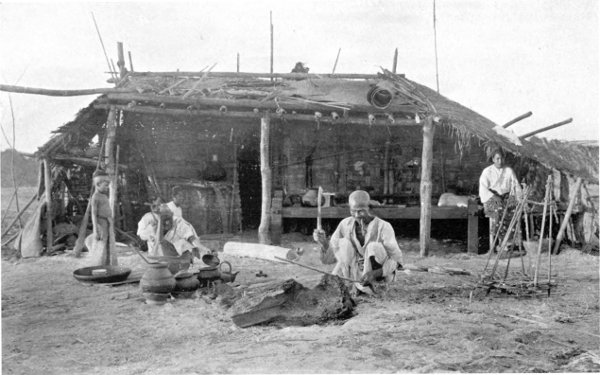
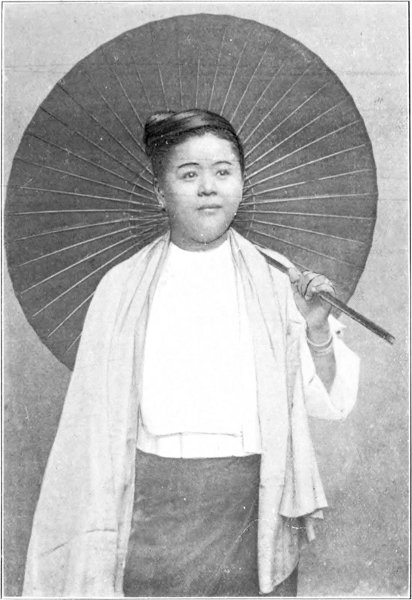
A Burmese family.
Among the homely virtues of the Burmese must
be counted respect for parents. This is inculcated
in the Sacred Books, and forms a really pleasing
phase of family life. Two nephews of the Taung-gwin
Mingyi, one of the Council of Ministers, were
giving trouble in the Ava district. It was suggested
to the Mingyi that he should use his influence to
induce them to surrender and make peace with
Government. “Certainly,” said the Mingyi; “I
will send for their parents and put them in my
dungeon and afflict them till their sons come in.”
It was not possible to approve this crude proposal,
but the Mingyi was told that he might ask the
parents to stay with him, and talk kindly to them
about their erring children. The young men submitted
in a week, and gave no further trouble. In
Sagaing a famous Bo, Min O, was captured. His
life was forfeit for many crimes; but he was an old
man, and two of his sons were at large, leading
dacoit bands. Word was sent to them that if they
did not surrender, their father would be hanged; but
if they gave themselves up, his life would be spared.
Both came in. It will no doubt surprise some people
to learn that the promise to spare Min O’s life was
kept.
In the early days of April, 1886, there seemed to
be a lull in the storm. The time of the Burmese
New Year approached, always a time of some anxiety,
when, if ever, disturbance may be expected. Perhaps
this had not yet been realized. The exact moment
on which the New Year began was calculated by
the Pônnas,[151] who, besides officiating at weddings,
were also the royal astrologers.[152] The time was to
be announced by the firing of a cannon from the
Palace enclosure. On that April morning the
astrologers assembled in the courtyard of the Palace.
The head seer drew a line in the dust, planted a
small stick, and declared that when the shadow of
the stick reached the line the auspicious moment
would have come. At the precise instant I made a
preconcerted sign, and the cannon was fired. It
might have been arranged as the signal of revolt
throughout the country. On that day all the
principal military posts in Upper Burma were
attacked, doubtless in pursuance of a definite plan.
Next morning my servant woke me rather early
with the intimation that “the enemy were at the
gate.” At dawn there had been a serious attack on
the city of Mandalay, swarming with troops, by a
band of some twenty or thirty rebels acting in concert
with a few confederates within the walls. Inside
the city two unlucky medical subordinates were
killed, and within and without incendiary fires were
lighted. The fire spread even to the Palace enclosure,
and we were in some anxiety for the main
buildings, which, once alight, would have burned like
matchwood. To the roof of the Hlutdaw mounted
the faithful Thwethaukgyi[153] Tun Baw and his subordinates,
with chatties[154] of water and bamboo poles,
to quench and beat out flying sparks. Luckily the
fire in the enclosure was mastered, and we returned,
grimy and thirsty, relieved to find our quarters still
standing. As the Palace was crowded with military
and civil officers and their establishments, and contained
all the records, its destruction would have
been very inconvenient.
The fortnight which followed was the longest
fortnight of my life. It was crowded with incident,
attacks and risings, above all, incendiary fires.
Since those days I have ceased to take interest in
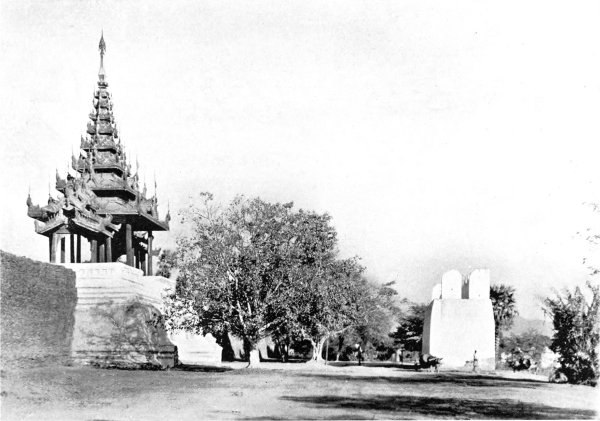
fires. On the Queen’s Tower[155] stood a sentinel, day
and night, to sound the alarm. The easiest way to
the tower was through my bedroom. Nightly I
went to sleep in expectation of being aroused by the
fire-bugle and the tramp of men, and I was hardly
ever disappointed. Every night we climbed the
wooden tower, and saw the blaze of conflagration in
town or city. Once I asked the sentry if he had
heard any sound of firing. “Well, sir, I thought I
did hear one of them there brinjals,”[156] was the unexpected
answer. Once, again, fire broke out within
the Palace fence, but did not spread. This also was
well, as close to our quarters were considerable
quantities of gunpowder and dynamite. With the
early rains at the end of April fires ceased, and
Mandalay enjoyed comparative rest.
It was certain that some of the Burmese officials
in Mandalay were fomenting seditious movements in
the country. Suspicion fell upon the Shwehlan
Myowun[157] and the Hlethin Atwinwun.[158] The Myowun
was removed to India in virtue of a warrant issued
under the invaluable Regulation III. of 1818. He
was taken from his house by Mr. J. G. Scott,[159] who
had joined the Commission and was on general
duty in Mandalay. Their next meeting was at a
pwè in Mandalay, on a memorable night in 1897,
long after the Myowun had been allowed to return.[160]
The Hlethin Atwinwun, most plausible and bland of
miscreants, believed to have been deeply involved
in the massacre of Princes, from whose hands one
expected to see blood still dripping, was moved to
visit Calcutta of his own accord in response to a
general invitation given to Burmese Ministers by
Lord Dufferin. He stayed in Calcutta for some
years, much against his will, but solely under pressure
of peaceful persuasion. He returned much
chastened, and lived on good terms with the officers
of Government till his death early last year.
In accordance with precedent not always observed,
King Mindôn had moved his capital from Amarapura
to Mandalay in the late fifties, transferring thither
many of the inhabitants and all the entourage of the
Court. The site was not in all respects well chosen.
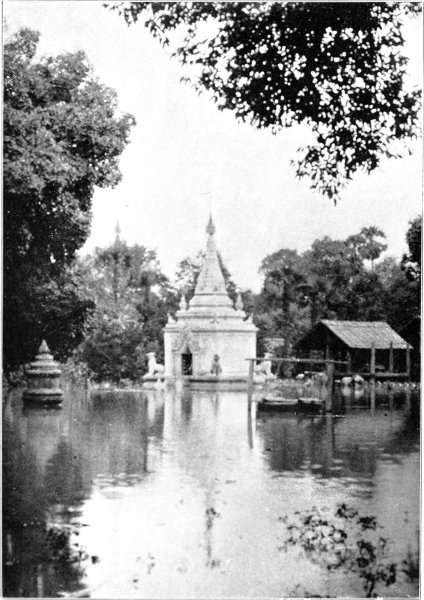
Much of the town was below the level of the river
in high flood, and had to be protected by an embankment.
In the rains of 1886 the Irrawaddy rose
to an abnormal height, causing grave anxiety for
the safety of the bund.[161] One night in August the
disaster came. The embankment was breached, and
the low-lying parts of the town, as far as the great
bazaar (zegyo), were inundated. It was a night of
peril and excitement, which taxed to the utmost the
energies of the officers in charge of Mandalay,
Captain Adamson, Mr. Carter, and Mr. Fforde. Till
the river began to fall the town remained under
water, and we all went about the streets in boats
and launches. As the Burman is an amphibious
being, and the people in the area menaced by the
flood had ample warning, the loss of life was comparatively
small. Searching inquiry established the
conclusion that twelve persons were drowned. An
even more melancholy loss of life occurred in connection
with the distribution of rice to people rendered
destitute by the flood. In a crowd in a narrow
passage someone fell; the throng pushed forward
unknowing, and many people were trampled to death
before the press could be stayed.
One of the objects to which from the beginning
the Chief Commissioner devoted the full force of his
energy and influence was the continuation of the
railway from Toungoo to Mandalay. By dint of
constant and indefatigable pressure on the higher
powers, and by steadfast resistance to the suggestion
that a trunk road should first be made, he succeeded
in obtaining sanction for this essential work. The
survey was actually begun in the rains of 1886;
construction was started early in November of that
year; and in February, 1889, less than three years
after the proclamation of annexation, the line was
opened to traffic throughout its whole length. To
those who have experienced the delay usually attending
the grant of sanction to important and
costly proposals, the most remarkable feature of this
record is that leave should have been obtained in
less than a year from the occupation of Mandalay.
The construction of the line afforded work to great
numbers of Burmans and others, and proved one of
the most pacifying influences in the eastern districts.
There were no engineering difficulties, and the
climate enabled work to be carried on continuously
throughout the year. The opening of the railway
was hailed with joy by the Burmans, who expressed
their appreciation in characteristic fashion, greeting
passing trains with shouts of delight and crowding
to travel in the mi-yahta.[162] It should never be forgotten
that to Sir Charles Bernard alone the
Province owes the inception of this work, as indeed
in earlier days to his far-seeing policy it owed the
construction of the railway from Rangoon to Pegu,
and thence to Toungoo. Apparently Sir Charles
Bernard furnished an exception to the rule that
Indian civilians are persons of narrow horizon.
Among the measures taken at an early stage to
facilitate the pacification of Upper Burma was the
disarmament of the people. Orders to effect this
were issued by Sir Charles Bernard, and some progress
was made. It was, however, under Sir
Charles Crosthwaite’s rule that, in the face of much
opposition, the whole Province was effectually disarmed.
No measure has had more excellent results
in the prevention of serious disturbances. Though
from time to time dacoits and robbers have become
possessed of firearms, the thoroughness of the disarmament
is proved by the inability of rebels in
recent years to obtain guns and powder. The Arms
Act has been very strictly enforced in Burma, the
number of firearms in each district being strictly
limited, with the most beneficial effect.
In the time of King Mindôn and King Thebaw
many foreigners, mostly French and Italian, flocked
to Mandalay and obtained various appointments in
the King’s service. The downfall of the Burmese
kingdom deprived these gentlemen of their employment.
All had claims against the Burmese Government
for arrears of pay, for goods sold, or for work
done. Our Government naturally accepted responsibility
for the lawful debts of its predecessor.
The claims of foreign creditors were investigated
as quickly as possible, and those established were
discharged. Besides these, there were literally
hundreds of other demands for payment of sums
alleged to be due from the late Government. These
claims were laboriously investigated and reinvestigated,
and finally adjudicated upon by the Government
of India. Substantial payments were made in
settlement of debts sufficiently proved.
In those early days for most officers, military and
civil, in Mandalay life was a ceaseless round of
strenuous labour. For me it was intensely exciting.
All day and often far into the night my time was
fully occupied. The enthralling interest of seeing
from within and from the centre the making of a
new Province, of taking a humble share in the work,
was a privilege which falls to few men in a generation.
The receipt of reports from districts, the issue
of the Chief Commissioner’s orders, daily contact
with men of distinction in arms or civil affairs, the
early morning ride with my Chief or with a comrade,
sometimes even with the Commander-in-Chief, Sir
Frederick Roberts, of whose kindness I have the
pleasantest recollection, opportunities for the study
of Burmese life and character, filled to overflowing
the swiftly passing weeks. Bustle and excitement
and good fellowship formed an exhilarating combination.
All the holiday I had that year was a run
down to Rangoon for a day to see my wife and
family off to England. But who wanted holidays
at such a time, when his work was far more interesting
and stimulating than other people’s play?
With Stevenson we might say that we had “the
profit of industry with the pleasures of a pastime.”
It should hardly be necessary to say that in those
early months the outskirts and fringes, the Shan
States and the Chin and Kachin Hills, were untouched.
It has been suggested that in dealing
with the Shan country there was undue delay.
Anyone who realizes how much there was to do in
the plains, and how impossible it was to do everything
at once, recognizes the futility of the suggestion.
The Chins were left severely alone. The only
attempt made this year to penetrate into the Kachin
Hills was the luckless expedition to Pônkan,[163] which
returned to Bhamo re infecta, to the extreme wrath
of Sir Charles Bernard and Sir George White.
The Shan States occupied the whole of the east of
Burma, stretching even beyond the Mèkong River.
They constituted an integral part of the Burmese
Empire, but were administered by their own hereditary
chiefs, puny folk who grovelled before the
pinchbeck Majesty of Burma, and were on a footing
quite inferior to that of native rulers in India.
The first of the Shan chiefs to open communication
with us was the Sawbwa[164] of Hsipaw, or, as the
Burmese called it, Thibaw, the State from which
the late King derived his title. This enlightened
chief had a romantic history which will bear retelling.
Some years before, having quarrelled with
the King, he fled for his life to Lower Burma.
With a few attendants he took up his residence in
Kemmendine, a suburb of Rangoon. Presently he
came to believe, very likely with good reason, that
at the King’s instigation two of his servants were
plotting his death. Accustomed in his State to
exercise the power of life and death, he tried them
in his own mind, found them guilty, and executed
them with his own hand, shooting them both. He
was tried by the Recorder of Rangoon (Mr. C. F.
Egerton Allen[165]) and a jury, convicted, and sentenced
to death. The capital sentence was at once commuted
to transportation for life, and the chief began
to serve his term in the Rangoon jail, where he was
at first set to do the usual hard labour required of
prisoners. Mr. Crosthwaite, who was acting as
Chief Commissioner, found him in this sad condition,
and ordered material alleviation of his lot. The
Sawbwa’s faithful Mahadevi,[166] who had accompanied
her husband, besieged the Chief Commissioner with
petitions for his release. Before long Mr. Crosthwaite
yielded to her importunity and set free the
Sawbwa on condition that he never returned to
British territory. He went to the independent
State of Karenni. At or about the time of the
occupation of Mandalay he made his way back to
Thibaw, and after a brief struggle regained possession
of his State.
Quite early in 1886 the Sawbwa wrote to me, as
Secretary to the Administration, saying that he had
received much kindness from the British Government,
and desired to be on terms of friendship with
us. It has always seemed to me that this was a
very magnanimous act. I agree that it also showed
much wisdom. The Sawbwa was a man of great
intelligence. He had seen and experienced the
power of the British Government. No doubt he
realized that he was dealing with a Government
immeasurably stronger than that which it had displaced,
and he saw his interest in being on good
terms with it. I think, too, that he had a shining
vision of becoming an independent Sovereign in
alliance with India. After all these deductions are
made, it implied true greatness of soul for a semi-civilized
chief to remember the clemency which had
spared his life, to forget the dock and the prison cell
and work-yard. The correspondence begun by the
Sawbwa was continued on cordial terms. Early in
1887, in spite of the passionate entreaties of his
advisers, who were filled with gloomy forebodings,
Kun Saing came down to Mandalay. This again
showed courage and foresight. There was not a
British officer or soldier in the length and breadth
of the Shan States. Mandalay was full of troops.
Though he brought a fairly large retinue, the
Sawbwa knew that he was placing himself entirely in
our power. His confidence was more than justified.
He was received with some ceremony, Mr. J. E.
Bridges, C.S., and I, as representatives of Government,
meeting him at Aung-bin-le with a squadron
of cavalry and a military band. Under this escort
the Sawbwa made a triumphant entry into Mandalay,
and was allowed even to ride through the Palace
grounds. In the King’s time he might sooner have
hoped to fly over them. Sir Frederick Roberts and
Sir Charles Bernard were among the many spectators
of the procession. Accompanied by the
Mahadevi, the Sawbwa was suitably lodged in a
Win[167] outside the city walls. The ladies in his train
were somewhat scandalized at being photographed
by an enthusiastic amateur before they had time to
change out of riding kit. The Sawbwa’s amáts[168]
continued in a state of alarm all the time they were
in Mandalay. Their terror rose almost to frenzy
when one day the Chief was taken for a picnic on
the river in an Indian Marine vessel. Even the
Chief was somewhat relieved when he landed safe
and sound on the Hard.
The Sawbwa had the luck to be in Mandalay at
the celebration of Queen Victoria’s first Jubilee.
Partly in honour of that auspicious occasion, partly
in recognition of his confidence and loyalty, the
tribute of Thibaw was remitted for ten years, and
three small adjacent States, Maing-lôn, Thônzè,
and Maing-tôn, to which very shadowy claims had
been preferred, were added to the Sawbwa’s territory.
Sir Charles Bernard’s action in making over
these States has been criticized. Viewing the case
calmly after the lapse of years, I humbly think that
his decision was wise. The suggestion of the risk of
creating a powerful Shan State strong enough to be
a menace to Government was plainly ridiculous. If
all the Shan States were united under one Chief, he
would not have as much power as the ruler of a
second-class native State in India. Thibaw with its
added sub-States could never be in a position to
cause the Government of Burma a moment’s anxiety.
On the other hand, a large and comparatively
wealthy State is more easily managed and likely to
be administered better than a lot of small tracts.
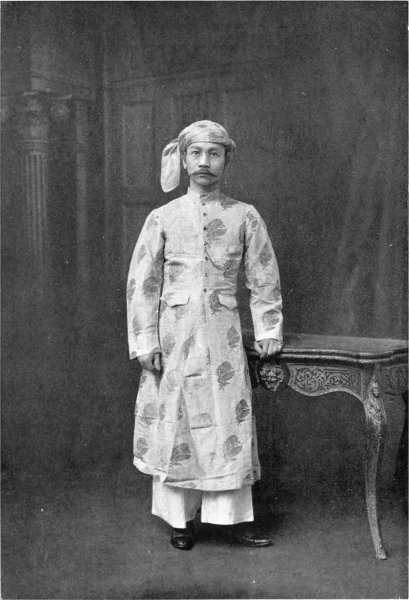
The Sawbwa of Thibaw.
Although Kun Saing was not an ideal ruler;
although from time to time complaints were made
against him; although, I believe unjustly, even his
loyalty was doubted, he was an enlightened and
intelligent chief of some subtlety. Twice in later
years he visited England, where he had the honour
of being received by Her Majesty Queen Victoria.
The story, from first to last, has a ring of the Old
Testament. The place most of all admired by the
Sawbwa was the Crystal Palace (hman-nan-daw).
Towards the end of his life, when the first signs of
unrest in the East became dimly apparent, he is
said to have contracted a secret marriage with the
Pakangyi Supaya,[169] King Thebaw’s sister. Not that
he meditated treason; but if anything should happen,
he meant to be on the right side.
Two of Kun Saing’s sons were partly educated in
England. The elder, Saw Hkè, succeeded his father,
and is now the polished, courtly Chief of Thibaw.
The story of Saw Lu, the younger son, is pathetic
and instructive. When still a boy he was sent to
England, and was for a time at Rugby. He was a
studious and ambitious youth, whose desire was to
be, not a King, but a doctor. Most unwisely, merely
to see how he was getting on, his father recalled
him, and he was turned loose in Thibaw at the age
of about sixteen. The temptations besetting the
Chief’s young son in his father’s capital were too
strong for him, and he fell from grace. The cup of
his iniquity brimmed over when he eloped with a
young girl who had been selected as the Sawbwa’s
Abishag. The fugitives were brought back, and the
boy was cast into prison. “Is this your British
justice?” he indignantly asked the political officer
who came to condole with him. Presently he was
released, and came to see me in Rangoon. “I don’t
know what to do,” he said; “I have apologized to
the governor, but he won’t forgive me.” He was
an exceedingly good-looking, nice-mannered youth,
like a pleasant English public-school boy. He was
not allowed to return to England. Over his subsequent
history it is kinder to draw a veil. The moral
of this story is that if a Burman or Shan, especially
a Chief’s son, is to come to England, he should be
sent while still young, and should be kept at a good
public school and at the University until his character
has been formed. He should on no account
be brought back midway in the course of his
education.
Even more deeply learned in Shan than in
Burmese, Pilcher would have been the first civil
officer in the Shan States. After his death, I was
designated by Sir Charles Bernard for that post.
When the time came, another officer was selected.
Speaking seriously and without reserve, I have no
doubt that this was for the advantage of the Shan
country. No one could have been more conspicuously
successful than Mr. Hildebrand[170] and Mr.
Scott;[171] no one is likely to have done nearly so well.
In view of the original intention, in the cold weather
of 1886 I was given a holiday from office-work, and
sent as civil officer with a column under Colonel E.
Stedman[172] to Thônzè. Through this State ran the
trade route to the Northern Shan States, Thibaw,
Theinni, and Taungbaing. Along this road came
caravans of bullocks laden with letpet.[173] Owing to
dissensions in Thônzè, the trade was stopped. The
object of our expedition, the first sent into the Shan
country, was to obtain information and to open the
road for traders. Early in November, when the
season should have been settled, on a fine Sunday
afternoon, I rode out to join the rearguard at Tônbo.
Next morning we were to catch up the main column
at Zibingale. From Tônbo to Zibingale we climbed
the hill in a torrent of rain, letting our ponies loose
to scramble up the steep and rocky ascent, while
the Gurkhas chaffed one another and laughed at the
weather. At Zibingale we stayed under canvas in
the rain for three days and three nights, quite comfortable
in our tents, but rather aggrieved at having
to wade knee-deep in mud to mess.
The Madrasi garrison of the post was prostrate
with fever almost to a man; of our own small force
about a quarter fell sick. By judicious doses of
quinine, I saved my servants and myself, so that we
all came through unscathed. After three days the
rain ceased and we began our march in cool
November sunshine. On that delightful plateau,
some three thousand feet above the sea, the winter
climate is perfect. We rode through forest paths
and fairy glades, wild roses clustering in the hedges.
At Pyintha and Singaing, we first saw the bazaar,
held every five days, a custom peculiar to the Shan
States and Further East. Buyers and sellers came
from all the countryside, often from distant places.
It is much like market-day in a country town in
England. The market at Singaing and at Pyinulwin
was of some interest, and attracted strange folk
from the hills. It was not to be compared with the
great bazaars held at Kēngtūng, Namkham, or even
Mogôk, thronged with many varieties of races in
rich diversities of attire. To us, the people most
novel and attractive were the Shans, men swaggering
in baggy trousers and large flapping straw hats
brigand-like, but formidable only in appearance; girls
with russet-rosy cheeks, shy and gentle. Pyin-u-lwin,
a charmingly situated village of some five-and-twenty
houses, with a market-place and a gambling
ring, won our hearts. Though we did not actually
discover Pyin-u-lwin, we were among its earliest
visitors. We were received with all kindness and
hospitality. Several of us were housed in the village
monastery, where we were heartily welcomed by the
monk. He was still there when I left Burma
twenty-four years later. With Captain E. W. Dun,
our Intelligence Officer, I inspected a curious
magnetic rock in the neighbouring jungle. Some
years afterwards it was described as a new discovery
by a geologist of note. It has been lost again, but
will doubtless be found some day. Soon after our
return, on Colonel Stedman’s recommendation, a
military post was established at Pyin-u-lwin, and
called May-my̆o, after Colonel May, of the Bengal
army, a Mutiny veteran, the first Commandant.
May-my̆o is now the summer residence of the Burma
Government and the headquarters of the Burma
division, a flourishing hill-station with a population
of about 12,000. Without pretension to the picturesque,
it is a place of great charm and quiet beauty,
with no palm-trees and few pagodas, conspicuously
un-Oriental, more like a corner of Surrey than of
Burma.[174]
From Pyin-u-lwin we marched to Thônzè, through
a desolate country, overgrown with elephant-grass,
but with many signs of past prosperity. At the
ruined town of Thônzè, now no more than a straggling
village, we halted and tried to open communication
with Hein Sè,[175] a bandit who claimed to
be Chief of the State. I promised him a safe-conduct
and liberty to depart if we could not come
to terms, and to encourage him, I offered to let him
keep my messenger as a hostage for his safety.
This offer was made with the knowledge and consent
of the messenger, a little Shan chiefling known as
the Tabet Myosa. Him we had found, practically
destitute, in Mandalay, where he had been detained
by the King. As a matter of grace, he was given
an allowance of Rs. 10[176] a month. He accompanied
me on this tour, and pluckily undertook to carry my
letter to Hein Sè. As he was leaving, he turned at
the tent-door, and said: “But you will let him
come back, won’t you?” Accepting my assurance,
he went off. I know that he discharged his mission,
as I received a reply. But his courage was not put
to the extreme test. Hein Sè behaved like a gentleman,
treated the envoy kindly, and sent him back
in safety. He himself declined my invitation. The
future history of Tabet may be told here. A few
months later, when Mr. Hildebrand and Mr. Scott
went to the Shan States, I sent the Myosa with
them. He made himself useful, and showed nerve
and ability. When, owing to the persistent recalcitrance
of its ruler, who fled across the Salween
and stayed there, the large State of Yatsauk was in
need of a chief, Tabet was chosen. He ruled Yatsauk
with loyalty and intelligence, and handed down
the succession to his son. His fortune, probably his
merit, was better than that of another Shan chiefling
of similar status, the Maingkaing Myosa, who also
received from Government 13s. 4d. a month, and
received no more.
The rest of this tour was without incident. We
explained to the people of Thônzè the beneficent
intentions of Government, and gave a practical
example of the good manners of a British military
force. The Gurkhas of the column, then as ever,
were specially popular with the people to whom
doubtless they are akin.
In February, 1887, Mandalay was not behind the
rest of India in celebrating the Jubilee of Her
Majesty Queen Victoria. The ceremonies were
designedly arranged so as to give the people an
opportunity of demonstrating their loyalty and
devotion to the Crown by revels which they themselves
appreciated. For a week pwès[177] and other
Burmese festivities went on day and night. On the
first day came all the members of the royal family,
all the high officials, and a crowd of others, in their
gayest and richest attire. In the principal ballet
appeared, probably for the last time, the famous
singer and dancer, Yindaw Ma Le, the favourite of
Princes, undisputed prima donna of the Burmese
operatic stage, who ten years before had been sent
to Rangoon by Mindôn Min to dance at the Proclamation
rejoicings. Twenty years later her
successor, Ma Twe Le, also a lady of supreme grace
and serpentine charm,[178] had the honour of dancing
before Their Royal Highnesses the Prince and
Princess of Wales.
One of the relaxations of those early days was to
see the working of the Elephant Kheddah at
Amarapura. The Kheddah establishment, inherited
from the King and maintained for some time, consisted
of a number of tame elephants, thoroughly
well trained, with Burmese riders and hunters.
The tame elephants, some with riders, some guided
only by their own sagacity, plunged into a jungle
teeming with herds of their wild brethren. By
artful strategy a wild elephant would be detached
from his fellows, lured into the midst of the tame
herd, and gradually drawn to the Kheddah enclosure.
This was a quadrangle, entered only by a
funnel-shaped passage, surrounded by a strong outer
wall of brick and by an inner stockade of stout teak
posts set at intervals, with a space between the
stockade and the wall. By his clever, perfidious
friends, the captive was cunningly edged and hustled
towards the passage till finally he was thrust into
its mouth. Then the gate was securely fastened
and the quarry was alone at the mercy of his
captors. The hunters teased him with blunt spears
and sticks, not doing him any real harm, but annoying
him exceedingly, escaping his charge by darting
between the posts of the palisade, set wide enough
apart to admit a man but not an elephant. This
was a sport of some danger, requiring nerve and
agility. When the poor beast was thoroughly tired,
he was noosed and tied up in the Kheddah, and the
process of training began. Spectators sat in crowds
on the wall to watch this pastime. I do not think
it occurred to any of us that it was somewhat cruel.
In March, 1887, Sir Charles Bernard left Burma.
He was entertained by the Headquarters Mess at a
farewell dinner, where Sir George White[179] proposed
his health in moving and eloquent terms, quoting
most appropriately the famous lines:
“Him who cares not to be great,
But as he saves or serves the State.
Not once or twice in our rough island story,
The path of duty was the way to glory:
He that walks it, only thirsting
For the right, and learns to deaden
Love of self, before his journey closes,
He shall find the stubborn thistle bursting
Into glossy purples, which outredden
All voluptuous garden-roses.”
We escorted our guest to the steamer, and there
bade farewell to our Chief and our friend.